judge
Judge — June 28, 1930
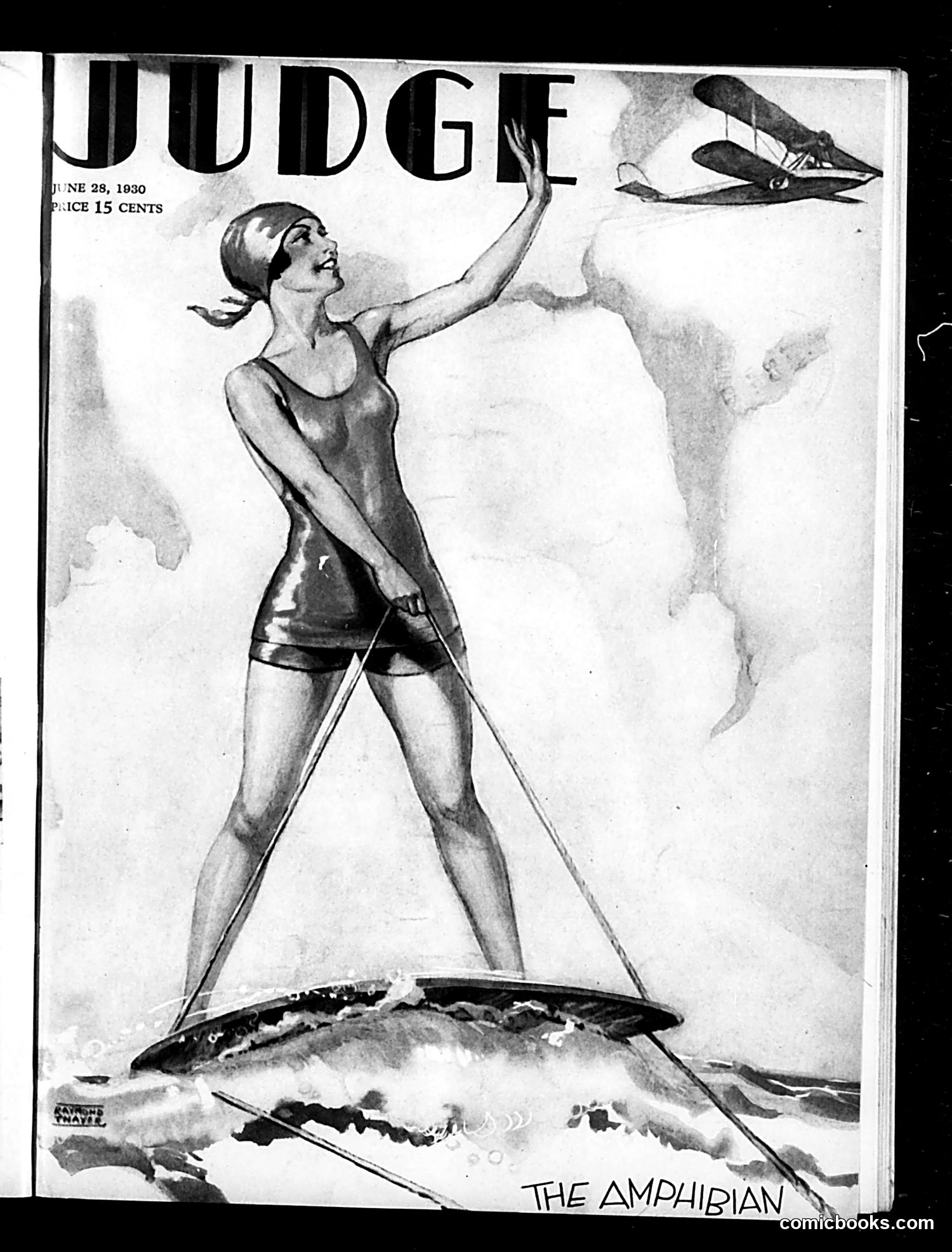
"The Amphibian" - Judge Magazine, June 28, 1930 This cover satirizes women's expanding roles in modern recreation. The illustration shows a woman in a bathing suit standing confidently on an amphibious aircraft, reaching skyward while piloting or operating the plane. The title "The Amphibian" plays on both the aircraft type and the woman's ability to navigate multiple environments—water, air, and land. In 1930, women aviators and recreational activities were becoming increasingly visible and controversial. The cartoon celebrates (or possibly mocks, depending on the magazine's tone) the "modern woman" who participates in adventurous sports like aviation and swimming rather than conforming to traditional domestic roles. The figure embodies the independent "New Woman" of the interwar period.
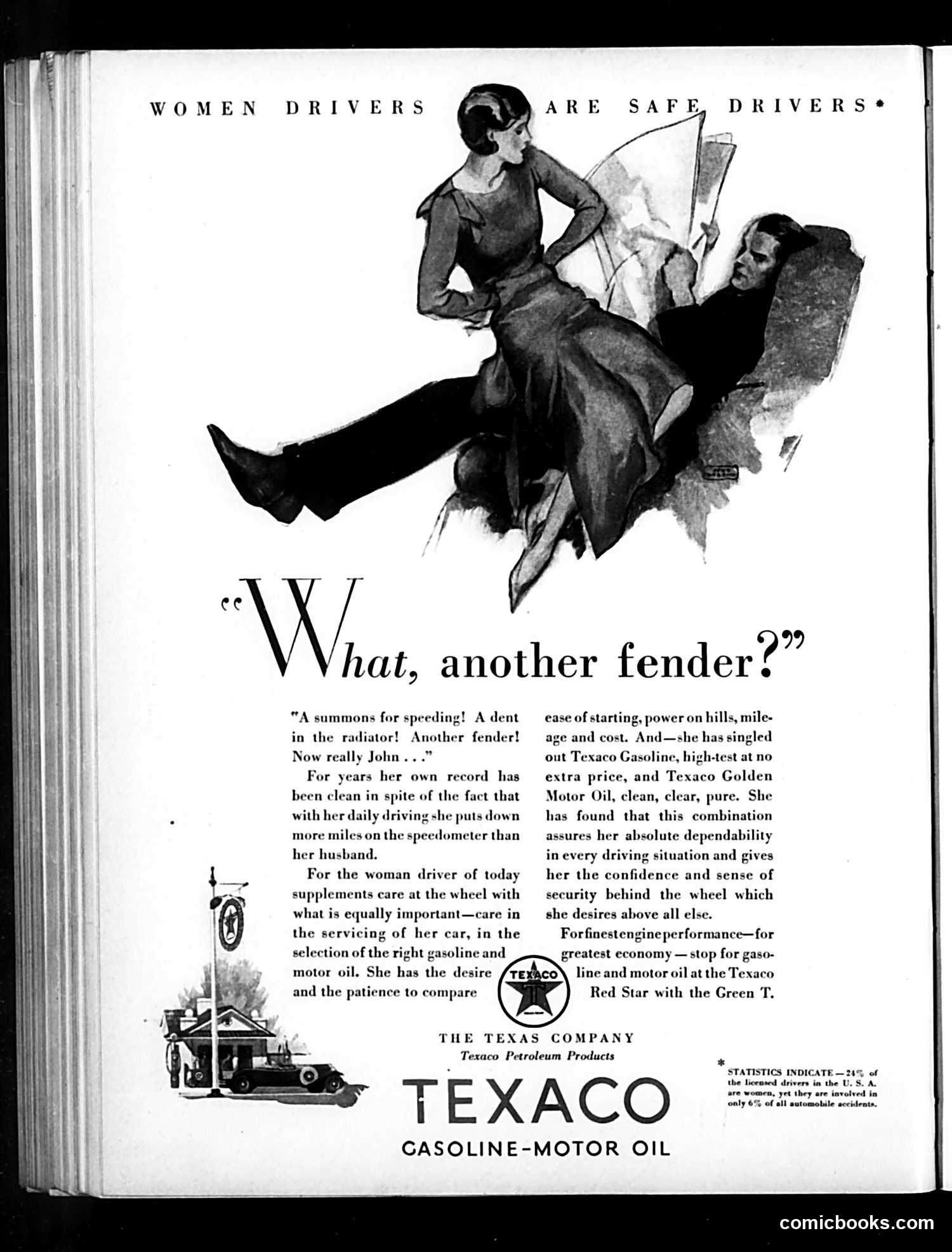
This is primarily a Texaco gasoline advertisement rather than political satire. The headline "Women Drivers Are Safe Drivers" challenges contemporary stereotypes about female motorists. The illustration shows a man apparently injured or distressed while a composed woman sits nearby—a visual joke suggesting women drivers cause accidents to men (humorously reversing expected gender roles in 1920s-30s driving culture). The ad's actual message promotes Texaco products to women drivers by emphasizing reliability and dependability. It claims women appreciate careful car maintenance and compares brands meticulously—suggesting they're intelligent consumers deserving serious product marketing. A footnote cites statistics: 24.5% of licensed U.S. drivers are women, yet they're involved in only 6% of automobile accidents, supporting the safety claim.
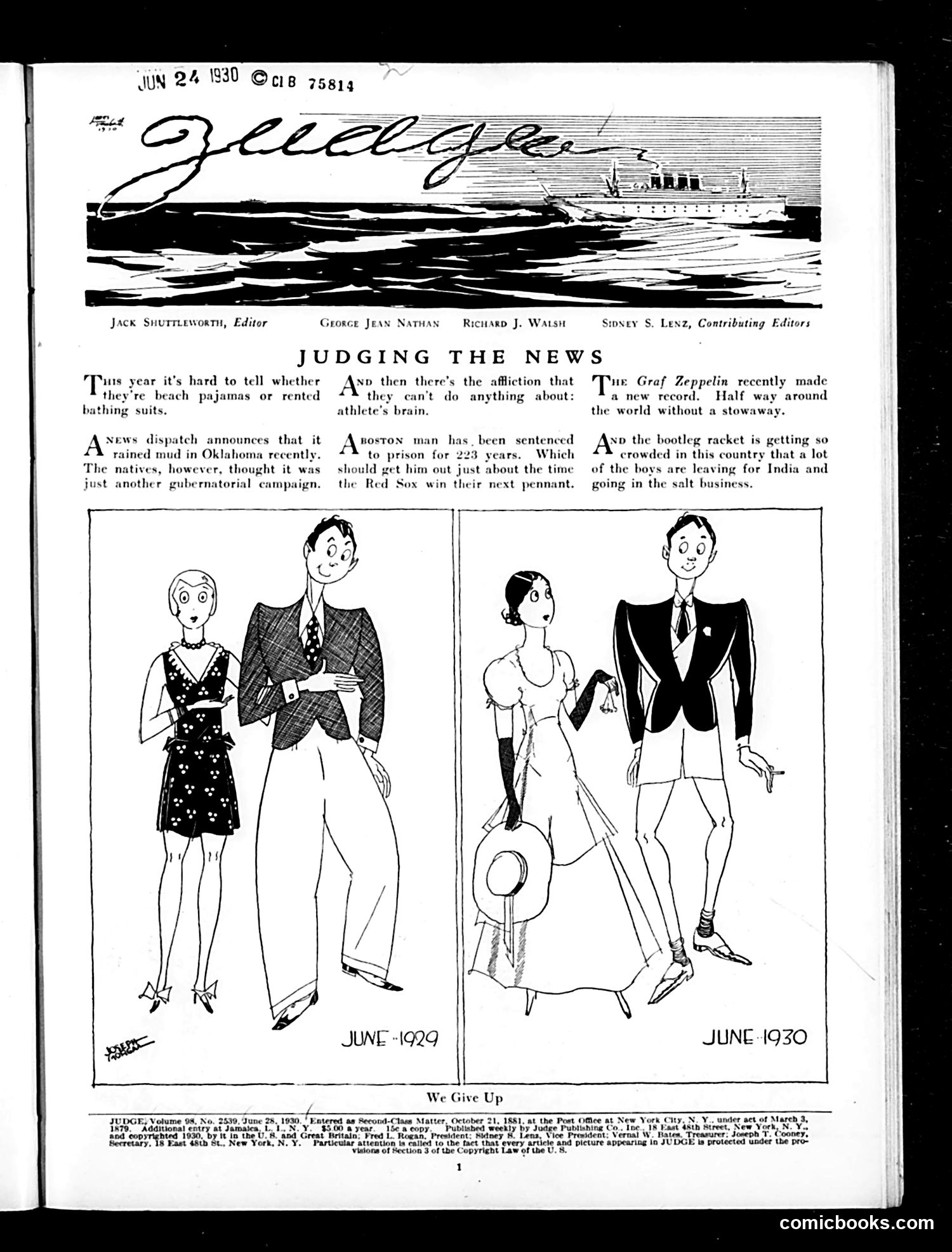
"We Give Up" — Judge Magazine, June 1930 This cartoon compares fashion and social trends between June 1929 and June 1930. The left panel shows 1929 styles: a woman in a short, patterned dress with bobbed hair and a man in a plaid suit with normal proportions. The right panel depicts 1930 fashions: the same couple now wears exaggerated, androgynous clothing—the woman in a longer dress with masculine styling, the man in oversized formal wear with notably broader shoulders. The title "We Give Up" suggests the cartoonist's satirical surrender to rapidly changing, seemingly illogical fashion trends. The joke mocks how quickly fashion dictates transformed clothing silhouettes and gender presentation in early 1930s style, reflecting contemporary anxiety about modernism's effects on traditional gender norms.
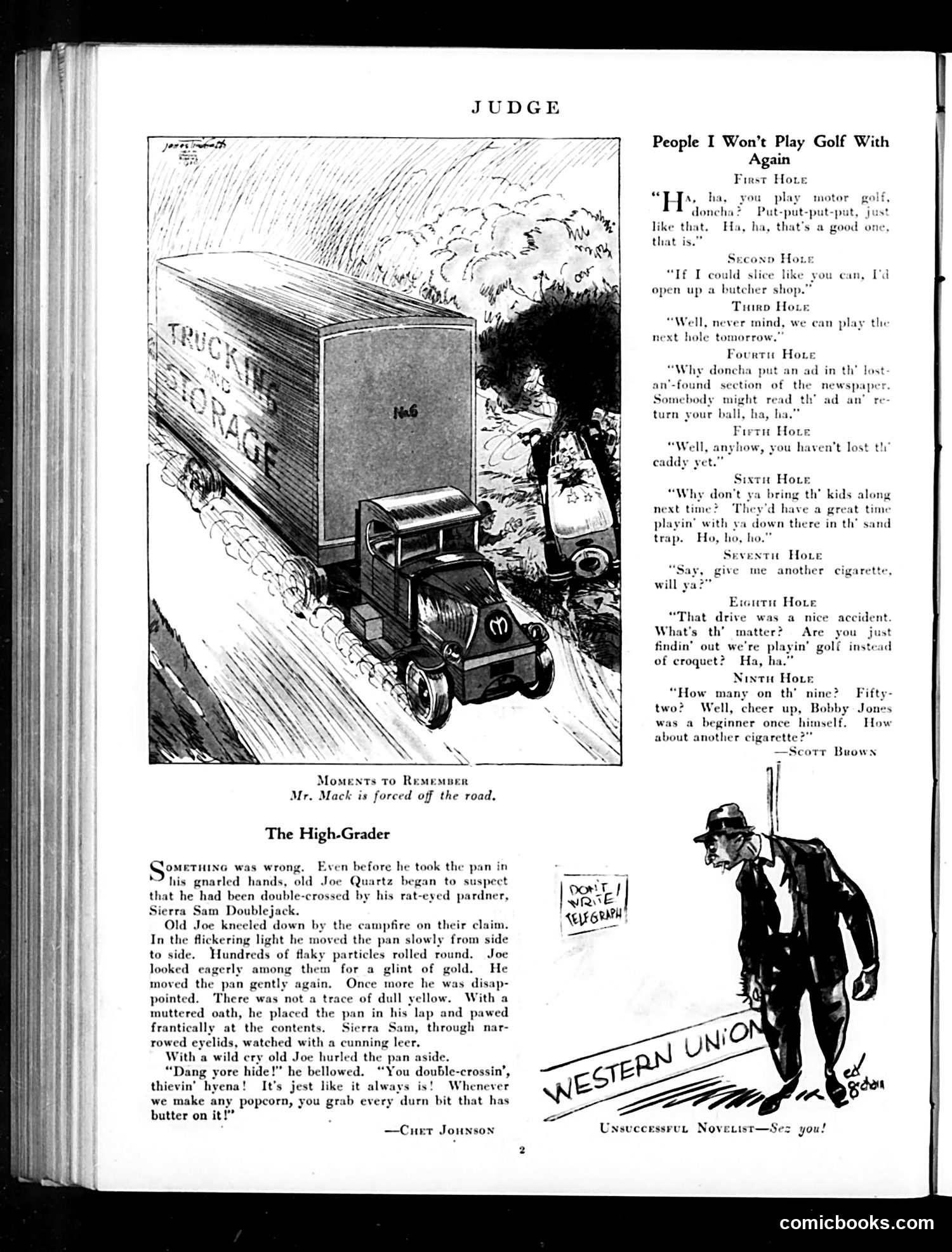
Analysis of Judge Page "People I Won't Play Golf With Again" is a humorous dialogue spanning nine holes, where a golfer complains about his partner's annoying behavior—motor-golfing, suggesting opening a butcher shop, placing lost-ball ads, bringing children, chain-smoking, and general carelessness. It's satirizing irritating golf companions through exaggerated dialogue. "The High-Grader" tells of Old Joe discovering gold in a mining pan, believing he's struck it rich. The story reveals deception: his rat-eyed pardner has salted the pan with gold flakes as a con. The satire criticizes gullible prospectors easily duped by mining fraud—a common concern during early 20th-century gold-rush schemes. "Unsuccessful Novelist" cartoon (right) shows a dejected man at Western Union, likely depicting struggling writers of the era.
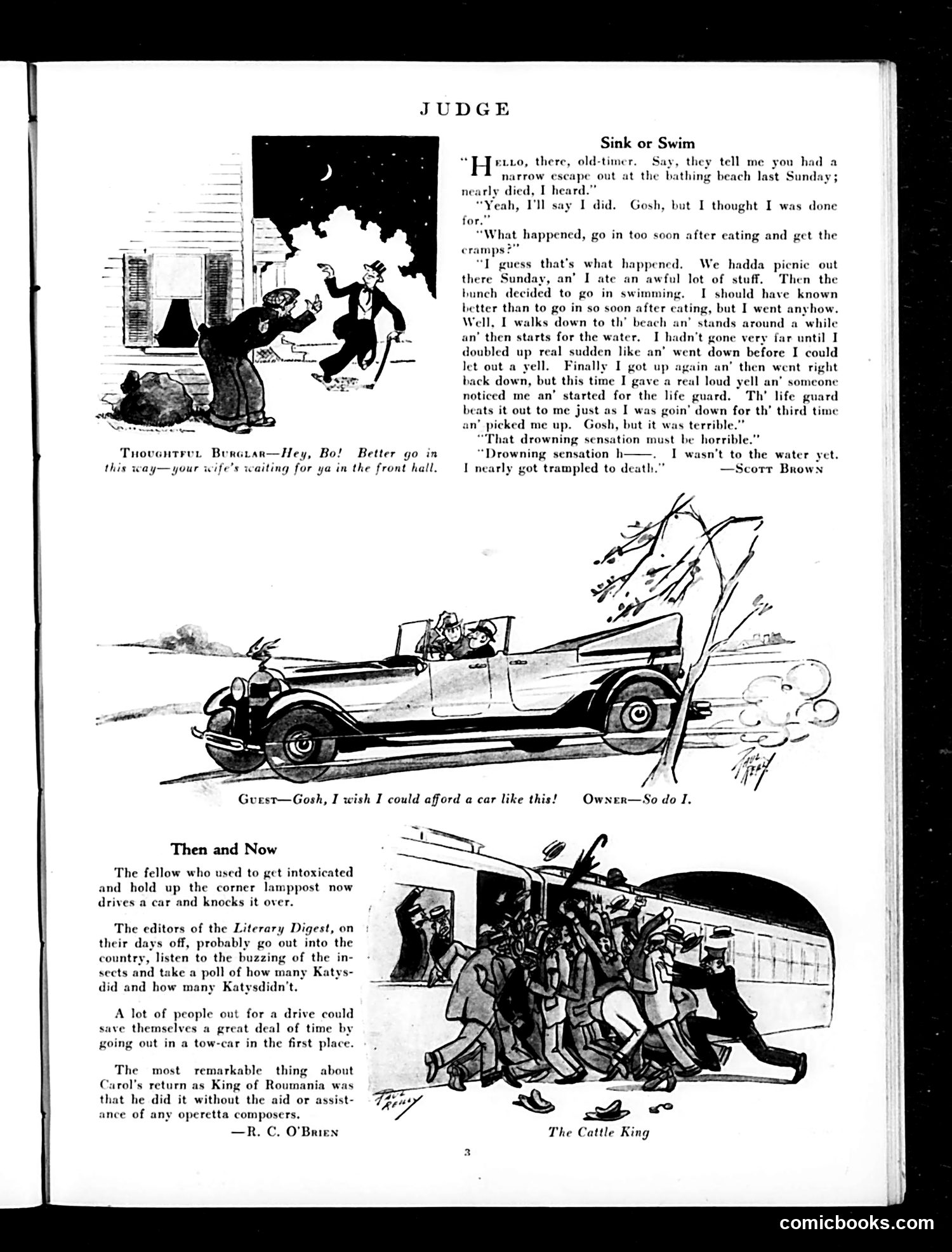
Page Analysis: Judge Magazine Humor This page contains three separate humorous pieces: 1. "Sink or Swim": A dialogue joke about a man's near-drowning at the beach after eating too much. The humor relies on physical comedy—he nearly drowns, gets rescued by a lifeguard, then ironically gets trampled by the lifeguard rushing to help someone else. It's straightforward slapstick satire on the dangers of swimming after meals (a common warning of that era). 2. "Then and Now": Social commentary contrasting past and present behaviors—formerly intoxicated men caused trouble on foot; now they drive cars dangerously. It satirizes how technology amplifies human recklessness. 3. "The Cattle King": An illustration labeled simply "The Cattle King" showing people crowded into what appears to be a vehicle or enclosed space. The specific reference is unclear without additional context. The page uses typical Judge-style satirical humor targeting everyday social behaviors and modern inconveniences.
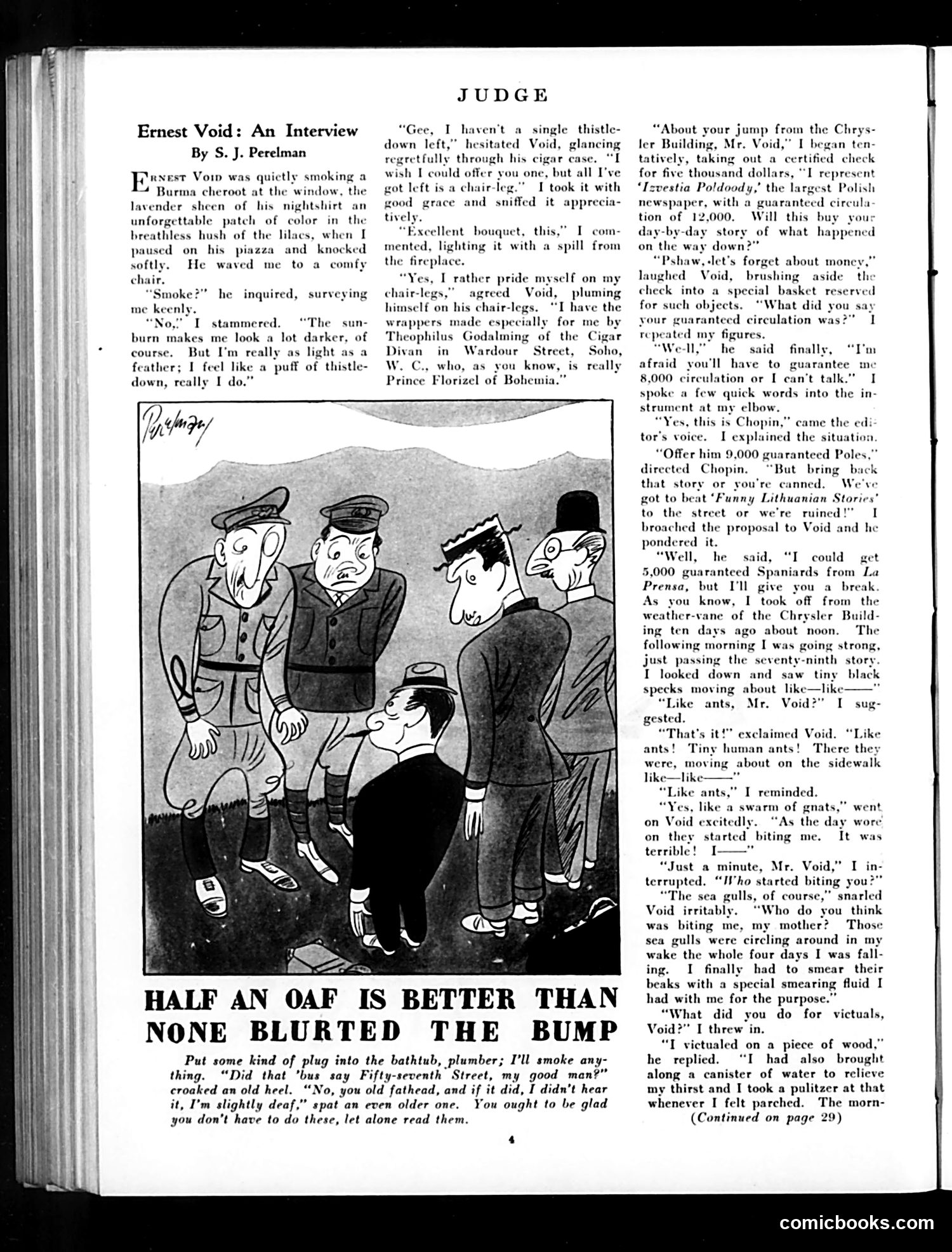
Analysis of "Ernest Void: An Interview" This satirical interview features Ernest Void recounting his harrowing fall from the Chrysler Building in New York. The cartoon depicts policemen or authority figures surrounding Void as he describes his experience. The satire mocks Void's implausible survival story: he claims to have fallen from the building's weather vane, then encountered increasingly absurd obstacles—sea gulls biting him for four days, tiny black specks "like ants" and "gnats" attacking him. He "virtualed" his landing by imagining himself on wood. The piece ridicules tall-tale exaggeration and obvious fabrication. The title—"Half an Oaf Is Better Than None Blurted the Bump"—suggests Void is foolish or dishonest. Judge uses this interview to satirize either a specific dubious public figure or the broader phenomenon of unbelievable celebrity anecdotes.
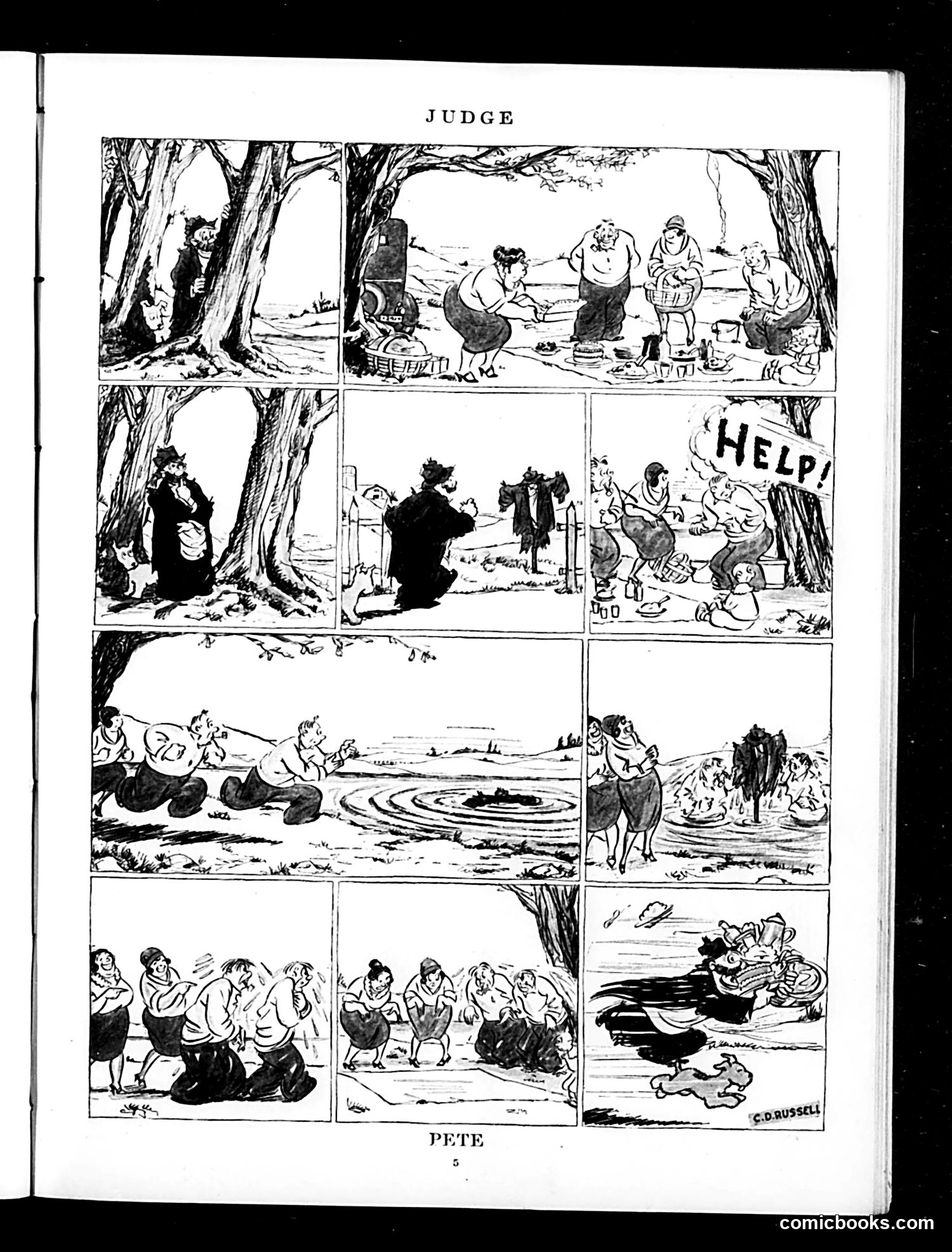
Analysis of "Judge" Page - "Judge" and "Pete" This appears to be a two-panel comic strip narrative. The top panel titled "JUDGE" shows what seems to be a legal or authority figure encountering a group of people engaged in an outdoor gathering or picnic near trees. The figure in dark clothing (appearing to be the "judge") observes the scene, which escalates through subsequent panels into chaos—someone cries "HELP!", and the situation deteriorates into apparent disorder involving water and multiple figures. The bottom panel "PETE" continues the narrative with similar characters in increasingly frantic situations, culminating in what appears to be a drowning or water-related emergency scene. The satire likely critiques judicial authority, social gatherings, or public behavior, though the specific political/social reference remains unclear without additional historical context about when this was published.
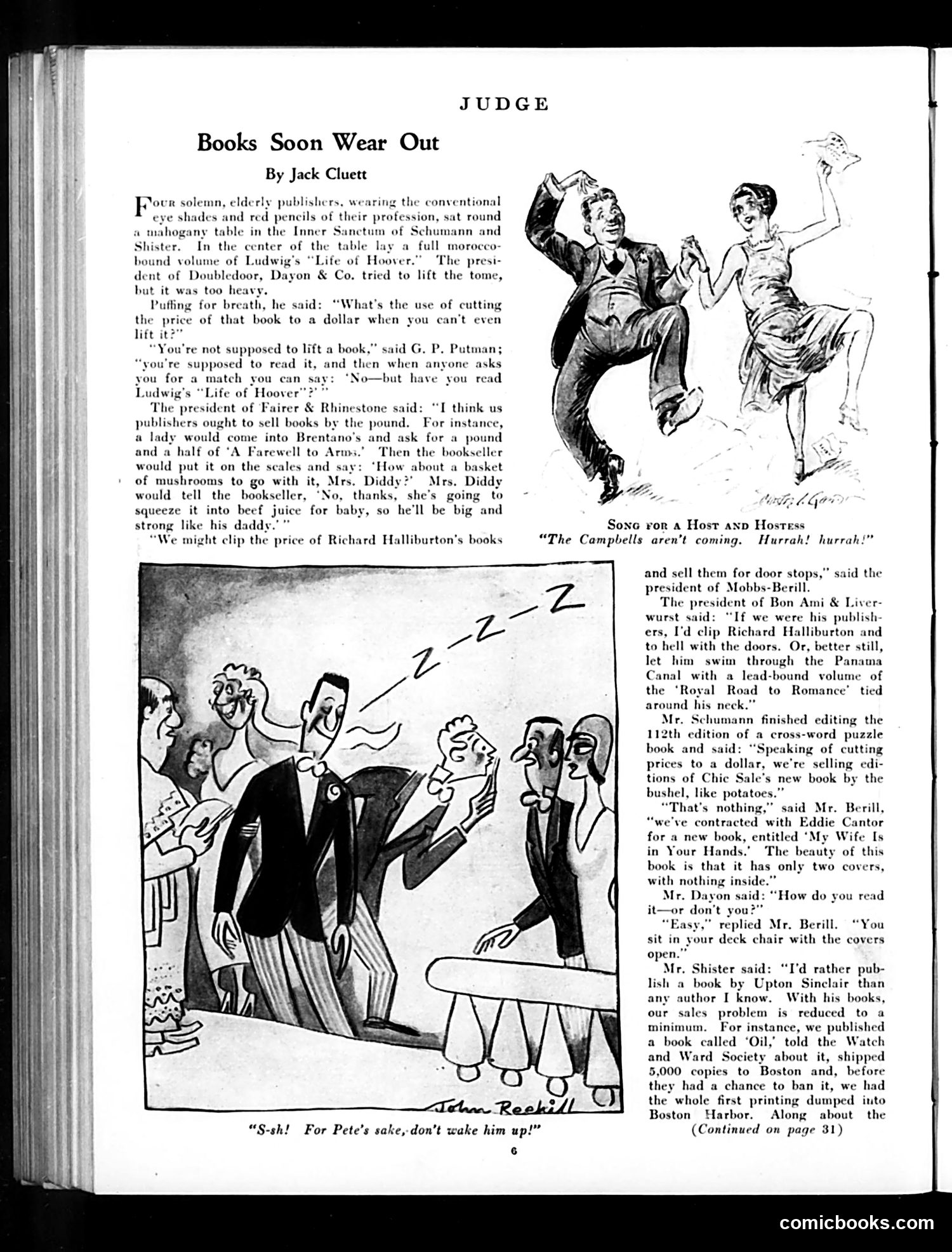
"Books Soon Wear Out" by Jack Cluett This satirical article mocks 1920s-30s publishers' complaints about book durability and sales. Four elderly publishers debate solutions around a mahogany table while attempting to lift Ludwig's "Life of Hoover"—too heavy to manage. The satire targets publishers' absurd cost-cutting proposals: selling books by the pound, clipping prices of Richard Halliburton's volumes, using books as door stops, or even having customers read books in deck chairs without opening them. The cartoons ridicule publisher desperation during economic hardship. One illustration shows a sleeping figure labeled "Pete" while colleagues scheme nearby, capturing the exhausted state of the publishing industry. The piece's humor derives from the industry's increasingly ridiculous survival tactics rather than addressing fundamental market problems.
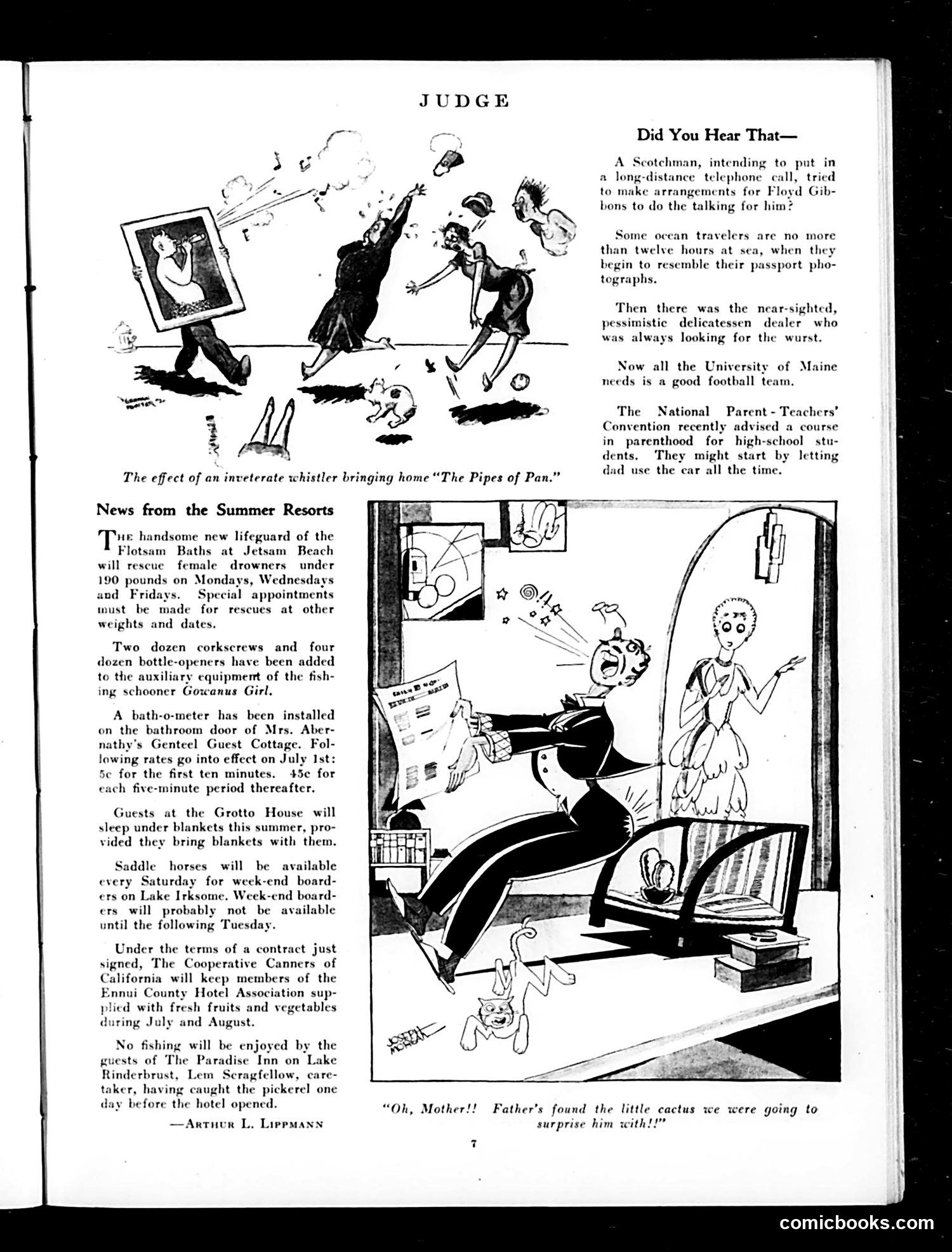
Explanation for Modern Readers This is a humor page from *Judge* magazine featuring absurdist comedy typical of the 1920s-30s era. "News from the Summer Resorts" consists of mock announcements satirizing resort amenities and their petty absurdities: a lifeguard who only rescues women under 190 pounds (requiring appointments for heavier women), a guest cottage charging by the minute for bathroom use, horses available only on Saturdays (guests unavailable Sundays-Tuesdays), and a lake where fishing is impossible because the caretaker caught the only fish before opening. "Did You Hear That" presents brief gag jokes: a Scottish person arranging a paid speaker for a long-distance call (playing on Scottish frugality stereotypes), seasickness making travelers unrecognizable from passport photos, and a pessimistic delicatessen owner seeking "the wurst" (pun on German sausage). The cartoon shows a chaotic domestic scene where a father discovers a cactus the family planned as a surprise, depicted with slapstick visual humor typical of the era's comic illustration style. All content relies on wordplay, exaggeration, and gentle social mockery rather than topical references.
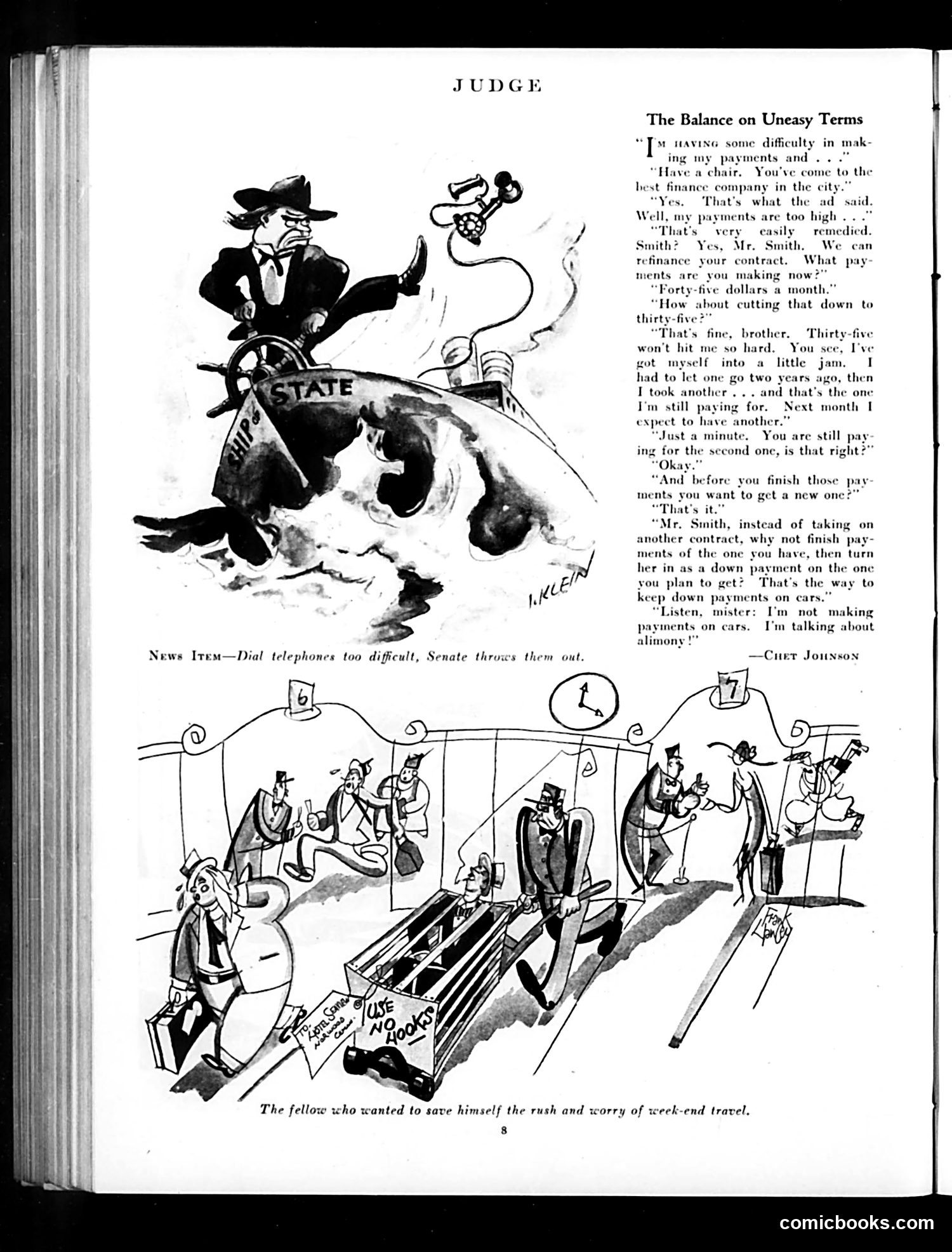
Analysis of "The Balance on Uneasy Terms" This two-panel satirical piece critiques the finance industry's predatory lending practices during the early 20th century. Top cartoon: A judge-like figure (representing a finance company manager) steers a sinking ship labeled "STATE" while a creditor clings to the rigging. The imagery suggests financial institutions are capsizing the economy through reckless lending. Main dialogue scene: A customer named Mr. Smith seeks relief from high car payments ($45/month), but the finance company manager offers only superficial solutions—reducing one payment while trapping him in an endless cycle of debt. Smith reveals he's already in a "jam," having purchased multiple cars through refinancing, each loan creating new obligations. The satire's point: Rather than solving customers' financial problems, finance companies exploit desperation by perpetually rolling debt forward, keeping borrowers permanently enslaved to monthly payments. The joke is that Smith can't afford cars *or* make payments on them—yet the system keeps him buying anyway. The bottom cartoon caption suggests another scheme: pressuring customers into unnecessary weekend travel purchases to maintain payment momentum.
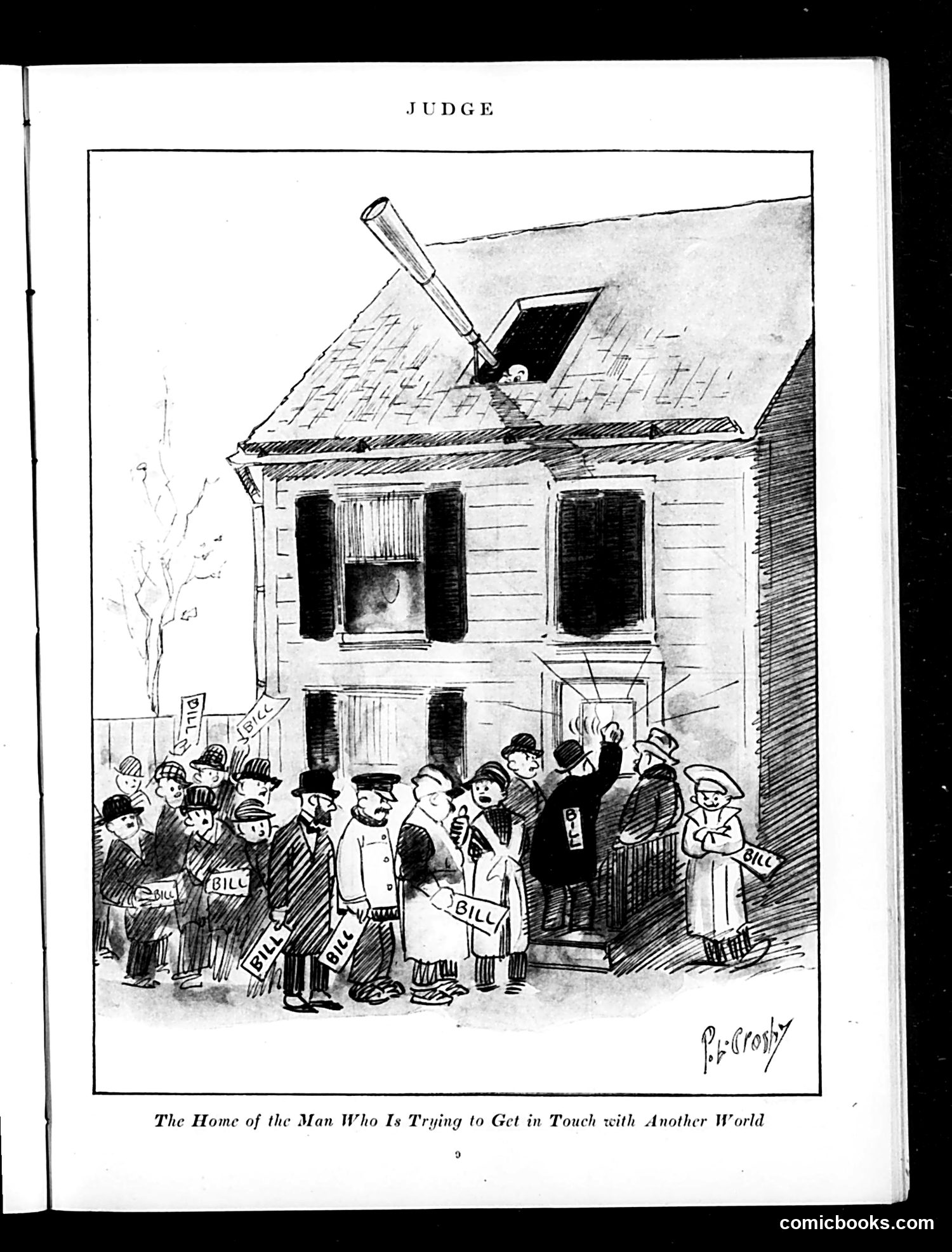
"Judge" Cartoon Analysis This cartoon satirizes spiritualism and séance culture, which was popular in early 20th-century America. The caption indicates a man attempting to contact "another world"—a reference to spiritualist practices claiming to communicate with the dead. The image shows a modest house being literally dismantled by a large hammer and chisel on the roof, while crowds holding "BILL" signs gather at the entrance. This visualizes the financial ruin caused by the man's spiritualist obsession. The bills represent mounting debts, likely from paying spiritualist mediums and charlatans. The satire mocks both the credulity of spiritualism believers and the economic damage their pursuit causes their families. The physical destruction of the home literalizes how spiritualist expenses were destroying households—a common critique of the spiritualist movement's exploitation of vulnerable, grieving people seeking contact with deceased loved ones.
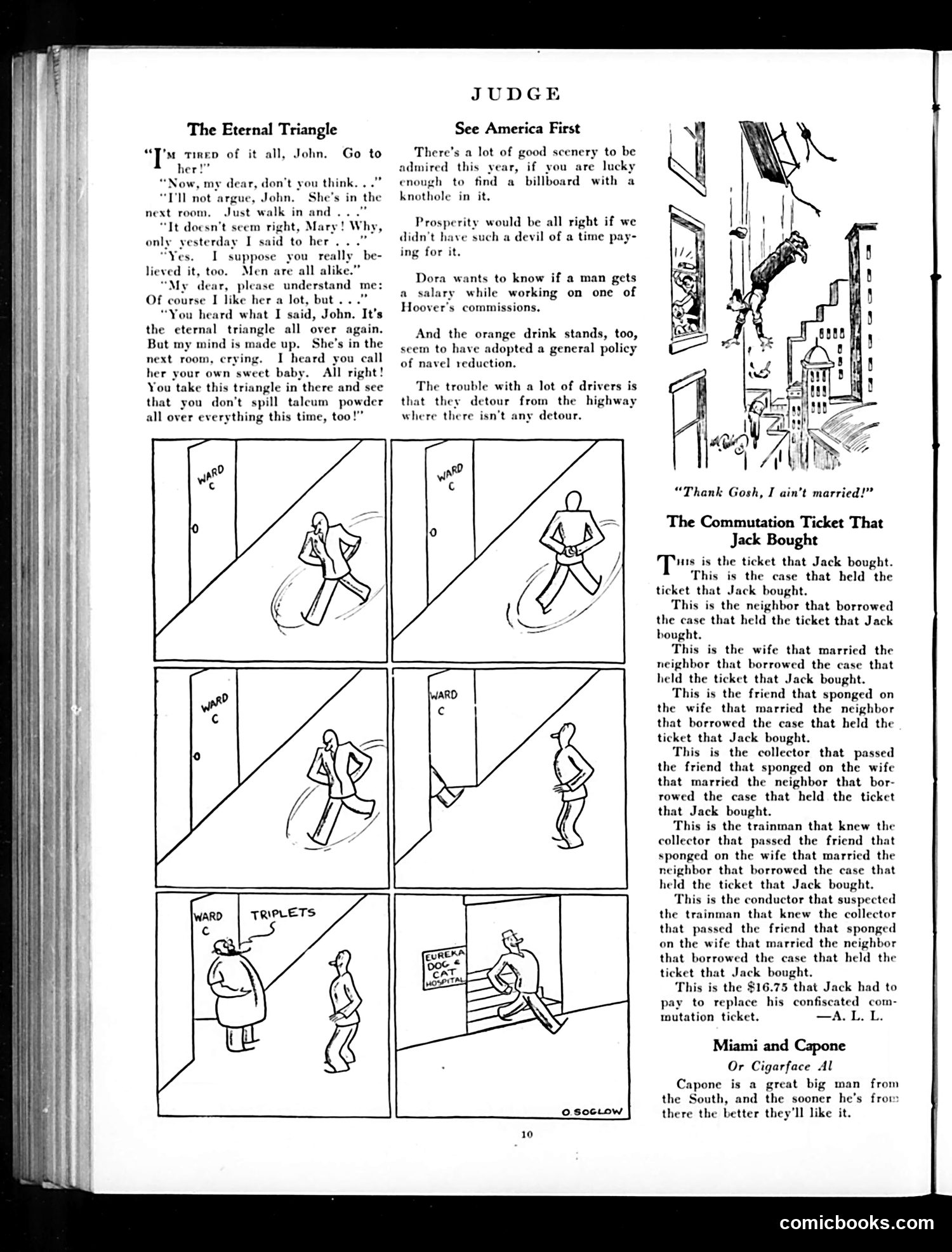
Judge Magazine Page Analysis This page from *Judge* contains three distinct satirical pieces: "The Eternal Triangle": A domestic comedy where a wife insists her husband visit their baby in the next room, sarcastically calling the situation an "eternal triangle"—a play on the melodramatic phrase typically meaning romantic infidelity. The joke is the mundane domestic reality versus the dramatic language. "See America First": Brief one-liners mocking 1920s-30s American life, including jibes at billboards blocking scenic views, the difficulty of affording prosperity, Hoover's commissions, and reckless drivers. "The Commutation Ticket That Jack Bought": A cumulative-verse satire (mimicking "This Is the House That Jack Built") about a commutation ticket's chaotic journey through multiple people, ending with Jack paying $16.75 to replace it—mocking bureaucratic inefficiency and the domino-effect consequences of minor losses. "Miami and Capone": A brief, cryptic jab at Al Capone, suggesting the famous Chicago gangster should leave the South—likely referencing contemporary Prohibition-era organized crime concerns.
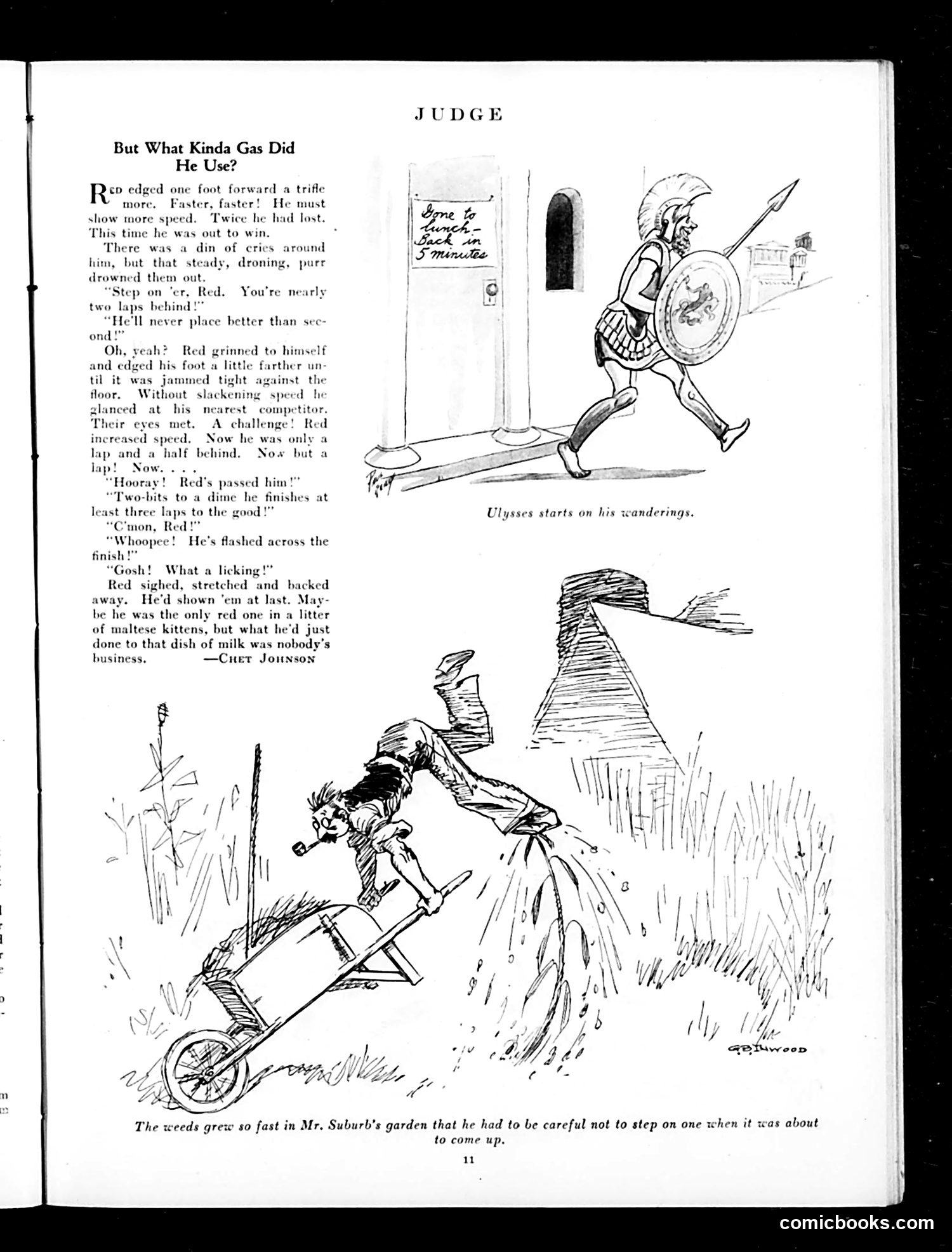
Judge Magazine Cartoon Analysis This page contains two separate humorous pieces: "But What Kinda Gas Did He Use?" is a racing story presented as a dramatic narrative, but the punchline reveals the "racer" is actually a cat competing for milk—not a human in a vehicle. The title mocks automotive advertising's obsession with fuel and performance specs by applying that language absurdly to a cat's speed. The illustrations show what appears to be a Roman/gladiator-themed chariot race, heightening the comedic incongruity. Chet Johnson's byline indicates authorship. The bottom cartoon satirizes suburban lawn care culture. It depicts a man navigating his garden as though dodging obstacles, when the actual "danger" is fast-growing weeds that might trip him. This gently mocks the suburban obsession with manicured lawns and the endless battle against nature creeping into domestic spaces. Both pieces use exaggeration and unexpected reveals to comment on American consumer culture and domestic life concerns of the era.
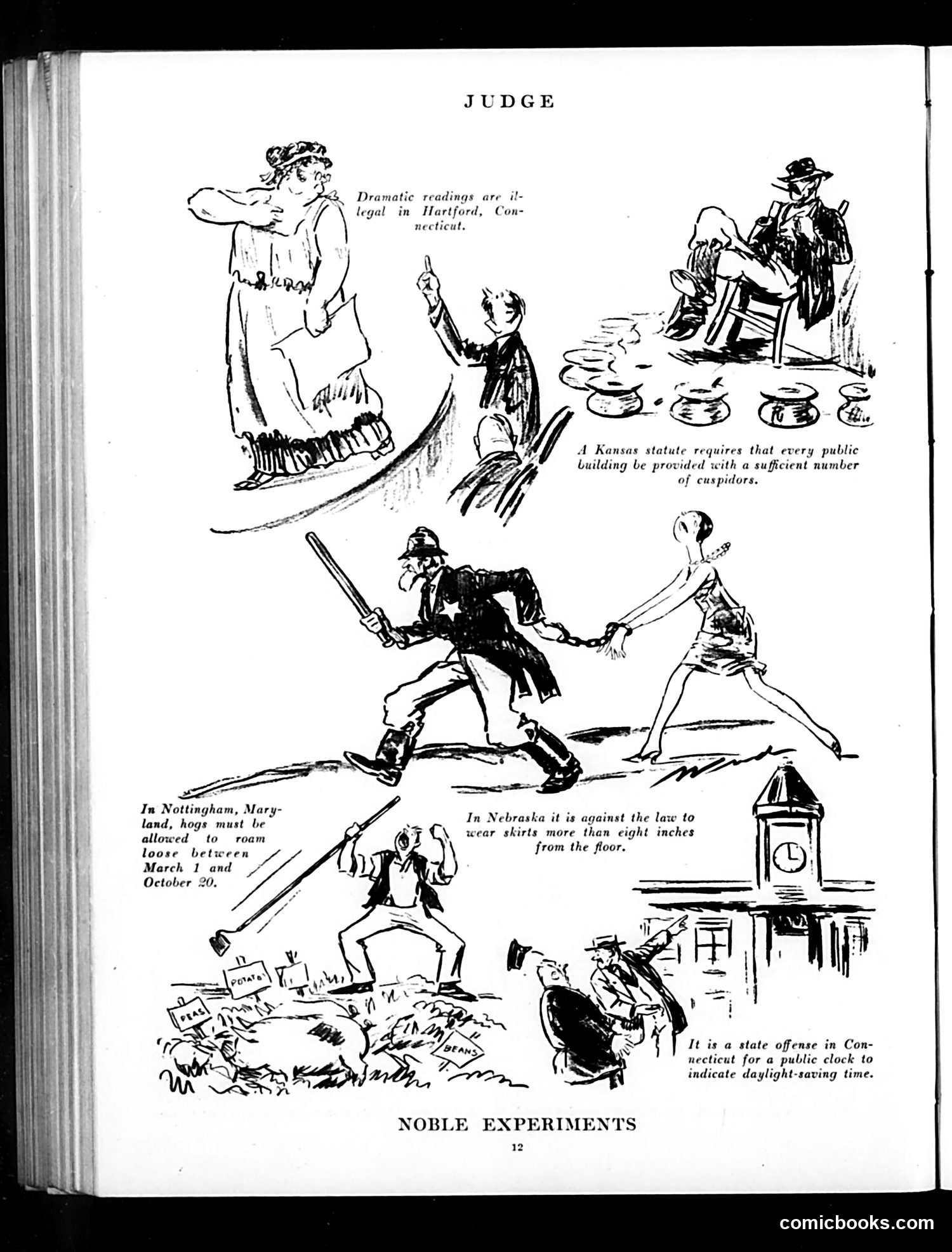
Explanation for Modern Readers This page satirizes absurd or peculiar state laws through humorous illustrations. The title "Noble Experiments" is ironic—these laws represent misguided legislative efforts. The cartoons mock: 1. Kansas's spittoon requirement for public buildings (addressing tobacco-chewing habits) 2. Maryland's pig-roaming law (seemingly impractical livestock regulation) 3. Nebraska's skirt-length restriction (morality policing of women's clothing, shown with a judge measuring) 4. Connecticut's clock law forbidding daylight-saving time displays (bureaucratic overreach) The satire targets how state legislatures pass oddly specific, sometimes unenforceable laws that reveal either outdated social concerns or ridiculous governmental micromanagement. By visualizing these laws as slapstick scenarios, Judge ridicules legislative priorities that seem disconnected from practical governance. The humor relies on the reader's recognition that such laws are genuinely real but absurdly unnecessary.
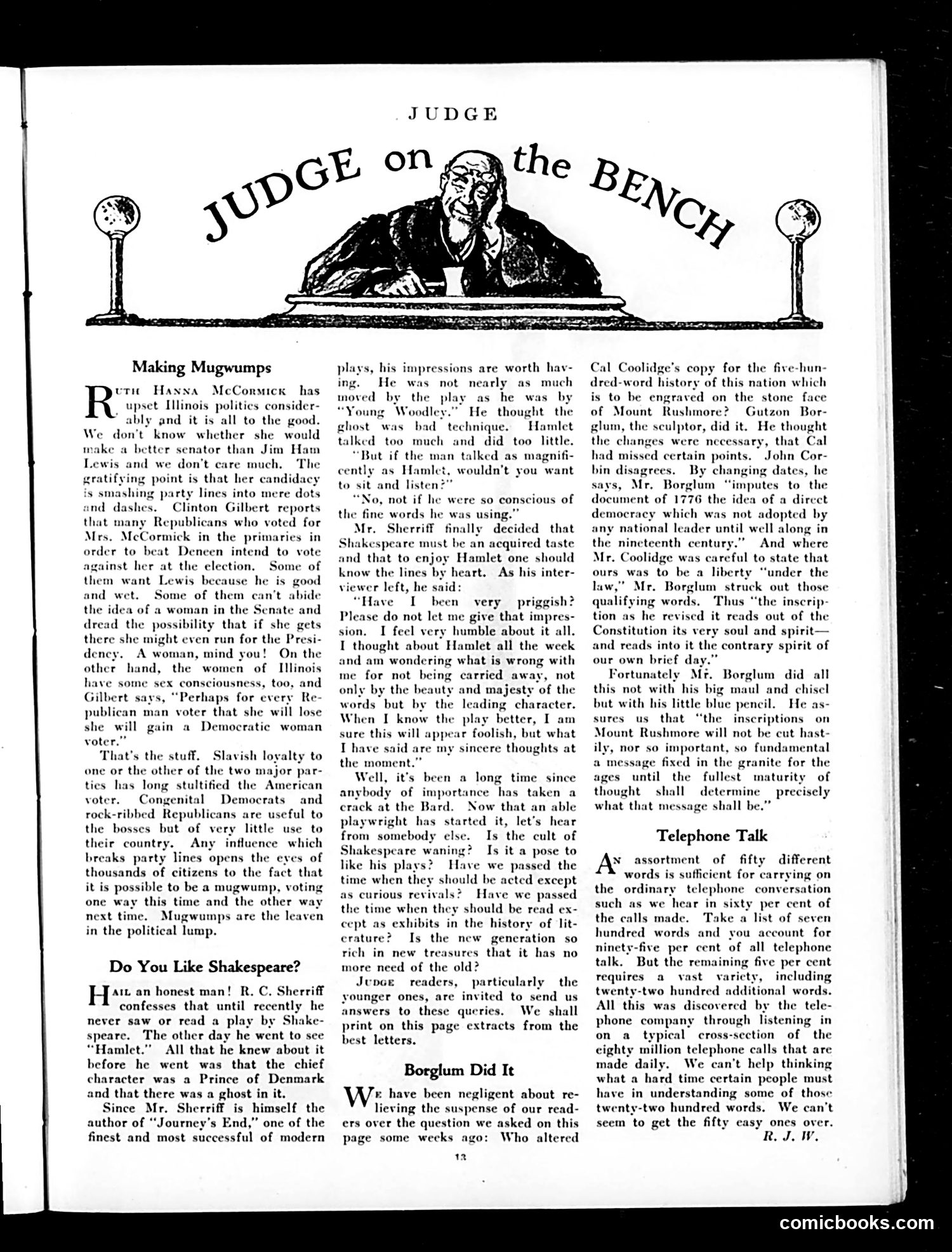
"Judge on the Bench" - Page Analysis This page contains three distinct editorial pieces: "Making Mugwumps" celebrates Ruth Hanna McCormick's Illinois Senate candidacy for breaking party loyalty. "Mugwump" (a term for independent voters) is praised as healthy for democracy, contrasting with blind party allegiance that serves only political bosses. "Do You Like Shakespeare?" reports R.C. Sherriff's candid criticism of *Hamlet*—finding it overwrought, the ghost poorly-crafted, and the protagonist overly talkative. The piece questions whether Shakespeare's cultural dominance is waning or merely a pose, inviting reader responses. "Borglum Did It" (incomplete) appears to reference Gutzon Borglum (sculptor of Mount Rushmore), though the full context isn't visible—likely discussing some alteration he made to Calvin Coolidge's historical writing. The page exemplifies *Judge's* satirical approach: gentle mockery of cultural pretension and political convention, encouraging readers to question received wisdom about both democracy and art.
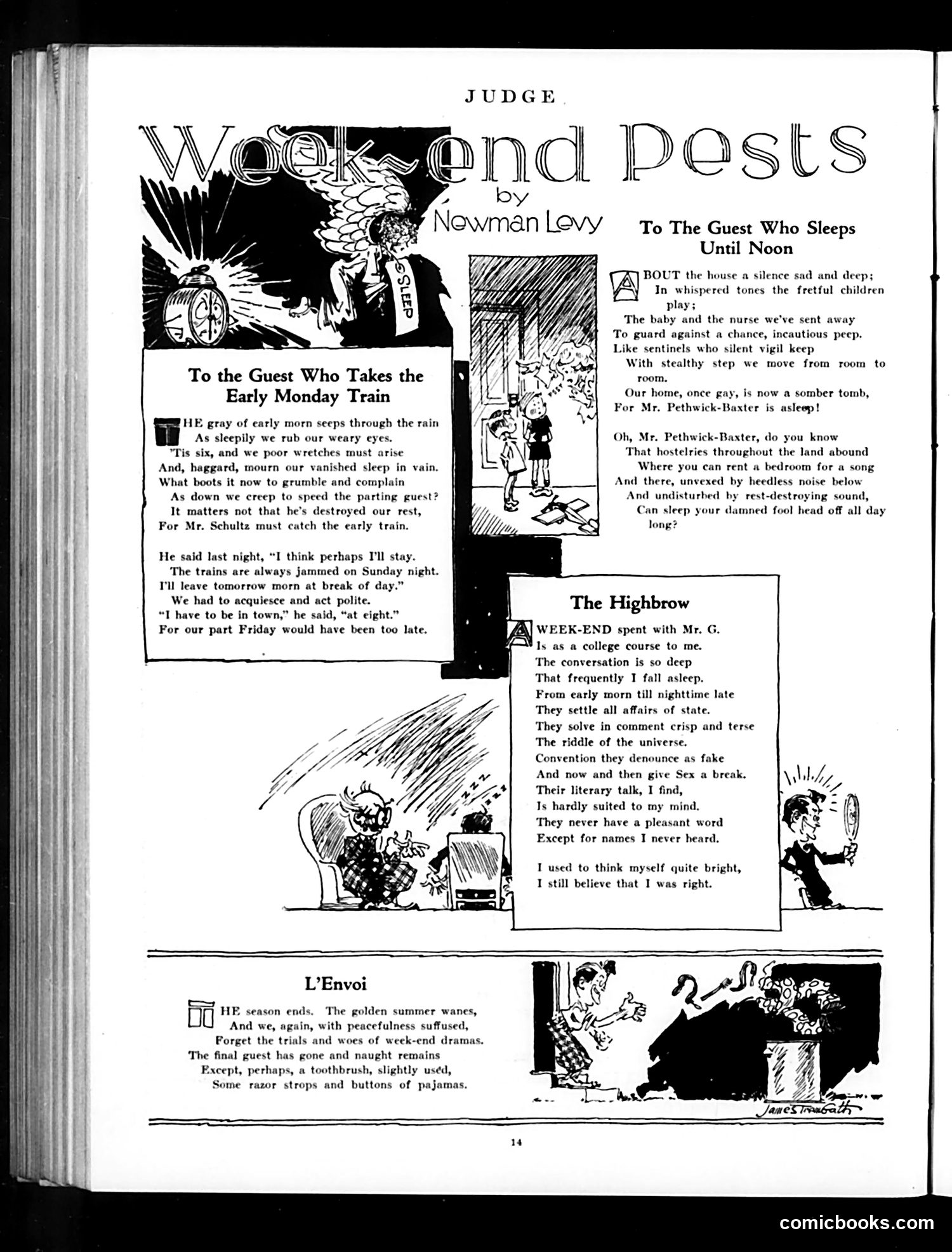
Judge Magazine: "Weekend Pests" by Newman Levy This page satirizes the social burden of houseguests through three humorous poems. "To the Guest Who Takes the Early Monday Train" mocks the guest who announces plans to stay, forcing hosts to wake at dawn to see him off—only to have him depart at the promised early hour anyway, making their lost sleep feel pointless. "To The Guest Who Sleeps Until Noon" ridicules the opposite problem: a guest who sleeps late, forcing the host family to tiptoe around their own home in silence, treating it like a "somber tomb." The poem sarcastically suggests the guest visit a hotel instead. "The Highbrow" and "L'Envoi" extend the critique to pretentious intellectual guests and the general exhaustion of entertaining. The cartoons show families dealing with these intrusions—rain-soaked departures, tiptoing around sleeping guests. The satire targets the social obligation to host weekend visitors, a common upper-middle-class annoyance of the era, suggesting hosts feel trapped between politeness and their own comfort.
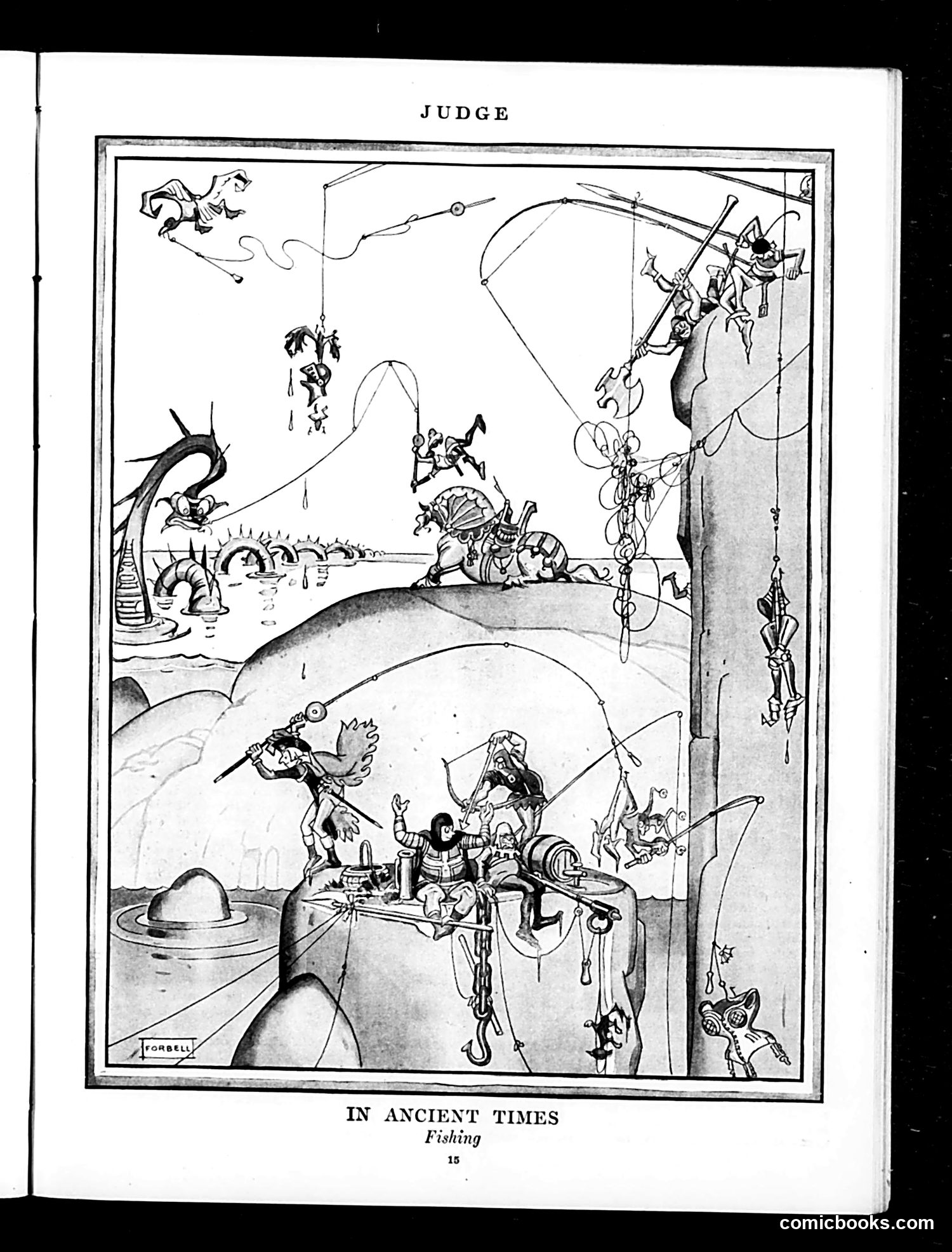
Analysis This is a satirical cartoon titled "In Ancient Times: Fishing" from *Judge* magazine. The cartoon depicts an underwater or fantastical scene where elaborately dressed figures (appearing to be wealthy or aristocratic, based on their ornate clothing and elaborate fishing apparatus) are engaged in an improbably complex fishing operation. Multiple figures operate pulleys, ropes, and mechanical devices to catch fish. The satire likely mocks either: - The over-complication of simple tasks by the wealthy or privileged classes - Excessive resource expenditure on leisure activities - Class pretension or bureaucratic inefficiency The "ancient times" framing suggests ironic commentary—presenting contemporary excess or folly as if it were primitive practice. The cartoonist's signature reads "Forbell." Without additional historical context, the specific targets remain unclear, though the humor centers on the absurd disproportion between effort invested and the straightforward goal of fishing.
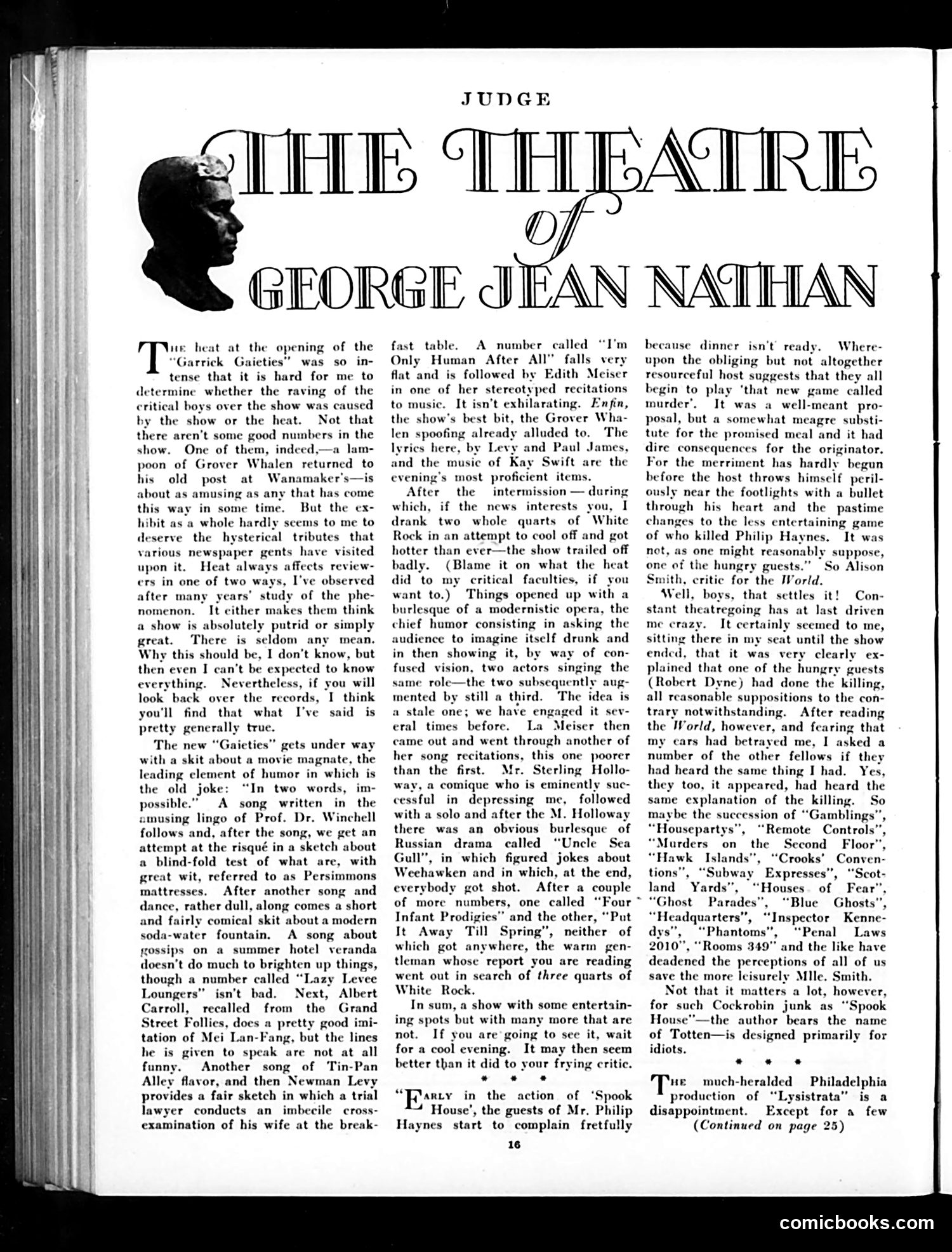
Judge Magazine Theater Review: "The Theatre of George Jean Nathan" This page is Judge critic George Jean Nathan's review of the "Garrick Gaieties," a Broadway revue. Nathan critiques the show's uneven quality, attributing some of his harsh judgments to oppressive heat affecting his objectivity. Key references include: - Grover Whalen: A NYC political figure (likely mayor or official) who "returned to his old post at Wanamaker's"—the review's best satirical number - Albert Carroll and Edith Meiser: Performers whose acts Nathan found mediocre - Kay Swift and Newman Levy: Credited for the show's best musical material - Sterling Holloway: An actor-comedian Nathan particularly dislikes Nathan mocks several sketches: a "modernistic opera" burlesque (described as stale), Russian drama parodies, and tired material about "Persimmons mattresses." The review captures 1920s-30s Broadway theater culture with its mixture of song, dance, sketch comedy, and satirical commentary on contemporary figures.
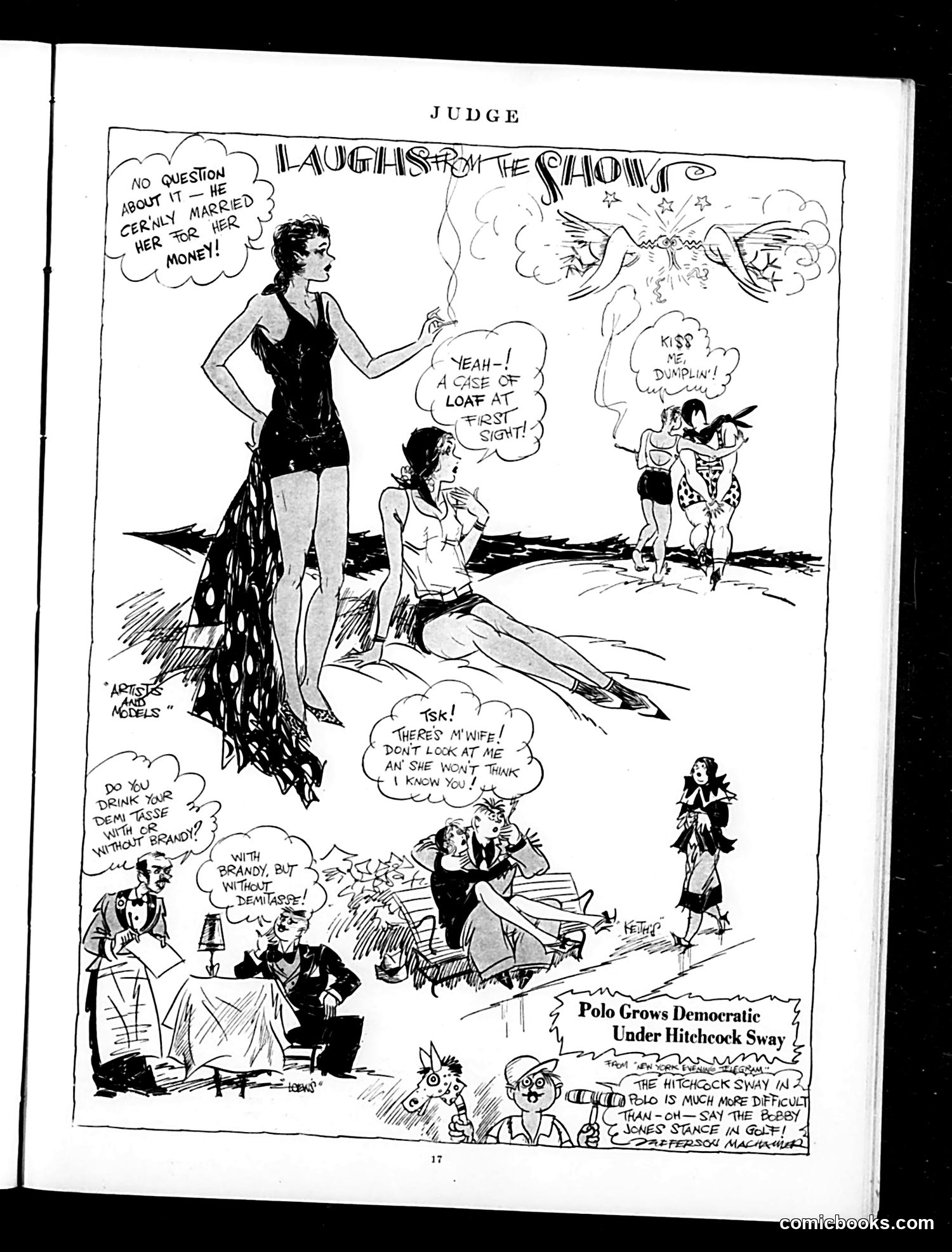
"Laughs from the Shows" - Judge Magazine Cartoon This satirical cartoon mocks wealthy socialites and their romantic escapades. The main figure is a glamorous woman in evening wear, surrounded by various romantic scenarios involving men and women at what appears to be a social gathering or beach setting. The humor targets infidelity and marital discord among the upper class—one man worries his wife won't recognize him, another discusses drinking demitasse without brandy, and characters exchange quips about affairs and casual encounters. The bottom panel references "Polo Grows Democratic Under Hitchcock Sway," suggesting satire about how exclusive sports were becoming more accessible. The cartoon satirizes Jazz Age morality, wealth, and the loosening of Victorian social codes, presenting wealthy society as dissolute and preoccupied with romantic entanglements rather than serious concerns.
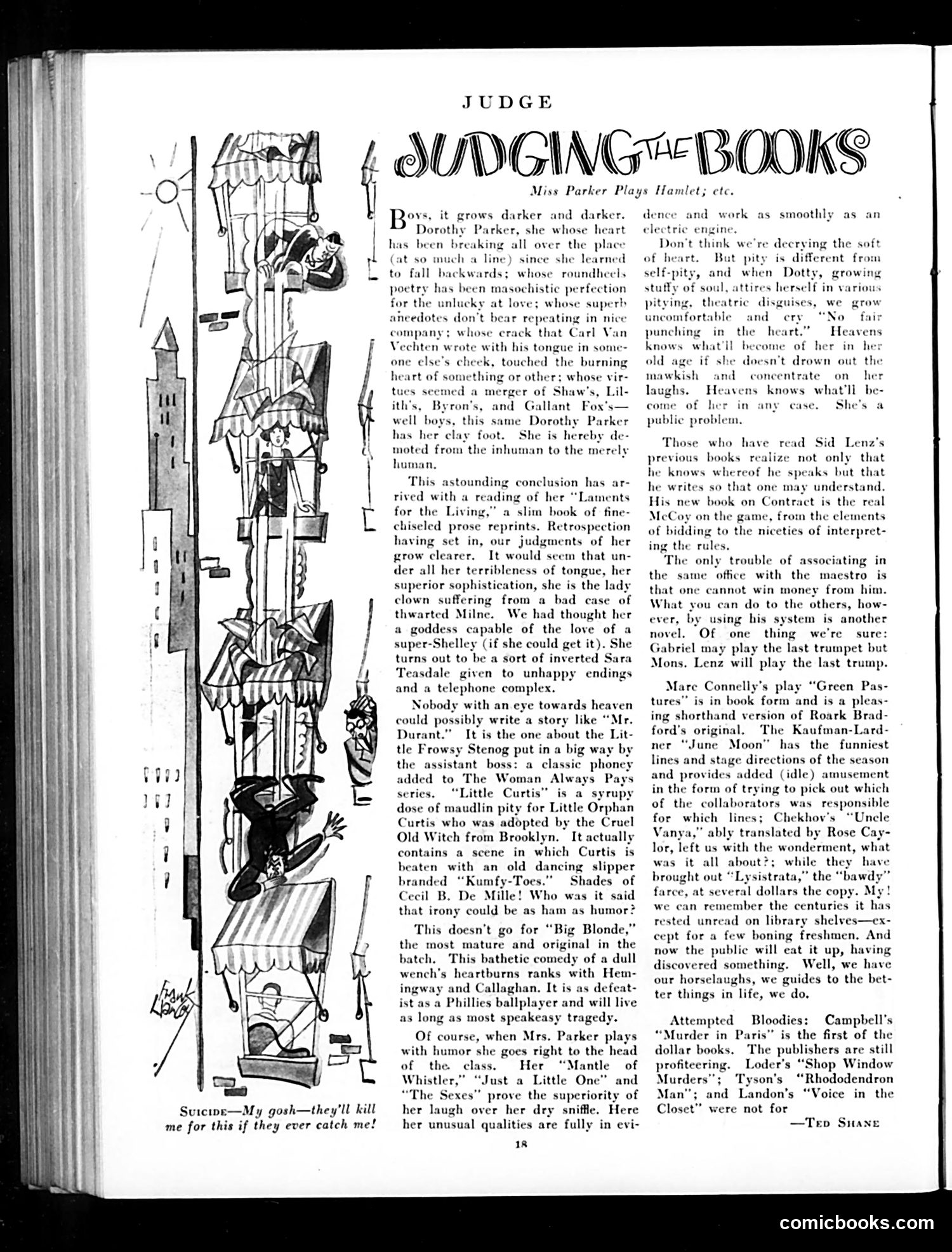
Judge Magazine Book Review Page This page from Judge magazine contains literary criticism and book reviews rather than political cartoons. The main illustrated element is a humorous sidebar cartoon showing a figure on a tall building with the caption "Suicide—My gosh—they'll kill me for this if they ever catch me!"—likely a self-deprecating joke about the reviewer's harsh assessments. The primary content reviews Dorothy Parker's essay collection "Laments for the Living," criticizing her for indulging in sentimental self-pity beneath her sophisticated persona. The reviewer argues Parker's best work uses humor rather than pathos, praising pieces like "Big Blonde" while dismissing others as overwrought. The page also briefly reviews books by Sid Lenz (on contract bridge), Marc Connelly's "Green Pastures," and the Kaufman-Larner play "June Moon." The satire targets Parker's pretensions—the gap between her intellectual reputation and her occasionally maudlin writing.
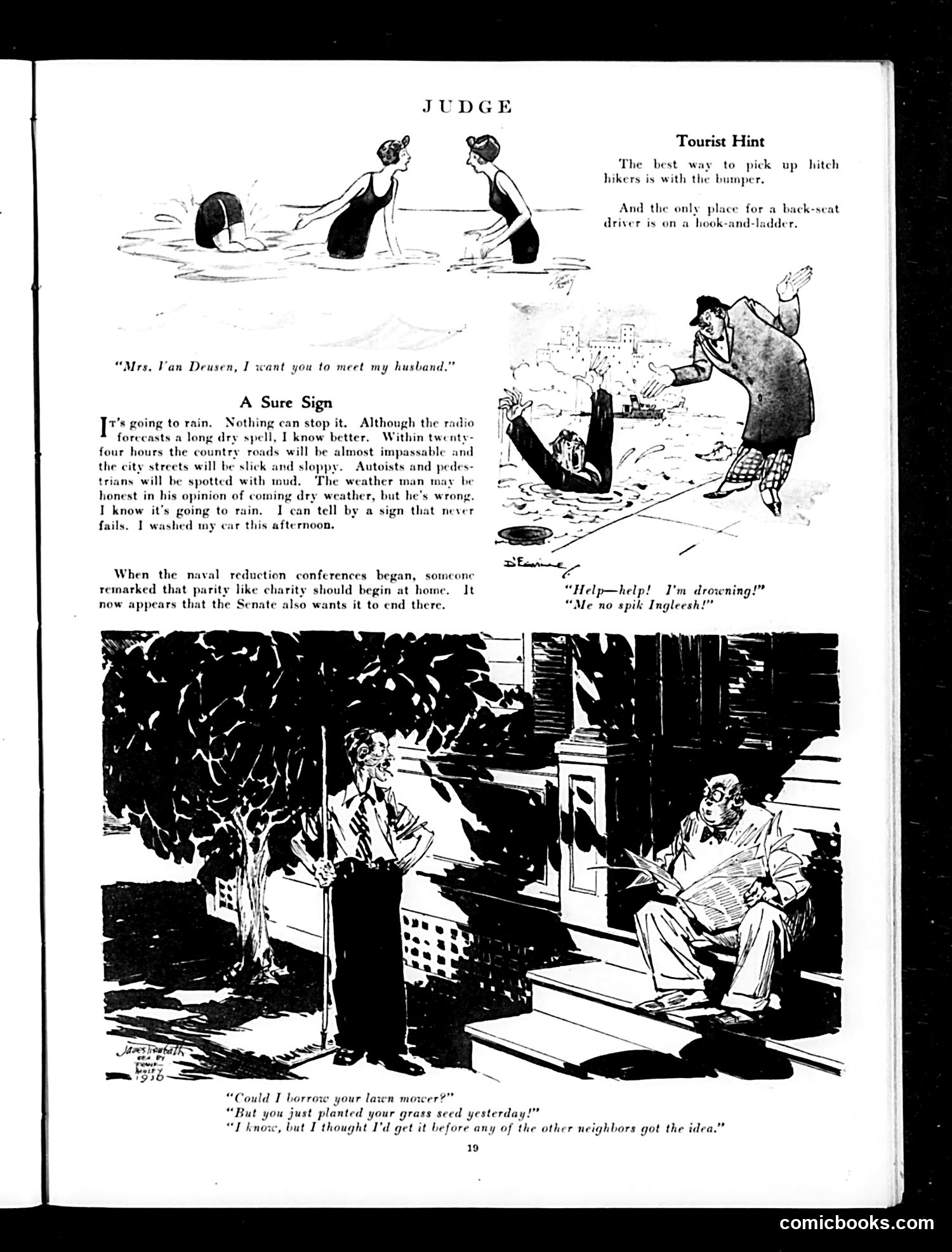
Judge Magazine Page Analysis This page contains three separate humor pieces typical of 1920s-30s satirical magazine content: "Tourist Hint" offers dark automotive humor about hitchhikers and backseat drivers—contemporary concerns as car culture expanded. "A Sure Sign" jokes that washing one's car guarantees rain—a relatable superstition playing on the frustration of car maintenance and unpredictable weather. The naval reduction reference satirizes political hypocrisy: during naval disarmament conferences, someone suggested "parity like charity should begin at home," but the Senate apparently wants disarmament to happen elsewhere, not domestically—mocking politicians' self-interest masked as principle. The lawn mower cartoon depicts a neighbor rushing to borrow equipment before others catch on to a "good idea," satirizing suburban competitiveness and the spread of fads through neighborhoods. The "Help—help! I'm drowning / Me no spik Ingleesh" cartoon (likely reflecting period racial stereotypes) appears to be dark humor about a drowning victim unable to communicate with a rescuer.
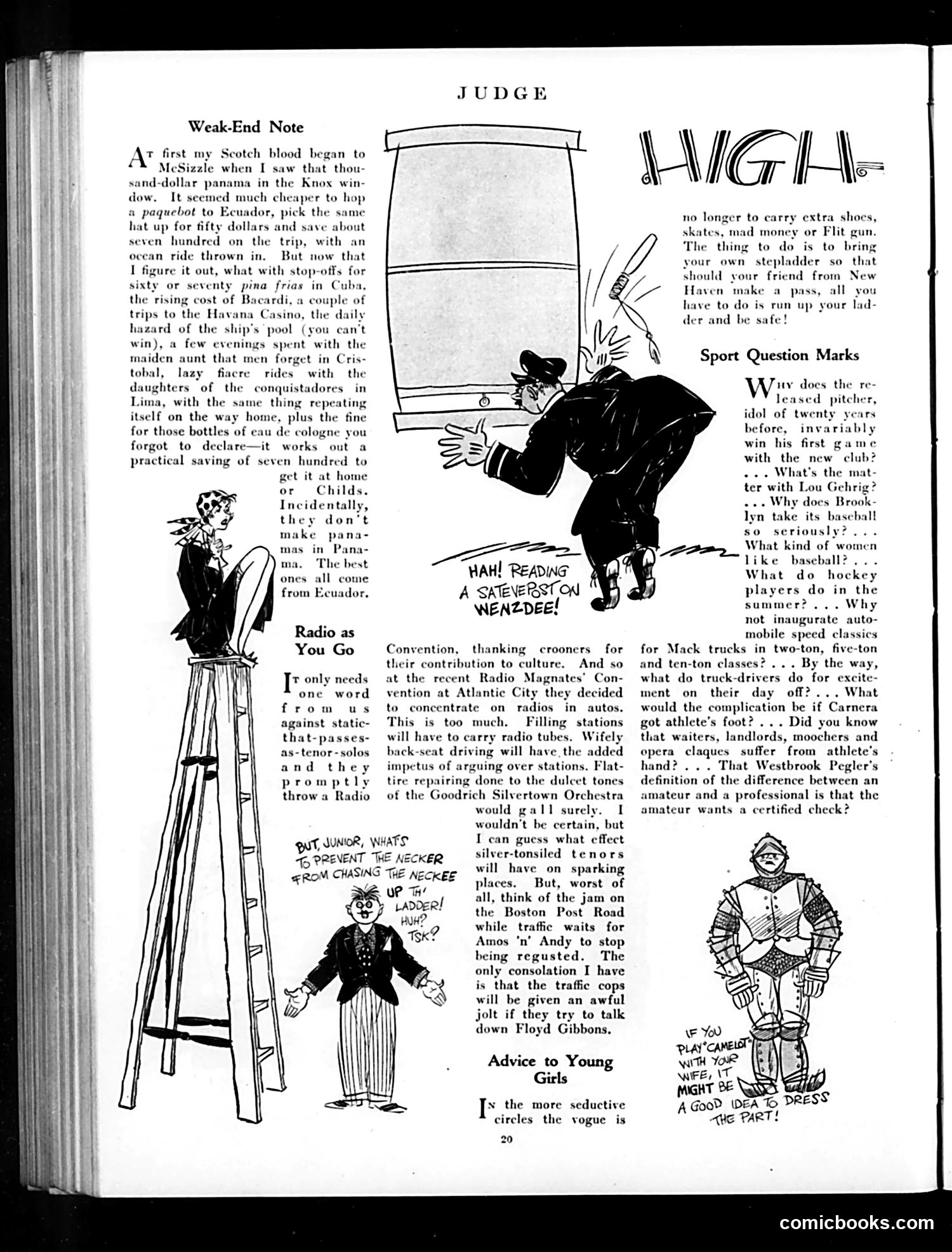
Judge Magazine Page Analysis This page from *Judge* contains several pieces of 1920s-era satirical content: "Weak-End Note": A humorous account of traveling to Ecuador to buy a cheap Panama hat, only to realize that incidental expenses (drinks, gambling, bribes) make it costlier than buying one domestically. The joke satirizes impulsive travel logic and the hidden costs of "bargain" trips. "Radio as You Go": Mocks the automobile radio convention's decision to install radios in cars. The satire criticizes this as impractical—it will create radio tube supply issues, encourage marital arguments over stations, and dangerously distract drivers. The reference to "Amos 'n' Andy" (a popular radio program) and "Floyd Gibbons" (a famous radio broadcaster) grounds the period-specific complaint. "Sport Question Marks": A Q&A column poking fun at sports culture, including mysteries about pitchers changing teams and references to baseball stars like Lou Gehrig and boxer Carnera. "Advice to Young Girls": A joke about women using stepladders for self-defense against unwanted romantic advances. The illustrations are cartoons typical of the era's graphic style.
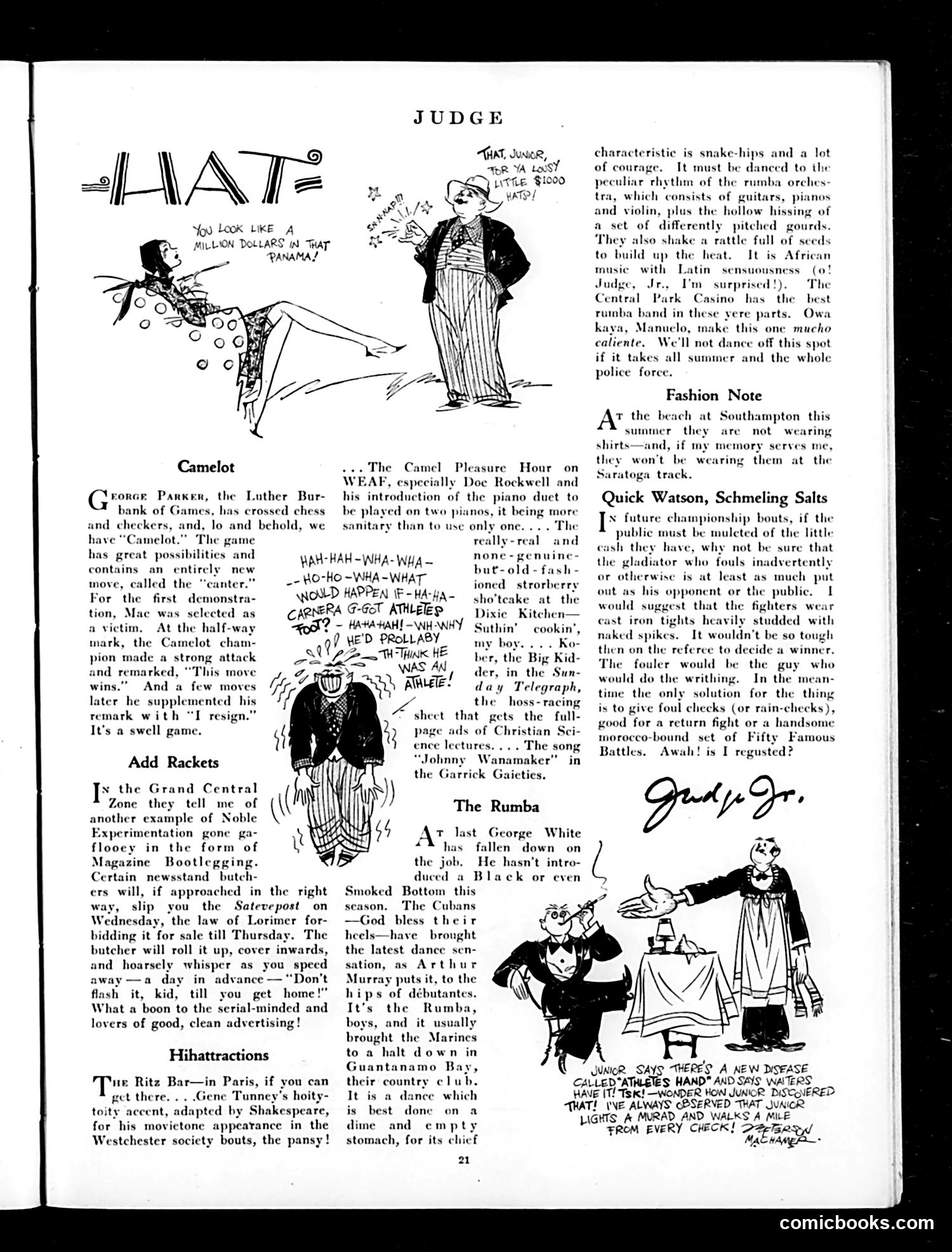
Judge Magazine Satire Analysis This page from Judge magazine (likely 1930s) contains several short satirical commentary pieces: "Camelot": Mocks a new chess-checkers hybrid game by George Parker. The joke is that despite being promoted as innovative, it's so poorly designed the champion resigns mid-game. "Add Rackets": Criticizes magazine bootlegging—newsstand clerks illegally selling Saturday Evening Post copies a day early (before Thursday publication date), appealing to serialized story addicts. "Hihattractions": Brief jabs at entertainment figures: Gene Tunney (boxer affecting theatrical pretension), and commentary on radio programming and restaurants. "The Rumba": Satirizes the Cuban dance craze's popularity among wealthy debutantes, sarcastically suggesting it's so vigorous it requires an empty stomach and police presence. "Schmeling Salts": Proposes boxers wear spiked iron tights to prevent fouling in championship matches—dark comedic commentary on boxing brutality. The overall tone is irreverent, gossipy commentary on contemporary leisure, entertainment, and fashion trends among the upper classes.
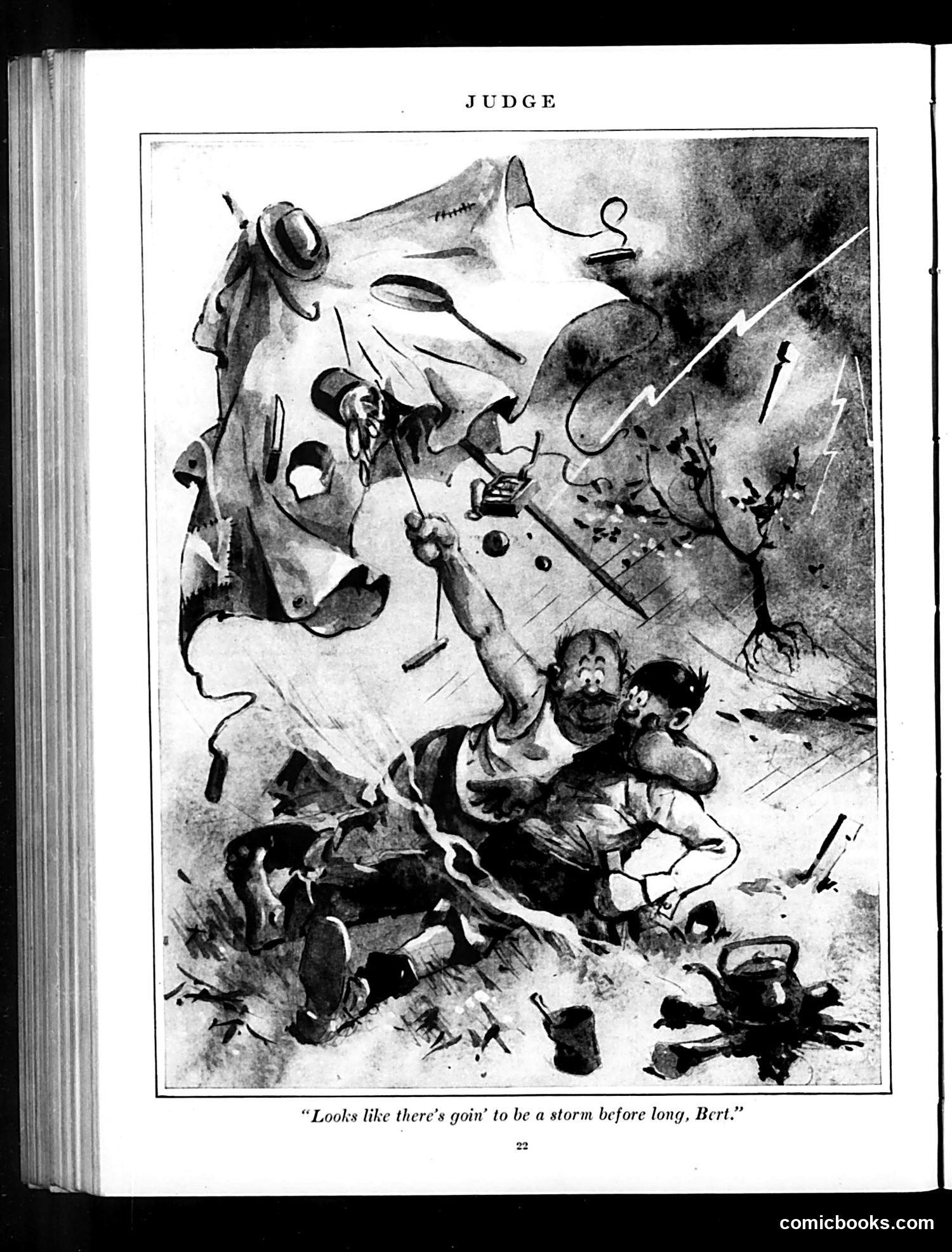
Analysis This page from *Judge* magazine contains a single political cartoon titled "Looks like there's goin' to be a storm before long, Bert." The image depicts a large, menacing storm cloud or tornado looming over two small figures below. The cartoon appears to be a warning or prediction of impending trouble—likely political or social crisis. The ominous cloud dominates the composition, suggesting an approaching catastrophe that the figures below seem powerless to prevent or escape. Without additional context about the publication date, it's difficult to identify the specific political event or figures referenced. The cartoon's meaning relies on contemporary readers understanding what "storm" was being predicted, but the visual metaphor of gathering danger threatening ordinary people is clear.
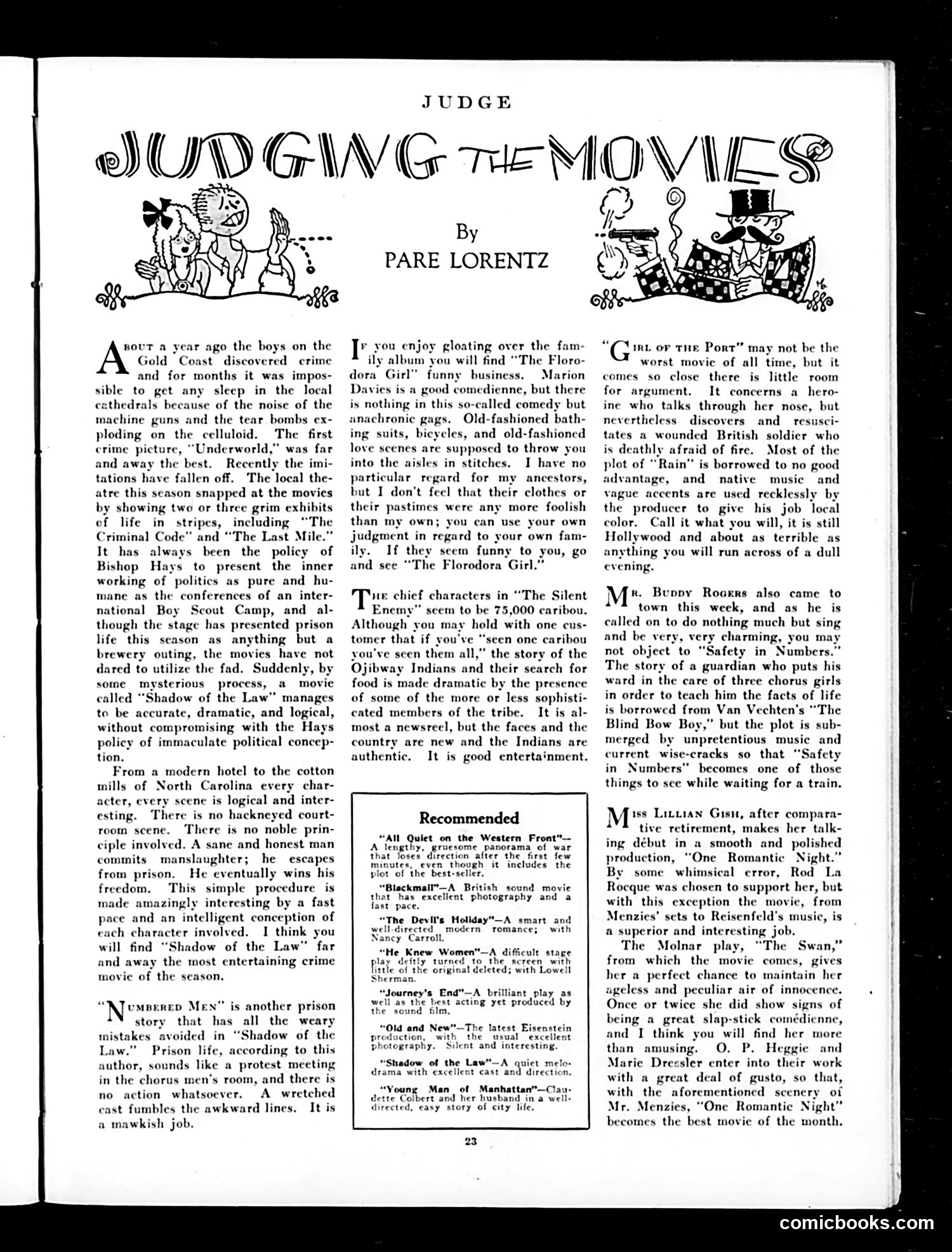
Judging the Movies: A 1920s Film Critic's Column This is a film review column by Pare Lorentz in *Judge* magazine, a satirical publication. Rather than political cartoons, the page contains entertainment criticism evaluating recent movies. Lorentz discusses the trend of prison-crime films ("Underworld," "The Criminal Code," "The Last Mile") that had flooded cinemas. He praises "Shadow of the Law" for being dramatically authentic without melodrama, contrasting it with the poorly-executed "Numbered Men." He dismisses Marion Davies' "Florodora Girl" as relying on dated, supposedly-humorous period costumes and romance tropes. He endorses "The Silent Enemy" (featuring 75,000 caribou and Ojibway Indians) as genuinely entertaining newsreel-style content. The "Recommended" box lists contemporary sound films including "All Quiet on the Western Front" and Eisenstein's "Old and New." The satire is subtle—primarily mocking Hollywood's creative exhaustion and audiences' lowbrow tastes rather than targeting specific political figures.
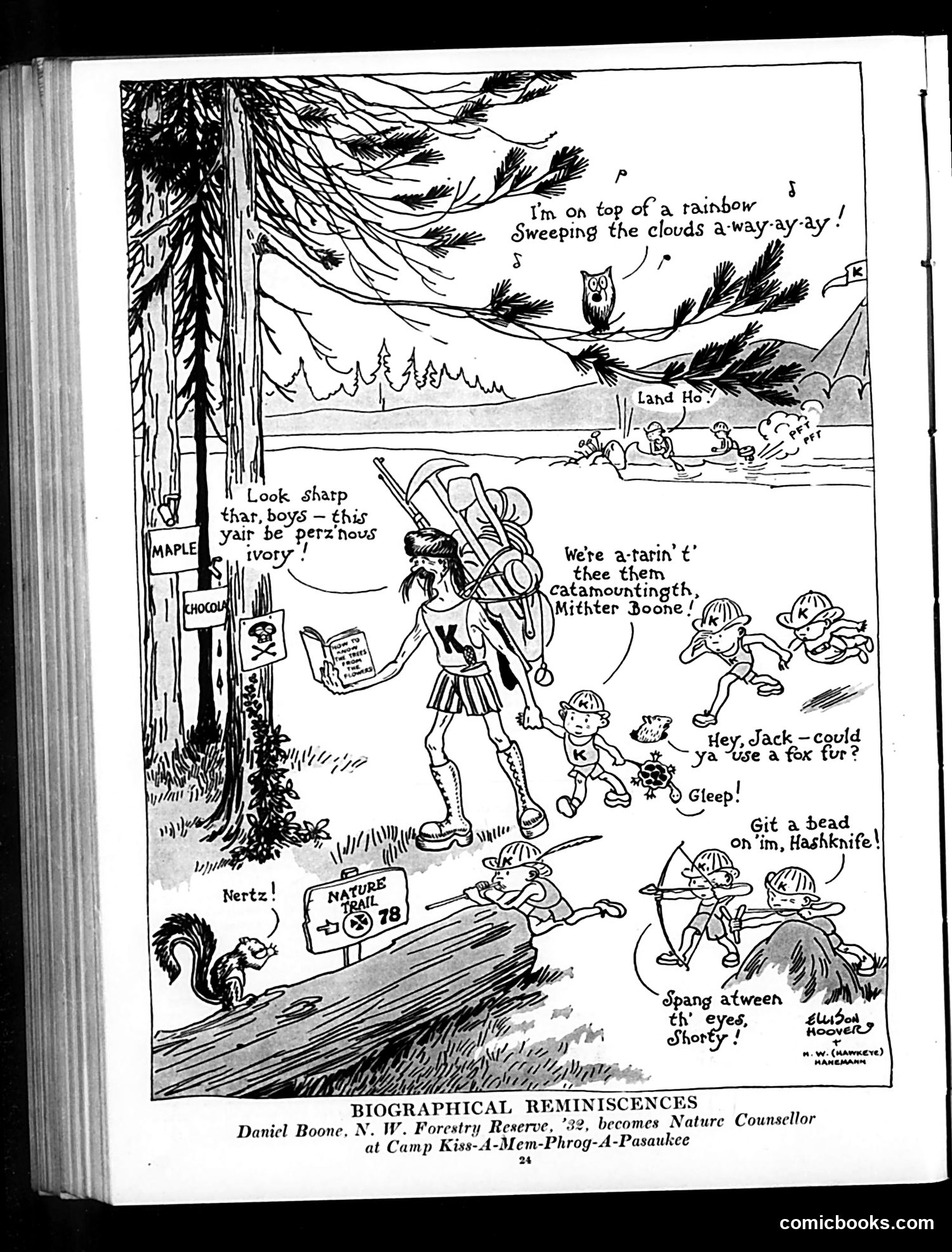
Analysis of Judge Magazine Page This is a humorous cartoon depicting Daniel Boone (labeled as from "N.W. Forestry Reserve, '32") as a Nature Counsellor at a summer camp. The joke plays on frontier mythology versus reality: Boone is portrayed in full colonial/pioneer regalia, speaking in exaggerated frontier dialect ("yair be perz'nous," "Mithter Boone"), while leading urban children on an absurdly mundane camping activity by a lake. The children mimic frontier behavior with comic incompetence—mispronouncing "catamount," asking for hunting equipment like fox fur, attempting to aim weapons. Their dialogue ("Gleep!", "Spang atween th' eyes") parodies frontier courage. The satire mocks the early 20th-century romanticization of frontier life and "back-to-nature" summer camps, which marketed themselves using historical mythology. Boone—a genuine historical figure—becomes a caricature embodying the gap between frontier legend and modern recreational camping reality.
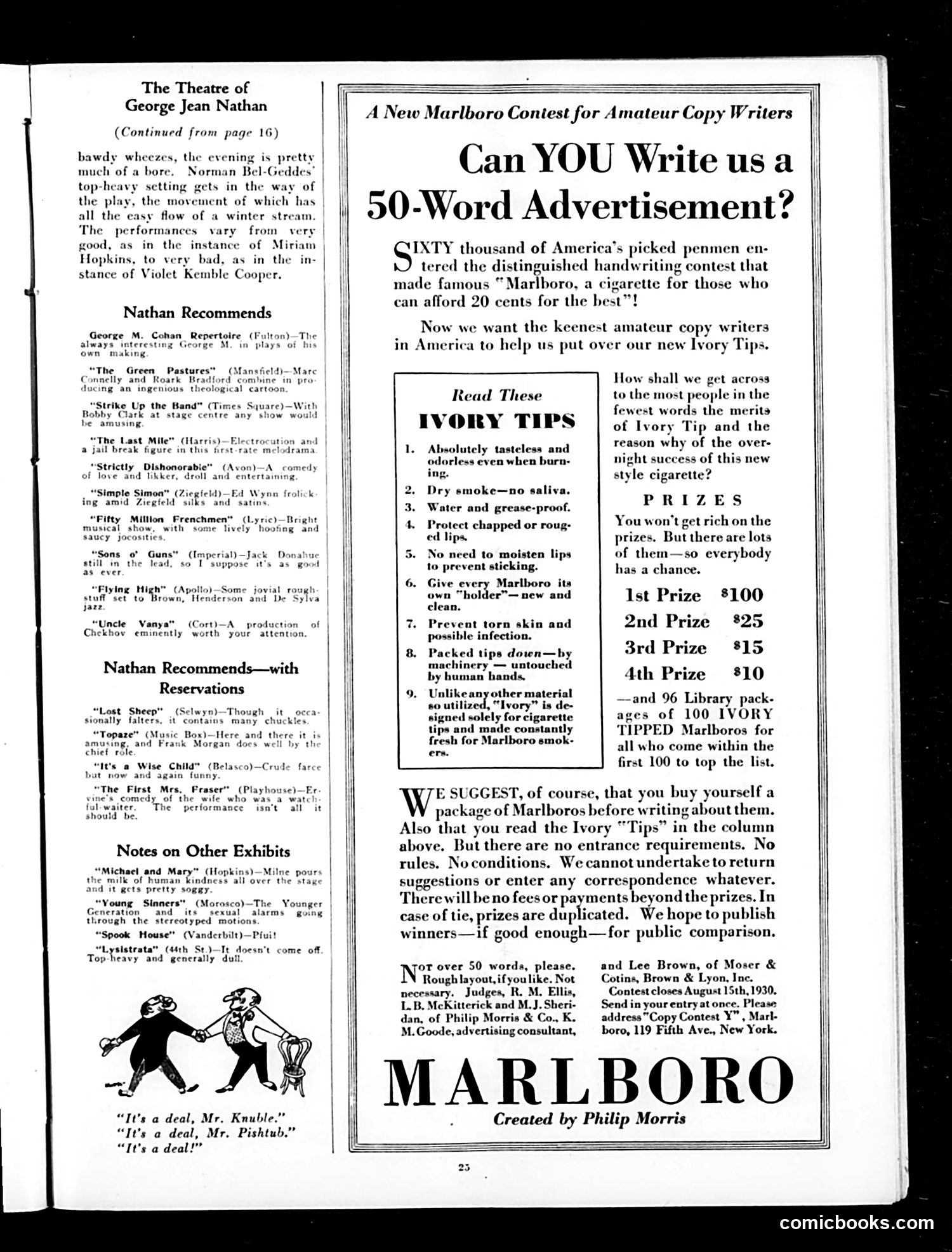
Analysis of Judge Magazine Page Content This page primarily consists of theater criticism and advertising, not political satire. Left side: George Jean Nathan's theater column continues, reviewing Broadway productions. Nathan recommends shows like "Strike Up the Band" (with Bobby Clark) and "The Last Mile," while expressing reservations about others. The small cartoon at bottom shows two figures making a deal—a generic illustration unrelated to politics. Right side: A Marlboro cigarette advertisement disguised as a contest. Marlboro is soliciting amateur copywriters to compose 50-word ads promoting their new "Ivory Tips" cigarettes. The ad lists features (tasteless, odorless, grease-proof) and offers prizes totaling $100 plus cigarette packages. Historical context: This appears from the 1930s when cigarette marketing heavily targeted consumers and contests were common promotional tools. The "Ivory Tips" feature reflects product innovation of that era. The page lacks partisan politics or social satire—it's primarily entertainment journalism and commercial advertising typical of Judge magazine's content.
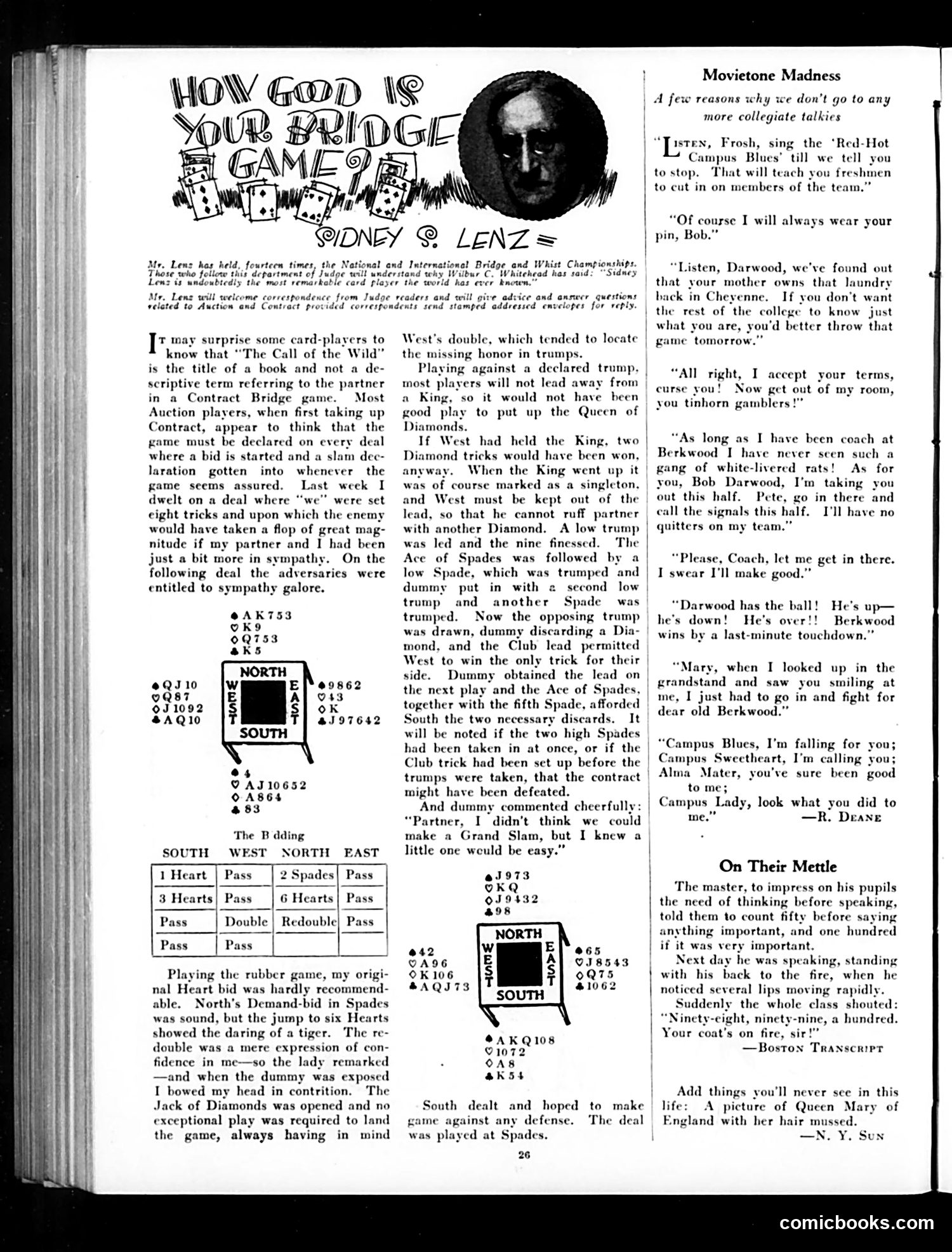
Analysis for Modern Readers This Judge magazine page contains two distinct sections: Left side: "How Good Is Your Bridge Game?" A contract bridge column by Sidney Lenz (identified as a fourteen-time national champion). It teaches bridge strategy through a dealt hand, explaining optimal play in a competitive card game. This reflects bridge's popularity as a serious parlor game among educated Americans in the early 20th century. Right side: "Movietone Madness" A satirical commentary on college-themed "talkie" films (early sound movies). The jokes mock melodramatic plots common to campus movies: coaches exploiting athletes, blackmail schemes, social climbing, and honor-code violations. The satire suggests these films portrayed college life as corrupt and sensational, with contrived dramatic conflicts. The title references Movietone News, a popular newsreel series, implying these campus talkies mimicked sensationalist journalism. The satire targets both the films' implausible plots and the moral decay they depicted in collegiate settings.
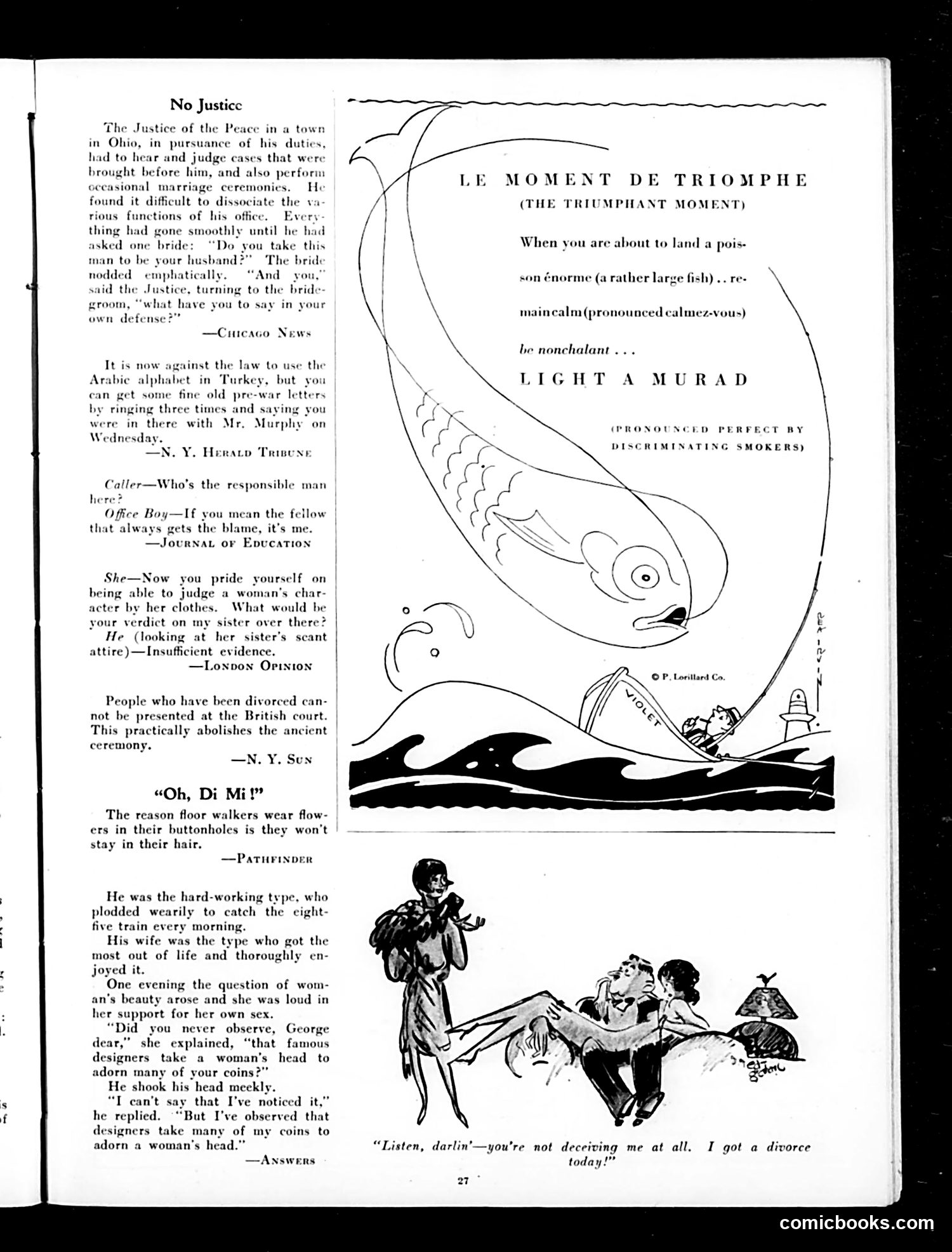
Explanation for Modern Readers This Judge magazine page contains satirical humor pieces typical of early 20th-century American comedy. "No Justice" is a short anecdote poking fun at a small-town Ohio Justice of the Peace who conflates his judicial and ceremonial roles. When marrying a couple, he asks the groom "what have you to say in your own defense?"—treating marriage like a legal case, implying the groom needs to defend himself. The joke satirizes blurred professional boundaries and the absurdity of treating marriage as a courtroom battle. The bottom cartoon shows a woman proudly displaying a newly caught large fish to a man, captioning "Listen, darlin'—you're not deceiving me at all. I got a divorce today!" The joke appears to conflate fishing success with marital victory, possibly suggesting divorce as triumph or masculine/feminine role reversal in achievement. "LIGHT A MURAD" is an advertisement for Murad cigarettes, using the fish-catching triumph to sell cigarettes to "discriminating smokers." The scattered short jokes above mock legal absurdities, Turkish alphabet prohibition, and women's fashion choices—typical Judge content offering rapid-fire social commentary.
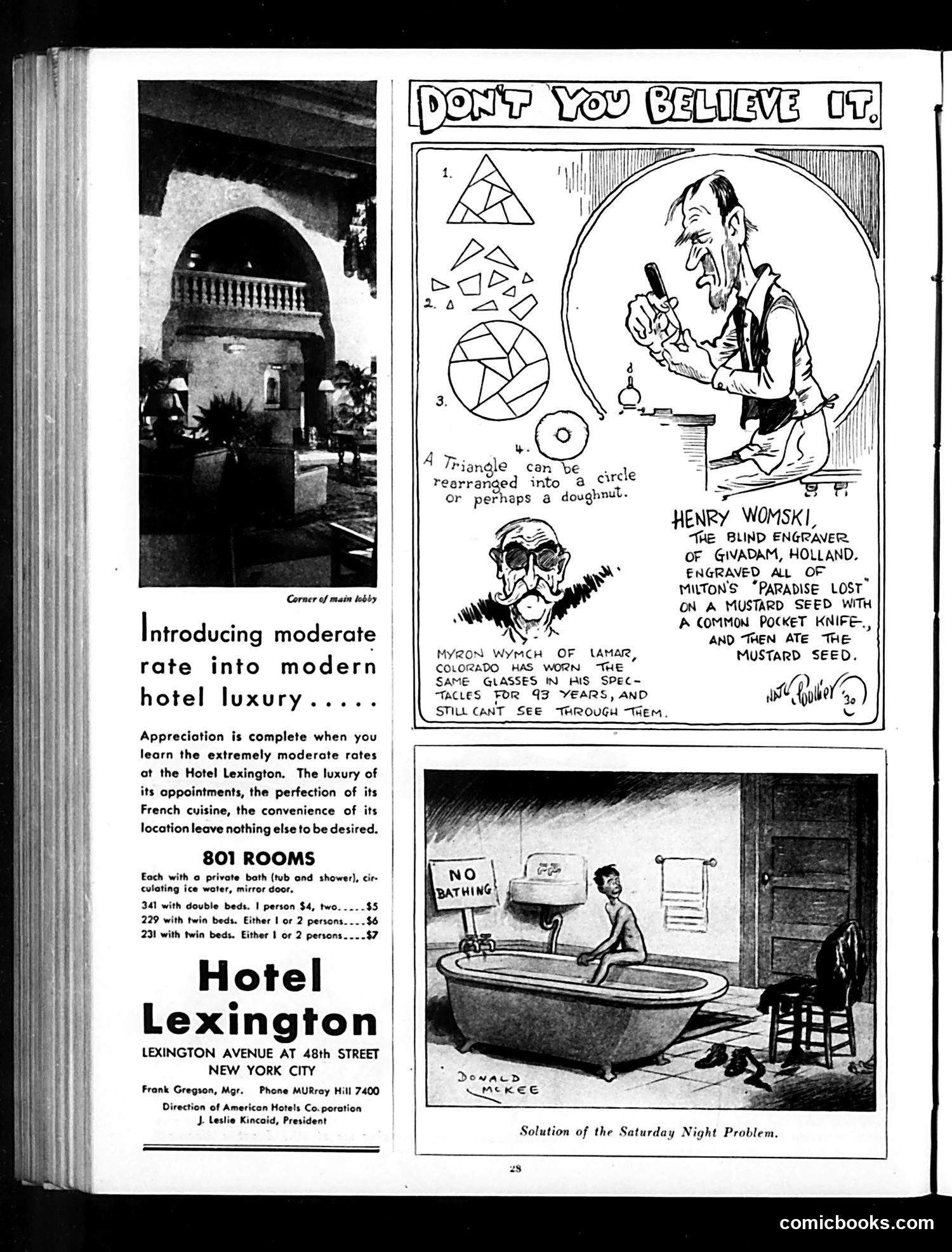
Page Analysis: Judge Magazine This page mixes advertising with humor content typical of Judge magazine's format. The Advertisement: The Hotel Lexington ad occupies the left side, promoting "moderate rates" for luxury accommodations in NYC (rooms from $4-$7), emphasizing French cuisine and modern amenities like private baths and ice water. The Comic Content: The right side features "Don't You Believe It," a humor feature presenting absurd tall tales: - Henry Womski, a blind Dutch engraver allegedly engraved Milton's *Paradise Lost* on a mustard seed with a pocket knife, then ate it - Myron Wymch wore the same eyeglasses for 93 years yet still cannot see through them - A geometric puzzle about rearranging triangles The Bottom Cartoon: Titled "Solution of the Saturday Night Problem," it depicts a bathtub labeled "NO BATHING" with a woman inside and a man sitting nearby with a chair—apparently satirizing the difficulty of securing bathroom access during busy Saturday nights, a relatable urban problem. The humor relies on absurdity and contemporary domestic inconveniences.
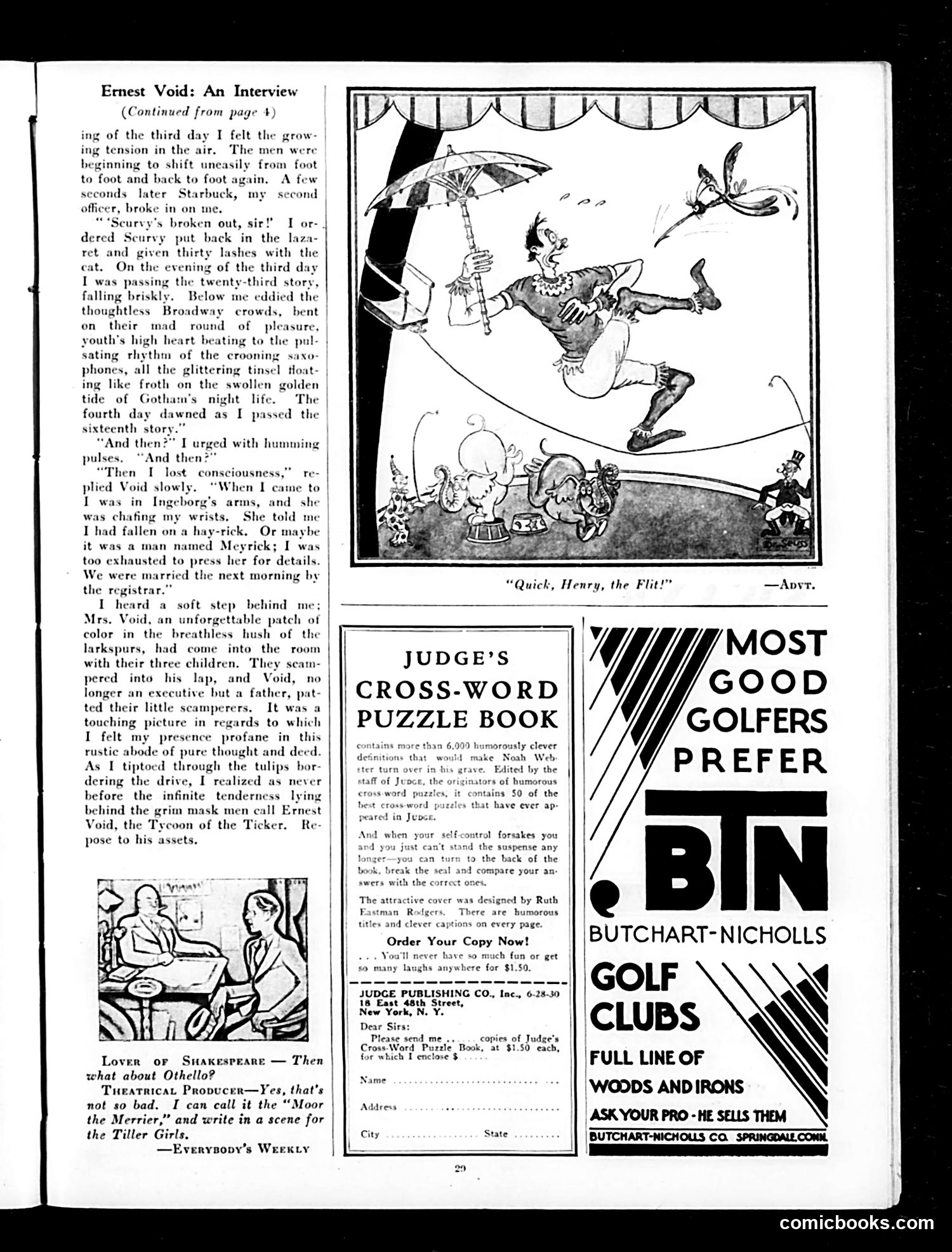
Explanation for Modern Readers This page contains two main elements: The "Ernest Void" narrative (top): A serialized satirical story about a wealthy businessman ("Tycoon of the Ticker") recounting an unlikely adventure involving falling from a tall building, losing consciousness, and waking up married. The humor targets both the melodramatic adventure tales popular in the era and the disconnect between ruthless executives and their domestic lives. The illustration shows a man with an umbrella in an absurd fall. The bottom section features advertisements and a crossword puzzle book ad—standard magazine filler of the period. The small cartoon (lower left) appears to be a separate joke about theatrical producers, likely satirizing Hollywood's tendency to retitle Shakespeare for commercial appeal ("The Moor the Merrier" as a pun on "The More the Merrier"). The page is primarily entertainment-focused rather than politically satirical, reflecting *Judge* magazine's role as a humor publication mixing social observation with advertising.
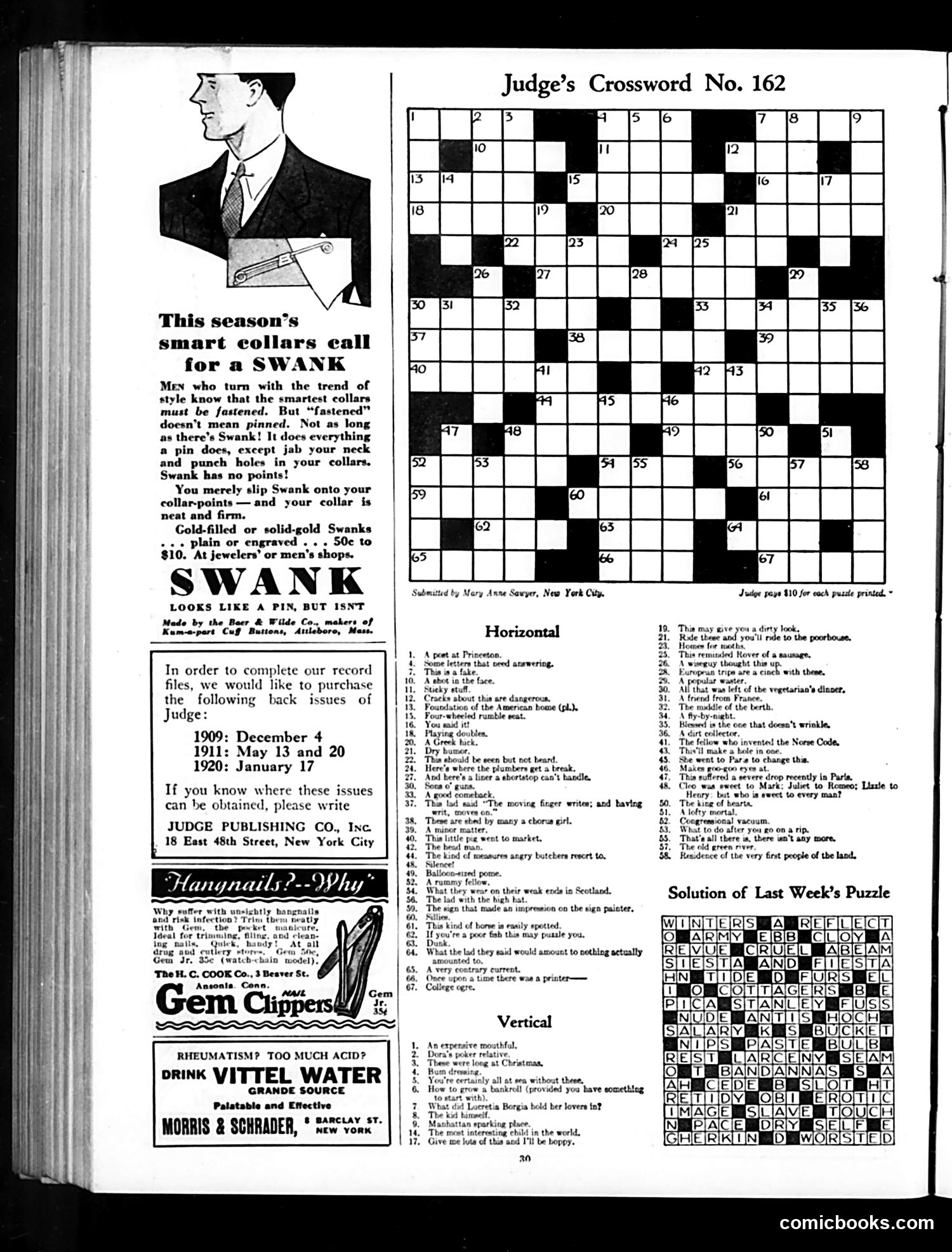
Judge Magazine Page Analysis This page is primarily advertising and puzzle content rather than political satire. The main feature is "Judge's Crossword No. 162," a typical crossword puzzle submission. The advertisements reveal early 20th-century consumer concerns: Swank collar fasteners (positioning themselves as modern alternatives to pins that damage clothing), Gem Clippers (grooming tools), and Vittel Water (marketed as a remedy for rheumatism and "too much acid"—reflecting period health anxieties about dietary acid). There is no political cartoon visible. The single illustration shows a well-dressed man in business attire holding a collar fastener, serving as product advertising rather than satire. The page also includes a publisher's request for back issues from 1909, 1911, and 1920, suggesting this is from *Judge* magazine's archival operations. Overall, this represents a typical interior magazine page mixing puzzles, advertisements, and administrative notices rather than the satirical political content *Judge* magazine was known for.
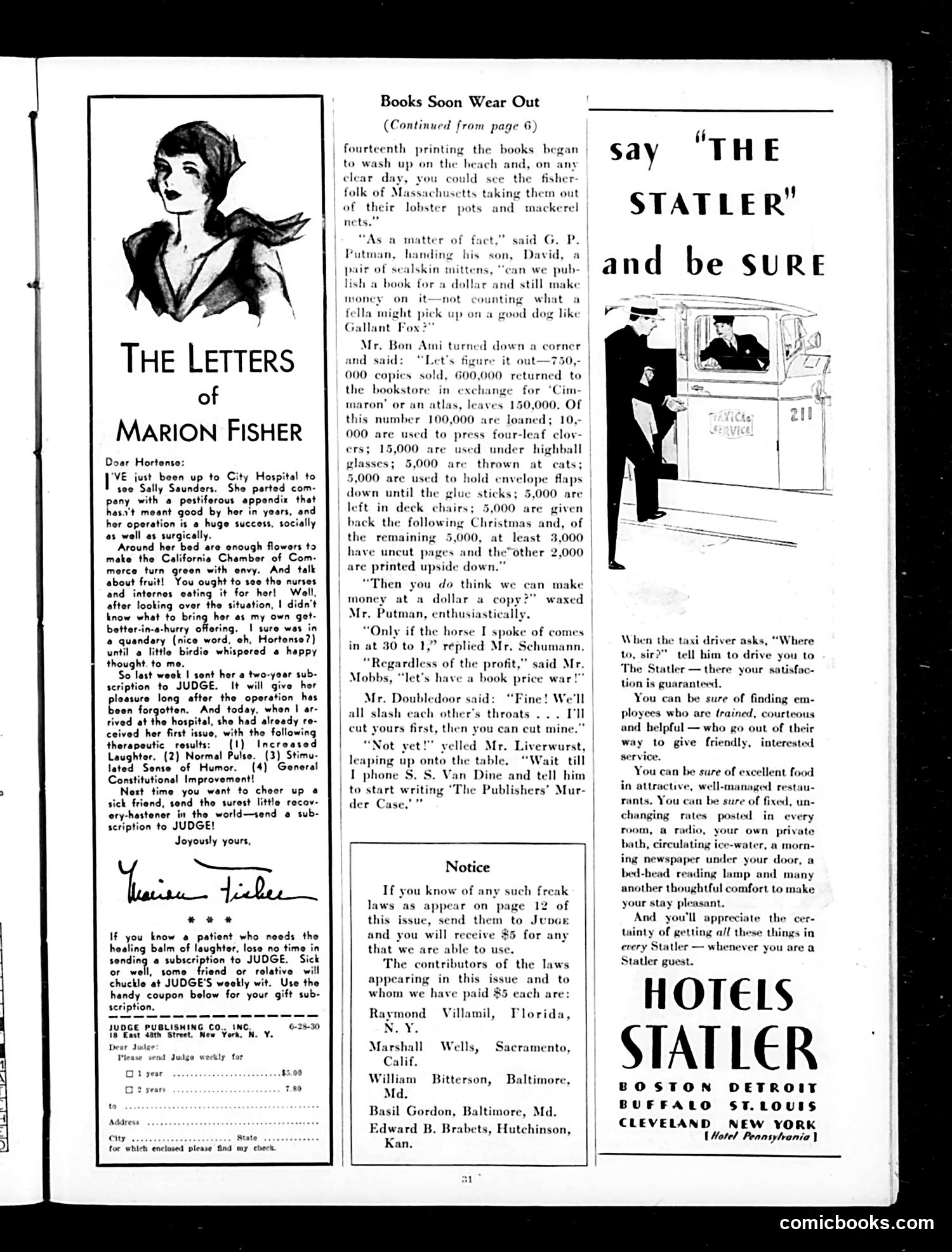
Page Analysis: Judge Magazine This page contains primarily advertising and promotional content rather than political satire. The main feature is "The Letters of Marion Fisher"—a humorous advice column where Marion Fisher recommends gifting Judge magazine subscriptions to hospitalized friends, claiming it provides "therapeutic results" including increased laughter and improved pulse. This is self-promotional advertising disguised as editorial content. The "Books Soon Wear Out" section is a satirical dialogue about publishing economics, mocking the publishing industry's assumption that books are disposable. Characters with names like "Bon Ami" and "Doubledoor" discuss how books fail as profit centers—most are returned, loaned out, used under glasses, thrown at cats, or printed upside down. The joke targets the absurdity of expecting dollar-priced books to generate revenue. The Statler Hotels advertisement occupies the right column, emphasizing guest comfort and reliability—typical mid-century hotel marketing. Overall, this is a commercial page mixing light humor with advertising, not political commentary.
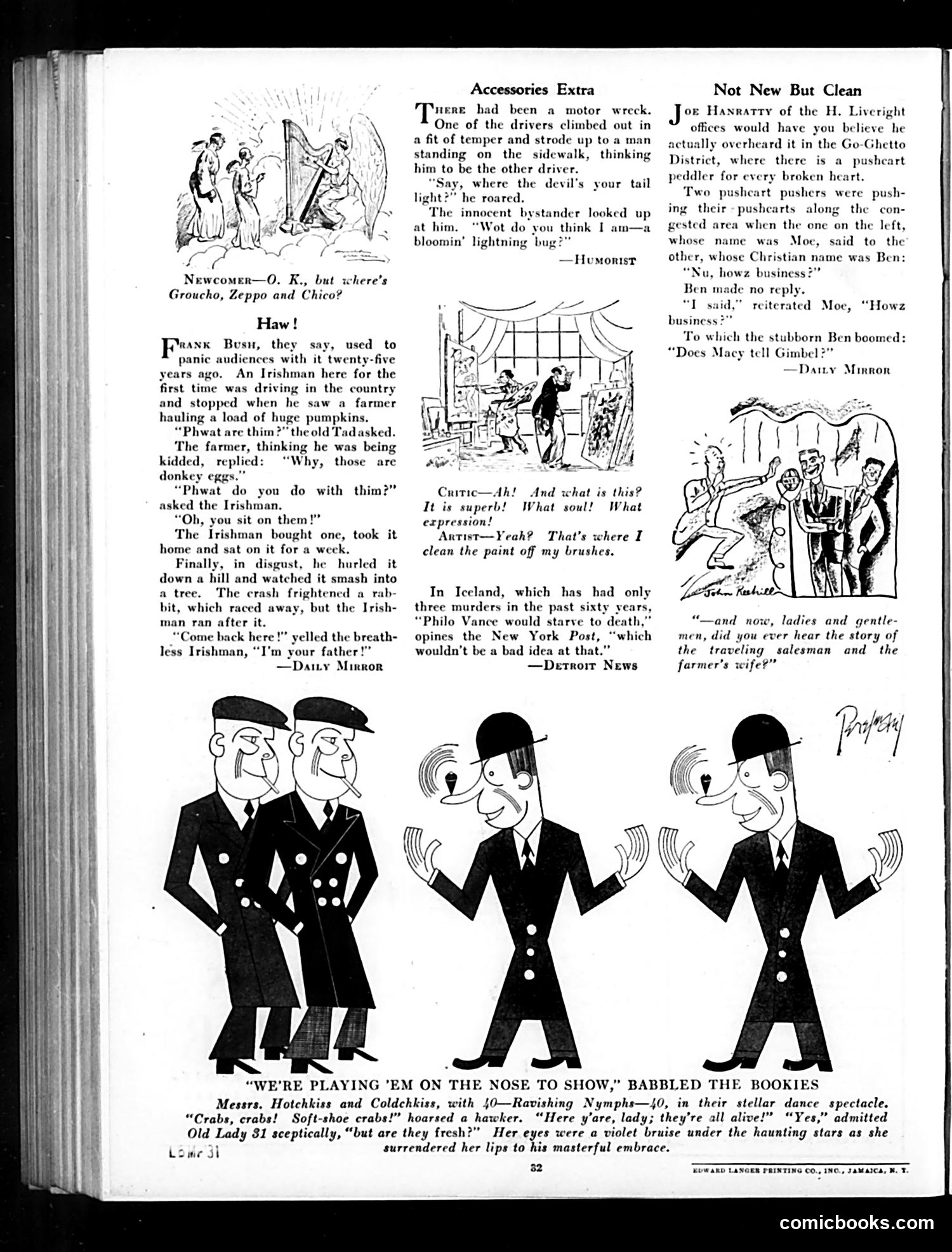
Judge Magazine Page Analysis This page from Judge magazine contains several unrelated humor pieces typical of the publication's format: The "Accessories Extra" section mocks old vaudeville jokes—the "donkey eggs" prank and the motorist's insult are presented as ancient material Frank Bush used decades prior, satirizing audiences' familiarity with worn-out gags. The artist/critic exchange jokes about an artist's literal interpretation of artistic critique: he cleans his brushes on the canvas, treating "superb expression" as physical rather than aesthetic praise. "Not New But Clean" appears to be Joe Hanratty claiming overheard Yiddish-dialect pushcart vendor banter from New York's Lower East Side—a common source of "humor" in this era, though presented as novel observation. The joke hinges on Ben refusing to answer Moe's business question, with the punchline being Macy and Gimbel (competing New York department stores) as an insulting non-answer. The bottom caption advertises a theatrical dance spectacle featuring "40 Ravishing Nymphs," with parody dialogue about live crabs and forced romantic dramatics—mocking cheesy entertainment marketing of the period.
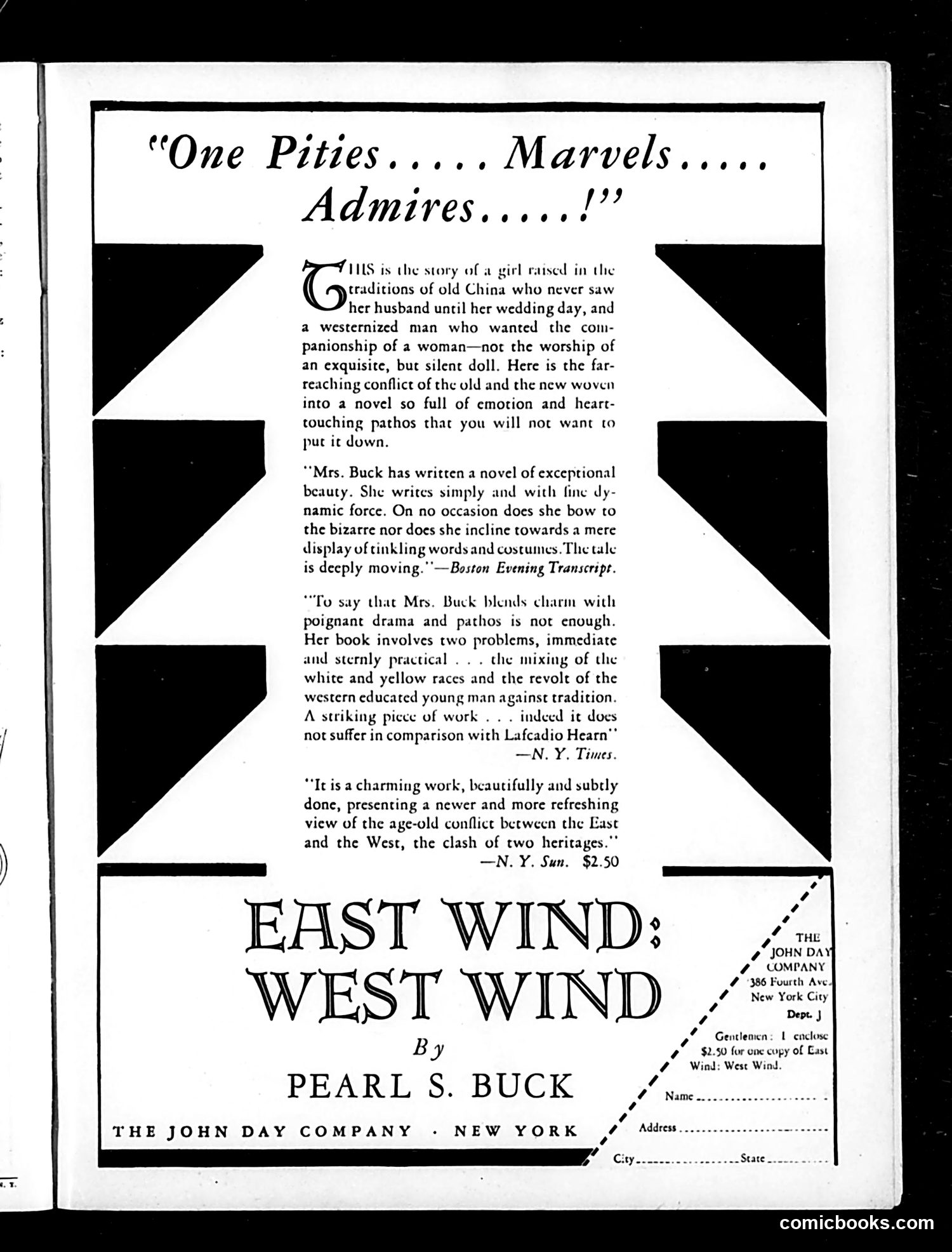
Analysis of "East Wind: West Wind" Advertisement This is primarily a book advertisement, not a political cartoon. It promotes Pearl S. Buck's novel about a Chinese woman raised in traditional customs who marries a Westernized man seeking companionship rather than a "silent doll." The page highlights contemporary racial and cultural anxieties of the era: reviews emphasize the book's treatment of "mixing of the white and yellow races" and the conflict between Eastern tradition and Western modernity—framed as dramatic, emotionally compelling material rather than mere entertainment. The repeated praise ("One Pities... Marvels... Admires") suggests the novel offers sophisticated exploration of these themes. For modern readers, this reveals how interracial relationships and cultural assimilation were treated as serious, culturally significant topics in 1930s American publishing, with the framing suggesting a progressive work addressing taboo subjects.
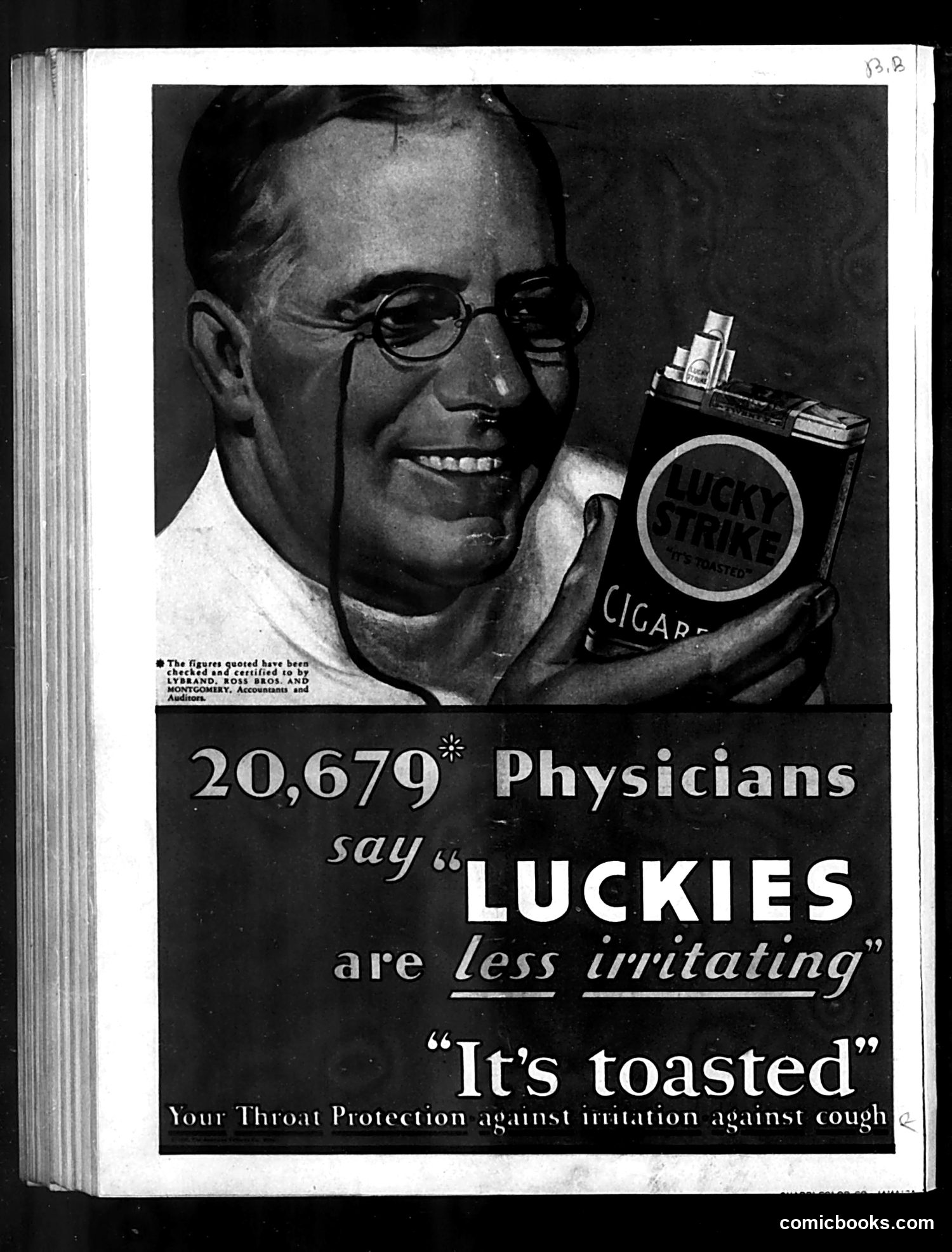
This is a cigarette advertisement, not political satire. It features a man in glasses holding a pack of Lucky Strike cigarettes, promoting the brand's "toasted" process as a selling point. The ad claims 20,679 physicians endorse Lucky Strikes as "less irritating" to the throat, offering "throat protection against irritation against cough." This represents a common mid-20th century marketing tactic: using medical authority to legitimize cigarettes as a health product rather than acknowledging their dangers. The "toasting" claim was Lucky Strike's signature marketing angle—suggesting their manufacturing process made cigarettes safer. Modern readers should recognize this as deeply misleading advertising; no cigarettes actually protect throats or prevent cough. Such health claims would be illegal under contemporary FDA regulations.

I can see this is a blank or nearly blank page from what appears to be a Judge magazine issue, based on the "comicbooks.com" watermark at the bottom. The page shows only the binding on the left side and black margins on the right, with no visible cartoon, illustration, text content, or advertising that would allow me to identify figures, political references, or satirical commentary. Without visible content to analyze, I cannot explain what this page meant to contemporary or modern readers. This may be a blank interstitial page, a missing image, or a scanning error from the source material.