judge
Judge — July 5, 1930
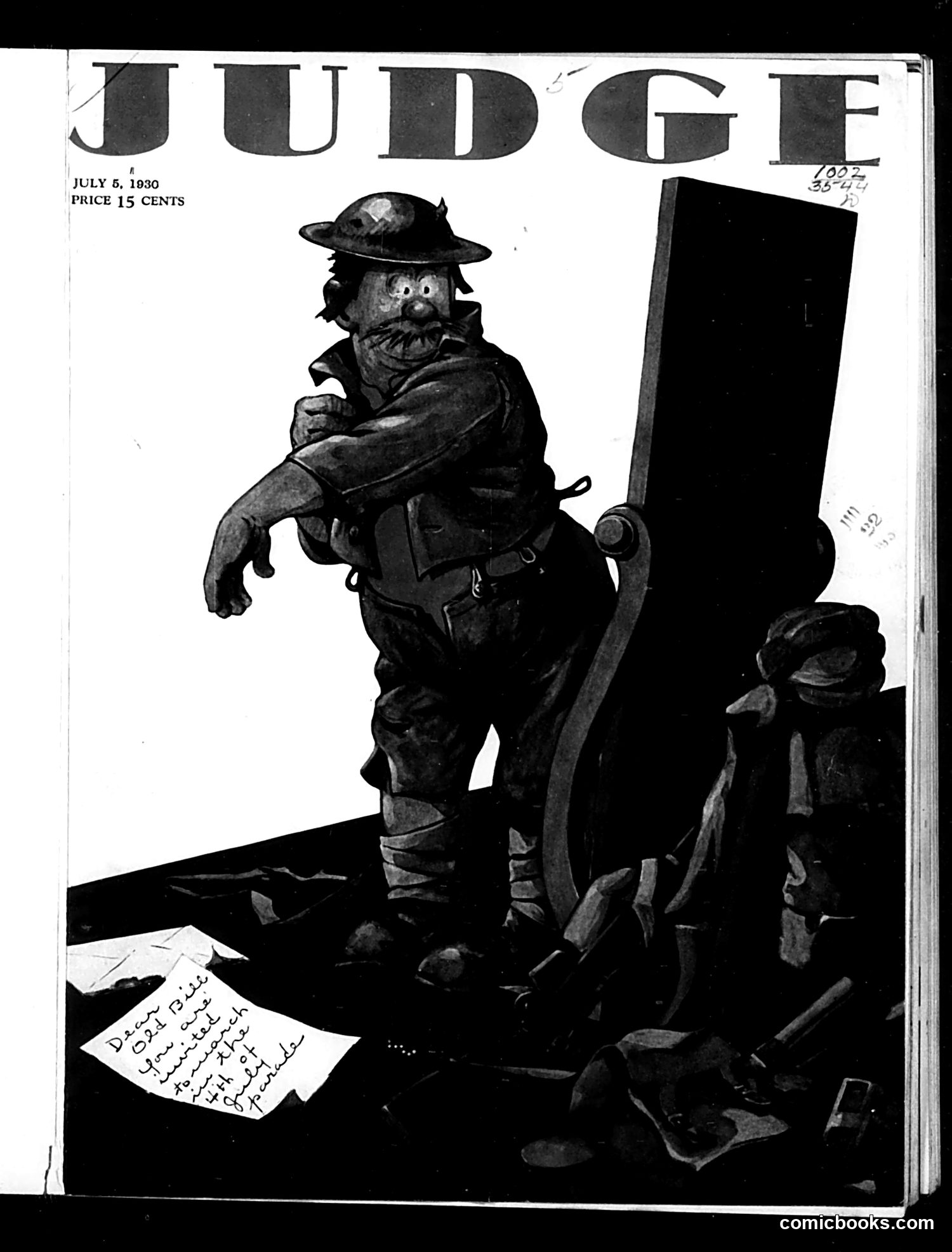
Judge Magazine Cover Analysis (July 5, 1930) This cover depicts a disheveled hobo or vagrant character sitting atop what appears to be a large black block or structure, holding a rolled document. The figure wears tattered clothing, a wide-brimmed hat, and has an exaggerated, caricatured face typical of 1930s satirical illustration. Given the July 1930 date, this likely references the Great Depression, which had begun with the 1929 stock market crash. The hobo—a common symbol of economic hardship—appears triumphant or defiant while positioned above, perhaps suggesting how poverty or unemployment had become dominant forces in American society. The document in his hand's significance remains unclear from the image alone. The satire critiques the economic devastation affecting ordinary Americans during the Depression's early stages.
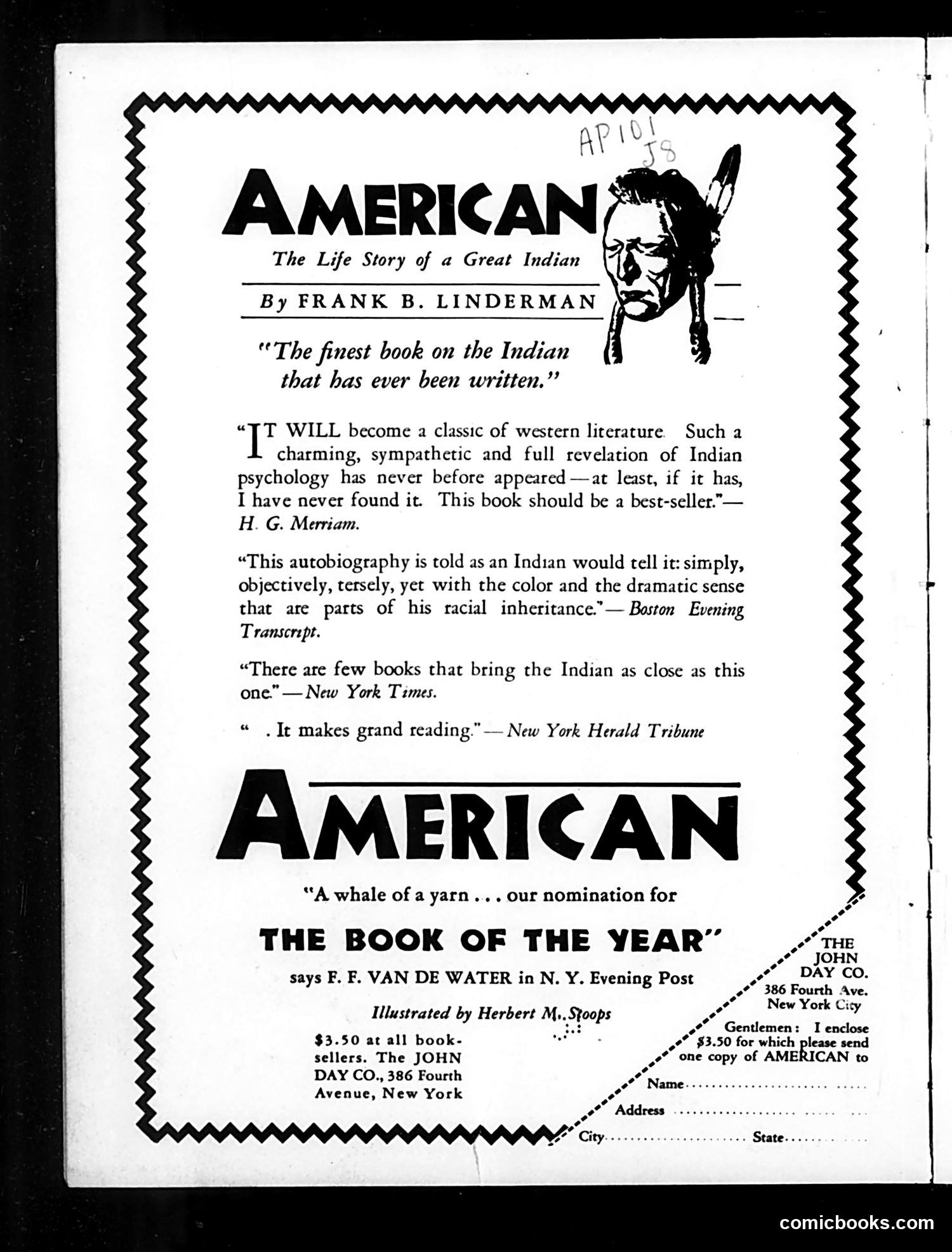
Analysis This page is primarily an advertisement, not satire or political commentary. It promotes "American: The Life Story of a Great Indian" by Frank B. Linderman, published by The John Day Company. The advertisement features: - A portrait of what appears to be a Native American man with braided hair and a feather - Endorsements from publications (H.G. Merriam, Boston Evening Transcript, New York Times, New York Herald Tribune) - Claims the book is "charming, sympathetic" and reveals "Indian psychology" - Praise calling it a potential "classic of western literature" and "Book of the Year" - Price: $3.50 - An order form for readers The decorative border mimics Native American geometric patterns. This reflects early-20th-century publishing marketing that emphasized "authentic" perspectives on Indigenous life, though modern readers would recognize such framing as reflecting the period's problematic attitudes toward Native Americans.
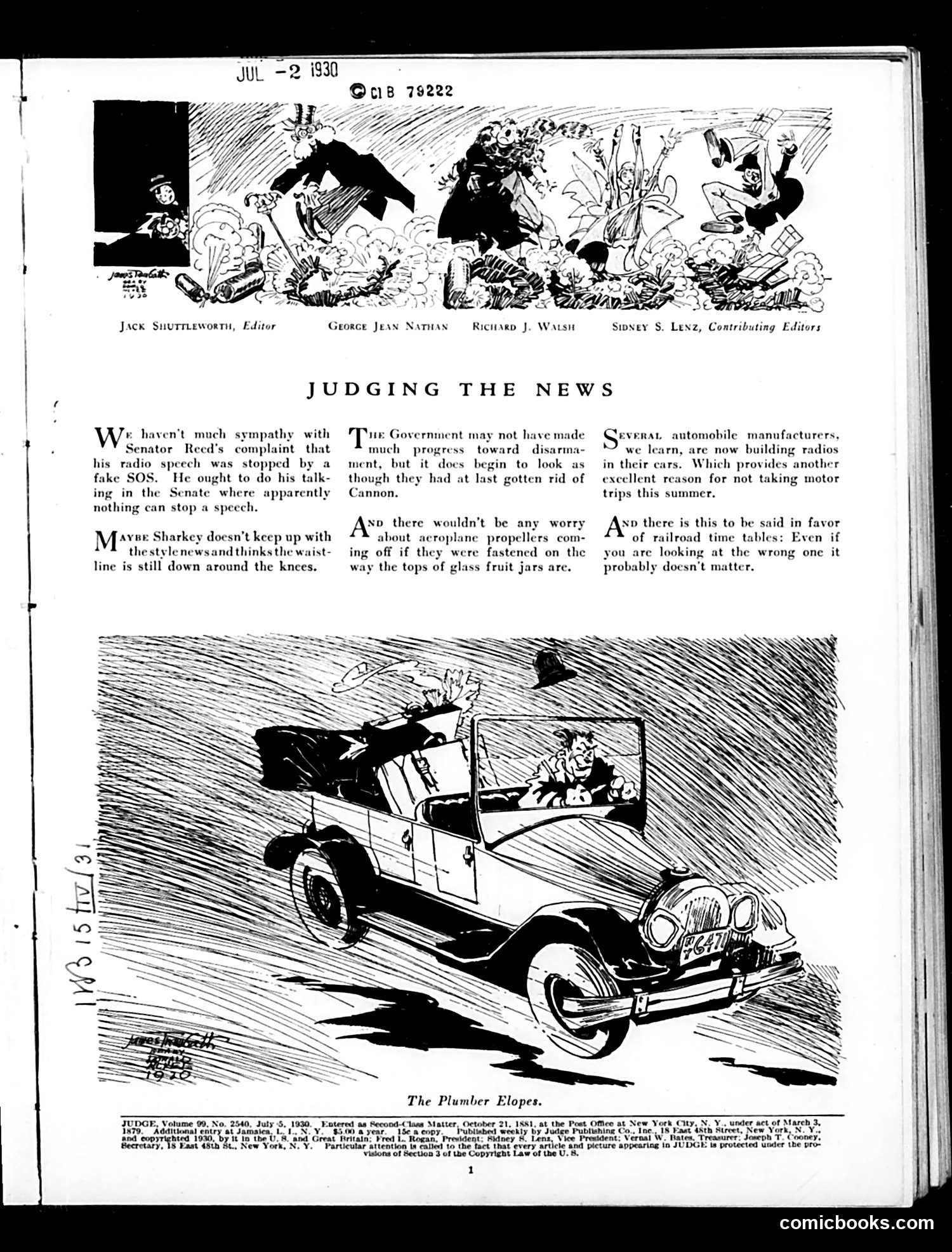
"The Plumber Elopes" - Judge Magazine, July 2, 1930 This cartoon satirizes marital infidelity during the Depression era. The caption "The Plumber Elopes" depicts a working-class tradesman abandoning his family—shown as wife and children watching from a car window—to flee with another woman in a separate vehicle. The joke plays on class stereotypes: the "plumber" represents a manual laborer, and the cartoon mocks the notion that even working-class men might abandon domestic responsibilities for romantic escapades. The 1930 date places this during economic hardship, making the desertion seem particularly irresponsible. The accompanying editorial snippets ("Judging the News") address unrelated political and social topics of the period, including disarmament efforts and automobile safety—typical of Judge's satirical format mixing commentary with humor.
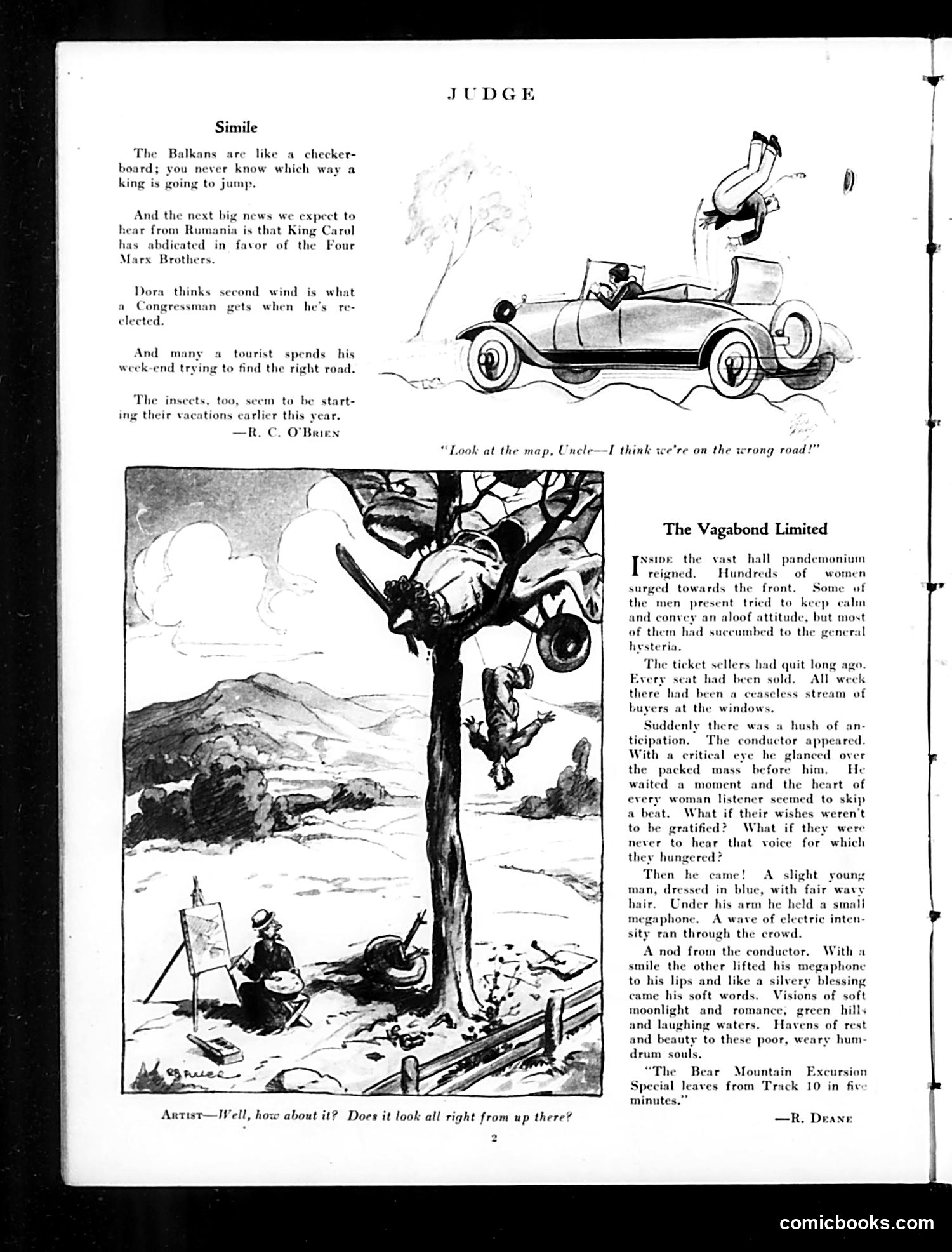
Analysis of Judge Magazine Page This page contains two unrelated pieces: "Simile" (top): A brief humor column by R.C. O'Brien making light observations about the Balkans, Romanian King Carol, Congressional re-election, and tourist navigation—typical period satirical commentary on international instability and domestic politics, though without specific historical references that would clarify the exact date. "The Vagabond Limited" (bottom): A short story by R. Deane accompanying an illustration showing artists sketching outdoors. The narrative describes a crowd surging toward a voice—apparently a conductor announcing a special train excursion ("The Bear Mountain Excursion"). It's sentimental fiction emphasizing the transformative power of a young man's voice bringing hope to weary crowds, typical of Judge's mix of humor and genteel storytelling. Neither piece appears specifically topical to a particular political moment.
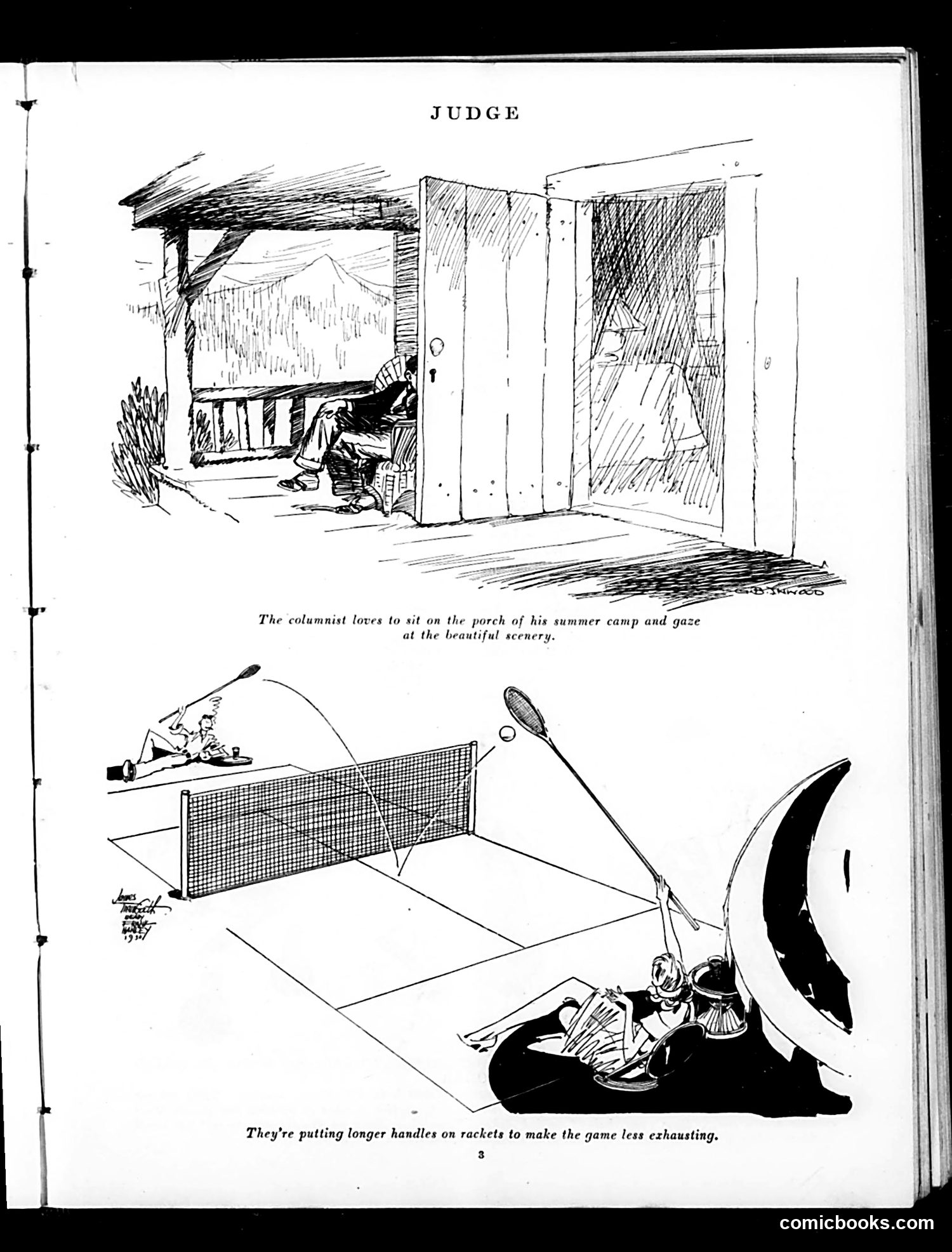
Analysis This page from *Judge* contains two cartoons satirizing leisure activities: Top cartoon: Shows a man relaxing on a summer camp porch, gazing at scenery. The caption suggests columnists enjoy such peaceful retreats—likely satirizing how journalists romanticize vacation time or escape urban life while writing about it. Bottom cartoon: Depicts people playing tennis with longer-handled rackets. The caption jokes that longer handles make "the game less exhausting"—mocking the tendency to modify activities to reduce physical effort, or satirizing lazy recreationalists who want sport's appearance without its demands. Both cartoons target upper-class leisure culture and the shortcuts people take to avoid genuine exertion, common *Judge* themes lampooning American affluence and pretension.
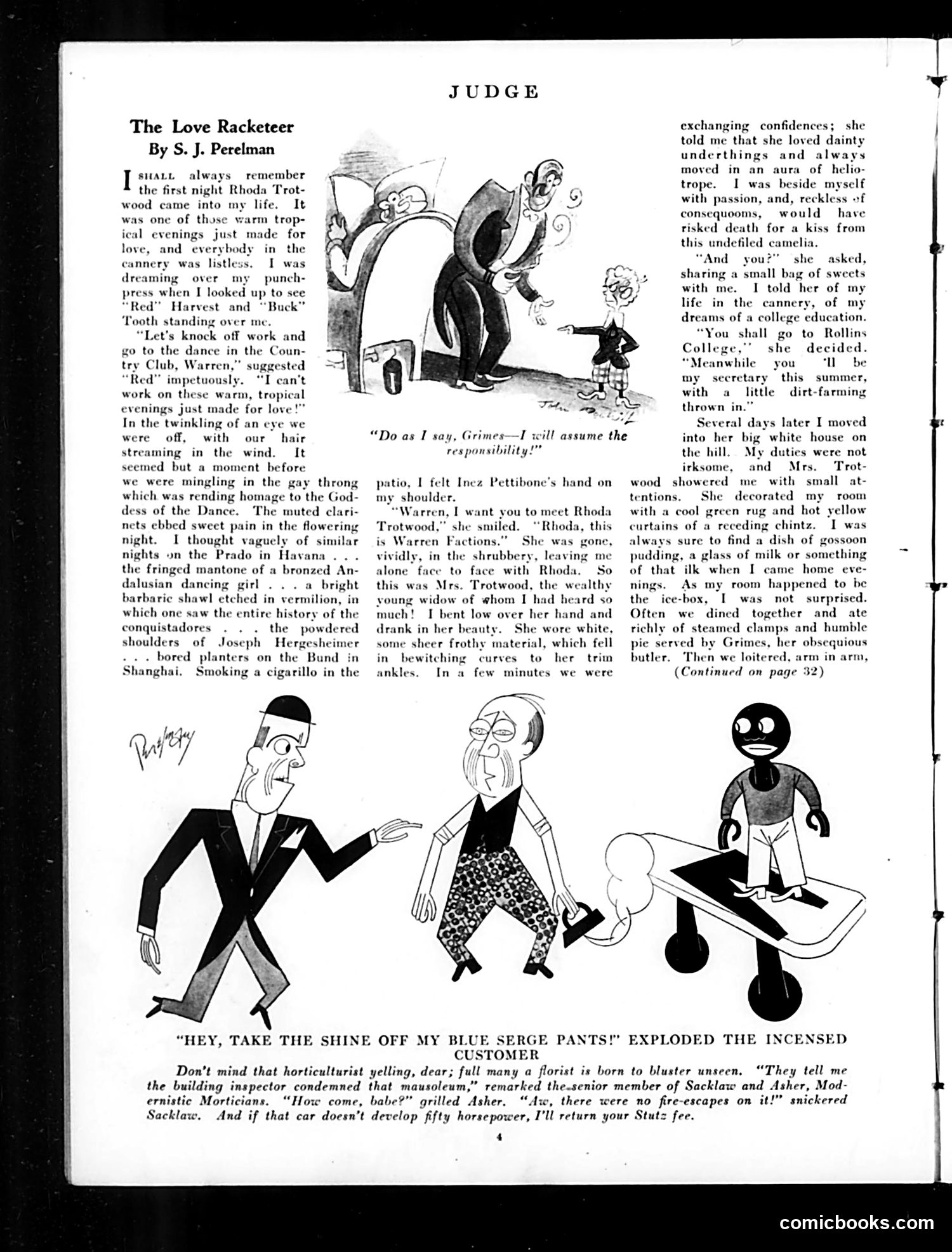
"The Love Racketeer" by S. J. Perelman This page contains the opening of a humorous short story about a narrator who enters a romantic entanglement. The narrative describes visiting a country club where he meets "Red" Harvey and encounters a woman named Rhoda Trotwood, who is involved with someone named Warren. The accompanying cartoons below depict exaggerated caricatures of men in formal wear engaged in slapstick situations—one man gesturing dramatically, another appearing to stumble, and a third figure on what appears to be a seesaw. The final caption mocks a customer furious about the shine on his blue serge pants, satirizing petty consumer complaints and dry-cleaning disputes. The humor targets both romantic entanglements and trivial service industry grievances.
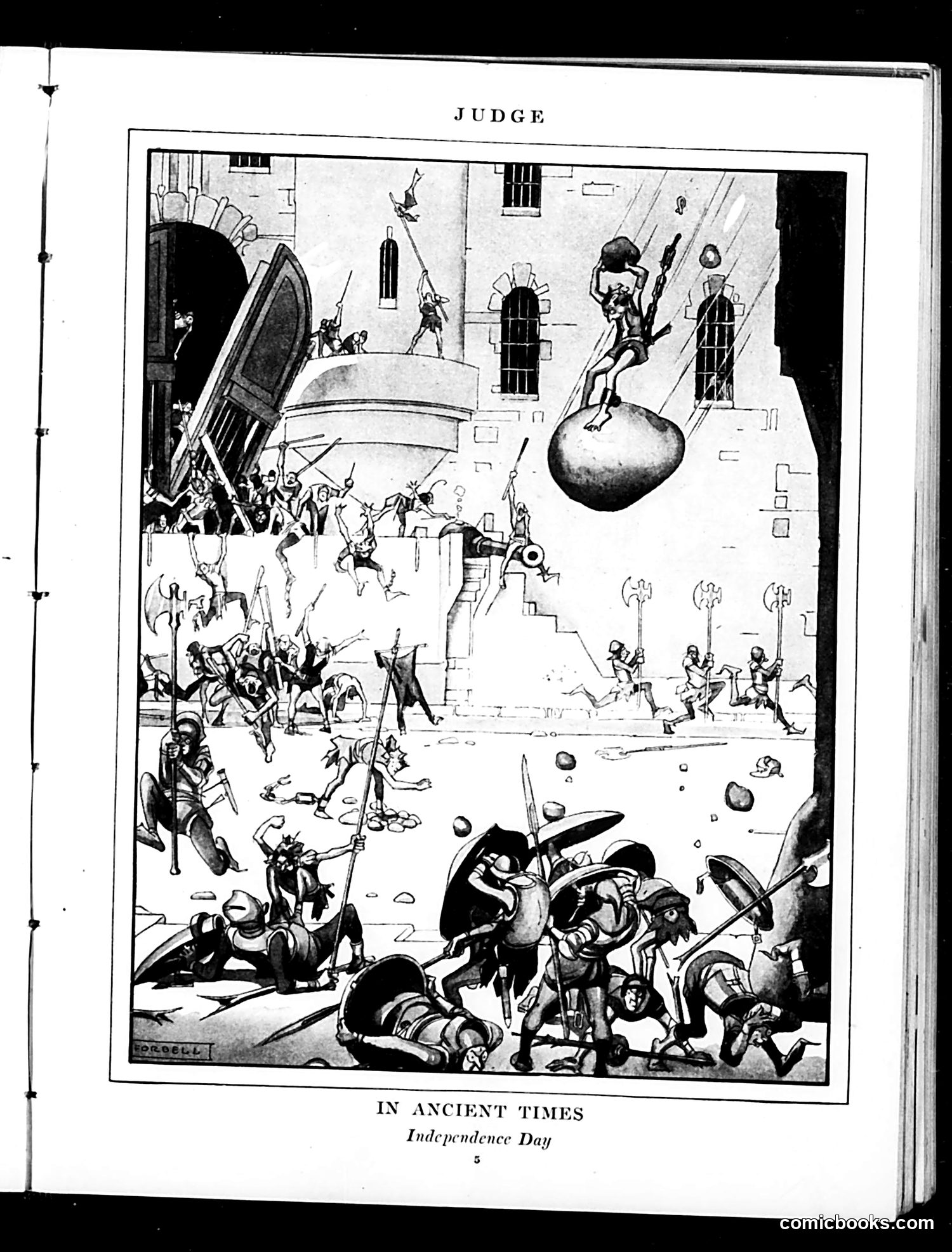
"Judge in Ancient Times: Independence Day" This satirical cartoon depicts a chaotic ancient Roman or Greek scene labeled "Independence Day," imagining how early civilizations might have celebrated independence. The image shows gladiators and soldiers fighting in an arena while civilians above experience dangerous "entertainment"—a person bounces on a giant sphere suspended in air, others are struck by falling objects. The satire appears to contrast primitive, violent forms of celebration with modern American Independence Day festivities. By staging the concept in "ancient times," the cartoonist suggests that celebrating independence through chaos and violence is barbaric. The upside-down boat on the left and general disorder reinforce this critique of chaotic public celebration, likely commenting on rowdy or dangerous Independence Day observances in the artist's own era.
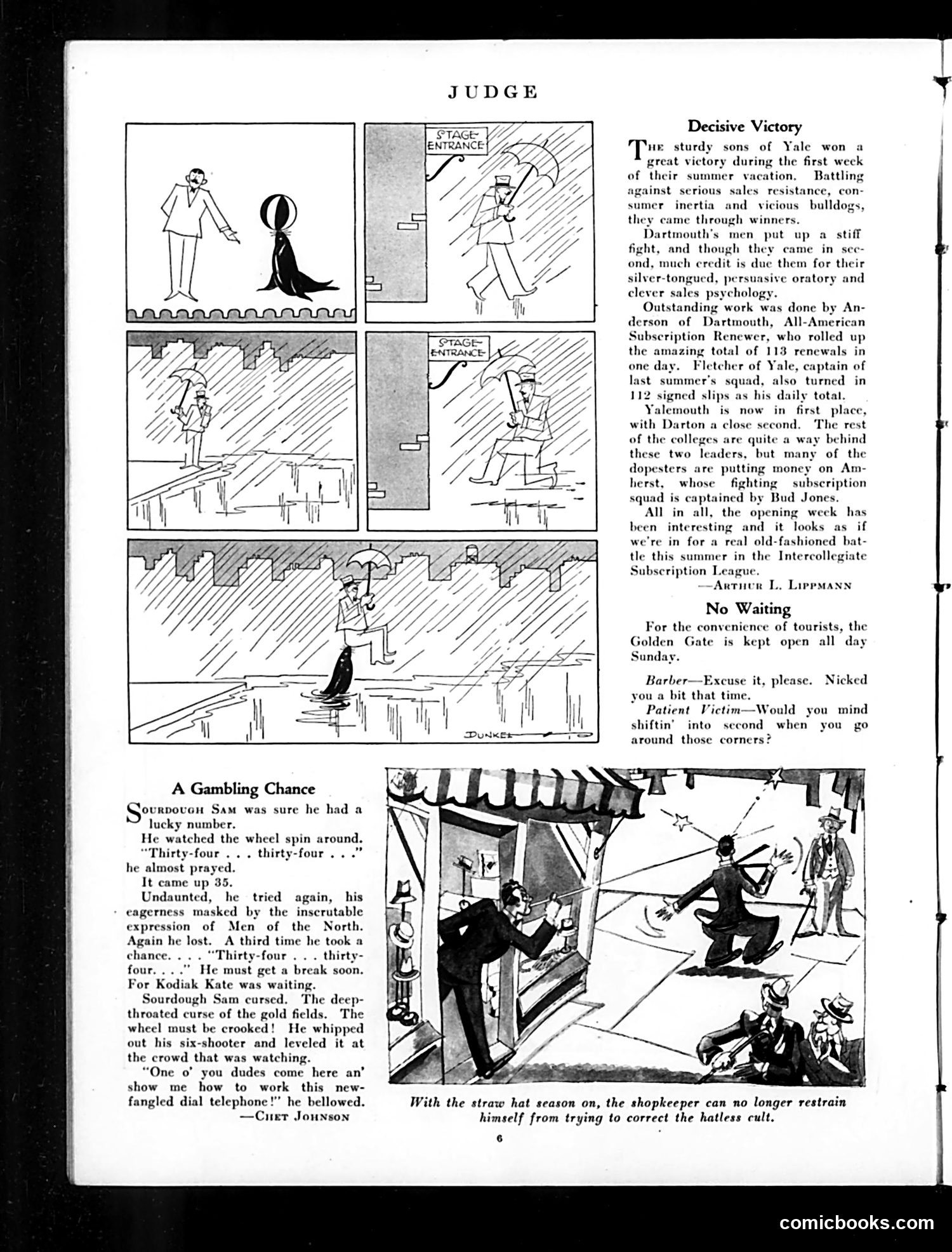
Judge Magazine Page Analysis This page contains three distinct humorous pieces: "Judge" comic strip (top): A wordless visual gag about a man encountering what appears to be Death (the Grim Reaper figure in black). The man attempts to escape through various stage entrances, with Death pursuing him—likely satirizing theatrical melodrama or the inevitability of mortality through slapstick. "Decisive Victory" (right column): Text celebrating Yale's early summer fundraising success for subscriptions, humorously framed as a competitive "battle" against other colleges. "A Gambling Chance" (middle): A narrative joke about a gambler named Sourdough Sam trying his luck at a spinning wheel, repeatedly getting "thirty-four" while waiting for "Kodiak Kate." The humor lies in his superstitious persistence and the frontier-style dialect. "No Waiting" (bottom right): A cartoon depicting shopkeepers attempting to correct customers' behavior during the straw hat season, with the caption suggesting summer fashion creates workplace chaos.
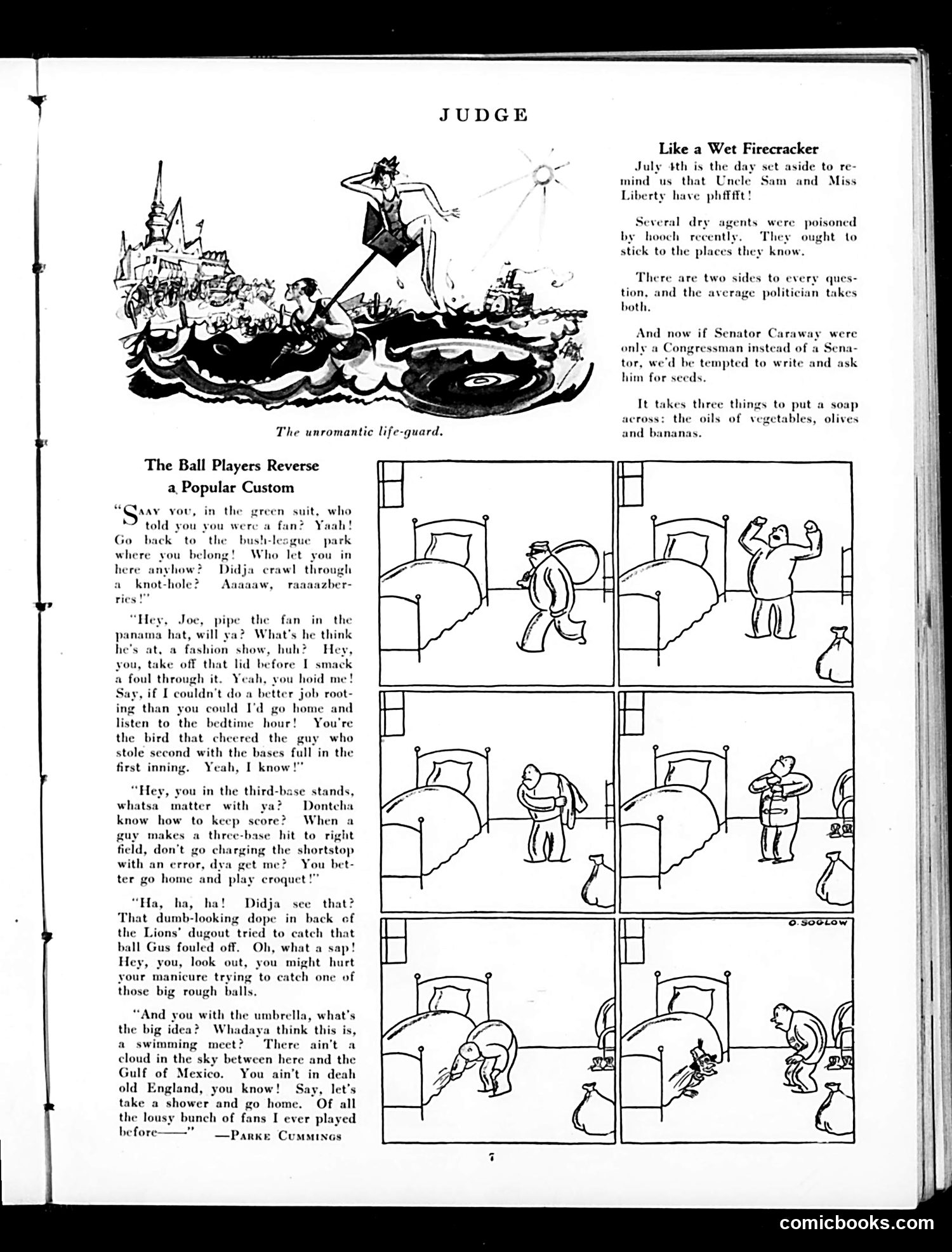
Analysis for Modern Readers This page contains two separate satirical pieces from Judge magazine: "Like a Wet Firecracker" (top): A series of brief political jokes. Key reference: "Senator Caraway" (likely Thaddeus Caraway, a real senator) is mocked as ineffectual—the joke suggests he'd be better suited asking for seeds than legislation. The "dry agents poisoned by hooch" references Prohibition enforcement, sarcastically suggesting agents should stick to legal alcohol. The overall tone mocks politicians' hypocrisy and Prohibition's failures. "The Ball Players Reverse a Popular Custom" (bottom): A comic strip showing baseball fans being loudly insulted and ejected by players—reversing the typical dynamic where fans heckle players. The satire mocks rude, aggressive fans at games through exaggerated role reversal, using period slang ("hoid," "dya get me") and stereotypical fan behavior (criticizing plays, inappropriate dress, keeping score wrong). Both pieces reflect 1920s-30s concerns: Prohibition enforcement, political incompetence, and emerging mass entertainment culture.
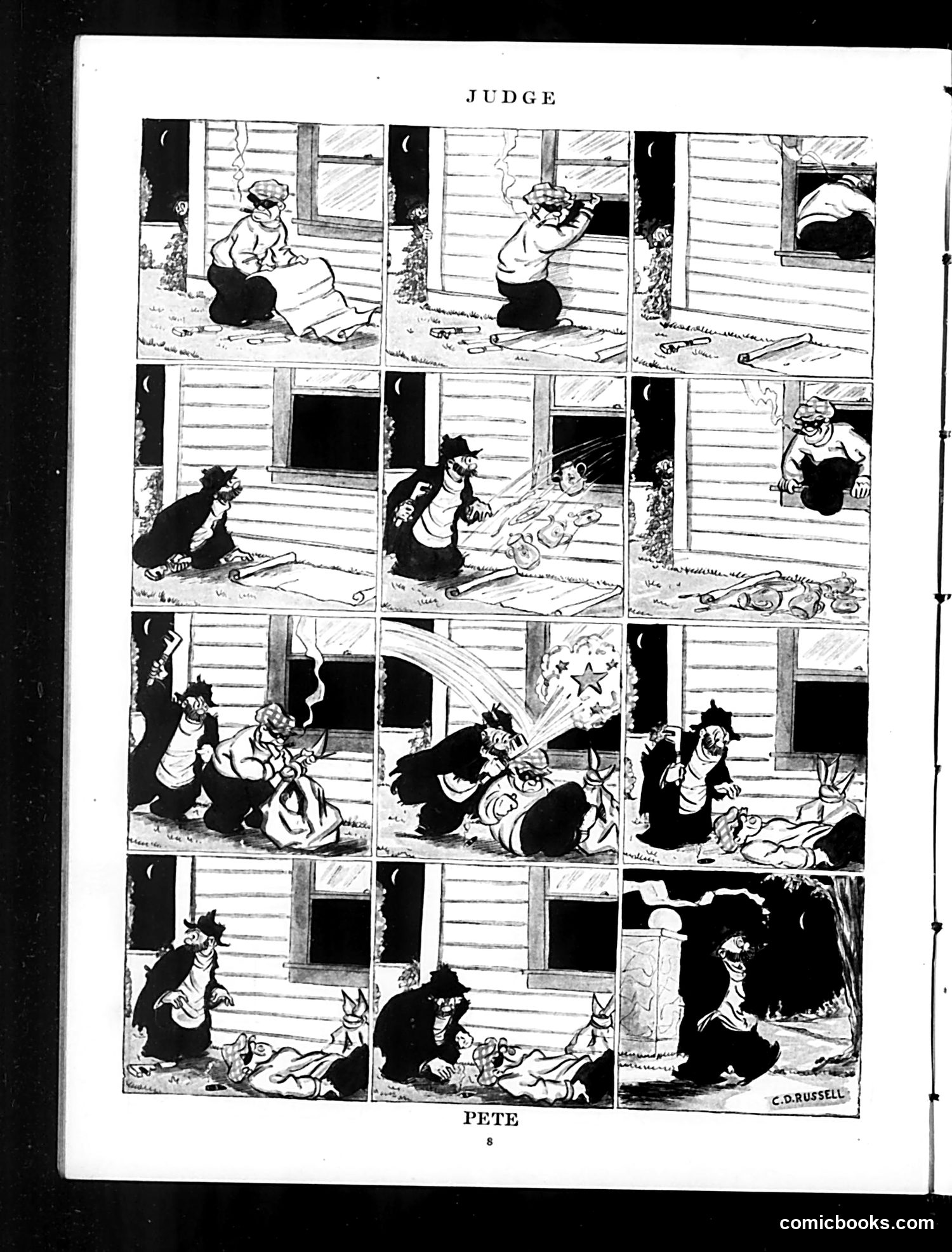
"Judge Pete" Comic Strip Analysis This is a sequential comic strip by C.D. Russell titled "Judge Pete" showing a nighttime scene outside a wooden house. The narrative appears to depict someone (Pete) attempting to enter through a window while others react—suggesting a burglary or break-in scenario. The strip progresses from Pete's initial attempt through various confrontations with residents and what appears to be law enforcement or a judge figure (referenced in the title). The humor likely derives from slapstick consequences of the attempted crime, though without additional historical context, the specific satirical target remains unclear. The "Judge" reference in the title suggests legal/judicial mockery, possibly of 1920s-30s era criminal justice.
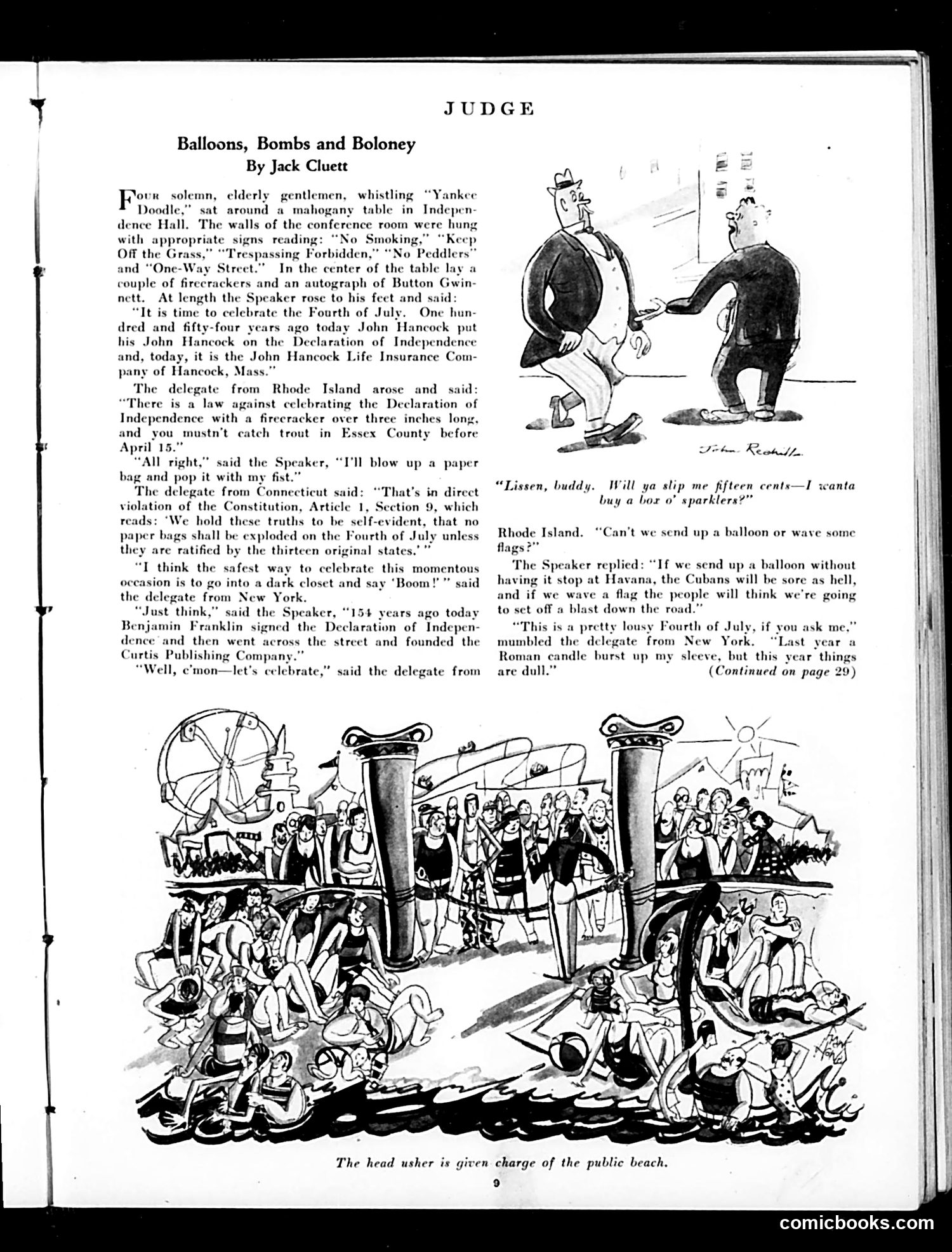
"Balloons, Bombs and Boloney" Explained This 1920s-era satire mocks excessive government regulation stifling Fourth of July celebrations. Elderly founding fathers gather in Independence Hall to commemorate the Declaration, but modern bureaucratic restrictions prevent any festivities. The joke: delegates cite absurd laws—firecrackers over three inches are illegal, paper bags can't be popped without state ratification, balloons upset Cuba, and flags risk diplomatic incidents. The cartoon suggests government red tape has made celebrating American independence itself impossible. Key references include Button Gwinnett (actual Declaration signer), the Curtis Publishing Company (publisher of Saturday Evening Post), and contemporary anxieties about governmental overreach and foreign relations (Cuba). The beach illustration shows crowded, chaotic leisure—contrasting regulated chaos with uncontrolled freedom. The satire targets progressive-era regulation that Judge's conservative readership viewed as excessive and anti-American.
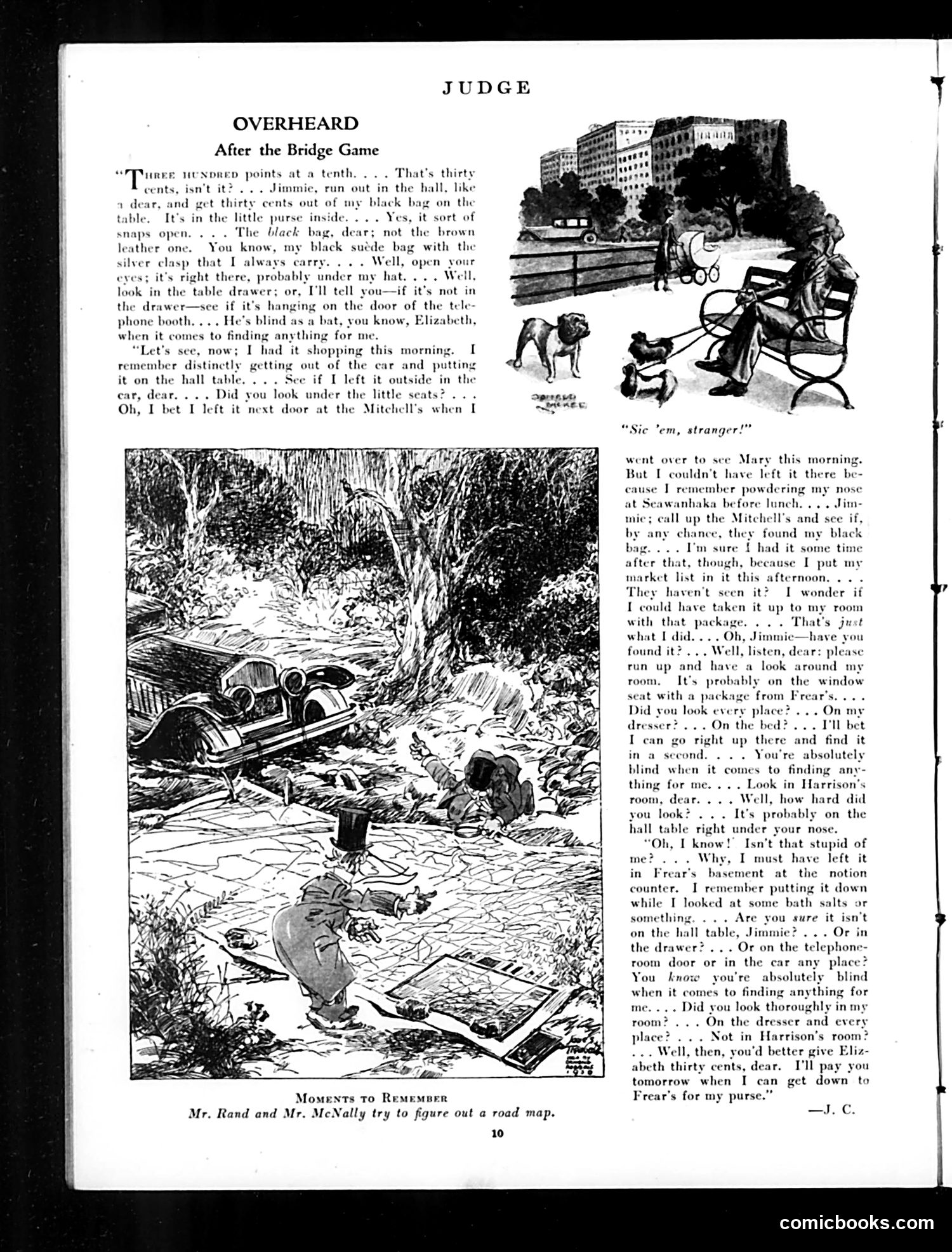
Judge Magazine: "Overheard After the Bridge Game" This is a humorous domestic sketch satirizing upper-middle-class women's absent-mindedness and their tendency to delegate tasks to long-suffering male companions (likely husbands or servants named "Jimmie"). The joke: A woman has lost thirty cents—her bridge game winnings—and sends "Jimmie" on an exhausting search through her home and recent movements. She rambles about where it *might* be (the black bag, the purse, the car, the Mitchell's house, Frear's store), constantly second-guessing herself while criticizing Jimmie's incompetence at finding things. The satire targets: 1. Female scatterbrainedness regarding money and possessions 2. Class dynamics: wealthy women casually directing servants to do trivial searches 3. Blame-shifting: she lost the money but insists *he's* "blind" at finding things The accompanying illustration shows two men outdoors with a road map—likely a separate, unrelated domestic comedy about male incompetence, providing ironic contrast.
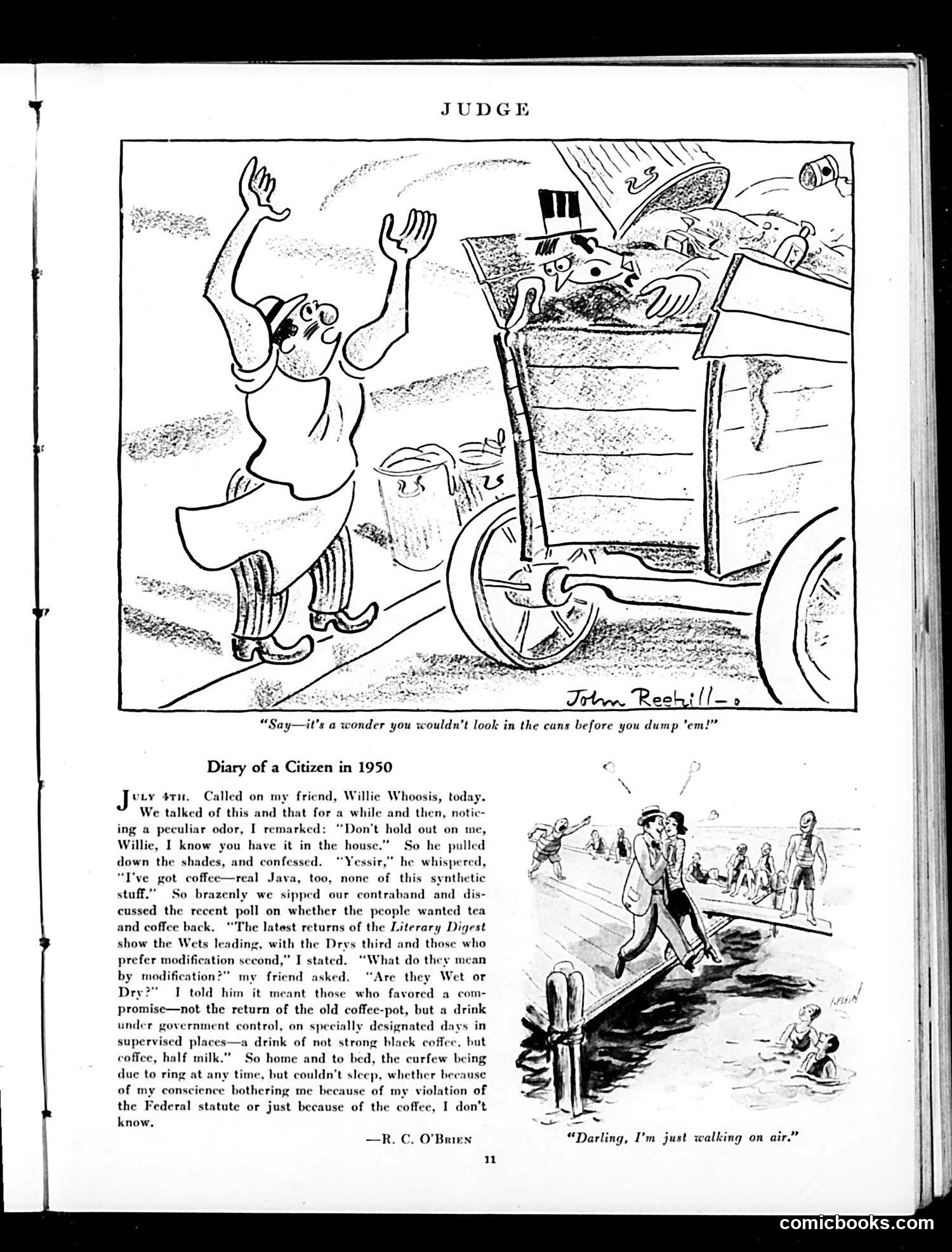
Explanation for Modern Readers This 1950 Judge magazine page satirizes Prohibition through futuristic speculation. The top cartoon shows a sanitation worker discovering discarded cans—likely implying hidden alcohol disposal, echoing actual Prohibition-era concerns about contraband. The main text, "Diary of a Citizen in 1950," imagines coffee as an illegal substance decades after Prohibition's repeal (1933). The author mocks potential future government overreach by depicting coffee rationing, black-market hoarding, and "modification" compromises (like milk-diluted coffee in supervised locations). The narrator experiences paranoia over violating federal law—a dark comedic reflection on how Prohibition's restrictions felt absurd in hindsight. The beach illustration captioned "Darling, I'm just walking on air" appears unrelated. The satire warns against allowing government to restrict personal consumption habits again, using coffee as an absurd stand-in for any substance society might foolishly prohibit next.
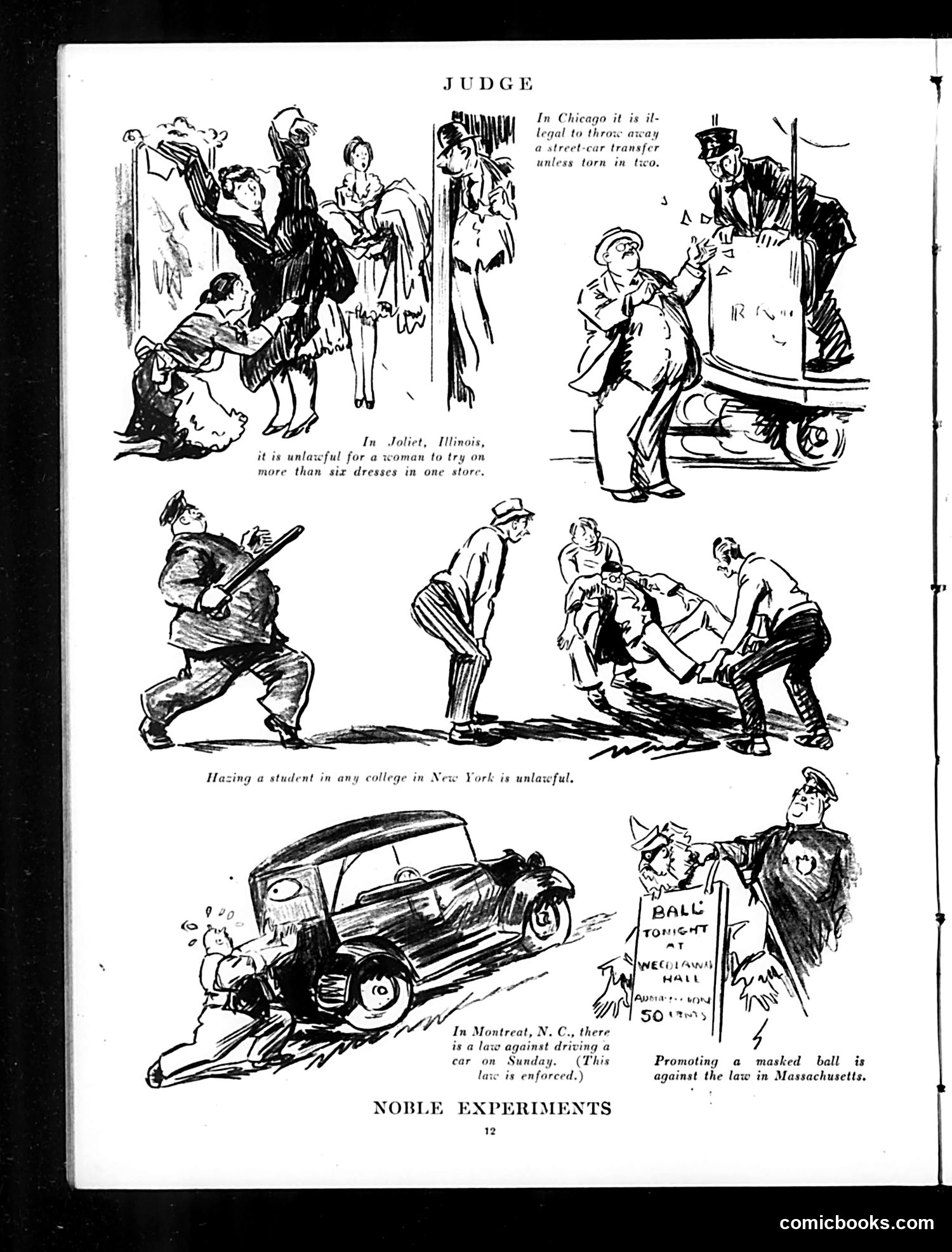
"Noble Experiments" - Judge Magazine Satire This page satirizes absurd local laws across America. Each cartoon illustrates a ridiculous or oddly-specific statute: - Chicago: Must tear streetcar transfers in two before discarding - Joliet, Illinois: Women limited to trying on six dresses per shopping trip - Montreal, N.C. (likely meant elsewhere): Sunday driving is illegal - Massachusetts: Masked balls are prohibited The satire's point: these "noble experiments" in legislation are laughably petty and impractical—micromanaging trivial behaviors rather than addressing serious civic concerns. The absurdity is amplified by depicting law enforcement earnestly enforcing these ridiculous rules. This reflects Progressive Era skepticism toward excessive regulation, mocking government overreach into everyday life. The humor relies on readers recognizing these laws as real but indefensible, illustrating how well-intentioned legislation can become farcical.
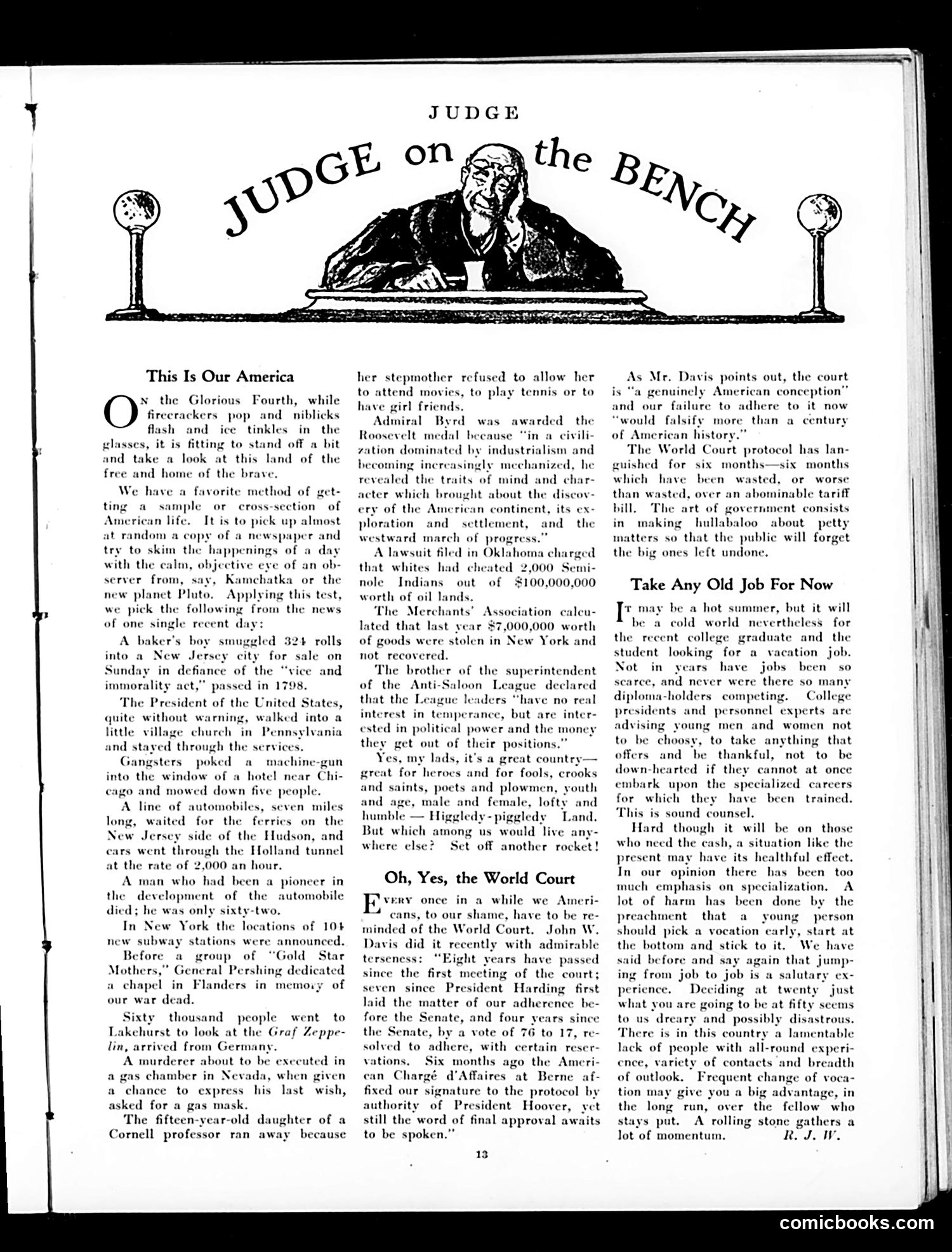
Judge Magazine Page Analysis This page from Judge (a satirical American magazine) presents three editorial commentaries on contemporary American life, circa late 1920s-early 1930s. "This Is Our America" opens with a humorous catalogue of absurd recent news items—a baker's boy smuggling rolls, gangsters with machine guns, a murderer requesting a gas mask before execution, a girl running away because her stepmother forbade movies. The satire points to America's chaotic contradictions: a nation simultaneously capable of heroic achievement (Admiral Byrd's polar expedition earning the Roosevelt Medal) and petty criminality. "Oh, Yes, the World Court" criticizes American hesitation to join the World Court. Davis's complaint that eight years have passed since the court's founding with no U.S. commitment satirizes political foot-dragging and isolationism. "Take Any Old Job For Now" advises college graduates to accept any employment during economic hardship rather than hold out for specialized careers—practical Depression-era guidance. The header illustration shows a stern judge at the bench, framing all commentary within a judicial voice of social criticism typical of Judge's satirical editorial approach.
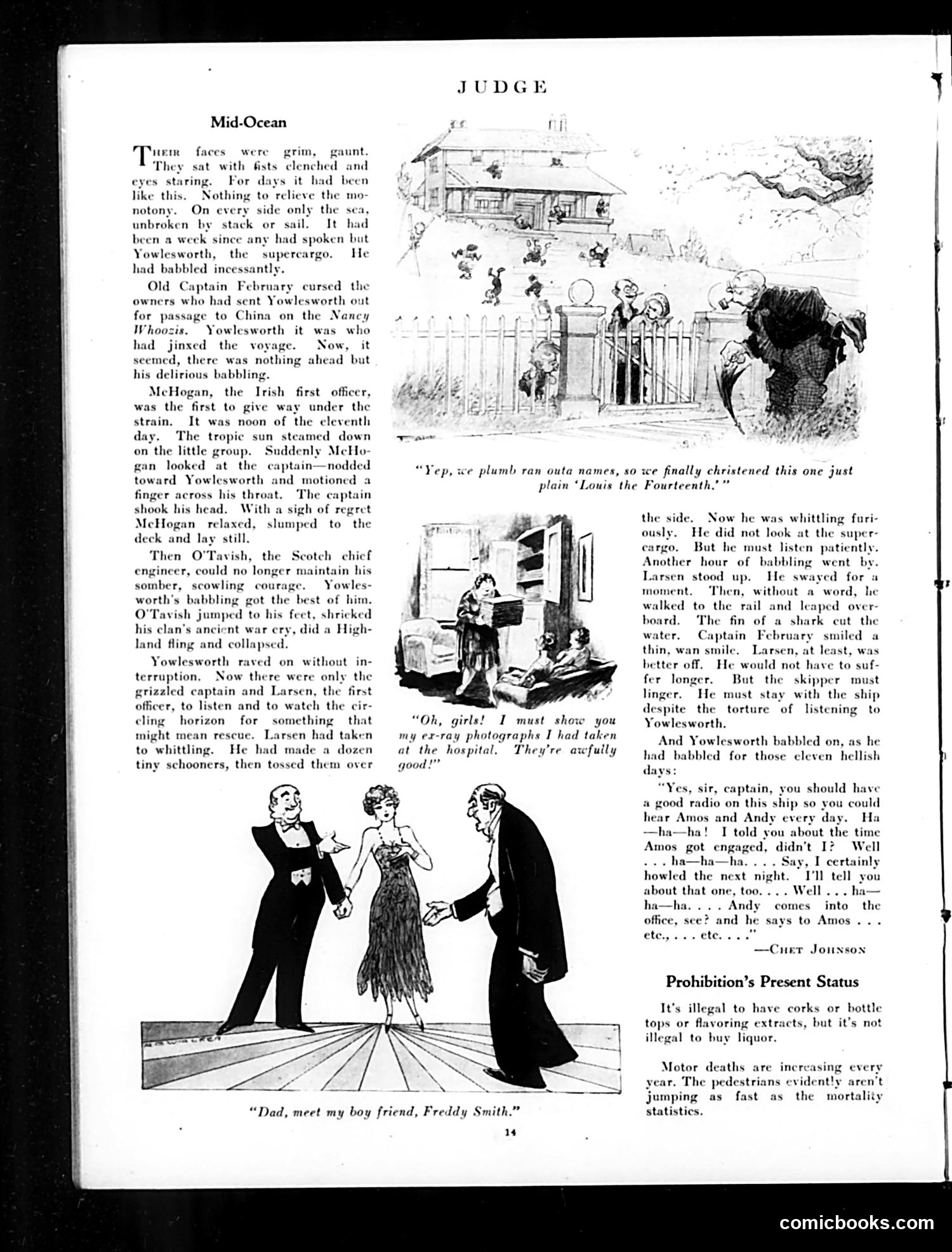
"Mid-Ocean" Story Page Analysis This page presents a serialized nautical story satirizing the monotony and psychological toll of sea travel. The narrative follows a ship's crew driven to madness by an insufferably talkative supercargo named Yowlesworth during an eleven-day voyage. Officers McHogan and O'Tavish collapse from the strain; Larsen commits suicide rather than endure more babbling. Captain February alone must endure, trapped by duty. The satire targets tedious people and inescapable social situations—being trapped listening to an unstoppable talker. The three cartoon vignettes below the story provide comedic relief on unrelated topics: a naming joke about a child ("Louis the Fourteenth"), a woman showing x-ray photographs, and a father meeting his daughter's boyfriend. The page concludes with brief commentary on Prohibition's absurdities and motor fatality statistics—typical Judge magazine social commentary blending dark humor with contemporary concerns.
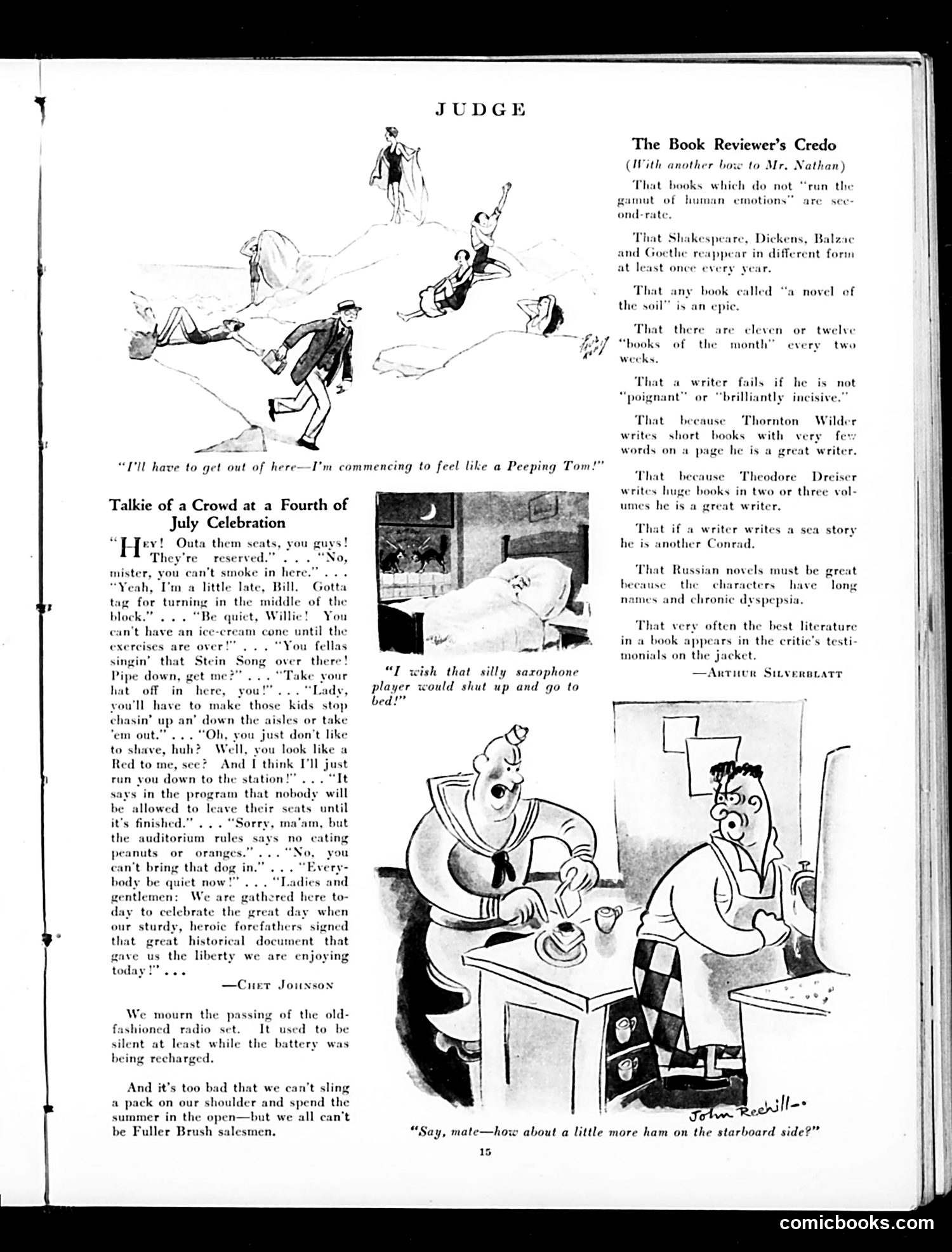
Explaining This Judge Magazine Page This page contains two satirical pieces mocking American culture circa the 1920s-30s. "Talkie of a Crowd at a Fourth of July Celebration" ridicules the chaos of public gatherings. The cartoon depicts people violating every rule imaginable during outdoor patriotic festivities—smoking, eating, making noise, chasing children—while authority figures bark contradictory commands. The irony: citizens celebrate their "liberty" by ignoring all social order. The opening line's "Peeping Tom" reference suggests voyeuristic discomfort with the rowdiness. "The Book Reviewer's Credo" satirizes literary criticism's pretentious formulas. It mocks critics' predictable judgments: declaring Russian novels automatically "great" due to length and depression; praising Thorton Wilder because he's sparse; lauding sea stories as "Conrad"; treating Shakespeare's reappearance annually as profound. The final jab notes critics' best writing often appears only in book jacket testimonials—implying the actual reviews lack substance. Both pieces target societal hypocrisy and intellectual pretension during an era of rapid cultural change.
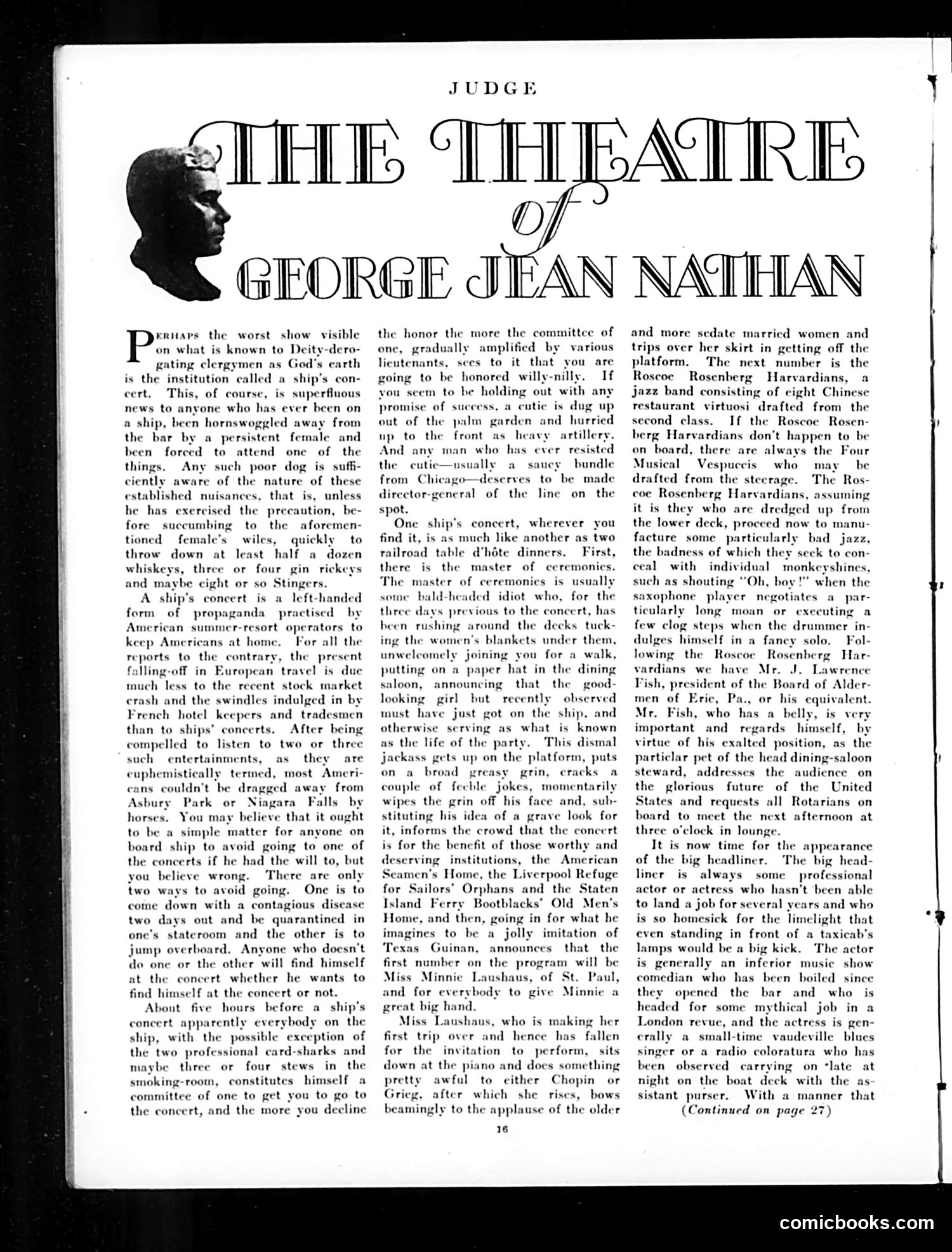
"The Theatre of George Jean Nathan" — Judge Magazine Satire This is a theatrical criticism essay by prominent drama critic George Jean Nathan (whose silhouette appears as the header illustration). The piece satirizes the mandatory ship's concert—a forced entertainment event aboard ocean liners that American travel companies used to discourage passengers from taking European vacations. Nathan's point: ship's concerts are so dreadfully awful that they've successfully kept Americans at home. He mocks the typical concert structure: an overeager "master of ceremonies" (usually a ship's officer playing social director), amateur performers dragged from the passenger list, and an audience coerced by committees of enthusiastic volunteers—particularly aggressive young women from Chicago. The satire targets both the entertainment industry's manipulation and American tourists' passive acceptance of social pressure. Nathan suggests the only escape is contracting a contagious disease or jumping overboard, using hyperbole to convey the excruciating nature of these shipboard performances.

Analysis This is not a cartoon or satire — it's a full-page advertisement for Texaco motor oil, appearing in Judge magazine circa 1926. The page announces a new Texaco motor oil product with a "crack-proof" body that stays "clear, clean, golden" longer than competitors. The image shows a bottle with the Texaco star logo. The text contextualizes this as part of The Texas Company's ongoing market leadership. It references their 1926 introduction of Texaco Gasoline as a revolutionary "dry gas," positioning this new motor oil as another innovation in their product line. This represents corporate advertising masquerading as editorial content — common practice in magazines of this era, where advertisements often occupied prominent space alongside actual editorial material. The placement in Judge suggests sponsors had significant say in magazine content.
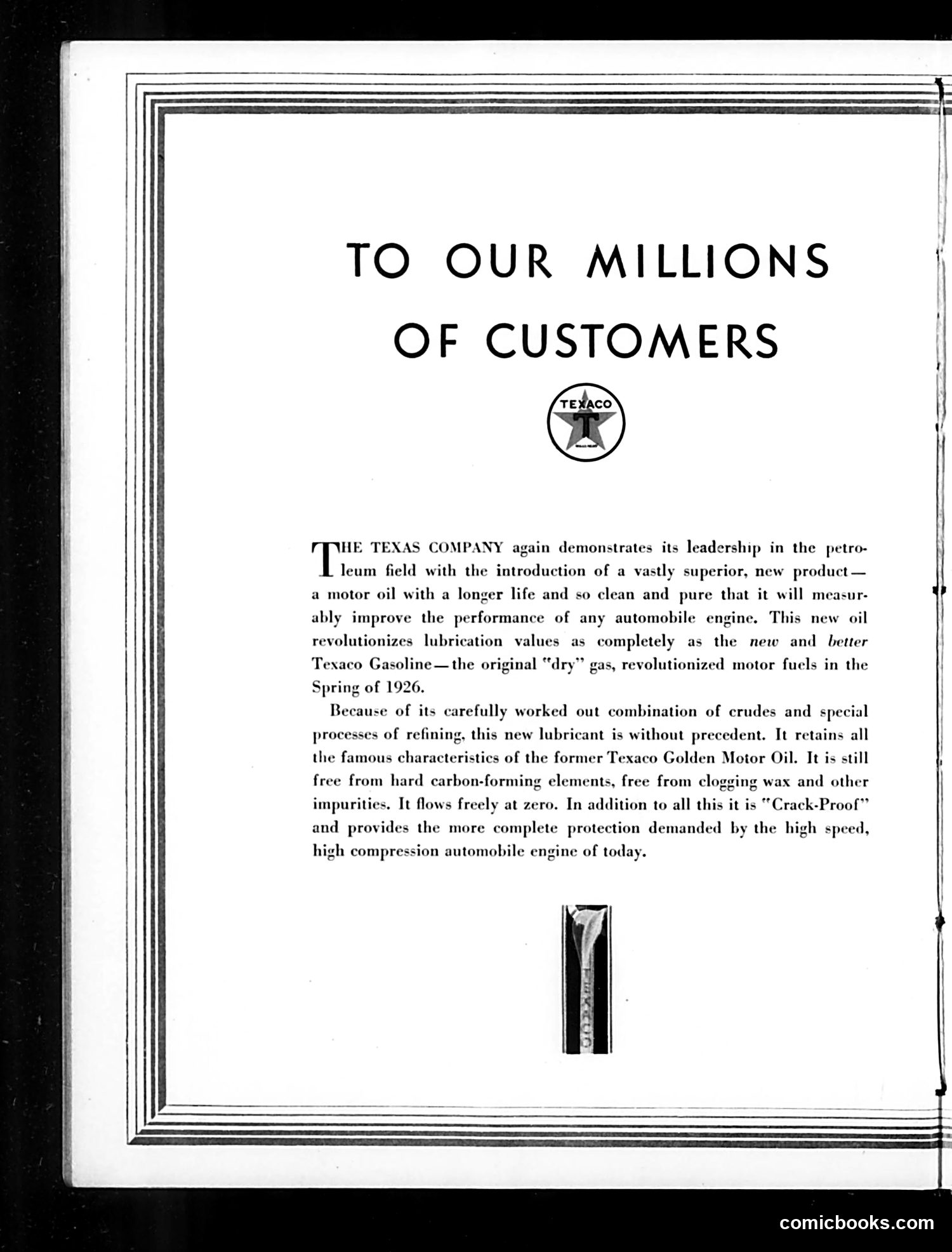
Analysis This is not a cartoon or satire — it's a full-page advertisement for Texaco motor oil, appearing in *Judge* magazine (likely late 1920s based on the 1926 reference). The ad announces a new Texaco motor oil product, claiming it revolutionizes lubrication the way Texaco Gasoline revolutionized fuel in spring 1926. Key selling points include: superior longevity, purity, carbon-free composition, resistance to wax buildup, and a new "Crack-Proof" feature for high-compression engines. The Texaco star logo anchors the message. The small oil bottle illustration at the bottom serves as product identification. For modern readers: This reflects 1920s automotive advancement — engines were becoming more powerful and demanding better lubricants. The advertising tone is typical of corporate messaging in this era: claiming scientific superiority and market leadership. There is no political satire or social commentary present on this page.
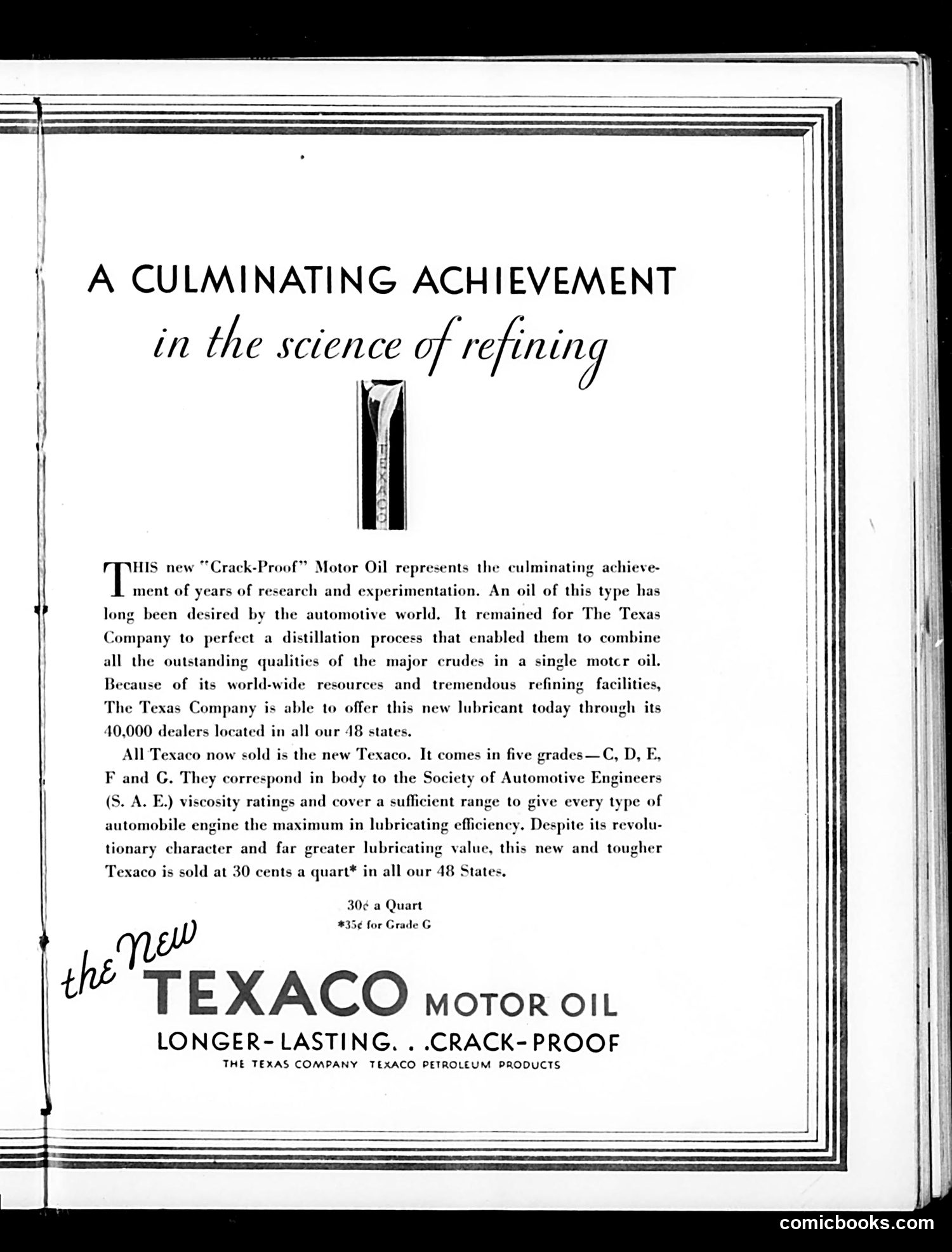
Analysis This is a full-page advertisement, not editorial content or satire. It promotes Texaco's new "Crack-Proof" motor oil as a major innovation in automotive lubrication. Key selling points: - Result of years of research combining qualities of multiple crude oils - Available in five grades (C, D, E, F, G) matching Society of Automotive Engineers standards - Distributed through 40,000 dealers across all 48 states - Priced affordably at 30 cents per quart (35 cents for Grade G) Historical context for modern readers: This appears to be from an era when motor oil grades were becoming standardized, and lubrication quality was a genuine competitive concern for automobile manufacturers. The "crack-proof" claim likely refers to resistance to engine knocking/detonation—a significant problem in early automobiles. There is no satire or political commentary on this page. It's straightforward corporate advertising emphasizing technical achievement and nationwide availability as markers of quality and reliability.
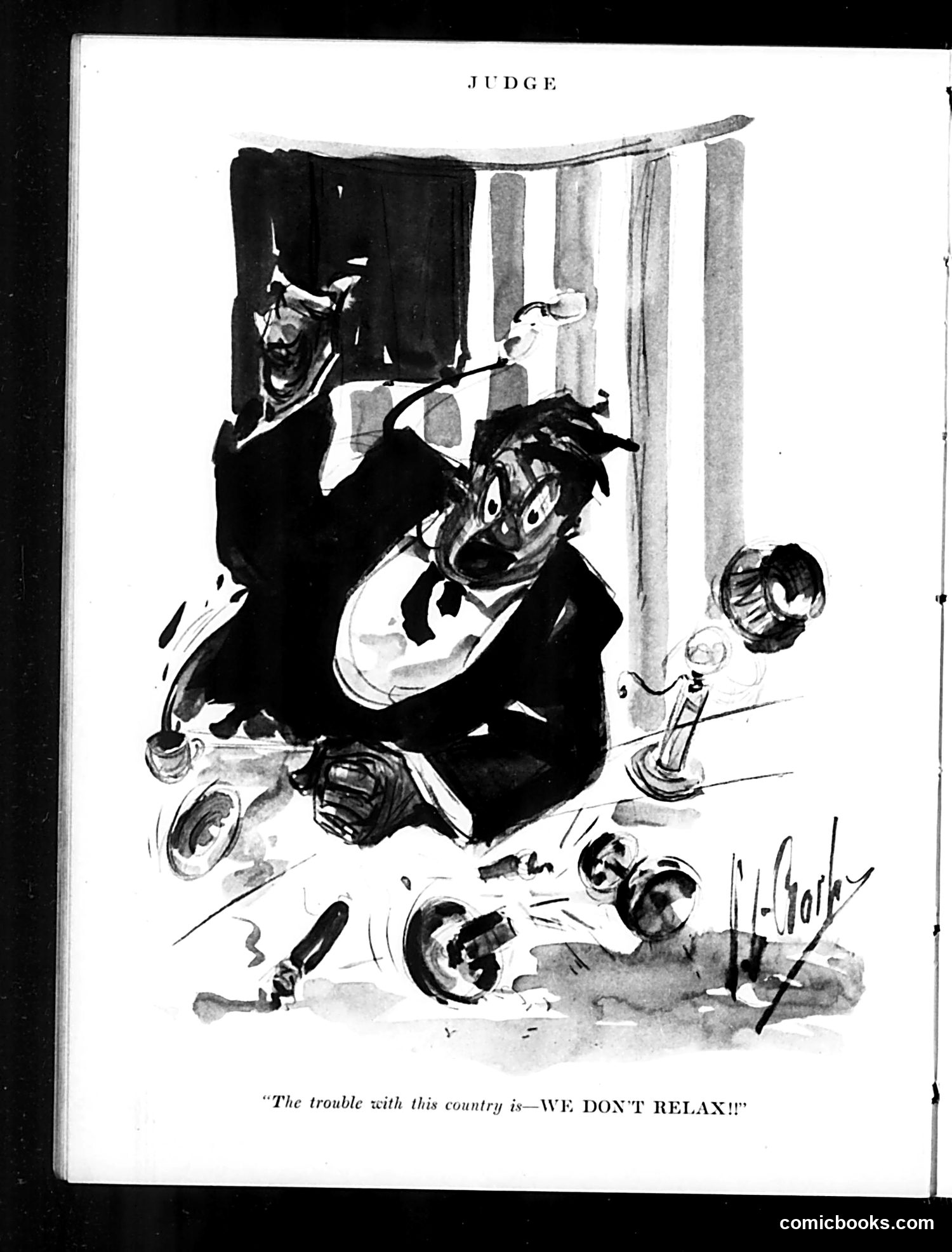
Political Cartoon Analysis: "The Trouble with This Country" This Judge magazine cartoon depicts a disheveled, frantic figure surrounded by scattered work—papers, tools, and writing implements strewn about—while gesturing emphatically at what appears to be a judge or authority figure in the background (visible through curtains/columns). The caption reads: "The trouble with this country is—WE DON'T RELAX!!" The satire critiques American overwork culture and lack of leisure. The central character appears to be a working person or laborer, portrayed as exhausted and manic despite (or because of) constant activity. The cartoon sarcastically suggests that America's problem isn't insufficient work ethic, but rather an inability to rest—implying that constant productivity-obsession is damaging to society and individuals. This likely reflects early-to-mid 20th century anxieties about industrialization, workplace demands, and modern stress.
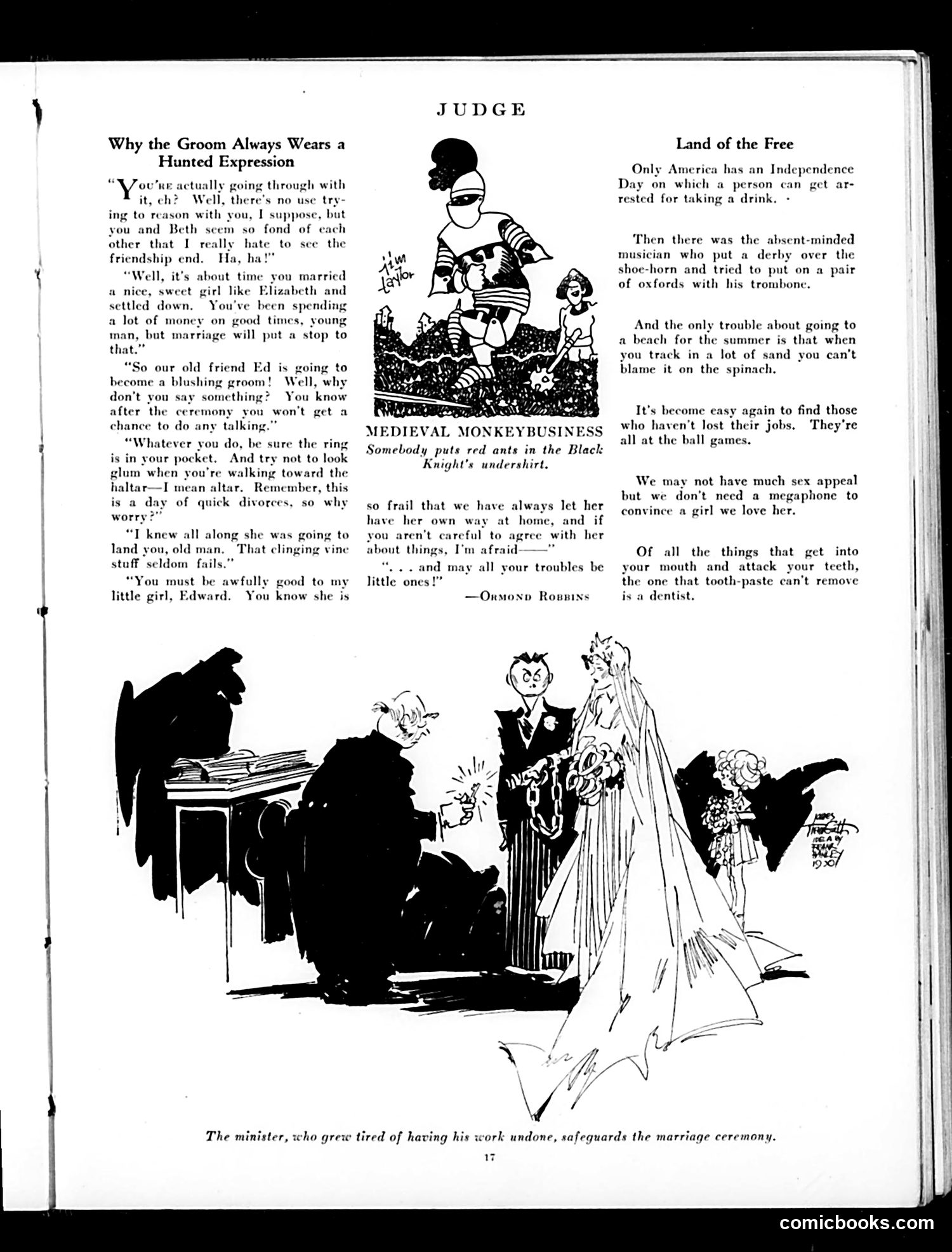
Analysis of Judge Magazine Page This page contains two satirical pieces typical of Judge's humor: "Why the Groom Always Wears a Hunted Expression" mocks pre-marriage advice. Male relatives lecture an engaged man about settling down, losing his freedom, and enduring marriage's constraints. The humor relies on the era's stereotype of marriage as a trap where wives dominate and control husbands—the "hunted expression" reflects male anxiety about losing independence and money to matrimonial obligations. "Land of the Free" presents brief, disconnected jokes mocking American life, particularly Prohibition (getting arrested for drinking on Independence Day) and economic depression-era unemployment (jobless people found at baseball games). The bottom illustration shows a minister hastily concluding a wedding ceremony, presumably to prevent the groom from escaping—reinforcing the "trapped husband" theme. The humor assumes a male audience and reflects early 20th-century anxieties about marriage's restrictions on masculine freedom.
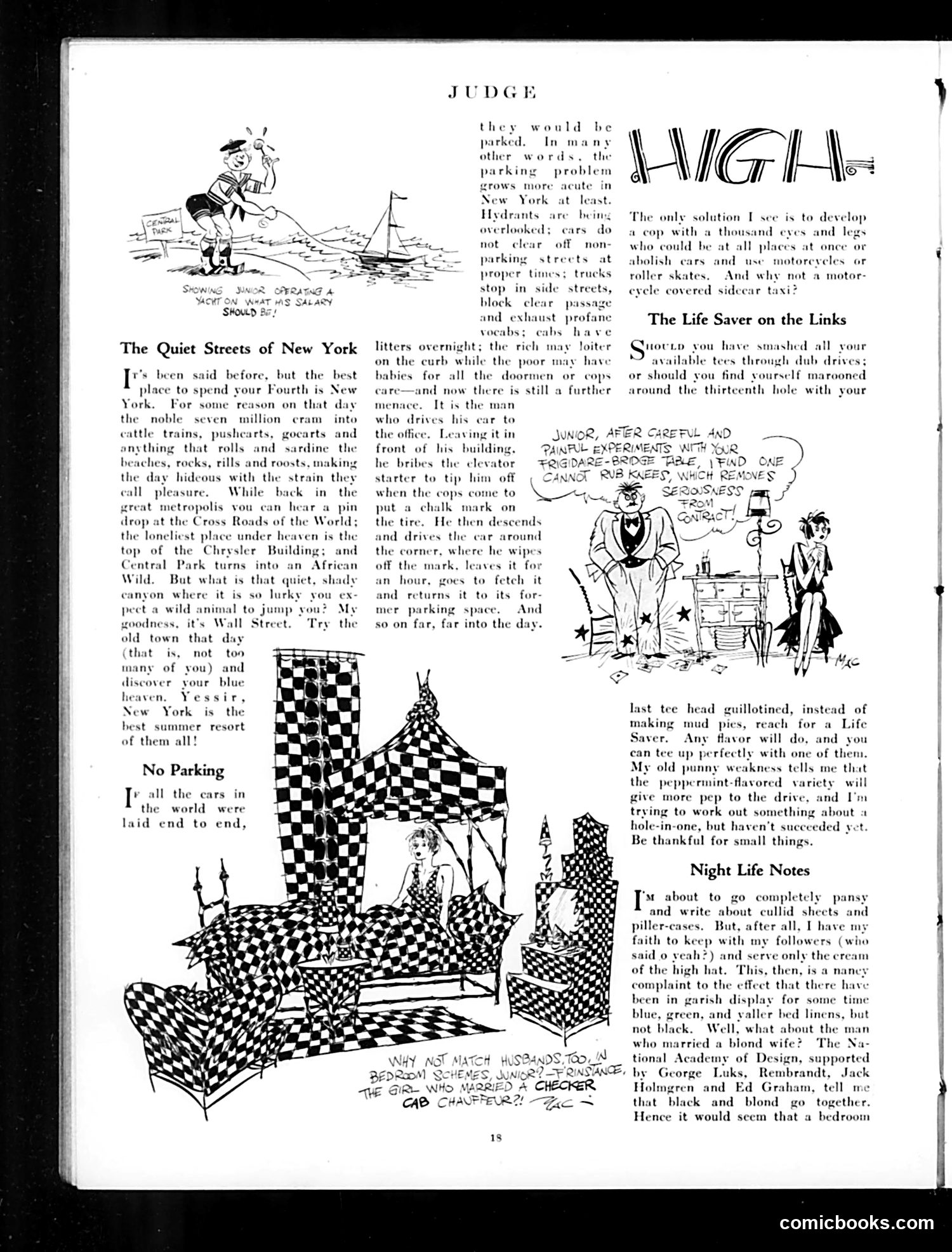
Judge Magazine Page Analysis This page from the satirical magazine *Judge* contains three humorous essays mocking modern urban frustrations circa the 1920s-30s: "The Quiet Streets of New York" jokes that while millions flee the city on July 4th, those remaining discover unexpected peace—even Wall Street becomes serene. "No Parking" satirizes the chronic parking crisis in New York City. It describes a man who bribes an elevator starter to alert him when police arrive to chalk his tires, then moves his car around the corner to erase the mark and repeat the scheme. The accompanying illustration shows an elaborate checkered cityscape. The essay proposes absurd solutions like employing a "cop with a thousand eyes" or replacing cars with motorcycles. "The Life Saver on the Links" and "Night Life Notes" are lighter social commentaries about golf snacks and bedsheet colors, respectively. The cartoons use exaggeration and visual humor typical of *Judge's* style. The satire targets urban congestion, bureaucratic annoyance (parking enforcement), and petty social concerns—issues that remain recognizable today.
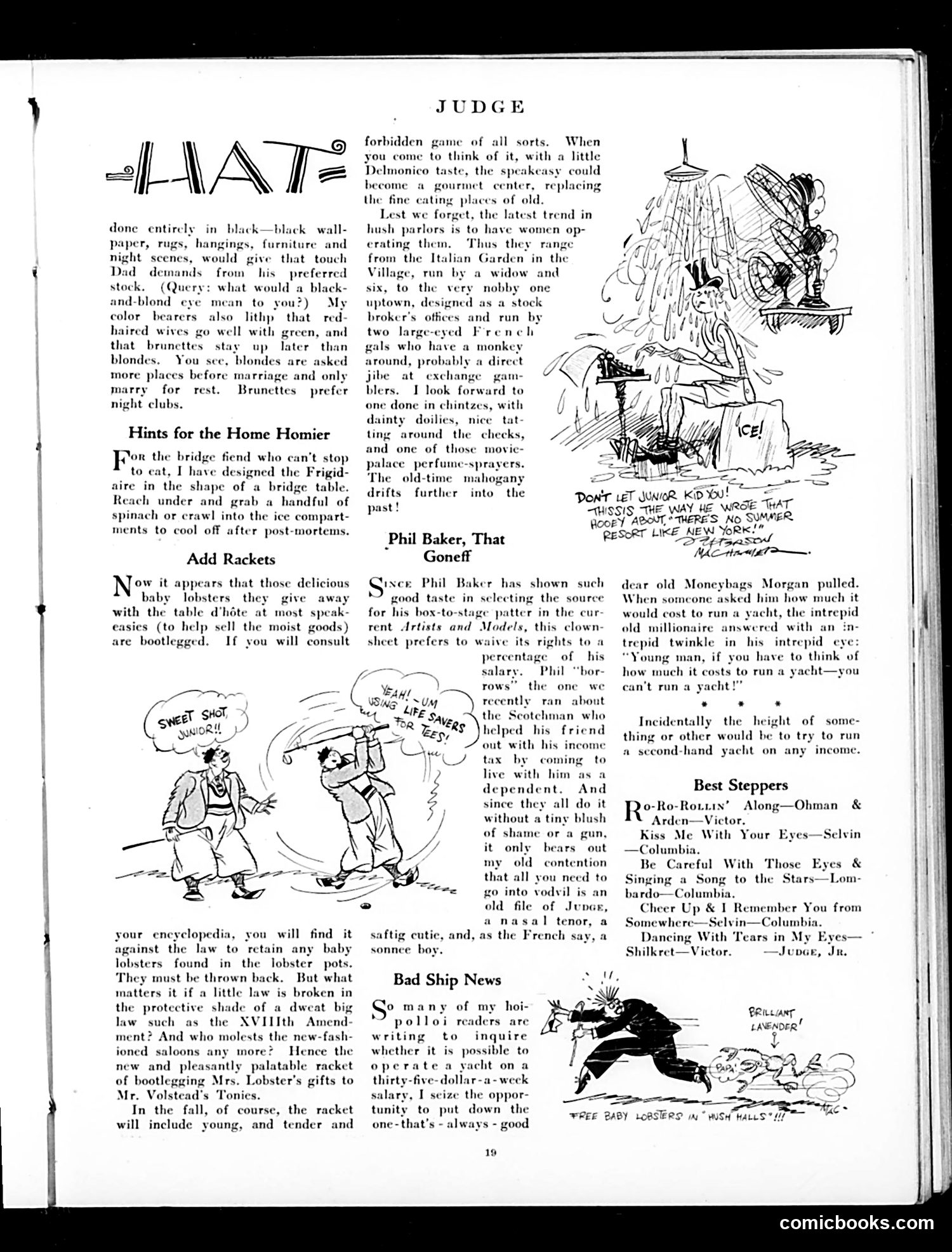
Judge Magazine Page Analysis This page from *Judge* satirizes 1920s Prohibition-era social trends and entertainment tastes. The "Hints for the Homier" section mocks wealthy socialites' interior design obsessions—bridge tables shaped like actual bridges, ice compartments for cooling off after card games. It also notes the illegal trade in "bootlegged" baby lobsters, slyly commenting on how Prohibition has made even fine dining venues into law-breaking speakeasies that nonetheless attract elite clientele. The "Phil Baker" column praises comedian/vaudeville performer Phil Baker for his good taste in selecting material from *Artists and Models*, then anecdotally contrasts this with a Scotsman's frugality—using income tax avoidance schemes by taking in a dependent. The cartoons depict typical Prohibition-era absurdities: people discussing illegal alcohol ("Sweet Shot Juices"), and what appears to be a sailing mishap ("The Baby Lobster in High Heels!!!"). The page's overall message: even as Prohibition officially bans alcohol, the wealthy openly patronize illegal establishments while maintaining pretenses of respectability. The humor relies on readers' familiarity with this hypocrisy and the era's speakeasy culture.
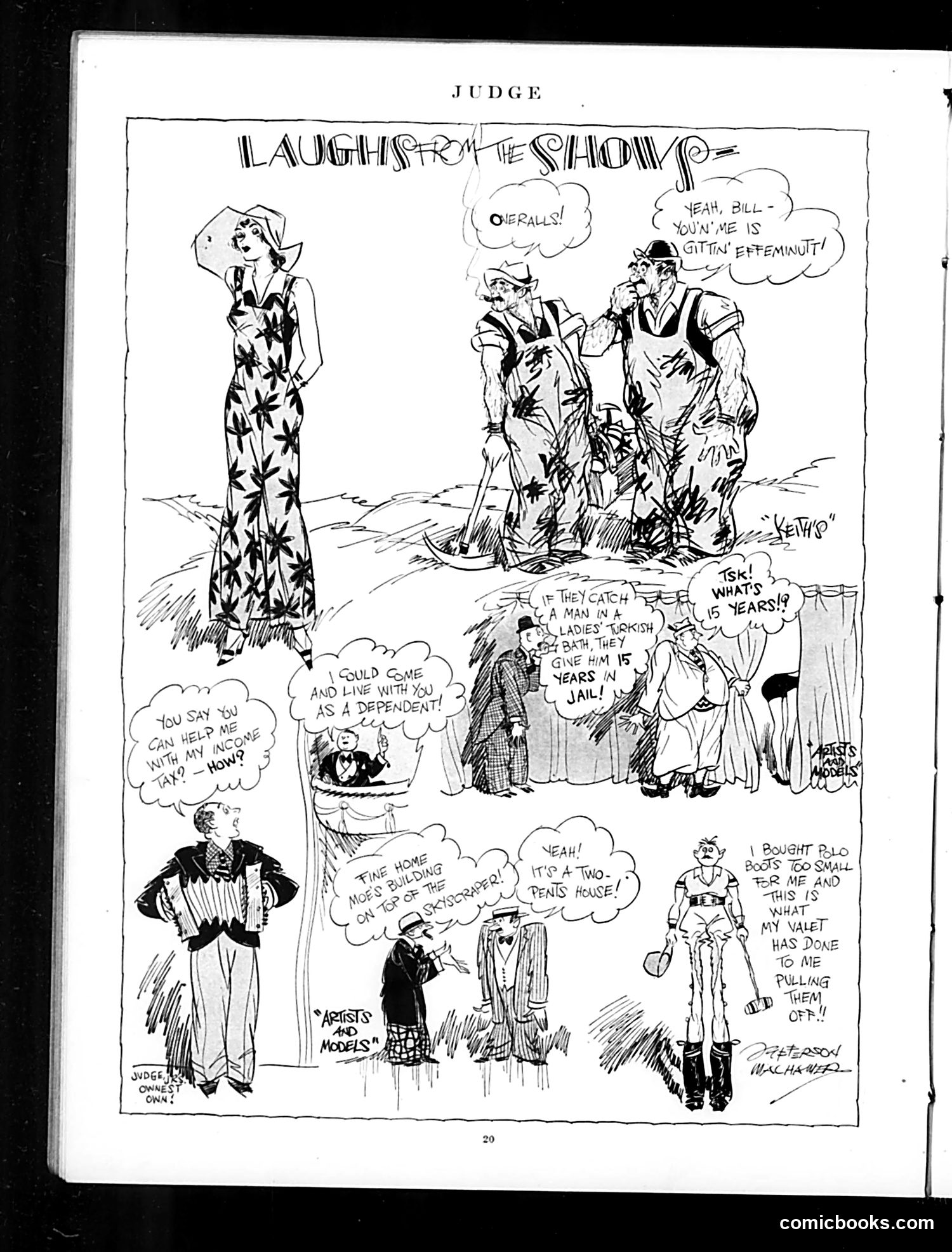
"Laughs from the Show" This Judge magazine page satirizes post-WWI domestic life and changing social conditions. The cartoon depicts multiple scenarios about economic hardship and housing shortages following the war: A woman offers financial help "as a dependent," referencing women's limited legal and economic status. Men discuss catching a vagrant in "ladies' clothing" and jail sentences, suggesting post-war vagrancy concerns. The housing crisis appears prominently: characters discuss a "two-tents house" and "more building on top of the skyscraper" as solutions to severe housing shortages that plagued America in the early 1920s. A final panel shows a cyclist complaining his valet has "pulled them off," likely referring to stolen bicycle tires—reflective of theft and material scarcity during the post-war period. The overall tone mocks both the desperation of ordinary people struggling with inflation, housing, and unemployment, and the absurd "solutions" proposed by the wealthy.
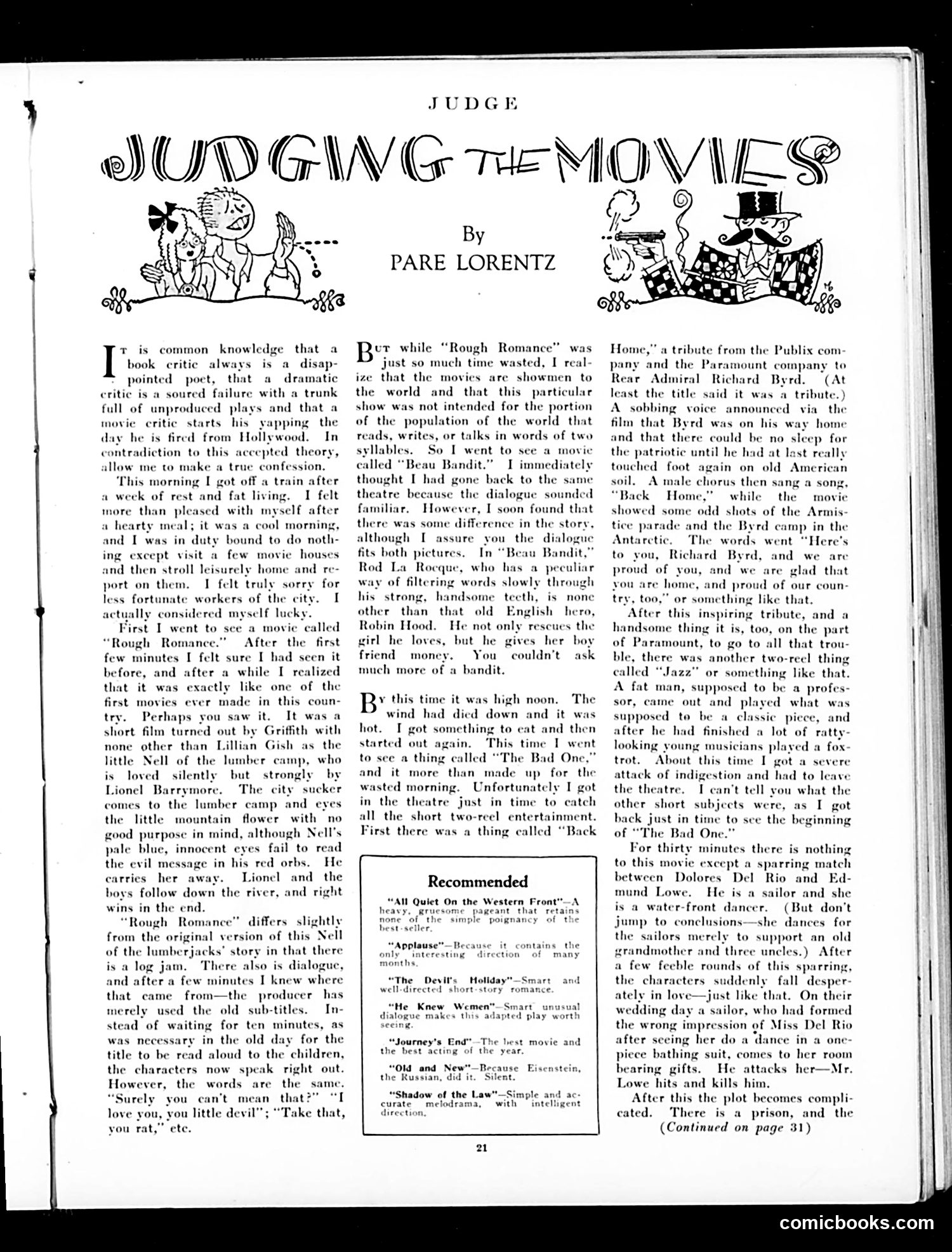
"Judging the Movies" by Pare Lorentz This is a film critic's essay disguised as light entertainment. Lorentz satirizes both movie critics AND the film industry itself. The Setup: A self-satisfied critic visits three movies in one day: "Rough Romance," "Beau Bandit," and "The Bad One." The humor lies in his discoveries—the first two films are nearly identical despite different titles, suggesting Hollywood's lazy recycling of plots. Key References: Rod La Rocque appears as a stock romantic hero in "Beau Bandit." The text mocks a patriotic short about Admiral Richard Byrd's Antarctic expedition, with laughably sentimental dialogue ("Here's to you, Richard Byrd..."). The Satire: Lorentz attacks Hollywood's contempt for audience intelligence—films made for people who "read, write, or talk in words of two syllables." He also ridicules jingoistic propaganda shorts. The critic's physical discomfort (indigestion) mirrors his intellectual distress at the movies' mediocrity. The piece is self-aware social commentary wrapped in casual film reviewing.
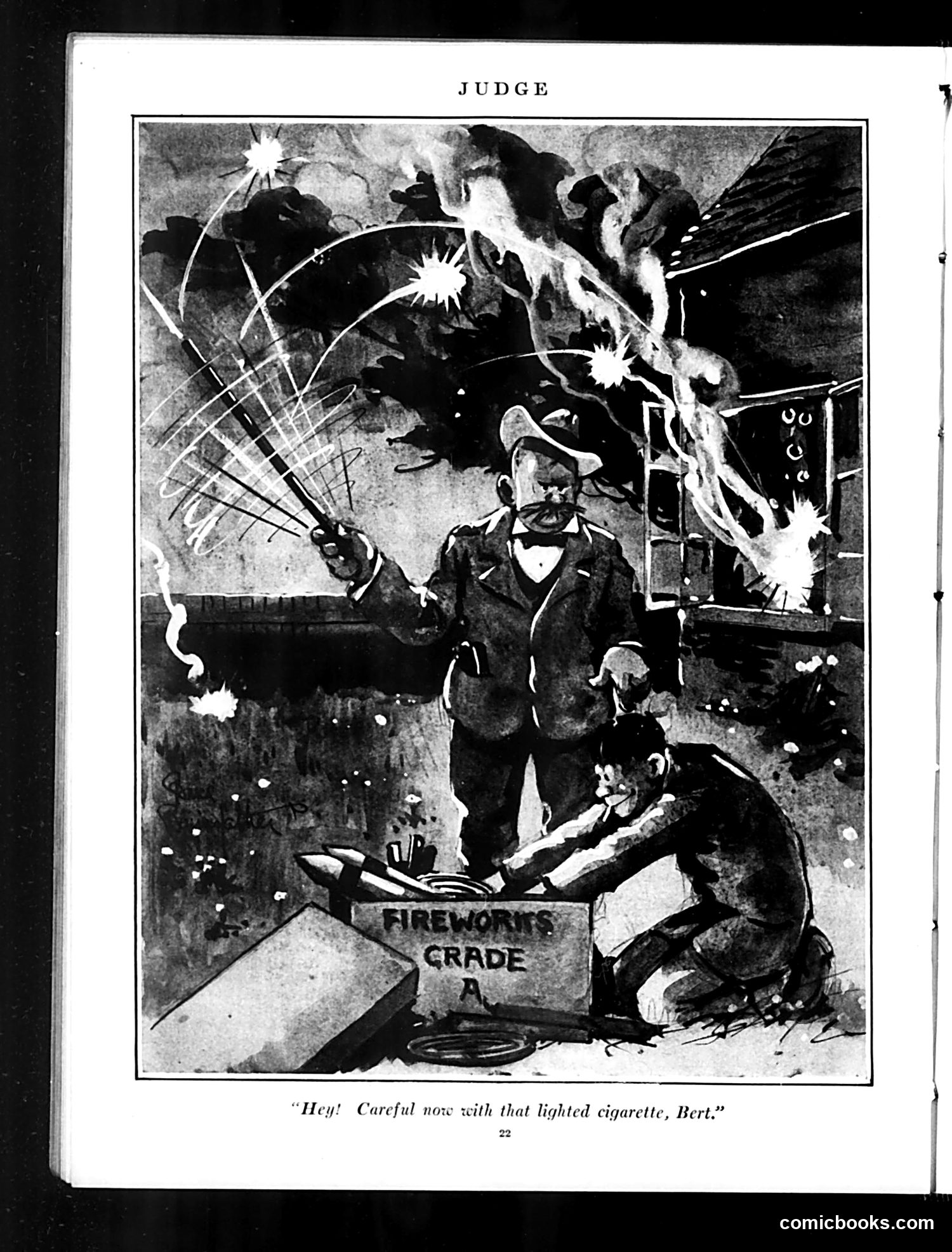
Political Cartoon Analysis This Judge magazine cartoon warns about dangerous fireworks handling. A man named Bert stands near a crate labeled "FIREWORKS GRADE," holding a lighted cigarette while another figure frantically gestures in alarm. The scene depicts explosives stored carelessly alongside an open flame—a genuinely hazardous situation. The satire appears to target either workplace safety negligence or possibly wartime munitions handling (Judge published during WWI and WWII eras, making armaments relevant). The cartoon mocks Bert's obliviousness to obvious danger, using the stark contrast between casual cigarette-smoking and proximity to explosives for dark comedic effect. The specific historical context—whether this addresses industrial safety, military production, or fireworks commerce—remains unclear without a date.
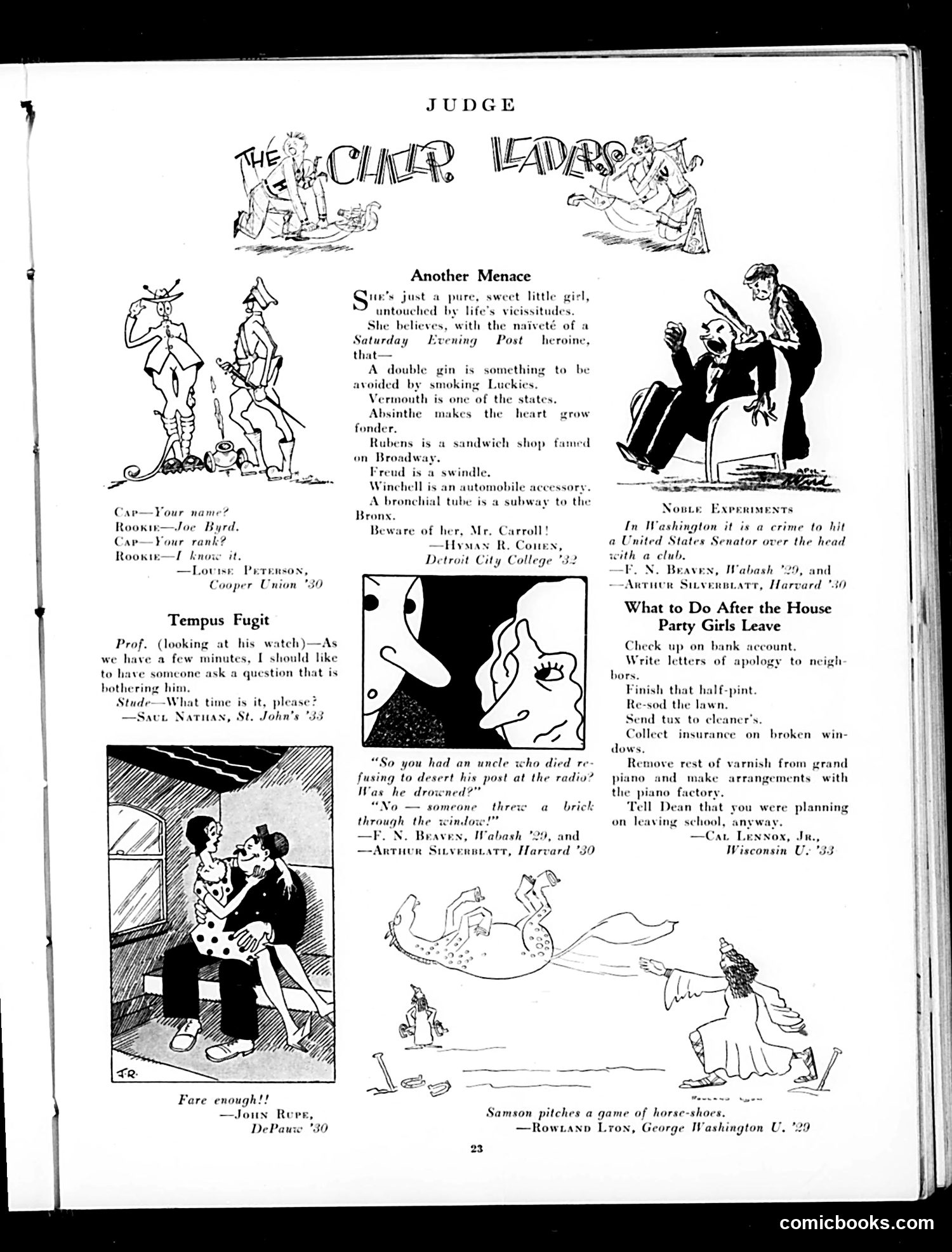
Analysis of Judge Magazine Page (Page 23) This page collects brief satirical jokes and cartoons from college contributors, typical of Judge's format. "The Chaser Leader" (top): A humorous military-style exchange where a rookie claims ignorance of his rank, poking fun at military incompetence. "Tempus Fugit": A professor offers to answer questions during class time; a student asks what time it is—satirizing student inattention and lazy thinking. "Another Menace": Mocks a naive young woman who confuses modern slang and references (thinking "Rubens" is a Broadway sandwich shop, "Winchell" an auto part, "bronchial tube" a subway). The satire targets either female naiveté or advertising's misleading influence on youth. "Noble Experiments" and "What to Do After House Party Girls Leave": Post-Prohibition-era jokes about drinking and wild behavior among college students and politicians. Lower cartoon: Depicts Samson playing horseshoes—a biblical reference to his strength, used here for unclear humorous effect. The page reflects 1920s-30s college humor: youth excess, Prohibition-era drinking culture, and generational attitudes toward women and propriety.
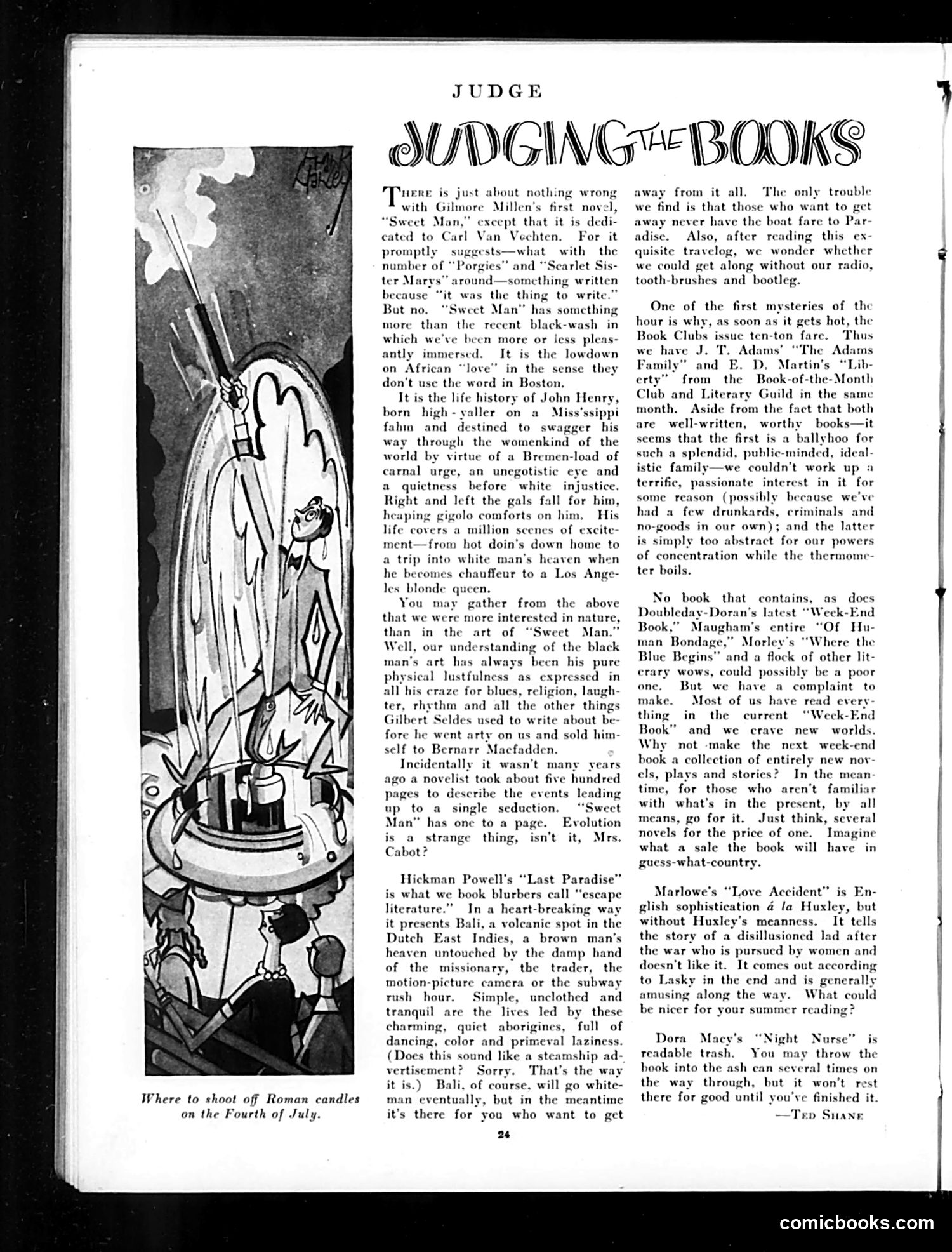
Judge Magazine Book Review Page This is a book review column titled "Judging the Books," not a political cartoon. The illustration shows a figure shooting Roman candles (fireworks) skyward on the Fourth of July—a seasonal joke playing on the phrase "where to shoot off Roman candles." The reviews discuss recent novels with racial undertones typical of 1920s-30s literary discourse. "Sweet Man" by Gilmore Millen is critiqued for depicting an African American protagonist through a lens of "physical lustfulness" and "craze for blues." The reviewer praises Hickman Powell's "Last Paradise" as escapist literature about Bali before modernization. The piece reflects Judge magazine's satirical approach to contemporary publishing trends, including criticism of Book-of-the-Month Club selections and complaints about exhausted literary content. The tone is dismissive of both "primitivist" literary trends and middlebrow book club culture popular with American readers of that era.
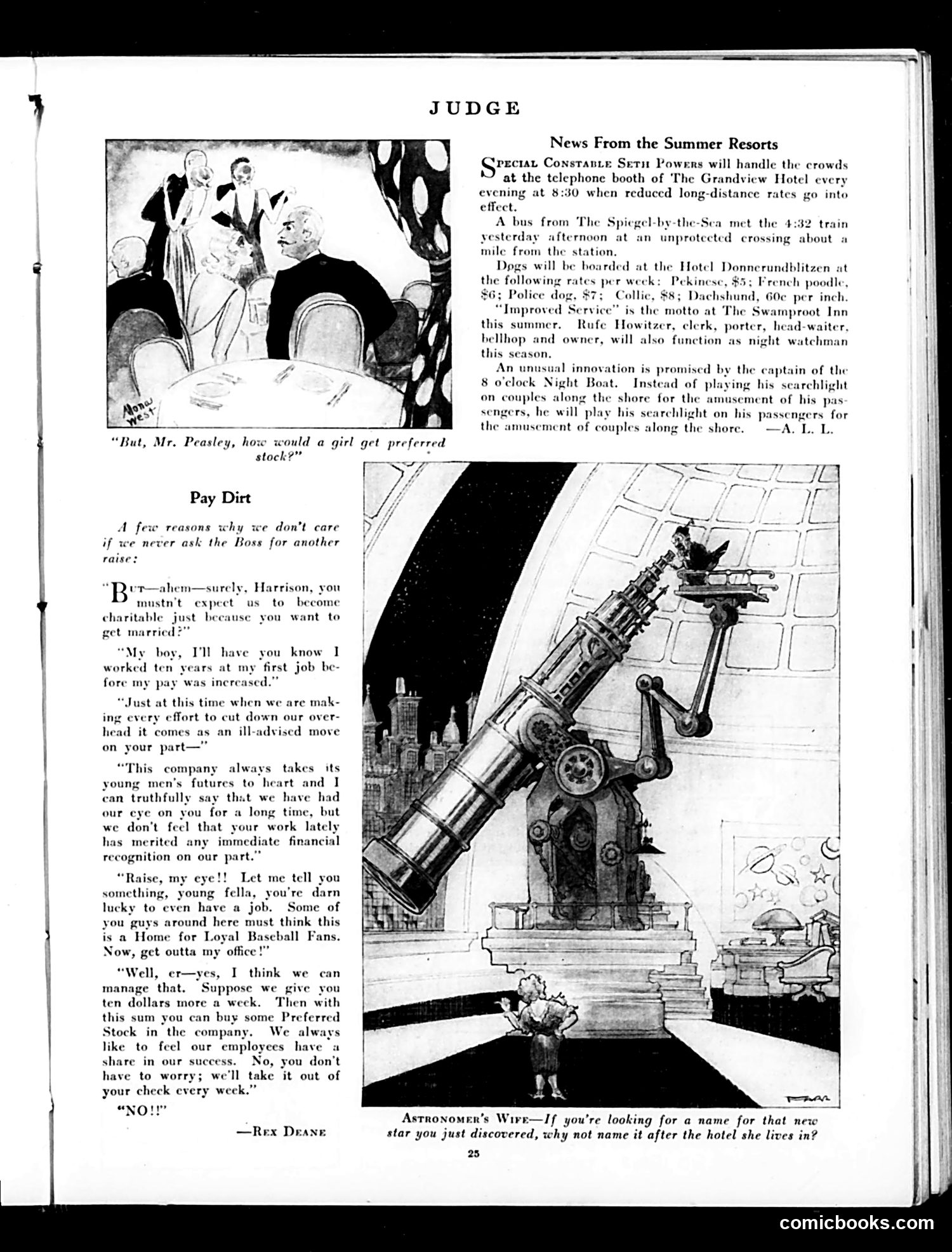
"Pay Dirt" – A 1920s Satire on Corporate Stinginess This comic by Rex Deane mocks employer excuses for denying wage raises. An employee (Harrison) requests a raise to afford marriage, but his boss delivers a series of classic corporate deflections: the company has been "watching" him but his recent work doesn't warrant it; times are tight; he's "lucky to have a job" (especially with unemployment/post-WWI concerns); and as a final insult, the boss offers a tiny $10 weekly increase—only to have the employee buy company stock with it, which the company will deduct from his paycheck anyway. The joke's bitterness reflects Depression-era labor frustrations: workers remained underpaid while employers extracted loyalty and forced investment. The punchline "NO!!" captures worker exasperation at this circular trap. The cartoon satirizes corporate paternalism—the pretense that companies care about employees' futures while systematically preventing financial advancement.
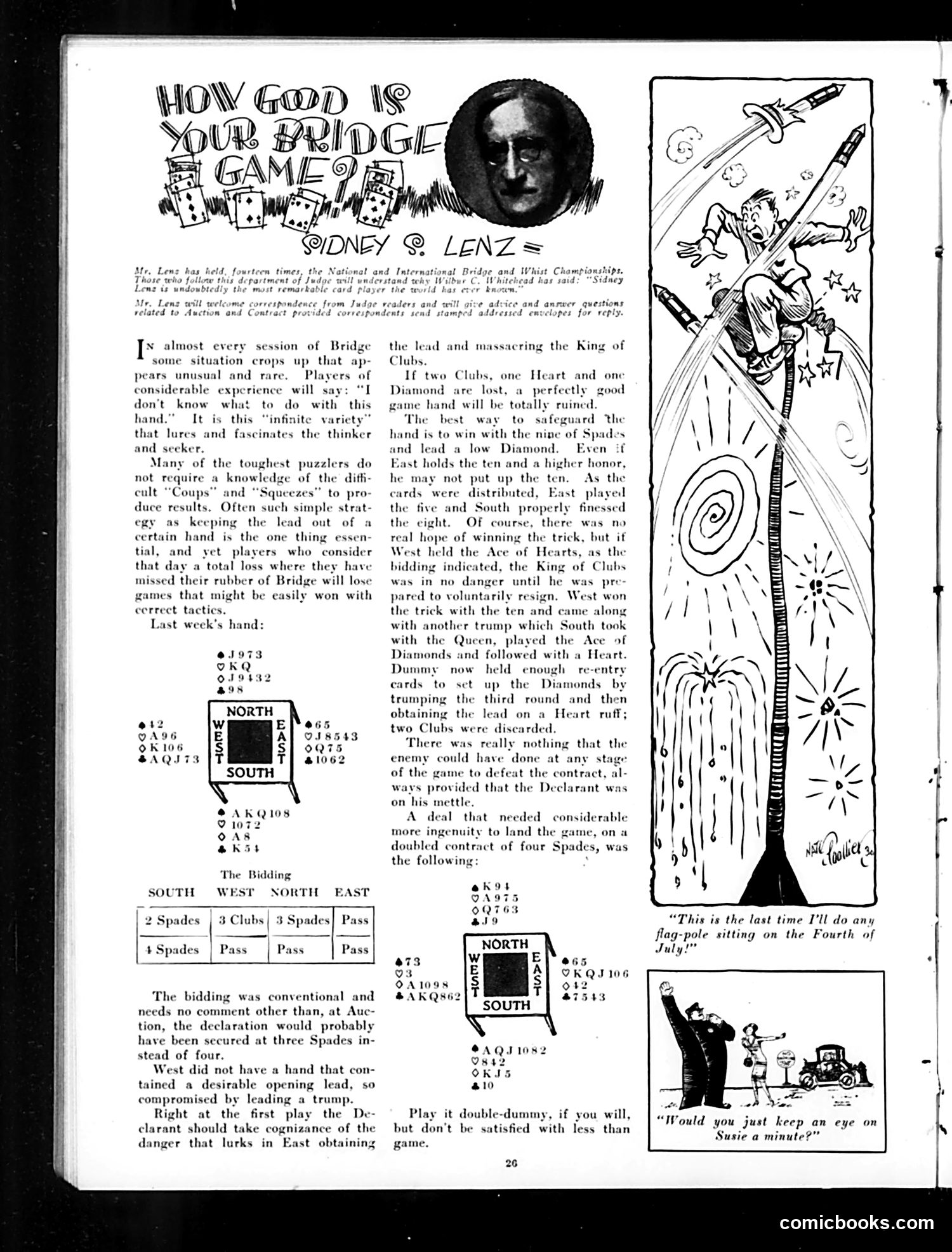
Analysis for Modern Readers This page from *Judge* magazine contains a bridge card game column by Sidney Lenz, a renowned bridge expert of the era. The main content is instructional—explaining card-playing strategy and analyzing a specific hand's bidding and play. The cartoons are humorous asides unrelated to bridge: one shows a flagpole sitter (a 1920s fad where people sat atop poles for extended periods, often for publicity), declaring he's done with the stunt; the other depicts a man asking someone to watch "Susie" while he attends to something—likely commenting on parenting or romantic complications. The page reflects *Judge*'s mix of satire, humor, and practical instruction. The bridge content appeals to educated, leisure-class readers, while the cartoons mock contemporary fads (flagpole sitting) and social situations. This reflects the magazine's audience: affluent Americans interested in card games, current events, and gentle social comedy.
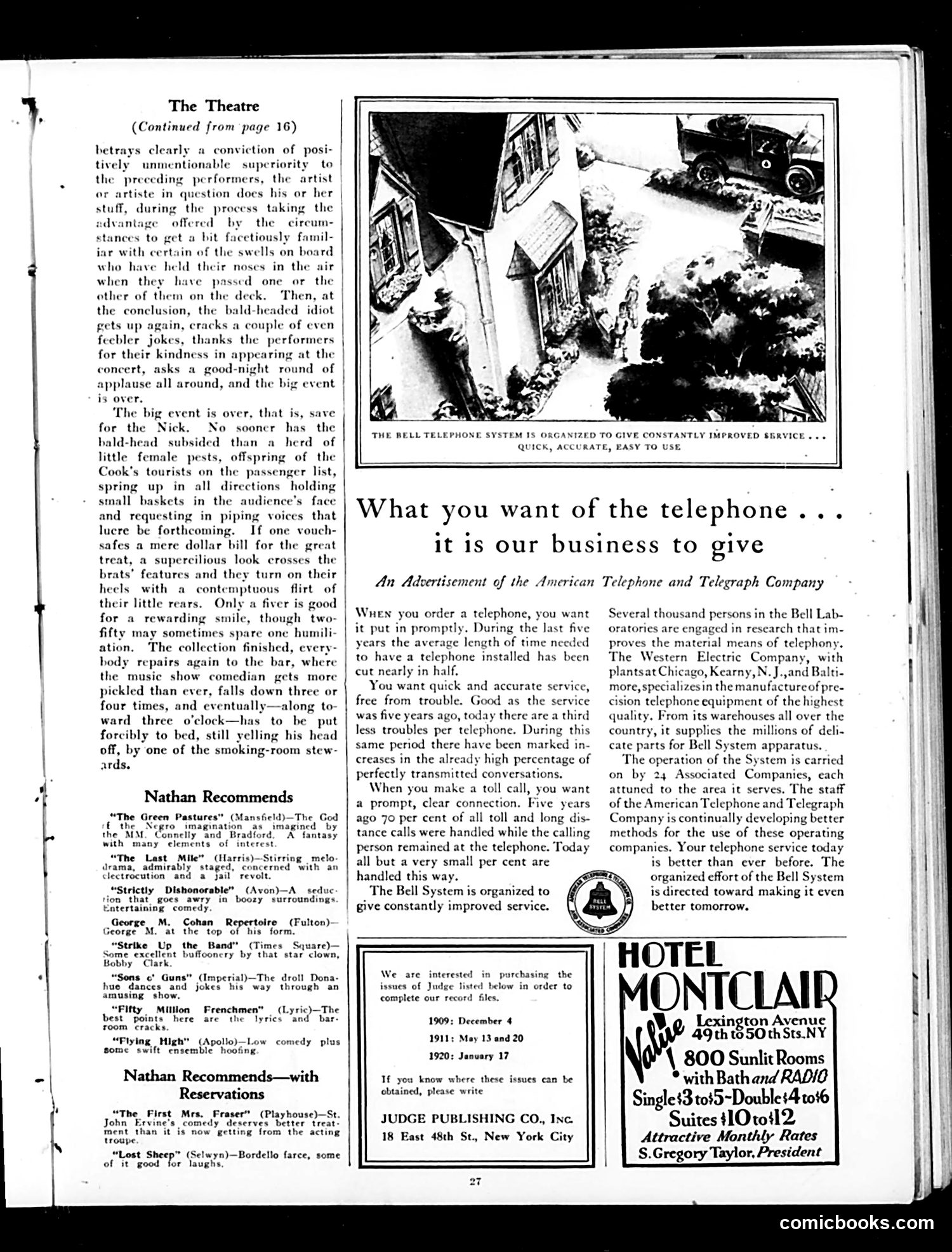
Analysis for Modern Readers This page contains two distinct elements: theater reviews and advertising. Theater Section: Nathan (the critic) reviews contemporary Broadway shows from what appears to be the late 1920s, recommending plays like "The Green Pastures" and "Strictly Dishonorable." The opening passage satirizes shipboard entertainment—a bald-headed cruise director telling bad jokes, passengers enduring mediocre performances, and aggressive child performers collecting tips from the audience with increasing demands based on donation size. It's humor about forced gaiety and commercial exploitation in leisure settings. Advertisement: The Bell Telephone System ad emphasizes service improvements over five years—faster installation, fewer troubles, better long-distance connections. It's corporate messaging about infrastructure reliability, presented matter-of-factly rather than satirically. The page reflects 1920s American leisure culture and early telecommunications marketing before modern expectations existed.
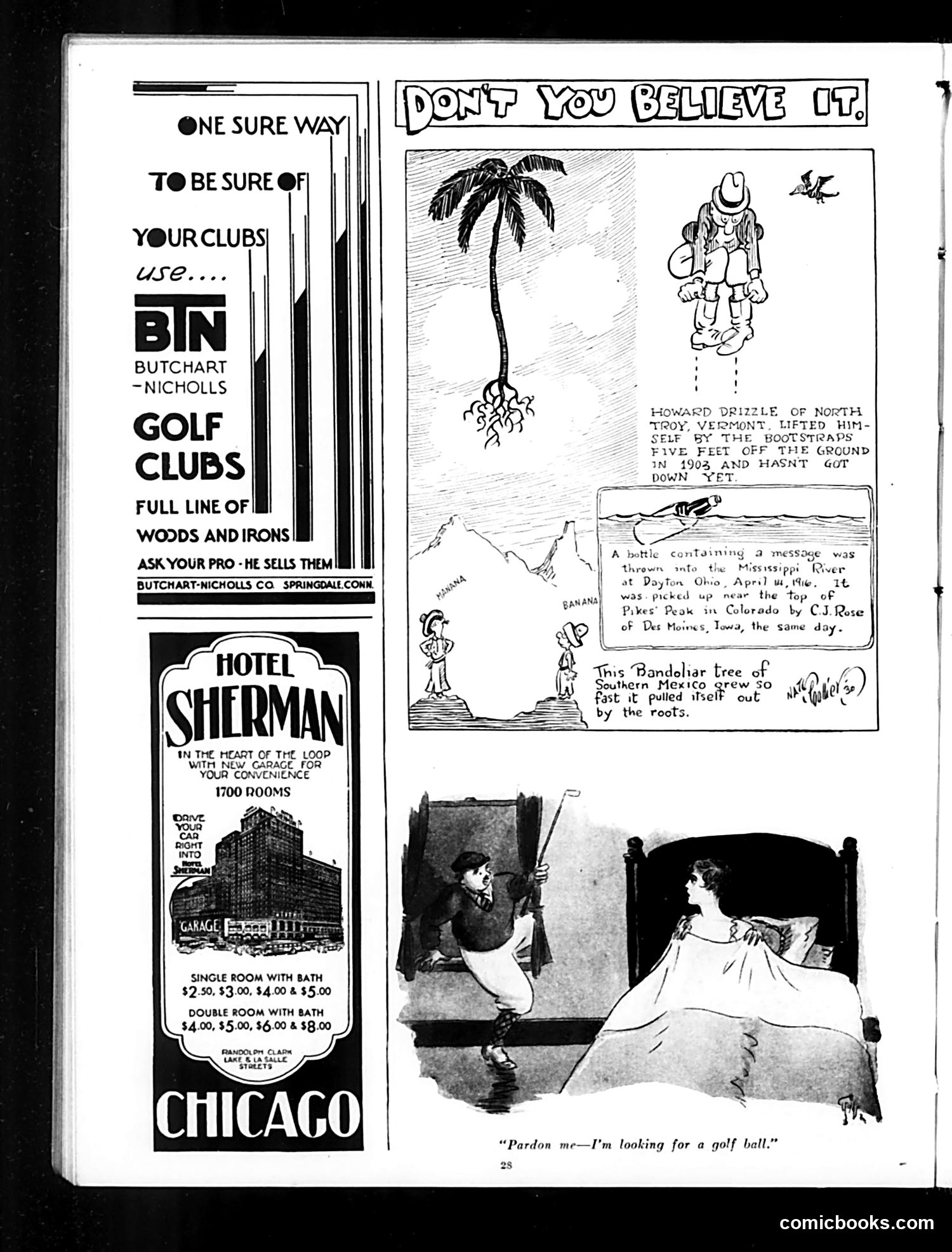
Analysis of This Judge Magazine Page This page combines advertisements with a tall-tale cartoon typical of early 20th-century humor magazines. The Main Cartoon ("Don't You Believe It"): The central feature presents three absurd, impossible scenarios presented as fact: 1. Howard Drizzle supposedly lifted himself five feet off the ground by his bootstraps in 1903 and remains suspended 2. A bottle thrown into the Mississippi River in Ohio somehow reached Pike's Peak in Colorado instantly 3. A Mexican tree grew so fast it uprooted itself These exaggerated impossibilities were staples of American folklore humor—the "tall tale" tradition. The joke relies on readers recognizing the absurdity while the text deadpan presents them as documented facts. The Bottom Illustration: Shows a woman in bed asking a man with a golf club to leave, saying "I'm looking for a golf ball"—a double-entendre suggesting the man was in her bedroom under false pretenses. Context: The page is primarily advertising (golf clubs, Hotel Sherman in Chicago, etc.), with the cartoon serving as entertainment filler between commercial messages—typical Judge magazine layout of this era.
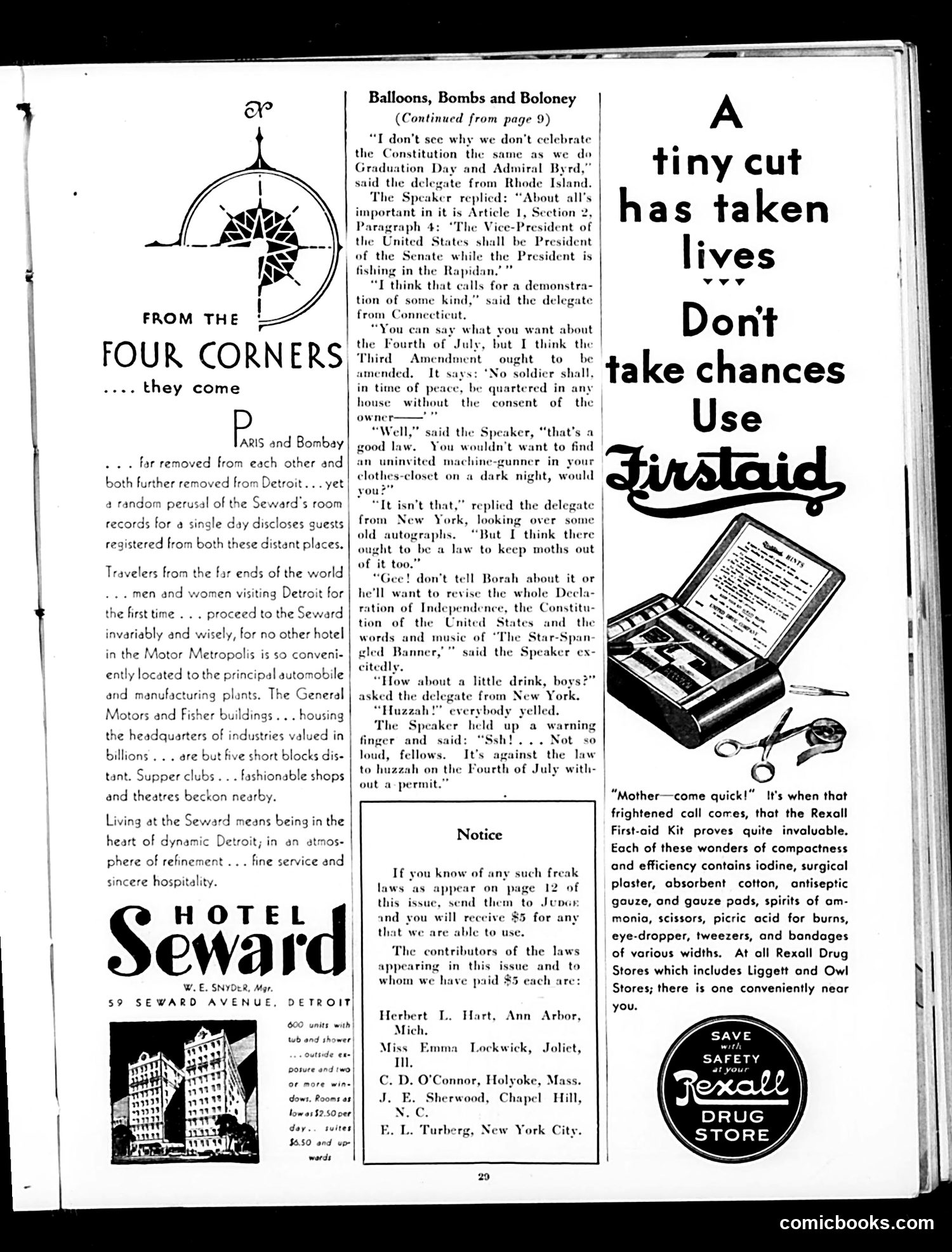
Content Explanation for Modern Readers This page contains a satirical piece titled "Balloons, Bombs and Boloney" (continued from earlier) depicting Congressional delegates debating absurd interpretations of the U.S. Constitution. The humor stems from their trivial concerns: one delegate suggests amending the Third Amendment to prevent moths from infesting soldiers' quarters; another references "Borah" (likely Senator William Borah, a prominent isolationist), suggesting he'd want to revise foundational American documents over minor issues. The satire mocks both legislative pedantry and Prohibition-era hypocrisy—a delegate excitedly offers drinks before being warned that even "huzzahing" on July 4th without a permit violates law. The page also features advertisements for Hotel Seward in Detroit and Rexall First-aid kits, typical of magazine content from this era (likely 1920s-1930s based on references and style).
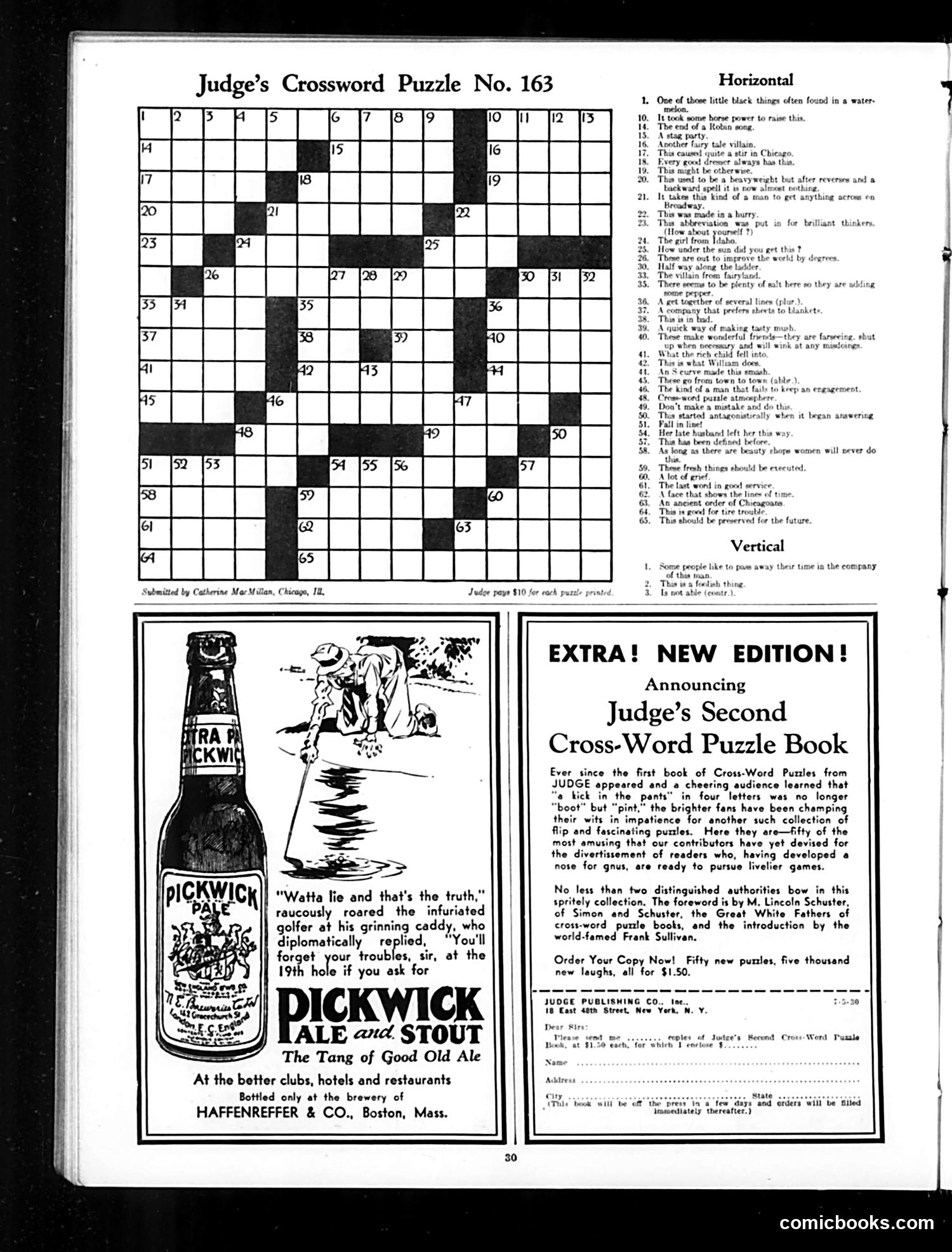
Judge Magazine Page 163 Analysis This page contains Judge's Crossword Puzzle No. 163 — the main content — alongside advertisements and promotional material for a new crossword puzzle book. The Dickwick Pale and Stout advertisement features a cartoon golfer and caddy. The caddy, responding to the golfer's frustrated outburst, suggests the golfer "forget your troubles" by ordering beer at the nineteenth hole. This plays on the era's casual attitude toward alcohol consumption (this appears pre-Prohibition repeal) and uses humor to sell beer by positioning it as a stress-reliever. The right panel announces Judge's Second Cross-Word Puzzle Book, capitalizing on the 1920s crossword craze. It references contributors like Frank Sullivan and publishers Simon and Schuster, positioning the collection as premium entertainment for readers who enjoyed "livelier games." The page is primarily advertising and promotion rather than satirical content. No specific political figures or major social commentary appear, though the beer ad reflects period attitudes toward drinking as casual recreation.
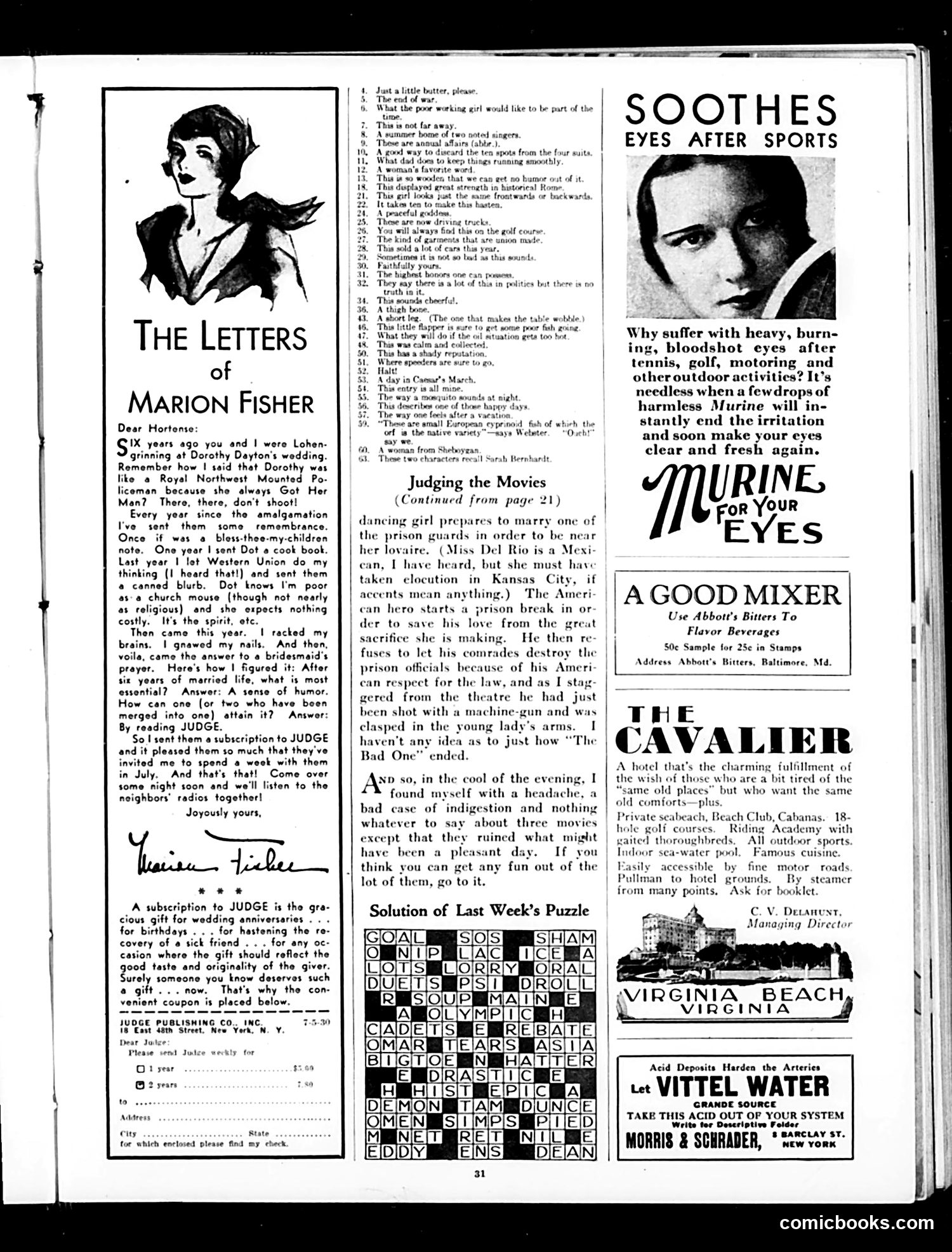
Analysis of This Judge Magazine Page This page primarily contains letters, puzzles, and advertisements rather than political cartoons. "The Letters of Marion Fisher" is a humor column where Marion recounts sending Judge magazine subscriptions as wedding anniversary gifts—framed as the perfect present because married couples need humor to survive. The joke reflects 1920s domestic humor: marriages require constant comic relief. "Judging the Movies" reviews three films, criticizing their plots as predictable melodrama. The reviewer describes a prison break film with a dancing girl and American hero, mocking its sentimentality and convenient endings. This satirizes Hollywood's formulaic storytelling of the silent film era. The page also includes: - A crossword puzzle solution - Murine eye drops advertisement (ironically placed under "Soothes Eyes After Sports") - Hotel and beverage advertisements The satire is gentle domestic humor about married life and Hollywood conventions, typical of Judge's 1920s content. No specific political figures or events are referenced.
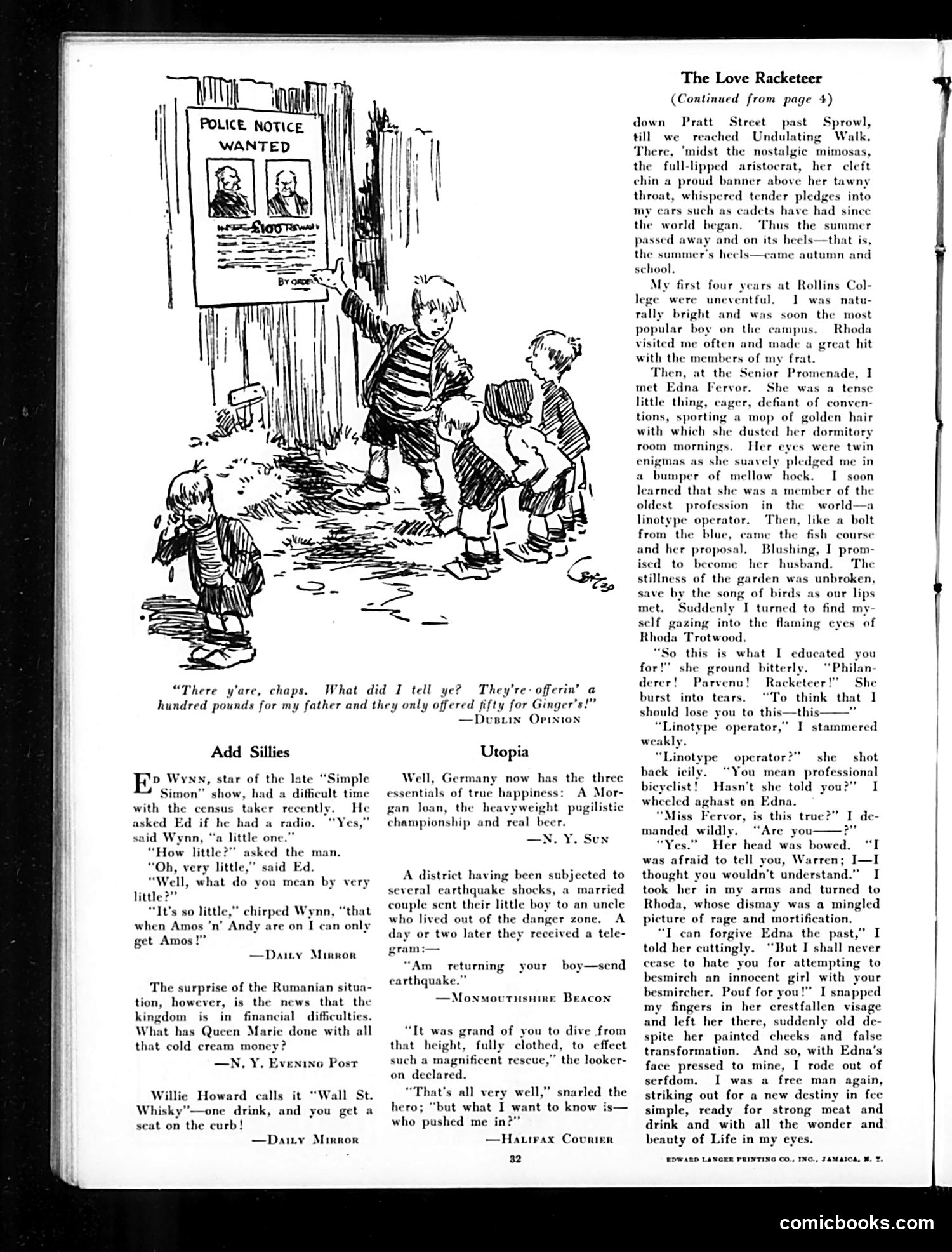
Judge Magazine Satire Analysis The main cartoon depicts children reading a "POLICE NOTICE WANTED" poster, joking about bounties on criminals. A child complains that his father has a higher price on his head (100 pounds) than "Ginger's" father (50 pounds)—a dark humor piece playing on the idea of criminal notoriety as social status. The "Add Sillies" section contains brief jokes: Ed Wynn's radio is so small "when Amos 'n' Andy are on I can only get Amos" (a reference to the popular radio show); a jab at Queen Marie of Romania's cosmetics spending; and a quip about Wall Street speculators ("one drink, and you get a seat on the curb"). The right page continues a serialized romantic comedy story ("The Love Racketeer") about a man discovering his girlfriend is a linotype operator—presented as a scandalous secret worthy of melodramatic betrayal. The overall tone reflects 1920s-era humor: casual class commentary, references to contemporary celebrities and entertainment, and light satirization of current events.
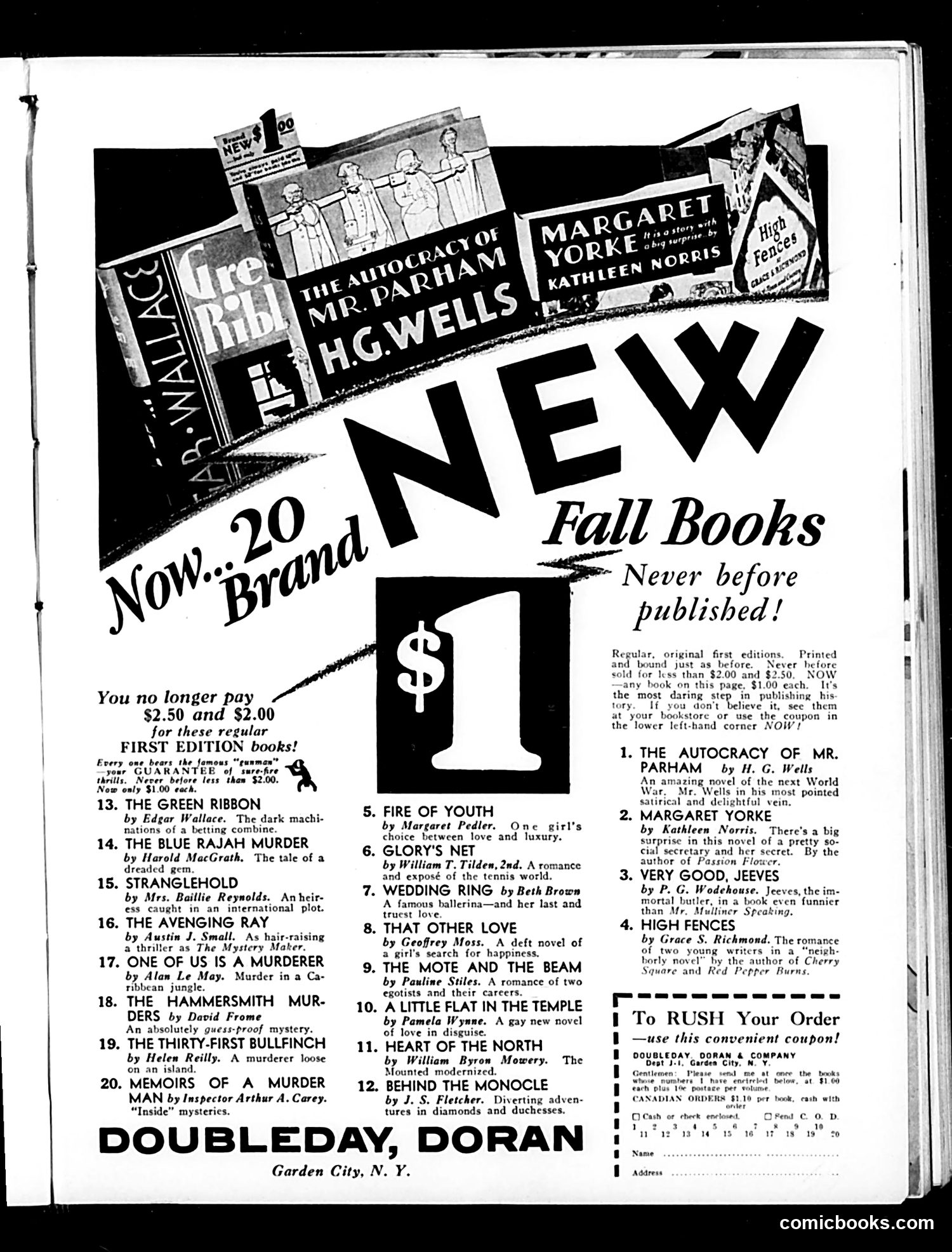
Judge Magazine Book Advertisement Analysis This is primarily a book advertisement, not a political cartoon. It promotes Doubleday, Doran's new pricing strategy: selling previously expensive first-edition books ($2.00-$2.50) for $1.00 each—a significant Depression-era discount. The page lists 20 titles, mostly popular fiction of the period by authors like H.G. Wells, P.G. Wodehouse, and Edgar Wallace. The top banner showcases films adapted from books, suggesting cross-media marketing. The "satire" is gentle: the headline "Now...20 Brand NEW Full Books / Never before published!" plays on the apparent paradox of selling "new" reprinted editions. The message promises readers they're getting authentic first editions at unprecedented prices—a consumer-friendly pitch during economic hardship. This reflects early 20th-century publishing's transition toward mass-market paperbacks and democratized access to literature, while maintaining the prestige of "first edition" status.
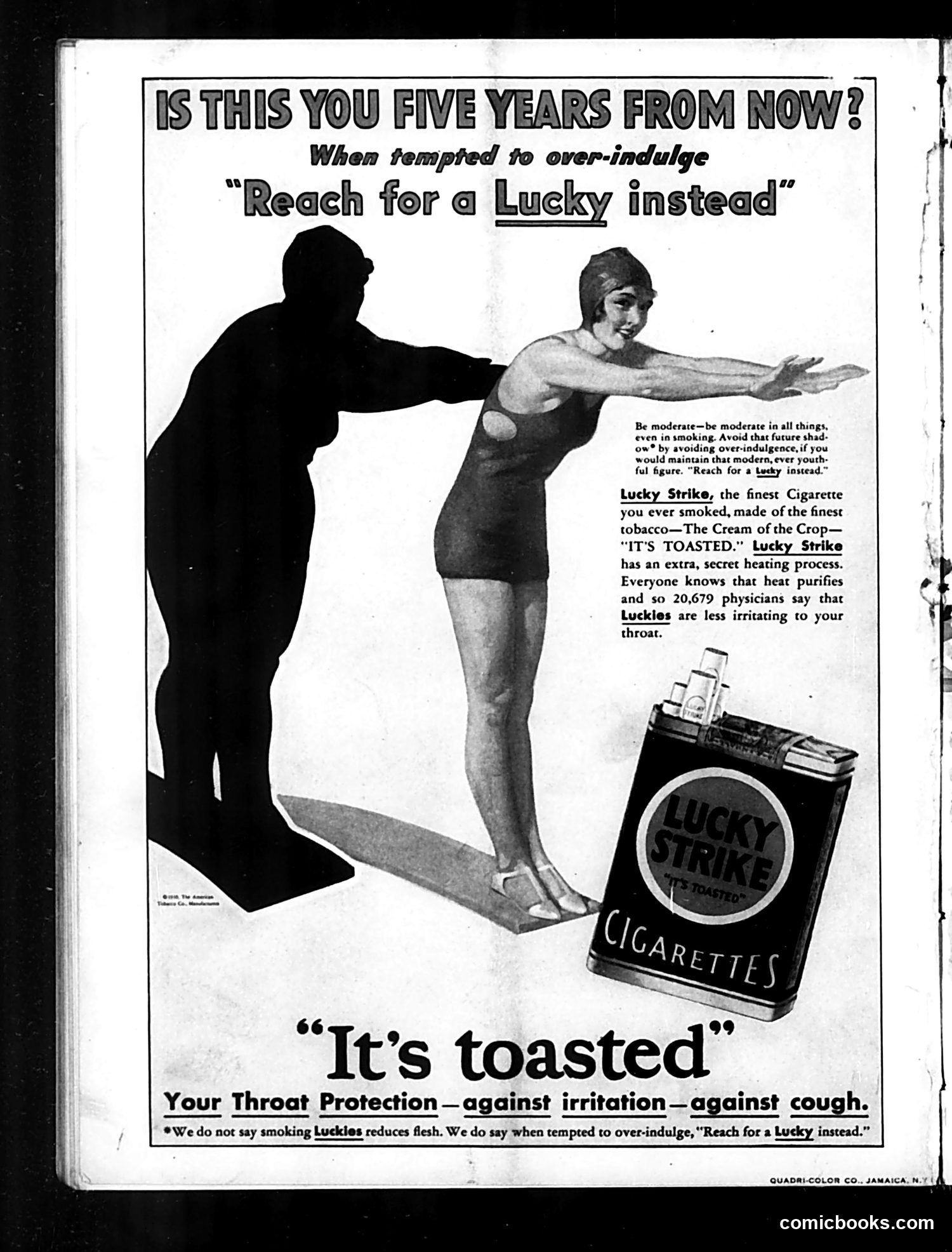
Analysis This is a Lucky Strike cigarette advertisement, not satire. It uses fear-based marketing targeting women's body image anxieties—a common advertising tactic of the 1920s-30s era. The ad shows a shadowy older, heavier woman looming over a slim young woman in a bathing suit, asking "Is this you five years from now?" The implicit message: smoking Lucky Strikes prevents weight gain. The text explicitly claims the cigarette offers "throat protection" through a "toasting" process, citing 20,679 physicians as endorsement. The footnote disclaimer—"We do not say smoking Luckies reduces flesh"—is legally protective while the entire ad's visual and verbal messaging contradicts this, suggesting cigarettes as a weight-control alternative to overeating. This represents the historical marketing strategy of positioning smoking as modern, sophisticated, and body-conscious, particularly appealing to women seeking to maintain fashionable slim figures.