judge
Judge — July 12, 1930
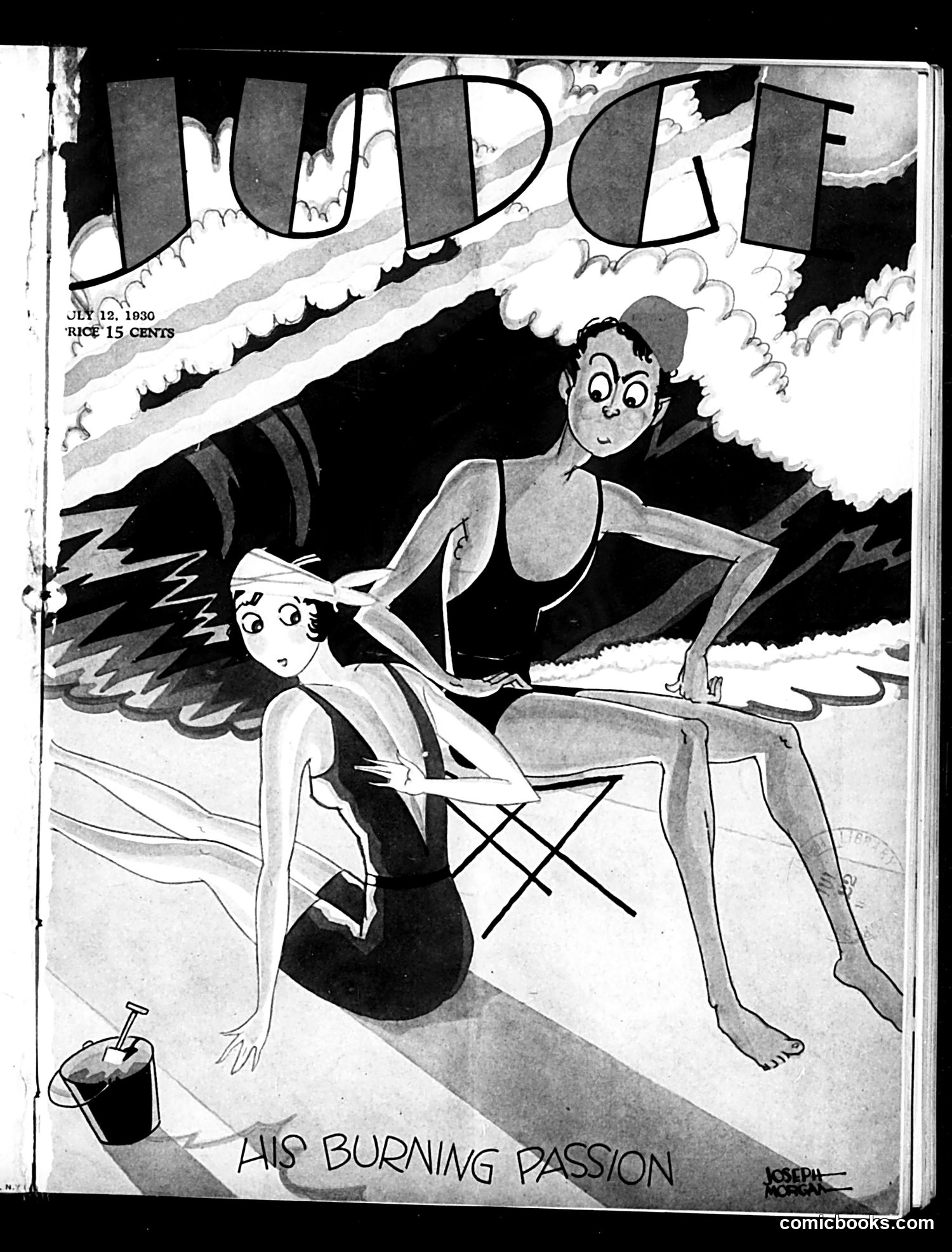
Analysis of Judge Magazine Cover (July 12, 1930) This cover depicts a beach scene titled "His Burning Passion." Two figures in swimming attire appear surprised or startled—one seated in a beach chair, another standing nearby. A large winged creature (possibly a bat or demon) looms menacingly in the background clouds above them. The satire likely comments on beach romance or summer flirtation interrupted by an unwelcome intrusion. The "burning passion" referenced in the title suggests a comedic take on romantic entanglements, with the monstrous figure representing either a jealous rival, an unwanted third party, or perhaps a humorous exaggeration of passion itself as something wild and uncontrollable. The joke relies on visual contrast between the peaceful beach setting and the grotesque interruption.
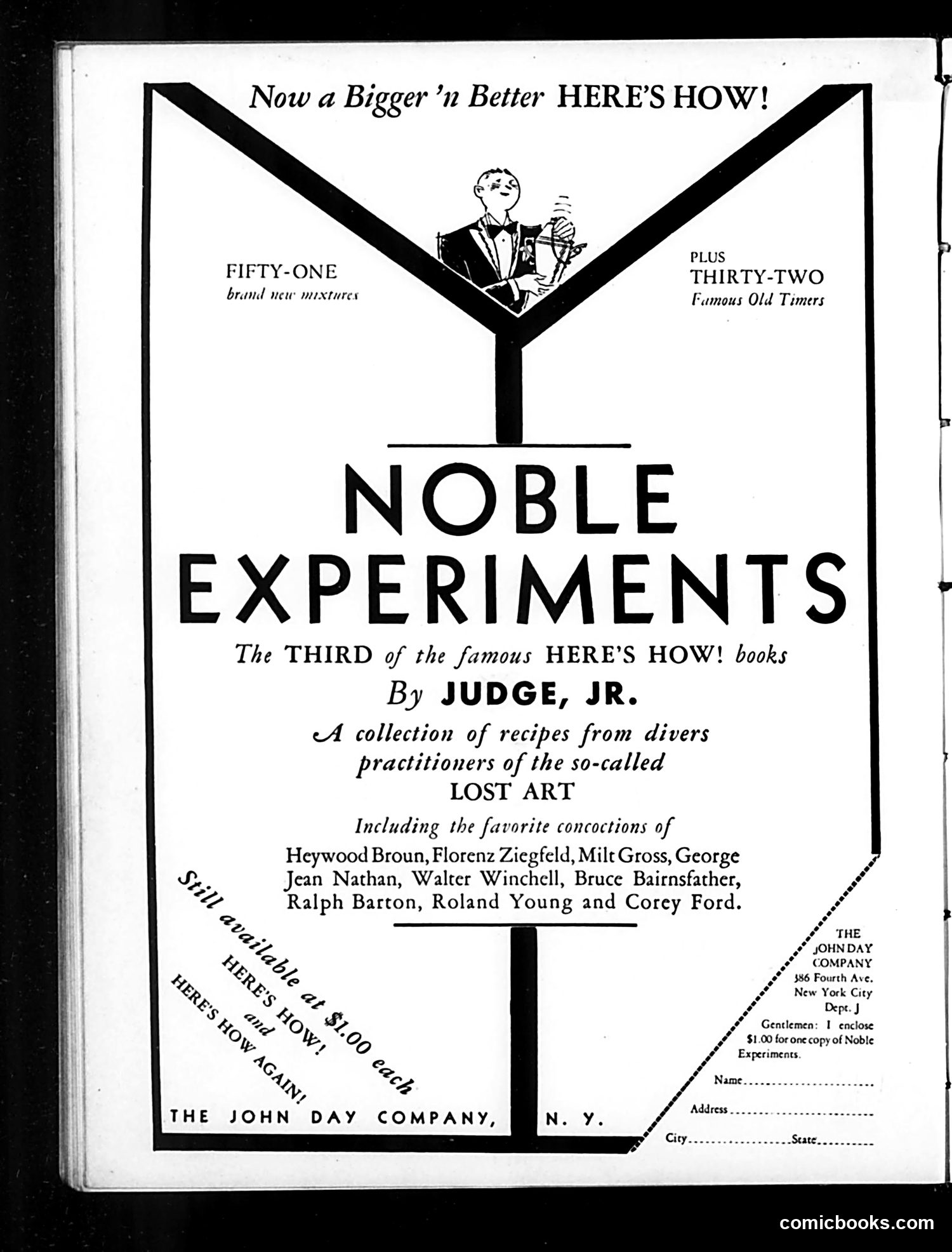
Noble Experiments Advertisement This is a book advertisement, not political satire. It promotes "Noble Experiments," the third in Judge magazine's "Here's How!" cookbook series by Judge Jr. The ad announces the book contains 51 new cocktail recipes plus 32 "famous old timers" (classic drinks). Contributors include celebrities like Heywood Broun, George Jean Nathan, and others. The phrase "Lost Art" references Prohibition (1920-1933)—the "Noble Experiment" was the government's actual term for alcohol bans. The ad humorously plays on this, selling cocktail recipes during an era when alcohol production and consumption were illegal. The joke is selling prohibition-era drinking guides under the government's own euphemism for the failed policy.
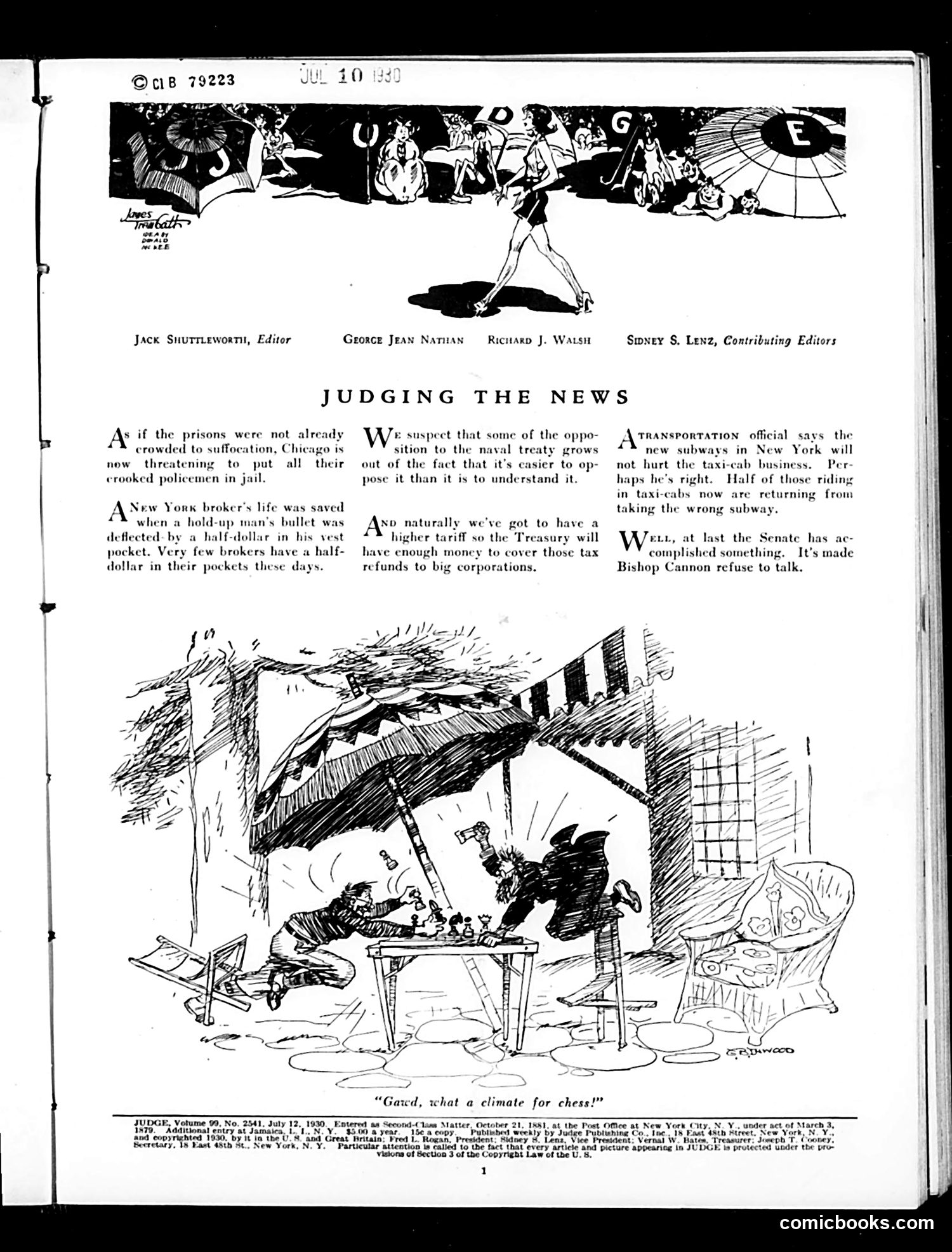
"Judging the News" - July 10, 1930 This page contains brief satirical commentaries on current events plus one cartoon. The main cartoon shows two men playing chess outdoors during a rainstorm, with the caption "Gaud, what a climate for chess!" The joke appears to be absurdist humor—the men are focused on their game despite terrible weather, commenting on human stubbornness or misplaced priorities. The text snippets above mock various 1930 issues: Chicago corruption, naval treaty negotiations, New York subway problems, tariff policy, and—notably—"Bishop Cannon," likely referring to James Cannon Jr., a prominent Methodist bishop involved in political scandal during this period. The overall tone is cynical commentary on government incompetence and moral hypocrisy.
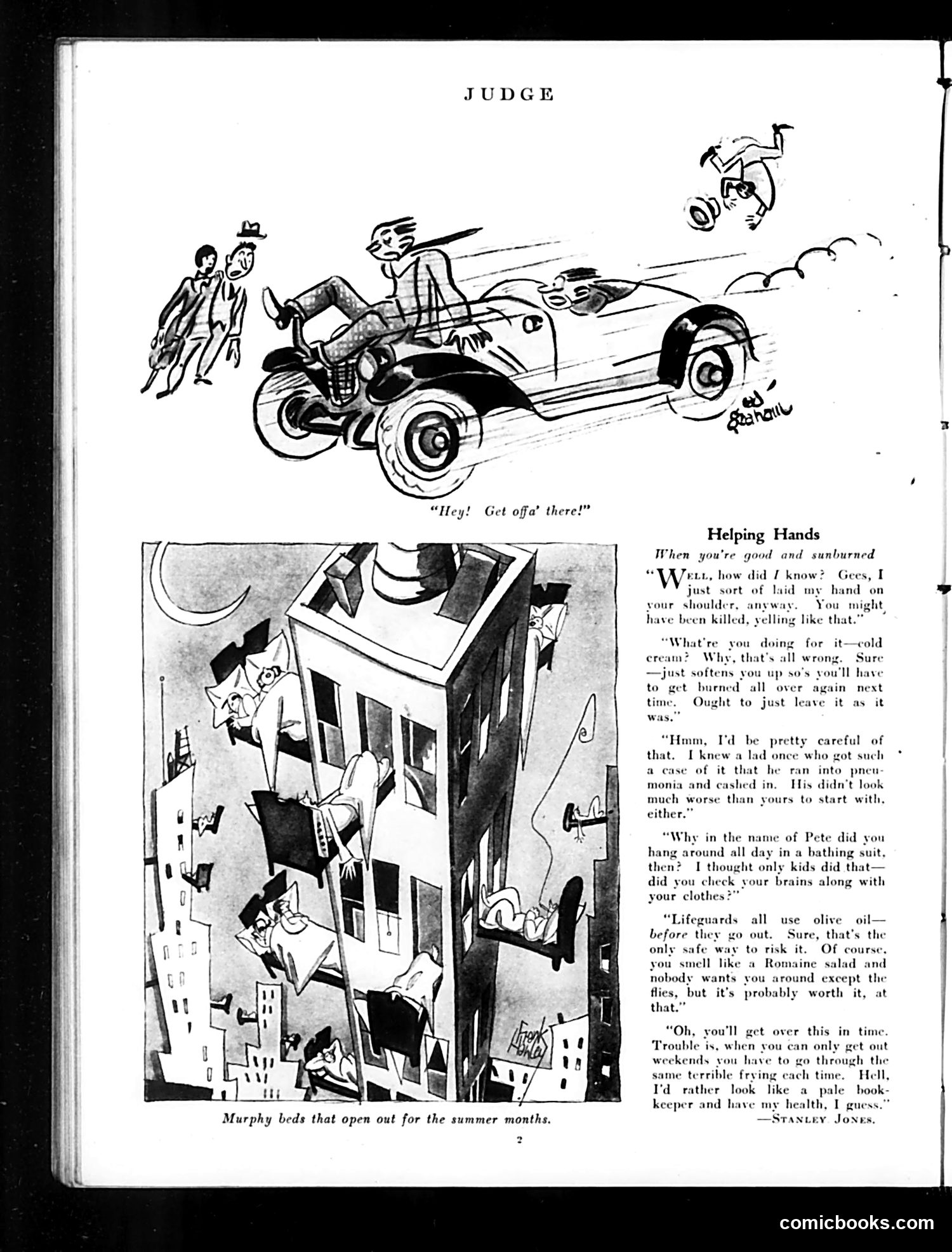
Analysis This page contains two unrelated pieces: Top cartoon: A slapstick driving scene captioned "Hey! Get off there!" shows a car careening dangerously with passengers flying about. The humor is straightforward physical comedy about reckless motoring—a common satire subject in the early automobile era when driving was still novel and accidents frequent. Bottom section: "Helping Hands" is a domestic humor piece about sunburned skin care. A character advises against treating a sunburn with cold cream, citing someone who got worse. The dialogue mocks well-meaning but counterproductive advice. This represents typical Judge humor: exaggerated domestic situations and interpersonal mishaps with no apparent political content. Both pieces use slapstick and conversational humor typical of Judge's general entertainment focus.
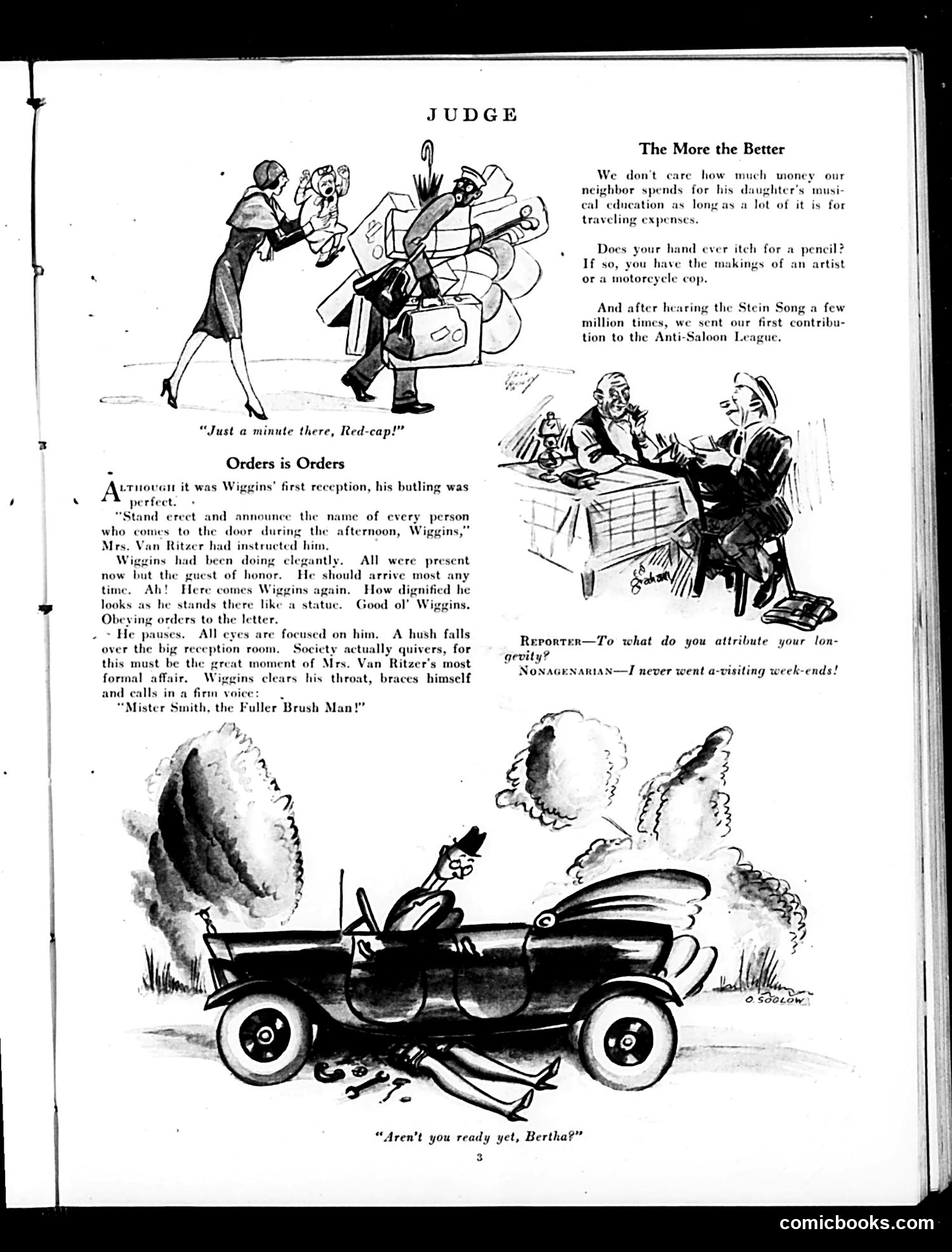
Judge Magazine Page Analysis This page contains three separate satirical pieces: 1. "Just a minute here, Red-cap!" - A cartoon mocking excessive shopping, showing a judge or official figure overwhelmed by packages from a woman's spending spree. 2. "Orders is Orders" - A narrative piece satirizing a butler named Wiggins at a fancy reception who rigidly follows etiquette rules, treating formality as absolute law despite social chaos around him. 3. "Aren't you ready yet, Bertha?" - A cartoon showing a car disaster mid-journey, with luggage exploding everywhere, humorously commenting on the chaos of automobile travel or overpacking. The overall theme appears to critique excessive consumerism, rigid adherence to social convention, and the complications of modern leisure activities—common targets of Judge's satirical humor during the early 20th century.
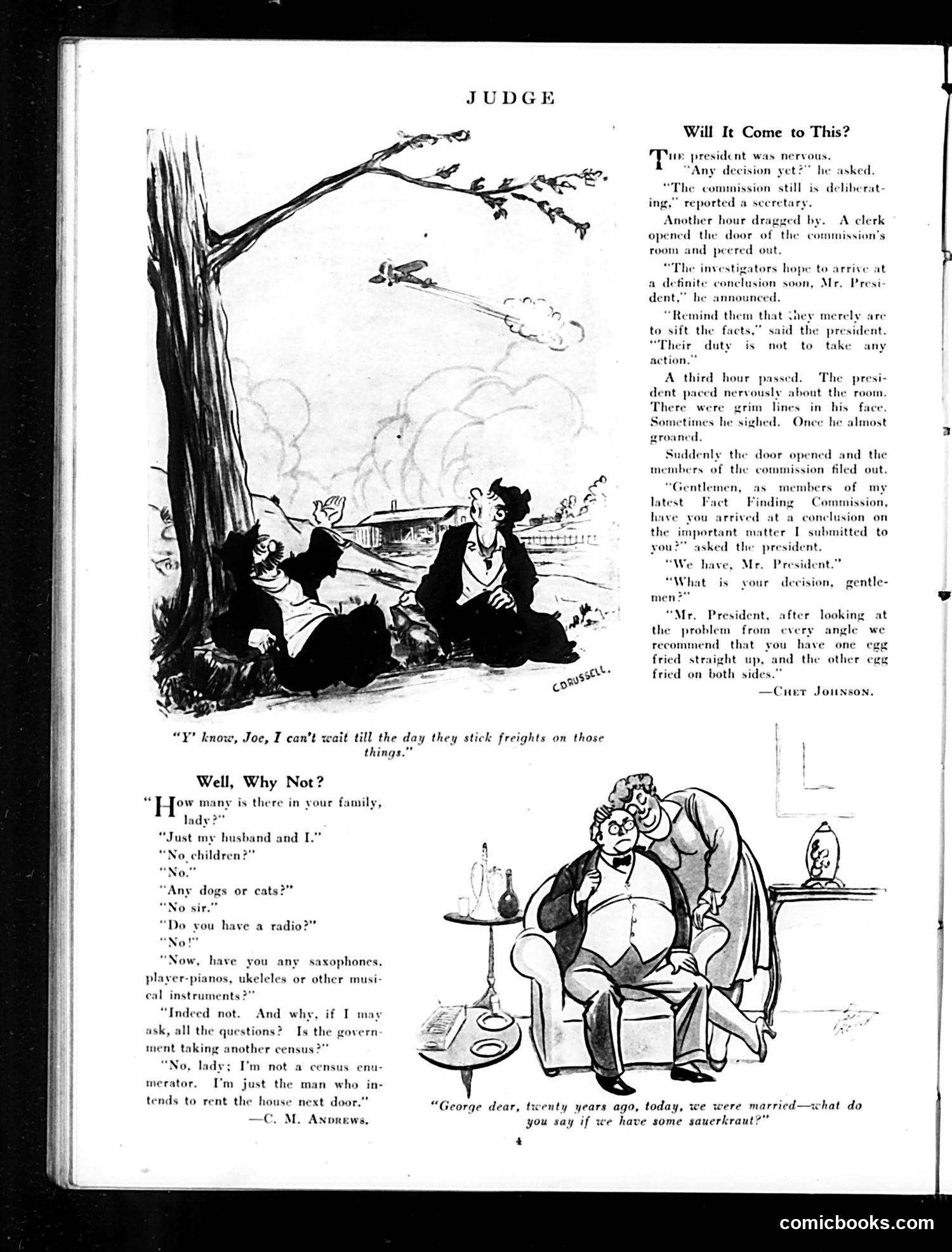
Explanation for Modern Readers This page from *Judge* magazine contains two satirical pieces: "Will It Come to This?" depicts a nervous president awaiting a "Fact Finding Commission's" conclusion on an unspecified matter. The joke appears to reference bureaucratic delay and indecision—the commission can only recommend that eggs be "fried straight up" on one side and "fried on both sides" on the other, a absurdly useless non-conclusion. This satirizes government commissions that produce vague or contradictory findings. "Well, Why Not?" humorously depicts a census-taker's interrogation. The joke plays on increasingly absurd questions (about family size, pets, radios, musical instruments) escalating to a ridiculous punchline about the couple's lack of sauerkraut after 20 years of marriage. The satire mocks overly intrusive government census procedures. Both pieces mock bureaucratic inefficiency and government overreach through humor.
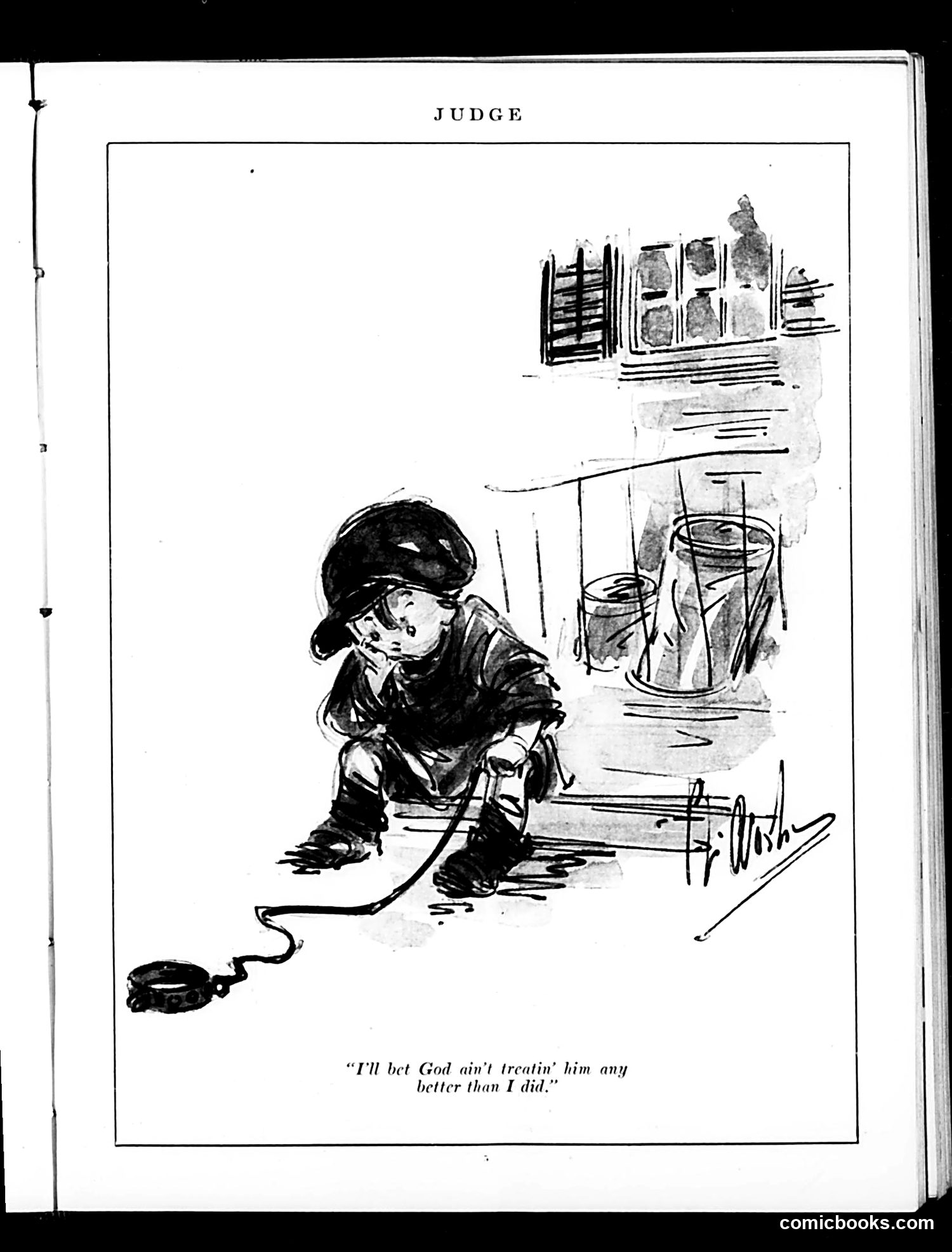
Judge Cartoon: "Judge" This cartoon depicts a small child operating what appears to be a syringe or medical injection device, with the caption: "I'll bet God ain't treatin' him any better than I did." The image is social satire regarding child welfare and neglect. The child's crude clothing and the clinical setting (visible containers in background) suggest this is commentary on institutional care or medical treatment of poor/abandoned children. The dark humor implies the child has mistreated someone (possibly a sibling or animal) and cynically assumes God treats that person no better—a bitter commentary on divine indifference to suffering. This reflects Progressive Era concerns about child abuse, orphanages, and whether institutional or religious care adequately protected vulnerable children. The cartoon critiques both parental negligence and the adequacy of social systems meant to protect them.
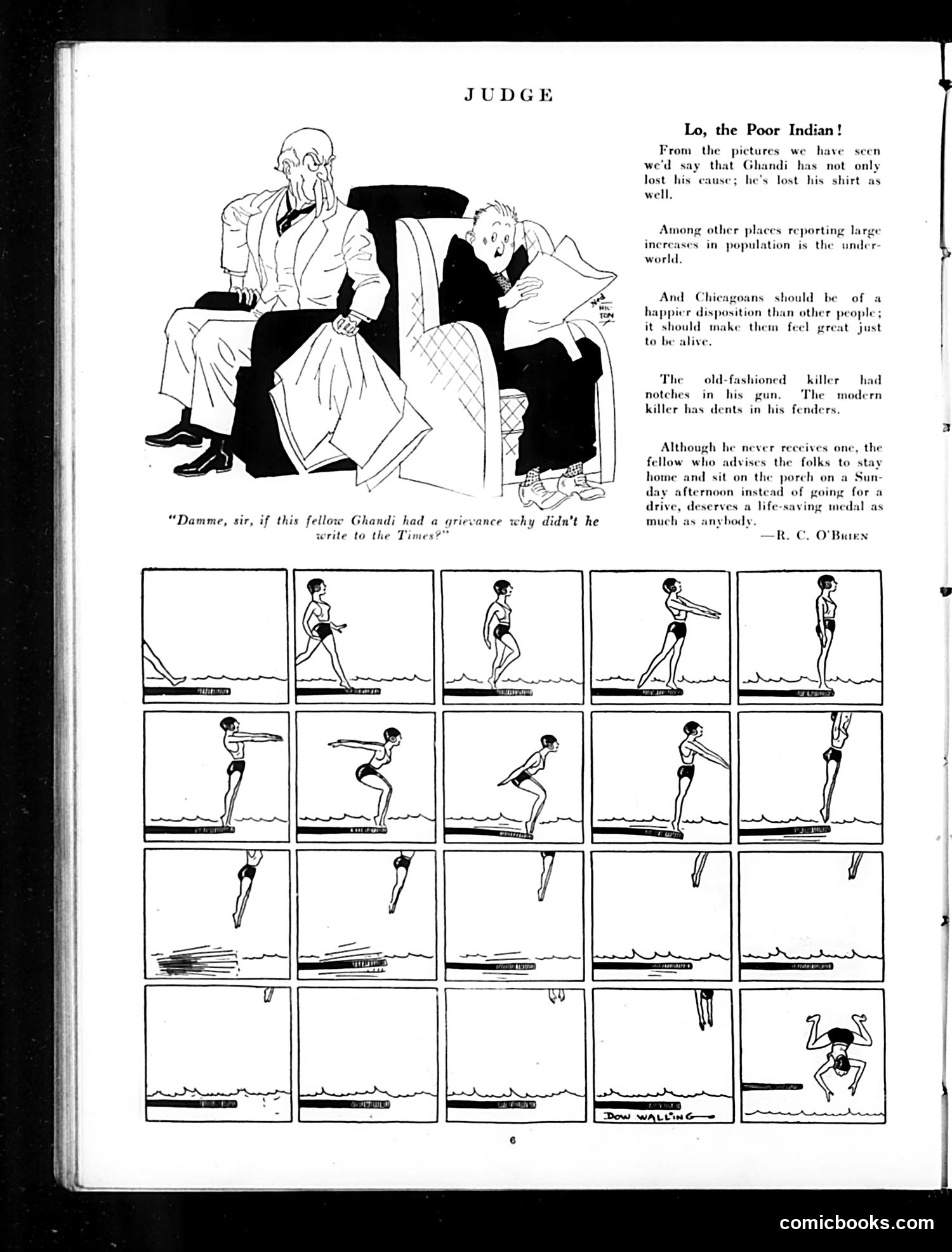
Analysis of Judge Magazine Page The top cartoon shows a judge interviewing a man, with the caption quoting the man asking why Gandhi didn't write to the Times about his grievance. This satirizes assumptions that colonized peoples should use British institutional channels (like the Times newspaper) rather than pursuing direct action or civil disobedience. The right-side text commentary mocks Ghandi's political effectiveness, referencing his loss of possessions ("short as well") and sarcastically suggesting Chicagoans should feel "happy" merely to be alive. The quote by R.C. O'Brien critiques advice to stay home rather than organize for change. The bottom sequential panel shows a swimming or diving sequence—likely satirizing physical culture or athletic pursuits as frivolous alternatives to political engagement.
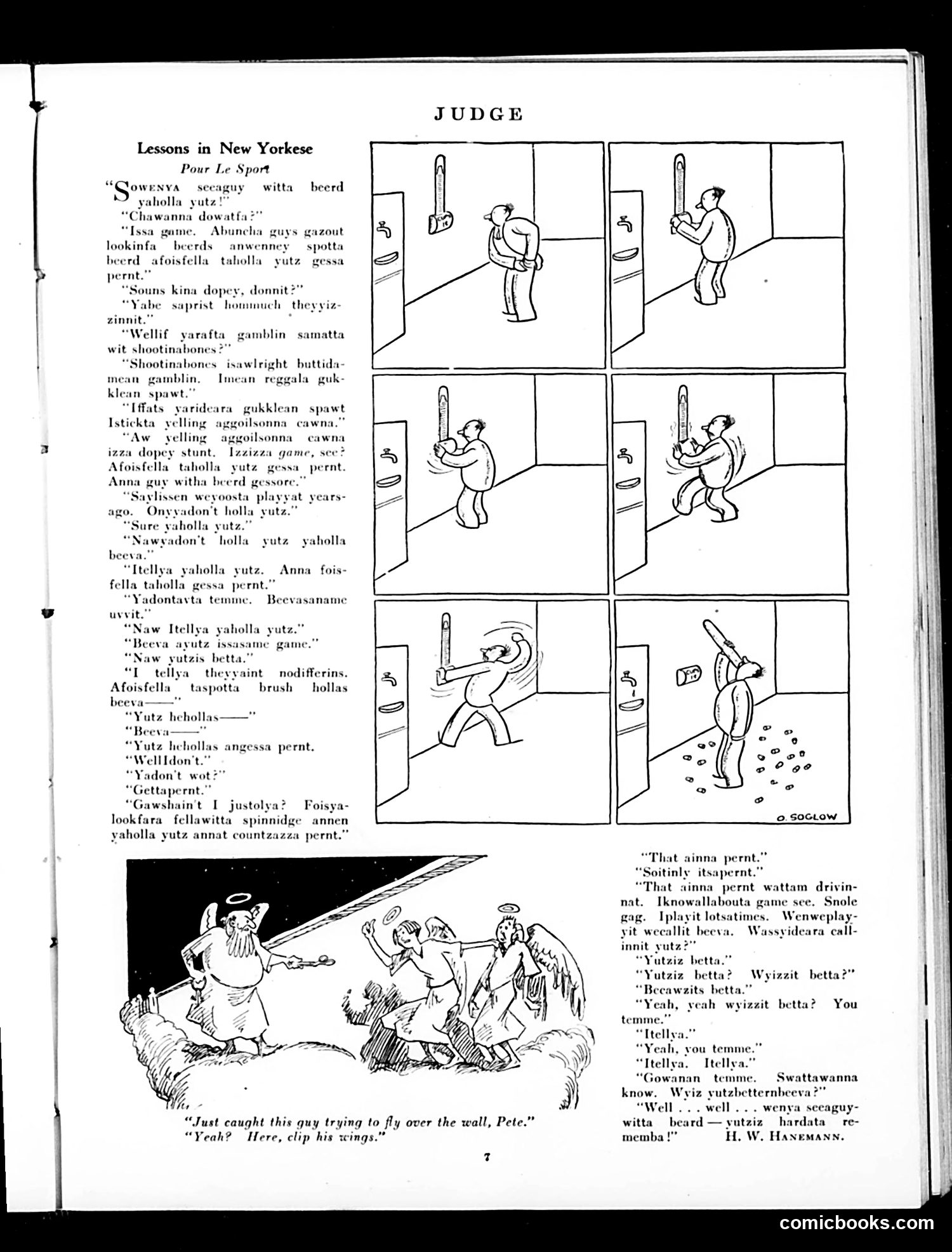
"Judge" Page Analysis: Lessons in New Yorkese This page satirizes working-class New York dialect and slang through two components: Top Section: A six-panel comic strip showing a man repeatedly striking himself with a bat, presumably demonstrating some foolish "sport." The accompanying text is a phonetic transcription of thick New York accent speech about gambling games and "shooting bones" (dice games). Bottom Section: An illustration captioned "Just caught this guy trying to fly over the wall, Pete / Yeah? Here, clip his wings"—depicting angels or winged figures, with one suggesting clipping another's wings. This appears to be a darkly humorous reference to punishment or restraint in an afterlife context. The satire targets immigrant or working-class New Yorkers' speech patterns and their association with petty gambling and street games. The exaggerated phonetic spelling mocks their accents as crude and unintelligible to educated readers. The page reflects early 20th-century class-based humor common in Judge magazine.
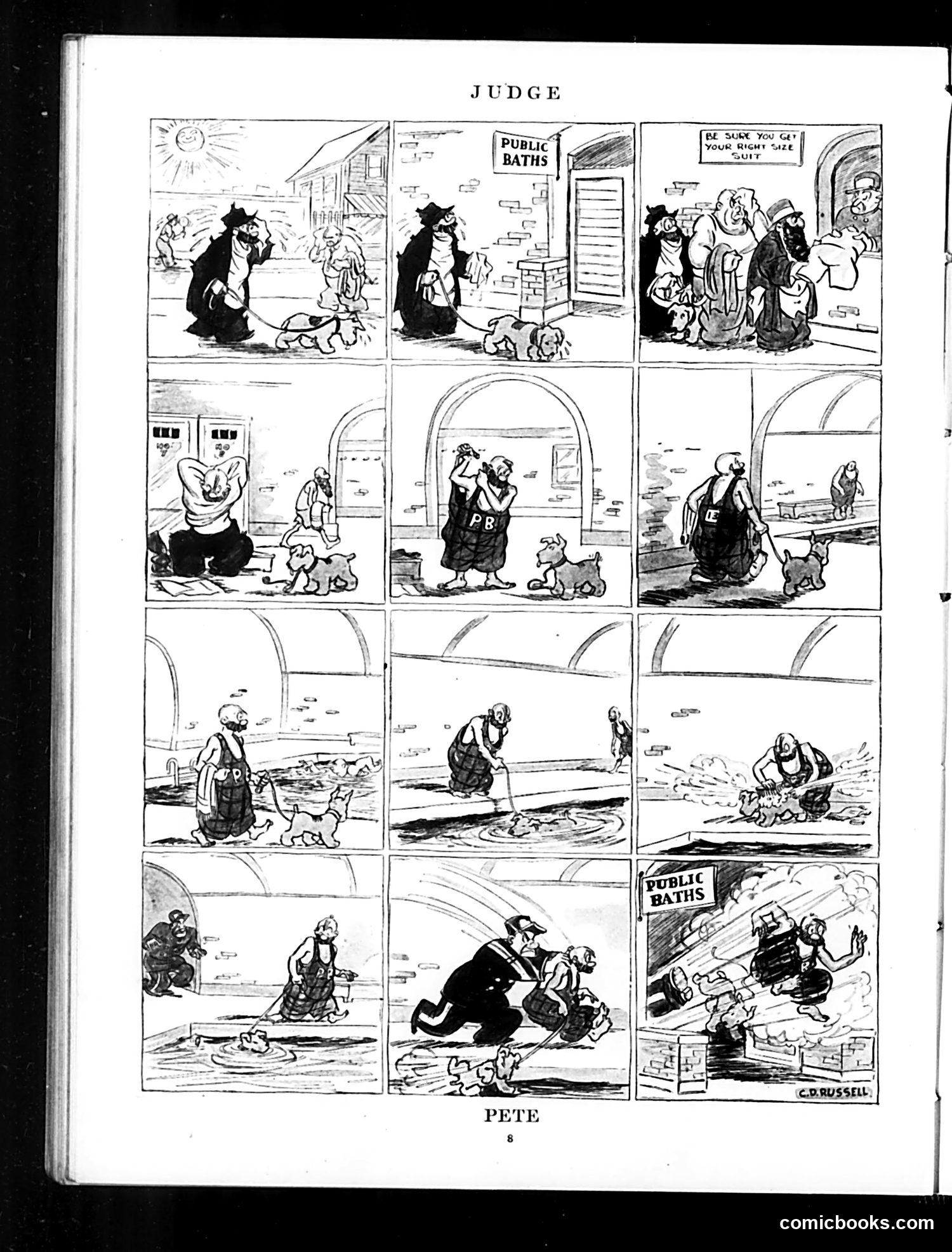
Judge Magazine Page Analysis This is a multi-panel comic strip titled "Judge" (credited to C.B. Russell) satirizing public bathhouse use. The narrative follows a well-dressed man and a small dog through various bathhouse scenes. The humor appears to center on class contrast and bathing etiquette violations. In the opening panels, the man seems out of place at the public baths (a working-class facility). Subsequent panels show him and his dog creating chaos in the bathing areas—splashing, disrupting other bathers, and generally behaving inappropriately. The satire likely targets wealthy individuals attempting to use public facilities meant for the poor, or mocking those unfamiliar with proper communal bathing customs. The recurring "PUBLIC BATHS" sign reinforces the democratic, shared-space setting, making the gentleman's presumption or incompetence the joke's core.
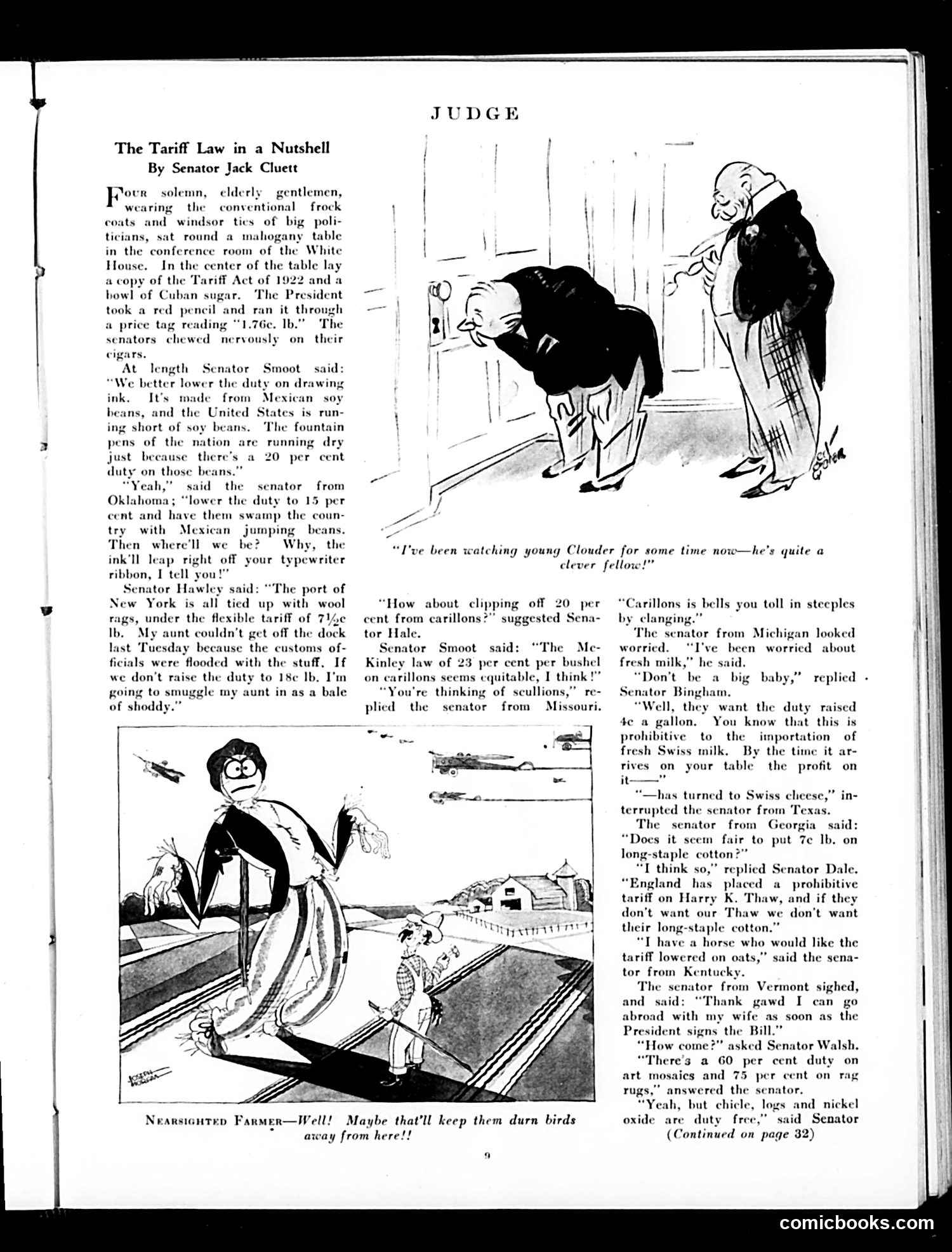
The Tariff Law in a Nutshell This is political satire about the Tariff Act of 1922, mocking senators' confused and self-interested debates over import duties. The piece portrays politicians in the White House conference room discussing absurd tariff scenarios—Mexican jumping beans affecting typewriter ink, carillons (church bells) versus scullions (kitchen servants), Swiss milk turning to cheese during transport. The satire's point: senators prioritize protecting their home states' industries over logical policy. References include Senator Smoot (likely Reed Smoot, key tariff negotiator), and a joke about "Harry K. Thaw" (a notorious socialite involved in scandals) as an export to ridicule the arbitrary nature of tariff protections. The accompanying cartoon shows a farmer frustrated with tariffs. The humor exposes how tariff laws benefit wealthy interests while harming common citizens—the legislation's real-world consequences hidden behind politicians' circular, nonsensical reasoning.
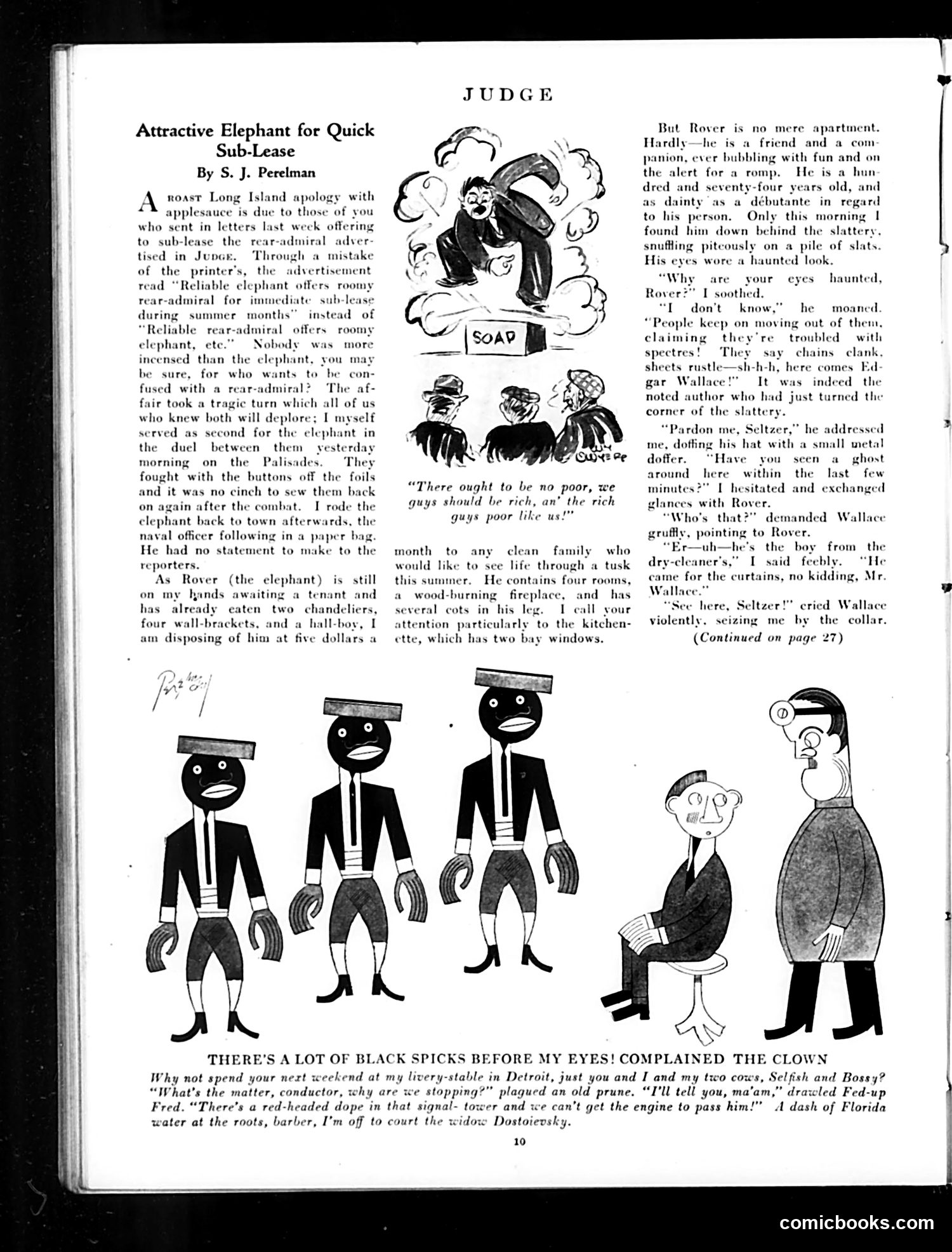
Explanation for Modern Readers This page from *Judge* magazine contains a humorous short story by S.J. Perelman about a classified ad mishap. Someone advertised a "rear-admiral" for sub-lease; a printer's error made it read "reliable elephant" instead. The story satirizes absurd real-estate situations through exaggeration—depicting an elephant as an apartment building with rooms, fireplace, and kitchenette that can be rented to families. The joke plays on: - Newspaper classification errors and their ridiculous consequences - Housing shortage anxiety (the elephant's "haunted" previous tenants claiming supernatural disturbances) - Over-literal interpretations of advertisement language The bottom panel's crude racial caricature and the crude jokes about conductors and livestock are period period artifacts reflecting *Judge*'s unexamined prejudices. The core humor—confused advertising creating absurd situations—remains legible today, though the surrounding material reflects attitudes we'd reject now.
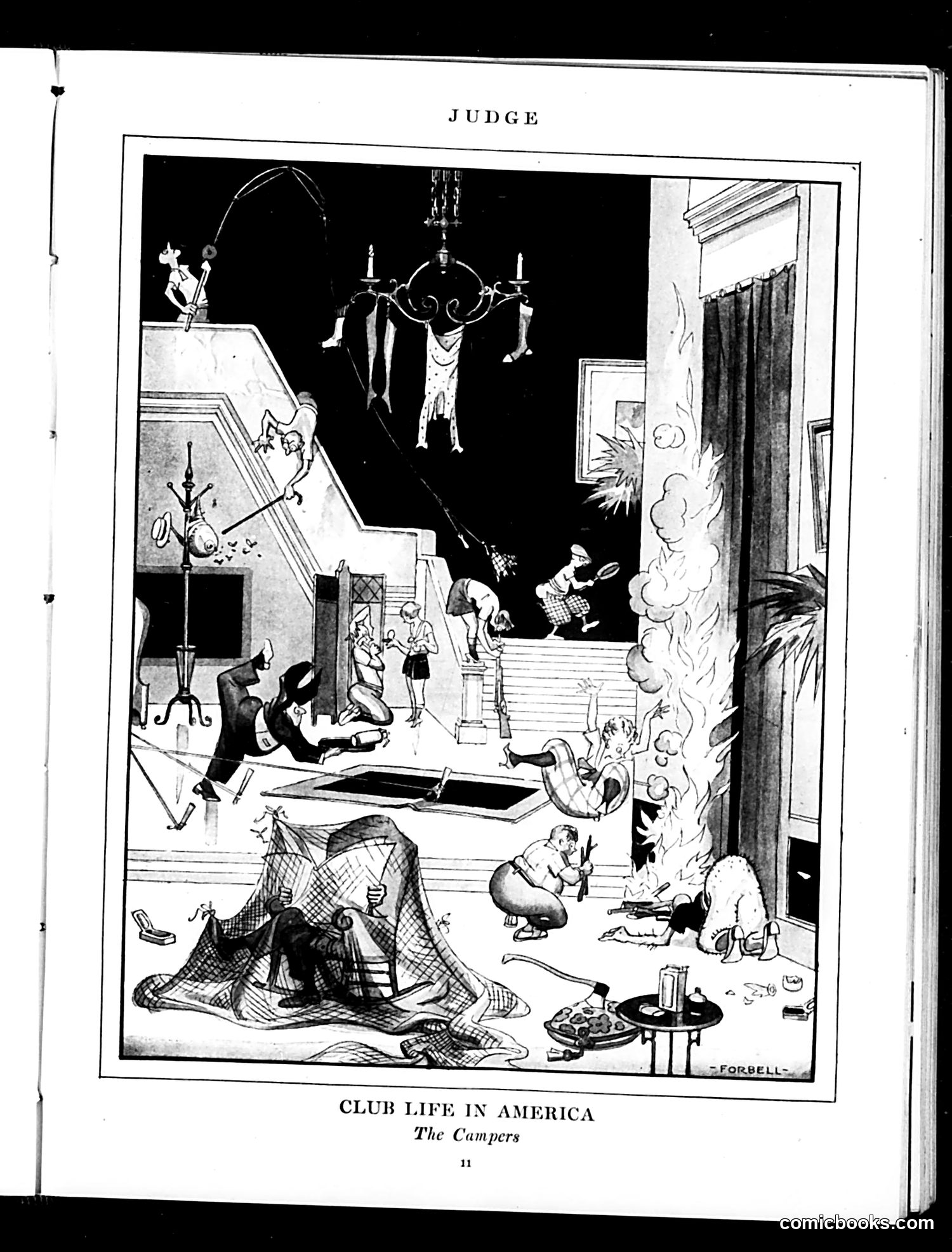
Analysis This is a satirical cartoon titled "Club Life in America: The Campers" from *Judge* magazine, depicting chaotic camping conditions. The illustration shows a disorderly campsite with people in disarray—some falling, others in awkward positions around a fire, tents, and scattered camping equipment. The scene appears to mock the reality of amateur camping versus romantic notions of outdoor club life. The cartoon satirizes the contrast between idealized visions of camping leisure (popular among American club members) and the messy, uncomfortable reality of outdoor recreation. Various figures struggle with basic camp tasks, suggesting incompetence or the hardships of roughing it. The exaggerated chaos and physical comedy emphasize how poorly-prepared urbanites handle wilderness camping, mocking both the campers and the fantasy of "getting back to nature" that appealed to early 20th-century American club culture.
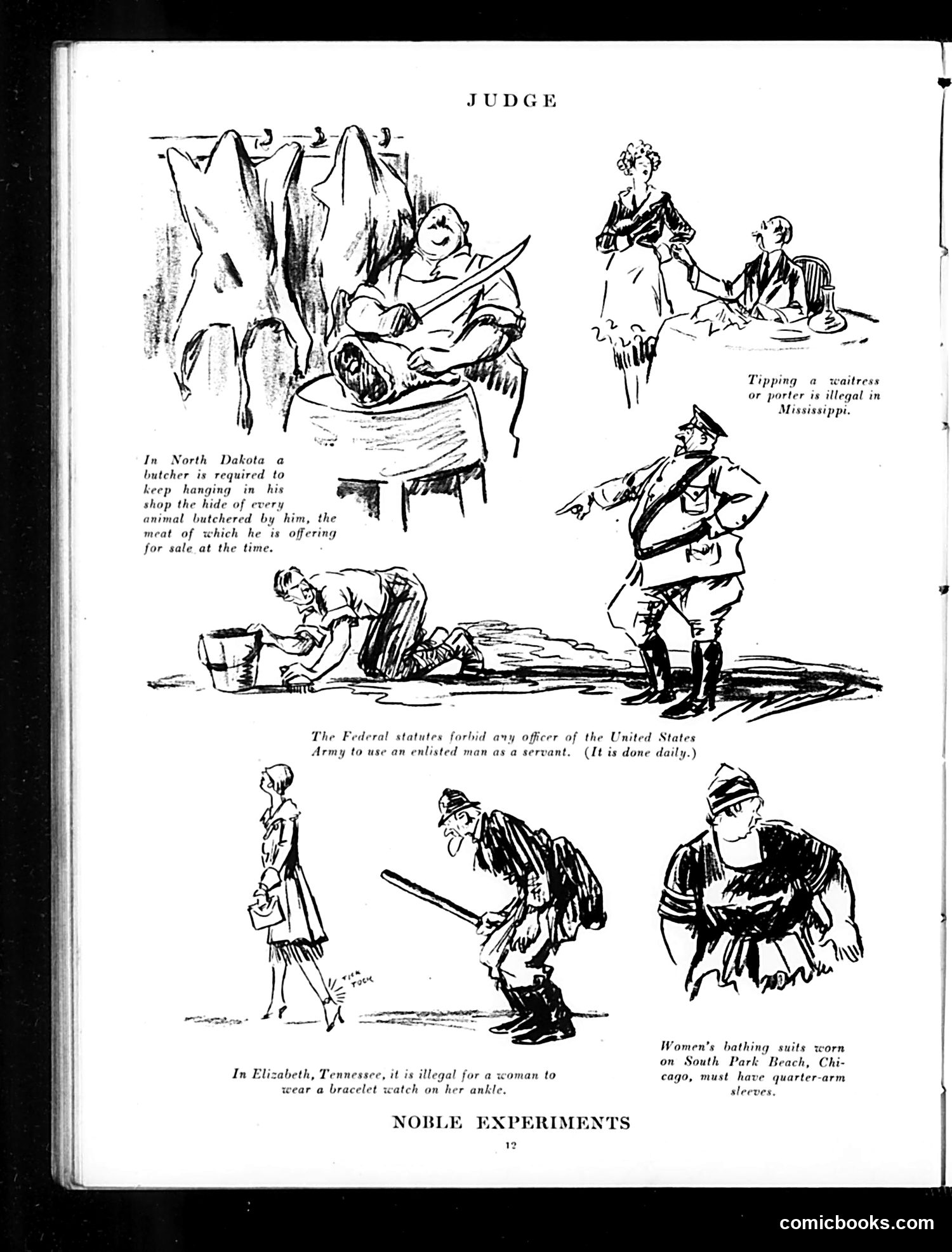
Judge Magazine: "Noble Experiments" This page satirizes absurd or unenforceable laws across American states and federal regulations. Each cartoon illustrates a specific law with dark humor: - North Dakota butcher law: Ridicules a requirement to display animal hides—impractical and pointless. - Mississippi tipping ban: Mocks a law prohibiting gratuities as unenforceable social custom. - Army servant prohibition: The parenthetical "(It is done daily.)" exposes the gap between stated law and actual practice—officers routinely violate the statute. - Tennessee ankle-watch ban: Illustrates bizarre, trivial regulations targeting women's clothing. - Chicago bathing suit sleeves: Comments on excessive modesty laws restricting women's beachwear. The cartoons mock the disconnect between laws on paper and real-world behavior, suggesting legislators create unworkable or ridiculous rules. The title "Noble Experiments" is likely ironic, referencing Prohibition and other failed regulatory attempts.
"Judge on the Bench" - Page Analysis This page contains three separate editorial commentaries, typical of Judge magazine's satirical format: 1. "Now Let's See It Flex" discusses a recent tariff bill signed by President Hoover. The writer criticizes Hoover's reliance on a "flexible provision" to remedy tariff problems, noting the tariff commission has existed since 1922 but "has seldom flexed." The satire targets political tariff-making and lobbying as outdated; Hoover is challenged to actually *use* the flexible mechanism rather than merely invoke it. 2. "The Dwindling Village" comments on census data showing a small Connecticut town declining from 257 to 196 residents. The piece satirizes competing attitudes: government absurdity (tiny towns still have disproportionate representation), sentimentalism about rural decline, and predictions by Dr. Lindemann that future cities will expel animals, plants, and children to suburbs. 3. "De-education" mocks baccalaureate sermons, specifically Dr. John Finley's Lafayette address warning graduates must continue intellectual inquiry or become "de-educated"—a satirical term highlighting the assumption that college actually *provides* intellectual endeavor, which the writer questions.
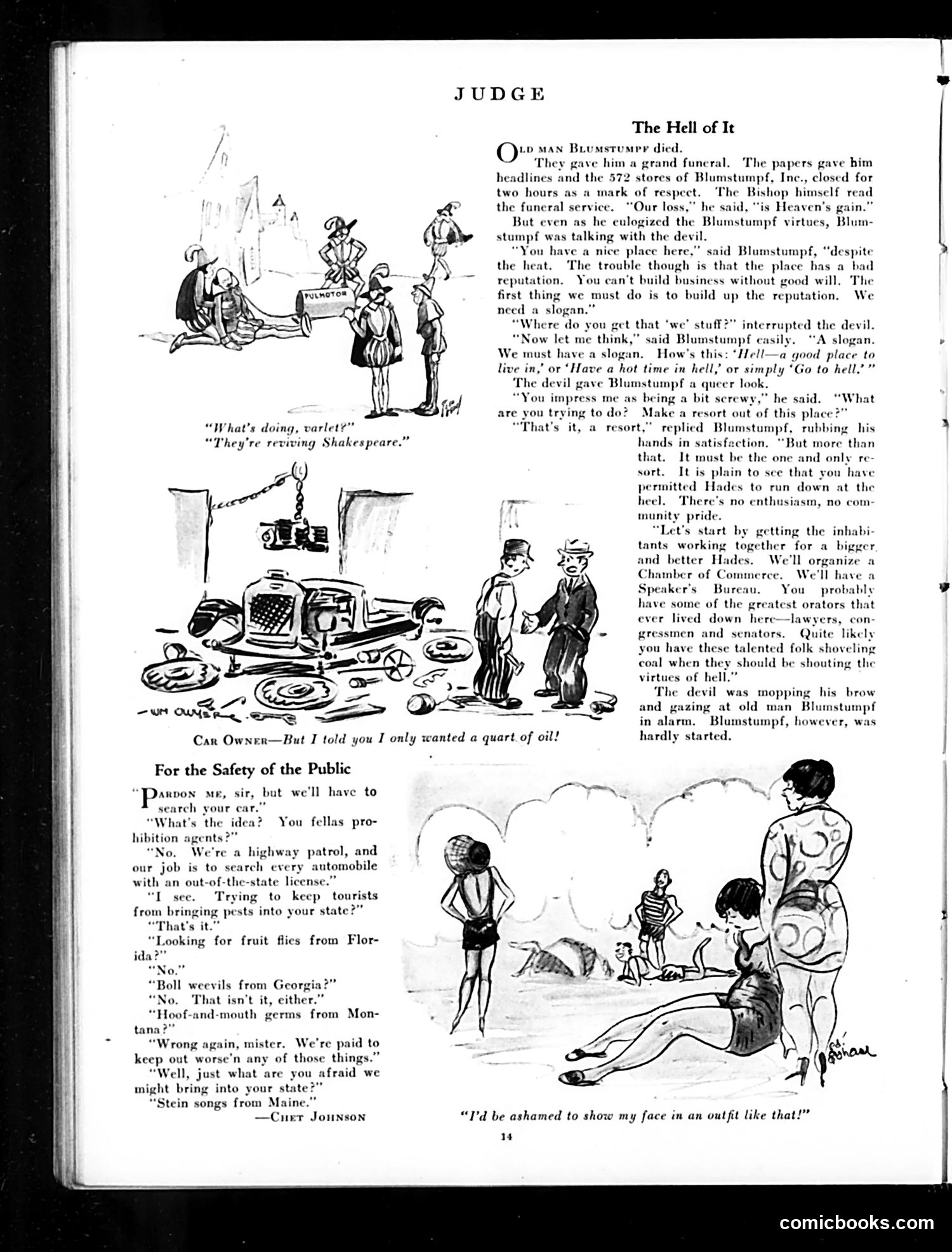
"The Hell of It" - Judge Magazine Satire This page satirizes Blumstumpf, a wealthy businessman whose death inspires grand tributes. The main cartoon shows him immediately meeting the devil and—true to character—attempting to "improve" Hell through aggressive marketing and business practices: slogans, a Chamber of Commerce, public speaking campaigns. The satire targets gilded-age capitalists who treat everything, including morality and the afterlife, as commercial enterprises to be "developed." Blumstumpf's inability to stop hustling even in damnation is the joke. The secondary cartoons mock different hypocrisies: one depicts a car owner caught with contraband during Prohibition-era searches; another shows highway patrols under the pretext of "public safety" stopping out-of-state vehicles. Together, these comics critique American business culture, government overreach, and moral corruption among the wealthy—suggesting Hell itself couldn't contain Blumstumpf's relentless materialism.
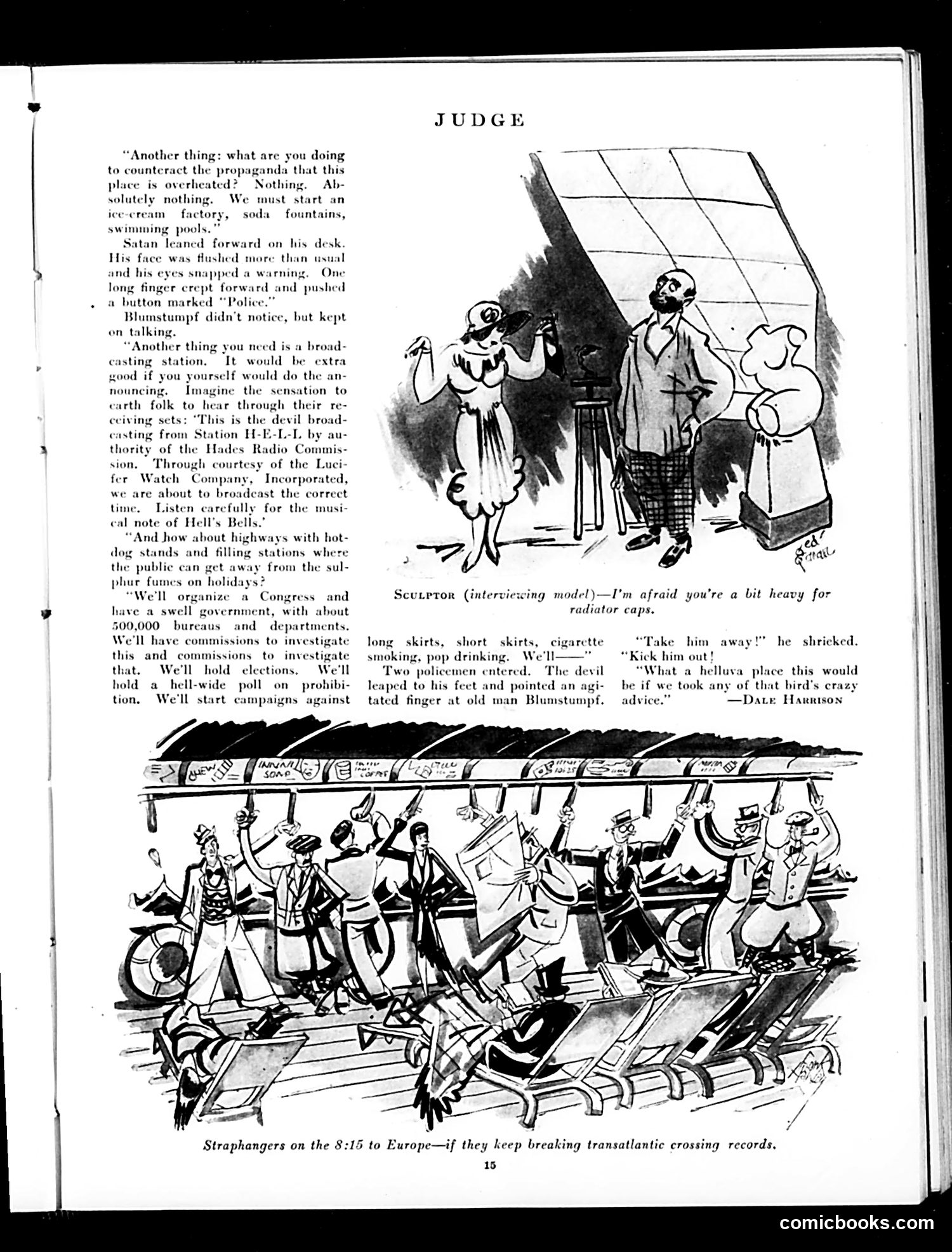
Explanation for Modern Readers This satirical piece mocks American bureaucratic excess and government overreach through absurdist humor. A character named Blumstumpf pitches increasingly ridiculous "modernization" schemes to Satan—ice cream factories, radio broadcasting, highways with hot dog stands, and a massive government apparatus complete with 500,000 bureaus and commissions. The satire targets two things: (1) Satan's Hell as a metaphor for government inefficiency and bloated administration, and (2) Blumstumpf's well-intentioned but absurd proposals that parody real New Deal-era expansion of federal agencies and regulatory bodies. The punchline—Satan literally ejecting this nuisance—suggests that even the devil finds bureaucratic reformers intolerable. The lower cartoon mocks transatlantic speed records and reckless ocean-liner competition. Judge clearly dates to the 1930s based on these references.
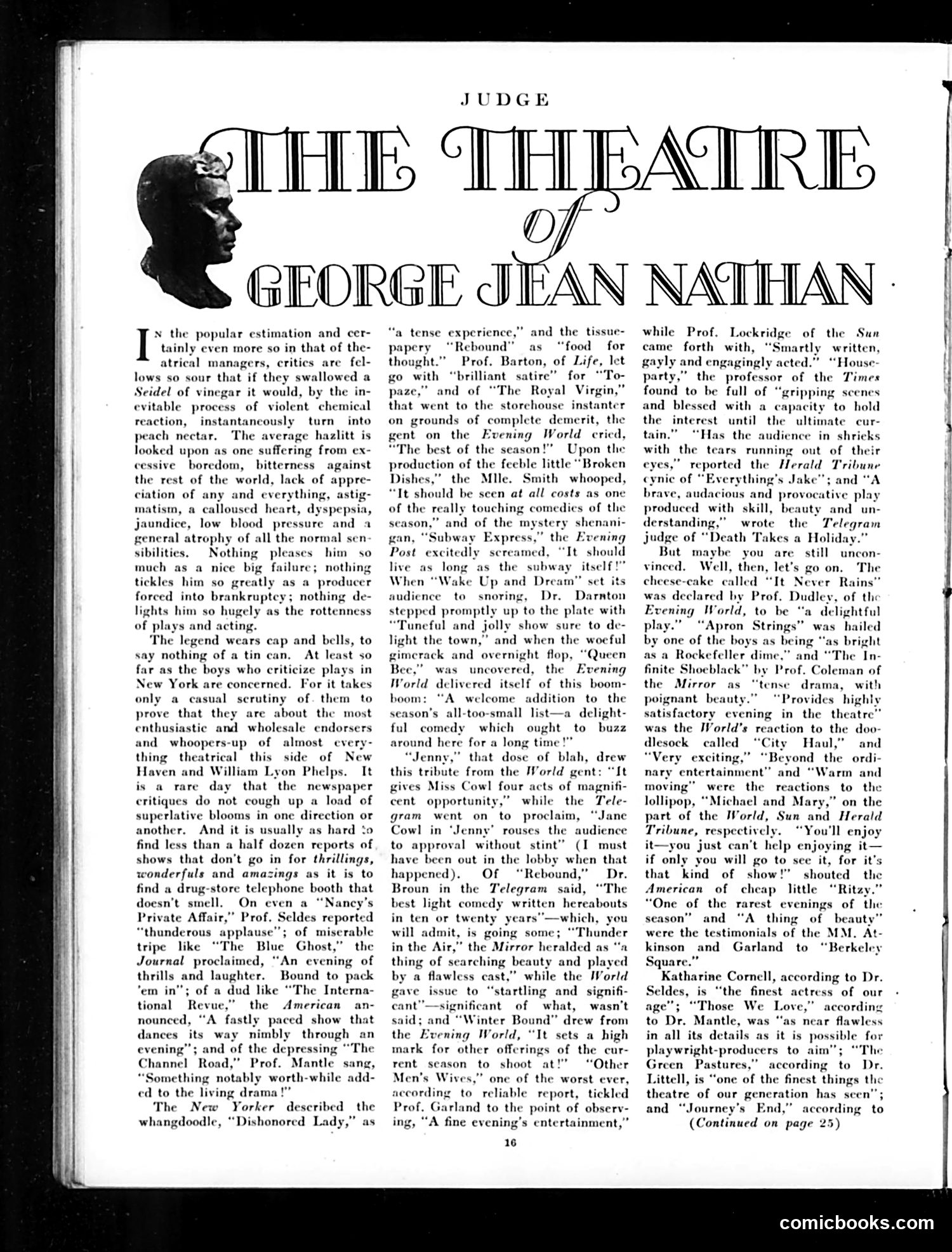
Judge Magazine: "The Theatre of George Jean Nathan" This page reviews theatrical critic George Jean Nathan's assessments of Broadway shows. The silhouette portrait at top left depicts Nathan himself. The satire targets Nathan's contradictory nature: while he's described as vinegary, cynical, and dismissive—a man who finds "nothing pleases him so much as a nice big failure"—the text documents his actual practice of lavishing superlatives on theatrical productions. The joke is the hypocrisy: Nathan claims to despise theatre, yet consistently praises shows with glowing reviews quoted from publications like the *Evening World*, *Herald Tribune*, and *Telegraph*. The page catalogs how Nathan (and fellow critics) shower praise on comedies, dramas, and even "cheese-cake" entertainment, contradicting their supposed sophisticated disdain. This mocks the pretension of theatre critics who adopt cynical personas while readily endorsing commercial productions with enthusiastic language.
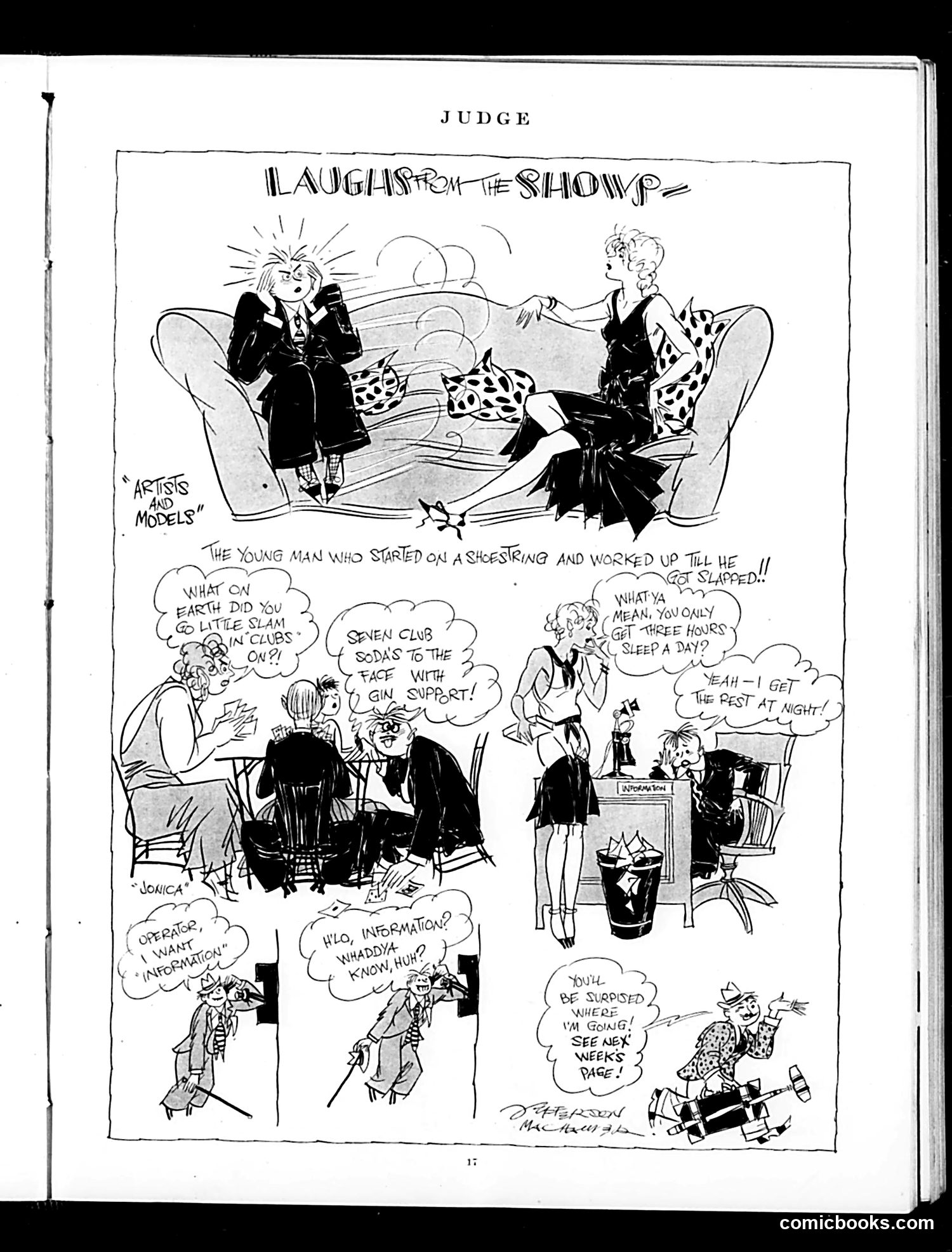
"Laughs of the Show" - Judge Magazine Satire This comic satirizes the rags-to-riches narrative popular in early 20th-century American culture. The top panel shows "Artists and Models"—a theatrical revue—where wealthy socialites boast about the young man who "started on a shoestring and worked up till he got slapped." The joke mocks the glamorization of success stories. The bottom panels reveal the reality: the protagonist's actual achievements are trivial—drinking seven club sodas, getting three hours of sleep, being slapped by a woman. The repeated punchline structure ("What on earth did you do?" answered with increasingly absurd claims) undercuts the pretentious celebration of his "success." The satire targets both the theater world's superficiality and society's gullibility in believing success myths. The final panel promises continuation, suggesting Judge was mocking an ongoing cultural obsession with fabricated success stories and the performative nature of high society.
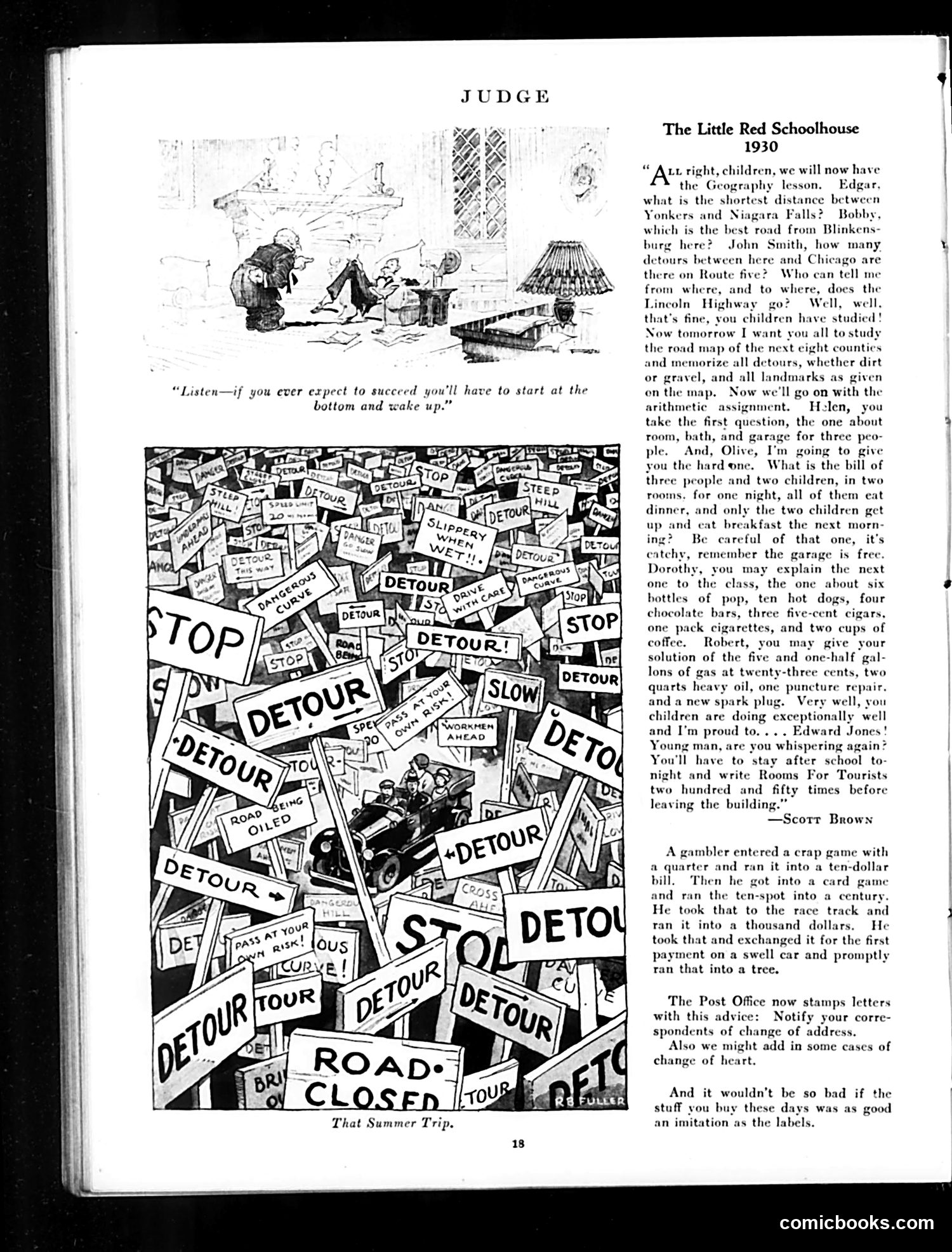
Analysis: Judge Magazine, 1930 This page satirizes the chaos of American road travel in the 1930s, particularly the proliferation of detours during the Depression era when road construction and repairs were widespread. "That Summer Trip" (main cartoon): The illustration shows a car trapped in a maze of "DETOUR," "STOP," "ROAD CLOSED," and "SLOW" signs—a visual joke about how summer travelers faced constant rerouting and delays. The caption "Listen—if you ever expect to succeed you'll have to start at the bottom and wake up" ironically applies both to beginners learning persistence and to motorists navigating impossible road conditions. "The Little Red Schoolhouse" (1930): Teacher assigns geography homework about detours and road conditions, then arithmetic problems about vacation expenses (garage rentals, food, gas). This satirizes how the Depression made travel impractical—even schoolchildren must study these frustrating commercial details. The additional anecdote about a gambler's runaway luck parodies American optimism: quick gains inevitably "run" into disaster, much like vacation plans hitting detours. The satire targets both infrastructure chaos and economic instability of the Depression period.
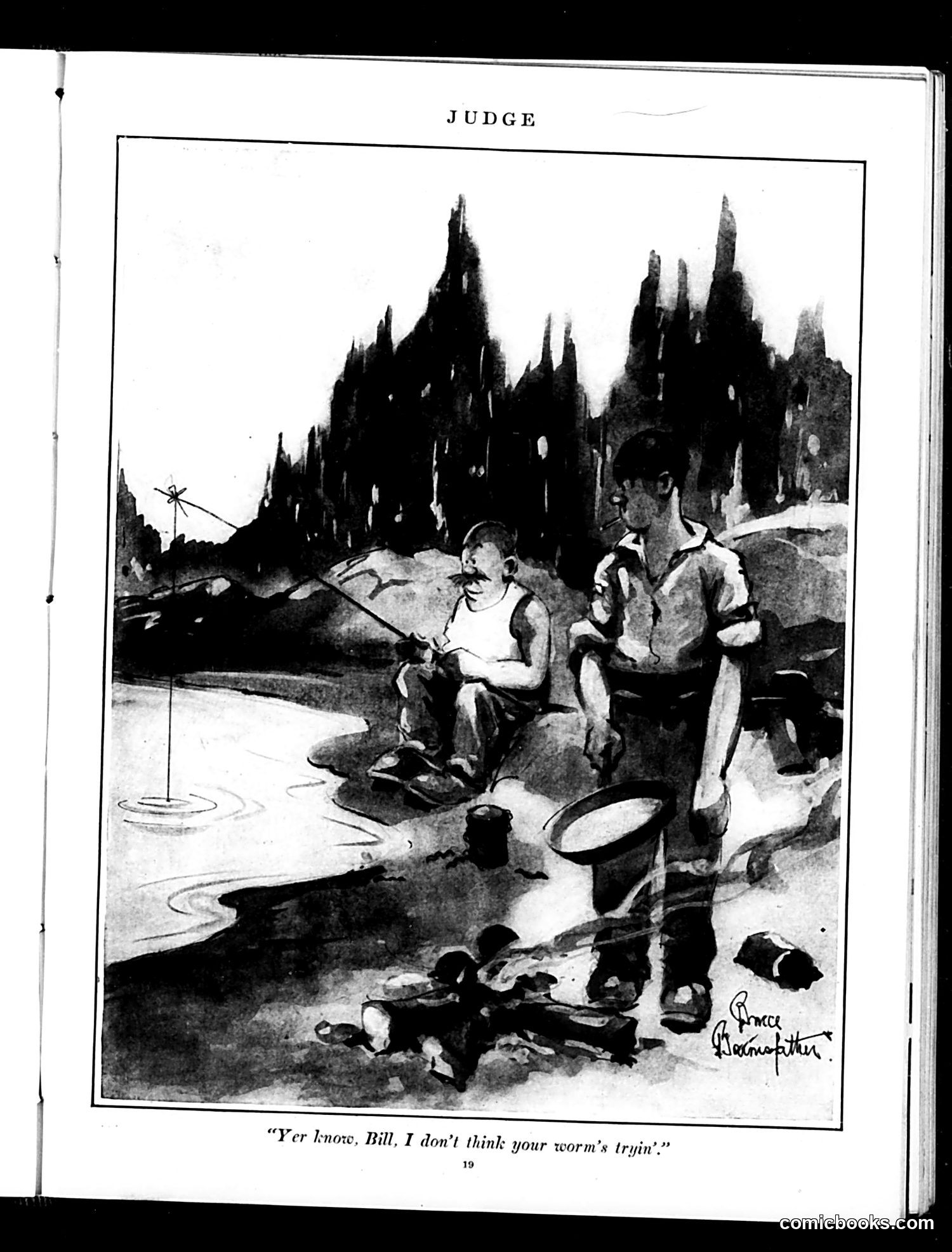
Analysis This is a single cartoon titled "Judge" showing three men camping by a body of water with tall trees in the background. One man sits holding a fishing rod while speaking to another. The caption reads: "Yer know, Bill, I don't think your worm's tryin'." This is a straightforward fishing humor cartoon with no apparent political or social satire. The joke is a simple visual pun: the man's fishing worm isn't performing its intended function—it's not "trying" (not struggling/wiggling as bait should). The humor relies on the double meaning of "trying," treating the worm as if it has agency or effort. This represents typical early 20th-century Judge magazine content: gentle, domestic humor rather than political commentary.
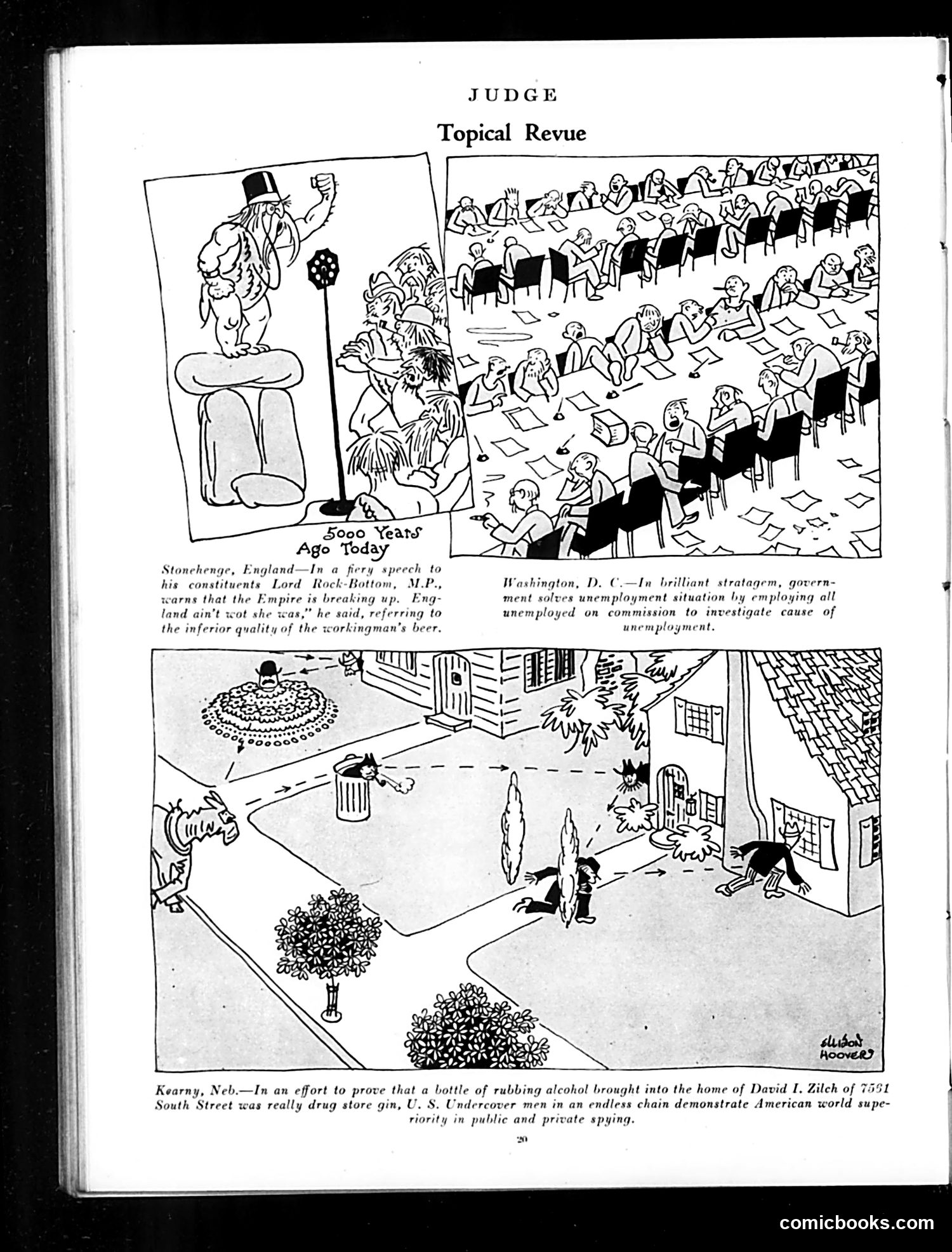
Political Satire in Judge Magazine This page contains three separate topical cartoons satirizing contemporary issues: 1. Stonehenge panel: Mocks British politics, depicting a politician warning about imperial decline while blaming workers' beer quality—absurd displacement of blame for real economic problems. 2. Washington, D.C. panel: Satirizes government unemployment relief efforts as circular and ineffective—unemployed people are hired to investigate unemployment's causes, creating make-work rather than solving the actual problem. 3. Kearny, Nebraska panel: Critiques excessive government surveillance and prohibition-era enforcement. Federal agents conduct elaborate "undercover" demonstrations trying to prove rubbing alcohol is actually gin, portrayed as wasteful bureaucratic theater masquerading as patriotic superiority. All three mock government incompetence and overreach during what appears to be the Prohibition era (1920s-30s) and the Great Depression.
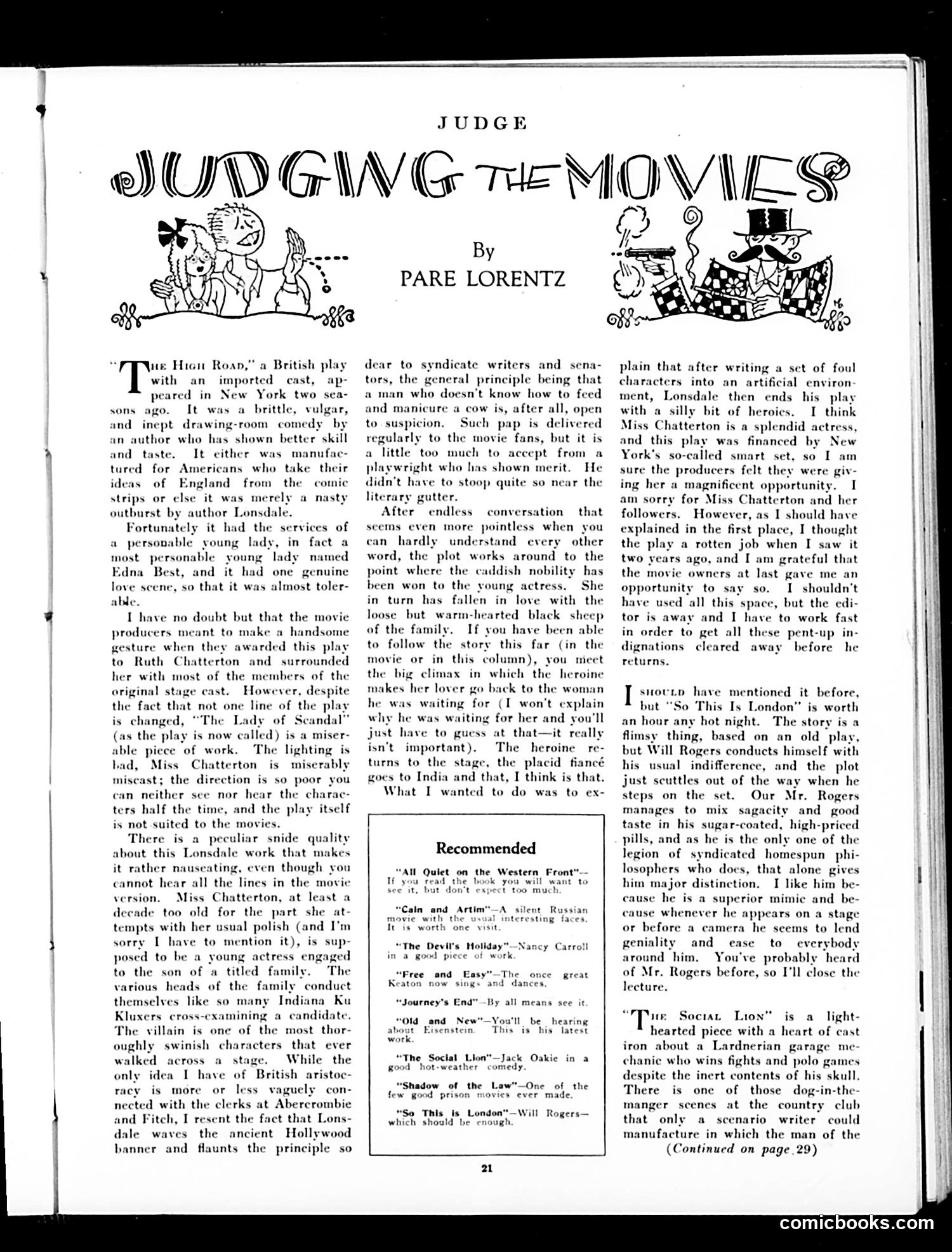
Judge Magazine: "Judging the Movies" by Pare Lorentz This is a film review column, not a political cartoon. Lorentz critiques "The Lady of Scandal" (a film adaptation of the British play "The High Road"), starring Ruth Chatterton. The satire: Lorentz savagely mocks both the original play and its film version as artificially snobbish, poorly directed drivel. He attacks playwright Lonsdale for writing shallow, pretentious material that perpetuates Hollywood's clichéd mockery of British aristocracy—comparing the family's behavior to "Indiana Ku Kluxers." Key complaint: Despite keeping every line from the stage version unchanged, the film fails completely. Chatterton—miscast and too old for her role—cannot salvage material Lorentz considers fundamentally contemptible. The joke: The review itself becomes satirical through Lorentz's exasperated tone, apologizing for devoting space to such worthless entertainment while unable to stop himself from detailing its failures. The sidebar lists other film recommendations, establishing this as entertainment criticism rather than political commentary.
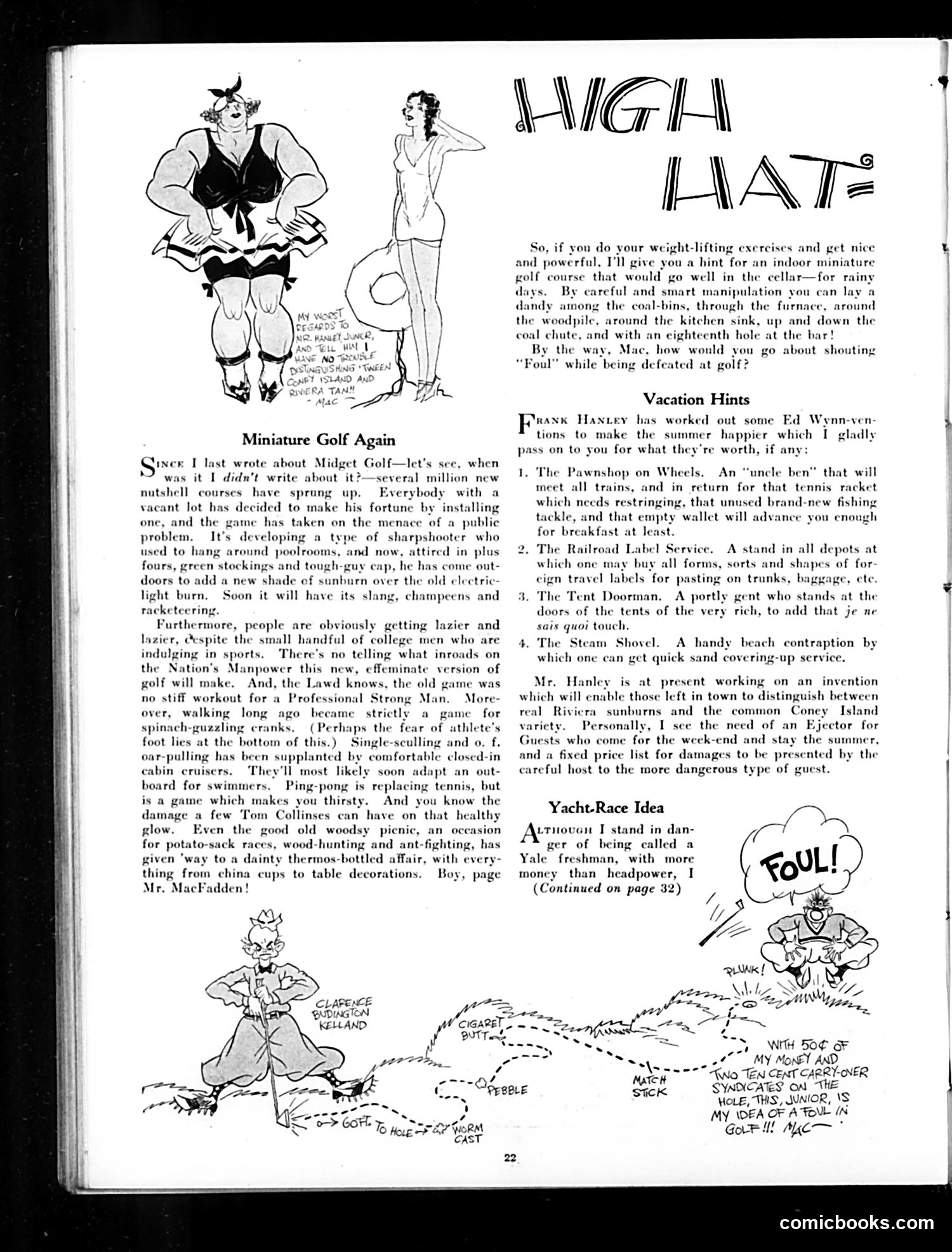
Judge Magazine Page Analysis This page satirizes the explosive growth of miniature golf in 1920s America. The main article mocks how miniature golf has become a ubiquitous moneymaking scheme—"everybody with a vacant lot" is installing courses—attracting a new breed of petty hustlers and creating social "racketeering." The satire's deeper point critiques American laziness and softness. The author argues that miniature golf epitomizes national decline: people avoid real exercise, replacing strenuous activities (long walks, tennis, genuine golf) with comfortable indoor alternatives. Even picnics have become effete affairs with "china cups" instead of rustic wood-hunting. The accompanying "Vacation Hints" section continues this satirical tone, proposing absurd summer inventions (a "Pawnshop on Wheels," a "Steam Shovel" for beaches) that mock affluent leisure culture. The cartoons ridicule both the golf trend itself and broader concerns about American vigor and masculinity during the prosperous but anxiety-ridden 1920s.

Analysis This is advertising, not satire or political commentary. It's a Kodak Ciné-Kodak camera advertisement disguised as editorial content in Judge magazine. The page promotes home movie cameras by showing families at the beach—children playing, building sandcastles, doing everyday activities. The text argues that ordinary family moments are inherently entertaining and worth filming. The implicit message: parents should capture their children's youth on film before it's forgotten. The phrase "Find the Movie Star in Your Family" is the advertising hook—suggesting anyone can become a filmmaker of their own life. The circular inset image (bottom center) appears to show a home movie projection scene. Context for modern readers: This reflects 1930s-40s consumer culture, when home movie cameras were new luxury items being marketed to middle-class families. The ad appeals to nostalgia and parental sentiment—themes that persist in modern family photography marketing. The "simplest of home movie cameras" language emphasizes accessibility, a key selling point for emerging consumer technology.
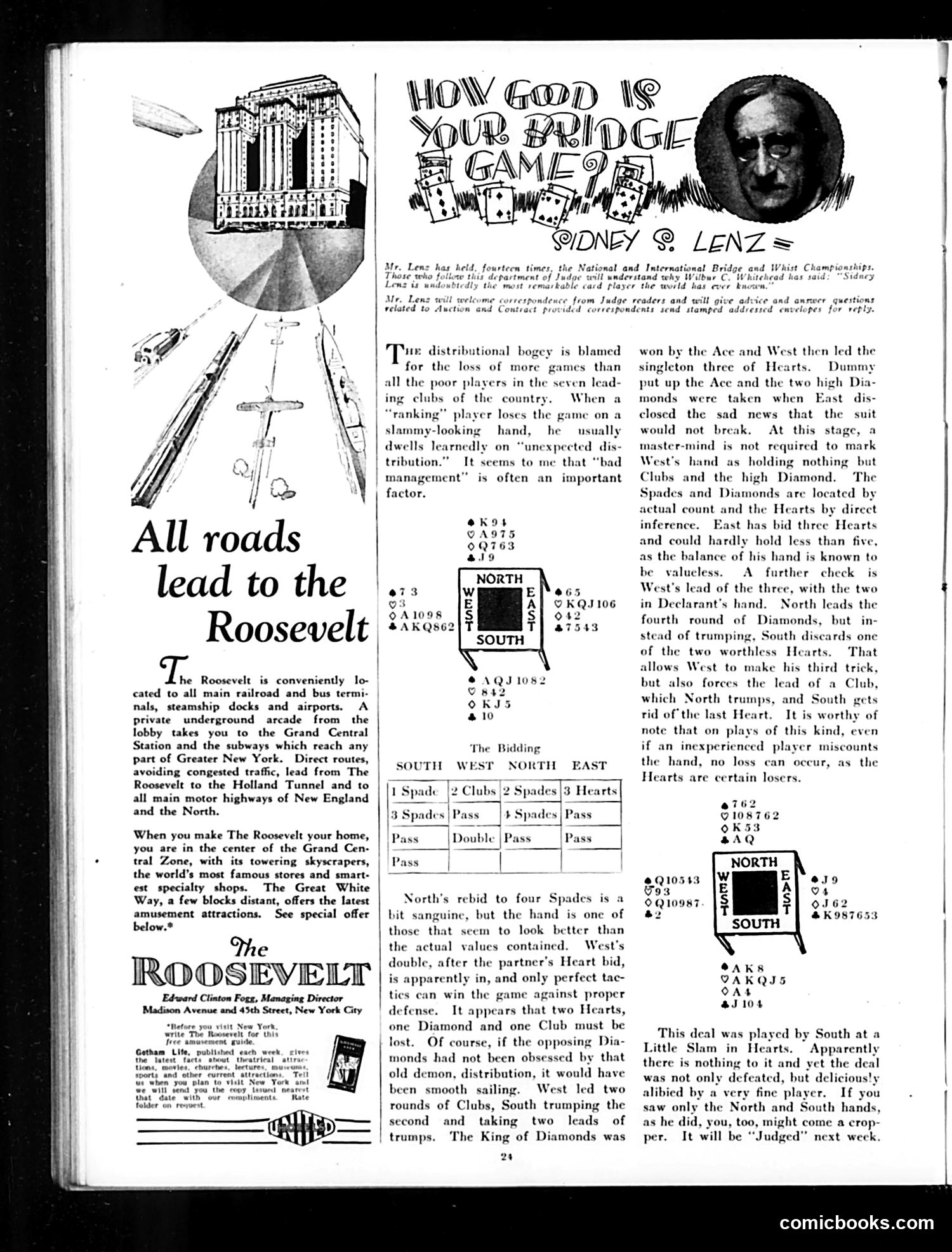
Analysis: Judge Magazine Page - Bridge Column & Hotel Advertisement This page mixes two distinct elements: a hotel advertisement for The Roosevelt (a real New York hotel on Madison Avenue) and a bridge card game column by Sidney Lenz, a famous bridge champion. The cartoon "All roads lead to the Roosevelt" uses transportation imagery (planes, trains, ships) as visual puns—all literally leading to the hotel's location near Grand Central Terminal. This is straightforward commercial satire/advertising humor. The bridge column analyzes a specific card hand, discussing strategy and "distribution bogey"—the tendency of poor players to blame bad luck rather than poor play. Lenz critiques players who make excuses about unexpected card distribution instead of accepting responsibility for tactical errors. Context for modern readers: This represents Judge magazine's blend of satirical commentary with commercial content. The bridge analysis reflects early-20th-century American fascination with bridge as an intellectual game for the educated class.
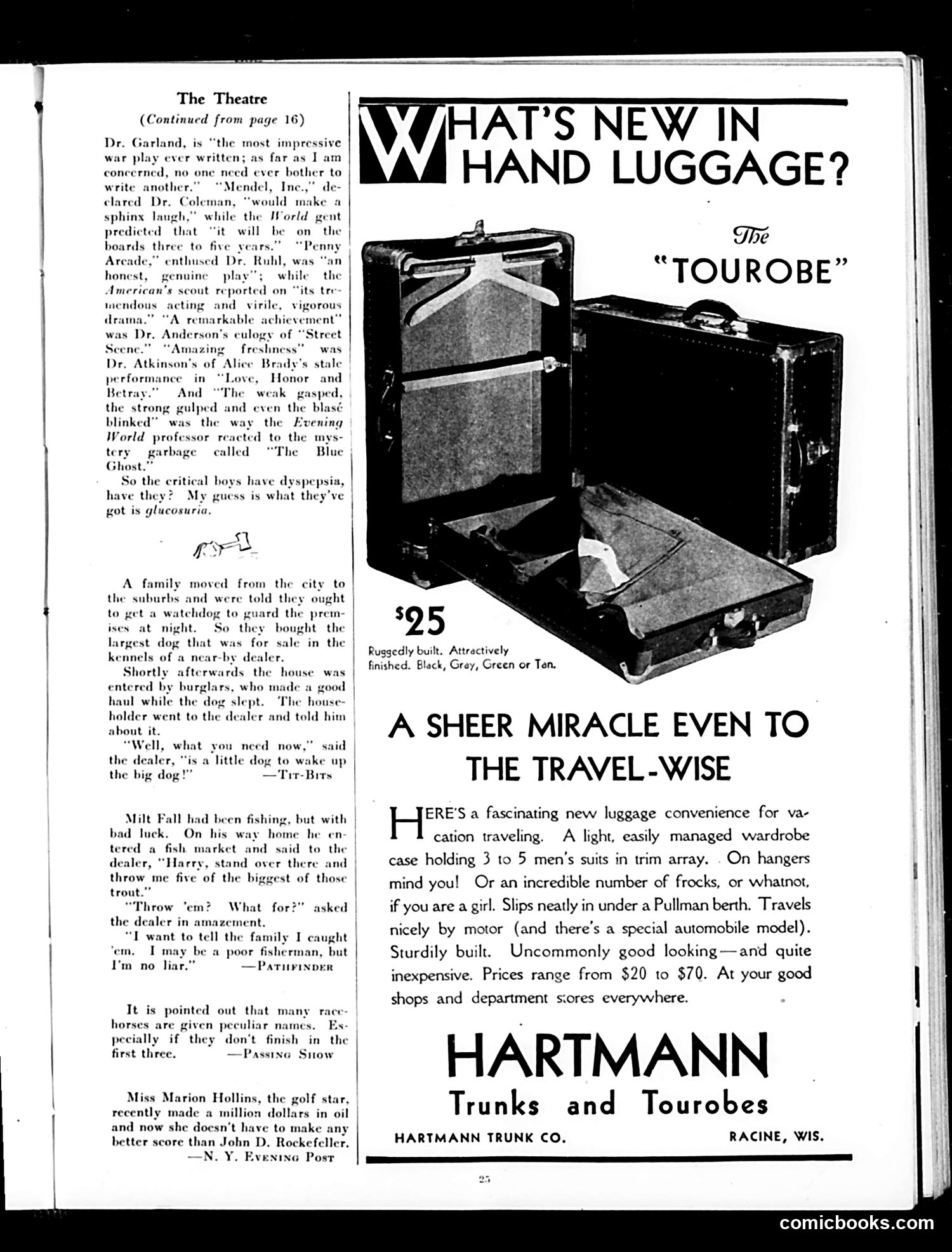
Analysis of This Judge Page This page is primarily advertising, not satire or political commentary. The dominant content is a full-page advertisement for the "Tourobe," a new piece of travel luggage by Hartmann Trunk Company (Racine, Wisconsin), priced $25-$70. The left column contains theatre reviews and brief humorous anecdotes unrelated to the ad: - Critics' mixed reactions to various theatrical productions - A joke about homeowners buying a large watchdog that sleeps through a burglary - A fisherman's admission he's a poor fisherman (playing on honor/honesty) - A brief reference to golfer Marion Hollins' newfound wealth from oil The advertisement's appeal targets vacation travelers, highlighting the Tourobe's convenience: it holds multiple suits compactly, fits under Pullman berths, and comes in an automobile model. The marketing emphasizes practicality for both men and women travelers—a relatively modern concern for the early 20th century when leisure travel was becoming more accessible. The page reflects Judge's dual nature: satirical commentary alongside commercial content.
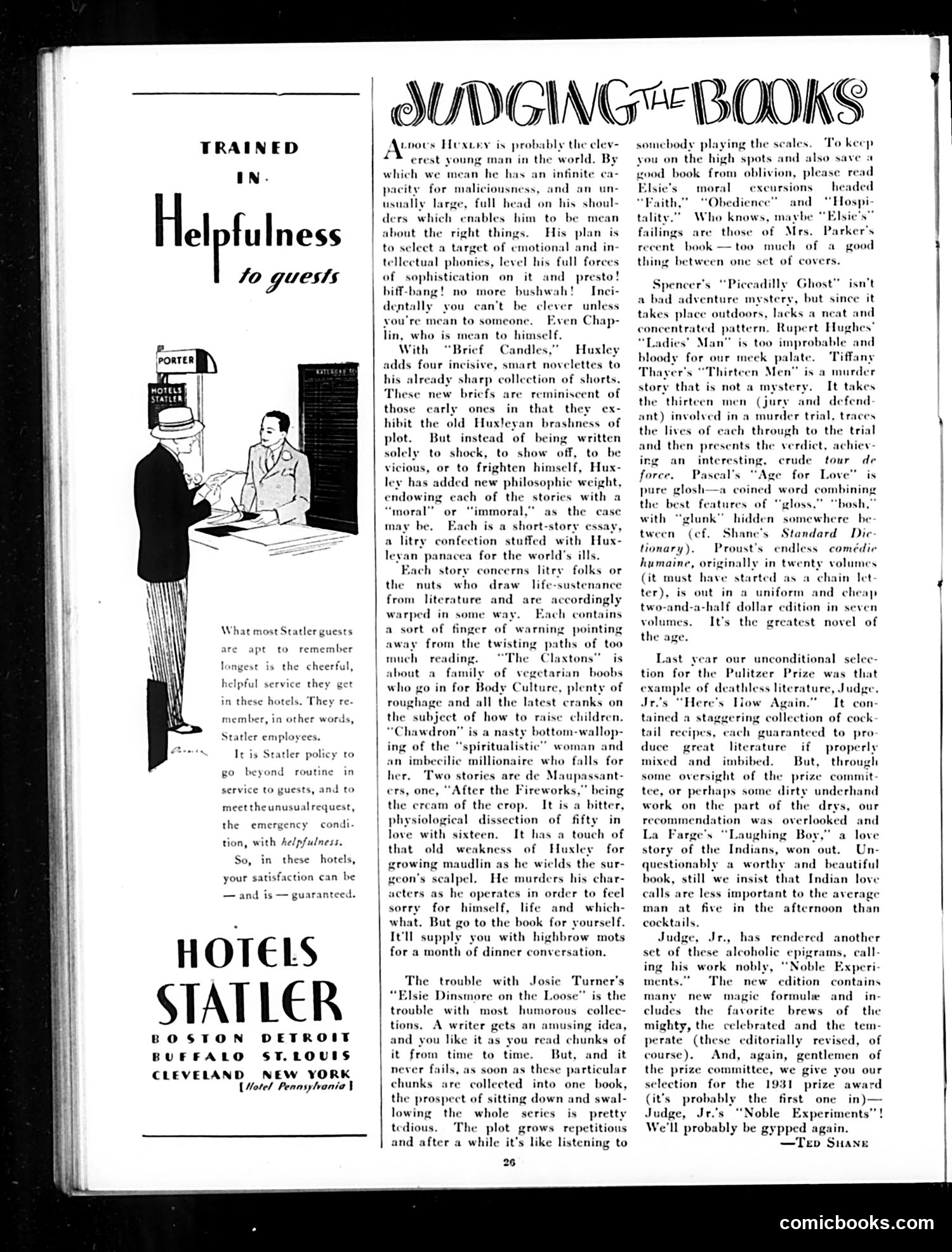
"Judging the Books" Book Review Page This page is primarily a book review column by Ted Shane, not political satire. The left side contains a Statler Hotels advertisement emphasizing employee helpfulness to guests. The main content reviews several contemporary books: Aldous Huxley's *Brief Candles* (praised for intellectual sophistication), Josie Turner's *Elsie Dinsmore on the Loose* (criticized for repetitive humor), works by Spencer, Rupert Hughes, and Tiffany Thayer, among others. Shane critiques these books' literary merit, plotting, and readability for educated audiences. The column reflects 1930s literary culture—referencing Huxley's philosophical weight, concerns about "highbrow mots" for dinner conversation, and comparing collections unfavorably to single sustained narratives. This represents middlebrow cultural criticism typical of *Judge* magazine's entertainment and book review sections, aimed at educated readers seeking guidance on contemporary literature.

Analysis of Judge Magazine Page This page contains two distinct elements: Left side: A serialized humorous story ("Attractive Elephant for Quick Sub-Lease") featuring characters Rover (an elephant) and the narrator Seltzer. The narrative employs sentimental nostalgia about World War I—Rover lost his leg at the Battle of Jutland, and the narrator reflects emotionally on British heroism and sacrifice. The story satirizes both verbose literary sentimentality and the gap between wartime ideals and peacetime reality. The joke appears to be mocking overwrought patriotic narratives. Right side: A Dentyne chewing gum advertisement using a photograph of a smiling woman. The ad emphasizes teeth whiteness and attractive smiles as social currency. Bottom: An advertisement for "Judge's Second Cross-Word Puzzle Book," capitalizing on the 1920s crossword puzzle craze. The page is primarily advertising and serialized entertainment content rather than political satire. The left-side story's gentle mockery of war nostalgia is the closest thing to social commentary present.
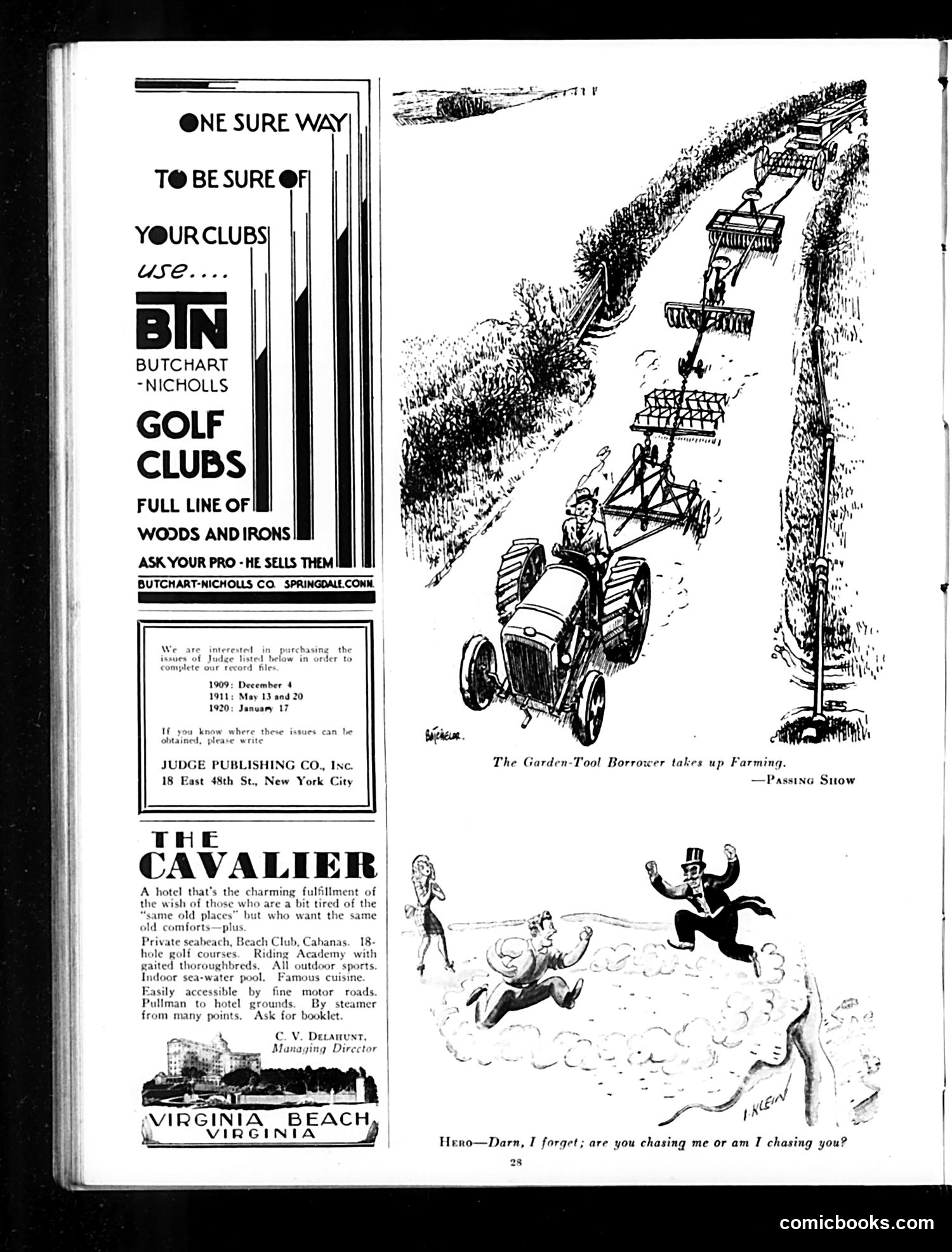
Page Analysis: Judge Magazine (Date Unclear) This page is primarily advertising, with two cartoons serving as filler content. Top cartoon ("The Garden-Tool Borrower Takes Up Farming"): A satirical jab at someone habitually borrowing tools who now attempts farming. The humor derives from the irony that chronic borrowers—who won't invest in their own equipment—suddenly fancy themselves farmers. Bottom cartoon ("Hero—Darn, I forget..."): Two figures chasing each other amid clouds in what appears to be a dream or slapstick sequence. The joke is the mutual confusion about who's pursuing whom—typical slapstick comedy suggesting neither party knows what's happening. Advertisements include: - Butchart-Nicholls Golf Clubs - The Cavalier Hotel (Virginia Beach, Virginia), advertising leisure amenities - Judge Publishing Company seeking back issues The cartoons are generic humor typical of early 20th-century magazines, requiring no specific historical knowledge beyond understanding basic slapstick conventions.
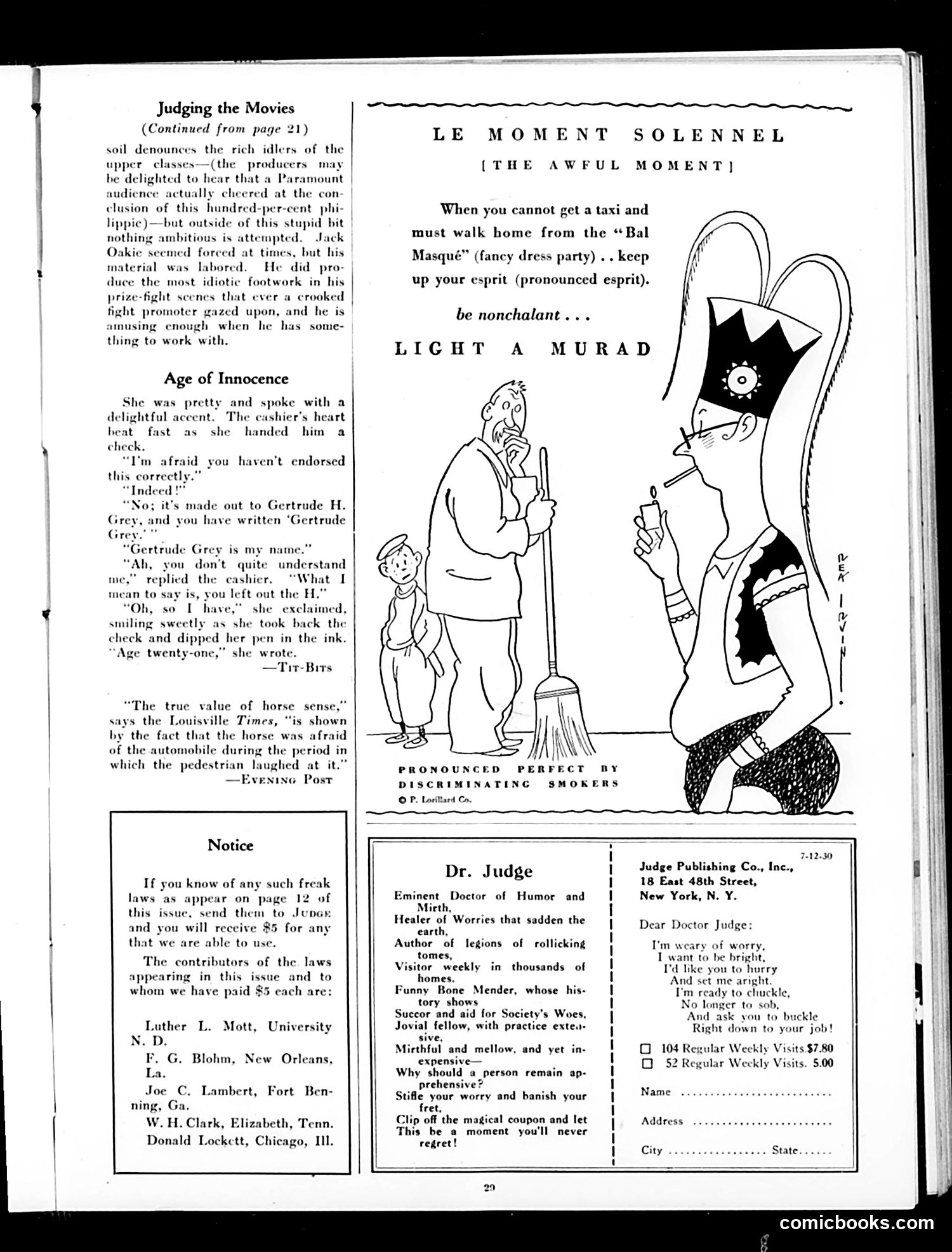
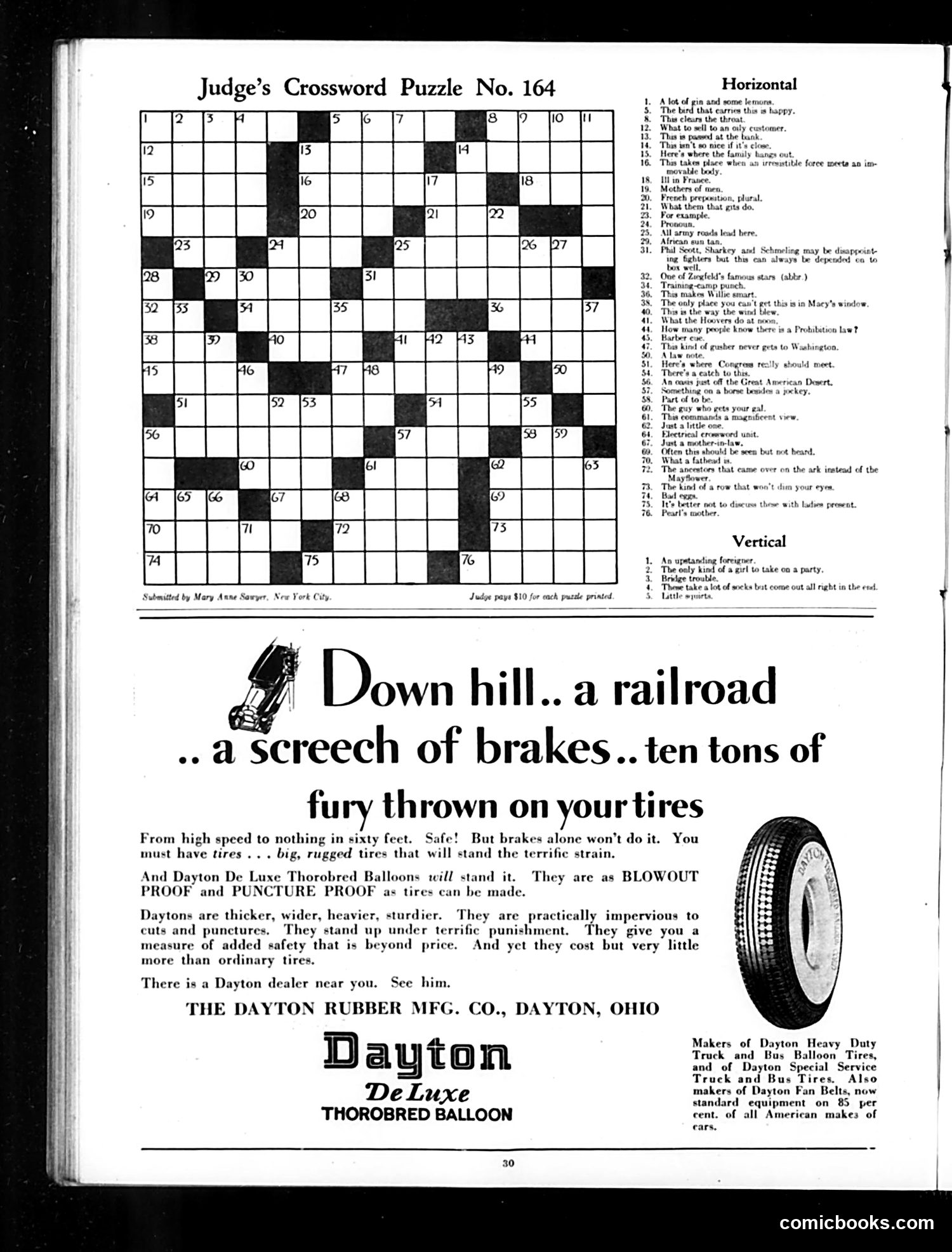
Judge Magazine Page Analysis This page contains two distinct elements: a crossword puzzle and a full-page tire advertisement. The Crossword Puzzle (No. 164): A standard puzzle with topical clues reflecting 1920s-30s American life and current events. Notable clue references include Phil Scott, Sharkey, and Schmeling (boxers of that era), Congress, and various social commentary typical of Judge's satirical approach. The Advertisement: The lower half features a Dayton Rubber Manufacturing Company advertisement for "De Luxe Thorobred Balloon" tires. The ad uses dramatic language about brake failure scenarios ("down hill...a railroad...a screech of brakes...ten tons of fury") to emphasize tire reliability and safety. This reflects the automotive safety concerns of the era, when tire failure was a genuine hazard on unpaved roads and in early motorcar driving. The ad positions Dayton tires as "blowout proof and puncture proof"—selling safety to anxious motorists. The page is primarily commercial rather than satirical commentary.
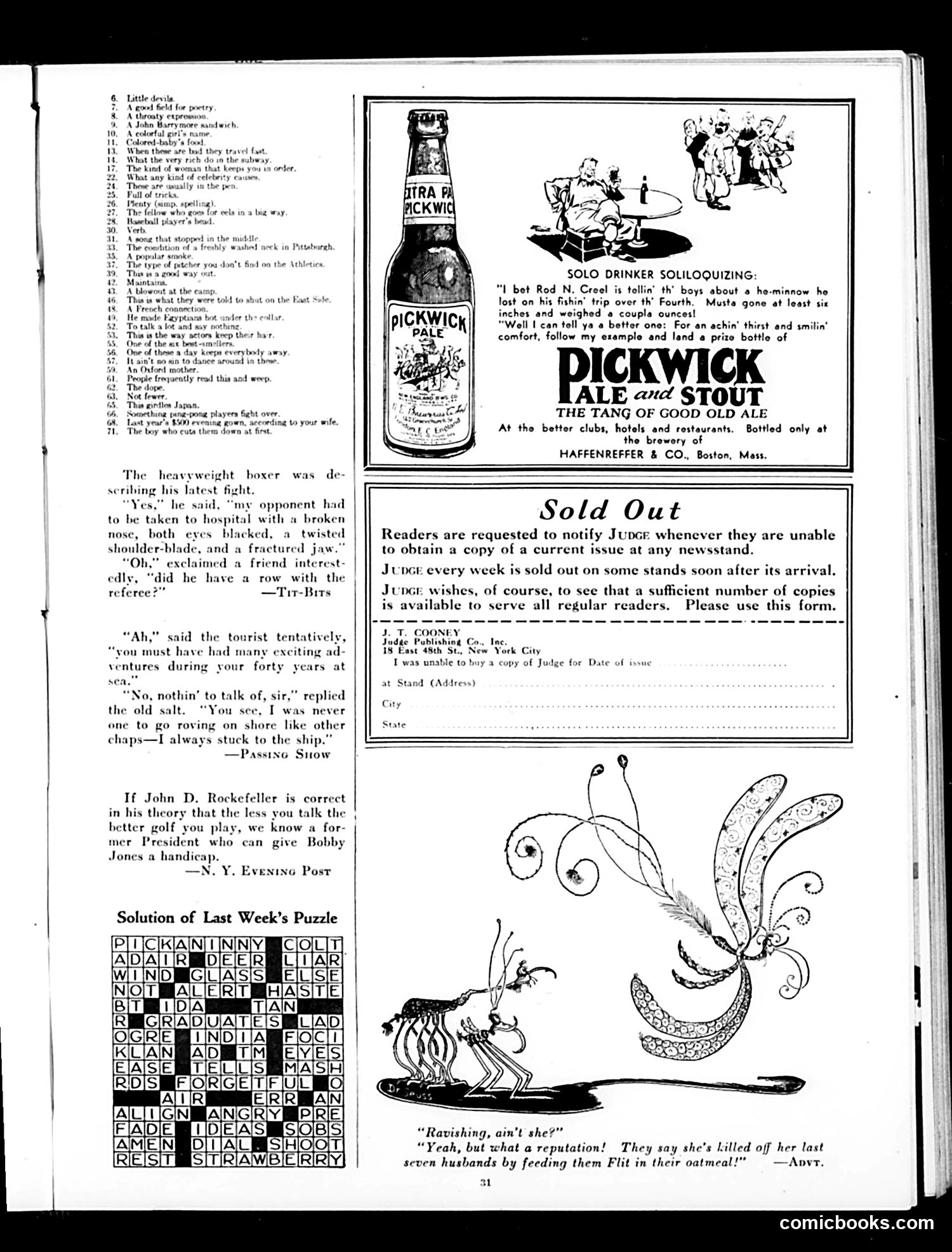
Judge Magazine Page Analysis This page contains several humor items typical of Judge's satirical content: Main Advertisements: - A Pickwick Ale & Stout advertisement featuring a "Solo Drinker Soliloquizing" about fishing exploits, using the product as an aspirational lifestyle marker for club/hotel patrons. - A Flit insecticide advertisement (bottom cartoon) making a dark joke: a woman has killed seven husbands by poisoning their oatmeal with Flit insecticide, yet maintains a reputation as "ravishing." Humor Pieces: - Several brief anecdotes and jokes, including one about a heavyweight boxer's injuries (suggesting he fought the referee, not his opponent) and another about a taciturn sailor who never left his ship in forty years. - A reference to John D. Rockefeller's theory about silence improving golf performance, implying a former president (likely Coolidge, known for taciturnity) needs such coaching. Puzzle Section: - Crossword puzzle solution from the previous week. The page reflects 1920s-era advertising humor that would be considered tasteless today, particularly the casualness of the spousal murder "joke" in the Flit ad.
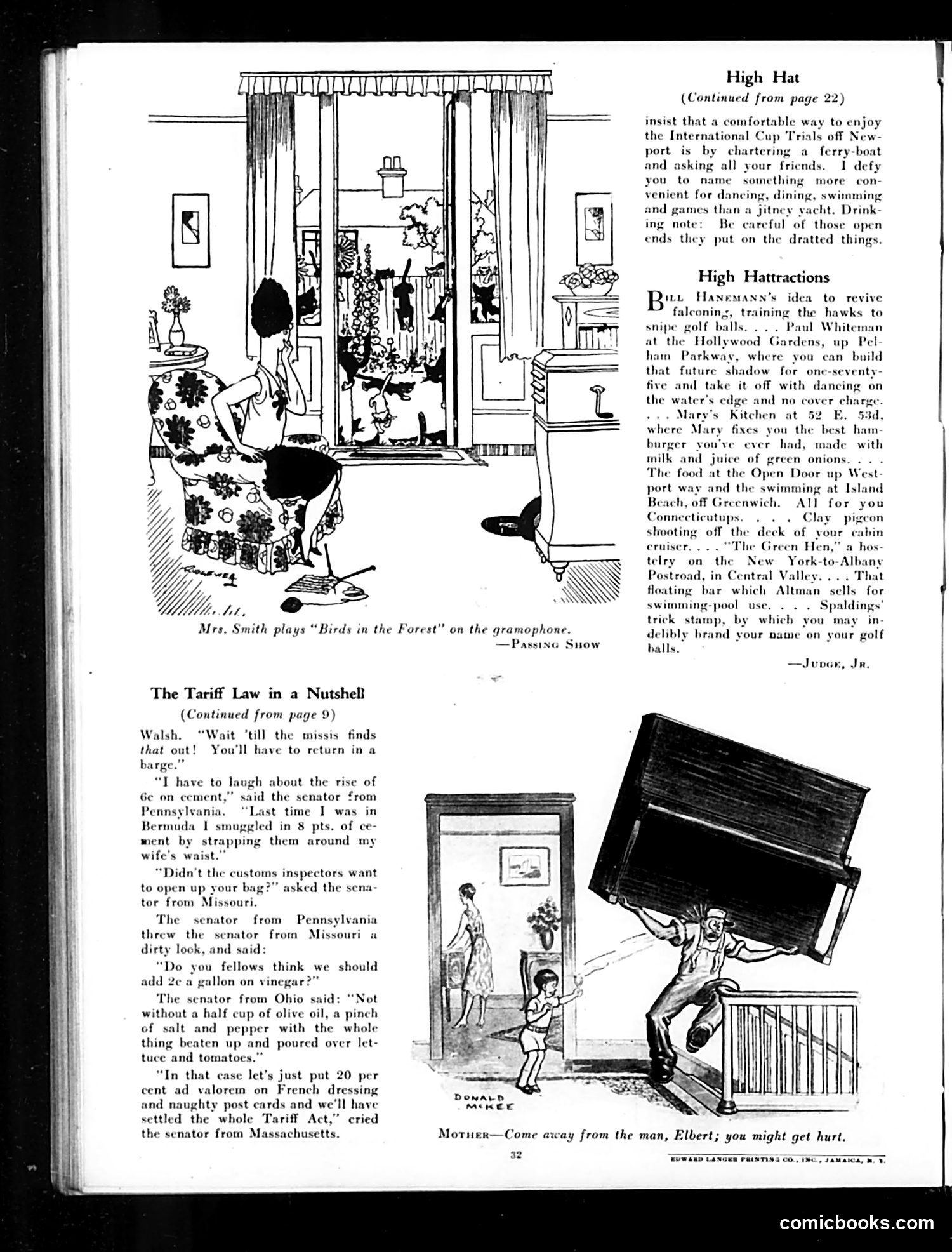
Analysis of Judge Magazine Page This page contains two distinct sections: "The Tariff Law in a Nutshell" (continued article): A satirical dialogue between senators debating tariff legislation. The humor relies on senators casually discussing smuggling personal items (cement, vinegar) past customs inspectors, treating law-breaking as commonplace. The joke suggests that politicians—the very people who write tariff laws—routinely circumvent them, exposing the hypocrisy of tariff enforcement during the era of Prohibition and protective trade policy. "High Hat" and "High Hattractions": Social commentary on upper-class leisure activities around 1920s New York/Connecticut. References include yachting, country clubs (Hollywood Gardens, Pelham Parkway), upscale dining, and fashionable summer destinations. The tone is satirical toward wealthy society's conspicuous consumption and exclusive pastimes. Bottom cartoon (by Donald McKee): Shows a mother warning a child away from a man carrying a large trunk, captioned "Come away from the man, Elbert; you might get hurt." Likely commentary on crime, danger, or suspicious characters in urban settings. The page satirizes both political corruption and upper-class excess characteristic of Jazz Age America.
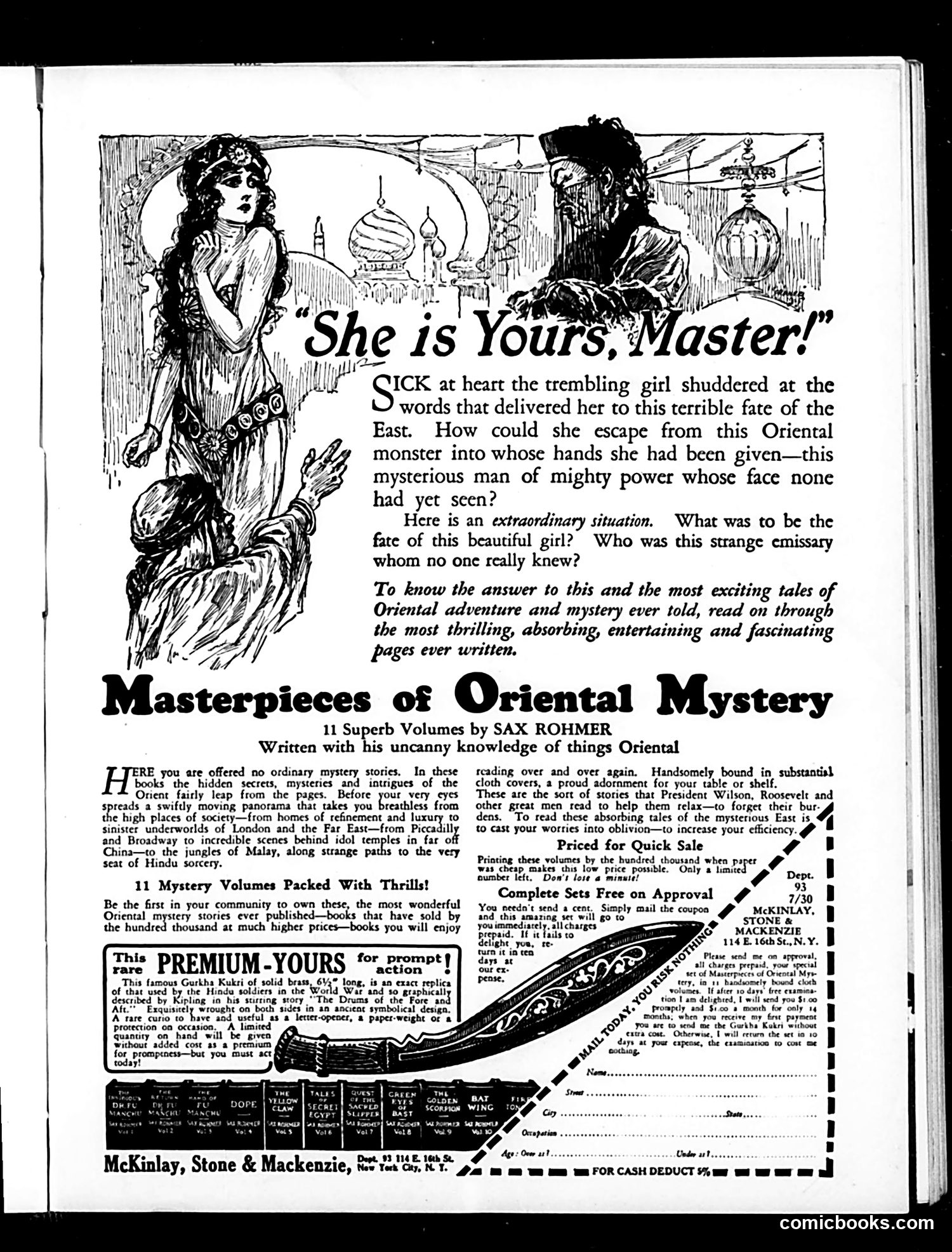
"Masterpieces of Oriental Mystery" Advertisement This is primarily a book advertisement, not political satire. It promotes Sax Rohmer's 11-volume mystery series featuring exotic Oriental settings and intrigue. The page exploits early 20th-century Western fascination with "the mysterious East"—a common trope that portrayed Asia as dangerous, exotic, and unknowable. The illustration depicts a trembling Western woman delivered to an unseen "Oriental monster," reflecting anxieties about colonial power dynamics and racial "otherness." The marketing emphasizes escapism: these stories let readers (including Presidents Wilson and Roosevelt, it claims) forget worldly burdens. A premium brass Gurkha knife sweetens the offer. The satire appears mild—if present at all—targeting book-marketing excess rather than the Orient itself. Modern readers would recognize this as reflecting period Orientalism: Western fiction that exoticized, eroticized, and dehumanized Asian cultures for entertainment.
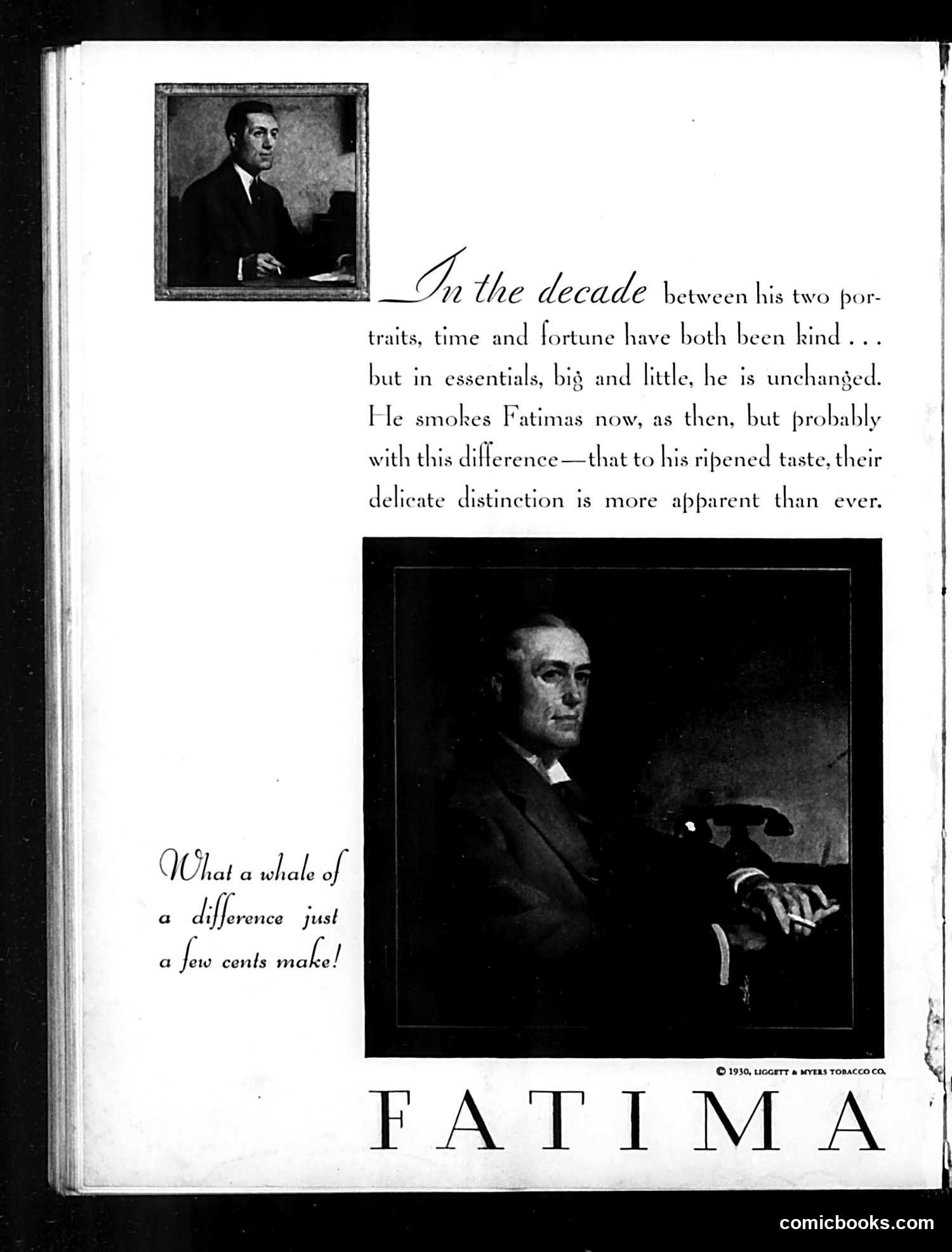
Analysis This is a tobacco advertisement for Fatima cigarettes, not political satire. The page compares two portraits of the same man, taken roughly a decade apart (the copyright is 1930). The ad's premise: despite aging, the subject remains essentially unchanged in character and taste. It claims he smoked Fatimas "then" and smokes them "now," but with greater appreciation for their "delicate distinction." The phrase "What a whale of a difference just a few cents make!" suggests Fatimas were positioned as an affordable luxury cigarette—small price difference, significant quality improvement. We cannot identify the specific person from the image alone, though the formal portraits and refined appearance suggest someone of social standing. The ad leverages the man's presumed fame or respectability to endorse the product. This was standard 1930s advertising practice: using celebrity or authority figures to sell cigarettes.