judge
Judge — July 19, 1930
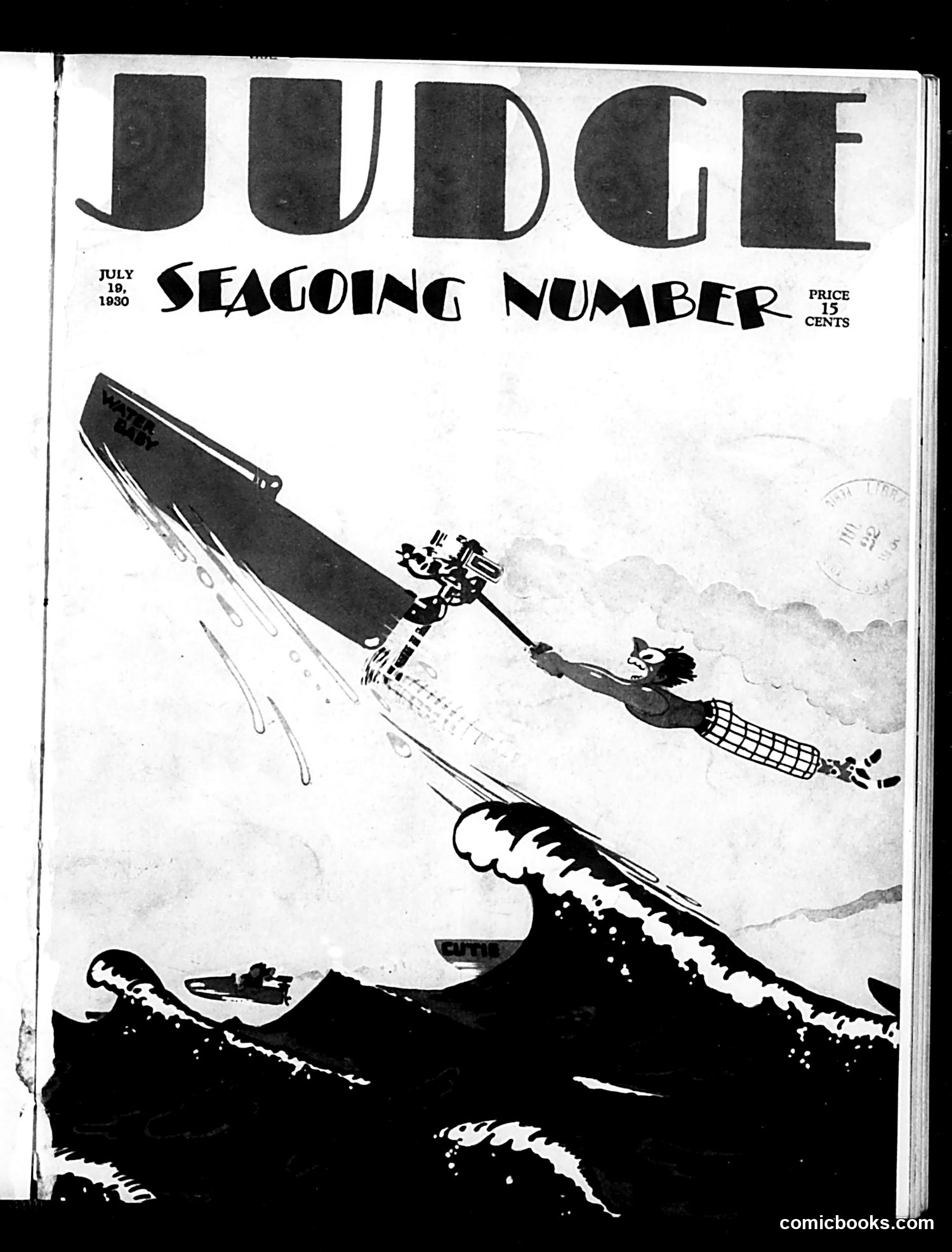
Analysis of Judge Magazine Cover, July 19, 1930 This cover depicts a dramatic maritime disaster scene—likely referencing a ship or aircraft accident from 1930. The illustration shows a sinking vessel, drowning figures, and what appears to be a rescue attempt involving a person being pulled from the water. The cover's title "JUDGE SEAGOING NUMBER" indicates this was a themed issue focused on nautical content or disasters. The satirical intent remains unclear from the image alone—whether it's commentary on maritime safety, naval policy, or simply exploiting a contemporary tragedy for sensational cover appeal, which was common in 1930s magazines. The dramatic, high-contrast illustration style was typical of Judge's approach to eye-catching covers during this era. Without additional article titles visible, the specific satirical target cannot be definitively determined.

Analysis This is primarily a Gillette razor blade advertisement, not political satire. The page shows a man shaving with the "New Gillette Blade" and promotes the product's superior shaving quality. The advertisement's only potentially humorous element is the exaggerated facial expression of the man being shaved—his wide-eyed, somewhat pained grimace might suggest either the intensity of the shave or discomfort. However, this appears designed to convey the blade's effectiveness rather than serve as satire. The page emphasizes that the New Gillette Blade offers "the keenest shaving edge ever produced" and encourages consumers to purchase genuine blades at $1.00 (or 50¢ for five). This is straightforward commercial promotion typical of *Judge* magazine's advertising content, not editorial cartoon commentary.
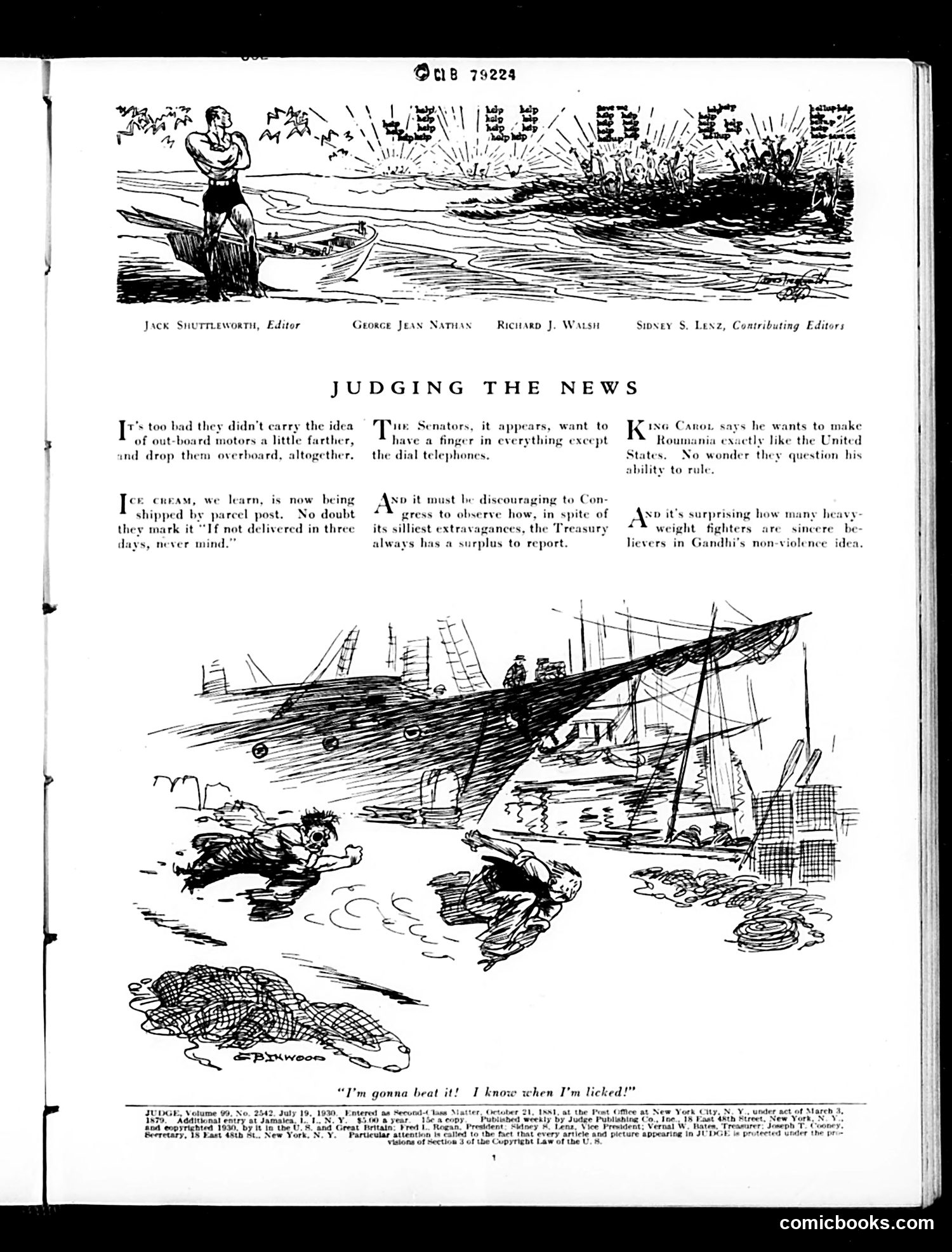
Analysis of "Judging the News" Page This page contains brief satirical editorial comments on current events alongside a political cartoon showing shipwrecked sailors. The Editorial Quips: - Criticizes Congress for wanting to "have a finger in everything except the dial telephones" - Mocks the Treasury always reporting surpluses despite congressional spending - References heavy-weight supporters of Gandhi's non-violence movement The Cartoon: Depicts sailors amid wreckage with the caption "I'm gonna beat it! I know when I'm licked!" This appears to be commentary on a maritime disaster or naval defeat, though the specific historical reference is unclear. The sailors' resignation suggests commentary on accepting failure or knowing when to retreat. The page reflects Judge magazine's characteristic approach: punchy political satire on congressional inefficiency and contemporary social movements, paired with illustrative cartoons addressing news events.
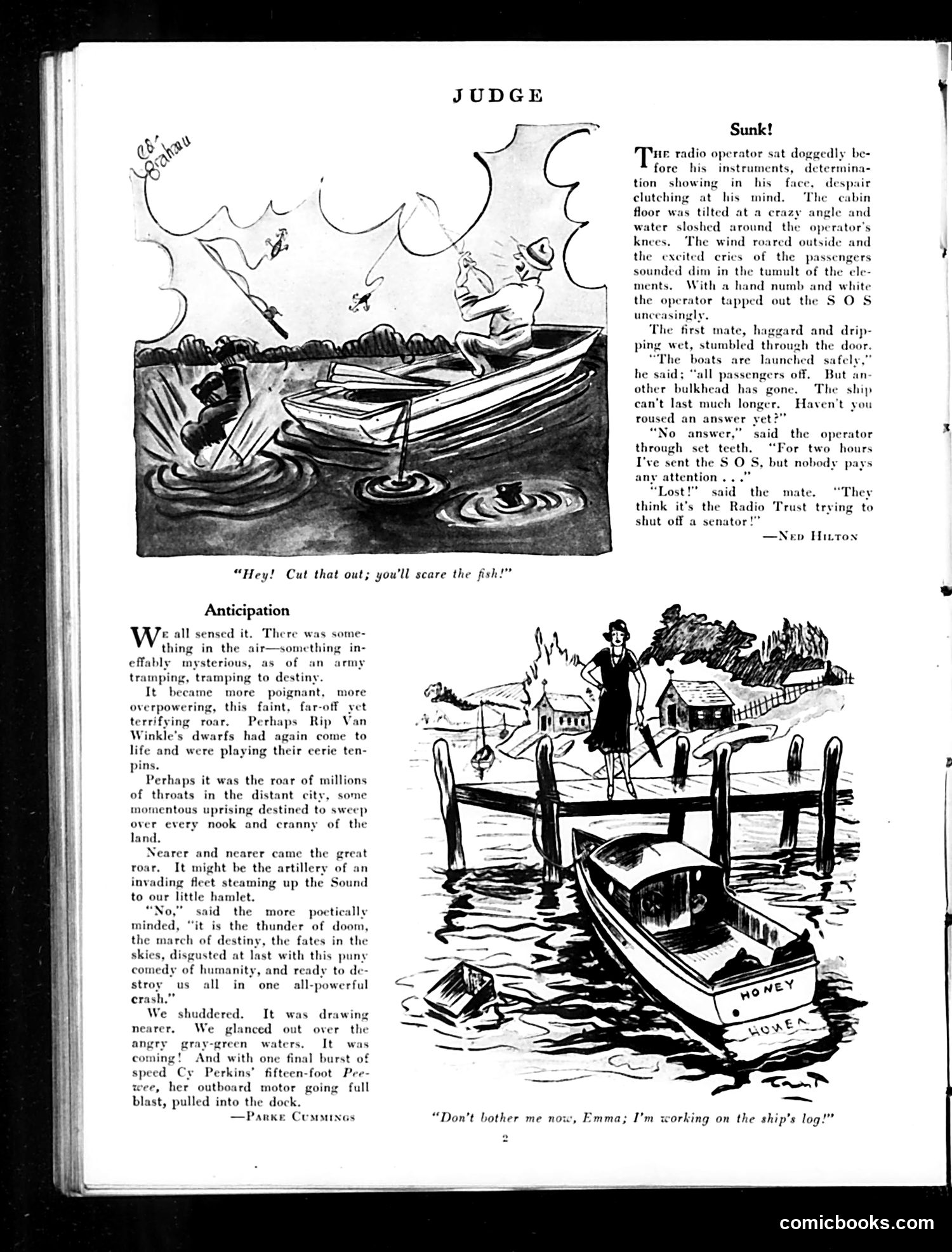
Analysis of Judge Magazine Page This page contains two separate pieces of satirical content: "Sunk!" (top): A cartoon depicting a ship in distress. The radio operator desperately signals SOS while the first mate dismisses his efforts, claiming the Radio Trust is intentionally ignoring distress calls to "shut off a senator." The satire criticizes monopolistic radio corporations for prioritizing corporate interests over public safety—a relevant concern during the early radio regulation era when the emerging broadcast industry faced scrutiny about its power and accountability. "Anticipation" (bottom): A literary piece accompanied by an illustration of a flooded dock scene. The text poetically describes an ominous atmospheric tension—possibly referencing an impending war or disaster. The sailor character's preoccupation with "the ship's log" suggests wartime concerns, though the specific historical context remains unclear without additional dating information. Both pieces reflect early 20th-century anxieties about corporate power and international instability.
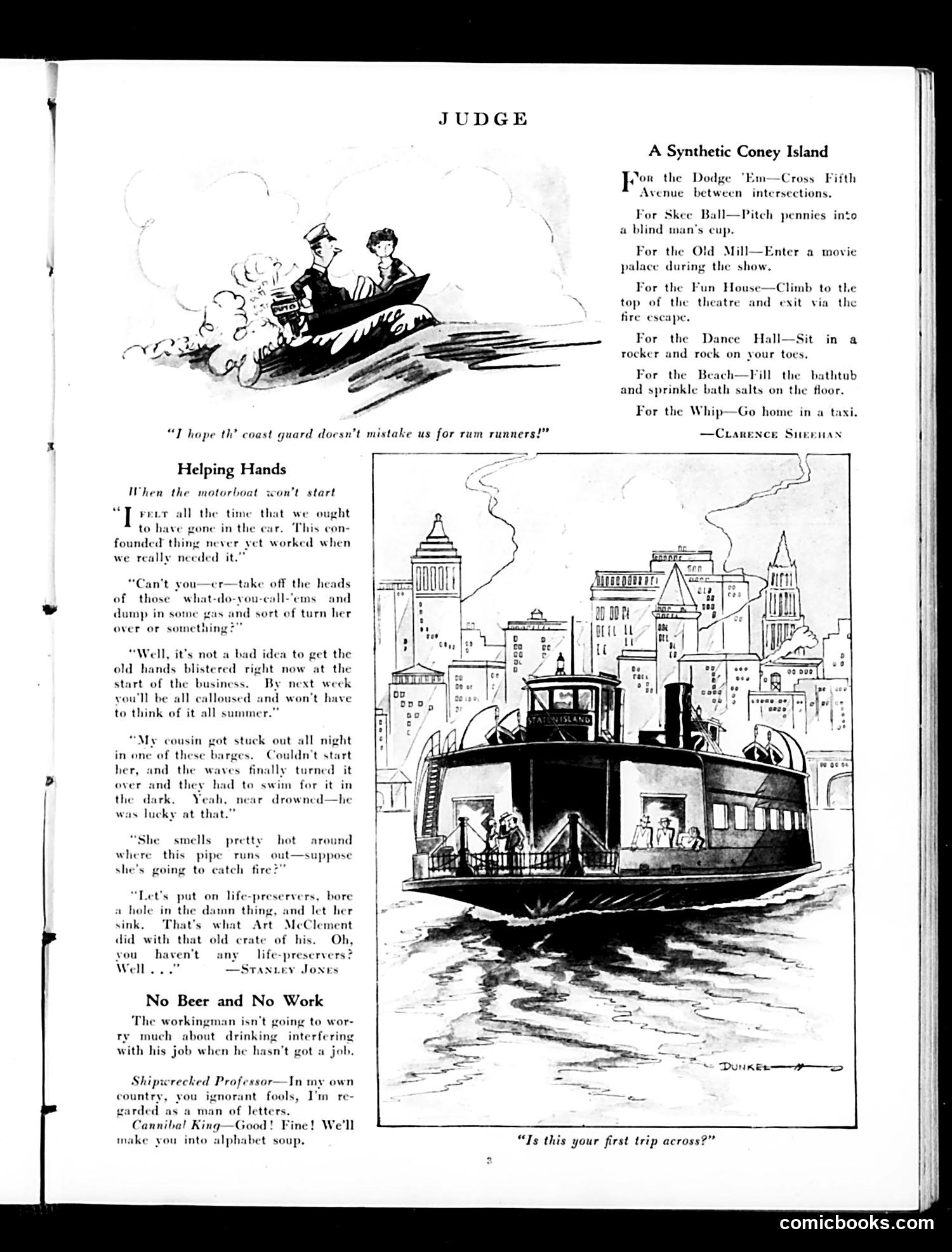
"A Synthetic Coney Island" - Judge Magazine Page This page satirizes synthetic or artificial recreation of natural attractions on Coney Island (Brooklyn's famous amusement area). The top cartoon mocks creating fake experiences—a "blind man's cup" at the Skee Ball, entering a movie palace during a show, climbing theater fire escapes, and filling bathtubs with salt water to simulate "the Beach." The lower section shows a riverboat cartoon titled "Is this your first trip across?" with accompanying humorous anecdotes about motorboat mishaps and rescue efforts. The satire targets how commercialized entertainment districts substitute artificial imitations for genuine experiences, while the boat section humorously depicts common tourist and working-class recreation mishaps on the waterways near Coney Island.
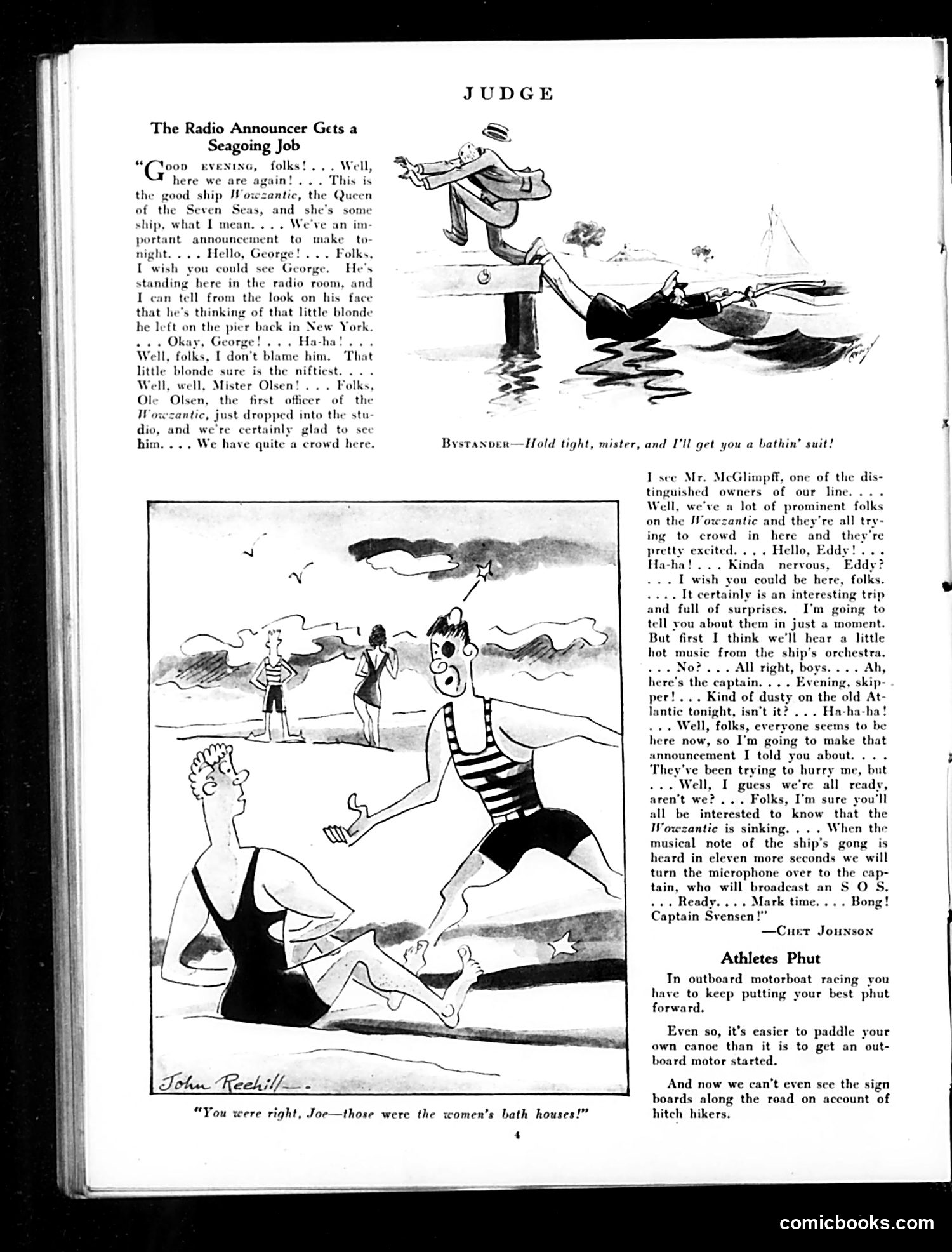
Analysis of Judge Magazine Page This page contains two unrelated pieces of humor: "The Radio Announcer Gets a Seagoing Job" presents a radio broadcaster awkwardly transitioning to announcing a ship's sinking. The humor relies on the announcer's breathless, overly enthusiastic radio delivery style applied to an actual maritime disaster—the ship *Worczantic* is going down. The joke satirizes radio announcers' exaggerated professionalism and artificial excitement, contrasting their studio patter with a genuine emergency where such tone-deafness becomes absurd. "Athletes Phut" comments on the difficulty of operating motorboats and starting outboard motors, concluding with a jab at hitchhikers obscuring roadside advertising signs. Both pieces are brief, topical humor reflecting 1920s-30s American leisure culture and emerging mass media conventions.
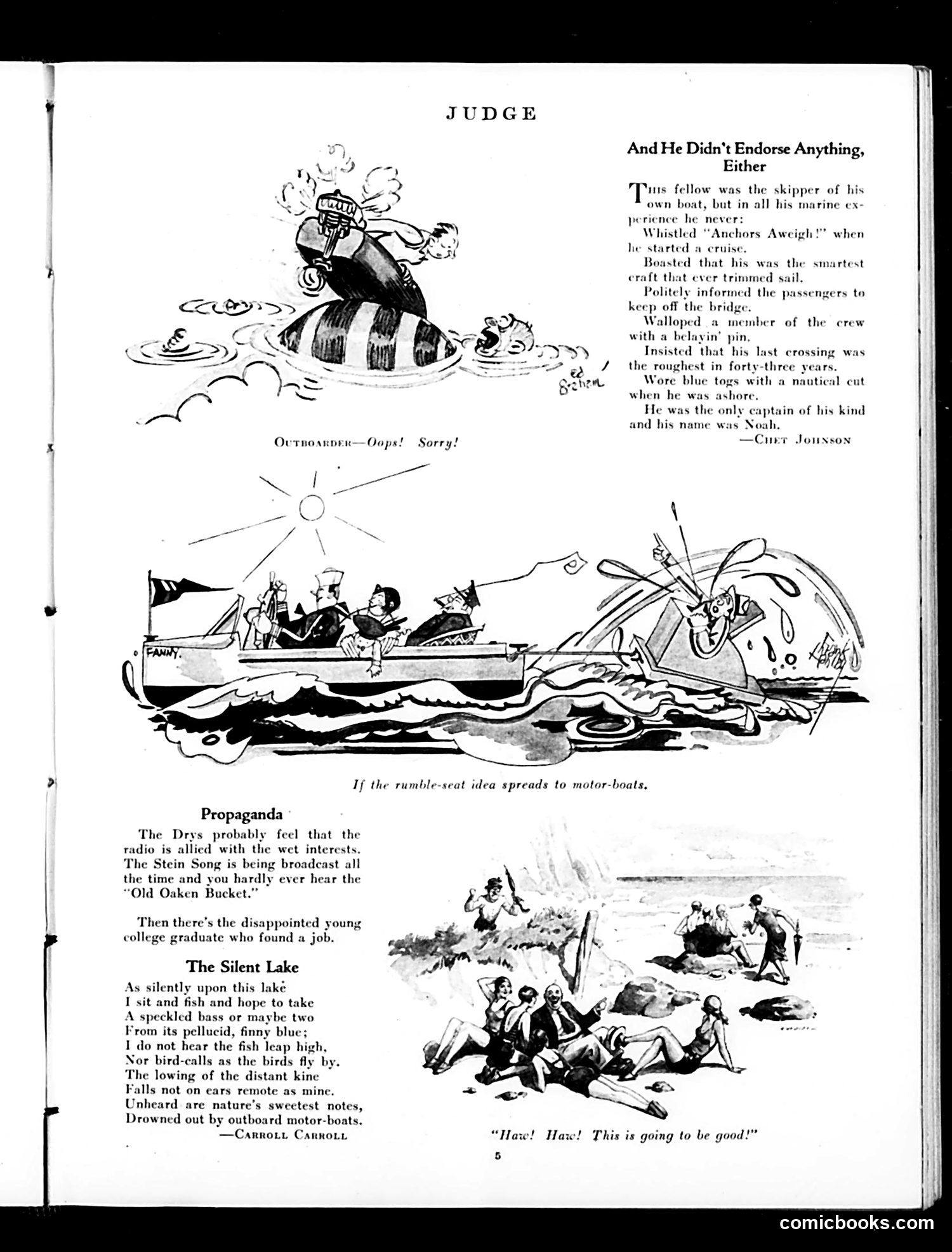
Analysis of Judge Magazine Page This page satirizes early 20th-century concerns about motorboats disrupting traditional recreation. The top cartoon shows a boat captain going overboard with the caption "Oops! Sorry!"—mocking reckless motorboat operators. The middle cartoon depicts a motorboat collision with a rowboat, captioned "If the rumble-seat idea spreads to motor-boats," suggesting motorboats are as unsafe and frivolous as cars with rumble seats. The "Propaganda" section mocks Dry supporters (Prohibition advocates) who blamed radio broadcasts of popular music on "wet interests." A poem titled "The Silent Lake" laments that motorboats have destroyed peaceful lake recreation, drowning out nature's quiet sounds. The bottom illustration shows beachgoers fleeing the noise, saying "Haw! Haw! This is going to be good!"—likely ironic commentary on recreational chaos.
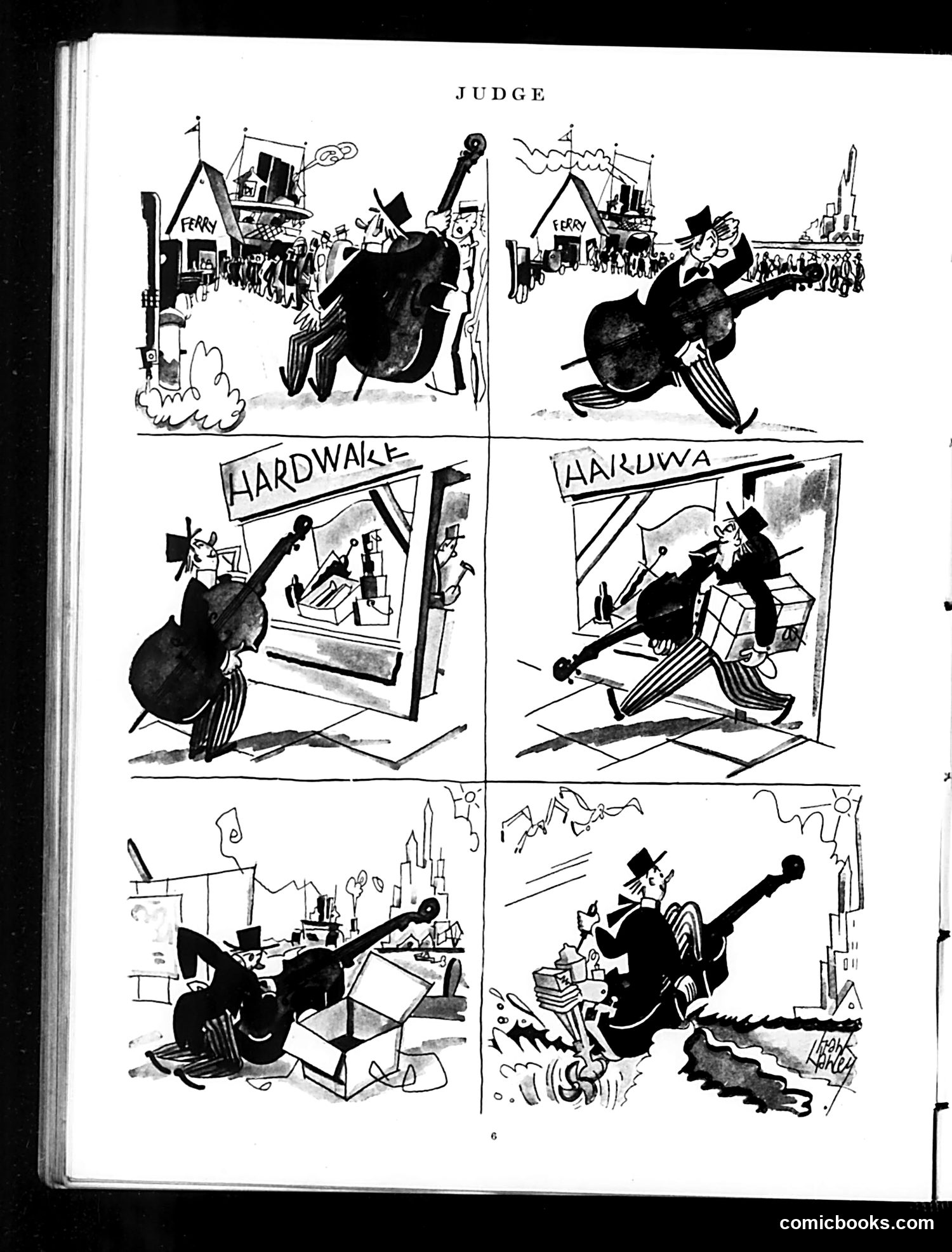
Judge Political Cartoon Analysis This page titled "JUDGE" presents a six-panel satirical comic sequence. The central character—a man in formal dress wielding a large club or mallet—appears to be literally destroying a "HARDWARE" store through successive panels. The progression shows him smashing the storefront and interior, with increasing destruction. The satire likely critiques judicial overreach or a specific judge's aggressive enforcement actions. The "hardware store" destruction may reference actual property damage from law enforcement or court-ordered seizures during Prohibition era raids (common Judge magazine fodder). The formal "judge" figure attacking commerce suggests commentary on governmental power wielded against private business—a recurring satirical theme in this publication. Without visible date or attribution, specific identification remains unclear.
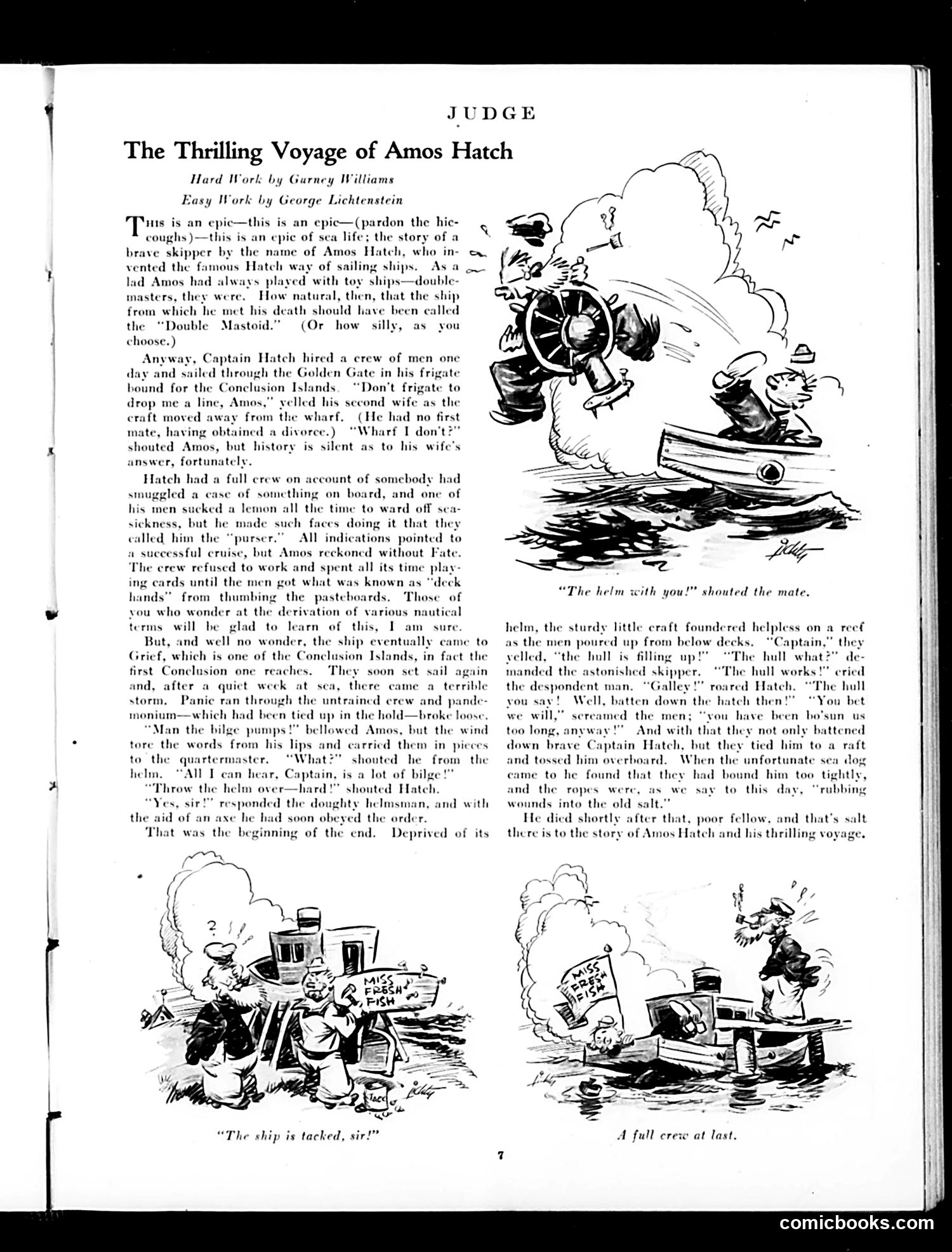
"The Thrilling Voyage of Amos Hatch" Explained This is a humorous tall tale, not political satire. The story follows Captain Amos Hatch on a doomed sea voyage, illustrated by cartoonist Gurney Williams. The satire works through puns and absurdist logic: Hatch invented a peculiar "Hatch way of sailing ships"; his ship is called the "Double Mastoid" (a medical condition); crew members develop "deck hands" from playing cards; someone is called the "purser" for making faces while sucking lemons. The narrative culminates in farce: during a storm, the crew mutinies, ties the captain to a raft and tosses him overboard. When he survives, they bind him "too tightly," creating the idiom "rubbing wounds into the old salt"—a playful etymology of nautical slang. The joke is gentle wordplay and maritime humor rather than commentary on contemporary politics or social issues. It's simply entertainment through linguistic absurdity and slapstick situations.
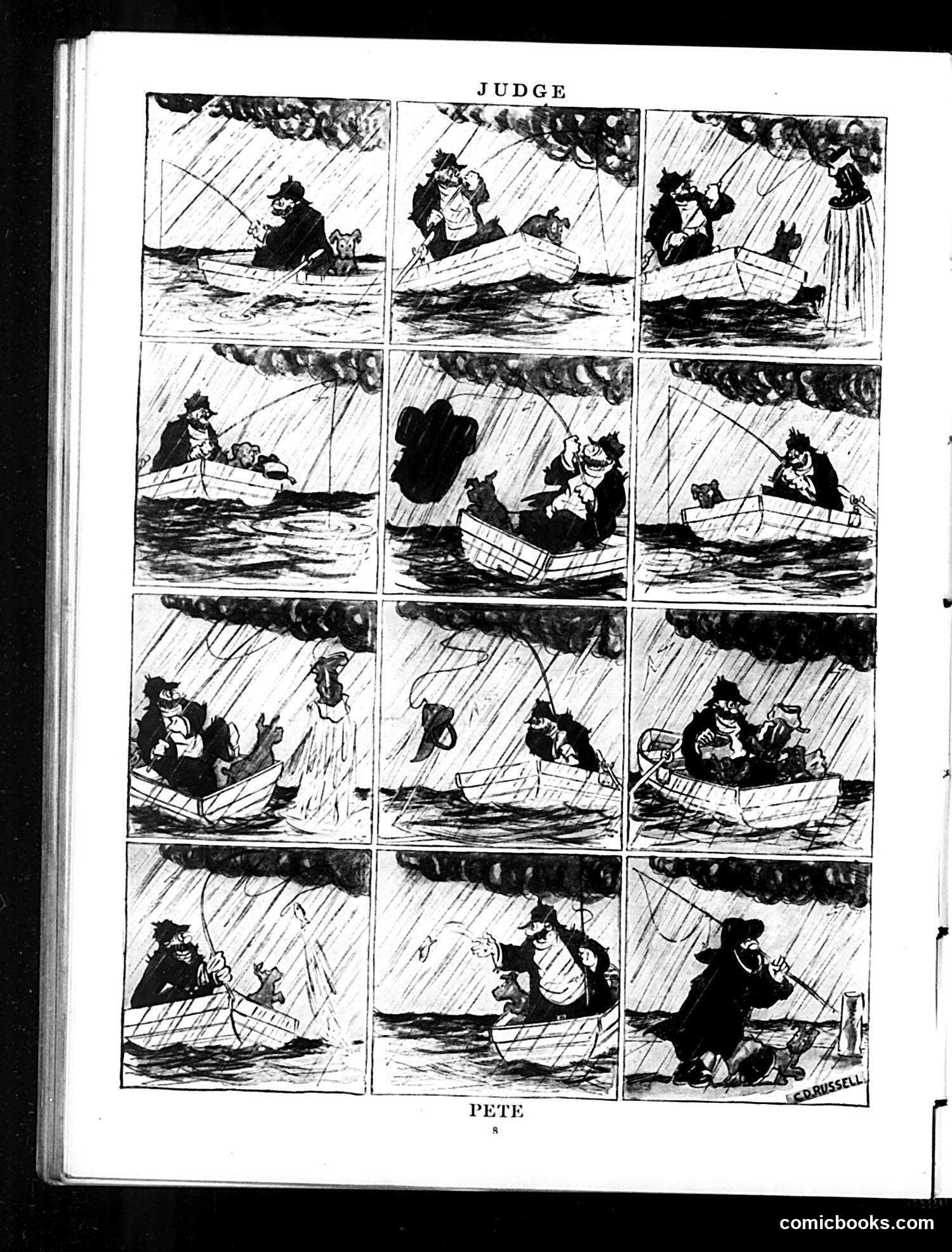
Analysis of "Judge Pete" Comic Strip This is a sequential comic strip titled "Judge Pete" (credited to C.D. Russell), showing what appears to be a judicial or authority figure navigating a rainstorm in a small boat. The humor seems to derive from the character's predicament—repeatedly encountering water hazards and comedic mishaps while attempting to manage the situation. The strip's satire likely targets a specific public figure nicknamed "Judge Pete," though the historical identity isn't immediately clear from the image alone. The repeated boat-based scenarios suggest commentary on incompetence, being "in over one's head," or poor judgment—ironic given the character's judicial title. Without additional context about Judge magazine's publication date and the specific "Pete" referenced, the precise political target remains unclear.
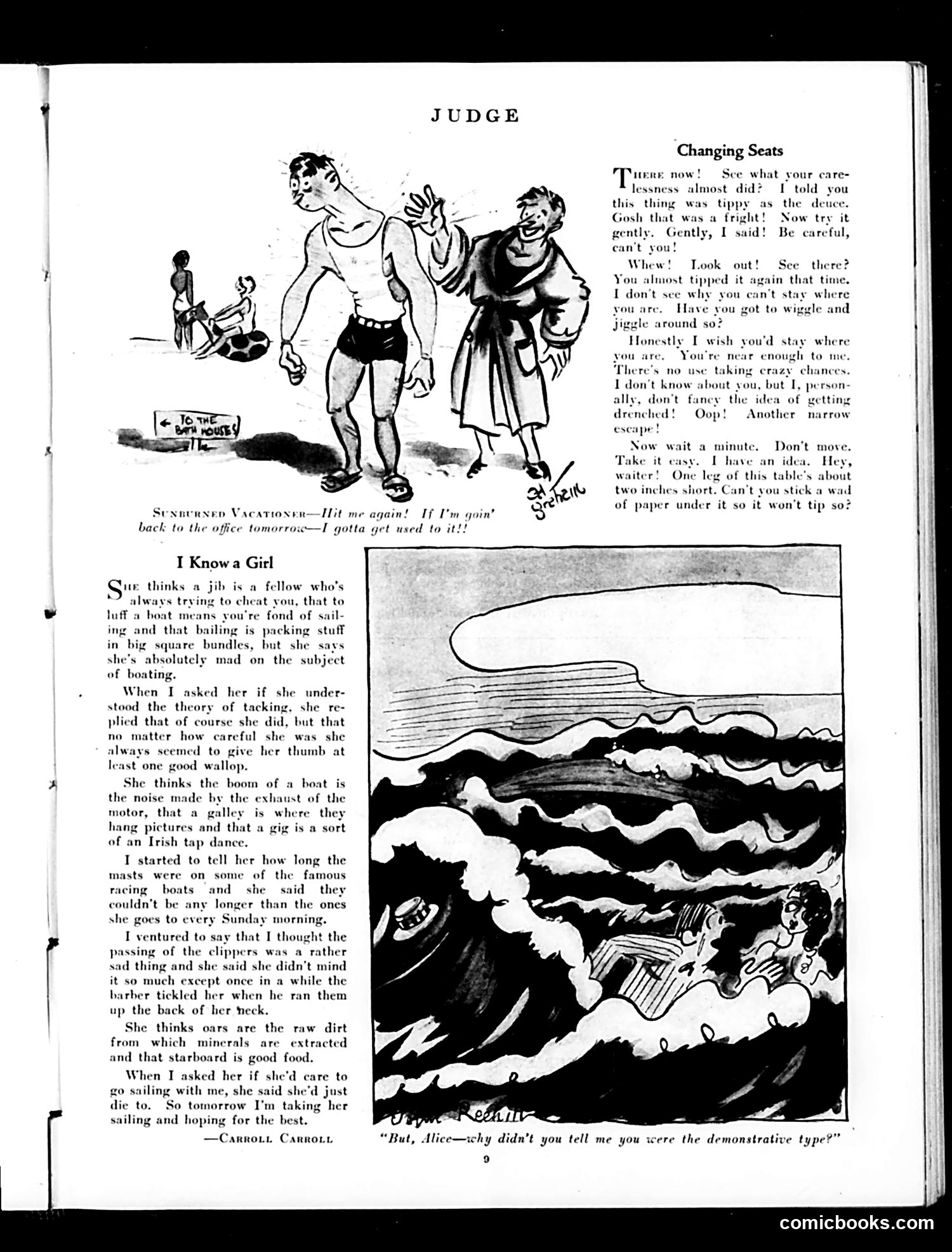
Page Analysis: Judge Magazine This page contains two distinct humorous pieces typical of early 20th-century Judge magazine: "Sunburned Vacationer" (top): A cartoon satirizing vacation exhaustion. A sunburned man requests being hit repeatedly to get accustomed to office life's demands before returning to work—absurdist humor about the shock of re-entering routine. "I Know a Girl" (left column): A comedic essay by Carroll Carroll mocking a woman's complete ignorance of nautical terminology and boating concepts. She confuses sailing jargon (jib, tacking, boom, galley, gig, starboard) with unrelated concepts, and thinks "oars" refers to mineral ore. The humor relies on presenting her as enthusiastically incompetent about a subject she claims to love. "Changing Seats" (right): A cartoon showing a couple struggling with an unstable boat or canoe. The exasperated narrator repeatedly warns his female companion about dangerous movements while she fidgets, culminating in the caption's revelation that she's simply "the demonstrative type"—physical and expressive by nature, unable to sit still. All three pieces use romantic/recreational scenarios to satirize gender dynamics and personality quirks of the era.
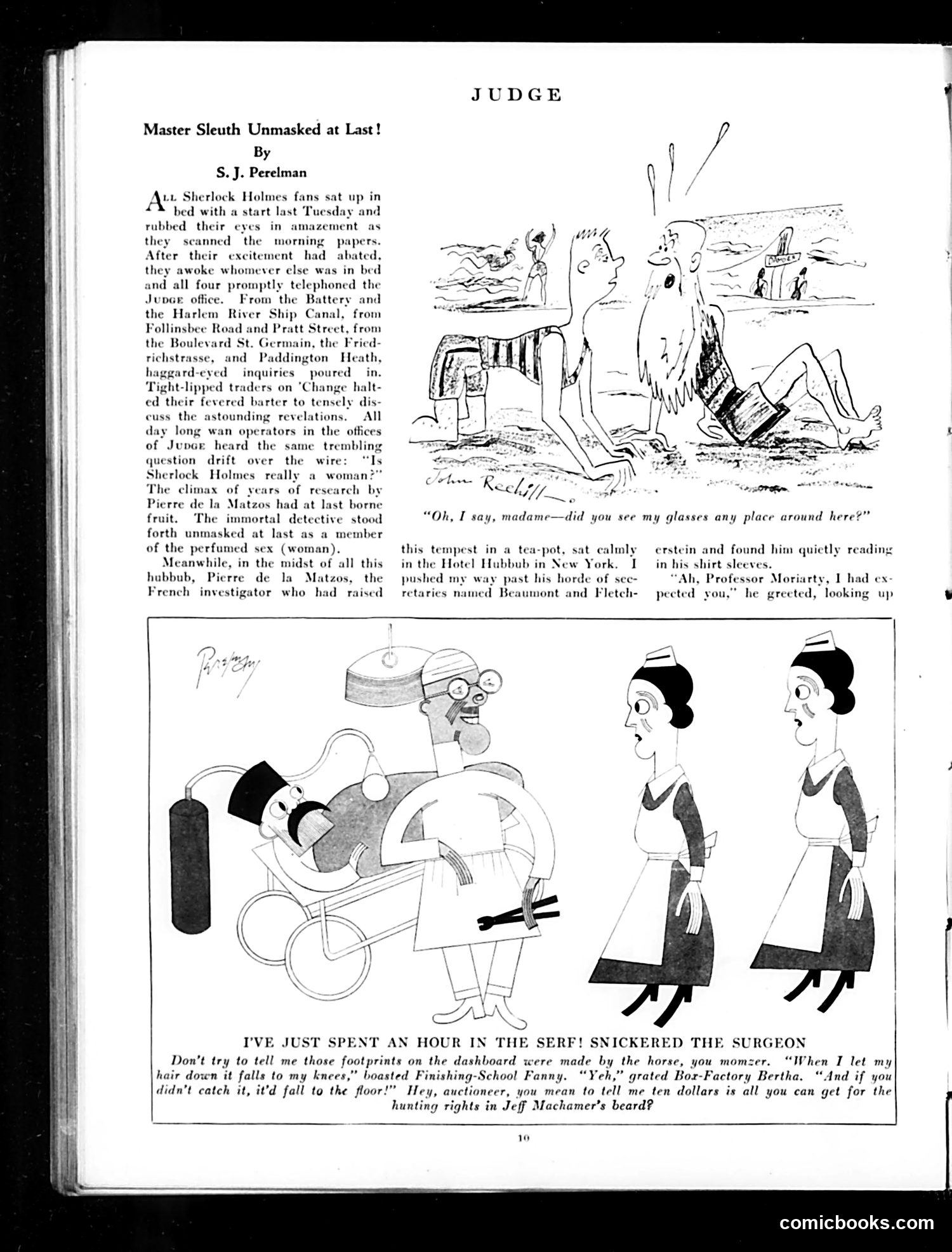
"Master Sleuth Unmasked at Last!" - Judge Magazine Satire This is S.J. Perelman's humorous short story mocking the Sherlock Holmes literary phenomenon. The premise: fans are shocked to discover that Holmes—the famous detective—is actually a woman. The satire targets the obsessive devotion of Holmes fanatics, who allegedly flood newspapers and stock exchanges with inquiries about this "revelation." The accompanying cartoons appear unrelated to the main story, featuring crude jokes about women's appearance and bodily functions (hair length, beard grooming, etc.)—typical lowbrow humor of the era. The satire's point: mocking both the intense cult following around fictional characters and, implicitly, the absurdity of gender-based mystery-solving abilities. The "French investigator" Pierre de la Matzos serves as the exposer of Holmes's "true identity"—a jab at sensationalized detective fiction.
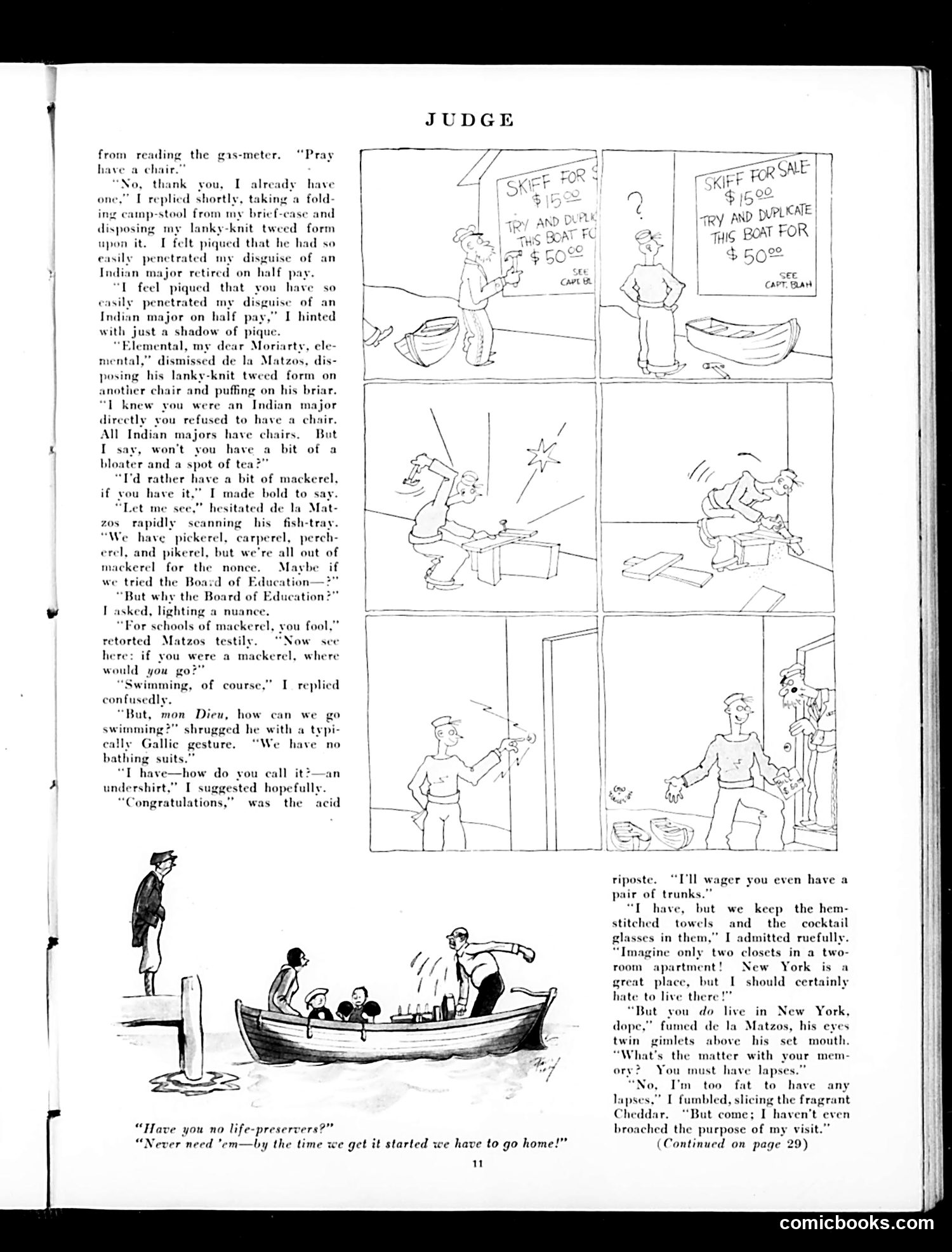
Judge Magazine Page Analysis This page presents a humorous dialogue-based story with accompanying comic strip panels and an illustration. The narrative appears to be a parody of Sherlock Holmes detective fiction—the character "de la Matzos" mimics Holmes's deductive methods and even echoes "Elementary, my dear Moriarty." The satire focuses on New York apartment living. The protagonist, a supposedly disguised "Indian major," is comically exposed through his refusal of a chair (supposedly revealing his military background). The humor escalates through absurd observations: New Yorkers lack adequate closets, use drinking glasses and towels for storage, and live in impossibly cramped two-room apartments. The fish-selling scene with multiple puns on types of fish ("schools of mackerel") and the life-preserver joke ("by the time we get it started we have to go home") mock upper-class pretensions and the challenges of urban recreation. The overall target is 1920s urban living complaints—overcrowding, cramped housing, and the affectations of New York society attempting sophistication despite practical limitations.
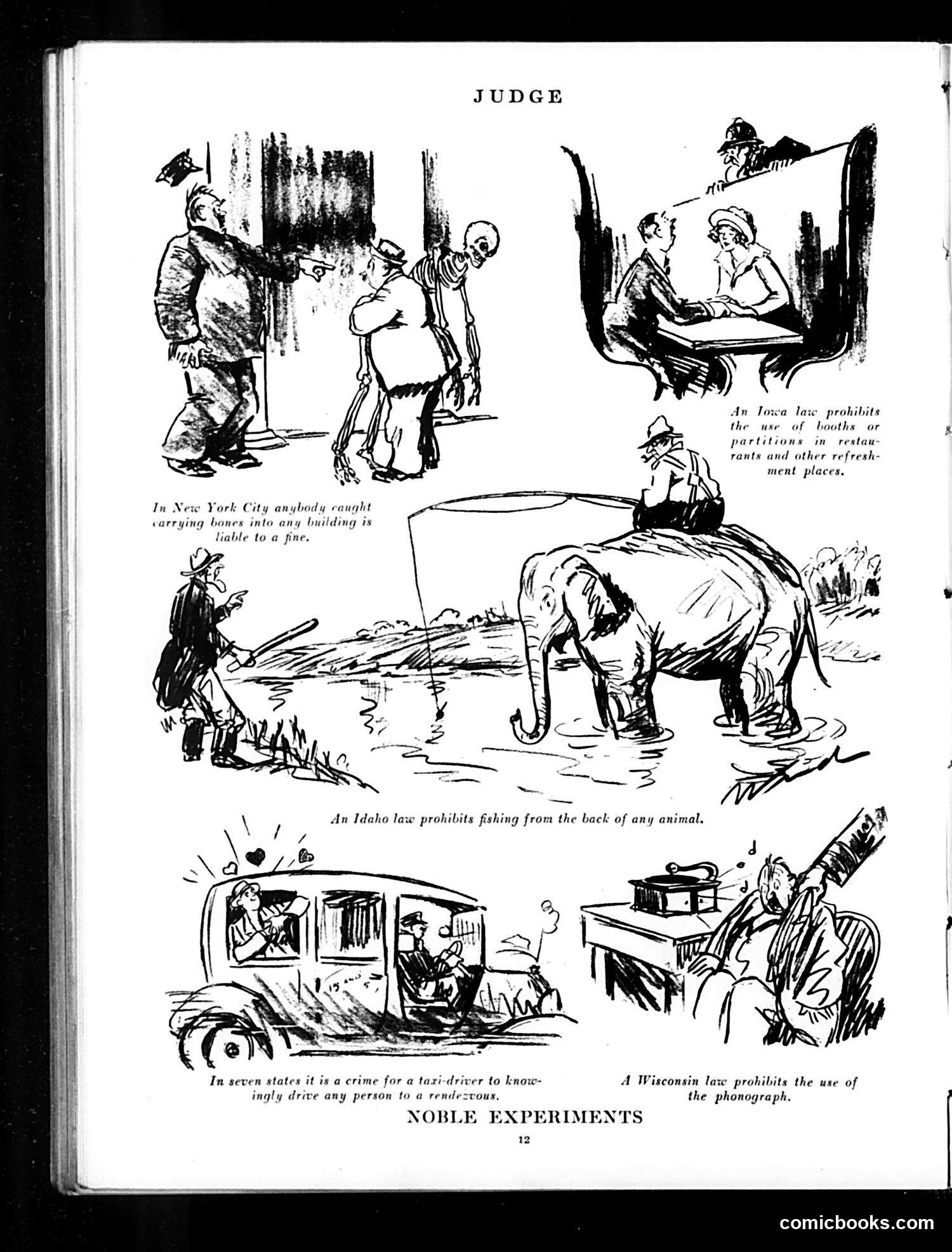
Judge Magazine - "Noble Experiments" This page satirizes absurd state and local laws through cartoon vignettes. Each illustration depicts a ridiculous legal prohibition: 1. Iowa law (top right): Bans booth partitions in restaurants—illustrated by patrons dining in an impossibly open, exposed setting. 2. New York City law (top left): Prohibits carrying bones into buildings—shown as a confused skeleton being arrested. 3. Idaho law (center): Forbids fishing from an animal's back—depicts someone attempting to fish from an elephant. 4. Taxi driver law (bottom left): Makes it criminal for drivers to knowingly transport people to "rendezvous" (romantic meetings)—showing an awkwardly vigilant driver. 5. Wisconsin phonograph ban (bottom right): Prohibits the device's use. The title "Noble Experiments" ironically references Prohibition while mocking other well-intentioned but impractical state regulations. The satire criticizes overreach of local legislation and questions the wisdom of such specific, oddly-targeted laws.
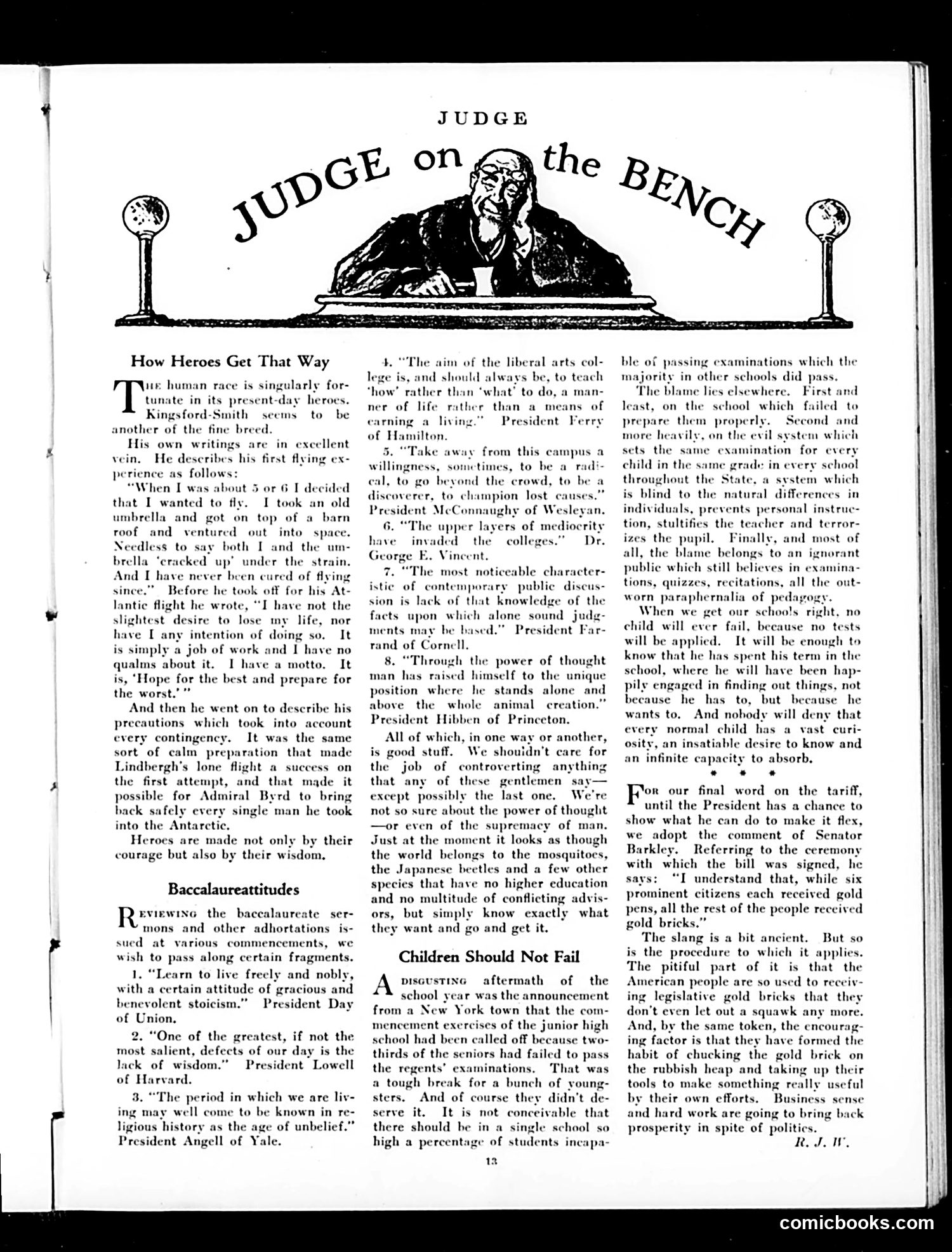
"Judge on the Bench" Page Analysis This page from *Judge* magazine contains three satirical commentary sections: "How Heroes Get That Way" celebrates aviators like Kingsford-Smith and Lindbergh, praising their methodical preparation alongside their courage—a contrast to reckless daredevils. "Baccalaureattitudes" mocks commencement speeches from college presidents (Day, Lowell, Angell, Ferry, et al.) by collecting their platitudes about education and wisdom. The satire peaks in the final paragraph: while these leaders pontificate about humanity's intellectual supremacy, mosquitoes and Japanese beetles—creatures with no education—simply know what they want and succeed. The implication: verbose academic moralizing is useless compared to practical instinct. "Children Should Not Fail" critiques a New York school that canceled junior high graduation because two-thirds of seniors failed regents' exams. The satire suggests institutional failure, not student failure, should bear responsibility—the school failed to prepare them adequately. Overall, the page satirizes institutional pretension (academia, education bureaucracy) while celebrating practical competence and honest self-assessment.
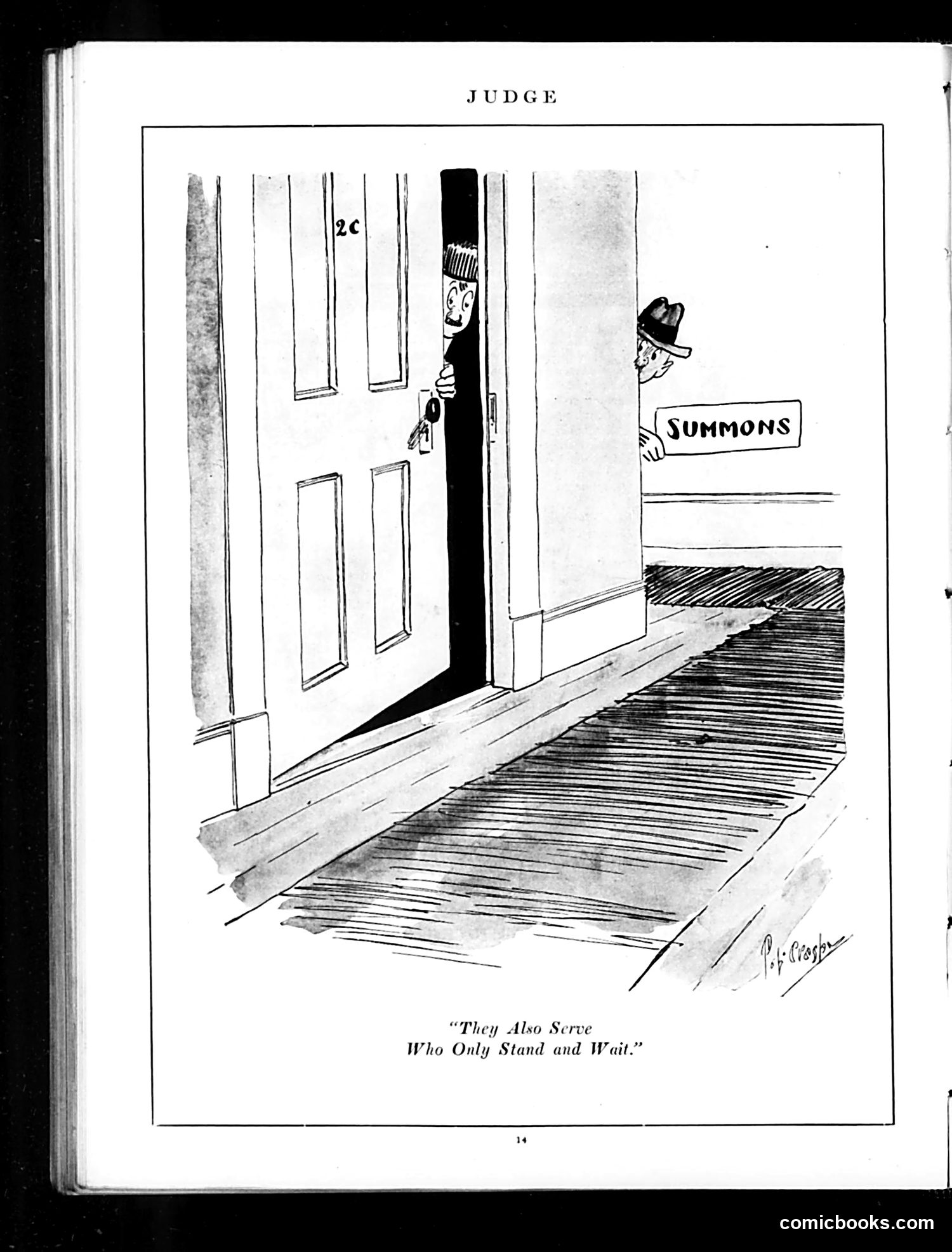
Analysis This cartoon satirizes the judicial system's treatment of witnesses and minor court participants. A court officer stands at a judge's chambers door holding a "SUMMONS" while a well-dressed man peeks out, suggesting he's been summoned to court. The caption—"They Also Serve Who Only Stand and Wait"—is a reference to John Milton's sonnet about those who serve God through patience rather than action. Here it's applied ironically to people summoned to court who must appear and wait for proceedings, contributing to the judicial system despite doing nothing active. The satire likely critiques the inconvenience and burden placed on ordinary citizens required for jury duty or witness testimony—they "serve" the courts simply by standing around, often wasting time.
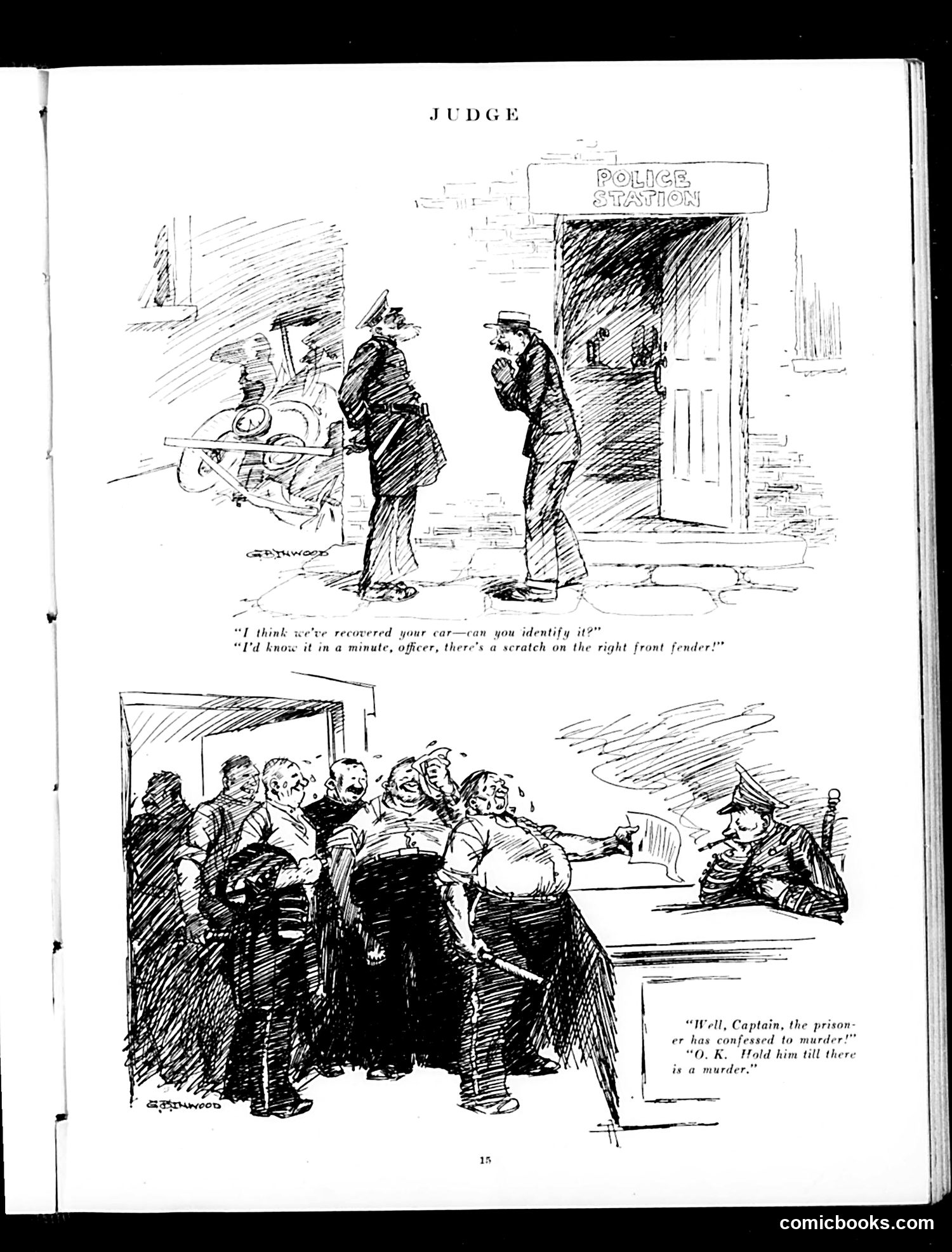
Judge Magazine Page Analysis This page contains two unrelated cartoons satirizing the criminal justice system circa early 20th century. The top cartoon mocks police incompetence: an officer asks a car owner to identify his recovered vehicle, but the owner instantly recognizes it by a minor scratch—suggesting police investigators lack basic observational skills. The bottom cartoon is darker satire about prosecutorial procedure. A captain tells his subordinate to hold a prisoner who has *confessed to murder* until an actual murder occurs, implying the authorities need a real crime to match the confession rather than acting on the admission itself. This critiques bureaucratic absurdity and indifference to justice—the system cares more about procedural matching than preventing or solving crimes. Both lampoon institutional incompetence and moral indifference in law enforcement.
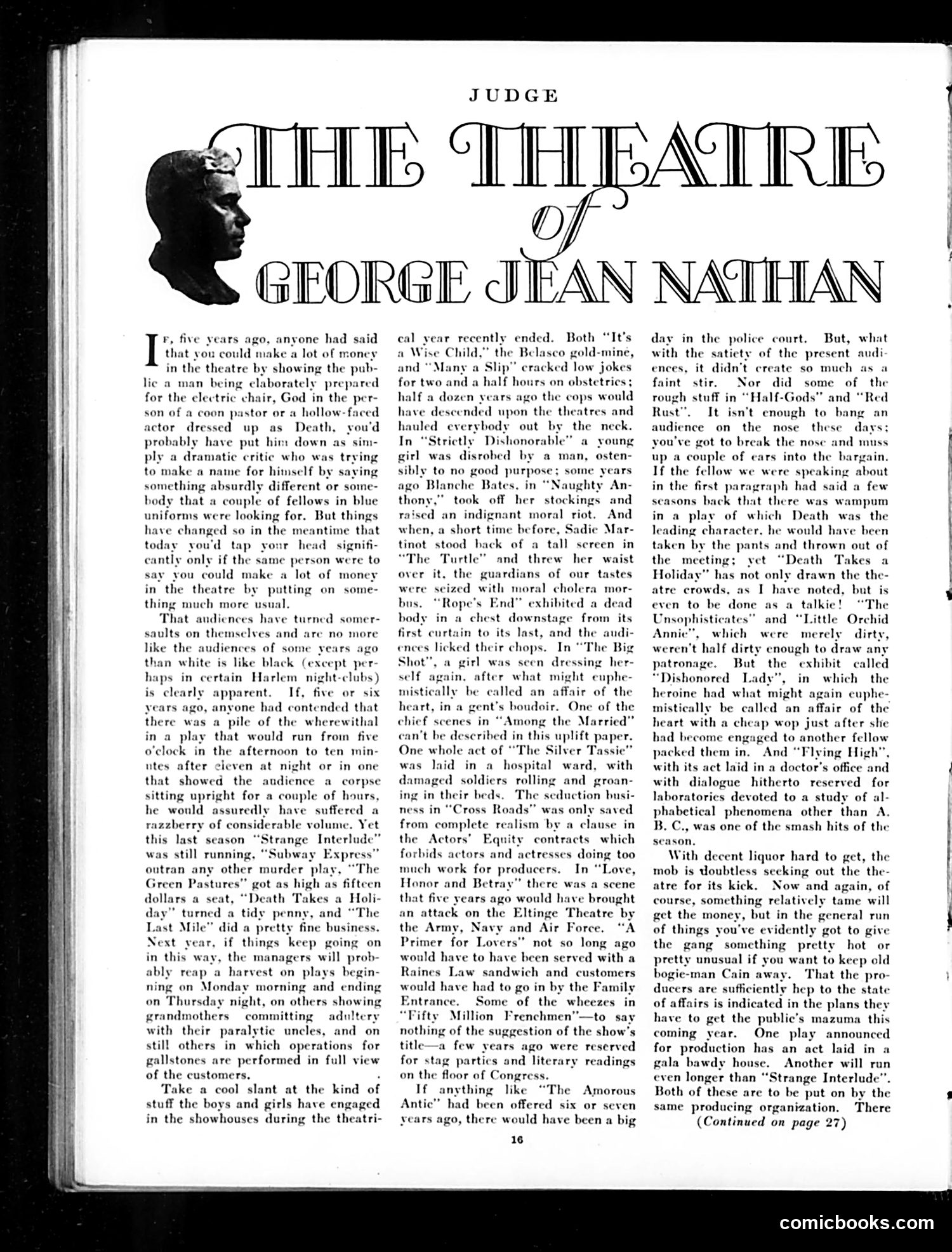
"The Theatre of George Jean Nathan" - Judge Magazine This is a theater criticism column by George Jean Nathan, Judge's drama critic, analyzing how American theatrical audiences' tastes have dramatically shifted in recent years. Nathan argues that theatrical censorship and moral outrage have collapsed. Five years prior, audiences would riot over actresses removing stockings or partial nudity (referencing real incidents with Blanche Bates and Sadie Martinot). Yet current Broadway productions—including "Strange Interlude," "Death Takes a Holiday," and "Dishonored Lady"—openly depict affairs, corpses, and sexual content with audience approval. The satire critiques how sophistication has made audiences desensitized: mere suggestiveness no longer shocks; now playwrights must deliver increasingly explicit content to provoke reaction. Nathan notes the irony that what once would have caused ejection from theaters now draws crowds and even gets adapted into films. The column reflects 1920s-30s debates over modernist theater versus Victorian propriety.
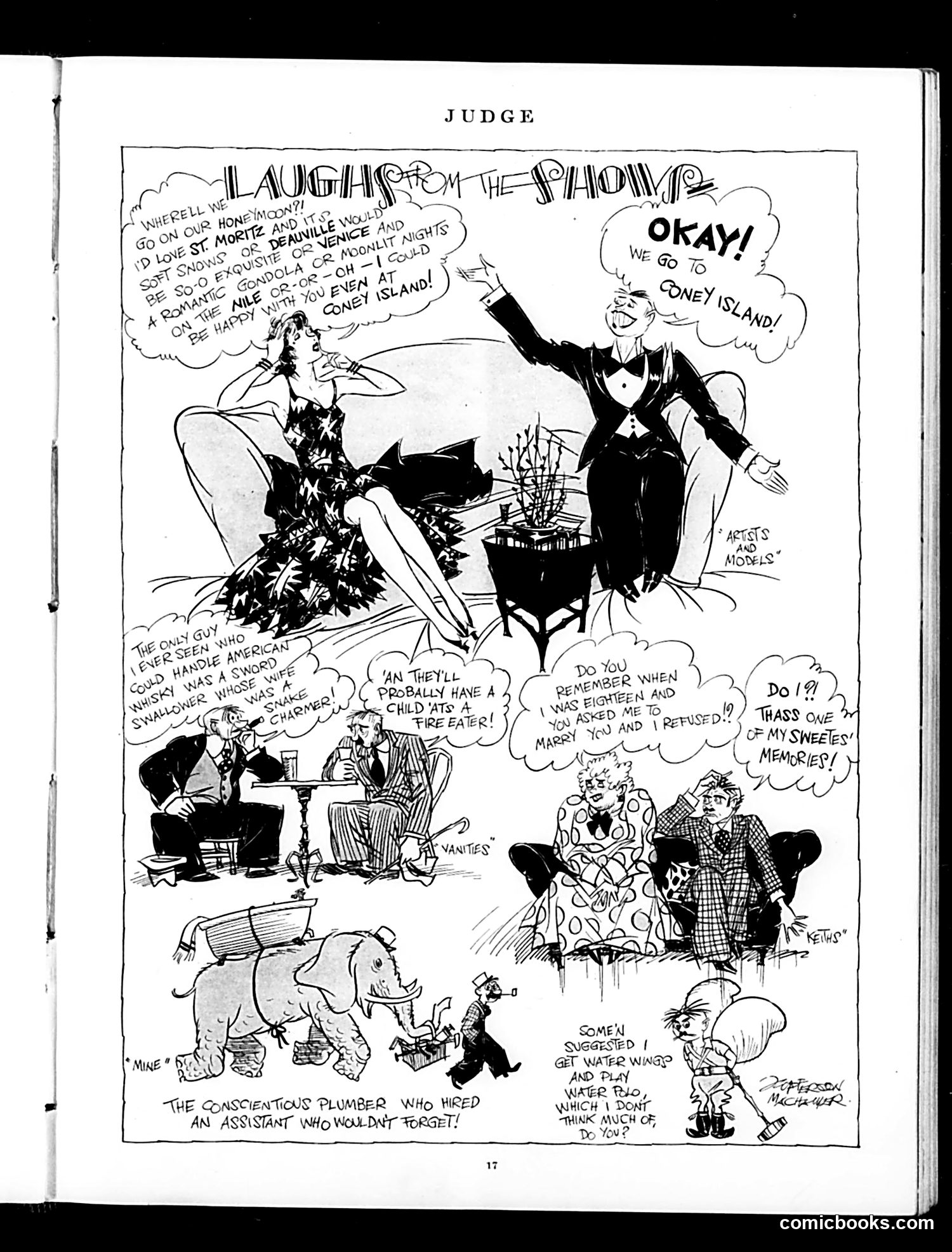
Judge Magazine Cartoon Analysis This page contains multiple satirical vignettes typical of Judge magazine's humor. The main scene depicts wealthy socialites lounging and reminiscing about past romantic rejections and social embarrassments—poking fun at upper-class pretensions and their obsession with trivia. The bottom panel mocks a "conscientious plumber" who hired an assistant "who wouldn't forget"—likely satirizing working-class anxiety about employee reliability and memory, contrasting with the frivolous concerns of the wealthy above. The cartoons collectively critique American society across class lines: the wealthy preoccupied with vanity and past slights, while tradespeople worry about practical competence. The art style and tone are typical of early 20th-century American satirical humor targeting social manners, class dynamics, and human foibles through gentle mockery rather than harsh political commentary.
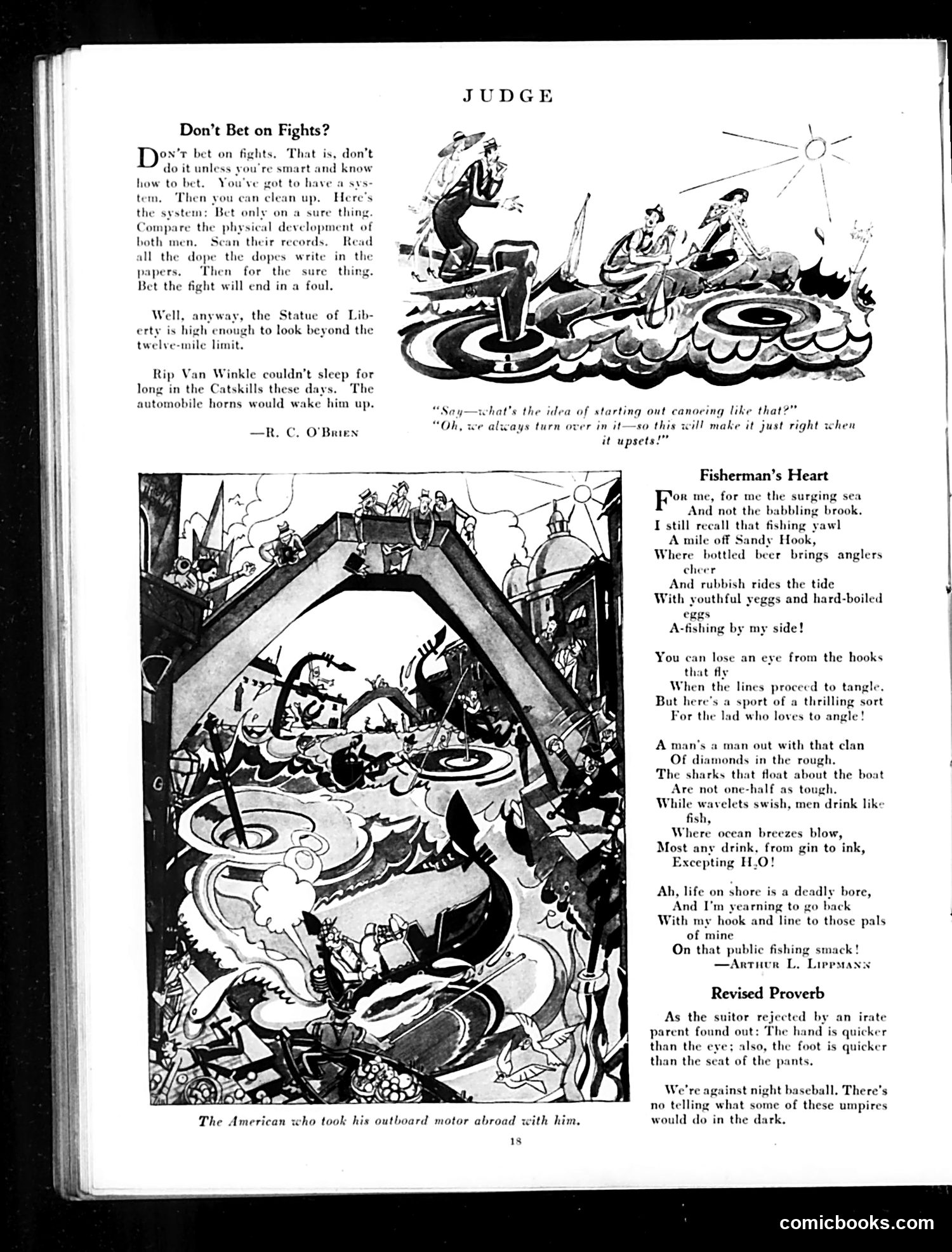
Judge Magazine Page Analysis This page contains several satirical pieces typical of early-20th-century Judge magazine: "Don't Bet on Fights" mocks boxing gambling culture. The advice to "bet only on a sure thing" (that fights end in fouls) is ironic—suggesting even "sure bets" are unreliable. References to reading "dope the dopes write" satirize how bettors rely on unsound tips. The cartoon illustrations show absurd leisure activities—one depicts chaotic canoeing mishaps with the joke that tipping over will "make it just right"; another shows an American abroad with an outboard motor creating havoc on a European waterway, mocking American tourists' tendency to impose their customs abroad. "Fisherman's Heart" is sentimental verse romanticizing fishing expeditions with alcohol and rough companions—likely gently mocking nostalgic working-class recreation. "Revised Proverb" presents crude humor about a rejected suitor being kicked out by an angry parent—the "hand" (punch) and "foot" (kick) being quicker than escape. The overall tone targets American sporting culture, tourism behavior, and masculine leisure activities with lighthearted ridicule.
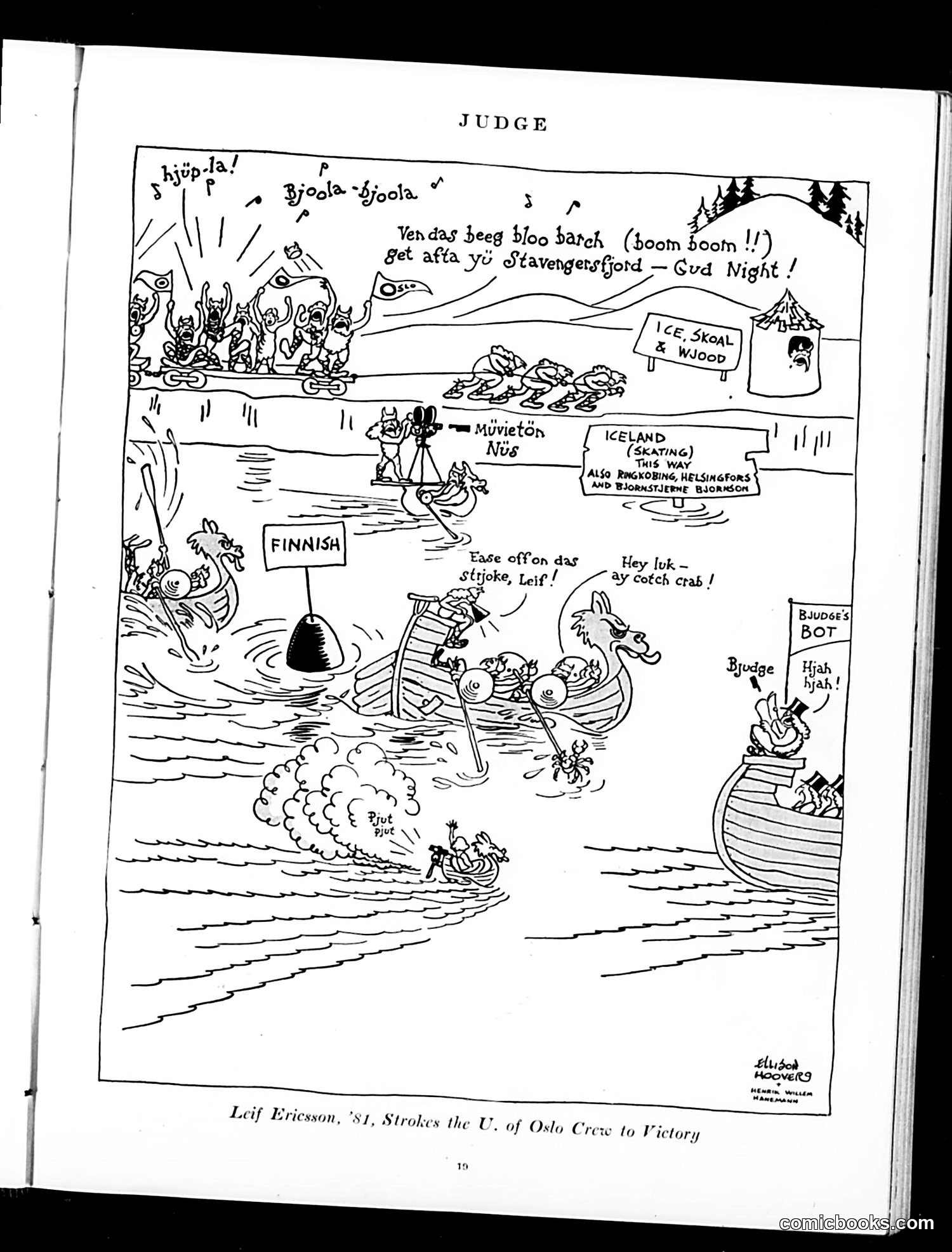
"Judge" Cartoon Analysis: Leif Ericsson Victory This cartoon celebrates Leif Ericsson's 1981 crew victory, apparently for the University of Oslo. The satire uses Nordic/Scandinavian stereotypes and mock-Norse language ("Sjyola-Sjyola," "Ven das heeg bloo barch") to humorously depict a rowing competition. The cartoon maps the race route across Nordic locations (Stavanger Fjord, Muvieton, Iceland, Finland, Helsingfors/Helsinki, and Bjornstierme Bjorkson), presenting the crew's journey as a comedic Viking voyage. Various boats compete, with characters using exaggerated Scandinavian accents and dialect. The "Judge's Pot" reference and victory cry ("Bjudge Hiyah!") suggest this celebrates an actual university sporting achievement, likely a significant rowing competition. The cartoon mocks both Nordic culture and American college sports pride simultaneously—standard fare for Judge's satirical approach to contemporary events.
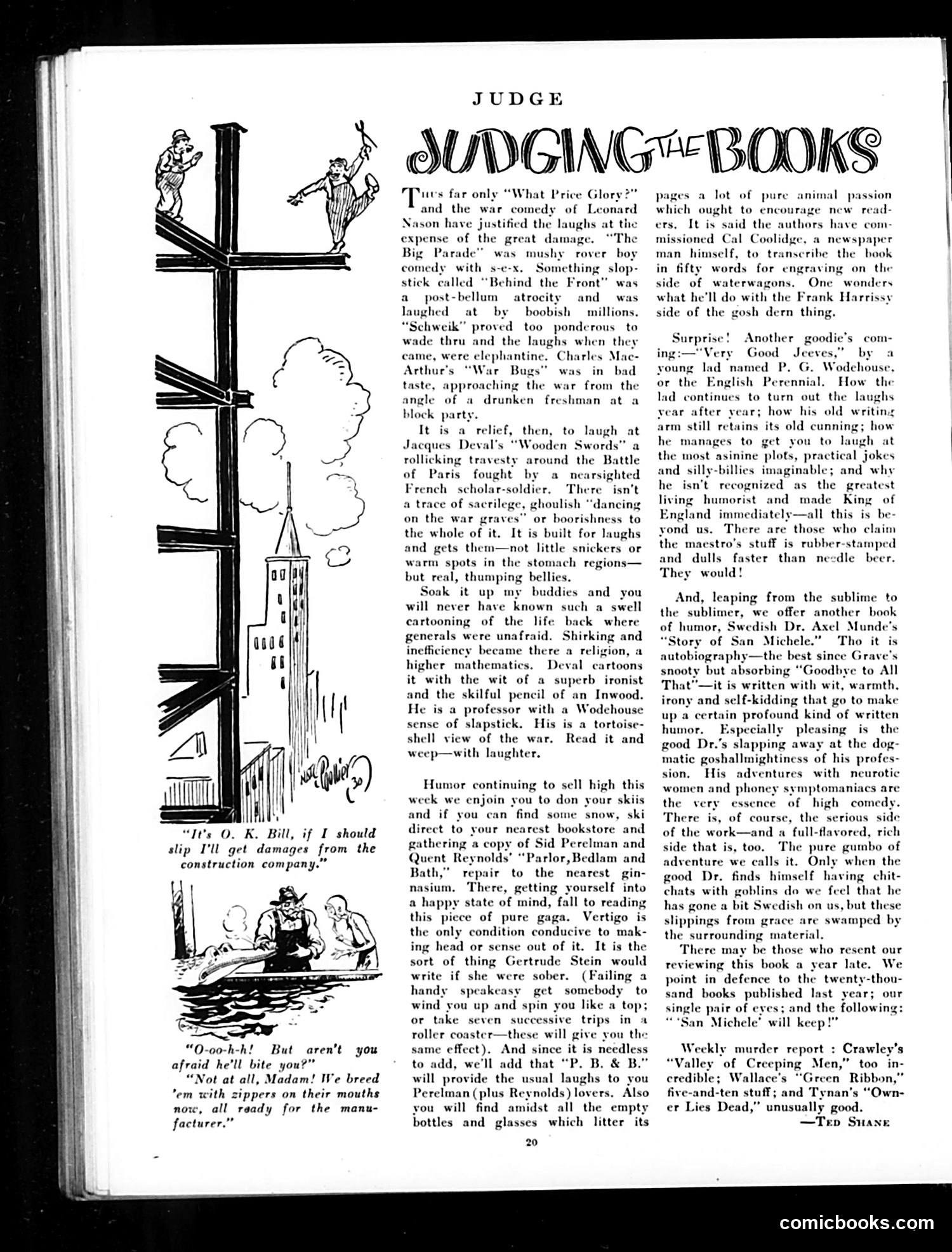
"Judging the Books" - Judge Magazine Book Review This is a book review column, not a political cartoon. The page critiques recent war-themed comedies and humorous books, reflecting post-WWI cultural attitudes. The cartoons are unrelated jokes: The top illustration shows a construction worker reassuring a woman about a dog, using dark humor about workplace injuries and liability. The bottom cartoon depicts a dog breeder explaining they now manufacture dogs "with zippers on their mouths"—absurdist humor about controlling unwanted behavior. The book reviews mock war comedies like "What Price Glory?" and "The Big Parade" as overly sentimental or tasteless, praising instead Jacques Deval's "Wooden Swords" for intelligent satire. References to P.G. Wodehouse and Sid Perelman indicate this targets readers familiar with literary humor. The mention of Calvin Coolidge (president 1923-1929) suggests a 1920s date, when Americans were processing WWI through popular entertainment.
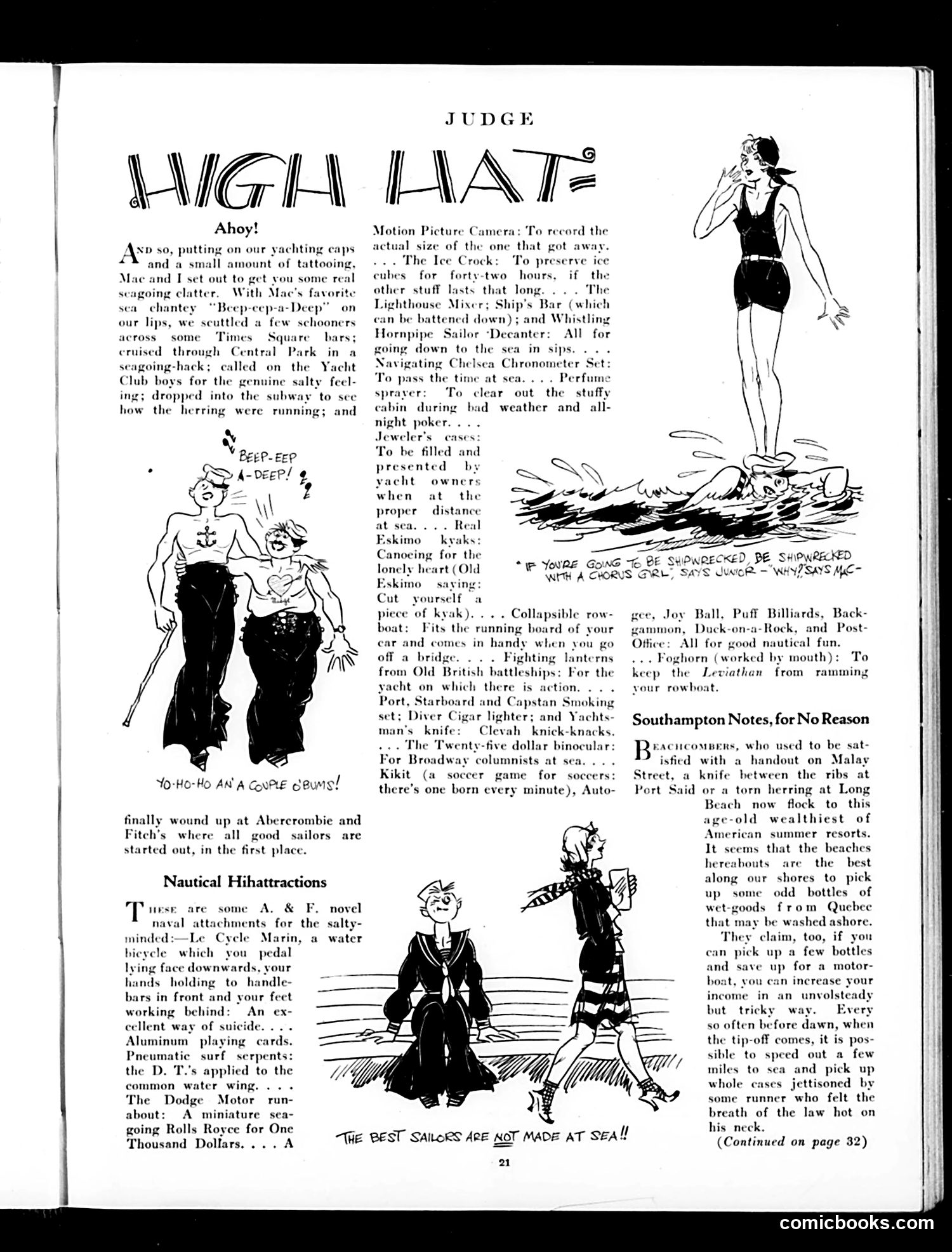
"High Hat" - Judge Magazine Satire This page satirizes wealthy Americans' obsession with nautical leisure activities. The main cartoon mocks the pretentiousness of yachting culture, showing two figures adopting exaggerated "sailor" personas (complete with tattoos and sea chanteys) to purchase nautical novelties from upscale retailers like Abercrombie & Fitch. The humor targets conspicuous consumption: the article catalogs absurd, overpriced maritime gadgets—a motorized toy yacht costing $1,000, a "lighthouse mixer" for cocktails, fighting lanterns from battleships—designed to signal wealth rather than serve practical purposes. The closing section on "Southampton Notes" adds darker satire, referencing Prohibition-era rum-running. It describes beachcombers and wealthy resort visitors profiting from bootlegging operations, with contraband "jettisoned by some runner" offshore. This juxtaposes the genteel yacht-club world with actual illegal smuggling happening in the same locations. The caption "The Best Sailors Are Not Made at Sea" encapsulates the satire: these are not genuine sailors but wealthy amateurs performing nautical identity.
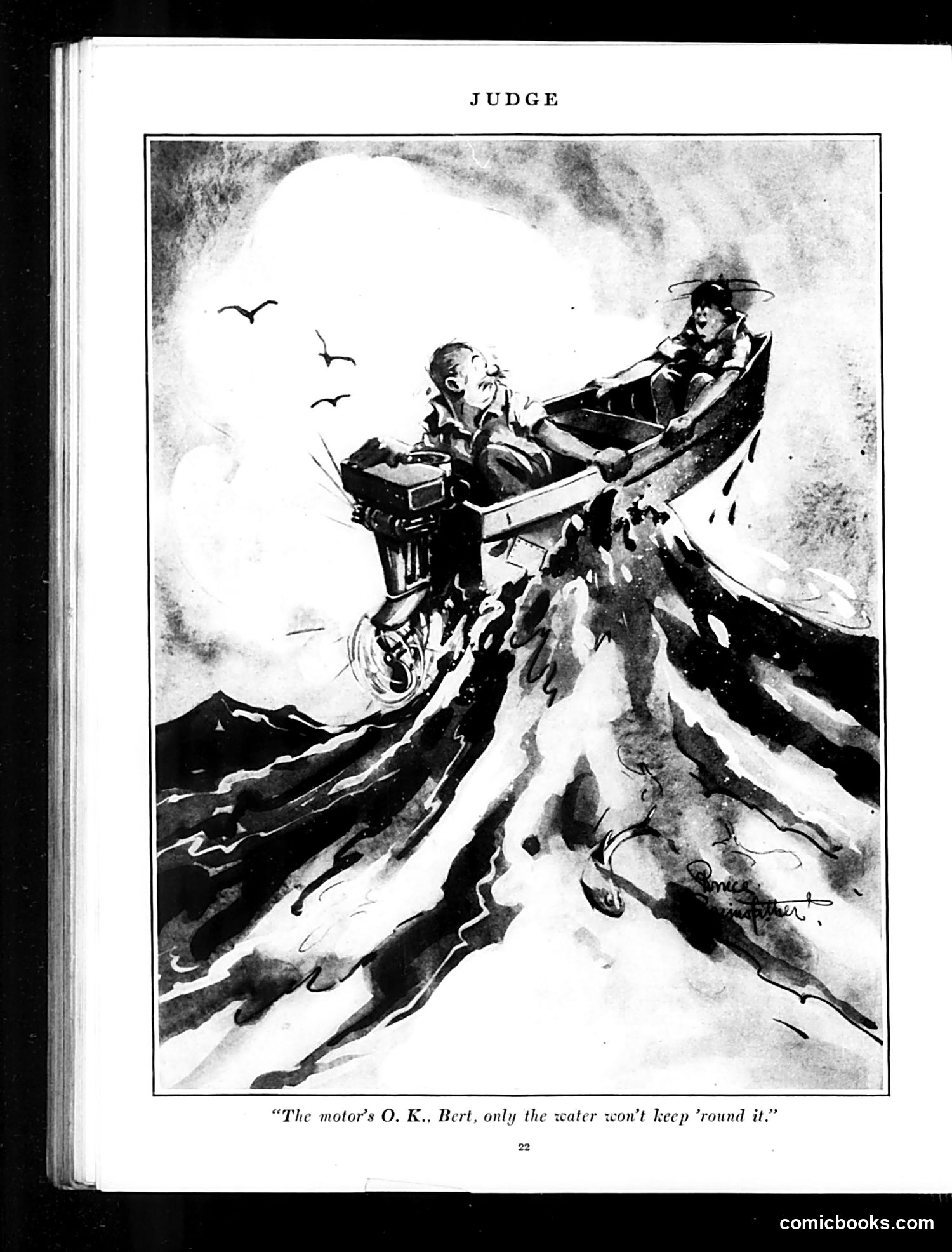
Judge Magazine Cartoon Analysis This cartoon depicts two men in a motorboat on rough water beneath a large moon. One figure addresses the other as "Bert," saying the motor works fine but "the water won't keep 'round it"—a joke about the boat leaking or sinking despite the engine functioning properly. The satire likely references early automobile/motorboat reliability issues circa the 1910s-1920s, when mechanical failures were common. The humor plays on the absurdity of having a working motor in a failing vessel—blaming external circumstances (water) rather than accepting the boat itself is defective. Without additional context or identifying marks, the specific "Bert" referenced remains unclear, though the cartoon mocks the disconnect between mechanical optimism and practical reality.
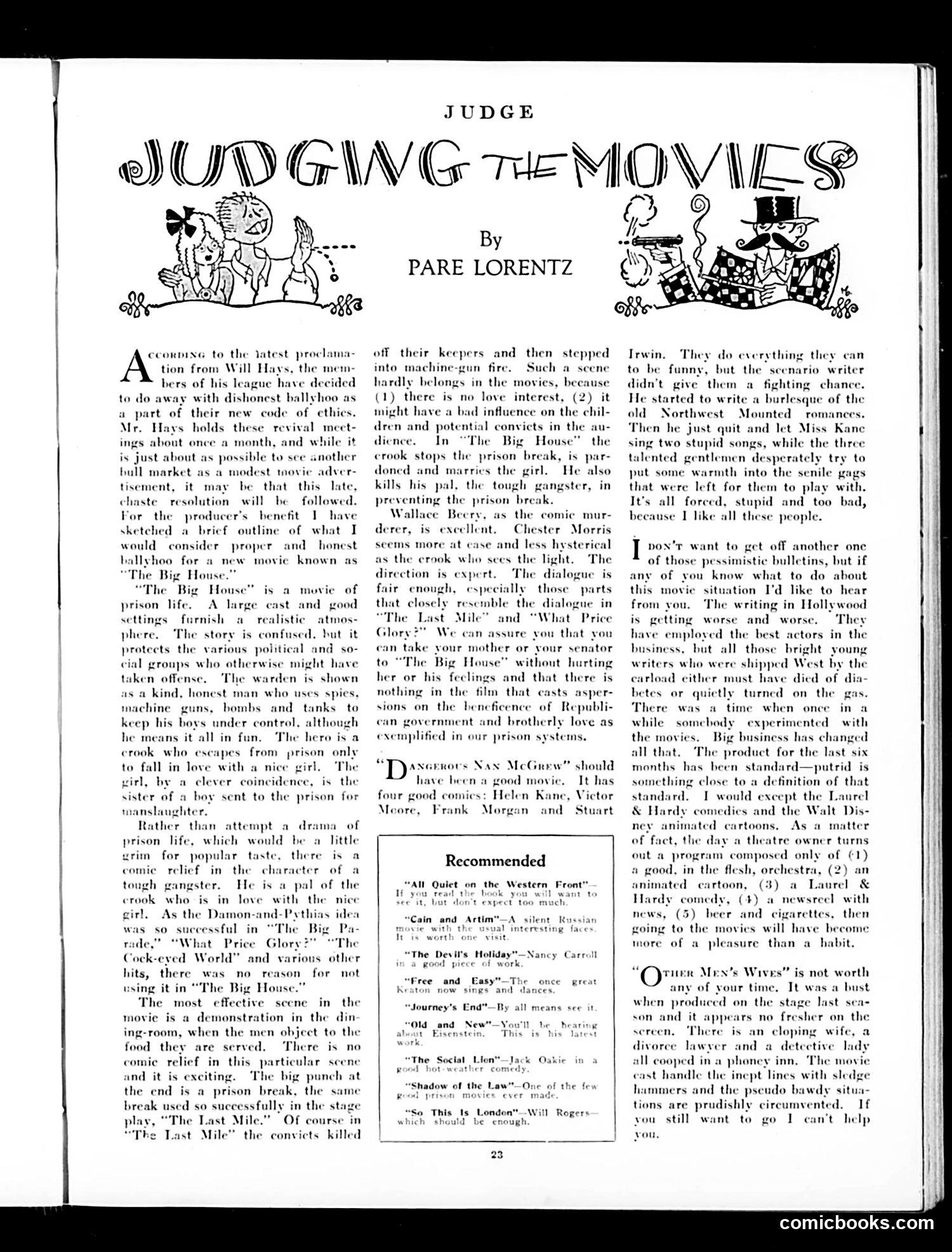
Judging the Movies: Pare Lorentz's Film Criticism This is a film review column by Pare Lorentz evaluating recent movies, particularly "The Big House," a prison drama. The piece critiques Hollywood's adherence to Will Hays's newly-announced code of ethics regarding honest advertising. Lorentz sarcastically outlines what "honest" promotion of "The Big House" should acknowledge: the film sanitizes prison brutality for mass audiences (removing a violent ending from the stage play "The Last Mile"), includes romantic subplots for commercial appeal, and avoids offending political or social groups. He notes the republican government and prison system receive no criticism. The review also dismisses "Dangerous Nan McGrew" despite its talented cast (Helen Kane, Victor Moore, Frank Morgan), calling the script a failed burlesque with forced comedy. The "Recommended" box lists other films worth seeing instead.
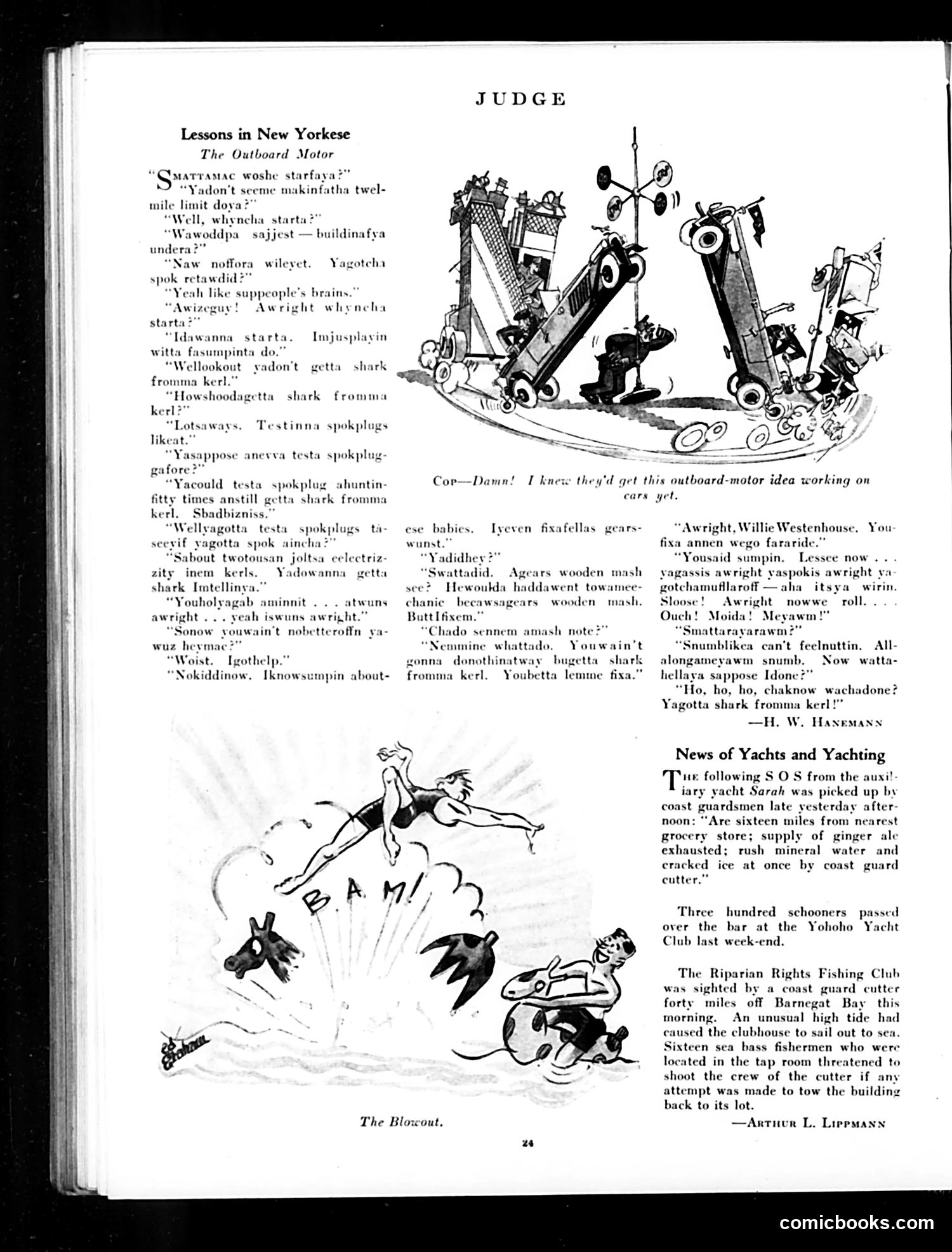
Analysis of Judge Magazine Page This page contains two satirical pieces: "Lessons in New Yorkese: The Outboard Motor" (top) is a humor piece mocking working-class New York dialect and mechanical incompetence. The dialogue depicts characters attempting to repair an outboard motor using fractured, phonetic spelling to represent heavy NYC accent. The joke plays on malapropisms ("shark" for "short") and the absurdity of repeatedly breaking things while attempting fixes. The accompanying cartoon shows an officer warning that outboard-motor technology will inevitably be adapted to automobiles—a satirical jab at the era's mechanical experimentation and urban chaos. "News of Yachts and Yachting" (bottom) offers brief, humorous anecdotes about wealthy yacht owners, including an auxiliary yacht running out of ginger ale and mineral water (mocking luxury-class concerns during what appears to be a supply shortage), and a fishing club clubhouse accidentally sailing away due to unusual tides. The overall tone ridicules both working-class mechanical fumbling and upper-class indulgence.
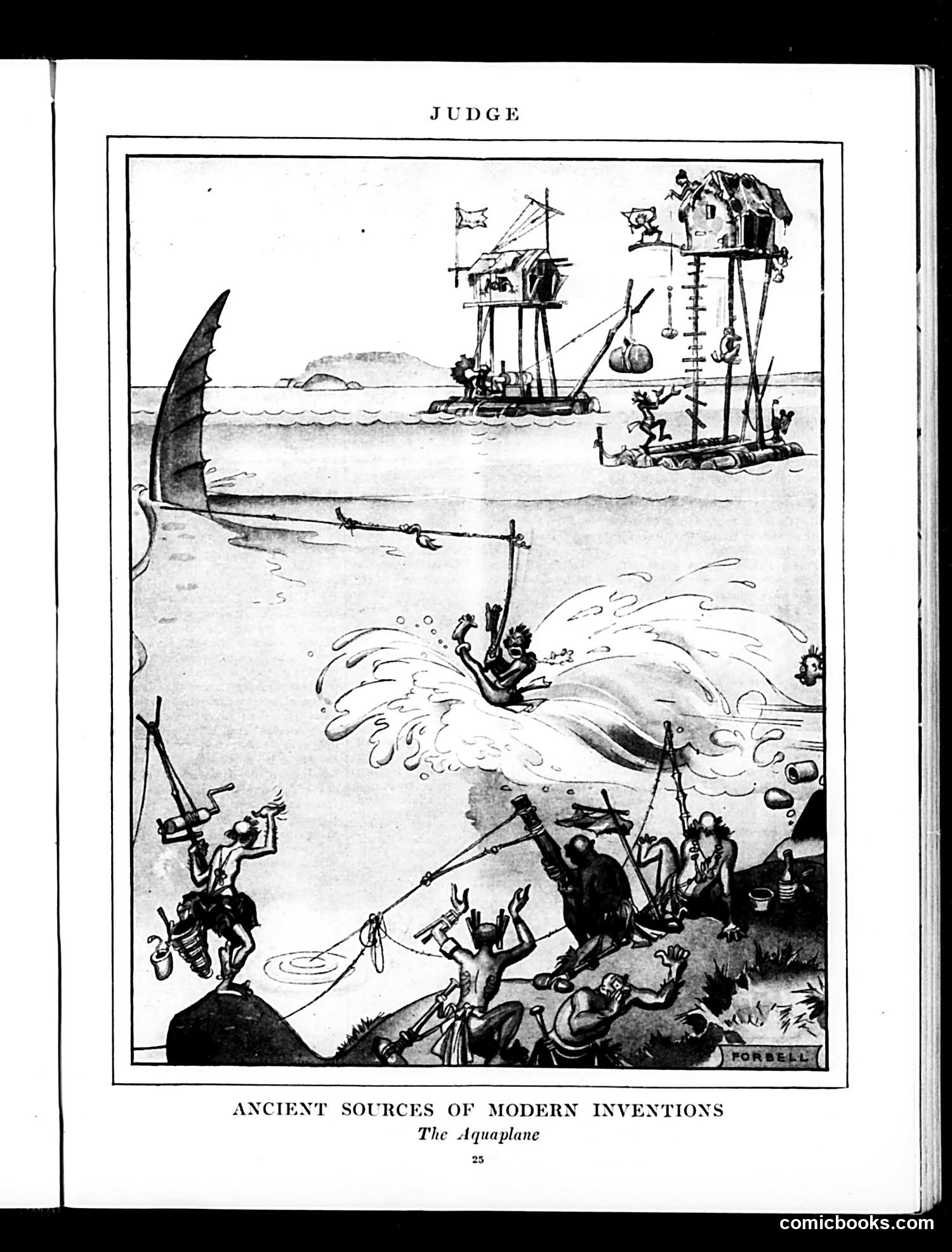
Analysis This Judge magazine page presents a satirical cartoon titled "Ancient Sources of Modern Inventions: The Aquaplane." The image depicts mythological or fantastical sea creatures—appearing to be merfolk or water spirits—engaged in water-based activities on what seems to be a primitive beach or coastal setting. Ships and structures appear in the background. The satire's point is likely that the "modern invention" of the aquaplane (an early water sport device) actually has ancient precedents in mythology or folklore. By showing classical sea creatures apparently using similar equipment, the cartoonist humorously suggests that humans have simply rediscovered or reinvented what mythological beings already knew. This reflects a common Judge formula of deflating contemporary technological pride by linking modern innovations to ancient or fictional antecedents—a form of gentle mockery of the era's faith in progress.
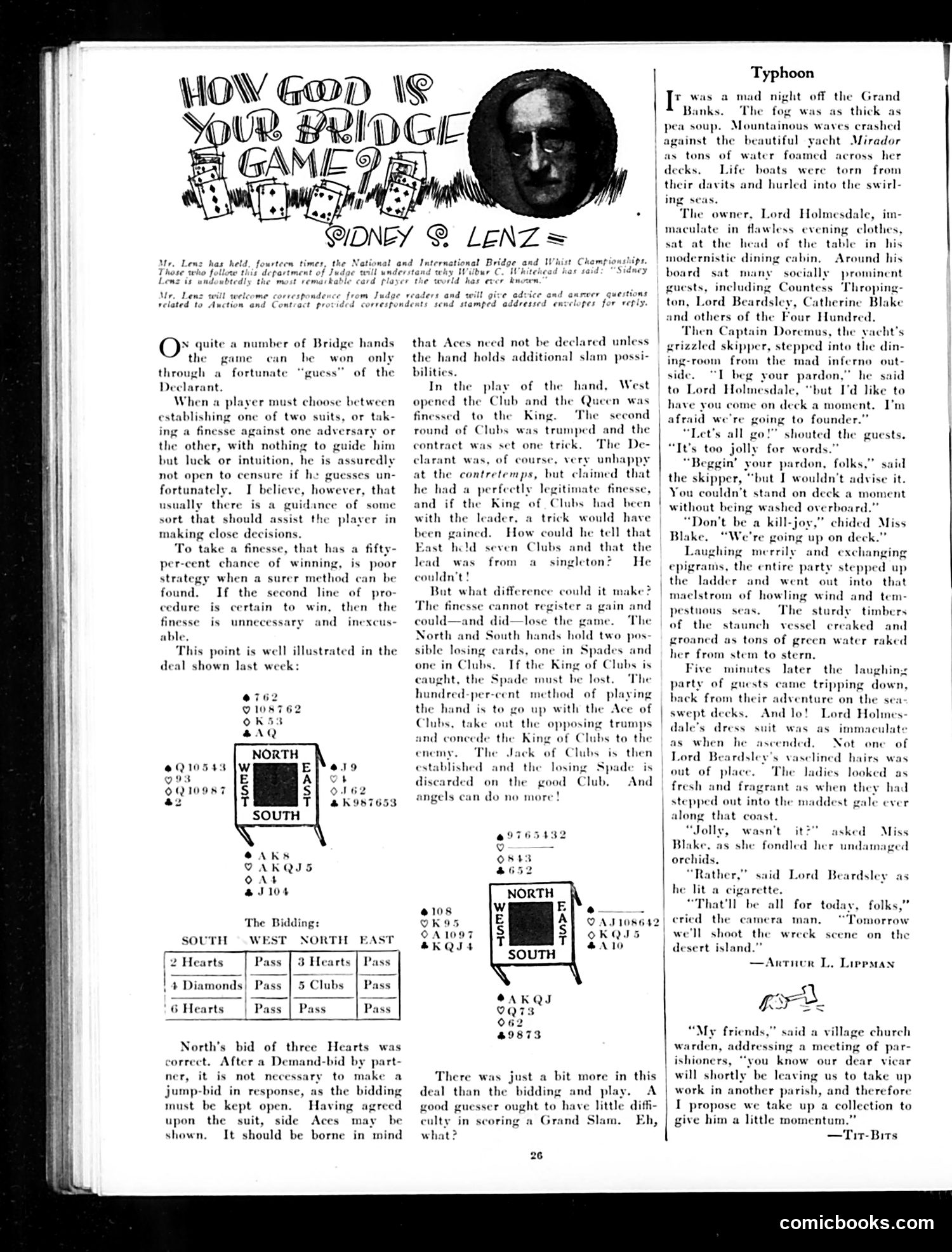
"How Good Is Your Bridge Game?" by Sidney Lenz This page contains a bridge instructional column by champion player Sidney Lenz, illustrated with a humorous fictional framing story. The Satire: The cartoon mocks wealthy "Four Hundred" society figures (New York's elite social class) who remain obliviously self-absorbed even facing disaster. During a violent storm aboard a yacht, the owner Lord Holmesdale and his guests—including titled aristocrats like "Countess Thropton" and "Lord Beardsley"—are indifferent to the ship's peril. When the captain warns they may founder, they treat it as entertainment ("It's too jolly for words"). They venture on deck in the gale, yet return completely unruffled, their formal dress and vanity untouched. The Point: This satirizes the shallow materialism and disconnection from reality of the wealthy elite—they're so absorbed in status and appearance that even mortal danger becomes mere amusement. The contrast between crisis and their frivolous response is the humor.
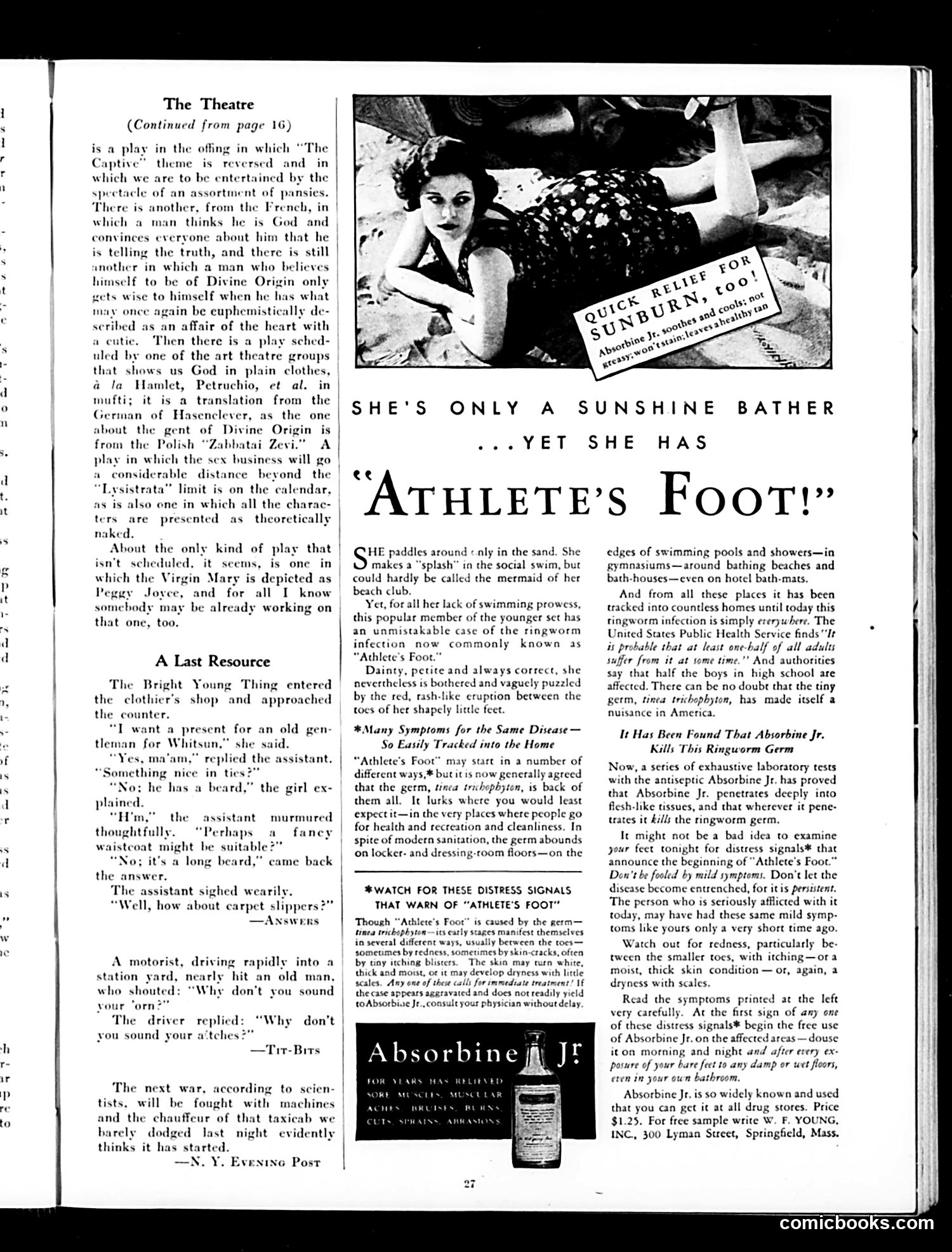
Understanding This Judge Magazine Page This page combines satirical theater criticism with a medical advertisement—typical of 1920s-30s Judge magazine. The Theater Section mocks contemporary avant-garde plays for their pretension and obsession with controversial themes: plays about "divine origin," explicit sexuality, and experimental staging. The satirist suggests the only play *not* being produced would be one depicting the Virgin Mary as "Peggy Joyce" (a famous 1920s socialite/party girl), implying the theater world's appetite for shock value knows no bounds. The Humor Sections are brief jokes: a young woman seeking a gift for an old man with a beard; a motorist commenting on sound effects. These are mild, forgettable quips. The Main Advertisement promotes Absorbine Jr., a patent medicine for "Athlete's Foot" (ringworm infection). The ad features a photo of a young woman and plays on the irony: she's fashionable and socially active but suffers from this unglamorous fungal infection—common among swimmers and gym-goers. The ad lists symptoms to "watch for" and positions the product as treatment. The juxtaposition reflects how Judge mixed cultural commentary with commercial messages.
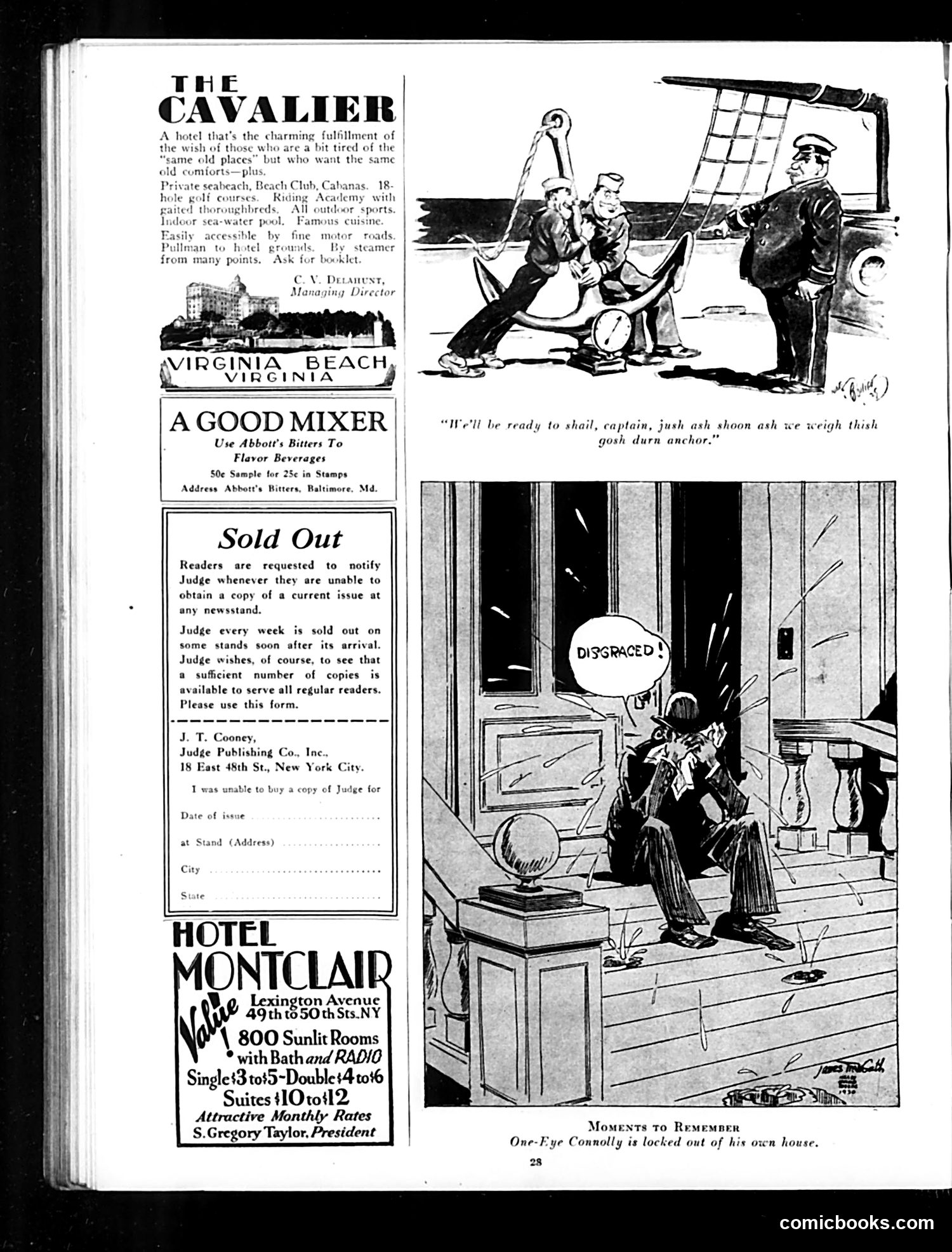
Explanation for Modern Readers This page contains two main cartoons. The top cartoon shows sailors preparing to weigh anchor on a ship, with one heavily intoxicated sailor slurring his speech—the humor relies on depicting drunkenness in maritime settings, a common Judge trope. The bottom cartoon, titled "Moments to Remember," shows a man labeled "One-Eye Connolly" locked out of his own house, appearing distressed and exclaiming "DISGRACED!" The joke plays on the social shame of being locked out—likely suggesting marital discord or domestic conflict presented as comedic misfortune. The page is primarily filled with period advertisements (Hotel Montclair, Abbott's Bitters, The Cavalier hotel) and a "Sold Out" notice requesting readers report newsstand availability to Judge's publisher. Without additional historical context about "One-Eye Connolly," the specific reference remains unclear, though he appears to be either a recurring character or a recognizable contemporary figure to Judge's original readers.
Page Analysis: Judge Magazine This page contains primarily advertisements with a continued serialized story titled "Master Sleuth Unmasked." The main satirical content is a humorous fiction piece mocking detective stories and romantic melodrama. The narrative absurdly reveals that Sherlock Holmes is actually a woman named "Sheila Holmes," and extends the joke to claim other famous figures—including Herbert Hoover—are secretly women. The story parodies overwrought pulp fiction with purple prose ("mysterious violet pools," "fierce chant of the Solomon Islands"), concluding with an unlikely romantic resolution. A brief comic anecdote ("Tit-Bits") about an employee caught lying about illness to attend horse races provides light humor. The page's commercial content dominates: Hotel Seward advertises Detroit accommodations near automotive plants, while Aetna insurance promotes burglary protection with a play on "sunset is the burglars' sunrise." The satire targets pulp fiction conventions and melodramatic storytelling rather than political issues—typical of Judge's lighter fare alongside serious commentary.
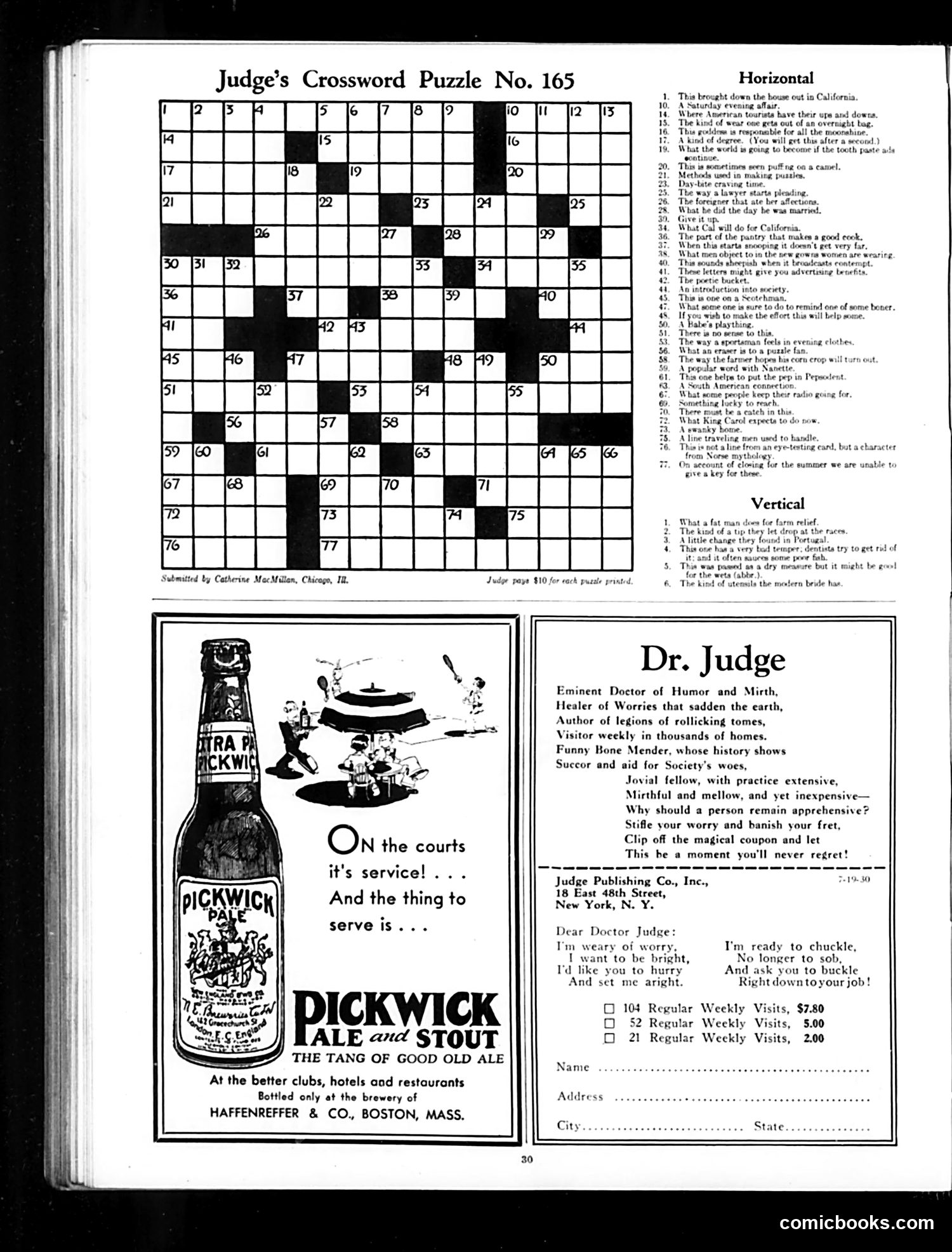
Judge Magazine Page 165: Analysis This page contains a crossword puzzle and advertisements rather than political cartoons. The "Dr. Judge" advertisement is the primary content—a humorous self-promotion for the magazine itself, personifying *Judge* as a doctor who cures societal worry and sadness through humor and satire. The accompanying Pickwick Ale advertisement uses the courtroom/service pun ("on the courts it's service") to sell beer to upscale venues (clubs, hotels, restaurants), suggesting alcohol as another remedy for life's troubles. The subscription form offers three tiers of "weekly visits" from Dr. Judge at different price points ($7.80, $5.00, $2.00), treating magazine subscriptions as medical treatment—a clever metaphor positioning satirical humor as therapeutic. The overall message: during uncertain times (likely the Depression era), *Judge* magazine offers affordable comic relief as a form of psychological medicine for worried Americans.
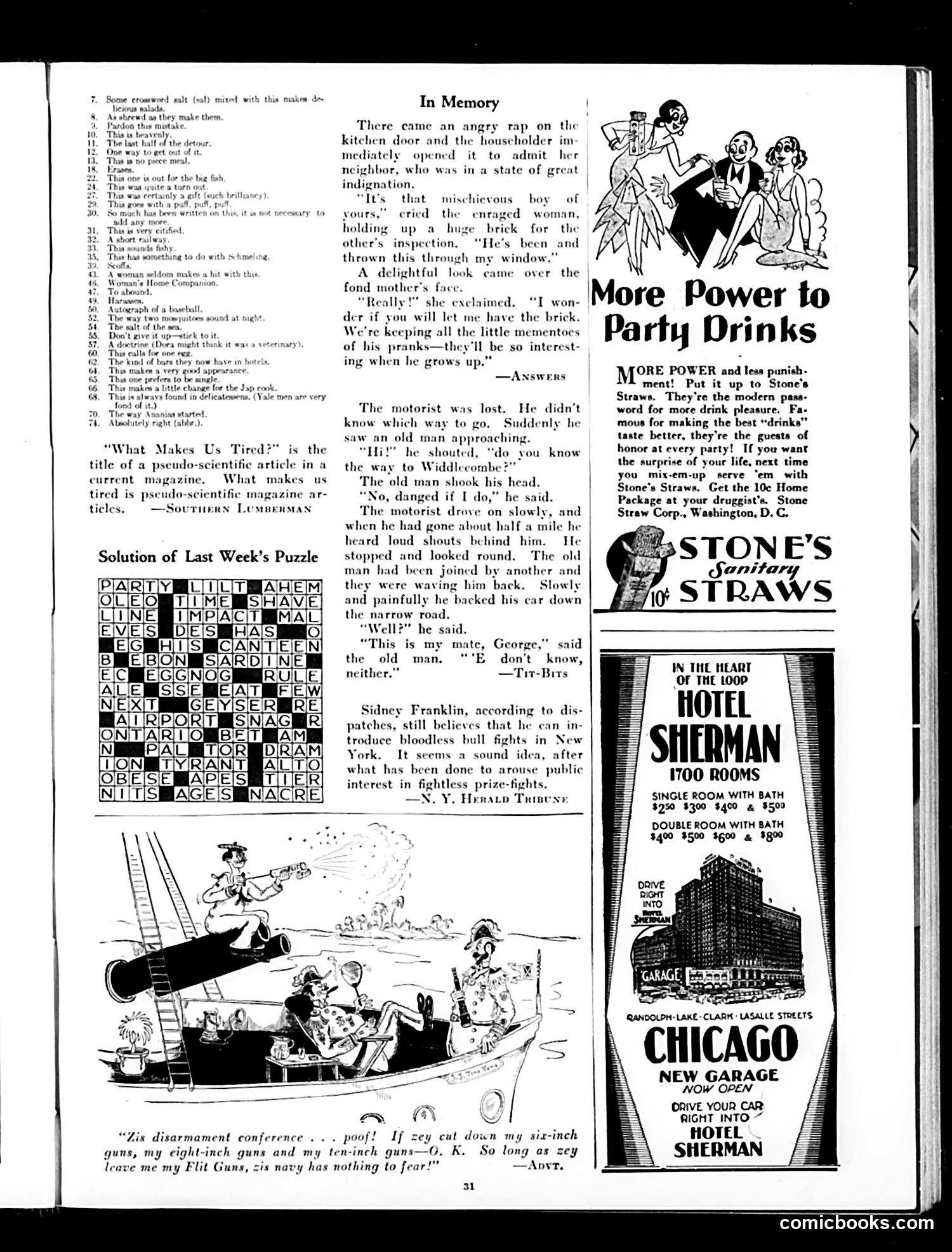
Judge Magazine Page Analysis This page contains several humor pieces typical of Judge's satirical style: "In Memory" presents a gentle domestic anecdote: a neighbor complains that a boy threw a brick through her window. Rather than punishment, the boy's mother delightedly asks to keep the brick as a "memento" of his childhood pranks—satirizing sentimental parenting that excuses misbehavior. The motorist cartoon jokes about rural confusion: a lost driver asks an old man for directions to "Widdlecomb," who refuses to help. The driver leaves, then the old man and a friend shout him back—they simply wanted to admit they also don't know where it is. The humor lies in the pointlessness of the exchange. The disarmament reference likely alludes to 1920s-30s naval treaties; a military figure insists on keeping "Flit Guns" (a brand of insecticide sprayer) while surrendering military weapons—absurdist Cold War-era satire. The page is primarily advertising for Stone's Straws (drinking straws), Hotel Sherman in Chicago, and other products, with vintage pricing and design typical of the era.
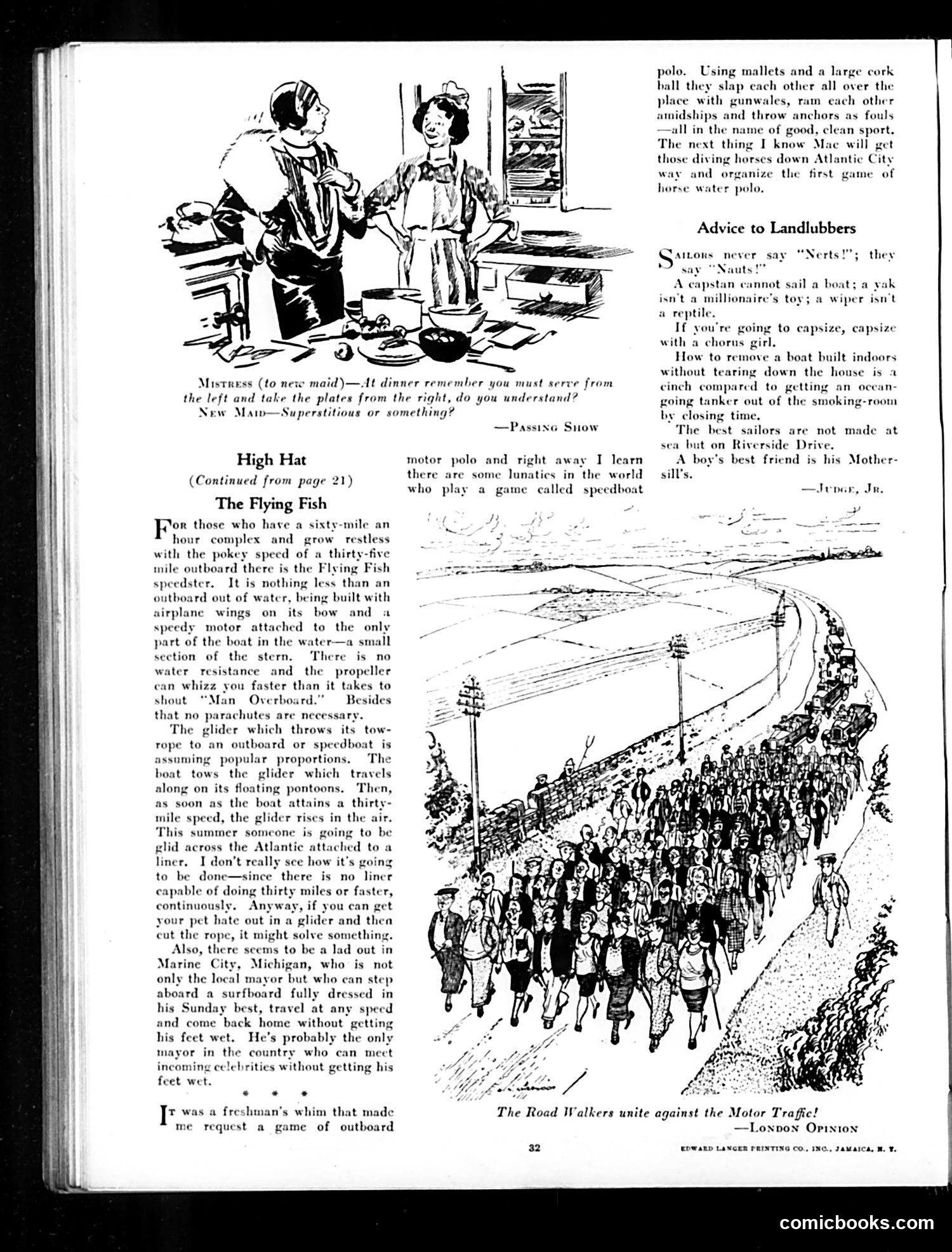
Analysis of Judge Magazine Page This page contains humor pieces mocking early 20th-century leisure activities and social pretension. "High Hat" section satirizes the wealthy's obsession with speed and novelty. The "Flying Fish" speedster and experimental boats (gliders towed behind speedboats, motorized surfboards) are presented as ridiculous status symbols for the rich and restless. The humor lies in the impracticality and danger—boats that capsize or require parachutes, impossible transatlantic stunts. "Advice to Landlubbers" pokes fun at nautical snobbery—the gap between actual sailors' knowledge and landlubbers' pretentious affectations. The jokes mock nouveau-riche attempts at sophistication (taking surfboard rides "fully dressed in Sunday best"). Bottom cartoon contrasts with the above: titled "The Road Walkers Unite Against Motor Traffic," it depicts pedestrians protesting automobiles—a commentary on the tension between traditional walking culture and the modern motorized world that dominated the wealthy's leisure time. The overall theme: Judge ridicules both the upper class's wasteful speed-obsession and society's anxieties about technological disruption.
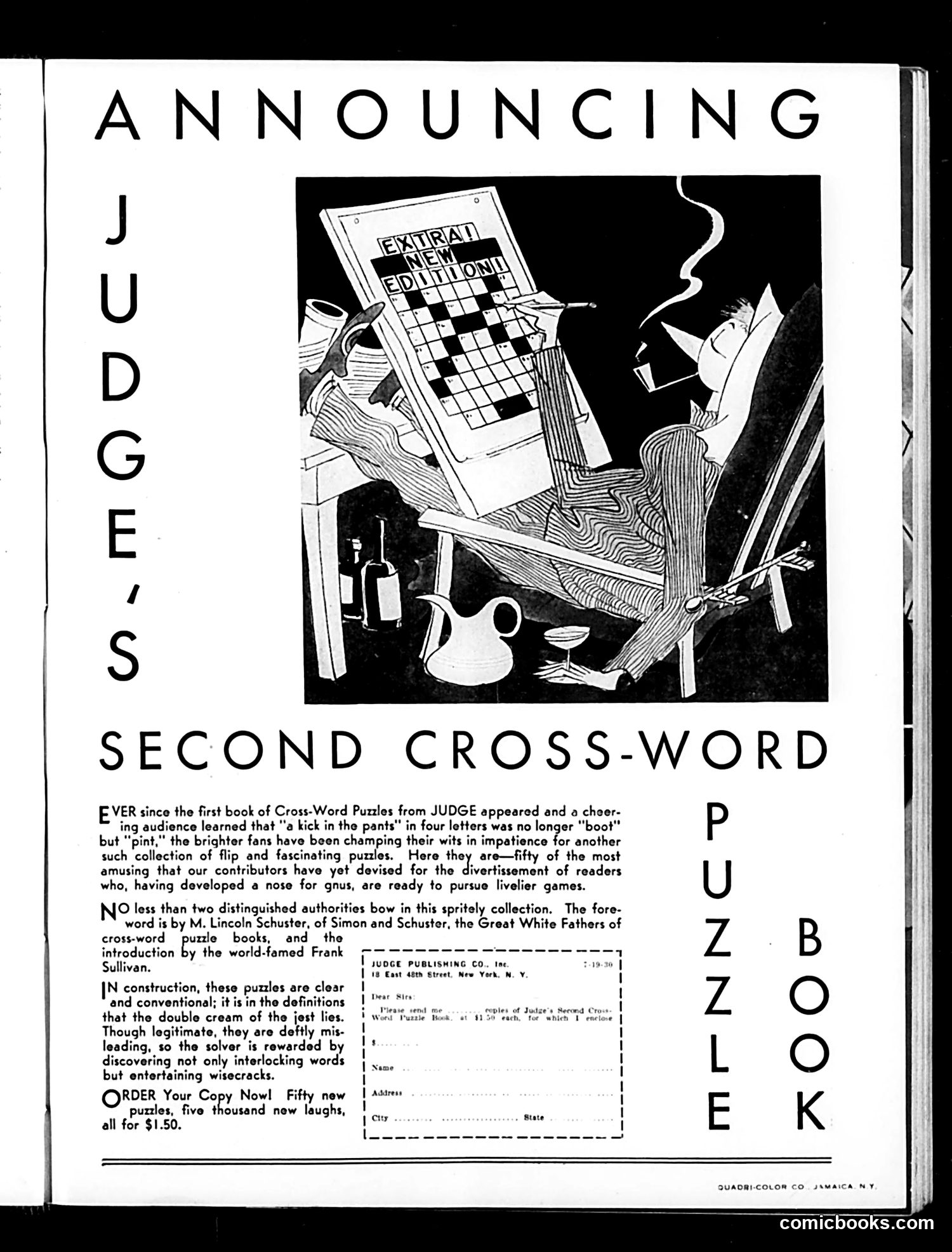
Judge Magazine's Crossword Puzzle Book Advertisement This is an advertisement announcing Judge magazine's second crossword puzzle book collection. The page celebrates the crossword puzzle craze of the 1920s-30s, when these puzzles had become a national obsession. The cartoon shows a relaxed figure enjoying leisure time with the puzzle book, illustrating the "entertainment" appeal. The text humorously references how crossword terminology had entered popular speech—noting that "a kick in the pants" is now solved as "pint" rather than "boot." The ad leverages credibility by citing M. Lincoln Schuster (Simon & Schuster's co-founder) and humorist Frank Sullivan as contributors. The key selling point is that these puzzles offer "entertaining wisecracks" alongside legitimate solutions—the humor lies in deliberately misleading clue definitions that reward solvers with clever wordplay. Priced at $1.50 for fifty puzzles, it's marketed to an audience already "developed a nose for gnus" (a pun itself)—readers sophisticated enough to appreciate wit alongside puzzle-solving.

This is a cigarette advertisement, not satire or political commentary. The page promotes Camel cigarettes (1930, R.J. Reynolds). The image depicts a leisure beach or poolside scene with people relaxing under an umbrella, positioned to suggest that smoking Camels enhances social pleasure and comfort. The advertising copy emphasizes the cigarette's "mellow fragrance" and positions smoking as a "luxury" not to be denied oneself. By modern standards, this represents advertising we'd find alarming: it directly marketed cigarettes to general audiences (including implicitly to young people) without health warnings, using lifestyle imagery to associate smoking with leisure, sophistication, and social enjoyment—tactics now recognized as predatory and banned in many countries.