judge
Judge — July 26, 1930
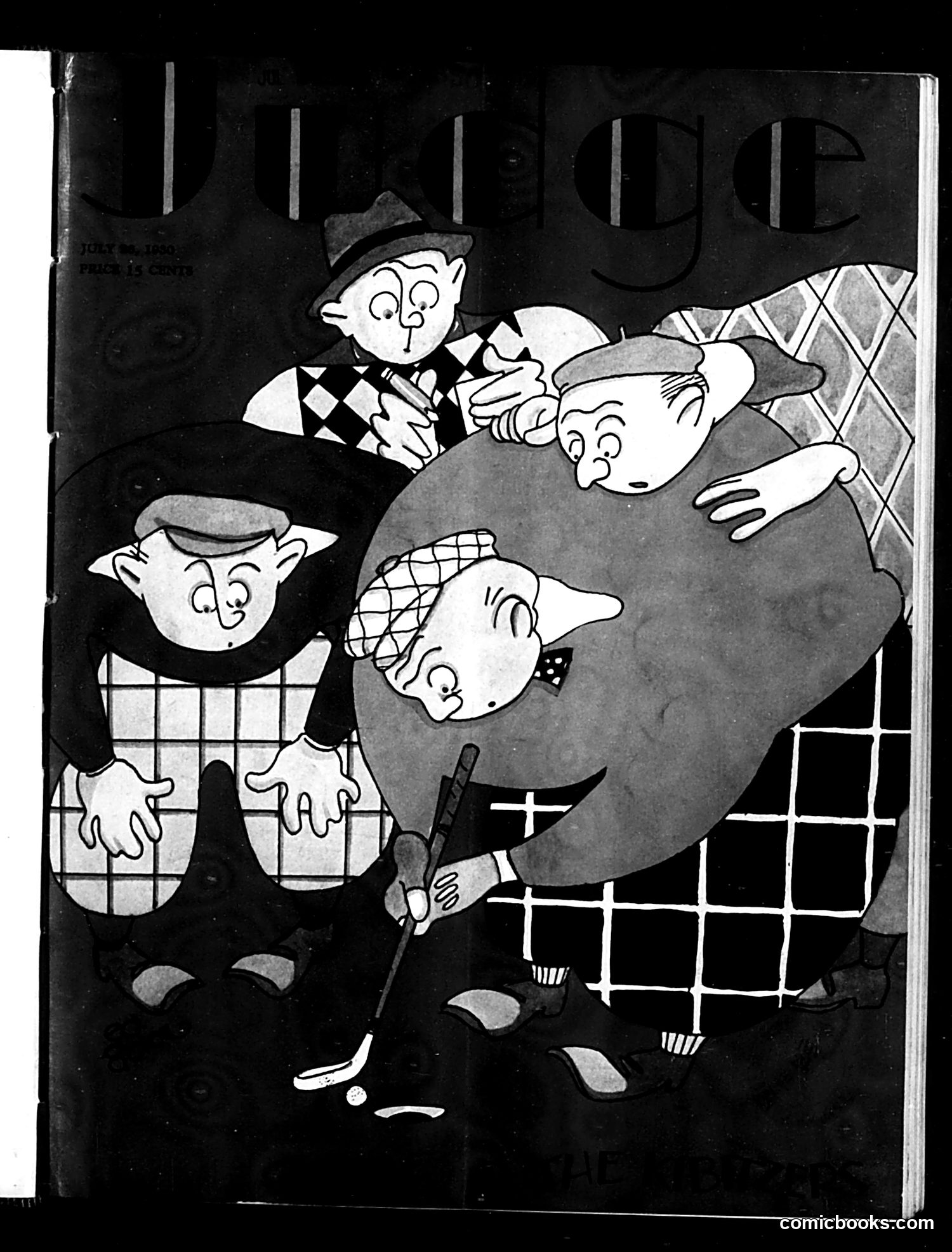
Analysis This appears to be a vintage *Judge* magazine cartoon satirizing golf and wealthy leisure culture. The image shows four caricatured men in a golf scene—one large rotund figure dominates the composition, surrounded by three smaller men in various states of concern or assistance. The satire likely mocks: - Wealthy indulgence: The portly central figure represents excess and affluence - Golf culture: Depicted as an absurd pastime for the privileged class - Physical comedy: The contrast between the large man's girth and the sport's typical physicality creates humor The architectural background (grid pattern windows) suggests an urban country club setting. The exaggerated caricature styles and composition are typical of early-to-mid 20th century American satirical cartooning. Without visible text or date confirmation, the specific historical context remains unclear, but the critique of elite leisure culture is unmistakable.
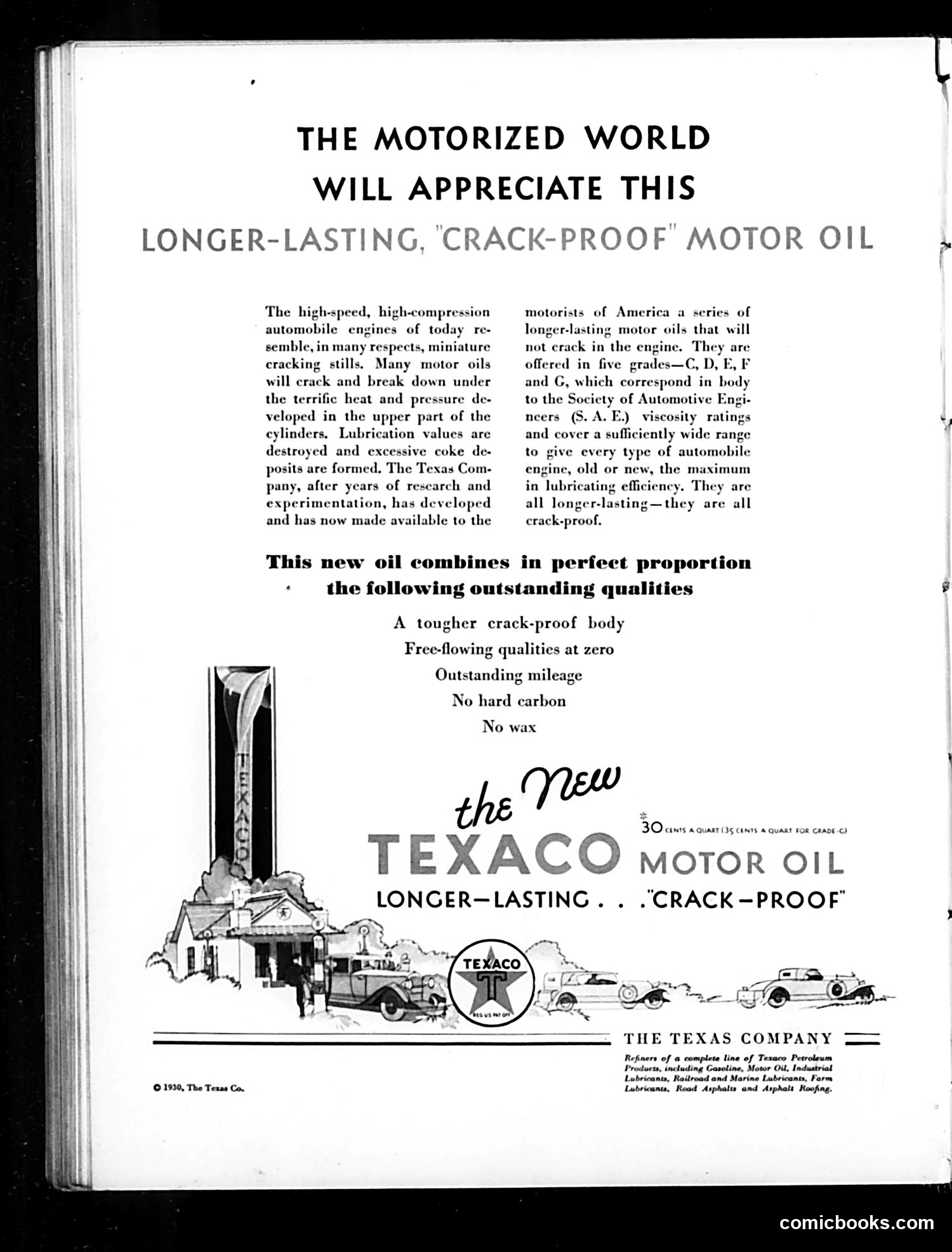
Analysis This page is primarily an advertisement, not satire or political cartoon content. It's a 1930 Texaco Motor Oil ad promoting their new "crack-proof" motor oil product. The ad uses no caricatures or political references. Instead, it employs straightforward marketing language, highlighting technical benefits: the oil's durability under high engine temperatures, resistance to breakdown, and availability in five grades matching Society of Automotive Engineers ratings. The visual elements—an oil derrick and various vehicles—are product-focused imagery, not satirical commentary. The ad's main appeal is practical: motorists will appreciate longer-lasting oil that won't degrade in modern high-compression engines. This represents typical Judge magazine content from this era: alongside satirical articles, advertisers paid for prominent product promotions targeting the magazine's middle-class readership.
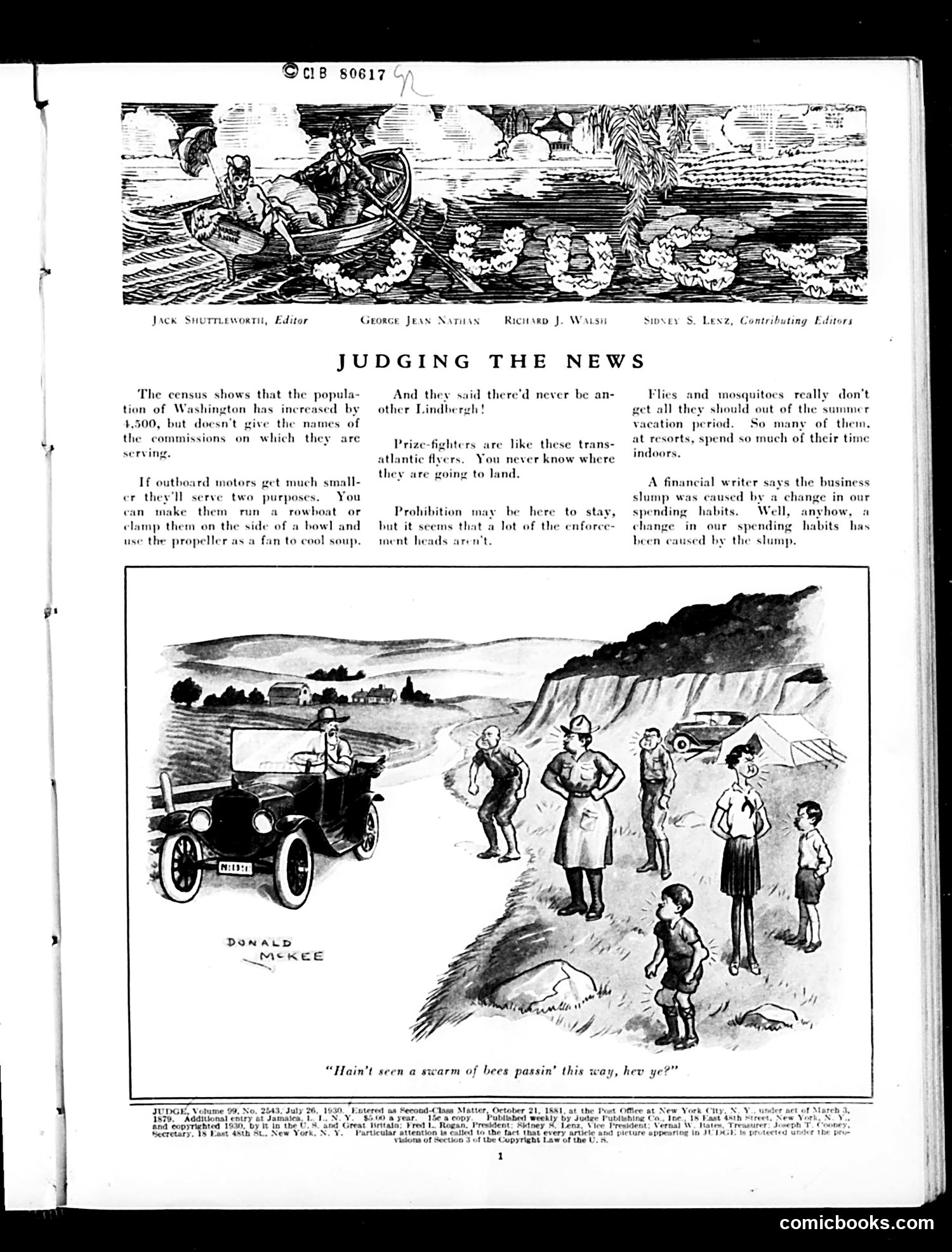
"Judging the News" - July 26, 1920 This page satirizes contemporary social issues through several short commentary pieces and a cartoon by Donald McKee. The cartoon depicts a motorist asking pedestrians, "Hain't seen a swarm of bees passin' this way, her ye?" This appears to reference the widespread concern about escaped or wild bee swarms during the period—a genuine public hazard of the era. The accompanying text snippets mock various topics: the census's failure to track commissions, outboard motors' dual purpose, Prohibition enforcement challenges, transatlantic aviators' unpredictability, and changing spending habits causing business slumps. The overall tone treats these diverse issues—from bees to aviation to economics—with lighthearted skepticism, typical of Judge's satirical approach to contemporary life.
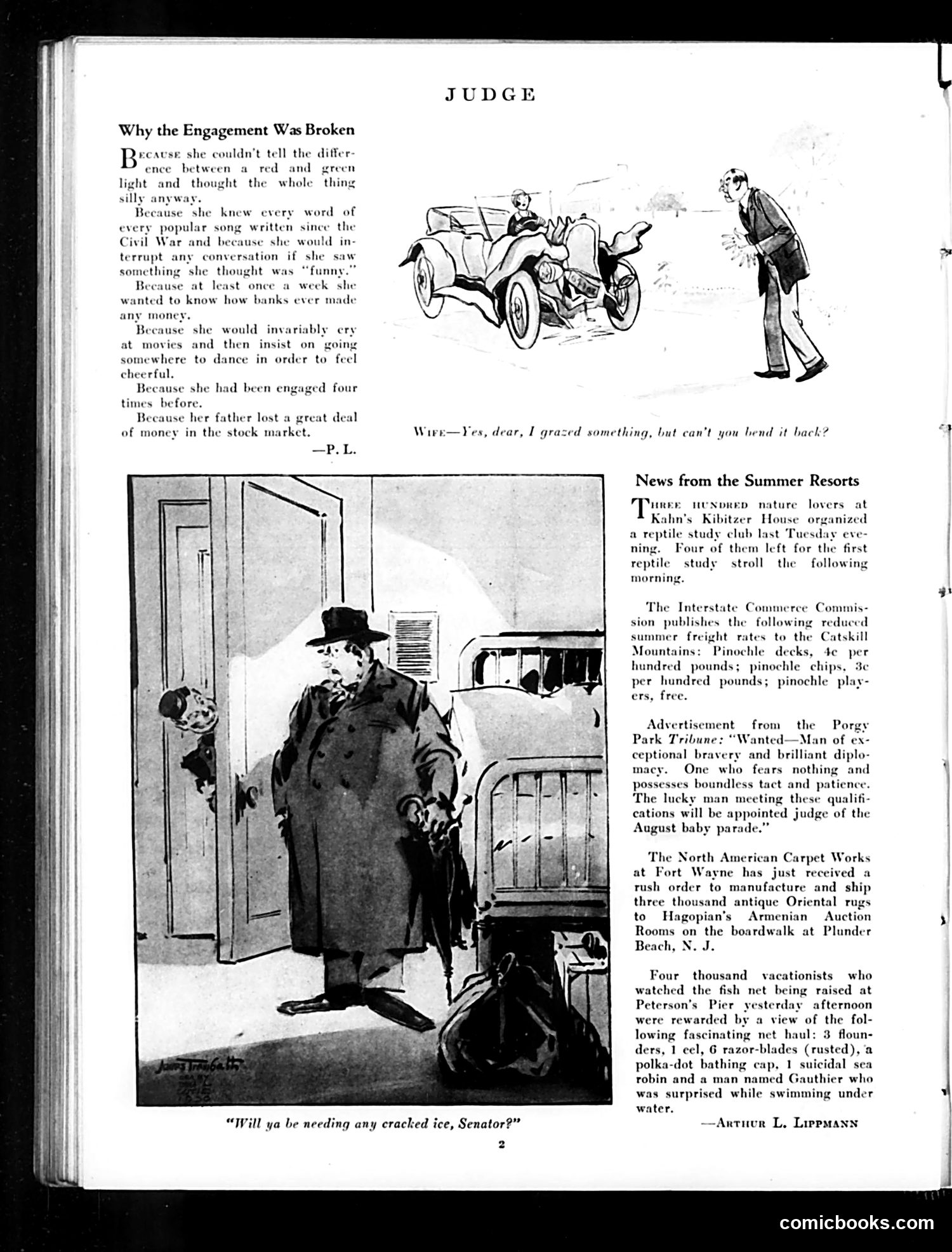
Judge Magazine Page Analysis This page contains two separate humor pieces: Top cartoon ("Why the Engagement Was Broken"): A satirical list of reasons a woman ended her engagement, mocking her perceived frivolousness—she can't distinguish colors, knows every popular song, cries at movies, and had four previous engagements. The accompanying illustration shows a man in a car speaking to a woman, with the caption "Wife—Yes, dear, I grazed something, but can't you bend it back?" The joke suggests the woman is so shallow she'd rather discuss car damage than important matters. Bottom cartoon ("Will ya be needing any cracked ice, Senator?"): Shows a man (apparently a senator) at what appears to be an ice delivery or storage facility. The humor likely references Prohibition-era politics—senators or politicians obtaining "cracked ice" as a euphemism for illegal alcohol, satirizing hypocrisy among lawmakers who publicly supported Prohibition while privately accessing liquor.
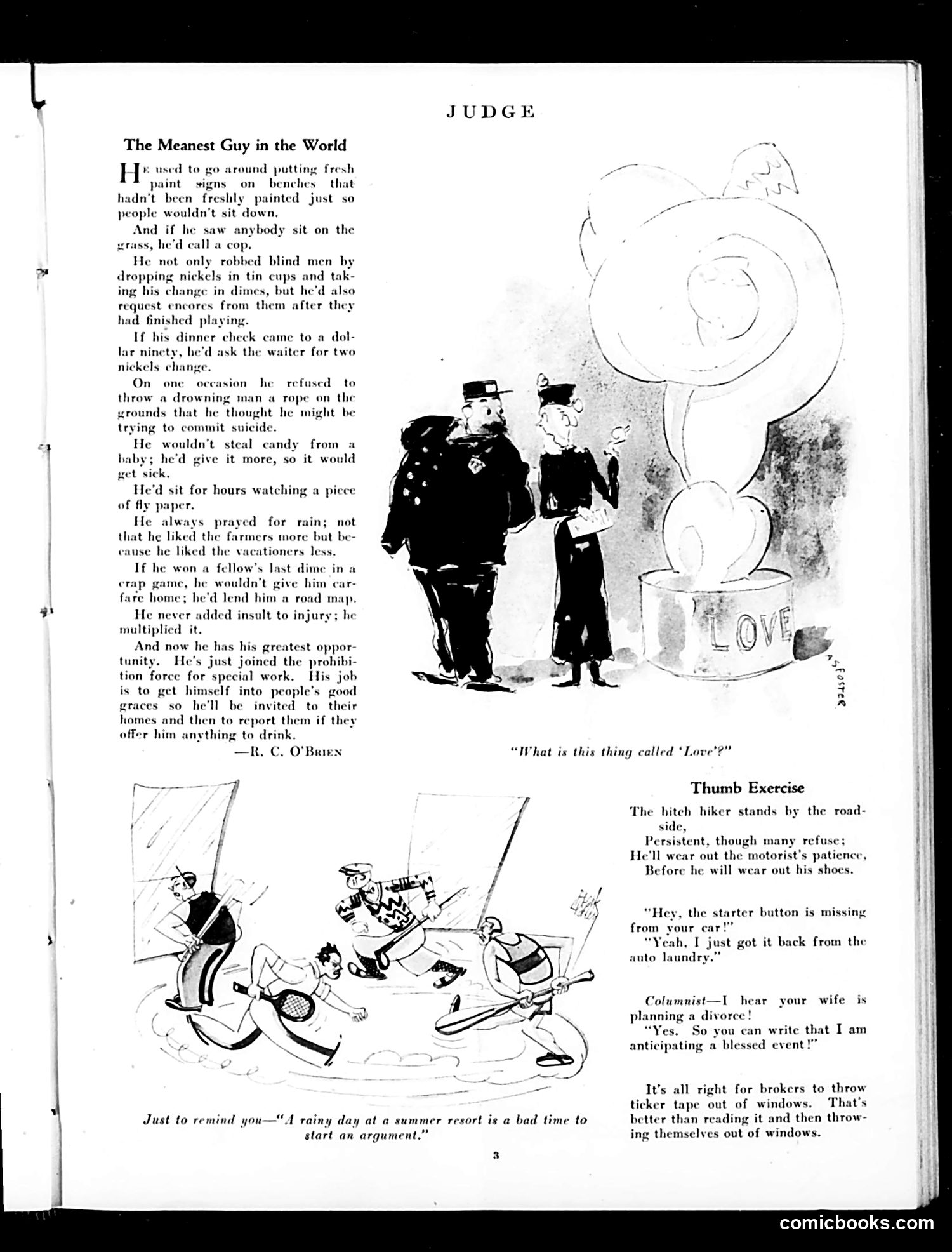
Judge Magazine Page Analysis This page contains three distinct satirical pieces: "The Meanest Guy in the World" (top left) describes a deliberately cruel person who sabotages public benches, extorts blind beggars, steals candy from babies, and uses his position as a prohibition enforcement officer to harass citizens. The accompanying cartoon shows two men in hats examining a large question mark, captioning "What is this thing called 'Love'?"—likely satirizing the disconnect between such cruelty and human affection. "Thumb Exercise" (bottom) depicts hitchhikers and motorists, with quips about missing car parts and marital discord, reflecting 1920s-30s automobile culture and domestic tensions. The humor relies on observational satire about American social behaviors, petty grievances, and period-specific anxieties rather than targeting specific political figures.
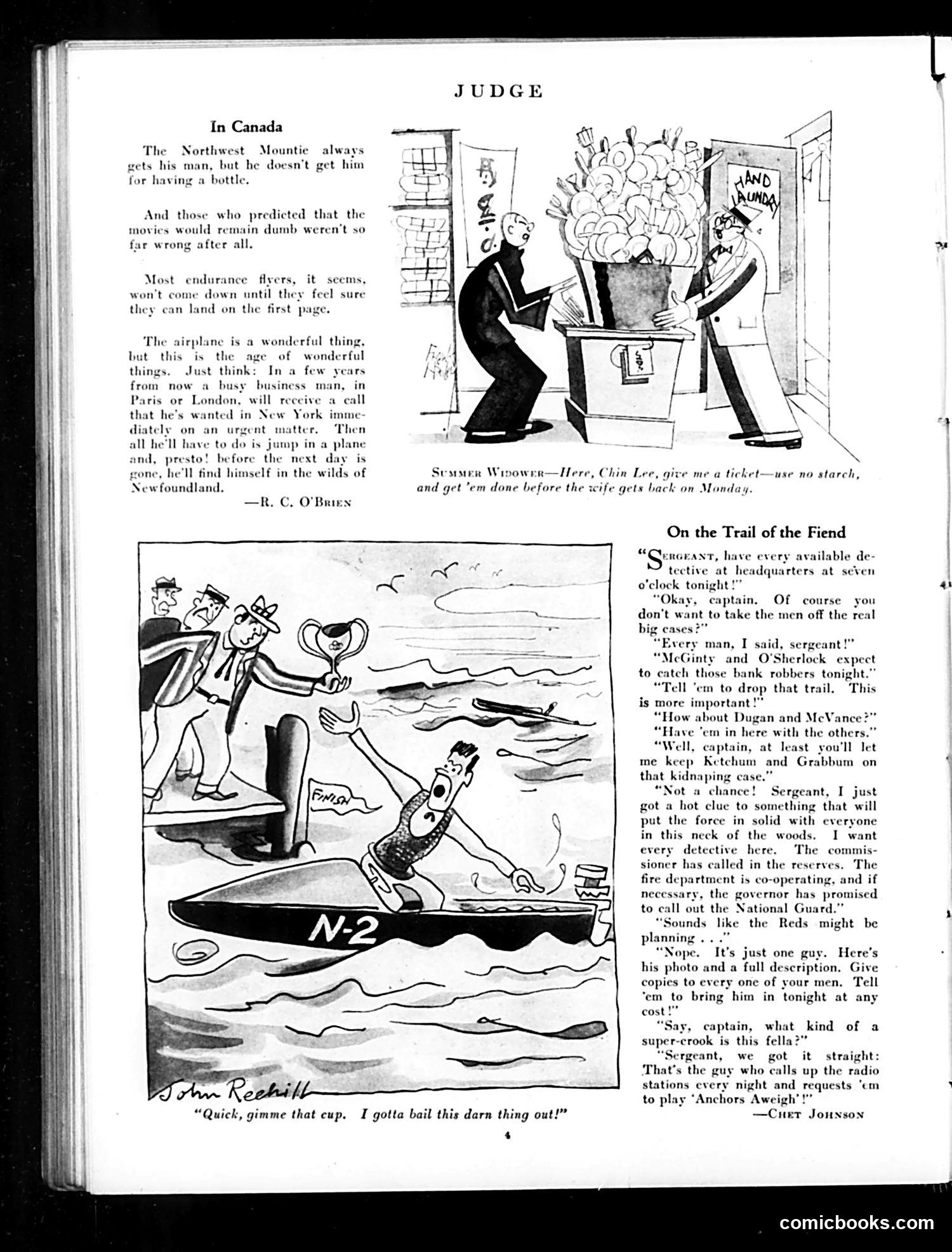
Analysis of Judge Page This page contains two unrelated humor pieces: Top cartoon ("Judge"): Shows a laundry business overwhelmed with work. The satire likely mocks the inefficiency of wartime laundry services or commercial operations struggling with demand—a common subject during WWI era when Judge was active. Bottom cartoon ("On the Trail of the Fiend"): A police captain briefs detectives about catching bank robbers, joking that one suspect is identifiable because "he calls up the radio stations every night and requests 'em to play 'Anchors Aweigh.'" The humor plays on the absurdity of a criminal with such a distinctive, traceable habit. The boat illustration (marked "N-2") suggests a maritime or waterfront chase scenario. Both reflect early 20th-century concerns about crime and social disorder presented through exaggeration and wordplay.
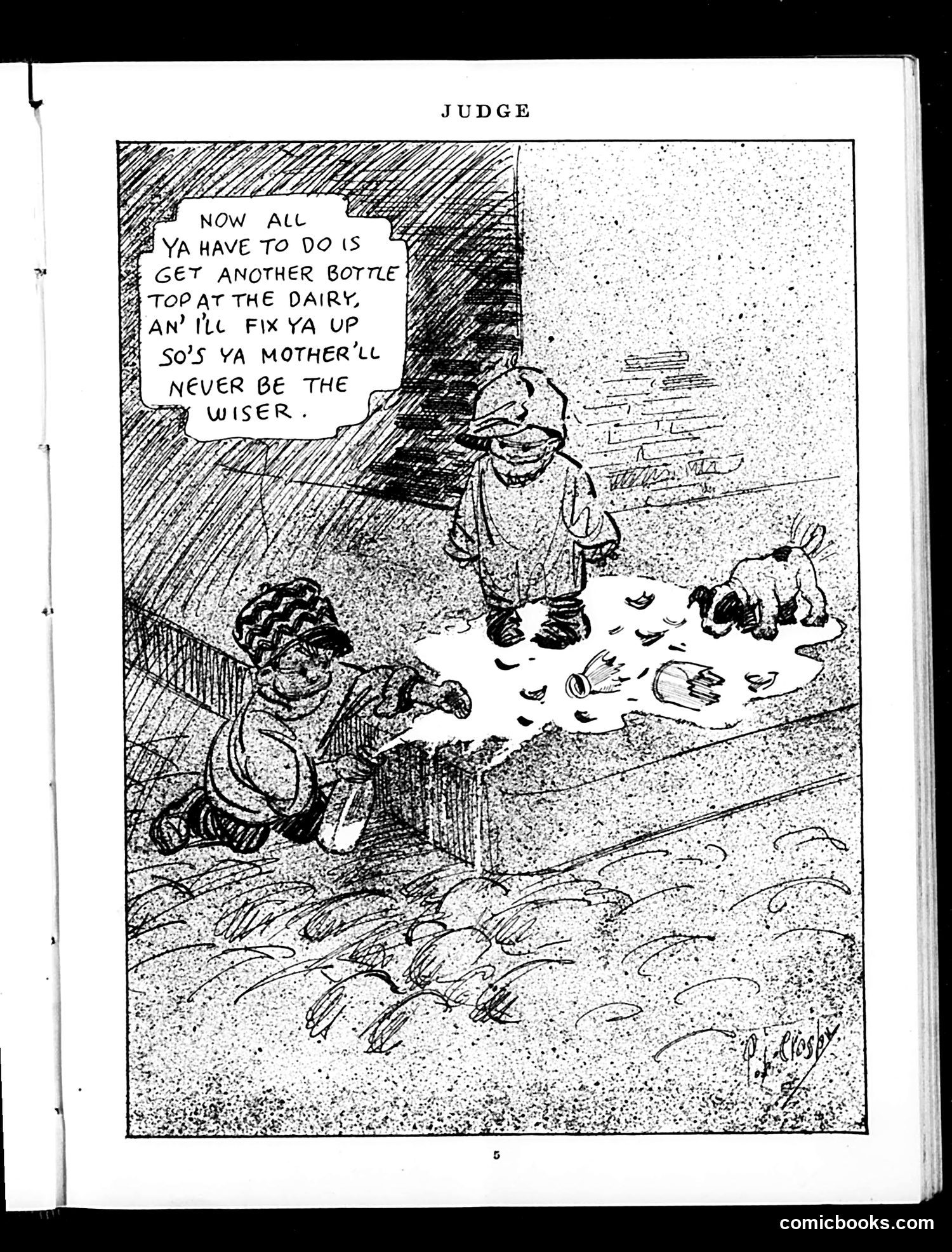
Analysis of "Judge" Cartoon Page This cartoon depicts a domestic scene of poverty or hardship. An adult figure (appearing to be a parent or guardian) addresses two children, instructing them to "get another bottle top at the dairy" and promising to "fix ya up so's ya mother'll never be the wiser." The scattered bottle caps and broken items on the ground suggest material deprivation. The instruction implies the adult is using a bottle top as a makeshift toy or perhaps attempting to conceal evidence of damage or neglect from the children's mother. The satire appears to target poverty-level parenting during economic hardship—likely the Depression era—where adults improvised solutions and deceived family members out of desperation or shame. The title "JUDGE" suggests moral commentary on survival tactics among the poor.
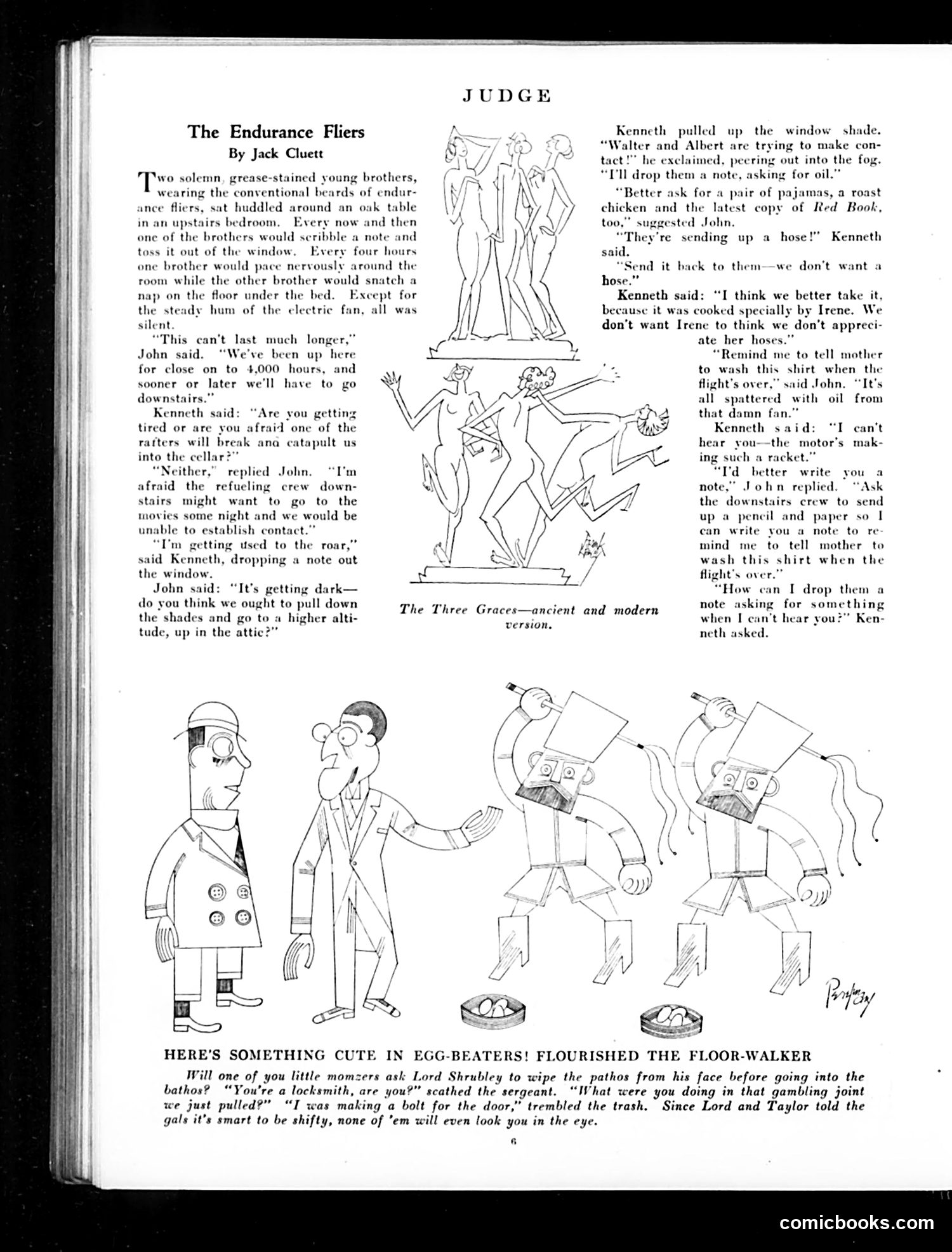
"The Endurance Fliers" by Jack Cluett This page contains a humorous short story about two brothers attempting an endurance flying record by staying airborne for 4,000 hours. The narrative focuses on their increasingly desperate attempts to communicate with ground crews and handle mundane problems (like a soiled shirt needing washing) while unable to land. The accompanying cartoons satirize the absurdity: "The Three Graces—ancient and modern version" shows the contrast between classical elegance and modern mechanical chaos, while the bottom cartoon mocks egg-beaters as an absurd "floor-walker" invention. The satire targets early aviation's impracticality and the era's obsession with record-breaking feats, treating ambitious pilots' logistical nightmares for comic effect.
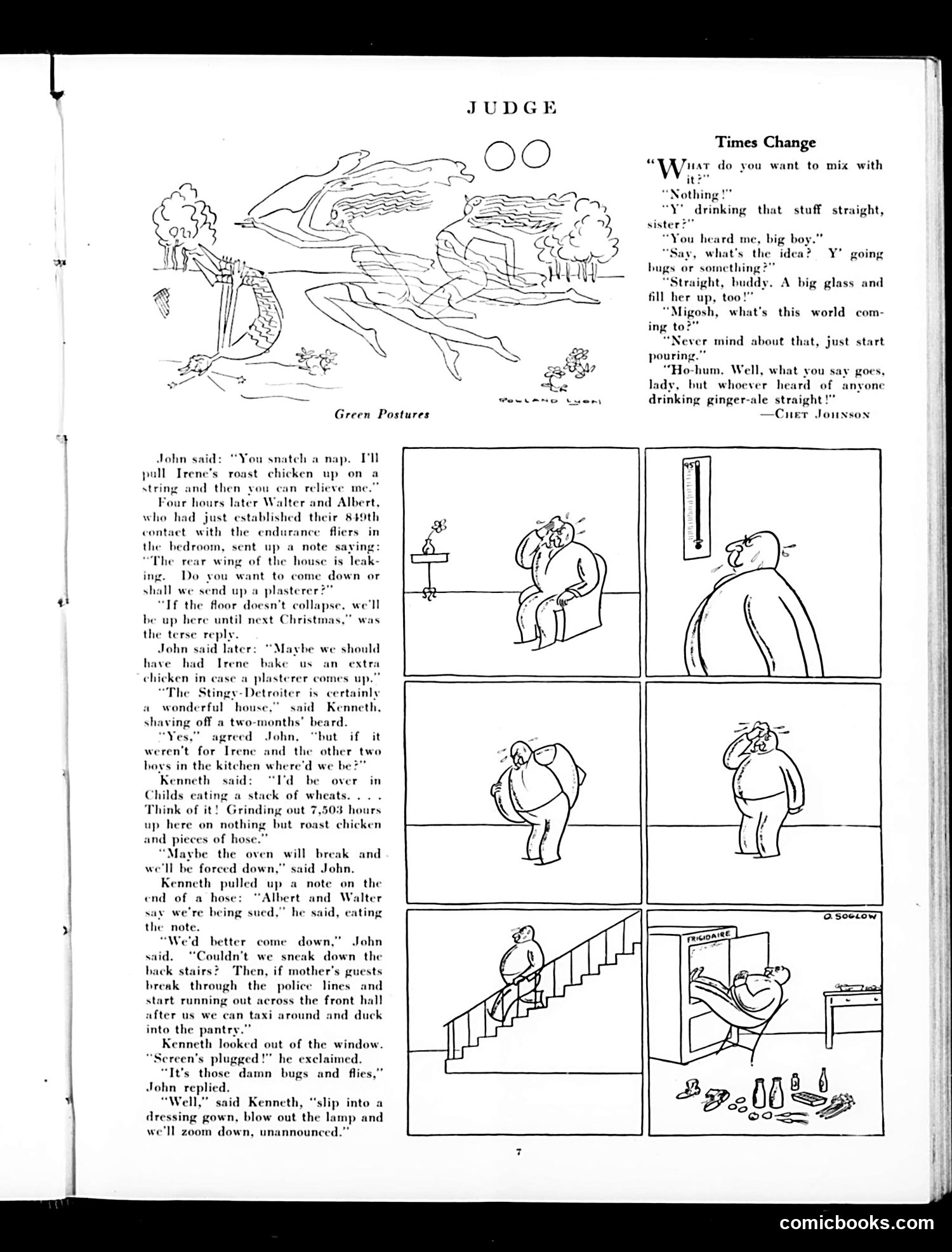
"Green Postures" & "Times Change" "Green Postures" satirizes the 1920s endurance flying craze, when pilots competed for records by staying aloft for days. The joke depicts two men trapped in a bedroom, pretending to be endurance fliers while avoiding household problems (leaking roof, potential lawsuits). They survive on roast chicken delivered via string—a absurd parody of how real aviators relied on ground crews for supplies. "Times Change" contrasts old and new drinking customs. An older woman criticizes younger drinkers for consuming ginger ale straight (without alcohol), implying this represents undesirable social change—possibly a jab at Prohibition-era alternatives or generational decline. The humor lies in flipping traditional drinking etiquette: straight spirits were once standard; now abstinence seems shocking. Both cartoons use exaggeration to mock contemporary fads and social shifts of the Jazz Age.
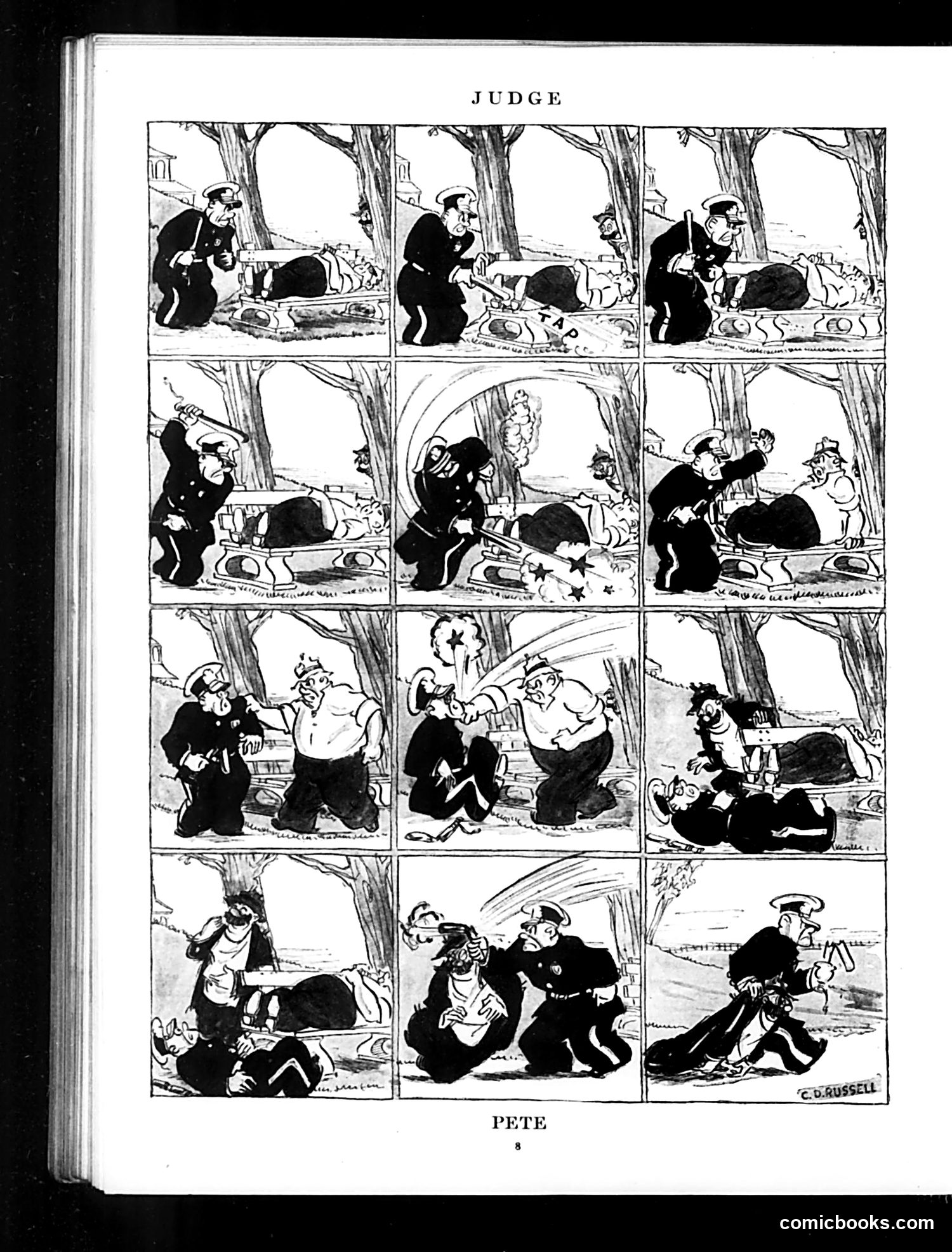
"Judge Pete" - Political Cartoon Analysis This 12-panel comic strip titled "Judge Pete" depicts a judge in formal robes encountering a vagrant or homeless person sleeping beneath trees. The narrative appears to show the judge's changing response: initially dismissive or judgmental, the judge gradually becomes sympathetic after discovering the person's circumstances or identity. The satire likely critiques judicial or societal hypocrisy—perhaps suggesting that authority figures like judges make harsh decisions about poor people without understanding their actual situations. The progression from condemnation to compassion implies the judge learns something humbling. The specific identity of "Pete" and whether this references an actual court case or public figure remains unclear from the image alone. The strip's point seems to be about empathy breaking through initial prejudice.
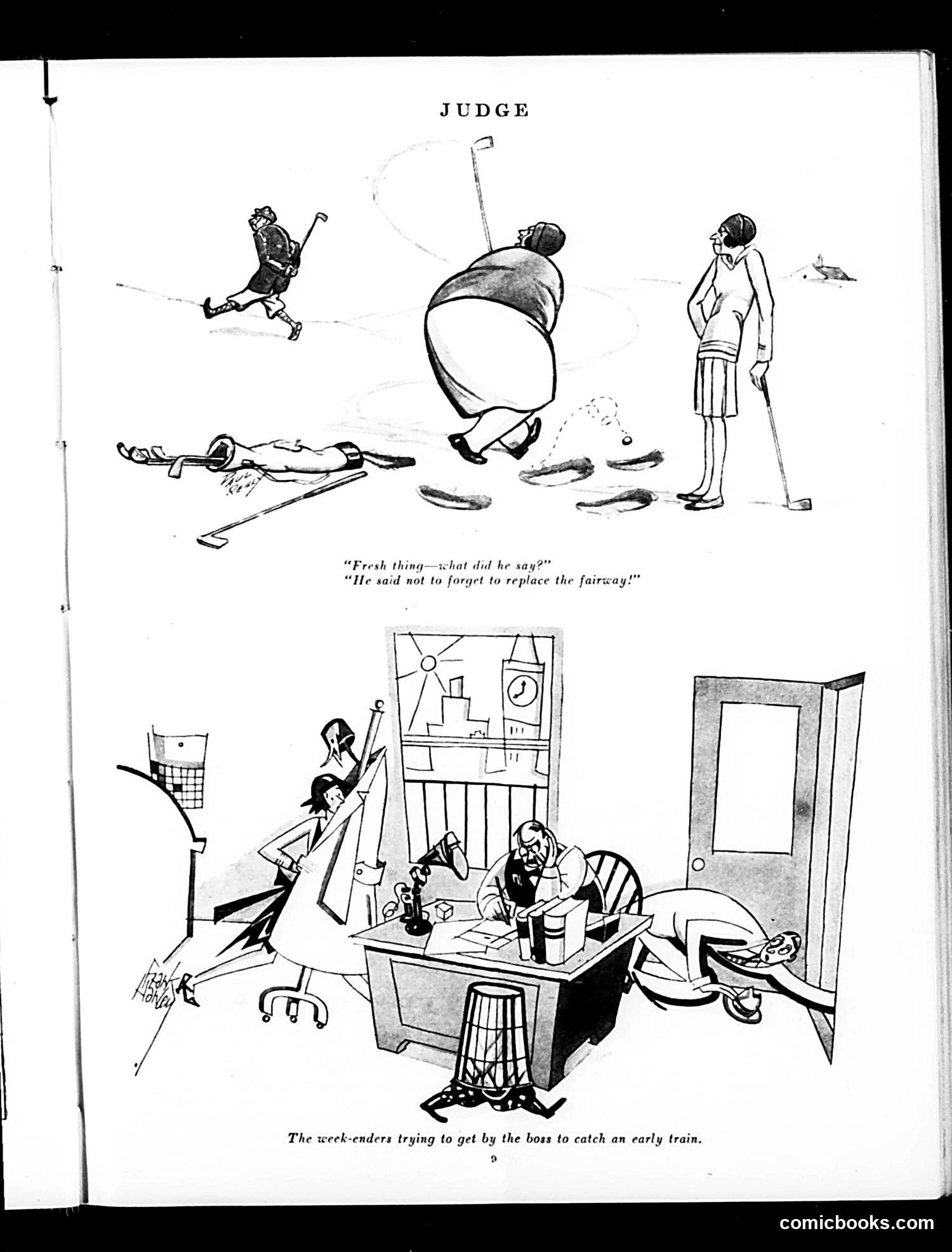
Analysis This page contains two cartoons from Judge magazine, both satirizing workplace dynamics. The top cartoon titled "JUDGE" depicts a golf scene where someone has hit a ball onto a fairway. The dialogue "'Fresh thing—what did he say?' / 'He said not to forget to replace the fairway!'" suggests a young, impertinent employee making a cheeky remark to authority. The bottom cartoon shows office workers attempting to leave early on a Friday ("week-enders") to catch an early train, while their boss sits at a desk. The visual chaos—with figures moving frantically and items scattered—depicts the comic struggle between employees wanting to depart and management's authority to detain them. The satire targets the tension between working-class desires for leisure time and managerial control over employees' schedules.
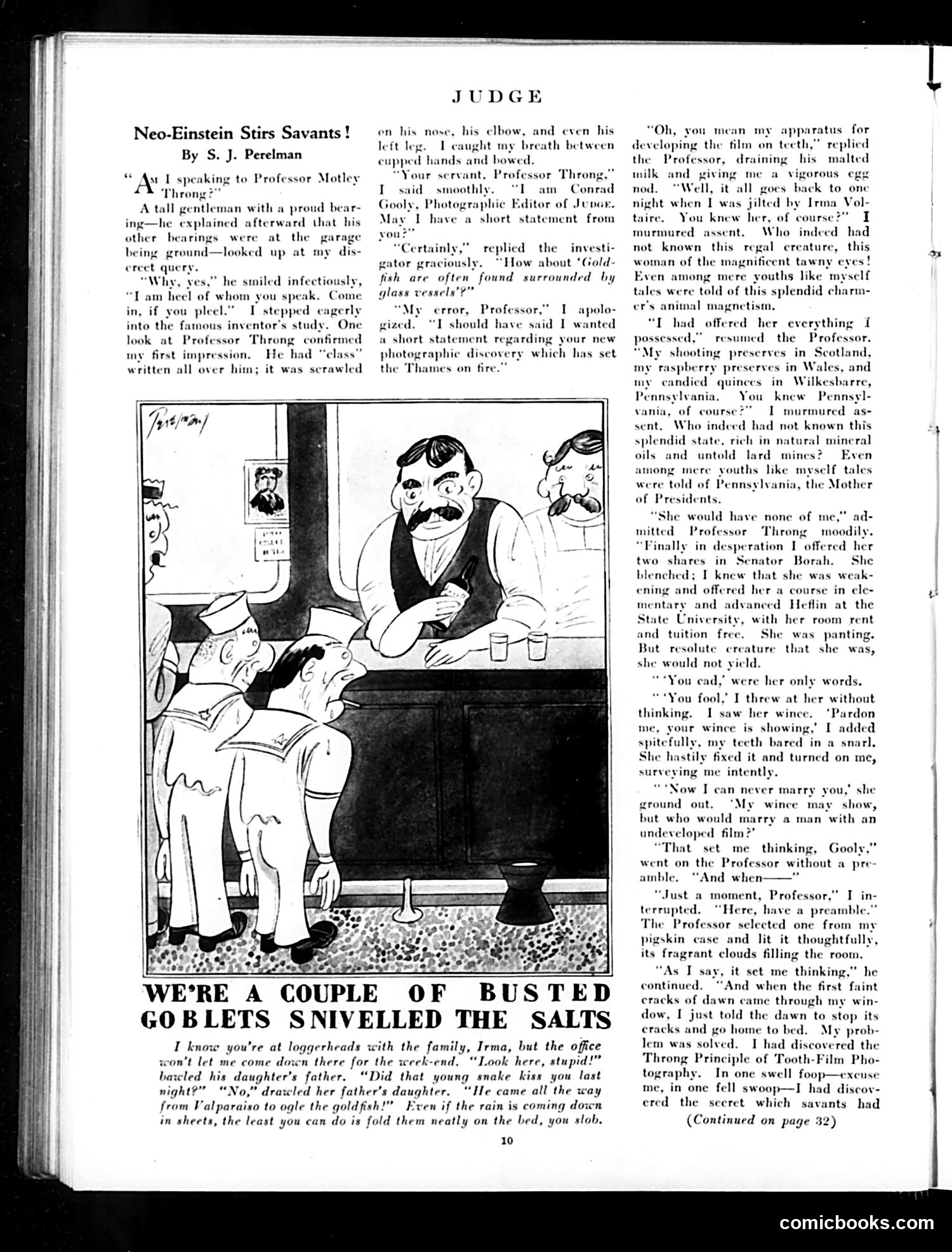
Judge Magazine Satire Analysis This is a comedic short story by S.J. Perelman (a renowned humorist) satirizing pseudo-intellectual academic pretension and absurdist logic. "Professor Throng" appears to be a fictional charlatan inventor who speaks with affected superiority while saying nonsensical things—his "discovery" involves photographing goldfish surrounded by glass vessels and developing film on teeth. The humor mocks both the Professor's pompous manner and the narrator's obsequious acceptance of obvious gibberish. The satire targets early 20th-century "scientific" charlatans and the cultural reverence for inventors during America's technological boom. Perelman exaggerates the Professor's class-consciousness (literally written on his body) and his absurdly verbose romantic rejection narrative to expose intellectual fraud. The subplot about a woman rejecting him for having an "undeveloped film" continues the tooth-film photography running joke, maintaining the surreal logic throughout. This is quintessential Perelman—verbal slapstick mocking pretense through deadpan absurdism.
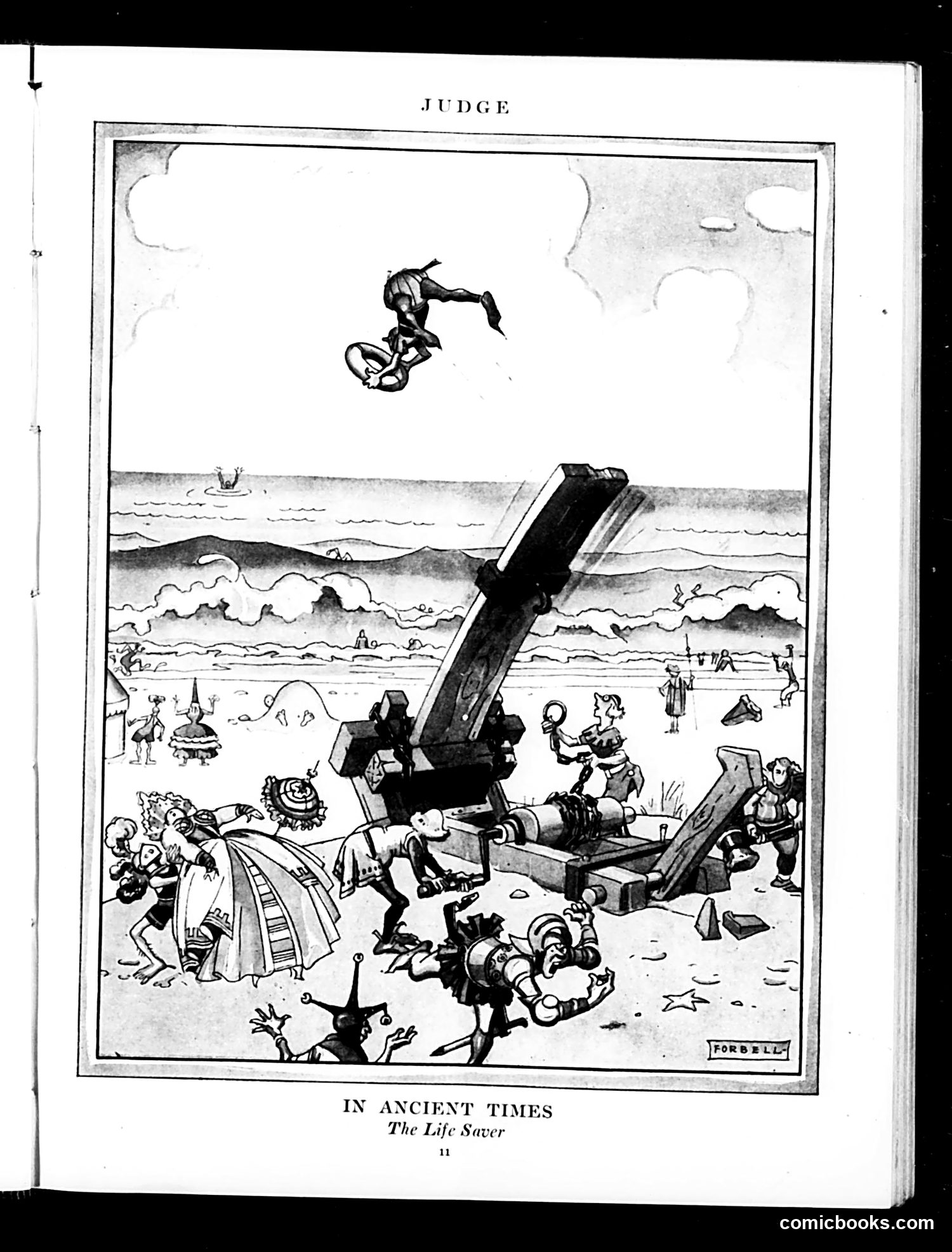
This cartoon titled "The Life Saver" presents a beach scene in "Ancient Times" where a figure labeled "Judge" (the personification of the magazine itself or judicial authority) performs a dramatic rescue operation. The illustration shows a catapult-like device launching a person into the air above turbulent waters, while beachgoers watch. The satire appears to criticize judicial intervention as absurdly theatrical and ineffective—rather than solving problems logically, "Judge" employs comical, impractical methods that endanger rather than help. The figure being launched upward suggests the ridiculous nature of the "remedy" offered. This likely comments on contemporary court decisions or judicial overreach, portraying the legal system as more performative spectacle than genuine problem-solving, using the ancient setting for humorous distance and perspective.
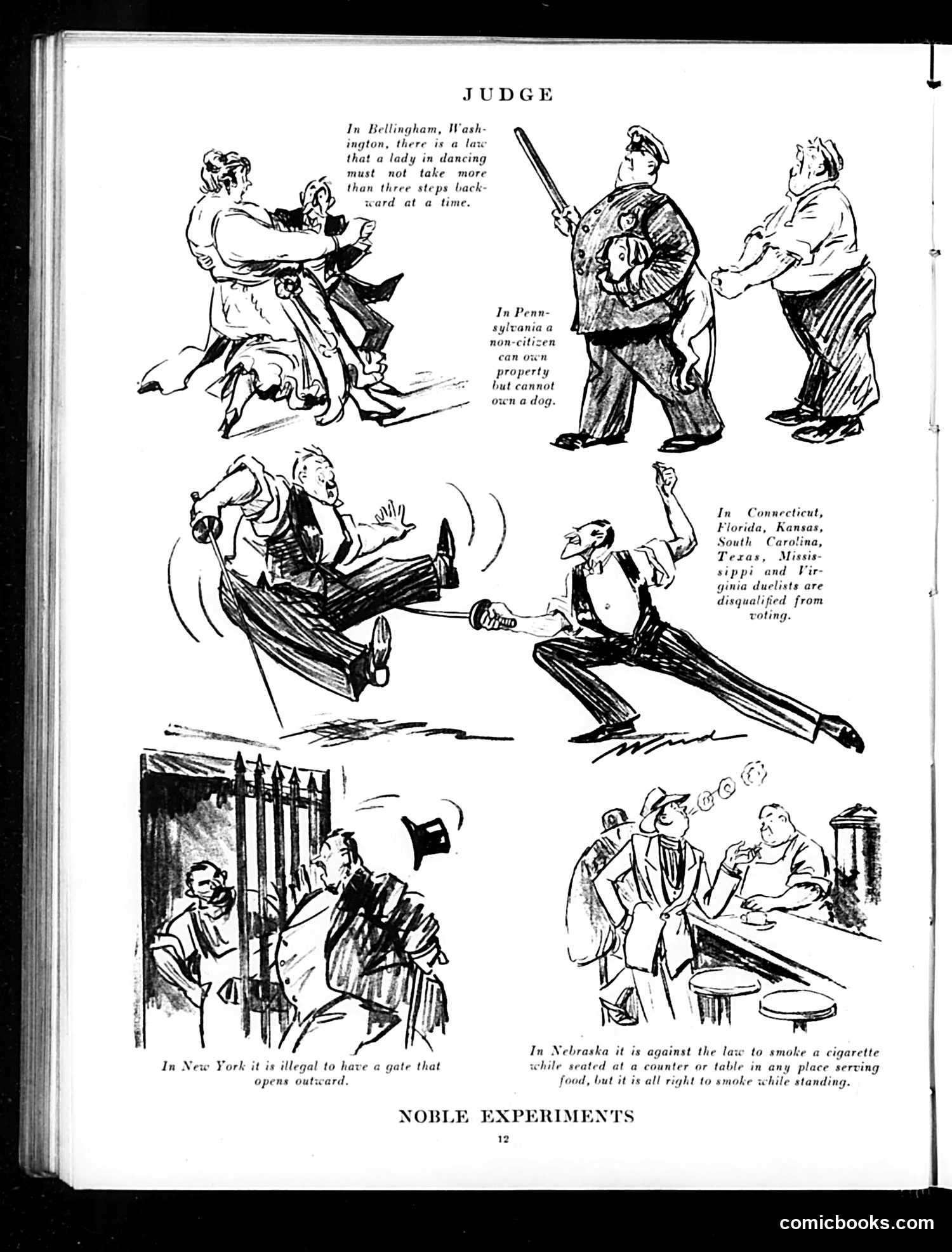
"Noble Experiments" - Judge Magazine Satire This page satirizes absurd state and local laws through illustrated vignettes. Each cartoon mocks a seemingly ridiculous legal restriction: - Bellingham, Washington: A woman restricted to three backward dance steps (shown being awkwardly constrained while dancing) - Pennsylvania: A non-citizen can own property but not a dog (illustrated with a man unable to possess a dog) - Multiple Southern states: Dueling participants barred from voting (shown men in combat poses) - New York: Gates must open inward, not outward (shown a man confronting an outward-opening gate) - Nebraska: Smoking permitted while standing but not sitting at food establishments (showing the absurd distinction) The satire targets the arbitrary, often contradictory nature of local legislation—laws that seem either overly specific, logically inconsistent, or reflective of outdated practices. By illustrating these laws literally and absurdly, *Judge* ridicules legislative bodies for enacting such peculiar restrictions while calling them "noble experiments."
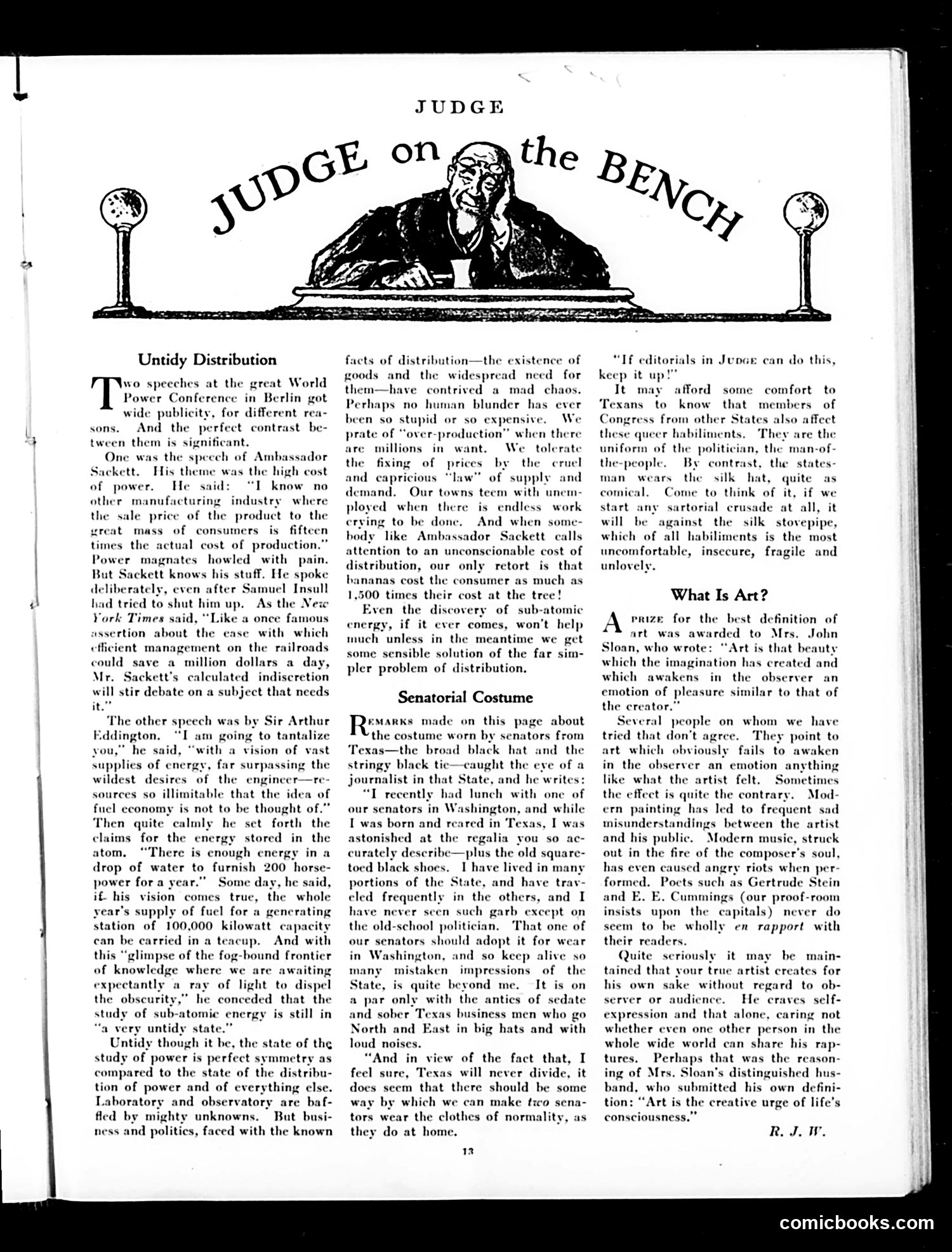
Judge Magazine: "Judge on the Bench" (Page 13) This page contains two separate editorial commentaries framed by the masthead illustration of a stern judge. "Untidy Distribution" criticizes the vast gap between industrial production capacity and actual consumer access. The piece contrasts Ambassador Sackett's speech exposing that consumers pay 15 times the actual production cost of power, versus Sir Arthur Eddington's optimistic vision of unlimited atomic energy. The satire's point: technological advances mean nothing if distribution systems remain chaotic. The writer attacks the absurdity of simultaneous overproduction and unemployment, and price-fixing through "supply and demand." Reference to Samuel Insull (a major utilities magnate) suggests corporate resistance to transparency about actual costs. "Senatorial Costume" mocks Texas senators for wearing outdated formal clothing—broad-brimmed hats, string ties, square-toed black shoes—that perpetuates frontier stereotypes and embarrasses the state in Washington. The column argues these anachronistic costumes undermine Texas's modern credibility. Both pieces exemplify Judge's role critiquing economic inequality and regional backwardness through satirical commentary.
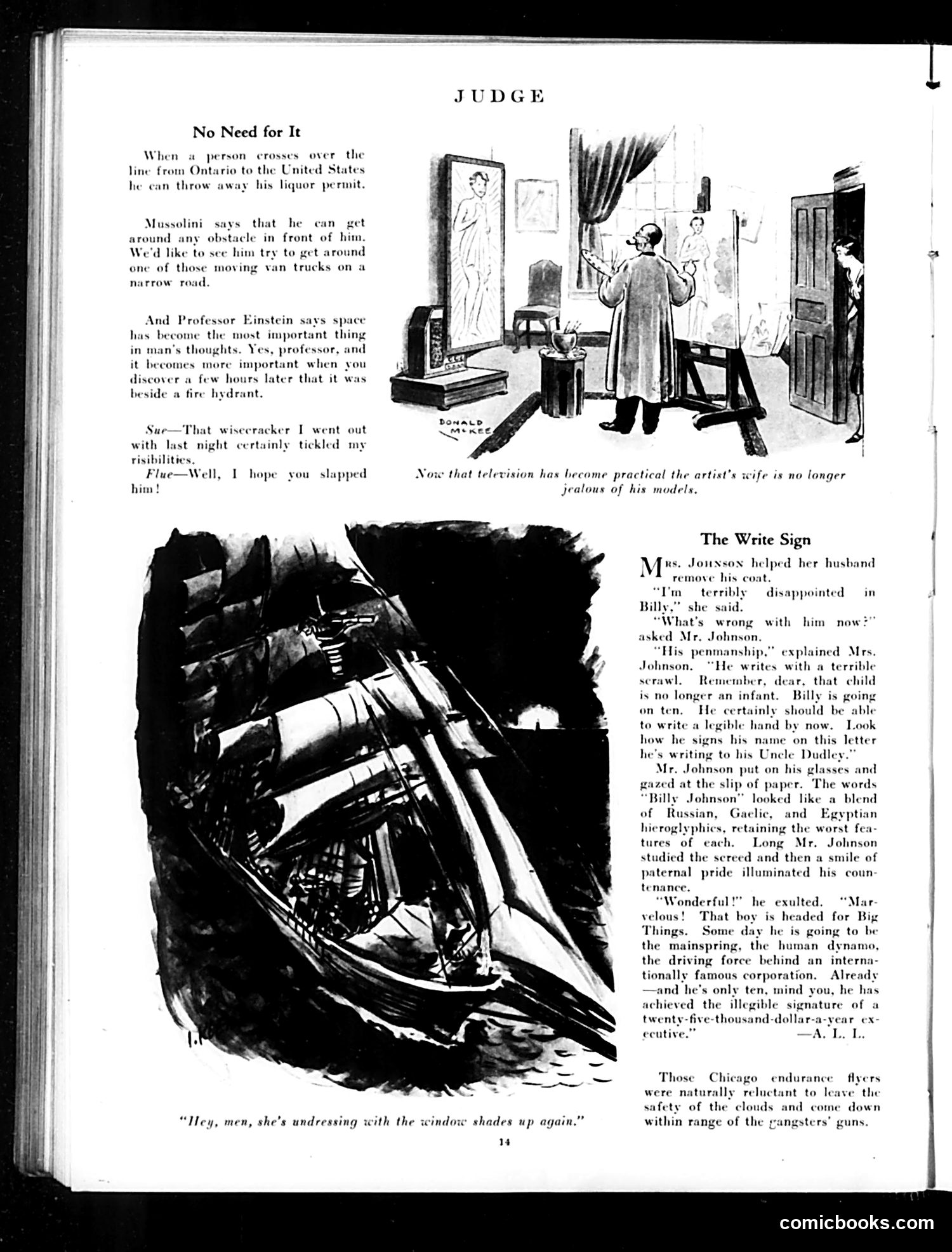
Judge Magazine Page Analysis This page contains three separate satirical pieces typical of Judge's humor: "No Need for It" ridicules contemporary figures through absurdist logic. It mocks Mussolini's boasting about overcoming obstacles (referencing his fascist posturing) by suggesting he couldn't navigate moving vans on narrow roads. Einstein's recent theories about space are humorously reframed as relevant only to parking near fire hydrants. These jokes trivialize grandiose claims through mundane American observations. The cartoon shows an artist's wife no longer jealous of his models—because television now provides the distraction. It comments on technology's disruption of domestic life. "The Write Sign" presents a father proud his ten-year-old son has illegible handwriting, interpreting it as evidence the boy will become a powerful corporate executive. The satire targets American admiration for business success and the absurd optimism that reads any trait—even poor penmanship—as proof of future greatness. The final paragraph references Chicago gangsters and Prohibition-era violence obliquely.
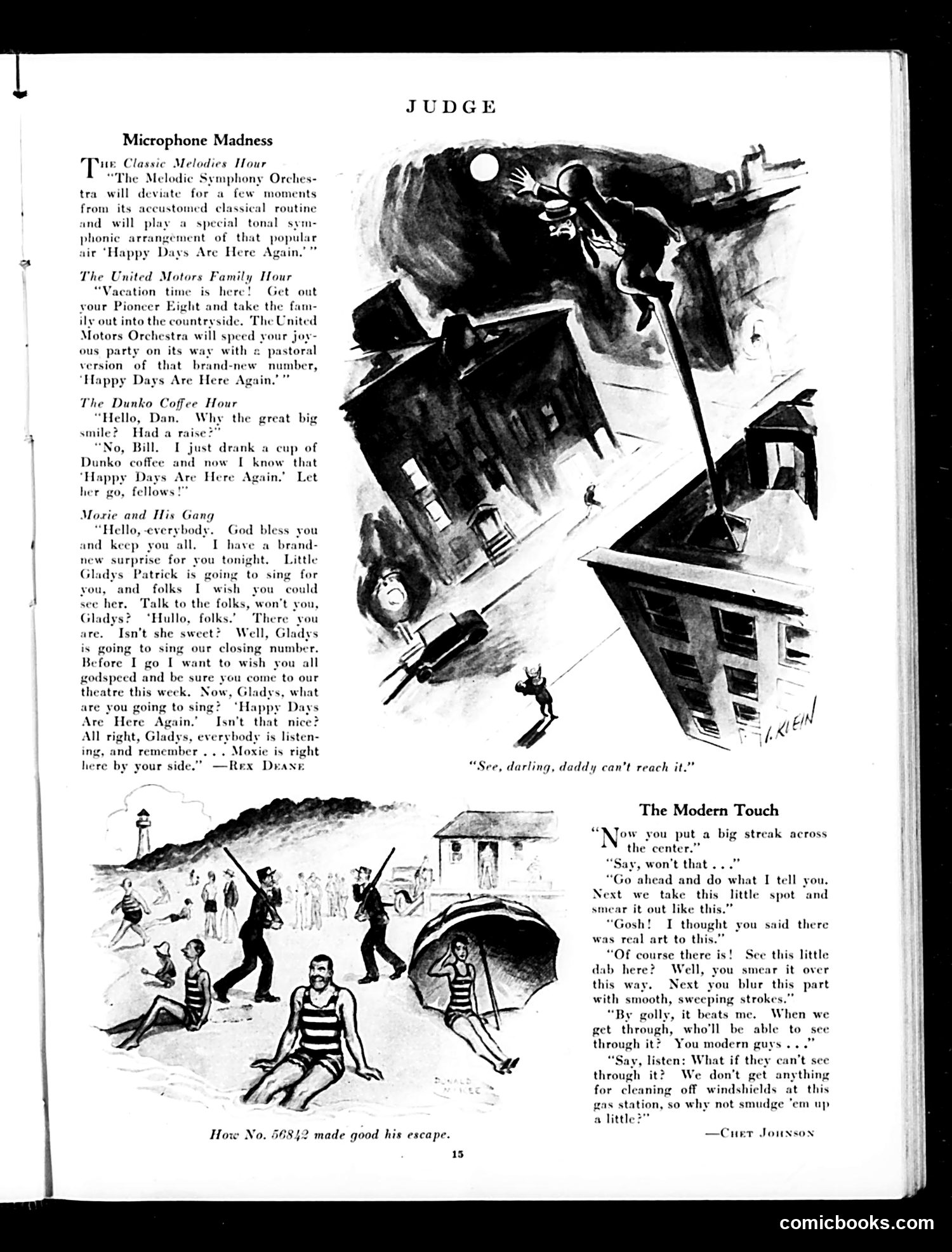
Judge Magazine Page Analysis This page satirizes the obsessive promotion of the song "Happy Days Are Here Again" across radio programming during the early 1930s. Multiple fictional radio shows—Classic Melodies Hour, United Motors Family Hour, Dunko Coffee Hour, and Morie and His Gang—all shoehorn the same tune into their broadcasts, regardless of relevance. The satire mocks both corporate radio's commercialism and the song's ubiquitous use as Depression-era propaganda. The accompanying cartoons mock modern trends: one shows a figure impossibly reaching for a high object (likely satirizing impractical modern design), while "The Modern Touch" depicts a con artist at a gas station deliberately smudging car windshields with fake "artistic" technique, then billing customers for cleaning. This satirizes fraudulent modernist pretense and consumer gullibility during economically desperate times.
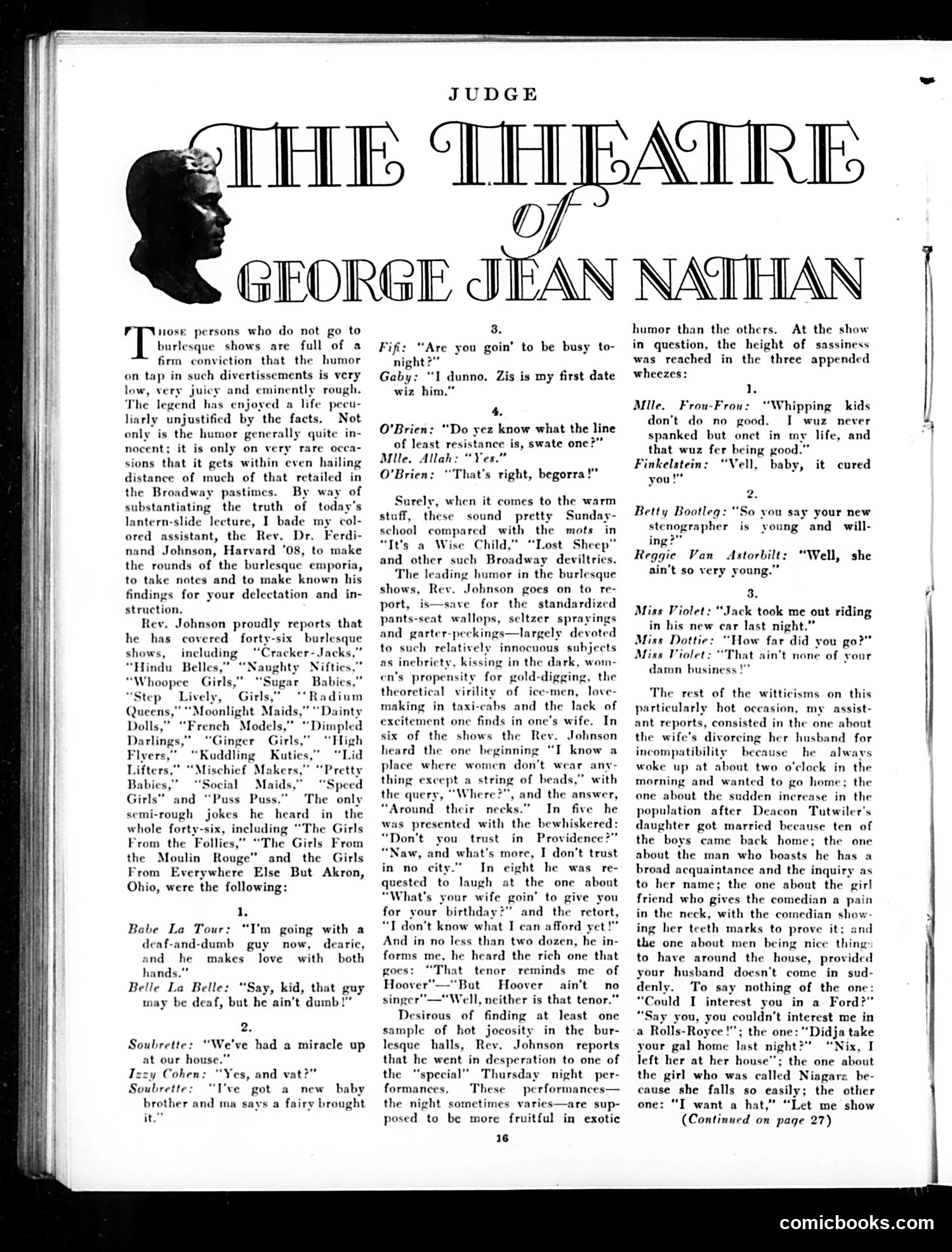
"The Theatre of George Jean Nathan" This is a theater criticism article by George Jean Nathan, a prominent drama critic of the early 20th century. Nathan defends burlesque shows against the common perception that they traffic in crude, obscene humor. To prove his point, Nathan had Rev. Dr. Ferdinand Johnson (Harvard '08) attend 46 burlesque productions and document the actual jokes told. Nathan argues that burlesque humor is relatively innocent—mostly about inebriety, infidelity, gold-digging women, and taxi-cab romance—compared to Broadway's more risqué fare. The article includes sample jokes from shows like "Cracker-Jacks" and "Sugar Babies," revealing humor that is indeed quite tame by any standard. References to Hoover suggest this is from the early 1930s. Nathan's thesis: burlesque gets an unfair reputation; its humor is actually Sunday-school appropriate.
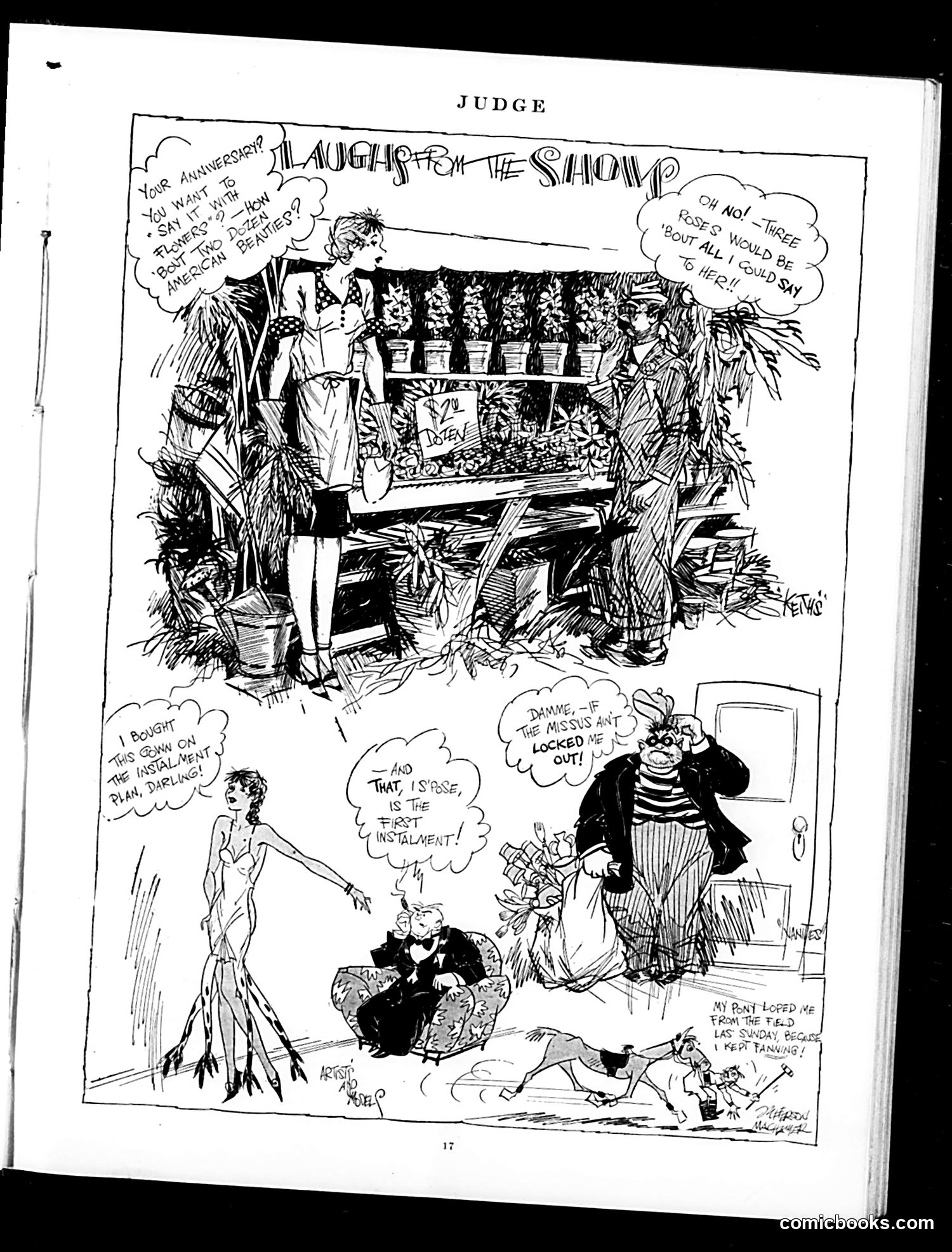
Political Cartoon Analysis This Judge magazine page satirizes theatrical/entertainment industry figures, likely from the 1920s-30s based on the art style. The top panel shows a woman at what appears to be a flower stand or shop counter, with onlookers asking if she wants "anniversary laughs from the show" and quoting theatrical phrases about "American beauties." The bottom panels depict what seems to be theatrical rehearsal or performance mishaps—figures discussing "the first installment" and someone being "locked out." One character mentions a "rat" and "F.B.O." (likely a film studio reference). The satire appears to mock theatrical ego, production drama, and industry pretension, though specific character identities and the precise theatrical reference aren't clear from the visible text and illustration alone. The crude caricatures suggest commentary on entertainment world personalities or practices of the era.
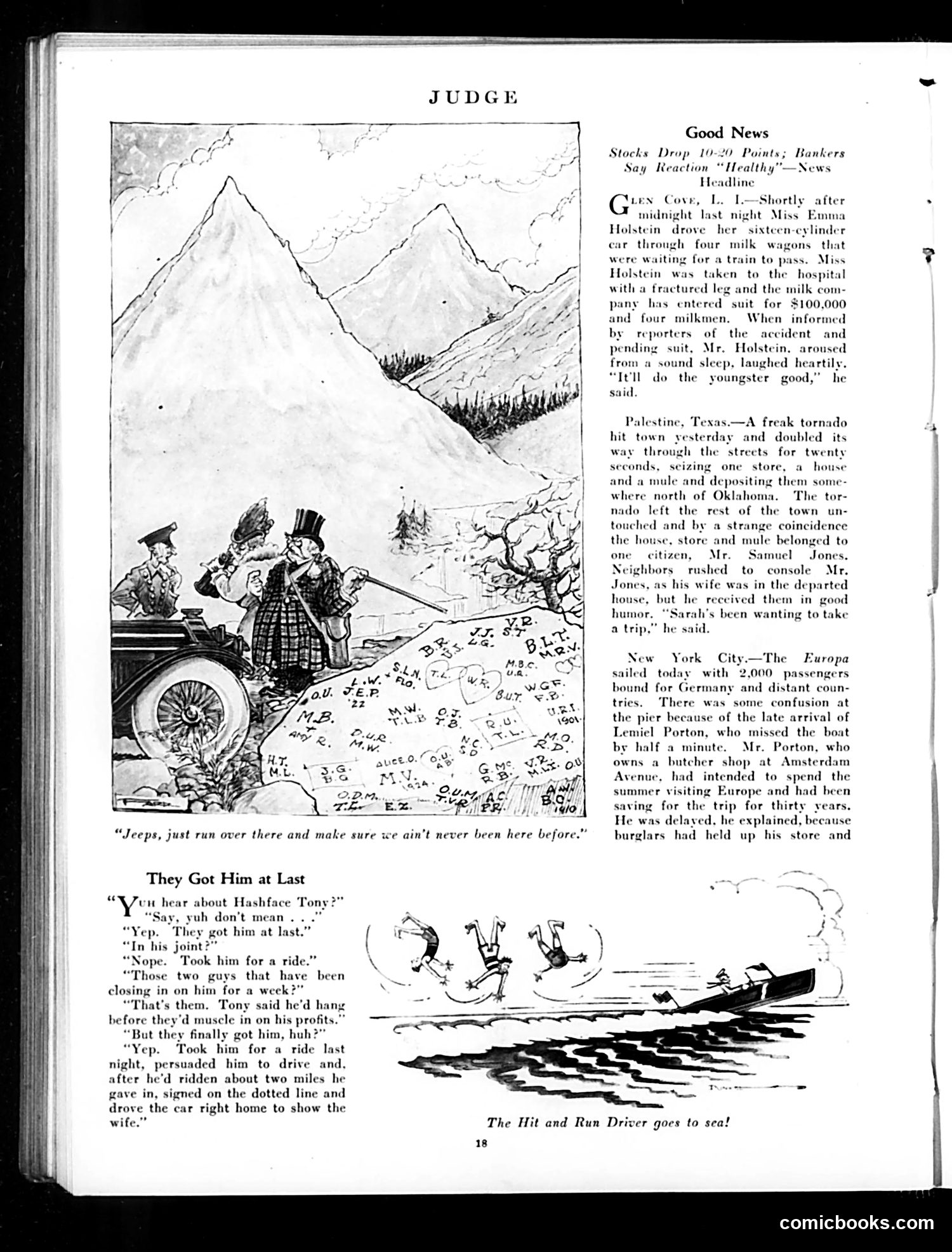
Judge Magazine Page Analysis This page contains two distinct pieces of satire: "They Got Him at Last" (bottom left) mocks 1920s gangster culture and the phrase "took him for a ride" (a euphemism for murder). The joke subverts expectations: instead of a violent outcome, "Hashface Tony" is merely persuaded to sign a contract and drive home to his wife. It satirizes both the melodramatic language of crime reporting and the mundane reality—the "threat" is just business coercion, not actual violence. The news briefs (right column) use absurdist humor to critique society's indifference to human suffering. Each item presents a disaster (car accident, tornado, missed boat) followed by the victim's inexplicable cheerfulness or the community's casual acceptance. The satire lies in this tonal disconnect: serious harm is treated as minor inconvenience, exposing how desensitized people had become to tragedy during this era. The top cartoon appears unrelated—possibly illustrating a separate joke about geographic confusion.
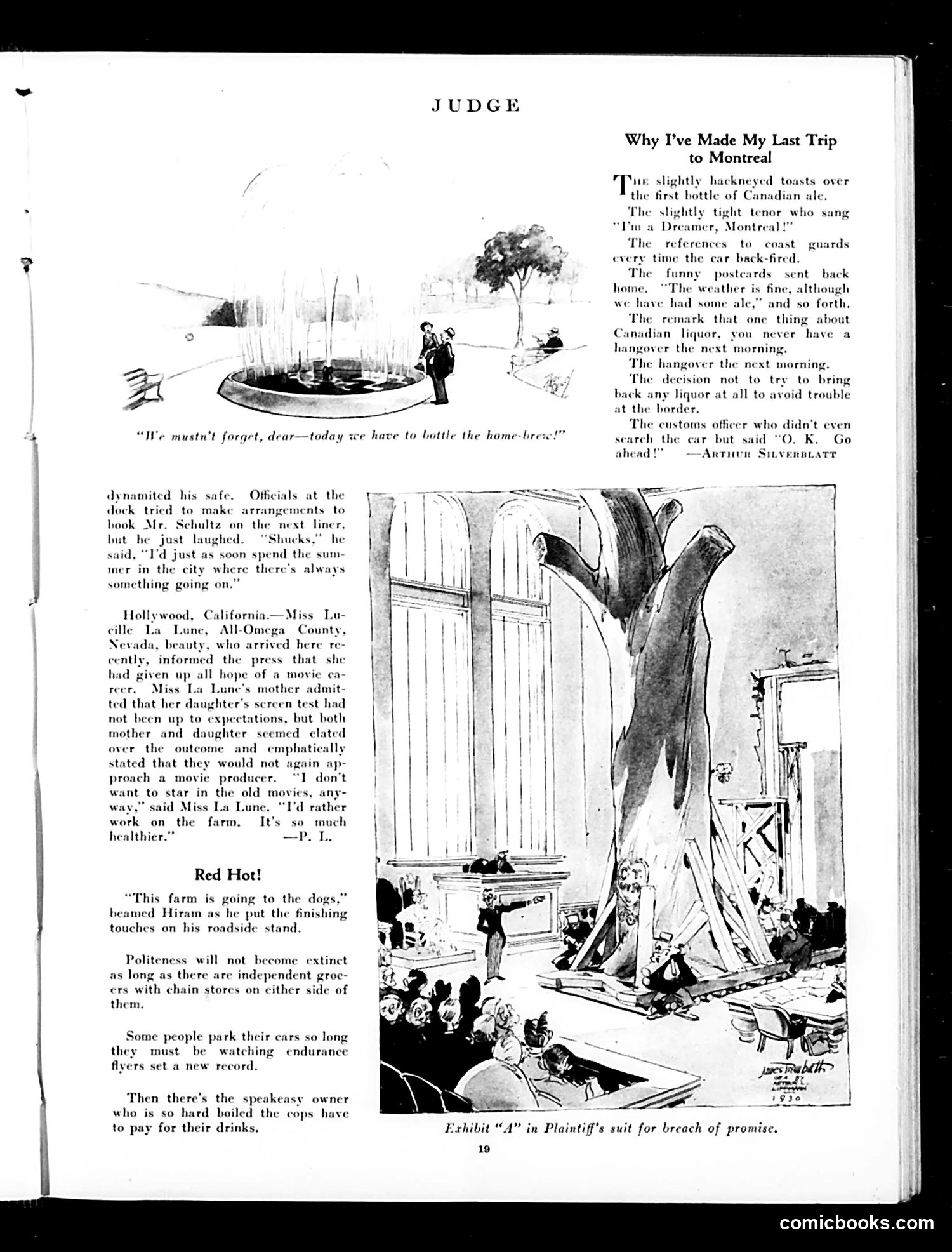
Explaining This Judge Magazine Page This page satirizes Prohibition-era America (likely 1920s). The main cartoon shows a couple discussing home-brewing—illegal alcohol production during Prohibition. The caption "We mustn't forget, dear—today we have to bottle the home-brew!" pokes fun at how widespread and normalized bootlegging had become among ordinary citizens. The article "Why I've Made My Last Trip to Montreal" describes smuggling liquor across the Canadian border, highlighting the absurdity: coast guards, customs officers winking at violations, and the contradiction that Canadian ale supposedly prevents hangovers. The satire mocks both the ineffectiveness of Prohibition enforcement and citizens' casual lawbreaking. The surrounding short jokes ("Red Hot!") continue this theme—mocking farm stands, speakeasies bribing police, and general social hypocrisy. The page ridicules how Prohibition created widespread criminal behavior while authorities either looked the other way or participated themselves.
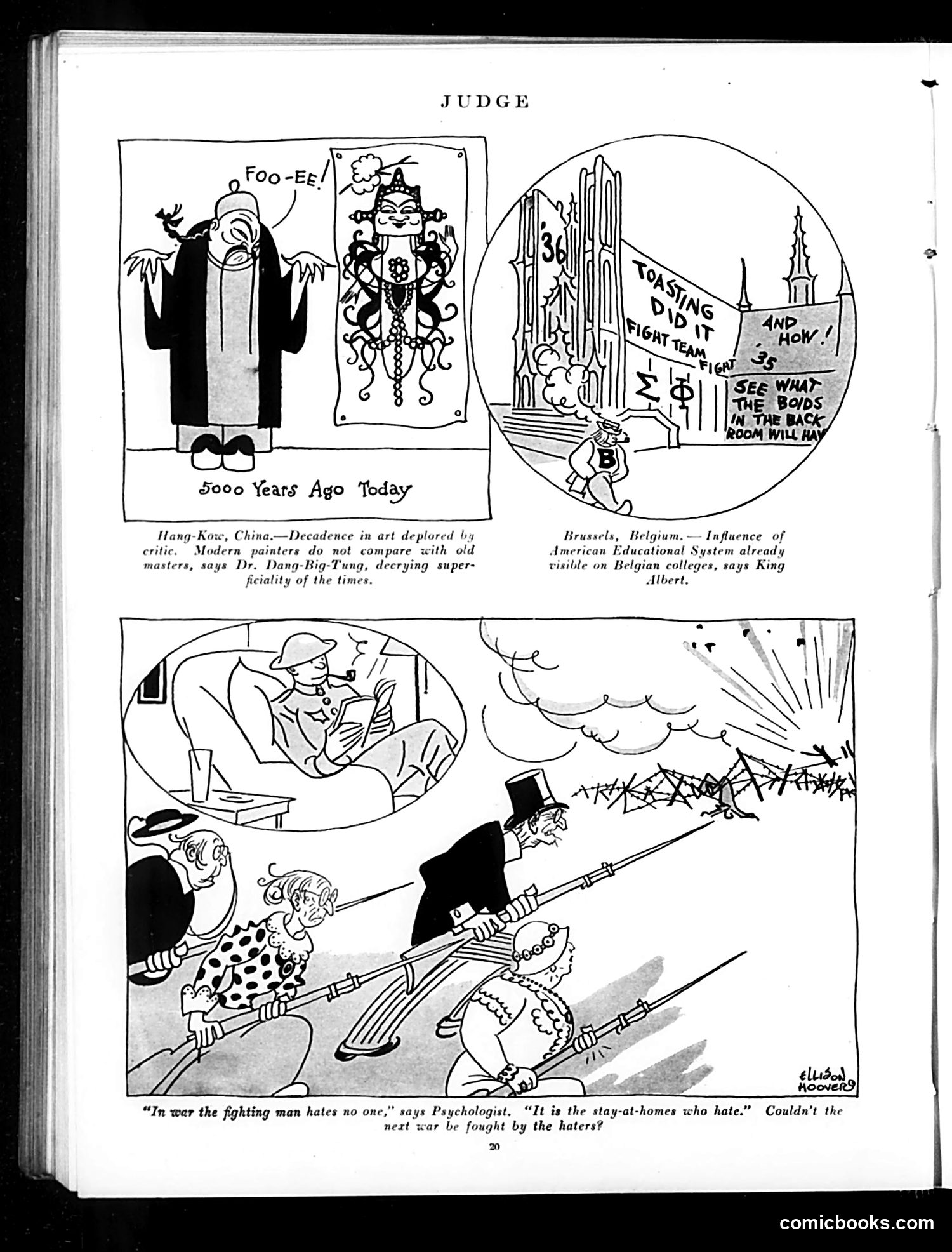
Analysis of Judge Magazine Page This page contains three separate editorial cartoons satirizing early 20th-century social issues: Top left: Contrasts ancient Chinese art (5000 years ago) with modern times, mocking a Chinese critic (Dr. Dang-Big-Tung) who claims contemporary painters lack the quality of old masters—a commentary on nostalgia and artistic standards. Top right: References King Albert of Belgium's concern that American educational methods are influencing Belgian colleges, suggesting cultural anxiety about American cultural dominance spreading to Europe. Bottom: A dark satirical commentary on war and hatred. A psychologist claims fighting soldiers harbor no hatred, only stay-at-homes do. The cartoonist sarcastically proposes that the next war be fought by these haters instead—a pointed critique of warmongering civilians who don't fight themselves but encourage others to do so. All three cartoons critique contemporary attitudes: artistic pretension, cultural anxiety, and civilian warmongering.
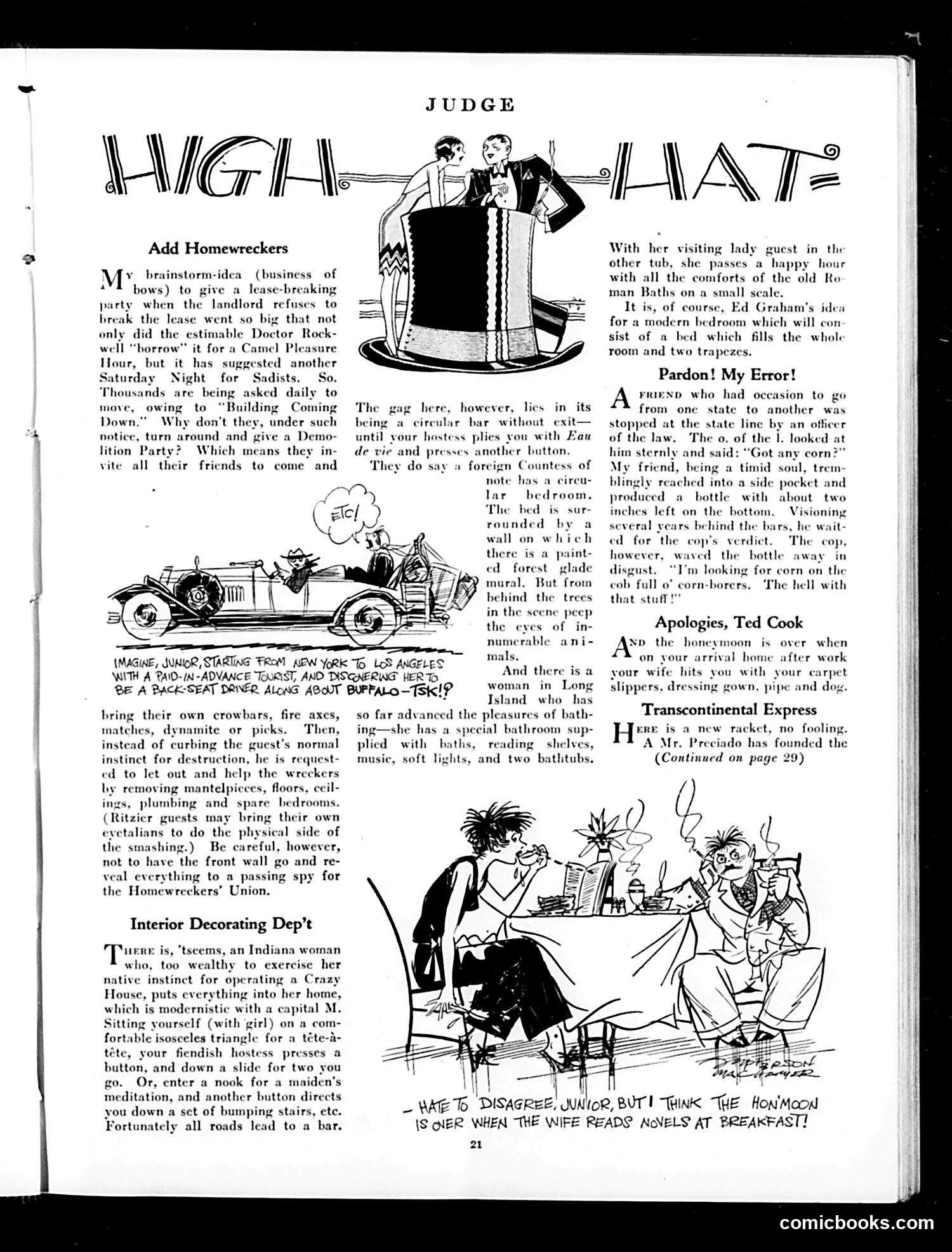
Judge Magazine Page Analysis This page from Judge magazine contains several satirical pieces mocking 1920s upper-class excess and social absurdities: "Add Homewreckers" satirizes wealthy New Yorkers throwing destructive "demolition parties" where guests vandalize homes slated for removal—a commentary on frivolous entertainment among the idle rich. "Interior Decorating Dep't" ridicules an Indiana woman so wealthy she transforms her home into an elaborate mechanical playground with hidden buttons controlling slides and bumping stairs, culminating in a bar. The satire targets excessive modernism and conspicuous consumption by the newly rich. "Pardon! My Error!" is a prohibition-era joke about a traveling salesman stopped at a state line by a police officer seeking contraband corn liquor (illegal alcohol). The officer dismisses the proffered bottle, saying he's looking for "corn on the cob"—a pun suggesting the officer wants to avoid insects rather than confiscate alcohol. The remaining brief pieces mock marriage disappointments and advertise a "transcontinental express" racket. The overall tone ridicules wealthy eccentricity and 1920s modern design fads.
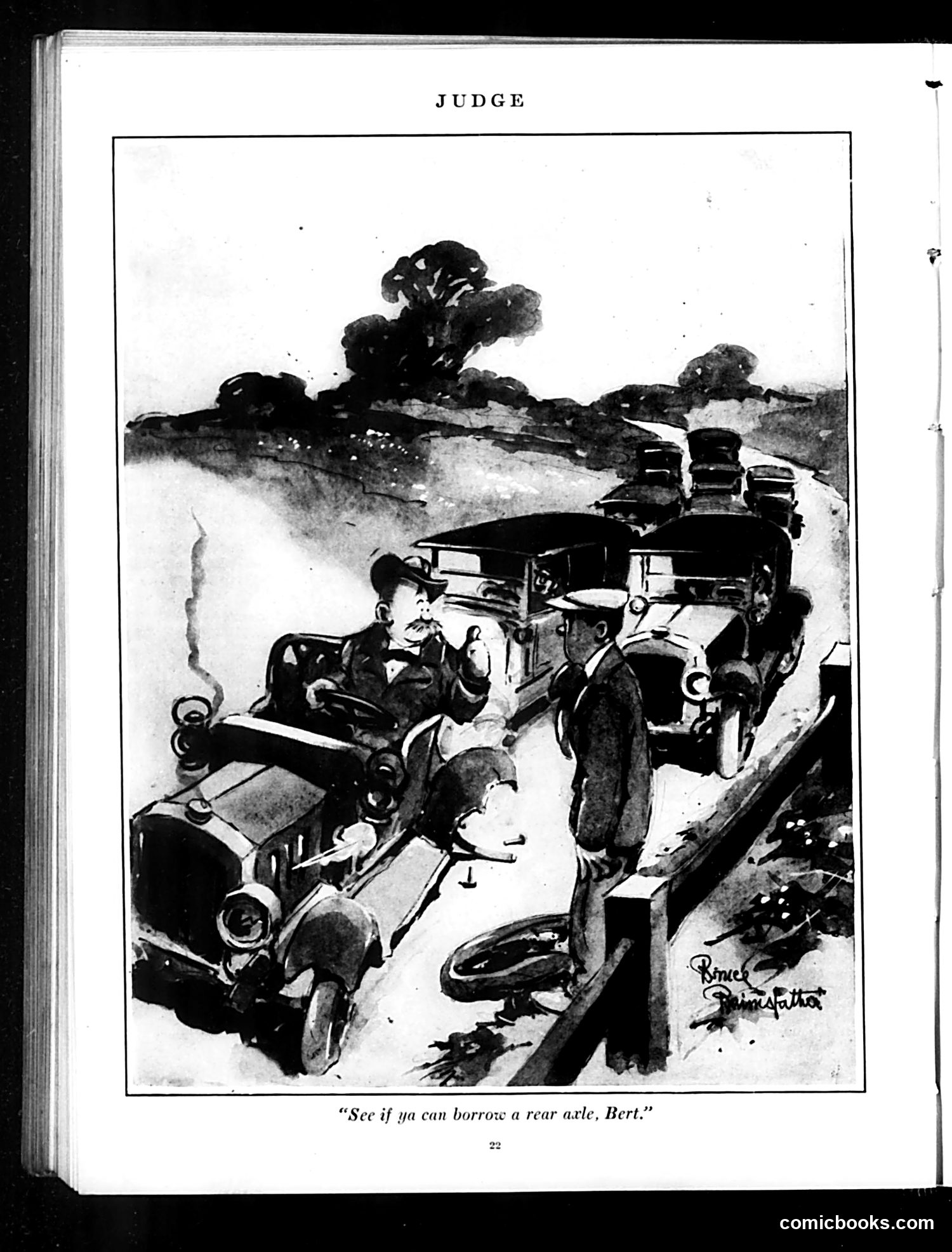
Judge Magazine Cartoon Analysis This satirical cartoon depicts an early automobile scene with two figures attempting to borrow a "rear axle" from another car—likely a reference to the mechanical failures and makeshift repairs common to early automobiles. The humor relies on the unreliability of 1910s-era vehicles, which frequently broke down and required improvised solutions. The cartoon mocks both the shoddy engineering of early cars and the desperation of motorists forced to cannibalize parts from other vehicles on the road. One figure appears to be a gentleman in formal dress (suggested by the hat), making the indignity of roadside mechanical trouble among the well-to-do particularly amusing. The artwork style and Judge magazine's satirical approach suggest this targets the automobile industry's growing pains during the era when cars were transitioning from novelty to common transport.
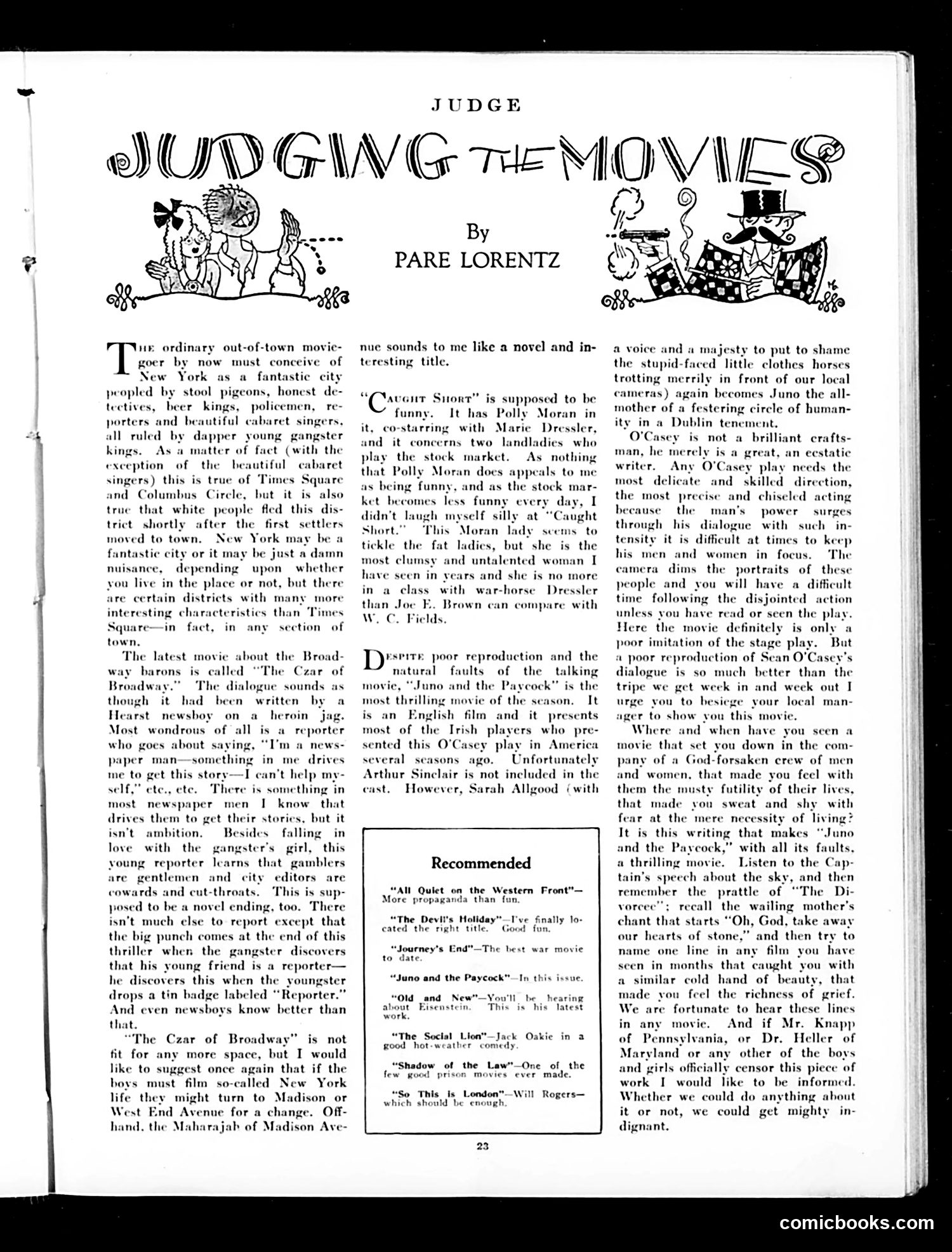
"Judging the Movies" by Pare Lorentz This page contains film reviews, not political cartoons. Lorentz critiques contemporary movies, particularly attacking "The Czar of Broadway" for perpetuating tired stereotypes of New York City as inhabited solely by gangsters, detectives, and cabaret singers. He mocks its clichéd plot about a naive reporter discovering his gangster friend's true identity. He also dismisses "Caught Short," finding Polly Moran unfunny and clumsy compared to Marie Dressler. However, he praises "Juno and the Paycock," an English film adaptation of Sean O'Casey's play, despite poor technical quality, crediting Sarah Allgood's performance as bringing genuine emotional power to the role of Juno. The "Recommended" section lists other films worth seeing, including "Journey's End" and Eisenstein's "Old and New." The satire targets Hollywood's lazy dependence on gangster narratives and predictable casting choices.
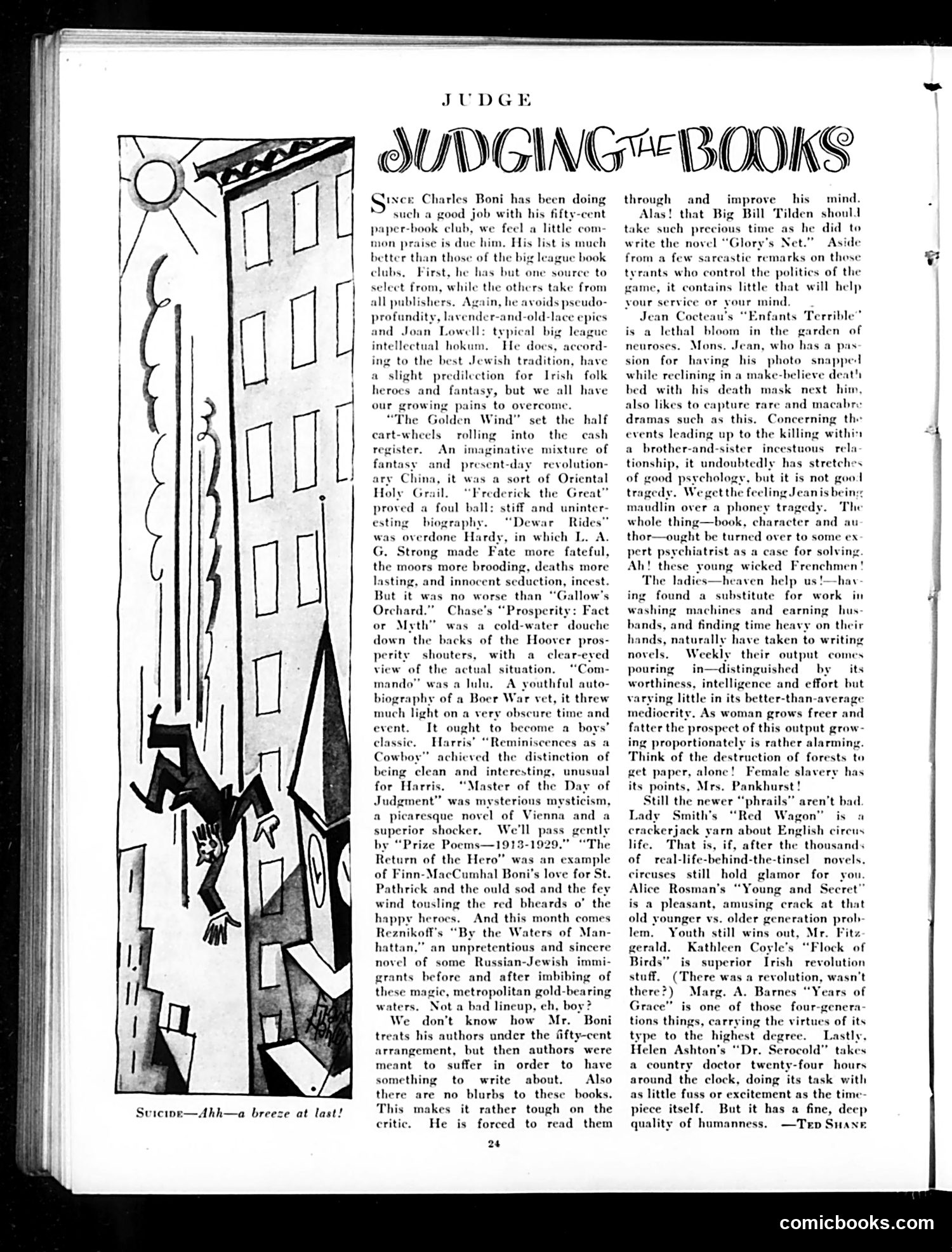
"Judging the Books" — A Book Critic's Column This is a book review column by "Ted Shanc" (signature visible), not a political cartoon. The illustration shows a figure lounging on a fire escape, labeled "Suicide—Ahh—a breeze at last!"—satirizing the tedium of reading the books under review. The column praises Charles Boni's fifty-cent paperback book club for avoiding "pseudo-profundity" and pretension in its selections. It reviews various titles (including works by Jean Cocteau and references to tennis star Bill Tilden's novel), generally finding them mediocre to poor. The satire targets both contemporary authors and female writers specifically: the critic mocks women novelists who've turned to writing as "substitute for work," producing output that is "distinguished by its worthiness, intelligence and effort but varying little in its better-than-average mediocrity." The overall tone is snobbish dismissal of middlebrow American literature and publishing trends of the late 1920s.
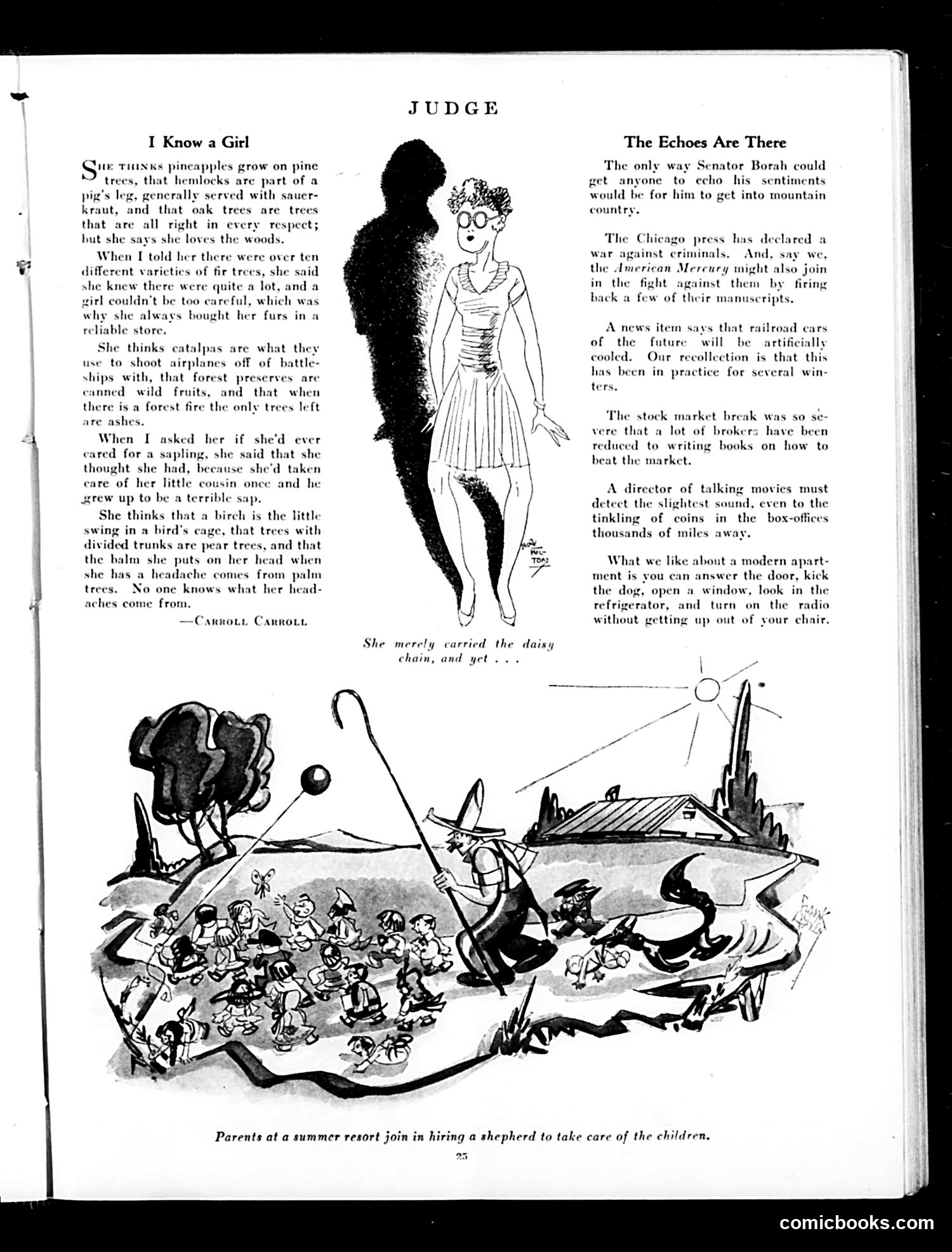
JUDGE Magazine Page Analysis This page contains humor pieces typical of Judge's satirical style: "I Know a Girl" (by Carroll Carroll) satirizes a woman's profound ignorance of nature and basic facts. The joke's humor derives from her absurd misconceptions: pineapples on pine trees, "catalpas" as weapons, forest fires leaving only "ash" trees. The piece ridicules superficial knowledge and those who pretend familiarity with subjects they don't understand. The bottom cartoon depicts parents at a summer resort hiring a shepherd—likely a visual pun about outsourcing childcare to someone literally trained to manage animals, suggesting children require similar management. "The Echoes Are There" contains political jabs: a dig at Senator Borah (unclear which specific statement is referenced), mockery of *American Mercury* magazine, and quips about brokers reduced to writing self-help books after market losses—all topical references to contemporary events. The modern reader would miss these specific 1920s-era references and the magazine's insider political humor.
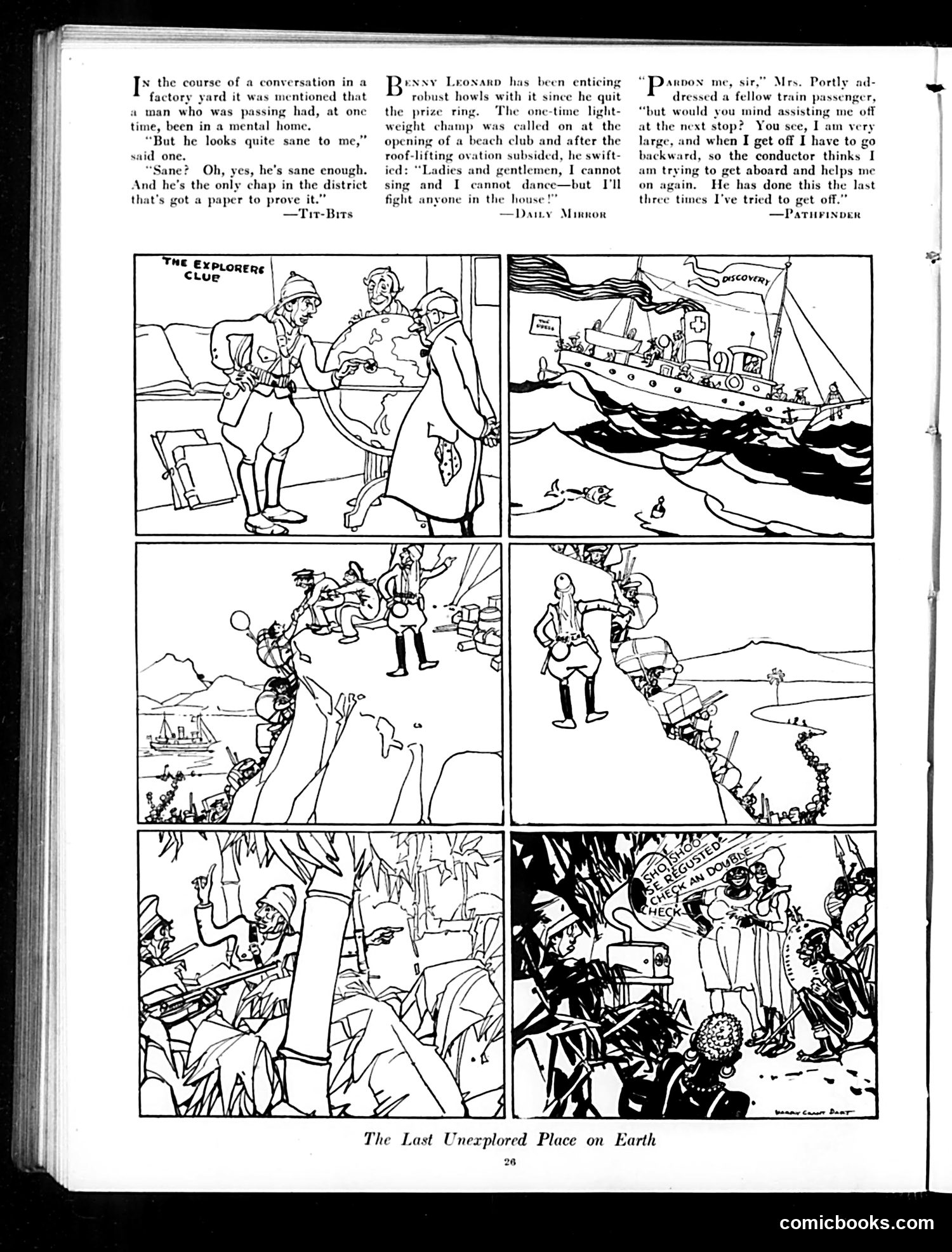
"The Last Unexplored Place on Earth" This is a multi-panel comic strip (not political satire) about "The Explorers Club," depicting an expedition to discover Earth's final unmapped location. The narrative follows club members as they depart by ship, descend into unknown terrain, navigate obstacles, and encounter indigenous peoples. The final panel suggests they've discovered a previously unknown civilization. The page also includes three separate joke items: one about a man certified sane despite mental hospitalization; one about ex-boxer Benny Leonard's awkward attempt at public speaking; and one about Mrs. Portly struggling to exit a train. The strip's title humorously suggests that the "last unexplored place" might be something mundane or unexpected—though the exact punchline remains unclear from this single page.
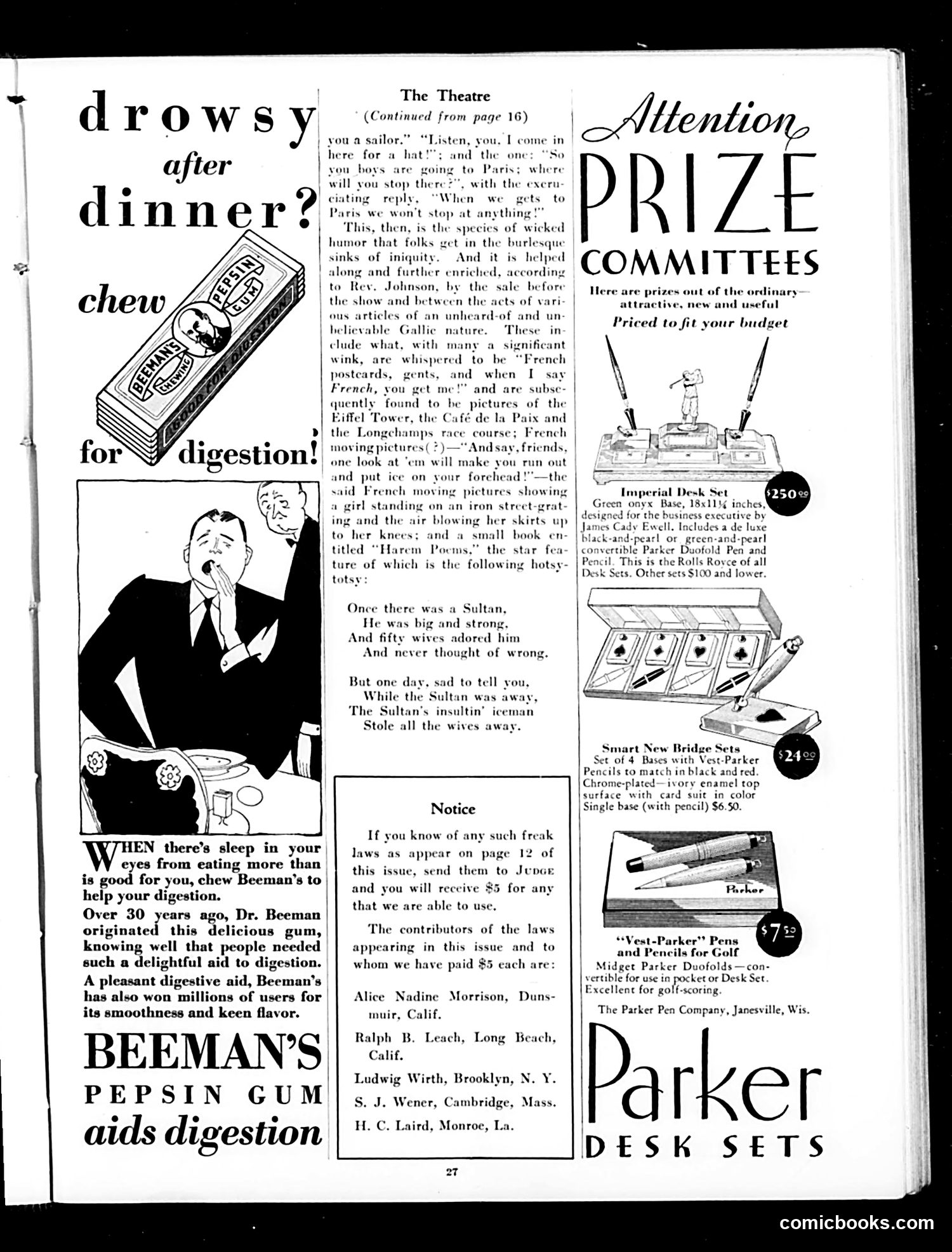
Analysis of This Judge Magazine Page This page is primarily advertising and notices rather than editorial content. The main cartoon depicts a man at dinner looking disheveled and uncomfortable, advertising Beeman's Pepsin Gum as a digestive aid—a common early 20th-century product claim (pepsin was believed to aid digestion). The page includes a "Notice" section offering $5 payments for "freak laws"—unusual or absurd state/local legislation Judge readers could submit. This was a recurring feature mocking legislative absurdities. The bulk of the page advertises luxury desk sets and pens from Parker, marketed as "Attention Prize" items for committees seeking gifts "priced to fit your budget." These were expensive office accessories positioned as status symbols. The theatrical excerpt (continued from page 16) discusses burlesque humor, including references to risqué French postcards and films—reflecting contemporary anxieties about "Continental" morality. Overall: This is a commercial/notices page with minimal satirical content.
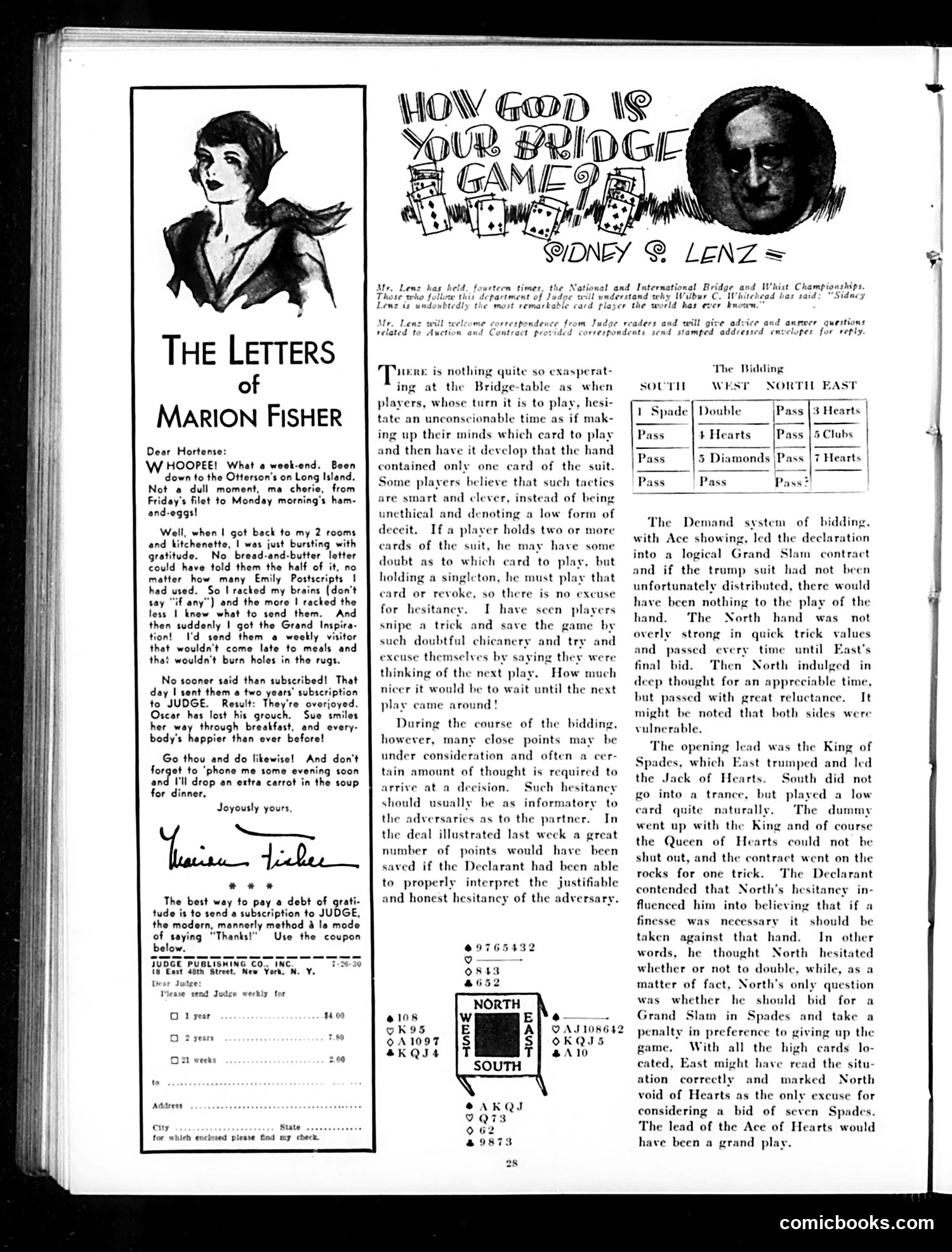
Judge Magazine Page Analysis This page contains two distinct elements: a humorous letter and a bridge card game analysis. "The Letters of Marion Fisher" is a lighthearted advertisement disguised as personal correspondence. Marion Fisher promotes *Judge* magazine subscriptions as thank-you gifts—a clever marketing angle suggesting this is the modern, sophisticated way to express gratitude. The joke mocks both the pretension of etiquette (invoking "Emily Post") and the idea that a magazine subscription solves social obligations. "How Good Is Your Bridge Game?" by Sidney Q. Lenz (identified in the header as a bridge expert) provides actual bridge strategy instruction, analyzing a specific hand where hesitation during play conveyed information to opponents. The article critiques players who deliberately waste time to appear thoughtful while holding only one card—characterizing this as "uncthical" and low-class behavior. This reflects early 20th-century bridge culture's emphasis on both skill and gentlemanly conduct. Together, these pieces reflect *Judge's* audience: educated, leisure-class readers interested in social etiquette, card games, and satirical commentary on modern manners.
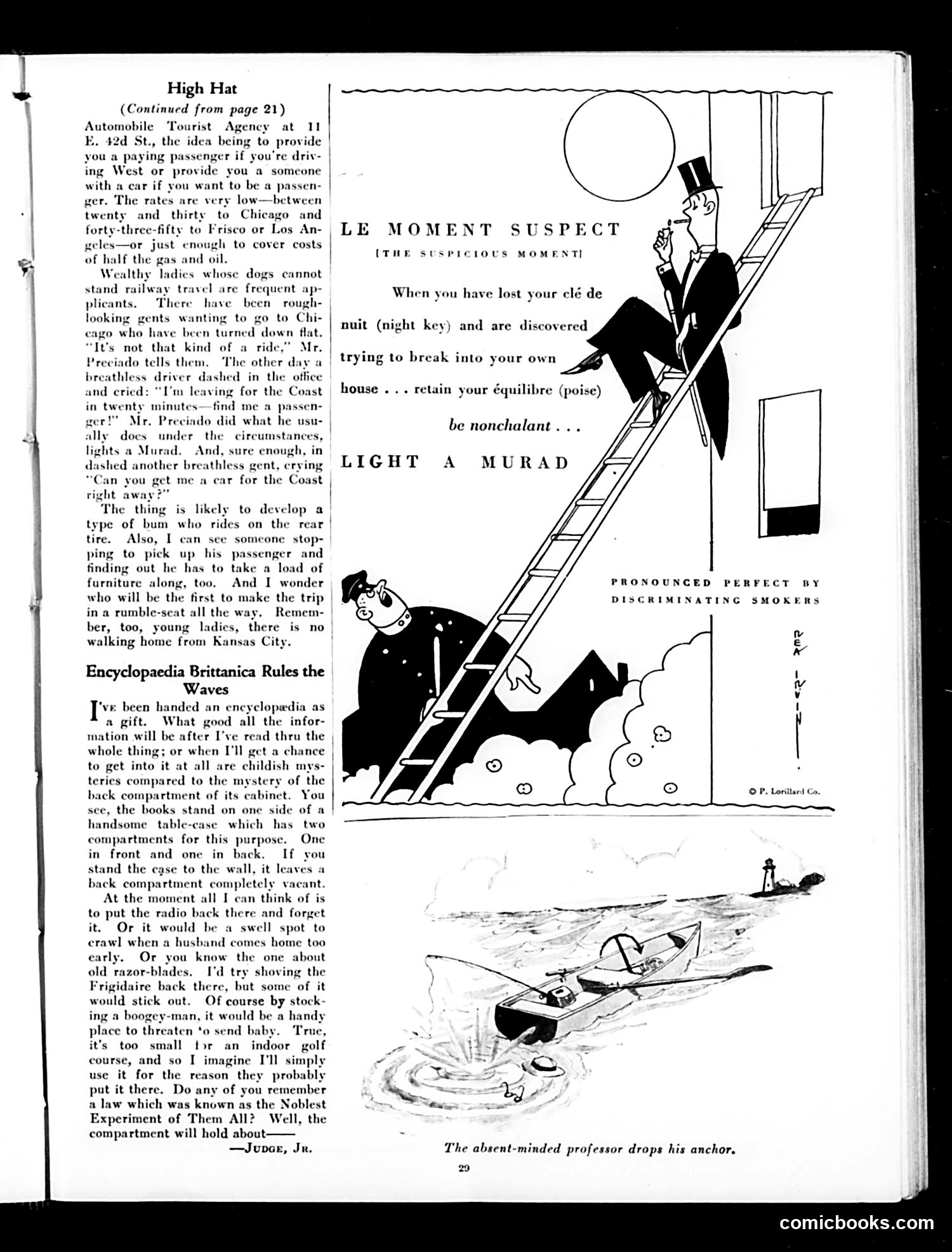
Analysis of Judge Magazine Page This page contains three distinct pieces of satirical content: "High Hat" (top): A humorous article about ride-sharing services and encyclopedia storage, written in Judge's characteristic witty style. Notable is the Prohibition-era joke: the encyclopedia's hidden back compartment is perfect for storing alcohol during the "Noble Experiment" (Prohibition era). "Le Moment Suspect" (center): A cartoon mocking upper-class affectation. It depicts a gentleman caught breaking into his own house after losing his night key. The satire advises maintaining nonchalance—the humor lies in the absurdity of someone needing to appear cool while committing what looks like burglary. The French phrases emphasize the pretentiousness being mocked. Bottom cartoon: Shows an absent-minded professor dropping his anchor from a boat, illustrating literal-minded comedy about forgetfulness. The page targets 1920s-era middle/upper-class vanity, social pretension, and Prohibition-era hypocrisy through humor and illustrated gags typical of Judge's satirical approach.
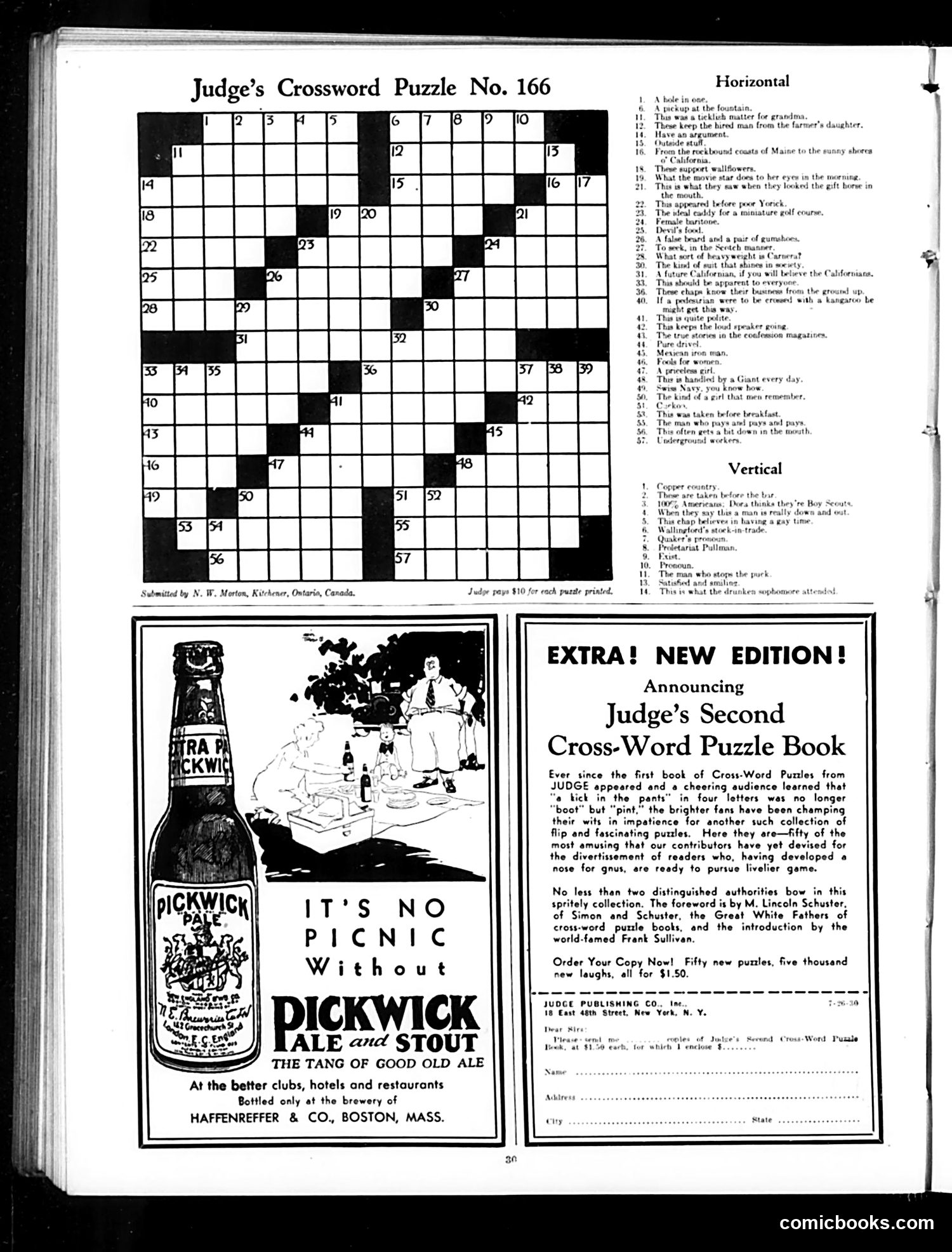
Explanation for Modern Readers This page contains primarily advertisements rather than editorial cartoons. The main advertisement (left) for Pickwick Ale and Stout uses a humorous pitch: "It's No Picnic Without Pickwick"—a play on words suggesting that social gatherings at clubs, hotels, and restaurants aren't complete without this beer. The visual shows a bottle label and text promoting the product as essential to leisure activities. The secondary advertisement (right) announces Judge's Second Cross-Word Puzzle Book. This references the genuine 1920s crossword craze that swept America. The ad notes that famous editors M. Lincoln Schuster (of Simon & Schuster) and Frank Sullivan contributed to this collection, lending authority to what was then a novel entertainment form. The crossword puzzle itself occupies the upper portion—simply a sample puzzle for readers, with no satirical intent visible. These are straightforward period advertisements, not political satire.
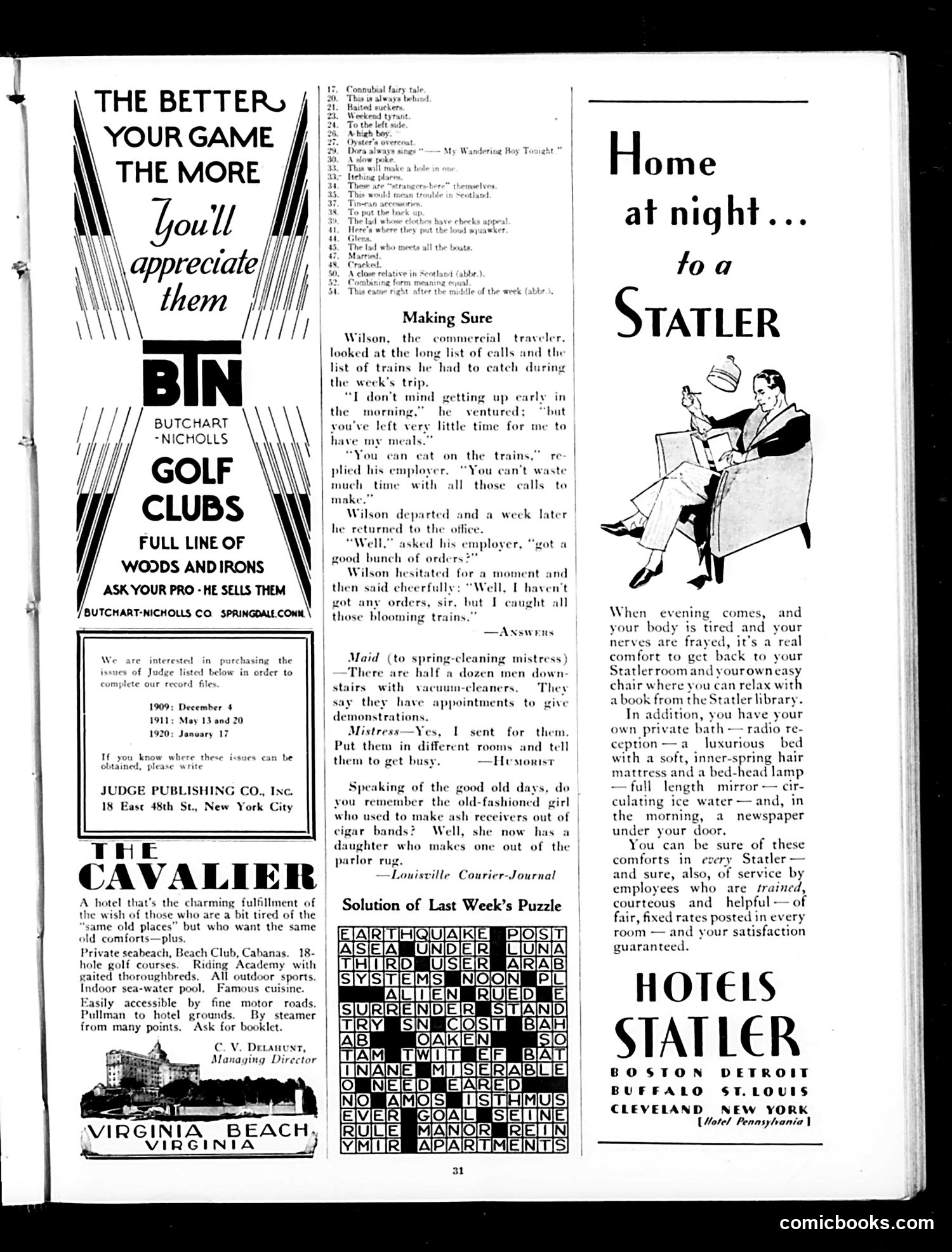
Analysis of Judge Magazine Page This page contains primarily advertisements rather than political satire, though it includes a few comic anecdotes. The main visual content features ads for Bin Butchart-Nicholls Golf Clubs and The Cavalier hotel in Virginia Beach. These are straightforward product promotions typical of 1920s magazines. The humorous content consists of brief workplace comedies: - "Making Sure" depicts a commercial traveler who fails to secure orders but proudly reports catching all his trains—satirizing misplaced priorities and bureaucratic busywork over actual sales results. - Other brief jokes mock spring-cleaning salesmen and outdated domestic customs, reflecting post-WWI social changes. The Hotels Statler advertisement emphasizes modern comfort amenities (private baths, radios, electric lights) as luxury selling points—reflecting early 1920s expectations of hotel sophistication. There's no clear political messaging. The page represents typical Judge content: consumer advertising mixed with light, workplace-oriented humor aimed at middle-class readers.
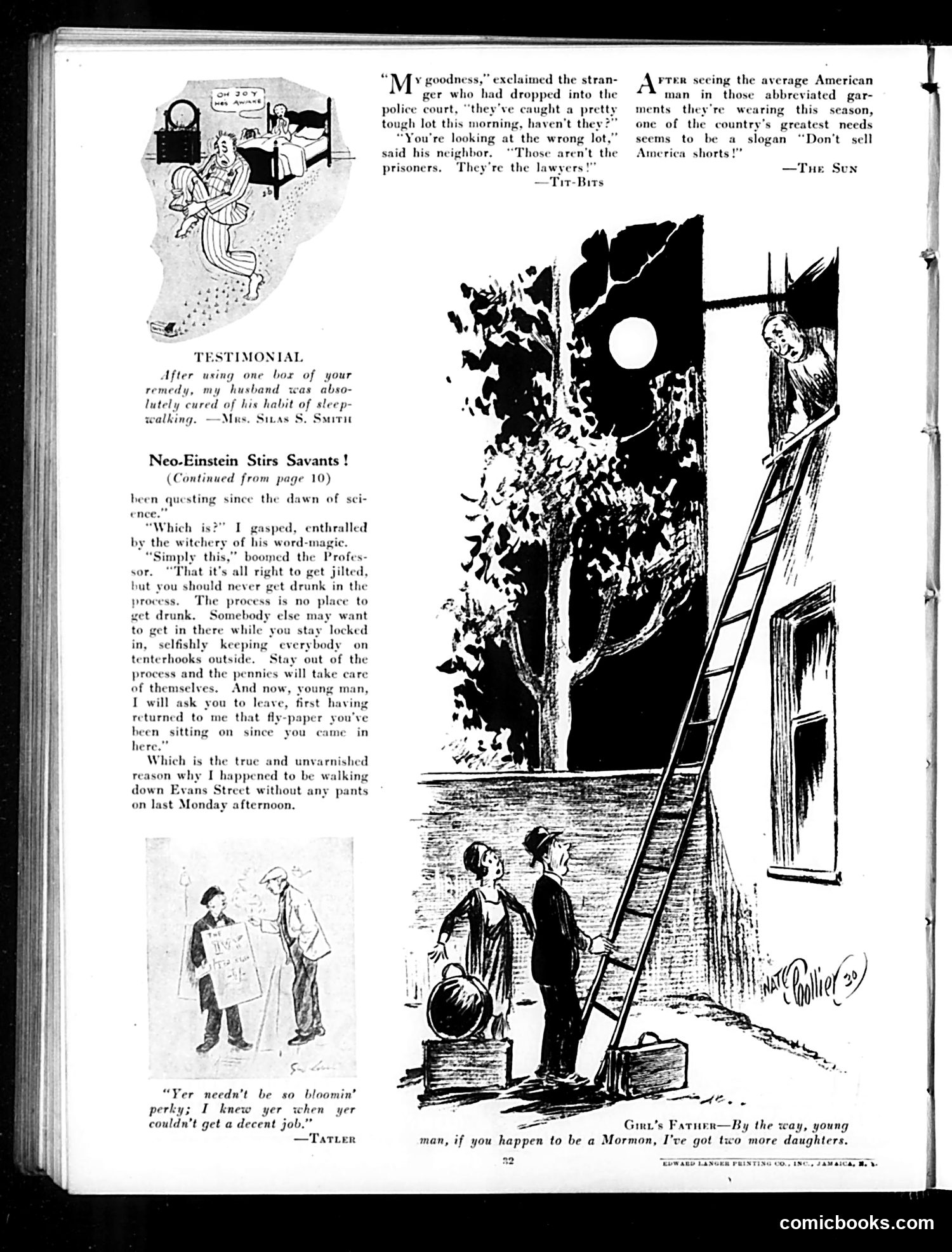
Judge Magazine Page Analysis This page contains multiple satirical pieces typical of early 20th-century humor: Main Cartoon (right): Shows a man and woman viewing a dilapidated building with a ladder. The caption jokes that the man, a Mormon, should know the woman has "two more daughters"—satirizing the historical association of Mormonism with polygamy. This reflects anti-Mormon sentiment common in American popular culture of the era. "Neo-Einstein" Section: A pseudo-intellectual satire mocking pseudoscience and charlatan "professors" who use jargon to seem learned while dispensing nonsensical advice about intoxication and "processes." It parodies the fascination with Einstein and scientific authority. Fashion Joke (top right): A quip from The Sun newspaper joking that American men need a slogan discouraging short pants—commenting on contemporary menswear trends. Small Cartoon (bottom left): A brief class-based joke where a man reminds a woman of her humble past when she acts superior. The page reflects Judge's blend of social satire, fashion commentary, and anti-intellectual humor targeting early 1900s American culture.
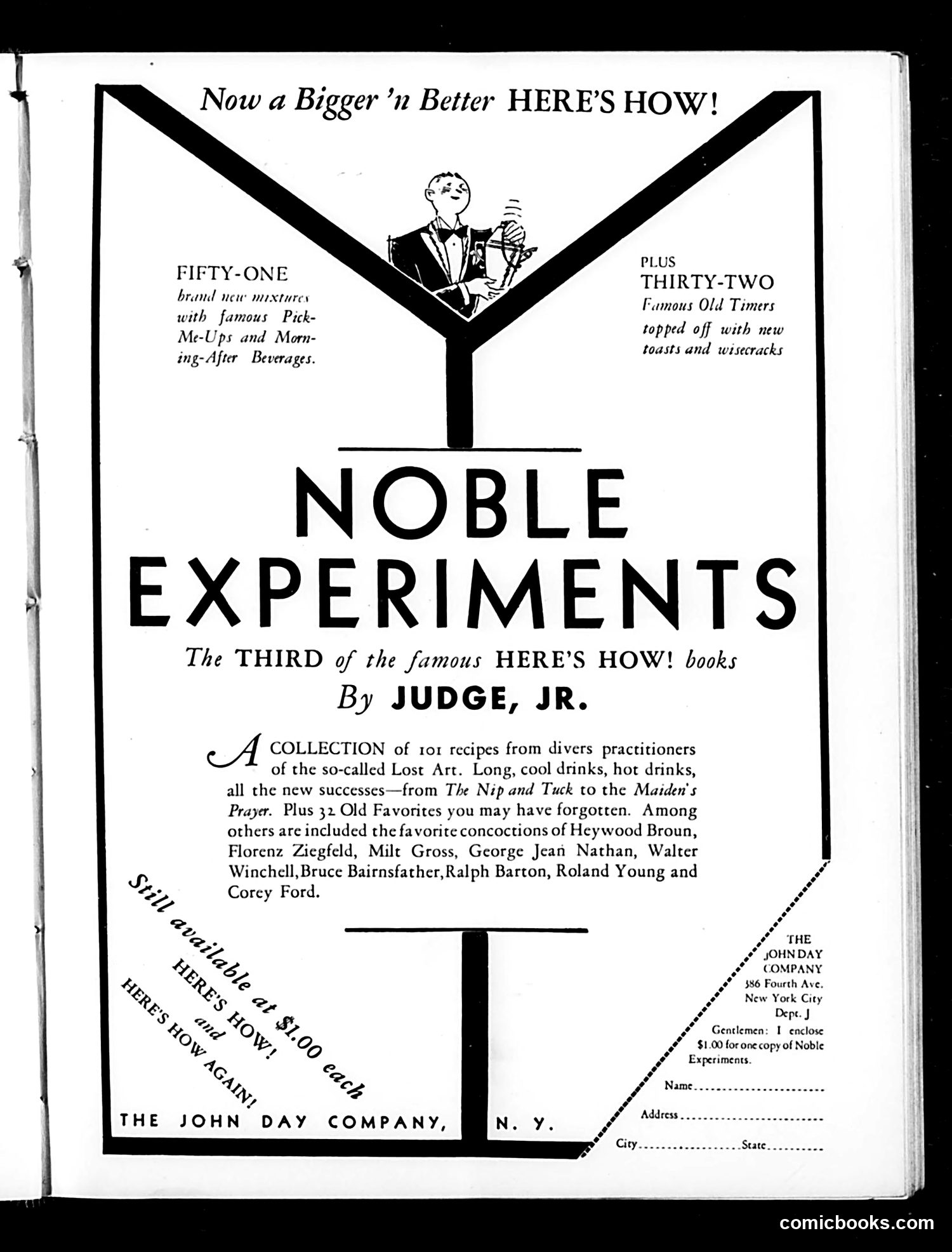
Noble Experiments: A Prohibition-Era Cocktail Advertisement This is a book advertisement, not a political cartoon. It promotes "Noble Experiments," the third in Judge magazine's "Here's How!" cocktail recipe series by Judge Jr. The "Noble Experiment" was a contemporary term for Prohibition (1920-1933), making the title a clever double meaning—the book ironically celebrates cocktails during the era when alcohol was illegal. The advertisement lists 101 new drink recipes plus 32 "old favorites," with recipes attributed to famous figures like columnist Heywood Broun, theatrical producer Florenz Ziegfeld, and actor Walter Winchell. This reflects how cocktail culture persisted underground during Prohibition, with speakeasies and home bartenders keeping the craft alive. The book cost $1.00 and was published by The John Day Company in New York.
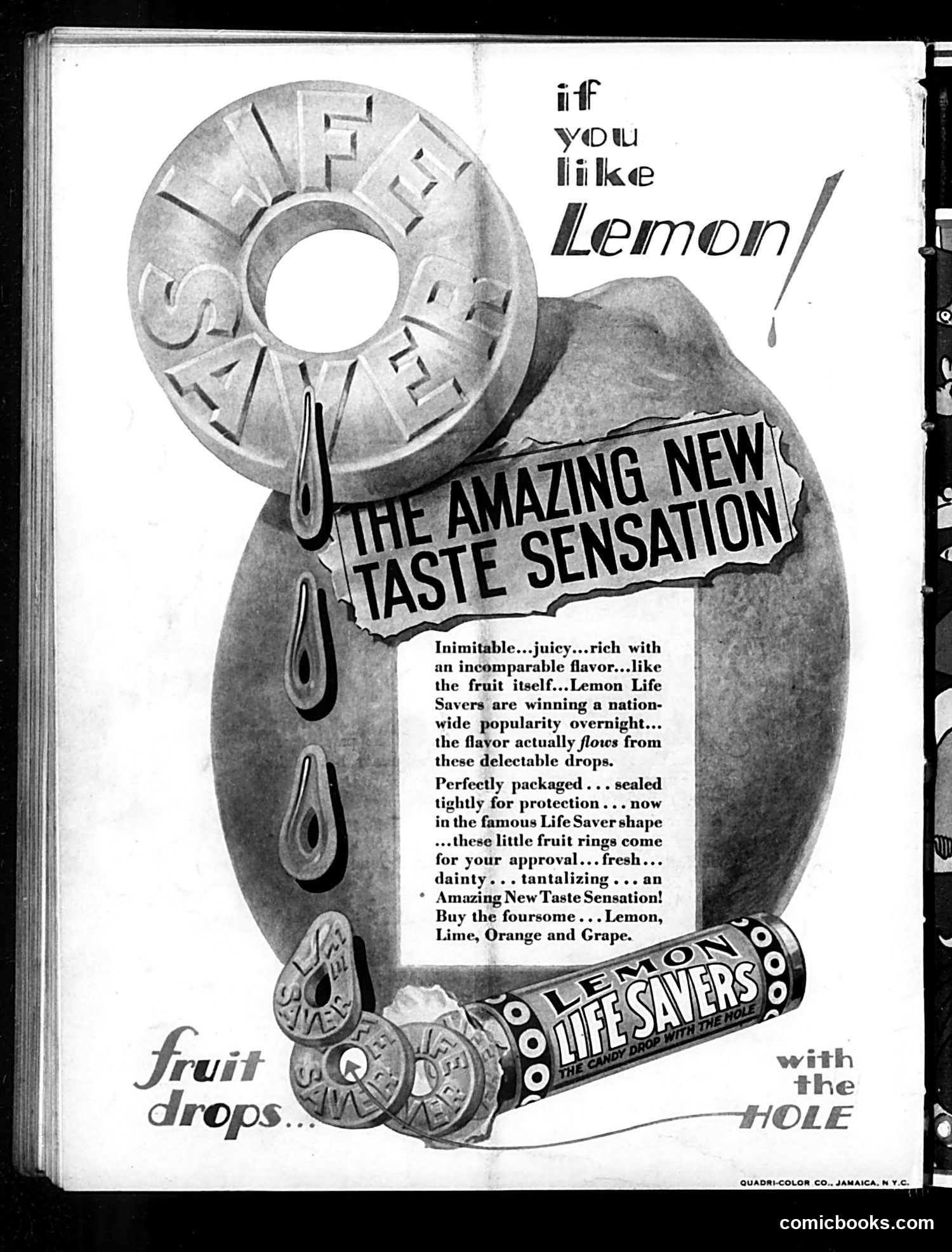
Advertisement Analysis This is a Life Savers candy advertisement, not political satire. The page promotes Lemon Life Savers, a new flavored variant of the ring-shaped hard candy. The visual pun plays on the product's distinctive hole in the center—the large lemon image literally has a hole through it, demonstrating the candy's characteristic shape. The text emphasizes that the lemon *flavor* comes from the candy drops themselves, positioning this as an "Amazing New Taste Sensation." The ad encourages purchasing the "foursome"—all four flavors: Lemon, Lime, Orange, and Grape. This appears from a vintage era when Life Savers were relatively new and gaining "nation-wide popularity overnight." The advertisement uses standard early-to-mid 20th century marketing language emphasizing freshness, quality packaging, and taste innovation.