judge
Judge — August 2, 1930
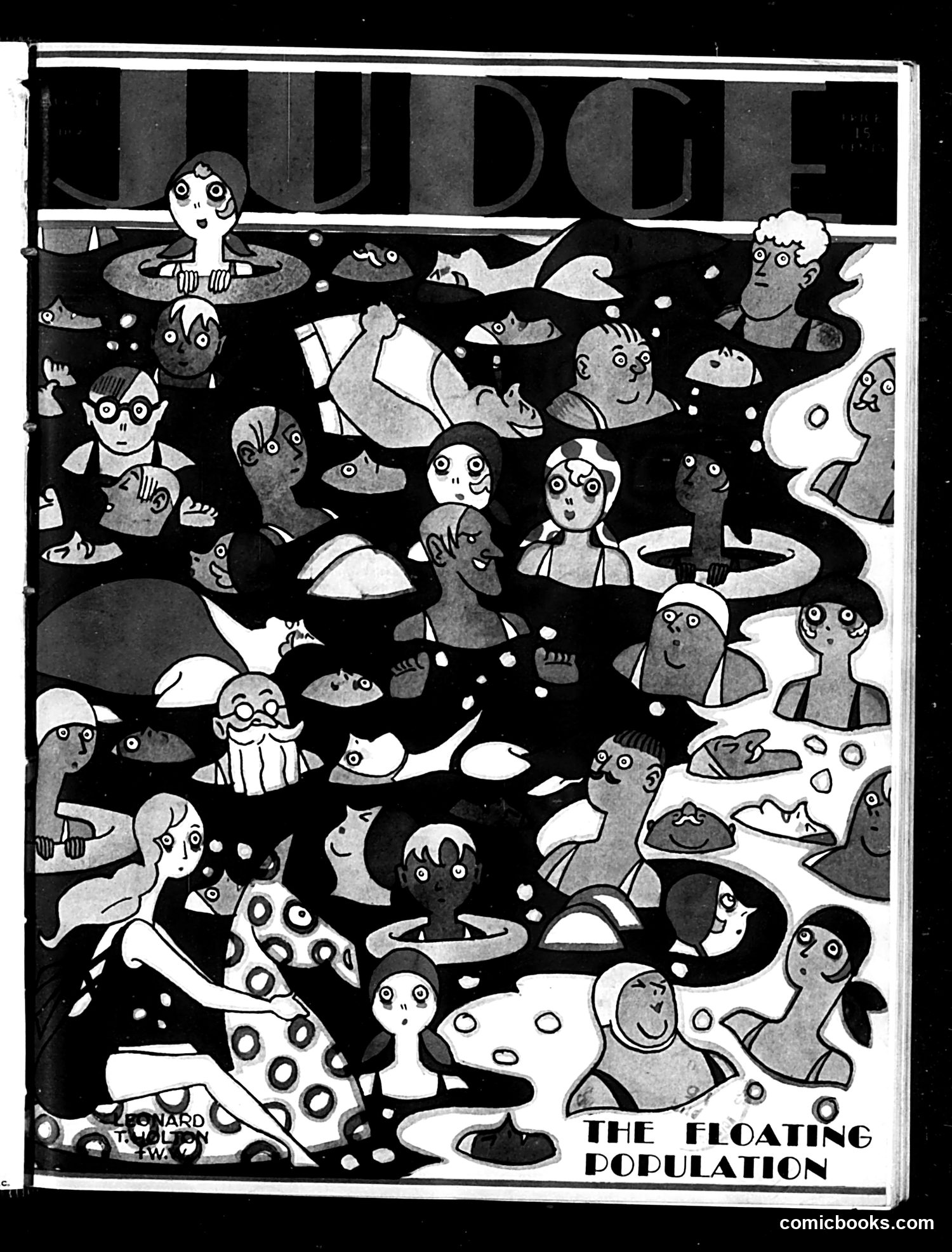
"The Floating Population" - Judge Magazine This satirical cartoon depicts what appears to be an underwater or fantastical scene titled "The Floating Population." The densely packed composition shows numerous grotesque figures with exaggerated features—wide eyes, distorted faces, and unusual body proportions—crowded together in a surreal space with fish, bubbles, and strange vessels. The satire likely comments on immigration, overcrowding, or urban population density, themes Judge frequently addressed. The aquatic setting may metaphorically represent people adrift or displaced. The term "floating population" historically referred to transient workers or those without fixed residence. Without clearer identification of specific caricatures or publication date, the exact political target remains uncertain, though the grotesque stereotyping and crowded composition suggest commentary on contemporary social anxieties about demographic change.
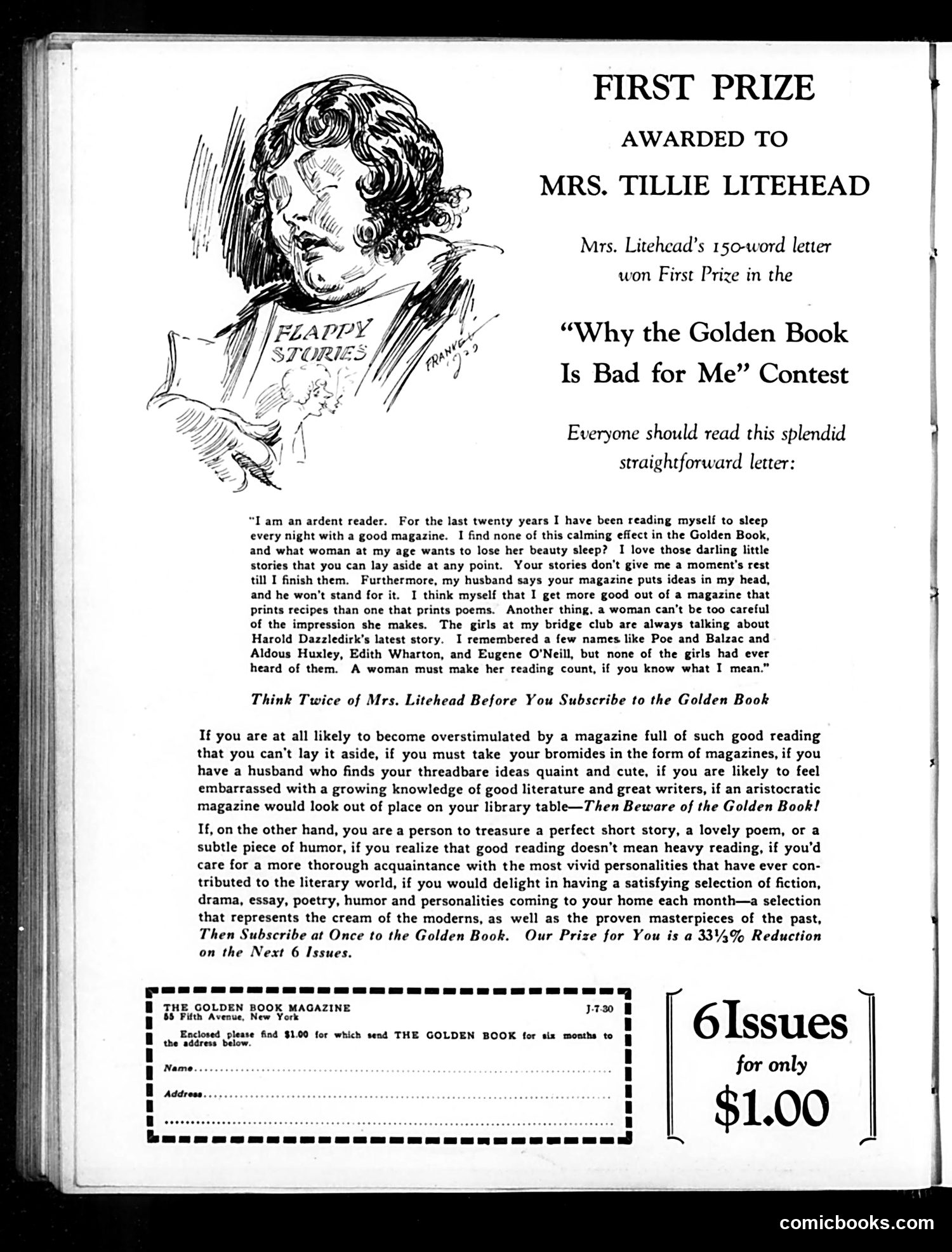
Analysis This page primarily functions as advertising for *The Golden Book* magazine, not political satire. It features a contest winner, Mrs. Tillie Litehead, whose letter critiques *The Golden Book* as unsuitable for serious readers. Mrs. Litehead's complaint centers on the magazine's lightweight content: she values substantive literature by canonical authors (Poe, Balzac, Huxley, Wharton, O'Neill) over the magazine's accessible short stories. She argues it corrupts readers' taste and promotes superficial knowledge. The *Judge* editors use her letter ironically to mock literary snobbery—positioning Mrs. Litehead as the satirical target. They suggest that readers who dismiss *The Golden Book* as lowbrow miss its genuine literary merit and variety. The advertisement frames rejecting the magazine as pretentious.
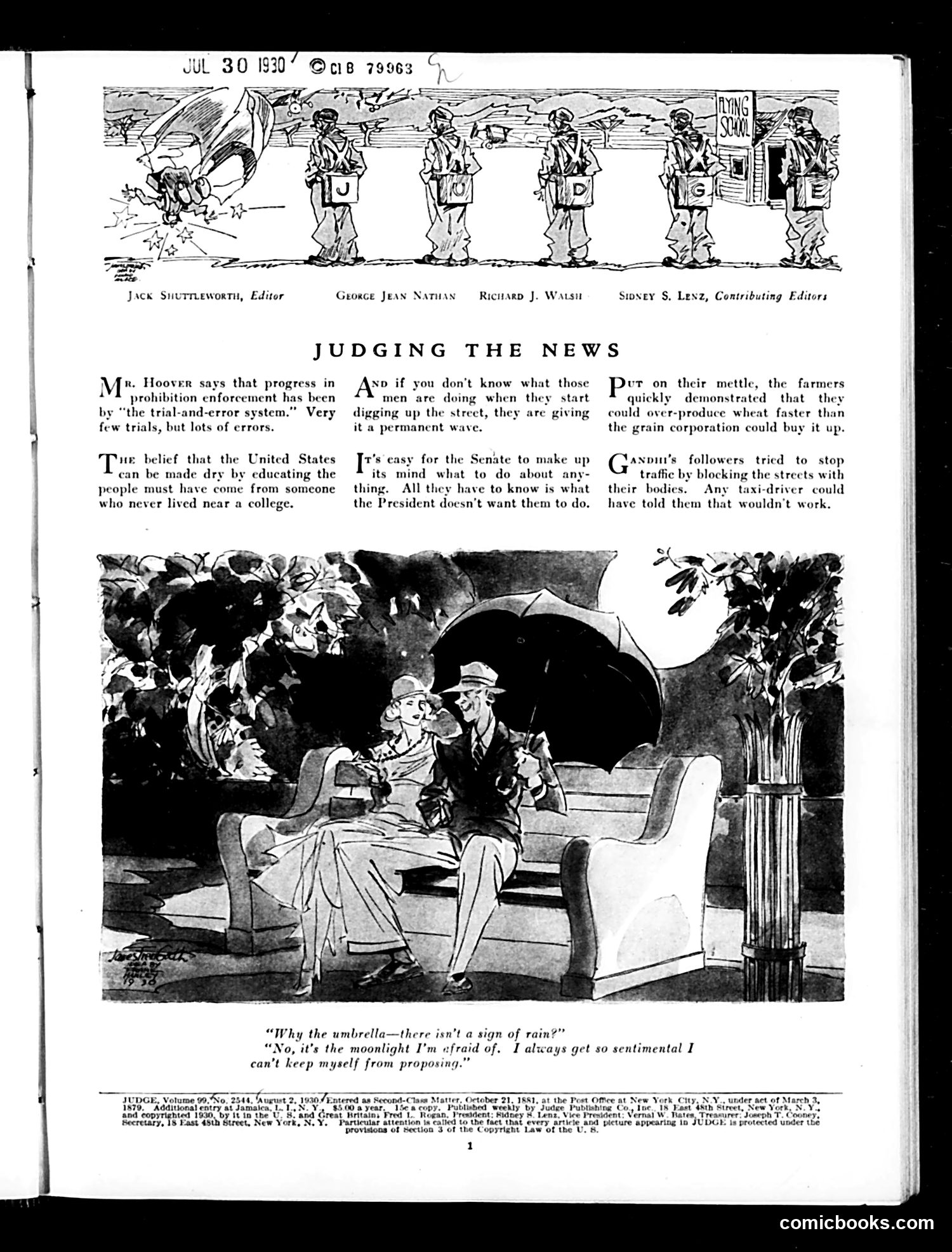
"Judging the News" - August 2, 1930 This satirical page critiques news commentary and current events. The header cartoon depicts five male editors/commentators holding newspapers, with one dramatic figure on the left (possibly representing sensationalism or exaggeration in reporting). Below, a main cartoon shows a couple on a park bench under an umbrella during rain. The man proposes marriage, attributing his sentimentality to moonlight—despite the weather clearly contradicting this. The caption satirizes how people deceive themselves or manufacture romantic pretenses. The brief text snippets above mock various political figures and policies: Hoover's prohibition enforcement claims, Senate decision-making, and Gandhi's non-violent protest tactics. The satire suggests these public figures similarly distort truth or reality to serve their agendas—paralleling the romantic self-deception in the main cartoon.
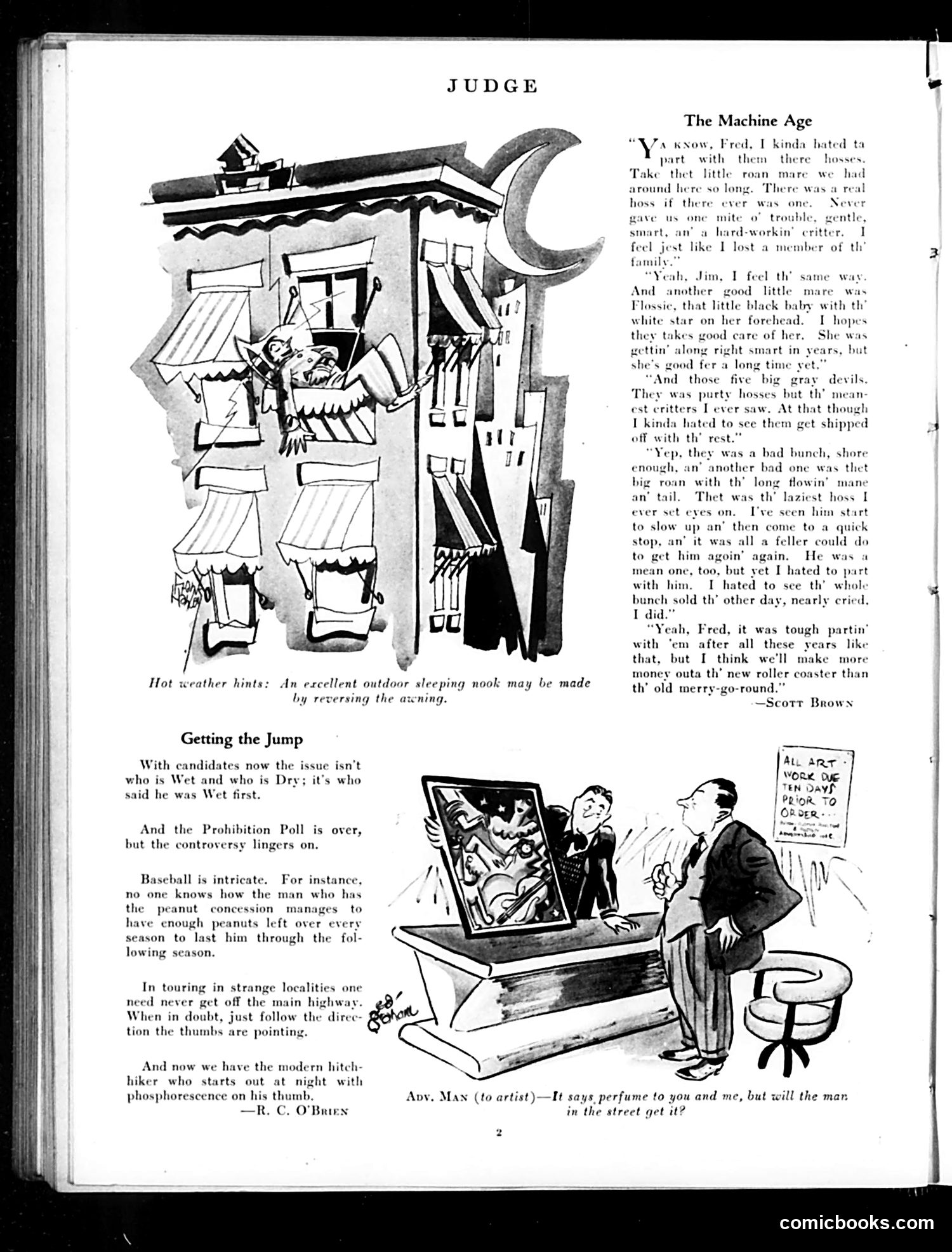
Page Analysis: Judge Magazine Satire Main Cartoon ("Getting the Jump"): This political cartoon appears to reference early 20th-century election politics, specifically mentioning "Wet" vs. "Dry" candidates—a reference to Prohibition debates. The figure at the machine appears to be a political operative or candidate manipulating public opinion through what looks like an early arcade or mechanical device, suggesting cynical control of political messaging. Surrounding Humor: Brief satirical notes mock baseball management, touring etiquette, and modern hitchhikers with phosphorescent thumbs—typical period humor about contemporary absurdities. The adjacent "Adv. Max" cartoon jokes about perfume advertising's manipulative tactics. Context: This reflects Progressive Era skepticism toward political machinery and emerging mass-media influence on democracy.
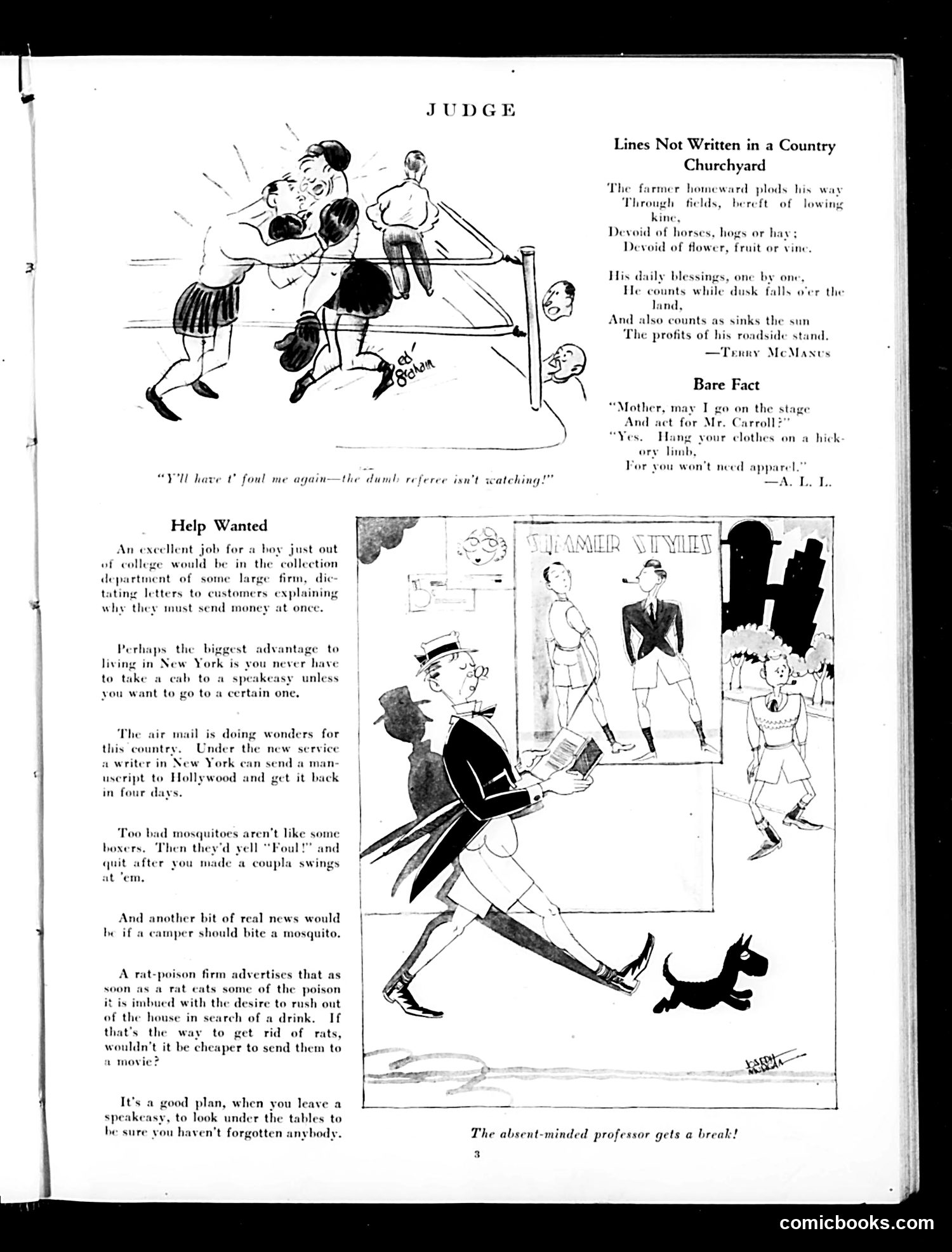
Judge Magazine Page Analysis Top Cartoon: Shows what appears to be a street fight or altercation with the caption "I'll have t' foul me again—the dumb referee isn't watching!" This is boxing/sports humor about a referee not paying attention, suggesting dirty play will go unpunished. "Help Wanted" Section: Contains humorous job advice and observations—collecting overdue debts, New York transportation, mosquitoes, rat poison, and speakeasy etiquette. These are satirical commentary on 1920s urban life, with the speakeasy reference suggesting Prohibition-era venues. Right Cartoon: "The absent-minded professor gets a break!" shows a disheveled man chasing a small dog near what appears to be a summer theater or outdoor venue, poking fun at an absent-minded academic. The page is primarily humor and light satire about contemporary urban American life.
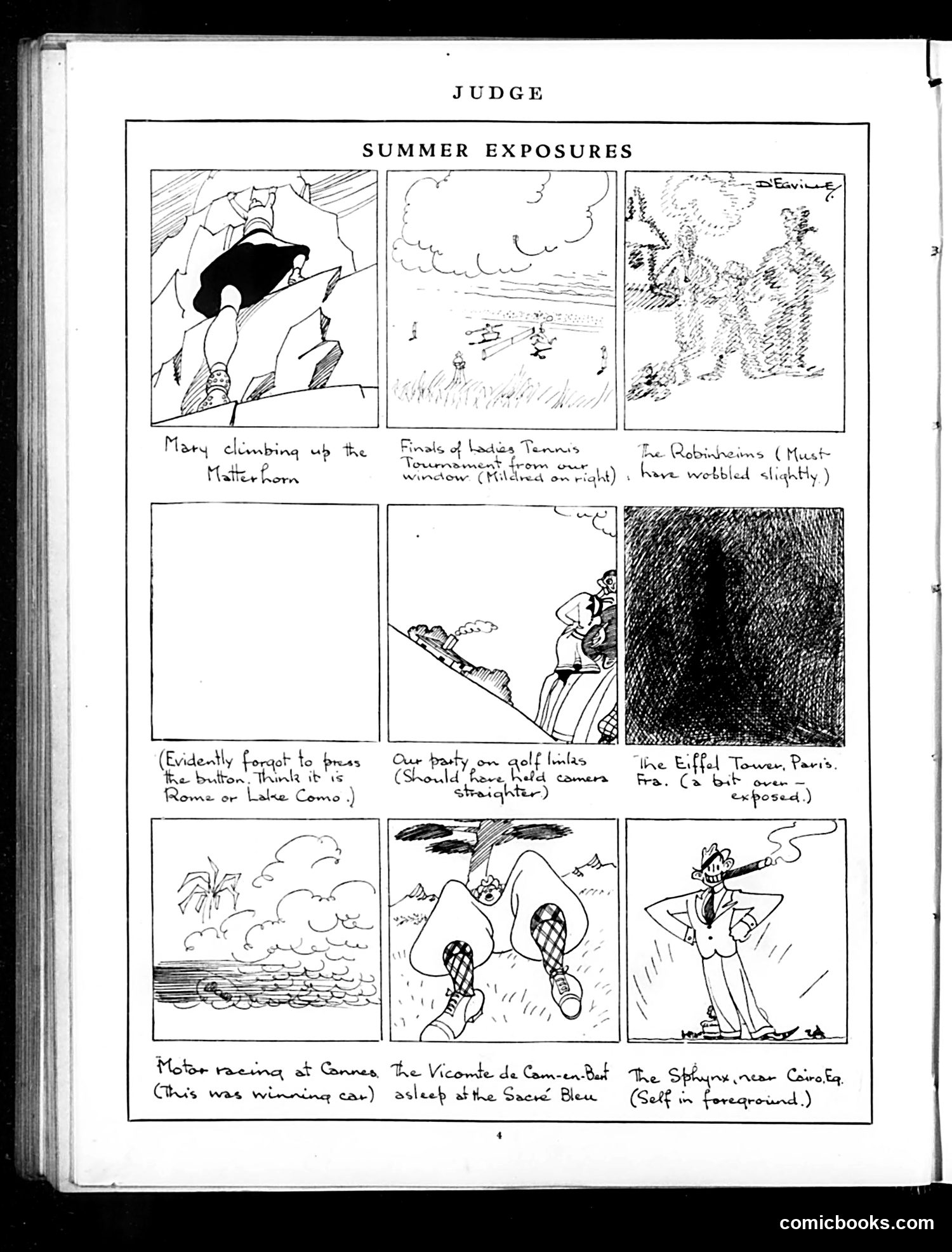
"Judge" - Summer Exposures This page presents nine comic panels depicting humorous "exposures" of summer activities, likely from the early 20th century based on the art style. The cartoons satirize typical upper-class summer pastimes: a woman climbing a matterhorn, ladies' tennis tournament spectators, the Rothschilds's supposedly webfooted nature, golf outings, Parisian tourism (Eiffel Tower), motor racing at Cannes, and a character near Cairo's Sphinx. The humor relies on physical comedy and gentle mockery of wealthy leisure activities—forgotten camera film, improper golf attire, sleeping at formal events, and exaggerated anatomical jokes about prominent families. The page appears non-partisan, targeting fashionable society's summer habits rather than political figures or specific events, functioning as light social commentary typical of Judge magazine's satirical approach to contemporary manners.
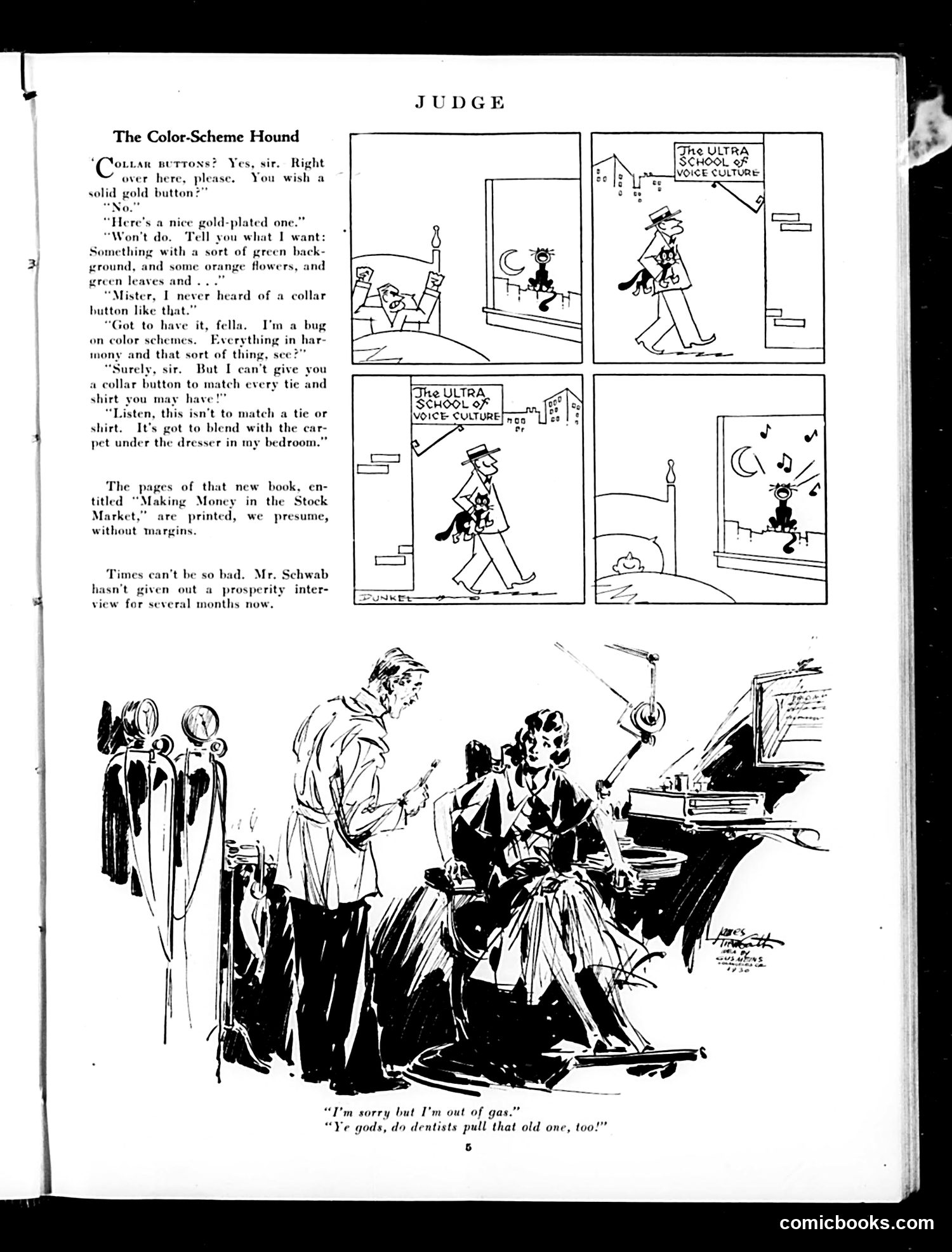
"The Color-Scheme Hound" - Judge Magazine This page satirizes someone obsessed with color coordination in fashion and home décor. The dialogue shows a fussy character demanding a collar button that matches his entire wardrobe and carpet—an impossibly pedantic aesthetic concern. The humor targets this type of person as a "bug on color schemes." The comic strips above show "The Ultra School of Voice Culture," mocking exaggerated vocal training methods popular in the era. The larger illustration below depicts what appears to be a dentist or doctor's office during an emergency, with the caption "'I'm sorry but I'm out of gas.' / 'Ye gods, do dentists pull that old one, too!'" This jokes about a common excuse (running out of gas) being used even by professionals, suggesting it's an overused alibi during the economic constraints referenced in the text about "Making Money in the Stock Market" and economic hardship.
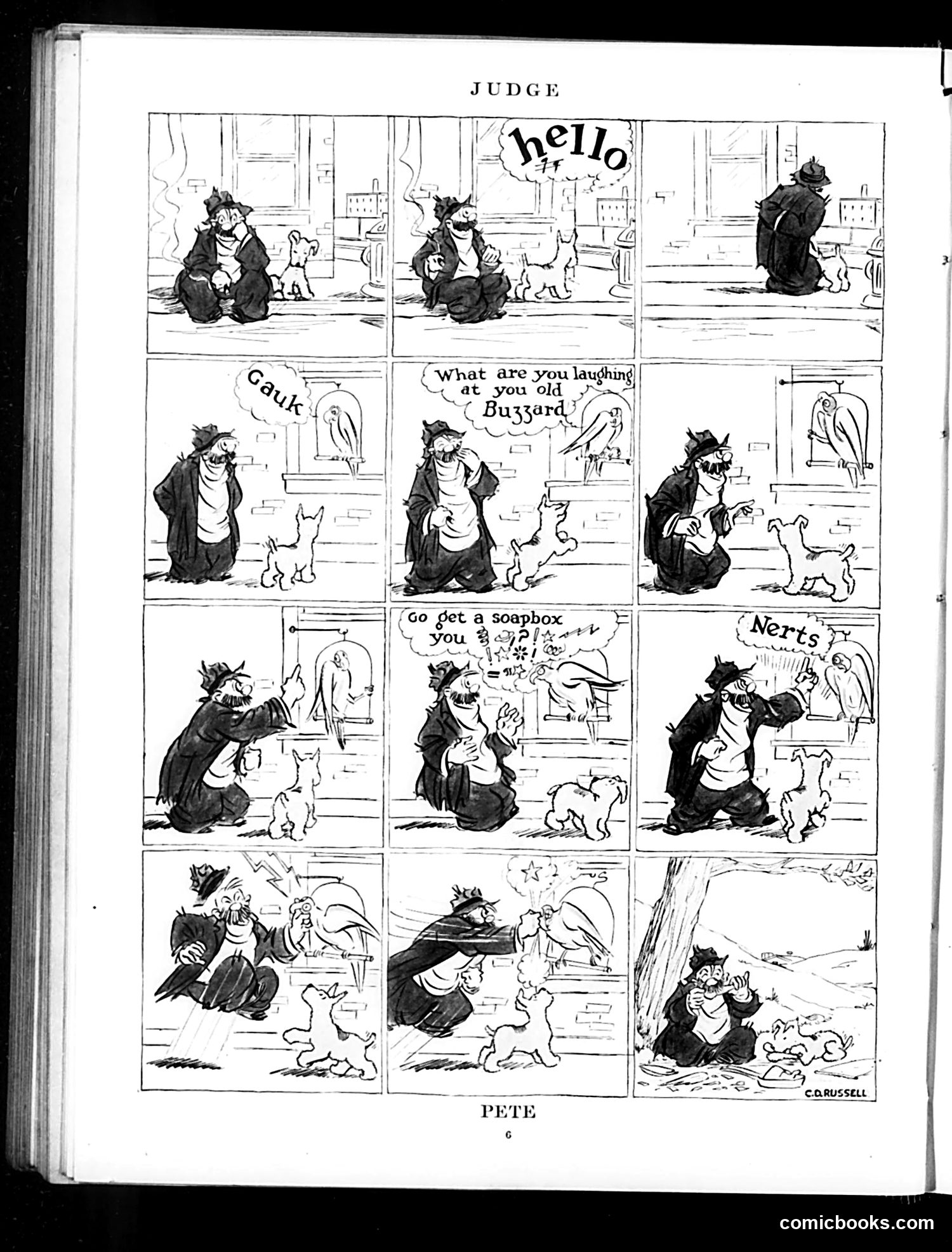
Judge Comic Strip Analysis This is a humorous comic strip titled "Judge Pete" by C. Russell depicting an interaction between a grumpy, disheveled man in dark clothing and a small dog. The narrative shows the man initially greeting the dog with "hello," then becoming irritated ("Gauk!") when the dog laughs at him. He insults the dog, calling it a "Buzzard," and orders it to get a soapbox. The strip culminates with the man chasing the dog and declaring "Nerts!" (a period exclamation expressing frustration). The humor relies on the absurdist reversal of roles—the man treats the dog with contempt typically directed at human rivals or adversaries. The "soapbox" reference suggests street-corner debate culture common in early 20th-century America. The satire appears to mock cantankerous human nature rather than target specific political figures.
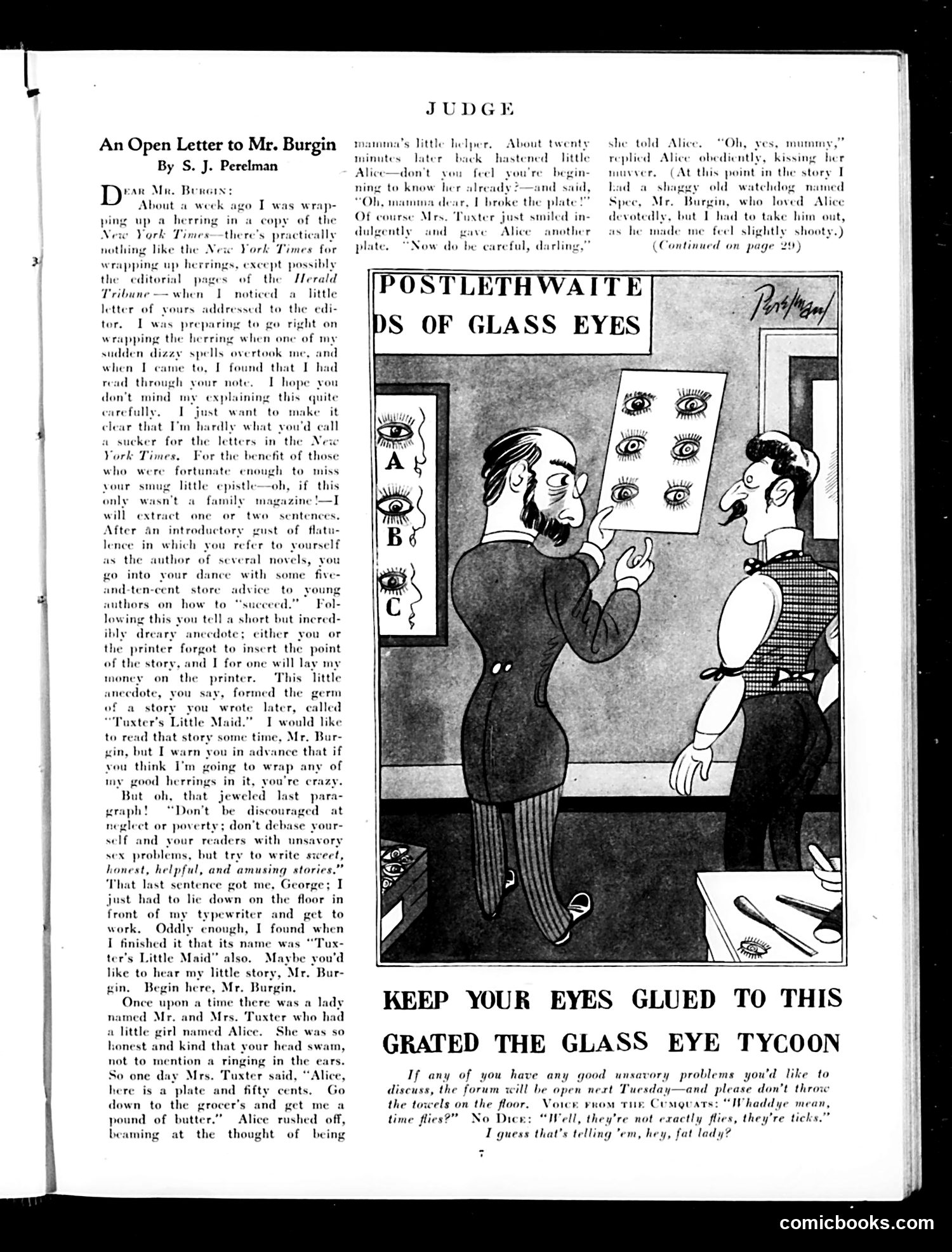
Analysis for Modern Readers This page contains two satirical pieces from *Judge* magazine: "An Open Letter to Mr. Burgin" is a humorous essay by S.J. Perelman mocking writing advice. Burgin (likely a real advice columnist) had published self-important tips for aspiring authors, urging them to avoid "unsavory" topics and write "sweet, honest, helpful" stories. Perelman ridicules this sanctimonious guidance by composing "Tuxter's Little Maid"—a deliberately saccharine children's story about Alice delivering butter—to demonstrate the absurdity of Burgin's constraints on writers. The satire attacks censorious, moralizing gatekeepers who dictate what literature "should" be. "Glass Eyes" cartoon (right) shows a man displaying glass eyes to a customer, with a pun-based caption. The humor is largely visual wordplay now obscure to modern readers, though it appears to mock commercial hucksterism. Both pieces reflect mid-20th-century anxieties about artistic freedom versus propriety—Perelman championing writers against puritanical critics.
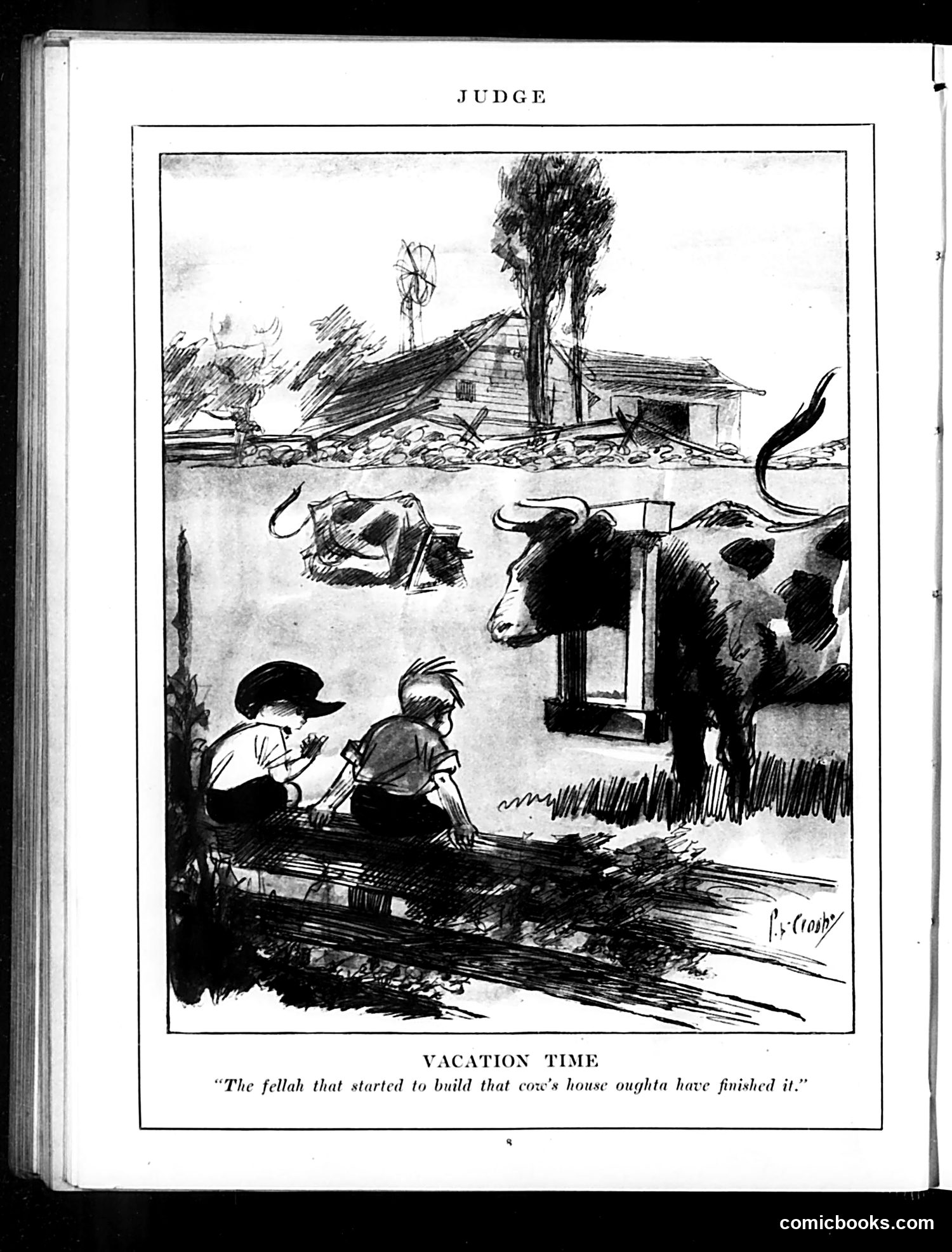
Explanation for Modern Readers This cartoon satirizes incomplete home construction projects. Two boys observe an unfinished structure in a rural setting while cattle roam nearby. The caption's humor relies on the absurdist idea that someone began building a house specifically *for the cow* rather than for themselves—suggesting the builder prioritized the animal's shelter over their own or abandoned the project midway. The joke likely targets vacation-time laziness or poor planning: someone started an ambitious building project before taking time off, leaving it incomplete. The "fellah" (fellow) should have finished before leaving. The cartoon mocks both incomplete DIY projects and poor time management, themes relatable to early-20th-century middle-class readers of *Judge* magazine who might attempt home improvements.
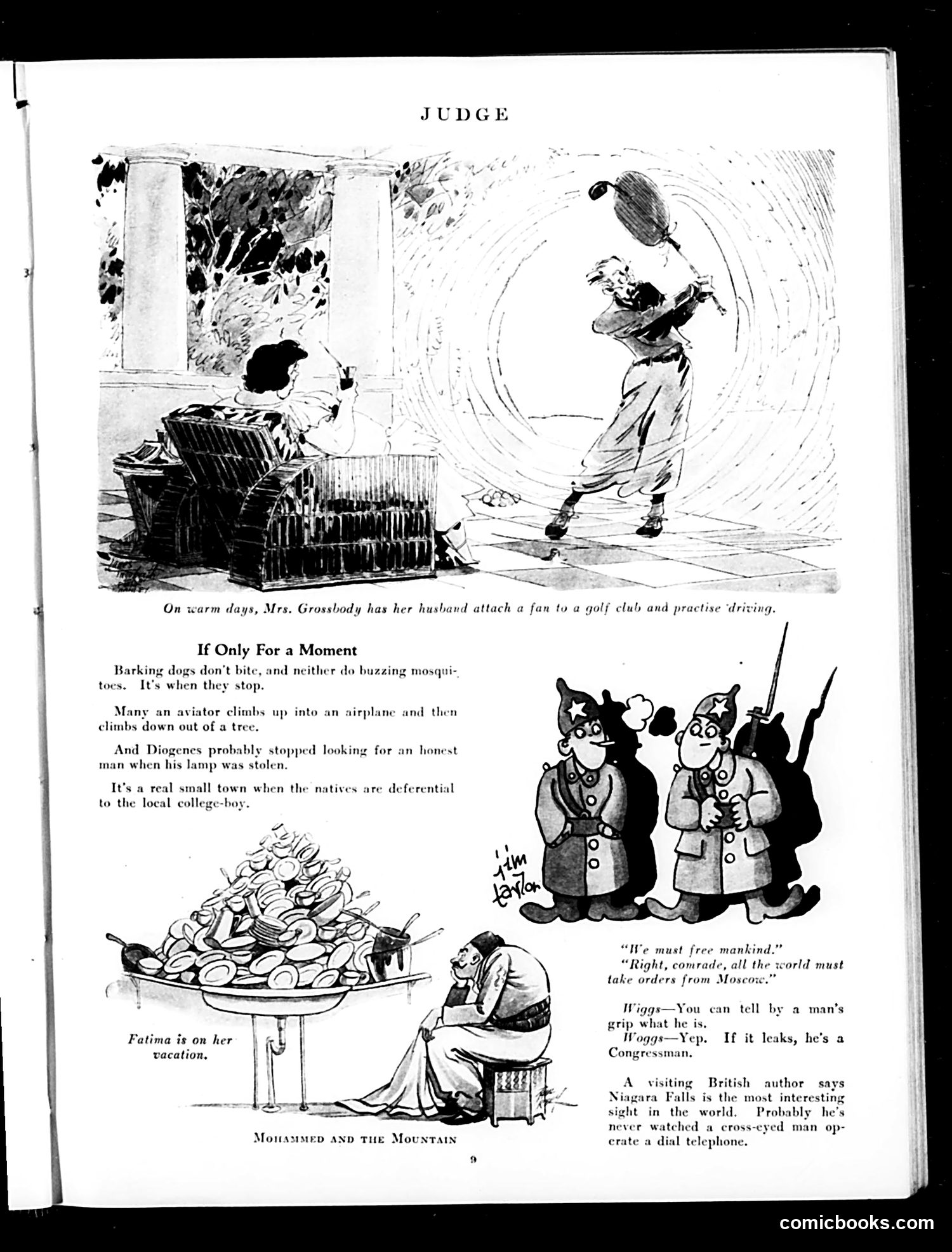
Analysis of Judge Magazine Page This page contains several unrelated humorous short jokes and cartoons typical of Judge's satirical format: Top cartoon: Mrs. Grossbody's husband attaches a fan to a golf club as a makeshift cooling device—a practical solution for hot weather that plays on domestic improvisation. "If Only For a Moment": A series of one-liners exploiting logical paradoxes and social observations (barking dogs don't bite, aviators crashing, etc.). Political cartoon (right side): Two military figures discussing freeing mankind while taking orders from Moscow—clear Cold War-era satire about Soviet communism and the contradiction of Soviet-controlled "liberation." "Wiggs/Woggs" joke: A pun where a weak handshake (leaking grip) indicates someone is a Congressman—satirizing politicians as unreliable or insubstantial. Bottom cartoons: Fatima on vacation and a joke about a cross-eyed man operating a telephone—absurdist humor with no clear political meaning. The page reflects Judge's blend of domestic satire, political commentary (anti-Soviet), and general wit aimed at early-to-mid 20th century readers.
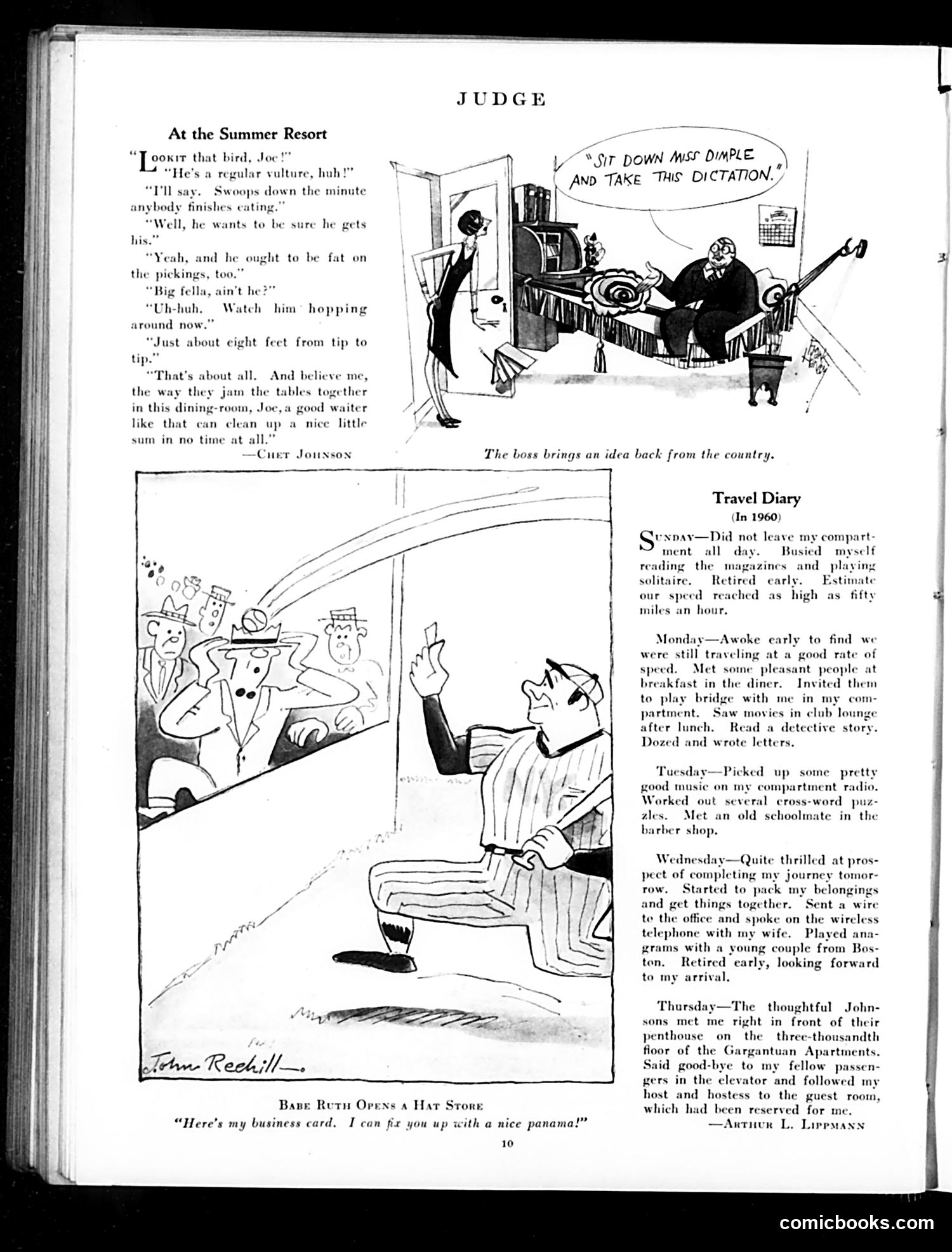
Analysis of Judge Magazine Page Top Cartoon ("At the Summer Resort"): This depicts wealthy diners complaining about a large bird (a vulture) that aggressively steals food scraps from their table. The joke satirizes both the vulture's shameless opportunism and the diners' obsessive concern with "getting theirs"—suggesting summer-resort society mirrors the bird's greedy behavior. The vulture becomes a caricature of uncouth wealth-seeking. Middle Cartoon ("Babe Ruth Opens a Hat Store"): Signed by John Reckhill, this shows baseball legend Babe Ruth working retail, offering customers panama hats. The caption's casual tone ("I can fix you up with a nice panama!") satirizes celebrities endorsing products outside their expertise—a common 1920s-era practice. It mocks both Ruth's business venture and celebrity marketing culture. Travel Diary Section: Arthur L. Lippmann's account of a 1960 train journey describes mundane leisure activities (card games, radio, meeting acquaintances). This appears straightforward anecdotal writing rather than satirical commentary, documenting period travel habits.
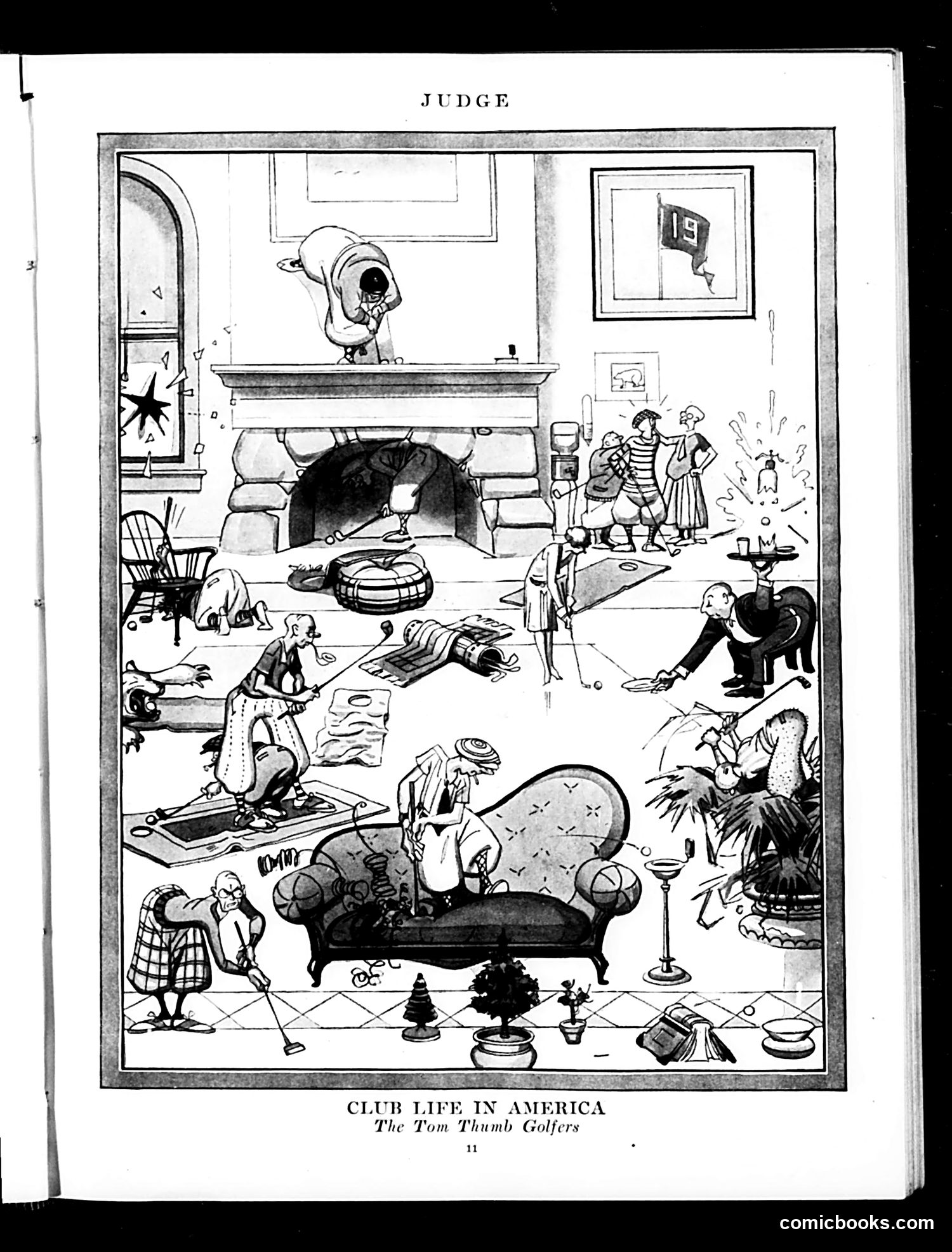
"Club Life in America: The Tom Thumb Golfers" This is a satirical illustration depicting chaos in what appears to be an exclusive country club. The title references "Tom Thumb Golfers"—likely mocking miniature golf, a novelty entertainment that became popular in early 20th-century America. The cartoon shows the dignified space of a judge's chambers or upscale club completely overrun with disorder: children playing, adults behaving foolishly, golf equipment scattered about, and general mayhem. The juxtaposition of a formal judge's bench/fireplace with childish miniature golf suggests satire of how trendy leisure activities were invading traditionally serious spaces, or how the upper classes were embracing undignified amusements. The chaos mocks both the frivolity of club culture and perhaps the absurdity of grown adults pursuing such childish pastimes.
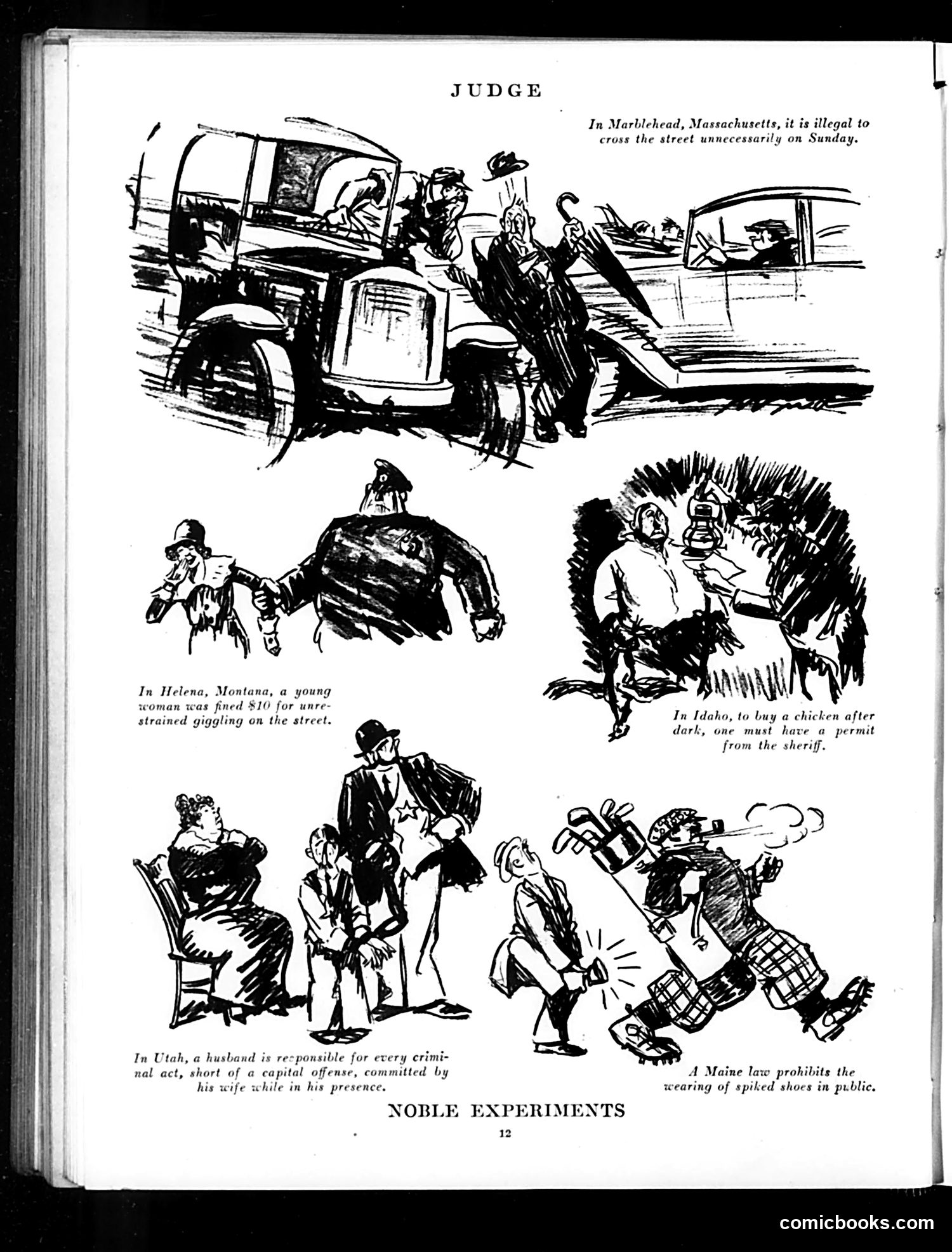
Judge Magazine Satire: "Noble Experiments" This page satirizes absurd state and local laws through cartoon vignettes. Each illustration ridicules a real (or seemingly real) obscure statute: - Marblehead, Massachusetts: Mocking Puritan Sunday restrictions on unnecessary street-crossing - Helena, Montana: A woman fined for giggling—absurd enforcement of public decorum laws - Idaho: Requiring permits to buy chickens after dark—bureaucratic overreach - Utah: Husbands held criminally responsible for wives' acts—satirizing patriarchal legal liability - Maine: Prohibiting spiked shoes in public—trivial regulations presented seriously The page's title "NOBLE EXPERIMENTS" is ironic, suggesting these laws represent misguided attempts at social control. The humor derives from presenting genuinely strange (possibly fabricated) regulations matter-of-factly through satirical drawings, mocking the patchwork of state laws and the disconnect between legislative intent and practical absurdity. The satire targets both lawmakers and local enforcement of arbitrary restrictions.
Judge Magazine Content Analysis "A Hoover Come-Back?" — This editorial argues that President Herbert Hoover may recover political standing during Congress's recess. The piece acknowledges his difficult first year: party opposition, the unpopular tariff bill, and weak legislative achievements. However, it suggests the coming weeks might allow him to reassert leadership and rebuild his reputation as "Chief"—a nickname his supporters use. The author notes that even Republican colleagues have criticized him, and that facing opposition from the opposing party (rather than his own) might actually generate public sympathy. "Confession of Narcissus" and "Bathing in Garbage" — These are brief humor columns poking fun at editorial readership (citing a University of Iowa study showing only 1-in-21 people read editorials) and at readers who hoard junk. The page reflects early 1930s political debate over Hoover's effectiveness during economic crisis.
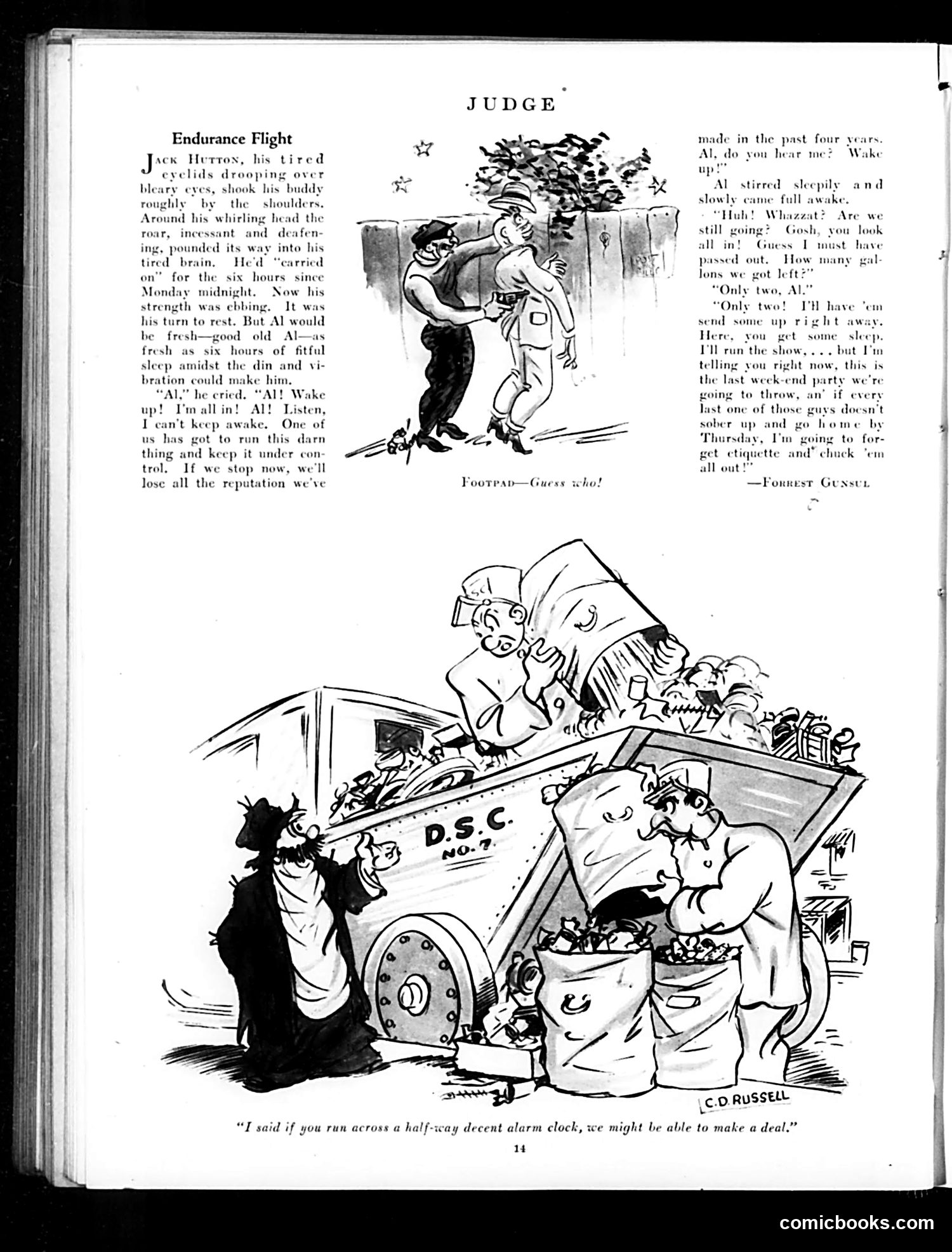
Explanation for Modern Readers This page satirizes endurance aviation stunts popular in the 1920s-30s. Two pilots compete in a continuous flight marathon, taking turns piloting a small aircraft ("D.S.C. No. 7") to set records. The exhausted pilot Al has flown for six hours and is collapsing; his partner must continue despite fatigue to preserve their "reputation." The satire critiques the recklessness and competitive obsession driving these stunts. The second cartoon jokes that they're so desperate to maintain the flight they'd trade an alarm clock (implying they've lost track of time) just to keep going. The piece mocks both the pilots' dangerous determination and the broader culture celebrating these record-breaking flights as public spectacles—suggesting the pursuit of fame overshadows safety. The dialogue emphasizes desperation: they'll lose credibility if they stop, even as exhaustion threatens their lives.
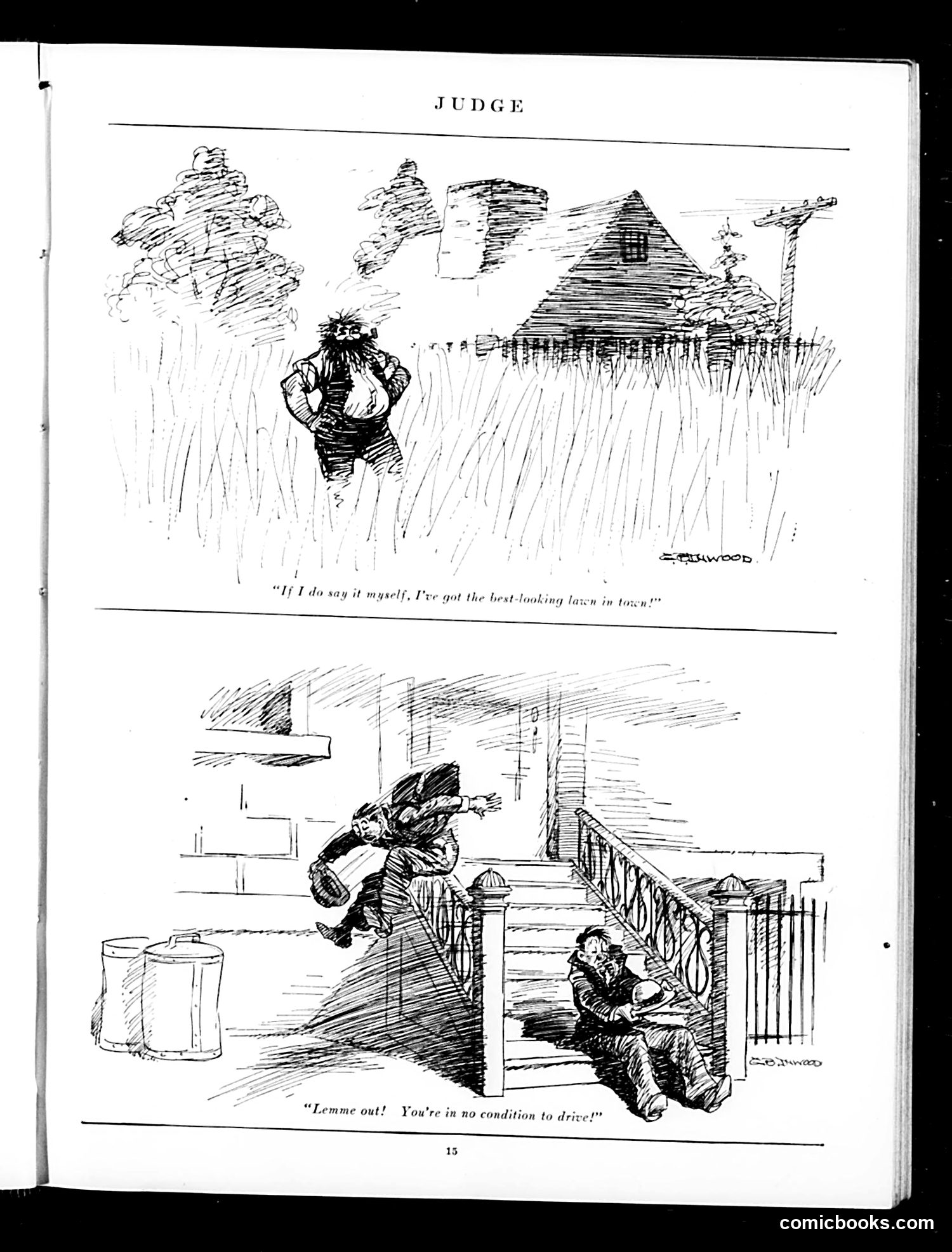
Two Judge Magazine Cartoons Top cartoon: A man stands proudly in overgrown, weedy grass before a dilapidated house, boasting he has "the best-looking lawn in town." The humor relies on obvious self-delusion—the lawn is visibly unkempt and the house deteriorating. This satirizes homeowners' denial about property maintenance or excessive pride in poor upkeep. Bottom cartoon: A man appears intoxicated, attempting to leave while another figure (possibly a servant or family member) restrains him, saying "You're in no condition to drive!" This depicts the social problem of drunk driving, presenting it as a cautionary scenario about the dangers of operating vehicles while impaired—a concern that was clearly relevant to Judge's readers.
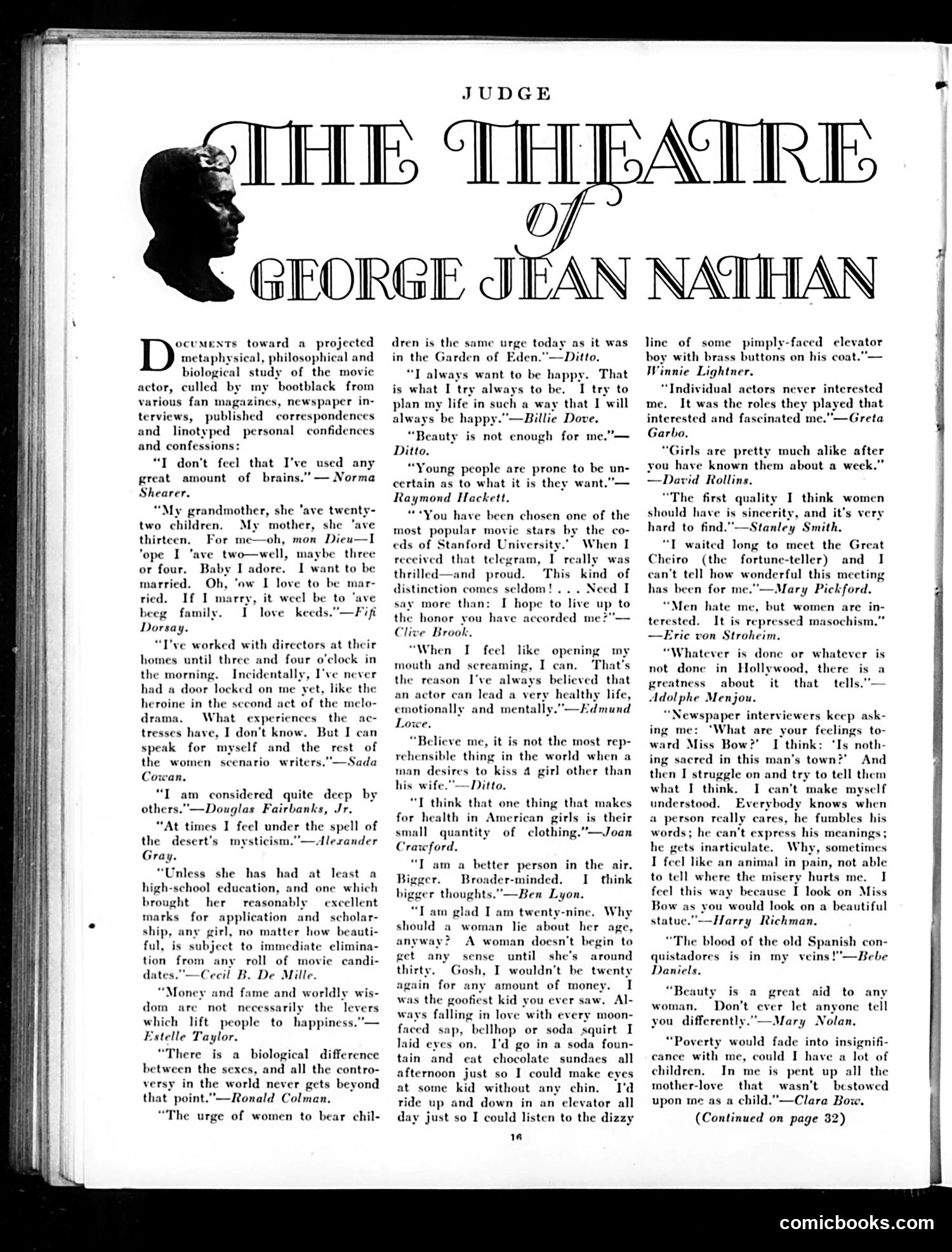
Judge Magazine: "The Theatre of George Jean Nathan" This page features quotes attributed to 1920s movie actors, presented as satirical commentary. Judge magazine is mocking the pretentiousness and vapidity of Hollywood celebrities through their own (purported) words. The silhouette portrait identifies this as commentary by or about George Jean Nathan, a prominent drama critic. The quotes—attributed to stars like Norma Shearer, Douglas Fairbanks Jr., and Joan Crawford—range from self-aggrandizing ("I am considered quite deep") to absurdly candid (Winnie Lightner's elevator-flirtation confession) to pseudo-philosophical banality (repeated statements about happiness and beauty). The satire works by letting actors "hang themselves" with their own inanities: contradictions, humble-brags, and shallow ruminations presented as profound insights. Judge is mocking both the actors' limited intellectual capacity and the fan magazines that treat their mundane musings as wisdom worth publishing.
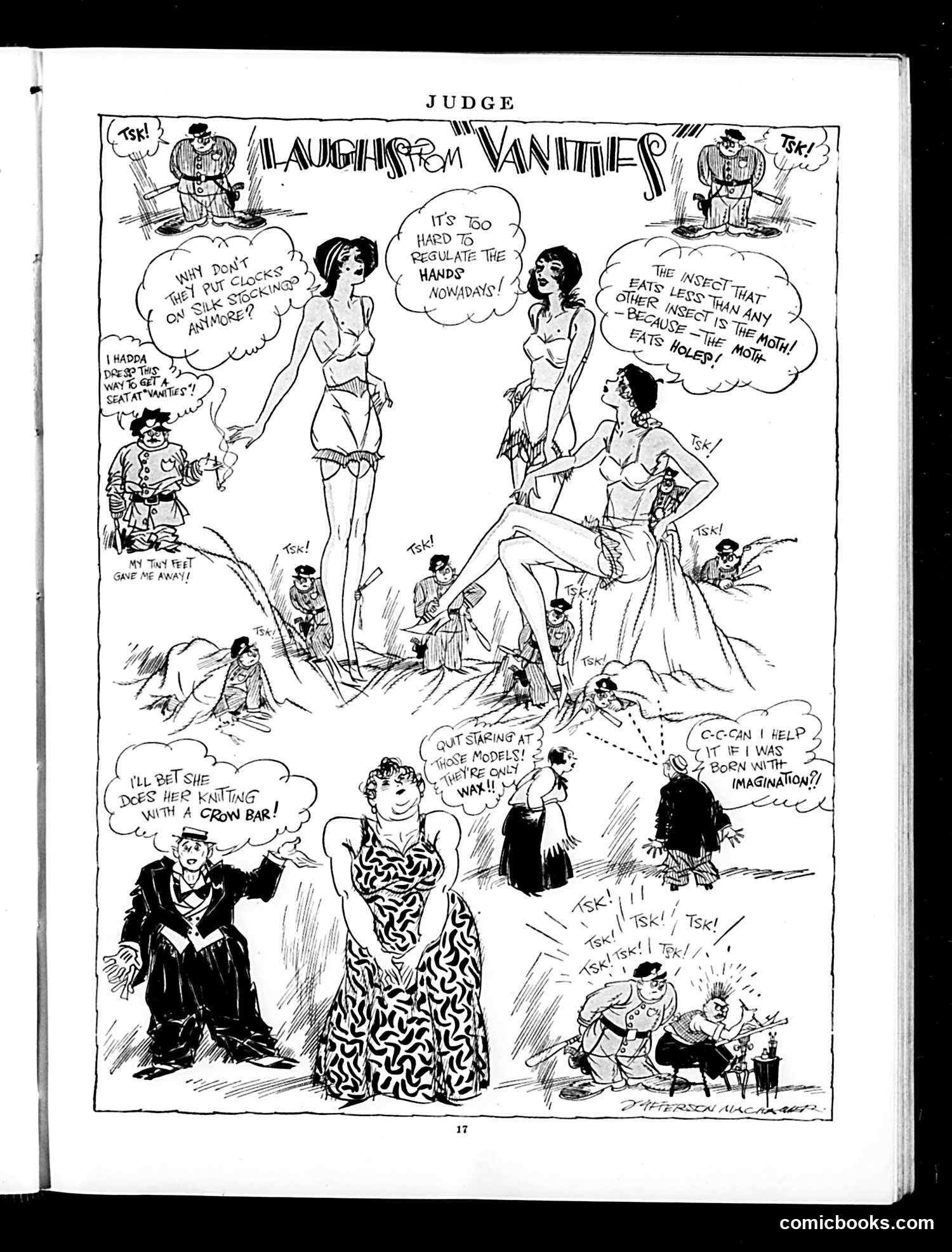
"Laughstem Vanities" - Judge Magazine Satire This is a satirical cartoon mocking women's fashion and behavior during the Jazz Age/1920s-30s. The central figures are exaggerated flappers in revealing clothing, surrounded by small male figures expressing shock and disapproval (indicated by "TSK!" exclamations). The jokes target: - Women's shortened hemlines and exposed legs ("My tiny feet gave me away") - Cosmetics and makeup ("knitting with a crow bar") - Sexualized fashion and modeling ("staring at those models") - Women's perceived recklessness and moral looseness The title "Laughstem Vanities" is a play on "Vanities of the Vanities," suggesting women are frivolous and vain. The cartoon reflects conservative anxiety about changing women's roles and the sexual liberation associated with flapper culture, presented through exaggerated physical comedy and disapproving male witnesses.
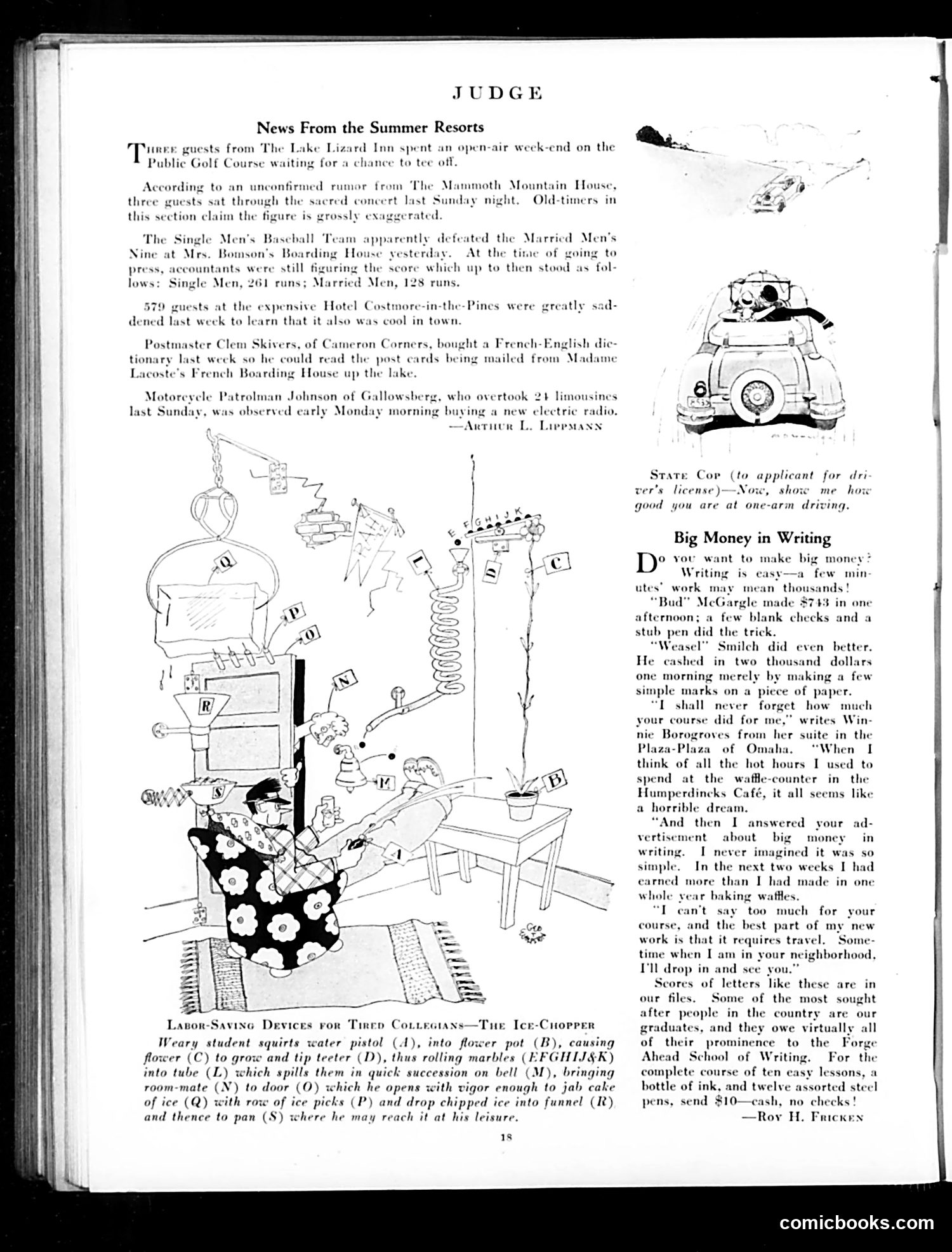
Judge Magazine Page Analysis This page contains satirical humor typical of early-to-mid 20th century Judge magazine: "News from Summer Resorts" mocks vacationing wealthy Americans through exaggerated anecdotes—golfers waiting endlessly to tee off, hotel guests disappointed that the resort town is also hot, a baseball game where single men vastly outnumber married men in runs (261 to 128), implying the unmarried players' superior vigor or the married men's decline. "Big Money in Writing" parodies mail-order writing courses and get-rich-quick schemes. It satirizes testimonials from supposed graduates ("Bud" McGargle, "Weasel" Smilch, Winnie Borogroves) claiming thousands earned through writing, though the actual methods mentioned are fraud (forging checks, making marks on paper). The satire targets both the fraudulent courses and gullible people seeking easy money. The Ice-Chopper cartoon illustrates an absurdly complicated Rube Goldberg-style contraption for a simple task—getting ice into a pan—mocking overcomplicated "labor-saving devices." The page's humor assumes reader familiarity with summer resort culture and mail-order advertisement schemes of the era.
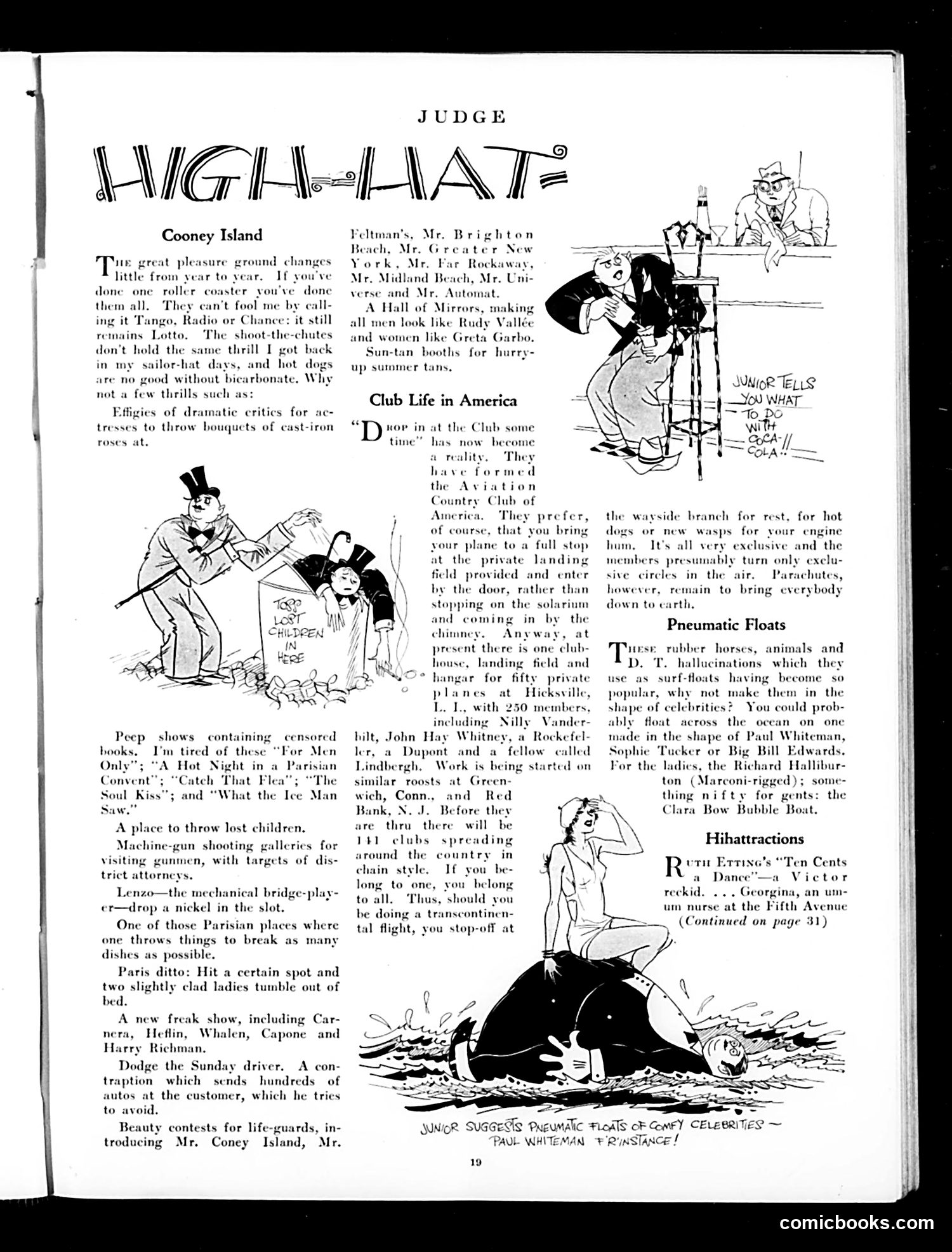
Judge Magazine Satire Analysis This 1920s humor piece satirizes American leisure and consumer culture through absurdist suggestions for Coney Island attractions and emerging trends. Coney Island section: The author mock-complains that traditional amusement rides have become boring, then proposes increasingly ridiculous alternatives—peep shows with censored titles, machine-gun galleries targeting district attorneys, and a "Hall of Mirrors" making people resemble celebrities like Rudy Vallée and Greta Garbo. Club Life: Satirizes exclusive aviation country clubs (like the real one at Hicksville, Long Island) where wealthy members—Vanderbilt, Whitney, Lindbergh—supposedly arrive by private plane. The joke: despite pretensions of exclusivity and sky-high status, parachutes still "bring everybody down to earth." Pneumatic Floats: Mocks the trendy rubber pool floats by suggesting celebrity-shaped versions (Paul Whiteman, Sophie Tucker, Clara Bow). The humor lies in the absurdity of floating across the ocean on inflatable celebrity likenesses. The overall satire targets 1920s conspicuous consumption, snobbery, and fad-chasing among the wealthy and leisure classes.
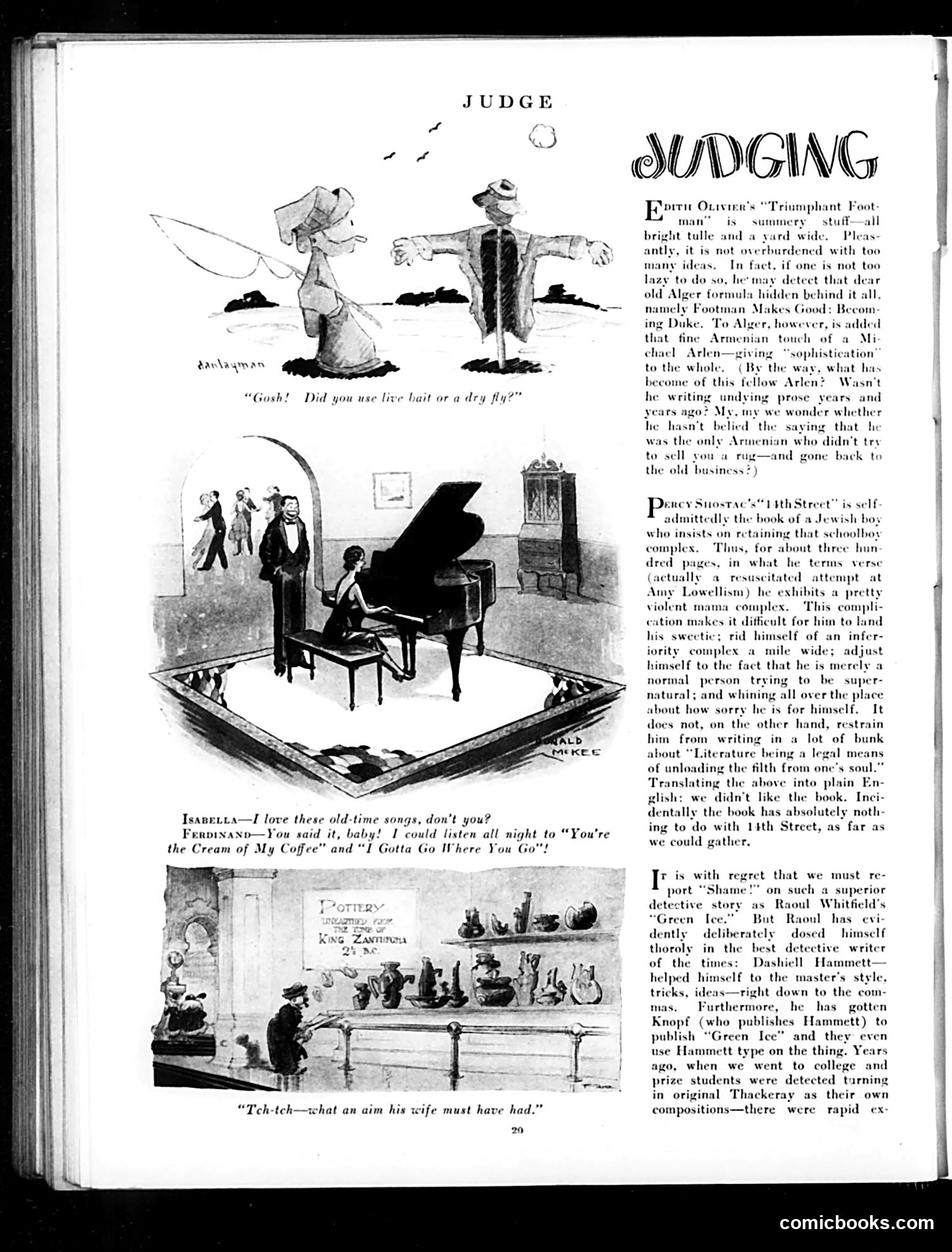
Judge Magazine Book Reviews Page This page contains satirical literary reviews rather than political cartoons. The "JUDGING" section critiques recent books: Edith Oliver's "Triumphant Footman": Dismissed as lightweight summer fiction relying on the familiar Horatio Alger "rags-to-riches" formula, though it includes work by Michael Arlen (an Armenian-American writer known for society stories). The reviewer sarcastically questions what became of Arlen, joking that he violated the stereotype of Armenians selling rugs. Percy Showerman's "14th Street": Criticized as a self-indulgent book by a Jewish author with an unresolved mother complex, written in pretentious "vers" (likely "verse"). The reviewer dismisses his philosophical claims about literature purging "filth from one's soul." Raoul Whitfield's "Green Ice": A detective novel accused of excessively imitating Dashiell Hammett's style—copying his prose techniques, narrative tricks, and even his typeface. The review suggests this amounts to plagiarism disguised as homage, comparing it to college students passing off Thackeray as original work.
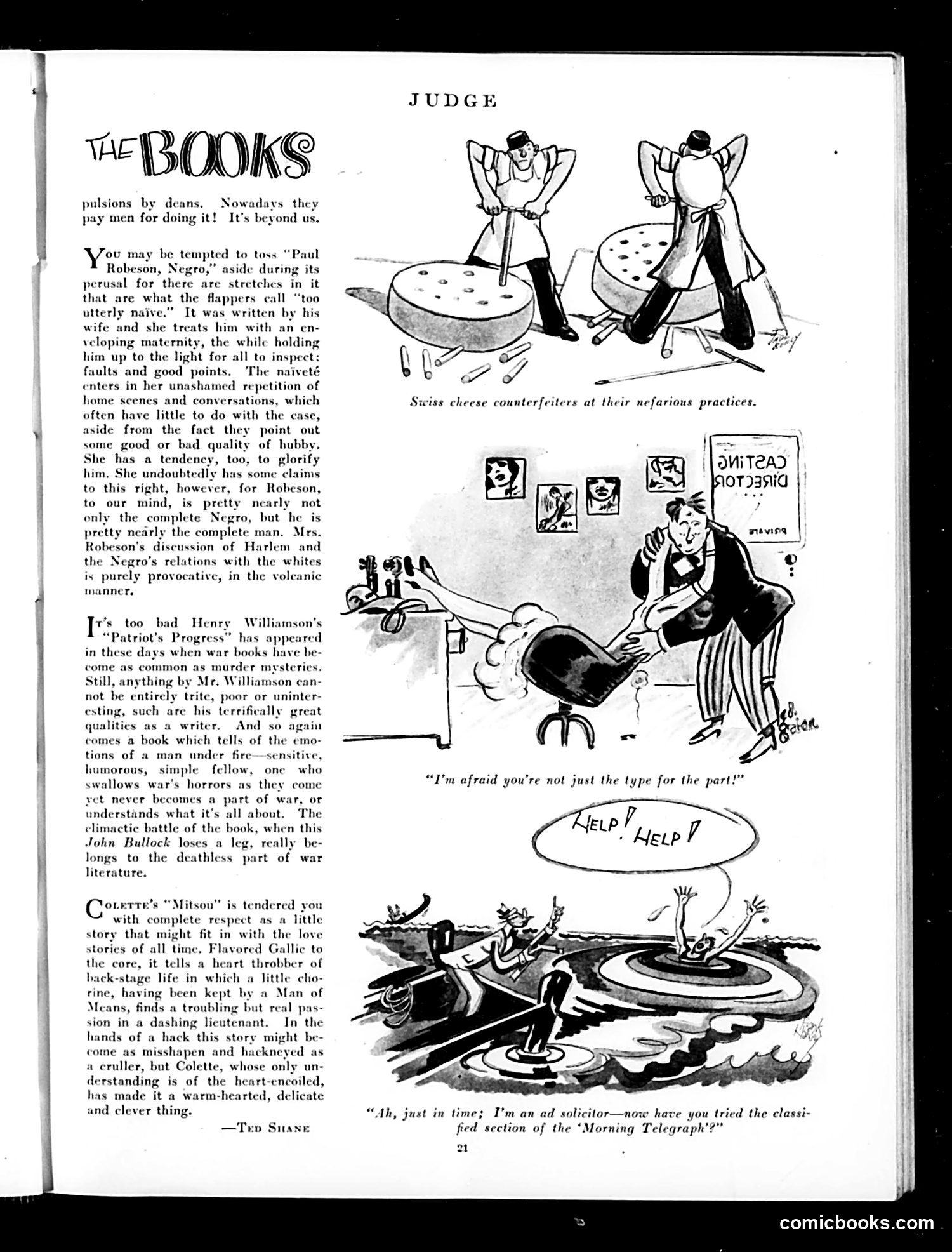
Judge Magazine Page Analysis This page from *Judge* contains book reviews and satirical cartoons. The top cartoon depicts "Swiss cheese counterfeiters" — men with tools examining large wheels of cheese with holes, a visual pun playing on Switzerland's association with both cheese and counterfeiting. The middle cartoon shows a man at a desk with sketches pinned above, apparently being evaluated by a woman who questions whether he's "the type for the party" — satirizing either artistic pretension or social gatekeeping in entertainment. The bottom cartoon features a drowning figure calling "Help! Help!" while an ad solicitor arrives offering classified section advertising from the *Morning Telegraph*, mocking how salesmen opportunistically pitch advertisements at any moment, even during someone's distress. The book reviews discuss Paul Robeson's biography, Henry Williamson's war novel, and Colette's romance novella — representing 1920s-30s literary discourse.
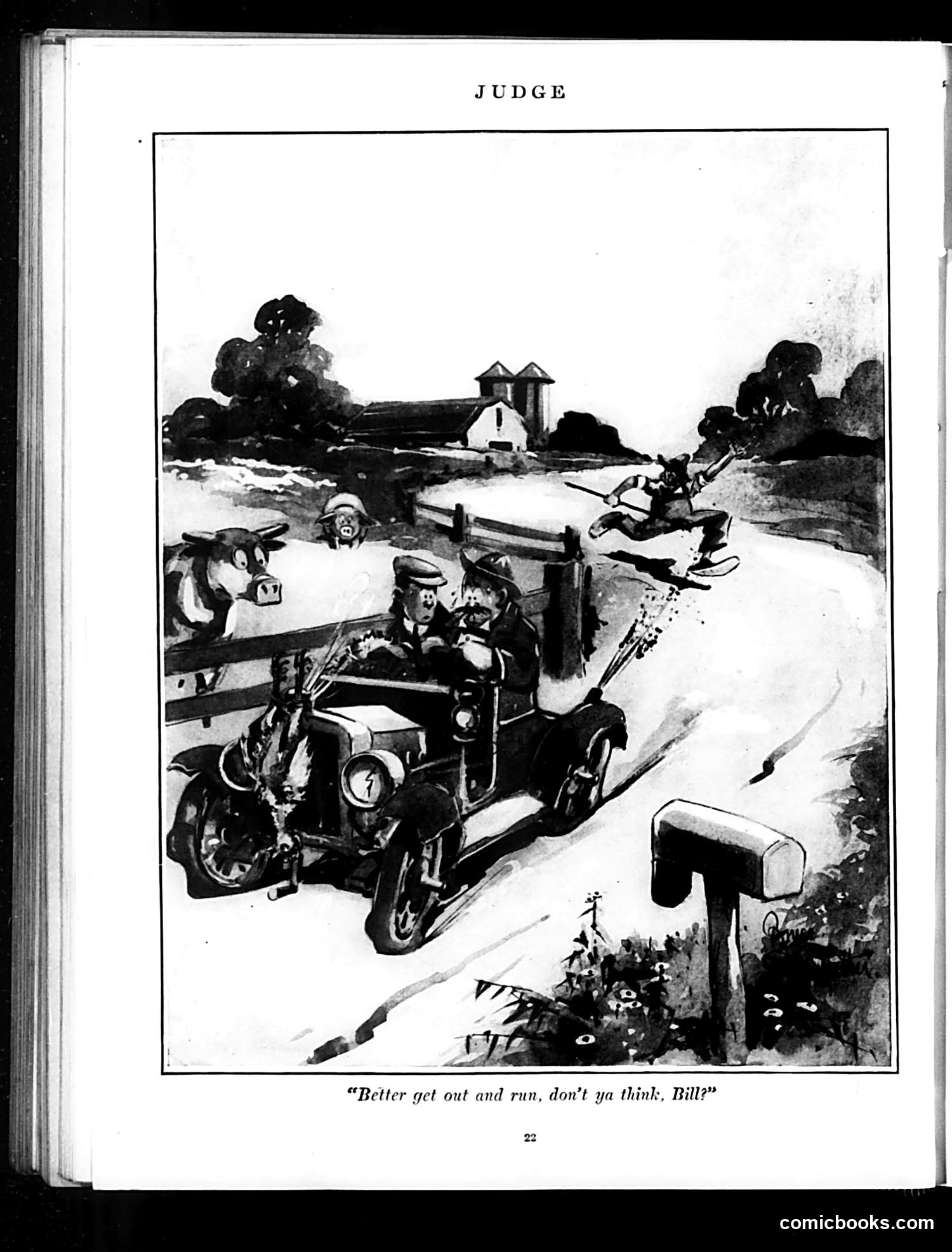
Analysis of Judge Cartoon Page This page contains a single cartoon showing anthropomorphized animals in a car on a snowy rural road. A cow driver addresses a pig passenger named "Bill," suggesting they flee ("Better get out and run"). The cartoon appears to satirize a situation where occupants of a vehicle recognize danger and contemplate escape. The snowy setting, rural farmhouse in the background, and the animals' apparent anxiety suggest a comedic scenario about evading some threat—possibly law enforcement or an accident situation. Without additional context about the specific Judge issue date, the precise satirical target remains unclear. The humor likely relied on contemporary references recognizable to Judge's 1920s-30s readership that modern audiences would need historical context to fully understand.
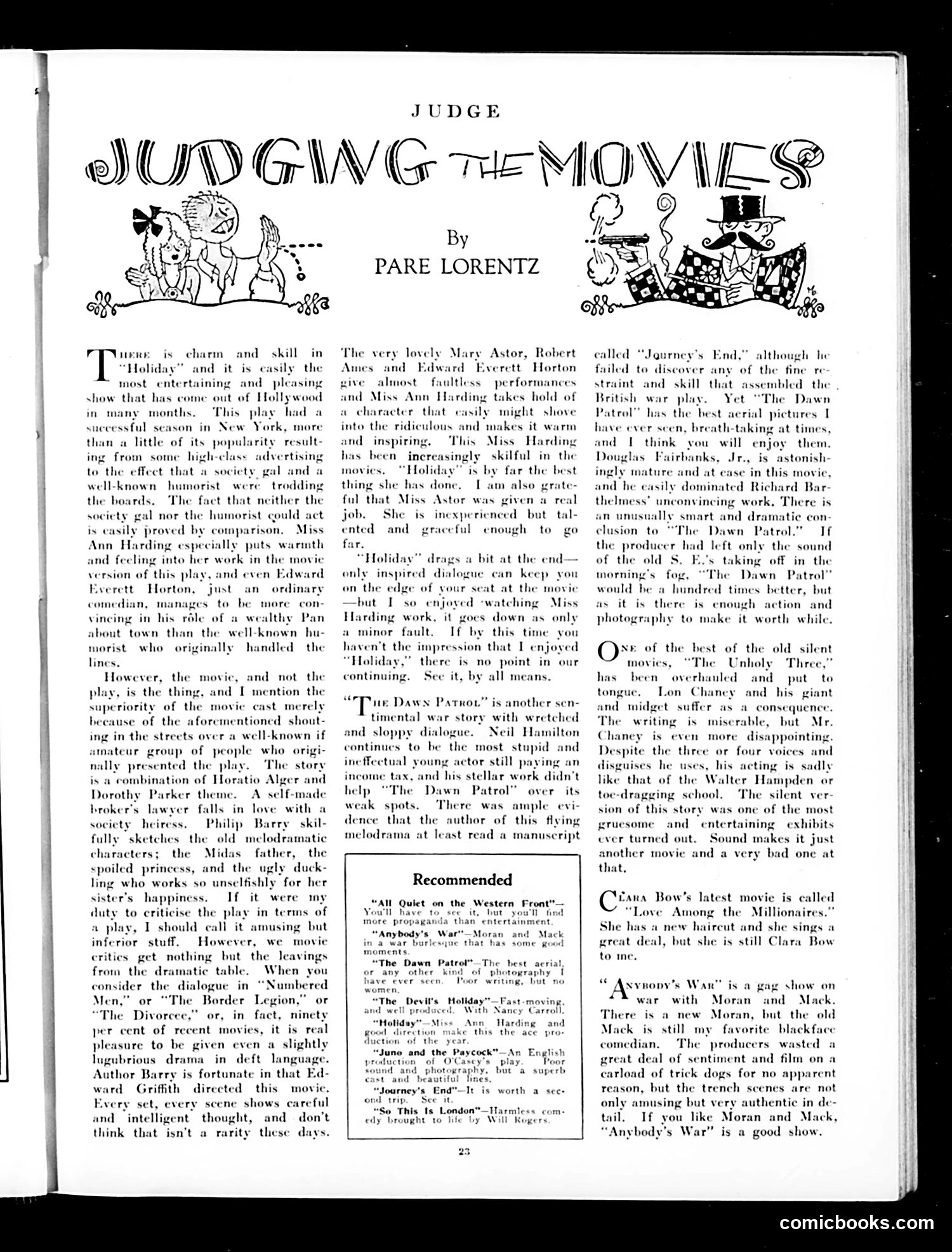
Judge Magazine Movie Review Analysis This page from Judge magazine contains film reviews by critic Pare Lorentz, focusing on recent Hollywood releases. The main content discusses "Holiday," praising its cast (Mary Astor, Ann Harding, Edward Everett Horton) while criticizing the original stage play as derivative melodrama. Lorentz notes that the film elevates mediocre source material through superior direction and cinematography. The reviews also cover "The Dawn Patrol" (a WWI aerial drama) and other current releases in a "Recommended" box listing films like "All Quiet on the Western Front" and "Anybody's War." The satirical element typical of Judge magazine appears minimal on this page—it's primarily straightforward entertainment criticism. The cartoonish header illustration simply decorates the title; it doesn't constitute political satire. The page reflects 1930 Hollywood's output and contemporary critical standards for evaluating cinema.
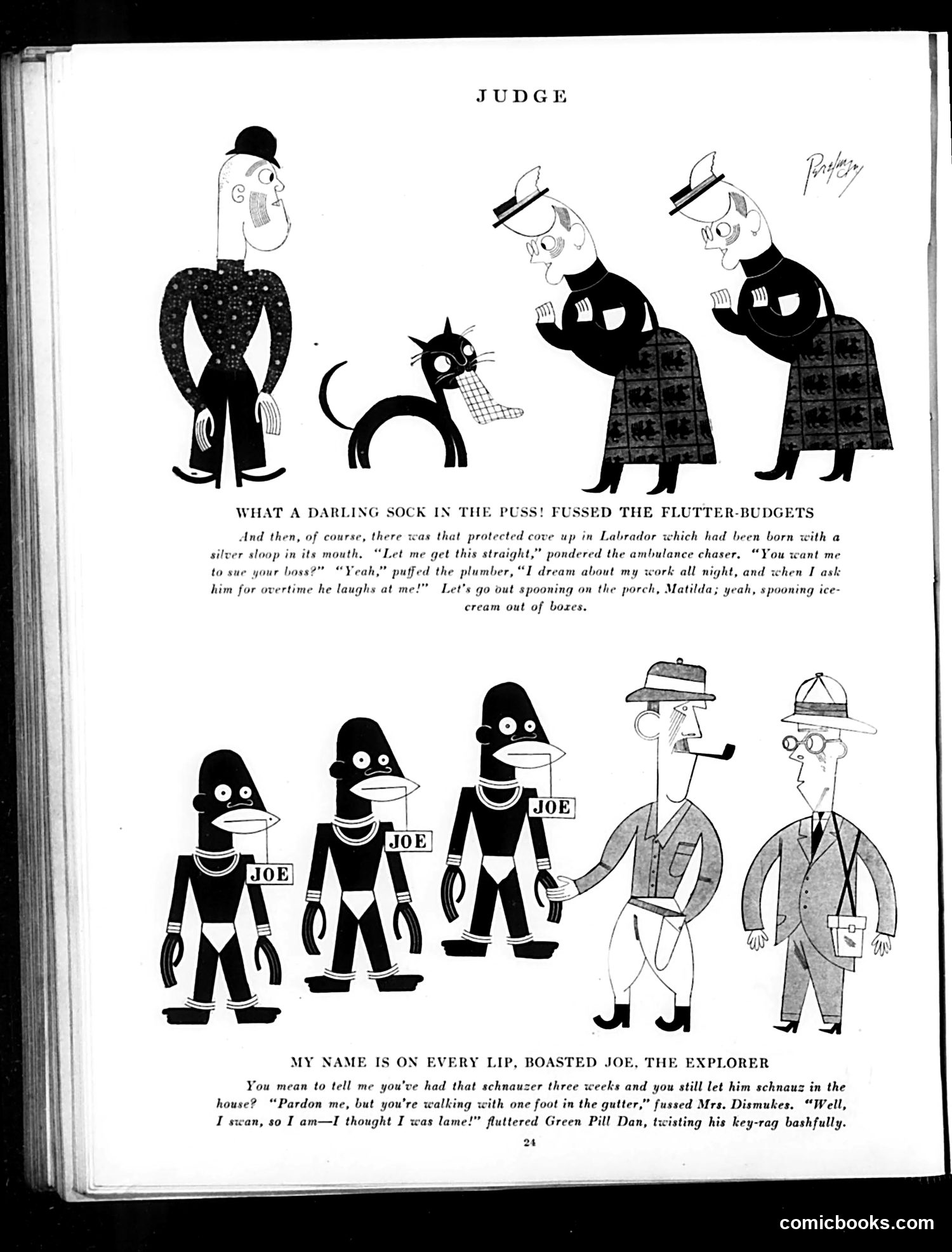
Judge Magazine Satire Page Analysis This page contains two separate satirical vignettes typical of Judge magazine's humor style. Top section ("What a Darling Sock in the Puss"): Mocks upper-class affectation through exaggerated characters—a pompous judge figure and "flutter-budgets" (dizzy socialites). The satire targets pretentious society types and includes workplace commentary: a plumber complaining that his boss won't pay overtime, absurdly considering suing him. The "spooning ice-cream" reference is innocent 1920s-era flirtation humor. Bottom section ("My Name Is on Every Lip"): Features "Joe the Explorer"—likely a reference to a contemporary explorer or adventurer whose name was in public discourse. The multiple identical "Joe" figures suggest mocking celebrity repetition. The subsequent jokes target various social types: pet owners, busybodies (Mrs. Dismukes), and eccentrics ("Green Pill Dan"). The humor is observational mockery of everyday social interactions and character types. Overall, the page exemplifies Judge's approach: satirizing social pretension, workplace absurdities, and peculiar personalities through caricature and wordplay.
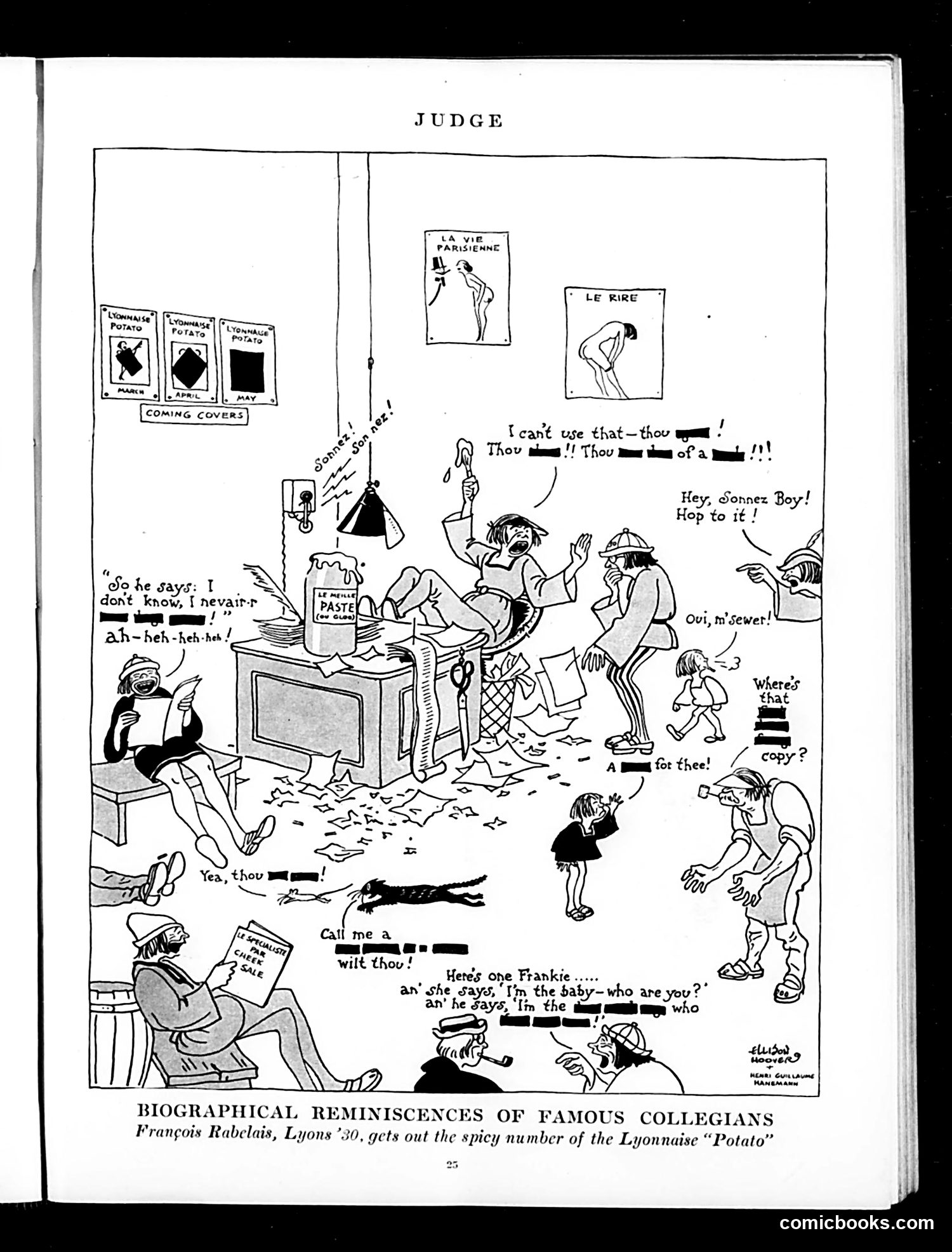
Analysis This cartoon satirizes collegiate life through a mock "biographical reminiscence" of François Rabelais (the actual Renaissance French writer known for bawdy humor) as a college student at Lyons in 1930. The chaotic scene depicts students in a dorm room around a television or radio, engaged in raucous behavior—dancing, shouting vulgar dialogue (indicated by censored dashes), and generally causing mayhem. References to "Potato" (likely a student publication) and magazine covers labeled "Coming Covers" suggest this parodies student publications and their sensational content. The satire targets collegiate excess and moral panic: the "spicy" student magazine represents youth rebellion and alleged indecency that scandalized conservative critics. By attributing this behavior to Rabelais—a historical figure already famous for crude humor—Judge suggests modern college students are simply reviving his tradition, making their "scandalous" behavior seem trivial by historical comparison. The cartoon mocks both the students' pretensions and society's pearl-clutching outrage.
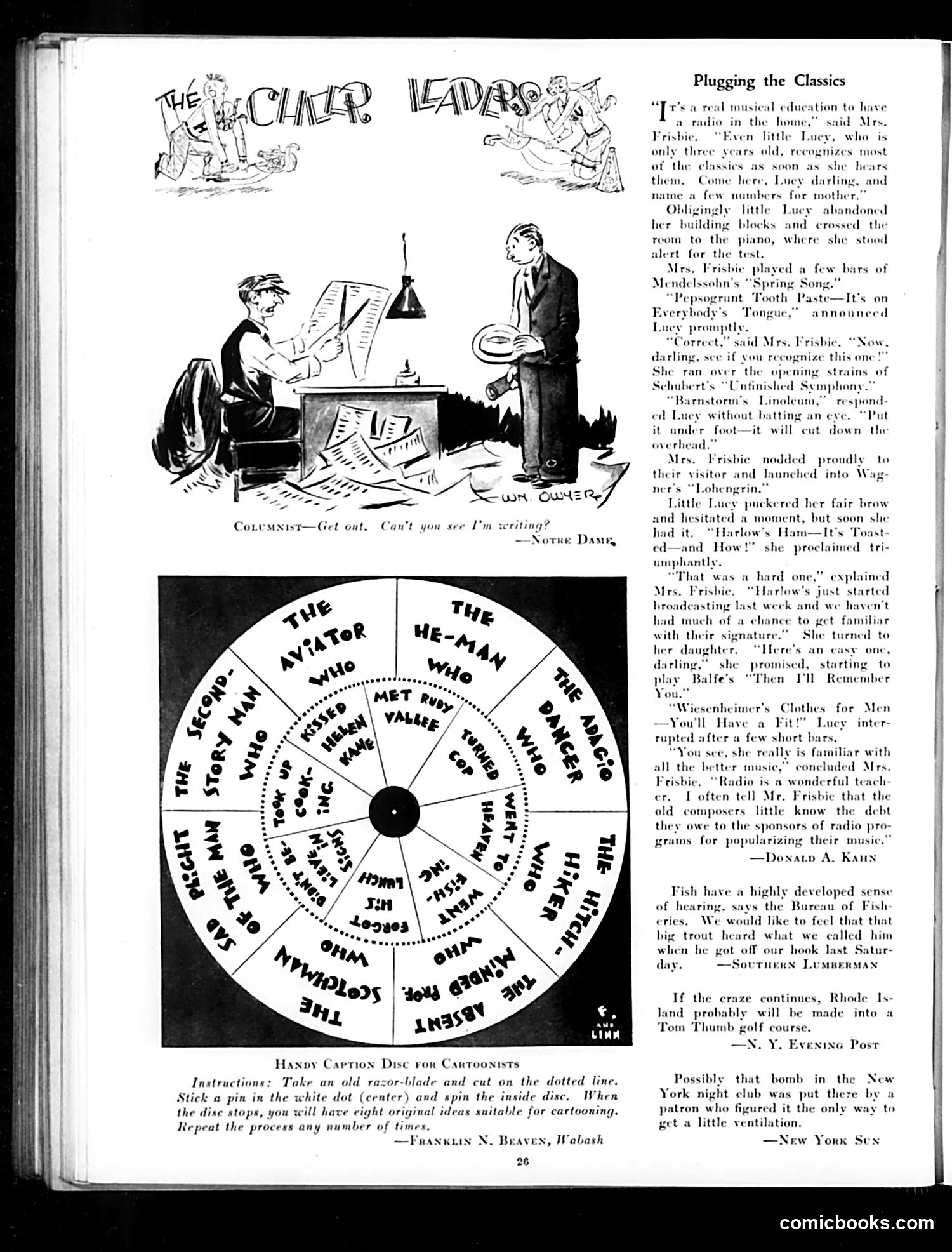
"The Chaser Labors": Judge Magazine Satire Analysis Main Cartoon (Top): A columnist at his desk tells a visitor "Get out. Can't you see I'm writing?" — satirizing the self-important, easily-distracted newspaper columnist. The humor lies in the ironic contrast: the columnist appears surrounded by scattered papers, suggesting he's doing little actual work while demanding privacy. "Handy Caption Disc for Cartoonists" (Center): This is a spin-wheel device mocking cartoonists' creative laziness. Users rotate it to generate "eight original ideas suitable for cartooning." It's self-satirical commentary on Judge itself — the magazine's own editorial staff joking that cartoonists rely on formulaic, interchangeable ideas rather than genuine creativity. The humor targets the entire cartooning profession's reliance on predictable templates. "Plugging the Classics" (Right): This humorous anecdote satirizes radio advertising's growing dominance over classical music. A mother tests her young daughter's "musical education" by playing famous classical compositions, but the child mishears them as *commercial jingles* (Pepsogrunt Toothpaste, Harlow's Ham). The satire critiques how radio advertising corrupts cultural refinement and infiltrates even children's musical exposure.
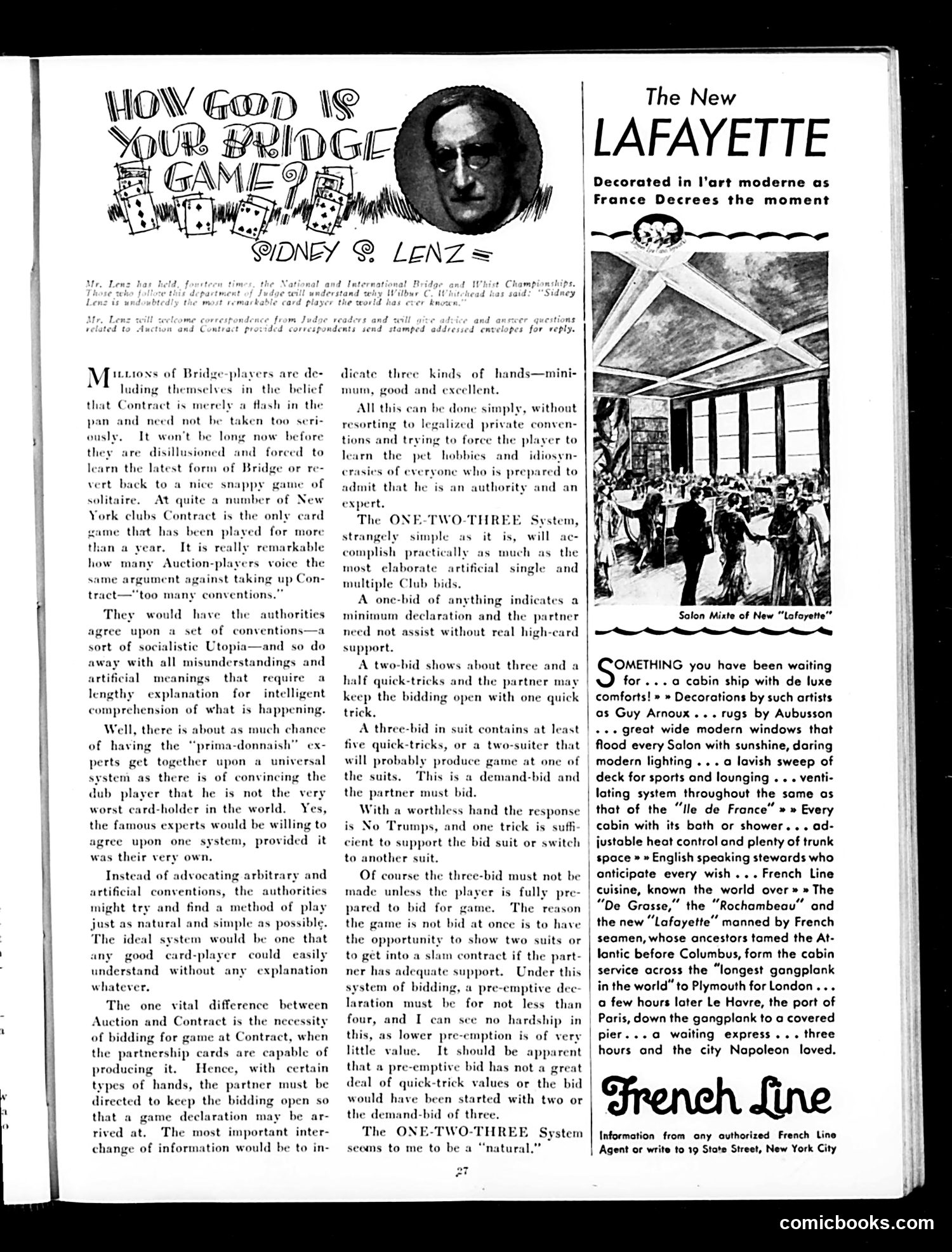
Analysis of Judge Magazine Page This page mixes editorial content with advertising. The main article discusses bridge card game conventions, written by Sidney Lenz (whose portrait appears at top left). Lenz argues for a simplified "ONE-TWO-THREE" bidding system in contract bridge, positioning it as more natural than the complicated conventions bridge players were increasingly adopting in the 1920s-30s. The right side features an advertisement for the French Line cruise ship *Lafayette*, decorated in Art Moderne style. It emphasizes luxury accommodations and promises this vessel offers the longest ocean service to Plymouth and Le Havre. The bridge article reflects period anxieties about competitive play becoming overly complex and rule-bound. The advertisement exploits American interest in French modernity and transatlantic travel. Neither content addresses political matters—this is entertainment and lifestyle material typical of Judge magazine's middle-class audience.
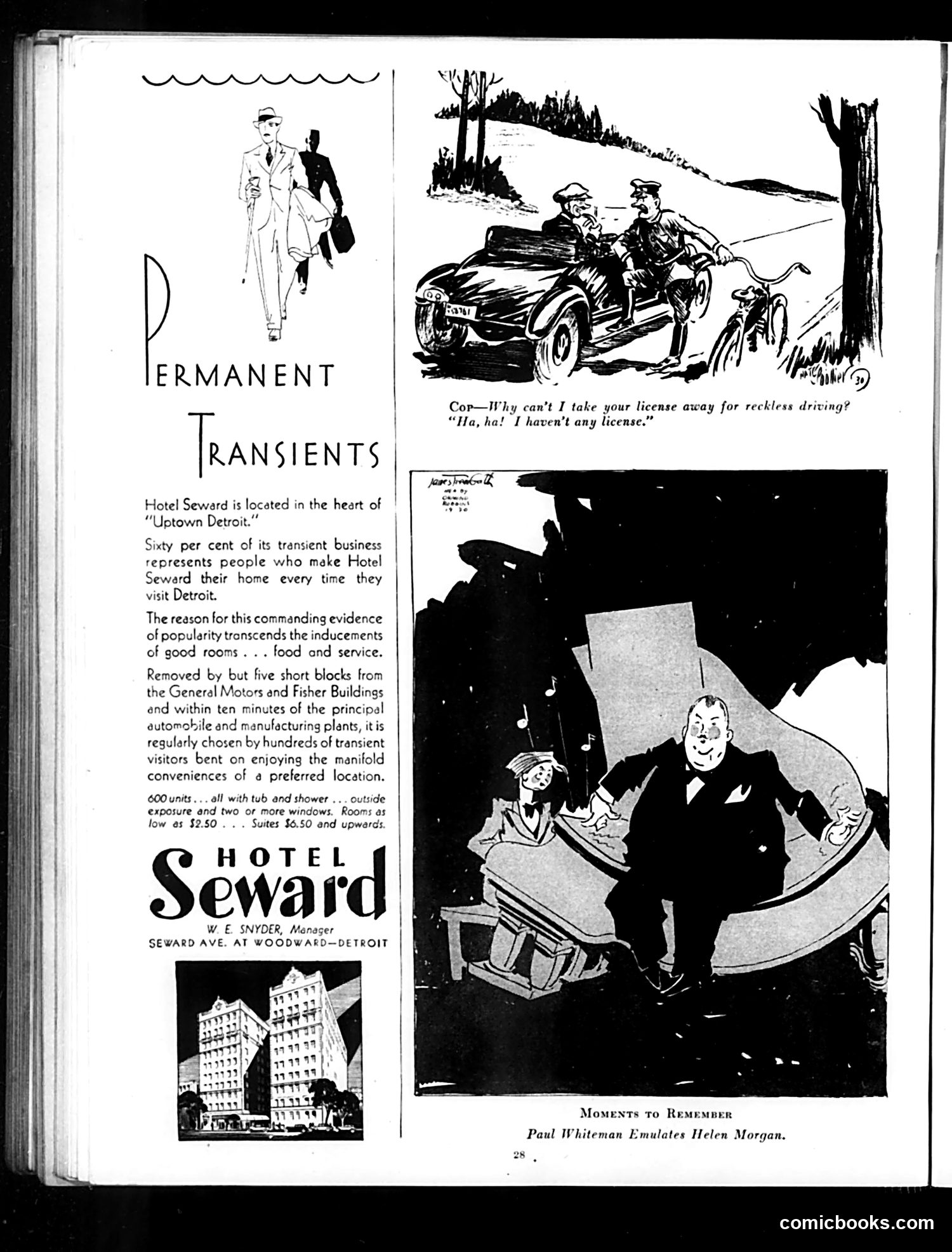
Analysis of Judge Magazine Page This page contains a Hotel Seward advertisement (left) and two unrelated humor items (right). The main cartoon depicts a police officer confronting a reckless driver. The joke relies on a legal loophole: the officer cannot revoke a license the driver doesn't possess. This reflects early automotive regulation when driver's licenses weren't universally required or enforced—a driver could operate a vehicle without formal licensing, making law enforcement's ability to punish dangerous driving limited. The bottom image, captioned "Moments to Remember: Paul Whiteman Emulates Helen Morgan," appears to show musician Paul Whiteman (the "King of Jazz," prominent in the 1920s-30s) imitating torch singer Helen Morgan's characteristic pose—likely reclining on a piano or similar gesture. This is visual comedy mocking Whiteman's imitation of Morgan's famous theatrical style, appealing to readers familiar with both performers. The page largely functions as advertising, with humor as secondary content.
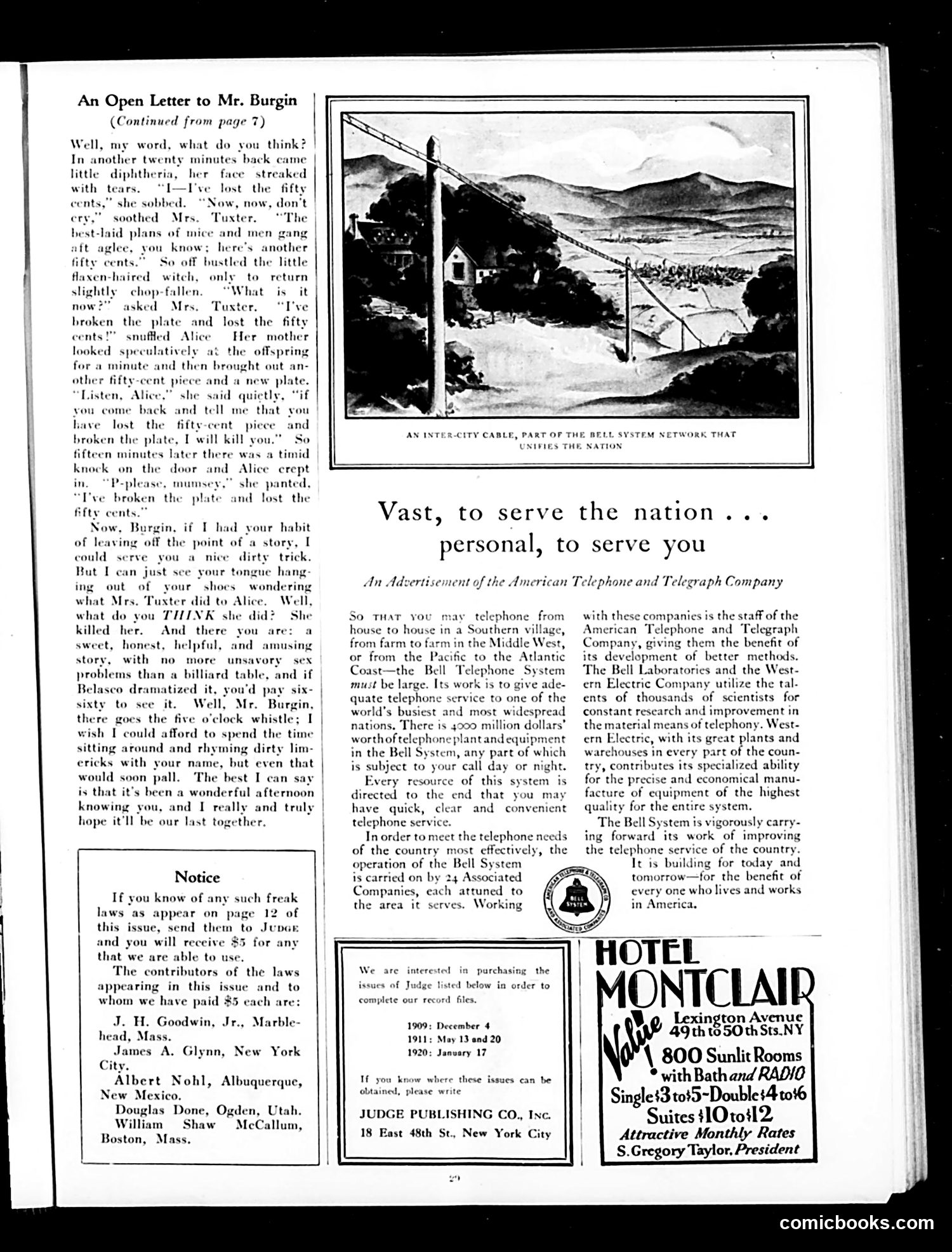
Analysis This page primarily contains advertising and notices rather than satirical cartoons. The main content is a full-page advertisement for the Bell Telephone System, featuring an image of an inter-city telephone cable. The ad emphasizes the Bell System's vast infrastructure—$4 billion in equipment—serving the nation through 24 associated companies. It highlights technological advancement and the role of Bell Laboratories and Western Electric in improving telephone service. The page also includes: - A continuation of "An Open Letter to Mr. Burgin" (satirical commentary about a story writer) - A "Notice" section soliciting unusual state laws from readers - A Hotel Montclair advertisement - A Judge Publishing Company notice about back issues The Bell ad represents typical corporate messaging of the era, promoting infrastructure development and national connectivity—themes relevant during the early 20th century expansion of telecommunications.
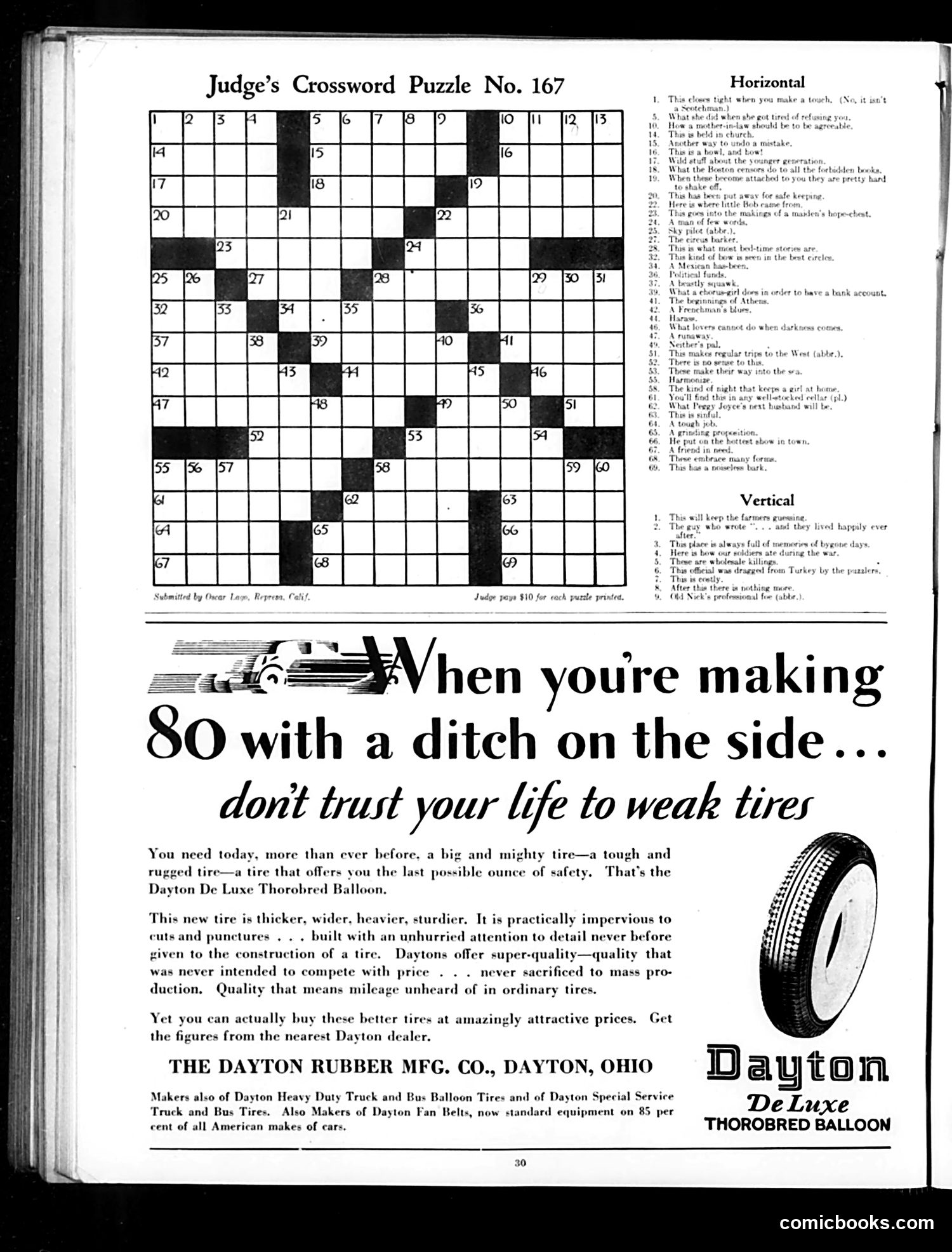
Analysis of Judge Magazine Page No. 167 This page combines a crossword puzzle with a full-page tire advertisement, not a political cartoon. The ad features a safety warning: "When you're making 80 with a ditch on the side... don't trust your life to weak tires." This appeals to automobile safety concerns—relevant to the 1920s-30s era when driving at high speeds was becoming common but road infrastructure and tire technology were still developing. The Dayton Rubber Manufacturing Company promotes their "De Luxe Thorobred Balloon" tire as superior: thicker, wider, heavier, and puncture-resistant. They claim quality that "was never sacrificed to mass production," positioning it as a premium product despite "amazingly attractive prices." The ad also notes Dayton makes truck tires and fan belts for "85 percent of all American makes of cars"—indicating market dominance. This is straightforward commercial advertising rather than satire, typical of Judge's revenue model combining humor with paid advertisements.
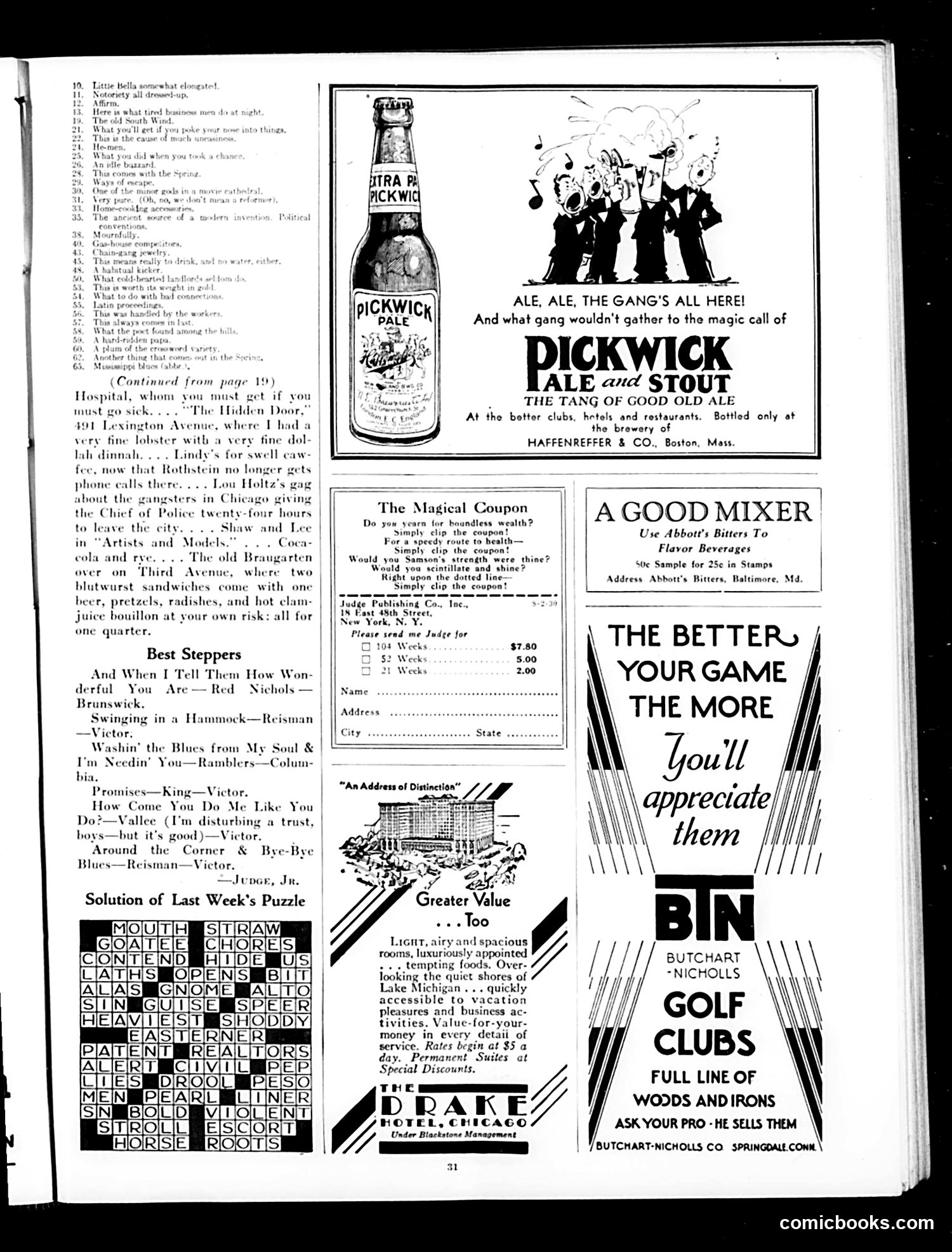
Pickwick Ale Advertisement with Period References This page is primarily advertising, not political satire. The dominant content is a Pickwick Ale & Stout beer advertisement featuring a cartoon of well-dressed men in formal attire celebrating around a bottle. The ad's headline—"ALE, ALE, THE GANG'S ALL HERE!"—references the popular 1917 song "Here Come the Blues" or similar era drinking songs. The phrase "gang" likely evokes the convivial socializing typical of speakeasy culture during Prohibition (when this Judge issue appeared). The accompanying text mentions Chicago gangsters and police chiefs, reflecting 1920s public fascination with organized crime figures. However, the beer advertisement itself contains no explicit satire—it's a straightforward commercial pitch emphasizing the beverage's quality and availability at "better clubs, hotels and restaurants." The page also includes other period advertisements (Abbott's Bitters, golf clubs, hotels) and a crossword puzzle solution—standard Judge magazine filler content from this era.
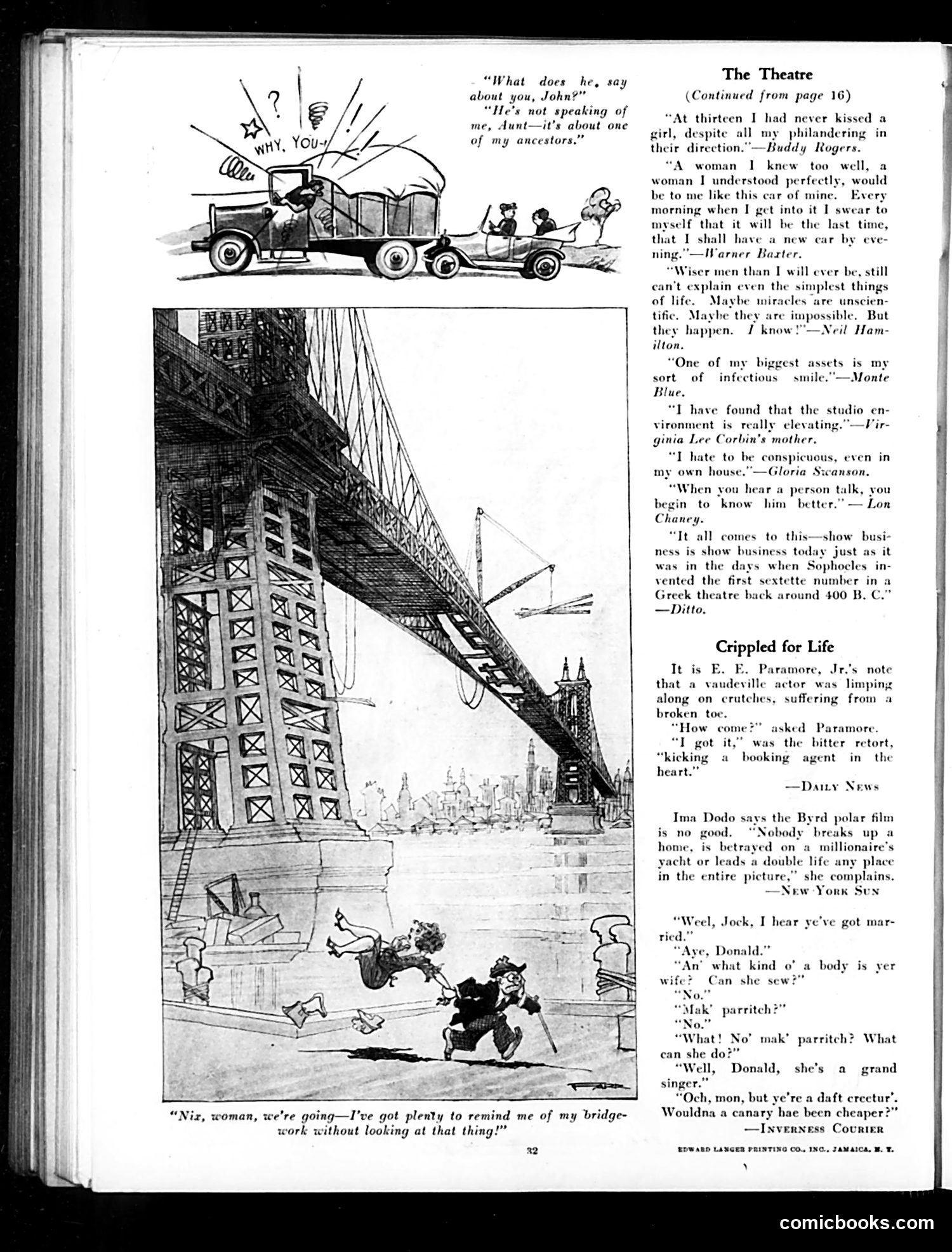
Analysis of Judge Magazine Page This page combines theatrical quotes with humor sections. The top cartoon shows a man frustrated by a woman pointing at a bridge, with his caption expressing he doesn't need reminders of bridge-work—likely a visual pun about actual bridge construction versus marital burden. "The Theatre" section features quotes from 1920s film actors (Buddy Rogers, Warner Baxter, Neil Hamilton, Monte Blue, Gloria Swanson, Lon Chaney) reflecting on life and show business, emphasizing that entertainment follows timeless patterns. "Crippled for Life" is a brief joke about a vaudeville actor who broke his toe, then ironically seeks a booking agent—dark humor about desperation in show business. "Ima Dodo" section satirizes Byrd polar expedition films as melodramatic: "Nobody breaks up a home...on a millionaire's yacht"—mocking overwrought plot devices. The Scottish dialogue is an ethnic humor piece featuring a marriage discussion where a prospective bride's only qualification is singing, prompting the response that a canary would've been cheaper. The page reflects 1920s attitudes: show business cynicism, ethnic stereotyping, and slapstick humor conventions.
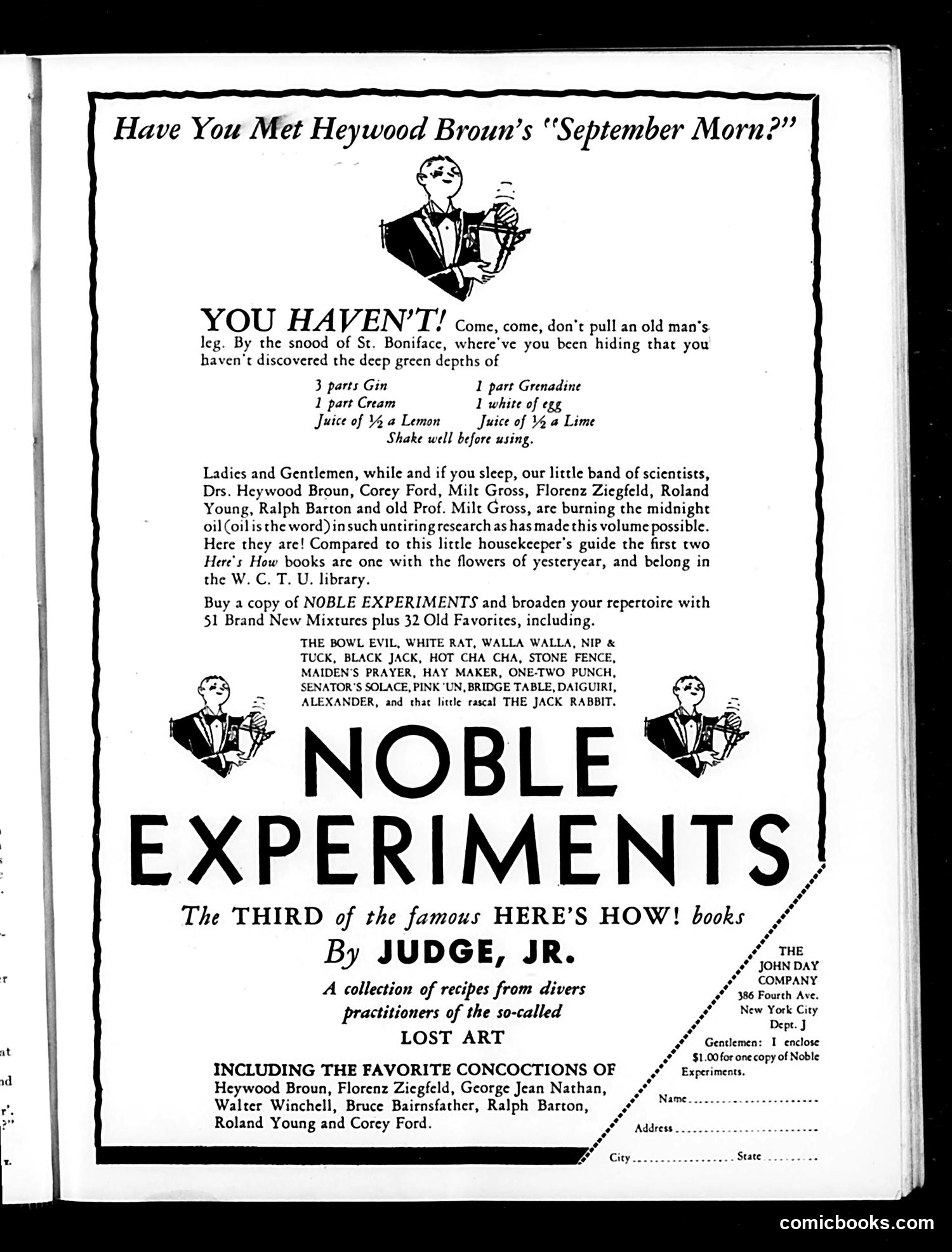
"Noble Experiments" Advertisement Analysis This is primarily a book advertisement, not political satire. It promotes *Noble Experiments*, the third "Here's How" cocktail recipe book by Judge Jr., published during Prohibition (the 1920s-early 1930s). The satire lies in the open mockery of Prohibition laws. The page lists 51 new cocktail recipes with tongue-in-cheek names like "Bowl Evil," "White Rat," and "Senator's Solace"—deliberately flouting alcohol restrictions. The reference to "burning the midnight oil" in "untiring research" sarcastically presents illegal drink-mixing as serious scientific work. Named contributors include prominent 1920s cultural figures: Heywood Broun (journalist/critic), Walter Winchell (gossip columnist), Florenz Ziegfeld (theatrical impresario), and various entertainers. Their involvement suggests respectable society openly participated in circumventing Prohibition. The joke for contemporary readers: Judge magazine brazenly advertised illegal alcohol recipes under the guise of a "lost art," reflecting widespread public defiance of Prohibition during the era.
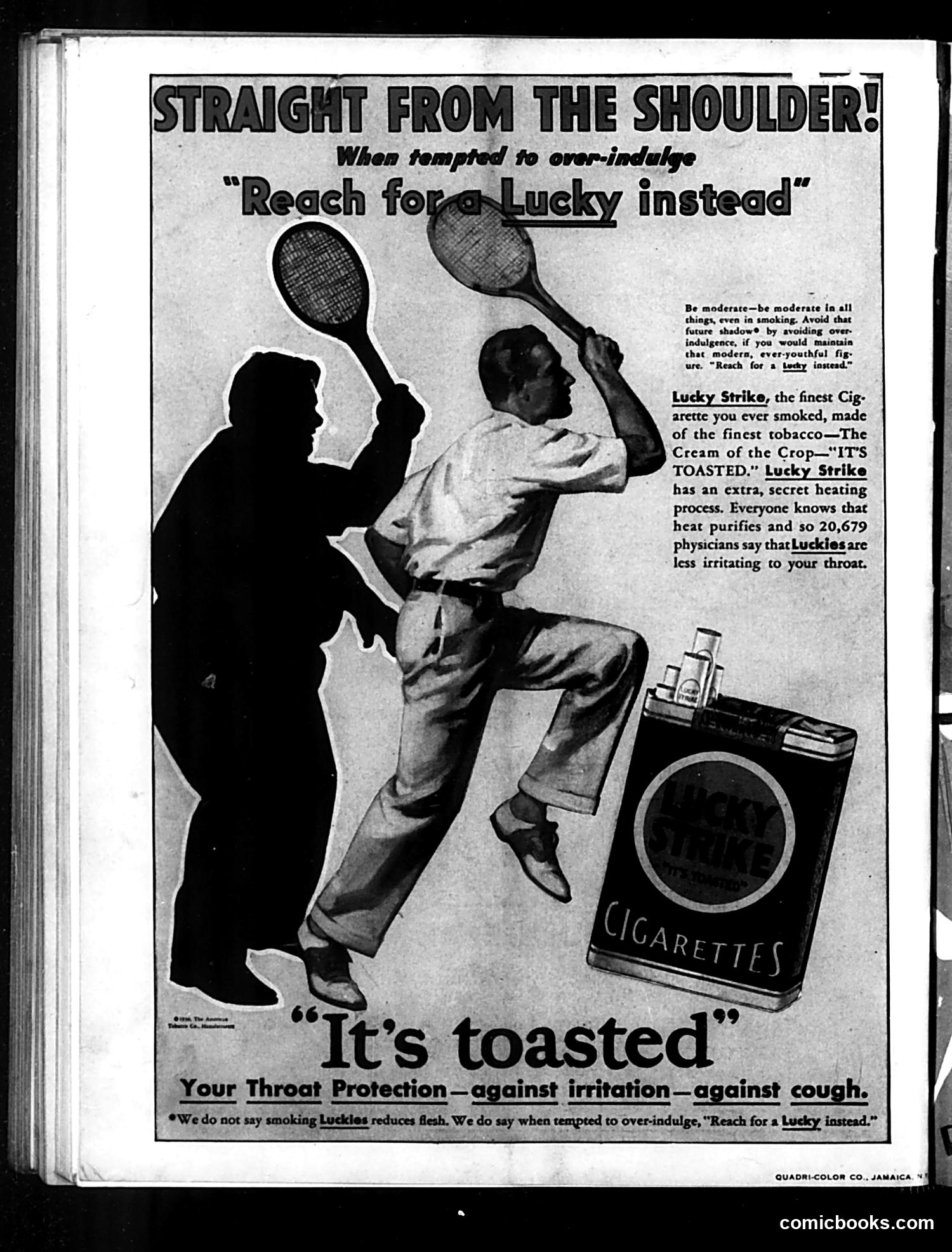
Analysis This is a cigarette advertisement, not political satire. It features a tennis player in action, with a silhouetted woman watching, promoting Lucky Strike cigarettes. The ad's argument: smoking Lucky Strikes helps maintain a slim, youthful figure compared to over-indulging in other foods or habits. The tagline "Reach for a Lucky instead" suggests substituting cigarettes for eating. The "throat protection" claims reference Lucky Strike's toasting process, citing 20,679 physicians who allegedly said Luckies were less irritating than competitors' brands—a common advertising tactic of this era (likely 1920s-30s). The humor comes from the absurd premise that cigarettes are a health/diet aid. By modern standards, this advertisement is shocking for promoting smoking as beneficial and for weight control—now understood as deeply harmful misinformation.