judge
Judge — August 9, 1930
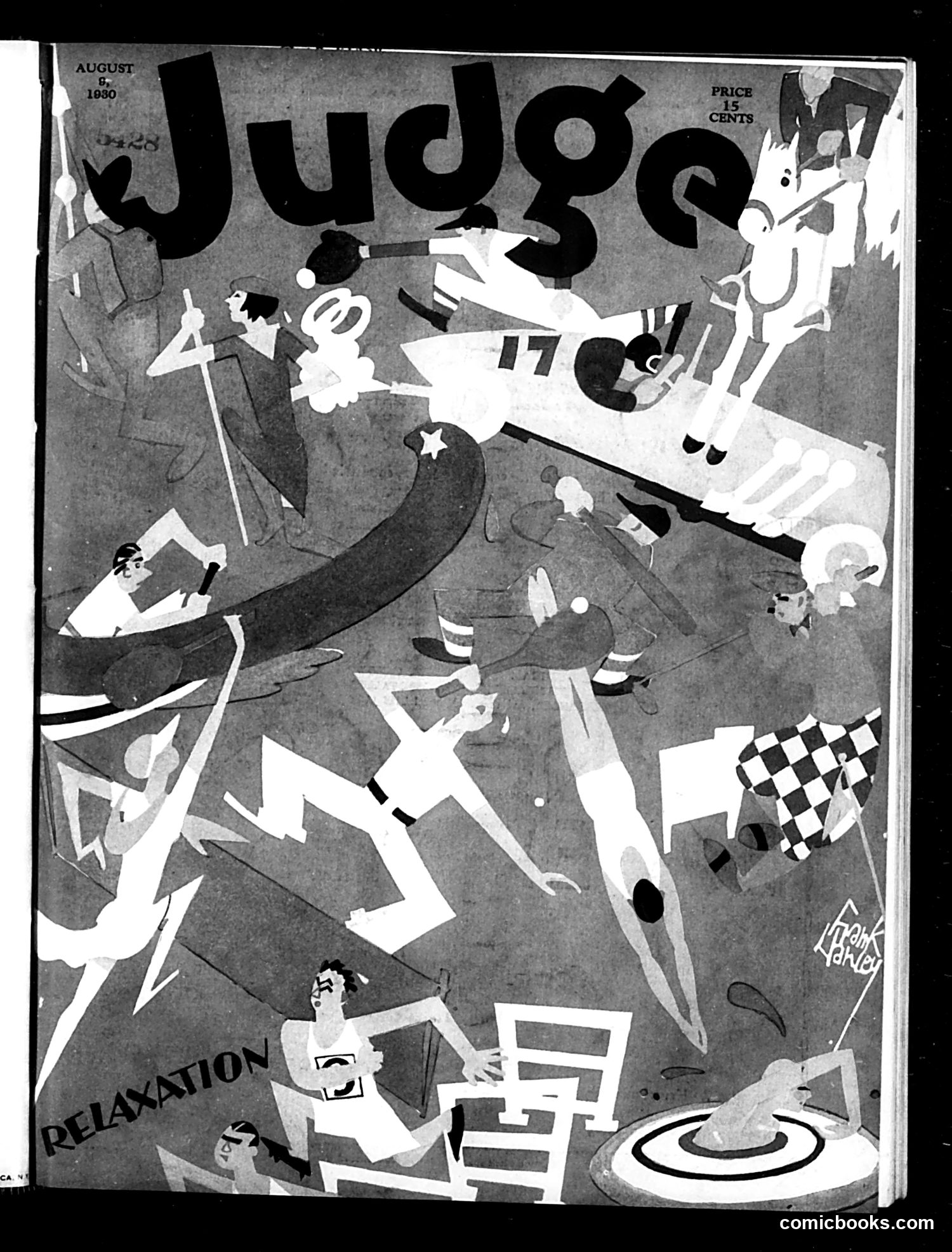
Judge Magazine Cover Analysis - August 15, 1890 This cover illustrates the theme of "Relaxation" during summer leisure time. The dynamic Art Deco-style composition depicts various figures engaged in recreational activities: bathing, boating, playing sports, and lounging. The artistic style—with its geometric forms, dramatic angles, and stylized human figures—is characteristic of 1890s modernist illustration. The satire appears gentle rather than pointed, celebrating upper-class summer pastimes. The checkered flag and competitive sporting imagery suggest racing or athletic competition as popular diversions. The price of 15 cents indicates this was a mass-market publication for educated, affluent readers seeking sophisticated humor and social commentary through visual art and illustration rather than explicit political critique.
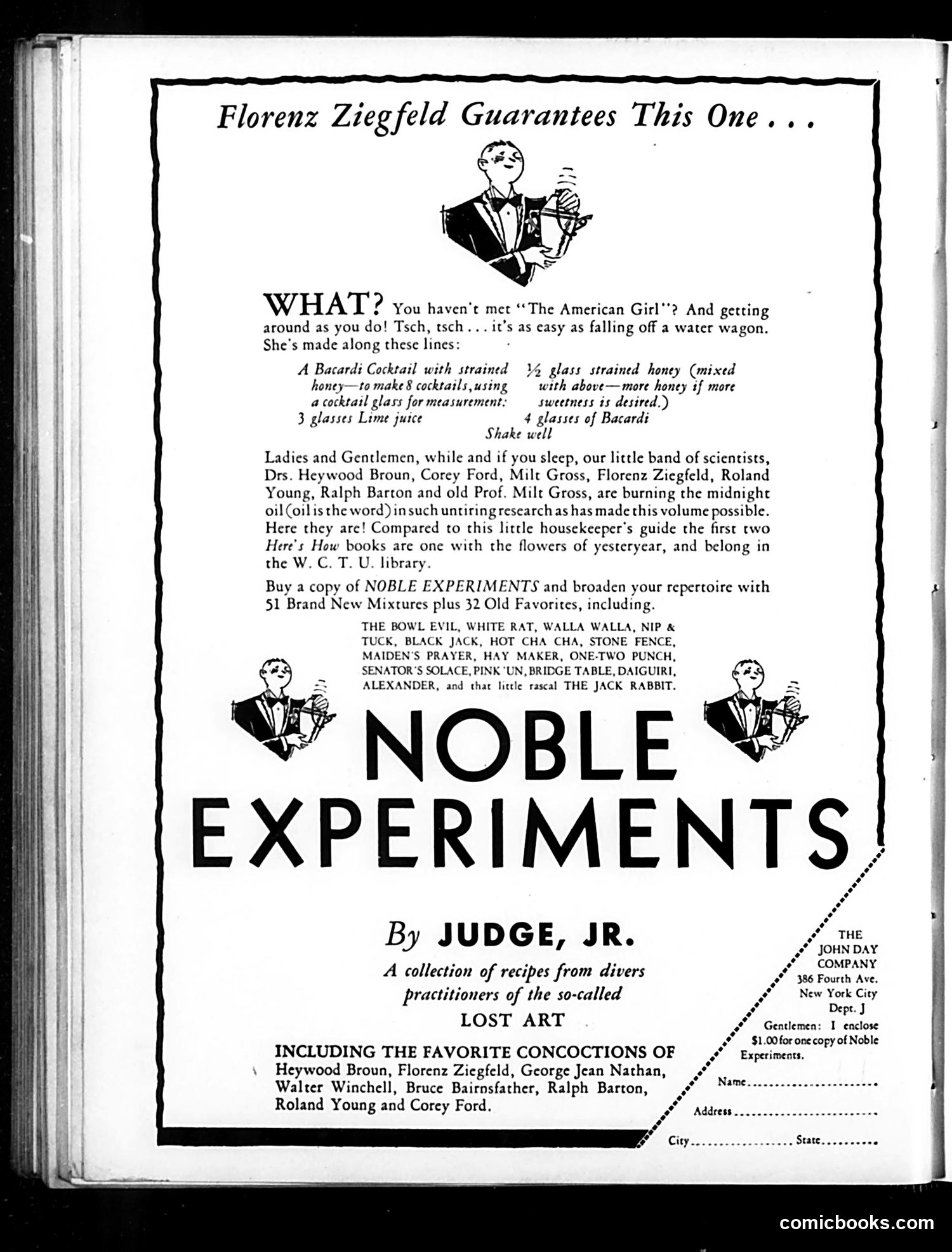
Analysis This page is primarily advertising copy, not political satire. It promotes "Noble Experiments," a cocktail recipe book by Judge Jr., published by The John Day Company. The advertisement features a man in formal attire (likely representing the author or a typical reader) holding a cocktail—a visual association between sophisticated drinking and "noble" pursuits. The repeated images and enthusiastic tone suggest this is tongue-in-cheek marketing. The phrase "noble experiments" appears to reference Prohibition-era speakeasies and homemade cocktails created during the "lost art" of mixology. The book promises 51 brand-new drink recipes plus 32 old favorites with evocative names (many listed in the ad). This is commercial content using humor and wordplay to sell a product to Judge magazine's affluent, cocktail-drinking readership during the Prohibition period.
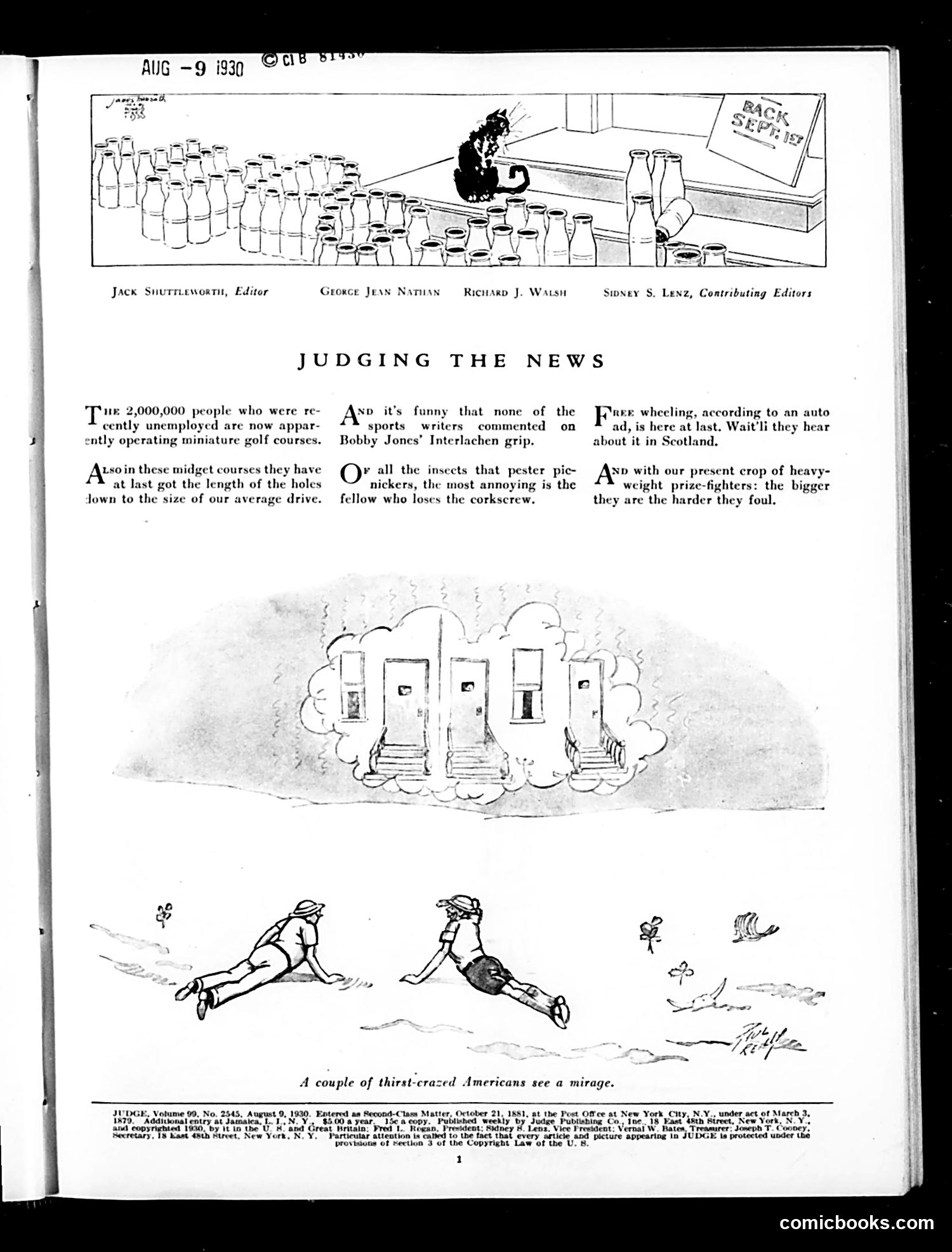
"Judging the News" - August 9, 1930 This satirical commentary page uses humor to comment on contemporary issues. The top cartoon shows a man examining numerous bottles, likely referencing Prohibition-era bootlegging or counterfeit alcohol distribution—a major crime issue of 1930. The section headings mock various news stories: unemployment (2 million jobless), miniature golf courses' popularity, sports commentary, and pest control frustrations. The bottom cartoon depicts two dehydrated people hallucinating a mirage of public restrooms—titled "A couple of thirst-crazed Americans see a mirage." This likely satirizes either Prohibition's effects (difficulty obtaining legal beverages) or the lack of public facilities in Depression-era America. The overall page exemplifies Judge's approach: condensing weekly news into brief, illustrated jokes targeting contemporary social concerns and consumer frustrations.
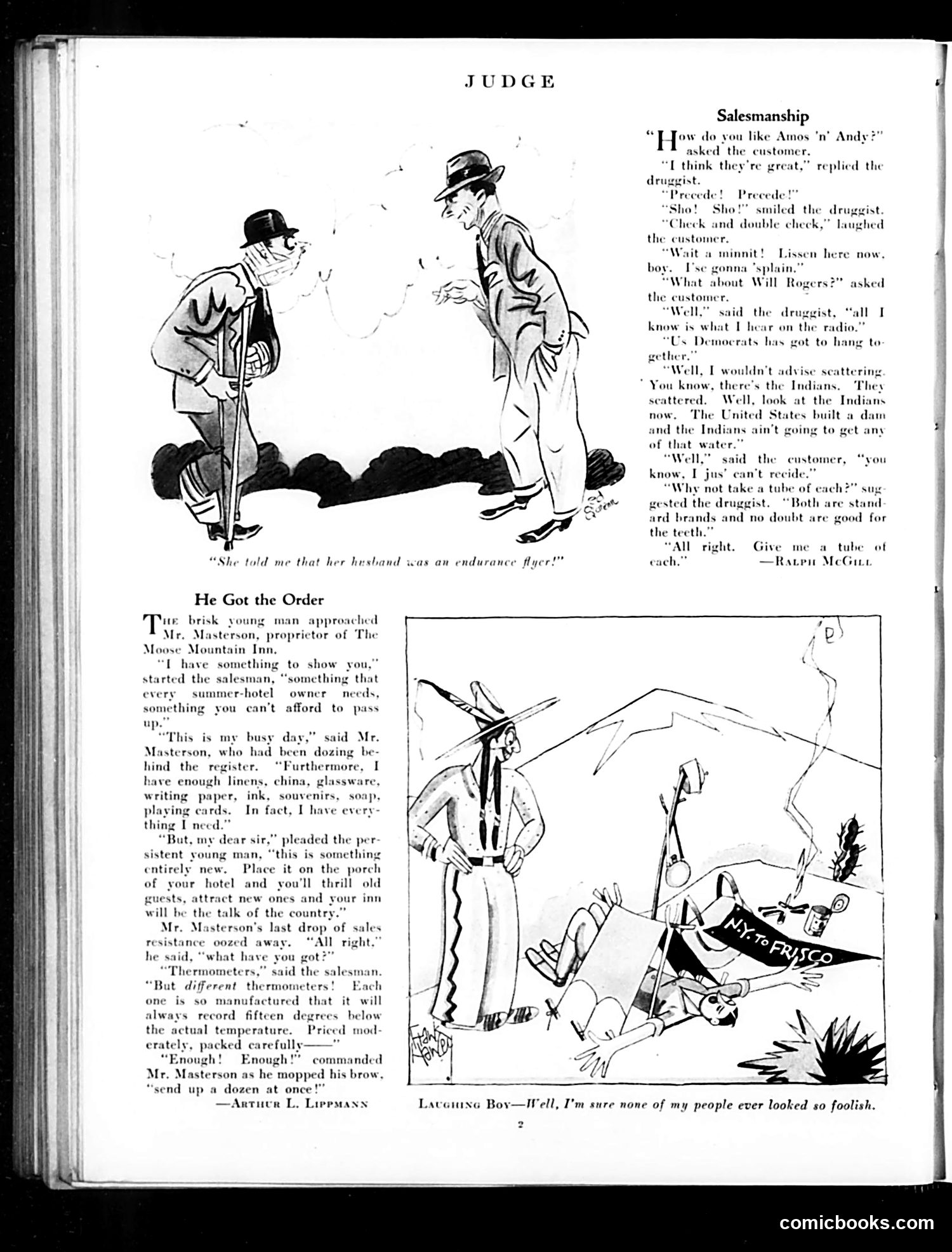
Analysis of Judge Magazine Page The page contains two satirical pieces: "Salesmanship" (top): A drugstore clerk discusses politics with a customer, joking about Will Rogers, Democrats, and Native Americans building dams. The humor relies on contemporary political references (likely 1920s-30s New Deal era) that are now obscure. "He Got the Order" (bottom): A salesman pitches novelty thermometers to a hotel proprietor, Mr. Masterson. The joke centers on the thermometers' usefulness for attracting guests—satirizing aggressive sales tactics and the absurdity of marketing gimmicks to innkeepers. Both pieces mock American business culture and contemporary politics through dialogue-driven humor. The cartoons' specific references to politics and consumer goods reflect Depression-era anxieties about commerce and government spending, though precise historical context would require additional research.
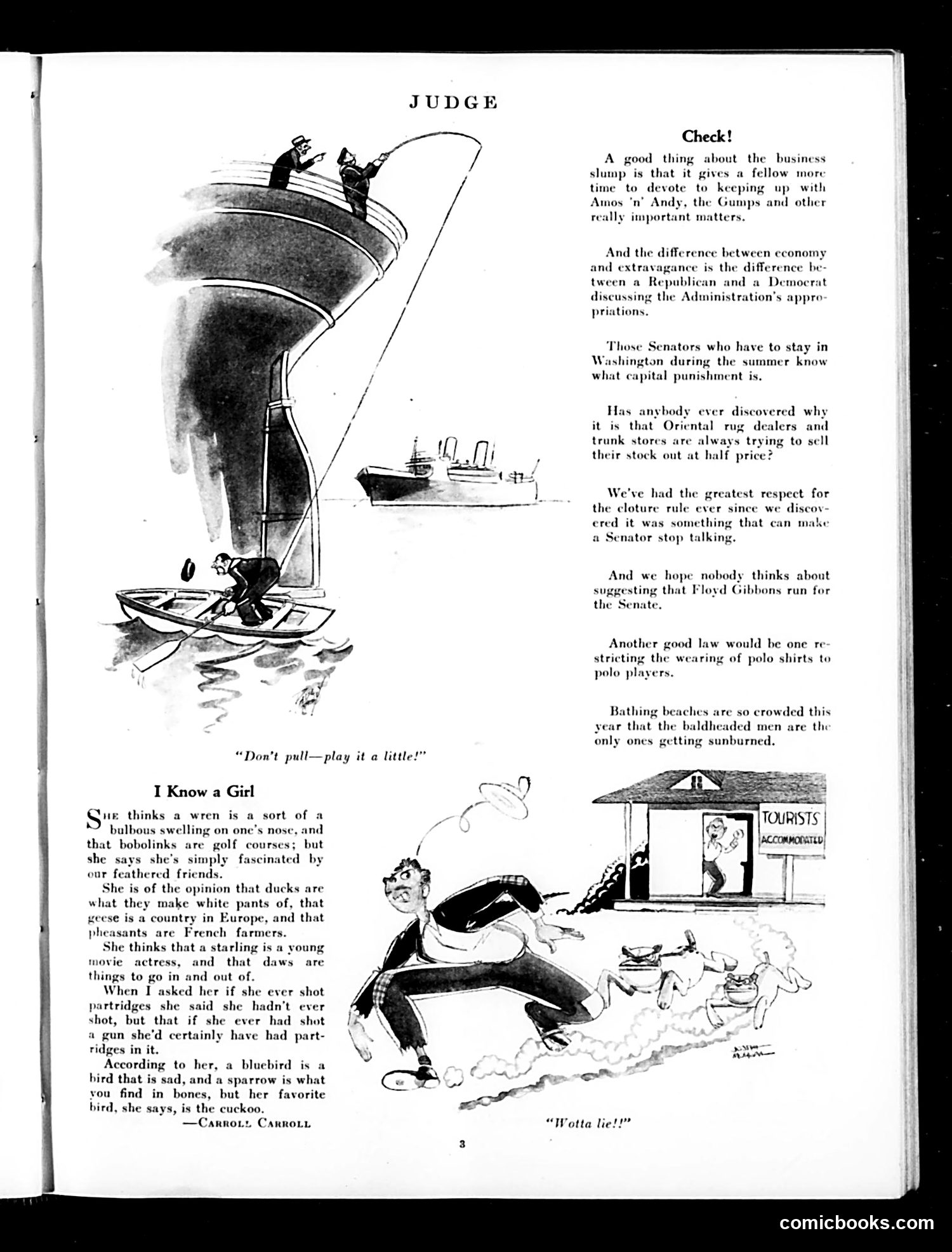
Analysis of Judge Magazine Page The top cartoon titled "Judge" (captioned "Don't pull—play it a little!") depicts two figures fishing from a large funnel or tornado-like structure, with a ship below. This appears to be political satire about judicial or governmental overreach, warning against excessive "pulling" or aggressive action—perhaps referencing court decisions or political maneuvering of the era. Below, "I Know a Girl" by Carroll Carroll is a humorous piece about a woman's absurd misconceptions about birds and animals, presented as a lighthearted joke column. The bottom cartoon "Wotta lie!" shows a man being chased by children near a "Tourists Accommodated" sign, satirizing overcrowded beach conditions and sunburned bathers—referencing the tourism boom and beach culture of the period.
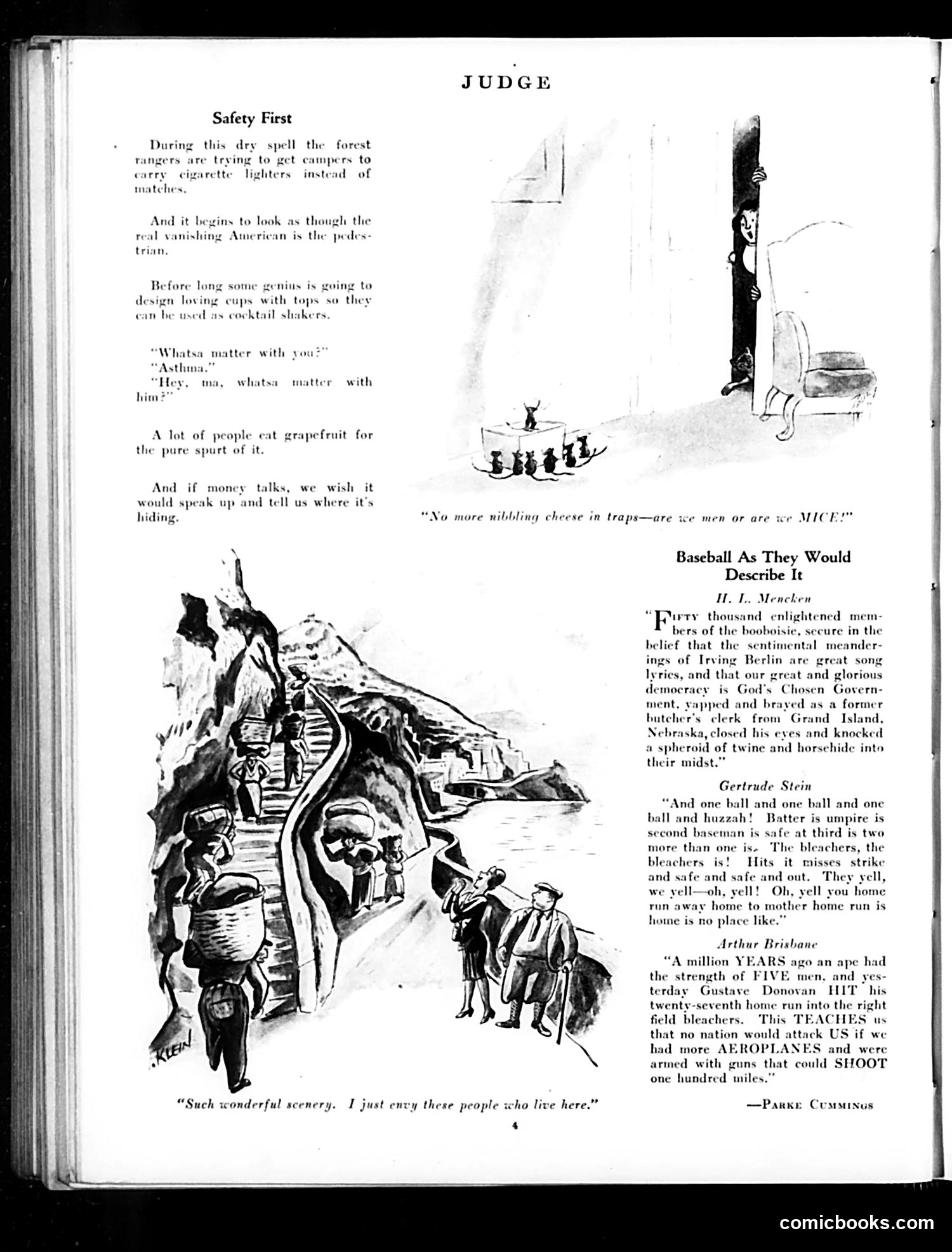
Analysis of Judge Magazine Page This page contains three distinct pieces of satire: "Safety First" (top): A brief commentary mocking the declining "real vanishing American" pedestrian—suggesting Americans are becoming extinct. Jokes follow about designers creating loving cups as cocktail shakers and people eating grapefruit for enjoyment rather than nutrition, satirizing frivolous consumer culture. "No more nibbling cheese in traps" (center): A cartoon showing mice in a trap, likely commenting on workplace or social entrapment, though the specific reference is unclear. "Baseball As They Would Describe It" (bottom): Humorous literary descriptions of baseball by famous authors (H.L. Mencken, Gertrude Stein, Arthur Brisbane, Parke Cummins), parodying their distinctive writing styles by applying them to the sport—a recurring Judge feature mocking pretentious literature.
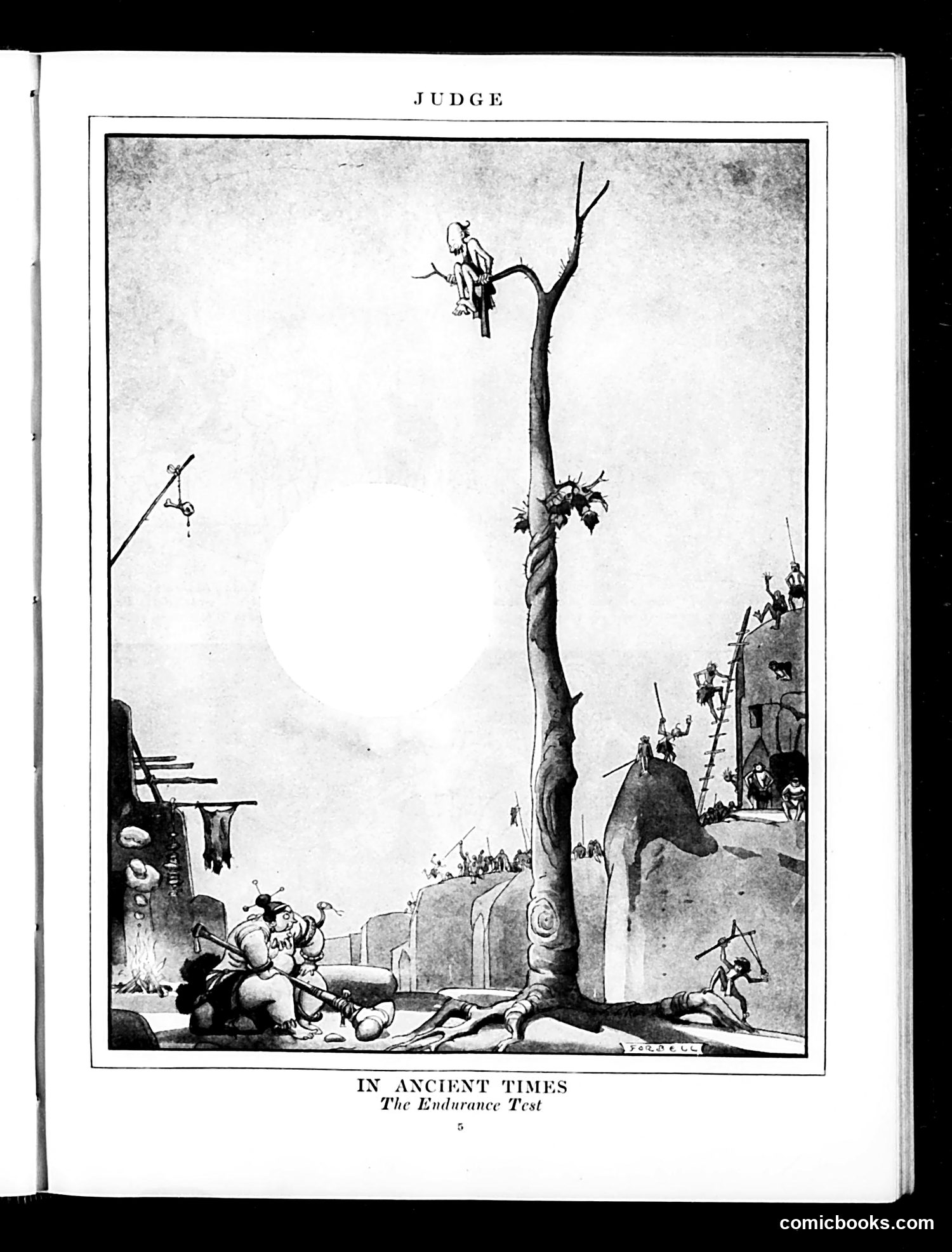
"The Endurance Test" - Judge Magazine Cartoon This satirical cartoon depicts "In Ancient Times: The Endurance Test," showing what appears to be a brutal public spectacle. Multiple figures are positioned on a tall wooden pole or structure, while crowds gather on fortified structures around them. The scene references ancient Roman or gladiatorial entertainment practices. The satire likely critiques contemporary American practices by comparing them to ancient barbarism—suggesting that modern society's own "tests" (possibly labor practices, political trials, or public spectacles) are equally primitive and cruel. The cartoon's title emphasizes endurance, implying suffering inflicted for public entertainment or institutional purposes. The crowded observers suggest societal complicity in witnessing such brutality, a common Judge magazine theme mocking both specific practices and collective moral failings.
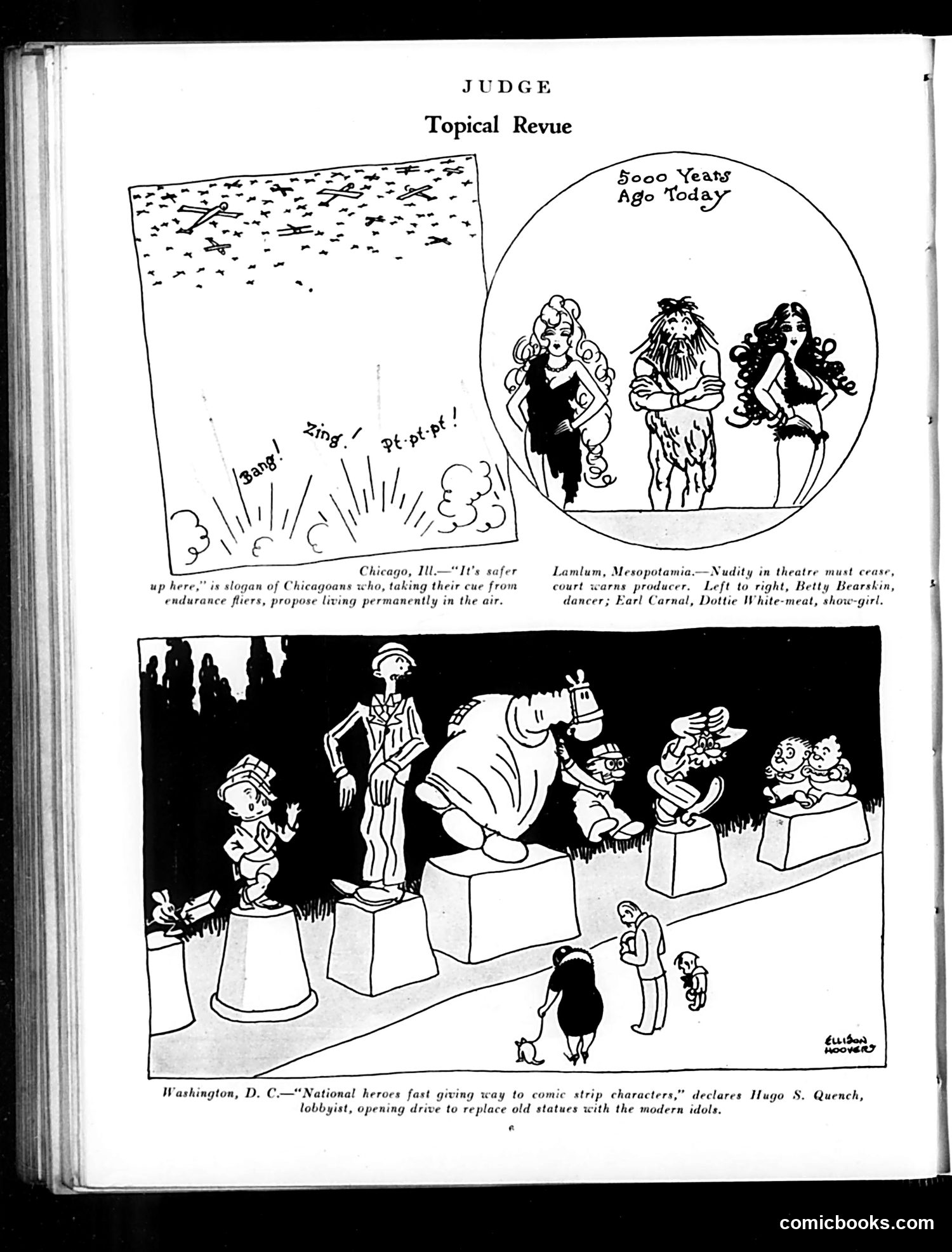
Topical Revue - Judge Magazine Satire This page contains three cartoons satirizing contemporary American culture: 1. Chicago aerial traffic: Mocks Chicago residents' proposal to live permanently on "endurance piers" (observation towers), with planes creating noise ("Bang! Zing! Pt-pt-pt!"). 2. Ancient Mesopotamia nudity: A circular panel jokes that ancient theater nudity would violate modern court standards—naming performers Betty Bearskin, Earl Carnal, and Dotlie White-meat as stand-ins. 3. Washington monument replacement: Hugo S. Quench proposes replacing historical statues with "modern idols" (comic strip characters), shown here as oversized cartoon figures on pedestals replacing traditional heroes. This satirizes shifting cultural values and the modernization of American iconography. All three mock contemporary anxieties about progress, morality, and changing traditions.
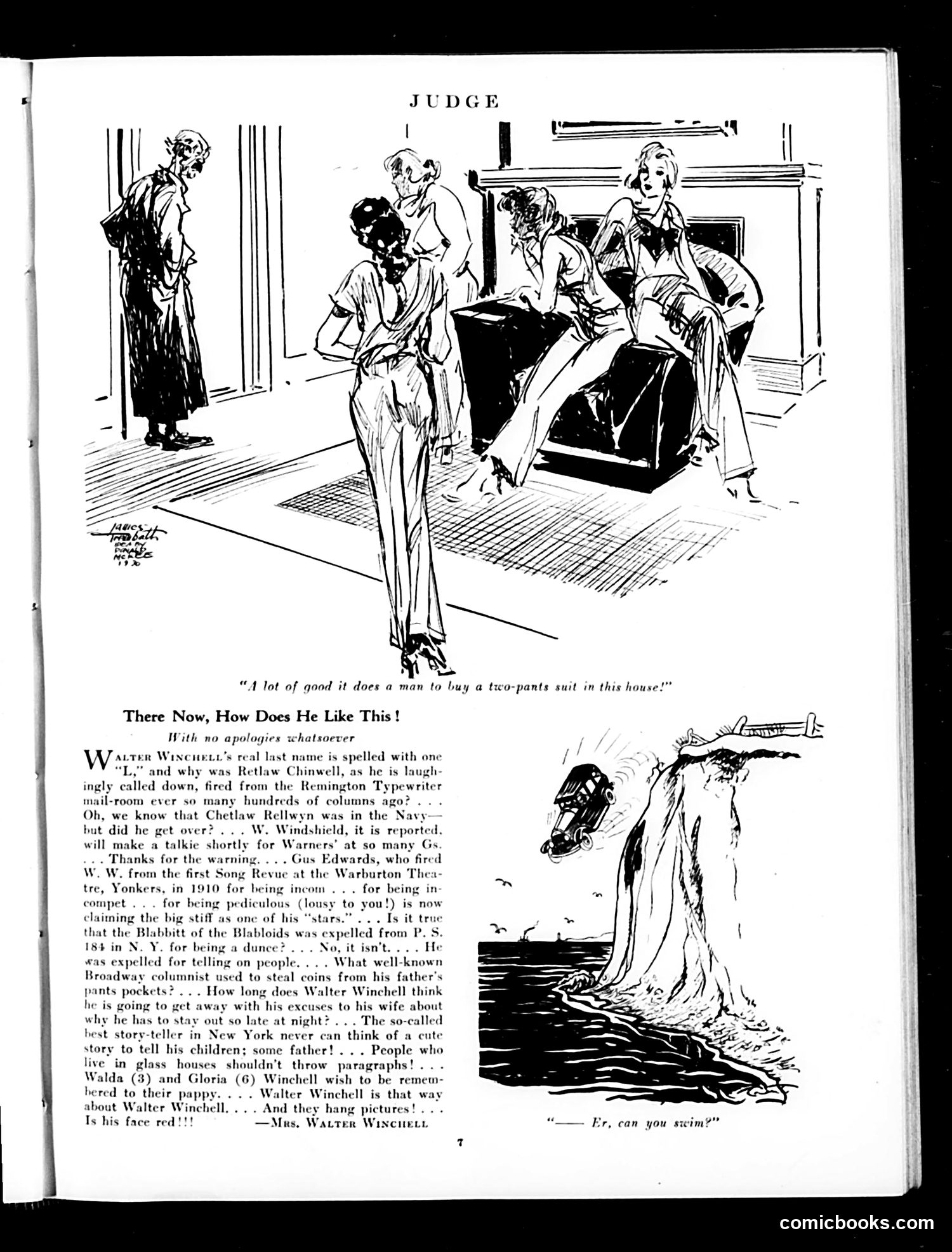
Judge Magazine Cartoon Analysis This page satirizes Walter Winchell, the famous Broadway gossip columnist and entertainer. The top cartoon shows a judge's courtroom where a woman complains about her husband buying a two-pants suit—likely mocking marital disputes or consumer culture. The main text is a scathing attack on Winchell, presented as a letter from "Mrs. Walter Winchell." It ridicules him through wordplay and deliberate name-mangling (spelling his name differently repeatedly), suggesting he's a fraud. The critique covers: - His dubious firing from a typewriter company mail-room - Questions about his actual theatrical credentials - Accusations he steals credit for discovering talent - Claims he plagiarizes stories from columnists - Implies he's unfaithful to his wife and uses transparent excuses - Suggests he can't even tell stories to his own children The illustration shows a dramatic cliff scene with the caption "Er, can you swim?"—implying Winchell should jump. This represents Judge magazine's hostile satire of a prominent public figure, exposing what it viewed as his pretensions and moral failings.
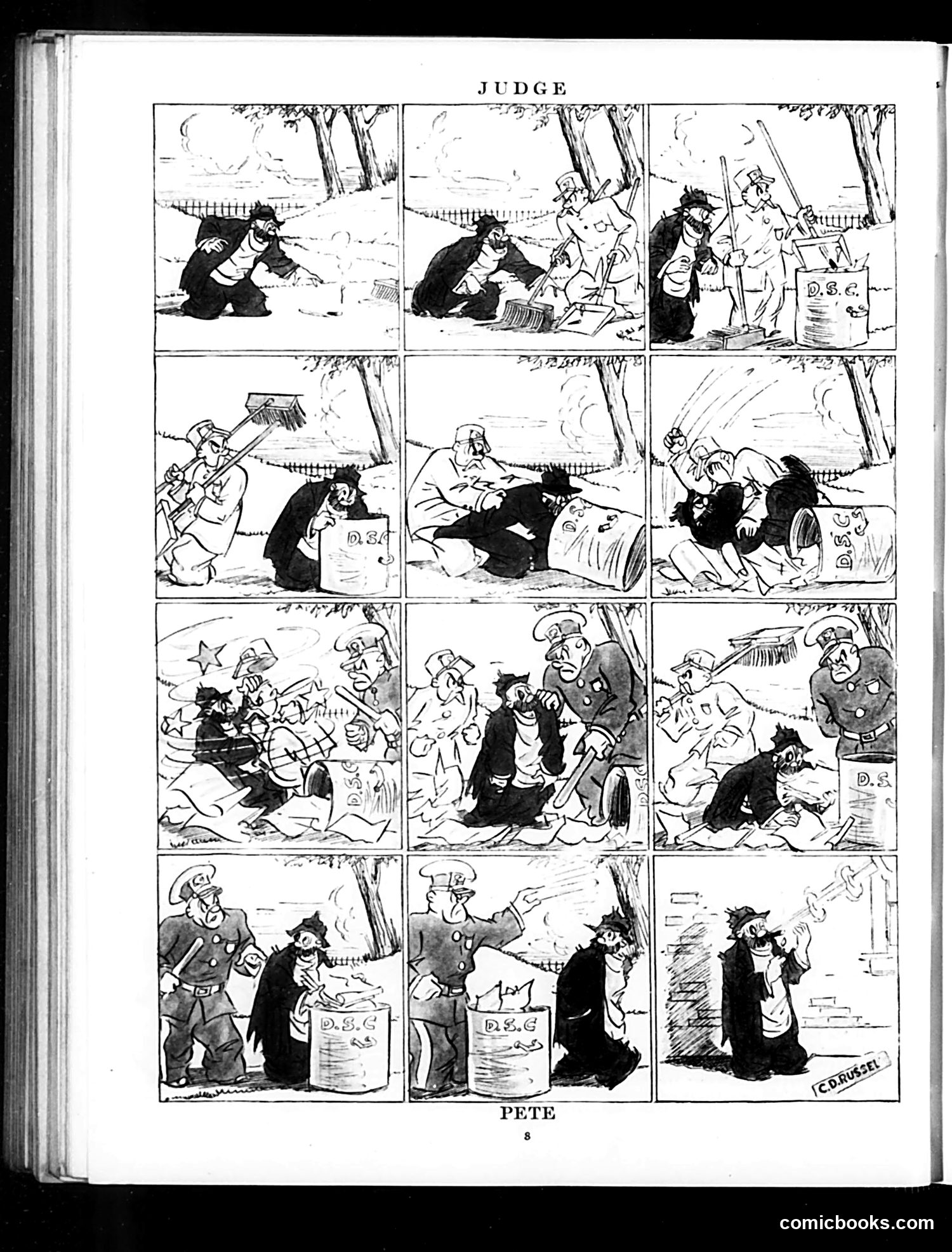
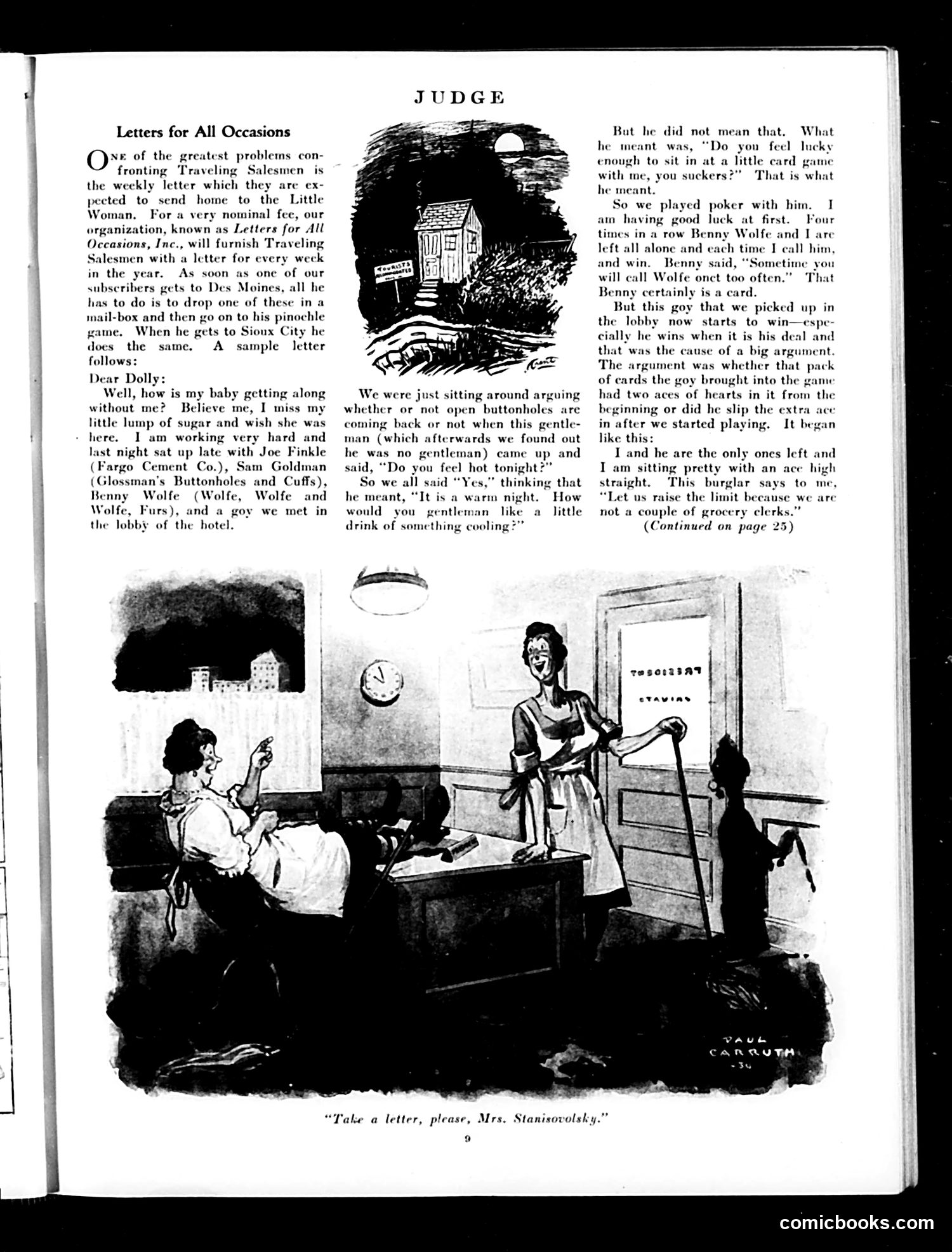
Judge Magazine Satire Analysis This page satirizes traveling salesmen and their domestic deceptions. The main article mocks a fictional service called "Letters for All Occasions, Inc." that supplies pre-written letters for salesmen to mail home, allowing them to neglect actual correspondence while pursuing leisure activities. The sample letter reveals the hypocrisy: the salesman claims to miss his wife ("Little Woman") while detailing his evening playing cards and poker with dubious companions. The story culminates in a rigged card game where a con artist ("the goy") exploits the salesmen, suggesting their own moral compromises make them easy marks. The accompanying cartoon depicts a secretary typing correspondence for clients—visualizing the service's absurdity. The satire targets male infidelity, negligent husbands, and the rationalization of dishonest behavior, presented with Judge magazine's characteristic cynical humor about American business culture and domestic life.
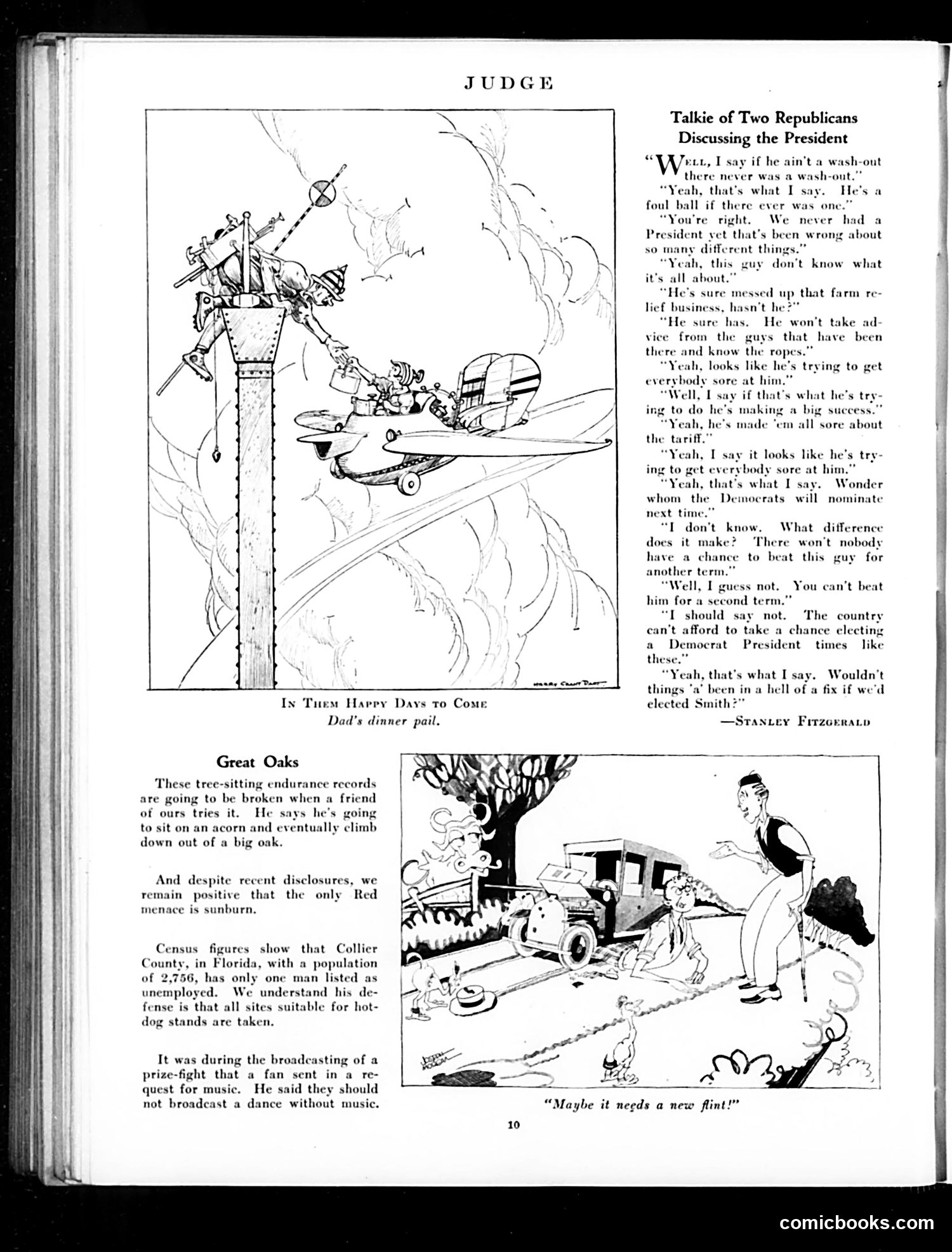
Political Satire from Judge Magazine This page contains a dialogue between two Republicans discussing the incumbent President (likely Herbert Hoover, given references to farm relief and tariff failures during the Great Depression era). The Main Cartoon: Two ordinary citizens complain that the President is incompetent—he's "messed up" farm relief, won't listen to experienced advisors, and has angered everyone with his tariff policies. Yet they conclude he's still unbeatable because Democrats might nominate someone worse (possibly Al Smith, explicitly mentioned). The satire mocks Republicans' loyalty despite acknowledging their leader's failures. The Subtext: Judge is satirizing how voters can be trapped supporting a failed leader simply out of partisan fear of the opposition—a common political predicament. Other Items: Minor humor pieces about tree-sitting endurance records and unemployment statistics in Florida serve as filler content typical of satirical magazines of the era.
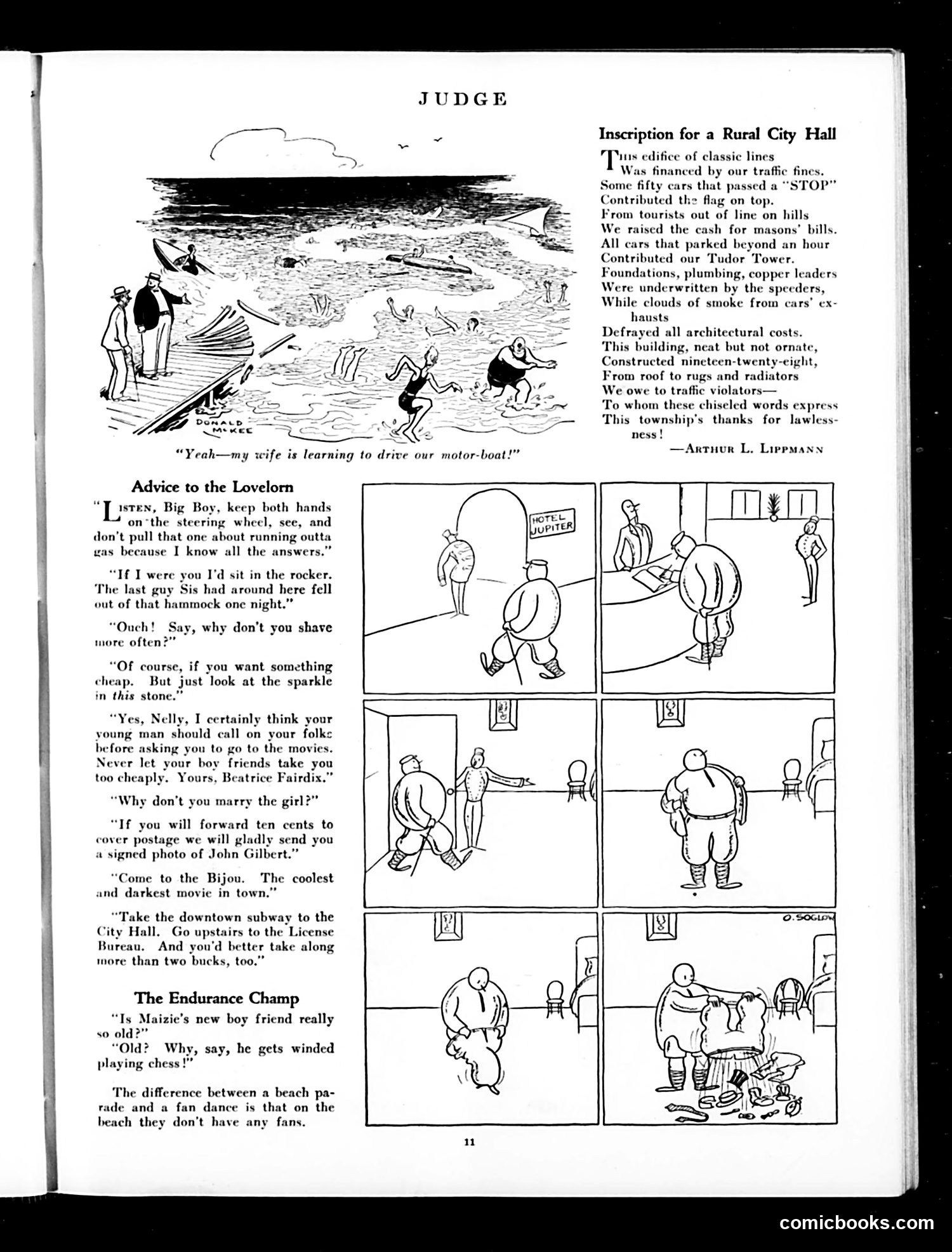
Judge Magazine Page Analysis This page contains two sections of satirical humor typical of 1920s Judge magazine: "Advice to the Lovelorn" presents a comedic advice column mocking dating customs of the era. The humor targets young men's dating anxieties—keeping hands on steering wheels during drives, avoiding hammocks, shaving more often, and the absurd suggestion to forward ten cents for a signed photo of silent film star John Gilbert. The final quip about marriage recommends going to City Hall's License Bureau with "more than two bucks," satirizing marriage costs and bureaucracy. "The Endurance Champ" is a brief joke about an elderly boyfriend who gets winded playing chess—mocking both aging and the sedentary nature of the activity. "Inscription for a Rural City Hall" (top-right) is a poem crediting traffic violators, speeding cars, and lawbreakers for funding the town's 1928 municipal building through fines and accident damage. It's satirical commentary on local government revenue sources during the automobile age. The beach/fan dance quip at bottom is a wordplay joke about the popular 1920s novelty "fan dance."
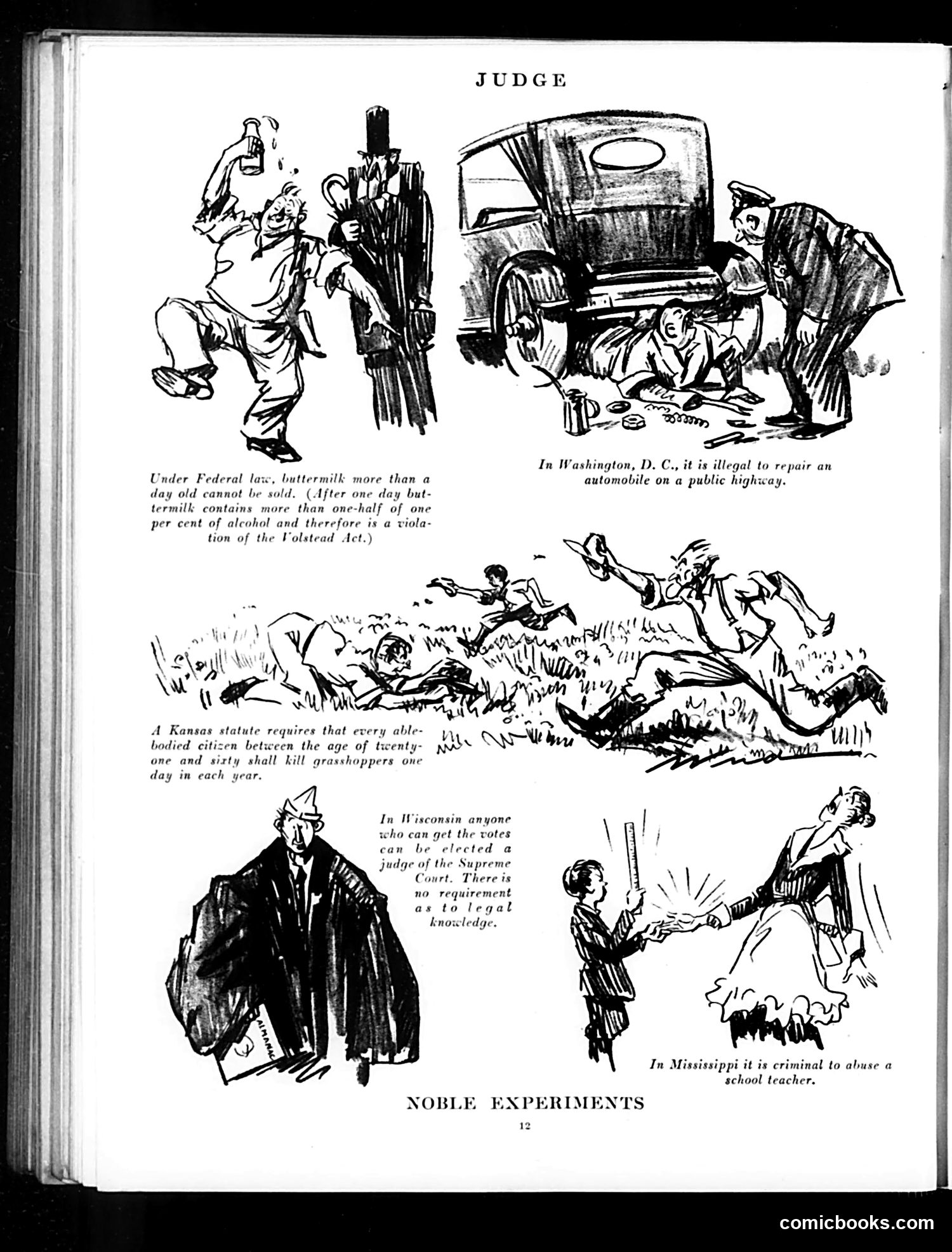
Judge Magazine Satire: "Noble Experiments" This page satirizes absurd or poorly-conceived laws across American states during the Prohibition era. Each cartoon ridicules a specific statute: Top left: Federal Volstead Act enforcement is so strict that buttermilk older than one day violates alcohol laws—absurdly criminalizing a common dairy product. Top right: Washington D.C. bans automobile repairs on public highways, shown as inconvenient and impractical. Center: Kansas requires able-bodied citizens to kill grasshoppers annually—a bizarre and unenforceable mandate. Bottom left: Wisconsin allows anyone with votes to become Supreme Court judge without legal knowledge, mocking judicial incompetence. Bottom right: Mississippi criminalizes abusing schoolteachers, shown as excessive protection. The title "Noble Experiments" ironically references Prohibition itself (Volstead Act). The satire suggests American lawmakers create ridiculous, contradictory, or unenforceable laws, particularly during Prohibition's overzealous regulatory period. The cartoons mock both government overreach and legislative absurdity.
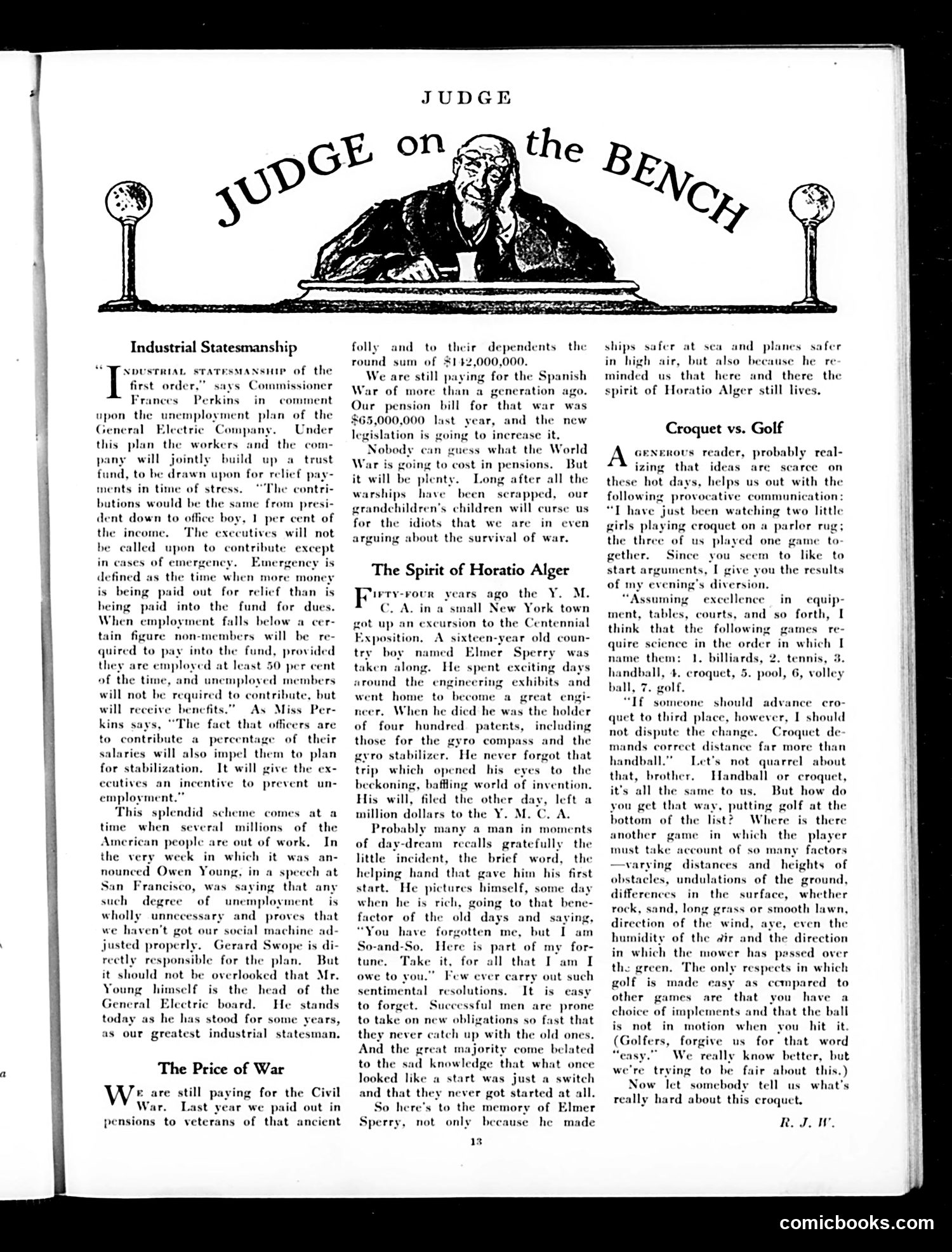
Judge Magazine Page Analysis This page from Judge magazine (appears to be 1920s-era) contains three satirical pieces: "Industrial Statesmanship" criticizes corporate welfare schemes. It mocks General Electric's plan where executives and workers jointly fund unemployment relief, praising it as visionary while noting the contradiction: Owen Young (GE's head) simultaneously claimed unemployment was "wholly unnecessary." The satire highlights hypocrisy—companies acknowledging economic problems while denying they exist. "The Price of War" attacks military spending, citing $142 million spent annually on Civil War pensions and $65 million on Spanish-American War pensions decades after those conflicts. The author warns World War I costs will burden "grandchildren's children," satirizing how nations perpetually pay for past wars while still debating their necessity. "The Spirit of Horatio Alger" celebrates engineer Elmer Sperry, who donated $1 million to the YMCA after a youth excursion inspired his career. It's earnest tribute rather than satire, contrasting with the preceding pieces—praising rare philanthropists who remember benefactors.
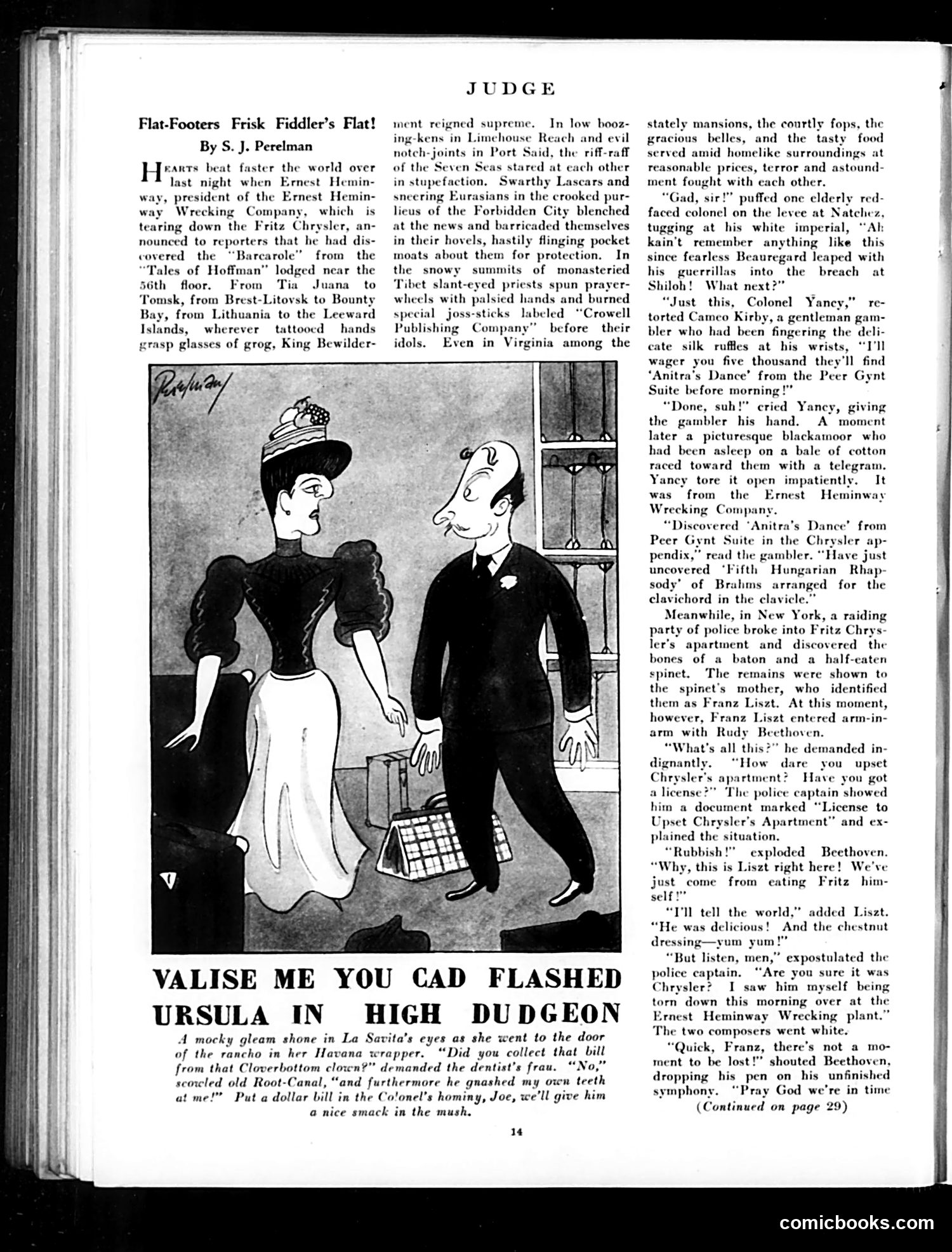
Analysis for Modern Readers This is a absurdist parody by S.J. Perelman mocking sensationalist journalism and the Jazz Age fascination with celebrities. The main story is nonsensical: Ernest Hemingway supposedly runs a wrecking company demolishing "Fritz Chrysler's" apartment building and discovers classical music compositions hidden inside—a deliberate absurdity. The satire targets how the press and public obsess over celebrity scandals. The elaborate, overwrought descriptions of global reaction to trivial news mirror how media outlets breathlessly reported on famous people's personal affairs. Musical references (Liszt, Beethoven, Peer Gynt) are mixed absurdly with modern celebrity drama for comic effect. The cartoon itself depicts what appears to be a romantic scandal scenario, supporting the text's mockery of sensationalized celebrity gossip. The entire piece ridicules both journalism's hyperbole and readers' appetite for such scandals—particularly relevant during the 1920s-30s when celebrity culture was expanding rapidly.
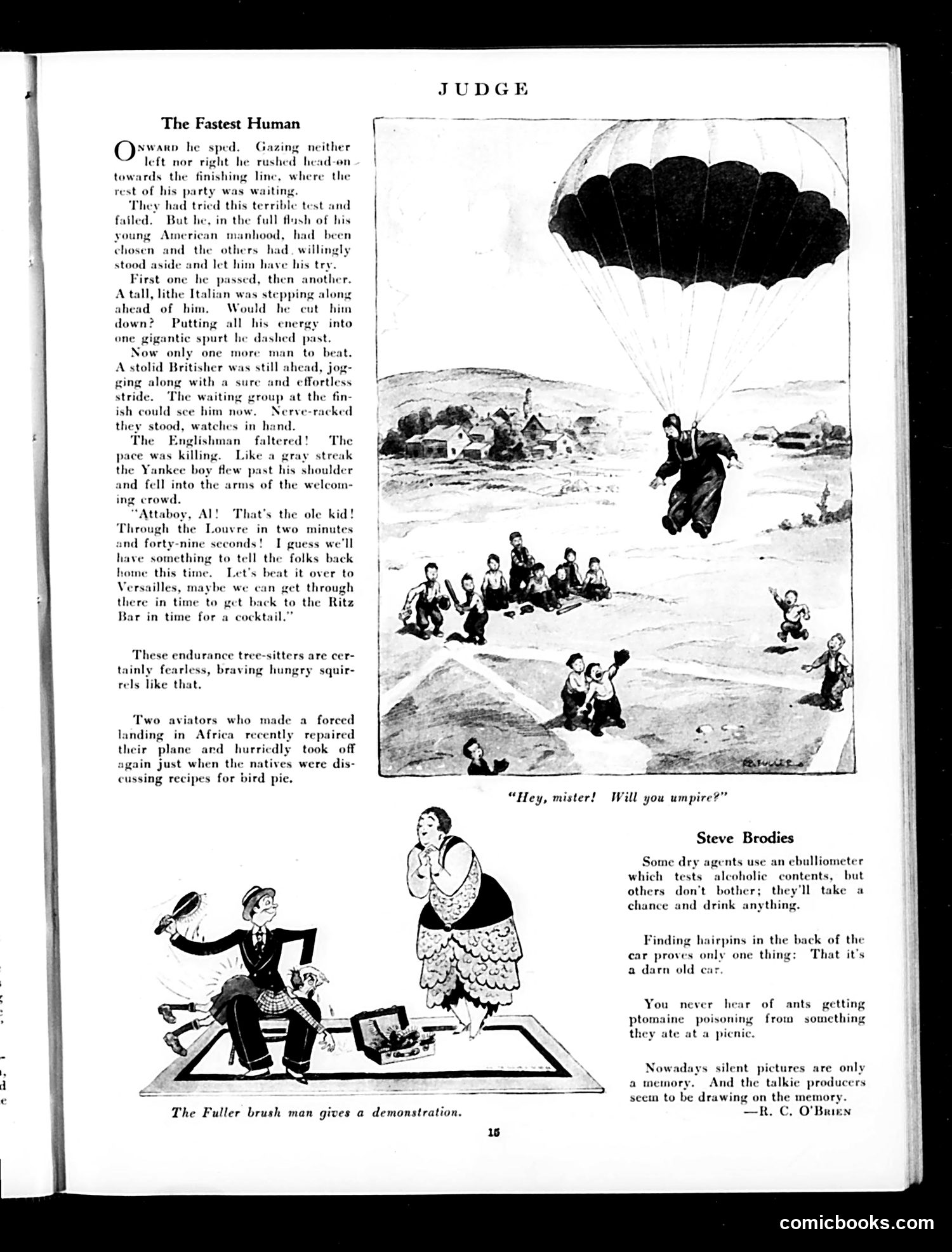
"The Fastest Human" This page satirizes American tourists abroad, particularly their obsession with speed and commercialism. The main story depicts a young American ("Al") racing through Paris—he "rushed" through the Louvre in "two minutes and forty-nine seconds" and plans to dash to Versailles, all to make cocktail hour at the Ritz Bar. The satire targets American cultural attitudes: the competitiveness (beating an Italian and British runner), the superficiality (visiting famous landmarks at breakneck pace), and the materialism (prioritizing luxurious bars over cultural appreciation). The exclamation "That's the ole kid!" captures prideful American boosterism. The cartoon mocks the stereotype of wealthy American tourists treating Europe as a tourist checklist rather than engaging meaningfully with its culture. The implication: Americans consume experiences as quickly as they consume drinks, missing the point entirely.
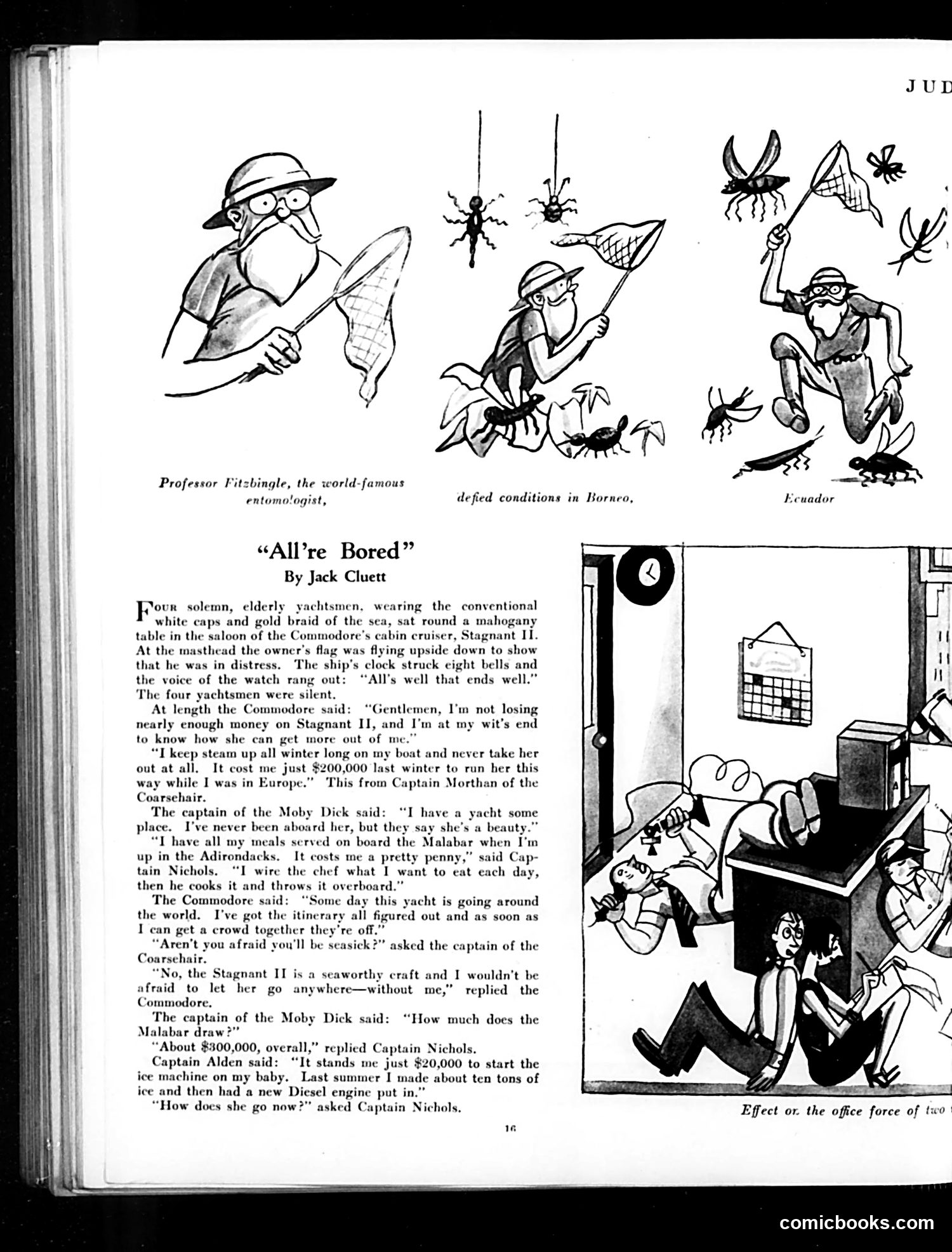
"All're Bored" - Satire on Wealthy Idle Excess This story satirizes the absurd spending habits of wealthy yacht owners during what appears to be the 1920s-30s era. Four elderly, distinguished gentlemen—a Commodore and various ship captains—sit aboard a luxury cruiser, competing to demonstrate their extravagant wastefulness. The joke hinges on their complete detachment from practical value: one keeps a $200,000 yacht unused; another wastes money on meals thrown overboard; the Commodore plans a world voyage he won't even attend himself. The headline "All're Bored" captures the satirical point—despite unlimited wealth, these men are listless and directionless, so bored they spend fortunes on pointless pursuits. The accompanying illustrations of entomologists chasing insects mock similar obsessive, privileged hobbies. The satire targets the idle rich's inability to find meaningful purpose despite their resources.
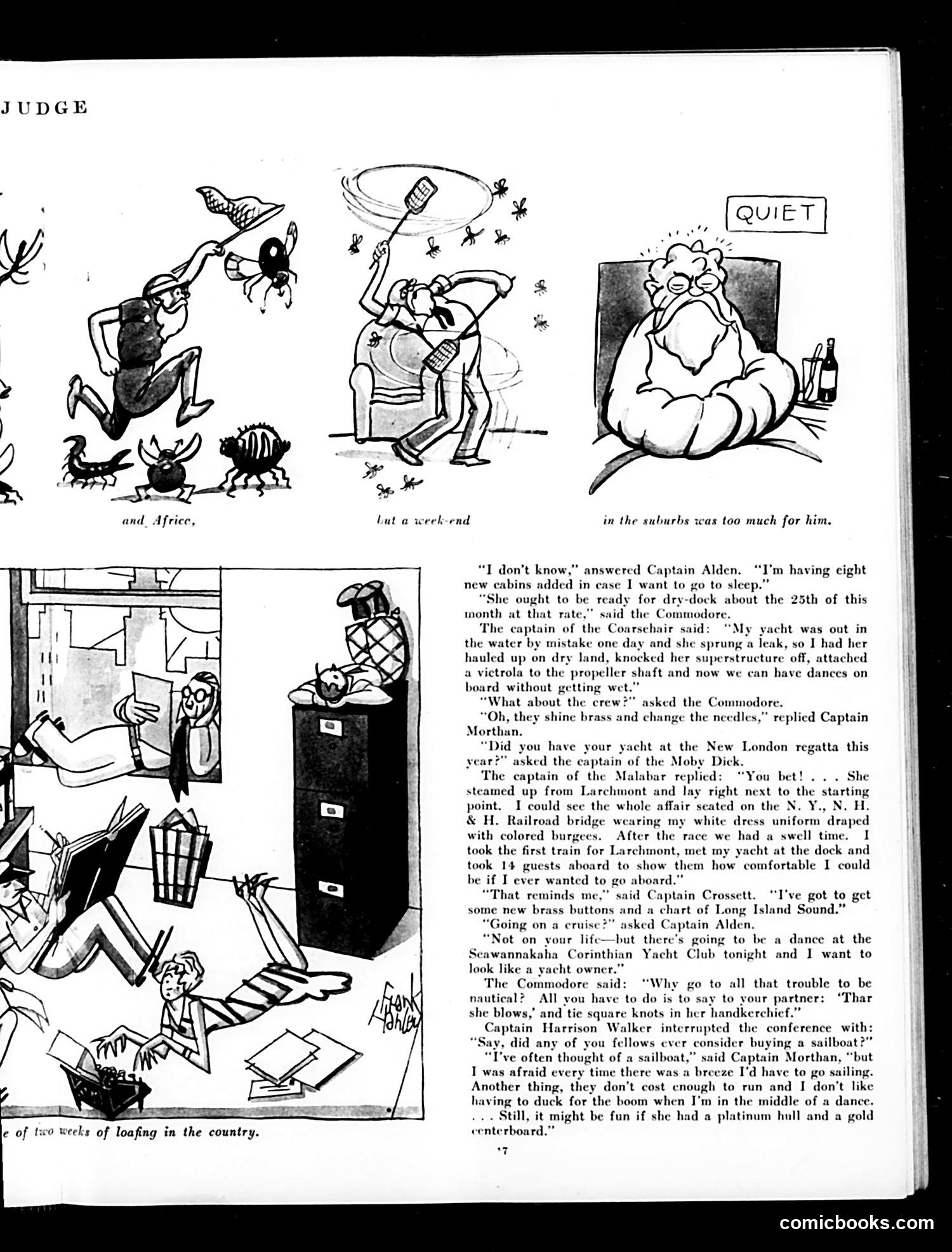
Judge Magazine Satire: Yacht Club Pretension This page satirizes wealthy yacht club members and their absurd priorities. The three cartoon vignettes at top show humorous scenarios: a man battling insects in Africa, people swatting bugs during a weekend, and an irritable man declaring "QUIET" in the suburbs. The main text features wealthy captains discussing their yachts with exaggerated complaints and ridiculous solutions. One captain added eight cabins "in case I want to go to sleep"; another attached a victrola to a yacht's propeller shaft to dance without getting wet. Captain Alden avoids actually sailing, preferring to observe yacht races from a railroad bridge in formal dress. The satire mocks nouveau riche pretension: these men own yachts not for sailing but for status display and socializing. One captain considers buying a sailboat only if it had a "platinum hull and gold centerboard"—absurd luxury modifications that defeat sailing's purpose. The joke is that these "yacht owners" avoid actual boating, caring only about appearance and comfort at exclusive clubs.
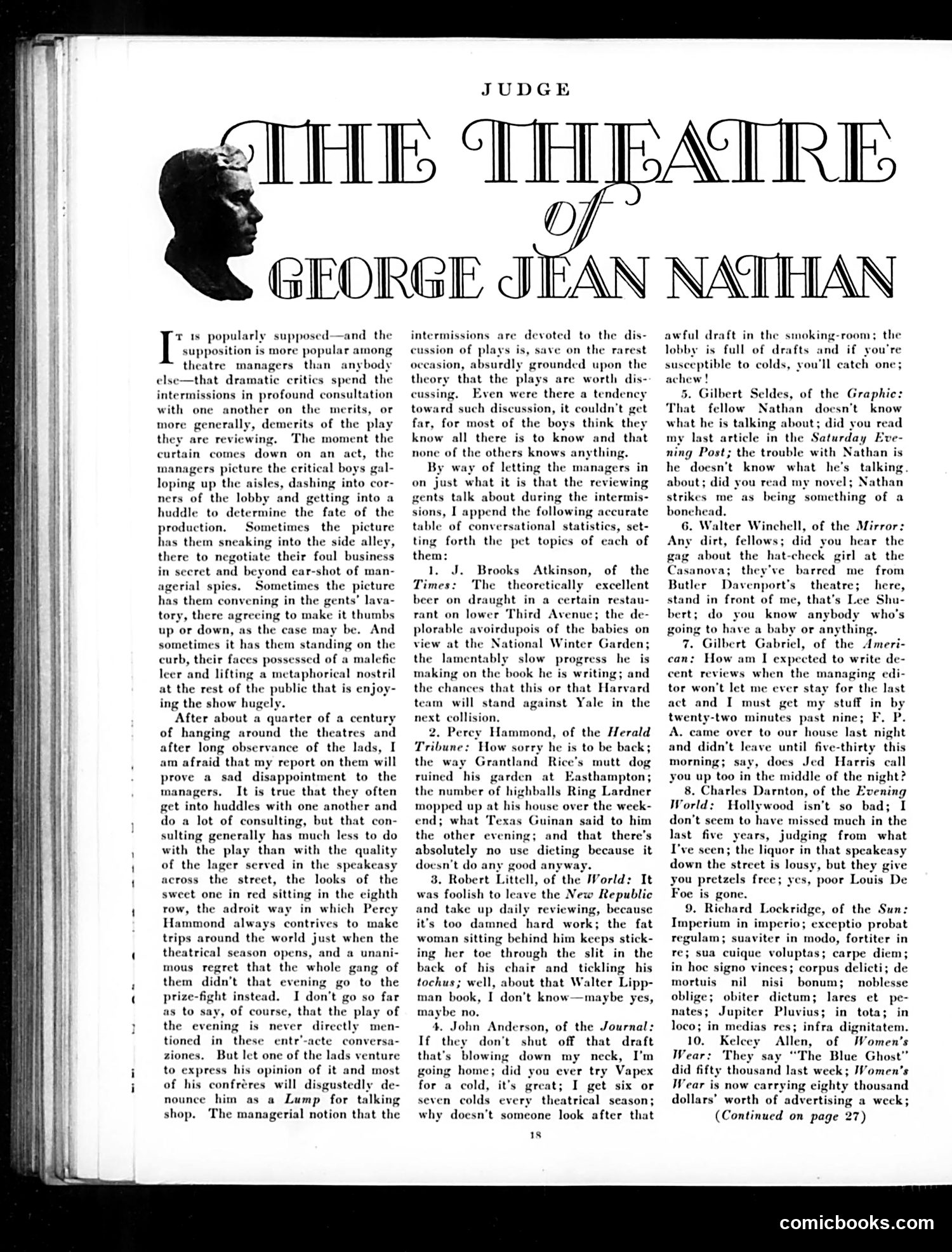
"The Theatre of George Jean Nathan" This is a satirical article about drama critics' backstage behavior during theatrical intermissions. Judge magazine's author (likely George Jean Nathan, a prominent theater critic) debunks theater managers' paranoid belief that critics huddle secretly during breaks to conspire about their reviews. The satire reveals the truth: critics actually spend intermissions discussing trivial gossip—beer quality, colleagues' personal lives, sports, and socialites like Texas Guinan (a famous Prohibition-era nightclub hostess). The piece humorously catalogs specific critics and their pet topics: J. Brooks Atkinson discussing beer; Percy Hammond complaining about returning from vacation; Robert Littell regretting leaving the *New Republic*. The broader joke mocks both theatrical pretension and critical self-importance, suggesting that serious artistic discussion rarely occurs—critics would rather call someone a "Lump" for actually discussing the plays being reviewed. This reflects Jazz Age cynicism about both theater and journalism.
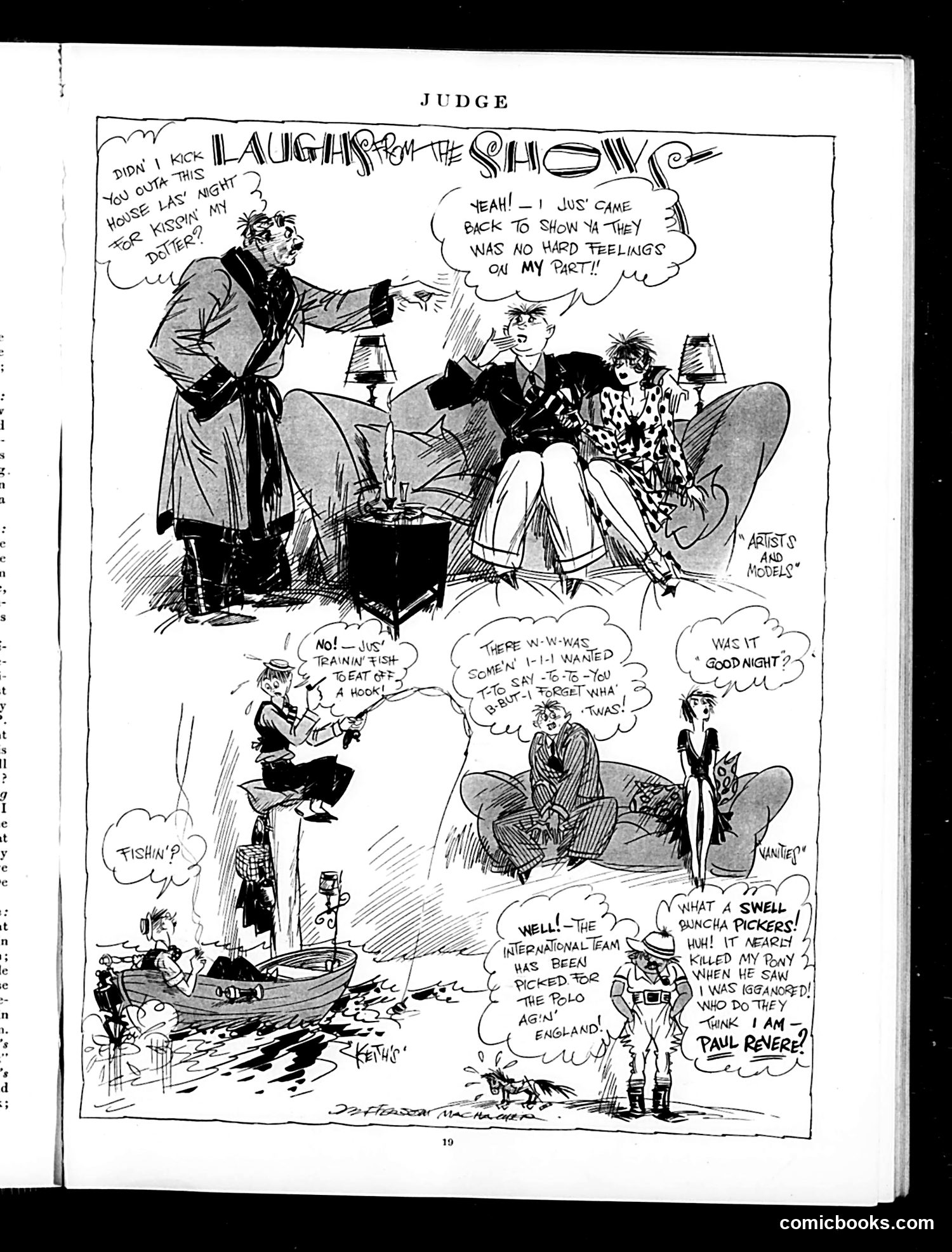
Analysis of Judge Magazine Cartoon This appears to be a multi-panel satirical comic about an international sports team (likely baseball, given references to "picking" and team competition). The central scene shows a father figure confronting young people about a party, while lower panels depict various characters recounting their experiences with an "International Team." The satire seems to mock both parental disapproval of youth gatherings and the fanfare surrounding international athletic competition. References to "Paul Revere" and characters' excited/defensive reactions suggest this ridicules American nationalism or excessive patriotism around international sporting events. The fragmented dialogue indicates the young people are defending themselves against accusations of misbehavior, claiming they were merely enthusiastic about the international team's achievements. The overall tone is comedic deflation of both generational conflict and nationalistic fervor. Without clearer OCR or visible dates, the specific event referenced remains unclear.
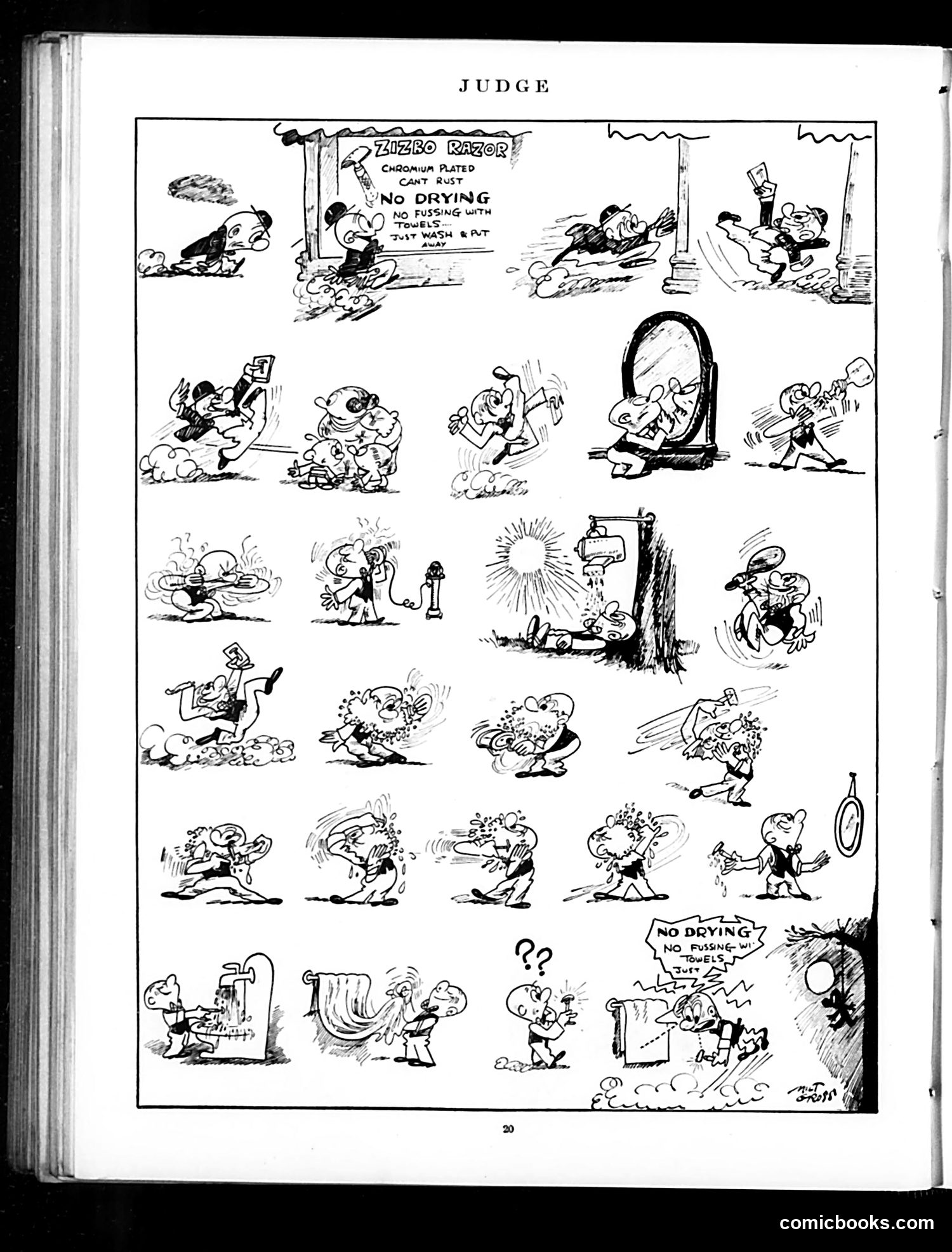
"Zazzibo Razor" Advertisement Comic This page is a product advertisement disguised as comic strip humor, promoting a "Zazzibo Razor" with chromium plating that "can't rust" and requires "no drying" or "fussing with towels." The comic shows exaggerated slapstick scenarios of a man struggling comically with shaving—slipping, sliding, and generally making a mess of the grooming process. The humor derives from physical comedy and the implied chaos of traditional shaving routines. The advertisement's pitch is that this new razor eliminates common frustrations: rust, maintenance, and tedious drying. The chromium plating is highlighted as a modern technological improvement. This reflects early-20th-century consumer marketing that emphasized convenience and labor-saving innovations to appeal to readers. The absurdist visual humor was typical of *Judge* magazine's commercial content.
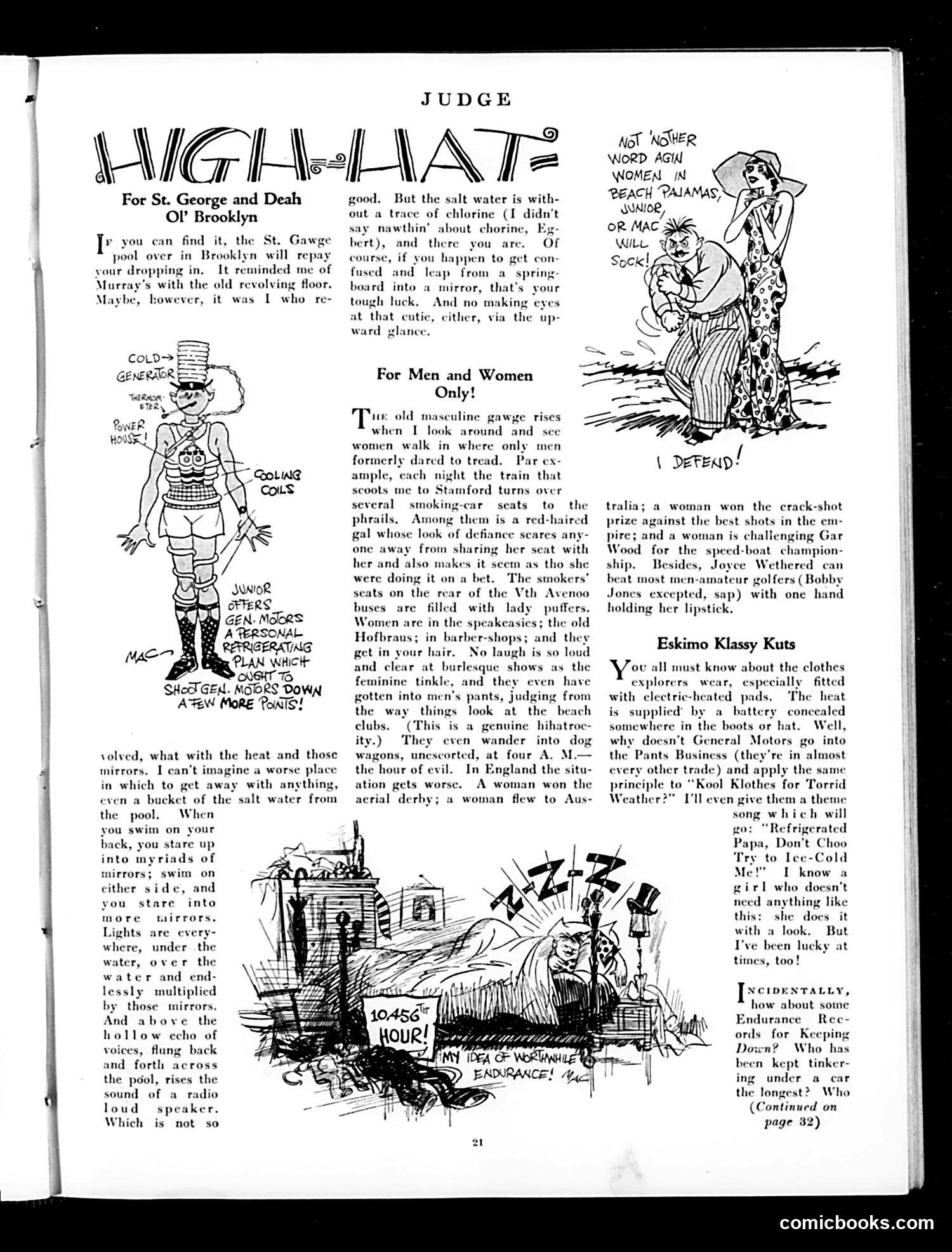
Explaining Judge Magazine Page 21 This page from the satirical magazine Judge contains three separate humor columns mocking contemporary social trends of the 1920s-30s era. The first column ridicules a Brooklyn swimming pool with excessive mirrors and lighting that creates disorienting reflections—the joke being it's a terrible place to relax. The main piece, "For Men and Women Only!," satirizes women's increasing presence in spaces traditionally male-only: smoking cars, speakeasies, barber shops, and burlesque shows. The author presents this as shocking social upheaval, citing examples like women winning athletic competitions and racing challenges. The humor relies on outdated gender anxiety—treating women's equality as absurd rather than progressive. The final section, "Eskimo Klassy Kuts," jokes about electrically heated clothing for explorers, then suggests General Motors should manufacture heated pants, imagining a humorous song about "refrigerated" clothing. The cartoons feature exaggerated character drawings typical of the era's style. Overall, the page reflects early 20th-century conservative attitudes toward women's liberation and modern consumer technology.
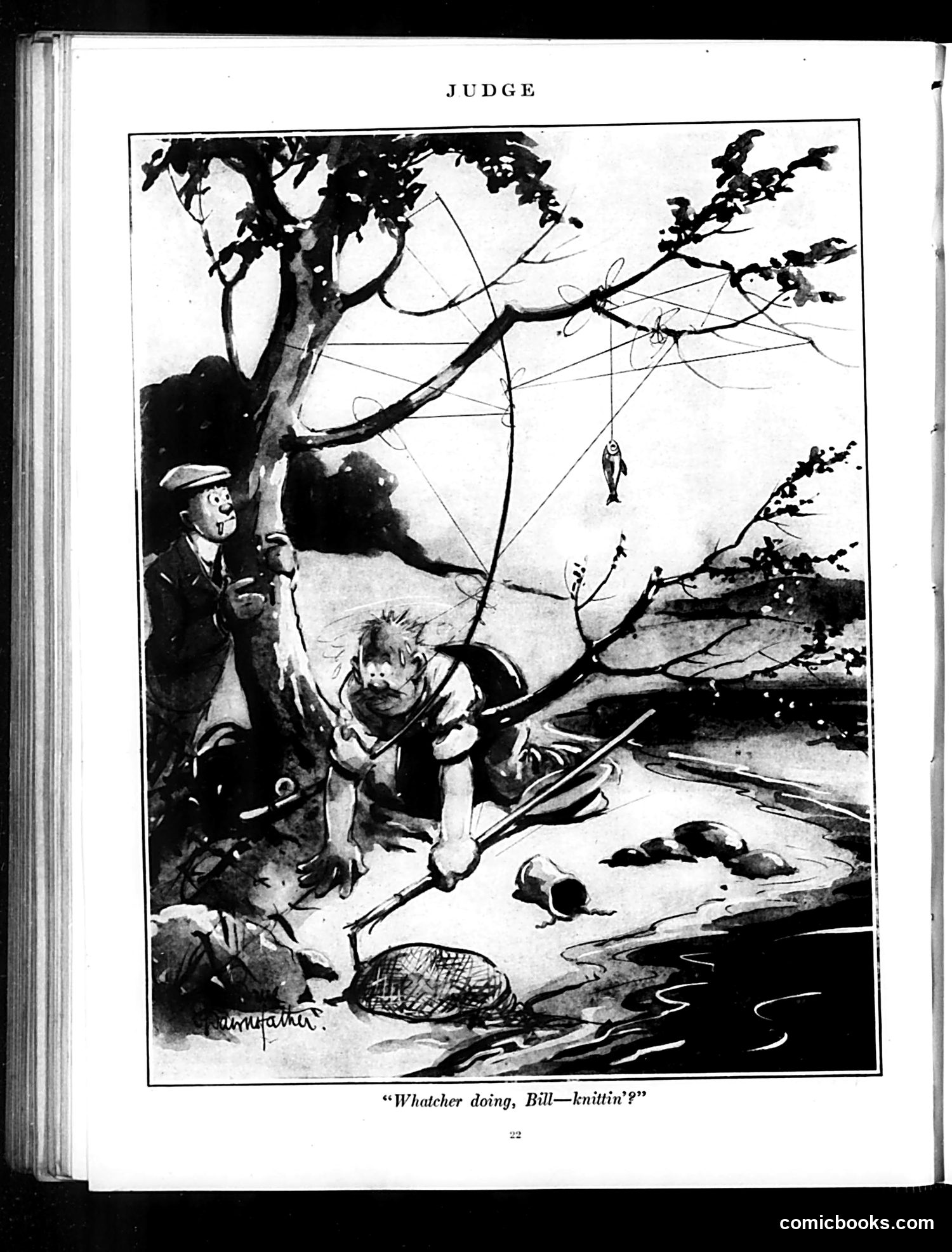
Analysis This cartoon appears from Judge magazine and shows an adult (likely an older man in a hat) observing children by a tree near water. One child is fishing while another appears to be knitting. The caption reads "Whatcher doing, Bill—knittin'?" The satire seems to mock gender role expectations of the era—specifically the notion that knitting is "women's work" and therefore absurd or laughable for a boy named Bill to be doing. The adult's surprised tone ("Whatcher doing") suggests knitting by a boy would be socially inappropriate or worthy of ridicule. This reflects early-to-mid 20th century attitudes about strict gender divisions in domestic activities. The joke's premise—that a boy doing "feminine" crafts is inherently funny or shocking—would be considered outdated stereotyping today.
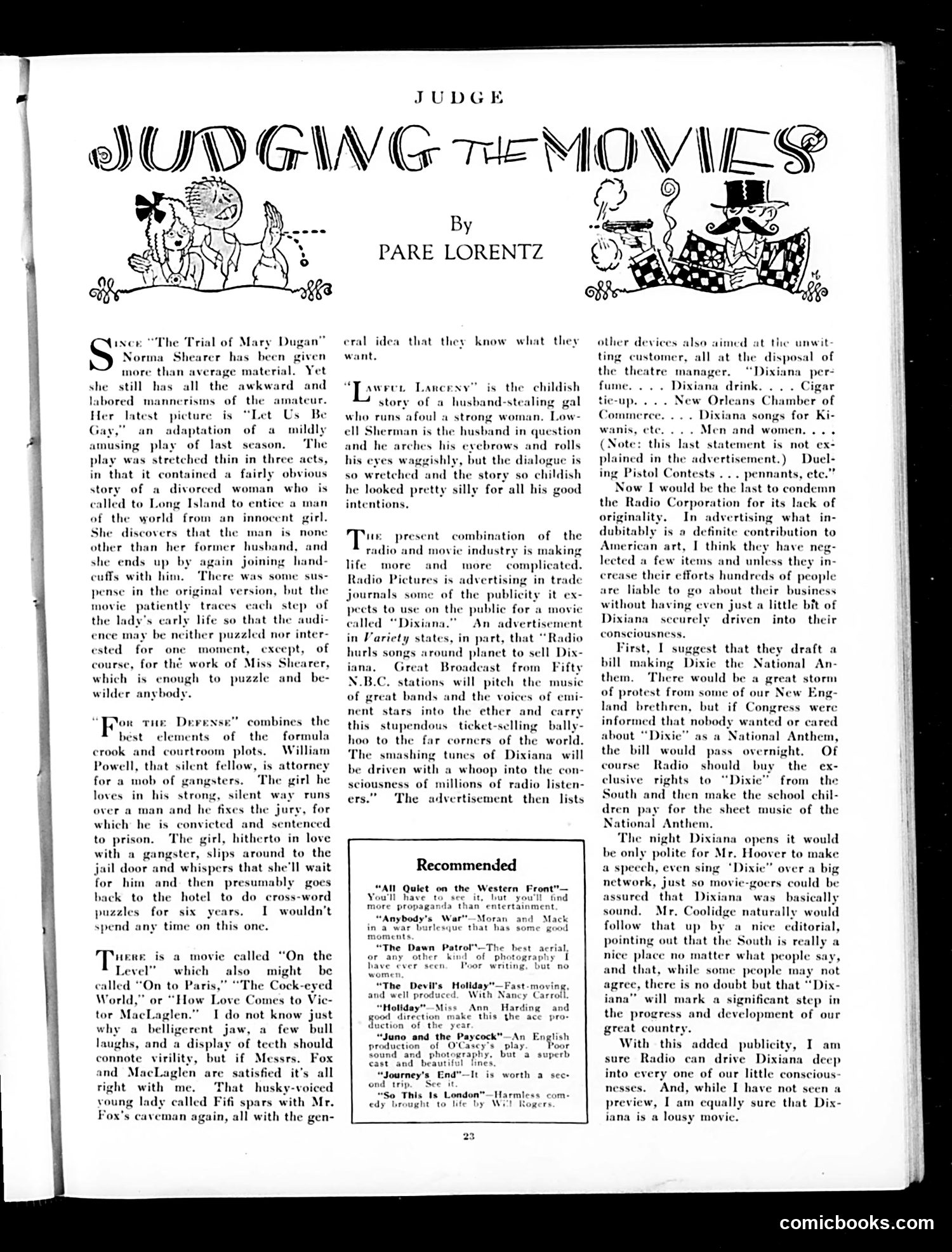
Judge Magazine: "Judging the Movies" by Pare Lorentz This page is a film review column, not a political cartoon. Lorentz critiques several 1929 movies, including ones starring Norma Shearer and involving silent comedians like William Powell and Emil Jannings. The main satirical point concerns Radio Pictures' aggressive marketing of "Dixiana," a movie being promoted through unprecedented cross-media coordination—songs broadcast on NBC radio stations, tie-in merchandise, contests, and themed drinks to drive ticket sales. Lorentz mocks this saturation advertising strategy by sarcastically suggesting Radio should go further: draft "Dixie" as the national anthem (implying Congress would approve anything for publicity), and deploy even more merchandise tie-ins. His tone suggests concern about corporate manipulation of public consciousness through coordinated media hype—an early critique of what we'd now call multimedia marketing blitzes. The humor targets advertising excess and industry desperation to commercialize every aspect of entertainment.
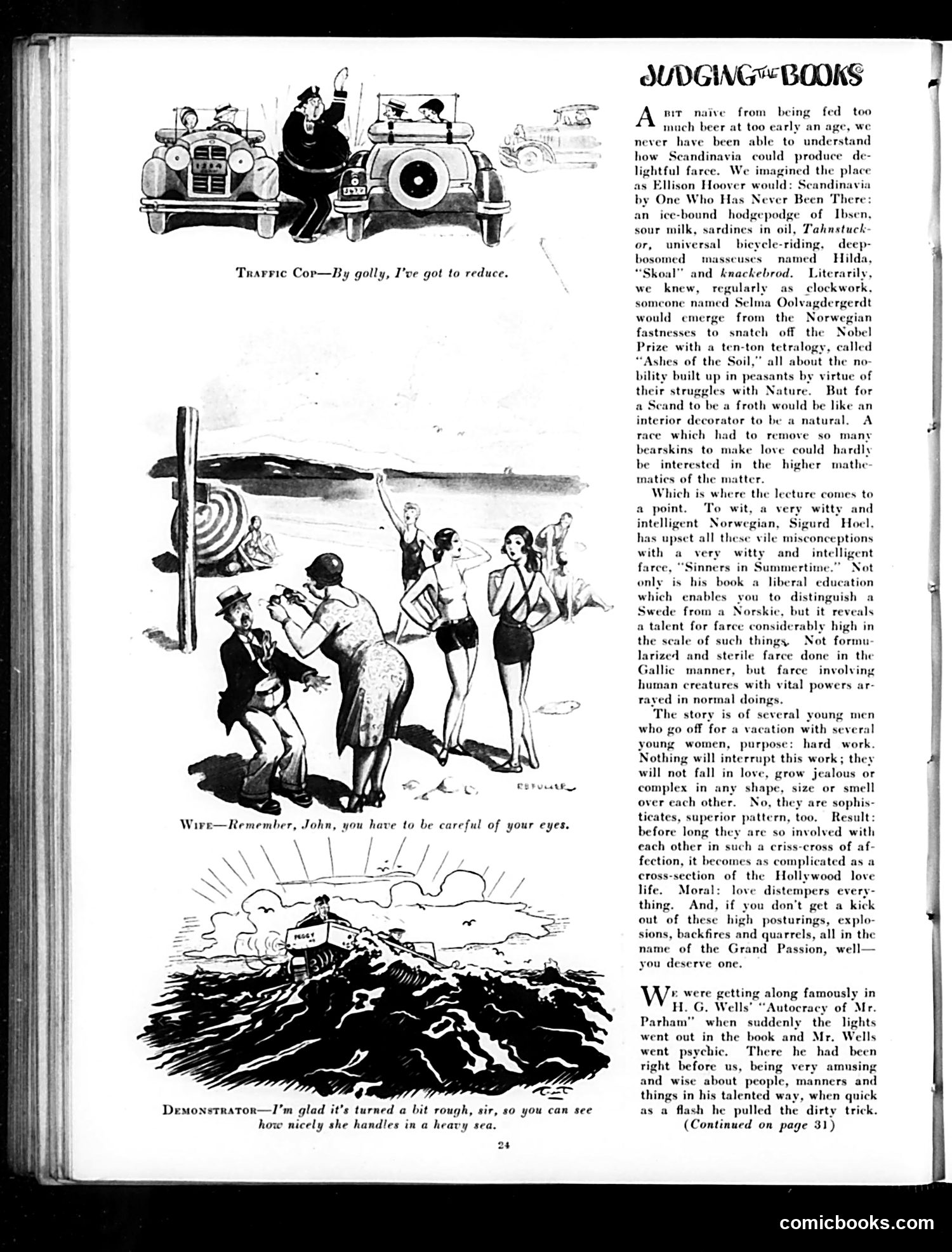
Analysis of This Judge Magazine Page This page contains two editorial cartoons and a book review column. The Cartoons: The top cartoon shows a traffic cop and a car demonstrator. The cop, apparently overweight ("I've got to reduce"), sits in a car being tested in rough conditions. The joke is physical humor—the cop's weight makes him an unwilling participant in a bumpy demonstration. The lower cartoon depicts a sinking ship with a demonstrator in a small boat, showing the vessel's handling in heavy seas. The caption suggests the demonstrator is deliberately capsizing to prove the boat's seaworthiness—absurdist humor about product demonstrations gone wrong. The Book Review: The column "Judging the Books" discusses Scandinavian literature, specifically criticizing American stereotypes about Scandinavia as dour and serious (Ibsen, sardines, deep sorrow). The reviewer praises Norwegian author Sigurd Hoel's witty farce "Sinners in Summertime" for defying these preconceptions and proving Scandinavians can write sophisticated comedy. The column also critiques H.G. Wells for abandoning realism mid-narrative by introducing supernatural elements, calling it a "dirty trick" on readers.
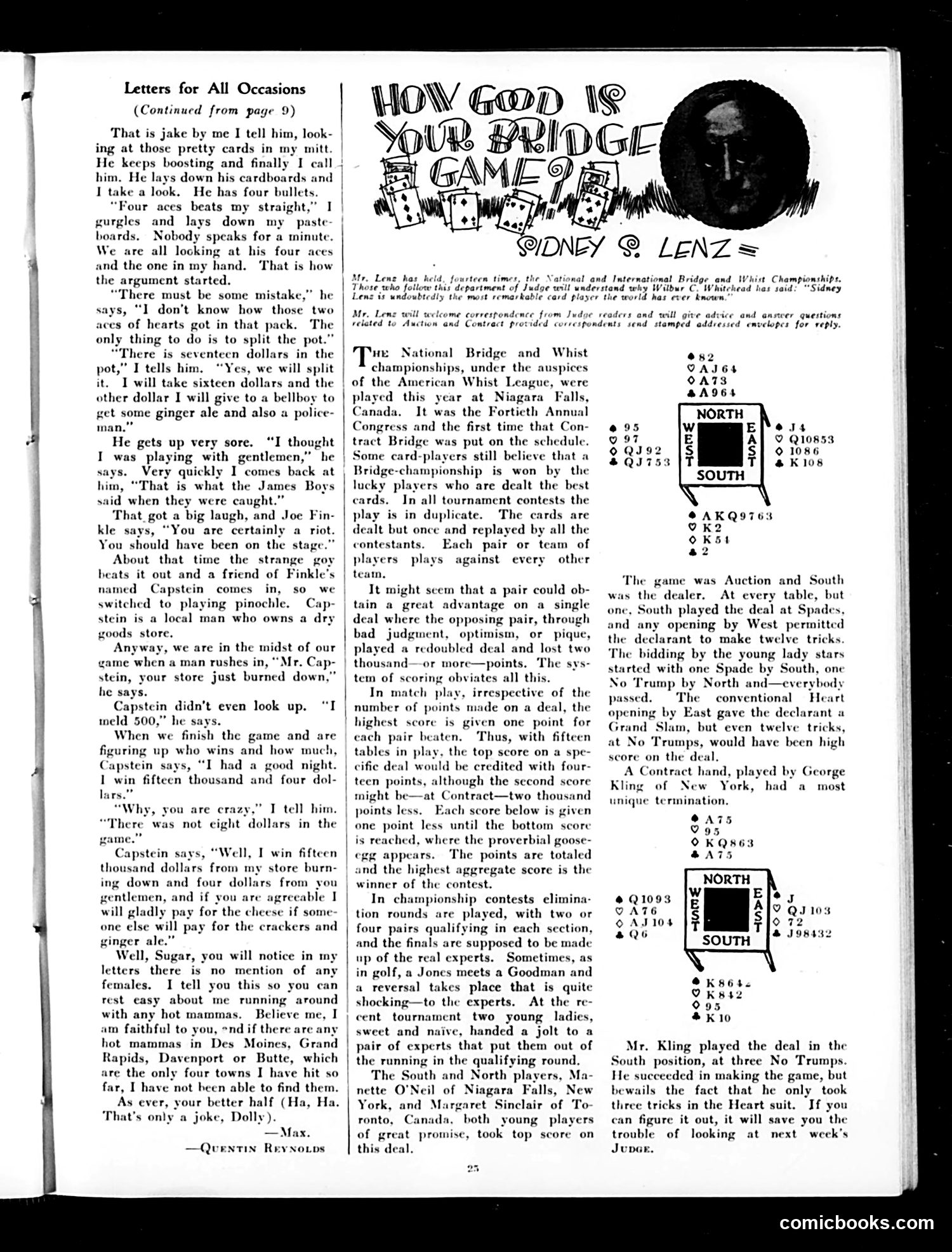
"How Good Is Your Bridge Game?" - Judge Magazine This page contains a humorous letter column about card games and a bridge-playing article. The prominent cartoon at top, "How Good Is Your Bridge Game?" by Sidney S. Lenz, appears to be a title/header illustration featuring playing cards and a caricatured face—likely Lenz himself, identified as a renowned bridge champion. The article discusses the National Bridge and Whist Championships held at Niagara Falls, Canada, explaining how tournament play works through duplicate dealing (ensuring fair card distribution). It debunks the notion that bridge championships are won purely by luck, emphasizing skilled play matters. The letter column above presents comedic anecdotes about card games involving working-class men (references to "James Boys," local businessmen), with humor derived from misunderstandings, financial disputes over poker pots, and rapid mood shifts—particularly the dry-goods store owner's indifference to his store burning down while winning at cards. The page reflects early 20th-century American leisure culture, particularly card-gaming as both casual entertainment and organized sport.
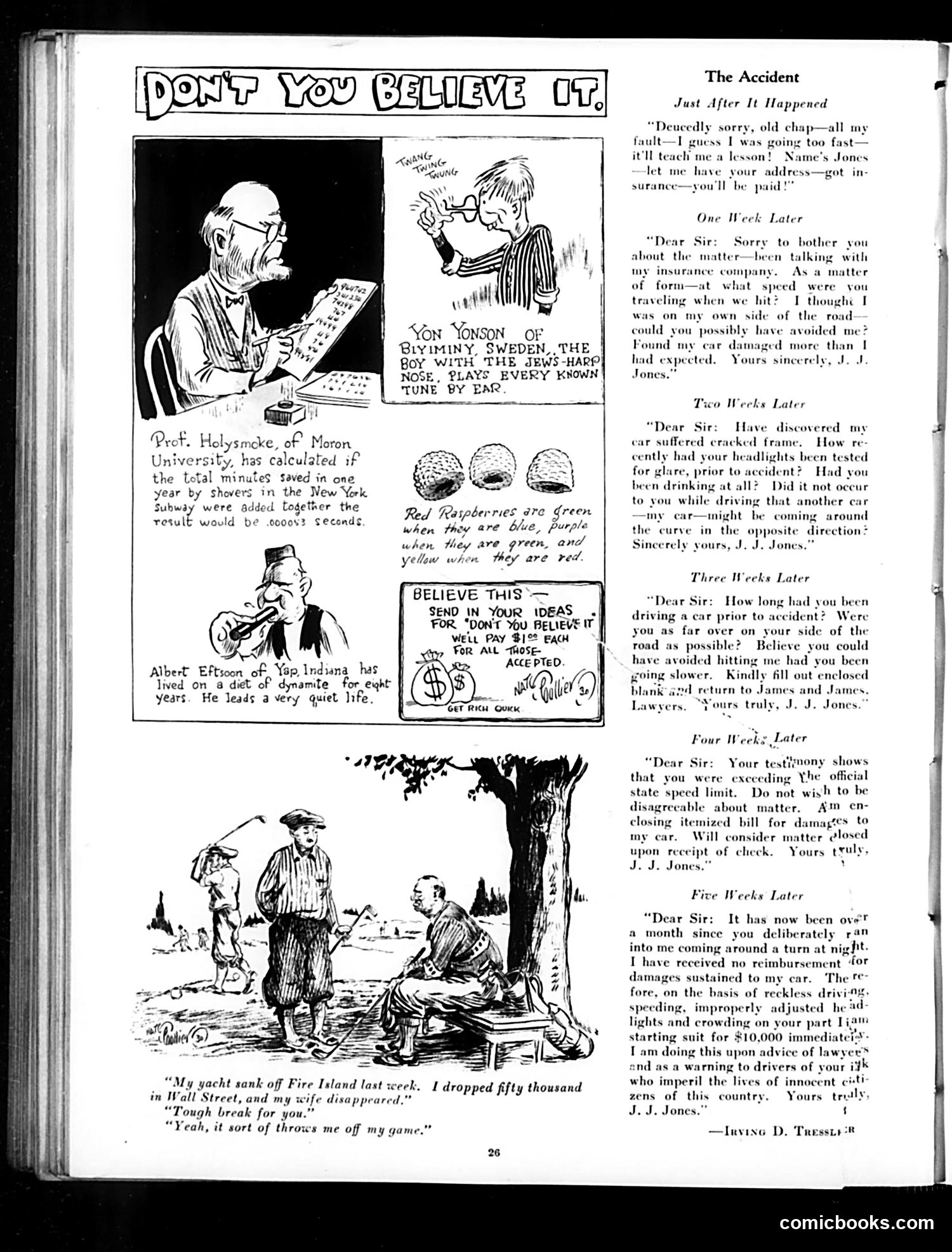
"The Accident" — A Satirical Sequence on Insurance Claims This multi-panel piece satirizes how accident liability disputes escalate over time. A courteous driver (Jones) causes a collision and immediately offers insurance compensation. Over five weeks, his tone shifts dramatically—from apologetic to aggressive—as correspondence devolves into hostile accusation and threats of a $10,000 lawsuit. The satire targets the emerging insurance industry and legal tactics of the early 20th century. Jones transforms from liable party to litigant, weaponizing questionable claims (the other driver was speeding, drinking, driving recklessly) to shift blame entirely. The cartoon mocks how monetary disputes corrupt initial civility, and suggests insurance companies encouraged aggressive counter-claims rather than honest settlement. The page's surrounding absurdist humor (a Swedish boy playing tunes through his nose, dynamite diets) frames this as satirizing American credulity and absurd claims generally—implying Judge's readers should skeptically question what they believe.
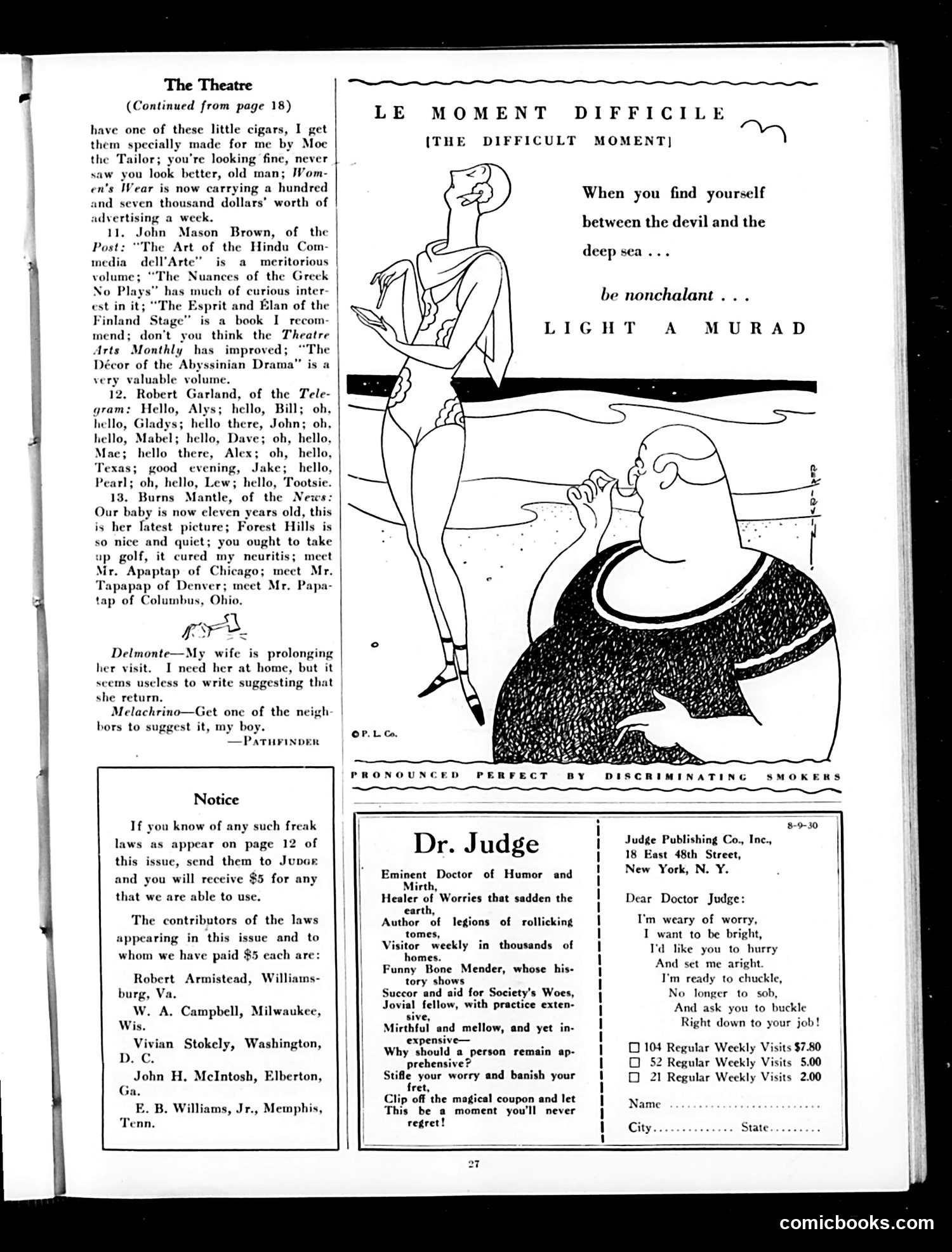
Analysis for Modern Readers This page combines theatre gossip with advertising. The left column satirizes theatre critics' verbose pretentiousness through caricatured "hellos" and name-dropping. The cartoon "Le Moment Difficile" (The Difficult Moment) depicts a woman in a precarious situation between a devil figure and the sea, with the caption "be nonchalant"—a humorous contrast between her danger and the advice to stay calm. The accompanying advertisement for Murad cigarettes appropriates this imagery, selling cigarettes as a solution to anxiety. "Dr. Judge" (the magazine's mascot) offers comic psychological relief via subscription to Judge magazine itself, with pricing tiers listed. The satire targets both the self-important theatre establishment and the era's widespread use of cigarettes and magazine consumption as supposed remedies for modern stress and "worry." The underlying joke: Judge magazine positions itself as humorous therapy competing with actual commercial products for anxious consumers.
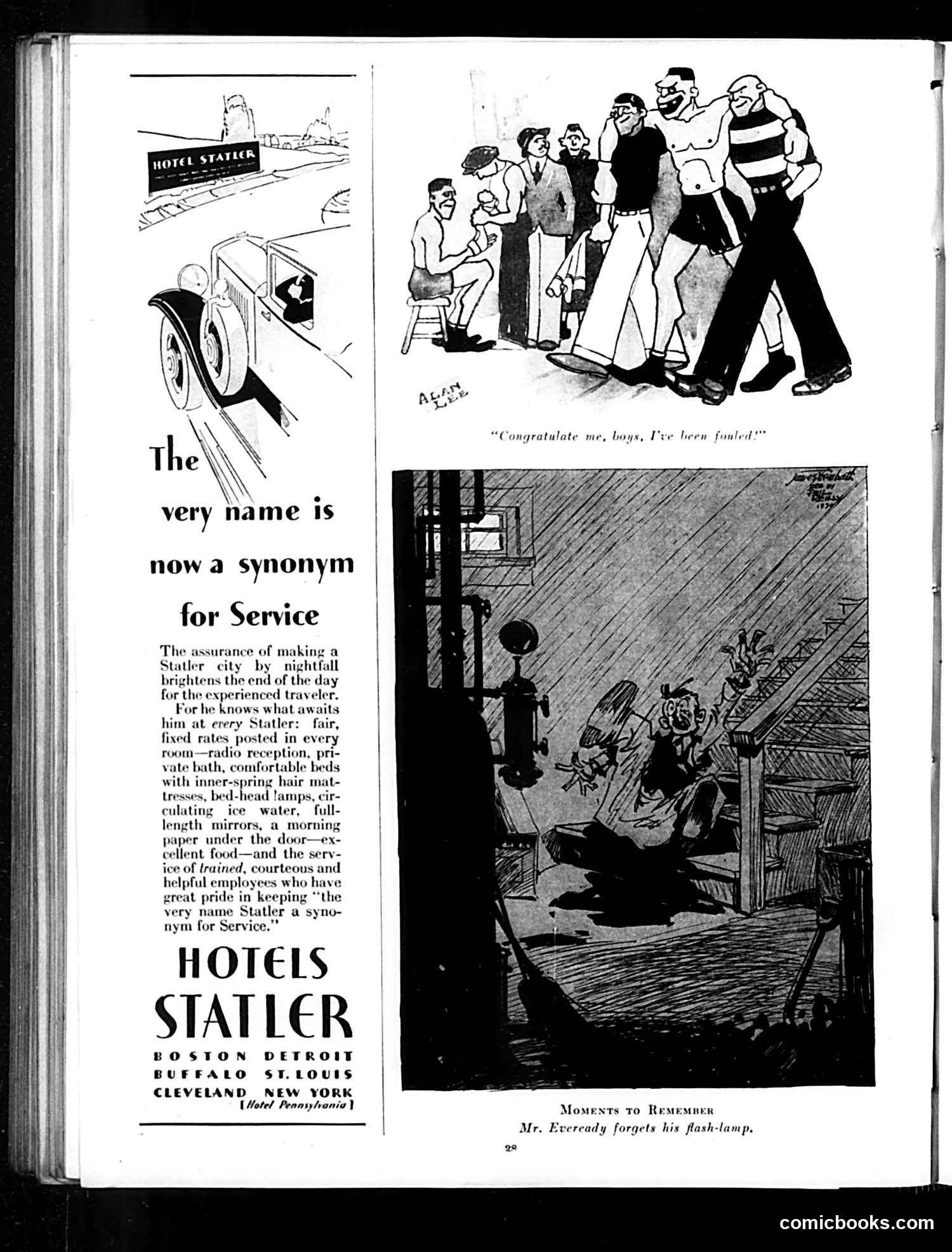
Page Analysis This page is primarily a Hotel Statler advertisement with accompanying humorous illustrations. The top cartoon shows a man being congratulated with "Congratulate me, boys, I've been funked!"—likely depicting someone failing an exam or test. The bottom illustration, captioned "Mr. Eveready forgets his flash-lamp," shows a man in darkness, apparently unable to see. This is a product placement joke: "Eveready" was a flashlight brand, so the humor lies in the ironic consequence of forgetting that specific product. The advertisement emphasizes Hotel Statler's reliable service standards—fixed rates, modern amenities (radio, private bath, ice water), and trained staff. The messaging positions the hotel chain's name as synonymous with dependable service for business travelers. The page uses humor and brand integration typical of early-to-mid 20th-century magazine advertising, where comic situations demonstrated why a product or service was indispensable.
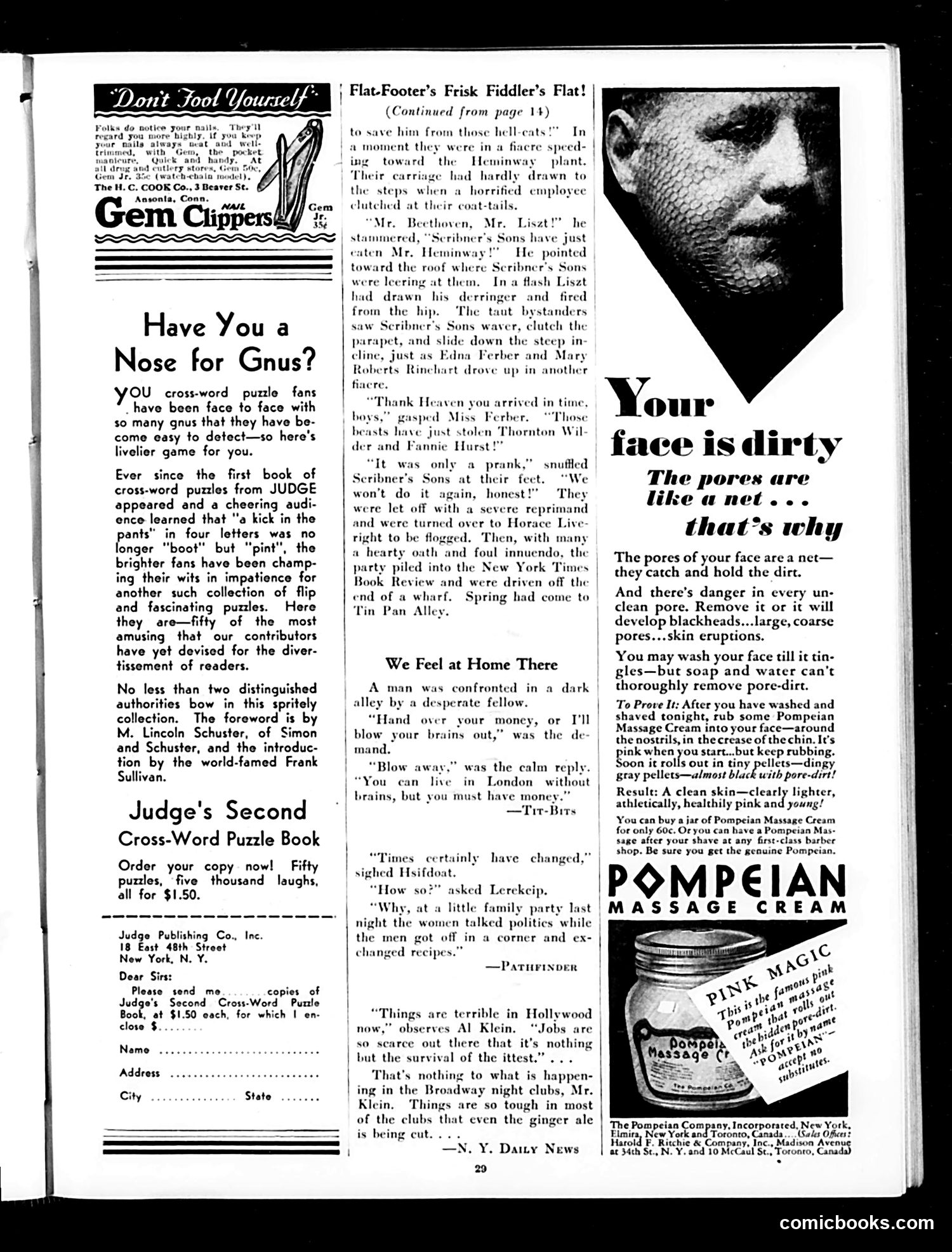
Explanation for Modern Readers This page from *Judge* magazine (circa 1920s-30s) contains primarily advertisements and puzzle promotions rather than political satire. The main content includes: 1. "Flat-Footer's Frisk Fiddler's Flat" - A serialized crime/mystery story parody naming real literary figures (Edna Ferber, Mary Roberts Rinehart, Thornton Wilder, Fannie Hurst) as characters in a melodramatic plot involving police, desperate criminals, and violence. This is *Judge*'s characteristic humor: inserting recognizable celebrities into absurd situations. 2. Humorous anecdotes about changing social customs (women discussing politics at parties) and economic hardship (scarcity of jobs in Hollywood, even ginger ale being rationed at clubs during Prohibition/Depression era). 3. Pompeian Massage Cream advertisement - Typical period advertising claiming skincare removes "pore-dirt" and prevents blackheads. The page reflects 1920s-30s concerns: literary celebrity culture, economic anxiety, Prohibition-era nightlife, and beauty standards marketed to insecure consumers.
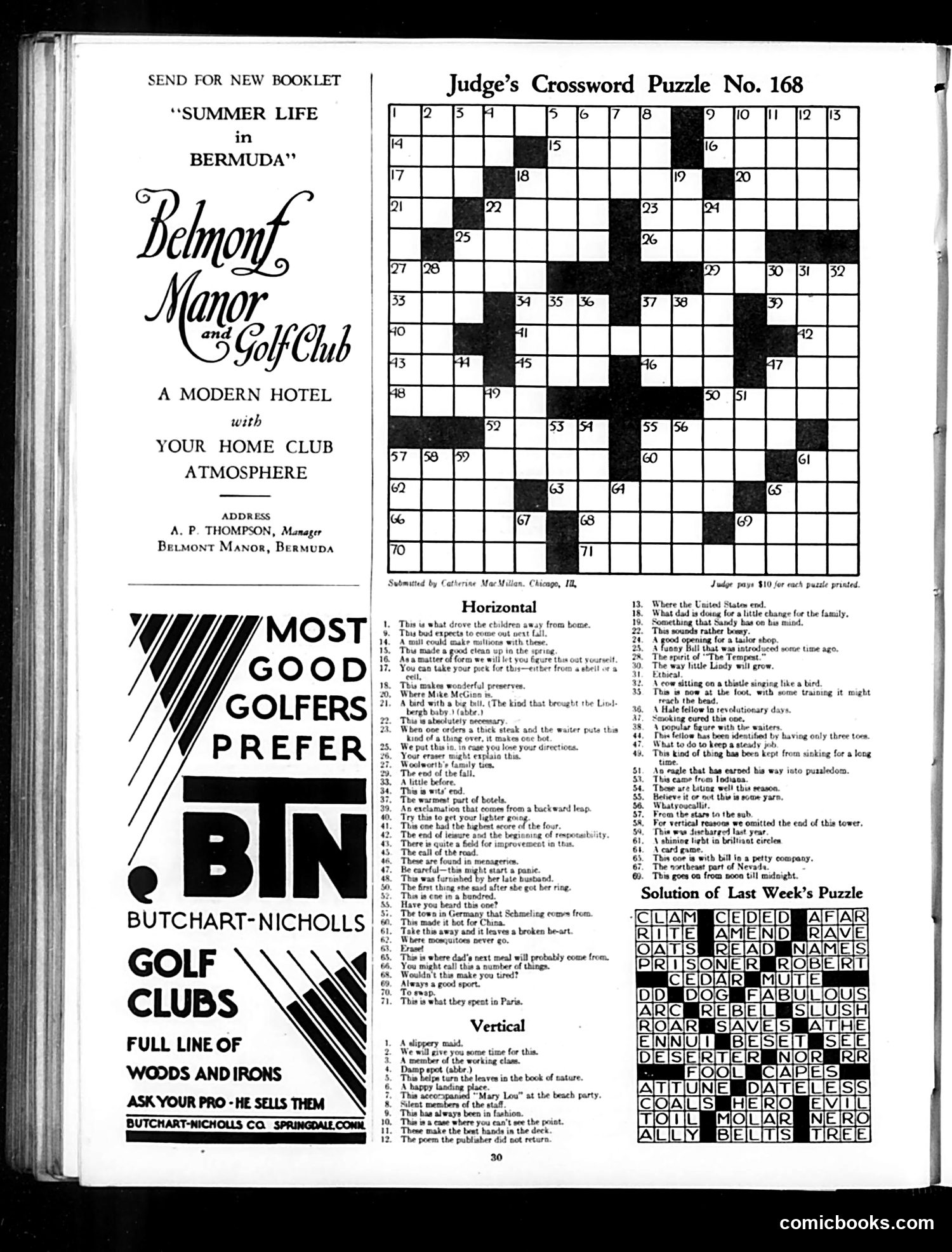
Judge Crossword Puzzle Page Analysis This page is primarily advertising and puzzle content, not satire. It contains: Left side: Two advertisements—one for Belmont Manor golf club in Bermuda (positioning itself as a modern hotel with "home club atmosphere") and one for Butchart-Nicholls golf clubs, appealing to golfers with the slogan "Most Good Golfers Prefer" their equipment. Right side: Judge's crossword puzzle No. 168, a standard word puzzle with horizontal and vertical clues, plus the solution to the previous week's puzzle. The page reflects 1930s leisure culture: golf was a prestigious recreational activity, Bermuda vacations signified wealth, and crossword puzzles were popular entertainment. There is no visible political cartoon or satirical commentary—this appears to be a typical magazine interior page mixing advertisements with reader entertainment features.
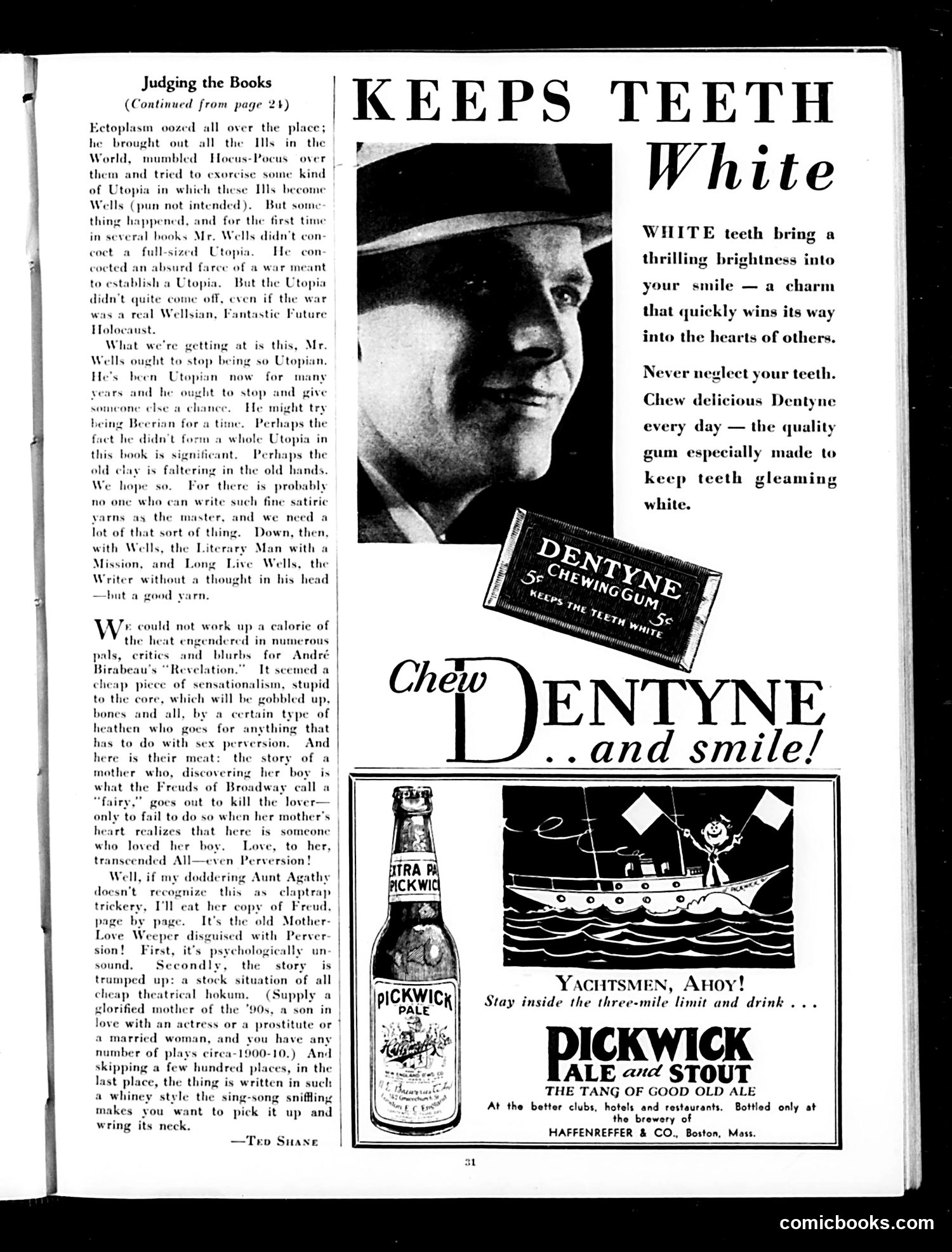
Analysis of Judge Magazine Page This page contains two main elements: a literary review and advertisements. "Judging the Books" (Left Column): The critic reviews H.G. Wells's recent works, particularly his utopian fiction. The satire criticizes Wells for becoming repetitively "Utopian"—creating idealistic future societies in his novels—suggesting he should instead focus on what he does best: satirical writing and entertaining yarns. The review suggests Wells's creative well may be running dry ("the old clay is faltering in the old hands"). A secondary review dismisses André Birabeau's "Revelation" as cheap sensationalism about sexual perversion, using stock theatrical hokum designed to appeal to lowbrow audiences. Advertisements (Right Side): Two product ads: Dentyne chewing gum (promising white teeth and an attractive smile) and Pickwick Pale Ale and Stout (positioned as sophisticated "good old ale" for clubs and hotels). These represent typical 1920s-30s advertising appeals to aspiration and social status.
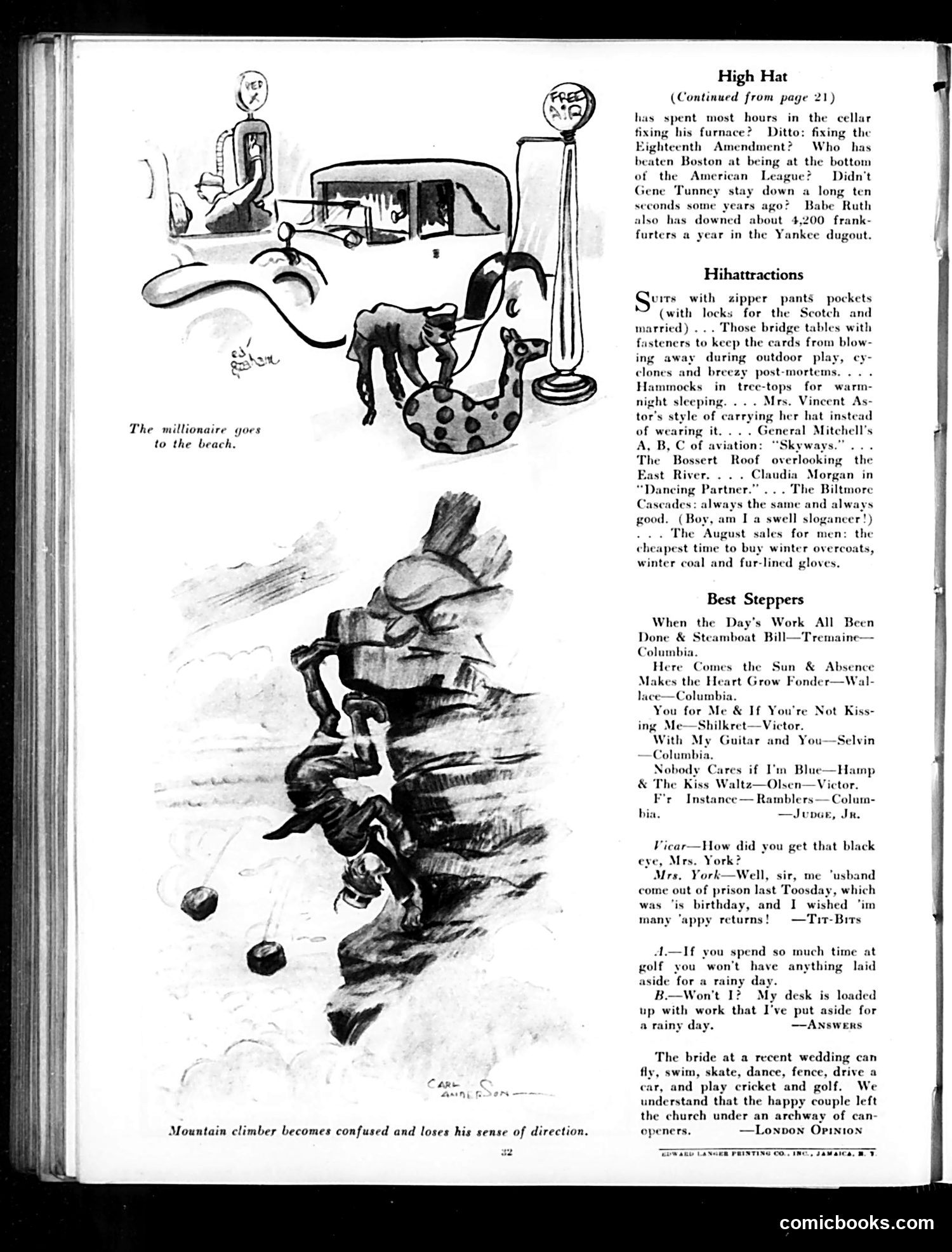
Page Analysis: Judge Magazine This page contains humor and cartoons from Judge, a satirical magazine. The main content includes: "High Hat" column: A continuation mocking various 1920s topics and personalities—references to Babe Ruth's hot dog consumption, Gene Tunney's boxing match, and General Mitchell's aviation terminology. It's gossipy society commentary. Two cartoons: 1. "The millionaire goes to the beach"—shows wealthy person with various servants/attendants; satirizes ostentatious wealth display. 2. "Mountain climber becomes confused and loses his sense of direction"—depicts a climber tumbling down a mountainside; straightforward slapstick humor about disorientation. "Best Steppers" section: Lists popular jazz and dance records of the era. Miscellaneous jokes: Including exchanges about a woman's black eye (her husband's prison release) and golf excuses—mild domestic humor typical of 1920s publications. The page reflects Jazz Age concerns: wealth, celebrity culture, modern leisure activities, and marital humor.
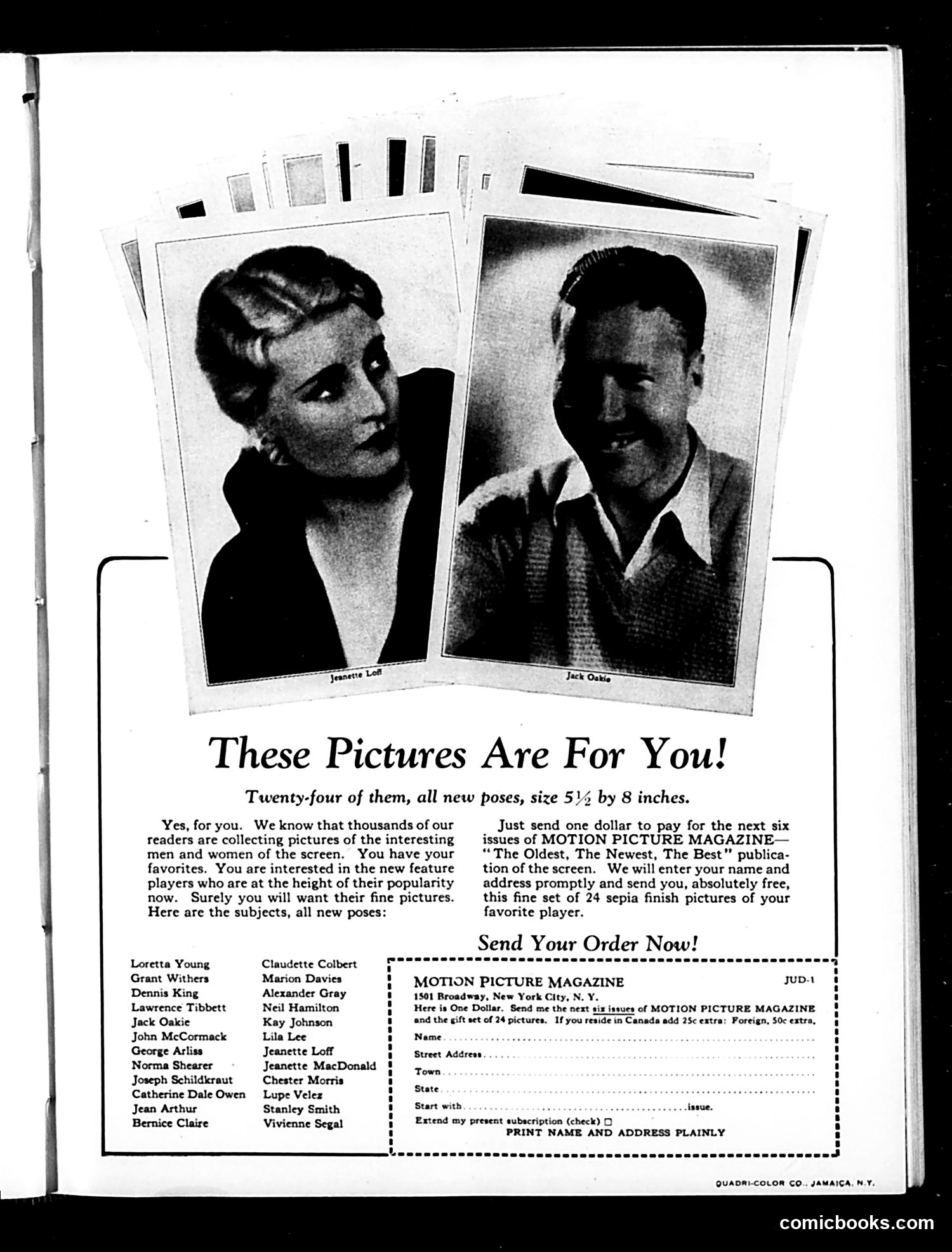
Analysis This is not a political cartoon but rather a advertisement page for Motion Picture Magazine, integrated into Judge magazine. The page features two portrait photographs of silent film actors—identified as Jeanette Loff and Jack Oakie—as examples of the celebrity photo sets being offered. The advertisement promotes a subscription deal: readers send one dollar to receive six issues of Motion Picture Magazine plus a complimentary set of 24 sepia-toned photographs (5½ by 8 inches) of popular screen actors. The list names 24 silent film personalities of the era, including Loretta Young, Grant Withers, and Norma Shearer, reflecting the public's appetite for celebrity memorabilia during Hollywood's golden age. This represents how early 20th-century magazines monetized fan culture around motion pictures through mail-order photo collectibles—a precursor to modern celebrity merchandise.
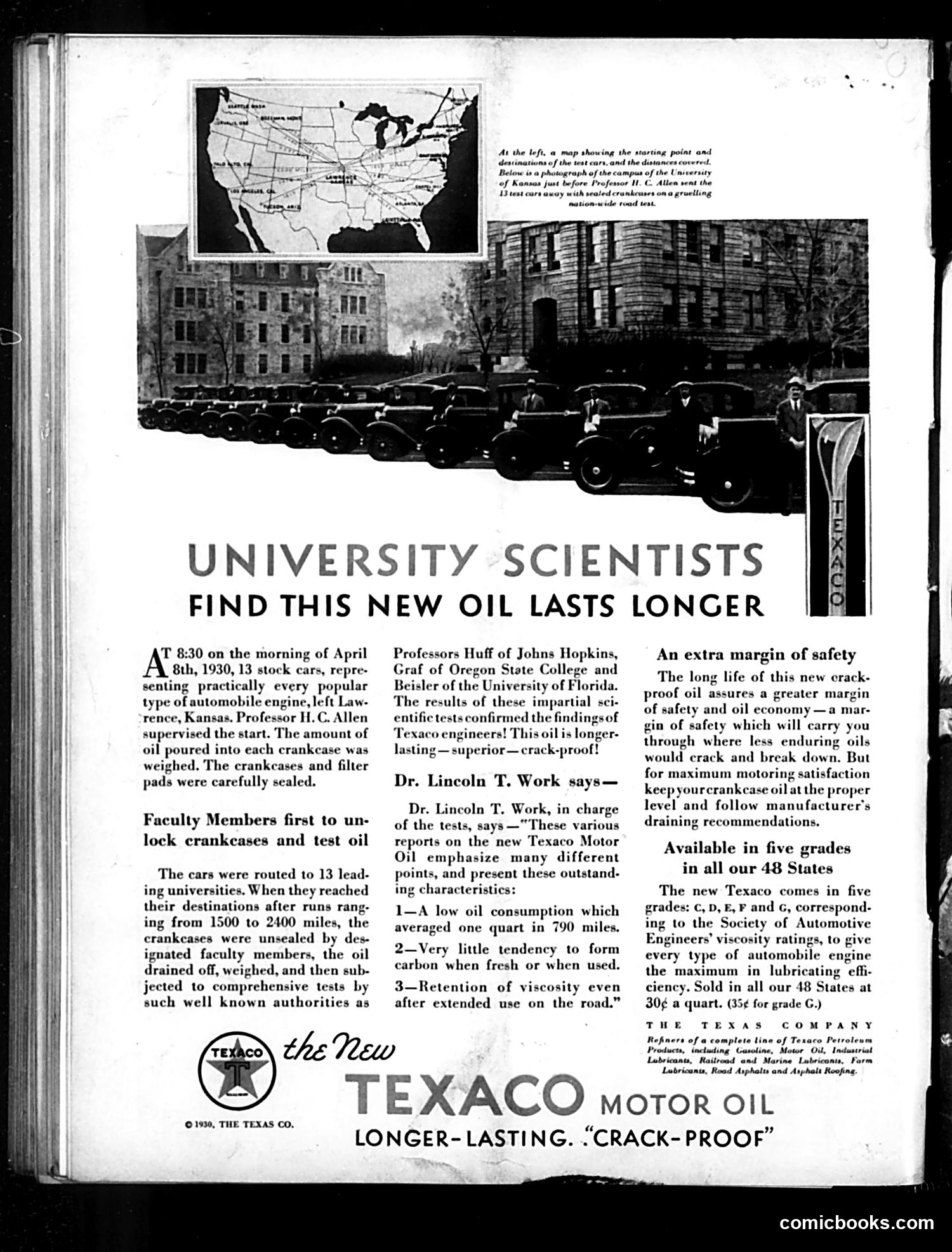
Analysis: Texaco Motor Oil Advertisement This is not a cartoon or satire, but rather a straightforward 1930 advertisement for Texaco Motor Oil masquerading as scientific journalism. The page depicts a purported nationwide "university test" of motor oil: 13 automobiles departed Lawrence, Kansas on April 8, 1930, traveled 1500-2400 miles to 13 universities, where faculty members (professors from Johns Hopkins, Oregon State, and the University of Florida) allegedly tested the oil's performance. The advertisement emphasizes three claimed benefits: low oil consumption, minimal carbon buildup, and viscosity retention. The "scientific" framing—naming specific professors and universities—was meant to lend credibility to marketing claims. For modern readers: This represents early corporate "astroturfing"—using academic authority to validate product superiority. The staged nature (precise oil measurements, sealed crankcases, university endorsements) suggests manufactured credibility rather than genuine scientific rigor. Such appeals to scientific authority became common advertising tactics in the 1930s.