judge
Judge — August 16, 1930
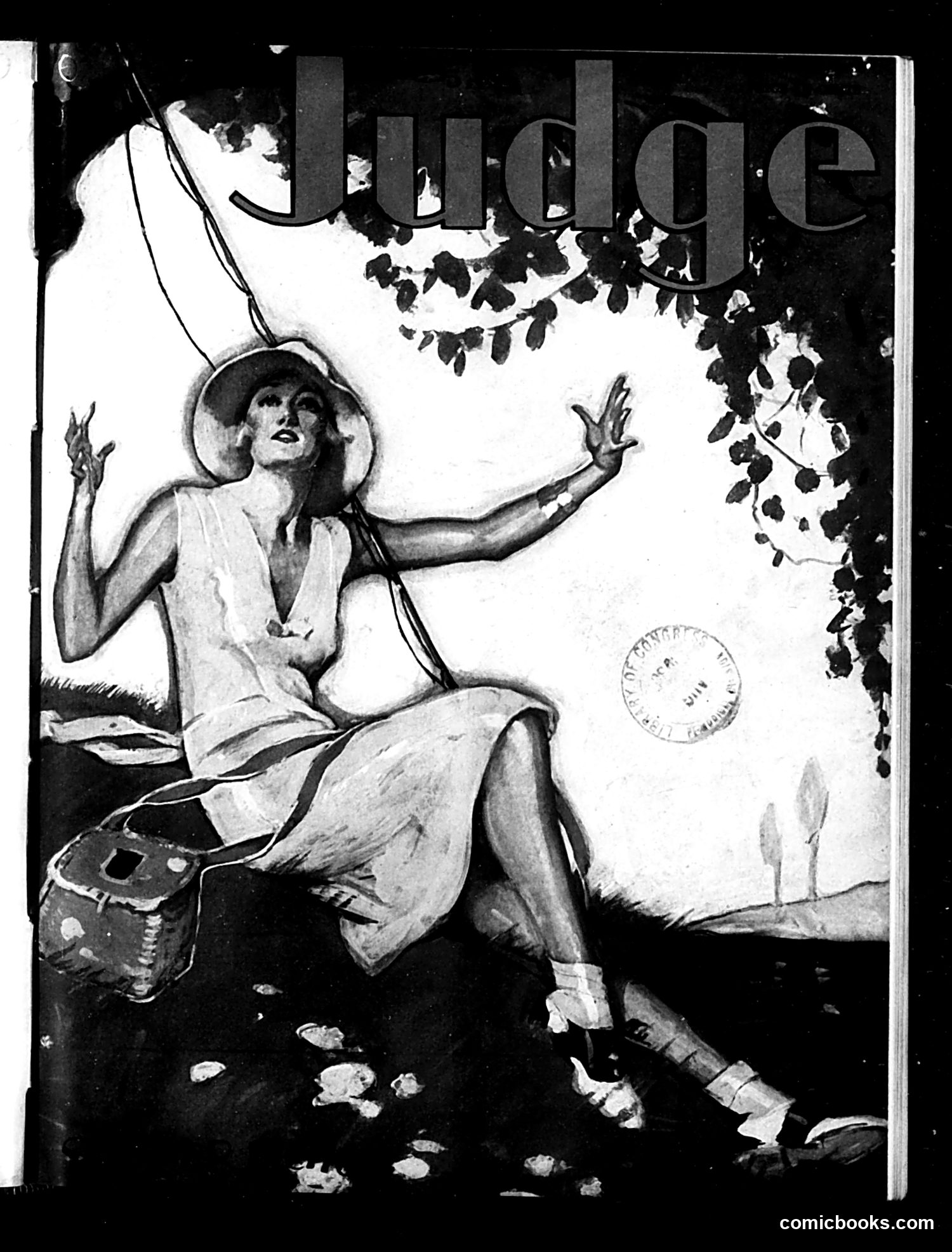
Judge Magazine Cover Analysis This appears to be a cover from Judge, the American satirical weekly magazine. The illustration depicts a woman in a bathing suit and wide-brimmed hat, reclining in a leisure pose with what appears to be radio equipment nearby. The word "judge" is visible at the top. The image likely satirizes 1920s-1930s leisure culture and possibly the novelty of radio technology becoming domesticated into entertainment and vacation settings. The woman's fashionable attire and relaxed demeanor suggest commentary on modern consumer culture or changing social norms around women's public appearance and recreation. Without additional context or legible text, the specific satirical target remains unclear, though it likely reflects Judge's typical commentary on contemporary American social trends.
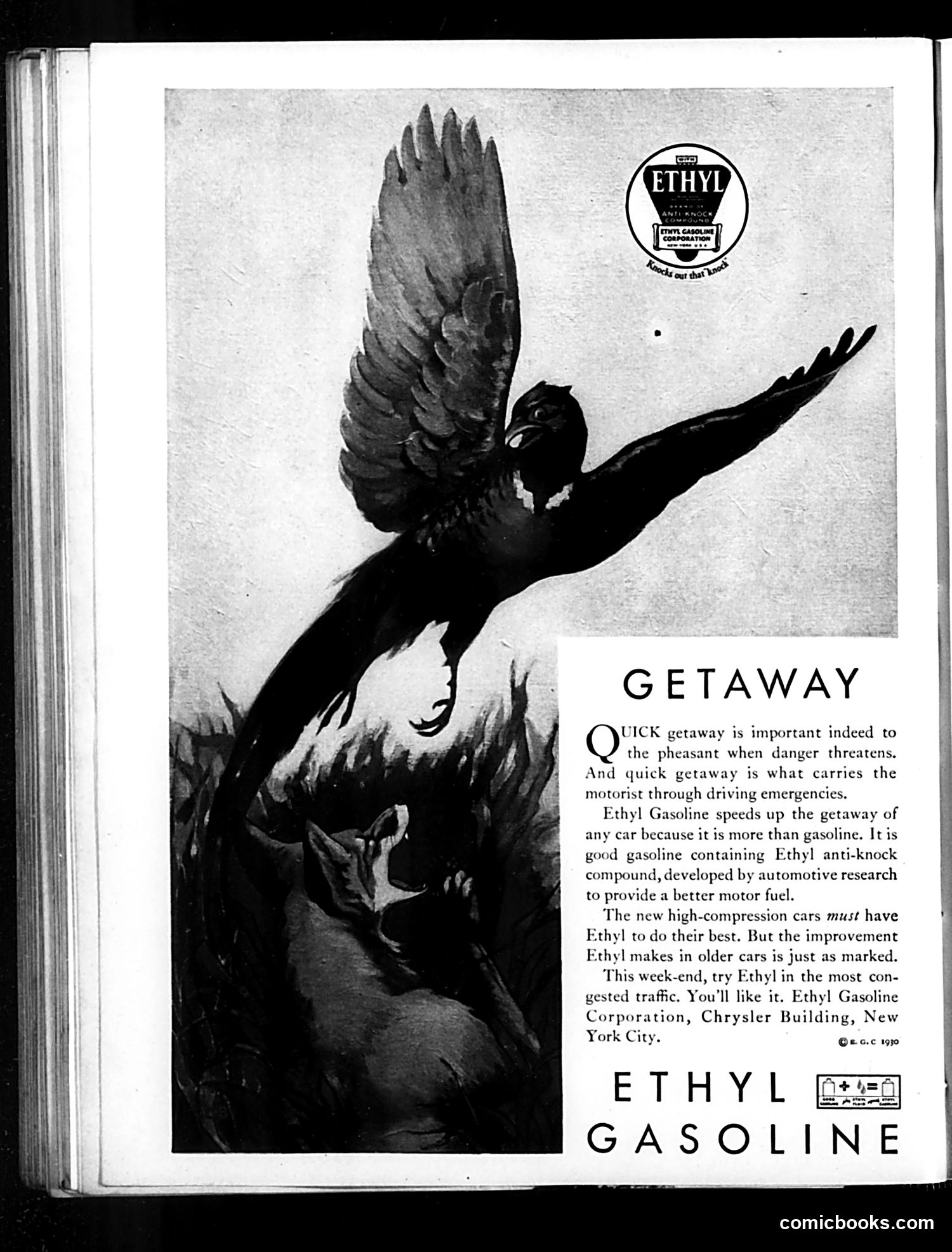
Analysis This page is primarily a commercial advertisement, not satire or political content. The image shows a pheasant in dramatic escape pose, wings spread in flight. The advertisement's headline "GETAWAY" compares the bird's quick escape to how Ethyl Gasoline helps cars accelerate through driving emergencies. The text explicitly promotes Ethyl's anti-knock compound as superior fuel for modern high-compression engines. It concludes with a call to action: try Ethyl in congested traffic this weekend. While *Judge* magazine typically featured satire, this page is straightforward product marketing for the Ethyl Gasoline Corporation (Chrysler Building, New York City), using an eye-catching nature photograph as the hook. The copyright date appears to be 1930.
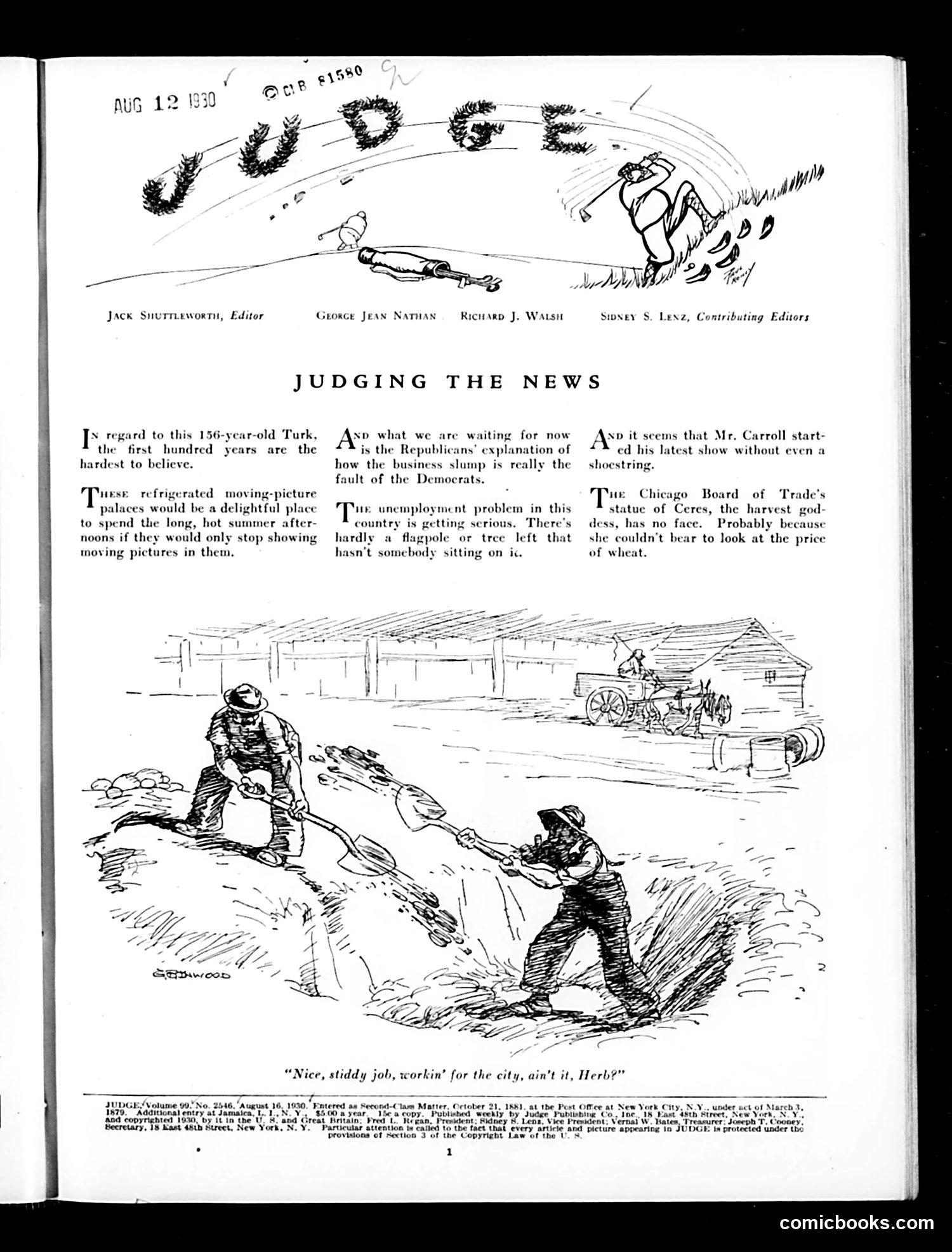
Analysis of Judge Magazine Page (August 12, 1930) This page satirizes economic hardship during the Great Depression. The main cartoon depicts two laborers doing road work with the caption "Nice, steady job, workin' for the city, ain't it, Herb?"—ironic commentary on how municipal make-work jobs, while better than nothing, represented a grim reality for the unemployed. The editorial column "Judging the News" critiques Republicans for blaming Democrats for the economic slump, and sarcastically notes that Chicago's Board of Trade statue of Ceres (goddess of harvest) "has no face"—likely because wheat prices had collapsed, making the symbol of agricultural prosperity embarrassing. The page reflects 1930 anxieties about joblessness and government relief measures.
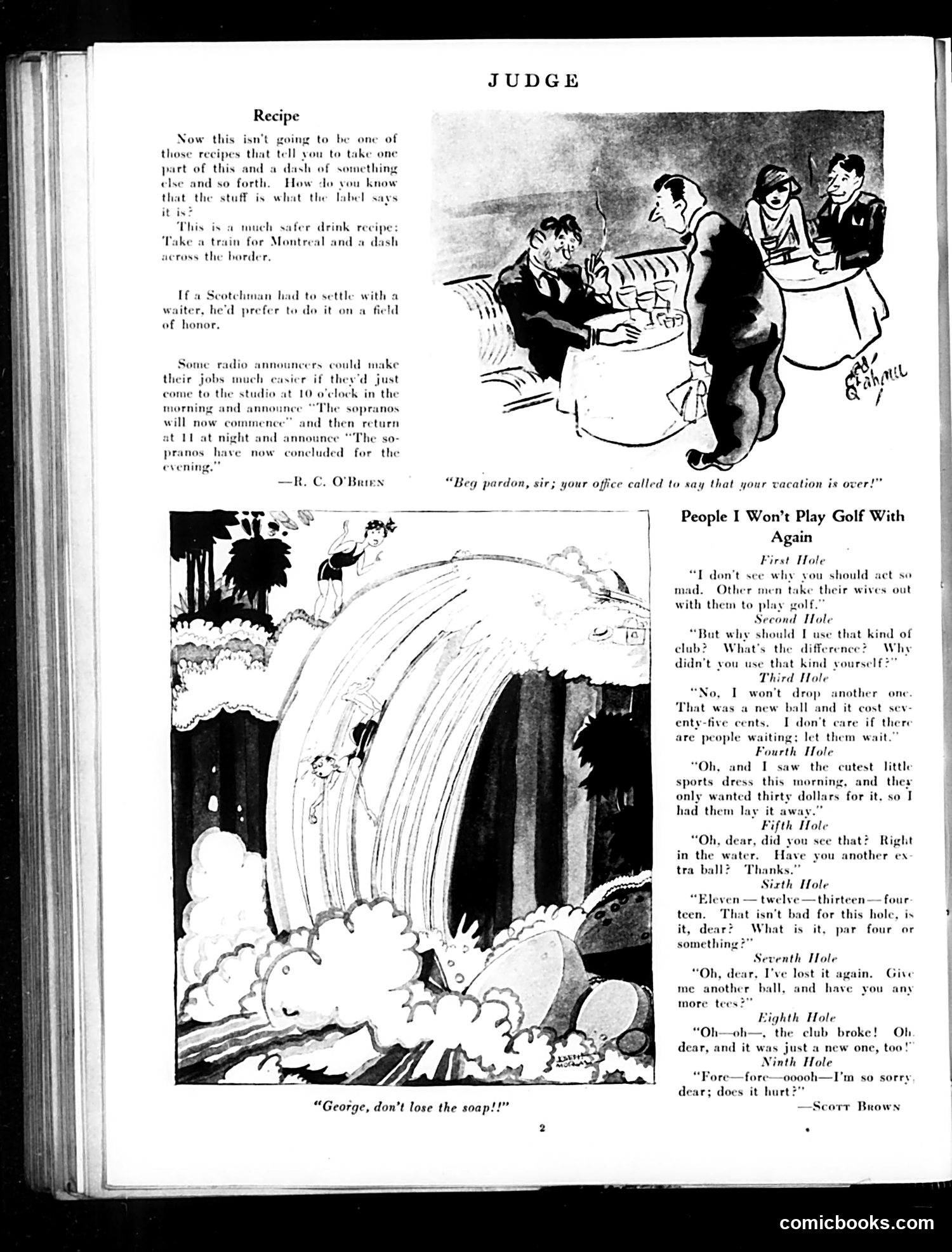
Analysis of Judge Magazine Page The page contains two main pieces: Top cartoon ("Beg pardon, sir; your office called..."): Satirizes radio announcers' scheduling inefficiency. The joke concerns an announcer who works split shifts (morning and evening), creating absurd logistics. The satire targets early radio broadcasting's operational chaos—announcers literally commuting between home and studio multiple times daily. Bottom section ("People I Won't Play Golf With Again"): A humorous monologue by Scott Brown cataloging golf etiquette violations. Each numbered "hole" represents a complaint—wives dragging husbands along, lost balls, expensive equipment, wet balls, and broken clubs. This satirizes golf culture's pretensions and the sport's capacity to frustrate players. The large illustration shows someone losing soap in what appears to be a flood or waterfall scenario.
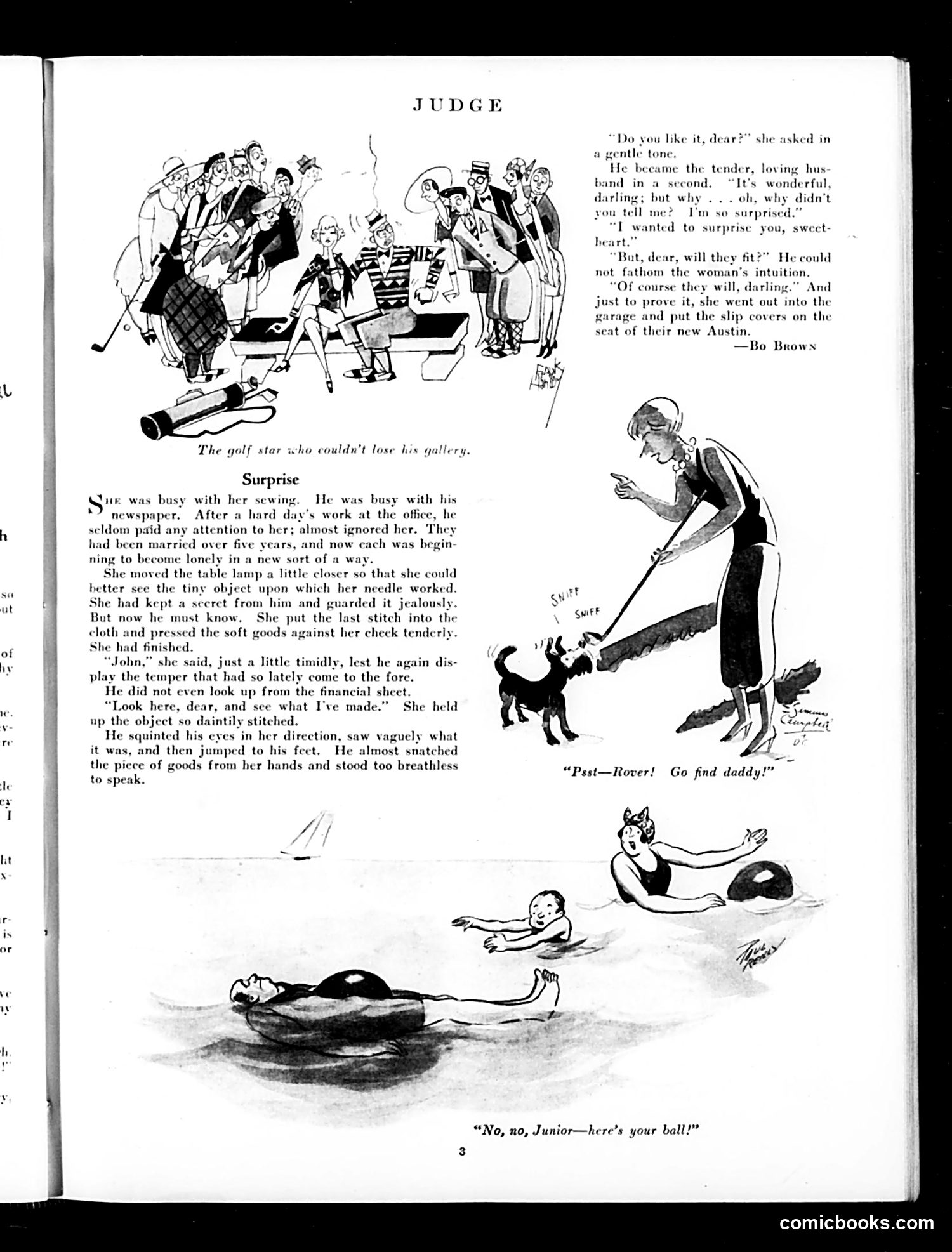
Analysis of Judge Magazine Page This page presents three separate cartoon narratives about domestic life and leisure: 1. "The golf star who couldn't lose his gallery" (top): Shows a man surrounded by spectators at what appears to be a social gathering, satirizing how celebrity golfers attract unwanted attention even in private settings. 2. "Surprise" (middle): A story about a wife presenting her husband with a homemade item. He dismisses it without looking, prompting her to reveal it anyway. The satire targets husbands' inattentiveness to wives' domestic efforts and emotional labor. 3. "Pst—Rover! Go find daddy!" (bottom): Depicts swimming/beach scenes, likely poking fun at family vacation dynamics or fathers avoiding their responsibilities. These cartoons reflect early 20th-century domestic humor focused on marriage tensions, male indifference, and leisure activities.
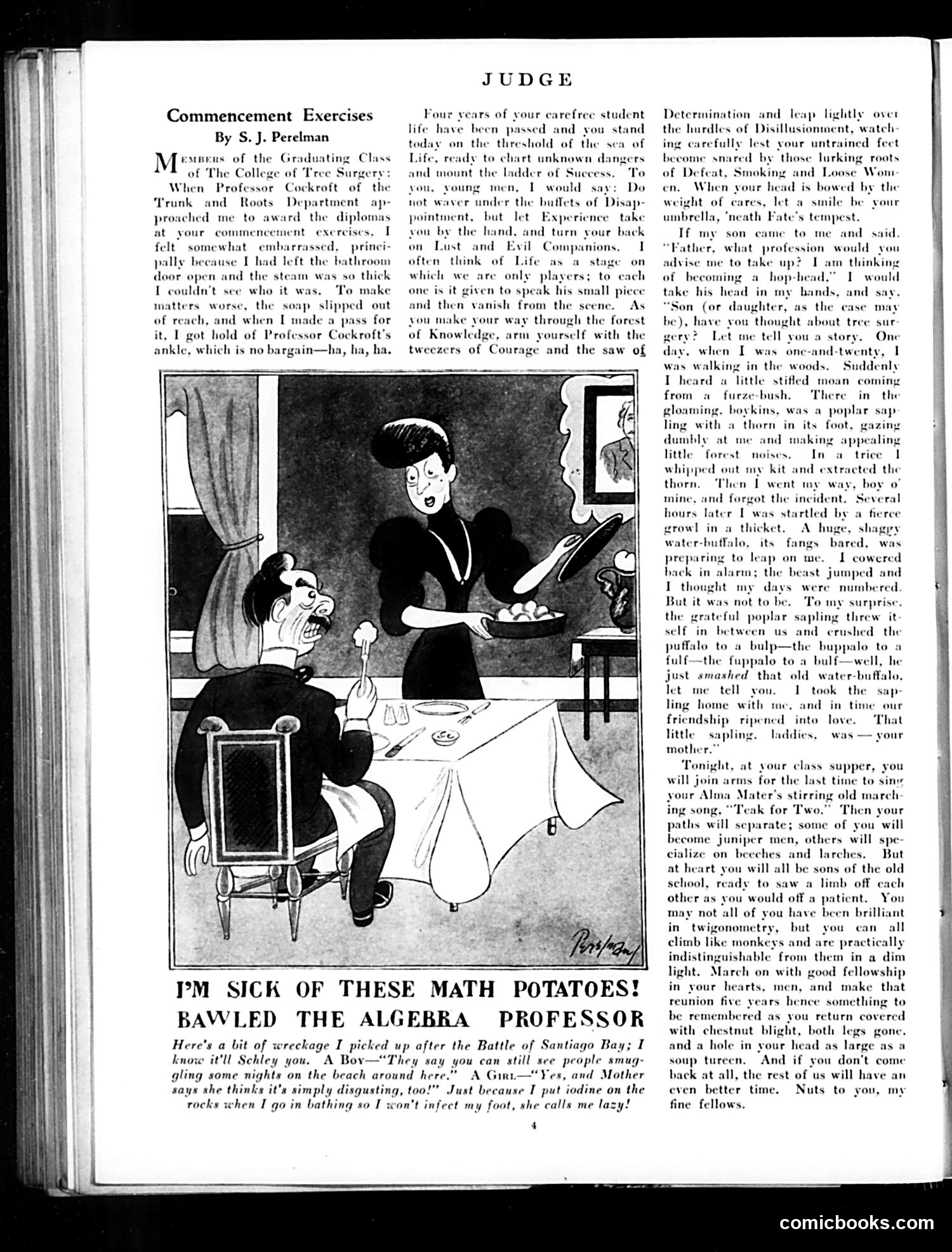
Analysis This page contains a commencement speech by S.J. Perelman (a prominent humorist) addressed to graduating medical students from the College of Tree Surgery, alongside a cartoon illustration. The main cartoon depicts a domestic scene where a woman serves food to a seated man, with the caption "I'M SICK OF THESE MATH POTATOES! BAWLED THE ALGEBRA PROFESSOR." The humor operates on multiple levels: it's a nonsensical domestic complaint (potatoes having nothing to do with algebra), playing on the absurdity of literal interpretation. The "College of Tree Surgery" itself appears to be satirical wordplay. The cartoon likely mocks pedantic academics who impose their specialized vocabularies onto everyday domestic life, creating comical incongruity. The overall piece exemplifies Judge magazine's characteristic satirical approach to American institutional life and pretension.
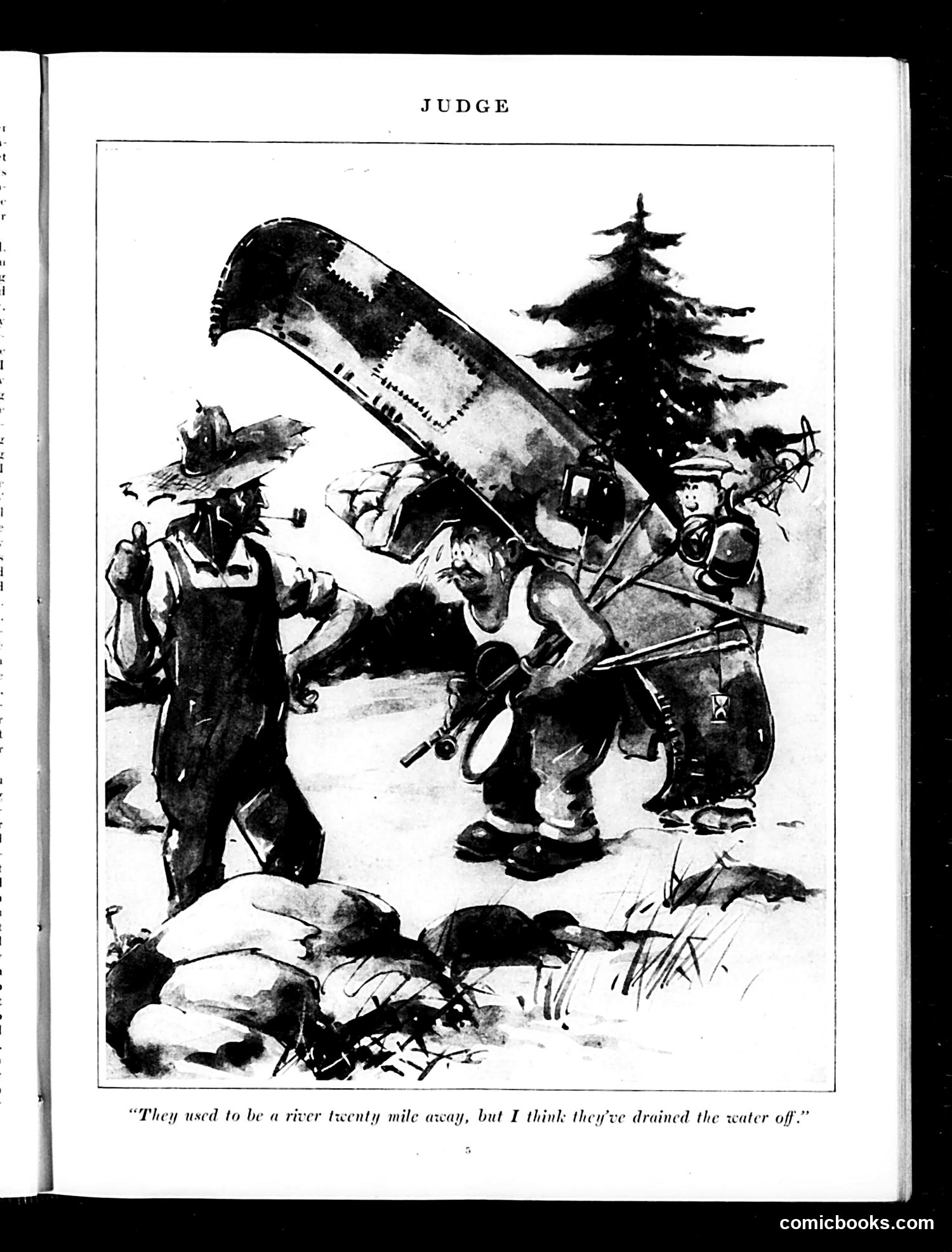
Analysis This cartoon from *Judge* magazine satirizes environmental mismanagement or water resource depletion. The caption reads: "They used to be a river twenty mile away, but I think they've drained the water off." The scene depicts what appears to be frontier or rural figures (drawn in exaggerated caricature style typical of early 20th-century satire) discovering a dried riverbed. The absurdist humor lies in the deadpan acceptance of an environmental disaster—casually attributing a river's disappearance to someone deliberately "draining" it. The cartoon likely critiques either: industrial water usage, poor water management policies, or environmental carelessness during America's development era. The specific historical context—which drought, industrial project, or policy this references—remains unclear without additional dating information.
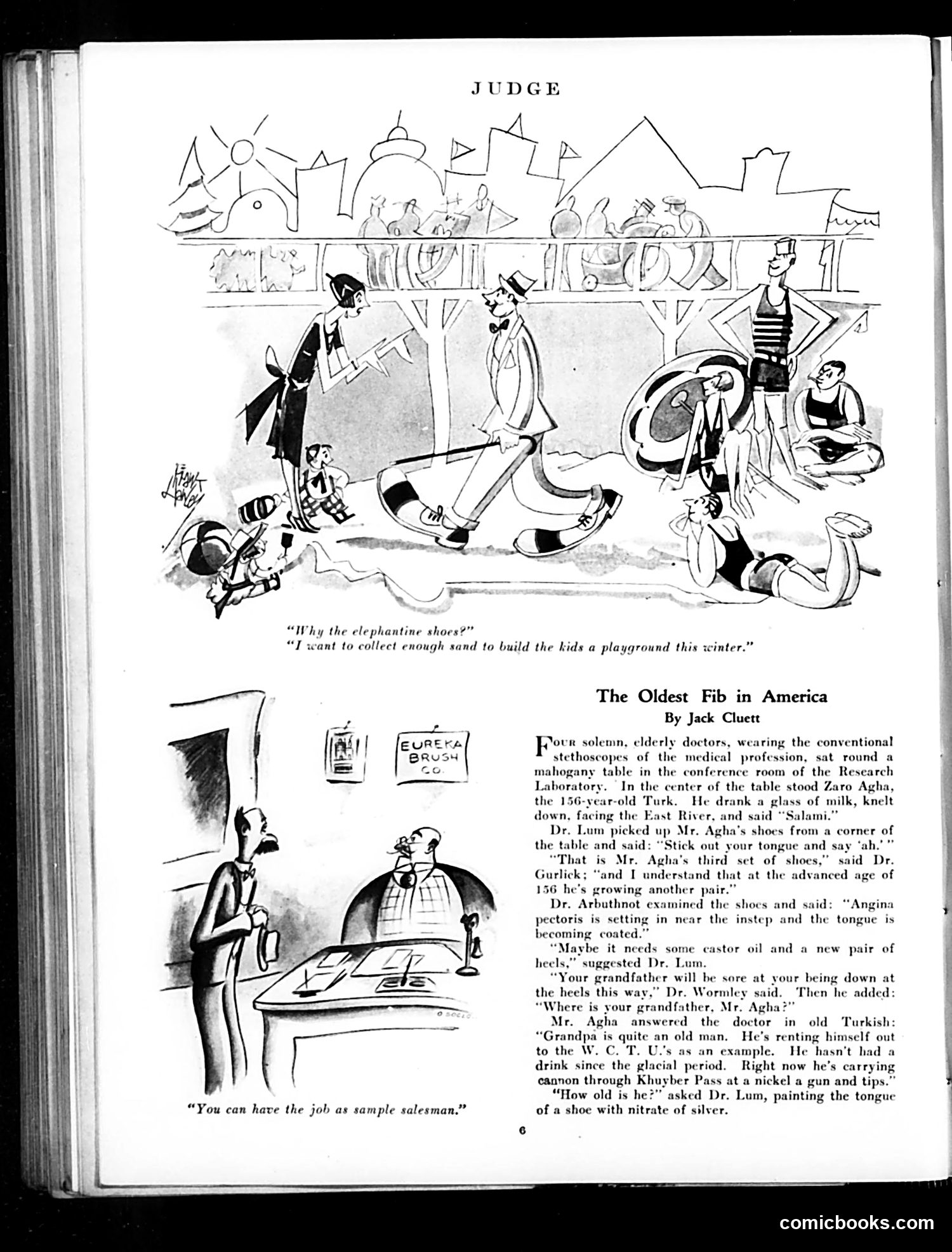
Analysis of Judge Magazine Page Top Cartoon ("Judge"): A man in formal attire stands before what appears to be a judge's bench or elevated platform, surrounded by children playing with sand and toys. The caption reads: "Why the elephantine shore?" / "I want to collect enough sand to build the kids a playground this winter." This satirizes wealthy individuals' extravagant or absurd justifications for their actions—here, a man claims he's removing sand from a beach under the pretext of building a children's playground, a transparently self-serving excuse dressed up in philanthropic language. Bottom Cartoon: A man shows product samples (marked "EUREKA BRUSH CO.") to another man. Caption: "You can have the job as sample salesman." This depicts straightforward job-seeking humor about commission-based sample sales work.
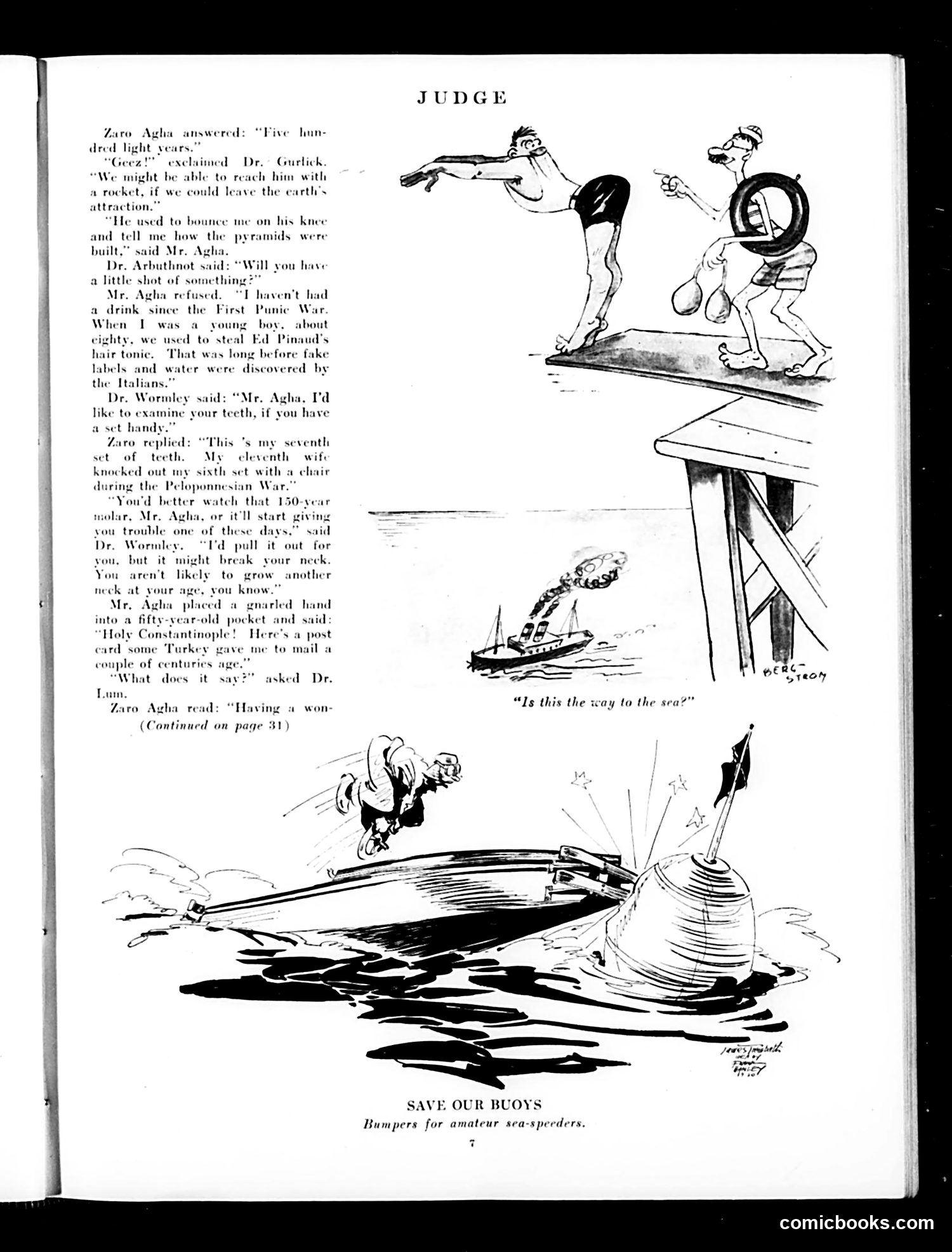
Explanation for Modern Readers This page from *Judge* magazine features two satirical elements: Upper section: A conversational narrative about "Zaro Agha," presented as an absurdly ancient man who claims to have lived through multiple historical wars (First Punic War, Peloponnesian War) and repeatedly replaced his teeth and wives. The joke relies on exaggeration—doctors express amazement at his impossible longevity. This appears to be satirizing either a real person claiming extreme age or the general public's fascination with sensationalized "oldest man alive" stories. Lower cartoon: "Save Our Buoys" depicts amateur boaters in comical distress—figures being thrown from vessels and flailing in water. The caption's pun ("buoys/boys") suggests satire of unsafe recreational boating practices and perhaps novice sailors' incompetence, presented as a humorous public safety warning. Both elements use exaggeration and wordplay typical of *Judge*'s satirical approach to contemporary social topics.
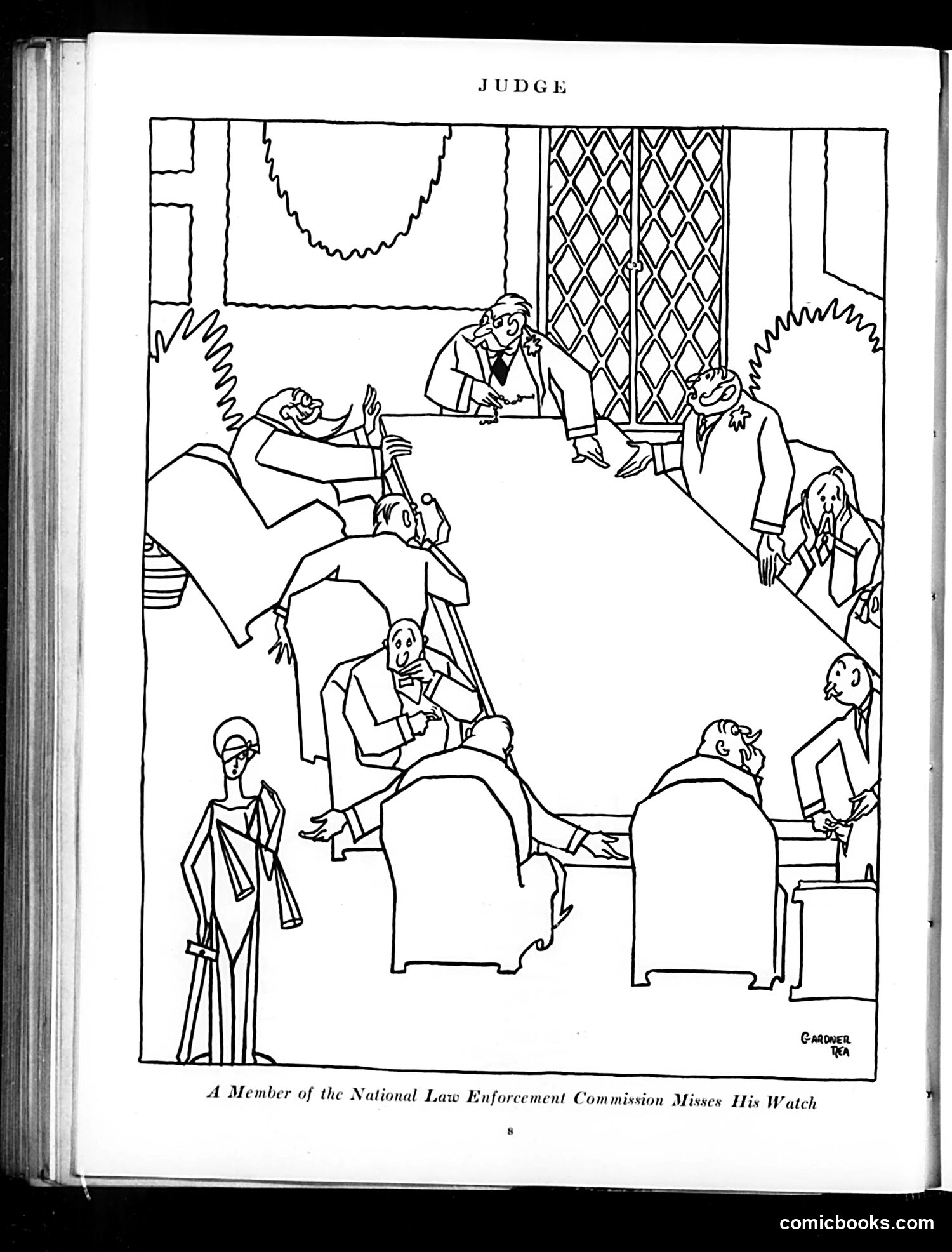
Analysis of "Judge" Cartoon Page This single-panel cartoon satirizes the National Law Enforcement Commission, depicting a courtroom scene where Lady Justice (left, blindfolded) observes chaos. The caption states "A Member of the National Law Enforcement Commission Misses His Watch." The joke targets law enforcement corruption or inattention: a commission member is so distracted by courtroom proceedings (or misconduct) that he fails to notice his own watch being stolen. This is satirical irony—someone tasked with enforcing law cannot even protect his own property. The cartoon likely critiques the Commission's ineffectiveness during Prohibition era (Judge magazine's heyday, 1920s-1930s), suggesting law enforcement officials were either corrupt, negligent, or overwhelmed. The crowded, chaotic courtroom emphasizes institutional disorder.
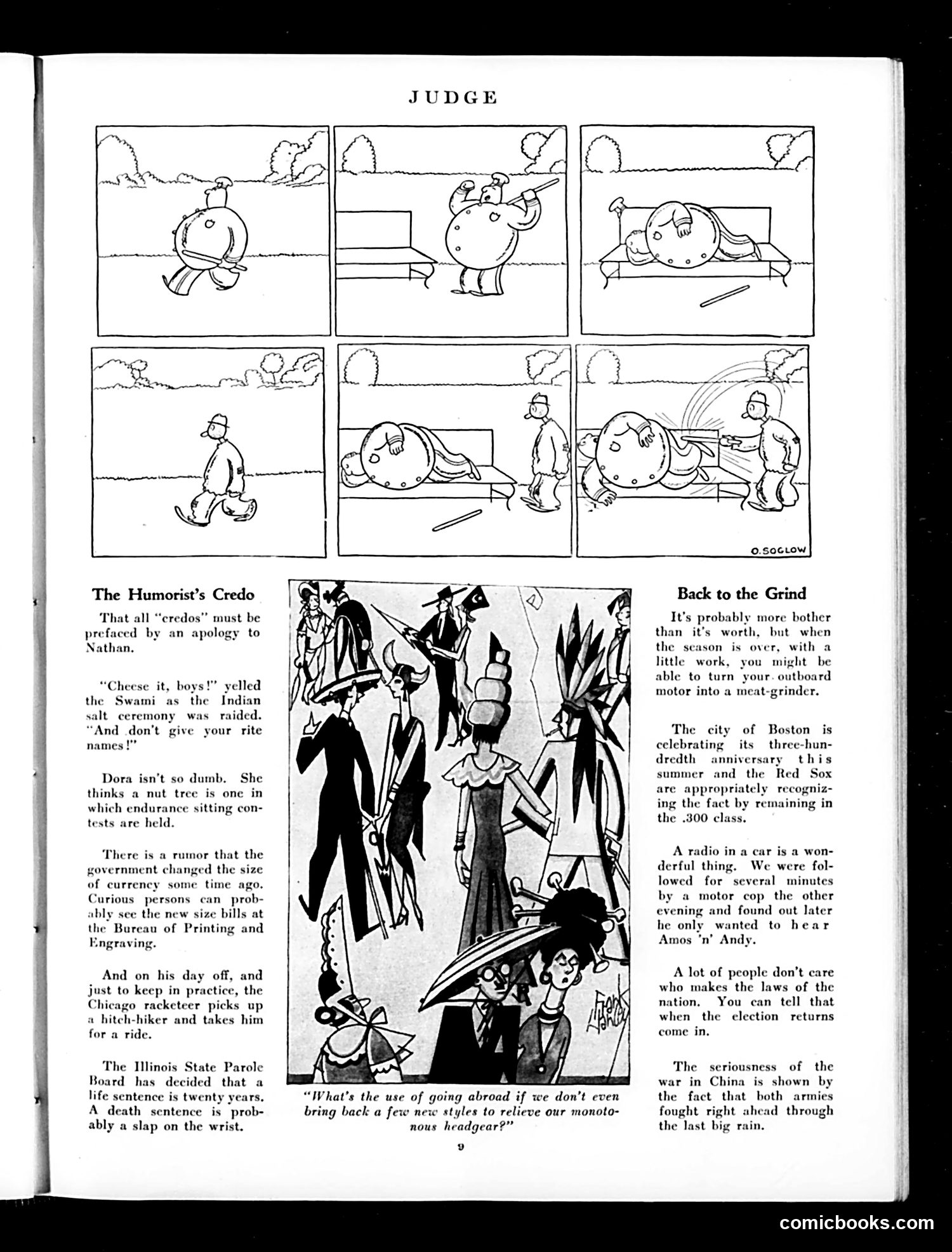
Judge Magazine Page Analysis This page from *Judge* (a satirical magazine) contains a comic strip and humorous commentary pieces typical of the era. The Comic Strip ("Judge"): The six-panel strip depicts slapstick humor involving a rotund character and a judge's bench, escalating from the character bouncing on the bench to eventual chaos with multiple figures and a water spray. The humor is purely visual/physical comedy with no apparent political message. The Text Sections: These are brief satirical observations on contemporary American life: - References to "Nathan" (unclear which Nathan is meant) - Jokes about currency changes, the mob ("racketeers"), and the Illinois parole system - Commentary on Boston's 300th anniversary and the Red Sox remaining in the ".300 class" (batting average) - References to "Amos 'n' Andy" (a popular radio show) - Observations about voter apathy during elections - A comment on the Sino-Japanese conflict (1937-1945 era, likely) The central cartoon shows well-dressed figures in what appears to be a fashion/style commentary. The overall page is light satirical commentary on contemporary American society rather than hard political satire.
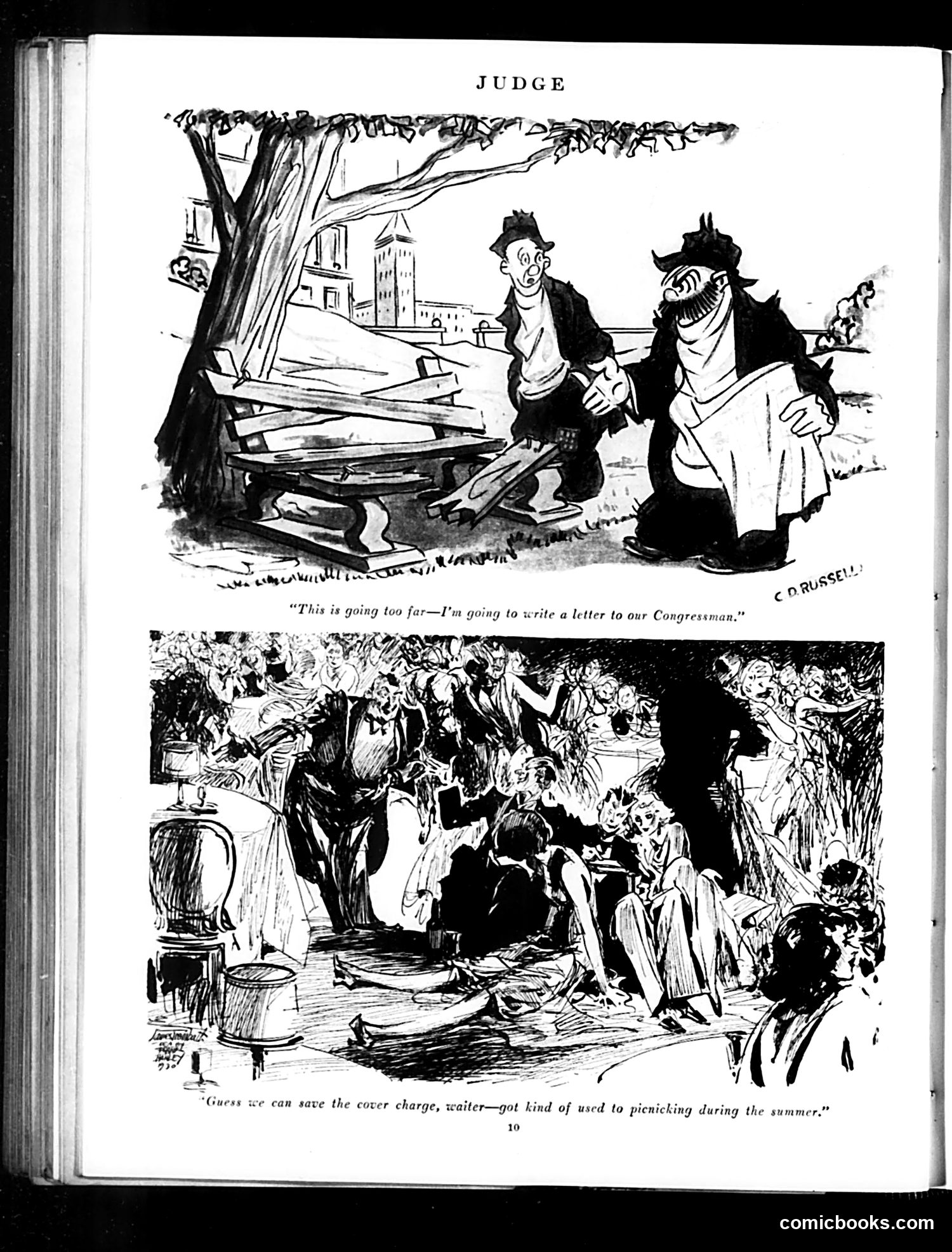
Analysis of Judge Magazine Page This page contains two satirical cartoons by C. Russells. The top cartoon shows two men under a tree threatening to write their congressman because something "is going too far"—likely referring to wartime regulations or rationing. The bottom cartoon depicts a crowded restaurant scene where a waiter is being told patrons have "got kind of used to picnicking during the summer" and want to avoid paying the cover charge. This satirizes post-WWI economic attitudes: Americans had grown accustomed to outdoor, inexpensive wartime entertainment and were reluctant to return to pre-war restaurant expenses and formality. Both cartoons mock Americans adapting (or refusing to adapt) to post-war normalcy and expense. The humor targets consumer resistance to returning to conventional economic patterns after the war disrupted normal spending habits.
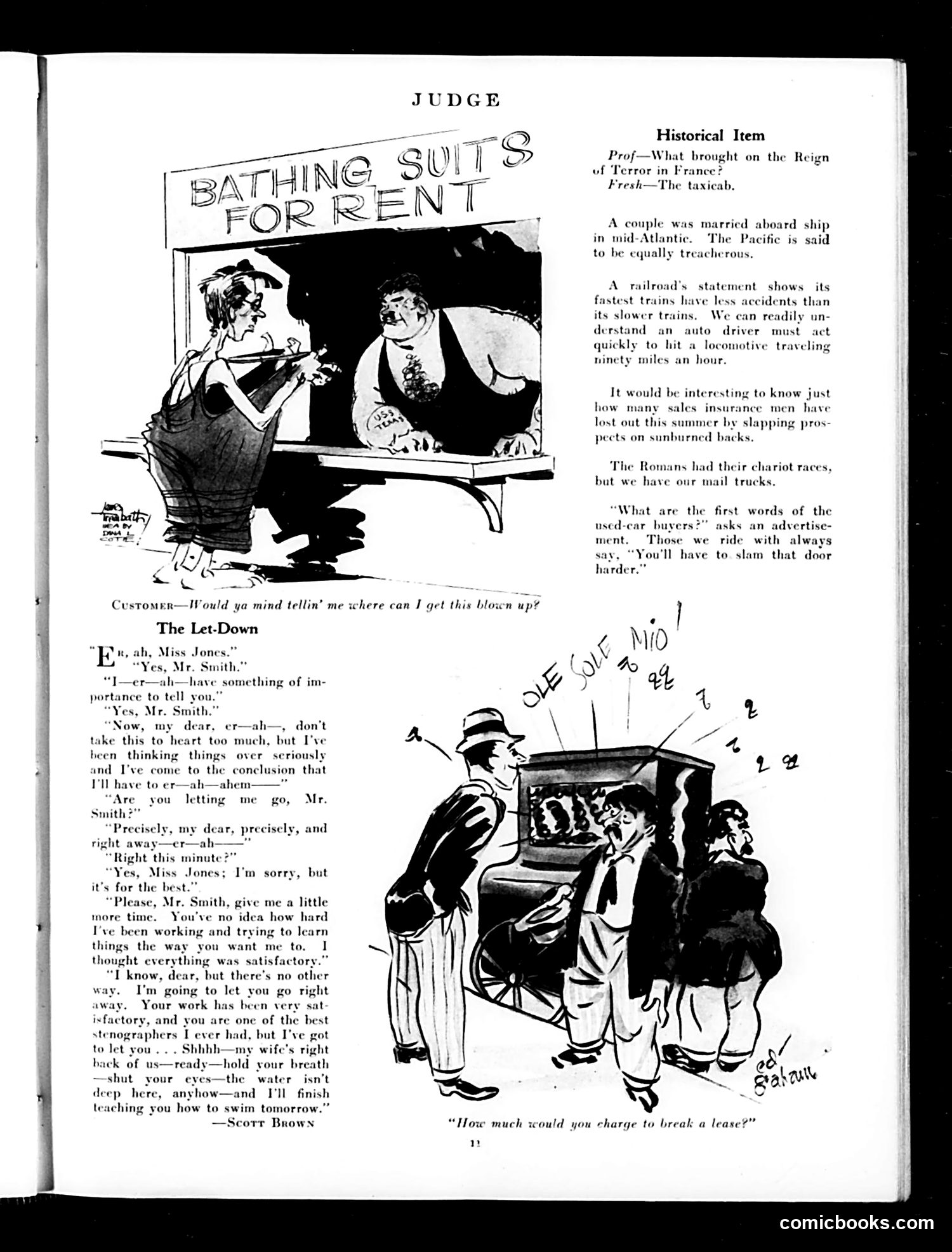
Judge Magazine Page Analysis This page contains two satirical cartoons about workplace and domestic situations typical of early 20th-century American life. "Bathing Suits for Rent" (top): A customer asks a rental attendant where to get a bathing suit "blown up" (inflated). The joke plays on the double meaning—the attendant misunderstands, thinking the customer wants the suit enlarged/fitted, leading to an awkward interaction. "The Let-Down" (bottom): A boss fires his stenographer Miss Jones while his wife waits nearby. He nervously stammers through the dismissal, then darkly jokes about teaching her to "swim" (a drowning metaphor) to cover the noise. The satire mocks both workplace awkwardness and marital dynamics—the boss prioritizes appeasing his suspicious wife over honestly managing his employee. The page also includes "Historical Items"—brief humorous observations about modern inconveniences (taxicabs, insurance losses from sunburns, mail trucks) presented as pseudo-historical facts, typical of Judge's satirical style.
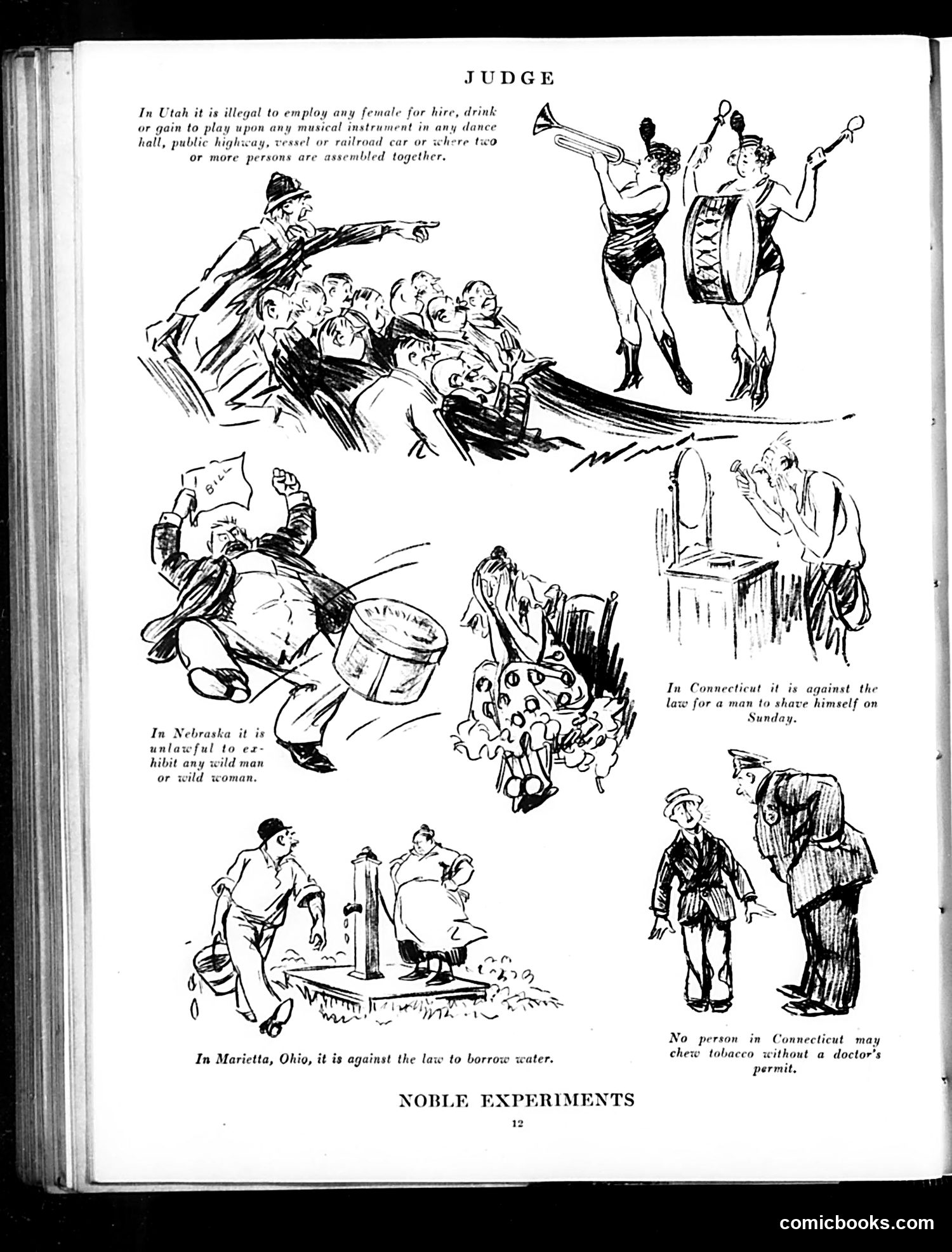
"Judge" Magazine Satire: State Laws This page satirizes absurd state and local laws through cartoon vignettes. Each illustration ridicules a real (or ostensibly real) legal statute: - Utah: Women banned from musical performances in public spaces—mocking puritanical restrictions on female autonomy and entertainment - Connecticut: Men prohibited from shaving on Sunday—satirizing rigid religious blue laws - Nebraska: Banning "wild" people from exhibition—poking fun at vague, paternalistic legislation - Ohio: Forbidding borrowing water—targeting nonsensical municipal regulations - Connecticut (again): Tobacco use requiring doctor's permits—mocking excessive regulation of personal behavior The cartoons exaggerate these laws' absurdity through their visual depiction. "Noble Experiments" (the subtitle) likely invokes Progressive Era reform efforts, suggesting such laws represent well-intentioned but misguided attempts at social improvement. The satire criticizes government overreach into private life and entertainment.
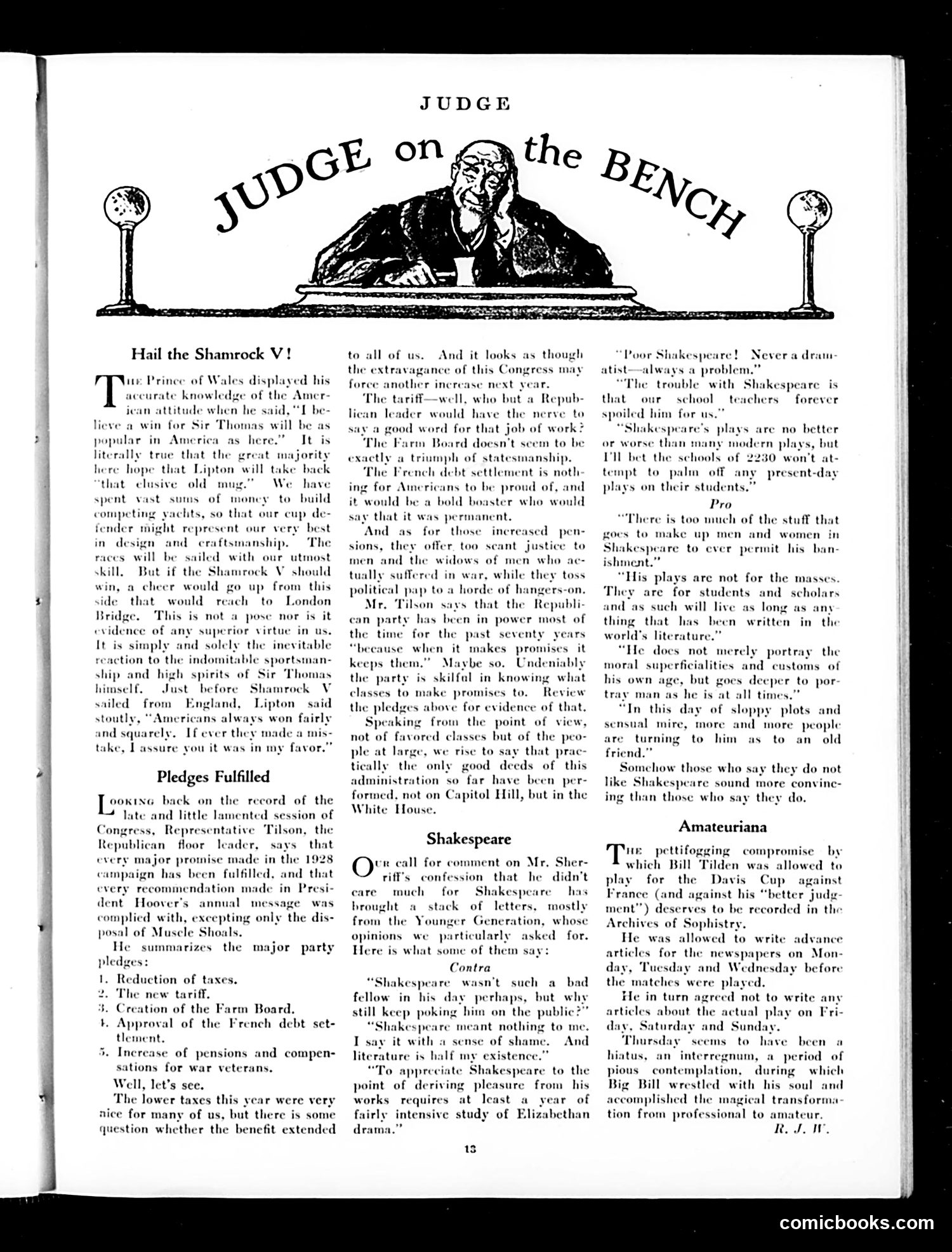
Judge Magazine Cartoon Analysis This page contains three distinct sections of political and social commentary rather than traditional cartoons. "Hail the Shamrock V!" discusses Sir Thomas Lipton's yacht race challenge to America, praising American sportsmanship and the Prince of Wales's diplomatic comment. The piece celebrates that Americans would cheer a British victory, framing this as evidence of sporting spirit rather than superiority. "Pledges Fulfilled" satirizes Republican Representative Tilson's claim that the 1928 campaign promises were kept. The author systematically dismantles each claim—tax cuts benefited few, the tariff was poorly executed, the Farm Board failed, French debt settlement brought no pride, and veterans' pensions remained inadequate. The satire suggests Republicans excelled at making promises to favored classes while accomplishing little for ordinary citizens. "Shakespeare" prints reader responses to a confession that Shakespeare wasn't appreciated. Young people express frustration that Shakespeare feels irrelevant and that schools have failed to make his work engaging for modern students.
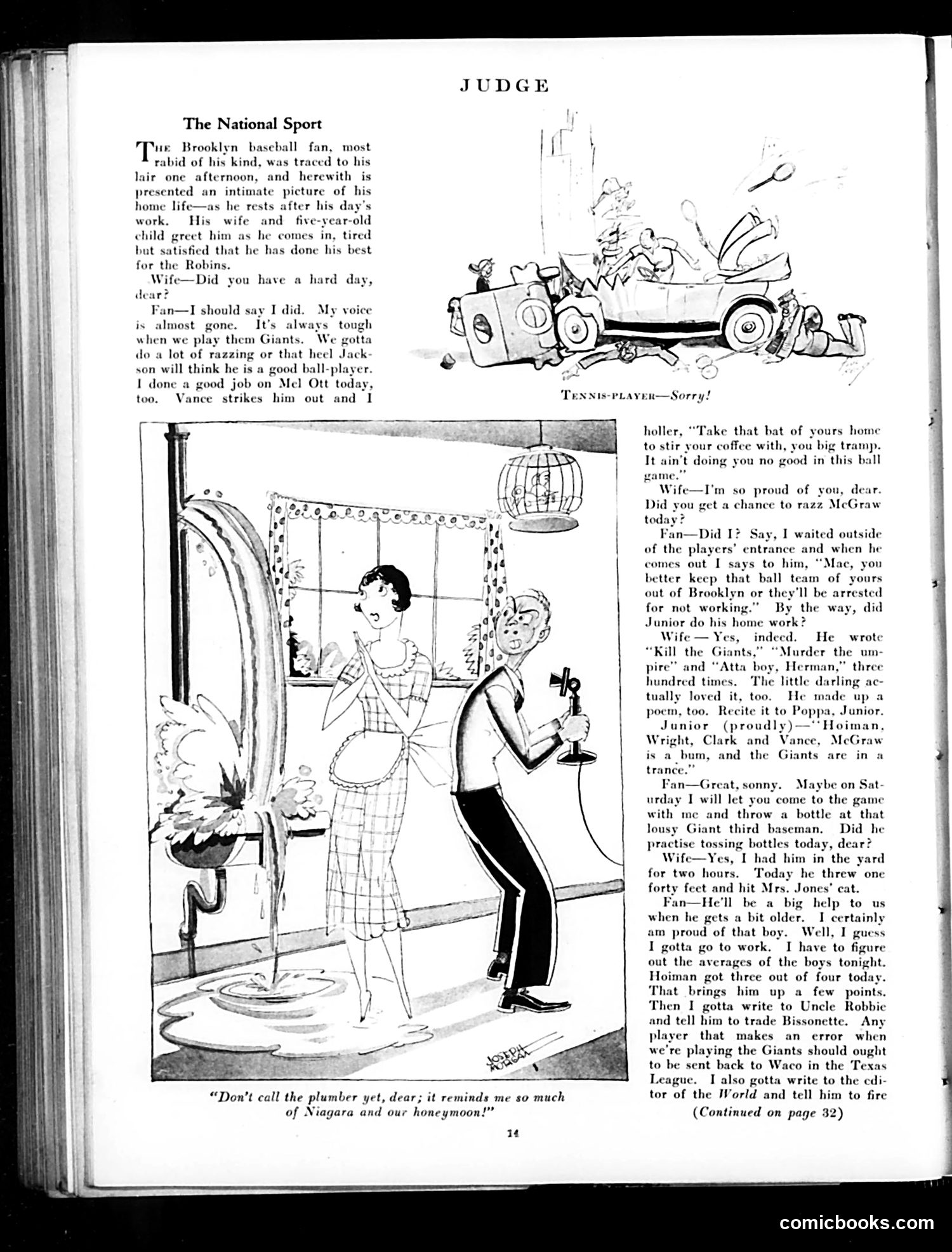
"The National Sport" – A Judge Magazine Satire This 1920s-era piece satirizes Brooklyn Dodgers fans' obsessive devotion to baseball. The cartoon depicts a fictional fan returning home after a game, where his entire life—including his wife and young son—revolves around the team's performance. The satire targets the fan's misplaced priorities: he spends his day verbally abusing opposing players (particularly Giants players and umpires), coaches his five-year-old son to do the same, and devotes his evening to calculating player statistics and writing complaint letters to team management. His wife, far from tempering this behavior, actively encourages and participates in it. The humor lies in depicting baseball fandom as an all-consuming obsession that replaces normal family life and responsibilities. References to real players (Mel Ott, McGraw) and the Dodgers organization add specificity. The caption illustration shows a couple in a bathroom—the plumber joke mockingly compares domestic duties to their honeymoon, emphasizing how baseball has displaced romance entirely.
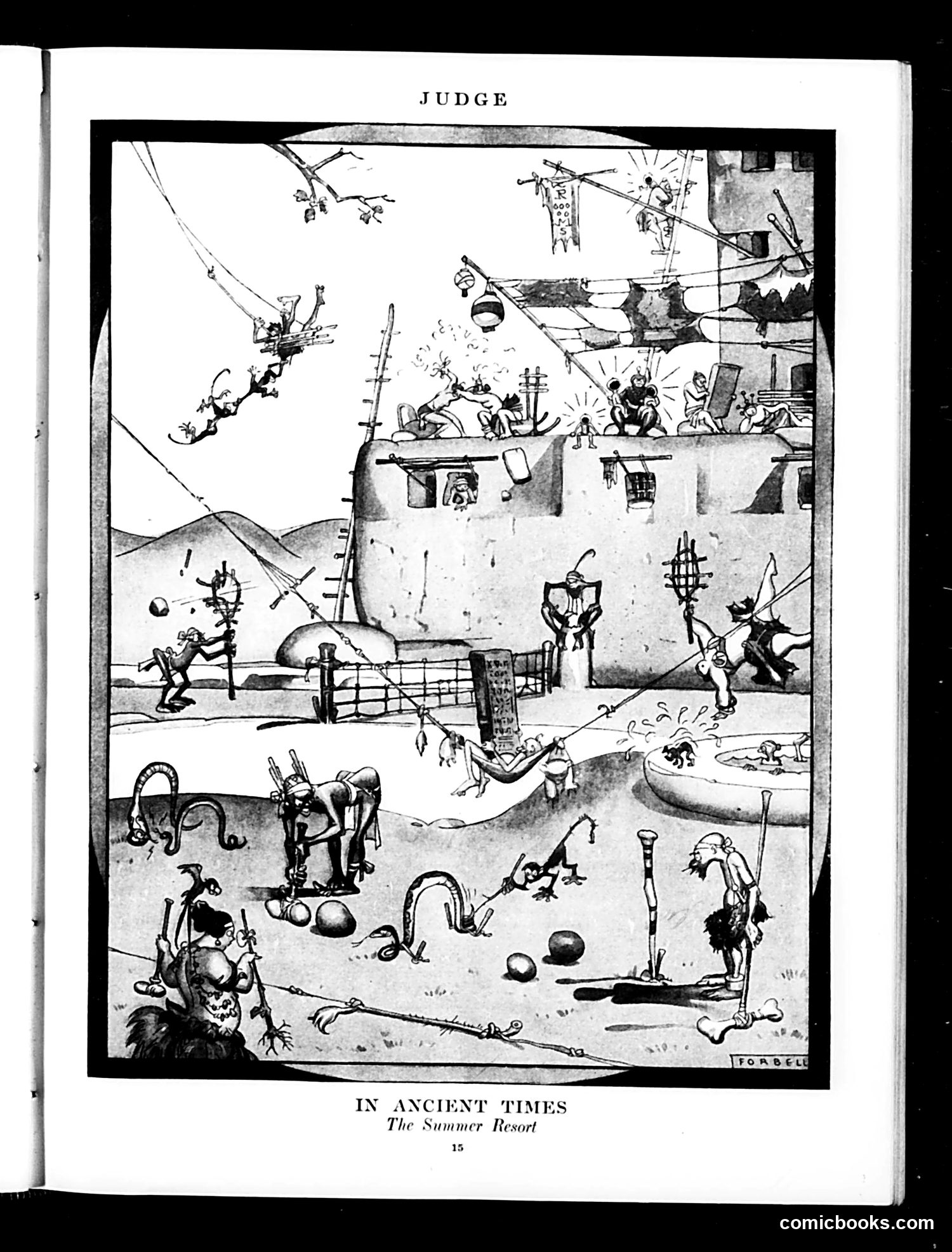
Judge Magazine Cartoon Analysis This single-panel cartoon satirizes summer resort behavior by imagining it as chaotic ancient warfare. The fortified structure represents a crowded vacation destination, while figures engage in absurd activities: some swing from ropes, others operate makeshift catapults and mechanical devices, people wade in water, and various contraptions litter the ground. The satire mocks the frenzy and disorder of summer vacationers competing for leisure activities and space. The "ancient times" framing creates humorous contrast—treating mundane resort pastimes (swimming, recreation, crowded conditions) as if they were primitive, violent conflicts requiring siege equipment. This reflects Judge magazine's typical satirical approach: exaggerating contemporary social behavior to expose its absurdity through historical or fantastical reframing.
Judge Magazine Analysis This page satirizes Broadway theater's pretensions to intellectual profundity. Judge's critic mocks Dr. George Abbott's claim that "the stage is becoming more a place for ideas," then systematically ridicules 29 recent plays by reducing their supposedly profound themes to embarrassingly obvious platitudes. The satire works through absurdist reductionism: plays are presented with mock-serious philosophical labels (invoking Hegel, Kant, Schopenhauer) while their actual "ideas" are trivial observations—that electrocution is unpleasant, that drunk men get drunk, that mothers love children, that unhappy marriages exist. The joke targets both pretentious playwrights and critics who inflate modest entertainment into philosophical statements. By the 1920s-30s, theater was competing with movies for audiences; Judge suggests Broadway compensated by claiming artistic superiority while delivering the same mundane social commentary, just dressed in theatrical language. The humor depends on recognizing that audiences knew these plays offered entertainment, not enlightenment.
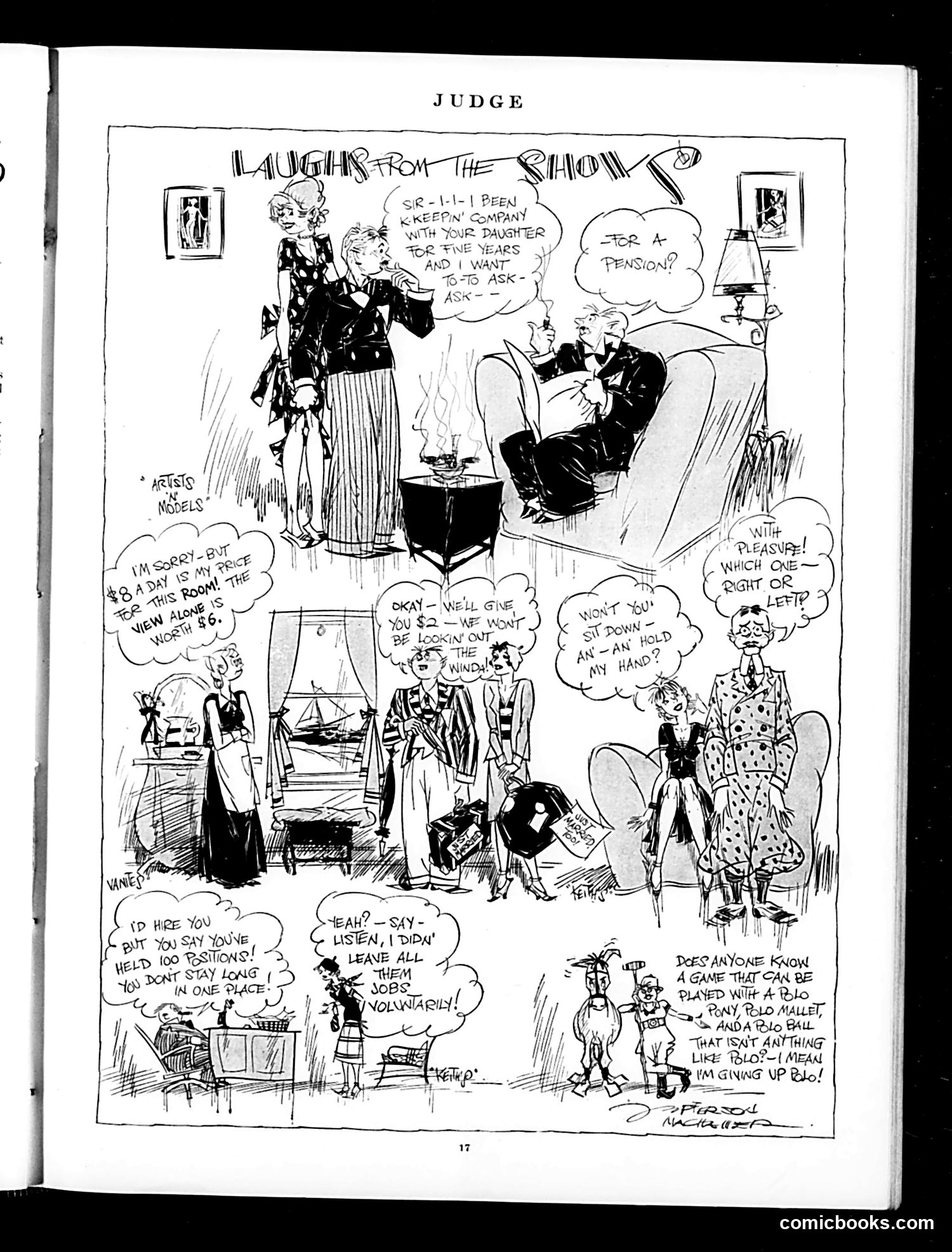
Judge Magazine Cartoon Analysis This is a single-panel satirical comic titled "Laughs from the Show" depicting job-hunting during what appears to be an economic downturn (likely the Great Depression era, based on the style and themes). The cartoon shows multiple vignettes of desperate job seekers encountering various employers with absurd or exploitative offers. A woman mentions keeping her daughter's company for five years, asking for a pension. Others discuss holding "100 positions" without staying in one place, leaving jobs voluntarily, or playing obscure games (polo, pony, mallet, and ball) as employment. The satire targets both the desperation of the unemployed willing to accept any terms and the unreasonable demands employers make during economic hardship. The joke is the gap between what workers need (stable employment, fair wages, pensions) and what's actually being offered—either impossible conditions or work so marginal it barely qualifies as employment.
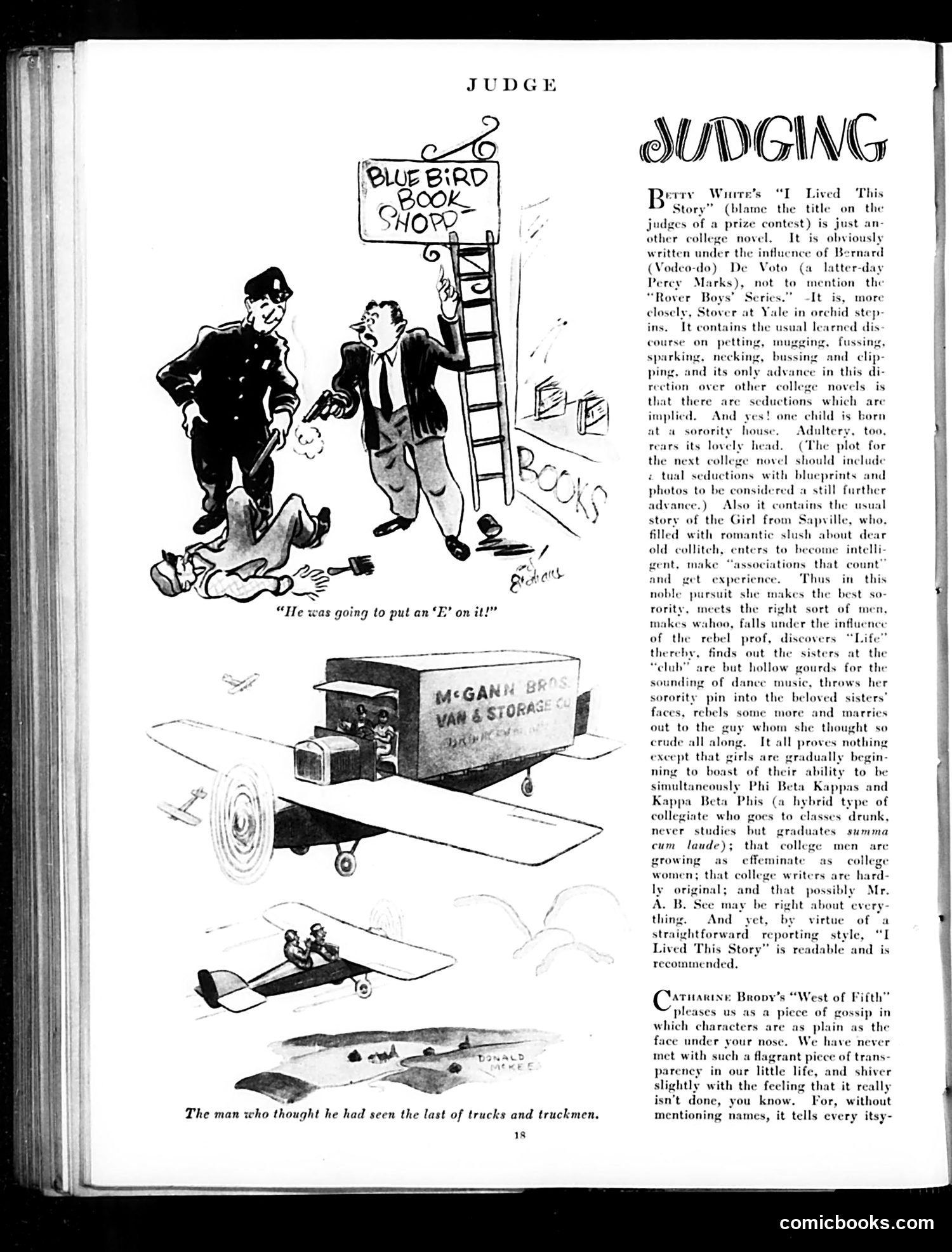
Judge Magazine Book Review Page This page contains satirical book reviews rather than political cartoons. The main cartoon shows two men at a bookshop—one pointing at a sign reading "BLUE BIRD BOOK SHOP" with the caption "He was going to put an 'E' on it!"—a visual pun about adding the letter "E" (presumably to make it "BLUE BIRD BOOK SHOPPE," a more pretentious spelling). The reviews critique contemporary college novels as formulaic and derivative. The first review mocks "I Lived This Story" for following predictable tropes: seductions at sorority houses, rebellious professors, romantic disillusionment, and girls balancing academic achievement (Phi Beta Kappa) with social status. The second review praises Catharine Brody's "West of Fifth" as gossipy social commentary with transparent character identification—appealing precisely because readers can recognize real people behind fictional names, which the author cleverly avoids stating directly. The satire targets both college novel conventions and 1920s youth culture.
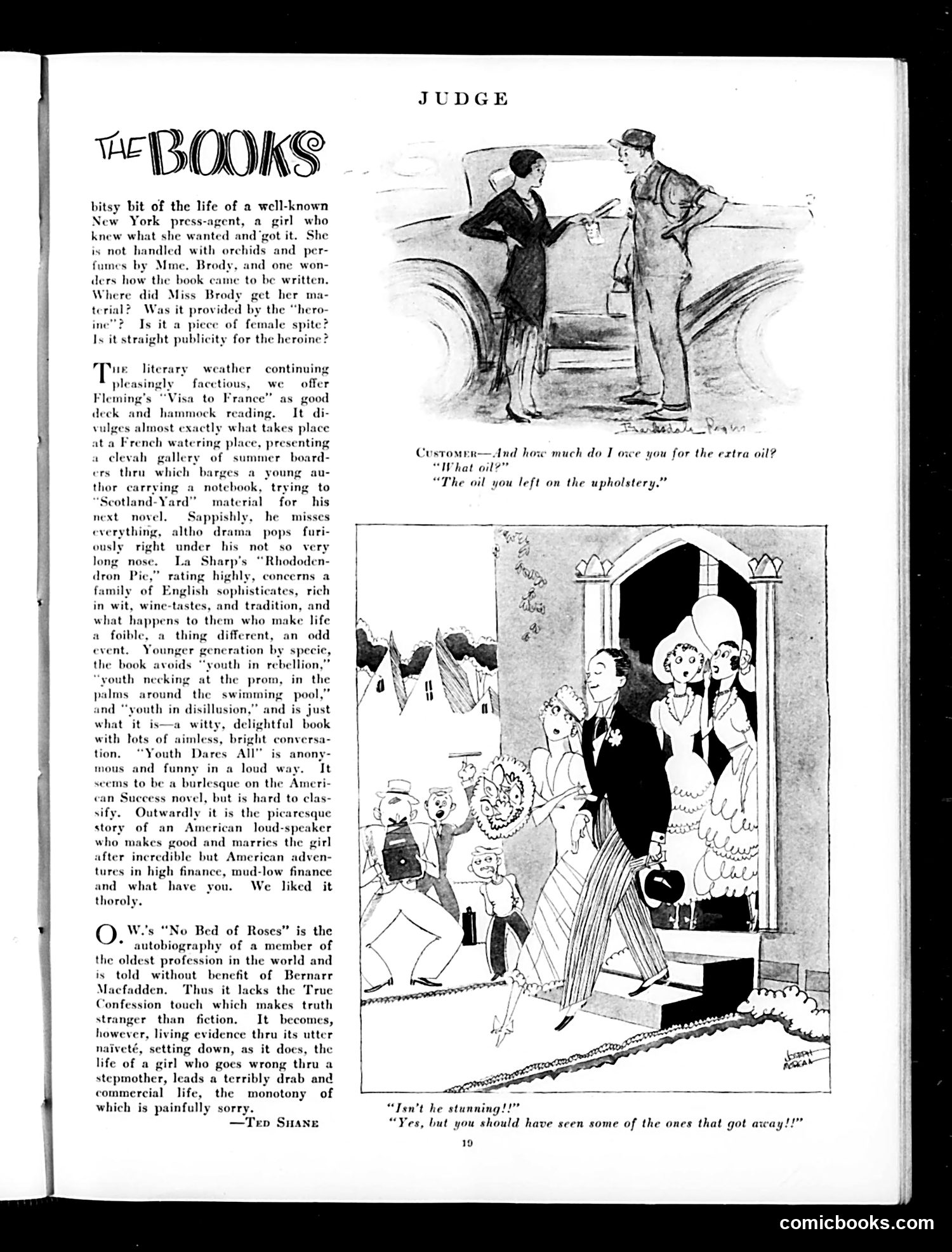
"Judge" Magazine Book Review Page Analysis This page from *Judge* magazine reviews several contemporary novels with accompanying cartoons. The top cartoon depicts a customer complaining to a mechanic about oil stains left on car upholstery—a straightforward consumer complaint joke about poor service. The lower cartoon shows a wedding scene where a bride displays her groom to guests, with one woman remarking he's "stunning" but "you should have seen some of the ones that got away." This satirizes the matrimonial market mentality—treating husbands as catches to be selected, implying the bride "settled" or that women shop for husbands competitively. The text reviews books including titles about a press agent's daughter, French resort life, and notably "A Bed of Roses"—autobiography of a sex worker. The reviewer critiques its lack of sensationalism, suggesting readers expected more lurid "True Confession" style narratives from such material. The satire targets both the publishing industry's exploitation of such stories and readers' prurient interests.
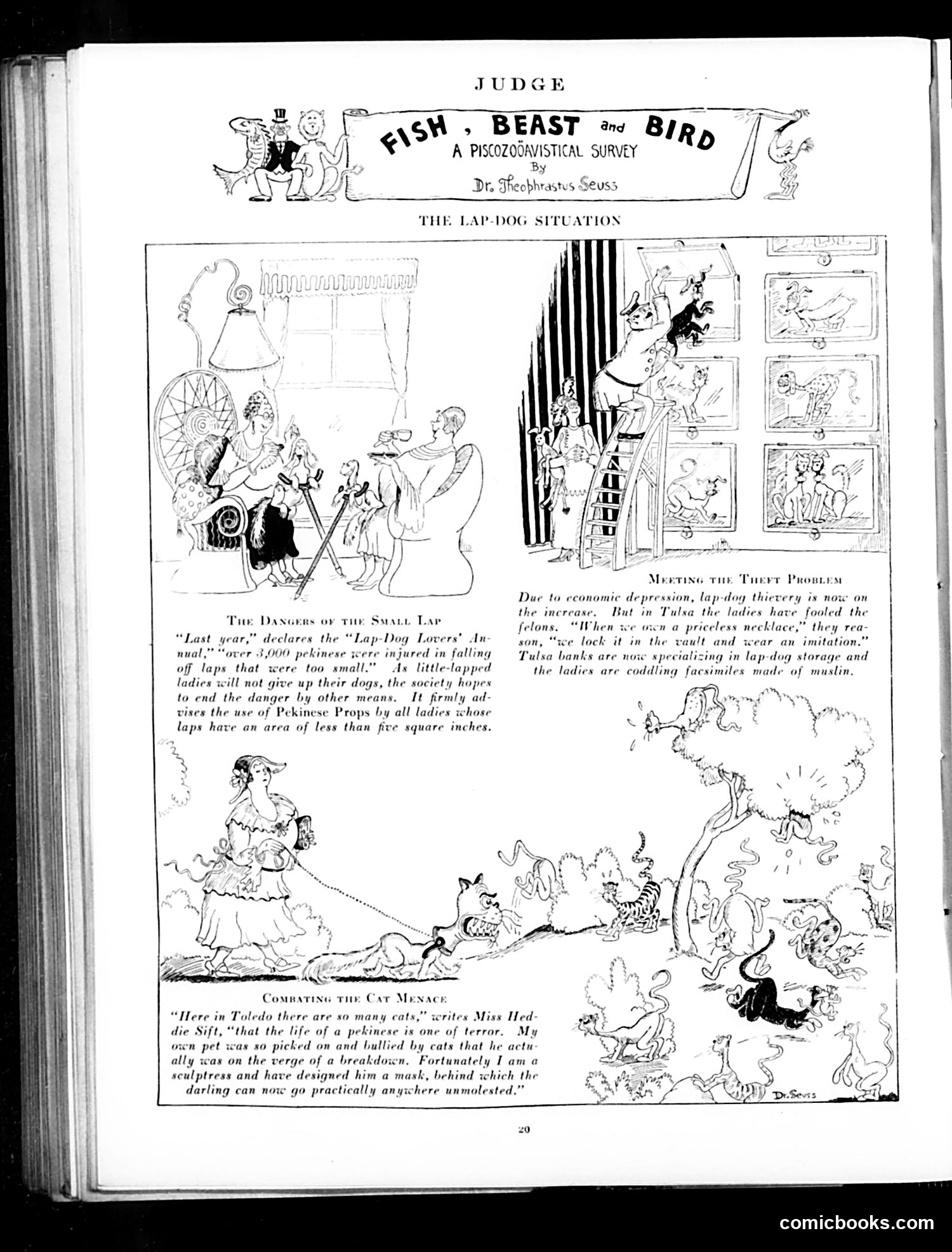
"Fish, Beast and Bird" — Lap-Dog Satire by Dr. Seuss This 1920s-30s Judge magazine page satirizes the absurd pampered-pet culture among wealthy American women. The "piscozoavistical survey" (fake-scientific term) mocks three ridiculous "solutions" to lap-dog problems: 1. The Lap-Dog Dangers: Women with tiny laps drop their Pekingese dogs; the "solution" is absurd "Pekinese Props"—props to support undersized laps. 2. Cat Menace: A woman designs a mask for her terrified dog so it can hide from neighborhood cats—satirizing overprotective pet owners. 3. Theft Problem: During economic depression, lap-dogs are being stolen. Wealthy Tulsa women now carry fake muslin dog replicas while keeping real ones home—mocking the wealthy's obsession with status symbols and their willingness to deceive thieves with imitations. The satire targets upper-class women's frivolous, excessive devotion to luxury pets during hard economic times, treating toy dogs as precious jewelry rather than animals.
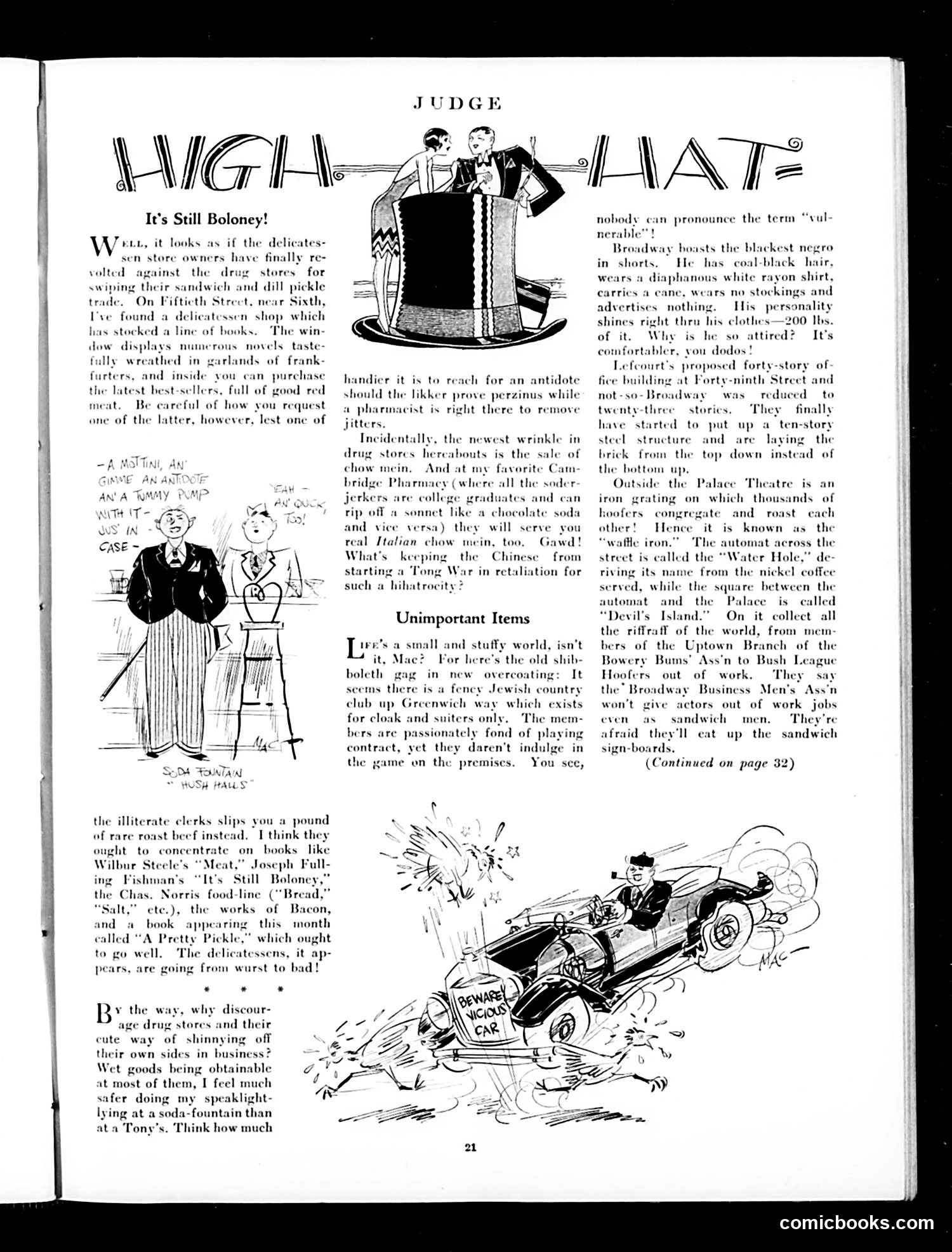
Explanation for Modern Readers This *Judge* satirical page mocks several 1920s commercial trends and social pretensions: Main Column ("It's Still Boloney!"): The writer ridicules delicatessens that now stock novels alongside food—a gimmick to compete with drugstores selling sandwiches. The joke: asking for a "best-seller" might get you roast beef instead of a book. He also mocks drugstores serving Chinese chow mein and "Italian" versions, questioning cultural authenticity. "Unimportant Items" Section: Satirizes Jewish country clubs that exclude non-members and prohibit card games on premises—highlighting class snobbery. Also pokes fun at a Broadway performer ("blackest negro") whose fashionable outfit (rayon shirt, no socks, cane) seems pretentiously stylized. Bottom Cartoons: Mock theatrical performers and workers congregating near the Palace Theatre—called a "waffle iron" and "Devil's Island"—where unemployed actors desperately seek work as sandwich-board carriers. The overall tone: affectionate mockery of commercialization, ethnic identity politics, and entertainment-world desperation during the Jazz Age.
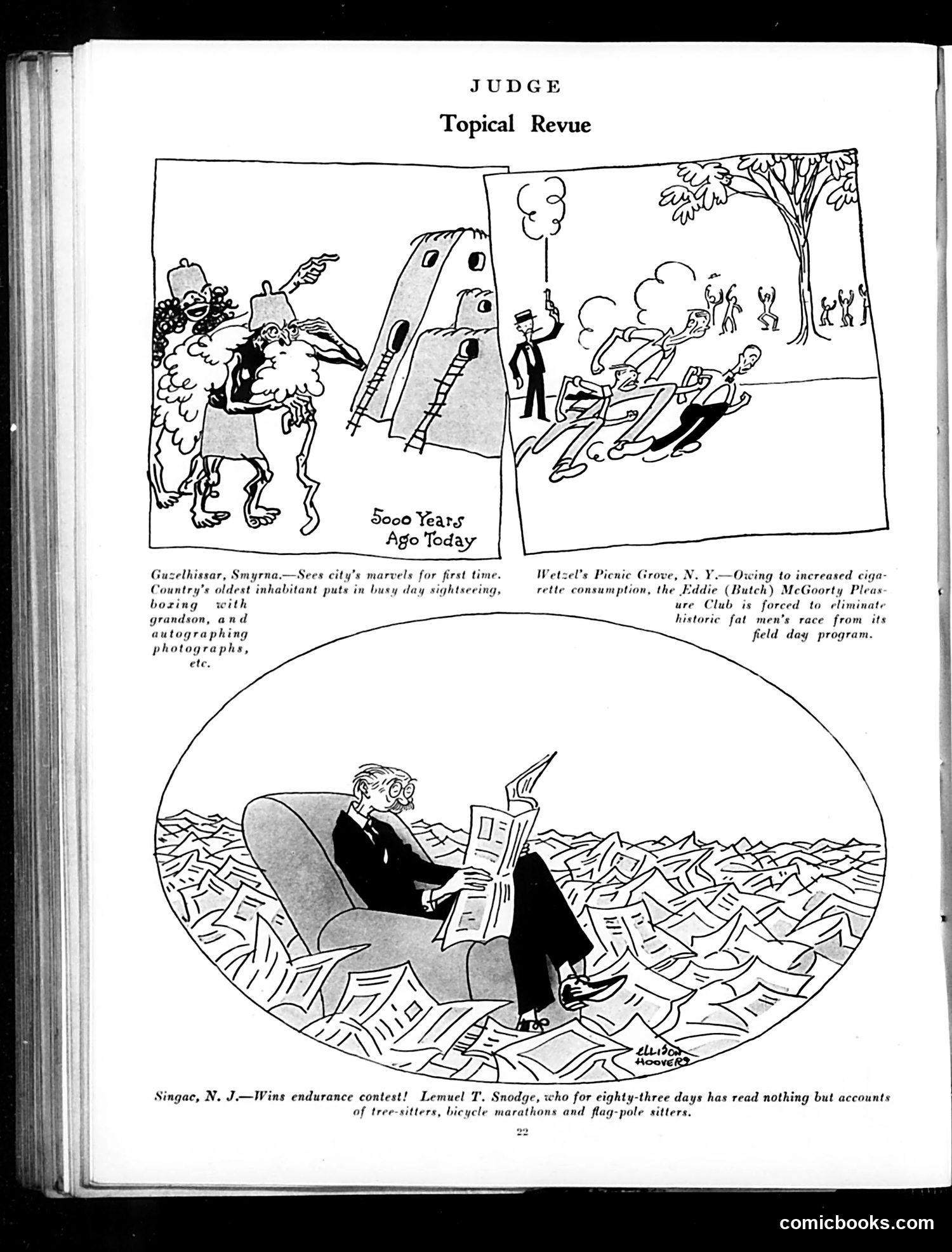
Judge "Topical Revue" Analysis This page contains three separate satirical items mocking contemporary trends and news stories: 1. "5000 Years Ago Today": Contrasts ancient Smyrna's marvels with modern tourism—implying sightseeing has become repetitive and commercialized ("bozing with grandson"). 2. Wetzel's Picnic Grove: Satirizes increased cigarette consumption by showing a pleasure club forced to eliminate its "historic fat men's race" due to health concerns, likely mocking both smoking culture and the absurdity of specialty athletic events. 3. Singac endurance contest: Ridicules the contemporary craze for endurance stunts and sensational newspaper coverage. "Lemuel T. Snodge" wins by reading accounts of tree-sitters, bicycle marathons, and flagpole sitters for 83 days—suggesting these fads were newspaper obsessions generating endless trivial coverage. The overall theme critiques modern society's appetite for novelty, excess (smoking, racing, stunts), and media-driven sensationalism.
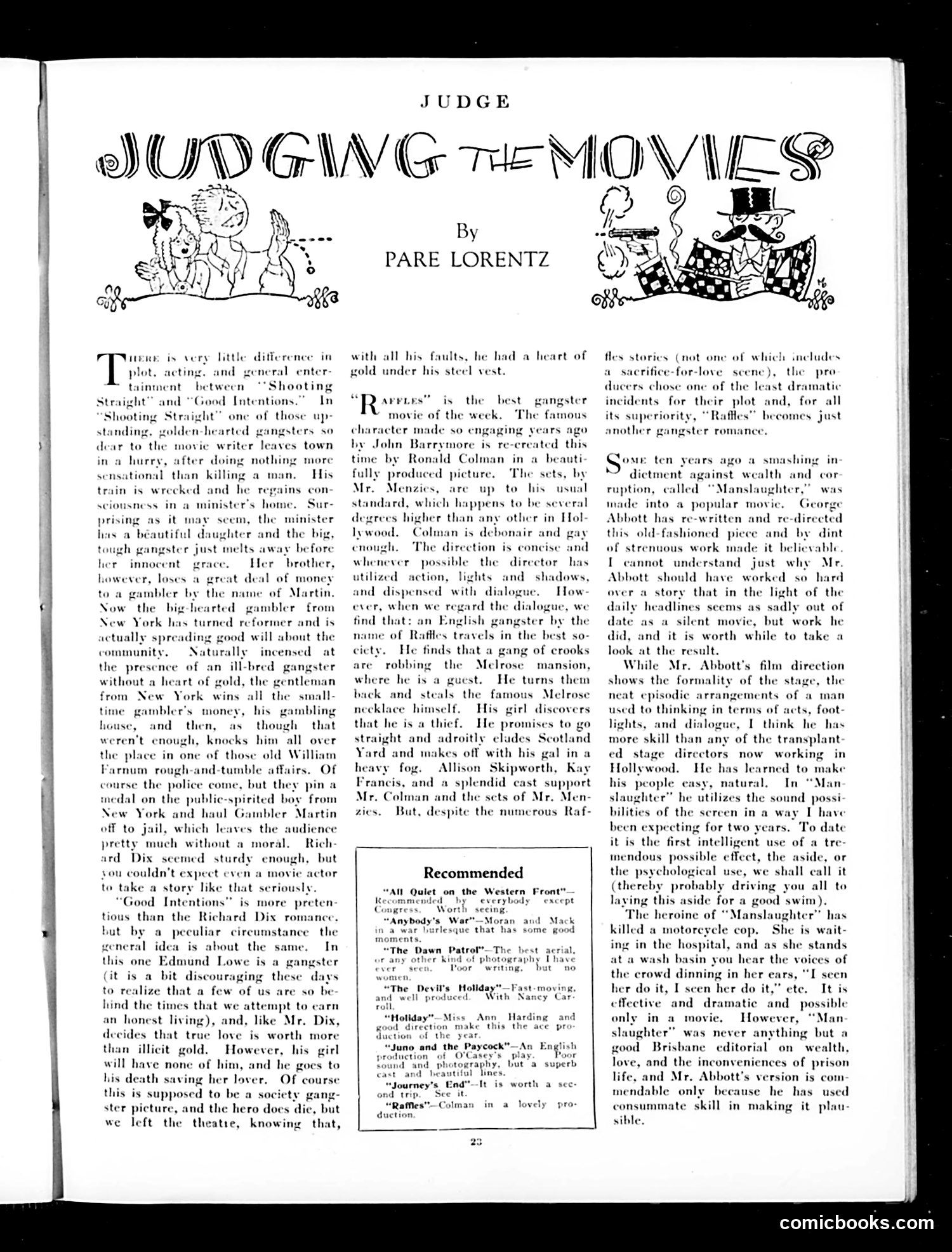
Judge Magazine Film Review Analysis This page reviews three gangster/crime films by critic Pare Lorentz. The main content discusses "Shooting Straight," "Good Intentions," and "Raffles" — movies featuring reformed or conflicted criminals (played by Richard Dix, Edmund Lowe, and Ronald Colman respectively). The satire targets a predictable Hollywood formula: tough gangsters with "hearts of gold" who abandon crime for love or morality, allowing audiences to enjoy crime narratives while maintaining moral comfort. Lorentz criticizes this pattern as formulaic and dishonest — the criminals reform unconvincingly, yet audiences leave satisfied without genuine moral lessons. "Raffles" receives praise for superior production values and Colman's performance, though even its technical excellence can't fully redeem the same tired plot device. The "Recommended" box lists other contemporary films worth viewing, providing broader entertainment coverage typical of Judge's film criticism section.
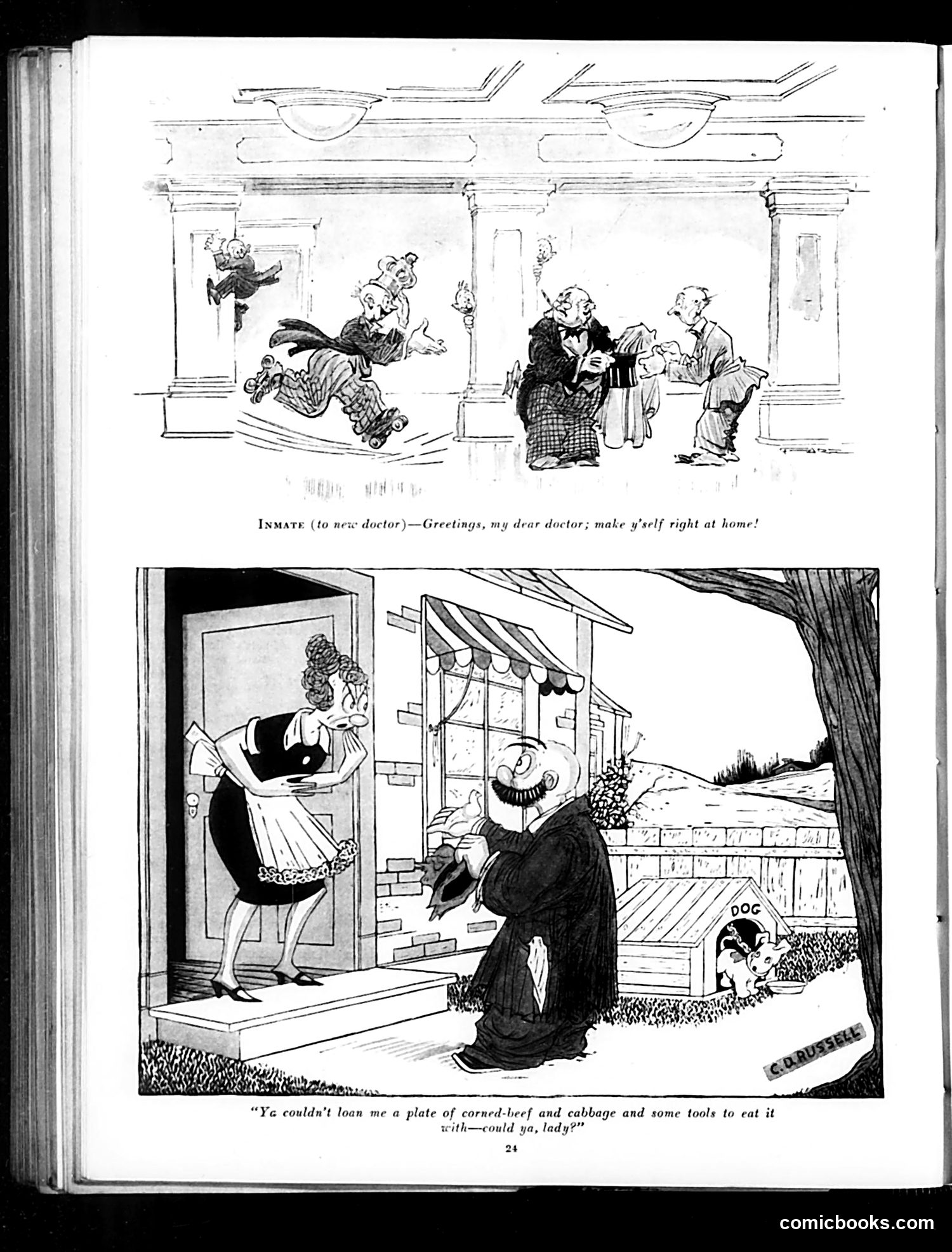
Analysis This page contains two separate cartoons. The top cartoon depicts an inmate greeting a new doctor at what appears to be a prison, with the inmate's irreverent welcome suggesting he's unimpressed by authority. The bottom cartoon shows a beggar at a woman's doorstep making an unusually specific request: he's asking to borrow not just food (corned beef and cabbage—a stereotypically Irish meal) but also eating utensils. The satire mocks both the beggar's brazen audacity in asking for "loans" rather than charity, and perhaps satirizes Irish immigrant poverty and begging practices common in early 20th-century America. The humor lies in the absurd specificity and the beggar's presumption that the woman would lend him tools to eat with.
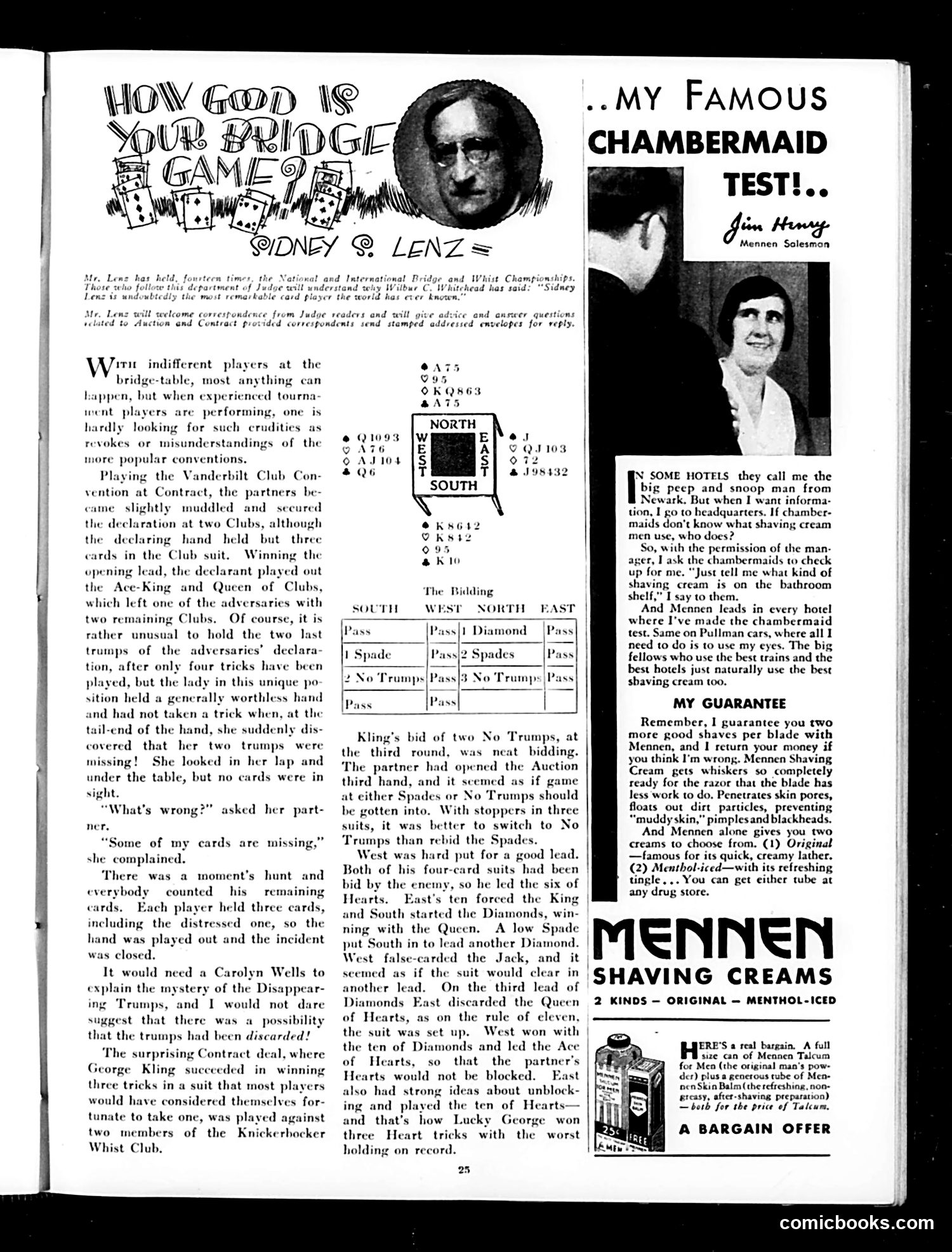
Judge Magazine Page Analysis This page contains a bridge column by Sidney S. Lenz (identified by the byline) documenting a contract bridge hand from the Vanderbilt Club Convention, featuring a memorable play by "Lucky George" Kling against Knickerbocker Whist Club members. The main narrative describes a peculiar incident where a female player discovered mid-hand that two trump cards were missing from her hand—later resolved when all players recounted their cards and found each had exactly three. The column then details Kling's skillful play winning three Heart tricks despite holding the weakest Heart suit, achieved through careful unblocking and card management. The right side contains an advertisement for Mennen Shaving Cream featuring testimonial copy from "Jim Hersey, Mennen Salesman," describing his "chambermaid test"—visiting hotels to ask chambermaids which shaving cream guests use, claiming Mennen leads everywhere. This is primarily instructional bridge content with integrated advertising, typical of Judge's format.
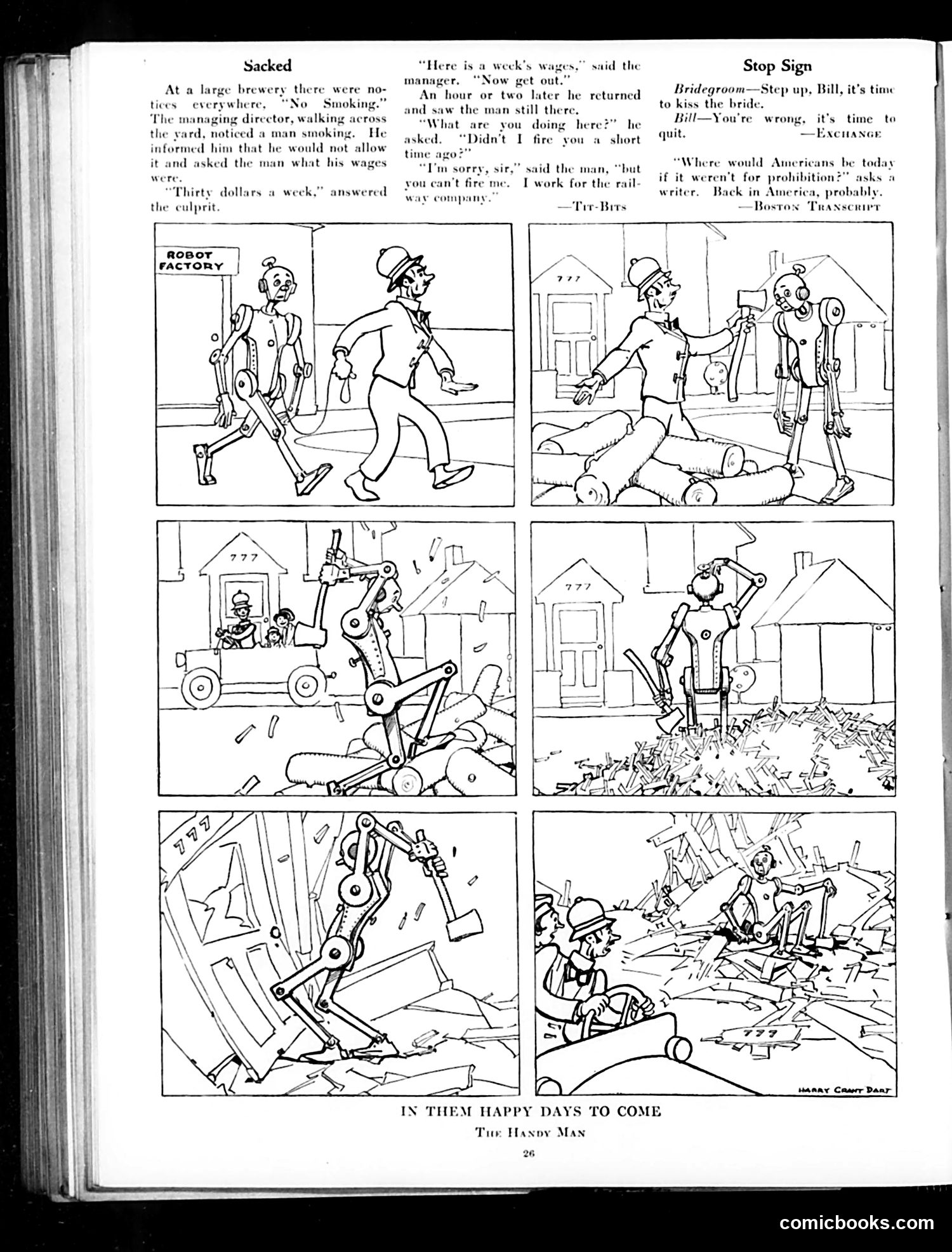
Analysis of Judge Magazine Page This page contains three distinct humor pieces: "Sacked" (text anecdote): A brewery manager fires a worker earning thirty dollars weekly, then finds him still loitering hours later. The worker explains he can't leave because he works for the railway company—a joke about job insecurity and economic dependence during what appears to be the early 20th century. "Stop Sign" (dialogue joke): A bridegroom and best man exchange quips about timing—whether it's time to kiss the bride or quit the marriage. This is straightforward marital humor with no apparent political content. "Robgy Factory" / "In Them Happy Days to Come" (comic strip): A robot destroys a house and its contents with apparent indifference. The caption's ironic title suggests satire about technological "progress" and automation replacing human labor—a concern during the early machine age. The page reflects early 20th-century anxieties: economic precarity, changing technology, and workplace displacement, wrapped in the satirical humor Judge magazine was known for.
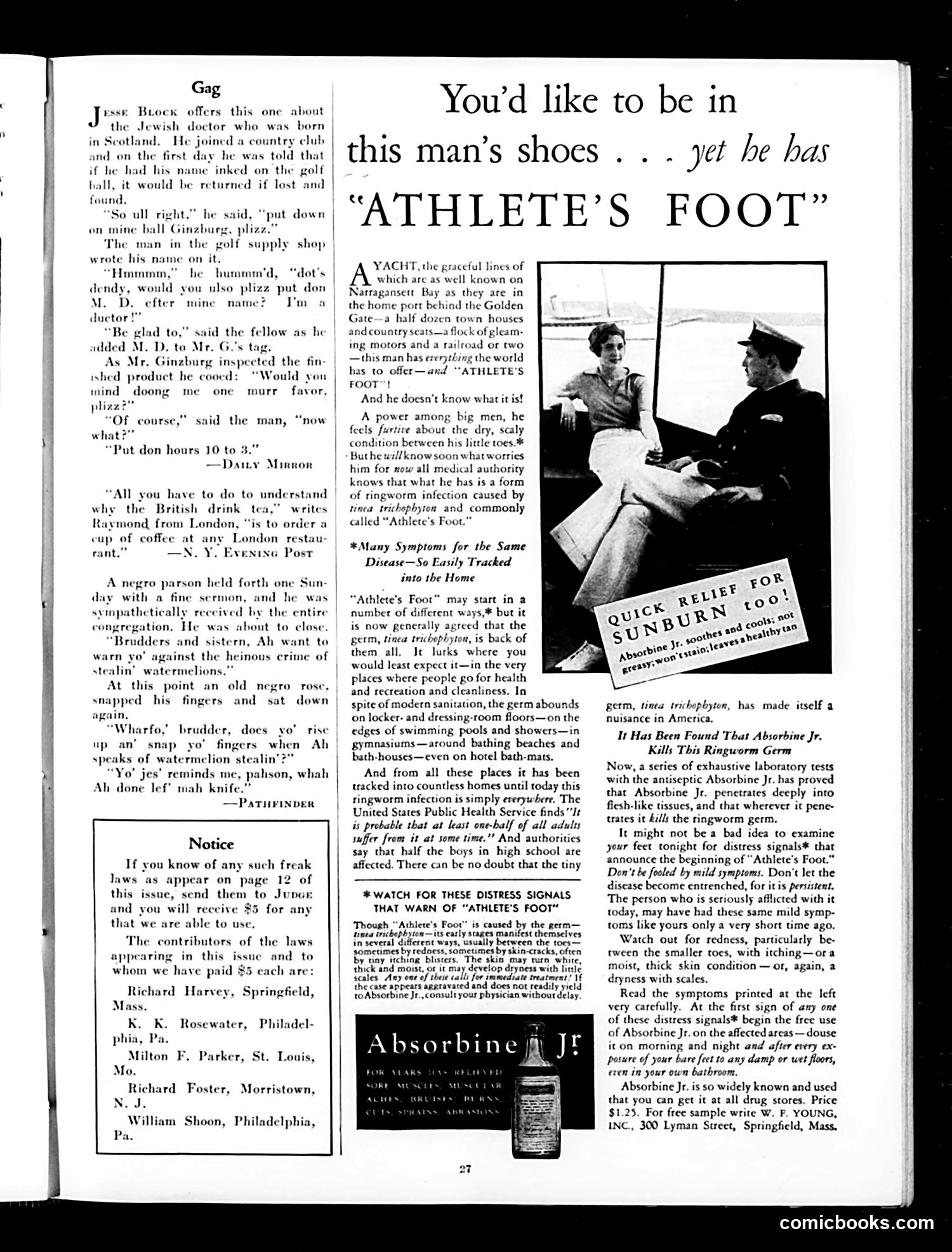
"Athlete's Foot" Advertisement, Judge Magazine This page mixes humor with a medical advertisement. The top section contains three unrelated jokes—one mocking a Jewish Scottish doctor's accent and eagerness to display credentials; another about British tea; a third using racist dialect humor about a Black preacher and watermelons. The main content is a full-page advertisement for Absorbine Jr., a patent medicine claiming to cure "Athlete's Foot" (a fungal infection). The ad features a wealthy man with a yacht and country estates—visually representing success and leisure—yet suffering from this humiliating foot condition. The satire lies in the contrast: despite all worldly advantages, this disease affects even the privileged equally. The ad claims the infection is "everywhere" and warns of "distress signals," using fear-based marketing typical of early 20th-century patent medicine advertising. The piece conflates social status with vulnerability to disease, making the condition seem democratically distributed while promoting a commercial "cure."
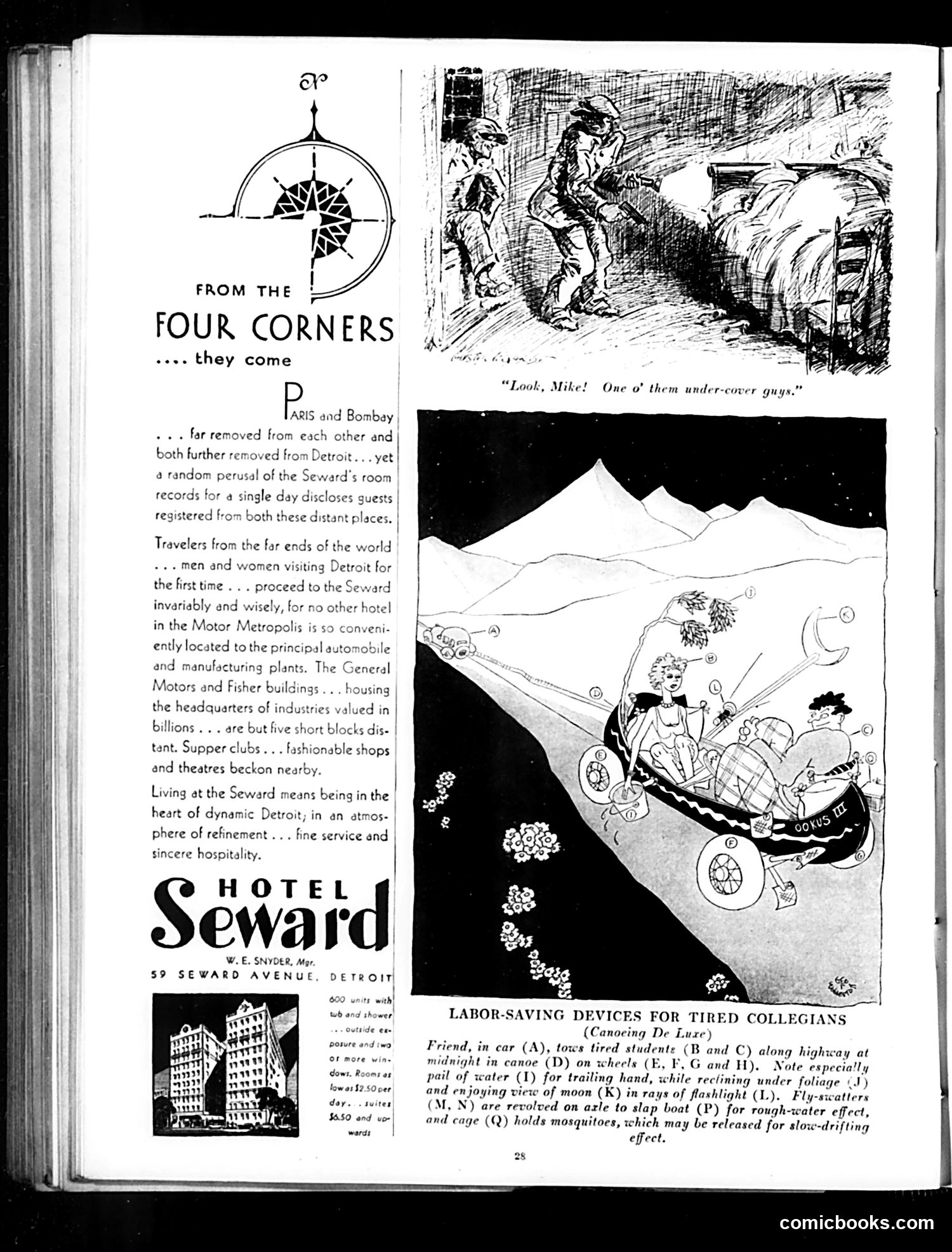
Analysis This page combines hotel advertising with a humorous illustration mocking college students. The Hotel Seward Advertisement (left side): Promotes a Detroit hotel as conveniently located near automobile manufacturing plants and entertainment. The text emphasizes its appeal to traveling businesspeople visiting the Motor City. The Main Cartoon (bottom): Titled "Labor-Saving Devices for Tired Collegians," it satirizes lazy students by depicting an elaborate Rube Goldberg-style contraption. A car tows a canoe on wheels containing reclining students along a highway. The detailed labels (A through Q) humorously identify ridiculous "labor-saving" elements: a trailing hand in water (I), moonlight viewing (K), and a mosquito cage (Q) for "slow-drifting effect." The Joke: The satire criticizes college students as excessively idle—so lazy they've engineered an absurd device to avoid actual canoeing effort while still enjoying its supposed leisure benefits. It's gentle mockery of youth culture and the growing leisure class of the Jazz Age era. The small sketch above shows bootleggers ("undercover guys"), likely referencing Prohibition-era contraband.
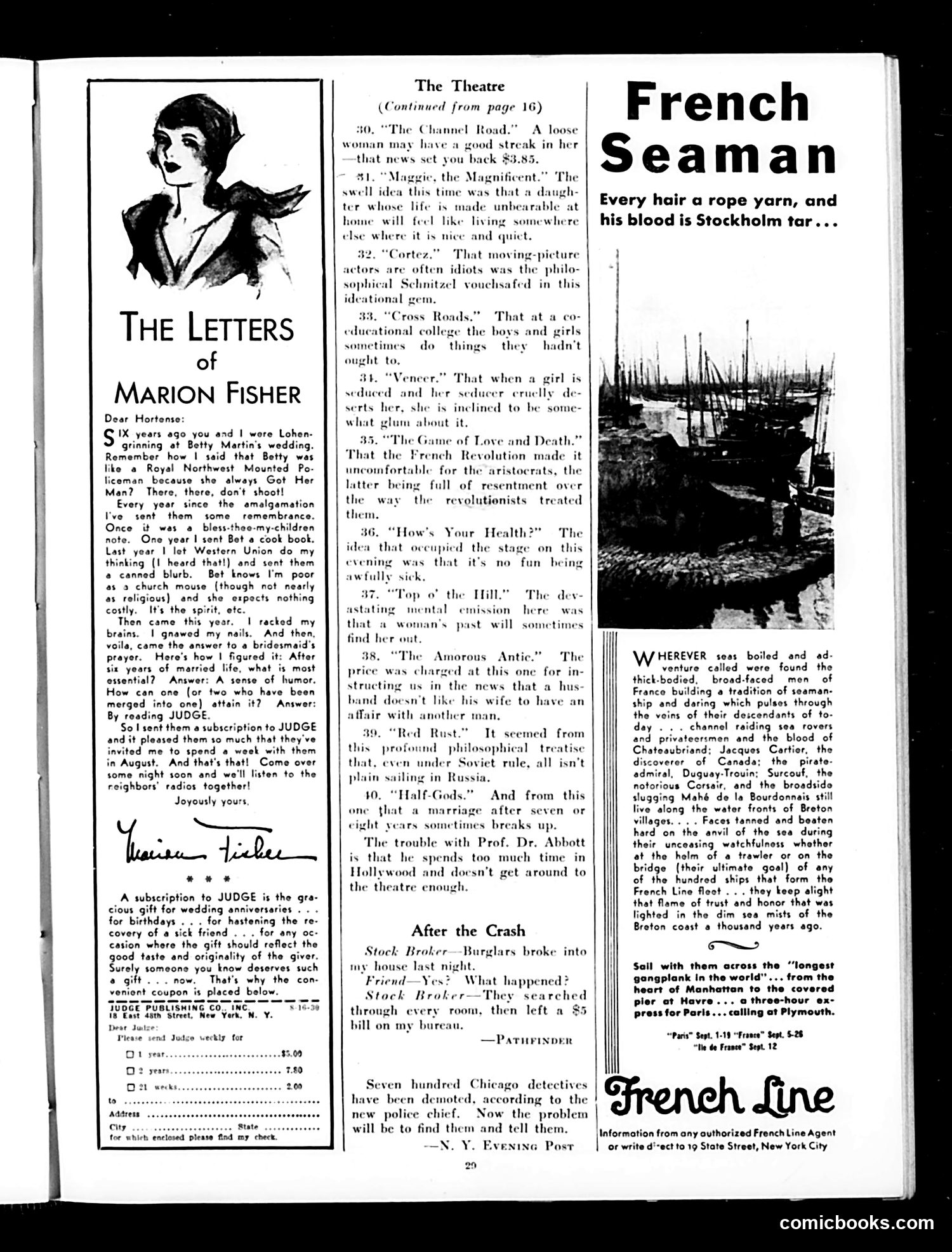
This page is primarily a humor column and advertisements rather than traditional political cartoons. "The Letters of Marion Fisher" is a humorous essay about gift-giving. Marion describes sending a *Judge* magazine subscription to a married couple as an anniversary gift—a meta-joke since *Judge* itself is advertising its own product as the solution to maintaining marital happiness through humor. "The Theatre" section satirizes shallow Broadway plays by reducing their plots to absurd, obvious moral lessons (e.g., play #36 teaches "a husband doesn't like his wife to have an affair"). The critic mocks Professor Dr. Abbott for spending too much time in Hollywood instead of attending theater. "After the Crash" is a brief joke about the 1929 stock market collapse: a burglar breaks into a stockbroker's home but leaves money behind—implying the broker is now poorer than common criminals. The "French Seaman" and "French Line" advertisements promote steamship travel, appealing to Americans' interest in European voyages. Overall, this reflects *Judge*'s 1920s-30s humor: domestic comedy, theatrical criticism, and economic anxiety following the crash.
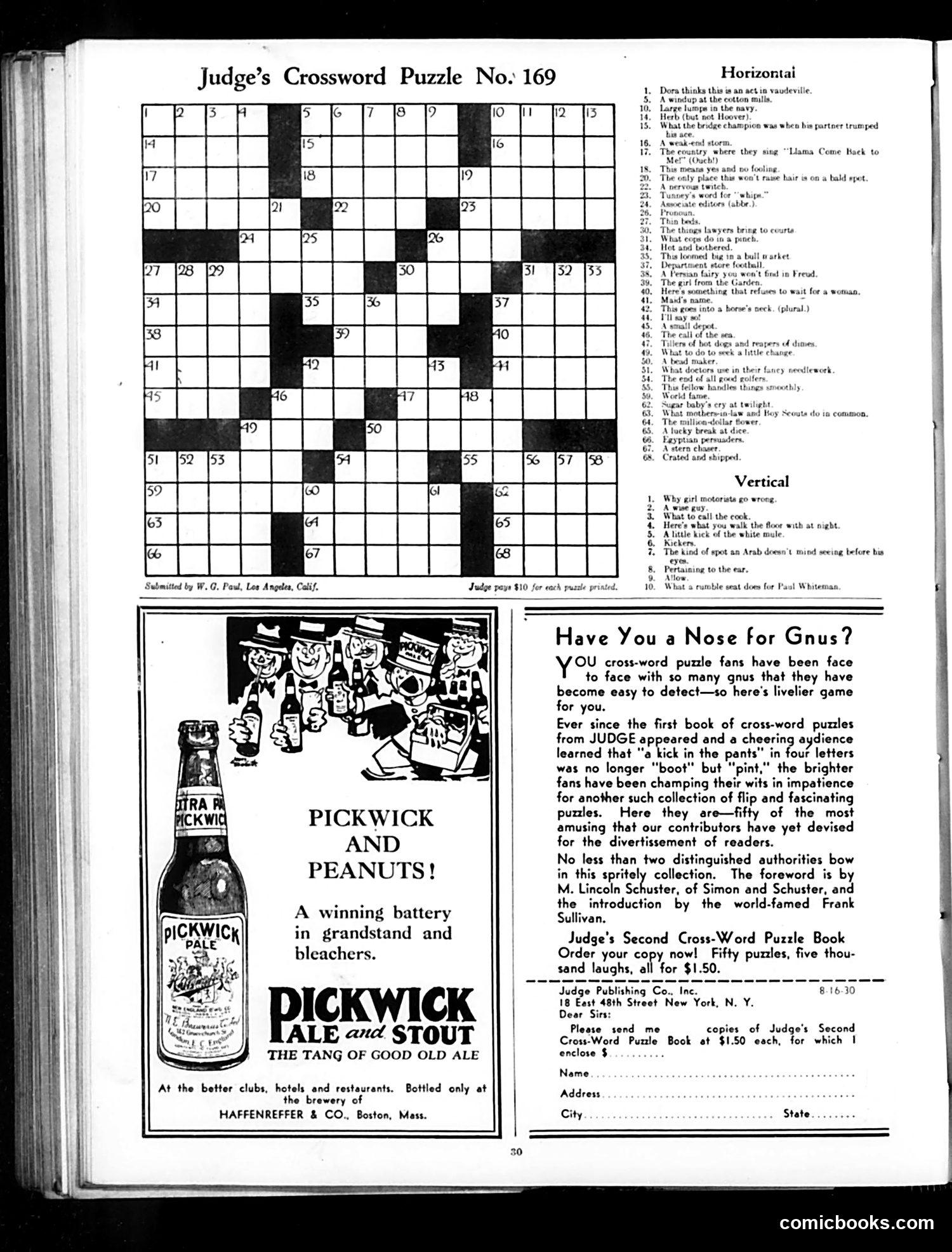
Judge Magazine Page Analysis This page is primarily advertising and promotional content rather than political satire. The main elements are: Pickwick and Peanuts Ad: Advertises Pickwick Ale and Stout from Haffenreffer & Co. (Boston brewery). The "winning battery in grandstand and bleachers" refers to beer as the ideal drink for baseball fans—a common advertising trope of the era. "Have You a Nose for Gnus?": Promotes Judge's Second Cross-Word Puzzle Book (50 puzzles for $1.50). The pun plays on "gnus" (wildebeests, common crossword answers) versus "news." The text celebrates crossword puzzles' popularity, noting that early Judge puzzle books were successful. It highlights endorsements from M. Lincoln Schuster (Simon & Schuster publisher) and humorist Frank Sullivan. The Crossword Puzzle Grid: A standard Judge crossword puzzle (No. 169) with clues. The page reflects 1930 American consumer culture—crossword puzzle craze and beer advertising—rather than political commentary.
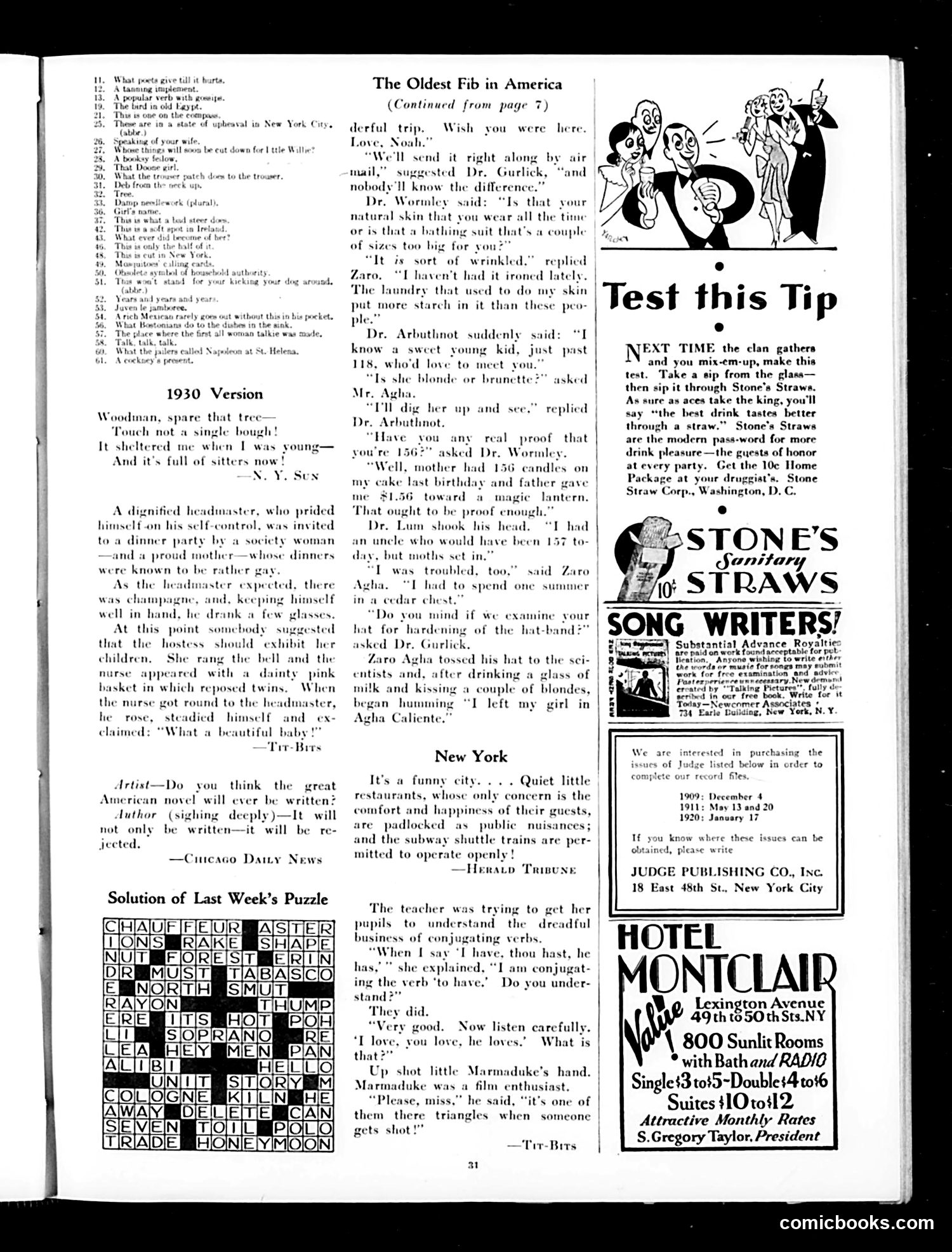
Analysis of Judge Magazine Page This page contains mostly advertisements and filler content rather than political satire. The main cartoon—about a dignified headmaster at a society dinner who, after drinking champagne, admires twins in a basket and exclaims "What a beautiful baby!"—appears to be a mild joke about social embarrassment and intoxication, not political commentary. The page includes humorous anecdotes ("1930 Version," the artist-author exchange, the teacher's grammar lesson) typical of Judge's light humor. There's a brief editorial comment from the Herald Tribune criticizing New York's closure of quiet restaurants as "public nuisances" while allowing subway trains to operate—likely referencing Prohibition-era enforcement inconsistencies. The advertisements (Stone's Straws, Hotel Montclair, Song Writers' Advance) dominate the layout. This appears to be a typical 1920s Judge issue mixing gentle domestic humor with commercial content.
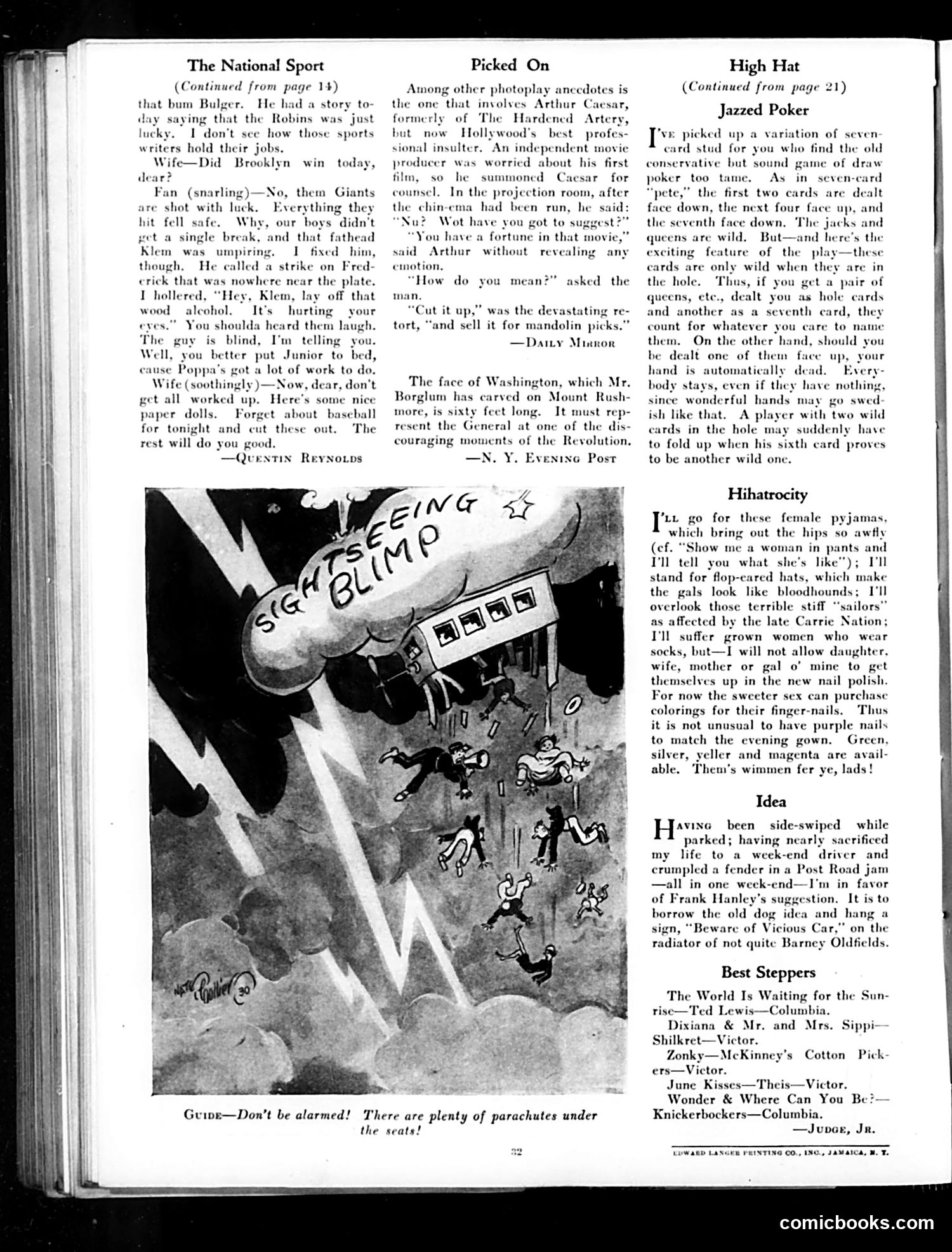
Judge Magazine Page Analysis This page contains several satirical pieces typical of 1920s American humor: "The National Sport" depicts a husband obsessing over baseball, complaining about luck and an umpire ("Klem"), while his exasperated wife tries to calm him with paper dolls. The satire mocks male sports fanaticism and marital dynamics. "Picked On" is a brief anecdote about Arthur Caesar, a Hollywood "professional insulter," insulting a worried filmmaker by suggesting his bad movie could be "cut up and sold for mandolin picks"—dark humor about poor film quality. The cartoon shows a giant "Sight-Seeing Blimp" dropping tiny people with parachutes over a city, with the caption reassuring viewers there are parachutes available. This likely satirizes the novelty and perceived danger of early aviation tourism. "High Hat," "Jazzed Poker," "Hihatrocity," and "Idea" are shorter humor columns addressing women's fashion (nail polish, pajamas), card games, and automobile safety—typical light social commentary for the era. The overall tone reflects 1920s anxieties about modernity, gender roles, and new technologies.
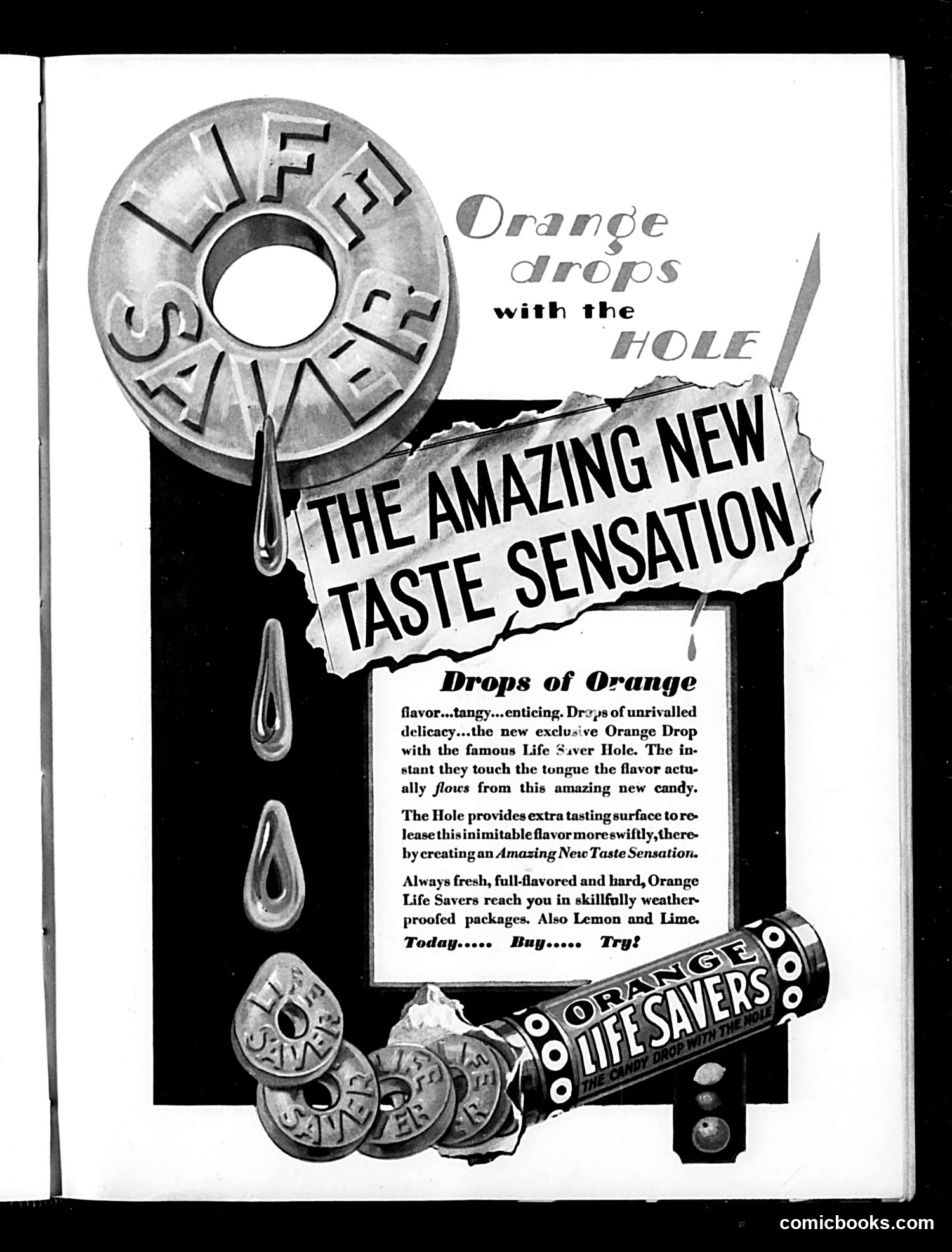
This is a Life Savers candy advertisement, not political satire. The page promotes "Orange Drops," a new Life Savers product featuring a hole through the center—the brand's trademark design. The ad emphasizes how the hole increases surface area for faster flavor release, creating "an Amazing New Taste Sensation." The visual shows the candy's distinctive ring shape with the hole, alongside product imagery and drops of orange flavoring. The text uses period advertising language ("flavor...tangy...enticing") typical of 1930s-40s marketing. This is commercial advertising for a candy product innovation, not editorial cartoon content or political commentary. Judge magazine regularly carried such advertisements alongside its satirical content.
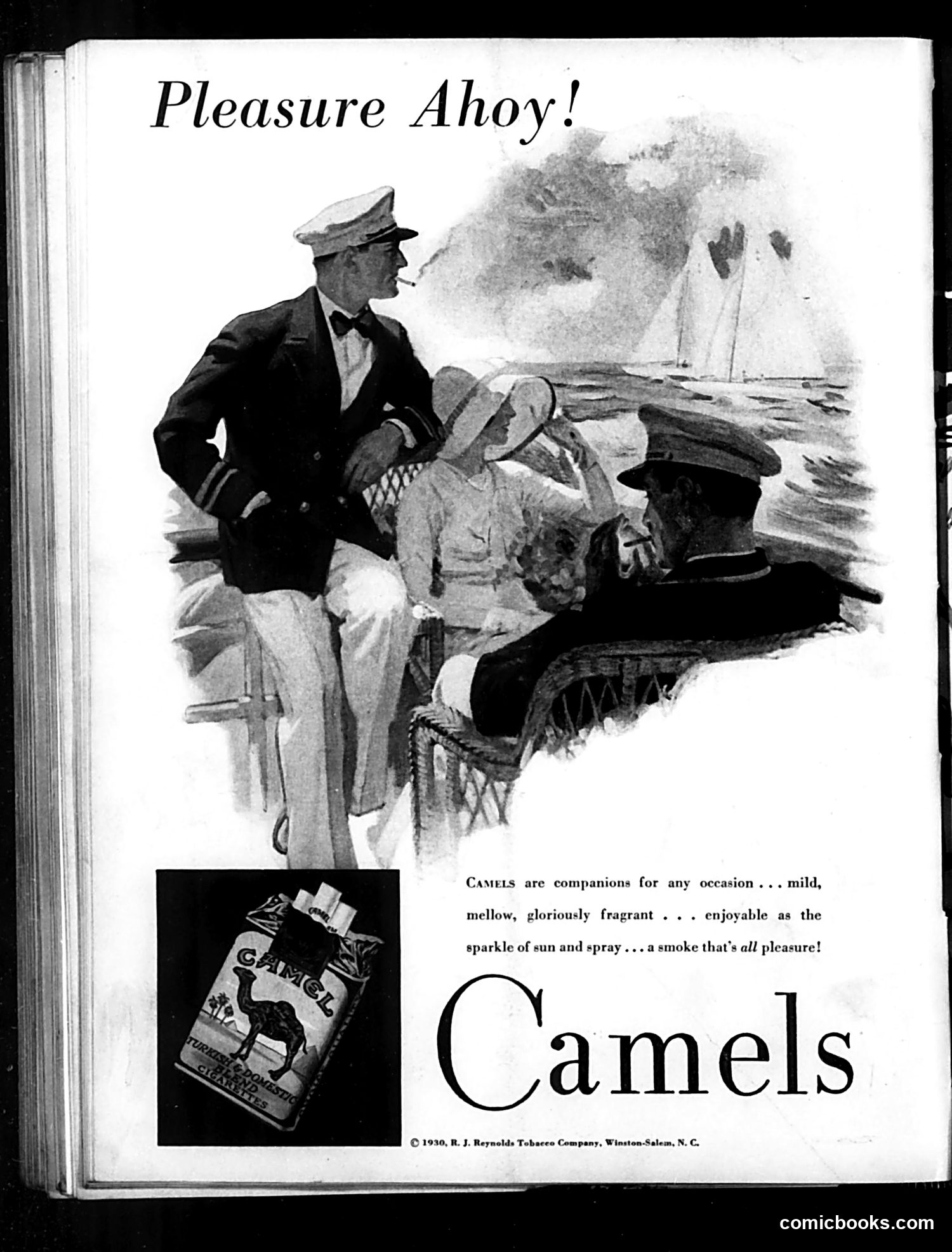
This is a Camel cigarette advertisement, not political satire. The 1930 ad depicts naval officers relaxing by the seaside with sailing boats in the background, promoting cigarettes as sophisticated leisure companions. The copywriting emphasizes pleasure, fragrance, and enjoyment associated with smoking. The image reflects early 20th-century advertising's normalization of tobacco use and its association with leisure, wealth, and masculinity. The naval setting evokes adventure and class. By modern standards, this is notable primarily as a historical artifact showing how openly cigarettes were marketed without health warnings, directly targeting lifestyle aspirations rather than product function.