judge
Judge — August 23, 1930
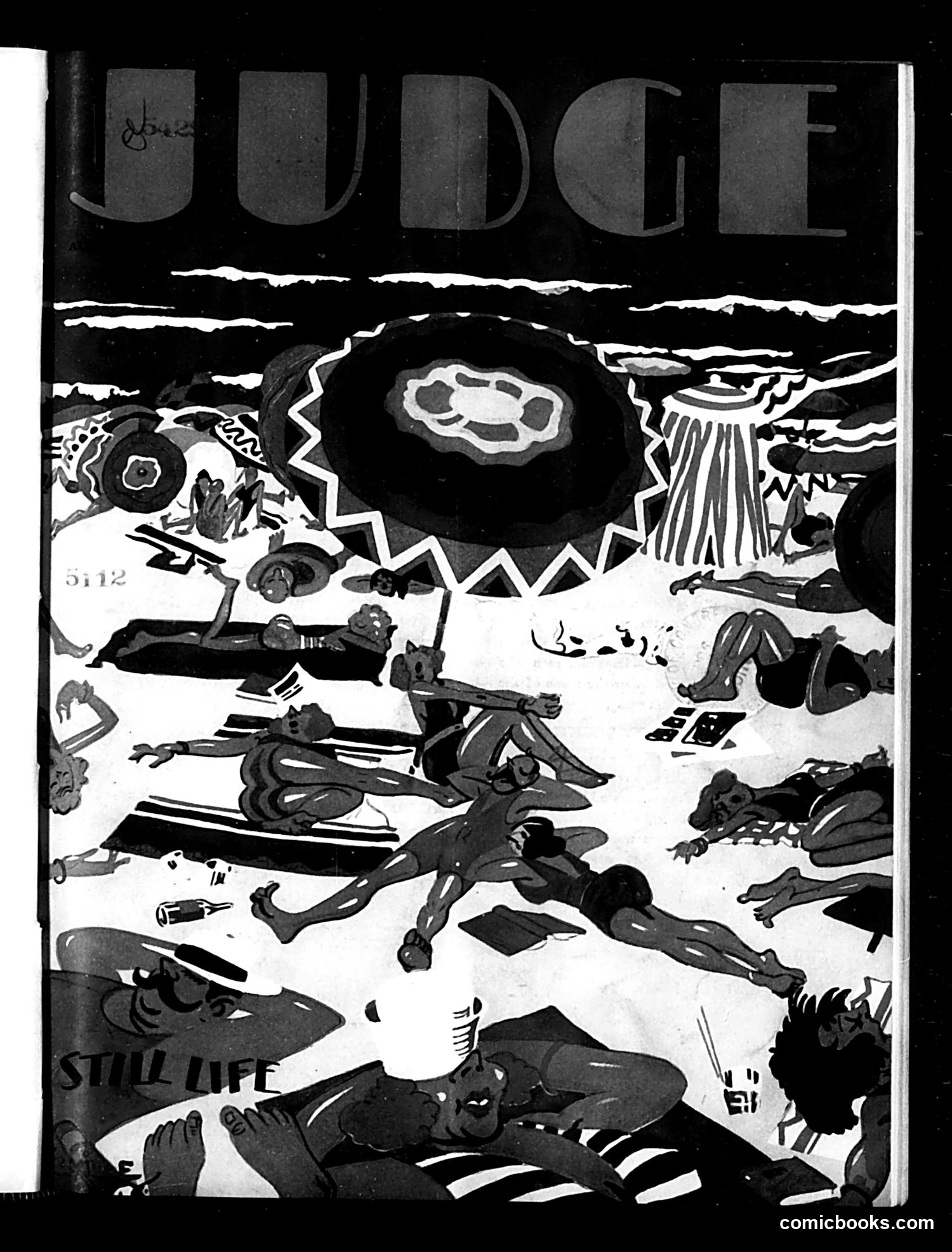
Judge Magazine Page Analysis This page from *Judge* magazine presents a surrealist political cartoon titled "JUDGE" with the subtitle "STILL LIFE." The image depicts a chaotic scene of human figures scattered across a barren landscape beneath a large crater or explosion in the sky, with debris and destruction surrounding them. The cartoon appears to be anti-war satire, likely from the World War I or interwar period. The "still life" title is darkly ironic—a traditional art term applied to a scene of apparent devastation and death. The scattered bodies, weapons, and wreckage suggest the horrific human cost of modern warfare. The crater overhead emphasizes the scale of destruction from aerial bombardment. Without clearer OCR text identifying specific political figures or dating, the precise historical reference remains unclear, but the work critiques warfare's devastating consequences.

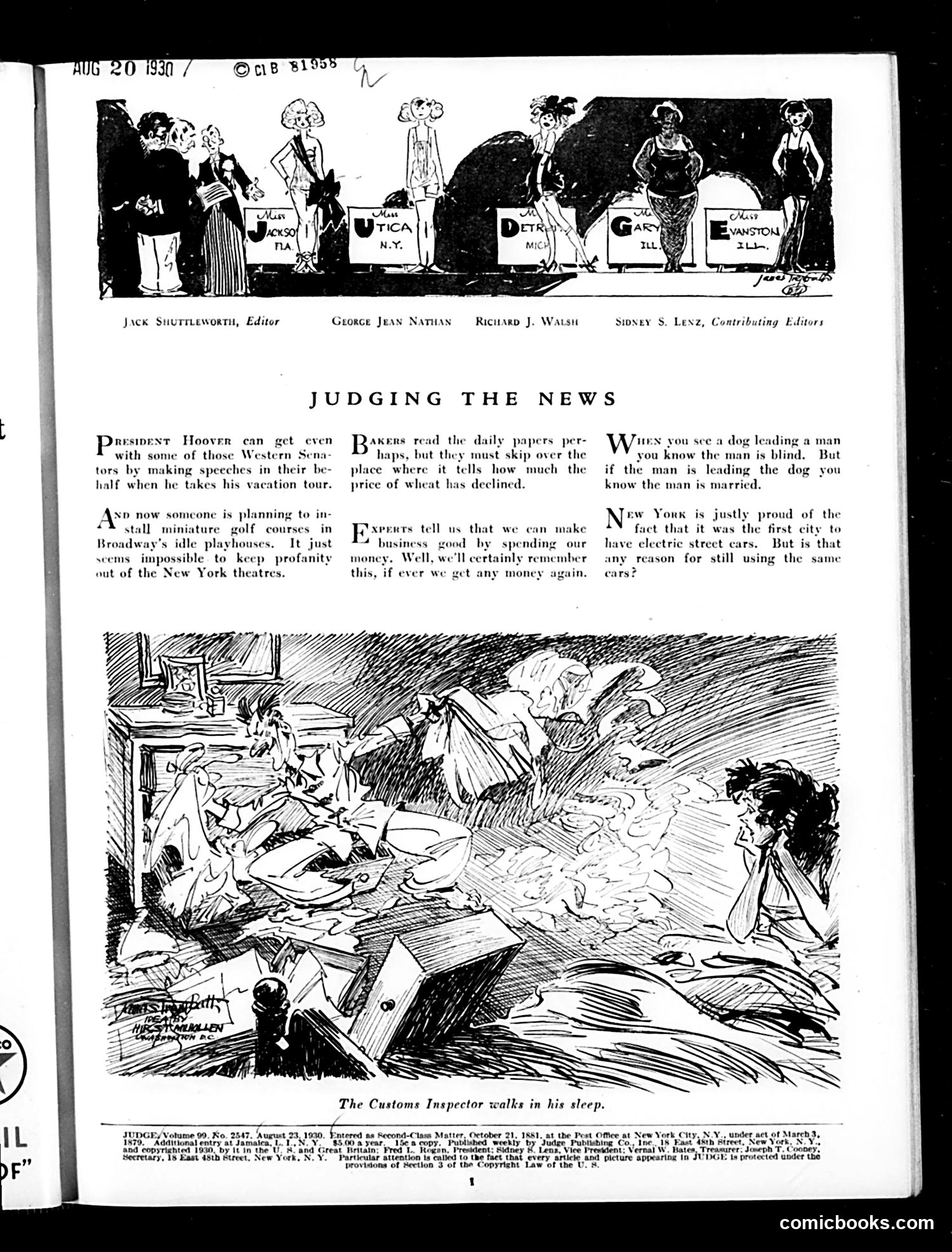
"Judging the News" - August 28, 1930 This satirical column comments on contemporary events through brief quips. The top cartoon shows various city representatives (identifiable by their sashes), likely judges or officials, rendered as caricatured women in a beauty pageant format—satirizing the notion of rating cities by their merits. The text below jokes about President Hoover's vacation speeches, bakery economics, miniature golf profitability, and New York's electric streetcars. The final illustration depicts a customs inspector sleeping while chaos erupts around him—likely satirizing border security negligence or smuggling concerns during Prohibition (1920-1933), when illegal goods trafficking was rampant. The overall tone mocks government competence and contemporary economic anxieties during the Depression era.
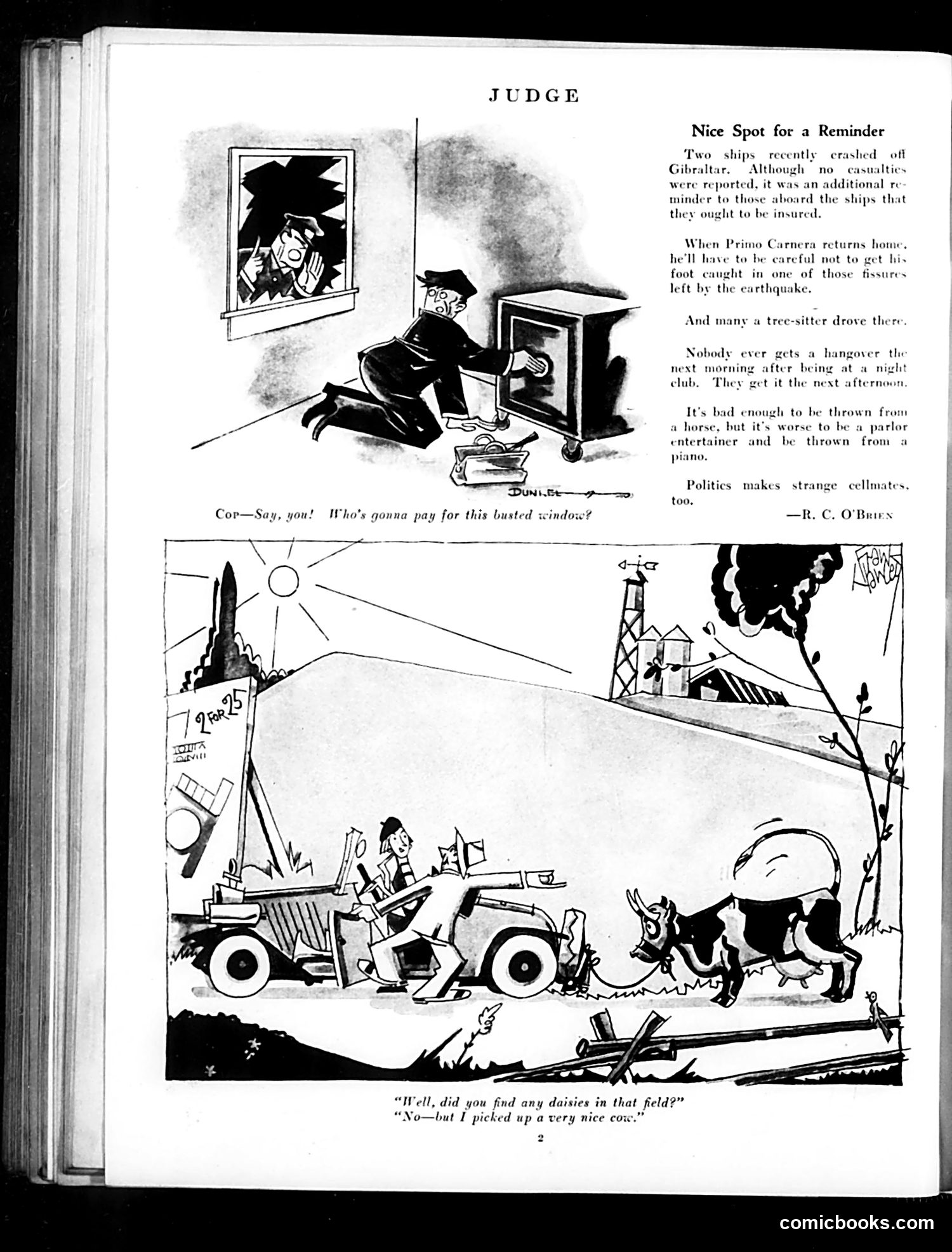
Judge Page Analysis The top cartoon shows a man confronting a cop about a broken window, with the caption "Cop—Say, son! Who's gonna pay for this busted window?" The accompanying text "Nice Spot for a Reminder" references two ships that recently crashed near Gibraltar, suggesting maritime insurance should cover damages—a topical joke about responsibility and accountability. The bottom cartoon depicts a rural scene where a man with a car and cow discusses finding "daisies" in a field, saying "No—but I picked up a very nice cow." This appears to be a rural/urban culture joke, possibly poking fun at miscommunication or misunderstanding between different social classes or regions, a common Judge magazine theme. The exact historical reference remains unclear without additional context.
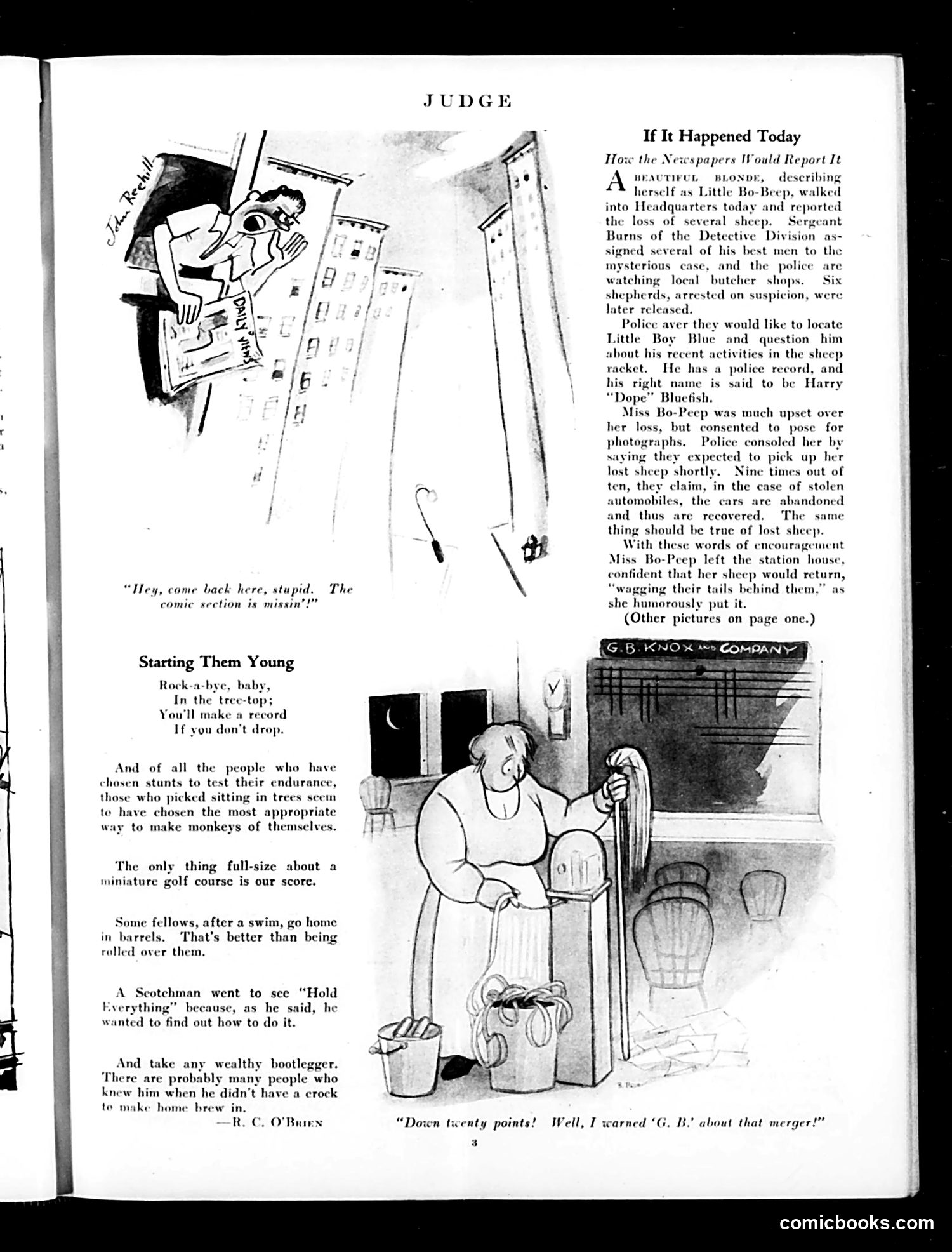
Page Analysis: Judge Magazine Top Cartoon ("If It Happened Today"): This appears to be a satirical crime story about a "beautiful blonde" named Little Bo-Peep who reports stolen sheep to police. The humor derives from treating the nursery rhyme character as a real crime victim—detectives investigate, suspect a criminal named "Dope" Bluefish, and assure her the stolen sheep will be recovered within ten days "as in the case of stolen automobiles." The satire mocks contemporary police incompetence and the prevalence of auto theft in the era. Bottom Section: Contains unrelated humorous verse ("Starting Them Young") and a cartoon showing a woman holding a large fish, apparently discussing a "G.B. Knox & Company" business, with a caption referencing "twenty points" and a "merger." The specific business reference is unclear without additional context.
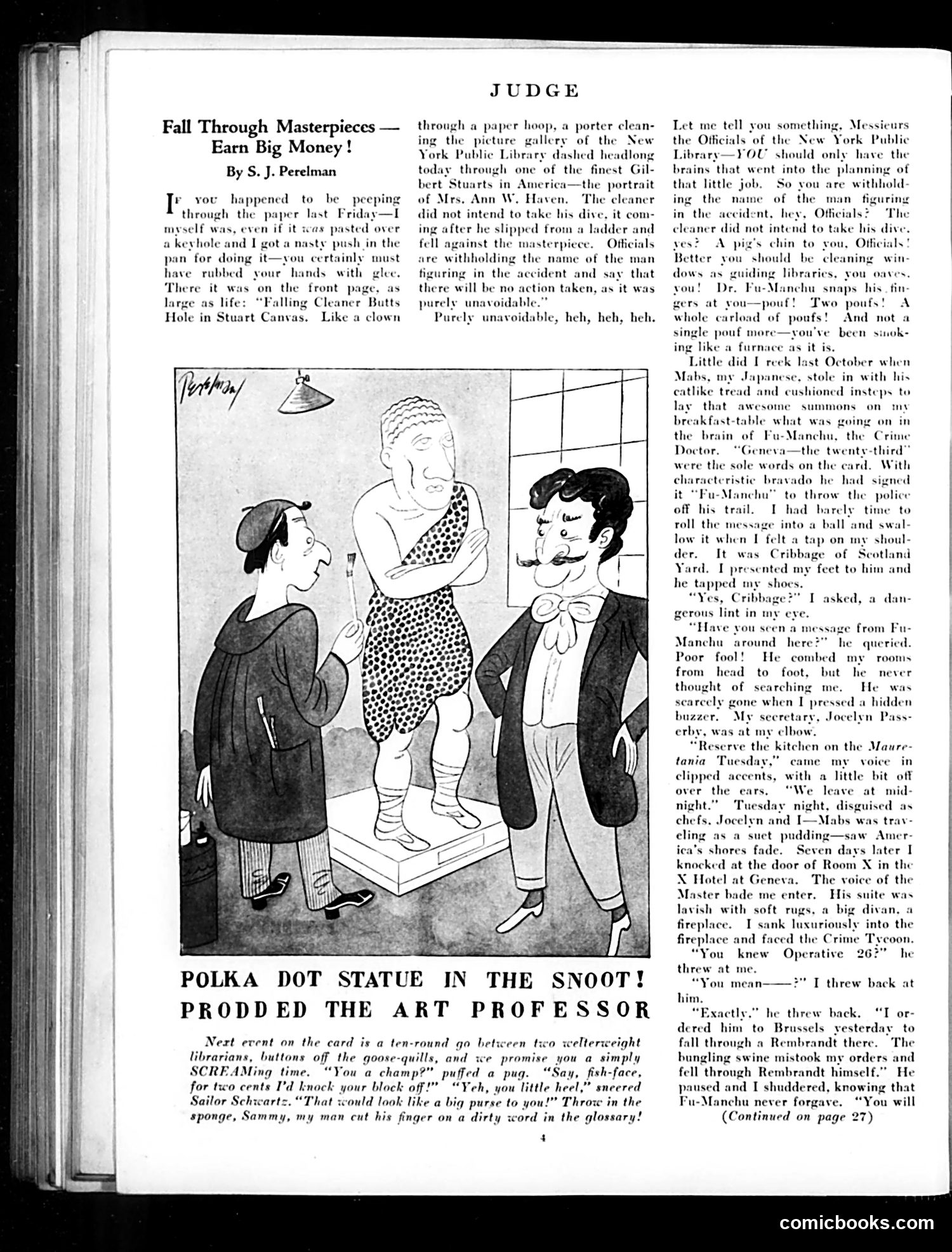
Judge Magazine Page Analysis This page contains a short story by S.J. Perelman titled "Fall Through Masterpieces—Earn Big Money!" paired with a cartoon labeled "POLKA DOT STATUE IN THE SNOOT! PRODDED THE ART PROFESSOR." The cartoon depicts three figures in what appears to be an art gallery or museum setting. A woman on the left gestures toward a large statue of a rotund, polka-dotted figure in the center, while a man on the right responds. The satire mocks pretentious art criticism and museum culture, likely poking fun at modern art's absurdity—suggesting that critics will praise even ridiculous sculptures if presented authoritatively. The story's title reinforces this theme: people can profit by passing off nonsense as fine art if they present it convincingly to gullible audiences and cultural gatekeepers.
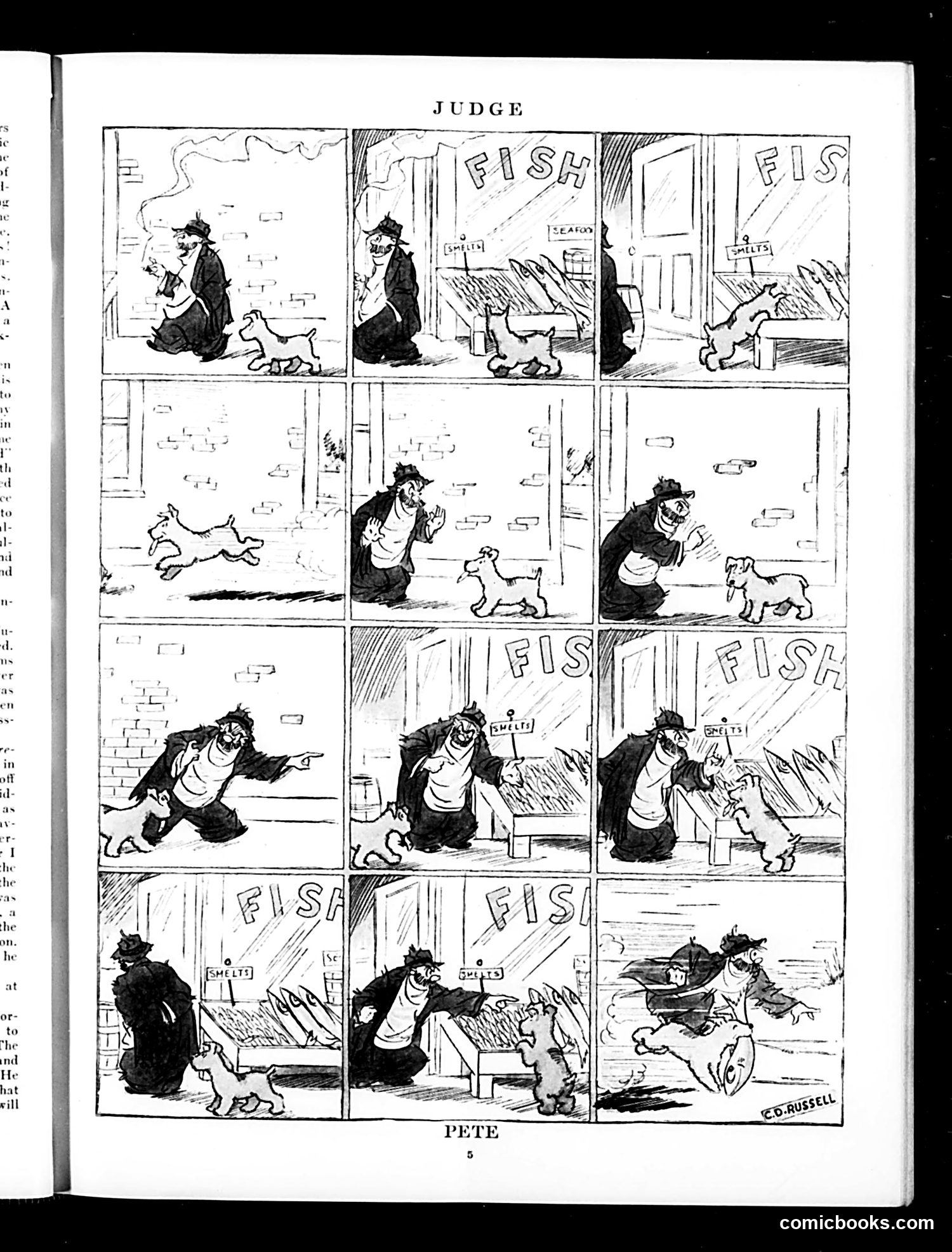
"Judge" Page Analysis: "Fish" / "Pete" This comic strip by C.D. Russell depicts a man in formal dress repeatedly interacting with a small dog in what appears to be a fish market or shop (indicated by "FISH" signage). The narrative shows the man chasing, cornering, and struggling with the dog across multiple panels. The dog appears to be stealing or interfering with fish or merchandise. The final panel shows the man tumbling or being thrown, suggesting the dog gets the upper hand. This appears to be a slapstick humor strip without obvious political commentary—rather, it's situational comedy about a gentleman's futile attempts to catch a mischievous dog in a commercial setting. The title "Pete" likely refers to the dog's name. The humor derives from physical comedy and role reversal (the small dog defeating the well-dressed man).
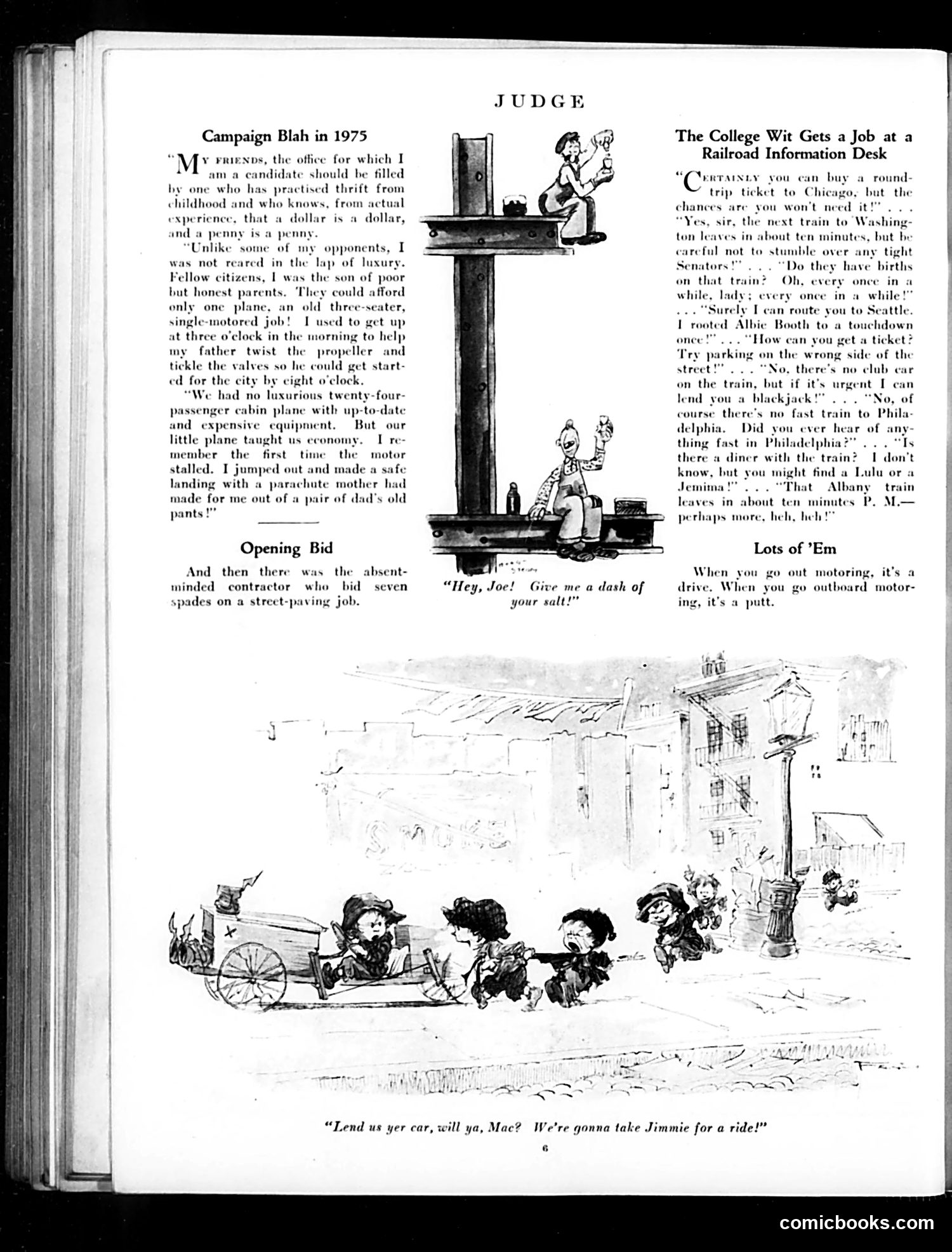
Analysis of Judge Magazine Page This page contains three distinct humor pieces: "Campaign Blah in 1975" mocks political candidates' claims about humble origins. The satire targets false narratives of poverty—the speaker ironically lists luxuries (plane, cabin) while claiming to be "the other fellow" raised without privilege. "Opening Bid" jokes about a contractor bidding absurdly low (seven spades) on a street-paving job, suggesting incompetence or fraud in construction bidding. "The College Wit Gets a Job at a Railroad Information Booth" satirizes an overeducated, pedantic young man giving absurdly complicated answers to simple passenger questions about trains—mocking both pretentious college graduates and their unsuitability for practical work. "Lots of 'Em" is a brief gag contrasting motorist terminology. The bottom cartoon depicts children with a makeshift cart, unrelated to the text above.
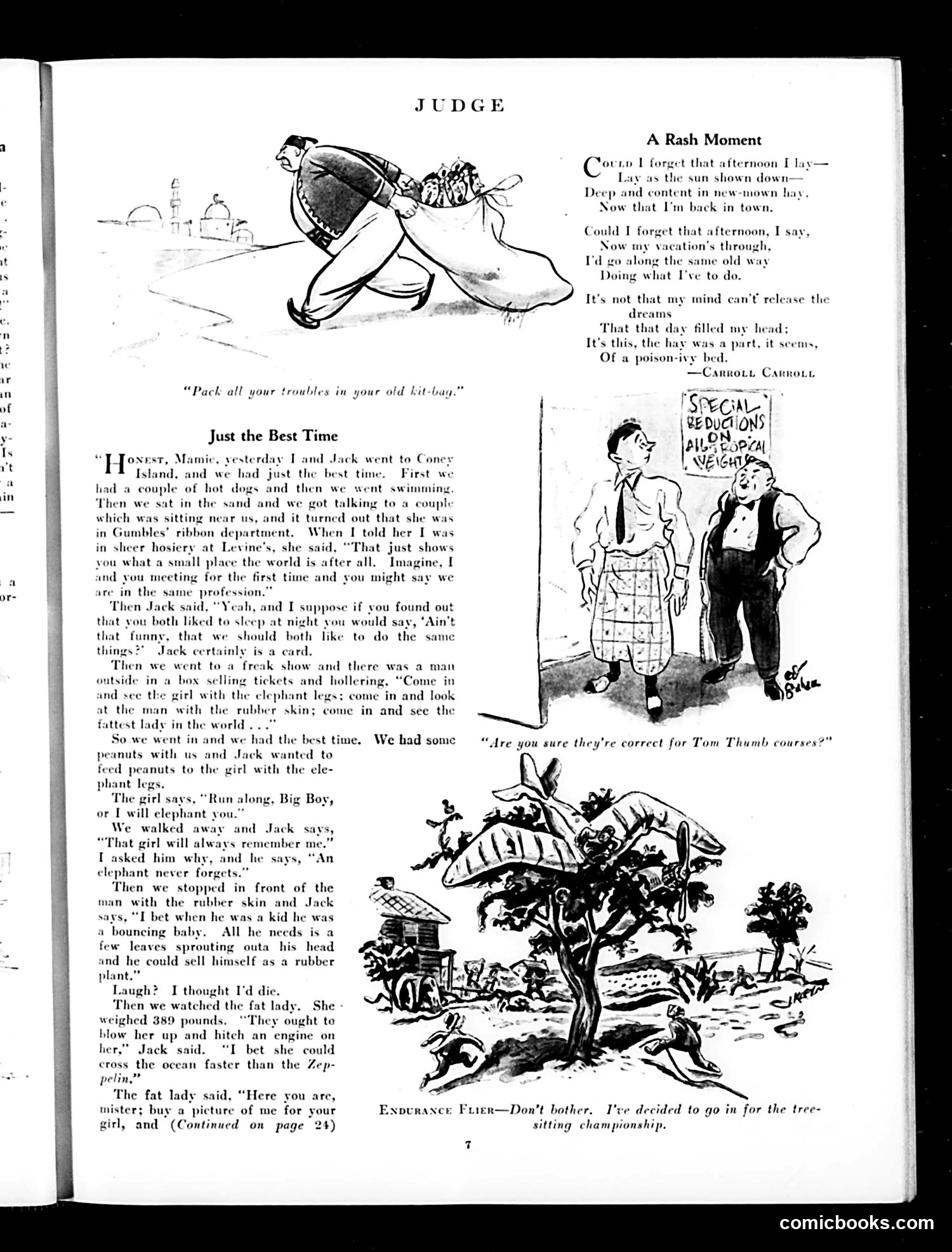
Judge Magazine Page Analysis This page contains two unrelated pieces of humor typical of Judge's 1920s content: "Just the Best Time" is a humorous anecdote about a young woman's day trip to Coney Island with her boyfriend Jack. The joke relies on absurdist humor and puns: when they visit a freak show, Jack makes bad jokes (calling the "girl with elephant legs" an "elephant" who "never forgets"; suggesting the rubber-skinned man needs "tree leaves" to become a rubber plant). The humor is lighthearted, situational comedy about dating and tourist attractions—typical of the era's casual entertainment writing. "A Rash Moment" is a poem by Carroll Carroll about a vacation memory of lying in hay, now ruined by the realization he had an allergic reaction (poison ivy). It's gentle, ironic verse. The cartoons include one about weight-loss advertisement and another about someone entering a tree-sitting championship. These are simple visual gags with minimal political or social commentary—mostly recreational humor for a general audience. The page reflects Judge's balance between satirical commentary and light entertainment pieces.
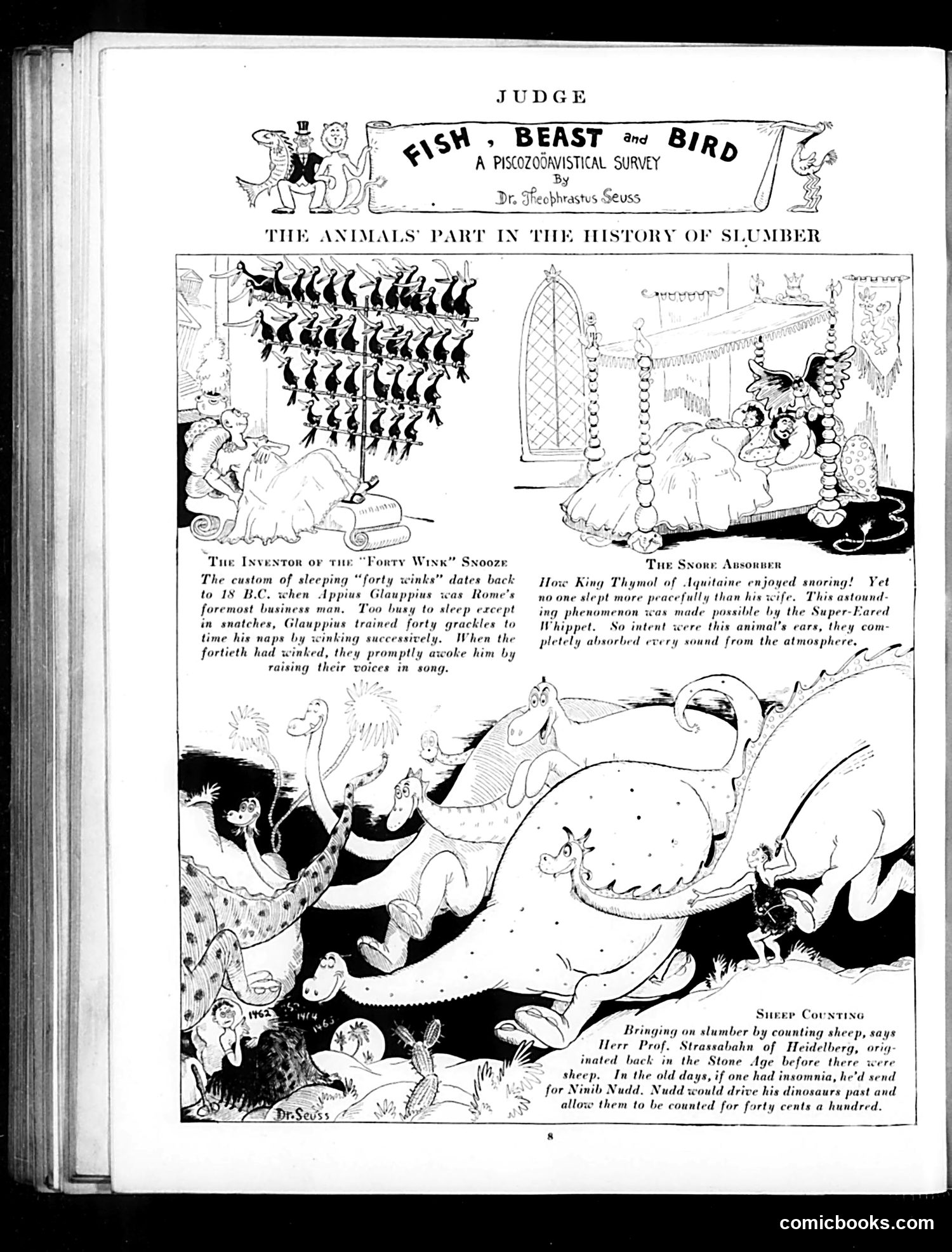
Explanation for Modern Readers This page from *Judge* magazine presents humorous "historical" explanations for sleep-related customs, written as if by Dr. Seuss (Theodor Geisel). It's satirical pseudo-scholarship—fake academic humor. The three vignettes mock how we attribute modern practices to ancient origins: 1. "Forty Winks": Invented by a Roman businessman who trained grackles (birds) to wink in sequence, timing his power naps. The joke is the absurd literal origin story for an idiom. 2. The Snore Absorber: King Thymol of Aquitaine had a specially bred "Super-Eared Whippet" dog whose ears absorbed all snoring sounds so his wife could sleep peacefully—a ridiculous technological "solution" to a common problem. 3. Counting Sheep: Originally involved a Stone Age man named Ninib Nudd who would drive dinosaurs past insomniacs for them to count (charging forty cents per hundred). The joke conflates dinosaurs with sheep-counting. The satire gently mocks pseudo-historical explanations and inventing elaborate backstories for everyday habits.
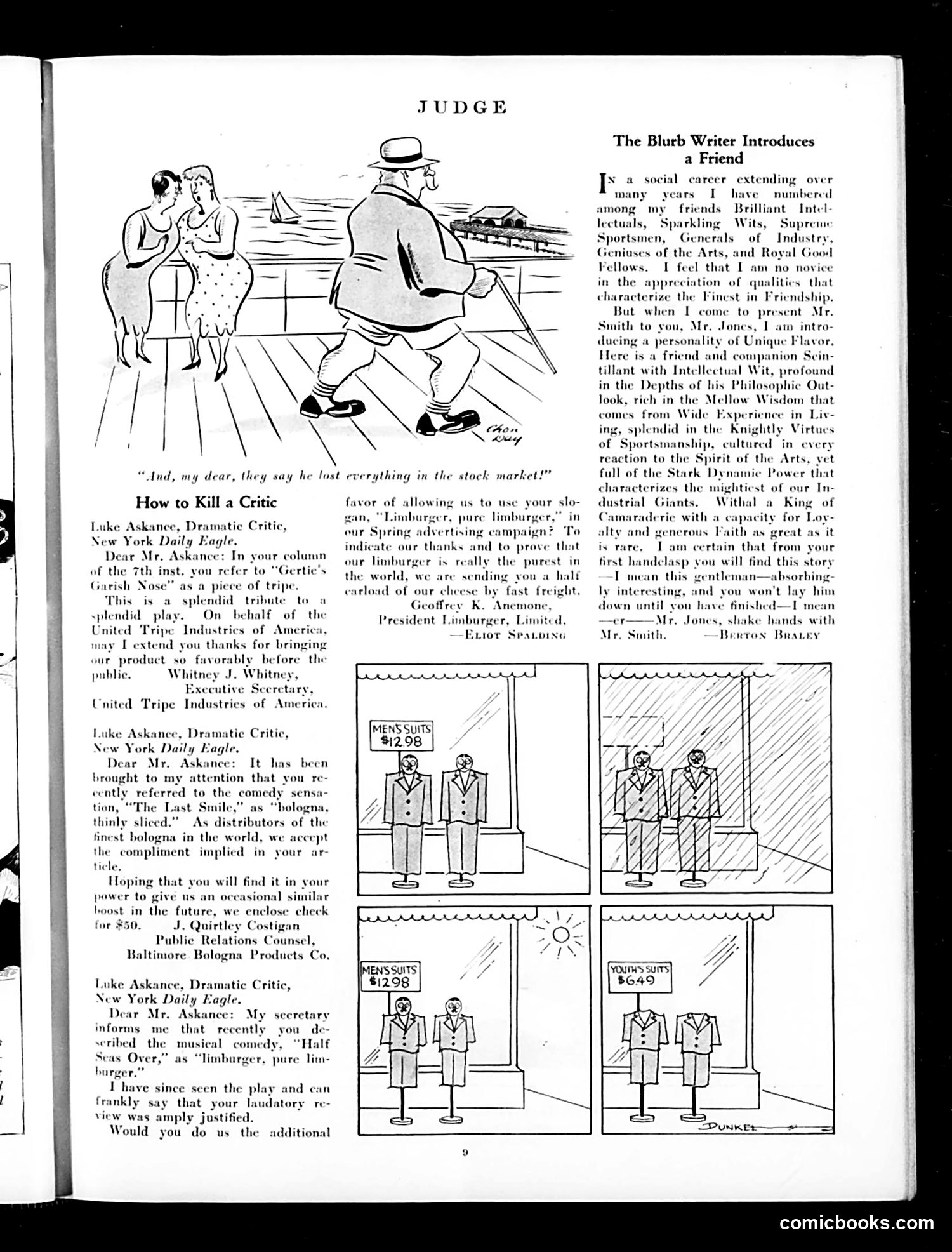
"How to Kill a Critic" — Judge Magazine Satire This page satirizes the practice of payola in theater criticism—specifically, how food companies curry favor with drama critics by offering them advertising opportunities and implicit bribes. The setup: Luke Askance, a drama critic, published negative reviews of plays, using unflattering metaphors like "Gertie's Garish Nose" and "Half Seas Over." Representatives from competing food companies (Limburger cheese, bologna, and tripe industries) then write to him, thanking him for the "splendid tribute" and offering advertising deals or "checks for $50"—clearly misrepresenting his negative reviews as praise to secure his endorsement. The joke's target: corrupt critics who accept bribes, and companies exploiting this corruption. The absurdist humor comes from the companies deliberately misreading insults as compliments while dangling money. The four small comic panels on the right appear to show men's and women's clothing price comparisons, likely separate advertising content. This reflects early 20th-century concerns about journalistic integrity and commercial influence on entertainment criticism.
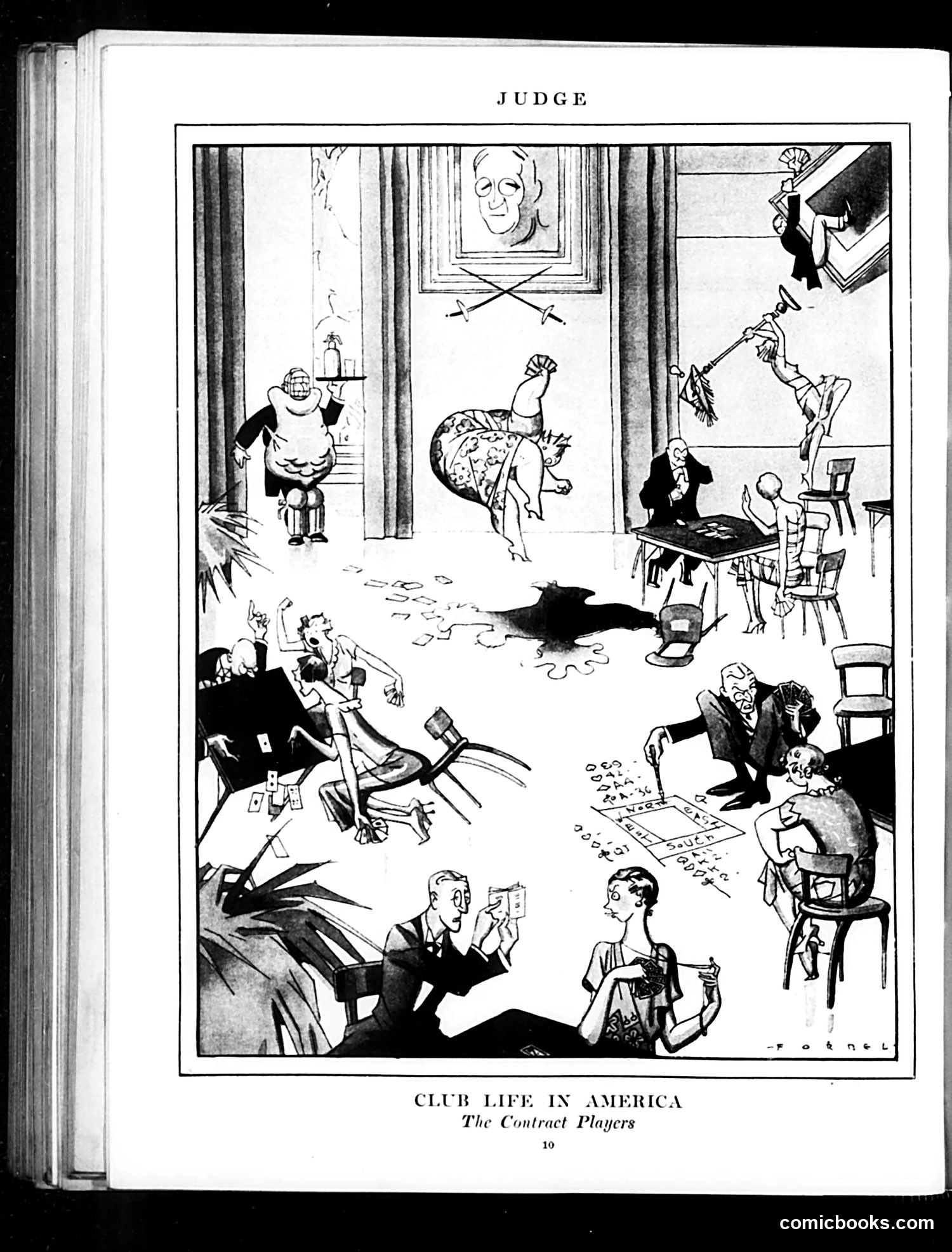
Analysis This satirical cartoon titled "Club Life in America: The Contract Players" depicts a chaotic indoor scene mocking bridge players and card game culture among the American upper class. The illustration shows well-dressed figures engaged in various card games, with exaggerated, comedic poses suggesting the intense, dramatic nature people bring to casual club activities. The "contract players" reference likely alludes to contract bridge, a popular card game among wealthy Americans in the early 20th century. The satire appears to mock the pretentiousness and obsessive behavior of club members who treat card games with excessive seriousness. The tumultuous scene—with people in theatrical poses around tables—ridicules the social hierarchy and competitive fervor surrounding these leisure activities among the affluent class. The cartoon exemplifies Judge magazine's typical approach: lampooning American social conventions and class behavior through exaggerated visual humor.
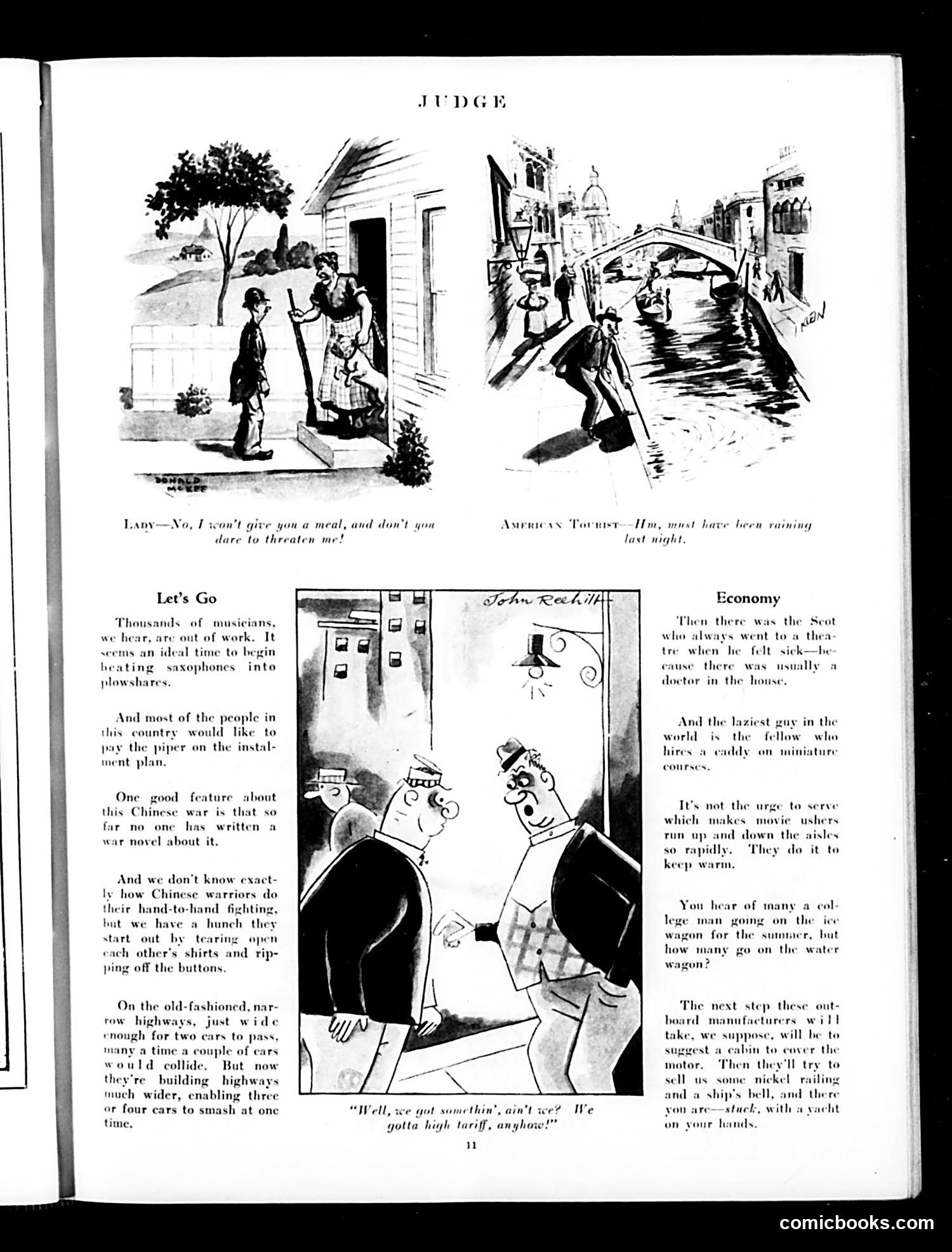
Analysis for Modern Readers This page from Judge magazine contains several short satirical pieces rather than a single cartoon: "Judge" heading cartoons: Two small illustrations satirizing tourists and weather complaints—standard observational humor. "Let's Go": Critiques unemployed musicians (likely post-1920s economic downturn), jokes about converting saxophones to farm tools, and mocks sensationalized war reporting about China. The highway joke satirizes how road improvements enable more accidents—dark humor about progress. Central cartoon: Two men negotiating, one claiming "we got somethin'"—appears to reference tariff debates, a major political issue of the era. The humor suggests protectionist economic policy as their only accomplishment. "Economy": A humor column with anti-Scottish stereotypes (cheapness jokes), observations about lazy golfers and boat salesmen upselling unnecessary luxuries. The page reflects 1920s-30s American concerns: unemployment, isolationism, protectionism, and consumer culture anxiety about unnecessary goods.
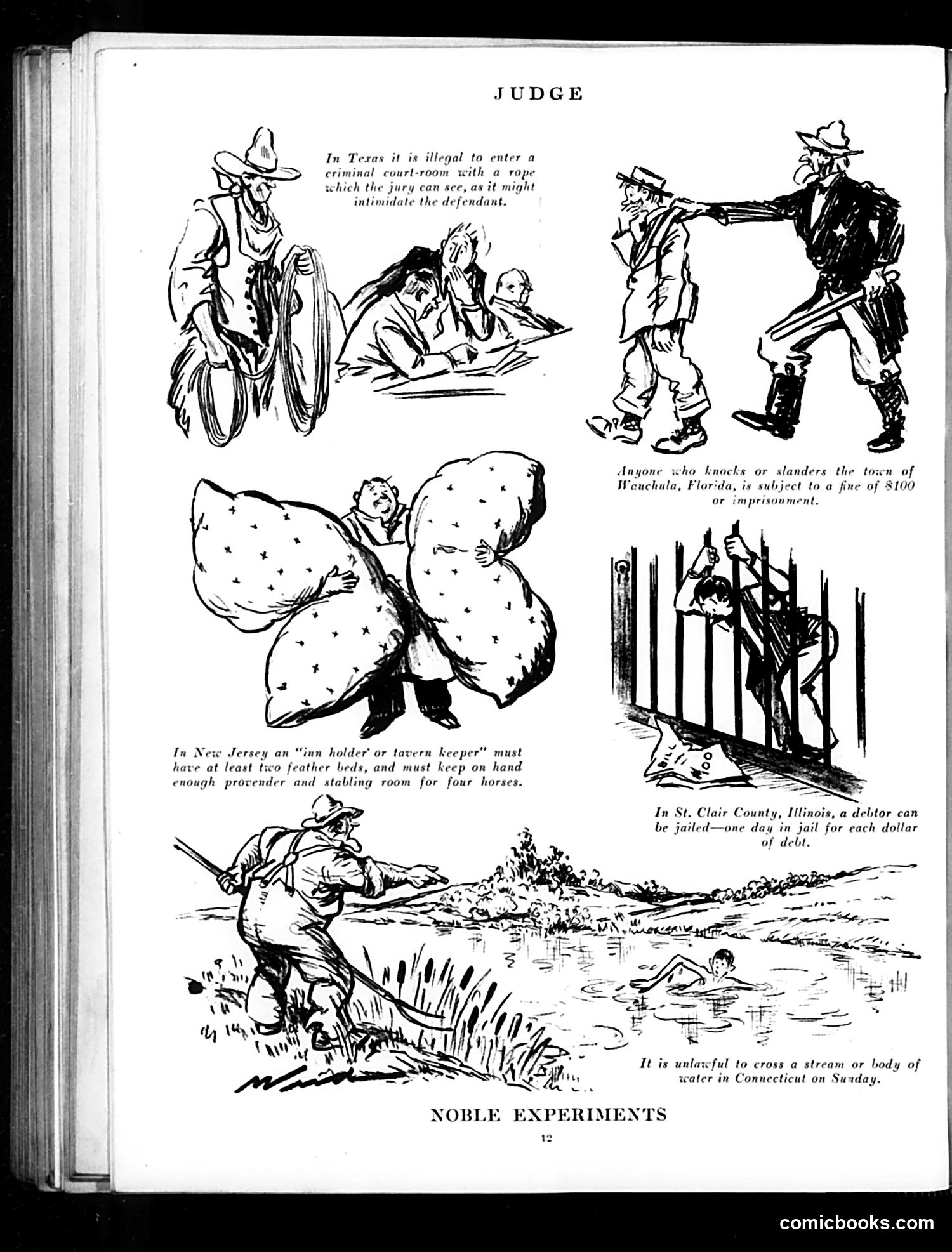
Judge Magazine: "Noble Experiments" This page satirizes absurd or outdated laws across American states. Each illustration depicts a ridiculous legal restriction with deadpan humor: - Texas: Can't bring a rope into court (might scare the defendant) - Florida: Insulting the town of Weuchula carries a $100 fine - New Jersey: Tavern keepers must maintain two feather beds and stable space for four horses - Illinois: Debtors imprisoned one day per dollar owed - Connecticut: Crossing waterways prohibited on Sundays The title "Noble Experiments" is sarcastic—these laws represent failed or foolish legislative attempts at social control. The cartoons mock the absurdity and unintended consequences of overly specific or moralistic regulations. This reflects Judge's typical role: mocking government overreach, regional peculiarities, and the gap between lawmakers' intentions and practical reality. The humor appeals to readers' sense that laws can be arbitrary and ridiculous.
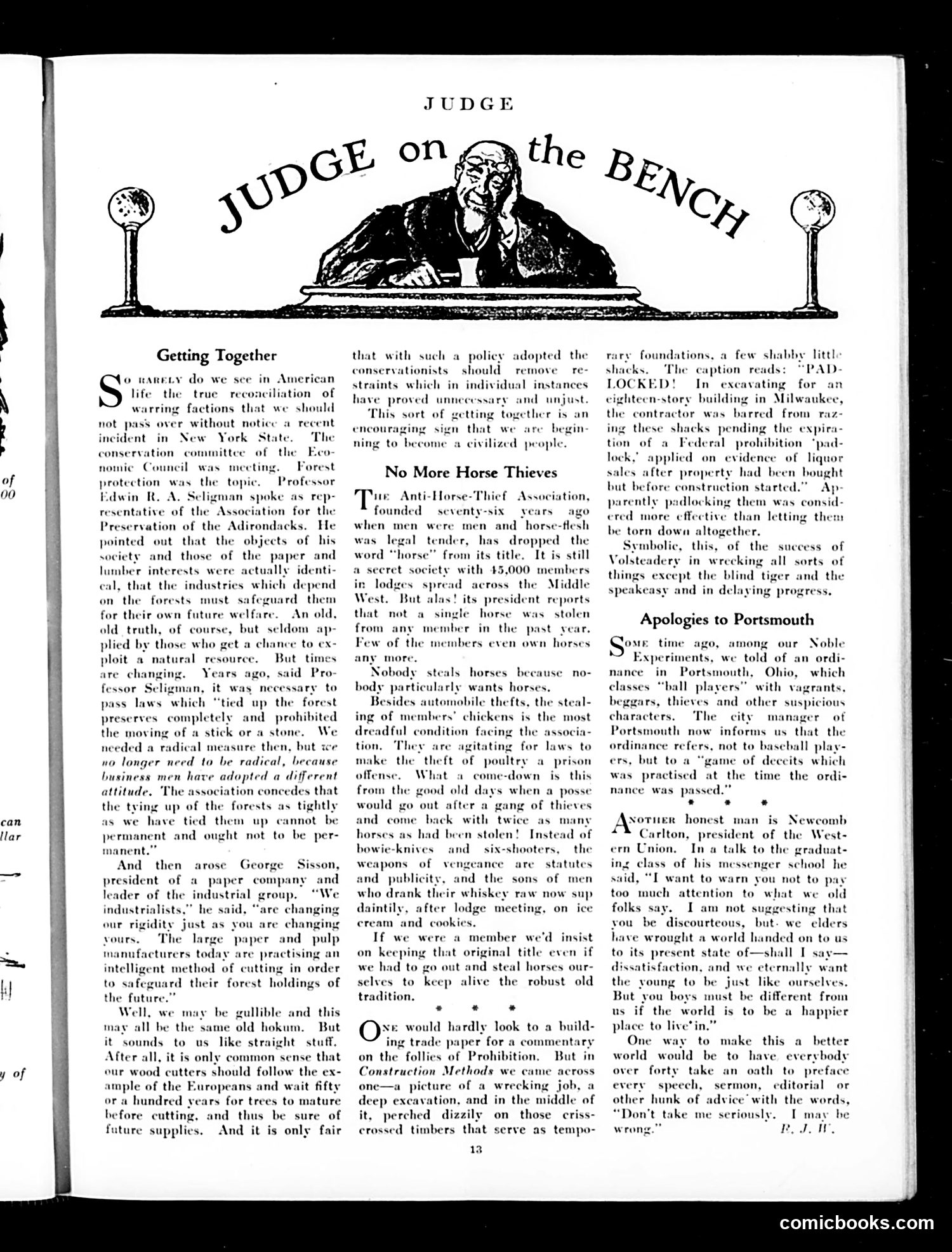
Judge Magazine: "Judge on the Bench" This page contains three satirical commentary pieces: "Getting Together" celebrates a New York conservation committee meeting where timber industrialists and forest preservationists agreed to cooperate on sustainable logging practices. The satire praises this unusual reconciliation between business and conservation interests. "No More Horse Thieves" mocks the Anti-Horse-Thief Association, a 76-year-old Midwestern secret society now struggling to justify its existence. With automobile thefts replacing horse theft and members stealing chickens instead, the organization has become anachronistic. The satire ridicules how progress—modernization and automobiles—has rendered their vigilante traditions obsolete and quaint. "Apologies to Portsmouth" and "Another honest man" appear to be brief editorial notes addressing local issues (Ohio ordinances, Western Union labor disputes), typical of Judge's miscellaneous satirical commentary. The overall tone reflects early 20th-century urban sophistication mocking rural institutions rendered obsolete by modern society.
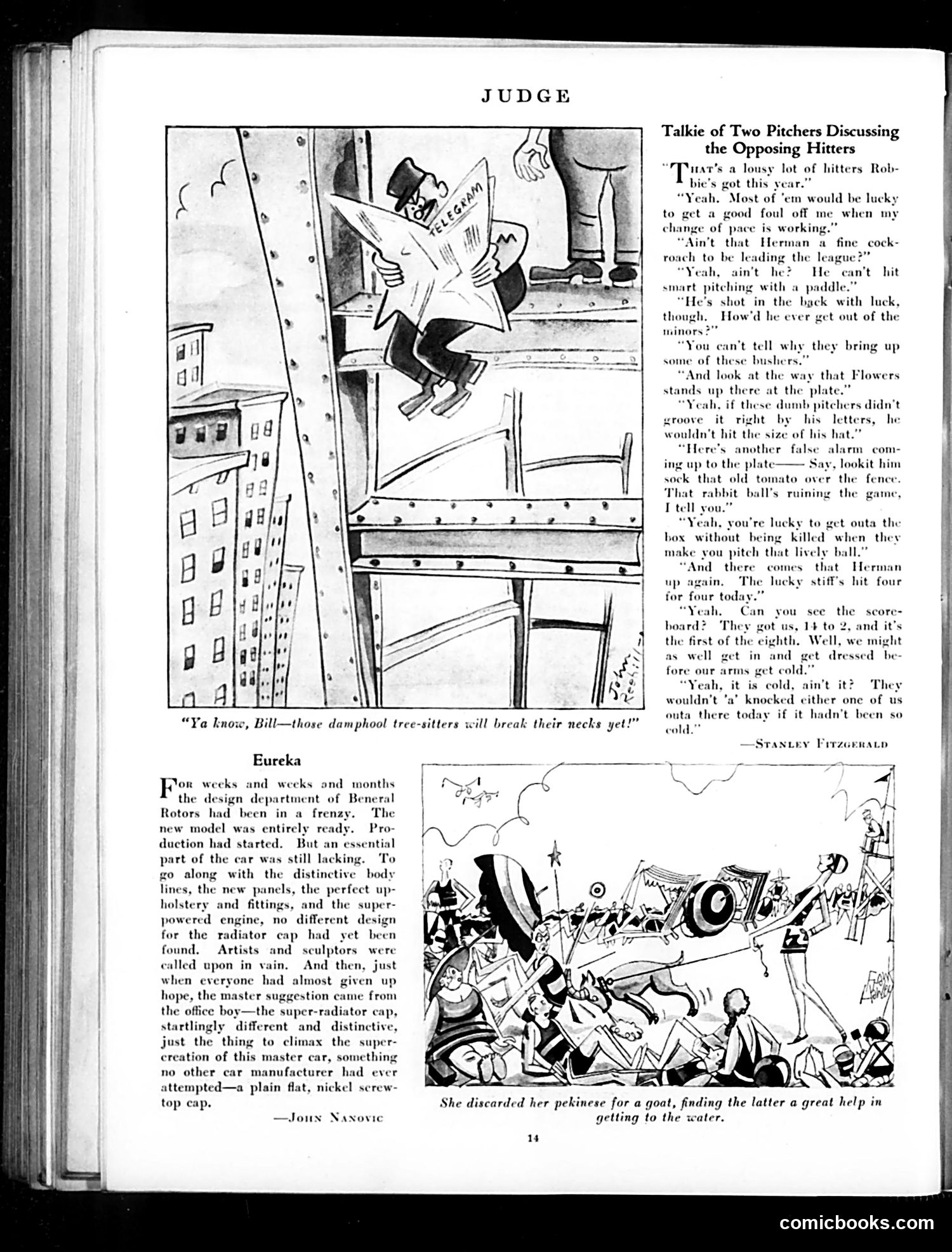
Judge Magazine Page Analysis Top Cartoon: "Talkie of Two Pitchers" Two baseball pitchers discuss opposing hitters in casual, cynical terms. They mock specific players—Herman (a "fine cockroach" pitcher who can't hit smart pitching), Flowers (poor batting stance), and another Herman who's gotten lucky hits. The satire critiques baseball players' actual skill versus reputation, with the pitchers dismissing most hitters as "dumb" and "bushers" (minor leaguers). The final punchline reveals their complaint is really about cold weather affecting play—their tough-guy baseball banter deflates into weather complaints. It's gentle sports satire on athlete ego and superstition. Bottom: "Eureka" Story A humorous tale about General Motors' design department struggling for weeks to create a distinctive radiator cap for a new car. After artists and sculptors fail, an office boy suggests a "plain flat, nickel screw-top cap"—the simplest solution. The accompanying illustration shows a woman discarding her expensive Pekingese dog for a goat to help her reach water, satirizing impractical luxury replaced by practical utility. Both pieces mock overcomplication when simple answers work best.
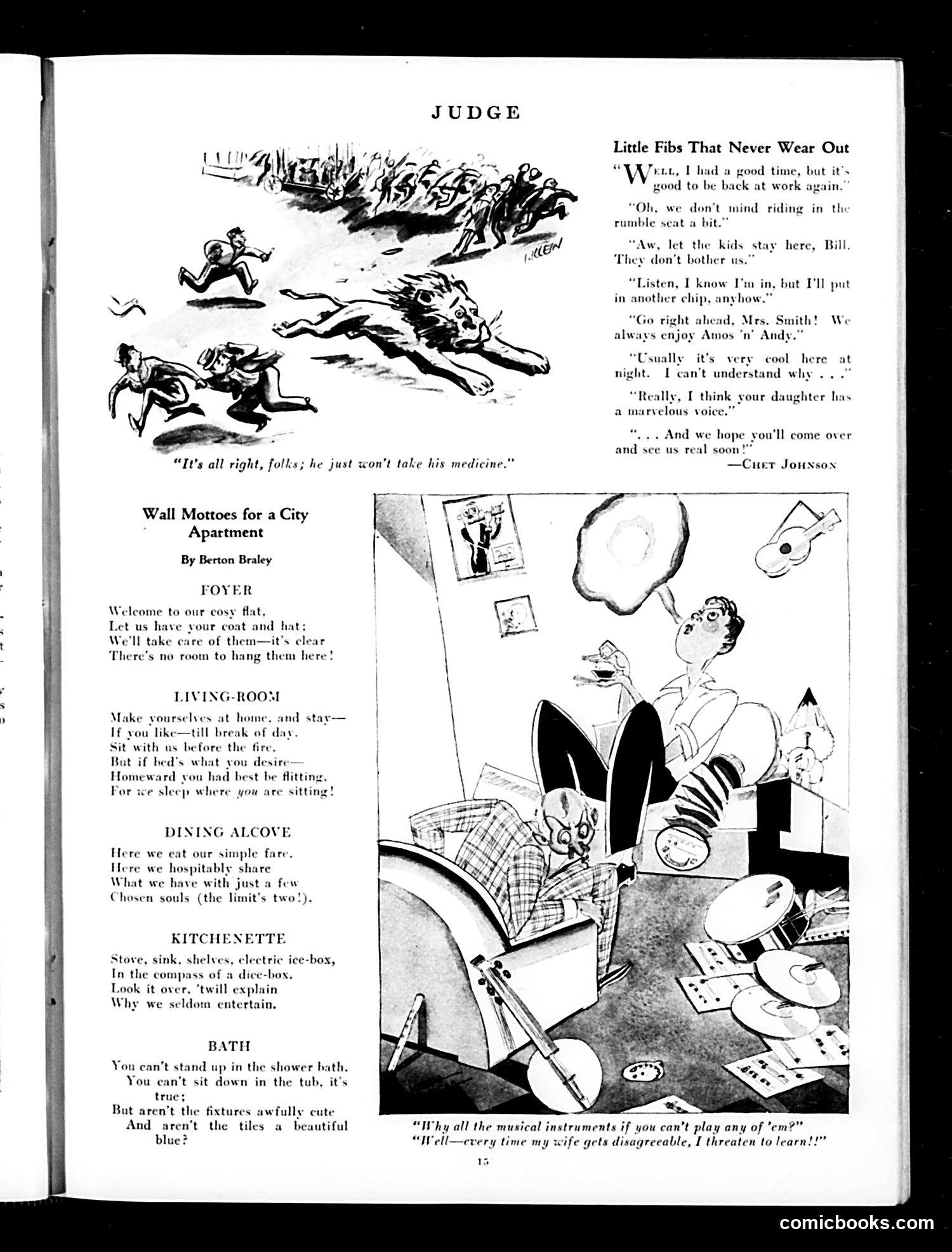
Explanation for Modern Readers This page contains two separate pieces of satire about urban apartment living in early 20th-century America. "Little Fibs That Never Wear Out" catalogs common social lies people tell—polite falsehoods like pretending to enjoy guests' company, accepting unwanted invitations, or complimenting others' talents. The reference to "Amos 'n' Andy" (a popular radio show) anchors this to the era. The humor relies on recognizing these universal insincerites. "Wall Mottoes for a City Apartment" by Berton Braley satirizes cramped apartment living through ironic "welcome" verses posted in each room. Each verse contradicts itself: the foyer welcomes guests but admits there's no closet space; the living room invites people to stay but implies they should leave for bed; the kitchenette section explains why hosts "seldom entertain" due to tiny spaces. The accompanying cartoon shows a man surrounded by musical instruments he can't play, using the threat of learning them to control his disagreeable wife—a darkly humorous commentary on marital discord and domestic control.
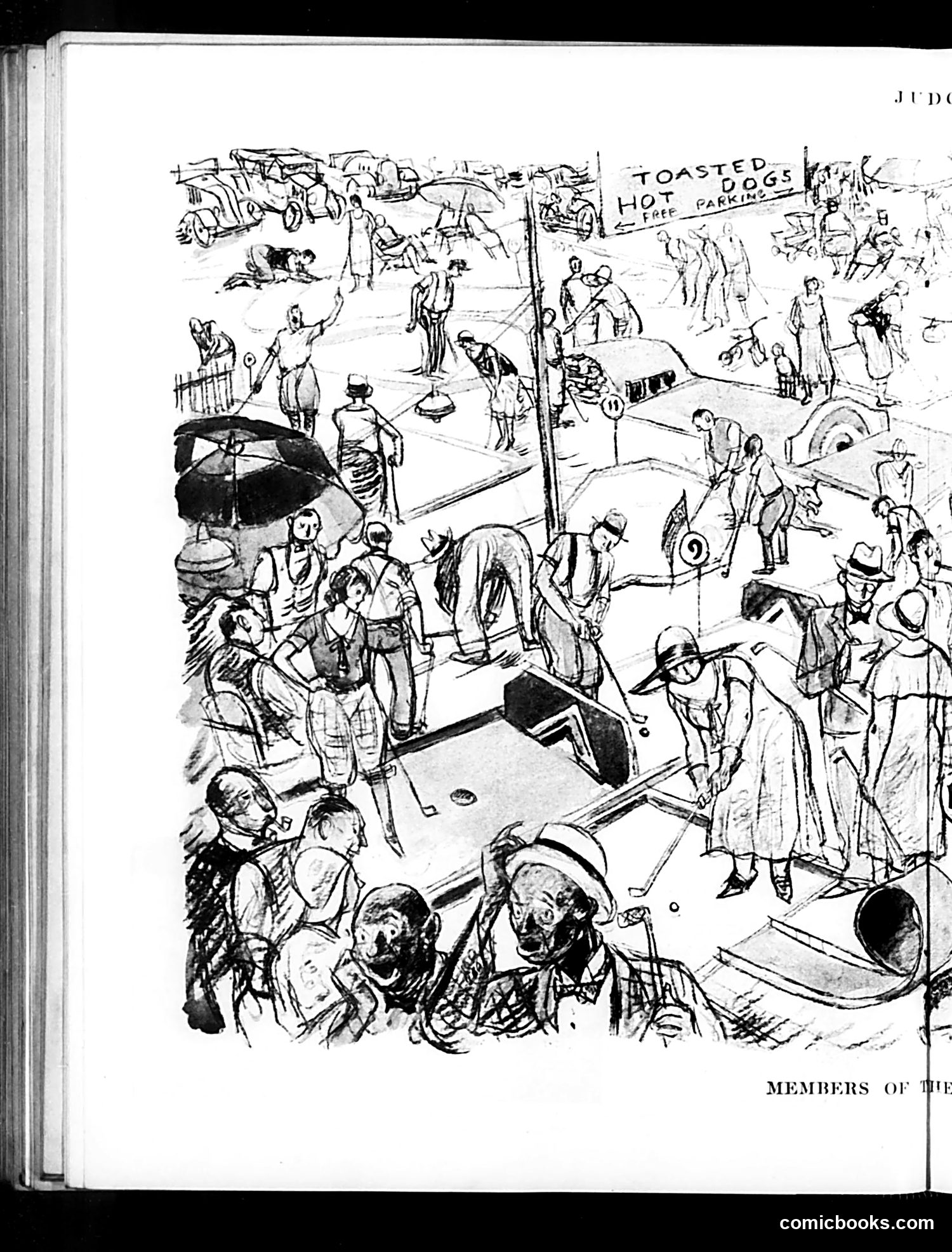
Analysis This is a busy street scene depicting a public gathering or fair, with the sign "TOASTED HOT DOGS FREE PARKING" visible in the upper right. The cartoon satirizes American leisure and consumer culture, showing crowds of diverse people engaged in recreational activities—some playing golf, others eating, socializing, and shopping. The satire appears to target post-WWI American prosperity and materialism: the casual display of consumer goods (hot dogs, free parking as an attraction), the leisure culture, and the mixing of social classes. The chaotic composition emphasizes how commercialism and entertainment have become central to American social life. The caption "MEMBERS OF THE" (text cut off) suggests this depicts a specific group, possibly satirizing an organization or social club defined by consumption rather than shared values.
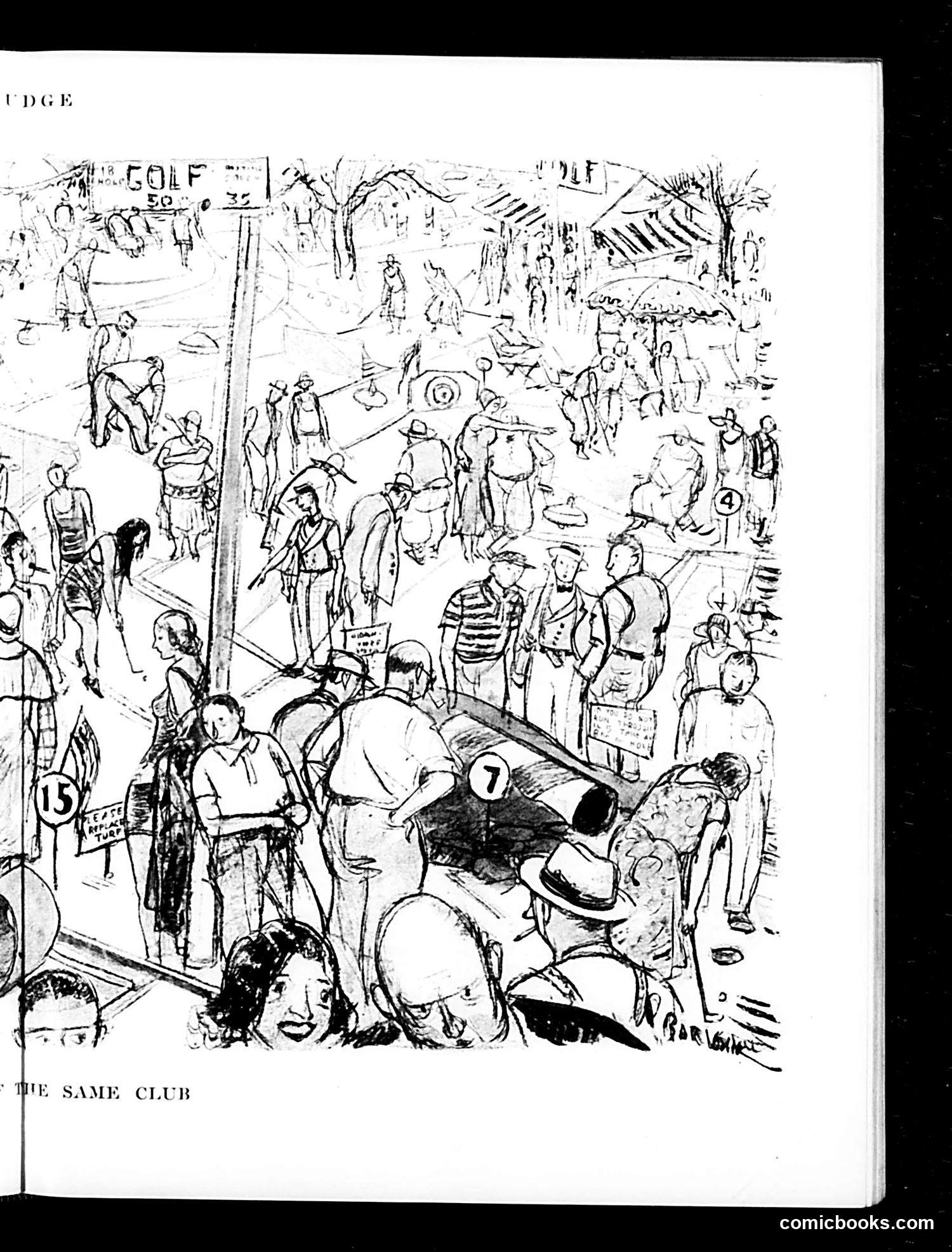
"The Same Club" - Judge Magazine Cartoon This cartoon depicts a crowded golf club scene with numbered figures (visible markers 7 and 15). The title "The Same Club" suggests social commentary on exclusive membership or class association. The drawing shows diverse characters mingling at what appears to be a country club or golf venue—a setting historically associated with wealth and exclusivity. The satire likely critiques either: 1. The pretension of club membership, or 2. Ironic mixing of social classes/types who wouldn't typically associate The specific identities of the numbered figures remain unclear without additional context. The cartoon's humor depends on recognizing contemporary figures or understanding a specific social reference about who "belonged" in such clubs during this era. The crowded, bustling composition emphasizes the social dynamics being mocked.
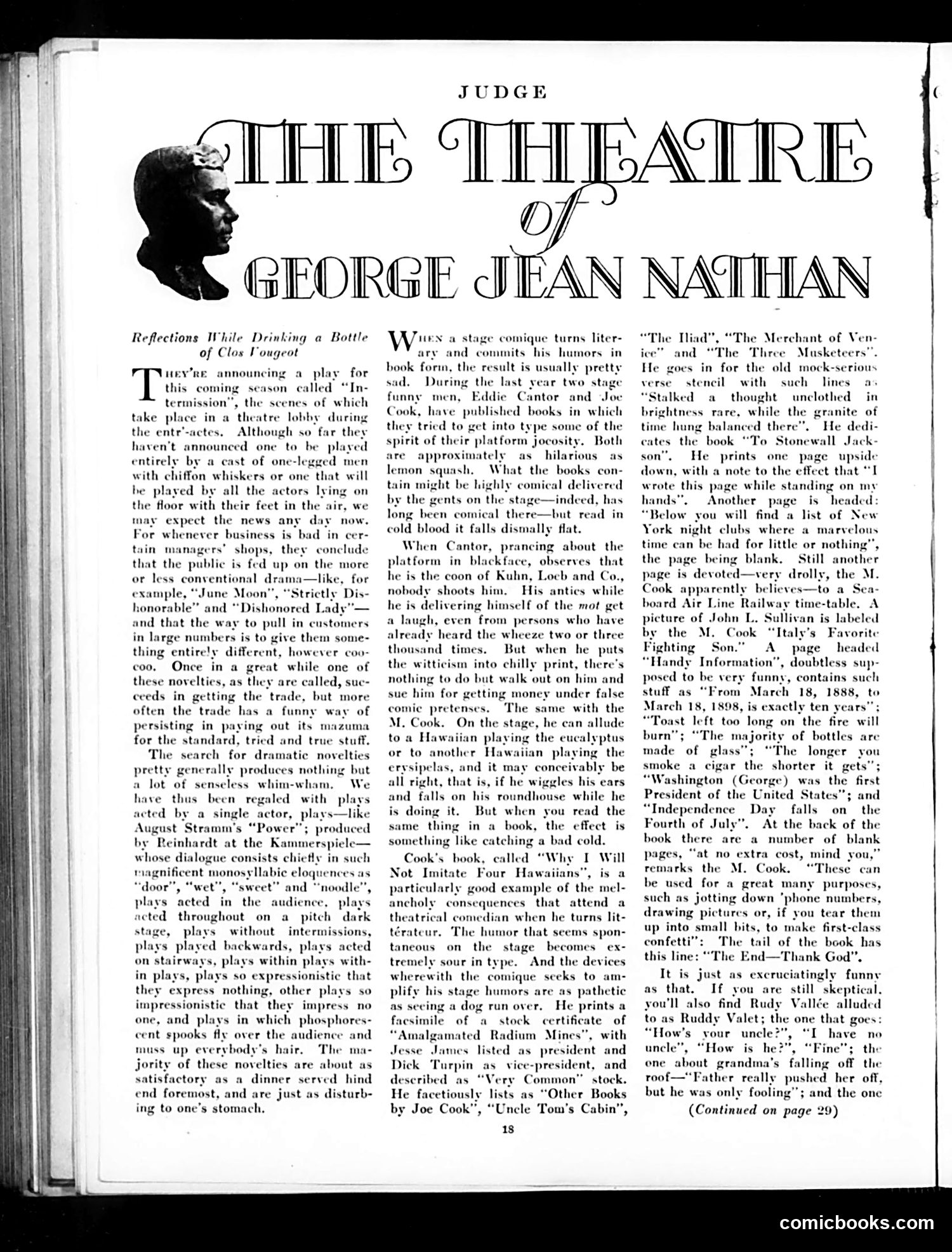
Analysis of "The Theatre of George Jean Nathan" This is primarily a critical essay, not a cartoon. Judge magazine's drama critic George Jean Nathan (identified by the profile portrait) critiques the current state of theatrical novelty and stage comedians' published works. Nathan argues that theater managers, when business is slow, mistakenly pursue experimental "novelties"—plays with unconventional staging, minimalist dialogue, or avant-garde techniques (referencing Reinhardt and August Stramm). These rarely succeed; audiences prefer "standard, tried and true stuff." More pointedly, Nathan ridicules comedians Eddie Cantor and Joe Cook for publishing books of their stage material. What works through performance—physical comedy, timing, delivery—falls "dismally flat" in print. He uses specific examples: Cantor's blackface routines and Cook's Hawaiian gags lose all comic effect as cold text. The satire targets both theatrical pretension and the misconception that stage humor translates to literature—a timeless problem for physical comedians attempting written comedy.
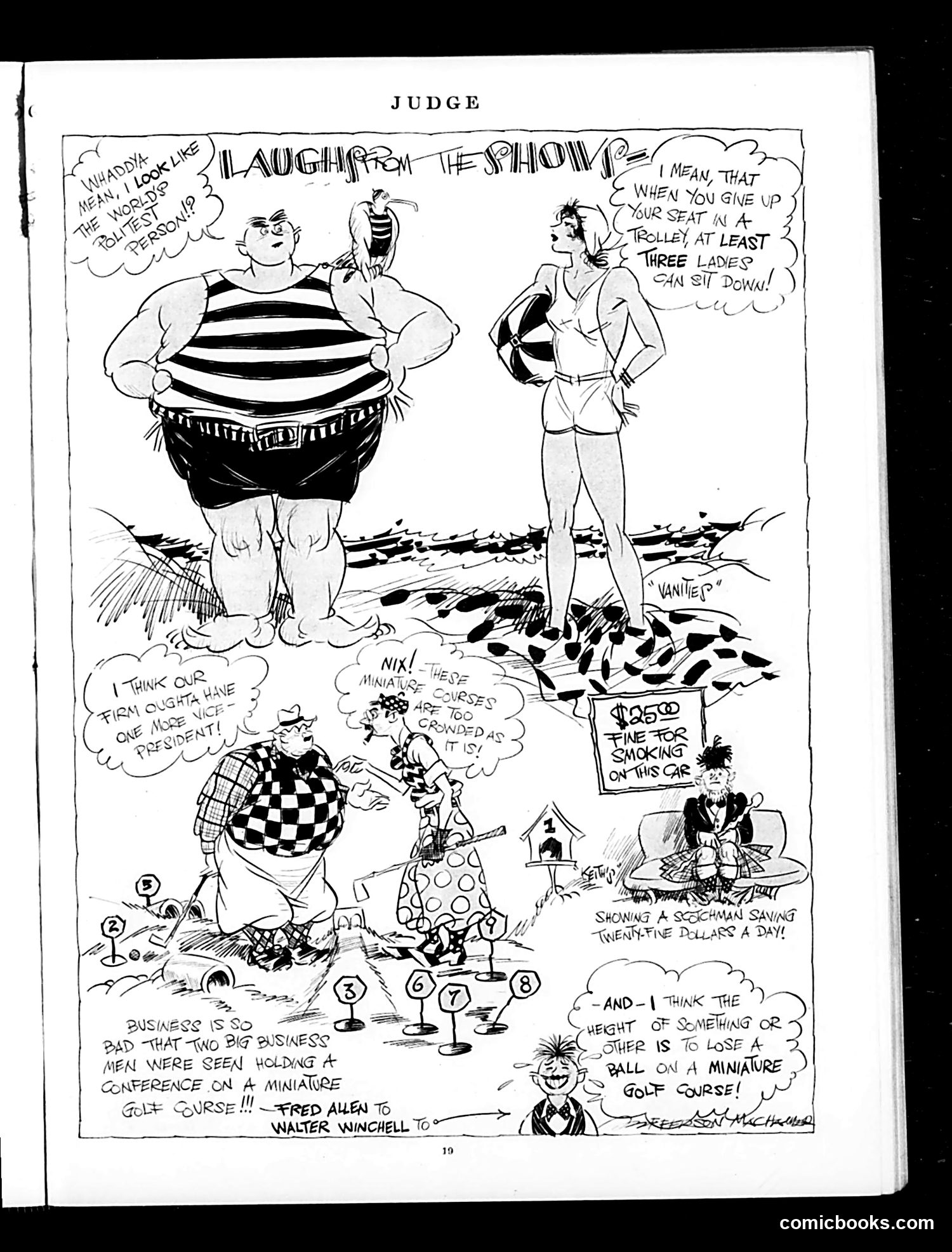
Political Cartoon Analysis: "Judge" Magazine This is a satirical cartoon mocking the wealthy elite and their frivolous pastimes during economically difficult times. The main figures appear to be caricatured as overly indulgent businessmen and showgirls engaged in absurd activities—a man in a striped bathing suit with a bird, a woman in athletic wear, and figures playing miniature golf. The satire targets: 1. Wealth disparity: References to "$25.00 fine for smoking" and "a Scotchman saving twenty-five dollars a day" mock the disconnect between the rich's casual spending and ordinary people's financial struggles. 2. Trivial pursuits: The miniature golf course and leisure activities represent how the wealthy waste time and money on pointless entertainment. 3. Gossip culture: The reference to Walter Winchell (a famous gossip columnist) suggests media complicity in celebrating the rich's frivolous behavior. The cartoon criticizes how business elites prioritize entertainment and status symbols while ordinary Americans struggle economically.
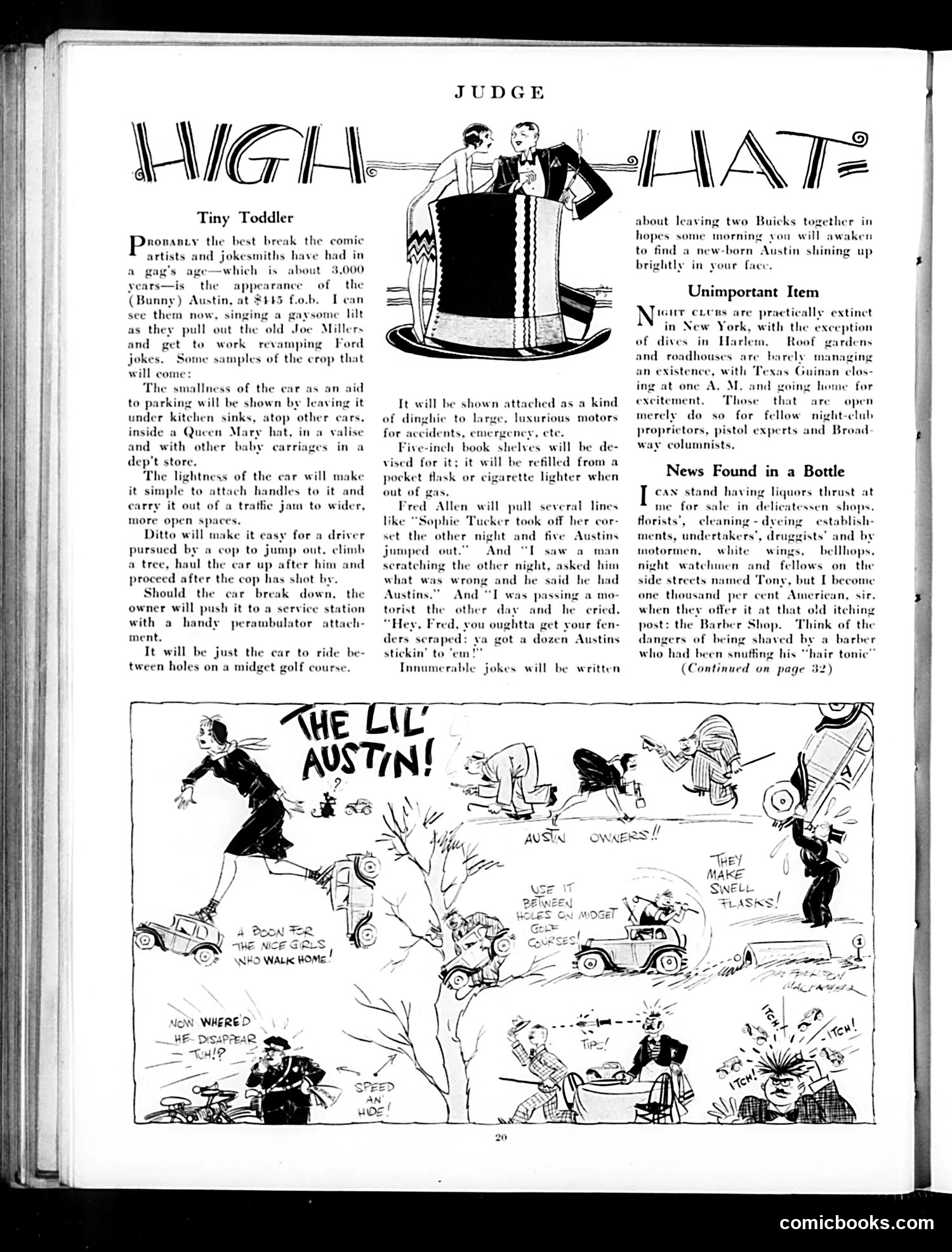
Judge Magazine Page Analysis This page satirizes the recently introduced Austin automobile, a small, affordable British car. The humor mines the vehicle's diminutive size—the central joke being that it's so tiny it can fit anywhere: under kitchen sinks, inside hats, or between golf course holes. "The Lil' Austin" cartoon depicts the car being used absurdly by various characters as a toy or novelty item rather than serious transportation, with comedic sound effects and chaotic scenes. The text notes that comedians like Fred Allen and Sophie Tucker are already mining the car for jokes—comparing it to breeding (leaving two Buicks together produces an Austin baby) or using it for punchlines about things being impossibly small. The other sections are unrelated: one about night clubs in Harlem during Prohibition, and another complaining about liquor being sold in barbershops—reflecting 1920s-30s American anxieties about illegal alcohol sales and social decay.
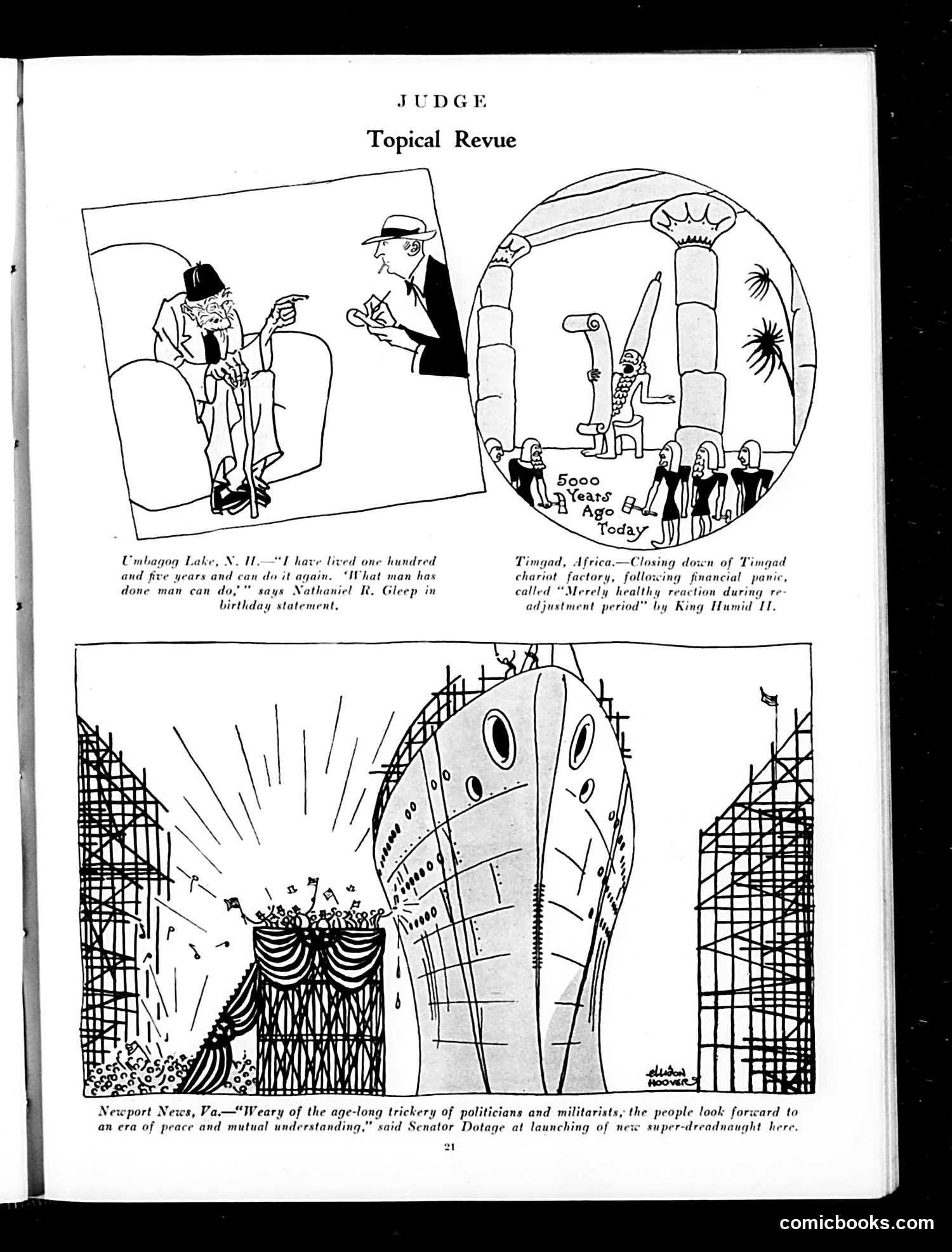
Political Satire from Judge Magazine This page presents three separate satirical cartoons mocking contemporary figures and situations: 1. Top Left: A centenarian's boast about longevity is treated as absurd hubris—the joke being that just because something happened once doesn't mean it's repeatable. 2. Top Right: A fictional African ruler dismisses factory closures as healthy economic adjustment, satirizing how leaders euphemize economic hardship. 3. Bottom: The sharpest satire: Senator "Dotage" launches a military warship while preaching peace and denouncing "politicians and militarists' trickery"—the irony being his own contradiction. The massive dreadnaught (battleship) between industrial scaffolding undercuts his pacifist rhetoric. This mocks political hypocrisy regarding military buildup and peace rhetoric, likely reflecting early 20th-century naval arms race debates.
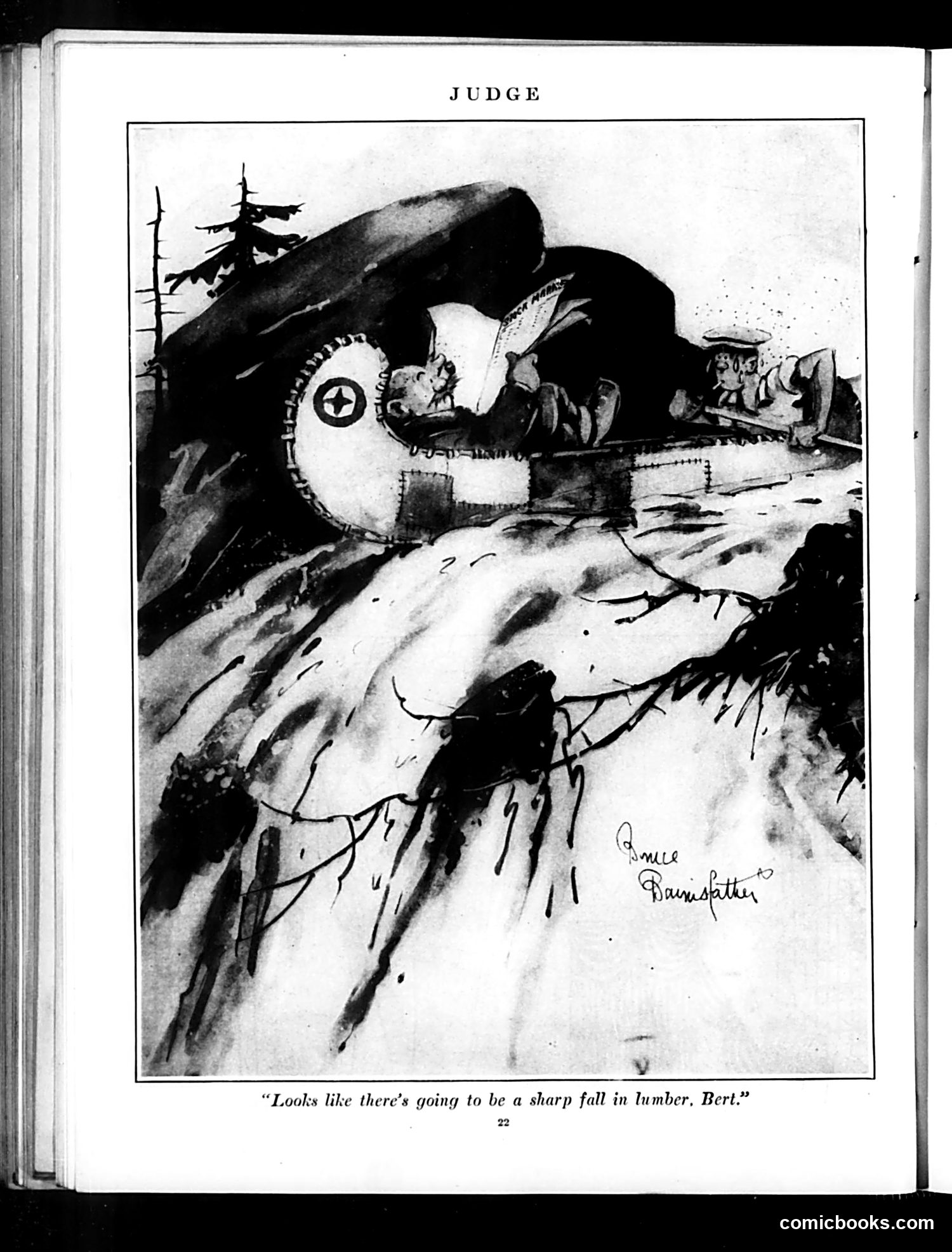
Judge Magazine Cartoon Analysis This single-panel cartoon depicts two figures examining a felled log with a military aircraft visible in the background. The caption references a "sharp fall in lumber," playing on double meaning—literally a falling tree and figuratively a market decline. The military context suggests this is World War I-era commentary. The joke appears to satirize how wartime military production (represented by the aircraft and soldiers) depletes lumber supplies needed for civilian commerce, causing lumber prices to plummet due to oversupply or disrupted markets. The cartoon likely critiques economic disruptions caused by military mobilization, or possibly mocks wartime profiteering and resource management. The specific historical moment is unclear without dating information, but the satirical tone is characteristic of *Judge* magazine's commentary on contemporary affairs.
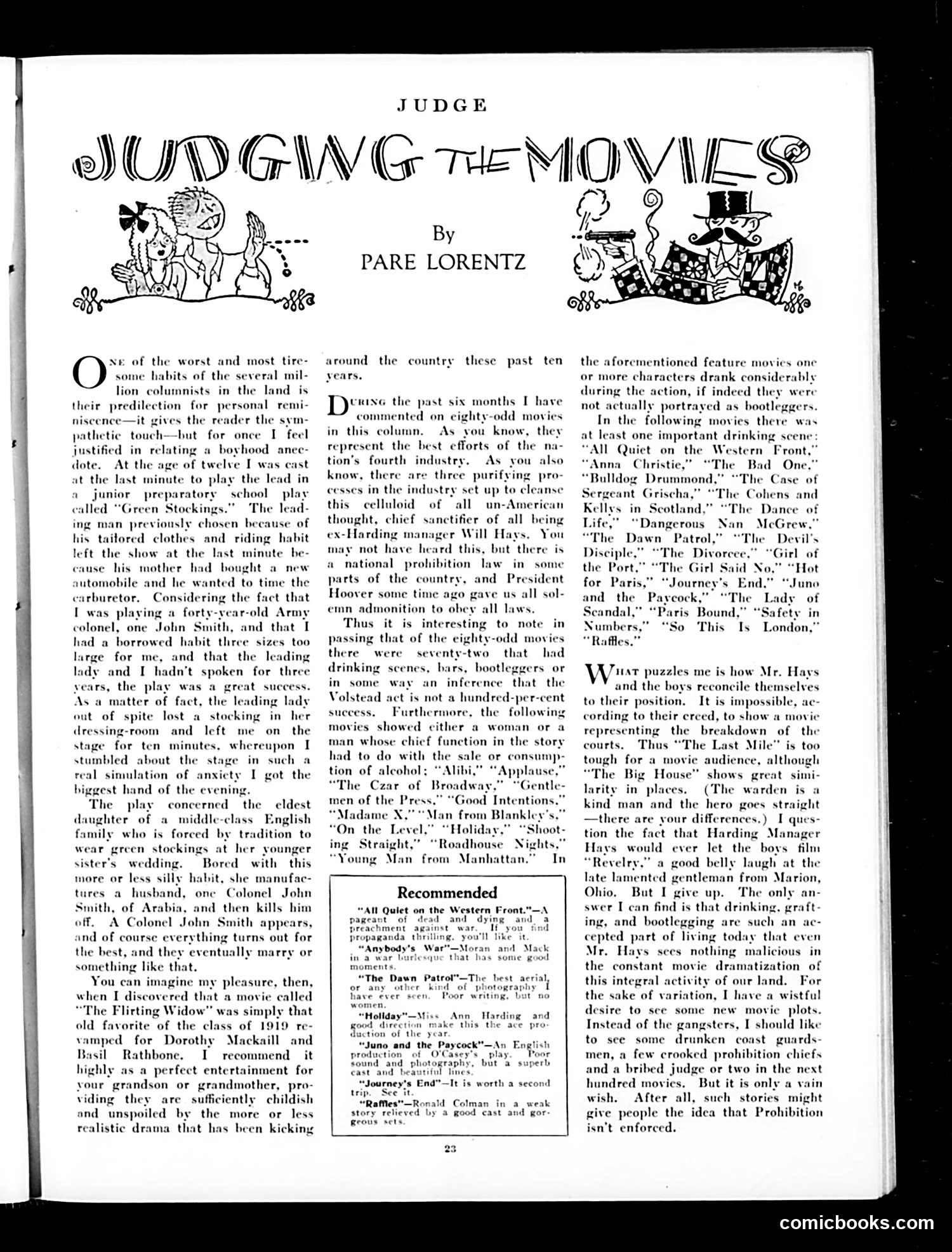
Judge Magazine: "Judging the Movies" by Pare Lorentz This is a film criticism column, not a political cartoon. Lorentz comments on 80 recent movies, noting a striking hypocrisy: despite Prohibition being federal law (passed 1920, enforced nationwide), 72 of these films featured drinking scenes, bars, or bootleggers. The satire targets the film industry's apparent defiance of "national prohibition" and the "purifying processes" supposedly cleaning Hollywood of "un-American" content. Lorentz notes that ex-Harding manager Will Hays (the industry's chief censor) gave public "admonition to obey all laws"—yet the Volstead Act's violations permeate mainstream entertainment. The column sarcastically highlights the contradiction: Hollywood claims moral purity while systematically depicting alcohol consumption. This exposes either the censorship board's toothlessness or the industry's cynical disregard for laws most Americans flouted during Prohibition's unpopular enforcement (1920-1933).
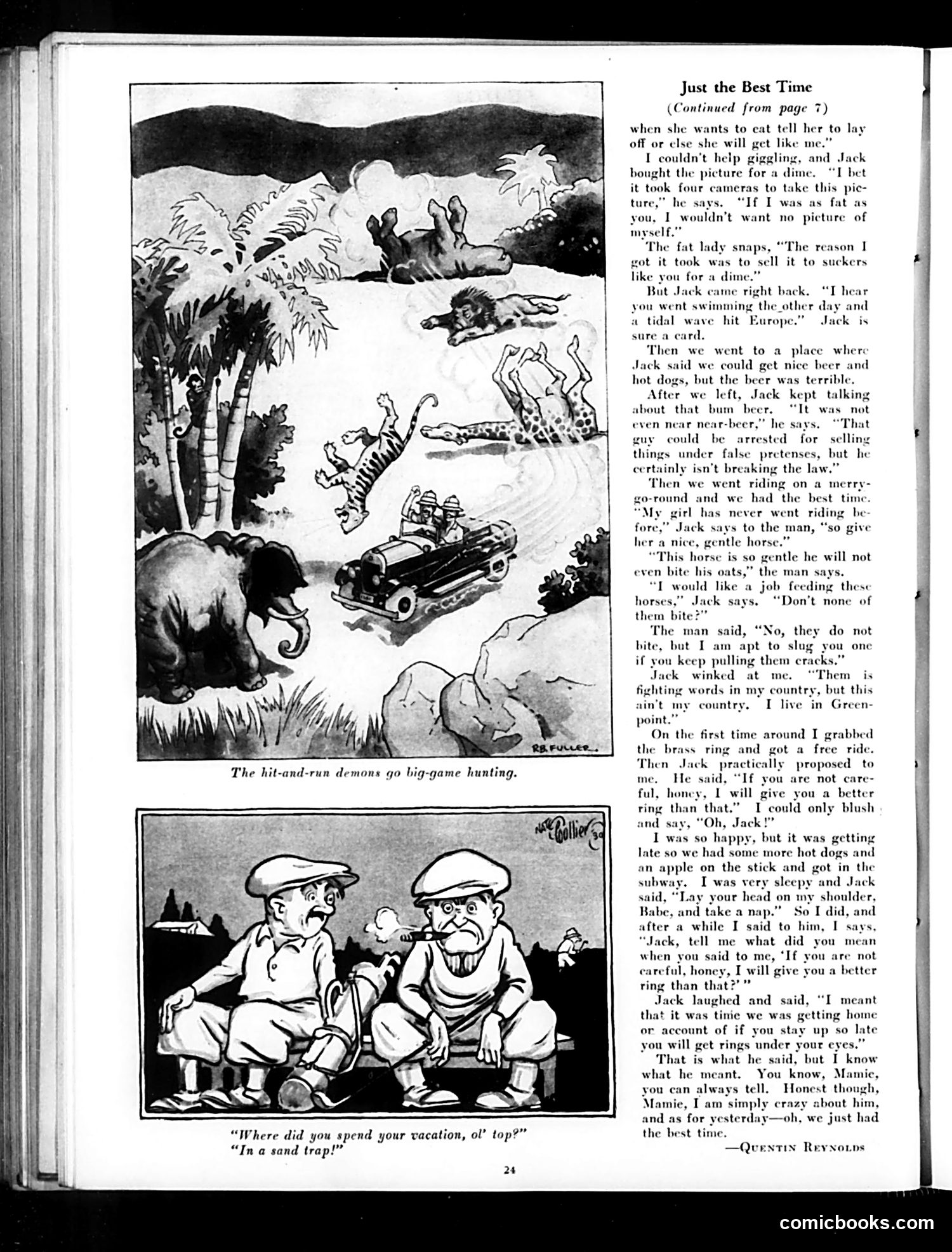
Analysis of Judge Magazine Page This page contains two related cartoons and a romantic narrative by Quentin Reynolds titled "Just the Best Time." Top cartoon: "The hit-and-run demons go big-game hunting" depicts fantastical creatures (demons/imps) pursuing various animals and a car—a satirical comment on reckless driving and traffic dangers of the era. The "hit-and-run" reference suggests early automobile accidents were a growing social problem. Bottom cartoon: Two working-class men in caps discuss vacation, with one saying they spent it "in a sand trap"—a golf joke playing on the double meaning (literal sand trap vs. being stuck). Main text: Reynolds's humorous story about a vacation with "Jack" satirizes working-class leisure activities and courtship rituals of the period—amusement parks, cheap attractions, beer, and awkward romantic overtures. The narrative voice (appearing female, named "Mamie") is drawn in vernacular dialect, typical of early 20th-century humor magazines mocking ordinary people's speech and behavior. The overall tone is gently mocking rather than cruel, capturing period anxieties about modernization, automobiles, and casual romance.
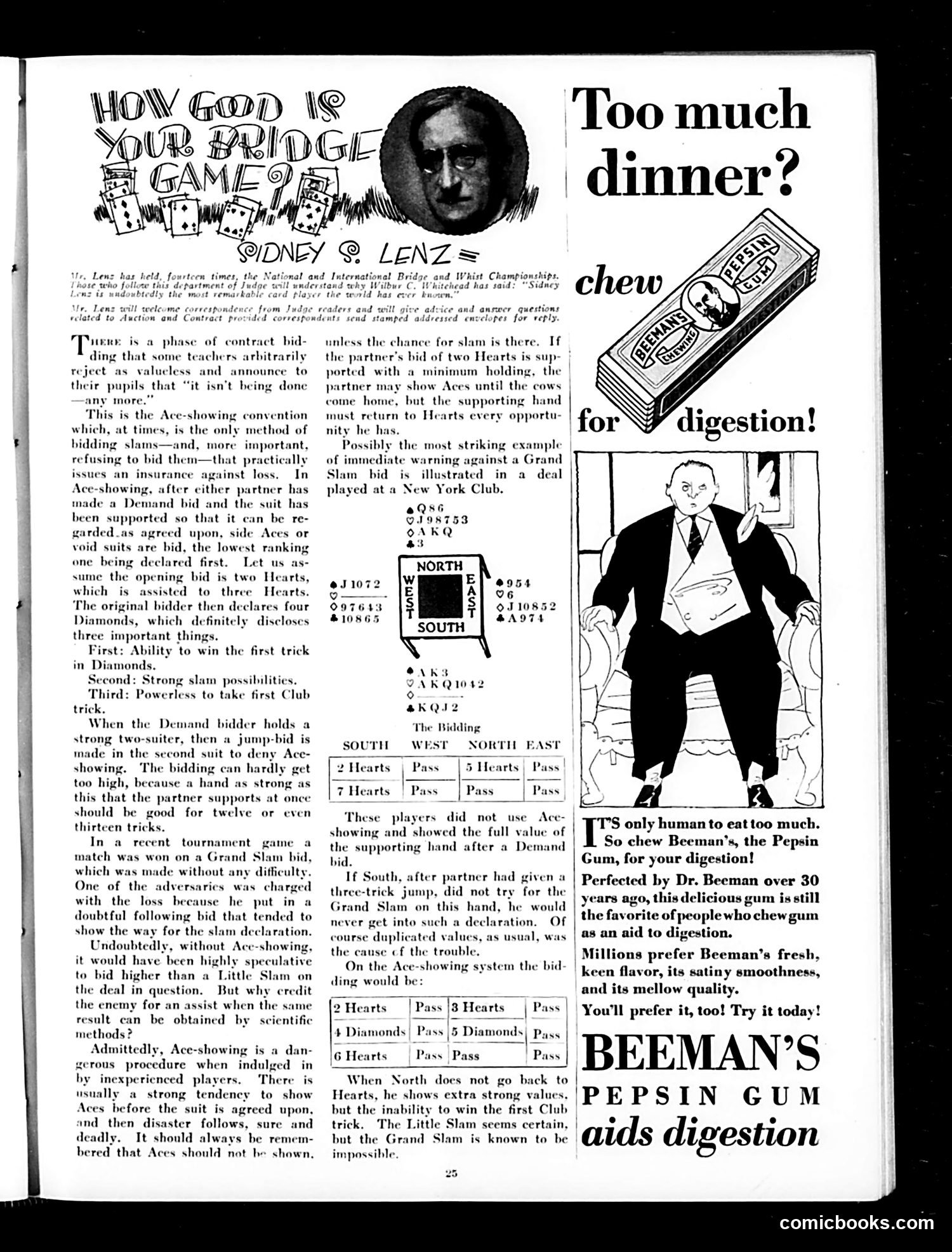
Analysis for Modern Readers This page from *Judge* magazine consists primarily of a bridge card game instruction column by Sidney Lenz, a renowned bridge expert, explaining "Ace-showing" bidding conventions. The text uses specific hand examples and bidding sequences to instruct readers on strategic contract bridge techniques. The page's only actual cartoon/satire is a full-page advertisement for Beeman's Pepsin Gum on the right side, featuring an illustration of a well-dressed man looking uncomfortable after overeating. The ad's humor is straightforward: it humorously addresses dinner indigestion as a relatable modern problem, positioning the gum as digestive relief. The tagline "It's only human to eat too much" normalizes overconsumption while offering the product as a solution. This reflects early 20th-century advertising humor—direct, gentle, and health-focused—when chewing gum was marketed as having medicinal digestive benefits. No political or social satire is present; this is primarily instructional content with commercial appeal.
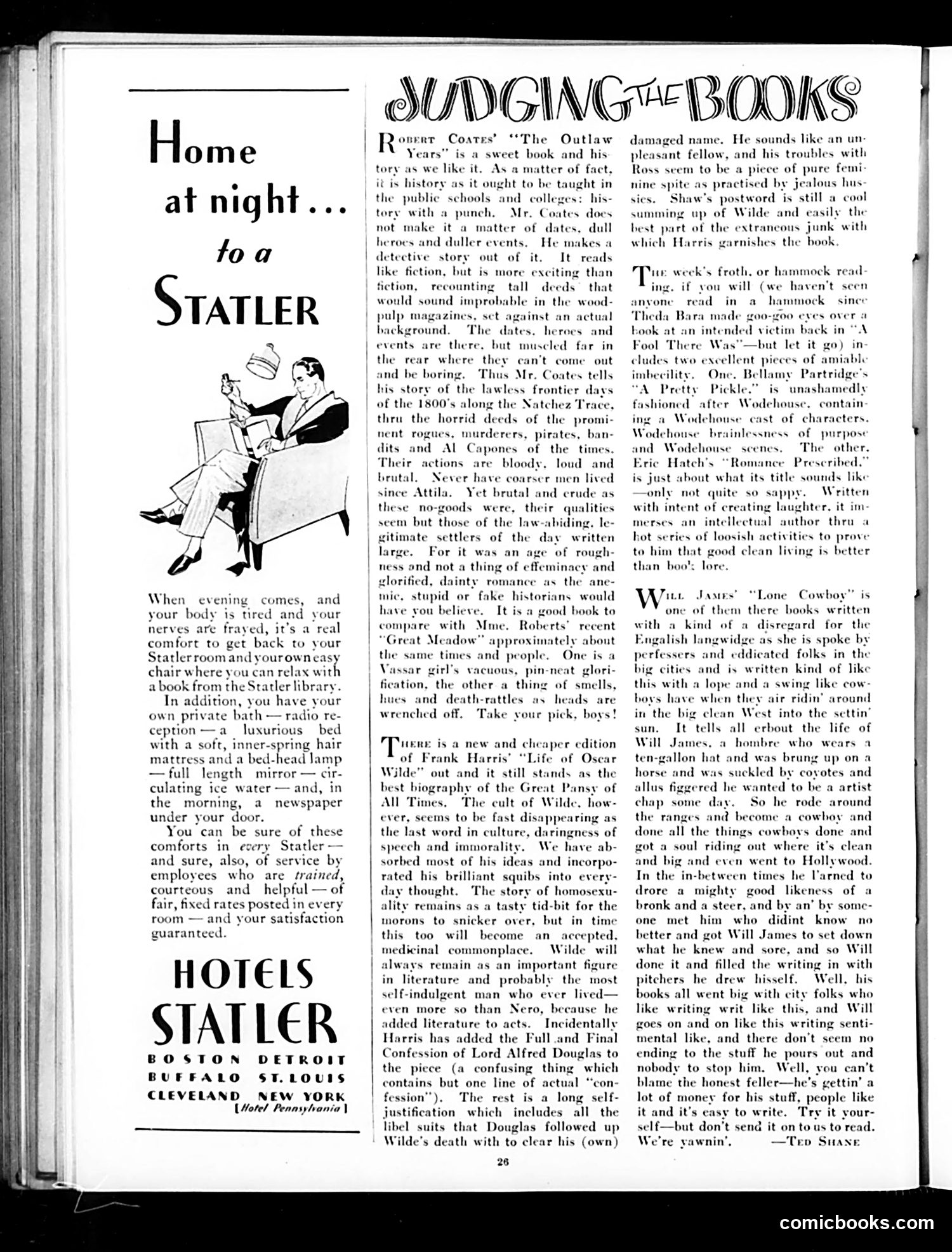
"Judging the Books" - A Book Review Column This is primarily a book review column by Ted Shave, not a political cartoon. The illustration shows a comfortable businessman relaxing in an armchair—a visual pun supporting the *Statler Hotels* advertisement below. The reviews discuss three books: Robert Coates' *The Outlaw Years* (praised for lively frontier history over dry dates), Bellamy Partridge's *A Pretty Pickle* (a Wodehouse-style comedy), and Will James' *Lone Cowboy* (an autobiography of a cowboy-artist). The column also notes Frank Harris' biography of Oscar Wilde remains culturally important despite Wilde's cult fading. The reviewer matter-of-factly discusses homosexuality as a topic "morons snicker over" but predicts it will become "an accepted, medicinal commonplace"—a strikingly progressive statement for this era, though phrased in period-appropriate clinical language. The page is primarily advertising disguised as editorial content—using book reviews to justify the Statler's "library" as evening comfort.
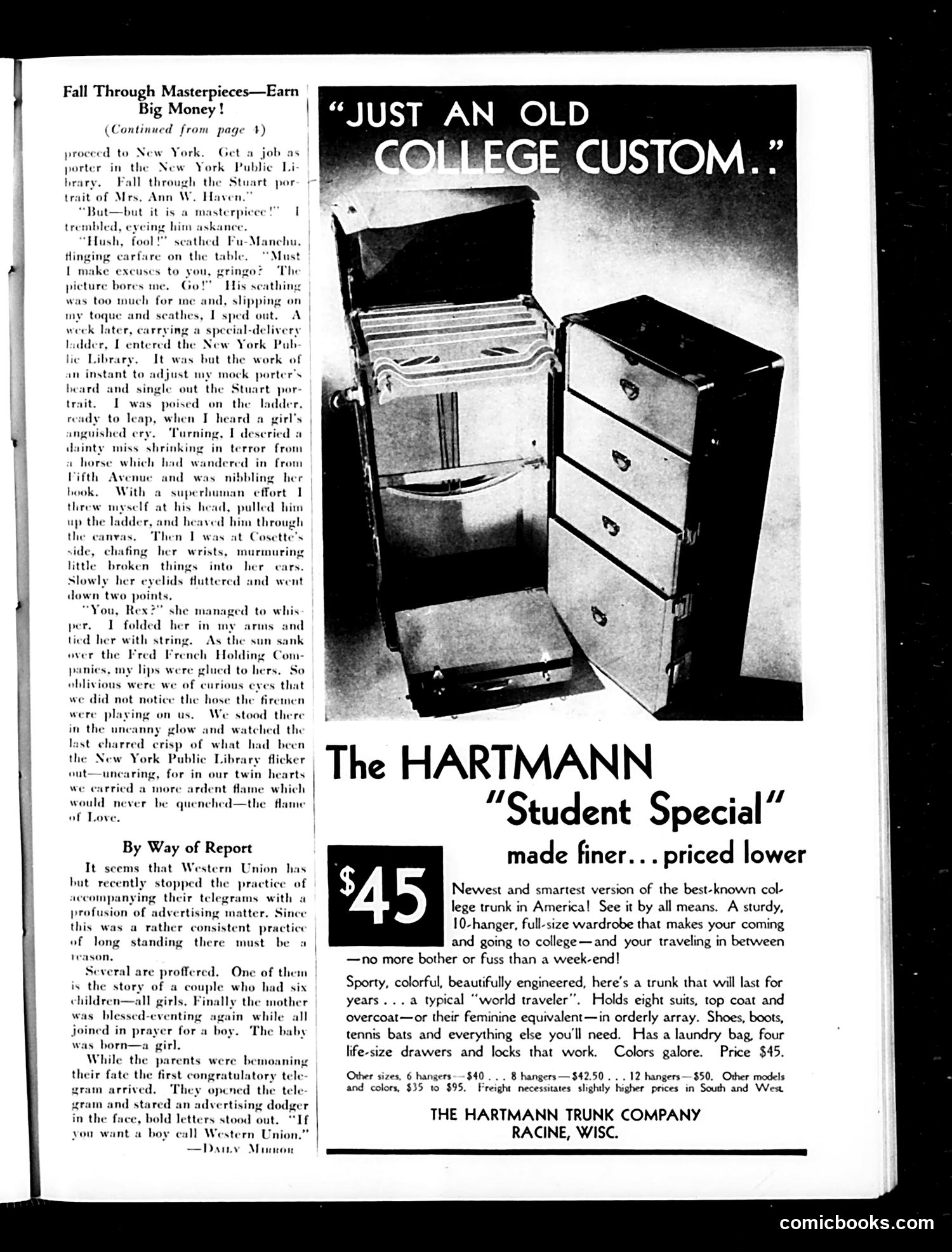
Judge Magazine Page Analysis This page contains two distinct elements: a serialized satirical story and a product advertisement. The Story ("Fall Through Masterpieces"): A humorous fiction piece about a spy named Rex working for the villainous "Fu-Manchu" (referencing the popular pulp villain). The plot absurdly involves destroying masterpieces at the New York Public Library for money. The satire mocks melodramatic pulp fiction conventions—the spy accidentally destroys a priceless Stuart portrait while heroically saving a damsel from a horse that wandered into the library, then watches the entire building burn while embracing her romantically. The joke is the over-the-top romantic conclusion to this ridiculous scenario. "By Way of Report": A brief humorous anecdote about Western Union stopping their practice of including advertising with telegrams. The joke: parents disappointed by having six daughters receive a congratulatory telegram featuring an ad saying "If you want a boy call Western Union"—cruel advertising timing. The Advertisement: A Hartmann trunk advertisement emphasizing college use, positioned as a quality product marketed at students despite being "just an old college custom."
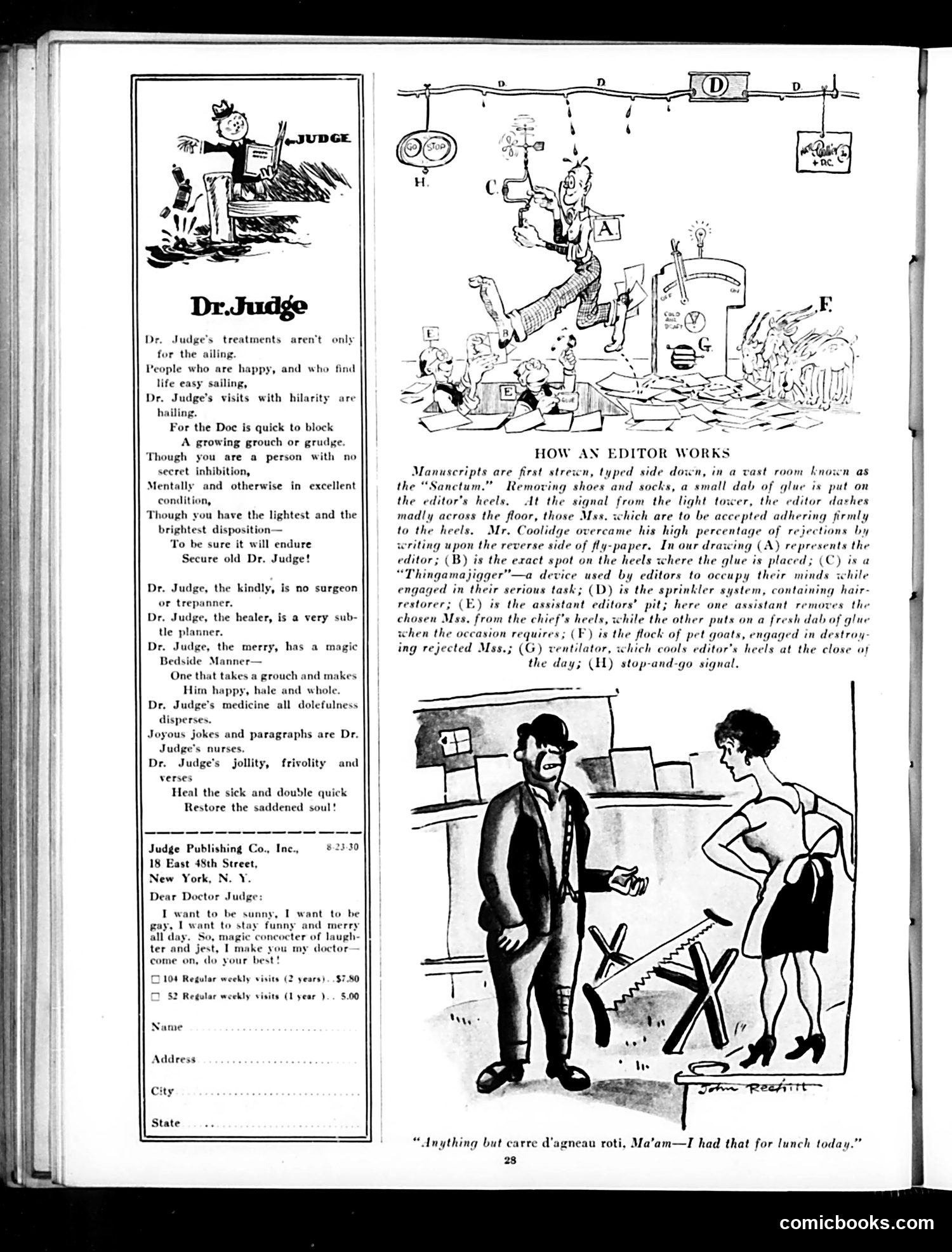
Explanation for Modern Readers This page contains self-promotional advertising for Judge magazine itself, disguised as humorous content. "Dr. Judge" is a personified version of the magazine, presented as a quack doctor dispensing laughter and jokes as medicine. The poem and subscription form pitch Judge as a cure for sadness and worry—the "medicine" being funny jokes and satirical articles. "How an Editor Works" is absurdist satire mocking editorial processes. The diagram humorously depicts an editor as physically glued to rejected manuscripts, forced to process submissions through ridiculous mechanical means (goats eating rejected pieces, sprinkler systems cooling the editor's heels). This likely satirizes the chaos of magazine editorial offices and the absurd volume of submissions editors received. The bottom cartoon shows a man in a hat flirting with a woman, with a caption about "carre d'agneau roti" (roasted lamb)—likely a class-conscious joke implying he ate something fancy at lunch but wants to seem less pretentious. Overall, the page blends genuine advertising with self-mocking humor typical of Judge's satirical approach.
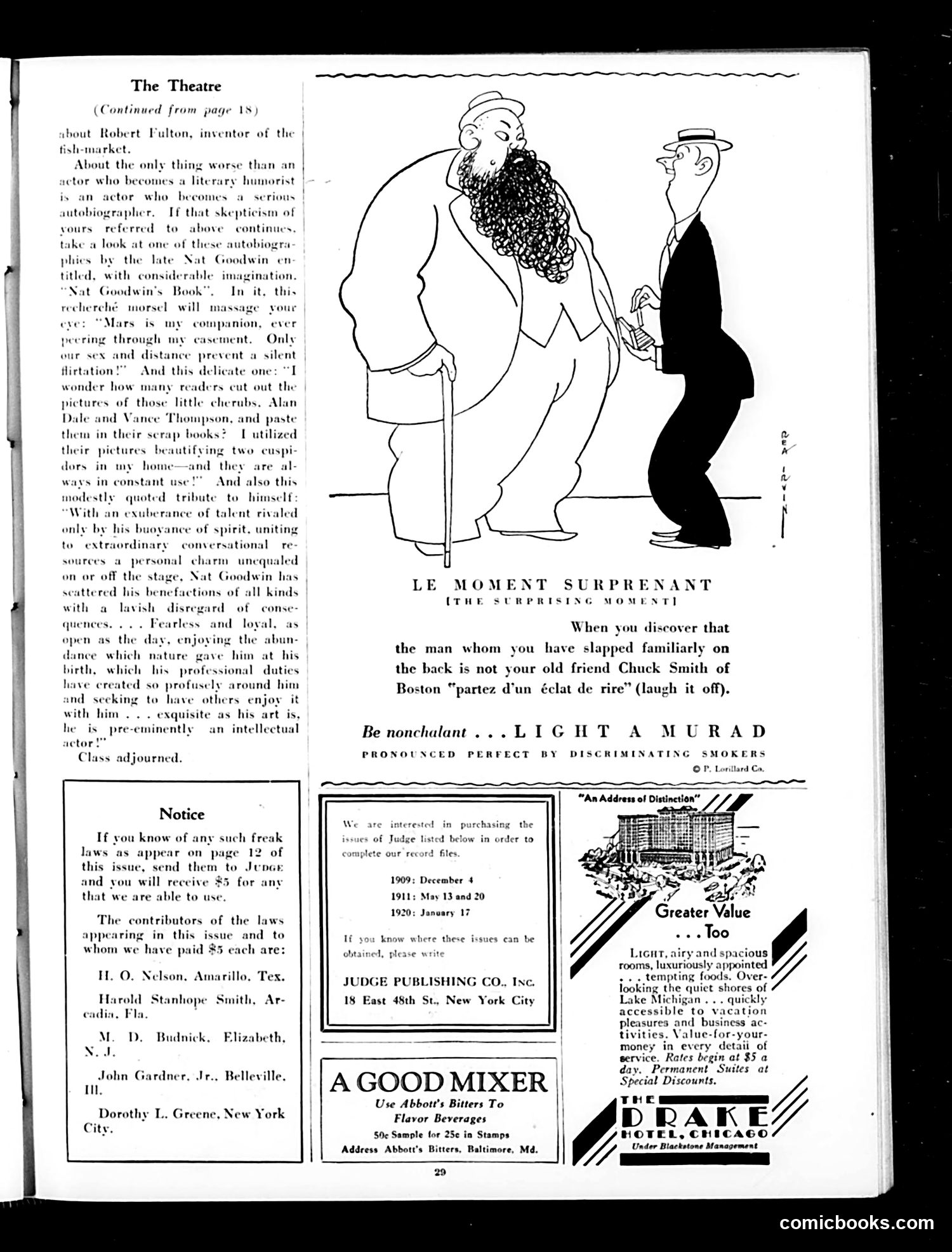
Page Analysis: Judge Magazine This page contains theatrical criticism and advertising rather than political cartoons. The main content critiques actor-turned-memoirist Nat Goodwin, whose autobiography Judge ridicules for self-aggrandizing and absurd passages. The critic mocks Goodwin's pretentious writing—comparing Mars to a companion, claiming he used pictures of actors as decorative spittoon linings—as exemplifying why actors shouldn't become serious writers. The cartoon "Le Moment Surprenant" is a humorous social scenario: mistakenly slapping an unfamiliar man on the back, thinking he's your friend Chuck Smith of Boston. The joke plays on embarrassing social mishaps of the era. The caption advises nonchalance and recommends lighting a Murad cigarette as a composed recovery. The remainder of the page consists of period advertisements (hotel, cigarettes, bitters) and a notice soliciting old Judge issues and reporting contributor names for "freak laws" published elsewhere in the magazine.
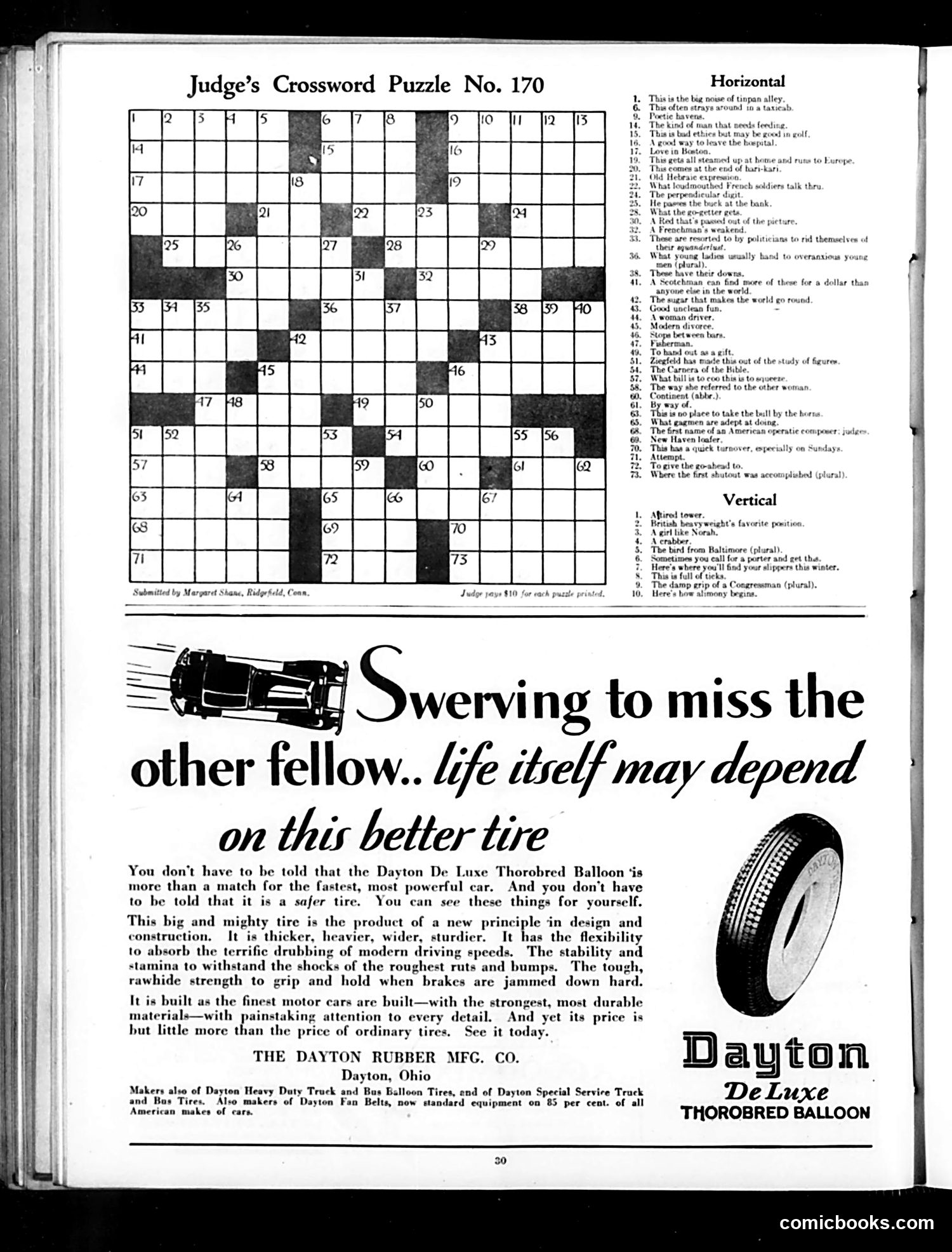
Judge Magazine Page Analysis This page contains Judge's Crossword Puzzle No. 170 (a standard word puzzle feature) and a Dayton tire advertisement. The advertisement's headline—"Swerving to miss the other fellow...life itself may depend on this better tire"—uses a safety messaging pitch common to 1920s-30s automotive advertising. The copy emphasizes the tire's durability, grip, and construction quality as essential for safe driving on modern roads with their unpredictable hazards. The phrase "swerving to miss the other fellow" reflects period concerns about automobile safety during an era of rapidly increasing vehicle traffic and fatal accidents—a genuine public health crisis. The advertisement positions the Dayton De Luxe Thorobred Balloon tire as protection against these dangers. There is no political cartoon on this page. The content is purely commercial advertising combined with a recreational crossword puzzle—typical filler content for Judge magazine between satirical articles and cartoons.
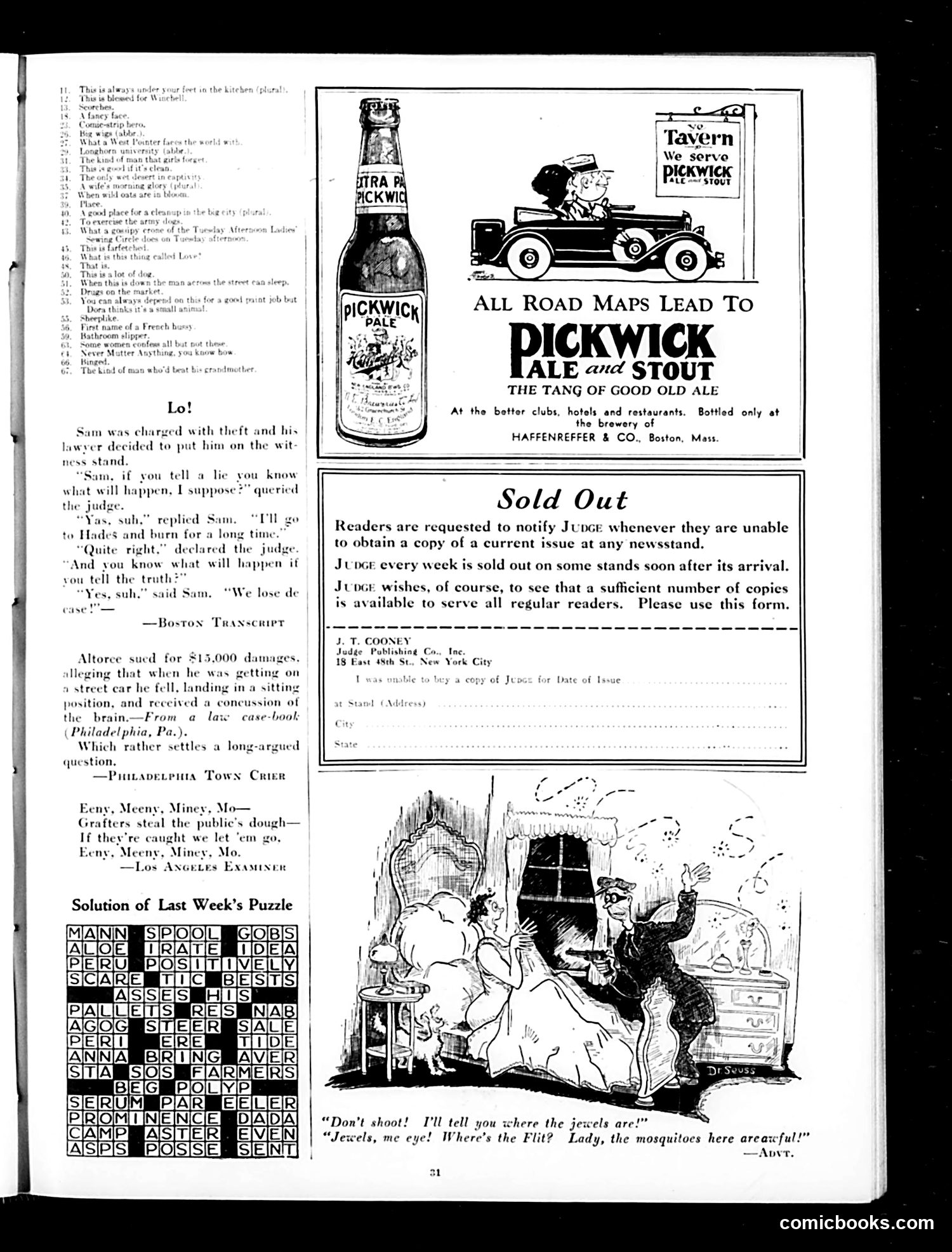
Analysis for Modern Readers This page contains several distinct pieces: Main Cartoon (bottom): A woman in bed confronts a burglar. She offers to reveal jewel locations, but he dismisses this—he's actually after "Flit" (an insecticide brand). The joke: mosquitoes are such a persistent household pest that even a burglar prioritizes pest control over robbery. This is an advertisement disguised as humor, playing on widespread frustration with mosquitoes. "Lo!" Anecdote: A legal humor piece about Sam, accused of theft. His lawyer warns him: lying to the judge leads to damnation; telling the truth loses the case. The satire mocks the legal system's apparent futility—either way, the defendant loses. Other items: A Pickwick Ale advertisement, a "Sold Out" notice requesting reader notifications about Judge's availability, and a crossword puzzle solution. The page reflects early 20th-century American concerns: legal corruption, pest problems, and commercial advertising integrated into satirical editorial content.
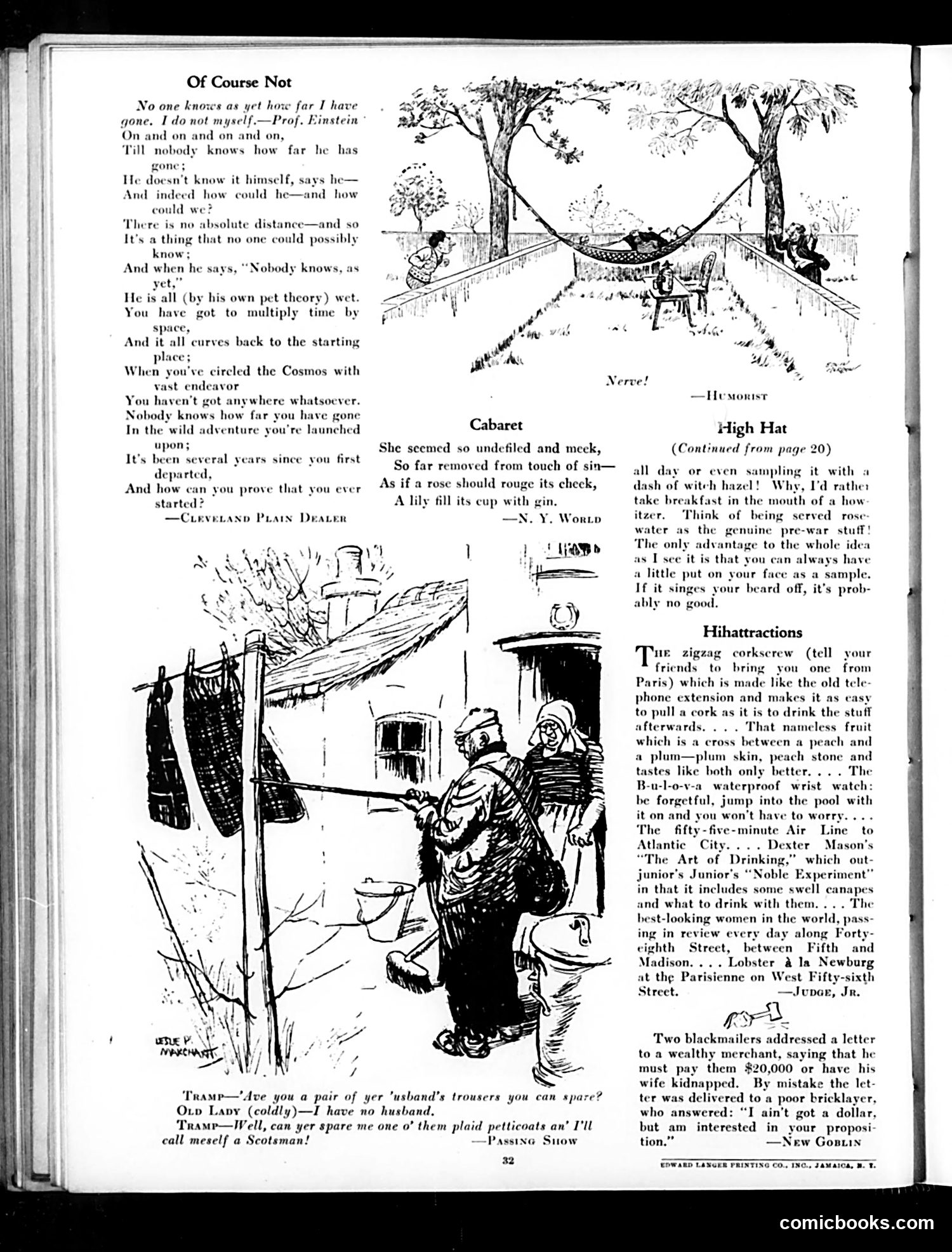
"Of Course Not": Einstein and Modern Knowledge The Main Cartoon (top left): This satirizes Einstein's theory of relativity, which had recently captured public imagination. The poem mocks Einstein's famous statement that "no one knows" how far his theories extend—even Einstein himself. The joke: if you circle the entire cosmos, you end up back where you started, so "nobody knows how far you've gone." It's poking fun at both the incomprehensibility of relativity to ordinary people and Einstein's humble admission of uncertainty, treating abstract physics as absurd logic. The Supporting Jokes: "Cabaret" criticizes women appearing "undefiled" while drinking gin—mocking post-Prohibition social hypocrisy. "High Hat" endorses rose water as pre-war sophistication. The tramp joke plays on Scottish stereotypes (plaid petticoats as Scottish dress). Context: This reflects 1920s popular culture's bewilderment with Einstein's theories, which dominated intellectual discussion despite being largely incomprehensible to the average reader.
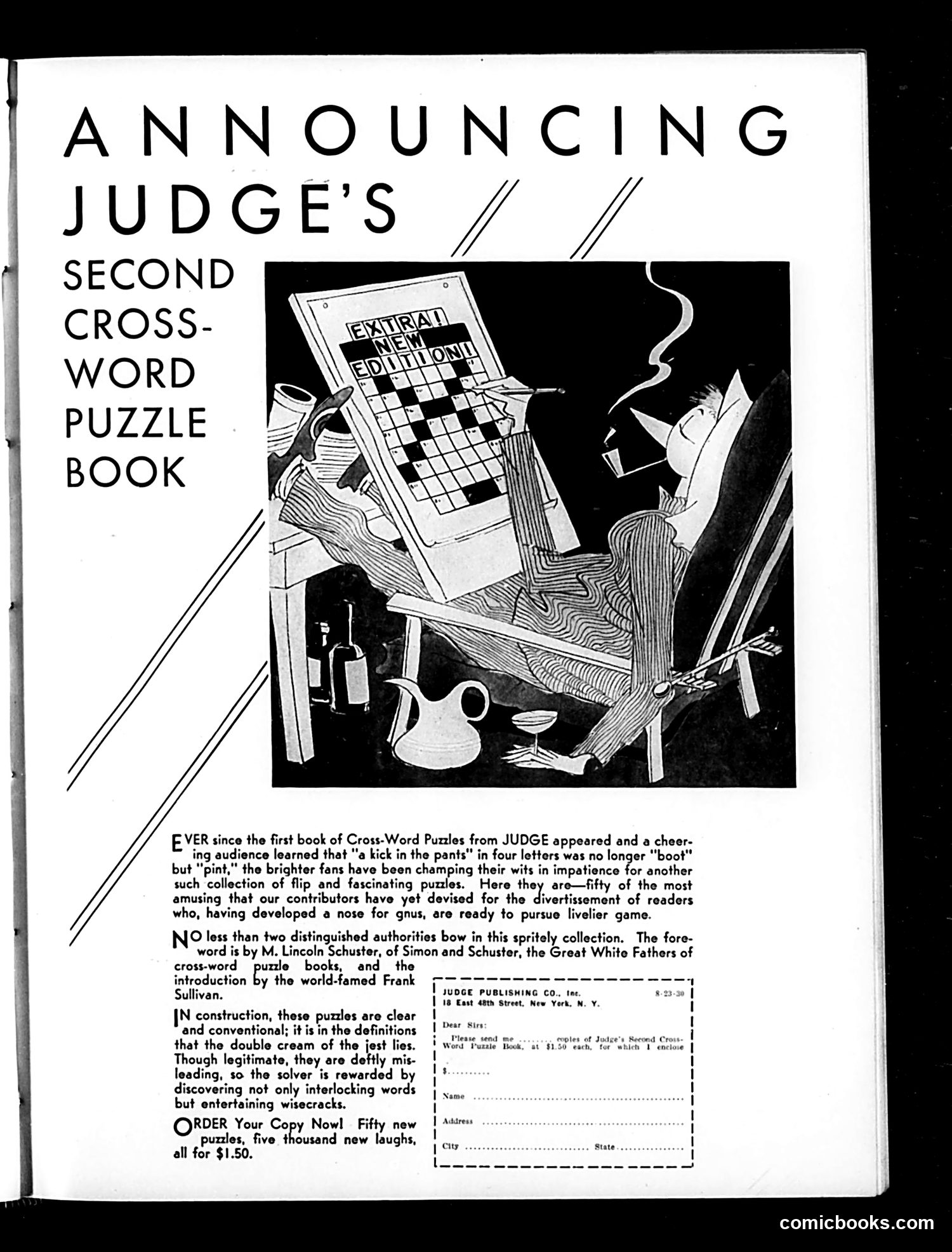
Judge's Second Crossword Puzzle Book Advertisement This is primarily an advertisement for Judge magazine's second crossword puzzle book, not a political cartoon. The illustrated vignette shows a relaxed figure solving puzzles—a visual metaphor for the leisure activity being promoted. The text humorously references the crossword puzzle craze of the 1920s-30s, when these puzzles were wildly popular. It jokes that solvers have become obsessed ("champing their wits"), searching for answers like equating "a kick in the pants" with "pint" instead of "boot"—wordplay humor typical of Judge's satirical style. The book features contributions from M. Lincoln Schuster (Simon & Schuster publisher) and Frank Sullivan (a famous humor writer), lending credibility. The ad emphasizes that while puzzles follow standard construction, the definitions are intentionally misleading—rewarding solvers with both correct answers and "entertaining wisecracks." At $1.50 for fifty puzzles, this was pitched as entertainment for the intellectual crowd enjoying the crossword fad.
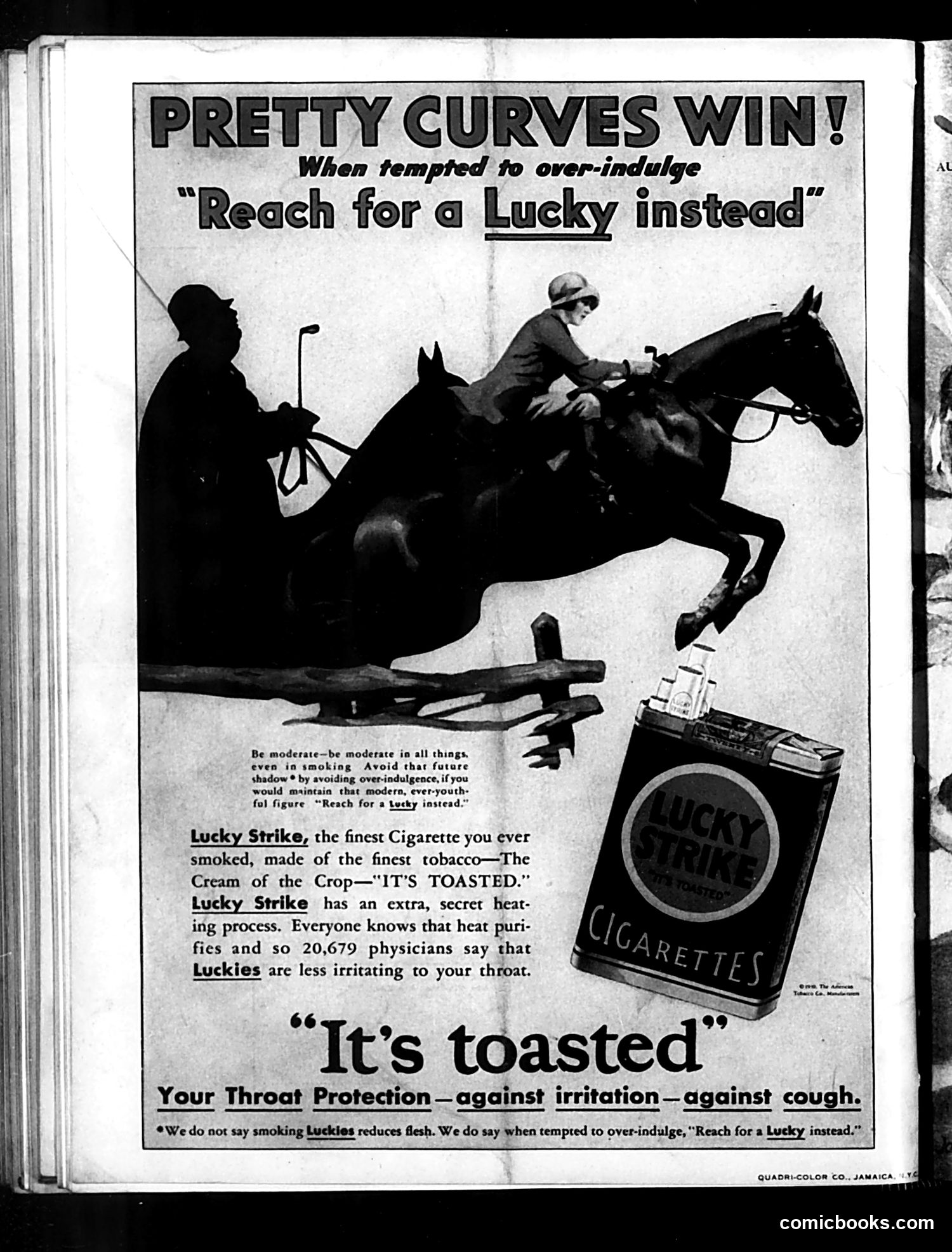
Advertisement Analysis: Lucky Strike Cigarettes This is a cigarette advertisement, not political satire. The imagery shows a woman on a horse jumping over an obstacle, with a silhouette of a heavy-set figure beside her—illustrating the ad's central message: smoking Lucky Strikes instead of eating maintains a slender figure. The appeal targets weight-conscious women by positioning cigarettes as an appetite suppressant ("Reach for a Lucky instead" of food). The ad claims Lucky Strikes are "less irritating to your throat" due to a secret "toasting" process and cites "20,679 physicians" as endorsement. The tagline "Pretty Curves Win" emphasizes female body standards of the era. This reflects early-twentieth-century marketing that exploited women's body anxiety to promote smoking as a weight-control method—a deceptive practice now recognized as predatory advertising targeting women's insecurities.