judge
Judge — August 30, 1930
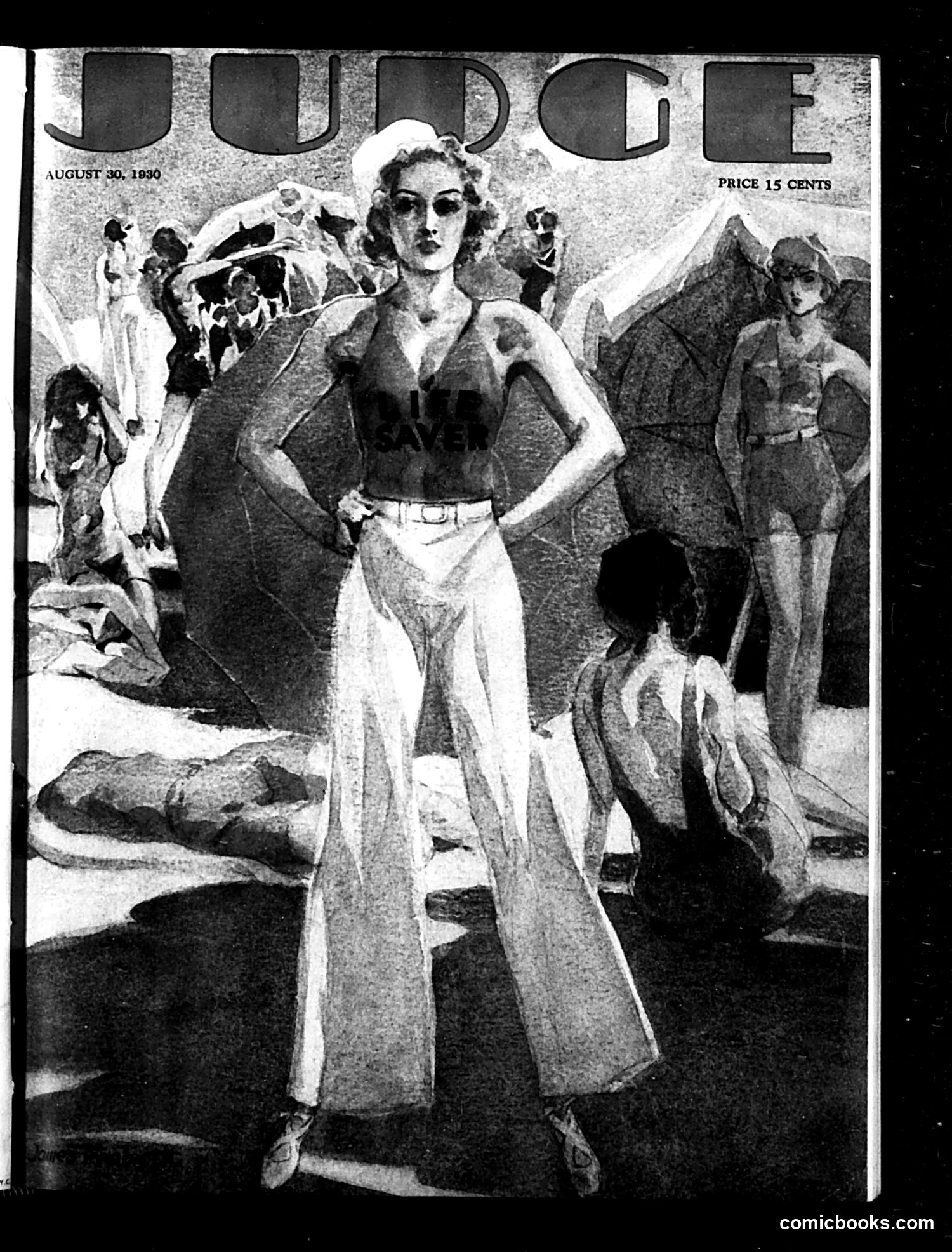
Analysis This is the cover of *Judge* magazine from August 30, 1890. The image depicts a woman in exotic/orientalist costume (bare-midriff top, harem pants) posed centrally, surrounded by other figures in various theatrical or "exotic" dress in what appears to be a desert setting. Without legible article titles or accompanying text visible in this OCR, I cannot definitively identify the specific satire or its subject. The styling suggests it likely lampoons either: contemporary theatrical productions (possibly featuring orientalist themes popular in 1890s entertainment), American colonial/imperial attitudes, or a specific public figure's fashion choices or scandal. The cover price of 15 cents and the theatrical composition indicate this addresses contemporary entertainment or social commentary, but the precise target remains unclear from the image alone.
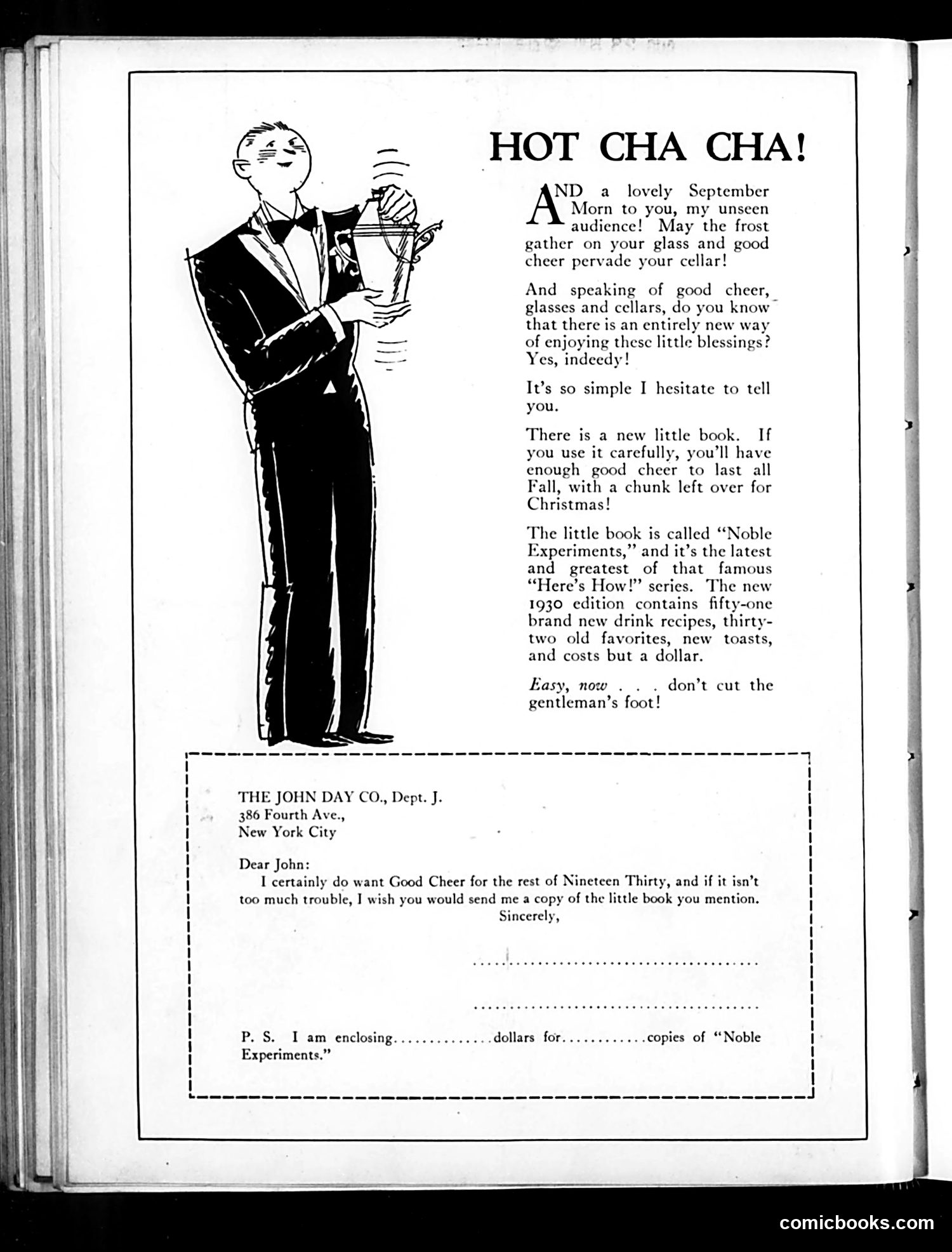
Analysis This page is primarily advertising content rather than political satire. It promotes "Noble Experiments," a cocktail recipe book from The John Day Company (1939 edition), positioned as part of the "Here's How!" series. The illustration shows a formally-dressed gentleman raising a drink, accompanying the headline "HOT CHA CHA!" The ad plays on 1930s slang and assumes readers desire cocktail recipes during Prohibition's end (repealed 1933). The humor is gentle—phrases like "don't cut the gentleman's foot!" reference clumsy bartending. The inclusion of a reply card suggests this appeared in magazines to drive direct book sales. The dollar cost and promise of "good cheer" reflect Depression-era marketing targeting middle-class readers seeking affordable entertainment and social sophistication through home bartending.
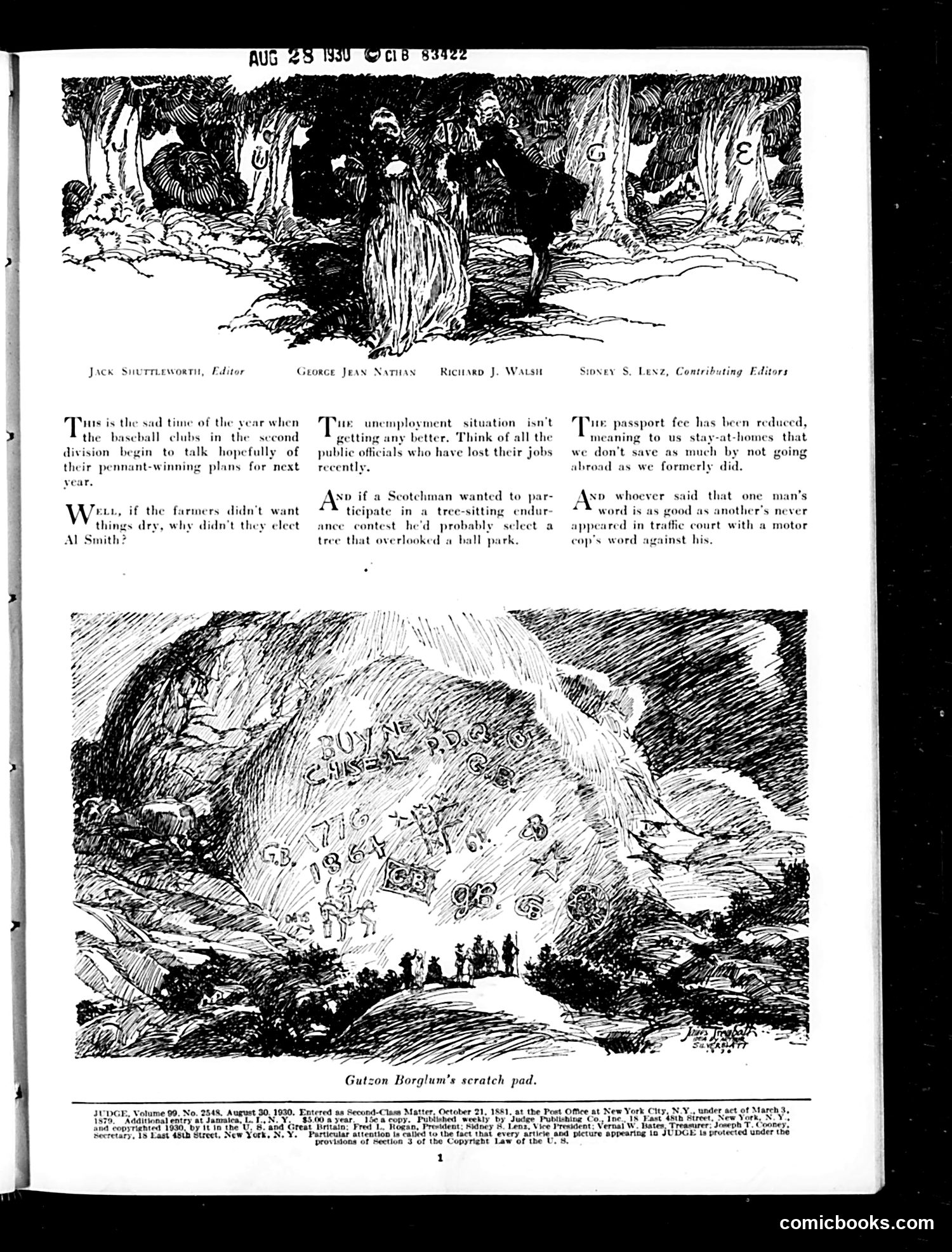
Analysis of Judge Magazine Page (August 29, 1930) This page contains editorial commentary on three contemporary crises during the Great Depression: 1. Baseball clubs complaining about pennant-winning plans—likely referencing owners' concerns as the economic crisis worsened. 2. Unemployment and Scottish tree-sitting contests—satirizing public officials' indifference to job losses by comparing their priorities to absurd entertainment (a Scotsman in a tree-sitting endurance contest overlooking a ballpark). 3. Passport fees and traffic court credibility—mocking government cost-cutting while noting that a motorist's word carries less weight than a police officer's in traffic court. The bottom illustration, "Gutzon Borglam's scratch pad," appears to reference the sculptor's monumental Mount Rushmore project, showing carved presidential profiles—suggesting commentary on grand public works amid economic hardship.
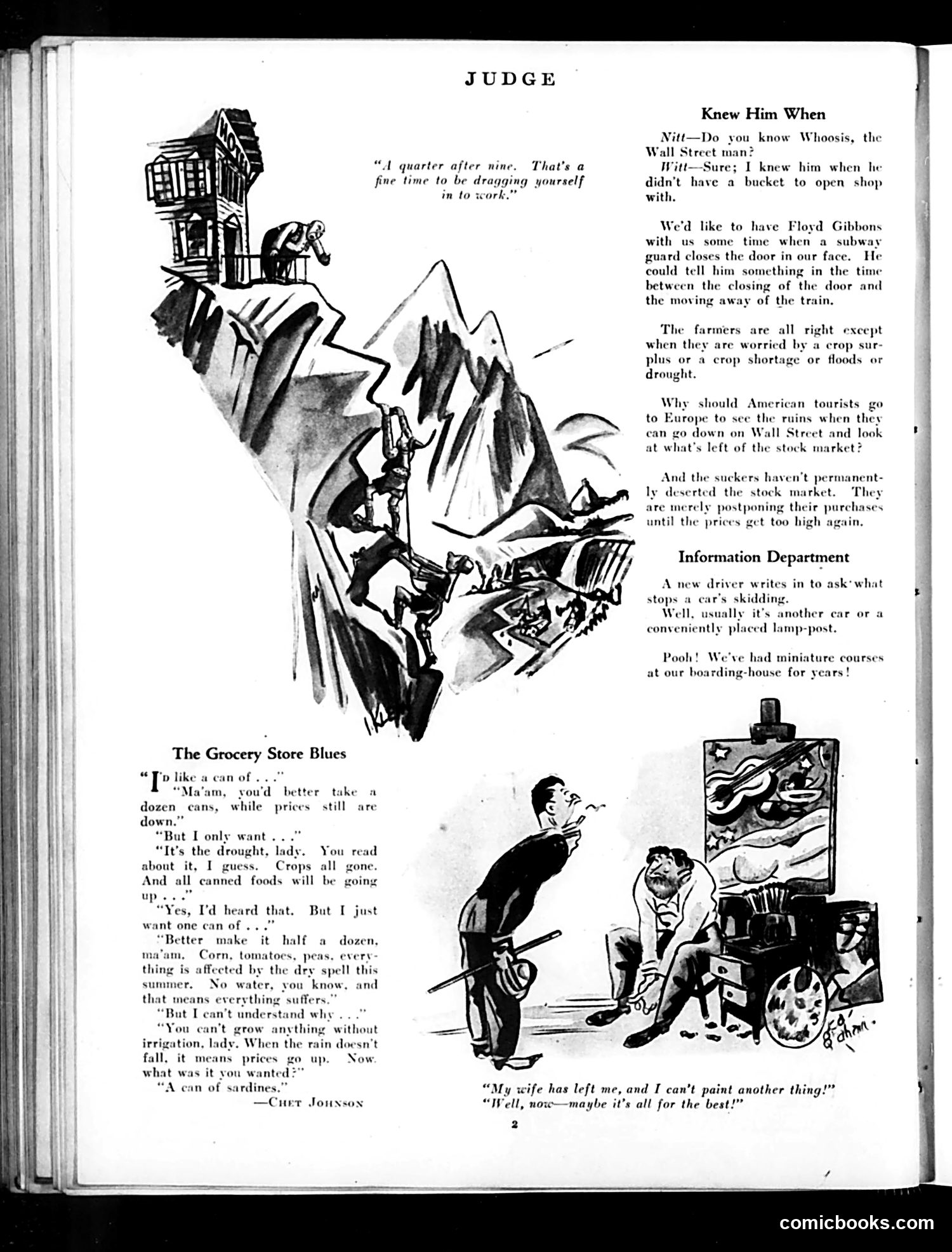
Analysis of Judge Magazine Page "The Grocery Store Blues" (left cartoon): This satirizes drought conditions and agricultural crisis affecting food prices. A grocer denies a customer's request for affordable canned goods, citing crop failures from drought. The dialogue reflects real Depression-era economic anxiety about scarcity and inflation—farmers' problems cascading to consumers facing empty shelves and rising prices. Right cartoon: A frustrated artist complains his wife left him, preventing him from painting "another thing." The visual gag shows art supplies scattered nearby, playing on the double meaning of "thing" (artwork/relationship). "Knew Him When" section: Gossip-style commentary on Wall Street figures and market conditions, including sardonic observations about tourists, farmers, and stock market speculation—typical Judge satire of financial and social pretension.
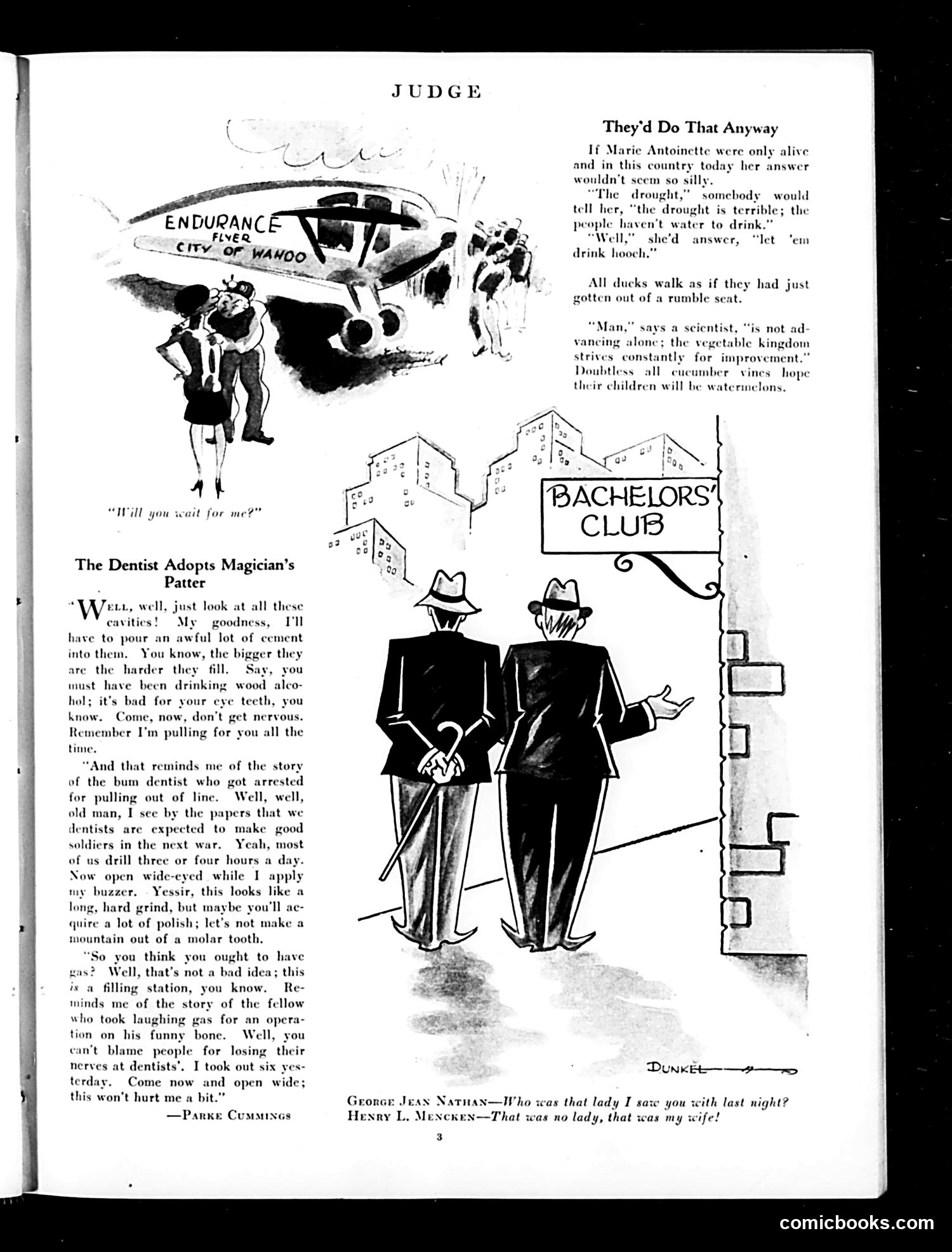
Judge Magazine Page Analysis This page contains three distinct humor pieces: 1. "They'd Do That Anyway" (top): A satirical comment on drought conditions, imagining Marie Antoinette's response to water shortage with her infamous "let them drink" quote. The airplane labeled "Endurance" and "City of Wando" suggests this references a contemporary aviation record or flight attempt, likely 1920s-era. 2. "The Dentist Adopts Magician's Patter" (left): A dentist's humorous monologue using a magician's reassuring patter while performing dental work, mocking both professions' tendency toward theatrical confidence-building language. 3. "Bachelors' Club" (bottom): A cartoon of two men outside a club, with an accompanying joke about mistaken identity—a wife masquerading as a companion. All reflect typical Judge magazine satire: social commentary wrapped in light humor targeting contemporary urban life and professions.
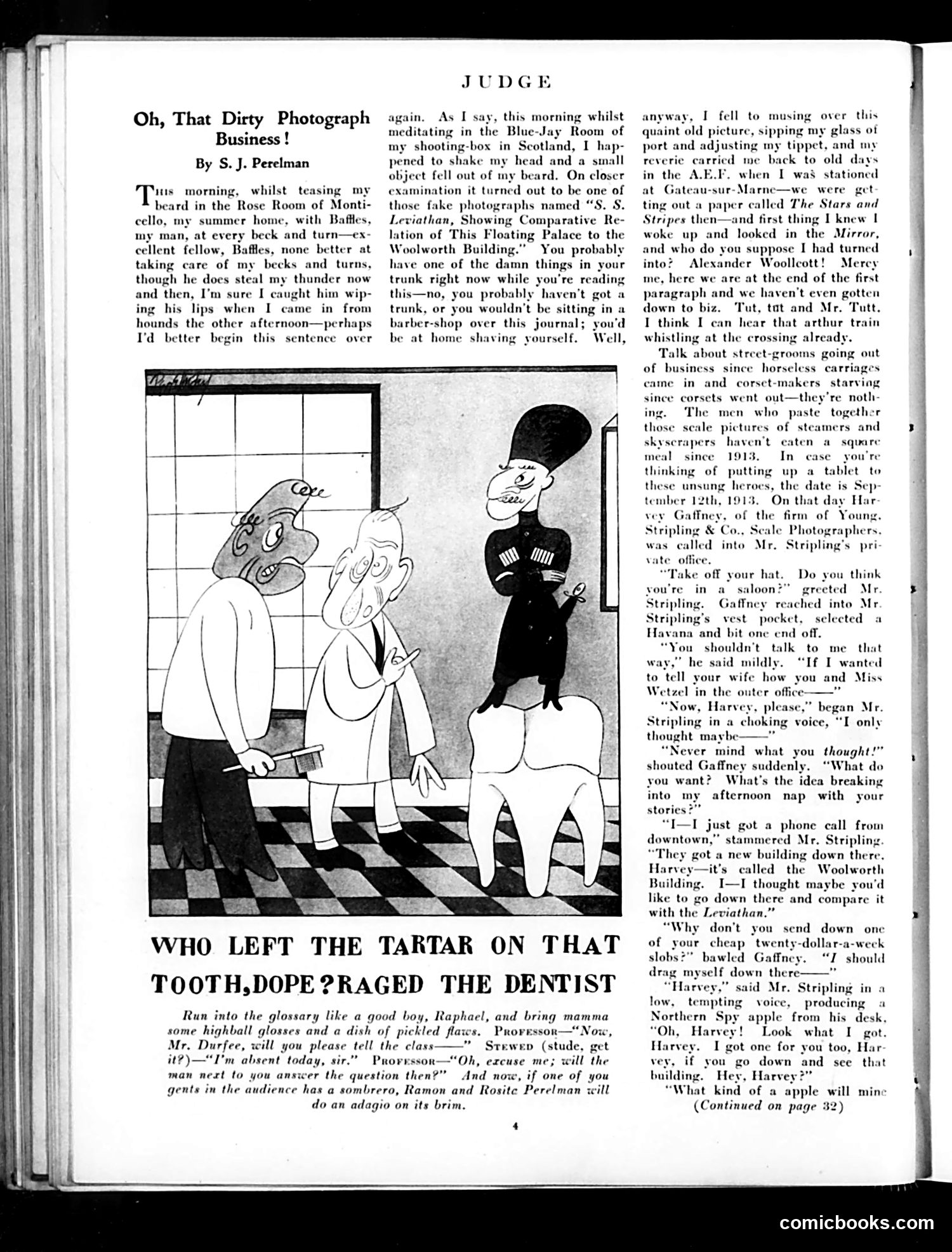
Analysis of Judge Magazine Page This page contains two elements: a humorous short story titled "Oh, That Dirty Photograph Business!" and a cartoon titled "Who Left the Tartar on That Tooth, Dope? Raged the Dentist." The cartoon depicts a dentist confronting a patient about poor dental hygiene (tartar buildup). The exaggerated caricatures and the dentist's angry reaction create comedy through the implied embarrassment of the situation. The visual style employs period-typical satirical exaggeration. The accompanying story involves office gossip and a misunderstanding about compromising photographs—a common satirical trope of the era suggesting workplace scandal. The humor relies on period-specific social anxieties about reputation and propriety in professional settings. The exact date and specific reference remain unclear from the text alone, but the content reflects early 20th-century American middle-class social concerns.
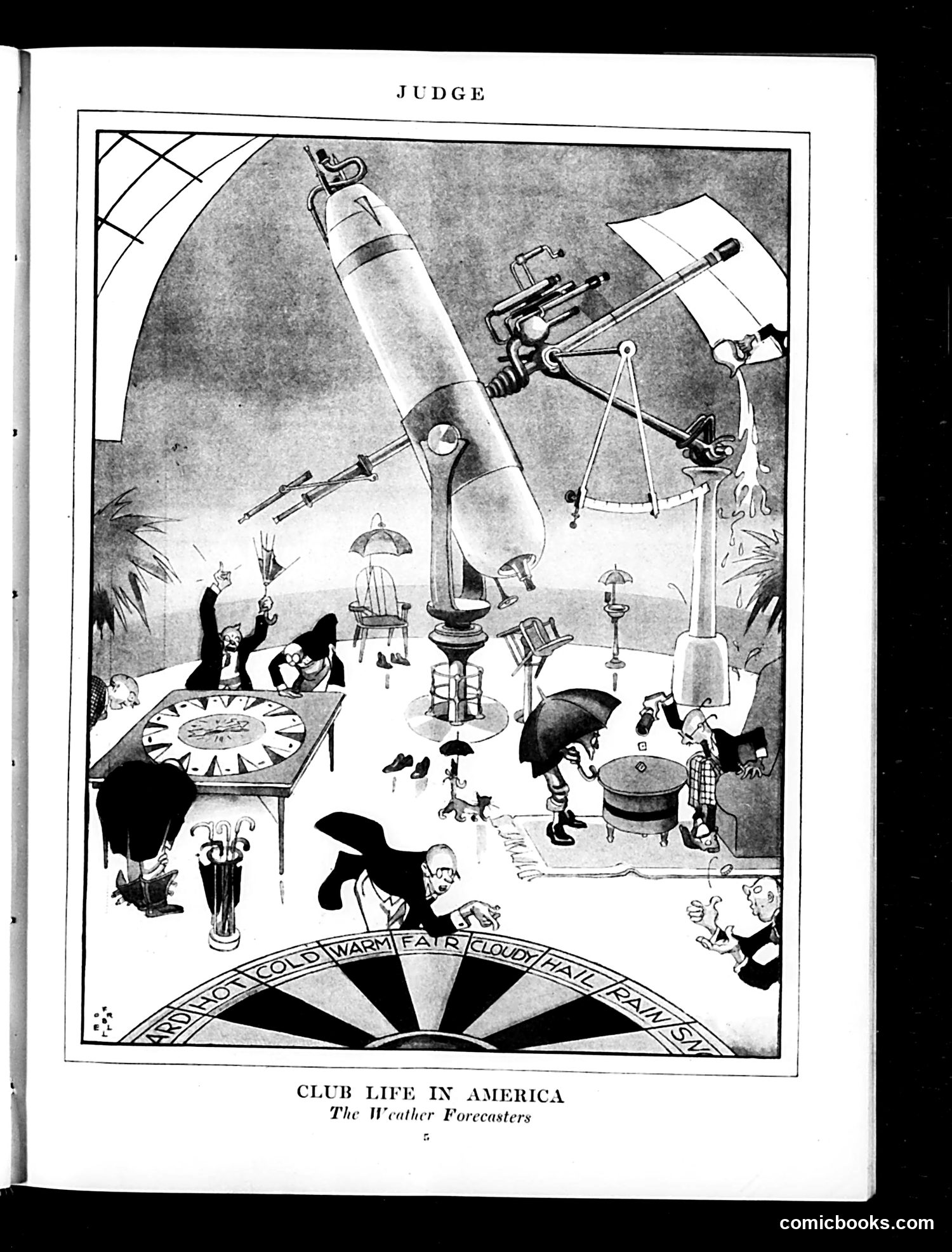
"Club Life in America: The Weather Forecasters" This satirical cartoon mocks weather forecasters' unreliability. The elaborate scene depicts a gentleman (likely representing a meteorologist or forecaster) operating massive scientific instruments—telescopes, barometers, and other devices—in what appears to be a club setting. Despite this sophisticated equipment, the semicircular gauge at bottom reads "COLD HOT WARM FAIR CLOUDY HAIL RAIN SNOW"—essentially covering all weather possibilities. The joke: weather forecasters claim scientific precision but actually guess, producing contradictory or useless predictions. The fancy instruments and formal club atmosphere satirize how forecasters present themselves authoritatively while their predictions remain essentially random. This reflects early-20th-century skepticism about meteorological science's actual predictive power.
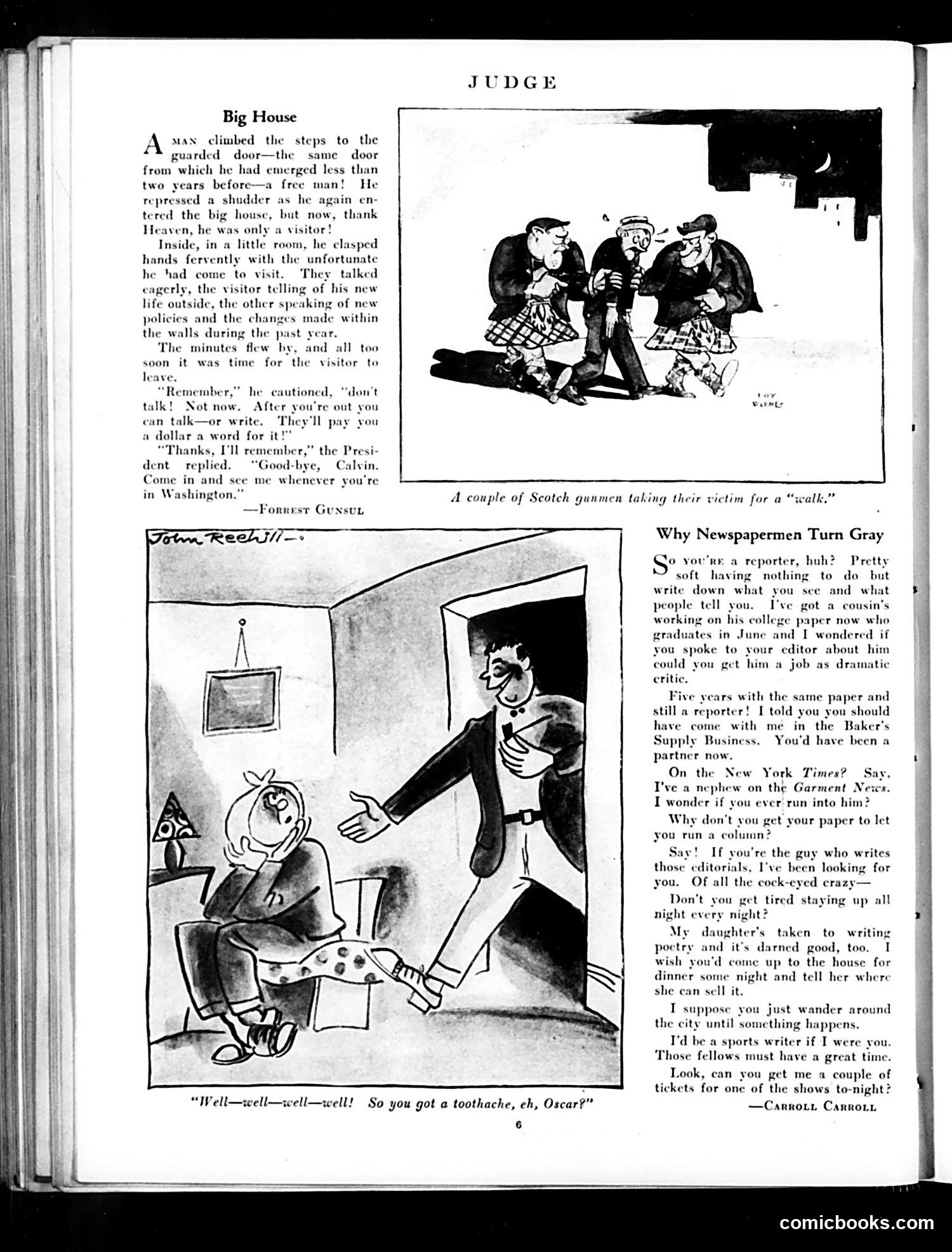
Analysis of Judge Page "Big House" (top left): A satirical story by Forrest Gunsel about a freed prisoner returning to visit the penitentiary. The joke relies on the irony that prison—a place of confinement—becomes a kind of home, and freedom feels disorienting. The warning about not speaking or writing suggests censorship or surveillance concerns of the era. "Well—well—well—well! So you got a toothache, eh, Oscar?" (bottom): A cartoon by John Reed showing a dentist extracting a tooth. The humor appears to derive from the patient's exaggerated distress and the dentist's sardonic bedside manner—typical slapstick medical humor. "Why Newspapermen Turn Gray" (right): A humorous essay listing various demands editors and colleagues make on reporters, satirizing the profession's chaos and unrealistic expectations.
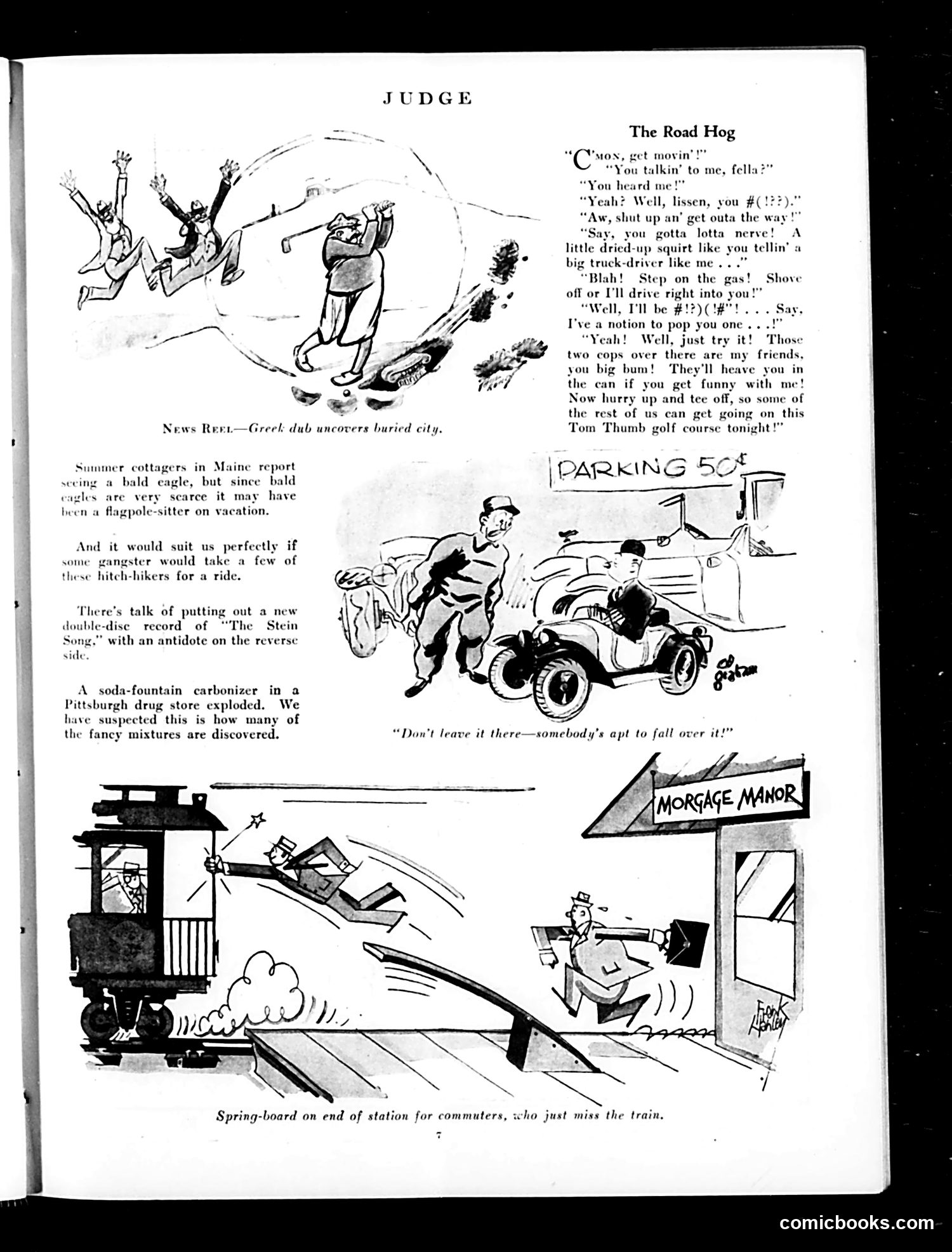
Satirical Content from Judge Magazine This page contains multiple humorous cartoons mocking 1920s-30s American social behavior: "The Road Hog": A crude argument between a motorist and an aggressive truck driver at what appears to be a miniature golf course ("Tom Thumb golf course"). The satire targets reckless drivers and road rage—the truck driver threatens violence, name-drops corrupt police friendships, and displays aggressive masculinity. This reflects contemporary concerns about dangerous driving and uncivil public behavior. "Parking 50¢": Shows a comically tiny car parked in an oversized space, joking about parking lot fees. "Morgage Manor": Depicts a man catapulted from a springboard at a train station, missing his commuter train. It satirizes the frantic pace of commuter life and perhaps the desperation of those struggling with mortgages during economic uncertainty. The page's scattered text jokes reference minor news items (buried cities, bald eagles, soda fountain explosions)—typical filler humor for the satirical magazine.
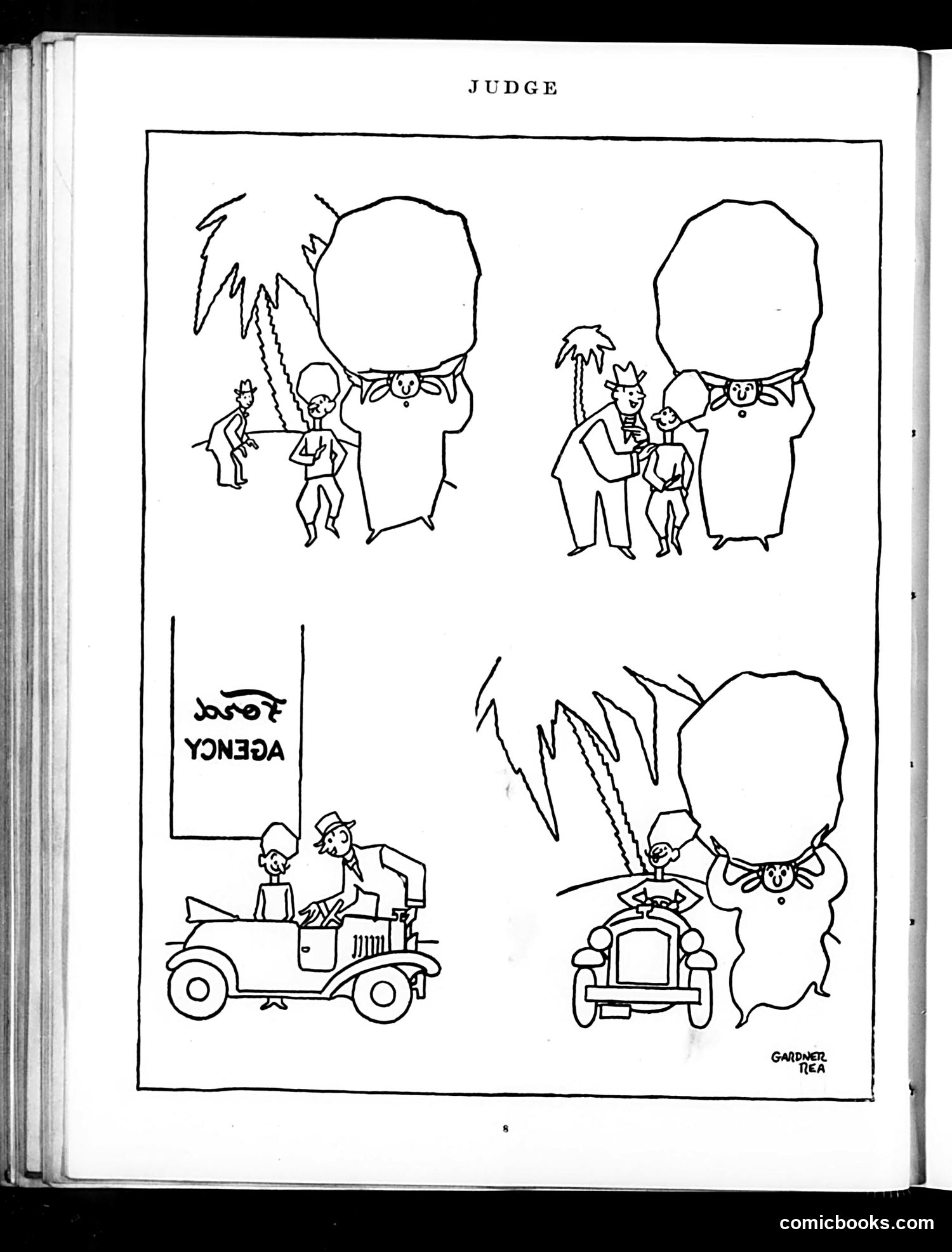
Judge Magazine Political Cartoon: "Judge" This page contains a four-panel cartoon by Gardner Tlea satirizing judicial authority and public deference. Each panel depicts large, faceless figures labeled "JUDGE" with small citizens conducting business before them—presenting petitions, arriving in vehicles, or otherwise deferring to judicial power. The satire suggests the enormous, seemingly arbitrary power judges wielded over ordinary people's affairs. The blank, featureless judge faces emphasize how impersonal and imposing the judicial system appeared to common citizens. The recurring motif of small figures before towering authority critiques the power imbalance in the legal system and possibly judges' role in enforcement of laws affecting everyday life. Without a specific date visible, the exact political context remains unclear, though the cartoon likely references broader Progressive-era concerns about judicial overreach or inconsistency.
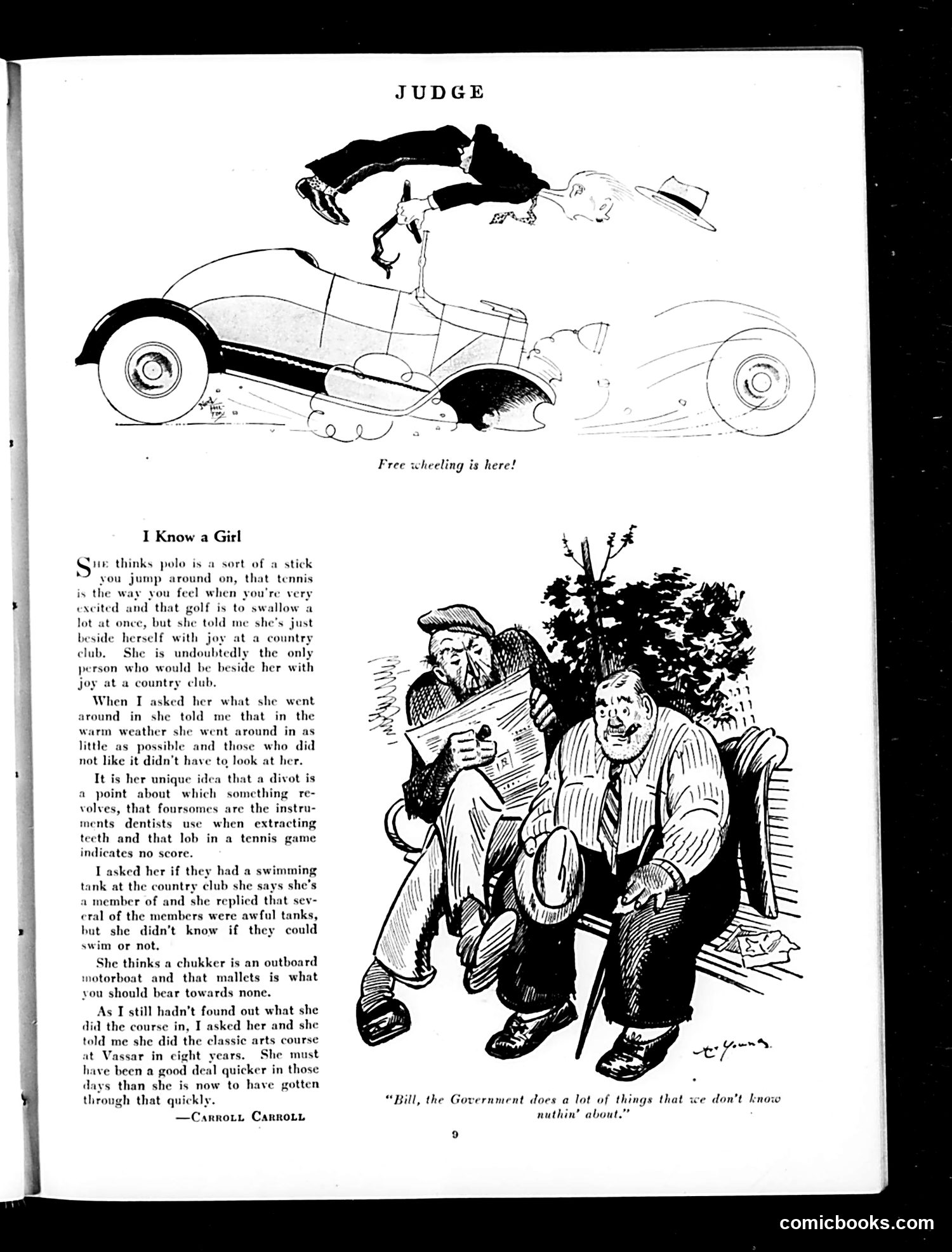
Judge Magazine Page Analysis The top cartoon satirizes reckless driving. A judge figure flies through the air as a car crashes beneath him, with the caption "Free wheeling is here!" This mocks the 1920s trend of dangerous, unregulated automobile driving—"free wheeling" refers to both literal automotive negligence and the era's general social permissiveness. The judge's airborne predicament suggests that even authority figures cannot escape the chaos of modern, irresponsible motoring. The lower illustration and Carroll Carroll's essay mock a woman's profound ignorance of upper-class leisure activities (polo, tennis, golf, country clubs, swimming). She attended Vassar yet misunderstands basic sporting terminology—thinking a "divot" relates to revolutions, "foursomes" are dental tools, and "chukker" is a motorboat. The satire targets both female incompetence at genteel pastimes and the pretense surrounding country-club culture itself. The final caption shows two working-class men discussing governmental secrecy, suggesting irony about what "respectable" society doesn't understand either.
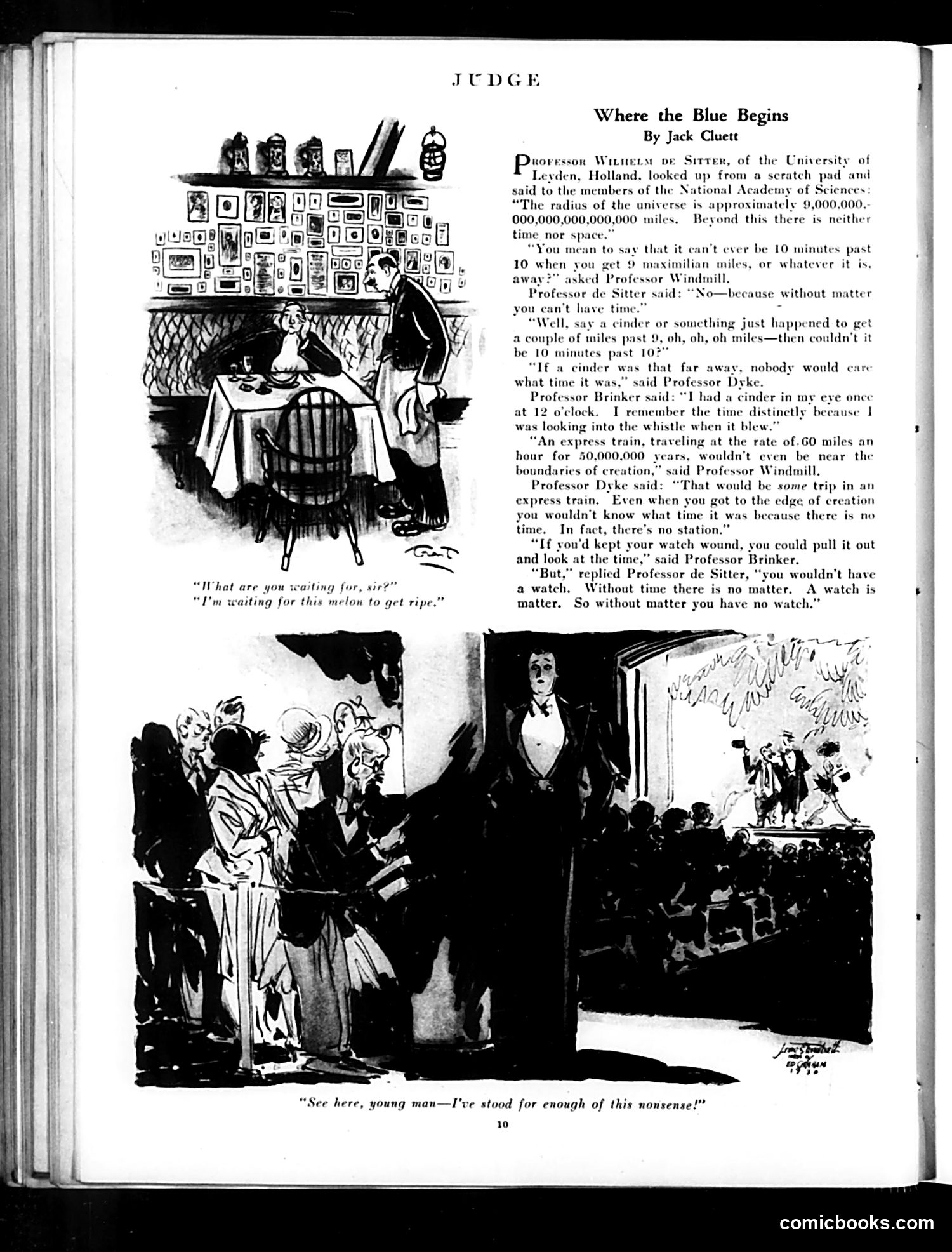
"Where the Blue Begins" - Judge Magazine Comic This is a humorous fictional dialogue among fictional professors (de Sitter, Windmill, Dyke, Brinker) debating cosmological concepts—specifically the nature of time and space at the universe's boundaries. The satire targets academic pretension and abstract philosophy. The professors engage in increasingly absurd logical loops, discussing whether time exists beyond the universe's edge, whether a cinder could travel faster than time, and whether a watch matters without time. Their circular reasoning spirals into nonsense. The accompanying cartoons illustrate the comedic contrast: the top shows an impatient woman waiting for a melon to ripen (mundane reality), while the bottom depicts a theatrical performance—suggesting the professors' debate is equally performative and removed from practical life. The joke: learned men tie themselves in philosophical knots over unanswerable cosmic questions while missing simple truths about everyday existence.
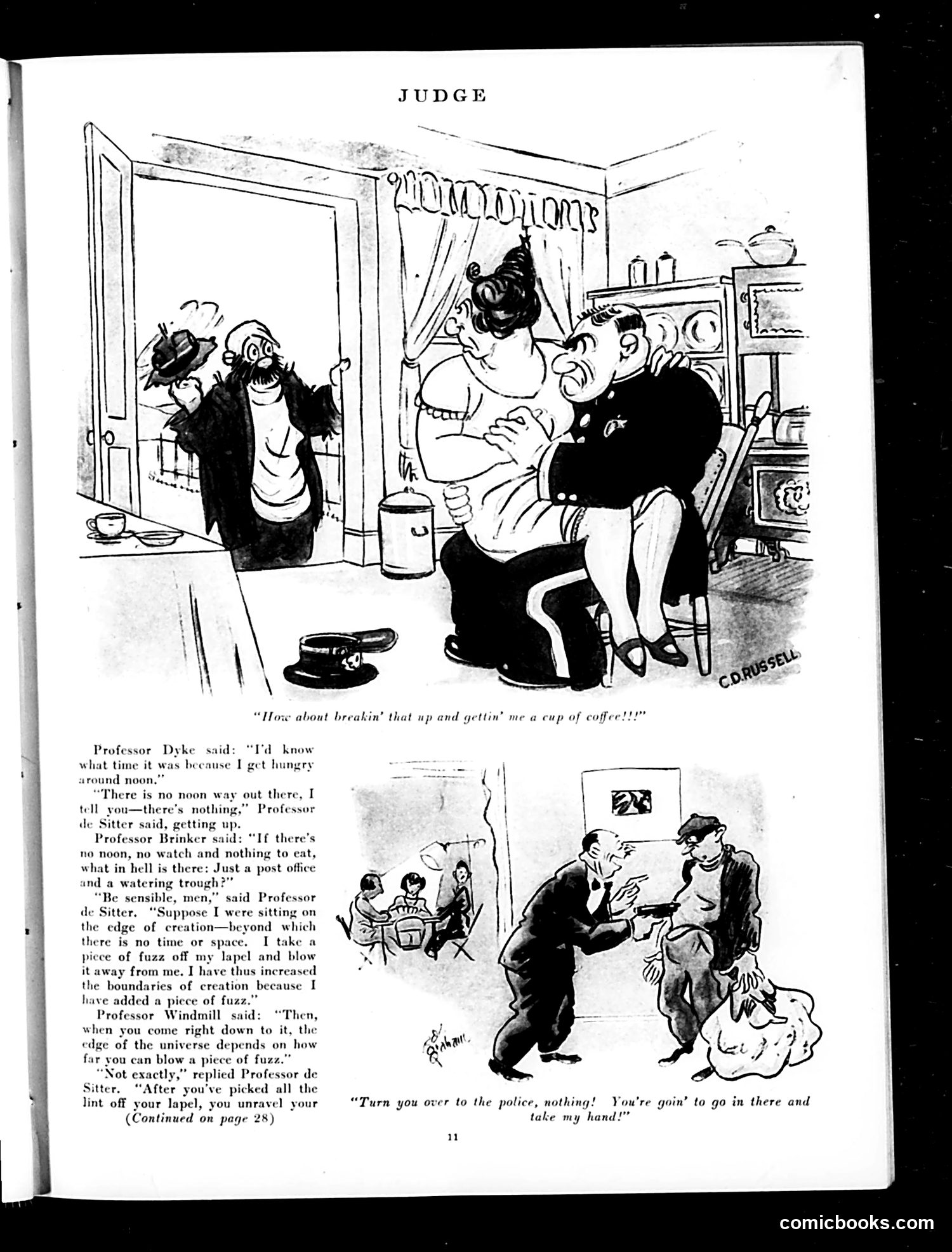
Analysis: Judge Magazine Page This page contains two distinct cartoons satirizing academic pretension and domestic marital conflict. Top cartoon: Shows a woman interrupting what appears to be professorial discussion with a demand for coffee—a joke about intellectual men being oblivious to domestic needs. The professors' names (Dyke, de Sitter, Brinker, Windmill) appear fabricated for comedic effect, representing absurdist academic philosophy. Bottom cartoon: Depicts a domestic dispute where a woman threatens to turn a man over to police, while he protests he'll take her hand instead. It satirizes melodramatic marital quarrels and the absurdity of trivial relationship conflicts being treated as serious legal matters. Both cartoons mock different social groups: academics for their disconnection from reality, and married couples for their theatrical arguments. The humor relies on exaggeration and the contrast between elevated intellectual discourse (or legal consequences) and mundane domestic life. This reflects early-to-mid 20th century *Judge* magazine's satirical style.
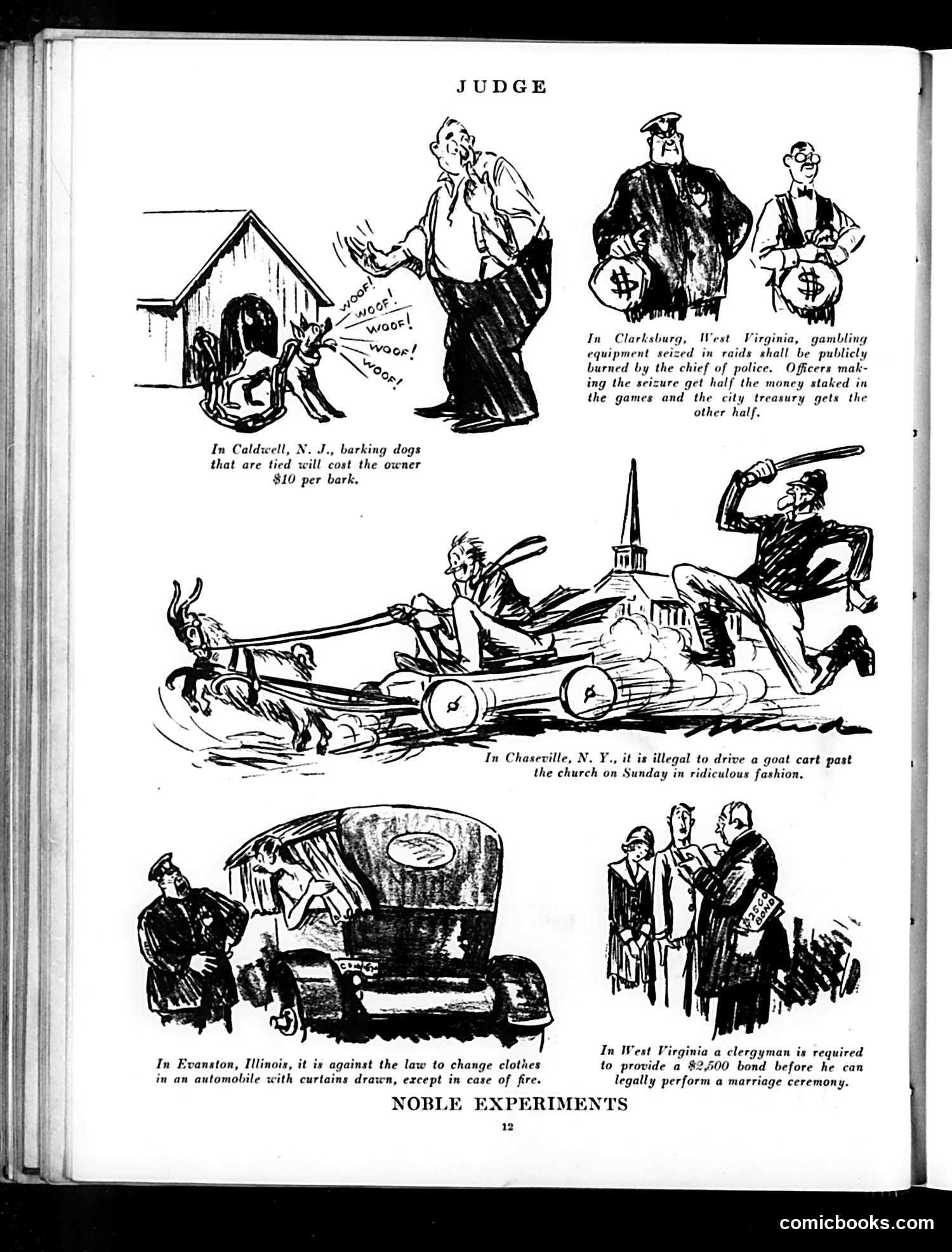
"Judge" Magazine - "Noble Experiments" Page This page satirizes absurd local laws across America. Each cartoon illustrates ridiculous ordinances enacted in different towns, mocking what the magazine considers foolish or contradictory legislation. The top cartoon shows a judge overseeing gambling equipment seizure in West Virginia—the satire being that police and the city treasury profit from confiscated gambling money while supposedly combating gambling. Other examples include fining dog owners per bark (Caldwell, N.J.), prohibiting goat carts near churches on Sundays (Chaseville, N.Y.), and banning changing clothes in cars except during emergencies (Evanston, Illinois). The final cartoon depicts a clergyman required to post a $2,500 bond before performing marriages in West Virginia—appearing to mock excessive bureaucratic requirements for clergy. The overall point: American municipalities were passing comically impractical or contradictory laws, often with unintended consequences or perverse incentives. The feature lampoons local legislative overreach and civic absurdity.
"Judge on the Bench" Page Analysis This page from *Judge* magazine contains three distinct editorial commentaries: "Deficit Minded" argues for adopting the city manager system in Philadelphia instead of traditional corrupt machine politics. It praises Cincinnati's success with professional management and criticizes politicians who resist efficiency reforms. "Sweet Decibels" satirizes New York City's Noise Abatement Commission, which measured urban noise (in "decibels") and campaigned against loud automobile horns. The piece mocks both the absurdity of the measurement efforts and, particularly, inconsiderate people who honk instead of using doorbells. "The Heart It Is" disputes medical materialism—the notion that emotions are purely physical. It argues poets were right that the heart is the seat of emotion, against "matter-of-fact" scientists who reduced emotions to brain and nerve function. The overall theme: *Judge* critiques both governmental inefficiency and the era's excessive rationalism, defending traditional wisdom (poetic and emotional) against modernist claims of pure mechanical explanation.
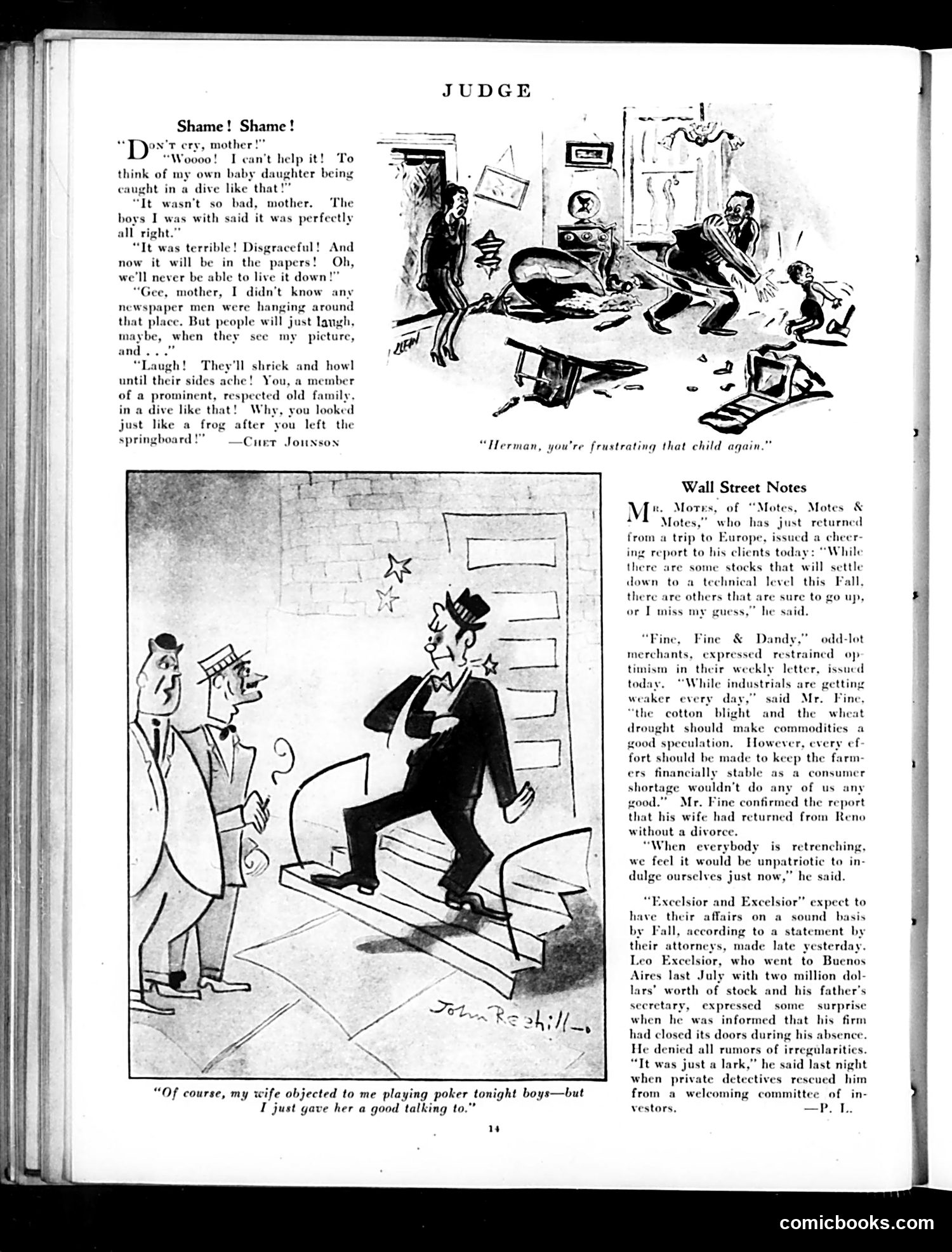
Explanation for Modern Readers This *Judge* page contains two satirical cartoons mocking social hypocrisy and financial deception. Top cartoon: A mother is scandalized that her daughter was seen in a "dive" (seedy bar/nightclub). The daughter downplays it, but the mother fears public shame and newspaper exposure will ruin their respectable family reputation. The satire targets class anxiety and performative morality—the family cares more about *appearance* than actual wrongdoing. Bottom cartoon: A man tells his wife he's going out to play poker, claiming he "gave her a good talking to" (dismissed her objections). The satire skewers male dominance and marital manipulation of the era. Wall Street Notes: Financial commentary mocking wealthy investors' selective ethics. They preach restraint and patriotism while their wives vacation in Reno (divorce destination), and they celebrate absconding businessmen ("just a lark") who fled with client money. The satire exposes the gap between public virtue-signaling and private financial self-interest during what appears to be an economic downturn.
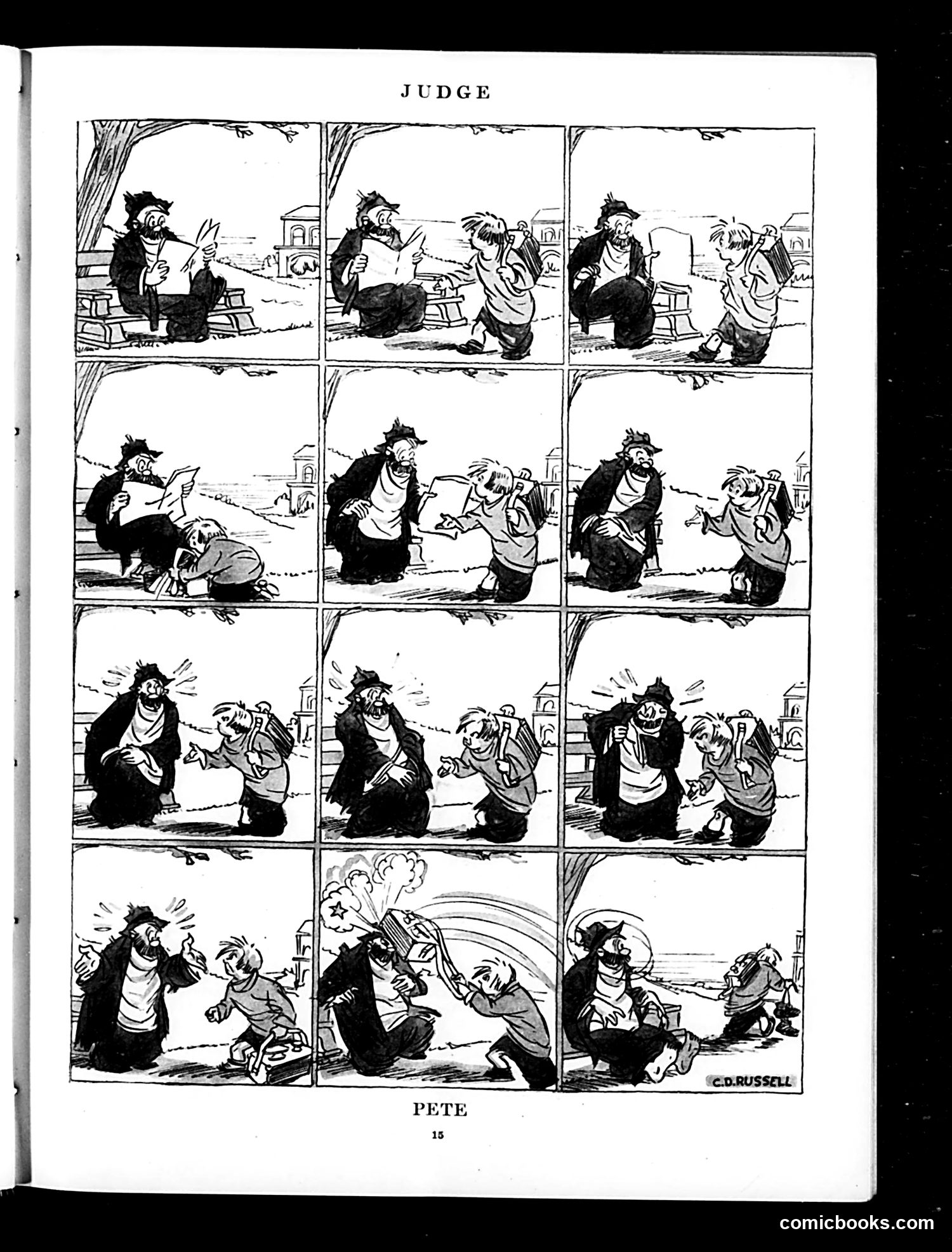
"Judge" Comic Strip: "Judge" and "Pete" This page contains two sequential comic strips by C.D. Russell. The top strip, titled "Judge," depicts a stern authority figure in judicial robes interacting with a smaller character (likely a child or defendant). The narrative appears to show the judge reading from documents, then engaging in increasingly animated exchanges with the other character, culminating in physical comedy and exaggerated expressions. The bottom strip, "Pete," shows similar comedic interaction between what appears to be an authority figure and a smaller character, with escalating physical humor and expressions of distress or surprise. Without clearer historical context or visible dates, the specific political or social satire remains unclear, though both strips employ physical comedy and character contrast typical of early Judge magazine humor.
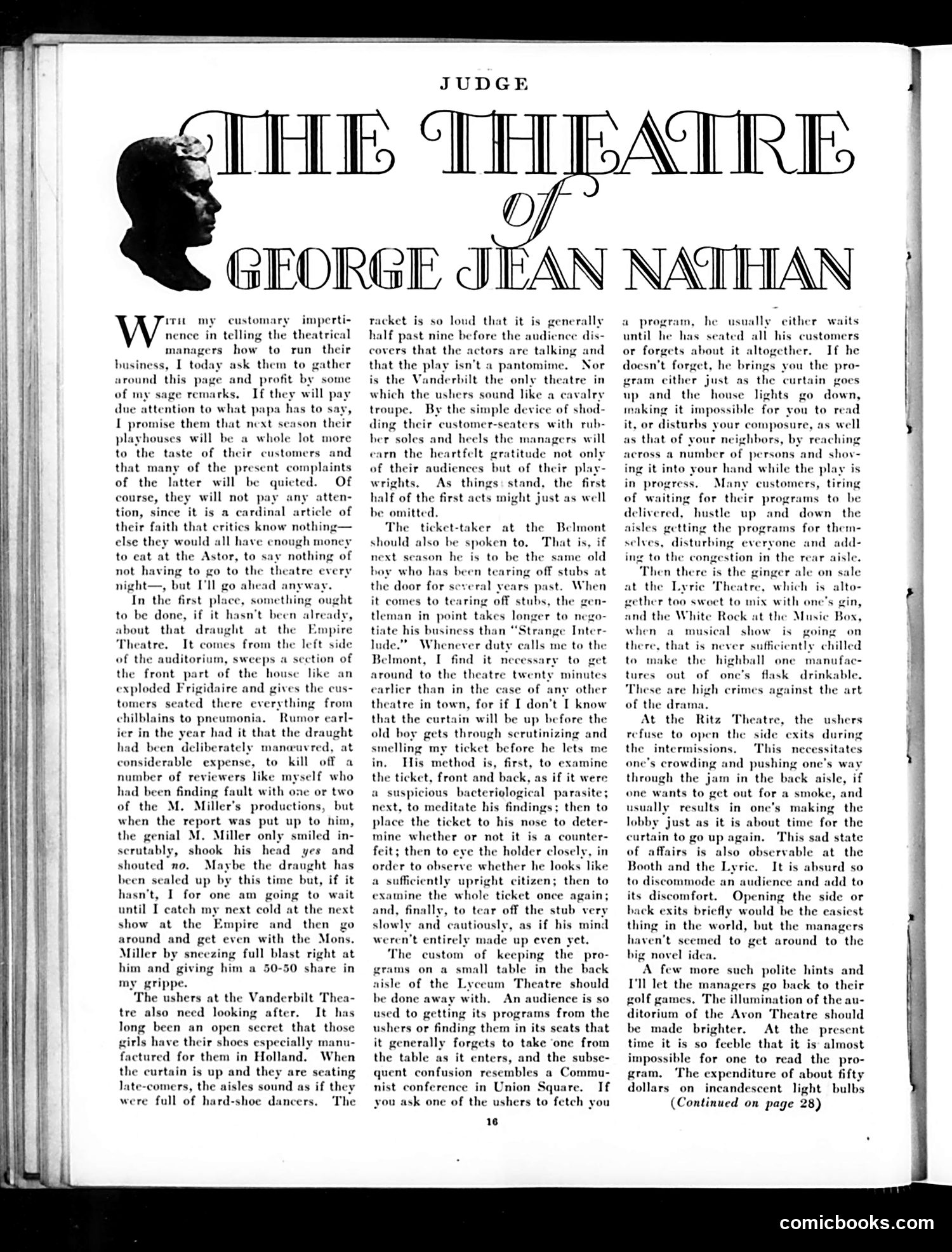
The Theatre of George Jean Nathan This is a satirical column by Judge magazine's theater critic George Jean Nathan, complaining about poor theater management practices in early 20th-century Broadway venues (the Empire, Vanderbilt, and Belmont theatres are named). The humor targets: - The Empire Theatre's dangerous draft on the left side of the auditorium, jokingly suggesting management deliberately created it to kill off critical reviewers like himself - Vanderbilt Theatre ushers wearing loud Dutch wooden-soled shoes that drown out actors during first acts - The Belmont's tedious ticket-taker who scrutinizes each ticket like a "bacteriological parasite," meticulously examining, smelling, and slowly tearing stubs—taking longer than an entire performance of "Strange Interlude" Nathan's point: theater management ignores obvious customer complaints because they dismiss critics as people who "know nothing." The satire is self-aware and comedic, positioning the critic as a reasonable voice ignored by stubborn theater owners.
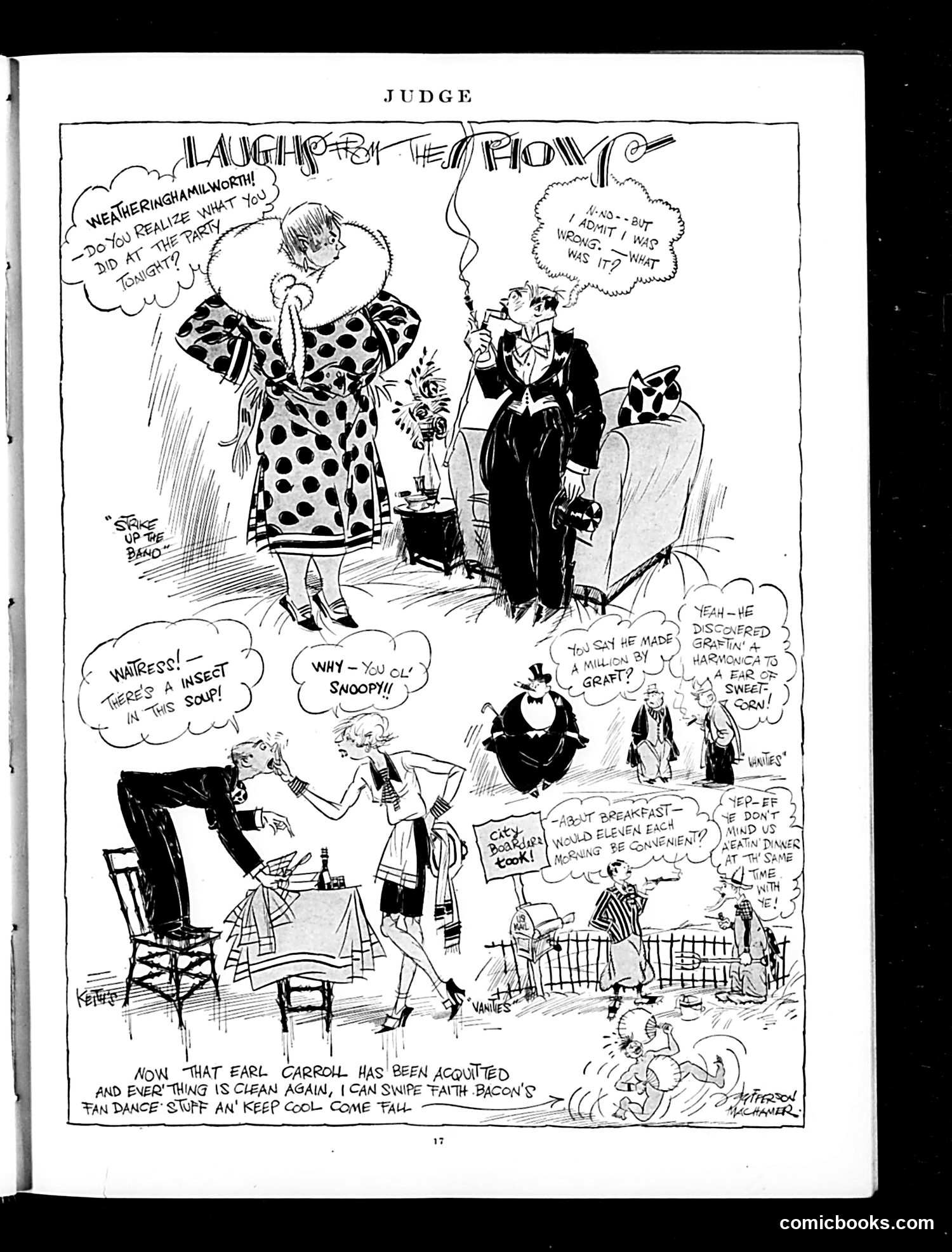
Explanation for Modern Readers This Judge magazine cartoon satirizes high society's moral hypocrisy. The central joke involves "Earl Carroll," a theatrical producer acquitted of charges (likely related to a 1926 scandal involving an underage girl at his nightclub). The cartoon mocks wealthy socialites who, once the legal trouble passes, feel free to enjoy the very entertainment and behavior they'd previously condemned. The various figures represent society's elite, discussing scandalous activities—an insect in soup, "snoopy" behavior, and references to Carroll's famous "fan dance" performances. The satire's point: respectable people eagerly participate in dubious entertainment once legal consequences disappear, revealing their selective morality and opportunism. The cartoon critiques the era's disconnect between public virtue-signaling and private indulgence among the wealthy.
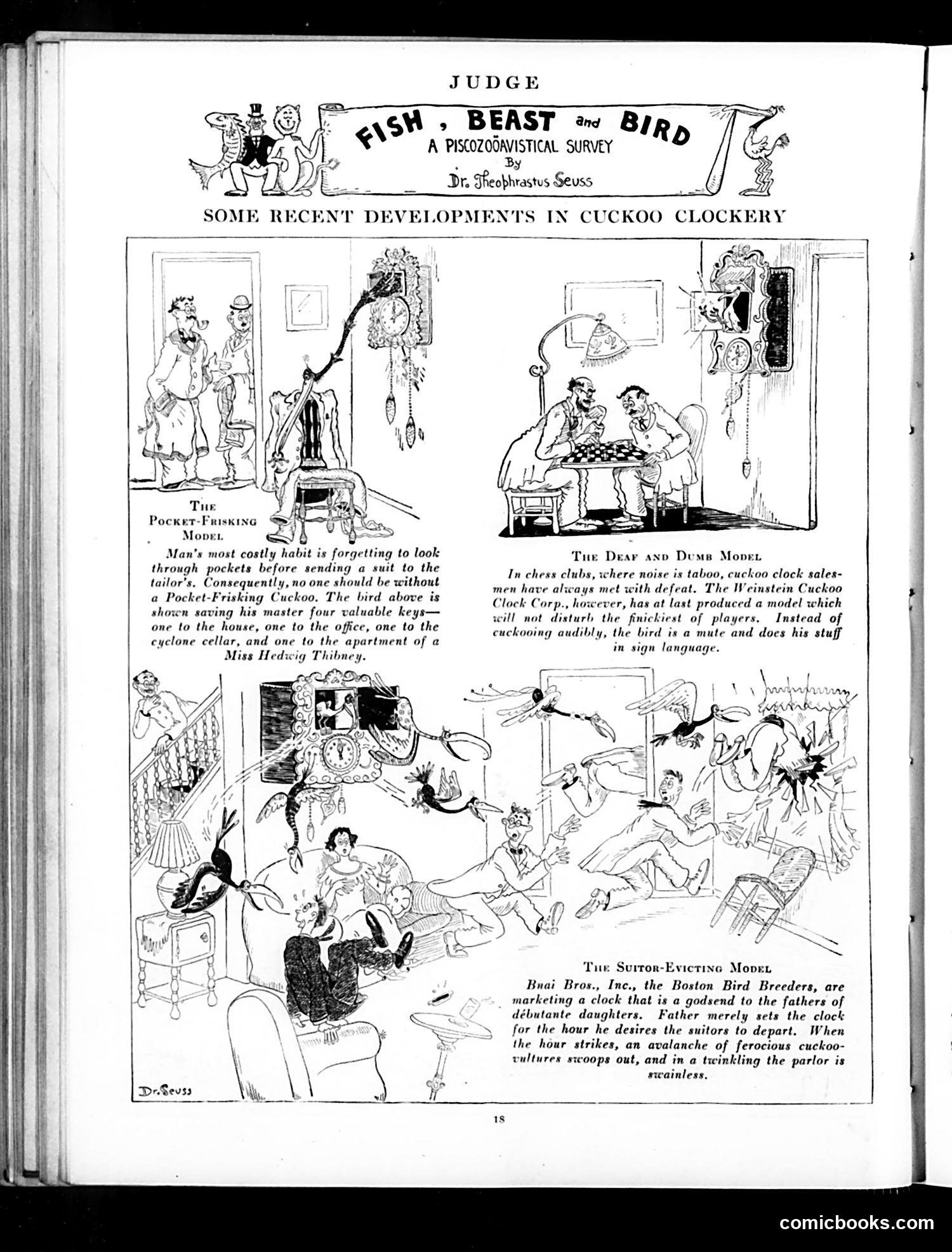
"Cuckoo Clockery" by Dr. Seuss - Judge Magazine This is a humorous illustrated feature by Dr. Theodor Geisel (Dr. Seuss) satirizing cuckoo clock design through absurdist "innovations." The page presents three fictional clock models: 1. Pocket-Frisking Cuckoo: A clock that alerts owners to forgotten items before sending suits to tailors—mocking both forgetfulness and the expense of lost keys. 2. Deaf and Dumb Model: A silent cuckoo clock using sign language for chess enthusiasts, poking fun at the tension between ornamental clocks and quiet spaces. 3. Suitor-Evicting Model: A clock that releases "ferocious cuckoo-vultures" to expel unwanted suitors from a father's house—a humorous exaggeration of protective fatherhood and dating anxieties. The satire targets consumer culture's obsession with novelty gadgets and absurd "solutions" to minor problems. Seuss's whimsical drawing style and invented company names enhance the parody of advertising claims.
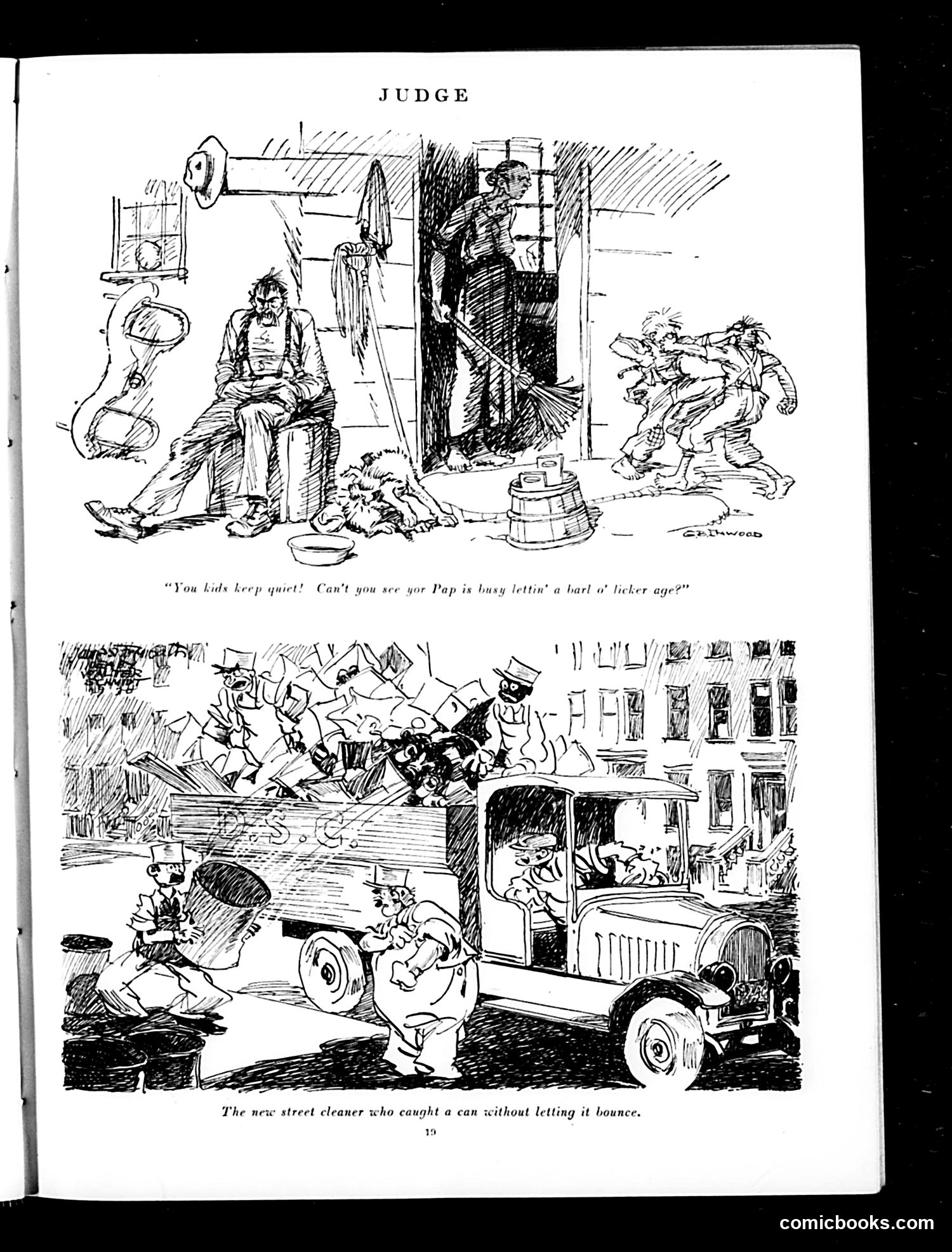
Explanation of Judge Page Content This page contains two separate cartoons satirizing working-class life and law enforcement. Top cartoon: Shows a poor man ("Pap") with children in a shabby home, apparently aging illegal alcohol during Prohibition. The joke mocks the hypocrisy of ordinary people breaking alcohol laws while authorities looked the other way. Bottom cartoon: Depicts a street cleaner catching a discarded can without it bouncing—presented as noteworthy achievement. This satirizes the low status and minimal expectations for sanitation workers, suggesting that merely catching refuse skillfully is remarkable enough to warrant comment. Both cartoons use working-poor subjects as vehicles for social commentary typical of Judge magazine's satirical approach to class dynamics and urban American life, likely from the Prohibition era (1920s-1930s).
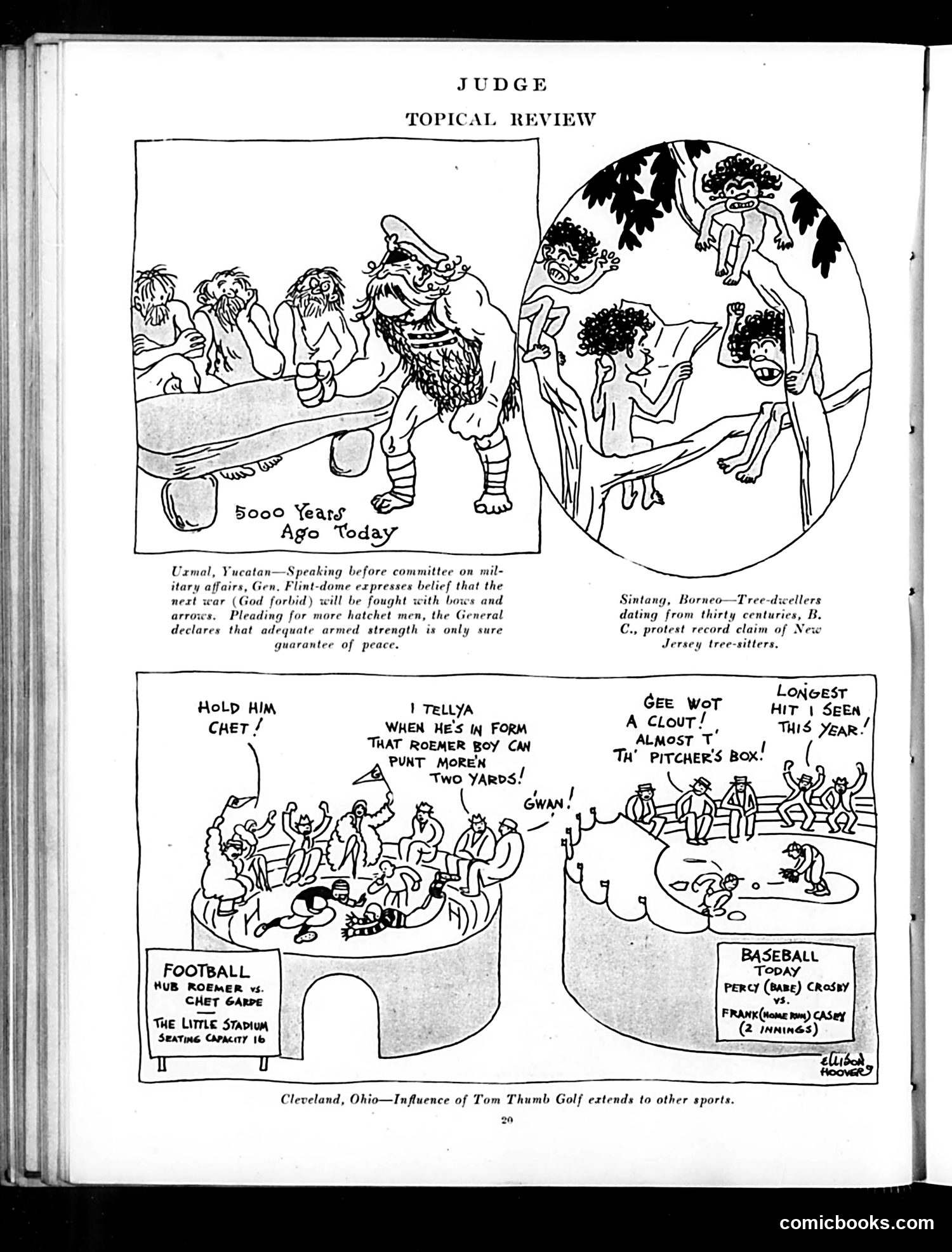
Judge Topical Review Analysis This page satirizes the era's obsession with miniaturization and novelty sports. The top panels mock military posturing (a general advocating primitive weapons) and ancient civilizations. The main satire targets "Tom Thumb Golf"—a 1920s-30s miniature golf craze sweeping America. The bottom cartoons show how Tom Thumb Golf's popularity has infected other sports: a football game with a stadium capacity of 16 (absurdly tiny), and a baseball game lasting only 2 innings with players using comically short names ("Babe" Crosby, "Home Run" Casey). The crowd exclamations ("longest hit I seen this year!") mock how miniaturized these sports have become—what would normally be routine plays are celebrated as extraordinary in this shrunken context. The satire comments on American culture's faddish enthusiasm for novelties that reduce grand traditions to trivial entertainment.
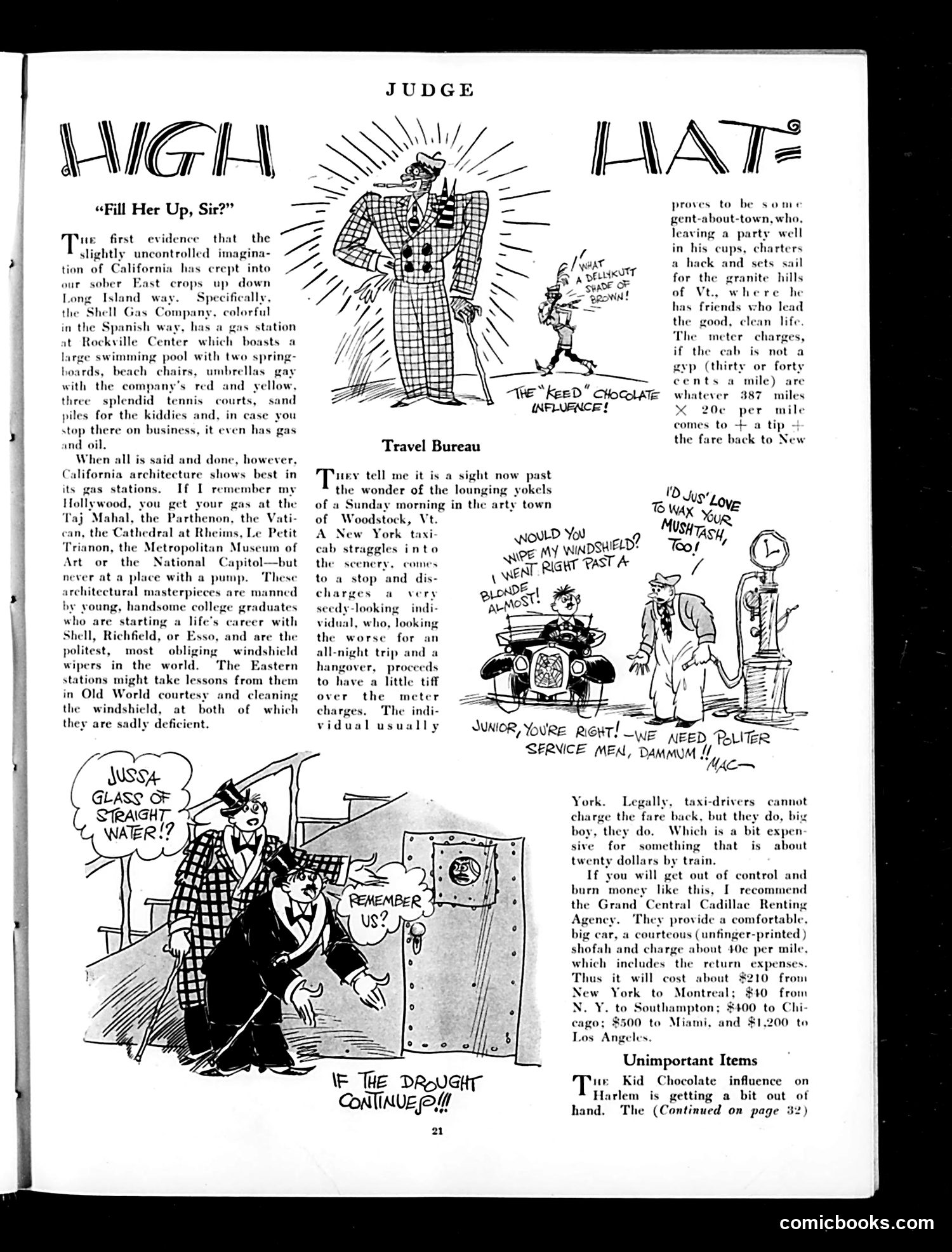
Judge Magazine Page Analysis This page contains three separate satirical pieces typical of 1920s-30s American humor: "High Hat" (top right): Mocks a wealthy New Yorker who, drunk after a party, takes a taxi from the city to Vermont—a wasteful 387-mile journey. The satire targets wealthy people's frivolous spending and their indignation at taxi meter charges, despite their obvious extravagance. "Travel Bureau" (center/right): Jokes about New York taxi drivers illegally overcharging passengers and their aggressive behavior toward tourists. The piece recommends renting a Cadillac instead as more economical and dignified, satirizing both taxi corruption and the absurdity of wealthy travelers' options. "Fill Her Up, Sir?" (top left): Contrasts California's flamboyant gas stations (with pools, umbrellas, tennis courts) against Eastern stations' austere efficiency. It gently mocks California excess while praising Eastern restraint and "Old World courtesy." The bottom reference to "Kid Chocolate" (likely the boxer) appears unrelated—it's a brief note about his influence on Harlem becoming excessive.
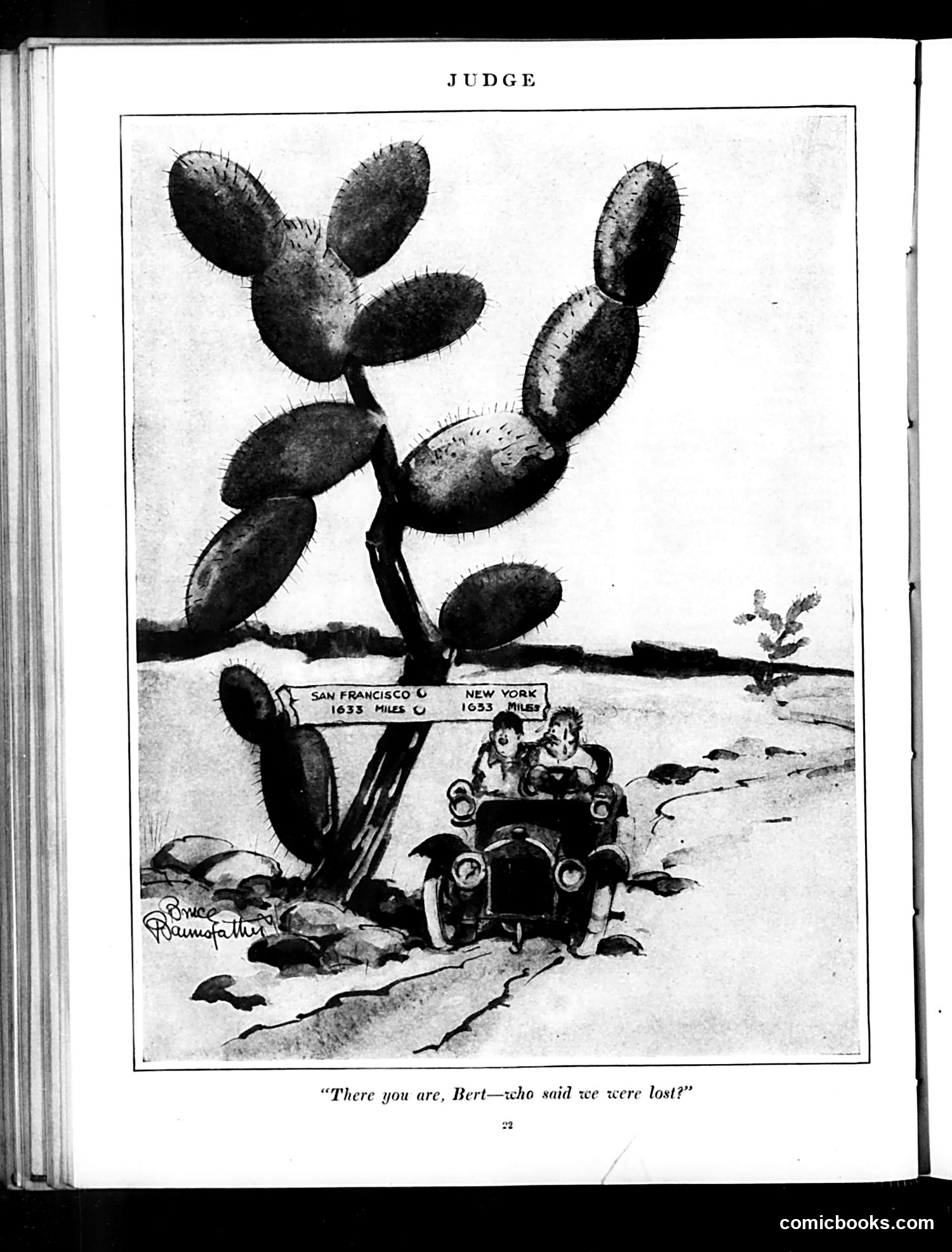
Political Cartoon Analysis This Judge magazine cartoon satirizes cross-country automobile travel, likely from the early 1900s. Two travelers in a car have navigated from San Francisco to New York (each 1633 miles noted), arriving at a giant prickly pear cactus in the desert. The caption "There you are, Bert—who said we were lost?" humorously suggests they've successfully completed their journey despite apparent confusion about their route. The satire targets the novelty and uncertainty of early American road travel, when long-distance driving was an adventure with unclear directions. The oversized cactus emphasizes the vast, desolate landscape they've crossed. The cartoon mocks casual confidence about navigation ("who said we were lost?") despite obviously circuitous or questionable route-finding—a relatable joke for readers fascinated by emerging automobile culture.
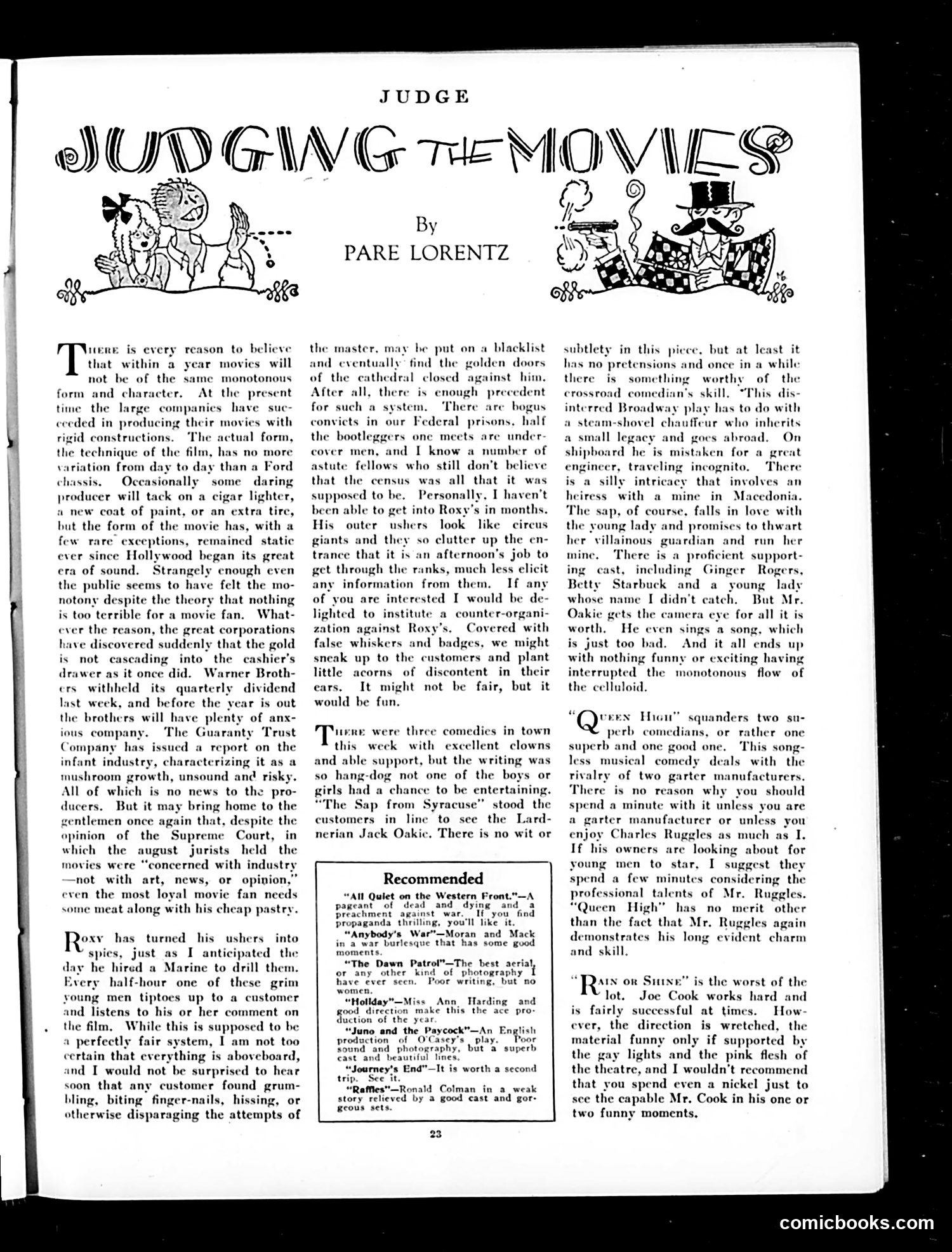
Judge Magazine: "Judging the Movies" by Pare Lorentz This film criticism column argues that major studios have stagnated, producing formulaic movies with repetitive technique—comparing them to identical "Ford chassis." The author claims this monotony has damaged box office returns, citing Warner Brothers' withheld dividend as evidence that audiences want substantive content, not cheap entertainment. The column critiques specific recent comedies as poorly written despite talented performers. It humorously attacks Roxy's movie palace, describing its intimidating ushers (allegedly including a hired Marine) who monitor customer reactions—suggesting Roxy surveils complaints to blacklist critics. The author sarcastically proposes a counter-organization with "false whiskers and badges" to secretly plant discontent among patrons, mocking corporate surveillance tactics. The "Recommended" box reviews current films, praising *All Quiet on the Western Front* for its anti-war message and *The Dawn Patrol* for superior cinematography, while dismissing weaker comedies.
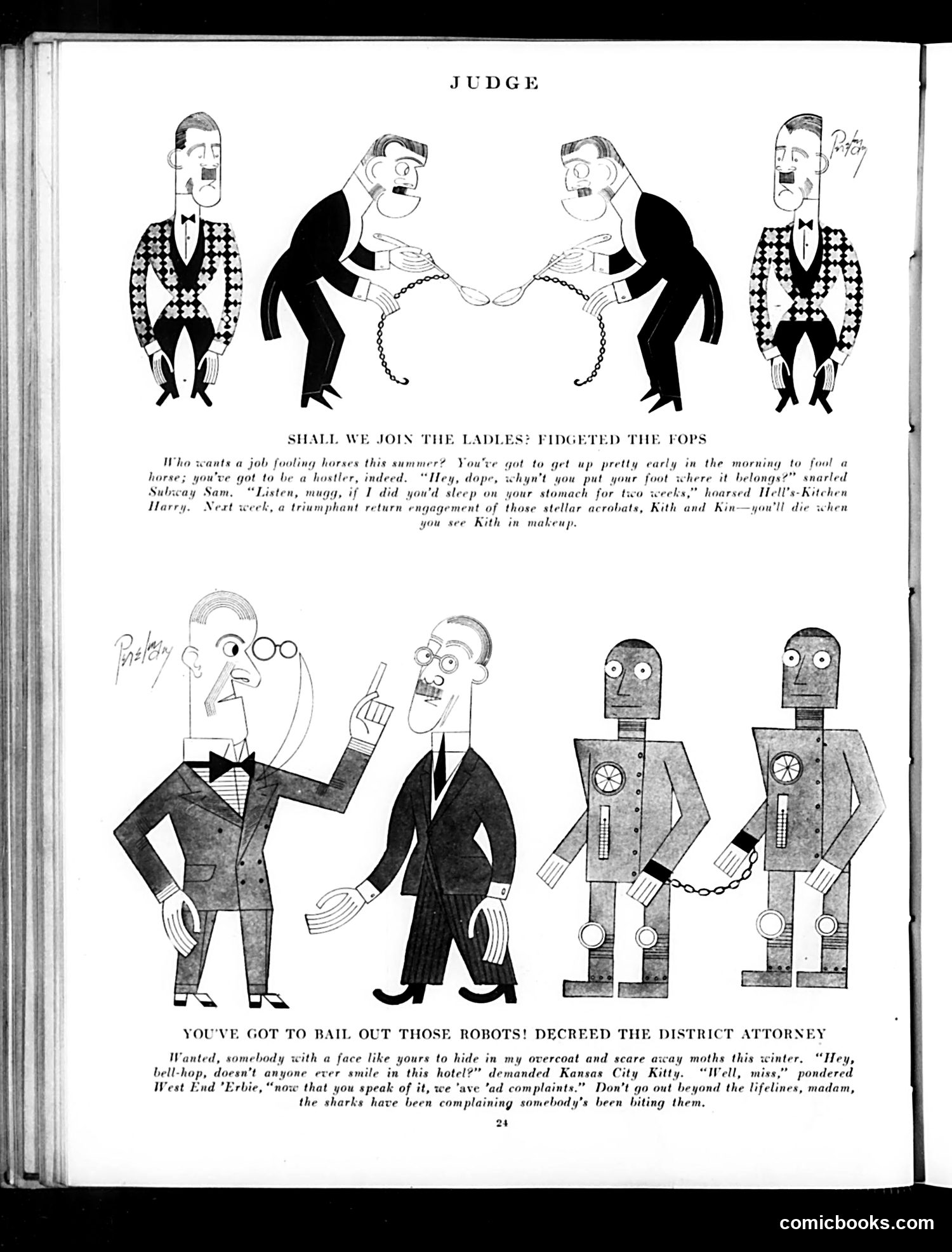
Political Cartoon Analysis: Judge Magazine Page This page contains two satirical comic strips mocking early 20th-century urban types and social pretensions. Top strip ("Shall We Join the Ladies?"): Ridicules effeminate men ("fops") through exaggerated dialogue about summer employment and theatrical performers. The humor targets affected masculinity and vaudeville culture. Bottom strip ("You've Got to Bail Out Those Robots!"): The title's reference to "robots" appears metaphorical—likely satirizing bureaucratic or mechanical enforcement by authorities. The dialogue features working-class characters (Subway Sam, Kansas City Kitty, West End 'Erbie) exchanging wisecracks with authority figures, mocking both the district attorney's pomposity and lower-class New York/urban types. Both strips use caricature, slang, and exaggerated features to lampoon social hierarchies, employment desperation, and the clash between pretension and street-level reality—characteristic Judge magazine satire of the period.
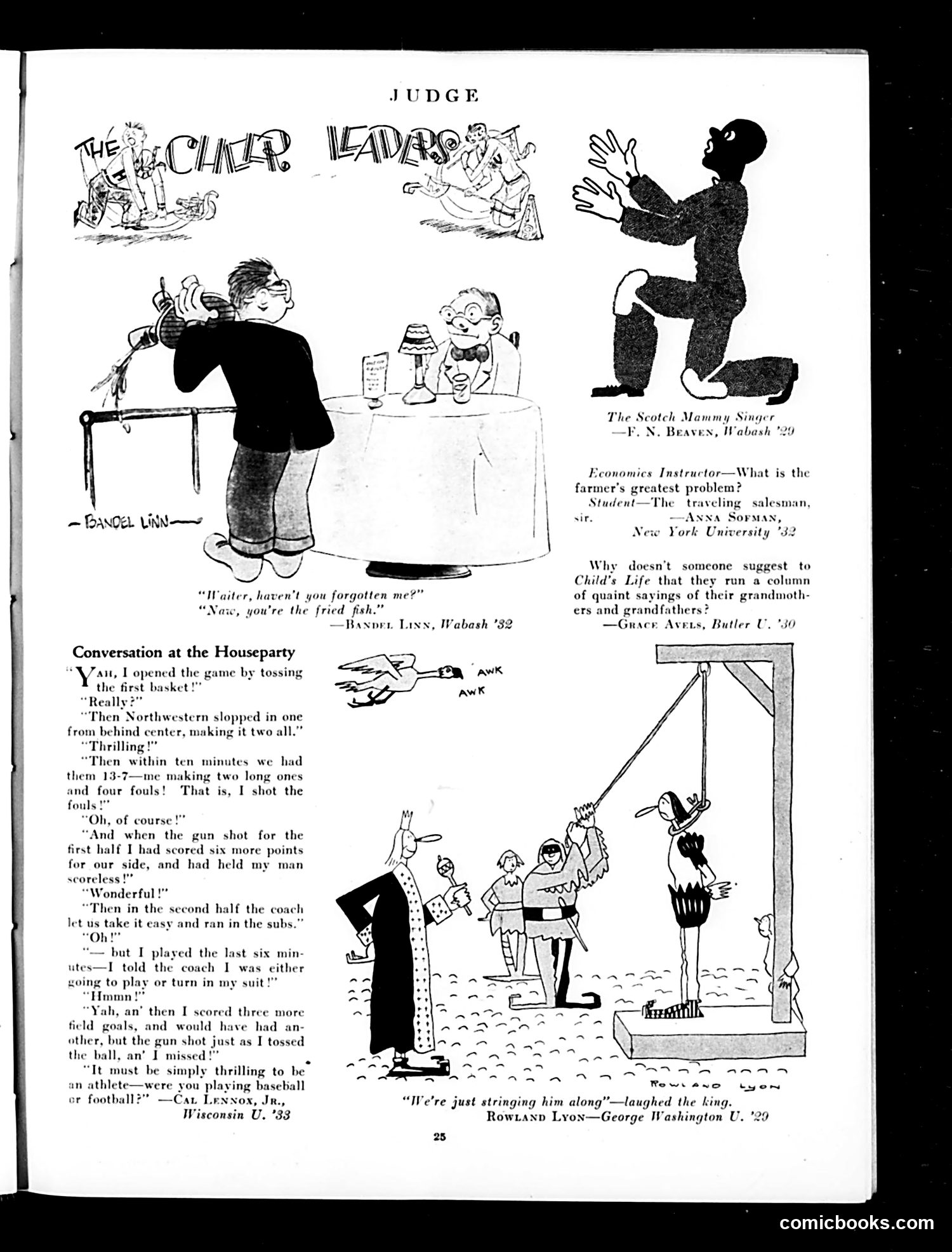
Explanation for Modern Readers This page from *Judge* magazine contains several college-humor cartoons and jokes from the late 1920s-early 1930s: Top cartoons: Brief gags about campus life—a waiter forgetting a customer, an economics student joking that traveling salesmen are farmers' biggest problem, and a suggestion that *Child's Life* magazine publish grandparents' old sayings. Main cartoon (bottom left): "Conversation at the Houseparty" depicts a boastful athlete dominating a social gathering by endlessly recounting his sports exploits—scoring, fouls, coaching decisions—while others listen politely. The satire mocks athletic arrogance and how athletes monopolize conversation. Right cartoon: Shows a king with a woman on a swing, captioned "We're just stringing him along." The humor relies on double meaning: literally stringing the swing, but also the phrase meaning to deceive someone romantically. These are student-submitted humor pieces typical of college magazines of that era, poking fun at campus archetypes and social awkwardness rather than political issues.
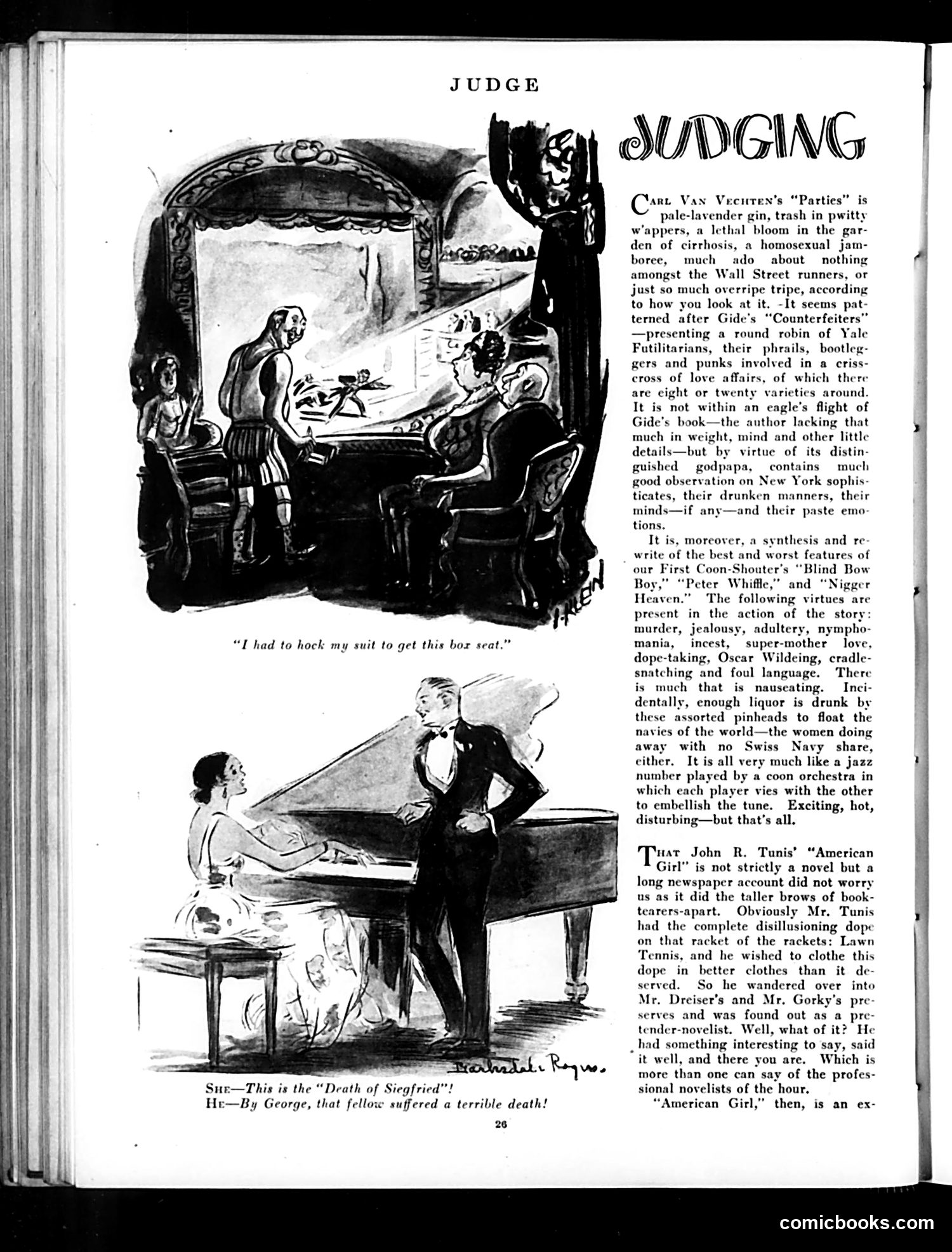
Judge Magazine Page Analysis This page contains book reviews disguised as satirical commentary. The two cartoons above mock literary pretension and dramatic overacting in opera. Top cartoon: A theater audience member comments on Wagner's "Death of Siegfried" opera, with another responding sarcastically about the character's suffering—likely satirizing overwrought operatic melodrama. Bottom cartoon: A man in formal wear stands by a piano player, with a caption joking about enduring discomfort ("hacking my suit") for a good seat—mocking upper-class social climbing and aesthetic posturing. The reviews critique three contemporary novels with caustic wit: - Van Vechten's "Parties": Dismissed as derivative trash about wealthy Yale students, bootleggers, and sexual affairs—shallow mimicry of Gide's "Counterfeiters" - Tunis's "American Girl": Acknowledged as competent reporting about lawn tennis, though the author awkwardly imitates Dreiser and Gorky The tone throughout is deeply elitist and derisive toward both the authors and their subjects, characteristic of 1920s literary criticism in a magazine targeting educated readers.
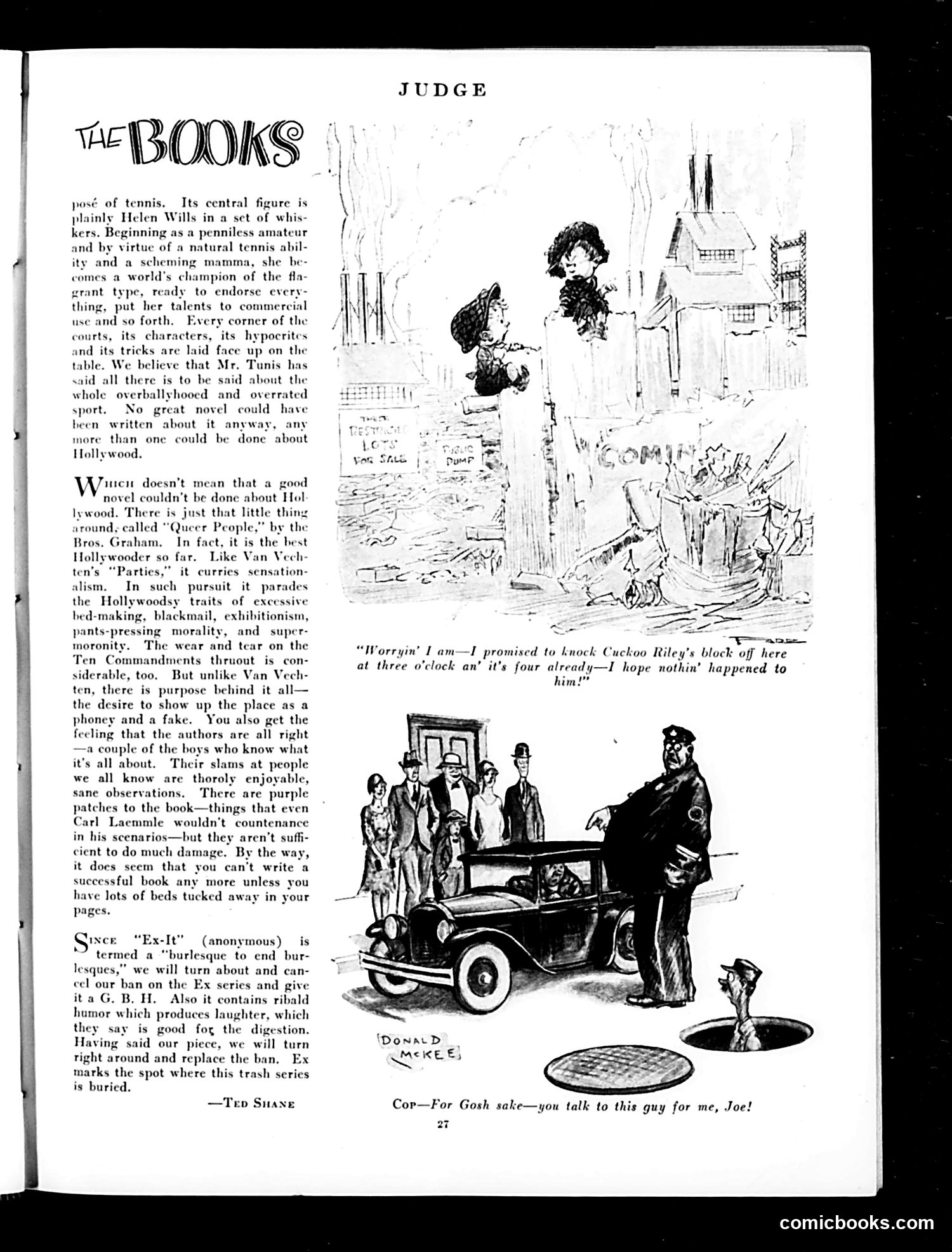
Judge Magazine Book Review Page Analysis This page reviews three books for a 1920s audience. The main text criticizes a tennis novel featuring Helen Wills (famous amateur/professional tennis champion), portrayed as shallow and commercialized—"overballyhooed and overrated." The reviewer praises "Queer People" by Graham Brothers as the best Hollywood satire to date, comparing it favorably to Van Vechten's "Parties." It exposes Hollywood as phony while depicting moral decay: infidelity, blackmail, and casual disregard for religious commandments. "Ex-It" (anonymous) is dismissed as burlesque trash, though the reviewer grudgingly acknowledges its ribald humor before reversing course to condemn it again. The cartoons below illustrate 1920s street scenes with working-class characters—a cop and civilian interaction, and someone threatening violence ("knock Cuckoo Riley's block off"). These appear to be unrelated humorous illustrations rather than commentary on the book reviews.
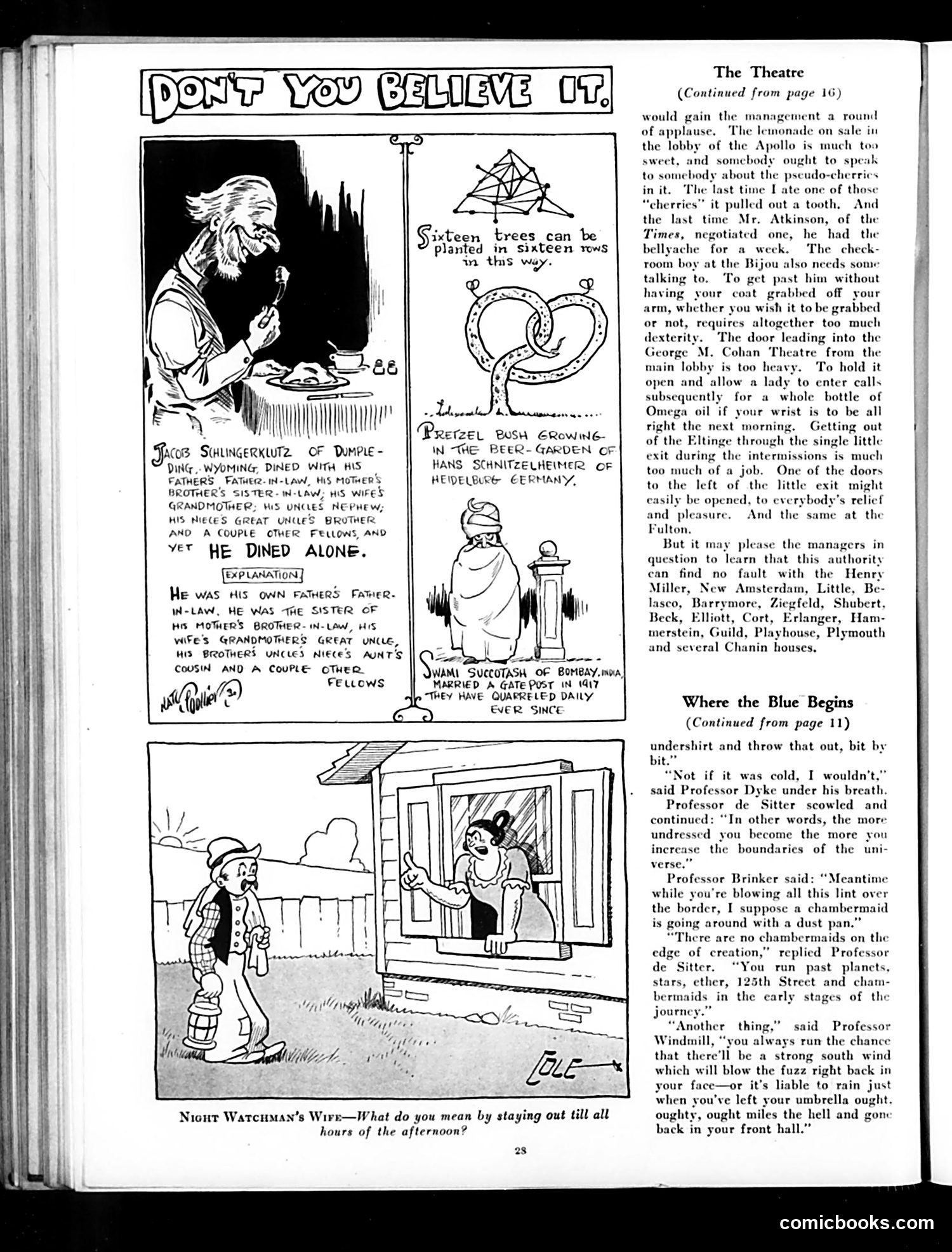
Explanation of Judge Magazine Page This page from Judge (an early 20th-century satirical magazine) contains three unrelated humor pieces: "Don't You Believe It" presents three absurdist logic puzzles meant to confuse readers. The first explains how a man dining with multiple relatives by marriage is paradoxically his own father-in-law. The other two involve impossible scenarios (sixteen trees in sixteen rows; a man marrying a gate post). These satirize pedantic reasoning and circular logic—popular intellectual humor of the era. "Nighty Watchman's Wife" is a domestic joke: a woman complains her husband stays out "till all hours of the afternoon"—an obvious exaggeration meant to mock nagging spouses or henpecked husbands. The right column continues an unrelated theater review critiquing various Broadway theaters' physical inconveniences (heavy doors, cramped exits, overly-sweet refreshments). The humor relies on absurdism, domestic stereotypes, and contemporary New York theater knowledge—largely incomprehensible to modern readers without historical context.
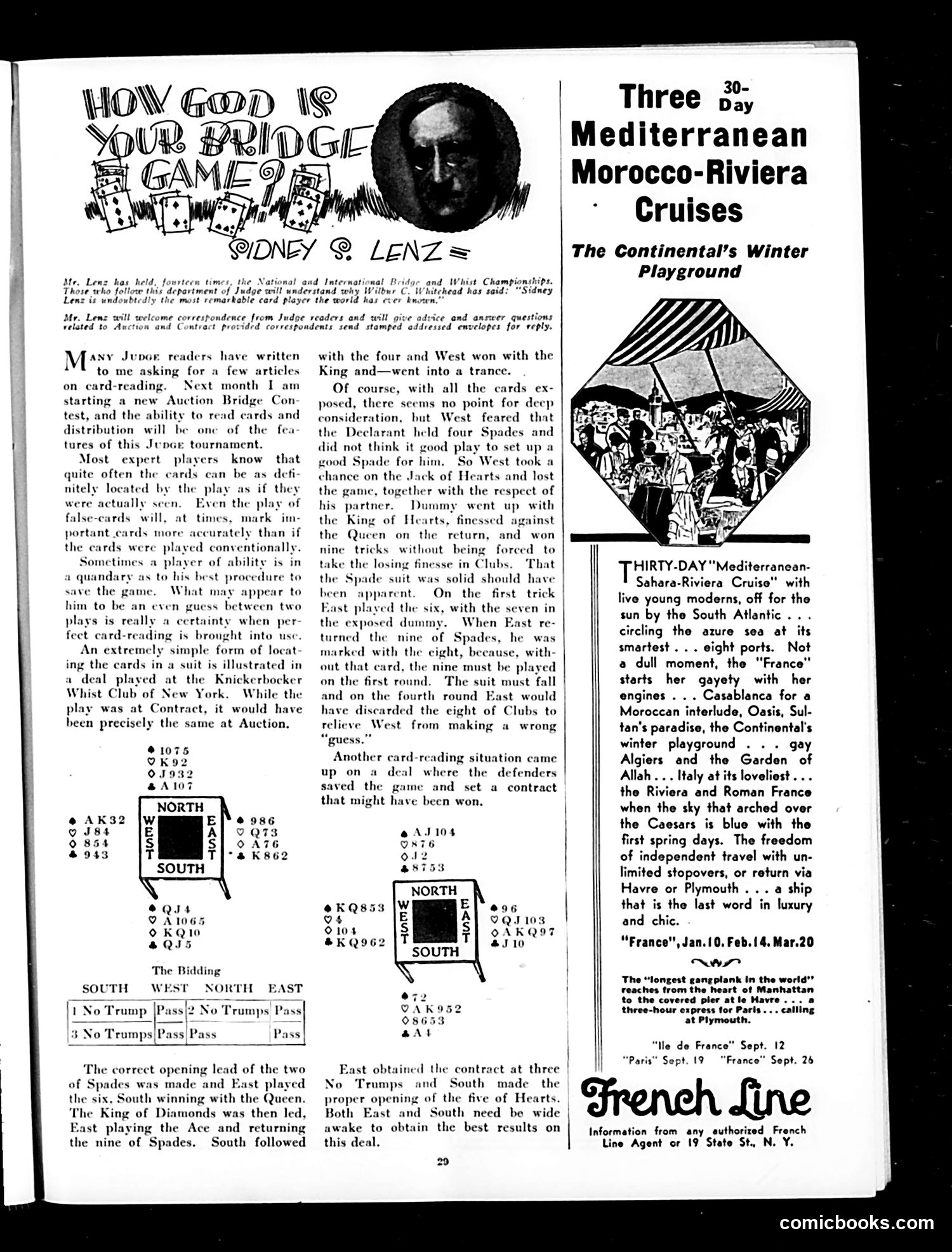
Judge Magazine Page Analysis This page combines bridge instruction with advertising. The main content is Sidney Lenz's bridge column, a regular Judge feature teaching card strategy through worked examples. Lenz was a celebrated bridge champion of the era, and the column demonstrates "card-reading"—deducing opponents' hidden cards from their play. The specific deal shown illustrates how a player can deduce card locations logically. West makes a poor play decision despite having enough information to deduce the suit layout, losing the game and his partner's respect. The column emphasizes that expert players extract maximum information from opponents' actions rather than relying on chance. The right side contains a travel advertisement for the French Line's Mediterranean cruises, targeting affluent readers with references to glamorous destinations (Casablanca, Algiers, the Riviera) and "live young moderns." The content reflects Judge's audience: educated, leisure-class readers interested in sophisticated pastimes and luxury travel.
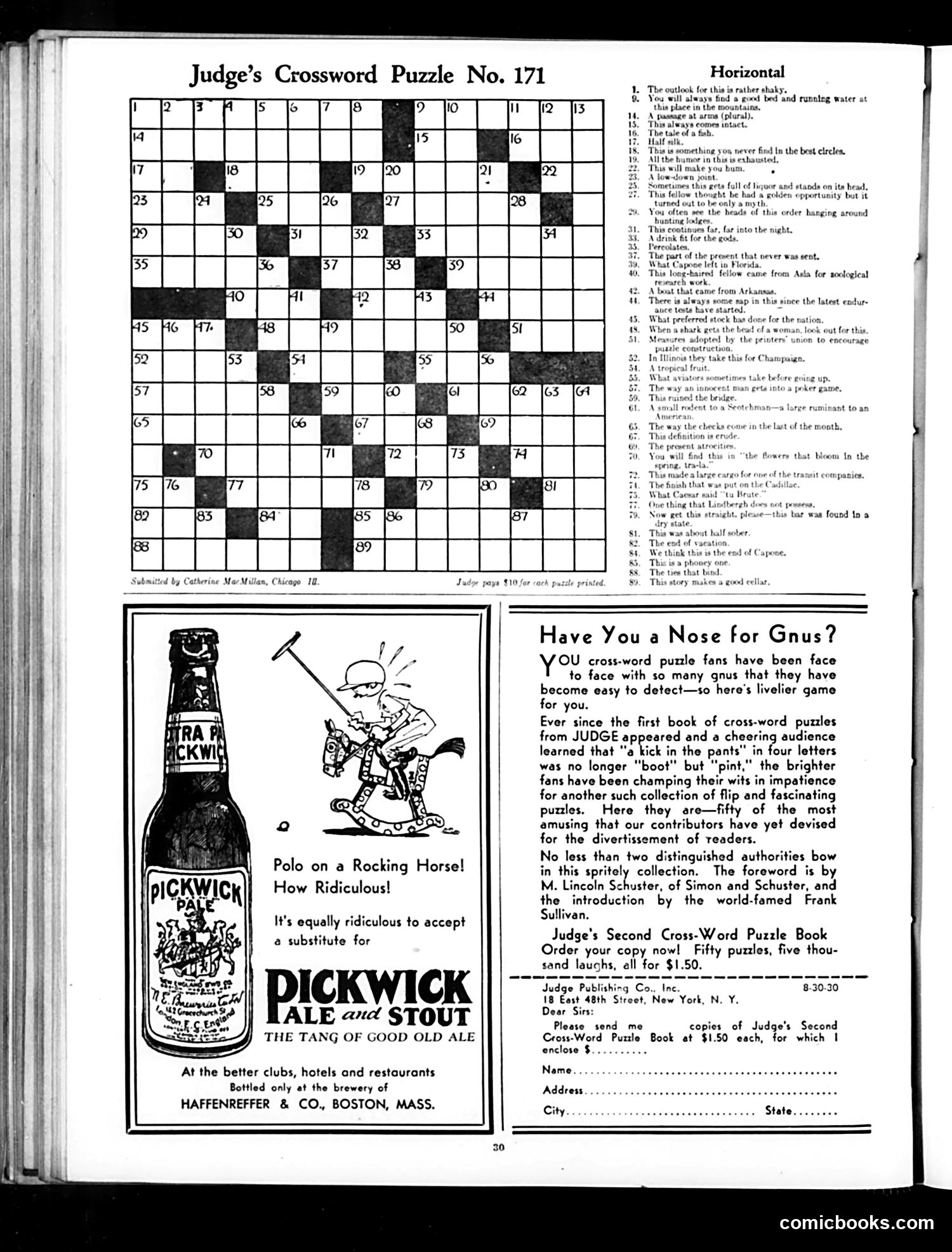
Judge Magazine Page Analysis This page primarily features advertising and puzzle content rather than political satire. The main advertisement promotes Pickwick Ale and Stout from Haffenreffer & Co. (Boston). The visual joke depicts someone playing polo on a rocking horse—described as "ridiculous"—to humorously suggest it's equally absurd to accept a substitute for authentic Pickwick beer. This is straightforward product advertising using humor. The bulk of the page contains Judge's Crossword Puzzle No. 171 and promotional material for Judge's Second Cross-Word Puzzle Book, featuring a mail-order form. The promotional text references the crossword puzzle craze's popularity and notes contributions from M. Lincoln Schuster and Frank Sullivan. The "Have You a Nose for Gnus?" section jokes about readers becoming tired of "gnus" (wordplay puns) in crosswords and pitches the new puzzle book as offering fresher challenges. This appears to be typical magazine content from the crossword puzzle boom era—primarily commercial rather than satirical.
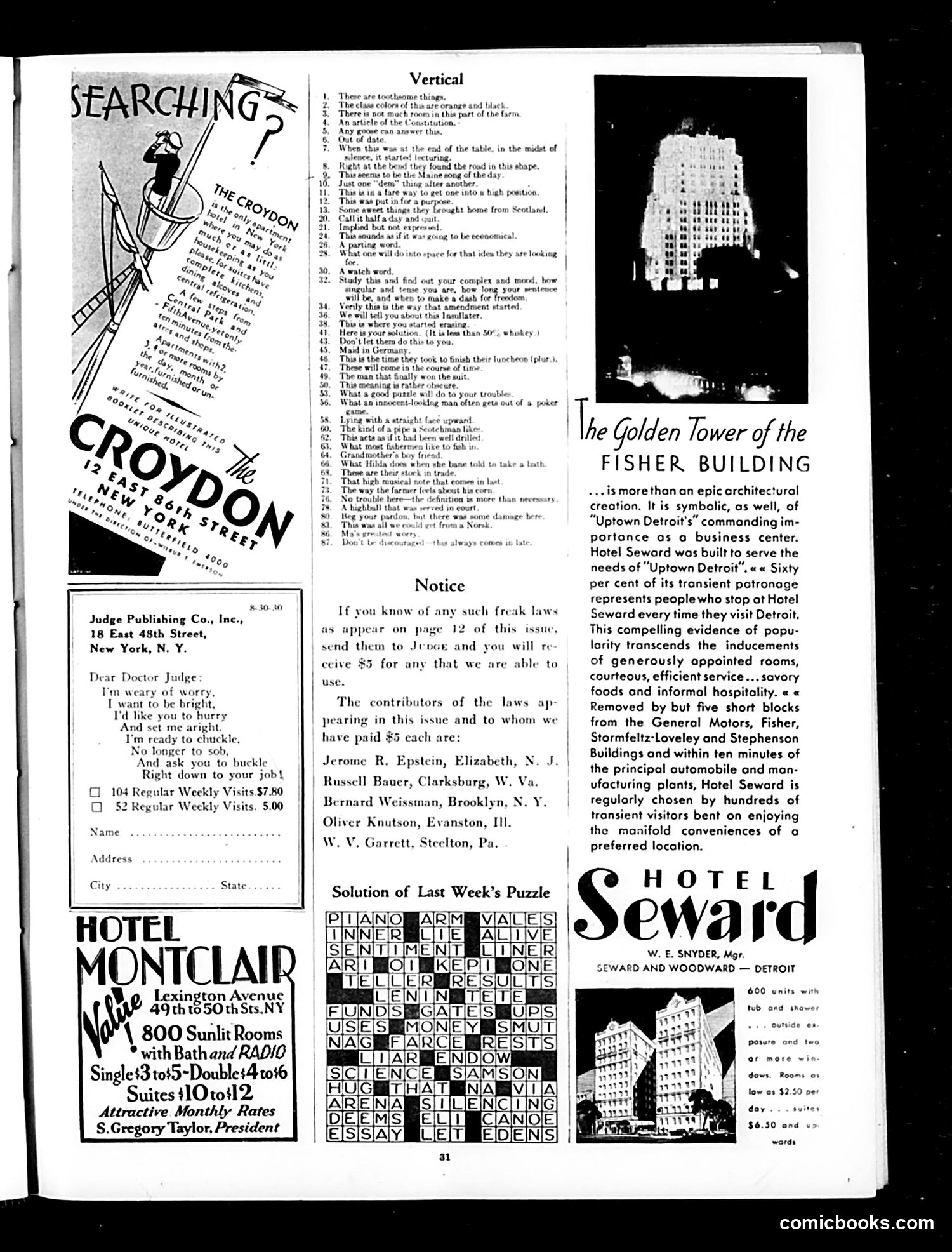
Analysis of This Judge Magazine Page This page is primarily advertising and reader correspondence, not political satire. The main content includes: 1. "Searching the Croydon" (top left): An ad for a NYC apartment building, presented as a playful illustrated narrative about finding housing. 2. Reader Letter: A humorous submission asking Judge magazine to help cure the writer's worries through humor—meta-commentary on the magazine's purpose as entertainment. 3. "Freak Laws" Notice: Judge solicits reader submissions of unusual state laws, offering $5 payment. This was apparently a regular feature. 4. Hotel Advertisements: The bulk of the page promotes three hotels (Montclair, Seward, and mentions of others), emphasizing amenities like radio, rooms, and proximity to Detroit's business district. 5. Crossword Solution: A completed puzzle from the previous week. The page reflects 1920s-30s urban life—housing scarcity, commercial growth, and radio as a modern luxury. There's no significant political cartoon or satirical content visible here.
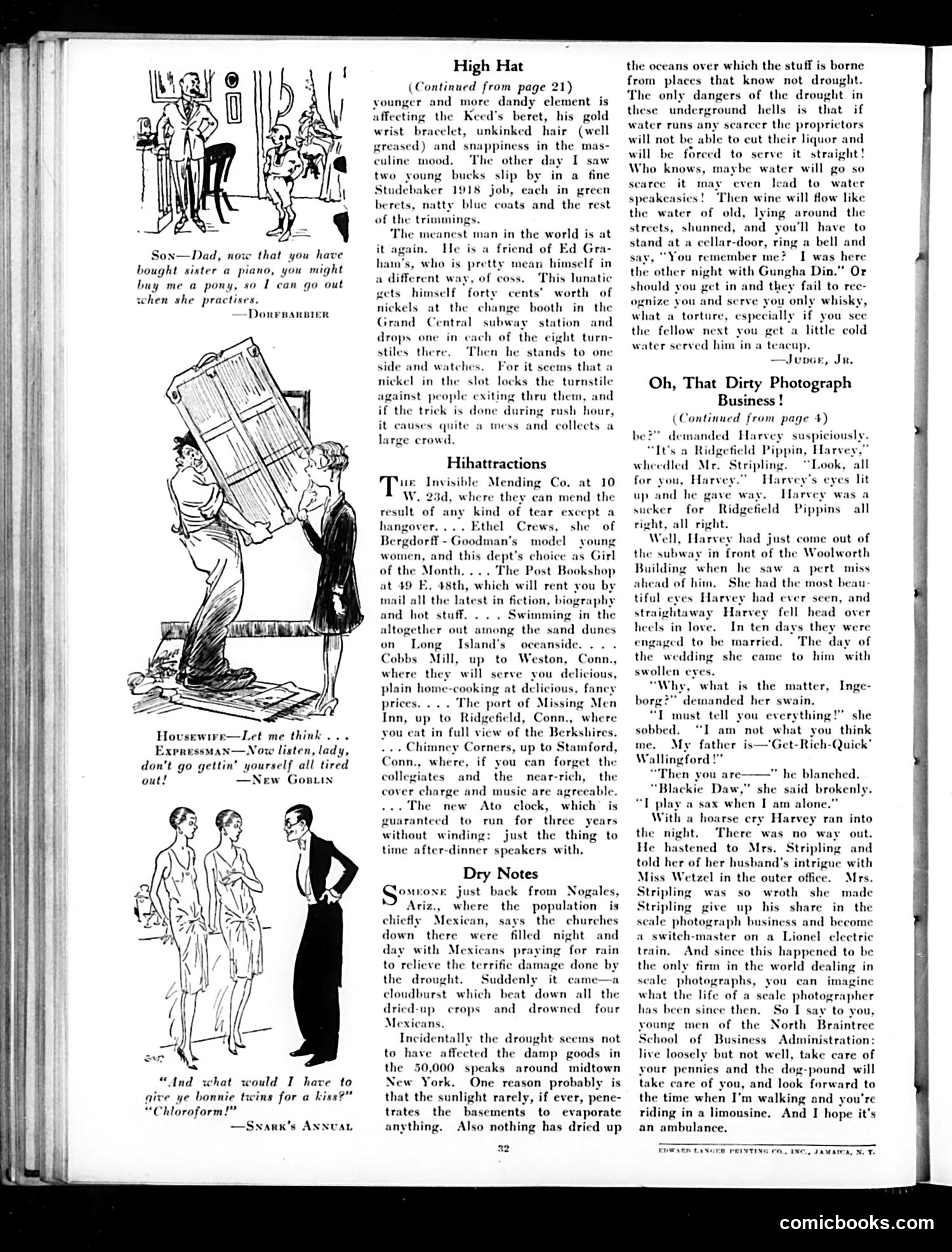
Explaining This Judge Magazine Page to Modern Readers This page contains several short humor pieces and advertisements typical of Judge magazine's satirical content. The cartoons mock everyday situations: a boy asking his father for a pony so he can escape his sister's piano practice; a housewife exhausted by domestic labor; a joke about Irish courtship involving chloroform (dark humor about consent that reflects period attitudes). "High Hat" discusses fashionable young men adopting berets and blue coats—mocking contemporary style trends. "Hihattractions" advertises upscale NYC-area businesses and services for wealthy readers. "Dry Notes" satirizes Prohibition-era America. It mocks Mexican drought relief while noting that underground speakeasies ("speaks") remain well-stocked despite drought—implying illegal alcohol distribution thrived despite water shortages. The joke suggests prohibition laws failed to stop liquor availability in hidden bars. "Oh, That Dirty Photograph Business" continues a serialized story about a photographer involved in some scandal (context unclear from this page alone). The overall tone reflects 1920s upper-class concerns and Prohibition-era social commentary.
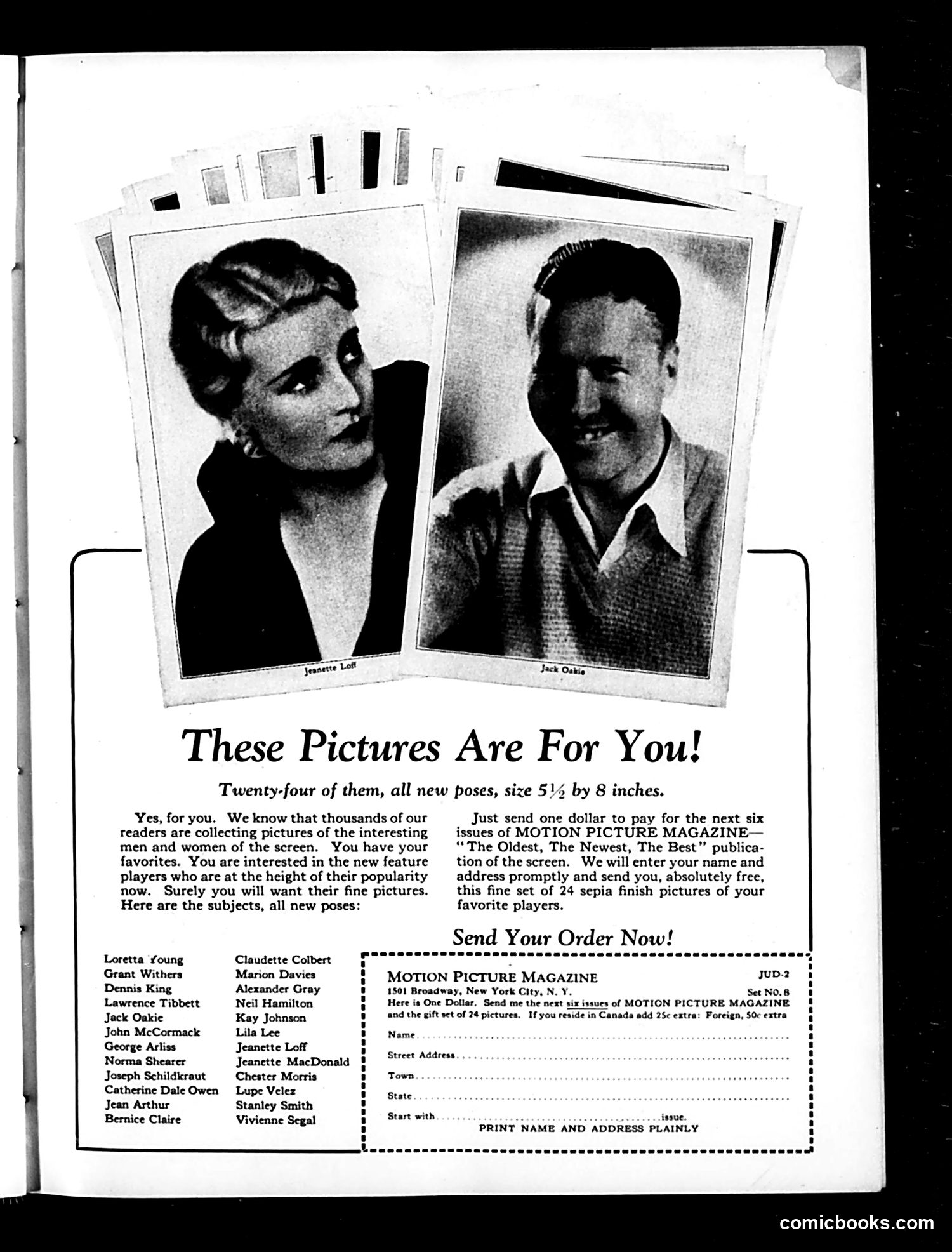
Analysis This is not a cartoon or satire, but rather a promotional advertisement from Judge magazine. The page advertises a subscription offer from Motion Picture Magazine. For one dollar, readers could subscribe to six issues and receive, free of charge, a set of 24 sepia-toned photographs (5½ by 8 inches) of popular movie stars of the era. The two photographs at the top—identified as Jeanette Loff and Jack Oakie—are sample images from the collection. The list below names 24 Hollywood actors and actresses of the late 1920s/early 1930s, including recognizable stars like Loretta Young, Norma Shearer, and George Arliss. This reflects the era's fan culture around silent and early-sound cinema, when collecting photographs of movie stars was a popular hobby. The advertisement exploits this widespread interest to drive magazine subscriptions.
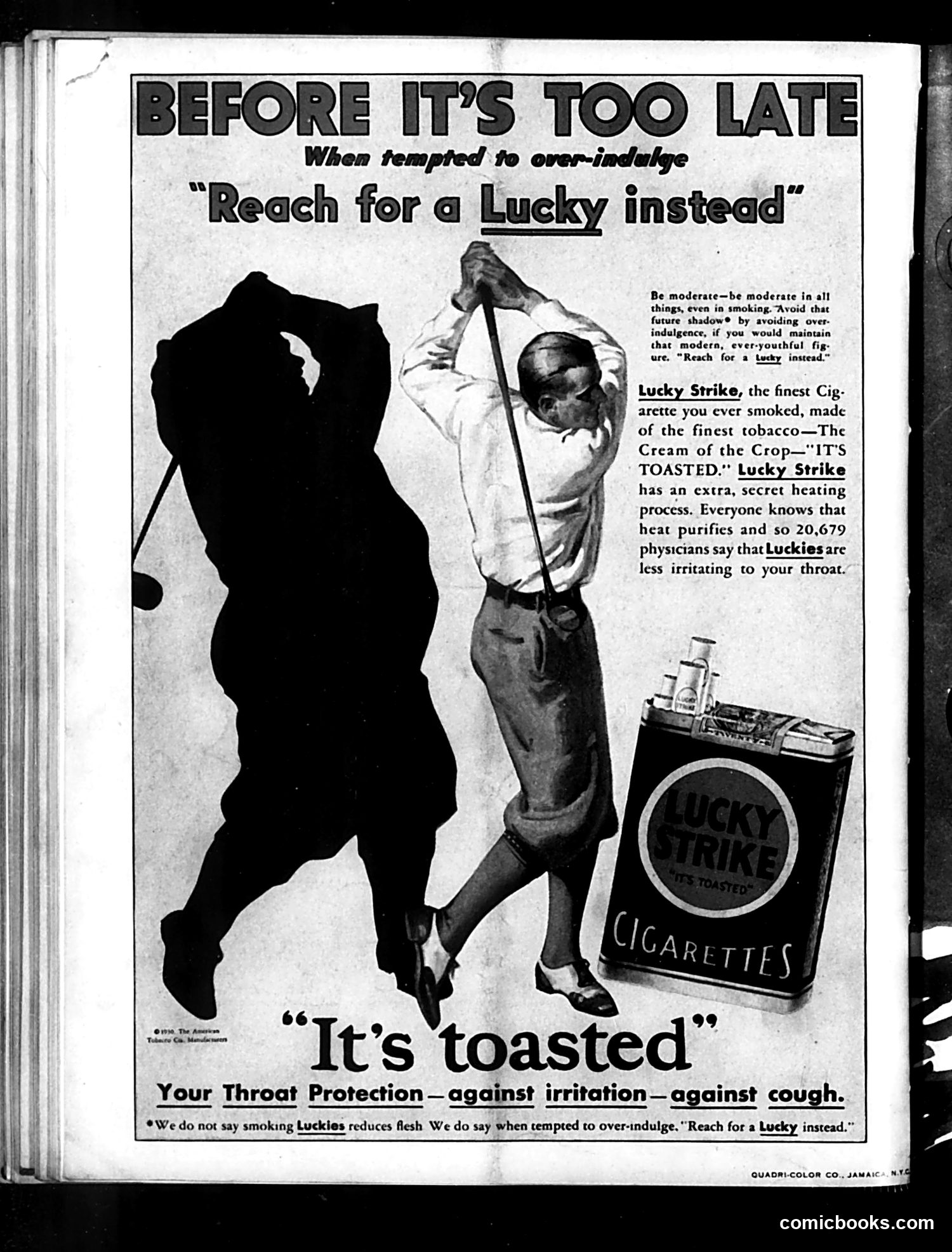
Analysis This is a Lucky Strike cigarette advertisement, not political satire. The "cartoon" is a visual comparison: a silhouette of an overweight figure on the left contrasts with a slim, athletic golfer on the right, both smoking. The advertisement's appeal to a 1920s-30s audience played on widespread anxieties about weight and modernity. The tagline "Reach for a Lucky instead" suggests cigarettes as appetite suppressants—a common marketing claim of the era. The ad claims Lucky Strikes are "toasted" and therefore "less irritating," citing allegedly supportive physicians (a dubious appeal to authority). The phrase "before it's too late" warns against overindulgence leading to an unflattering figure. The modern reader should recognize this as predatory marketing linking smoking to body image and social acceptability, now understood as health misinformation. The disclaimer at bottom ("we do not say smoking Luckies reduces flesh") is notably weak—essentially admitting the implied claim is unsubstantiated.