judge
Judge — September 6, 1930
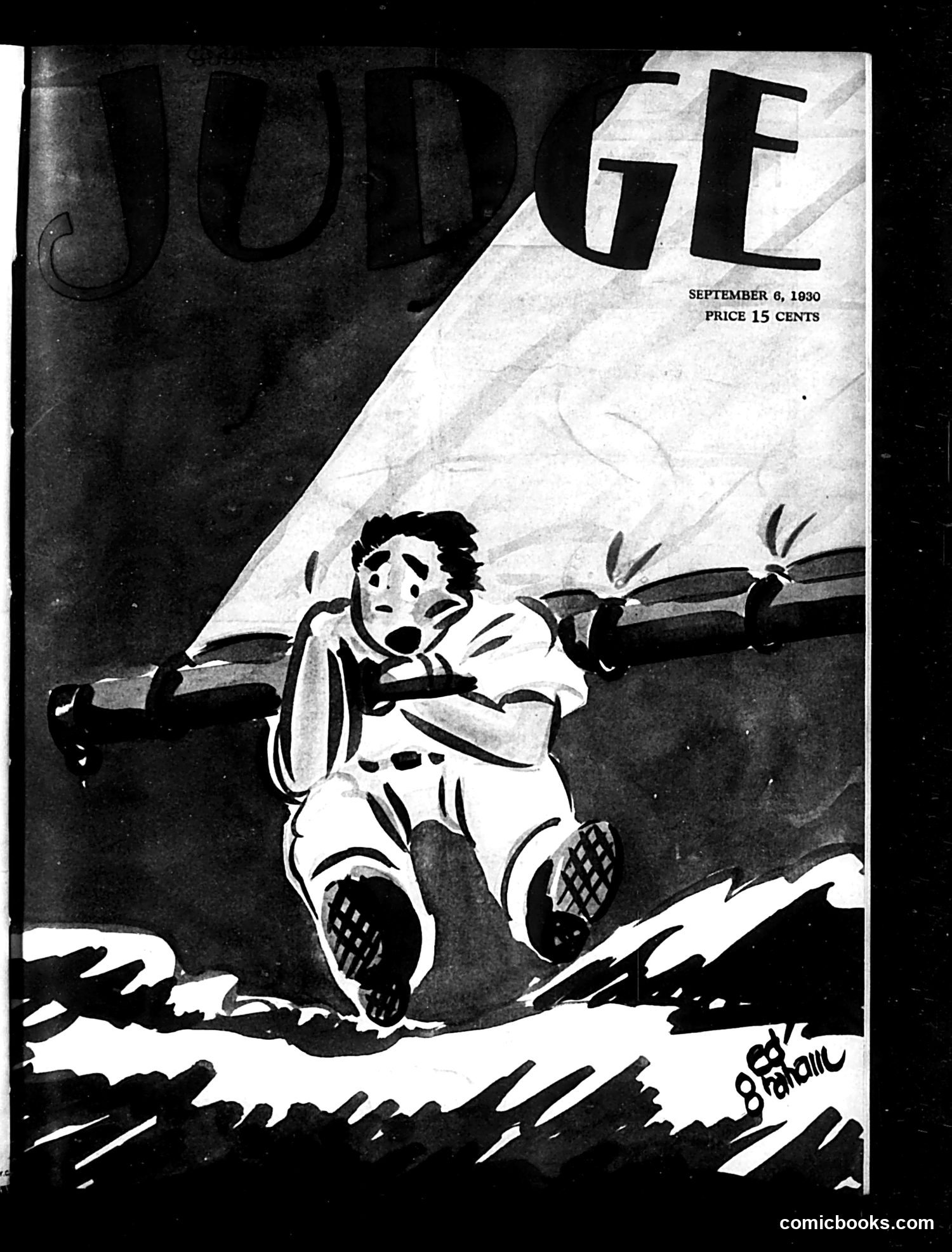
Judge Magazine Cover - September 6, 1930 This cover depicts a distressed figure clinging to a log in turbulent water, appearing to struggle for survival. The imagery suggests economic catastrophe—likely referencing the Stock Market Crash of October 1929 and the onset of the Great Depression. The character's desperate posture and the rough seas symbolize the financial devastation Americans faced in 1930. The "Judge" title looms above, suggesting the magazine's satirical commentary on the crisis. At 15 cents, this represents a moment when many Americans were losing their savings and livelihoods. The cartoon critiques or comments on the economic turmoil through this drowning metaphor—a visual commentary on widespread financial ruin during the Depression's early, darkest months.
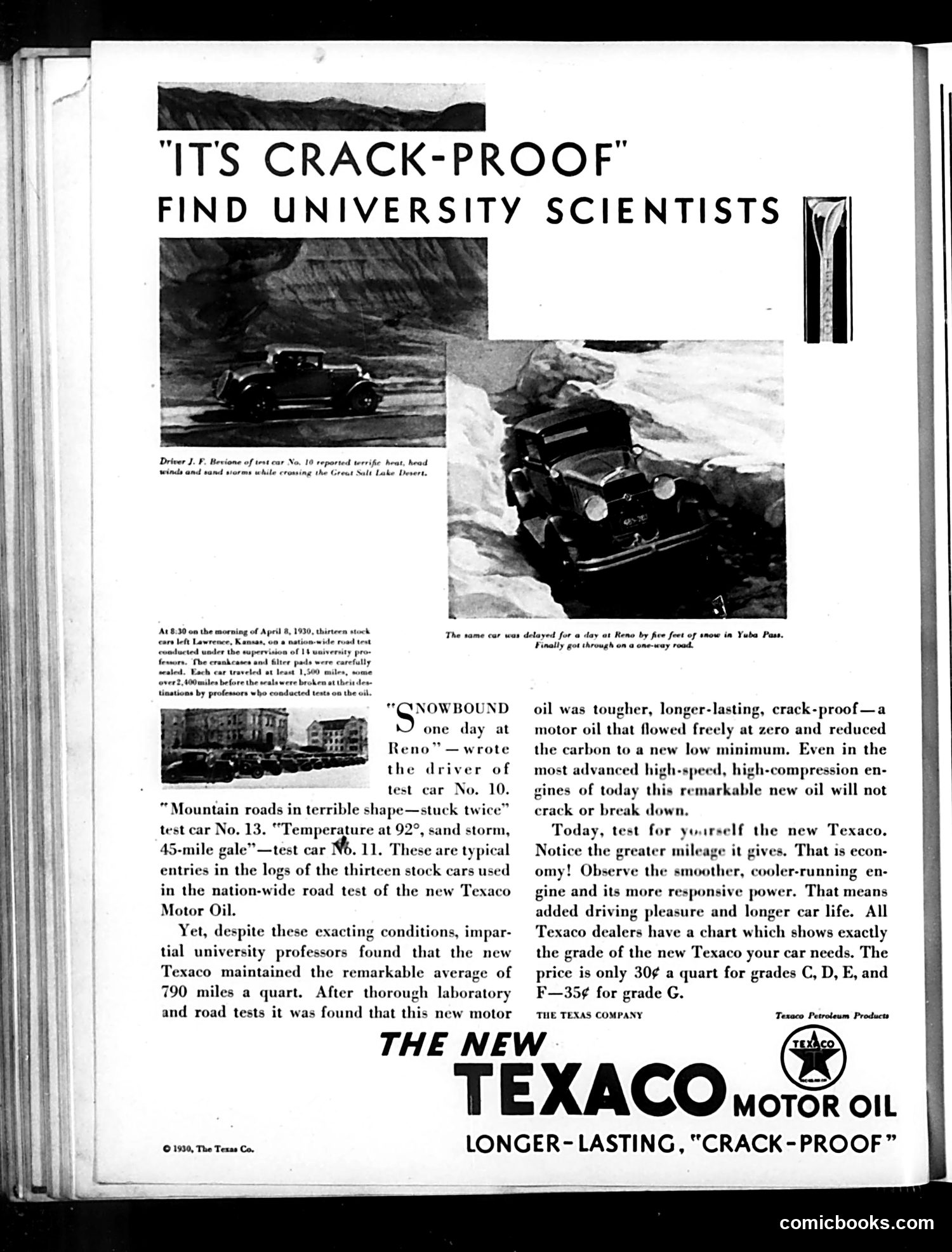
This page is primarily an advertisement, not satire or political content. It's a 1930s Texaco Motor Oil ad disguised as editorial content under the headline "IT'S CRACK-PROOF—FIND UNIVERSITY SCIENTISTS." The ad uses a familiar advertising technique: presenting product claims as objective scientific validation. It describes university-conducted road tests of Texaco's new motor oil, featuring photographs of test vehicles on challenging terrain (mountain roads, snow). The appeal combines appeals to authority (university scientists), performance metrics (790 miles per quart), and practical benefits (crack-proof oil at zero degrees, smoother engine operation). While framed journalistically, this is straightforward product marketing rather than political or social satire. Judge magazine likely accepted such advertisements to fund publication.
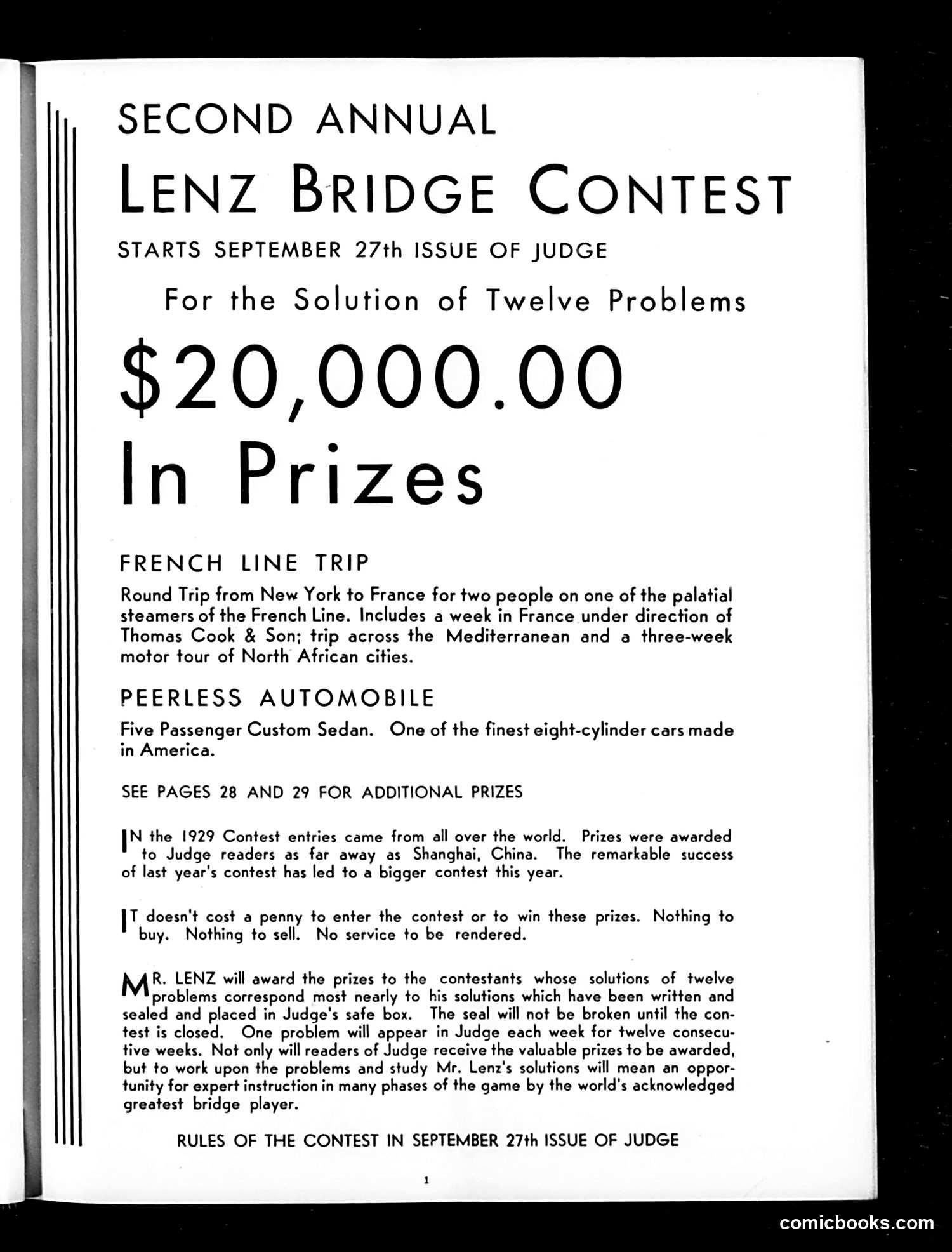
Content Analysis This page is primarily advertising for a contest, not political satire. It announces Judge magazine's "Second Annual Lenz Bridge Contest" offering $20,000 in prizes for solving twelve bridge problems. The main prizes listed are: - A French Line steamship trip to France and North Africa - A Peerless automobile (luxury car) The text emphasizes the contest's accessibility—free to enter, no purchase necessary—and notes that the 1929 contest drew entries "from all over the world," with solutions judged against Mr. Lenz's sealed solutions. This appears aimed at bridge enthusiasts during the game's height of popularity in the late 1920s-early 1930s. The substantial prize values reflect the era's commercial investment in promoting bridge as an intellectual pastime.
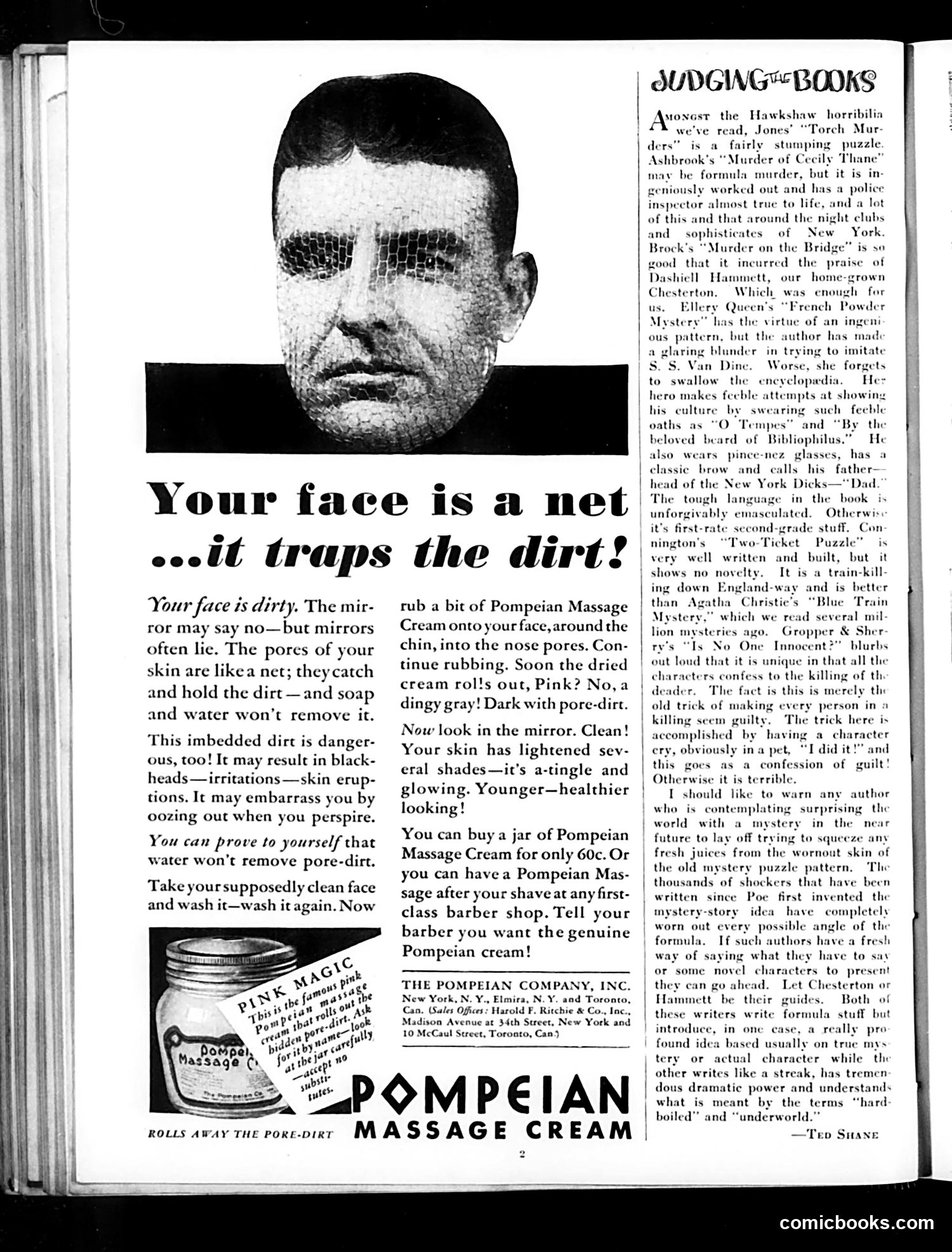
Page Analysis This page is primarily advertising, not political satire. The dominant content is a Pompeian Massage Cream advertisement featuring a headshot photograph with the headline "Your face is a net...it traps the dirt!" The ad uses pseudo-scientific claims to sell the product, describing facial pores as traps for dirt and claiming the cream removes embedded impurities. It promises improved appearance and younger-looking skin for 60 cents. The right column contains "Judging the Books," a book review section by Ted Shane critiquing recent mystery novels—works by authors like Ellery Queen and S.S. Van Dine. Shane criticizes their attempts at sophistication and formula-driven plotting. There is no political cartoon on this page; it's a typical magazine layout mixing advertisements with editorial content.
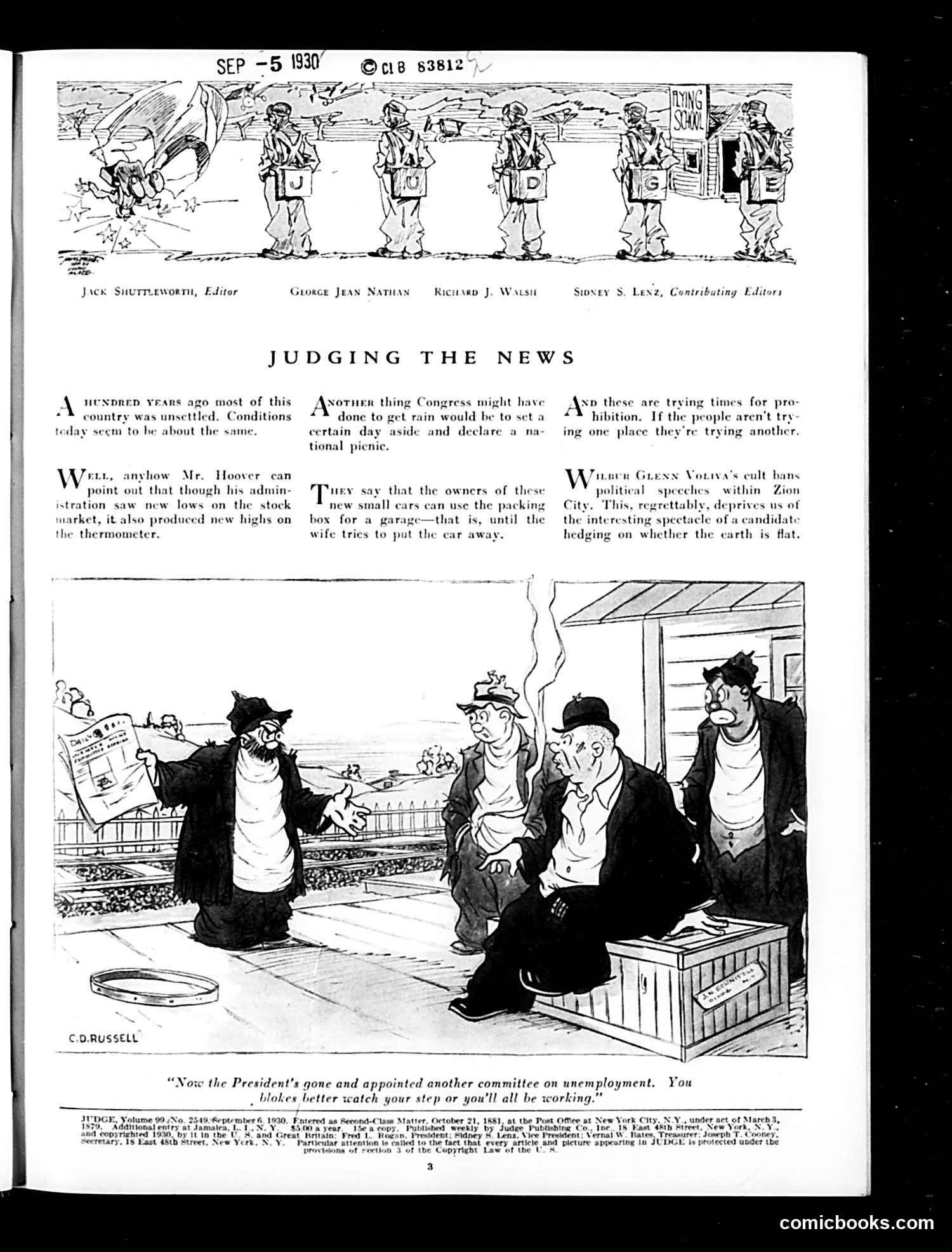
"Judging the News" - September 5, 1930 This page satirizes early Depression-era politics and social commentary. The main cartoon depicts unemployed men confronting officials about a presidential committee on unemployment, with the caption: "Now the President's gone and appointed another committee on unemployment. You blokes better watch your step or you'll all be working." The satire mocks the ineffectiveness of government committees as a response to joblessness—suggesting committees generate only bureaucratic busywork rather than actual employment. The joke implies that the "threat" of being put to work on such committees is the only consequence these officials face. Other brief columns critique congressional gridlock, small car design, and Glenn Voliva's ban on political speeches in Zion City, Illinois. The overall tone reflects public skepticism about governmental responses to the economic crisis.
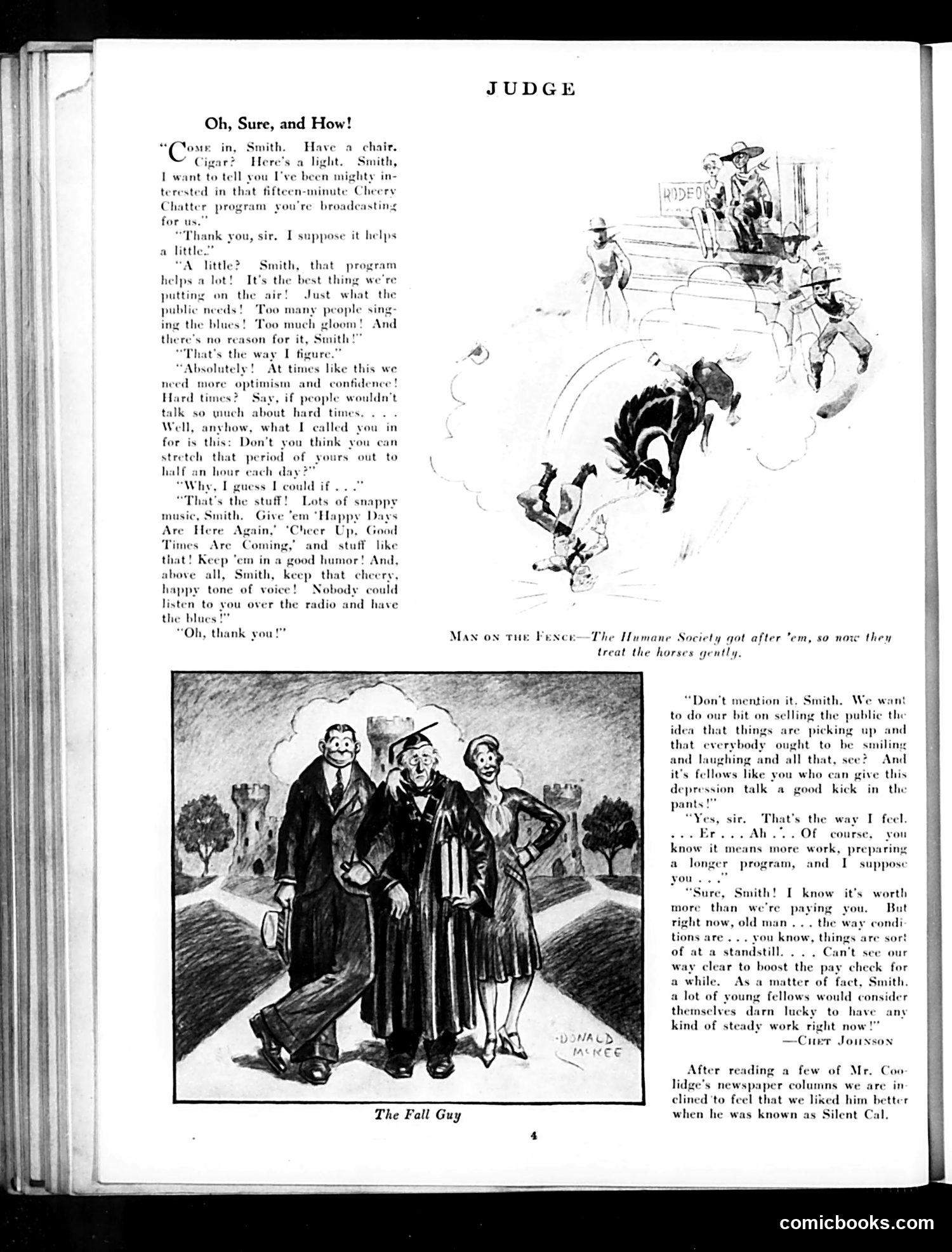
Analysis of Judge Magazine Page This page contains a dialogue between two radio broadcasters discussing programming during hard economic times. One character advocates for upbeat content—"Happy Days Are Here Again," cheerful music, and humor—to counter public depression and "the blues." His colleague argues this is insufficient without addressing underlying economic conditions. The accompanying cartoon "The Fall Guy" depicts three figures in formal dress, likely representing political or business leaders responsible for the economic crisis, shown in a vulnerable or fallen position. The satire critiques the tension between entertainment as palliative during the Great Depression versus genuine economic reform. Radio broadcasts offered escapism, but the cartoon suggests those in power bear responsibility for actual hardship rather than merely lifting spirits through cheerful programming.
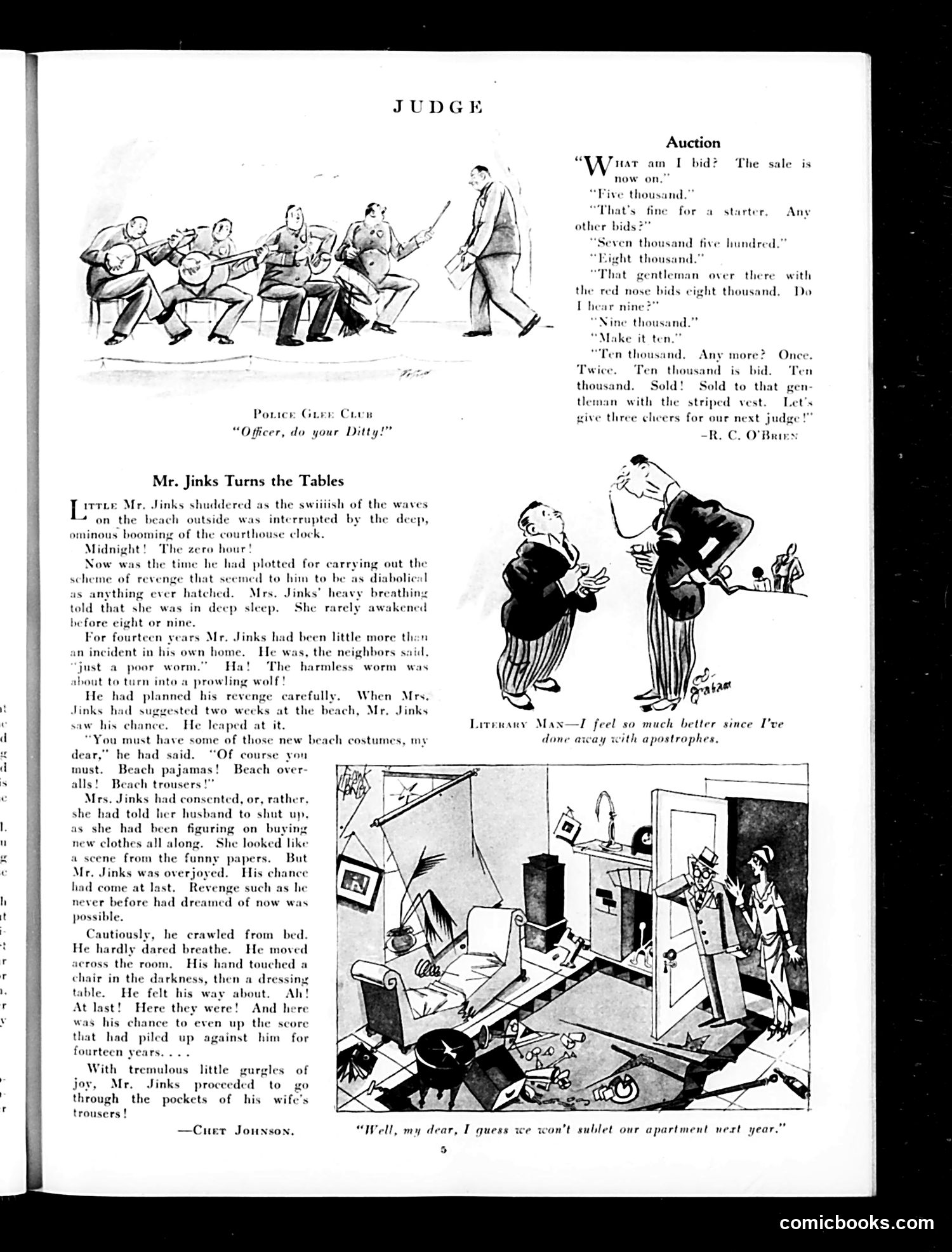
Analysis of Judge Page This page contains two distinct pieces: "Auction" (top right): A humorous dialogue satirizing an auction, likely of artwork or property. The rapid bidding and escalating prices mock both auctioneers' theatrics and wealthy buyers' competitive impulses. The credited author R.C. O'Brien adds authenticity to this likely social commentary on Gilded Age auction culture. "Mr. Jinks Turns the Tables" (main story): A domestic comedy by Chet Johnson about a meek husband seeking revenge on his domineering wife. After years of mistreatment, he plans a scheme during a beach vacation. The accompanying illustrations show his plotting and the comedic chaos that results when Mrs. Jinks discovers their apartment ransacked. It's conventional early-20th-century humor about marital role reversal.
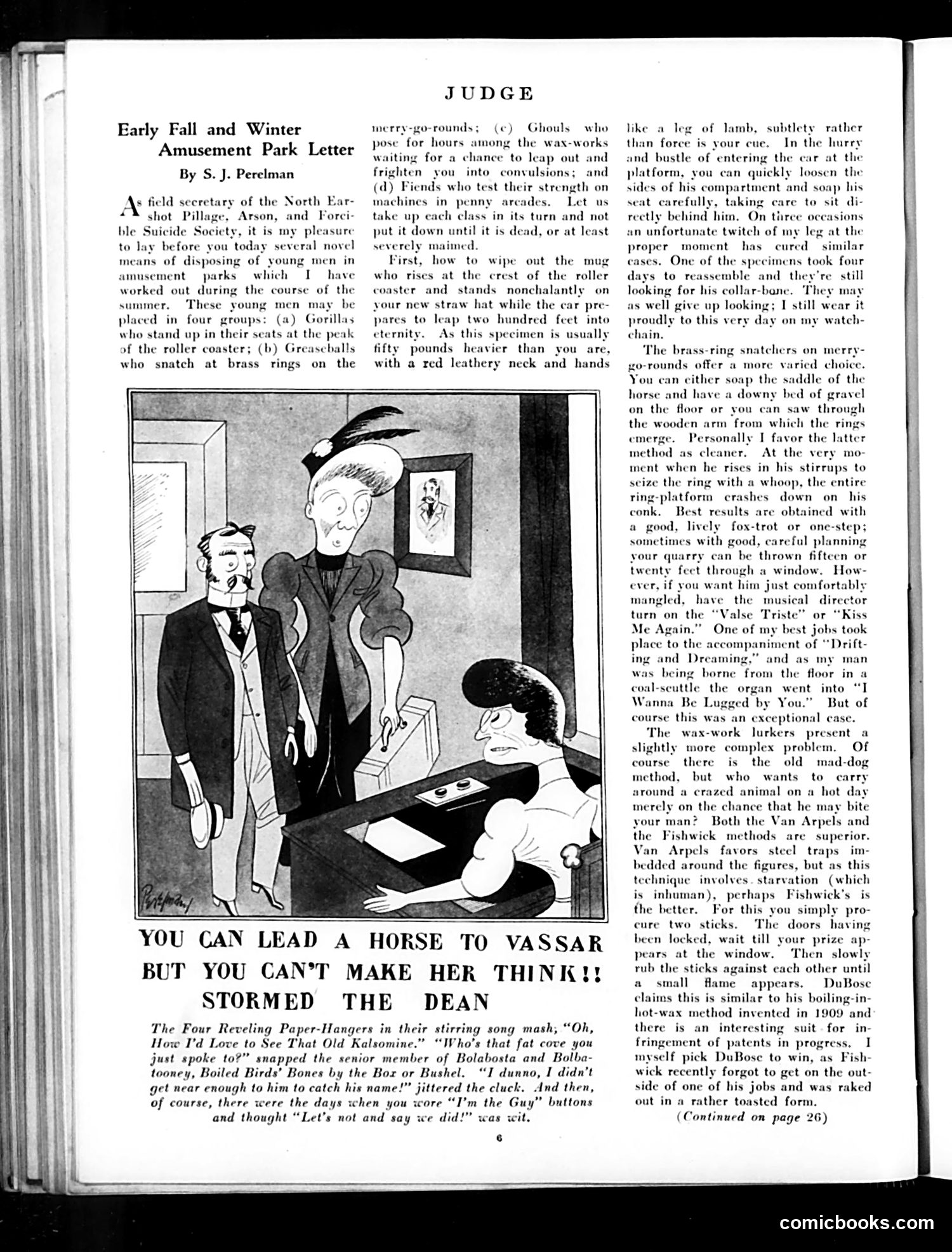
Explanation for Modern Readers This is a humorous article by S.J. Perelman about disposing of young men at an amusement park. The accompanying cartoon illustrates the absurdist joke in the headline: "YOU CAN LEAD A HORSE TO VASSAR BUT YOU CAN'T MAKE HER THINK!! STORMED THE DEAN." The cartoon shows three men in suits—appearing to be authority figures (possibly a dean and visitors)—confronting a woman sitting at a desk, likely representing a Vassar College administrator. The satire targets early 20th-century attitudes about women's education, suggesting that even elite institutions like Vassar couldn't overcome perceived limitations in women's intellectual capacity. The humor relies on period sexism and the clash between institutional prestige and stereotypical views about gender and intellect.
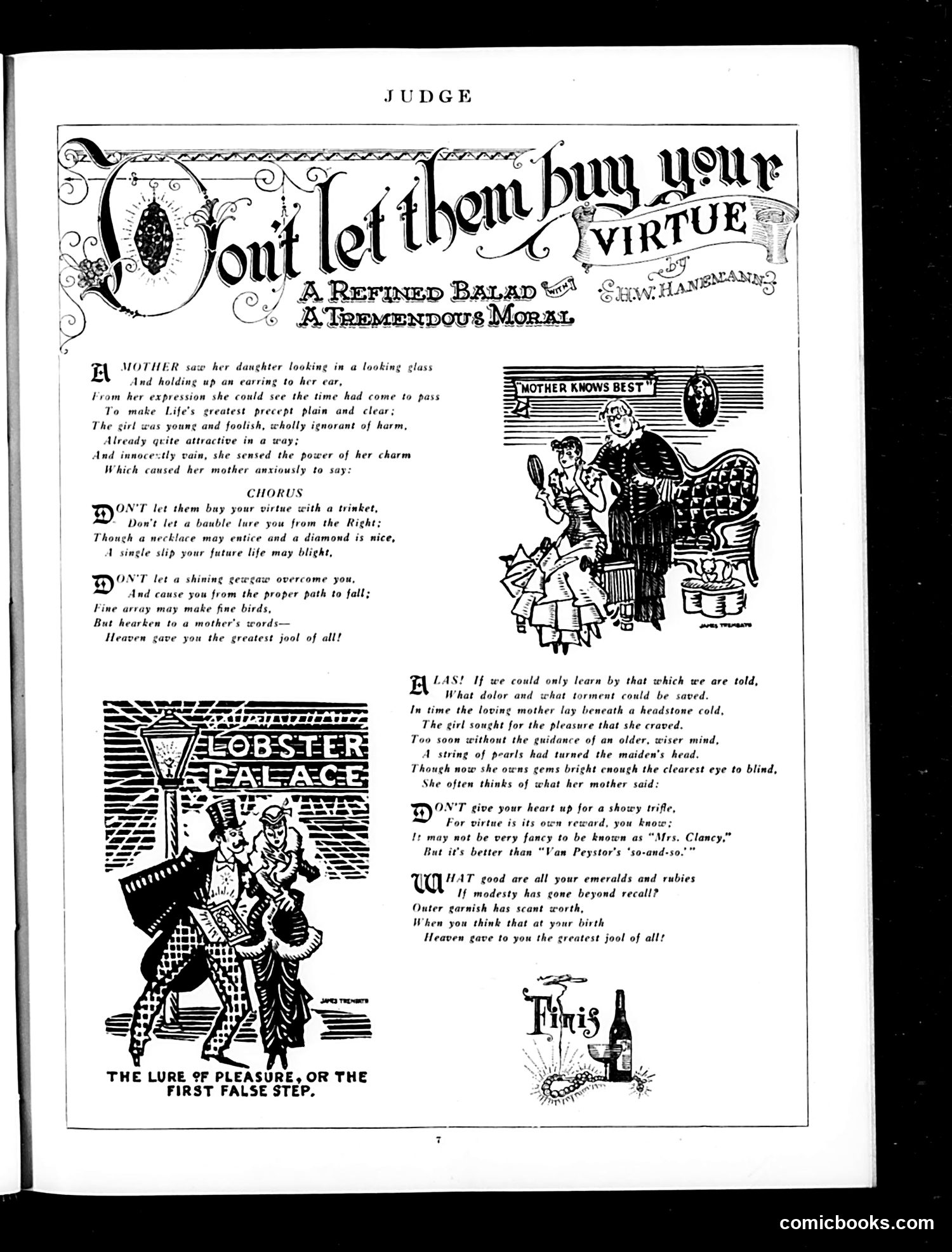
"Don't Let Them Buy Your Virtue" - Judge Magazine This is a cautionary moral tale presented as a "refined balad" warning young women against trading sexual virtue for material goods. The narrative follows a mother advising her daughter against accepting jewelry and fine things from men in exchange for moral compromise. The imagery shows a mother with her daughter, and separately, an illustration titled "The Lure of Pleasure, or the First False Step" depicting what appears to be a woman at the Lobster Palace (a known venue associated with vice). The satire targets the hypocrisy of wealthy men ("Van Peystor's 'so-and-so'") who seduce working-class women with trinkets. The repeated refrain—that virtue is "the greatest jool of all"—contrasts inner worth against external material temptation. The cautionary tale suggests that accepting such gifts leads to ruin, social disgrace (being known as someone's mistress rather than a respectable wife), and loss of respectability. This reflects Progressive-era anxiety about urban vice and the moral vulnerability of young women.
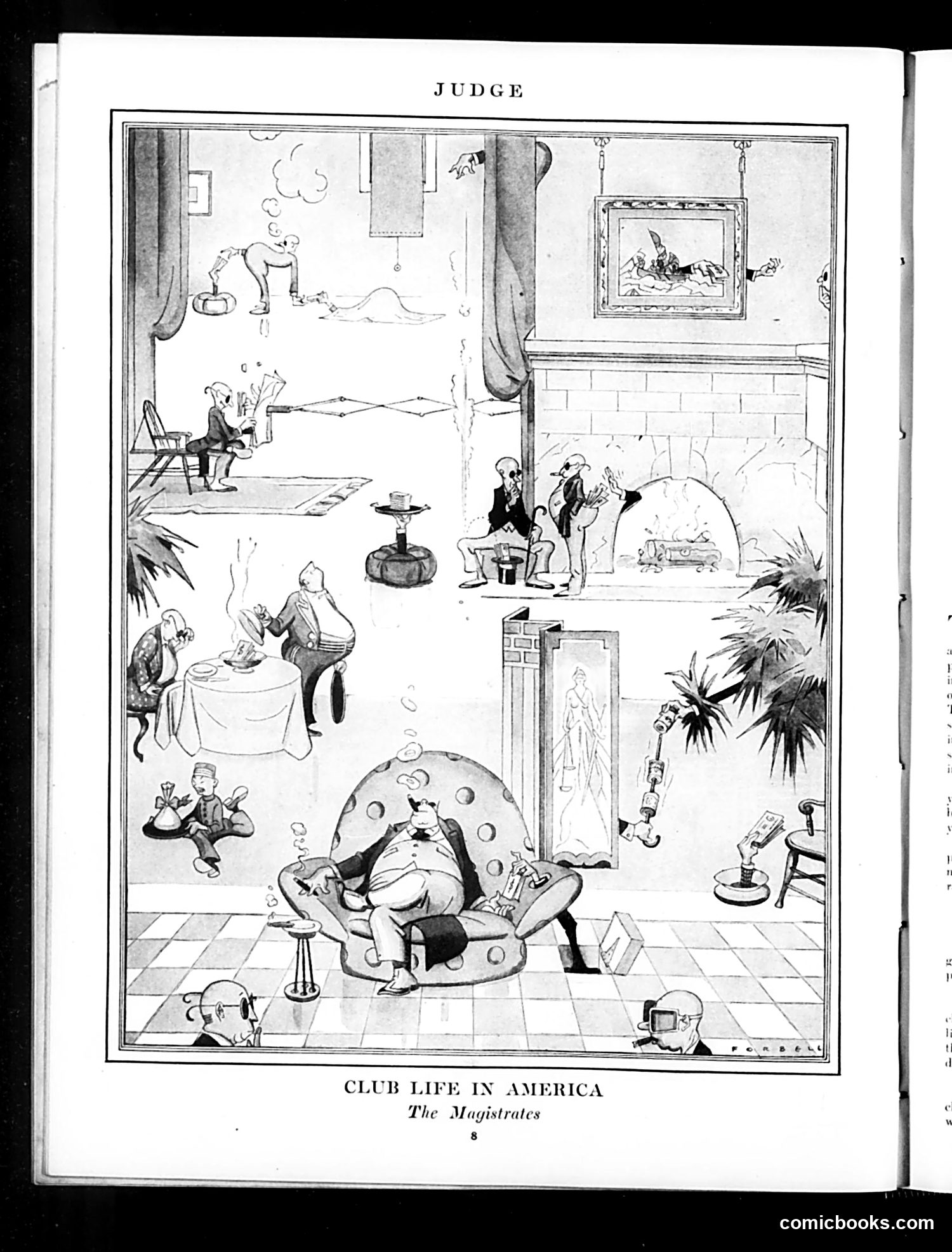
"Club Life in America: The Magistrates" This satirical cartoon depicts an elaborate interior space filled with various figures engaged in leisure activities—dining, socializing, lounging, and recreation. The title "The Magistrates" suggests these are judicial officials or authority figures. The satire appears to mock the leisurely, indulgent lifestyle of magistrates and judges who should presumably be attending to official duties. Instead, they're shown lounging in comfortable club settings, dining, smoking, and entertaining themselves with various diversions. This critiques the perception that legal authorities prioritize personal comfort and social clubs over their judicial responsibilities. The crowded, chaotic composition emphasizes excess and self-indulgence among those meant to uphold law and order—a common Progressive-era critique of judicial privilege and corruption.
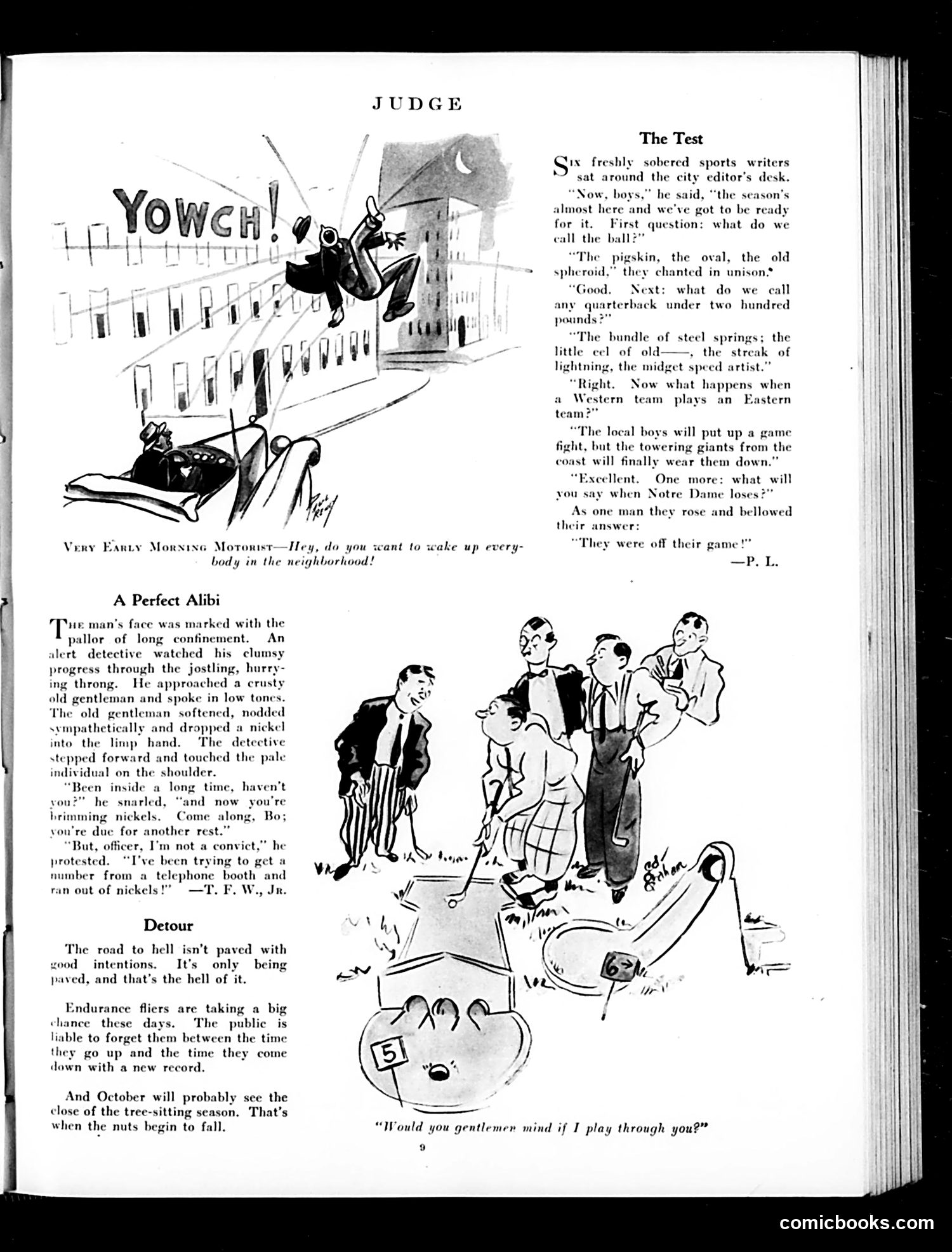
Judge Magazine Page Analysis This page contains three satirical pieces typical of early 20th-century American humor: "Very Early Morning Motorist" mocks inconsiderate drivers who create noise disturbances in residential neighborhoods with their loud automobiles—a new social problem as cars became common. "A Perfect Alibi" satirizes both con artists and gullible charity-givers. A beggar's trick of appearing destitute to solicit nickels is exposed by a detective, but the beggar claims he was actually trying to collect a phone number—implying people are so easily fooled they'd believe any excuse. "The Test" ridicules sports journalists' clichéd vocabulary. The editors mock their writers for using identical, predictable phrases ("pigskin," "towering giants," "off their game") rather than original commentary—suggesting sports writing lacks substance and relies on tired formulas. The page also includes brief commentary on endurance fliers and tree-sitting fads, reflecting contemporary public obsessions with novelty stunts.
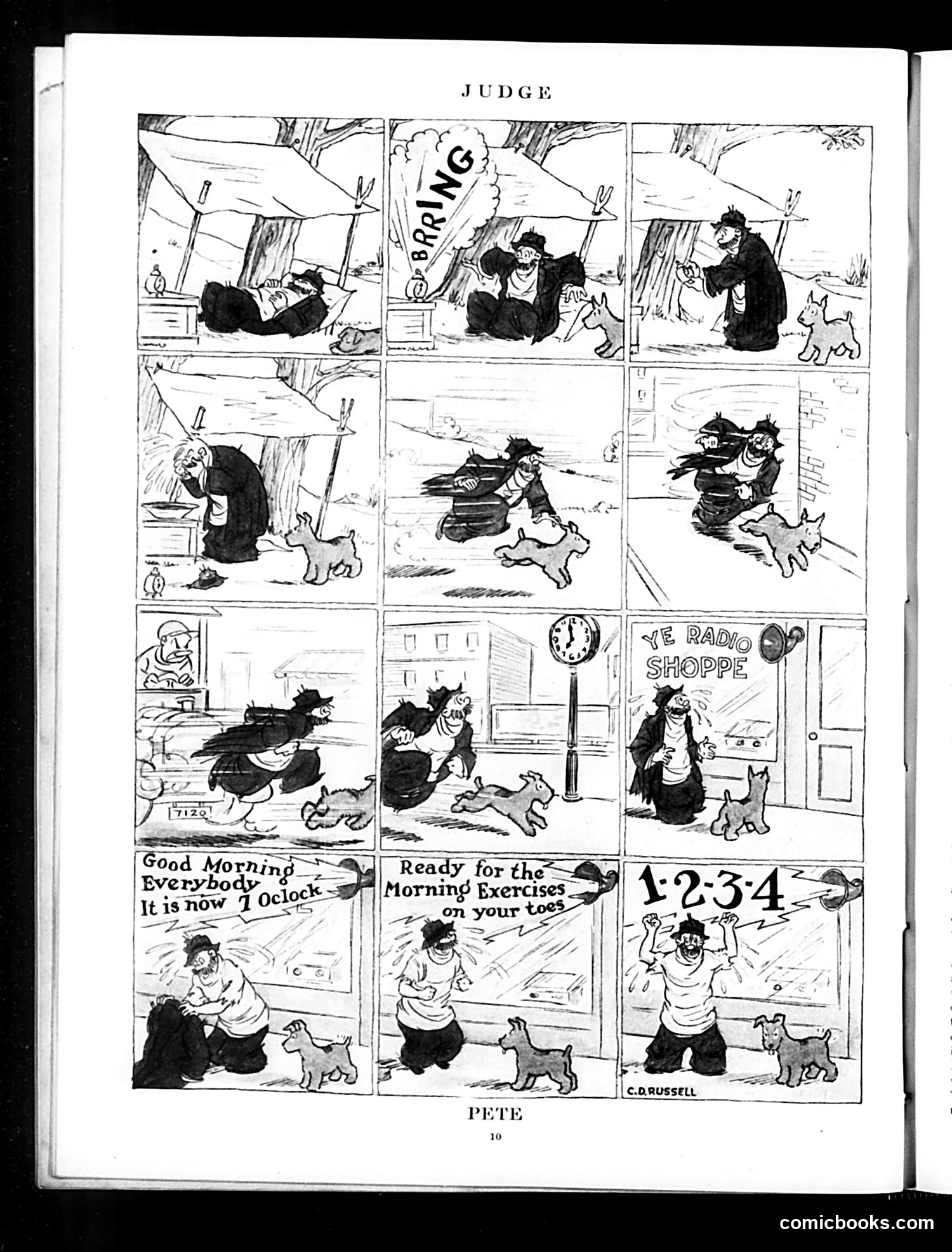
"Judge" Comic Strip Analysis This appears to be a humorous comic strip titled "Pete" (credited to C.O. Russell) following a judge character and his small dog through a morning routine. The strip satirizes the contrast between civic authority and domestic reality. The judge, dressed formally in judicial robes, experiences an undignified series of mishaps involving his energetic dog—slipping, falling, and losing composure as he attempts morning exercises and prepares for the day. The joke plays on the gap between the judge's official dignity and his clumsy, chaotic home life. The "Radio Shoppe" reference and clock suggest contemporary (early-mid 20th century) settings. The humor relies on physical comedy and the visual irony of a respected authority figure repeatedly outsmarted by a small pet, a common comic device mocking pomposity through domesticity.
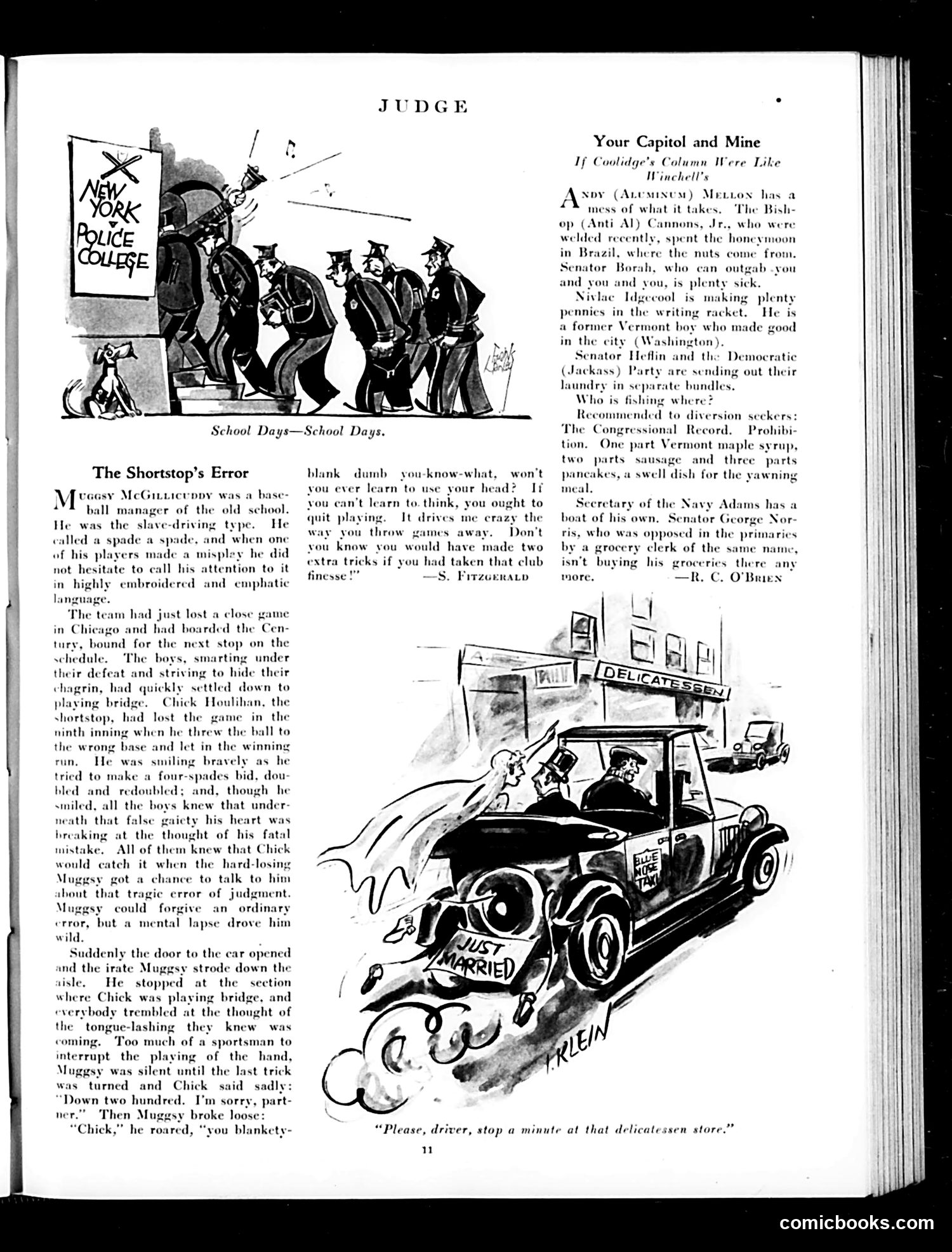
Judge Magazine Page Analysis This page contains two distinct pieces of satirical content: "Your Capitol and Mine" (top right) parodies gossip columnist Walter Winchell's breathless, name-dropping style applied to political figures. It mocks politicians including President Coolidge, Senator Borah, and others with crude nicknames ("Nivlac Idgecool" = Coolidge reversed) and trivial gossip presented as important news. The satire targets both Winchell's sensationalism and politicians' perceived emptiness. "The Shortstop's Error" (left/bottom) is a short story about a baseball player who throws a crucial game-losing error. Manager "Muggsy" is about to berate young shortstop Chick Houlihan, but the interrupting cartoon shows a newlywed couple in a car, with the bride asking the driver to stop at a delicatessen—implying the manager's lecture will be interrupted by the distraction of the passing automobile. The cartoons reflect 1920s preoccupations: celebrity gossip culture, politics, baseball, and the novelty/distraction of automobiles in daily life.
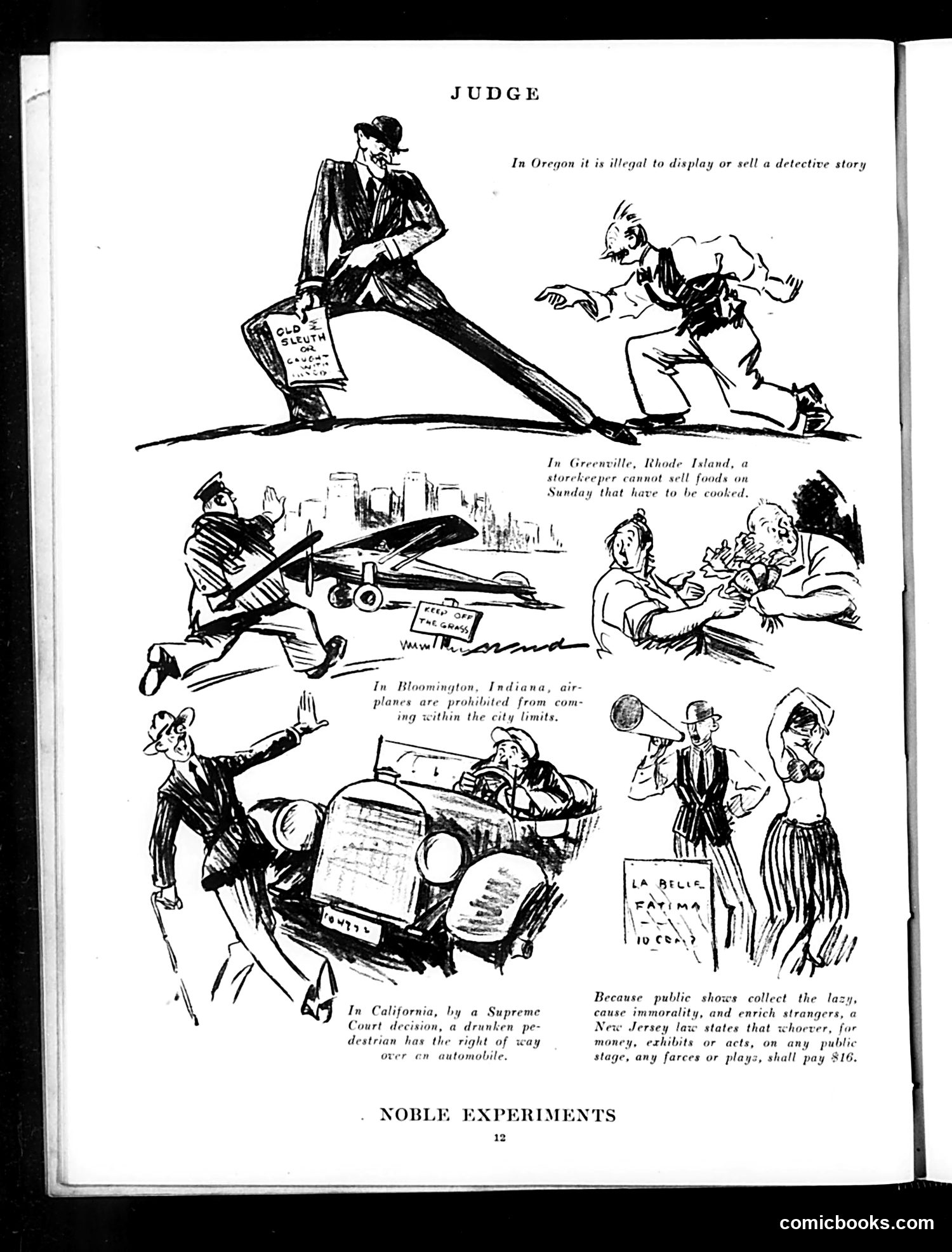
Judge Magazine: "Noble Experiments" This page satirizes absurd state and local laws of the era through cartoons paired with deadpan descriptions. The top illustration shows a figure standing on an impossibly long lever, struggling against another figure—representing the impractical enforcement of these laws. The page catalogs genuine but ridiculous statutes: Oregon banning detective stories, Rhode Island prohibiting cooked foods on Sunday, Indiana barring airplanes from city limits, California granting drunk pedestrians right-of-way over cars, and New Jersey taxing public performances. The final law about shows "collecting the lazy" and "immorality" reflects Progressive Era concerns about entertainment corrupting morals. The satire mocks these "noble experiments"—well-intentioned but unenforceable or absurd regulations—suggesting government overreach into trivial matters. The cartoons' exaggerated struggles visualize the impossibility of enforcing such laws. This reflects contemporary skepticism toward excessive regulation during the early 20th century.
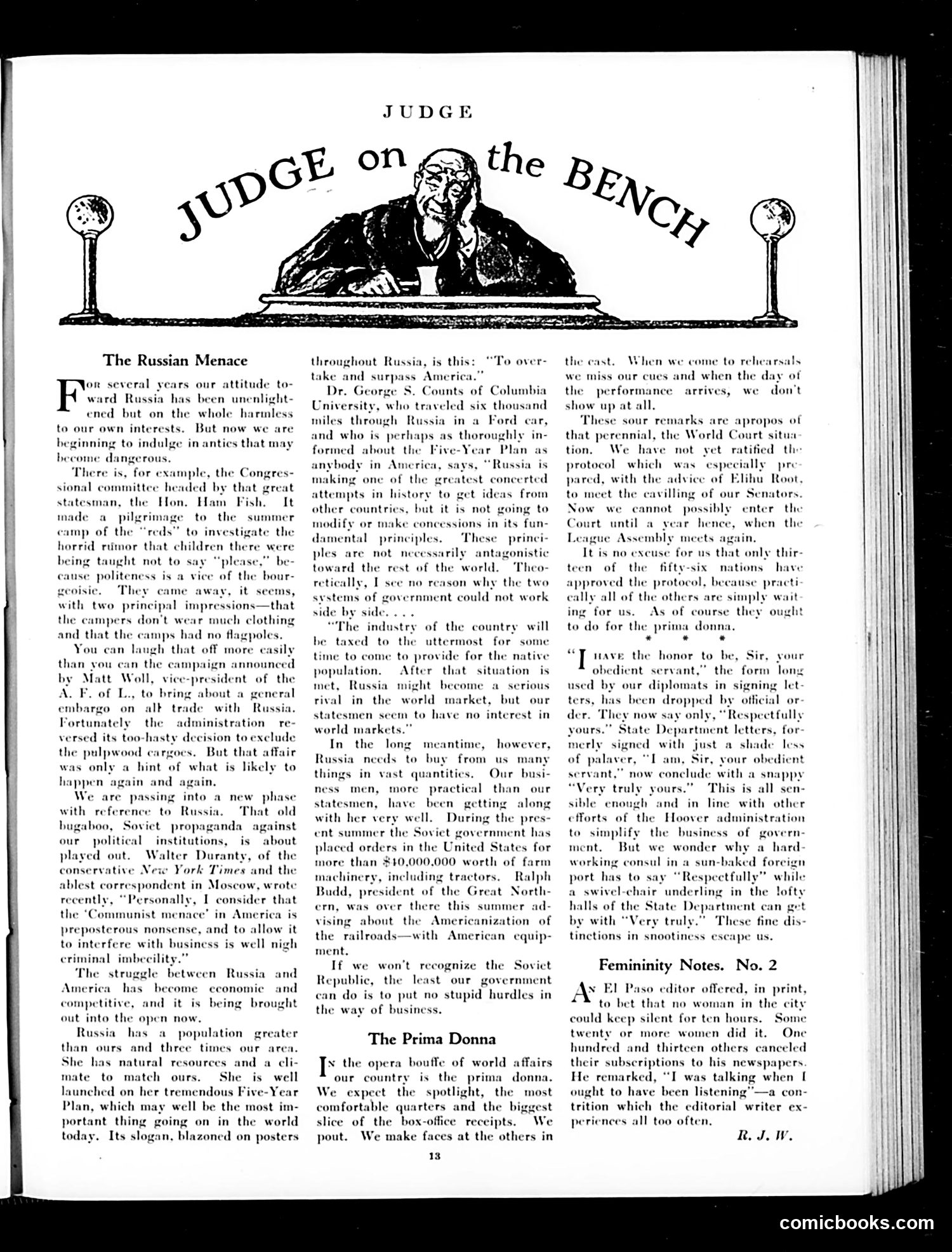
"Judge on the Bench": The Russian Menace (circa 1930s) This editorial argues against anti-Soviet hysteria in America. The writer critiques Congressman Ham Fish's Congressional committee for investigating a communist youth camp over trivial issues (children not saying "please," lack of flagpoles). The piece dismisses Soviet propaganda as a genuine threat, citing Walter Duranty's assessment that the "Communist menace" is "preposterous nonsense." The core argument: Russia and America are now economic competitors, but U.S. business interests recognize mutual benefit—Soviet orders for American farm machinery and railroad equipment ($40 million+) prove practical cooperation works. The satirical point: American politicians create artificial obstacles to trade while businessmen pragmatically profit from Soviet commerce. The "menace" is exaggerated; economic competition, not ideological fear, should shape policy. This reflects 1920s-30s isolationist and business-friendly attitudes toward Soviet trade.
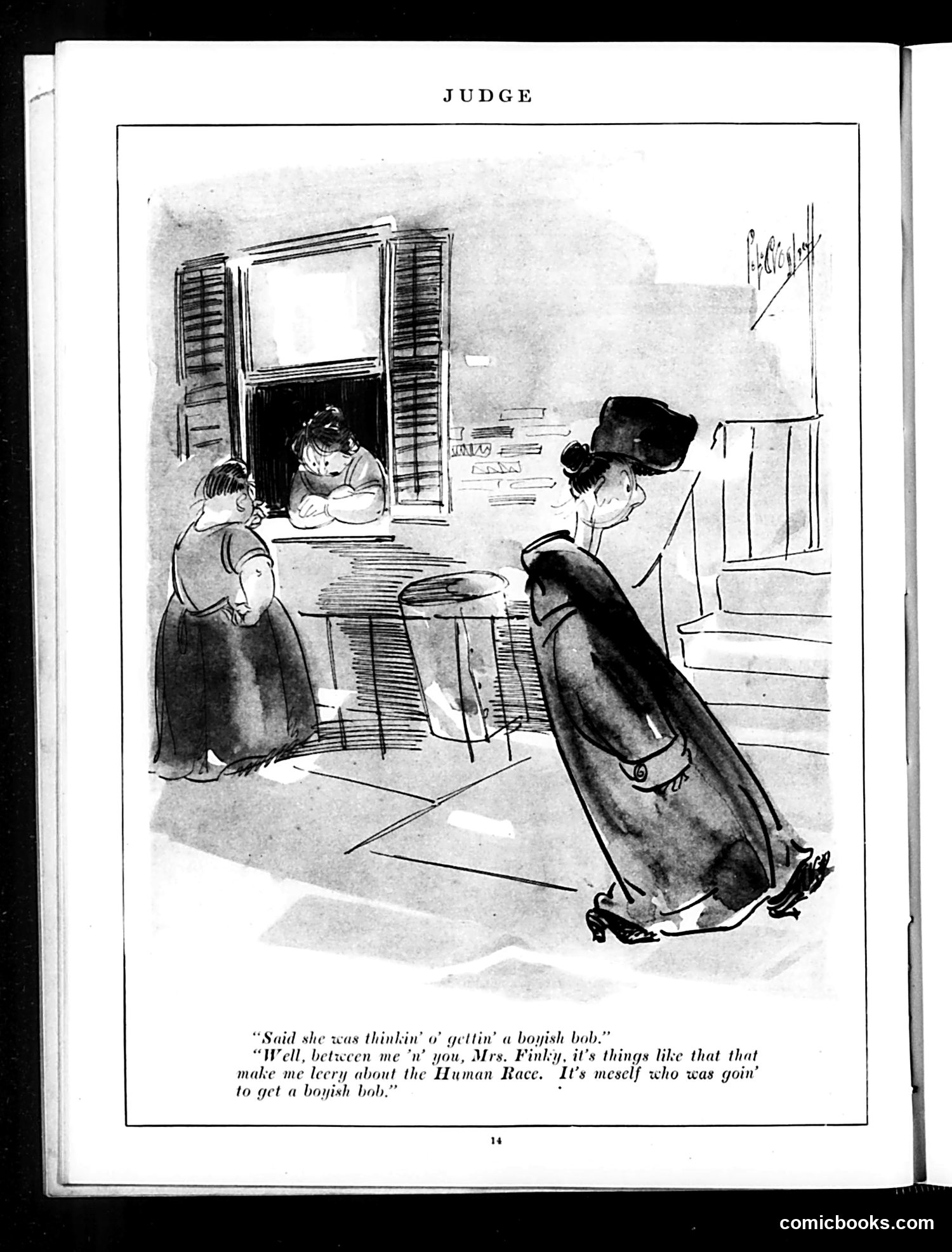
"Judge" Cartoon Analysis This cartoon satirizes the "bobbed hair" trend of the 1920s. Two working-class women discuss a third person's plan to get a "boyish bob"—a short, masculine haircut that scandalized conservative society at the time. The humor hinges on one woman's complaint: she herself intended to get the fashionable haircut, but now that another woman plans the same thing, it no longer appeals to her. The satire mocks both the fickleness of fashion trends and the social anxiety around women adopting masculine styles. The artwork's casual dialect and setting suggest these are ordinary working people, making the point that even among the lower classes, fashion anxiety and status-consciousness drive behavior—a commentary on vanity cutting across social classes.
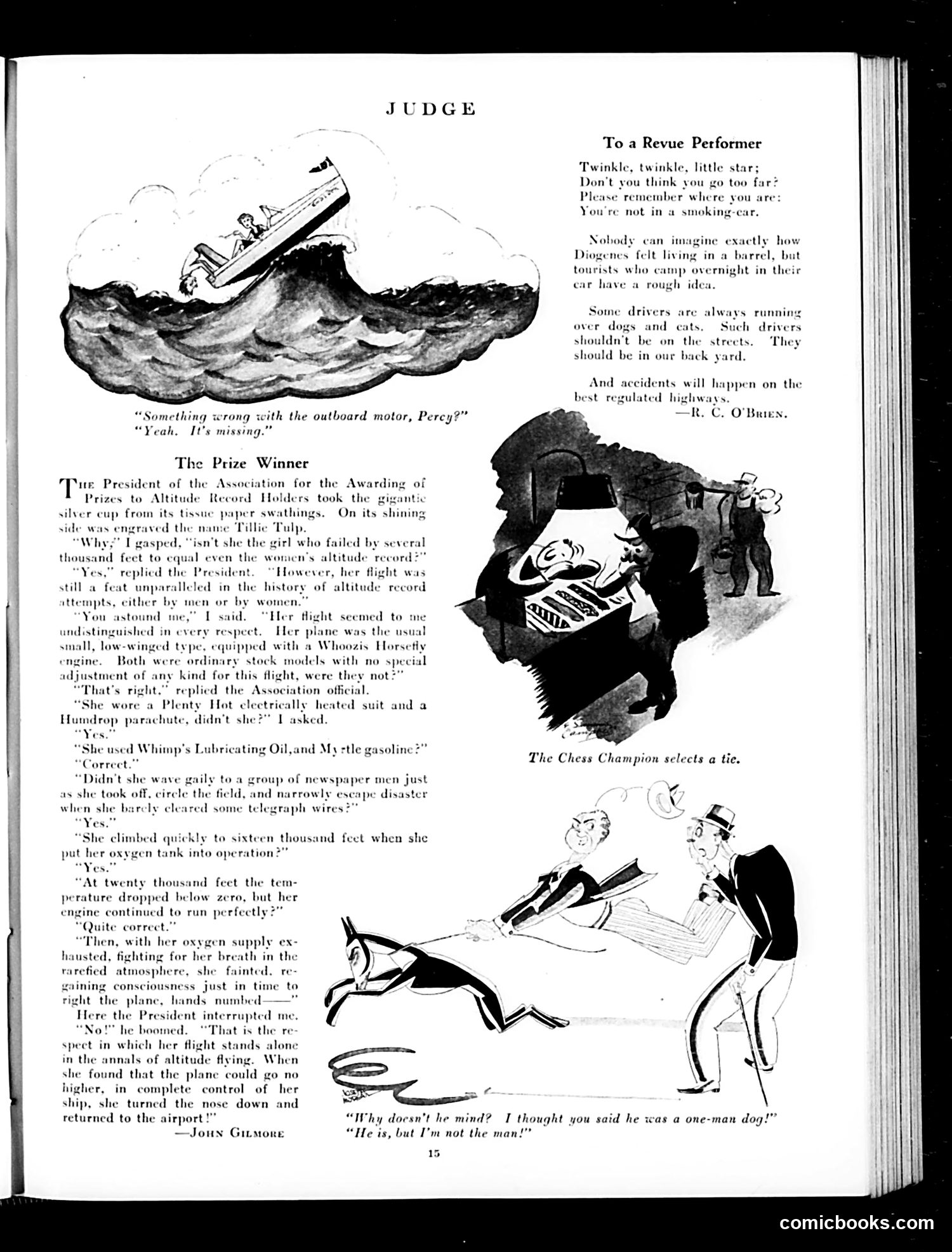
Judge Magazine Page Analysis This page contains satirical pieces mocking commercial product placement and safety culture: "The Prize Winner" satirizes how corporations exploit achievement narratives. The text reveals that a female altitude record holder's achievement is being systematically undermined—she receives a prize despite "failing" to beat existing records, while the narrator sarcastically catalogs every branded product (Whoozis engine, Whimp's Oil, Myrtle gasoline, Plenty Hot suit) she used. The joke: her accomplishment matters less than the advertising opportunities it generates. The twist ending—she *did* possess actual skill (turning the plane down safely)—provides gentle redemption, suggesting real merit exists beneath the commercial noise. Other items include light social commentary: a poem mocking indecorous revue performers, cartoons about reckless drivers and a chess champion, and observations on highway safety. These are typical Judge humor: commentary on contemporary manners, technology, and public behavior. The page satirizes 1920s-era commercialism and how consumer products colonized even achievement narratives.
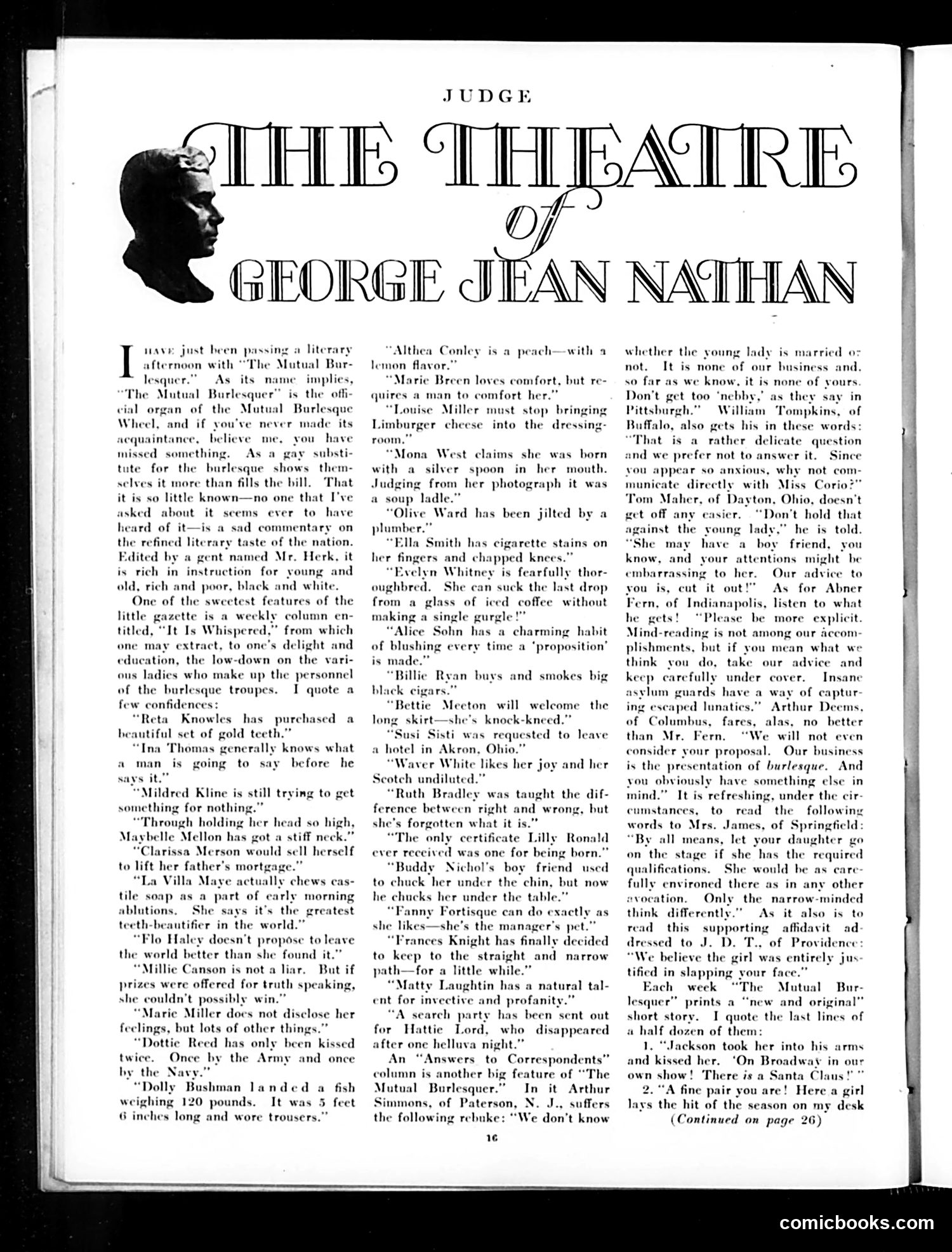
"The Theatre of George Jean Nathan" This page features Judge magazine's satirical column by drama critic George Jean Nathan, presenting himself as an arbiter of theatrical taste. The content parodies "The Mutual Burlesquer," a publication devoted to burlesque theater—a popular American entertainment form featuring scantily-clad performers and comedic sketches. Nathan employs satirical gossip about burlesque performers, presenting crude observations about their appearance, morality, and romantic entanglements. The humor targets both the performers themselves and the lowbrow entertainment industry. His authority as a "refined" literary judge contrasts sharply with his gleeful trafficking in salacious rumors, mocking society's class divisions regarding entertainment. The "Answers to Correspondents" section extends the satire, with Nathan dispensing patronizing advice while criticizing readers for being too nosy about performers' private lives—ironic given the column's content. The satire ultimately mocks pretentious cultural gatekeepers who simultaneously disdain and consume popular entertainment.
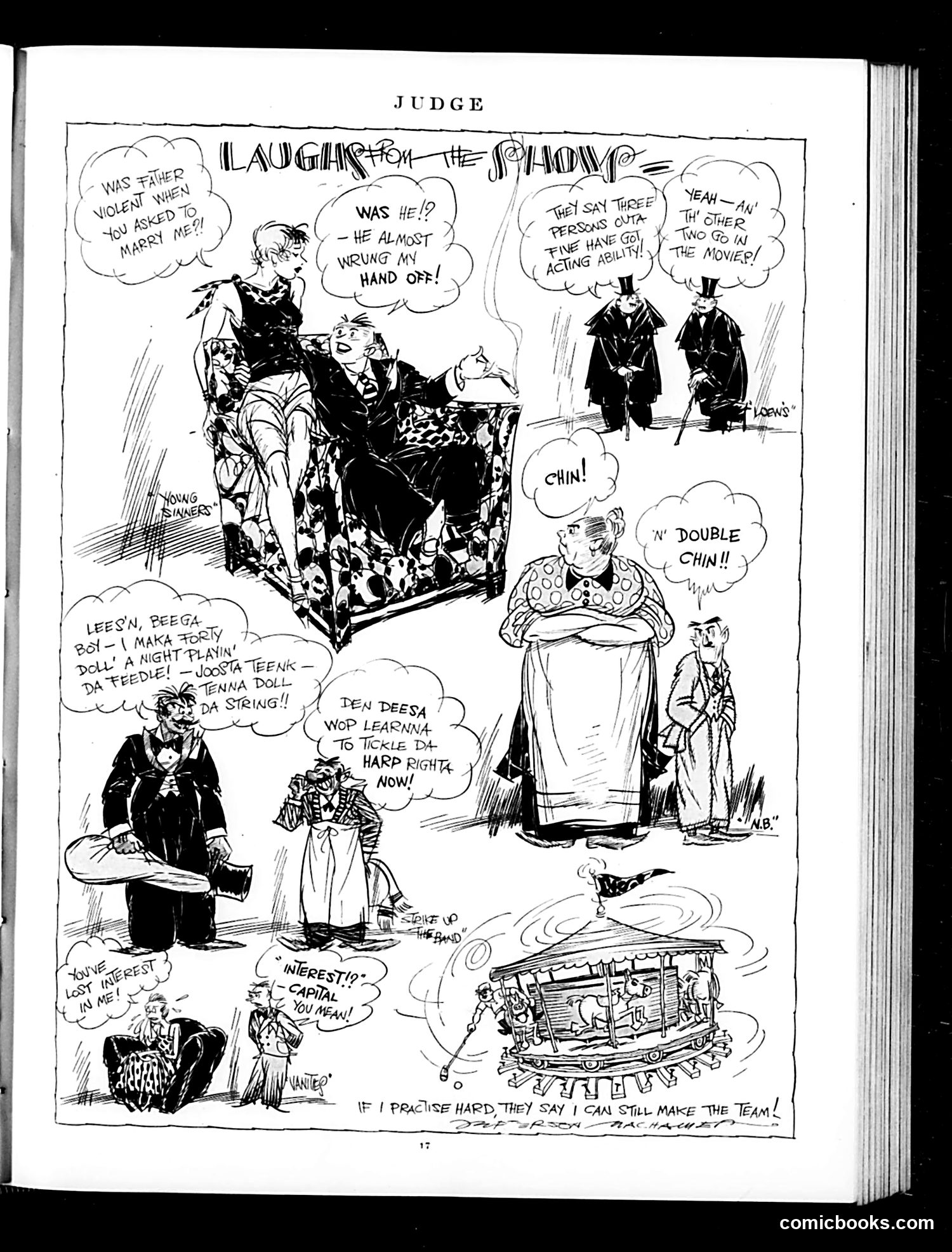
"Laughs at the Show" - Judge Cartoon Analysis This multi-panel satirical cartoon mocks theatrical performers and the entertainment industry's internal hierarchies. The central scene depicts what appears to be a theatrical family or troupe, with dialogue suggesting conflicts over acting talent and casting decisions. The humor relies on ethnic dialect humor (common in early 20th-century American satire), with characters speaking in exaggerated accents ("Leesh'n, Beega Boy," "Wop," etc.). The panels show backstage drama: disputes over hand injuries, debates about acting ability, and attempts to secure roles in movies or theatrical productions. The final caption—"If I practise hard they say I can still make the team"—reframes theatrical ambition as sports competition, suggesting performers view show business as a competitive arena where dedication might overcome talent deficits. The satire targets both aspiring entertainers' desperation and the theatrical world's class consciousness and nepotism, though the execution relies heavily on now-offensive ethnic stereotyping.
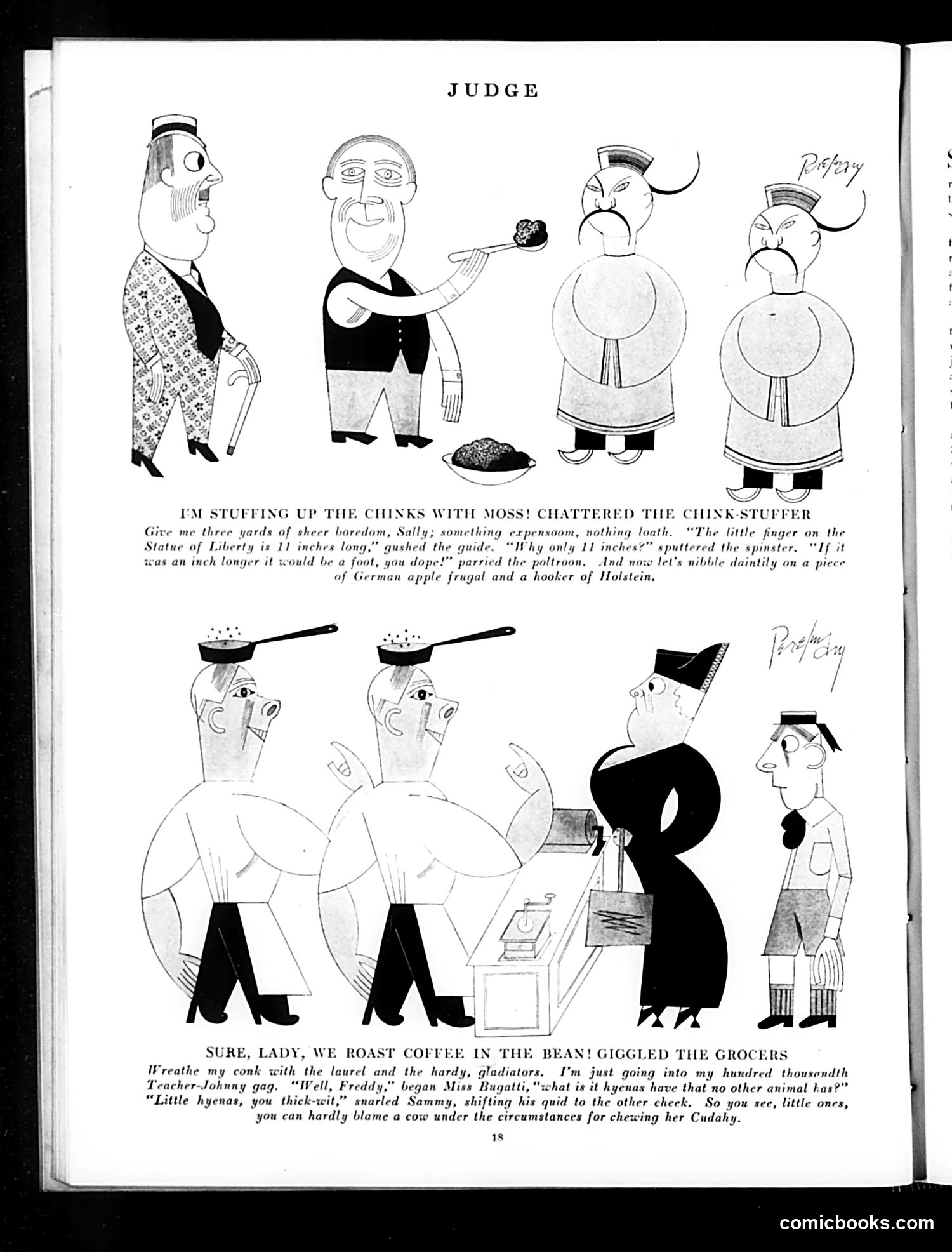
Judge Magazine Satire Analysis This page contains two separate jokes targeting perceived stupidity or gullibility: Top cartoon ("Stuffing Up the Chinks"): Depicts a tour guide and tourists making absurd statements about the Statue of Liberty's proportions—deliberately nonsensical arithmetic ("if it was an inch longer it would be a foot"). The satire mocks both the guide's fabrications and tourists' uncritical acceptance of dubious information. Bottom cartoon ("Roast Coffee in the Bean"): Shows a grocer and schoolroom scene. A teacher asks what hyenas have that other animals don't; a student wisecracks "little hyenas." The grocer similarly gives a ridiculous answer about roasting coffee "in the bean." Both cartoons satirize American consumer culture and education through exaggerated examples of foolish statements and absurd logic. The targets appear to be gullible tourists, incompetent educators/merchants, and the general public's susceptibility to nonsense—common Judge themes mocking American society's intellectual pretensions.
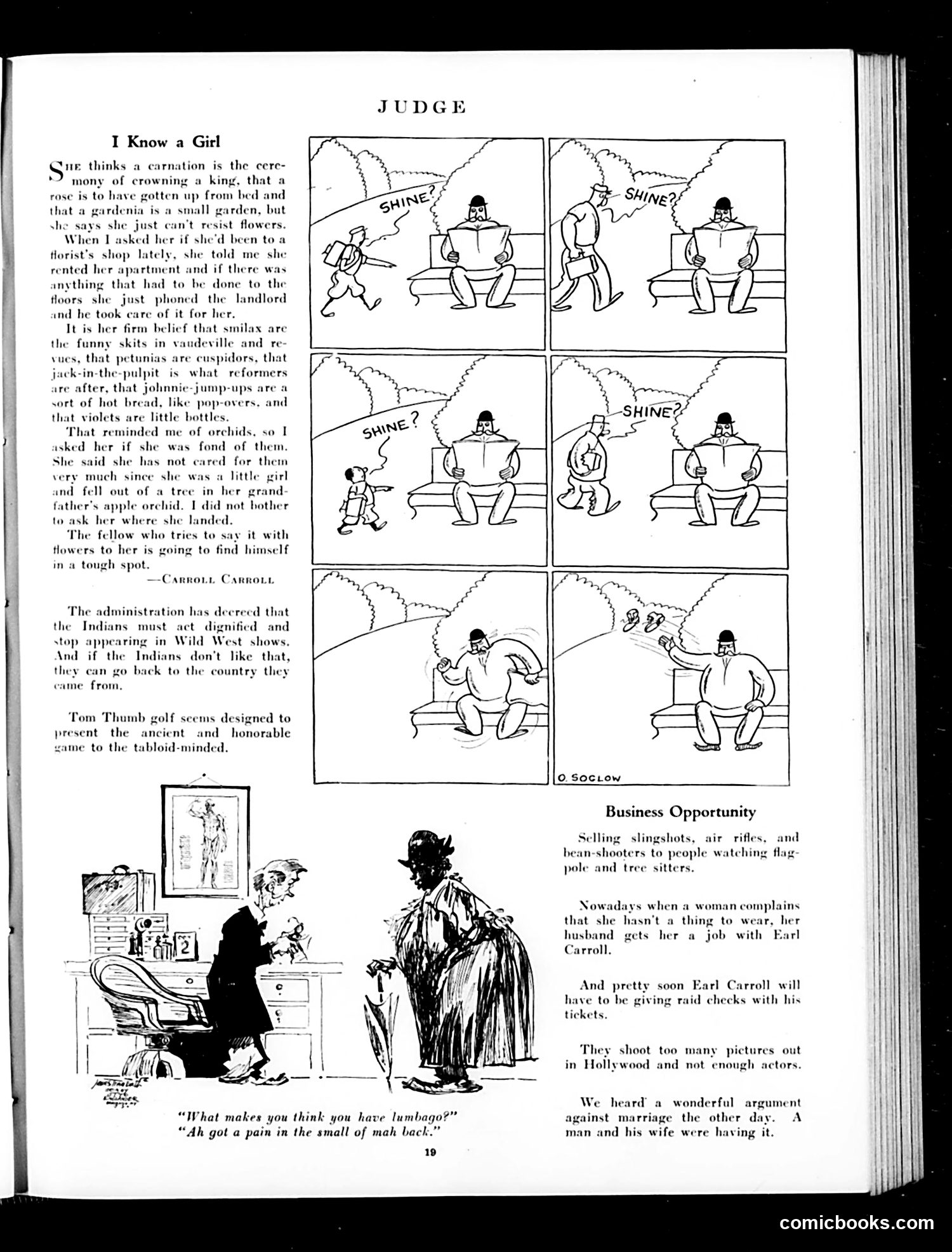
Judge Magazine Page Analysis This page contains several satirical pieces typical of Judge magazine's humor: "I Know a Girl" mocks a woman's profound ignorance of flowers and horticultural terms. She confuses "carnation" with "coronation," thinks "smilax" are vaudeville acts, and "petunias" are spittoons. The humor relies on wordplay and malapropisms—she's hopelessly clueless, making romance difficult for any suitor trying to impress her with flowers. The comic strip shows a large man repeatedly asking "Shine?" to a small boy, who keeps running away in terror. The joke appears to be slapstick—either the man is frightening or the boy is mischievous. Brief satirical notes comment on: - Native Americans being forced to maintain dignity in Wild West shows (social commentary) - "Tom Thumb golf" (miniature golf) as frivolous entertainment - Earl Carroll (a famous Broadway producer) hiring women, implying scandal The page exemplifies Judge's mix of wordplay, visual humor, and social commentary on contemporary American culture and manners.
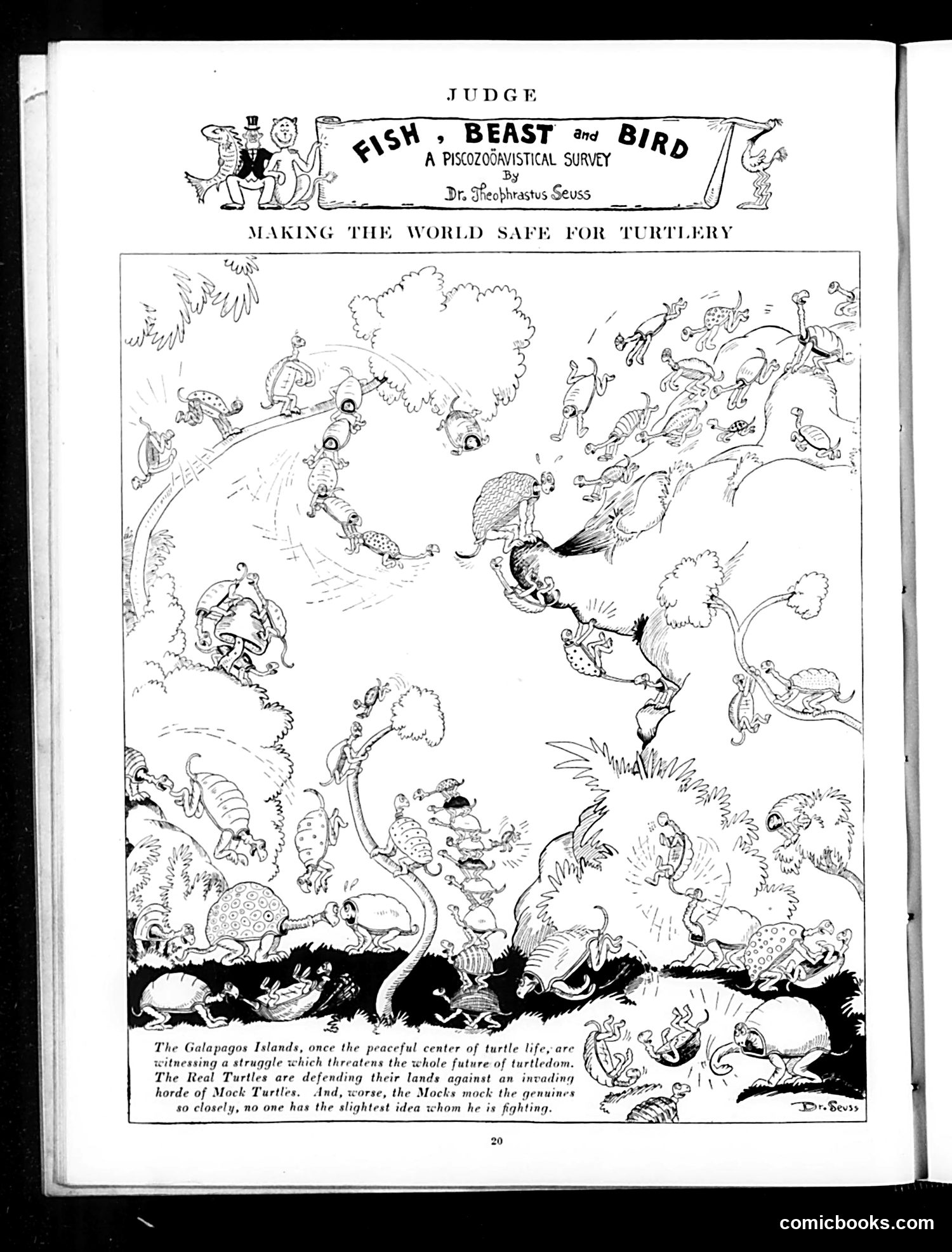
Political Cartoon Analysis This Dr. Seuss cartoon satirizes international conflict, likely referencing World War I or post-war tensions. The "Galapagos Islands" represent a neutral territory, while "Real Turtles" and "Mock Turtles" appear to symbolize opposing nations or factions in a conflict. The satire's central joke: combatants cannot distinguish genuine from fake enemies—mimicry has made identification impossible. This mocks the absurdity of modern warfare where propaganda, disguise, and deception obscure who the "real" enemy is. The subtitle "Making the World Safe for Turtlery" parodies Woodrow Wilson's famous WWI rhetoric about making "the world safe for democracy," suggesting Seuss viewed such grand justifications for war as hollow mockery. The elaborate illustration shows chaotic combat among countless turtle-creatures, emphasizing the confusion and futility of the depicted conflict.
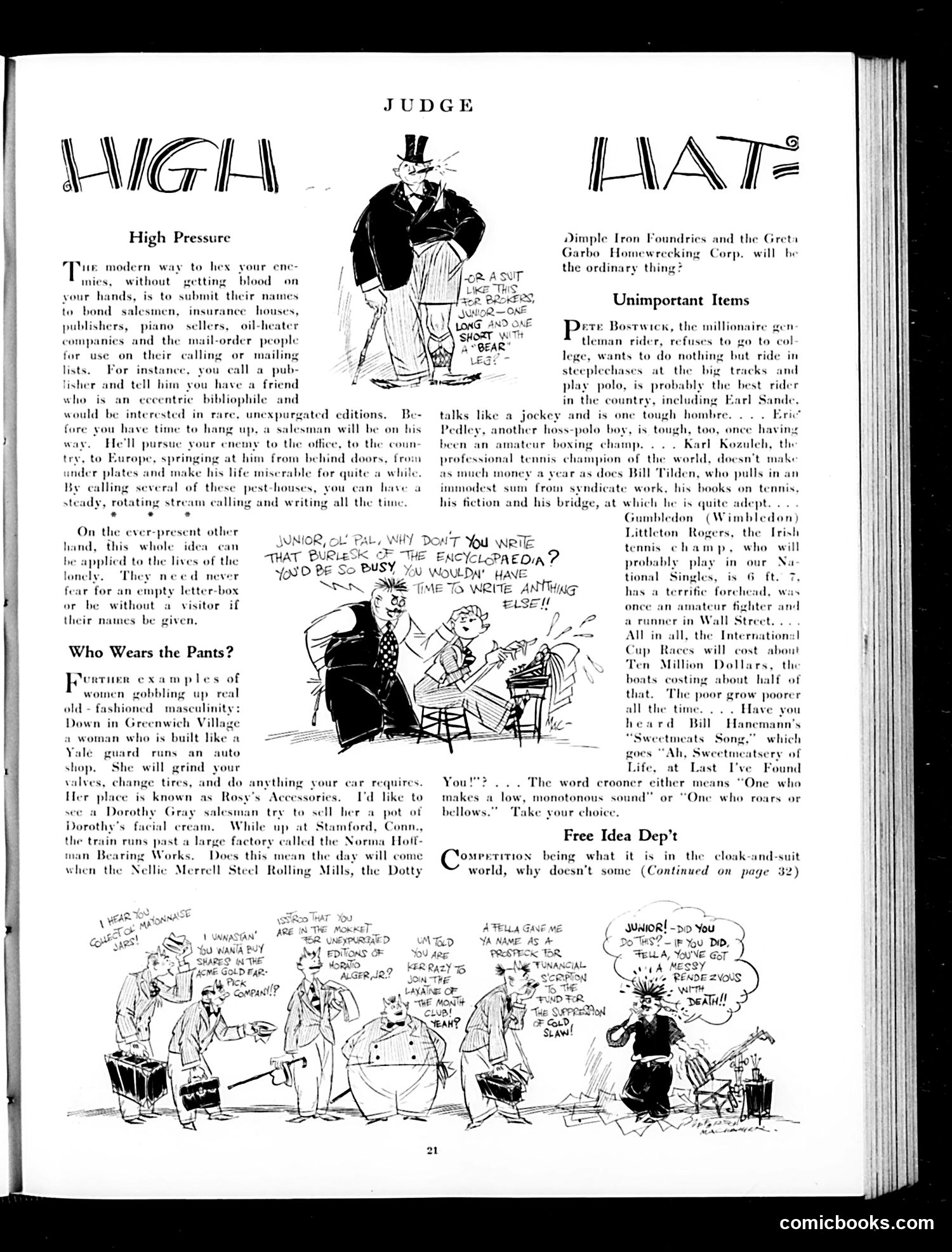
Judge Magazine Satire Analysis This page lampoons early 20th-century American social changes and gender roles through three distinct pieces: "High Pressure" satirizes aggressive sales tactics—how companies exploit mailing lists to relentlessly pursue customers through unsolicited mail and visits, turning everyday life into commercial harassment. "Who Wears the Pants?" mocks the emerging phenomenon of women entering traditionally male-dominated professions. The author lists real examples (a female auto mechanic in Greenwich Village, a factory called "Norma Hoffman Bearing Works") to suggest women are "gobbling up" masculine work, implying this threatens traditional gender hierarchy. The sarcastic tone reflects period anxiety about changing women's roles. "Unimportant Items" gossipy section covers wealthy society figures (polo players, tennis champions) whose social status and leisure pursuits the magazine treats as trivial cultural markers. The cartoons feature working-class or middle-class figures being hassled by salesmen, contrasting with the upper-class leisure activities described. The overall message: modern life brings unwanted commercial intrusion and unsettling social disruption.
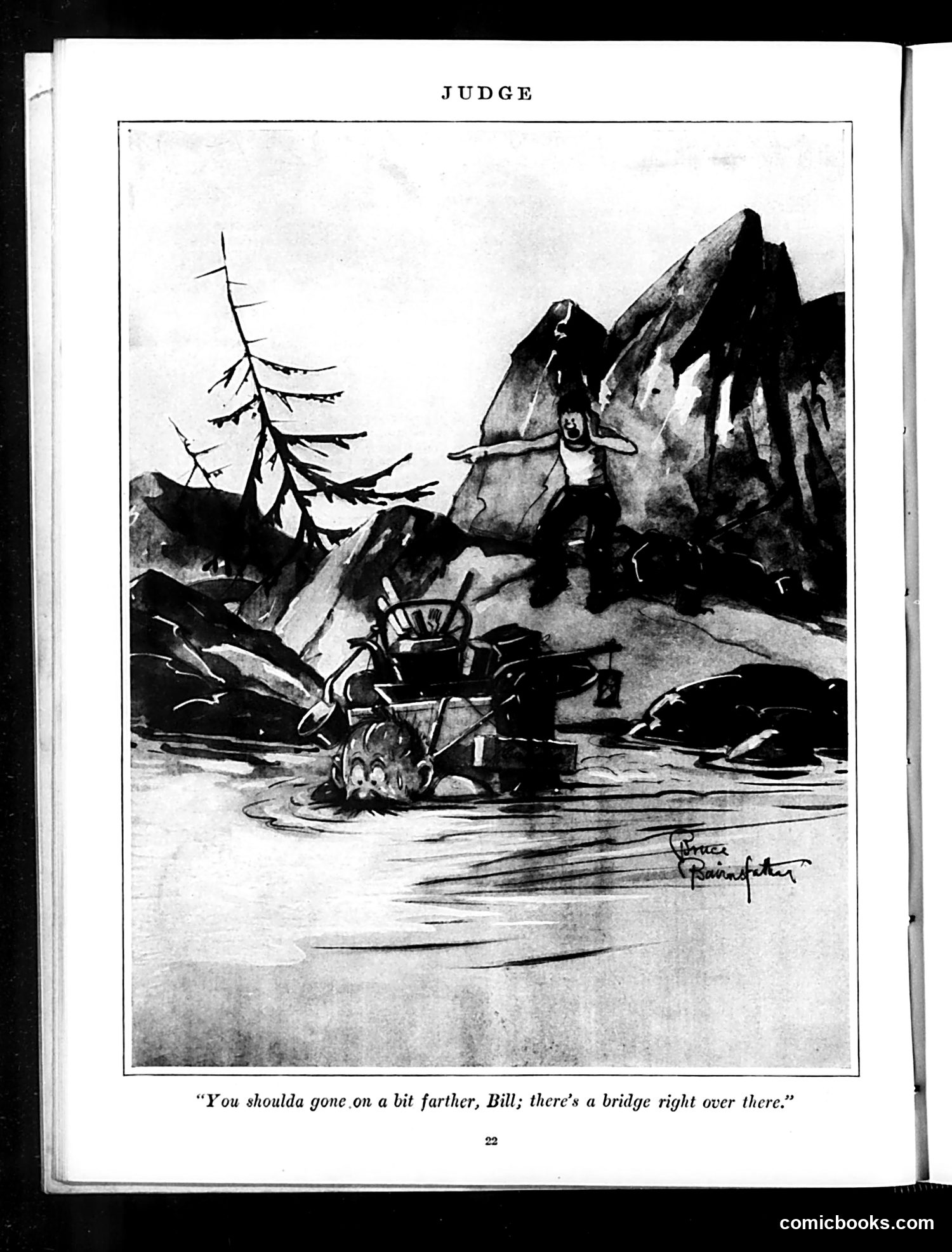
"Judge" Cartoon Analysis This single-panel cartoon shows a crashed or disabled aircraft in a mountainous landscape with a dead or bare tree. One figure advises another named "Bill" that he "shoulda gone on a bit farther" because "there's a bridge right over there." The joke appears to satirize pilot error or poor judgment—Bill has crashed in difficult terrain when smoother passage existed nearby. The cartoon likely mocks incompetence or lack of foresight, possibly referencing early aviation accidents or military pilot mistakes common during the era Judge published. Without knowing the specific date or aviation incident referenced, the precise satirical target remains unclear, but the humor centers on hindsight and avoidable disaster.
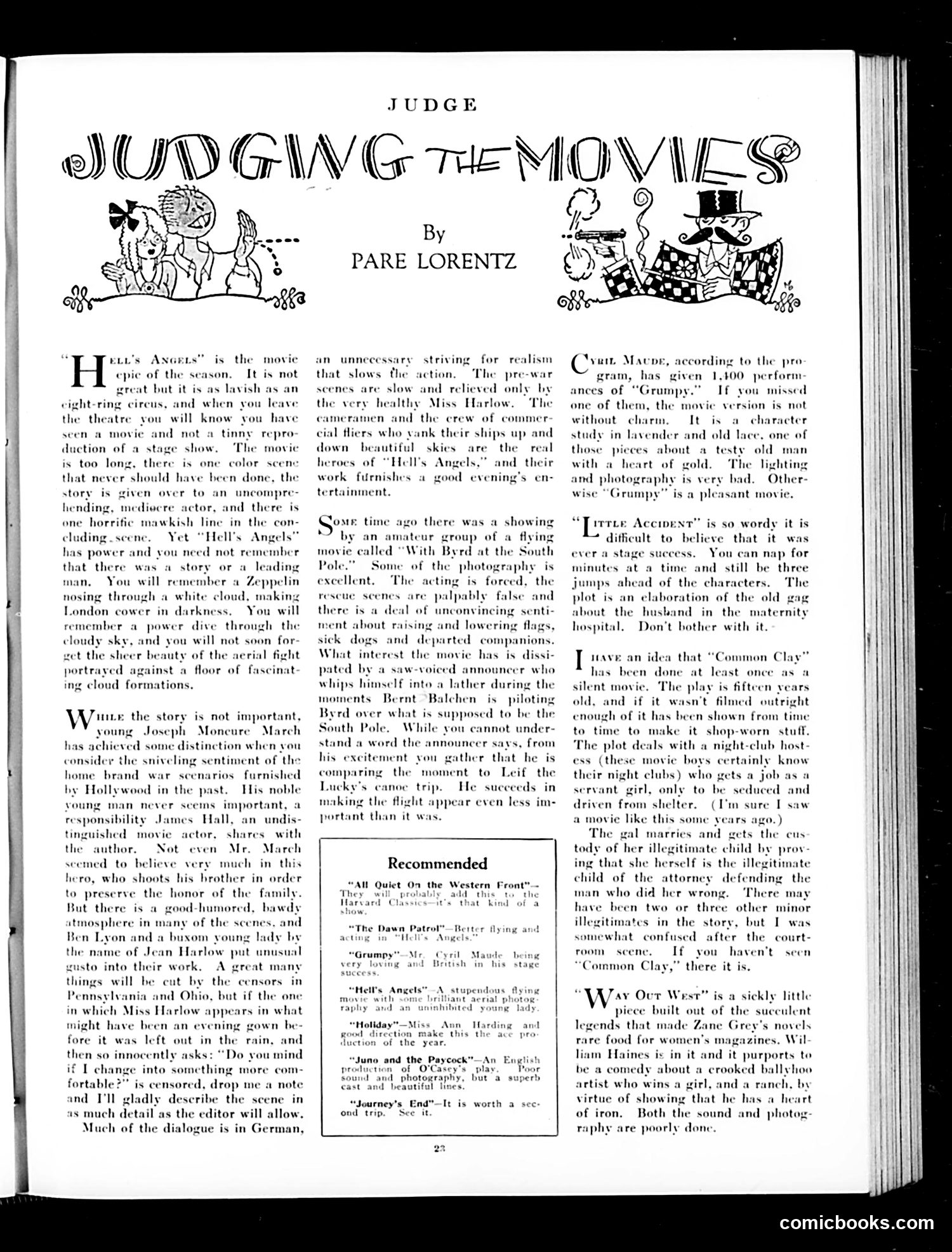
Judge Magazine Film Reviews Analysis This page contains film criticism by Pare Lorentz, reviewing early sound-era movies. The key reviews discuss: "Hell's Angels" — A lavish aerial war film criticized for weak storytelling and an "undistinguished" lead actor (James Hall), but praised for spectacular flying sequences and Jean Harlow's presence. The reviewer notes censorship concerns about a scene where Harlow appears in a wet evening gown. "With Byrd at the South Pole" — An amateur documentary marred by an overwrought, incomprehensible announcer who sensationalizes footage of explorer Bernt Balchen. "Grumpy," "Common Clay," "Way Out West," and others receive brief notices. The satire here targets Hollywood's transition to sound cinema: spectacular visuals compete with poor dialogue and overwrought narration. The Jean Harlow reference suggests Judge's readership appreciated risqué humor about studio attempts to circumvent censorship—a relevant concern during early sound film's controversial period.
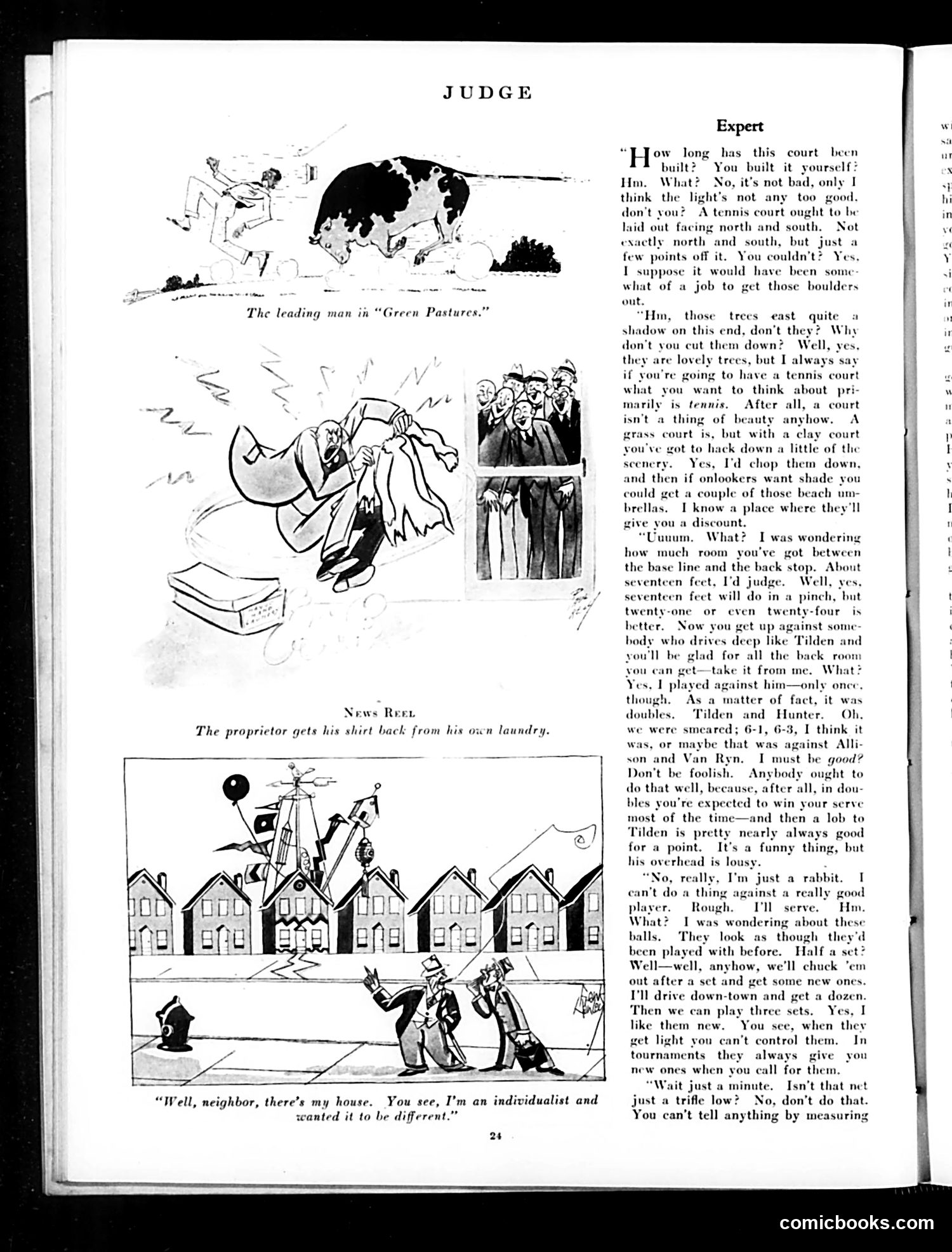
Judge Magazine Satire Analysis This page satirizes tennis snobbery and pedantic expertise. The "Expert" character is a self-important player lecturing a homeowner about his privately built tennis court, offering unsolicited criticism on every detail: the court's orientation, shadows from trees, dimensions, and ball condition. The humor lies in the expert's contradictions and name-dropping. He claims to have played against famous tennis champion Bill Tilden (a celebrity athlete of the era), yet admits playing "only once" and can't remember the exact match. He lectures authoritatively while simultaneously undercutting his own credibility—admitting he's "just a rabbit" (mediocre player) and that even Tilden's overhead is "lousy." The "News Reel" cartoon below mocks individualism: a man insists his house is different while it's identical to all neighbors' houses. Together, these pieces mock American pretension—the tendency to pose as an expert while revealing ignorance, and to claim uniqueness while conforming.
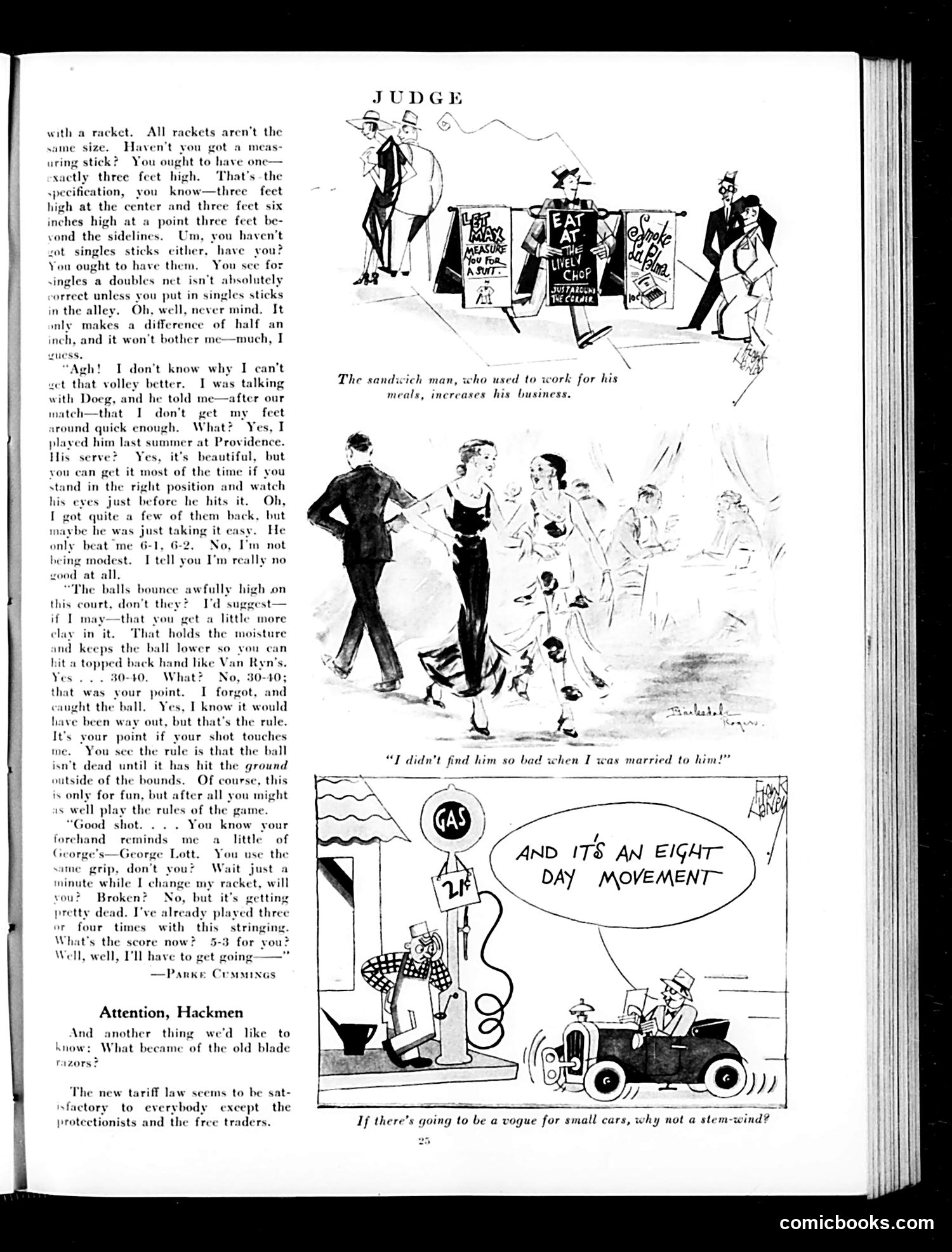
Analysis of Judge Magazine Page This page contains two main satirical pieces: Top Section - Tennis Commentary: A lengthy monologue by an insufferable player offering unsolicited advice about tennis technique, equipment, and rules. The satire targets social pretension: the speaker name-drops players (appears to reference real tennis figures like "Doeg" and "Van Ryn"), boasts about playing famous opponents, and condescendingly corrects others on obscure regulations—all while claiming false modesty ("I'm really no good at all"). The humor lies in exposing the pompous amateur who mistakes pedantry for expertise. Bottom Section - Street Scene Cartoons: Three illustrated gags about urban life. One depicts a sandwich-board advertiser claiming his business boomed—satirizing desperate advertising methods. Another jokes about tariff law policy satisfying neither protectionists nor free traders. The final cartoon shows a small car with an "eight-day movement" (a clock mechanism joke), mocking the new vogue for compact automobiles. The page overall satirizes contemporary social pretension, commercial absurdity, and political gridlock typical of 1920s-era American satire.
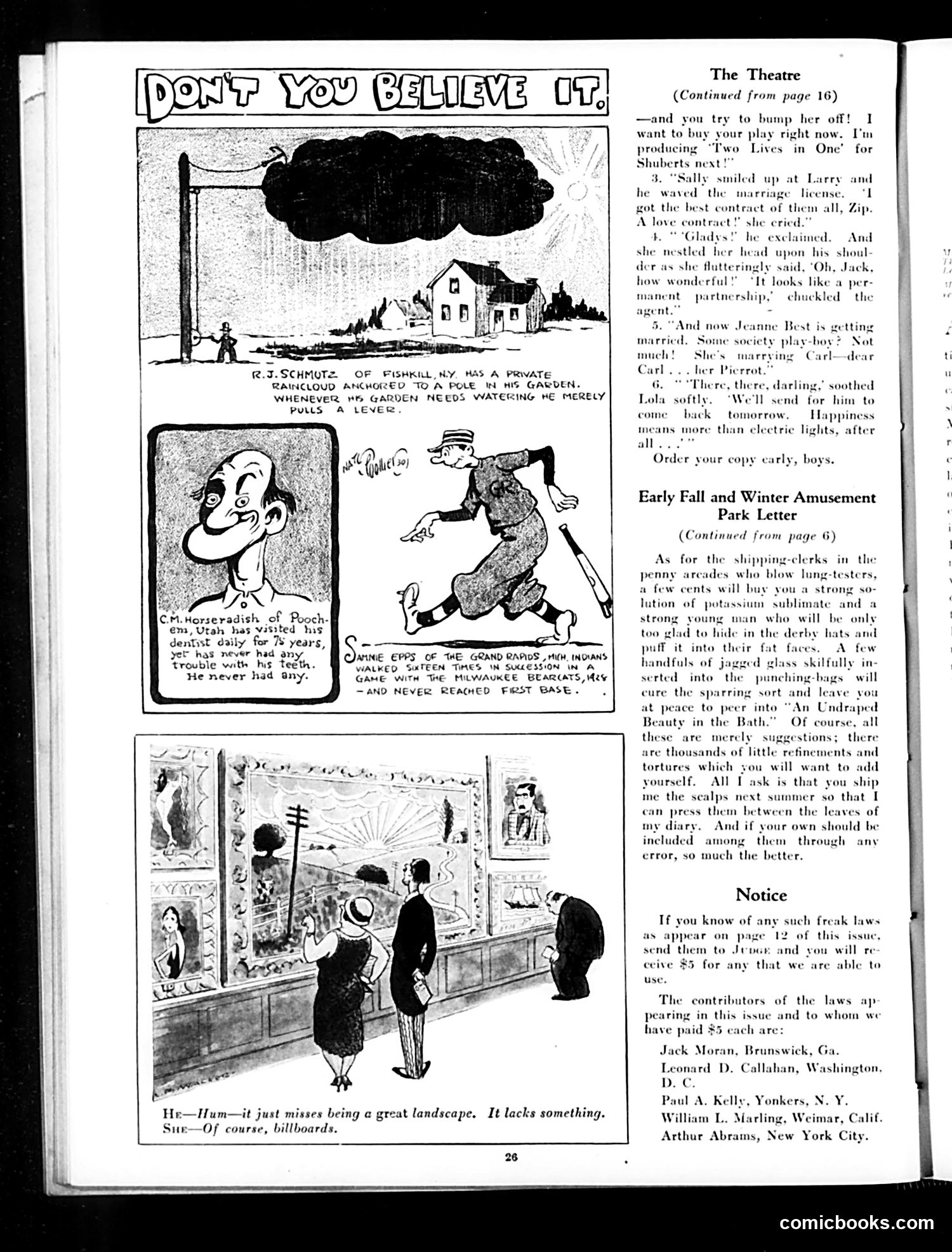
Judge Magazine Page Analysis This page from Judge magazine contains several satirical humor pieces typical of early 20th-century American comedy: "Don't You Believe It" presents absurd tall tales mocking credulous readers—a man with a controllable raincloud, another who visited his dentist 78 years without teeth problems because he had no teeth to begin with, and a baseball player who walked sixteen times without reaching base. The landscape cartoon jokes about how billboards have become so ubiquitous in American life that a painting lacks authenticity without one—satirizing the commercialization of the American landscape. "The Theatre" section continues gossip about theatrical personalities and productions, while the "Early Fall and Winter Amusement Park Letter" offers darkly humorous "suggestions" for pranks against arcade workers, including poisoning and hidden glass—exaggerated satire on class tensions and workplace frustrations. The Notice section lists contributors who submitted "freak laws" for publication, apparently a recurring Judge feature collecting unusual state or local statutes.
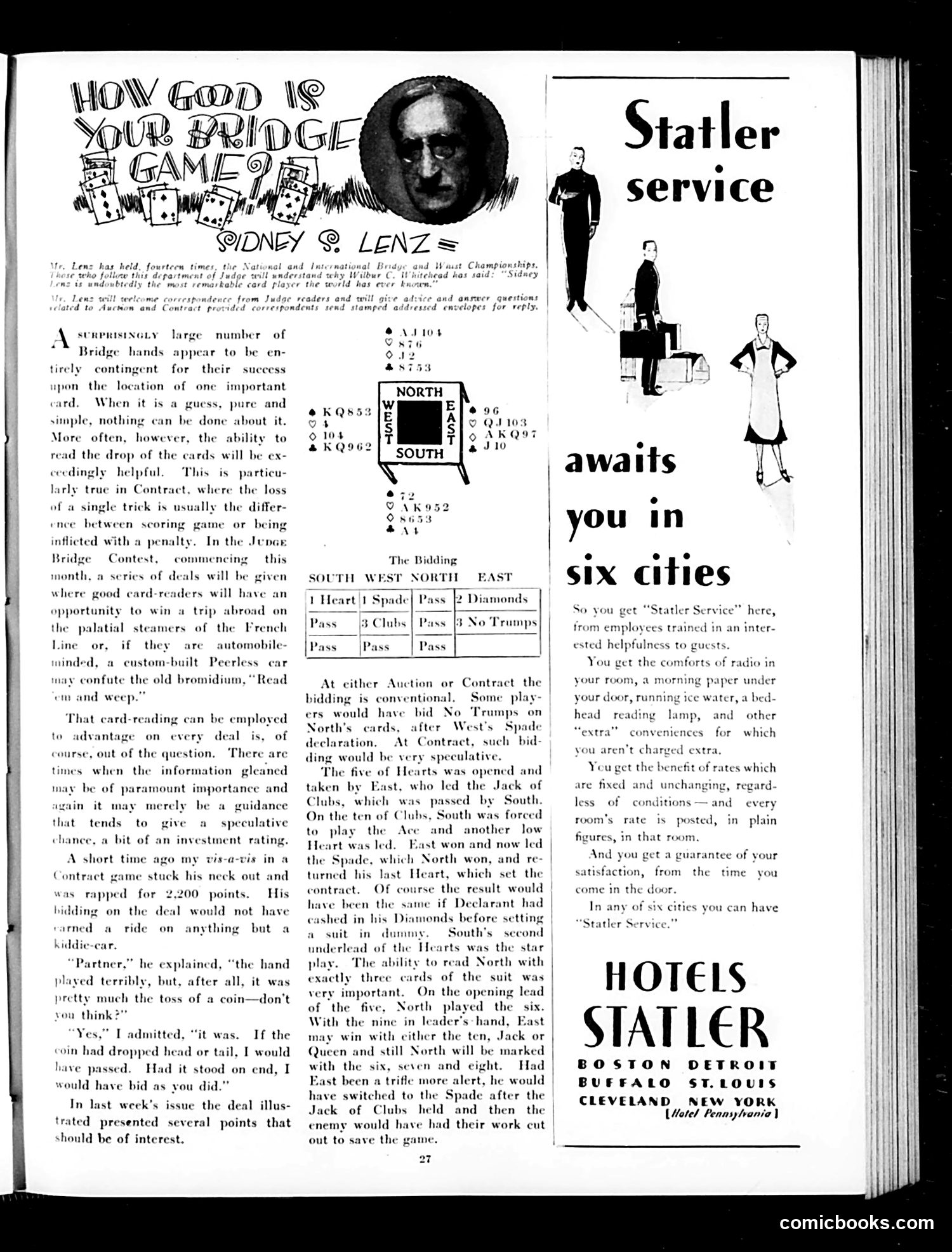
Analysis This page contains two unrelated items: a bridge strategy article and a hotel advertisement. The Bridge Content: The left side features "How Good Is Your Bridge Game?" by Sidney Lenz, a famous bridge player. The article analyzes a specific contract bridge hand, explaining card-reading strategy—the ability to deduce opponents' hidden cards from their plays. It's instructional rather than satirical, part of Judge's regular bridge column that offered readers chances to win prizes (a French Line cruise or custom Peerless automobile) by correctly analyzing bridge deals. The Advertisement: The right side advertises Statler Hotels, a major American chain with locations in Boston, Detroit, Buffalo, Syracuse, Cleveland, and New York. It emphasizes their standardized service ("Statler Service")—trained staff, room amenities like radios and reading lamps, posted rates, and service guarantees. This is straightforward advertising, not satire. The page is primarily educational and commercial content, not political or satirical commentary.
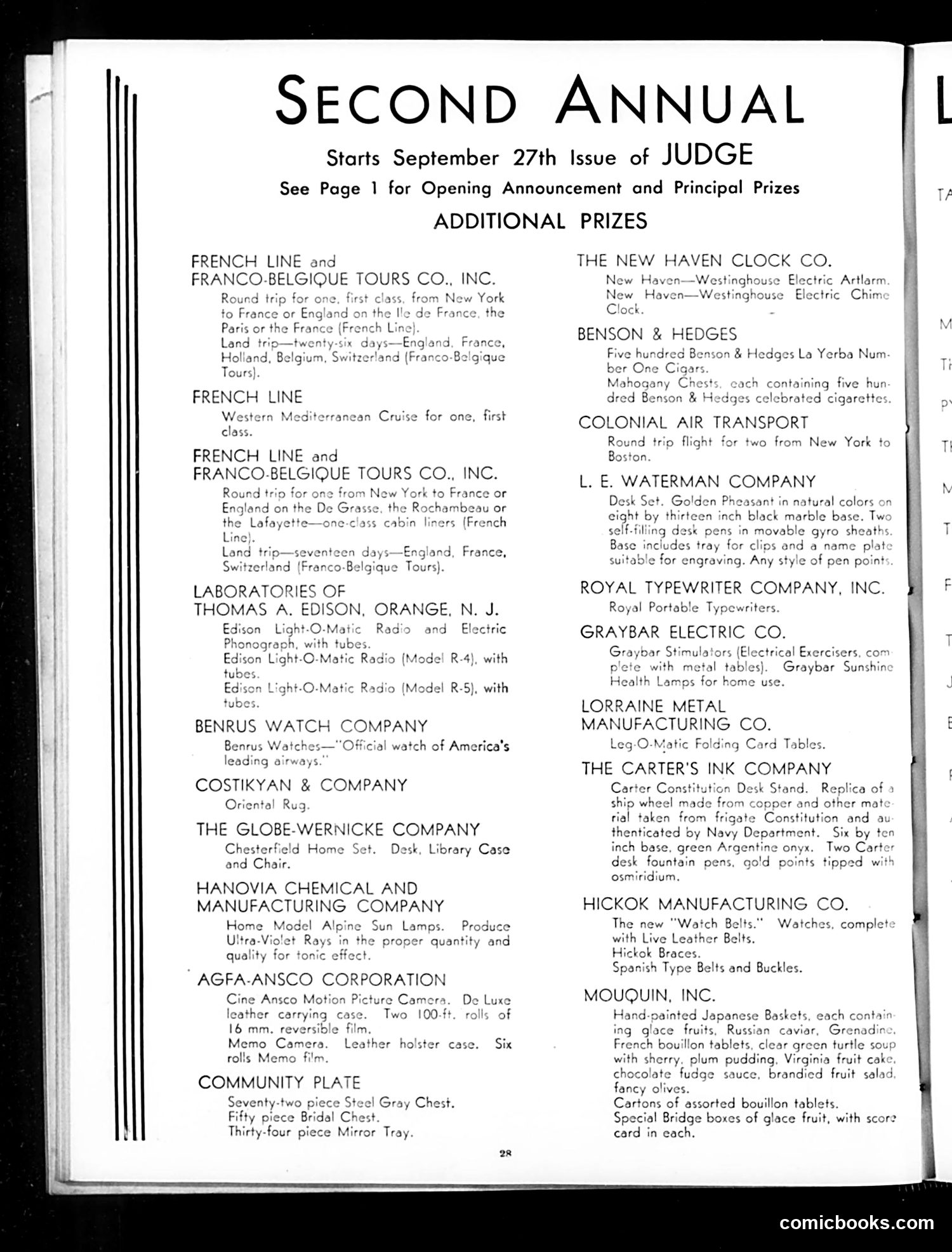
Analysis: This Page is Primarily Advertising This is not a cartoon or editorial page—it's a prize announcement and advertisements page from Judge magazine's "Second Annual" contest (starting September 27th). The page lists dozens of commercial prizes donated by companies: travel packages (French Line cruises), electronics (Edison radios, Graybar lamps), luxury goods (Benrus watches, Royal typewriters), food items (Mouquin delicacies), and office supplies (Carter's ink, Waterman pens). Historical context for modern readers: This reflects 1920s-30s consumer culture, showcasing then-cutting-edge technology (Light-O-Matic radios, electric exercise stimulators) and aspirational luxury (transatlantic cruises, Japanese hand-painted baskets). The corporate sponsors represent both established brands (Edison, Waterman) and now-defunct companies. No satire is present here—this is straightforward commercial promotion, typical of how magazines generated revenue and reader engagement through prize contests.
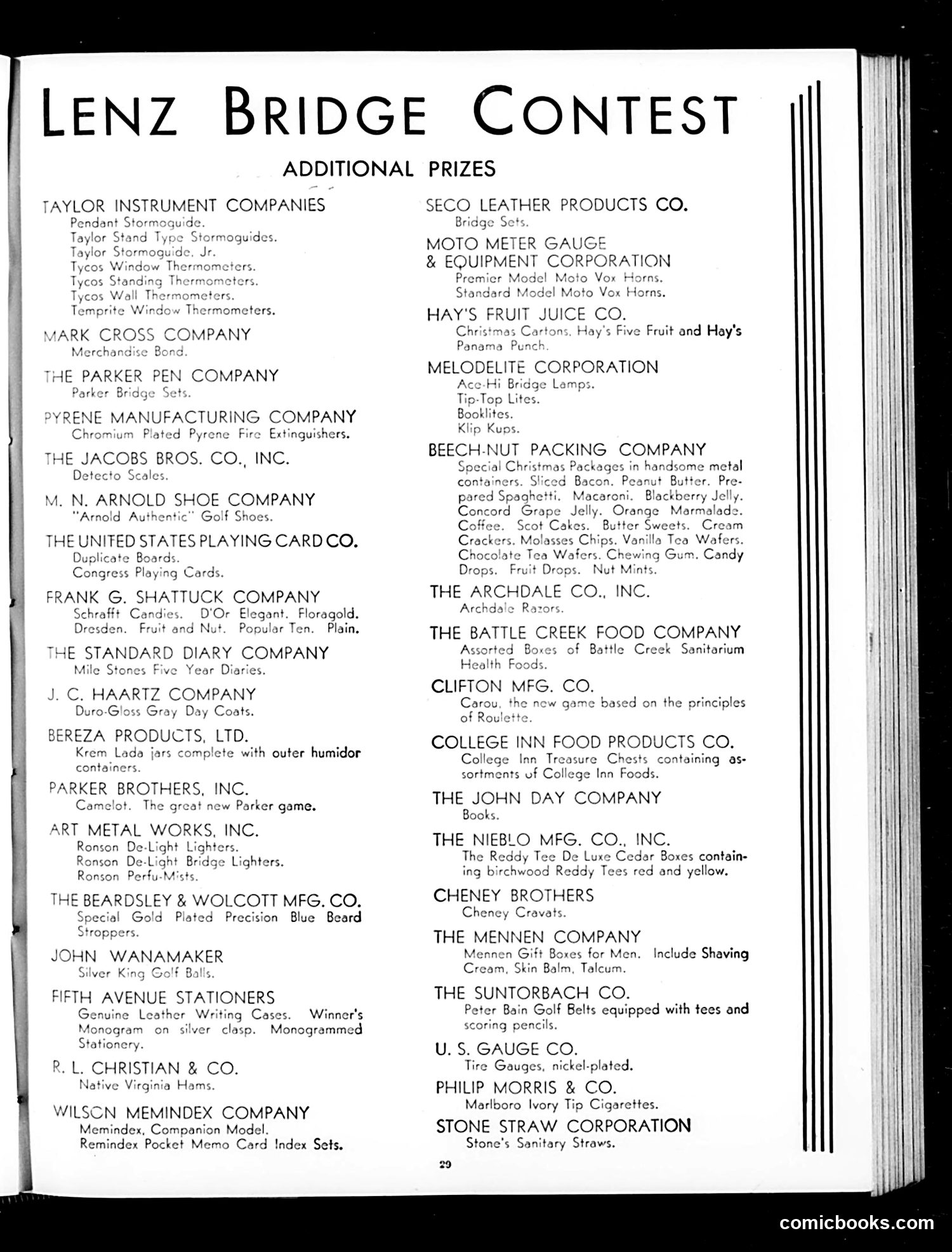
Lenz Bridge Contest - Additional Prizes Page This is a prizes/advertising page, not a satirical cartoon. It lists companies offering prizes for the "Lenz Bridge Contest"—likely a bridge-building or bridge-design competition popular in early-to-mid 20th century America. The page functions as sponsor advertising: companies like Taylor Instrument, Parker Pen, Schrafft's Candies, Beech-Nut Foods, Mennen, and Philip Morris donated merchandise as contest incentives. This was common practice—contests generated publicity while sponsors gained brand exposure. Notable is the era reflected: products like tire gauges, playing cards, leather writing cases, and cravats suggest the 1920s-1940s timeframe. The mix of industrial tools, luxury goods, food products, and tobacco indicates broad-based corporate sponsorship typical of Judge magazine's advertising model. No satire is present—this is purely commercial content promoting both the contest and participating brands.
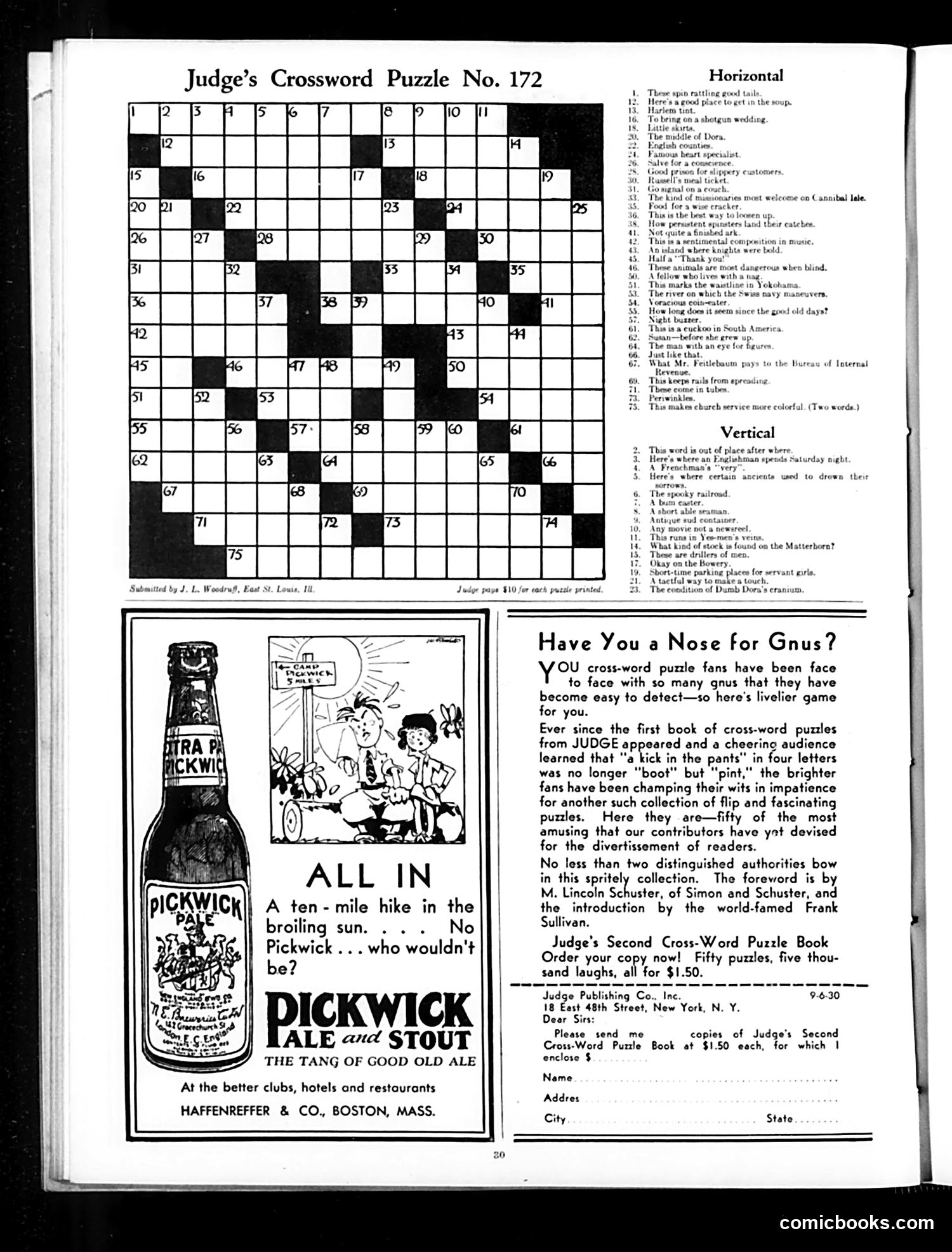
Judge Magazine Page Analysis This page primarily features Judge's Second Cross-Word Puzzle Book advertisement rather than political satire. The main content is a promotional article titled "Have You a Nose for Gnus?" — a pun playing on the animal (gnu/wildebeest) to promote a new crossword puzzle collection. The article references the cross-word puzzle craze of the 1920s-30s, noting that Judge magazine's first puzzle book taught solvers that "a kick in the pants" was "pint" rather than "boot" — indicating how the puzzles played with unexpected wordplay and definitions. The advertisement promises "fifty of the most amusing" puzzles and touts endorsements from M. Lincoln Schuster (Simon & Schuster publisher) and Frank Sullivan (a well-known humorist), selling for $1.50. The page includes a Pickwick Ale & Stout advertisement and a standard crossword puzzle grid (No. 172). This is primarily commercial content rather than satirical commentary.
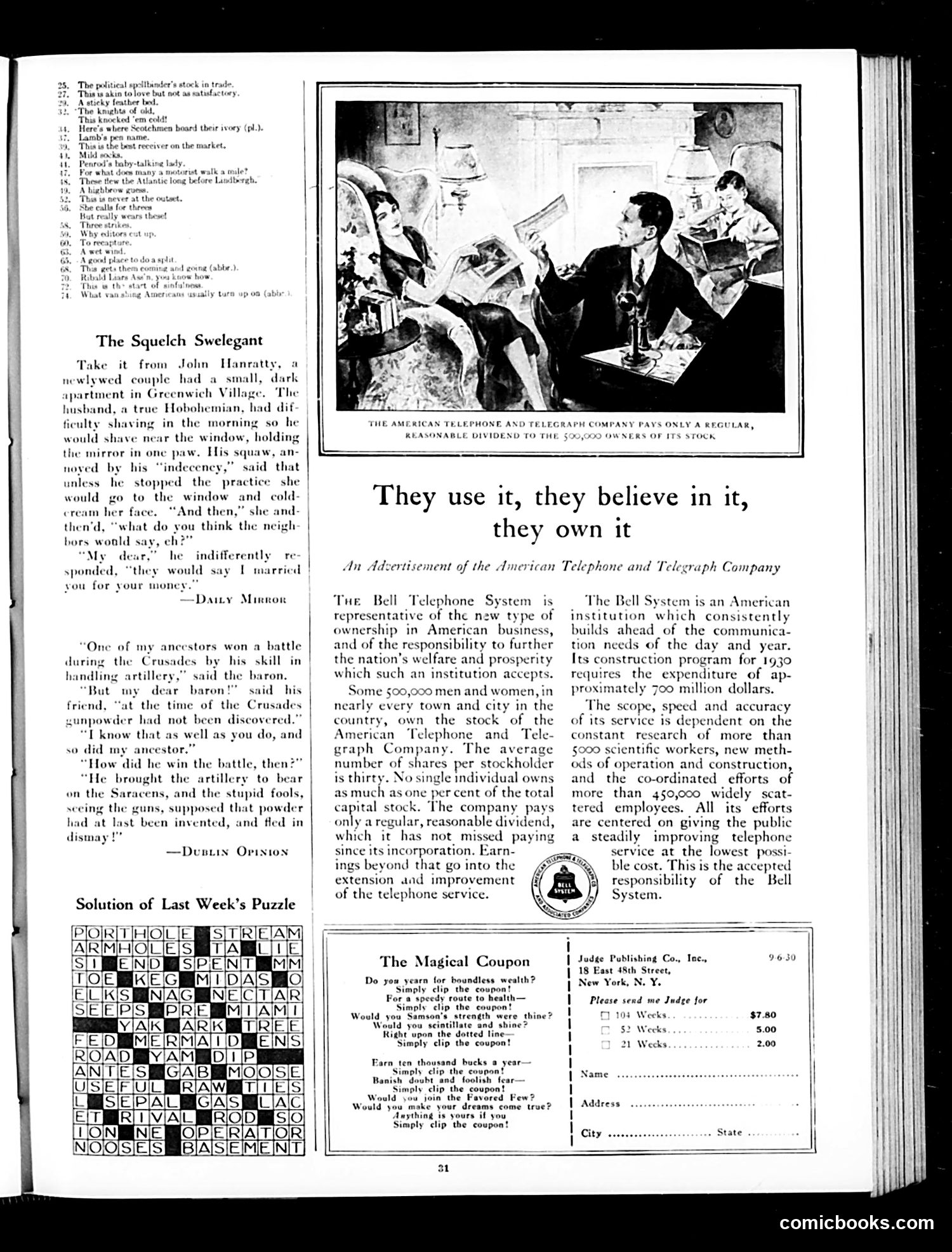
"The Squelch Swelegant" and Bell System Advertisement This page contains two distinct elements: "The Squelch Swelegant" is a humor column featuring brief anecdotes. The main story describes a Bohemian husband who shaves near a window in Greenwich Village, scandalizing his wife with this "indecent" behavior. The joke relies on class-conscious propriety: she threatens to cold-cream her face publicly in retaliation, which he dismisses by saying neighbors would assume he married her for money anyway—implying working-class marriages are transactional rather than romantic. The Bell Telephone Advertisement occupies the right half, presenting AT&T as a model of democratic American capitalism. It emphasizes that 500,000 ordinary citizens own stock, receiving only "reasonable" dividends while earnings fund infrastructure expansion. This appears designed to counter anti-monopoly sentiment during the prosperous 1920s by portraying AT&T as widely owned and socially responsible. The page reflects period attitudes about class, propriety, and corporate legitimacy.
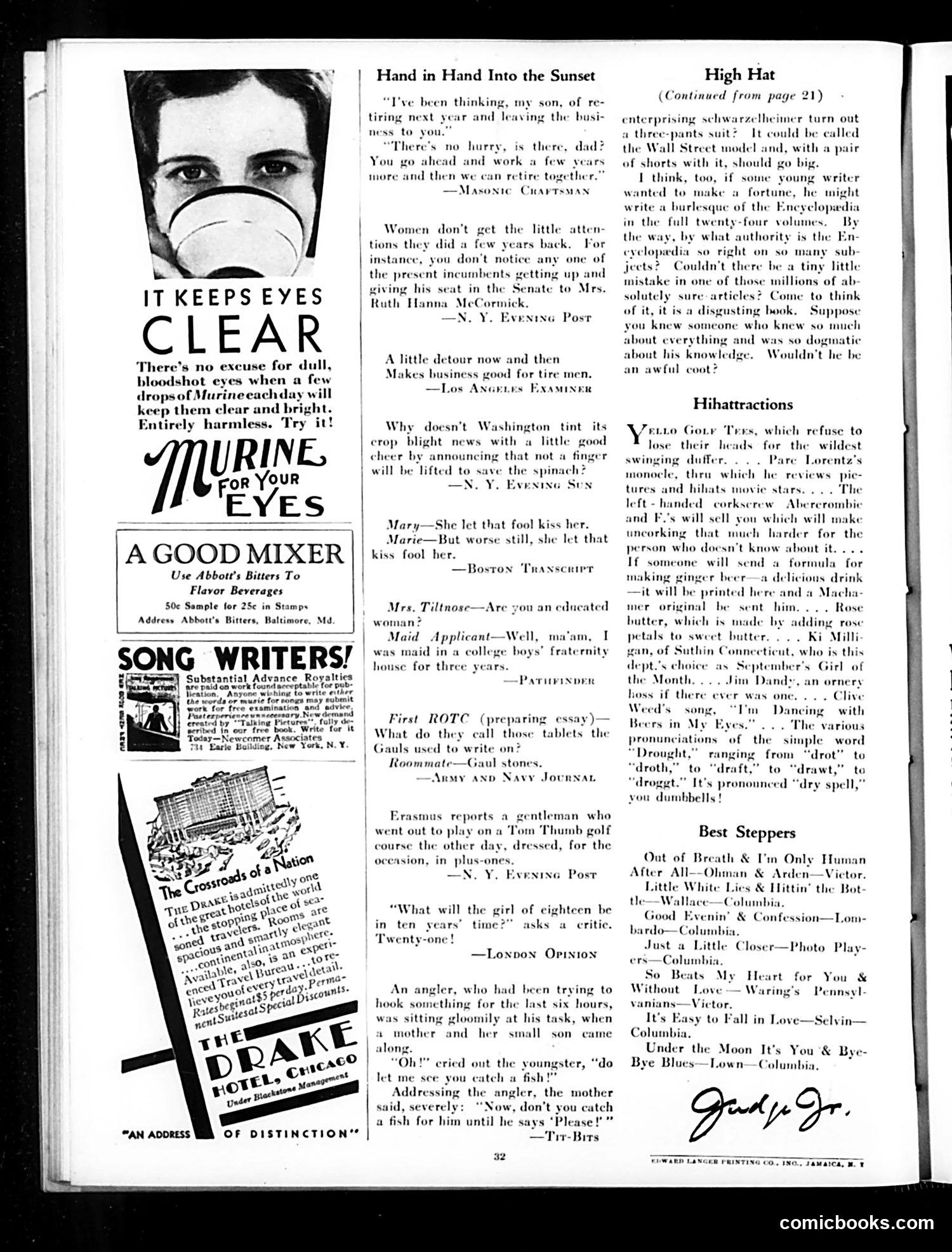
Judge Magazine Page Analysis This page consists primarily of advertisements and humor columns, not political cartoons. The ads include Murine eye drops, Abbott's Bitters, and a song-writer recruitment notice. The humor pieces are short quips from various newspapers satirizing contemporary social observations: - Women's suffrage reference: A joke about Mrs. Ruth Hanna McCormick (a female Senator) not receiving gentlemanly courtesies, critiquing how women's newly gained political power hasn't changed social customs. - Prohibition-era humor: References to ginger beer formulas and cocktail bitters, playing on Prohibition enforcement. - General social satire: Brief observations about lazy businessmen, educated maids, and parenting—typical lightweight comedy. The "High Hat" column discusses trivial matters like three-piece suits and Encyclopedia Britannica's pretentiousness. Overall: This is a typical Judge page mixing advertisements with light, topical humor reflecting 1920s-30s American life—more lifestyle magazine than sharp political satire.
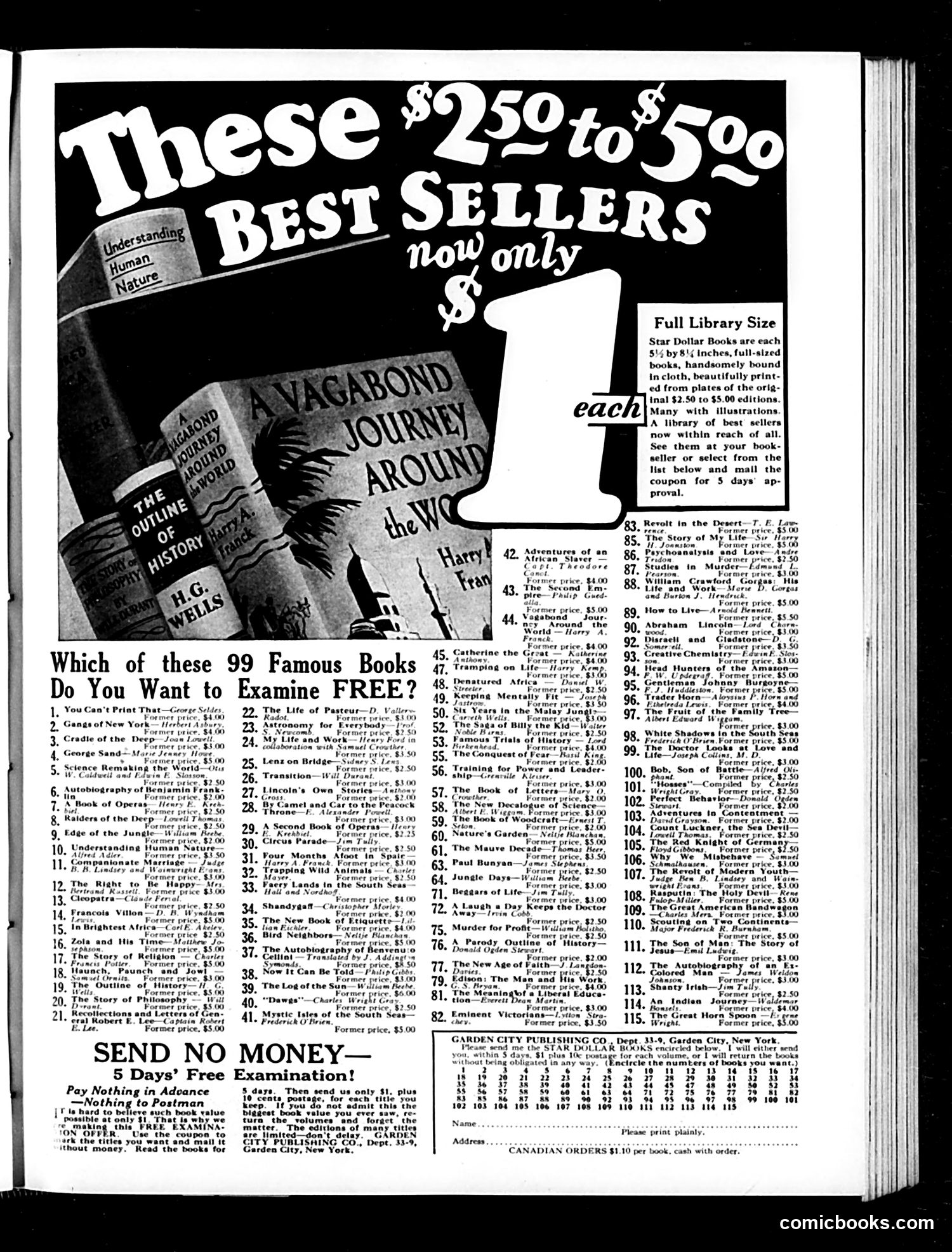
Page Analysis: Star Dollar Books Advertisement This page is primarily advertising, not editorial content or political satire. It's a book club promotion from Garden City Publishing Company offering discounted reprints of popular books. The advertisement promotes 99 "famous books" originally priced $2.50-$5.00, now available for $1 each in "full library size" cloth-bound editions. The offer includes a 5-day free examination period with no money required upfront. The visible book titles reflect 1920s-1930s popular literature and non-fiction: biographies (Abraham Lincoln, Catherine the Great), travel narratives, self-help guides, and literary classics. The pricing strategy—converting expensive hardcovers into affordable mass-market editions—reflects Depression-era publishing aimed at budget-conscious readers. The only cartoon element visible is a small illustration of books stacked together in the upper left, not political commentary. This is essentially a commercial catalog page.
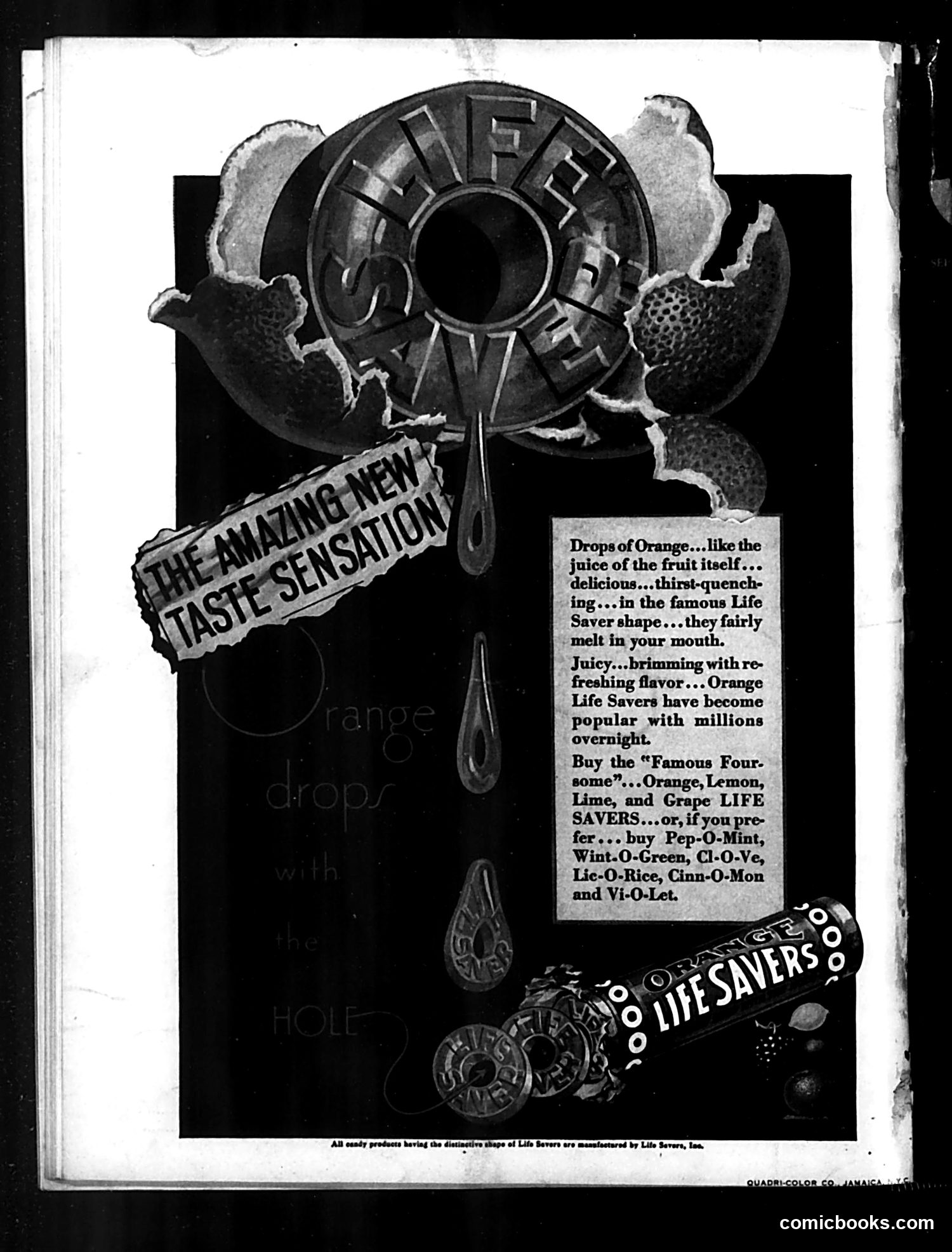
Advertisement Analysis This is not political satire but rather a Life Savers candy advertisement from Judge magazine. The page features promotional copy describing orange-flavored Life Savers, emphasizing their juice-like taste and popularity. The elaborate visual centerpiece—showing the distinctive Life Savers ring shape with oranges and juice drops—is designed to highlight the product's appeal. The ad mentions Life Savers' characteristic ring shape and promotes multiple flavors: the "Famous Foursome" (Orange, Lemon, Lime, Grape) plus other varieties (Pep-O-Mint, Wint-O-Green, Lic-O-Rice, Cinn-O-Mon, Vi-O-Let). This represents early 20th-century candy marketing, showcasing how commercial advertising was integrated into satirical magazines. The dramatic styling and extensive copy reflect advertising conventions of that era, emphasizing product novelty and consumer appeal rather than making any satirical or political point.