judge
Judge — September 13, 1930
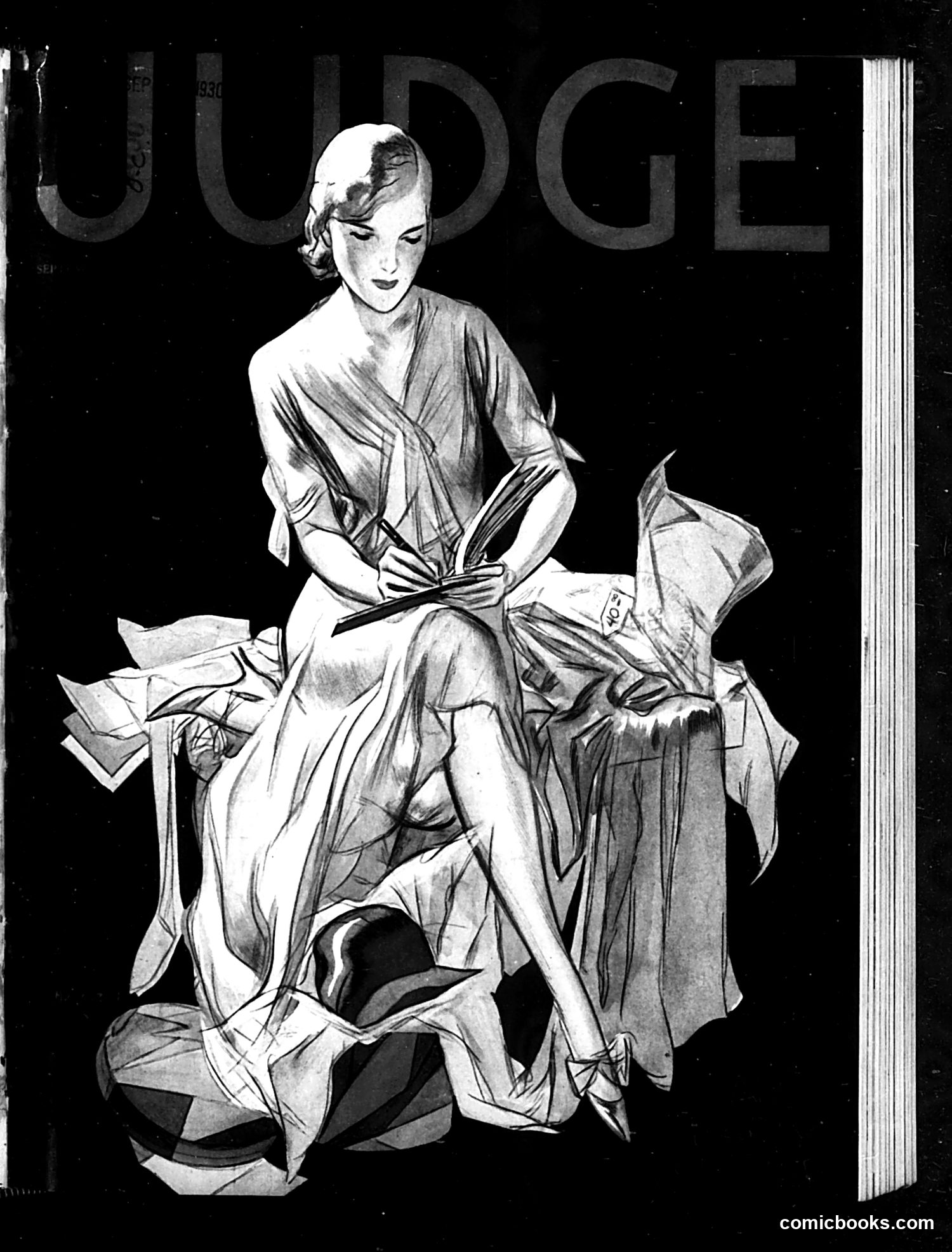
I can see this is a Judge magazine cover featuring an illustration of a stylishly dressed woman sitting among scattered papers or documents. The partial text visible reads "JUDGE" at the top. However, I cannot reliably determine the specific political or social reference from the image alone. The woman's fashionable 1920s-30s appearance and the scattered papers suggest commentary on either women's changing social roles, workplace involvement, or possibly a specific contemporary event or figure. Without clearer text or additional context, I cannot confidently identify what particular satire or joke this cover intended to convey to its original audience. To properly explain this cartoon's meaning, I would need more legible text or additional publication information.
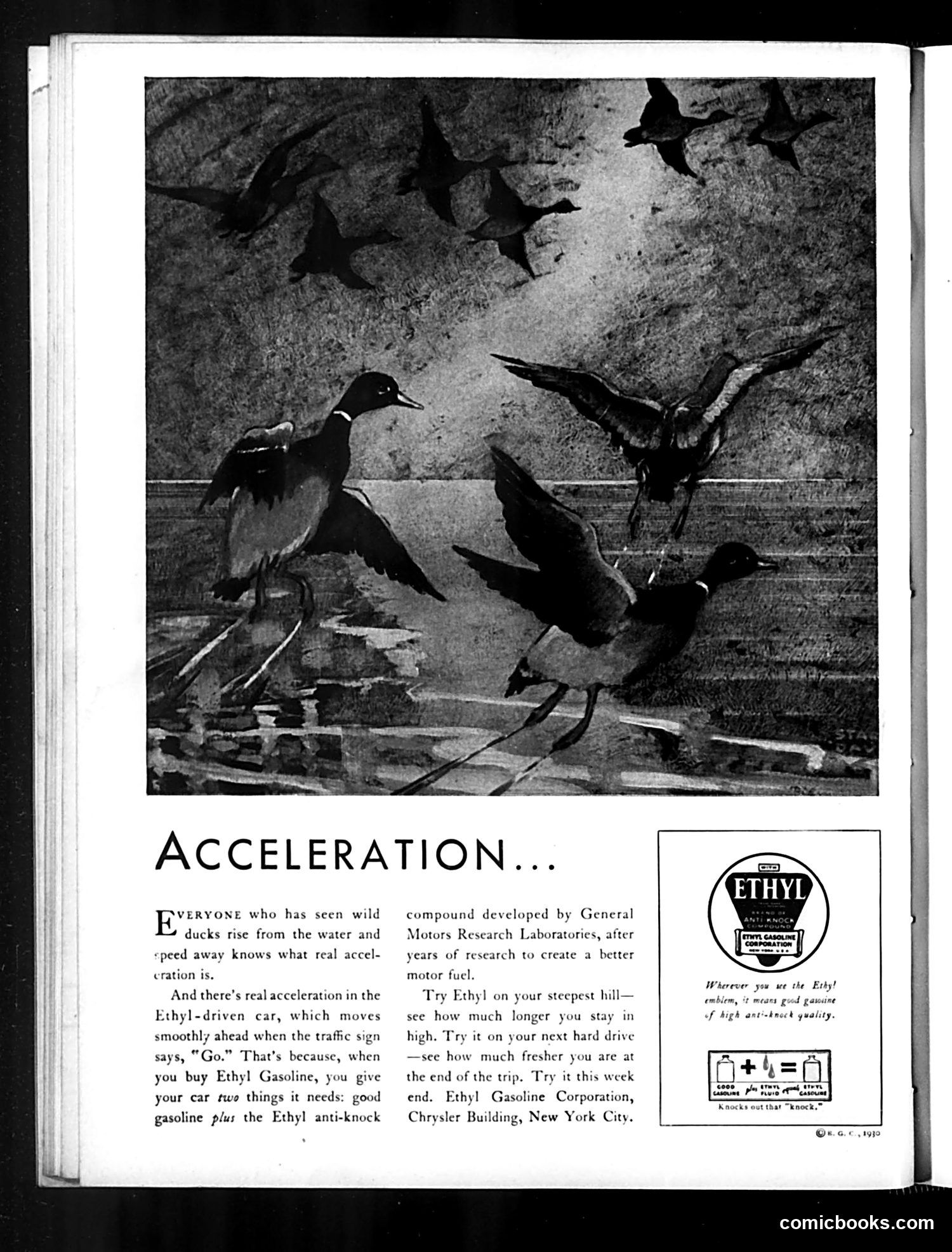
Ethyl Gasoline Advertisement This page is primarily a product advertisement rather than political satire. It promotes Ethyl Gasoline, a fuel additive developed by General Motors Research Laboratories. The advertisement uses ducks taking flight as a metaphor for acceleration and performance. The image shows multiple ducks launching from water, visually representing the smooth, rapid acceleration drivers would experience using Ethyl fuel versus standard gasoline. The ad claims Ethyl Gasoline provides "two things" cars need: "good gasoline plus the Ethyl anti-knock compound." The copy encourages drivers to test the product on hills and long drives to experience superior performance. This reflects 1920s-30s automotive marketing, when fuel additives were novel innovations promoted through comparative lifestyle imagery.
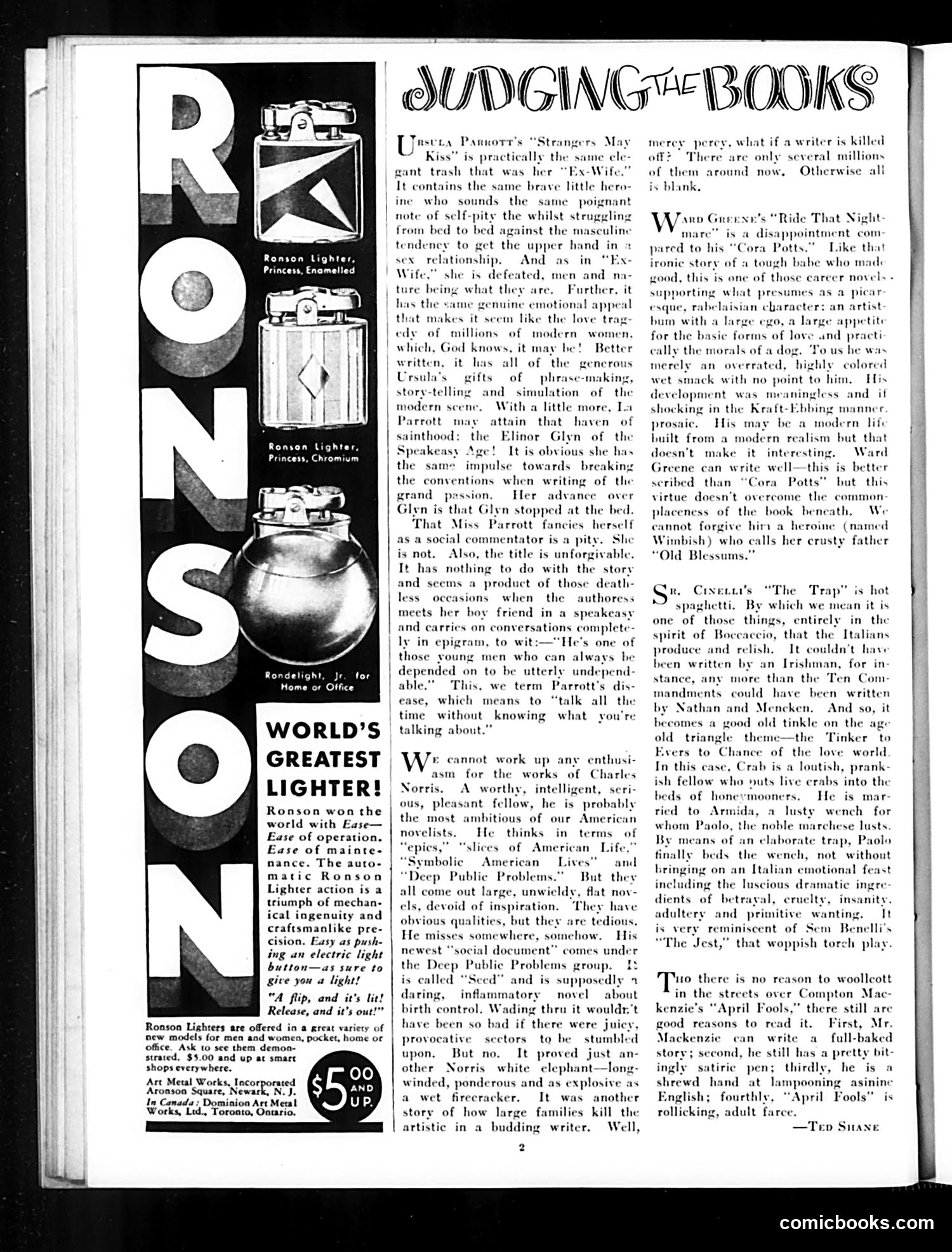
Analysis of "Judging the Books" Page This page is primarily a book review column, not a political cartoon. The left side features a Ronson lighter advertisement (the "world's greatest lighter"), while the right side contains literary criticism by Ted Shane. The reviews discuss several novels: - Ursula Parrott's "Strange Max Kiss" - Ward Greene's "Ride That Nightmare" - S. Cinelis's "The Trap" (described as Boccaccio-inspired Italian fiction) - Charles Norris's works, praised as ambitious American social documents The tone is satirical toward contemporary literature: Shane critiques overly colorful prose, shallow character development, and writers who mistake sentiment for artistry. The satire targets 1920s-30s authors who relied on stylistic flourish rather than genuine insight—mocking the era's literary pretensions rather than politics.
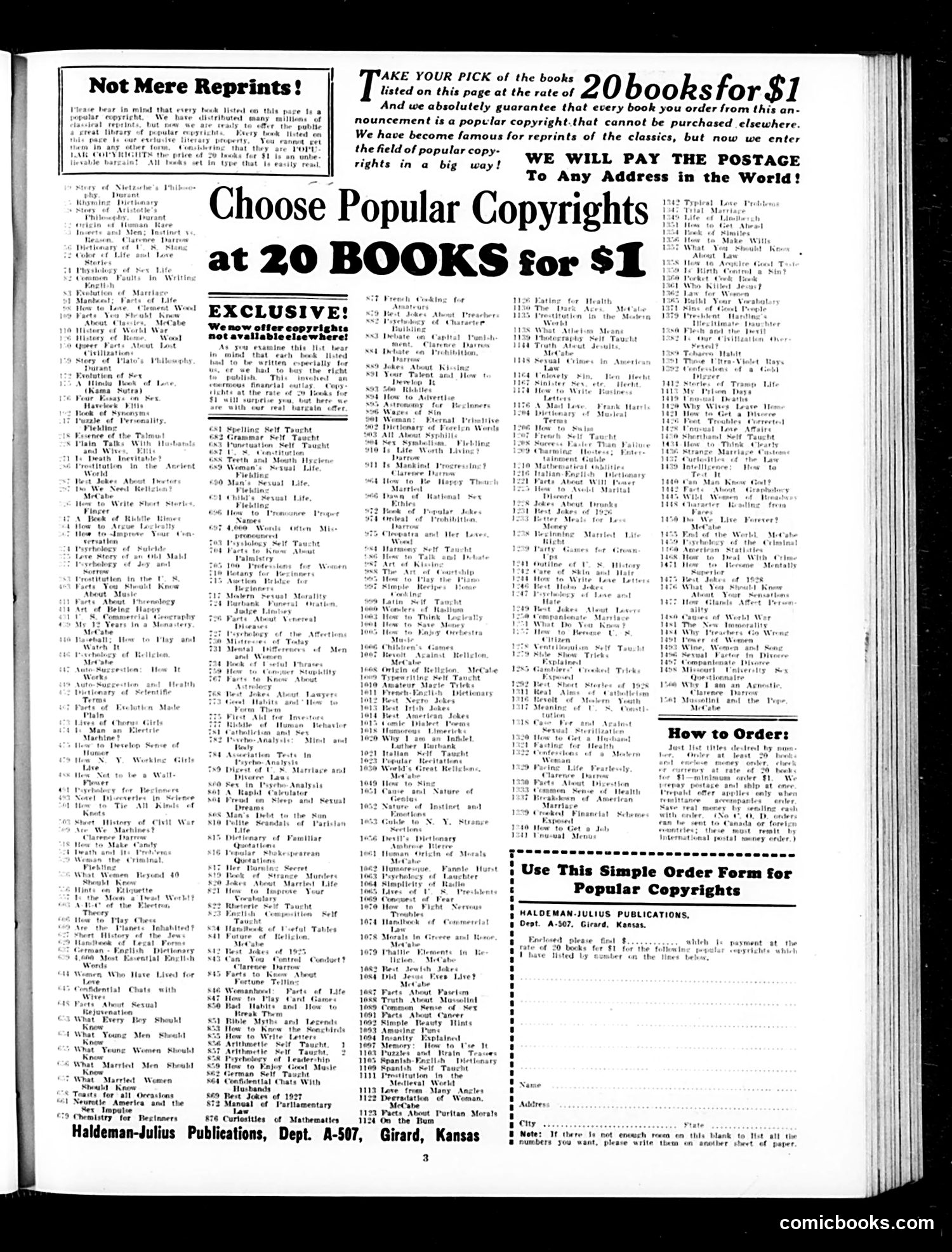
Content Description This page is primarily advertising, not editorial content or political cartoons. It's a book sales advertisement from Haldeman-Julius Publications offering 20 books for $1—a Depression-era bargain offer. The top-left contains a brief notice stating "Not Mere Reprints!" defending the quality of their reprinted editions. The bulk of the page lists hundreds of book titles available through their mail-order service, organized in multiple columns. The bottom includes an order form for customers to select titles and mail payment to the company's Kansas address. There are no political cartoons, caricatures, or satirical content visible on this page. It's a straightforward commercial offering from a major publisher of inexpensive reprints during the early-to-mid 20th century.

Analysis This page is primarily an advertisement, not satire or editorial content. It promotes the Barbizon-Plaza hotel located at Central Park South and 101 West 58th Street in New York City. The ad emphasizes the hotel's cultural appeal and convenient location overlooking Central Park. The illustration depicts a tall building with desert scenery and mounted figures below—likely evoking a romanticized "cultural" theme, though the specific reference is unclear. The copy highlights amenities: Continental breakfast delivered to rooms, studio apartments at various rates ($18-45 weekly), and proximity to public transportation. It notes the hotel operates under the same management as the famous Barbizon Hotel at 140 East 63rd Street. There is no political satire or cartoon commentary on this page—it's a straightforward hospitality advertisement typical of Judge magazine's commercial content.
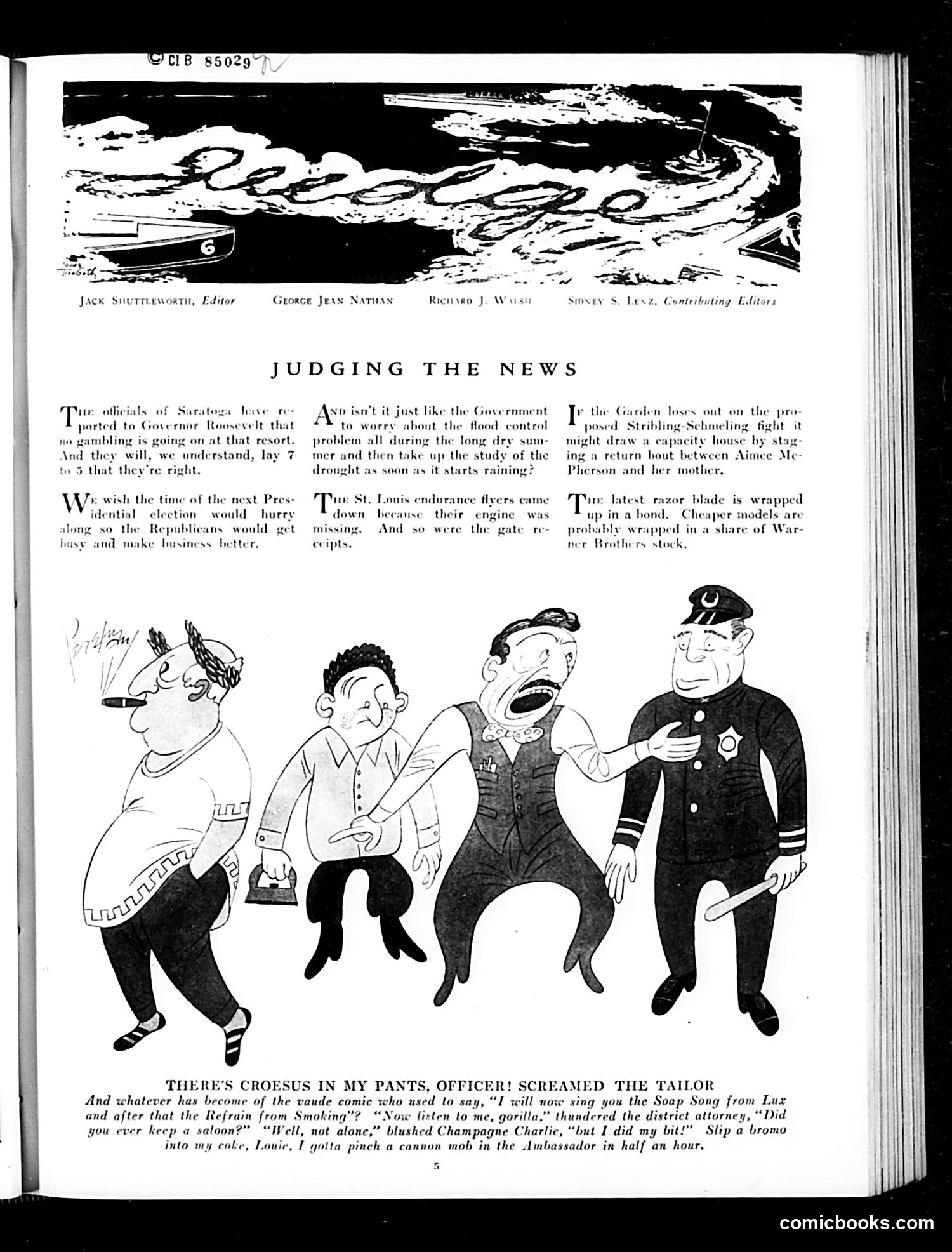
"Judging the News" - Analysis This page contains brief editorial commentary paired with a satirical cartoon. The text items reference: 1. Saratoga flood control - Officials reported to Governor Roosevelt about gambling, which he called "a real evil" 2. St. Louis endurance flyers - Their engine failed, so gates had to be closed 3. Garden vs. Striking Scheming fight - A potential boxing match being blocked by Aimee McPherson's mother 4. Razor blade wrapping - Cheaper models wrapped in Warner Brothers stock as a joke The main cartoon depicts four caricatured men in comedic distress about "crocus in my pants." The accompanying dialogue references vaudeville comic and musical references ("Soap Song from Lux"), appearing to satirize entertainment industry figures reacting with exaggerated shock. The specific identities of these figures remain unclear without additional context.
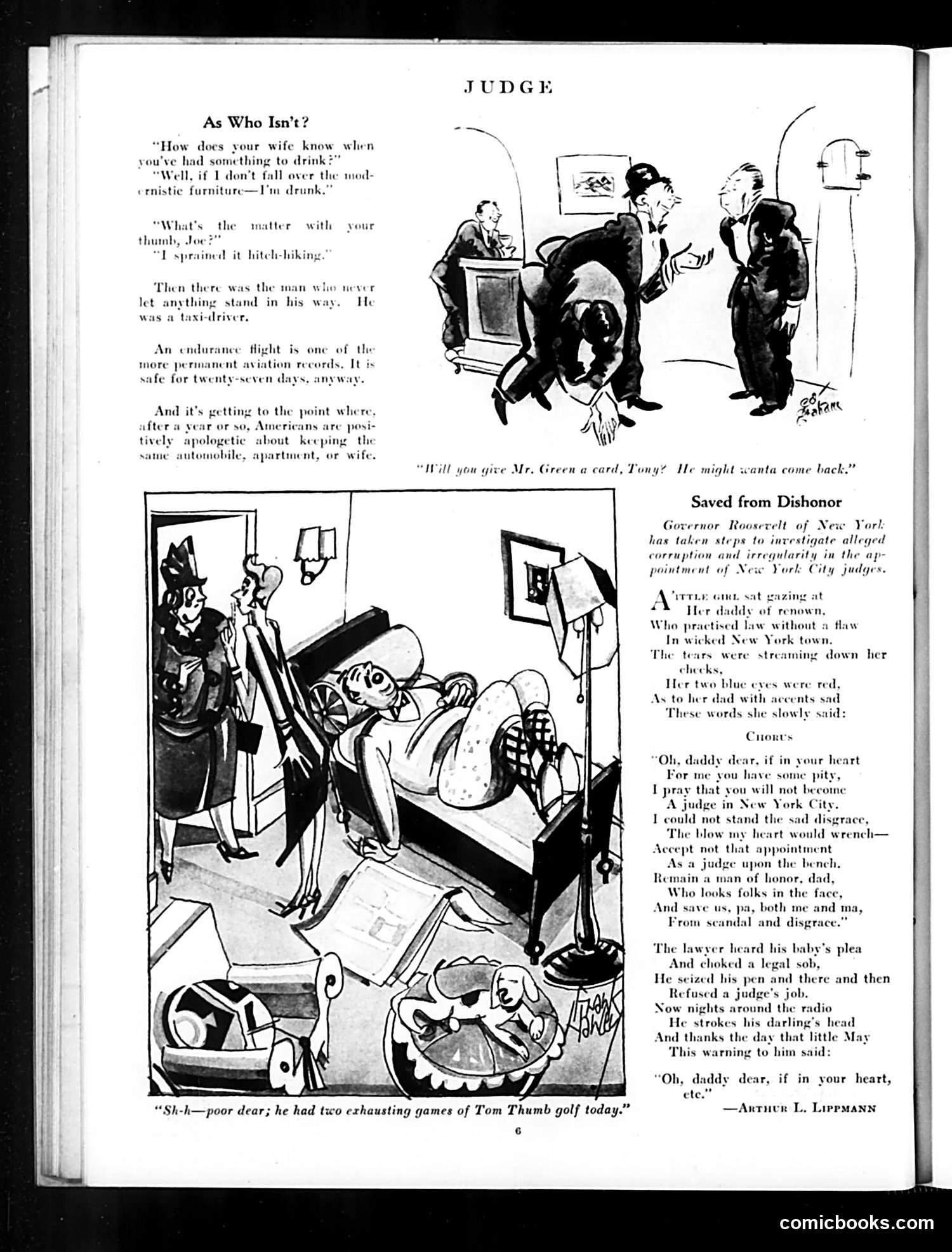
Analysis of Judge Magazine Page Top Cartoon ("As Who Isn't?"): A humorous piece about how spouses recognize intoxication—the wife notes her husband "won't fall over the modernistic furniture" when drunk. The taxi driver anecdote suggests people are becoming apathetic about keeping the same car, apartment, or spouse, satirizing American consumer culture and casual attitudes toward commitment. Bottom Section ("Saved from Dishonor"): This depicts Governor Roosevelt of New York investigating corruption among NYC judges. The illustration shows a sick man in bed (apparently a dishonored judge) while his daughter pleads with her father not to become a judge himself, fearing judicial scandal. The verse emphasizes maintaining honor and avoiding disgrace in public service—commentary on the serious corruption problems plaguing New York's judicial system at this time.
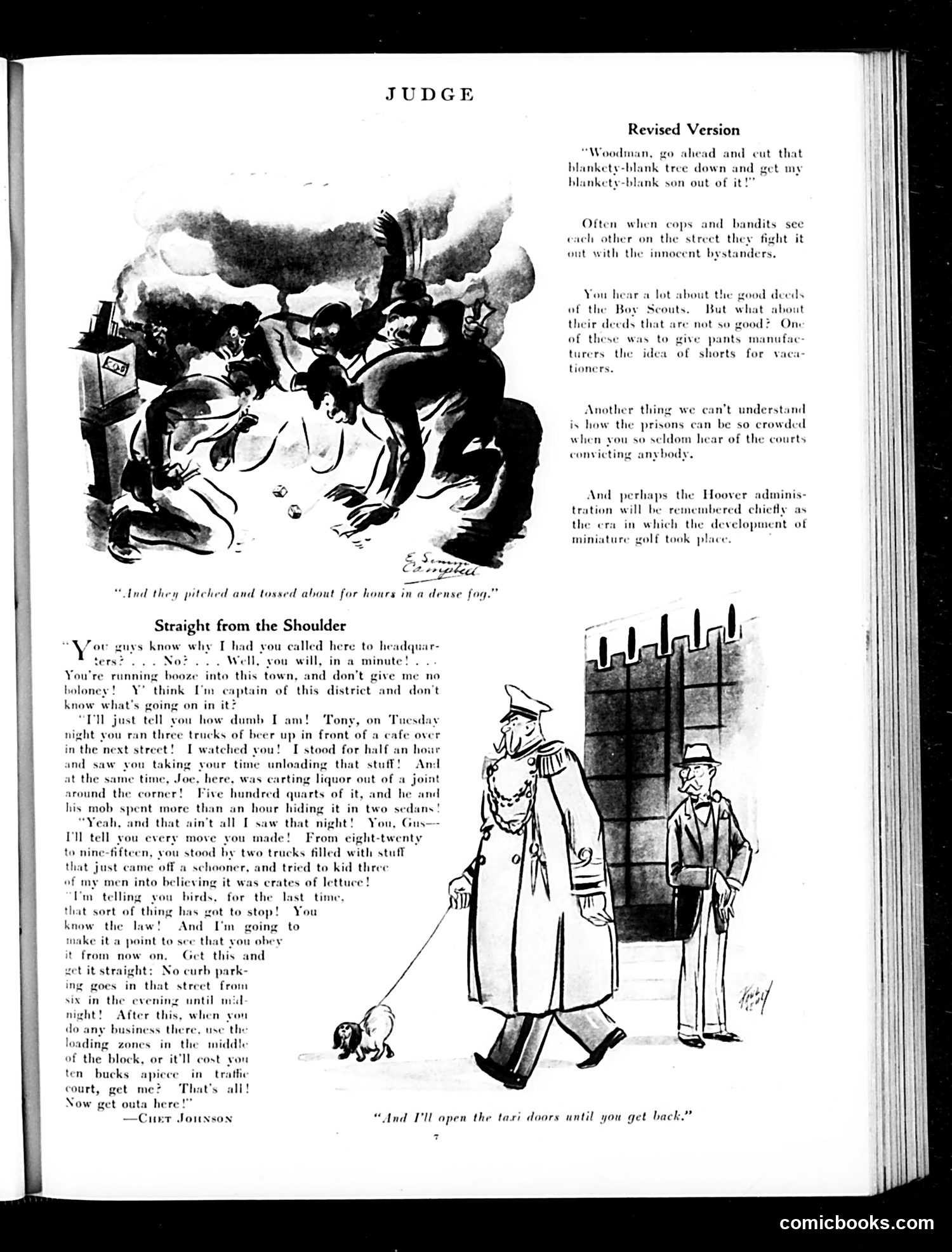
Judge Magazine Page Analysis This page contains two satirical pieces from the Prohibition era (likely 1920s-early 1930s, given references to bootlegging and the Hoover administration). "Straight from the Shoulder" depicts a police captain chewing out officers for their incompetence in combating illegal alcohol trafficking. The captain sarcastically details how his own men witnessed bootleggers operating brazenly—trucks unloading beer, smuggled liquor hidden in sedans—yet did nothing. The joke is that despite Prohibition's strict laws, enforcement is laughably ineffective due to corrupt or negligent police. "Revised Version" (top right) offers brief social commentary: joking about censoring profanity in a tree-rescue scenario, mocking Boy Scouts for popularizing shorts (benefiting manufacturers), questioning why prisons overflow yet courts convict nobody, and sarcastically crediting Hoover's administration mainly for the miniature golf craze. Together, these pieces ridicule Prohibition enforcement failures, judicial inefficiency, and the Hoover administration's perceived ineffectiveness—common Judge magazine targets during this period.
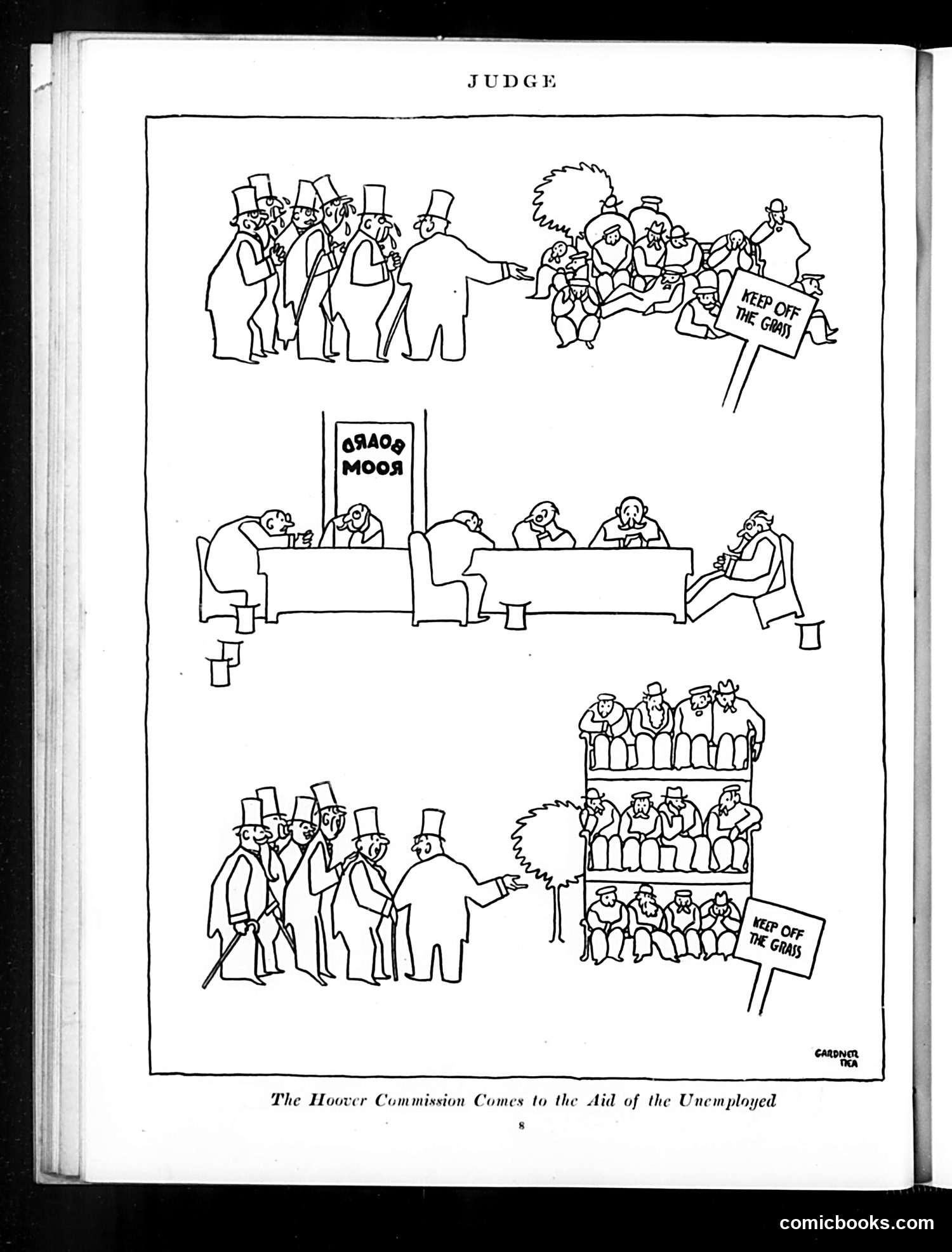
Political Cartoon Analysis: "The Hoover Commission Comes to the Aid of the Unemployed" This satirical cartoon critiques the Hoover Commission's ineffectual response to unemployment, likely during the Great Depression era. The three panels show: 1. Top: Wealthy top-hatted figures (representing the commission/establishment) observe a crowd of unemployed people holding a "Keep Off the Grass" sign—suggesting elite indifference. 2. Middle: A formal courtroom or official proceeding where bureaucrats conduct business while unemployment issues remain unresolved. 3. Bottom: The same wealthy figures still observe crowds, now behind barriers marked "Keep Off the Grass," implying the commission provides only symbolic gestures rather than substantive aid. The satire attacks the gap between official activity and actual relief for the unemployed, portraying the Hoover response as performative rather than helpful.
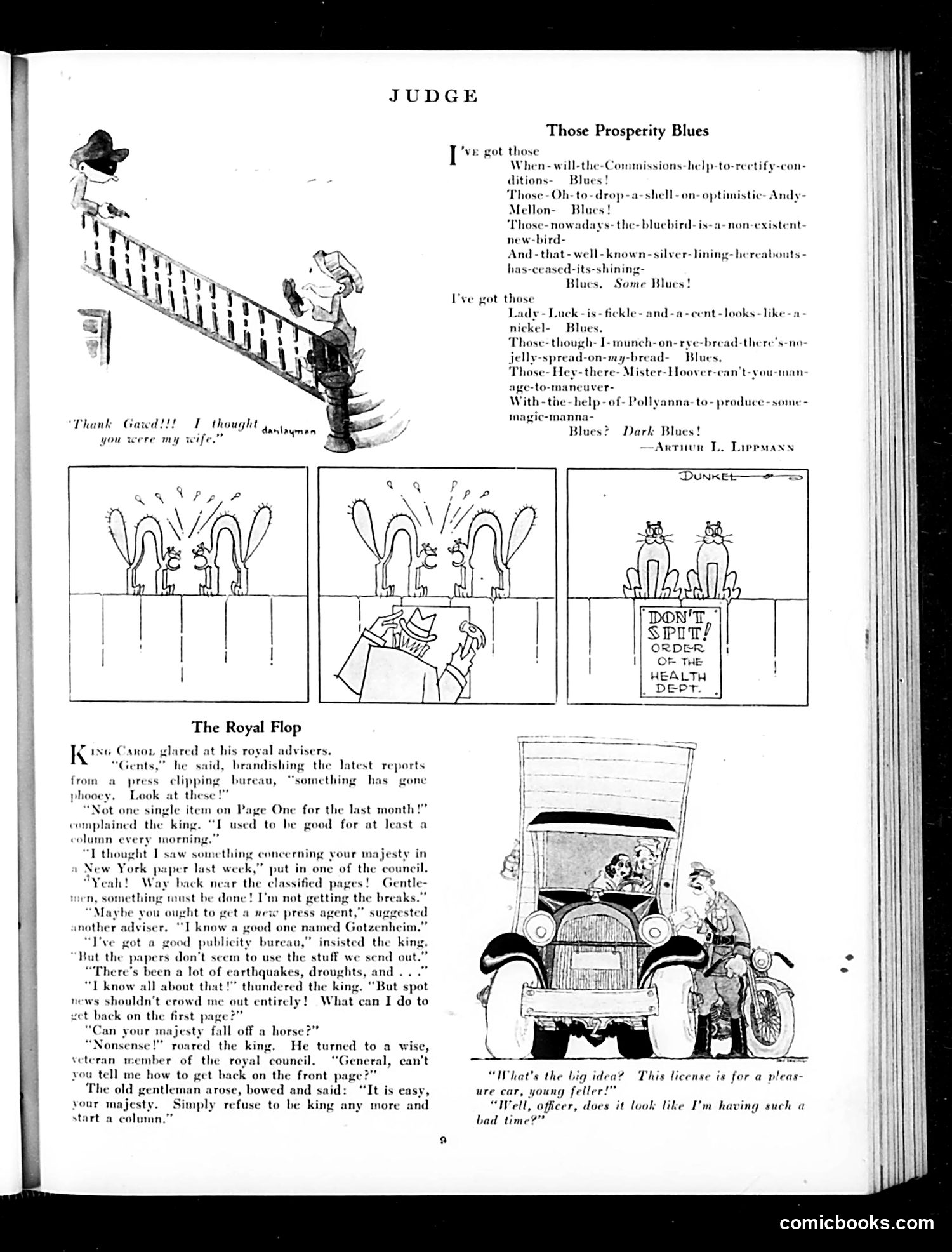
Analysis: Judge Magazine Page This page satirizes economic hardship masked by official optimism during the prosperous 1920s. "Those Prosperity Blues" (poem by Arthur L. Lippmann) mocks government promises of economic recovery. References to "Commissions," "Mellon" (Treasury Secretary Andrew Mellon), and "Hoover" indicate this targets the Coolidge-Hoover administrations' assurances that prosperity would continue. The blues catalog—fickle luck, poverty amid plenty ("a cent looks like a nickel"), food scarcity—reflects ordinary Americans' actual struggles despite official claims of success. "The Royal Flop" depicts a king (representing government/leadership) desperate to regain newspaper prominence after being overshadowed by natural disasters and other news. His publicist's solution—"refuse to be king any more and start a column"—suggests leaders have become mere entertainers disconnected from real governance. The car cartoon shows a young driver pulled over, claiming his pleasure vehicle "license" justifies reckless driving. The officer's skepticism mirrors public doubt about whether official prosperity narratives match reality. Together, these pieces critique the gap between government rhetoric and citizens' lived experience.
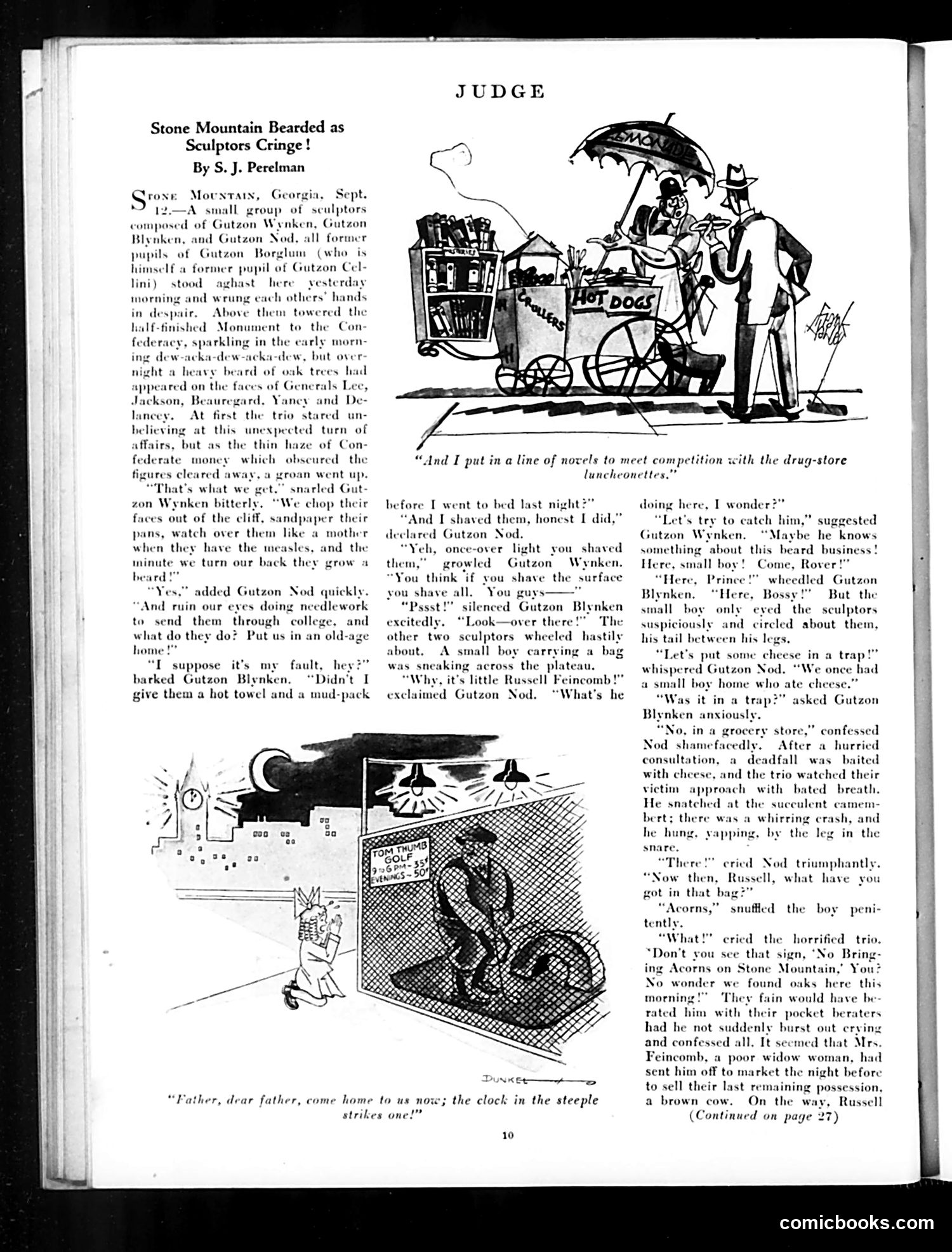
Stone Mountain Satirized This is S.J. Perelman's humorous short story, illustrated with cartoons about sculptors working on Stone Mountain Monument (the Confederate memorial in Georgia). The joke plays on the sculptors' names—all variations of "Gutzon" (referencing Mount Rushmore sculptor Gutzon Borglum)—treating them as bumbling, vain artists. They discover their carved Confederate generals' faces have sprouted oak tree beards overnight, leading to slapstick attempts to catch a boy they suspect of sabotage using cheese traps. The satire mocks both the pretensions of monumental sculpture and the Confederate monument itself. The ridiculous premise—that trees grew beards on stone faces—deflates the grandiosity of such projects. The confused, incompetent sculptors suggest the absurdity of preserving Confederate heroes. The story's continued narrative ending on page 27 indicates this was a full-length satirical fiction piece, not a single cartoon.
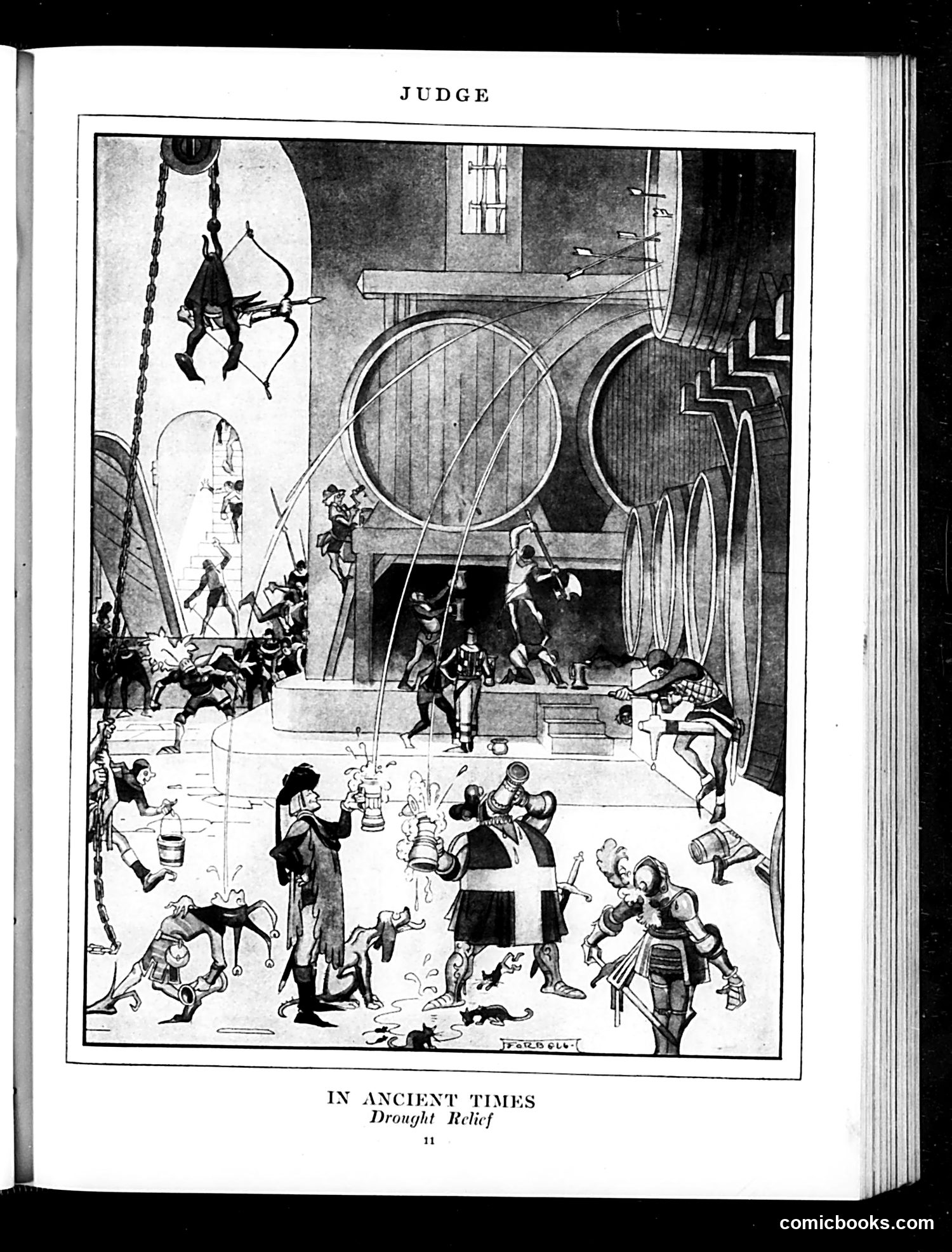
"In Ancient Times: Drought Relief" This political cartoon satirizes drought relief efforts, likely from the early 20th century. The chaotic scene depicts an ancient Roman or Greek setting where authorities attempt to address water scarcity through elaborate, ineffective public works—massive wheels and mechanical systems dominate the composition while crowds of citizens below seem confused or poorly served. The satire appears to critique government drought-relief programs as overly bureaucratic, wasteful, and impractical. Rather than solving citizens' actual needs (visible in the scrambling crowd), authorities invest in ostentatious infrastructure that doesn't effectively deliver water to people. By setting this in "ancient times," Judge suggests such mismanagement of public resources is timeless folly—that contemporary American government repeats historical mistakes in handling crisis relief.
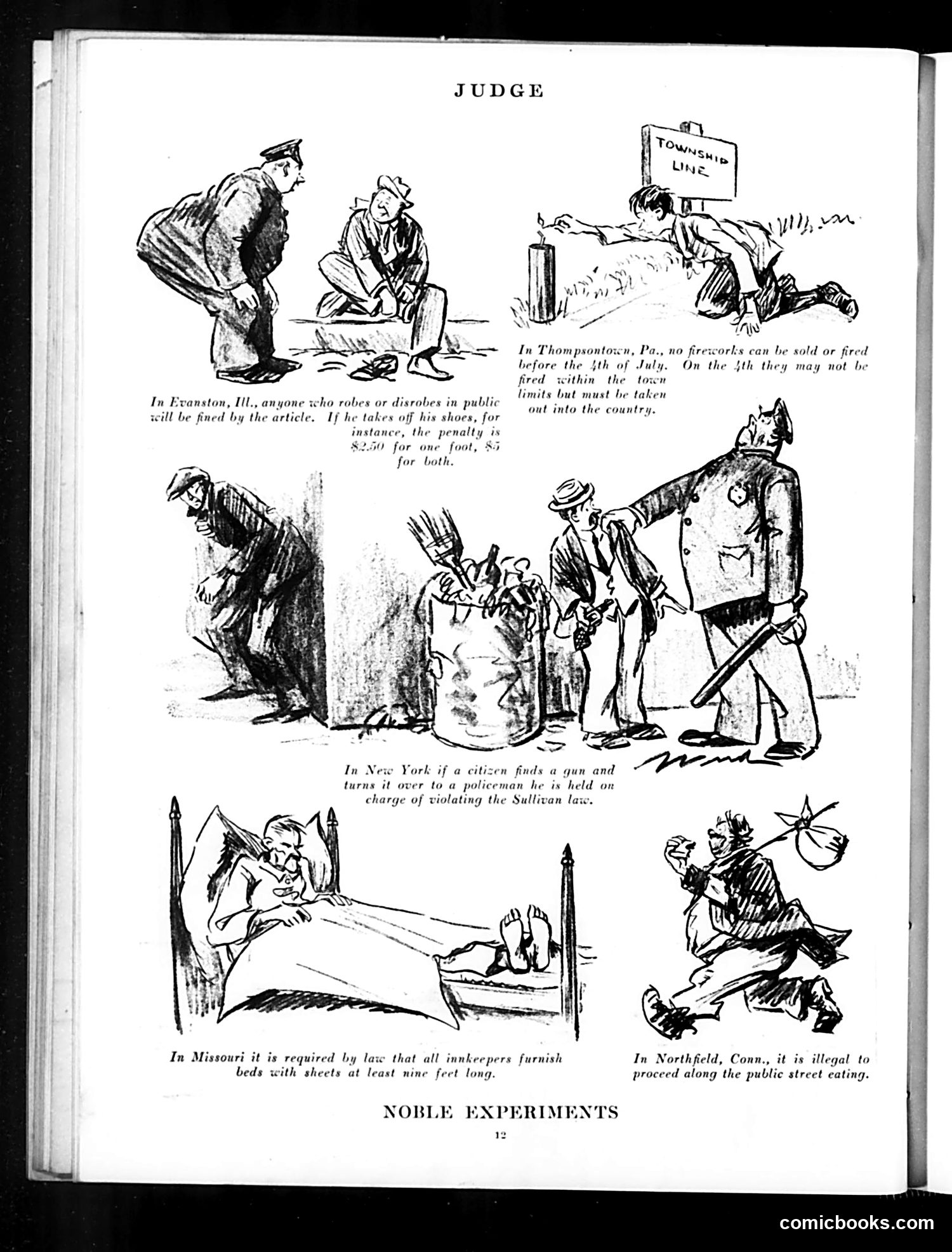
"Judge" Page: "Noble Experiments" This satirical page mocks absurd local laws across American towns through humorous illustrations and brief captions. Each vignette presents a ridiculous or oddly specific statute: - Evanston, Illinois: Fining people for undressing publicly—even removing shoes costs money - Thompsontown, Pennsylvania: Bizarre fireworks regulations timing - New York: The Sullivan law (gun control legislation) creates ironic situations where turning in a found gun gets *you* arrested - Missouri: Innkeepers must provide absurdly long nine-foot bed sheets - Northfield, Connecticut: Eating while walking on public streets is illegal The satire targets the patchwork of often-silly local ordinances that proliferated across American municipalities. By presenting these laws without comment—letting their absurdity speak—Judge ridicules both the legislators who create such restrictions and the impulse toward excessive local regulation. The cartoon suggests American towns had lost sight of reasonable lawmaking.
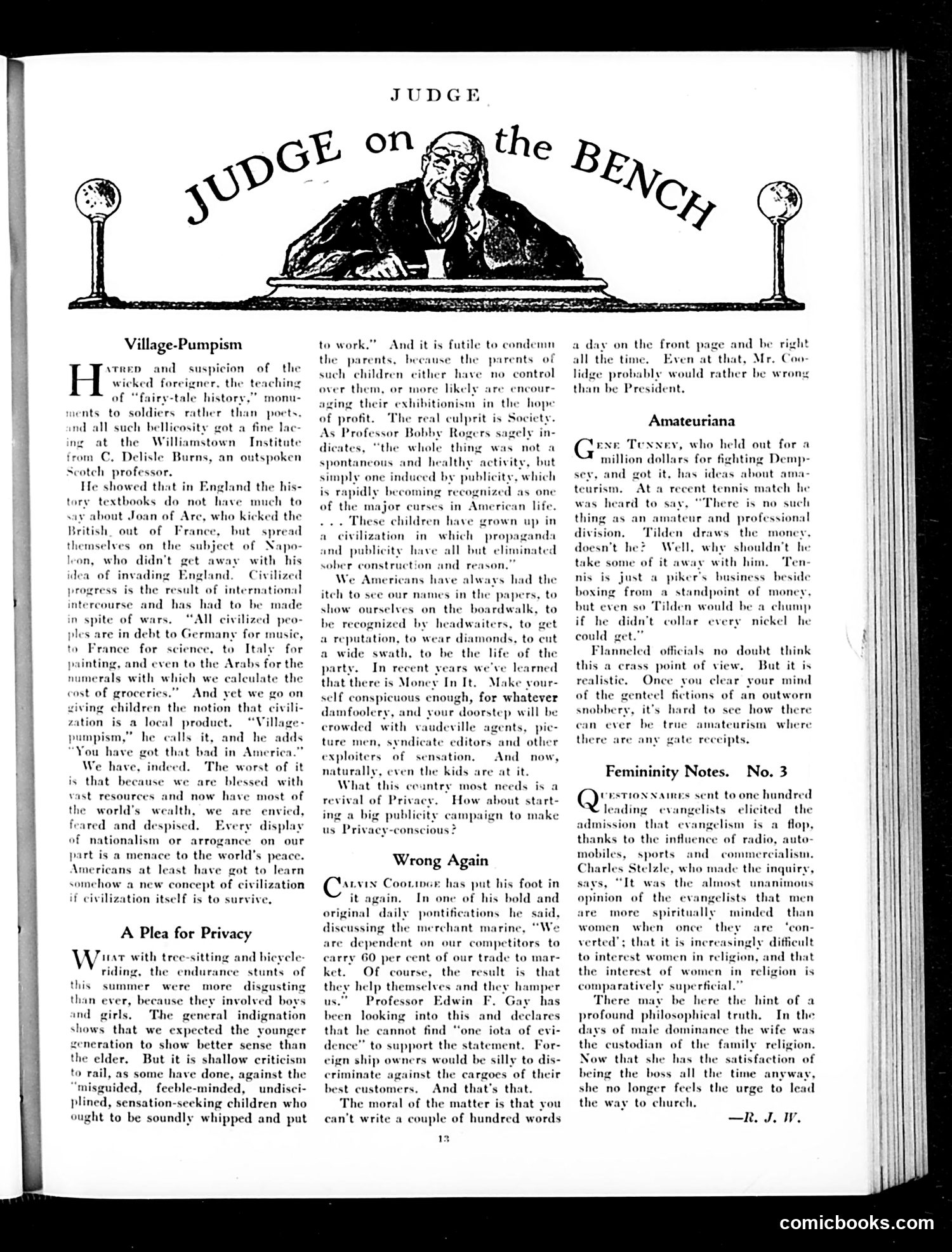
Judge Magazine Page Analysis This page contains three satirical editorial columns typical of Judge's social criticism: "Village-Pumpism" attacks American provincial nationalism. Professor C. Delisle Burns (a Scottish academic) is cited arguing that English history textbooks ignore Joan of Arc but emphasize Napoleon—revealing nationalist bias. The satire targets American "village pumpism": the notion that civilization is purely local rather than built on international exchange (German music, French science, Arab numerals). The columnist warns that American wealth combined with nationalist arrogance threatens world peace. "A Plea for Privacy" mocks Americans' obsession with publicity and public attention. It criticizes both attention-seeking youth (tree-sitting, endurance stunts) and the media/business interests (vaudeville agents, picture men) exploiting them. The real culprit is "Society" and publicity-driven culture where "Money In It" motivates reckless behavior. "Wrong Again" briefly ridicules Calvin Coolidge for an inaccurate claim about merchant marines, noting that foreign ship owners wouldn't discriminate against profitable American cargo. The tone is sardonic, targeting American narcissism, commercialism, and ignorance disguised as patriotism.
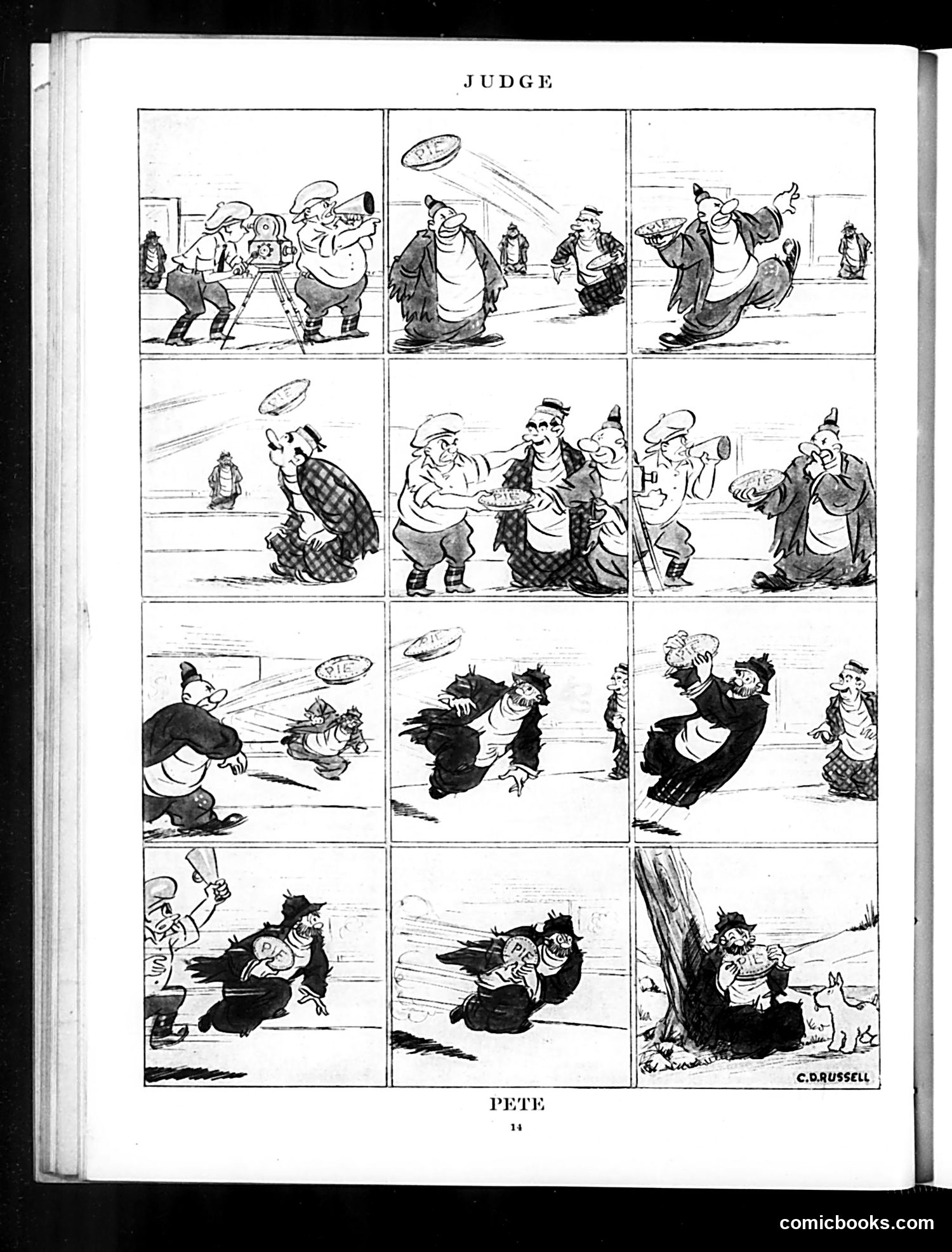
"Judge Pete" - Political Cartoon Analysis This is a twelve-panel comic strip titled "Judge Pete" by C. Russell, satirizing a judicial or political figure nicknamed "Pete." The narrative follows a slapstick sequence where Pete (identifiable by his distinctive appearance and hat) appears to be involved in some form of altercation or chase scene with other characters, involving flying objects and physical comedy. The satire likely targets Pete's judicial incompetence, favoritism, or corrupt decision-making through exaggerated physical humor. The escalating chaos across panels—from formal proceedings to chaotic pursuit—suggests mockery of his authority or judgment. Without additional historical context identifying which "Judge Pete" this references, the specific political target remains unclear, though the strip exemplifies Judge magazine's irreverent approach to political figures through visual comedy rather than explicit text.
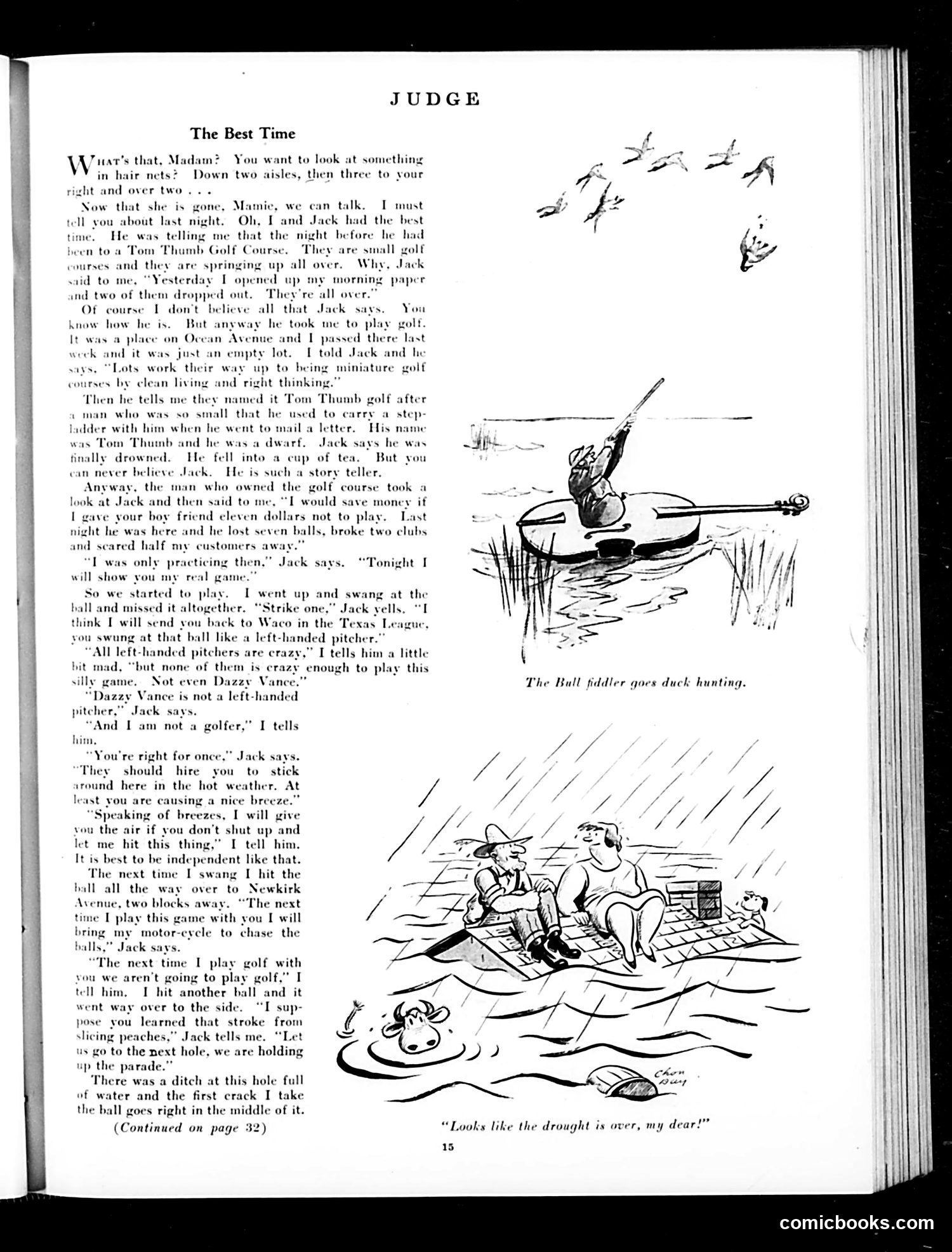
"The Best Time" - Judge Magazine Humor This page contains a humorous anecdote about miniature golf, a leisure activity that was apparently a novelty when this piece was written (miniature golf courses proliferated in the 1930s). The joke structure: A woman recounts her outing with her husband "Jack" to a new Tom Thumb Golf Course on Ocean Avenue. Jack is portrayed as an exaggerator and poor golfer—he loses seven balls and breaks two clubs in one visit, infuriating the owner. The humor derives from Jack's tall tales (like the origin story of Tom Thumb Golf, supposedly named after a man so small he drowned in a teacup) contrasted with his actual incompetence at the sport. The cartoons illustrate the story: one shows a golfer mishitting into water; another depicts a couple caught in a rainstorm at the golf course, with the caption "Looks like the drought is over, my dear!"—a period-appropriate weather reference. The satire gently mocks both working-class leisure activities and the tendency of husbands to fabricate excuses for poor performance.
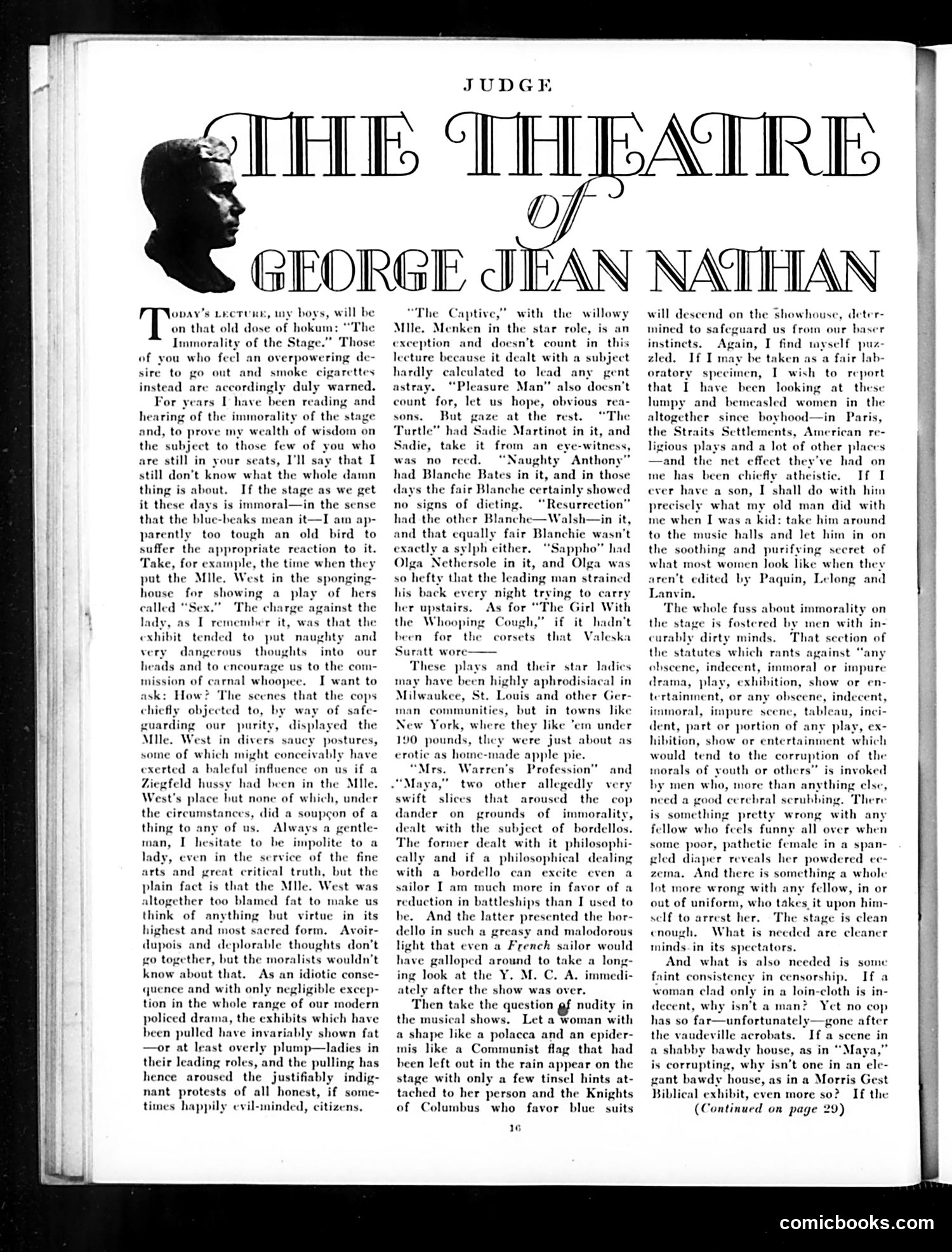
"The Theatre of George Jean Nathan" This is a theatrical critique column by Judge magazine's drama critic George Jean Nathan, not a political cartoon. Nathan satirizes moral crusaders who attack stage productions as "immoral." His target: hypocritical censorship campaigns. Nathan mocks the inconsistency of authorities who prosecute plays like Mae West's "Sex" on morality grounds, yet the actual "problem"—according to Nathan—is that the actresses involved are too physically large to be genuinely seductive anyway. He argues this undermines the censors' stated concern about corrupting public morals. Nathan extends the satire to other censored productions ("The Captive," "Pleasure Man"), using sarcastic examples to suggest the real issue isn't genuine moral danger but rather the authorities' desire for control and the public's appetite for scandal. The piece defends theatrical freedom while mocking both the censors and the "moralists" who fail to recognize the absurdity of their own positions.
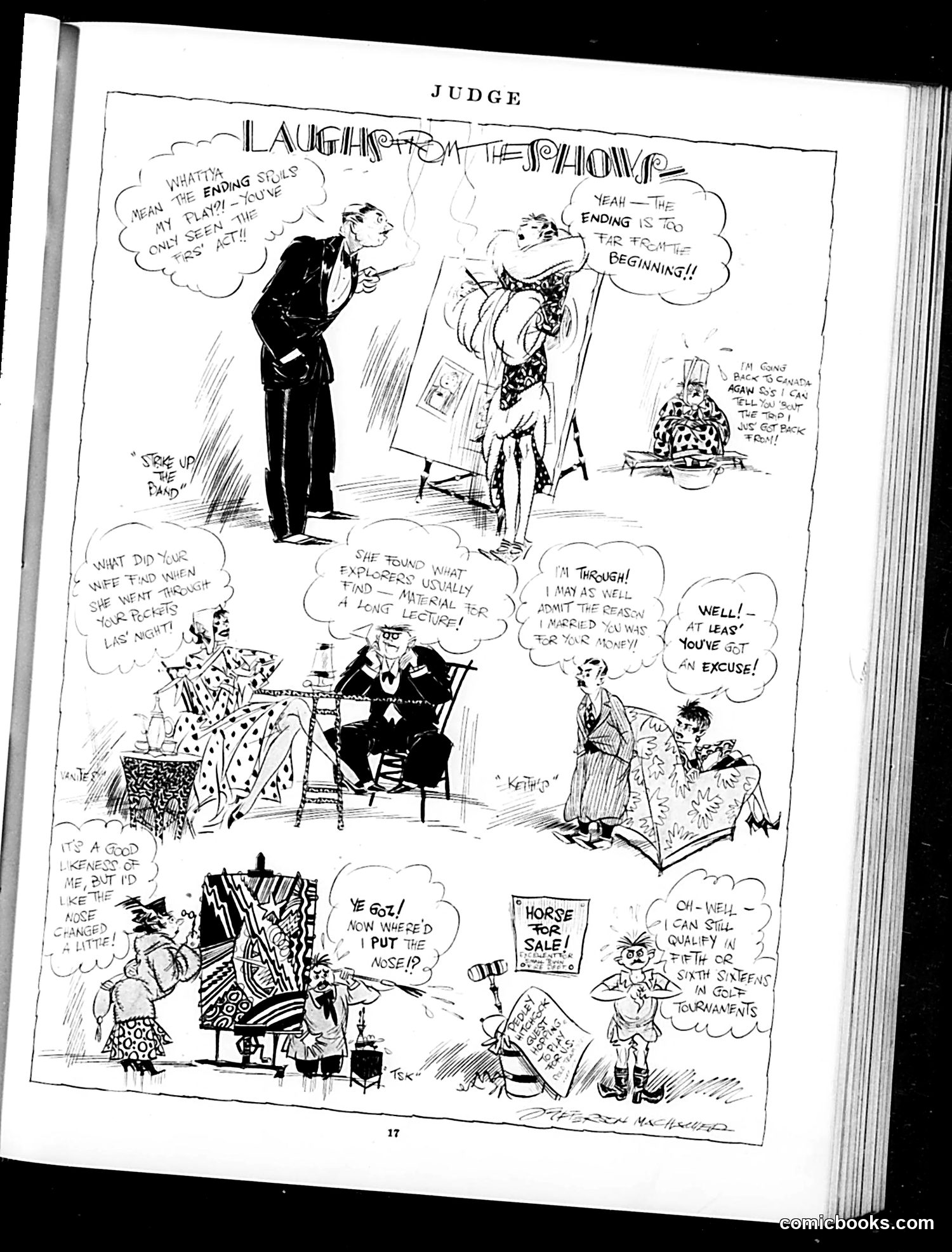
"Laughs of the Show" - A Theater Satire This is a satirical comic about theatrical performances and audience reactions. The central figures appear to be theater patrons and performers discussing a show's quality and outcome. The humor centers on contrasting expectations with reality: characters complain about the show's poor execution ("What did your wife expect...she went through your pocketbook like she went through your head last night!"), yet ultimately rationalize attending anyway with various excuses. One character mentions a "horse for sale," suggesting absurd subplot distractions in the performance. The satire mocks both theatrical mediocrity and audiences' willingness to pay for disappointing entertainment while making excuses for their poor judgment. The comic captures early 20th-century attitudes toward live theater as a social obligation despite frequently disappointing quality.
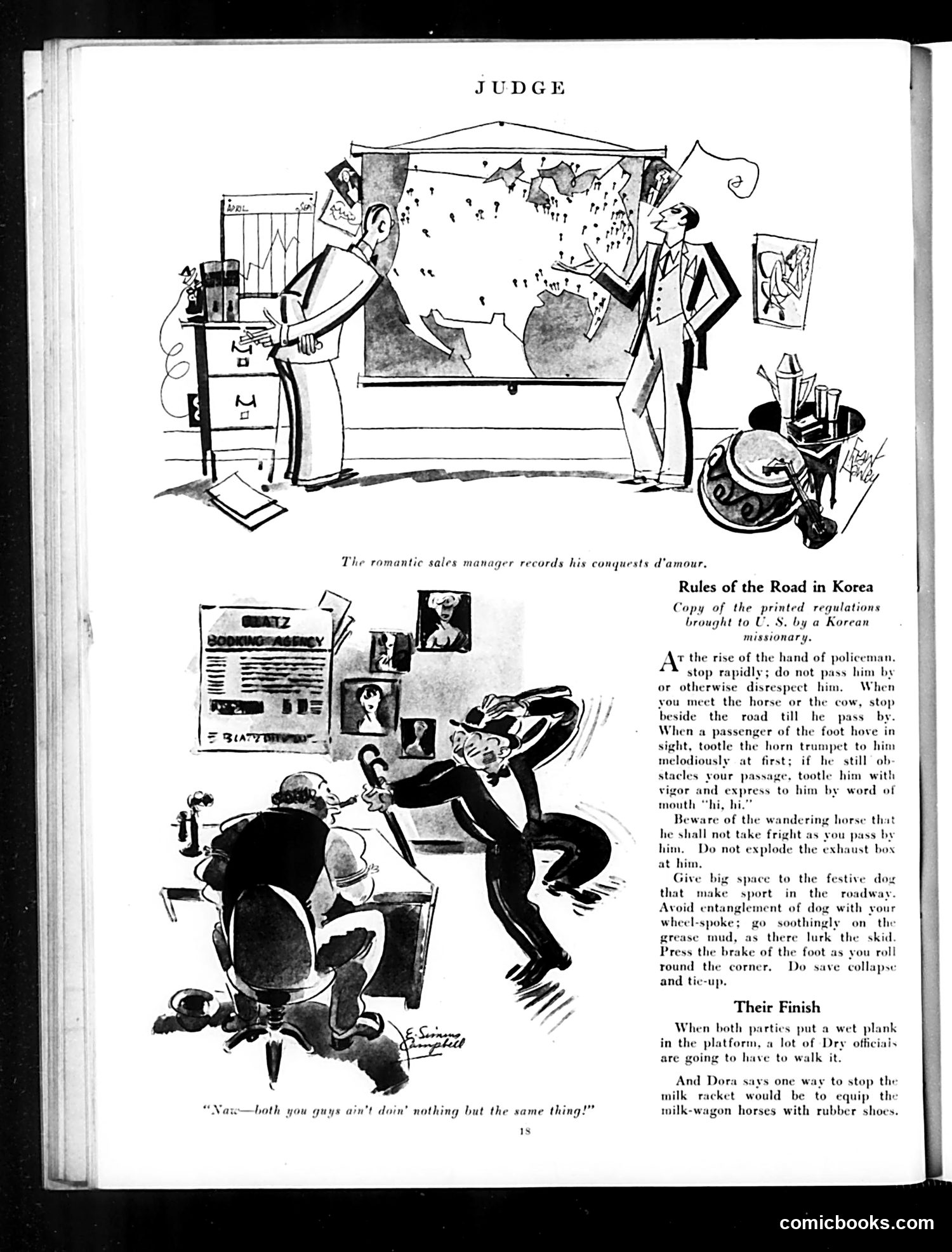
Judge Magazine Satire Analysis This page contains two distinct satirical pieces: Top cartoon ("Judge"): A sales manager proudly displays his romantic conquests to a colleague. The satire mocks the boastful culture of salesmen recording and comparing their romantic "victories" as business achievements—treating romantic pursuits like commercial transactions. "Rules of the Road in Korea": This section parodies Korean driving regulations brought back by a missionary. The humor derives from presenting absurdly polite, elaborate, almost comical traffic rules (treating pedestrians melodiously, respecting wandering horses, avoiding dog entanglement) as foreign oddities. It reflects early 20th-century American attitudes toward Korean customs as quaint or ridiculous by contrast to Western standards. The bottom cartoon shows two men in similar positions, with one saying both are doing "the same thing"—likely commenting on hypocrisy or the futility of their activities. The page satirizes American commercial culture, gender relations, and attitudes toward foreign nations.
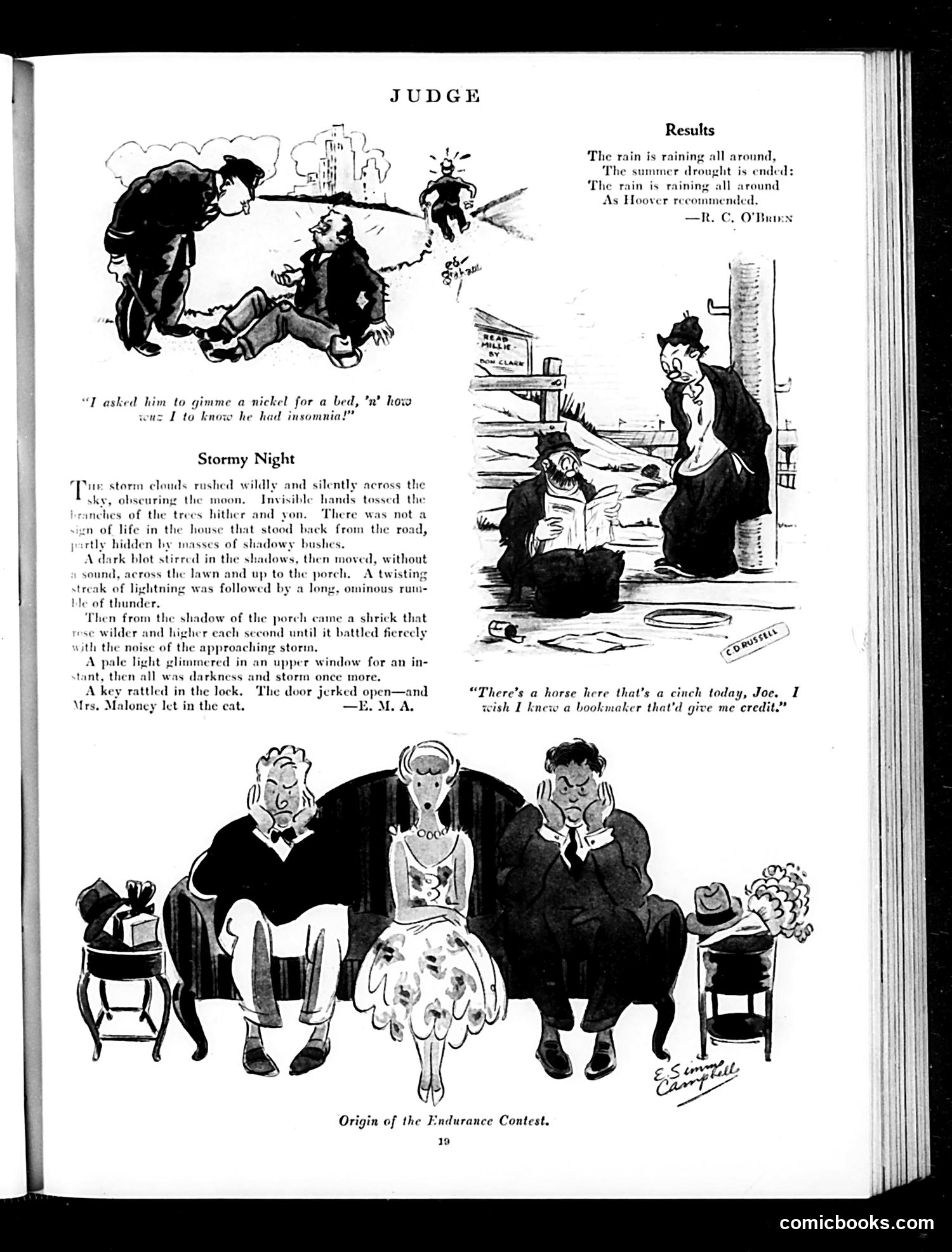
Explanation of Judge Page Content This page contains three distinct pieces of political and social satire from Judge magazine: "Results" is a poem mocking President Herbert Hoover's response to the Great Depression drought. By crediting Hoover with "recommending" rain that naturally arrived, it satirizes his ineffectual leadership during the economic crisis—implying his policies accomplished nothing concrete. "Stormy Night" is a gothic short story with no apparent political content; it appears to be entertainment filler. The bottom cartoon, "Origin of the Endurance Contest," depicts two men and a woman watching a dog stand on its hind legs. The caption suggests they're testing the dog's endurance—a joke about animal cruelty disguised as sport, likely critiquing fashionable but pointless contests of the era. The middle cartoon shows a man attempting to borrow money from a bookmaker using a horse racing tip as collateral—satirizing desperation and poor financial judgment, relevant to Depression-era economic hardship.
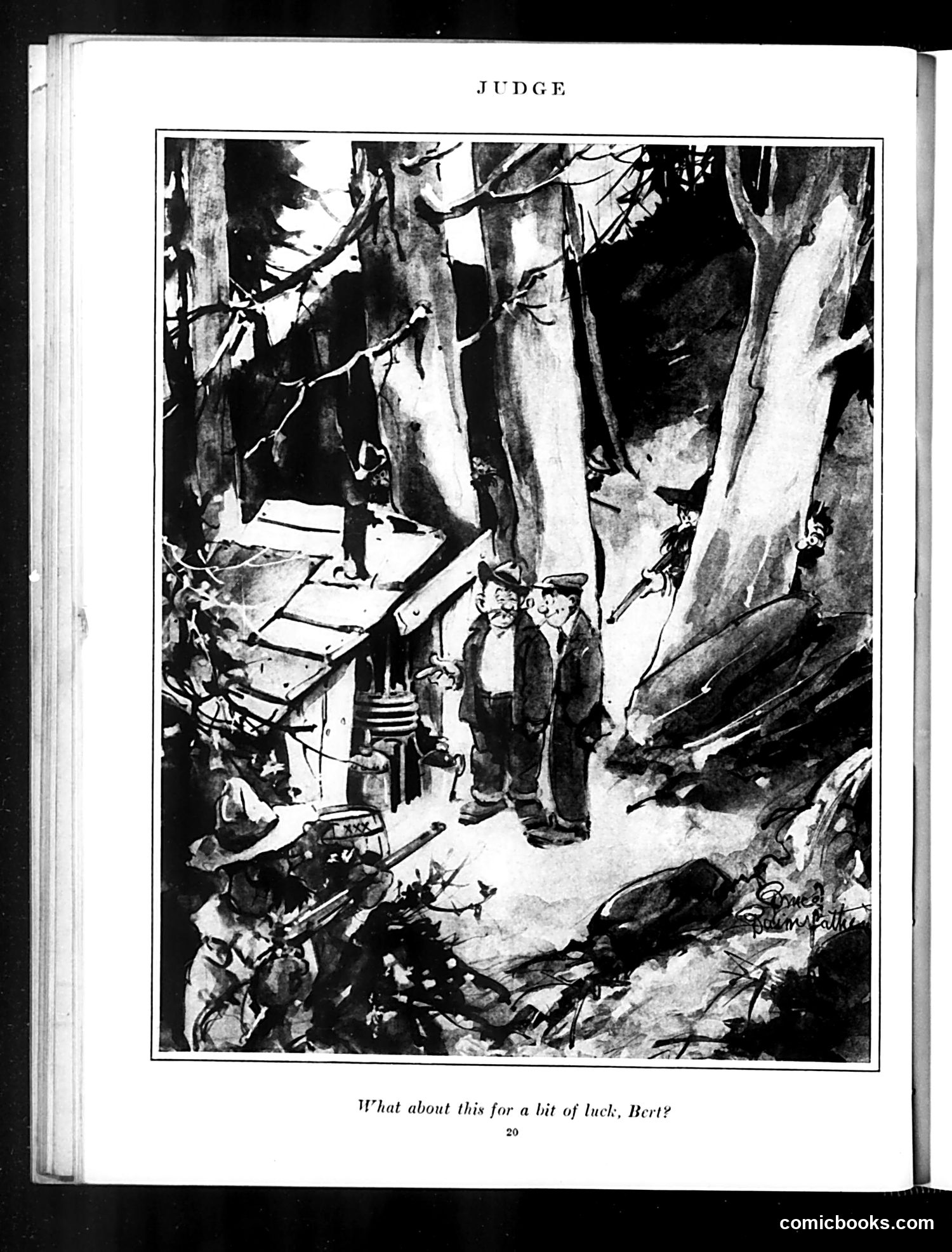
Explanation for Modern Readers This is a single cartoon from *Judge* magazine showing two figures in what appears to be a forest or wooded area surrounded by large tree trunks. One character addresses the other as "Bert," asking "What about this for a bit of luck?" The cartoon's specific satirical meaning is unclear without additional context. The joke likely relies on contemporary references—possibly to a news event, political figure, or cultural situation from the magazine's publication period—that would have been obvious to readers at that time but aren't self-evident today. The artistic style and black-and-white illustration suggest early-to-mid 20th century publication, but the exact date and specific target of the satire cannot be determined from this page alone.
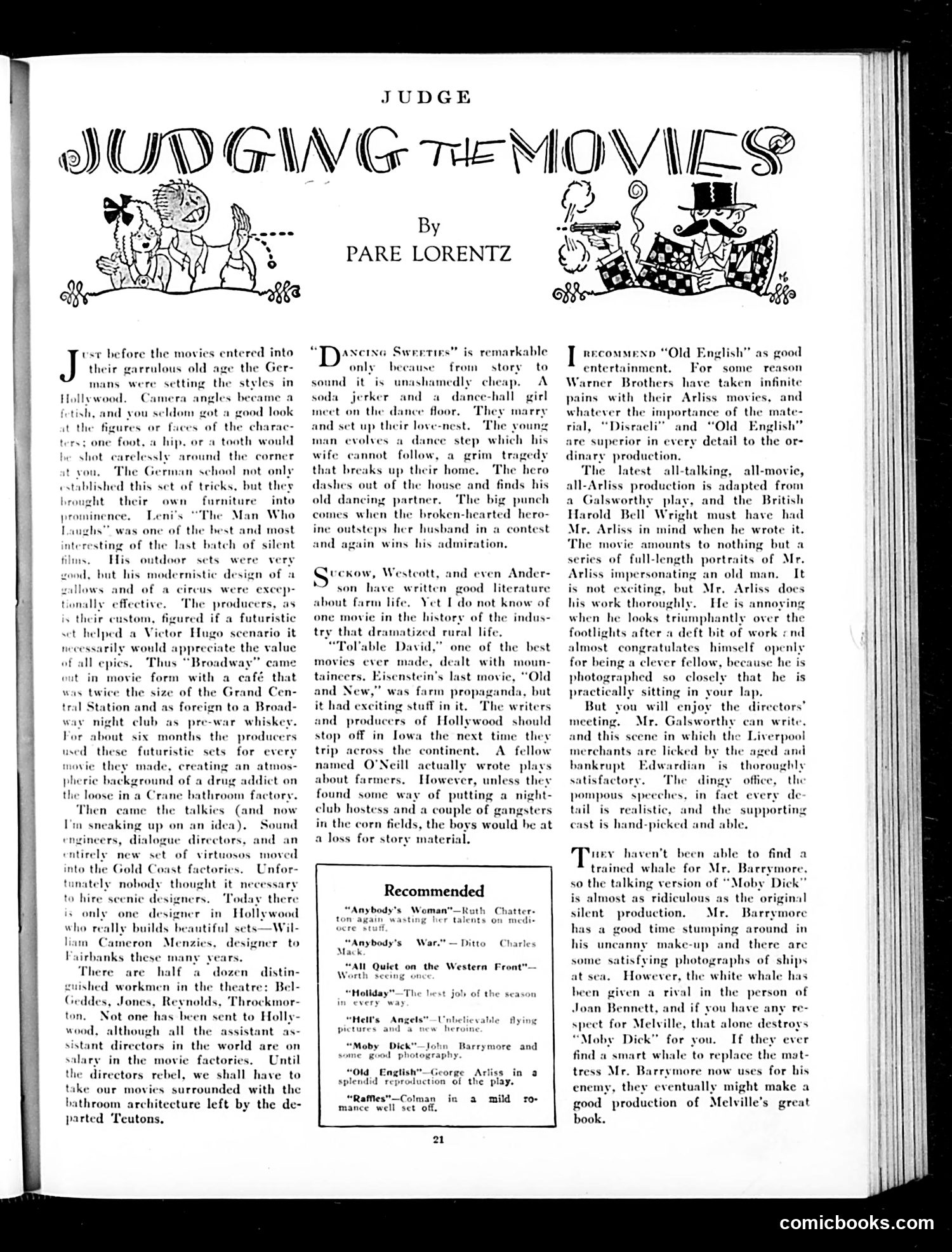
Judging the Movies: Context for Modern Readers This is a film criticism column by Pare Lorentz reviewing early sound films ("talkies"). The article critiques Hollywood's aesthetic choices: German Expressionist filmmakers had popularized futuristic, elaborate set designs in silent films, but this style persisted wastefully into the sound era despite being dramatically unsuitable. Lorentz praises designer William Cameron Menzies as Hollywood's only truly talented set designer, while lamenting that assistant directors—not artists—control production design. He criticizes the industry for ignoring rural American life (mentioning playwright O'Neill) and celebrates specific films like "All Quiet on the Western Front" and George Arliss's theatrical adaptations ("Old English," "Disraeli"). The "Recommended" box lists contemporary 1930 films. The overall tone is frustrated elitism—Lorentz wants artistry, not department-store bathroom fixtures, in cinema.
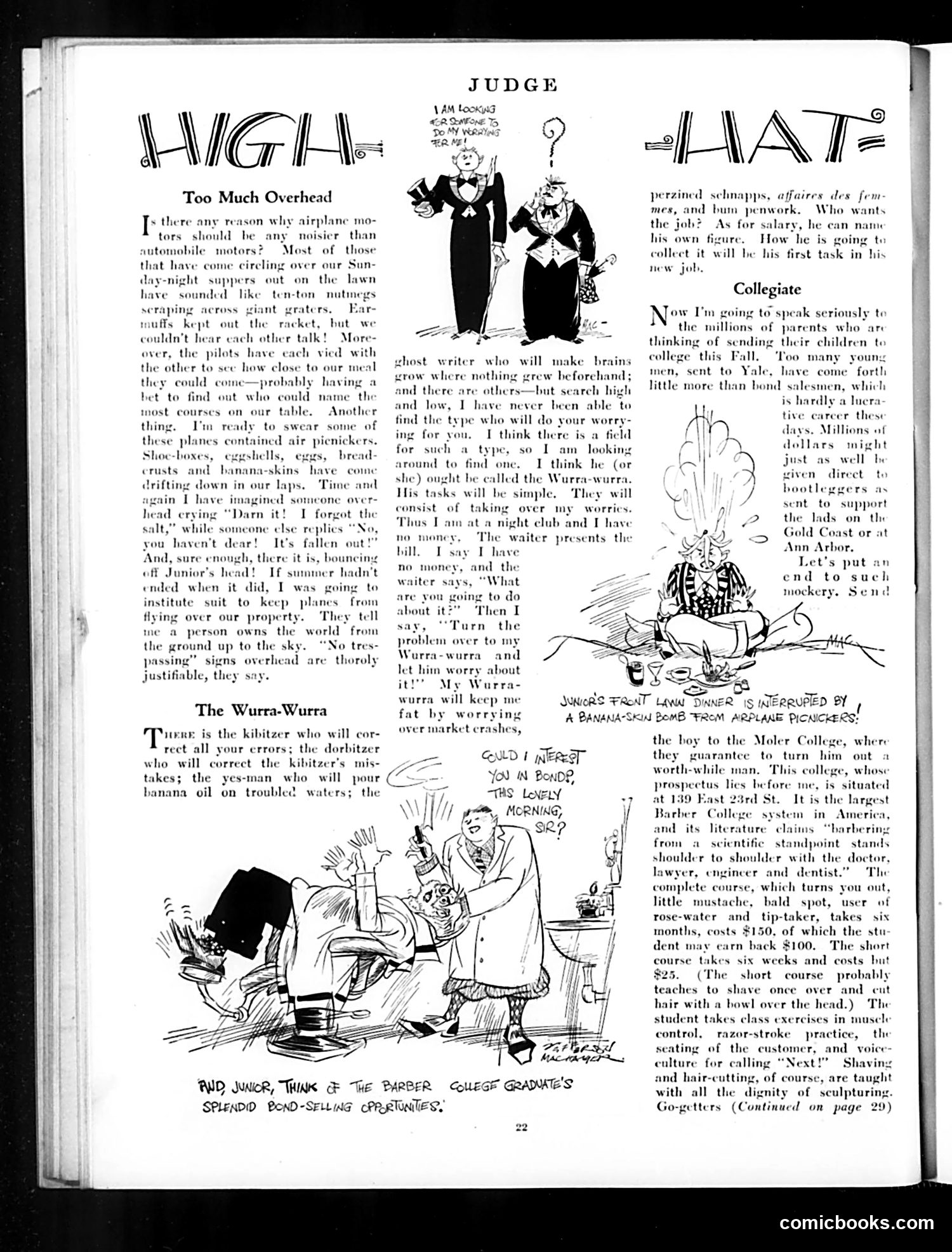
Judge Magazine Satire Analysis This page contains three separate satirical pieces targeting early 20th-century American life: "Too Much Overhead" mocks the noise and debris from low-flying airplanes disturbing suburban outdoor dining—a complaint reflecting aviation's rapid, unregulated expansion and its invasion of domestic spaces. "The Wurra-Wurra" proposes an imaginary professional "worrier" to handle clients' anxieties, satirizing both the proliferation of specialized service jobs and contemporary anxieties about financial markets and modern life. "Collegiate" critiques parents sending sons to Yale only to have them become mere "bond salesmen," then advertises the Moler Barber College as an alternative—a working-class trade school promising dignity and practical skills. The satire mocks both elite education's perceived failure and the ironic "prestige" of professional barbering training. All three pieces reflect 1920s concerns: technological disruption, economic anxiety, and class tensions regarding education and social mobility.
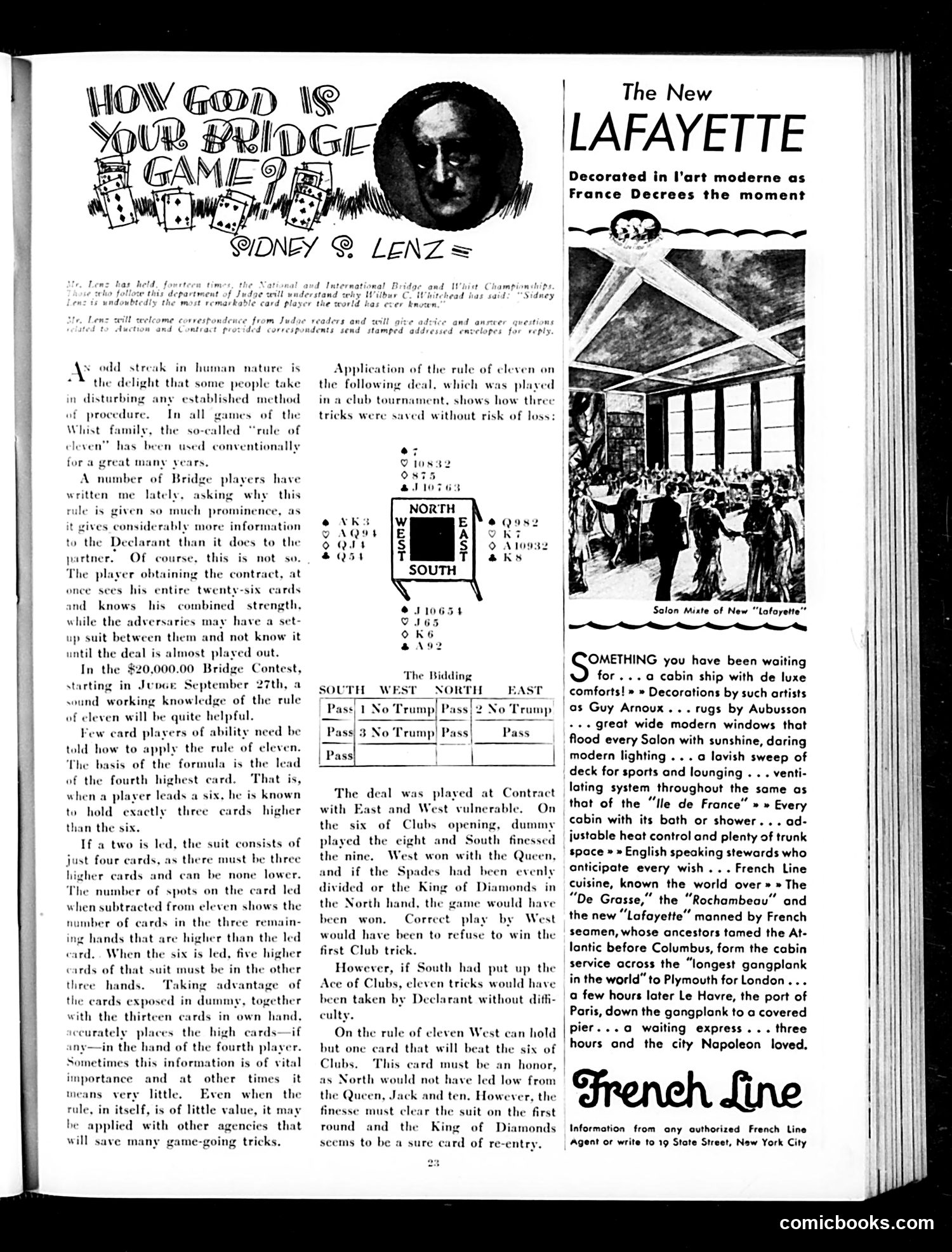
Analysis for Modern Readers This page from *Judge* magazine contains two distinct elements: Left side: An instructional article on bridge card game strategy by Sidney Lenz, a famous bridge expert. It explains the "rule of eleven"—a mathematical principle for inferring opponents' cards based on the fourth-highest card lead. This is straightforward how-to content, not satire. Right side: An advertisement for the SS Lafayette, a French luxury ocean liner decorated in Art Deco style. The ad emphasizes modern amenities (lighting, ventilation, spacious cabins) and cultural prestige, featuring a photograph of an elegant ship's salon. This is commercial content, not satire. The cartoon at top left ("How Good is Your Bridge Game?") appears to be a simple decorative header promoting bridge content, not political satire. This page is primarily instructional and advertising rather than satirical commentary. It reflects 1930s leisure culture—bridge as a popular intellectual pastime and transatlantic travel as a luxury pursuit.
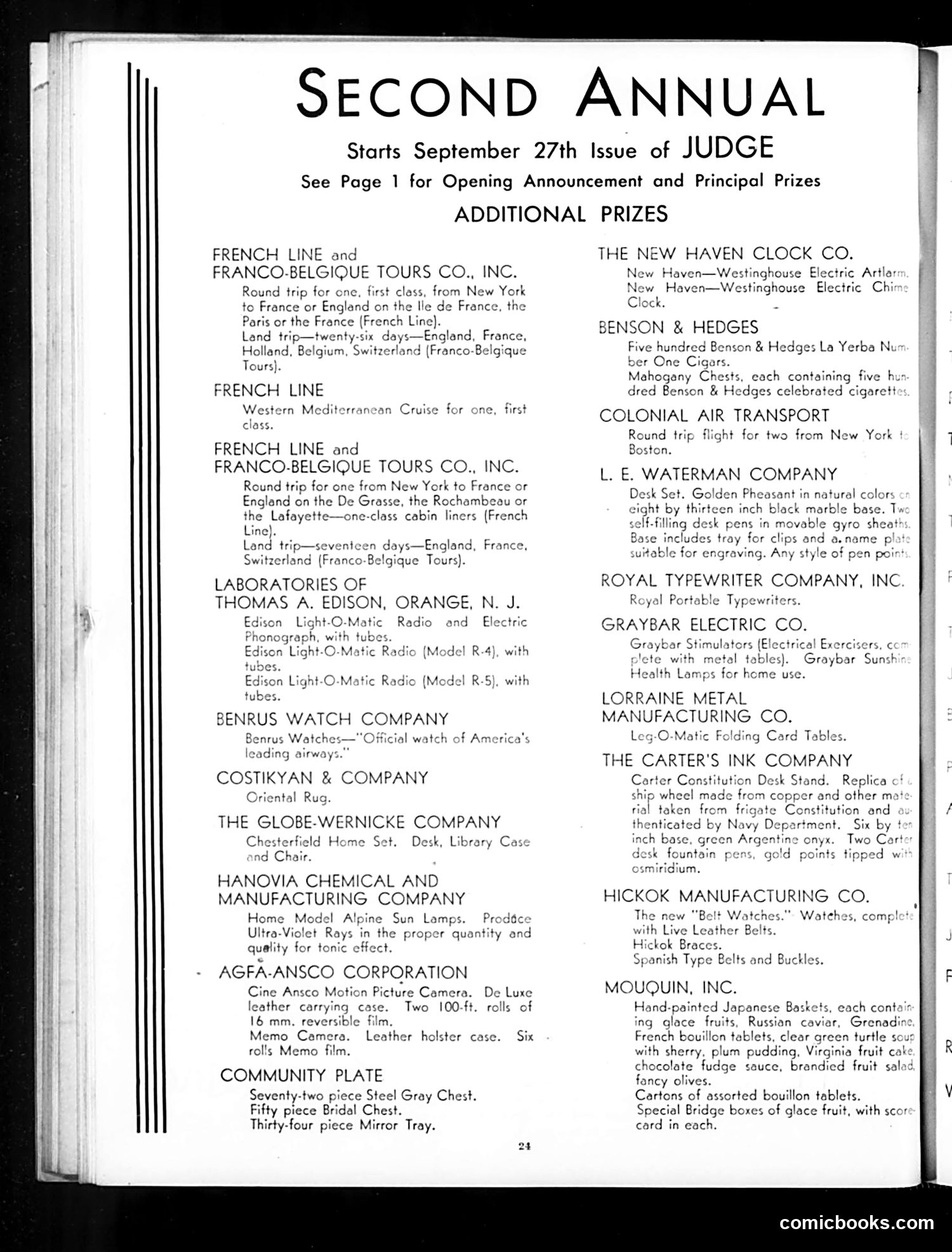
Analysis of Judge Magazine Page This is primarily a prizes page for Judge magazine's second annual contest (starting September 27th). Rather than containing cartoons or satire, it lists luxury prizes donated by major corporations of the era. The prizes themselves reveal 1920s-30s consumer culture and aspirations: transatlantic ocean liner voyages (French Line), Edison radio equipment, Benrus watches, Oriental rugs, Royal typewriters, and luxury foods from Mouquin (caviar, glace fruits). These reflect both post-WWI prosperity and emerging technologies (radios, electric appliances, airplanes via Colonial Air Transport). The page demonstrates how magazines monetized contests through corporate sponsorships while signaling to readers what constituted desirable, prestigious goods. The emphasis on European travel and "modern" electrical devices shows period anxieties about sophistication and technological progress. There are no visible cartoons or political commentary on this particular page—it functions as advertising wrapped in a contest announcement.
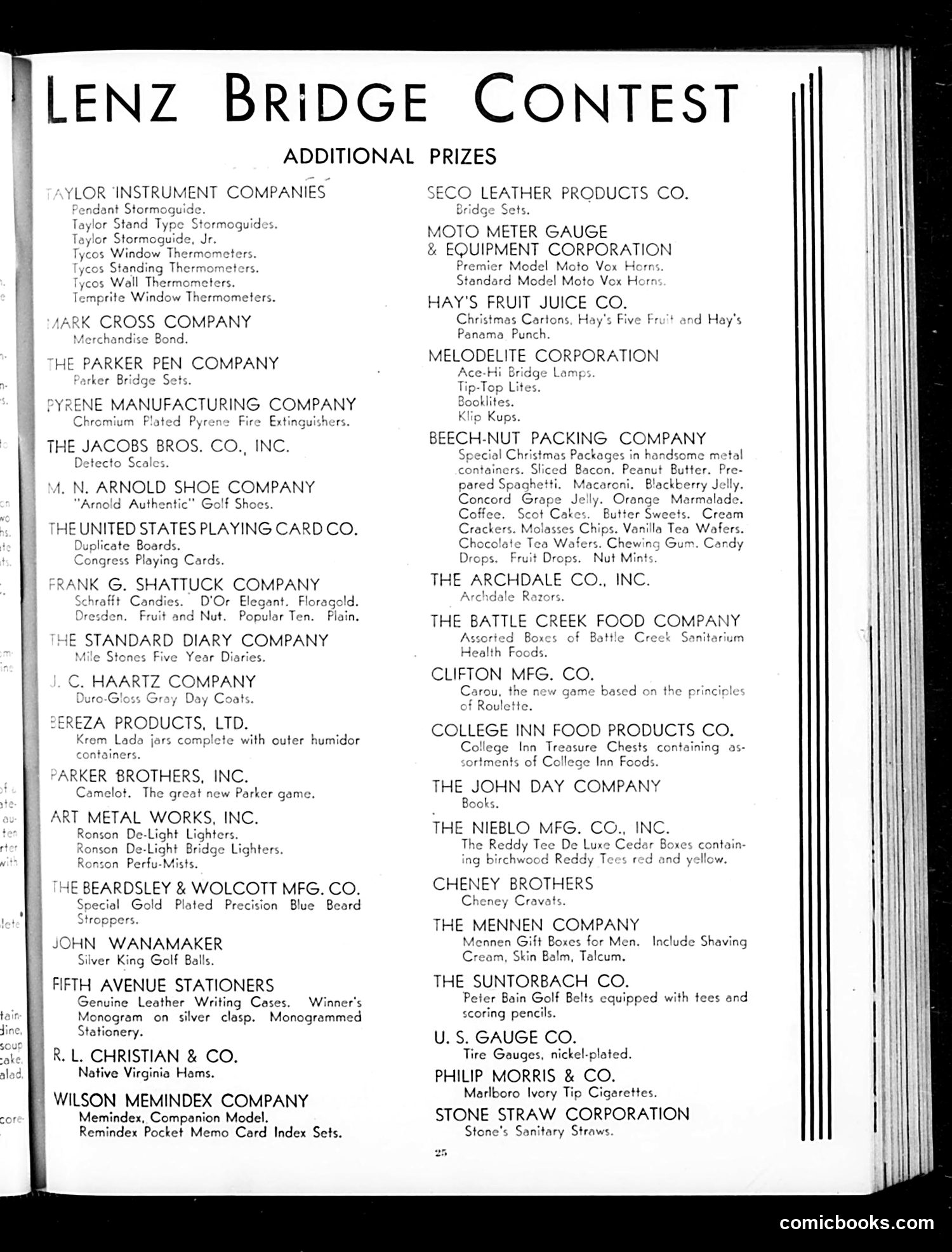
This Page Contains No Cartoon This is a list of additional prize donors for the "Lenz Bridge Contest"—likely a bridge tournament or competition sponsored by Judge magazine. The page simply catalogs dozens of companies and the specific products they contributed as prizes. The products reflect 1920s-30s consumer goods: cigarettes, golf equipment, writing instruments, food products, games, and household items. Companies like Parker Brothers, Ronson lighters, and Beech-Nut represent major brands of the era. There is no political satire, cartoon, or joke content on this page—it is purely administrative/promotional material listing contest sponsors. The satirical content of Judge magazine would appear elsewhere in that issue.
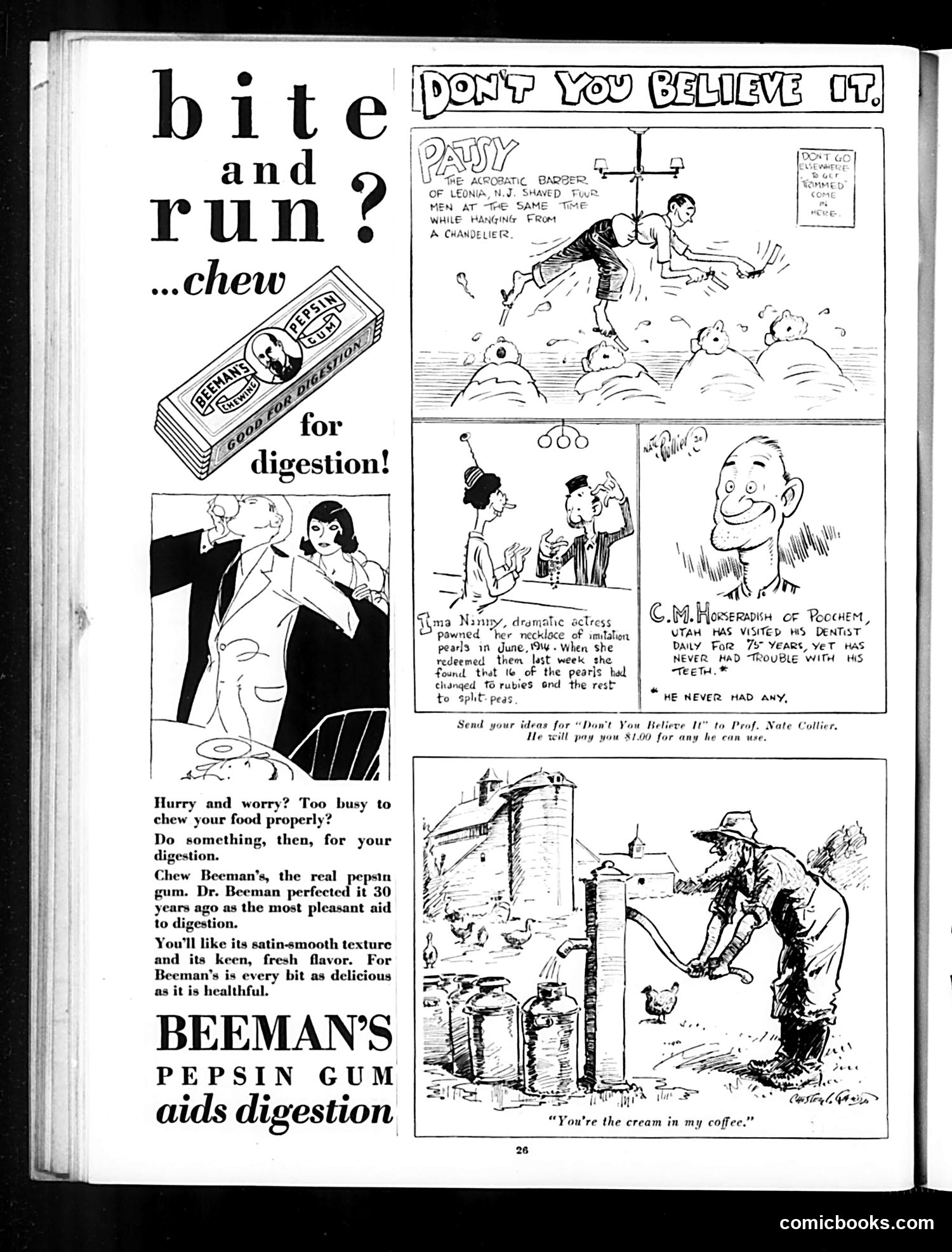
Analysis of Judge Magazine Page This page combines a Beeman's Pepsin Gum advertisement with the "Don't You Believe It" humor feature—a section inviting readers to submit supposedly false claims for publication. The Advertisement (left side) promotes chewing gum as a digestive aid, claiming it helps busy people who rush through meals. This reflects early 20th-century marketing that attributed health benefits to consumer products. "Don't You Believe It" cartoons (right side) present humorous "tall tales": 1. A acrobatic barber allegedly shaved men while hanging from a chandelier 2. Actress Sybil Nanny's imitation pearl necklace spontaneously transformed into rubies and split peas 3. C.M. Horseradish of Pocatello, Utah visited his dentist for 75 years without ever having teeth trouble—because he had no teeth These jokes mock implausible coincidences and exaggerated claims. The feature invites reader submissions at $1.00 per accepted joke, functioning as both entertainment and audience engagement. The page essentially showcases period advertising alongside gentle, accessible satire.
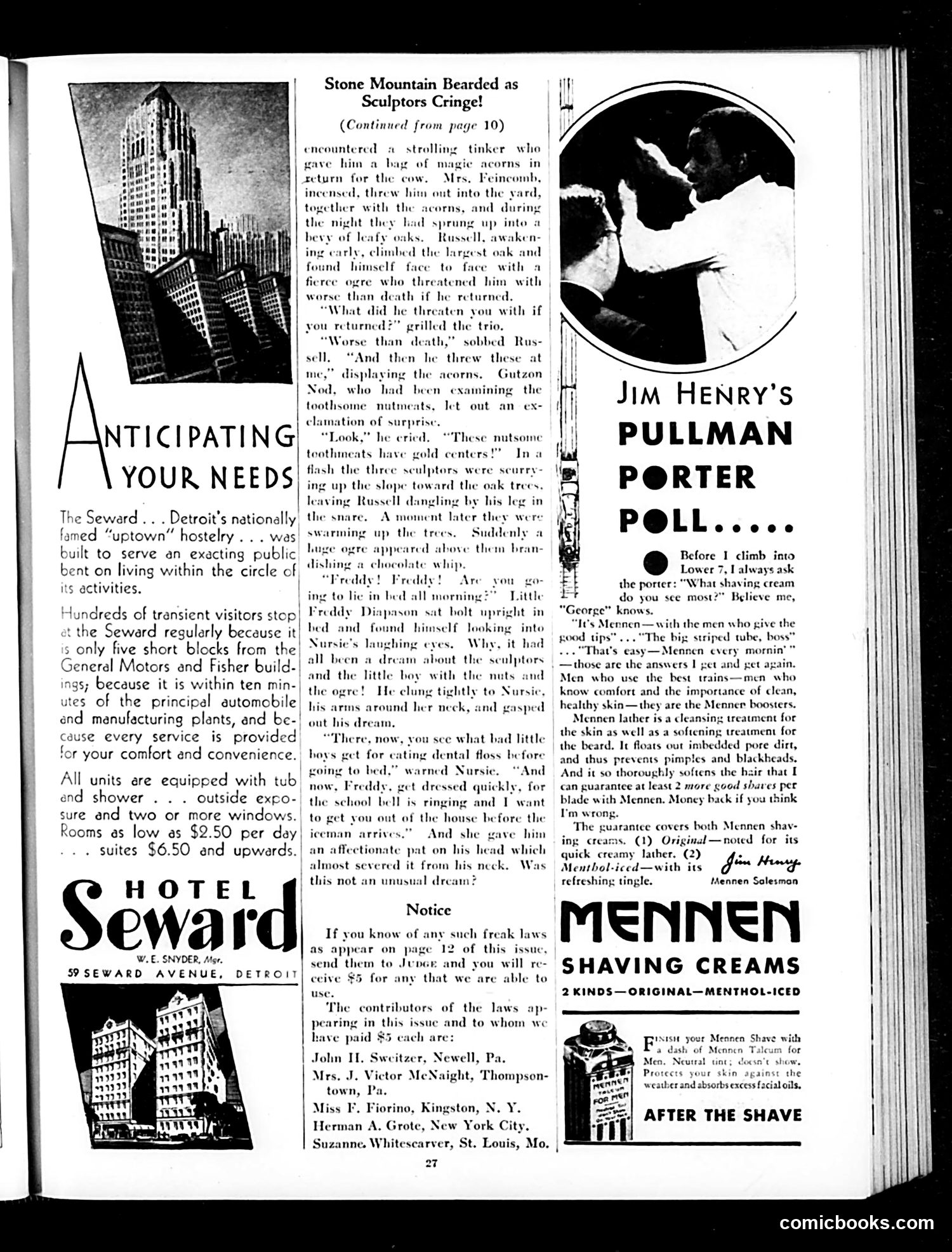
Analysis of Judge Magazine Page This page contains mostly advertisements and a humorous story, not political commentary. The main content is a whimsical fairy-tale narrative about a sculptor named Freddy who dreams of meeting an ogre and Gutzon Borglum (the famous sculptor, referenced as "Gutzon Nod"—a play on words). The story satirizes the absurdity of children's dream logic, ending with the revelation that it was all a dream, parodying sentimental children's literature. The advertisements promote Detroit's Seward Hotel and Mennen shaving cream, featuring a Pullman porter endorsing the product. This reflects early 20th-century advertising that used Black service workers as testimonials for consumer goods—a common (though problematic by modern standards) marketing tactic of the era. The "Notice" section solicits reader submissions of unusual state laws for a $5 payment, a recurring Judge feature. The page reflects 1920s consumer culture and mass-market advertising rather than political satire.
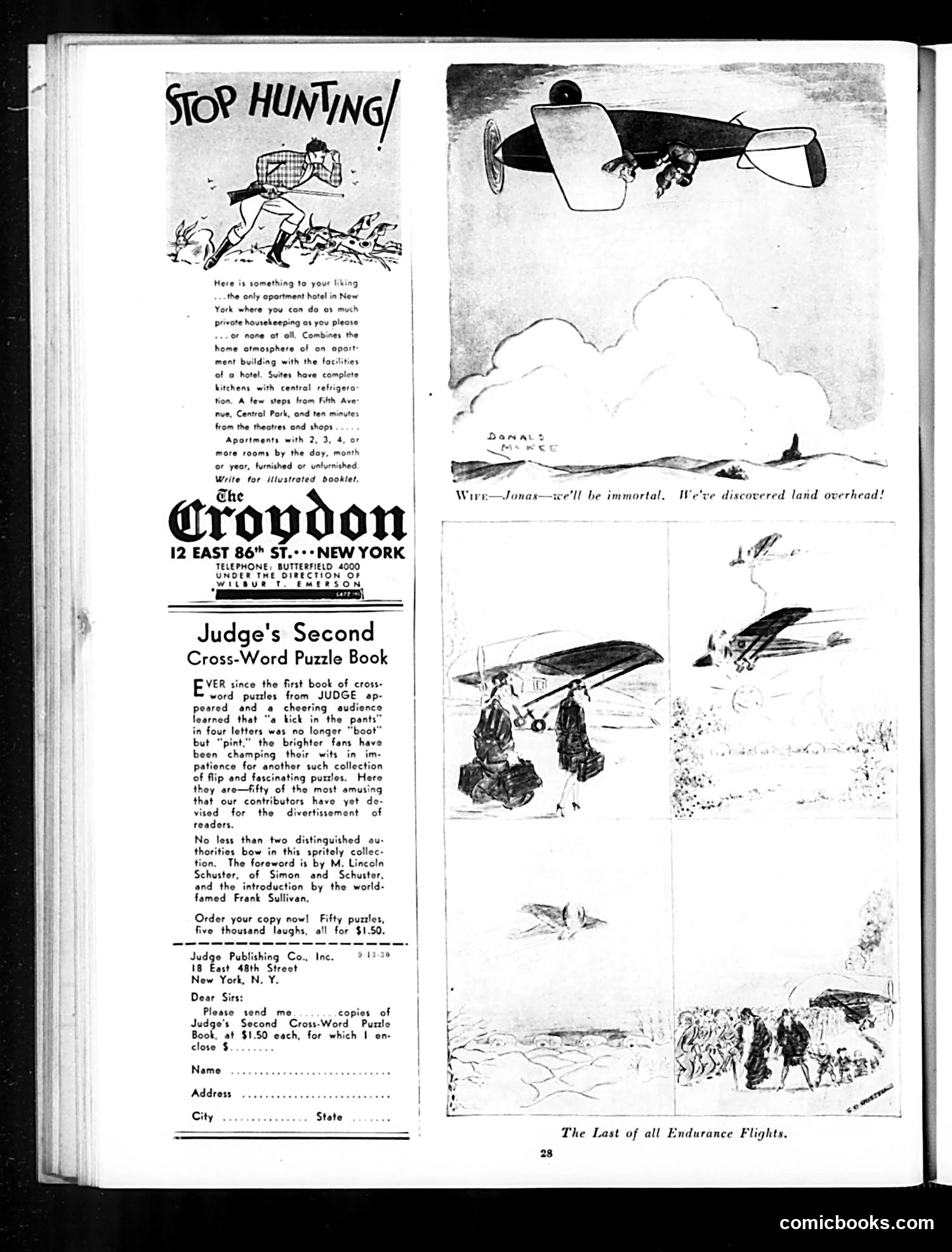
Analysis for Modern Readers This page contains two distinct elements: advertising (left side) and satirical aviation cartoons (right side). The left advertisements promote apartment hotels and a crossword puzzle book—typical 1920s-30s commercial content. The right cartoons satirize early aviation's extreme endurance flights. The caption "The Last of all Endurance Flights" mocks the obsessive competition among aviators to break distance/duration records. The sketches show increasingly absurd scenarios: discovery of "new land" overhead, planes held aloft by umbrellas, couples walking beneath a plane as casual spectators, and crowds witnessing what appears to be crash landings or disasters. The satire suggests these endurance flights were becoming ridiculous spectacles—dangerous stunts pursued more for publicity than practical purpose. The cartoonist implies society should stop celebrating these reckless aerial stunts. "Stop Hunting!" on the opposite page reinforces this message about ending dangerous pursuits. This reflects genuine 1920s-30s concerns about aviation safety and the public's appetite for spectacular (often fatal) aviation records.
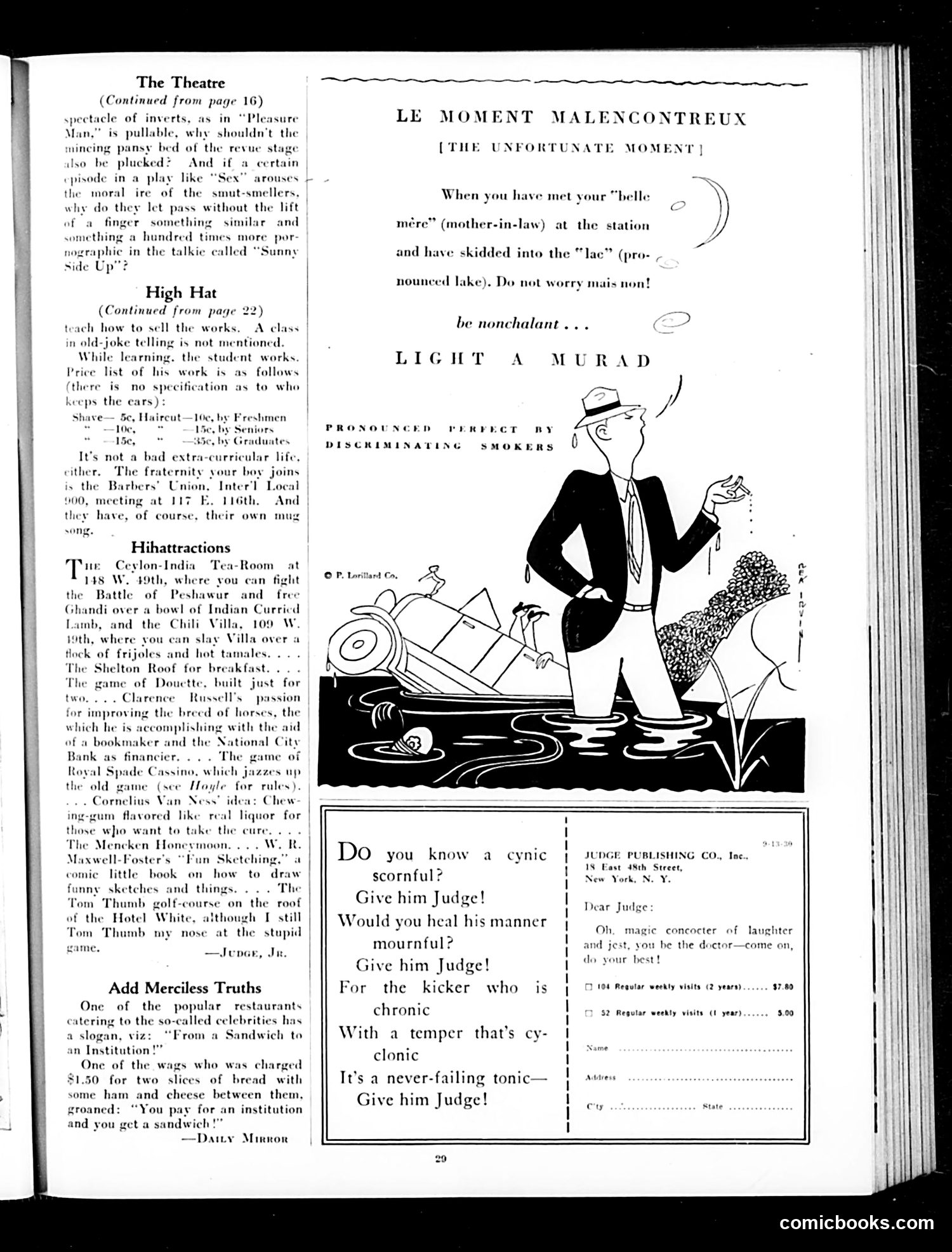
"Light a Murad" Cigarette Advertisement This page contains primarily advertising and theater reviews rather than political satire. The main illustration is a commercial advertisement for Murad cigarettes, featuring a well-dressed man in a top hat smoking, with the tagline "Light a Murad—Pronounced Perfect by Discriminating Smokers." The cartoon makes a visual joke: the man appears to be surrounded by water or has somehow ended up in an awkward situation, yet remains composed and nonchalant while smoking. This contrasts his sophisticated appearance with comedic misfortune—a common advertising technique of the era meant to suggest the cigarette's calming properties. The French-titled section "Le Moment Malencontreux" (The Unfortunate Moment) humorously addresses meeting one's mother-in-law after a car accident ("skidded into the lac"), advising not to worry—paired with the cigarette ad to suggest Murad as a social comfort. The page also includes theater reviews, restaurant recommendations, and a "Judge!" advice column—typical Judge magazine content mixing entertainment criticism with advertising.
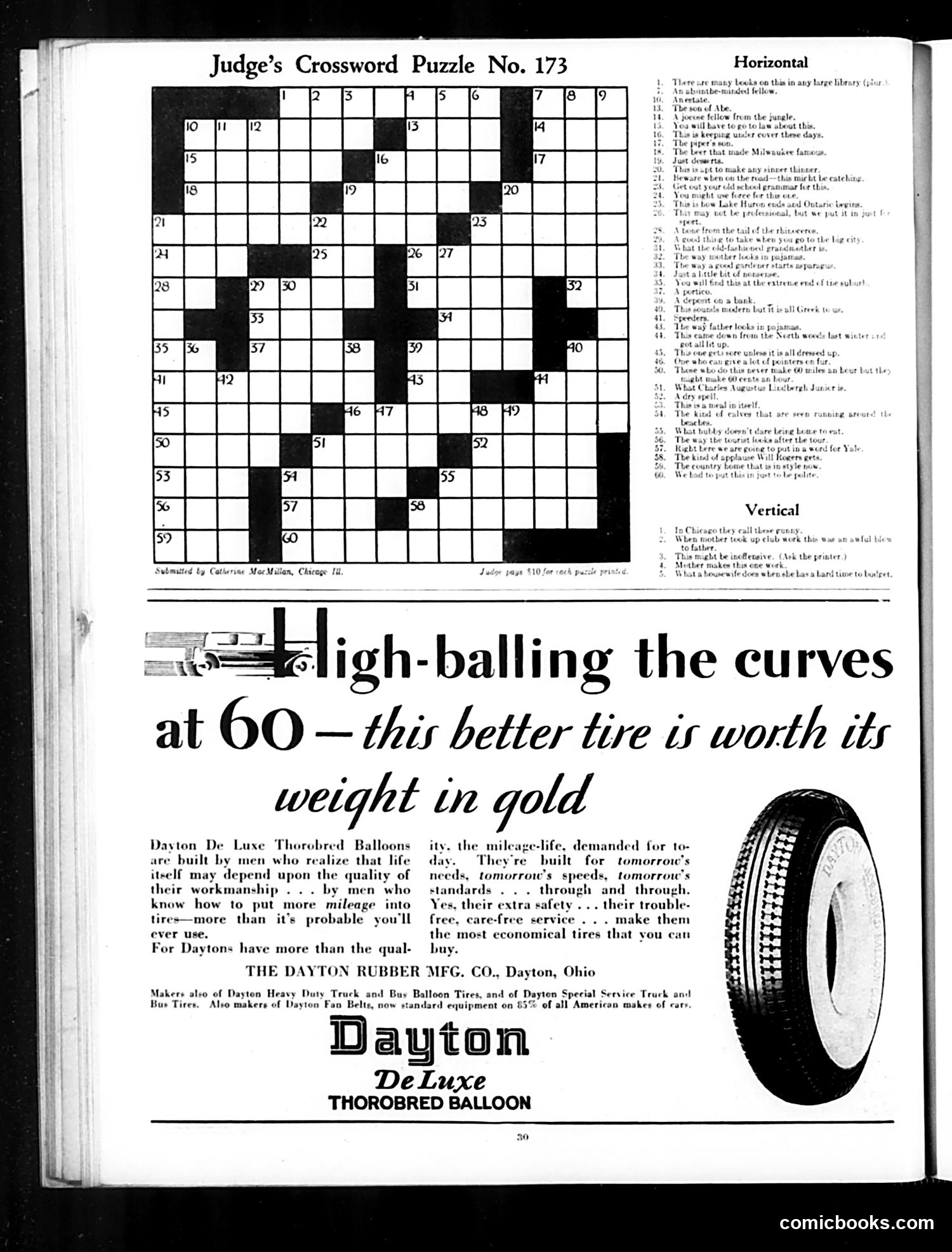
Judge Magazine Page Analysis This page is primarily an advertisement, not satirical content. It features a full-page ad for Dayton De Luxe Thorobred Balloon tires, positioned above a crossword puzzle. The advertisement uses the phrase "high-balling the curves at 60" — referring to driving at 60 mph around curves — to market tires as a safety and value proposition. The messaging emphasizes that quality tires are "worth their weight in gold" because they're built for both current and future driving demands ("tomorrow's needs, tomorrow's speeds"). The ad's rhetoric reflects early automotive culture, when tire quality directly affected vehicle safety and longevity. The claim that Dayton tires appear on "85% of all American makes of cars" suggests market dominance. There is no political satire on this page — it's a straightforward product advertisement from The Dayton Rubber Manufacturing Company of Ohio, integrated into Judge magazine's editorial content.
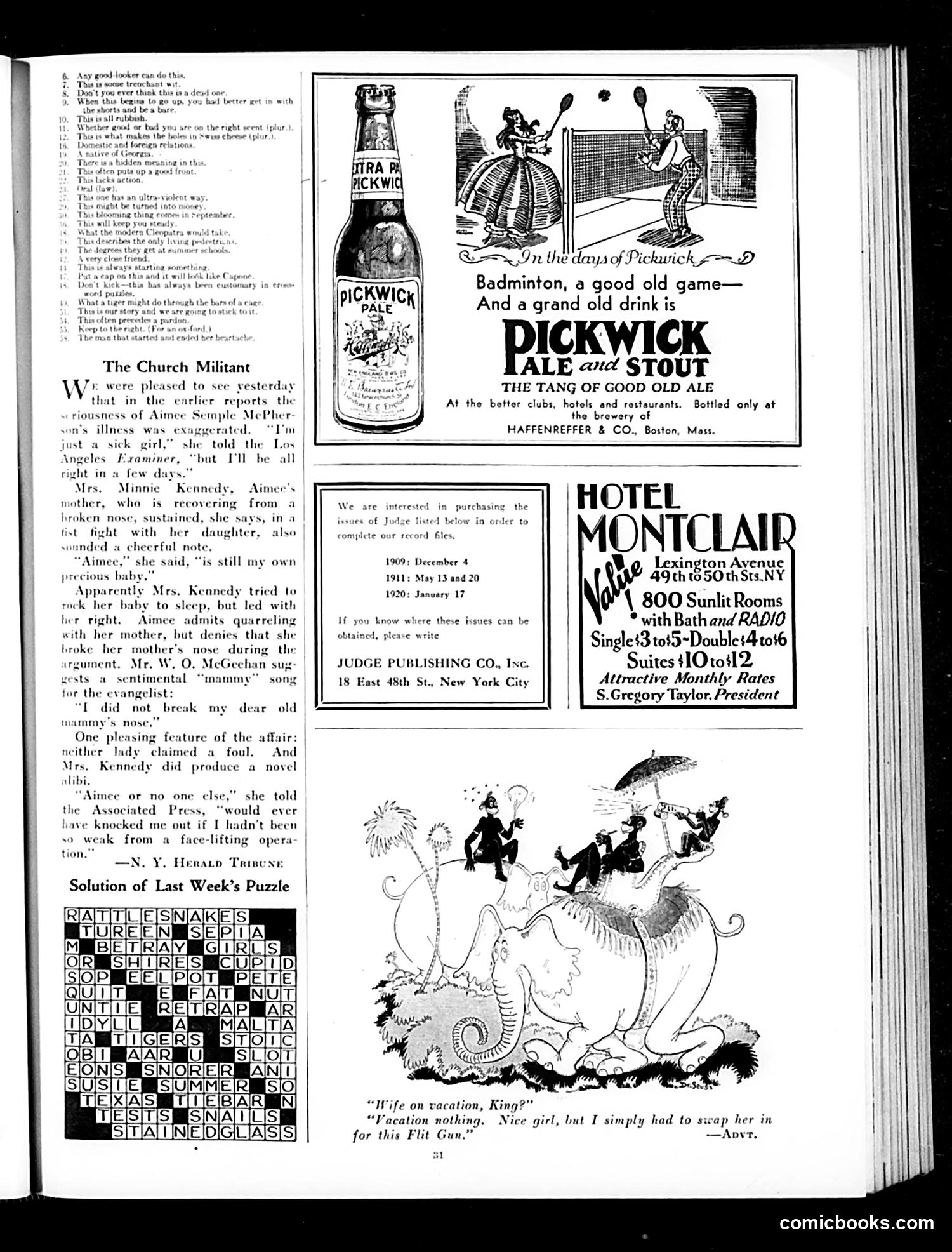
"The Church Militant" Analysis This article mocks Aimee Semple McPherson, the famous 1920s evangelist and founder of the Foursquare Church. The satire centers on a public scandal: McPherson's mother, Minnie Kennedy, claimed she broke her nose in a fist fight with her daughter during a quarrel. Judge ridicules both women's contradictory explanations. Aimee denies causing the injury; her mother bizarrely claims she was weakened from a "face-lifting operation"—implying she was vain about her appearance. The absurdity of neither woman admitting fault, combined with the mother's deflection to cosmetic surgery, undercuts their credibility. The joke targets McPherson's public image as a moral authority preaching religious virtue while her private life involved physical conflict and vanity. The headline "The Church Militant" sarcastically suggests aggressive religiosity masking worldly concerns. This reflects 1920s skepticism toward celebrity evangelists and their families.
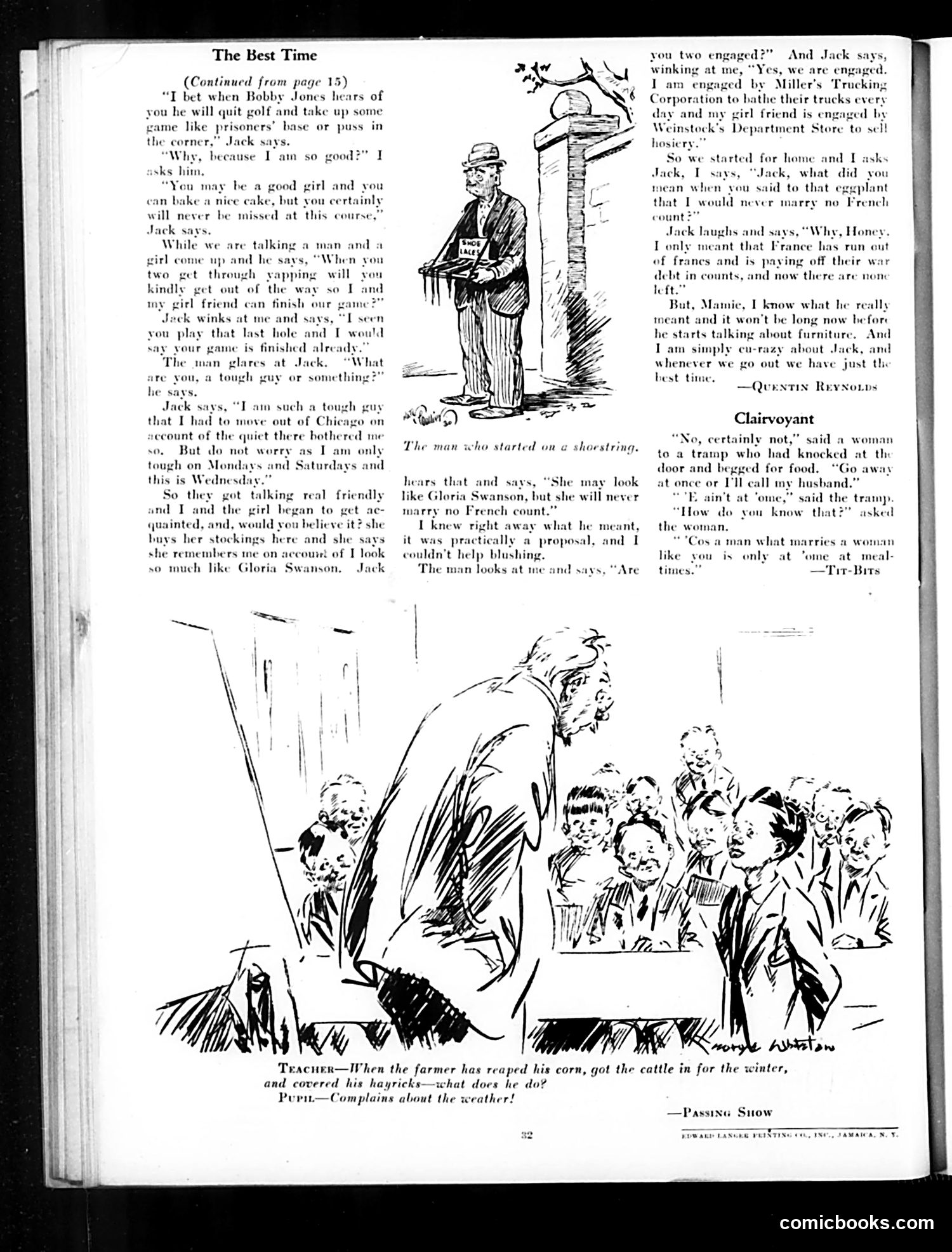
Analysis for Modern Readers This page contains two distinct pieces from Judge magazine: "The Best Time" (top) is a romantic comedy story about a couple at a golf course. The humor relies on 1920s-30s era references: Bobby Jones (famous golfer), Gloria Swanson (silent film star), and jokes about French counts and currency inflation from post-WWI France. Jack's humor is cocky, working-class sass—he claims toughness and boasts about the girl comparing herself to Swanson, then makes a pun about France's financial crisis instead of actual nobility. "Clairvoyant" and "Teacher/Pupil" (bottom) are brief joke items. The first plays on the tramp's ability to deduce the husband's absence; the second is a rural wisdom joke about farmers—after harvest work, they simply complain about weather regardless of circumstances. The cartoons use crude caricature drawing typical of the era. Overall, these pieces reflect American humor conventions of the interwar period: class humor, slapstick romance, and rustic observations.
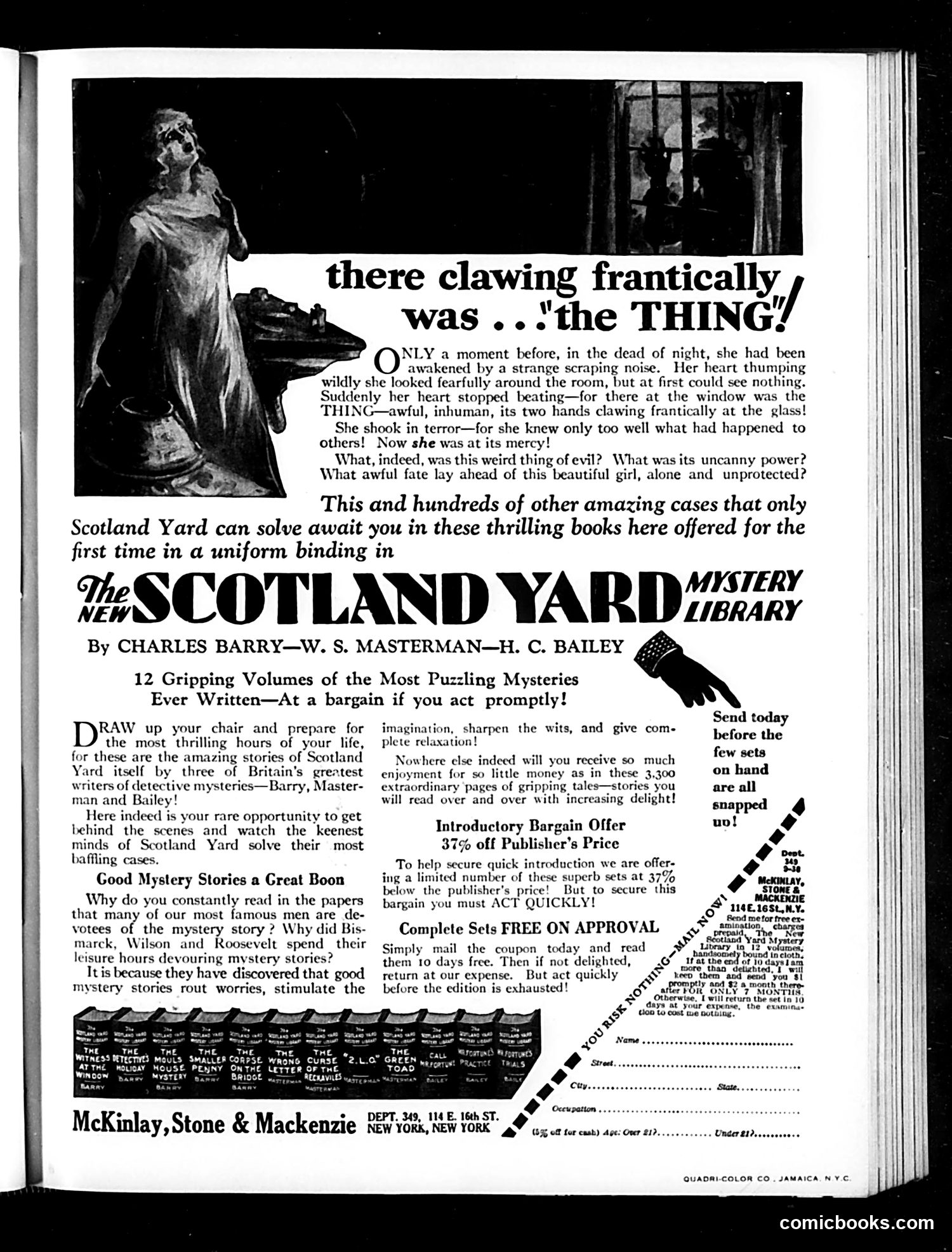
Scotland Yard Mystery Library Advertisement This is primarily a book advertisement, not political satire. It promotes a 12-volume mystery collection by established detective fiction writers (Charles Barry, W.S. Masterman, H.C. Bailey), marketed as Scotland Yard cases. The dramatic imagery—a woman at a window menaced by "the THING" clawing at glass—is pulp fiction marketing, designed to evoke Gothic horror and suspense to attract readers. The theatrical language ("weird thing of evil," "uncanny power") exemplifies 1920s-30s mystery genre conventions. The appeal explicitly targets educated professionals: the text references Bismarck, Wilson, and Roosevelt as mystery devotees, suggesting the genre offers intellectual relaxation for serious men. The "37% off" introductory offer with free 10-day approval is standard direct-mail sales technique. There is no political commentary visible here—this is straightforward commercial promotion using sensationalism to sell books.
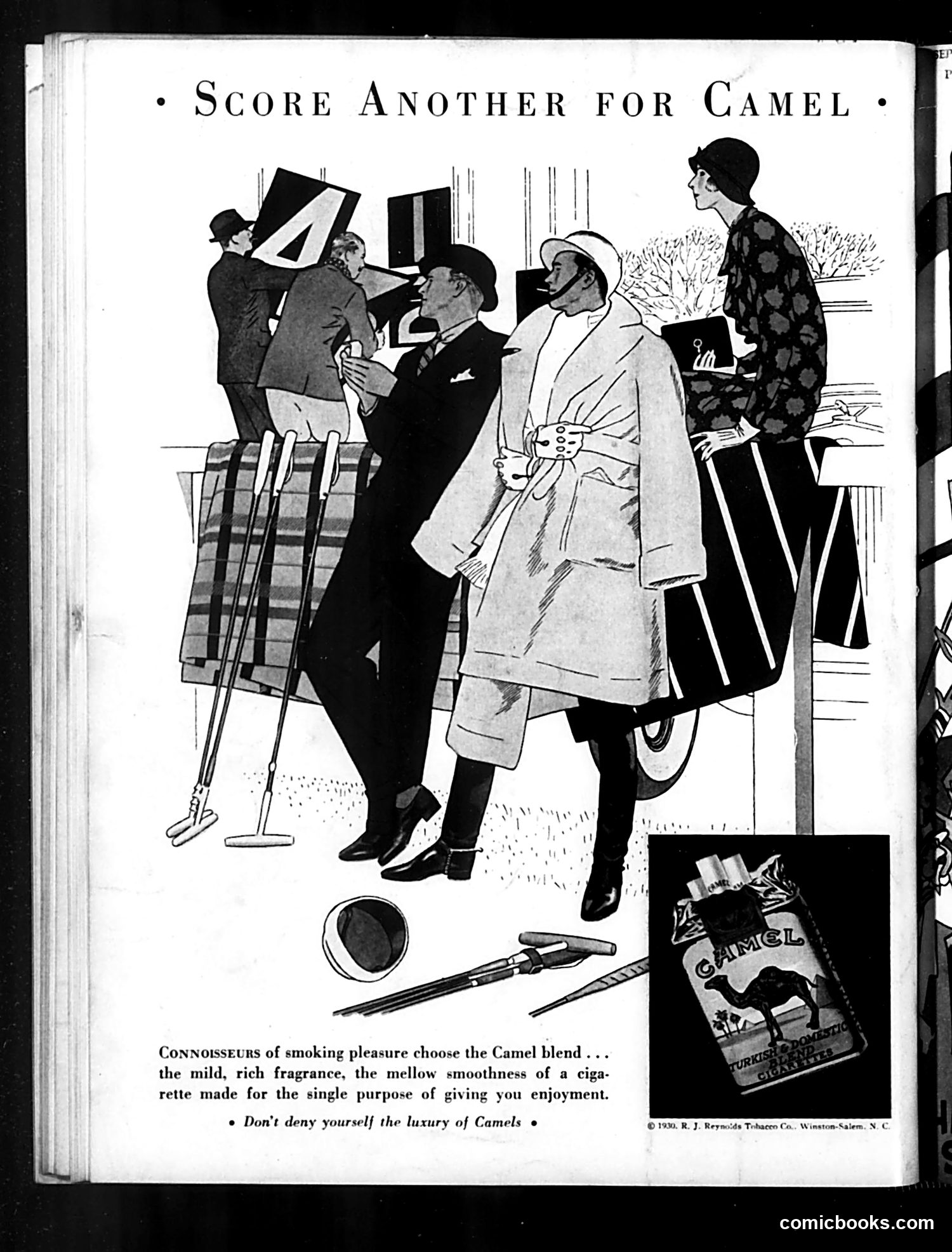
Analysis This is a Camel cigarette advertisement, not political satire. The page depicts well-dressed men and women at what appears to be a social gathering or sporting event (note the golf clubs leaning against the furniture). The figures are styled as sophisticated "connoisseurs" to appeal to aspirational middle-class consumers. The ad's messaging emphasizes luxury and pleasure—"Don't deny yourself the luxury of Camels"—a common advertising strategy of the 1920s-30s. The accompanying cigarette package image in the lower right reinforces the brand. This is straightforward commercial advertising using illustrations of elegant, leisured people to market cigarettes as a status symbol and refined indulgence. The Judge magazine, despite its satirical reputation, carried substantial advertising revenue through such placements.