judge
Judge — September 20, 1930
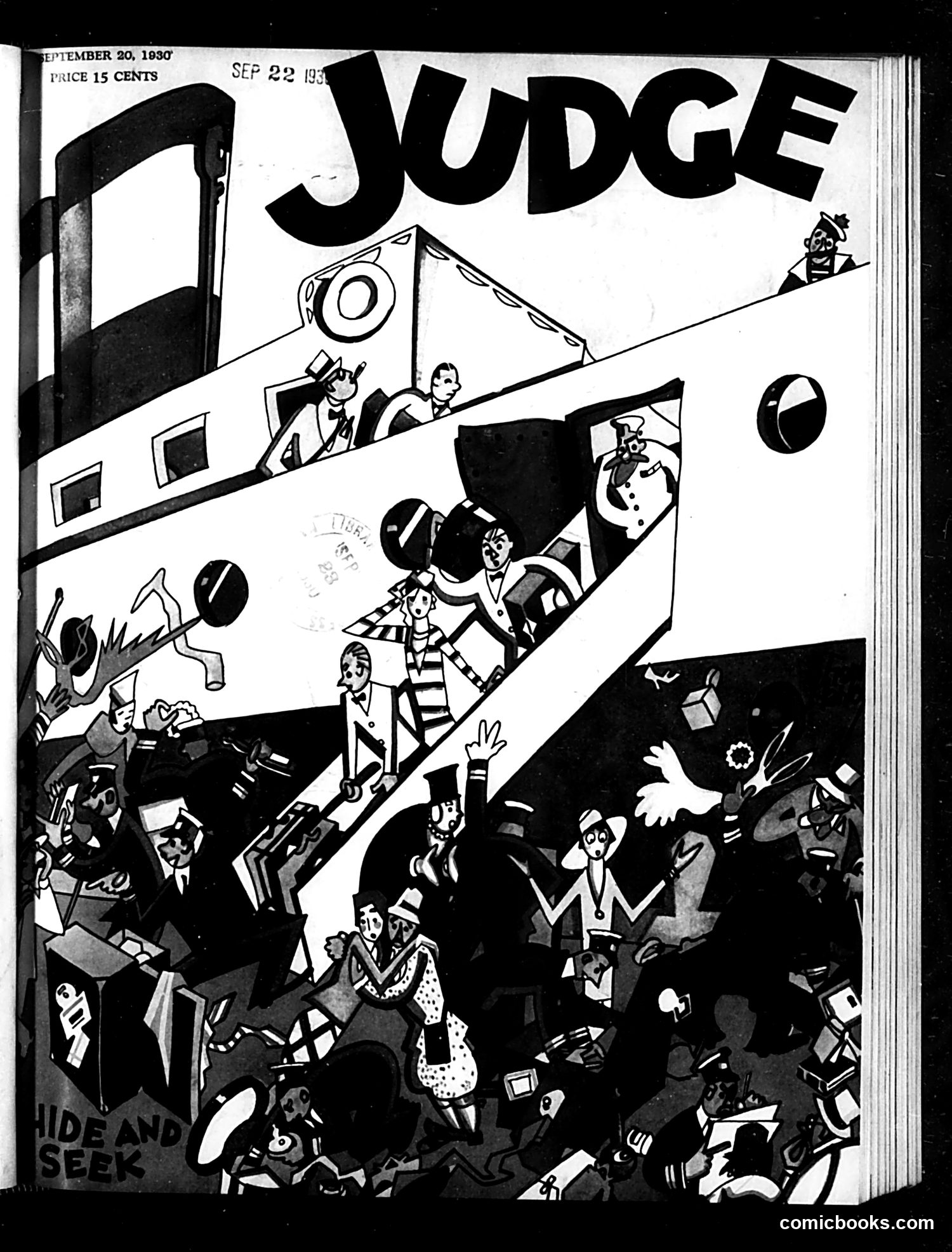
Judge Magazine Cover Analysis — September 20, 1930 This cover depicts a chaotic "Hide and Seek" scene set in what appears to be a building or ship with multiple levels. Well-dressed figures and children are scattered throughout various hiding spots — behind doors, in compartments, and on different floors — while playing the children's game. The satirical point likely comments on social behavior during the Great Depression (1930), possibly mocking how people of different classes or social standings were "hiding" or concealing themselves during economic crisis. The elaborate, busy composition with figures cramped into confined spaces could reference housing shortages, overcrowding, or the desperate circumstances many faced. The specific political reference remains unclear without additional context.
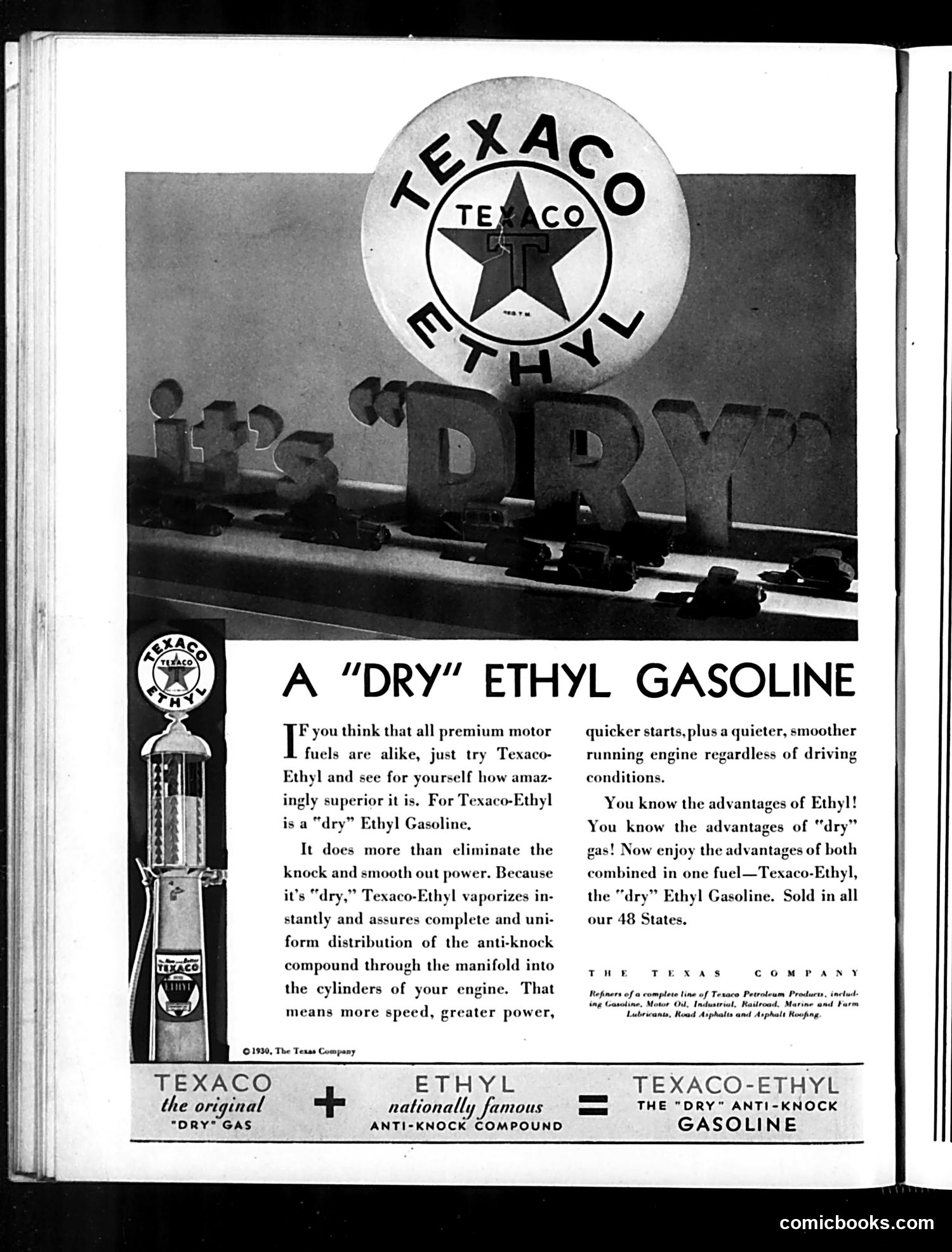
Analysis This page is not a cartoon or satirical content — it's a full-page advertisement for Texaco-Ethyl gasoline from 1930. The ad features the Texaco star logo and imagery of a railroad car or train mechanism, emphasizing the product's "dry" formula. The text promotes Texaco-Ethyl as a premium fuel combining two benefits: Texaco's original "dry" gasoline with an ethyl anti-knock compound. The advertisement highlights practical engine benefits: smoother running, quicker starts, and improved power distribution. The claim that it's "sold in all our 48 States" suggests nationwide availability was a competitive selling point in this era. This represents typical Judge magazine revenue — paid advertising rather than editorial satire.
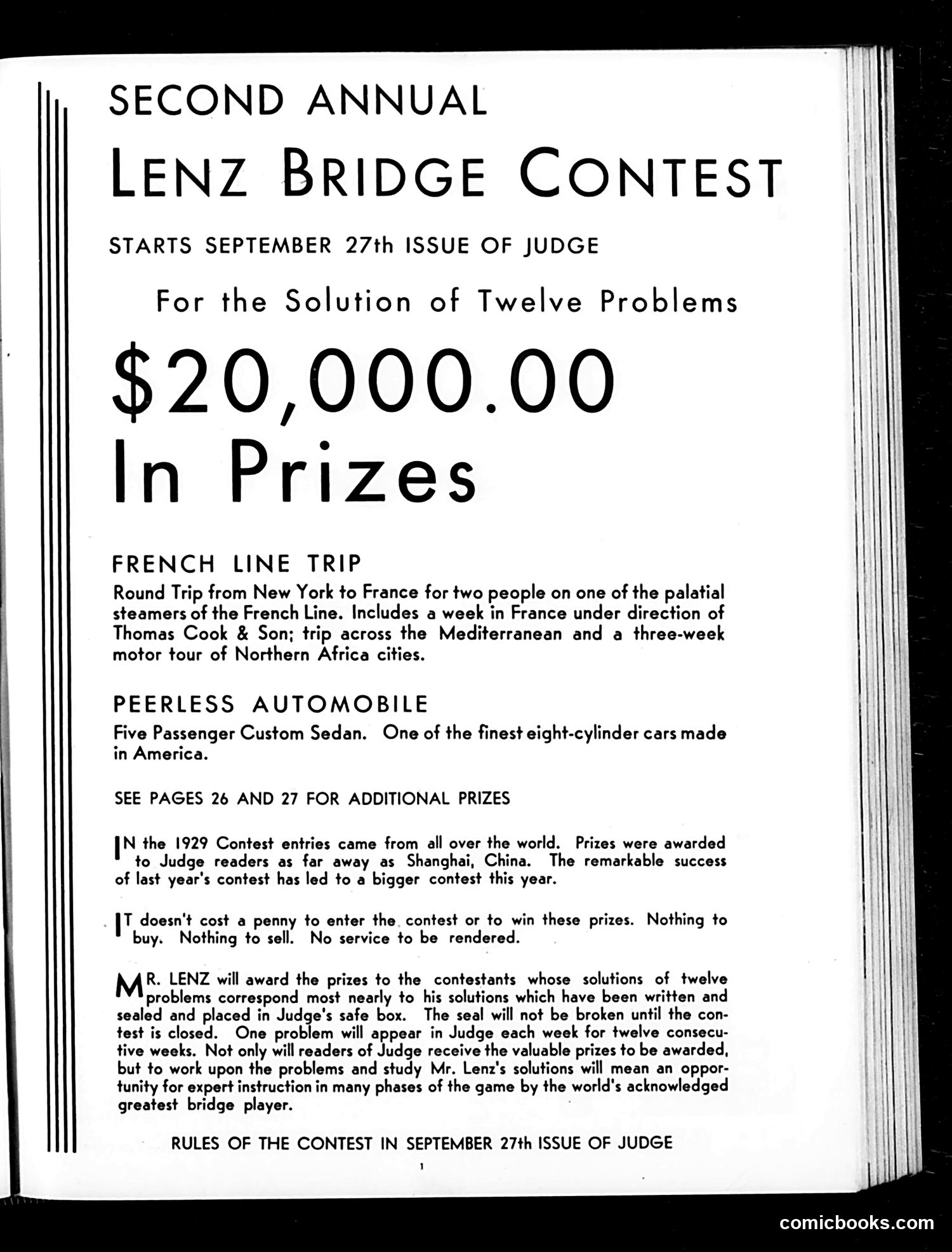
Analysis This is primarily advertising content, not a political cartoon or satire. It announces Judge magazine's "Second Annual Lenz Bridge Contest," a puzzle competition starting September 27th with $20,000 in prizes. The prizes include a French Line ocean voyage and a Peerless automobile—luxury items reflecting 1920s-30s affluence. The contest presents bridge (the card game) problem-solving as entertainment for Judge's educated, wealthy readership. The text emphasizes the contest's legitimacy and ease of entry ("doesn't cost a penny"), suggesting such contests may have faced skepticism or regulatory questions. The reference to Mr. Lenz's bridge solutions implies he was a recognized authority on the game. This represents mainstream magazine commerce of the era—using prestigious prizes to boost circulation and reader engagement.
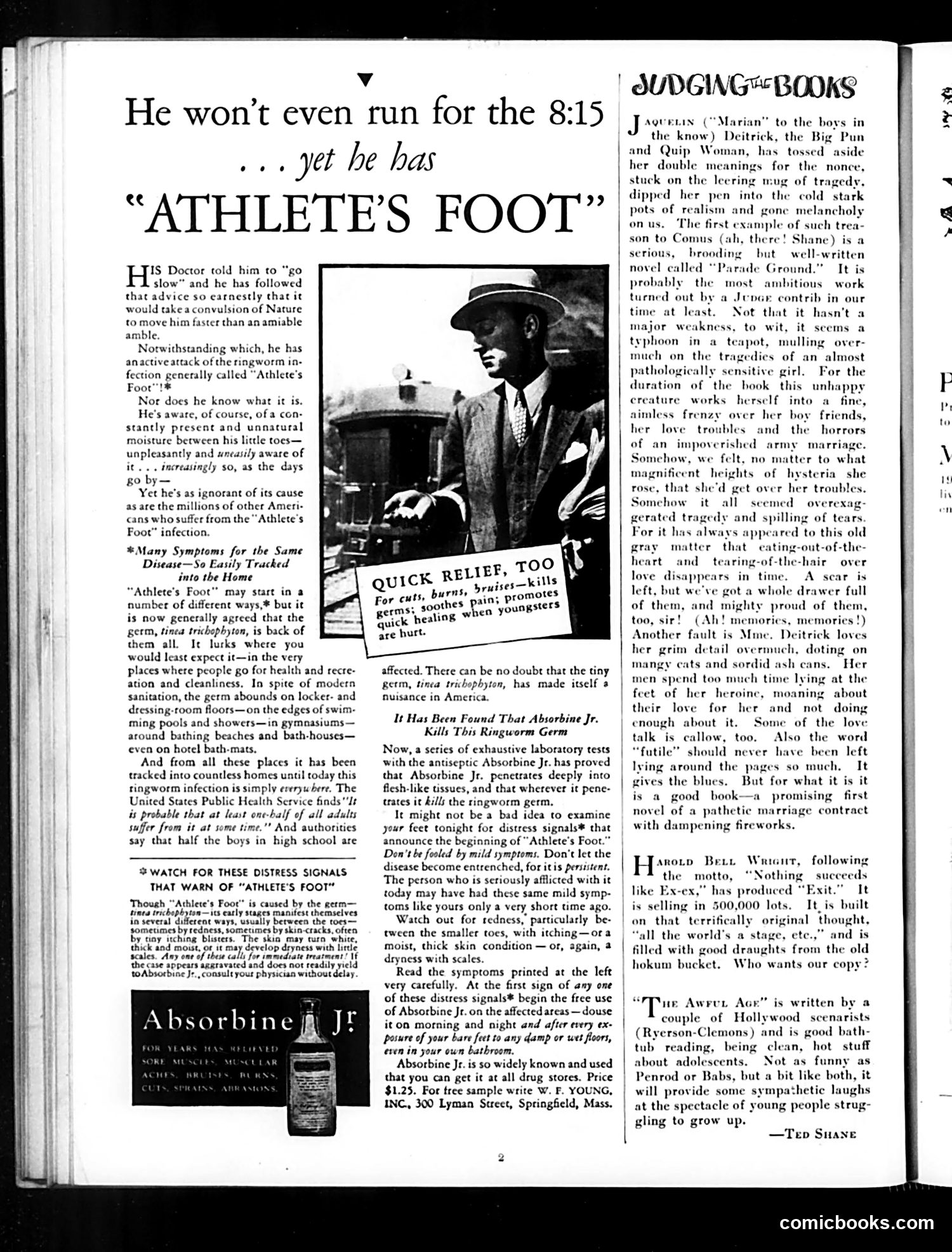
Analysis of Judge Magazine Page This page is primarily advertising and book reviews rather than political satire. The main content features an Absorbine Jr. advertisement targeting "Athlete's Foot" fungal infection—a genuine medical condition. The ad uses humor by depicting a man who won't run for the 8:15 train due to the condition, positioning the product as a cure. The right column contains book reviews by Ted Shane, discussing novels including "Parade Ground" and "The Awful Age." These are straightforward literary critiques without satirical intent. The page reflects 1920s-era advertising practices: mixing product promotions with entertainment content, using exaggeration and situational humor to sell remedies for common ailments. There is no identifiable political cartoon or social satire present.
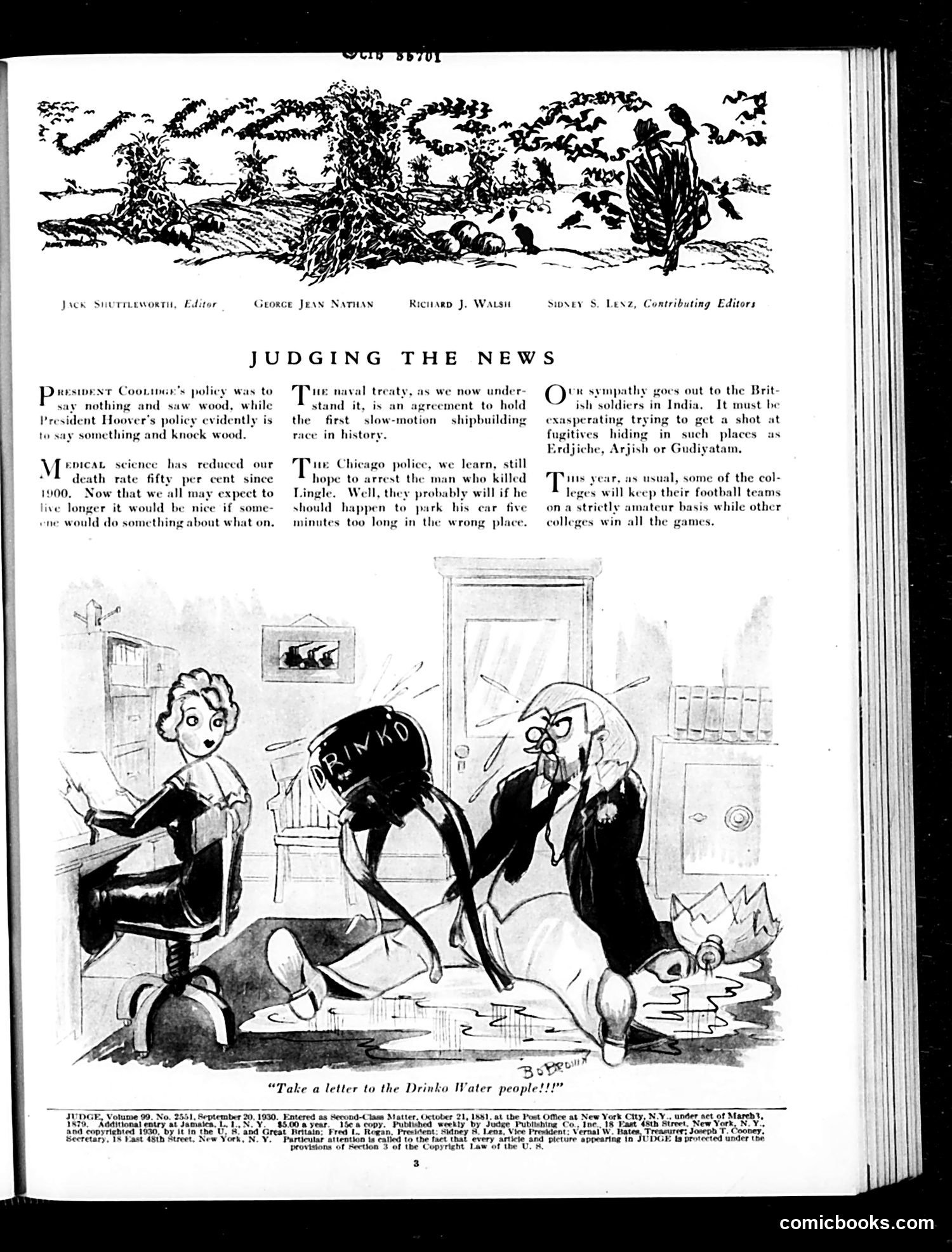
"Judging the News" - September 20, 1930 The main cartoon shows a figure labeled "PRIMO" (likely Primo Carnera, the heavyweight boxer) delivering what appears to be a wrecking ball to a domestic interior. Two other figures react in alarm—one reading, one gesturing frantically. The caption reads "Take a letter to the Drinka Water people!!!" The joke satirizes Carnera's devastating boxing power by suggesting his mere presence causes household destruction comparable to a wrecking ball. The reference to "Drinka Water" is unclear but may be a brand name relevant to 1930s advertising. The page's editorial section ("Judging the News") above contains brief commentary on President Coolidge's policies, medical science advances, and international naval treaties—typical early Depression-era political observations.
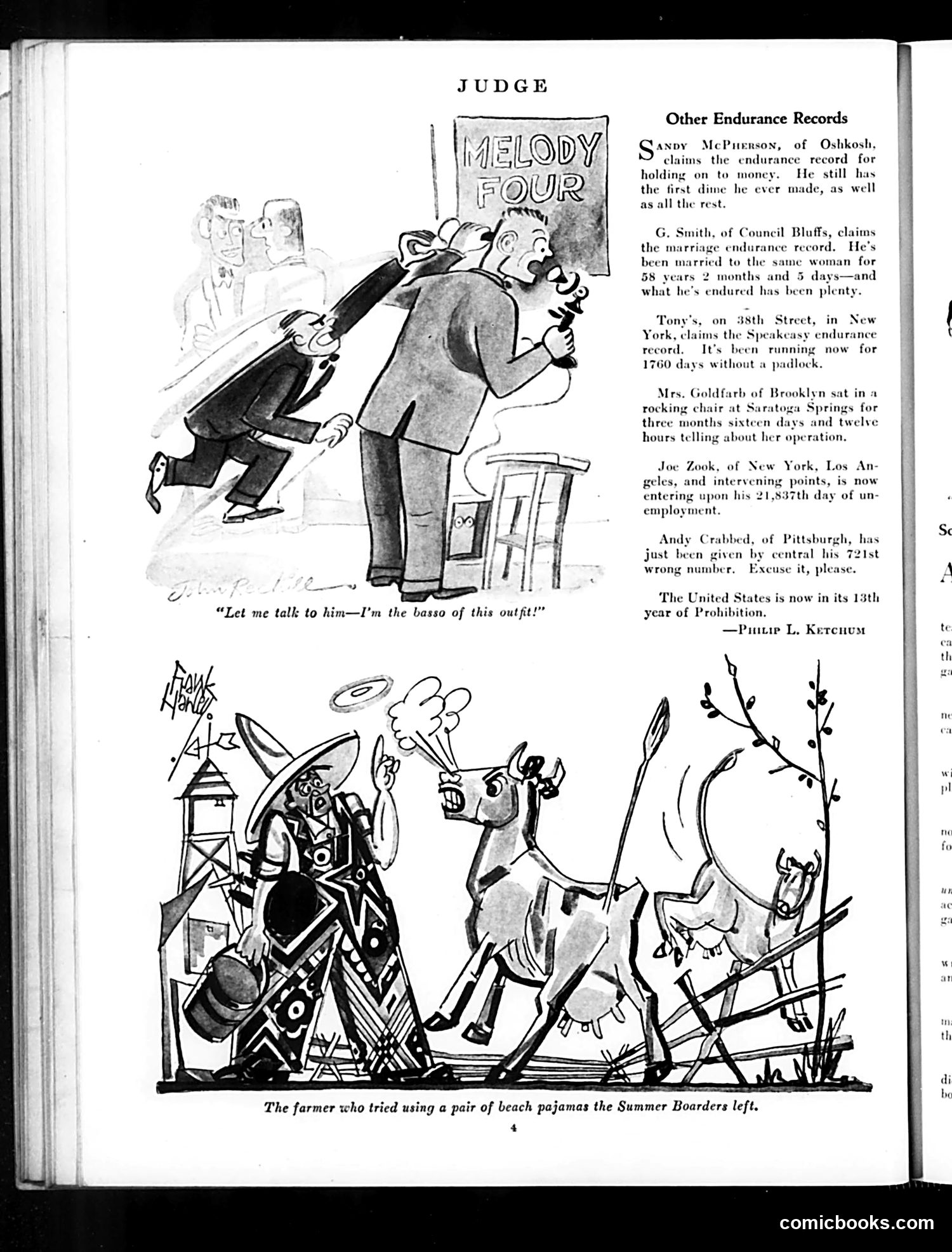
Political Cartoon Analysis The top cartoon depicts Prohibition-era enforcement. A man labeled "MELODY FOUR" (likely referencing a speakeasy or jazz venue) is being confronted by what appears to be a federal agent or enforcer saying "Let me talk to him—I'm the boss of this outfit!" The satire mocks the chaotic enforcement of Prohibition, suggesting rival authorities or criminal organizations competing for control of illegal liquor operations. The bottom cartoon shows a disheveled figure with farm animals, captioned about "beach pajamas" and "Summer Boarders." This appears to satirize rural residents' confusion or frustration with urban visitors' casual summer fashions—likely depicting class tensions between city tourists and country folk during the 1920s vacation season. Both cartoons mock contemporary social conflicts.
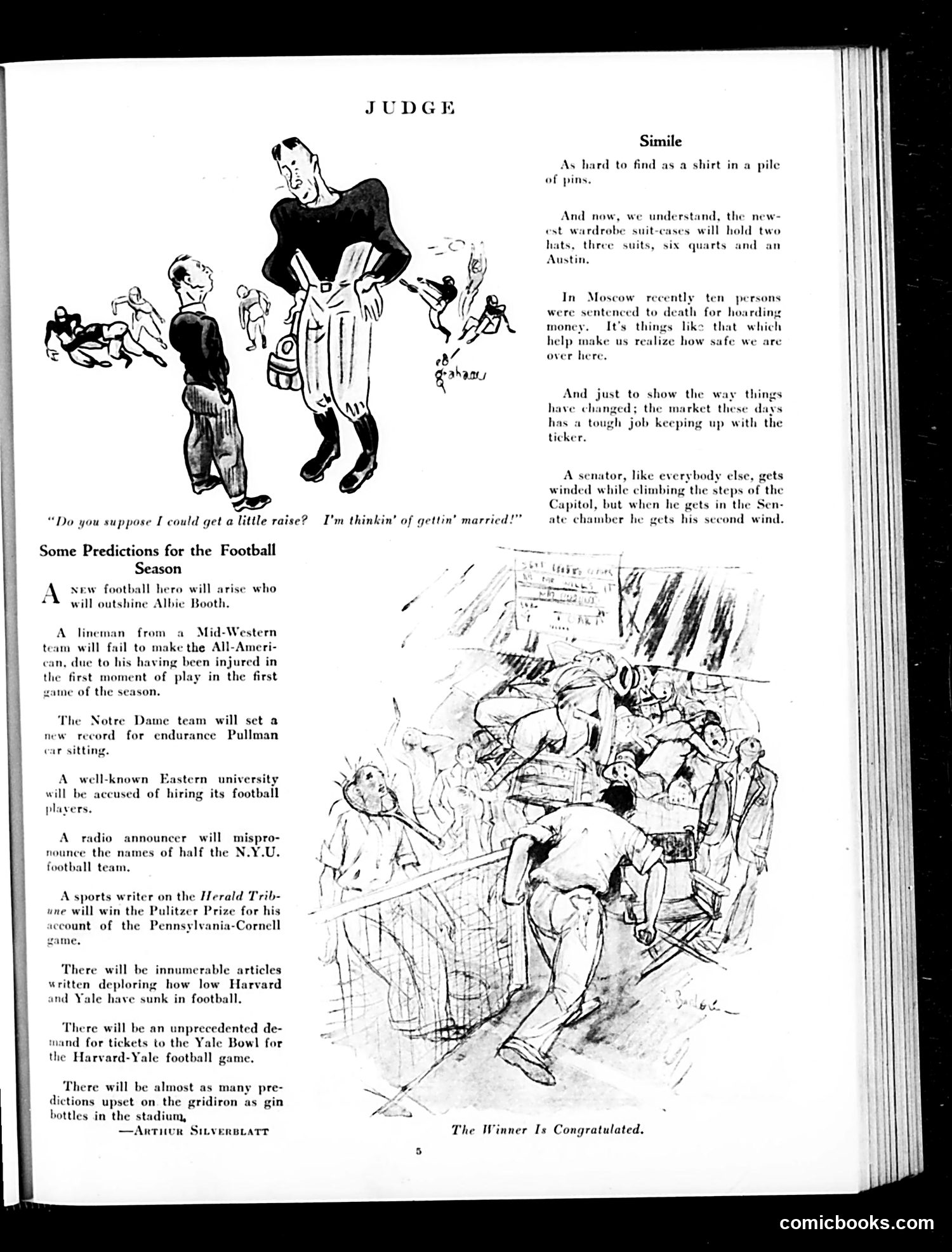
Analysis of Judge Magazine Page The page contains two distinct satirical sections: Top cartoon: A judge figure towers over small people, illustrating a simile about finding something "hard to find as a shirt in a pile of pins." The accompanying text references wardrobe suit cases, Moscow executions for hoarding money, and Senate politics—suggesting commentary on economic inequality and governmental absurdity. "Some Predictions for the Football Season": This section offers humorous forecasts about college football, including predictions about Notre Dame's endurance records, Eastern university scandals, radio announcers' errors, and Harvard-Yale game ticket demand. The bottom sketch titled "The Winner Is Congratulated" depicts a chaotic sports scene, likely satirizing the rowdy celebration or confusion following a game. Overall, the page combines political commentary with sports satire typical of Judge's general-interest humor.
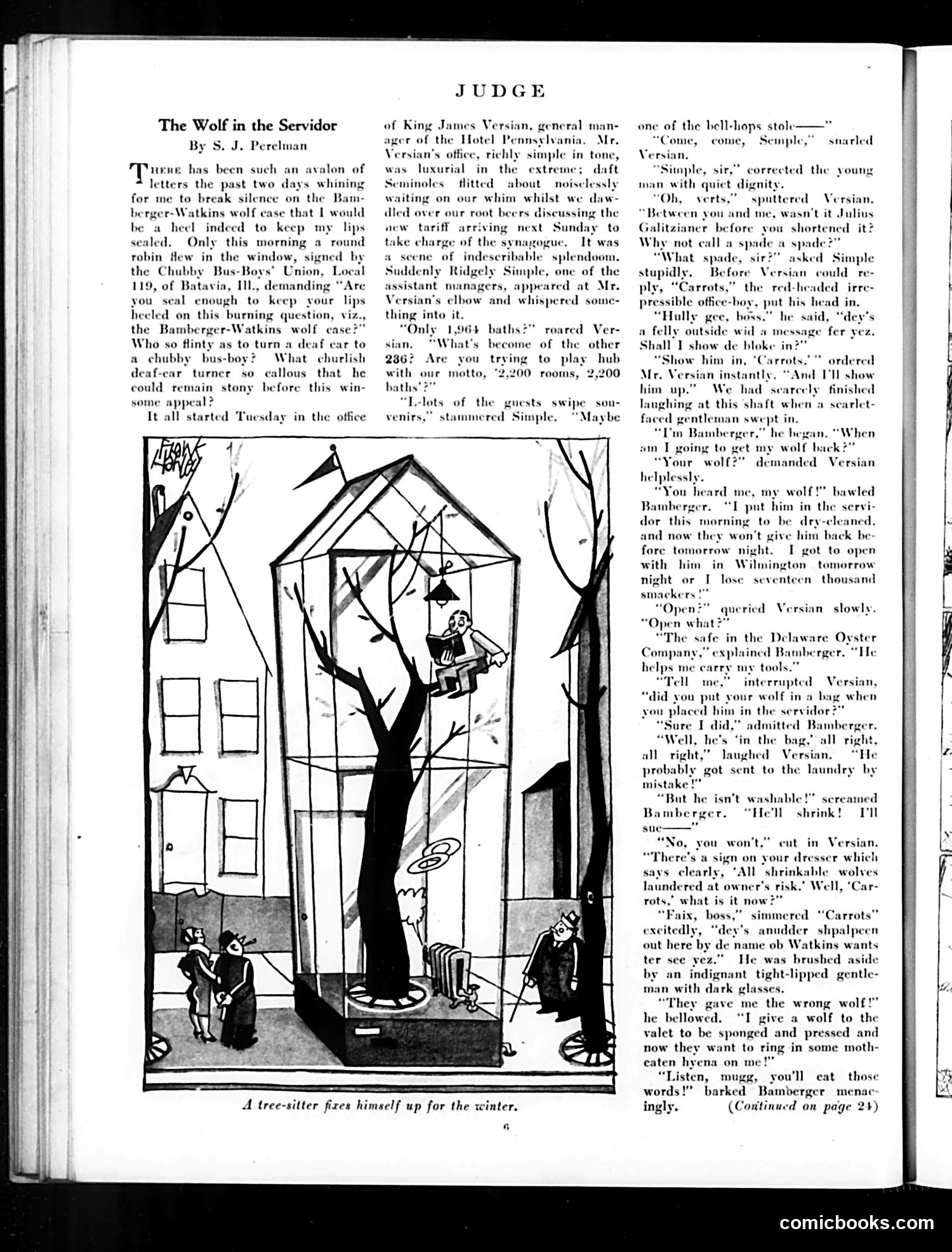
"The Wolf in the Servedor" by S.J. Perelman This is a humorous short story about a hotel manager (Mr. Versian) dealing with a guest who left his wolf in the servidor (storage room) for cleaning. The narrative involves escalating absurdity: the wolf won't be returned, it's being sent to a laundry, and there are disputes about shrinkage and proper care. The accompanying illustration shows a tree growing through a building's interior—likely depicting the surreal, chaotic situation described in the text. This appears to be satirical fiction rather than political commentary. The humor relies on the incongruity of treating a wolf like dry-cleaning and the bureaucratic confusion that ensues—typical of Perelman's absurdist comedy style popular in mid-20th century American magazines.
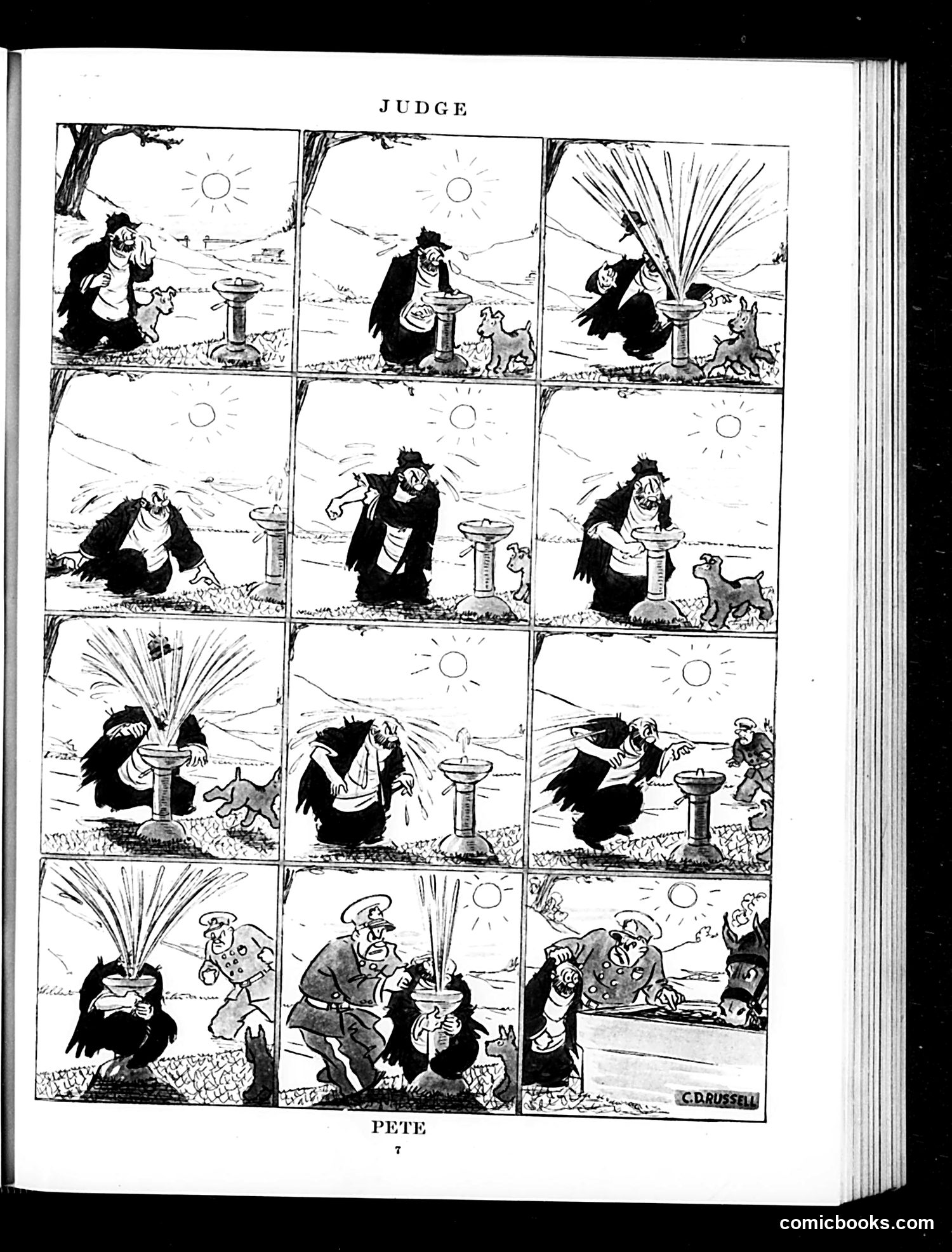
"Judge and Pete" Comic Strip Analysis This appears to be a sequential comic strip titled "Judge" (top) and "Pete" (bottom) from Judge magazine. The strip depicts a figure in formal attire (appears to be a judge or authority figure) interacting with what looks like a dog or small animal near a sundial or pedestal in an outdoor setting. The narrative progresses through twelve panels showing escalating action—the figure's apparent frustration builds, culminating in panels with what appear to be police or uniformed officials arriving at the scene. The humor appears to derive from slapstick physical comedy and the contrast between the formal setting and increasingly chaotic events, though without additional context or visible dialogue, the specific satirical target remains unclear.
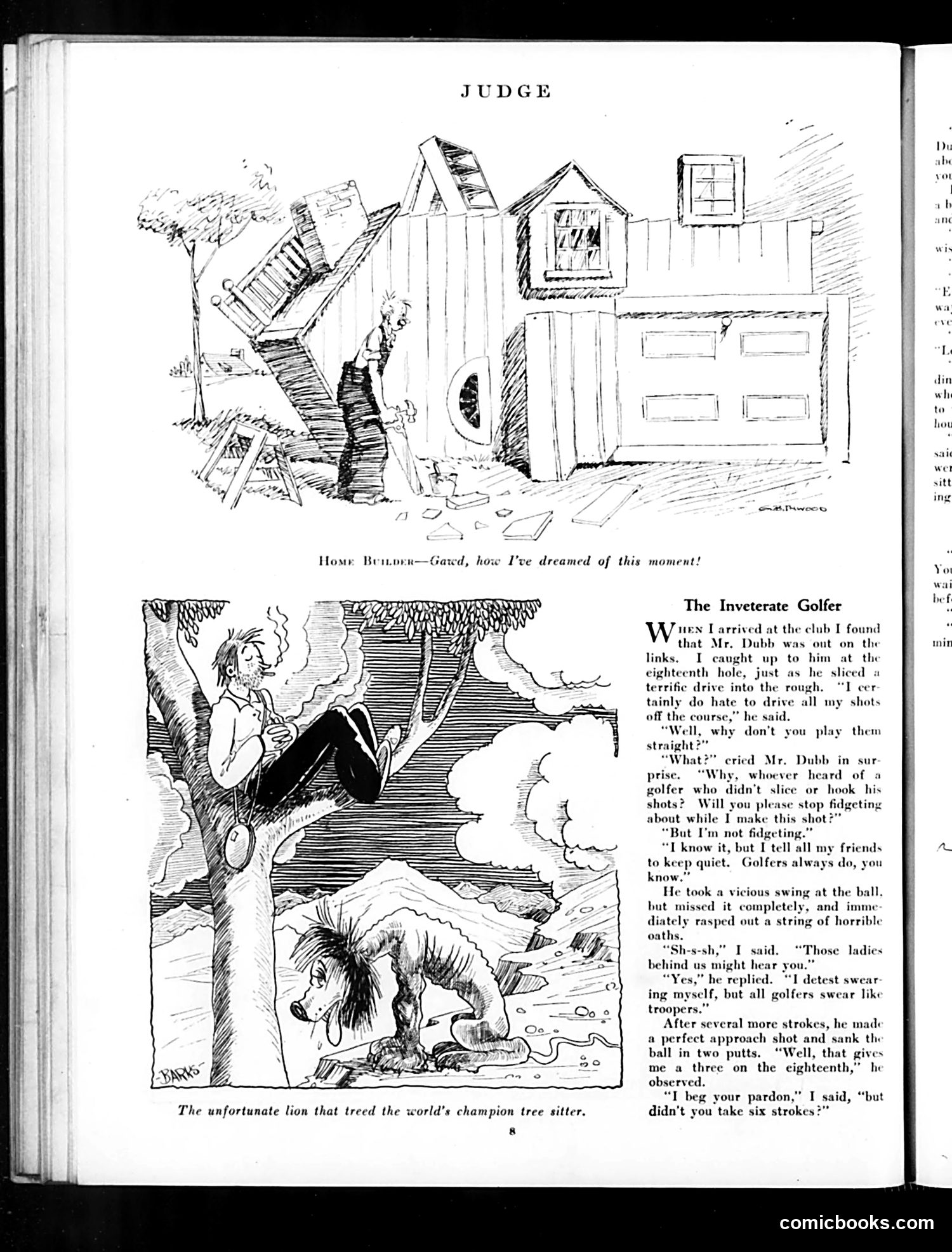
Judge Magazine Page Analysis This page contains two unrelated satirical cartoons: "Home Builder" (top): Mocks someone's aspirations to build their dream home. The crude, collapsing structure with a garage door and crooked roof suggests incompetence or delusion—the caption "Gad, how I've dreamed of this moment!" implies the builder's fantasies don't match reality. "The Inveterate Golfer" (main story): A humorous anecdote about Mr. Dubb, an obsessive golfer with terrible skills. The satire targets golfers' contradictory behavior—Dubb insists he "hates" slicing drives off-course while simultaneously claiming all golfers do this routinely. He demands silence from companions, expects others to accept crude language ("swear like troopers"), and miscounts his strokes (takes six but claims three). The joke exposes the self-deluding arrogance and hypocrisy of serious amateur golfers. The cartoon below the text shows a lion treed by someone, mocking tree-sitters—likely referencing 1920s-era sit-down protestors.
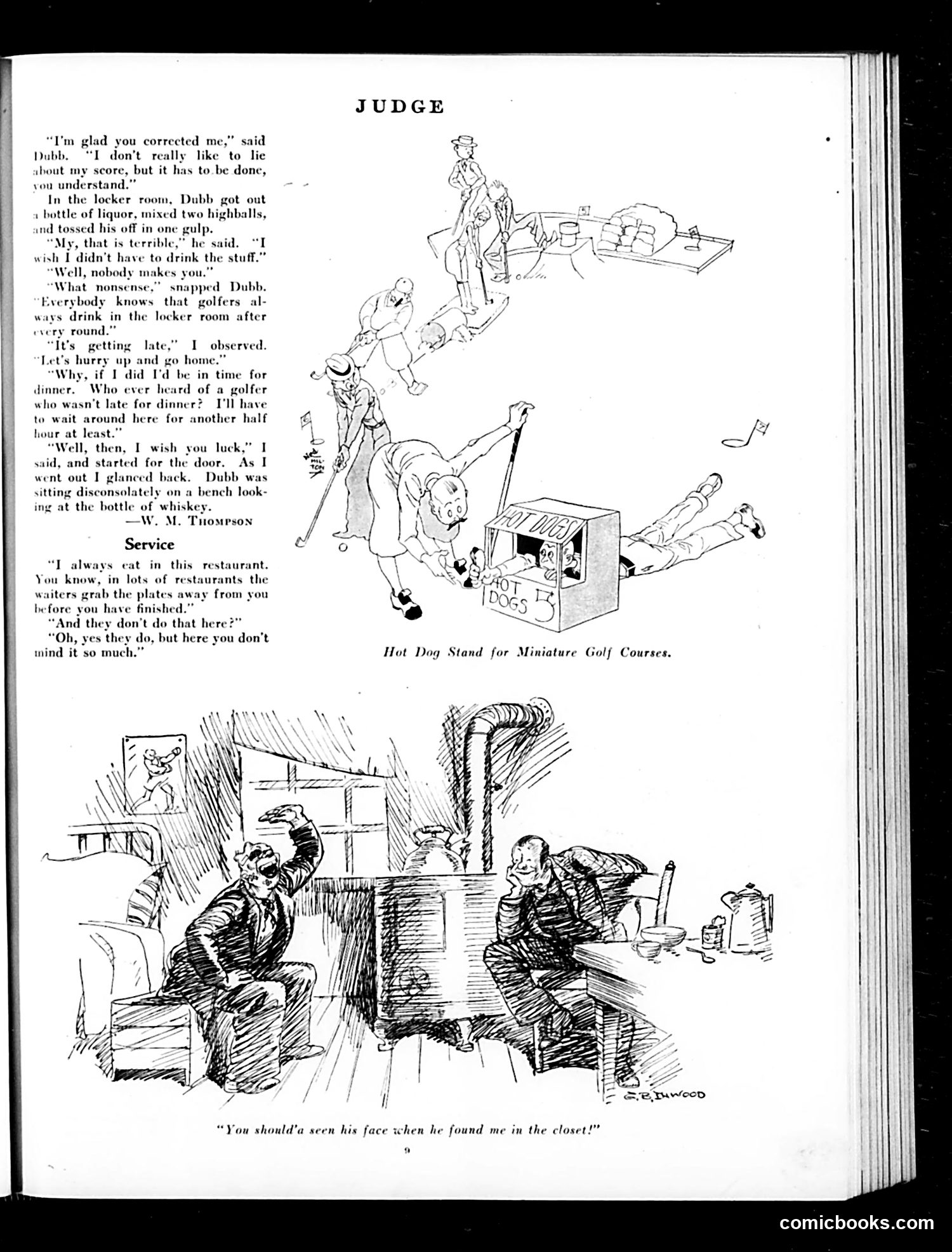
Judge Magazine Page Analysis This page contains two satirical pieces mocking social pretense among the leisure class circa early 20th century. Top section ("Judge" by W.M. Thompson): A golfer named Dubb exemplifies masculine hypocrisy. He lies about his golf score, then claims he *must* drink whiskey in the locker room despite disliking it—justifying it as what "everybody knows" golfers do. The joke targets how men perform expected behaviors (drinking, poor sportsmanship) while pretending social pressure forces them, when they could simply refuse. Bottom section (cartoon by S.E. Burwood): A humorous domestic scene where one man found his friend hiding in a closet. The joke appears to involve marital deception or infidelity—the caption's tone suggests the discovery was embarrassingly comic. Overall theme: Both pieces satirize upper-middle-class men who rationalize questionable behavior (cheating, drinking, possibly infidelity) as unavoidable social conventions rather than personal choices. The satire mocks their self-deception and moral flexibility.
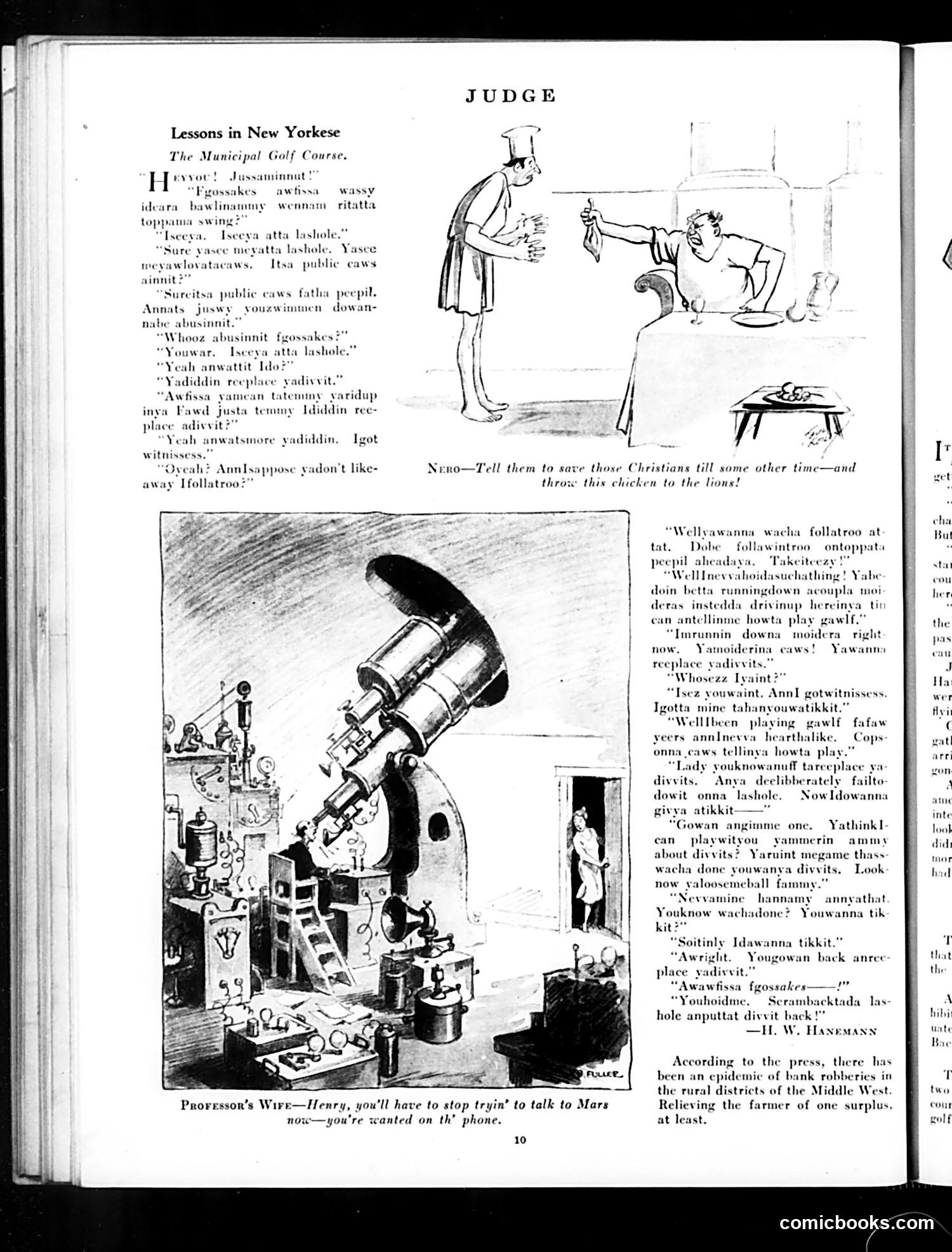
Judge Magazine Page Analysis This page contains two distinct satirical pieces: "Lessons in New Yorkese" mocks working-class New York City dialect and speech patterns, featuring a golf course conversation rendered in exaggerated phonetic spelling ("jussaminnut," "wassy ideara," "lashole"). The humor targets how New Yorkers supposedly butcher English pronunciation and grammar. "Professor's Wife" cartoon depicts a telescopic setup where a professor is attempting to communicate with Mars via telephone, while his wife interrupts to tell him he's wanted on the phone. The joke satirizes both the era's fascination with Mars communication (popular in early 20th-century scientific speculation) and domestic marital dynamics—the mundane interrupting the grandiose. The lions/Christians caption references early Christian persecution by Romans, making a dark joke about prioritizing trivial matters ("save those Christians till some other time"). The bank robbery commentary at bottom is straightforward social commentary: rural bank robberies are actually benefiting struggling farmers by reducing their surplus wealth obligations. All pieces target contemporary American social anxieties and popular preoccupations of the period.
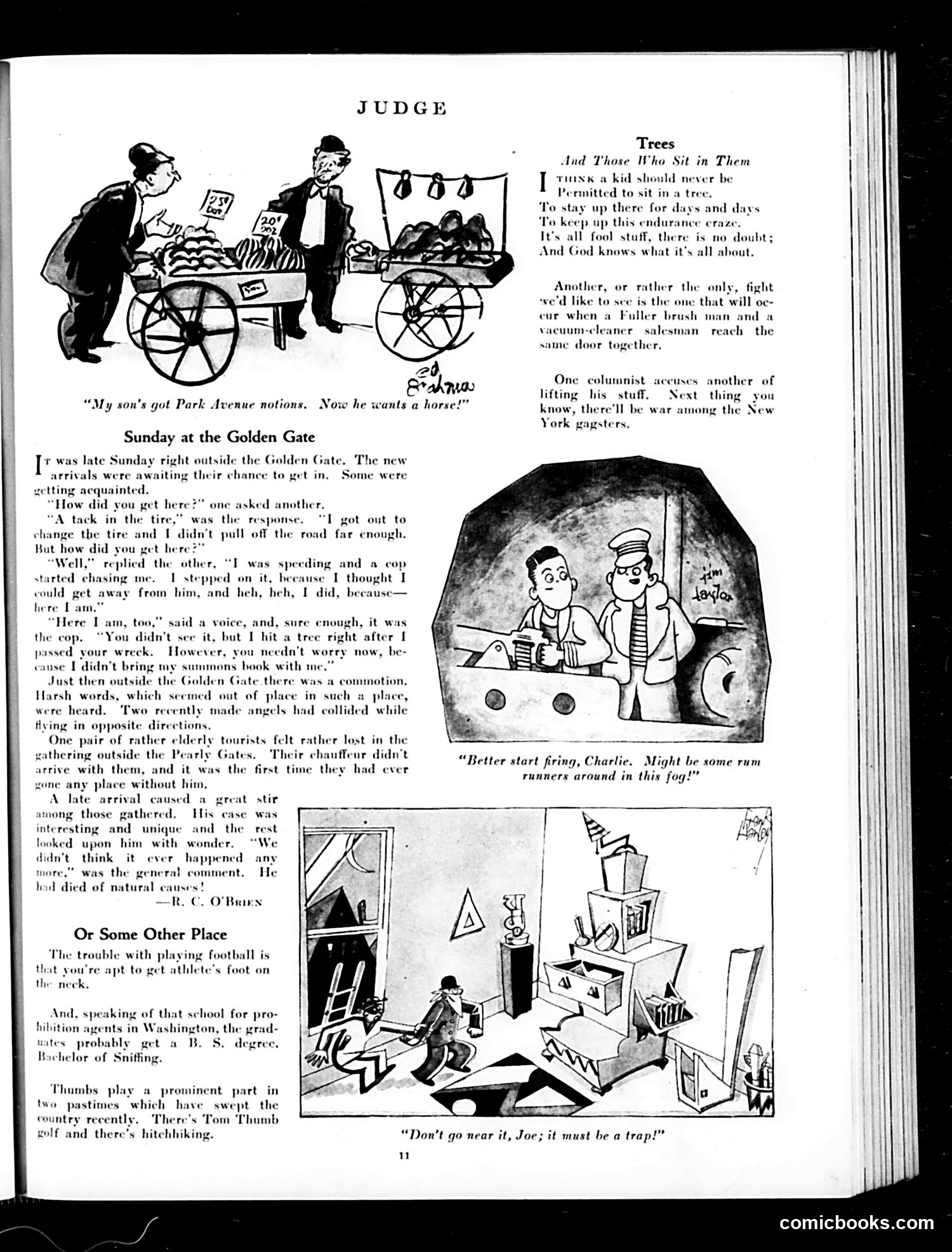
Judge Magazine Page Analysis This page contains several satirical pieces typical of Judge magazine's humor: "Judge" cartoon (top left): A street vendor complains his son now wants a horse instead of accepting "Park Avenue notions"—satirizing wealthy pretension and children's escalating material demands. "Sunday at the Golden Gate": A humorous afterlife scene where recently deceased souls encounter traffic violations and mishaps at heaven's gates. The joke relies on the irony that even in the afterlife, bureaucratic complications (cops, traffic accidents) persist. The references to "Fuller brush man" and "vacuum-cleaner salesman" are period-specific door-to-door sales jobs. "Or Some Other Place": A series of brief quips mocking Prohibition-era agents, football injuries, and hitchhiking—contemporary social commentary wrapped in wordplay. The poetry section "Trees" and the lower cartoon about "rum runners" reference Prohibition enforcement, a major 1920s-30s concern. Overall, this reflects Judge's satirical approach to modern urban life, consumer culture, and legal/social absurdities of the era.
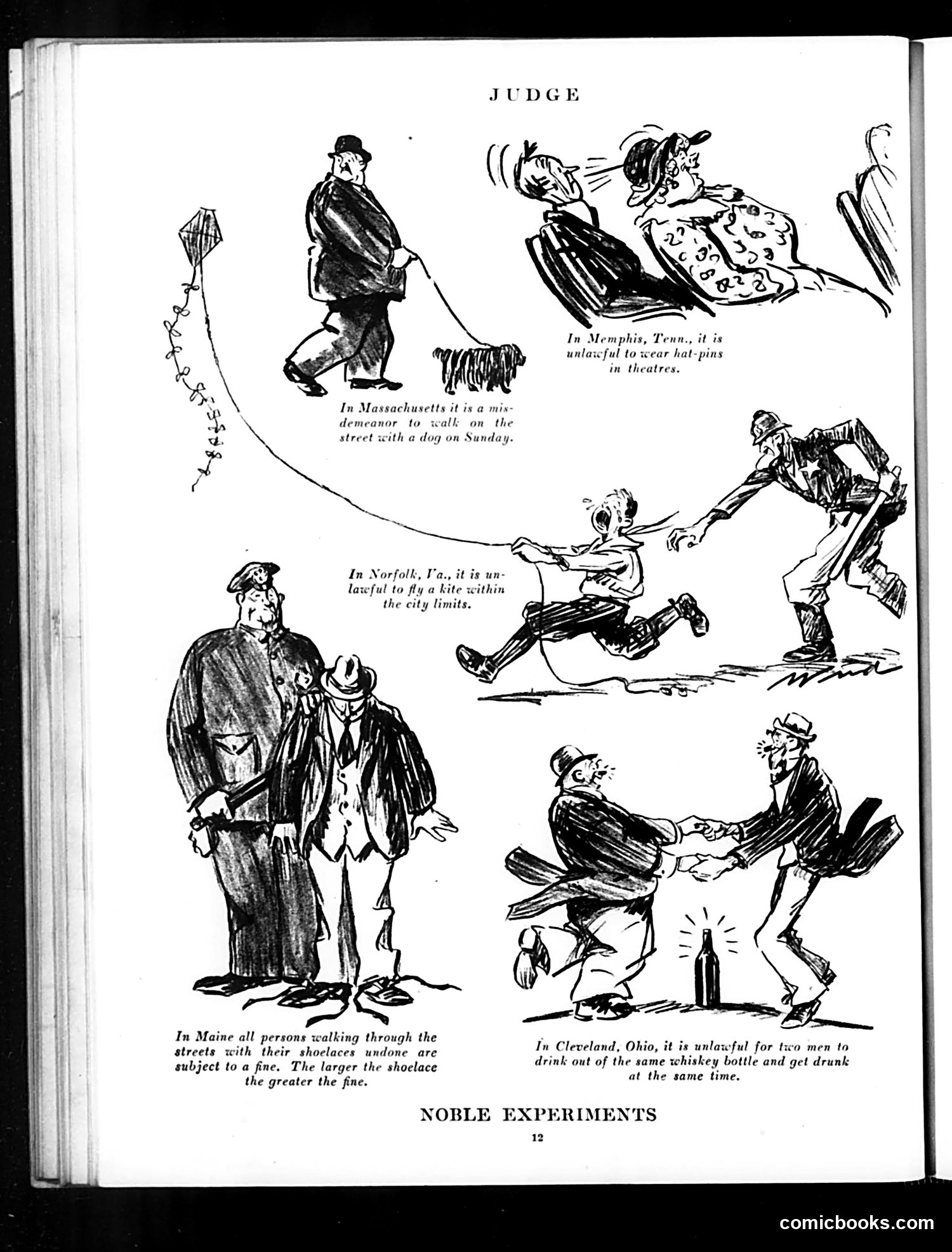
"Noble Experiments" - Judge Magazine Satire This page satirizes absurd local laws across American cities through mock-serious illustrations. Each vignette depicts ridiculous statutes: Memphis banning theatrical hat-pins (likely referencing women's large, dangerous hat ornaments), Massachusetts prohibiting Sunday dog-walking, Norfolk restricting kite-flying, Maine fining people for untied shoelaces, and Cleveland's bizarre regulation about simultaneous whiskey-bottle sharing. The title "Noble Experiments" is ironic—echoing Progressive Era reforms—while the cartoons mock the era's tendency toward excessive, oddly-specific legislation. The joke targets both overregulation and the bizarre loopholes and unintended consequences of poorly-written laws. Whether these laws were entirely fabricated or exaggerated for comic effect remains unclear, but Judge's point is obvious: American municipalities had gone absurdly overboard with regulation, creating laughably impractical statutes.
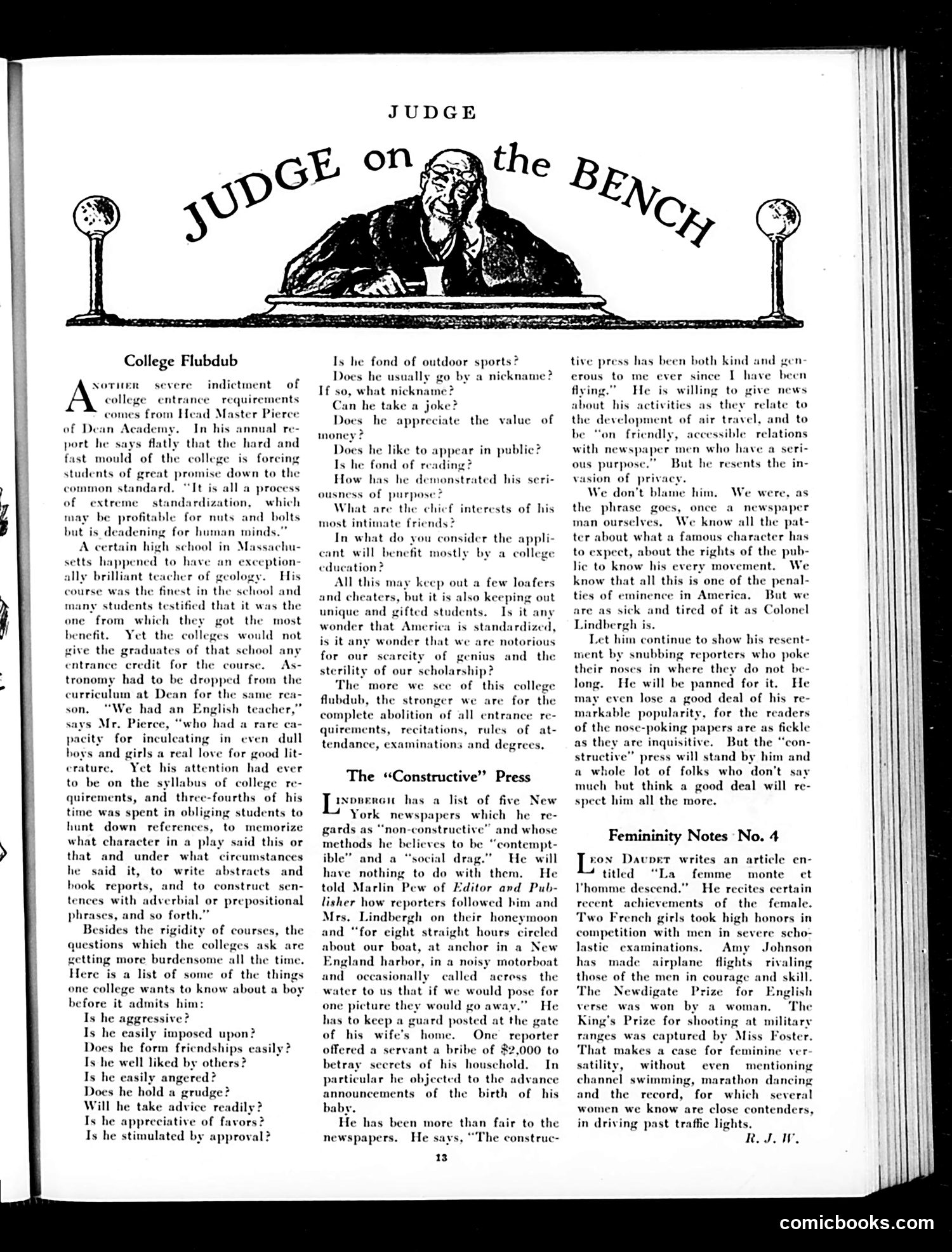
"Judge on the Bench": College Entrance Standards & Lindbergh's Press Complaints This page contains two satirical pieces: "College Flubdub" criticizes rigid college entrance requirements and standardization. The author argues that colleges' obsessive entrance exams and character questionnaires (Is he aggressive? Does he hold grudges?) kill gifted but unconventional students while merely filtering out a few cheaters. The satire suggests America's lack of genius stems from this bureaucratic conformity. "The 'Constructive' Press" addresses Charles Lindbergh's public complaints about aggressive newspaper coverage during his honeymoon. Lindbergh condemned five NYC papers as "non-constructive" and a "social drag," citing reporters circling his boat and offering bribes to servants for household secrets. The piece suggests Lindbergh, while generally fair to press freedom, objects to invasive celebrity journalism—an early commentary on tabloid excess and privacy rights. Both pieces satirize American standardization and institutional excess from different angles.
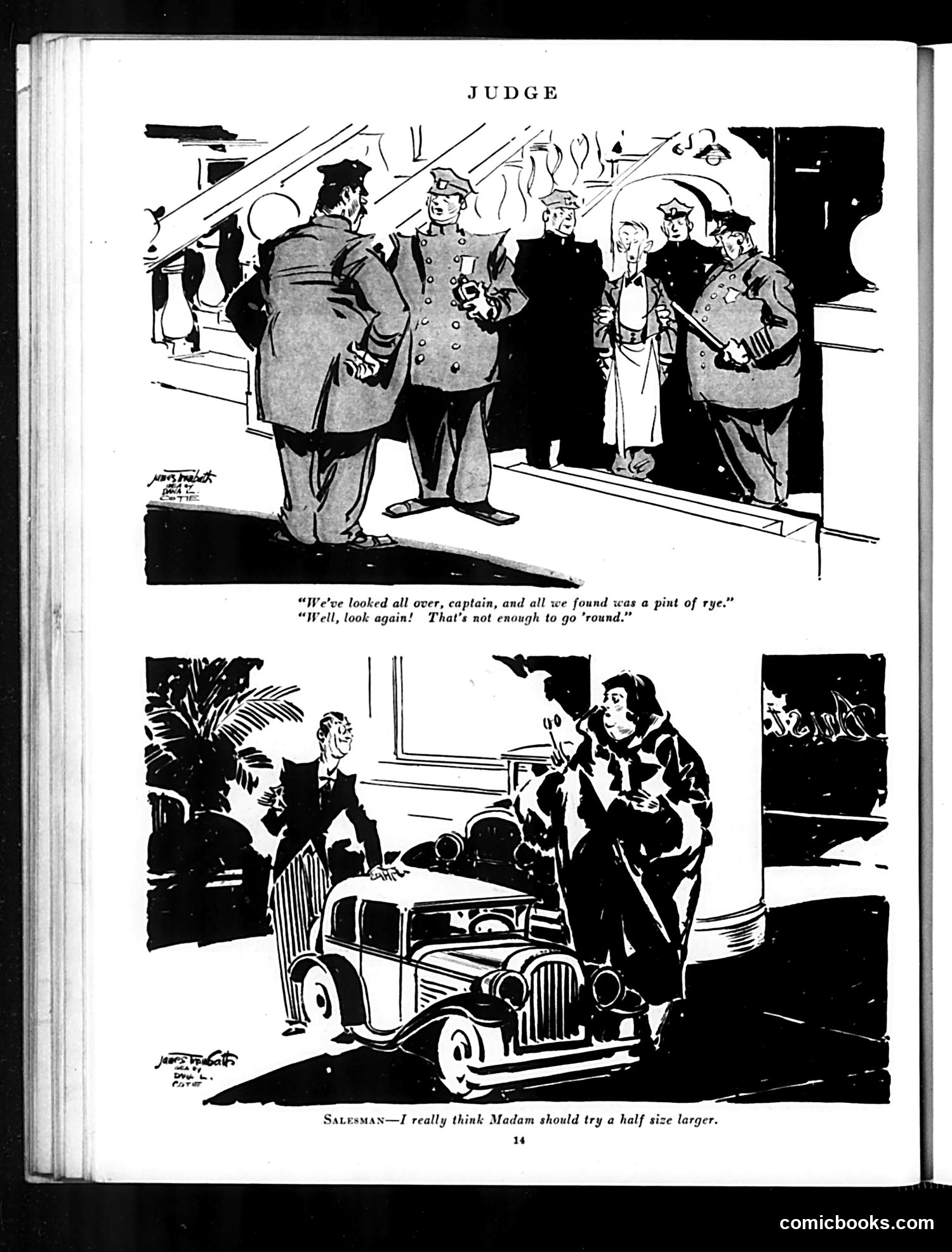
Analysis This page contains two unrelated cartoons from *Judge* magazine. Top cartoon: Military officers search a ship for alcohol during Prohibition. Finding only "a pint of rye," a captain demands they search again because it's insufficient to share among the crew. This satirizes both Prohibition's enforcement and the absurdity of officers expecting to find drinking supplies on a vessel. Bottom cartoon: A salesman suggests to a woman that she try a larger size garment—an apparent reference to her weight. The joke relies on the salesman's tactless comment about needing bigger clothing. Both cartoons use humor based on physical circumstances and social awkwardness typical of early 20th-century American comic magazines. The Prohibition reference dates this material to the 1920s-1930s era.
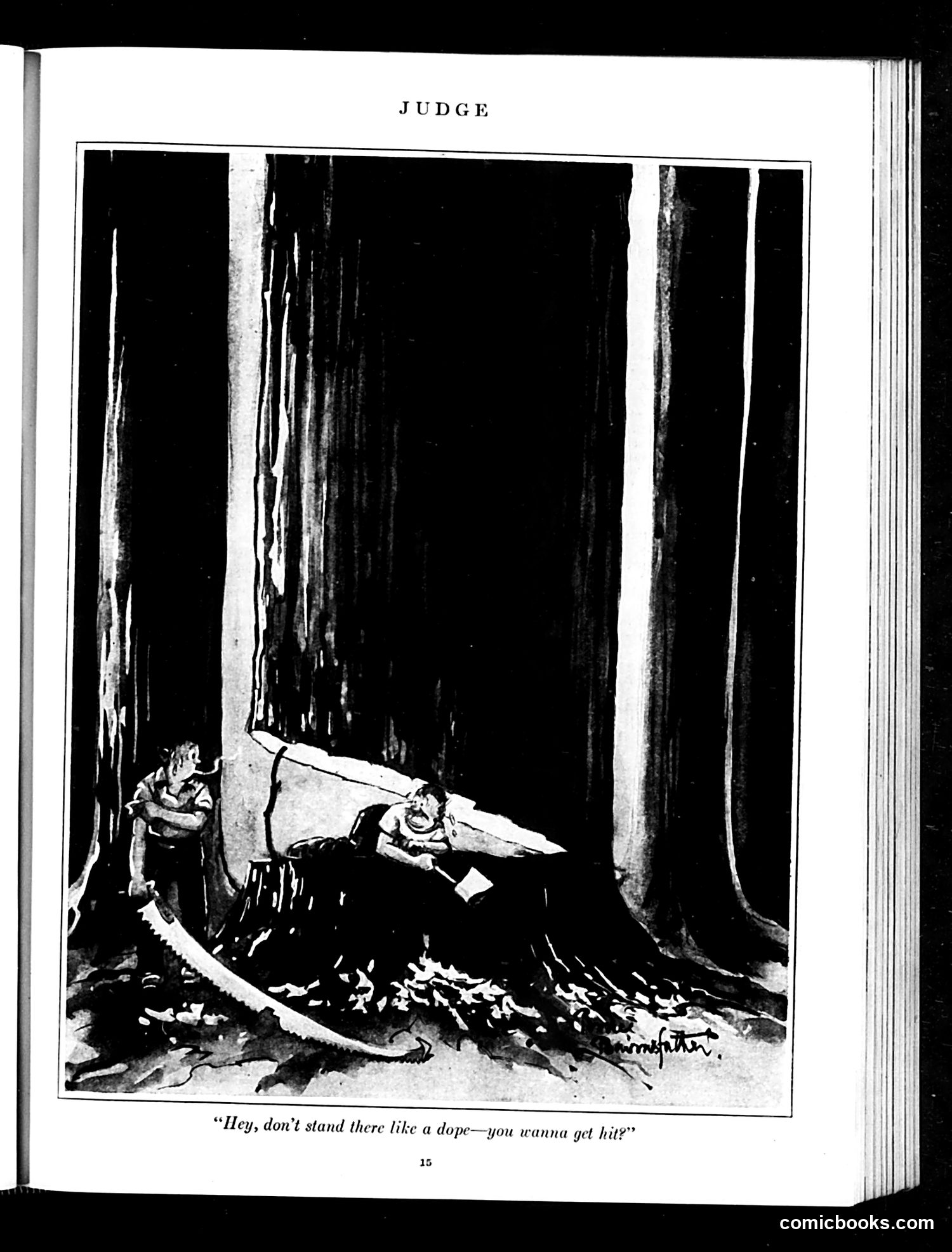
Judge Magazine Cartoon Analysis This single-panel cartoon depicts two figures in a forest of tall trees. One figure stands passively while another (wielding what appears to be an axe or similar tool) warns him to move or risk being struck. The joke plays on literal danger—a woodcutter warning a bystander to avoid getting hit by falling timber—but likely functions as social satire about passivity or negligence. The term "dope" suggests the standing figure is foolish for remaining in harm's way. Without additional context about Judge's publication date or surrounding articles, the specific political or social reference remains unclear. However, the cartoon's point is straightforward: inaction in the face of obvious danger is stupidity.
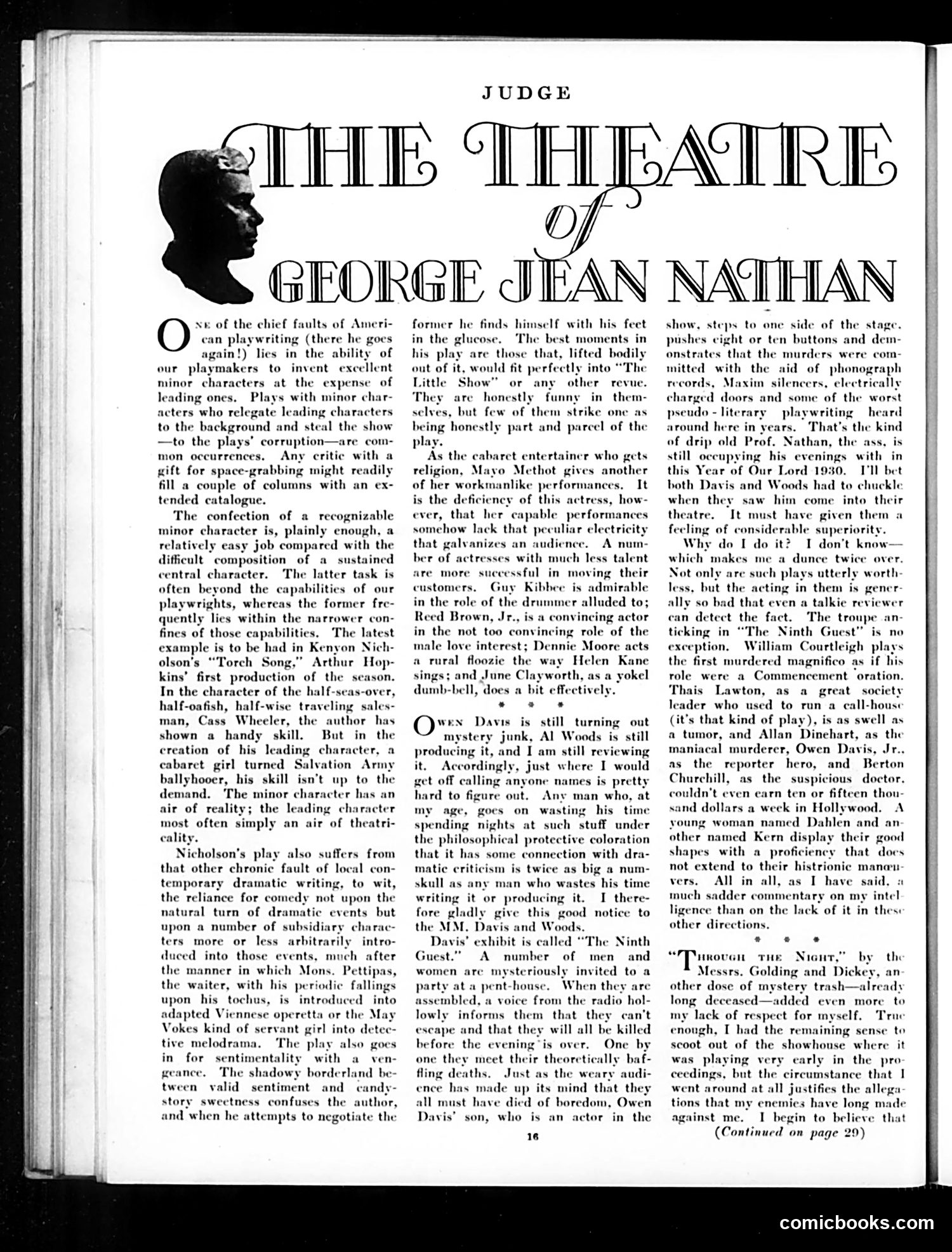
Judge Magazine Theatre Review: George Jean Nathan's Column This page contains a theatre criticism column by Judge's drama critic (the silhouetted profile at top left is George Jean Nathan, a prominent American theatre critic of the era). Nathan reviews a play called "Torch Song," criticizing American playwriting's tendency to create compelling minor characters while neglecting substantial leading roles. He praises actor Cass Wheeler's portrayal of a traveling salesman but faults actress Mayo Methot's lead performance as a cabaret girl-turned-Salvation Army worker, noting she lacks the "peculiar electricity" needed to move audiences despite technical competence. Nathan also briefly discusses another play, "The Ninth Guest," a mystery thriller involving mysteriously-invited guests at a penthouse who discover they'll be killed one-by-one. Nathan admits his own hypocrisy in criticizing such "mystery junk" while spending nights reviewing it for the magazine. The critique exemplifies early 20th-century theatre journalism—sophisticated, witty, and frankly opinionated about performers and dramatic construction.
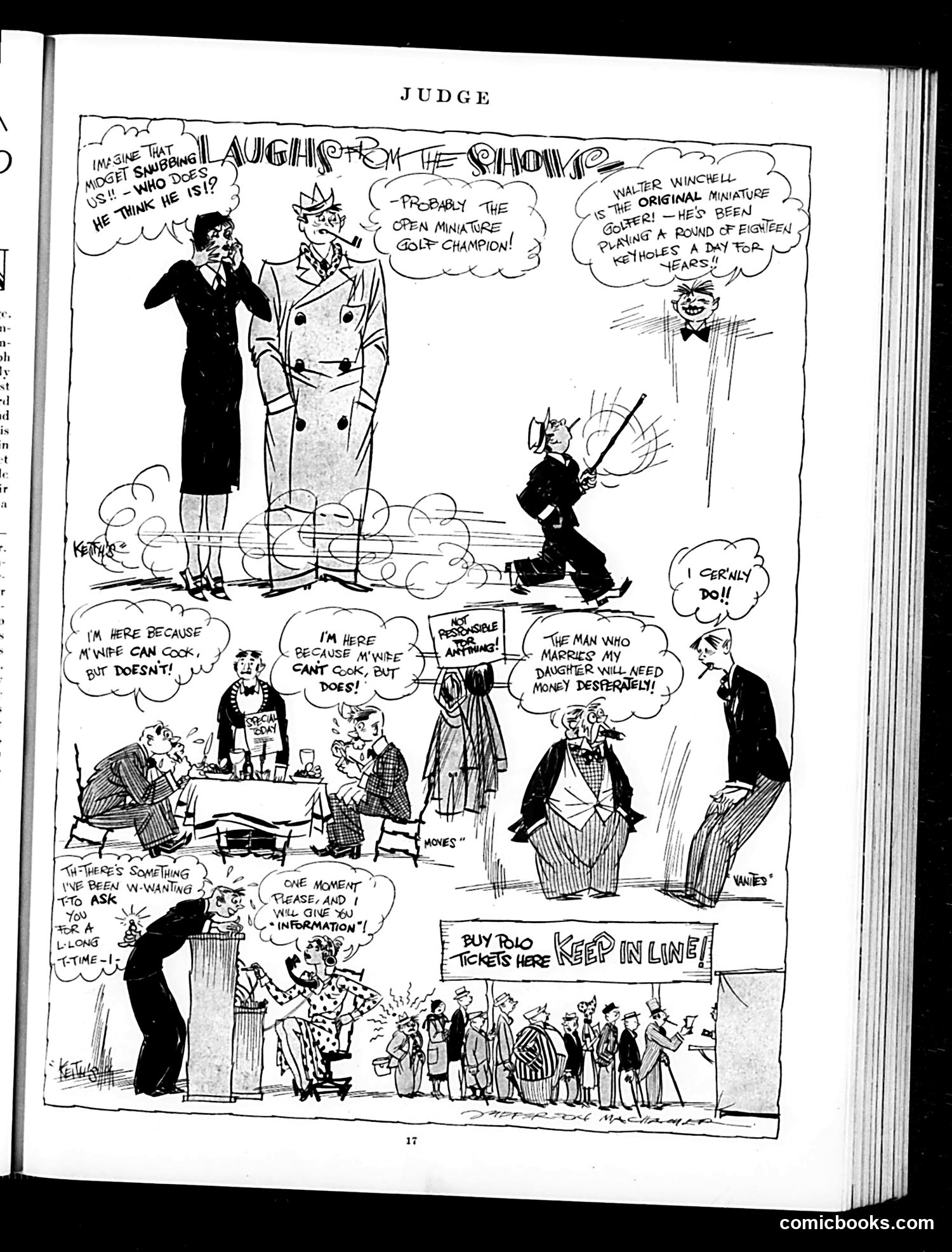
"Judge" Cartoon Page Analysis This satirical cartoon critiques early-20th-century gender roles and marriage expectations. The central scene shows a "judge" (authority figure) presiding over various marital complaints: - Men defend their presence in courts because their wives can't cook - A woman counters that her husband also can't cook - Upper panels reference golf: Walter Winchell (a famous gossip columnist) is identified as the "original miniature golfer," having played 1,900 holes daily for years—a joke about obsessive leisure pursuits The satire targets: 1. Double standards: Men blame wives' cooking failures while excusing their own domestic incompetence 2. Frivolous litigation: Trivial marital disputes clogging courts 3. Leisure culture: The golf references mock wealthy men's self-indulgent hobbies while neglecting family responsibilities The bottom shows a queue for "Polo tickets," suggesting satirical commentary on leisure-class priorities over domestic duties. The humor relies on readers recognizing Winchell and understanding contemporary debates about women's domestic roles.
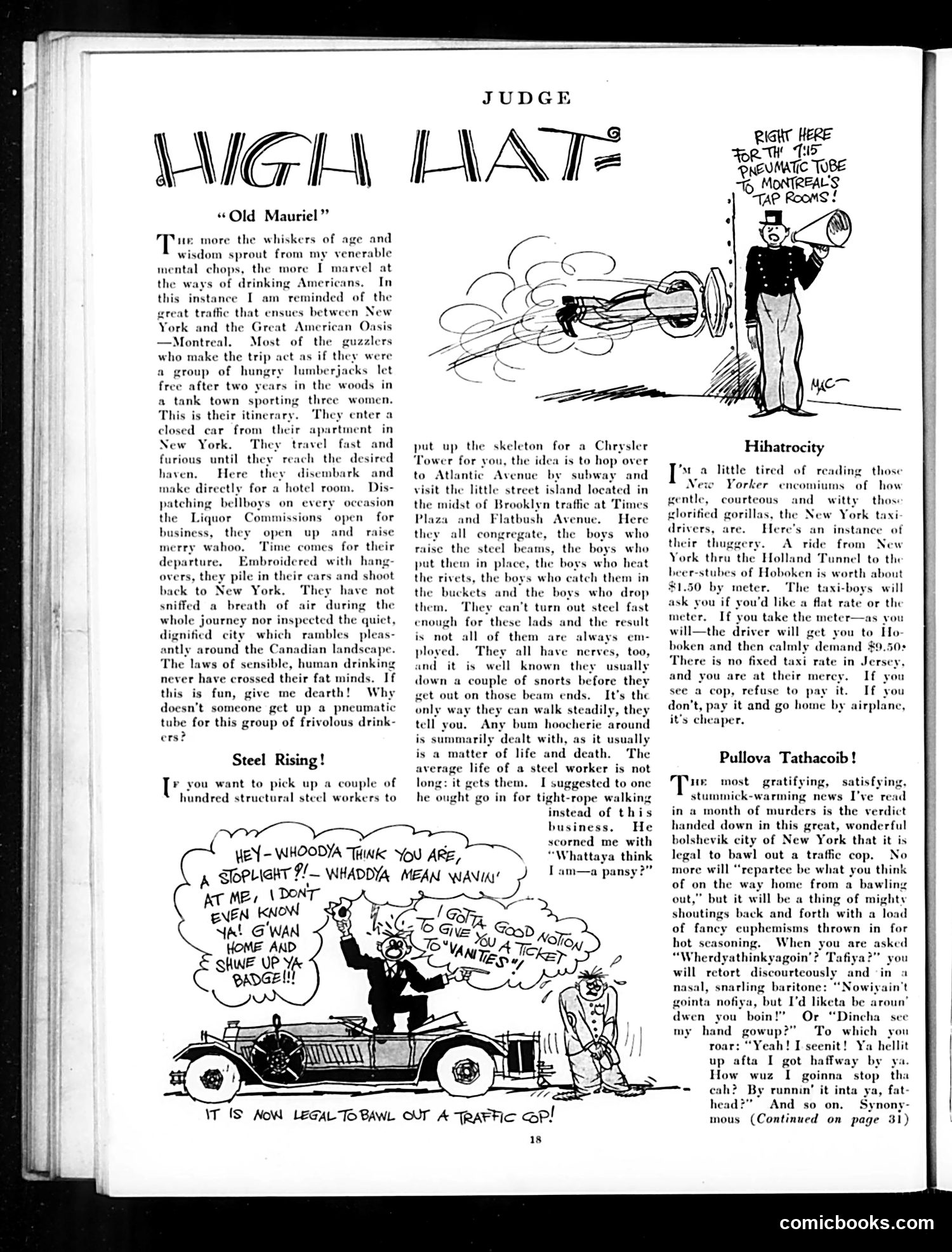
Judge Magazine Satire Analysis This page contains three distinct satirical pieces mocking American drinking culture and urban life: "Old Mauriel" criticizes wealthy New Yorkers who drive to Montreal solely to drink illegally during Prohibition, ignoring the city's actual attractions. The satire targets their single-minded excess and lack of cultural appreciation. "Steel Rising!" depicts working-class steel workers at a Brooklyn construction site, showing them drinking before dangerous labor. The cartoon sarcastically notes it's "now legal to bawl out a traffic cop"—likely referencing a recent court ruling. The dialogue captures exaggerated working-class Brooklyn accents. "Hihatrocity" attacks New York taxi drivers' exploitation of passengers using the meter system, portraying them as thugs who overcharge and intimidate riders, then demand tips. All three pieces reflect 1920s anxieties: Prohibition-era drinking, working-class labor conditions, urban crime, and the perceived rudeness of New York service workers. The humor relies on stereotypes and class commentary typical of Judge's satirical approach.
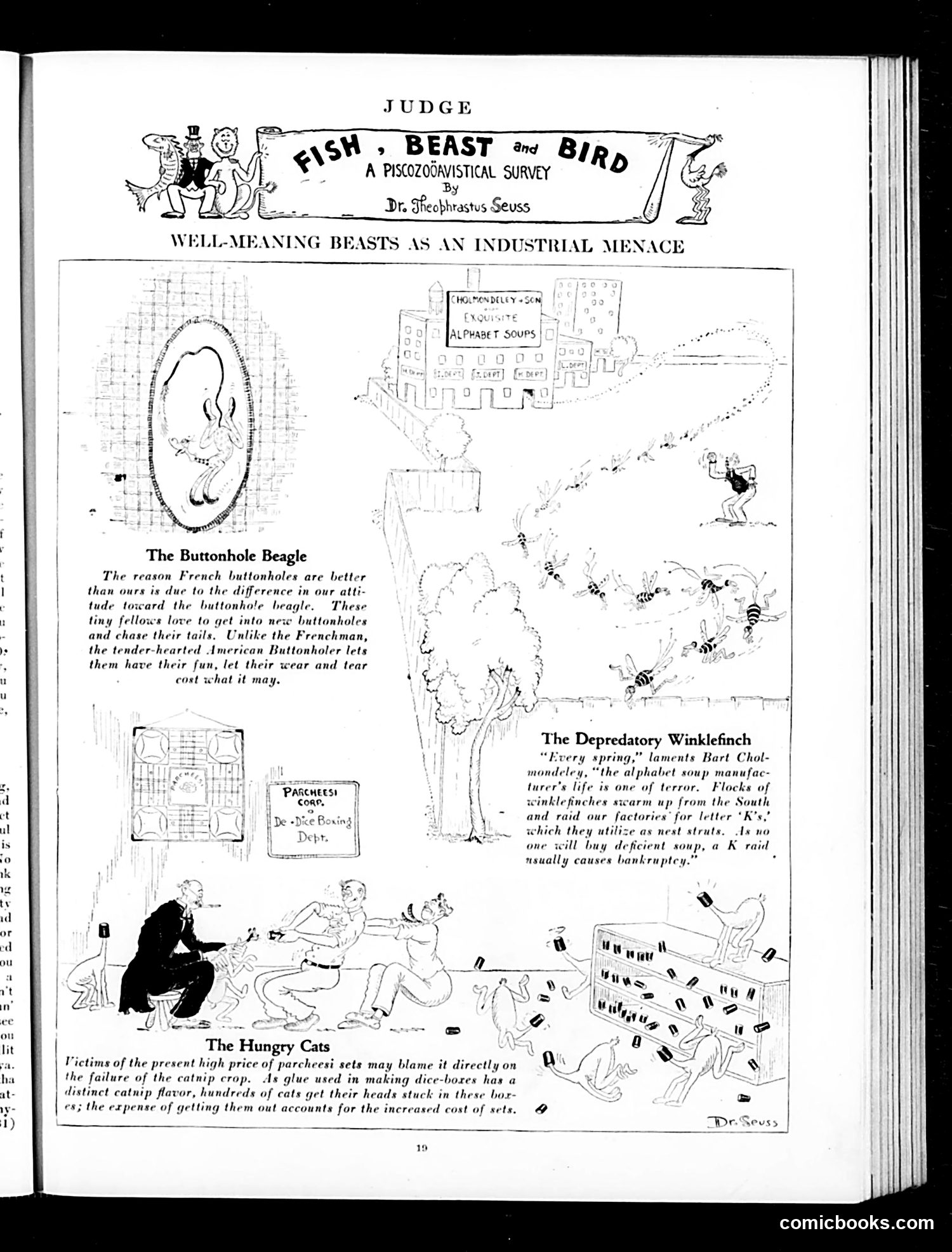
"Fish, Beast and Bird": Dr. Seuss's Industrial Satire This is a humorous early work by Dr. Seuss titled "A Piscozoavistical Survey," presenting absurd explanations for real economic problems of the era. The three cartoons mock supply-chain disruptions and price inflation: 1. The Buttonhole Beagle: Satirizes American sentimentality by blaming French superiority on their harsh treatment of imaginary "buttonhole beagles" that damage buttons. 2. The Depredatory Winklefinch: Explains alphabet soup factory losses (and bankruptcy) through fictional birds stealing the letter "K" for nests—mocking how manufacturers blame external factors for failures. 3. The Hungry Cats: Blames high parcheesi set prices on catnip crop failure, since glue in dice-boxes contains catnip, causing cats to get stuck—a circular, ridiculous explanation for real inflation. The satire targets how businesses and society invent elaborate excuses for economic problems rather than acknowledging actual causes. Seuss's playful pseudoscience format makes the absurdity obvious to readers.
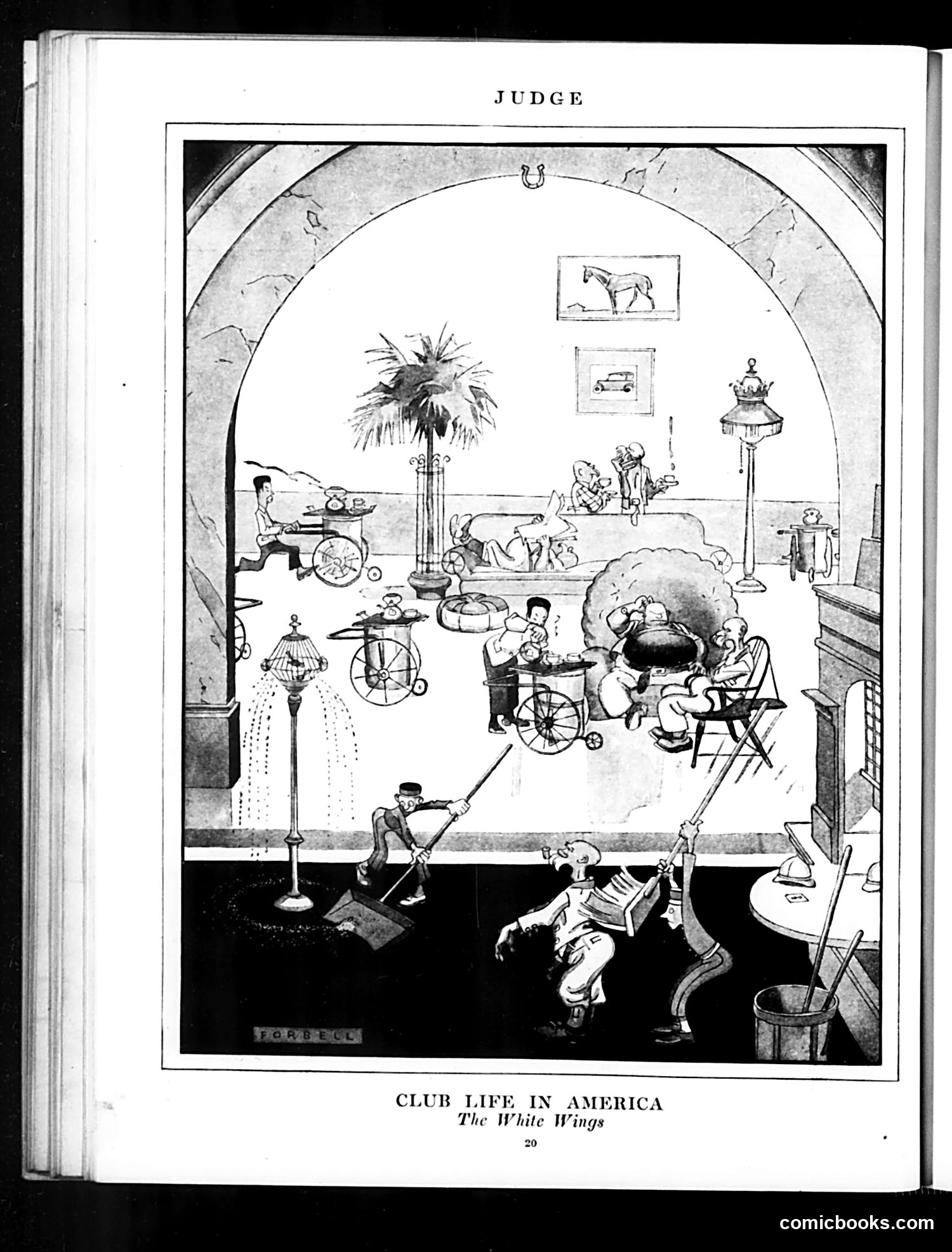
"Club Life in America: The White Wings" This Judge magazine illustration satirizes an exclusive American social club, likely from the early 20th century. "The White Wings" appears to reference an elite or aristocratic club. The cartoon depicts club members engaged in various leisure activities within an ornate domed space—dining, socializing, and enjoying luxuries like a palm tree centerpiece and decorative fountains. The space contrasts sharply with the darker lower section showing working-class figures (possibly servants or laborers) performing menial tasks like cleaning and maintenance. The satire likely critiques the stark class divide: wealthy club members enjoy refined pleasures while invisible workers toil beneath them. The title "White Wings" possibly alludes to the white-uniformed street cleaners of the era, adding ironic commentary on labor and class distinction in American society.
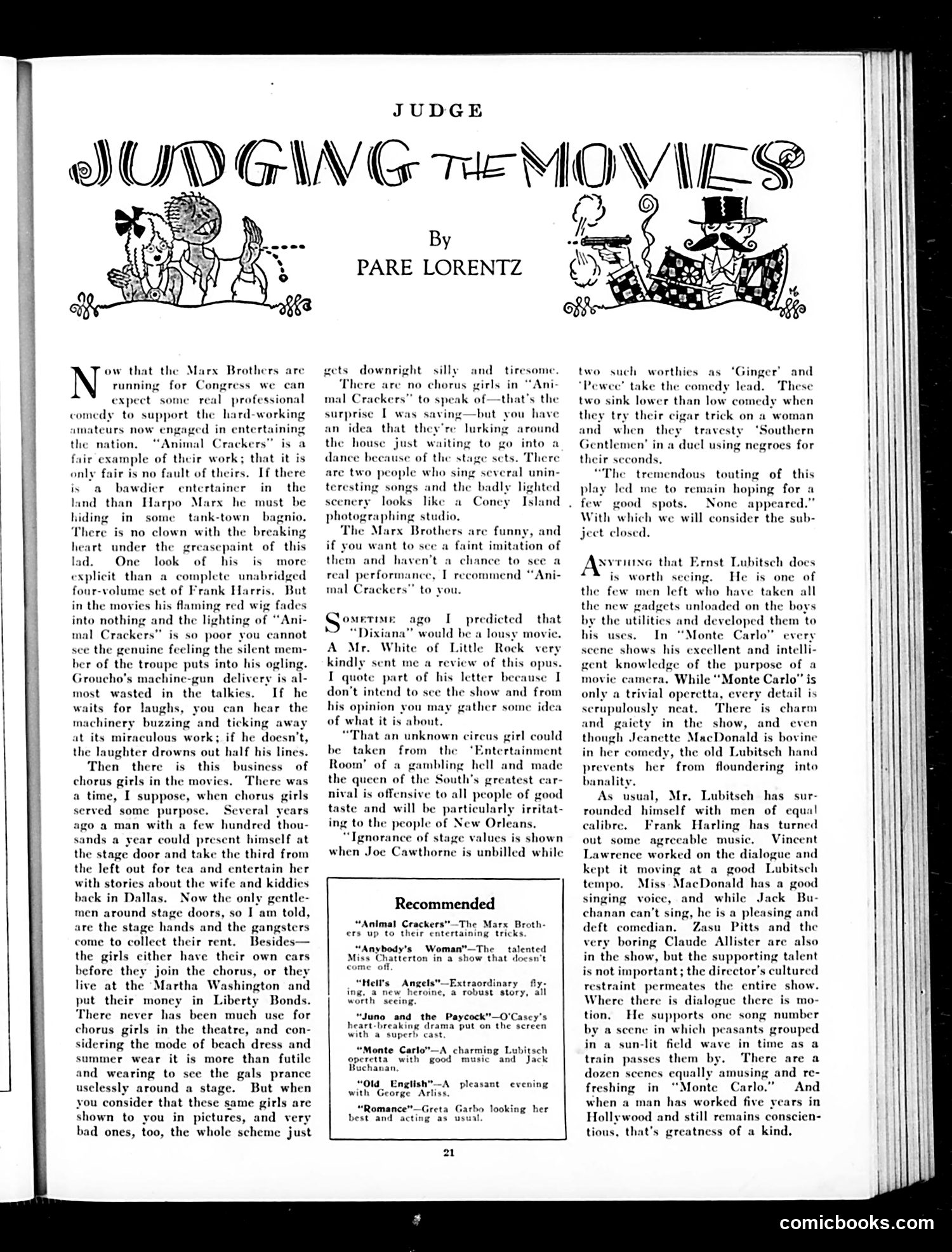
Judge Magazine Film Criticism by Pare Lorentz This page reviews recent films, primarily critiquing the Marx Brothers' "Animal Crackers." The author praises the Brothers' live comedy talents but argues their film performances lose impact—Harpo's expressive pantomime and Groucho's rapid-fire delivery don't translate well to silent or early sound cinema. Lorentz also criticizes the film industry's inclusion of chorus girls in movies as pointless and outdated. He notes that in earlier theater, stage-door suitors once entertained chorus girls; now these women are economically independent (owning cars, investing in Liberty Bonds), making their on-screen appearances anachronistic and visually tiresome. The page includes a "Recommended" section reviewing current films like "Dixiana" (criticized for its offensive racial stereotypes regarding New Orleans), "Hell's Angels," and "Monte Carlo," offering period-specific entertainment guidance.
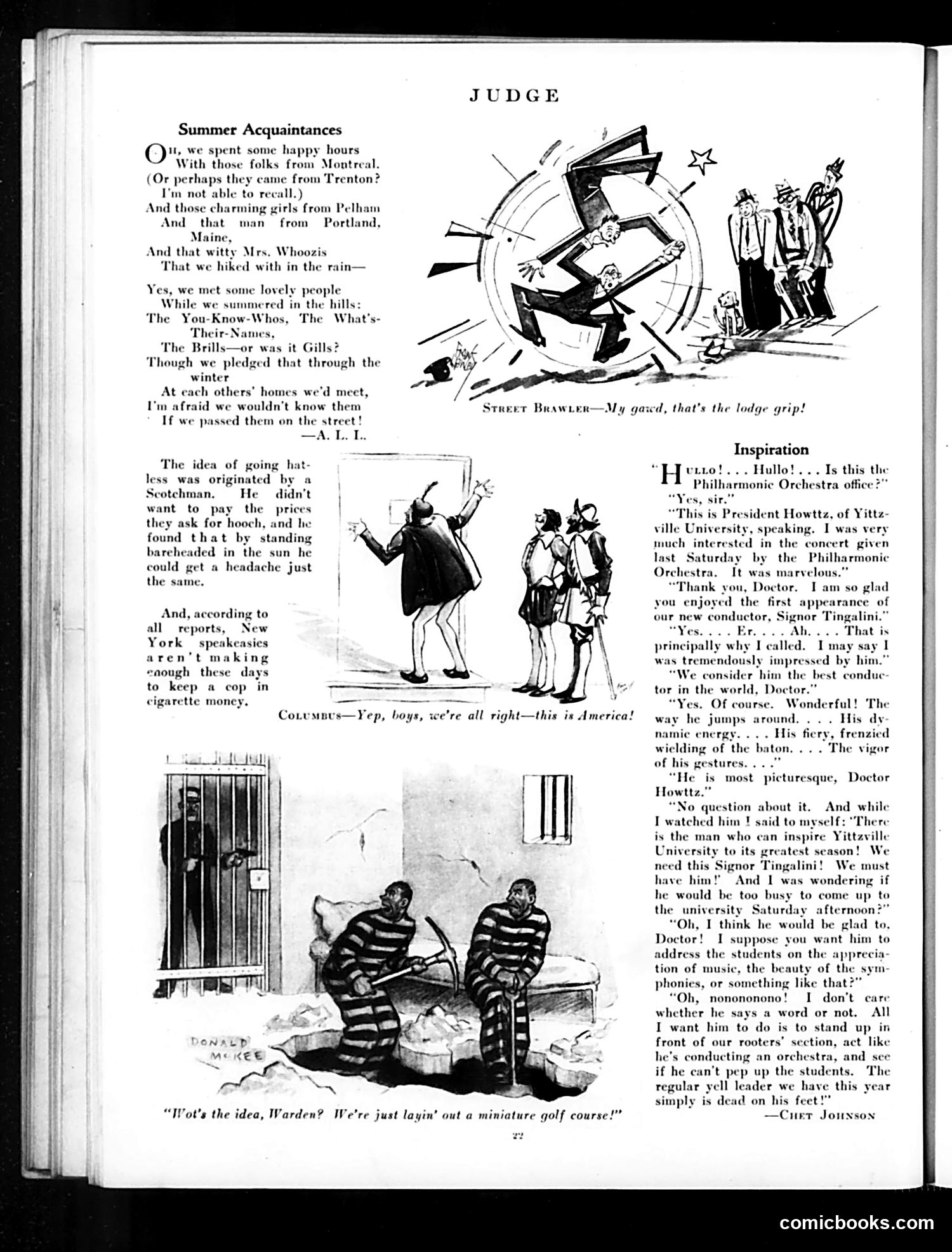
Analysis of This Judge Magazine Page This page contains three separate humor pieces satirizing American social life in the Prohibition era (1920s-early 1930s). "Summer Acquaintances" mocks the shallow nature of vacation friendships—people meet charming folks at mountain resorts but can't remember their names or recognize them afterward ("The You-Know-Whos, The What's-Their-Names"). The prison cartoon jokes about Prohibition's failure. Inmates laying out a miniature golf course are compared to speakeasy operators—both are essentially gambling operations operating illegally, with the warden's "lodge grip" (Masonic handshake) suggesting police complicity in illegal alcohol distribution. "Inspiration" satirizes college football culture during the era of famous coaches. A university president desperately wants to hire a renowned orchestra conductor—not for music education, but to theatrically energize the football team's rooters section since their regular cheerleader is ineffective. This mocks how American universities prioritized sports over academics. All three pieces target social pretension, Prohibition's ineffectiveness, and misplaced American institutional values.
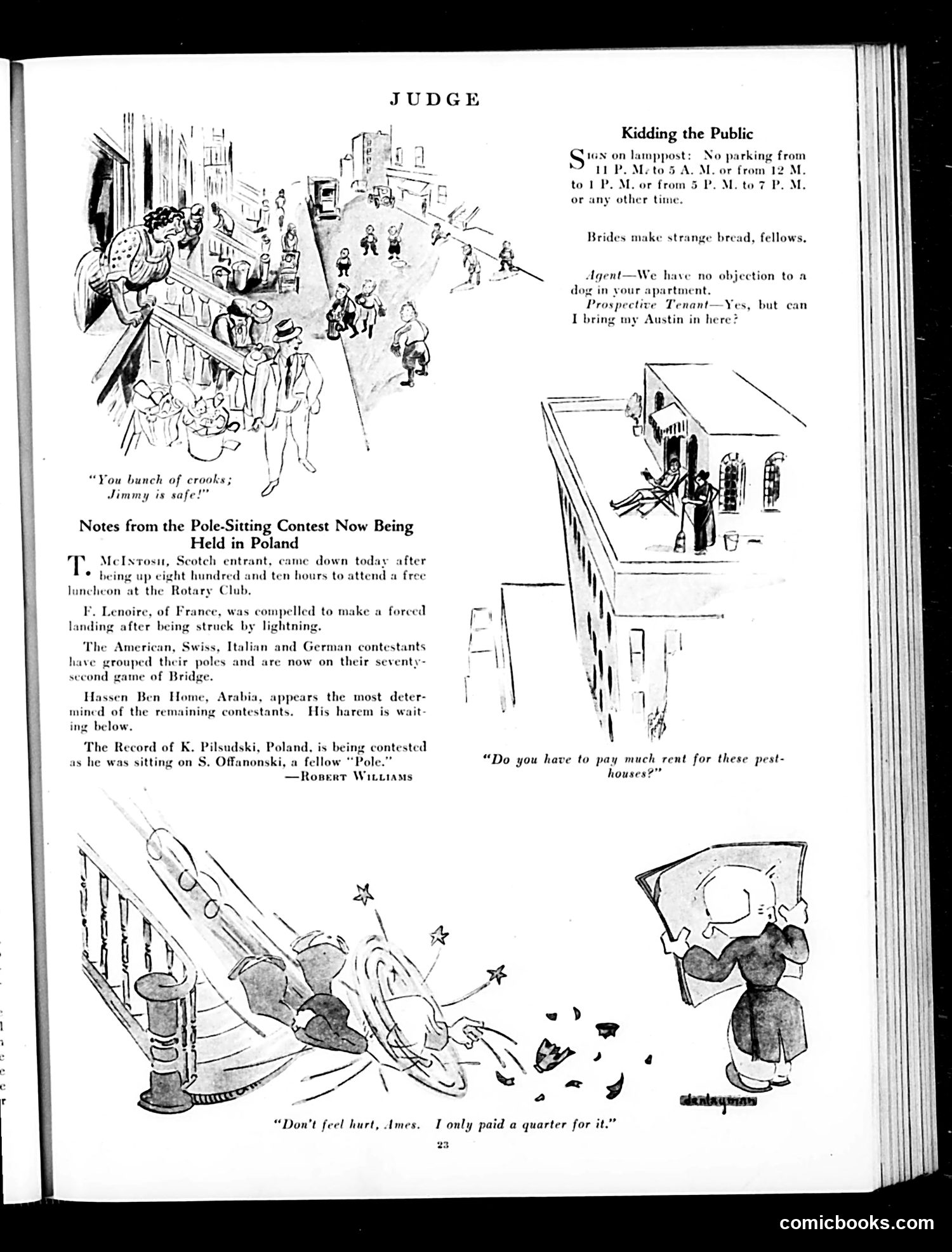
Judge Magazine Page Analysis This page contains several satirical humor pieces from Judge, a major American comedy publication: Top Section ("Kidding the Public"): Mock advertisements and jokes lampooning modern inconveniences—absurd parking restrictions, apartment rental disputes (a tenant wanting to bring an "Austin," likely an automobile, into an apartment like a pet). "Pole-Sitting Contest" Section: Satirizes the 1920s fad of pole-sitting endurance contests. The jokes mock various international contestants: a Scotsman who descends after 810 hours for lunch, a Frenchman forced down by lightning, Arabs with harems below, and a pun about Polish competitors sitting on each other (playing on "Pole" as both nationality and the physical pole). Bottom Cartoons: Slapstick humor—one shows figures falling from a pole structure; another depicts someone selling damaged goods cheaply ("I only paid a quarter for it"), mocking both cheap merchandise and naive buyers. The overall tone is absurdist, mocking contemporary fads, consumer culture, and international stereotypes typical of 1920s American humor magazines.
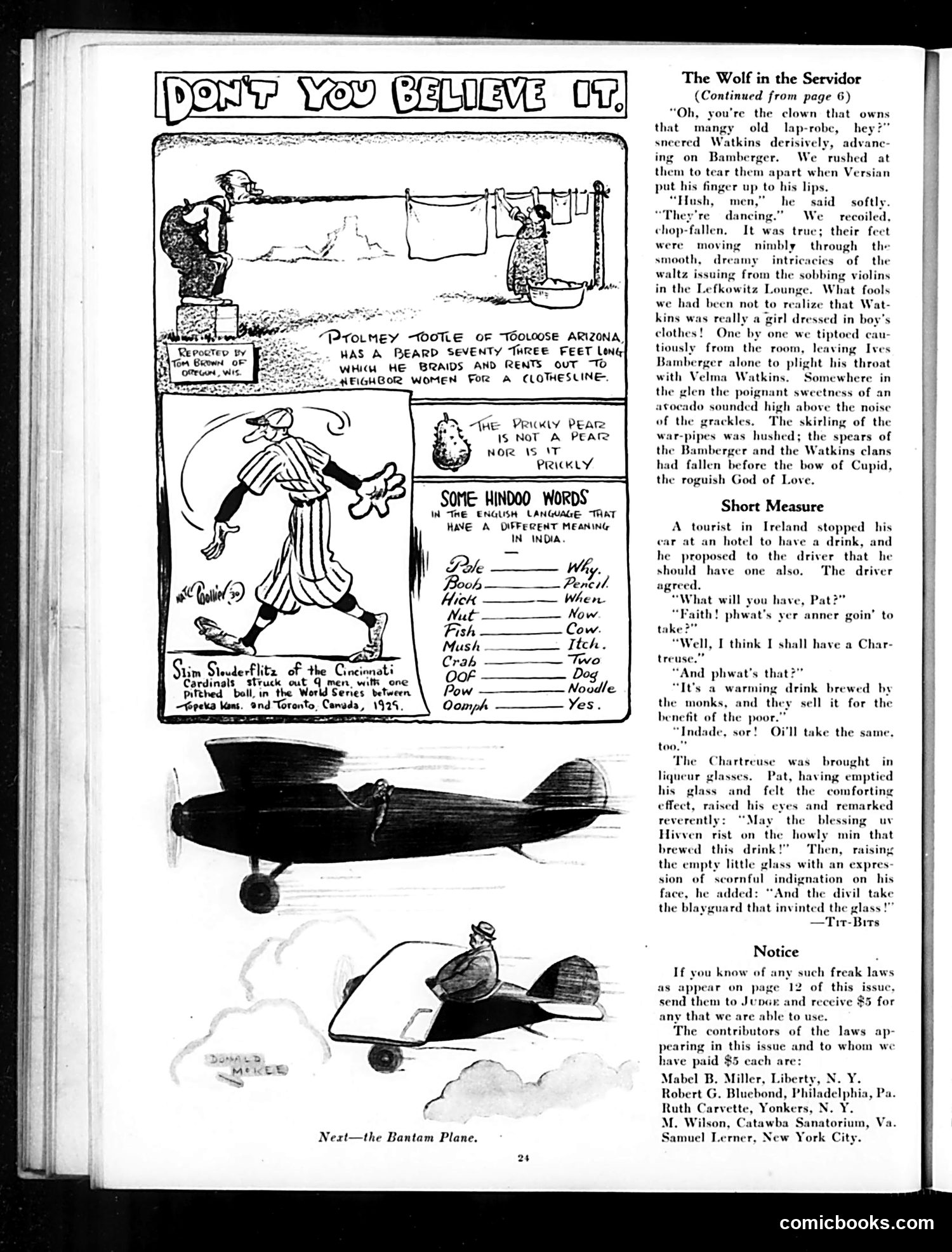
Judge Magazine Page Analysis This page contains several humorous items typical of 1920s satirical magazines: "Don't You Believe It" presents absurdist tall tales and wordplay jokes. The Ptolmey Tootle item mocks exaggeration. The "Hindoo Words" section exploits comedy from cross-cultural misunderstandings—a common (if crude) humor mode of the era, listing English words supposedly having different meanings in India. "The Wolf in the Servidor" continues a serialized story about romantic rivalry, with slapstick comedy where the protagonist discovers "Watkins" is actually a girl in disguise. "Short Measure" is an Irish-themed joke playing on dialect humor and the driver's complaint that a liqueur glass is too small—common ethnic humor of the period. The page reflects 1920s Judge magazine's blend of comic strips, short stories, and joke columns targeting educated, middle-class readers with wordplay, romantic comedy, and casual ethnic stereotyping typical of that era.
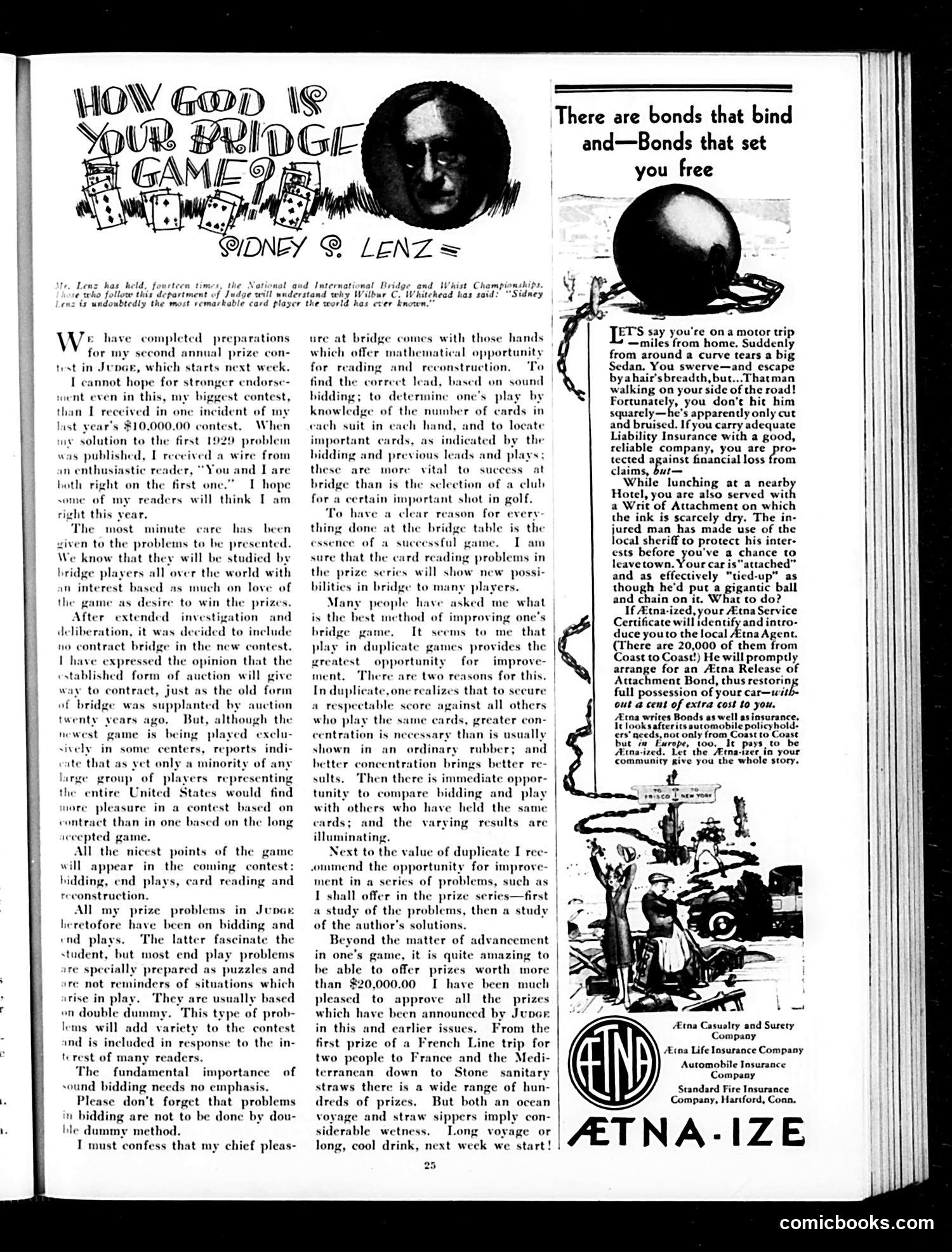
Judge Magazine Page Analysis This page is primarily Sidney Lenz's column about bridge card game strategy, not political satire. Lenz was a famous bridge player announcing Judge magazine's annual bridge problem contest starting the following week. The left side contains his article discussing bidding, card reading, end plays, and duplicate game strategy. The portrait at top left depicts Lenz himself. The right side features an Aetna Insurance advertisement using a humorous scenario: a motor trip accident where a "Writ of Attachment" (legal document) protects the insured driver. The joke plays on "attachment" having double meaning—both legal and emotional. The ad emphasizes Aetna's reliability and protection against financial loss from accidents. For modern readers: This represents Judge's mixed content model—celebrity columns alongside commercial advertising using witty wordplay to sell insurance. The bridge article reflects 1920s-30s leisure culture among educated middle/upper classes.
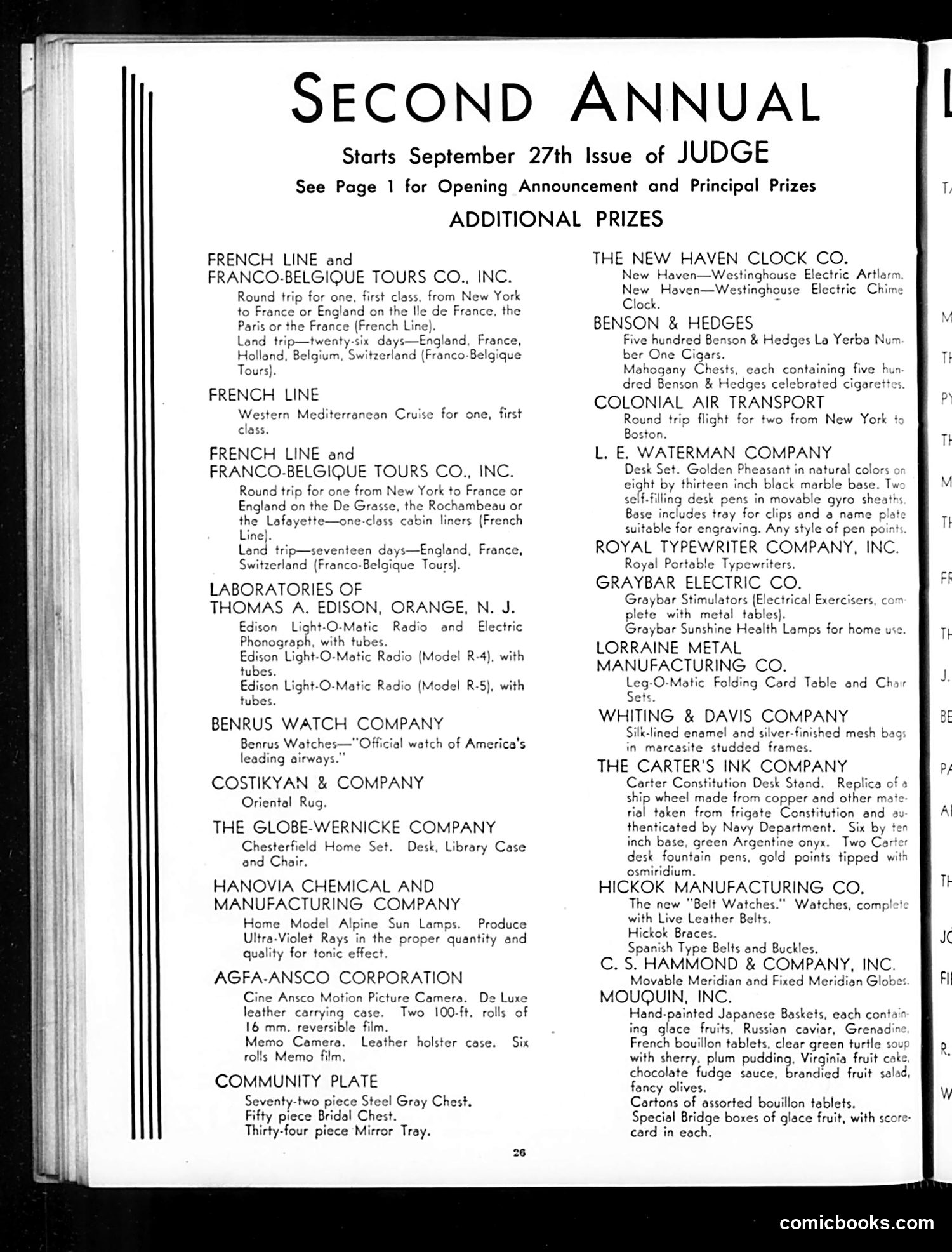
Judge Magazine Prize Page Analysis This is a prize announcement page for Judge's "Second Annual" contest (starting September 27th issue). It lists no cartoons or satirical content—instead, it's a comprehensive advertising section showcasing luxury prizes offered to contest participants. The prizes reflect 1920s-30s consumer aspirations: European luxury travel (French Line cruises, Franco-Belgique tours), cutting-edge technology (Edison radios, early motion picture cameras, electric health lamps), high-end goods (Oriental rugs, sterling silver, mahogany furniture), and novelty items (belt watches, folding card tables). The breadth reveals what affluent American readers valued: transatlantic sophistication, modern conveniences, and conspicuous leisure. The heavy emphasis on travel to France and England underscores the cultural cachet of European destinations among Judge's educated, well-to-do audience. This is essentially a branded content sponsorship page—manufacturers paid to advertise through contest prizes, reaching Judge's desirable demographic.
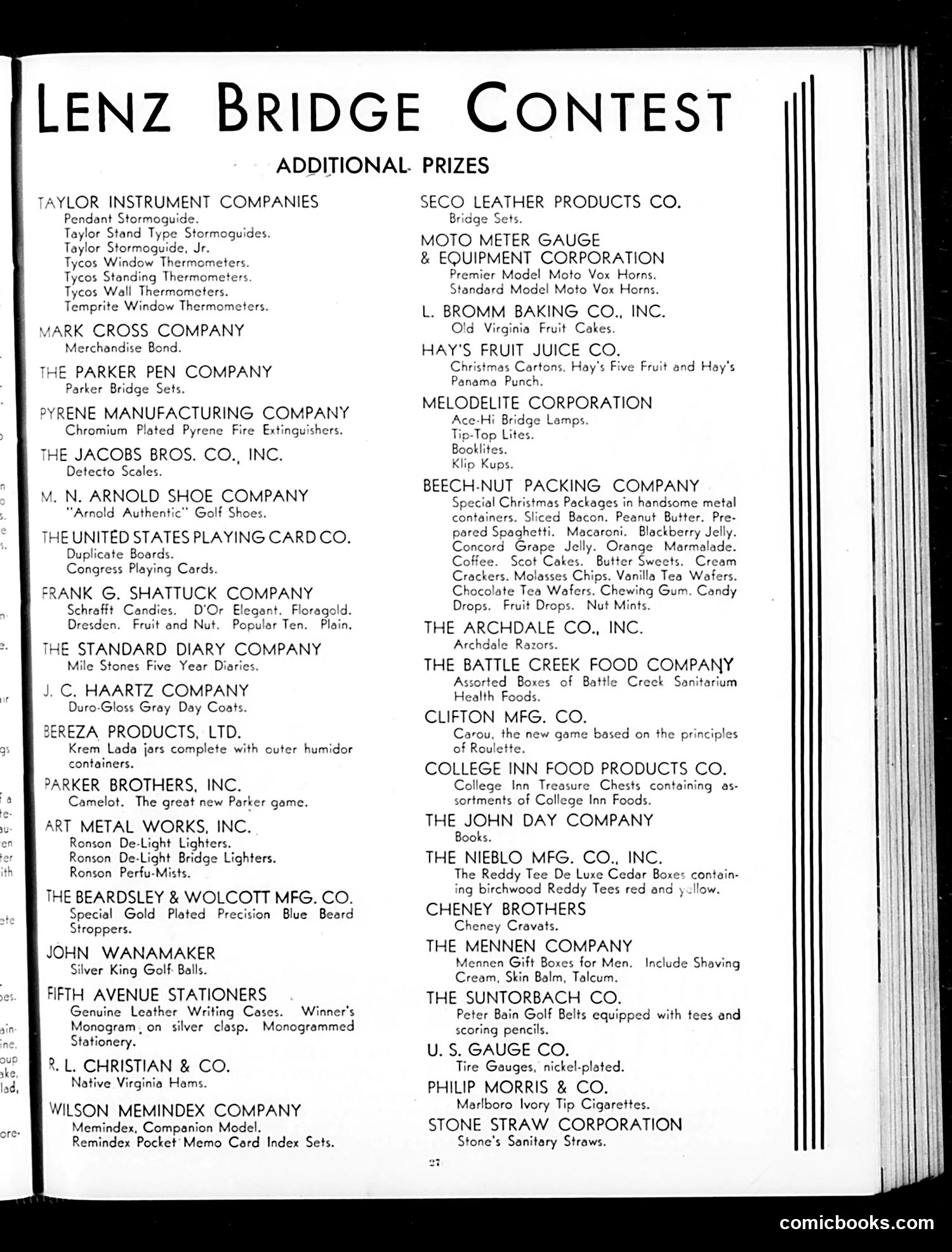
Lenz Bridge Contest Prize List This is not a cartoon or satirical content—it's a straightforward advertising page listing prizes for a "Lenz Bridge Contest," likely a bridge-playing competition Judge magazine ran. The page comprises two columns of corporate sponsors offering merchandise prizes: thermometers, pens, playing cards, candy, golf equipment, food products, cigarettes, and other consumer goods typical of the 1920s-30s era. Companies range from major brands (Parker Pen, Ronson lighters, Beech-Nut) to regional producers. Bridge was an enormously popular card game during this period, especially among affluent Americans, making it an ideal promotional vehicle for luxury consumer goods. The contest itself generated advertising revenue while the prize donations attracted participating companies seeking brand exposure to Judge's readership—a mutually beneficial arrangement common in the magazine industry.
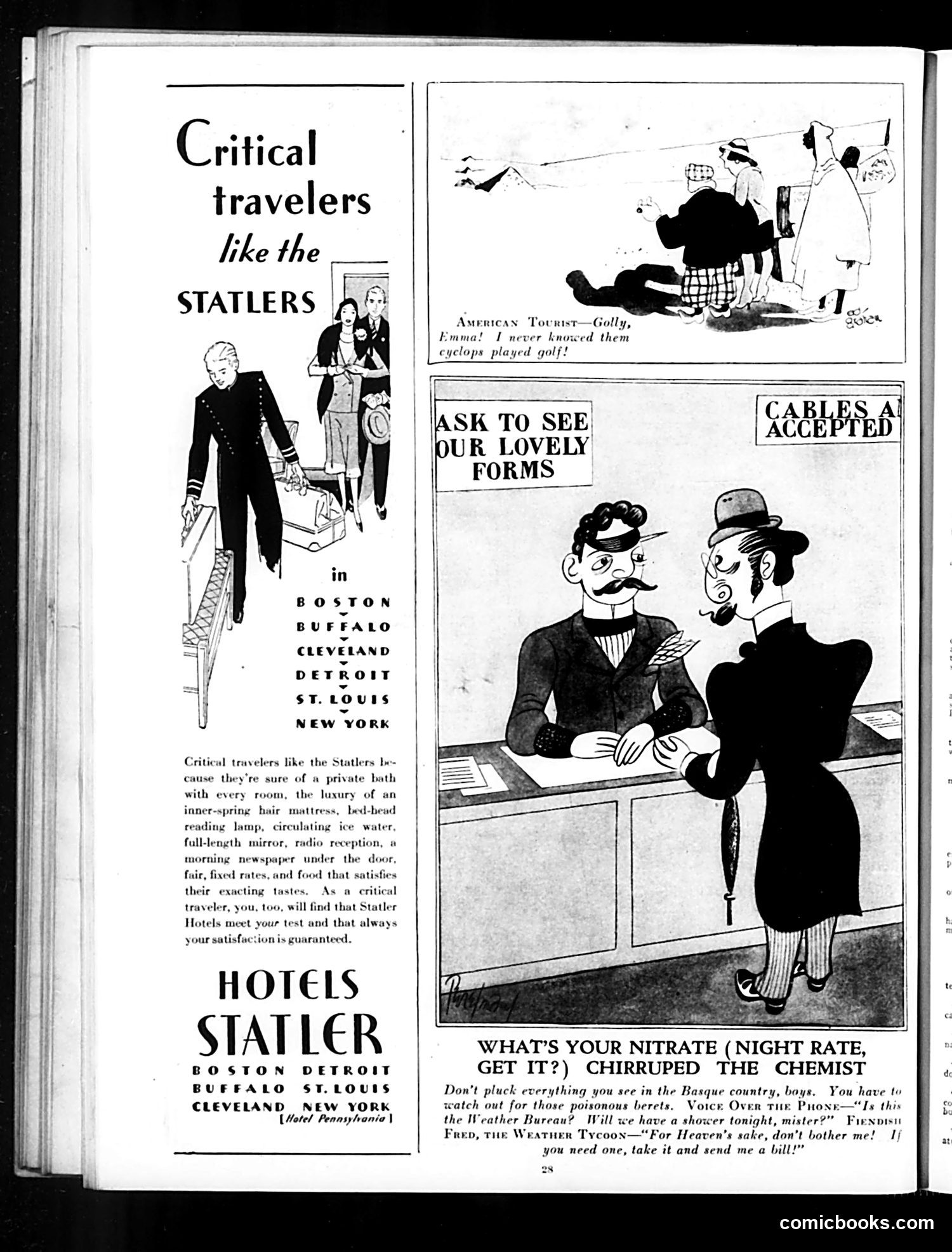
Analysis of Judge Magazine Page This page contains two distinct pieces of content: Left side: A Statler Hotels advertisement targeting "critical travelers," emphasizing luxury amenities (private baths, inner-spring mattresses, newspapers, fixed rates). This is straightforward hotel promotion, not satire. Right side: Two separate joke cartoons: 1. Top cartoon: An American tourist in the Basque country marvels that "cyclops played golf"—he's apparently mistaken Basque berets (the distinctive round hats) for eye patches, creating a visual pun about the hat's appearance. 2. Bottom cartoon: A "nitrate/night rate" pun joke at a hotel front desk. A guest calls asking if there will be showers tonight; the weather bureau official (Fred) sarcastically tells him to take a shower himself and send him the bill—a joke about the guest's presumed uncleanliness. These are mild, whimsical humor pieces typical of 1920s-30s magazine filler, relying on visual puns and wordplay rather than sharp political satire.
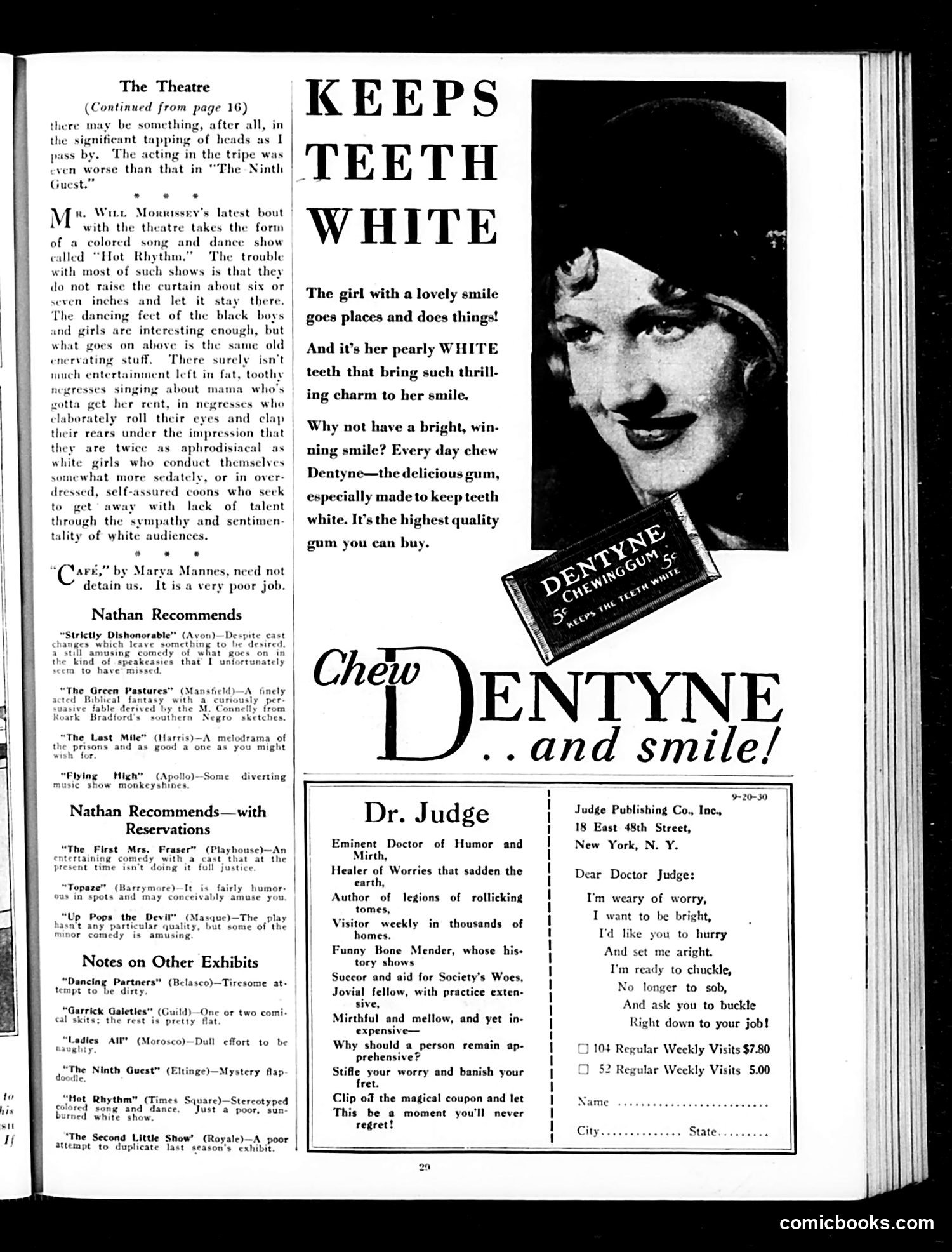
Judge Magazine Page Analysis This page from Judge magazine (dated 9-29-30) contains theatre reviews and advertisements rather than political cartoons. The Theatre Section critiques contemporary Broadway shows with notable racial prejudice. The reviewer dismisses "Hot Rhythm," a Black song-and-dance revue, using derogatory language and stereotypes. He complains that Black performers lack talent and rely on "sympathy and sentimentality of white audiences"—reflecting the casual racism of 1930s entertainment criticism. The Advertisements include a Dentyne gum ad (standard product marketing) and a humorous "Dr. Judge" advice column parody. The latter satirizes self-help culture by personifying Judge magazine itself as a comedic doctor offering "worry" cures through magazine subscriptions—a meta-joke about the magazine's own entertainment value as anxiety relief. The page reflects 1930s entertainment standards and attitudes rather than direct political satire.
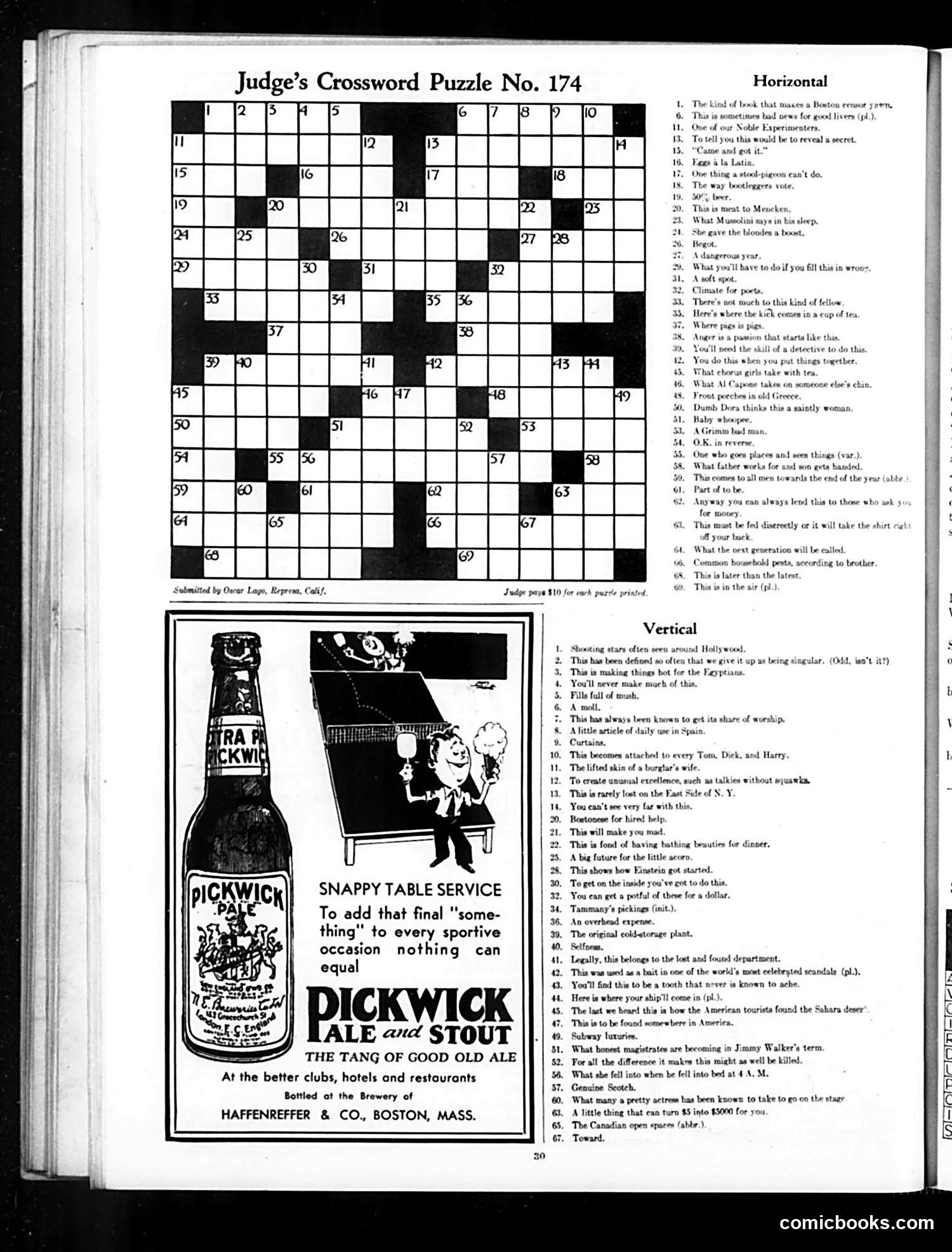
Judge Magazine Page Analysis This page is primarily advertising content, not political satire. It features a full-page advertisement for Pickwick Ale and Stout, brewed by Haffenreffer & Co. in Boston, Massachusetts. The ad uses a simple pitch: Pickwick beer adds the "final something" to social occasions at "better clubs, hotels and restaurants." The imagery shows a bottle of Pickwick ale alongside a cartoon figure (appears to be a waiter or server) attending to diners, emphasizing the product's association with upscale hospitality and leisure. The remainder of the page is a crossword puzzle ("Judge's Crossword Puzzle No. 174") with horizontal and vertical clues—standard puzzle content with no apparent satirical intent. There is no political cartoon or social satire visible on this page. It represents typical 1920s-era magazine advertising and entertainment filler, reflecting the era's casual approach to alcohol promotion (pre-Prohibition repeal context remains unclear from the page alone).
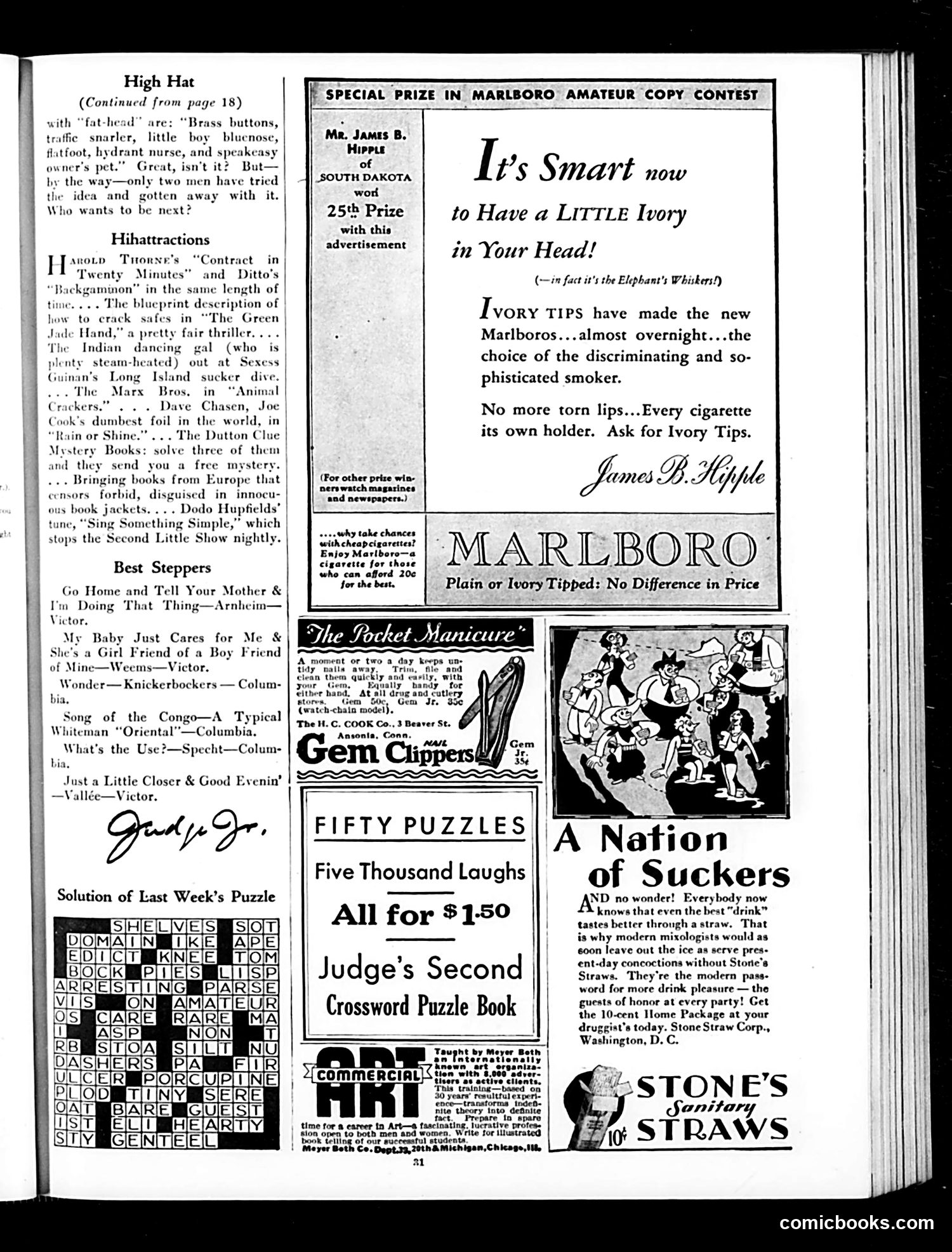
Explanation for Modern Readers This page is primarily advertisements and entertainment listings from Judge magazine, with minimal satirical content. The main items are: Marlboro cigarettes ad: Advertises "Ivory Tips" as a smoking innovation—a filter holder that prevents torn lips and keeps cigarettes intact. The phrase "Little Ivory in Your Head" is a pun on the elephant mascot (ivory = elephant tusks). Stone's Sanitary Straws ad: Jokes that Prohibition-era cocktails taste better through a straw. The "Nation of Suckers" title puns on both drinking straws and people foolish enough to believe they need straws for beverages—satirizing the absurdity of Prohibition-era drinking culture. Other content: "Best Steppers" lists popular songs; "Hihattractions" reviews entertainment; puzzle contests offer prizes. The satirical edge is mild—mostly poking fun at Prohibition customs and consumer products. No specific political figures or major events are referenced.
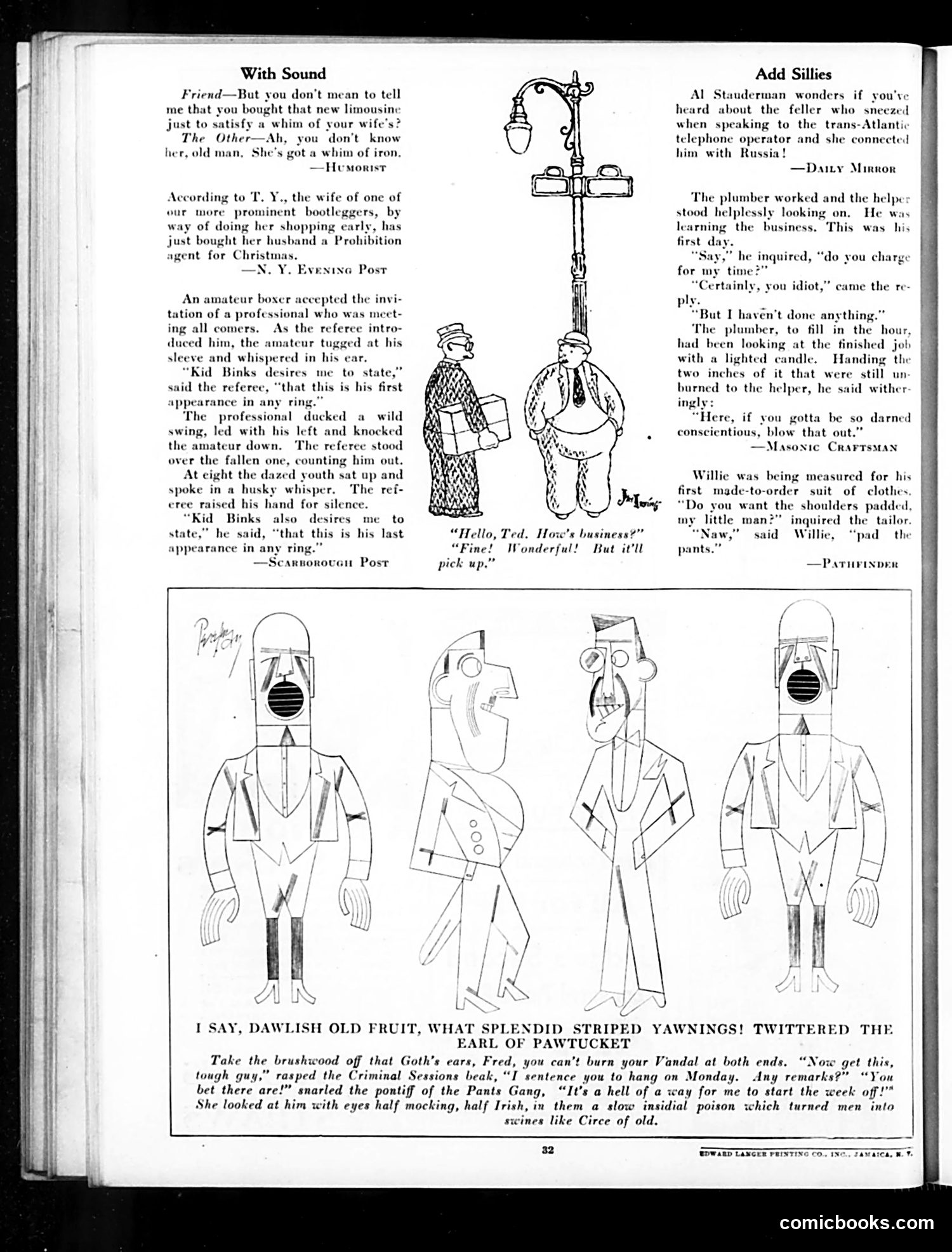
Judge Magazine Page Analysis This page contains two distinct sections: Upper half: Brief humorous anecdotes ("Add Sillies") mocking everyday situations—a wife's extravagant purchases, a bootlegger's wife, a boxer's debut, a telephone operator's error connecting someone to Russia, and a plumber's apprentice. These are light domestic jokes requiring no historical context. Lower half: A bizarre cartoon showing four figures in identical gas masks or mechanical head coverings, dressed in suits. The caption references "the Earl of Pawtucket" and uses intentionally nonsensical British slang ("dawlish old fruit," "striped yawnings"). The surrounding text appears to be absurdist satire with fragmented, surreal dialogue about Vandals, criminal courts, and Circe. This lower section appears to be intentionally absurdist/dadaist humor rather than political satire—the point seems to be pure nonsense and the breakdown of language itself, possibly mocking pretentious British speech or theatrical excess. Without clearer identifying context, the specific targets remain unclear, though the tone suggests mockery of affected upper-class speech patterns.
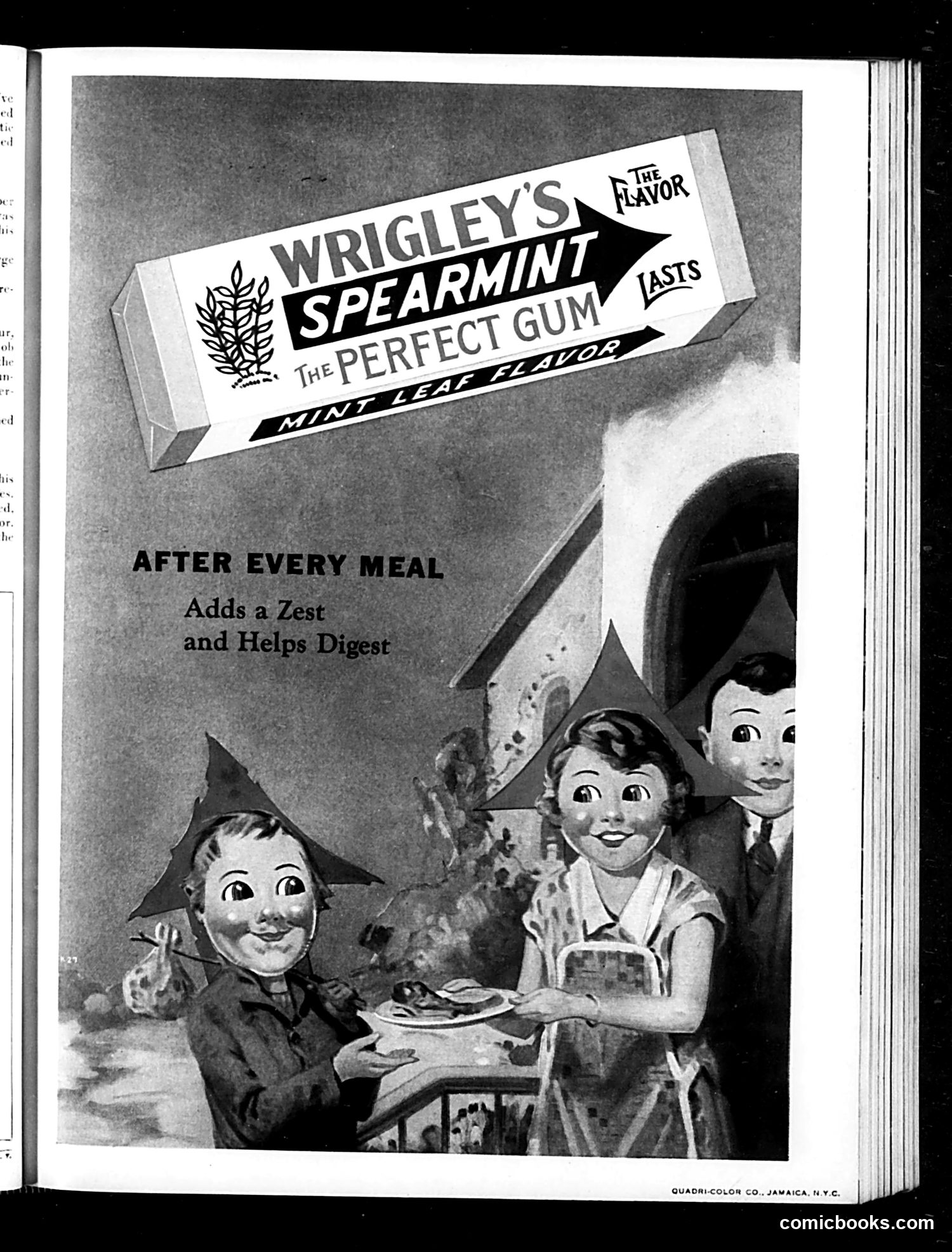
Content Analysis This is primarily a Wrigley's Spearmint gum advertisement, not political satire. The ad shows three stylized children in party hats around a dining table, with an adult figure in the background. The marketing message—"After Every Meal / Adds a Zest and Helps Digest"—reflects early 20th-century advertising claims that chewing gum aided digestion, a common health assertion of that era (now understood as exaggerated). The illustrated children's cheerful expressions and the festive party setting suggest gum consumption as a wholesome family activity. The "mint leaf flavor" emphasis appeals to period consumer preferences for fresh-tasting products. This is commercial advertising copy using period illustration style, not editorial satire or political commentary.
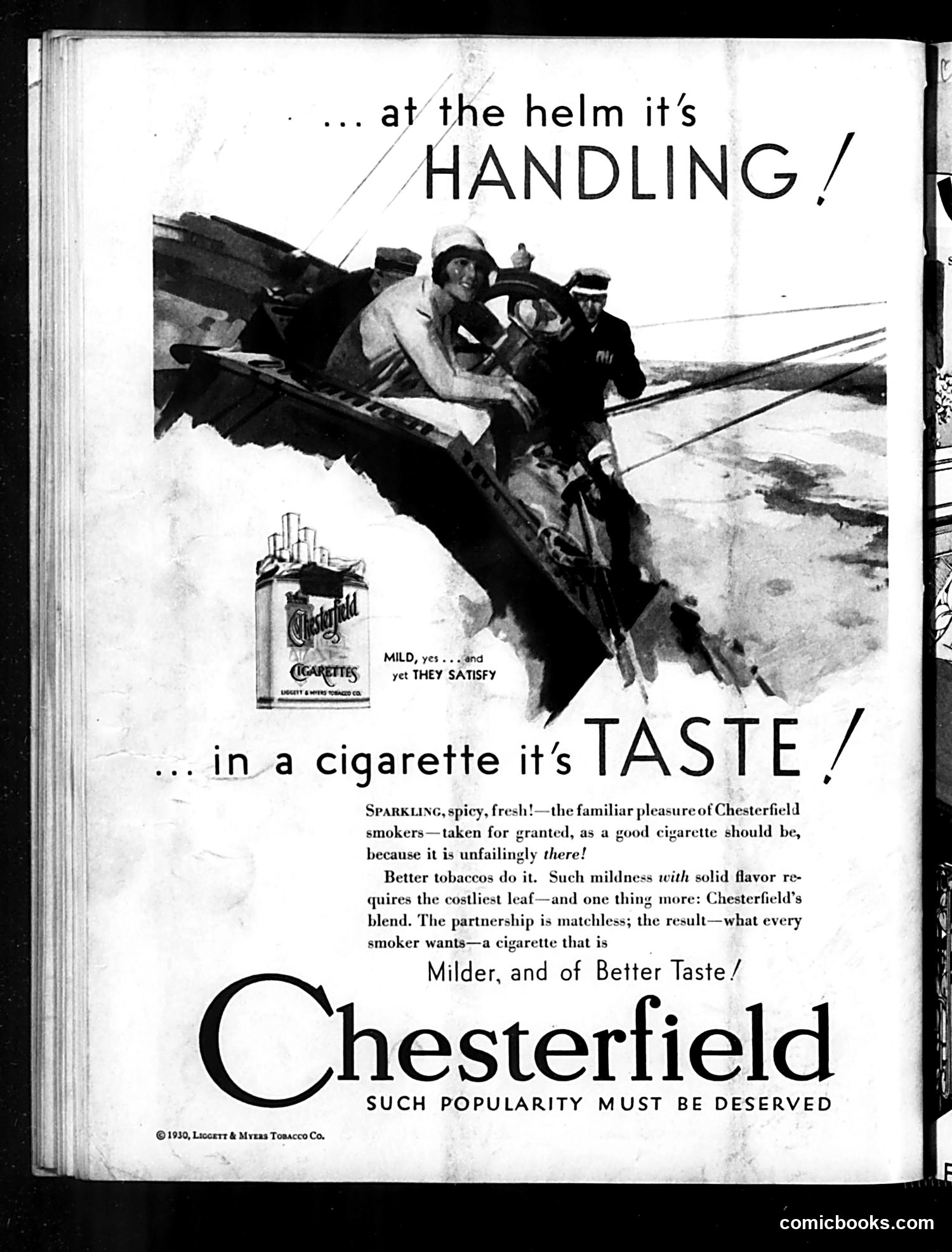
Chesterfield Cigarette Advertisement (1930) This is a cigarette advertisement, not political satire. The page shows a dramatic maritime image: a sailor at a ship's helm during rough conditions, with crew members nearby. The ad uses the nautical scene as a metaphor for cigarette qualities. The headline contrasts "HANDLING" (implying control and skill, like steering a ship) with "TASTE" (the cigarette's flavor). The tagline "Mild, yes... and yet THEY SATISFY" promises both gentleness and substance. The copy emphasizes that Chesterfield achieves mildness without sacrificing flavor through superior tobacco blending—positioning premium quality as justification for the product's popularity. This represents typical 1930s advertising strategy: pairing cigarettes with masculine imagery (maritime adventure) and pseudo-scientific claims about tobacco quality to appeal to adult smokers.