judge
Judge — September 27, 1930
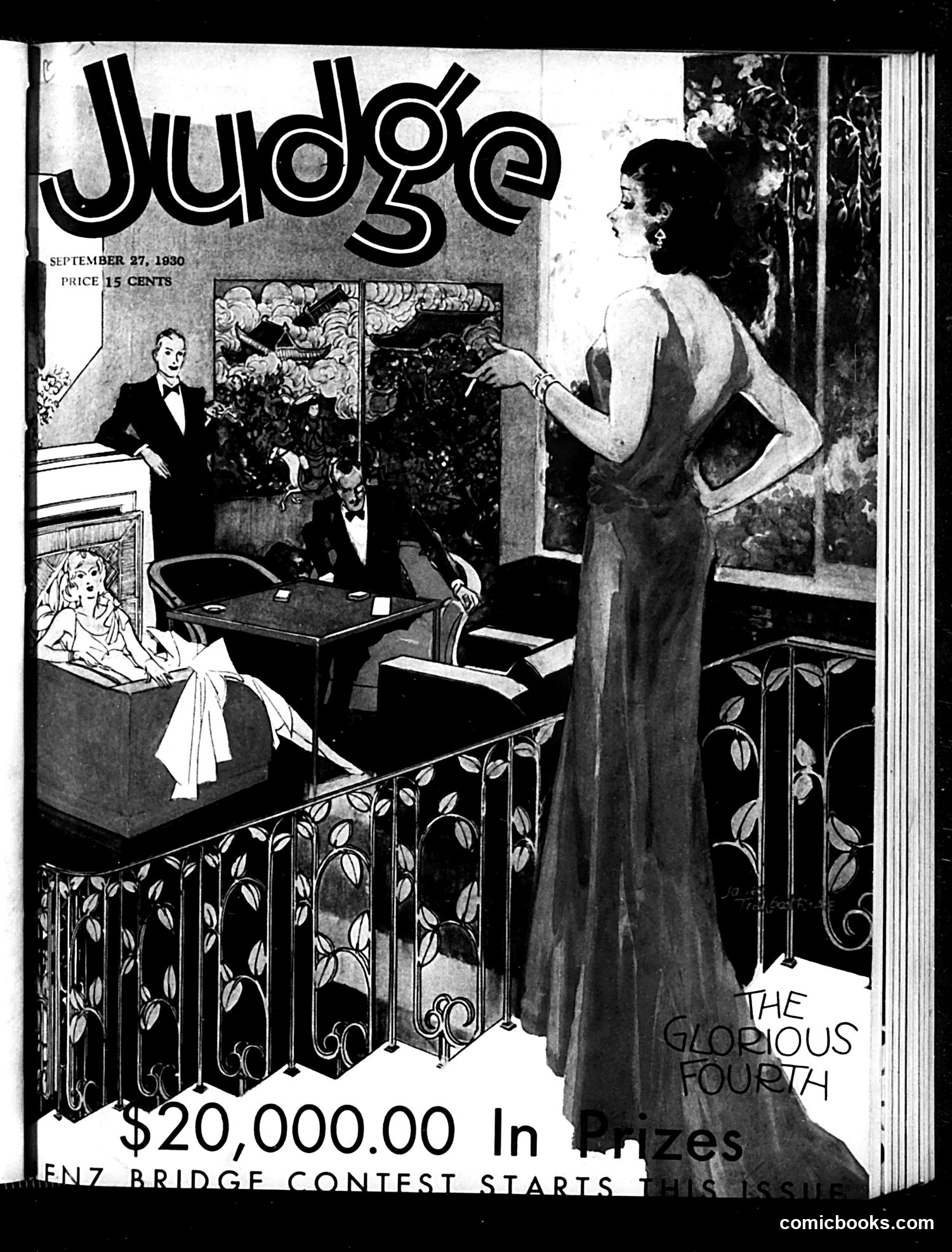
Judge Magazine, September 27, 1930 This cover advertises a bridge-playing contest with $20,000 in prizes—a significant sum during the Great Depression. The illustration depicts an elegant woman in an evening gown observing men in formal attire engaged in a card game, with decorative Art Deco styling throughout. The satire likely mocks the disconnect between wealthy Americans' leisure pursuits and the economic crisis affecting ordinary citizens. In 1930, as the Depression deepened, depicting lavish bridge tournaments with substantial prize money satirizes the frivolous indulgence of the privileged classes. The woman's fashionable presentation and the luxurious setting underscore this contrast between high society's indifference to broader hardship and the financial struggles of average Americans.
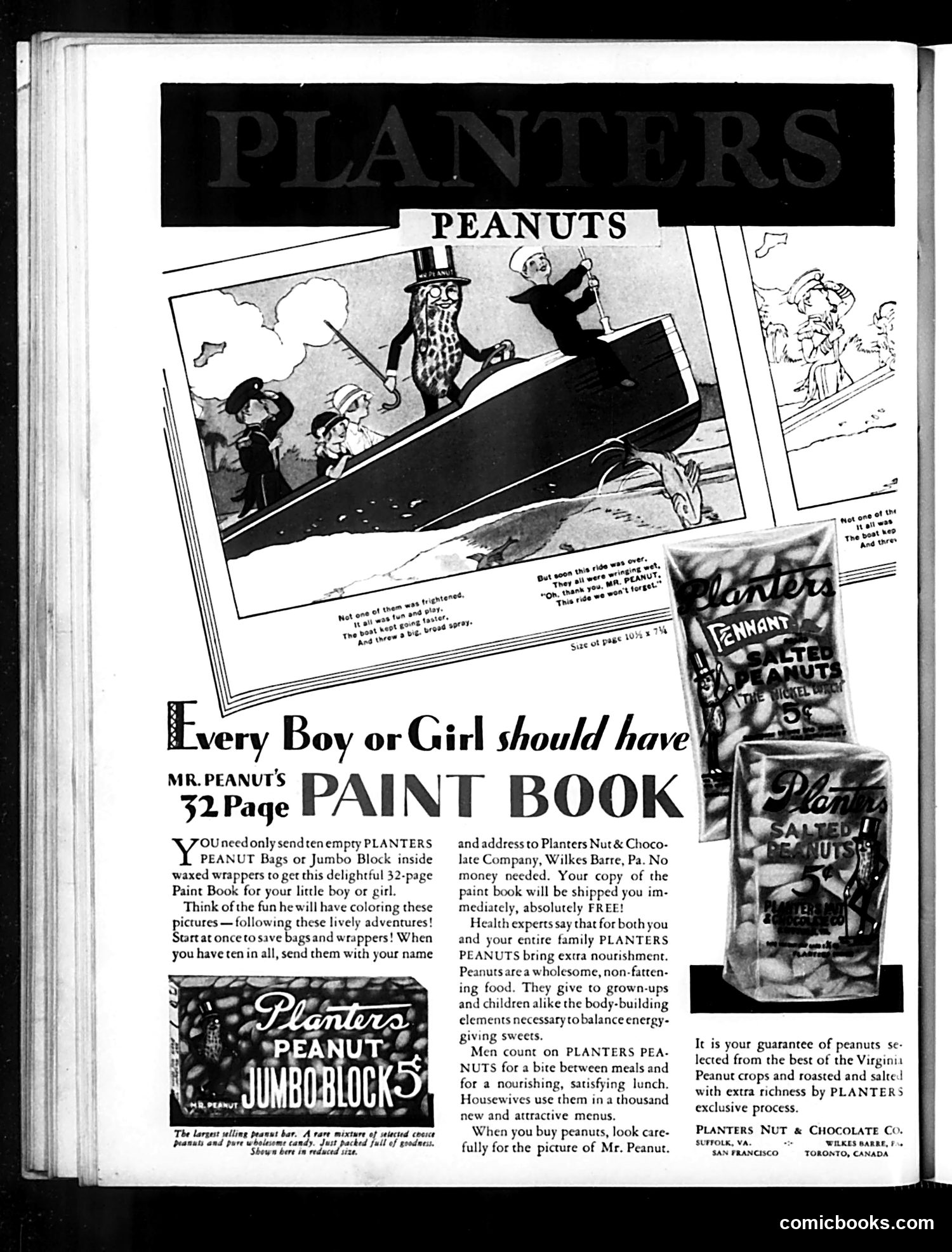
Analysis This page is primarily a commercial advertisement, not political satire. It promotes Planters Peanuts products, particularly Mr. Peanut's 32-page Paint Book. The cartoon depicts Mr. Peanut (the anthropomorphic peanut mascot in top hat) on what appears to be a ship or boat with other figures. The narrative suggests a whimsical adventure story—children could color these scenes themselves by obtaining the free paint book through Planters product packaging. The advertisement emphasizes peanuts as wholesome nutrition for families and children. There is no political satire present. This is straightforward early 20th-century branded marketing content designed to appeal to young readers and their parents by combining entertainment (a coloring book) with product promotion.
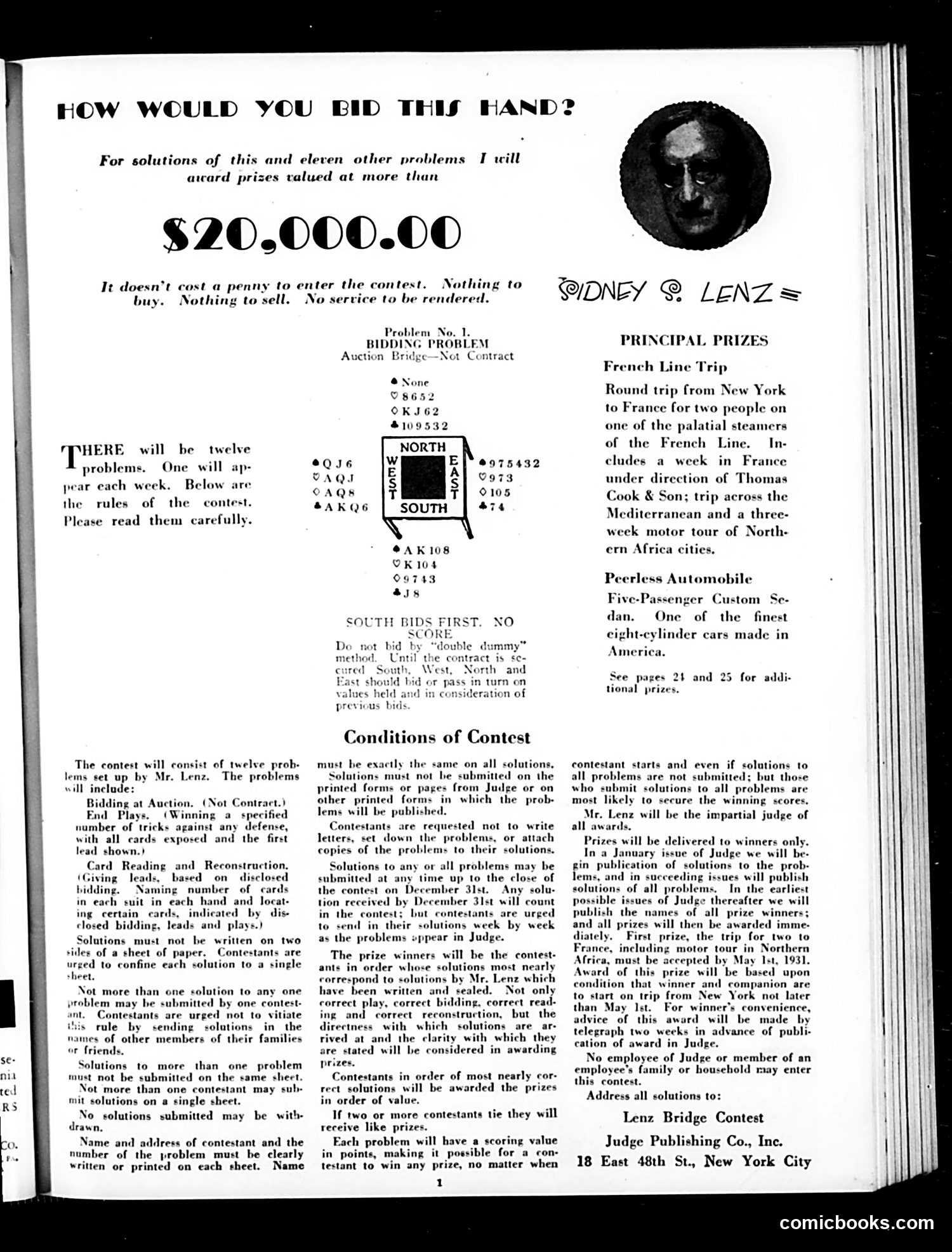
Analysis of Judge Magazine Page This page is primarily a bridge-bidding contest, not political satire. It announces a $20,000 prize competition sponsored by Sidney Lenz (the prominent face shown) for solving twelve contract bridge problems. The contest offers prizes including a French luxury cruise and a Peerless automobile. Entries were free and due by December 31st. Historical context: Contract bridge was a newly popular card game in the 1930s. Sidney Lenz was a famous bridge player and promoter who sponsored such competitions to popularize the game. The page is essentially advertising disguised as editorial content—a common Judge magazine practice. It's not satirical commentary but rather a commercial promotion, reflecting how 1930s magazines blended advertising with editorial material.
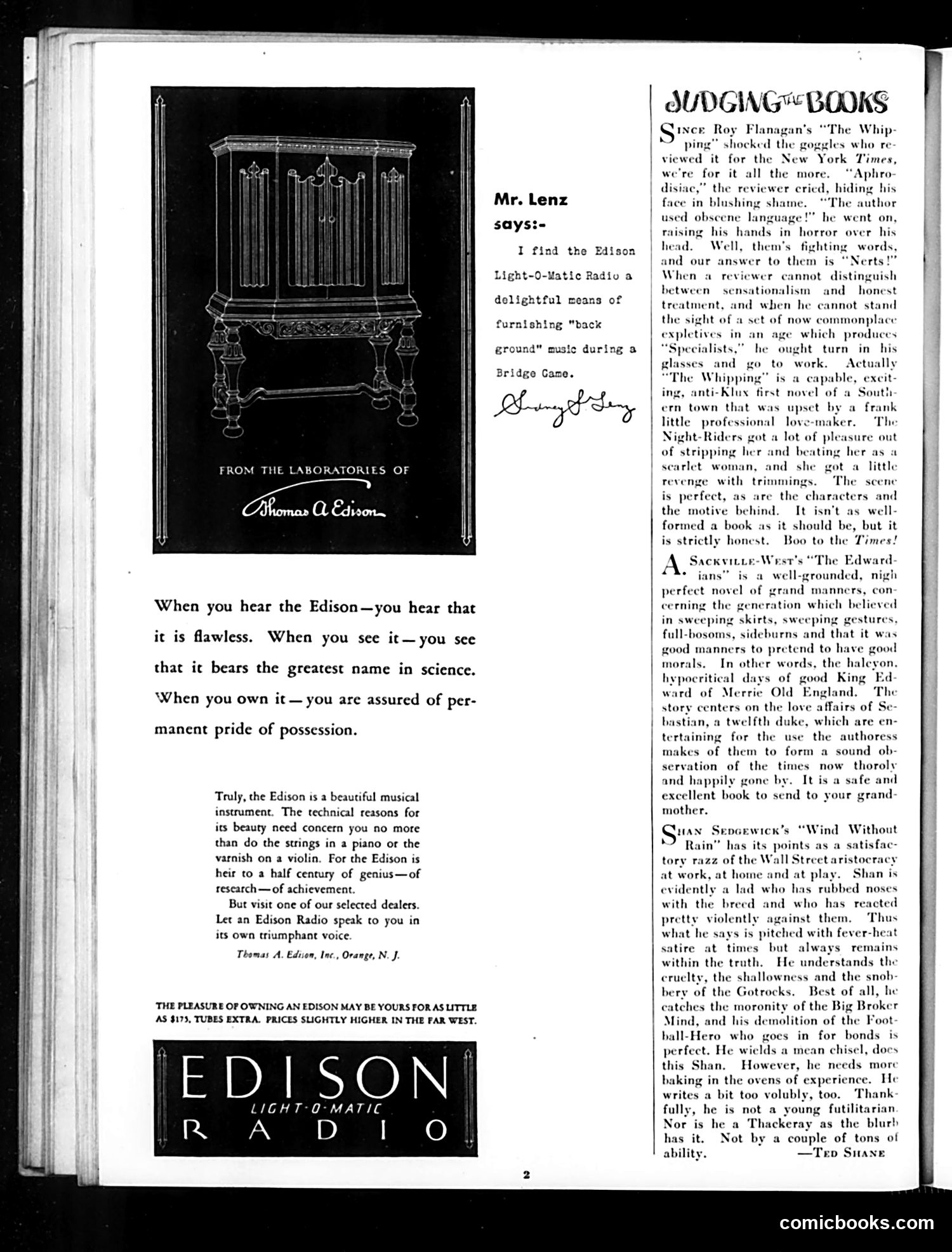
Analysis This page is primarily advertising, not political satire. The left side features a full advertisement for the Edison Light-O-Matic Radio, with an endorsement from "Mr. Lenz" praising its use during bridge games. The ad emphasizes Edison's reputation for quality and scientific achievement. The right side contains book reviews under "Judging the Books," critiquing recent novels including Roy Flanagan's "The Whipping," A. Sackville-West's "The Edwardians," and Shan Sendewick's "Wind Without Rain." The reviews discuss literary merit, characterization, and moral content—typical highbrow criticism of the era. There is no political cartoon or social satire visible on this page. It represents Judge magazine's commercial content and cultural commentary.
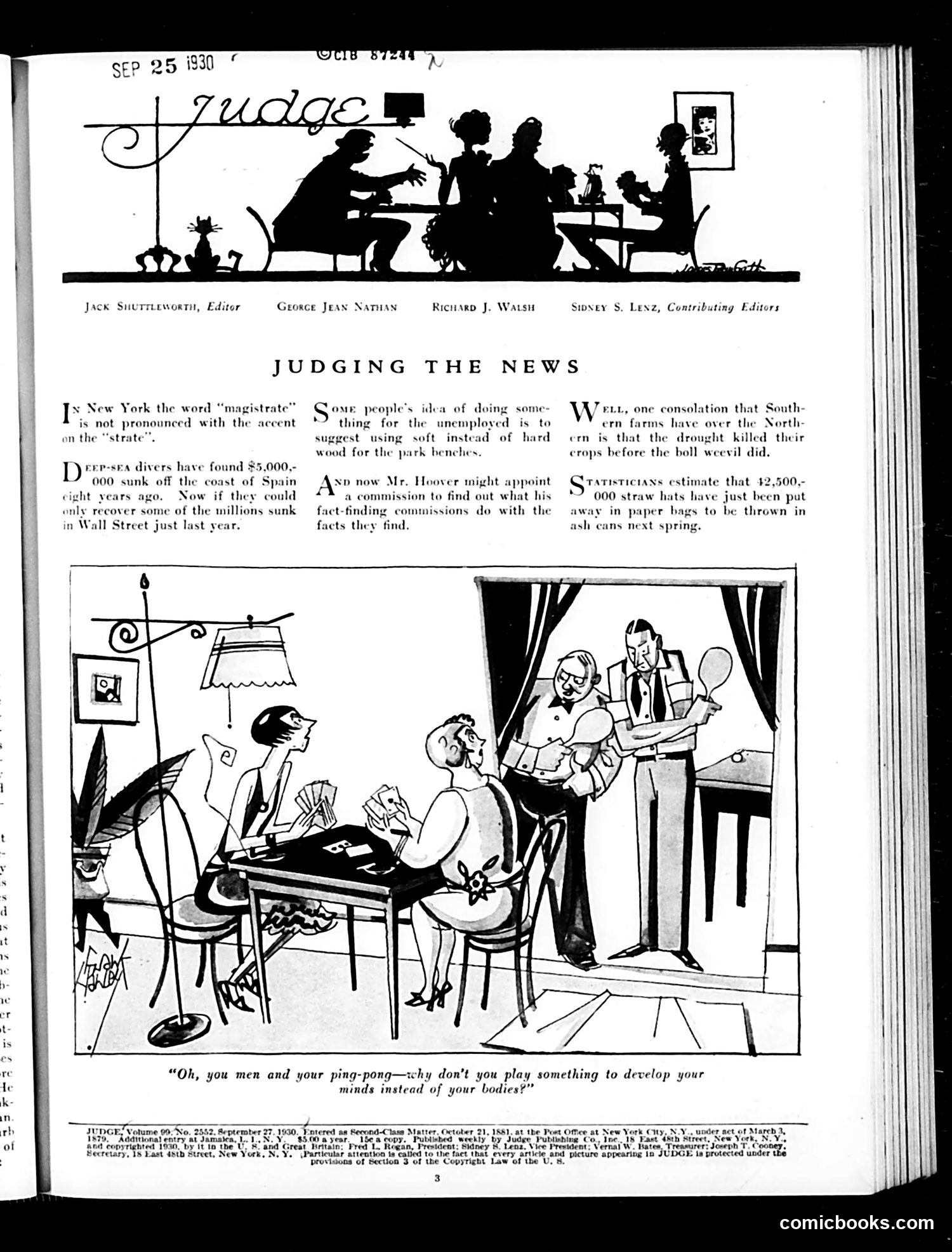
Analysis of "Judging the News" (Judge, September 25, 1930) This satirical page critiques news stories through brief commentary and a cartoon. The main cartoon depicts a domestic scene where two men (appears to be wealthy, given the formal dress) are at a table with money visible, while hosts stand nearby. The caption reads: "Oh, you men and your ping-pong—why don't you play something to develop your minds instead of your bodies?" The satire targets wealthy leisure culture during the Depression era—the irony being that accumulating money while unemployed Americans suffer suggests the wealthy prioritize frivolous entertainment (ping-pong) over meaningful pursuits. The suggestion to "develop your minds" is sarcastic, implying the wealthy are intellectually vacant. The text snippets above comment on tangential news items, likely setting up the page's overall tone of social criticism.
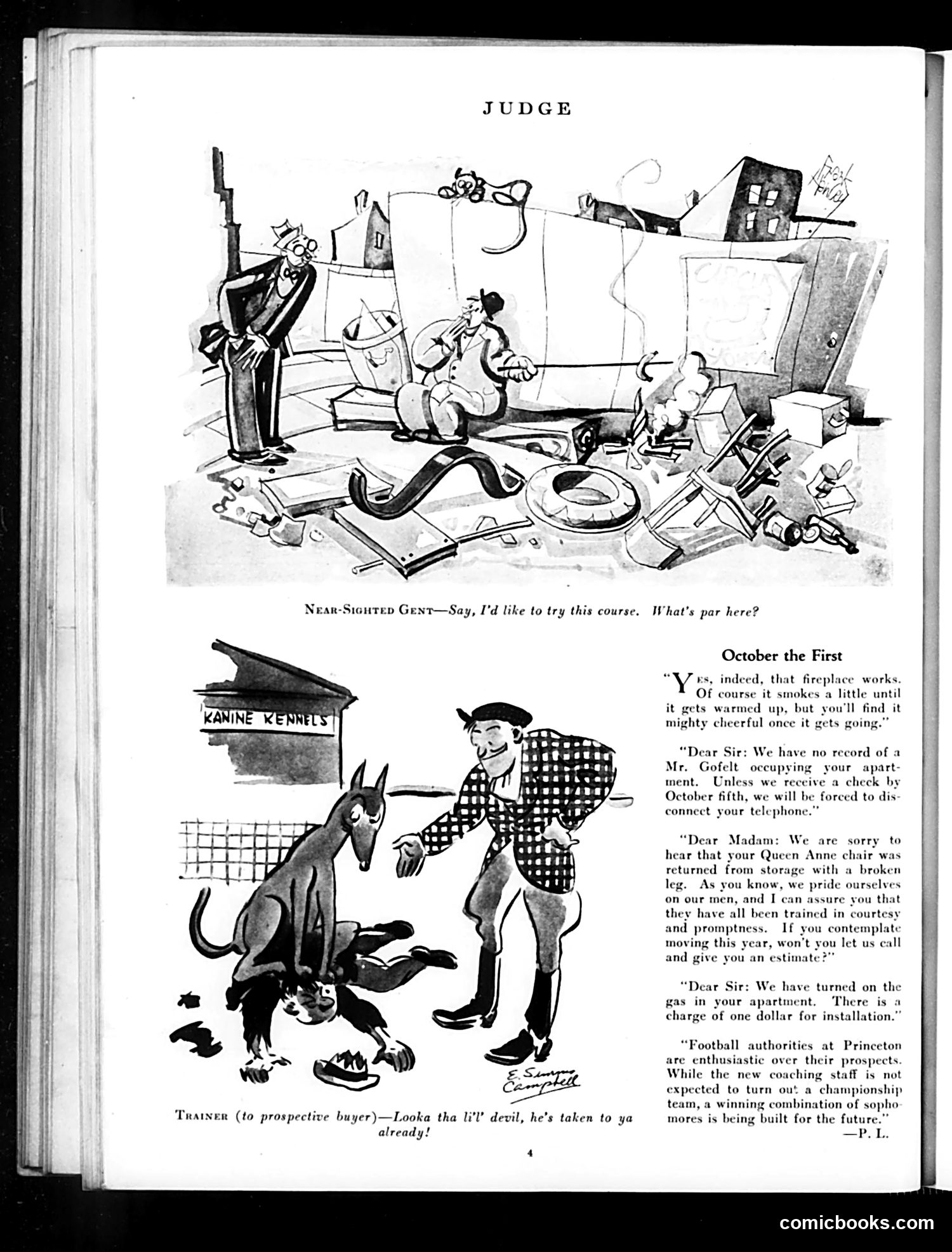
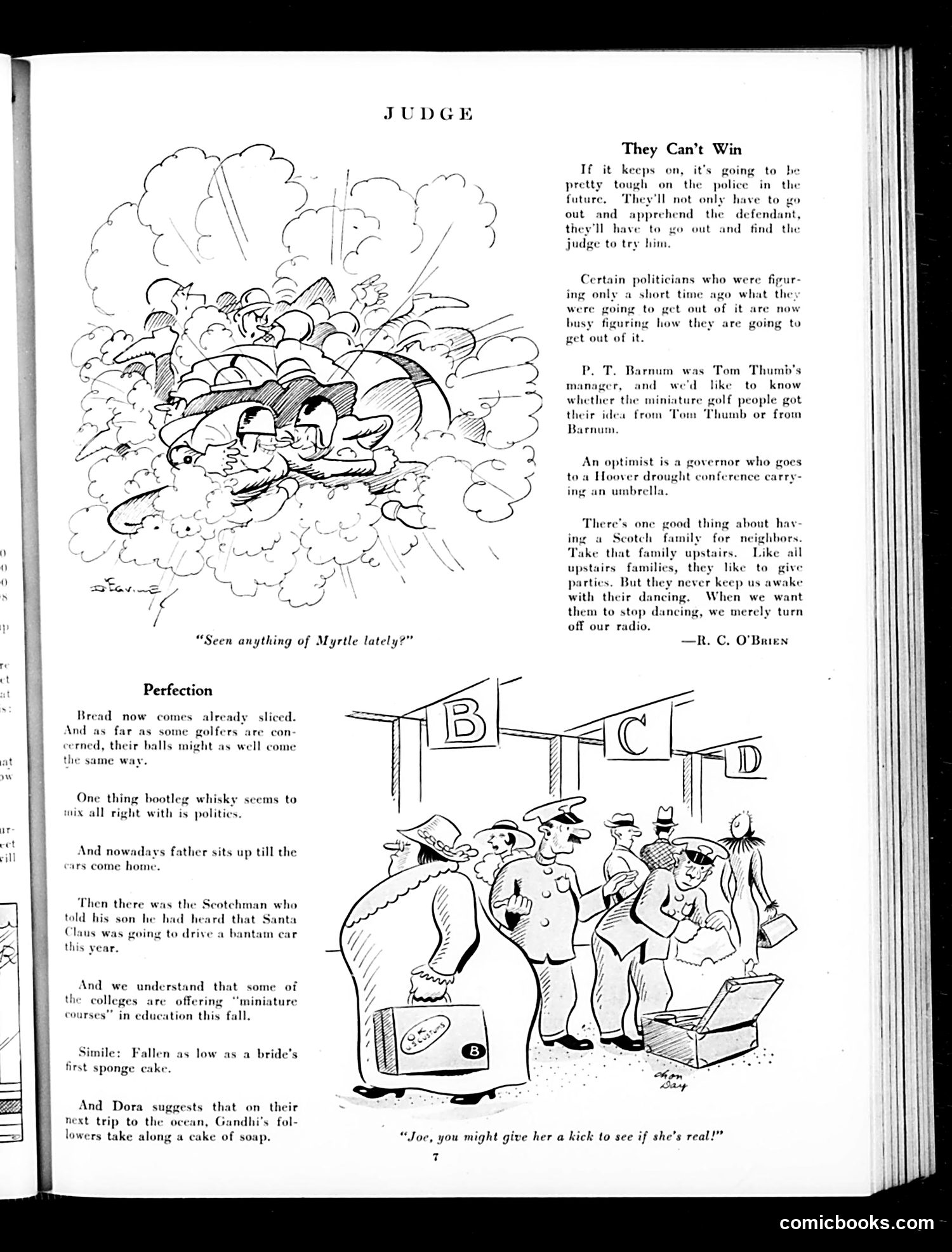
Analysis of Judge Magazine Page Top Cartoon ("Near-Sighted Gent"): A humorous scene showing chaos at what appears to be a golf course—scattered clubs, bags, and debris everywhere. The joke plays on a near-sighted golfer attempting to play, with the caption suggesting he's asking about the "par" while surrounded by destruction, implying his poor vision causes comedic havoc. Bottom Cartoon ("Trainer to Prospective Buyer"): A trainer presents a mule to a potential buyer, describing it as "taken to ya already!" This is straightforward animal-trading humor—the mule's aggressive stance toward the buyer becomes the joke about the animal's temperament and suitability. "October the First" Section: Brief humorous letters about domestic complaints (fireplaces, apartment records, furniture storage) and Princeton football prospects—typical period magazine filler combining advice-column comedy with sports commentary.
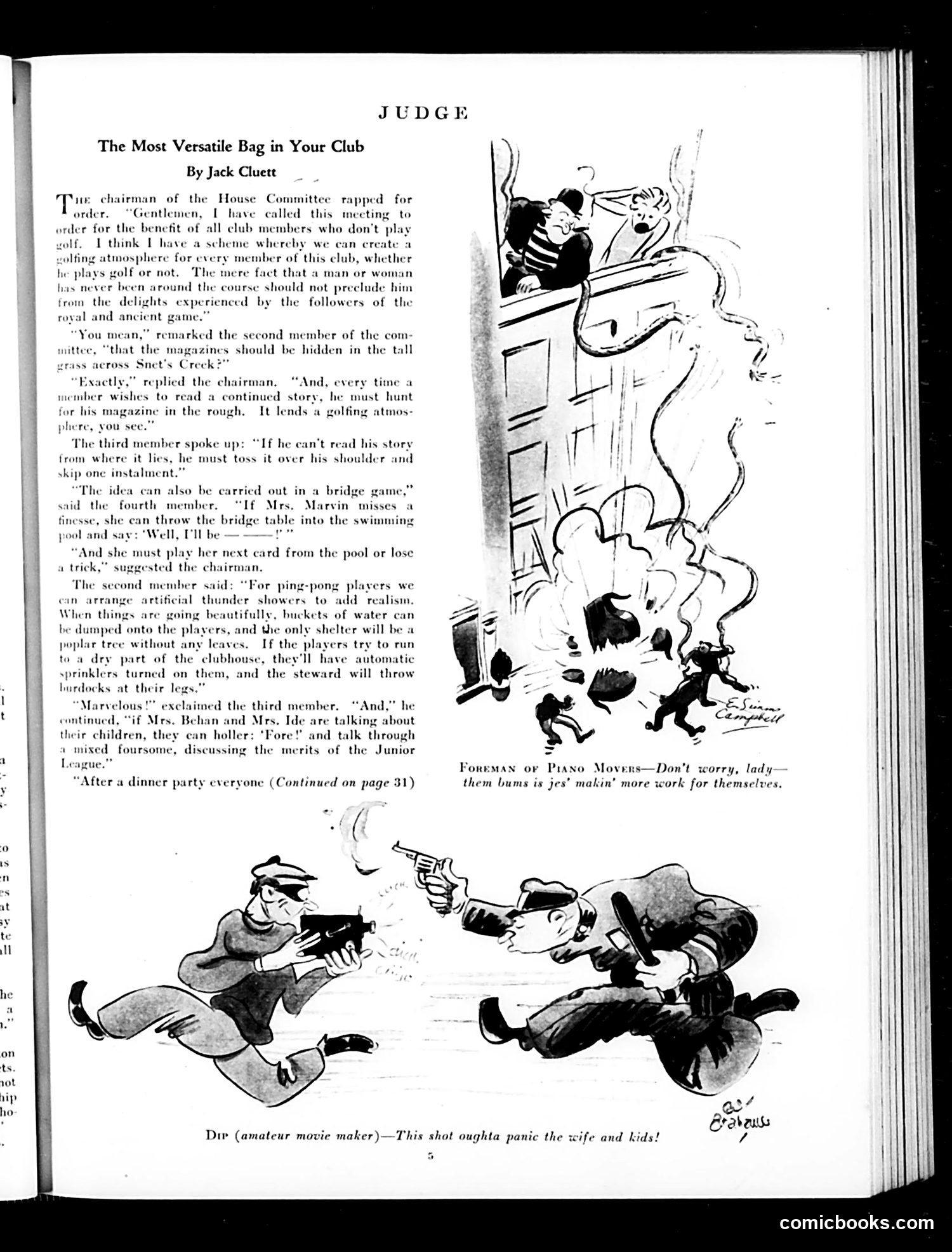
"The Most Versatile Bag in Your Club" This humor piece by Jack Cluett satirizes club members' suggestions for accommodating non-golfers. The text describes increasingly absurd proposals: hiding magazine installments in grass, using bridge games, arranging artificial thunder showers for ping-pong, and discussing children during foursomes. The top cartoon shows a chaotic scene of people being thrown from a window amid tangled ropes—exaggerating the club's desperation to entertain everyone. The bottom cartoon depicts an "amateur movie maker" accidentally shooting a revolver during filming, panicking a woman and children—presumably illustrating how adding non-golf activities creates dangerous chaos. The satire's point: country clubs can't actually serve everyone; attempts to be "versatile" venues produce ridiculous and dangerous complications.
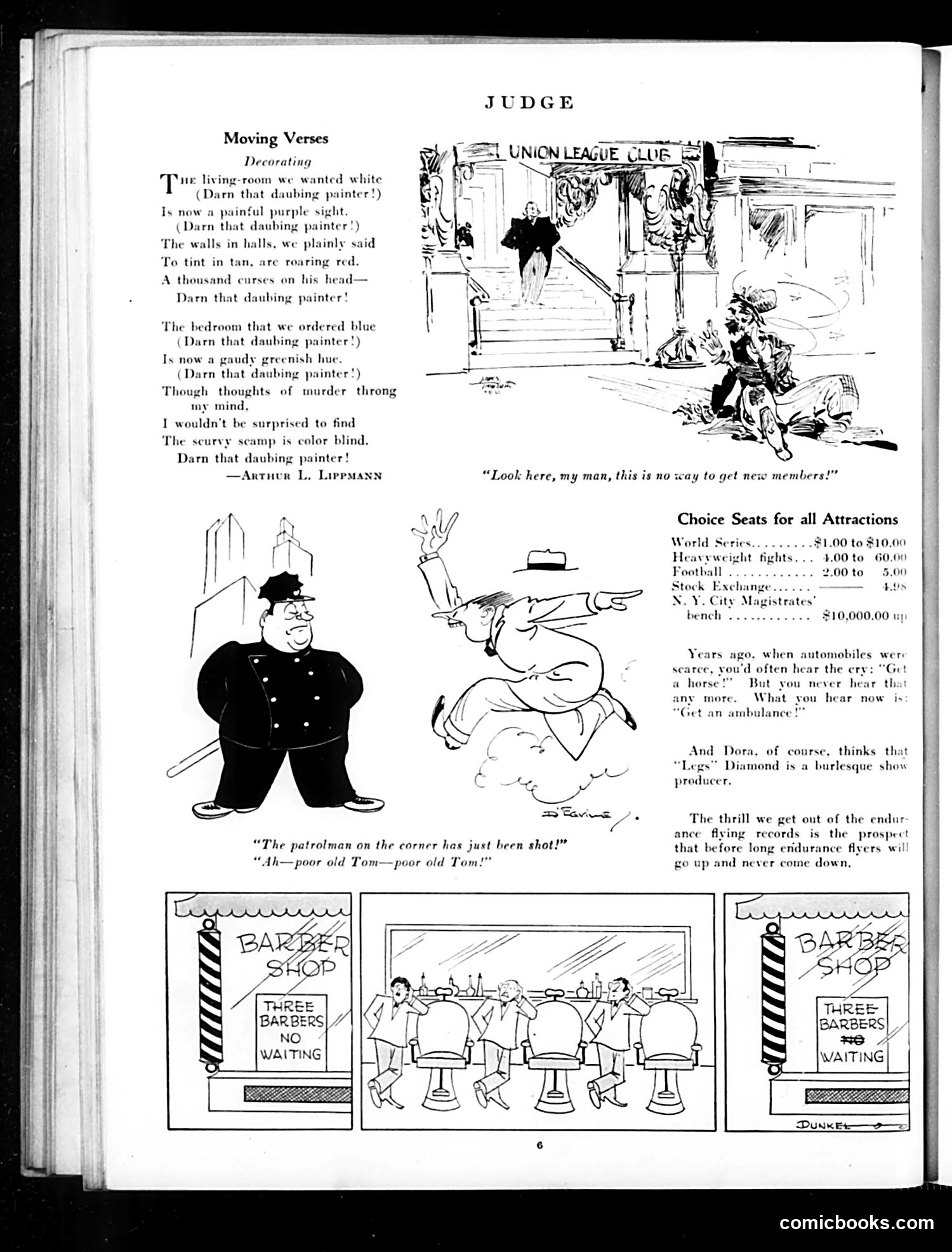
Analysis of Judge Magazine Page This page contains humorous commentary on early 20th-century American life: "Moving Verses" poem by Arthur L. Lippmann satirizes frustrations with a house painter who fails to deliver the requested colors—white becomes purple, blue becomes greenish-hue. The repeated refrain "Darn that daubing painter!" expresses domestic exasperation. Upper cartoon shows a Union League Club scene where a new member recruitment attempt goes poorly, with the caption "Look here, my man, this is no way to get new members!" Middle cartoons include a policeman and a figure labeled with "The patrolman on the corner has just been shot!" Bottom section advertises a barber shop with "Three Barbers No Waiting," featuring men in chairs. The page mixes domestic frustrations, social club satire, and commercial advertisements typical of Judge's satirical format.
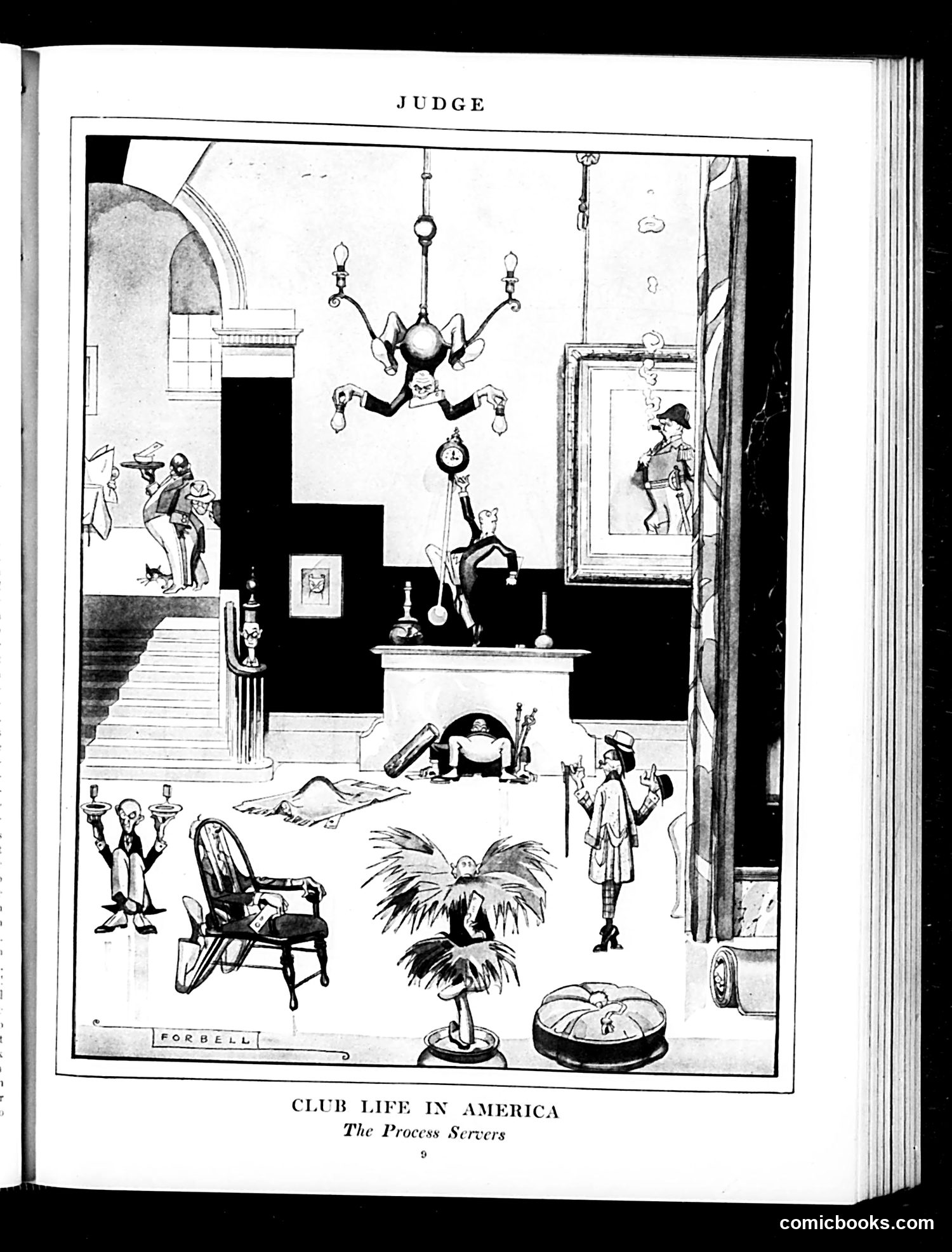
"The Process Servers" - Judge Magazine Cartoon This satirical illustration depicts a judge's chamber as a surreal, mechanized courtroom where "process servers" (legal officials who deliver court documents) operate like an absurd bureaucratic machine. The central figure—a large spherical head suspended from chains and pulleys—represents the judge himself, depicted as a dehumanized cog in the legal system. Smaller figures around the room appear to be process servers in various poses, suggesting they are constantly in motion, serving documents and conducting legal business. The satire targets the mechanization and absurdity of American legal procedure and judicial authority. By visualizing the judge and court apparatus as literal machines and puppets, the cartoonist critiques how law has become an impersonal, automated system disconnected from human justice.
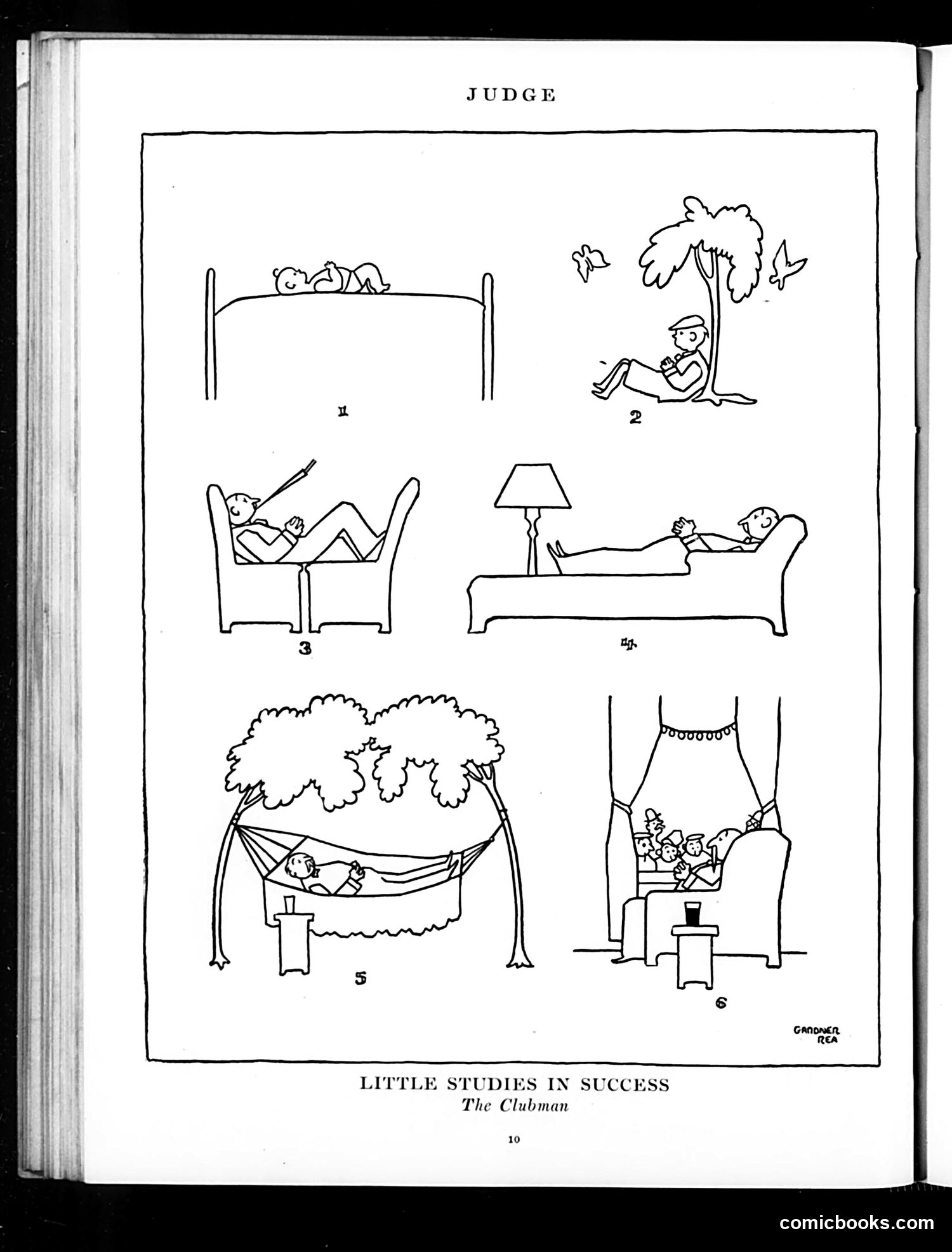
"The Clubman" - Judge Magazine Satire This cartoon series mocks the leisured lifestyle of a wealthy "clubman" — a gentleman member of exclusive social clubs. The six panels depict his ideal day: 1. Lounging in an overstuffed chair at the club 2. Relaxing under a tree 3. Napping in a chair 4. Reclining on a sofa at home 5. Hammocking between trees 6. Swinging in a suspended basket The satire is straightforward: the cartoon defines "success" for this privileged figure as perpetual idleness and comfort-seeking. By presenting only leisure activities without any work or productive contribution, Judge ridicules the idle wealthy class — suggesting their "success" amounts to nothing more than avoiding labor while enjoying material comforts. It's social commentary on class privilege and the leisured aristocracy during the Gilded Age era.
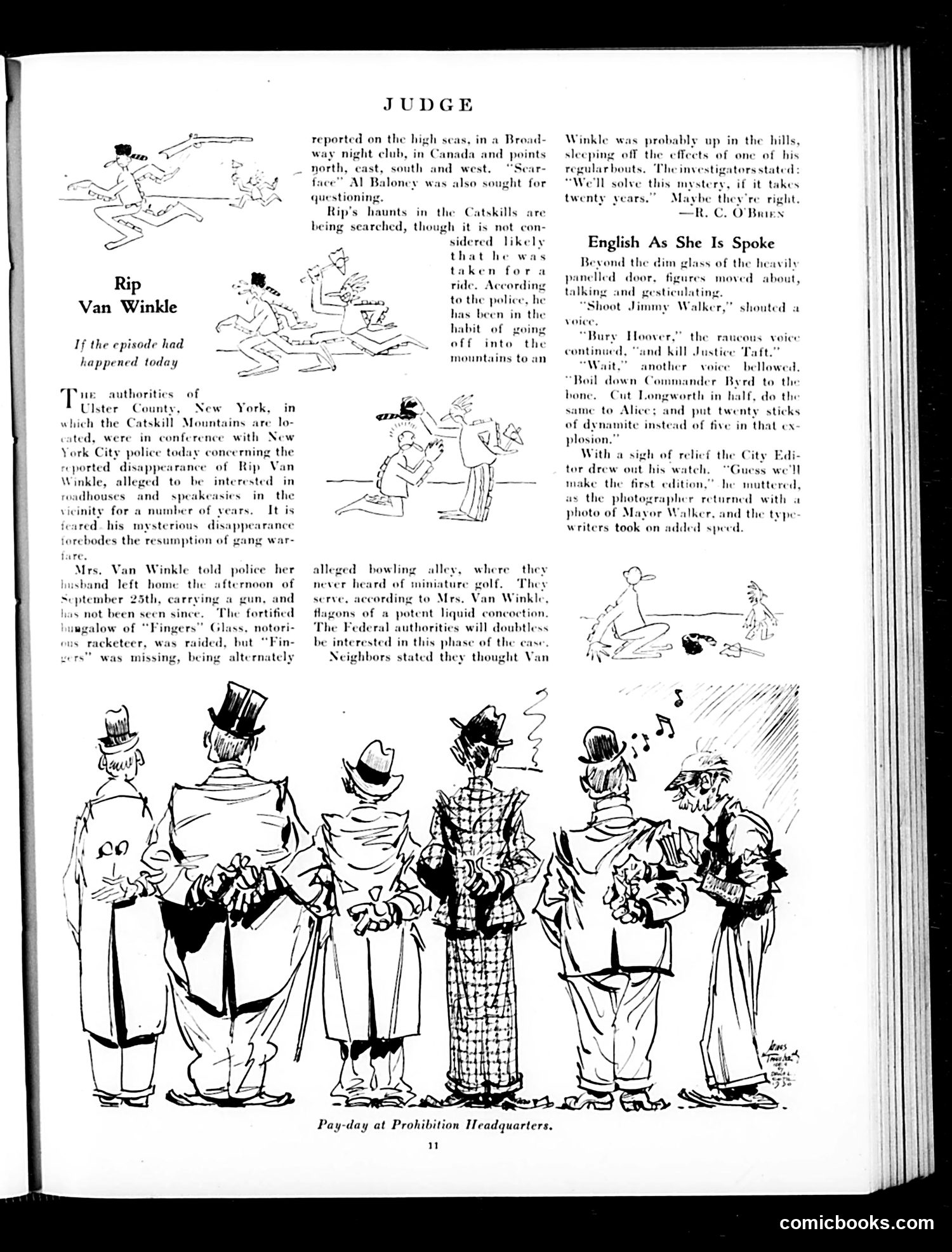
"Rip Van Winkle: If the Episode Had Happened Today" This cartoon satirizes Prohibition-era crime and corruption. It reimagines Washington Irving's *Rip Van Winkle* as a modern disappearance, treating his innocent mountain retreat as a gangster kidnapping ("taken for a ride"). The satire mocks how authorities automatically suspect organized crime: references to "Fingers" Glass (a notorious bootlegger) and gang warfare reflect actual Prohibition violence. Mrs. Van Winkle's story—her husband vanishing near illegal speakeasies—suggests even innocent behavior gets misinterpreted during Prohibition. The second cartoon mocks sensationalist yellow journalism. Newspaper editors and writers are depicted violently editing copy that calls for harm to prominent figures (Mayor Walker, President Hoover, Justice Taft, Commander Byrd, Alice Longworth). The joke: this hyperbolic, inflammatory rhetoric represents actual newspaper language of the period, exposing how casually violent and irresponsible press language had become.
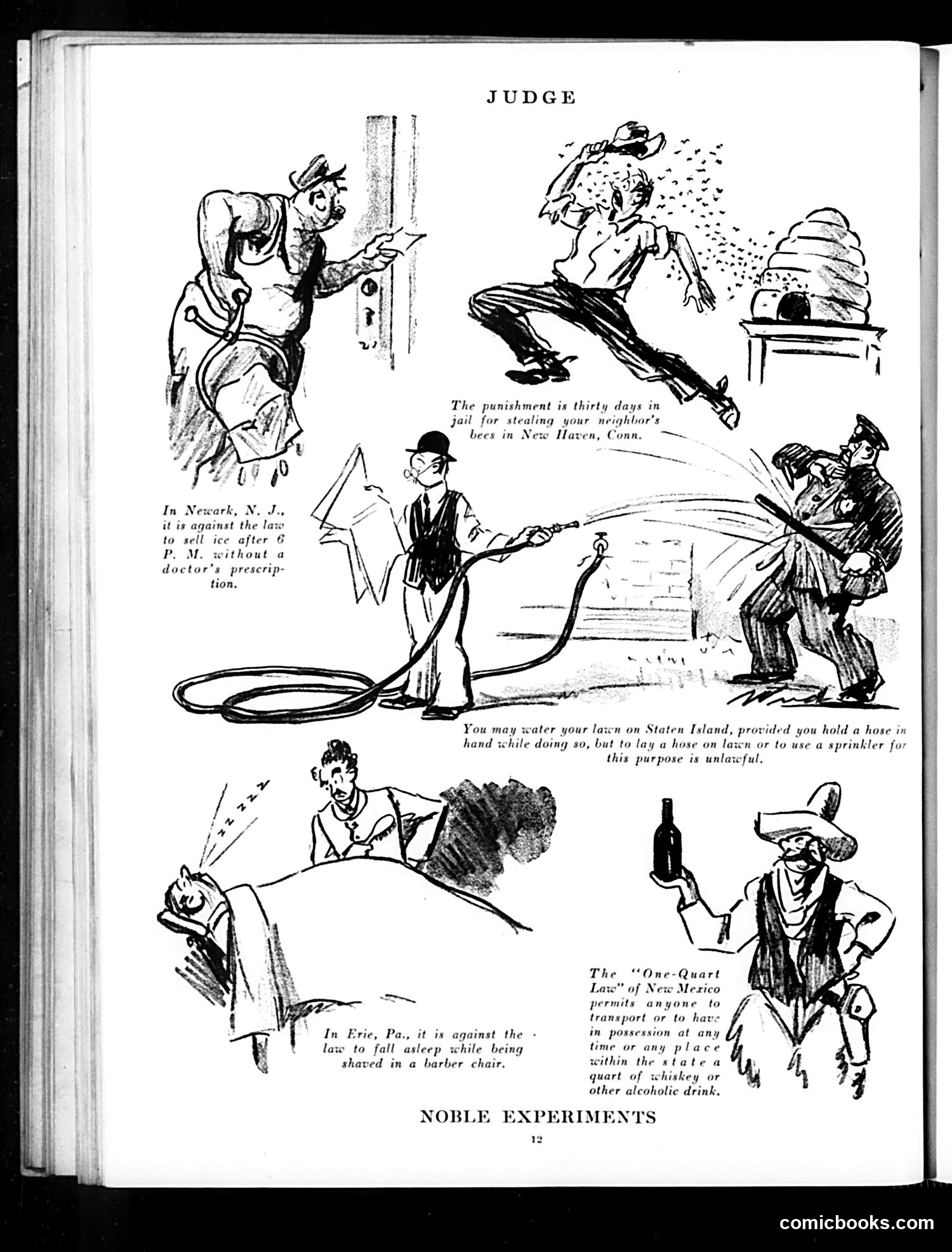
"Noble Experiments" - Judge Magazine Satire This page satirizes absurd local and state laws of the era, likely from the Prohibition period. Each cartoon illustrates ridiculous regulations that expose the illogic of overzealous legislation: - Newark ice law: Mocking restrictions on selling ice without a doctor's prescription (likely targeting Prohibition-era attempts to control substances) - New Haven bee theft: Punishing stealing bees as seriously as major crimes - Staten Island hose rule: The specificity of lawn-watering restrictions (holding vs. laying a hose) is comically nitpicky - Erie barber law: Prohibiting falling asleep during shaving is absurdly impractical - New Mexico's "One-Quart Law": The ultimate irony—while Prohibition theoretically banned alcohol, New Mexico permitted citizens to possess one quart, exposing the contradictions between federal and state law The satire ridicules government overreach and the patchwork of conflicting regulations across states, suggesting these "noble experiments" in social control had become farcical rather than sensible policy.
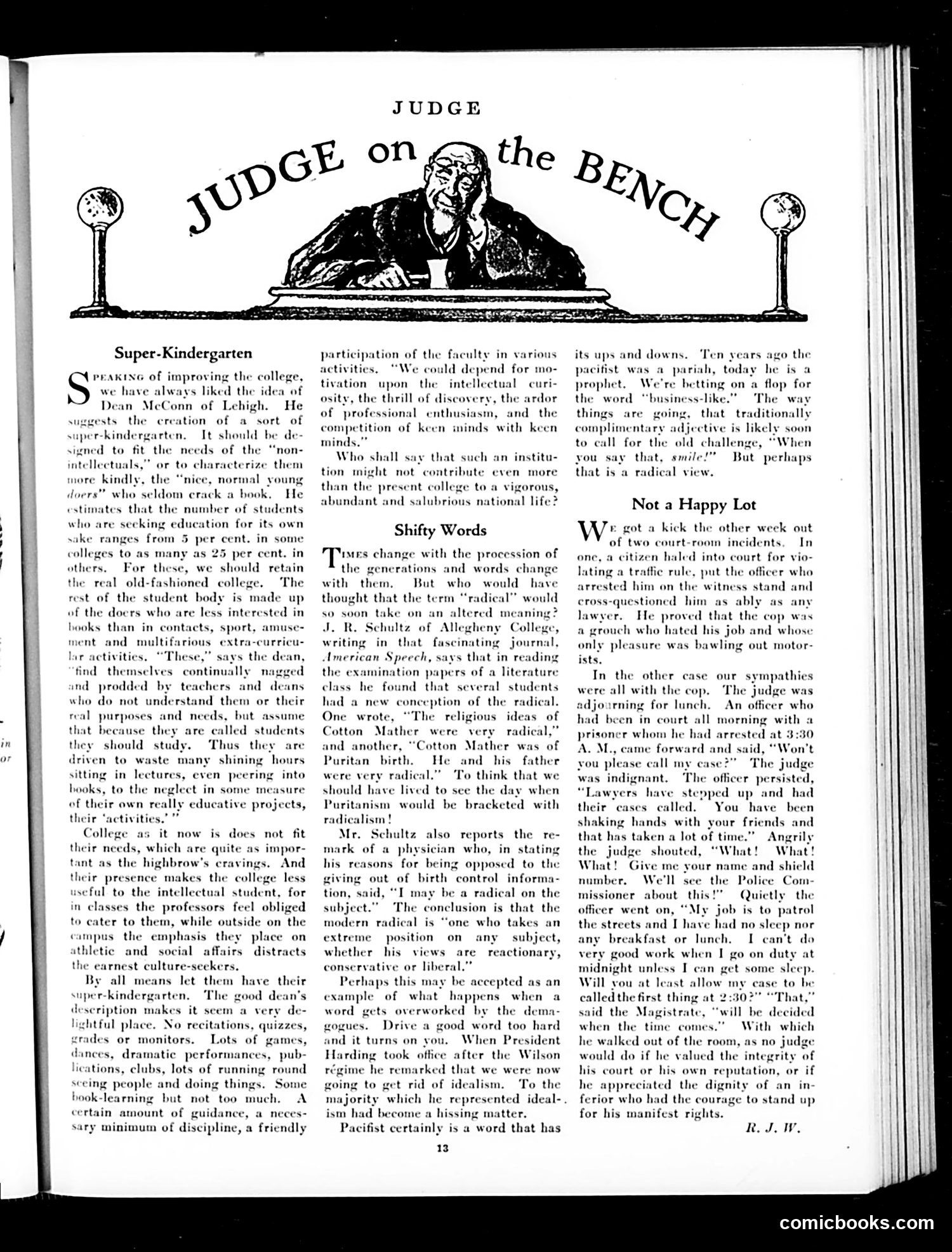
"Judge on the Bench" - Page Analysis This page contains two satirical essays under the "Judge on the Bench" column header (indicated by the judge illustration at top). "Super-Kindergarten" mocks Dean McCann of Lehigh University's proposal for a separate educational track. The satire praises his idea of creating a "super-kindergarten" for non-intellectual students interested in sports, clubs, and social activities rather than books. The author approves with heavy irony—describing it as "delightful" with "no recitations, quizzes or monitors" and "lots of games." The joke is that while presented as the dean's genuine proposal, this description exposes how such a system would essentially abandon rigorous education. "Shifty Words" critiques how the word "radical" has lost meaning through overuse by demagogues. Professor Schultz notes that literature students now apply "radical" to Puritans like Cotton Mather—historically conservative figures. The satire suggests politicians and media have so stretched the term that it now means simply "extreme position on any subject," rendering it meaningless. The reference to President Harding's anti-idealism remark adds contemporary political context circa 1921.
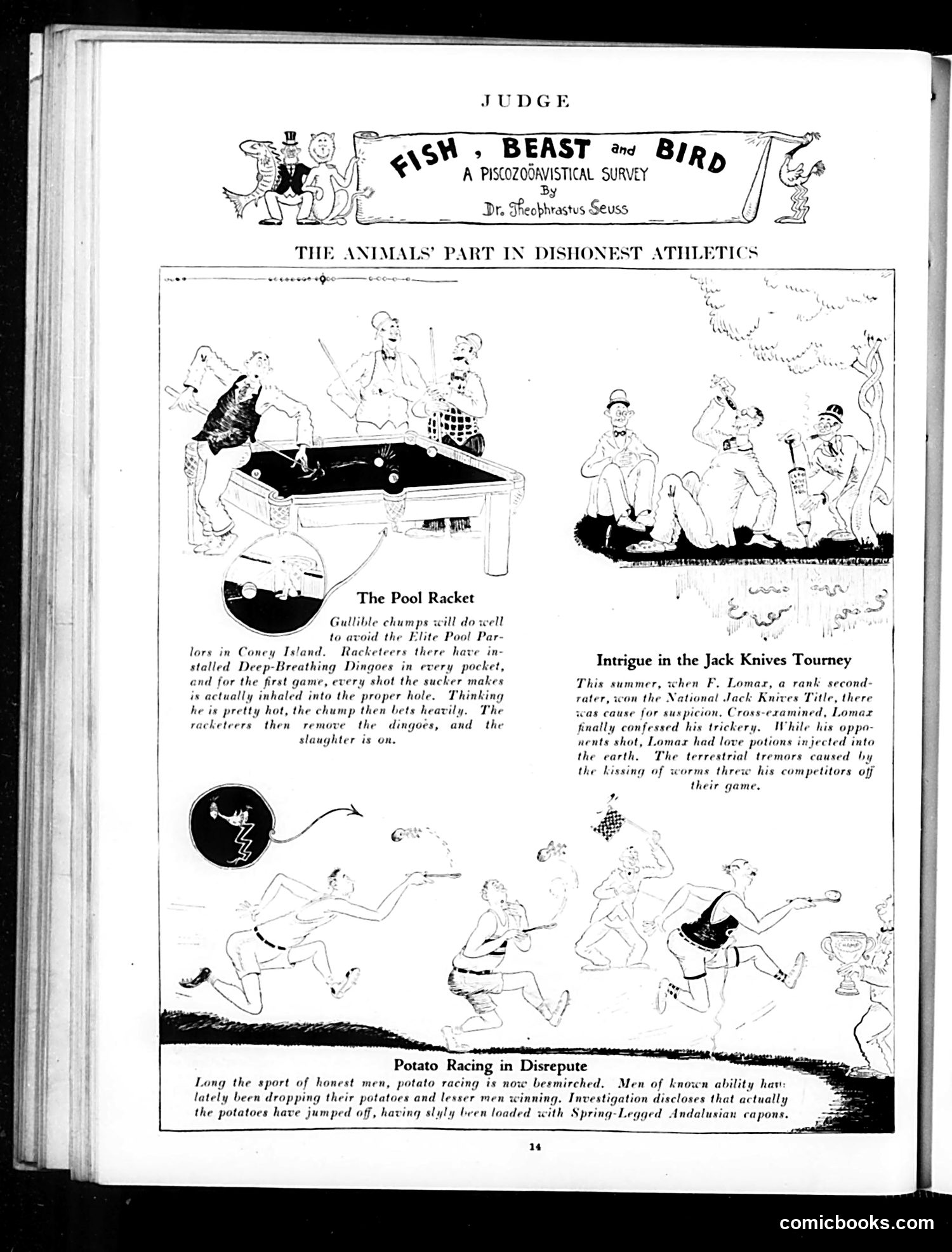
Analysis for Modern Readers This is a humorous piece by Dr. Seuss satirizing dishonest practices in three recreational sports. Each section exposes cheating schemes: "The Pool Racket" mocks pool hustlers who use hidden devices ("Deep-Breathing Dingoes") to make trick shots appear legitimate, luring victims into betting money they'll lose. "Intrigue in the Jack Knives Tourney" parodies competitive knife-throwing, where a contestant secretly used love potions on the earth to create vibrations that disrupted opponents' concentration. "Potato Racing in Disrepute" reveals that competitors were loading potatoes with mechanical devices to cheat in races. The satire's humor lies in treating these absurd, fabricated cheating methods with deadpan seriousness—as if actual sports fraud investigations had uncovered magical or fictional explanations. Seuss mocks both gullible marks who fall for scams and the elaborate rationalizations people use to explain competitive failures. The tone suggests these "dishonest athletics" reflect broader American culture of con games during the early 20th century.
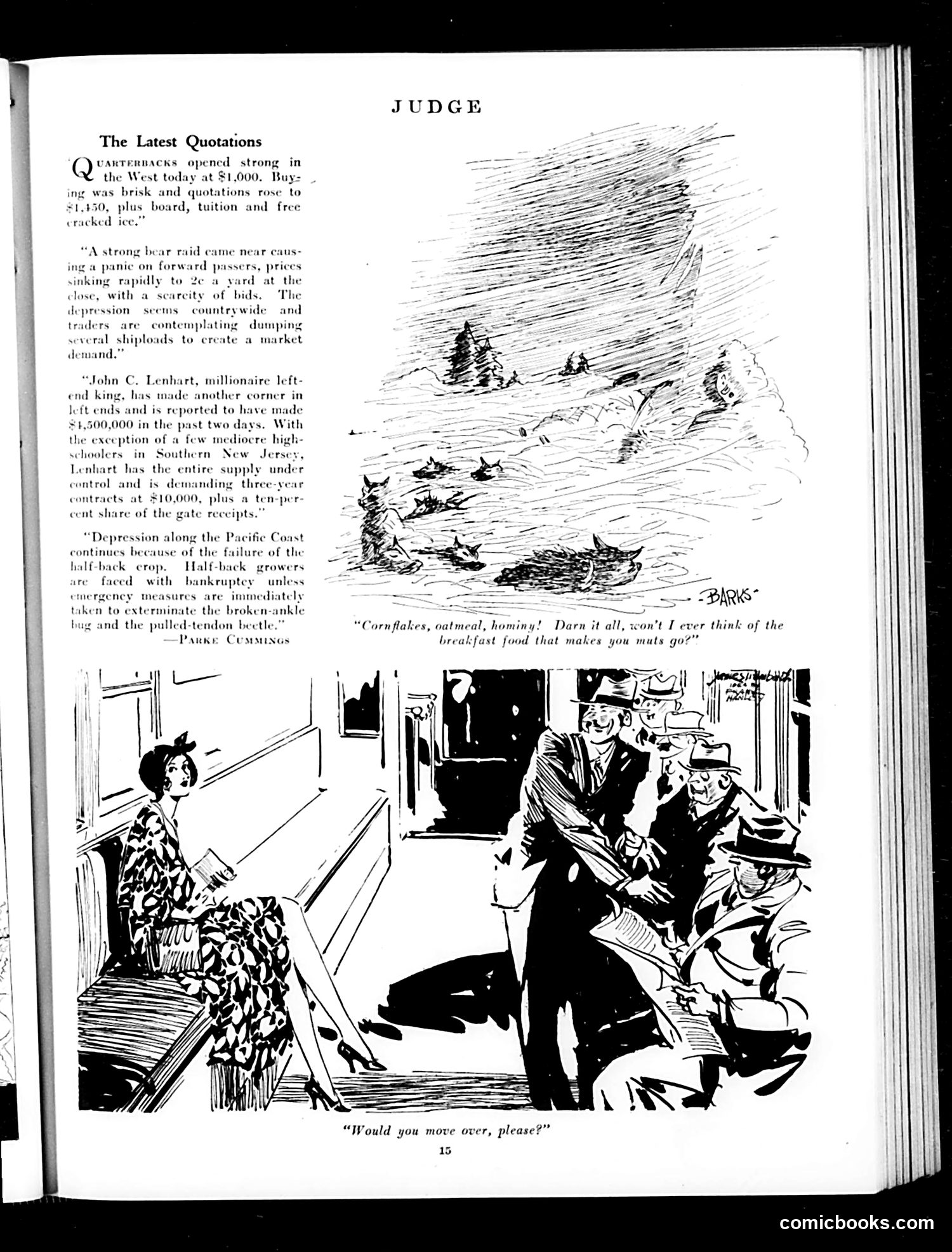
Analysis for Modern Readers This page satirizes American football as a financial commodity, treating players and positions like stock market goods. "The Latest Quotations" parodies financial news reporting, with quarterbacks, left-ends, and half-backs quoted at inflated prices ($1,000+). References to "John C. Lenhart, millionaire left-end king" and corner-market manipulation mirror real stock speculation and monopoly practices of the era. The humor comes from applying Depression-era economic language (bear raids, panic, bankruptcy) to football recruitment. Mentions of "broken-ankle bug" and "pulled-tendon beetle" mock agricultural pest reports while referencing player injuries. The bottom cartoon shows a crowded streetcar with someone asking another passenger to move—unrelated social satire about urban congestion. The magazine appears to date from the early 1930s, when both the stock market crash and professional football were emerging cultural preoccupations.
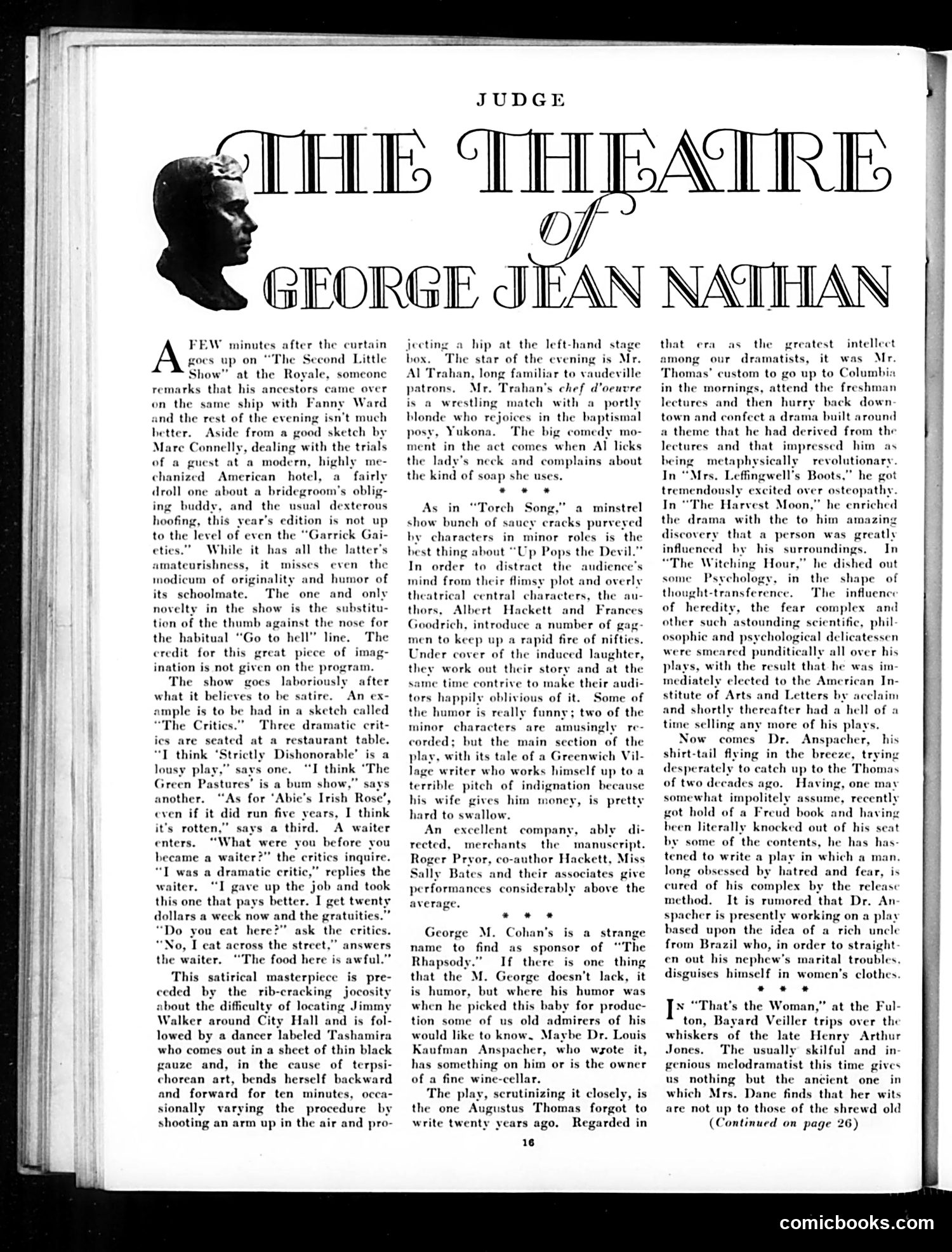
Analysis for Modern Readers This is a theater review, not a political cartoon. Judge magazine's critic discusses Broadway shows from what appears to be the 1920s era. The review critiques "The Second Little Show" at the Royale, finding it derivative and unfunny. A key joke involves Jimmy Walker, New York City's mayor, referenced in a sketch about difficulty locating him "around City Hall"—likely satirizing his reputation for being unavailable or absent from duties. The critic mocks the show's attempts at satire, particularly a sketch about dramatic critics who've become waiters. He praises individual performers like Al Trahan but finds the overall production lacking originality compared to earlier shows like "Garrick Gaieties." The page also briefly reviews "Up Pops the Devil" and mentions George M. Cohan as producer of "The Rhapsody," questioning why someone known for humor would sponsor such material. This represents typical Broadway criticism of the period—gossipy, name-dropping, and focused on theatrical conventions modern audiences would need historical context to appreciate.
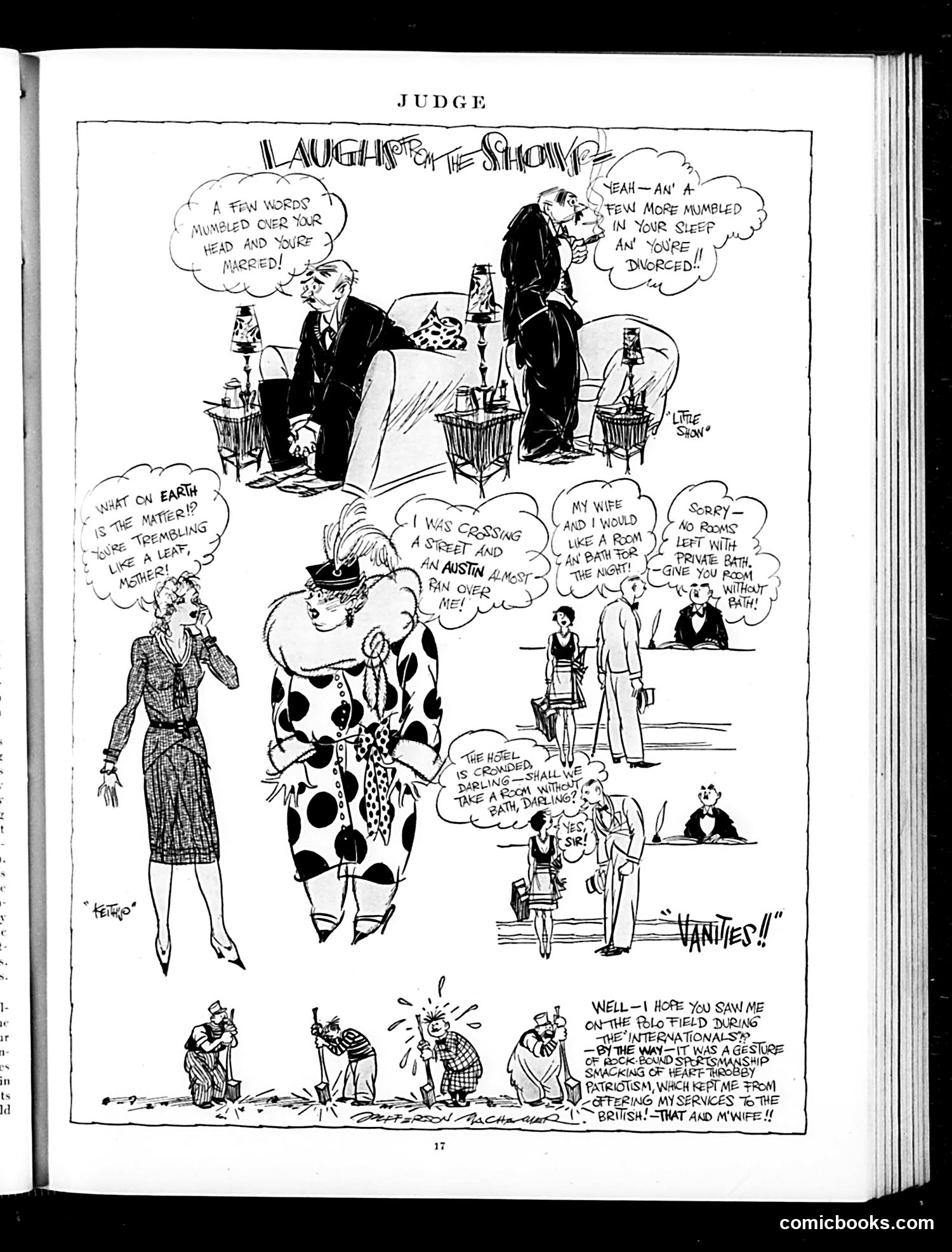
"Laugh at the Show" - Judge Magazine Cartoon This satirical cartoon mocks marital discord and masculine pretense. The top scene shows a couple in bed exchanging bitter remarks about their marriage deteriorating ("mumbled in your sleep," "divorced"). Below, various vignettes depict men making excuses for their failures or bad behavior—citing trembling nerves, spoiled relationships, or domestic troubles. A woman on the left appears exasperated by a man's complaints. The bottom panel shows a man boasting about his sportsmanship during "the Internationals," claiming patriotic honor prevented him from "offering [his] services"—yet he undermines this by admitting his wife actually stopped him. The cartoon's satire targets masculine bluster: men who invoke patriotism, honor, and sportsmanship to justify their shortcomings, while ultimately being controlled by or dependent on their wives. It's a cynical commentary on the gap between men's self-image and reality, particularly regarding marital dynamics and personal accountability.
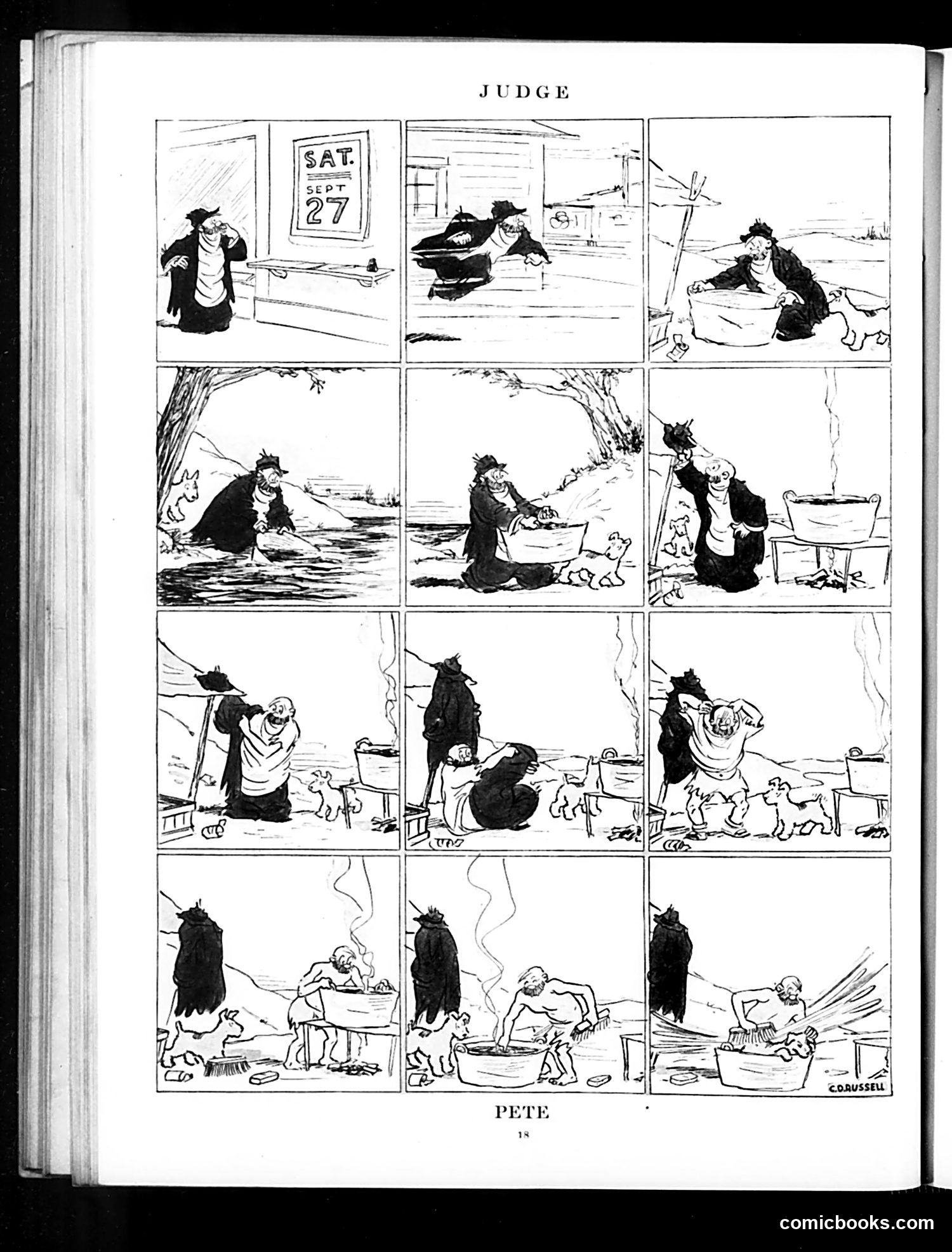
"Judge Pete" Comic Strip Analysis This is a sequential comic strip titled "Judge Pete" (credited to Cobbussell) depicting a judge character repeatedly bathing a small child in a large tub, with a dog present throughout. The calendar shows "SAT. SEPT 27." The strip appears to be a visual gag about a judge engaging in domestic childcare—specifically the mundane, unglamorous task of bathing a child. The humor likely derives from the incongruity of a dignified judicial figure performing menial household duties, suggesting irony about social class or the expectations placed on different professions. Without additional context about "Judge Pete" as a recurring character in *Judge* magazine, the specific satirical target remains unclear, though it may reference contemporary judicial figures or broader commentary on domesticity.
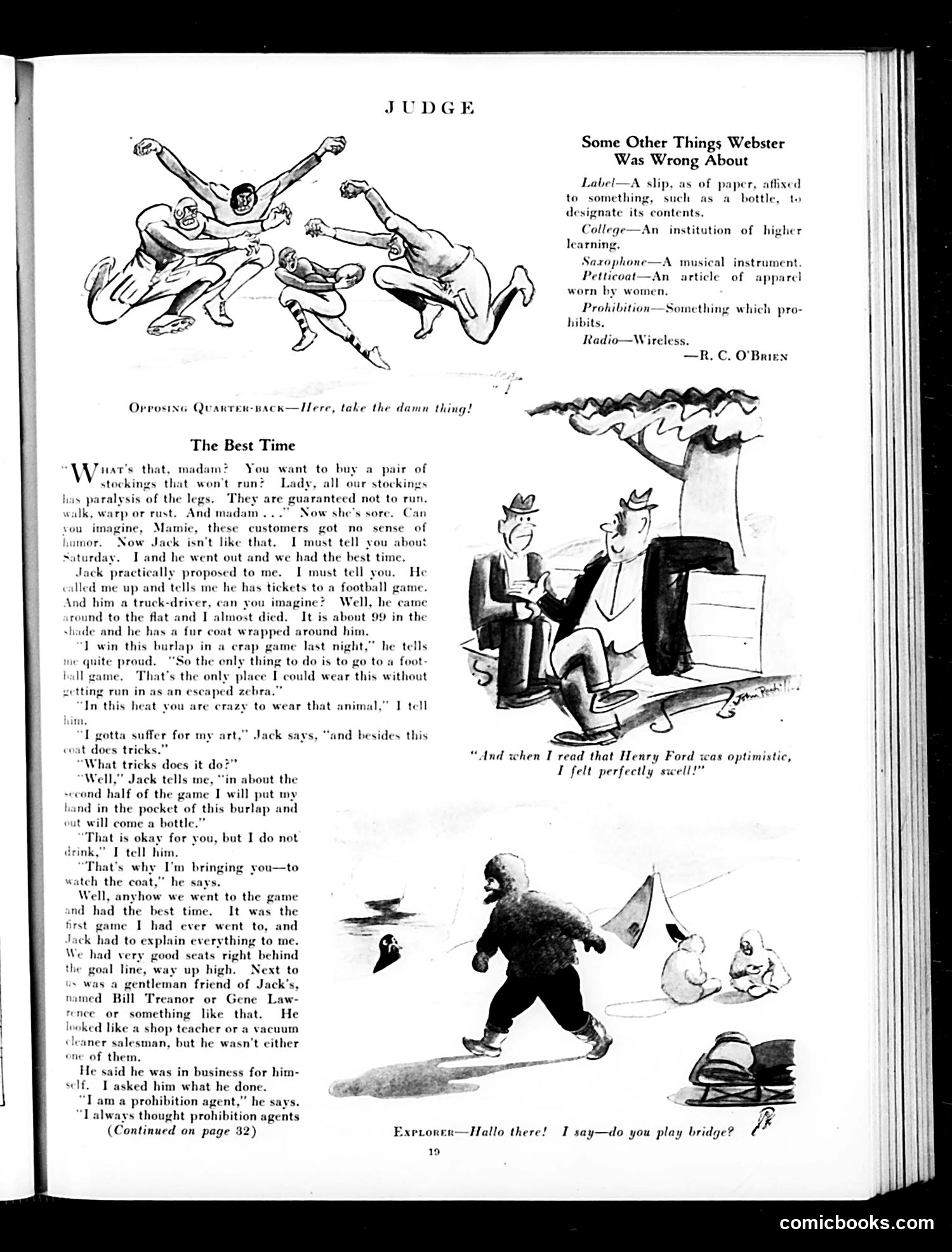
"Judge" Magazine Page Analysis This page satirizes 1920s American life during Prohibition (1920-1933). The header mocks Webster's Dictionary definitions with contemporary slang ("Radio—Wireless"), suggesting rapid social change outpacing formal language. The main story "The Best Time" follows a working-class couple attending a football game. The husband wears a stolen burlap coat (from a crap game) and openly discusses smuggling alcohol—a "bottle" he'll produce from the coat pocket during the game. The joke's dark edge: a Prohibition agent named Bill Treanor sits nearby, yet nobody seems concerned about openly discussing illegal liquor. The satire targets Prohibition's ineffectiveness and widespread public flouting of the law. Even an enforcement agent attends football games while citizens brazenly plan to drink. The couple's casual attitude toward federal crime reflects the era's general mockery of Prohibition enforcement, which was notoriously corrupt and unenforced. The cartoon illustrations above reinforce themes of recklessness and social disorder during this period.
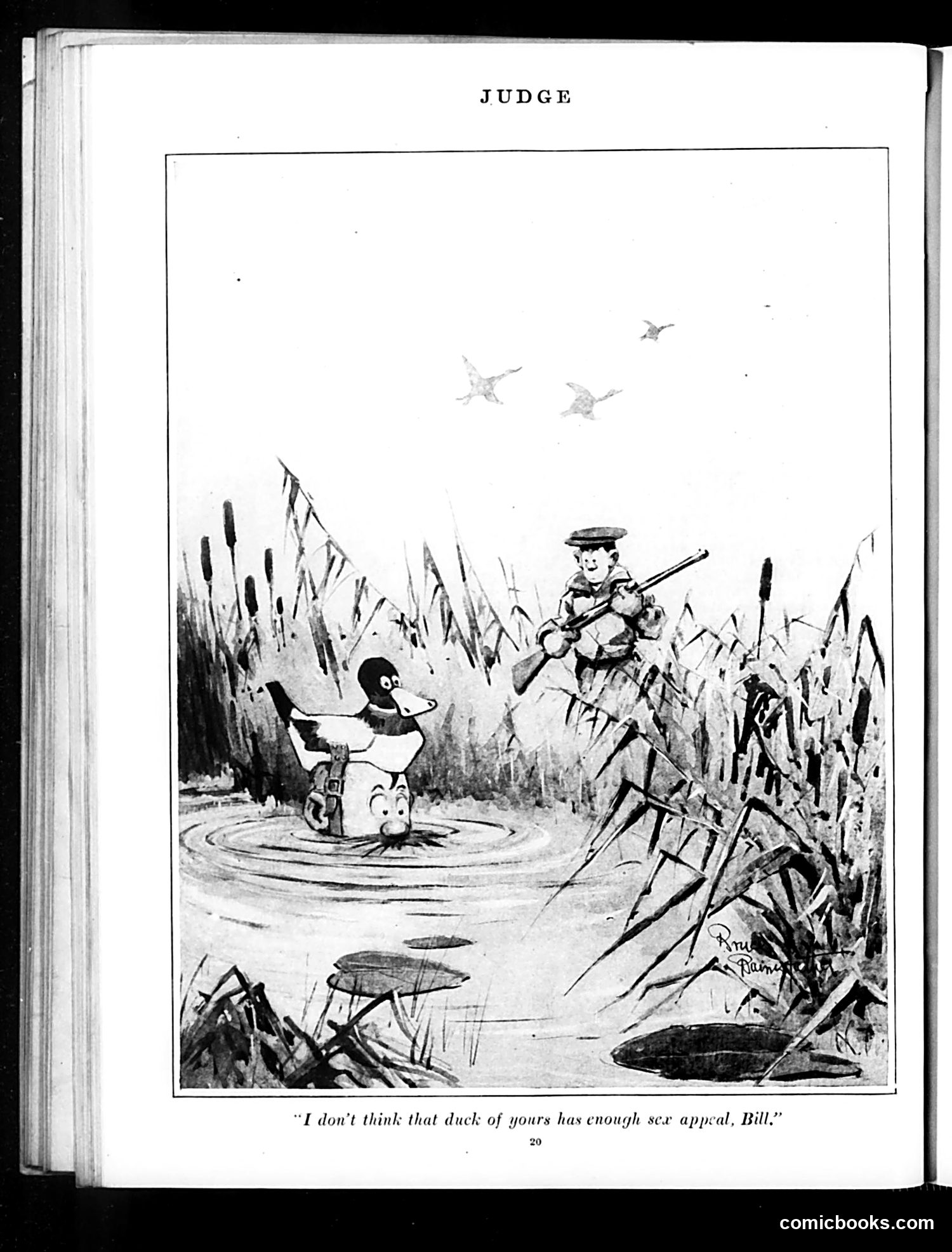
Judge Magazine Cartoon Analysis This cartoon depicts a hunting scene in a marsh with cattails and water. A man in hunting attire stands with a rifle, while a duck (presumably decoy) sits in the water. Another figure (appearing to be in period dress, possibly from an earlier era) emerges from the marsh, delivering the caption's critique. The joke plays on "sex appeal"—a phrase that became popular in 1920s culture, referring to physical attractiveness. The humor comes from applying this modern, sophisticated concept to hunting decoys, which were purely functional. The cartoon satirizes how contemporary slang (particularly related to attraction and entertainment) was permeating everyday conversation, even in unlikely contexts like sport hunting, suggesting perhaps an excessive preoccupation with glamour and appeal.
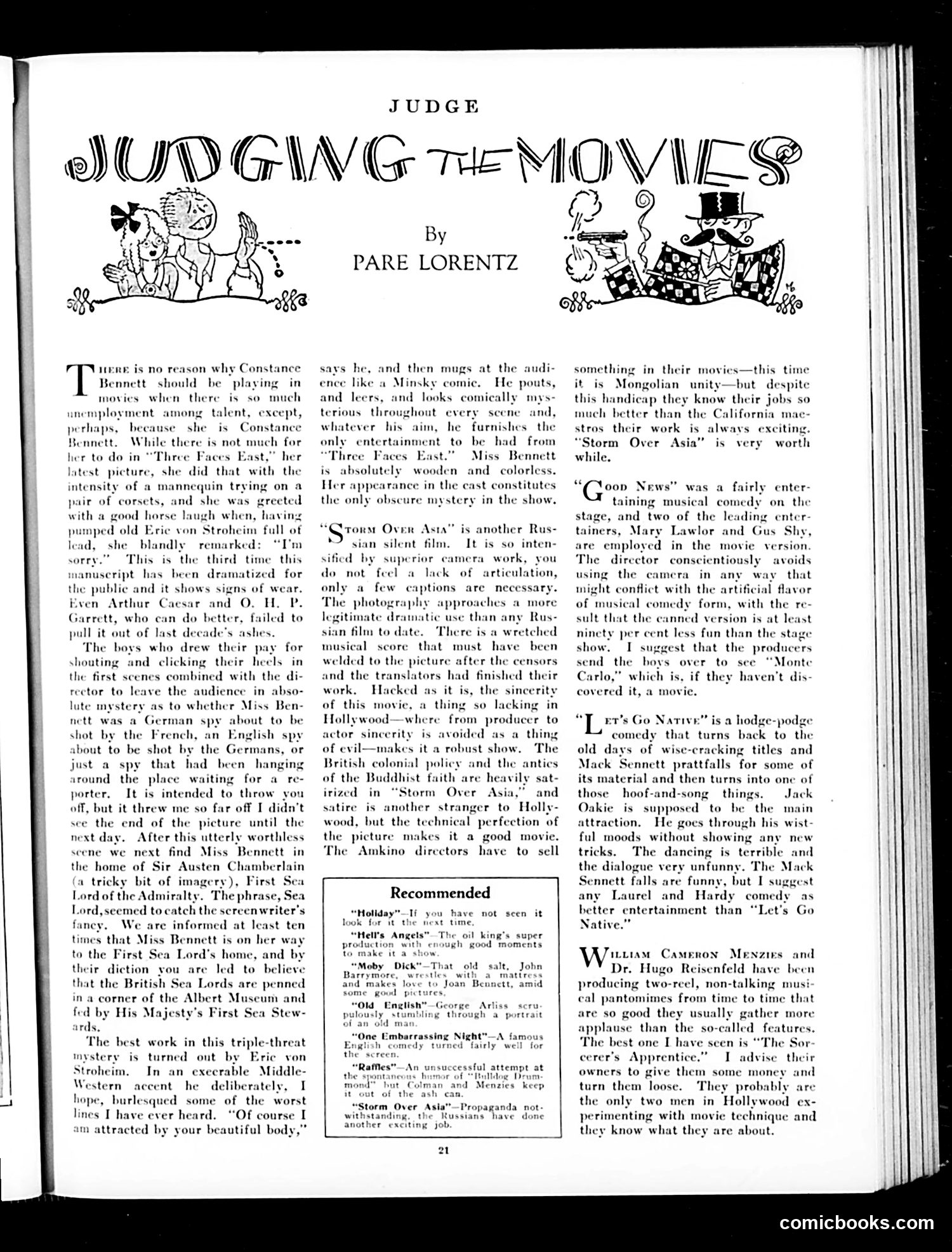
Judge Magazine Film Review Page This is a film criticism column by Pare Lorentz reviewing recent movies, not a political cartoon. The page contains three movie reviews with a "Recommended" sidebar listing other films. Key references for modern readers: - Constance Bennett: A major silent-film actress; the critic dismisses her wooden performance in "Three Faces East," suggesting she only works due to her fame - Erich von Stroheim: A respected German-American director/actor whose over-the-top performance is the film's only entertainment value - "Storm Over Asia": A Soviet silent film praised for superior cinematography and sincerity—qualities the critic finds lacking in Hollywood - The satire: Lorentz criticizes American filmmakers for avoiding authentic drama and sincerity, while praising Russian cinema's technical skill and willingness to address political subjects (British colonialism, Buddhist faith) that Hollywood avoids as "satire" The piece reflects 1920s-era film criticism valuing artistic integrity over star power.
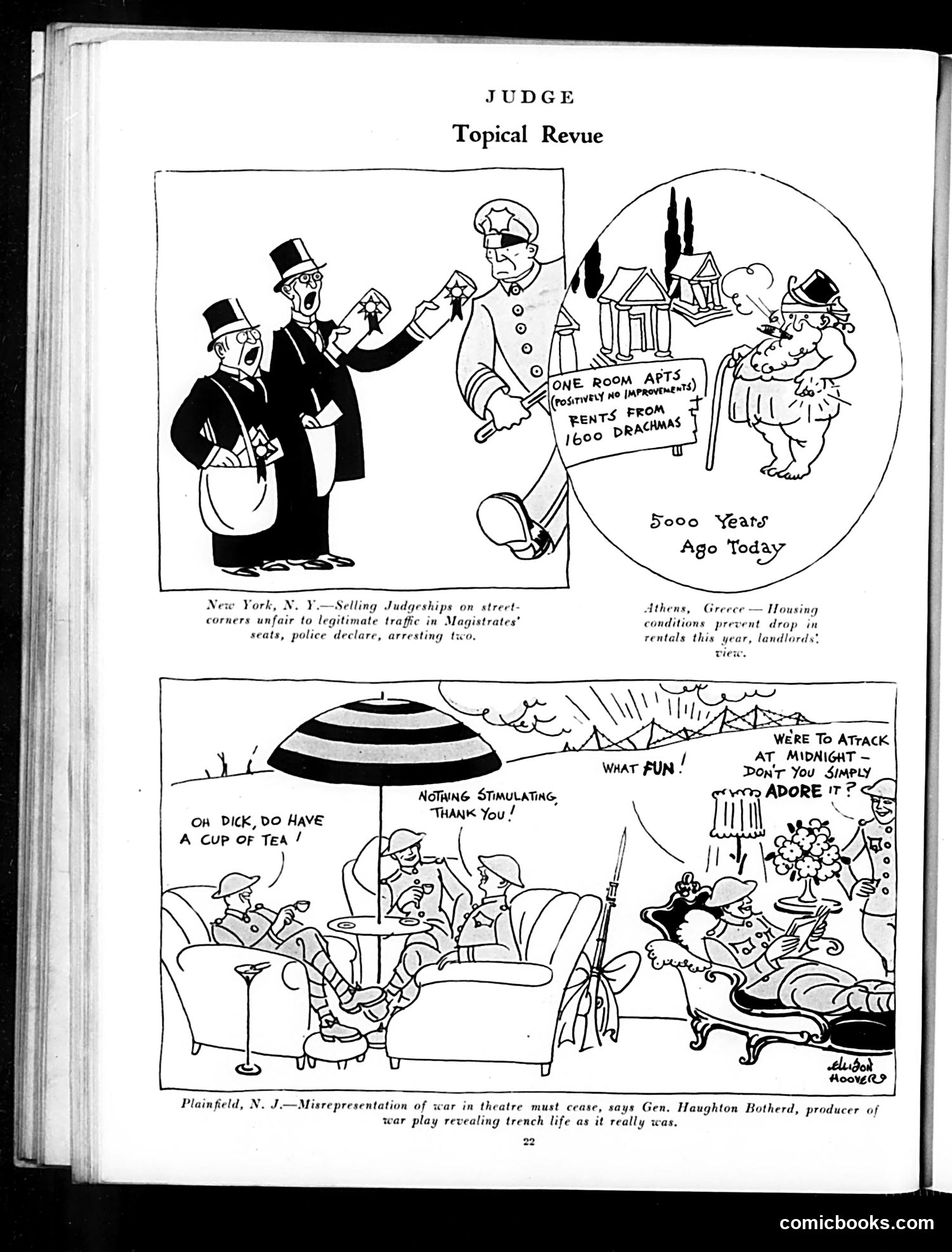
Judge Magazine "Topical Revue" - Explanation for Modern Readers This page contains three satirical cartoons on contemporary issues: Top Left: Mocks judicial corruption in New York City—judges' positions being sold openly on street corners like merchandise, treated as illegitimate commerce by police. Top Right: Jokes about ancient Greece's chronic housing shortage by showing Athenian landlords renting "one room apts" from 5,000 years ago, suggesting the problem is timeless and unsolvable. Bottom: Satirizes a WWI military play's authenticity debate. General Haughton Botherd (likely a fictional military figure) insists theatrical war depictions stop romanticizing trench life. The soldiers' excited chatter about midnight attacks contrasts with his complaint—the play apparently makes brutal warfare seem thrilling rather than realistically grim. The page critiques institutional corruption, housing crises, and how entertainment sanitizes war's horrors.
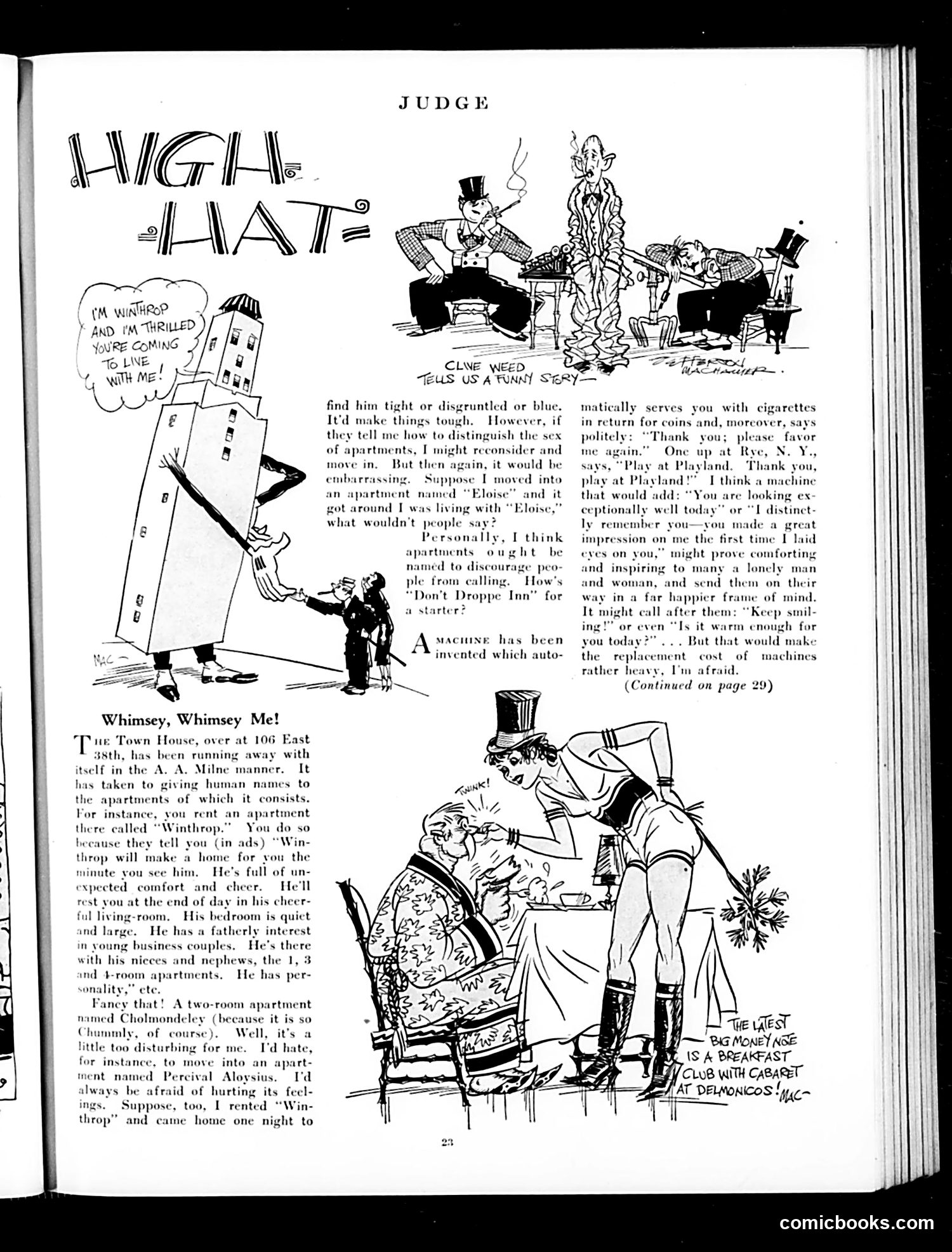
Political/Social Commentary Analysis This Judge magazine page satirizes two contemporary urban absurdities: "High Hat" (top left): Mocks the pretentious naming of apartment buildings after fashionable neighborhoods. The Town House building personifies apartments with names like "Winthrop" and "Cholmondeley," marketing them as having personality and "fatherly interest." The author ridicules this marketing gimmick, noting the awkwardness of renting from a named apartment—what if "Winthrop" comes home drunk? The satire targets 1920s-30s real estate marketing that infantilizes housing to appeal to young professionals. Bottom cartoon: Illustrates wealthy socialites at a cabaret (Delmonico's, a famous NYC restaurant). This appears disconnected from the main text but likely comments on frivolous upper-class leisure culture. "Whimsey, Whimsey Me!" (right column): Discusses an automated cigarette vending machine that politely thanks customers. The satire suggests this mechanical politeness substitutes for genuine human interaction—a lonely person might find comfort in a machine's canned courtesy, though replacing it would be expensive. Both pieces critique modern urban alienation and commercialization of human experience.
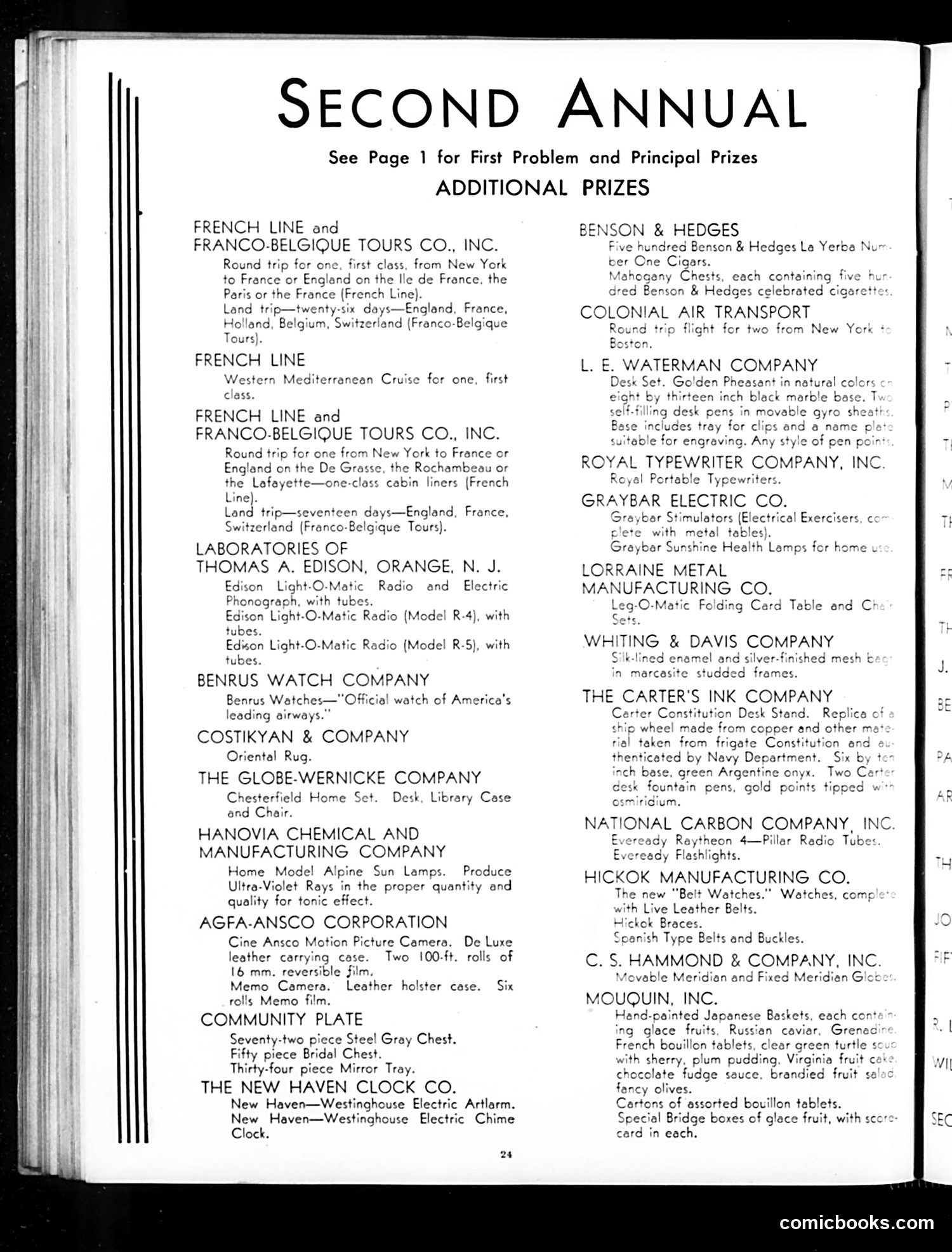
This is not a cartoon or satirical content page—it's an advertising section from Judge magazine's "Second Annual" contest issue. The page lists additional prizes offered to contest winners, featuring luxury goods and services popular in the 1920s-30s: European travel (French Line cruises), Edison radio-phonographs, watches, typewriters, cameras, home furnishings, and high-end food products (caviar, chocolates). The prizes reflect the aspirational lifestyle of Judge's affluent readership—travel, modern technology, and luxury consumer goods were markers of wealth and sophistication. Companies like Edison, Underwood, and Waterman were prestigious brands seeking prestige-by-association through contest sponsorship. There is no political satire or cartoon content on this page—it serves a purely commercial function advertising the contest's desirable rewards to potential entrants.
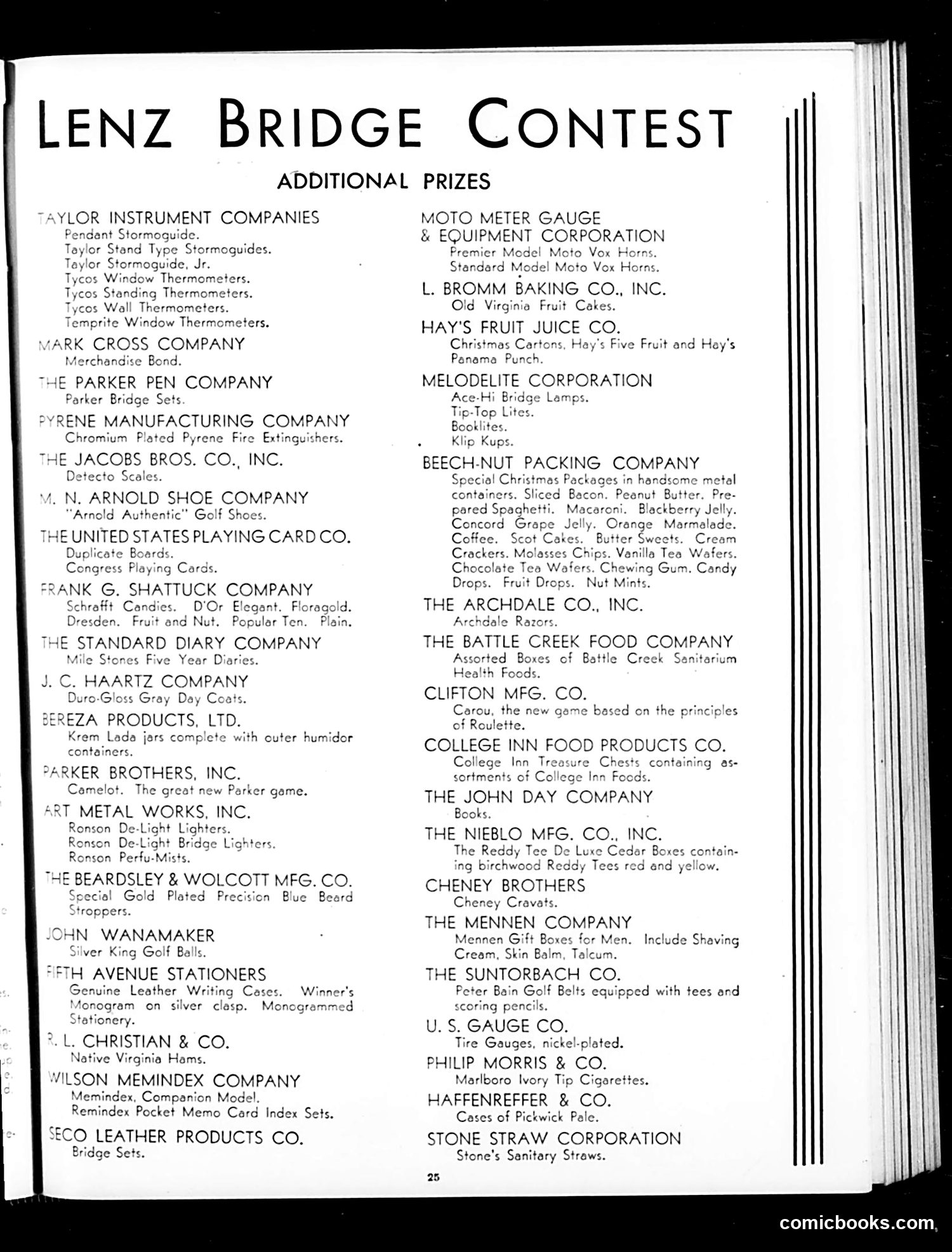
Lenz Bridge Contest - Additional Prizes Page This is a prize list page, not a cartoon or satirical content. It lists dozens of companies offering prizes for what appears to be a bridge (the card game) contest sponsored by Lenz. The page reveals early 20th-century consumer culture through its prize offerings: golf equipment, playing cards, food products (cakes, fruit juices, canned goods), writing instruments, razors, games, and cigarettes—reflecting both middle-class leisure activities and commercial product promotion. Notable is the heavy emphasis on golf-related items and games as prestigious prizes, plus premium food brands and personal grooming products. This suggests the contest targeted affluent competitors. The sheer number of corporate sponsors demonstrates how businesses used such contests for brand visibility and advertising—an early form of marketing. The page itself is advertising, not satire.
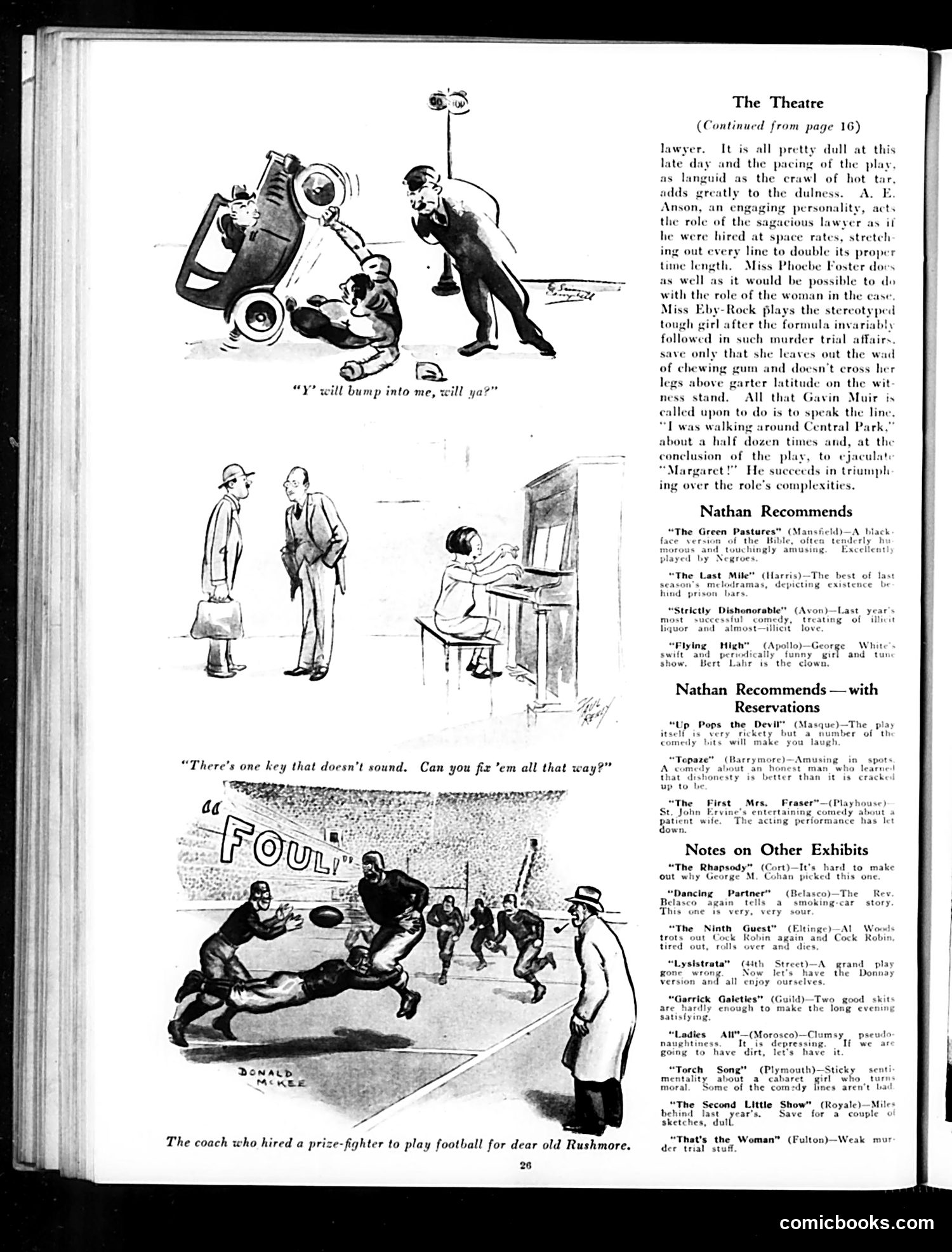
Judge Magazine Theatre Page Analysis This page contains theatre reviews and cartoon commentary from Judge's drama section. The cartoons satirize theatrical conventions and production absurdities: Top cartoon: Shows a slapstick scene with characters colliding around theatrical equipment, captioned "Y' will bump into me, will ya?" — mocking the physical comedy and contrived situations common in stage farces. Middle cartoon: Two men discussing a broken piano key, captioned "There's one key that doesn't sound. Can you fix 'em all that way?" — joking about amateur or incompetent theatre operations. Bottom cartoon (by Donald McKee): Shows a chaotic football game with caption "The coach who hired a prize-fighter to play football for dear old Rushmore" — satirizing the implausibility of hiring unqualified performers, likely commentary on both theatrical and athletic recruiting practices of the era. The reviews critique Broadway shows with harsh judgments about stilted acting, predictable formulas, and poor pacing — suggesting early 20th-century theatre often relied on melodrama and mechanical performances rather than artistic merit.
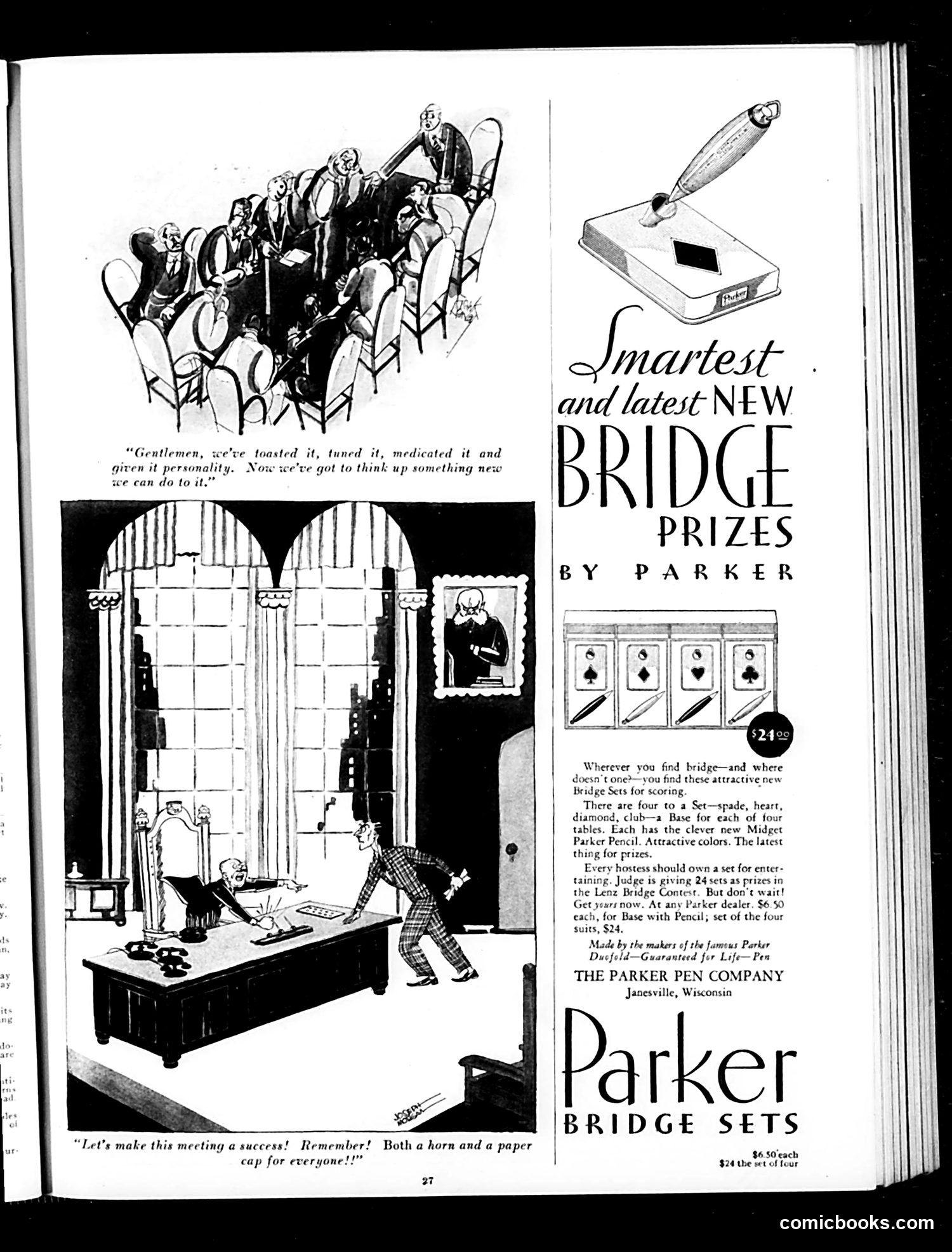
Analysis of Judge Magazine Page This page combines satirical cartoons with advertising, typical of Judge's format. The Cartoons: The top illustration depicts a formal dinner scene where gentlemen have exhausted ways to entertain themselves with bridge (the card game). The caption—"we've toasted it, tuned it, medicated it and given it personality"—satirizes the obsessive social culture around bridge during the 1920s-30s, when the game was wildly popular among the upper classes. The joke suggests bridge has become so thoroughly celebrated that hosts struggle to find new angles to make it interesting. The lower cartoon shows a chaotic bridge party where someone enthusiastically advocates for "a horn and a paper cap for everyone," mocking how bridge tournaments became elaborate social events with increasingly absurd ceremonial elements. The Advertisement: The right side advertises Parker's new bridge scoring sets—merchandise capitalizing on the very bridge craze the cartoons gently mock. This creates ironic juxtaposition: Judge satirizes bridge obsession while simultaneously selling bridge products. Context: Bridge was genuinely a cultural phenomenon in early 20th-century America, particularly among wealthy socialites.
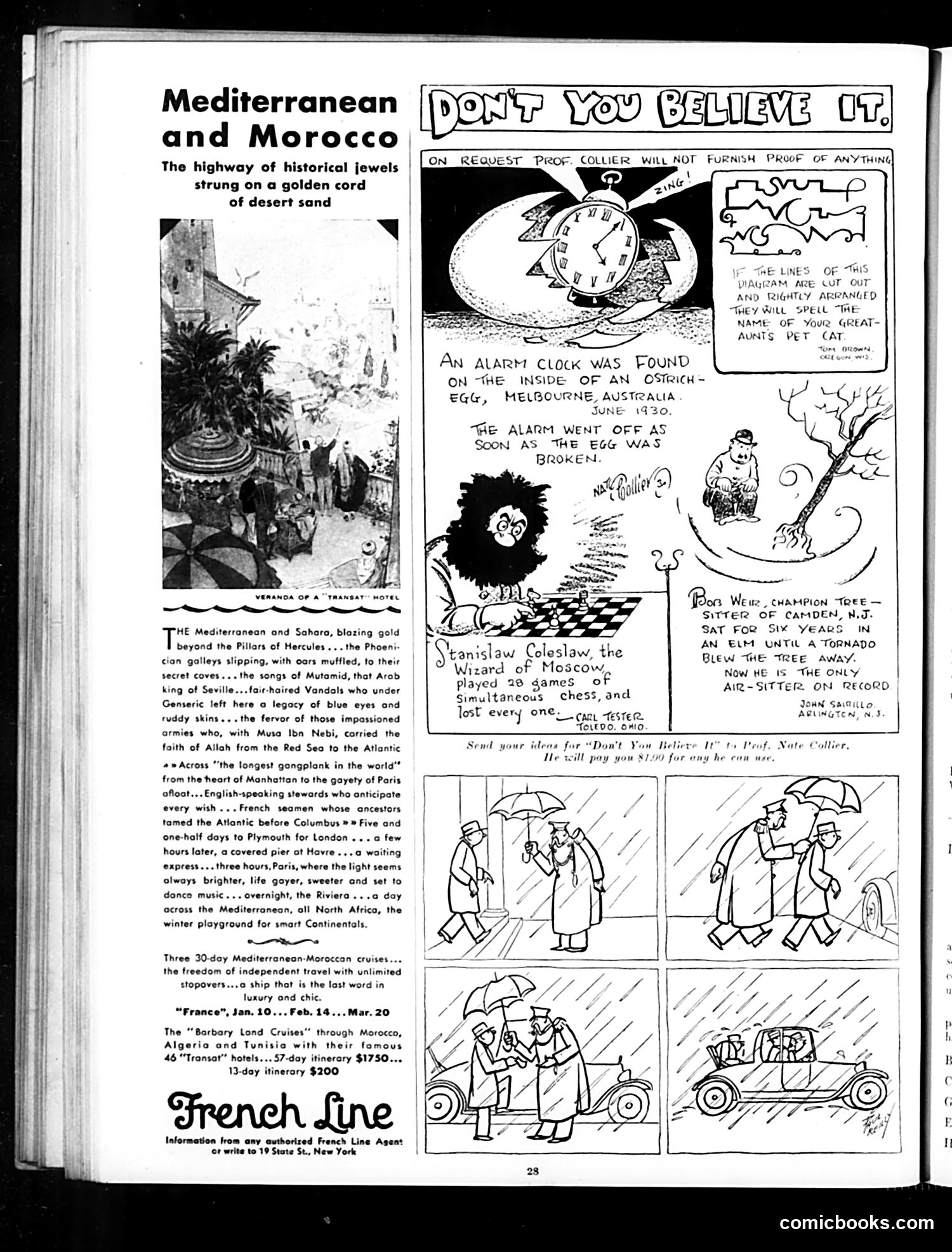
"Don't You Believe It" Comic Analysis This page combines travel advertising with a humorous "believe it or not" comic strip. The left side promotes French Line cruises to Mediterranean and Morocco destinations, emphasizing luxury and historical romance. The right side, "Don't You Believe It," is a tall-tale humor feature mocking absurd, implausible claims. It presents three ridiculous stories: an alarm clock found inside an ostrich egg in Melbourne (1930), a chess wizard named Stanislaw Coleslaw who lost 28 simultaneous games, and a tree-sitting record holder who sat in an elm for six years until a tornado removed it. The satire targets gullible readers who accept implausible anecdotes. The comic invites readers to submit their own tall tales, offering payment ($1.00) to Prof. Nate Collier. This reflects early 20th-century American humor's fascination with "believe it or not" odditorium culture—the notion that the world contained infinite strange phenomena worthy of sensationalized reporting.
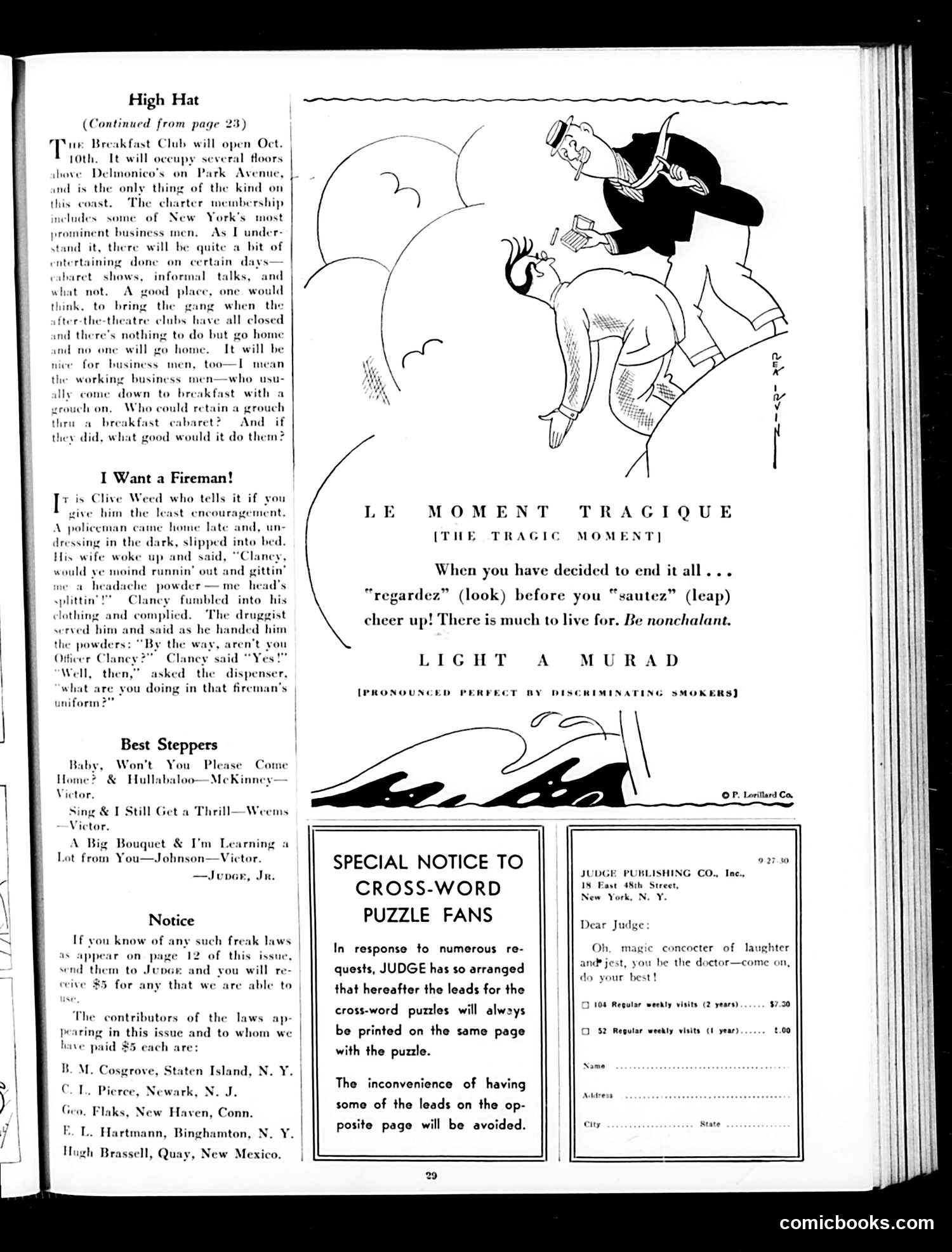
Analysis of Judge Magazine Page This page contains several humor pieces typical of 1920s-era satirical journalism: "I Want a Fireman!" is a brief comic anecdote about Officer Clancy, who—after his wife asks him to fetch headache powder at night—mistakenly dresses in a fireman's uniform in the dark instead of his police uniform. The druggist's bemused question at the end ("what are you doing in that fireman's uniform?") delivers the punchline, exploiting confusion between similar uniforms for comedic effect. "Le Moment Tragique" is a darkly humorous French-language caption accompanying an illustration of a man seemingly contemplating suicide at a rooftop ledge. It ironically advises: before you leap, look around—there's much to live for; be nonchalant. The joke's cynical tone mocks suicide contemplation through deliberately absurd reassurance. The remainder consists of administrative notices (cross-word puzzle leads, contributor credits) and song/entertainment recommendations typical of Judge's era. No political figures are caricatured on this particular page.
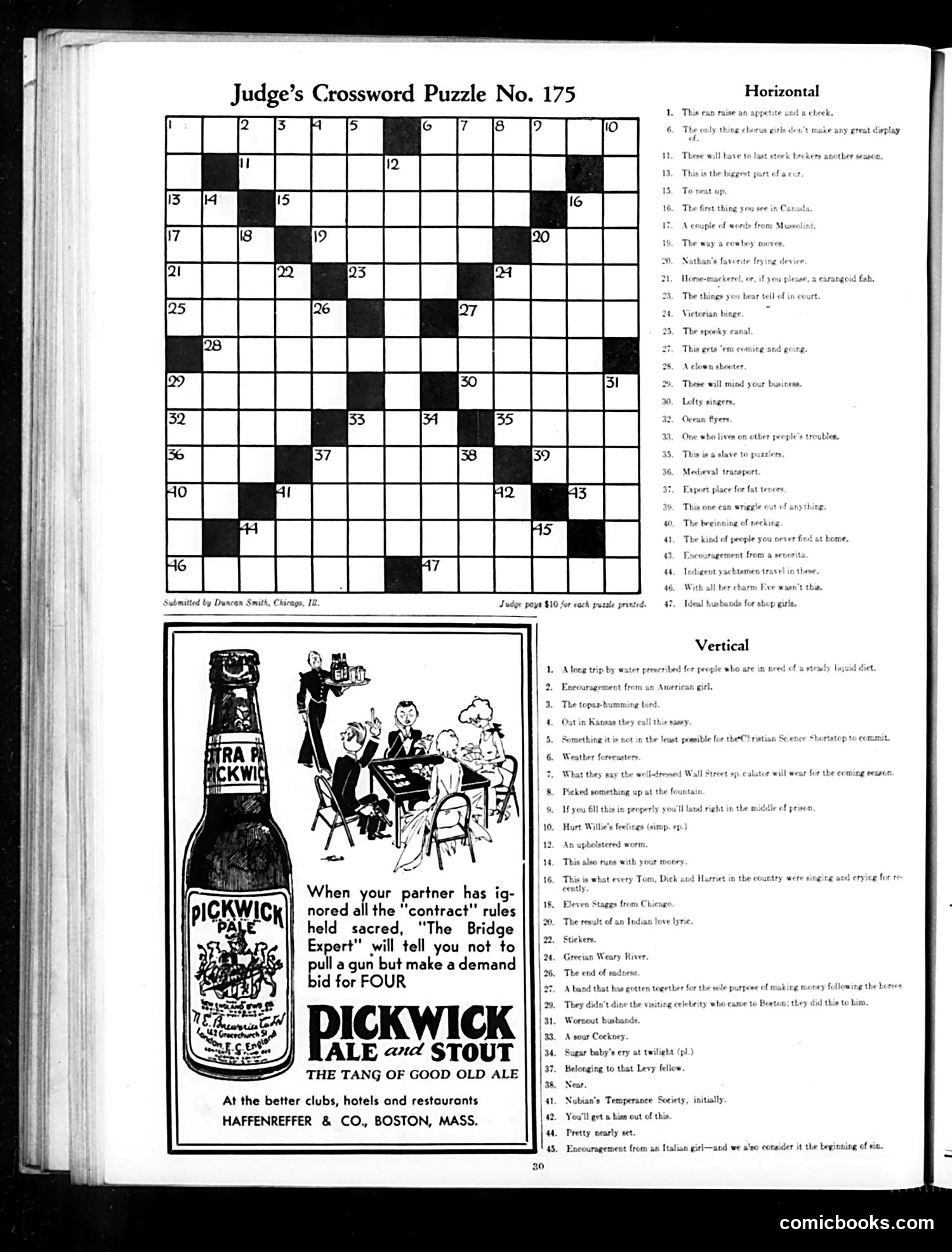
Analysis This page is primarily a Dickwick Pale and Stout beer advertisement disguised as editorial content within Judge magazine's crossword puzzle section. The advertisement uses a bridge-playing scenario as its framing device. It depicts a social situation where a contract bridge player has violated the "sacred" rules of the game. Rather than resorting to violence ("pull a gun"), the ad suggests making a demand bid for "FOUR"—a pun linking the card game to ordering four bottles of Dickwick beer. The imagery shows well-dressed club members in what appears to be a 1920s-30s setting, suggesting this beer appeals to the affluent, educated classes who frequent "better clubs, hotels and restaurants." The ad positions Dickwick as the sophisticated choice for such social circles. This is period advertising that exploits leisure activities and social status to market alcohol, presented cleverly within the magazine's entertainment section rather than as obvious advertising.
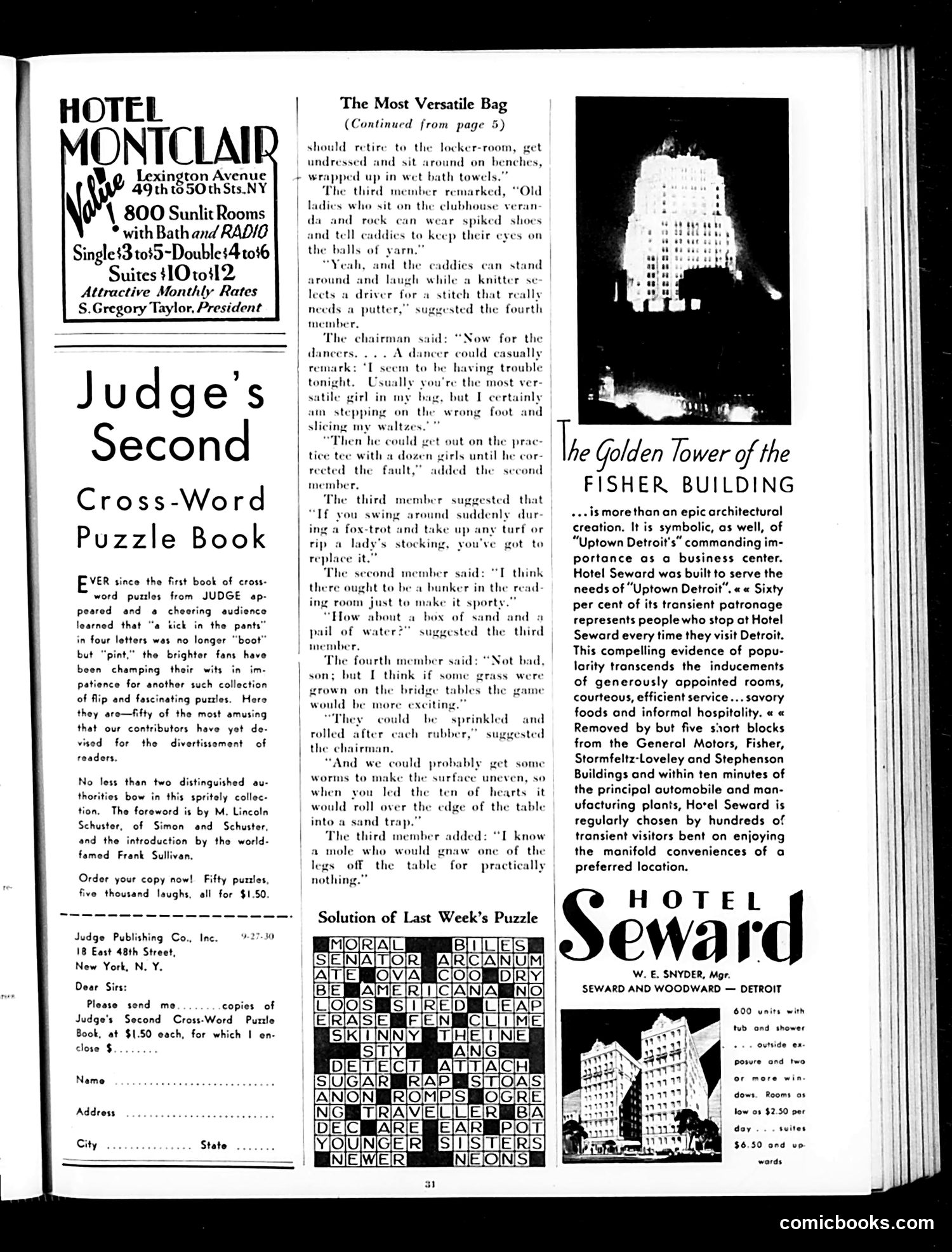
Analysis of Judge Magazine Page This page is primarily advertising and promotional content rather than political satire or comics. The main content includes: - Hotel advertisements (Montclair, Fisher Building, Hotel Seward) - A cross-word puzzle book promotion - A continuation of an article called "The Most Versatile Bag" (from page 5), which appears to be social satire about golf club culture The golf satire humorously suggests absurd "improvements" to golf: female caddies in spiked shoes, knitters selecting clubs, dancers disrupting play, bunkers in locker rooms, sand traps filled with worms, and moles gnawing table legs. The joke mocks both the pretentiousness of country club culture and the absurdity of trying to "improve" an already established game. No identifiable political figures or dated events appear on this page. It's a slice of 1920s-30s leisure-class humor targeting the upper-middle-class golf enthusiast.
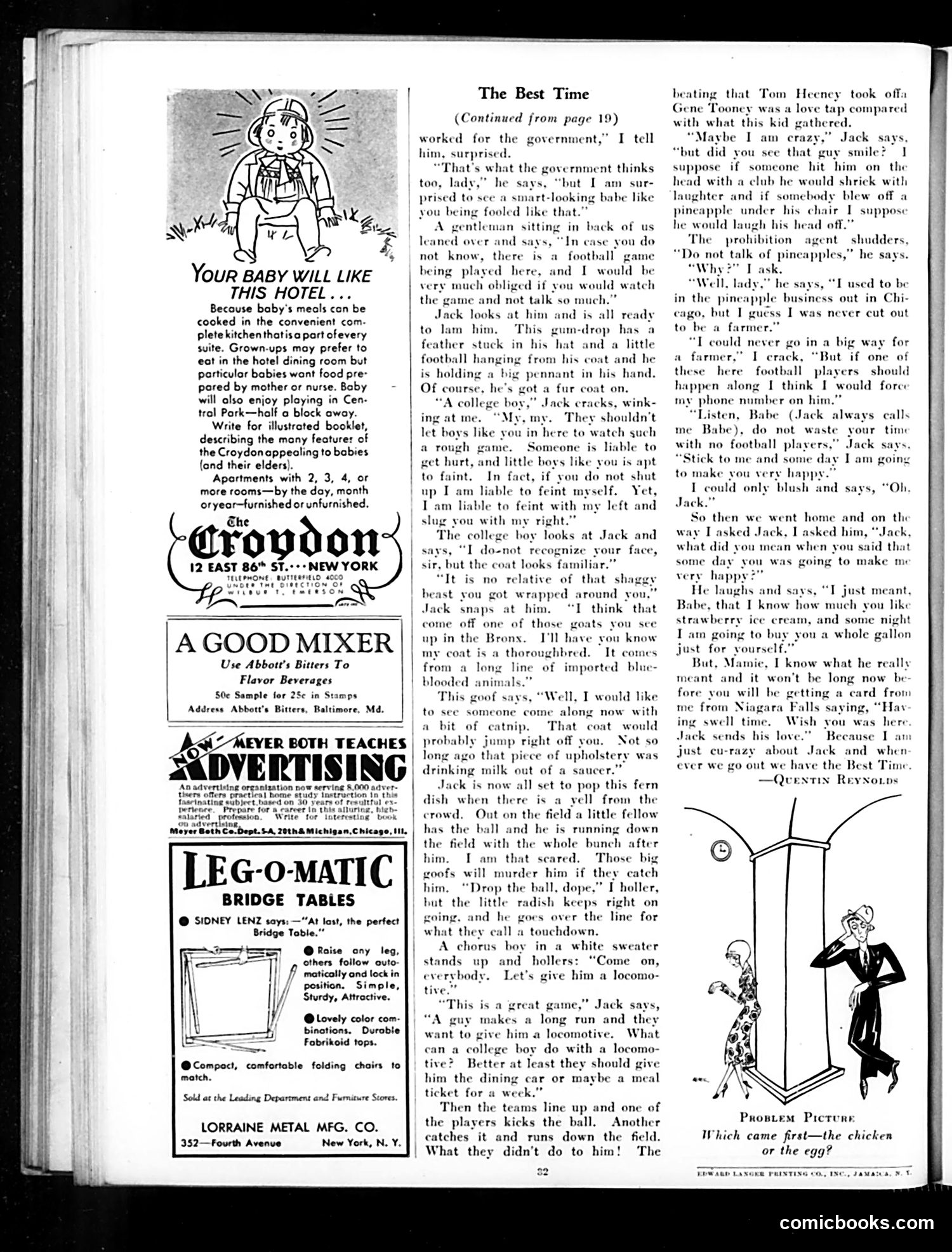
Understanding This Judge Magazine Page This page is primarily advertising—mostly hotel, furniture, and beverage ads typical of 1920s magazines. The actual editorial content is "The Best Time" (continued from page 19), a humorous narrative about Jack attending a football game. The story satirizes social class friction and spectator behavior at sporting events. Jack, apparently working-class, attends a college football game where he encounters a wealthy college boy wearing expensive furs and displaying school spirit paraphernalia. Jack mocks the boy's pretentious fur coat (suggesting it came from a goat or was "drinking milk out of a saucer"), deflates his enthusiasm, and makes irreverent jokes about the game's traditions. The humor relies on working-class irreverence toward upper-class affectation—a common Judge theme. Jack represents the everyman deflating pomposity through sharp wit and humor rather than respect for social hierarchy.
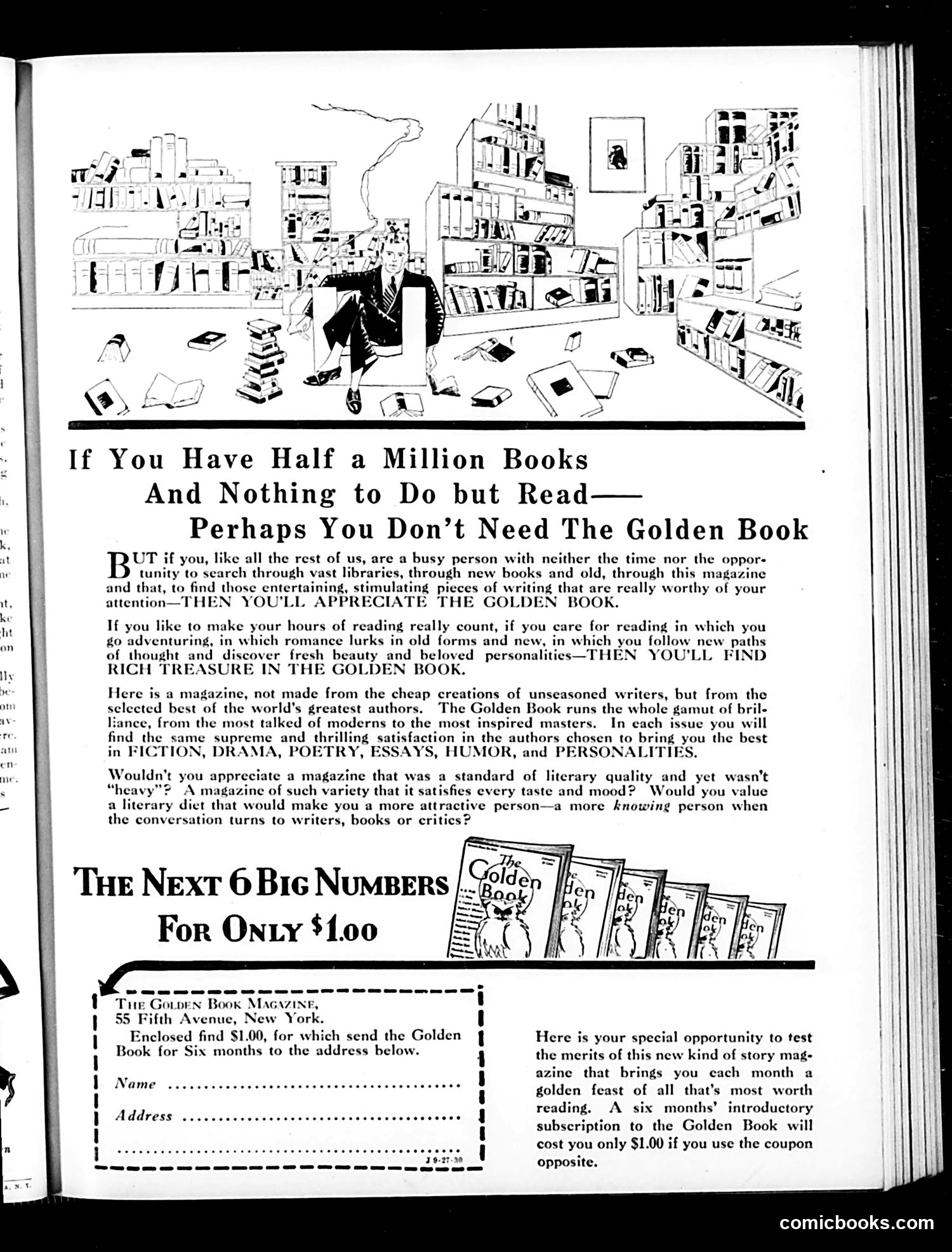
Analysis of "The Golden Book" Advertisement This page is primarily a magazine advertisement, not political satire. It promotes *The Golden Book*, a literary digest magazine. The cartoon illustrates the magazine's value proposition: a harried reader sits surrounded by an overwhelming avalanche of books and publications—stacked on shelves, floors, and everywhere. The visual joke is that busy modern people lack time to sift through "half a million books" to find quality reading. The ad's pitch targets the aspirational middle-class reader of the 1920s-30s era: *The Golden Book* promises to curate the best fiction, drama, poetry, and essays from world-class authors, eliminating tedious searching. It emphasizes that subscribing makes one a "more knowing person" in social conversation—appealing to status-conscious consumers. The offer—six months for $1.00—was marketed as an economical introduction to cultural refinement. The ad reflects period anxieties about information overload and the appeal of expert editorial gatekeeping.
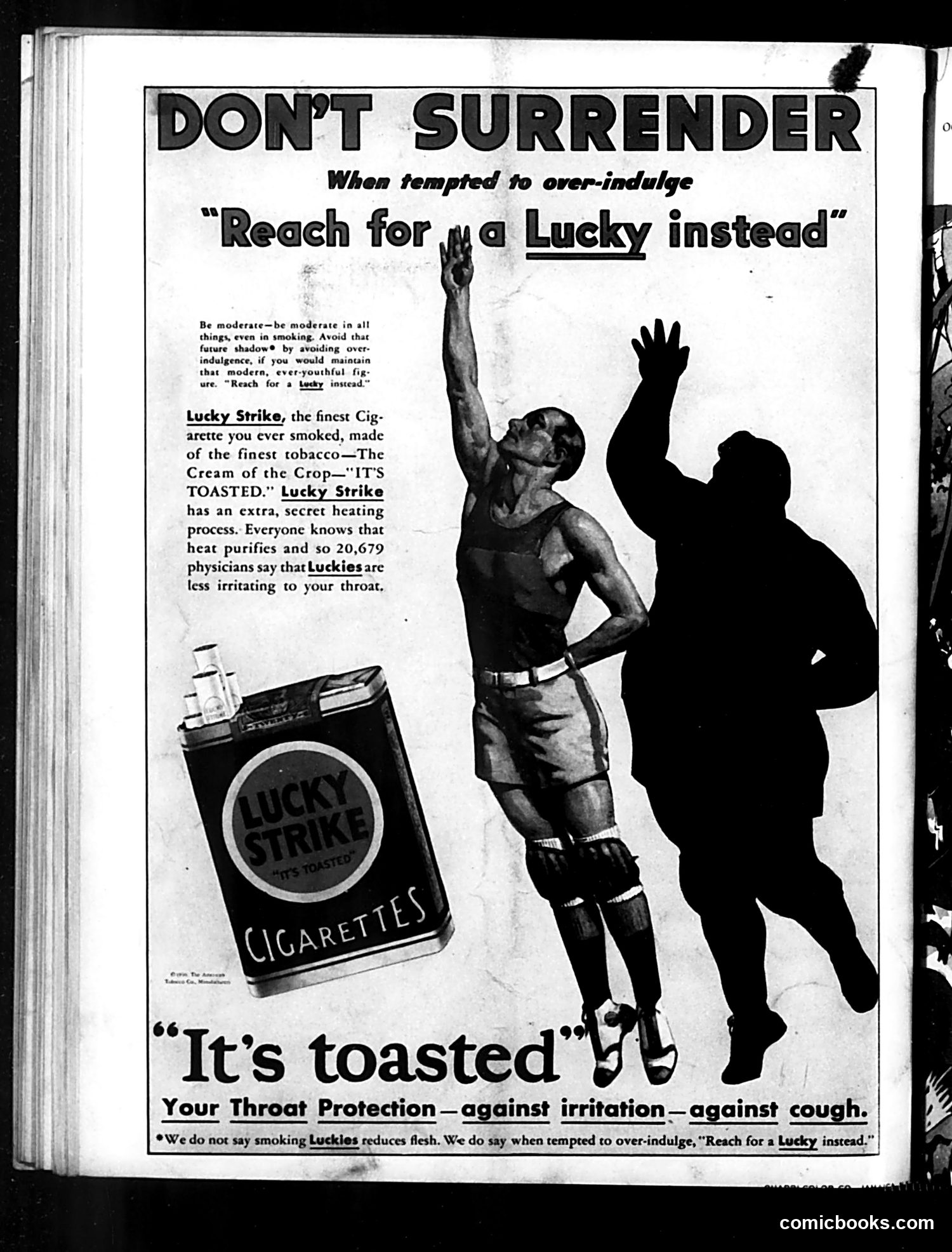
Analysis This is a Lucky Strike cigarette advertisement, not political satire. The page promotes smoking as an appetite suppressant and health product. The imagery shows a muscular boxer being tempted by an ominous silhouette (representing temptation to overeat) while reaching for a Lucky Strike instead. The ad's message: when hungry or tempted to overindulge in food, smoke a cigarette rather than eat—thereby maintaining a slim figure. Key claims made: - Lucky Strikes are "toasted" (a special heating process) - 20,679 physicians endorse them as "less irritating to your throat" - Smoking prevents weight gain through appetite suppression Modern readers will immediately recognize this as promoting a dangerous product using false health claims and dangerous dietary advice. The advertisement exemplifies pre-regulation tobacco marketing that made unsubstantiated medical claims and targeted weight-conscious consumers, particularly women.