judge
Judge — October 4, 1930
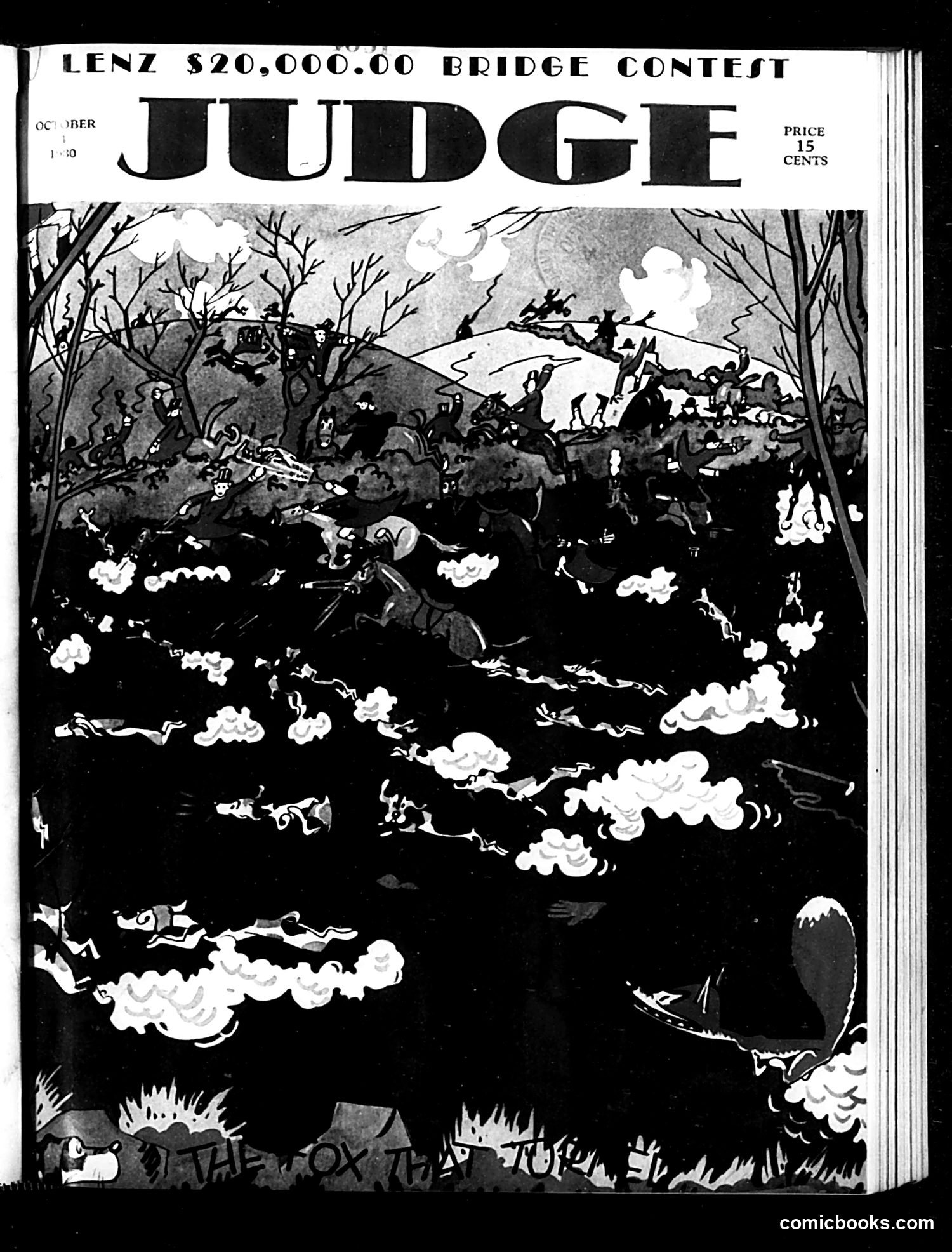
Analysis of Judge Magazine Cover This appears to be a Judge magazine cover from October 1920, featuring a satirical illustration of what looks like a chaotic underwater or subterranean scene. The image depicts numerous figures engaged in frantic activity amid clouds of smoke or explosions, with bare trees framing the composition. The header announces "LENZ $20,000.00 BRIDGE CONTEST," suggesting the cartoon relates to a specific contemporary event or competition. However, without clearer identification of the figures depicted or additional context about the "Lenz Bridge Contest," I cannot definitively explain the specific political or social satire intended. The chaotic scene with explosions suggests commentary on conflict, competition, or social upheaval, but the exact meaning remains unclear from this image alone.
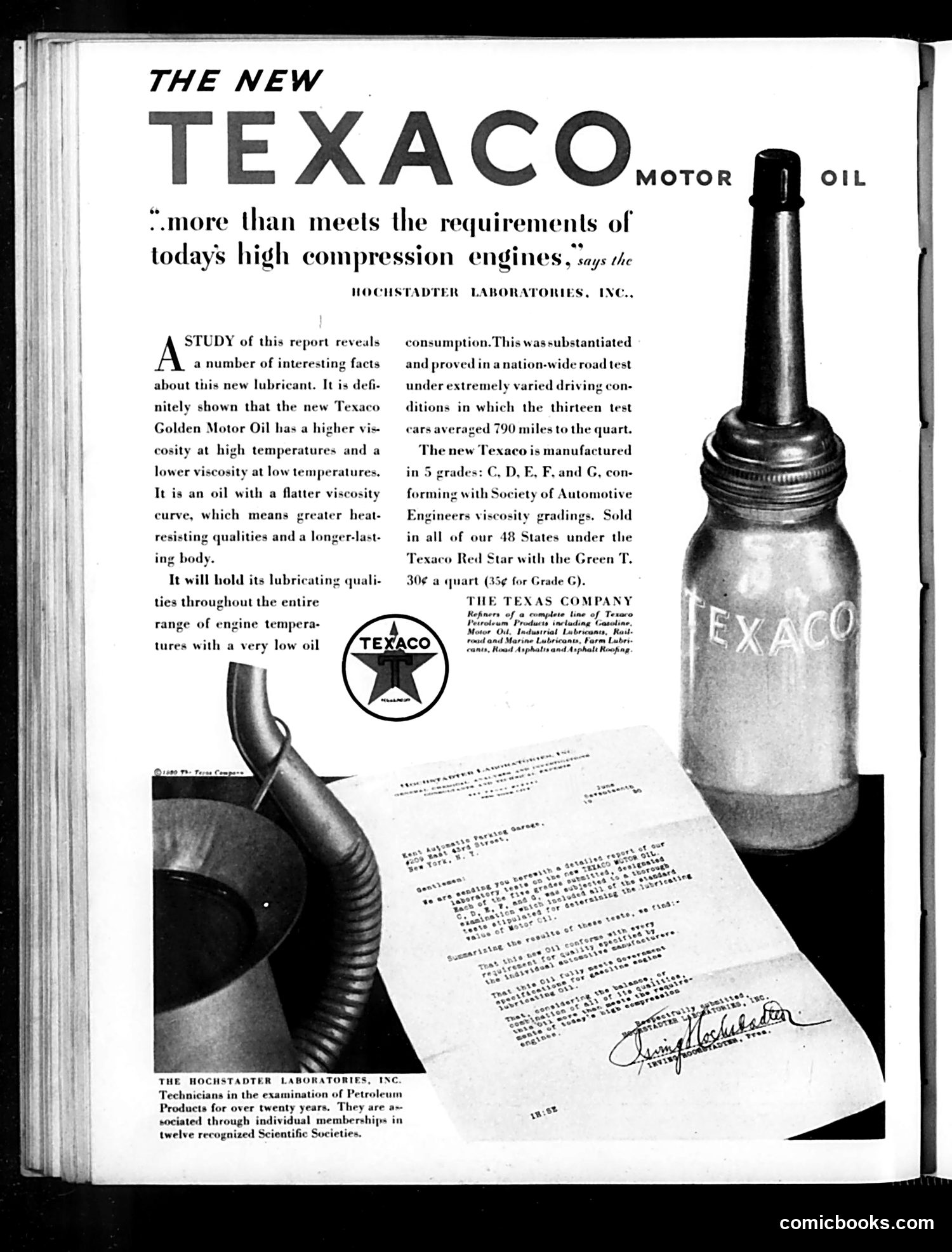
Analysis This page is primarily an advertisement, not satire or political commentary. It promotes Texaco Motor Oil, citing laboratory testing by Hochstadter Laboratories, Inc. The ad emphasizes the oil's technical superiority for "high compression engines"—a contemporary concern as automotive engines grew more powerful. Key claims include superior viscosity at high temperatures and low oil consumption (backed by a nationwide road test averaging 790 miles per quart). The visual elements—an oil bottle and automotive part—are straightforward product imagery. The Texaco Red Star logo appears centrally. The reference to "Society of Automotive Engineers viscosity gradings" grounds the pitch in technical credibility rather than satire. This represents typical mid-20th-century industrial advertising emphasizing scientific validation.
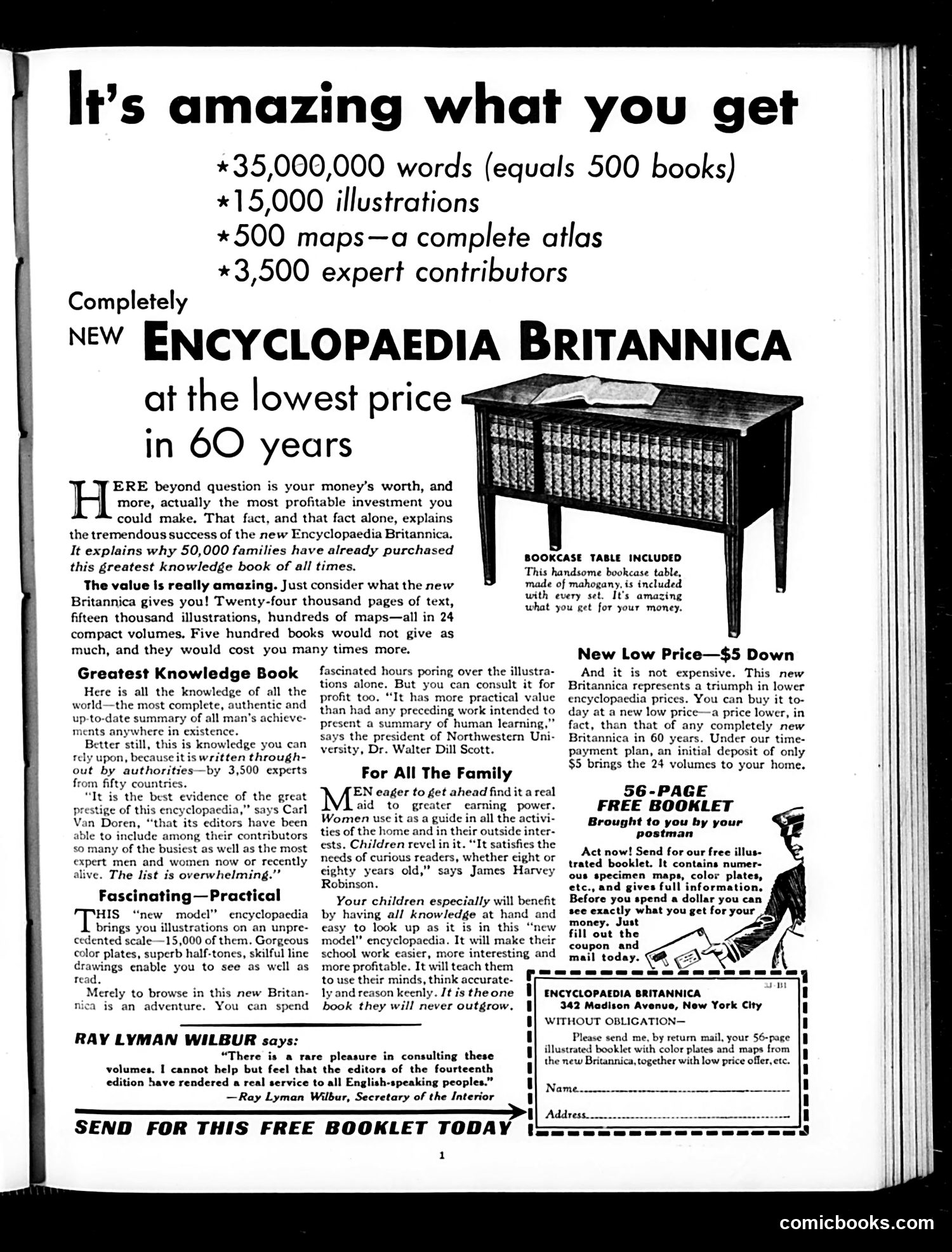
Analysis This page is primarily a vintage advertisement, not satirical content. It promotes the "Completely New Encyclopaedia Britannica" at a claimed lowest price in 60 years ($5 down payment for all 24 volumes). The ad emphasizes the encyclopedia's scope (35 million words, 15,000 illustrations, 500 maps) and includes a testimonial from Ray Lyman Wilbur, identified as "Secretary of the Interior," lending governmental authority to endorse the purchase as a worthwhile investment and educational resource "for all the family." The accompanying furniture image shows a decorative bookcase display. The layout and typography are typical mid-20th century direct-mail marketing, targeting middle-class families seeking self-improvement through knowledge acquisition during an era when encyclopedias represented status and intellectual aspiration.
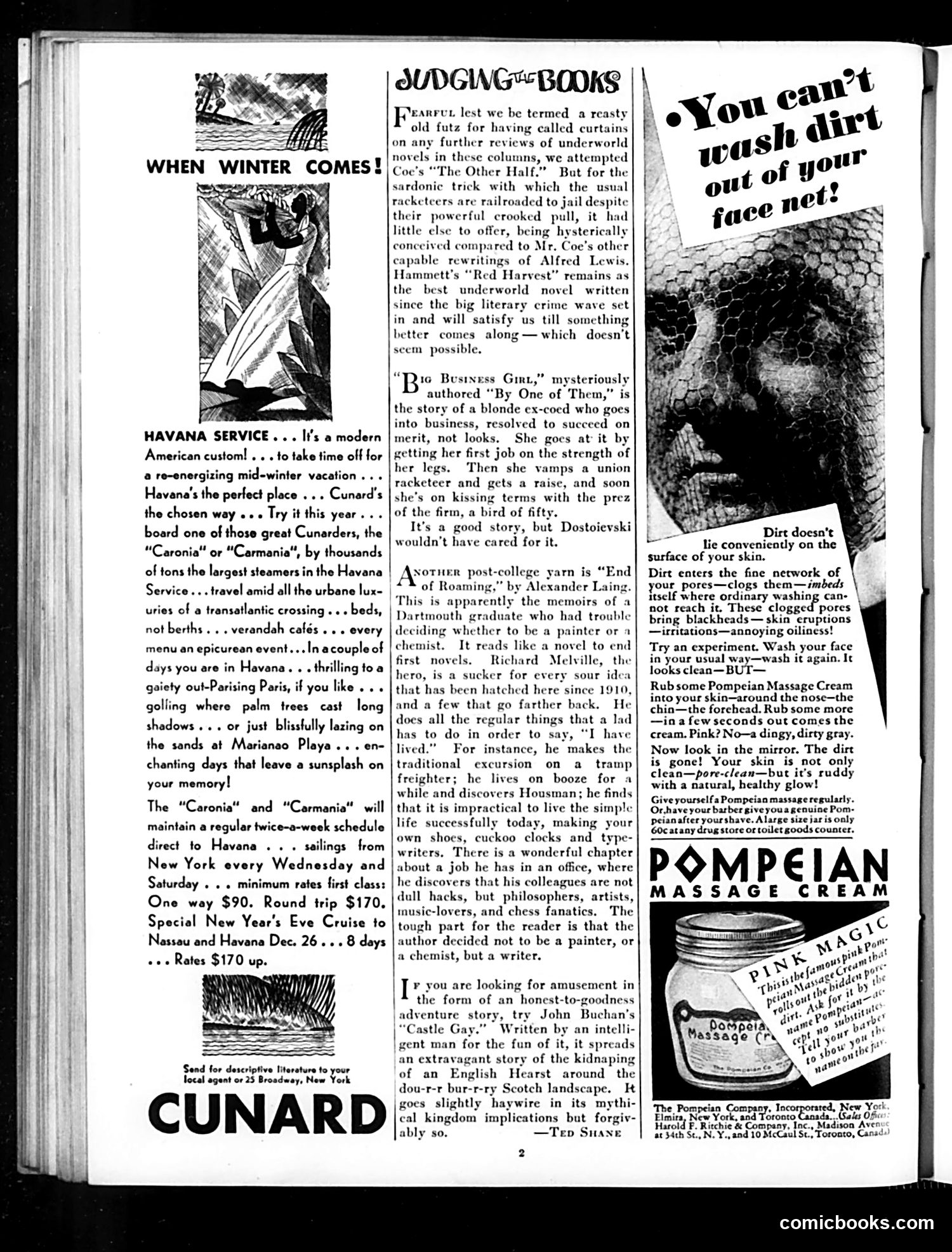
Content Analysis This page is primarily advertising and book reviews rather than political satire. The main elements are: 1. "When Winter Comes" section: Advertisement for Cunard cruise line's Havana service, promoting mid-winter Caribbean vacations as an escape from cold weather. 2. "Judging the Books" section: Literary reviews of underworld/crime novels, including critiques of works by S.S. Coe and Alexander Laing. The reviews are somewhat dismissive, noting these crime stories lack the quality of better-known works. 3. "Pompeian Massage Cream" advertisement: Right side features a beauty product ad with claims about skin cleansing and appearance. The page reflects 1920s-30s consumer culture—travel promotions, pulp fiction popularity, and cosmetic marketing—rather than political commentary.
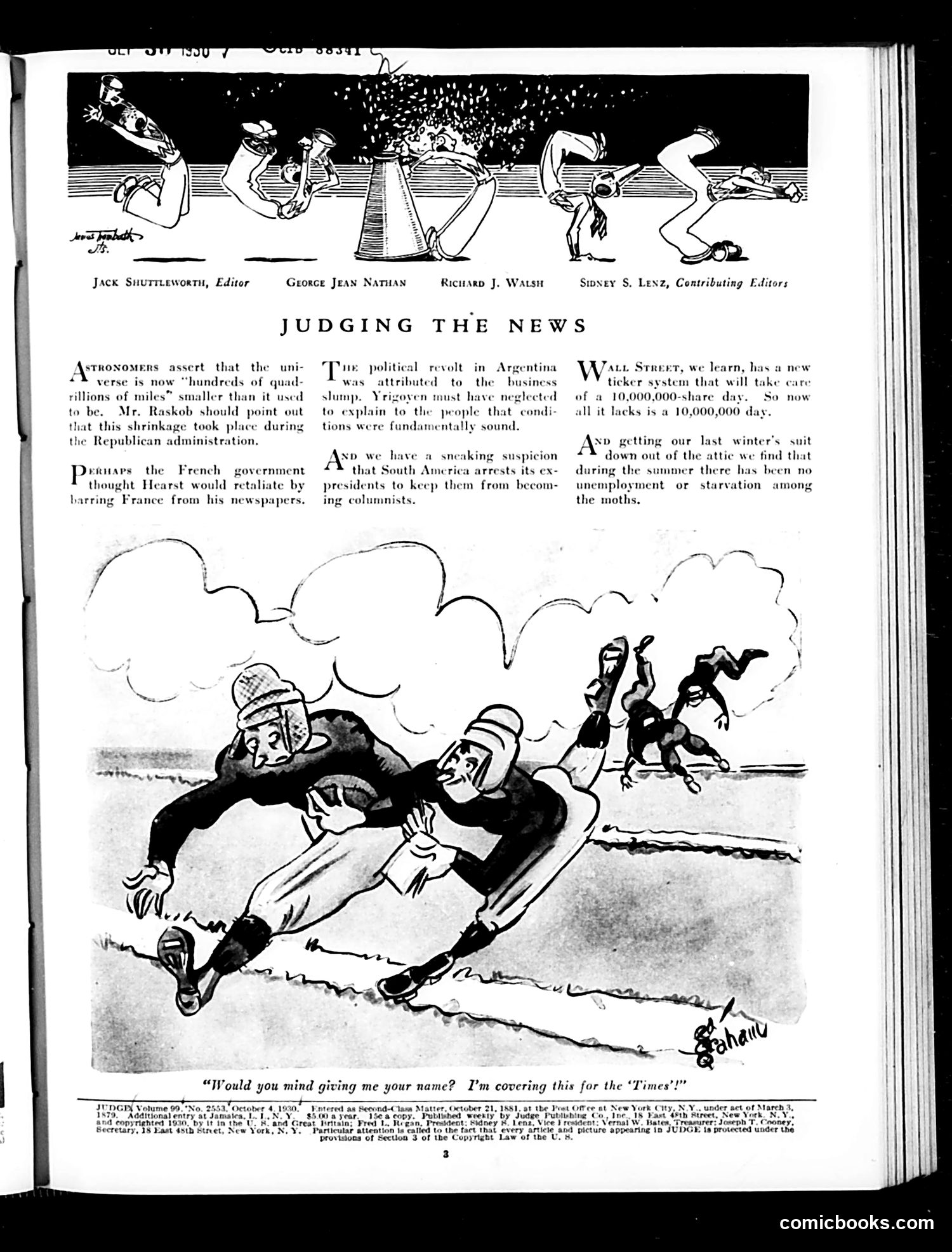
Analysis of "Judging the News" Page This page from *Judge* magazine features editorial commentary and a political cartoon about contemporary events. The Main Cartoon: Two newspaper reporters on skis are chasing figures fleeing across snowy terrain, with one reporter asking "Would you mind giving me your name? I'm covering this for the 'Times'!" The satire appears to reference journalist pursuit of news subjects—likely mocking either overeager reporters or evasive news-makers. The skiing setting suggests winter/cold-weather urgency. Editorial Comments address: Argentina's political upheaval and business conditions; concerns about South American communist movements; and economic hardship (moths in attics, winter unemployment). The overall tone mocks both news media sensationalism and contemporary political instability, typical of *Judge's* satirical approach to 1920s American affairs.
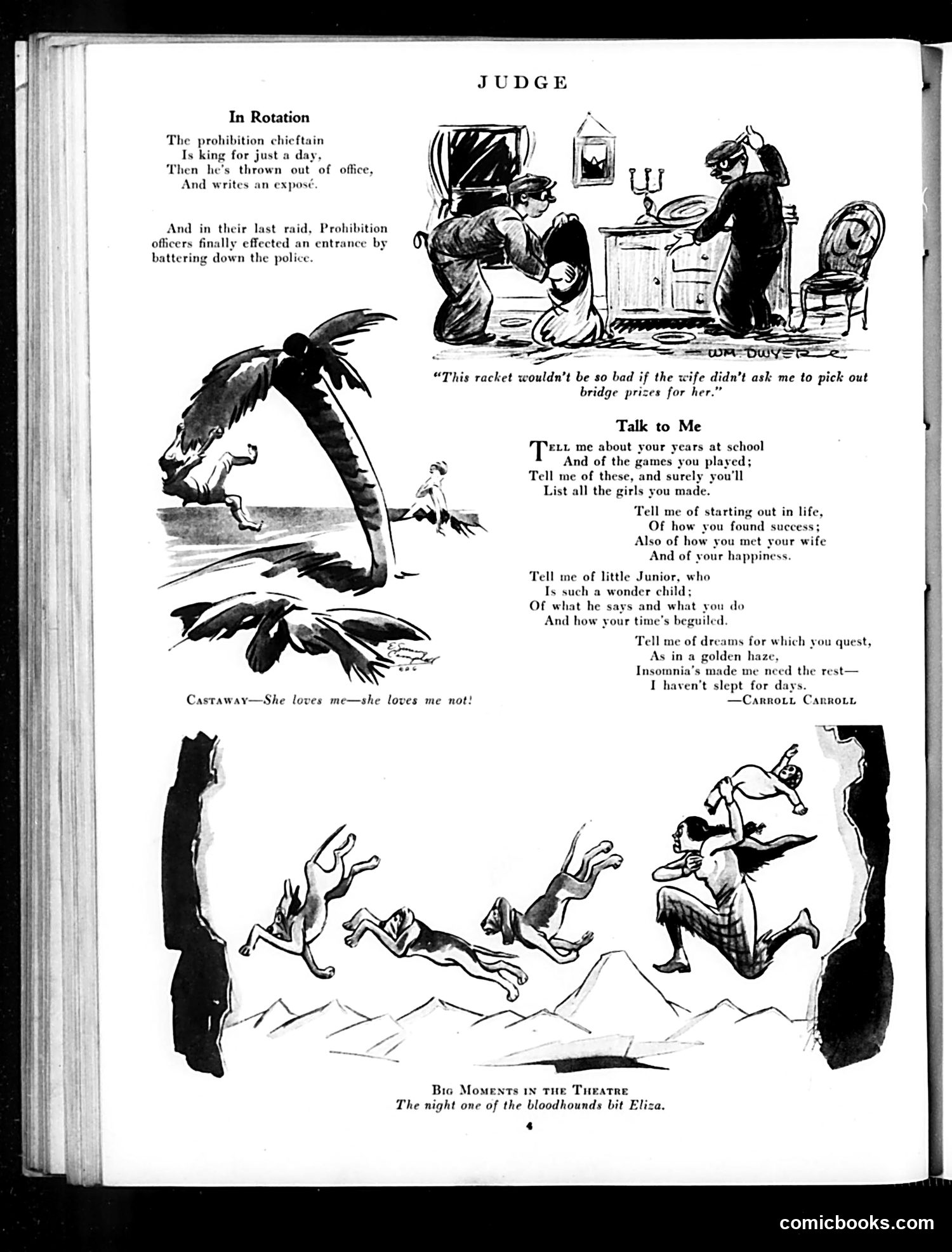
Analysis of Judge Page "In Rotation" cartoon (top): Satirizes Prohibition enforcement corruption. A chieftain "is king for just a day," then gets thrown out and writes an exposé. The poem suggests Prohibition officials cycled through positions while raiding speakeasies and taking bribes. The captioned cartoon shows a man telling his wife about a "racket" involving bridge prizes—likely implying officials shook down citizens for payoffs. "Talk to Me" poem (center-right): By Carroll Carrol, this sentimental verse requests personal stories about school, success, marriage, children, and unfulfilled dreams. It appears unrelated to the other satire on the page. "Big Moments in the Theatre" (bottom): Shows people fleeing in exaggerated panic, captioned "The night one of the bloodhounds lit Eliza"—a reference to the *Uncle Tom's Cabin* stage adaptation's famous scene.
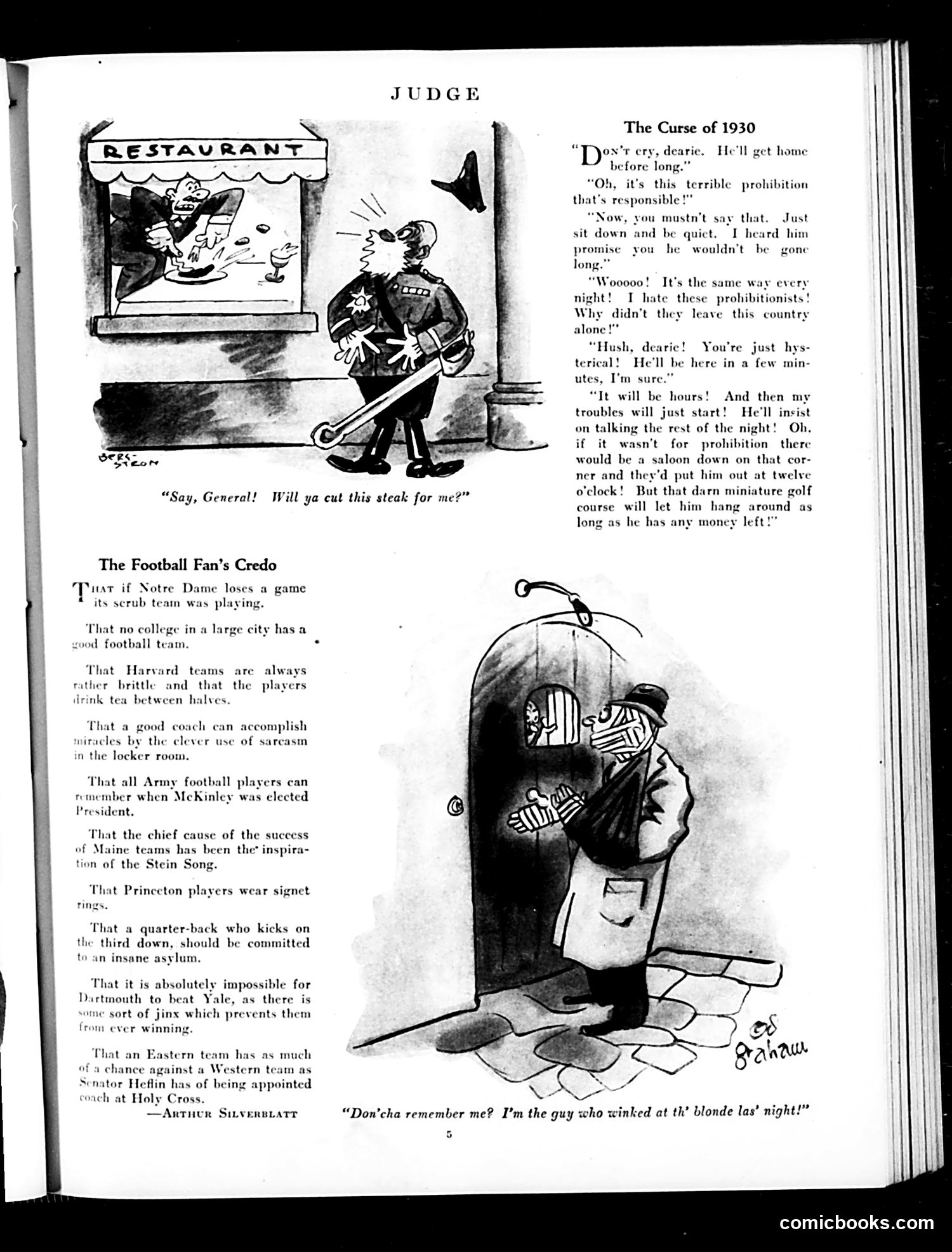
Page Analysis: Judge Magazine Top Cartoon ("Say, General! Will ya eat this steak for me?"): A military officer stands outside a restaurant while a waiter dangles food. The joke appears to satirize either military discipline or an officer's predicament—possibly referencing Prohibition-era restaurant practices or military regulations about where officers could eat. Main Content - "The Football Fan's Credo": A humorous list of absurd "beliefs" mocking college football enthusiasts, including exaggerated claims about Notre Dame, Harvard, Army teams, and coaching. The satire ridicules fans' irrational loyalties and the inflated mythology surrounding college football. Bottom Cartoon: A man's profile contains a small figure inside his head labeled "the guy who winked at th' blonde las' night"—satirizing how one embarrassing moment dominates a person's thoughts.
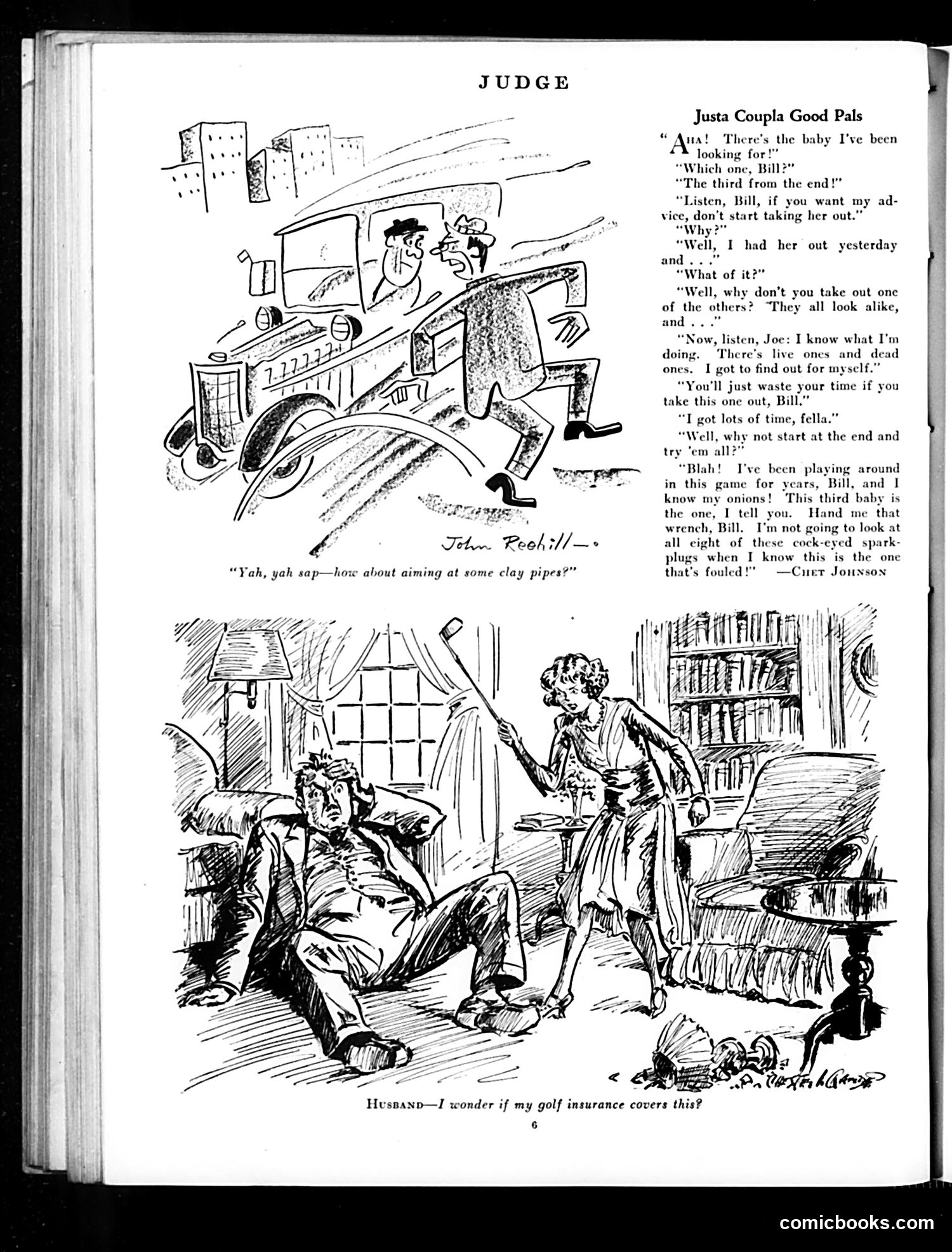
Analysis of Judge Page This page contains two unrelated cartoons satirizing everyday American life. Top cartoon ("Yah, yah sap—how about aiming at some clay pipes?") depicts a car crash, with two men arguing about whose baby they've been searching for. The joke relies on absurdist humor—the driver suggests they're interchangeable since "they all look alike," implying careless parenting or indifference to which child belongs to whom. Bottom cartoon ("Husband—I wonder if my golf insurance covers this?") shows a man struck by a golf club wielded by an angry woman indoors, apparently his wife. The satire mocks both golf obsession and domestic conflict—suggesting the husband's insurance policy (presumably for golf-related injuries) wouldn't cover injuries inflicted by his spouse during a domestic dispute. Both rely on slapstick humor and exaggerated domestic scenarios typical of Judge's satirical approach.
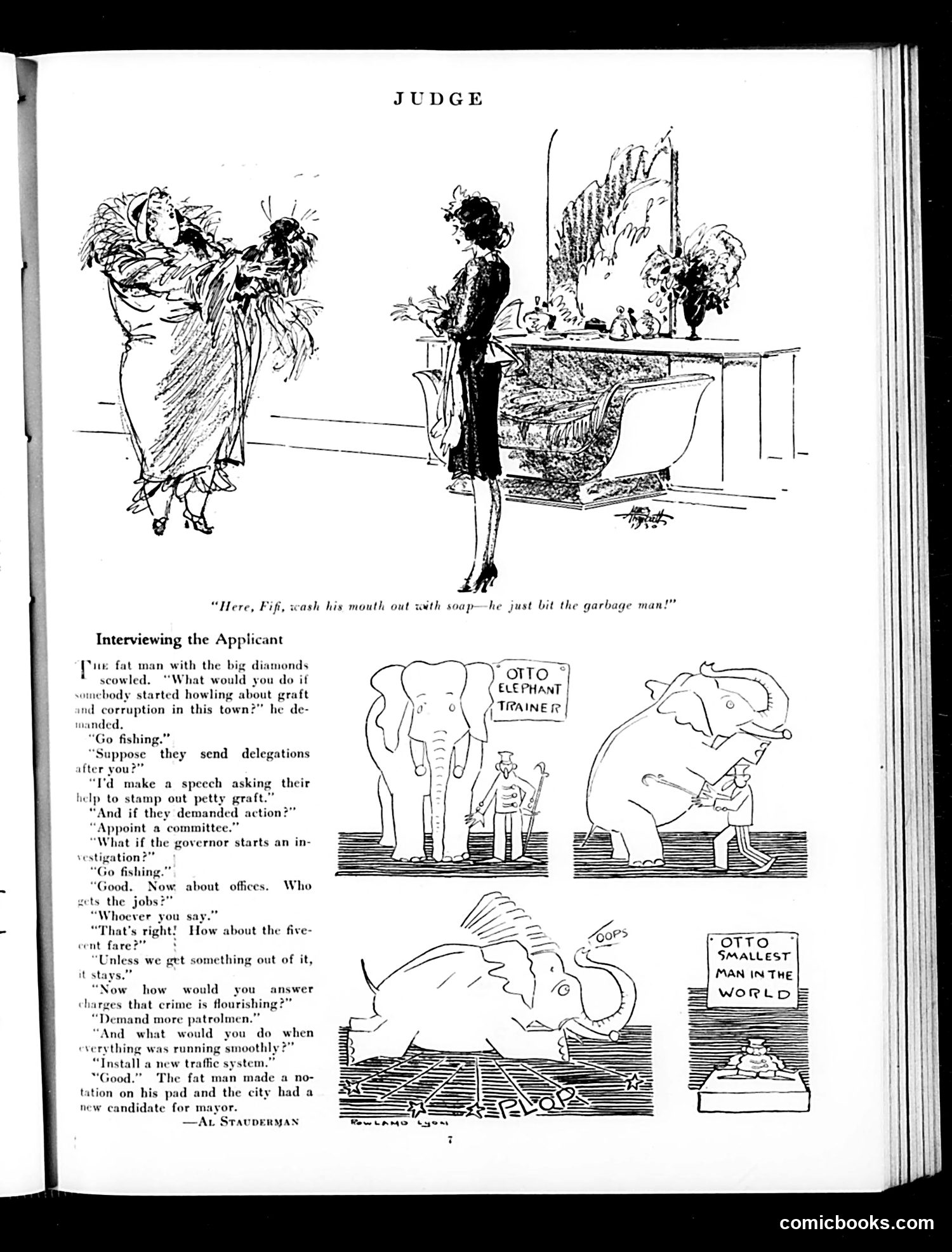
Political Cartoon Analysis: Judge Magazine This page satirizes municipal corruption and political appointment in early-20th-century American cities. Top cartoon: A woman instructs her dog to "wash his mouth out with soap" after it bit "the garbage man"—a crude joke suggesting the dog has poor taste. Main feature "Interviewing the Applicant": A wealthy man (identifiable by "big diamonds") interviews a mayoral candidate. The satire exposes how corrupt city machines operated: the candidate is explicitly advised to deflect serious corruption complaints with dismissals ("Go fishing"), neutralize reformers with speeches, and avoid real action. The fat man approves this cynicism and appoints him mayor—showing how patronage systems rewarded complicity over competence. Otto the Elephant cartoons: Appear to be separate comic strips, likely recurring characters in Judge magazine. The piece, credited to Al Stauderman, mocks the normalization of political corruption in American urban governance—showing how openly cynical the system had become.
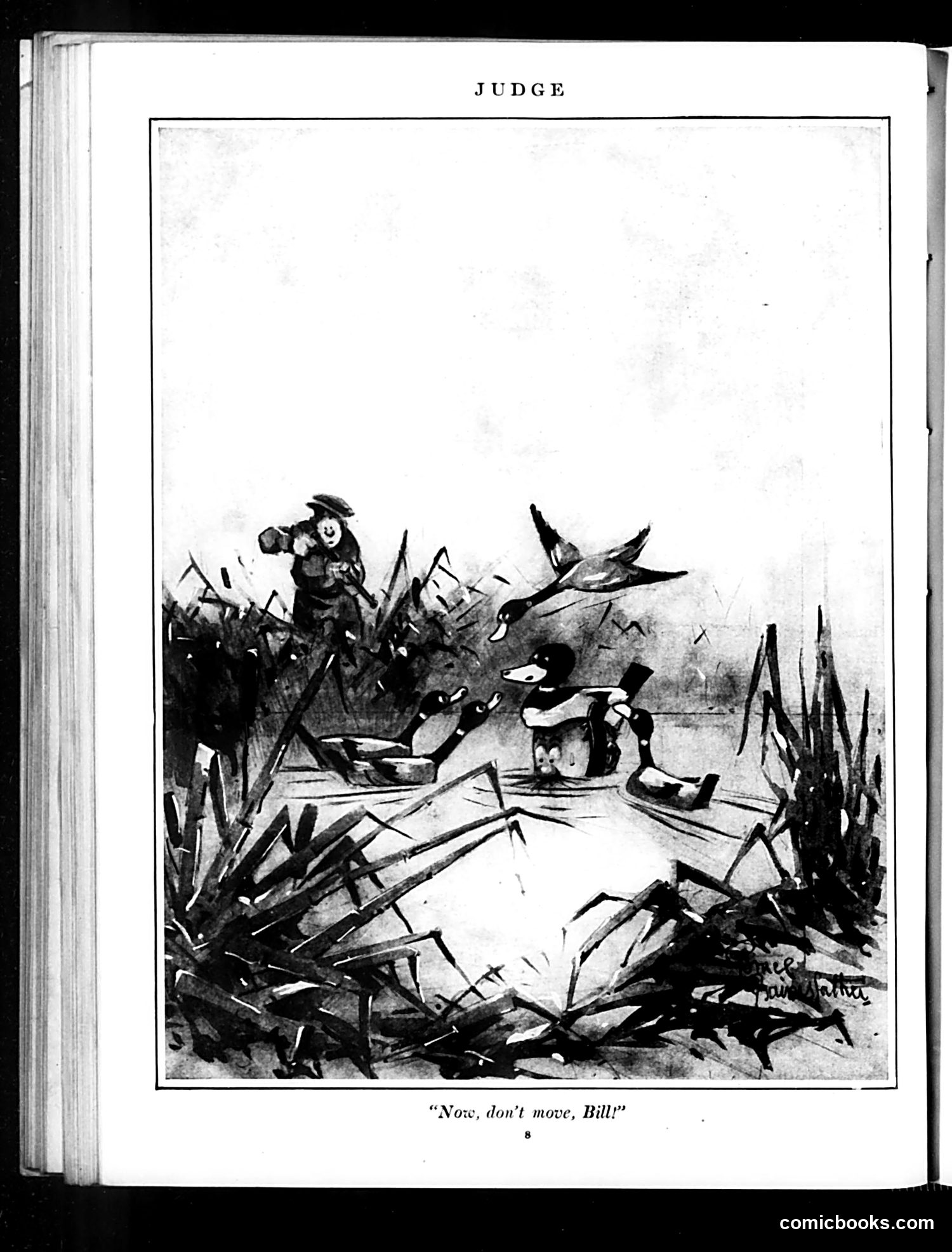
"Now, Don't Move, Bill!" This Judge cartoon depicts a precarious scene in a pond or marsh setting. A figure labeled "Bill" (likely a character representing a person or political figure) stands motionless in water while another figure with binoculars observes from above, issuing a warning. The scene is surrounded by insects—particularly large grasshoppers or locusts—suggesting either a literal pest infestation scenario or metaphorical use of insects as social/political problems. The "don't move" instruction implies that remaining still is the safest course of action amid chaos or danger. Without the specific historical context of this Judge issue, the exact political reference remains unclear, though the cartoon likely satirizes either a real contemporary crisis (agricultural, economic, or political) or a prominent public figure's precarious position.
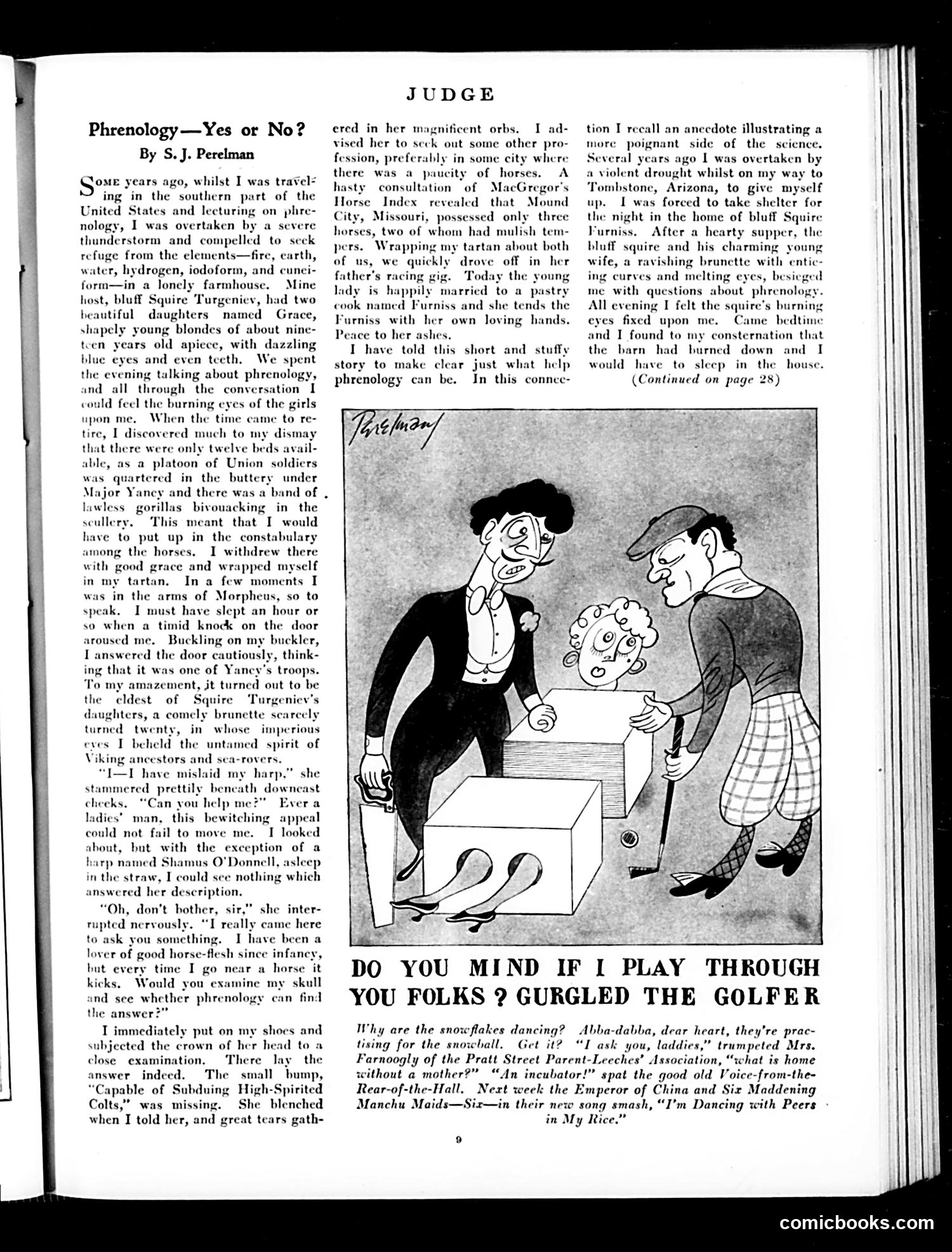
Phrenology Satire in Judge Magazine This page satirizes phrenology—the pseudoscience claiming skull bumps reveal character traits—through S.J. Perelman's absurdist story and an accompanying cartoon. The cartoon shows two men observing a third man playing golf. The caption reads: "DO YOU MIND IF I PLAY THROUGH YOU FOLKS? GURGLED THE GOLFER," with the punchline suggesting someone with no social awareness or manners. The story's satire: Perelman mocks phrenology by presenting ridiculous "diagnoses"—examining a woman's skull to explain why she's kicked by horses, attributing it to a missing bump for "Subduing High-Spirited Colts." The absurd solutions (relocating to Missouri where few horses exist) underscore how baseless the science is. The humor relies on treating phrenology with mock-seriousness while delivering increasingly preposterous scenarios, typical of Judge magazine's satirical style. Both the story and cartoon poke fun at pseudoscience and poor social etiquette using exaggerated, comedic logic.
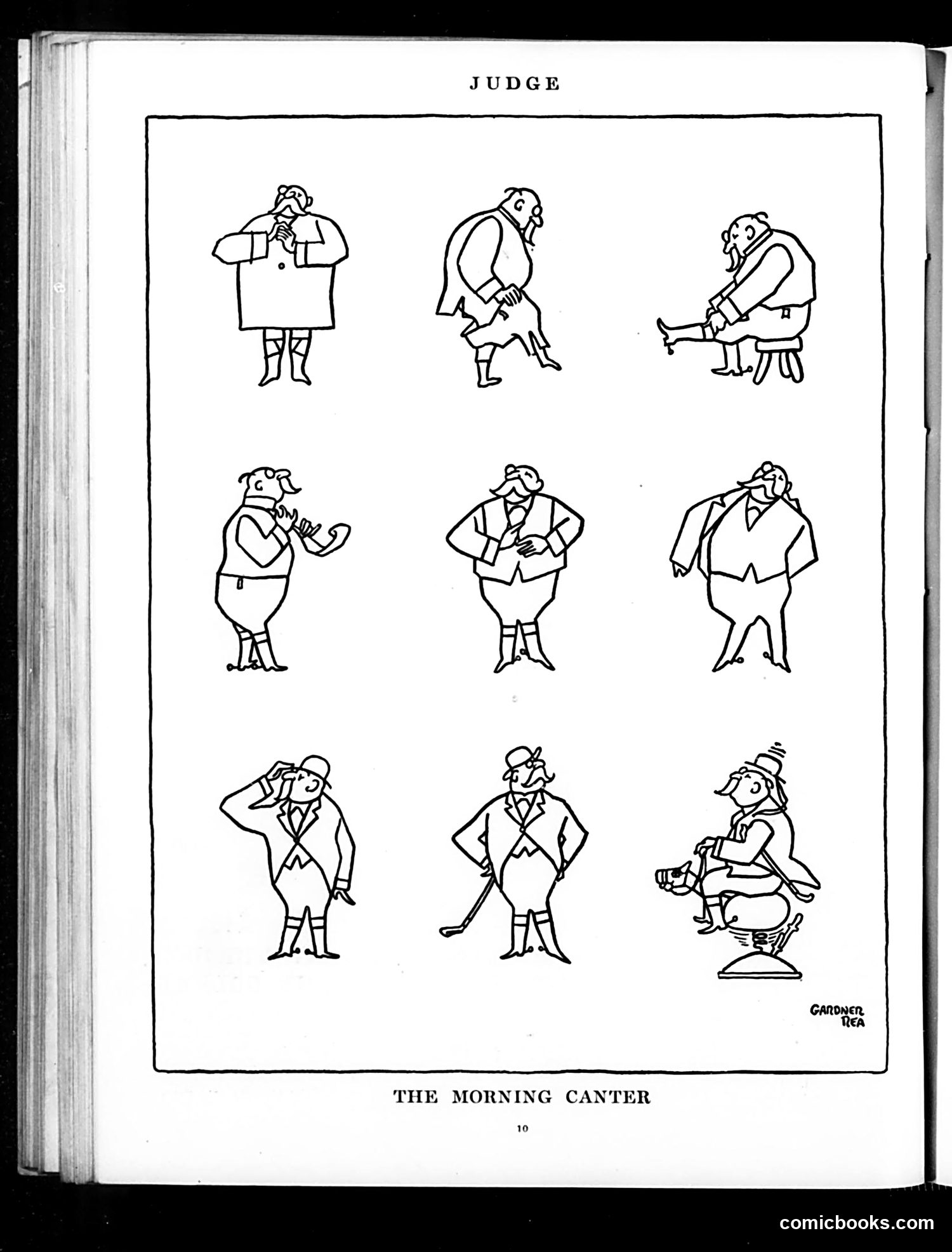
"The Morning Canter" - Judge Magazine This page presents nine cartoon vignettes of a judge in various moods and situations, all labeled simply "JUDGE." The title "The Morning Canter" suggests these depict a judge's emotional states during his morning routine or commute. The satire appears to mock judicial temperament and behavior—showing the judge alternating between stern authority (holding papers with apparent displeasure), physical exertion (riding/exercising), contemplation, agitation, and other emotional states. The cartoons suggest judges are volatile, inconsistent characters whose moods fluctuate dramatically. The humor likely targets judicial pretensions or the gap between judges' dignified public personas and their actual petulant, physical, or capricious private behavior. Without specific historical context, the exact judge referenced remains unclear.
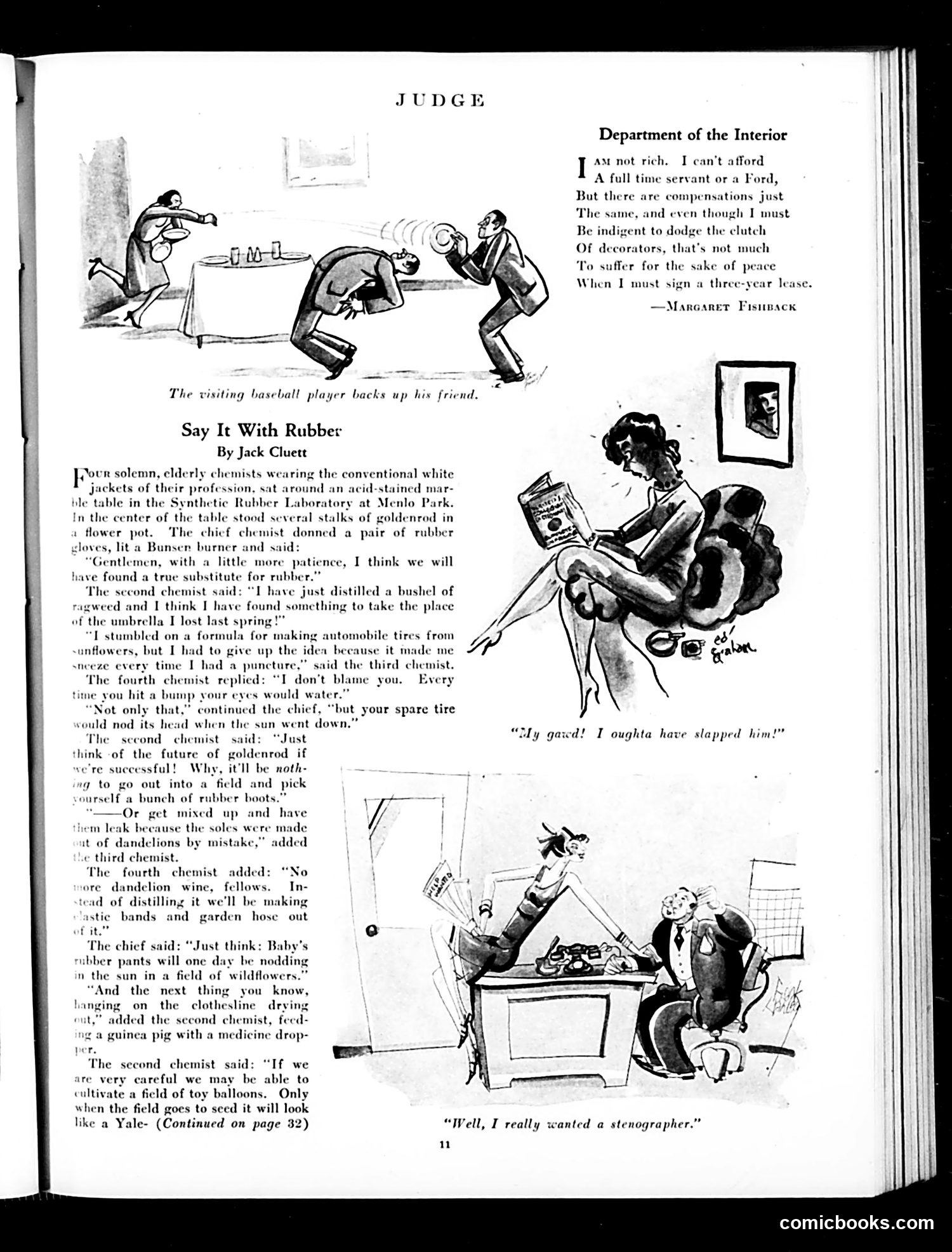
Judge Magazine Page Analysis This page contains three distinct satirical pieces: "Say It With Rubber" (main story): Four chemists at Menlo Park's synthetic rubber laboratory absurdly brainstorm rubber substitutes using plants like ragweed, goldenrod, and dandelions. The humor mocks the era's frantic search for synthetic rubber alternatives—likely referencing wartime or economic pressures to find substitutes for natural rubber. The joke escalates through increasingly ridiculous scenarios (rubber boots growing in fields, baby pants nodding in sunlight, toy balloon crops). Top cartoon: A baseball player and friend perform an exaggerated backing-up maneuver, captioned about one "backing up his friend"—a visual pun on the phrase. Two small cartoons on right: One shows a woman upset she "oughta have slapped him," and another depicts a man complaining he "really wanted a stenographer"—likely domestic humor about hiring or relationship expectations. Poem by Margaret Fishback addresses the modest life's compensations when one cannot afford servants or cars but must endure three-year lease agreements.
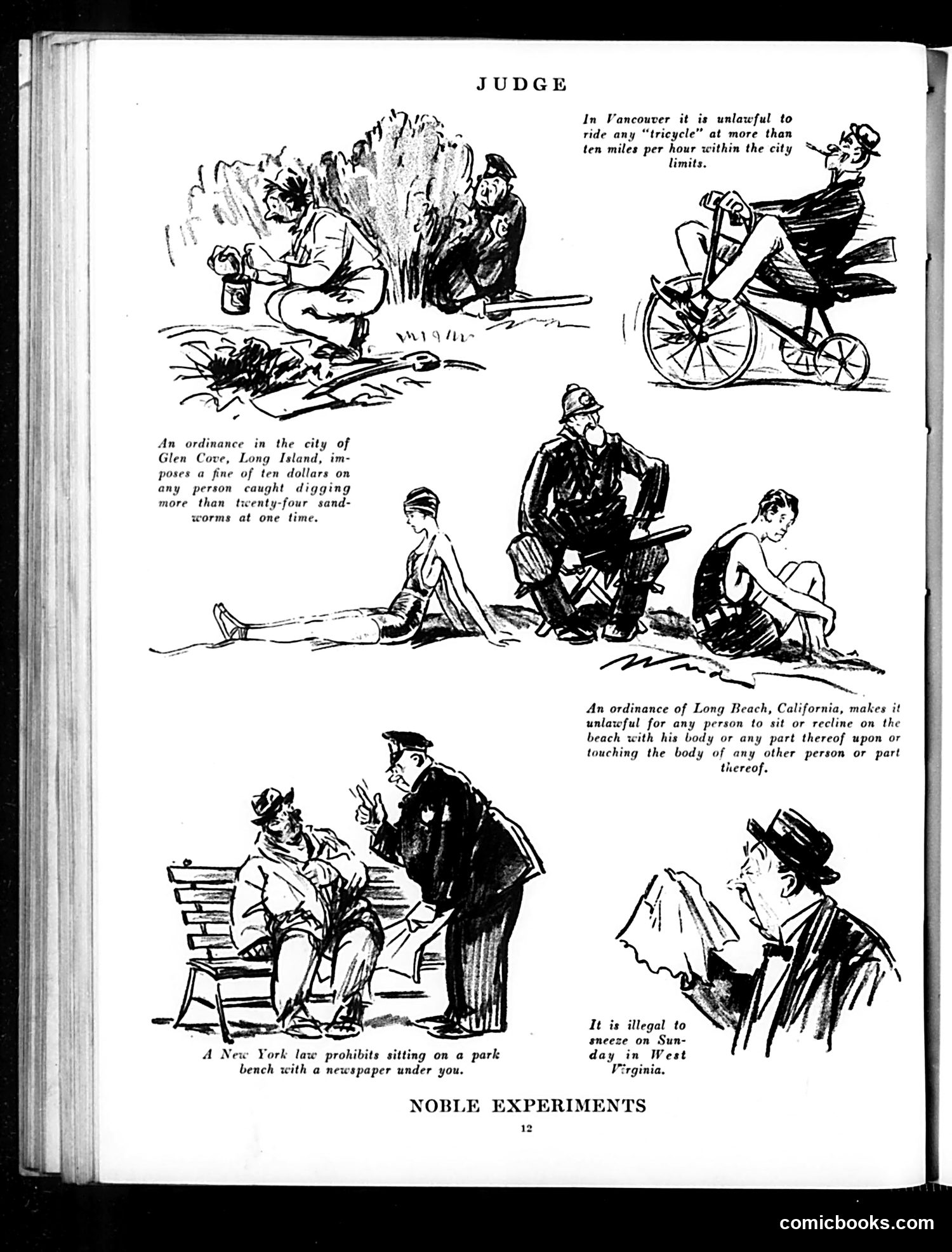
"Judge" Page: "Noble Experiments" This page satirizes absurd local ordinances across North America. Each illustration pairs with a ridiculous law, mocking legislative overreach and the unintended consequences of over-regulation. The jokes target specific real (or plausibly real) municipal laws: - Glen Cove, Long Island: limiting sandworm collection - New York: prohibiting newspapers under park benches (likely targeting homeless people or vagrants) - Vancouver: speed limits on tricycles - Long Beach: banning physical contact on beaches - West Virginia: criminalizing sneezing on Sundays The cartoons show people attempting to follow these laws absurdly—a man on a tricycle going comically slow, people awkwardly avoiding touching on a beach, a man suppressing a sneeze. The satire mocks both petty municipal legislators and the era's enthusiasm for regulating everyday behavior through law. The title "Noble Experiments" likely references prohibition-era rhetoric about social engineering through legislation, suggesting these laws are similarly misguided.
"Judge" Magazine Page Analysis This page from *Judge* (a satirical magazine) contains two separate editorial pieces: "Middle of the Road" discusses liberalism's precarious position. The author, citing Nicholas Murray Butler's recent address, argues that genuine liberals occupy an exposed, vulnerable stance—attacked from both communist and conservative extremes. The piece defends liberalism as distinct from both rigid communism and capitalism, suggesting it represents freedom under democratic principles. It laments liberalism's recent decline since Woodrow Wilson and calls for new leadership, possibly hinting at figures like Dwight Morrow. "No Law Can Touch Him" presents a legal anecdote: a father, appointed guardian of his disabled daughter after a car accident, exploits her insurance settlement. When a chiropractor offers free treatment that might cure her (thus ending his financial support), the father intimidates his wife into stopping her treatments. The satire criticizes legal gaps allowing guardians to profit from dependents' misfortune while facing no prosecution—highlighting how wealth and legal position enable exploitation. Both pieces reflect early-20th-century concerns about power, justice, and ideological positioning.
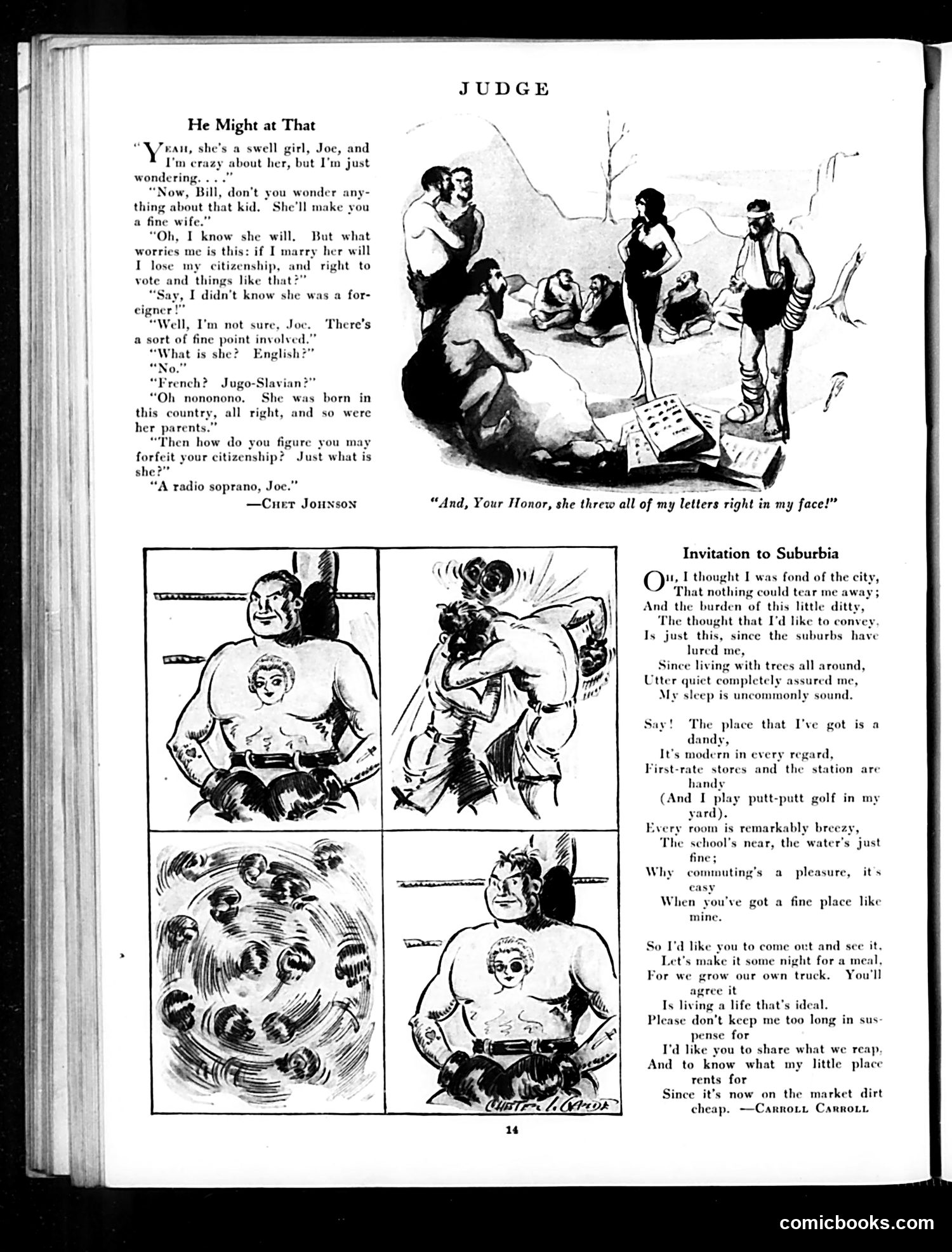
"He Might at That" - The Satire The cartoon mocks 1920s anxieties about women's newfound independence and voting rights. A man worries that marrying a woman will cost him his citizenship and voting privileges—a genuine legal concern when women could gain citizenship through marriage to foreigners. The joke's punch line: the real threat isn't her foreign origin but her career as a "radio soprano"—a modern, independent working woman. The satire suggests that men feared women's economic independence and public visibility (radio was cutting-edge technology) more than any legal technicality. The woman's professional success and autonomy, not her nationality, represented the actual loss of male civic dominance that worried men of this era. The humor targets male anxiety about changing gender roles during the women's suffrage period.
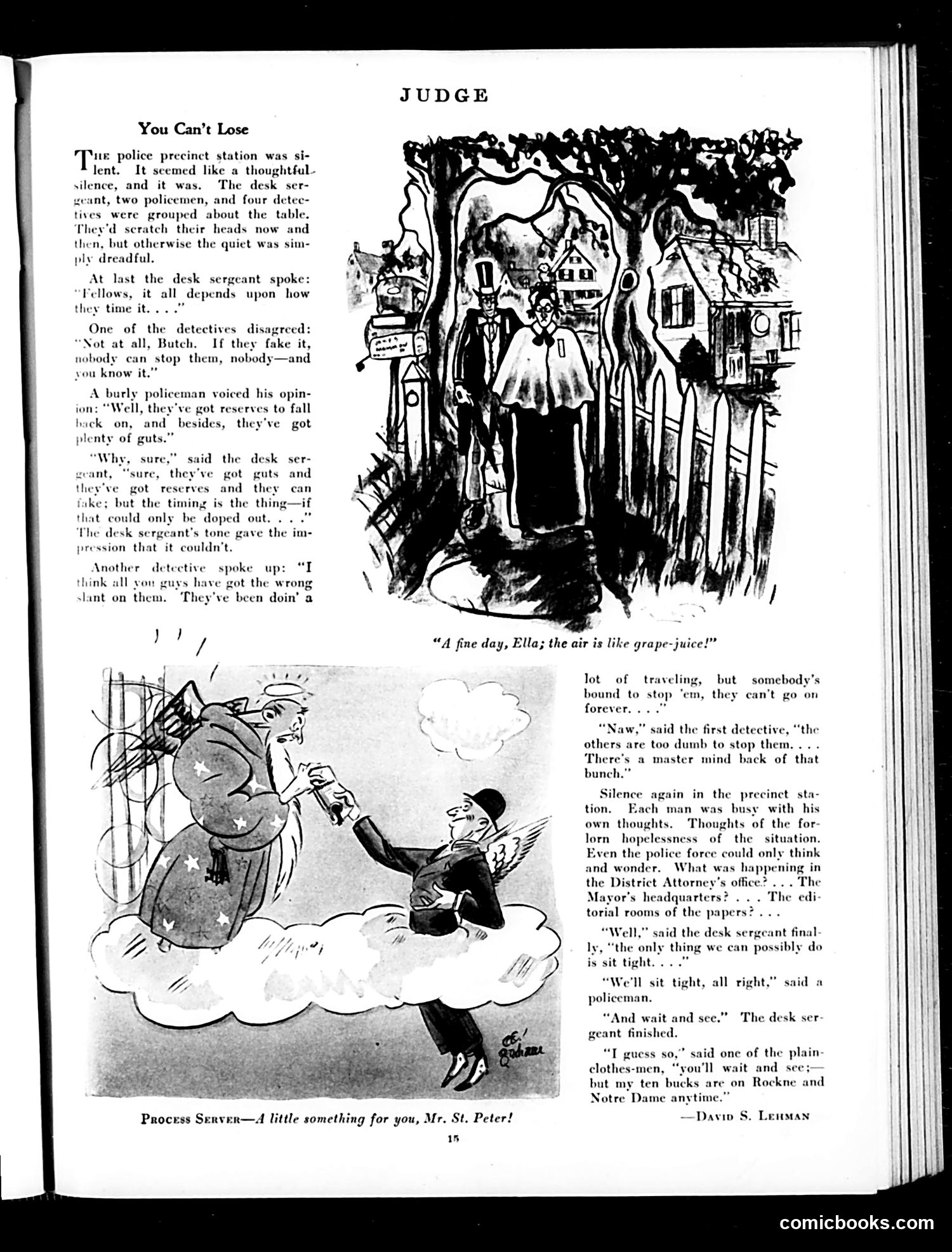
Analysis of Judge Magazine Page This page contains a short story titled "You Can't Lose" by David S. Lehman about police detectives discussing a seemingly inevitable criminal operation they cannot stop. The officers conclude their only option is to "sit tight and wait." The accompanying cartoons are unrelated political satire: Upper cartoon: Depicts a bride and groom under a tree with the caption "A fine day, Ella; the air is like grape-juice!"—likely mocking sentimentality or perhaps Prohibition-era slang. Lower cartoon: Titled "Process Server—A little something for you, Mr. St. Peter!" shows a small figure handing something to a large personification of St. Peter at the gates of heaven—a dark joke about serving legal papers to someone who has died. The page reflects Judge's typical mix of short fiction and satirical humor targeting social conventions and legal absurdities, though without publication date or broader context, specific political references remain unclear.
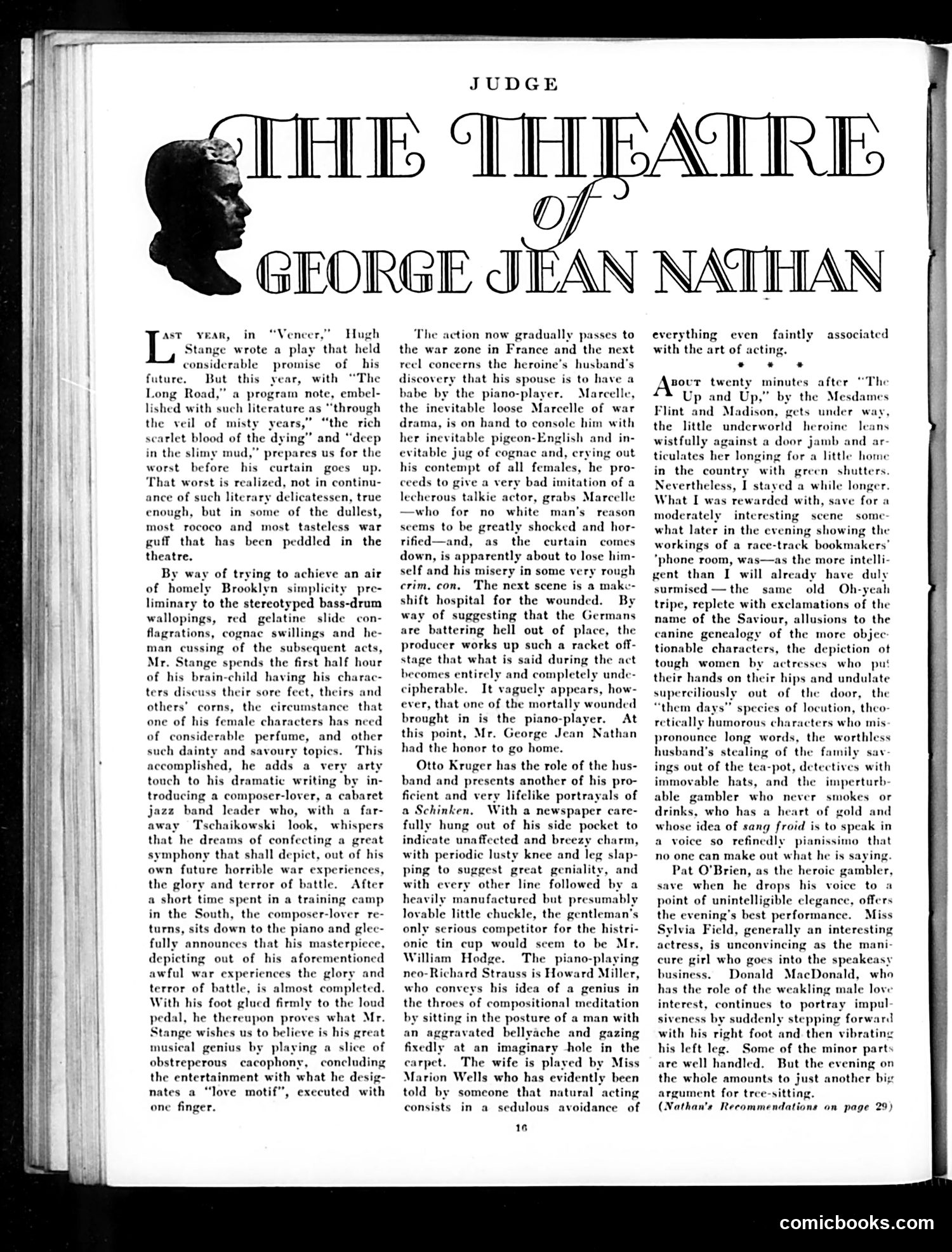
"The Theatre of George Jean Nathan" - Judge Review This page is a theater review by prominent critic George Jean Nathan, not a political cartoon. It critiques playwright Hugh Stange's new play "The Long Road," a World War I drama. Nathan mocks the production for combining crude sentimentality (characters discussing corns and perfume) with overwrought war melodrama. He ridicules the composer-protagonist, who claims to have written a great symphony about battle but merely produces "obstreperous cacophony" at the piano. The plot—involving infidelity, a pianist fathering the heroine's child, and a "loose Marcelle" consoling characters with cognac—exemplifies Nathan's view of hackneyed war-play clichés. He praises actor Otto Kruger's performance while finding the overall production tedious and tasteless. This represents early 20th-century theatrical criticism during the WWI era, when antiwar sentiments clashed with propagandistic entertainment.
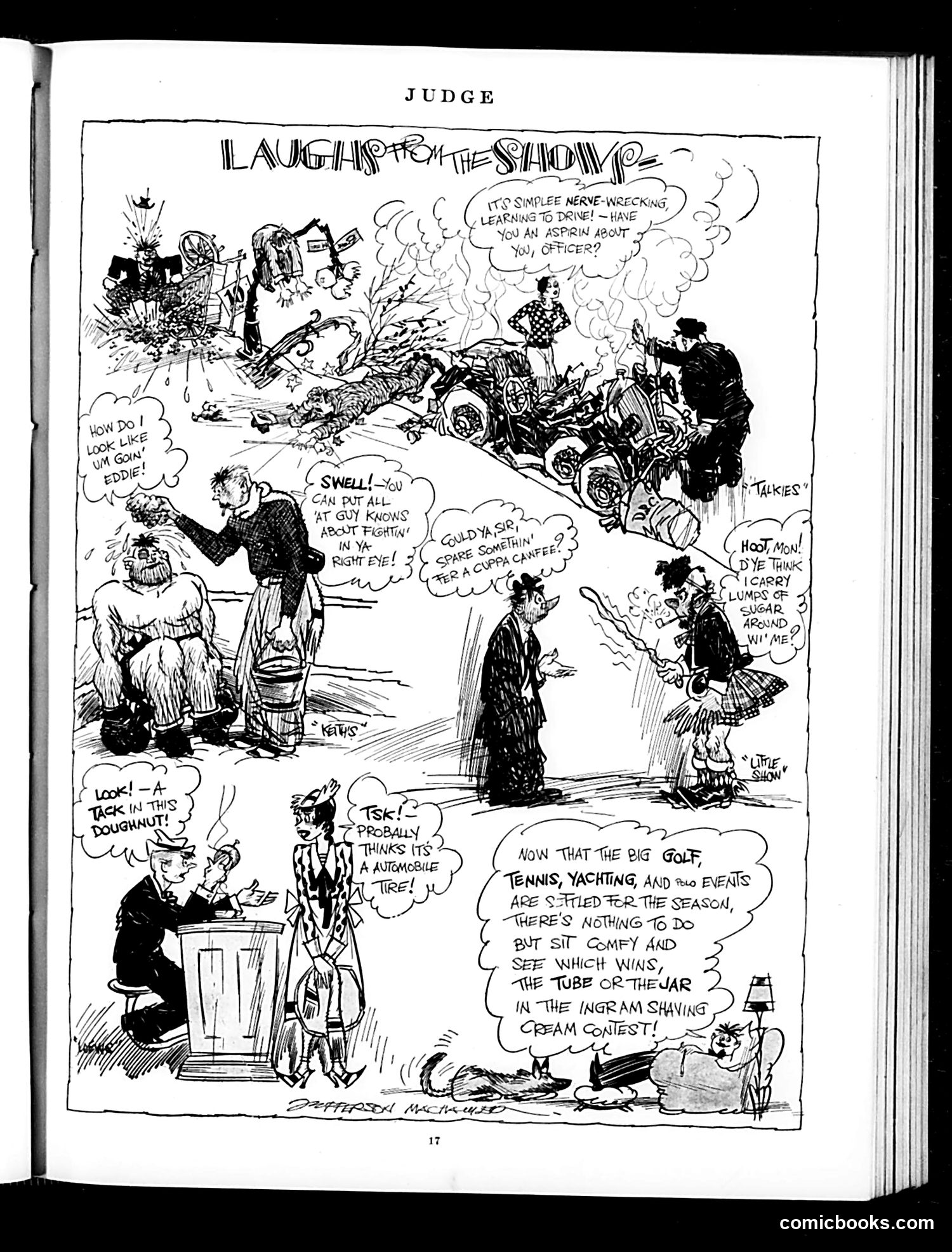
"Laughs at the Saddle" - Judge Magazine Cartoon This satirical cartoon depicts wealthy leisure activities during what appears to be wartime rationing (likely WWI era, given references to aspirin shortages and rationing). The central joke mocks the idle rich: with golf, tennis, and yachting suspended for the season due to wartime restrictions, the wealthy elite are reduced to sitting comfortably and watching trivial contests—specifically an "ingram shaving cream contest"—for entertainment. The various vignettes show upper-class characters engaging in silly pastimes: a doughnut-eating contest, automobile speculation, and other frivolous pursuits. The satire targets how the privileged classes, accustomed to elaborate recreations, must settle for mundane amusements when their usual luxury activities become unavailable. The overall message criticizes both wartime sacrifice's unequal burden and the shallow pursuits of the wealthy.
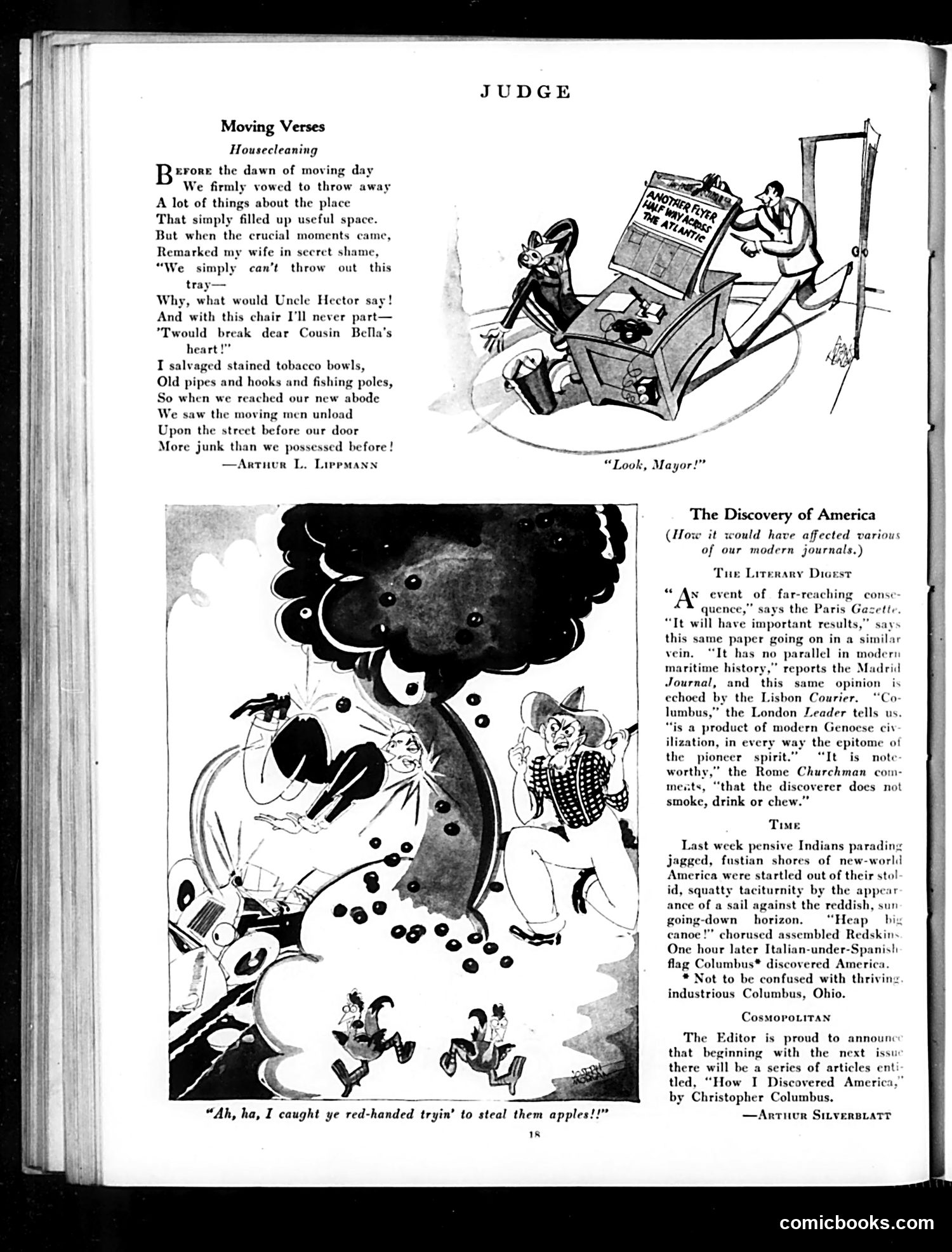
Analysis of Judge Magazine Page "Moving Verses" (top): A humorous poem by Arthur L. Lippmann satirizes moving day, where a couple vows to discard household junk but cannot part with sentimental items ("Uncle Hector's tray," "Cousin Bella's chair"). The irony: they end up with *more* junk at their new home. The accompanying cartoon shows movers overwhelmed by accumulated possessions, with the caption "Look, Mayor!"—suggesting the absurdity is noteworthy. "The Discovery of America" (bottom): This satirizes how contemporary magazines would cover Columbus's discovery by imagining their sensational responses. It mocks: - The *Literary Digest*'s breathless commentary - *Time* magazine's folksy "pensive Indians" and ethnic stereotyping - *Cosmopolitan*'s self-promotional celebrity angle (serialized memoirs) The large cartoon depicts a caricatured figure (appears to represent Native Americans or colonial-era stereotypes) surrounded by European explorers, capturing the colonial perspective. The joke critiques modern journalism's predictable, competitive, and often superficial coverage of major historical events.
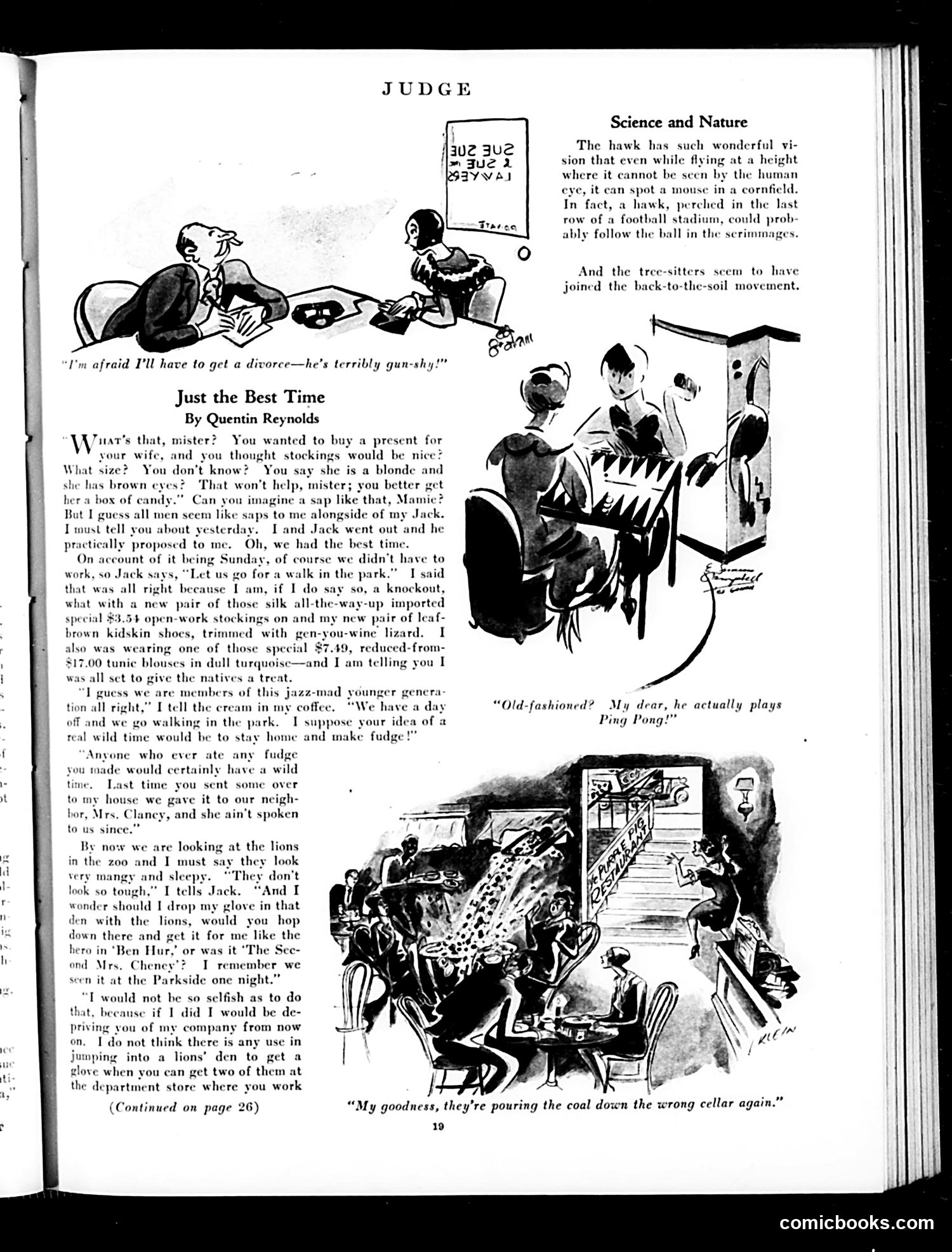
Analysis for Modern Readers This Judge magazine page contains two satirical pieces reflecting 1920s social attitudes: Top cartoon: A husband fears divorce because his wife considers him "gun-shy"—meaning timid or reluctant. The joke plays on masculine anxiety about appearing insufficiently bold or adventurous to one's spouse. "Just the Best Time" story: A working-class narrator describes a Sunday outing with her husband Jack, emphasizing her fashionable purchases (expensive stockings, shoes, turquoise blouse) and modest entertainment (zoo visit, fudge-making). The satire mocks both the narrator's materialistic boasting and the era's "back-to-nature" movement—Jack's interest in Ping Pong represents the shallow modernism the piece ridicules. The bottom cartoon depicts coal delivery mishaps, unrelated to the main story. The overall tone reflects Judge's typical stance: gently mocking working and middle-class aspirations while celebrating consumer culture and traditional gender roles.
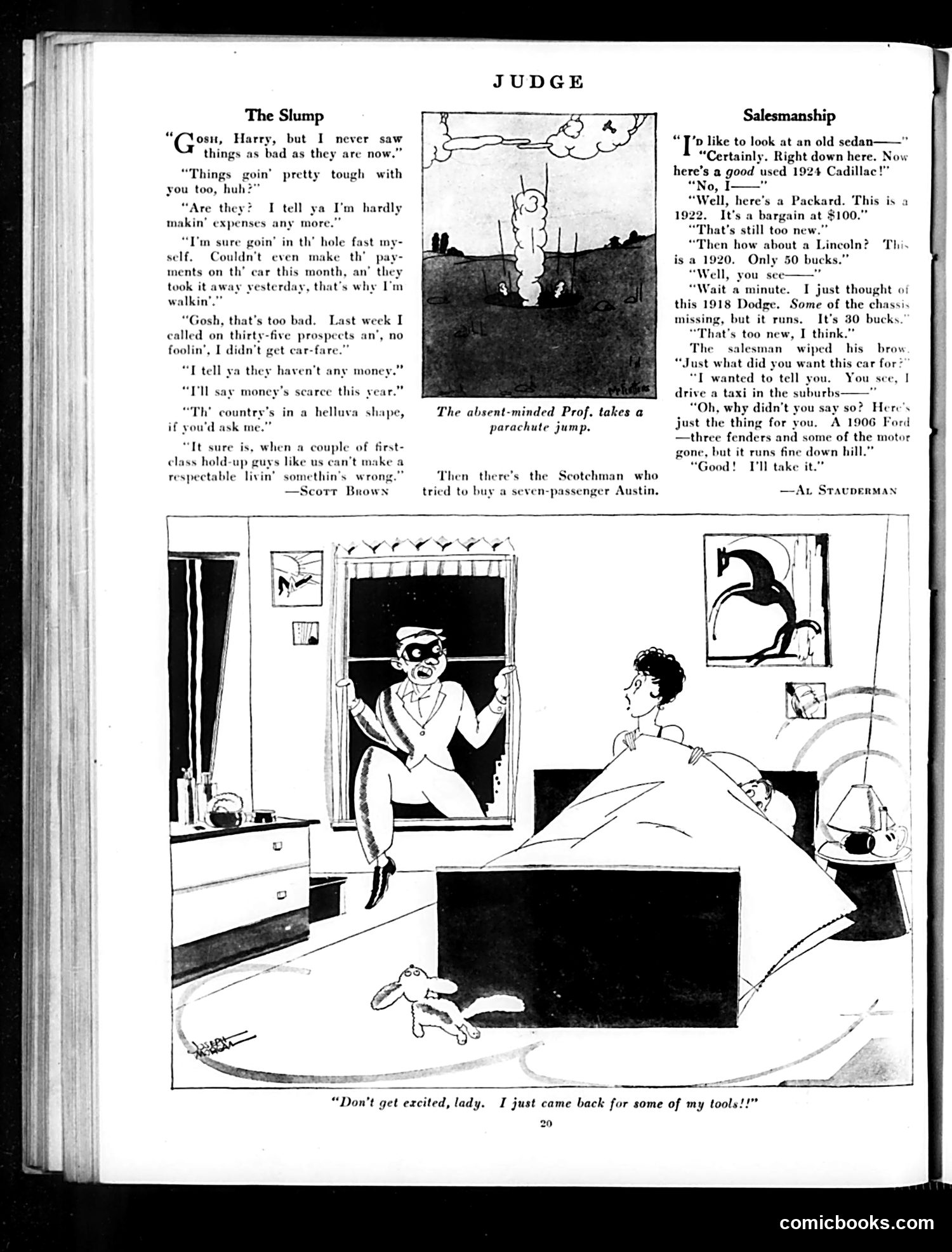
Judge Magazine Page Analysis This page contains two satirical pieces reflecting 1920s economic hardship: "The Slump" (left): Two unemployed salesmen commiserate about the economic downturn—unable to make car payments, collect prospects, or earn respectable living. Their complaint that "the country's in a helluva shape" references the post-WWI recession of the early 1920s, when sales jobs and consumer spending collapsed. The satire mocks how even "first-class hold-up guys" (salesmen using aggressive tactics) couldn't survive financially. "Salesmanship" (right): A used-car salesman attempts to sell increasingly decrepit vehicles to a penny-pinching customer. The absurdist humor escalates from a "good used 1924 Cadillac" to a 1906 Ford with missing parts that "runs fine down hill"—yet the customer accepts it. This satirizes both aggressive Depression-era sales tactics and consumer desperation. The bottom cartoon shows a burglar entering a bedroom, claiming he "just came back for some of my tools"—a simple domestic theft gag unrelated to economic themes. All three pieces reflect 1920s financial anxiety and commercial sharp practices.
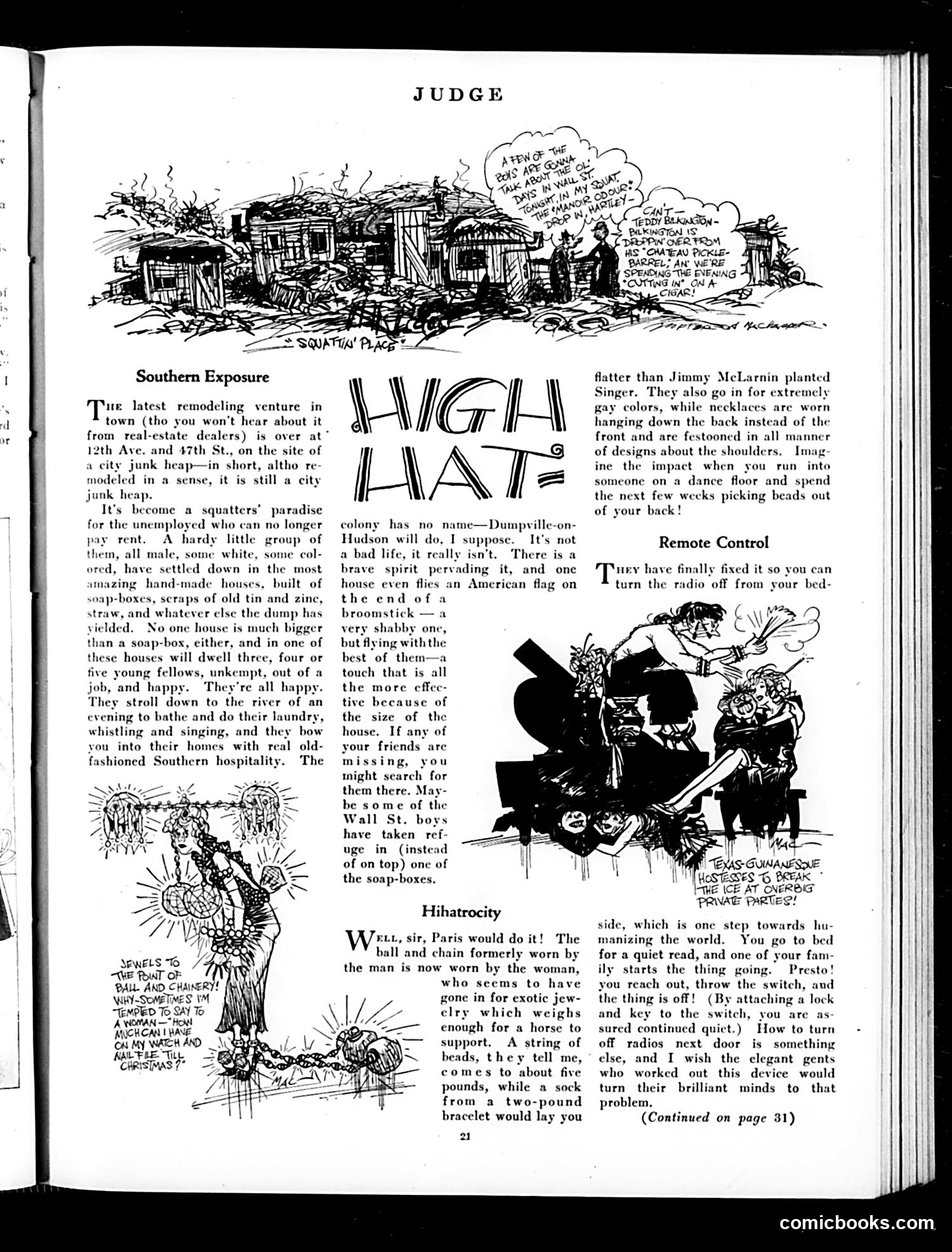
Judge Magazine Page Analysis This page contains three satirical pieces reflecting Depression-era anxieties: "Southern Exposure" mocks a shantytown ("Dumpville-on-Hudson") built from scrap materials at 12th Ave. and 47th St., where unemployed men live in soap-box houses. The satire is dark: despite poverty, residents maintain dignity and "Southern hospitality." The American flag on a broomstick is both pathetic and oddly heroic—suggesting resilience amid economic collapse. The veiled reference to "Wall St. boys" hints that stock-market crash victims may have ended up here. "Hihatrocity" criticizes Parisian women's fashion trends: extremely heavy exotic jewelry (five-pound beads, two-pound bracelets) and garish colors. The joke suggests women now bear burdens formerly imposed on men, inverting traditional gender roles through absurd excess. "Remote Control" celebrates a practical innovation: radio switches operable from bed. The humor lies in acknowledging a minor modern convenience while sardonically noting it doesn't solve the larger problem of neighbors' radios. All three pieces reflect 1920s-30s American concerns: unemployment, changing gender roles, and consumer technology.
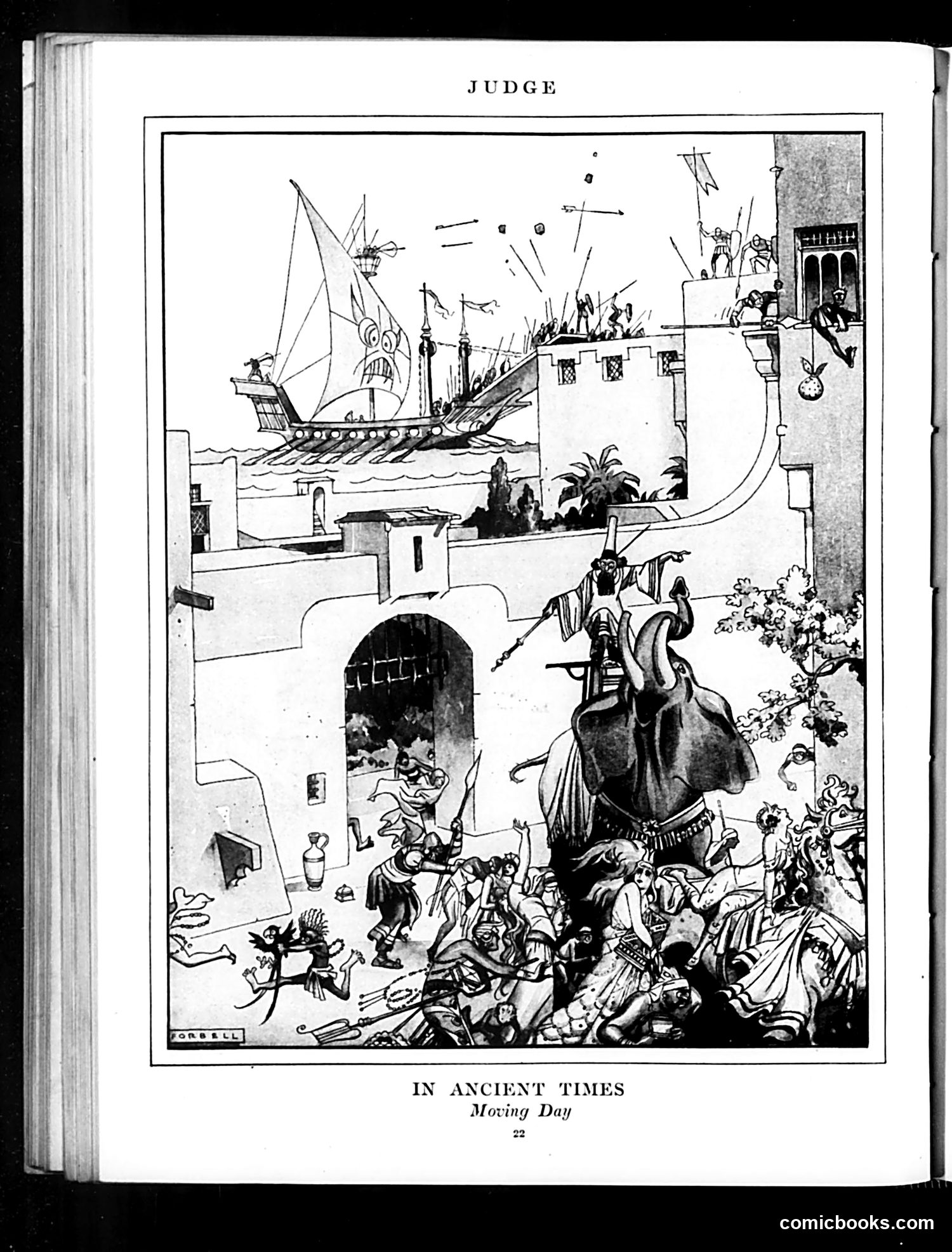
Analysis This is a satirical cartoon titled "Moving Day in Ancient Times." The image depicts a chaotic scene at what appears to be an ancient fortified city or port, with a large elephant prominently featured in the foreground surrounded by bustling crowds of people and belongings. The satire seems to lampoon the chaos and upheaval of moving day—a relatable experience for contemporary readers—by transplanting it to an ancient setting. The elephant, laden with goods, represents the massive undertaking of transporting possessions. The crowded, disorganized scene with scattered items and masses of people emphasizes the humor: moving day's pandemonium is apparently timeless, occurring even in ancient civilizations. The artist (signed "Forsell") uses this anachronistic juxtaposition to mock the universal human experience of relocation and its attendant disorder, suggesting that modern moving-day stress has ancient precedent.
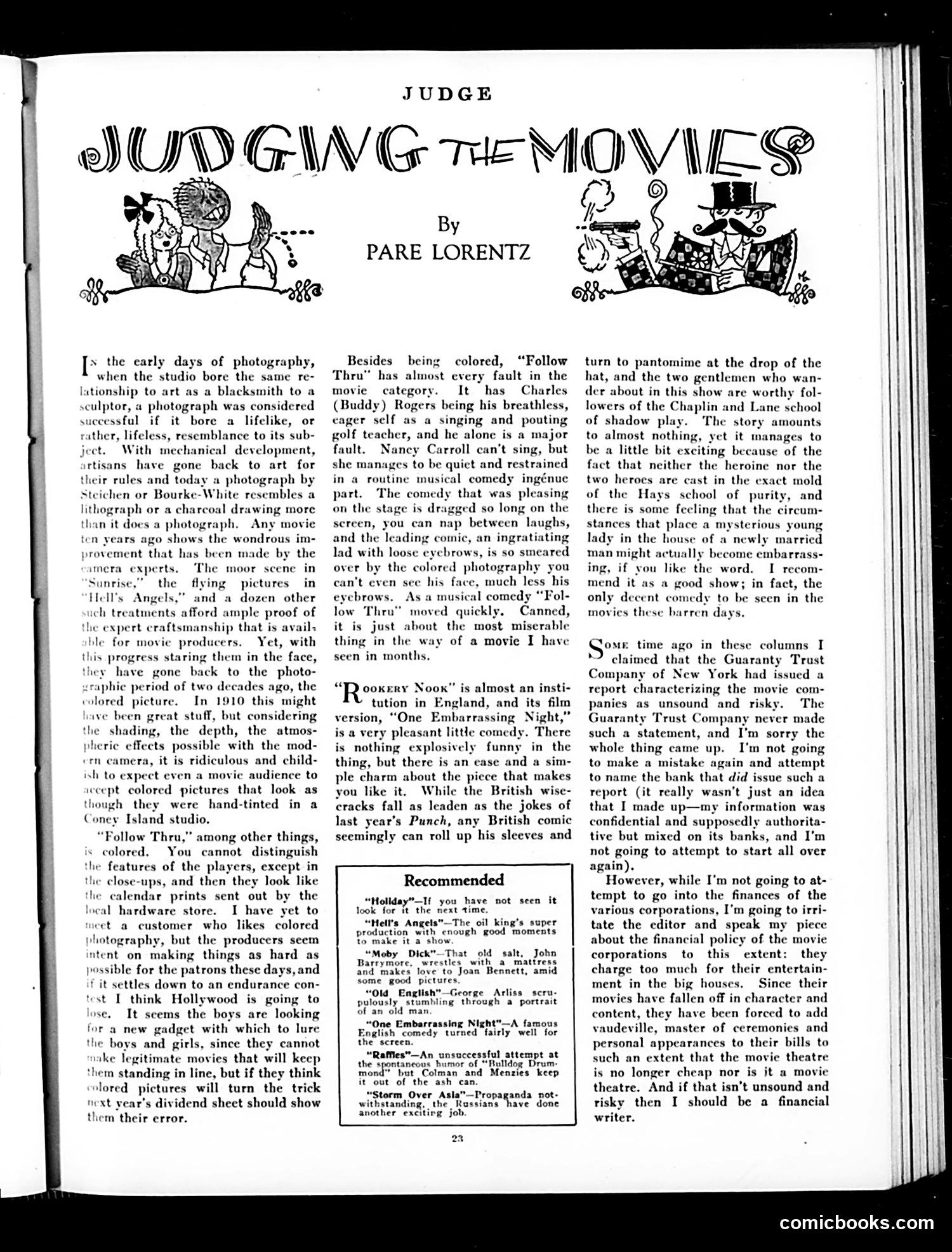
Judge Magazine Film Criticism: "Judging the Movies" by Pare Lorentz This is a film review column criticizing early sound-era Hollywood movies (circa 1930). The main satirical target is the film industry's adoption of color photography, which Lorentz argues looks cheap and artificial—like "hand-tinted" carnival pictures rather than serious cinema. He specifically attacks "Follow Thru" for both its garish Technicolor and weak performances (particularly actor Charles "Buddy" Rogers). The broader point: Hollywood is moving *backward* technologically, abandoning the sophisticated cinematography developed in silent films like "Sunrise" and "Hell's Angels," reverting instead to gimmicky, poorly-executed colored film that audiences dislike. The "Recommended" box suggests Lorentz preferred character-driven films with genuine artistry over technical gimmickry—a common film-critic position in the early sound era's transition period.
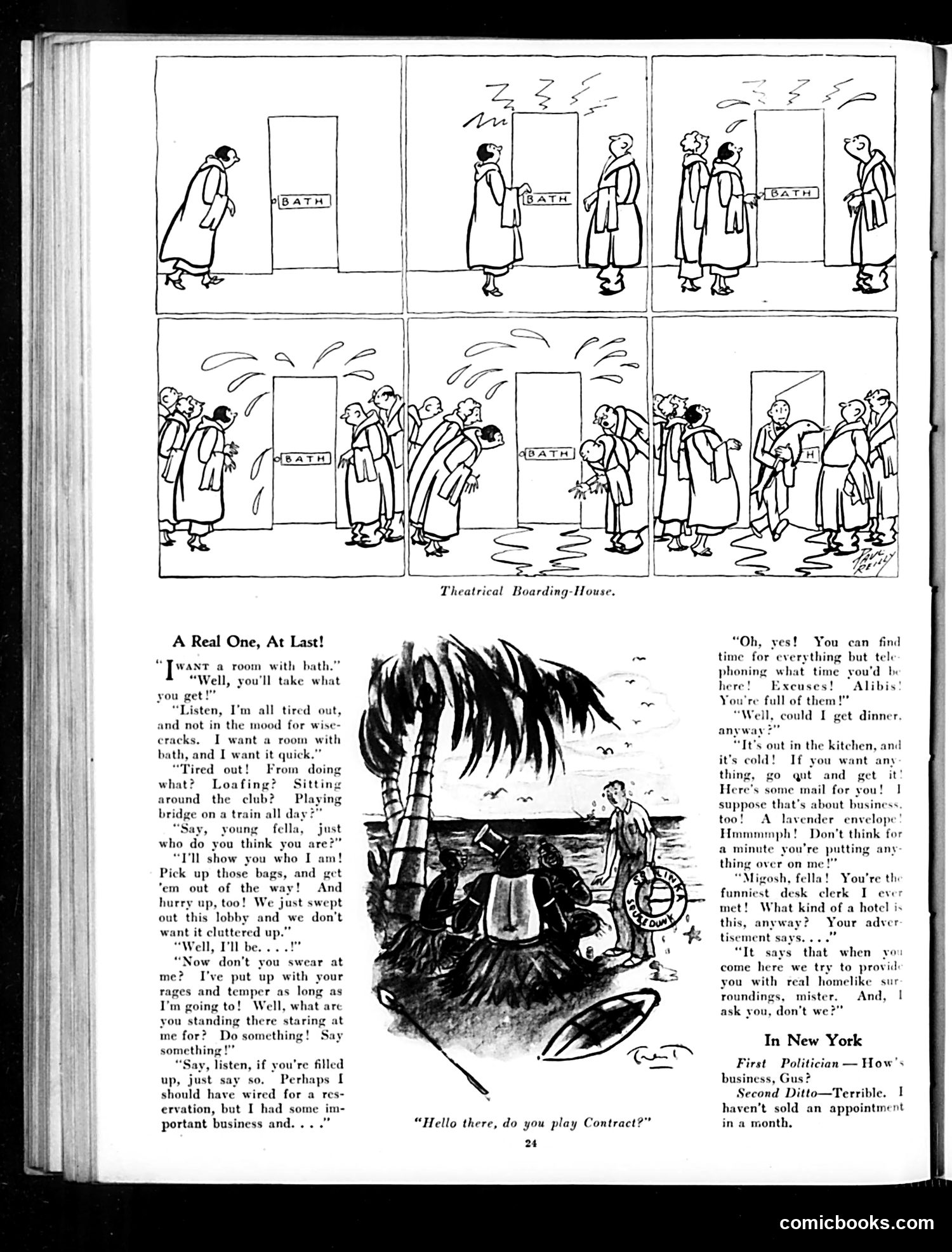
"Theatrical Boarding-House" Comic Strip The top comic depicts the absurd reality of theatrical boarding houses versus their advertising. A prospective guest arrives seeking a room with bath—a basic amenity—but encounters increasingly hostile, dismissive staff who mock his needs, berate him for minor infractions, and finally claim to provide "real homelike surroundings" while demonstrating none. The satire targets the gap between hotel advertisements promising comfort and actual conditions. The staff's rudeness, the cold dinner, the intrusive landlady opening his mail—all contradict the "homelike" promise. The small joke at bottom about New York politicians unable to sell "appointments" likely references political patronage jobs, suggesting even corrupt schemes are failing in difficult economic times. The overall message: theatrical boarding houses (common lodging for performers) were notorious for poor service despite marketing claims—a common consumer complaint this satire mocks sharply.
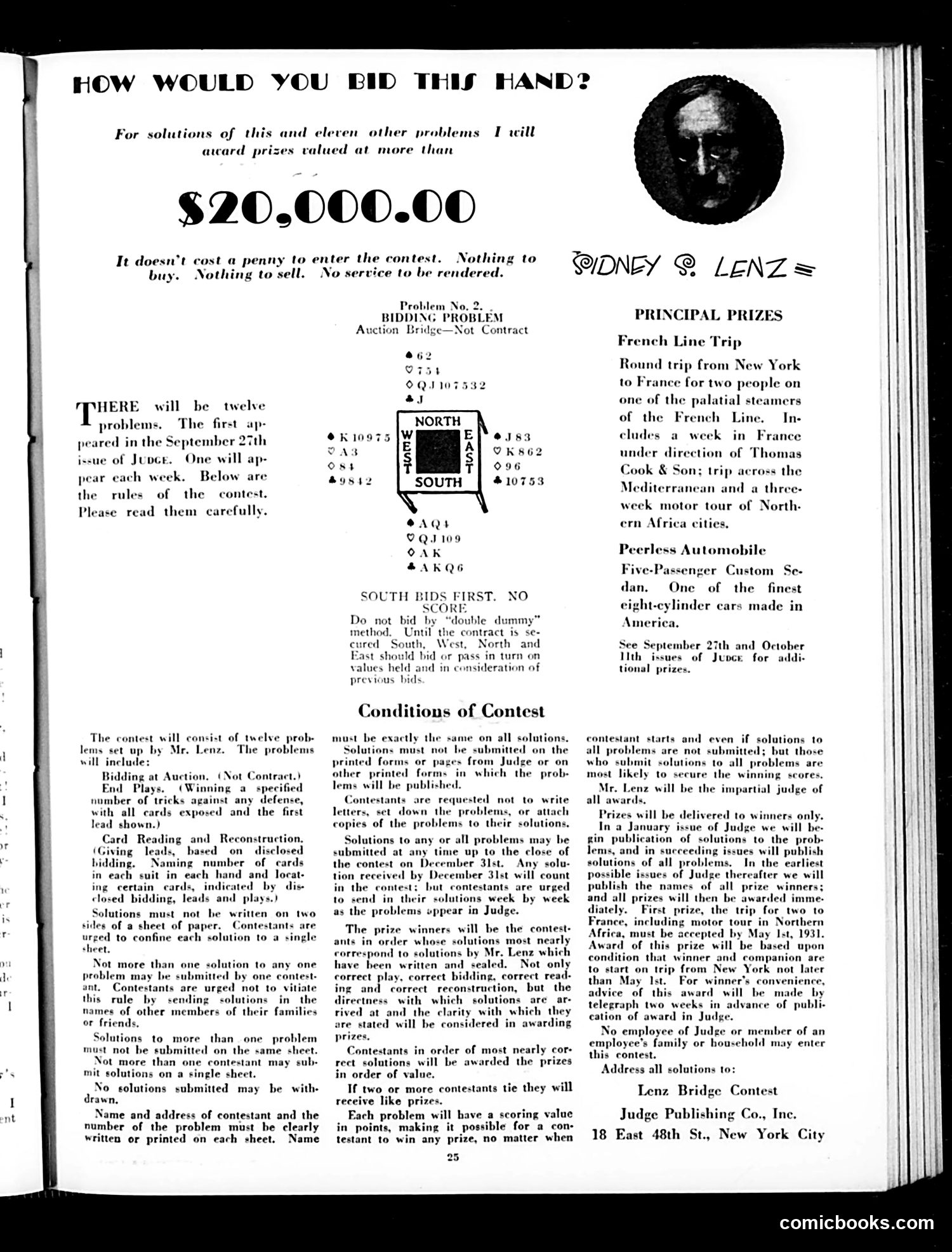
Judge Magazine Bridge Contest Explanation This page announces a bridge card game competition sponsored by Judge magazine, offering over $20,000 in prizes. The contest targets serious bridge players, particularly those interested in "Auction Bridge" (a precursor to modern contract bridge). The judge is Sidney Lenz, a famous bridge player whose photograph appears at top right. Lenz will evaluate solutions based not just on correctness but on reasoning and clarity. The contest presents twelve bidding and card-play problems appearing weekly in Judge. Participants submit solutions attempting to match Lenz's sealed answers. Top prizes include a French ocean liner trip and a Peerless automobile. This reflects bridge's early-20th-century status as an intellectual pastime among affluent Americans. By sponsoring such a contest, Judge positioned itself as a magazine for educated readers who enjoyed strategic card games and valued mental competition—typical of the magazine's upscale audience.
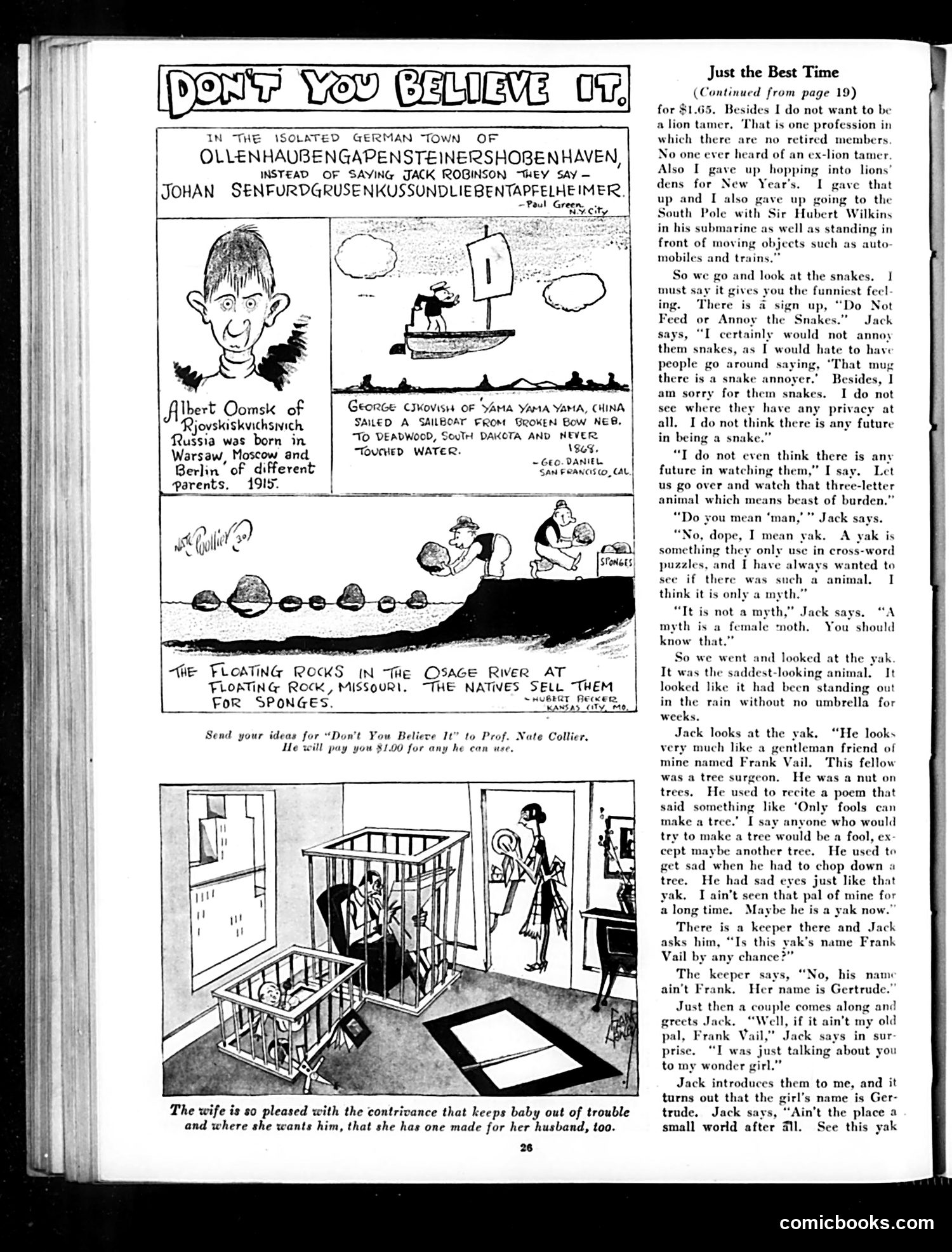
"Don't You Believe It" - Judge Magazine Satire This page features Judge's recurring humor column where readers submit unlikely-but-true facts. The top section mocks impossibly long German names (a common ethnic stereotype of the era) by contrasting them with the simple "Jack Robinson" phrase. The cartoons illustrate absurd true stories: a man sailing a boat from Nebraska to South Dakota and touching water; floating rocks in the Osage River sold as sponges by Native Americans. These underscore the column's premise—reality can be stranger than fiction. The main narrative (right column) depicts Jack encountering a yak at what appears to be a zoo, which he mistakes for his old friend Frank Vail, a melancholy tree surgeon. A coincidental meeting with a couple where the woman is named Gertrude (like the yak's keeper) prompts Jack's closing observation about life's small-world coincidences. The humor relies on whimsy, mistaken identity, and the column's basic appeal: celebrating odd-but-verifiable facts over invented stories.
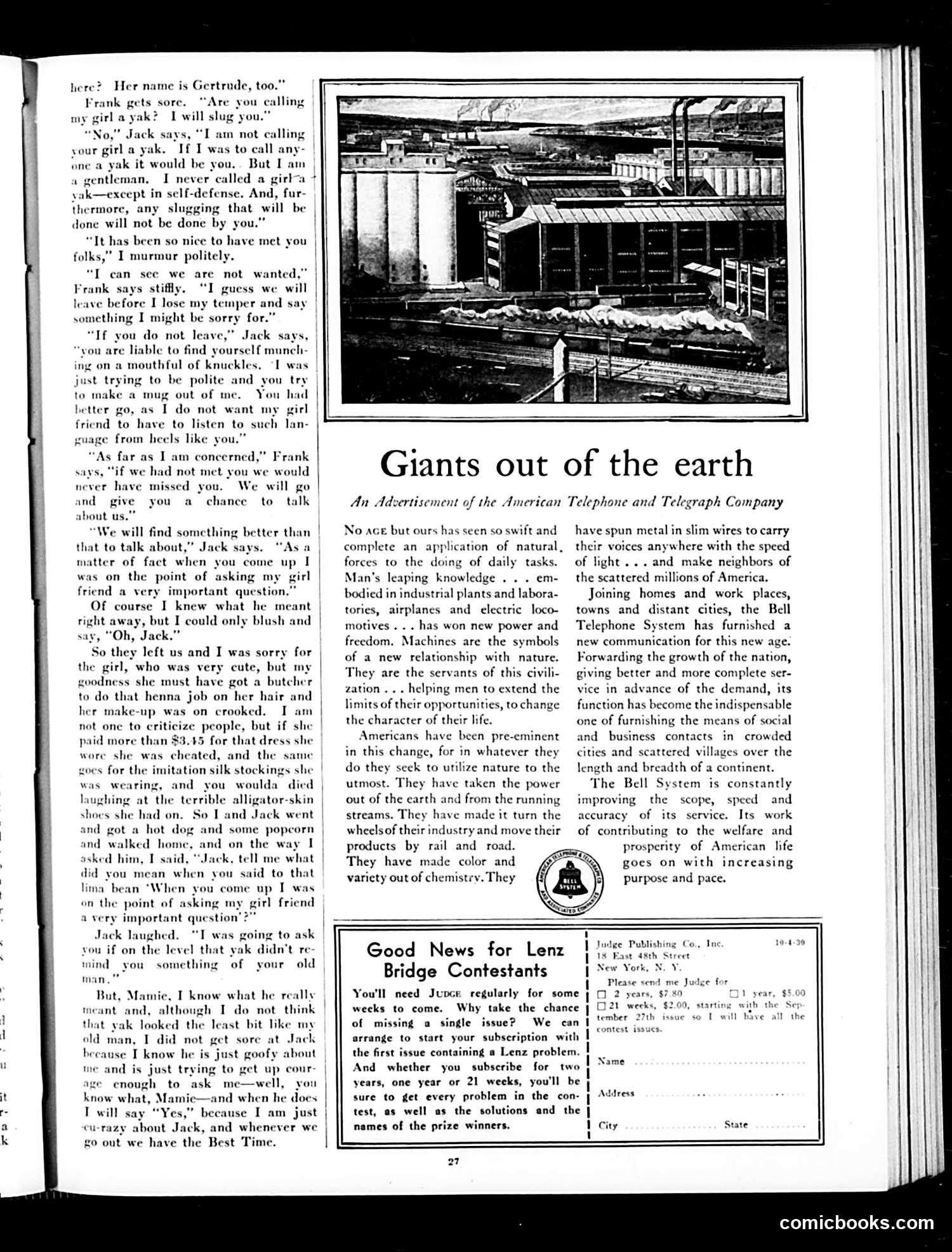
"Giants out of the Earth" This page contains a lengthy advertisement for the American Telephone and Telegraph Company (Bell System), not satirical content. The ad celebrates American industrial progress and technological advancement, presenting machinery and telecommunications as symbols of civilization's mastery over nature. It argues that Americans have uniquely harnessed natural forces—water power, electricity—and transformed them into industrial products transported by rail and road. The key claim: the Bell Telephone System represents this achievement by connecting "homes and work places, towns and distant cities," making "neighbors of the scattered millions of America." The preceding text on the left appears to be an unrelated short story about romantic tension between characters. This is fundamentally corporate propaganda disguised as progress narrative—typical of 1920s-30s advertising that framed capitalism and industrial expansion as natural human advancement.
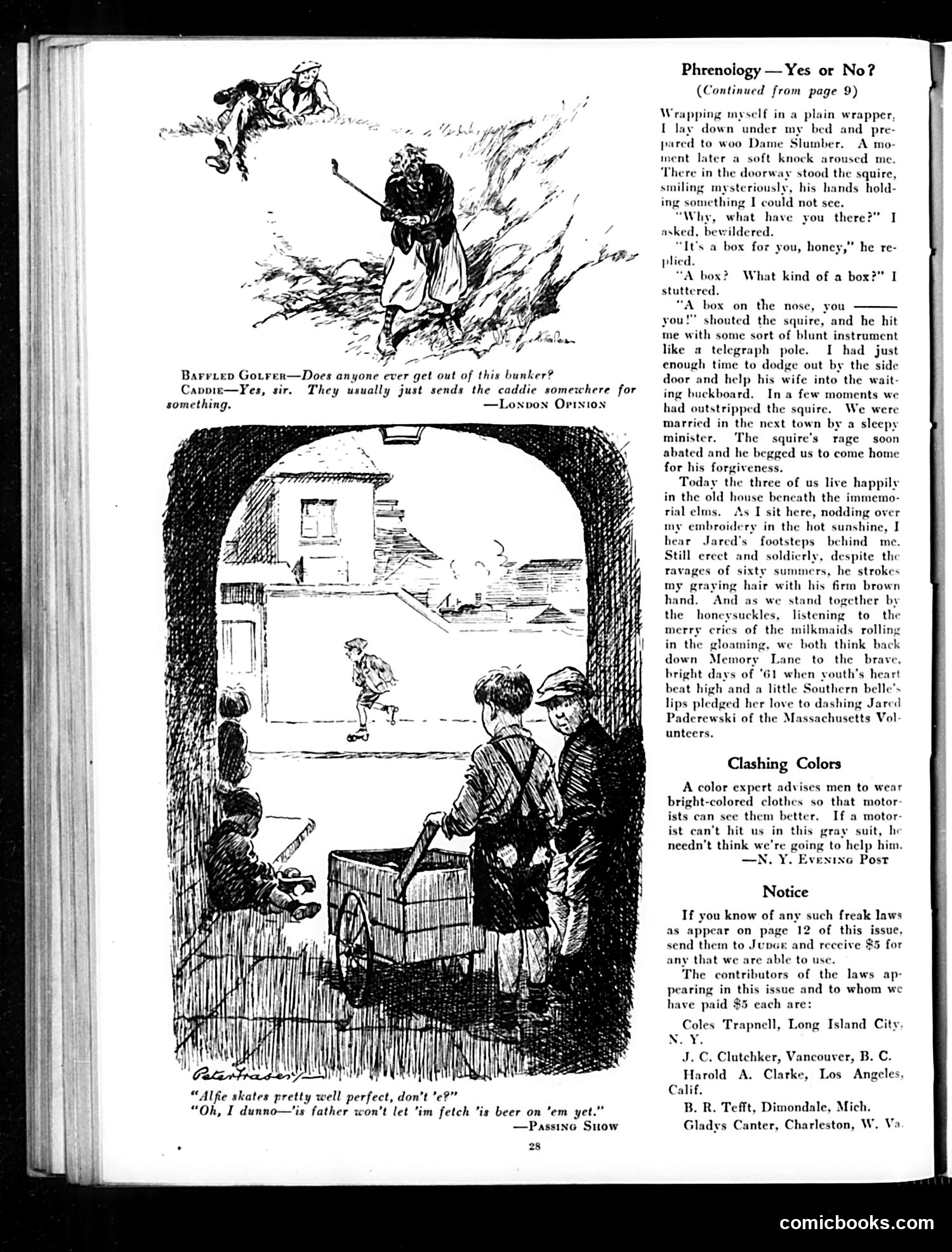
Judge Magazine Page Analysis This page contains three distinct satirical pieces: "Phrenology — Yes or No?" is a serialized romantic story mocking 19th-century pseudoscience. A woman recounts eloping with "Jared Paderewski of the Massachusetts Volunteers" after her father (the squire) literally hits her with a "box on the nose" — a pun on the phrenology premise that skull shape determines character. "Baffled Golfer" is a brief joke about golf bunkers, where caddies supposedly disappear to fetch things rather than help retrieve balls. "Clashing Colors" satirizes safety advice, arguing that if motorists can't see gray suits, they shouldn't expect help from bright clothing either. The page also includes a British street-scene cartoon about children skating and a contributor notices section. The humor relies on puns, exaggeration, and skepticism toward contemporary fads and expert advice — typical Judge magazine fare.
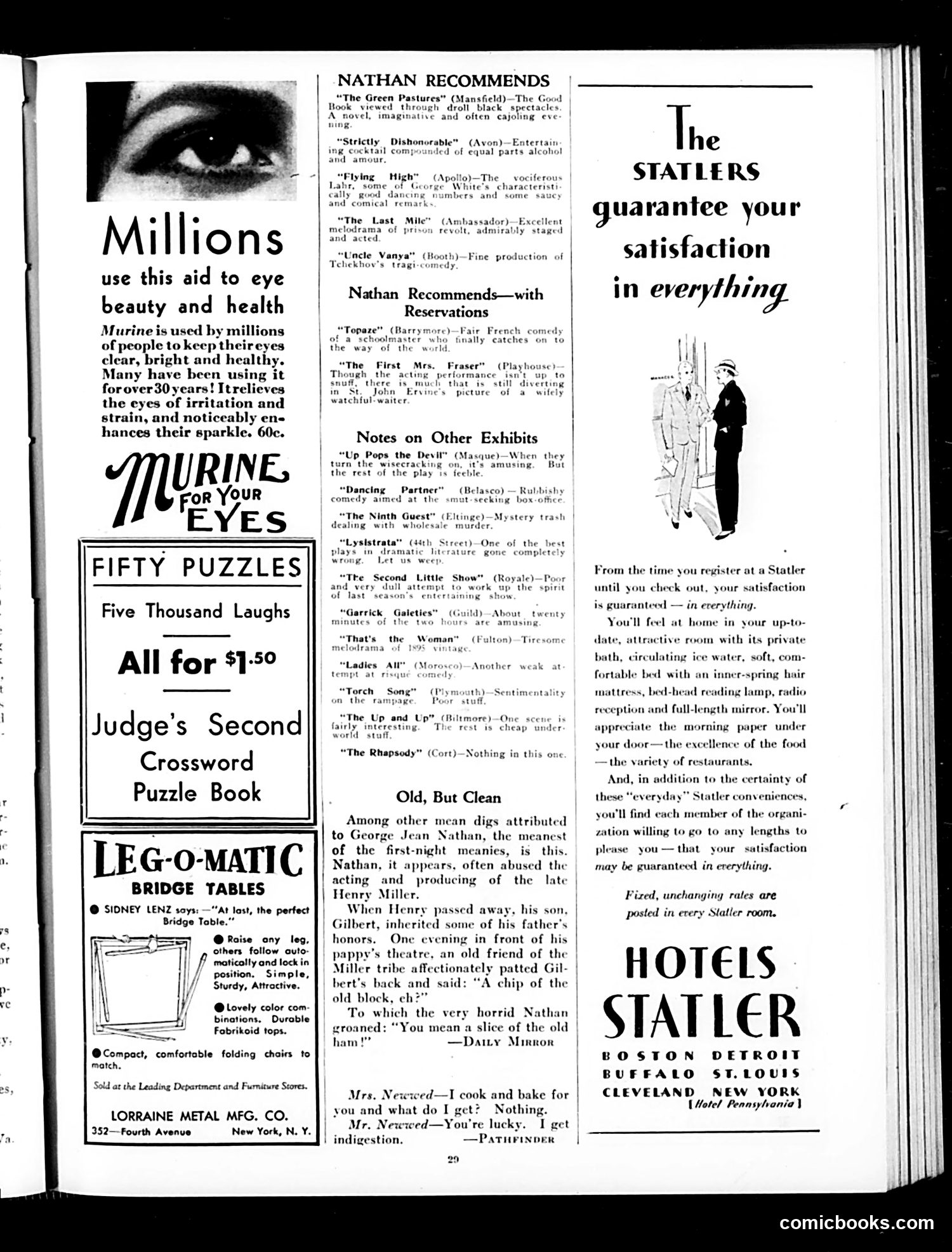
Judge Magazine Page Analysis This page is primarily advertising and entertainment reviews rather than political satire. The content includes: Main Elements: - Theater reviews by George Jean Nathan, a famous drama critic of the 1920s-30s, recommending and critiquing Broadway shows - Product advertisements (Murine eye drops, puzzle books, bridge tables, Statler Hotels) - A brief anecdote mocking Nathan himself: when Henry Miller (a theater figure) died, his son Gilbert inherited honors. At the theater one evening, a friend patted Gilbert's back calling him "a chip of the old block," prompting Nathan's caustic response that he was instead "a slice of the old ham"—a cruel joke about Gilbert lacking his father's merit - A generic joke about newlyweds The Satire: The single joke targets Nathan's reputation as a notoriously mean-spirited critic who abused actors and producers. The anecdote illustrates his caustic wit by showing him publicly insulting someone. This is mostly commercial content with one brief satirical jab at a recognizable public figure known for theatrical criticism.
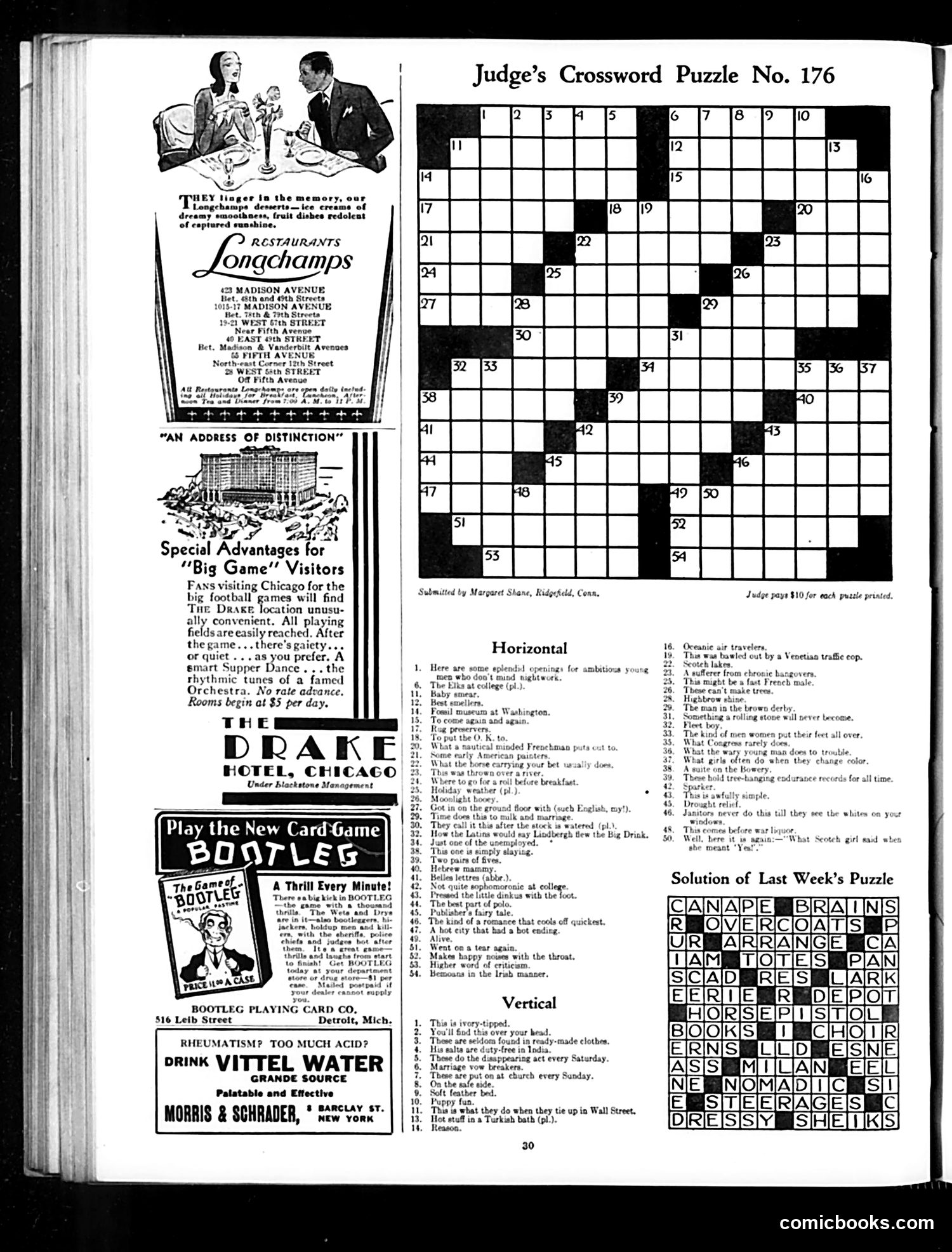
Judge Magazine Page Analysis This page is primarily advertising and a crossword puzzle, not a political cartoon. The upper left contains a restaurant advertisement for Longchamps and a hotel ad for The Drake in Chicago, promoting amenities for football game visitors. The main content is Judge's Crossword Puzzle No. 176, a standard word puzzle with horizontal and vertical clues. The clues reference contemporary 1920s-era topics: references to Lindbergh's transatlantic flight ("the Big Drink"), Prohibition-era slang ("bootleg"), and social customs of the period. Below the puzzle are additional period advertisements: for Bootleg playing cards, Vittel Water (marketed as a health remedy), and the card game Bootleg. The page includes the solution to the previous week's puzzle, showing completed entries like "CANAPE," "BRAINS," and "OVERCOATS." This represents typical Judge magazine content from the 1920s—a mix of humor, puzzles, and advertising rather than satirical commentary.
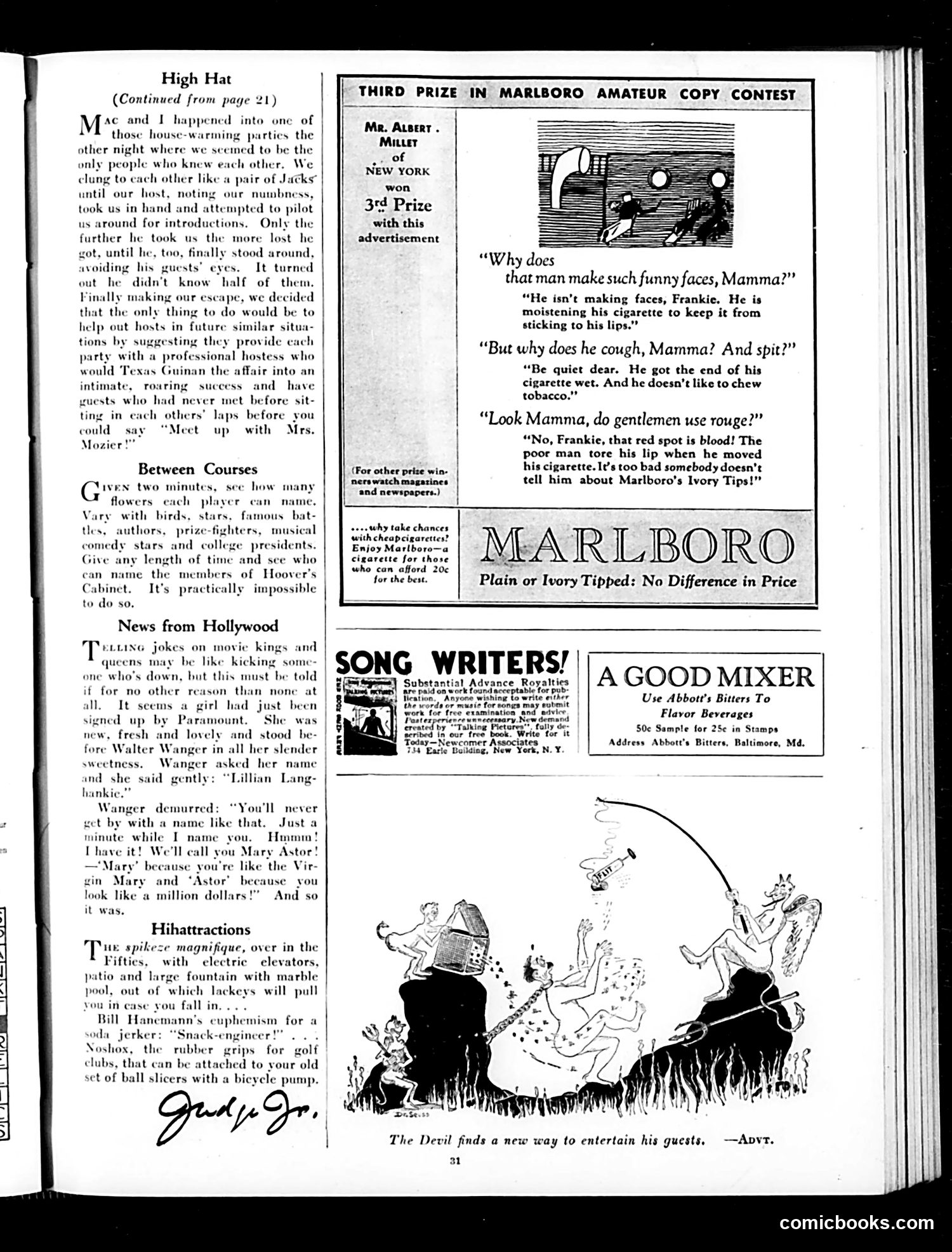
Analysis of Judge Magazine Page This page from Judge magazine contains several distinct sections: Main Content: Humorous anecdotes about social awkwardness at parties, Hollywood naming practices, and novelty gadgets. The writing satirizes upper-class social conventions and the pretensions of the entertainment industry. Advertisements: The dominant visual element is a Marlboro cigarette ad disguised as a comic strip. It depicts a mother explaining to her child "Frankie" why a man is making grotesque faces—attributing his lip-tearing, coughing, and apparent bleeding to moistened cigarettes without ivory tips. The ad's dark humor is intended to *ironically* demonstrate why Marlboro's "Ivory Tips" are superior by showing gruesome consequences of cheaper cigarettes. Additional ads: Include song-writing opportunities, Abbott's Bitters, and novelty golf grips. The page exemplifies 1920s-30s advertising's willingness to use crude scare tactics and graphic imagery to sell products—what modern readers would find shocking rather than persuasive.
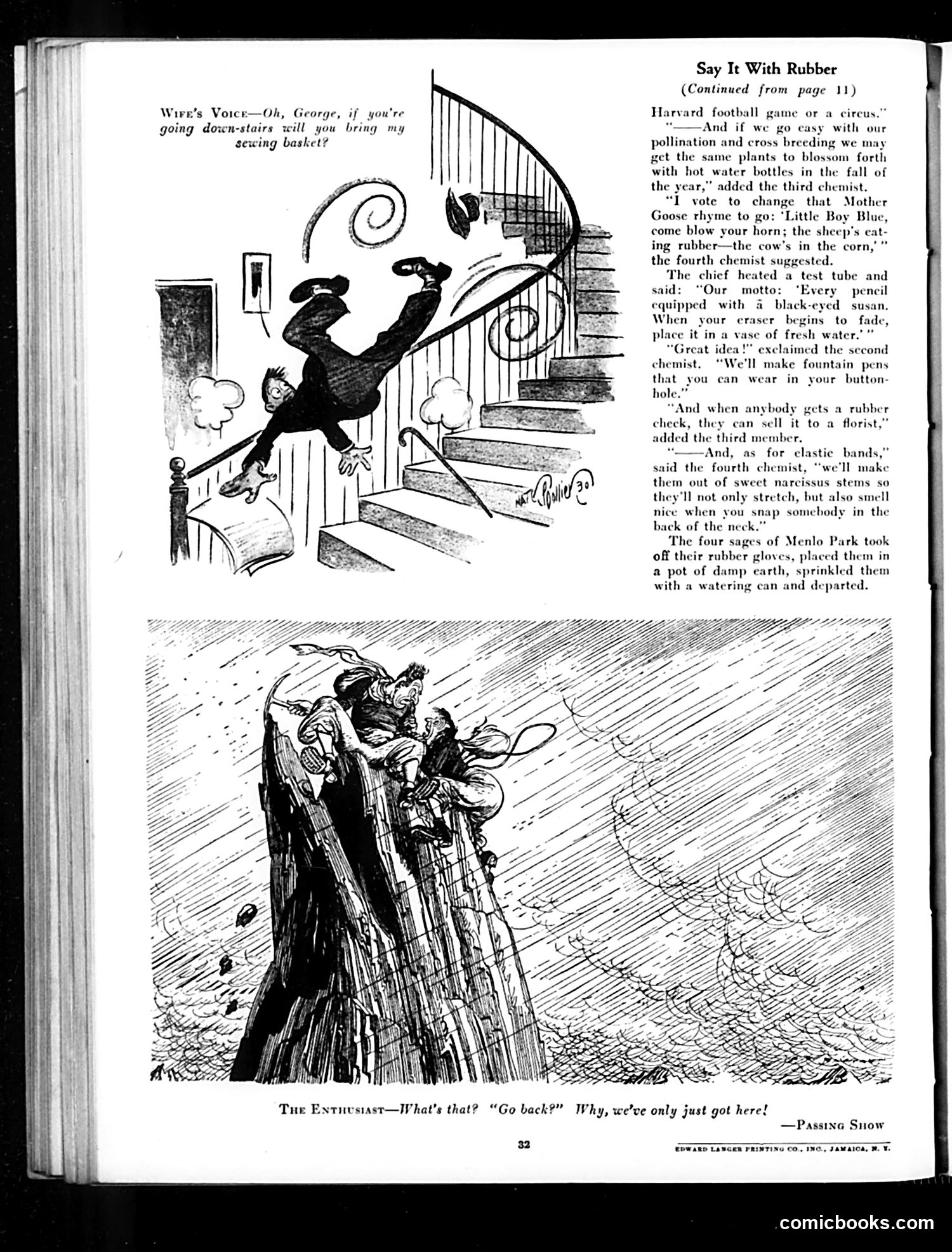
Explanation for Modern Readers This Judge magazine page contains two satirical cartoons about rubber and its uses. Top cartoon: A man tumbles down stairs while his wife asks him to fetch her sewing basket—a visual gag about domestic mishaps. Main feature: "Say It With Rubber" satirizes four chemists (likely referencing Edison's Menlo Park laboratory) proposing absurd rubber-based products: pencils with rubber erasers, fountain pens you wear as buttons, rubber checks to sell to florists, and elastic bands made from narcissus stems. The satire mocks over-confident inventors and their impractical "innovations"—treating obvious or ridiculous inventions as revolutionary breakthroughs. Bottom cartoon: Two enthusiasts on a tall tree stump refuse to leave, claiming they've "only just got here"—likely satirizing obsessive hobbyists or tourists. The page reflects early-20th-century humor about industrial progress and the popular perception of inventors as eccentric visionaries pursuing absurd ideas.
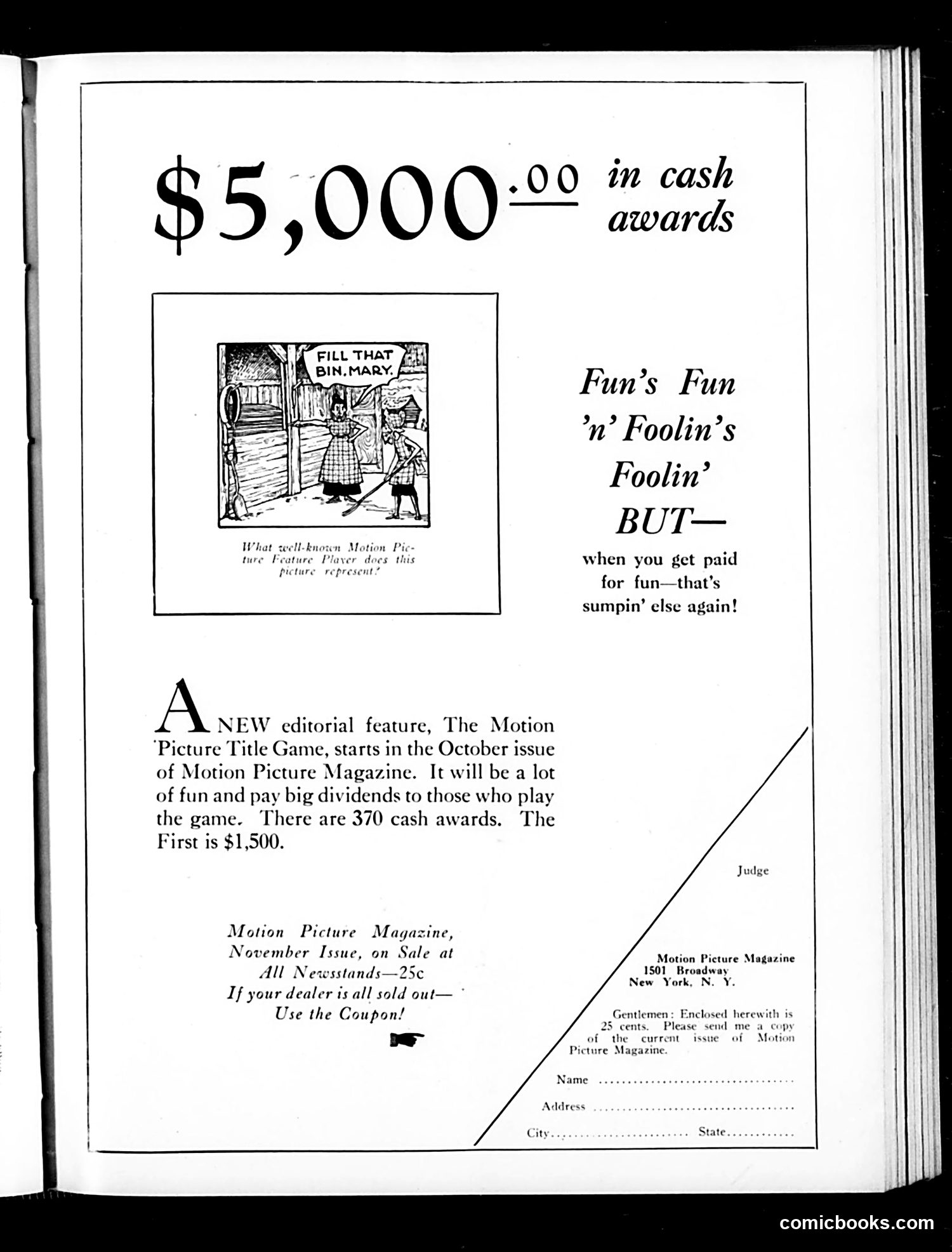
Analysis This page is primarily advertising, not satire or political commentary. It promotes a contest game featured in *Motion Picture Magazine*. The small cartoon depicts a domestic scene with a woman and child at a bin, with text "FILL THAT BIN, MARY"—a reference to a well-known silent film. The joke's setup asks readers to identify which movie this represents, serving as a sample of the upcoming "Motion Picture Title Game." The advertised contest offers $5,000 total in cash prizes (370 awards, with first prize of $1,500) for players who correctly identify movie titles from similar images. The page includes a coupon to order the November issue of *Motion Picture Magazine* for 25 cents. The sidebar gag ("when you get paid for fun—that's sumpin' else again!") simply plays on the appeal of winning money while having entertainment fun—a straightforward pitch rather than satire.
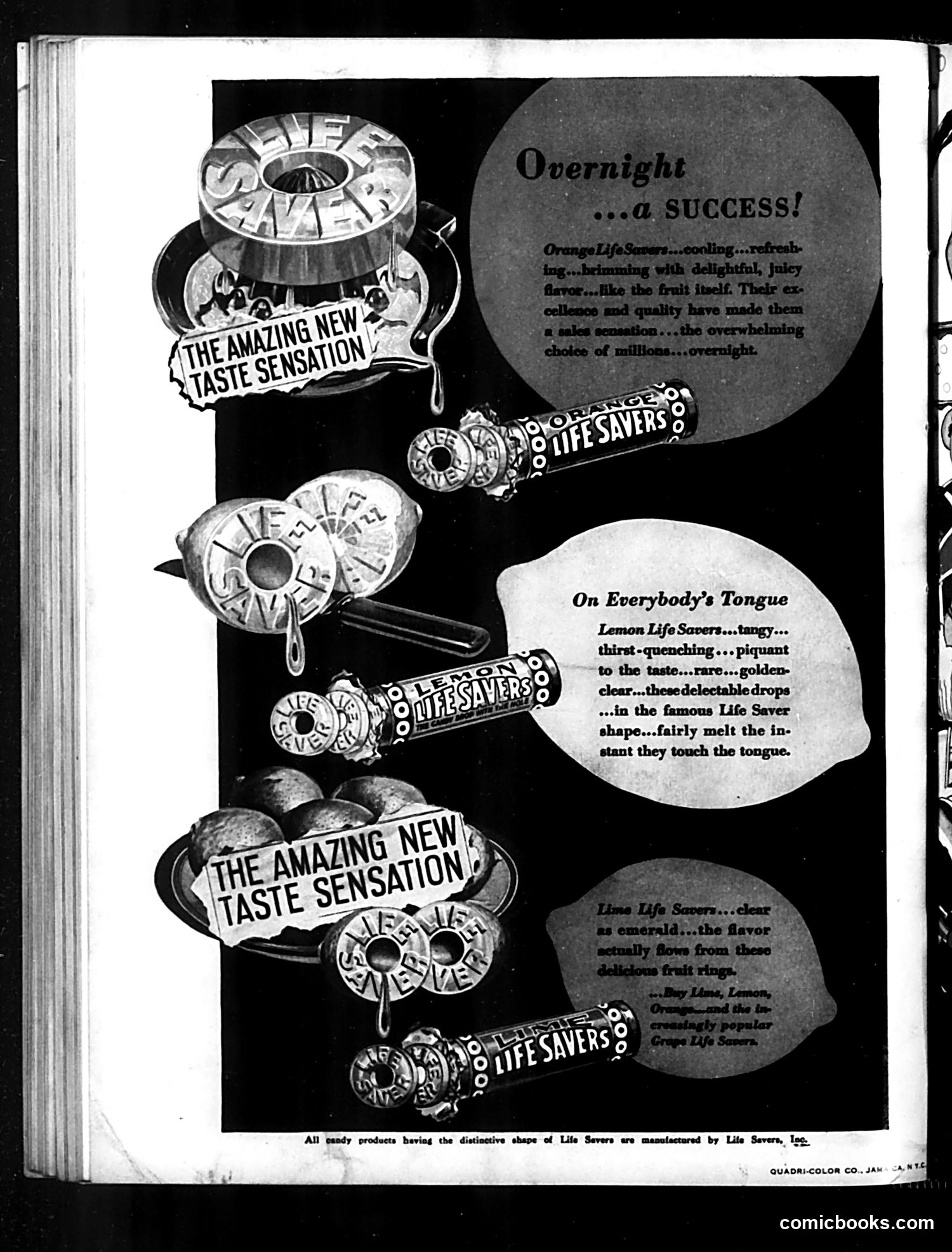
Analysis This is a Life Savers candy advertisement, not political satire. The page promotes the brand's newly flavored products—Orange, Lemon, and Lime varieties—marketed as "The Amazing New Taste Sensation." The ad uses visual stacking of candy products and describing text to highlight flavor attributes: Orange Life Savers are presented as an "overnight success" with fruit-like excellence; Lemon ones are described as "tangy" and "thirst-quenching"; Lime varieties are "clear as emerald." There is no political content or satirical commentary visible. This appears to be a straightforward commercial advertisement from Judge magazine, which—while primarily a humor publication—included paid advertising. The dramatic language and visual presentation are typical 1920s-30s advertising copy, emphasizing novelty and sensory appeal rather than social commentary.