judge
Judge — October 11, 1930
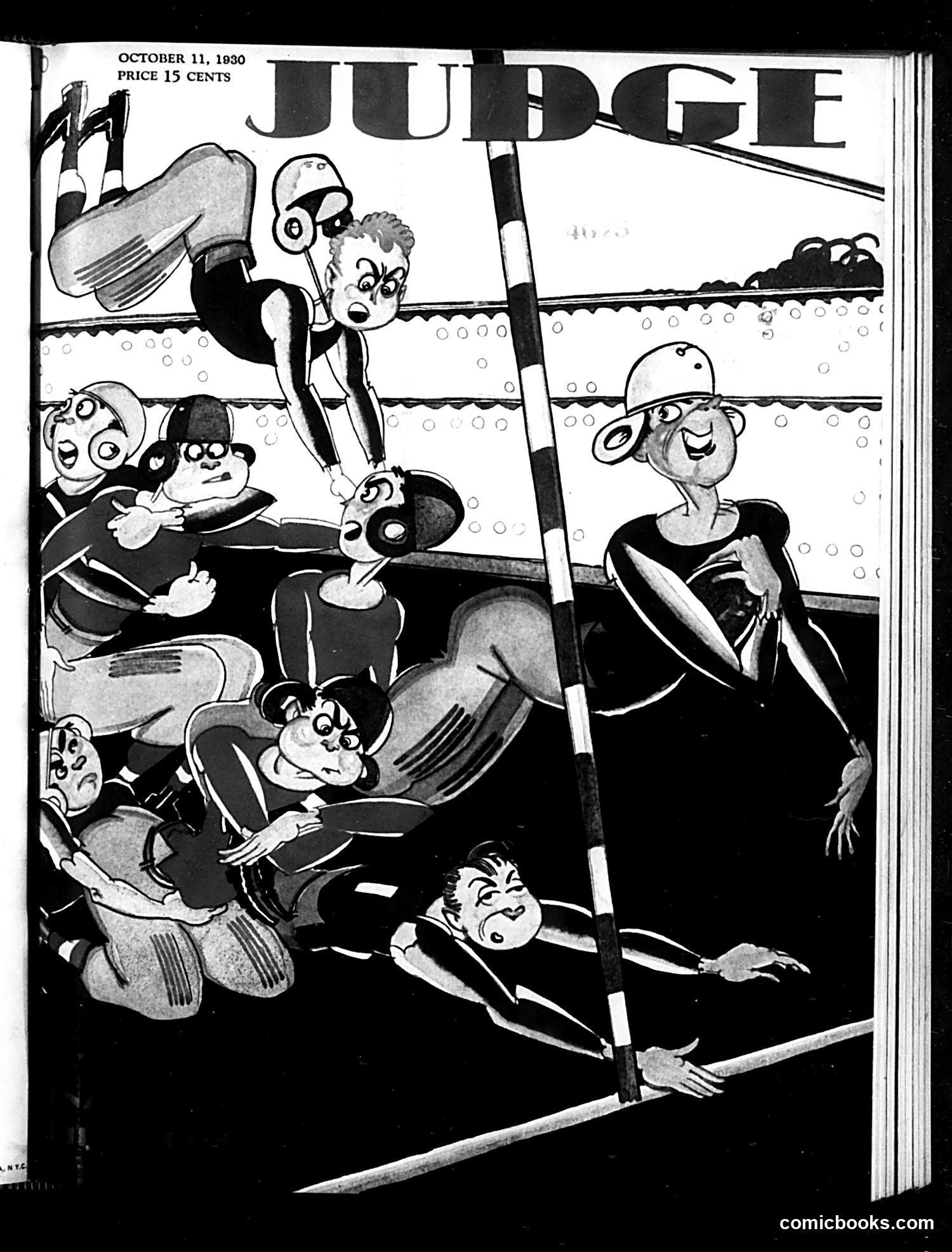
Judge Magazine, October 11, 1930 This cartoon appears to depict a rowing or boat scene with exaggerated cartoon characters. The setting suggests a competitive rowing event, possibly referencing a contemporary sporting competition or social outing. The caricatured figures display the exaggerated facial features and body types typical of 1930s comic illustration. Without additional text on the page identifying specific political figures or events, I cannot definitively state which individuals or current events are being satirized. The humor likely derives from physical comedy—the characters' awkward postures in the boat and their distressed expressions—rather than specific political commentary. The striped oars and water setting are clearly rendered, but the precise satirical target remains unclear from the image alone.
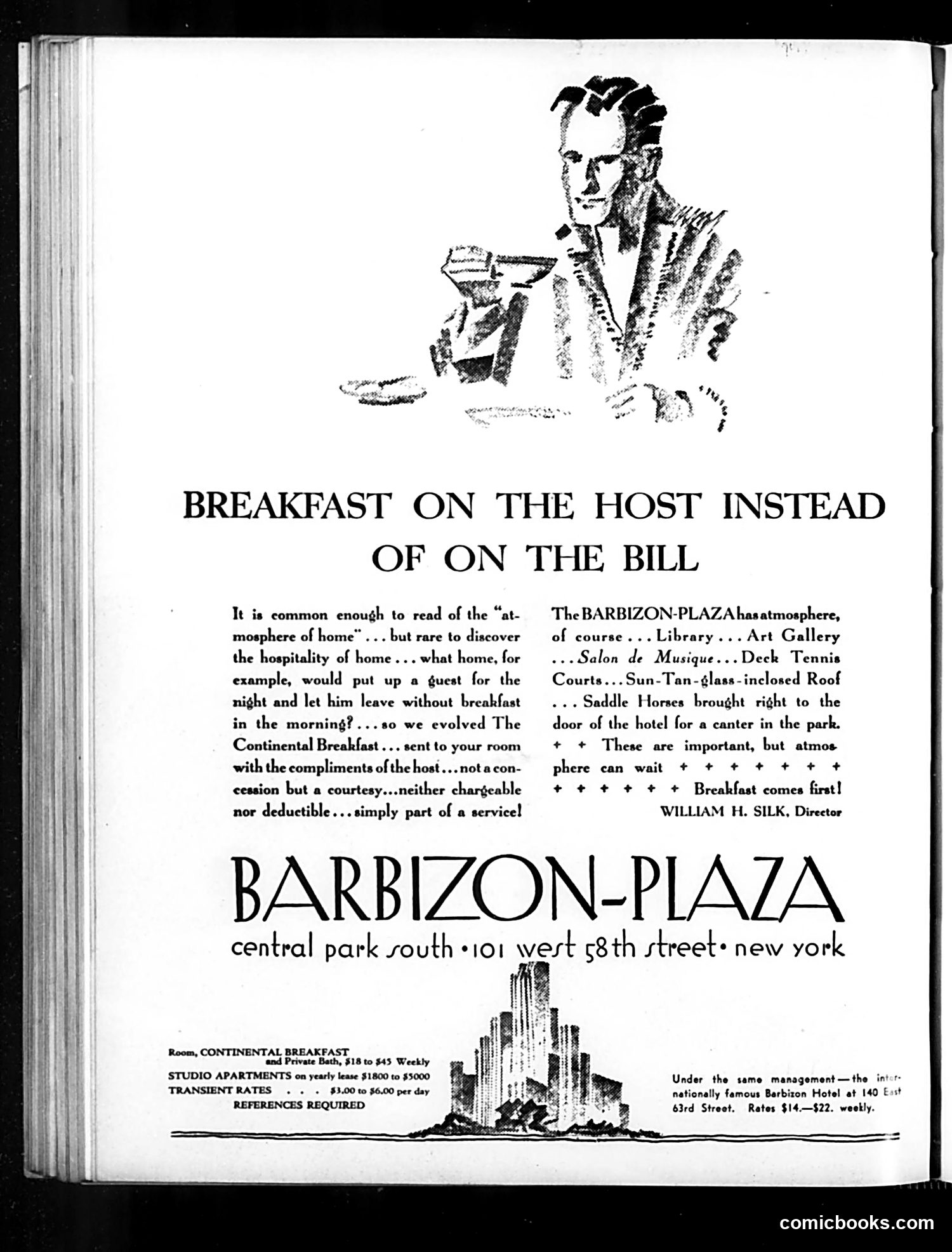
Analysis This page is primarily a hotel advertisement, not political satire. The Barbizon-Plaza Hotel on Central Park South in New York is advertising its "Continental Breakfast" service included with rooms—positioning this as a hospitality feature that distinguishes it from competitors who charge separately. The illustration at top shows a man dining, likely meant to represent a satisfied guest. The ad's text emphasizes that providing complimentary breakfast reflects proper hospitality and courtesy, "not a concession but a courtesy...neither chargeable nor deductible." The page includes room rates, studio apartment leases, and transient rates. While it appears in *Judge* magazine (known for satire), this particular page functions as a commercial advertisement rather than political commentary or humor.
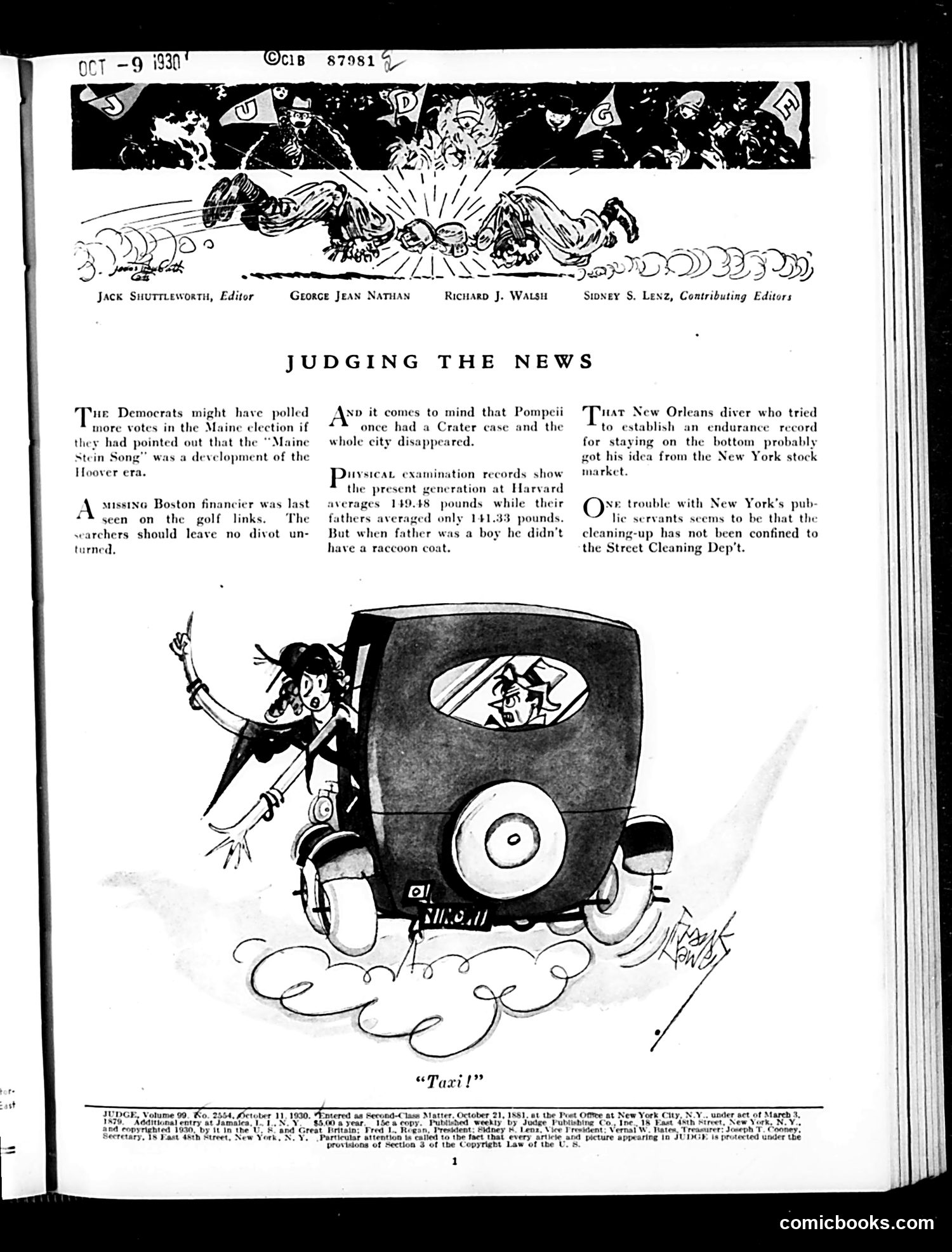
Analysis of Judge Magazine Page, October 9, 1930 The page features a satirical column titled "Judging the News" with several brief political jabs, alongside a cartoon labeled "Taxi!" The cartoon depicts a taxi-cab appearing to descend from clouds, with an aggressive caricatured figure (possibly a politician or public figure) wielding what looks like a weapon or tool. The overall impression suggests chaos or danger emerging from the taxi. The brief text snippets mock various news items: a Maine election result, a missing Boston financier, Harvard student health statistics, Pompeii's disappearance, and New York City's street cleaning failures. The "Taxi!" cartoon likely satirizes taxi-related crime or corruption—common concerns in 1930s New York. Without clearer identification of the figure, the specific target remains somewhat unclear, though it appears to critique urban disorder or criminal activity associated with the taxi industry.
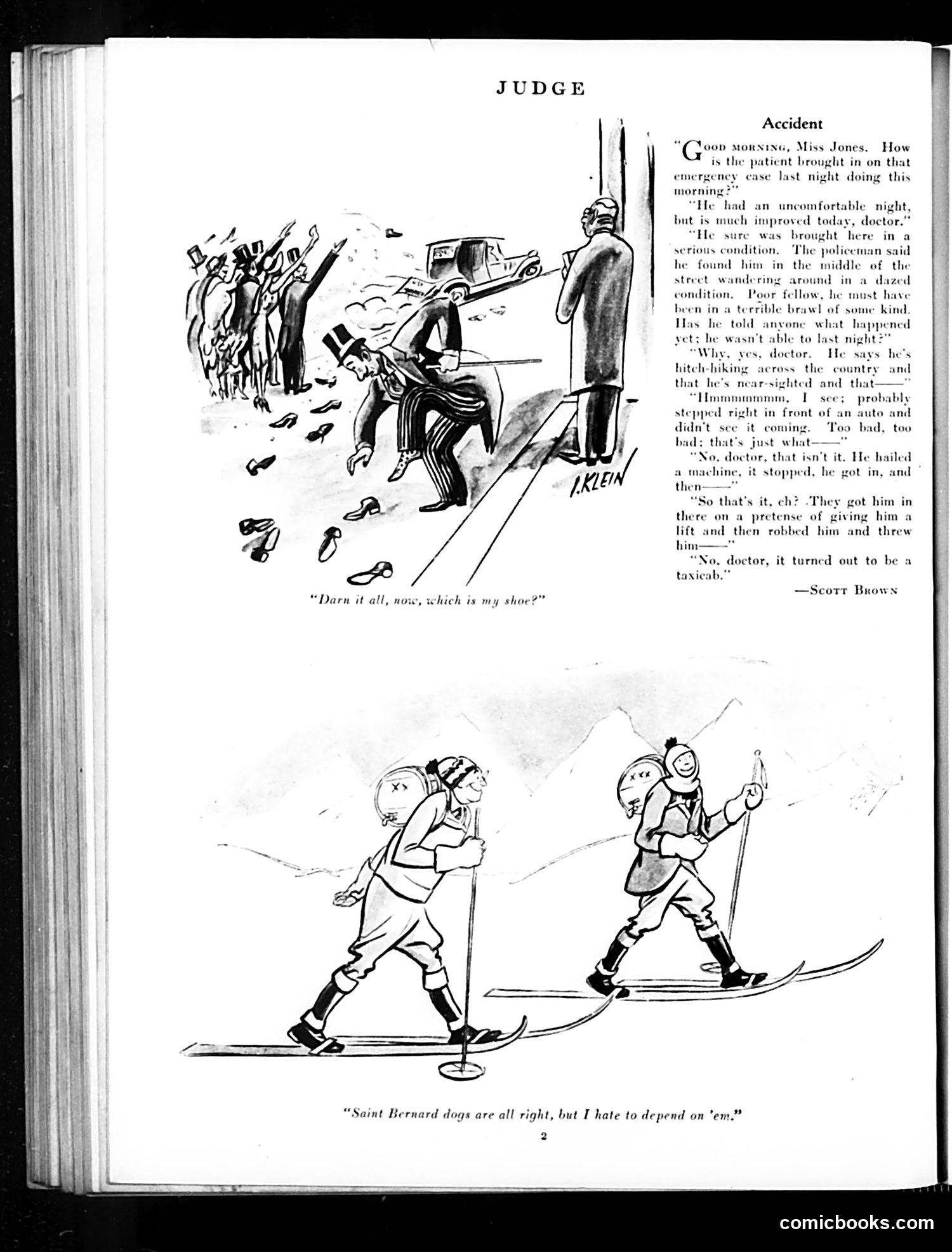
Analysis of Judge Magazine Page This page contains two distinct cartoons: Top cartoon ("Darn it all, now, which is my shoe?"): Depicts a traffic accident involving a pedestrian hit by a car. The accompanying dialogue reveals dark humor—the victim was actually a hitchhiker struck while trying to catch a ride. The "accident" was actually a robbery; criminals posed as Good Samaritans offering assistance, then robbed and threw him from the vehicle. The satire targets the dangers of hitchhiking and the opportunistic criminals who prey on vulnerable travelers during this era. Bottom cartoon ("Saint Bernard dogs are all right, but I hate to depend on 'em"): Shows skiers in mountainous terrain, likely the Alps. The humor concerns rescue dogs versus self-reliance—the skier expresses frustration about depending on Saint Bernard dogs for mountain rescue, preferring independence. Both cartoons employ visual comedy to satirize contemporary social anxieties about travel and safety.
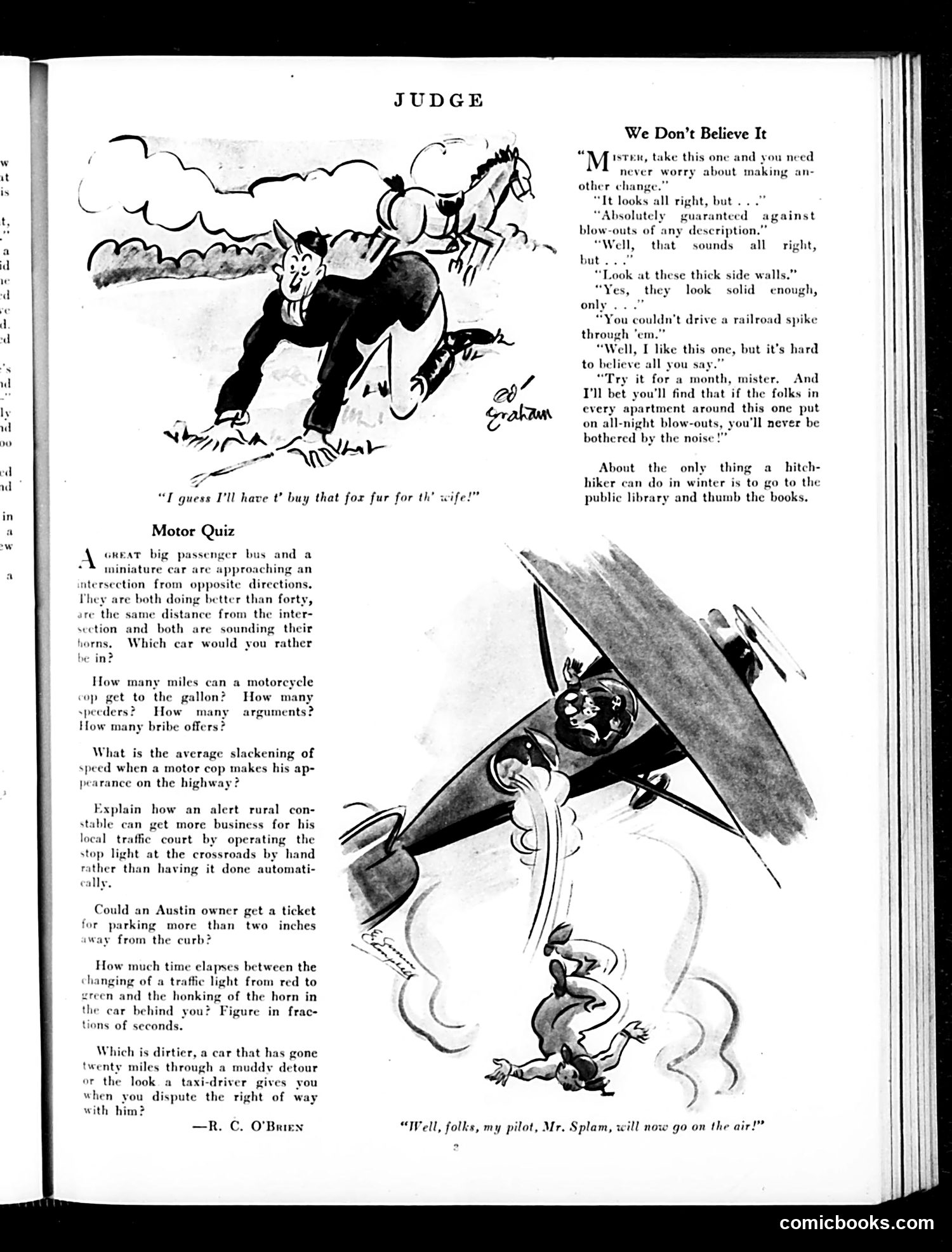
Analysis of Judge Magazine Page This page contains two distinct sections: Top cartoon ("We Don't Believe It"): A man crawls desperately behind a horse-drawn carriage, clutching at the ground. The dialogue suggests he's claiming he can buy something for his wife—possibly a car—but the listener expresses extreme skepticism, comparing the claim to incredible tall tales. The satire targets exaggerated advertising promises of the automotive era, mocking salesmen's outlandish claims about vehicle affordability or performance. Bottom section ("Motor Quiz"): A quiz by R.C. O'Brien poses humorous questions about vehicles and traffic regulations—motorcycles' fuel efficiency, parking violations, traffic light timing, and distinguishing between actual collisions and taxi-driver excuses. This section satirizes the confusion and absurdity surrounding early 20th-century traffic laws and motorist behavior. Both sections mock the emerging automobile culture's complications and dubious claims.
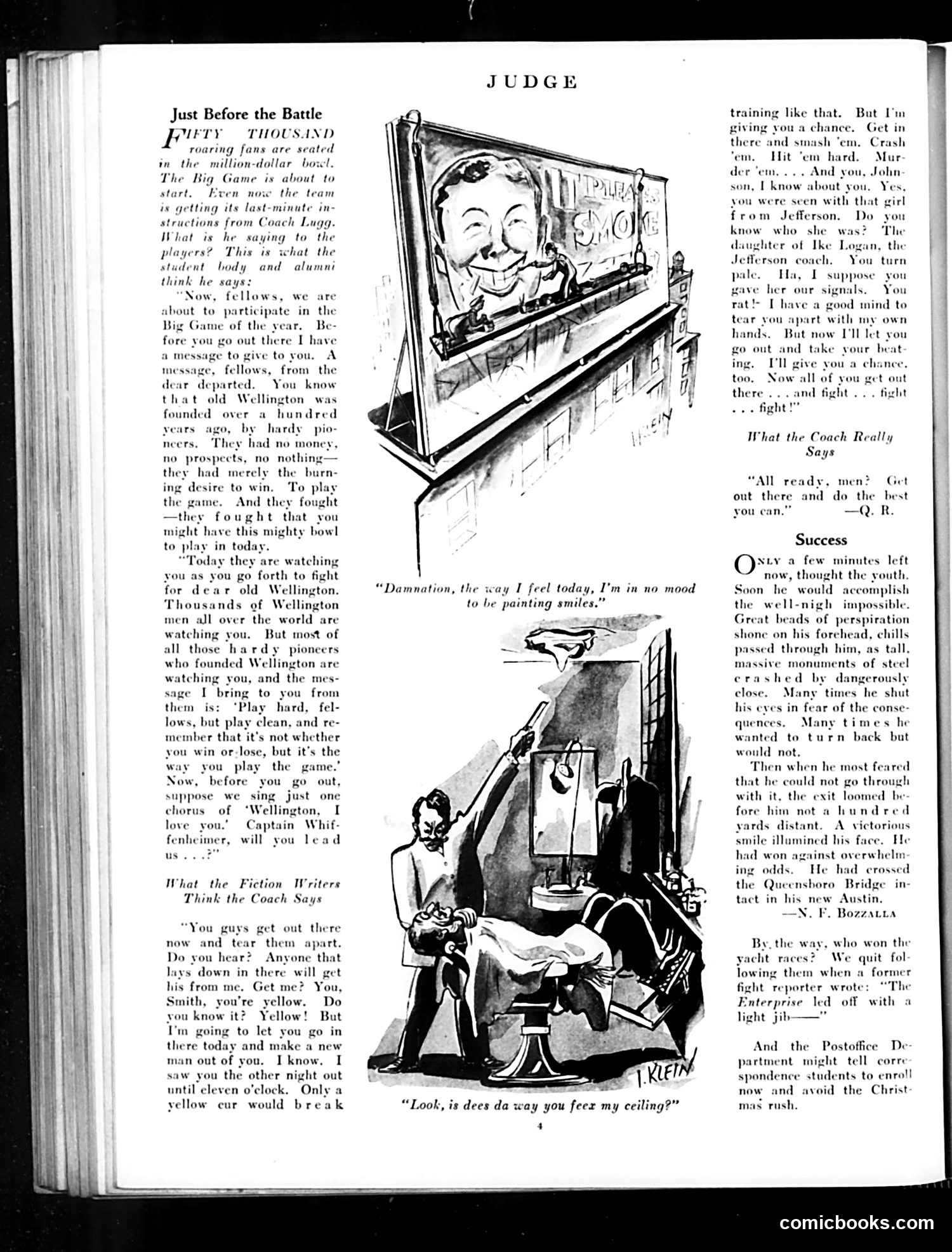
Analysis of Judge Magazine Page This page contains sports-related humor rather than political satire. The "Just Before the Battle" section references Wellington (likely the university) football team, treating the upcoming "Big Game" with mock-heroic language. The two cartoons depict: 1. Top cartoon: A caricatured face on what appears to be a stadium scoreboard or display, captioned about "painting smiles"—likely mocking forced enthusiasm before competition. 2. Bottom cartoon: A figure in what appears to be athletic gear, with French-language caption ("Look, is does da way you feez my ceiling?")—appearing to parody accented speech, possibly ethnic humor common to the era. The "Success" section describes overcoming obstacles, likely extending the sports metaphor. This page primarily entertains through sports humor and period-typical ethnic caricature rather than political commentary.
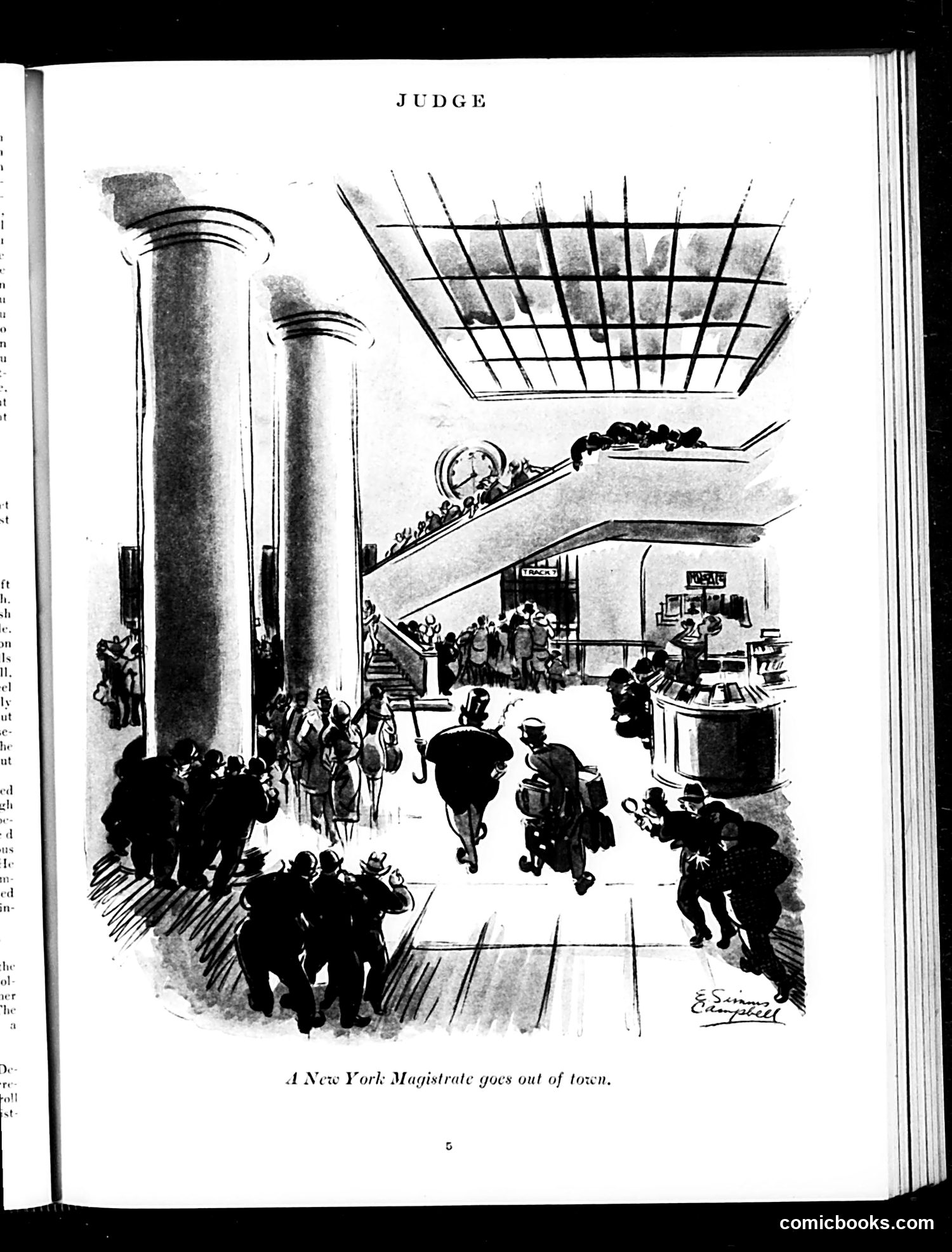
"A New York Magistrate goes out of town" This cartoon satirizes the departure of a New York magistrate (judge) from the city, depicted as a grand public event. The exaggerated scene—with massive crowds, elaborate architecture, and ceremonial atmosphere—mocks the self-importance of minor judicial officials. The magistrate appears to be treated like a dignitary or celebrity leaving for an important journey, when in reality he's simply a local judge taking time away. The satire likely criticizes either the pomposity of low-ranking city officials or public corruption involving magistrates. The crowded, chaotic scene suggests bureaucratic excess or the spectacle surrounding even mundane governmental activities. The artist's signature appears to be "E. Simmers Campbell" or similar.
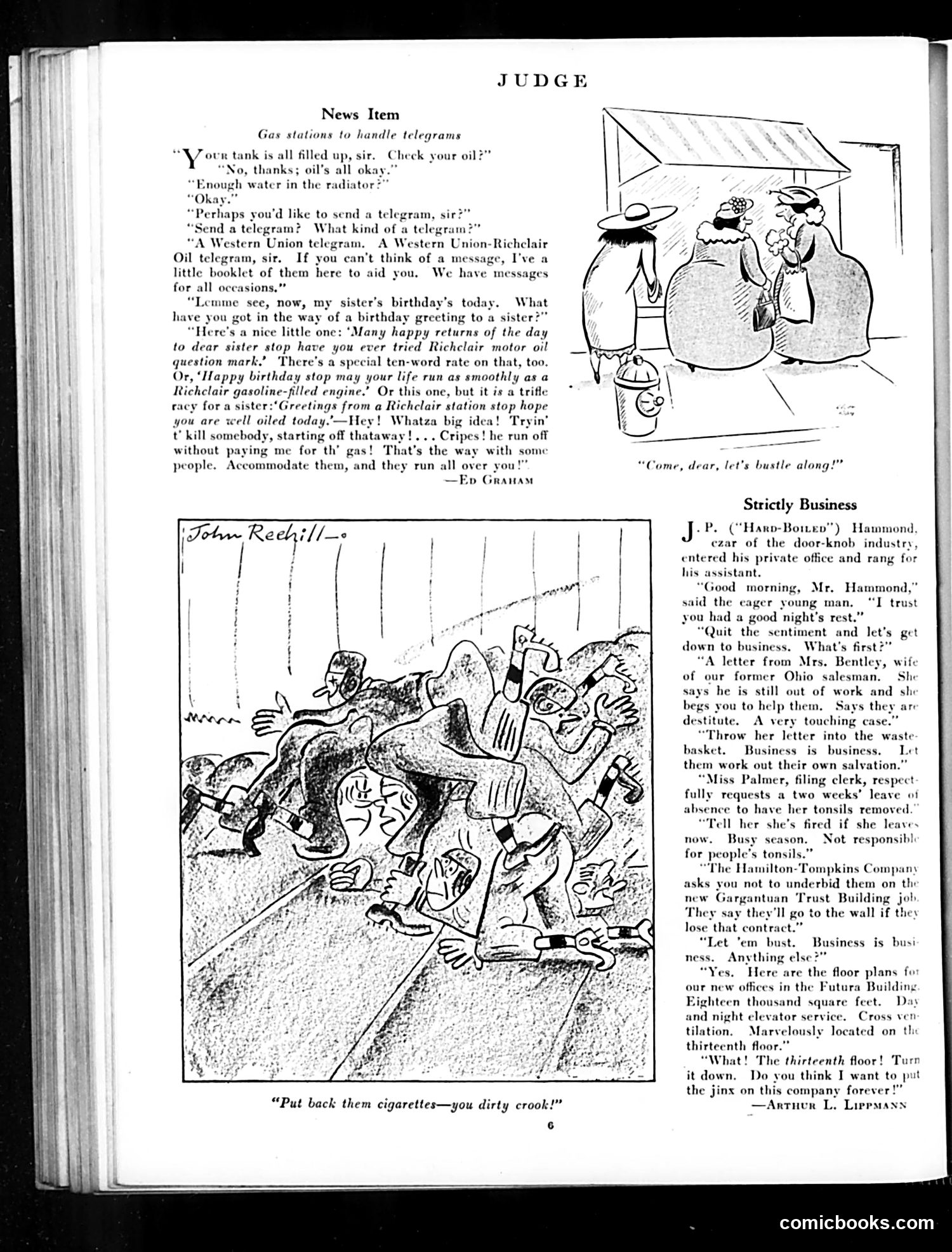
Analysis of Judge Magazine Page This page contains three pieces of humor commentary on early 20th-century American life. "News Item" (top left): A satirical dialogue mocking gas station attendants who upsell customers on unnecessary services like telegrams and oil treatments. The joke critiques aggressive sales tactics at service stations. "John Redhill's" cartoon (center): Depicts a chaotic traffic scene with multiple cars piled up, captioned "Put back them cigarettes—you dirty crook!" The cartoon likely satirizes reckless driving or traffic violations, possibly suggesting distracted driving or road rage. "Strictly Business" (right): A corporate satire where a boss dismisses an employee's request for help with a destitute friend, insisting "business is business." This critiques workplace callousness and the era's rigid professional attitudes toward charity. All three pieces target perceived social failings through humor.
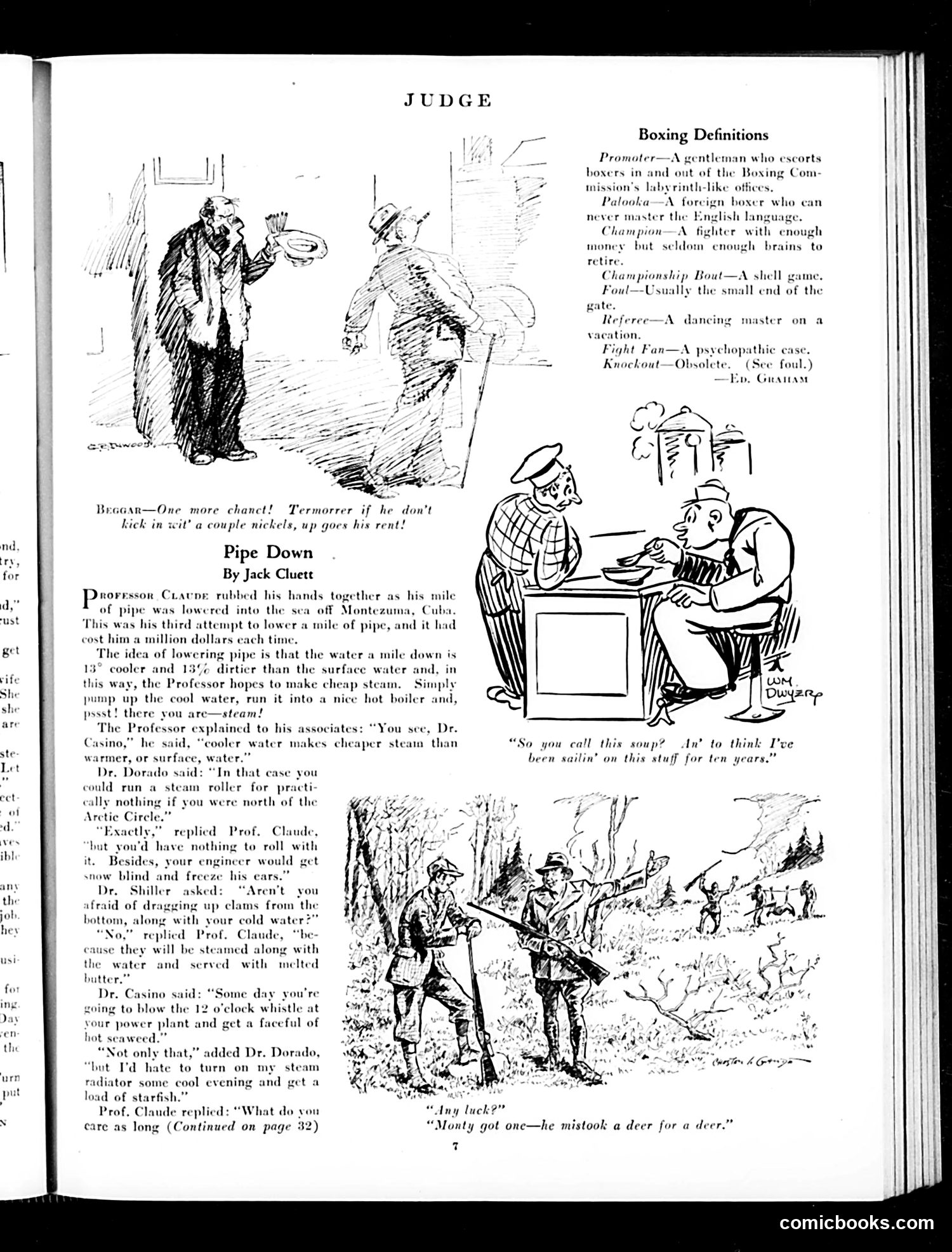
Judge Magazine: Boxing and "Pipe Down" Boxing Definitions (top): This is satirical wordplay mocking boxing's commercialization. A "Palooka" is a foreign boxer; a "Champion" is wealthy but unintelligent; a "Championship Bout" is a "shell game" (rigged); the "Foul" is "usually the small end of the gate" (promoters pocket money); and a "Fight Fan" is a "psychopathic case." The humor targets boxing's corruption and the foolishness of its enthusiasts. "Pipe Down" by Jack Cluett (main story): Professor Claude attempts to lower a mile of pipe into the Cuban ocean to exploit cooler deep water for cheaper steam power. His associates raise absurd practical objections (freezing workers, clams clogging pipes, stray starfish). The satire mocks pseudo-scientific schemes and the gap between theoretical engineering and reality—a common early-20th-century target of humor magazines.
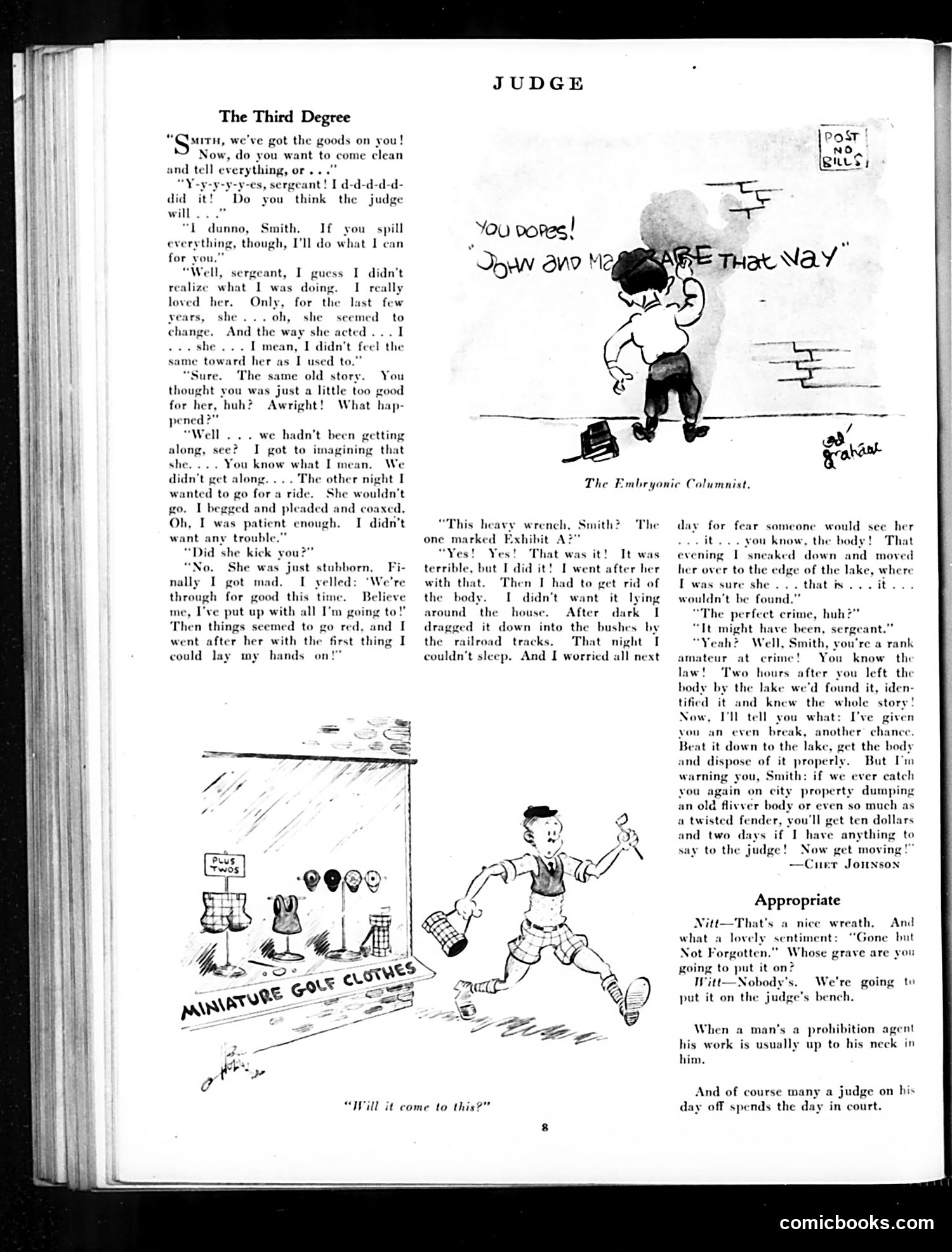
"The Third Degree" - Judge Magazine Cartoon Analysis This page satirizes corruption in law enforcement and the judicial system. The main cartoon depicts a police interrogation where a sergeant extracts a confession about a murder, then—remarkably—instructs the suspect to dispose of the body properly or face minor penalties for littering ("ten dollars and two days"). The satire targets the apparent indifference of judges and police to serious crimes, suggesting they're more concerned with technicalities (illegal dumping on city property) than actual murder. The accompanying vignette, "The Embryonic Columnist," shows a figure labeled as such, likely mocking sensationalist crime reporting. The bottom section's quips about prohibition agents and judges reinforce the theme: law enforcement is depicted as morally compromised and absurd. The cartoons suggest widespread cynicism about whether the justice system actually prosecutes serious crimes fairly, or merely performs theater while the connected escape real consequences.
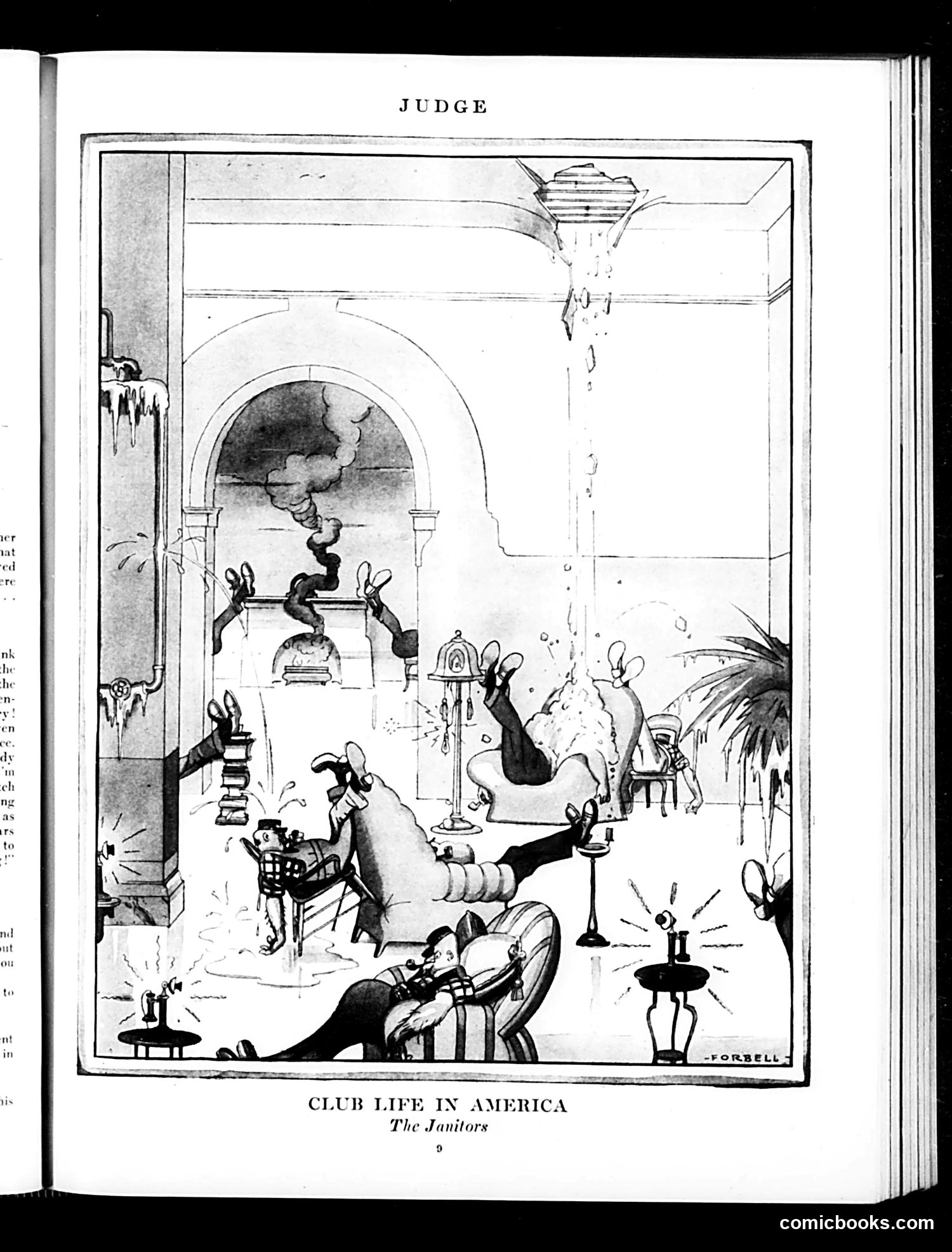
"Club Life in America: The Janitors" This cartoon satirizes the chaos and disorder within American clubs, depicting janitors struggling to maintain order amid pandemonium. The exaggerated figures—appearing to be club members or patrons—are shown in absurd, contorted positions throughout an ornate interior space, creating destruction and mess. The satire likely mocks the working conditions janitors endured in exclusive clubs, where wealthy members' chaotic behavior forced custodial staff into impossible situations. The cartoon emphasizes the gap between the genteel image of "club life" and its actual reality—one of disorder requiring constant, thankless labor to maintain appearances. The artist (signed "Forbell") uses physical comedy and architectural detail to critique both club excess and the invisible labor sustaining American institutions.
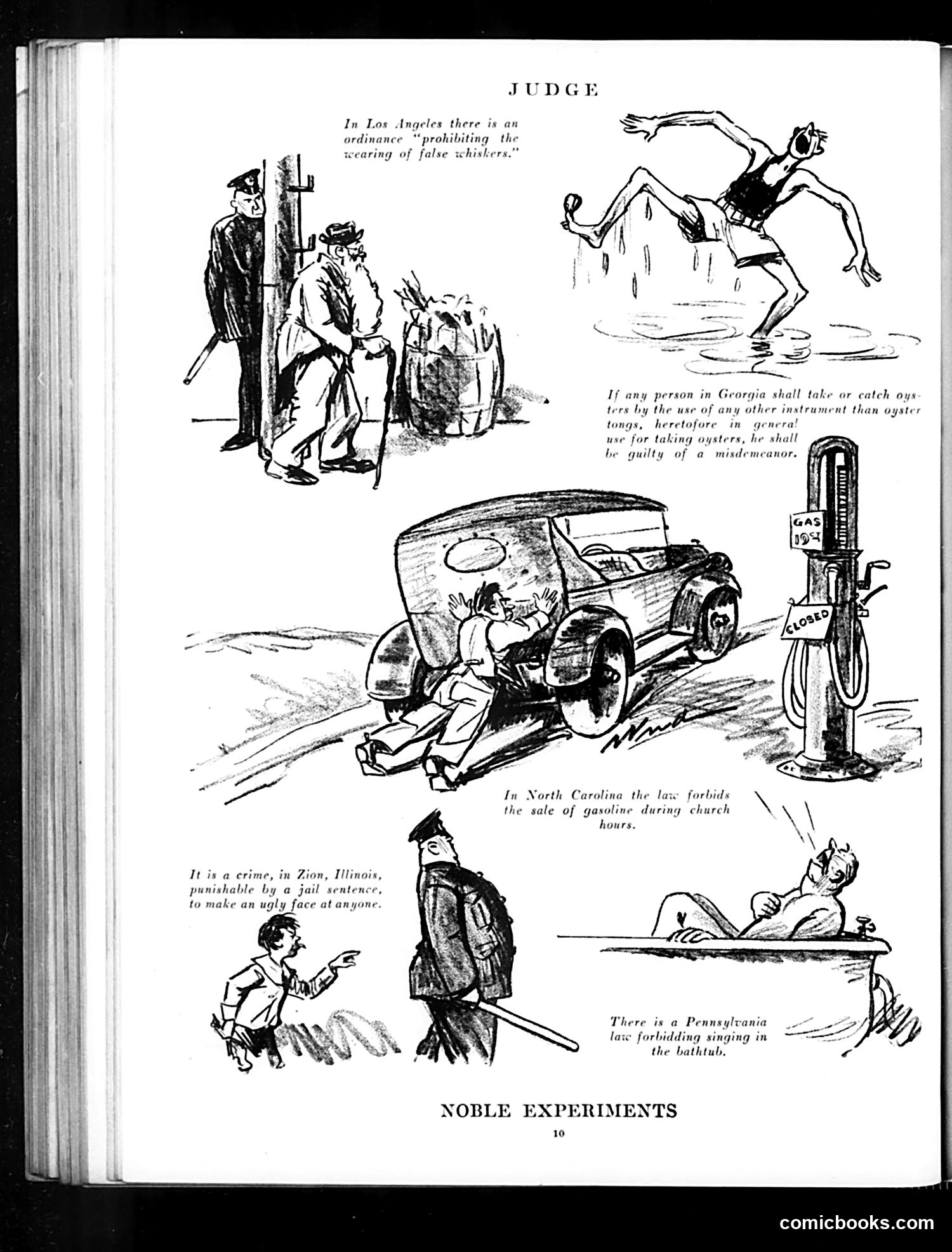
"Judge" Magazine - "Noble Experiments" This satirical page mocks absurd state and local laws through illustrated vignettes. Each cartoon presents a real (or plausibly real) ridiculous ordinance: - Los Angeles: Prohibits false whiskers—illustrated by police confronting a suspicious figure - Georgia: Restricts oyster harvesting to traditional tongs only - North Carolina: Bans gasoline sales during church hours—shown by a closed gas station - Zion, Illinois: Makes "ugly faces" a jailable offense—depicted as a child grimacing at a stern officer - Pennsylvania: Forbids singing in bathtubs—shown comically in a bathtub scene The page's title, "Noble Experiments," uses irony to critique government overreach and legislative absurdity. The satire suggests that well-intentioned local laws often become laughably restrictive and unenforceable, poking fun at small-town governance and moral legislation during what appears to be the early-to-mid 20th century.
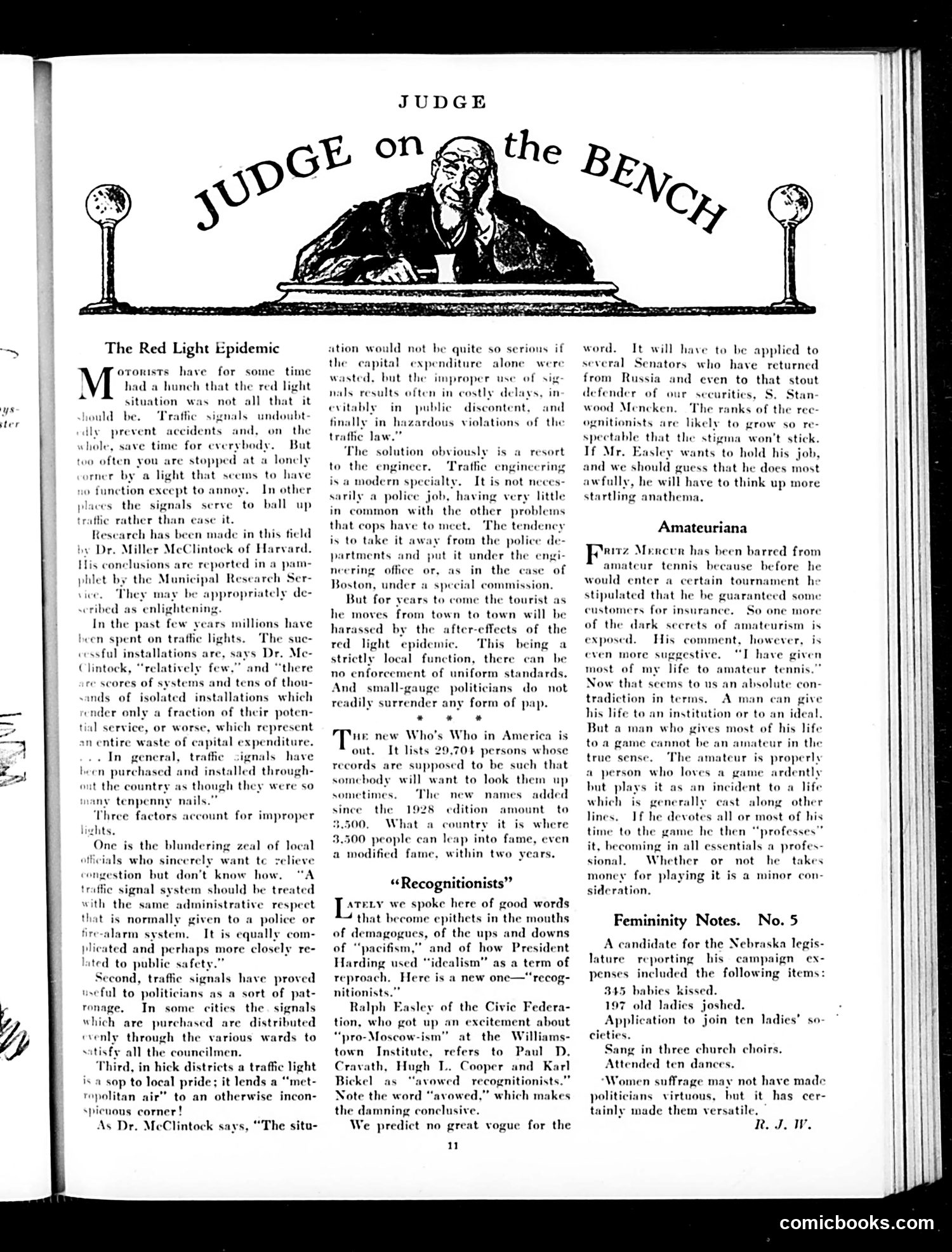
Judge Magazine Page Analysis This page from Judge magazine contains three distinct sections satirizing American political and social issues, likely from the late 1920s: "The Red Light Epidemic" critiques the haphazard installation of traffic signals across America. The satire targets municipal incompetence: traffic lights are installed through political patronage ("pork barrel" distribution to satisfy councilmen) rather than engineering expertise, creating delays and dangerous violations. The piece advocates removing control from police departments and placing it under professional engineers. "Americrana" section discusses amateur tennis rules and the new Who's Who directory, with lighter social commentary. "Recognitionists" attacks the term newly deployed by Ralph Easley of the Civic Federation against figures like Paul Cravath and Karl Bickel—apparently those advocating diplomatic recognition of Soviet Russia. The satire mocks the neologism as a demagogic epithet designed to discredit without substance. This reflects 1920s anti-communist political tensions and debate over U.S.-Soviet relations.
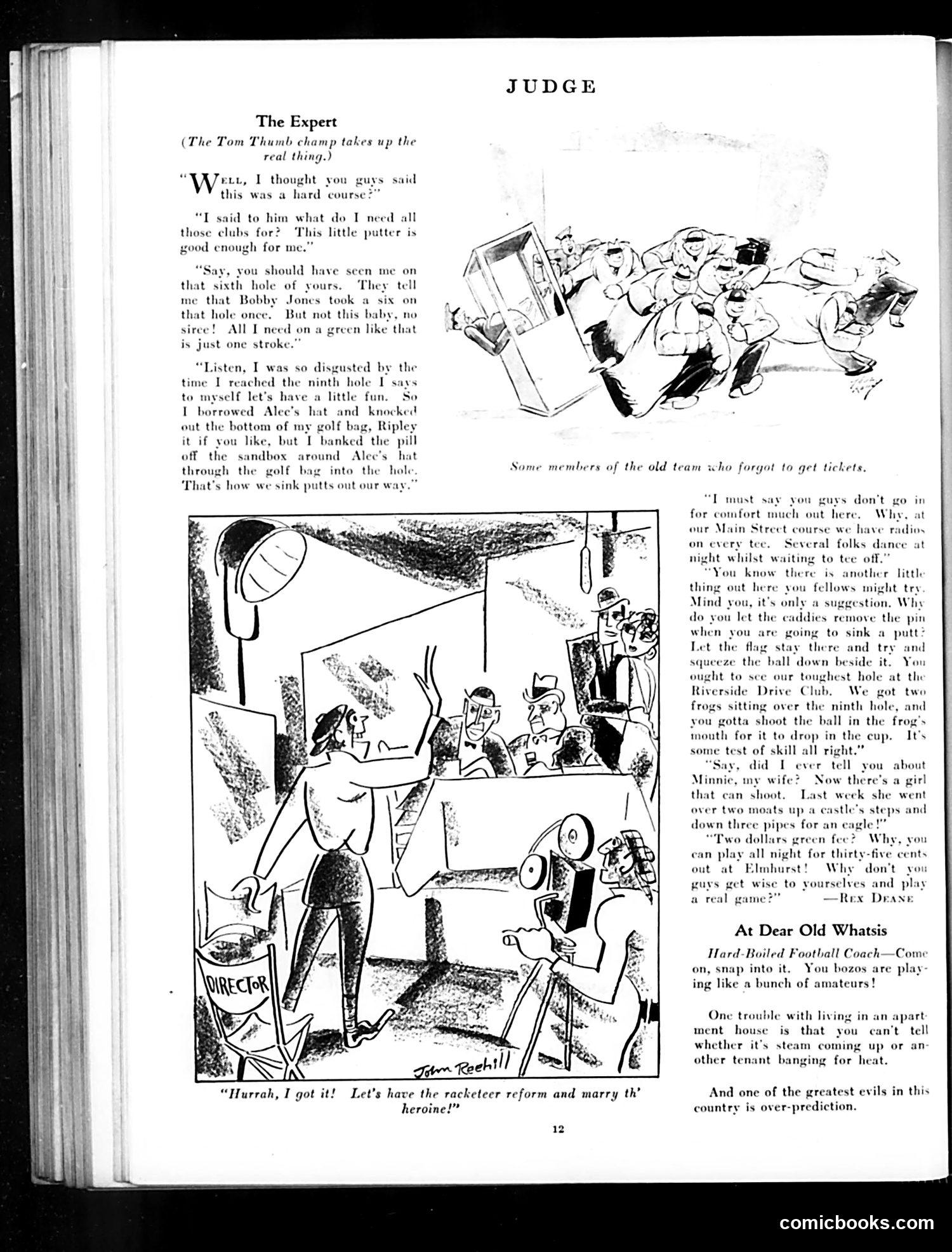
"The Expert" — Judge Magazine Cartoon Analysis This two-part cartoon satirizes golf pretension and boasting. The main illustration shows a self-proclaimed "expert" recounting exaggerated golf accomplishments to skeptical listeners. His claims escalate absurdly—hitting a hole-in-one with just a putter, sinking a putt by bouncing a ball off a borrowed hat through a golf bag. The second section parodies country-club snobbery: a wealthy golfer from an elite "Main Street course" brags about luxuries (radios on every tee) and absurd obstacles (frogs at the ninth hole, castle moats). His wife allegedly made impossible shots. The satire targets 1920s-30s upper-class golf culture—the pretentiousness, the tall tales, the one-upmanship between clubs. The "expert" and the wealthy snob are both ridiculous, each trying to out-brag the other with increasingly implausible stories. The joke is that real golf skill matters less than appearing impressive through exaggeration.
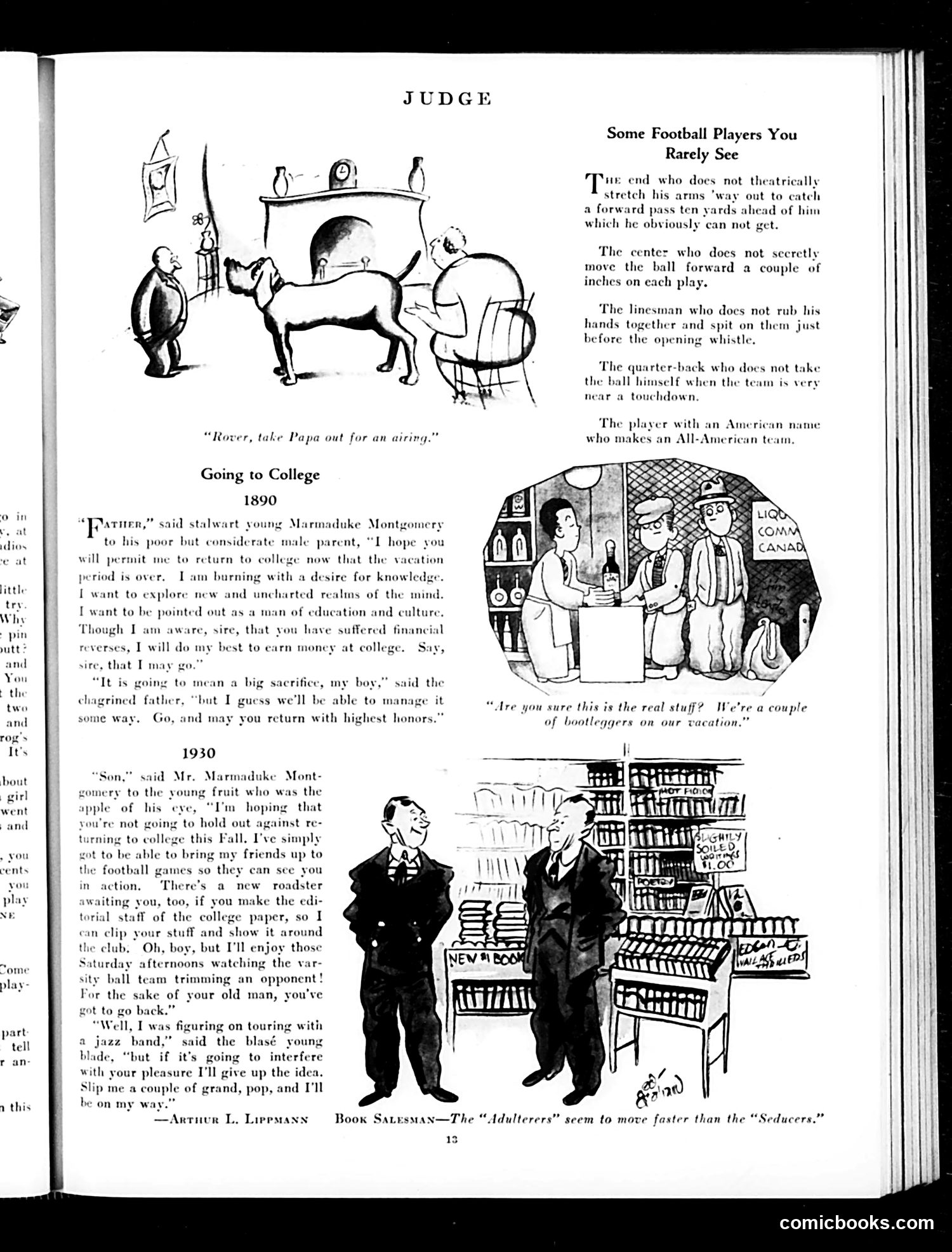
Analysis of Judge Magazine Page This page contains three satirical pieces: "Some Football Players You Rarely See" mocks football corruption and unsportsmanlike conduct. The jokes expose common cheating: ends faking catches they can't make, centers secretly advancing the ball, linesmen using theatrical gestures, and quarterbacks hogging the ball near touchdowns. The final jab targets players with "American names" on All-American teams—likely a subtle reference to ethnic discrimination in college sports selection. "Going to College" and "1930" form a comparative satire showing generational decline. In 1890, young Marmaduke Montgomery earnestly seeks education and promises to earn money to help his struggling father. By 1930, his son casually demands a roadster and cash for a jazz-band tour, indifferent to college. The satire critiques Prohibition-era youth hedonism (the "bootleggers on vacation" cartoon reinforces this) and the erosion of filial responsibility and serious ambition among wealthy young people.
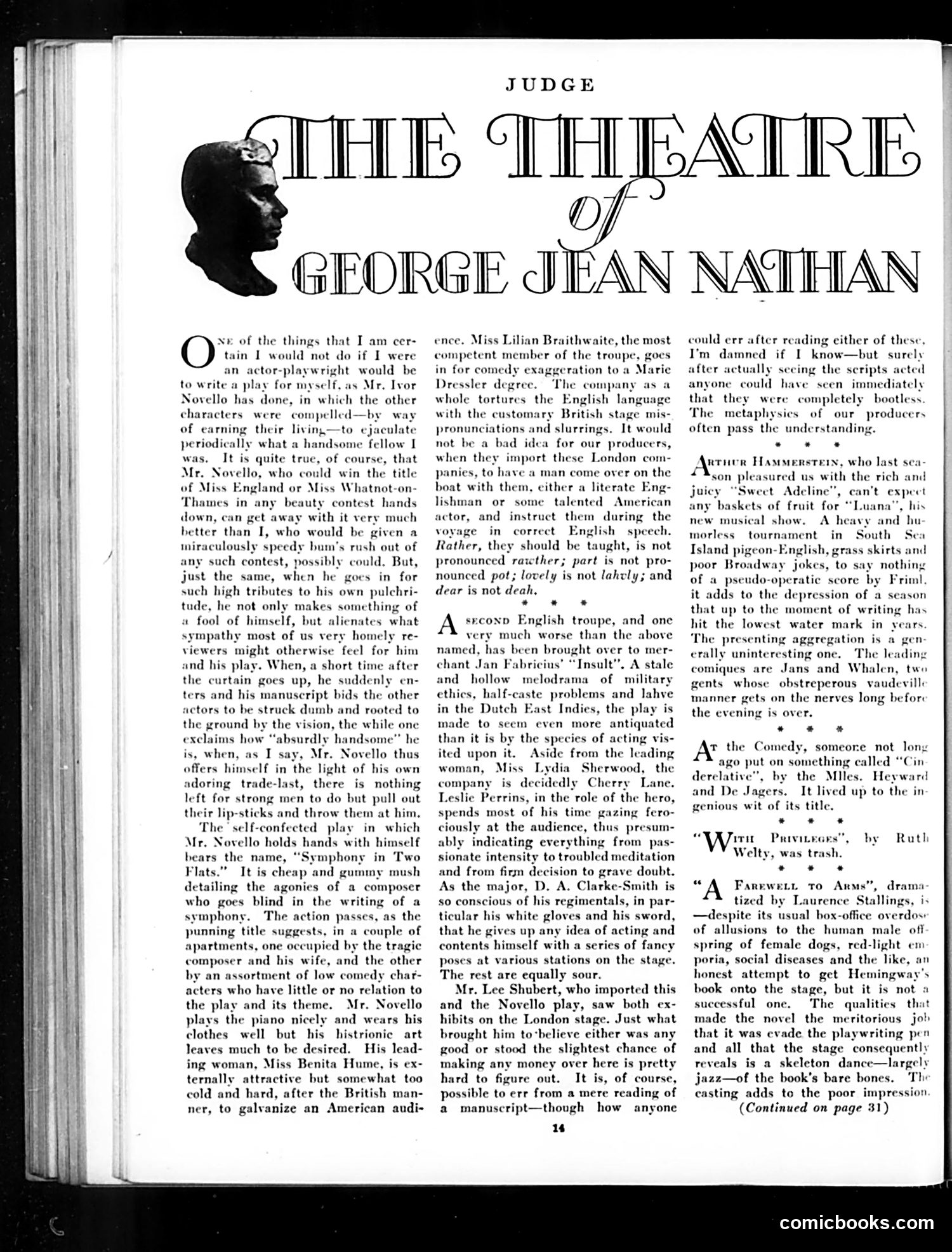
Judge Theater Critique: Analysis This page contains a theater review by "Judge" (the magazine's persona) critiquing two English theatrical productions on Broadway. The Subject: Actor-playwright Ivor Novello's vanity play "Symphony in Two Flats," where Novello wrote himself a lead role and has other characters constantly praising his appearance. The reviewer mocks this as self-aggrandizing and alienating to audiences. The Satire: The core joke is that Novello—admittedly handsome—undermines his own work and credibility by writing characters who exist primarily to compliment him. The reviewer sarcastically notes that while Novello could theoretically "win Miss England," such obvious self-flattery makes even attractive people look foolish. Secondary Critique: The review also attacks an imported English theater company performing "Insult" for affected British stage accents and stilted acting. The Point: Judge satirizes artistic vanity and questions why American producers import mediocre English productions rather than developing homegrown talent. The underlying critique suggests theater should serve the story, not the actor's ego.
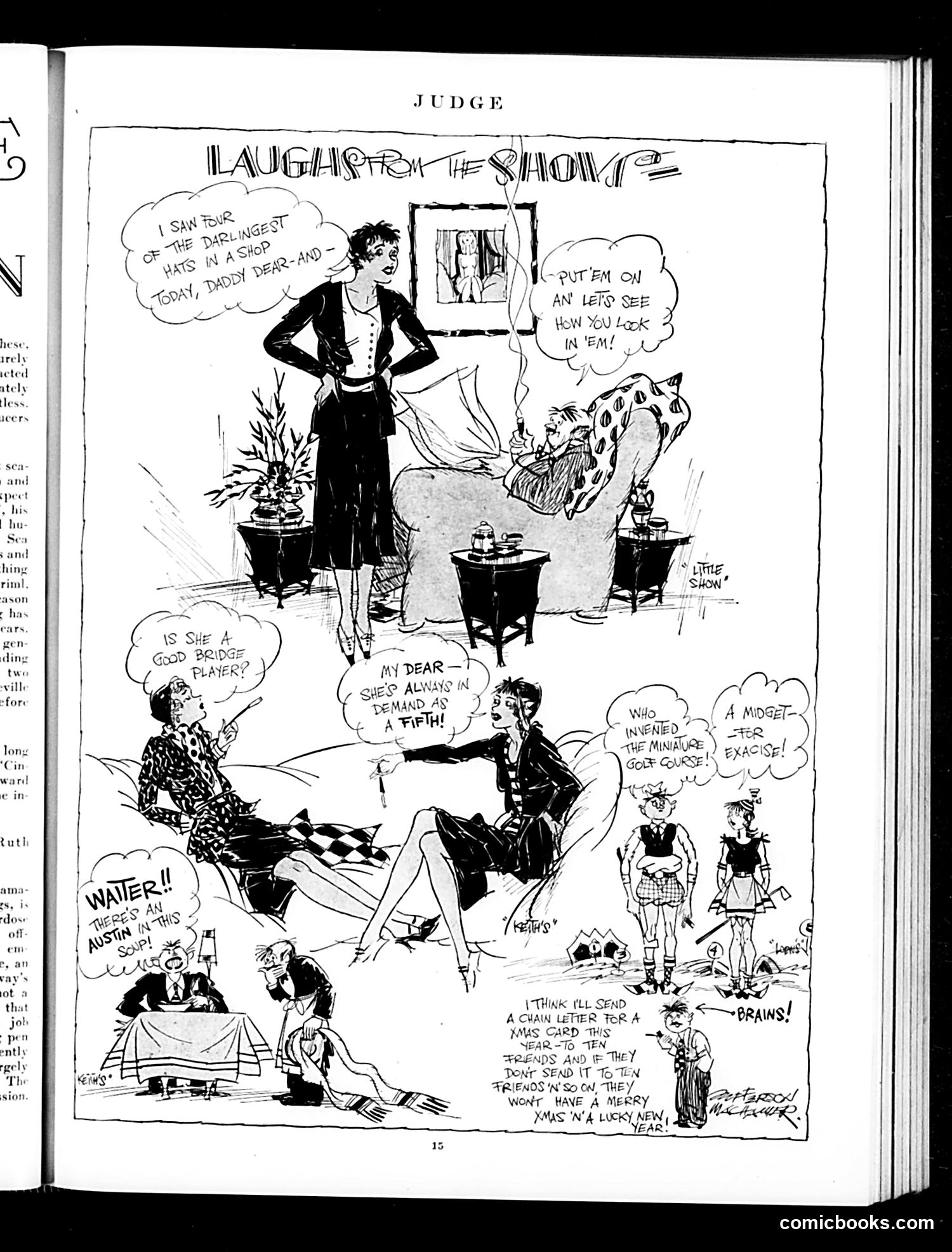
"Laugh from the Shows" This is a single-panel satirical cartoon depicting fashionable society women discussing holiday etiquette and social gossip. The central figure models the latest fashion while others seated around her exchange remarks about eligible bachelors ("a good bridge player"), social standing ("always in demand as a fifth"), and class anxieties (references to a "midget," "mini-golf course," and "brains"). The humor targets upper-class pretension and the shallow concerns of wealthy women—their obsession with marriageability, social positioning, and trivial pursuits. One character proposes sending Christmas chain letters to expand her social circle, while another worries about ensuring friends have "a merry Xmas" and "lucky New Year." The satire mocks how this society prioritizes appearance, romantic prospects, and material status over substance—typical Judge magazine social commentary from the early-to-mid 20th century.
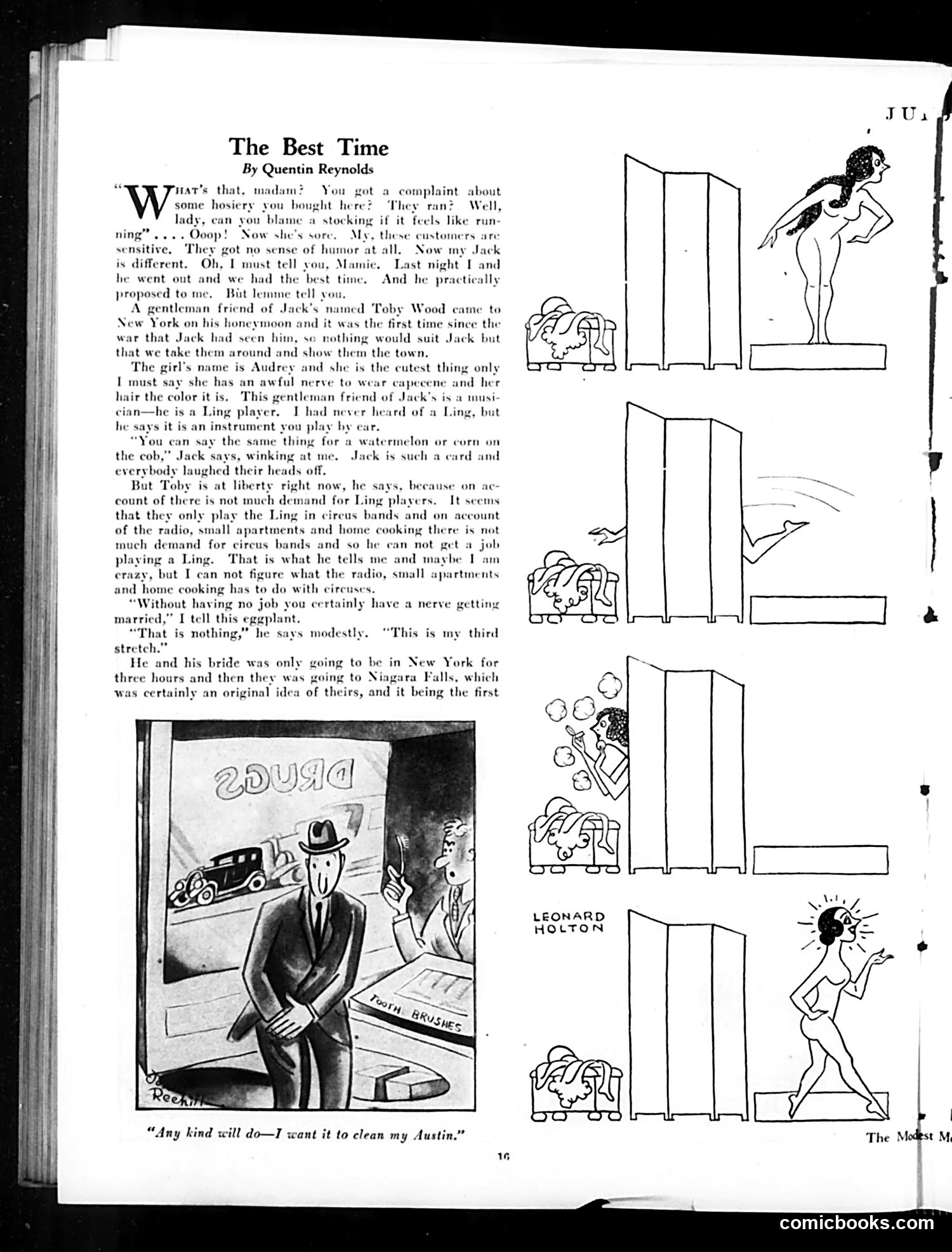
"The Best Time" by Quentin Reynolds This is a humorous short story (not a political cartoon) about a narrator whose friend Jack took his visiting friend Toby Wood and Toby's new bride Audrey out on the town for their honeymoon. The joke centers on Toby's profession: he plays the "Ling," which the narrator—and readers—would recognize as absurd. The story implies Toby is unemployed because circus bands (where Lings are apparently played) aren't in demand, supposedly due to lack of radio play and because small apartments don't need circuses. The humor is in the narrator's mock-serious, gossipy retelling and her deadpan acceptance of Toby's explanations, combined with the absurdity that someone would marry despite having no job and only spending three hours in New York before heading to Niagara Falls. The accompanying cartoon by Leonard Holton (bottom right) appears to show a woman exiting a building, likely illustrating a scene from the story, though details are unclear.
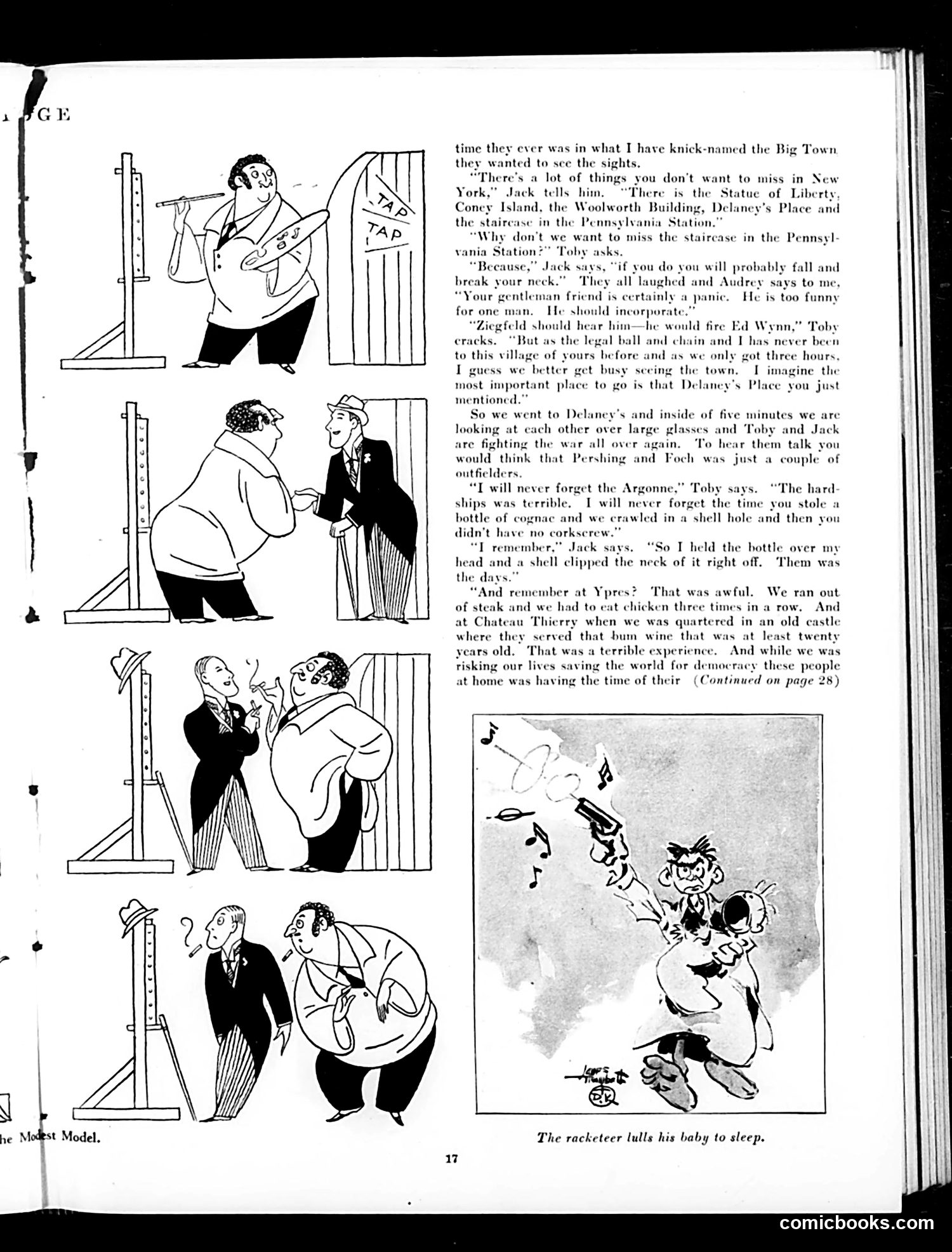
Analysis of Judge Magazine Page 17 This page satirizes post-World War I American culture through dialogue between characters visiting New York City's tourist attractions. The main comic strip (top left) depicts a man showing off NYC landmarks to visitors, with another character cracking jokes comparing showman Ed Wynn to theater producer Florenz Ziegfeld—suggesting the funny man should "incorporate" as a business. The longer text describes two war veterans (Toby and Jack, likely based on real soldiers or types) who visit Delaney's bar and swap exaggerated WWI stories, contrasting their hardships (shell holes, poor wine, scarce food) with the comfortable home experience of civilians during wartime. This satirizes the gap between soldiers' sacrifice and civilian detachment. The bottom illustration, titled "The racketeer lulls his baby to sleep," depicts a gangster figure with a child and musical notes—likely mocking organized crime's normalization in 1920s America during Prohibition. The satire targets war nostalgia, class divisions, and criminal underworld acceptance in postwar society.
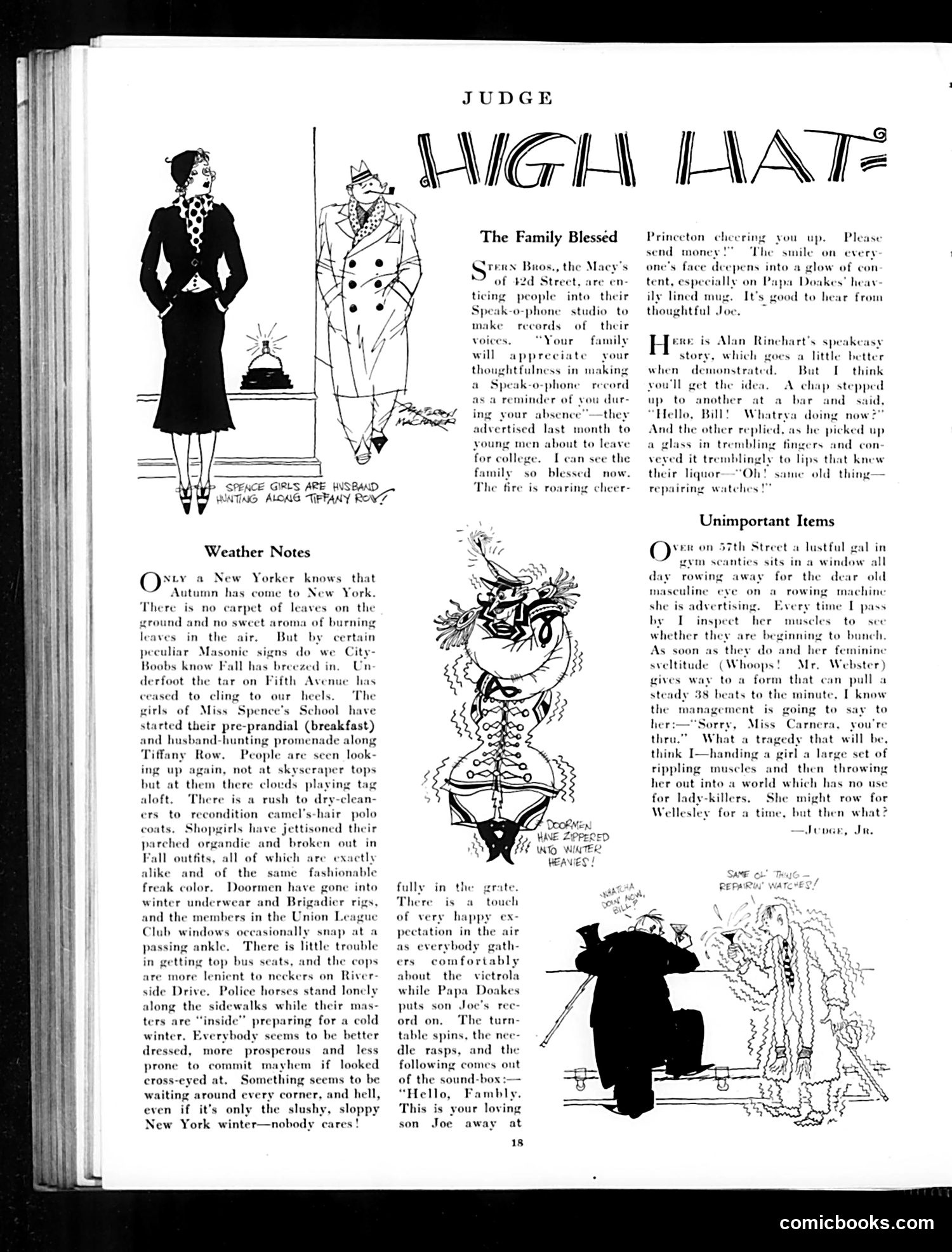
"Judge" Magazine Page Analysis This page satirizes early 1920s American social life and consumer culture. The cartoons mock: 1. "Spencer Girls Are Husband Hunting Along Tiffany Row" — Upper-class young women from Miss Spence's School parading in expensive clothing along the luxury shopping district, primarily to attract husbands rather than for genuine shopping. 2. "The Family Blessed" — The new Speak-o-phone recording technology, presented as a sentimental product marketed to college-bound sons. The satire suggests families prize hearing a distant son's voice on a record, though his message ("same old thing—repairing watches!") is mundane. 3. "Weather Notes" — Autumn social rituals of wealthy New Yorkers: fall fashion changes, casual cruelty toward service workers, and general prosperity mixed with petty bad behavior. 4. "Unimportant Items" — A gym woman building muscles through advertising work will be discarded once she becomes "too muscular," exposing society's shallow treatment of working women. The page targets consumerism, class pretension, and the disposability of women in commercial society.
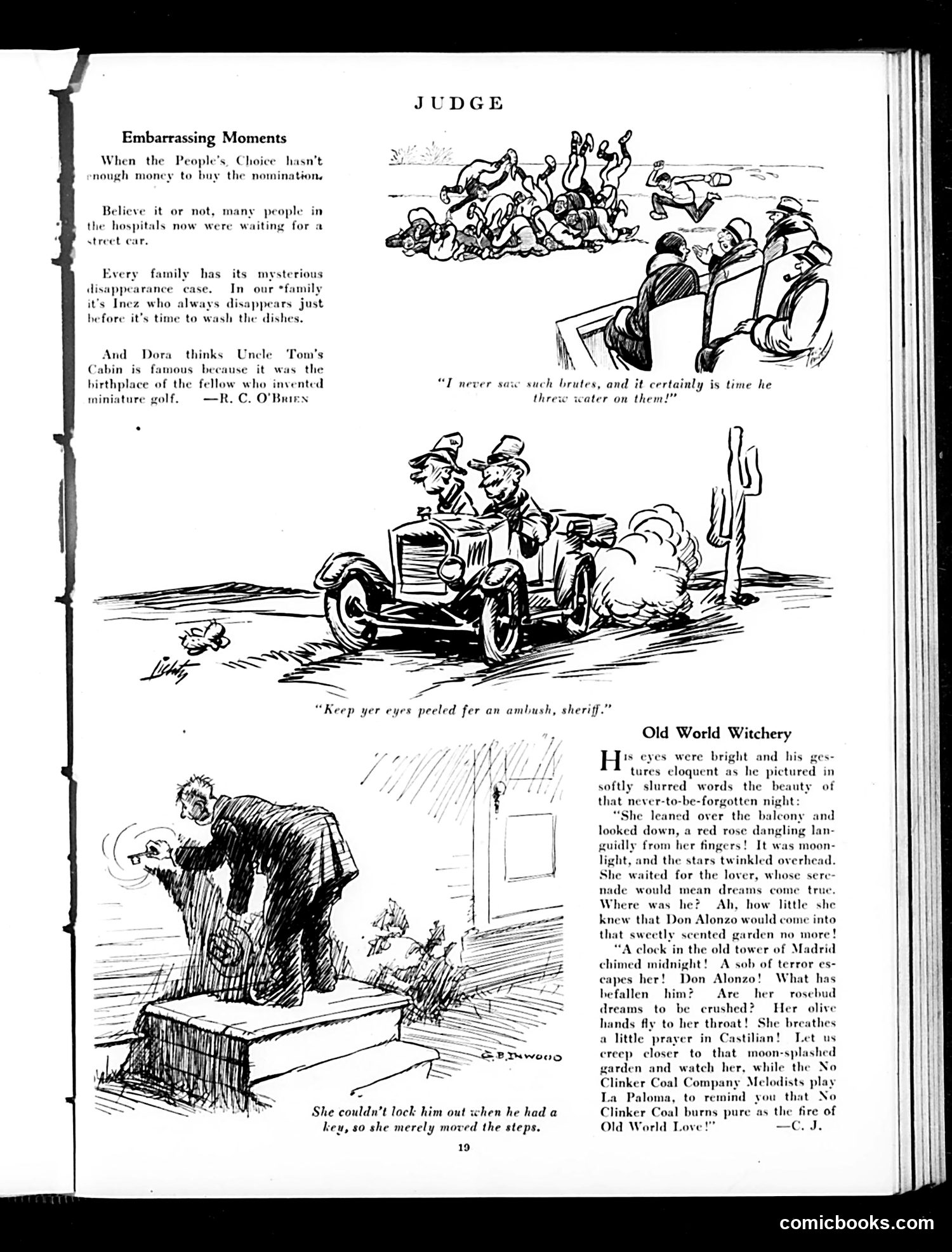
Judge Magazine Page Analysis This page contains three unrelated humor pieces typical of Judge's satirical format: "Embarrassing Moments" (top left): Brief jokes about social awkwardness, including a dig at political corruption—"When the People's Choice hasn't enough money to buy the nomination" mocks how candidates needed wealth to secure party nominations, a common Progressive Era critique. Two cartoons: The top cartoon shows men in a vehicle spotting chaos, with the caption about "brutes" needing water—likely satirizing rowdy behavior or uncontrolled crowds. The bottom cartoon depicts a woman blocking steps to keep someone out, illustrating domestic conflict. "Old World Witchery" (right): A parody of overwrought romantic literature, specifically Spanish melodrama. The narrator describes an impossibly theatrical scene of a woman waiting for her lover in moonlit Madrid. The joke is the absurd, purple-prose sentimentality—exaggerating the clichés of Old World European romance literature that American audiences found ridiculous. It concludes with an advertisement for "No Clinker Coal," inserting a commercial product into the mock-romantic narrative for comedic effect.
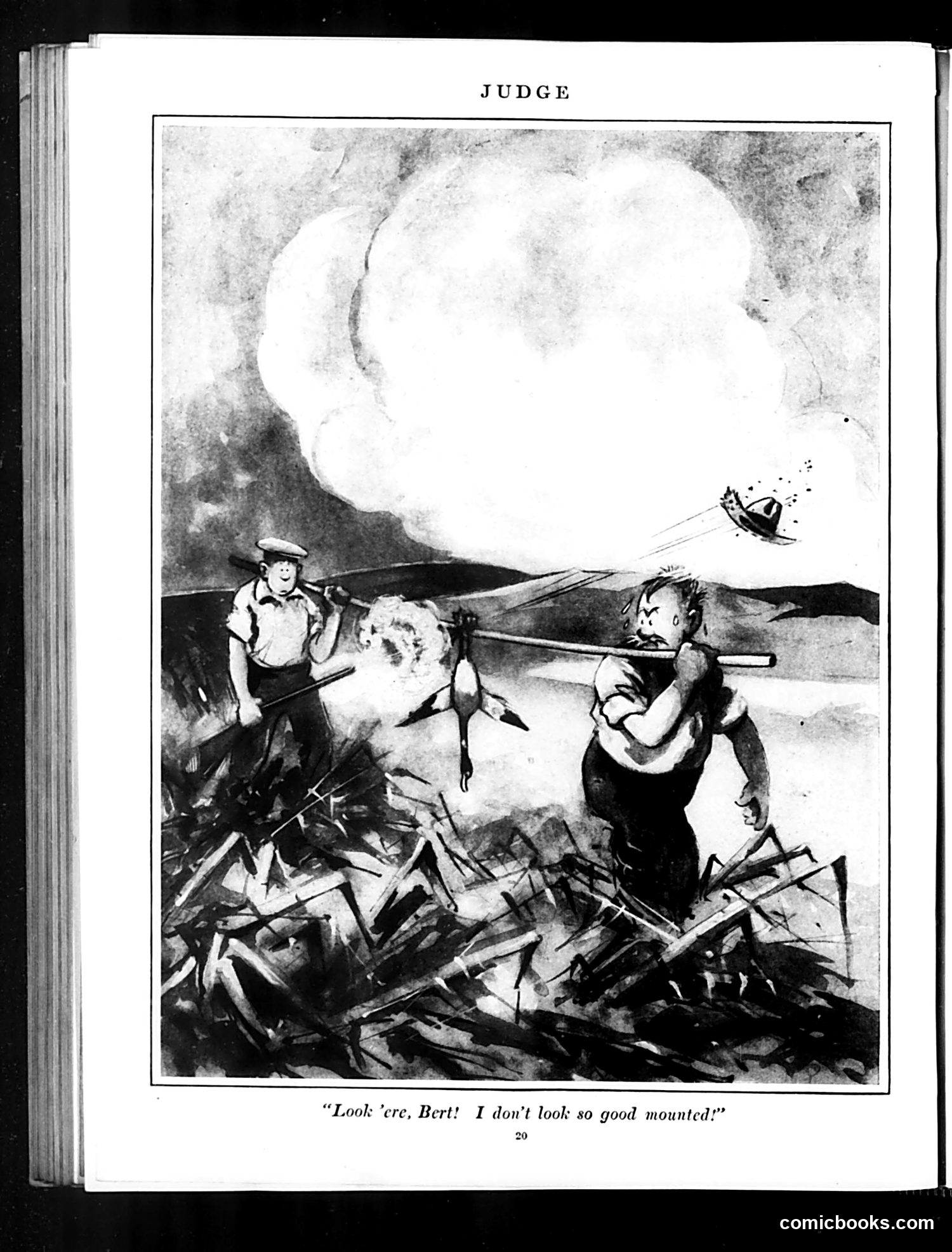
Analysis of Judge Magazine Page This political cartoon depicts three men on horseback in a nighttime desert or prairie setting beneath a large moon. One figure says to another named Bert: "Look 'ere, Bert! I don't look so good mounted!" The image appears to be satirizing poor horsemanship or an awkward rider. Without additional context about the specific historical period or identified figures, the exact political reference is unclear. The cartoon likely comments on someone's incompetence or unfitness for a particular role—the horse-riding serves as metaphor. The title "JUDGE" and page number (20) confirm this is from the satirical magazine. The quality and style suggest early-to-mid 20th century publication, but specific identities of "Bert" and the speaker remain uncertain without additional documentation.
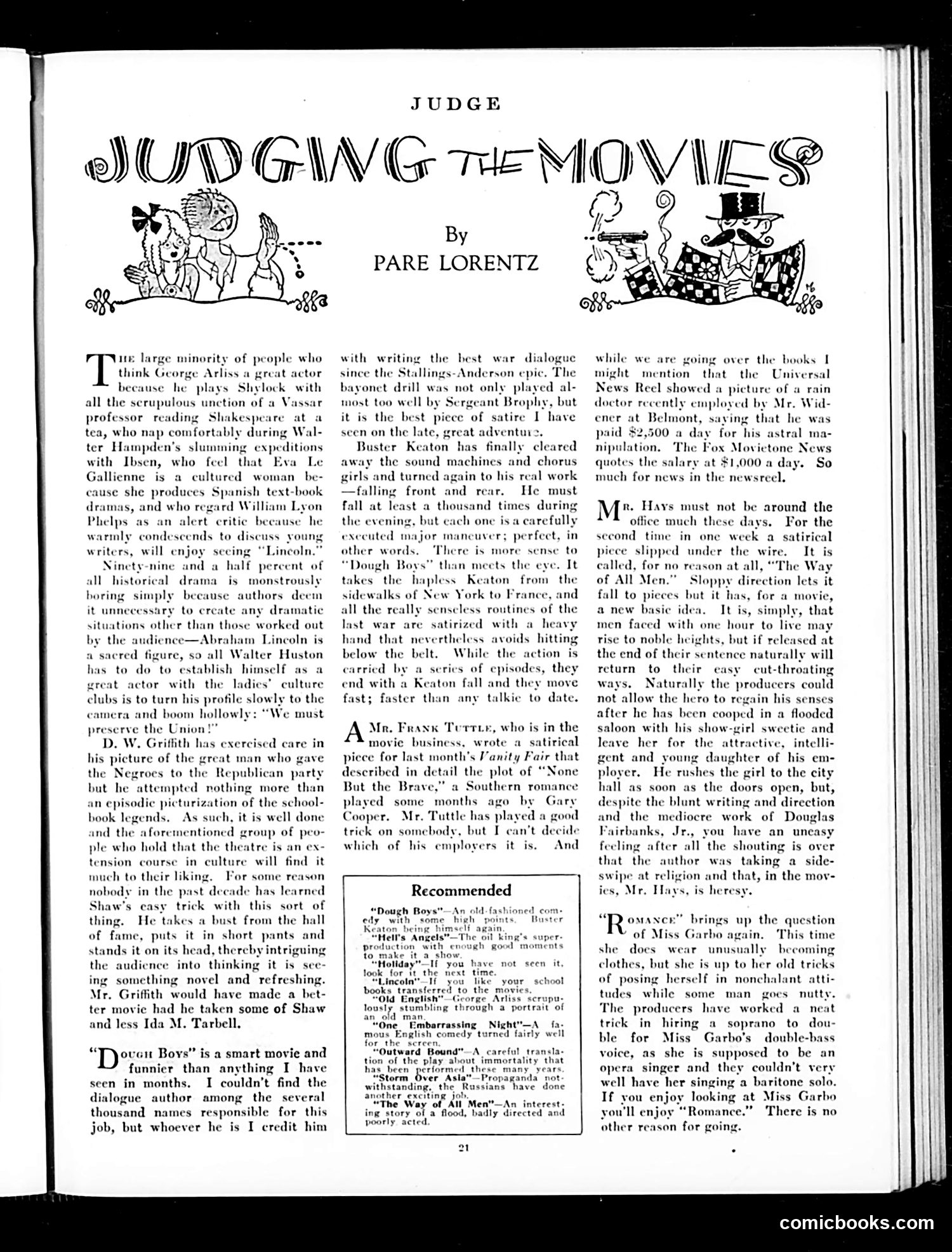
Judge Magazine Film Review Page This is Pare Lorentz's film criticism column reviewing several 1929 movies. The main satire targets pretentious audiences and mediocre historical dramas. Key references: - George Arliss (playing Shylock): Criticized for self-important, overly theatrical acting that appeals to snobbish theater-goers - "Lincoln" (D.W. Griffith film): Lorentz argues it's competently made but uninspired—merely illustrating "schoolbook legends" rather than creating genuine drama - Buster Keaton's "Dough Boys": Praised as genuinely clever satire about WWI, effectively mocking the war's "senseless routines" while maintaining fast comedic pacing - The satire mocks wealthy culture-club audiences who equate reverence for "sacred figures" with artistic appreciation, rather than demanding actual creative innovation Lorentz contrasts lazy period dramas (like the Lincoln film) with Keaton's approach—comparing it favorably to George Bernard Shaw's technique of deflating famous figures through irreverent humor.
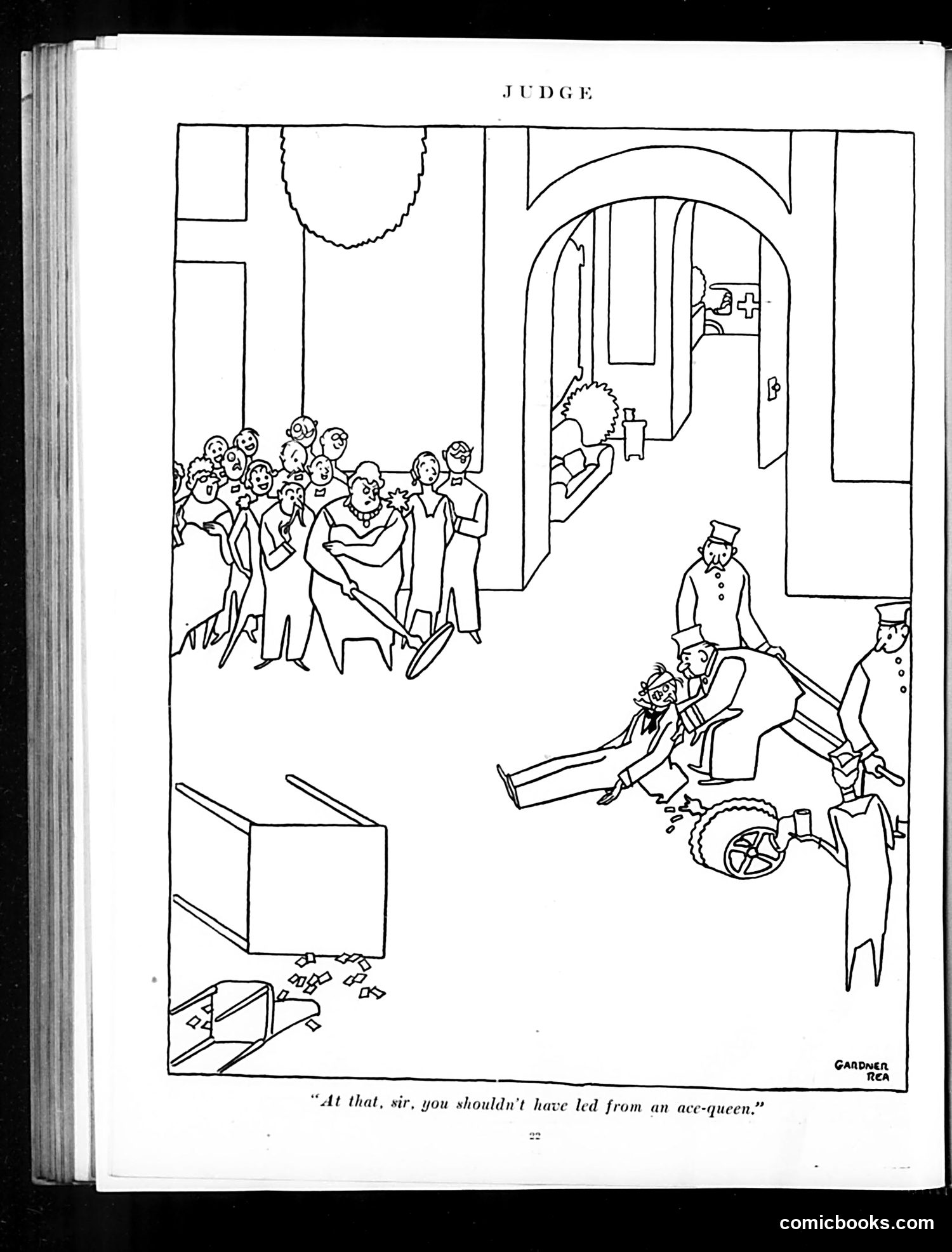
Cartoon Analysis: "Judge" Magazine - Bridge Game Satire This single-panel cartoon depicts a courtroom scene labeled "JUDGE" with a legal proceeding underway. The caption reads: "At that, sir, you shouldn't have led from an ace-queen." The satire conflates two meanings of "judge": a legal authority presiding over a trial, and a bridge game player evaluating card play. A judge is critiquing someone's card strategy (leading from ace-queen is considered poor bridge technique) while conducting what appears to be a formal legal proceeding. The humor plays on the double meaning—the judicial judge is inappropriately applying bridge game rules and etiquette to a courtroom setting, suggesting either that judges are preoccupied with card games or that courtroom proceedings share similarities with competitive bridge in their strategic complexities.
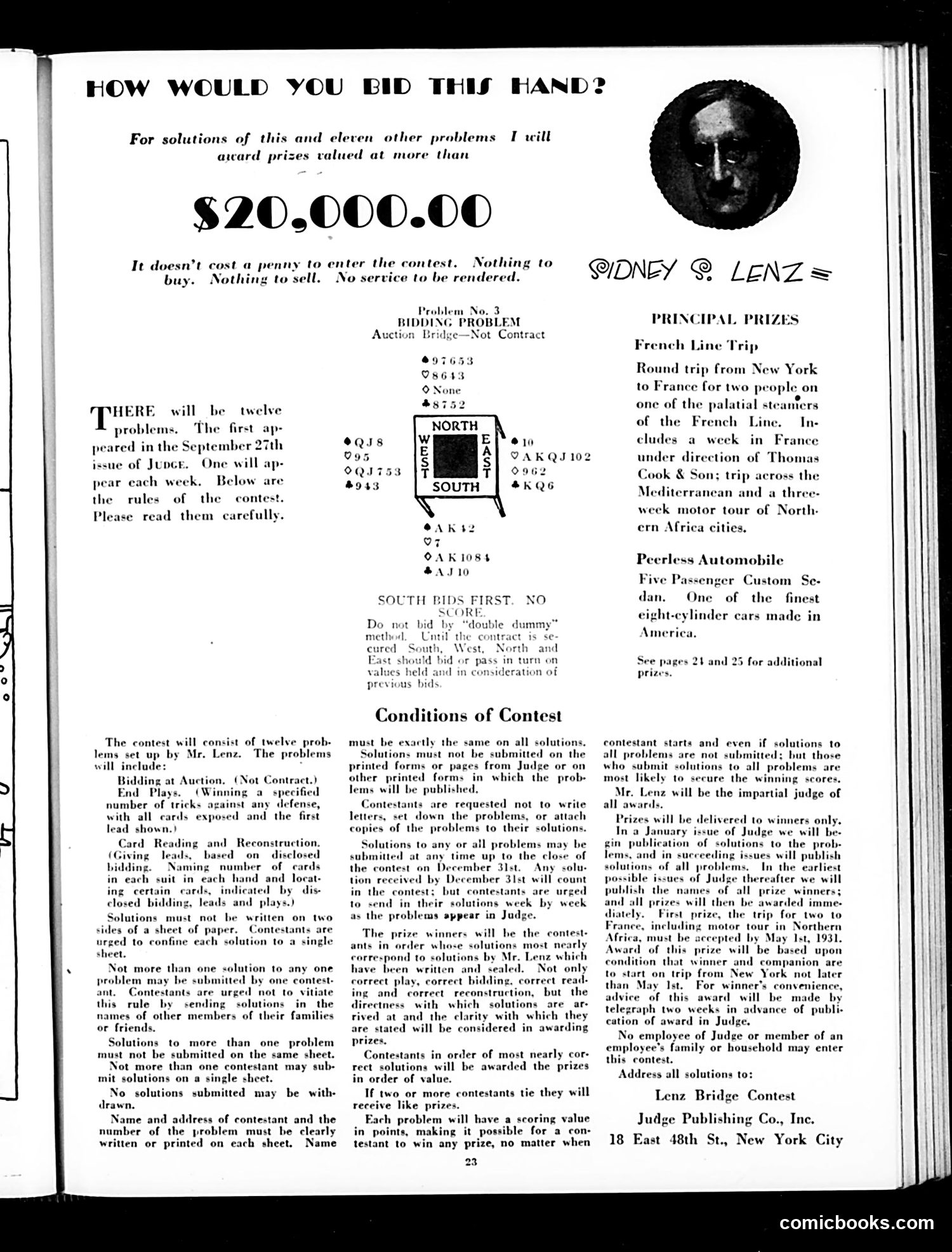
Understanding This Judge Magazine Contest Page This page announces a bridge-playing contest sponsored by Sidney Lenz, a prominent bridge expert of the era. The contest offers $20,000 in prizes for solving twelve bridge problems—bidding scenarios and card-play puzzles that will appear weekly in Judge magazine starting September 27th. The key element is "Problem No. 3" shown: a bridge hand diagram with specific card distributions that contestants must bid and play correctly. The contest requires analyzing not just correct play, but also correct bidding and "reconstruction" (understanding the full hand from limited information). Principal prizes include a French Line luxury steamship cruise and a high-end automobile. This reflects Judge's affluent readership. The detailed rules emphasize fair judging: solutions must follow strict formats, only one per sheet, with Lenz as impartial judge. This represents early 20th-century intellectual entertainment—bridge was considered a sophisticated game requiring serious analytical skill.
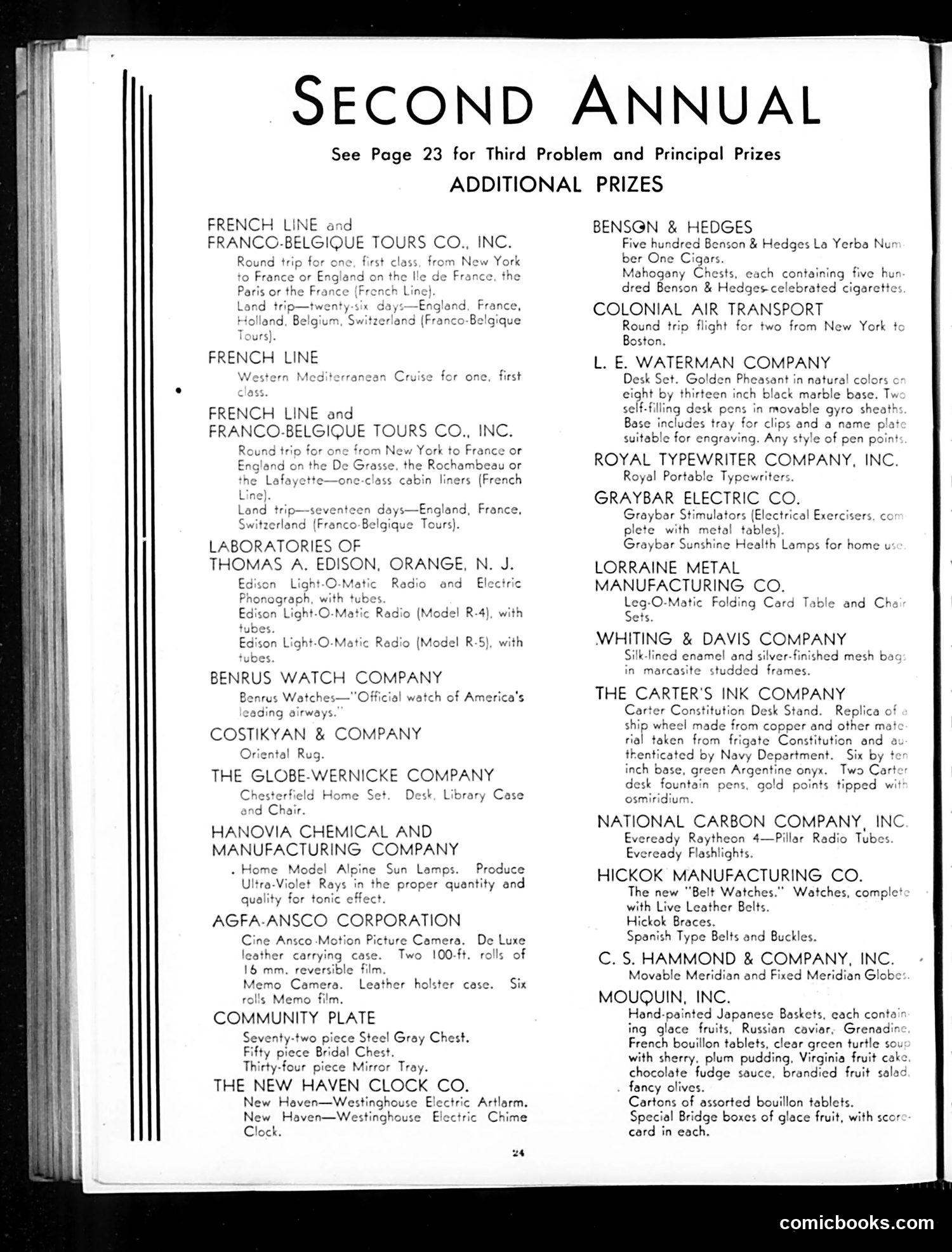
Analysis This page is not a cartoon or comic—it's an advertising section from Judge magazine's "Second Annual" competition or contest. The page lists "Additional Prizes" donated by various companies, ranging from luxury items (French Line cruises, Colonial Air Transport flights) to consumer goods (Royal typewriters, Waterman pens, Benrus watches, Edison radios). These prizes span the 1920s-30s era, reflecting contemporary aspirational products: automobiles, travel, electronics, and fine goods. The historical interest lies in what these prizes reveal about period wealth and taste—international travel was elite entertainment, radios were cutting-edge technology, and items like fountain pens and mahogany furniture were valued luxury goods. The sponsors represent major American manufacturers of that era. This appears to be a contest entry page, likely for a humor or art competition, with judges and prizes listed elsewhere in the magazine.
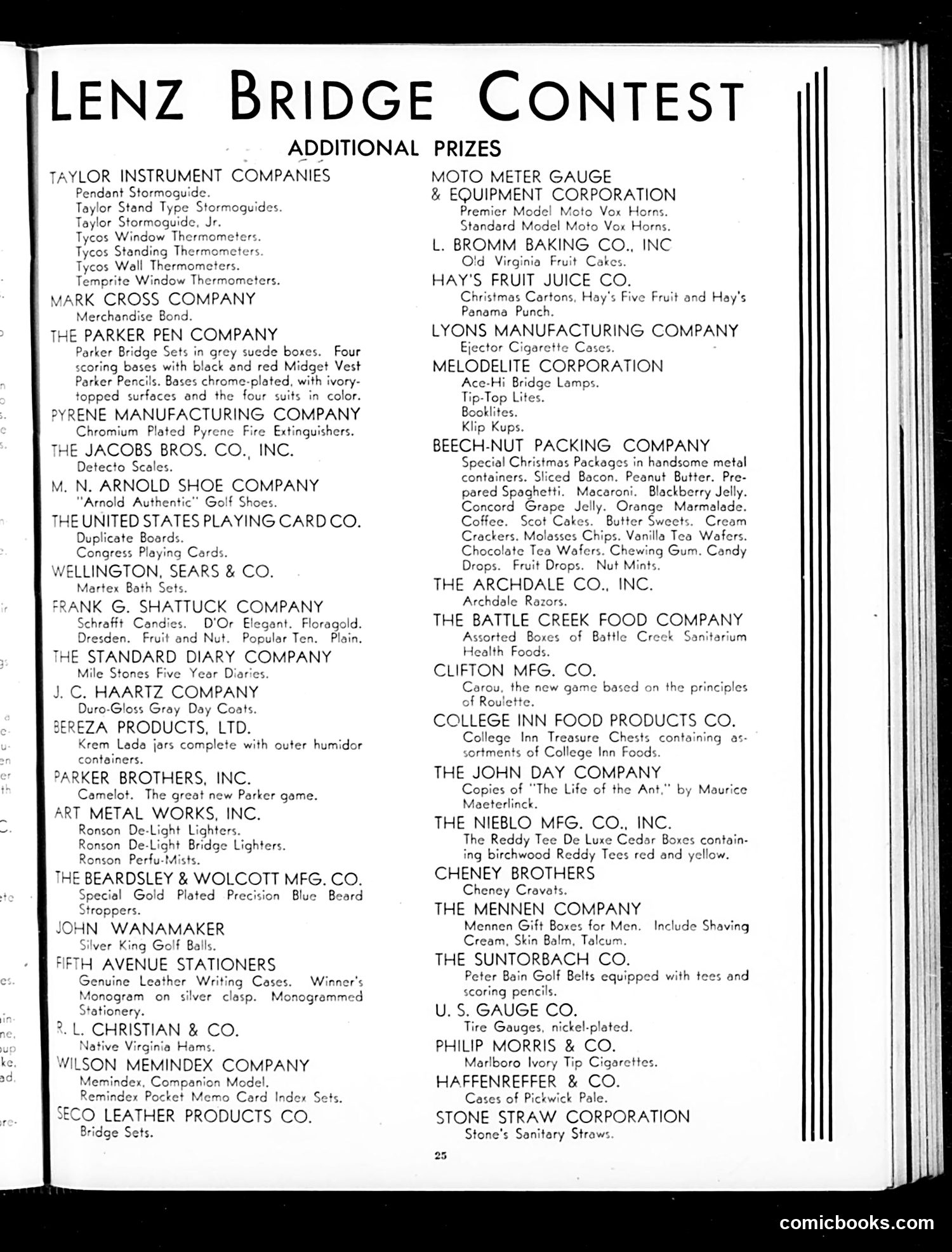
Lenz Bridge Contest Prize List This page is not a cartoon but rather an advertisement listing prizes for the "Lenz Bridge Contest"—likely a bridge-building competition Judge magazine sponsored. The page catalogs dozens of corporate sponsors and their donated prizes, ranging from practical items (thermometers, fire extinguishers, golf equipment) to luxury goods (leather writing cases, monogrammed stationery) to food products (Virginia hams, fruit cakes, cigarettes). The prizes reveal 1920s-era consumer culture and corporate sponsorship practices. Companies like Parker Pens, Ronson lighters, and Philip Morris competed for advertising exposure by donating branded merchandise. The breadth of sponsors—from small manufacturers to major corporations—suggests the contest generated significant public interest and media attention in Judge's readership.
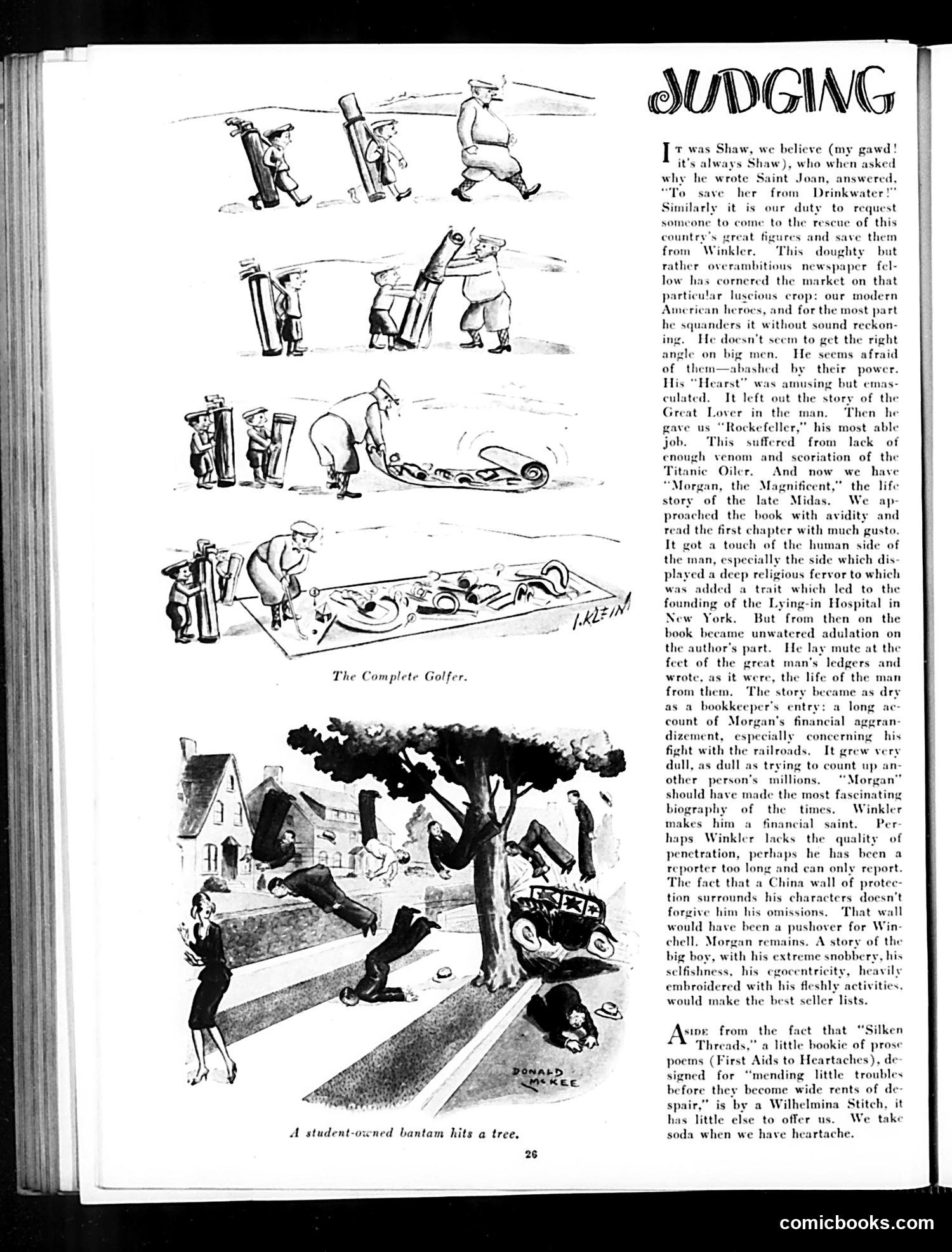
"Judging" Book Reviews This page critiques biographer Leland Stokes Winkler's recent books about American figures. The top cartoons humorously depict "The Complete Golfer"—showing a golfer's swing progression devolving into chaos. The main text attacks Winkler for sanitizing his subjects. The author argues Winkler's biographies of Hearst, Rockefeller, and especially J.P. Morgan lack edge and authentic human complexity. Winkler is accused of becoming a mere "bookkeeper" recording financial details rather than capturing the flawed, powerful personalities that made these men interesting. The critic suggests that writers like Walter Winchell (referenced sarcastically) would have been bolder. The page also briefly dismisses a poetry collection by Wilhelmina Stitch as forgettable. The satire's point: celebrity biographies that worship their subjects rather than honestly examining them produce dull, lifeless books—no matter how fascinating the subject.
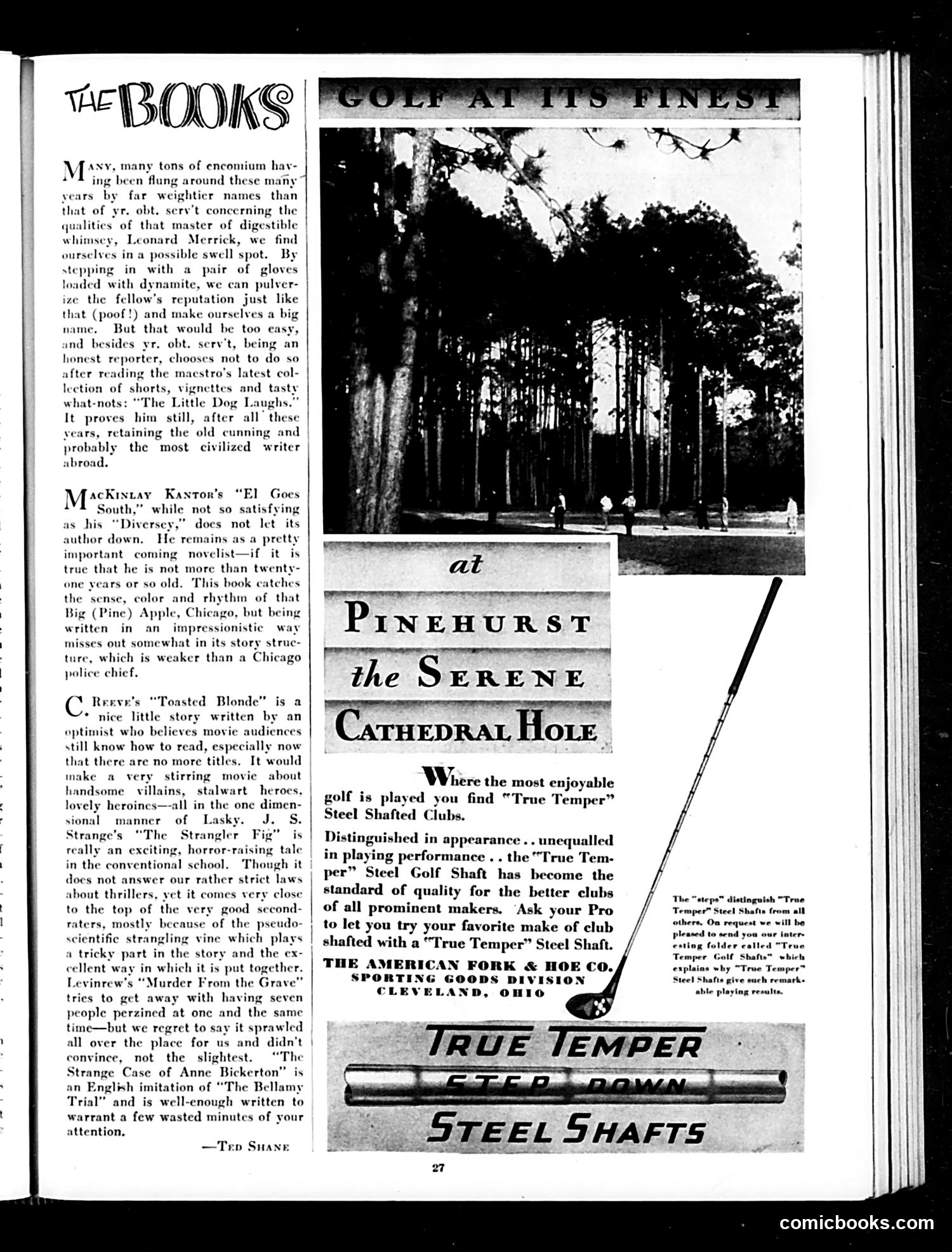
Judge Magazine Page Analysis This page is primarily a book review column ("The Books") by Ted Shane, with a substantial golf club advertisement for True Temper steel shafts occupying the right half. The Book Reviews: Shane discusses contemporary literary works by Leonard Merrick, MacKinlay Kantor, C. Reeve, and others—assessing their merits and weaknesses. The tone is witty and dismissive; Shane positions himself as a sophisticated critic who appreciates Merrick's "digestible whimsey" while finding fault with others' structural or stylistic shortcomings. This was typical Judge content: literary criticism delivered with sardonic humor for educated readers. The Advertisement: The True Temper ad uses the Pinehurst golf course as visual appeal, promoting steel-shafted clubs as the quality standard. The "steps" mentioned distinguish True Temper's product from competitors—a technical selling point for golfers. Historical Context: Judge catered to affluent, literate audiences interested in both contemporary literature and leisure pursuits like golf. The juxtaposition reflects 1920s-30s magazine advertising practices: mixing substantive content with luxury goods marketing.
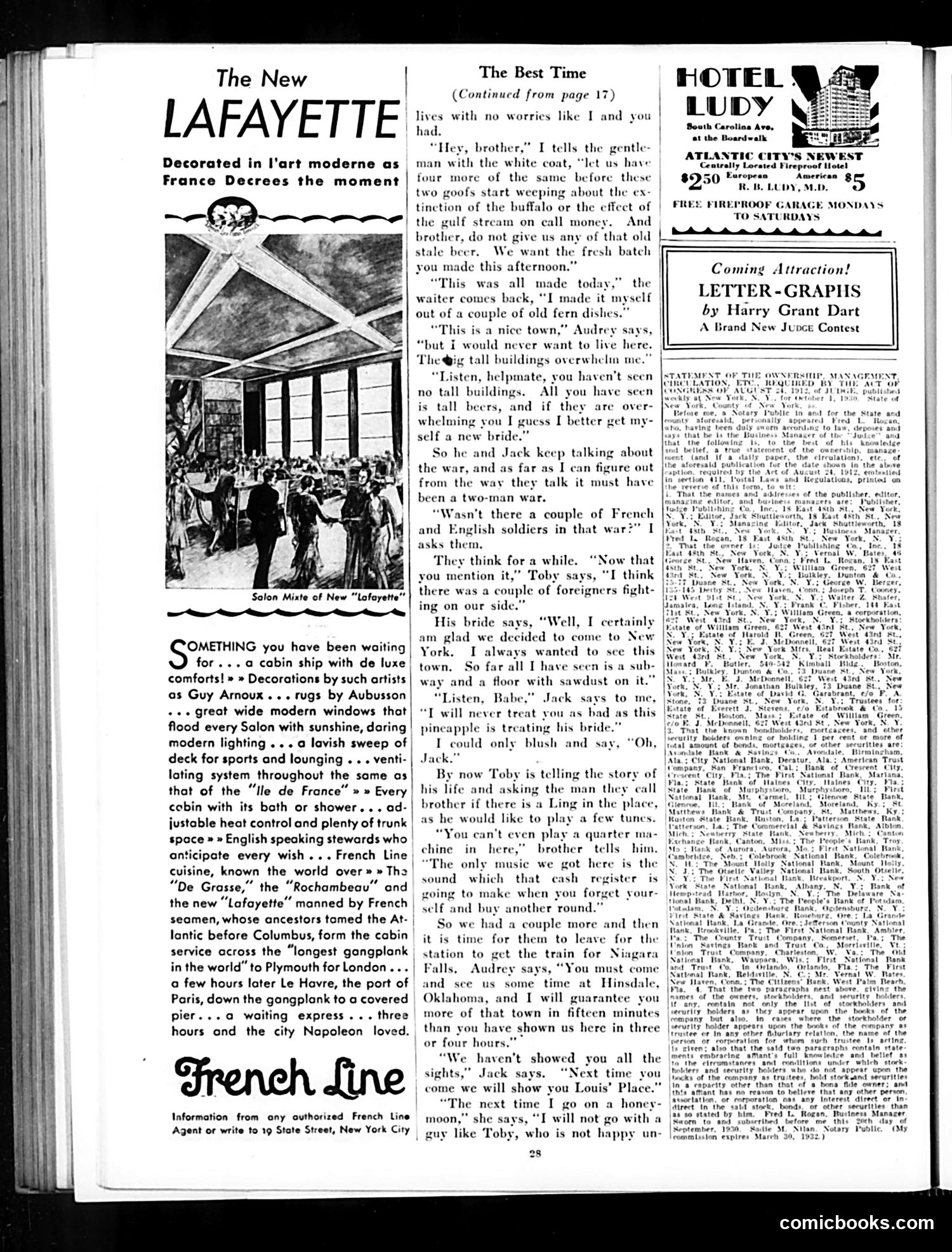
Judge Magazine Page Analysis This page contains primarily advertisements for luxury travel and hotels, with minimal editorial cartoon content. The main advertorial feature is the French Line shipping company promoting their new ocean liner "Lafayette," decorated in modern Art Deco style. It emphasizes luxury amenities (Aubusson rugs, modern plumbing, French cuisine) and positions transatlantic travel as glamorous leisure for the wealthy. The page also features the Hotel Ludy in Atlantic City and "Letter-Graphs by Harry Grant Dart," a contest feature (likely a humorous comic or puzzle). The substantial text excerpt titled "The Best Time (Continued)" appears to be a serialized short story about newlyweds and their acquaintances discussing travel and small-town life—a light social narrative rather than satire. No clear political satire or specific caricatures are evident. The page reflects 1920s-30s consumer culture: promoting transatlantic leisure travel, resort destinations, and modern conveniences to affluent readers.
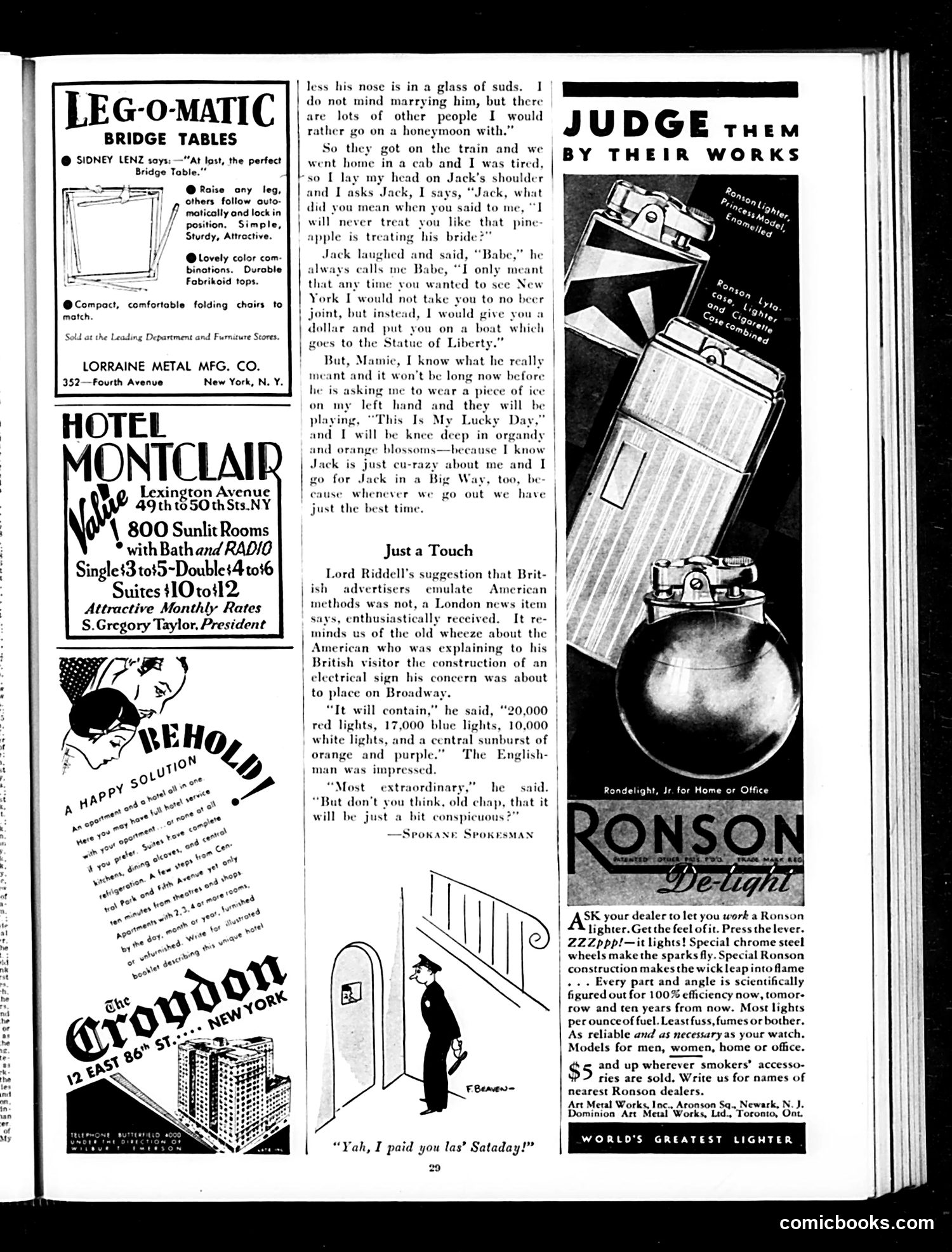
Judge Magazine Page Analysis This page is primarily advertising with minimal editorial content. The cartoons are brief: "Yah, I paid you las' Sataday!" (bottom) depicts a working-class man confronting what appears to be a landlord or creditor—likely satirizing the common experience of debt collection and tenants disputing payment claims. The broken English suggests immigrant or working-class characters, a familiar Judge trope. "Just a Touch" (center text) is a humorous anecdote about British vs. American advertising styles. An American explains his elaborate electrical Broadway sign with 20,000+ colored lights; a British observer questions whether it might be "a bit conspicuous"—satirizing British understatement versus American excess and ostentation. This reflects 1920s-30s cultural stereotypes about national character differences. The majority of the page consists of advertisements for bridge tables, hotels, furniture, and Ronson lighters, typical of Judge's revenue model.
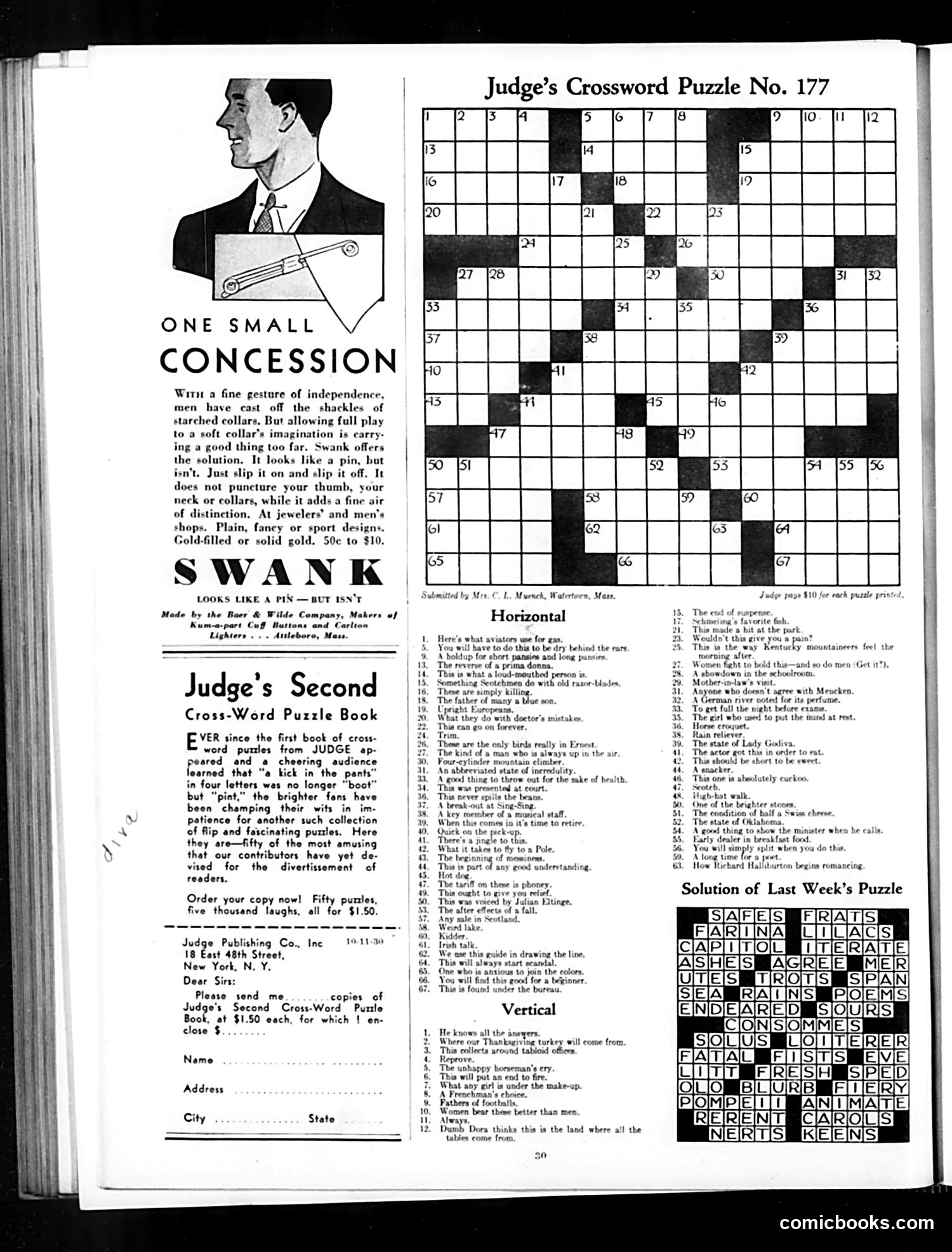
"One Small Concession" - Advertisement Satire This page is primarily advertising and puzzle content. The main satirical piece is a brief advertisement for "Swank" collar pins, accompanied by commentary on 1920s menswear fashion. The satire targets the era's shift away from formal starched collars toward casual "soft collars." The ad's headline joke—"looks like a pin, but isn't"—mocks men's pretension to casual independence while still clinging to formality through a decorative pin that mimics a straight pin's appearance without its function. The accompanying text gently ridicules how men used this "small concession" to modern informality as a way to appear relaxed and individualistic while maintaining propriety. The product itself represents the compromise: allowing "full play to a soft collar's imagination" while still preserving "distinction." The rest of the page contains Judge's crossword puzzle book advertisement and puzzle clues, which are incidental to the satire.
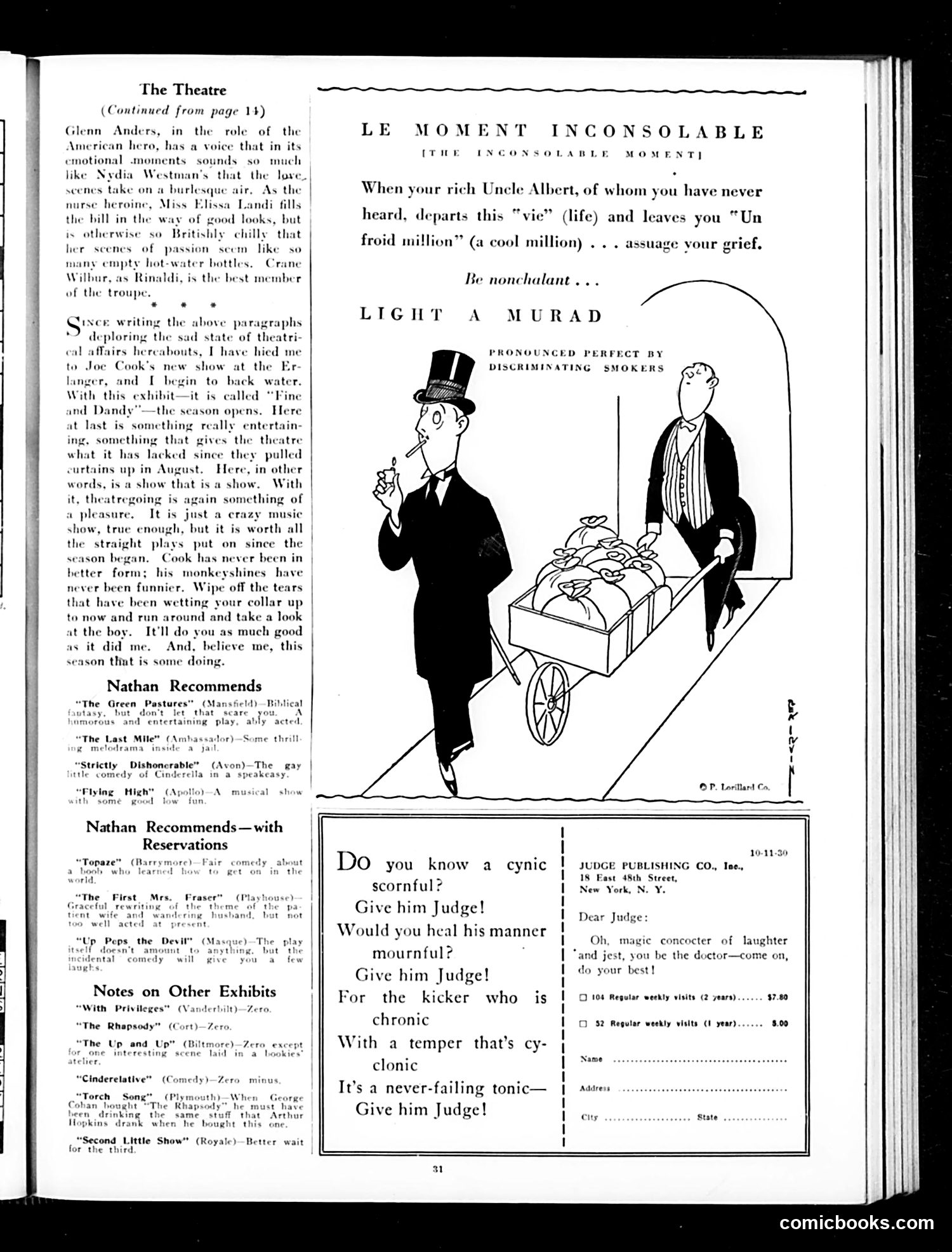
Judge Magazine Page Analysis This page from Judge (dated 10-11-30) combines theatre criticism with cigarette and subscription advertising. Main Content: The left column reviews Broadway shows, notably praising Joe Cook's musical "Fine and Dandy" as genuinely entertaining after a disappointing theatrical season. The critic praises Cook's comedic talents and physical humor. Central Cartoon: The illustration depicts a wealthy man in a top hat pushing a cart overflowing with money, accompanied by text about inheriting "un froid million" (a cool million) from a deceased uncle. The joke: the ad urges the grieving heir to "be nonchalant" while smoking Light a Murad cigarettes—essentially advertising cigarettes as a way to maintain composure during sudden wealth. It's absurdist advertising humor typical of Judge's satirical approach. Bottom Section: Judge promotes itself as a "never-failing tonic" for cynics and the bad-tempered, offering subscription rates for weekly visits. The page exemplifies how 1930s satirical magazines blended entertainment criticism with irreverent advertising parody.
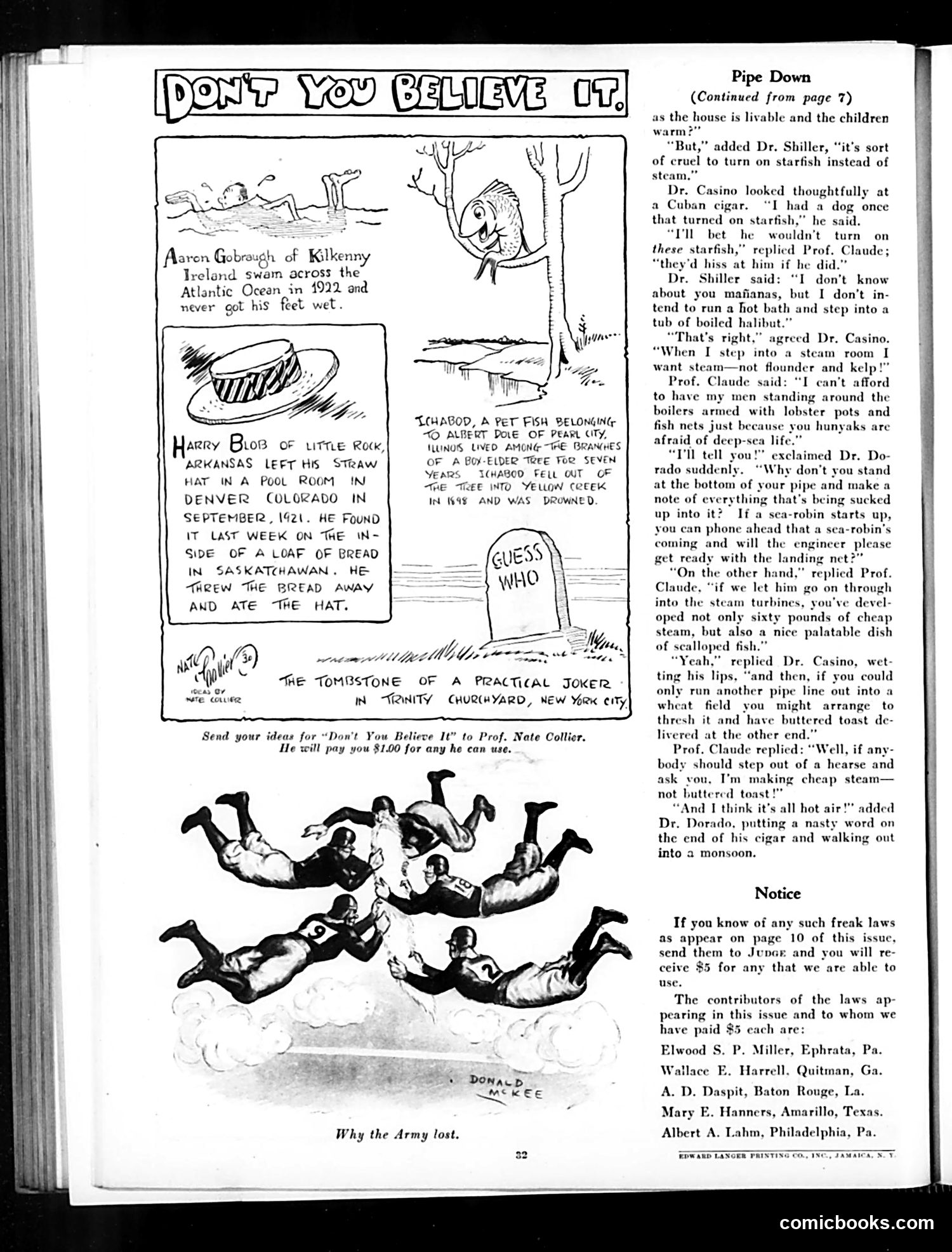
"Don't You Believe It" - Judge Magazine Satire Page This page showcases Judge's humor feature where readers submit tall tales and absurd "facts" for entertainment. The main section presents four ridiculous anecdotes presented as truth: 1. A man who swam the Atlantic in 1922 without getting his feet wet 2. A straw hat found in bread in Saskatchewan decades later 3. A pet fish that lived in a tree for seven years after falling from it 4. A practical joker's tombstone in Trinity Churchyard, NYC Below these sits a cartoon about "Why the Army lost," showing soldiers falling through clouds—likely WWI-related satire about military incompetence or miscalculation. The page also includes a dialogue between professors debating absurd alternatives to steam heat (starfish, fish, scalloped dishes), which functions as additional satirical commentary on impractical solutions to real problems. The humor relies on deadpan presentation of impossibilities, typical of early 20th-century American comic magazines mocking credulity and absurdity.
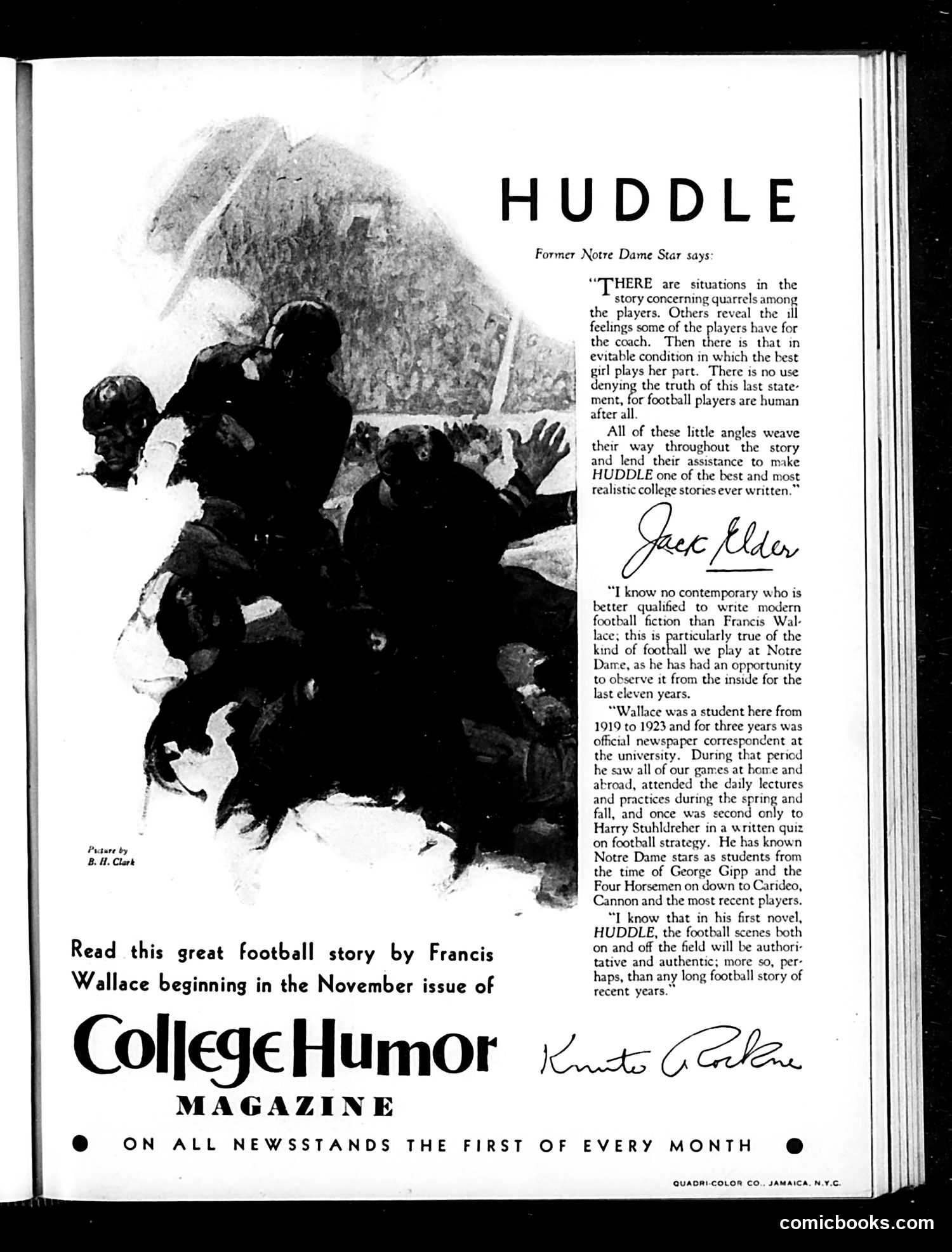
Analysis This is primarily advertising copy, not satire. The page promotes Francis Wallace's novel *Huddle*, serializing in *College Humor* magazine starting November. The image shows a football huddle scene (painted by B.H. Clark). The text features endorsements from two Notre Dame figures: 1. Jack Elder (Former Notre Dame Star) — praises the novel's realistic portrayal of player conflicts, coaching tensions, and romantic complications, noting "football players are human after all." 2. Knute Rockne (Notre Dame coach, identifiable by signature) — vouches for Wallace's authority, noting he was a student-correspondent there 1919-1923 and witnessed Notre Dame's legendary era (referencing George Gipp and the "Four Horsemen"). Rockne emphasizes the football scenes' authenticity and superiority to other recent football fiction. The appeal leverages Notre Dame's football prestige and Rockne's legendary coaching reputation to market the serialized story. There is no satirical intent—this is straightforward magazine promotion targeting college readers interested in football narrative.
Camel Cigarettes Advertisement (1930) This is a Camel cigarettes advertisement, not political satire. The page shows three well-dressed figures in 1930s attire in a social scene—a woman seated, a man standing in a suit and fedora, and another man in a sailor-style outfit. The ad's message is straightforward: smoking Camels brings "pleasure" and social enjoyment. The imagery associates the cigarettes with leisure, companionship, and sophistication—common advertising tactics of the era. The copyright credit confirms this is from R.J. Reynolds Tobacco Co., Winston-Salem, N.C. (1930). There is no political cartoon or satire here; it's a commercial advertisement typical of Judge magazine, which mixed editorial content with paid advertising.