judge
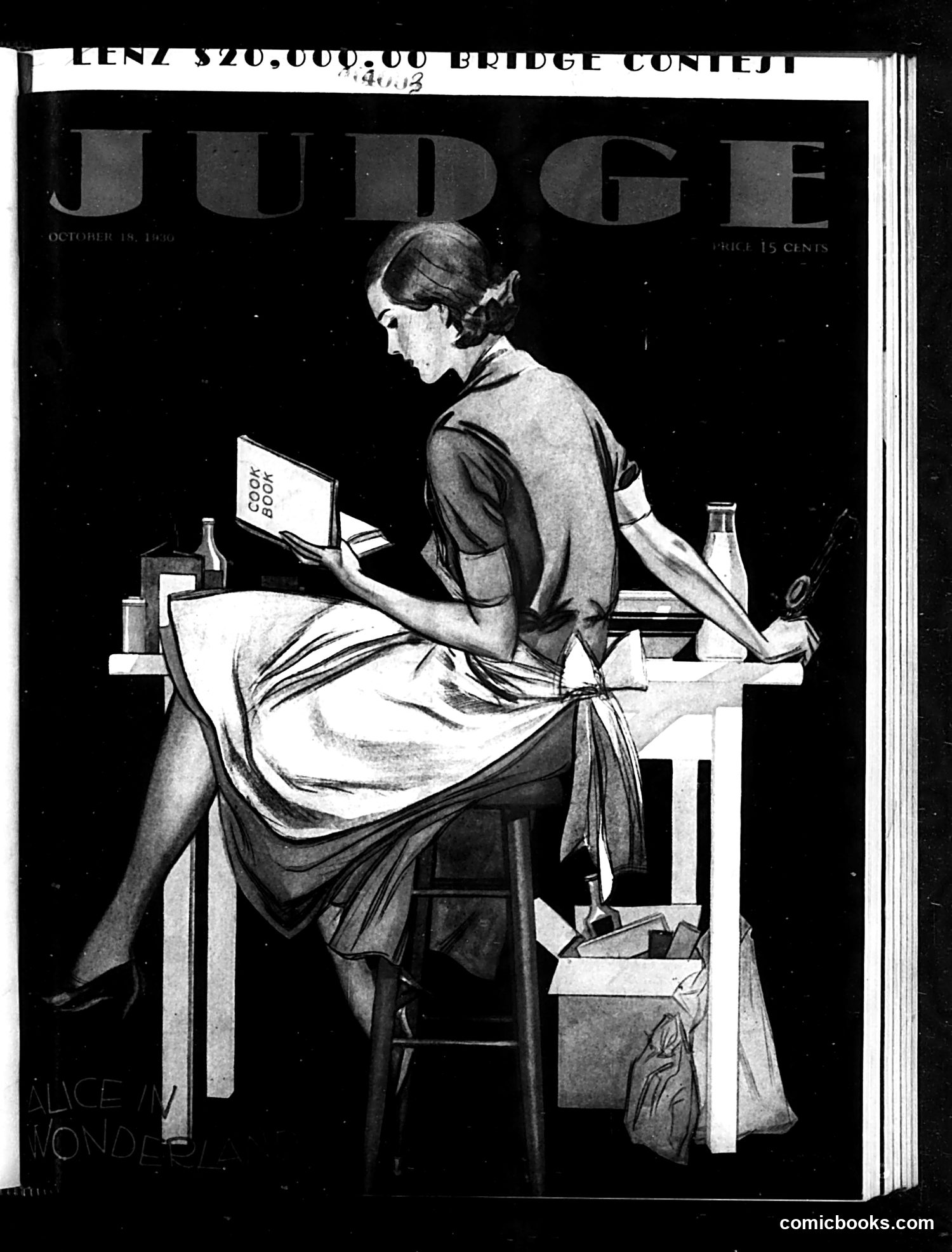
Judge — October 18, 1930
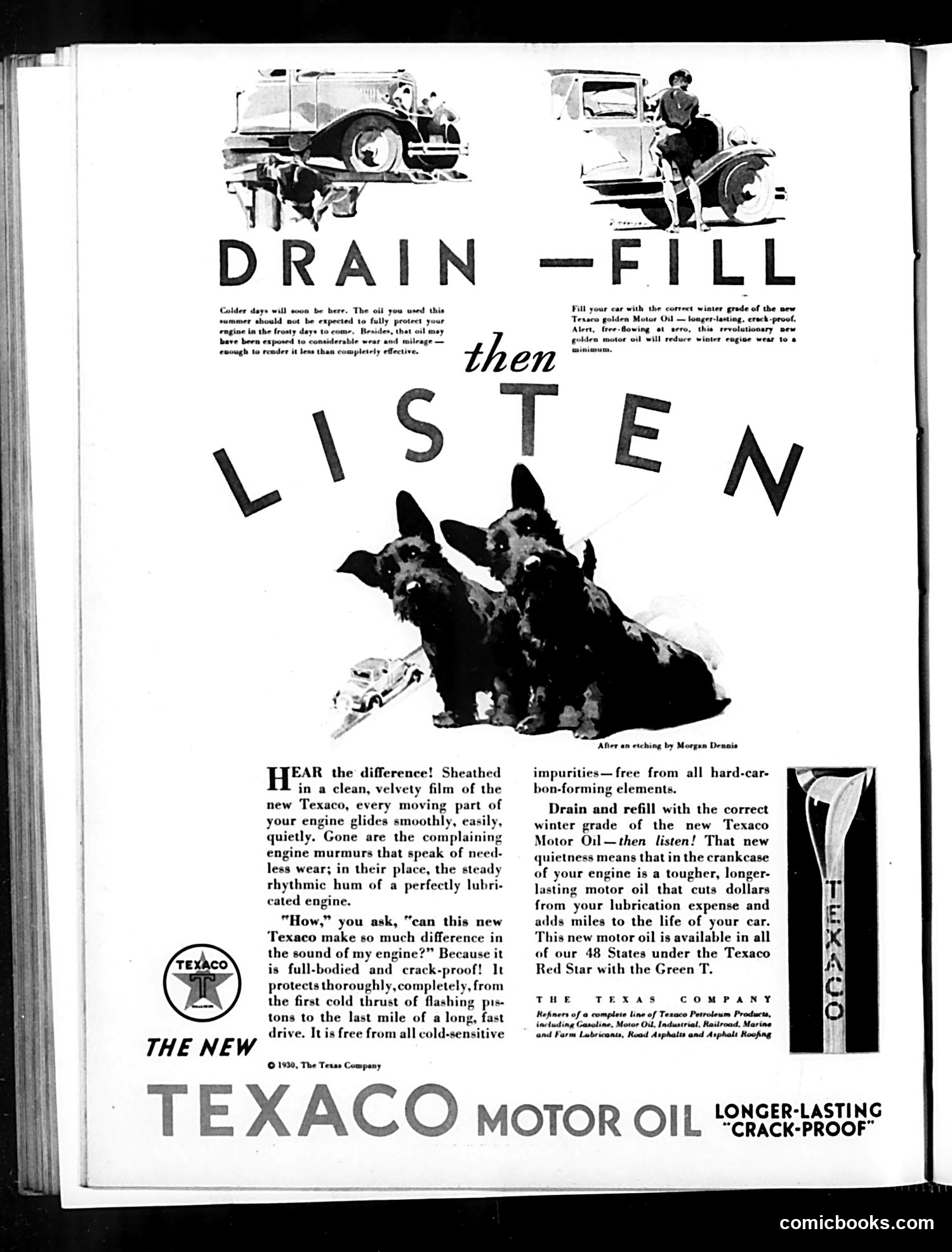
Analysis This page is primarily a Texaco Motor Oil advertisement, not political satire. The main content advertises "The New Texaco Motor Oil" as "longer-lasting" and "crack-proof." The layout uses a three-panel structure: "DRAIN—FILL then LISTEN." The top panels show car maintenance procedures. The bottom center features two Scottish Terriers (drawn by Morgan Dennis) as a visual metaphor—the dogs' smooth coats represent the oil's smooth, protective film on engine parts. The advertisement emphasizes the product's quieting effect on engines and protection from wear. The Scottish Terriers symbolize sleekness and refinement, contrasting with the implied roughness of inferior oils. This is commercial messaging, not editorial commentary or satire.
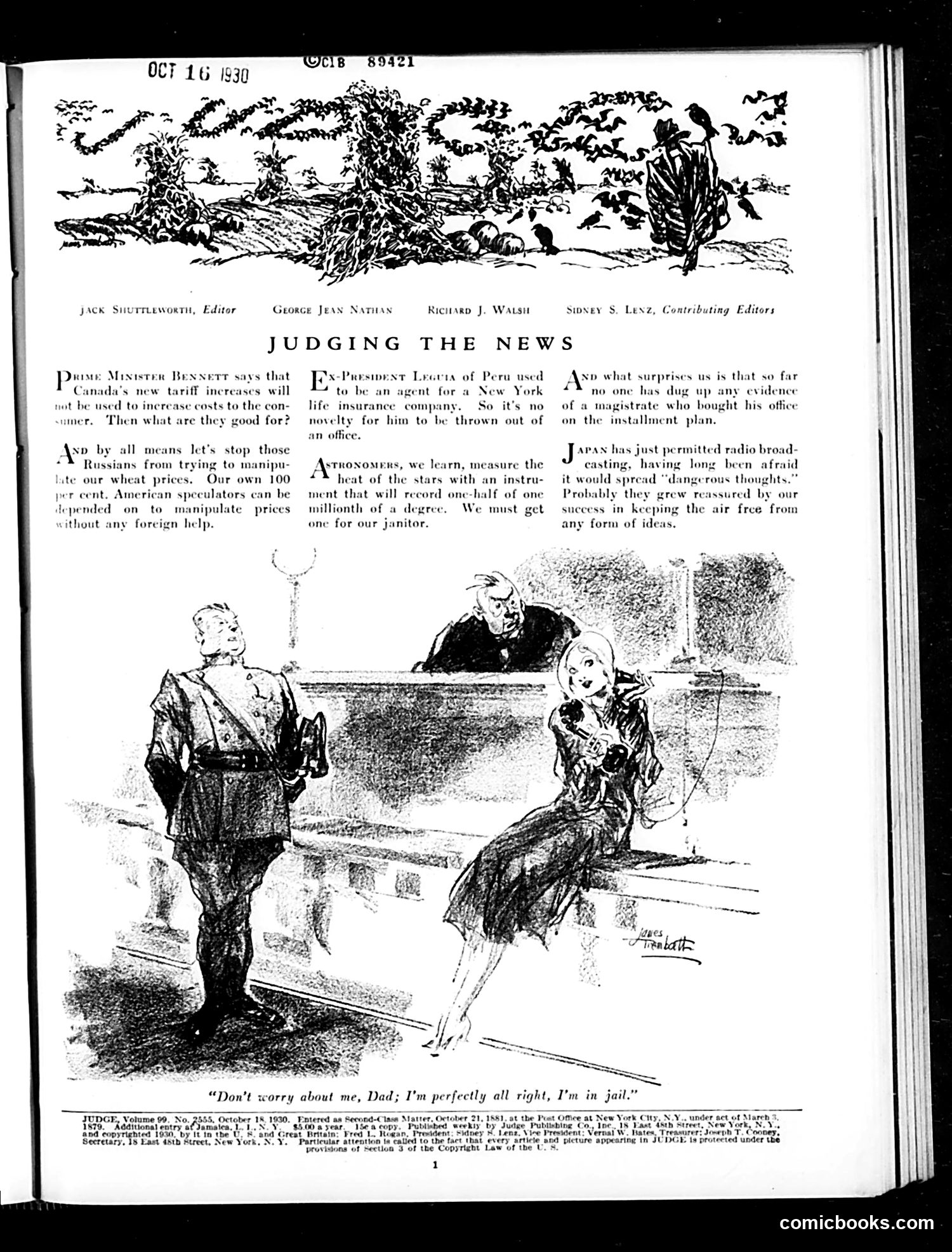
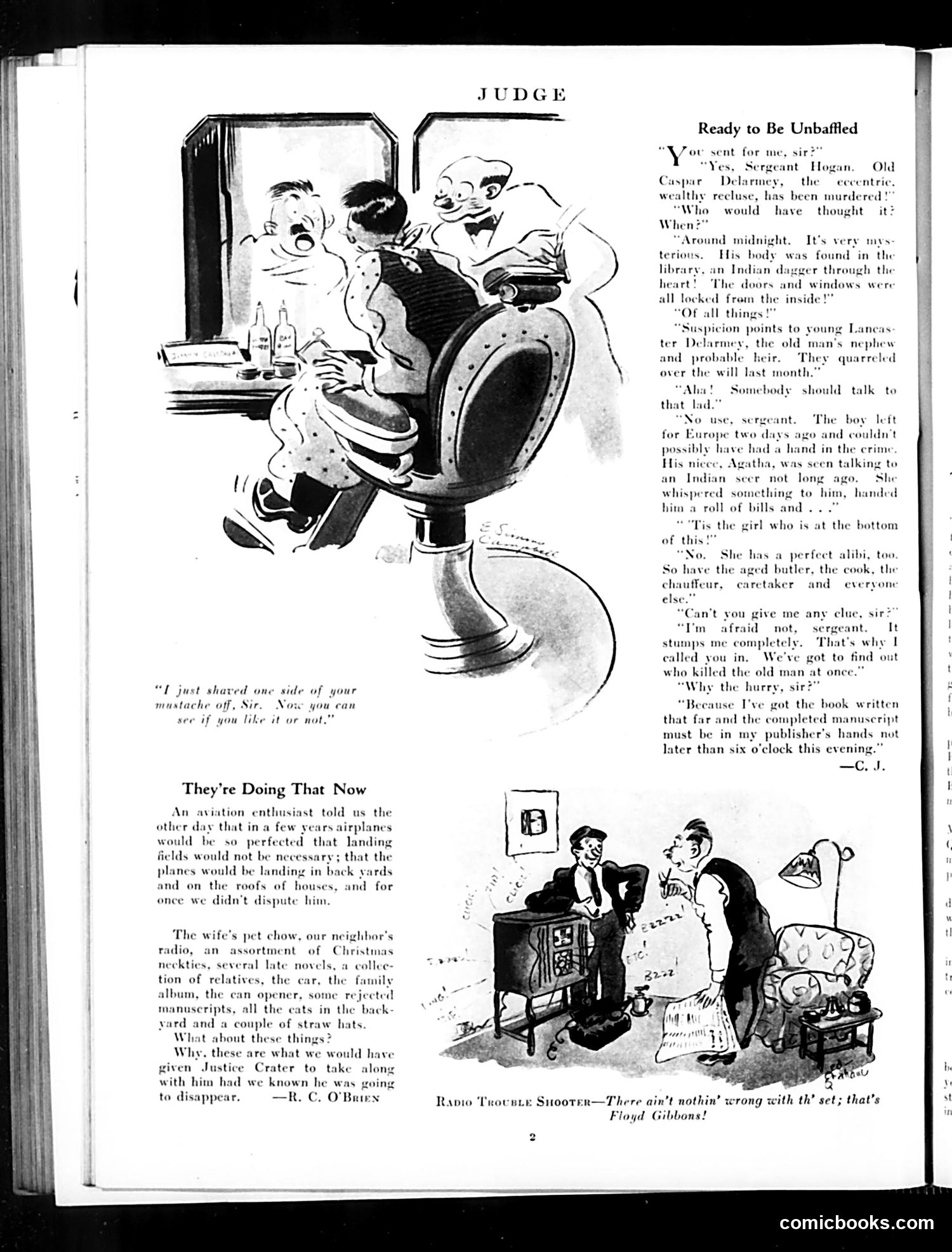
Analysis of Judge Magazine Page Top Cartoon ("Judge"): A barber is shaving a customer while two other men watch. The caption suggests the barber has shaved "one side of your mustache off" and invites the customer to judge the result. This appears to be a visual pun playing on the magazine's title—using "Judge" as a verb (asking the customer to evaluate the barber's work) rather than as a noun. Bottom Section ("They're Doing That Now"): A humorous anecdote about aviation predictions, joking that future planes will land in backyards. The accompanying cartoon depicts a domestic scene, likely satirizing overly optimistic technological forecasts common in the era. Both pieces represent typical Judge magazine humor: visual puns and gentle social satire about everyday life.
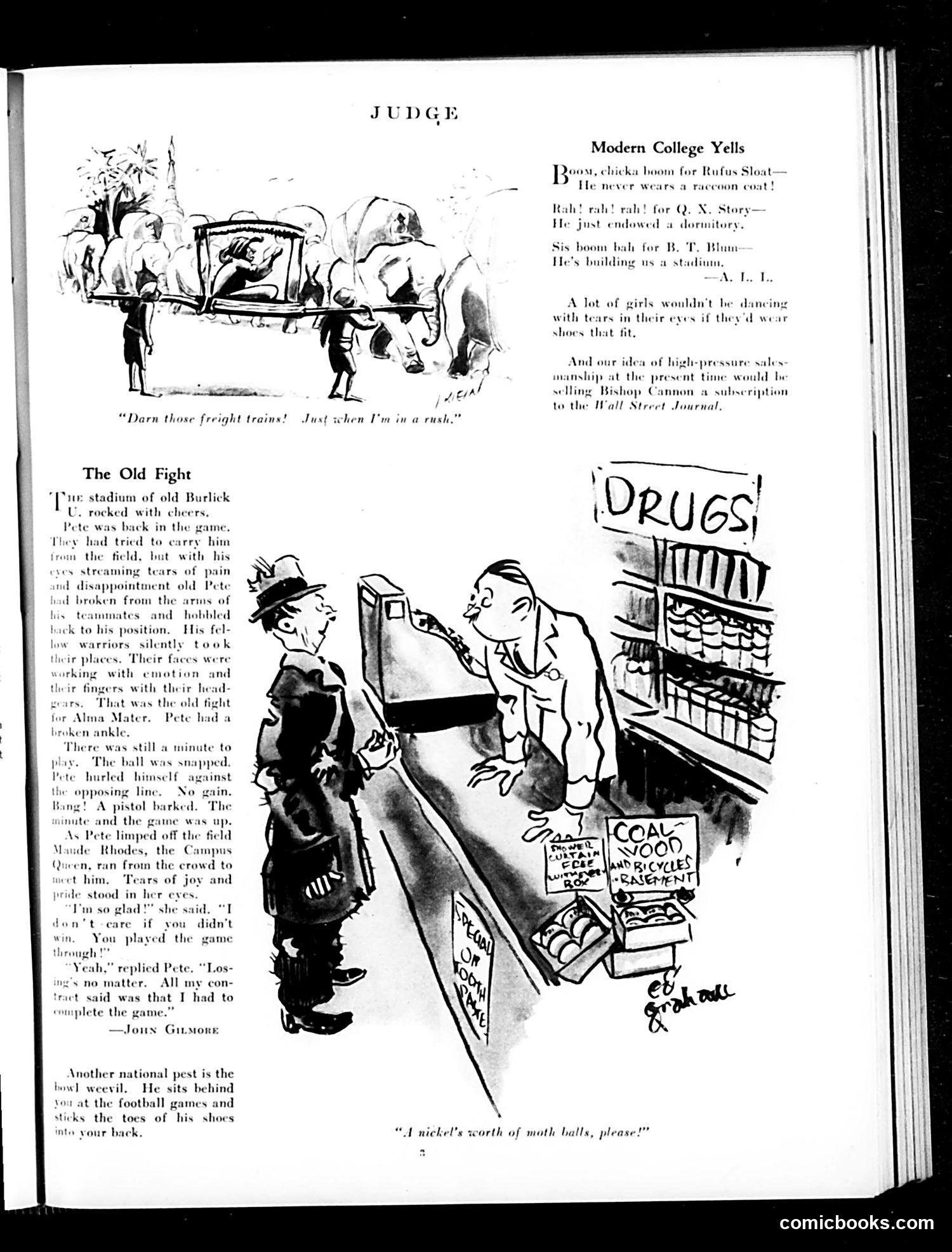
Analysis of Judge Magazine Page "Modern College Yells" (top): Satirizes college spirit through absurd cheers—"Rah! rah! rah! for Q. X. Story" (an unknown embezzler), celebrating a dormitory instead of sports achievements. The humor mocks how colleges prioritize construction projects over athletic accomplishment. "The Old Fight" (left): A nostalgic sports narrative about Pete from "old Barlick U." overcoming injury to play football. The story celebrates athletic perseverance and school pride through traditional masculinity. Right cartoon: Shows a man at a drugstore counter asking for "a nickel's worth of moth balls, please!" The visual joke—the sign displays "DRUGS"—suggests the drugstore clerk might misinterpret his request as drug-seeking behavior, satirizing public anxiety about drugstore sales of questionable substances during Prohibition era.
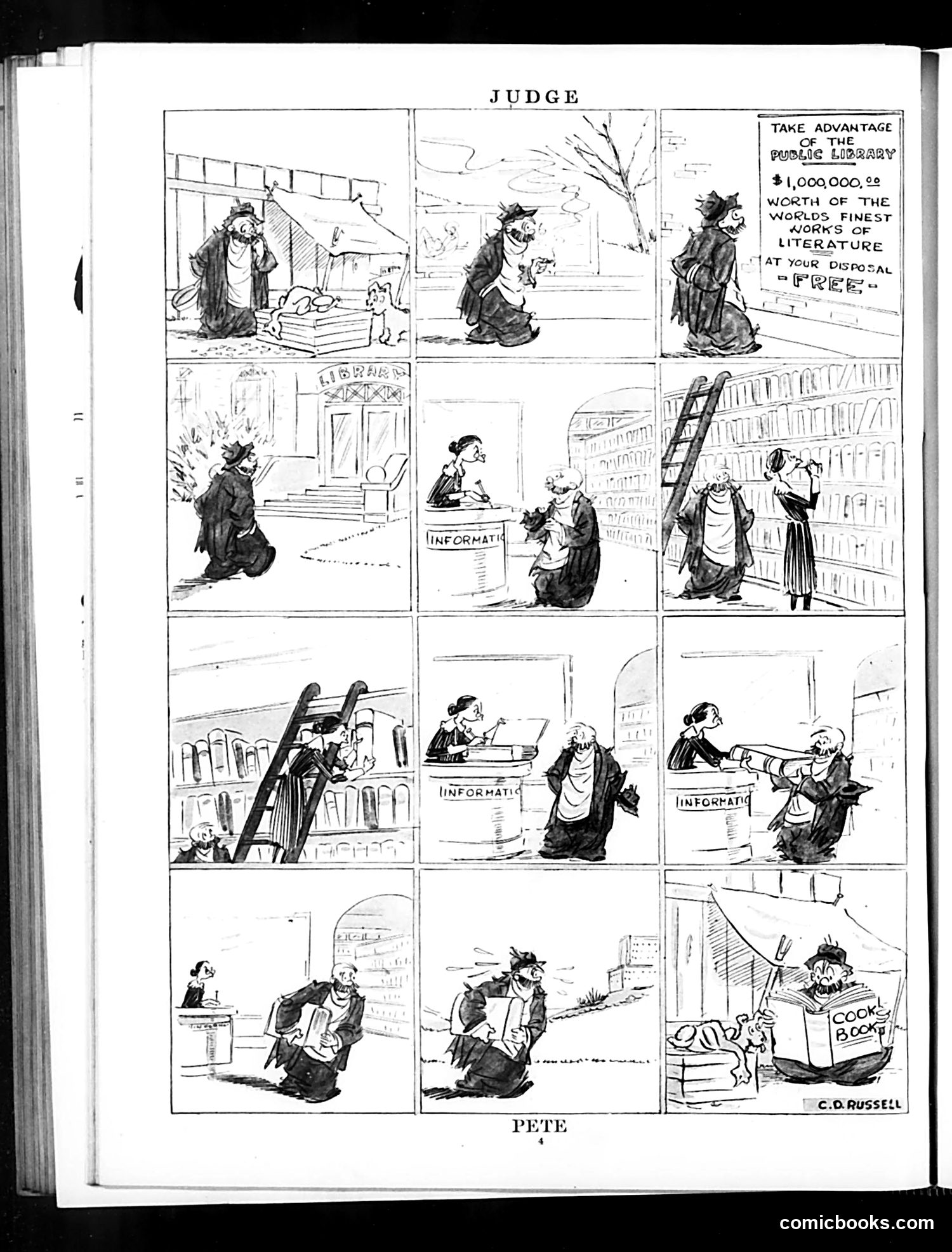
"Judge" Cartoon Analysis: "Judge" and "Pete" This two-part satirical comic by C.D. Russell mocks a wealthy figure's attempt to appear philanthropic. The top strip ("Judge") shows a well-dressed man repeatedly encountering the public library, which offers "$1,000,000.28 worth of the world's finest works of literature at your disposal FREE." Each panel depicts him browsing or accessing the library's collections. The bottom strip ("Pete") appears to continue this theme, showing the same figure in various domestic scenarios—reading, cooking, and engaging with books—suggesting irony about his actual engagement with literature versus his claimed generosity. The satire likely targets wealthy patrons who gain public credit for library donations while the material remains inaccessible to ordinary citizens, or mock-generosity with strings attached.
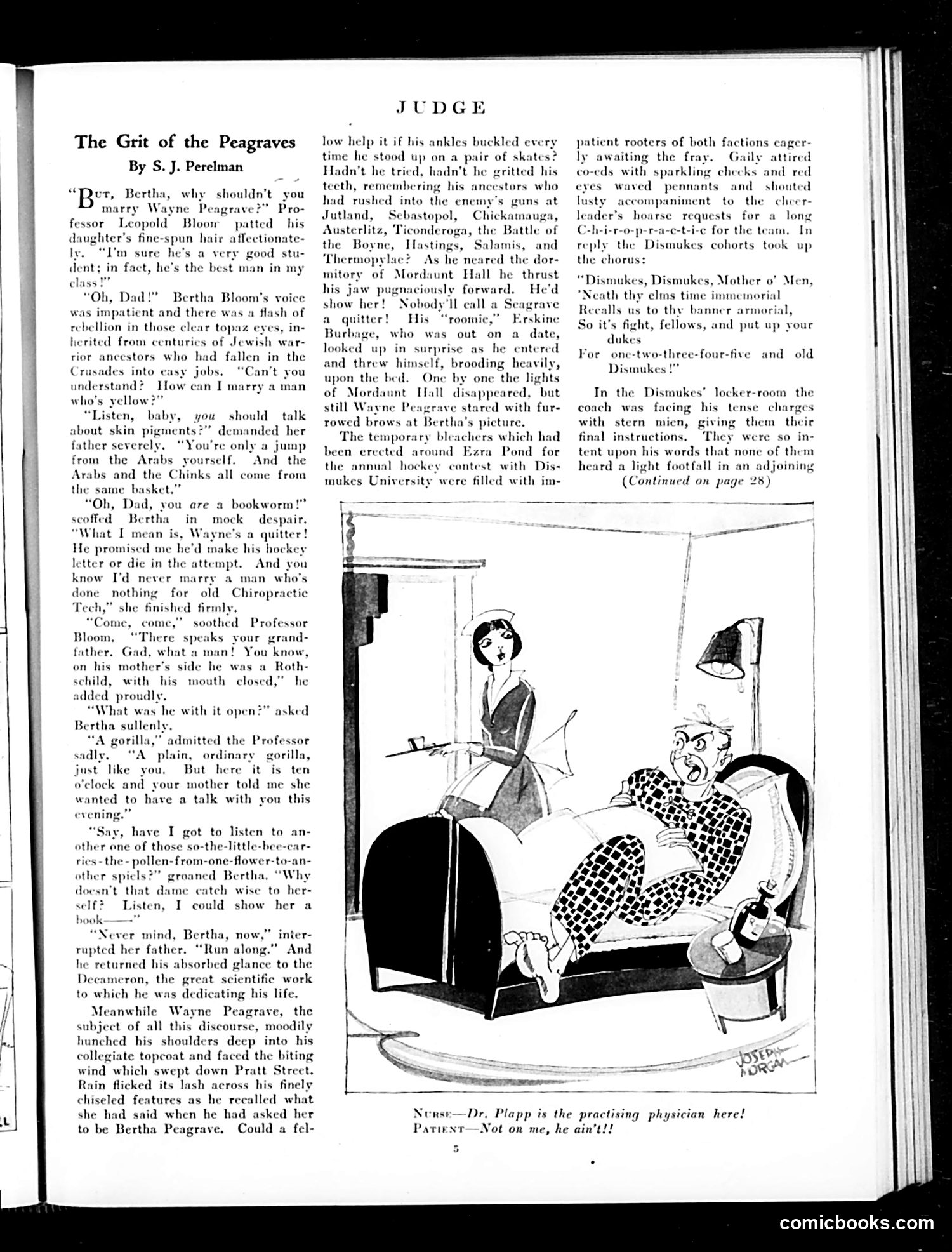
Analysis This page from *Judge* magazine contains a short story titled "The Grit of the Peagraves" by S.J. Perelman. The narrative concerns a family dispute over Wayne Peagrave's choice to become a "quitter" (appears to mean an athlete or competitor of some kind) rather than pursue a respectable profession. Professor Bloom attempts to mediate the family conflict. The accompanying cartoon depicts a humorous medical scene: a nurse announces "Dr. Plapp is the practising physician here!" while a patient protests "Not on me, he ain't!!" The joke satirizes either an incompetent or overly experimental doctor. Without additional historical context, the specific identity of "Dr. Plapp" remains unclear—he may reference a contemporary public figure or simply represent a stock comedic character type common to early 20th-century humor magazines.
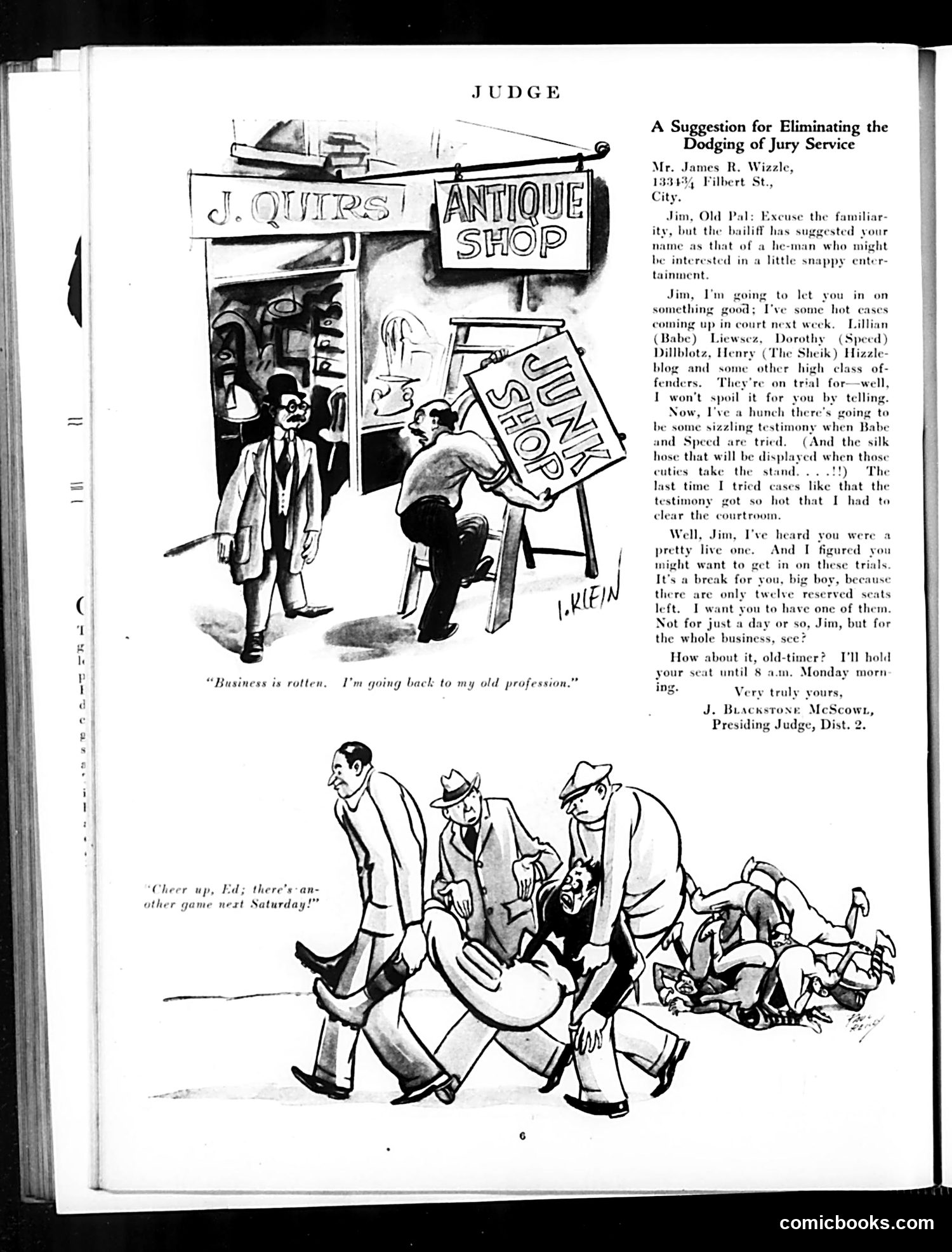
Analysis This page from *Judge* magazine contains two cartoons and a letter to the editor. The top cartoon depicts a man shutting down an antique shop, saying "Business is rotten. I'm going back to my old profession." The sign advertises "SHINBONE" items, likely referencing worthless or fraudulent antiques—a commentary on deceptive business practices. The letter from Presiding Judge J. Blackstone McCowl proposes a solution to jury-duty avoidance: reserving courtroom seats for interested observers, allegedly to attract people like "Jim" (a familiar acquaintance). The judge suggests this would expose sensational trials and compensate for low jury attendance. The bottom cartoon shows three men carrying a large sack labeled "ED," captioned "Cheer up, Ed; there's another game next Saturday!" The context remains unclear without additional information about who "Ed" represents.
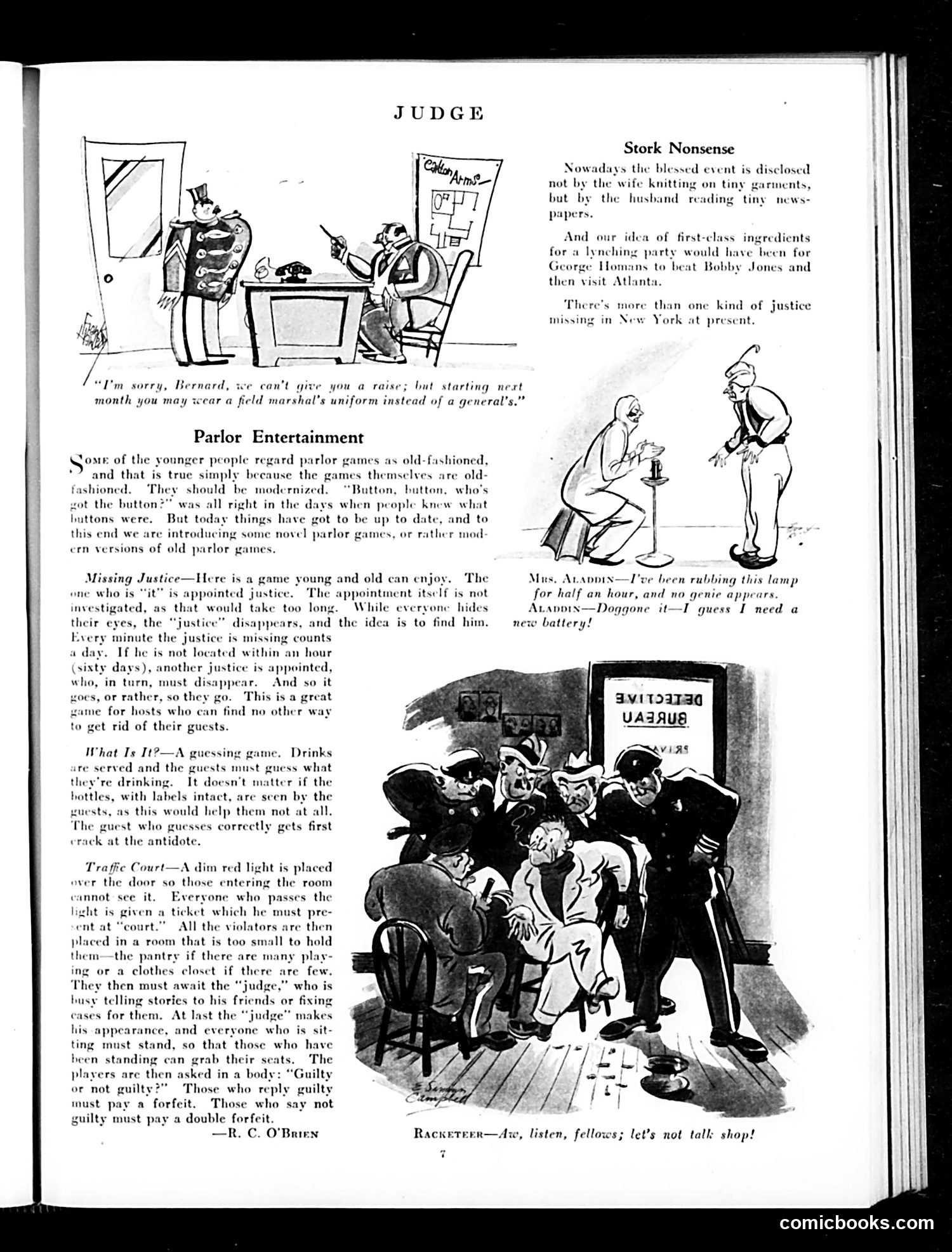
Explanation for Modern Readers This Judge magazine page combines social commentary with parlor game instructions. The "Stork Nonsense" column satirizes how modern husbands learn of pregnancies from newspaper gossip rather than their wives' domestic preparations—mocking the media's role in spreading personal news. The references to "Bobby Jones" and "Atlanta" appear to reference a contemporary scandal or incident involving a lynching, with the author sarcastically commenting on American "justice." The "Parlor Entertainment" section presents absurdist game variations on old parlor games, mocking both the games themselves and social conventions. "Missing Justice" is a hide-and-seek variant. "Traffic Court" satirizes the legal system by creating a farcical courtroom where people are forced to stand in cramped spaces and fined either way they answer—a dark joke about how the justice system seems rigged regardless of one's response. The cartoons illustrate these games with period-appropriate drawings showing guests participating in foolish entertainment.
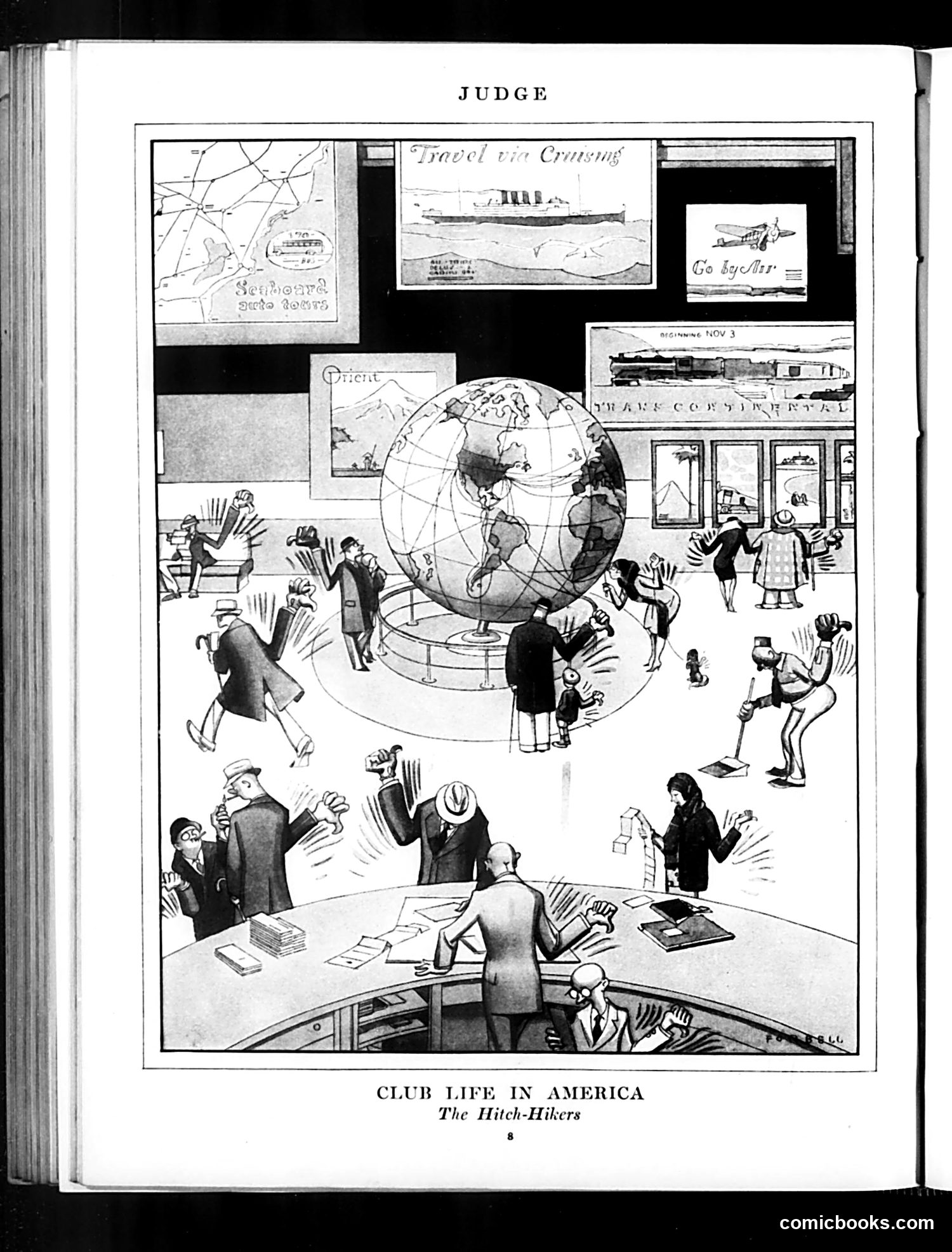
"The Hitch-Hikers" - Judge Magazine Satire This cartoon satirizes the 1920s-30s phenomenon of hitchhiking. The central image shows a large globe in what appears to be a club or public space, surrounded by people in various states of animated chaos—some gesturing excitedly, others appearing agitated or distressed. The title "The Hitch-Hikers" suggests this mocks a social club devoted to hitchhiking culture. The small inset images at top (ship, train, airplane, automobile) represent different travel methods, reinforcing the travel theme. The satire likely critiques how hitchhiking had become a fashionable leisure activity among Americans, turning practical transportation into a social pastime. The chaotic scene suggests Judge viewed this trend as absurd or symptomatic of frivolous "club life" culture—people gathering merely to celebrate hitchhiking rather than undertaking genuine travel.
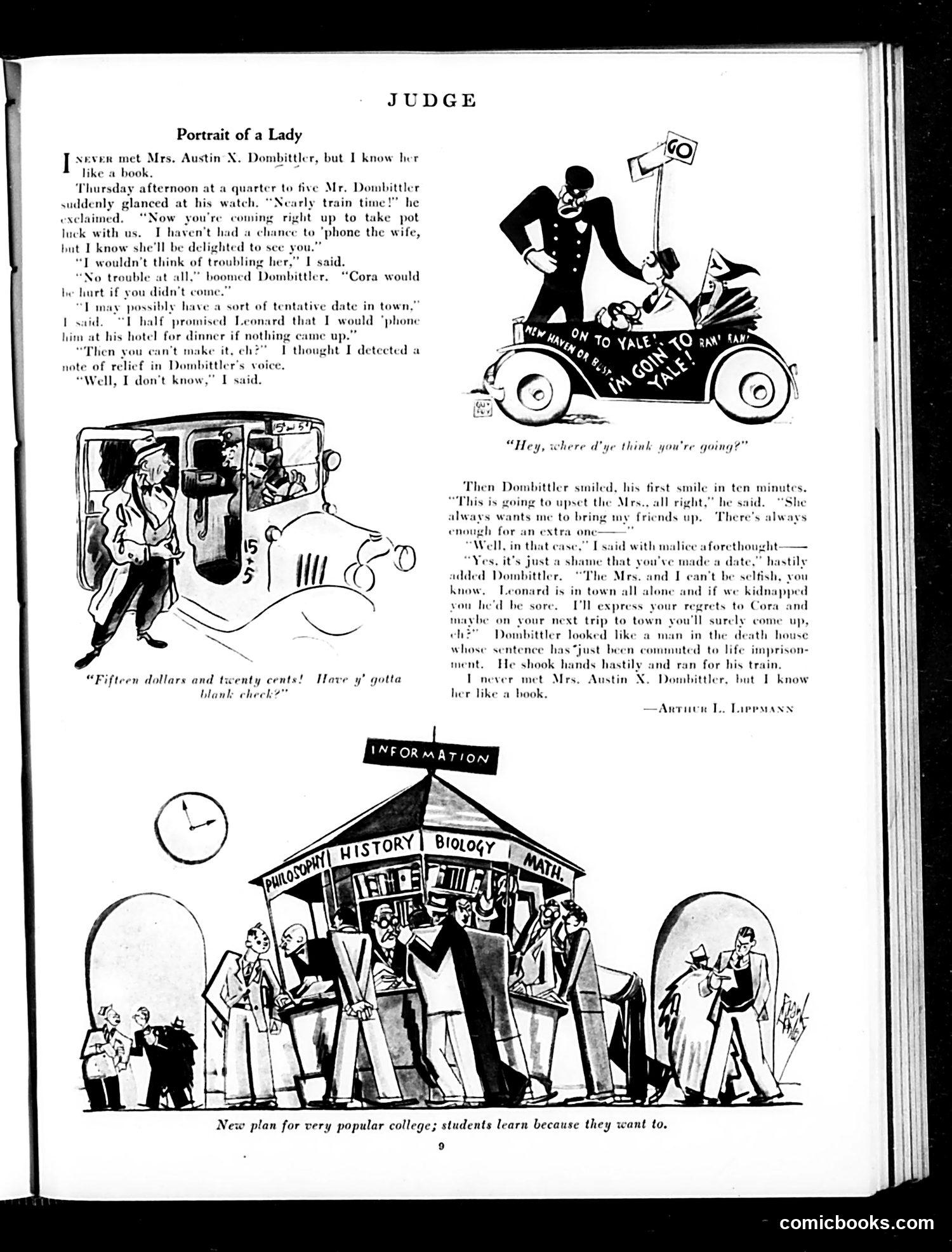
"Portrait of a Lady" - Judge Magazine Satire This story satirizes social hypocrisy and unspoken domestic tension. Mr. Dombittler extends a dinner invitation to an acquaintance but clearly hopes it will be declined—his forced politeness masks reluctance. When the guest accepts, Dombittler's obvious relief at learning of a prior engagement reveals the truth: his wife "Cora" likely demands he invite guests to appear hospitable, but Dombittler resents the obligation and the disruption to his evening. The satire centers on the gap between what people *say* socially ("my wife would be delighted") and what they actually *feel*. The author "knows" Mrs. Dombittler "like a book" despite never meeting her—she's a recognizable social type: the wife who insists on entertaining to maintain appearances while her husband dreads it. The cartoons above show unrelated Judge humor involving transportation and college education.
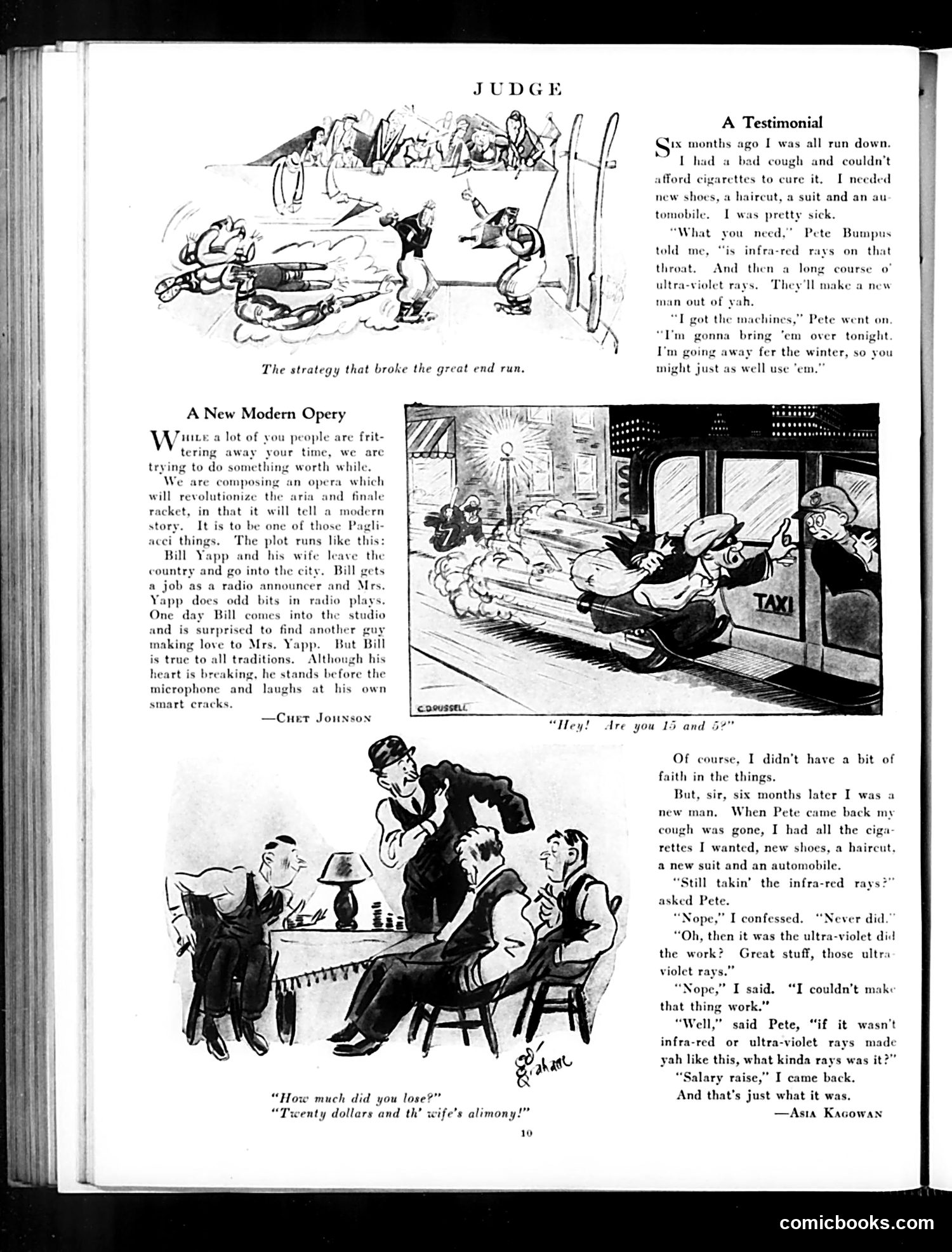
Judge Magazine Page Analysis This page contains two satirical pieces mocking contemporary trends: "A New Modern Opera" (by Chet Johnson): Satirizes both modern radio entertainment and marital infidelity. The plot—a radio announcer discovers his wife with another man but maintains composure on-air—parodies overwrought operatic drama while poking fun at the emerging radio industry and casual attitudes toward adultery in "modern" society. "A Testimonial" (by Asia Kagowan): This is sharp satire debunking pseudo-scientific health fads. A man credits miraculous recovery to "infra-red" and "ultra-violet ray" machines Pete Bumpus provided, but eventually admits he never used them—his actual improvement came from a salary raise. The joke mocks both gullible consumers who believe in dubious medical devices and the hucksters peddling them as cure-alls. Both pieces ridicule contemporary American credulity and modern life's absurdities through humor.
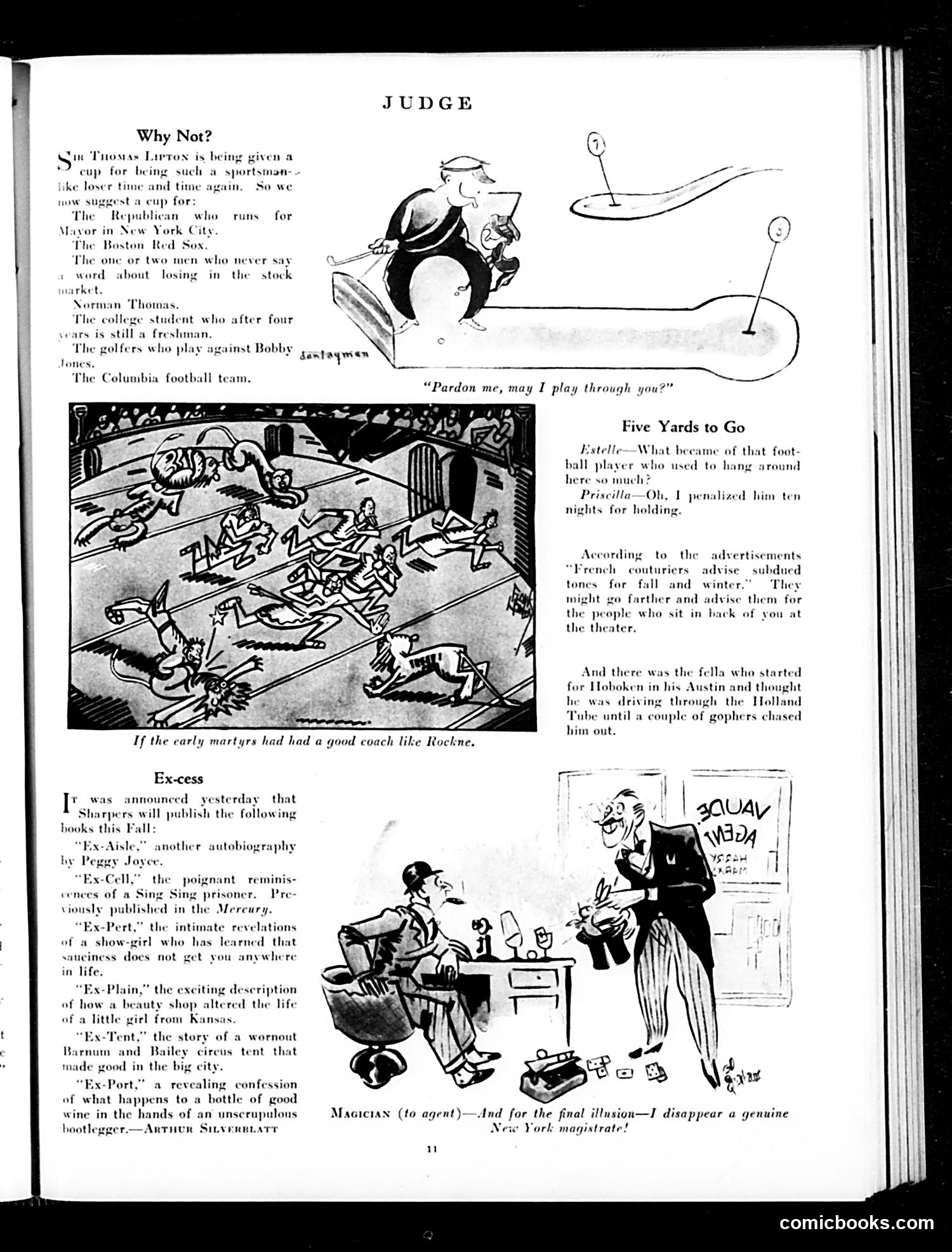
Judge Magazine Satire Explained This page contains multiple satirical pieces targeting 1920s American culture: "Why Not?" mockingly suggests giving sportsmanship cups to people who notably *lack* it: Republicans running for NYC mayor, the Boston Red Sox, stock market investors who hide losses, Norman Thomas (Socialist candidate), perpetual college freshmen, and Columbia's football team. The humor relies on readers knowing these entities' reputations for poor sportsmanship or failure. "Five Yards to Go" uses football terminology as a double entendre for a woman penalizing a man "ten nights for holding"—a veiled sexual reference. "Ex-cess" satirizes a book publisher's upcoming "autobiographies" with puns on "Ex-" titles (Ex-Cell for Sing Sing prisoner, Ex-Port for wine bottles). The final cartoon depicts a magician performing a disappearing act, captioned as vanishing "a genuine New York magistrate"—suggesting judges/officials are corrupt or worthless. The overall tone mocks American institutions, sports, politics, and law enforcement through wordplay and caricature typical of 1920s humor magazines.
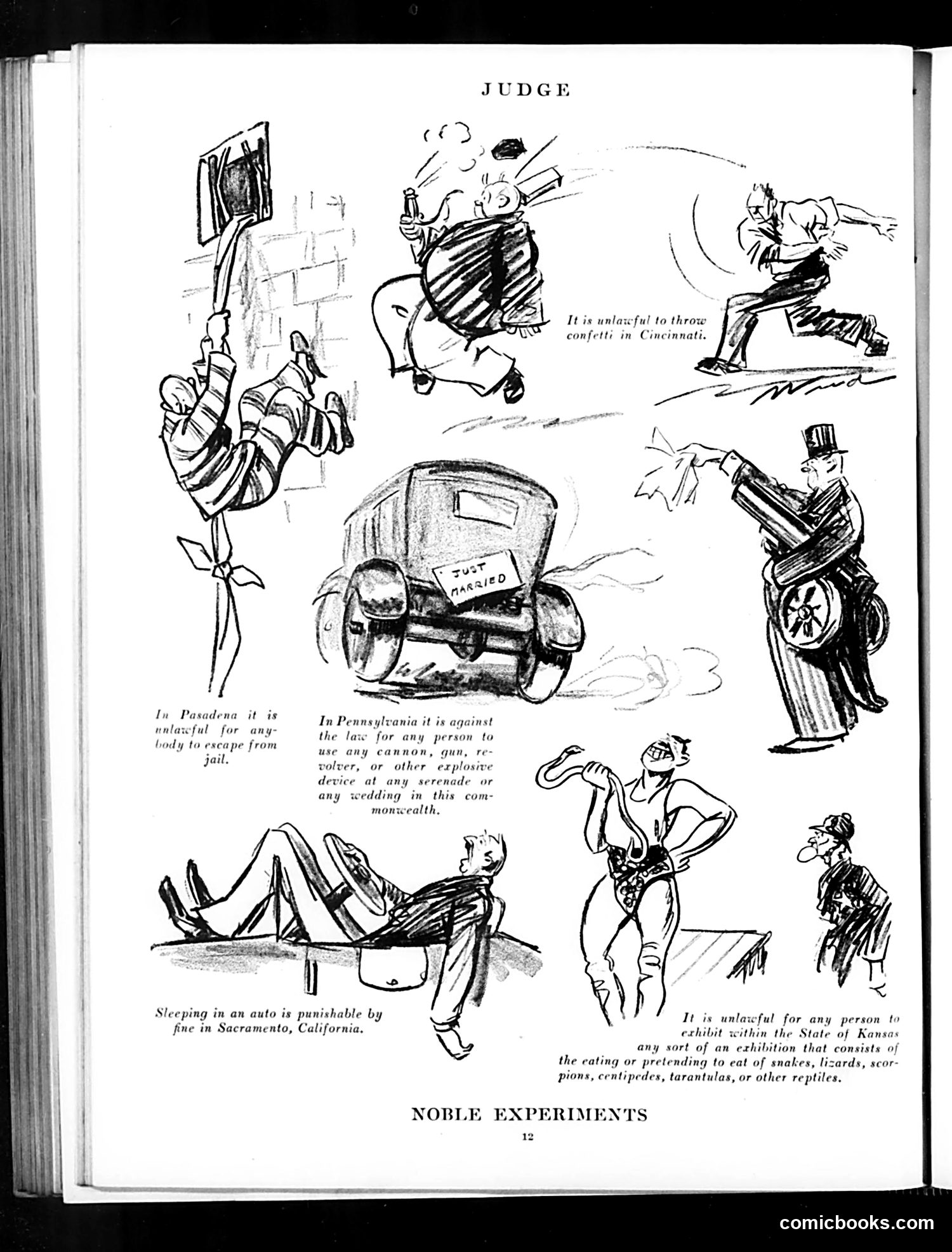
Judge Magazine: "Noble Experiments" (page 12) This satirical page mocks absurd local laws across American states. Each cartoon illustrates ridiculous municipal or state regulations: - Cincinnati confetti ban: Shows someone being arrested for throwing celebratory confetti - Pennsylvania wedding law: Depicts a groom unable to fire a celebratory cannon at his wedding - Sacramento auto-sleeping law: Illustrates someone penalized for napping in a car - Kansas reptile exhibition ban: Shows the bizarre restriction on eating or pretending to eat snakes and other creatures The humor targets the patchwork of peculiar state and local legislation that Judge's readers would have found comically excessive or absurdly specific. The title "Noble Experiments" sarcastically refers to these laws as well-intentioned but ridiculous attempts at social regulation. The cartoons use exaggerated physical comedy to emphasize how nonsensical these laws were—treating minor social behaviors as serious criminal matters.
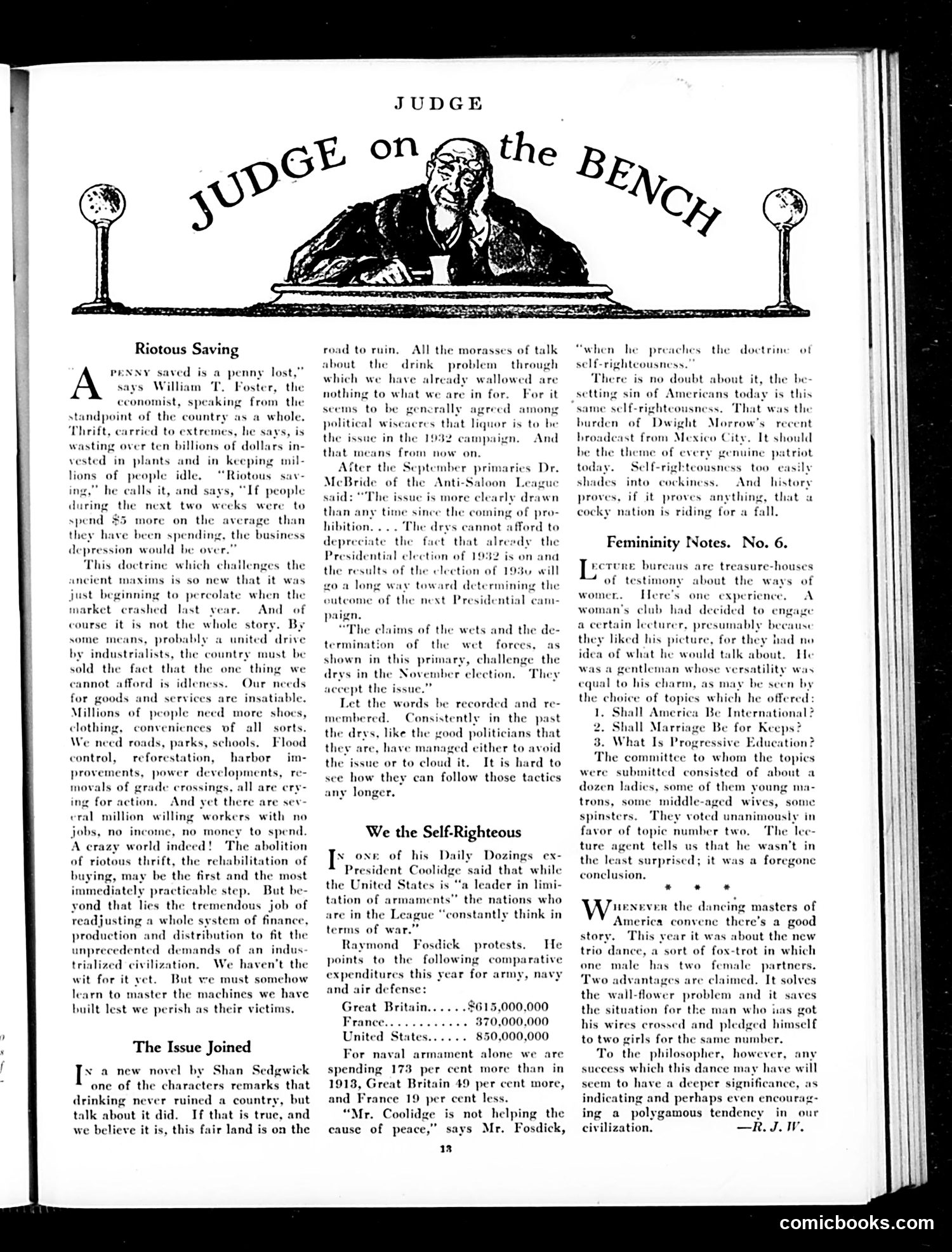
Judge Magazine Page Analysis This page from Judge (likely early 1930s) contains three distinct opinion pieces satirizing American politics and society: "Riotous Saving" argues against Depression-era thrift, citing economist William T. Foster's paradoxical claim that excessive savings waste economic potential. The piece advocates for consumer spending to stimulate recovery—a Depression-era Keynesian argument ahead of its time. "The Issue Joined" discusses the 1932 presidential campaign, predicting prohibition will dominate as the central issue. It criticizes dry (anti-alcohol) politicians for historically avoiding the question directly, noting they must now confront wets (pro-alcohol forces) openly. "We the Self-Righteous" attacks President Coolidge's claims that America leads in armament limitation while actually spending heavily on military. Raymond Fosdick's comparative statistics (Britain spending $615M, France $370M, U.S. $830M) expose American hypocrisy—preaching peace while arming substantially more than other nations. The satire targets governmental moral posturing contradicted by actual policy.
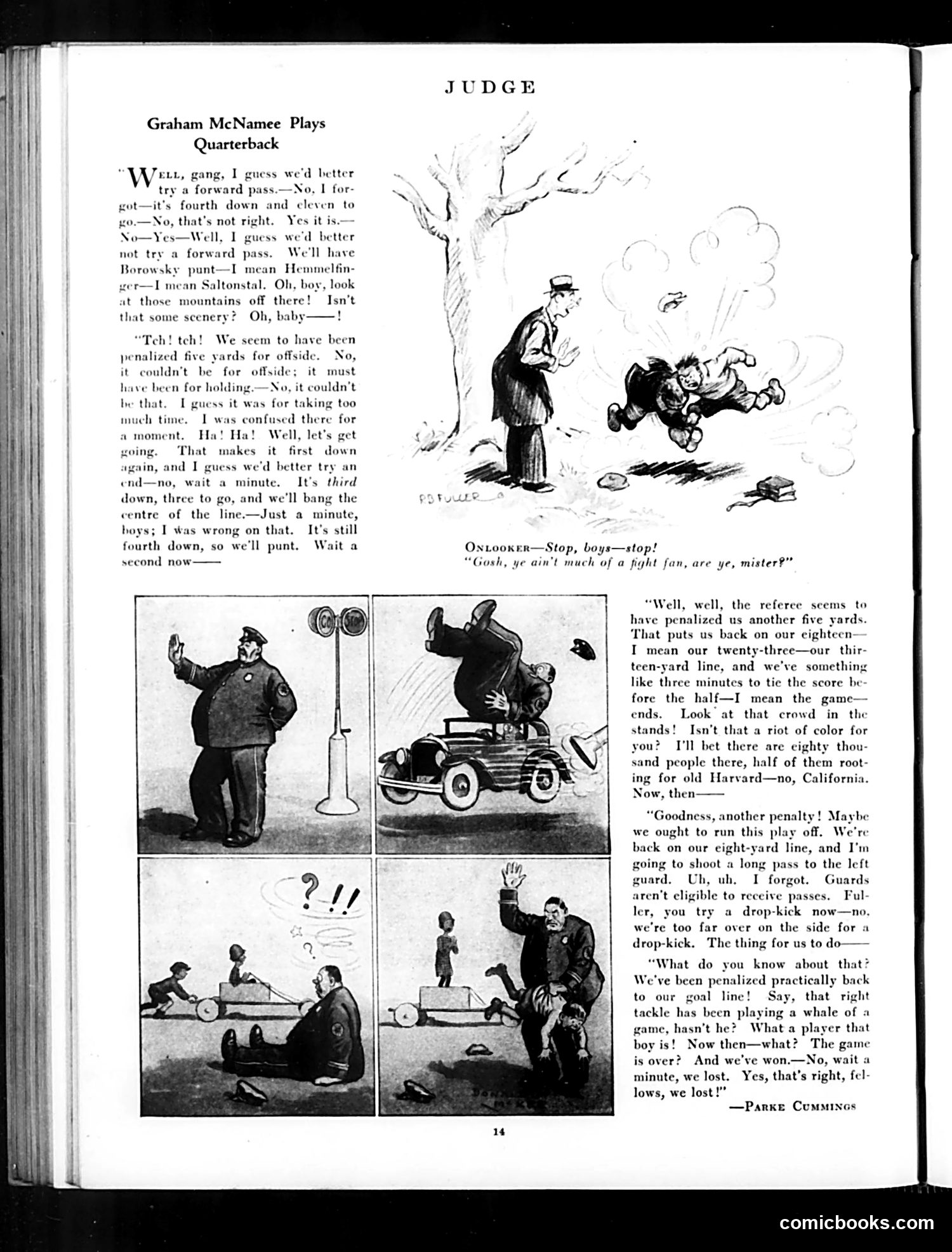
"Graham McNamee Plays Quarterback" This page satirizes Graham McNamee, a famous 1920s radio sports announcer known for breathless, rambling play-by-play commentary. The satire mocks his characteristic verbal style: constant self-corrections, tangential observations (admiring scenery mid-game), confusion about basic rules, and inability to maintain focus on what's happening. The football commentary parodies McNamee's tendency to contradict himself repeatedly ("it couldn't be for offside...it must have been for holding...I was confused"), lose track of down-and-distance, and digress into irrelevant details. The punchline—uncertainty about whether they won or lost—exaggerates his scattered commentary into absurdity. The accompanying cartoons show a referee and chaotic game action, emphasizing the disconnect between McNamee's confused narration and actual events on the field. This is humor aimed at radio audiences familiar with McNamee's distinctive announcing style.
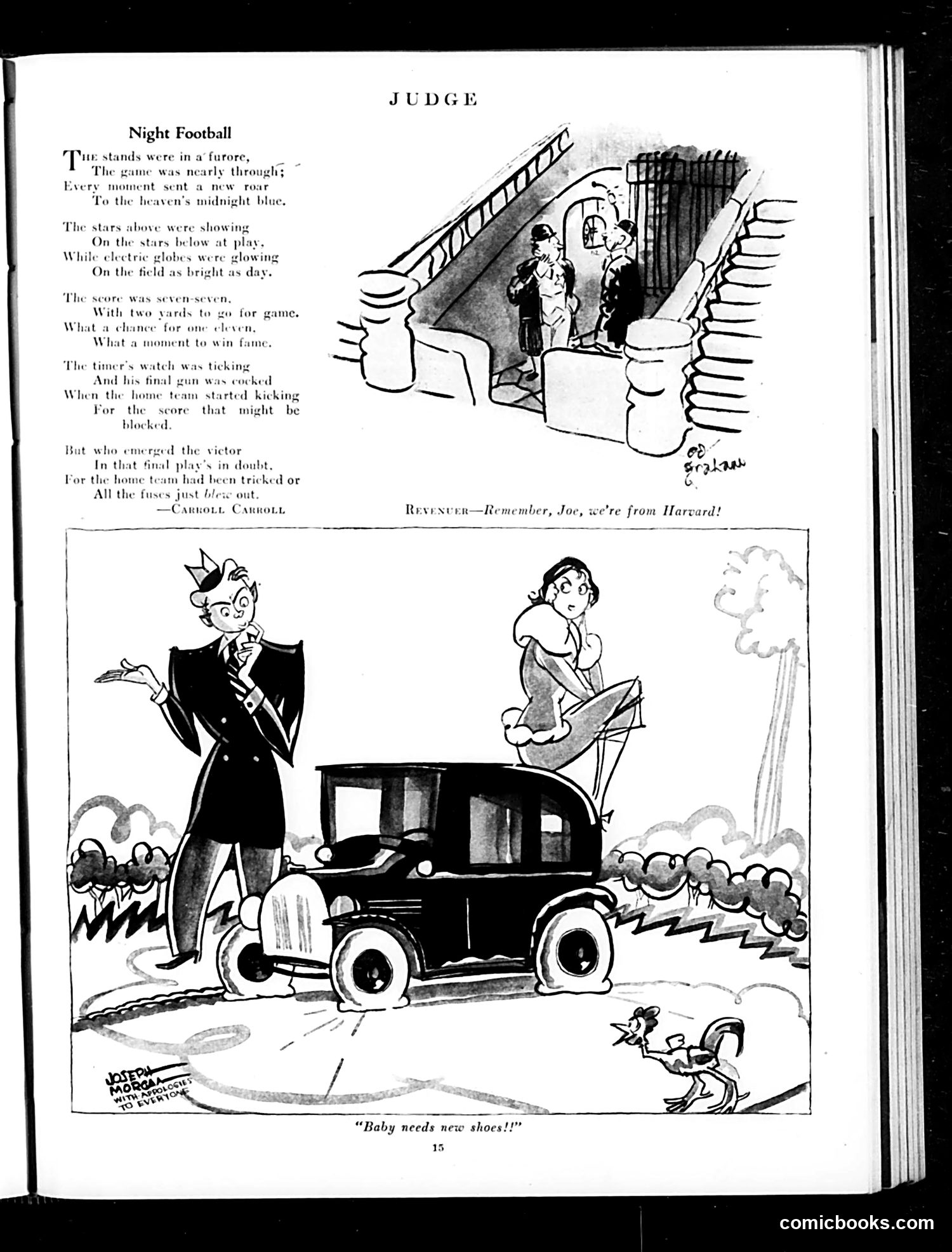
Analysis of Judge Magazine Page This page contains two distinct pieces: "Night Football" poem (top): A humorous narrative poem by Carroll Carroll describing a climactic night football game under electric lights. The joke's punchline: during the final dramatic play—with the home team about to score—all the electrical fuses blow out, plunging the field into darkness and negating the potential winning play. The satire mocks both the newfangled technology of night football (electric-lit stadiums were novel) and the unreliability of electrical infrastructure. Bottom cartoon: Shows a fashionable flapper-era couple with a small car and a small figure (likely representing a child or "baby"). The man references Harvard; the woman quips "Baby needs new shoes!!"—a Depression-era phrase implying financial hardship and the need for money. The satire targets wealthy, educated couples indifferent to their children's material needs, or possibly mocks the contrast between collegiate prestige and financial irresponsibility. Both pieces use humor to critique modern society's contradictions.
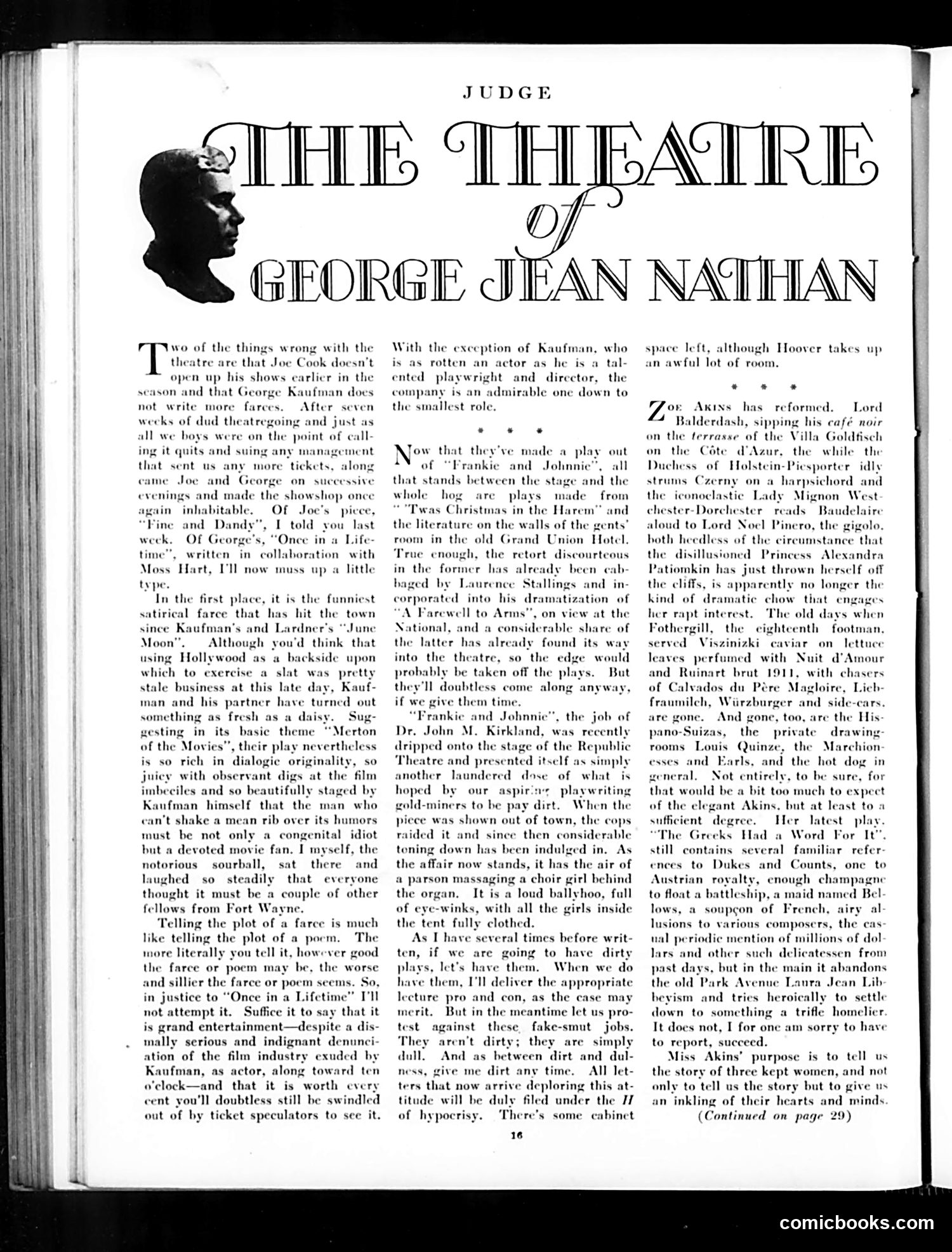
"The Theatre of George Jean Nathan" This is a theater review column by Judge's drama critic, George Jean Nathan, critiquing several Broadway productions. The main subject is praise for "Once in a Lifetime," a new satirical farce co-written by George S. Kaufman and Moss Hart that mocks Hollywood and the film industry. Nathan calls it the funniest play to hit town since Kaufman and Ring Lardner's "June Moon." He also discusses "Frankie and Johnnie" (a new play by Dr. John M. Kirkland), which he dismisses as fake-smutty—presenting itself as risqué but actually being merely dull. Nathan argues that if Broadway is going to stage dirty plays, they should commit fully rather than pretend. The review reflects 1930s theater culture and Nathan's influential critical voice in American entertainment journalism.
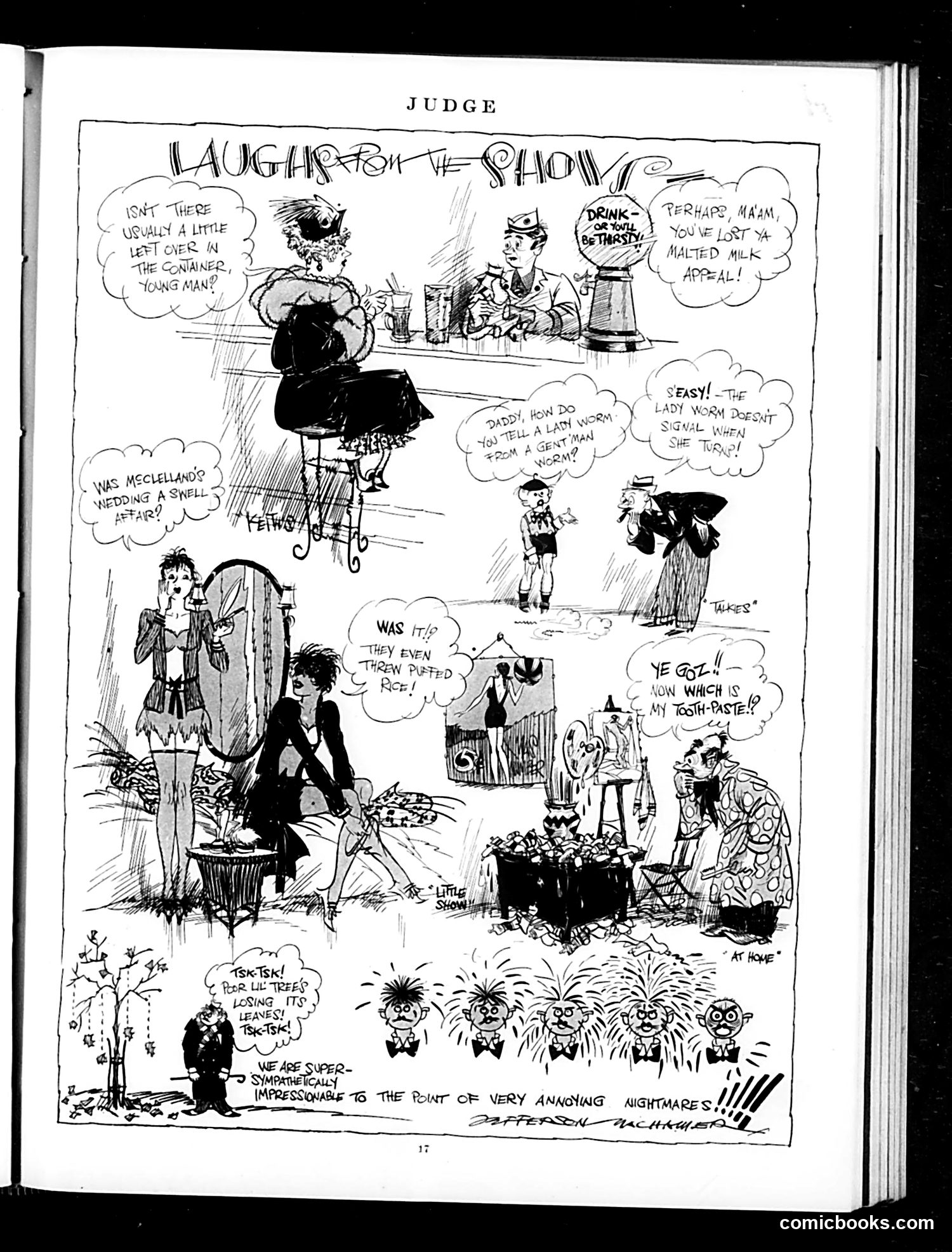
"Laugh for the Show" - Judge Magazine Cartoon This satirical cartoon mocks the theatrical affectations and social pretensions of the upper class. The central figure appears to be a wealthy woman at a formal gathering, surrounded by various social scenarios illustrating shallow behavior: people drinking excessively, discussing trivial matters, and affecting dramatic manners. The humor targets: - Affected sophistication: Characters adopting exaggerated poses and speaking in precious, overwrought language ("Ye gods! Now which is my tooth-paste?") - Class vanity: Wealthy individuals obsessing over minor details while claiming cultural refinement - Performative behavior: The title "Laugh for the Show" suggests people are performing emotions rather than feeling genuine ones The bottom caption notes this behavior is "sympathetically impressionable to the point of very annoying nightmares," suggesting the cartoonist views such pretension as irritating and somewhat absurd. This reflects Judge magazine's tradition of satirizing Gilded Age excess and upper-class affectation through exaggerated caricature.
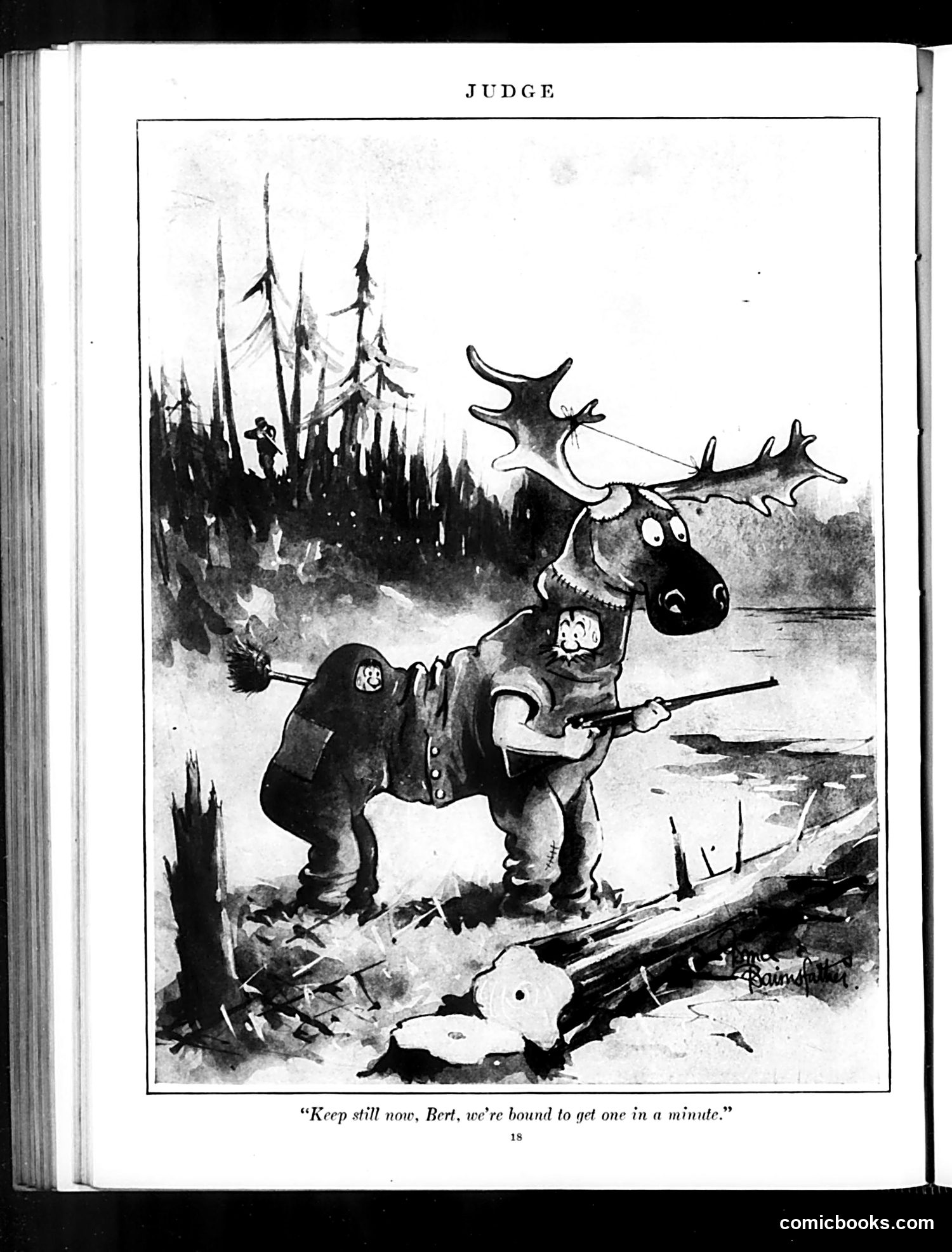
Judge Magazine Cartoon Analysis This political cartoon depicts two figures in hunting attire with rifles, pursuing what appears to be a moose in a wilderness setting with coniferous trees in the background. One hunter, addressed as "Bert," is told to remain quiet as they await their prey. The cartoon likely satirizes a contemporary political or social hunting expedition, though without additional context or visible identifying details beyond "Bert," I cannot definitively name the figures being caricatured. The humor appears to rest on the double meaning of "hunting"—whether literal game hunting or a metaphorical pursuit of political/social targets. The page number (18) suggests this is from a complete issue. Judge magazine typically employed such hunting metaphors for political satire during the early-to-mid 20th century.
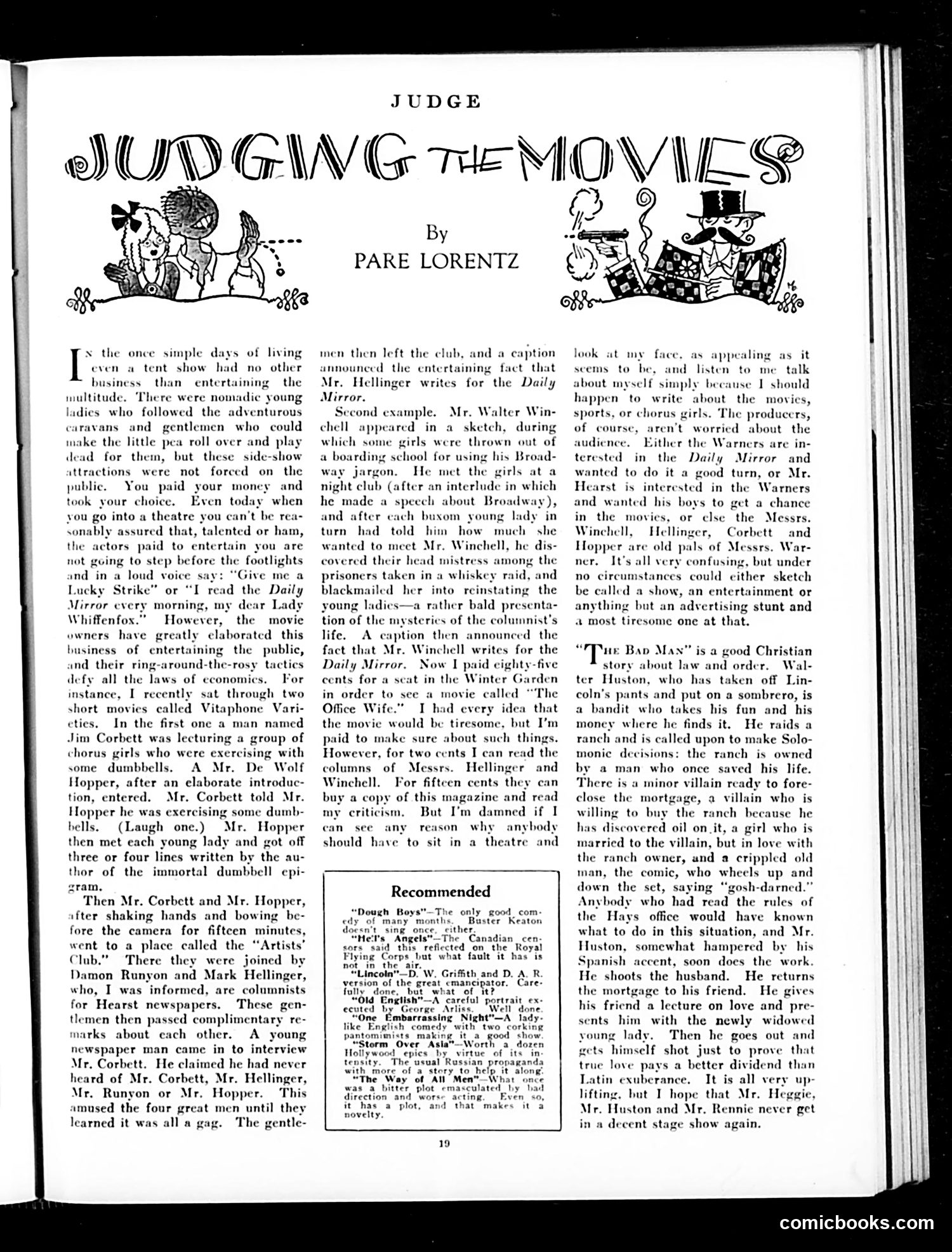
"Judging the Movies" by Pare Lorentz This is a film criticism essay disguised as satire. Lorentz complains that 1920s movie studios are exploiting entertainment by inserting *advertising* into narrative films. He describes watching Vitaphone shorts featuring real celebrities—boxer Jim Corbett, actor DeWolf Hopper, and newspaper columnists Damon Runyon and Mark Hellinger—who appear essentially to promote themselves and their newspaper employers (the *Daily Mirror*, *Daily News*). The joke: audiences paid admission to watch what amounts to disguised newspaper promotion. Corbett and Hopper's scenes are padding (exercising with dumbbells, shaking hands for fifteen minutes). Winchell's appearance amounts to advertising his Broadway column. Lorentz's point is bitter: why should theater-goers subsidize promotional stunts? He could read these columnists' work cheaply elsewhere. This reflects genuine 1920s anxieties about commercialism infiltrating entertainment and blurred lines between journalism and showmanship.
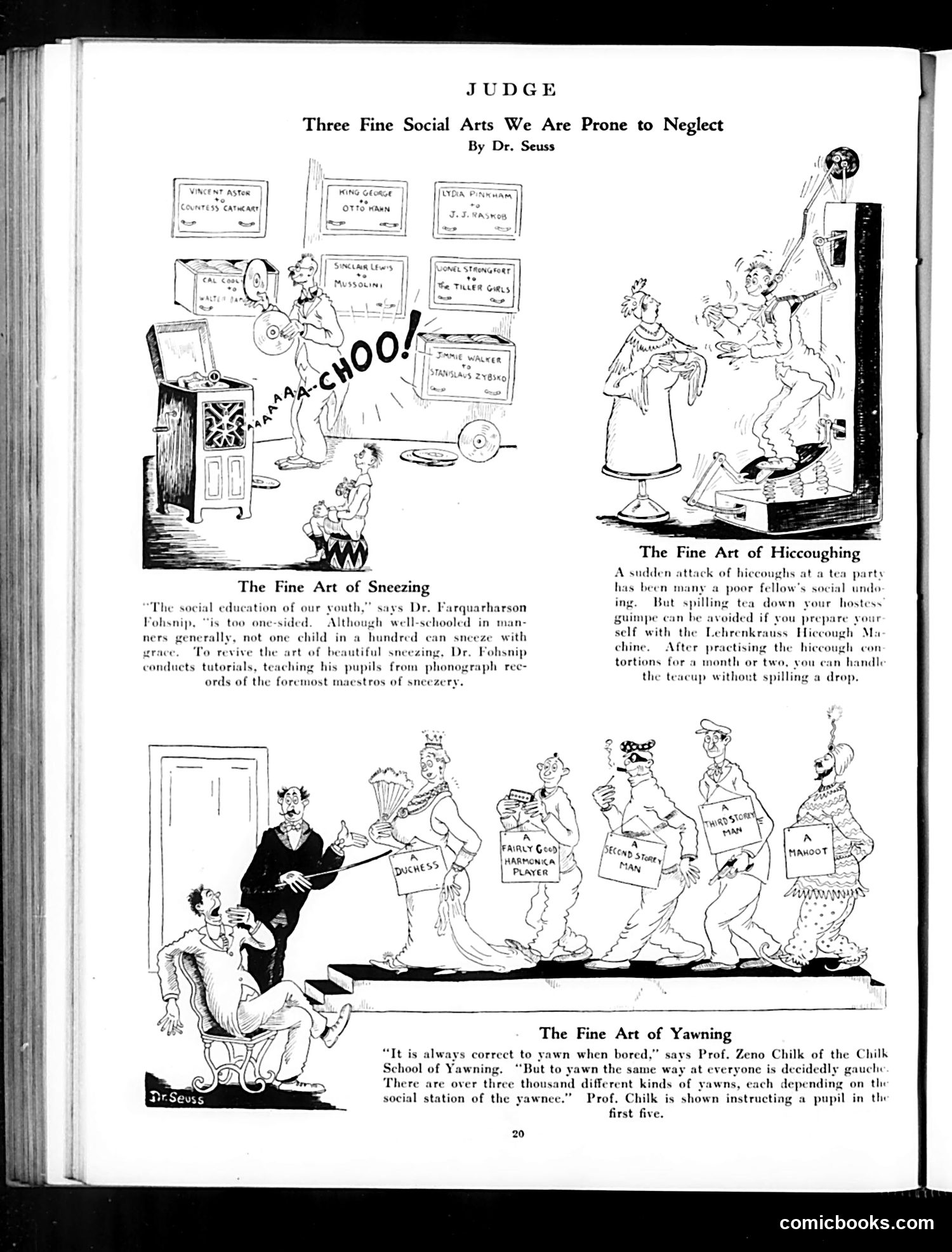
Three Fine Social Arts We Are Prone to Neglect This Dr. Seuss satirical piece mocks the pretentiousness of upper-class etiquette instruction. It presents three absurd "fine arts": Sneezing: Dr. Farquarharson teaches proper sneezing technique from phonograph records, treating an involuntary reflex as refined performance art. Hiccoughing: A machine (the "Lehrenkrauss Hiccough Machine") supposedly trains people to hiccough gracefully at tea parties without embarrassment or spillage. Yawning: Prof. Zeno Chilk instructs that different social classes require different yawning styles—over 3,000 varieties exist, each matched to the yawner's social station. The satire targets the excessive formality and class-consciousness of 1920s-30s polite society, suggesting that contemporary etiquette instruction had become absurdly elaborate and divorced from practical human behavior. The exaggeration—treating bodily functions as teachable arts—ridicules this refinement obsession.
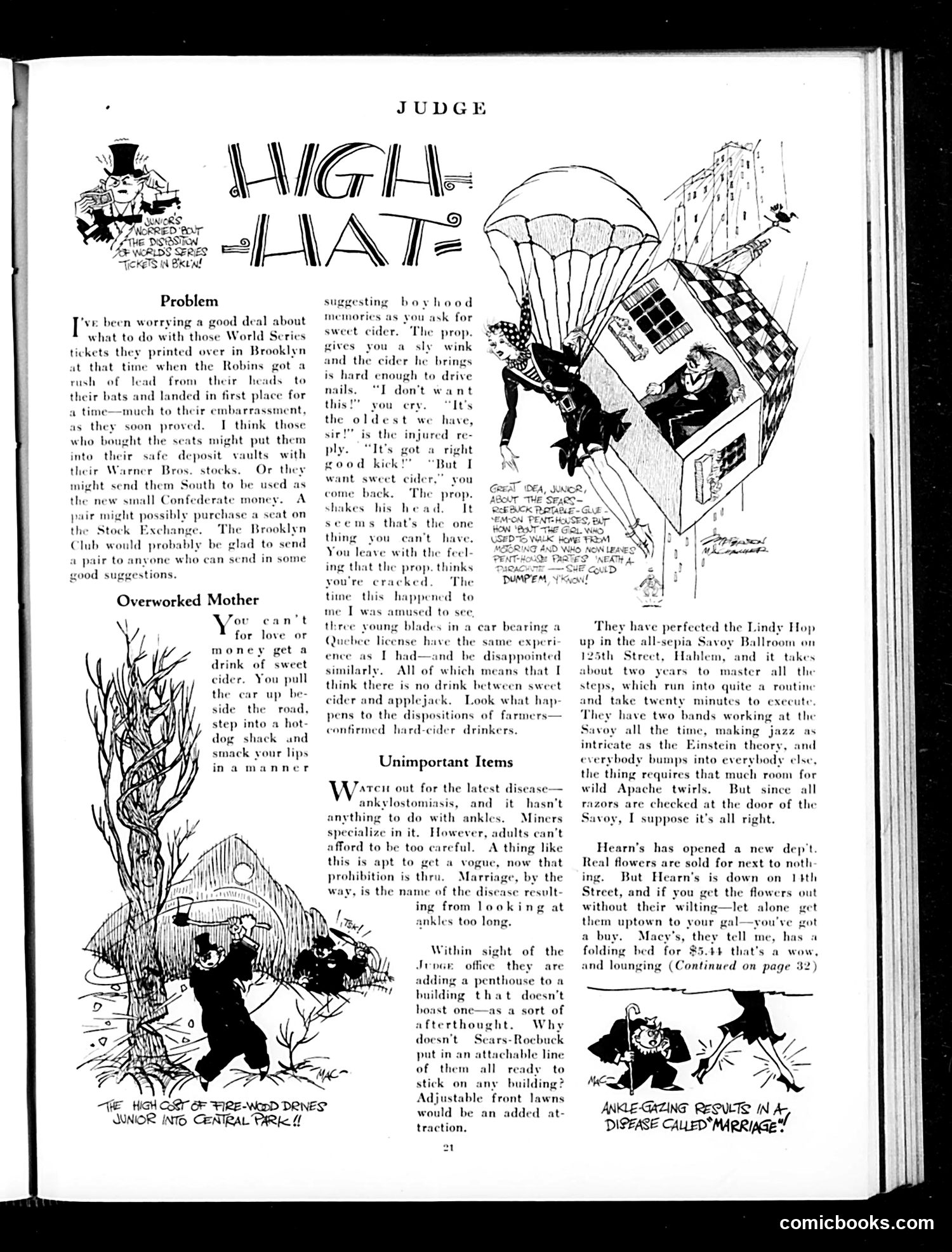
"HIGH HAT" - Judge Magazine Page Analysis This page from Judge magazine contains three satirical pieces reflecting 1920s American concerns: "Problem" mocks Brooklyn Robins baseball fans stuck with World Series tickets after the team's collapse. The satire suggests the worthless tickets could serve as "Confederate money" or be donated to the Stock Exchange—commentary on post-1929 economic anxiety. "Overworked Mother" satirizes rural roadside cider stands that refuse to sell sweet cider, only hard cider. The joke implies Prohibition's end has made hard cider ubiquitous, and farmers stubbornly prefer it—a dig at rural American drinking culture post-Prohibition repeal. "Unimportant Items" contains brief jokes: a disease pun on "ankles" (ankylostomiasis); marriage as an "ankle-gazing disease" (looking at women's exposed ankles); the Lindy Hop at Harlem's Savoy Ballroom; and Hearn's department store selling cheap flowers that wilt before reaching uptown girlfriends. The tone is urbane, mocking rural attitudes and satirizing modern consumer culture and romance.
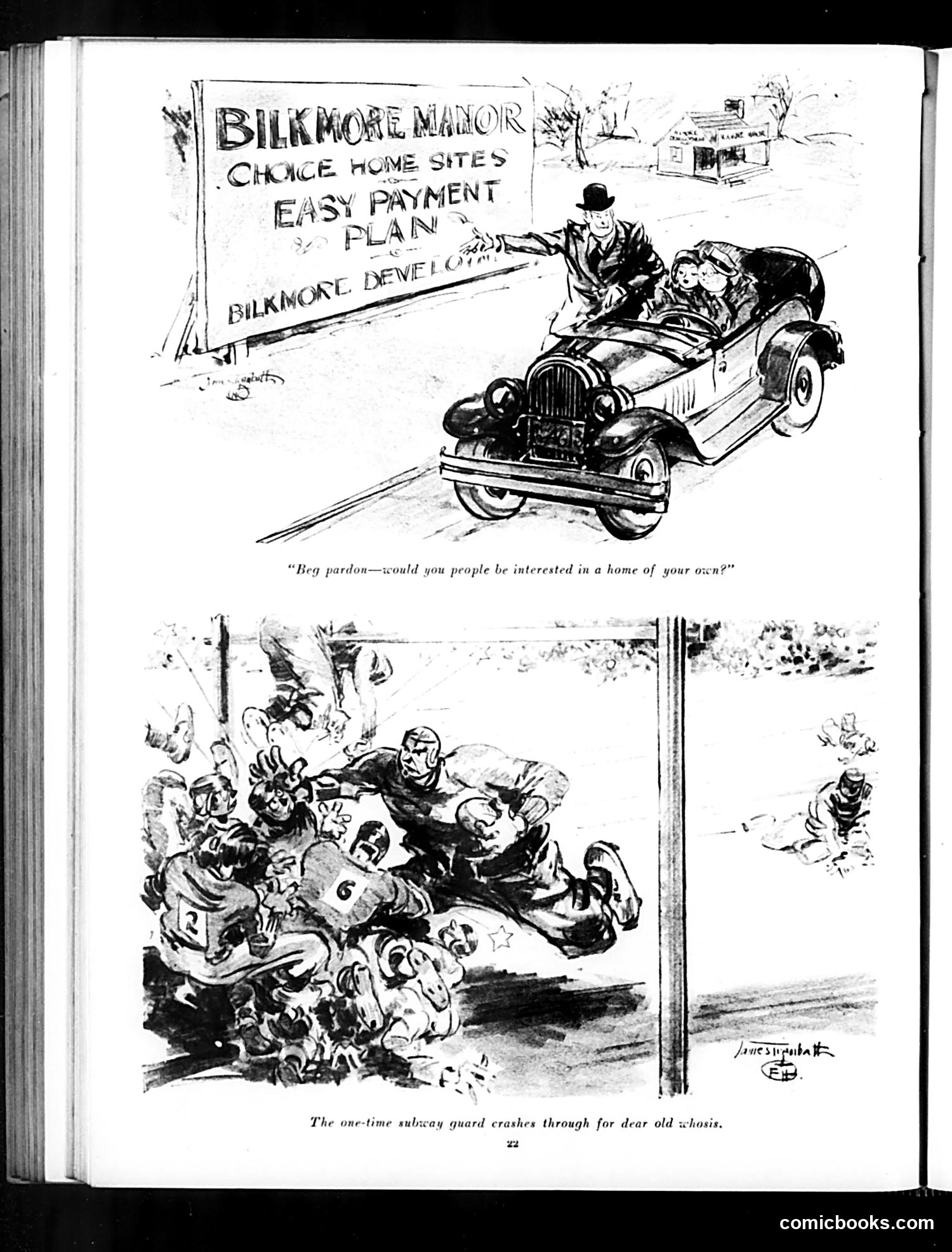
Bilkmore Manor Cartoon Analysis This page satirizes real-estate development schemes and social climbing. The top cartoon advertises "Bilkmore Manor" with an "Easy Payment Plan"—the name "Bilk" suggests the development is a scam designed to defraud buyers. The salesman pitches homeownership to a couple in a car, implying he targets ordinary people with unrealistic promises. The bottom panel shows the punchline: "The one-time subway guard crashes through for dear old whosis"—meaning a former transit worker (a working-class figure) has been swindled into purchasing property he cannot afford. The satire mocks both predatory real-estate promoters and the aspirational middle class vulnerable to their schemes during what appears to be an era of speculative housing development.
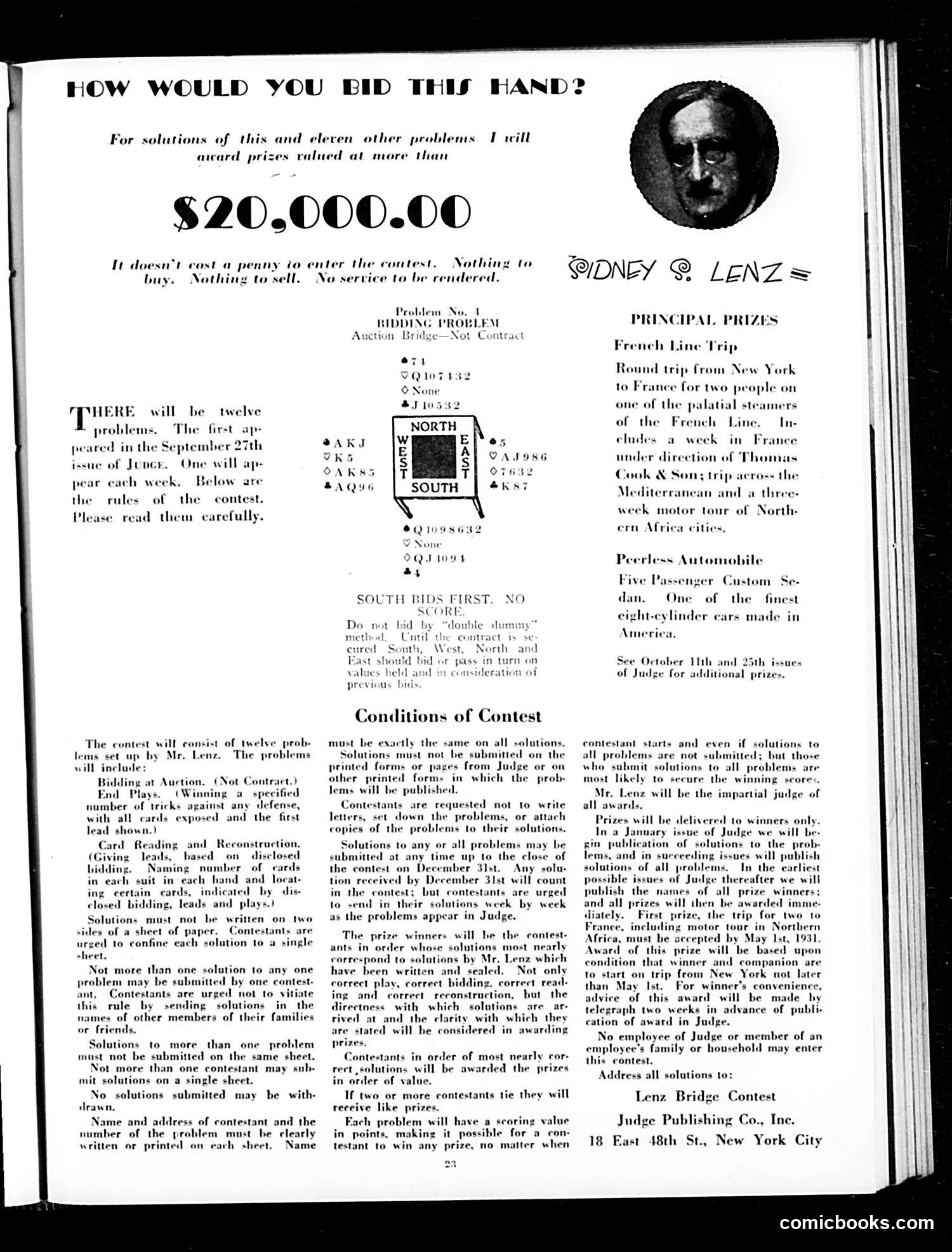
Judge Magazine Bridge Contest This page advertises a bridge card game problem-solving contest sponsored by *Judge* magazine and hosted by Sidney S. Lenz, a prominent bridge player (shown in the portrait). The contest offers $20,000 in prizes, including a French Line ocean voyage and a luxury automobile. Readers must solve twelve bidding problems from bridge—a popular card game—with solutions judged against Lenz's own answers. Problems appear weekly starting September 27th. This reflects early 20th-century American leisure culture: bridge was a fashionable game among the educated middle and upper classes, and magazines like *Judge* (known for satire and humor) used such contests to boost circulation and readership engagement. The substantial prize money underscores bridge's cultural prominence at the time.
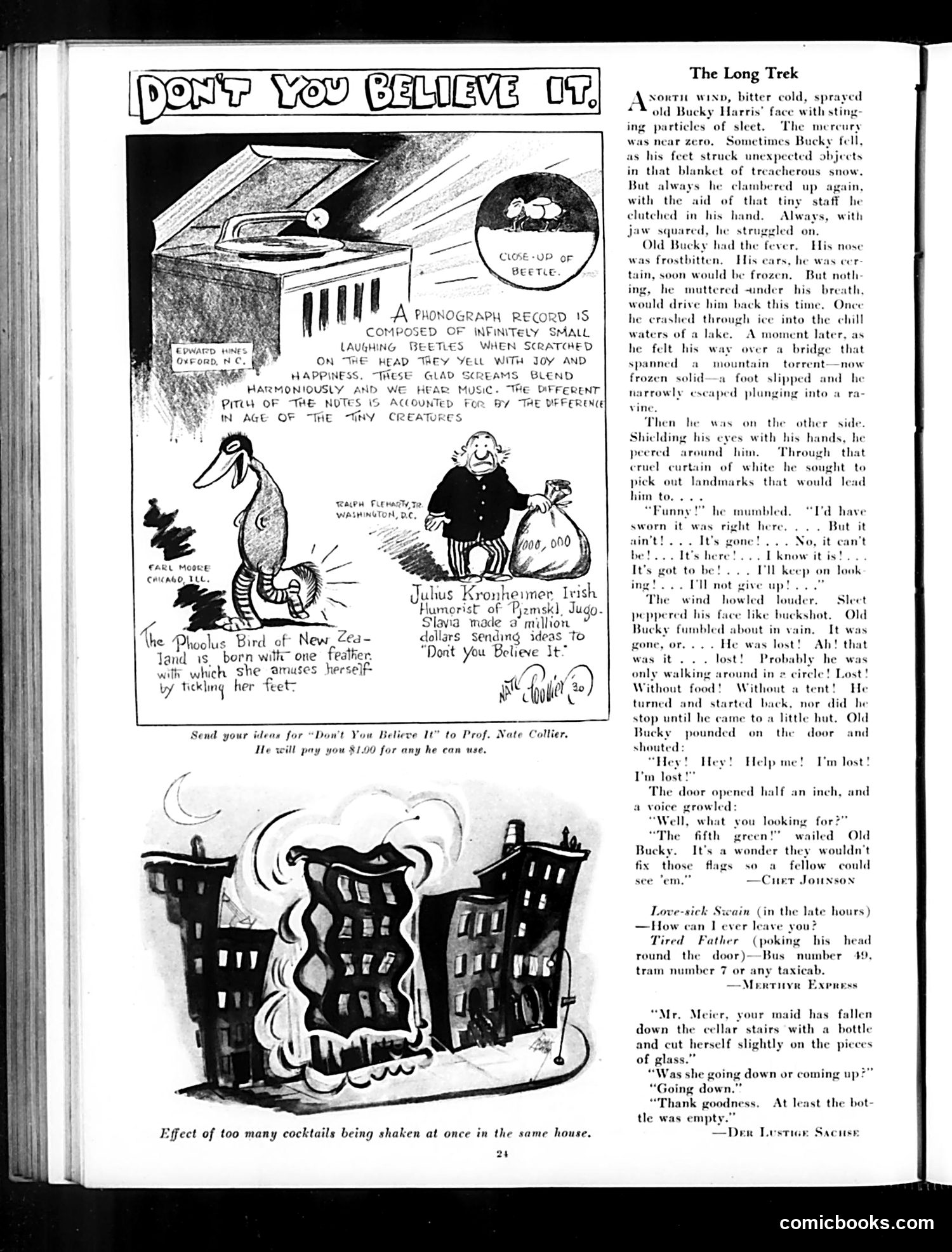
"Don't You Believe It" Cartoon Analysis This page features Judge magazine's humor section with multiple unrelated jokes and satirical items. The main "Don't You Believe It" feature collects absurd pseudo-scientific claims submitted by readers. Examples include: a phonograph record composed of tiny laughing beetles that produce music when scratched (different pitches based on beetle age), and a New Zealand bird born with only one feather it uses to tickle itself. These mock the public's gullibility and pseudoscientific nonsense circulating in popular culture. A brief item credits Irish humorist Julius Kronheimer with sending ideas to the feature. Below are two cartoon panels: one showing a building violently shaking (captioned as the effect of multiple cocktails being mixed simultaneously—a Prohibition-era joke about housewives making bootleg drinks), and another depicting a "Long Trek" narrative about a lost man named Bucky Harris struggling through a blizzard, eventually finding a hut for shelter. The page satirizes American credibility and contains period-specific Prohibition humor.
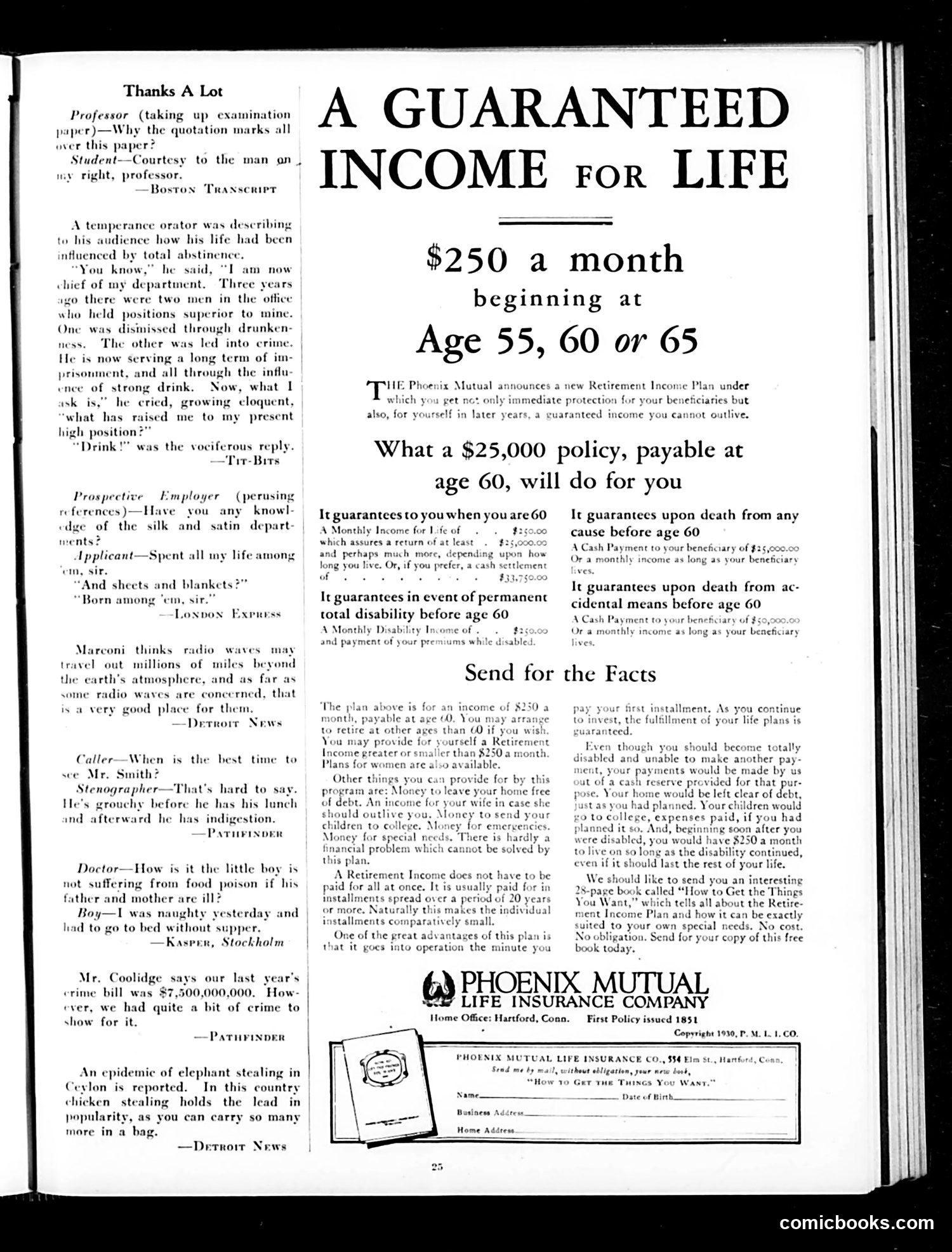
Understanding This Judge Magazine Page This page is primarily advertising, not satire. The dominant content is a full-page insurance advertisement for Phoenix Mutual Life Insurance Company promoting their Retirement Income Plan—$250 monthly beginning at age 55, 60, or 65. The small jokes and anecdotes in the left margin ("Thanks A Lot" section) are typical filler content common to Judge: a student's quip about quotation marks, a temperance lecturer's ironic tale of moral consequences, job interview humor, and brief observations about radio waves and elephant theft in Ceylon. The satirical commentary is minimal and gentle—mostly poking fun at workplace hierarchy, social pretense, and human nature rather than targeting specific political figures or movements. The page reflects early 20th-century concerns: workplace morality, social status anxiety, and the emerging insurance industry's promise to solve financial insecurity through systematic planning. The advertisements and jokes coexist as period-typical magazine content.
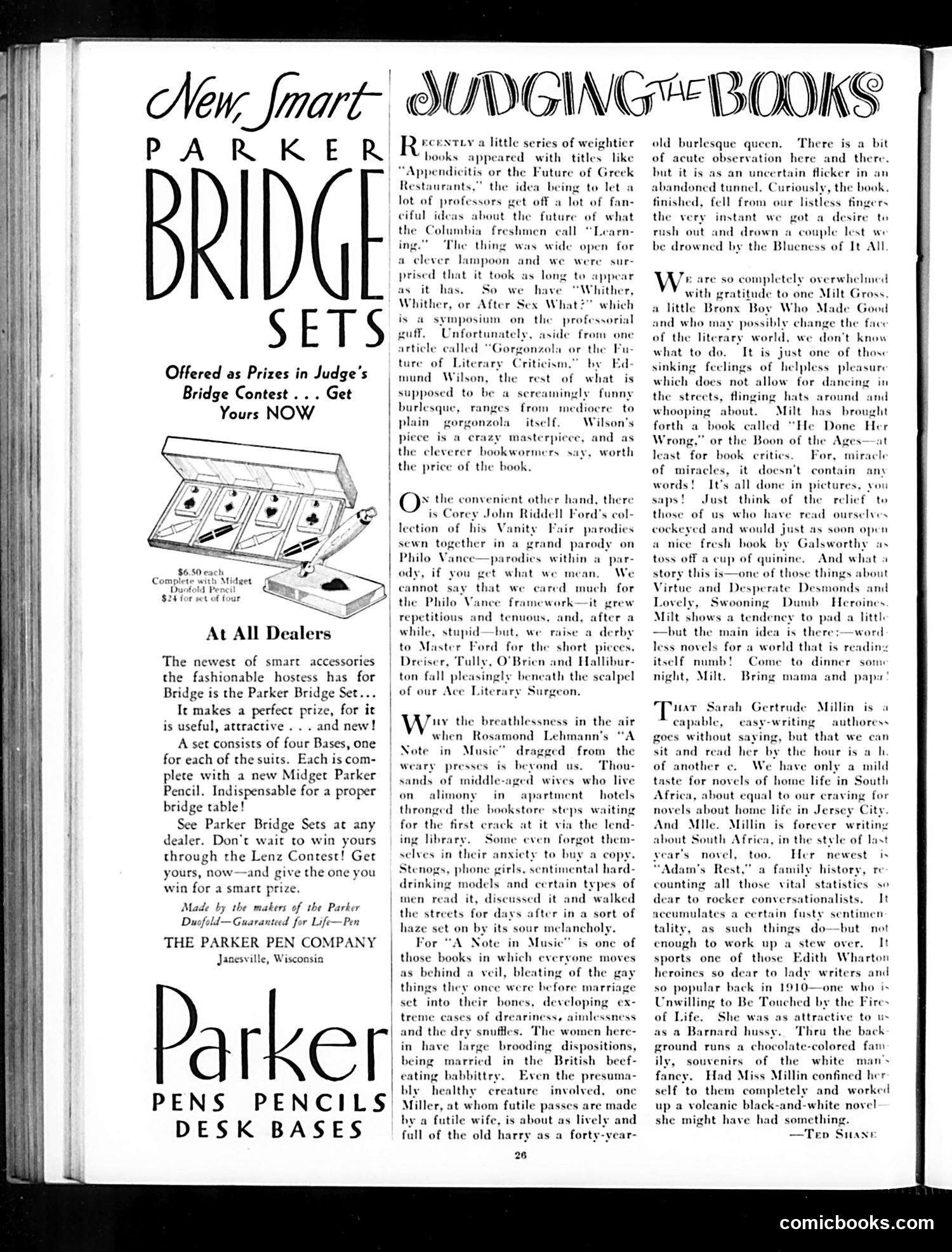
Judging the Books: A 1920s Literary Review This page contains a book review column ("Judging the Books") rather than political cartoons. The reviewer discusses recent publications with the sardonic tone typical of *Judge* magazine's literary criticism. The main targets are: 1. A professorial anthology ("Whither, Whither, or After Sex What?")—mocking academics' pretentious speculation about the future, particularly regarding sexuality and social change. The reviewer finds it simultaneously pompous and mediocre. 2. Corey Ford's parody collection—praised for clever short pieces, though the underlying Philo Vance framework is criticized as repetitive. 3. Rosamond Lehmann's "A Note in Music"—harshly mocked as depressing middle-class melodrama that appeals to stenographers and unhappy housewives but ultimately embodies dreary aimlessness. 4. Milt Gross is praised as a redemptive talent who might salvage modern literature. The page also advertises Parker Bridge Sets and writing instruments, reflecting 1920s consumer culture.
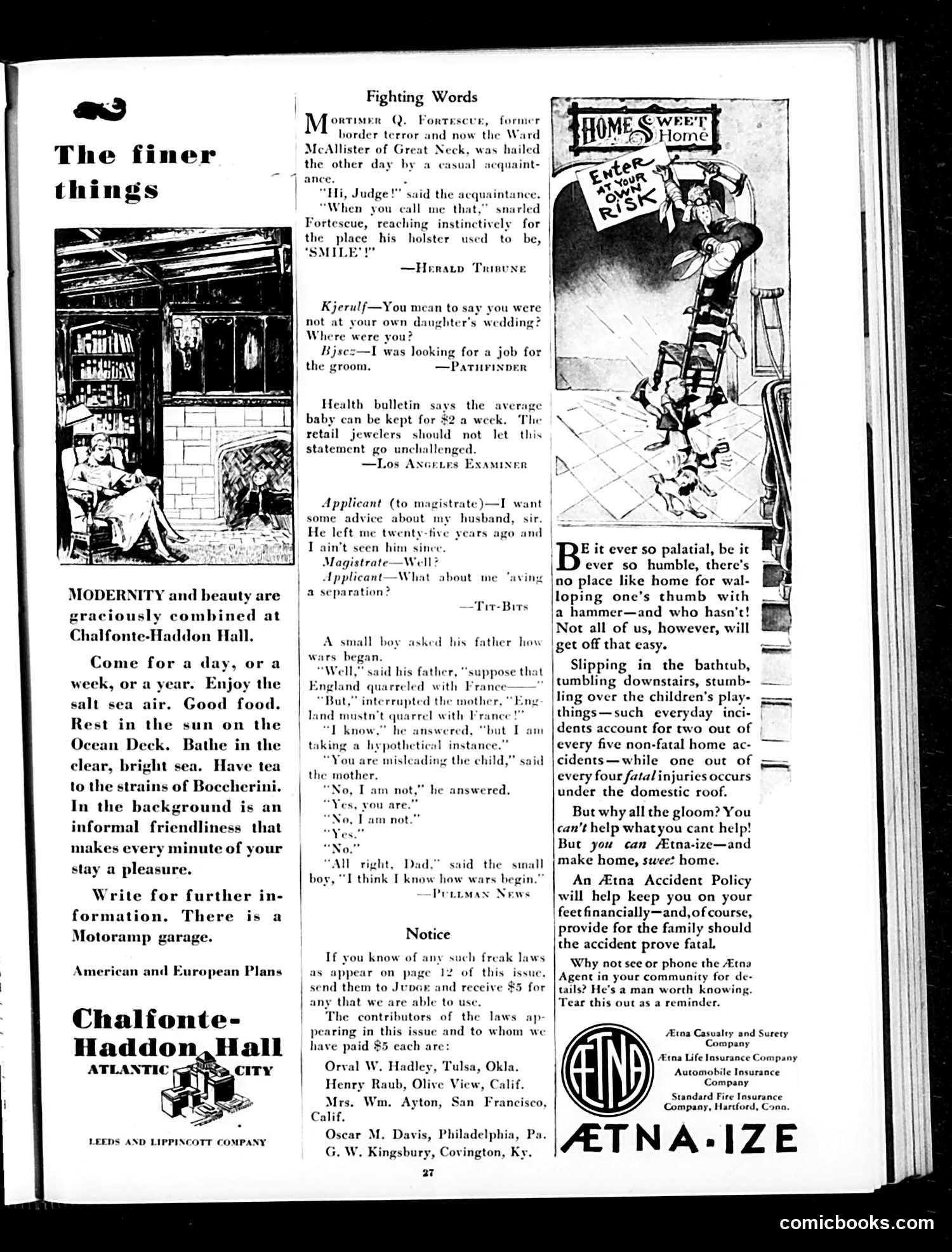
Page Analysis: Judge Magazine This page combines satirical "Fighting Words" anecdotes with advertising for leisure and insurance services. The Cartoons/Humor: The page features brief, joke-formatted scenarios mocking social pretension and domestic life. One anecdote ridicules a formerly rough "border terror" named Fortescue who now affects refined manners. Another lampoons middle-class anxieties—a father must find employment for his unemployed son-in-law before the wedding. A third depicts parents quarreling over whether to use England/France as a hypothetical example in explaining war to a child, with the boy concluding adults start wars through pointless argument. The Point: These jokes mock emerging American middle-class aspirations (affectation, social climbing), economic precarity (unemployment), and parental hypocrisy. The humor is gentle domestic satire aimed at contemporary readers navigating modern social expectations. The Advertisements: The page advertises the Chalfonte-Haddon Hall resort (representing leisure as "refinement") and Aetna insurance, reframing home accidents through the euphemism "Aetna-ize"—suggesting insurance as a modernizing solution to domestic risk.
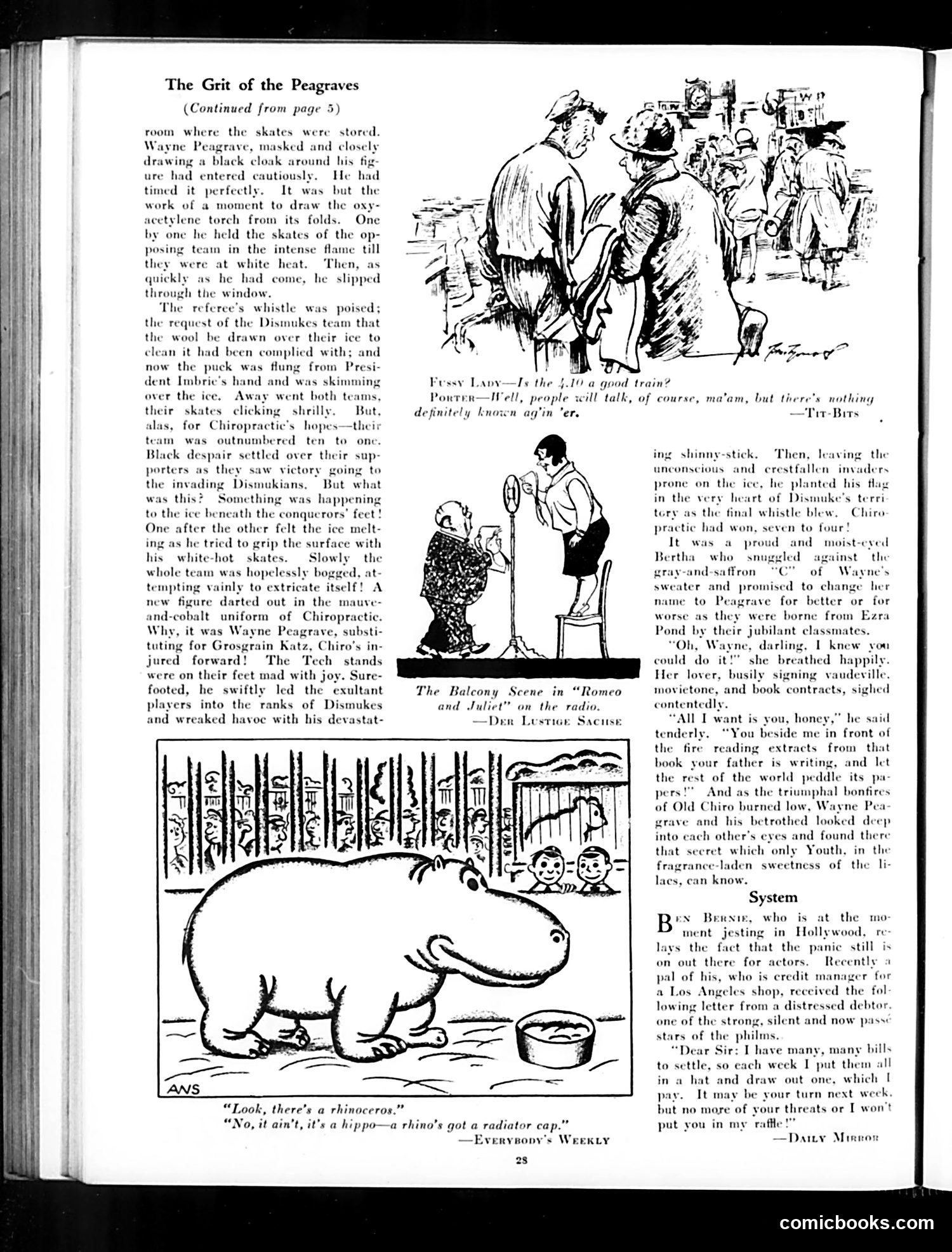
"The Grit of the Peagraves" — Judge Magazine Satire This page continues a serialized satirical story about college ice hockey rivalry. The main narrative follows Wayne Peagrave, who sabotages the opposing team's skates by heating them with an acetylene torch, causing them to sink into the ice during the game. He then heroically enters as a substitute player to lead his team (Chiropractic) to victory, winning his sweetheart Bertha's heart. The satire mocks melodramatic sports fiction and college romance tropes popular at the time—the "masked villain" saboteur, the triumphant hero, and the swooning heroine. The cartoons below are unrelated humor: one jokes about mistaking a hippopotamus for a rhinoceros, another depicts a radio broadcast of Romeo and Juliet. The "System" column satirizes Depression-era financial desperation, featuring a debtor who draws bills from a hat to pay randomly—a darkly comic commentary on economic chaos.
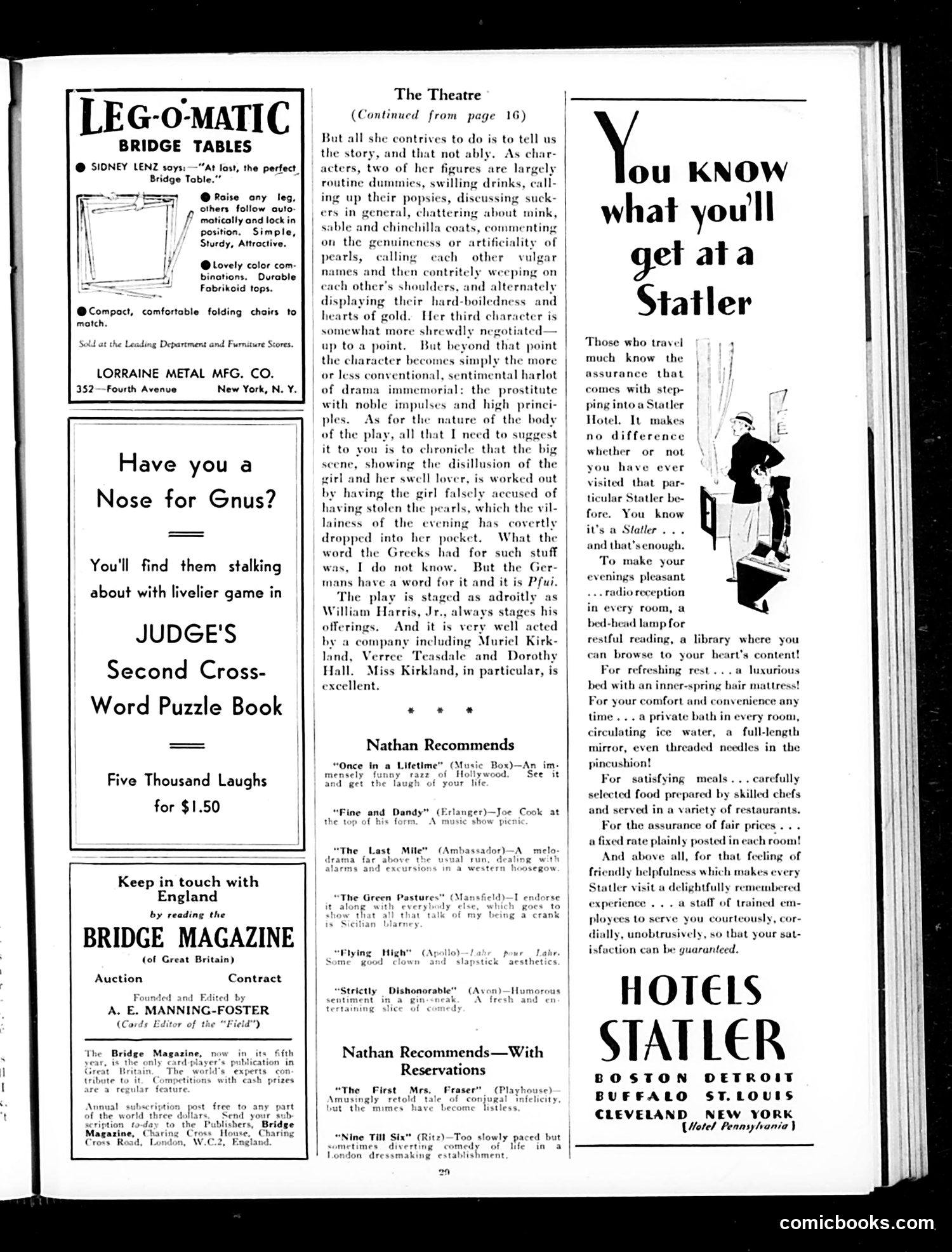
Analysis of Judge Magazine Page This page is primarily advertisements and theater reviews, not political satire. The left side features product ads (bridge tables, crossword puzzles, bridge magazines) targeting the leisure class who played contract bridge—a popular pastime in the 1920s-30s. The main content is a theater review criticizing a play for depicting flat female characters: "routine dummies" who drink, gossip about furs, and fit conventional stereotypes (the prostitute with a heart of gold). The reviewer finds the plotting contrived and the German word "Pfui" (roughly: "bah!") dismissive. The right side is a large Statler Hotels advertisement highlighting amenities—private baths, radios, quality restaurants, helpful staff—pitched to business travelers. This reflects the era's focus on modernized hotel comfort as a luxury selling point. The "Nathan Recommends" theater listings suggest this is from a 1920s-30s entertainment magazine for urban, affluent readers interested in Broadway shows and leisure activities.
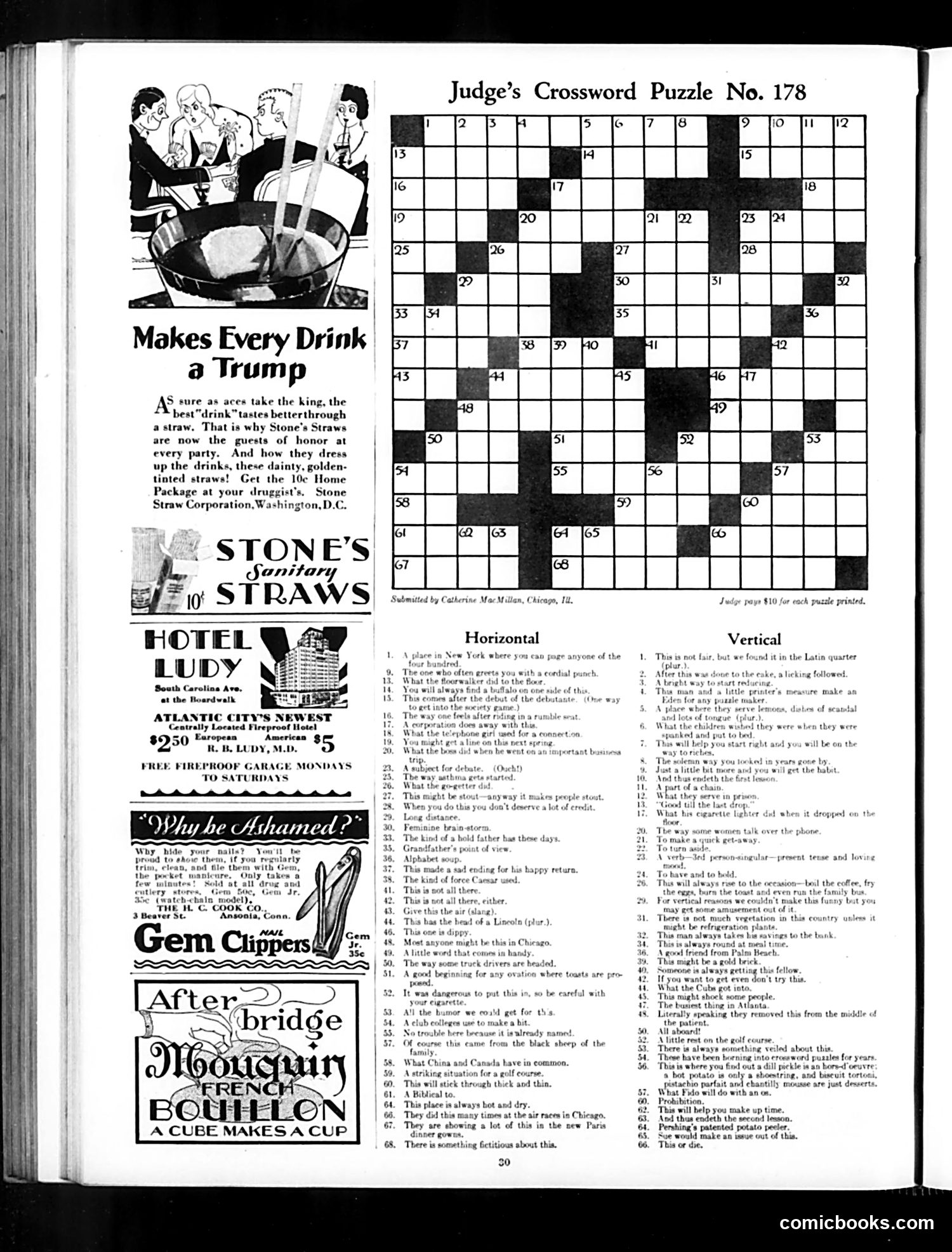
Judge Magazine Page Analysis This page is primarily advertising, not political satire. The main content is a Stone's Straws advertisement featuring a small cartoon of party-goers, with the tagline "Makes Every Drink a Trump"—using "trump" in the archaic sense meaning "to surpass" or "improve," not referencing any political figure. The advertisement promotes golden-tinted drinking straws as enhancing beverages at social gatherings. Below are various hotel and product advertisements (Hotel Ludy, Atlantic City hotel, Gem Clippers, Mountain Bouillon) and a crossword puzzle. The phrase "Makes Every Drink a Trump" is simply vintage advertising copy claiming the straws make drinks better. The page reflects 1920s-era consumer culture and social life, with no discernible political commentary. It's a typical magazine layout mixing advertisements, puzzles, and promotional content rather than editorial satire.
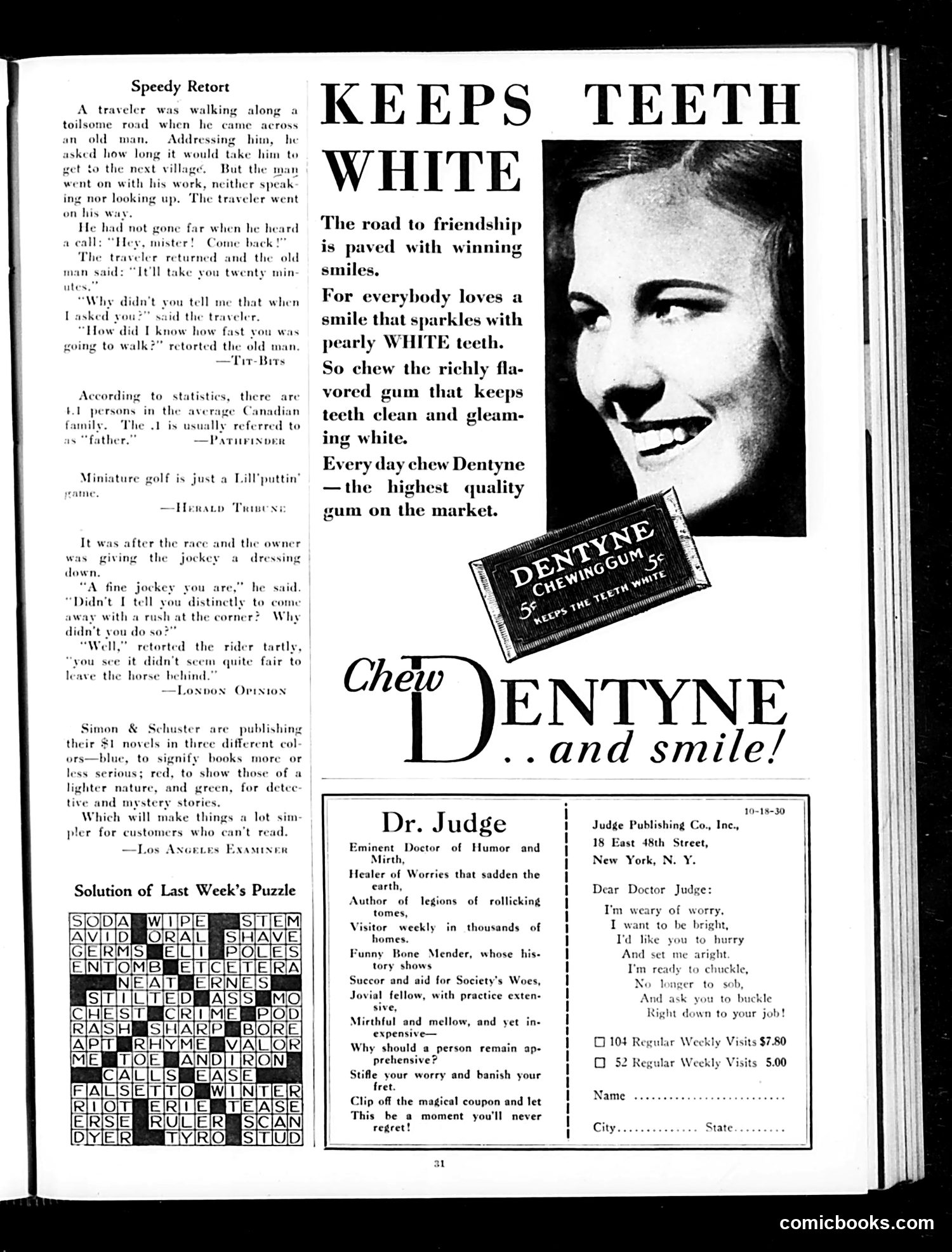
Judge Magazine Page Analysis This page contains short humorous anecdotes and advertisements rather than political cartoons. The left side features brief jokes typical of 1930s humor magazines: a traveler's exchange with an old man, quips about statistics and golf, and a jockey anecdote. These rely on wordplay and unexpected punchlines common to the era's comedy style. The dominant content is a Dentyne chewing gum advertisement featuring a smiling woman's photograph with text emphasizing white teeth and friendship. This reflects 1930s advertising's focus on personal grooming for social success. Below that is a humorous "Doctor Judge" feature—a meta-joke where the magazine itself, personified as "Dr. Judge," offers to cure readers' worries through humor. Readers could subscribe for weekly visits at $7.80 or $5.00. The page demonstrates how Judge combined satirical commentary with popular entertainment and advertising, targeting middle-class readers seeking both intellectual humor and consumer products.
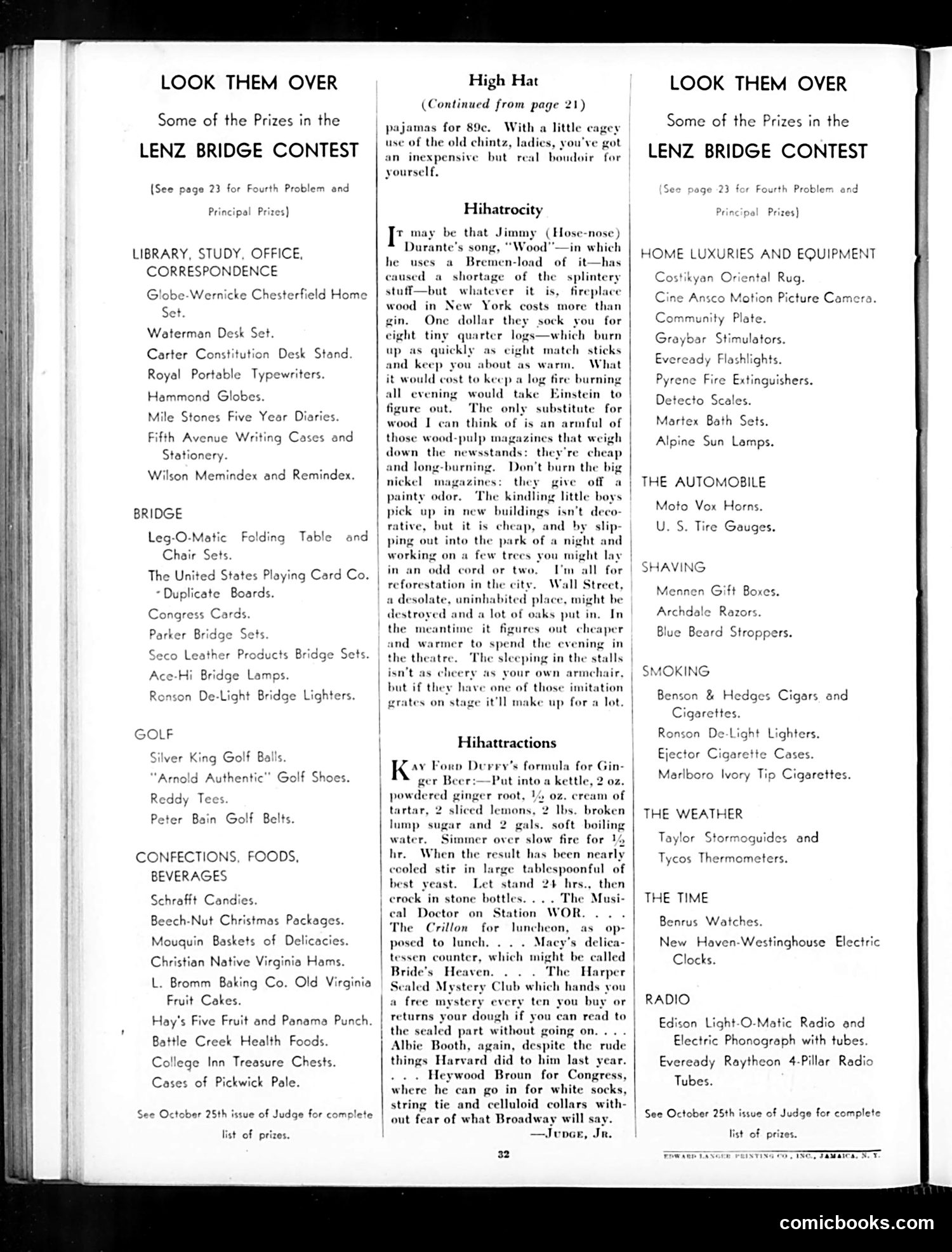
This page is primarily advertising for a bridge-playing contest run by Judge magazine, listing merchandise prizes across various categories (office equipment, bridge supplies, golf gear, foods, and home goods). The text content consists of two humorous filler pieces: "High Hat" discusses heating alternatives to expensive fireplace wood in Depression-era New York, jokingly suggesting burning matchsticks or reforesting Wall Street instead. "Hihattractions" and "Hihattractions" offer miscellaneous urban commentary—references to Jimmy Durante, ginger beer recipes, and mentions of contemporary figures like Heywood Broun and Albie Booth (likely a Yale athlete), mixed with restaurant and radio recommendations. The satire is mild, focused on everyday inconveniences and absurd observations rather than sharp political critique. This appears to be a typical Judge filler page from the 1930s, combining contest promotion with light social humor.
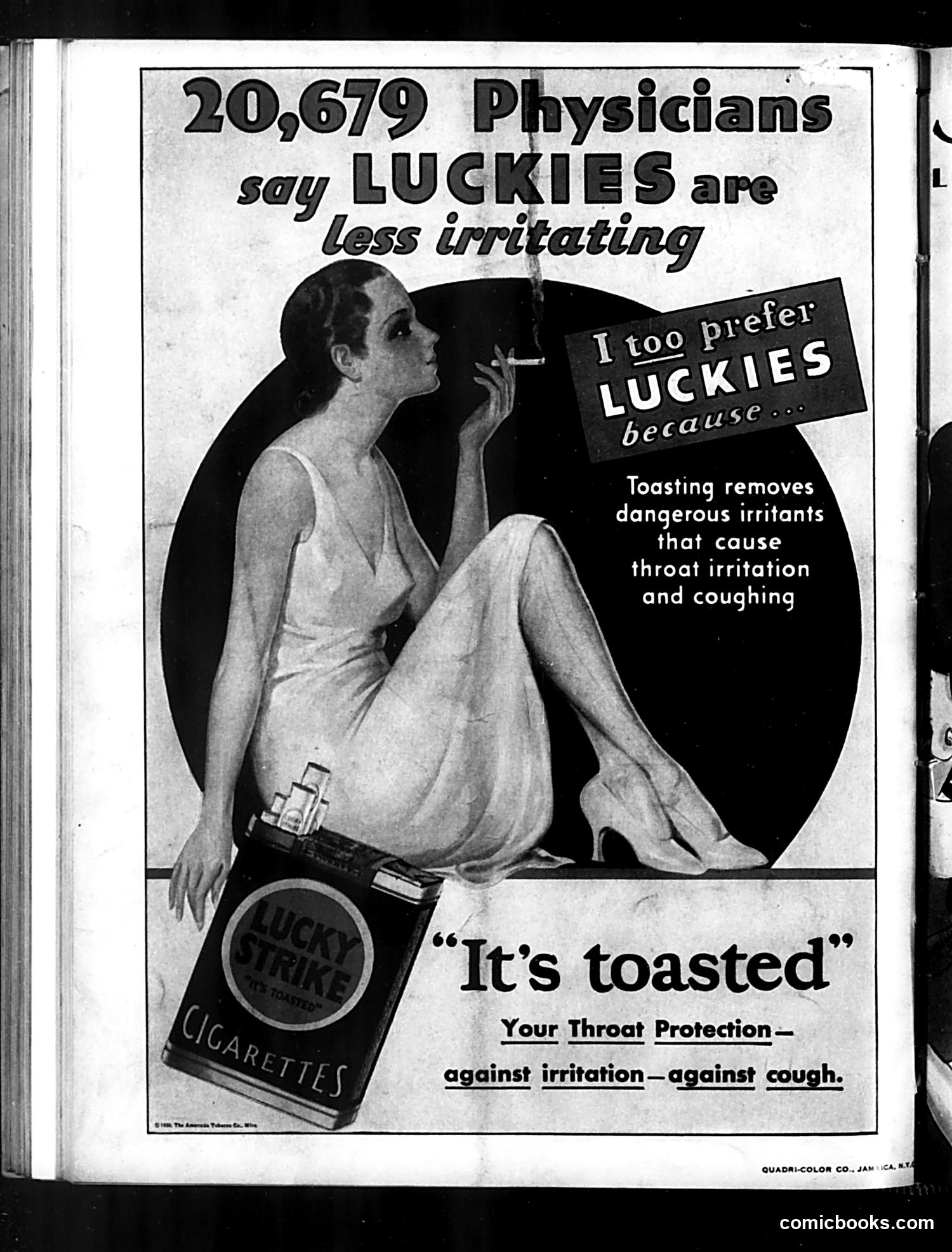
Analysis This is a Lucky Strike cigarette advertisement, not satire or political commentary. The page claims that 20,679 physicians endorse Lucky Strikes as "less irritating" because their "toasting" process removes "dangerous irritants that cause throat irritation and coughing." The image shows a glamorous woman smoking, positioned to suggest sophistication and health-consciousness. The tagline "It's toasted" emphasizes the brand's purported throat-protective manufacturing method. Historical context for modern readers: This represents pre-1964 tobacco advertising when health claims were legal and unregulated. The "physicians say" endorsement was a common marketing tactic before the Surgeon General's warning. The ad literally claims cigarettes *prevent* coughing—a claim now understood as false and fraudulent. Such advertisements were banned after tobacco's health dangers became legally established.