judge
Judge — October 25, 1930
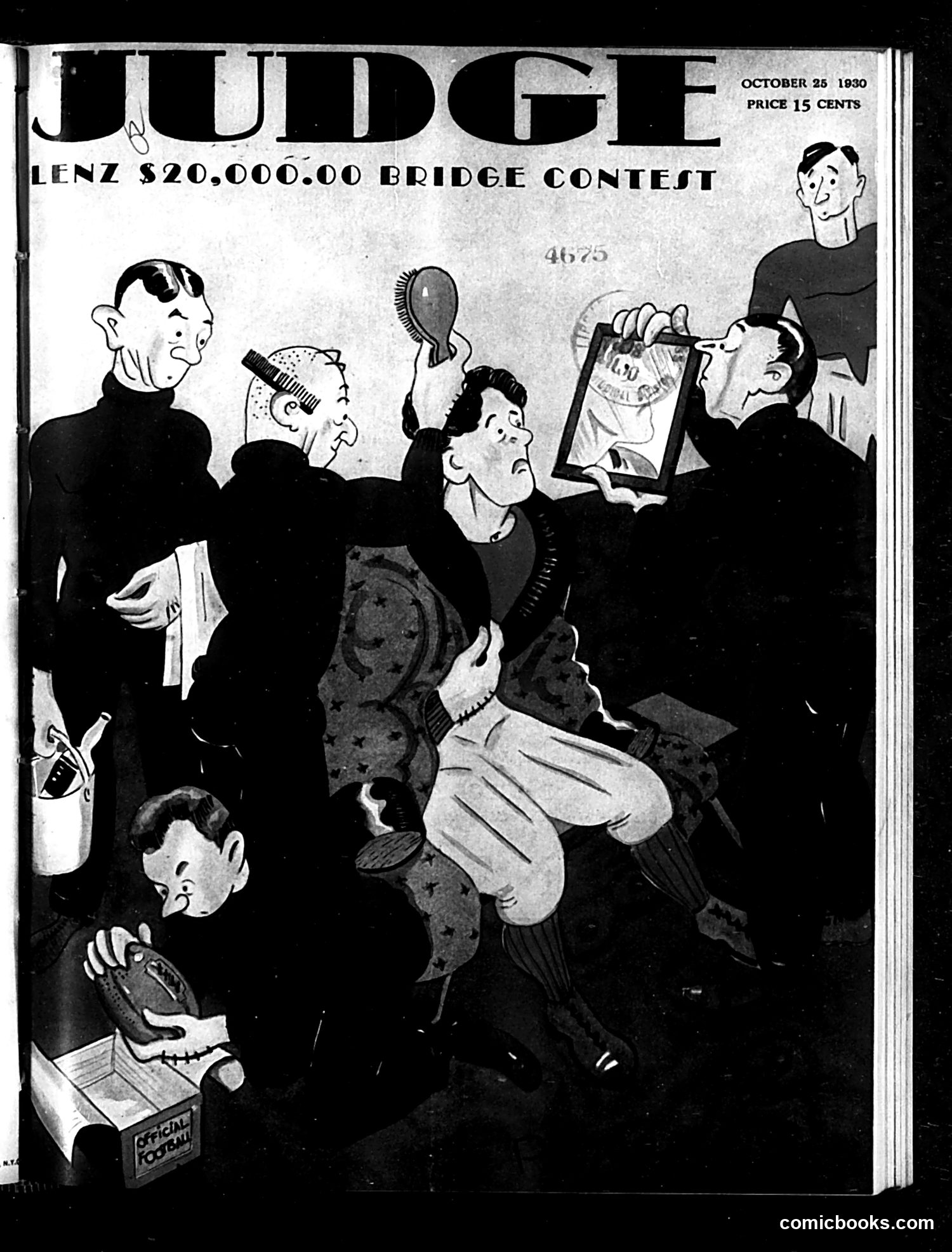
Judge Magazine Cover Analysis - October 25, 1930 This satirical cover depicts a "Lenz $20,000.00 Bridge Contest," referencing what appears to be a contemporary contest or wager. The exaggerated caricatures show several men in suits examining and displaying documents or prizes, with excited, scheming expressions typical of Judge's style. The satire likely mocks either a dubious contest promotion, get-rich-quick schemes popular during the Great Depression era, or possibly a famous bridge-related competition. The men's animated gestures and the visible prize materials suggest commentary on gullibility or the promotion of unrealistic financial opportunities to the public during economically desperate times. Without identifying specific individuals, the cartoon critiques what appears to be exploitative marketing or unrealistic promises to ordinary citizens.
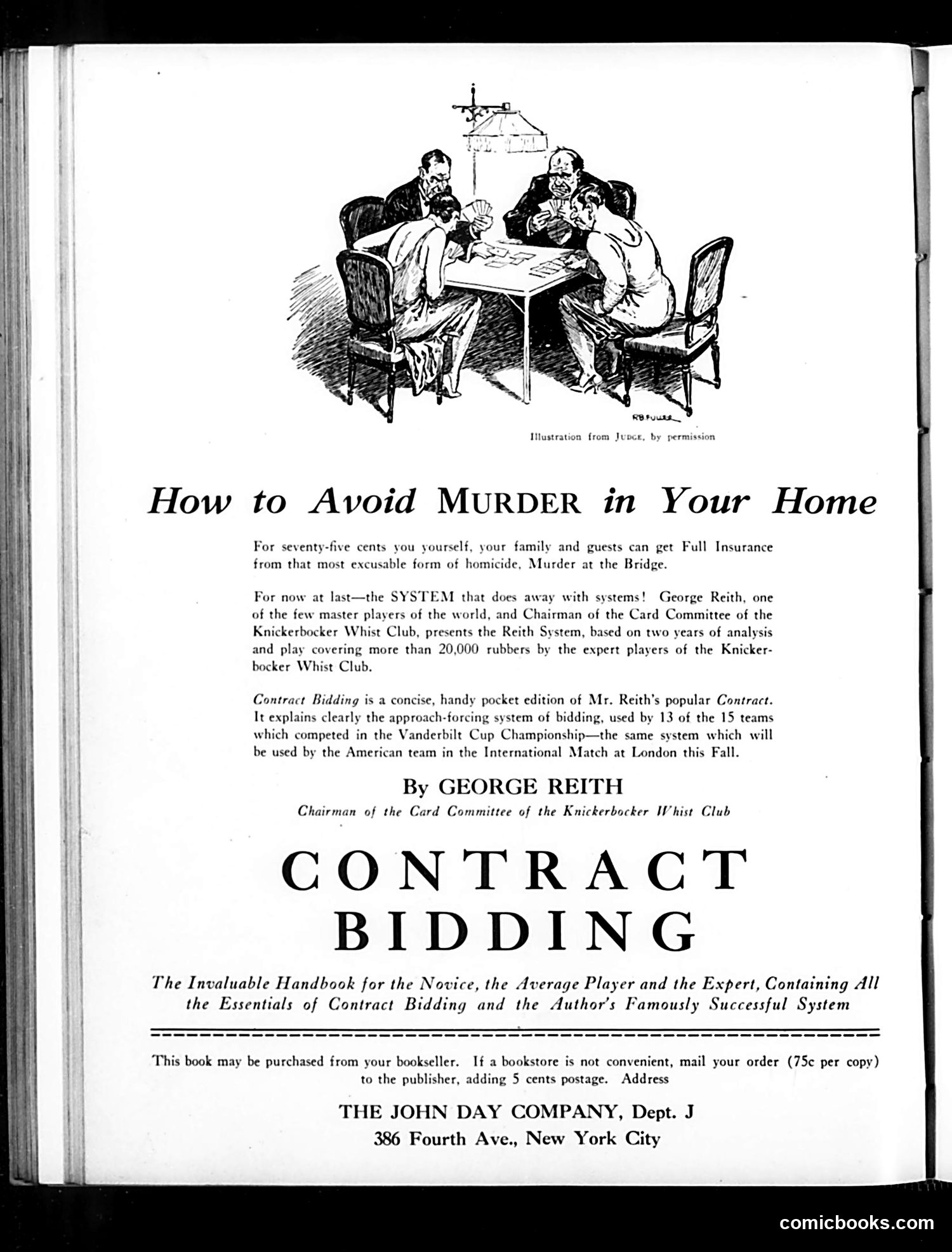
Analysis This page is primarily an advertisement for George Reith's "Contract Bidding" book, published by The John Day Company. The satirical hook—"How to Avoid Murder in Your Home"—is a humorous metaphor: "murder at the bridge" means losing badly at contract bridge, the popular card game. The illustration shows four men playing bridge, likely depicting the anxiety and conflict the game can provoke among players. The ad claims Reith's system, based on analysis of 20,000 rubbers from the Knickerbocker Whist Club, will improve bidding strategy. It was used by 13 of 15 teams in the Vanderbilt Cup Championship and would be used by the American team in an International Match in London. The "murder" framing is pure marketing hyperbole—bridge was a serious competitive pastime for the educated classes in this era.
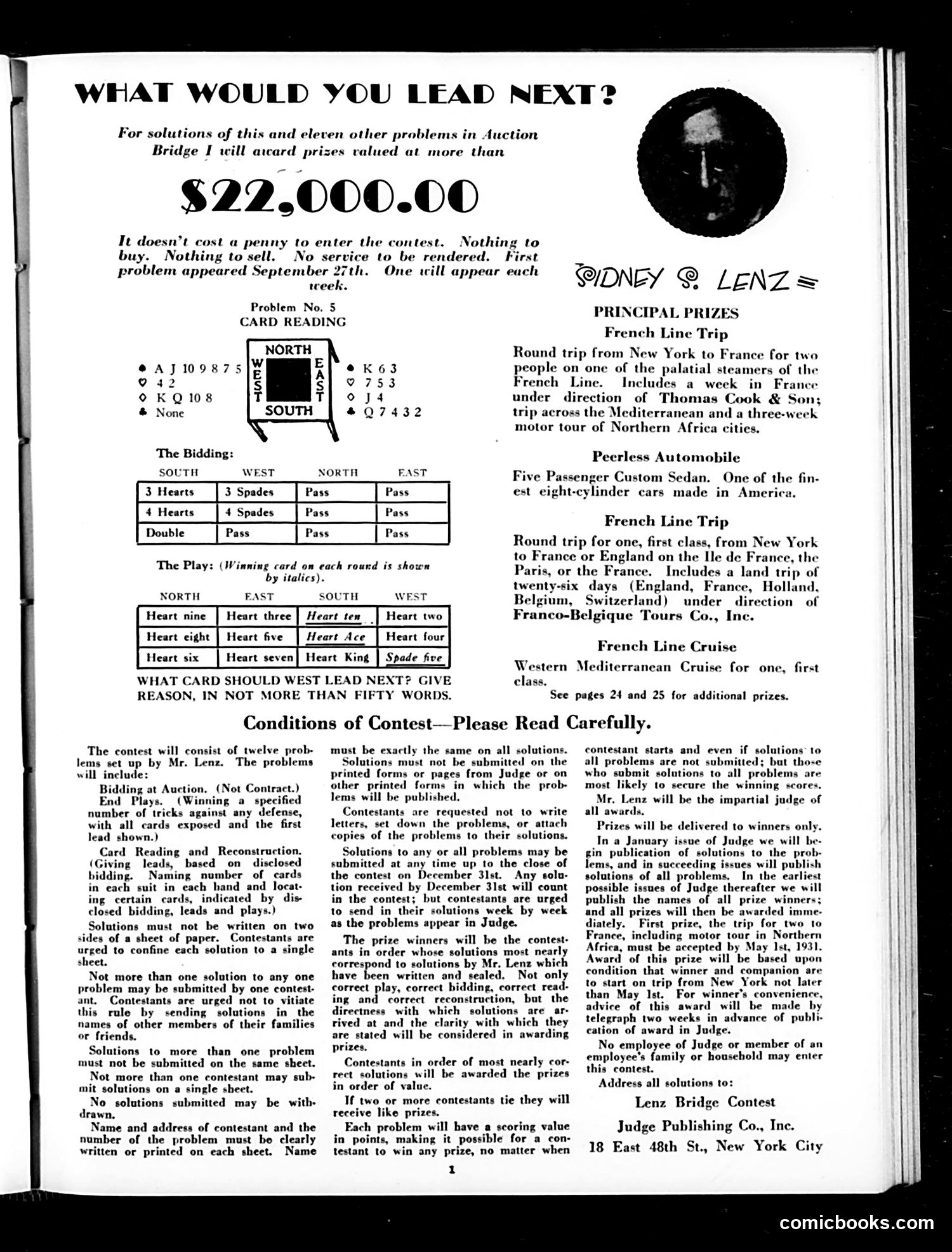
Analysis This page is primarily a bridge puzzle contest advertisement rather than satire or editorial content. The main feature is "Problem No. 5: Card Reading"—a contract bridge problem for readers to solve. The only figurative element is a portrait photograph labeled "SIDNEY S. LENZ" at top right, identified as the contest's authority figure. Lenz was a famous bridge expert of the era. The page offers substantial prizes ($22,000 total value) for solving twelve bridge problems, including trips to France and a Peerless automobile. Contest rules and submission instructions occupy most of the space. This represents Judge magazine's non-satirical content—games and contests designed to engage readers and presumably drive subscriptions, rather than political or social commentary.
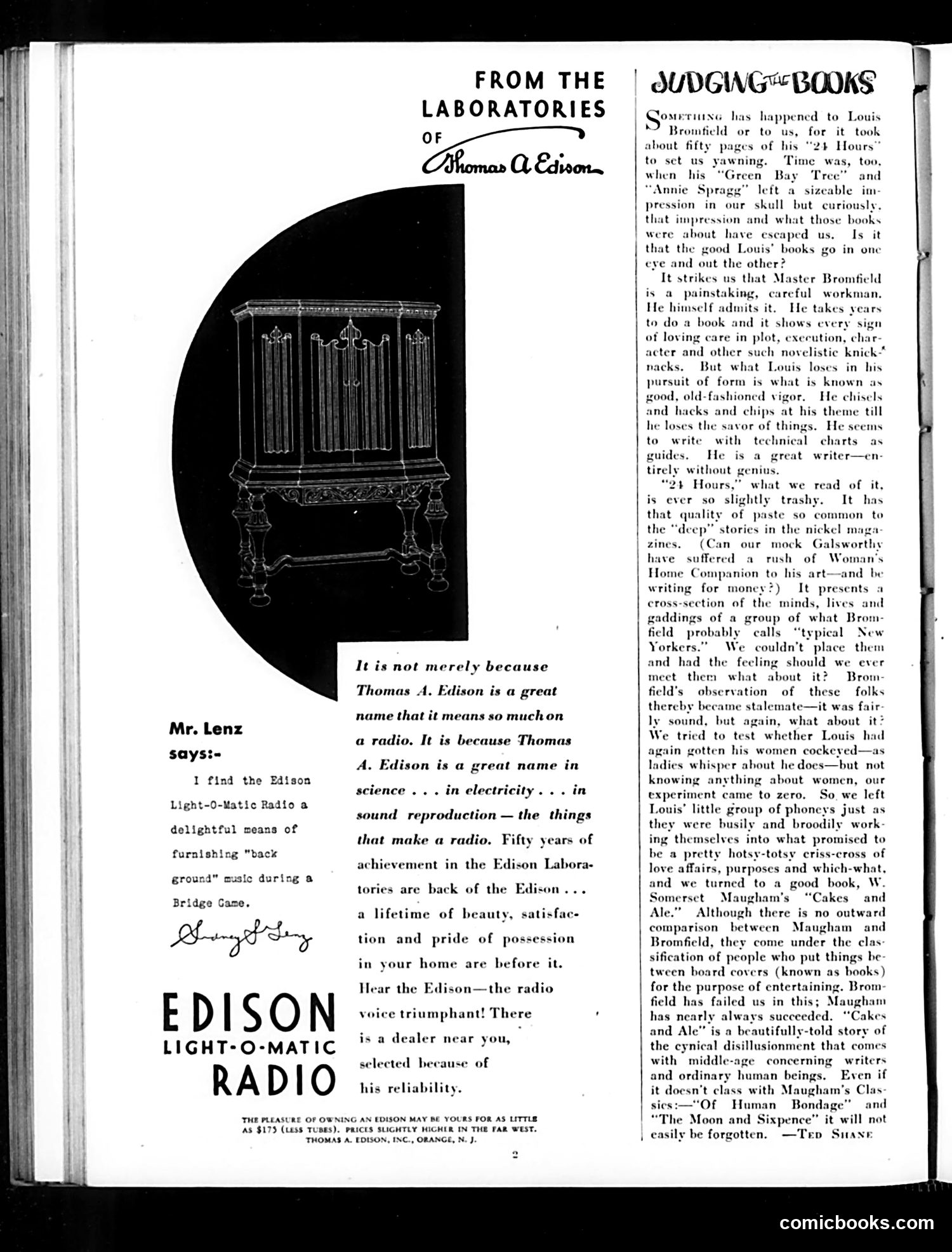
Page Analysis: Judge Magazine This page is primarily advertising and book review, not political satire. The left side features an Edison Light-O-Matic Radio advertisement from Thomas A. Edison Inc. (Orange, N.J.), showing an ornate radio cabinet. The ad emphasizes Edison's reputation in science and electricity to sell radios to consumers. The right side contains a book review by "Judging the Books" columnist Ted Shank, critiquing Louis Bromfield's novel "24 Hours." The reviewer praises Bromfield's craftsmanship but dismisses the book as "slightly trashy"—typical nickel-magazine paste. The review compares Bromfield unfavorably to Somerset Maugham, noting Bromfield succeeds where Maugham's "Cakes and Ale" fails at serious literature. This is representative Judge content: advertising mixed with cultural commentary for educated middle-class readers.
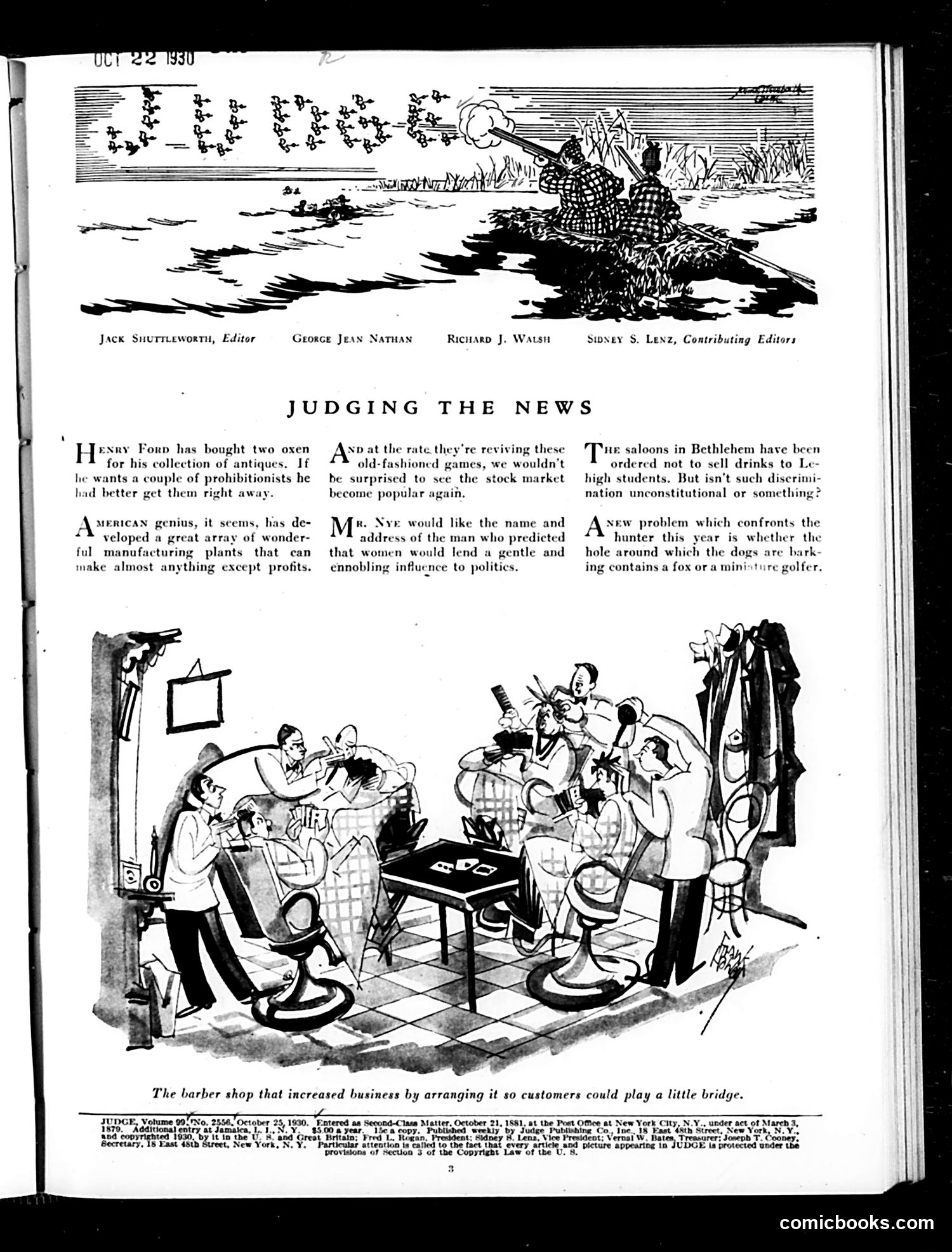
Analysis of Judge Magazine Page (October 22, 1930) The main cartoon depicts a barber shop where the proprietor has increased business by installing a bridge table for customers to play while waiting. The humor relies on a simple commercial strategy: providing entertainment to make the wait more pleasant and encourage patrons to linger. The "Judging the News" section above contains brief satirical commentary on contemporary topics: Henry Ford's antique purchases, American manufacturing ingenuity, stock market recovery, women's political influence, and hunting season concerns about foxes in miniature golf holes. This appears to be typical light social satire from the Depression era, focusing on consumer culture, leisure activities, and everyday observations rather than heavyweight political commentary. The cartoons target middle-class concerns and commercial innovations of the period.
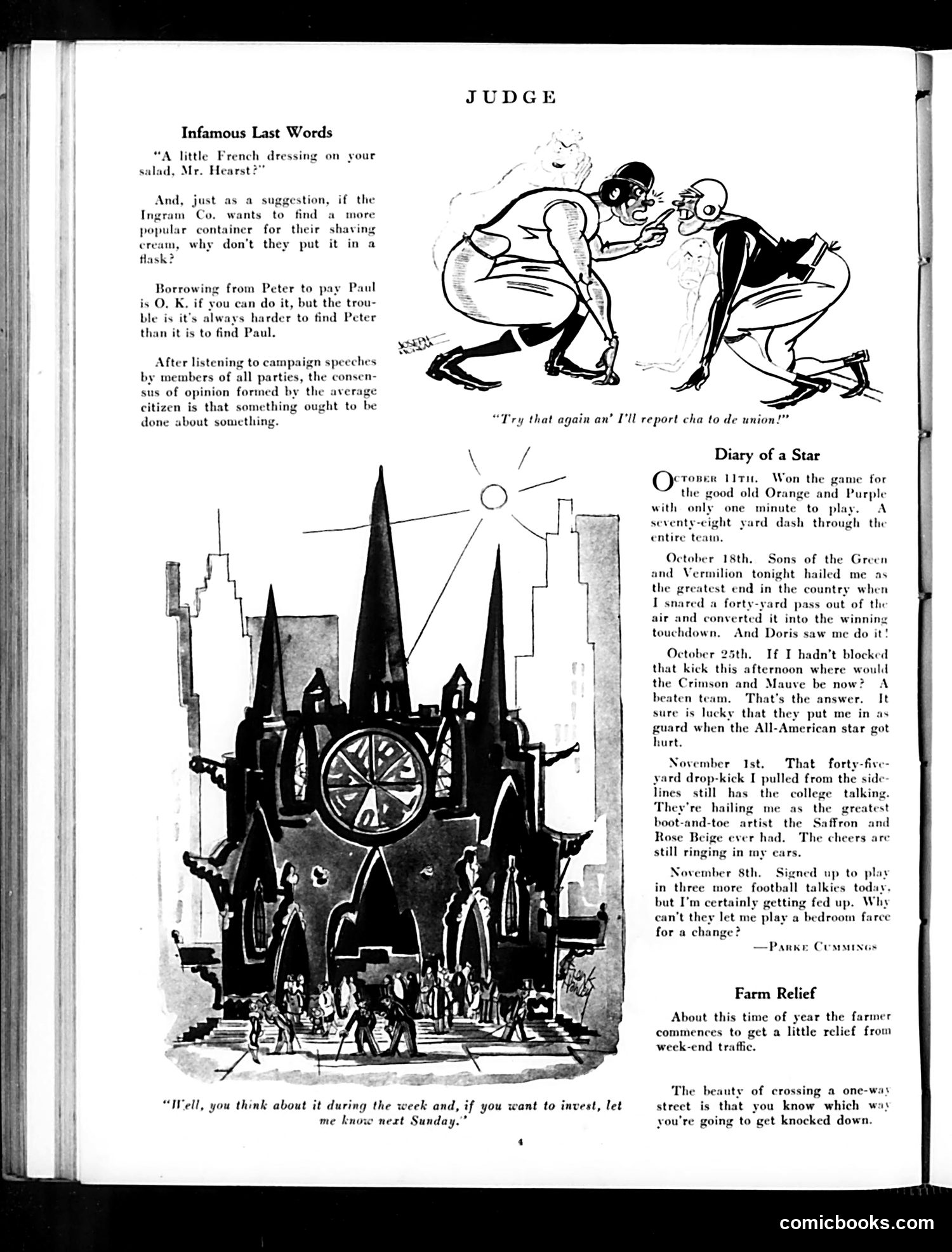
Judge Magazine Page Analysis This page contains three separate humor pieces: "Infamous Last Words" offers brief satirical quips about everyday annoyances—French dressing containers, finding shaving cream, and the difficulty of borrowing money. The large cathedral illustration accompanies a caption about financial investment decisions, satirizing how people postpone important choices until the weekend. "Diary of a Star" by Parker Cummings chronicles a football player's experiences in October-November, including a notable 45-yard drop-kick and complaints about repeated football talks and "bedroom farce" assignments—likely mocking both athletic celebrity culture and theatrical entertainment schedules of the era. "Farm Relief" is a brief joke about rural traffic and the hazards of crossing one-way streets. The page demonstrates Judge's mix of social commentary, sports satire, and everyday humor typical of early-to-mid 20th century American magazines.
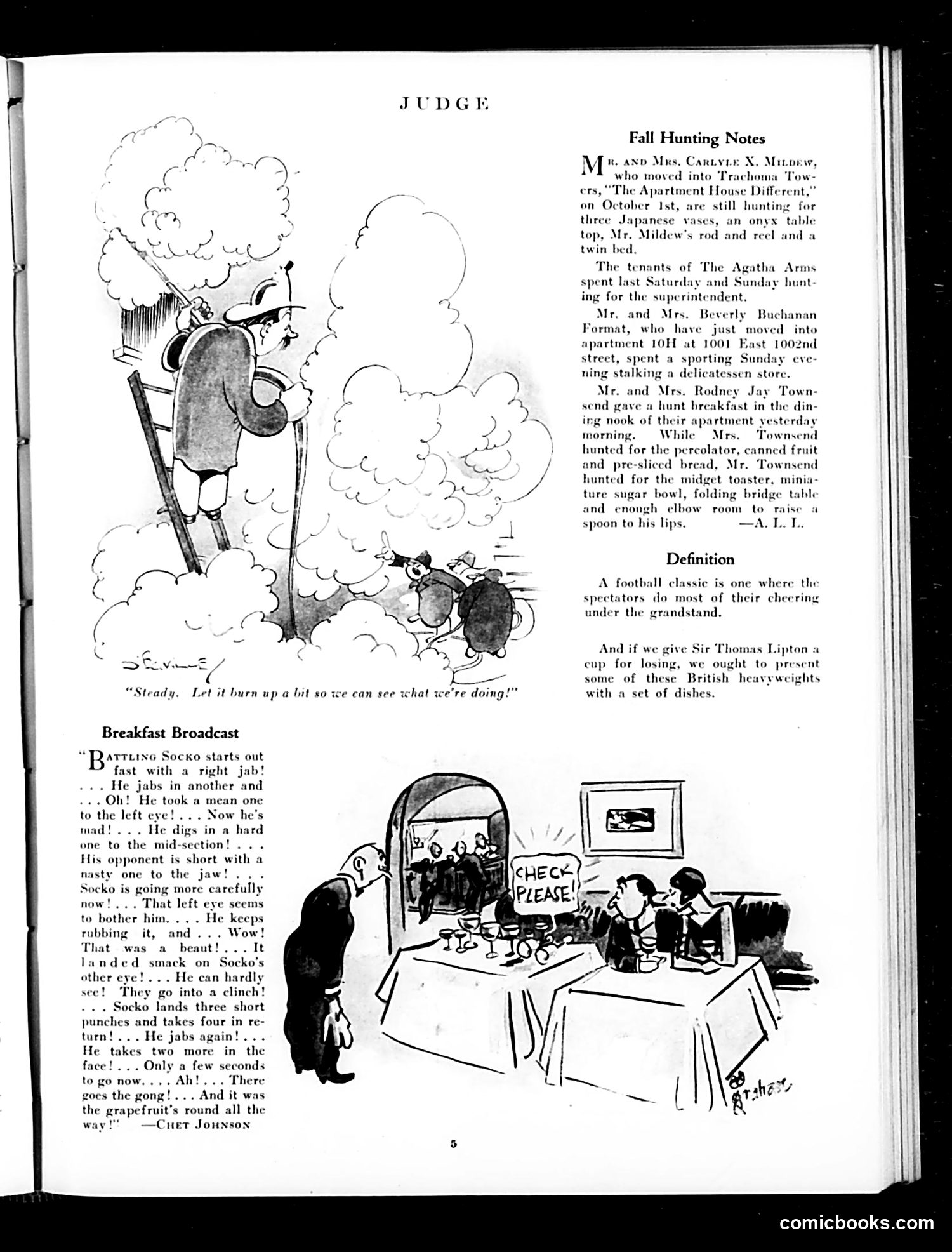
Page Analysis: Judge Magazine This page contains three separate pieces: 1. "Fall Hunting Notes": Social commentary on upper-middle-class apartment dwellers in what appears to be 1920s Manhattan, describing their weekend hunting excursions and domestic activities with gentle humor. 2. Top cartoon: A hunter in a tree shoot-out, captioned "Steady. Let it burn up a bit so we can see what we're doing!" — satirizing unsafe or comedic hunting practices. 3. "Breakfast Broadcast": A detailed play-by-play of a boxing match (featuring "Battling Socko"), written in sportscaster style. The accompanying cartoon shows a restaurant scene where diners are being checked/examined, likely satirizing health inspections or regulations of the era. The overall tone targets middle-class leisure activities and emerging mass media (radio broadcasts of sporting events).
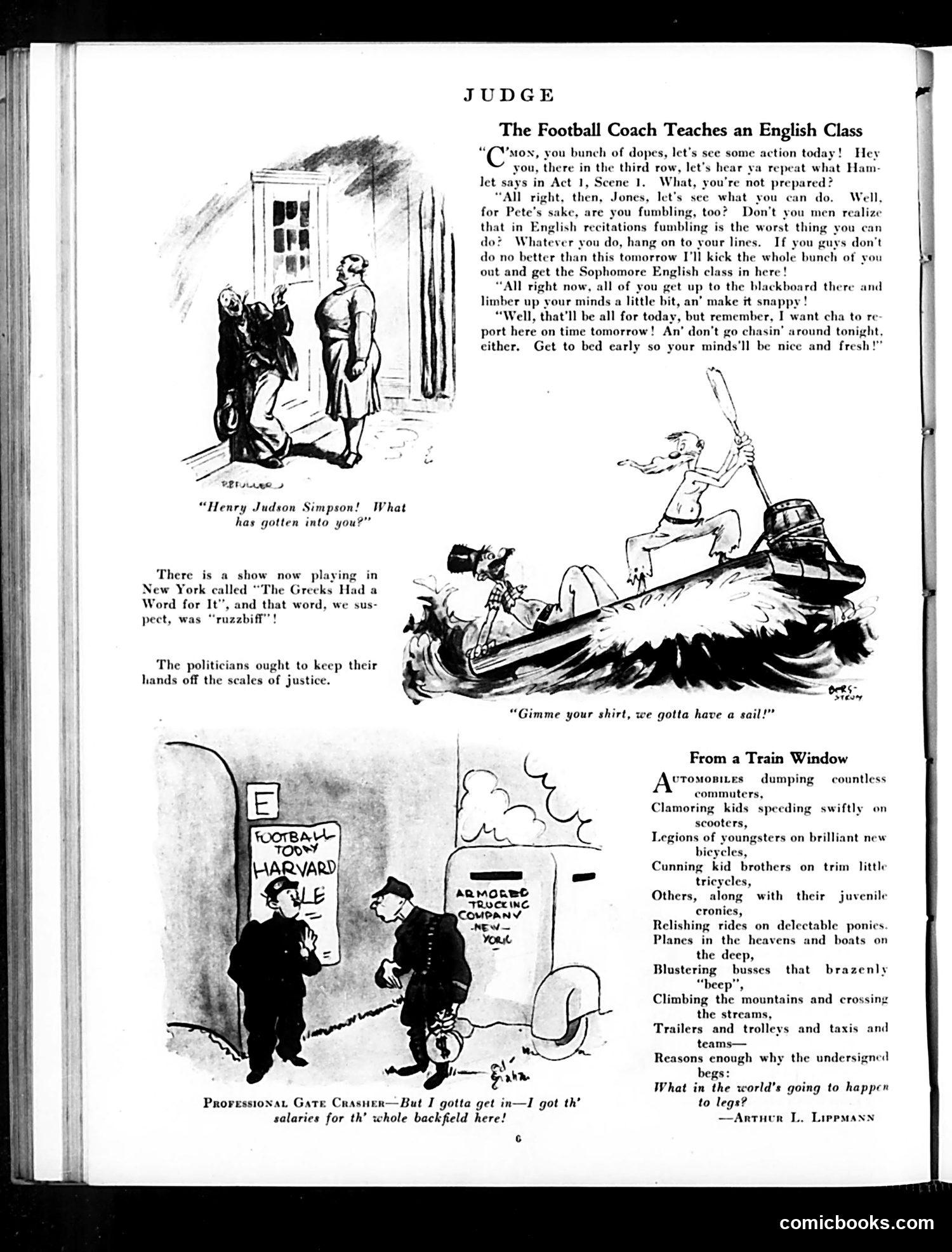
"Judge" Magazine Page Analysis This page contains three satirical sketches: 1. "The Football Coach Teaches an English Class" mocks a tough football coach (likely a stereotype of the era) attempting to teach Shakespeare. His crude, aggressive coaching style clashes absurdly with literature instruction—he threatens to "kick the whole bunch of you out" if students don't pay attention. 2. "Professional Gate Crasher" depicts a man bragging about sneaking into Harvard's football stadium without paying, suggesting he'll do the same at other venues. The joke targets both gate-crashers and the vulnerability of event security. 3. "From a Train Window" is a poetic piece listing observations of American life—commuters, children, rural scenes—reflecting on society's ordinary details. The page satirizes American education, sports culture, and social behavior typical of early-20th-century concerns.
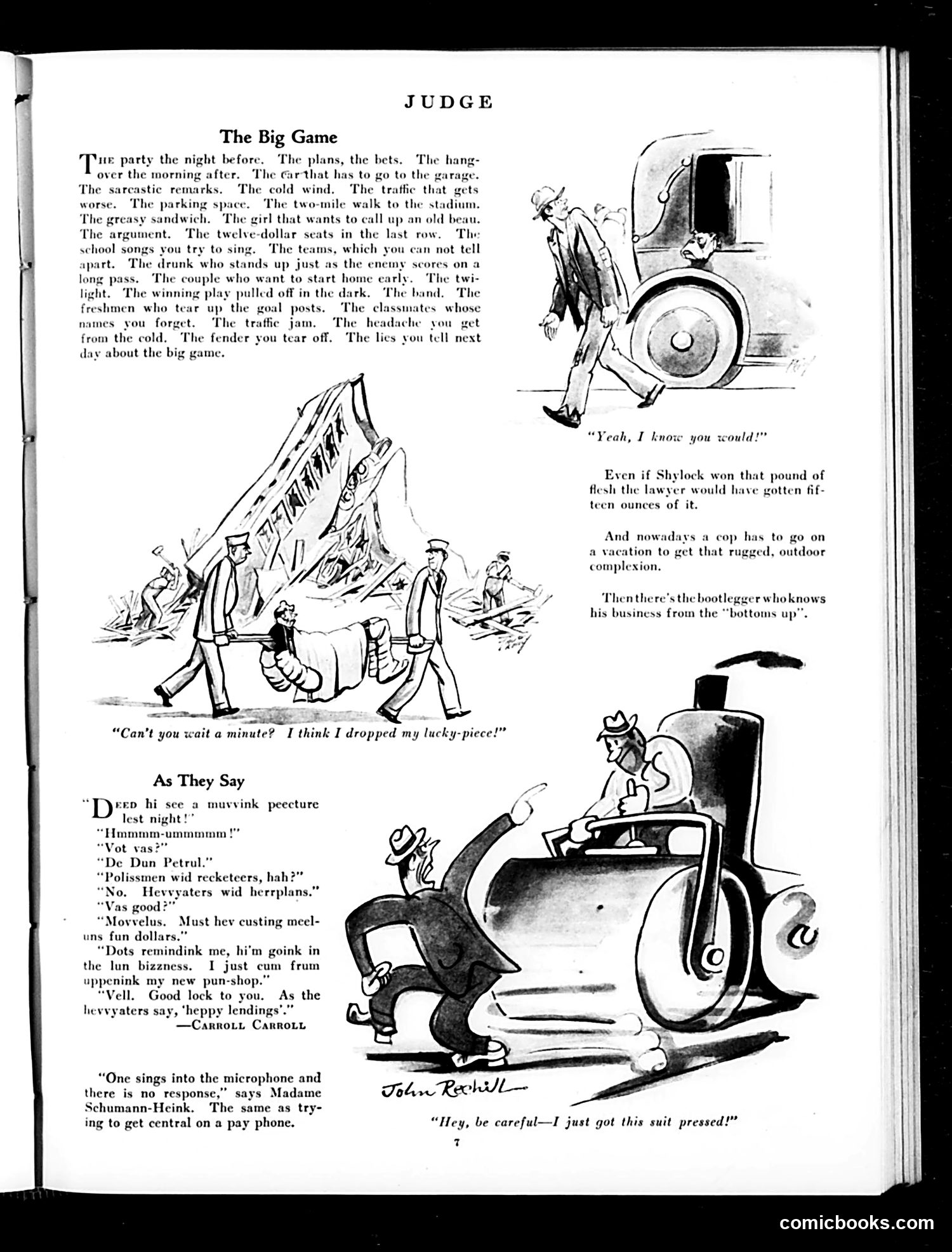
Judge Magazine Page Analysis This page contains several satirical pieces about early 20th-century American life: "The Big Game" mockingly catalogs the miserable experience of attending a college football game—the hangover, cold weather, parking, expensive seats, drunk fans, and the lies told afterward about it being memorable. Lower cartoons depict everyday frustrations: a construction accident ("lucky-piece"), and a car accident where someone worries about a freshly-pressed suit. "As They Say" section presents ethnic dialect humor (common to the era), featuring what appears to be immigrant characters with heavy accents discussing urban life—bootleggers, police corruption, and business ventures. This reflects period stereotypes. The Schumann-Heink reference jokes about the famous opera singer's difficulty getting responses, comparing it to phone operator issues—poking fun at both celebrity pretension and contemporary telephone service frustrations. The overall tone is cynical about modern urban inconveniences, immigrant communities, and entertainment.
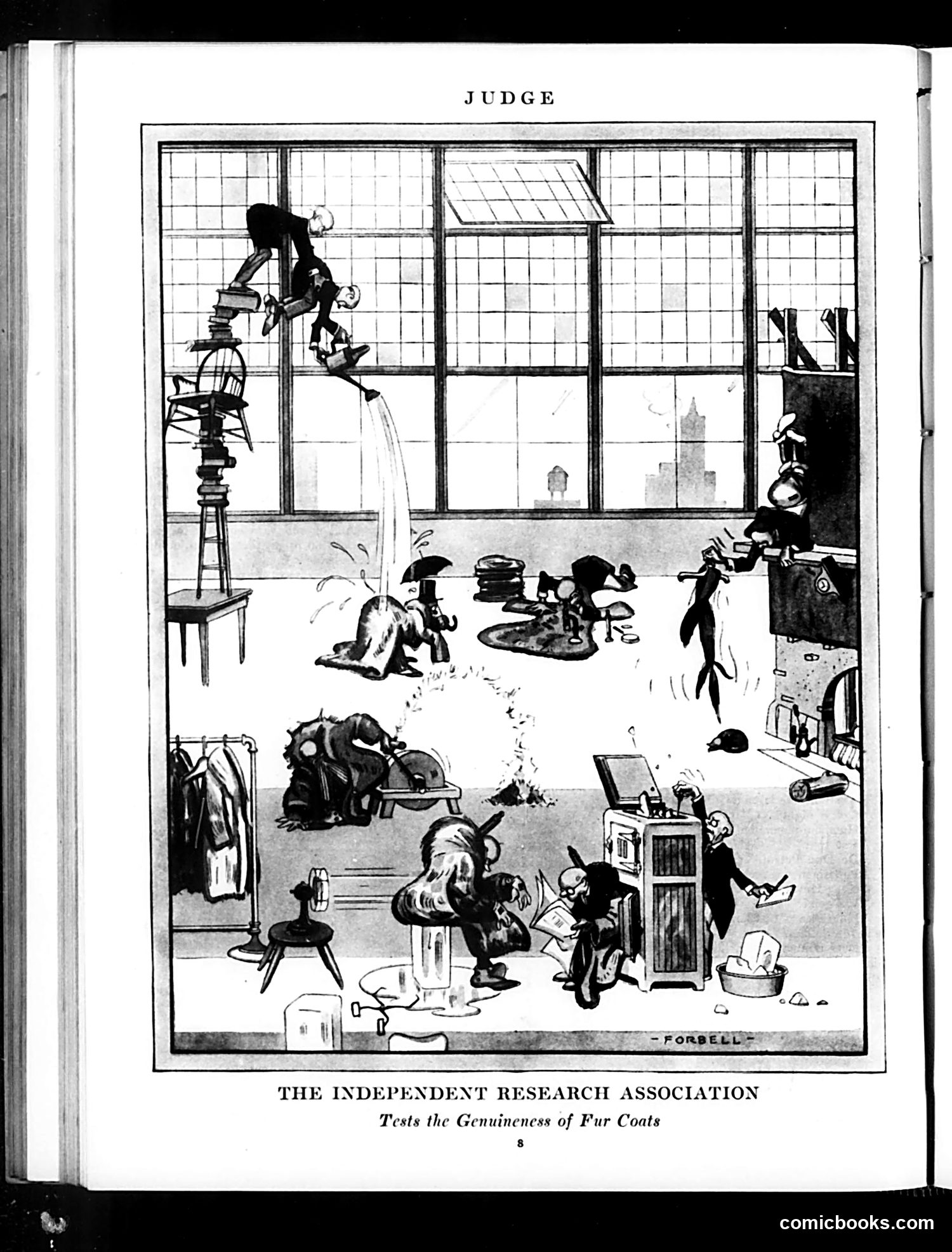
"Judge" Cartoon Analysis This Forbell cartoon satirizes "The Independent Research Association" and its supposed testing of fur coat authenticity. The chaotic laboratory scene—with figures tumbling from shelves, knocked-over equipment, and general mayhem—mocks the association's credibility. The joke appears to be that this "independent research" is actually amateurish and unreliable, suggesting consumers shouldn't trust such organizations' endorsements of fur garments. The slapstick destruction implies the association's methods are absurd rather than scientifically rigorous. This likely references early 20th-century consumer protection concerns and skepticism toward self-appointed quality-testing organizations that may have been influenced by industry interests. The cartoon warns readers not to blindly accept such testimonials when purchasing luxury goods like fur coats.
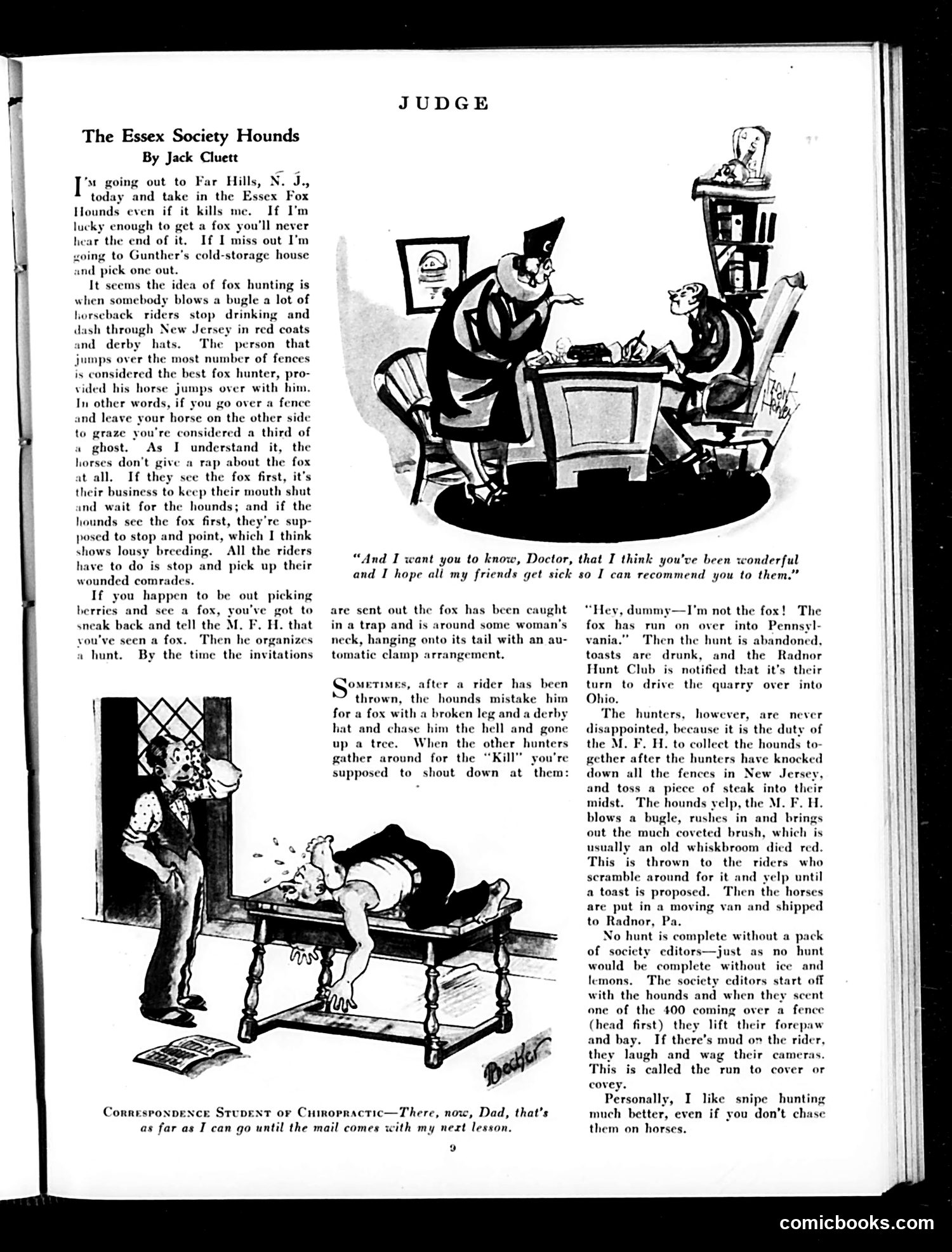
"The Essex Society Hounds" Satire Explained This humorous article by Jack Cluett mocks upper-class fox hunting traditions among wealthy New Jersey elites. The author satirizes the pretension and absurdity of the sport: riders care more about social status than actual hunting; horses do the real work while riders often fall off; and the "fox" is frequently already dead, purchased from a butcher. The cartoons reinforce the jokes—one shows a judge at his desk while a doctor boasts about referrals (likely mocking professional self-promotion in high society), and another depicts a chiropractic student injured from a hunting accident, exemplifying the physical hazards these "society editors" endure. The satire targets how wealthy Americans used fox hunting as performance for social climbing, complete with staged rituals, elaborate dress codes, and press coverage—ultimately revealing the whole enterprise as pretentious theater rather than genuine sport.
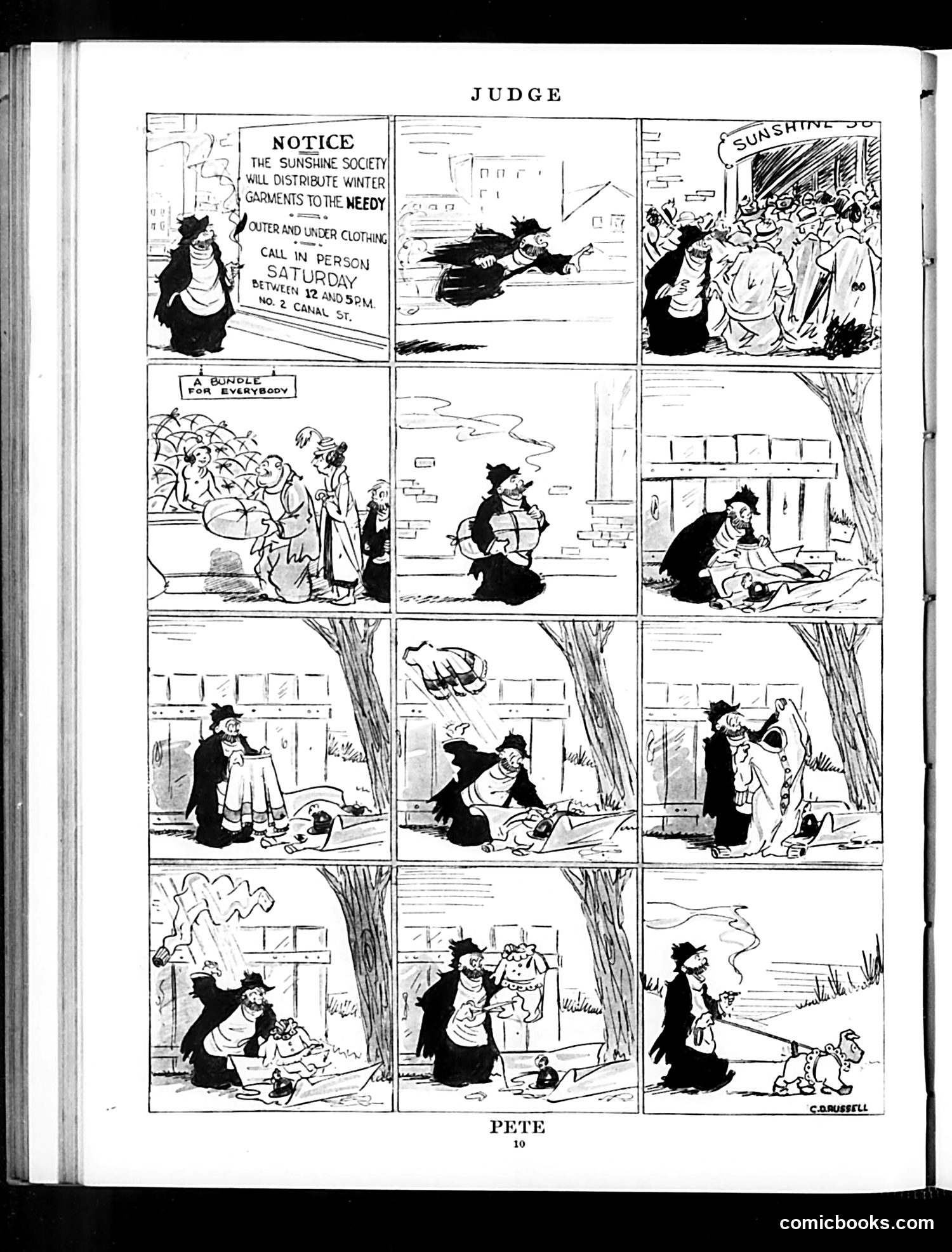
"Pete" Comic Analysis This is a multi-panel comic strip following a character named Pete, illustrated by C. Russell. The narrative shows Pete responding to a notice from the Sunshine Society, which distributes winter clothing to the needy. The satire appears to mock Pete's opportunism: he sees the charitable notice, rushes to collect free garments, then spends the subsequent panels using the clothing for questionable purposes—apparently to impress crowds at what's labeled "Sunshine So" (likely a social gathering), rather than actually needing winter protection. The humor relies on the contrast between the Society's charitable intent and Pete's self-serving exploitation of their generosity. This reflects period-typical satirical commentary on people gaming charitable systems or using aid inappropriately rather than accepting it with genuine need or gratitude.
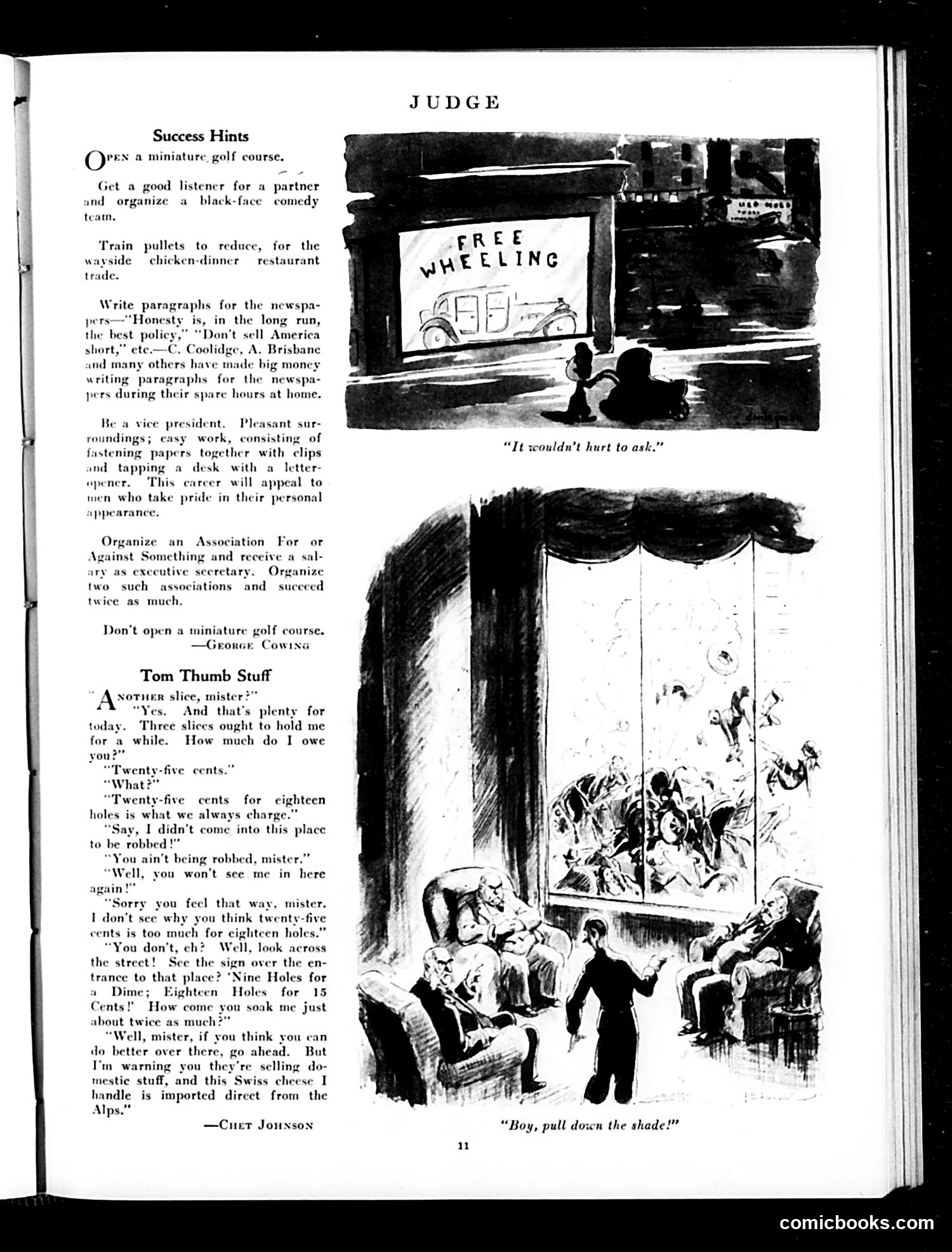
Analysis of Judge Magazine Page This page contains satirical content mocking 1920s American business culture and consumer practices. "Success Hints" section ridicules get-rich-quick schemes and dubious career advice popular at the time—miniature golf courses, "black-face comedy teams," organizing fake advocacy associations for salary, and writing platitudes attributed to celebrities like Calvin Coolidge to newspapers. "Tom Thumb Stuff" cartoon depicts a dispute at a miniature golf establishment. A customer protests being charged 25 cents for 18 holes when a competitor across the street charges 15 cents. The owner defends his higher price by claiming he serves imported Swiss cheese, implying his "domestic" competitor sells inferior goods. The satire targets both small-business price gouging and consumer gullibility—the absurdity that cheese quality justifies double pricing for the same service. "Free Wheeling" photograph (top) shows what appears to be an actual attraction or con, supporting the page's theme of questionable American enterprises. The satire reflects post-1920s skepticism toward commercialism and business ethics.
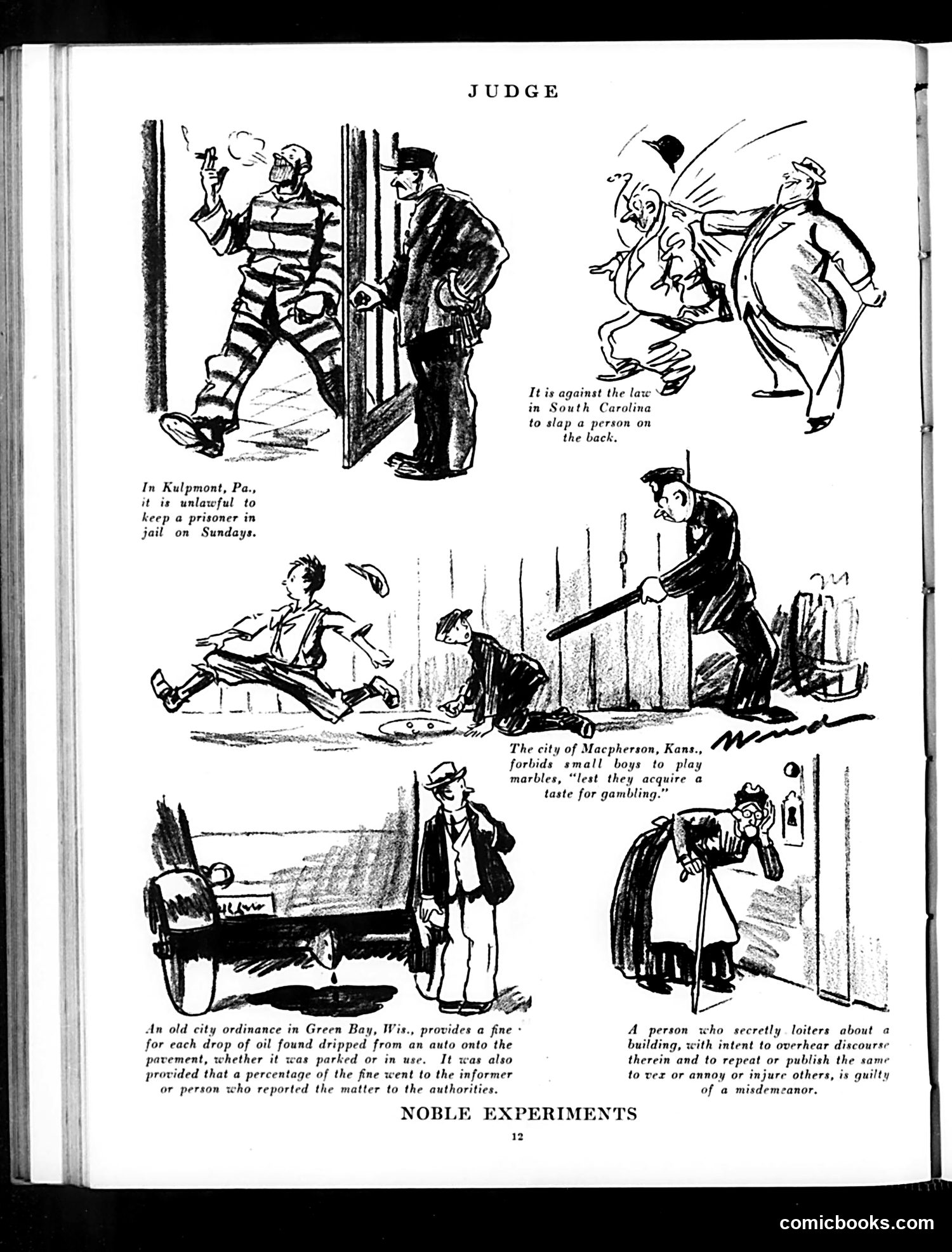
Judge Magazine: "Noble Experiments" This page satirizes absurd local laws across America. Each cartoon illustrates ridiculous ordinances that exist in real towns—South Carolina forbidding back-slapping, Kulpmont PA prohibiting Sunday jail-keeping, Macpherson Kansas banning children's marbles games (to prevent gambling habits), Green Bay Wisconsin fining oil drips from parked cars, and an unnamed city criminalizing eavesdropping. The satire's point: these "noble experiments" in municipal regulation are comically overreaching and impractical. The cartoons mock lawmakers' well-intentioned but absurd attempts to control minor behaviors or prevent hypothetical moral decay. The humor relies on the contrast between the laws' seriousness and their triviality—who actually worries marbles lead to compulsive gambling? Judge uses these real ordinances to lampoon government overreach and bureaucratic excess, a common Progressive-era satirical target.
"Judge on the Bench" — Analysis This page contains three separate satirical pieces: "An Exercise in Credulity" mocks Republican politicians for blaming Soviet grain sales for American farmers' economic troubles. The author (citing Jay House) argues this is deliberate misdirection—blaming Russia lets Republicans avoid responsibility for farm distress caused by their own failed policies. The satire exposes how politicians exploit anti-Bolshevik sentiment to manipulate voters. "The Issue" discusses Senator Jim Reed's call for politicians to take clear positions on Prohibition (alcohol bans). The author suggests candidates can no longer straddle the wet/dry divide. "Amateuriana" profiles golfer George von Elm, who voluntarily surrenders amateur status to compete for prize money while avoiding being labeled a "professional." The satire likely mocks this semantic gymnastics—he wants the benefits of professionalism without the label. All three pieces target political and social hypocrisy, using humor to expose contradictions between stated principles and actual behavior.
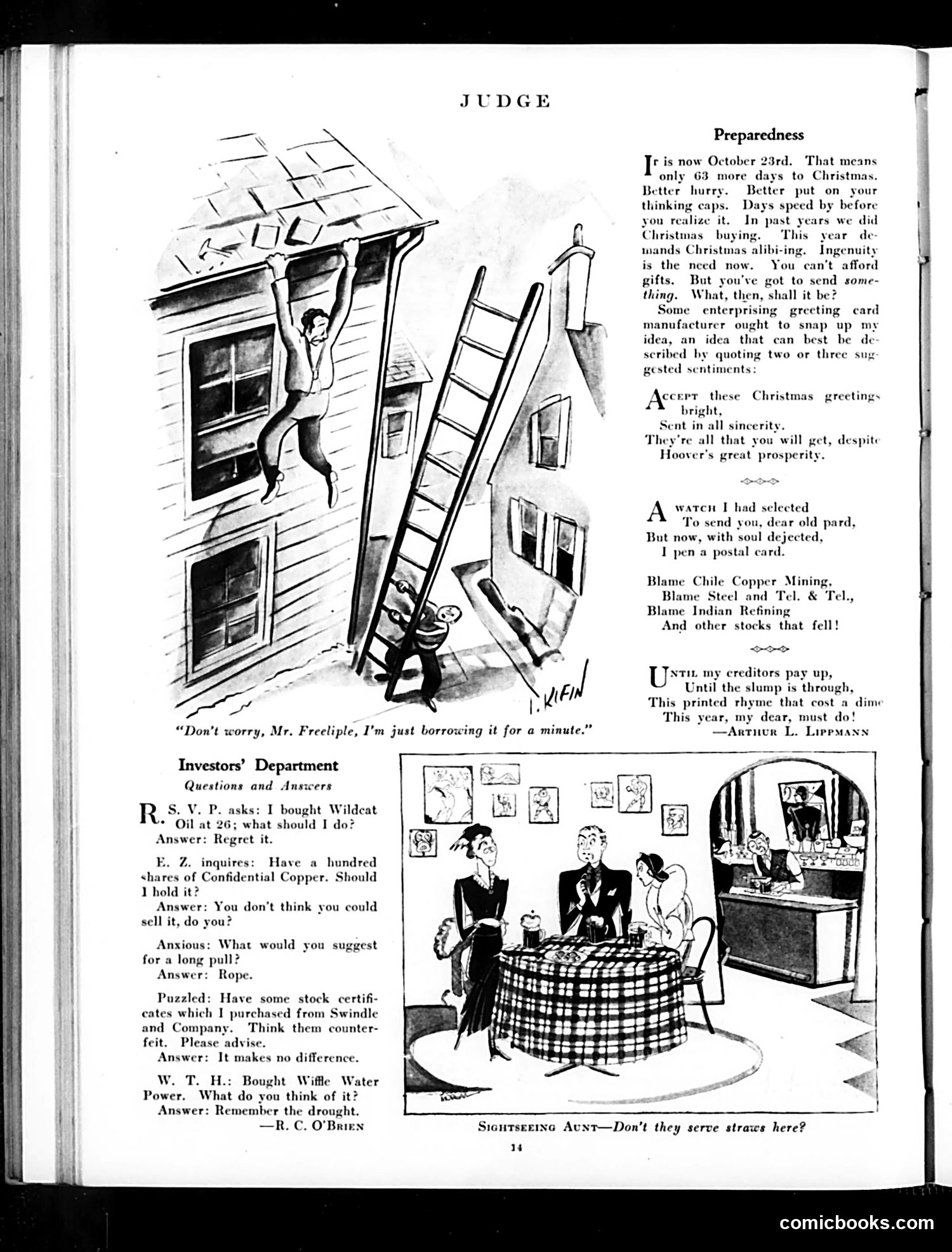
Judge Magazine Page Analysis Main Cartoon (top left): Shows a man on a ladder removing roof shingles from a house while reassuring the homeowner ("Mr. Freelople"). The joke satirizes desperation during economic hardship—people stealing materials because they cannot afford them. "Investors' Department" (lower left): A mock advice column mocking stock market losses. Each answer is cynical dismissal: buying "Wildcat Oil" is regretted; holding worthless stocks is pointless; "Rope" sarcastically suggests suicide; counterfeit certificates don't matter. This reflects widespread financial devastation, likely from the 1929 stock market crash. "Preparedness" (right side): Christmas greeting card parodies acknowledging economic depression. The sender cannot afford gifts, blaming failed stocks (Chilean Copper, Steel, Tel & Tel, Indian Refining) and "Hoover's great prosperity"—sarcasm directed at President Hoover's optimistic claims during the Depression. Bottom cartoon: Three women at a restaurant table; "Sightseeing Aunt" asks if they serve straws, likely implying cheap tactics to appear to order something while consuming minimal product.
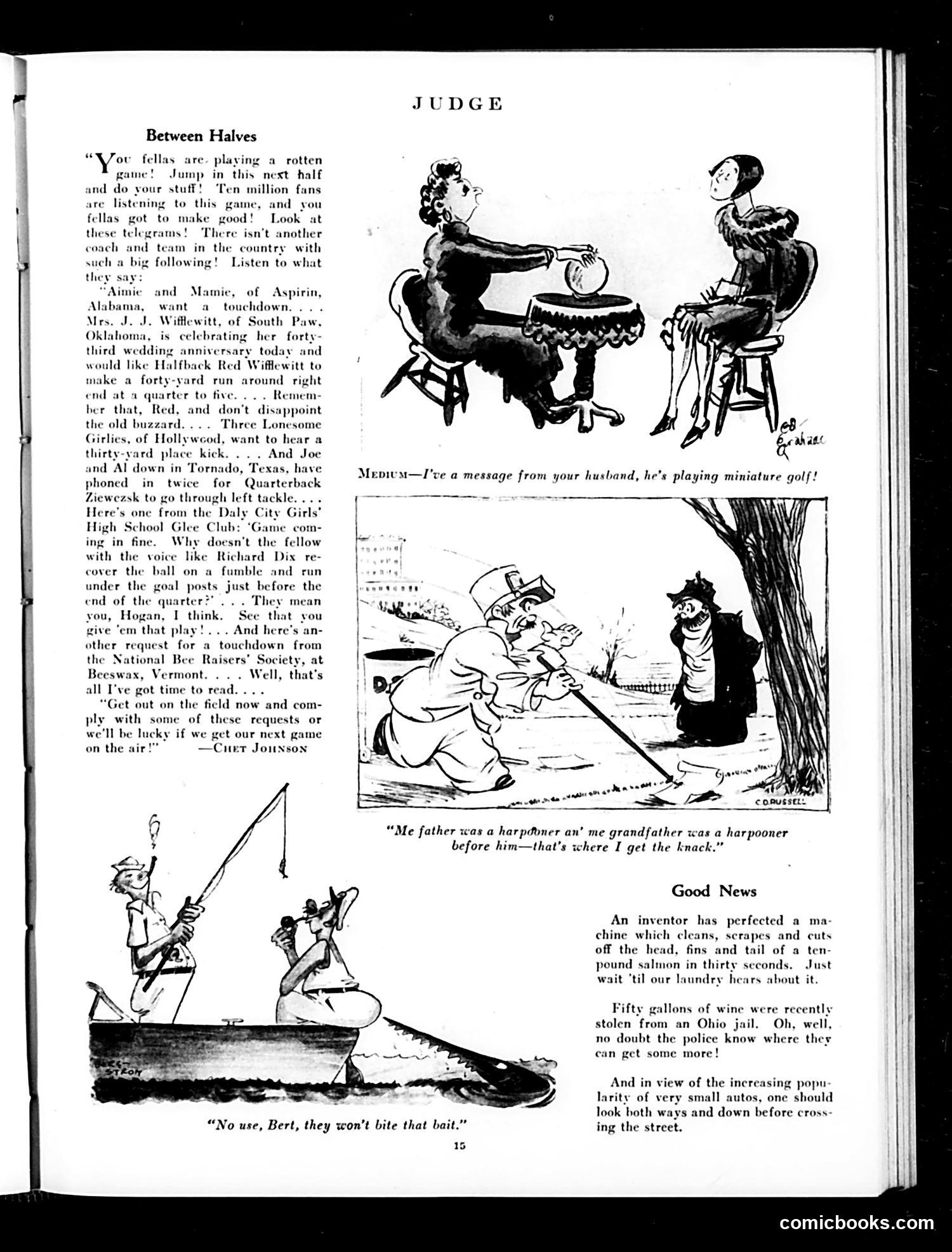
Judge Magazine Page Analysis This page satirizes the massive popular obsession with college football in the 1920s. The main "Between Halves" cartoon depicts a coach haranguing his team at halftime, reading telegrams from fans across America demanding specific plays and touchdowns—from Alabama couples to Hollywood starlets to the National Bee Raisers' Society of Vermont. The satire mocks how radio broadcasts of football games have created a culture where millions of ordinary citizens feel entitled to direct coaching decisions, treating players as entertainers beholden to listener requests rather than athletes. The other cartoons are unrelated sketches: one shows fishing ("No use, Bert, they won't bite that bait") and another depicts a harpoon maker's son. The "Good News" section contains brief humorous items about a salmon-cleaning machine, stolen jail wine, and traffic safety—typical magazine filler of the era. The overall thrust criticizes the absurd power football's radio audience had gained over the sport itself.
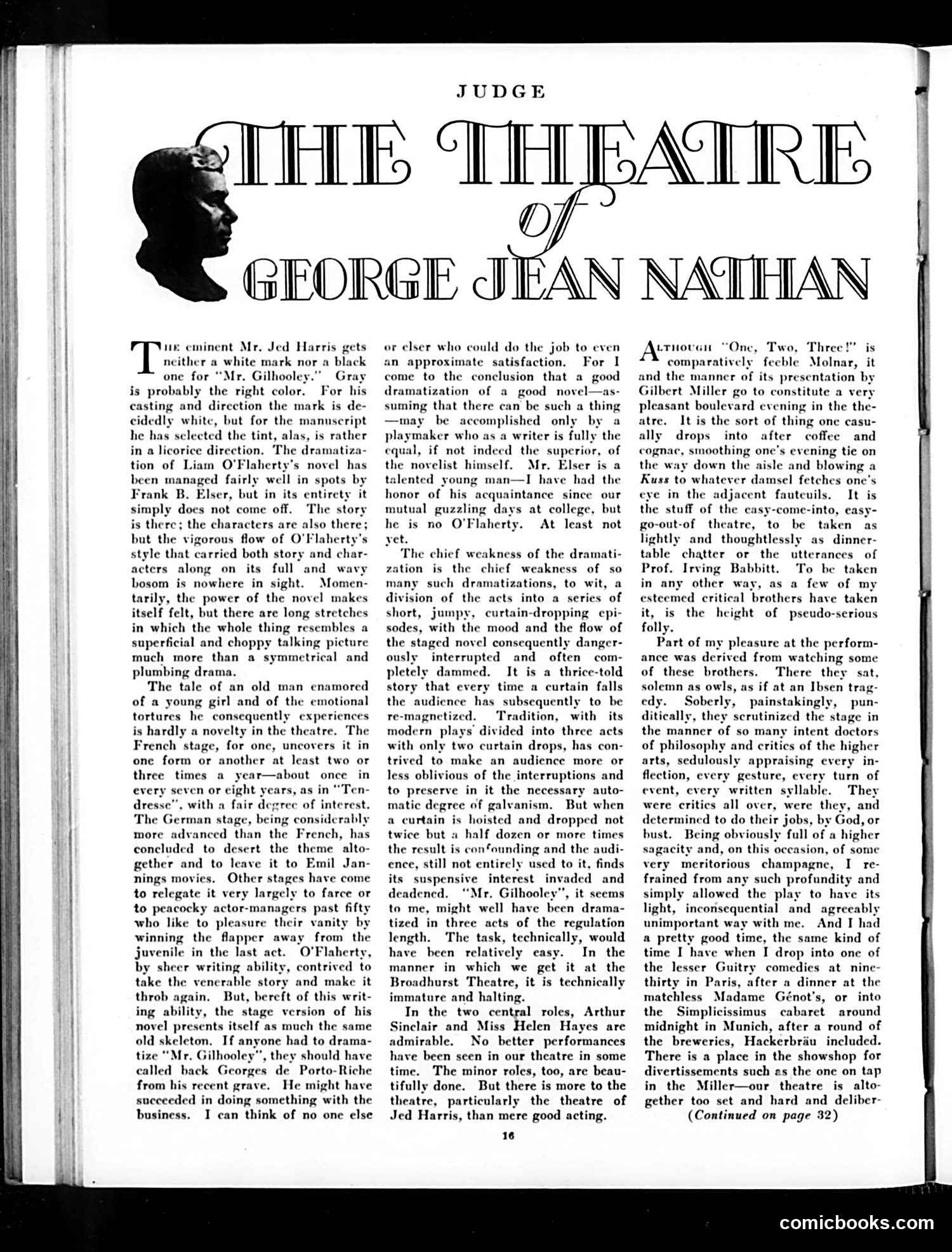
Judge Magazine Theater Review: "The Theatre of George Jean Nathan" This page is a theater review by Judge's drama critic, likely George Jean Nathan (identified by the profile silhouette), critiquing producer Jed Harris's stage adaptation of Irish writer Liam O'Flaherty's novel "Mr. Gilhooley." Nathan praises Harris's casting and direction but faults the adapted script as weak. He argues that dramatizing a good novel requires a playwright equal to the original author—claiming Frank B. Elser, who adapted it, falls short despite talent. The core criticism: the play's structure uses excessive curtain drops (more than the standard three acts), constantly interrupting dramatic momentum and audience engagement. Nathan compares this unfavorably to European theatrical traditions, suggesting the work feels immature and technically halting compared to established dramatic forms.
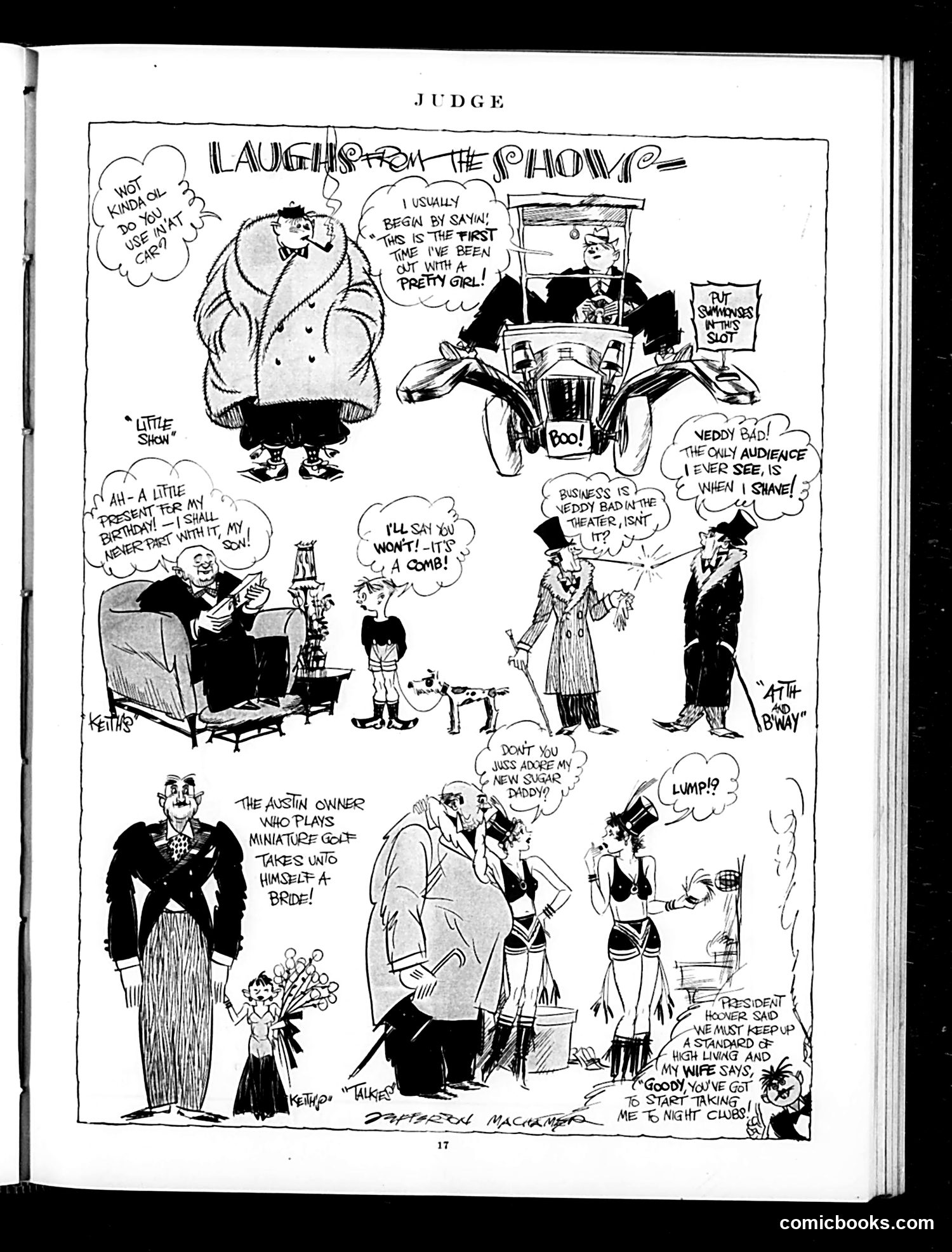
Political/Social Satire from Judge Magazine This single-panel cartoon titled "Laughs from the Socialite" satirizes wealthy upper-class society figures and their pretensions. The various vignettes mock: Wealthy eccentrics: A portly gentleman in expensive furs, socialites discussing frivolous pursuits (miniature golf, nightclubbing), and nouveau-riche behavior. Social climbing and materialism: References to "pretty girls," gifts, and status-seeking activities highlight superficial values among the elite. Gender roles and marriage: Jokes about wives, dating, and domestic life reflect period attitudes about courtship and gender dynamics. Entertainment and excess: References to nightclubs, dancing, and constant socializing suggest criticism of decadent leisure pursuits during an era of economic disparity. The cartoonist (appears to be signed "Macguinness") uses exaggerated physical caricature and sarcastic dialogue to ridicule the vanity, materialism, and shallow concerns of the wealthy class—typical Judge magazine fare mocking "high society" for a middle-class readership.
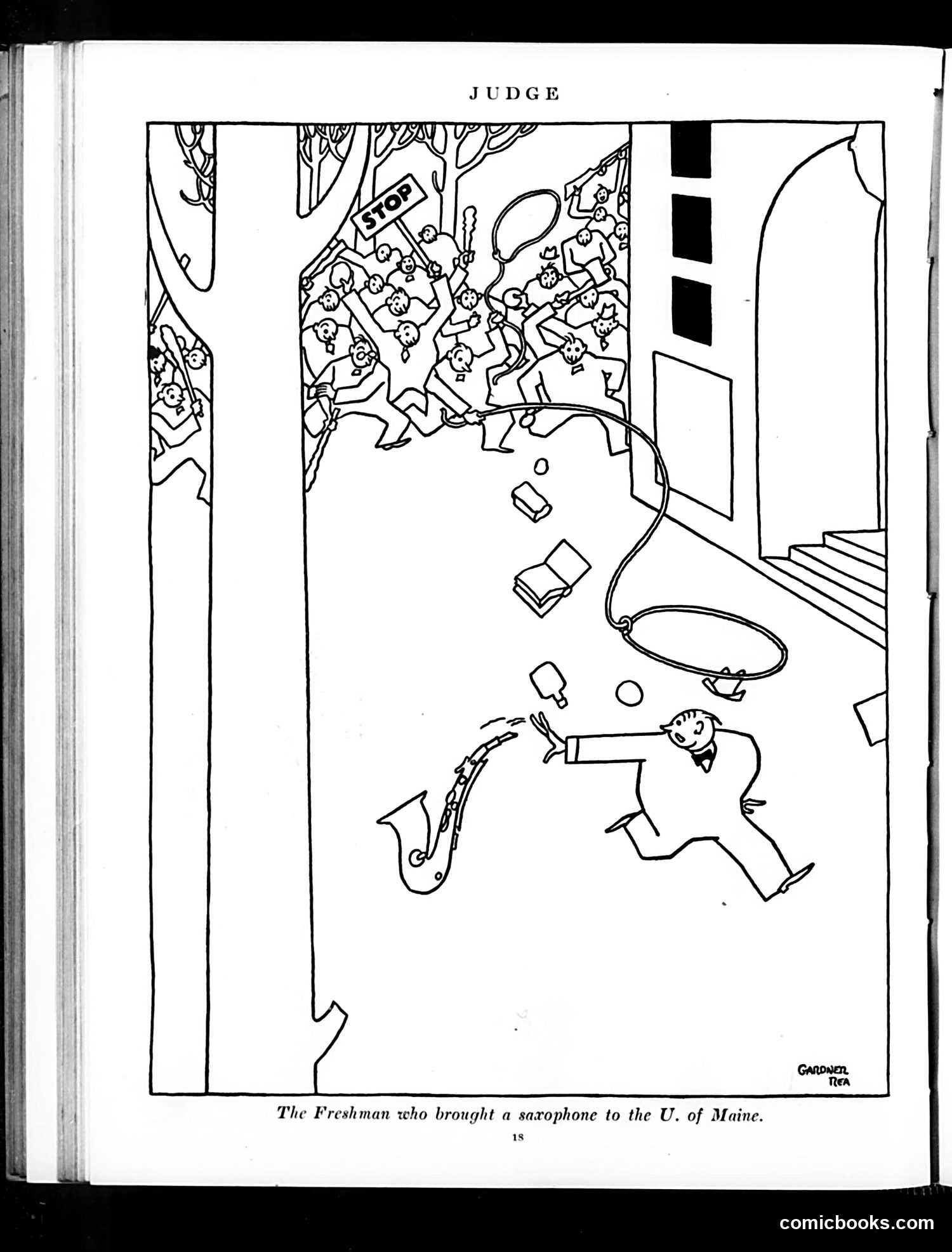
"The Freshman Who Brought a Saxophone to the U. of Maine" This cartoon satirizes the disruption caused by a college freshman introducing a saxophone—likely a newly popular jazz instrument—to the University of Maine campus. The drawing shows chaos erupting: a crowd of students swarms excitedly around the musician in the upper portion, while below, one figure frantically plays the saxophone, creating havoc in what appears to be a dormitory or common area, with objects scattered about. The satire targets both the instrument's novelty and perceived rowdiness, and the loss of control among college students. Jazz and saxophones were associated with 1920s cultural disruption and "modern" youth excess, making this a commentary on generational change and institutional order breaking down from within student life.
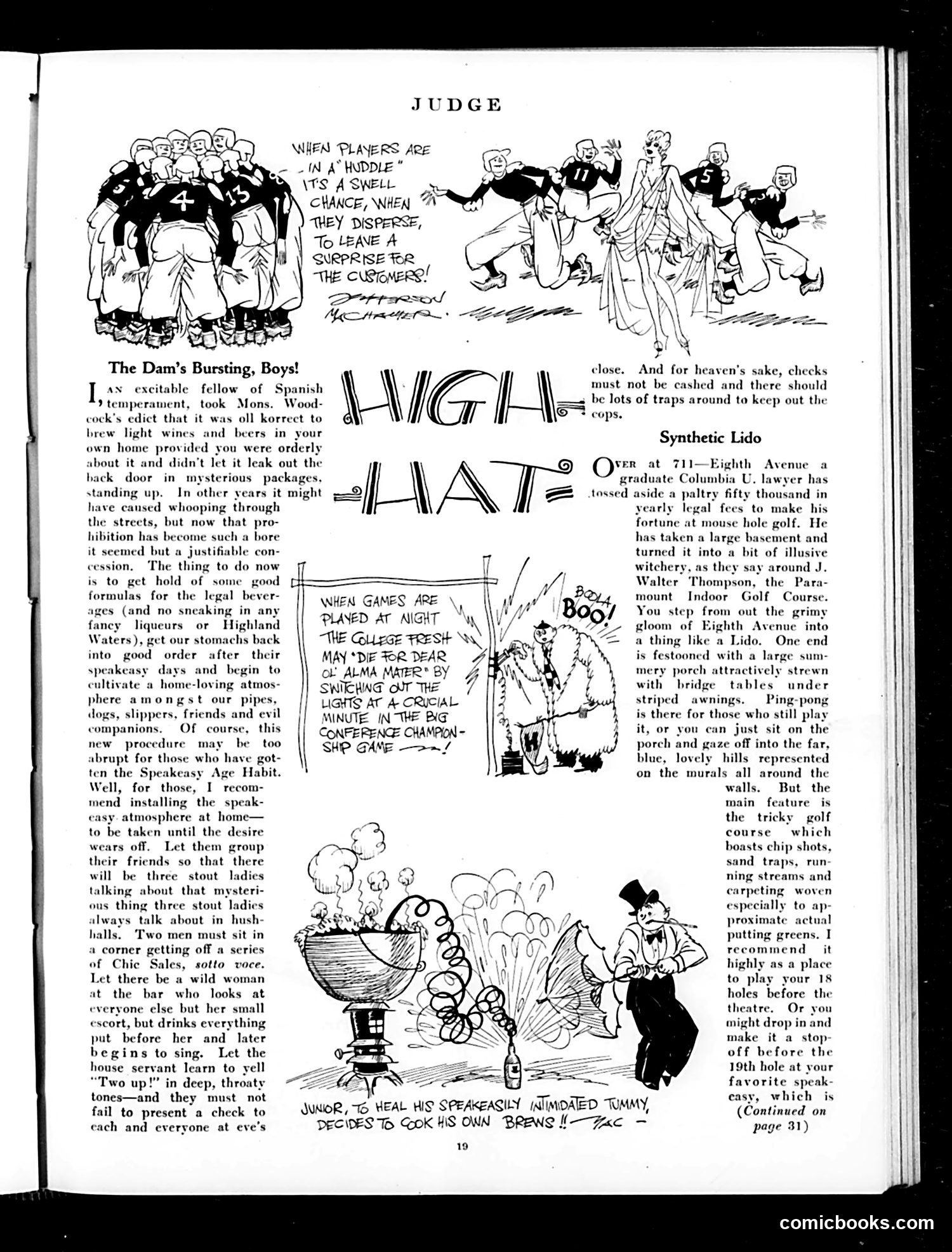
Judge Magazine Satire Analysis This page satirizes Prohibition-era American culture through two main pieces: "The Dam's Bursting, Boys!" mocks the recent legalization of home brewing (likely referencing a specific policy change). The author ironically proposes recreating speakeasy atmospheres in legitimate homes—complete with tipsy women, cryptic slang ("Two up!"), and fake bar checks—to satisfy those addicted to illegal drinking culture. The satire targets Americans' inability to abandon prohibition-era habits despite legal alternatives. "High Hat" cartoons depict sports disruptions: one shows college football fans disrupting games by singing alma maters at crucial moments; another shows a young man so intimidated by speakeasy culture that he cooks his own illegal brews at home. "Synthetic Lido" describes a basement indoor golf course disguised as a resort, positioned conveniently for patrons to visit before heading to their "favorite speakeasy"—implying speakeasies still thrived despite legalization. The page's consistent theme: post-Prohibition Americans remained culturally dependent on illegal drinking establishments and the rebellious mystique they represented.
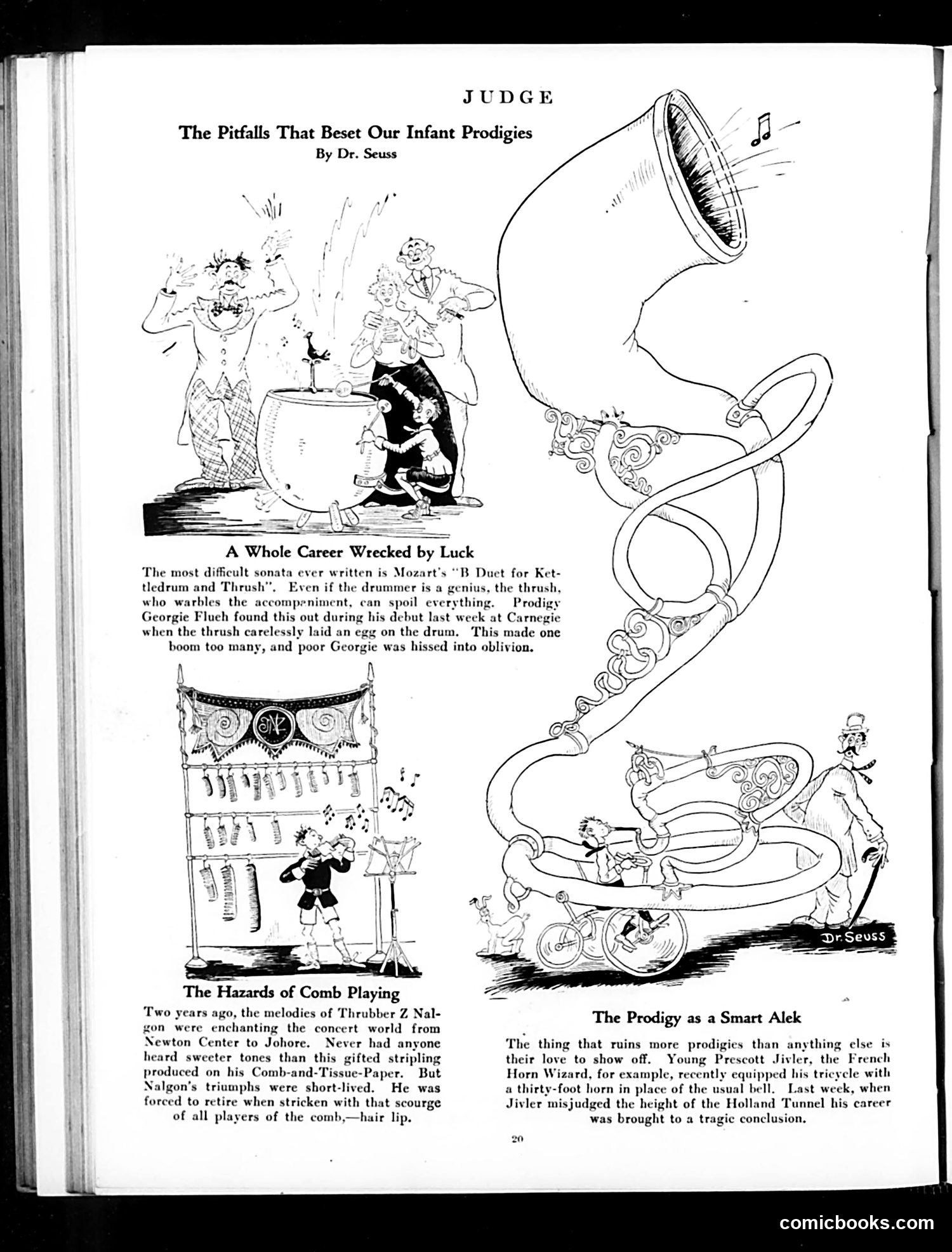
"The Pitfalls That Beset Our Infant Prodigies" by Dr. Seuss This 1920s-era Judge article satirizes child prodigies and the various absurd mishaps that derail their careers. Three fictional cases illustrate the theme: "A Whole Career Wrecked by Luck": Young drummer Georgie Flueh performs Mozart's difficult "B Duet for Kettledrum and Thrush," but a bird carelessly lays an egg on his drum during debut, ruining his performance and career. "The Hazards of Comb Playing": Prodigy Thrubber Z. Nalgon enchants audiences with comb-and-tissue-paper music until he develops "hair lip" (cleft palate), forcing retirement. "The Prodigy as a Smart Alek": Young French horn player Prescott Jivler shows off by mounting a thirty-foot horn on his tricycle, misjudges the Holland Tunnel's height, and dies. The satire mocks both parental ambition and child performer culture—suggesting talented youth face ridiculous obstacles, while their own showboating often proves fatal.
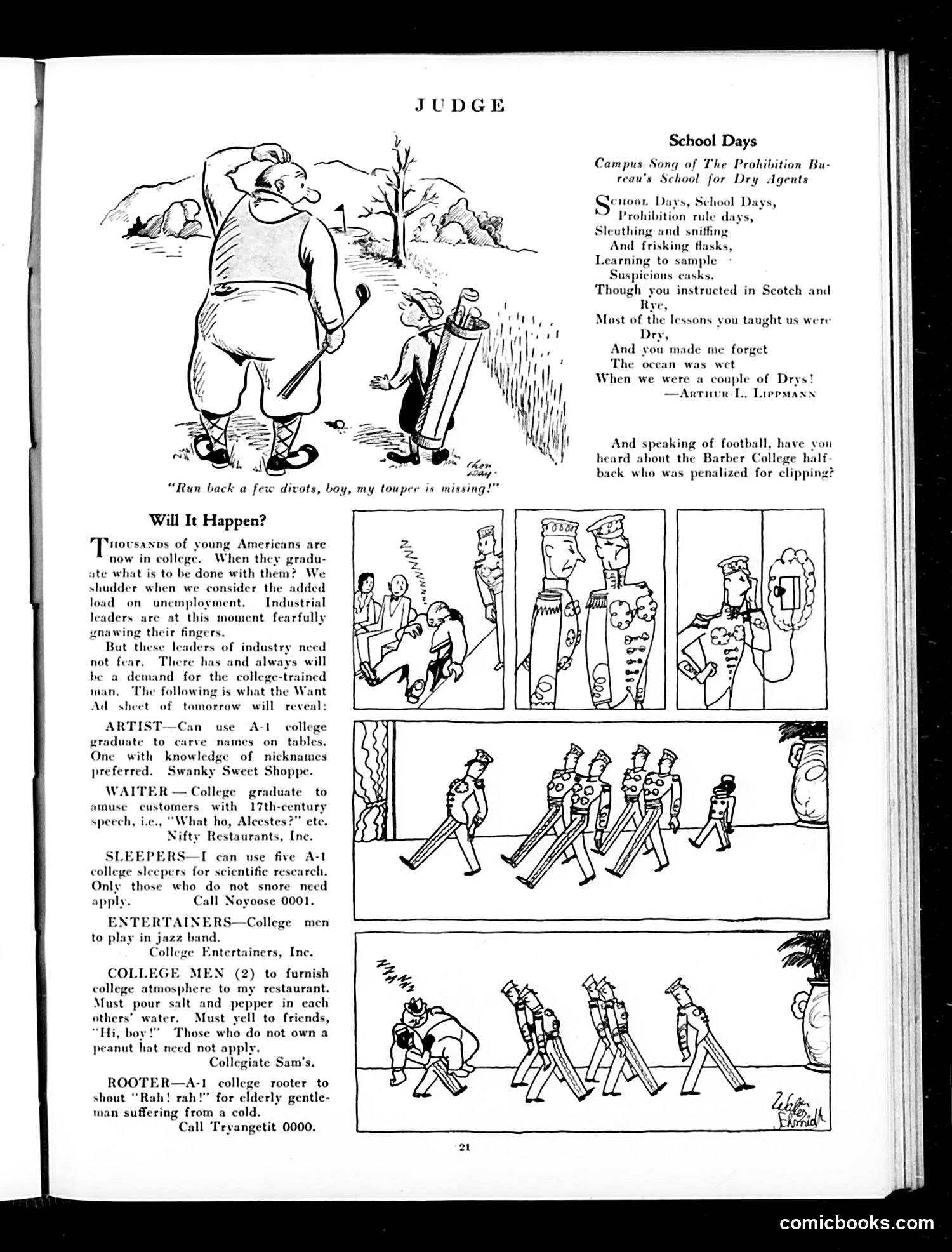
"Will It Happen?" - Employment Satire for Post-College Graduates This page satirizes anxiety about post-WWI unemployment by imagining absurd "want ads" for college graduates. The humor centers on the fear that there simply won't be meaningful jobs for the thousands of young Americans flooding out of colleges. The fake job listings mock both the surplus of educated workers and the worthlessness of a college education: artists carving names on tables, waiters reciting pretentious phrases, "sleepers" for scientific research, and rooters hired to cheer for sick men. Each position treats the college degree as irrelevant. The cartoons above show college-trained soldiers in military formation—likely referencing WWI veterans returning to civilian life with inflated credentials but limited prospects. The page also includes a humorous "School Days" parody about Prohibition agents, and a football joke about "clipping" (an illegal tackle). The overall message: industrial leaders fear unemployment, but the satirist suggests college-trained workers may only find ridiculous, undignified positions regardless.
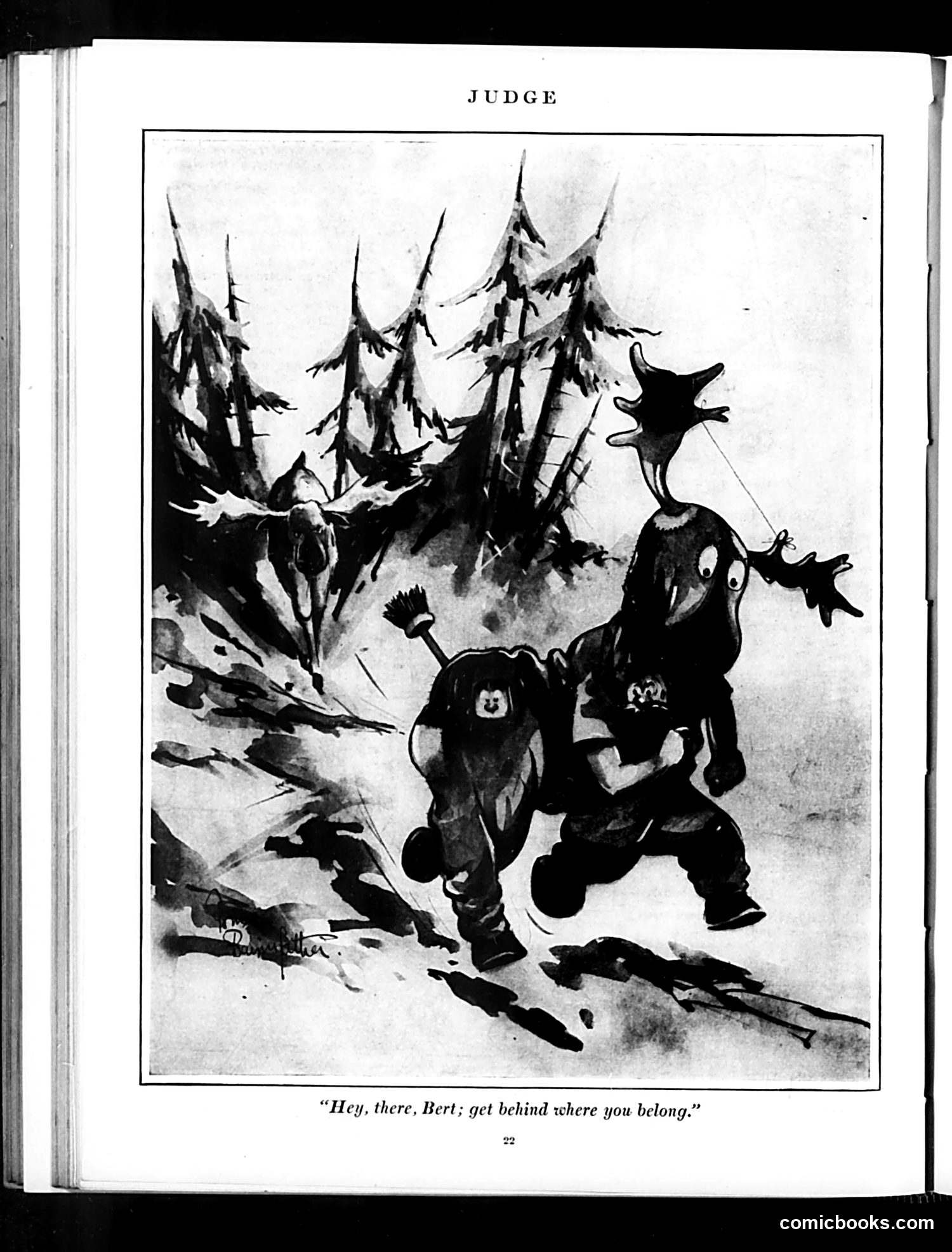
Political Cartoon Analysis This Judge magazine cartoon depicts a chaotic winter scene with anthropomorphized figures engaged in what appears to be a slapstick confrontation. One character addresses another as "Bert," instructing him to "get behind where you belong." The cartoon likely satirizes political or social hierarchies of its era, using the comedic device of physical positioning to comment on proper "place" in society or politics. The winter setting with evergreen trees and the slapstick style suggest this targets contemporary political figures or social types. However, without additional context—the magazine's date, the artist's identity, or clearer identification of the characters—I cannot confidently identify who "Bert" represents or what specific political situation this references. The satire's precise meaning remains unclear from the image alone.
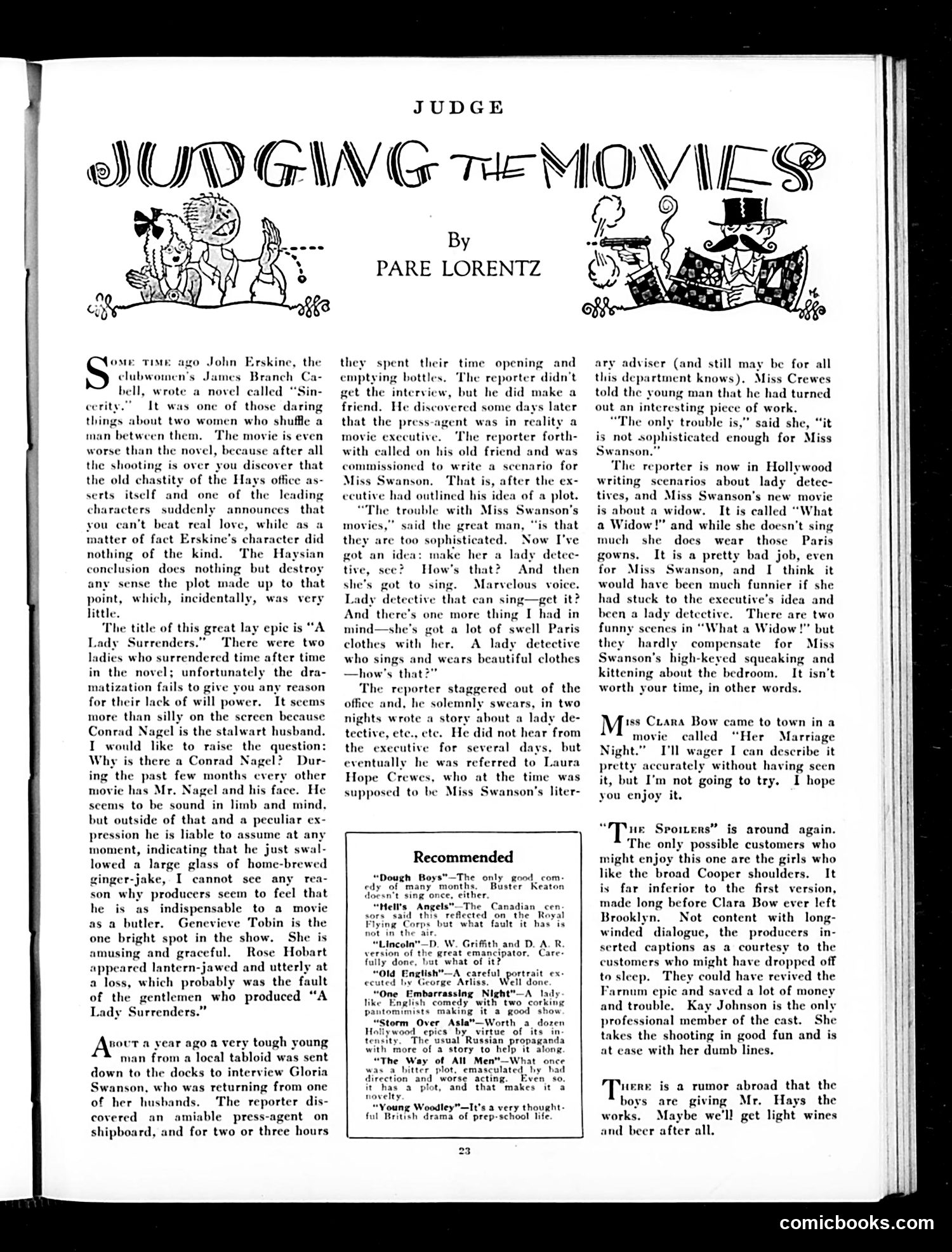
"Judging the Movies" by Pare Lorentz This is a film criticism column reviewing contemporary Hollywood movies. The main target is "A Lady Surrenders," adapted from John Erskine's novel. Lorentz satirizes how the film industry (represented by an unnamed studio executive) dilutes sophisticated source material to meet the Motion Picture Production Code (the "Hays office"), which enforced moral standards. The executive's absurd pitch—turning a nuanced drama into a "lady detective who sings and wears Paris clothes"—mocks Hollywood's reductive storytelling. Lorentz also ridicules actor Conrad Nagel's ubiquity in films despite lacking distinguishing qualities beyond his "peculiar expression." The "Recommended" sidebar lists brief reviews of other current releases, using caustic wit to praise genuinely good films while dismissing mediocre ones. This represents typical Judge magazine satire of 1930s entertainment industry pretension and creative bankruptcy.
Analysis of Judge Magazine Page This page contains no political cartoon or satirical content—it is purely an advertising section listing prizes for what appears to be a contest or sweepstakes (the "Second Annual" mentioned in the header). The page showcases luxury prizes typical of the 1920s-1930s era: cruise ship voyages, Edison radio equipment, watches, typewriters, furniture, and gourmet food baskets from premium brands. These advertisements reflect the magazine's affluent readership and the consumer goods available to wealthy Americans during this period. The inclusion of items like "Graybar Stimulators (Electrical Exercisers)" and "Hanovia Chemical Alpine Sun Lamps" shows period fascinations with new electrical technology and health trends. No cartoon or satirical commentary is present on this page.
Lenz Bridge Contest - Additional Prizes Page This page is primarily advertising, not satire or political commentary. It lists corporate sponsors and prizes for a "Lenz Bridge Contest" — likely a bridge-building competition Judge magazine organized. The page showcases American consumer brands from the 1920s-30s era, revealing what luxury goods and leisure products defined the period: bridge sets and playing cards (reflecting bridge's popularity as a parlor game), golf equipment, cigarettes, quality pens and stationery, food products, and personal grooming items. Notable is the emphasis on gift-giving — many prizes are holiday "special packages" or gift boxes, suggesting this contest ran around Christmas. The prestigious brand names (Wanamaker, Schrafft's, Ronson lighters) indicate Judge's affluent readership and advertisers' marketing to that demographic. This represents how magazines financed themselves through advertiser-sponsored contests and editorial content.
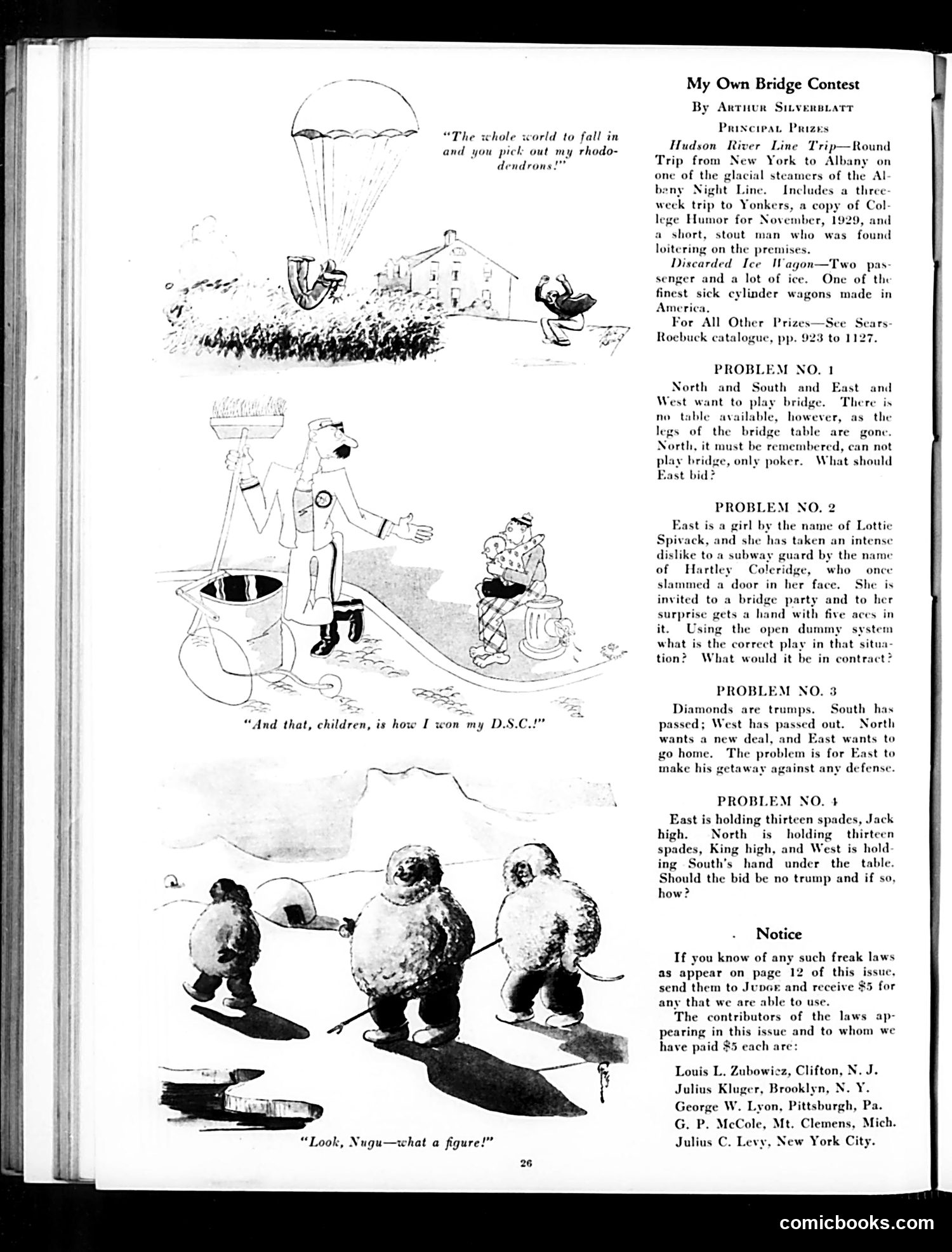
"My Own Bridge Contest" - Judge Magazine This page presents a humorous bridge card game contest by Arthur Silverblatt. The satire mocks bridge's popularity and the absurd situations that arise from its rules. The four "problems" are deliberately nonsensical scenarios that violate bridge's actual rules: Problem 1 features a player who "can not play bridge, only poker"; Problem 2 involves an impossible hand of "five aces"; Problem 3 presents contradictory bidding situations; Problem 4 describes West holding South's cards "under the table" (cheating). The accompanying cartoons illustrate the ridiculous situations—including figures with improbable body proportions and a parachutist landing on a building—reinforcing the contest's absurdist humor. The joke targets bridge's widespread obsession in 1920s-30s American culture: the contest mocks how seriously people took the game while presenting deliberately impossible "problems" that no actual bridge player would encounter. The satirical point: bridge enthusiasts' fervent devotion to arbitrary rules deserved gentle mockery.
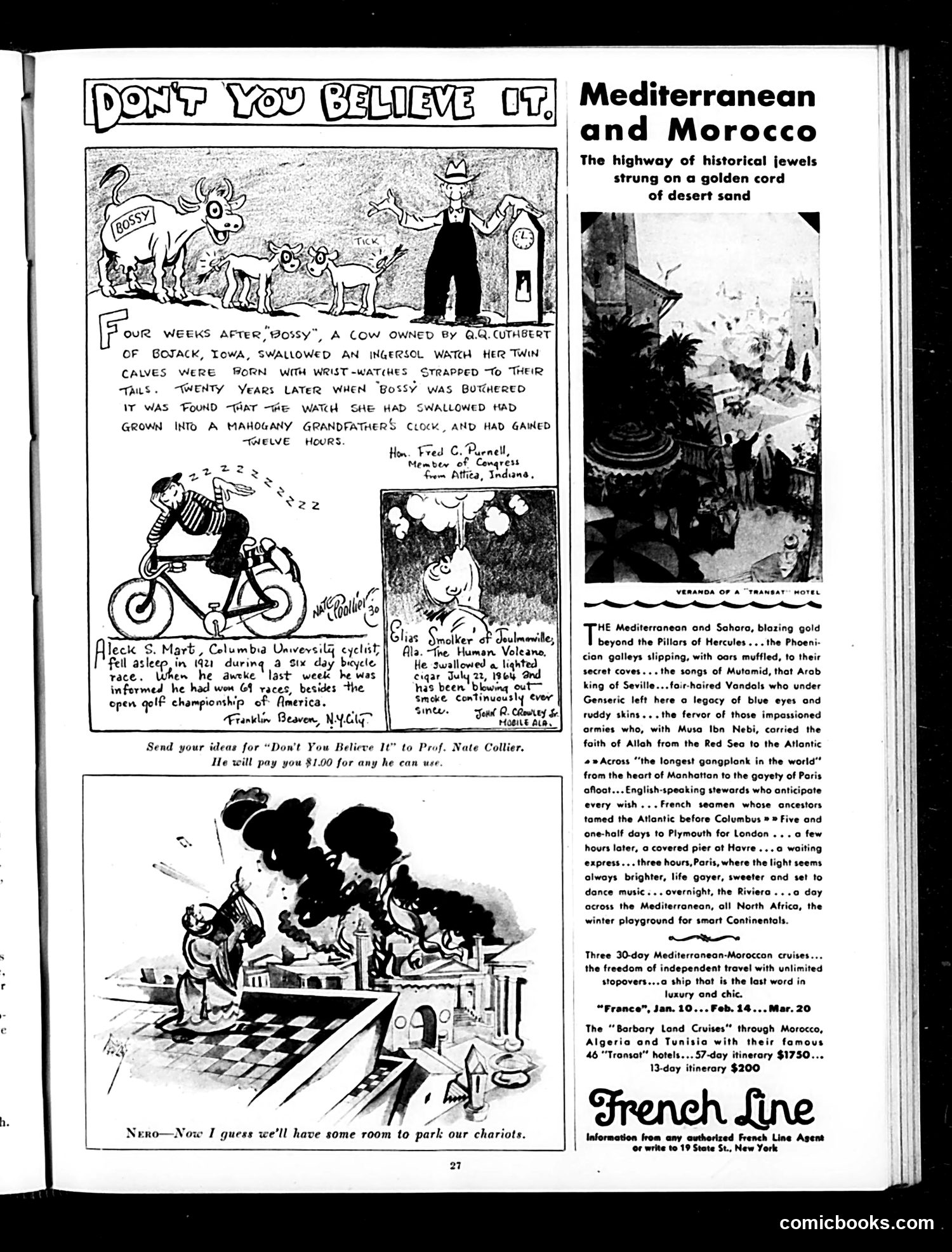
"Don't You Believe It" — Judge Magazine Satire This page features Judge's humorous "Don't You Believe It" column—a collection of tall tales submitted by readers and celebrities. The cartoons mock absurd, implausible stories presented as fact. The featured anecdotes include: a cow that swallowed a watch that supposedly grew into a grandfather's clock gaining twelve hours; a cyclist (Aleck S. Mart) who fell asleep during a 1921 six-day bicycle race and later won multiple championships; and a man who swallowed a lit cigar in 1864 and has been continuously smoking ever since. These stories satirize the credulity of readers and the sensationalism of popular media. The magazine pays $1.00 for submissions, inviting audience participation in the satire. The right page contains unrelated travel advertising for French Line Mediterranean cruises—standard magazine filler of the period.
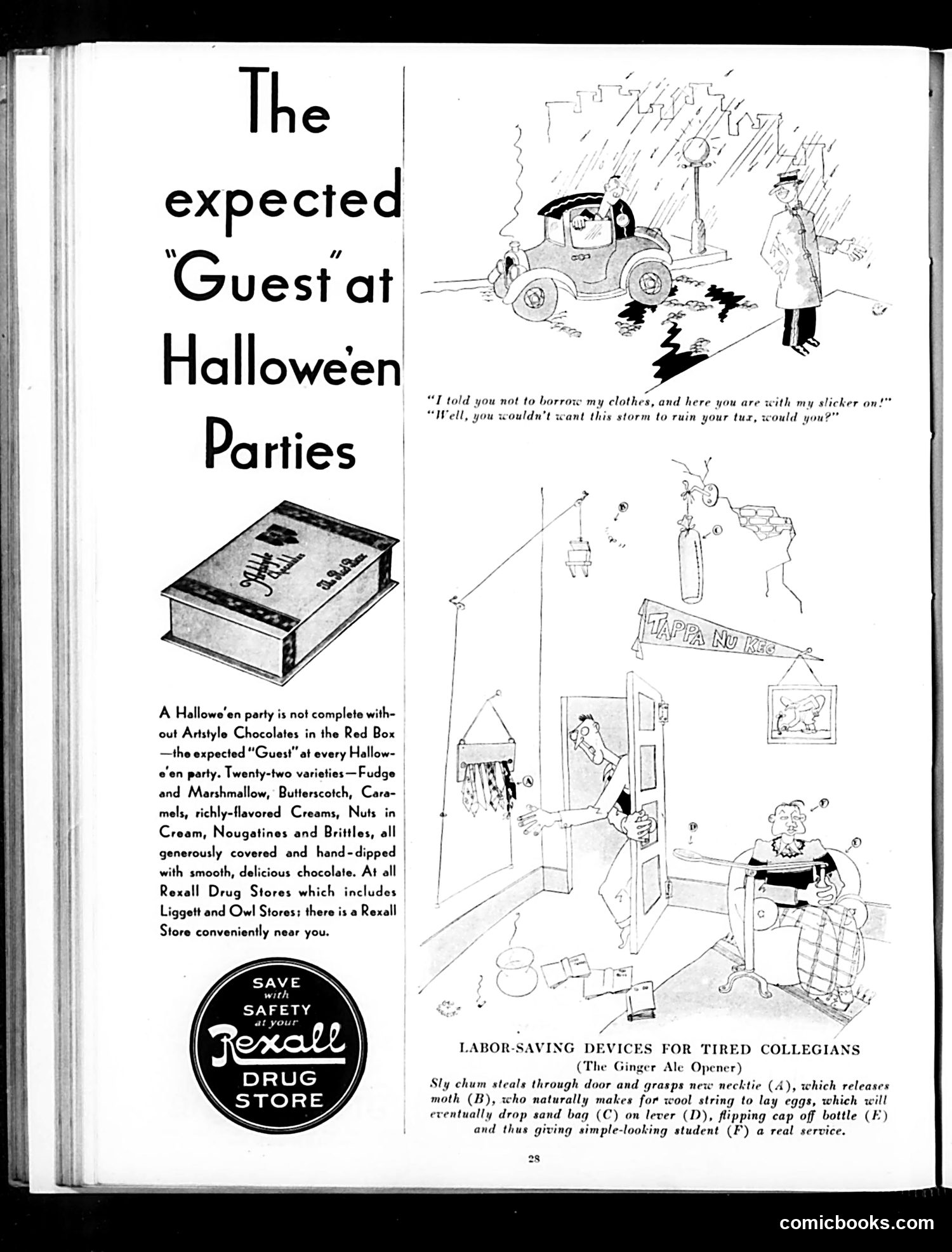
Judge Magazine Page Analysis This page combines advertising with humor cartoons targeting early-20th-century readers. The left side is a Rexall Drug Store advertisement for Artstyle Chocolates, positioning them as the expected "guest" at Halloween parties—a gentle pun treating chocolates as social participants. The right side contains two cartoons: 1. Top cartoon: A wet car passenger borrowed someone's clothes during a rainstorm. The joke plays on social etiquette and practicality—the lender reluctantly accepts the situation since refusing would risk ruining the borrowed tuxedo. 2. Bottom cartoon (titled "Labor-Saving Devices for Tired Collegians"): A absurdly complex contraption involving a necktie, moth, wool string, sand bag, and lever—all designed to open a ginger ale bottle. It satirizes college students' laziness and the Rube Goldberg-style overcomplicated "inventions" they might devise to avoid simple tasks. Both cartoons mock social situations and student behavior with gentle, observational humor typical of early Judge magazine.
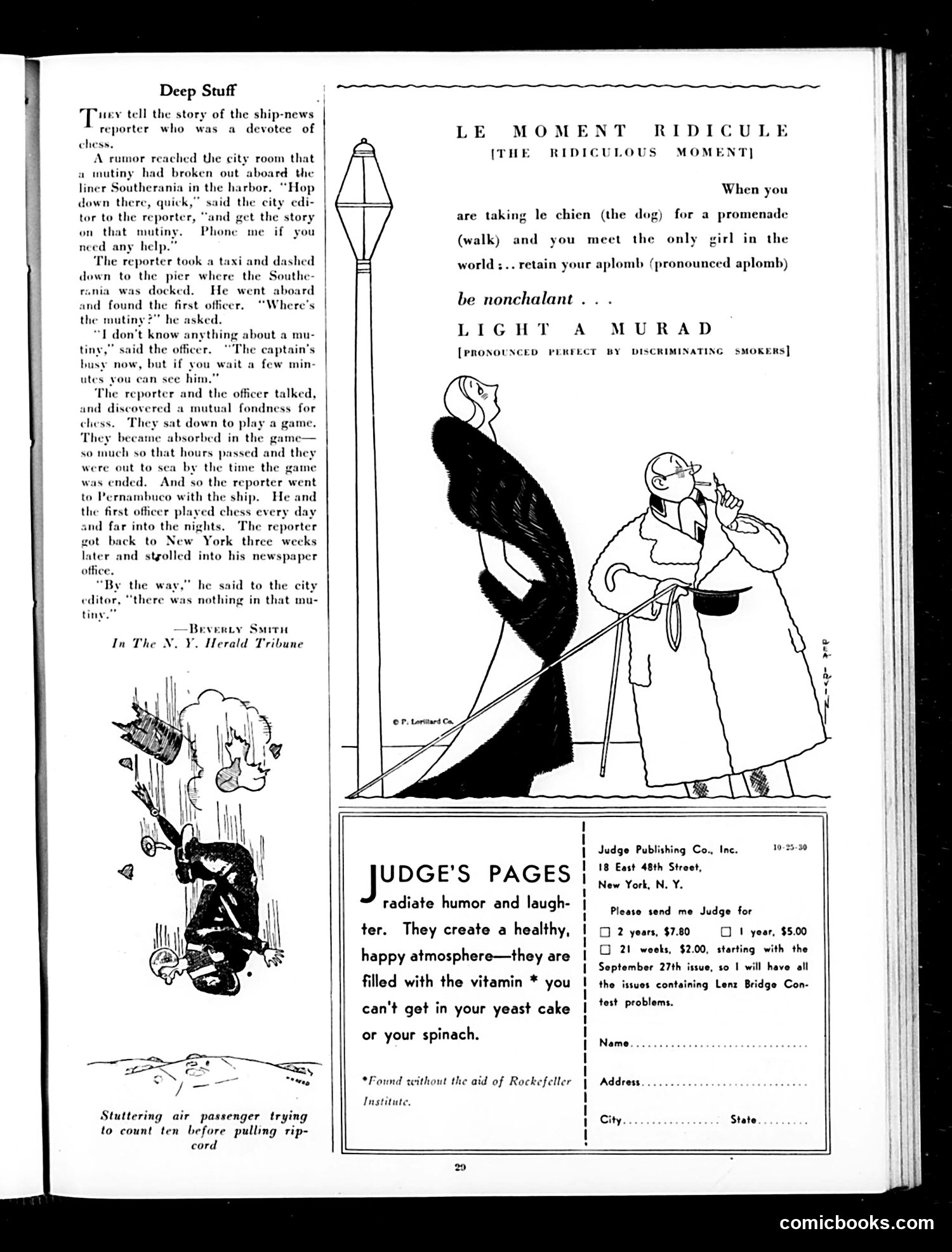
Analysis of Judge Magazine Page (circa 1930) "Deep Stuff" Story: A humorous anecdote about a ship-news reporter sent to cover a mutiny aboard the liner *Southerania*. Upon arriving at the docked ship, he meets the first officer and they discover a shared passion for chess. They become so absorbed in playing that hours pass unnoticed—and the ship sails. The reporter ends up traveling to Pernambuco with the vessel, playing chess daily, and returns to New York three weeks later with no mutiny story to report. The editor's final response—"there was nothing in that mutiny"—is the deadpan punchline. The Satire: This mocks the unreliability of newspaper reporting and the distraction of leisure activities from professional duty. It's also self-deprecating humor about journalism's occasional failures. "Le Moment Ridicule": A French-language etiquette guide advising readers on maintaining composure ("aplomb") when encountering an attractive woman while walking one's dog—accompanied by an advertisement for Murad cigarettes as the solution to romantic nervousness. The page is primarily advertising and humor content typical of Judge magazine's satirical entertainment focus.
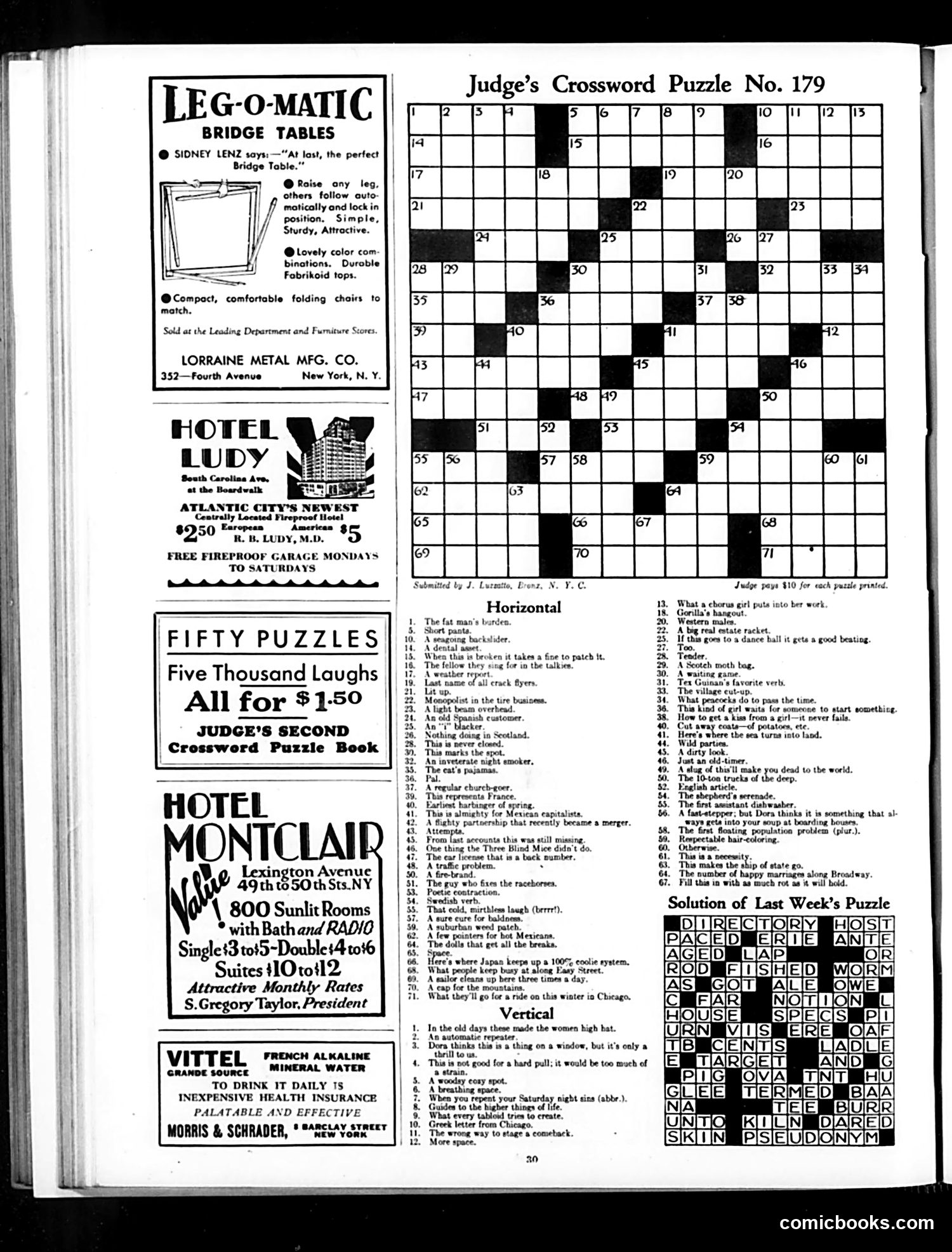
Judge Magazine Page Analysis This page is primarily advertisements and a crossword puzzle rather than political satire or editorial cartoons. The content reflects 1920s-30s consumer culture and leisure activities. Key Advertisements: - Leg-O-Matic Bridge Tables: Automated folding furniture—a novelty item appealing to the bridge-playing middle class - Hotel Ludy and Hotel Montclair: Atlantic City and New York accommodations catering to affluent travelers - Vittel Mineral Water: Health product marketed as "inexpensive health insurance" The Crossword Puzzle (No. 179): The clues reveal period humor and references—mentions of "Tex Guinan" (speakeasy operator during Prohibition), Mexican capitalists, and Broadway entertainment. The puzzle itself serves as entertainment rather than satire. Cultural Context: This represents Judge's transformation from primarily political satire into a general-interest humor and lifestyle magazine, with advertisements dominating. The content targets educated, affluent readers interested in modern conveniences, travel, and leisure activities during the interwar period.
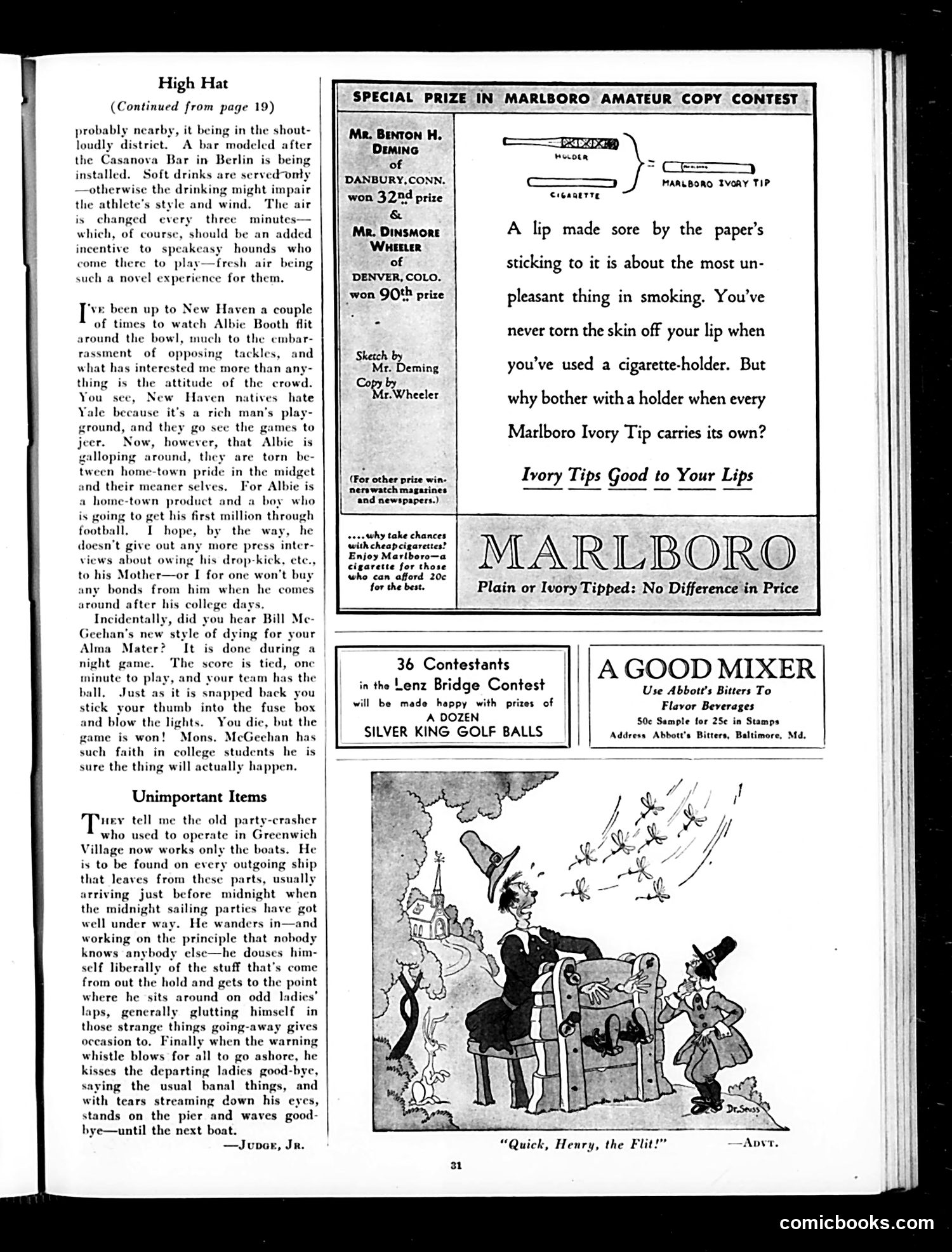
Analysis of Judge Magazine Page This page is primarily advertising and contest announcements rather than political satire. The main content includes: Marlboro Cigarette Advertisement: The centerpiece promotes Marlboro cigarettes with "Ivory Tips" that supposedly solve the problem of cigarette paper sticking to lips—a consumer complaint about smoking. The ad emphasizes the cigarette holder is built-in, eliminating inconvenience. Cartoon ("Quick, Henry, the Flit!"): A domestic humor illustration showing a man with an exterminator's equipment spraying insects while his wife urges him on. "Flit" was a commercial insecticide brand, making this an advertisement disguised as humor. Other Content: The page includes golf ball and beverage contest announcements, plus a personal column discussing Yale football and Greenwich Village social life. For Modern Readers: This reflects 1920s-30s advertising practices where brands integrated themselves into entertainment magazines through sponsored contests and humorous ads, blending commerce with editorial content in ways now clearly labeled as advertising.
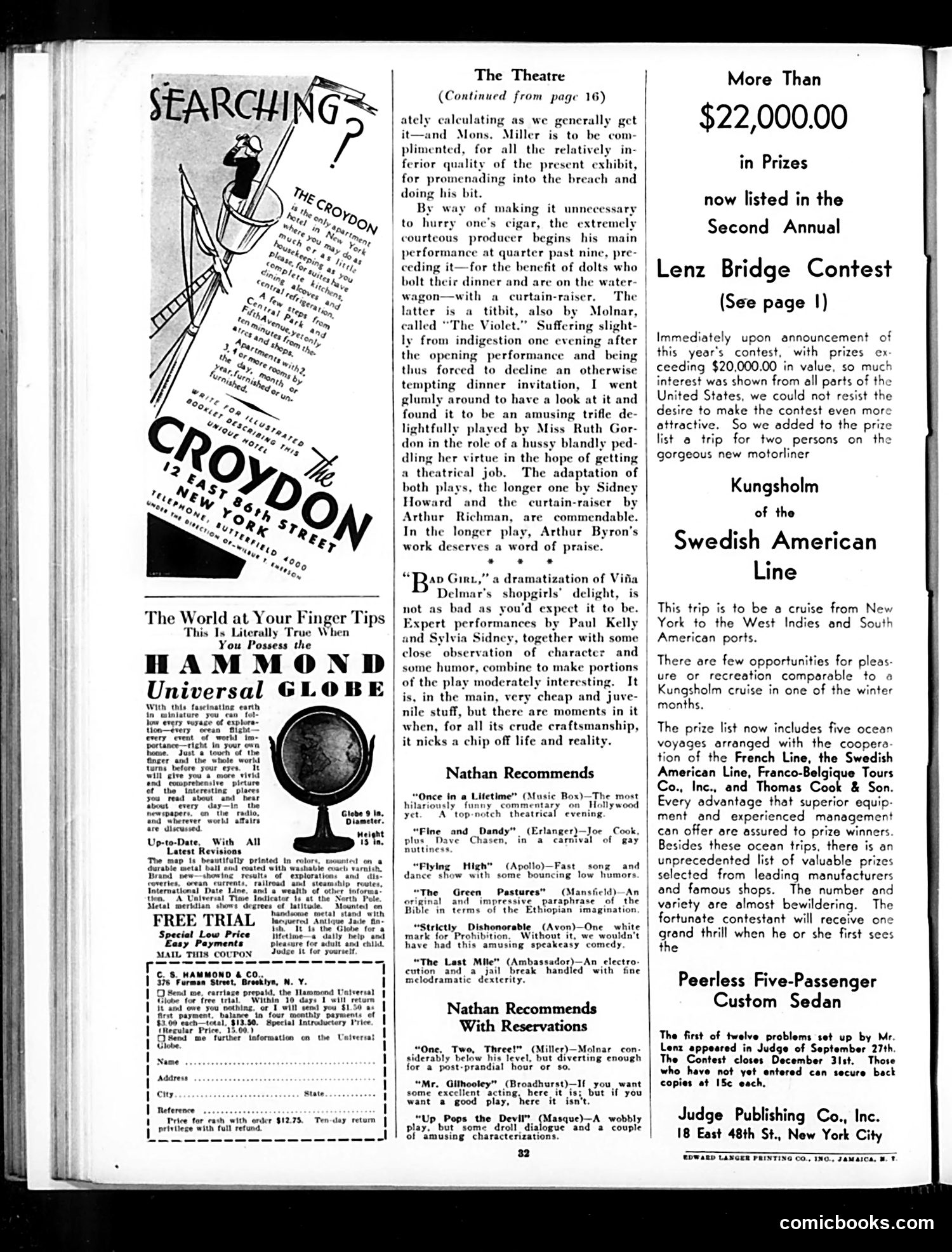
Judge Magazine Page Analysis This page is primarily advertising and theater reviews, not political satire. The main visual element is an ad for the Hammond Universal Globe—a physical rotating globe marketed as "The World at Your Finger Tips." The illustration shows a figure using the globe, playing on the product's promise to make global knowledge accessible. This is straightforward commercial advertising with a mail-in coupon offer. The text content features theater critic Nathan's reviews of current Broadway productions (circa late 1920s-early 1930s based on referenced shows). His recommendations praise plays like "Once in a Lifetime" (about Hollywood) and "The Green Pastures" (noted as using "Ethiopian imagination" to retell Biblical stories—reflecting period attitudes). The page also includes advertisements for the Lenz Bridge Contest (offering $22,000 in prizes) and Kungsholm cruise line promotions. There is no political cartoon or satire on this page—it's a standard magazine interior combining theater criticism with commercial advertising, typical of Judge's format.
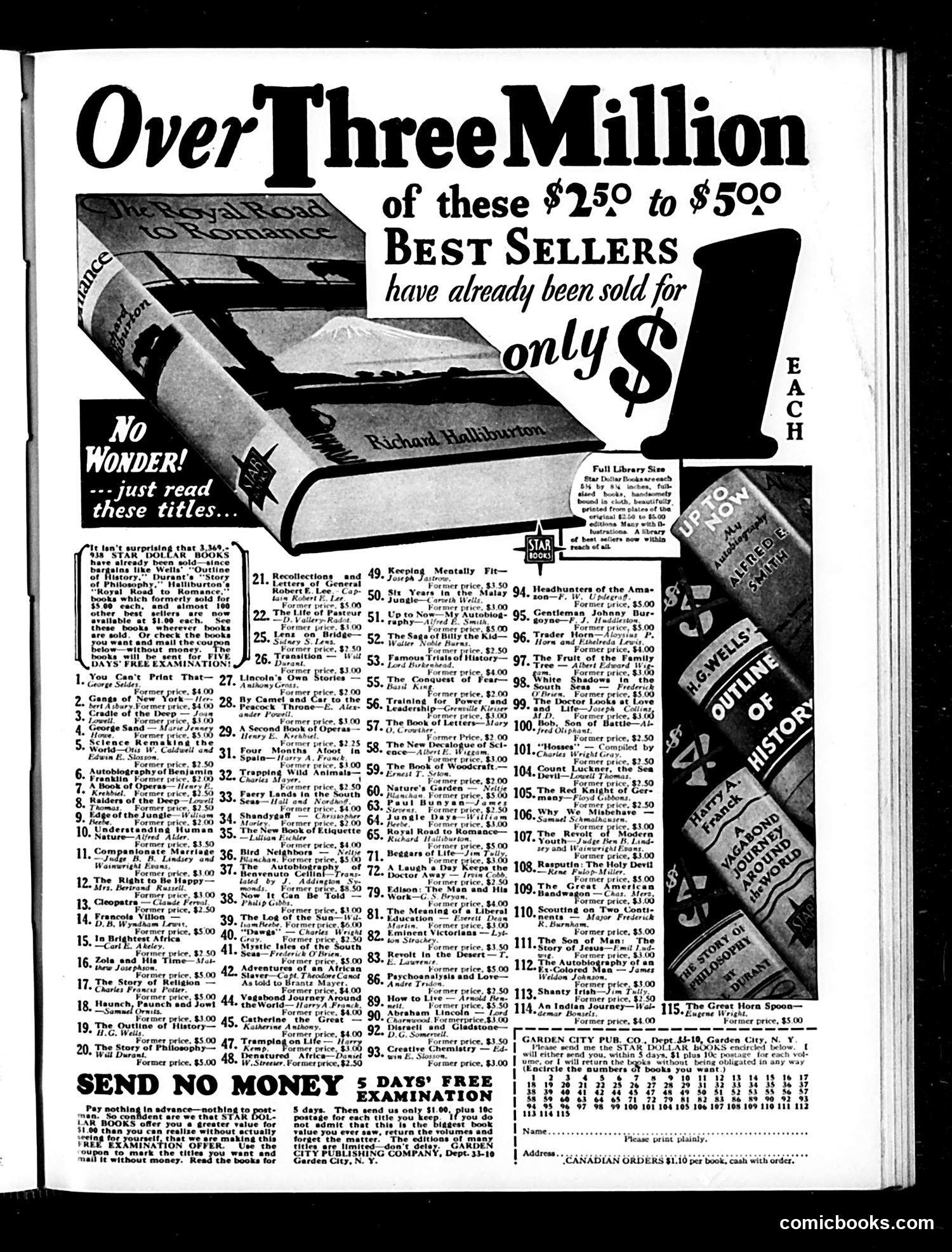
This is a Book Advertisement, Not a Cartoon This page is primarily a mail-order book advertisement from the Garden City Publishing Company, not political satire or a cartoon with satirical intent. The ad promotes over three million copies of discounted bestselling books—originally priced $2.50 to $5.00—now available for $1 each. It lists 115 titles including classics like *Lincoln's Own Stories*, *Cleopatra*, and works by Judge B.B. Lindsey on marriage. The visual joke ("No Wonder!") simply plays on the surprise that so many books have sold at this bargain price. The stacked book imagery reinforces volume sales. The "5 Days' Free Examination" offer is a direct marketing technique—customers could order by mail, examine books risk-free, then pay or return them. A coupon at bottom facilitates ordering. This reflects early 20th-century publishing and advertising practices targeting middle-class readers seeking affordable access to literature and self-improvement books during the Depression era or similar economically conscious period.
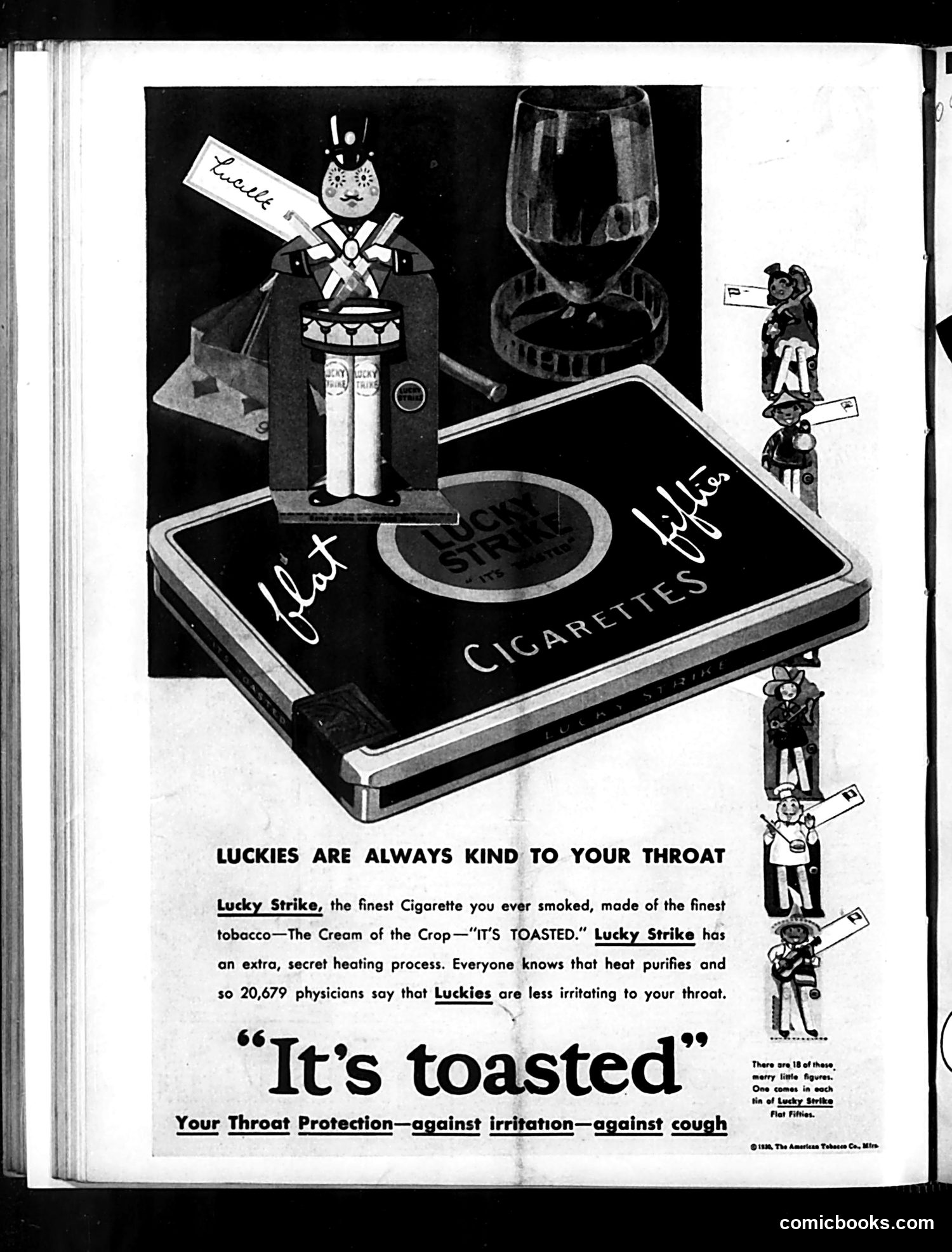
Analysis This is primarily a Lucky Strike cigarette advertisement, not political satire. The page features an elaborate product display with an anthropomorphic cigarette package mascot holding a giant wine glass, flanked by decorative figures. The ad's key claims reflect 1930s-40s marketing tactics: - "It's toasted" - a manufacturing process claimed to reduce throat irritation - "20,679 physicians say" - a common advertising trope citing supposed medical endorsement (unverified and likely fabricated) - Throat protection rhetoric - exploiting health concerns while selling an inherently harmful product The decorative figures on the right appear to be stylized representations emphasizing luxury and sophistication—typical branding for premium cigarettes of that era. Modern context: This represents the now-infamous era when tobacco companies made explicit health claims and cited doctors without evidence, practices later banned as deceptive advertising.