judge
Judge — November 1, 1930
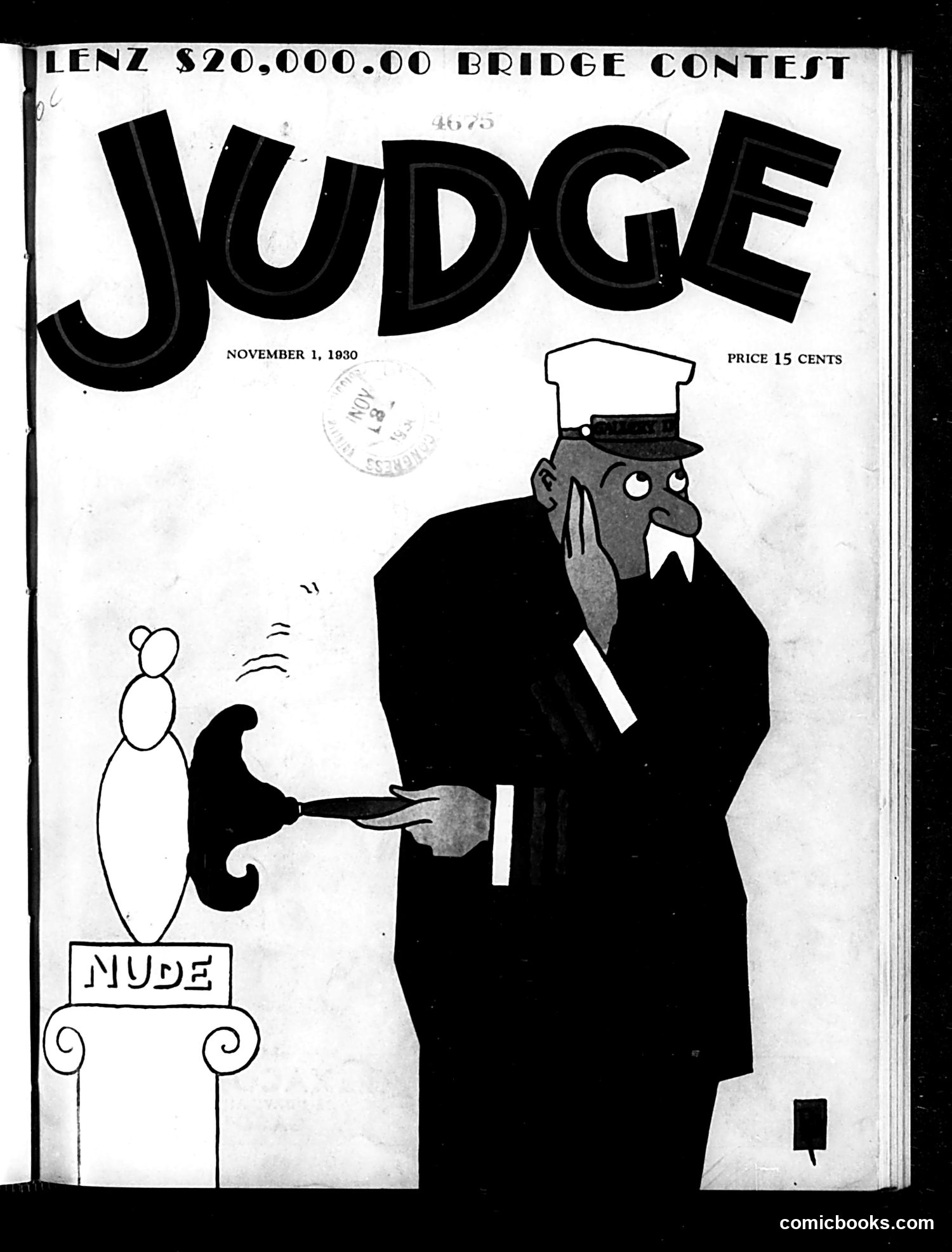
Judge Magazine Cover Analysis (November 1, 1930) This cover satirizes the "Lenz $20,000 Bridge Contest"—likely referring to a contemporary architectural or engineering competition. The central figure is a portly judge or official wearing a chef's hat, examining a nude classical statue labeled "NUDE" through what appears to be a magnifying glass or monocle. The satire appears to mock the judging process itself: the official seems overly focused on irrelevant details (the nude sculpture) rather than the actual bridge design submissions. The exaggerated facial features and caricature style suggest commentary on either the absurdity of the selection criteria or the character of those making decisions about the contest. The joke likely critiques misplaced priorities or poor judgment in evaluating serious architectural work.
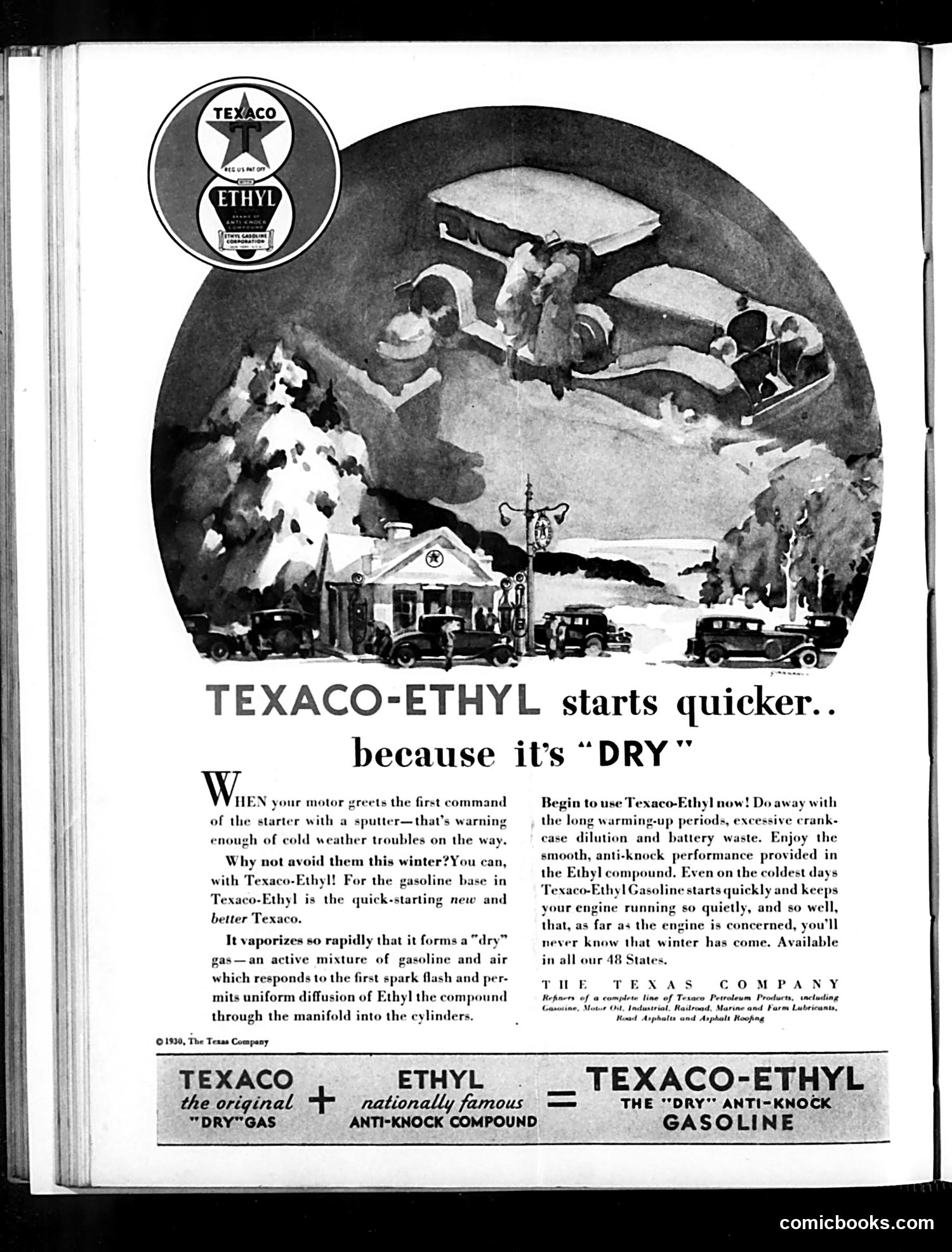
Analysis This is actually not a cartoon or satire page—it's a full-page advertisement for Texaco-Ethyl gasoline from 1929 (copyright shown as "© 1929, The Texas Company"). The image shows a surreal, dreamlike scene of cars and a gas station, illustrating the product's main selling point: Texaco-Ethyl gasoline starts quickly in cold weather because it's formulated as a "dry" gas (ethyl compound mixed with gasoline base). The ad emphasizes practical winter driving benefits—no long warm-up periods, reduced engine strain, better performance even in freezing conditions. The ethereal, cloud-like imagery serves to convey the smoothness and efficiency promised by the fuel. This represents early automotive advertising before modern regulations on leaded gasoline.
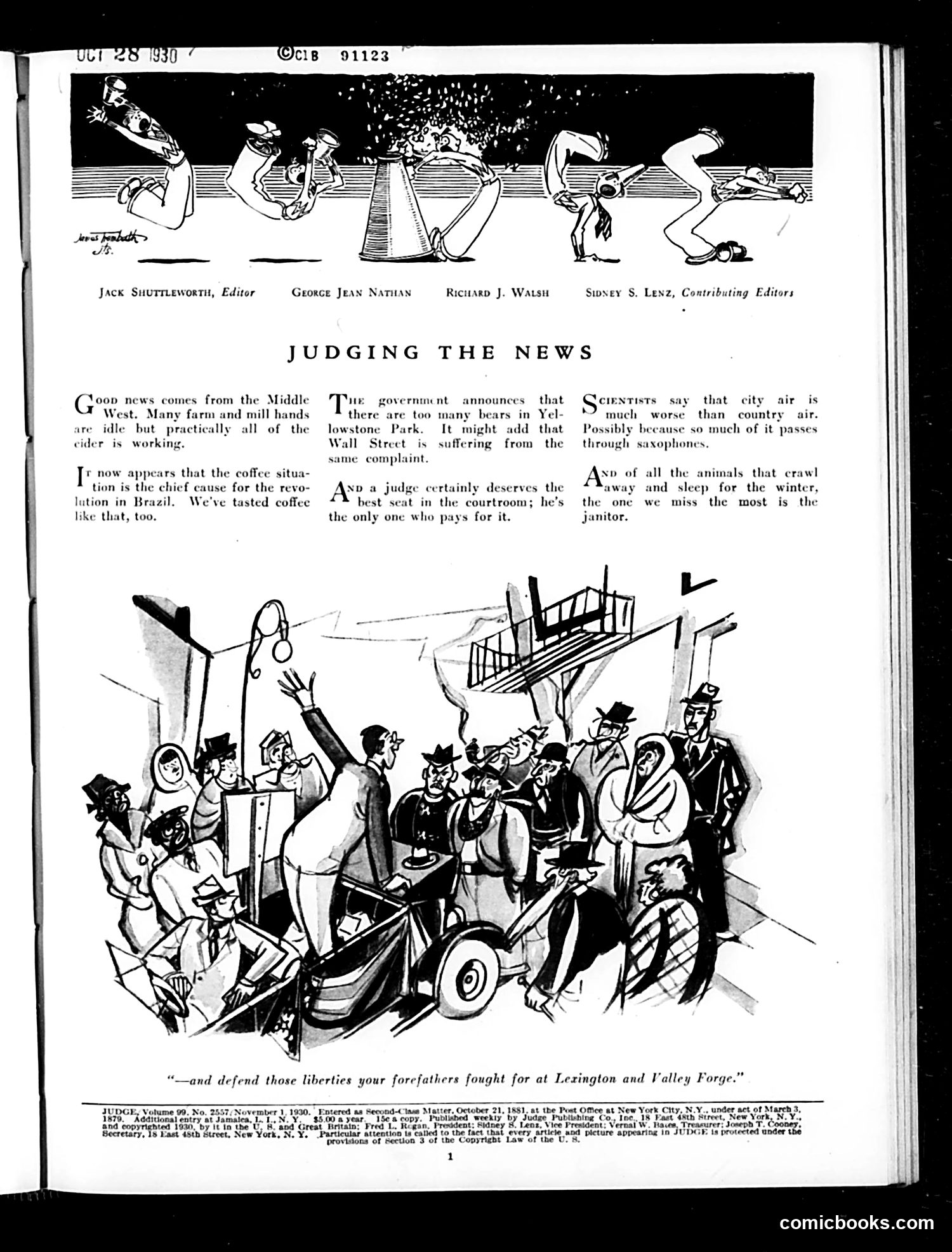
"Judging the News" - November 1, 1930 This satirical page comments on contemporary news items through brief jokes and a central cartoon. The top strip presents visual puns on current events: good news from the Middle East, the coffee situation in Brazil, and bears in Yellowstone Park. The main cartoon depicts a chaotic scene of figures in formal dress and hats, apparently celebrating or protesting, with an airplane and ship visible above. The caption reads: "—and defend those liberties your forefathers fought for at Lexington and Valley Forge." The satire appears to mock contemporary political activism or public debate—suggesting citizens are defending American freedoms through vigorous civic engagement, though the crowded, tumultuous scene implies the methods are somewhat frenzied or undignified. The specific political context remains unclear without additional historical information about November 1930.
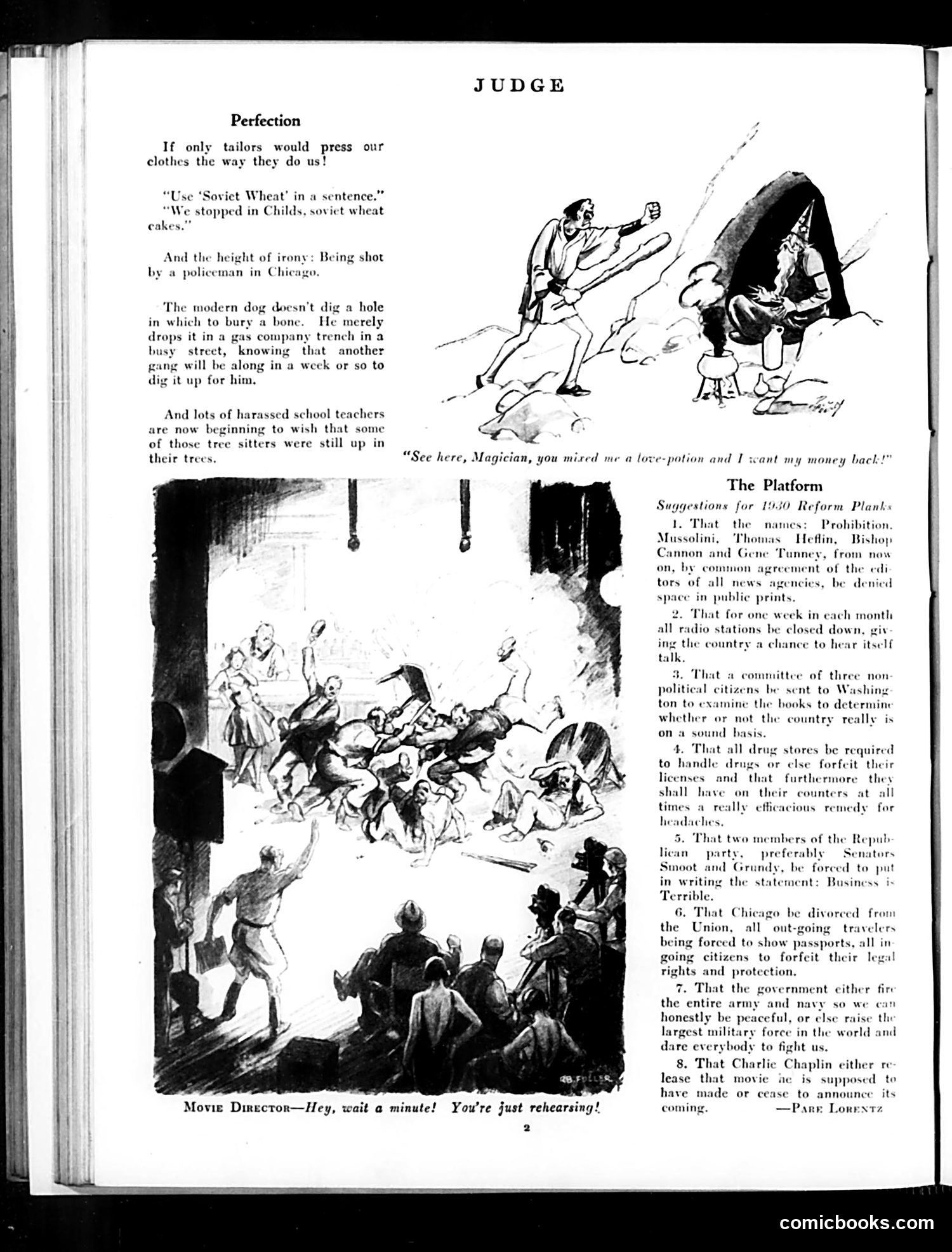
Analysis of Judge Magazine Page This page contains political satire from an unspecified year (likely 1930s based on references). The top section mocks various contemporary absurdities: tailors' pressing standards, Soviet wheat production, a Chicago police shooting, and tree-sitting protestors (likely Depression-era hobos or protesters). The central cartoon depicts a magician scene with the caption "See here, Magician, you mixed me a love-potion and I want my money back!" — likely satirizing fraudulent con artists or quack remedies. The lower illustration shows a chaotic film production with the caption "Movie Director—Hey, wait a minute! You're just rehearsing!" "The Platform" section lists satirical "reform proposals" targeting figures like Mussolini, Hitler, and others, plus various institutions (radio stations, drug stores, Charlie Chaplin), reflecting contemporary anxieties about fascism, government control, and media influence during the Depression era.
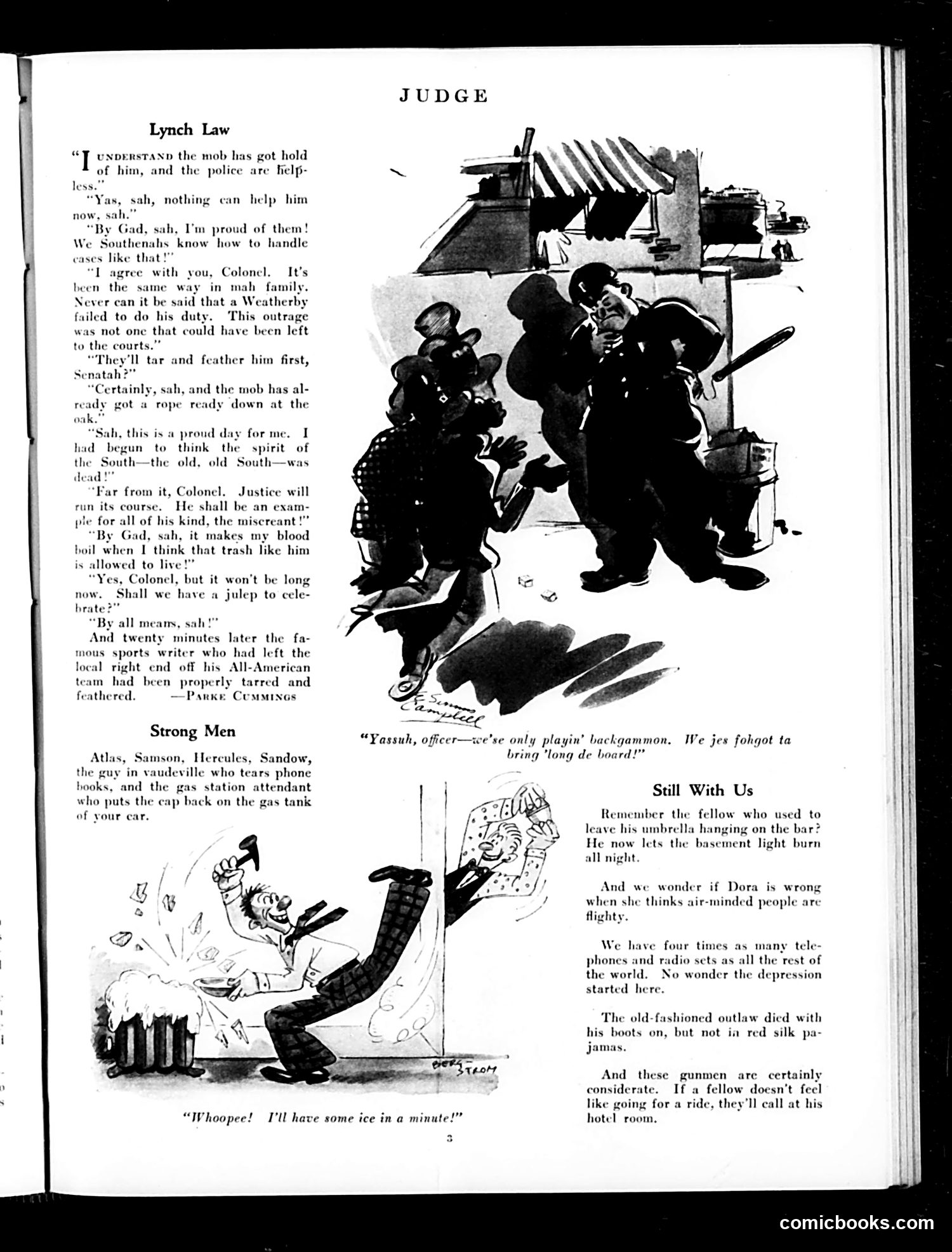
Judge Magazine Page Analysis The page contains three distinct satirical pieces: "Lynch Law" (top): A dialogue criticizing Southern mob justice. Characters defend lynching as tradition, with one speaker opposing it on principle. The accompanying illustration shows armed men near a building, depicting vigilante violence. The satire condemns this extrajudicial practice as barbaric and contrary to justice. "Strong Men" (bottom left): Cartoon mocking powerful-sounding names (Atlas, Samson, Hercules) applied to ordinary people like gas station attendants. The falling figure illustrates the joke: such names don't match these mundane workers. "Still With Us" (right): Observations about American life—basement lights left burning, abundant telephones and radios, inconsistent behavior. These are gentle observations about contemporary habits rather than pointed satire. The page dates from an era when Judge actively critiqued social injustice alongside lighter humor.
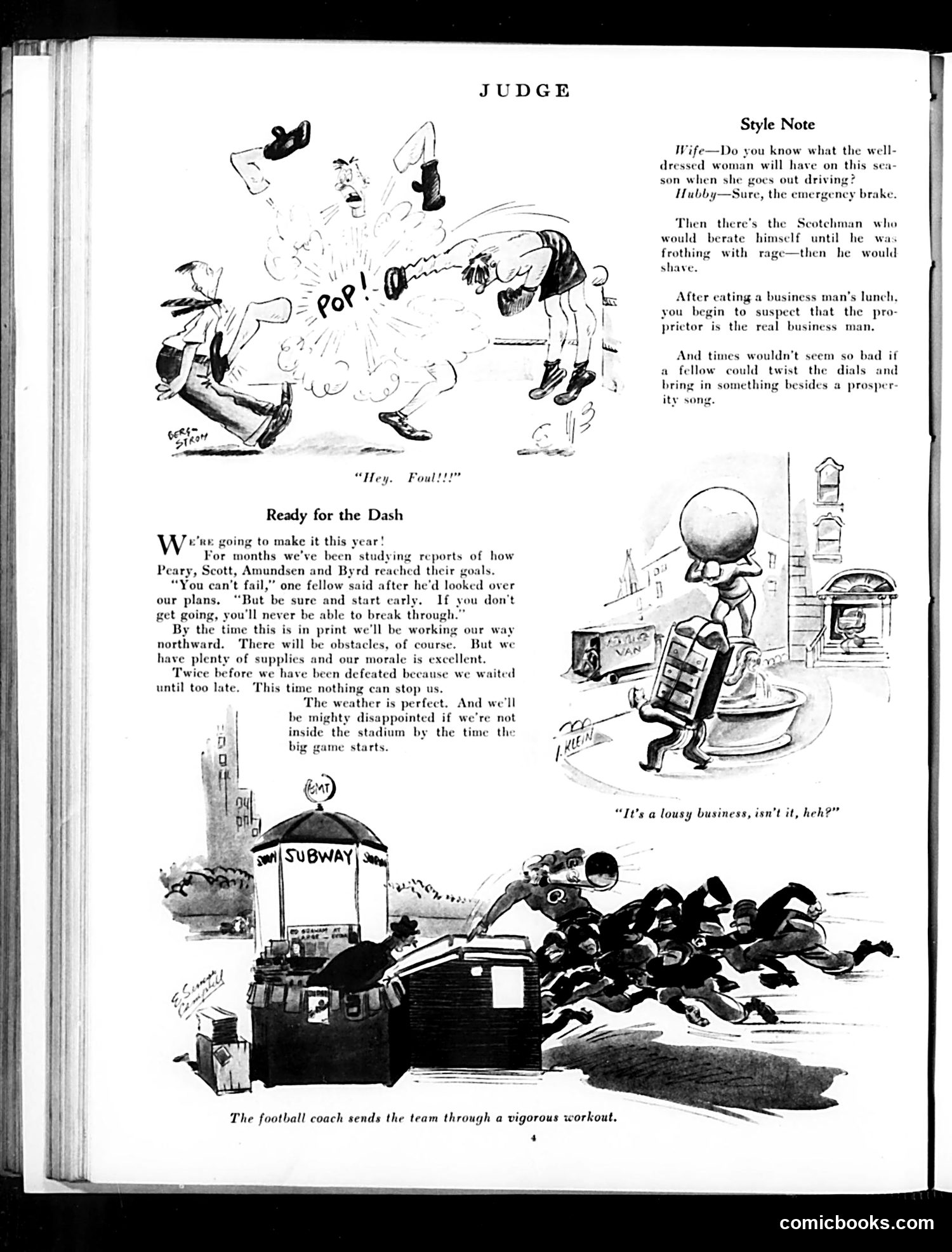
Analysis of Judge Magazine Page This page contains three cartoons satirizing early 20th-century American life: Top cartoon ("Hey, Fool!!!!"): Shows a driver causing a car accident with debris flying. It illustrates anxieties about new automobile technology and reckless driving. Middle cartoon ("It's a lousy business, isn't it, huh?"): Depicts a figure struggling with an enormous sphere labeled with business/financial symbols, satirizing the burdens of modern commerce and entrepreneurship. Bottom cartoon ("The football coach sends the team through a vigorous workout"): Shows a subway entrance with a coach directing football players through intense drills, likely mocking the obsessive dedication to college sports or the difficulty of athletic training. The "Style Note" at top offers humorous social commentary on fashion, driving etiquette, and business culture—typical Judge magazine fare targeting educated urban readers.
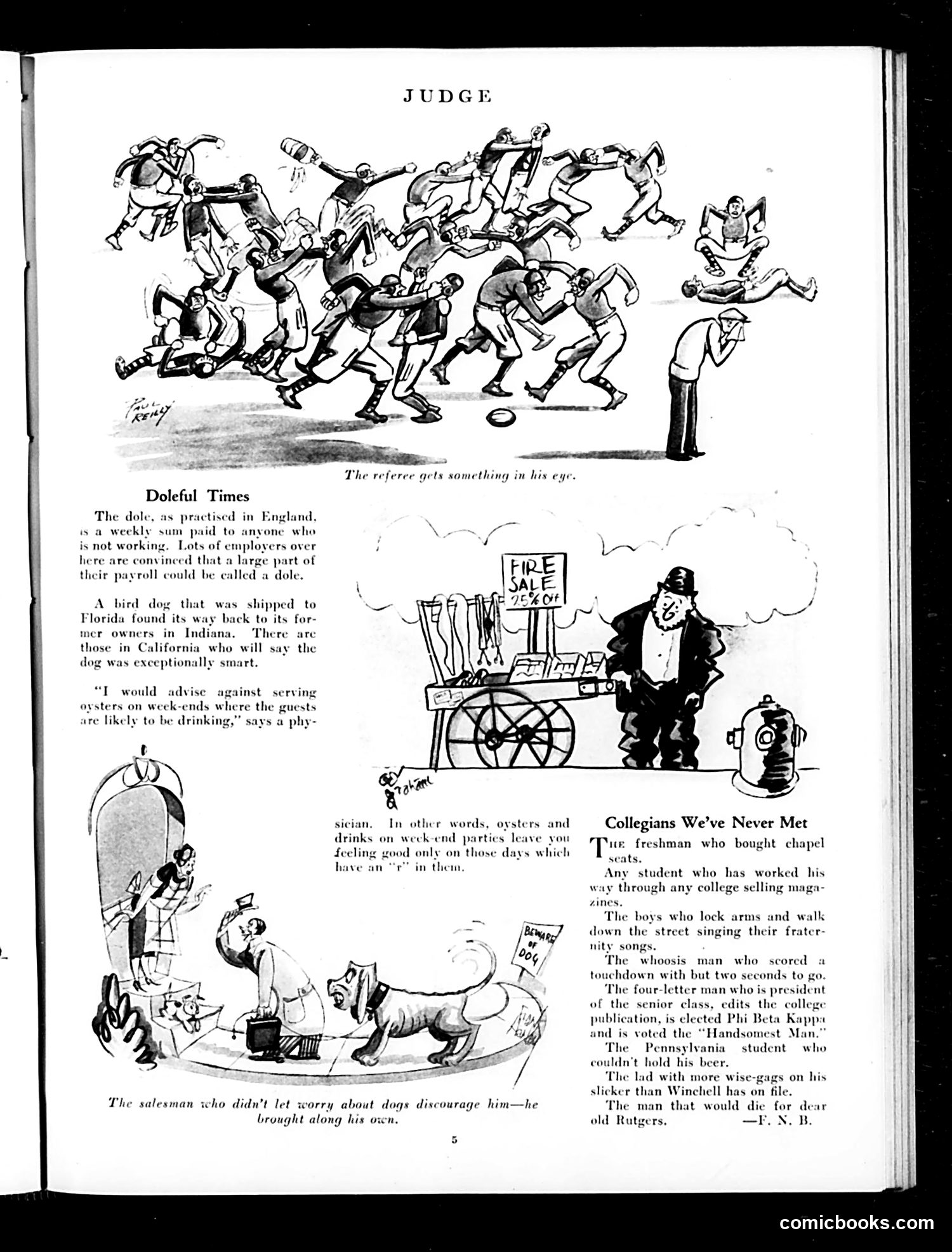
Judge Magazine Page Analysis Top Cartoon: "The referee gets something in his eye" satirizes American labor disputes. A referee (representing neutral authority) stands amid chaotic fighting workers, appearing to ignore the violence—suggesting authority figures deliberately overlooked labor conflicts or worker abuse during industrial disputes. "Doleful Times" Section: Mocks the English "dole" (unemployment benefits), arguing American employers misuse it. The anecdotes (dog returning home, oyster/drinking advice) employ absurdist humor to suggest the dole system encourages idleness. "Collegians We've Never Met": Light satirical sketches of college stereotypes—chapel-goers, fraternity singers, athletes, magazine sellers—poking fun at typical undergraduate behaviors and campus life. Overall, the page blends labor criticism with gentler collegiate mockery, reflecting early 20th-century American anxieties about work and student culture.
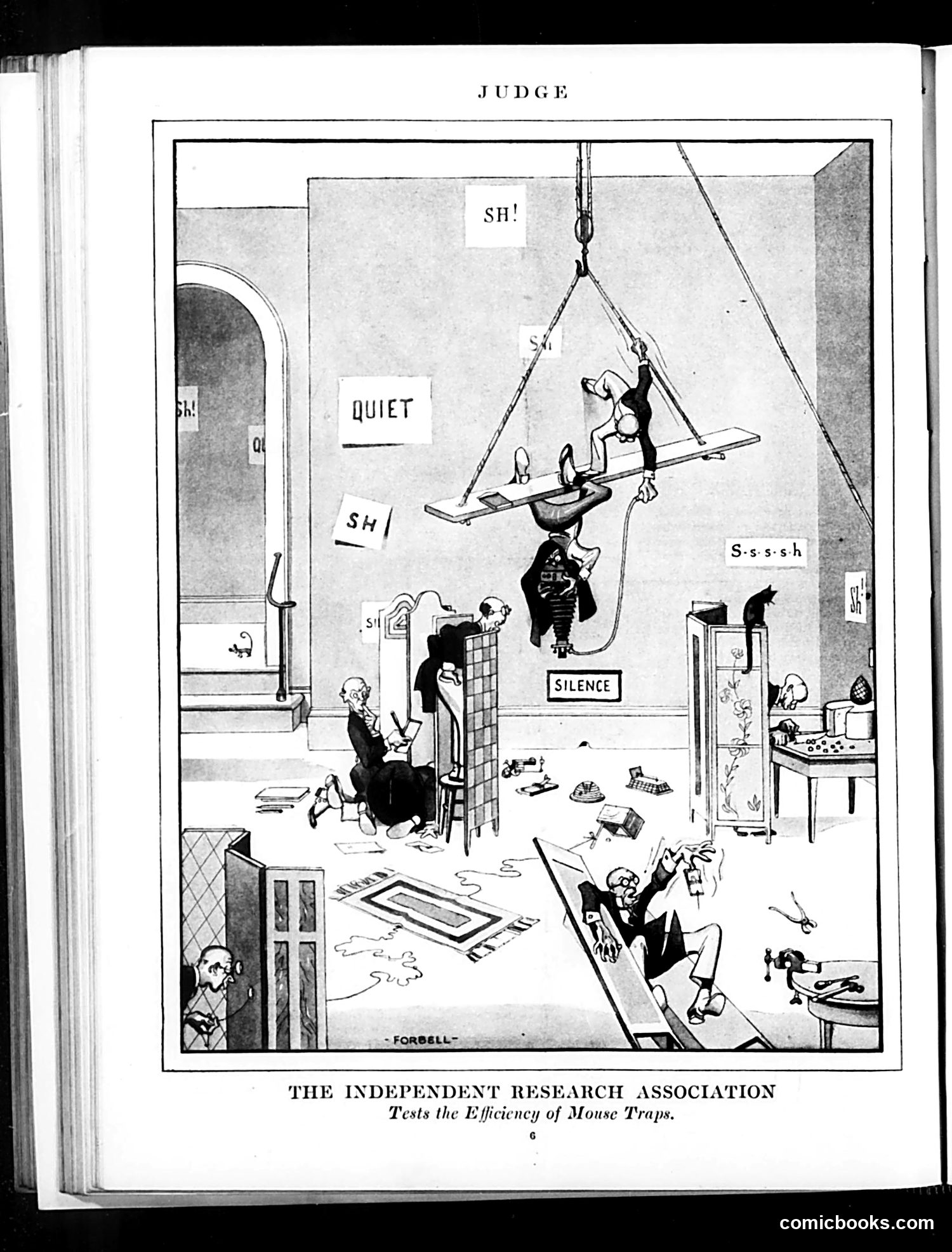
"The Independent Research Association Tests the Efficiency of Mouse Traps" This is a single-panel satirical cartoon showing a chaotic domestic interior where mousetraps are being tested with human subjects instead of actual mice. Adults and children are depicted suspended in various traps—hanging from ropes, caught in mechanical devices—creating absurd chaos throughout a home. Labels reading "QUIET," "SILENCE," and "SH!" emphasize the irony: the traps are supposed to work silently, yet the scene depicts pandemonium. The satire likely mocks overzealous scientific testing or corporate research that loses sight of practical reality. By literalizing "testing mouse traps" with people, the cartoon ridicules either poorly designed products or the absurdity of bureaucratic testing procedures. The "Independent Research Association" appears fictional, adding to the mockery of institutional authority.
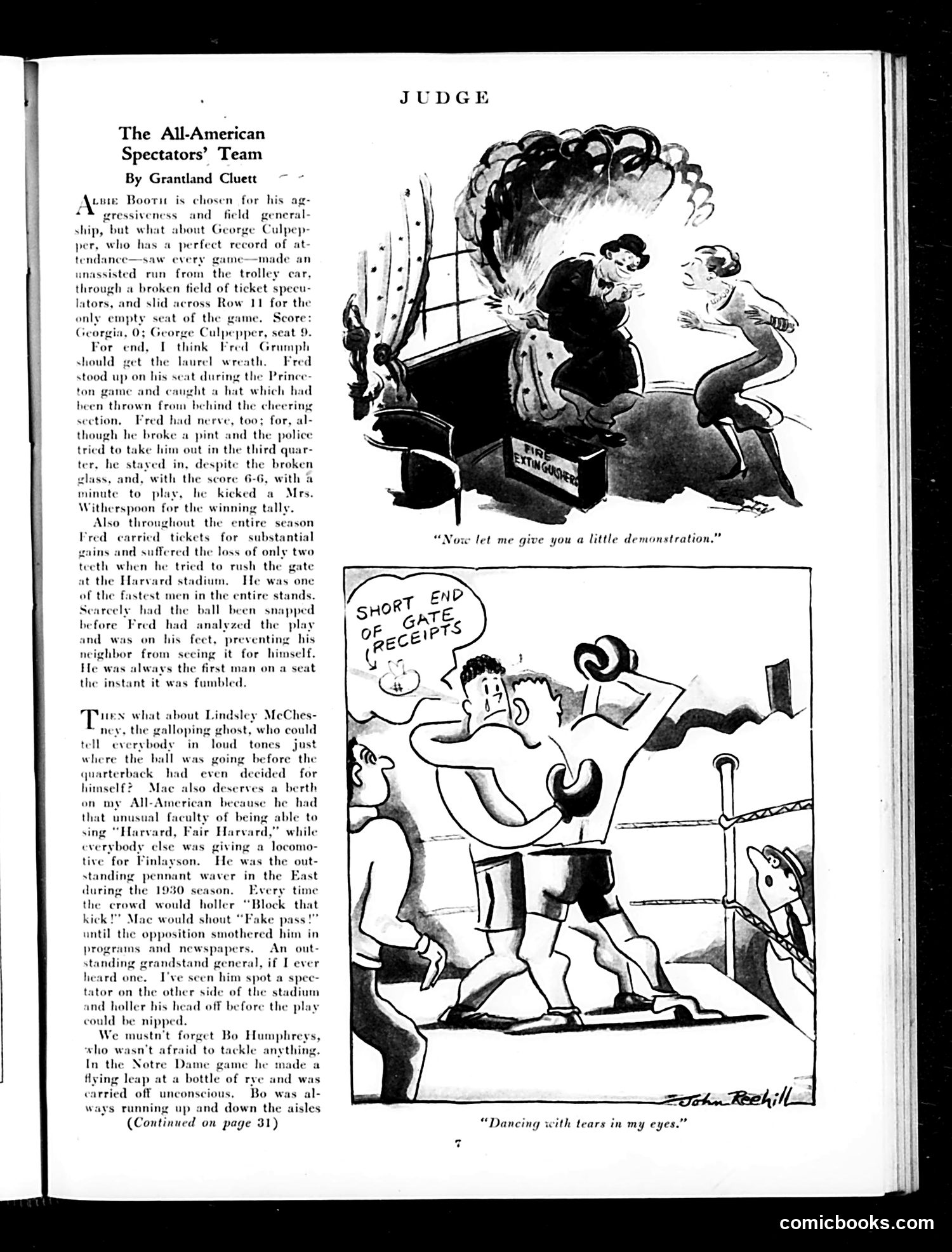
Judge Magazine: "The All-American Spectators' Team" This article satirizes enthusiastic football fans by treating them as athletes worthy of an "All-American" honors roster. Author Grantland Cluett humorously profiles spectators whose antics at games—not players on the field—merit recognition. The cartoons illustrate absurd fan behavior: one shows a demonstrative spectator gesticulating wildly; the second depicts a fan frantically searching for seating while holding gate receipts, captioned "Dancing with tears in my eyes." The text celebrates fans like George Culpepper (who navigated crowds to find a seat), Fred Grumph (who caught a hat and kicked a woman for a "winning tally"), Lindsley McChesney (who shouted plays before quarterbacks decided them), and Bo Humphreys (who tackled a liquor bottle). The satire mocks both excessive fan enthusiasm and the obsessive coverage college football received—treating stadium behavior as worthy of sports achievement recognition. It's lighthearted social commentary on American sports culture's fan fervor.
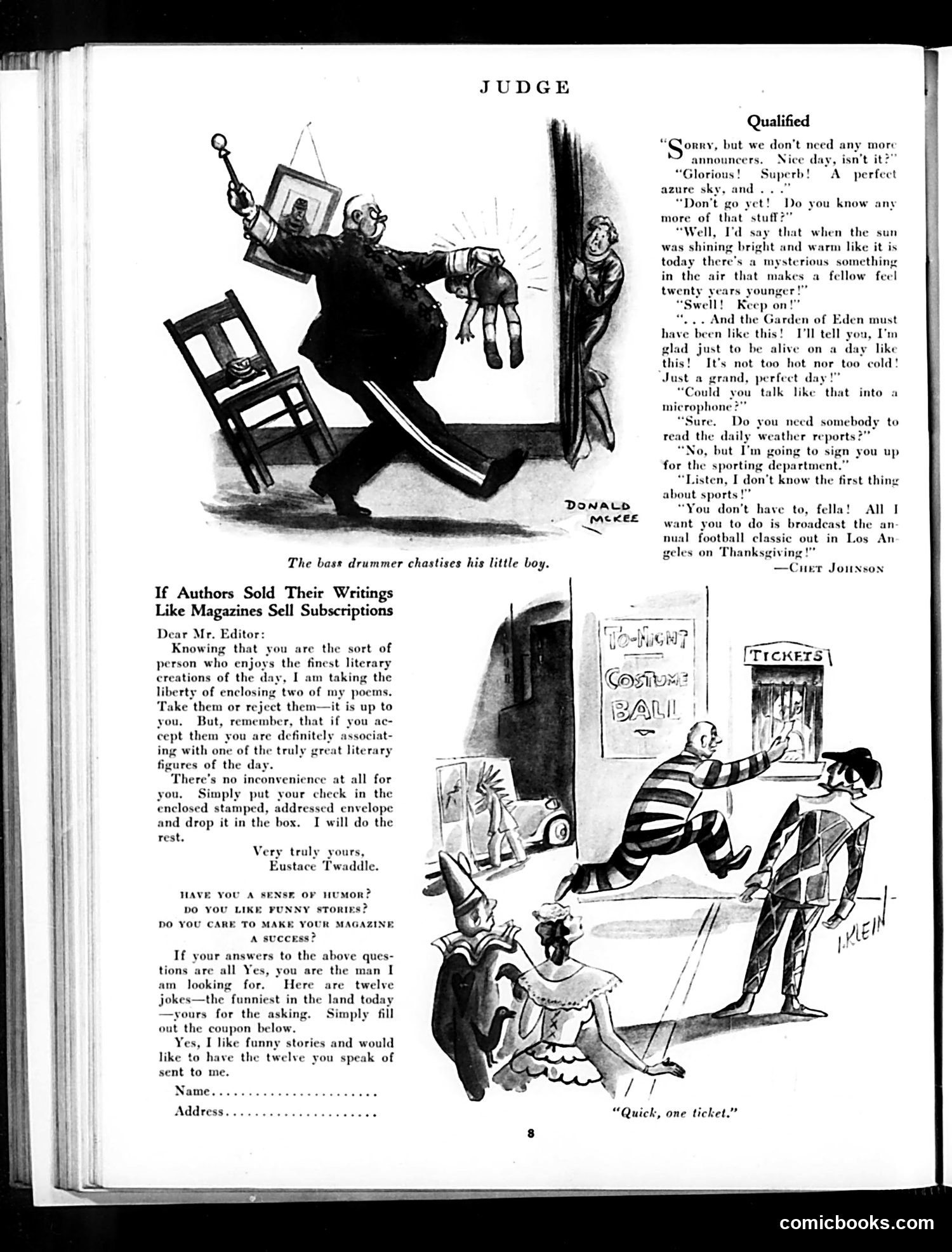
Judge Magazine Page Analysis This page contains three satirical pieces mocking early 20th-century media and publishing practices: "Qualified" (top cartoon by Donald McKee): A radio station hires an enthusiastic but unqualified man as a sports announcer. The joke is that he knows nothing about sports but can deliver flowery, poetic weather commentary into a microphone—exactly what they need to broadcast the Thanksgiving Day football game in Los Angeles. This satirizes radio's desperate need for content and announcers during broadcasting's early era. "If Authors Sold Their Writings Like Magazines Sell Subscriptions": A humorous letter from "Eustace Twaddle" proposing poets submit work like magazine subscription sales—enclosing stamps and asking editors to pay them for accepting poems. This mocks both pretentious poets and aggressive magazine subscription tactics of the era. "Quick, one ticket" (bottom cartoon by Ilein): Shows people rushing to buy tickets for a costume ball, satirizing public enthusiasm for social events. The overall theme critiques emerging mass media, amateur broadcasting, and aggressive publishing/sales culture.
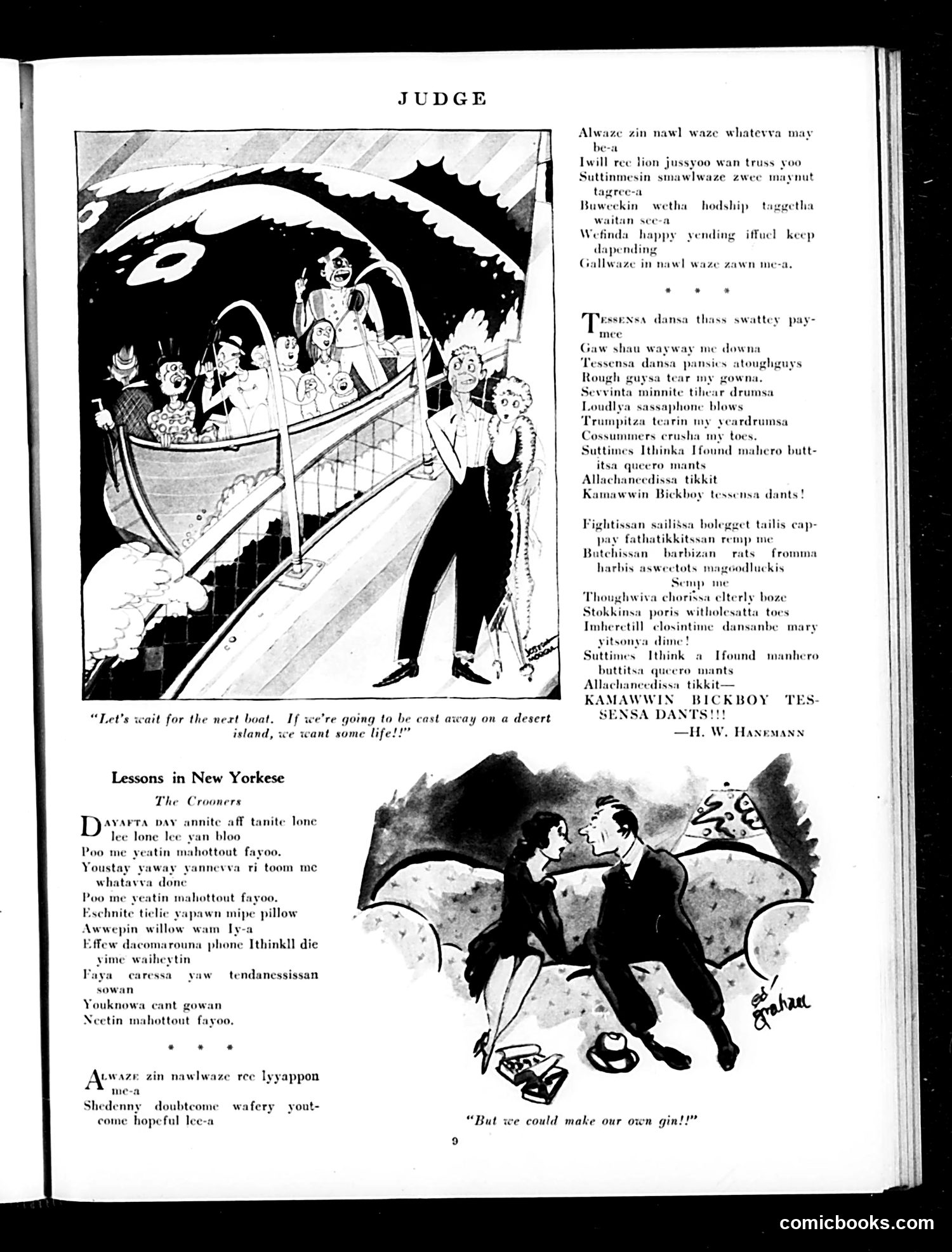
Analysis of This Judge Magazine Page This page contains satirical humor about immigrant speech patterns and working-class New York dialect, a common stereotype subject in early 20th-century American comedy. The top cartoon depicts a boat full of immigrants or lower-class passengers being addressed by a well-dressed man, with the caption about wanting "life" on a desert island—poking fun at the perceived carefree attitudes of working-class travelers. The "Lessons in New Yorkese" section mocks how Italian and immigrant speakers supposedly slaughtered English pronunciation—rendering phrases like "darling" as "dansa," "sweetheart" as "swattey," and "crooners" as phonetic butchery. The crude dialect spelling (like "fayoo" for "fellow") was meant to be humorous to period readers. The lower cartoon shows a couple with gin, punning on Prohibition-era bootlegging—the man suggests making homemade gin rather than buying it illegally. The satire relies entirely on ethnic/class-based mockery of accent and speech patterns that would be considered offensive today, reflecting the casual xenophobia of the era.
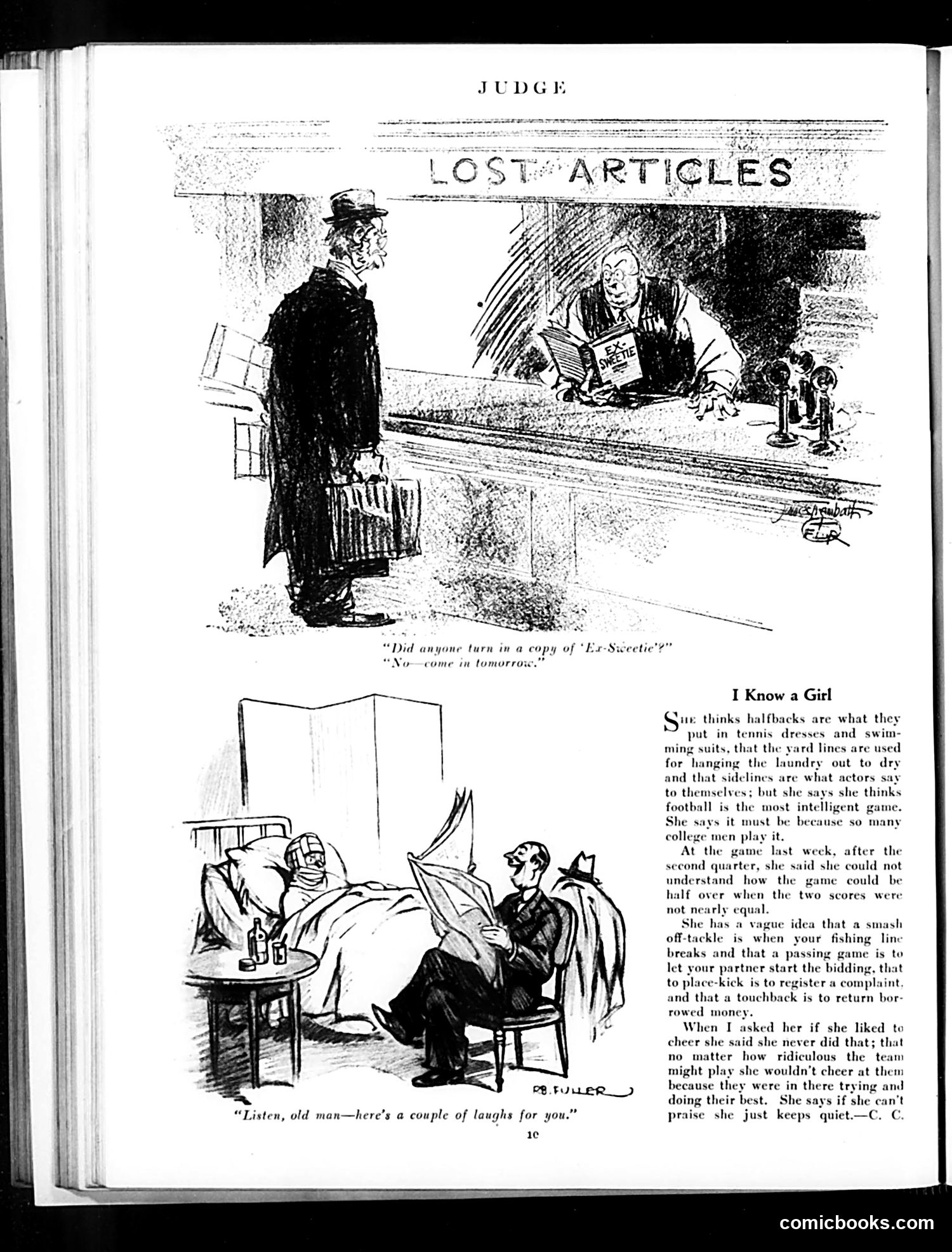
Analysis of This Judge Page Top Cartoon: A man inquires at a "Lost Articles" desk about a missing copy of "Ex-Sweetie," a publication. The joke plays on the notion of romantic relationships as disposable items one might lose and recover—satirizing how casually people treat romantic partners or how quickly romantic interests are forgotten. Bottom Section ("I Know a Girl"): This is humorous commentary on a woman's complete ignorance of American football despite claiming to find it "intelligent." The satire mocks her absurd misunderstandings: confusing halfbacks with dress construction, yard lines with laundry-drying, and football terminology with unrelated concepts (off-tackle = broken fishing line; touchback = returning borrowed money). The piece satirizes both the superficiality of young women's sports knowledge and, implicitly, the pretense of intellectual engagement without actual understanding—a common early-20th-century magazine trope ridiculing women's participation in male-dominated spheres like sports fandom.
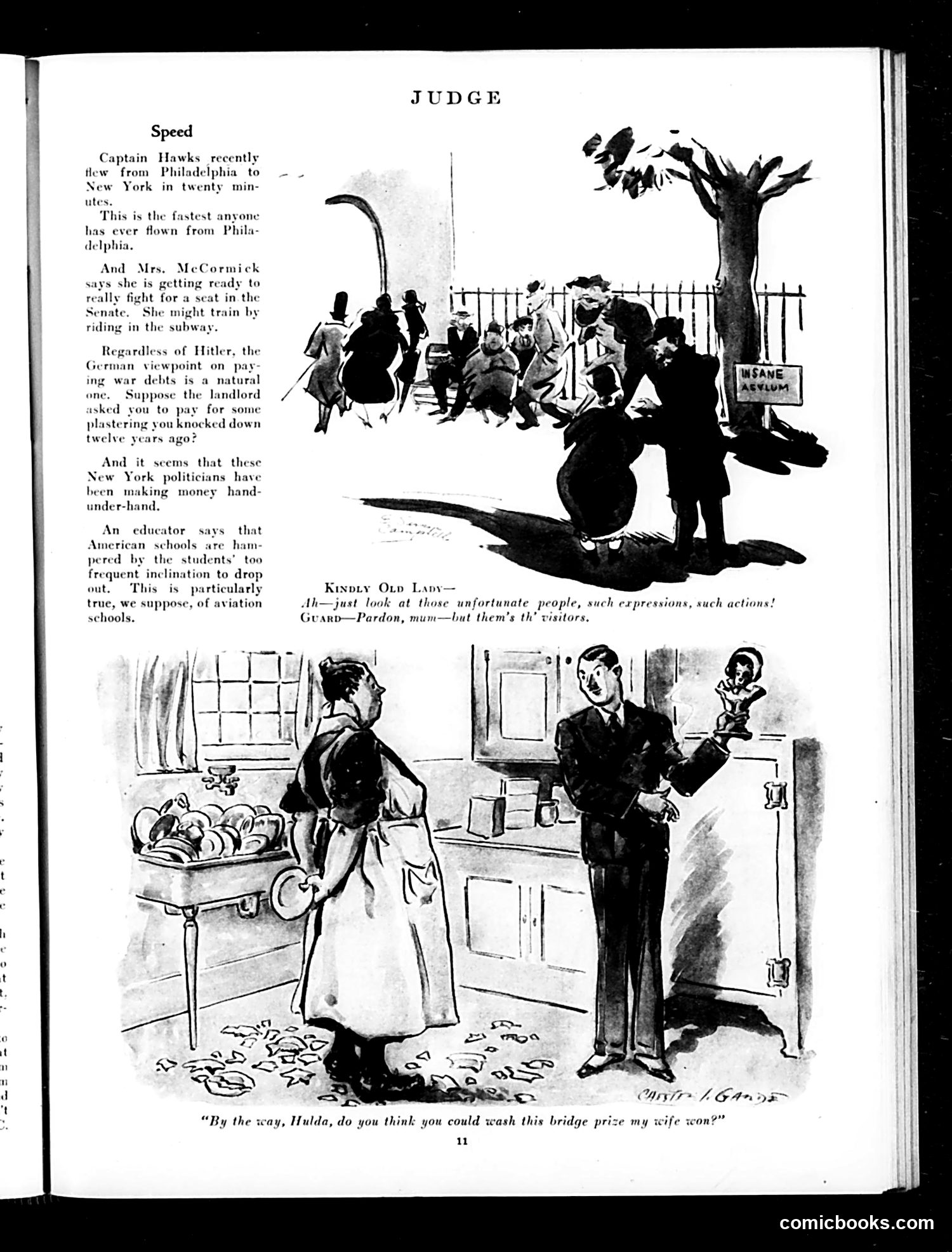
Judge Magazine Satire Analysis This page contains multiple brief satirical items typical of Judge's style. The main cartoon depicts an "Old Lady" (likely representing America or moral authority) expressing shock at visitors to an "Insane Asylum"—a visual pun suggesting that contemporary society itself has become mad. The text snippets mock various targets: rapid aviation progress (Captain Hawks' speed record), wealthy women's political ambitions (Mrs. McCormick seeking Senate), German refusal to pay WWI debts (comparing it to a landlord demanding rent for decades-old damage), and corrupt New York politicians. A final joke criticizes American schools' high dropout rates, sarcastically extending this to aviation schools. The bottom cartoon shows a domestic scene where a man asks his wife to launder a "bridge prize," likely a humorous non-sequitur or reference to unclear contemporary gossip. The magazine's target audience would recognize these topical references—primarily American political figures, current events, and social anxieties of the interwar era.
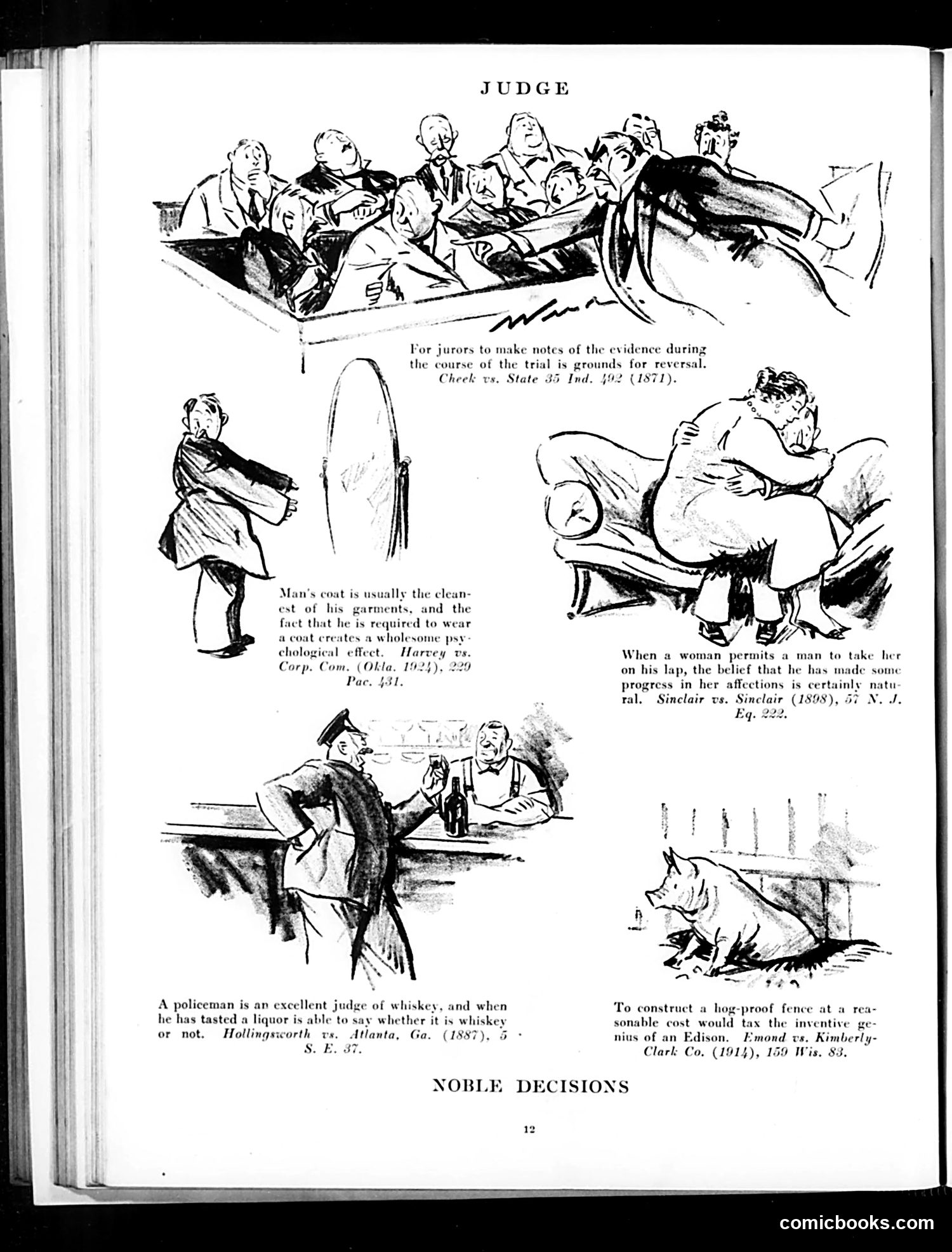
Judge Magazine: "Noble Decisions" Page This page satirizes absurd legal rulings through humorous illustrations and mock case citations. The cartoons mock judges' questionable logic: Top illustration: Jurors in a boat, referencing a real 1871 Indiana case ruling that jurors taking notes during trial grounds reversal—seemingly impractical. Left panel: A man's coat being the "cleanest garment" supposedly creates "wholesome psychological effect"—mocking a 1924 Oklahoma ruling. Center: A woman permitting a man on her lap allegedly proves romantic progress—satirizing a sentimental 1898 equity decision. Bottom left: A policeman judging whiskey quality by taste—ridiculing an 1887 Georgia case accepting such expertise. Bottom right: Constructing a "hog-proof fence" supposedly requiring Edison-level genius, mocking a 1914 Wisconsin patent case. Judge magazine used these invented-sounding but cited cases to lampoon judicial reasoning and legal absurdity, inviting readers to laugh at the law's occasional disconnect from common sense.
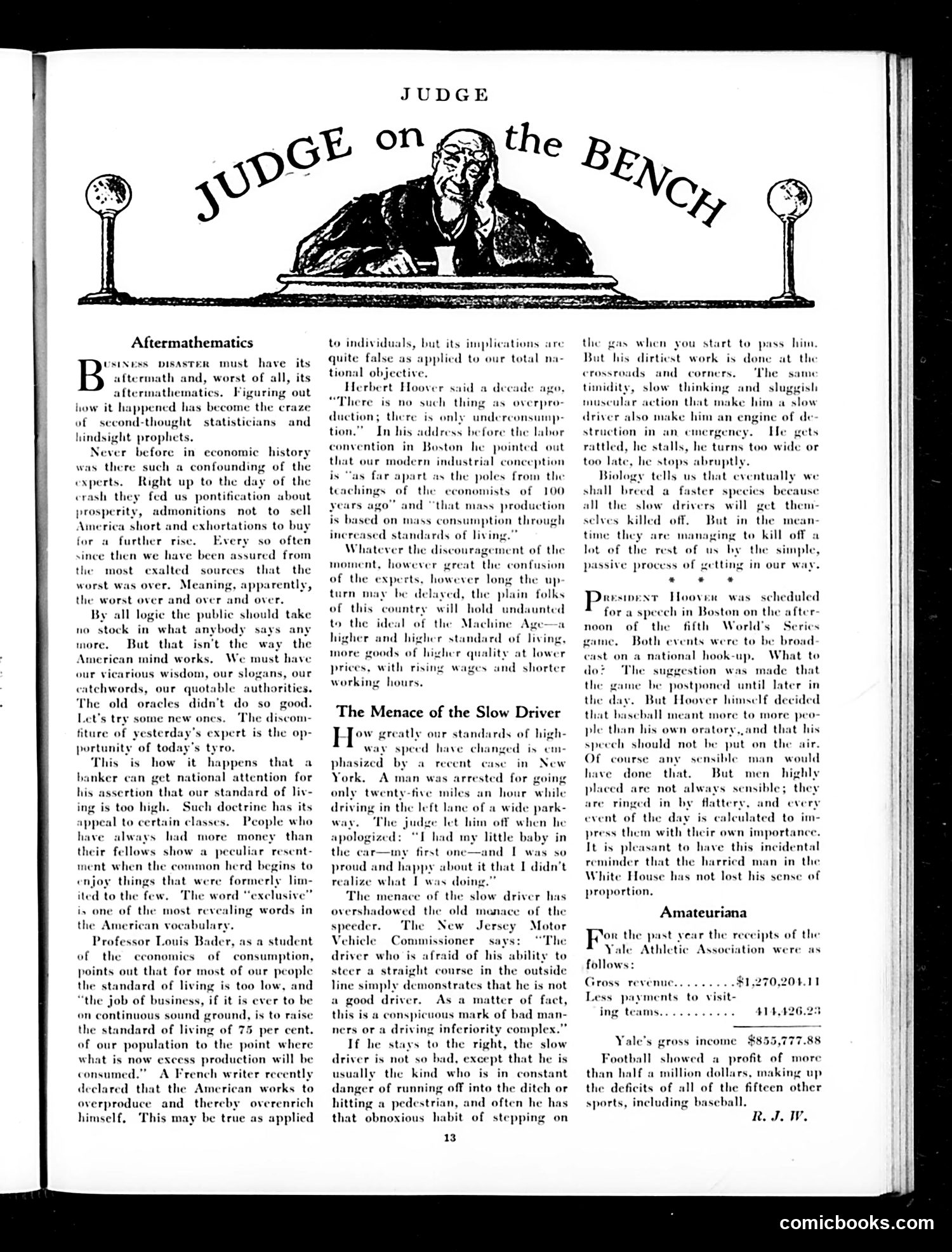
Judge Magazine Page Analysis This page contains three satirical pieces critiquing post-1929 crash economics and social behavior. "Aftermathematics" mocks the proliferation of economic "experts" offering contradictory predictions after the stock market crash. Judge satirizes how Americans desperately seek authoritative voices despite experts being repeatedly wrong. The piece references Herbert Hoover's decade-old statement denying overproduction, highlighting how even prominent leaders misread economic reality. "The Menace of the Slow Driver" ridicules a New Jersey judge's lenient ruling toward a slow driver who claimed nervousness over his newborn. Judge argues slow drivers are actually more dangerous than speeders—they cause accidents, drive erratically, and exhibit "driving inferiority complex." The satire targets both the overly sympathetic judicial decision and the oblivious slow driver who endangers others. "Amateureiana" briefly reports Yale's football revenue exceeding other athletic departments, suggesting amateur athletics operated as profitable enterprises despite their nominal "amateur" status. The page reflects 1930s anxieties: economic uncertainty, changing traffic culture, and institutional hypocrisy.
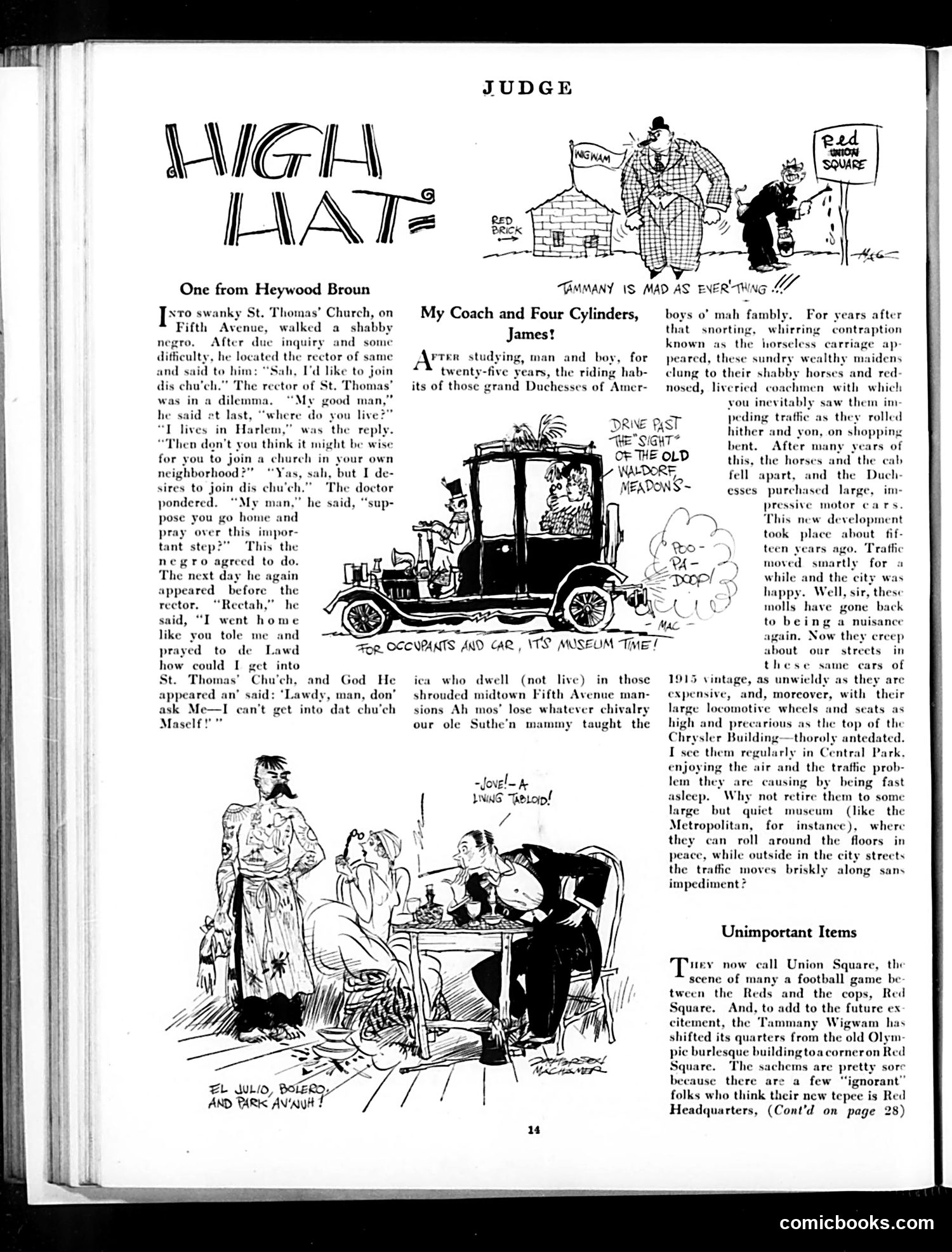
Analysis of Judge Magazine Page This page contains two distinct pieces of satire: "One from Heywood Broun" (left): A dialect joke about a poor Black man seeking admission to an exclusive Fifth Avenue church. The rector dismisses him as unsuitable for that neighborhood, then after the man prays, claims God told him He "can't get into dat chu'ch Maself"—mocking both the rector's hypocrisy and the church's exclusionary racism through the ironic suggestion that even God is unwelcome there. "My Coach and Four Cylinders, James!" (right): Satirizes wealthy Manhattan women who clung to horse-drawn carriages long after automobiles arrived, viewing cars as déclassé. Now these same women drive ancient 1915 automobiles around Central Park, blocking traffic while napping—having merely traded one outdated status symbol for another. The satire targets their stubborn pretension and the traffic nuisance they create. Both pieces use humor to critique class snobbery and exclusionary behavior among the wealthy.
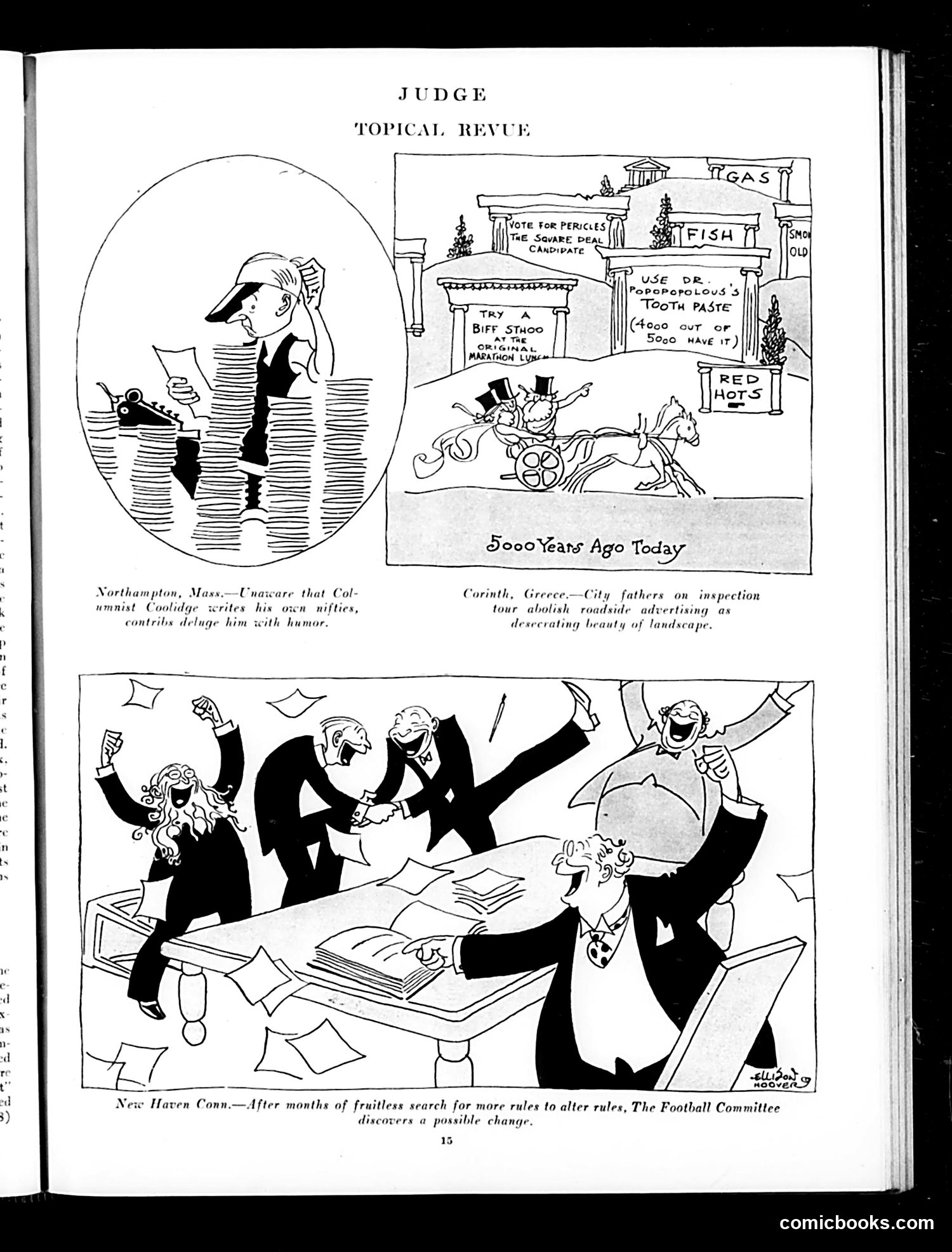
Judge Magazine Political Cartoon Analysis This page contains three satirical cartoons mocking American public figures and institutions circa the 1920s-30s. The top right cartoon parodies ancient Greece's democratic ideals by showing modern commerce (gas, fish, tooth paste, hot dogs) replacing classical architecture—suggesting contemporary American advertising and commercialism have degraded civic beauty, contrasting with Corinth's attempt to ban roadside ads. The top left oval references columnist Calvin Coolidge (U.S. President), satirizing that unsolicited humor submissions flood him despite him writing his own material. The bottom cartoon shows a Football Committee in chaotic celebration over discovering "a possible change" to rules after months of searching. This mocks the obsessive, circular bureaucratic tendency to endlessly revise regulations without meaningful progress—a common target of Judge's institutional satire. The cartoons collectively critique American commercialism, celebrity culture, and administrative excess.
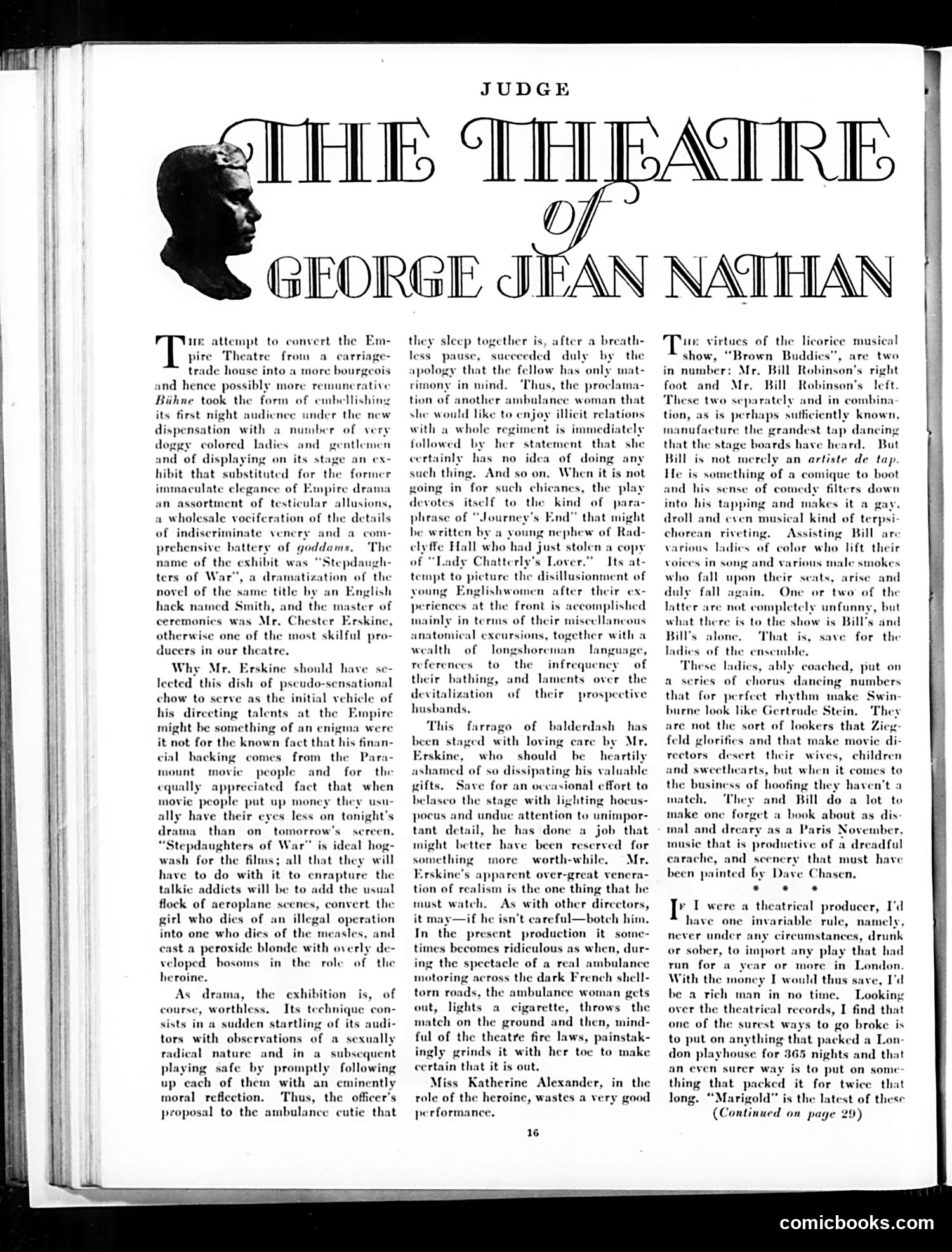
"The Theatre of George Jean Nathan" — Judge Magazine Review This is a theater review by Judge's drama critic, not a cartoon. The critic attacks the Empire Theatre's production of *Stepdaughters of War*, adapted from an English novel, as sensationalist drivel designed to appeal to Hollywood studios rather than serious theater audiences. The reviewer criticizes director Chester Erskine for substituting crude sexual innuendo and profanity for genuine drama. The play depicts disillusioned WWI-era servicewomen using "longshoreman language" and anatomical humor. The critic mocks Erskine's pretentious "realism" — noting absurdly that the actress carefully extinguishes a cigarette on stage to comply with fire codes, treating theatrical convention as authentic detail. The piece reflects 1920s-30s literary gatekeeping: distinguishing "serious" drama from mass-market entertainment aimed at film studios and working-class audiences. Katherine Alexander is praised for her performance despite the weak material.
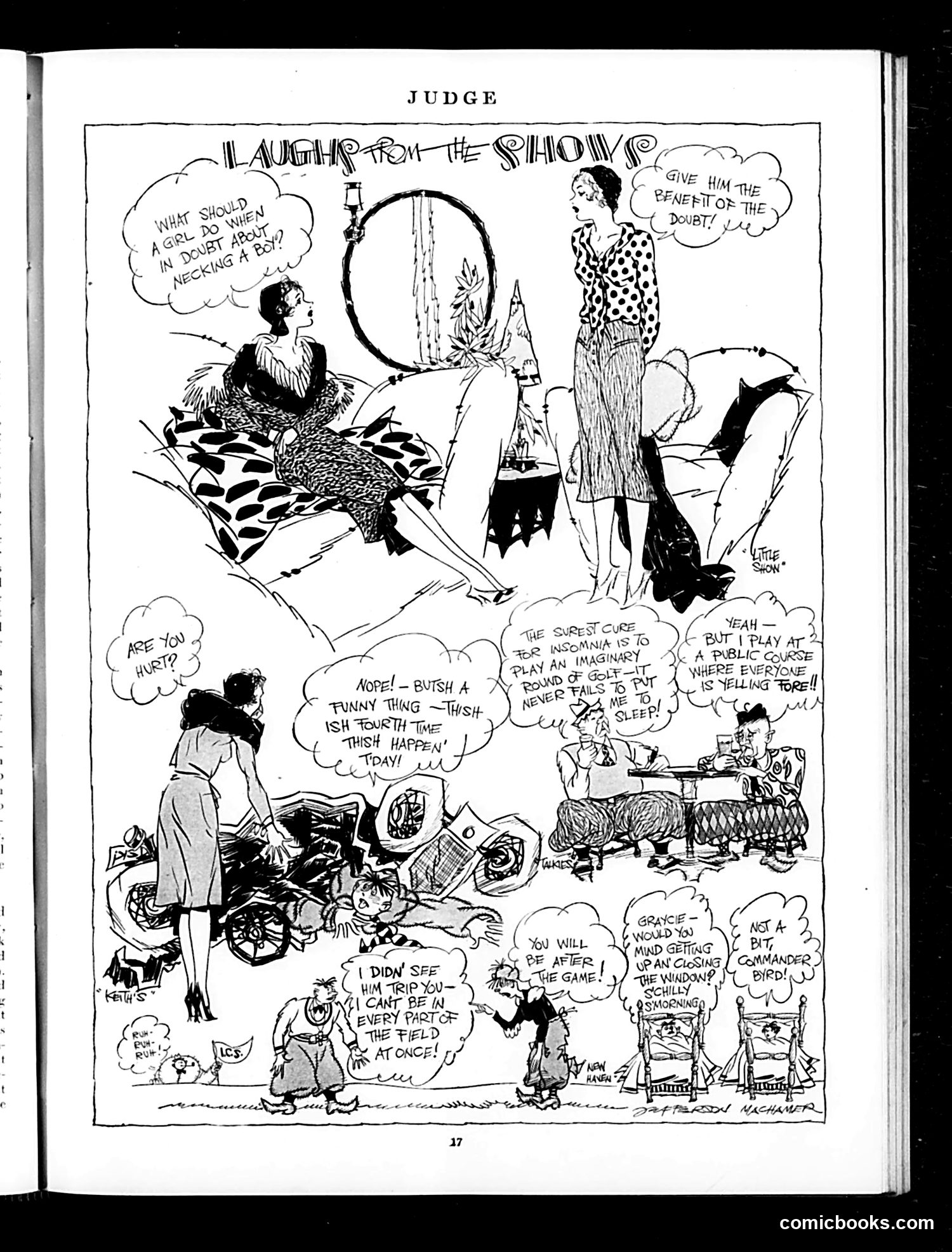
"Laughs from the Shows" - Judge Magazine Cartoon This is a satirical cartoon mocking society women's insomnia remedies and leisure activities. The scene depicts fashionable women in a bedroom setting discussing sleep solutions. The satire targets upper-class women's hypochondria and reliance on dubious "cures" for insomnia—including playing an imaginary board game and staging a public horse race in the bedroom. The cartoon ridicules both the frivolous nature of their complaints and the absurd "remedies" they propose. The characters appear to be stereotypical society figures of the era, drawn in exaggerated fashion with period clothing (appearing to be 1920s-30s based on the style). The humor lies in the disconnect between their trivial problems and their elaborate, illogical solutions. The title "Laughs from the Shows" suggests this may reference theatrical or vaudeville humor, typical of Judge's entertainment-focused satire during this period.
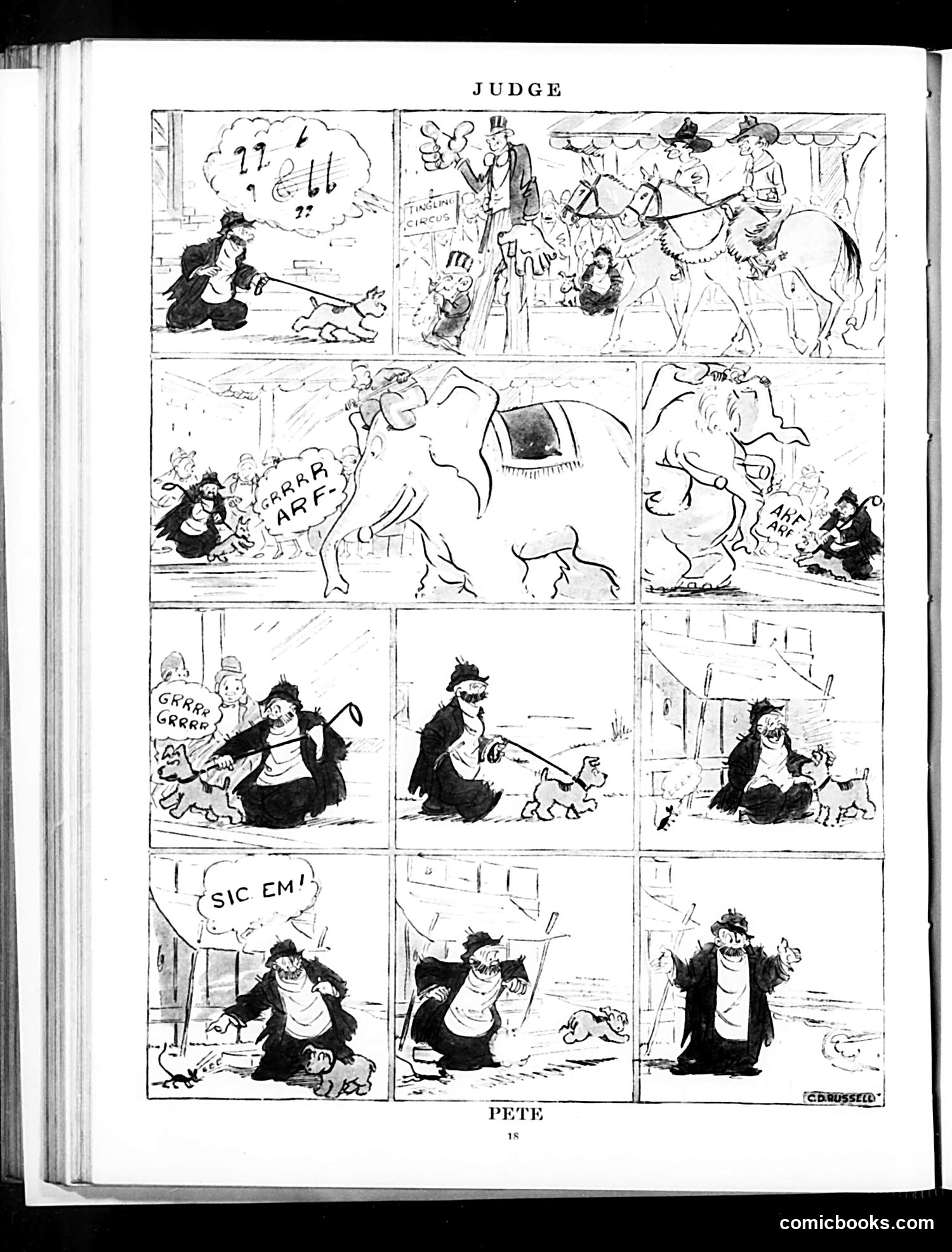
"Judge" Page Analysis This is a multi-panel comic strip titled "JUDGE" featuring a character named "PETE" (credited to artist Cesare—visible at bottom right). The narrative follows a man in formal dress dealing with a runaway pig through various comedic situations. The strip satirizes urban life and class conflict: Pete appears to be a well-dressed gentleman repeatedly confronted by an escaped pig, causing chaos and embarrassment. The humor derives from the pig's disruption of civilized spaces—a street fair, city streets, and finally indoors—forcing the dignified Pete into undignified pursuits. The Latin phrase "SIC EM!" (likely "sick 'em!") appears in one panel, showing Pete commanding the pig. The overall satire suggests incompetence, social disorder, or the intrusion of rural/base elements into refined society—common Judge magazine themes.
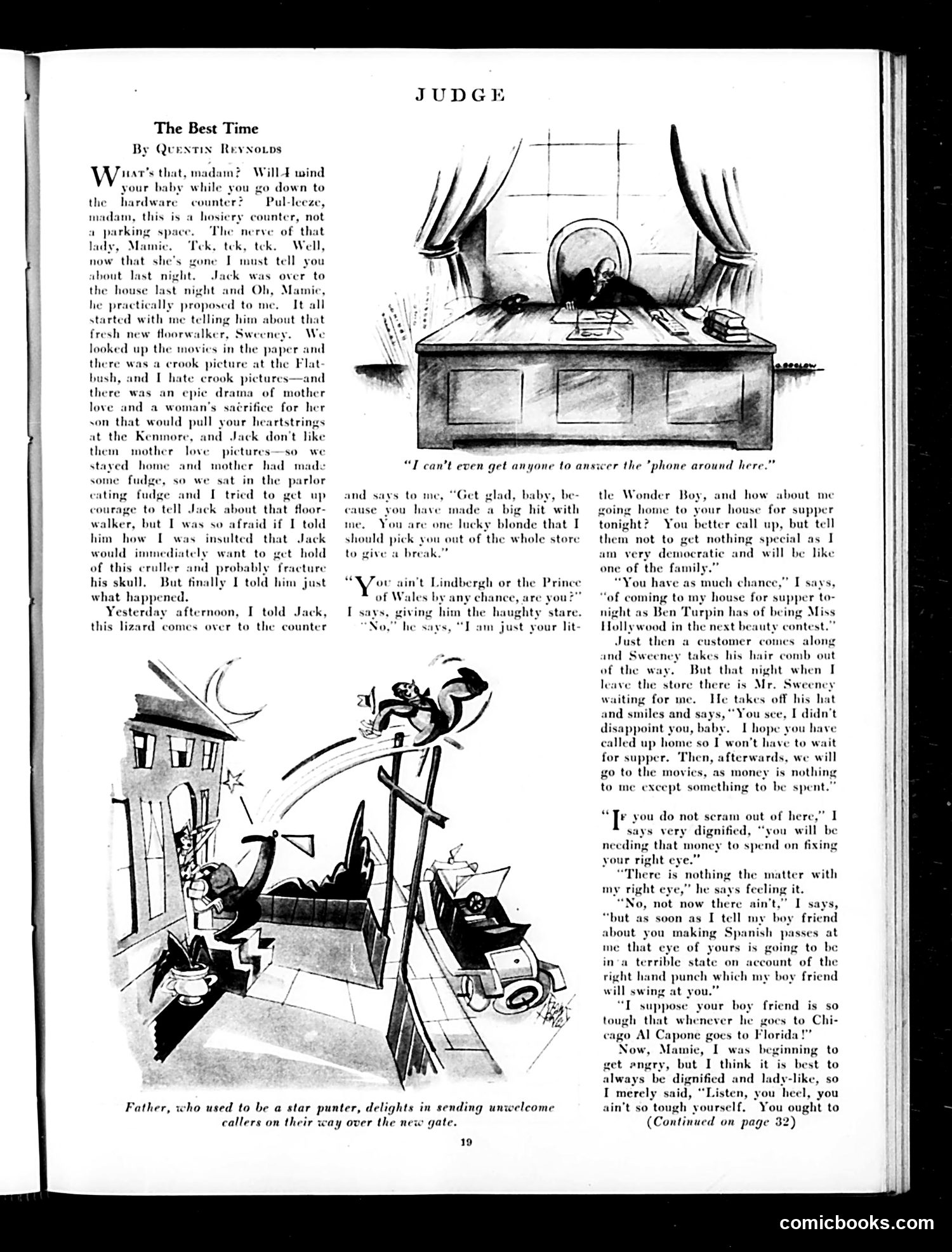
"The Best Time" by Quentin Reynolds This is a romantic comedy story illustrated with satirical cartoons. The main narrative follows a young woman named Mamie recounting to a friend how a fresh, boastful floorwalker named Sweeney made unwanted advances after she rejected his romantic overtures. The humor turns on Sweeney's comedic desperation and exaggerated self-confidence. When she rebuffs him by comparing his chances to Ben Turpin winning a beauty contest (Turpin was a cross-eyed silent film comedian), he doubles down. She threatens to have her "boy friend" beat him up; he boasts his friend is so tough that "Al Capone goes to Florida" when he's in Chicago—a reference to the notorious gangster. The illustration of the "star punter" father shows an old-fashioned, aggressive approach to dealing with unwanted suitors by literally kicking them out. The satire mocks both Sweeney's delusional persistence and the era's dating conventions.
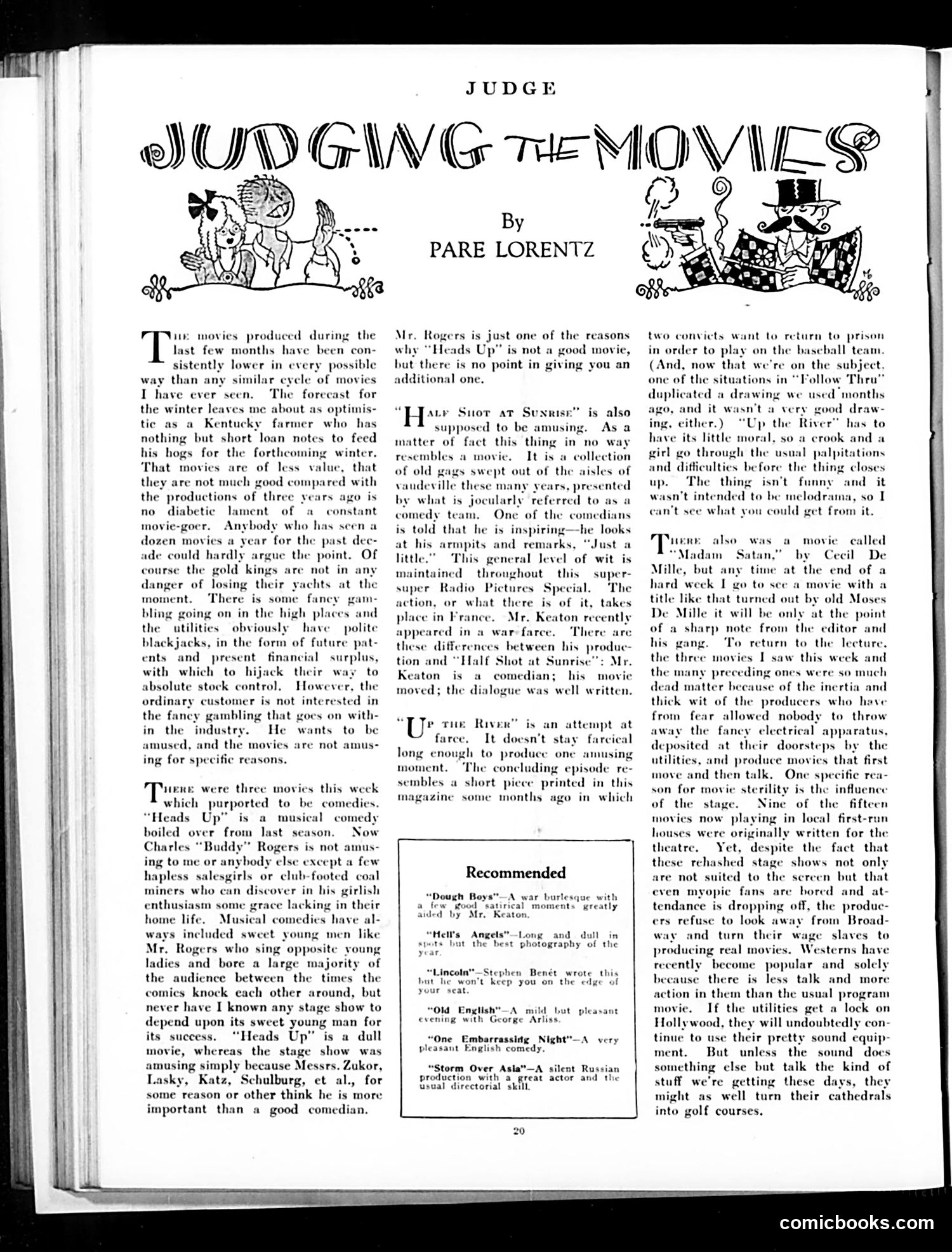
Judging the Movies: Pare Lorentz's 1930 Film Critique This is a film review column by Pare Lorentz critiquing contemporary Hollywood movies. Lorentz argues that recent film output is inferior to productions from three years prior, attributing this decline partly to casting decisions and studio economics rather than genuine entertainment value. He dismisses Charles "Buddy" Rogers in the musical comedy "Heads Up," suggesting Rogers appeals only to naive audiences and that studios overvalue him compared to actual comedians. Lorentz criticizes "Half Shot at Sunrise" as tired vaudeville material lacking wit, contrasting it unfavorably with Buster Keaton's more intelligently constructed comedies. The broader satire targets Hollywood's financial priorities: studios controlled by utilities and financiers ("gold kings") prioritize profit and stock control over audience amusement. Lorentz suggests the industry values formulaic musical numbers and star power over genuine comedy talent, reflecting 1930s studio system criticisms.
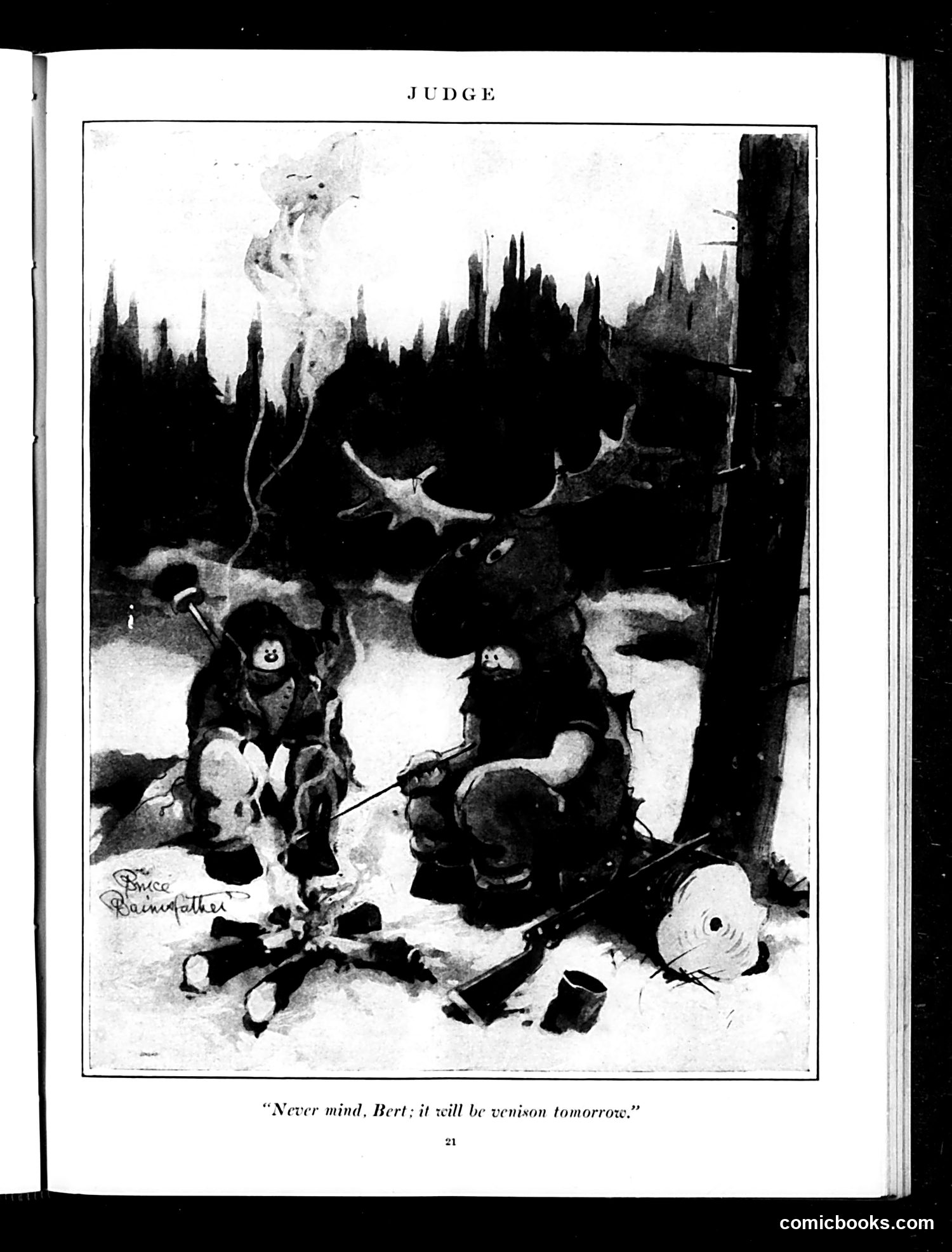
Analysis This cartoon depicts a hunting scene with dark humor. Two figures sit by a campfire in a snowy landscape with a dead animal carcass nearby. One reassures the other—addressed as "Bert"—that tomorrow's meal will be venison, implying the current food situation is undesirable. The artist's signature appears to read "Bruce Rainsworth" (or similar). The joke likely plays on food scarcity or desperation—the figures may be eating something unpalatable now but expect better game tomorrow. The cartoon could reference wartime rationing, frontier hardship, or general hunting misfortune. The silhouetted spiky forest and somewhat grotesque figures create an unsettling tone, suggesting the satire targets either survival anxiety or the grim realities of hunting/frontier life during a particular historical period.
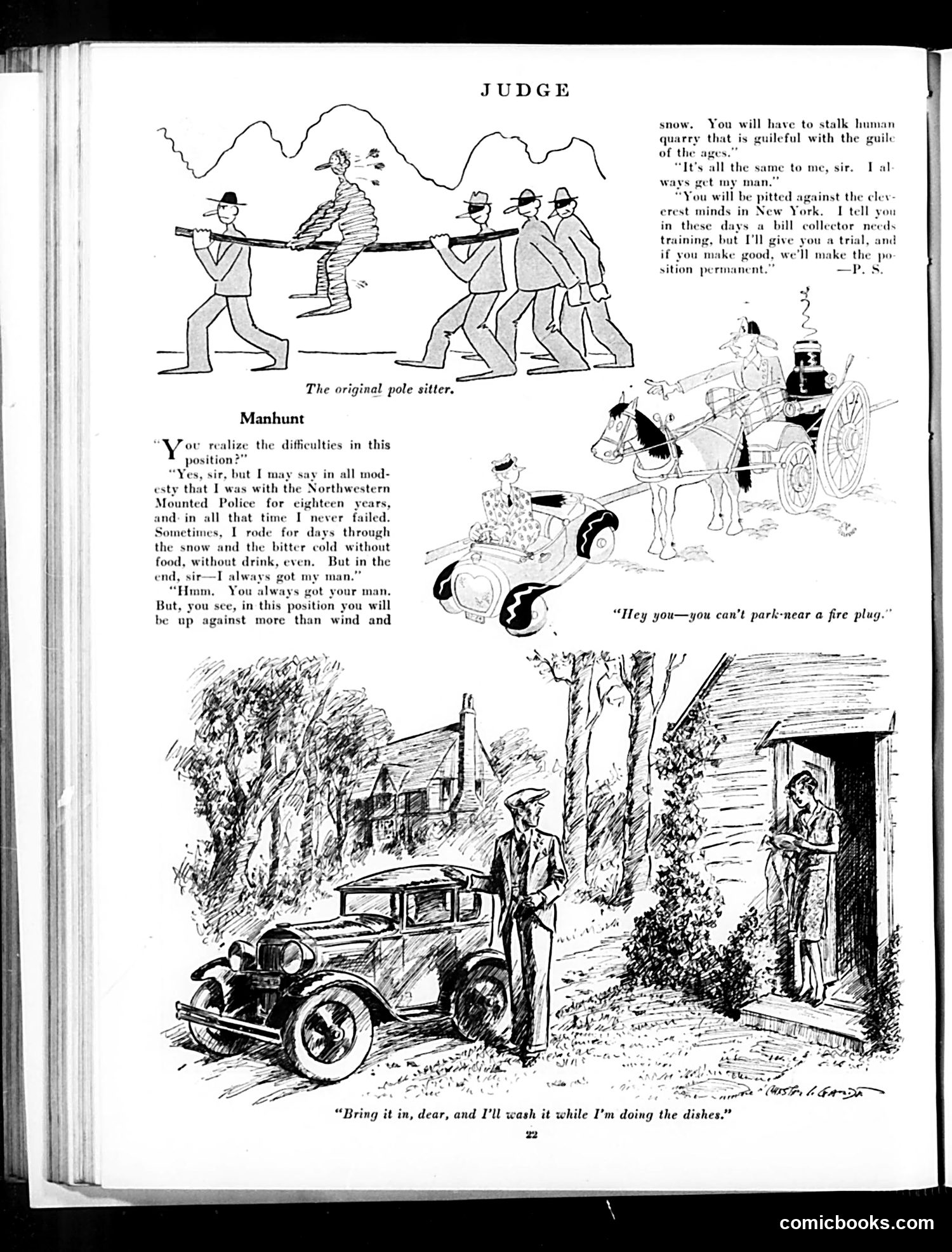
"Manhunt" - Judge Magazine Satire This page satirizes the transition from frontier law enforcement to urban bill collection. The top cartoon shows a former Northwestern Mounted Police officer—celebrated for his legendary frontier prowess ("I always got my man")—being recruited for the seemingly mundane job of bill collector in New York City. The satire's point: collecting debts from clever urban residents requires skills as demanding as tracking criminals through arctic wilderness. The joke equates the "human quarry" of debtors with dangerous fugitives, suggesting bill collection in 1920s New York is as challenging as frontier policing. The accompanying illustrations (a car near a fire plug, a man at a cottage door) reinforce the comic contrast between rugged outdoor adventure and prosaic urban collection work. The satire mocks both the pretensions of bill collectors and the difficulty of extracting money from New Yorkers.
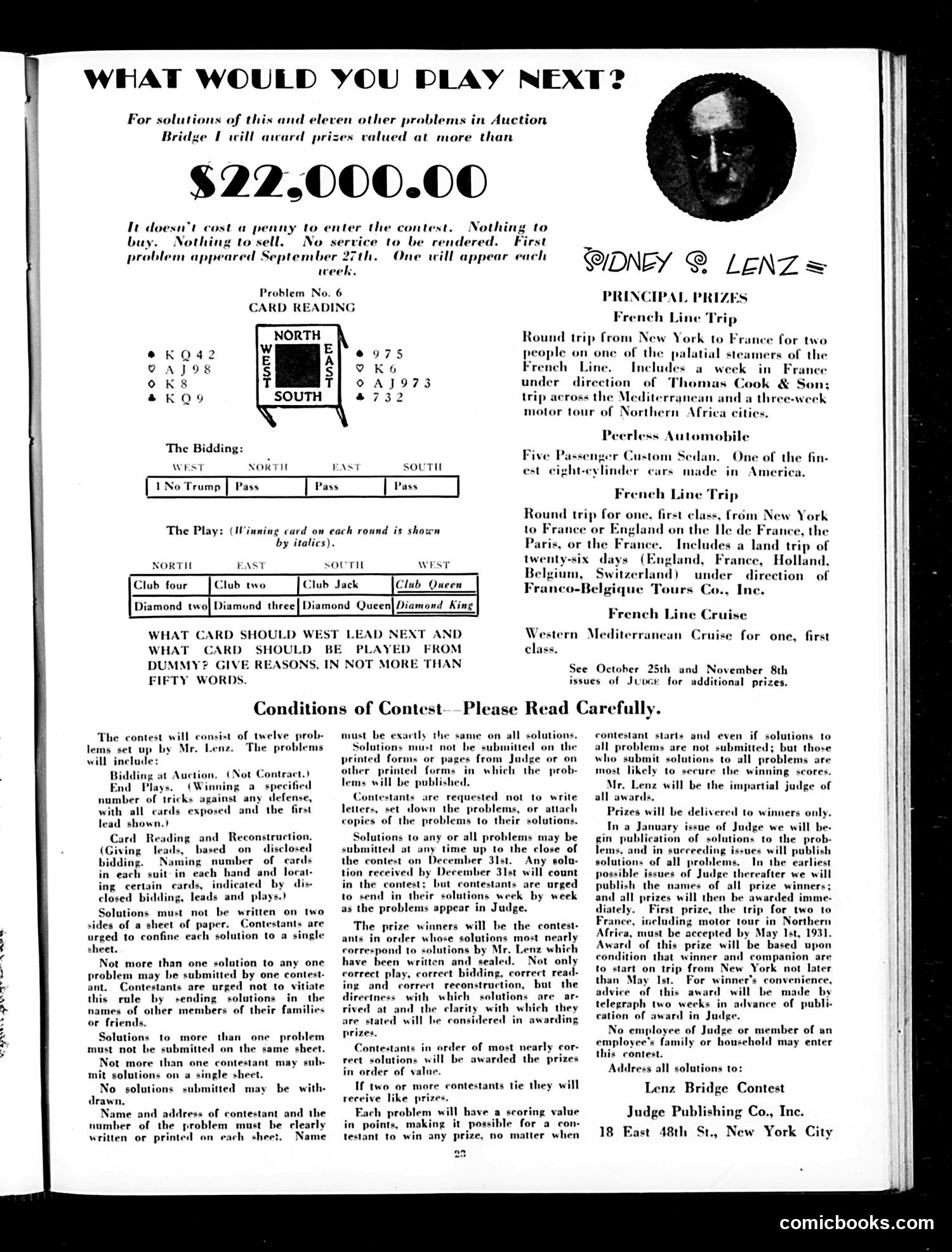
Judge Magazine Bridge Contest Page This page advertises a bridge card game contest sponsored by Sidney Lenz, a famous bridge expert (shown in the portrait). The contest offers $22,000 in prizes, primarily luxury travel packages (French Line cruises, automobile). The main content is Problem No. 6: Card Reading—a bridge puzzle where contestants must determine the correct card West should play next and explain their reasoning in fifty words. The diagram shows the hand positions and bidding sequence. This reflects bridge's early 20th-century popularity among wealthy Americans. Lenz was promoting "Auction Bridge," a variant gaining prominence in that era. The contest format—combining intellectual puzzle-solving with glamorous prizes—was typical marketing for this sophisticated card game among Judge's affluent readership. The page is primarily contest rules and advertising rather than satirical commentary, though Judge's audience would have appreciated the aspirational appeal of the prizes.
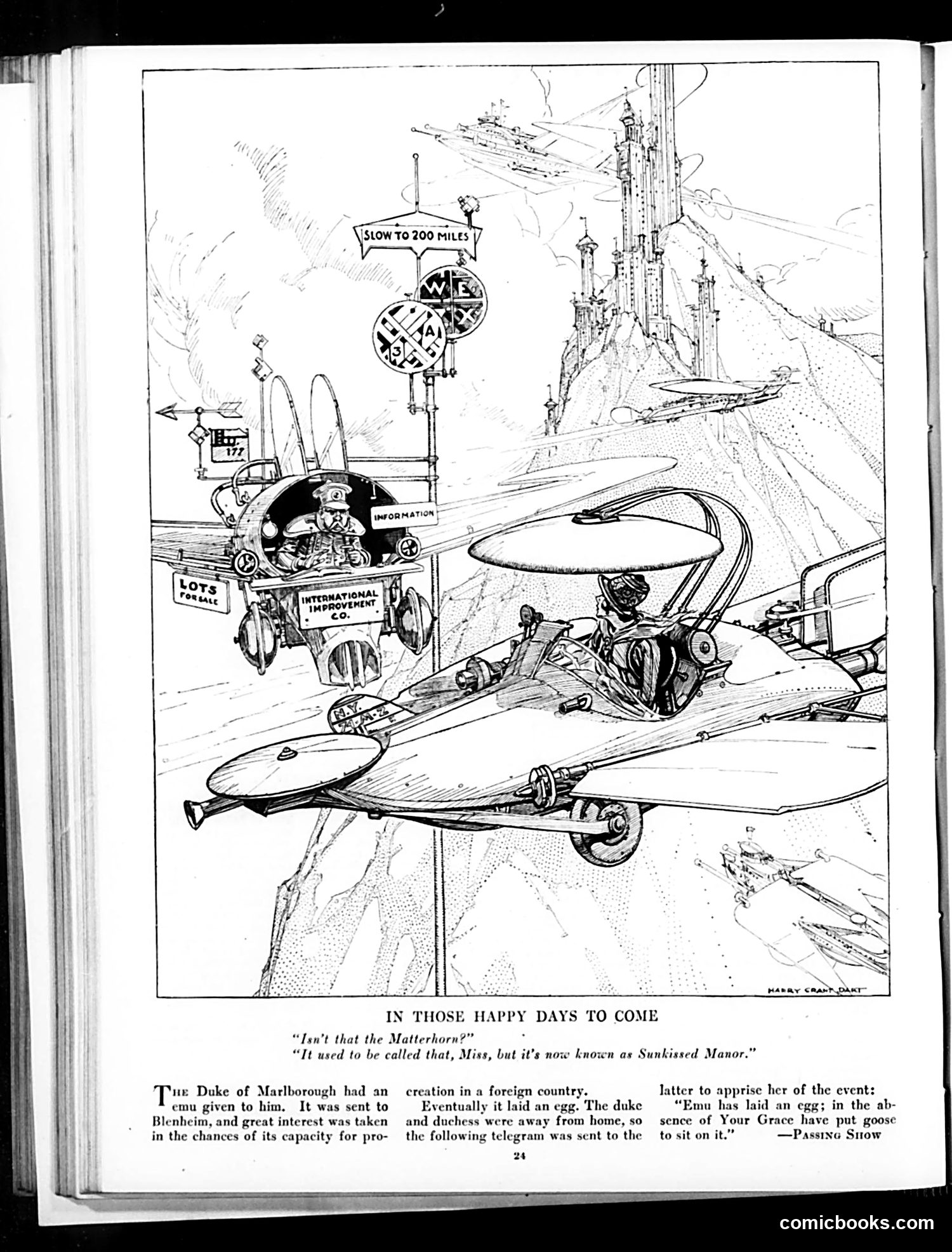
Analysis for Modern Readers This is a futuristic satire from Judge magazine depicting two imaginative scenarios: Top Cartoon: Shows fantastical flying vehicles and airships in a mountainous landscape. The joke plays on real estate development—a famous natural landmark (the Matterhorn) has been commercialized and renamed "Sunkissed Manor," likely a resort. This satirizes turn-of-the-century anxieties about industrialization and commercialization destroying natural beauty. Bottom Text Anecdote: A humorous story about the Duke of Marlborough receiving an emu (a large flightless bird) as a gift. While the duke and duchess were away, the emu laid an egg. A servant's telegram asks permission to let a goose sit on it, treating the situation as a domestic farming matter. The joke plays on the absurdity of owning exotic animals and the formal etiquette of aristocratic life. Both pieces reflect early 20th-century satirical humor about technological progress, wealth, and social conventions.
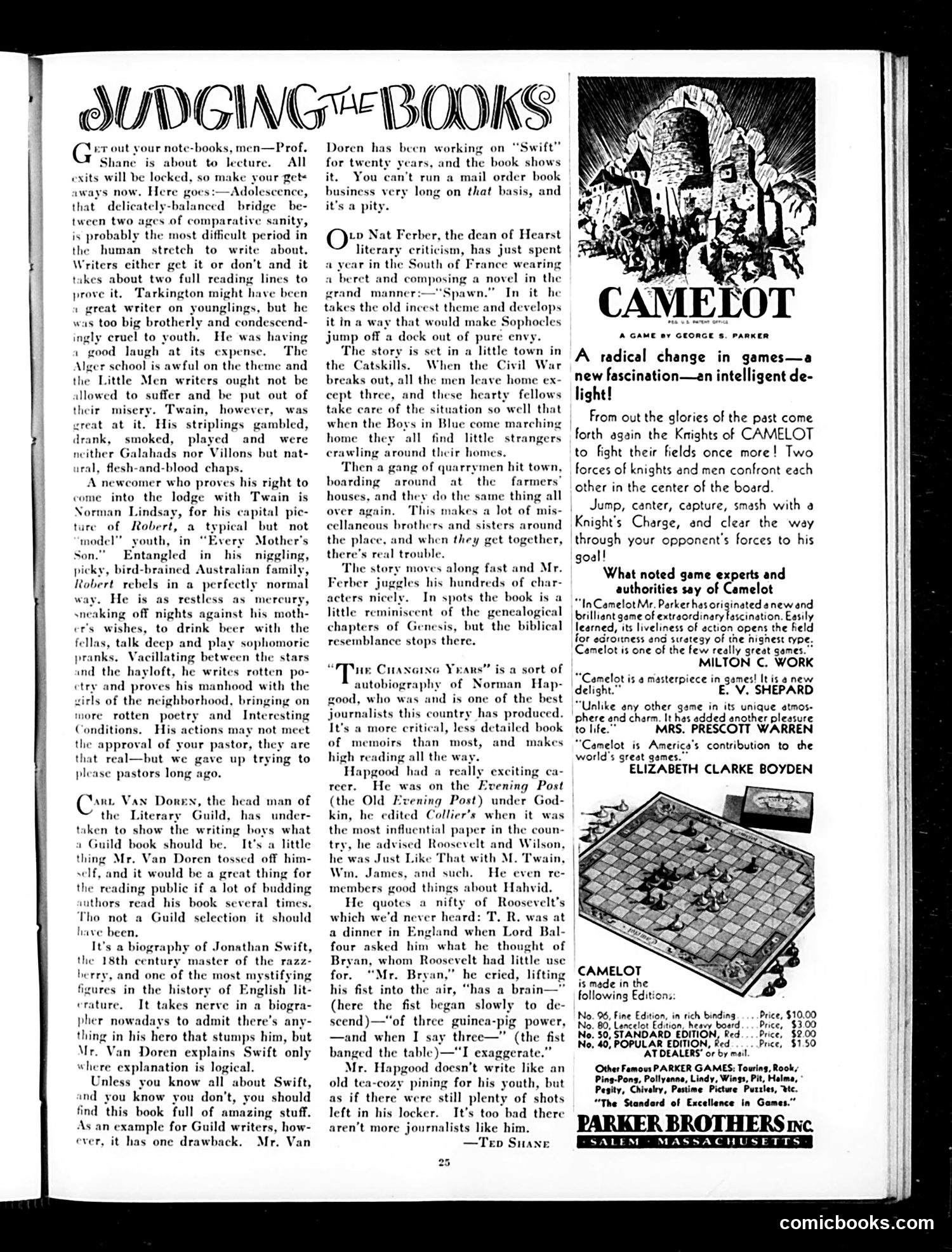
Analysis of This Judge Magazine Page This page is primarily a book review column titled "Judging the Books," not a political cartoon. The author critiques contemporary literature for aspiring writers. The main satirical target is literary pretension. The column mocks writers who are overly "delicately-balanced" or self-consciously artistic, contrasting them with Mark Twain's authentic portrayal of youth. Key figures mentioned: - Norman Lindsay: Praised for realistic depiction of a rebellious young man named Robert - Carl Van Doren: Head of the Literary Guild, critiqued for spending twenty years perfecting a biography of Jonathan Swift—making it unmarketable for mass audiences - Nat Ferber: A Hearst literary critic whose Southern novel uses incest themes supposedly inspired by classical tragedy The satire's point: serious literary ambition can be self-defeating. Van Doren's meticulous scholarship produces an unsellable book; contemporary writers overthink their craft. The underlying message criticizes both academic pretension and mass-market compromise in 1920s publishing.
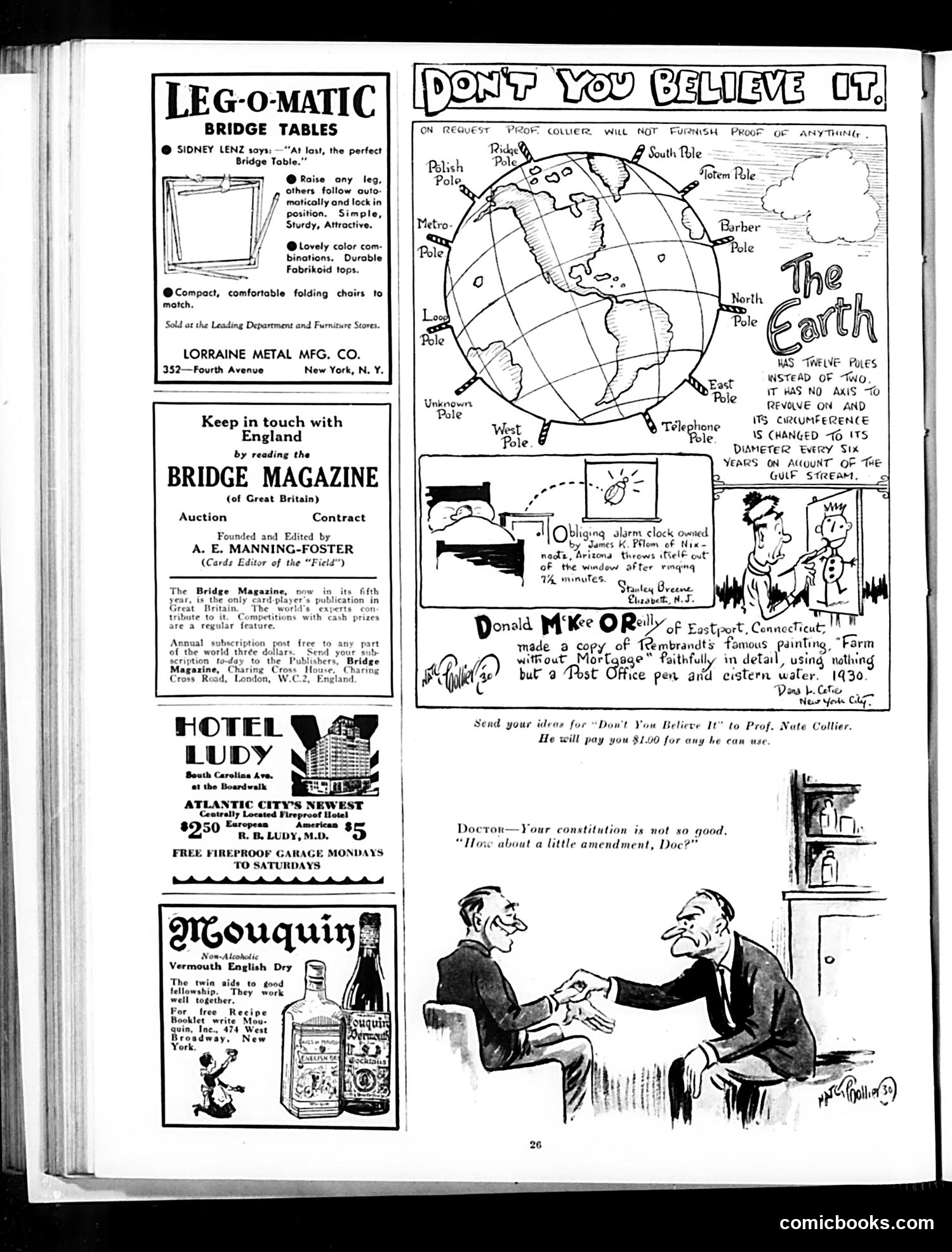
Analysis of Judge Magazine Page This page is primarily advertising and filler content rather than political satire. The main elements include: Advertisements: - Leg-O-Matic bridge tables (furniture) - Bridge Magazine subscription (British card game publication) - Hotel Ludy (Atlantic City) - Quoquin vermouth "Don't You Believe It" section: A humor column featuring absurd claims readers supposedly submitted. Examples include a globe with "twelve poles instead of two," an alarm clock that throws itself out windows, and someone copying a Rembrandt painting using only a pen and cistern water. The jokes mock implausible reader submissions. Bottom cartoon: A doctor-patient dialogue joke: "Your constitution is not so good. How about a little amendment, Doc?" This is a mild pun playing on "amendment" (constitutional amendment) versus "treatment." The page appears to be from the 1930s-40s era based on design and references. It lacks significant political commentary—mostly filler material typical of magazines that mixed advertising with light humor.
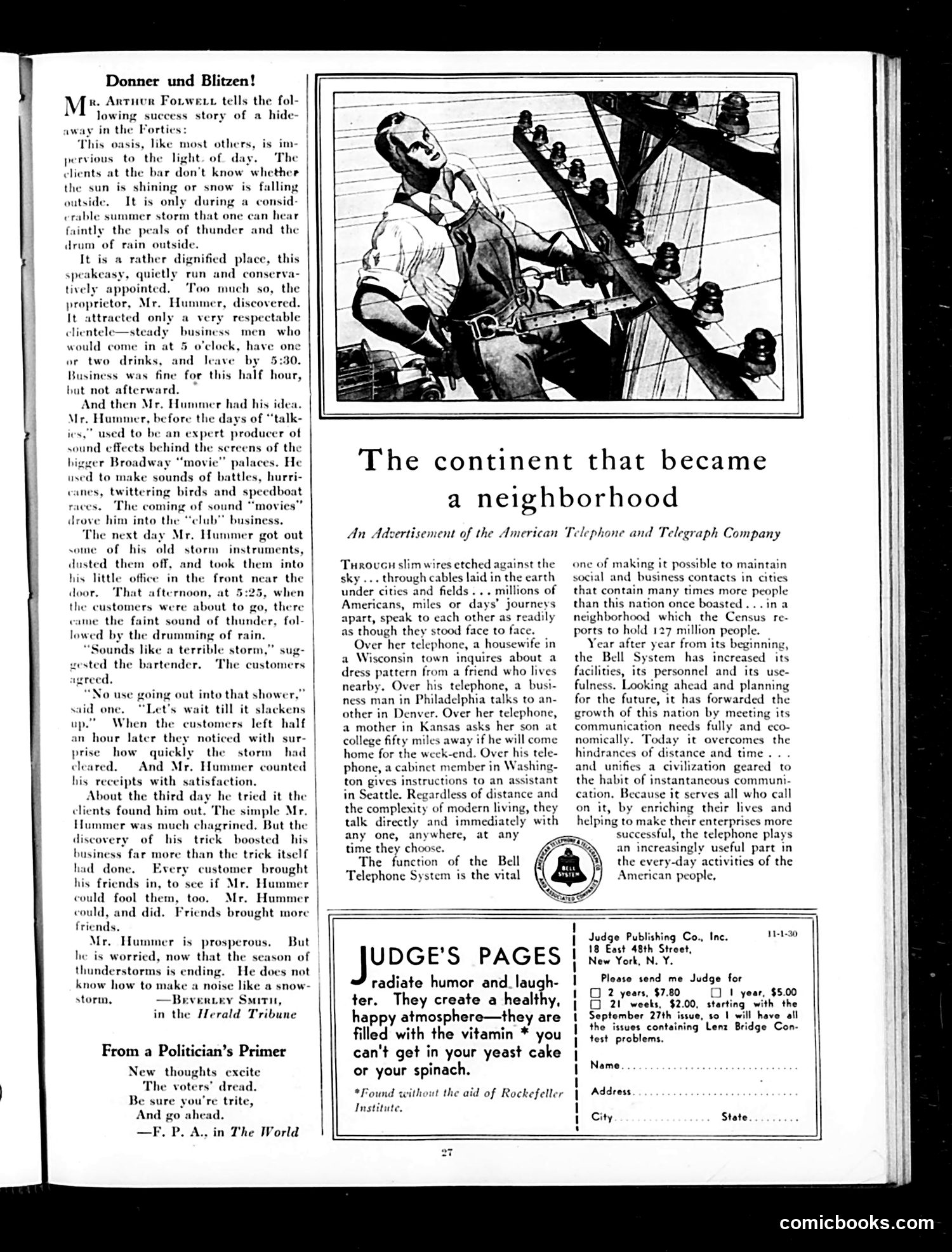
"Donner und Blitzen!" — A Speakeasy Success Story This page contains a humorous anecdote (not a political cartoon) about a Prohibition-era speakeasy owner named Mr. Hummer who ingeniously increases business during slow hours by using sound-effect machines to simulate thunderstorms in his soundproof bar. The joke: Customers believe an actual storm is occurring outside and delay leaving, extending their drinking time and spending. When discovered, the trick paradoxically *boosts* business as patrons bring friends to test whether Hummer can fool them again. The satire targets Prohibition's absurdity—a respectable speakeasy struggling to attract customers despite operating illegally, and customers actually *enjoying* being deceived into overstaying. Hummer's resourcefulness (he's a former movie sound-effects technician) underscores how ordinary Americans created elaborate workarounds to circumvent unpopular Prohibition laws. The page also includes a Bell Telephone advertisement celebrating long-distance communication's role in American life.
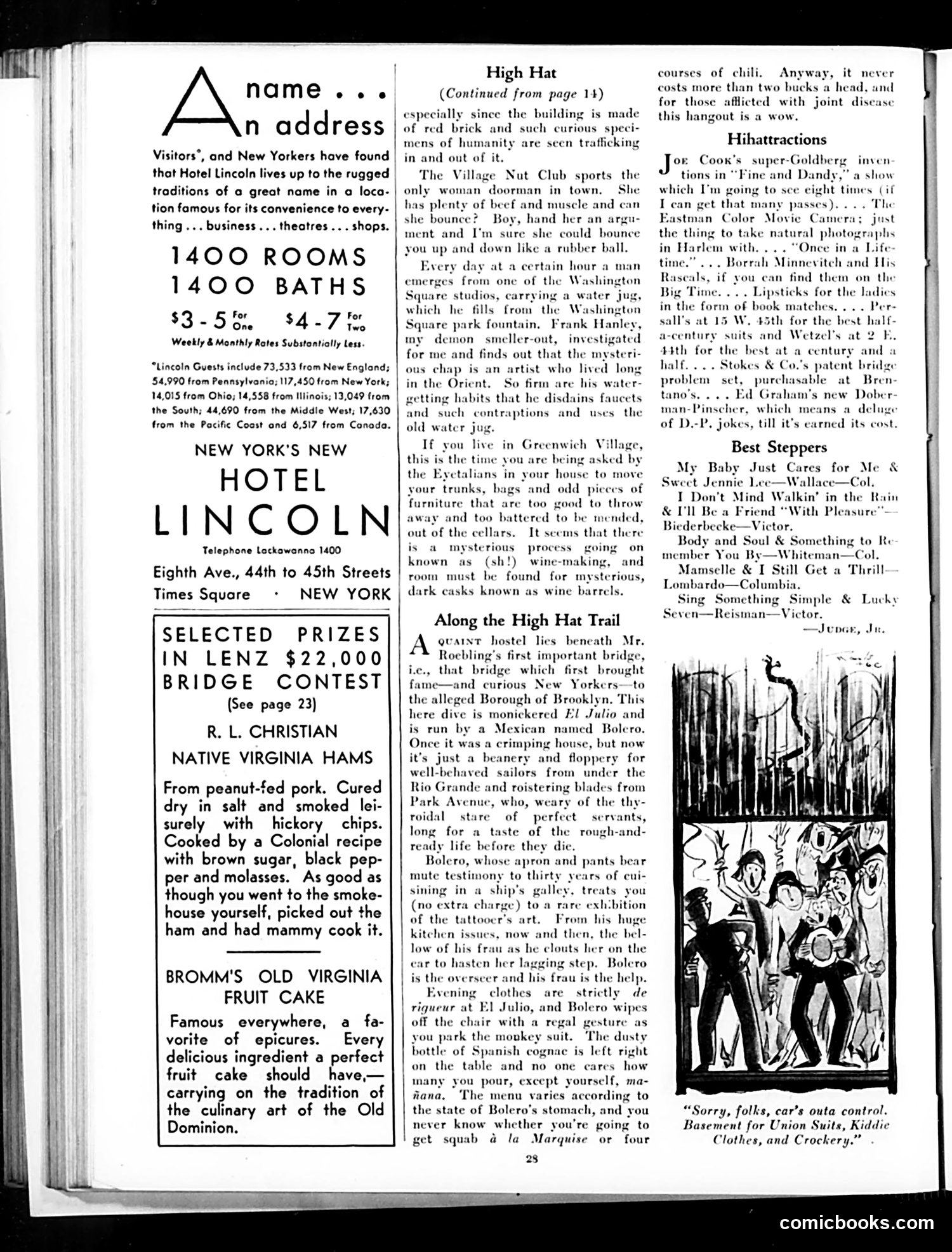
Analysis of Judge Magazine Page Content This page is primarily advertising, not satire or political commentary. The dominant content features ads for the Hotel Lincoln (1400 rooms/baths in Times Square), along with product advertisements for R.L. Christian Virginia hams and Bromm's Old Virginia fruit cake. The small illustration at bottom right shows a domestic scene with the caption "Sorry, folks, car's outa control. Basement for Union Suits, Kiddie Clothes, and Crockery"—a mild visual gag about a car accident. The main text column continues a "High Hat" travel feature describing Greenwich Village establishments, including the Village Nut Club and a Mexican restaurant called El Julio run by someone named Bolero. The writing is descriptive rather than satirical, documenting bohemian New York spots with casual ethnic stereotyping typical of the era. Context: This appears to be a 1920s-era Judge issue mixing tourism/hotel promotion with lifestyle commentary on New York's artistic neighborhoods.
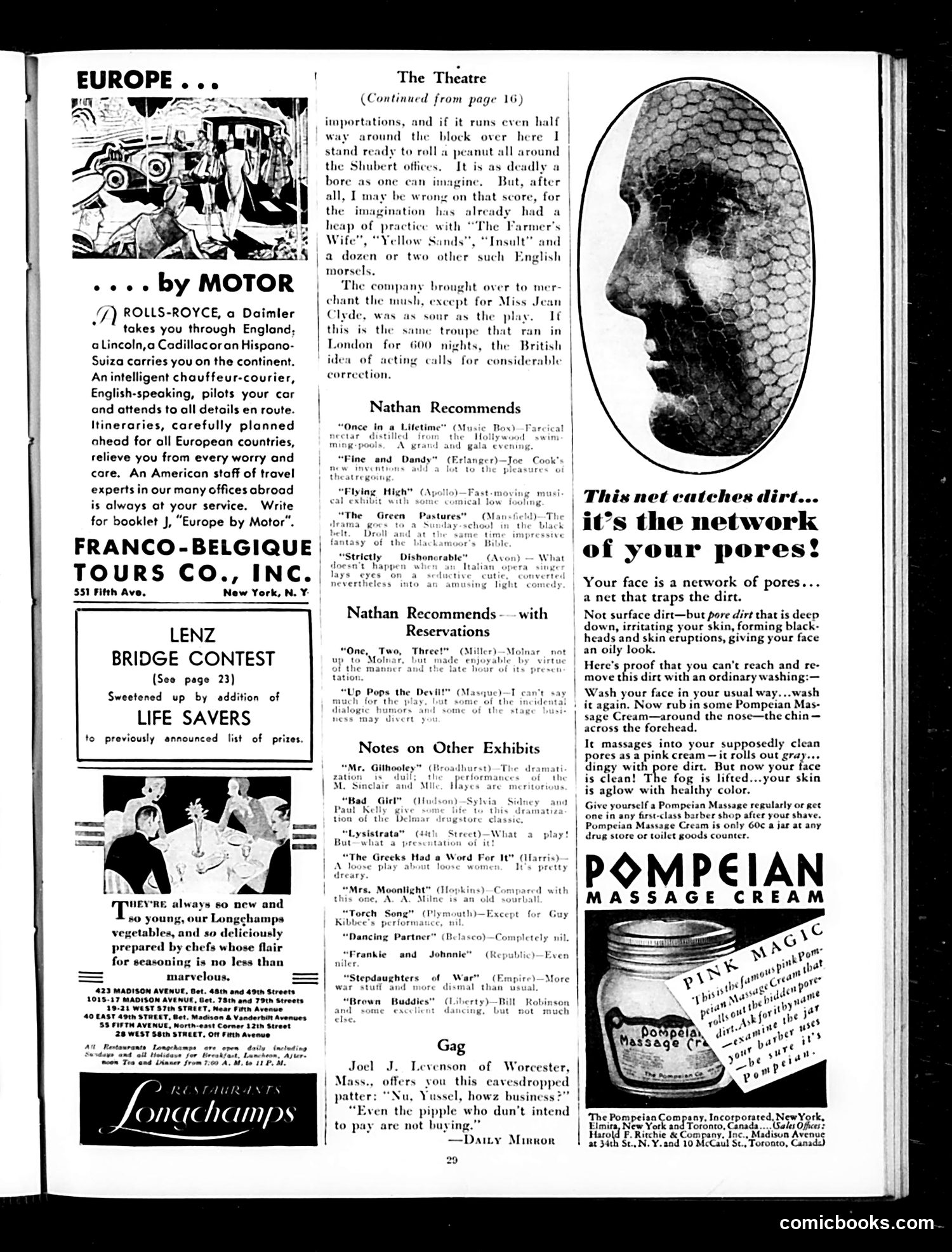
Judge Magazine Page Analysis This page is primarily advertising and entertainment reviews, not political satire. The left side contains travel and restaurant ads (Franco-Belgique Tours, Longchamps restaurant). The center features theater criticism by "Nathan," reviewing contemporary Broadway shows like "The Green Pastures" and "Once in a Lifetime." The dominant content is a Pompeian Massage Cream advertisement (right side) featuring a close-up photograph of a face covered in the product. The ad uses pseudoscientific language about "pores as a network" trapping dirt, claiming the cream—when rubbed on and rolled away—removes deep pore dirt invisible to ordinary washing. This represents typical 1920s-30s cosmetic marketing employing exaggerated claims about skincare. At bottom is a brief humor item ("Gag") quoting a Worcester man's cynical remark about non-paying theater audiences. The page reflects Judge's mixed content: theater criticism, luxury travel marketing targeting wealthy readers, and consumer product advertising employing pseudo-medical rhetoric common to the era.
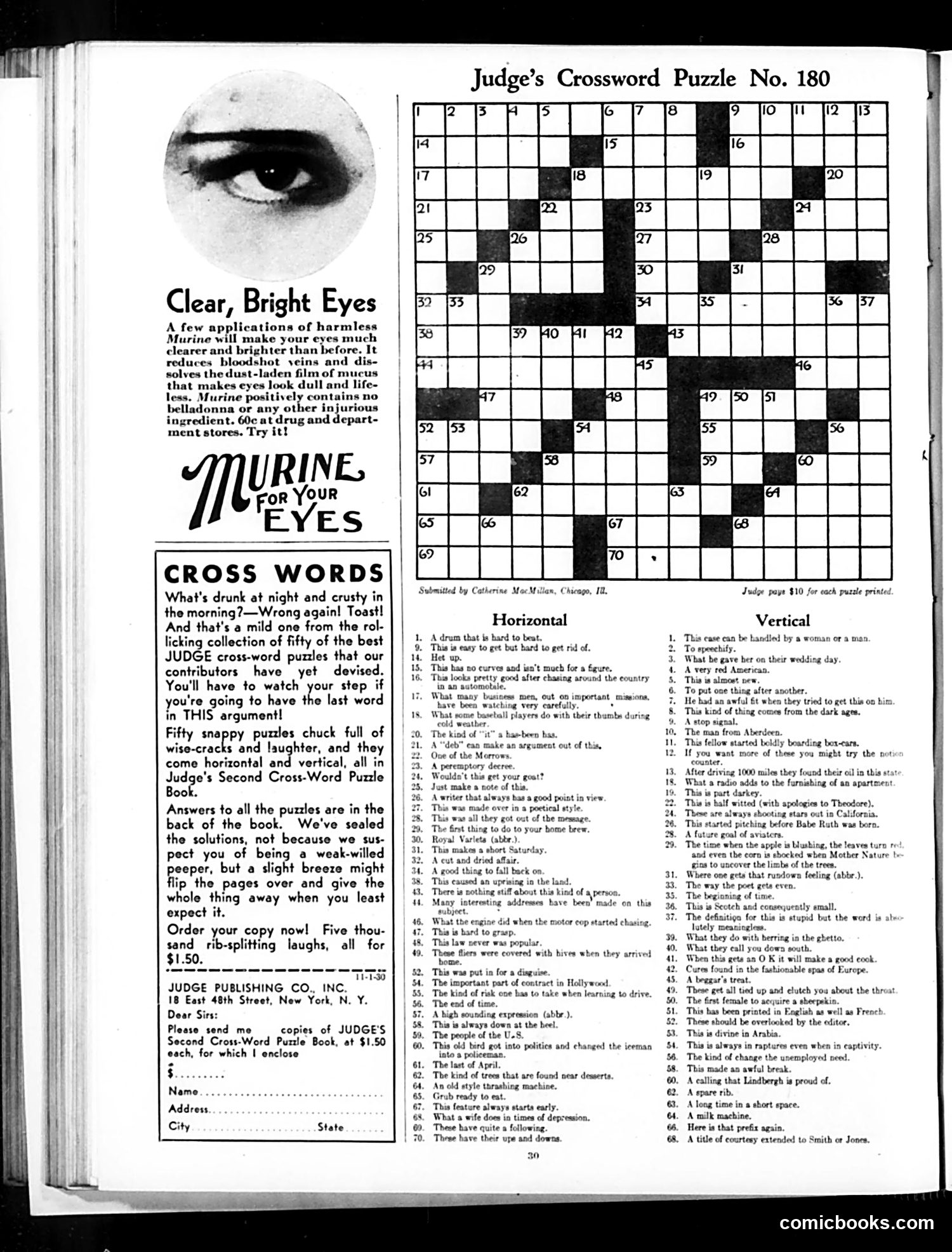
Judge Magazine Crossword Puzzle Page (Analysis) This page is primarily advertising and promotional content rather than political satire. The main elements are: 1. Murine Eye Drops Advertisement: A product ad featuring a close-up eye photograph, promoting a commercial eyewash solution as "harmless" and effective for clarity and brightness. 2. Judge's Second Cross-Word Puzzle Book Advertisement: The bulk of the page promotes a collection of 50 crossword puzzles compiled from Judge contributors, priced at $1.50. The ad uses humorous language ("What's drunk at night and crusty in the morning?—Toast!") to showcase the book's comedic content. 3. Crossword Puzzle No. 180: An actual crossword puzzle with clues, submitted by a Chicago reader. Context for modern readers: This reflects 1920s-30s Judge magazine's business model—mixing editorial content with advertising. Crossword puzzles were a cultural craze following their 1913 invention, and magazines capitalized on this trend by selling puzzle collections. The page demonstrates how publications monetized popular entertainment formats.
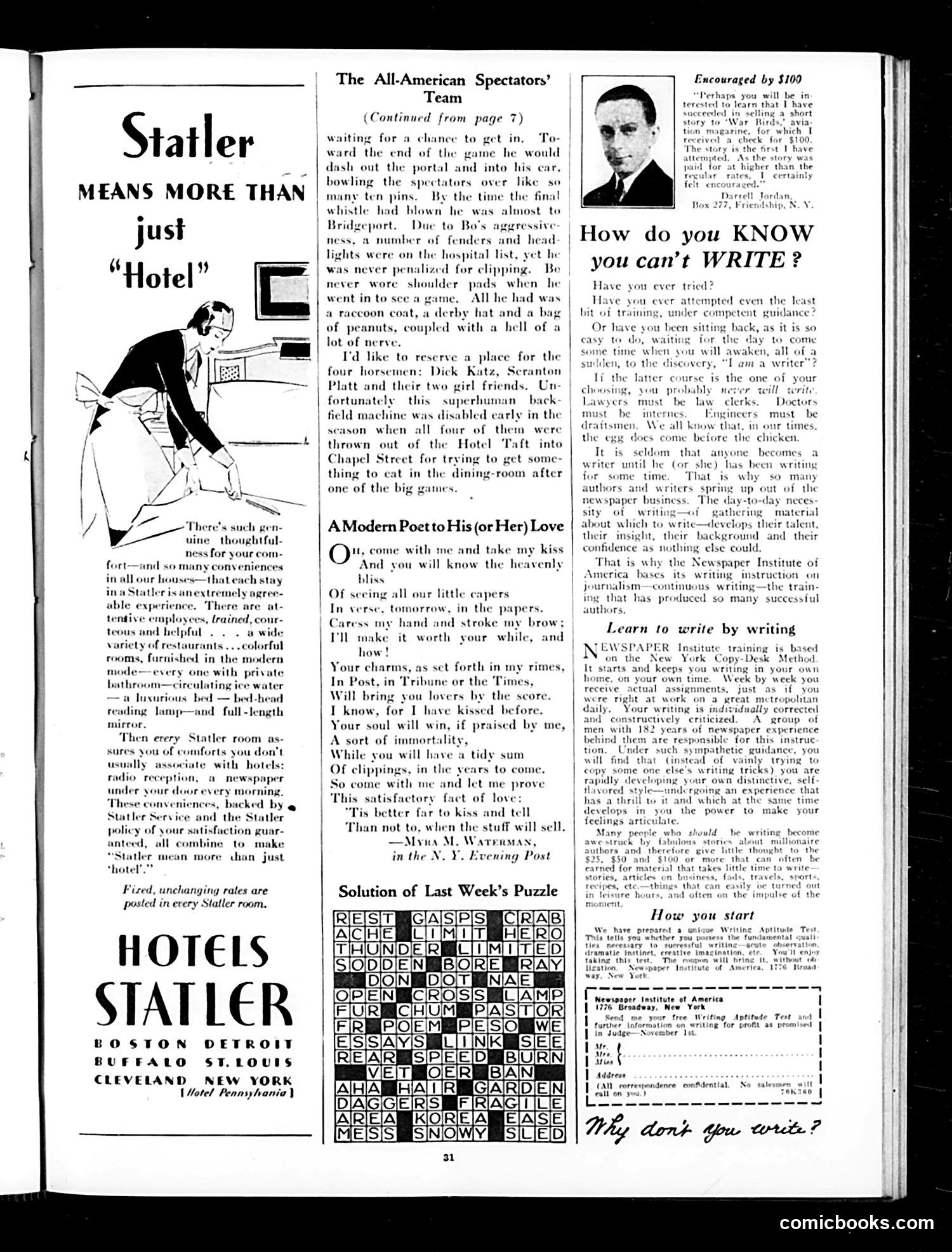
Understanding This Judge Magazine Page This is primarily an advertising page for the Statler Hotel chain, occupying most of the layout. The ads emphasize comfort, service reliability, and consistent pricing—marketing to middle-class travelers seeking dependable accommodations across major cities (Boston, Detroit, Buffalo, St. Louis, Cleveland, New York). The accompanying editorial content includes: 1. "The All-American Spectators' Team" — a humorous piece about rowdy sports fans, including "Bo," whose aggressive behavior at games (speeding away in his car, knocking over spectators) contrasts absurdly with his lack of protective equipment. 2. "A Modern Poet to His Love" — satirizing opportunistic writers who court women primarily to generate publishable material from the romance, treating real human connection as fodder for newspaper columns. 3. A Newspaper Institute advertisement promoting writing courses by correspondence. The page reflects 1920s-30s concerns: commercial travel culture, the professionalization of writing, and satirical commentary on how modern life commodifies romance and leisure. The humor is genteel rather than biting.
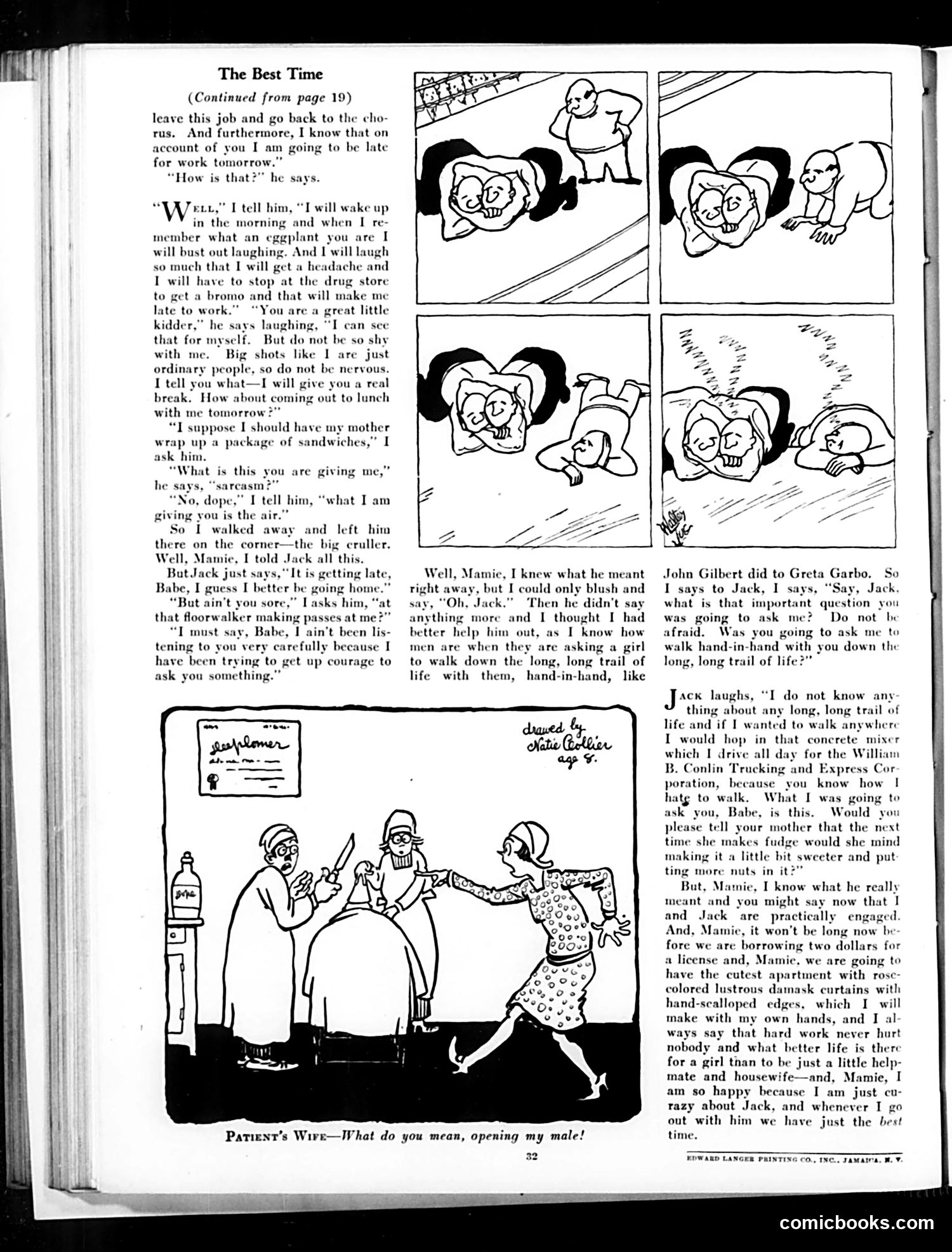
"The Best Time" - Judge Magazine Analysis This page contains a romantic comedy story told in first-person narrative, with one accompanying cartoon. The narrative follows a working-class woman ("Mamie") recounting her courtship with "Jack," a concrete mixer driver for a trucking company. The humor relies on class-based satire and romantic irony. Jack, portrayed as an unsophisticated "big cruller" (slang for an oafish man), makes clumsy romantic advances. The satire culminates when his supposed marriage proposal is revealed as merely requesting that Mamie's mother add more nuts to her fudge—yet Mamie interprets this as a genuine engagement anyway. The accompanying cartoon shows a patient's wife with her arm around a male doctor, captioned "What do you mean, opening my male!"—a pun on "opening my mail," suggesting marital jealousy or infidelity. The satire targets working-class romantic expectations and female naiveté, portraying both protagonists as simple-minded yet content with modest lives.
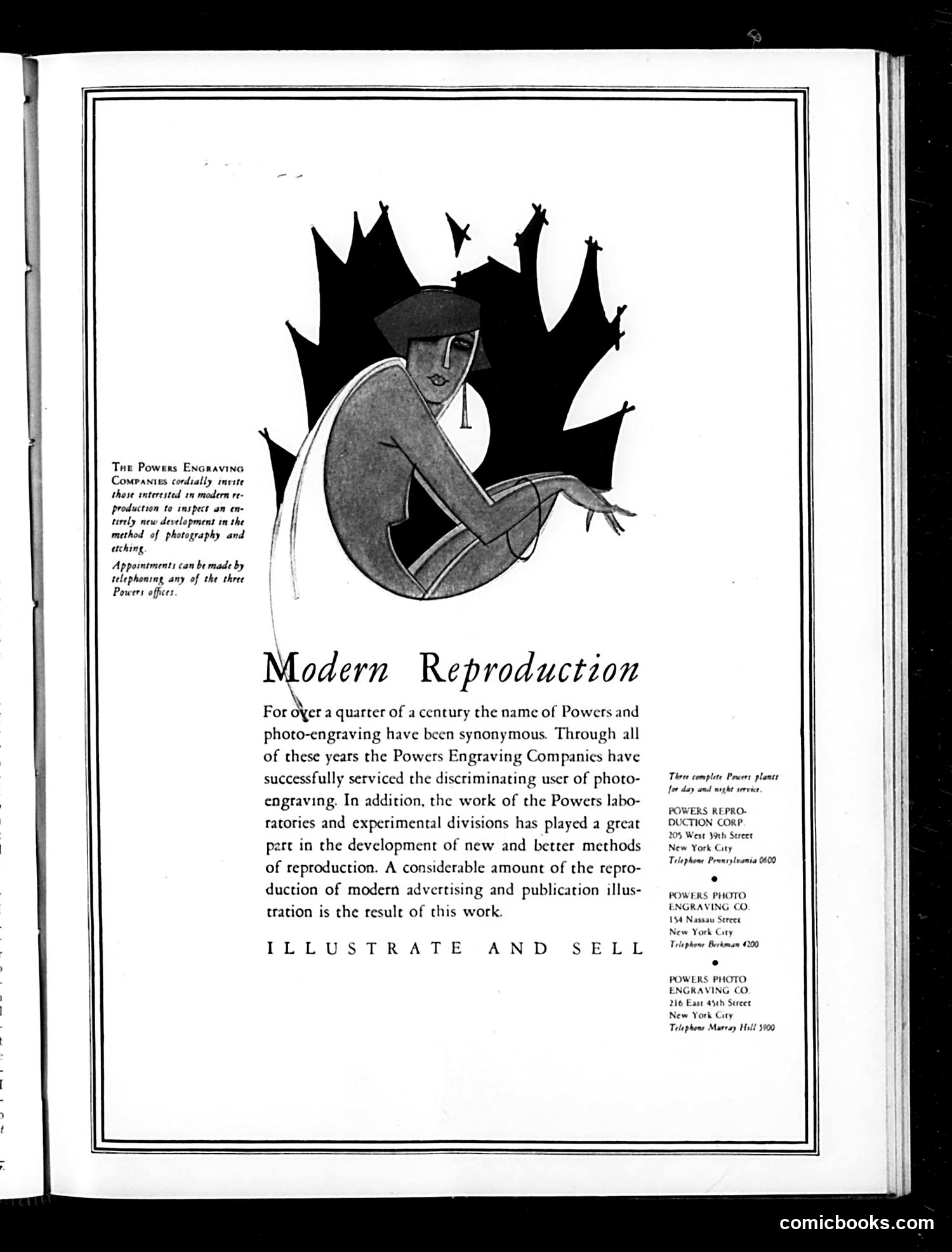
This is primarily a trade advertisement, not political satire. It's a full-page ad for the Powers Engraving Companies promoting their photo-engraving and reproduction services. The illustration shows a stylized figure (appears to be a worker or artisan) emerging from or surrounded by a crown-like or jagged shape, likely symbolizing the technical mastery and superior quality of Powers' reproduction methods. The crown imagery suggests dominance in their field. The text emphasizes that Powers has been synonymous with photo-engraving for over 25 years and has pioneered new reproduction techniques through their laboratories. The phrase "ILLUSTRATE AND SELL" is their core message—their services help advertisers and publishers create and distribute modern illustrated content effectively. Three Powers offices are listed with contact information, inviting potential clients to inspect their "entirely new development" in photography and etching technology. This represents early 20th-century industrial advertising in a trade publication, highlighting technological innovation rather than political commentary.
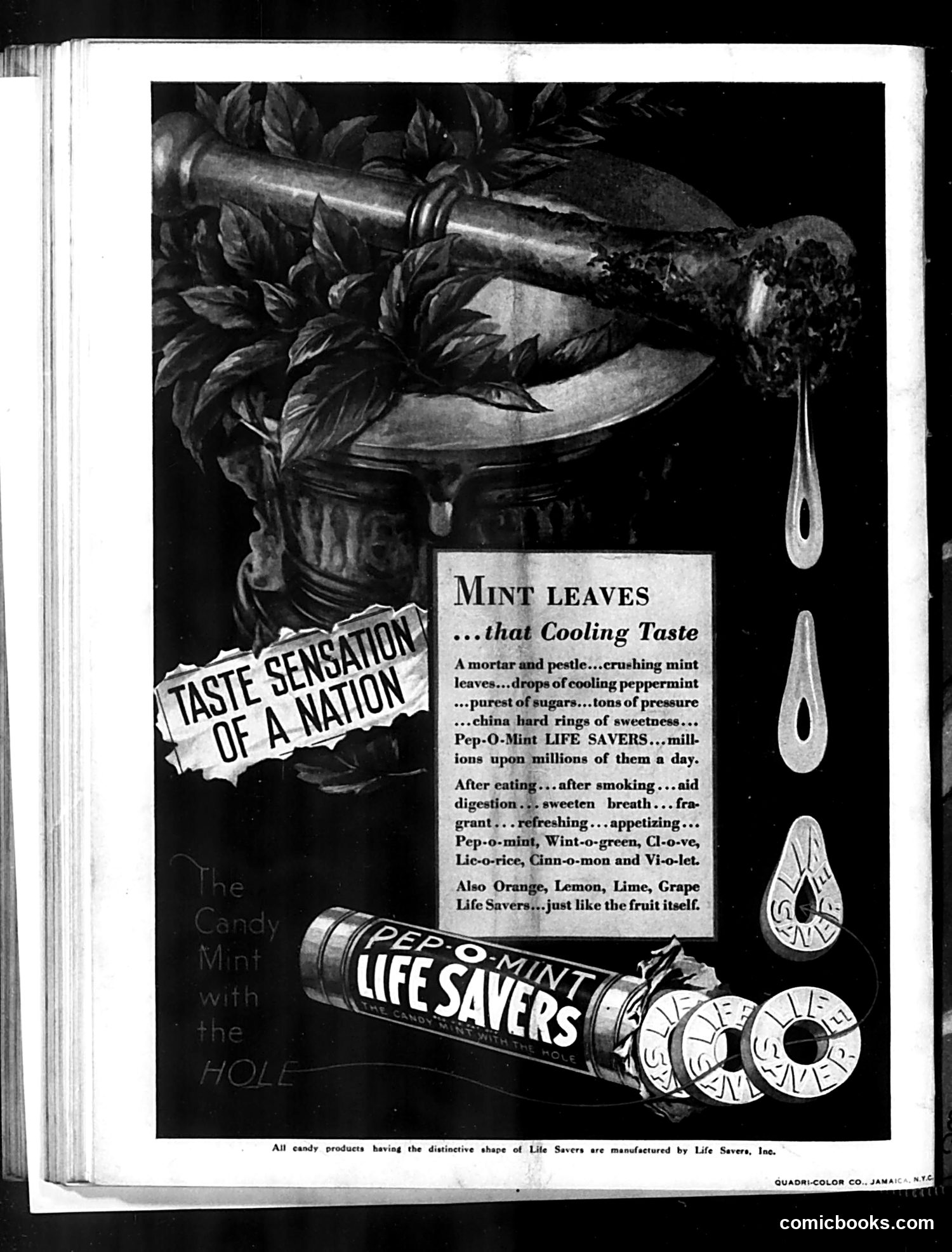
Analysis This is not a cartoon or satire—it's a Life Savers candy advertisement disguised as editorial content in Judge magazine. The page features ornate imagery of a classical hand/arm holding a mortar and pestle crushing mint leaves, with Life Savers candies displayed below. The elaborate decorative style and poetic language ("purest of sugars," "china hard rings of sweetness") aim to elevate the product as a sophisticated confection rather than cheap candy. The text emphasizes Life Savers' practical uses: aiding digestion, sweetening breath, and providing refreshment—common marketing claims for mints and hard candies of the era. The tagline "Taste Sensation of a Nation" suggests widespread popularity. This represents typical early 20th-century advertising strategy: blending paid advertisements into magazine pages with artistic presentation to appear as legitimate editorial content, capitalizing on Judge's influential readership.