judge
Judge — November 8, 1930
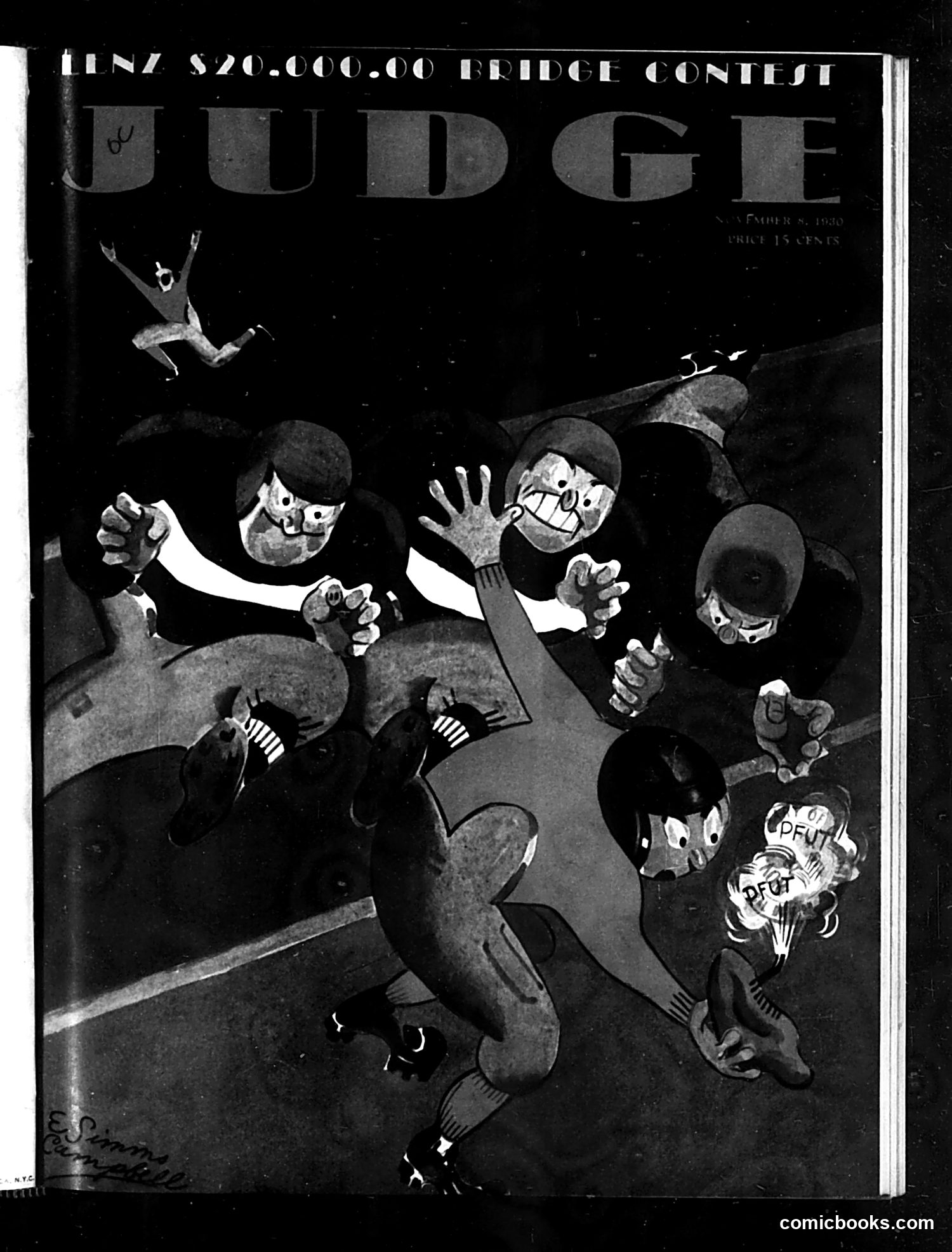
Judge Magazine Cover Analysis This appears to be a Judge magazine cover from the early 1900s featuring a satirical bridge-building contest theme. The central figure is a large, rotund man (likely representing a political or industrial figure of the era) who has constructed an absurdly unstable bridge structure. The smaller caricatured figures around him—some appearing to fall or struggle—suggest the bridge is failing or dangerous. The "$20,000.00 Bridge Contest" text indicates this satirizes a real competition or public works project. The exaggerated physical characteristics and expressions are typical of period political cartooning, which often used ethnic or class-based caricature. Without clearer identification of the specific figures or dating, the exact political reference remains unclear, though it likely critiques corruption, incompetence, or fraud in public construction contracts.
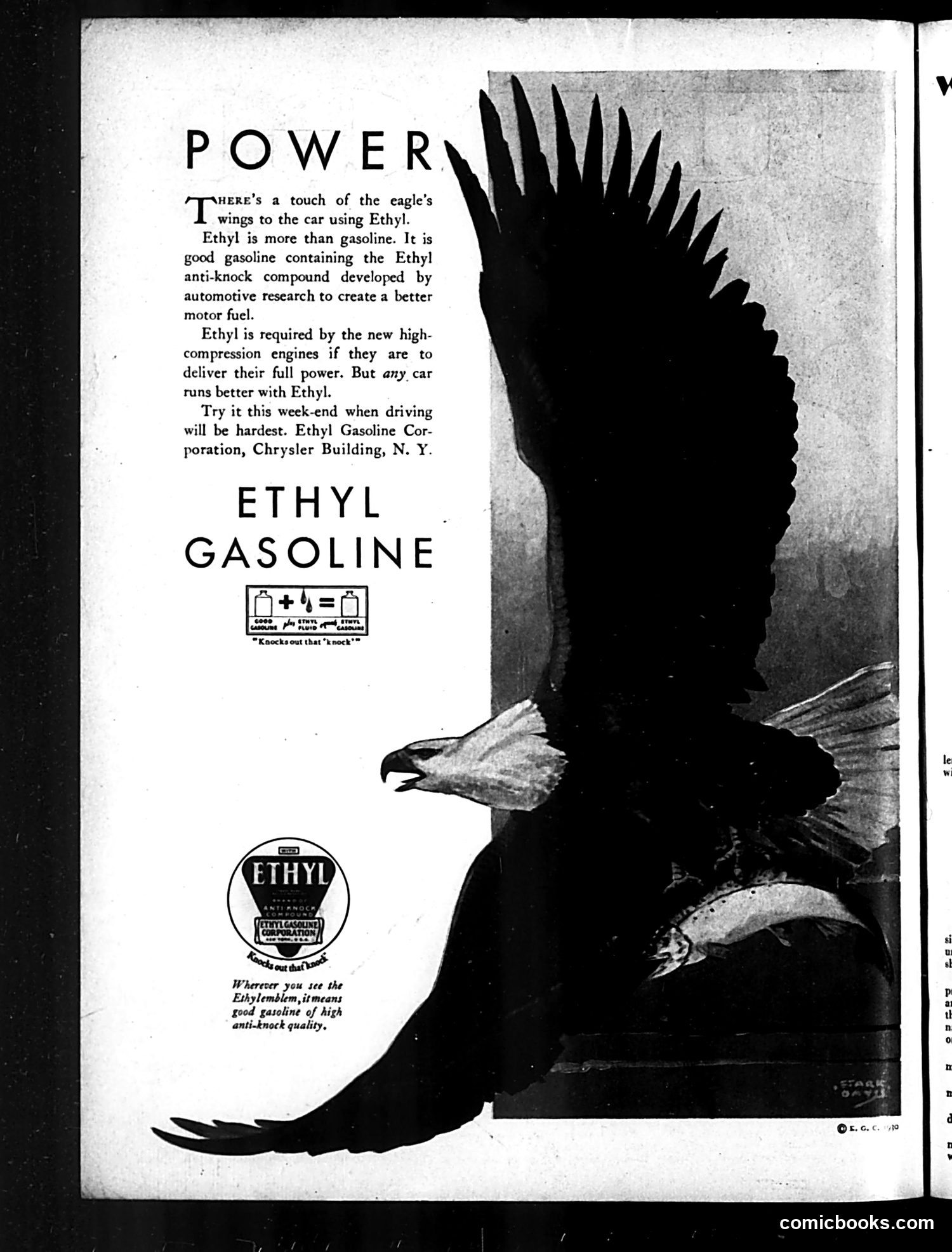
Ethyl Gasoline Advertisement This is primarily a commercial advertisement, not political satire. The page promotes Ethyl Gasoline, a branded fuel containing an anti-knock compound developed for high-compression engines. The striking eagle illustration is a marketing device—using the eagle's power as a metaphor for engine performance. The tagline "There's a touch of the eagle's wings to the car using Ethyl" claims the fuel provides superior power and responsiveness. The ad targets car owners of any vehicle type, claiming all cars "run better with Ethyl." It encourages consumers to test the product during weekend driving. The Ethyl Gasoline Corporation was located in the Chrysler Building, New York. This reflects 1920s-30s automotive marketing, when fuel additives were novel technological innovations.
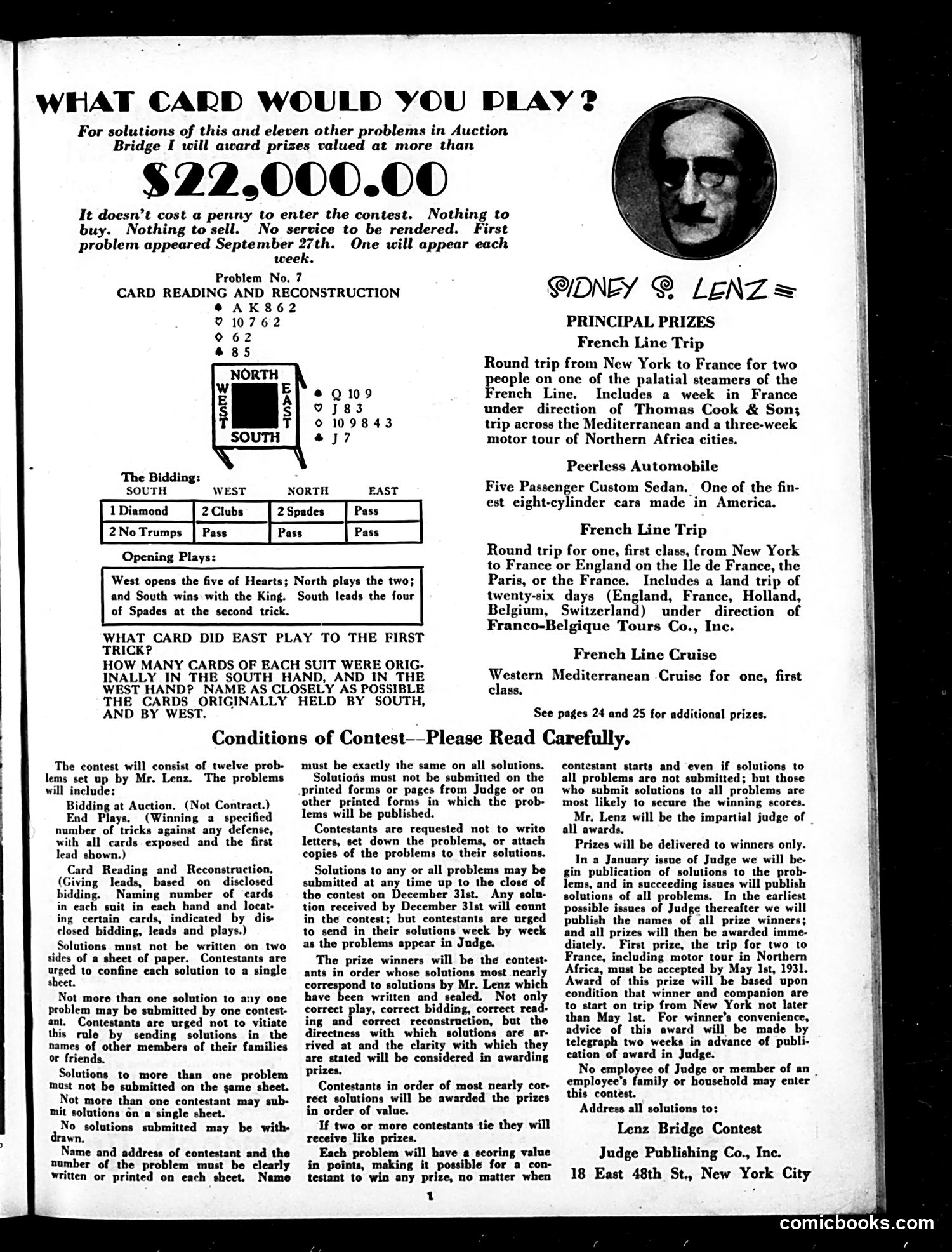
Analysis This page is primarily advertising for a bridge contest, not a political cartoon. The prominent image shows a man labeled "SIDNEY LENZ," identifiable by the text as the contest's principal judge. Sidney Lenz was a famous bridge player of the early 20th century, and this contest offering $22,000 in prizes (substantial for the era) promoted bridge as a popular game. The page includes Problem No. 7, a bridge hand requiring players to determine optimal card play. The "satire" is minimal—this is straightforward promotional content for a Judge magazine contest. The reference to bridge reflects the game's significant popularity among American elites during this period. The contest invited readers to submit solutions for weekly publication.
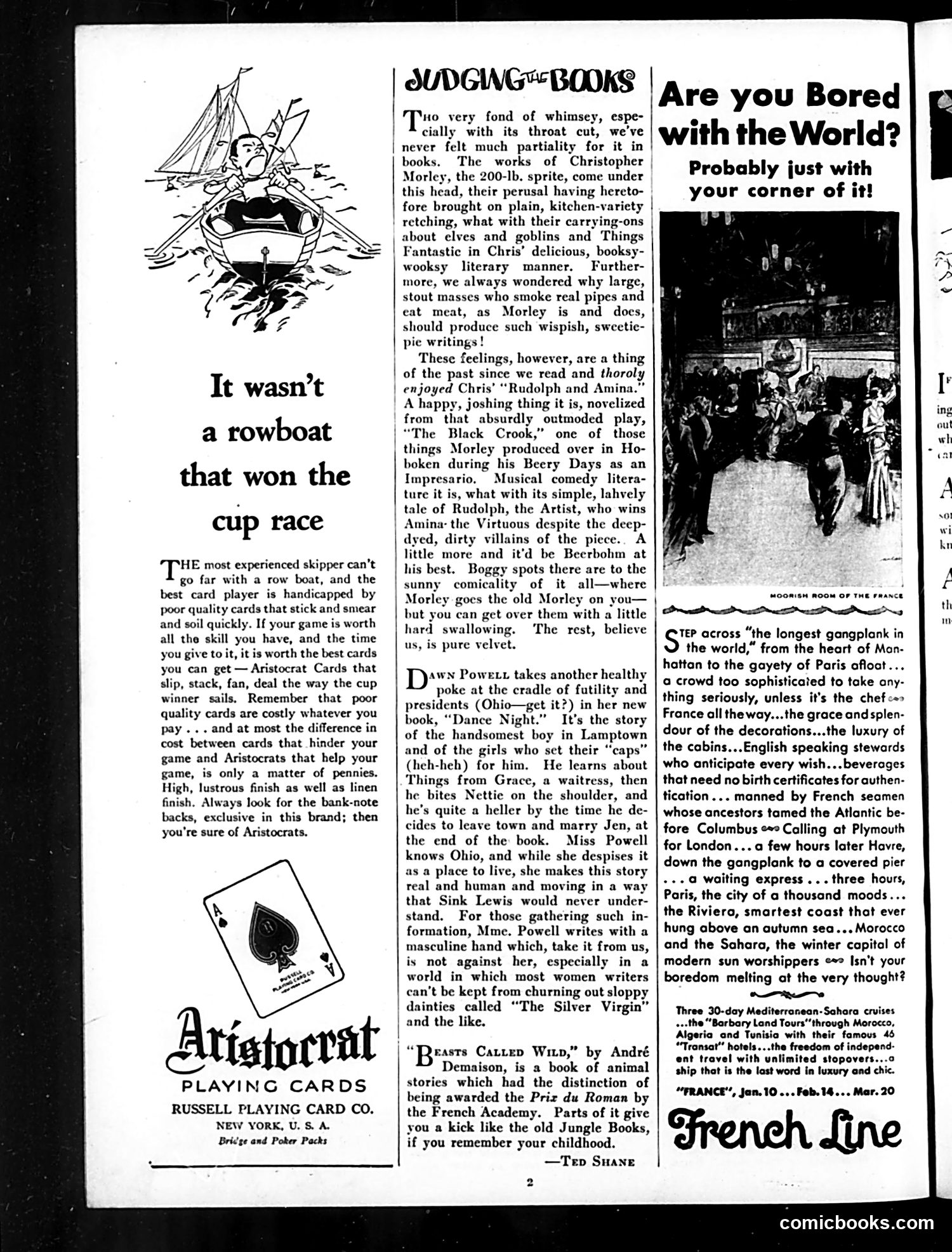
Analysis This page contains two main elements: Left side: An advertisement for Aristocrat Playing Cards featuring two cartoons—one of a chaotic rowboat race and another of playing cards. The ad suggests that card games, unlike rowing, reward skill and strategy regardless of equipment quality. The humor lies in contrasting the unpredictability of physical competition with the mastery possible in card games. Right side: Book reviews by Ted Shane, discussing works by Christopher Morley and Dawn Powell, followed by a French Line cruise advertisement. The reviews are lighthearted literary criticism typical of Judge's cultural commentary. The page is primarily commercial content (advertisements and entertainment reviews) rather than political satire. It reflects 1920s-30s leisure culture and consumer advertising aimed at affluent readers.
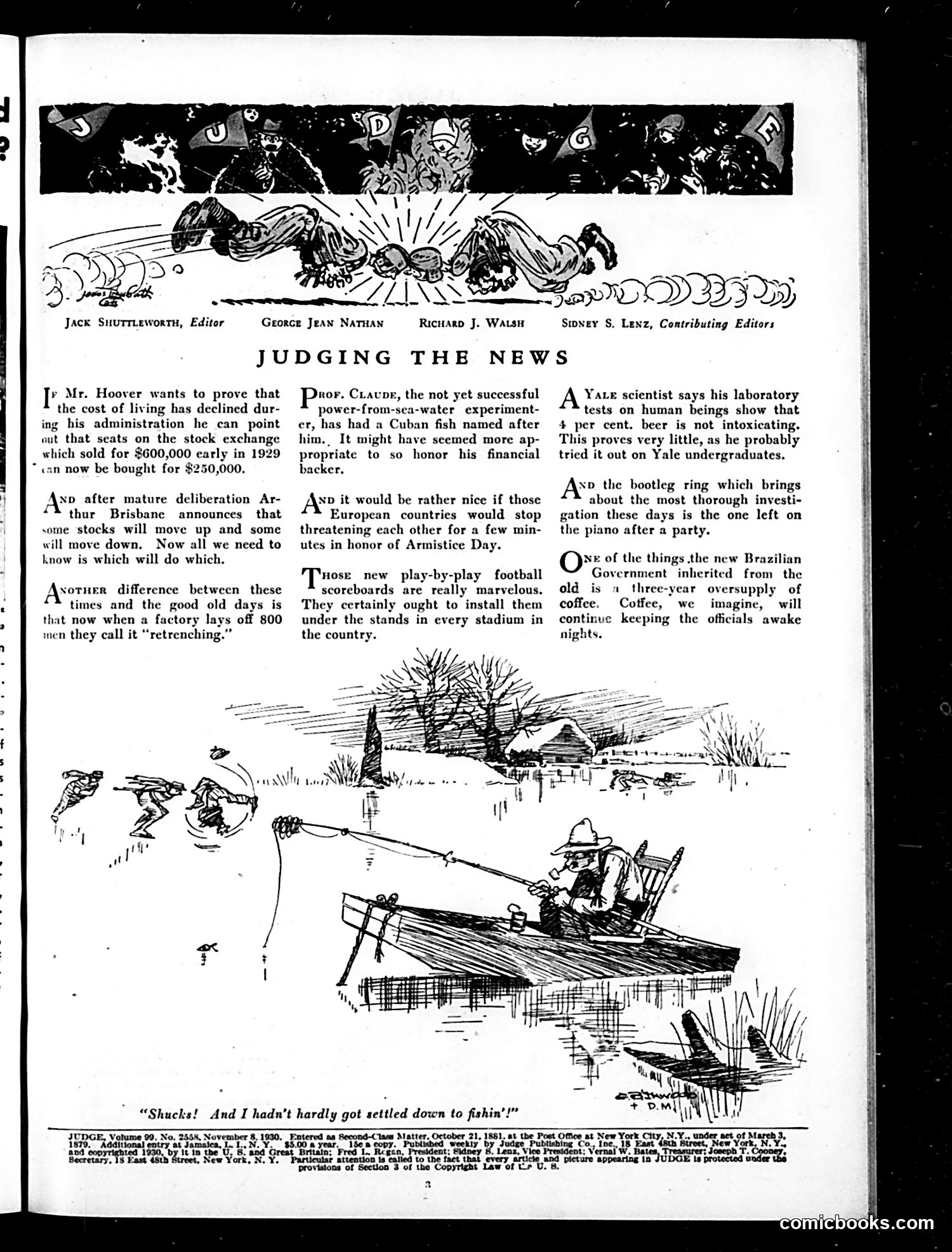
Analysis of Judge Magazine Page (November 2, 1929) This page presents satirical commentary on contemporary news under the heading "JUDGING THE NEWS." The items mock various topics: 1. Stock market/financial scandal: References to Mr. Hoover and Arthur Brisbane discussing stock prices and market movements, likely satirizing the recent 1929 stock market crash and its political fallout. 2. International relations: A jab at European countries threatening each other over Armistice Day observance. 3. Football modernization: Humor about new play-by-play scoreboards in stadiums. 4. Brazilian coffee politics: Commentary on Brazil's three-year coffee oversupply affecting officials. The main illustration shows a fisherman being startled mid-cast—a visual gag unrelated to the text commentary. This was typical Judge format: mixing political/economic satire with humorous observations and standalone cartoons.
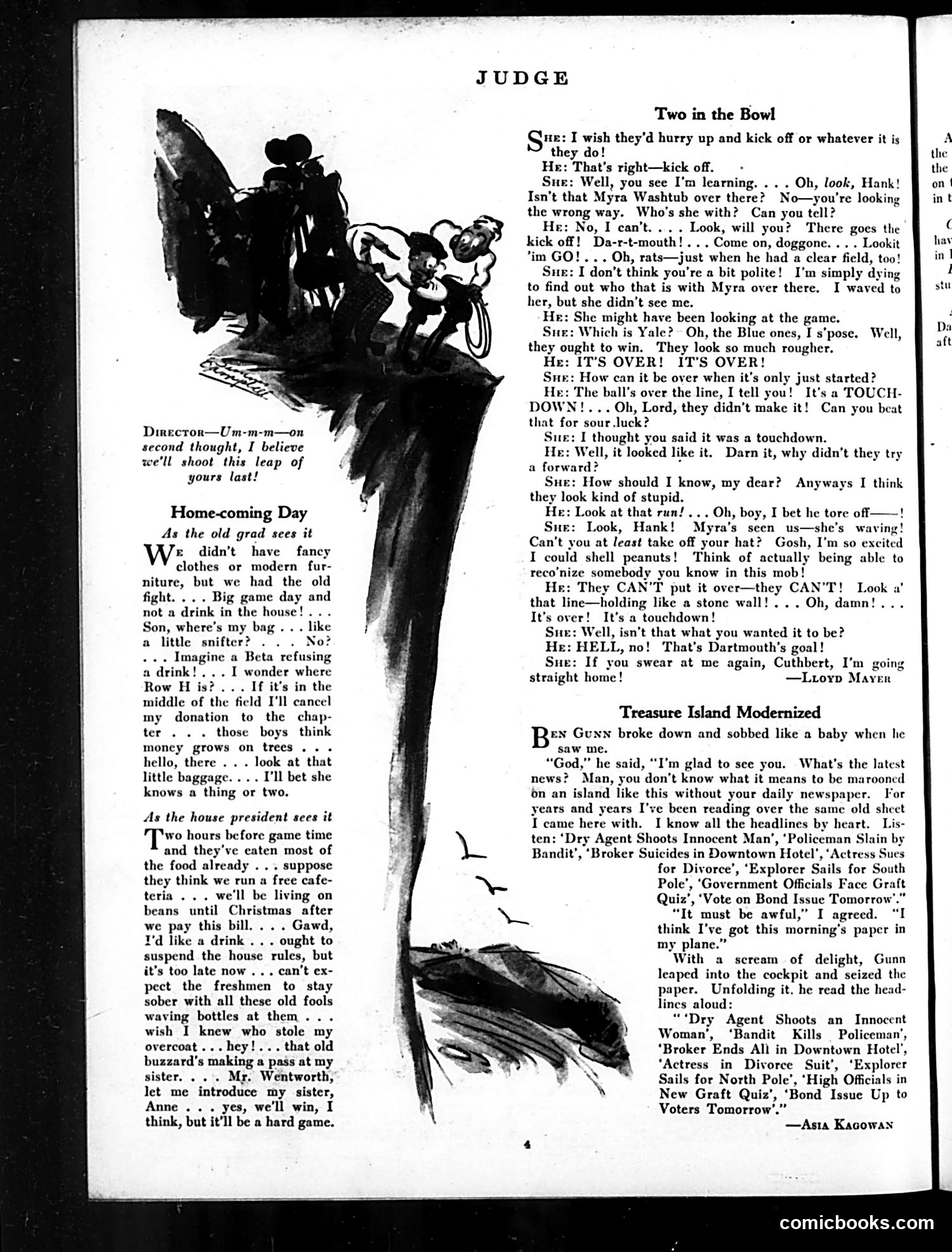
"Two in the Bowl" Football Satire The main cartoon depicts an animated football game scene where spectators are intensely debating whether a play resulted in a touchdown. The dialogue captures the chaos of live sports commentary: one character insists "IT'S OVER! IT'S OVER!" while another argues the ball crossed the line for a touchdown, leading to confusion about whether it's a touchdown or the game ending. The satire targets the confusion and heated arguments that arose from ambiguous football plays and unclear referee decisions—a perennial source of fan frustration. The exaggerated theatrical reactions and contradictory interpretations of what actually happened on the field reflect how sports disputes could overshadow the game itself among spectators.
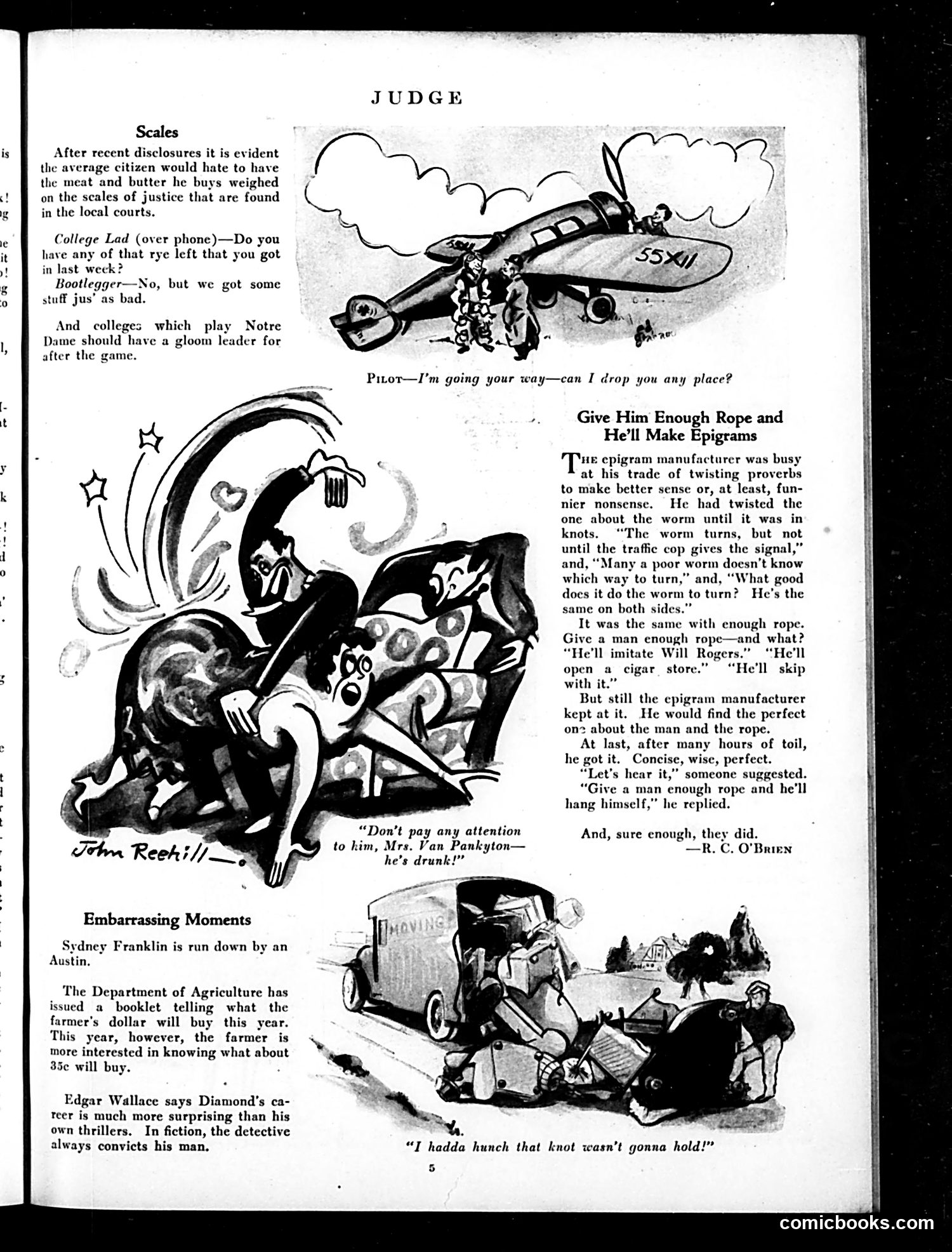
Judge Magazine Page Analysis This page contains several satirical items from an American humor magazine: "Scales" section includes a phone conversation joke about college football, suggesting Notre Dame needs a "gloomy leader" after games—likely referencing the school's football program. Top cartoon shows an airplane pilot offering rides, captioned about dropping passengers. The satirical point appears to concern aviation safety or recklessness during early commercial aviation era. "Give Him Enough Rope and He'll Make Epigrams" is a longer humorous anecdote about an epigram manufacturer creating proverbs about rope—a play on the expression "give a man enough rope and he'll hang himself." "Embarrassing Moments" section includes brief jokes about Australian cars and detective fiction. Bottom cartoon depicts a vehicle accident, captioned about a knot not holding—relating to the rope theme above. The overall page emphasizes wordplay and situational humor typical of Judge's satirical style.
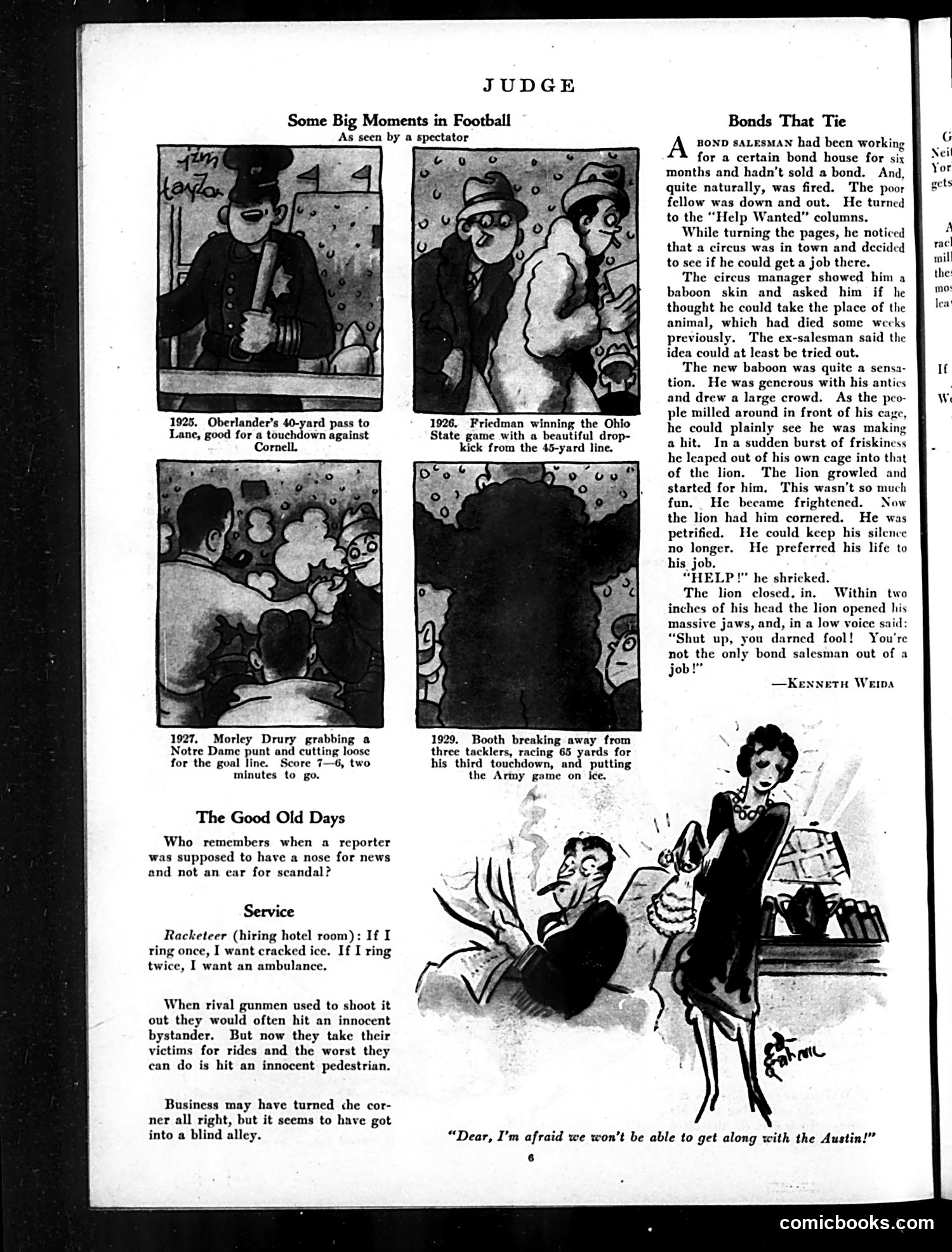
Judge Magazine Page Analysis This page contains two distinct pieces: "Some Big Moments in Football" features four historical football photographs (1923-1929) showing notable plays by Oberlander, Friedman, Morley Drury, and Booth—documenting early professional football's development. "Bonds That Tie" is a humorous short story about an unemployed bond salesman who takes a circus job managing a baboon. The story satirizes economic desperation during what appears to be the 1920s-early 1930s period. When the lion escapes and corners him, the lion sarcastically tells him he's "not the only bond salesman out of a job"—a dark joke equating the salesman's failure with the animal's predicament. This reflects widespread job loss and financial anxiety of the era. The page's bottom cartoon about an Austin automobile references marital discord, likely satirizing automobile ownership tensions.
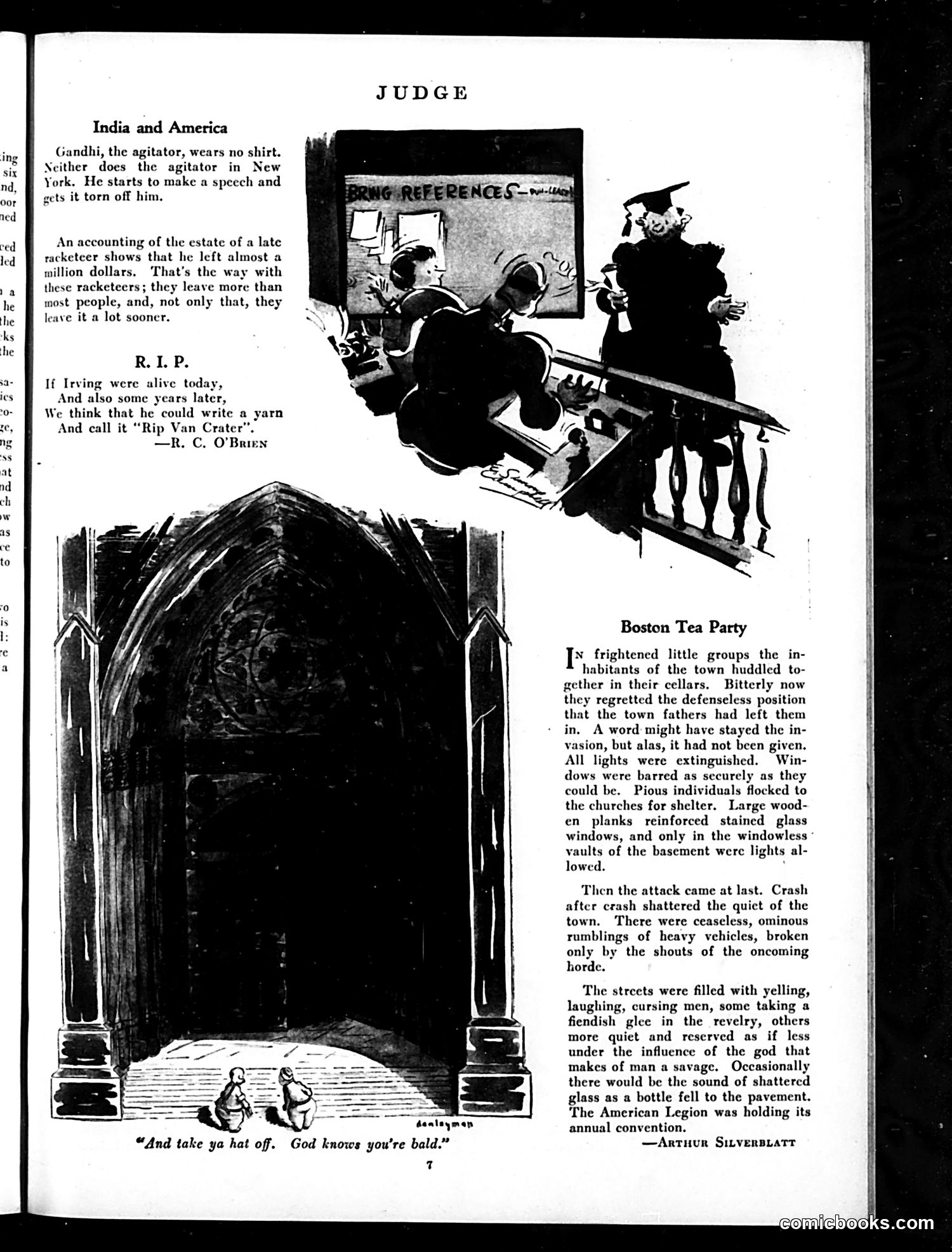
Judge Magazine Page Analysis This page satirizes American social and political figures through several brief items: "India and America" compares Gandhi (the Indian independence leader known for wearing homespun cloth) to a shirtless agitator in New York whose shirt gets torn off during a speech—mocking both as disruptive rabble-rousers. "R.I.P." jokes darkly about racketeers (organized crime figures) leaving large estates—implying they die young and violently, unlike legitimate wealthy people. "Boston Tea Party" is the page's main satirical piece. Despite its historical title referencing the 1773 protest, the text describes townspeople barricading themselves in fear of an "invasion"—then reveals the "attack" is merely the American Legion holding its annual convention. The satire mocks the American Legion as rowdy, destructive vandals (breaking windows, yelling), suggesting the veterans' organization behaves like an invading horde rather than respectable citizens. The bottom cartoon caption appears unrelated social commentary on baldness.
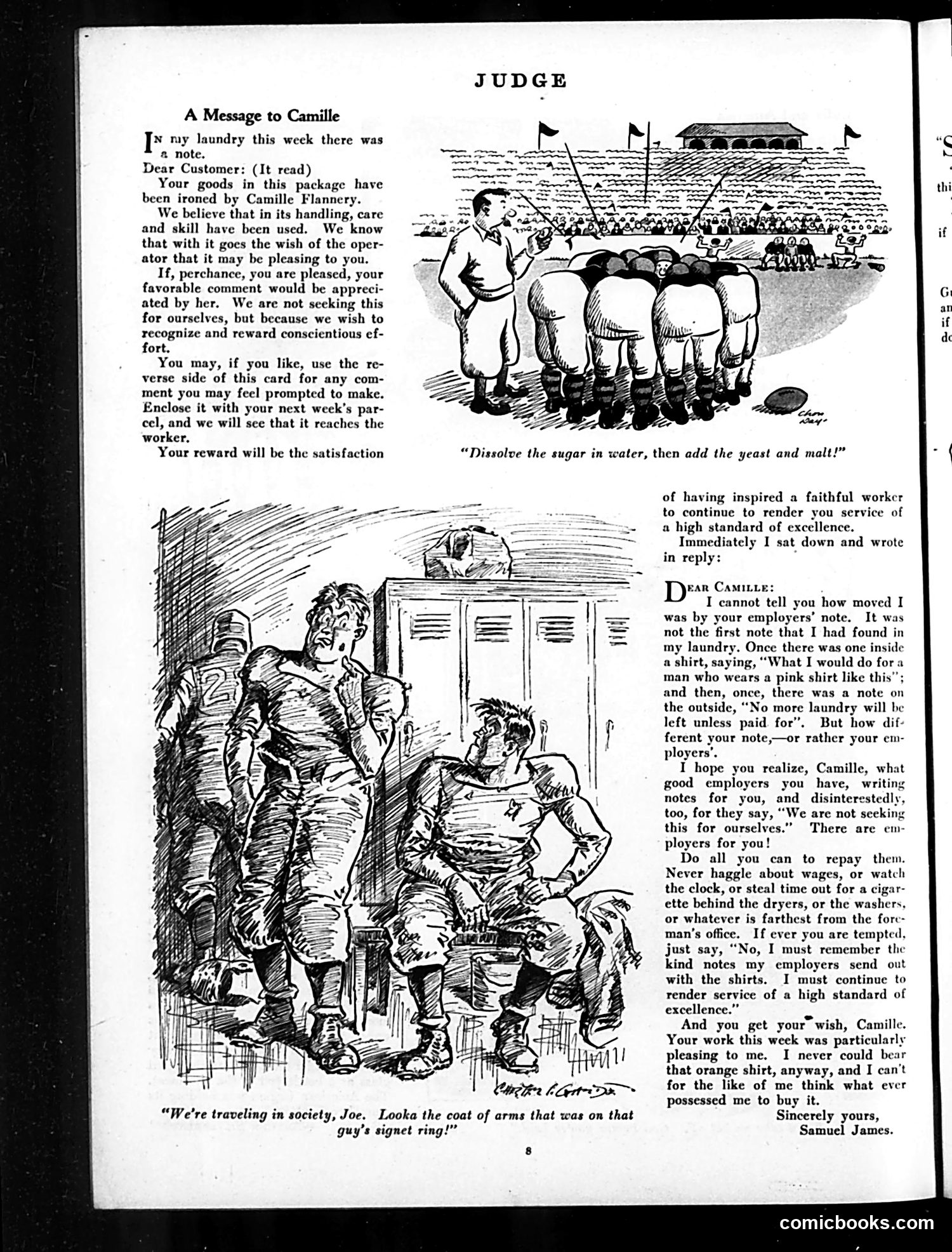
Judge Magazine Page Analysis This page contains a satirical piece titled "A Message to Camille" critiquing workplace management practices and class relations. The main content is a fictional exchange: a laundry receives a note from their employer praising worker Camille Flannery by name, inviting customer feedback. The "Judge" (author Samuel James) responds with mock-earnest praise, but the satire lies in exposing the paternalism: the employer seeks to manipulate worker loyalty through flattery and public recognition rather than fair wages. James's reply ironically celebrates these "good employers" while listing all the exploitative behaviors workers must suppress—no wage complaints, no time-stealing, constant excellence—framed as gratitude for hollow praise. The two cartoons provide visual commentary: one shows a horse-racing scene (top), another depicts crowded tenement life (bottom). The bottom cartoon's caption mocks pretension ("traveling in society"), reinforcing the page's theme of class hypocrisy and performative virtue among the wealthy.
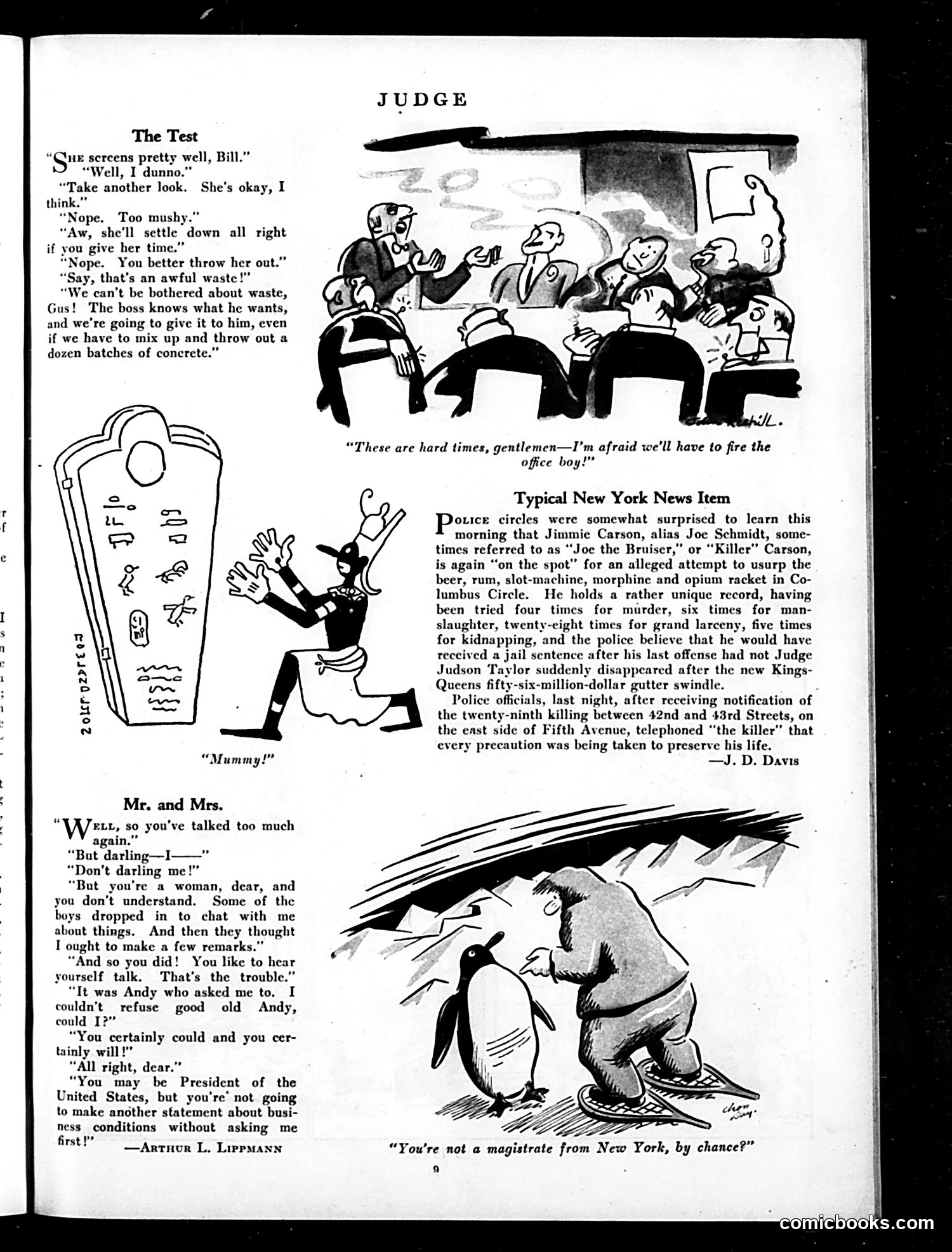
Understanding This Judge Magazine Page This page contains three satirical pieces from Judge magazine (a humor/political publication): "The Test" mocks industrial quality control—bosses discussing discarding defective concrete batches, indifferent to waste as long as the product meets specifications. It's commentary on ruthless efficiency in manufacturing. "Mr. and Mrs." by Arthur L. Lippmann satirizes a spouse (likely a political figure—possibly a president, given the reference) who cannot make public statements about business without his wife's approval. It jokes about domestic control over political speech. "Typical New York News Item" parodies hardened crime reporting. "Joe the Bruiser" is a career criminal with an absurd rap sheet (tried for murder multiple times, countless arrests) who remains untouchable because Judge Judson Taylor mysteriously disappeared during a corruption scandal. The final line—police assuring "the killer" they're protecting his life—is dark satire on judicial/police corruption and the criminal's apparent immunity. The page reflects 1920s-30s concerns: industrial indifference, political wives' influence, and urban organized crime connected to judicial corruption.
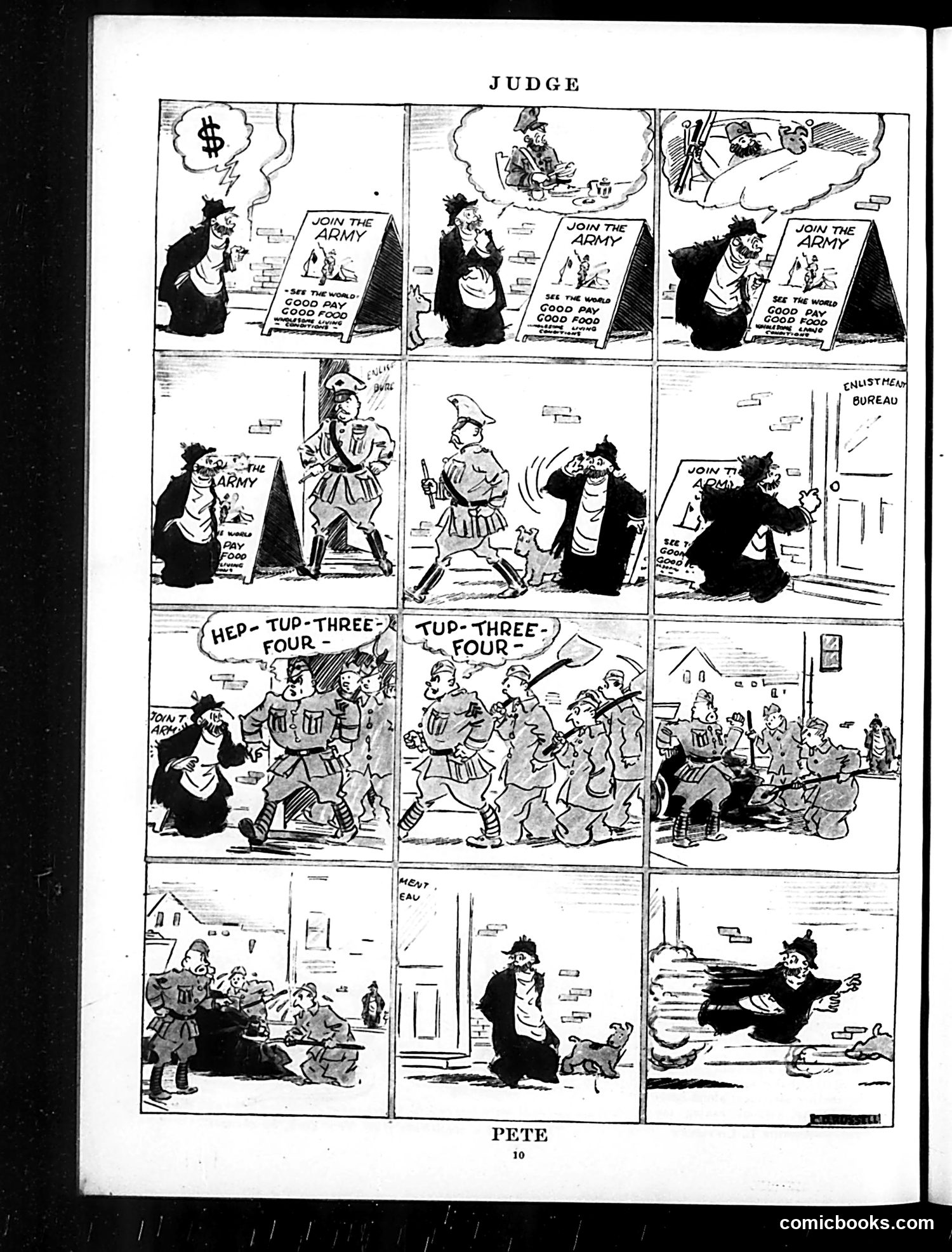
"Judge" Page Analysis This satirical comic titled "Judge" and credited to "Pete" depicts a caricatured figure (appearing to represent a corrupt politician or official) attempting to recruit soldiers for the Army. The figure displays a "$" symbol and a "JOIN THE ARMY" sign promising "SEE THE WORLD, GOOD PAY, GOOD FOOD." The satire critiques military recruitment tactics, suggesting officials use financial incentives and false promises to attract enlistees. The narrative shows recruits being marched into military service (with "HEP-TUD-THREE-FOUR" drill commands), then depicts them in what appears to be disillusionment—ultimately shown in poverty or hardship. The cartoon satirizes the gap between Army recruitment propaganda and soldiers' actual experiences, likely referencing early 20th-century American military expansion or WWI-era recruitment practices.
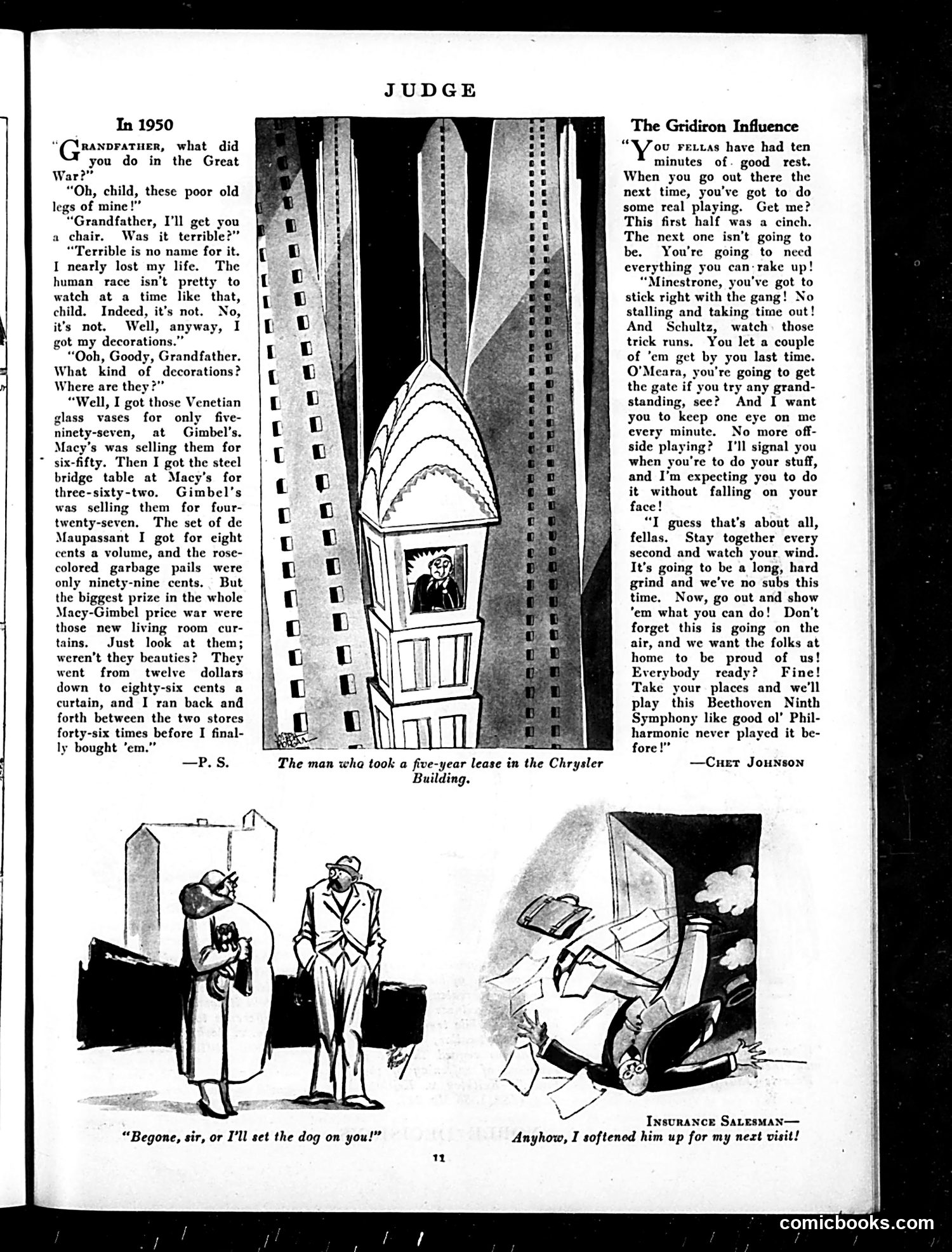
Judge Magazine Page Analysis This 1950 page satirizes post-war American consumer culture and commercial competition. Top cartoon: A grandfather claims his "decorations" from World War I are actually bargain purchases won through the fierce Macy's-Gimbel's price war—a real department store rivalry. The joke mocks how consumerism has replaced authentic war heroism; his "medals" are discounted vases, bridge tables, and curtains he chased between stores 46 times. It satirizes Americans' obsession with shopping deals over genuine accomplishment. Bottom left: A vagabond threatens eviction, mocking urban poverty amid post-war prosperity. Bottom right: "The Gridiron Influence" presents a football coach delivering a halftime speech mimicking a radio broadcast director—replacing athletic inspiration with showmanship for home audiences. It critiques how media performance overshadows actual competition. Overall theme: The page mocks 1950s American materialism, corporate rivalry, and the media's influence on authentic values and competition.
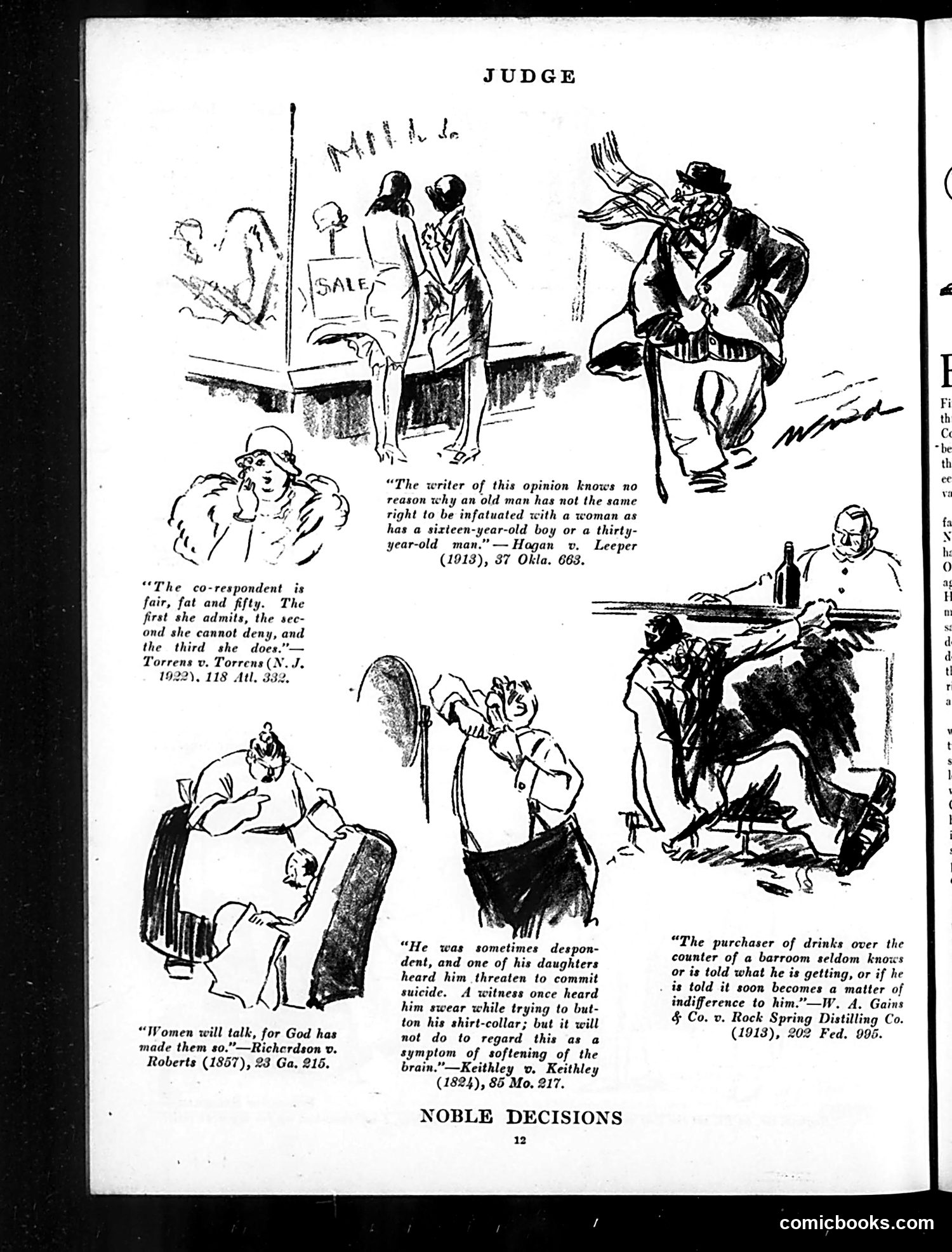
"Noble Decisions" — Judge Magazine Satire This page mocks absurd legal rulings through illustrated vignettes paired with actual court quotations. Each cartoon ridicules the judges' reasoning in divorce and liability cases. The satire targets: 1. Divorce proceedings: Courts making contradictory or nonsensical judgments about infidelity, age, and marital conduct—one ruling that a woman admitting she's "fair" but denying being "fifty" proves she's dishonest. 2. Gender bias: A quote dismissing women's talkativeness as divinely ordained; another defending elderly men's romantic entanglements as equivalent to younger men's. 3. Mental competency standards: A judge claiming that swearing while buttoning one's shirt isn't evidence of mental illness—setting absurdly low bars for sanity in legal cases. 4. Consumer protection: A barroom ruling suggesting customers don't know or care what they're drinking, essentially excusing sellers from responsibility. The cartoons illustrate judges' flawed logic, presenting "noble decisions" ironically—these rulings exemplify poor judicial reasoning rather than wisdom.
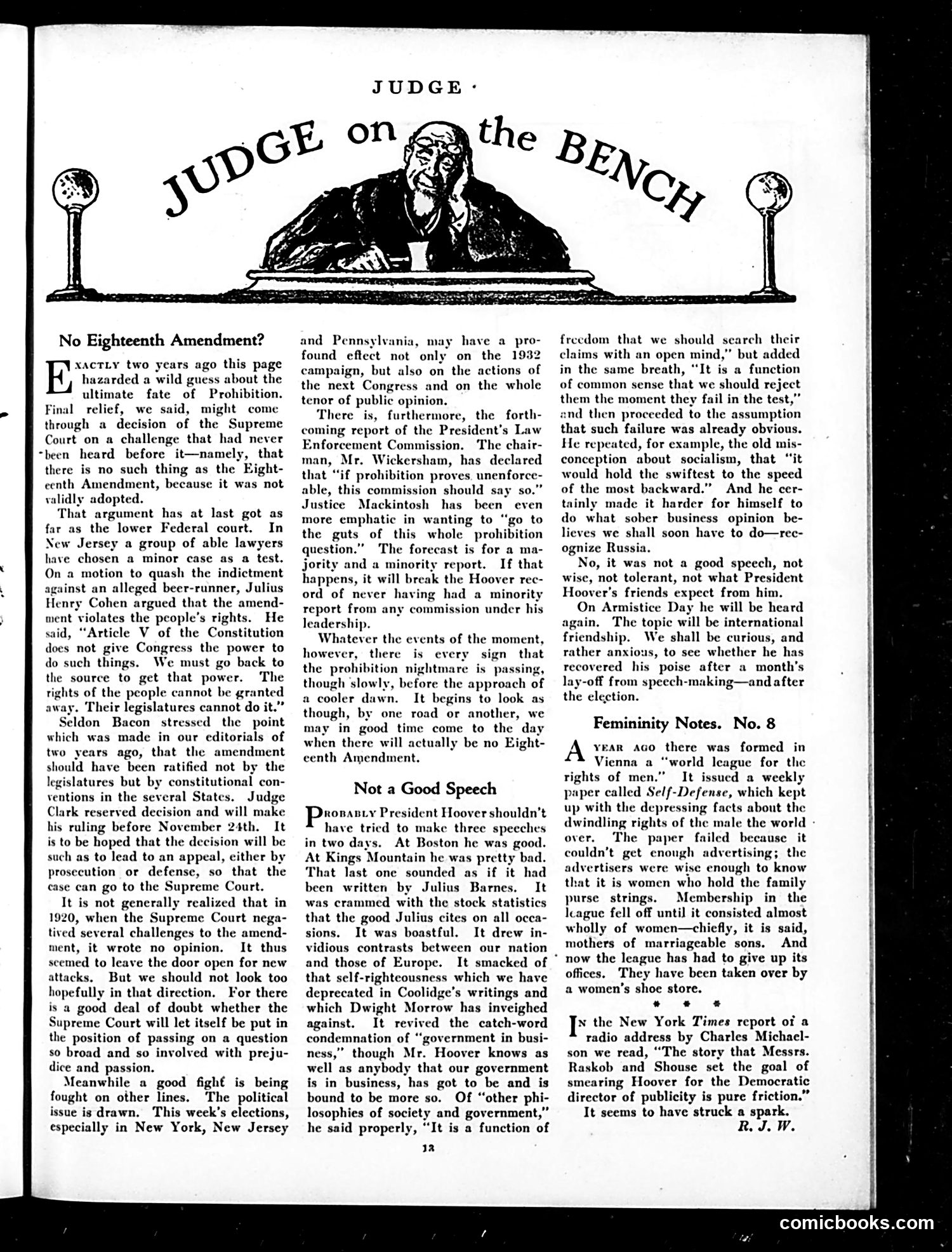
Judge Magazine Page Analysis This page from Judge (appears to be from 1930, based on references to the 1932 campaign) addresses two main political issues: "No Eighteenth Amendment?" discusses a legal challenge to Prohibition's constitutional validity. Lawyers argue the 18th Amendment was improperly ratified—Congress lacked power to propose it, and states should have used constitutional conventions rather than legislatures. Judge advocates for this court case to reach the Supreme Court, hoping it might overturn Prohibition entirely. The article discusses President Hoover's Law Enforcement Commission, expected to split into majority and minority reports about Prohibition's enforceability. "Not a Good Speech" criticizes President Hoover's recent speeches. While praising his Boston address, Judge attacks his Kings Mountain speech as boastful, self-righteous, filled with statistics, and containing invidious comparisons to other nations—criticism also leveled at his predecessor Coolidge. The prominent "Judge on the Bench" masthead features the magazine's satirical authority figure overseeing political commentary.
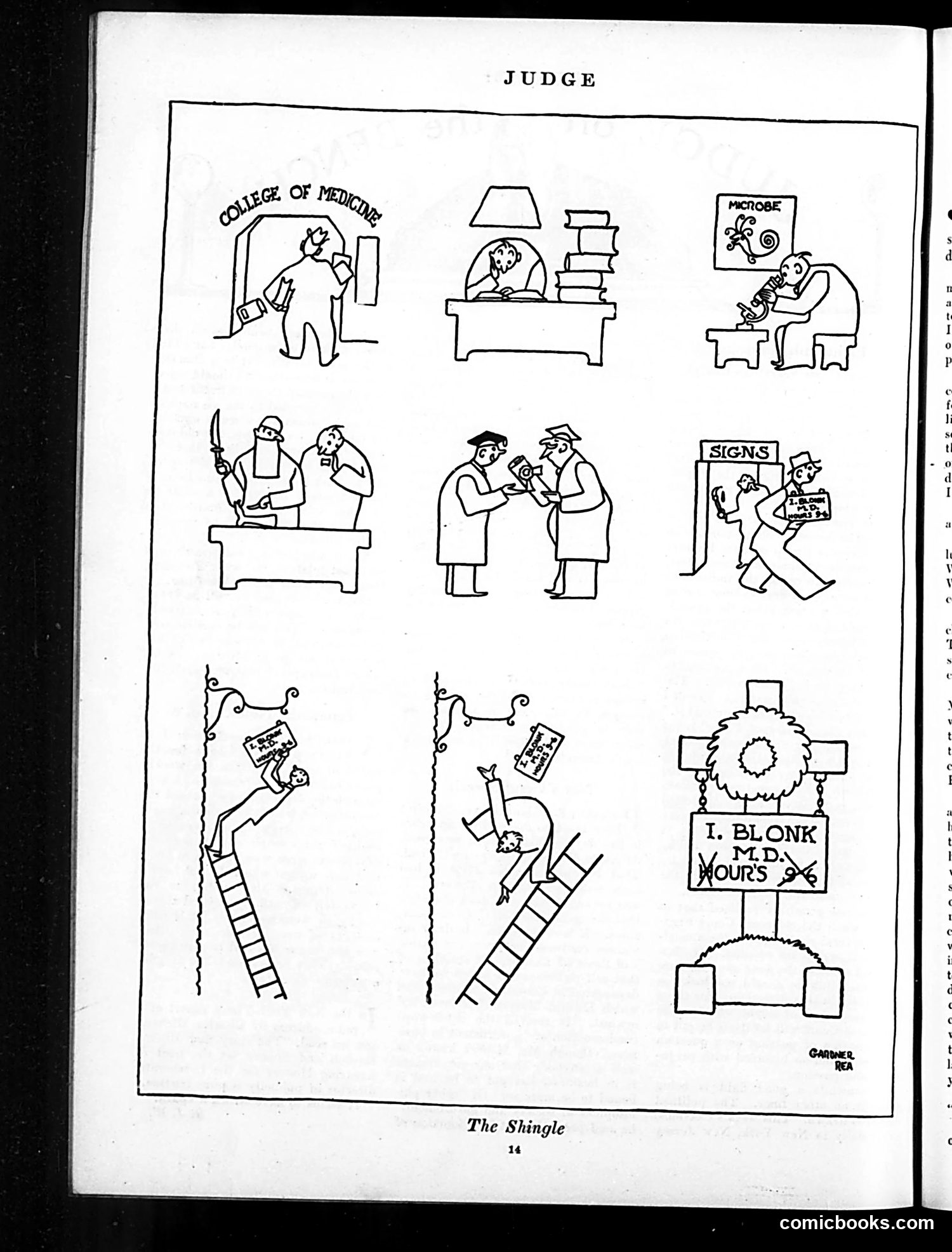
Analysis of "Judge" Page: "The Shingle" This page presents nine panel cartoons satirizing the medical profession, titled "The Shingle" (a reference to the sign hung outside a doctor's office). The panels mock various medical specialties and practices: a College of Medicine student, a microscopist examining samples, two physicians in surgical debate, doctors exchanging money (likely referencing fee-splitting), and figures climbing ladders toward success. The final panel shows a scarecrow-like figure with "I. BLONK M.D. HOURS" on a sign, suggesting an incompetent or unestablished physician. The overall satire critiques medical education, specialization, commercialism within the profession, and the gap between qualified and unqualified practitioners—common Progressive-era concerns about professionalization and ethics in American medicine.
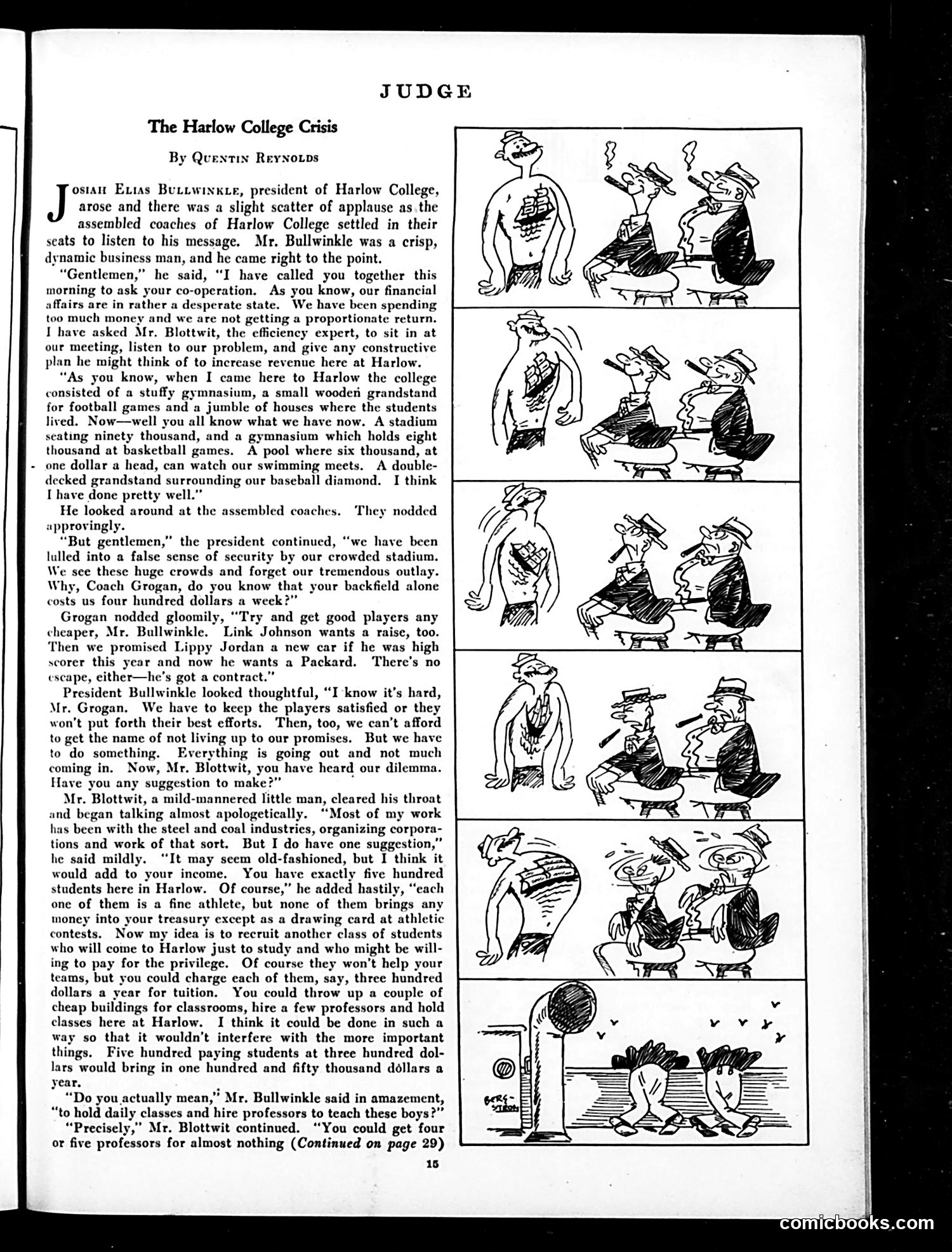
"The Harlow College Crisis" This satirical piece mocks the corruption of American college athletics in the early 20th century. President Bullwinkle has transformed a modest college into a massive athletic complex—stadium for 90,000, basketball arena for 8,000, Olympic pool—yet the institution is financially failing because it prioritizes sports over academics. The joke centers on Coach Grogan's complaint that star athletes demand exorbitant salaries and new cars (like "Lippy Jordan" wanting a Packard). When efficiency expert Blottwit suggests a radical solution—recruiting actual *students* who pay tuition and requiring professors to teach *classes*—Bullwinkle reacts with astonishment, as if academic education were a bizarre, foreign concept. The satire exposes how thoroughly athletics had replaced education as the college's mission. That "holding daily classes" seems laughably impractical to administrators reveals the era's warped priorities. The cartoons (right panel) presumably reinforce this absurdity visually, though details are unclear here.
Judge Theatre Review: George Jean Nathan on Broadway Shows This page contains theatre reviews by prominent critic George Jean Nathan. The visible content critiques three Broadway musicals: "Three's a Crowd" receives high praise—Nathan praises its fresh humor and skilled performers (Webb, Allen, and Holman), while criticizing audience behavior at competing shows. He complains that excessive clapping at "Princess Charming" and "Girl Crazy" artificially extended performances, disrupting pacing. "Princess Charming" is mocked for recycling tired operetta tropes: the stock plot of a princess separated from a commoner lover by royal decree, predictable songs ("Palace of Dreams," "Here Is a Sword"), and hackneyed comedic types (American salesmen or washed-up jockeys inserted for laughs). The reviews reflect 1920s Broadway conventions and Nathan's acid wit about both productions and audience etiquette. His complaint about deliberate clapping to extend numbers reveals period theatre dynamics now unfamiliar to modern audiences.
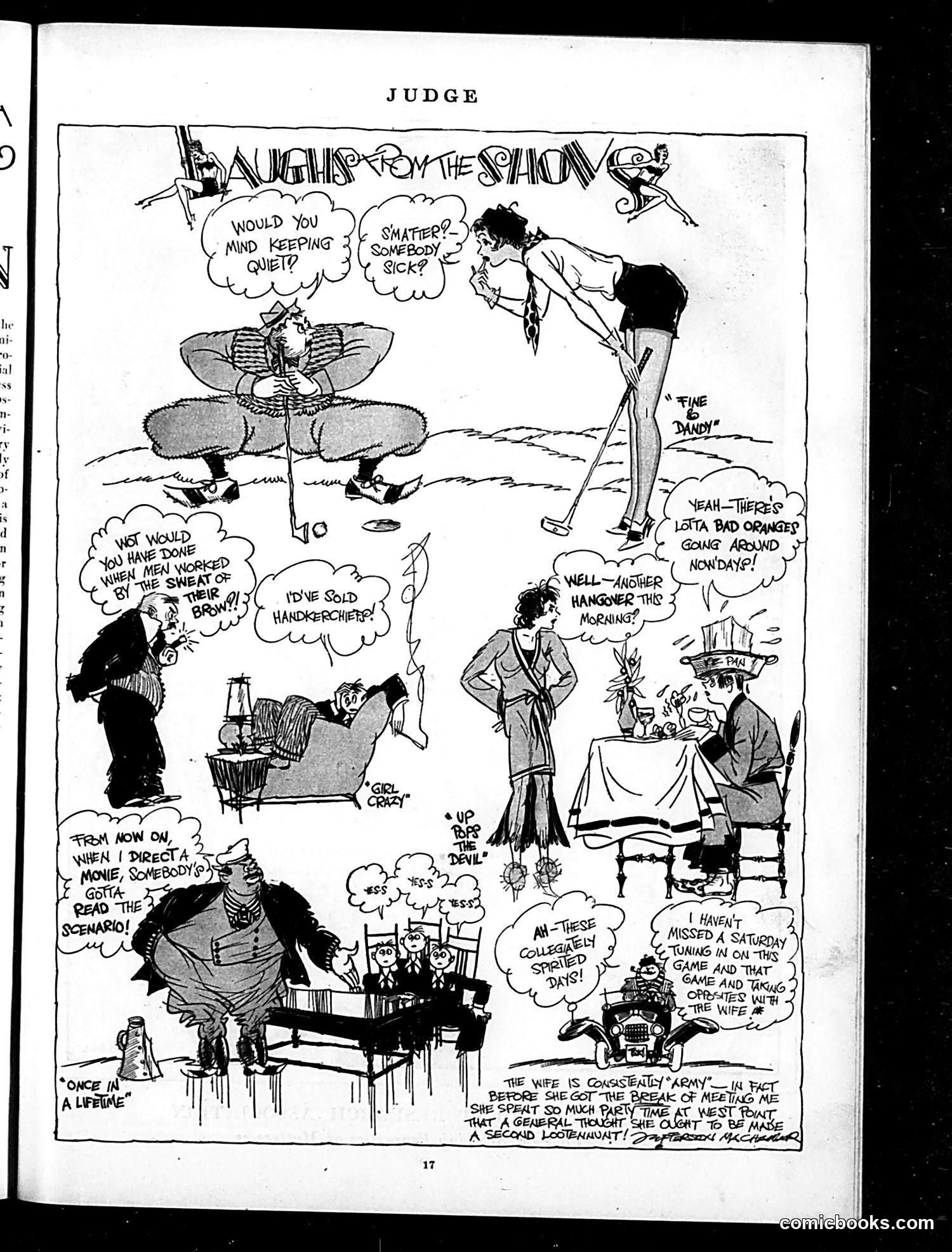
"Laughs for the Show" This is a multi-panel satirical cartoon about marital domestic life and social behavior. The top panel shows a woman in Egyptian-style costume, likely referencing exotic entertainment or theater. Below are various scenes depicting a husband attempting to manage his wife's social activities and complaints. The satire centers on wives' desires for social outings and entertainment—theater, parties, and social gatherings—contrasted with husbands' preferences for quieter domestic life or work obligations. One panel references a man's work schedule conflicting with his wife's social demands ("missed a Saturday outing"). The final panel's text suggests the wife organizes constant social activities, described as an "army," exhausting the husband who must provide time and money for "party time." The joke targets the perceived incompatibility between wives' social ambitions and husbands' domestic preferences—a common theme in early 20th-century American humor about gender relations.
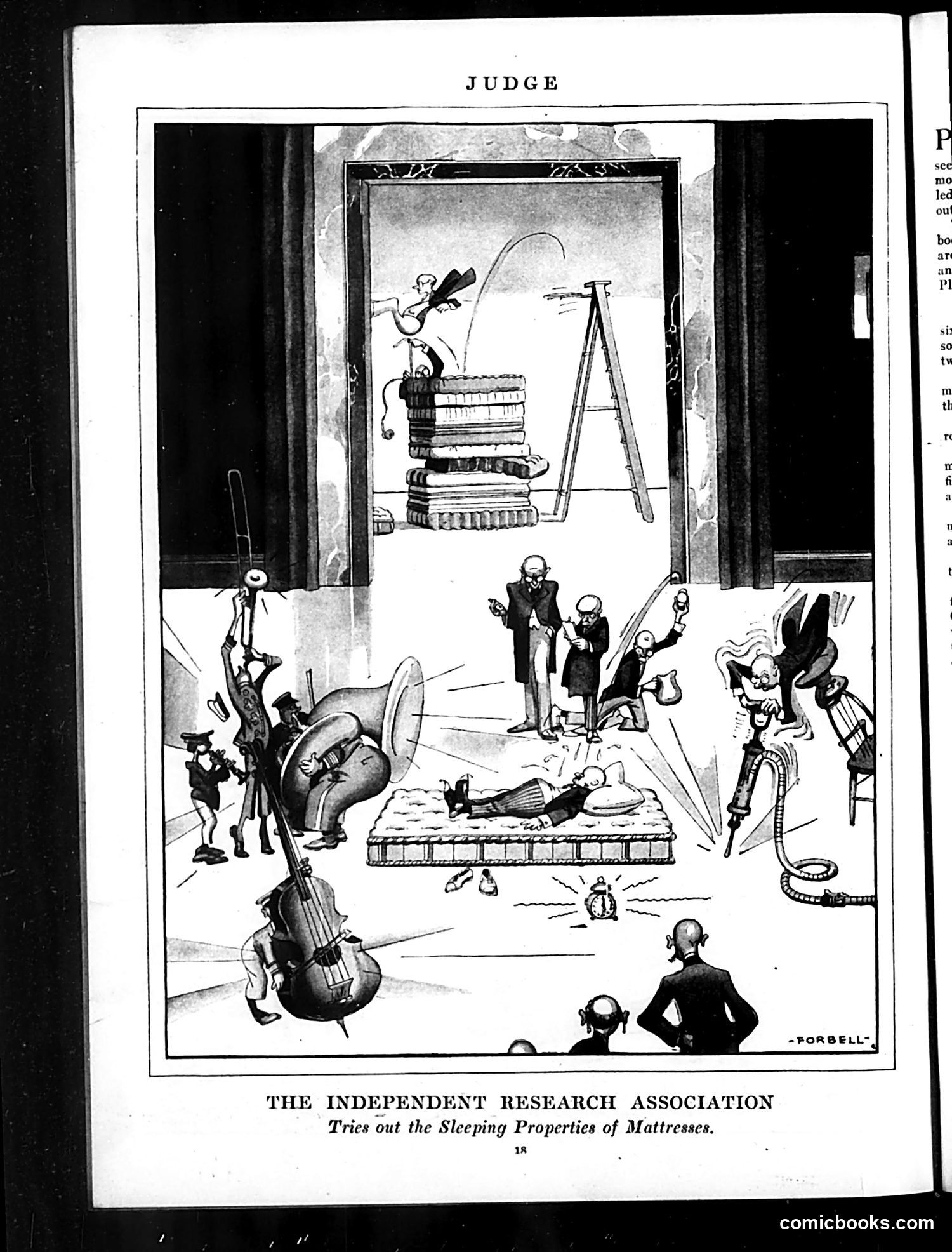
"The Independent Research Association Tries Out the Sleeping Properties of Mattresses" This cartoon satirizes overly elaborate "scientific" testing methods. The "Independent Research Association" (likely a fictional or dubious organization) has constructed an absurdly complex experimental apparatus to test mattresses—complete with a telescope, elaborate pulley system, stacked books, and various mechanical contraptions. Meanwhile, the actual test subject simply lies on a mattress in the center while formally-dressed observers watch intently. The joke mocks how manufacturers and research groups of the era used pseudoscientific setups and jargon to market consumer goods like mattresses, treating a simple function (sleeping comfort) with ridiculous over-engineering. The cartoon suggests such "independent research" was often theatrical nonsense designed to impress rather than genuinely inform consumers.
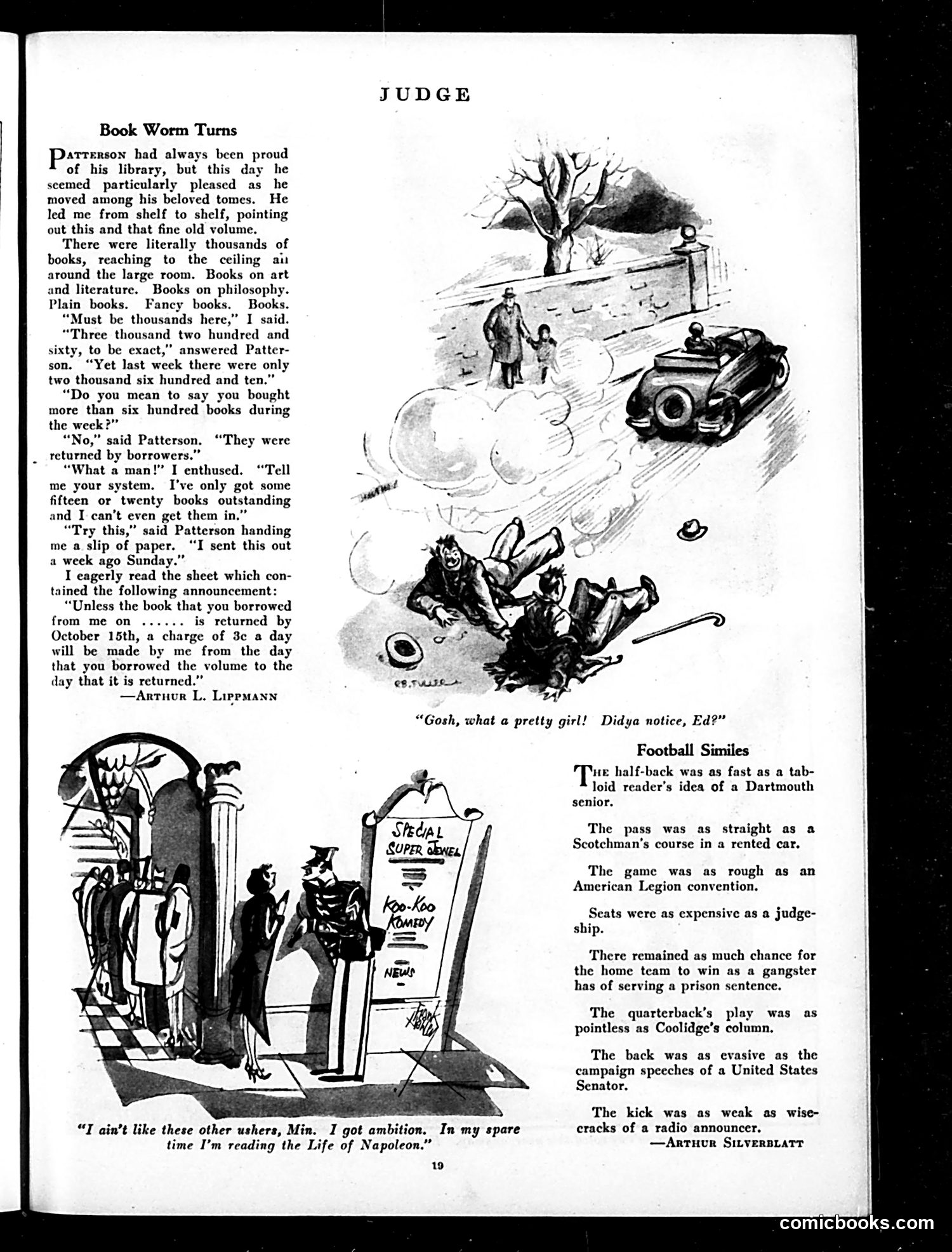
Explanation for Modern Readers This Judge magazine page contains three satirical pieces: "Book Worm Turns" mocks a library owner who claims 3,260 books but admits 600+ were recently "returned by borrowers"—the joke being people borrow books and never return them. Patterson's solution is a harsh late-fee policy (3¢ daily). The satire targets both chronic non-returners and overzealous library enforcement. "Football Similes" uses humorous comparisons to mock 1920s American culture. References include: Dartmouth students as slow; Scotsmen as reckless drivers; American Legion conventions as rowdy; judgeships as expensive (suggesting bribery); gangsters as likely to serve prison time; Coolidge's writing as pointless; senators' speeches as evasive; and radio announcers as incompetent. The cumulative effect satirizes contemporary institutions and social types. The bottom cartoon shows an usher reading Napoleon's biography in his spare time, claiming "ambition"—satirizing working-class pretension about self-improvement through classical literature. The overall tone reflects Judge's characteristic upper-class mockery of American society, institutions, and social climbers.
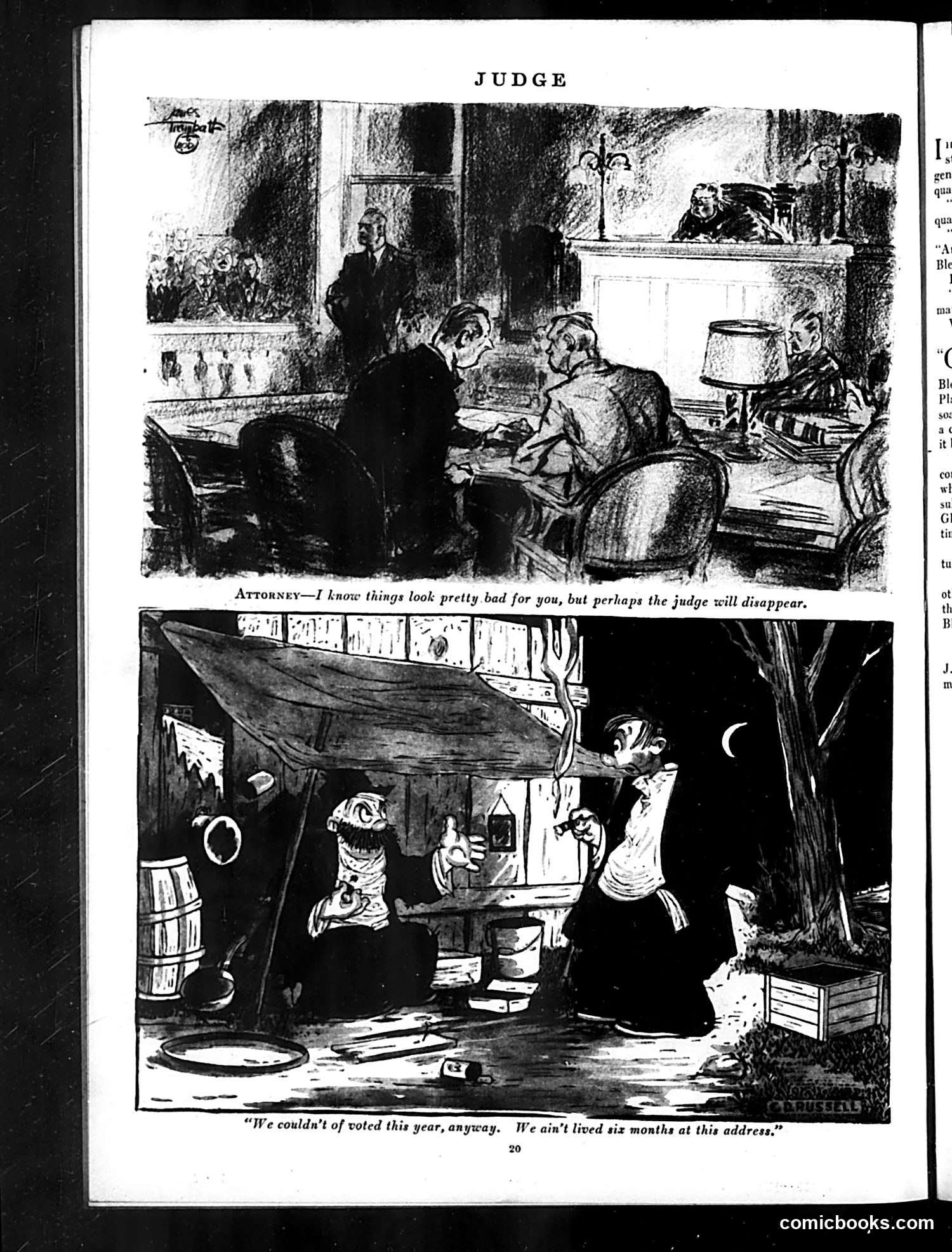
Political Cartoon Analysis: "Judge" Magazine This page contains two satirical cartoons about voting eligibility and the legal system. Top cartoon: An attorney tells a judge, "I know things look pretty bad for you, but perhaps the judge will disappear." This satirizes judicial corruption—suggesting judges might vanish to avoid unfavorable rulings or accountability. Bottom cartoon: Two impoverished figures in a shantytown reveal they couldn't vote because they hadn't lived at their address for six months—a common voting requirement. This critiques how residency restrictions disenfranchised poor, mobile populations who frequently relocated due to economic instability. The satire highlights the irony: those most affected by legal and social injustice are systematically excluded from voting. Both cartoons target systemic inequities in the legal and electoral systems.
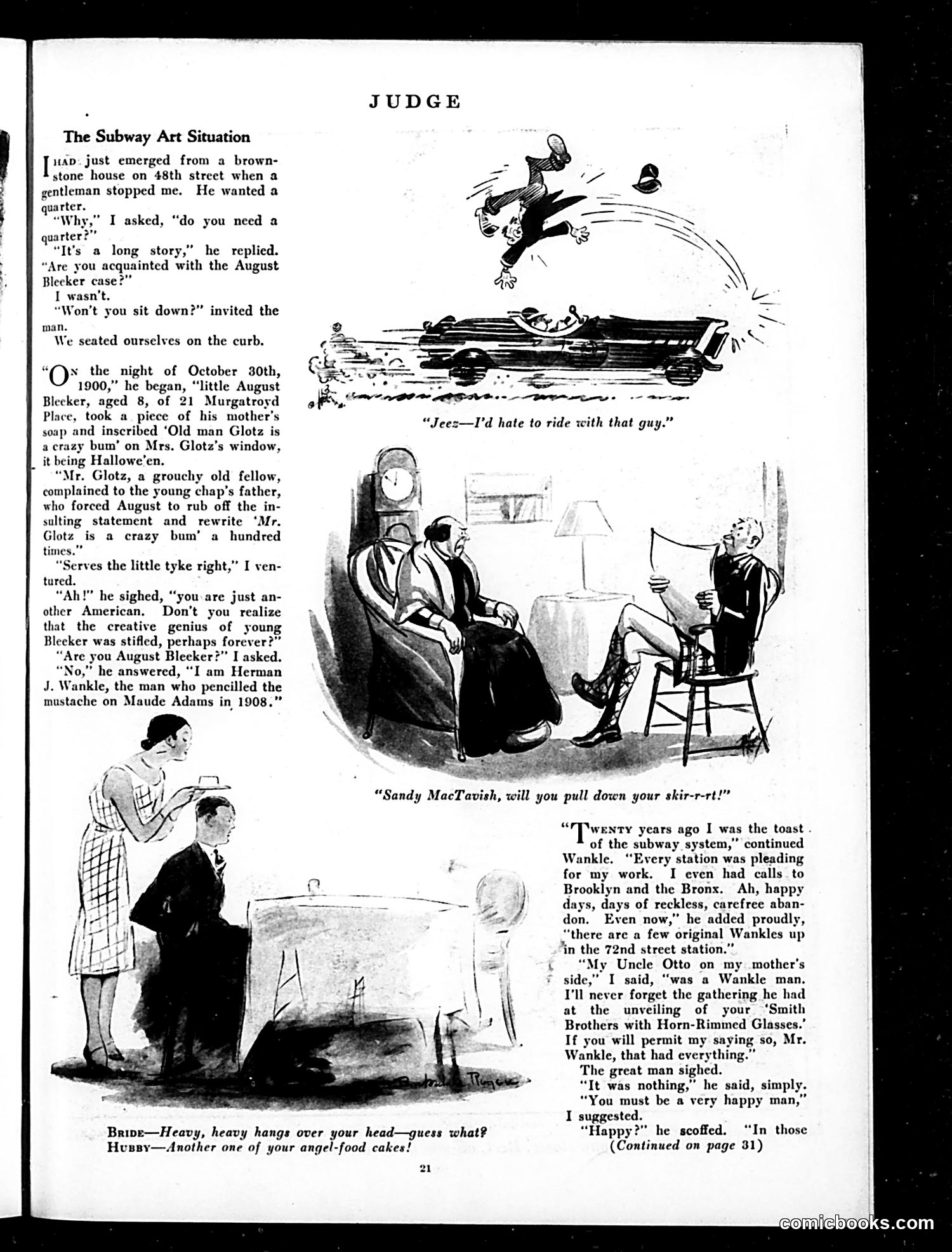
Explanation for Modern Readers This Judge magazine page satirizes subway vandalism and graffiti "artists" through absurdist humor. The main story features "Herman J. Wankle," who claims to be a famous subway graffiti artist from around 1900—specifically, he's credited with drawing a mustache on an advertisement for actress Maude Adams in 1908. The joke is that Wankle treats his vandalism as legitimate "art," lamenting that his "creative genius" was celebrated in those early subway days when stations "pleaded for my work." The narrator's uncle supposedly attended an unveiling of Wankle's work featuring "Smith Brothers with Horn-Rimmed Glasses"—likely referring to doctored ads. The satire mocks both the pretensions of self-styled subway artists and the public's nostalgia for earlier, "carefree" times of urban mischief. The cartoons illustrate various subway-related scenarios, reinforcing the theme of New York City transit culture.
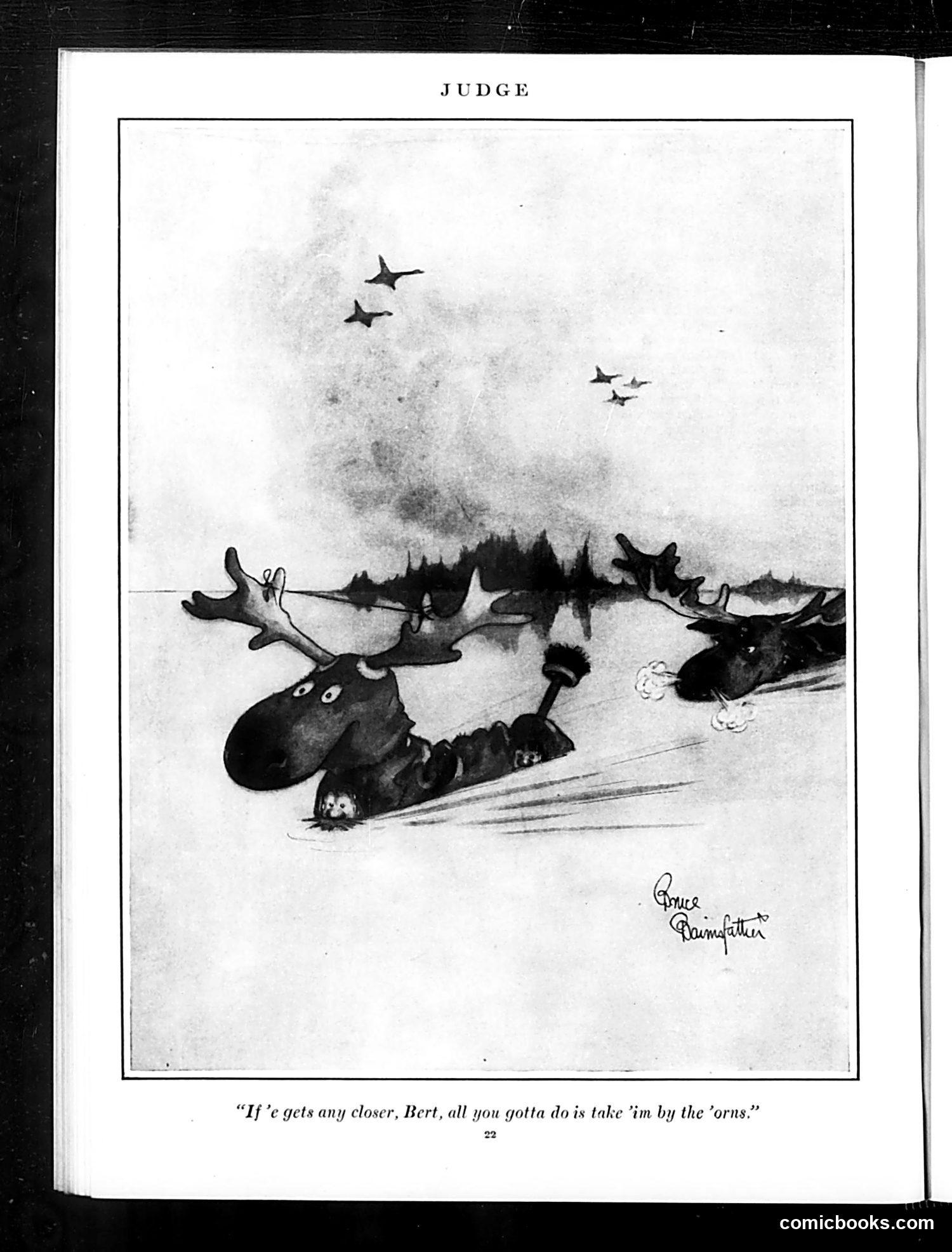
Analysis This is a hunting or combat cartoon signed by Bruce Bairnsfather. The image shows a large moose or elk lying in snow, with what appears to be a hunter or soldier positioned below it. Aircraft fly overhead in the background, and a forested landscape is visible. The dialogue—"If he gets any closer, Bert, all you gotta do is take 'im by the 'orns"—uses working-class British dialect ("'e," "'orns") and appears to offer tactical advice about subduing the animal by its antlers if it approaches. The cartoon likely satirizes either hunting culture or possibly military strategy, using the moose encounter as a metaphor. Without additional context about Judge magazine's publication date or Bairnsfather's other work, the exact political or social commentary remains unclear, though the casual tone and dramatic scene suggest mockery of either masculine bravado or military overconfidence.
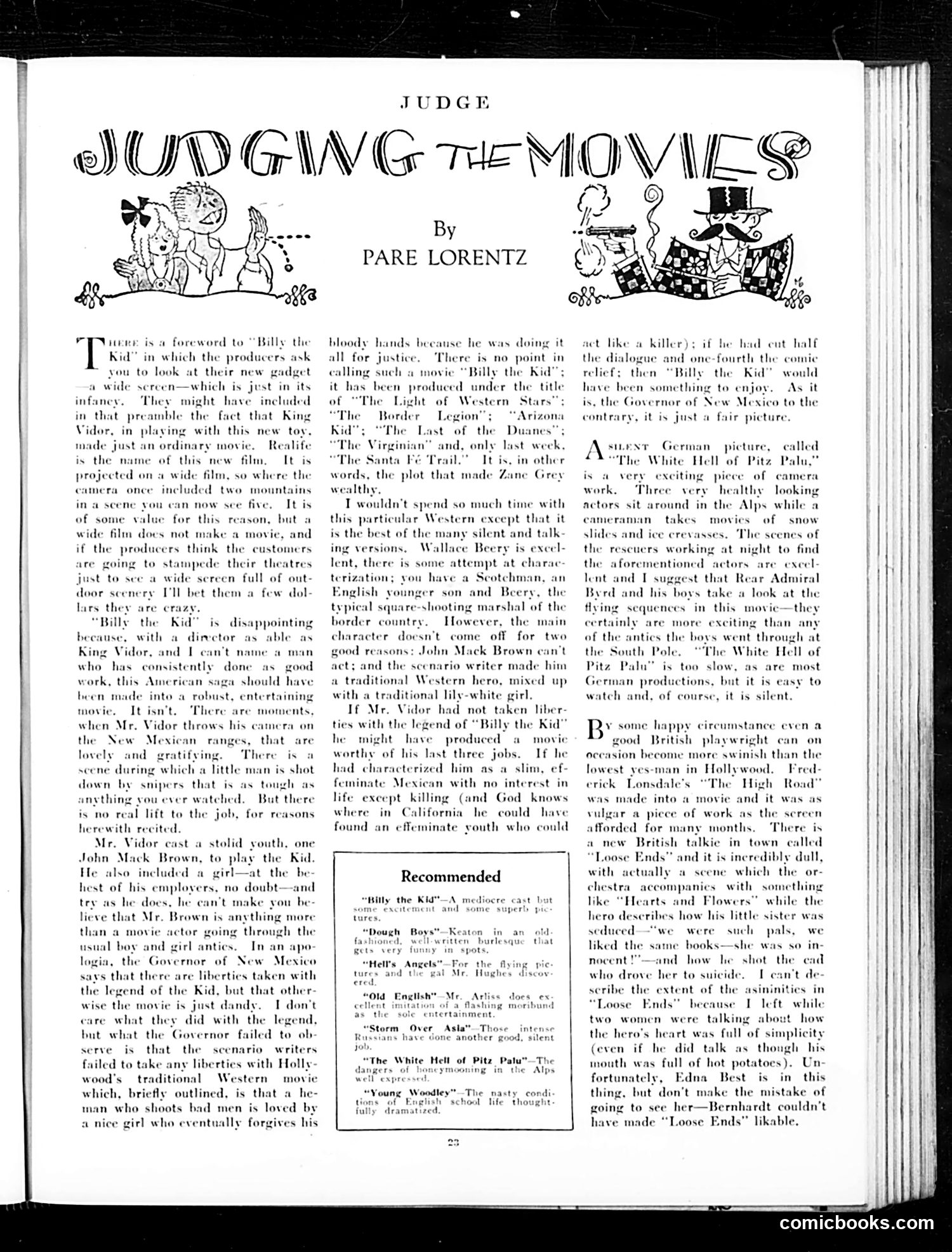
"Judging the Movies" - Film Criticism in Judge Magazine This is a film review column by Pare Lorentz critiquing King Vidor's "Billy the Kid" (1930). The satire targets both the film itself and Hollywood's approach to moviemaking. Main targets: - King Vidor: Praised as a capable director but criticized for wasting his talents on a mediocre script - John Mack Brown: The lead actor, dismissed as wooden and unconvincing in the role - Hollywood conventions: The forced addition of a romantic female lead; the use of "wide screen" gimmickry to distract from poor storytelling - The Governor of New Mexico: Apparently involved in the production, defending inaccuracies in the Billy the Kid legend The satire's point: Despite technical innovations and talented personnel, the film fails because it abandons the actual Billy the Kid story for a generic "Zane Grey" Western plot—essentially a retread of other films. Lorentz argues that true entertainment comes from substance, not gadgetry or star power.
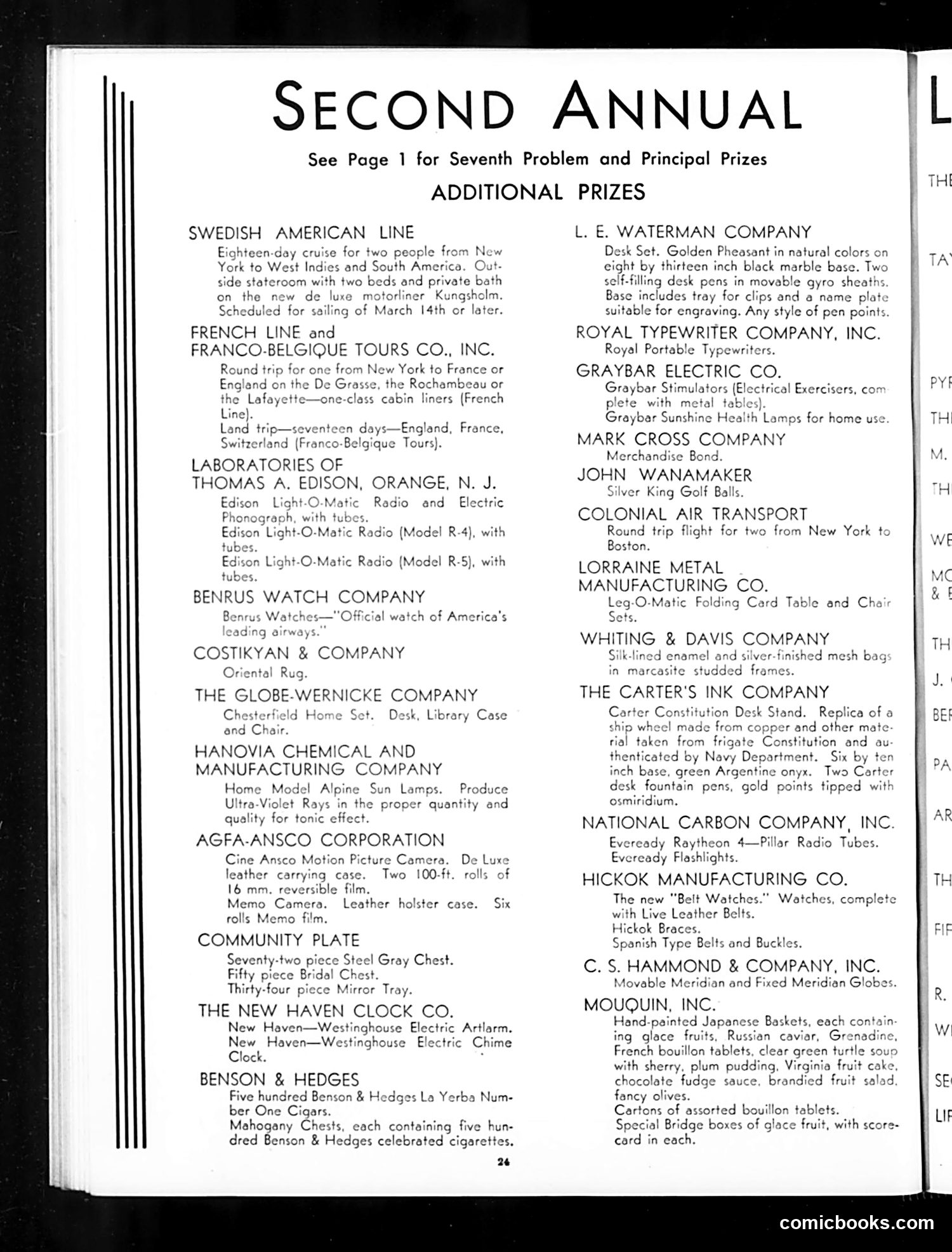
Page Content Analysis This is not a cartoon page but rather an advertising section from Judge magazine's "Second Annual" competition (likely a puzzle or contest). The page lists "Additional Prizes" offered by various corporations. The content reflects 1920s-1930s American consumer culture and commercial sponsorship: - Luxury travel prizes: Swedish American Line cruises, French Line tours (reflecting glamorous transatlantic tourism) - Technology products: Edison radios, Royal typewriters, radio tubes (emerging consumer electronics) - Lifestyle goods: watches, golf balls, health lamps, furniture - Luxury food: Moqin's caviar and gourmet gift baskets Historical context: This reveals what affluent Americans considered desirable prizes—expensive European travel, new electrical conveniences, branded luxury items, and imported delicacies. The prominence of radio and electrical products suggests this is post-1920s. The page demonstrates Judge's editorial strategy: attracting advertisers by offering their products as contest prizes, essentially creating sponsored content.
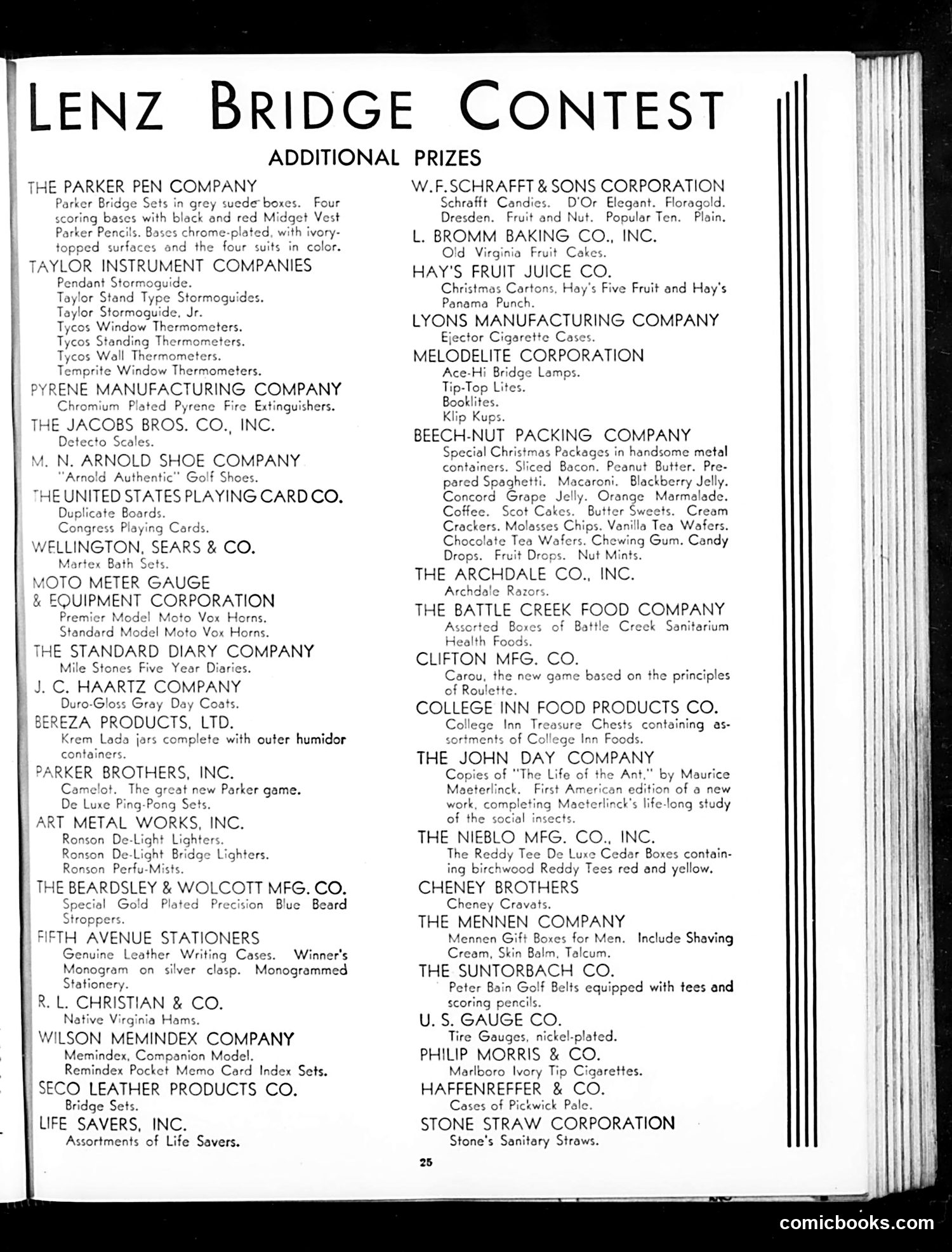
Lenz Bridge Contest: Additional Prizes Page This is not a cartoon page—it's purely an advertising/prizes listing for a "Lenz Bridge Contest," likely a bridge card game competition sponsored by Judge magazine. The page catalogs donated prizes from dozens of American manufacturers (circa 1920s-1930s based on product names). Winners would receive items like Parker pen sets, Pyrene fire extinguishers, golf shoes, playing cards, bath products, games, food products (candies, hams, fruit cakes), cigarettes, and sporting goods. The listing reflects period consumer culture: bridge was a popular pastime, gift items emphasized quality goods (leather cases, monogrammed stationery), and food/tobacco products were standard prizes. Companies donated merchandise for promotional value. This is essentially a corporate sponsorship roster—no satire or political commentary is present. It's a straightforward catalogue demonstrating Judge magazine's commercial reach and advertising partnerships.
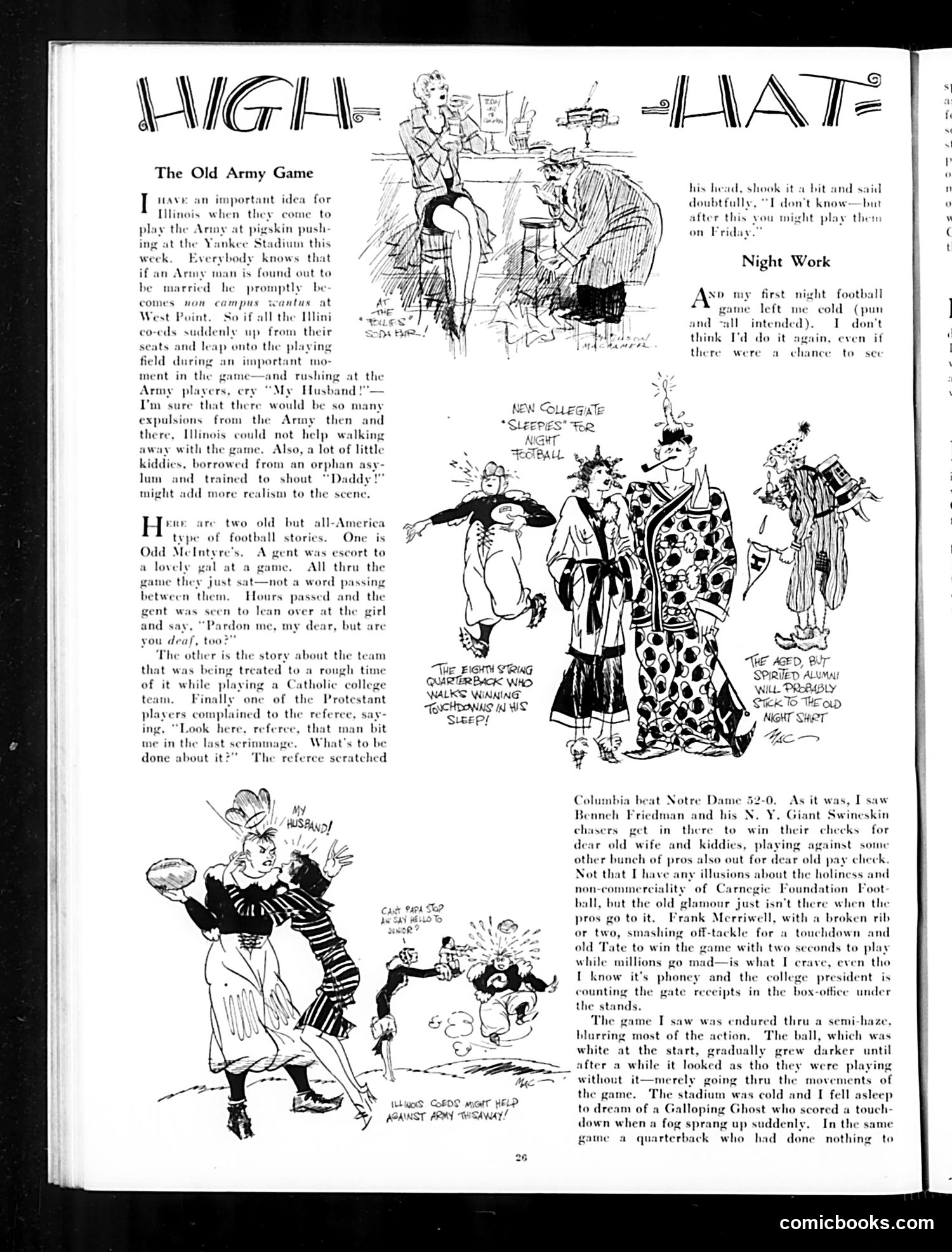
Analysis for Modern Readers This page contains two satirical football pieces from Judge magazine. "The Old Army Game" proposes a humorous scheme: Illinois could beat Army at football by having coeds rush the field shouting "My Husband!" during play. Since Army regulations required married cadets to be expelled ("non campus mentus"), this would decimate Army's roster. The joke relies on readers knowing West Point's strict marital rules. The page also includes two classic "old football stories"—one about a couple sitting silently through an entire game, another about a Catholic team's rough play that a Protestant player protests to a referee. "Night Work" critiques the author's experience attending a professional football game (Columbia vs. Notre Dame). He contrasts the excitement of college football's amateurism and high stakes with pro football's mercenary nature. He mentions Bennie Friedman and the "N.Y. Giant Swineskin chasers" (professional players), lamenting that professional play lacks the romance of fictional heroes like Frank Merriwell playing injured for glory. The cold stadium and fog symbolize the sport's lost appeal.
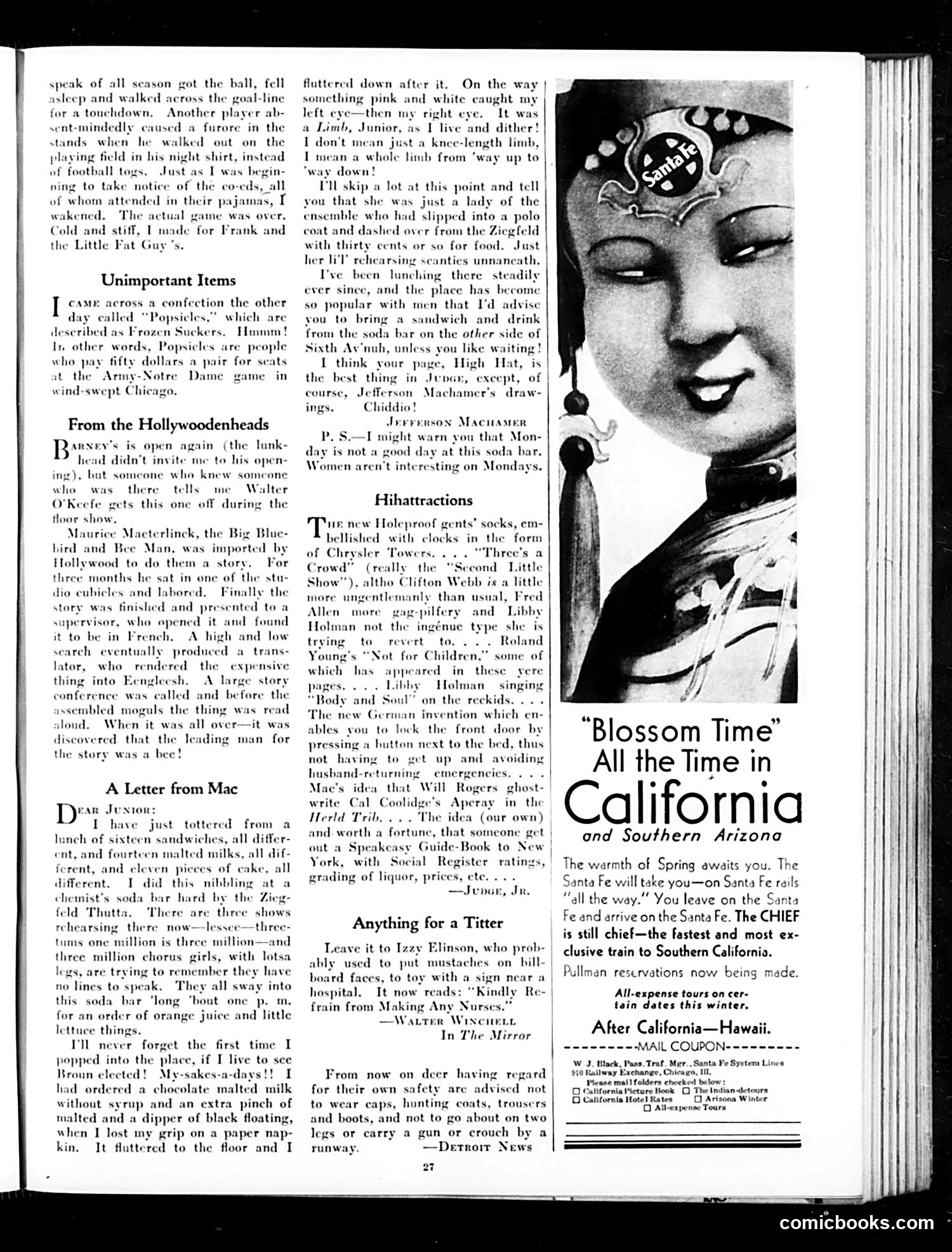
Judge Magazine Page Analysis This page combines humor columns with vintage advertising. The main content features lighthearted anecdotes rather than political satire: "A Letter from Mac" describes a writer's romantic encounter at a soda fountain near the Ziegfeld Theatre (a famous venue for theatrical productions). The humor derives from the narrator's exaggerated descriptions of consuming massive quantities of food and his comedic discovery of an attractive chorus girl. This reflects 1920s-30s urban social life and the romantic possibilities of casual public spaces. "Hihattractions" offers brief, gossipy reviews of theatrical productions, fashion items (Holeproof socks with clock designs), and Broadway shows—typical entertainment column fare for Judge's sophisticated urban audience. The large photograph on the right advertises California tourism, promising "Blossom Time" and the Chief train service to Southern Arizona. Rather than sharp political commentary, this page emphasizes social satire through personal anecdotes and entertainment industry gossip—characteristic of Judge's lighter editorial content.
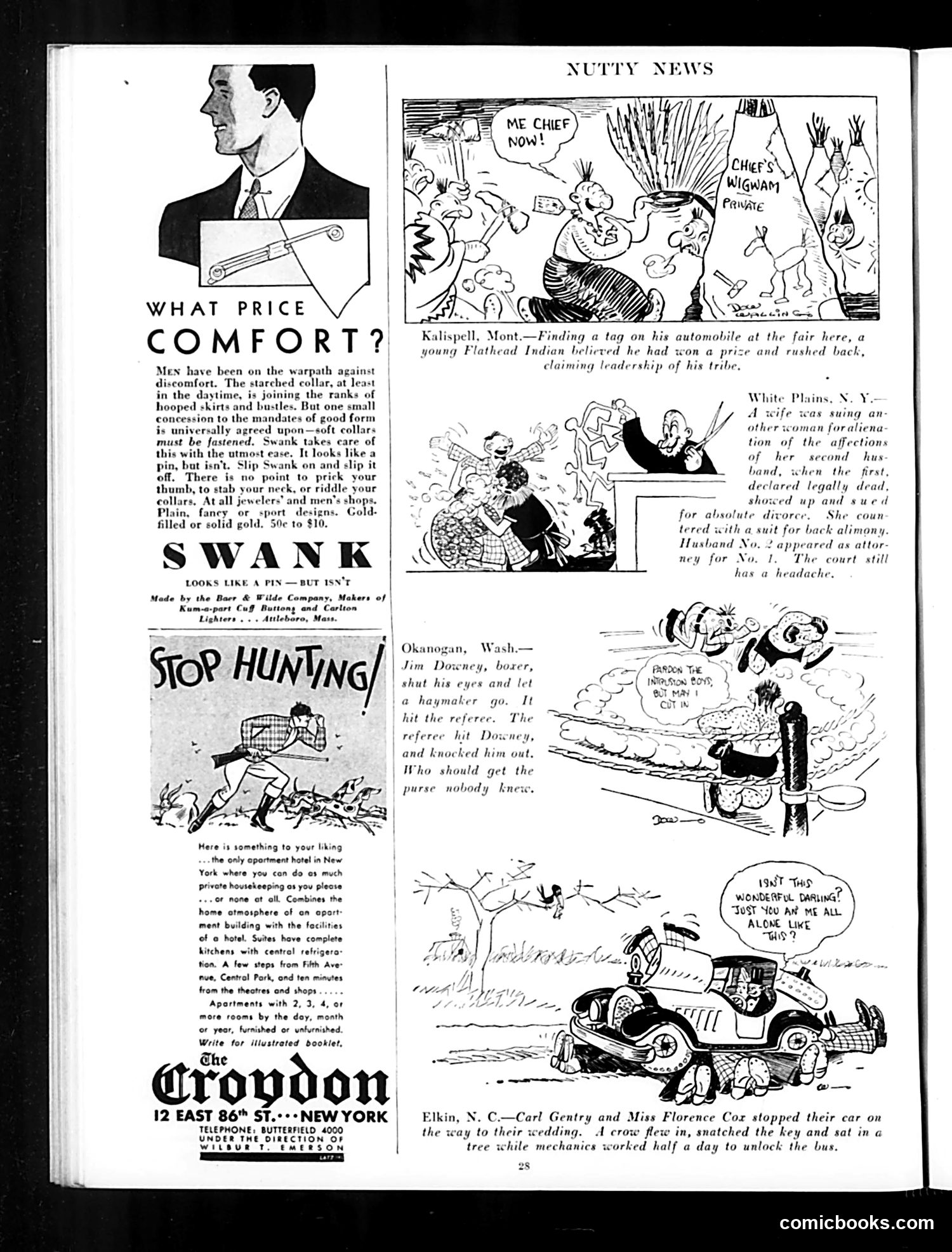
Nutty News Analysis This page features "Nutty News"—humorous anecdotes from small American towns, typical of Judge magazine's satirical humor. The cartoons illustrate absurd, real-life situations: Kalispell, Montana: A young Flathead Indian mistakes a parking violation tag for a prize, humorously claiming tribal leadership based on this "win." White Plains, New York: A marital legal tangle where a woman suing for alienation of affections discovers her "deceased" first husband is alive, creating overlapping divorce and alimony suits. Okanogan, Washington: A boxing match where a boxer accidentally knocks out the referee instead of his opponent, creating ambiguity about who won the purse. Elkin, North Carolina: A wedding day mishap where a crow steals the car's ignition key, requiring mechanics to spend half a day unlocking the vehicle. The humor relies on unexpected complications and absurd consequences from ordinary situations—typical of interwar American comic sensibility emphasizing ironic twists and human folly.
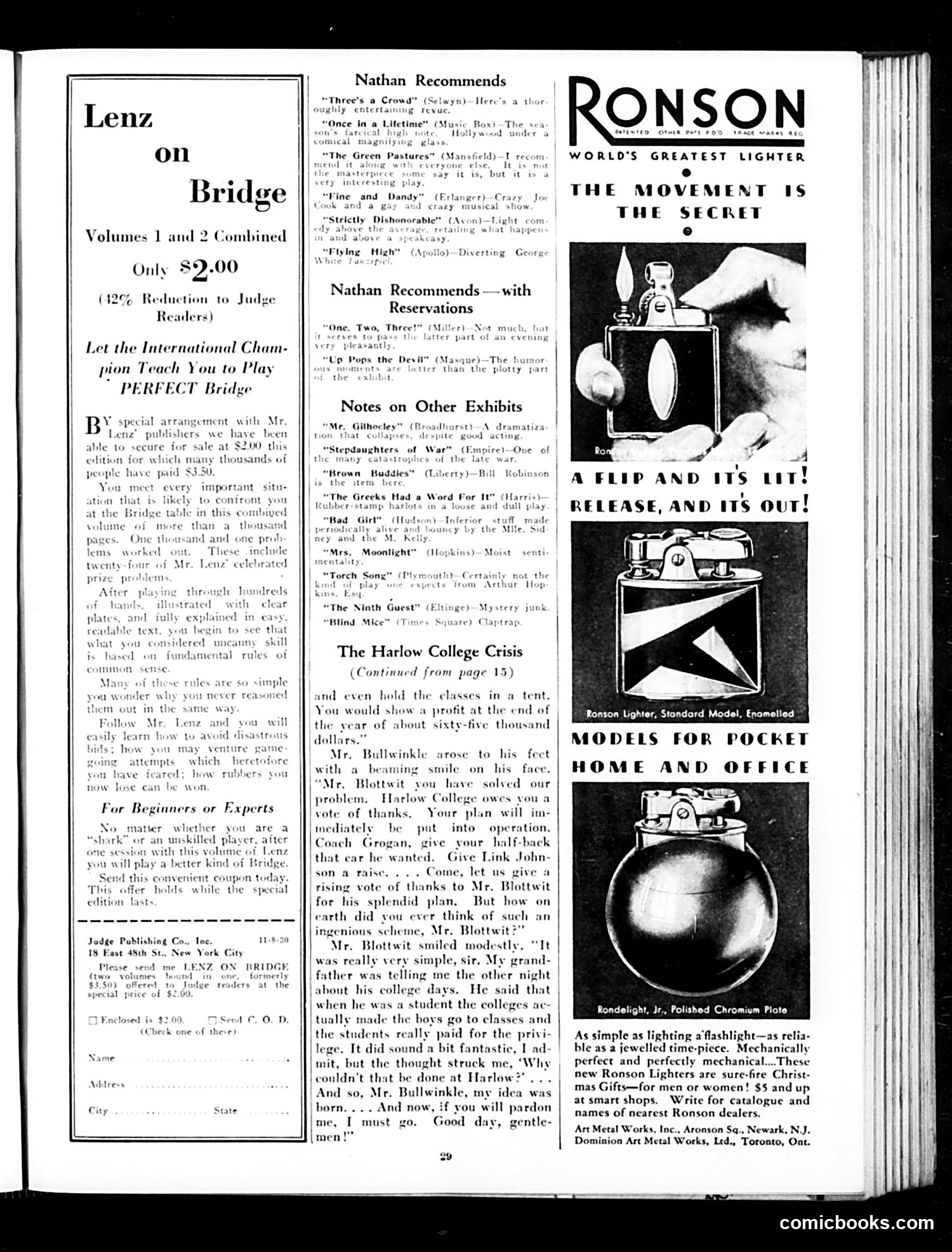
Judge Magazine Page Analysis This page is primarily advertising and filler content rather than satirical commentary. The left side advertises "Lenz on Bridge," a two-volume instructional book by a champion bridge player, offered at discount to Judge readers—a common monetization strategy for magazines. The center contains Nathan's theater reviews—brief recommendations and reservations about Broadway shows of the era (titles like "Strictly Dishonorable" and "The Greeks Had a Word For It"). Below that is "The Harlow College Crisis," a humorous short story about solving fictional college financial problems through an absurdly simple scheme: charge students tuition and require attendance—presented as a novel idea by the character Mr. Blottwit, who learned it from his grandfather's college days. The right side features Ronson lighter advertisements, emphasizing mechanical reliability and positioning the product as an ideal Christmas gift. The page reflects 1920s-30s consumer culture and advertising practices rather than political satire. It's typical filler and revenue-generating content for the magazine.
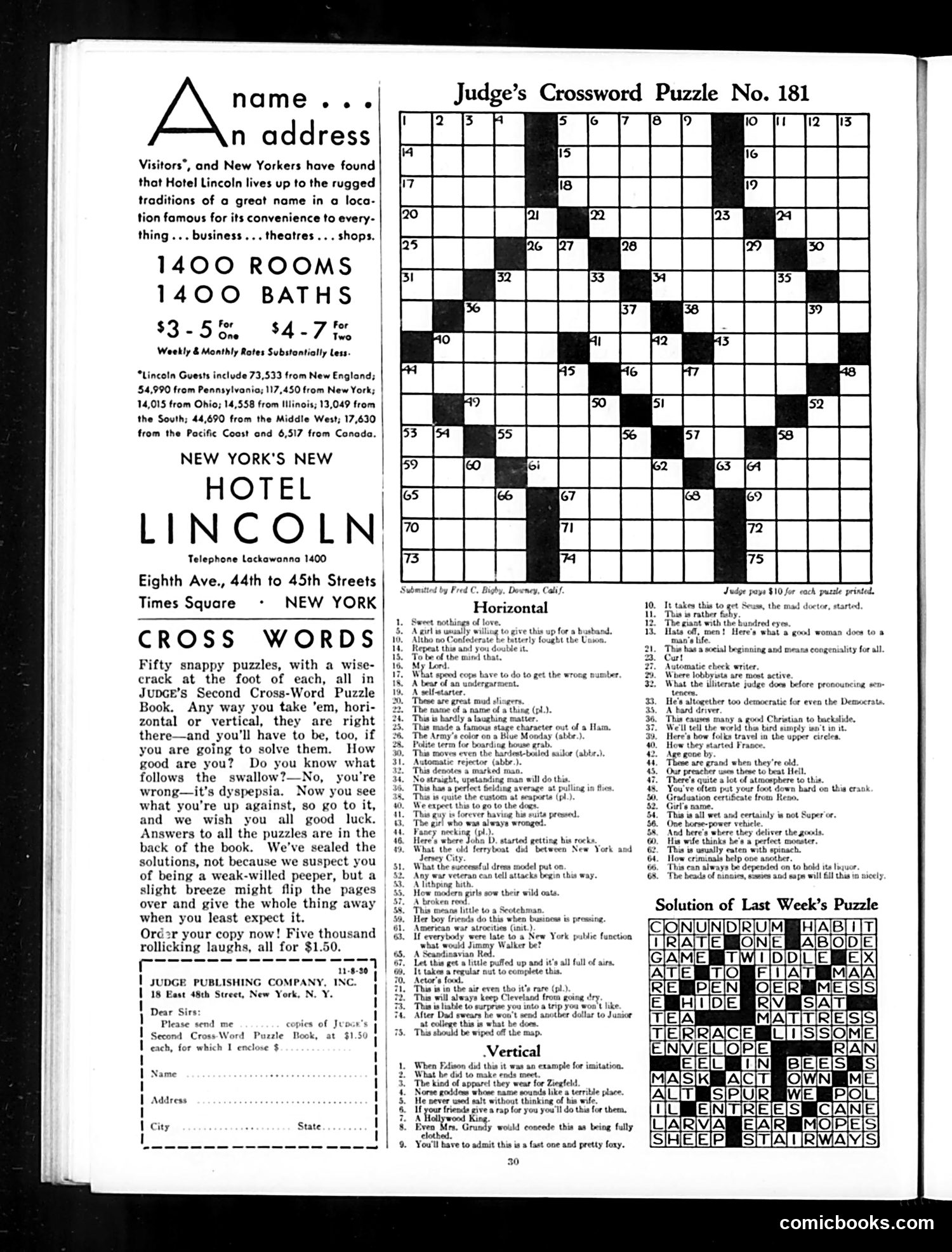
Judge Magazine Crossword Page Analysis This page is primarily advertising and puzzle content, not satirical editorial material. The dominant feature is an advertisement for Hotel Lincoln in New York's Times Square area, emphasizing its 1,400 rooms, competitive pricing ($3-5 single, $4-7 double), and guest statistics from across America. The ad positions the hotel as convenient to business, theaters, and shops. Below is "Judge's Second Cross-Word Puzzle Book" promotion—a commercial product offering 50 puzzles with humorous clues for $1.50. The page includes Puzzle No. 181 itself, with both horizontal and vertical clues containing period-specific jokes (references to Jimmy Walker, Ziegfeld, prohibition-era humor). At bottom is the solution to the previous week's crossword. The content reflects Judge magazine's business model: mixing advertising with entertainment to attract readers. There is no political satire or caricature on this page—it's purely commercial and recreational material typical of 1920s-30s magazine publishing.
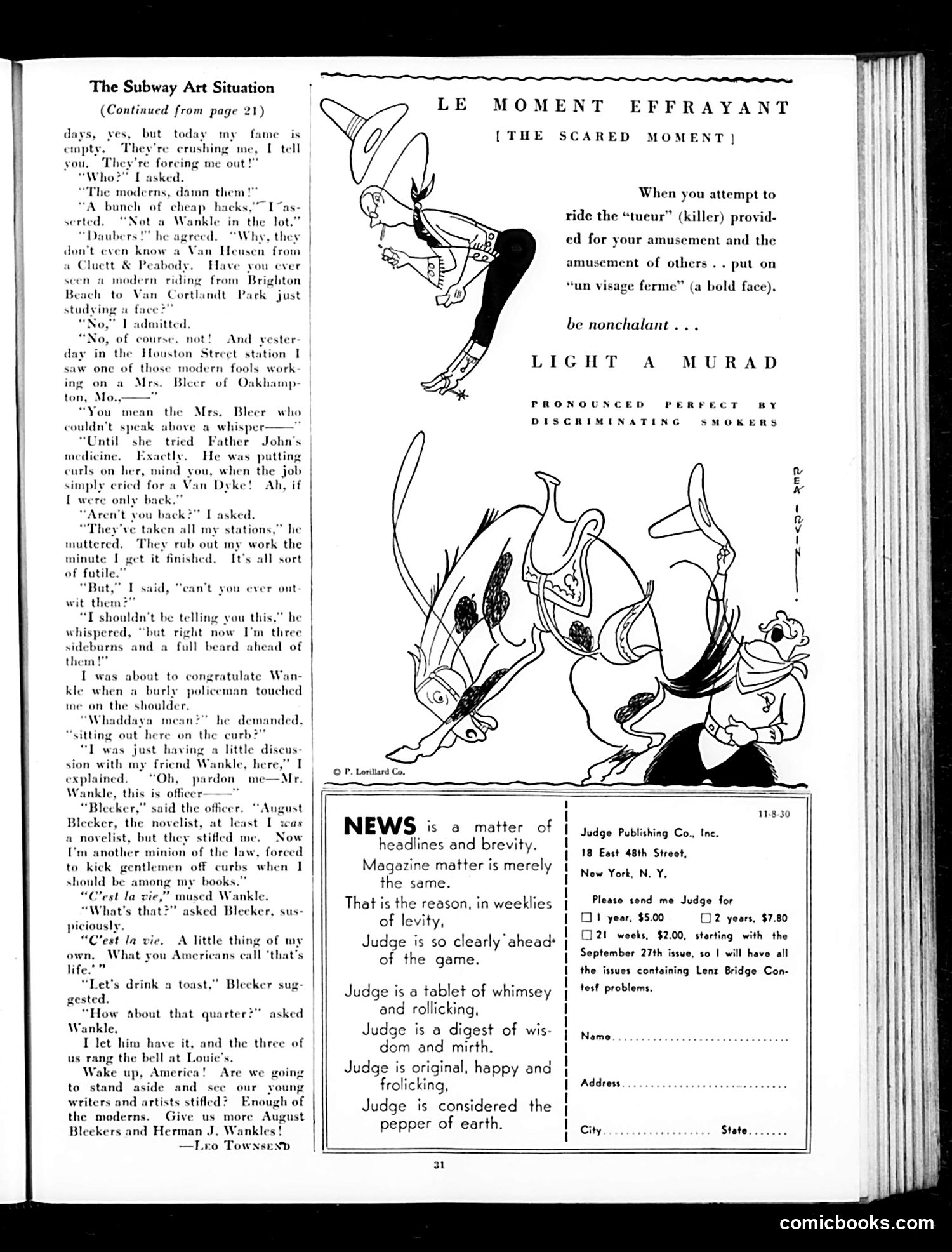
"The Subway Art Situation" — Judge Magazine Cartoon Analysis This multi-panel story satirizes the decline of traditional craftsmanship in early 20th-century America, particularly subway advertising art. The narrative features two characters—a nostalgic artist named Wankle and August Bleecker, a formerly published novelist now reduced to working as a police officer. The satire's target: "modern" commercial artists replacing skilled craftsmen. Wankle laments that contemporary artists don't understand classical techniques (referencing specific shirt brands as shorthand for quality standards). Bleecker represents the broader tragedy—talented writers and artists pushed out by mass production and commercialism, forced into menial work. The French phrases ("Le Moment Effrayant," "un visage ferme") and cigarette advertisement add period flavor, suggesting cosmopolitan pretension contrasted with American philistinism. The cartoon's plea—"Wake up, America!"—argues that suppressing artistic excellence in favor of cheap, efficient production damages cultural life. This reflects Progressive Era anxieties about industrialization replacing artisanal values.
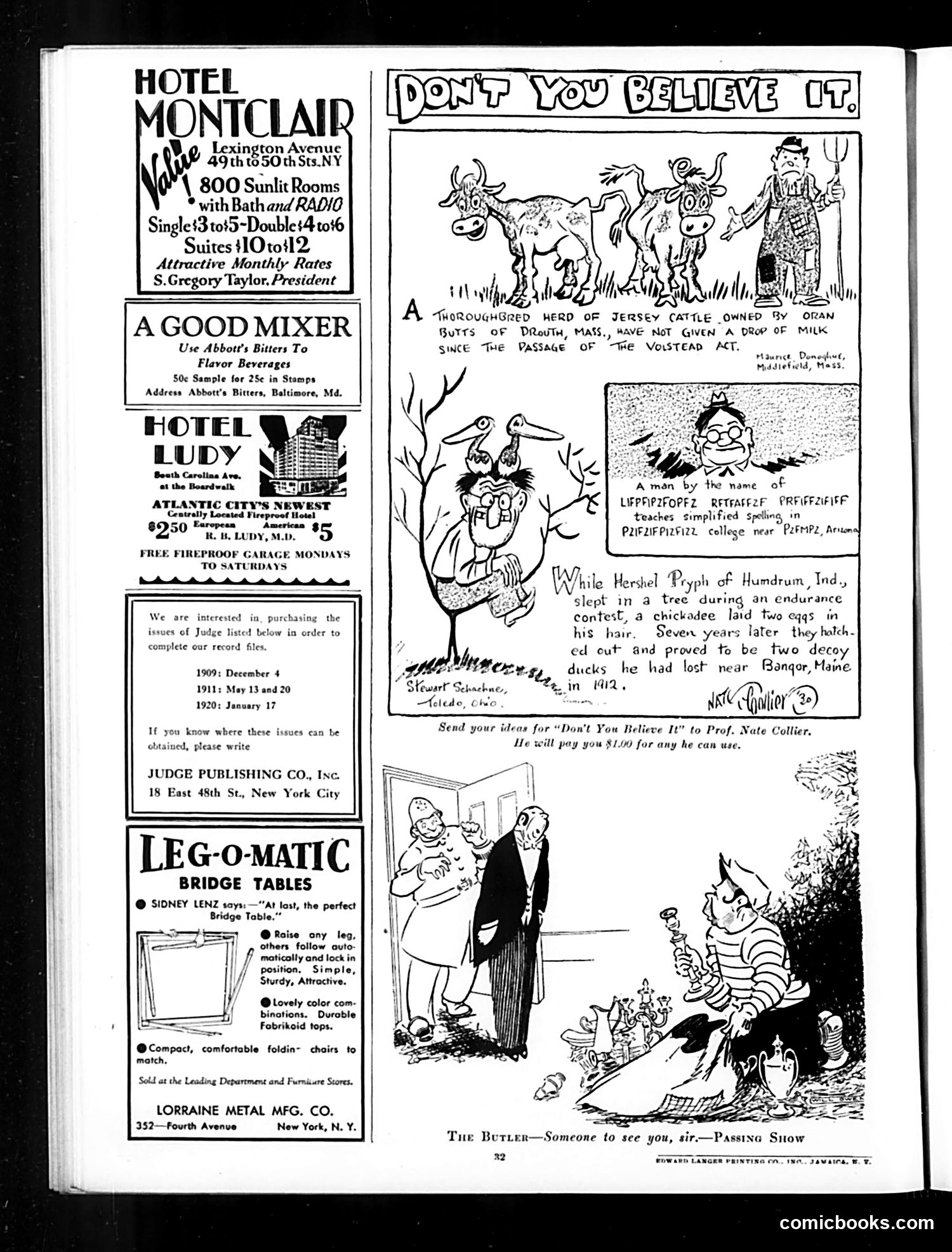
"Don't You Believe It" - Judge Magazine Humor Page This page features a humor column where readers submit tall tales and absurd claims. The Volstead Act (Prohibition) reference is topical: a Jersey cattle herd hasn't produced milk since Prohibition passed—a joke implying the cows are so distressed by alcohol prohibition they've stopped lactating. Other submissions include a man with an intentionally unpronounceable name who teaches "simplified spelling" (mocking the early 20th-century spelling reform movement), and an implausibly long story about a man who slept in a tree during a contest, only to have chickadee eggs hatch in his hair seven years later as decoy ducks. The page is mostly advertisements for hotels, bridge tables, and bitters, with the humor column as secondary content. The column's appeal relied on readers' familiarity with contemporary social debates like Prohibition and language reform movements.
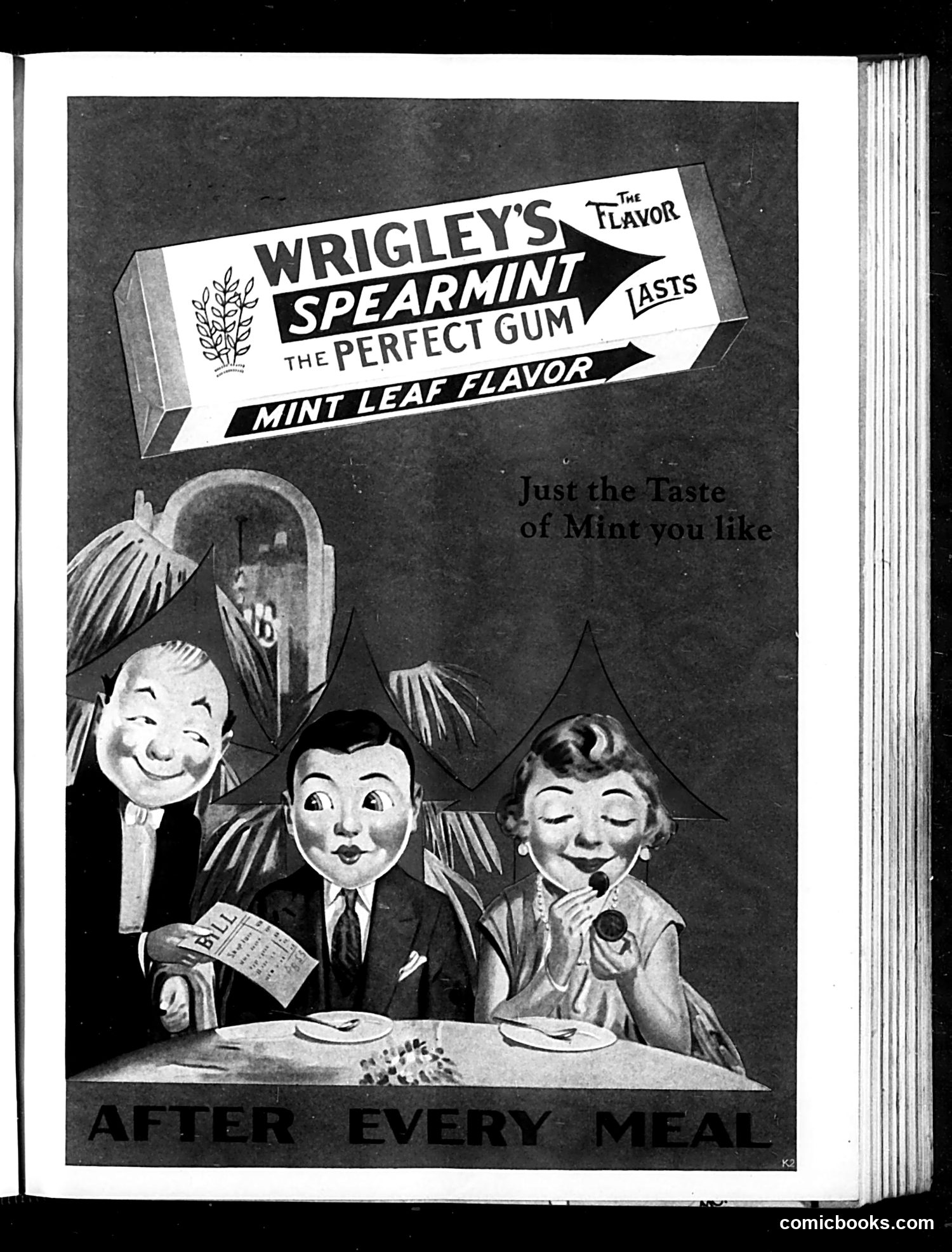
Analysis This is a Wrigley's Spearmint Gum advertisement, not political satire. The image shows three caricatured figures with exaggerated Asian features enjoying gum "after every meal," with text emphasizing "the flavor lasts" and "mint leaf flavor." The advertisement reflects 1930s-era marketing practices that used racial caricature as a standard advertising technique. Modern viewers should recognize this as a product advertisement rather than editorial commentary, though the racial stereotyping would be considered offensive today. The "mint leaf" plant illustration and smiling faces are meant to convey satisfaction and appeal, typical of period gum advertising. This page demonstrates how casual racism was embedded in mainstream American advertising before mid-20th century social shifts occurred.
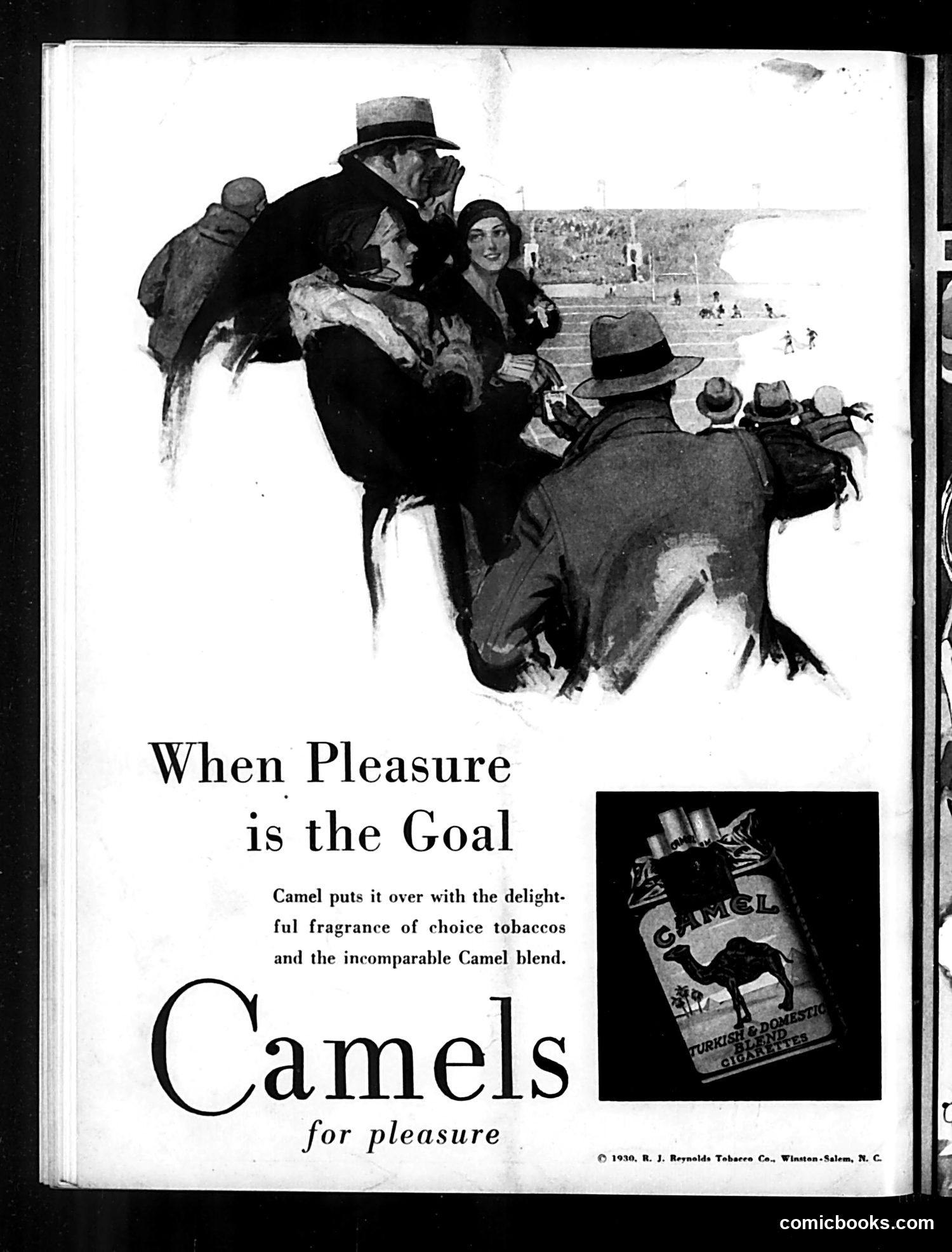
This is primarily a cigarette advertisement, not satire or political commentary. The page features a Camel cigarettes ad from 1930. The illustration shows well-dressed figures at what appears to be a sporting event or public gathering, with a stadium visible in the background. The ad's messaging emphasizes pleasure and leisure as the appeal of smoking Camels. There is no political or social satire here—this is straightforward commercial advertising from the era when tobacco companies could advertise openly in magazines. The phrase "When Pleasure is the Goal" frames smoking as a desirable lifestyle choice. The Camel package is displayed in the lower right corner. This represents pre-health-warning advertising, before the serious health consequences of smoking became widely publicized.