judge
Judge — November 15, 1930
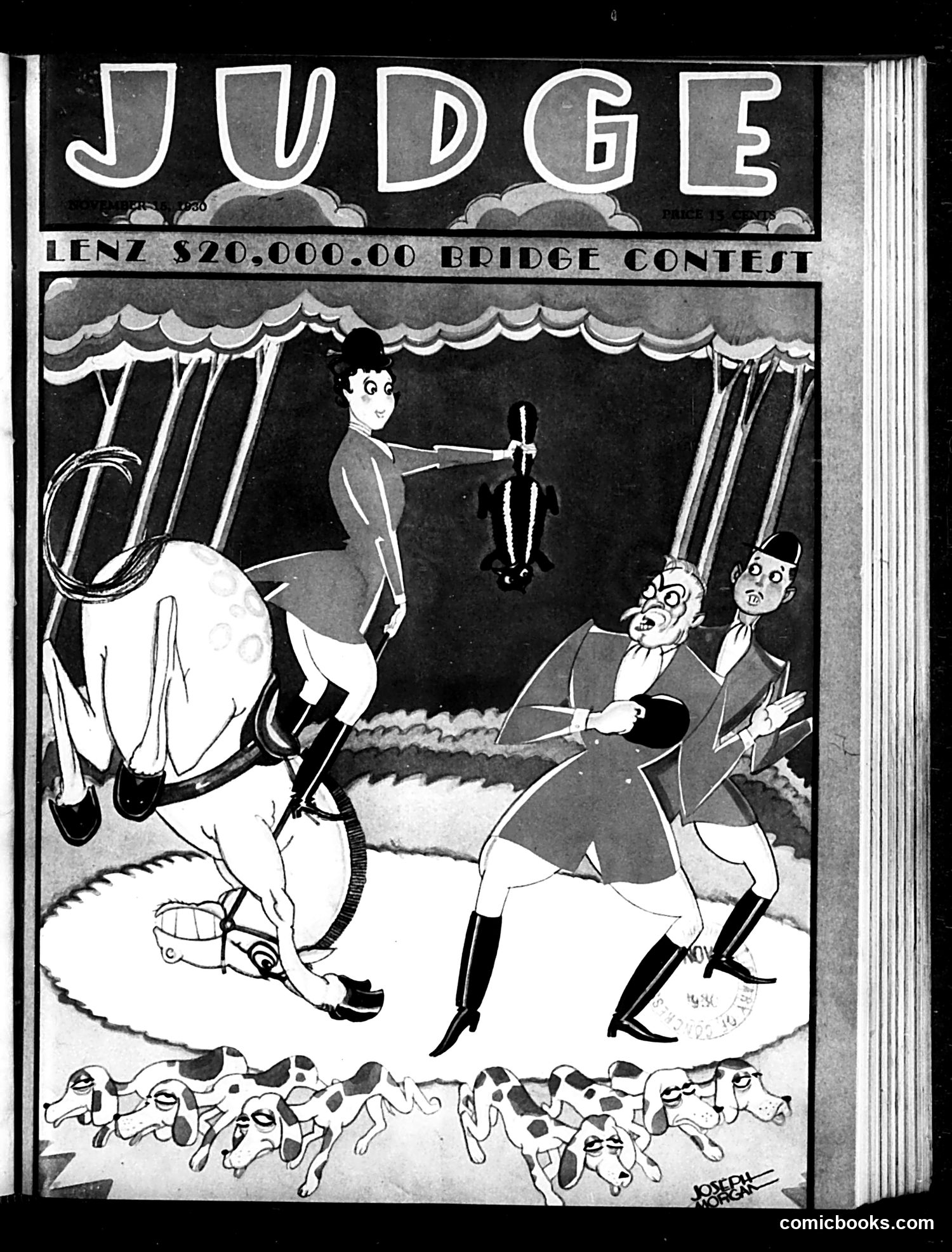
Judge Magazine: "Lenz $20,000.00 Bridge Contest" This cartoon satirizes a bridge-building contest sponsored by someone named Lenz with a $20,000 prize. The circus setting—complete with tent, ringmaster, and performing dogs—mocks the spectacle of the competition. The central figure appears to be demonstrating or "judging" a bridge design (the dark object being held up), while two suited men react with exaggerated concern or skepticism. The dog performers at the bottom reinforce the "circus" metaphor, suggesting the contest is entertainment rather than serious engineering. The satire implies that the bridge competition is absurdly theatrical or that the proposed designs are ridiculous—worthy of mockery rather than serious consideration. Without additional context about the specific historical Lenz contest, the precise target remains unclear, but the cartoon clearly ridicules the event's legitimacy.
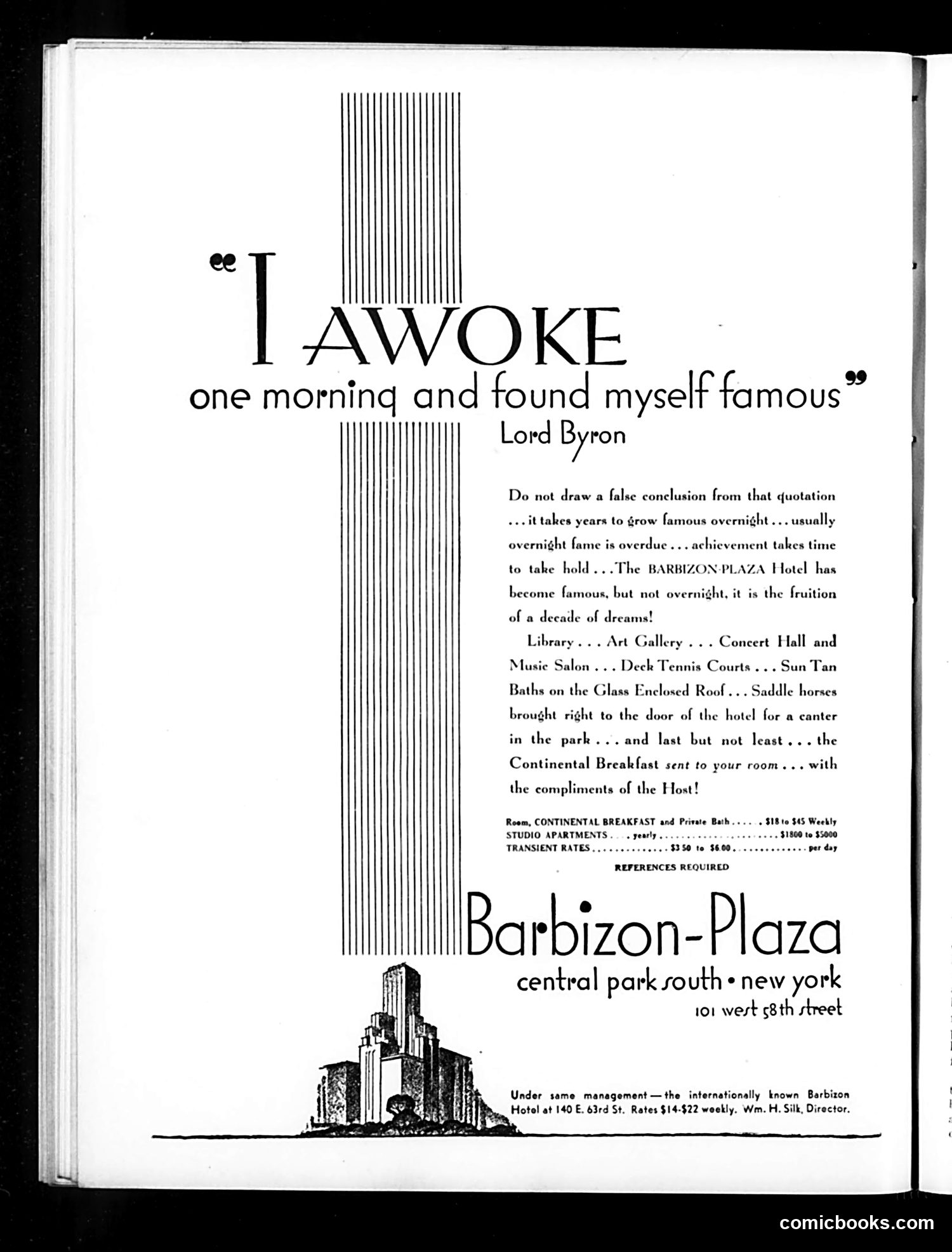
Analysis This page is primarily an advertisement for the Barbizon-Plaza Hotel in New York (Central Park South, 101 West 58th Street), not a political cartoon. The ad uses Lord Byron's famous quote about waking up famous overnight to market the hotel's amenities and prestige. The copywriting argues against drawing false conclusions from Byron's words—that achieving fame actually takes years of effort, not overnight luck. The Barbizon-Plaza is then presented as an example of this principle: it "became famous, but not overnight," representing a decade of planning and achievement. The ad lists luxury features (library, art gallery, concert hall, tennis courts, sun baths, saddle horses, and complimentary continental breakfast) to justify its prestigious reputation and justify rates of $18-45 weekly for rooms. This is essentially luxury hospitality marketing, not satire.
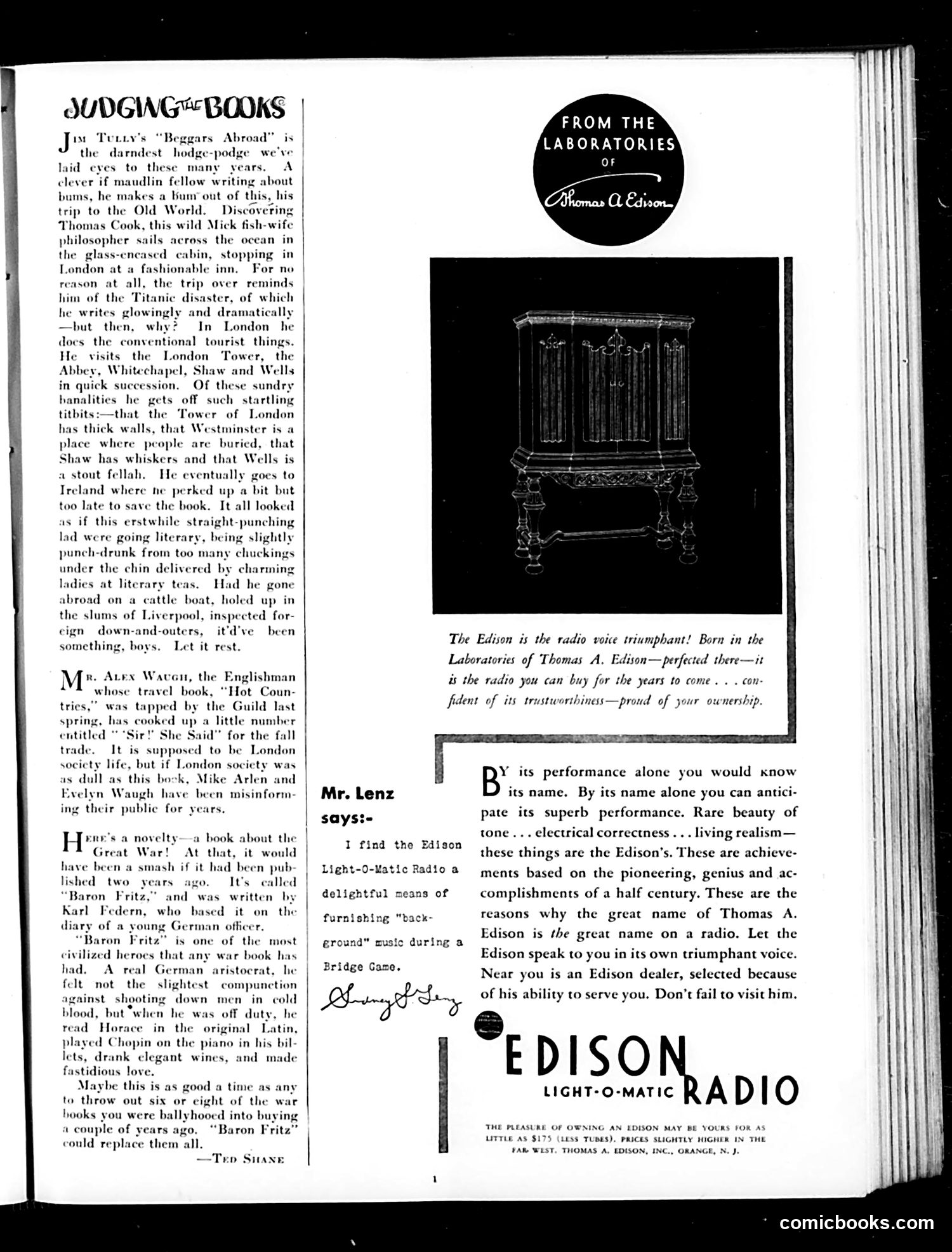
Analysis This page is primarily advertising, not satire or political commentary. The left column contains book reviews by "Ted Shane" for *Judge* magazine's "Judging the Books" section—discussing travel narratives and war literature. The right side features a full-page Edison Radio advertisement showcasing the "Light-O-Matic" model. The ad includes a testimonial from "Mr. Lenz" praising the radio's performance and tone quality, emphasizing Edison's reputation for innovation. The advertisement appeals to consumer desire for quality electronics and brand prestige rather than engaging in political satire. The page reflects 1920s advertising practices and consumer culture, with no apparent satirical commentary on the advertisements themselves.
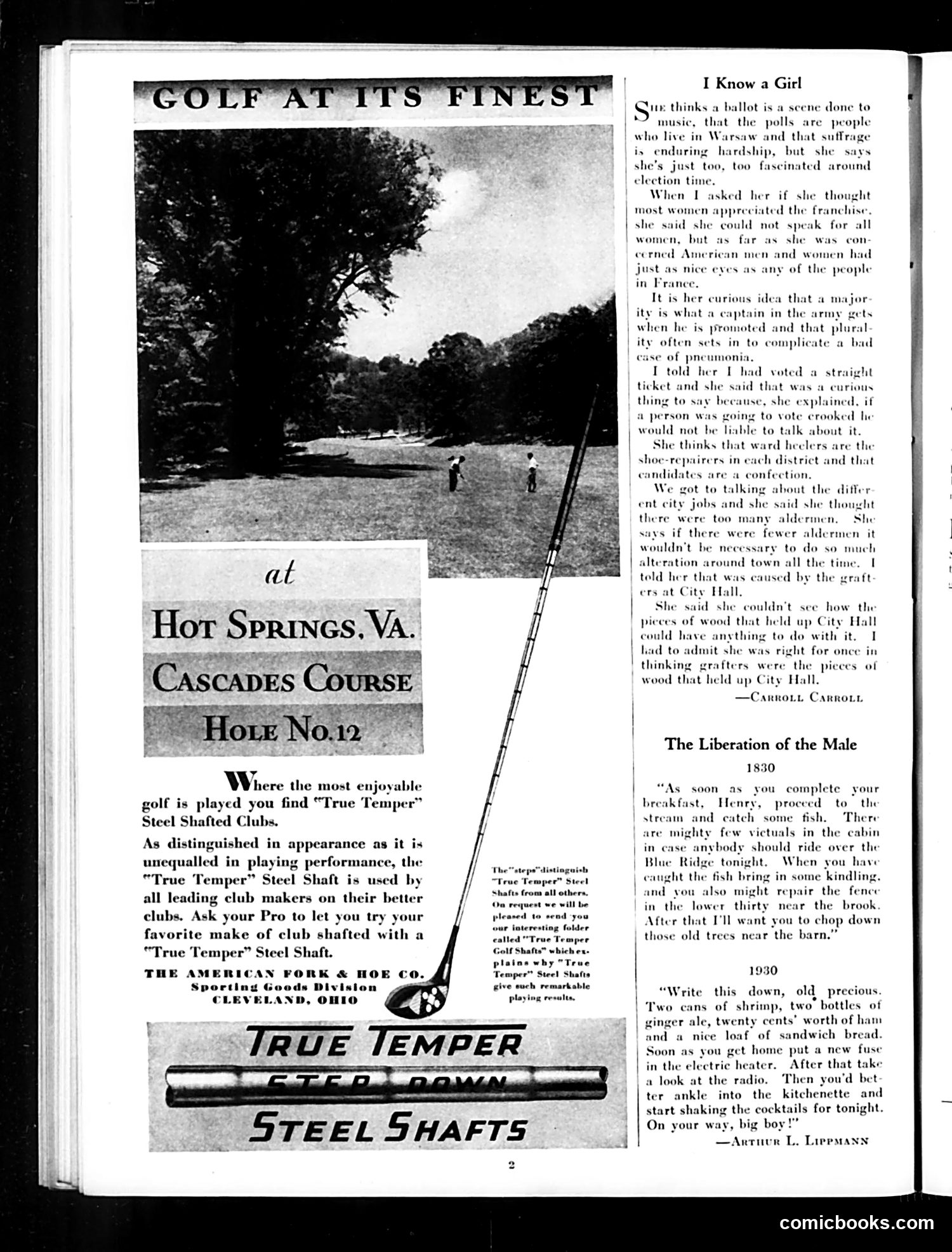
Page Analysis This page contains no political cartoon. Instead, it features: 1. Golf advertisement (left): A scenic photograph of Cascades Course at Hot Springs, Virginia, promoting "True Temper" steel-shafted golf clubs made by American Fork & Hoe Co. of Cleveland, Ohio. The ad emphasizes the superior performance of steel shafts. 2. "I Know a Girl" (top right): A humorous social commentary by Carroll Carroll about a woman fascinated by election time, discussing her observations about politics, city jobs, and bureaucratic inefficiency—particularly grafters at City Hall supporting wooden structures. 3. "The Liberation of the Male" (bottom right): Two dated vignettes (1830 and 1930) humorously contrasting men's freedoms across centuries. The page is primarily advertising and light social humor, not satirical political commentary.
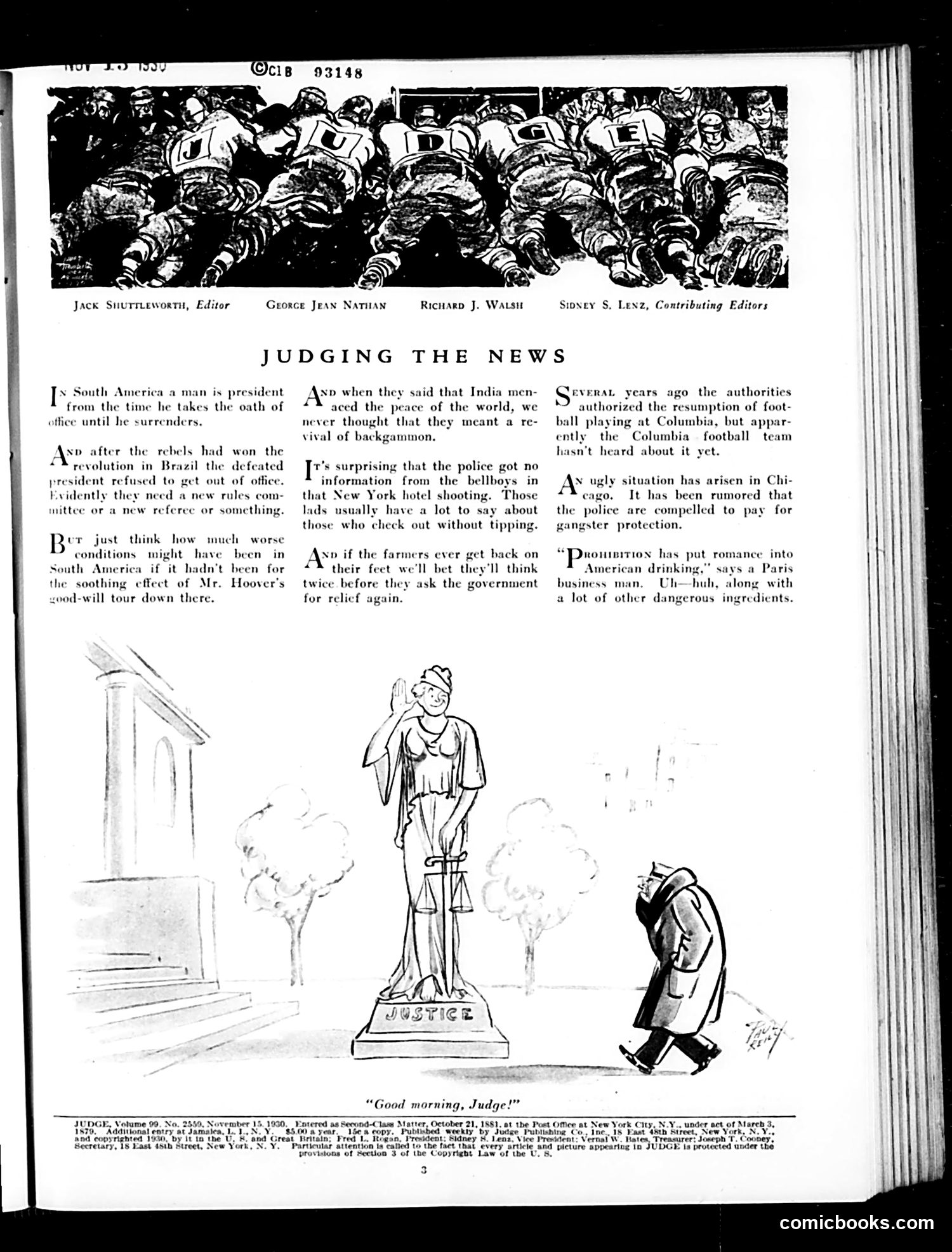
"Good Morning, Judge!" Cartoon Analysis This cartoon satirizes the disconnect between judicial authority and political reality. The central figure is Lady Justice, depicted as a blind statue holding scales—a traditional symbol of impartial law. A well-dressed man (likely representing a politician or government official) approaches her deferentially, tipping his hat with "Good morning, Judge!" The satire suggests that despite Justice's blindness and supposed impartiality, politicians greet and attempt to influence her—implying that the legal system is actually accessible to or manipulated by those in power. The cartoon critiques the corruption or politicization of American courts, where formal institutions of justice are compromised by backroom dealings and political pressure.
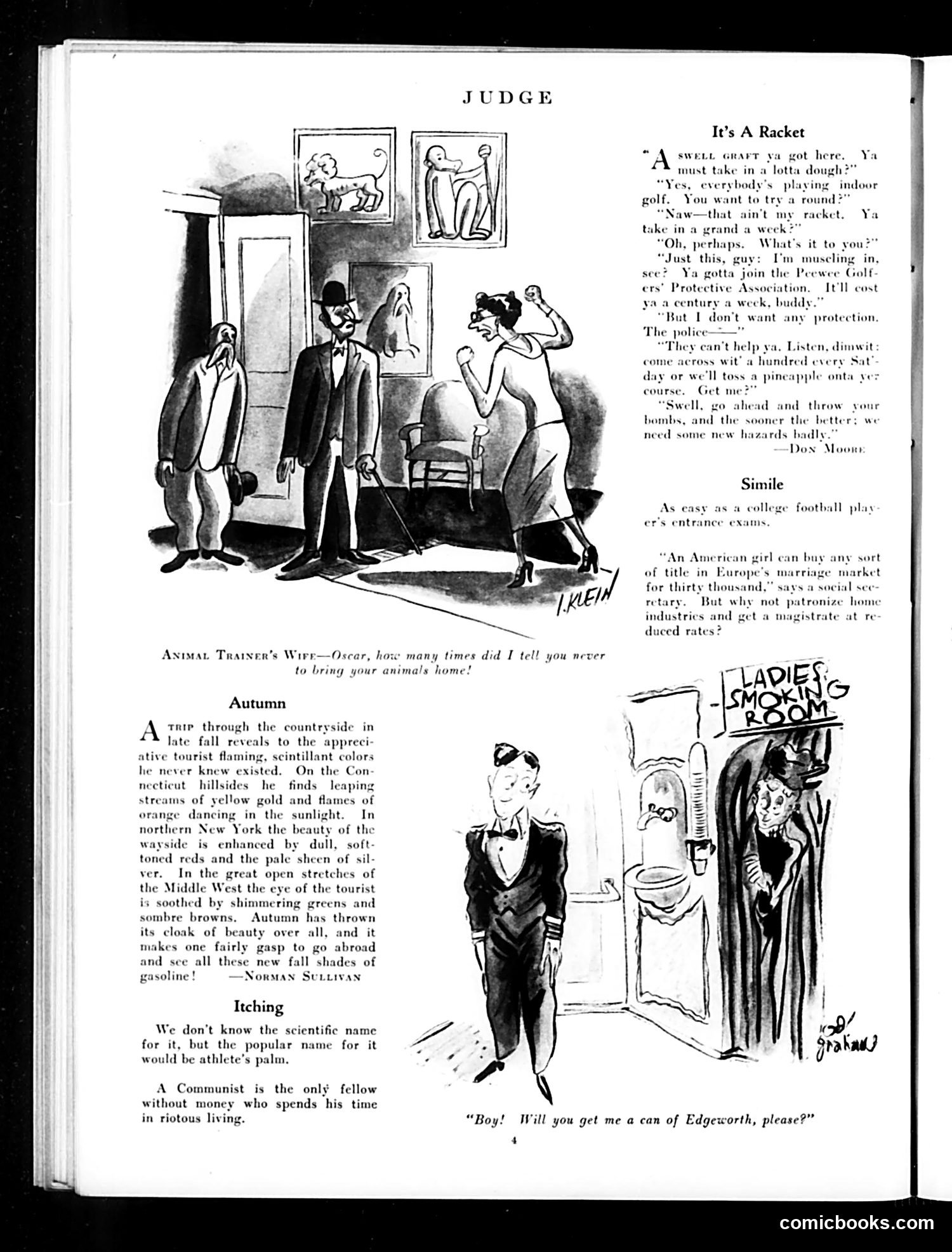
Analysis of Judge Magazine Page The main cartoon, "Animal Trainer's Wife," depicts a domestic scene where a woman confronts her husband about repeatedly failing to bring animals home—likely referencing his work as a circus or performance animal trainer. The humor relies on the wife's exasperation with his professional habits intruding on home life. The page also contains several shorter satirical pieces: "It's A Racket" mocks golf club protection associations as extortion schemes; "Simile" critiques American women's pursuit of European titles through marriage; and "Autumn" poetically describes fall landscapes, attributed to Norman Sullivan. The "Ladies Smoking Room" cartoon shows a woman requesting Edgesworth tobacco—likely advertising content disguised as humor. The specific historical context of these references remains unclear without additional dating information.
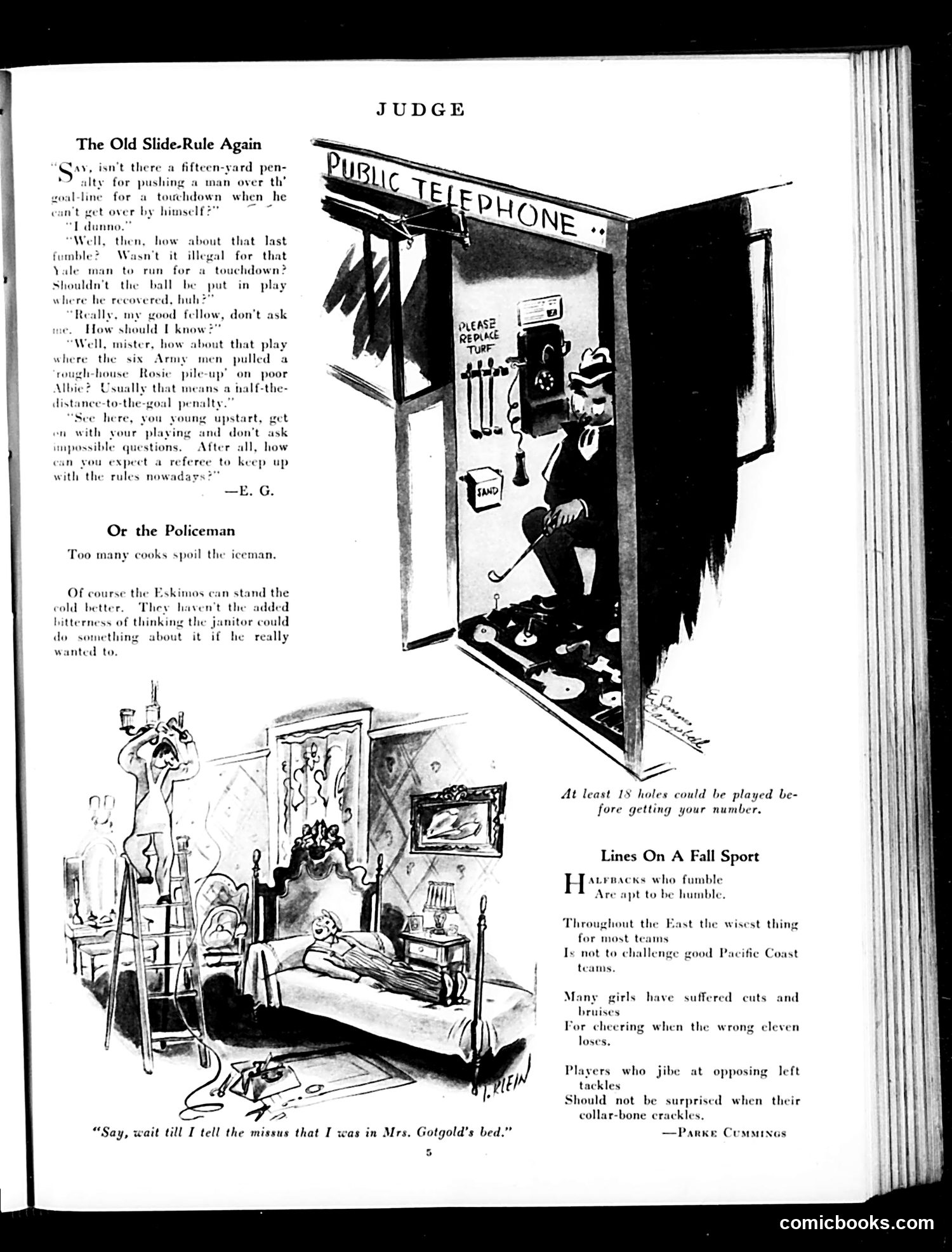
Judge Magazine Page Analysis This page contains three separate satirical pieces from an early 20th-century American humor magazine: 1. "The Old Slide-Rule Again" — A dialogue mocking football rule debates, suggesting people argue about technicalities without understanding the actual sport. 2. "Public Telephone" cartoon — Shows a man in a cramped phone booth surrounded by golf clubs, satirizing how people attempt recreational activities in inconvenient spaces. The caption jokes that "at least 18 holes could be played before getting your number" — mocking both the difficulty of using public phones and golf culture. 3. "Lines On A Fall Sport" — Brief humorous verses about football season mishaps and injuries, written by Parker Cummings. The overall theme mocks American sports enthusiasm and the confusion surrounding their rules and culture.
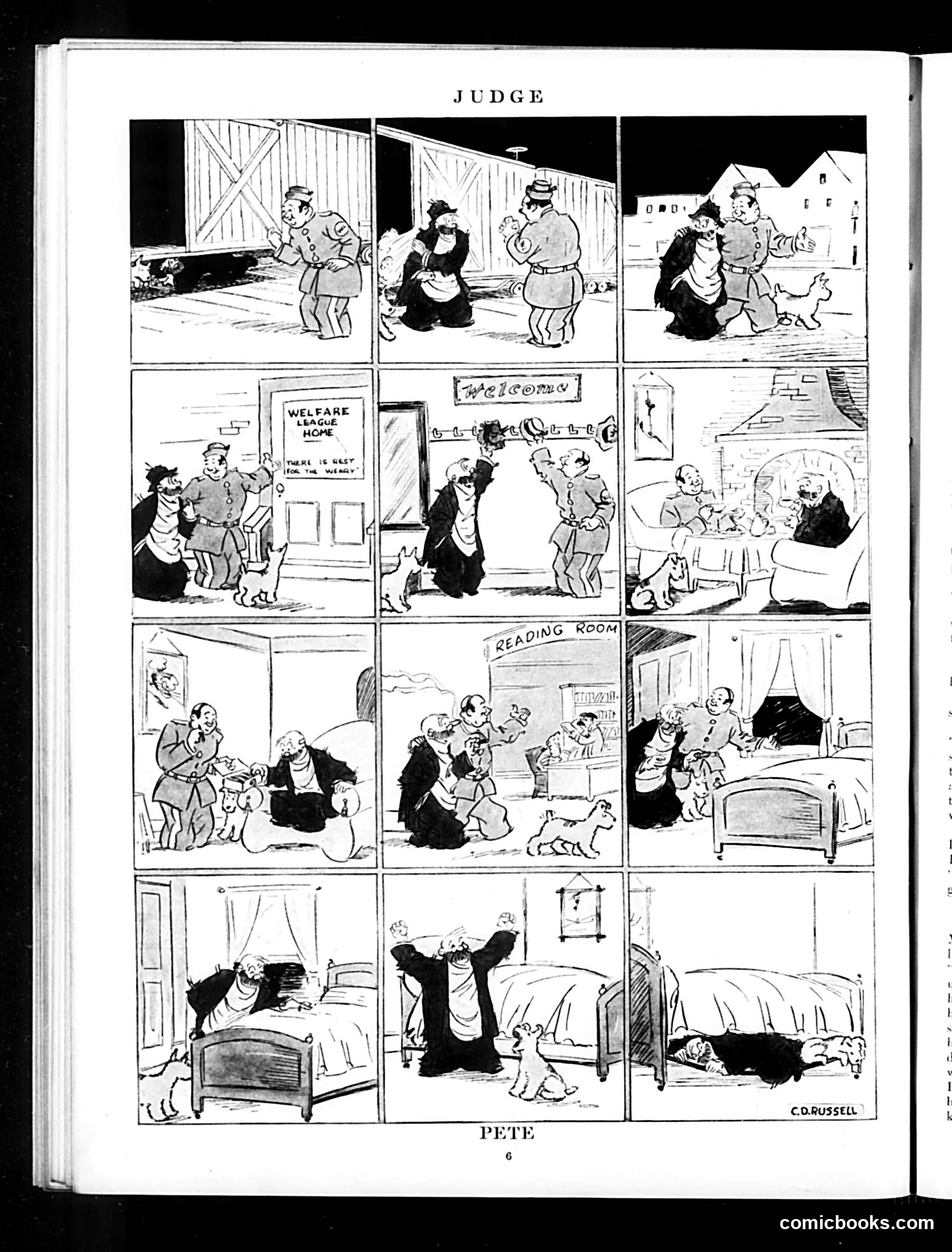
"Judge: Pete" Comic Strip Analysis This comic strip, titled "Pete" and signed by C.D. Russell, depicts a domestic welfare scenario. The narrative follows what appears to be a social welfare worker (in the hat and uniform) visiting homes, including a "Welfare League Home." The satire likely critiques early 20th-century welfare administration and bureaucratic oversight of poor families. The sequence shows the welfare official observing conditions in working-class homes, a "Reading Room," and bedtime scenes. The humor appears to stem from the contrast between official welfare inspection protocols and the messy reality of domestic life. The comic references the then-contemporary "Welfare League"—an actual charitable organization—suggesting Judge magazine's satirical take on Progressive Era social welfare programs and their often-intrusive inspections of recipient families.
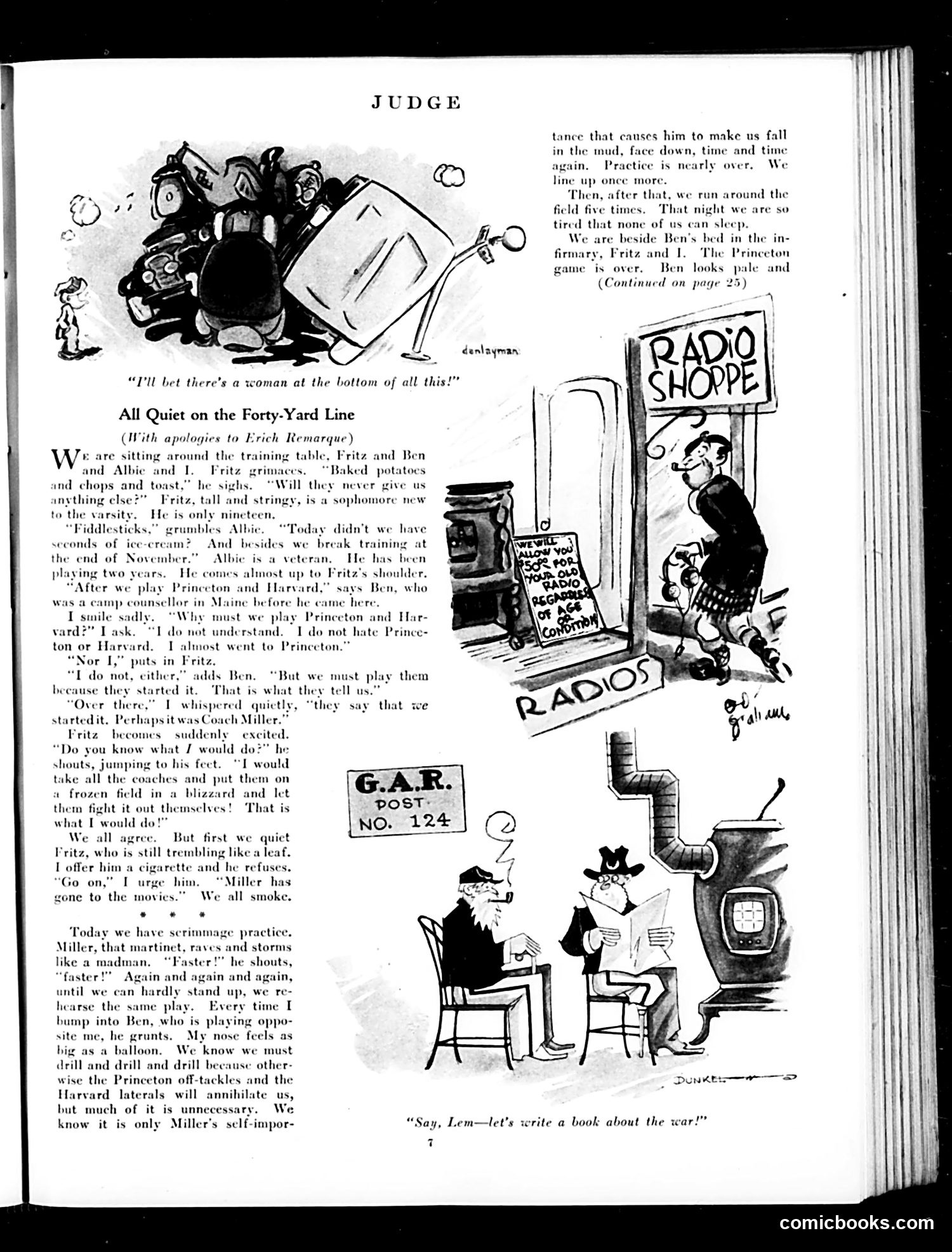
"All Quiet on the Forty-Yard Line" This is a satirical piece parodying Erich Maria Remarque's *All Quiet on the Western Front* (1929), a celebrated anti-war novel. The satire applies that work's dark tone to college football practice instead of actual warfare. The joke: Young athletes endure brutal conditioning drills under an tyrannical coach named Miller, and they discuss it with the same existential weariness soldiers use discussing combat. References to Princeton and Harvard—rival football teams—are treated as actual enemies ("they started it"), echoing how soldiers discuss opposing armies. The accompanying cartoons mock consumer culture and commercialism (the "Radio Shorpe" and "G.A.R. Post" sketches), likely suggesting American society's obsession with entertainment and business even during serious times. The final caption—"Say, Lem—let's write a book about the war!"—completes the parody: even trivial college sports experiences are dramatized as profound.
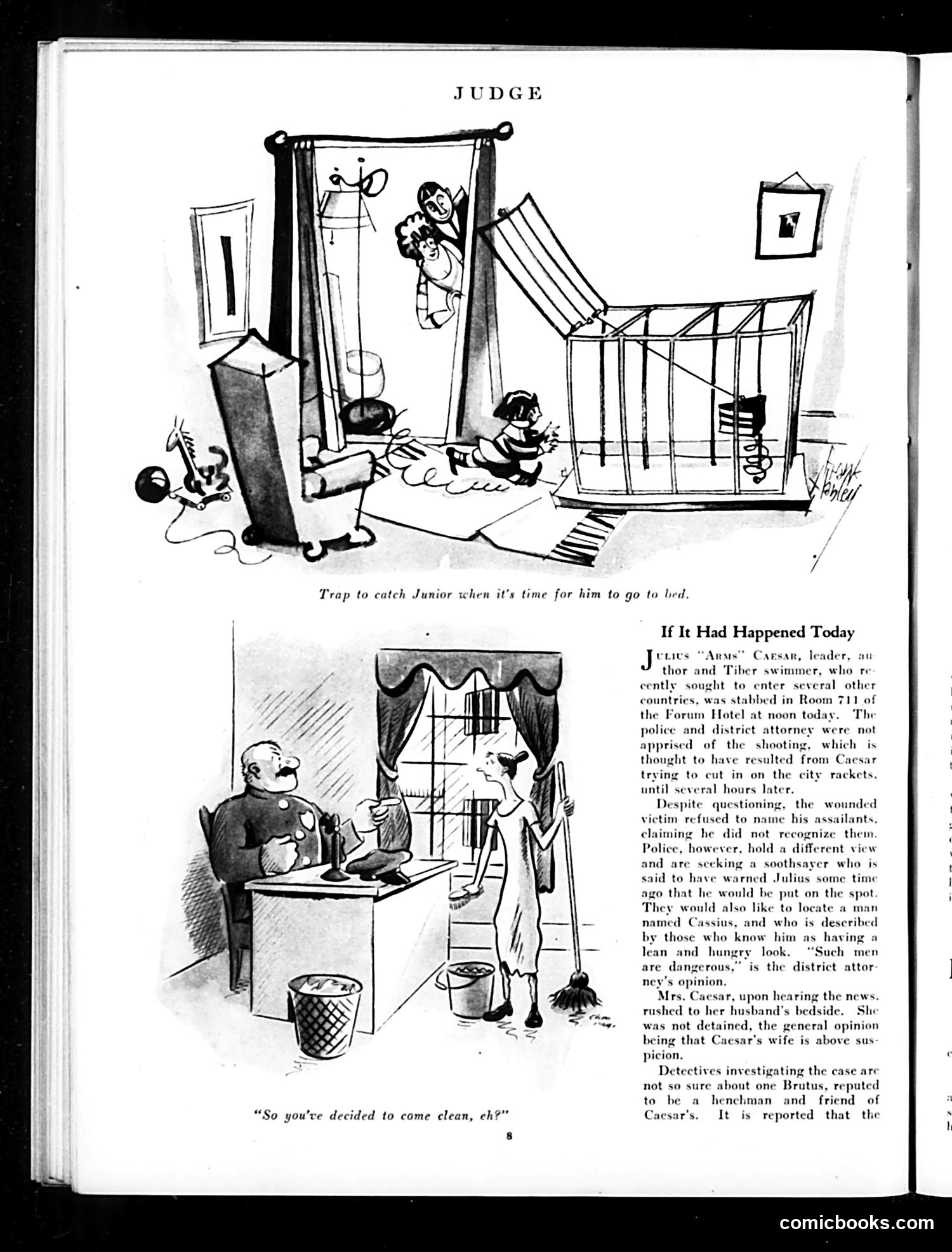
Political Satire Explanation This page contains two cartoons satirizing American life, plus a mock news story parodying the assassination of Julius Caesar as if it occurred in contemporary 1920s-30s America. Top cartoon: A humorous domestic scene showing an elaborate "trap" (bed frame with pulleys and mechanisms) designed to catch a child at bedtime—satirizing parents' struggles with reluctant kids. Bottom cartoon and article: The main satire transposes Caesar's assassination into modern organized crime. "Julius 'Ars' Caesar" is stabbed at the "Forum Hotel" and claims not to recognize his attackers. The satire mocks contemporary crime culture: police incompetence, witnesses refusing cooperation with authorities, suspicion falling on associates like "Brutus" and "Cassius," and the general assumption that Caesar was involved in "city rackets." The reference to Caesar's wife being "above suspicion" maintains the classical parallel while satirizing how crime families protected family members from legal scrutiny. The joke targets both the historical drama and modern American criminal underworld conventions.
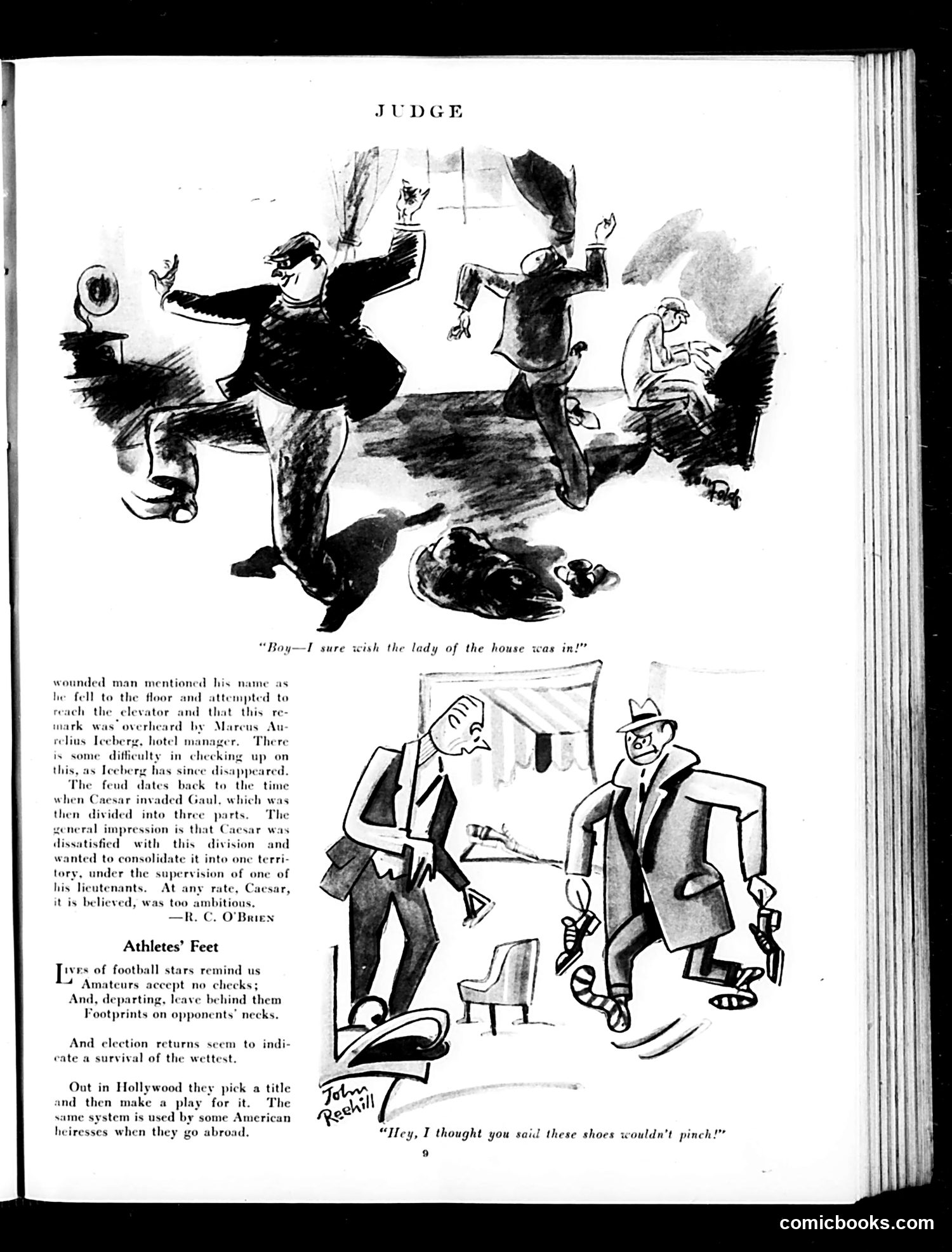
Judge Magazine Page Analysis This page contains two separate satirical cartoons: Top cartoon ("Judge"): A chaotic courtroom scene where a judge appears to be literally kicking defendants or witnesses out. The caption "Boy—I sure wish the lady of the house was in!" suggests domestic/legal chaos. The accompanying text discusses Caesar's division of Gaul and a hotel incident, implying commentary on ineffective legal authority or judicial mismanagement. Bottom cartoon ("Athletes' Feet"): Two men in suits stand amid tangled rope/string near a chair. The caption "Hey, I thought you said these shoes wouldn't pinch!" is a pun on "athletes' feet"—the poem above jokes that football players leave "footprints on opponents' necks," while the cartoon appears to satirize either uncomfortable situations, political entanglements, or failed promises. The style suggests early 20th-century American satire focused on everyday absurdities and wordplay rather than specific political figures.
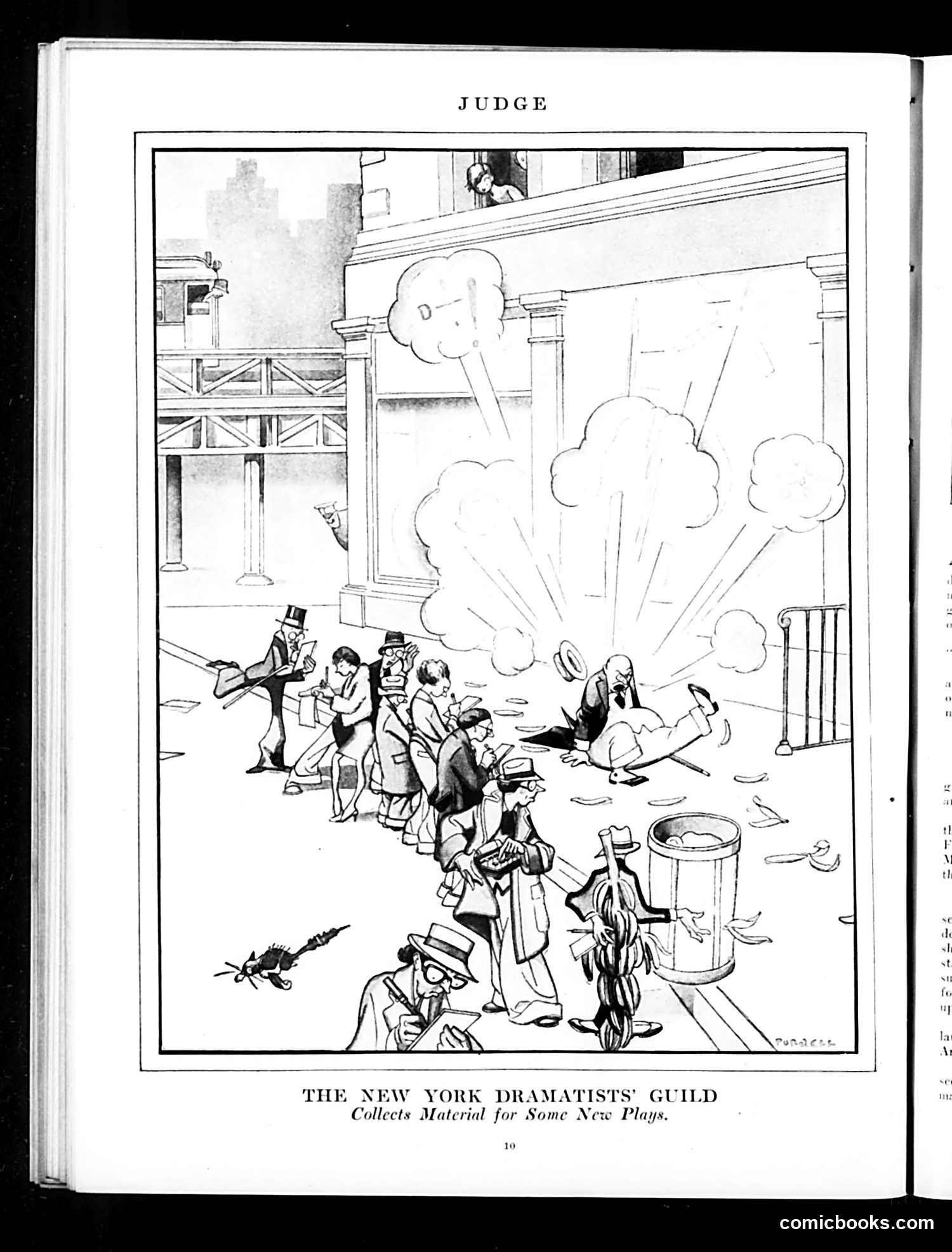
Analysis This cartoon satirizes the New York Dramatists' Guild by depicting playwrights as literal scavengers collecting material from urban chaos. The scene shows well-dressed men in top hats gathering "inspiration" from a courtyard explosion—debris, mayhem, and a massive explosion cloud dominate the composition. A large insect in the lower left appears to represent some kind of pest or nuisance also being "collected." The satire suggests that contemporary playwrights rely on sensationalism, violence, and urban disasters for their scripts rather than genuine dramatic creativity. By showing them actively harvesting catastrophic scenes like material samples, the cartoon mocks both the Dramatists' Guild and early 20th-century theater's apparent appetite for melodramatic, sensation-driven plots drawn from real urban life. This reflects period anxieties about theatrical quality and artistic integrity.
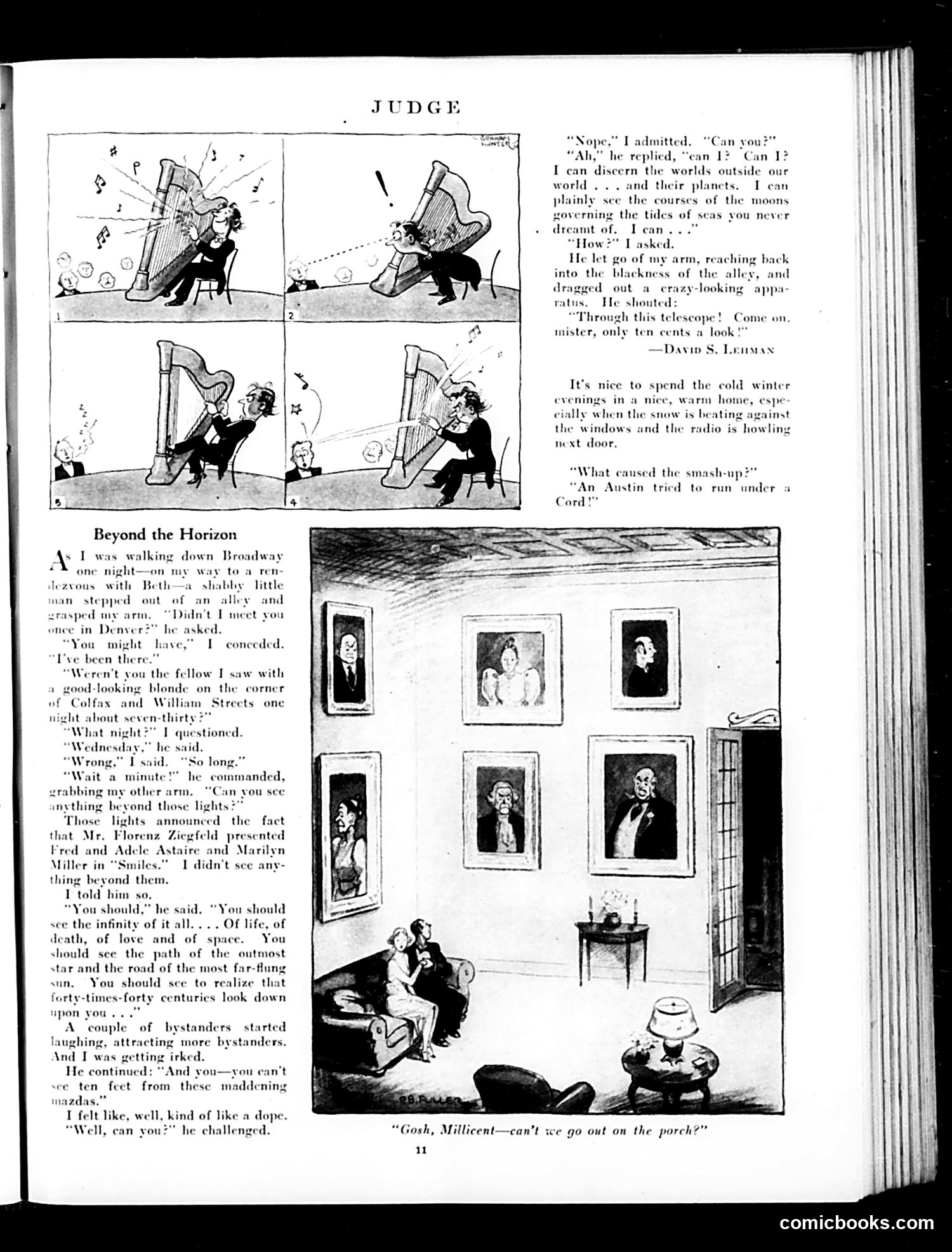
Explanation for Modern Readers This page contains two satirical pieces: Top section (4-panel comic): A man with a telescope makes extravagant claims about seeing distant worlds and cosmic phenomena. The joke mocks street hustlers and con artists who sell cheap novelty items (a ten-cent telescope) with absurd promises. It's satire on gullibility and fraudulent salesmanship. "Beyond the Horizon" story with illustration: A shabby stranger accosts the narrator on Broadway, claiming to recognize him, then launches into pretentious philosophical monologues about cosmic vision while standing outside the Ziegfeld Theatre (where *Smiles* starring Fred and Adele Astaire is playing). The satire targets affected intellectualism and contrarian posturing—the stranger preaches about infinity and enlightenment while dismissing visible, concrete entertainment. The closing caption joke undercuts all this grandiosity: a couple simply wants to go on the porch, suggesting ordinary human desires trump pretentious philosophy. Both pieces ridicule con artists, pseudo-intellectuals, and those who sell false promises of deeper meaning.
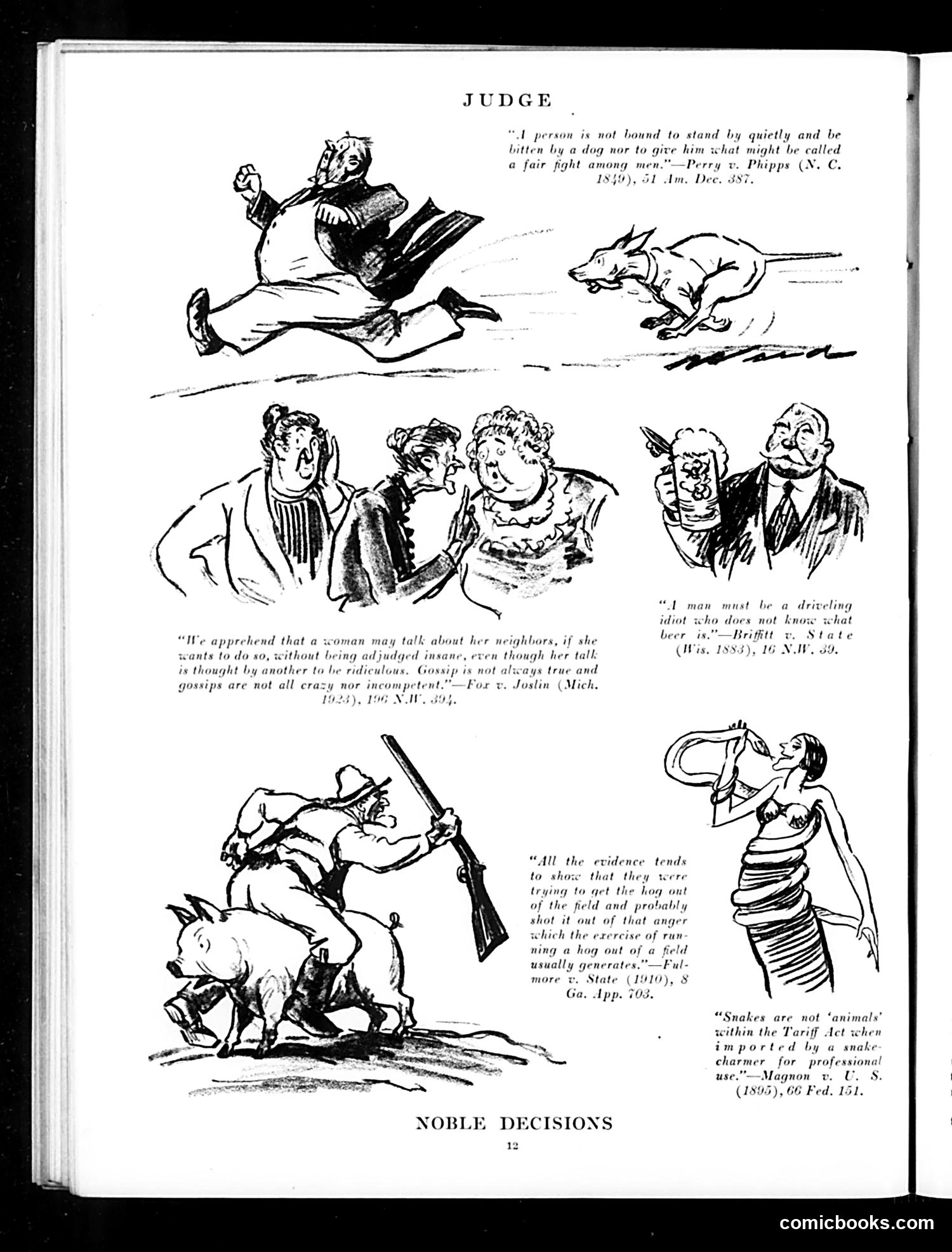
Judge Magazine: "Noble Decisions" (Legal Satire) This page satirizes absurd court rulings through illustrated legal citations. Each cartoon mocks a real judicial decision by visualizing its most ridiculous implication. The top image shows a judge fleeing a dog—illustrating a ruling that people needn't tolerate dog bites passively. The middle section depicts gossiping women, referencing a court's declaration that women's gossip isn't evidence of insanity. Below, a man struggles with a hog, referencing a case about removing livestock from fields. The snake charmer illustration satirizes a tariff ruling distinguishing snakes from "animals." The satire's point: courts sometimes issue technically defensible but absurdly narrow rulings that create ridiculous real-world scenarios. By visualizing these decisions literally, *Judge* mocks judicial pedantry and highlights the gap between legal logic and common sense.
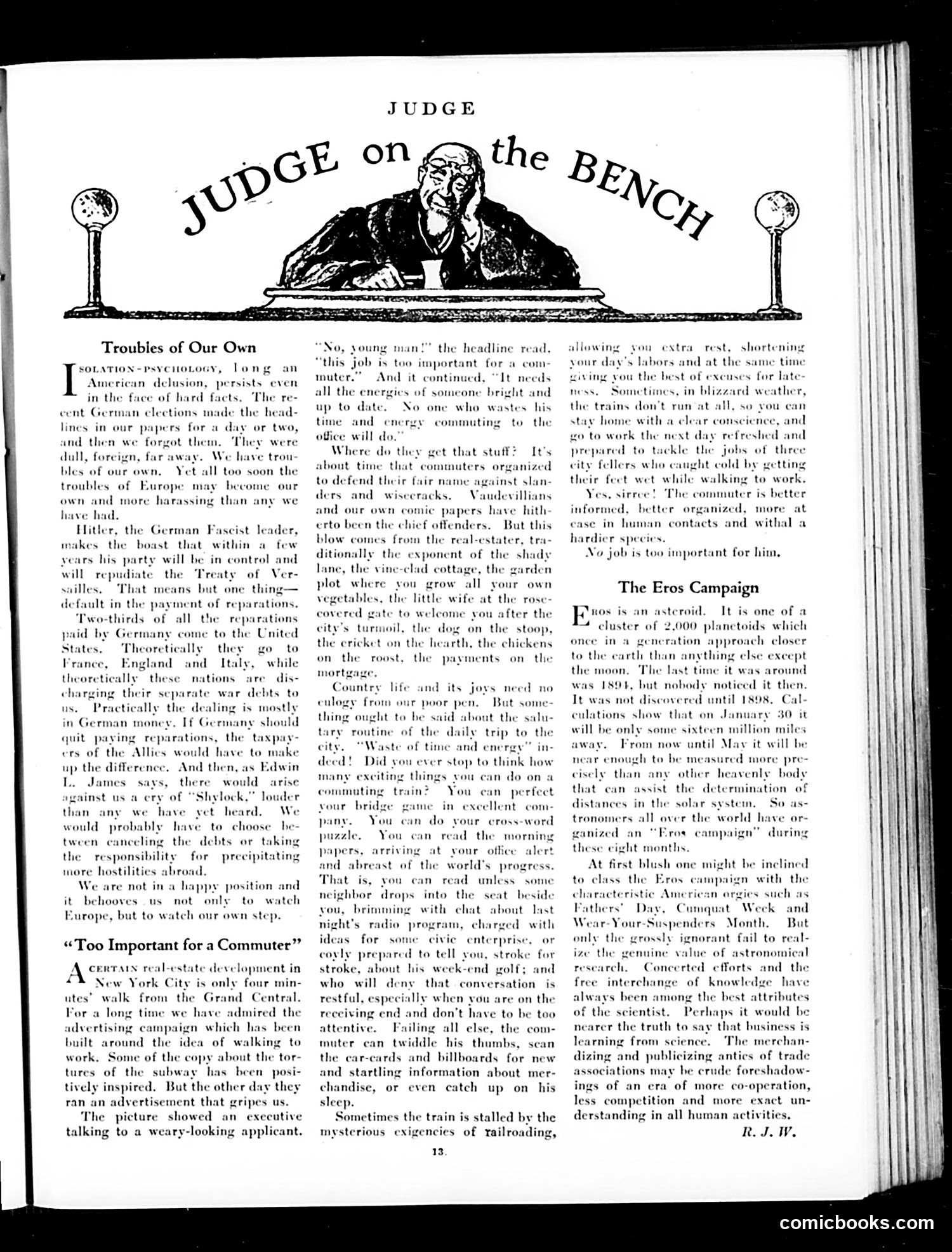
"Judge" Magazine Page Analysis This page contains two opinion pieces criticizing American isolationism and a real-estate advertisement's anti-commuter bias. "Troubles of Our Own" warns that America's tendency to ignore European affairs is dangerous. It references Hitler's rise and his threat to repudiate the Treaty of Versailles reparations—two-thirds of which Germany owes to the United States. The author argues that if Germany stops paying, American taxpayers will face pressure to absorb the loss or risk being called "Shylock" (a Shakespeare reference implying greed) for demanding payment. The message: European instability will become America's problem. "Too Important for a Commuter" satirizes a real-estate developer's advertisement claiming a job is "too important for a commuter." The author defends commuting as productive time for reading, working, socializing—even improving at bridge. The satire targets the real-estate industry's hypocrisy: they promote suburban living while insulting those who actually commute to cities. Both pieces reflect 1930s anxieties about economic interdependence and urban/suburban tensions.
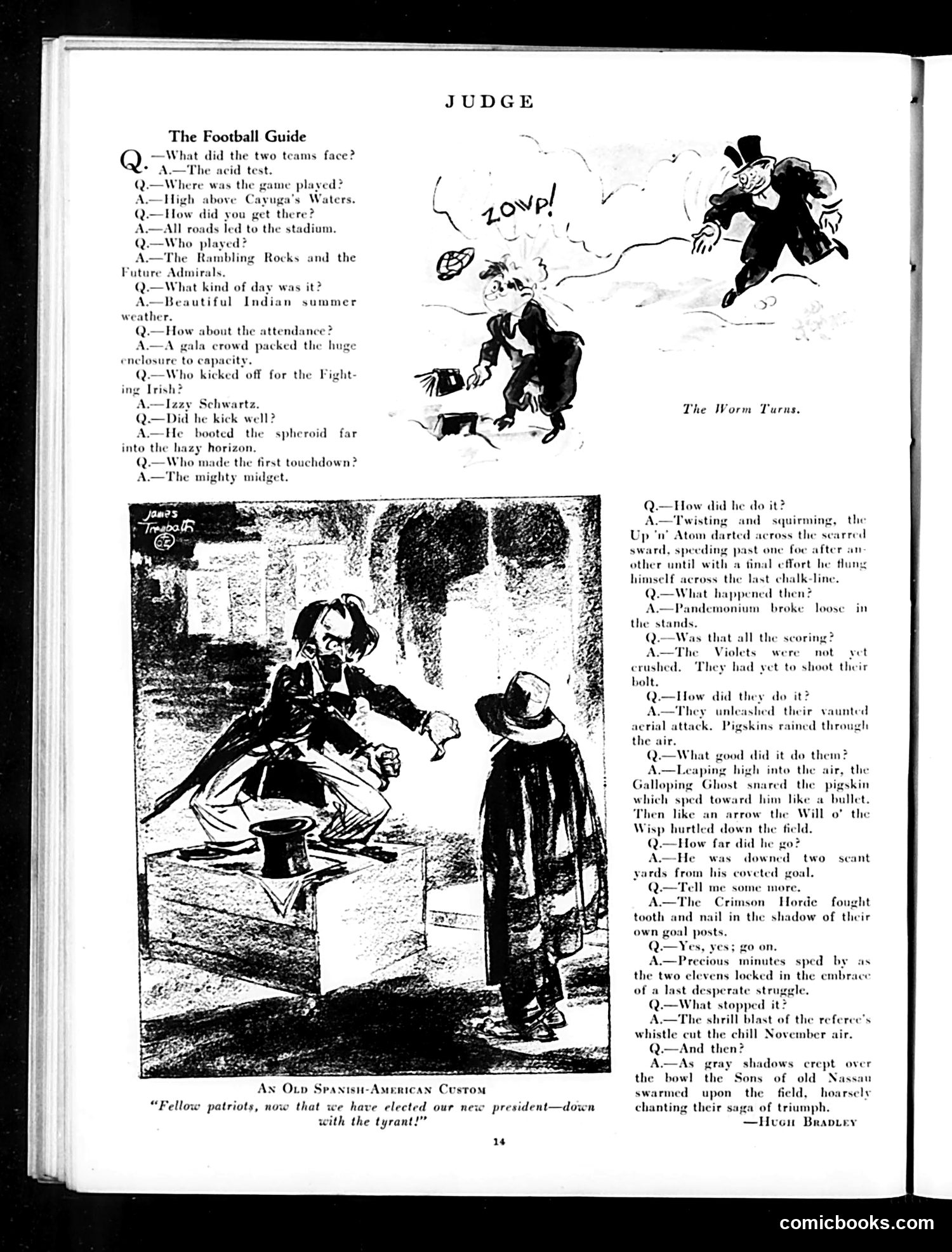
Explanation for Modern Readers This page combines sports satire with political commentary. "The Football Guide" mocks college football coverage through a Q&A format, referencing Cornell ("Cayuga's Waters"), mentions of teams like "The Rambling Rocks" and "Fighting Irish," and colorful player nicknames ("The mighty midget," "Galloping Ghost," "Will o' the Wisp"). The satire targets overwrought sports journalism and dramatic game descriptions. "The Worm Turns" (top right) shows cartoonish violence in exaggerated football action—typical Judge humor about football's brutality. "An Old Spanish-American Custom" (bottom) is the political cartoon: a figure sits atop a pile of bodies while another approaches. The caption mocks revolutionary rhetoric—"Fellow patriots, now that we have elected our new president—down with the tyrant!"—satirizing how newly empowered groups immediately turn violent against predecessors, suggesting cyclical political instability, likely referencing Latin American politics or contemporary revolutionary movements.
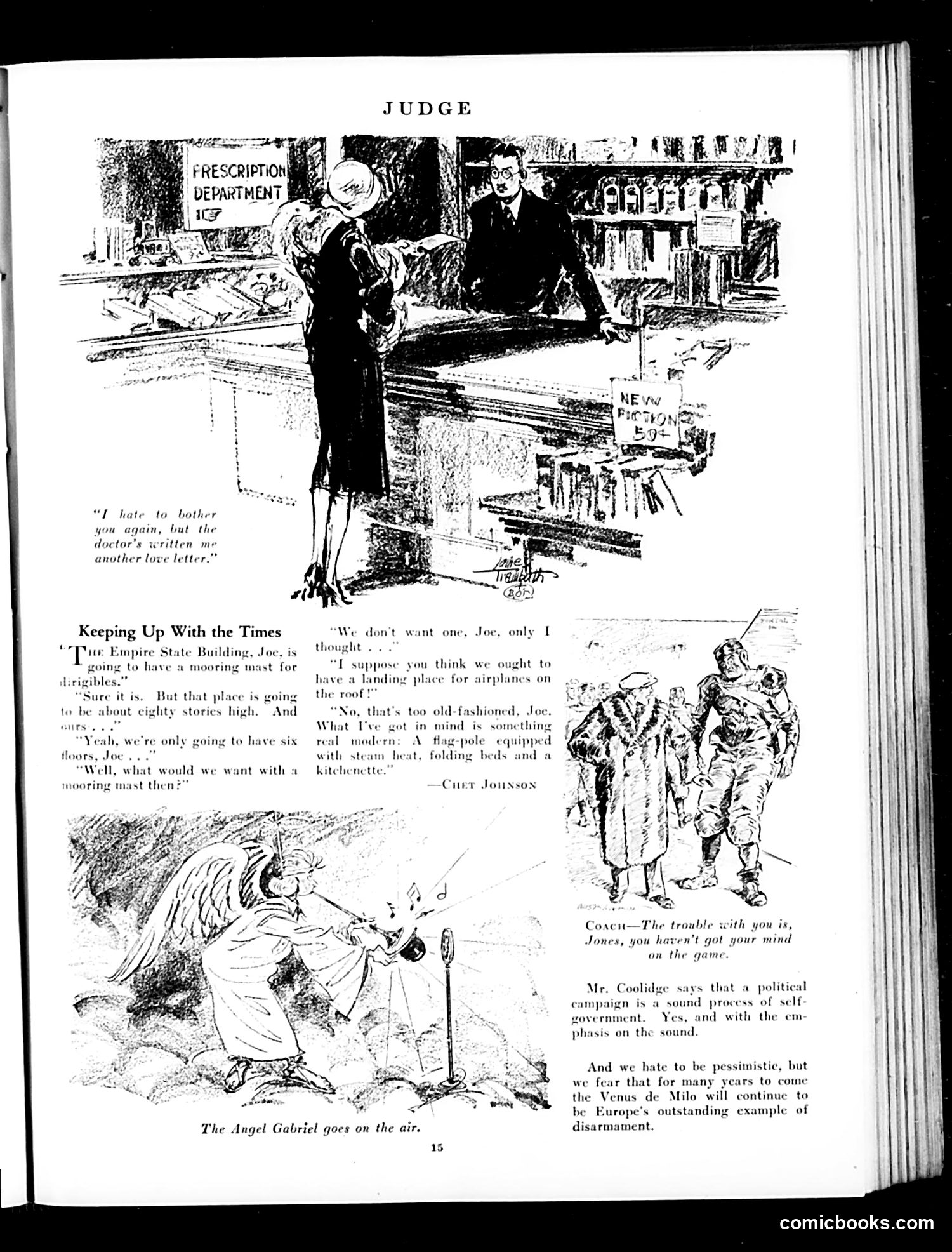
Judge Magazine Page Analysis This page contains several distinct satirical pieces: "Keeping Up With the Times" mocks the Empire State Building's proposed mooring mast for dirigibles. Two construction workers debate its purpose—one suggests it's for airplane landings, the other proposes absurdly modern alternatives (a flagpole with steam heat and folding beds), satirizing impractical modernism and confusion about new technology. Top cartoon shows a woman at a pharmacy counter complaining that her doctor has written "another love letter"—likely mocking male physicians' reputations for romantic misconduct or unprofessional behavior toward female patients. Bottom cartoons include a sports coach complaint about a distracted player, and brief political commentary on President Coolidge's campaign rhetoric (emphasizing "sound" over substance) and disarmament (referencing the Venus de Milo armless statue as Europe's disarmament symbol—a cynical jab at European powers' inability to reduce weapons). The humor targets 1920s-30s modernism, professional impropriety, political empty talk, and international affairs.
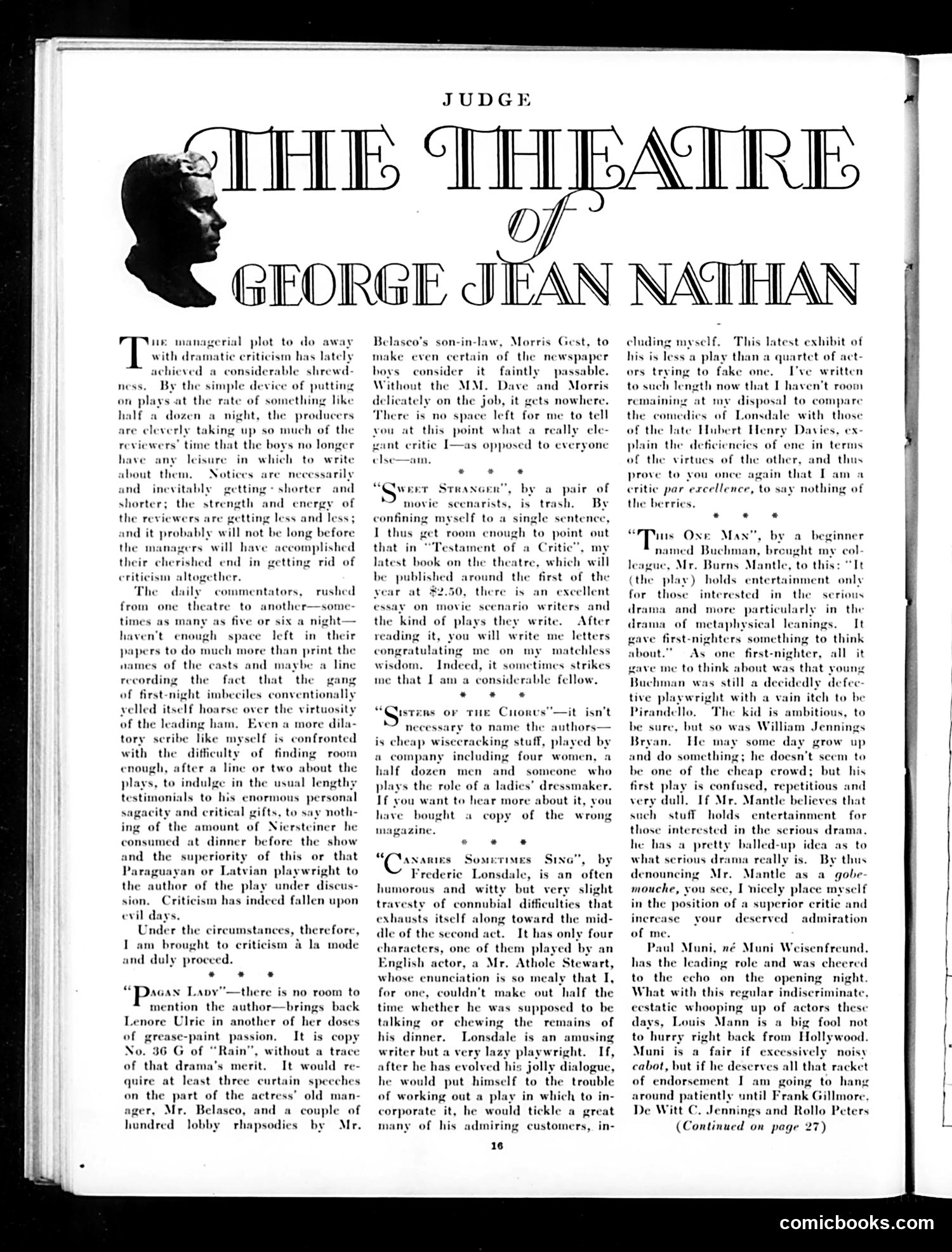
Judge Magazine Theatre Criticism Page This page from Judge magazine satirizes theatre criticism under deadline pressure. The author (identified as "Judge" columnist George Jean Nathan, based on the masthead) complains that Broadway producers deliberately schedule multiple plays nightly to exhaust reviewers, preventing substantive criticism. Nathan's solution is absurdist: he writes increasingly abbreviated reviews, sometimes reducing them to single sentences. He then uses the freed-up space to promote his own forthcoming book and boast about his critical superiority—directly mocking his own vanity while making his point about diminished reviewing standards. The satire targets both exploitative producers and critics' own ego. By reducing his reviews to promotional puffery and self-congratulation, Nathan demonstrates how time pressure transforms serious dramatic criticism into hollow commerce. It's meta-commentary on declining journalistic standards in entertainment coverage.
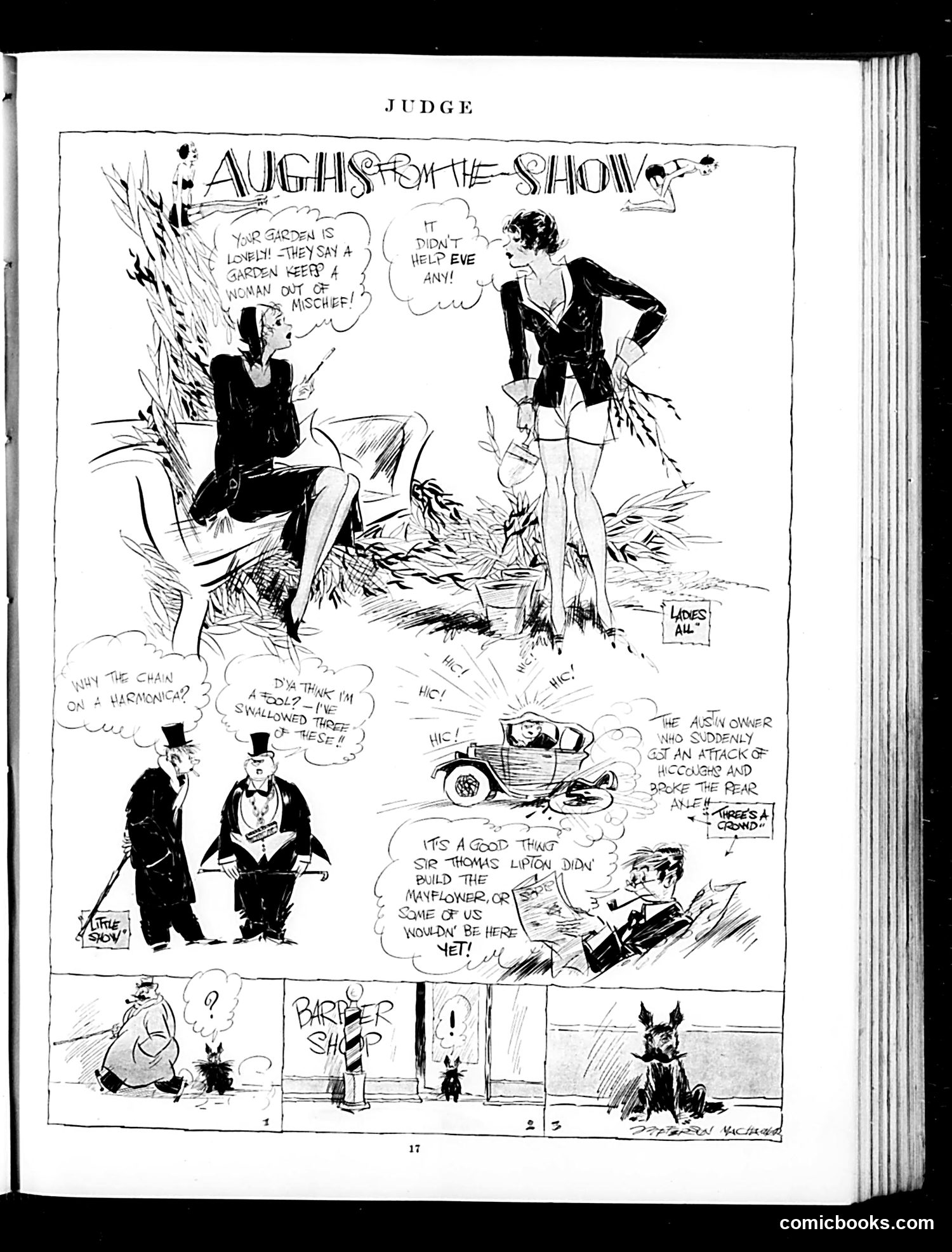
"Laughs at the Show" This is a multi-panel comic satirizing garden culture and automotive mishaps. The top panel shows two women discussing a lovely garden, with one claiming it "keeps a woman out of mischief." The middle section features a comedic automobile accident where an "Austin owner" loses control, with bystanders joking that if Thomas Lipton (likely referencing the tea magnate) had built a "Mayflower" car instead of growing flowers, "some of us wouldn't be here." The humor contrasts genteel garden pursuits with the chaos of early motoring. The lower panels show a barbershop scene with a small devil-like figure, likely suggesting mischievous consequences. The satire mocks both the pretension of garden-keeping as moral improvement and the hazards of unreliable automobiles in this era.
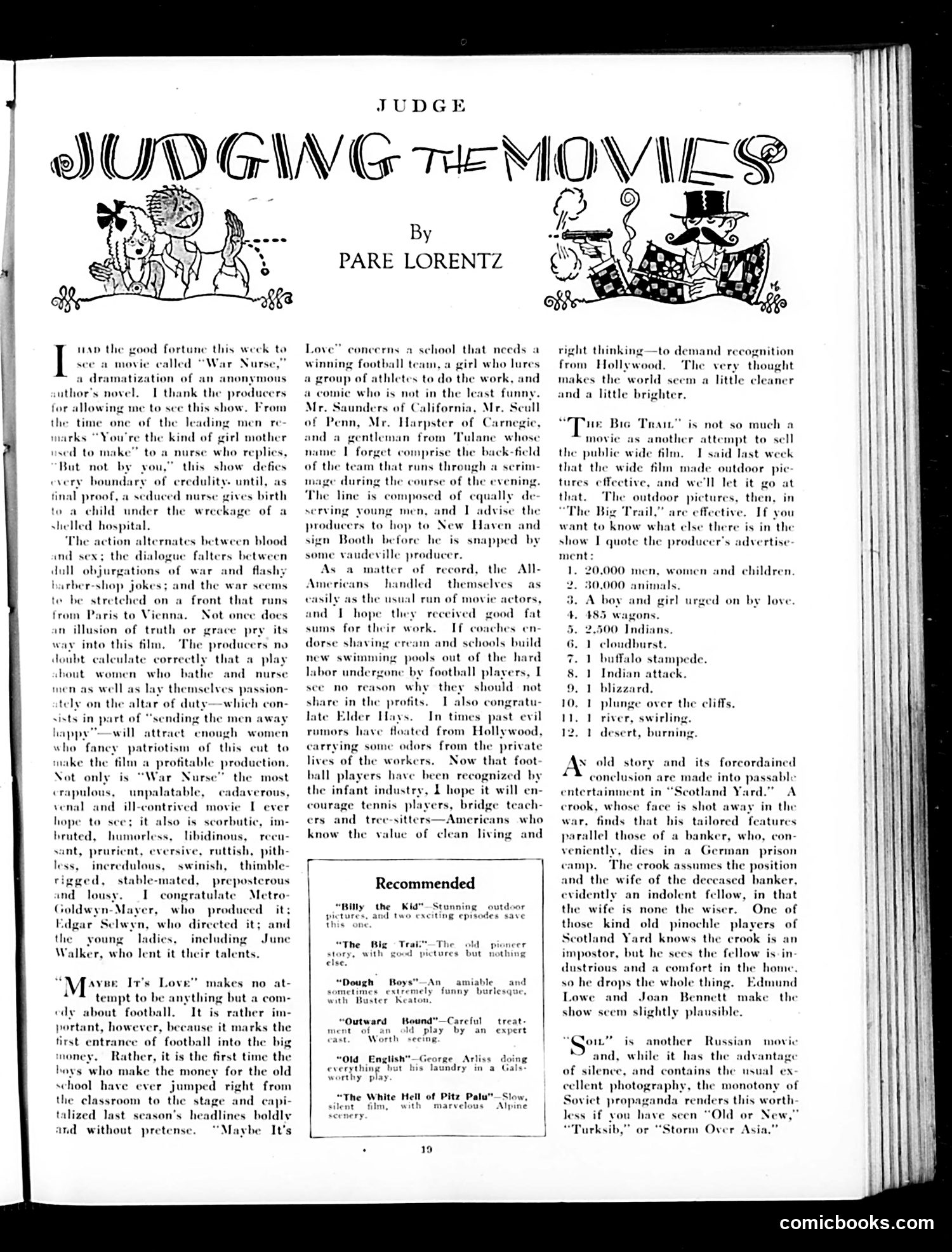
Judge Magazine: "Judging the Movies" by Pare Lorentz This is a film criticism column from Judge magazine. Critic Pare Lorentz savagely reviews contemporary movies, employing deliberately excessive vocabulary ("crapulous," "scorbutic," "libidinous") to mock bad cinema. "War Nurse" is attacked as exploitative propaganda—a film cynically designed to attract female audiences through patriotic sentimentality and impropriety rather than artistic merit. Lorentz condemns it as dishonest and morally corrupt. "Maybe It's Love" is criticized as a transparent cash grab using actual football stars (named players from major universities) to capitalize on the sport's popularity. Lorentz resents the commercialization but acknowledges this marks football's legitimization in Hollywood. The "Recommended" section briefly lists other films with minimal commentary. The satire targets both filmmakers' shameless profit-seeking and audiences' gullibility—Judge's typical critique of mass entertainment's lowest-common-denominator appeal. The ornate insults function as intellectual performance, suggesting Judge readers appreciated sophisticated cultural dismissal.
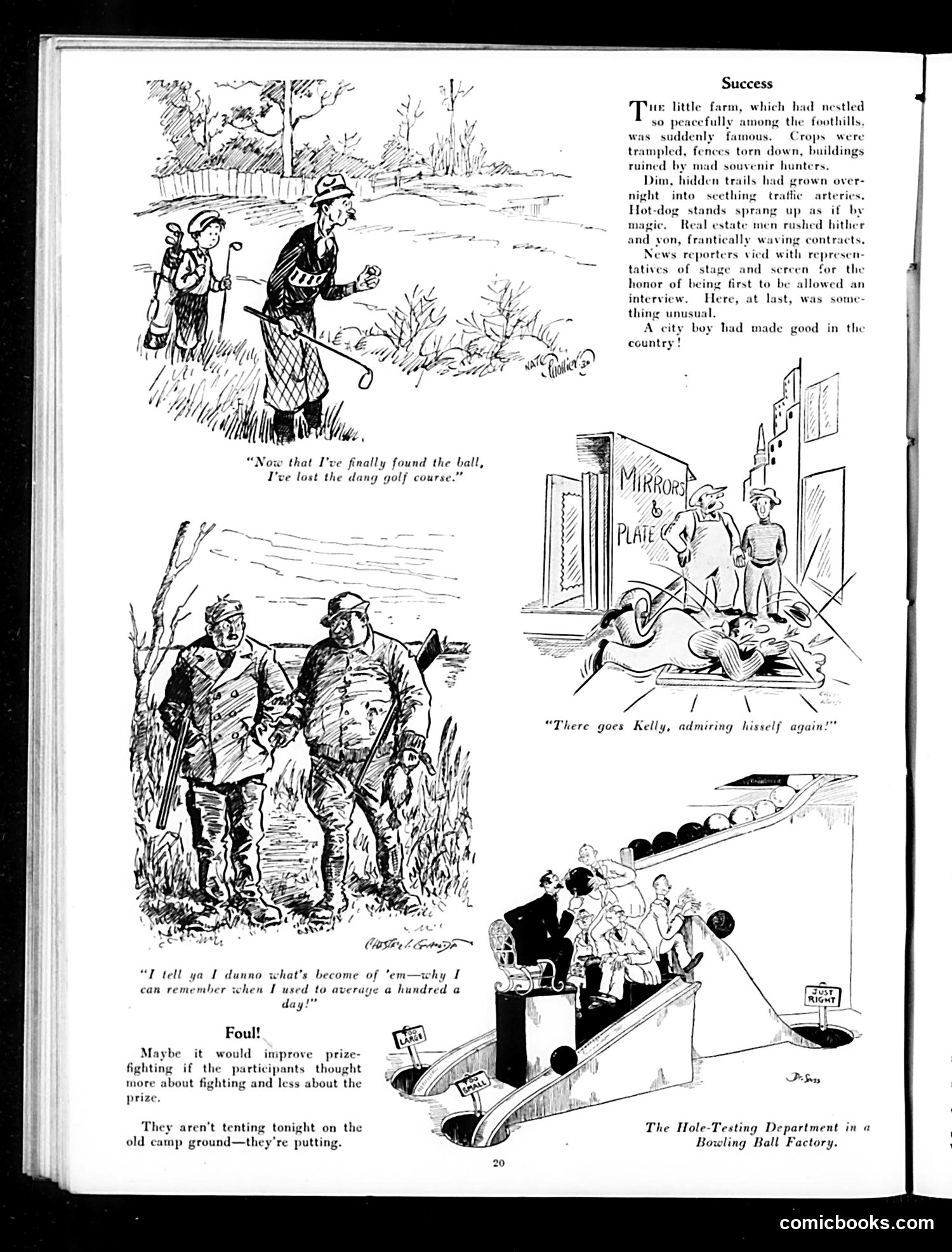
Analysis of Judge Magazine Page This page contains three satirical commentaries on early 20th-century American leisure and commercialism: "Success": Mocks how a rural farm becomes overrun and commercialized after someone achieves fame there. Real estate speculators, hot-dog vendors, and reporters descend, destroying the peaceful countryside—suggesting satire of how capitalism exploits and corrupts natural spaces. Golf cartoons: Two jokes about golf's popularity: one man has lost the golf course while searching for his ball (implying courses are becoming too crowded/developed), and another nostalgically recalls when he averaged "a hundred a day"—likely referencing better past conditions. "Foul!" (prizefighting): Criticizes how boxers prioritize prize money over actual combat skill, suggesting the sport has become corrupted by financial incentives rather than athletic merit. Bowling factory cartoon: Shows quality control testing holes in bowling balls, a straightforward industrial humor piece. Overall, the page satirizes commercialization, overcrowding, and how profit-seeking corrupts American leisure activities and landscapes.
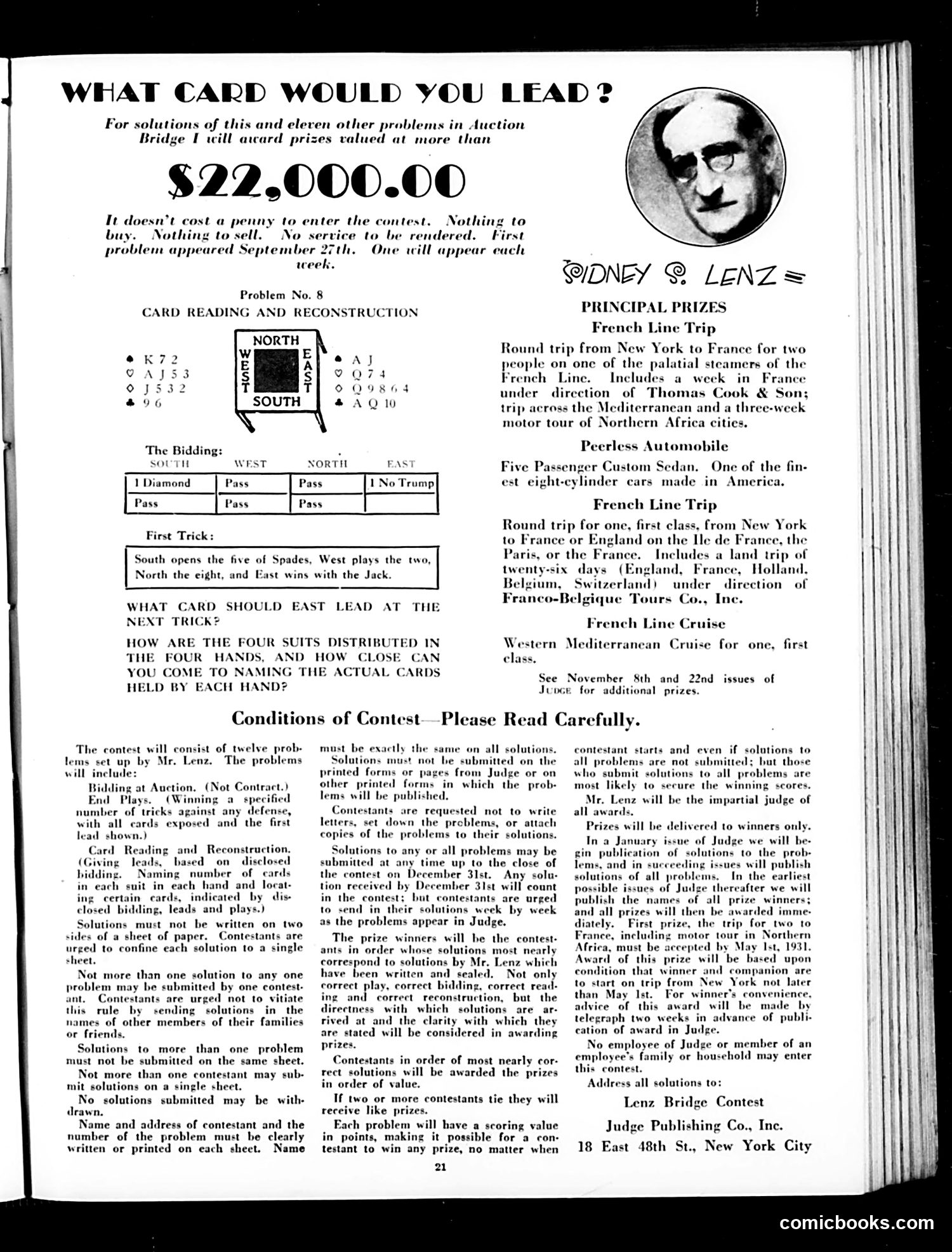
What This Page Means This is a bridge card game contest advertisement from *Judge* magazine, sponsored by Sidney S. Lenz (shown in the portrait), a prominent bridge authority of the era. The page announces a puzzle contest with $22,000 in prizes—substantial money for the 1930s. The "problem" shown is a bridge hand requiring solvers to determine what card "East" should lead next, based on the bidding and first trick played. Readers submit solutions weekly; winners are judged against Lenz's pre-sealed solutions. The satire/appeal: Bridge was enormously popular among educated, affluent Americans in this period. The contest flattered readers' intellectual pretensions while offering luxurious travel prizes (French Line steamship trips, automobiles, Mediterranean cruises)—aspirational rewards for the magazine's middle-to-upper-class audience. This is essentially sophisticated advertising masquerading as editorial content, leveraging *Judge*'s reputation for clever contests to promote both bridge expertise and glamorous travel.
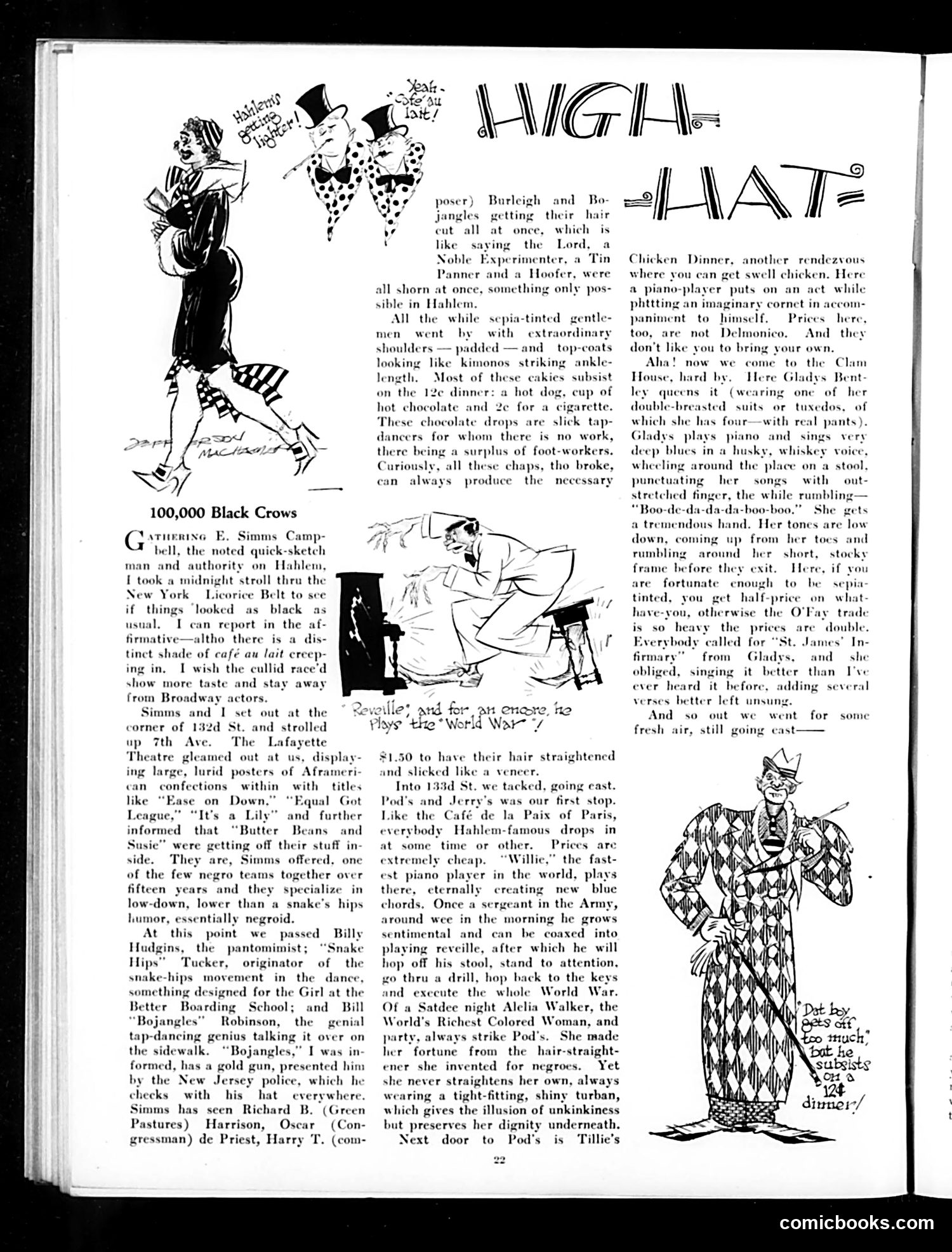
Analysis of "High Hat" Page from Judge Magazine This satirical article by E. Simms Campbell mocks Harlem's nightlife and its entertainers during the Jazz Age. Campbell describes a tour through the neighborhood (then called the "Licorice Belt"), cataloging clubs and performers with condescending racial stereotypes typical of the era's white magazines. Key figures mentioned include Bill "Bojangles" Robinson (famous dancer), Alelia Walker (hair-straightening entrepreneur and wealthy Black socialite), and Gladys Bentley (blues performer known for masculine presentation). The satire targets both white slumming culture and Black entertainment venues, depicting performers as buffoonish while describing their establishments patronized by wealthy Black entrepreneurs. The caricatured drawings emphasize exaggerated features common to racist depictions of the period. The piece reflects Jazz Age attitudes: fascination with Black culture mixed with racial condescension, sensationalism about gender-nonconforming performers, and mockery of upward mobility among Black Americans.
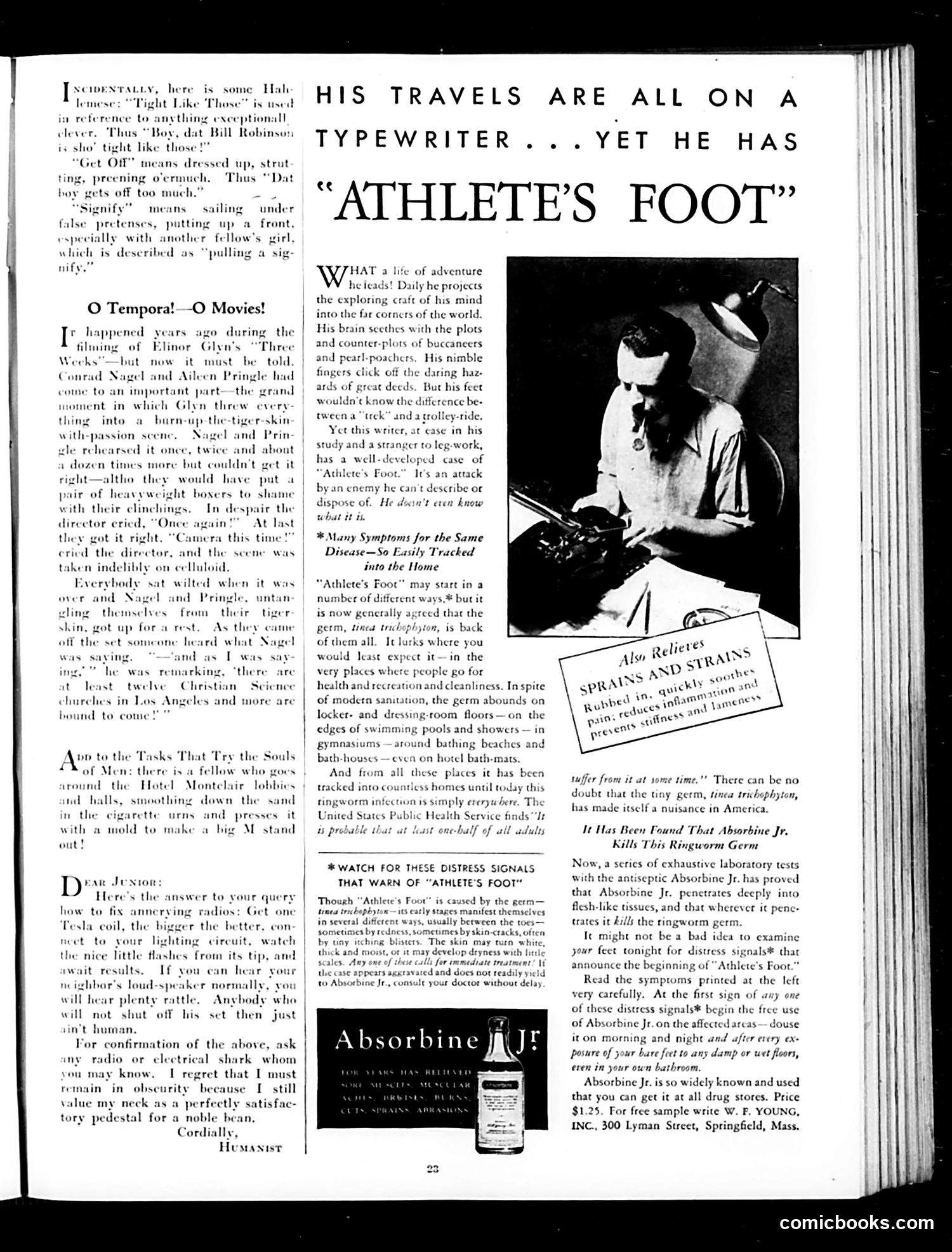
Judge Magazine Page Analysis This page combines humor columns with an advertisement for Absorbine Jr., a patent medicine for "athlete's foot." The satirical content mocks Hollywood filmmaking and everyday annoyances: - "O Tempora! O Movies!" ridicules the filmmaking of Elinor Glyn's famous risqué films, joking that actors Conrad Nagel and Aileen Pringle required dozens of takes to properly perform a passionate clinch scene—suggesting both their lack of chemistry and the absurdity of such theatrical melodrama. - "Tasks That Try the Souls" humorously complains about hotel guests who stack sand in ashtrays to spell their hotel's name, and neighbors blasting radios, with an anonymous writer anonymously venting frustrations. The main feature satirizes a novelist with "athlete's foot," whose imagination travels adventurously worldwide while his sedentary feet literally develop the fungal infection. The irony: armchair adventuring lacks physical activity, yet produces a "traveler's disease." The Absorbine Jr. ad then capitalizes on this humor by educating readers that athlete's foot spreads from public facilities (pools, gyms, hotels)—making the joke's premise commercially relevant.
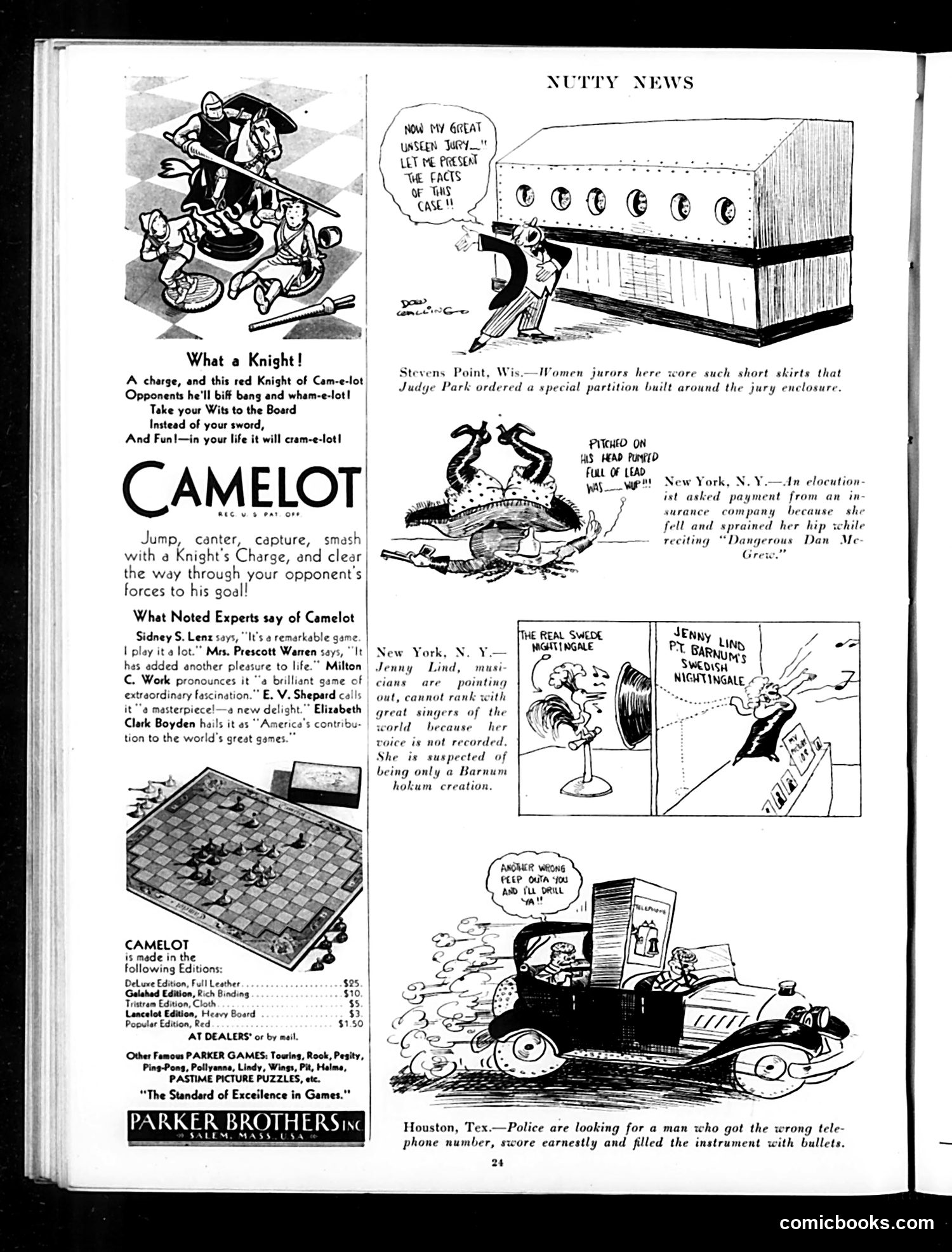
Nutty News Page Analysis This page is primarily advertising for the board game Camelot by Parker Brothers, framed within Judge magazine's "Nutty News" humor section. The main satire consists of absurdist news items: 1. Stevens Point jury story: Mocks both judicial prudishness and fashion. The judge orders a partition because female jurors' short skirts are supposedly distracting—satirizing both the era's conservative attitudes toward women's clothing and the assumption that jurors' appearance affects their judgment. 2. Jenny Lind/opera singers: Questions whether Jenny Lind (a famous 19th-century Swedish opera singer) actually exists or is merely "Barnum hokum"—referencing P.T. Barnum's notorious publicity stunts and fabricated attractions. It's a joke about fraudulent celebrity promotion. 3. Houston phone incident: A man mistakenly called wrong number, got angry, and shot the telephone—dark humor about frustrated communication technology. The Camelot game advertisement emphasizes chess-like strategy gameplay with medieval/Arthurian branding. Endorsements from game experts and celebrities lend credibility.
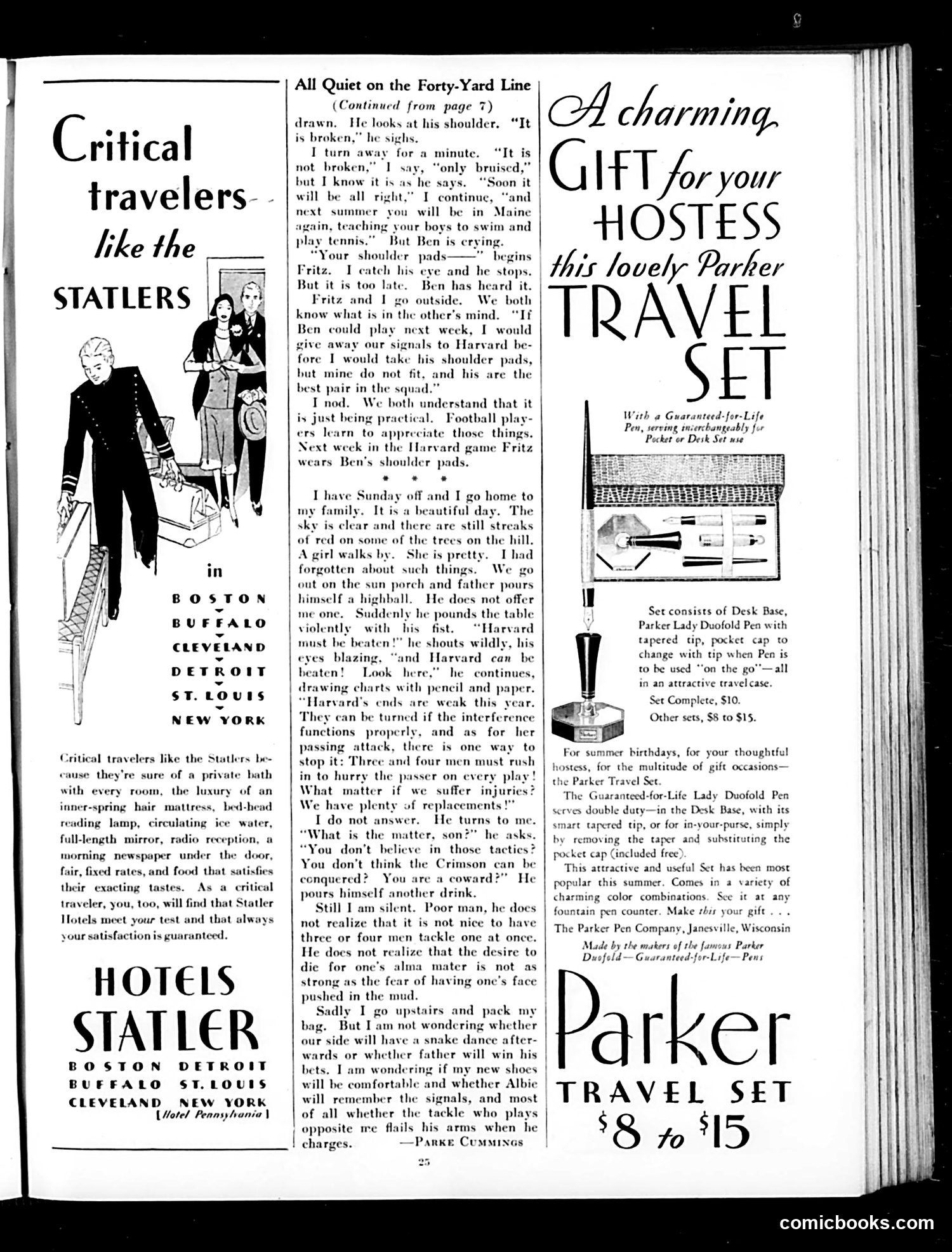
Analysis of Judge Magazine Page This page combines two distinct elements: a Statler Hotels advertisement and a short story about college football. The left side advertisement uses the phrase "Critical travelers like the Statlers" to pitch Statler Hotels' amenities (private baths, mattresses, reading lamps, radios) across major American cities. The illustration shows well-dressed travelers, emphasizing luxury and reliability. The center/right content is a serialized story titled "All Quiet on the Forty-Yard Line" depicting a coach wrestling with ethical conflict: his player Ben has a broken shoulder, but Ben's shoulder pads fit another player better. The coach chooses to use Ben's pads anyway for the crucial Harvard game. The narrative extends to the coach's father at home, wildly insisting Harvard "must be beaten" and advocating aggressive play regardless of injuries. The story satirizes the obsessive, win-at-all-costs mentality of early 20th-century college football culture—where parental pressure and institutional ambition override player safety. The Parker Pen Travel Set advertisement on the right offers a gift suggestion for hostesses.
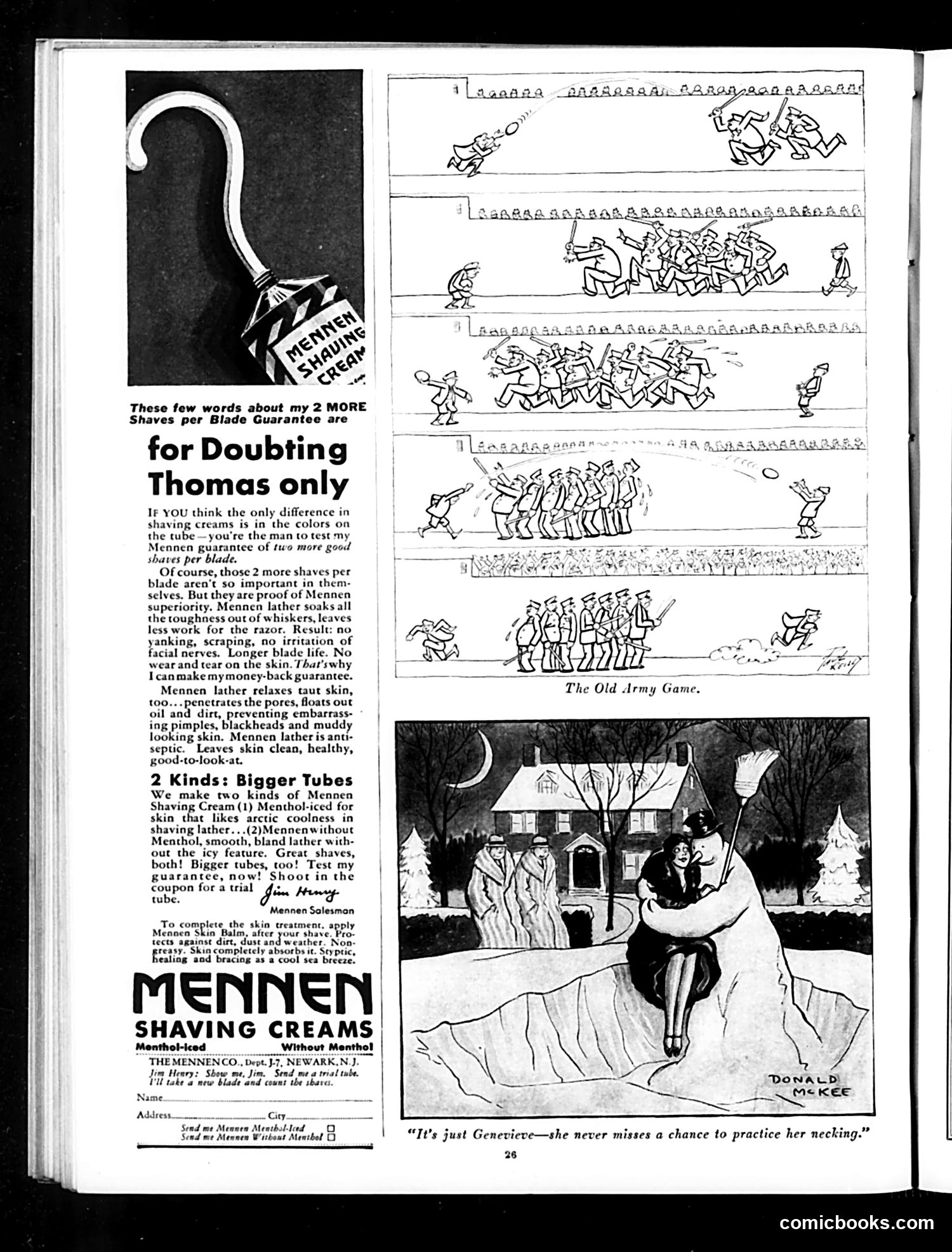
Analysis of Judge Magazine Page This page combines advertising with cartoon humor. The left side is a Mennen Shaving Cream advertisement targeting skeptical customers ("Doubting Thomas only"). It claims superiority over competitors by promising two extra shaves per blade and emphasizing the lather's ability to soften whiskers, reduce irritation, and improve skin health. The ad offers a money-back guarantee and pushes two product variants (menthol and non-menthol). The right side contains two unrelated pieces: 1. "The Old Army Game" — a comic strip sequence (artist signature unclear) showing soldiers in formation being pranked or fooled, likely depicting military humor. 2. A single-panel cartoon by Donald McKee showing a young couple in a snowy nighttime scene. The caption reads: "It's just Genevieve—she never misses a chance to practice her necking." This is a mild romantic/flirtation joke about a girl taking every opportunity to kiss. The page reflects early 20th-century magazine layout: advertising subsidized satirical content.
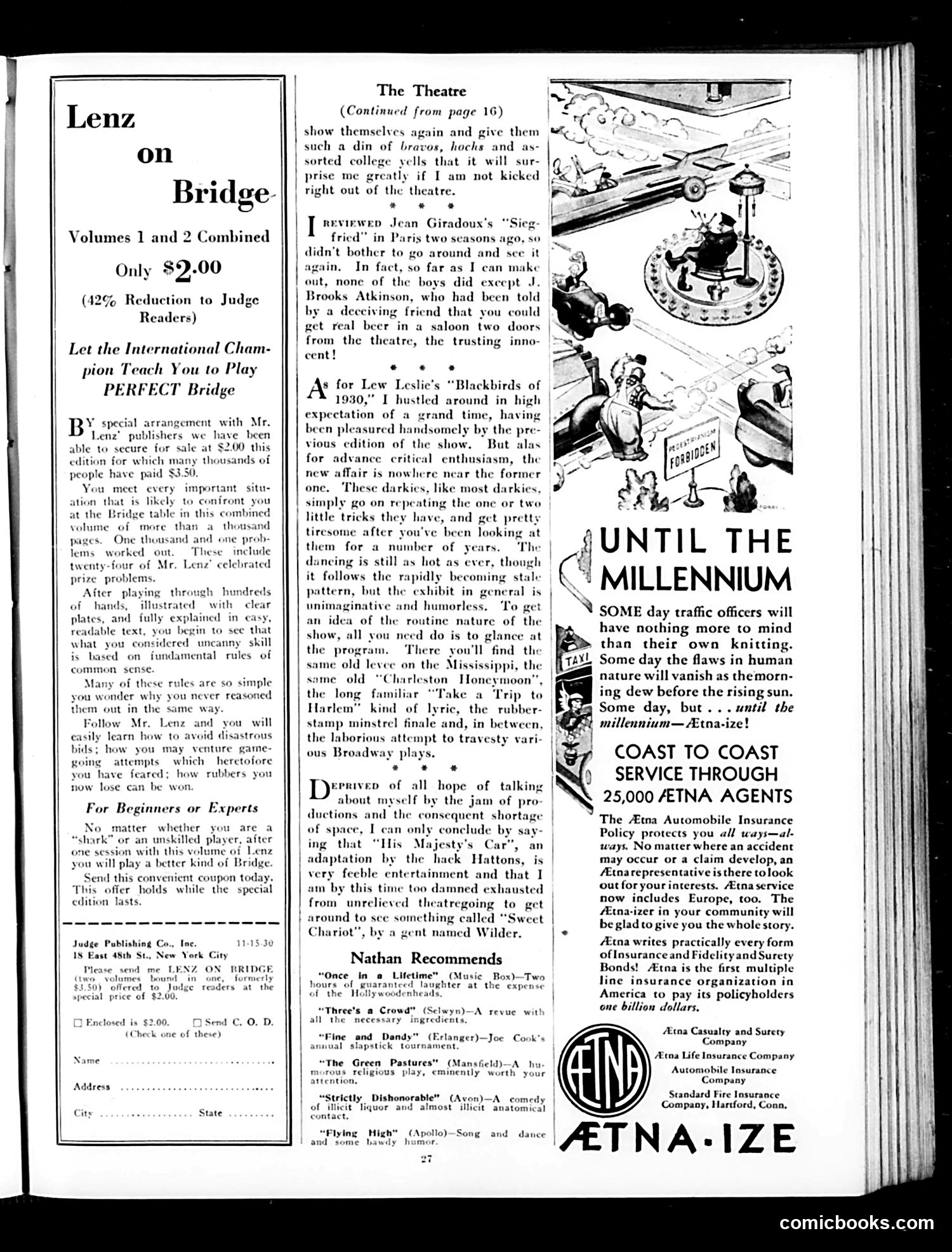
Analysis of This Judge Magazine Page This page is primarily advertising and book promotion, not political satire. The dominant content is an advertisement for "Lenz on Bridge," a two-volume bridge instruction book being sold at a discount ($2.00 vs. $3.50) through Judge Publishing Co. The pitch targets both beginners and experienced players, emphasizing that bridge strategy is based on "fundamental rules of common sense" rather than mysterious skill. The secondary content is a theater review column discussing Broadway shows: Jean Giraudoux's "Siegfried," Lew Leslie's "Blackbirds of 1930" (a musical revue), and other productions. The reviewer is mildly critical, noting that "Blackbirds" merely repeats tired routines and that he's exhausted from theatergoing. There is no political cartoon or satire visible on this page—it's primarily commercial material typical of Judge's revenue model, supplemented by entertainment criticism.
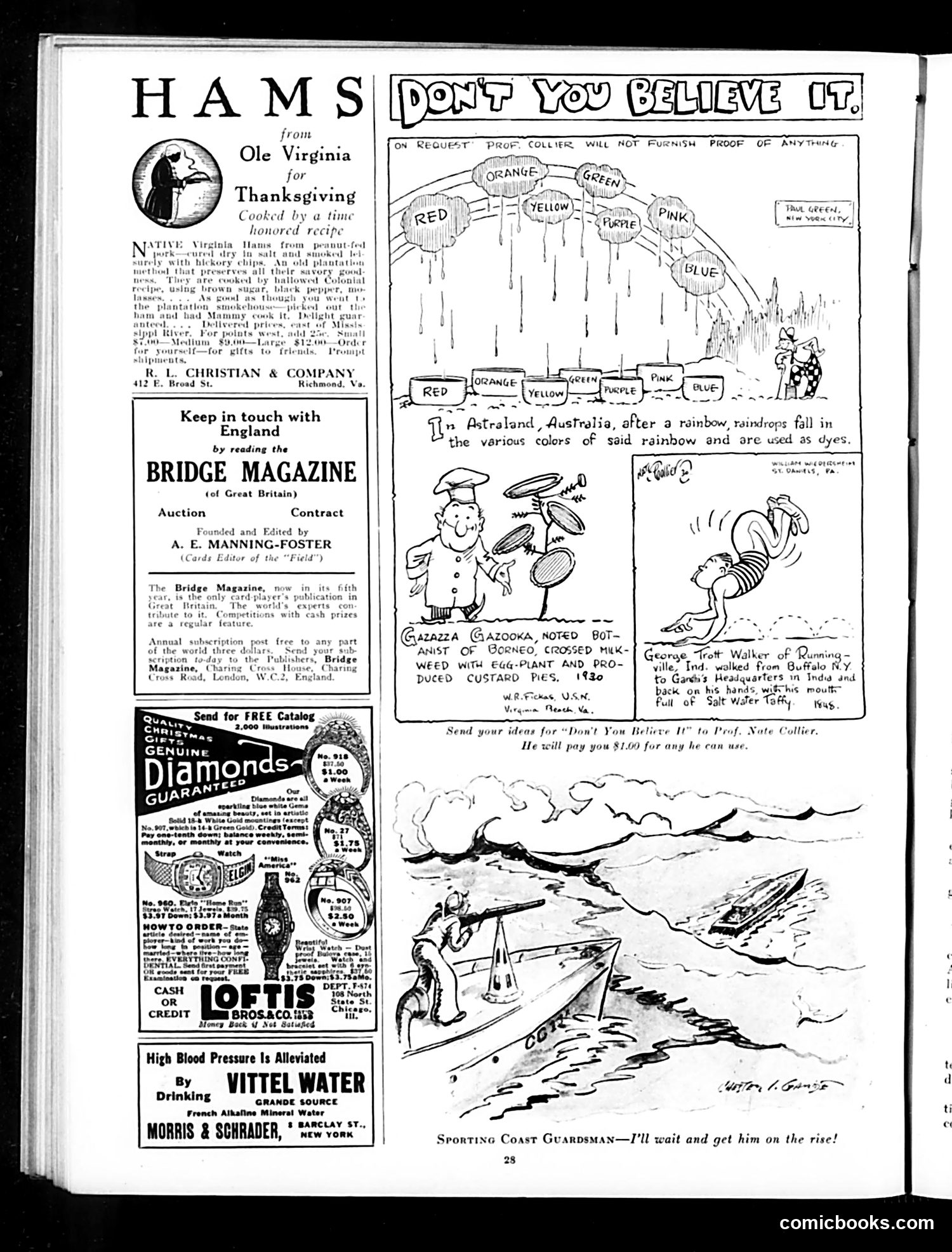
Analysis of This Judge Magazine Page This page is primarily advertising with a humorous "Don't You Believe It!" cartoon feature. The main content includes ads for Virginia hams, Bridge Magazine, diamonds, and mineral water—typical of 1920s-30s publications. The central cartoon mocks pseudoscientific claims, a common satirical target. It depicts three absurd scenarios: Australian raindrops that produce artificial dyes, a botanist who supposedly hybridized plants into custard pies (1930), and a man who walked to India on his hands with his mouth full of salt water. The cartoon's humor derives from readers' recognition that these claims are obviously false, yet the feature invites submission of similarly ridiculous "facts" for payment. This satirizes popular credulity and tall tales circulating in the era. The bottom illustration shows a coast guard attempting to catch someone—likely another humorous anecdote or story caption. The page primarily serves as filler between advertisements rather than political satire.
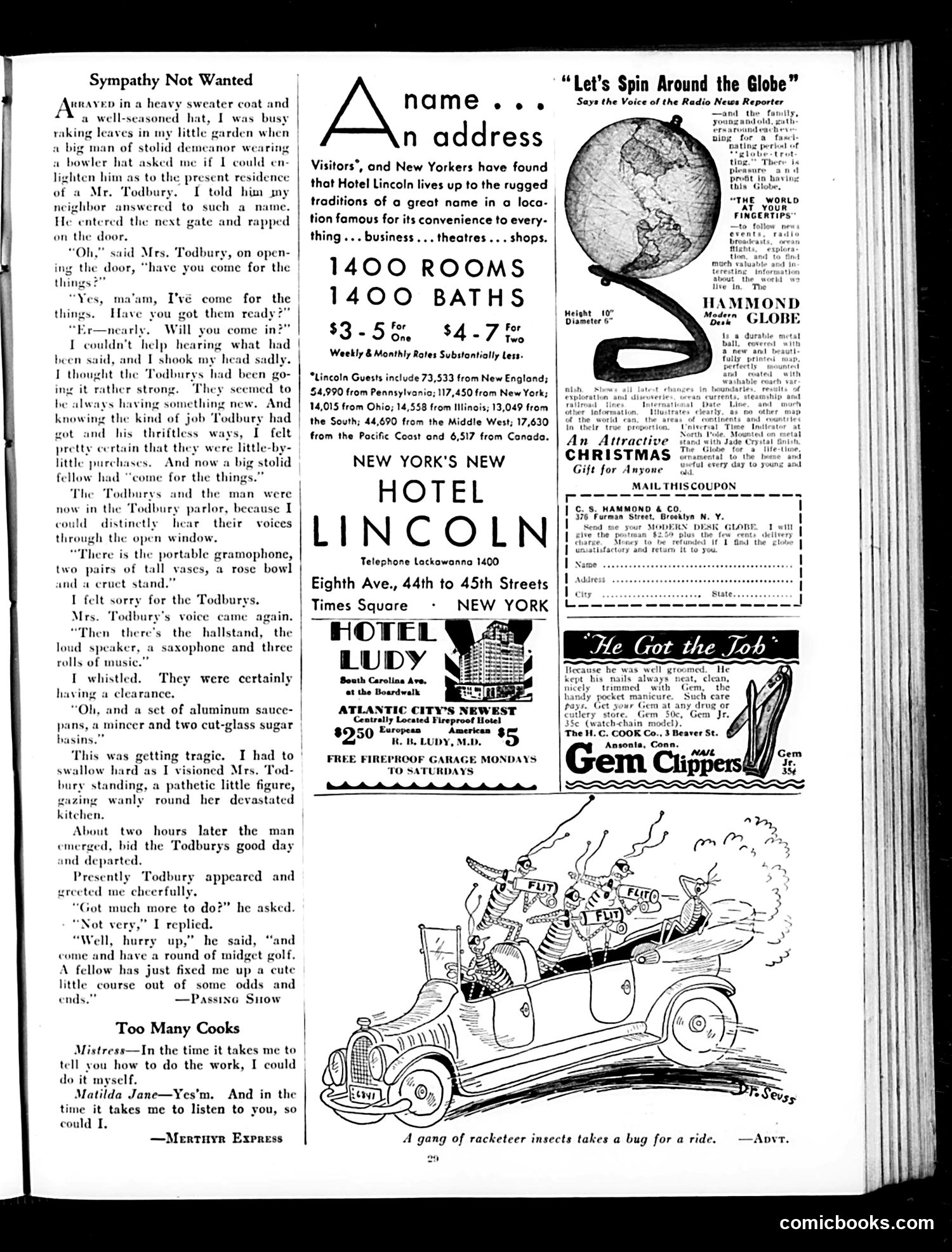
Analysis of Judge Magazine Page This page is primarily advertising with two brief humor pieces. The main content includes ads for Hotel Lincoln (New York), Hotel Ludy (Atlantic City), Hammond globes, and Gem Clippers, dominating the layout. The two satirical pieces are minor: 1. "Sympathy Not Wanted": A domestic comedy about the Todburys, a couple apparently living beyond their means, constantly purchasing items (gramophones, vases, saxophones, kitchen equipment). A creditor arrives to repossess "the things." The joke mocks installment-buying culture and working-class financial irresponsibility—a common Judge theme reflecting post-WWI consumer anxiety. 2. "Too Many Cooks": A brief domestic quip where a mistress complains she could do work faster than explain it, and the maid retorts she could listen faster than work. Generic workplace humor. The Dr. Seuss cartoon at bottom shows insects as racketeers in a car—unrelated whimsy. The page reflects 1920s concerns: consumer debt, servant relations, and modern hotel luxury advertising.
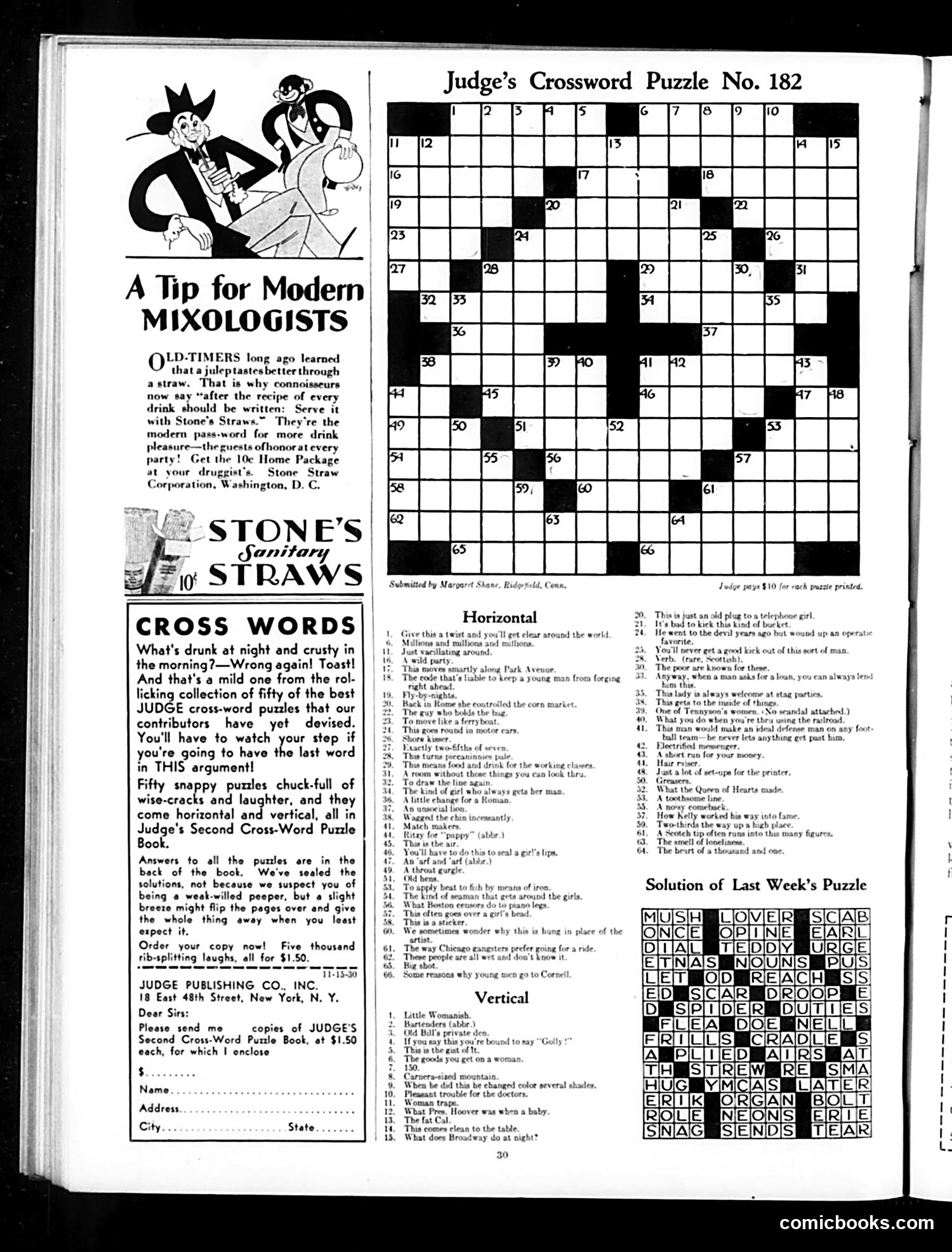
Judge Magazine Page Analysis This page combines a crossword puzzle with advertising for Stone's Straws, a drinking accessory brand. The cartoon illustration at top shows caricatured "mixologists" (bartenders) in a humorous style typical of Judge's satirical approach. The adjacent advertisement "A Tip for Modern Mixologists" promotes Stone's Straws as essential bartending equipment, claiming they enhance drink enjoyment—a marketing pitch presented as insider knowledge from "old-timers." The crossword puzzle itself is advertised as part of Judge's "Second Cross-Word Puzzle Book," promoted through playful copy suggesting readers will struggle to solve it. The advertisement emphasizes humor and wit, claiming "fifty snappy puzzles" full of "wise-cracks and laughter." The page reflects 1920s-30s era concerns: cocktail culture, advertising-driven humor magazines, and the popularity of crossword puzzles as entertainment. The mixing of advertisement, satire, and puzzles was typical Judge content, blending commerce with comedy.
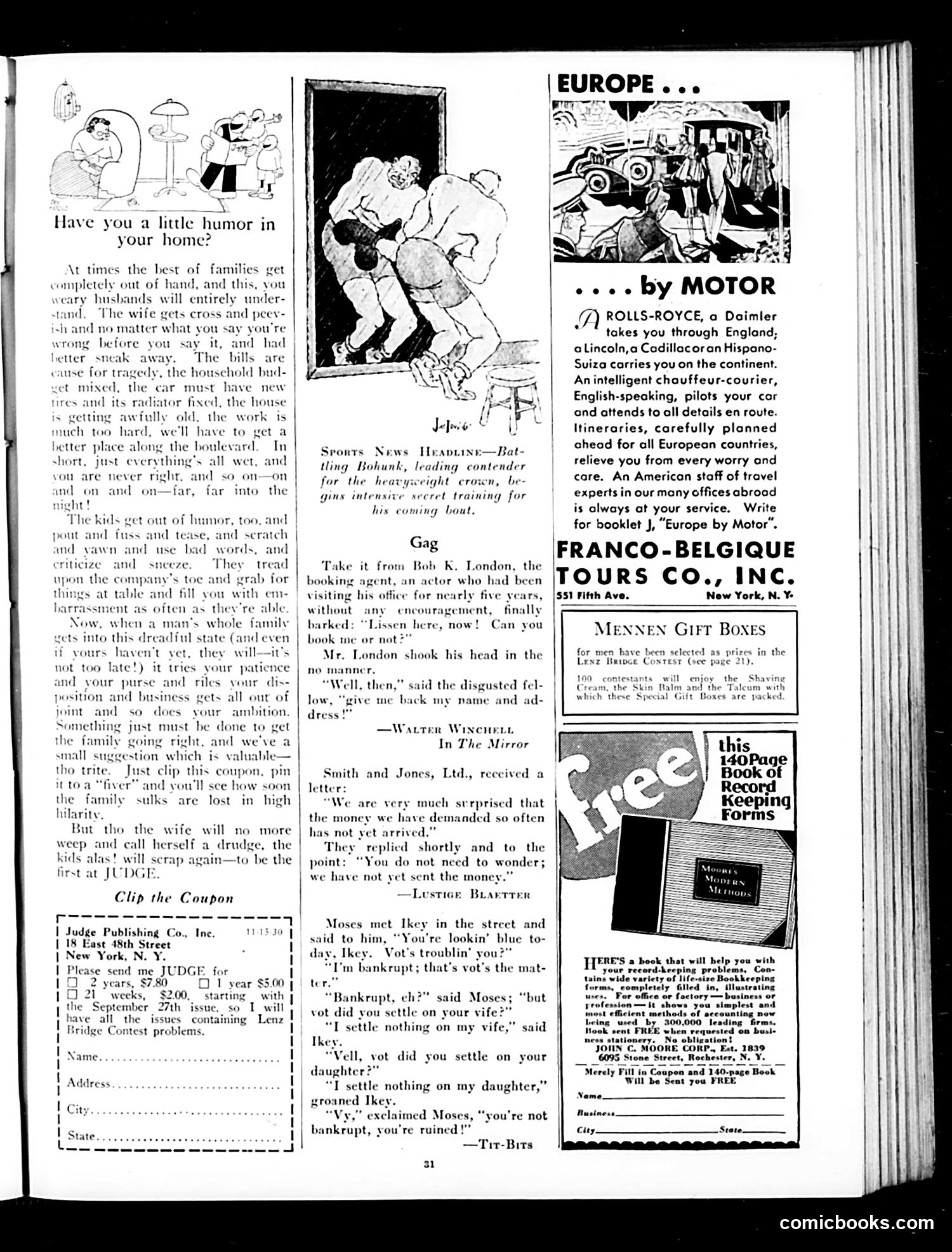
Analysis of Judge Magazine Page This page primarily contains humor pieces and advertisements rather than political cartoons requiring historical context. Main Content: The opening article "Have you a little humor in your home?" is domestic satire about family discord—nagging wives, misbehaving children, financial troubles—suggesting that slipping a child "a fiver" (five dollars) restores household peace. It's a lighthearted commentary on middle-class family tensions. The Gags/Jokes: Several brief anecdotes follow, using ethnic stereotypes (particularly Jewish characters "Ikey" and "Moses") that were common in early-20th-century American humor magazines. The jokes rely on wordplay and stereotypical speech patterns. Advertisements: The page includes ads for European motor tours (Rolls-Royce, Daimler) and a record-keeping business book, reflecting 1920s-30s consumer interests. Historical Note: The ethnic humor reflects period conventions now recognized as offensive stereotyping. The domestic complaints reflect pre-feminist attitudes about wives and family obligations.
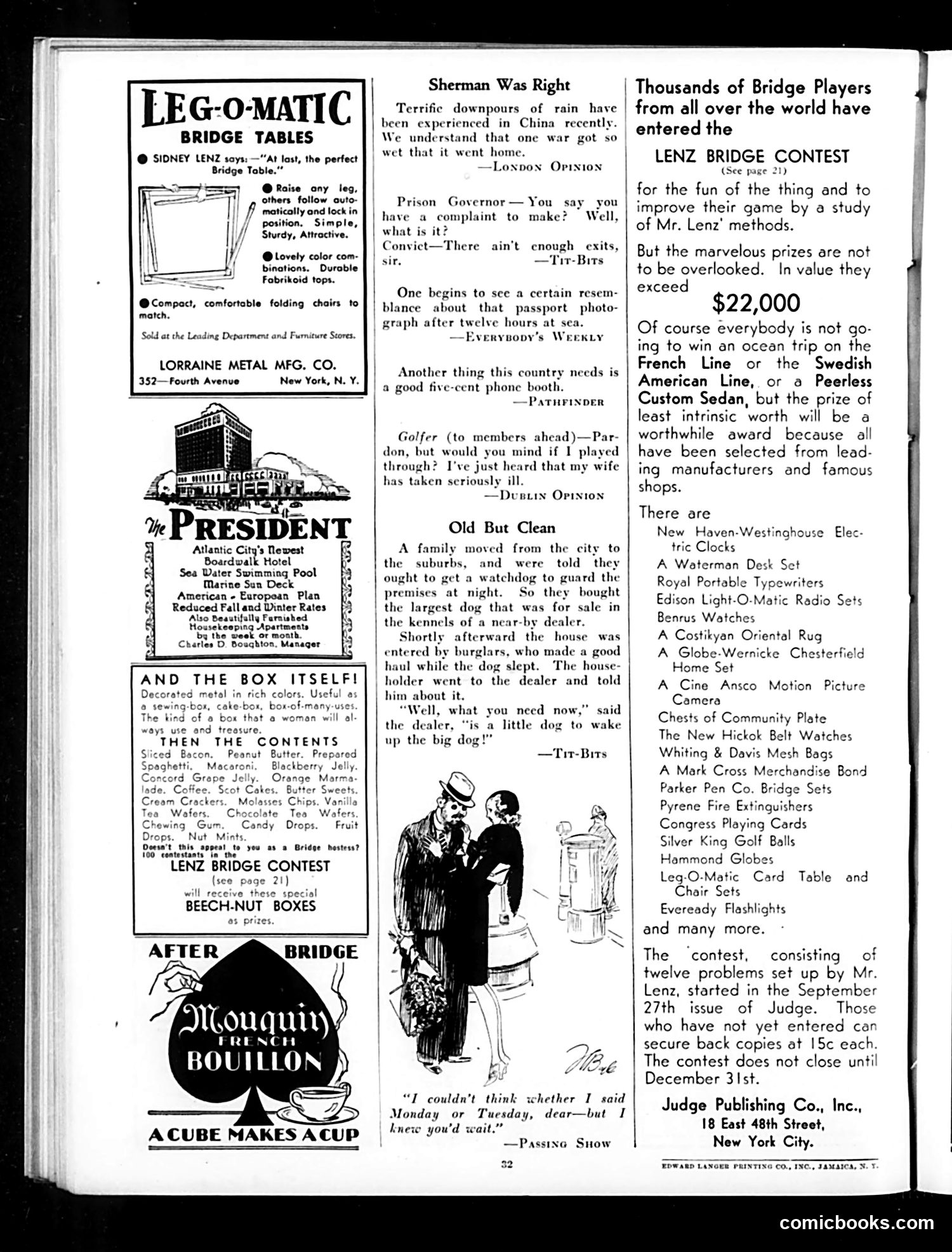
Page Analysis: Judge Magazine Advertisement and Comic Fillers This page is primarily commercial advertising for the Lenz Bridge Contest, interspersed with brief comic jokes typical of early 20th-century magazines. The main content announces a nationwide bridge-playing competition offering $22,000 in prizes—including cars, radios, watches, and other consumer goods. Bridge was a wildly popular parlor game of the era, and Sidney Lenz was apparently a famous bridge authority whose methods contestants were studying. The scattered jokes address mundane contemporary annoyances: rain in China, prison overcrowding, passport photos, pay phones, and golf etiquette. One recurring gag involves a family who buys a large watchdog for security, only learning they needed a small dog to wake up the large one—gentle humor about disappointment and ironic solutions. The page also advertises bridge tables, hotel accommodations, and Beech-Nut food products, reflecting 1920s consumer culture and leisure activities for the middle class.
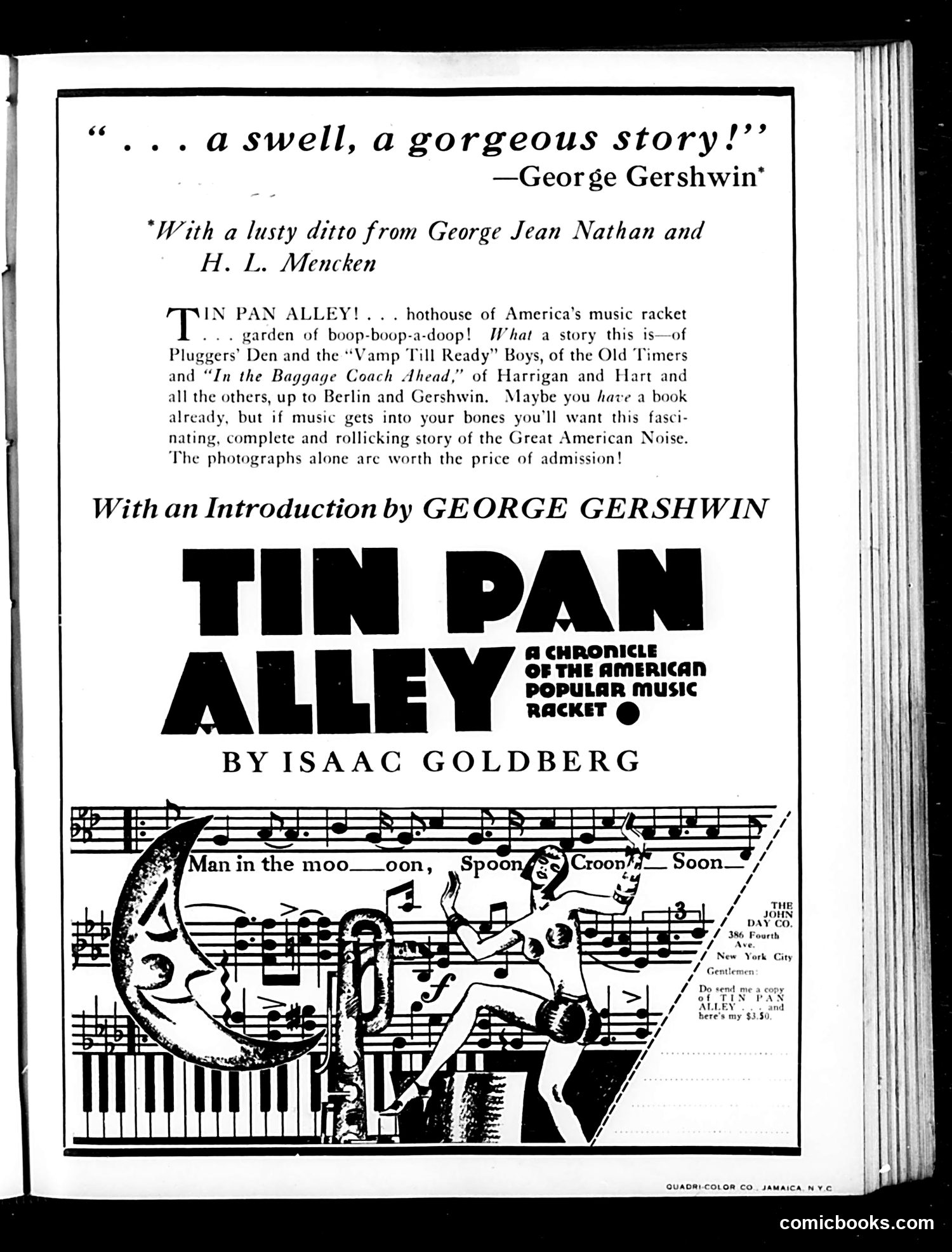
Tin Pan Alley Advertisement This is primarily a book advertisement, not political satire. It promotes Isaac Goldberg's "Tin Pan Alley: A Chronicle of the American Popular Music Racket." The page endorses the book through celebrity testimonials from composer George Gershwin and critics George Jean Nathan and H.L. Mencken—prestigious names that lent credibility. The text celebrates Tin Pan Alley as America's popular music center, referencing famous songwriting teams (Harrigan and Hart, Berlin, Gershwin) and song titles. The satirical framing calls music publishing a "racket" and "hothouse," using period slang ("boop-boop-a-doop," "vamp") to mock popular music's commercialism while paradoxically selling the book as an authoritative chronicle. The decorative illustration shows a tin pan with sheet music, piano keys, and musical figures—visual branding for the subject matter. This represents 1920s-30s highbrow dismissal of commercial popular music, even as such music dominated American culture.
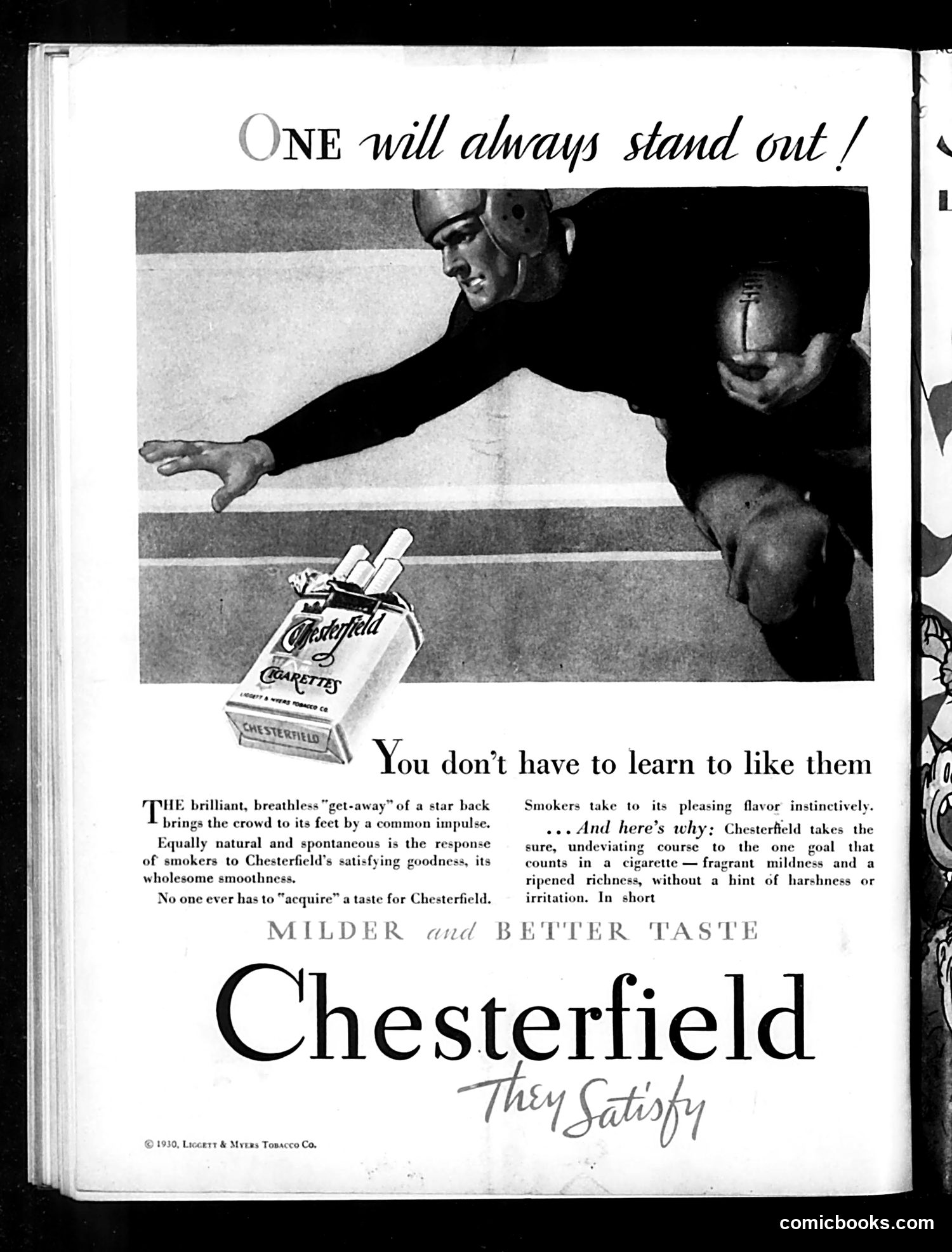
Analysis This is a cigarette advertisement, not political satire. The page uses a football analogy to sell Chesterfield cigarettes. The image shows two football players in action, with the headline comparing a star athlete's natural, instinctive "get-away" move to smokers' supposedly natural preference for Chesterfield cigarettes. The ad claims smoking Chesterfield requires no acquired taste—it's instantly pleasurable and "satisfying." The slogan "Milder and Better Taste" emphasizes the product's supposed superiority. The tagline "You don't have to learn to like them" is the core sales pitch: unlike competitor brands, Chesterfield is naturally appealing. This reflects 1930s advertising before health warnings, when cigarettes were marketed as wholesome and natural. The sporting reference lent masculine credibility to the product.