judge
Judge — November 22, 1930
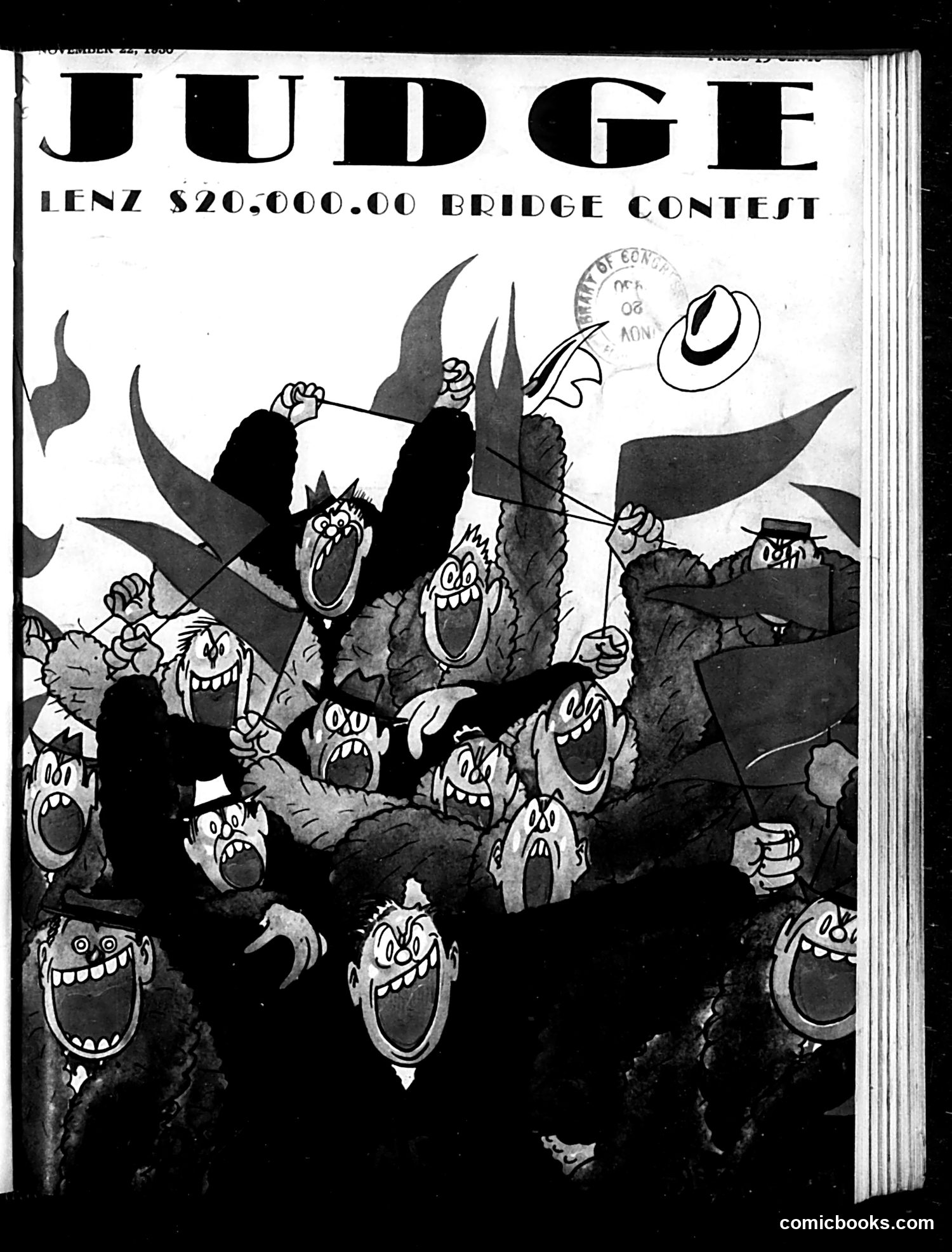
Analysis This appears to be a Judge magazine cover from November 22, 1930, featuring a "$20,000 Bridge Contest." The cartoon depicts demonic or grotesque figures with exaggerated features swarming around what appears to be a bridge structure, with horned creatures emerging from below. The silhouetted figures above seem to be judges or officials overseeing the chaos. The satire likely references the bridge-building contest itself—possibly mocking either the competition's participants, the judges' selection process, or broader economic concerns during the Great Depression. The devilish imagery suggests the contest was viewed as chaotic, corrupt, or absurdly managed. Without additional context about the specific 1930 bridge competition referenced, I cannot identify the exact target of ridicule, though the exaggerated pandemonium and infernal theme suggest Judge was casting aspersions on those involved.
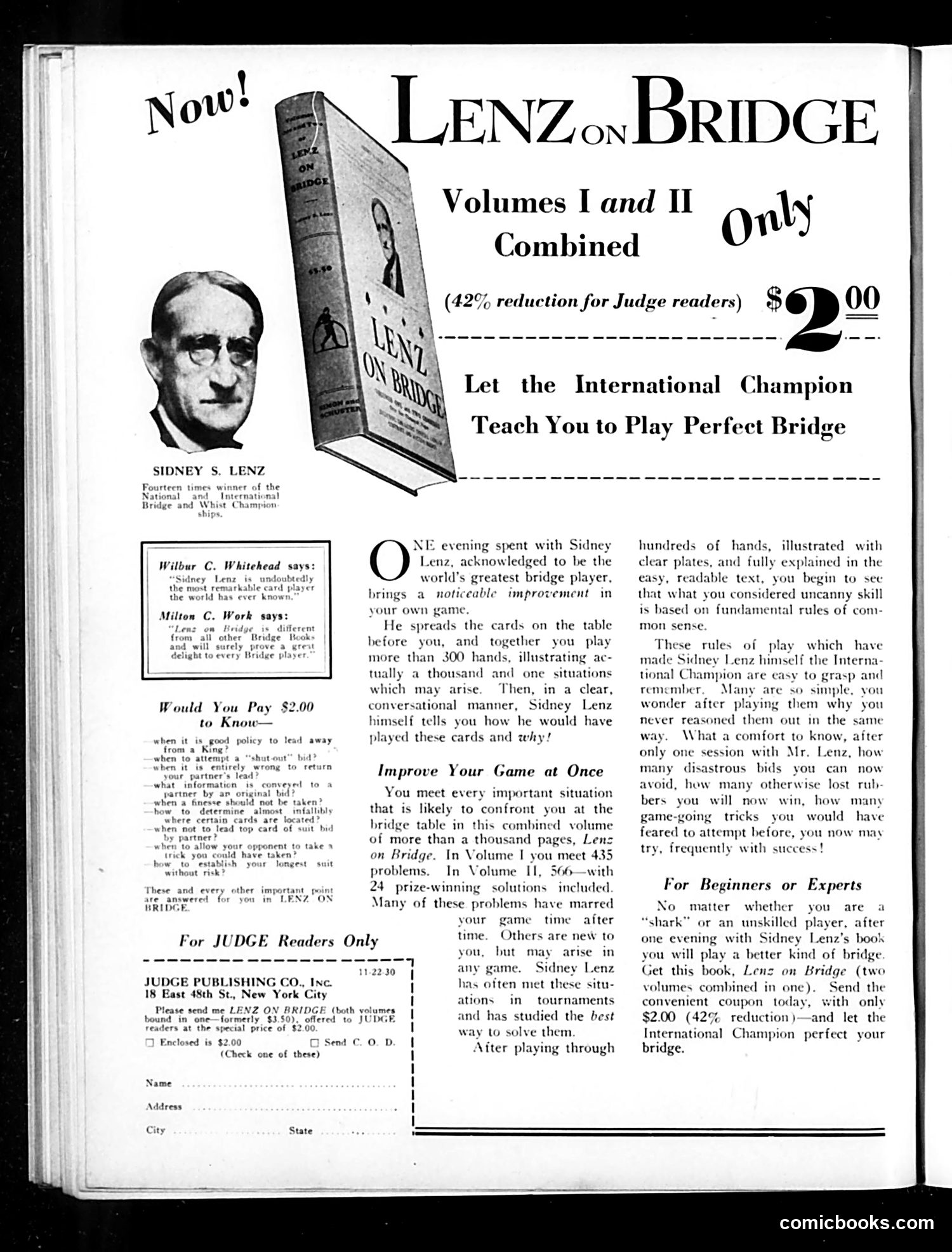
Analysis: Judge Magazine Advertisement Page This page is primarily an advertisement, not satirical content. It promotes "Lenz on Bridge," a two-volume instructional book by Sidney S. Lenz, identified as a fourteen-time winner of national and international bridge championships. The ad features Lenz's photograph and testimonials from bridge experts (Wilbur C. Whitehead and Milton C. Work), claiming his book teaches "perfect bridge" through analysis of hundreds of hands and situations. The offer targets "Judge readers" specifically with a 42% discount: $2.00 for both volumes combined. There is no political satire or social commentary here—this is a straightforward commercial pitch appearing in a magazine known for humor, using the publication's credibility to sell instructional materials to its educated, affluent readership interested in card games.
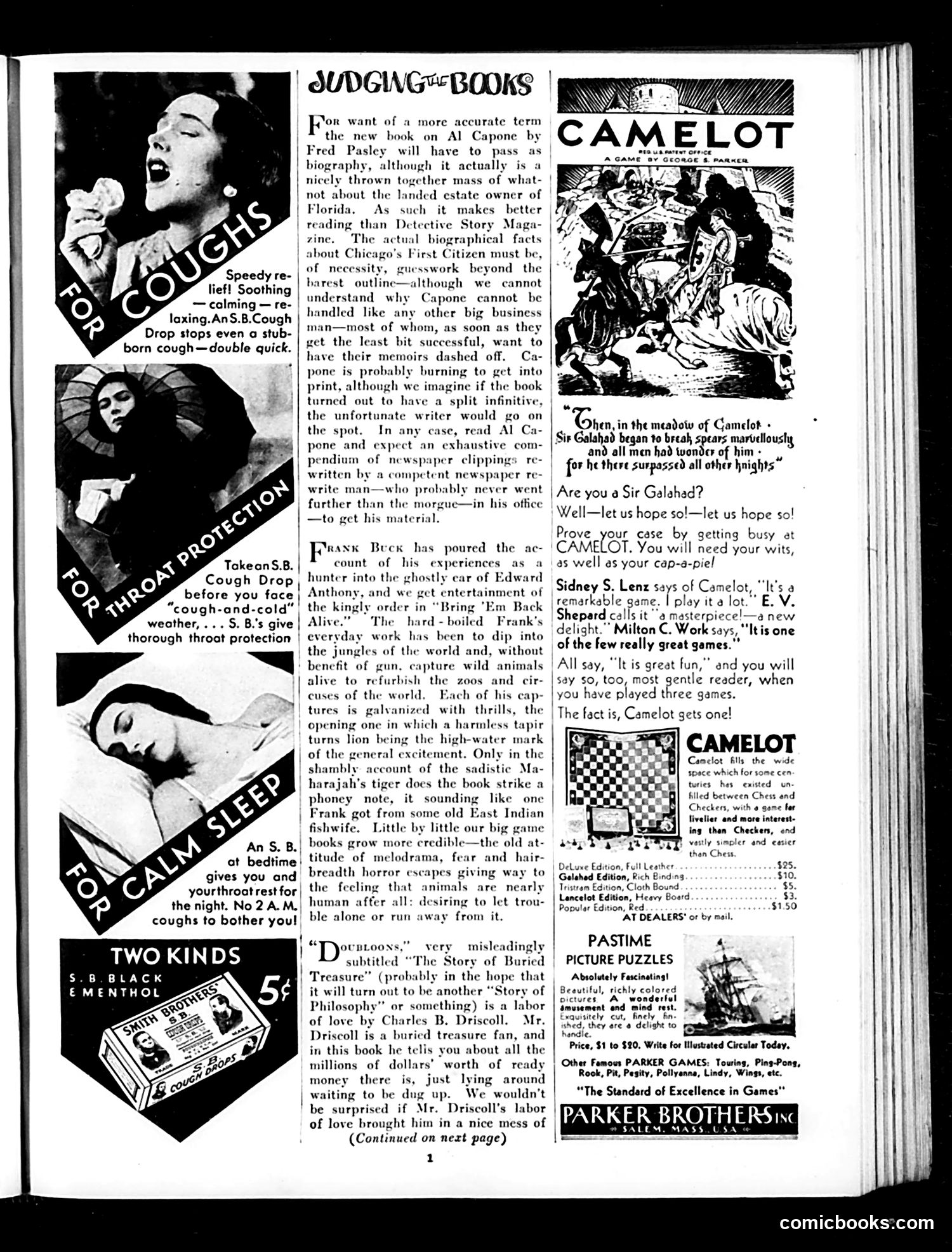
Page Analysis: Judge Magazine This page is primarily advertising and book reviews rather than political satire. The left side features product ads (cough drops, sleeping aids, mentholyptus products) using glamorous female faces—typical 1920s-30s marketing targeting health-conscious consumers. The main content is "Judging the Books," a review section critiquing recent publications. The reviewer discusses Al Capone biographies (noting the gangster's unavoidable notoriety), Frank Buck's animal adventure narratives, and Charles B. Driscoll's "Dormloons" (apparently a humorous campus story). The right side advertises Camelot, a board game, with period-appropriate chess-themed imagery. The tone is light entertainment rather than political commentary, reflecting the magazine's shift toward lifestyle content and consumer culture by this era.
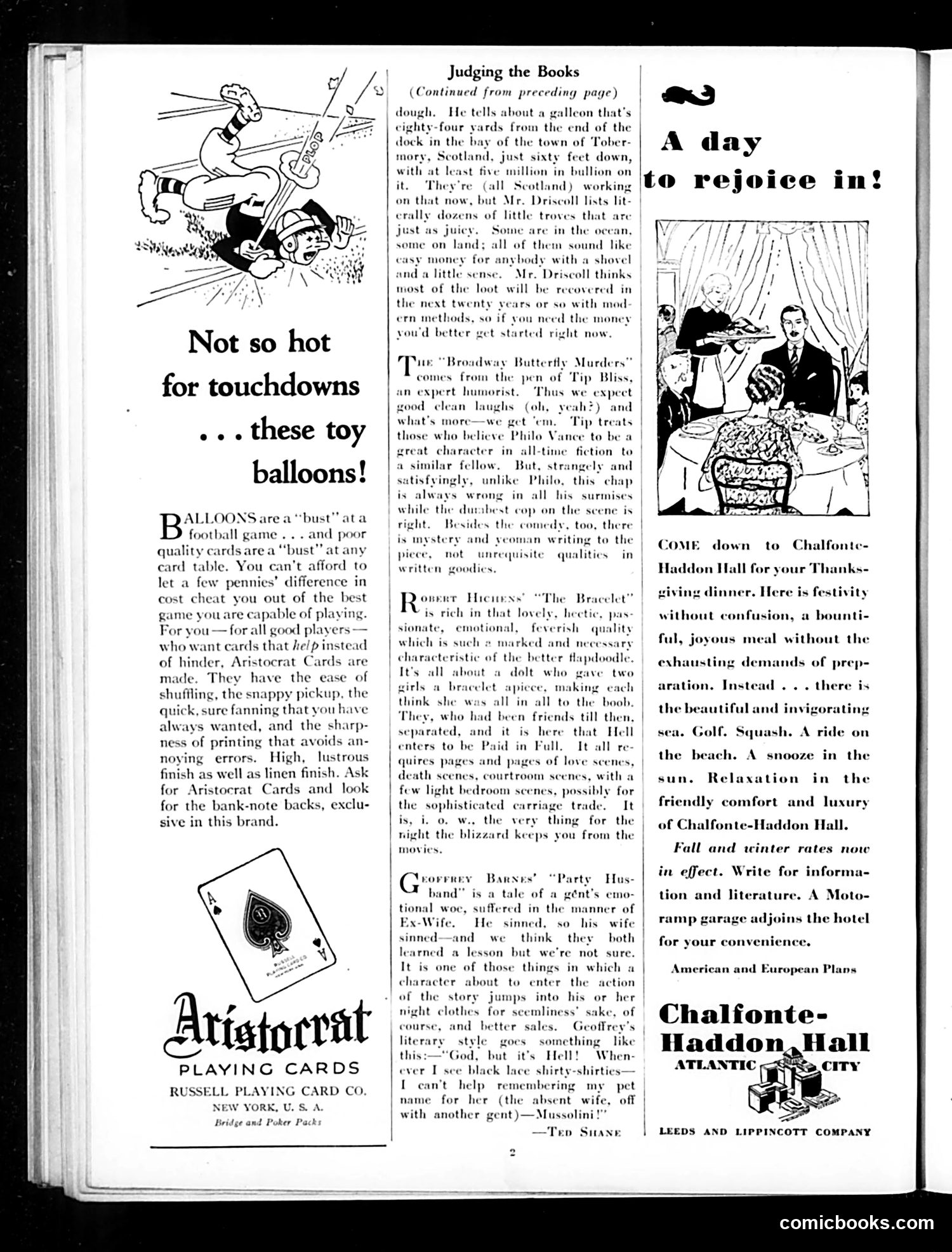
"Judging the Books" Page Analysis This page is primarily book reviews and advertisements rather than political satire. The main content reviews several novels including "The Bracelet" by Robert Hichens and "Party Husband" by Geoffrey Barnes, critiquing their literary merit and romantic plots. The cartoon "Not so hot for touchdowns" features a football player being tackled, advertising Aristocrat Playing Cards. The joke is that while balloons might be unreliable for serious football, the cards themselves are dependable—a lighthearted product endorsement unrelated to politics. The page concludes with a hotel advertisement for Chalfonte-Haddon Hall in Atlantic City, promoting leisure travel and relaxation. No significant political commentary or social satire appears on this page.
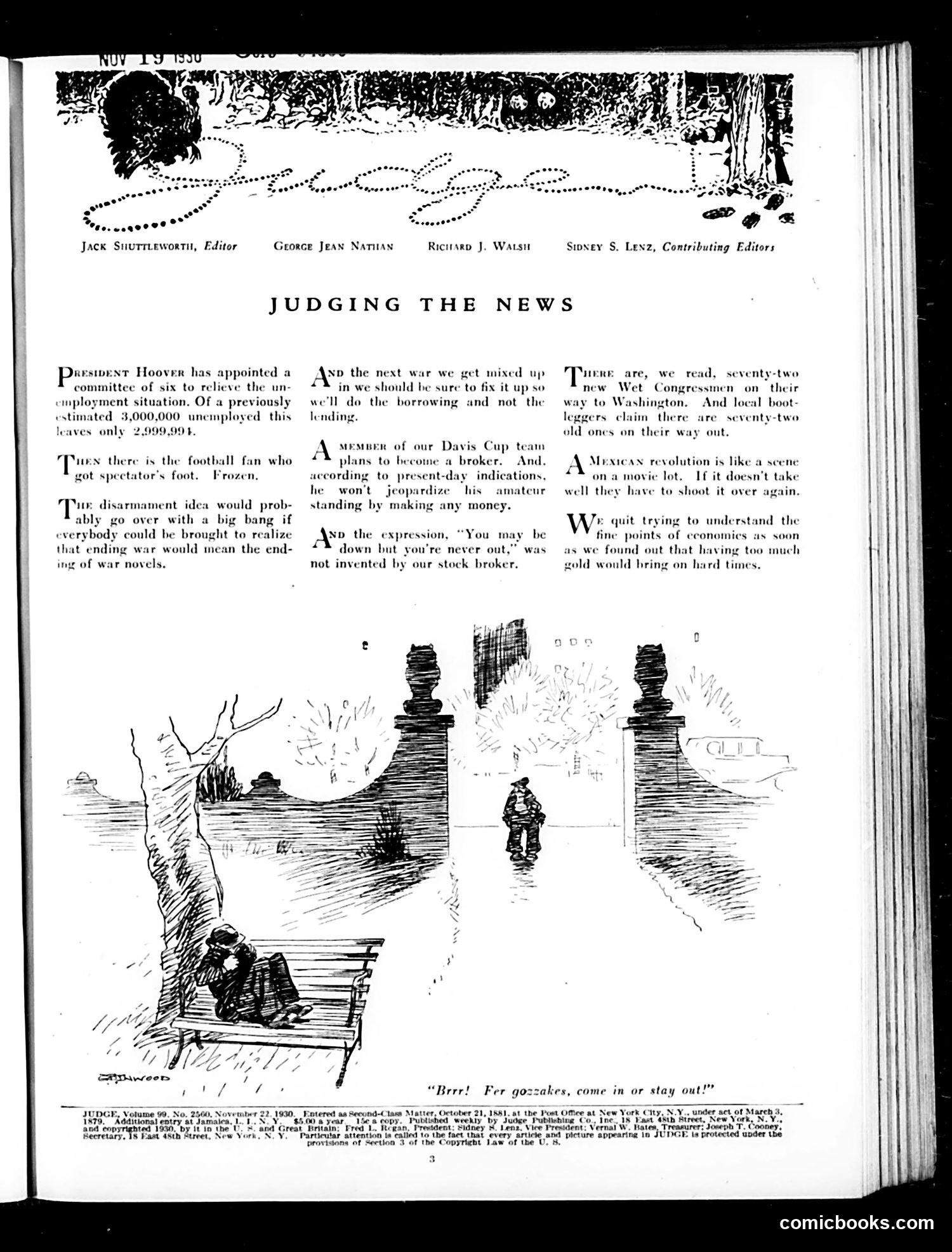
"Judging the News" - November 22, 1930 This satirical column presents brief commentary on current events. Key items include: - President Hoover's unemployment committee: Criticism of the administration's response to joblessness during the Great Depression, noting previous estimates proved vastly underestimated. - Football fan joke: A brief gag about a spectator with "frozen" foot. - Disarmament criticism: Skepticism that war could end through disarmament treaties alone. - Davis Cup tennis reference: A joke about a team member becoming a "broker" (likely financial ruin). - Mexico's revolution: Compared to chaotic movie production. - Economics commentary: Dismissal of abstract economic theory when facing economic hardship and gold hoarding. The illustration shows figures contemplating an ominous landscape with towers, possibly representing economic uncertainty or societal worry during the Depression era.
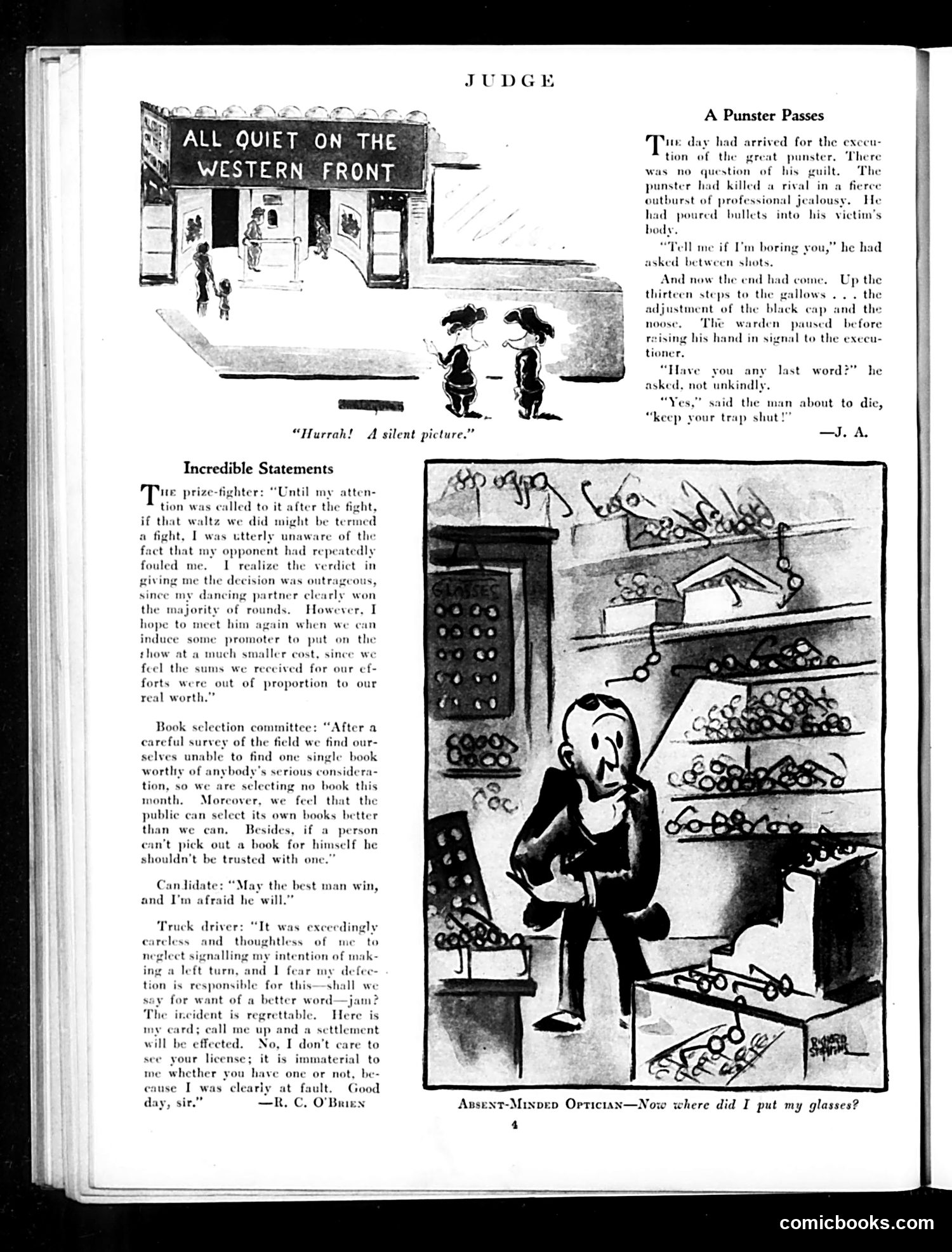
Analysis This page contains three satirical pieces from Judge magazine: 1. "All Quiet on the Western Front" (top): A silent-film reference mocking WWI's brutality through the contrast between the lighthearted theater marquee and two soldiers' grim conversation about execution. 2. "Incredible Statements" (middle): A section collecting absurd quotes from public figures, including a prize-fighter claiming ignorance of a fight he participated in, and a truck driver making an elaborate excuse for a traffic violation. 3. "Absent-Minded Optician" (bottom cartoon): Shows a befuddled eye doctor surrounded by eyeglasses on shelves, having lost his own glasses—a visual gag about professional irony. The page satirizes human folly across entertainment, society, and everyday life, typical of Judge's early 20th-century humor style.
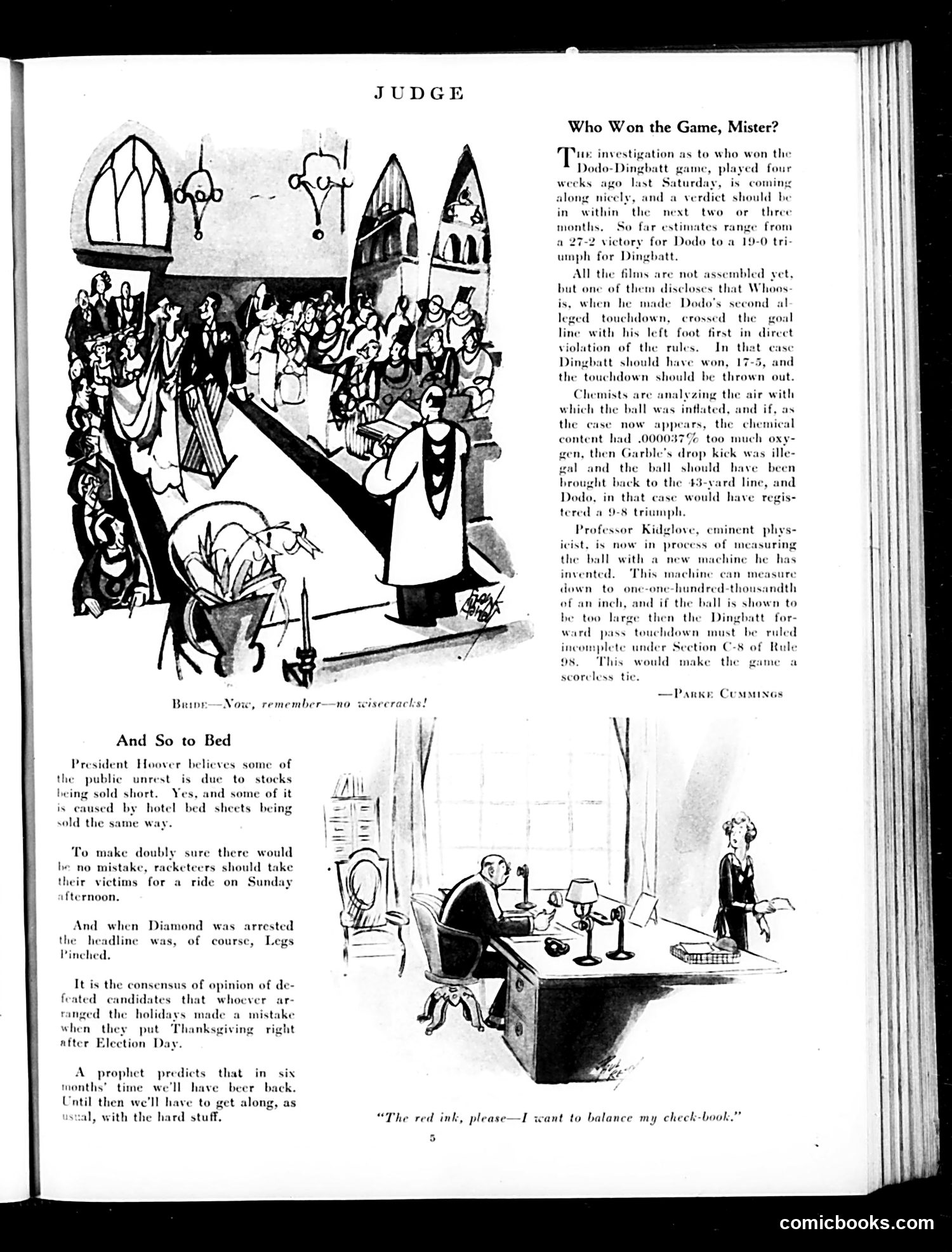
Judge Magazine Page Analysis This page contains two satirical pieces: "Who Won the Game, Mister?" addresses a disputed football outcome from the "Dodo-Dingbatt game" four weeks prior. The large illustration shows a chaotic scene at what appears to be a cathedral or formal venue, with the caption "Bride—*Now, remember—no wisecracks!*" The satire mocks ongoing disputes over the game's result, referencing chemistry analysis of the football's air content and technical rule interpretations. Attribution to Parker Cummings suggests this pokes fun at how people obsess over settling trivial disputes. "And So to Bed" satirizes President Hoover's economic policies, referencing public unrest, stock market short-selling, and the timing of Thanksgiving after Election Day. The smaller cartoon shows a man at a desk with the caption about balancing his checkbook, likely commentary on widespread financial anxiety during this period.
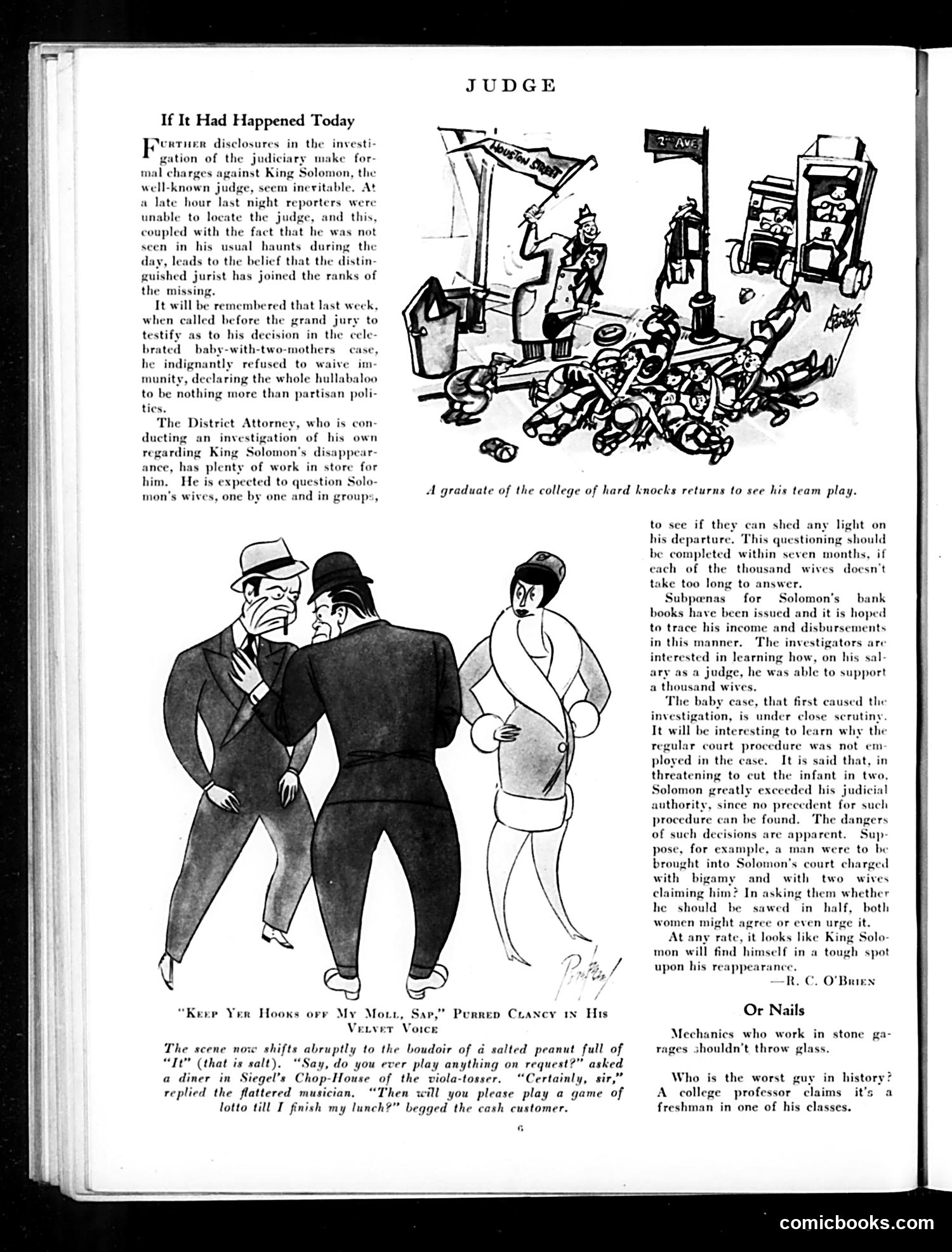
Explanation for Modern Readers This Judge magazine page satirizes the scandal involving King Solomon (a judge), who apparently disappeared under suspicious circumstances. The main cartoon depicts journalists and investigators swarming around a chaotic crime scene, mocking the sensational media coverage. The text reveals Solomon faces serious allegations: he indignantly refused to waive immunity in a baby case involving bigamy, and investigators are questioning his wives about his financial support. The satire criticizes Solomon for abusing judicial authority—threatening to cut an infant in half exceeded legal precedent. The lower cartoon depicts two detectives and a woman, captioning a scene about keeping "hooks off my moll," suggesting criminal underworld connections. The satire targets Solomon's apparent corruption, misconduct, and the spectacle surrounding his investigation.
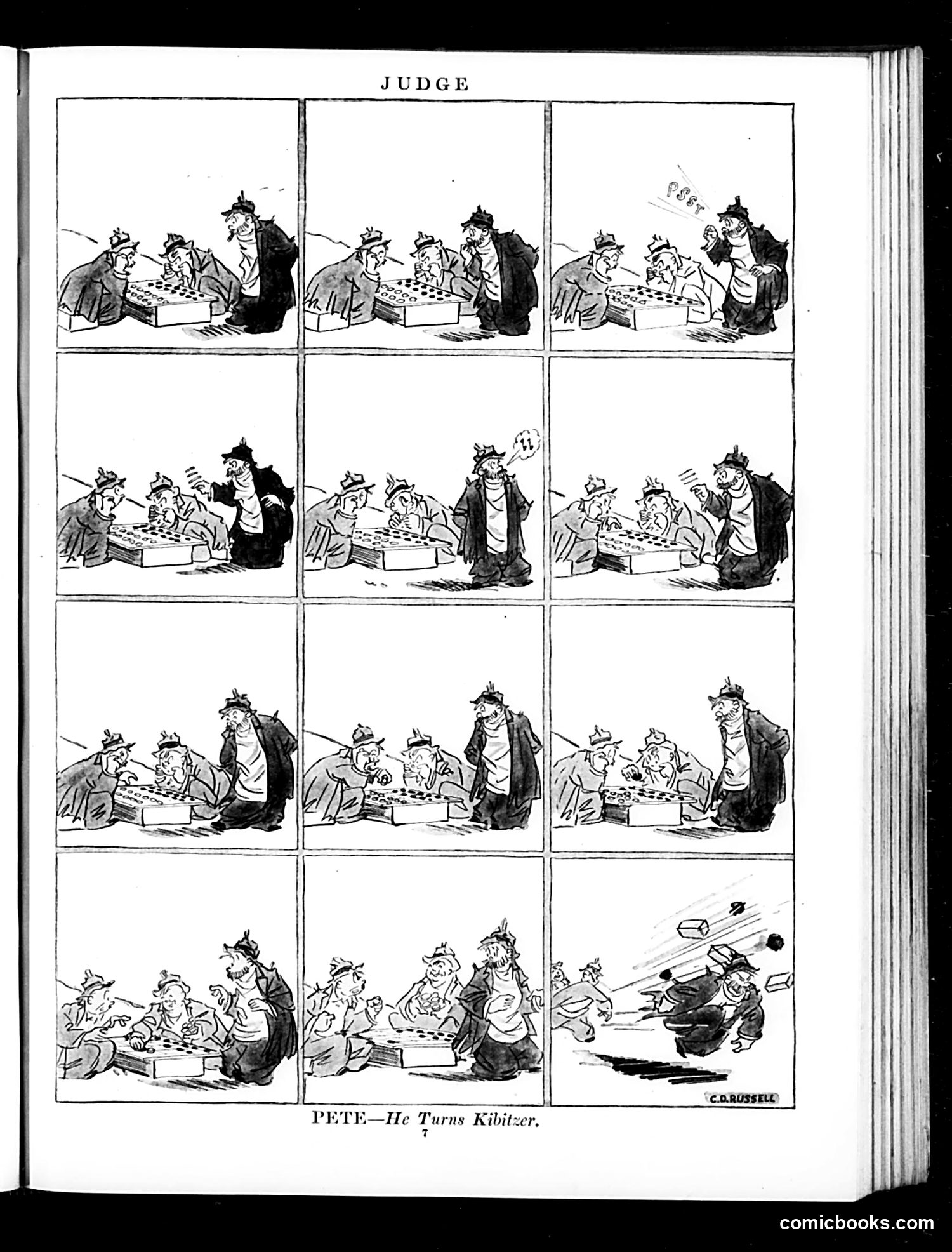
"Pete—He Turns Kibitzer" This comic strip from *Judge* magazine depicts a chess game between two men wearing crowns (likely political figures or rulers) while a third figure—"Pete," identified by the caption—stands nearby offering unsolicited commentary ("kibitzer" means a backseat commentator). The twelve-panel sequence shows Pete increasingly animated and disruptive, eventually flipping over the chessboard in the final panel, scattering pieces everywhere. The satire likely criticizes interference in political or diplomatic matters—Pete represents someone meddling in affairs beyond his authority. The chess metaphor suggests high-stakes governmental strategy, while Pete's escalating disruption mocks those who presume to advise or interrupt important negotiations. Without clearer historical context or date, the specific political figures remain unclear.
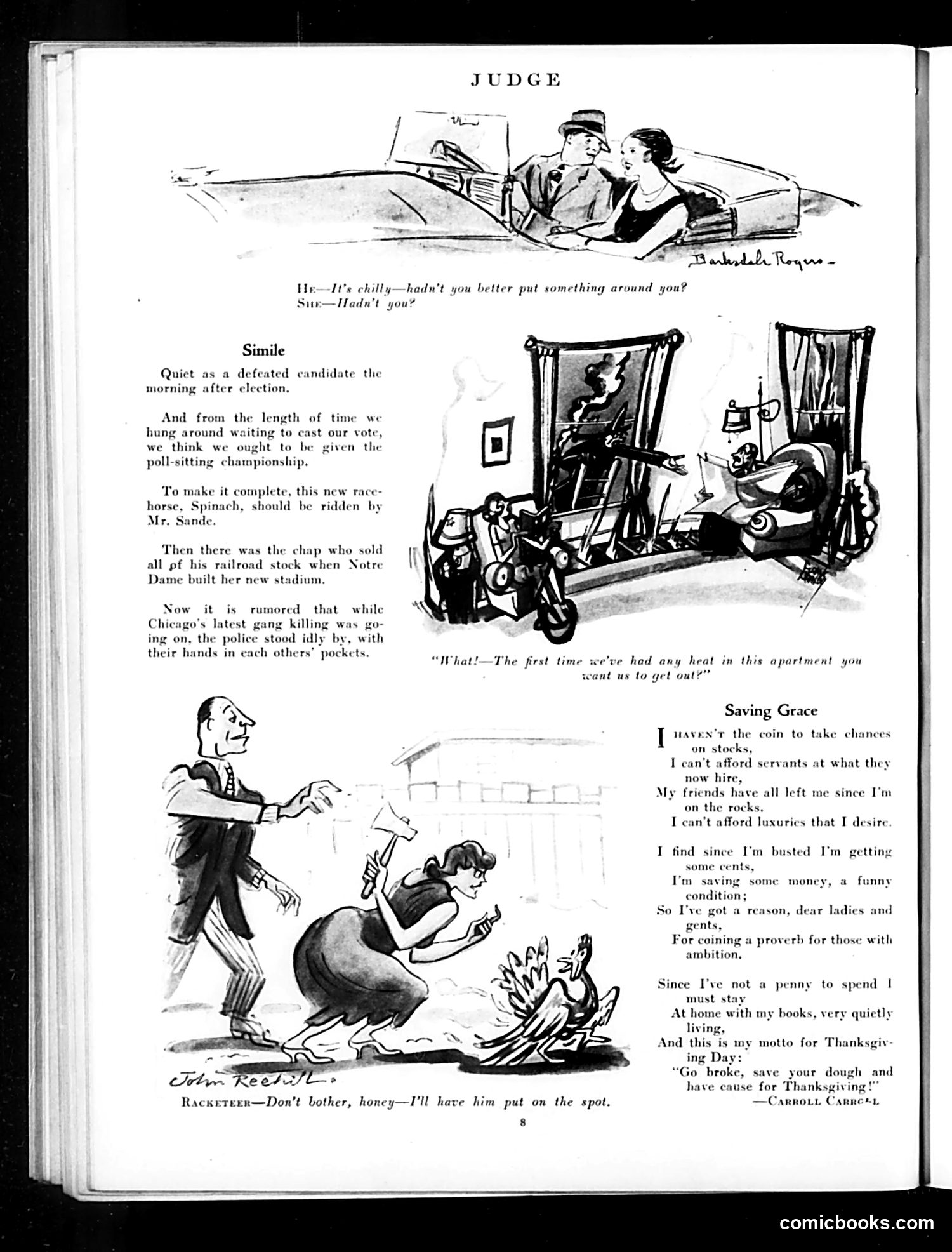
Judge Magazine Page Analysis This page contains multiple satirical pieces typical of Judge's style: Top cartoon ("Judge"): Shows a couple in a sinking boat. The man suggests the woman put "something around" herself; she retorts he should do the same. This is a visual pun on marital discord—likely satirizing post-election tensions (the "defeated candidate" reference suggests a recent election where the couple disagreed politically). Middle section ("Simile"): Brief humorous observations about voting, a racehorse named Spinach, and—notably—Chicago police corruption. The final item mocks police inaction during a gang killing, sardonically noting they stood idle "with their hands in each others' pockets" (implying bribery). This reflects 1920s-era Chicago's notorious organized crime and police graft. Bottom cartoon ("Racketeer"): A man threatens a woman he'll "put [someone] on the spot"—a period slang term for murder. Satirizes organized crime threats. "Saving Grace" poem: Humorous verse by Carroll Carroll about financial hardship during economic downturn, urging frugality for Thanksgiving. The page collectively satirizes post-election malaise, corruption, and economic hardship—likely from the early 1920s.
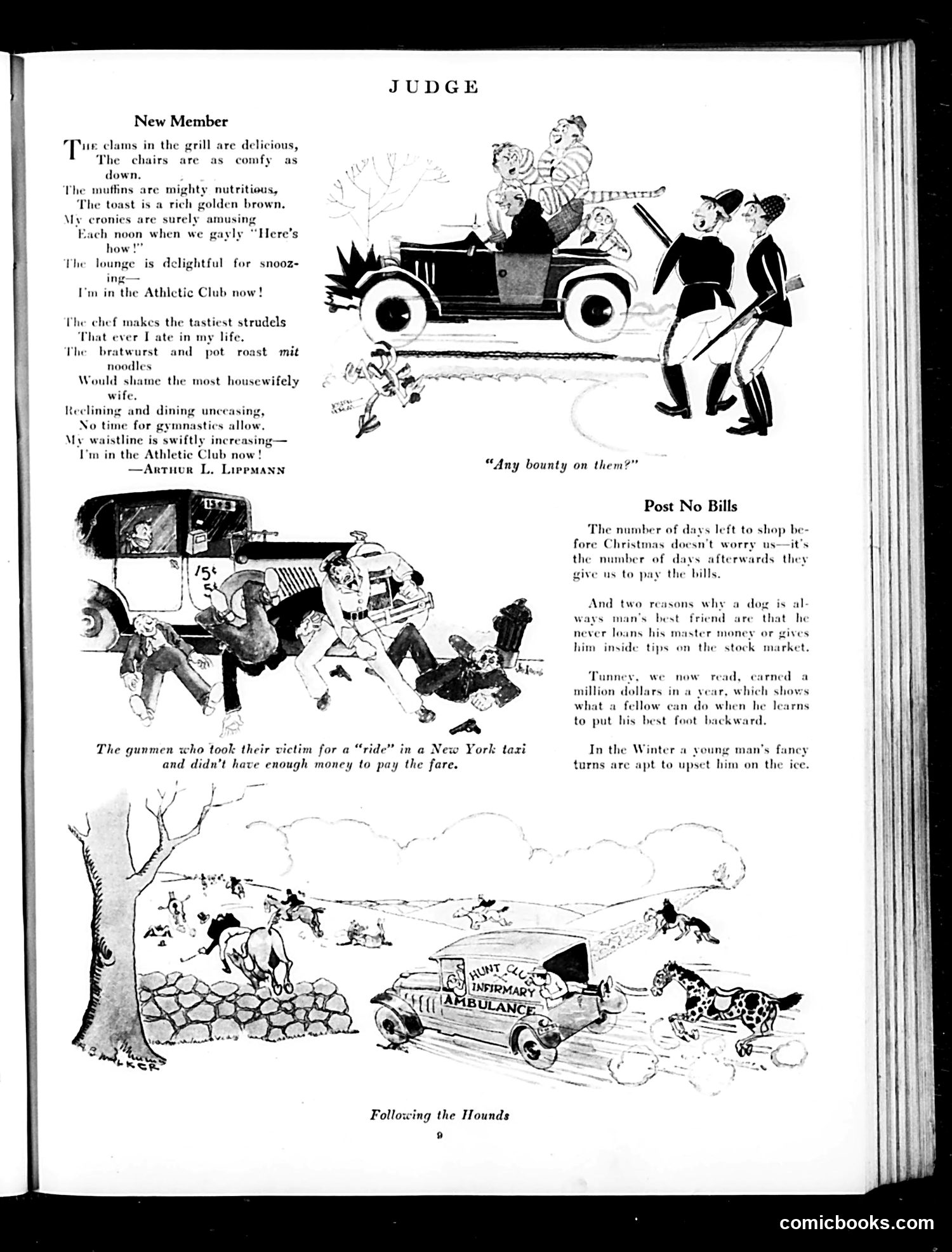
Analysis for Modern Readers This page from Judge magazine contains several satirical pieces: "New Member" (poem by Arthur L. Lippmann): Satirizes a newly wealthy club member whose lifestyle has become sedentary and indulgent. He boasts about fine dining and leisure while noting his waistline is "swiftly increasing"—mocking nouveau riche materialism and the physical consequences of excessive comfort. Top cartoon ("Any bounty on them?"): References organized crime "rides" (execution-style killings). The joke: gunmen who kidnapped someone couldn't afford the taxi fare—satirizing criminals' incompetence or desperation. "Post No Bills": Brief jokes about Christmas shopping debt and dogs' loyalty (they don't gamble on stocks or loan money). Bottom cartoon ("Following the Hounds"): An ambulance chasing after a fox hunt, suggesting the hunt causes accidents. The satire appears to mock the dangers or chaos of this aristocratic pastime. The overall tone reflects early 20th-century American humor targeting wealth, crime, and leisure activities.
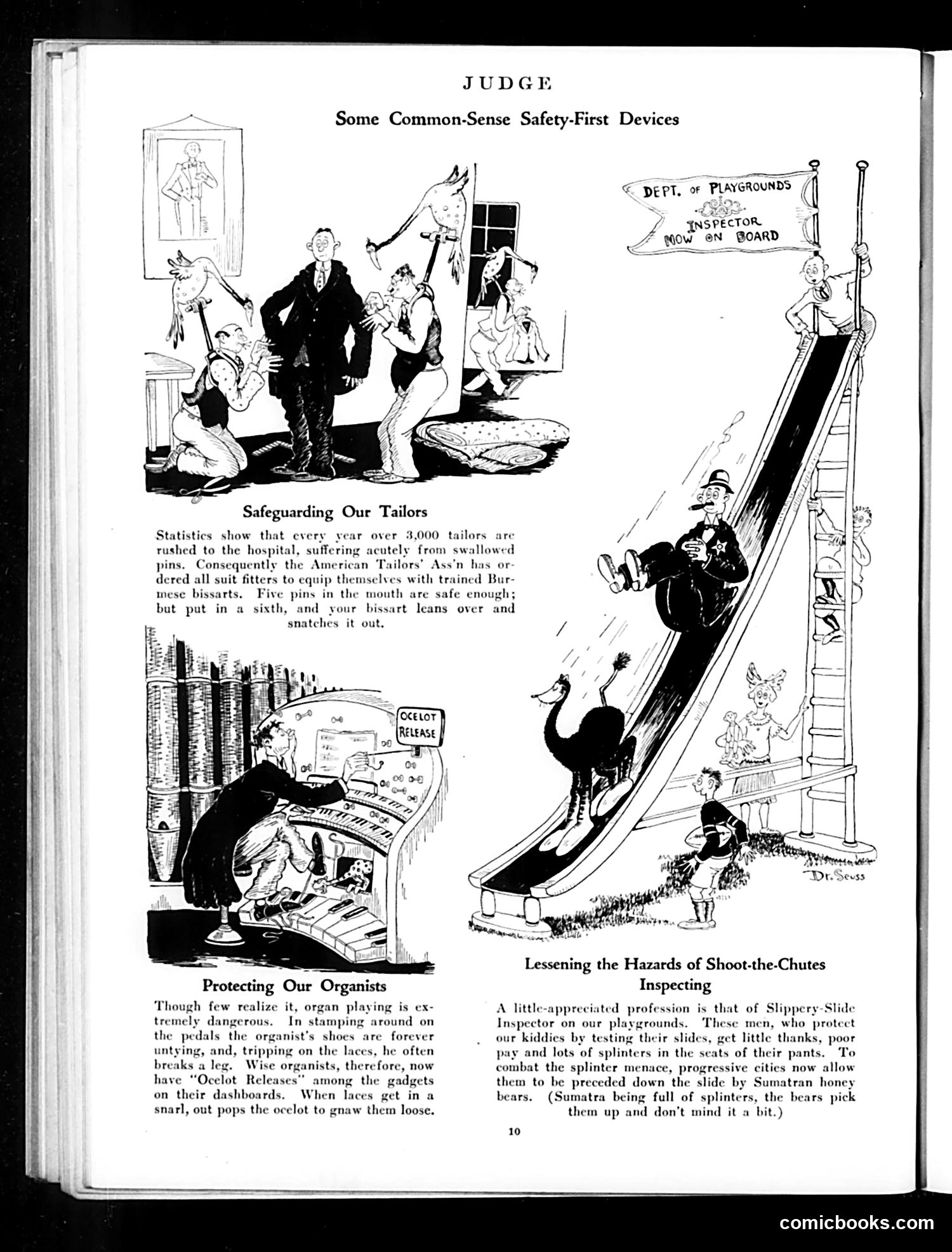
Explanation for Modern Readers This Judge magazine page presents absurdist satire mocking workplace safety regulations—likely responding to early 20th-century "Safety First" industrial campaigns. Each cartoon proposes ridiculous "safety devices" to solve genuine hazards: 1. "Safeguarding Our Tailors": Tailors swallowing pins while working inspired the American Tailors' Association to equip workers with trained Burmese "bissarts" (likely fictional animals) to retrieve swallowed pins—a nonsensical solution to a real occupational danger. 2. "Protecting Our Organists": Organ players who stamp on pedals risk leg injuries, so the cartoon suggests "Ocelot Releases"—mechanical ocelots mounted on dashboards to untangle shoelaces. 3. "Lessening the Hazards of Shoot-the-Chutes": Playground slide inspectors get splinters, solved by sending Sumatran honey bears down first, since bears supposedly don't mind splinters. The satire mocks both the era's earnest safety obsession and the inadequacy of proposed solutions, using Dr. Seuss-style drawings to heighten the absurdity.
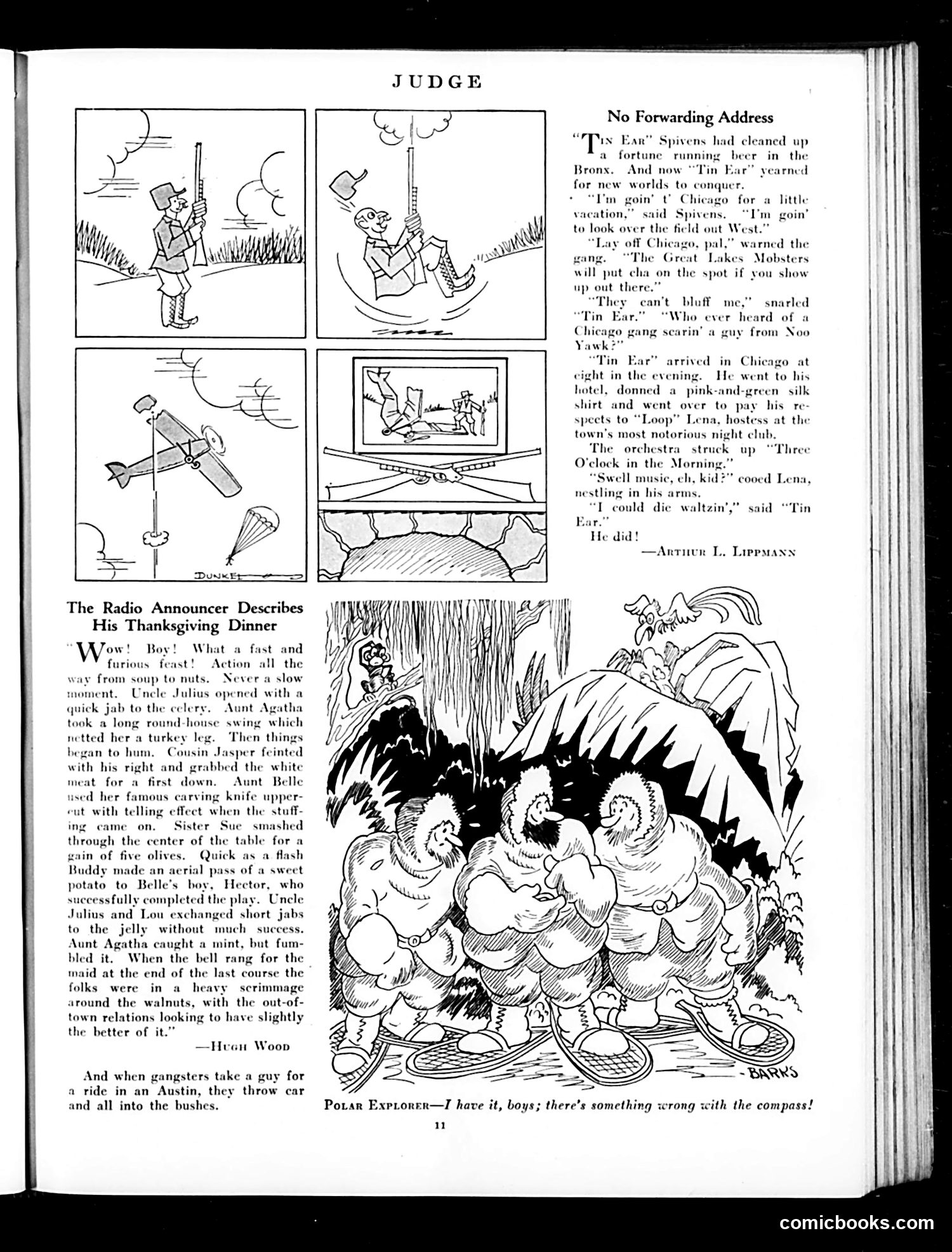
Judge Magazine Page Analysis This page contains three distinct satirical pieces: "No Forwarding Address" (top): A crime story about "Tin Ear" Spivens, a Prohibition-era bootlegger who made money running beer in the Bronx. He travels to Chicago to expand operations but is killed at a nightclub—likely by rival mobsters ("Loop" Lena's gang). The satire mocks gangster culture and the violent underworld of the 1920s alcohol trade. "The Radio Announcer Describes His Thanksgiving Dinner" (middle): A humorous piece parodying sports radio commentary by applying rapid-fire sportscaster language to a chaotic family holiday meal. Each family member's eating becomes athletic combat—"quick jabs," "uppercuts," "aerial passes"—satirizing both overwrought radio sports enthusiasm and family dinner chaos. "Polar Explorer" (bottom): A brief gag about navigation problems, likely referencing early Arctic exploration or aviation attempts. The magazine's satirical targets are urban crime, commercial broadcasting conventions, and adventure narratives of the era.
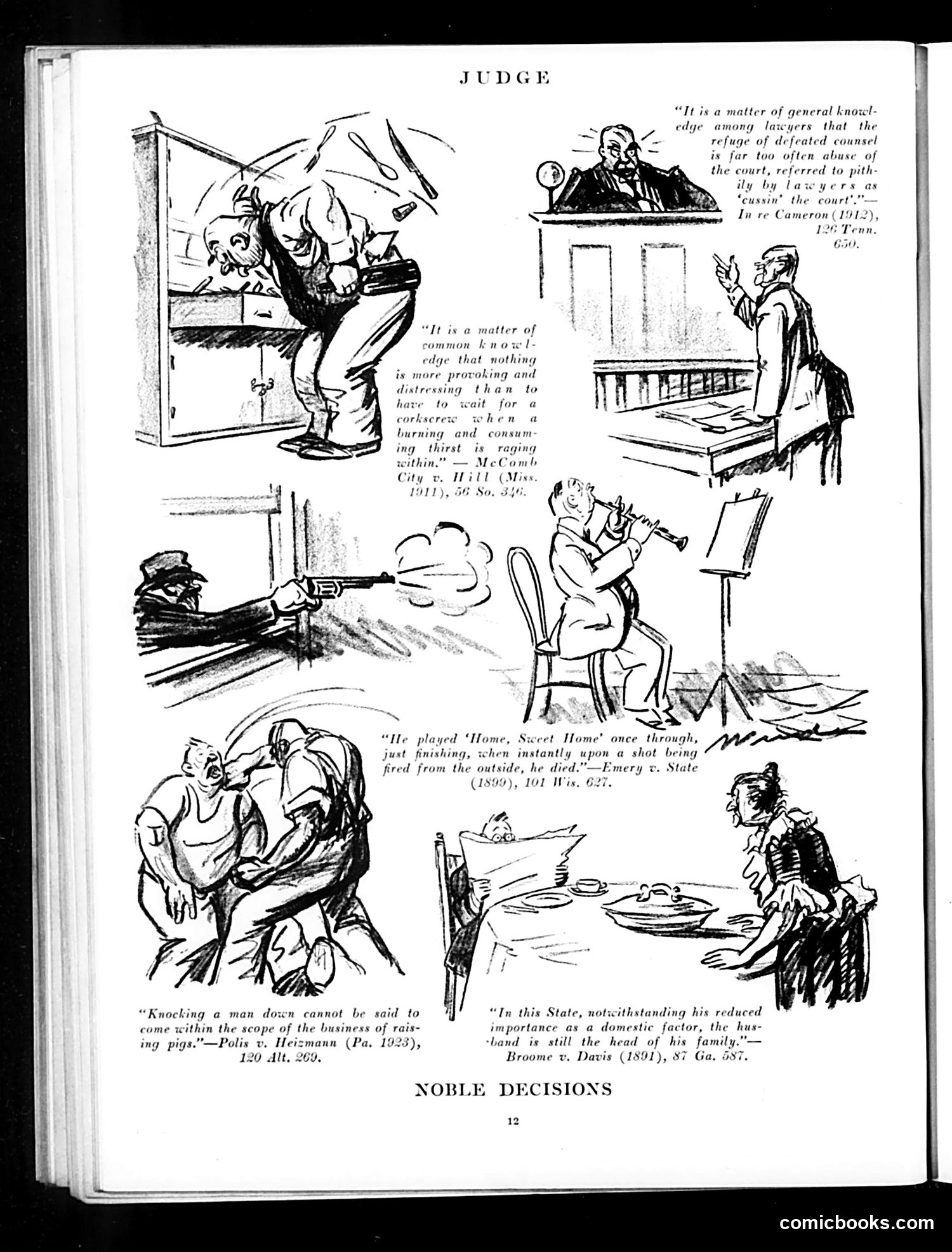
Judge Magazine: "Noble Decisions" Page This page satirizes absurd legal rulings through paired illustrations and case citations. The cartoons mock the disconnect between serious judicial language and ridiculous factual scenarios. The illustrations depict literal interpretations of bizarre court decisions: a man searching for a corkscrew while dying of thirst; a musician shot dead mid-performance of "Home, Sweet Home"; a man knocking down another in a pig-raising business; and domestic disputes over family hierarchy. The satire targets the legal system's tendency to produce technically "correct" but obviously nonsensical rulings when judges apply rigid logic to trivial or absurd circumstances. By pairing genuine case citations with cartoon illustrations of their literal outcomes, Judge mocks judicial pedantry and the gap between law's logic and common sense. This reflects Progressive Era skepticism toward legal formalism and institutional excess—the magazine suggests courts sometimes produce decisions that, while legally sound, expose how removed the system is from practical reality.
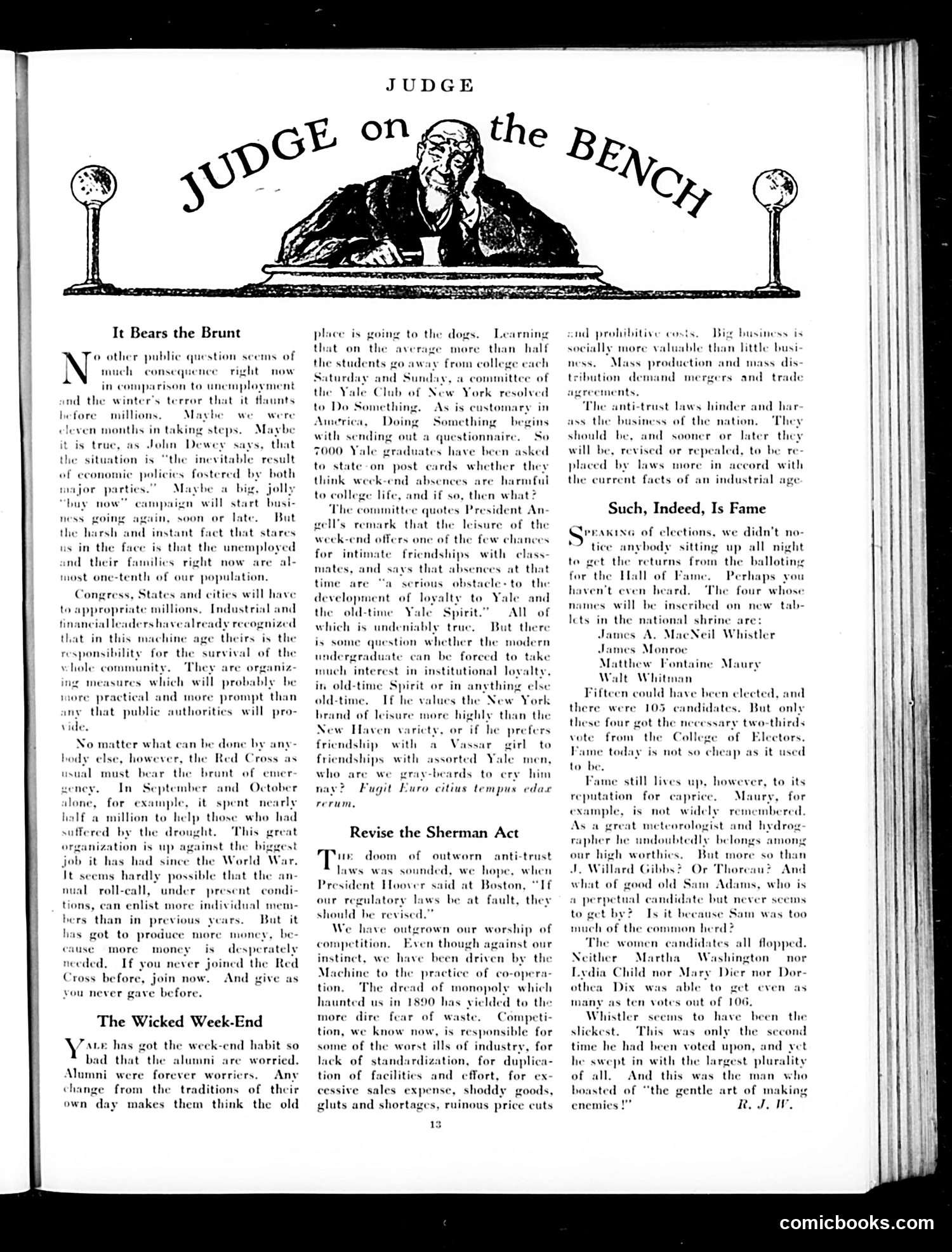
Judge Magazine Editorial Analysis This page contains three editorials from Judge magazine addressing contemporary issues, likely from the early 1930s based on references to unemployment and economic crisis. "It Bears the Brunt" discusses the Red Cross's role in addressing unemployment and winter hardship, urging readers to donate generously since government and business responses are inadequate. "The Wicked Week-End" satirizes Yale University's concern that alumni absences on weekends undermine institutional loyalty. The editorial mocks administrators' anxiety about modernizing students preferring New York leisure or relationships with Vassar girls to old-fashioned Yale traditions—suggesting the "old-timers" are out of touch. "Revise the Sherman Act" argues that 1890s antitrust laws are obsolete. The editorial contends that competition—once feared as creating monopolies—actually causes waste, poor standardization, and price instability. It supports President Hoover's call to revise these regulations, reflecting Depression-era belief that consolidation and cooperation serve the economy better than competition. The cartoonish judge header suggests satirical intent throughout.
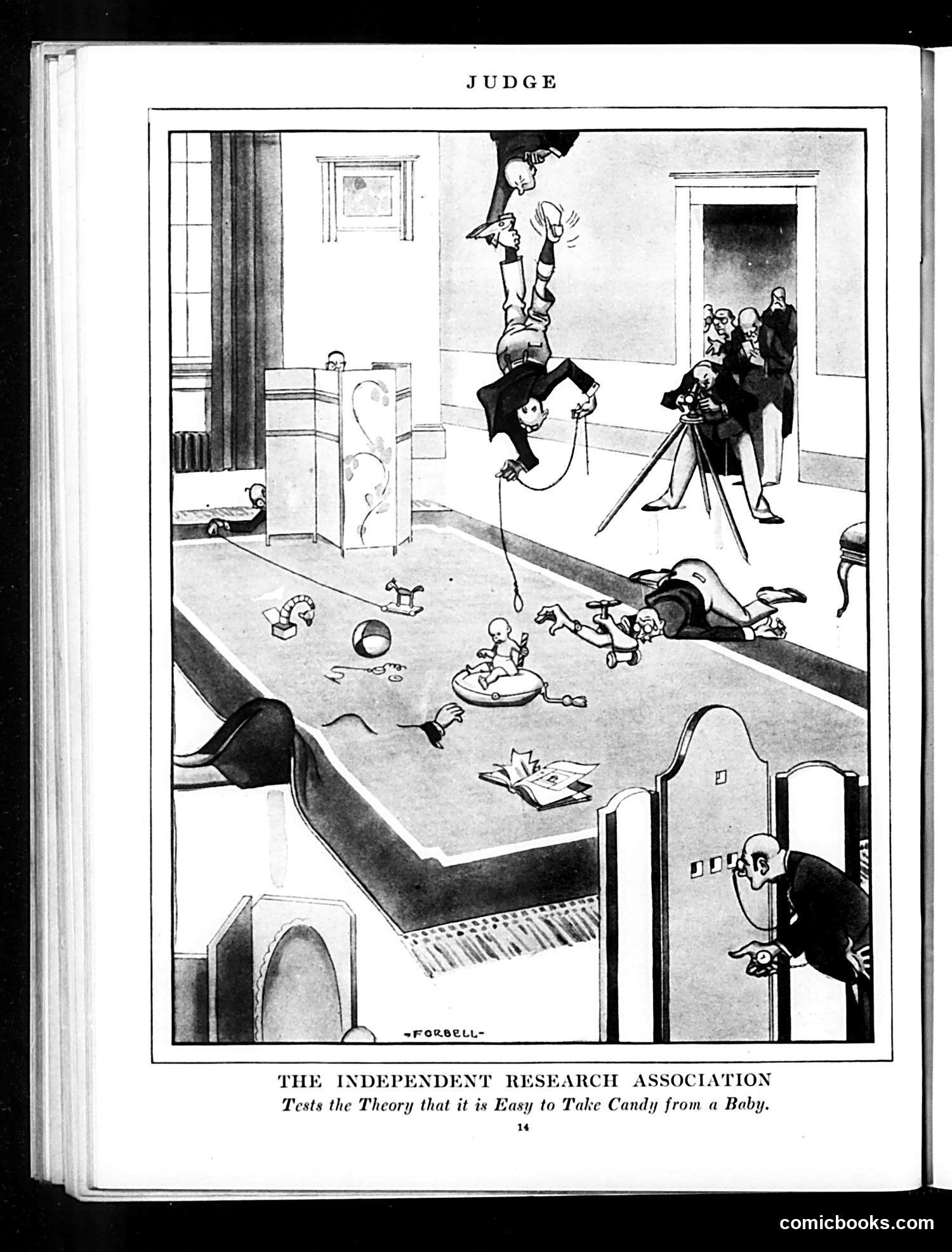
Satire Explanation This cartoon satirizes the "Independent Research Association" by depicting them literally testing the old adage that "it's easy to take candy from a baby." The image shows a courtroom-like setting where researchers conduct a formal "experiment": an adult attempts to take candy from an infant while judges, spectators, and camera operators observe and document the proceedings. The satire mocks pseudo-scientific organizations that conduct absurdly obvious or trivial "research" with excessive formality. By treating a common saying as requiring institutional study and evidence, the cartoon ridicules both the pretentiousness of some research bodies and the notion that common sense needs scientific validation. The formal courtroom setting amplifies the absurdity—transforming playground wisdom into a serious legal/scientific matter.
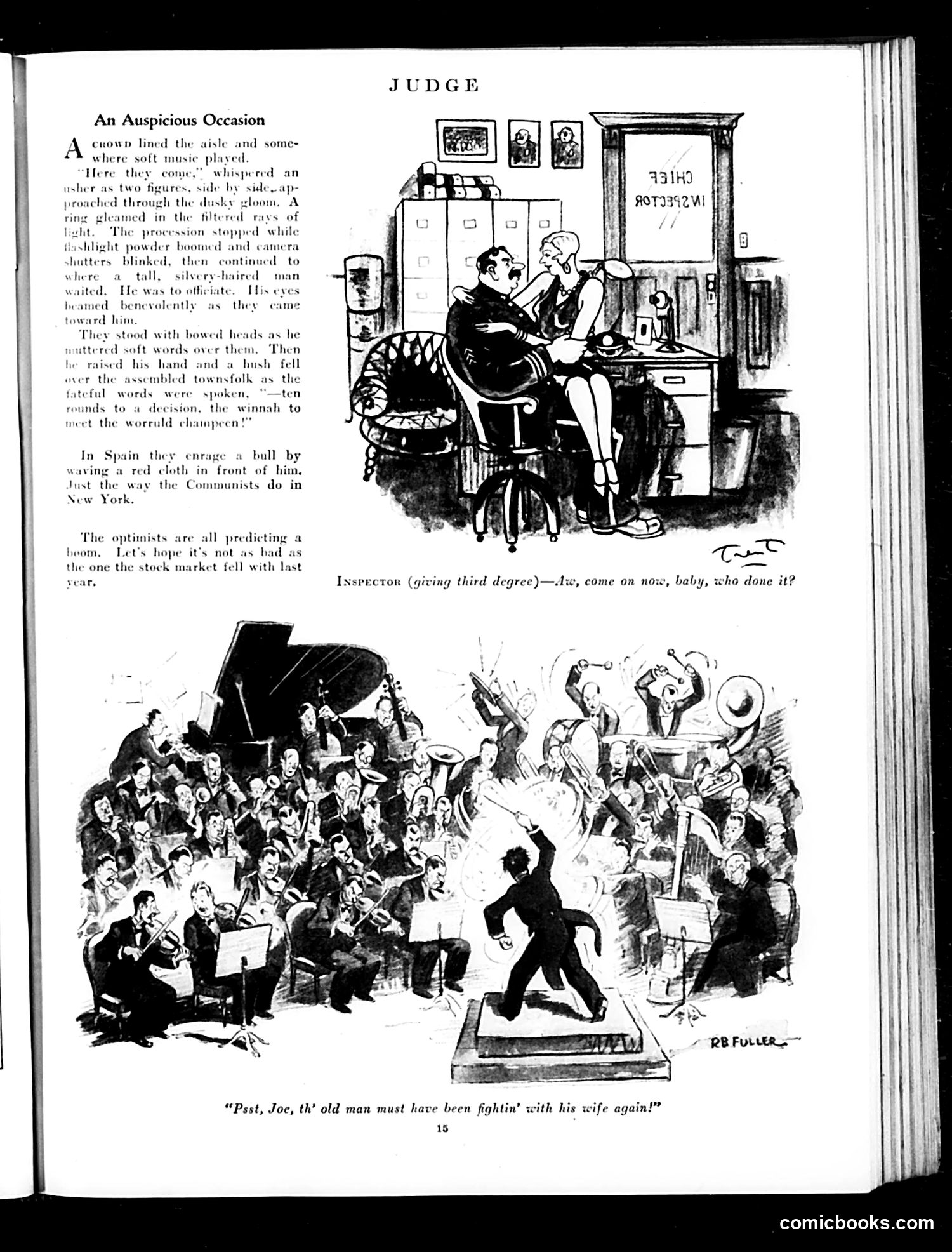
Analysis of Judge Magazine Page This page contains two satirical cartoons mocking early 20th-century American culture. Top cartoon ("An Auspicious Occasion"): Depicts a wedding ceremony staged like a boxing match, with a "silvery-haired man" (likely a judge or officiant) presiding. The text's crude humor compares the wedding to a prize fight, with the officiant announcing marriage "terms" like a boxing match outcome. The accompanying text jokes that Spanish bullfighting and Communist agitation in New York both use similar manipulative tactics—suggesting marriage itself is a form of controlled spectacle or confrontation. Bottom cartoon: Shows a boxing match surrounded by an excited crowd. The caption "Psst, Joe, th' old man must have been fightin' with his wife again!" implies the boxer's bruises come from domestic violence rather than the ring—satirizing marital conflict as entertainment or normalcy. Both cartoons cynically equate marriage with violence and combat, reflecting contemporary anxieties about gender relations and martial discord presented as humor.
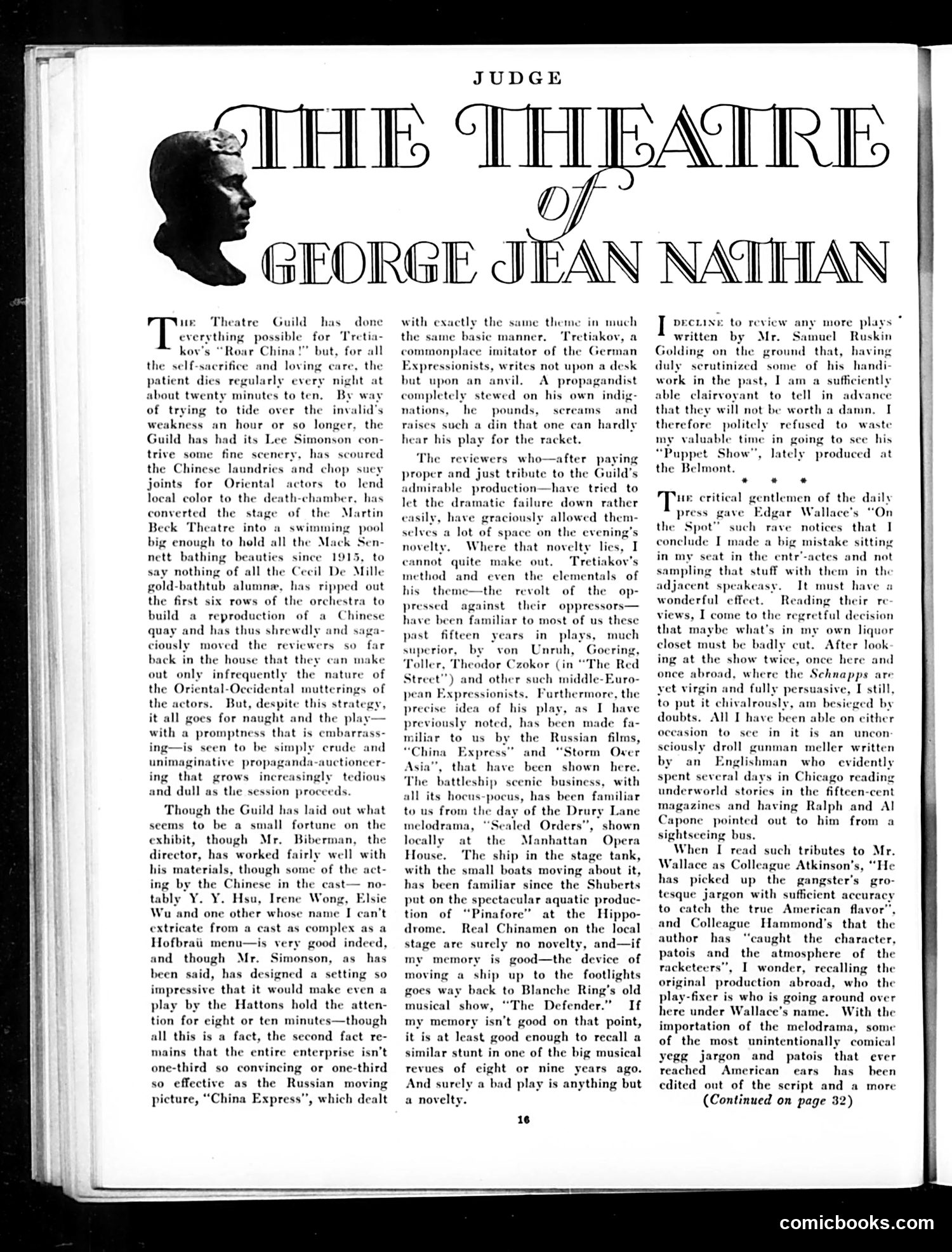
The Theatre of George Jean Nathan This page is a theater review by Judge's drama critic, likely George Jean Nathan (indicated by the header), attacking the Theatre Guild's production of Tretiakov's "Roar China!" The Satire: Nathan ridicules the Guild's elaborate staging efforts—expensive sets by Lee Simonson, a swimming pool stage, Chinese actors from "laundries and chop suey joints," removed orchestra seats—as expensive window-dressing for a fundamentally bad play. He argues the production is crude propaganda that fails despite technical spectacle. The Comparison: Nathan dismisses the play as unoriginal, noting the same themes appeared superior in German Expressionist works and especially in the Russian film "China Express"—making the stage production seem derivative and inferior. The Point: The review mocks how theaters distract audiences with production values from weak material, and suggests a modest film outperformed elaborate theatrical machinery. It's a defense of substance over spectacle in dramatic art.
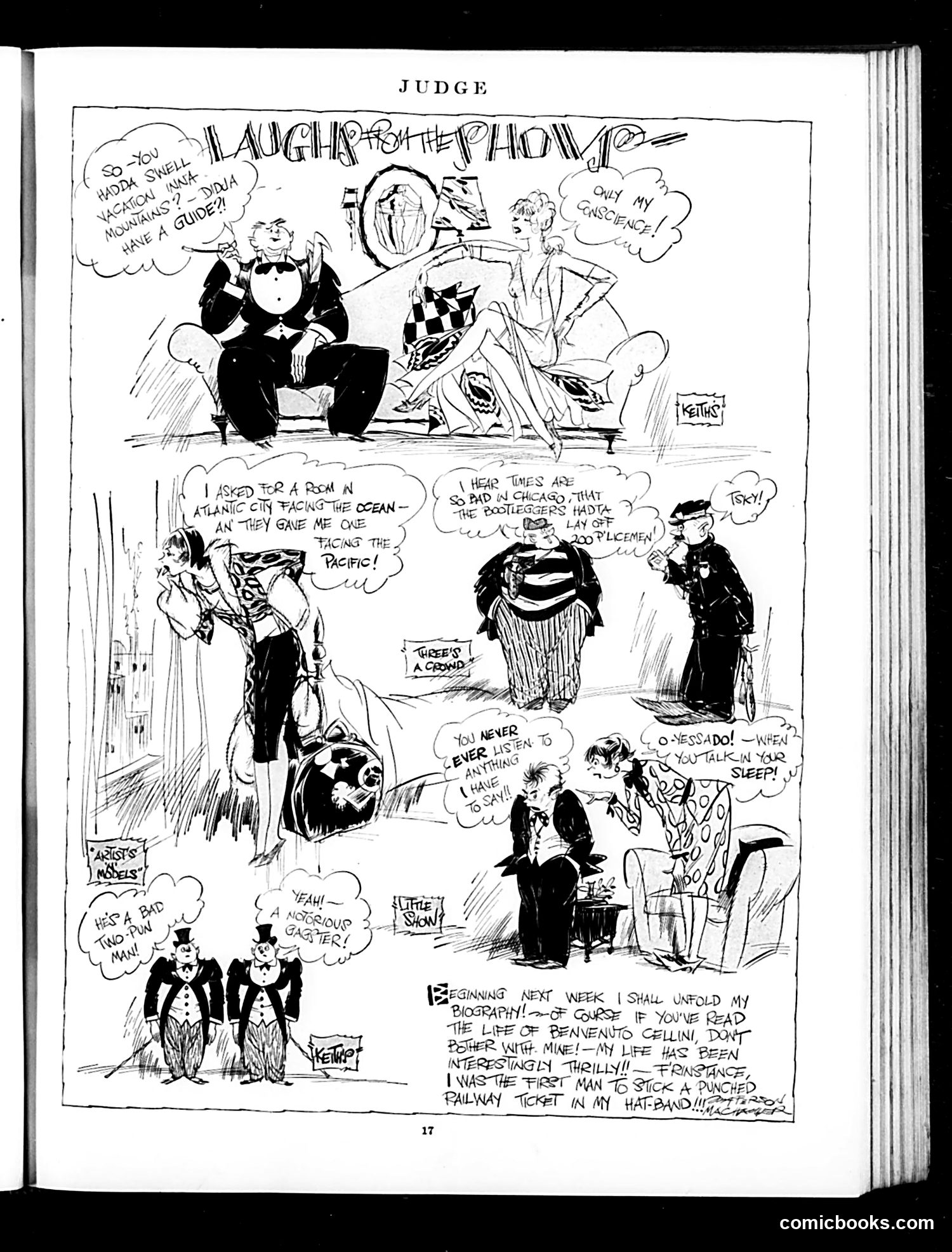
Political Cartoon Analysis: "Judge" Magazine This multi-panel satirical cartoon mocks verbose, self-aggrandizing public figures—likely politicians or society personalities of the Judge era (early 20th century). The top panel shows fashionable people laughing at someone's exaggerated boasting ("Laugh for the Phony!"). Subsequent panels depict characters interrupting each other with increasingly absurd personal anecdotes: one claims to have requested an Atlantic City room "facing the ocean," another brags about knowing Chicago bootleggers, and a final character threatens to bore everyone with his biography—comparing himself to Benvenuto Cellini (a famous Renaissance artist/autobiographer)—and concludes with a ridiculous claim about being "the first man to stick a punched railway ticket in a hat band." The satire targets social pretension and the human tendency toward tiresome self-promotion, particularly among the wealthy or connected. The punchline is that mundane people desperately try to sound important through exaggeration and name-dropping.
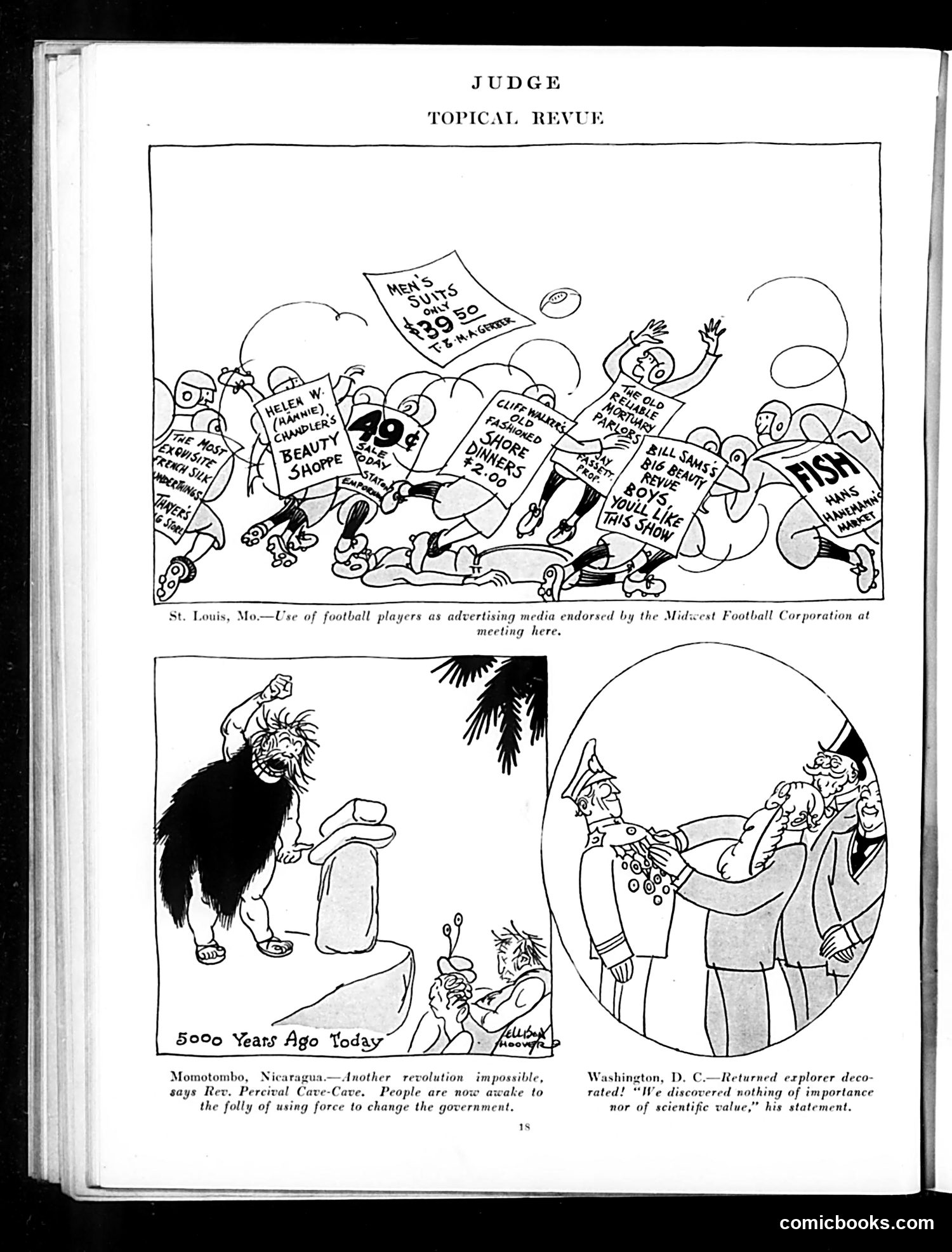
Judge Magazine Cartoon Analysis This page satirizes three contemporary issues: Top cartoon: Mocks the commercialization of football through athlete endorsements. Football players carry advertising signs for products (men's suits, beauty shops, dinners, fish)—criticizing how the Midwest Football Corporation exploits athletes as walking billboards rather than respecting sport itself. Bottom left: References Nicaragua's political instability. The joke suggests revolution there is now impossible because people finally understand force cannot solve governmental problems—a cynical comment on Central American politics and intervention. Bottom right: Satirizes an explorer's return to Washington, D.C. The explorer is decorated/honored despite discovering "nothing of importance"—mocking both the emptiness of exploration achievements and how society celebrates mediocrity through ceremony and medals. The page reflects early 20th-century American concerns: commercial exploitation, Latin American political chaos, and institutional pretension.
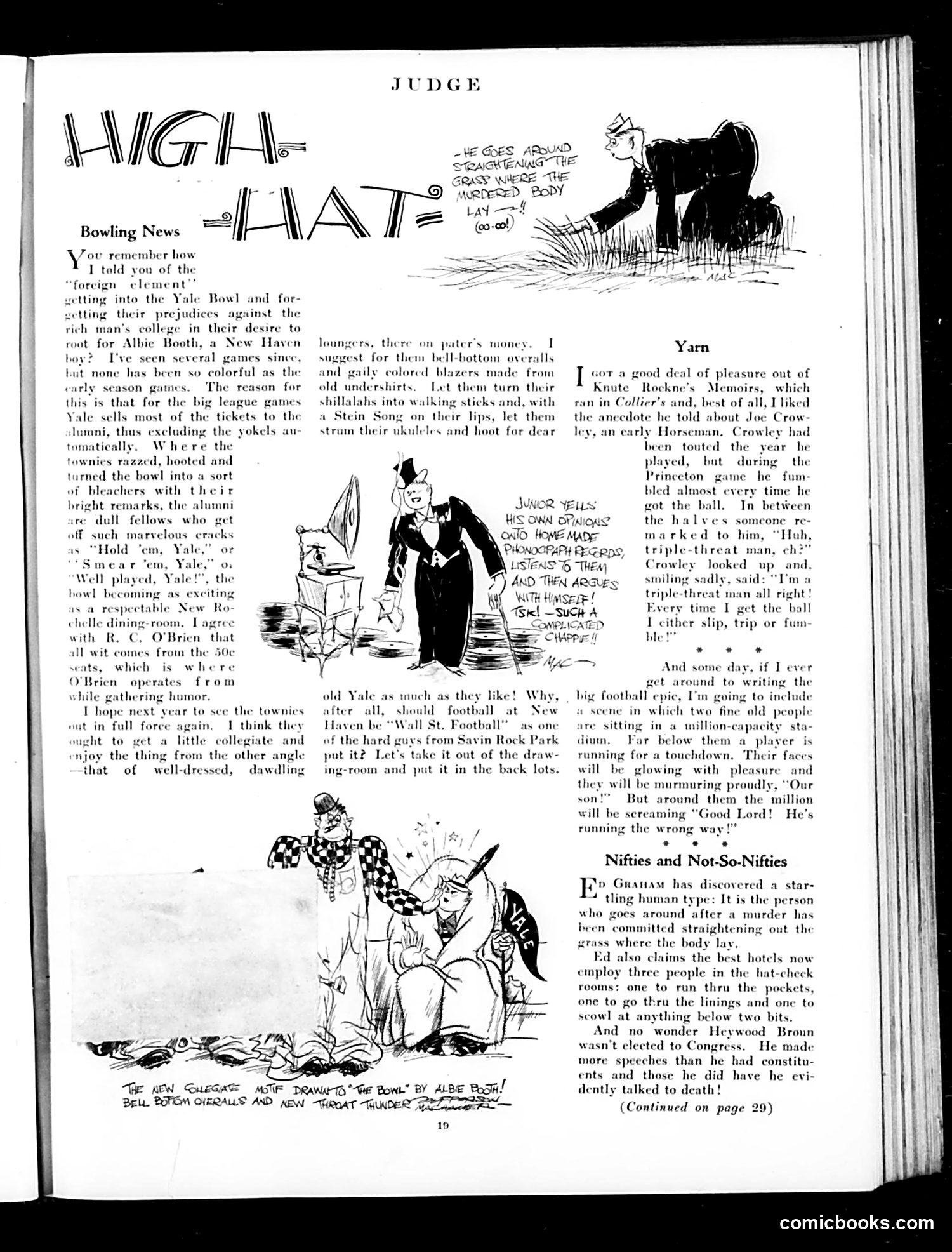
Judge Magazine Page Analysis This page from Judge satirizes Yale football culture and social pretension. The main article "High Hat" critiques wealthy Yale alumni who exclude working-class "townies" from premium seating at bowl games, despite those outsiders' enthusiastic support for the team—particularly star player Albie Booth. The writer argues this exclusivity is hypocritical, noting that when townies *do* attend, they dress in garish blazers and bring energy that the alumni lack. The accompanying cartoons mock Yale's self-importance and social snobbery. One depicts the contrast between refined alumni and rowdy working-class fans. The "Yarn" section includes an anecdote about football player Joe Crowley, a Notre Dame "Four Horseman," who humorously describes himself as a "triple-threat man"—but one who slips, trips, or fumbles every time he touches the ball. The "Nifties and Not-So-Nifties" section offers quick social observations, including a dig at politician Heywood Broun. The overall tone critiques Ivy League elitism while celebrating the genuine passion of ordinary fans.
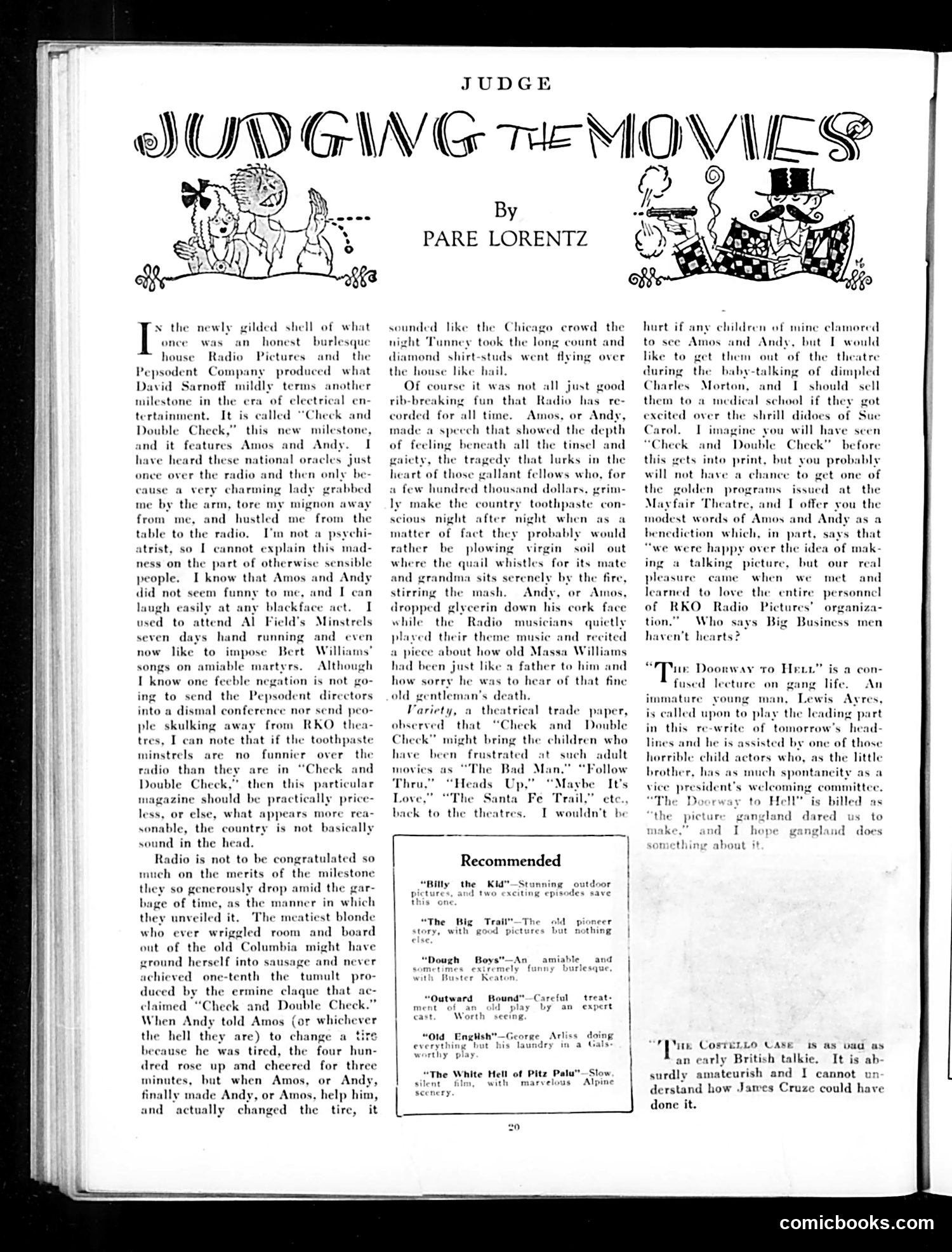
"Judging the Movies": Amos and Andy's Film Debut This review by Pare Lorentz criticizes the 1930 film "Check and Double Check," featuring the radio comedy duo Amos 'n' Andy—white performers in blackface performing African American stereotypes that were extremely popular on radio. Lorentz finds the performers unfunny but notes the film's spectacle: a wealthy audience cheering wildly at a simple tire-change scene, suggesting mass hysteria over mediocre entertainment. He mocks both the act itself and society's response to it, calling the country "not basically sound in the head." The review includes a notably cynical moment where Andy performs an emotional monologue about a kind slave owner—highlighting how the act simultaneously trafficked in degrading stereotypes while wringing sentiment from exploitation. Lorentz warns parents against taking children to see what he views as a cynical cash grab disguised as entertainment.
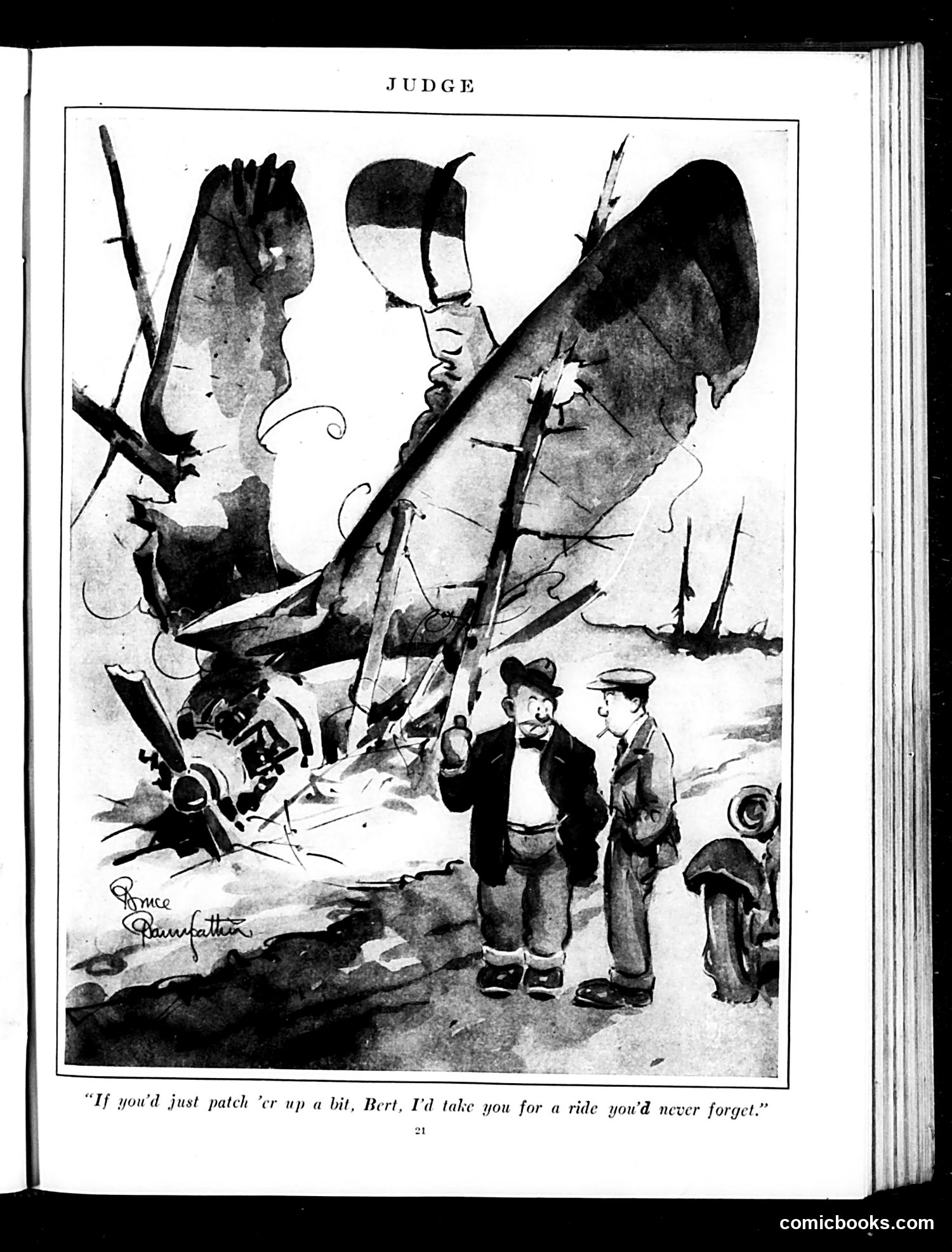
Analysis This is a single political cartoon titled "Judge" featuring two men in suits examining what appears to be a severely damaged aircraft wreckage. One man (labeled "Bert") is speaking to the other, offering to take him for "a ride you'd never forget" if he'll just "patch 'er up a bit." The satire appears to target either aviation safety standards or aircraft maintenance practices, likely from the early-to-mid 20th century when aviation was still relatively new and dangerous. The joke hinges on the absurdity of suggesting a catastrophically damaged plane could be quickly repaired and flown. The cartoon mocks either unsafe flying conditions or over-confident pilots willing to risk lives with inadequate equipment. The artist's signature appears at the bottom left but is difficult to read clearly.
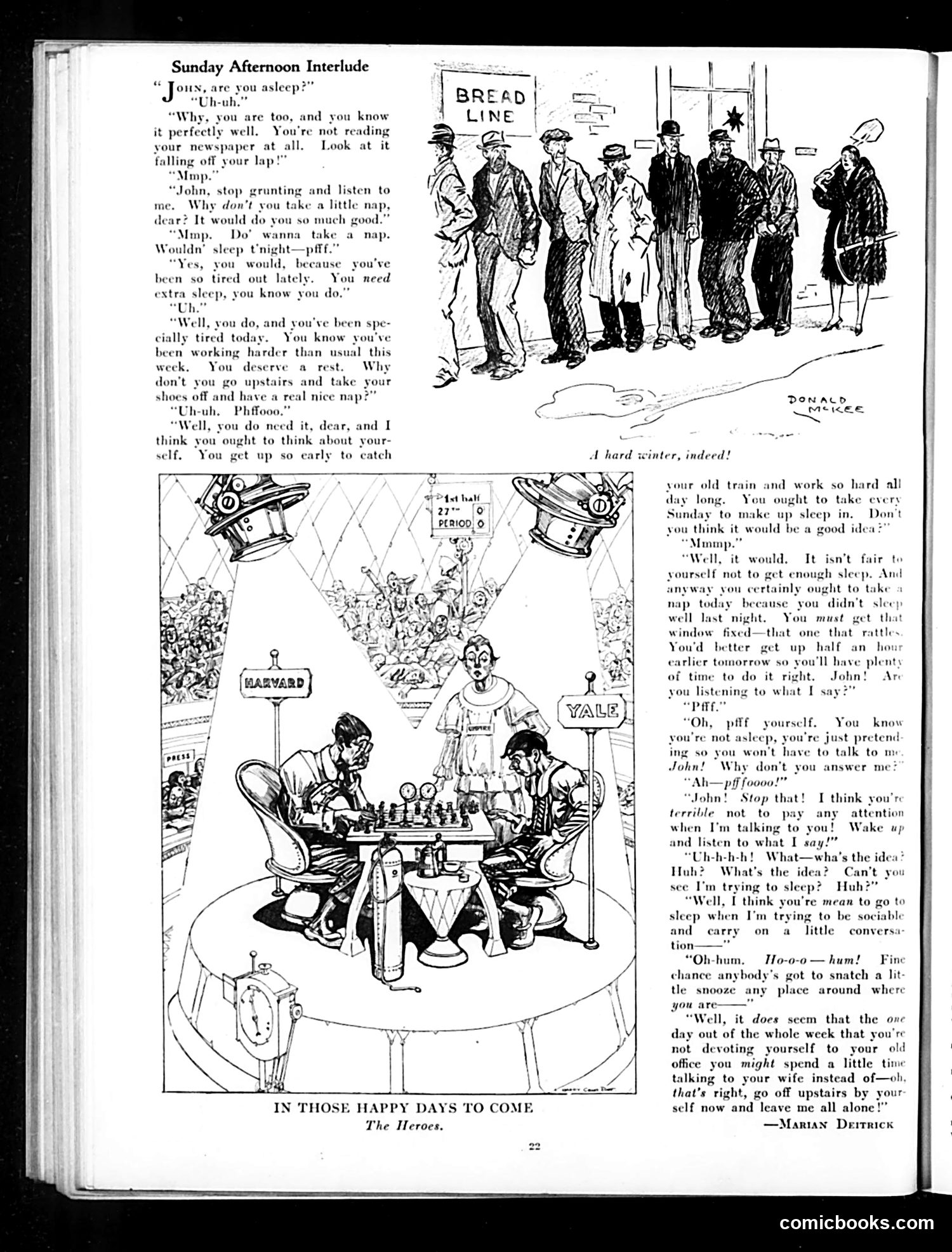
"Sunday Afternoon Interlude" Analysis This is a domestic humor piece satirizing the classic marital conflict between a tired husband seeking rest and a verbose, demanding wife. The cartoon depicts a husband trying to nap on Sunday—his one day off from work—while his wife relentlessly talks at him, listing reasons why he should sleep upstairs instead, complaints about their home needing repairs, and guilt-trips about not spending time with her. The satire targets both characters: the husband's exhaustion and desire for peace, and the wife's contradictory behavior—simultaneously insisting he needs rest while preventing any actual sleep through constant chatter. The humor comes from recognizing this archetypal domestic dynamic: the wife's stream-of-consciousness nagging ironically undermines her stated goal of letting him rest. The accompanying illustrations show men in a breadline (economic hardship context) and two men playing chess, contrasting leisure with labor.
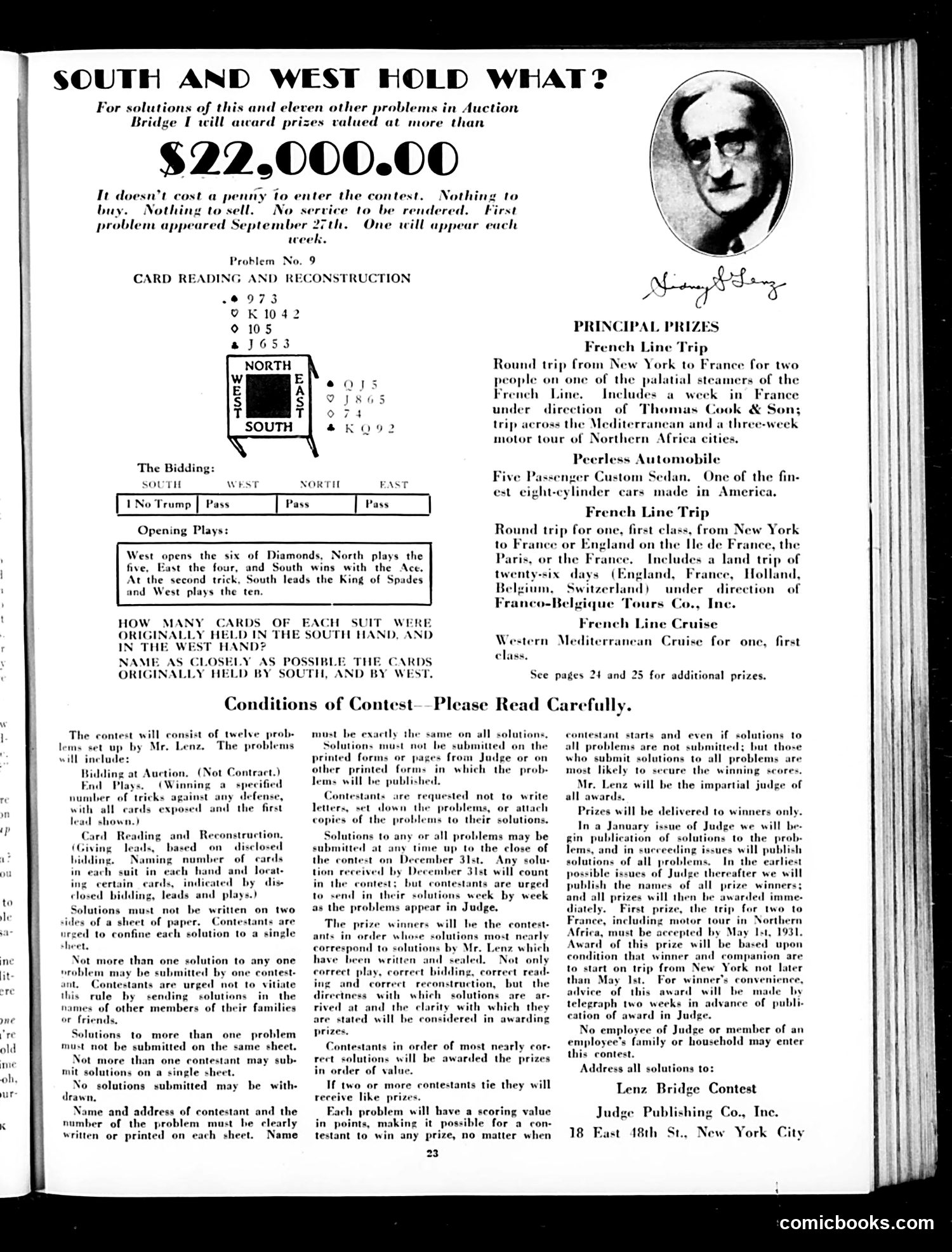
Judge Magazine Bridge Contest Page This page announces a major bridge card game puzzle contest sponsored by Judge magazine, offering over $22,000 in prizes (substantial money in the early 1930s). The contest runs for twelve weeks, with one problem appearing weekly starting September 27th. The portrait shows Mr. Lenz, who appears to be a famous bridge expert serving as the contest's impartial judge. Bridge was enormously popular among American middle and upper classes during this era. Principal prizes include luxurious French Line ocean cruises (round-trip transatlantic voyages), a Peerless automobile, and motor tours of Europe—aspirational rewards reflecting the Jazz Age fascination with international travel and luxury goods. The contest mechanics involve reconstructing bridge hands from bidding and play records. Contestants submit solutions to compete for increasingly valuable prizes based on accuracy and completeness of their answers. This represents Judge's shift toward interactive entertainment contests to engage readers and boost circulation during the economically uncertain early 1930s.
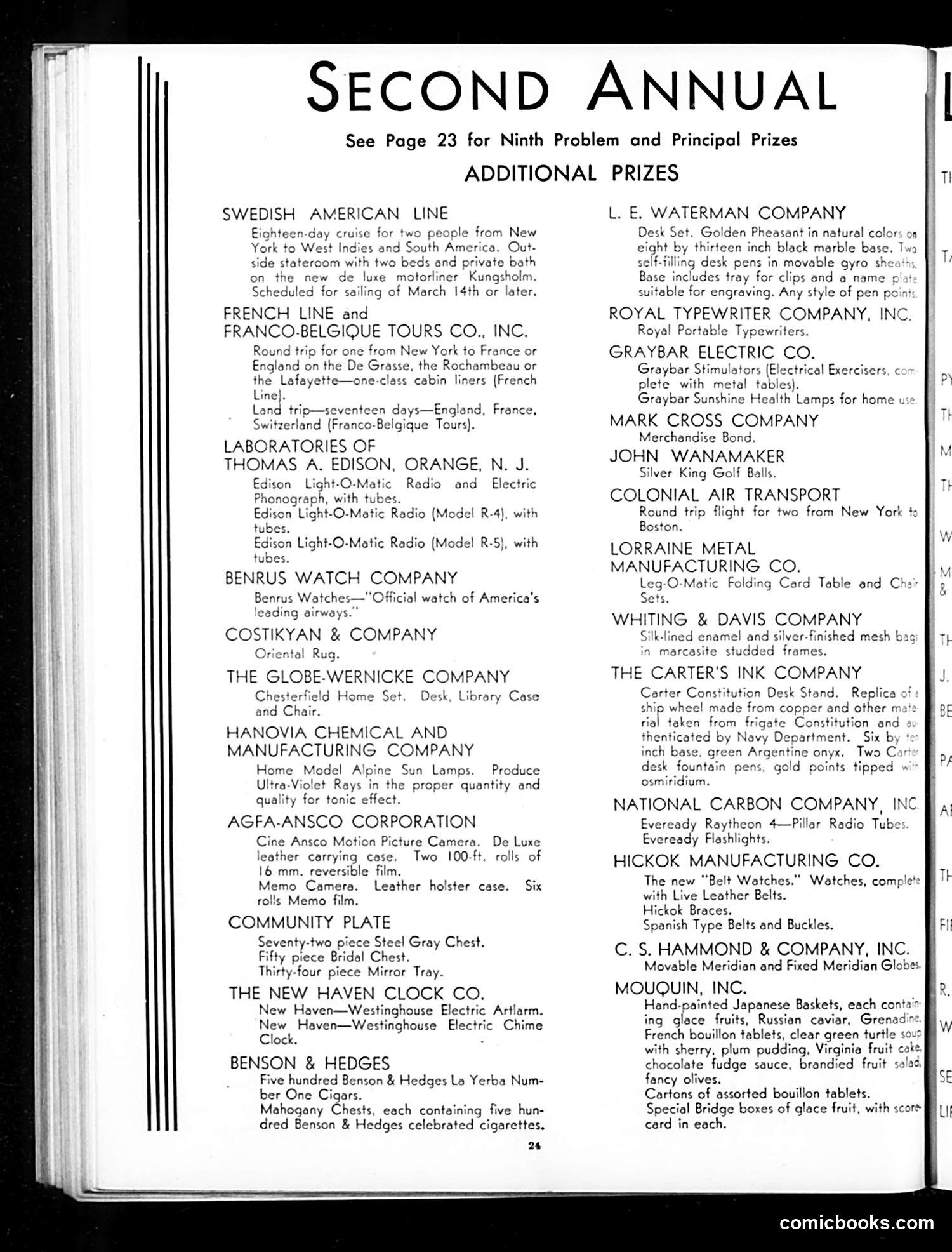
Page Analysis: Judge Magazine Prize Listing This is a prize advertisement page, not a cartoon page. It lists prizes for what appears to be Judge magazine's "Second Annual" contest (likely a puzzle or caption competition). The page contains no political satire or caricatures—it's purely commercial. It advertises luxury goods and travel prizes donated by major 1930s corporations: Swedish American Line cruise ships, French ocean liners, Edison radios, Benrus watches, Oriental rugs, furniture, cameras, silverware, typewriters, golf balls, airline flights, desk sets, and gourmet food baskets from Mouquin restaurant. This reflects the aspirational consumer culture of the pre-Depression era, where Judge's affluent readership could win high-end merchandise. The prizes themselves—exotic travel, electrical innovations, and luxury goods—indicate both the magazine's target demographic and period consumer values.
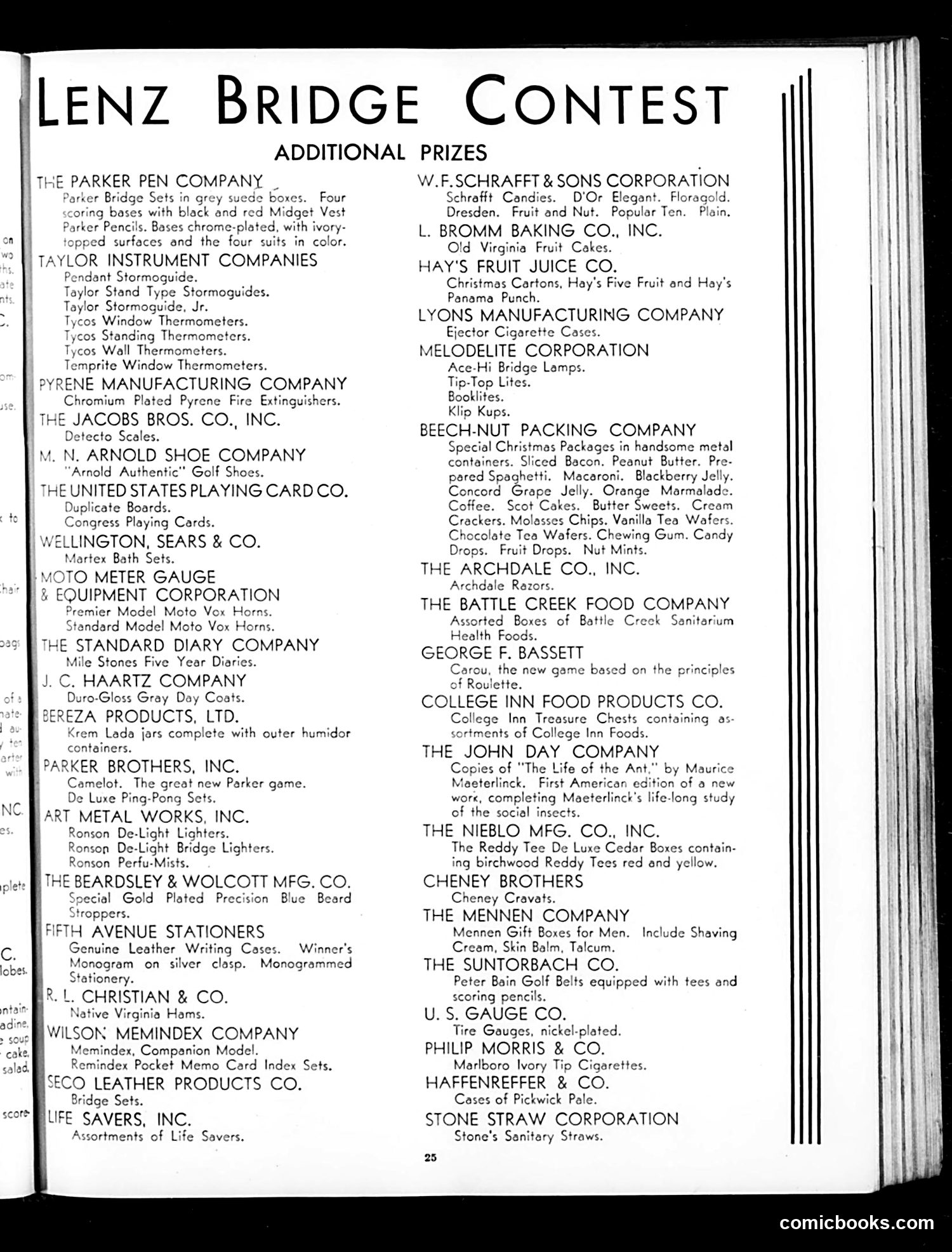
Analysis This page from Judge magazine contains no cartoon or satirical content—it is purely advertising. Specifically, it lists prizes for the "Lenz Bridge Contest," a competition apparently sponsored by Judge magazine. The page showcases dozens of American consumer goods companies offering prizes, including: - Writing instruments (Parker Pens) - Games and playing cards (Parker Brothers) - Food products (Beech-Nut, Schrafft's candies) - Cigarettes and tobacco (Philip Morris, Marlboro) - Personal care items (Mennen) - Household goods (Ronson lighters, Life Savers) The prevalence of bridge-related items (bridge sets, bridge lamps, bridge lighters) reflects bridge's enormous popularity as a parlor game during this era. This advertisement demonstrates how major corporations used magazine contests as marketing vehicles, offering branded merchandise as incentives for reader participation.
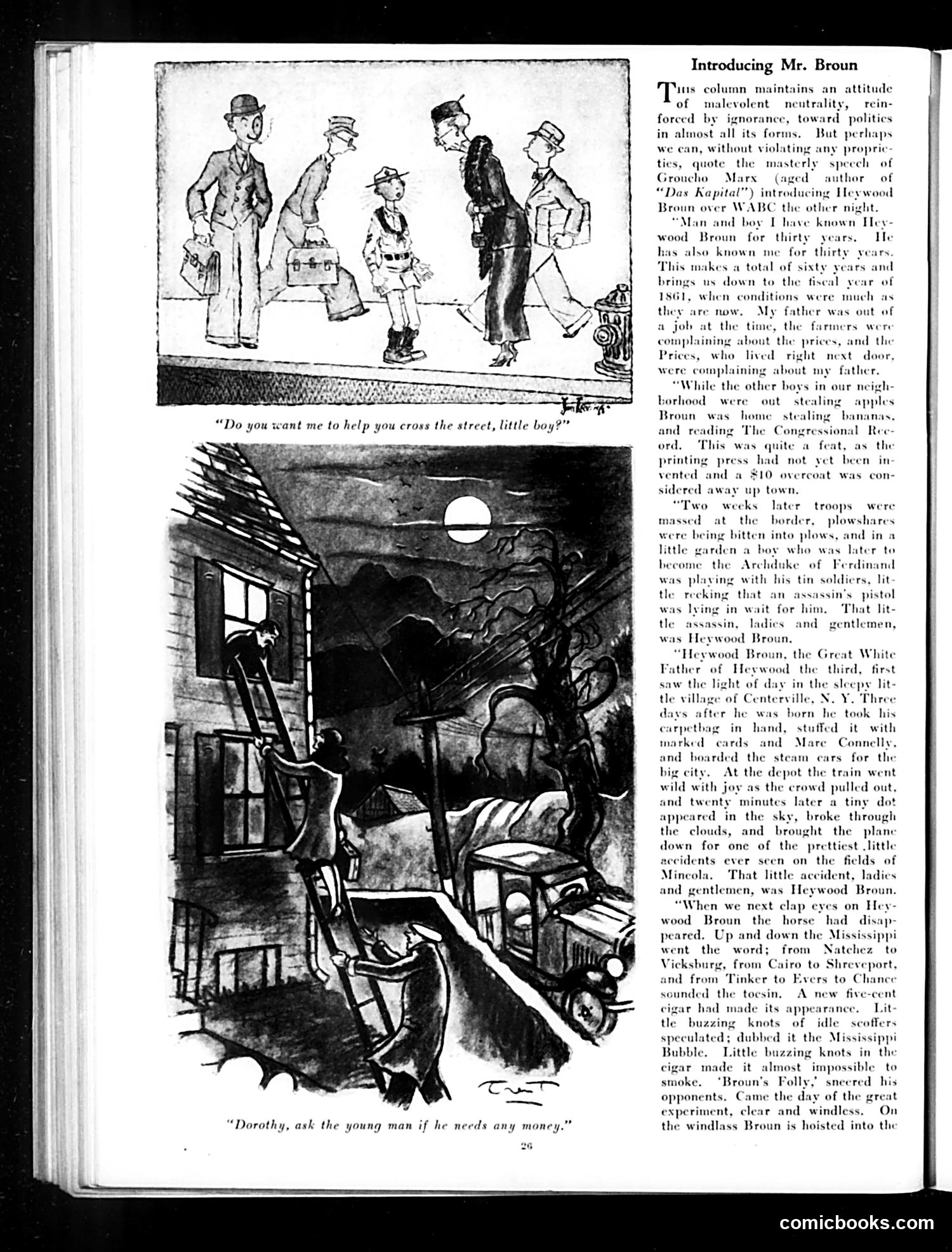
"Introducing Mr. Broun" This is a humorous introduction to Heywood Broun, a columnist joining Judge magazine. The text is a mock-serious biographical speech presented as if delivered by Groucho Marx, full of absurdist non-sequiturs and tall tales. The cartoons illustrate the comedic narrative: the top image shows a well-dressed man helping a boy cross the street ("Do you want me to help you cross the street, little boy?"), while the bottom depicts a nighttime domestic scene with someone at a window ("Dorothy, ask the young man if he needs any money"). The satire relies on exaggeration and the contrast between grandiose language and ridiculous content—Broun stealing bananas while reading the Congressional Record, his father's appearance coinciding with assassinations, and references to the "Mississippi Bubble" (evoking historical financial bubbles) and baseball's famous double-play combo. The piece is essentially celebratory wordplay welcoming a new writer to the magazine.
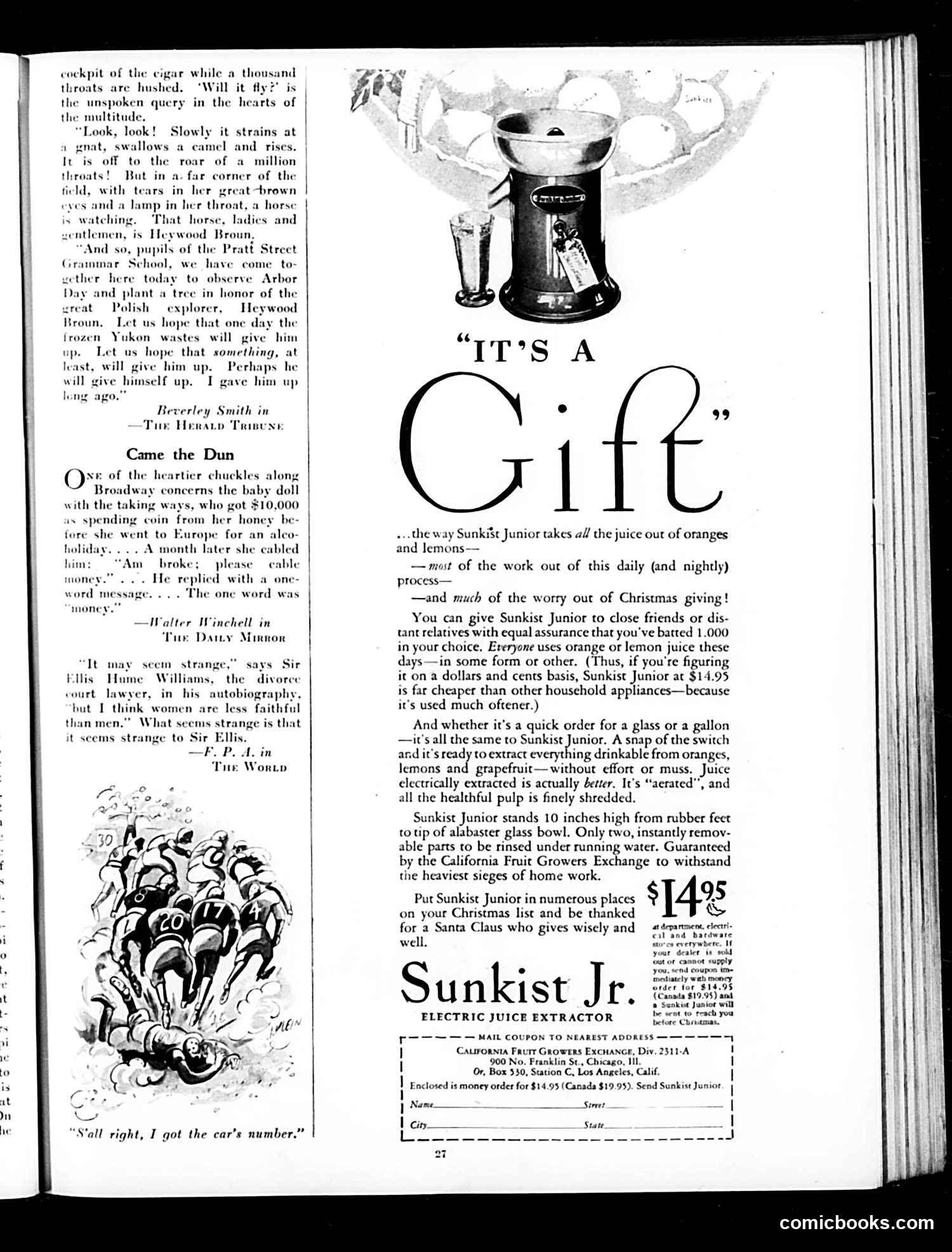
Judge Magazine Page Analysis This page contains four separate satirical pieces typical of Judge's content: 1. "Came the Dun" section features three brief humorous anecdotes mocking contemporary figures—a wealthy baby doll who squanders money, and divorce lawyer Ellis Hume Williams (apparently real, based on his autobiography reference) making contradictory claims about women's faithfulness. The humor relies on absurdist situations and ironic reversals. 2. The bottom cartoon shows a car accident victim declaring "Stall right, I got the car's number"—a pun on automotive vocabulary and the victim's priority (getting insurance information rather than assistance). 3. The bulk of the page is a Sunkist Junior advertisement for an electric juice extractor, disguised as editorial content. It emphasizes the appliance as an ideal Christmas gift that extracts juice efficiently while removing household labor—appealing to mid-century convenience culture. The page is primarily commercial, with satirical fragments supporting advertising rather than sustained political commentary.
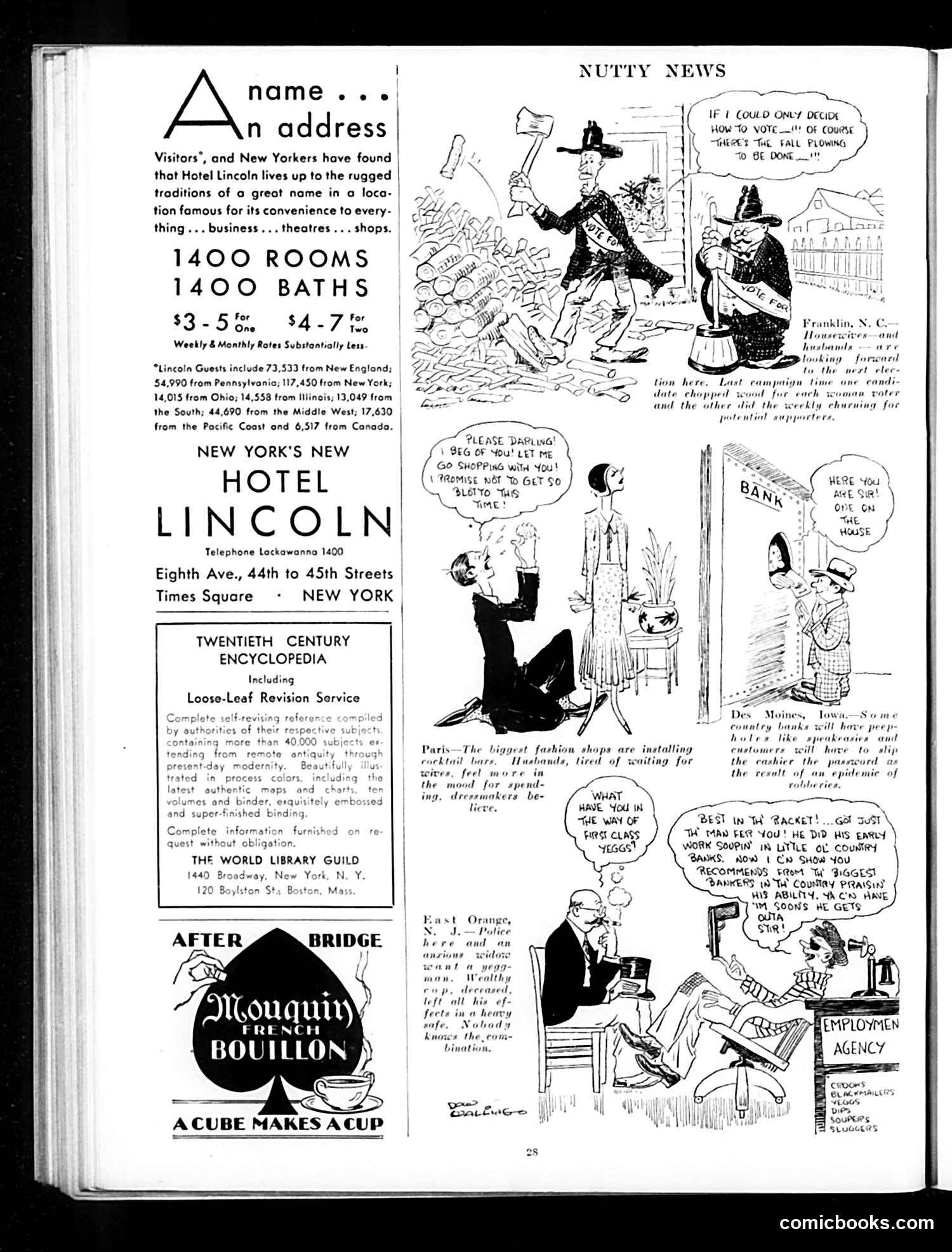
"Nutty News" Page Analysis This page from *Judge* magazine mixes advertising with satirical cartoons on voting, fashion, and employment. The top cartoon depicts a rural farmer torn between voting and fall plowing—mocking the tension between civic duty and agricultural necessity for rural Americans during election season. The Paris fashion cartoon satirizes how department stores now install cocktail bars to keep husbands entertained while wives shop, suggesting commercialization of leisure and gender stereotypes about shopping behavior. The employment agency cartoon shows a job applicant being hired based on his "early work souping in little ol country banks," then recommended by "the biggest bankers in the country." This appears to satirize nepotism, connections, and how banking credentials (regardless of actual merit) guarantee advancement—likely commentary on Prohibition-era financial networks or corrupt hiring practices. The page is primarily promotional, featuring Hotel Lincoln advertisements and a Twentieth Century Encyclopedia ad, with satirical cartoons occupying roughly half the space.
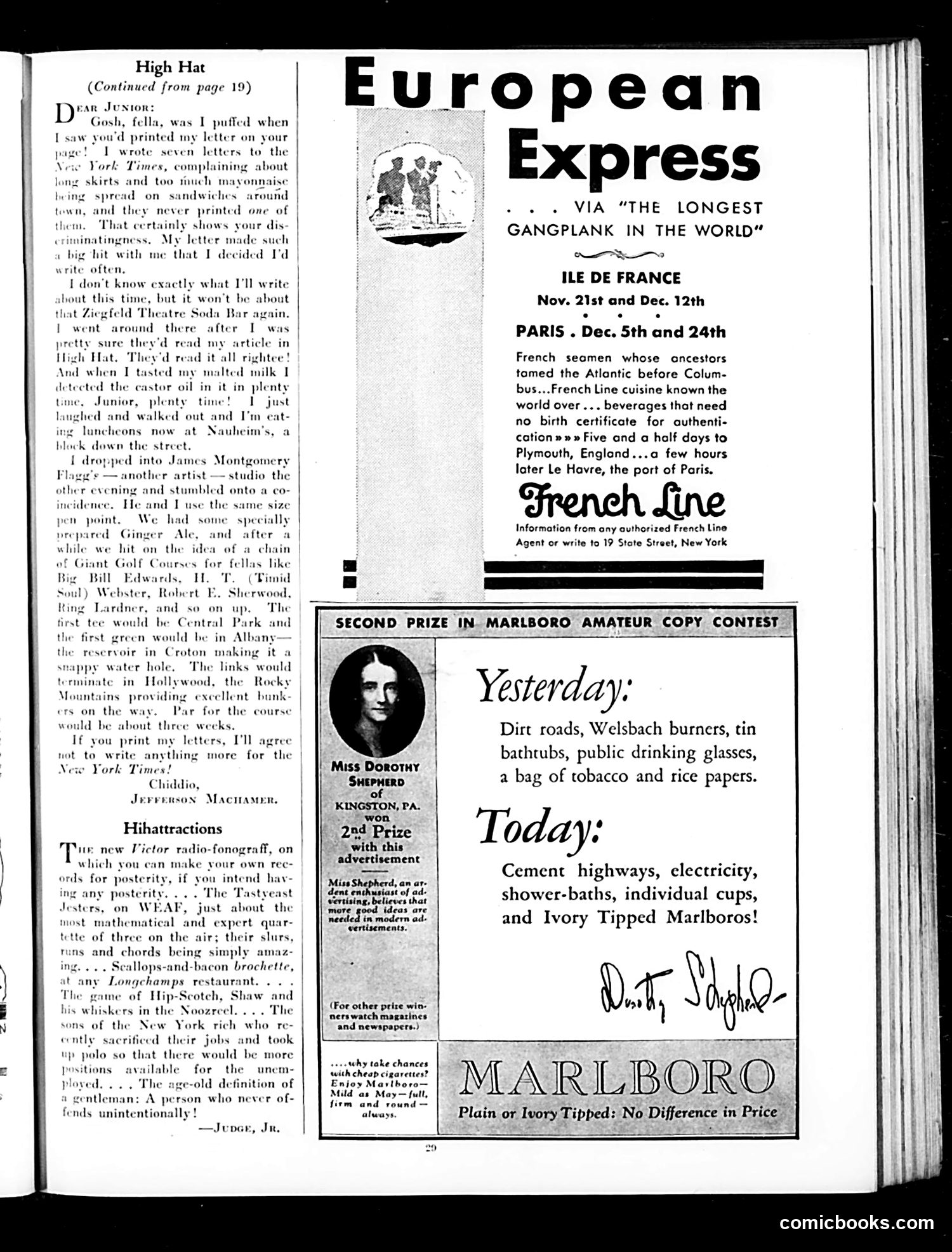
Explanation for Modern Readers This page is primarily advertising and editorial content rather than political satire. The main elements are: "High Hat" Column: A humorous reader letter describing social encounters with New York artists and theater figures (James Montgomery Flagg, Bill Edwards). The writer jokes about pranks and proposes an absurdist golf course idea stretching from Central Park to Hollywood. Advertisements: The page features ads for the French Line shipping company (promoting transatlantic travel) and Marlboro cigarettes, which oddly emphasize progress—contrasting "Yesterday" (dirt roads, tin bathtubs) with "Today" (cement highways, electricity, cigarettes). This is early tobacco advertising before health warnings. "Hihattractions": Brief entertainment-focused commentary on radio technology and nightclub culture, mostly non-satirical observations. The page reflects 1920s-30s magazine style: social commentary mixed with commercial content. There's no clear political cartoon or sustained satire—just period-typical humor and period-typical advertising practices.
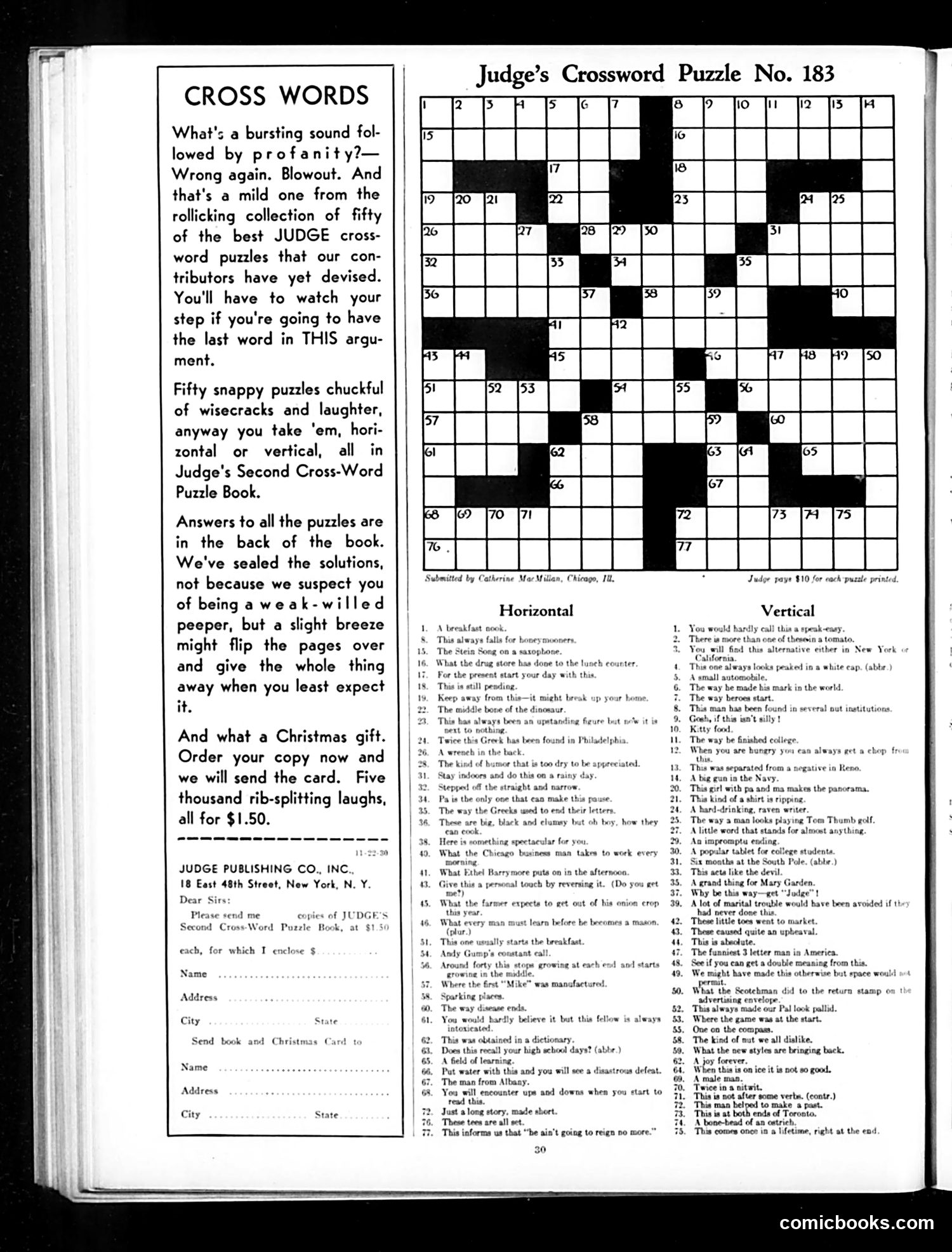
Judge Magazine Crossword Puzzle Page This page is primarily advertising and a crossword puzzle, not a political cartoon. It promotes Judge's "Second Cross-Word Puzzle Book," a collection of fifty humorous crossword puzzles marketed as a Christmas gift for $1.50. The advertisement uses self-deprecating humor typical of Judge magazine—the introduction jokes that solving these puzzles requires caution ("watch your step") and warns that answers are "sealed" not because readers are "weak-willed peepers" but to prevent accidental spoilers. The tone is lighthearted and playful. The actual crossword puzzle (No. 183) contains wordplay clues with puns and contemporary references, though without answers visible, the specific jokes are difficult to parse. The clues suggest mid-20th-century American life and culture. This is primarily a commercial product page rather than satirical political content—Judge was transitioning into puzzle books as merchandise.
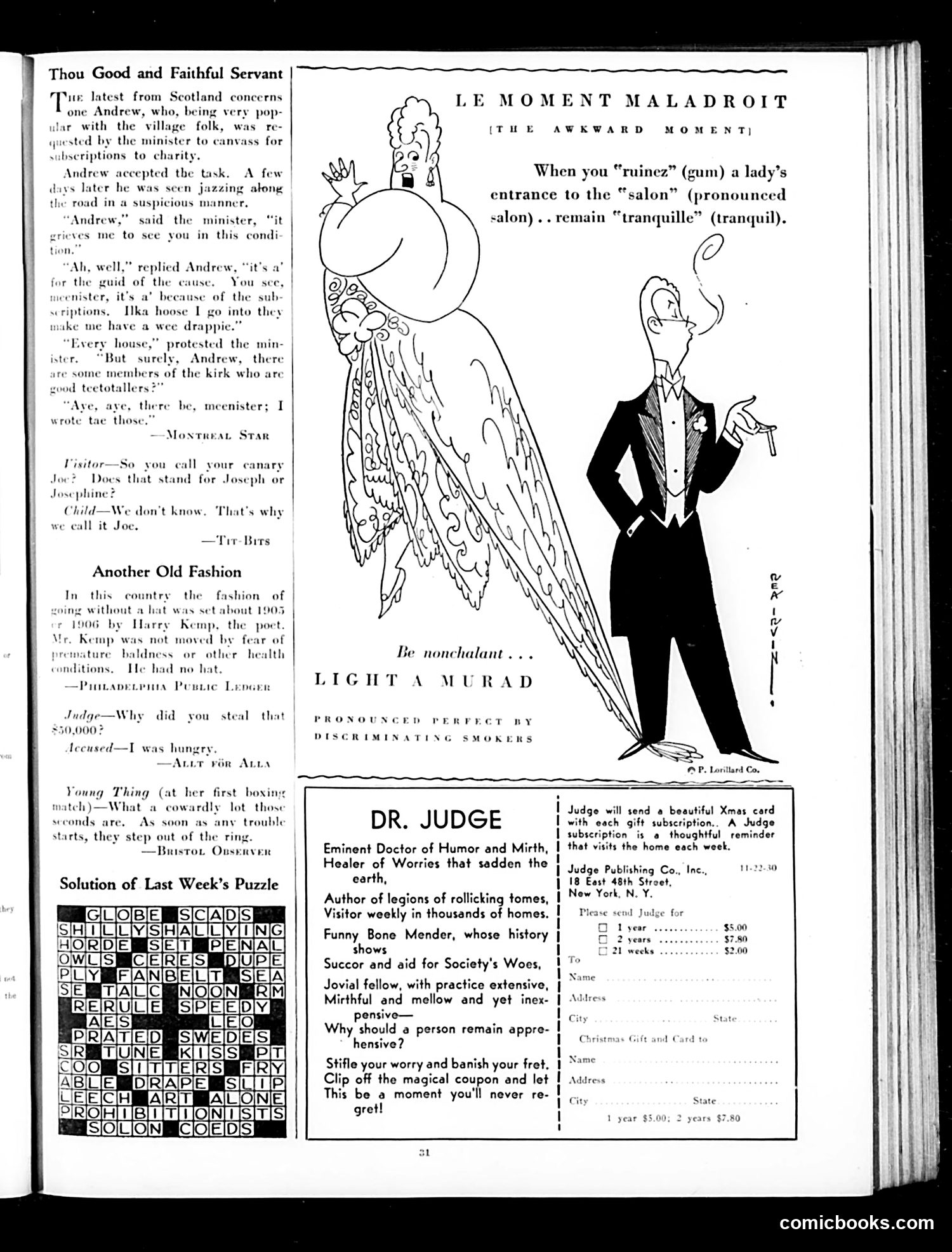
Analysis of Judge Magazine Page This page contains several short humor pieces typical of early 20th-century American satirical journalism: "Thou Good and Faithful Servant" is a Scottish dialect joke about a charity canvasser named Andrew who gets drunk while soliciting donations—justifying it as being "for the guid of the cause" since every house offers him alcohol. The main cartoon "Le Moment Maladroit" advertises Murad cigarettes by depicting an awkward social situation: a well-dressed man appears startled or embarrassed at a lady's entrance to a salon, with the caption advising him to remain nonchalant and light a Murad. The page also includes brief jokes about a canary named Joe, Harry Kemp's 1905 hatless fashion trend, and a thief's hunger excuse—all typical light humor. "DR. JUDGE" is an advertisement promoting Judge magazine subscriptions as gift options, personifying the magazine as a "doctor" of humor and mirth. The page reflects early 1900s attitudes toward smoking, alcohol, and social propriety as comedy material.
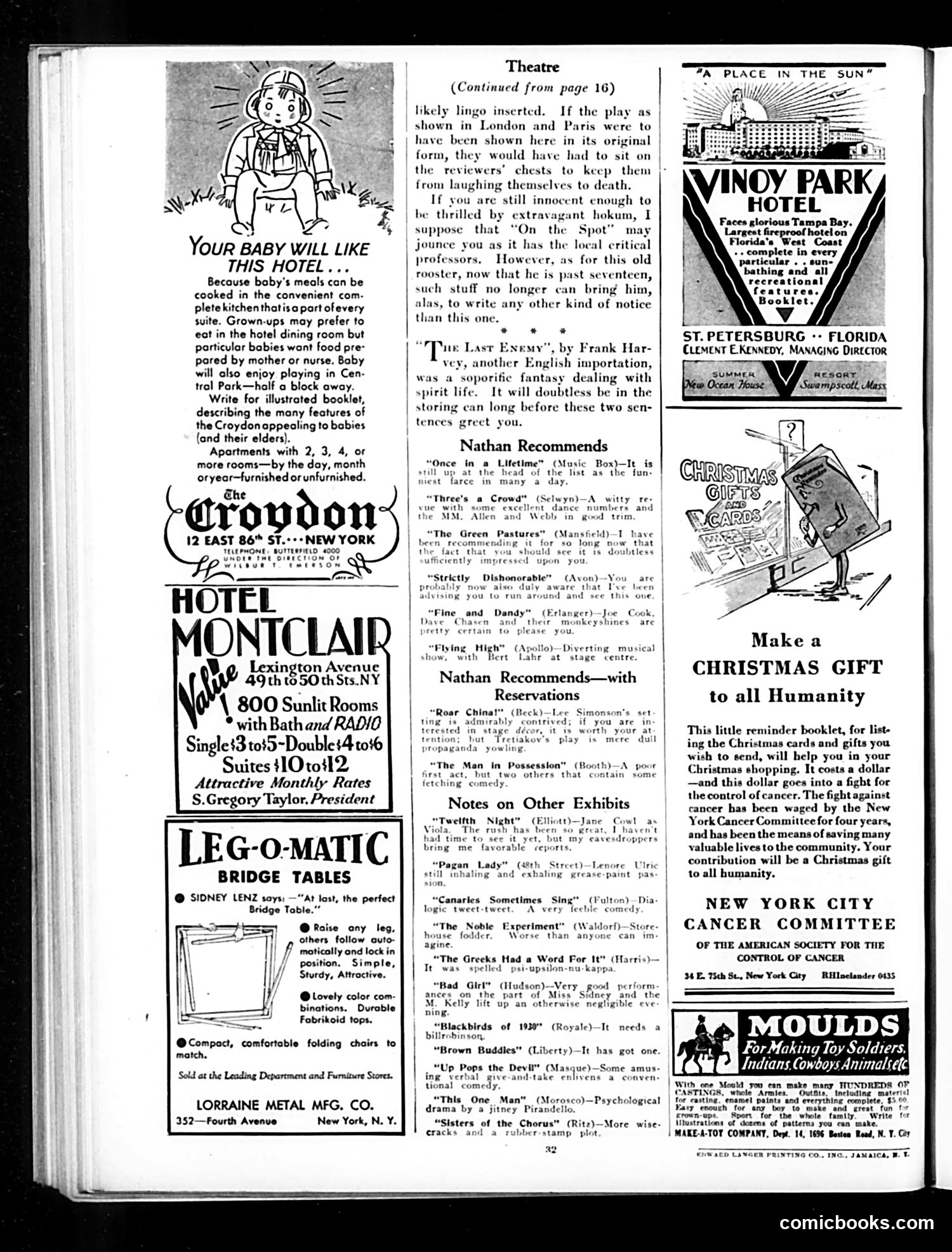
Analysis of Judge Magazine Page This page is primarily advertising and theater reviews, not political satire. The main content includes hotel advertisements (Croydon, Montclair, Vinoy Park) and furniture ads, alongside theater critic Nathan's brief reviews of Broadway shows like "Once in a Lifetime," "Flying High," and "Blackbirds of 1930." The single cartoon at top shows a baby with radiating lines—a visual joke advertising the Croydon Hotel's appeal to families, emphasizing its kitchen facilities and proximity to Central Park. The page's only social message appears in the "Christmas Gift to all Humanity" box promoting the New York Cancer Committee, urging readers to donate to cancer research as a charitable gift. This is a typical 1930s magazine layout mixing entertainment content with commercial advertising. No significant political satire or caricature is present.
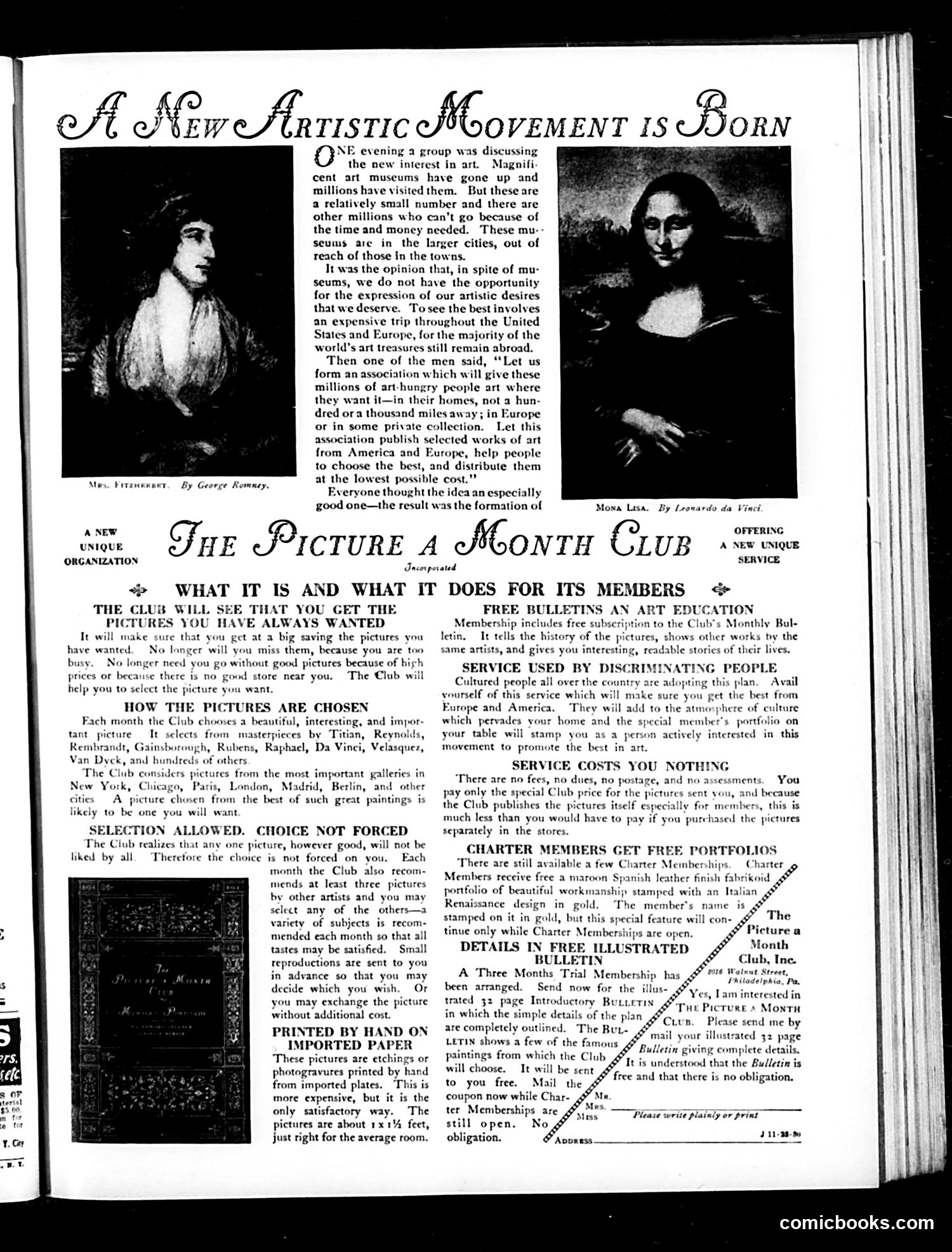
"The Picture a Month Club" Advertisement This page is primarily advertising copy for a mail-order art reproduction service, not political satire. The two portrait images shown—Mrs. Fitzwilliam (by George Romney) and Mona Lisa (by Leonardo da Vinci)—are sample artworks the club would distribute. The "satire" is mild and social rather than political: the advertisement gently mocks American cultural anxiety by framing art access as a democratic solution. The opening narrative presents a fictional conversation where wealthy Americans lament that great art remains "abroad" and inaccessible to ordinary people due to distance and cost. The Club's innovation—sending hand-printed reproductions monthly to members nationwide—is positioned as solving this problem of cultural exclusion. The pitch appeals to aspirational middle-class readers: owning these reproductions will signal refined taste and "stamp you as a person actively interested in" art. This is fundamentally a consumer advertisement dressed in language about democratizing culture and serving "discriminating people."
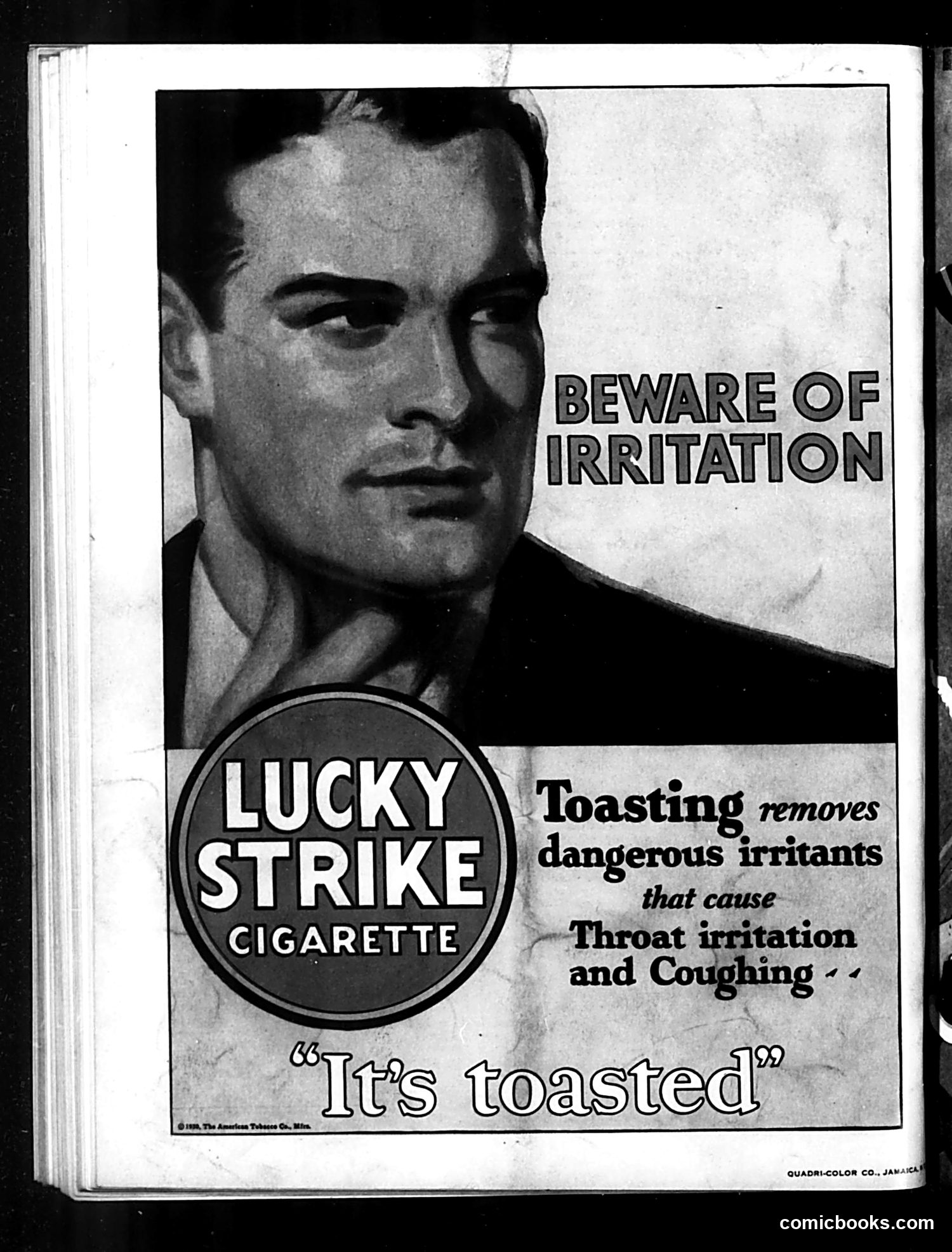
Lucky Strike Cigarette Advertisement This is a cigarette advertisement, not satire—it's a genuine Lucky Strike ad from what appears to be the early-to-mid 20th century. The ad claims that Lucky Strike's "toasting removes dangerous irritants that cause Throat irritation and Coughing." This represents tobacco industry marketing before health warnings were required. The phrase "It's toasted" became the brand's signature claim, suggesting a manufacturing process that allegedly made smoking safer. The stern-faced man and warning-style headline ("BEWARE OF IRRITATION") use pseudo-medical language to market cigarettes as a *solution* to smoking's obvious irritating effects—a common advertising strategy of that era. Modern readers would recognize this as deceptive health marketing, now prohibited by law.