judge
Judge — November 29, 1930
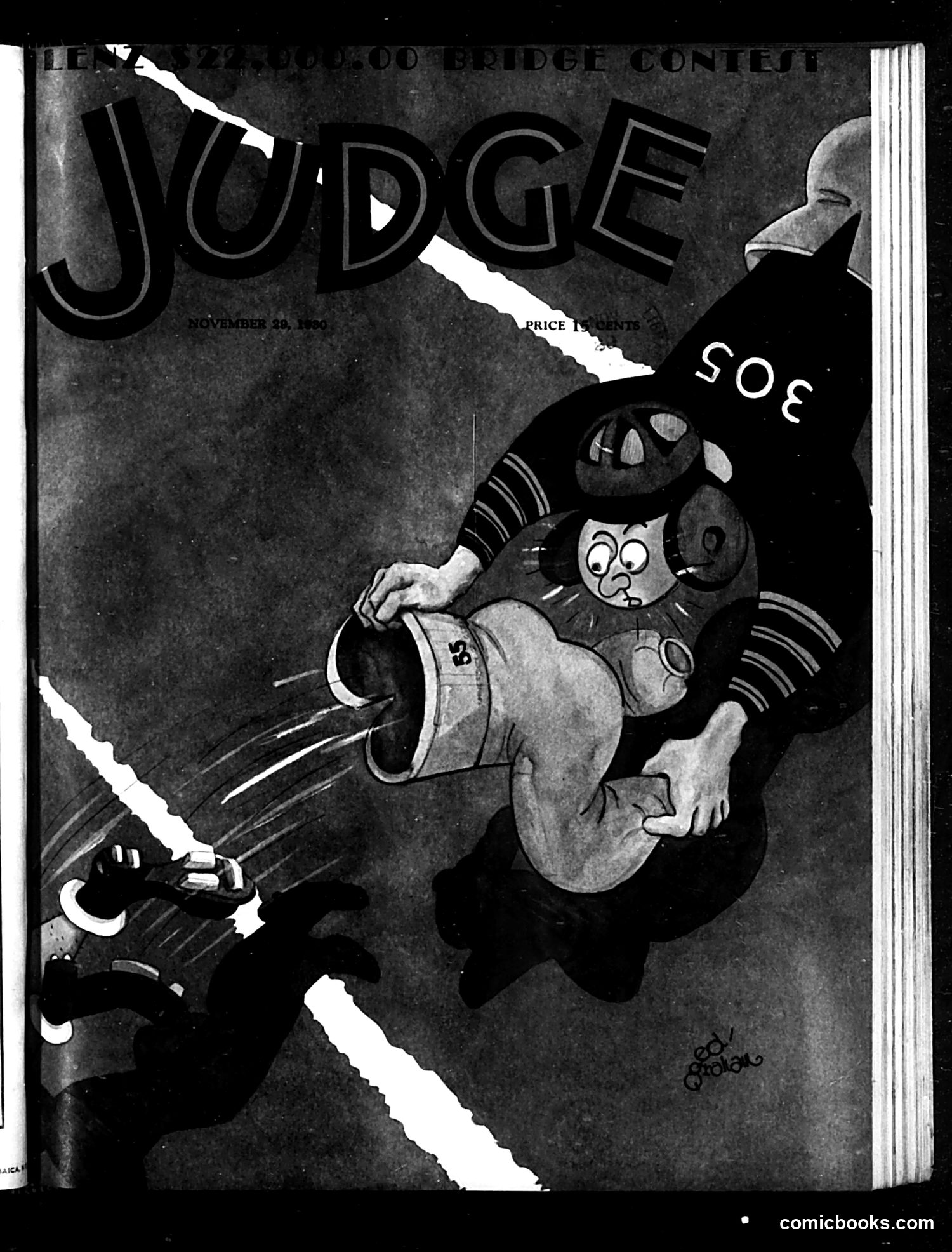
Judge Magazine Cover Analysis This appears to be a Judge magazine cover from November 29, 1922 (based on visible date), priced at 15 cents. The cartoon depicts a figure labeled "SOS" (distress signal) holding a crying baby. The figure appears to represent California or a California official in distress, given the state map outline integrated into the cover design. The baby likely symbolizes California's troubled condition or a specific crisis facing the state during this period. The satirical point suggests California was in serious trouble requiring emergency intervention—though without additional historical context, the specific crisis (economic, political, or social) isn't entirely clear from the image alone. The exaggerated distress and the SOS signal emphasize the urgency of the situation being mocked.
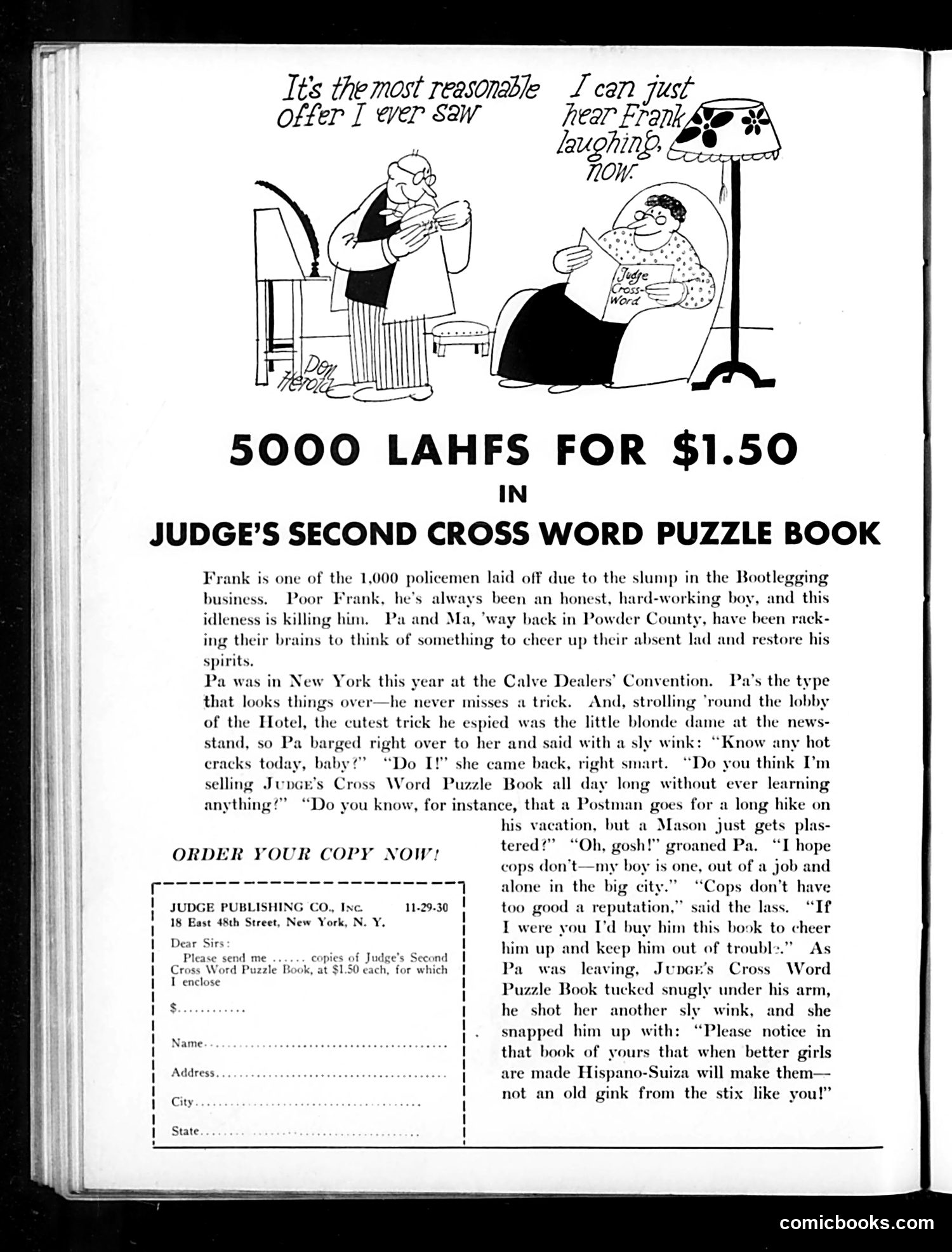
Analysis This page is primarily an advertisement for Judge's Second Cross Word Puzzle Book, priced at $1.50, offering "5000 laughs." The cartoon depicts a domestic scene where a man (Pa) presents the puzzle book to a woman (Ma), saying it's "the most reasonable offer I ever saw." The woman responds that she can hear "Frank laughing now." The setup appears to reference Frank, a laid-off policeman mentioned in the accompanying story, whose parents hope the puzzle book will cheer him during unemployment caused by "the slump in the Bootlegging business." The satire targets Prohibition-era bootlegging as an economic sector, treating organized crime casually as legitimate employment. The humor relies on the incongruity of using a puzzle book as consolation for joblessness and crime-industry collapse—a darkly comic Depression-era reference to illegal alcohol distribution.
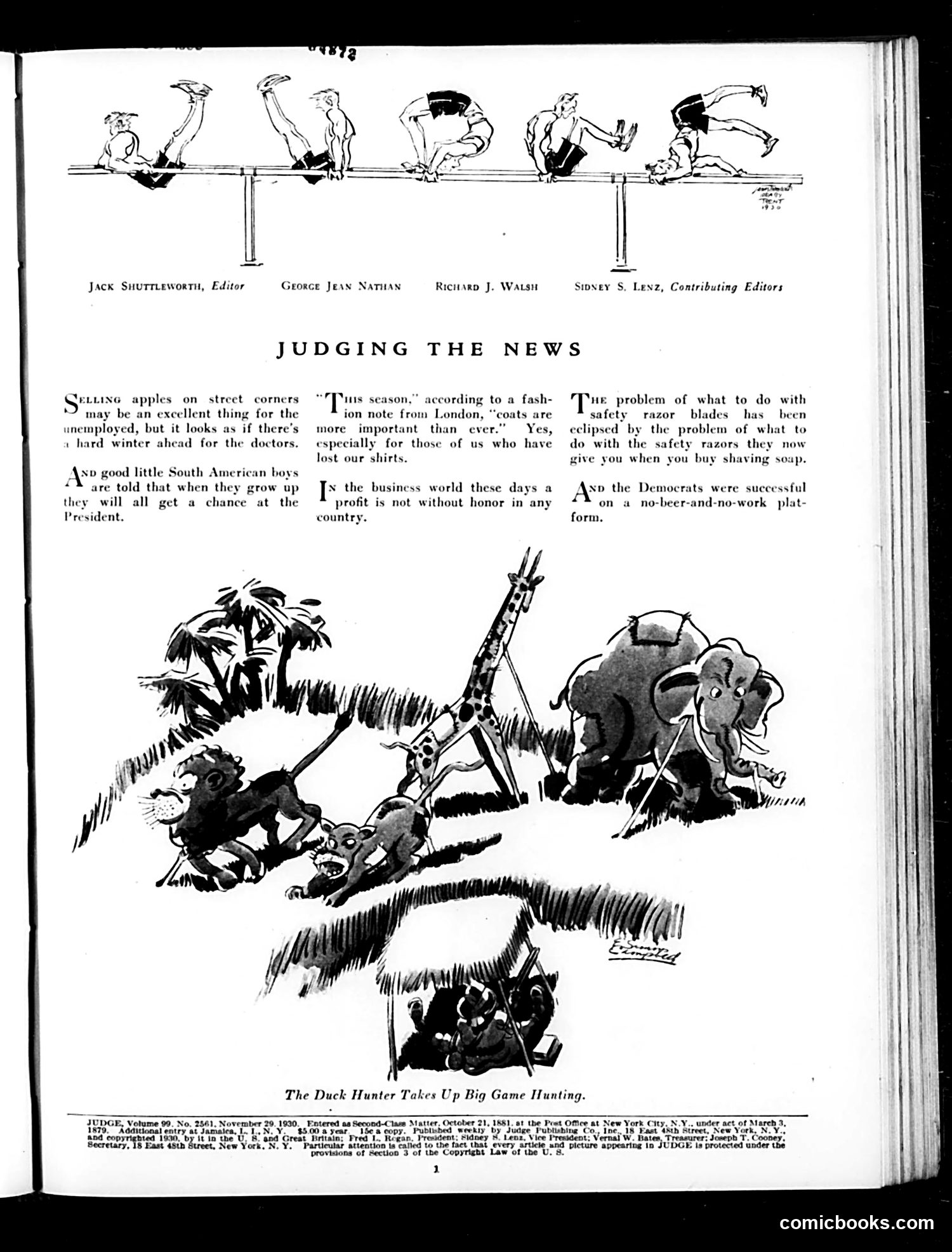
"Judging the News" - November 29, 1930 This page satirizes current events through brief commentary and a cartoon titled "The Duck Hunter Takes Up Big Game Hunting." The main cartoon depicts anthropomorphic animals in a hunting scene. The elephant appears to represent big business or Republican interests, while smaller animals likely represent Democrats or labor. The "duck hunter" (unclear which political figure) is portrayed as overreaching by attempting to hunt larger game—suggesting someone has shifted from minor pursuits to more ambitious, dangerous quarry. The accompanying text jokes about street apple sellers, Southern children's prospects, business profits, safety razors, and Democrats' failed "no-beer-and-no-work platform." The overall tone mocks political overreach and economic conditions during the early Depression era.
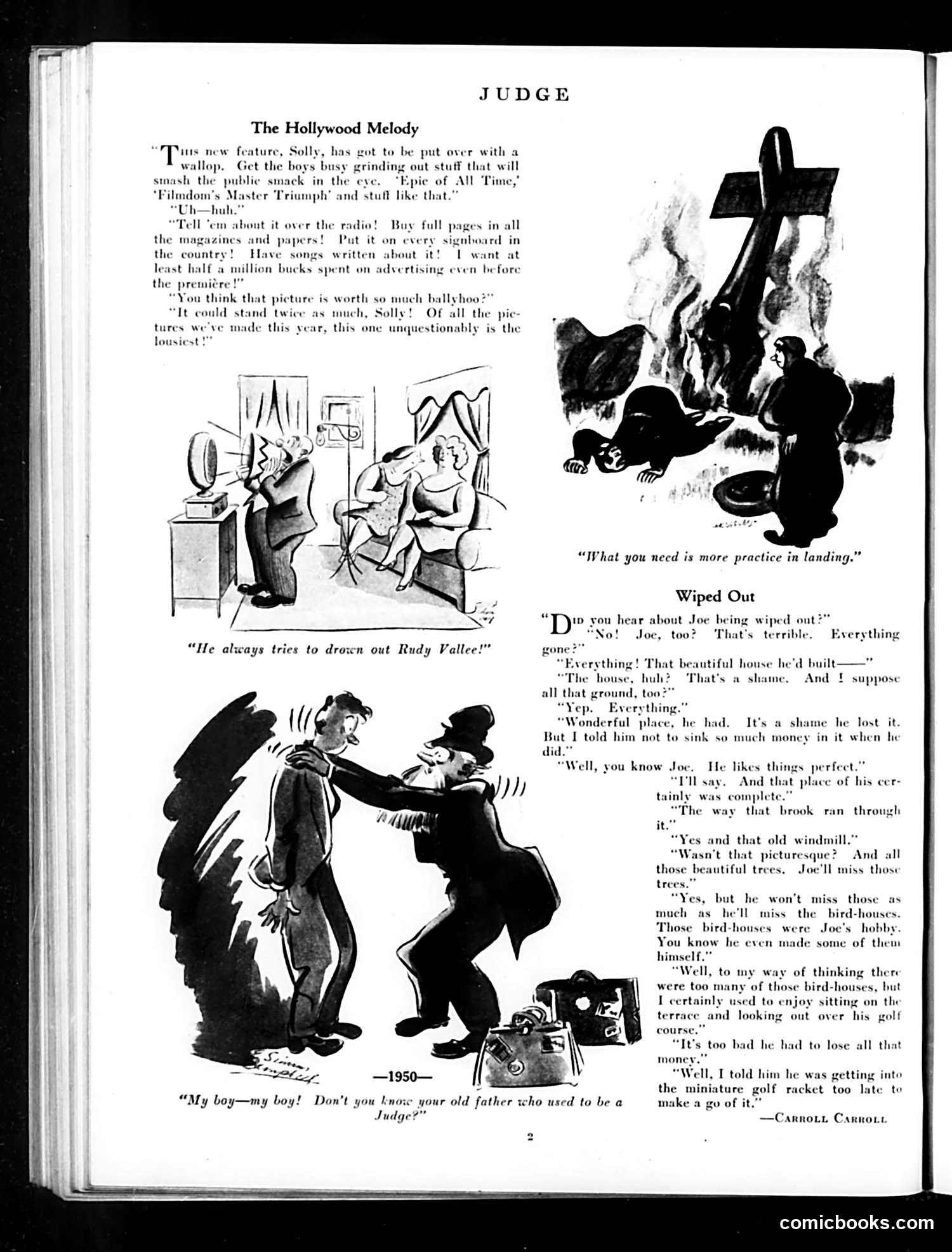
Analysis of Judge Magazine Page This page contains three separate cartoons satirizing Hollywood and entertainment industry practices circa 1950. "The Hollywood Melody" mocks studio executives' aggressive marketing tactics—grinding out mediocre films, flooding radio with promotion, plastering billboards nationwide, and spending lavishly on advertising before premieres. The satire suggests studios prioritize hype over quality. "He always tries to drown out Rudy Vallée!" appears to ridicule the singer Rudy Vallée, though the specific context is unclear. "Wiped Out" depicts a conversation about a man named Joe who lost his entire fortune—house, property, and possessions—due to poor financial decisions. The tone suggests dark humor about wealth destruction, possibly referencing Depression-era cautionary tales or specific Hollywood bankruptcies. All three reflect mid-century anxieties about excess and financial ruin.
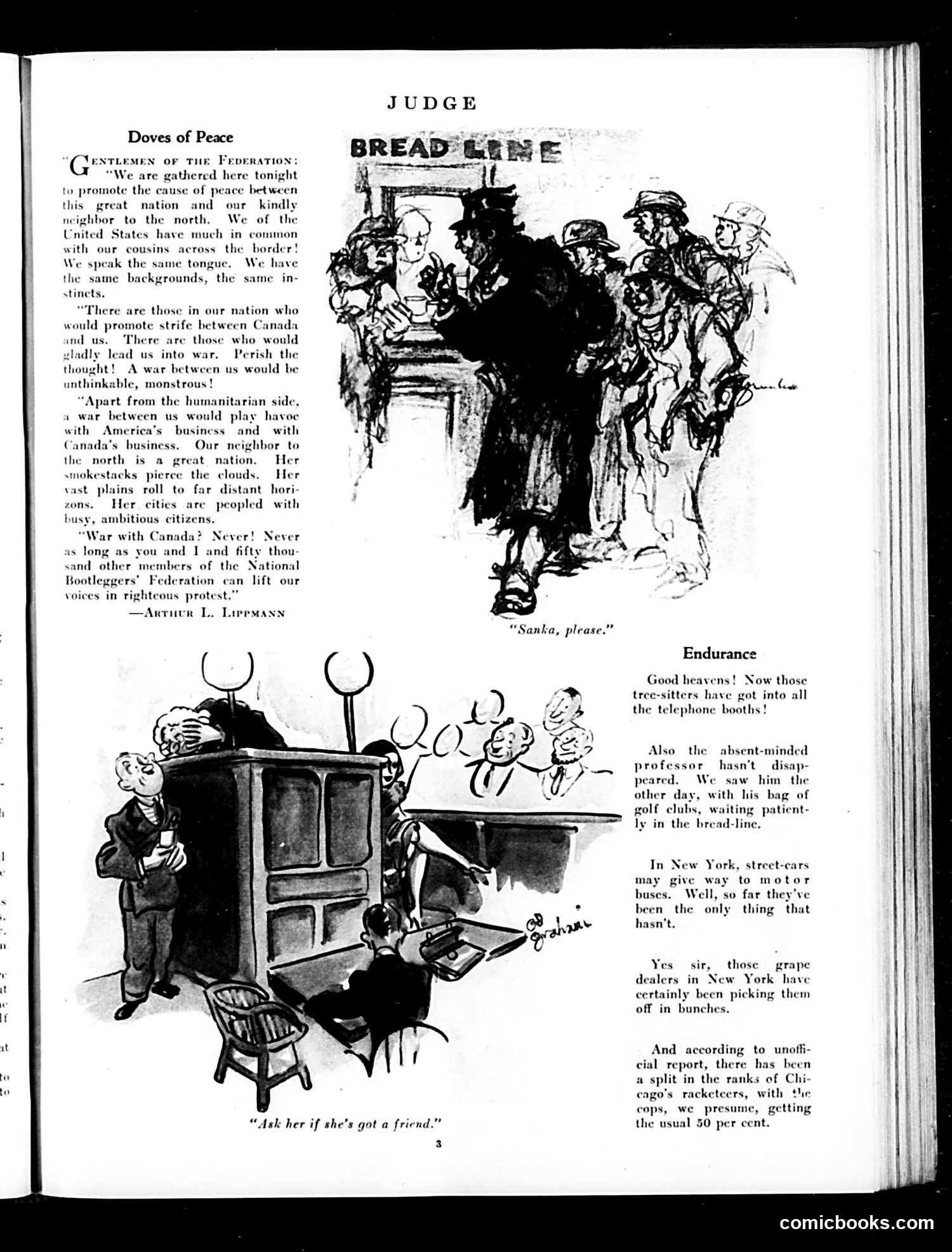
Judge Magazine Page Analysis This page contains two satirical cartoons addressing early 20th-century American concerns: "Bread Line" (top): Depicts Santa Claus confronted by impoverished people in a bread line, illustrating economic hardship during what appears to be a recession or Depression-era period. The contrast between holiday cheer and widespread poverty is the satirical point. "Ask her if she's got a friend" (bottom): Shows a telephone switchboard operator overwhelmed by multiple callers, satirizing the novelty and rapid adoption of telephone technology. The joke suggests telephones became so popular that operators couldn't manage demand. The page's text section titled "Endurance" offers brief humorous observations about current social quirks—crowded phone booths, absent-minded professors, motor buses replacing streetcars, and grape dealers in New York.
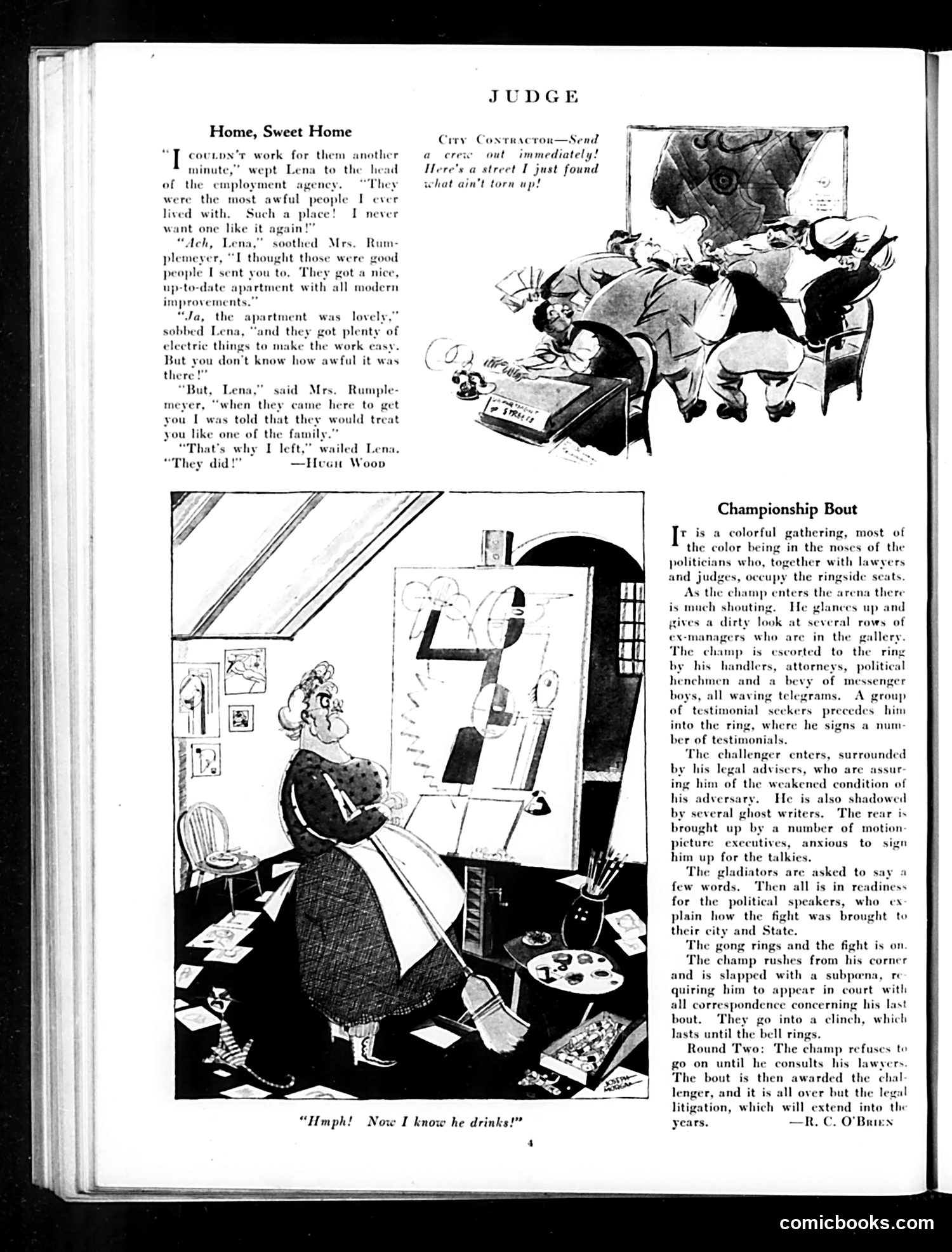
Analysis of Judge Magazine Page "Home, Sweet Home" (top): A satirical dialogue about employment agency practices. Lena complains about being placed in an apartment with "plenty of electric things to make work easy," yet the family treated her poorly despite promises of kind family treatment. The joke critiques employment agencies' deceptive marketing—promising modern conveniences and good conditions while delivering mistreatment of domestic workers. "Championship Bout" (bottom): A political cartoon depicting a boxing match metaphor. Various politicians, lawyers, and judges occupy ringside seats while a "champ" (likely a specific political figure) fights a "challenger." The satire mocks how political disputes become theatrical spectacles with numerous hangers-on—"ghost writers," "messenger boys," and legal advisers—turning serious political conflict into entertainment for the gallery.
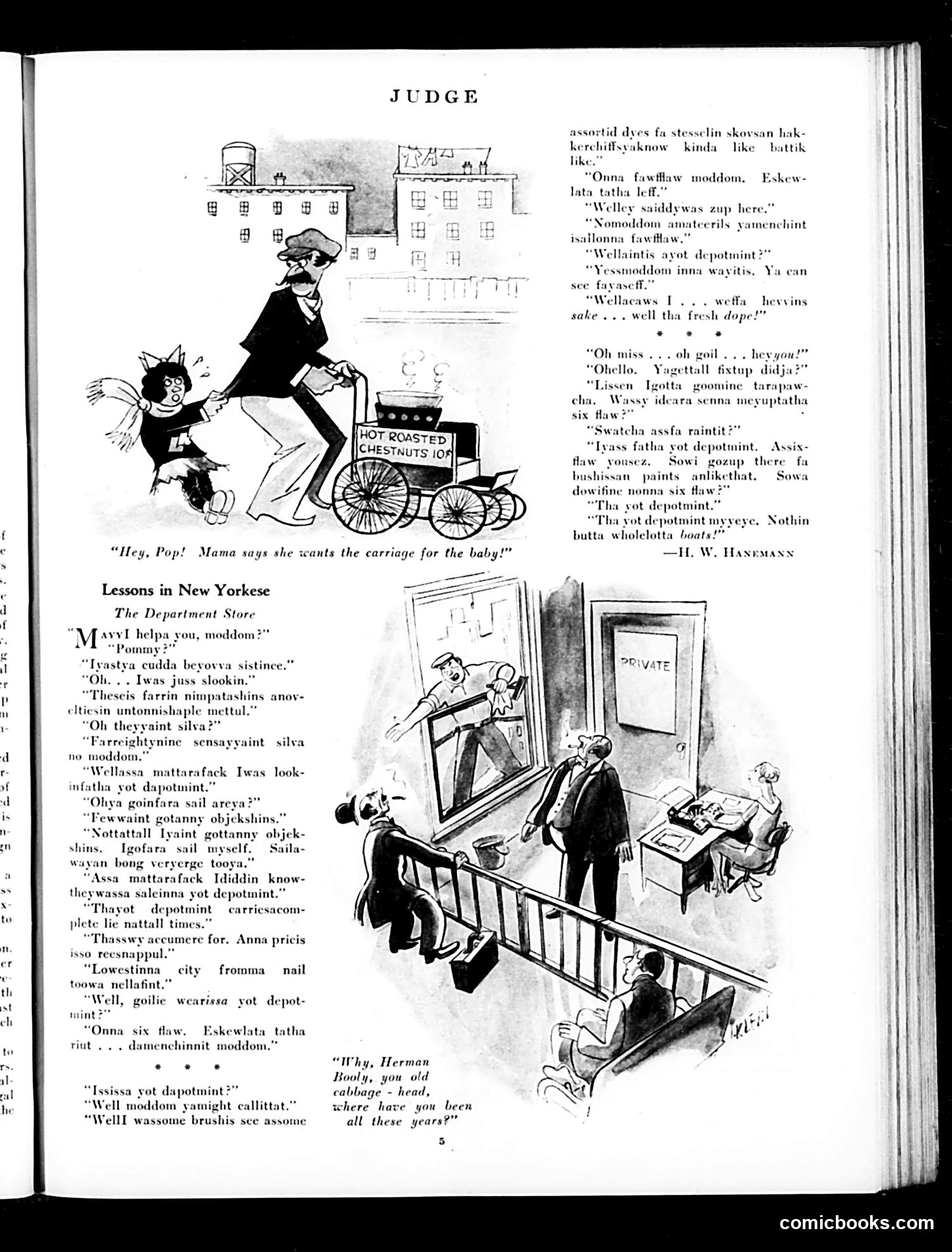
Analysis of Judge Magazine Page This page contains two satirical cartoons about New York City life, likely from the early 20th century. The top cartoon shows a man with a pushcart of "Hot Roasted Chestnuts" being confronted by a small child demanding "Mama says she wants the carriage for the baby!" The satire mocks the absurdity of a child's entitled demands—conflating a street vendor's humble cart with an actual baby carriage, suggesting spoiled wealthy children who confuse working-class commerce with their privileged possessions. The lower cartoon, titled "Lessons in New Yorkese," depicts a Department Store scene with a customer attempting to navigate confusing directions. The accompanying text uses phonetic dialect humor—mocking how New Yorkers speak—to satirize miscommunication between working-class New Yorkers and shoppers unfamiliar with local speech patterns and store layouts.
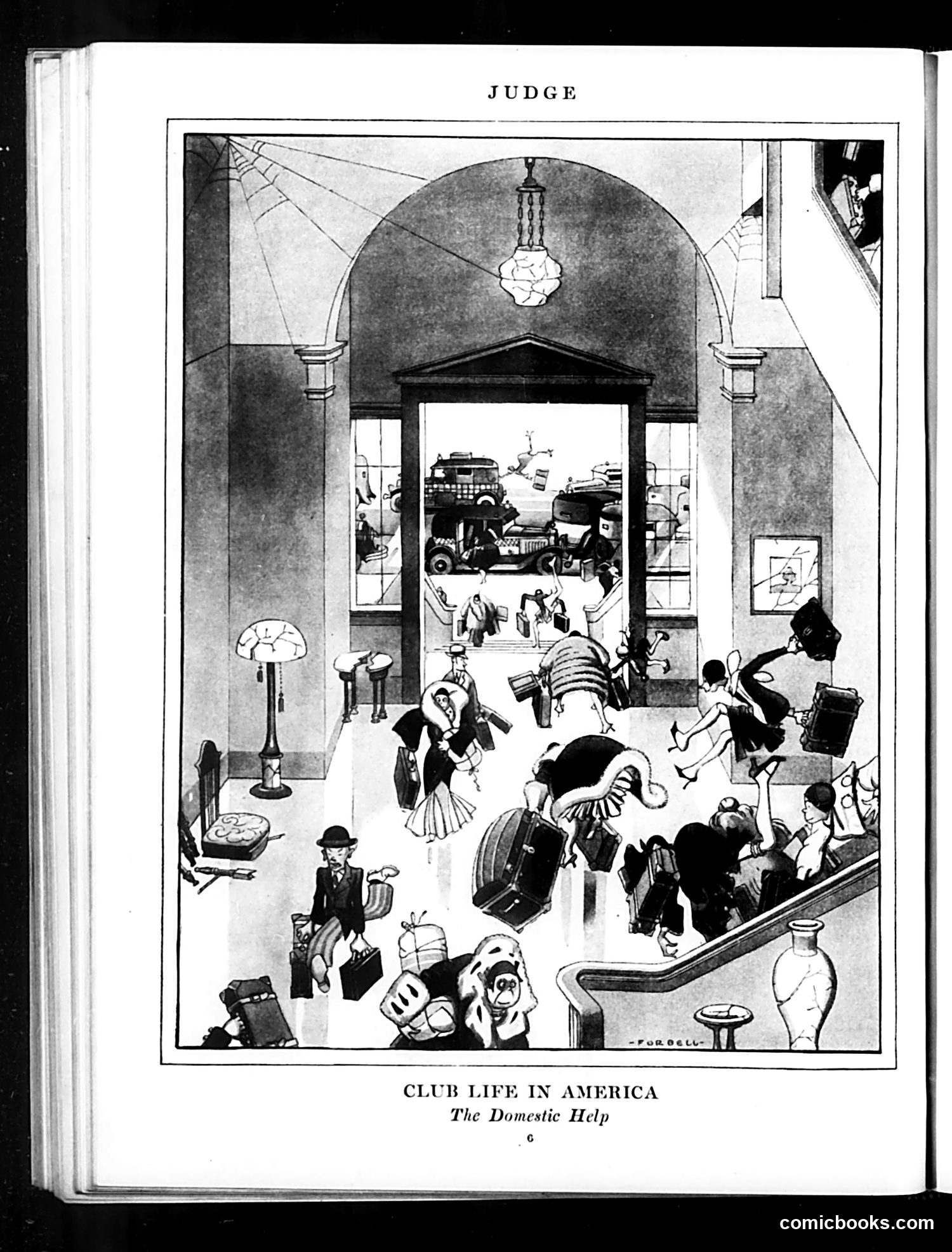
"Club Life in America: The Domestic Help" This illustration satirizes the chaotic state of domestic service in early 20th-century America. The scene depicts a fashionable club or social establishment where wealthy members attempt to conduct business amid complete disorder caused by servants and staff. The cartoon mocks the "servant problem"—a widespread complaint among the affluent that reliable household help was increasingly difficult to find and manage. The figures are shown in various states of disarray: some carrying luggage, others engaged in seemingly pointless activity, creating a scene of inefficiency and insubordination. The satire targets both the incompetence of domestic workers and the pretensions of the wealthy who depend on them, suggesting that even elite social spaces cannot escape the era's labor difficulties.
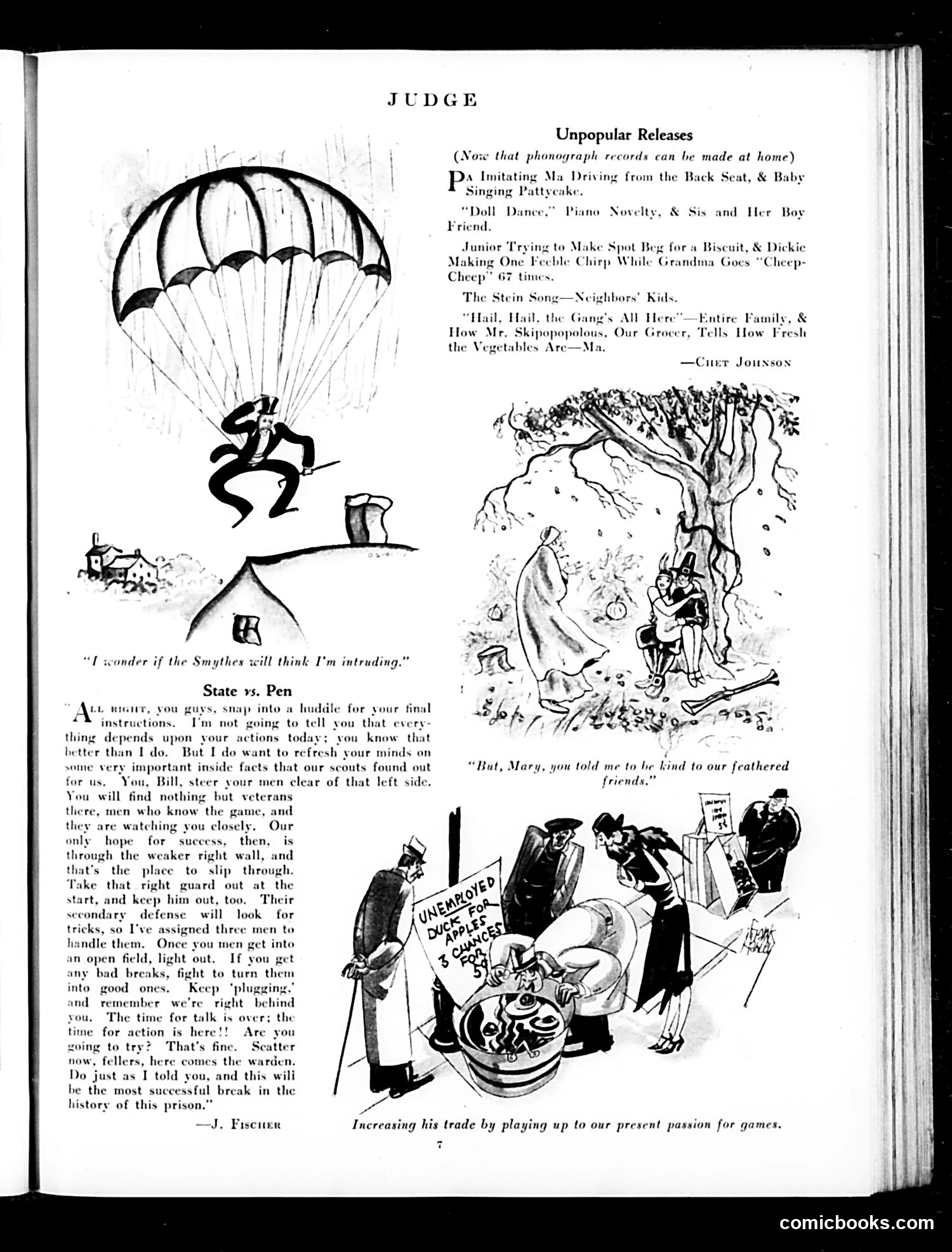
Analysis of Judge Magazine Page This page contains satirical content from Judge magazine mocking contemporary trends and social habits. "Unpopular Releases" section ridicules the then-novelty of home phonograph recording by listing absurdly annoying recordings people might make: a mother backseat driving, children making noise, a grocer's monotonous voice, etc. The humor targets both the new technology and recognizable domestic irritations. "State vs. Pen" depicts a prison break scene where a coach (likely a warden or guard) instructs inmates in football terminology—discussing "guards," "breaks," "secondary defense"—as a thin disguise for actual escape planning. The satire suggests prison security is so lax that escape instructions can be delivered openly using sports jargon. Bottom cartoon shows someone presenting "Unearned Appliances" or similar items to a merchant, captioned about "increasing trade by playing up to our present passion for games"—satirizing commercialism exploiting America's growing obsession with sports and games as marketing hooks. The overall theme critiques modern consumer culture and institutional incompetence.
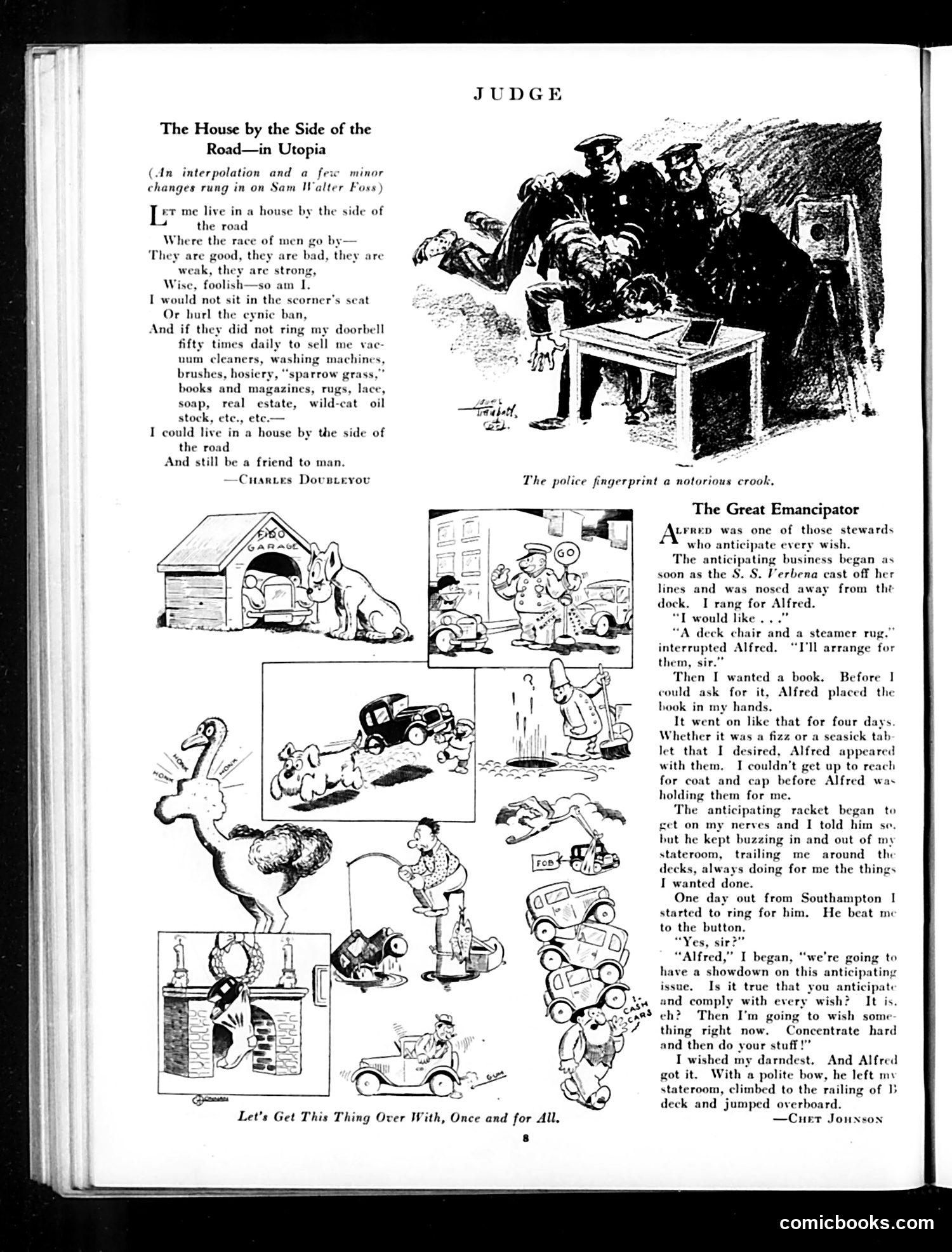
Analysis: Judge Magazine Page This page contains two satirical pieces reflecting early 20th-century consumer anxieties. "The House by the Side of the Road" parodies Sam Walter Foss's sentimental poem about rural hospitality. The satire inverts the original: instead of welcoming travelers, the poet fantasizes about escaping modern door-to-door salesmen hawking vacuum cleaners, washing machines, and dubious investments ("wild-cat oil stock"). It mocks the aggressive commercialism and consumer culture invading American life. "The Great Emancipator" satirizes the opposite problem: obsessive personal service. A ship's steward named Alfred anticipates every wish so relentlessly that he becomes maddening—the passenger can't even reach for his own coat. The joke's dark punchline: the only way to escape this "anticipating racket" is suicide. The title ironically names the steward as "emancipator" only through death. Both pieces express modern anxieties about loss of autonomy—either from pushy commercialism or smothering service—reflecting concerns about industrial society's grip on personal freedom.
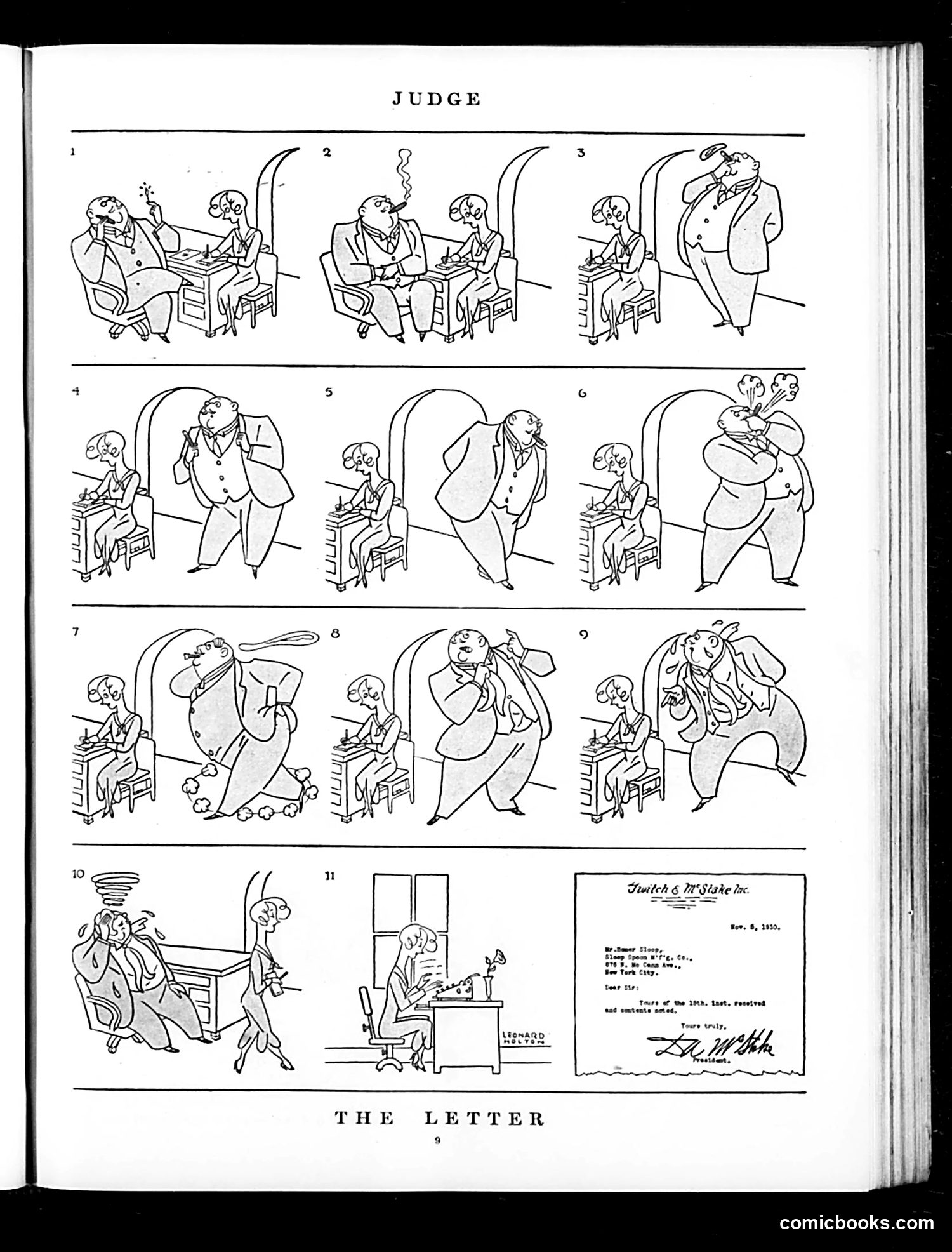
"Judge" Page: "The Judge" - Comic Strip This is a nine-panel sequential comic titled "The Judge" depicting a portly judge character in various states of escalating chaos and mishap. The narrative appears to show the judge progressively losing control—starting composed at a bench with a small figure (likely a defendant or clerk), then increasingly disheveled through panels 4-9, culminating in complete disorder with scattered papers and objects. The satire likely targets judicial incompetence, pomposity, or corruption—a common theme in Gilded Age American humor. The judge's transformation from authoritative to chaotic suggests commentary on judicial authority being undermined by his own incompetence or moral failings. The final panel reproduces what appears to be an actual letter from "Twitch & M'Slake Inc." dated Nov. 8, 1925, though its specific reference remains unclear without additional context.
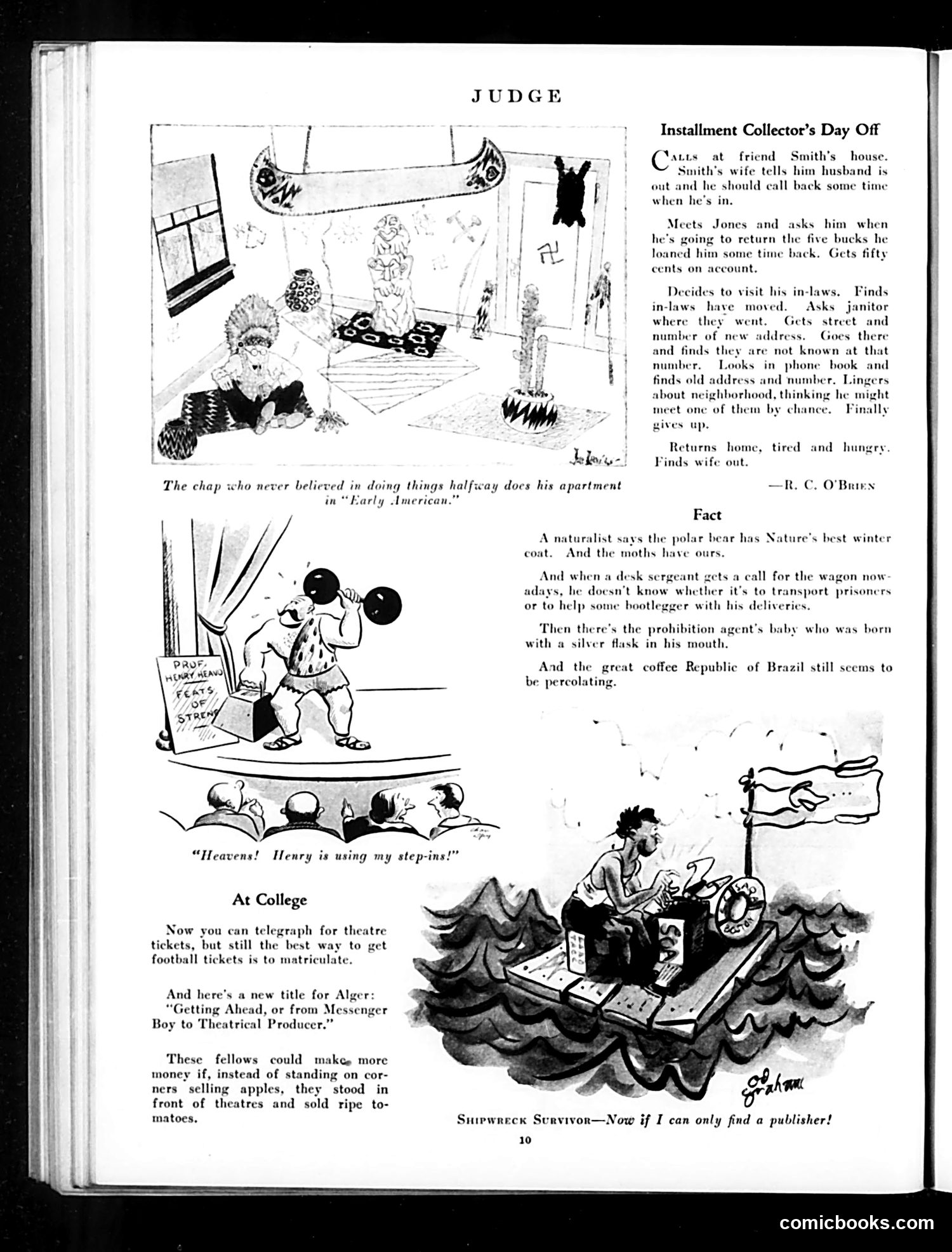
Analysis: Judge Magazine Page Main Cartoon: "Installment Collector's Day Off" This satirical narrative follows an installment collector (a debt collector) on his day off—ironically, he spends it chasing down *others* who owe *him* money. The humor lies in the role reversal: he unsuccessfully pursues a friend for a $5 loan (receives only 50 cents), tracks down moved-away in-laws, and returns home exhausted and hungry to find his own wife absent. The satire targets the frustrations of small-scale creditors in early 20th-century America, when installment buying and personal loans were common but enforcement was haphazard and time-consuming. The collector experiences firsthand the evasion tactics he normally uses professionally—people being unavailable, addresses changing, dead ends. Supporting Content The page includes humorous "facts" mocking Prohibition enforcement and the black market, a college section on scalping theatre tickets, and a shipwreck survivor cartoon. These are typical Judge magazine filler material satirizing contemporary social conditions and absurdities.
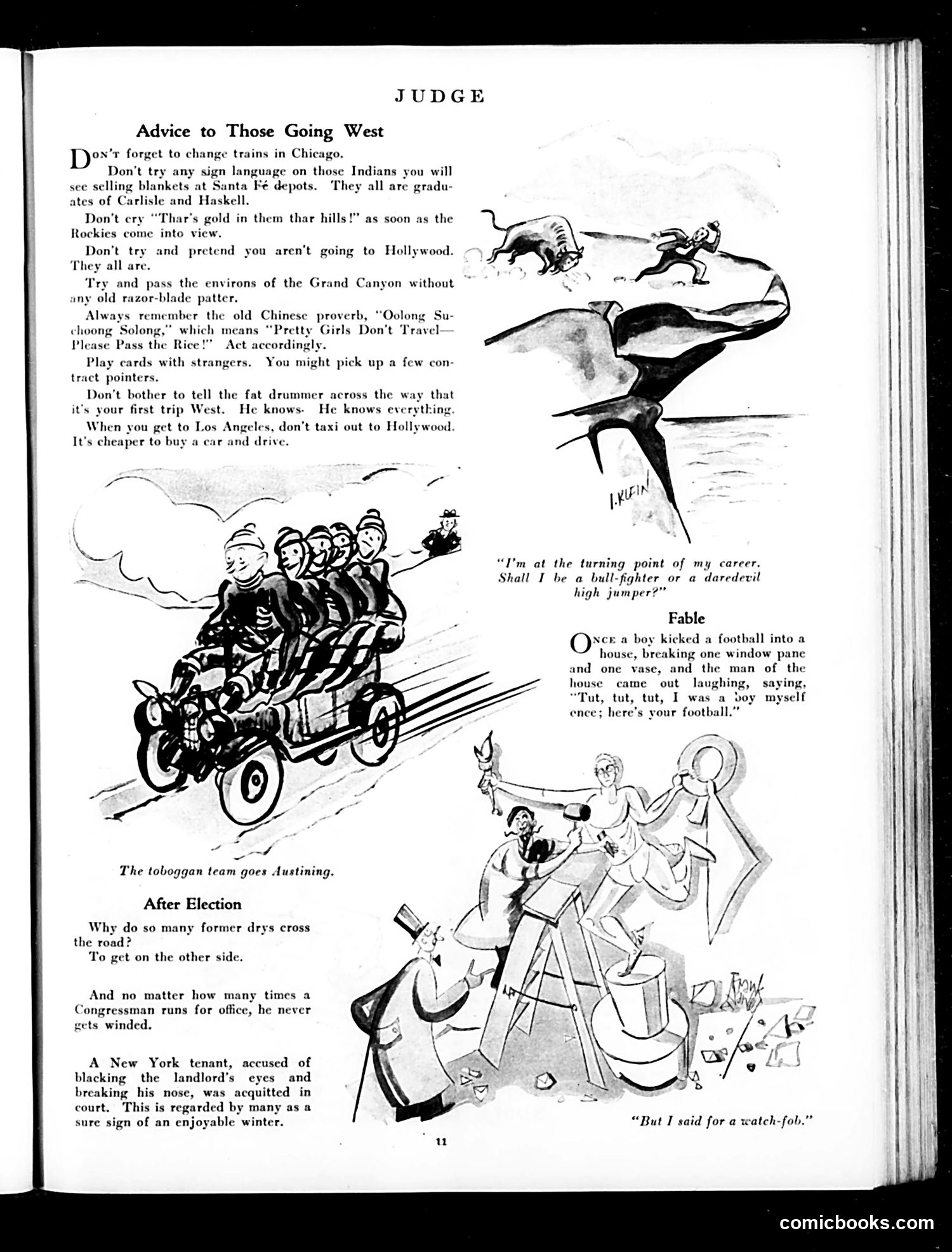
Analysis for Modern Readers This Judge magazine page contains satirical advice and jokes targeting early-20th-century American culture: "Advice to Those Going West" mocks tourists heading westward, referencing: - Native Americans selling blankets at train stations - Gold rush fantasies ("gold in them thar hills") - Hollywood's magnetic pull on dreamers - Grand Canyon tourism clichés - A Chinese proverb about female travelers "After Election" offers political humor: a dry (Prohibition supporter) crossing the road ironically mirrors the joke's structure; congressmen never tire despite constant campaigns. The New York tenant joke satirizes urban tenant-landlord disputes—apparently assaulting a landlord was winnable in court, suggesting either legal absurdity or judicial leniency during harsh winters. The "Fable" contrasts a boy's accident with an impossibly forgiving homeowner—satire on unrealistic moral tales. The final caption suggests the homeowner was actually miserly. The page primarily targets tourist gullibility, political hypocrisy, and sentimental moralizing through sharp, punchy jokes typical of Judge's satirical style.
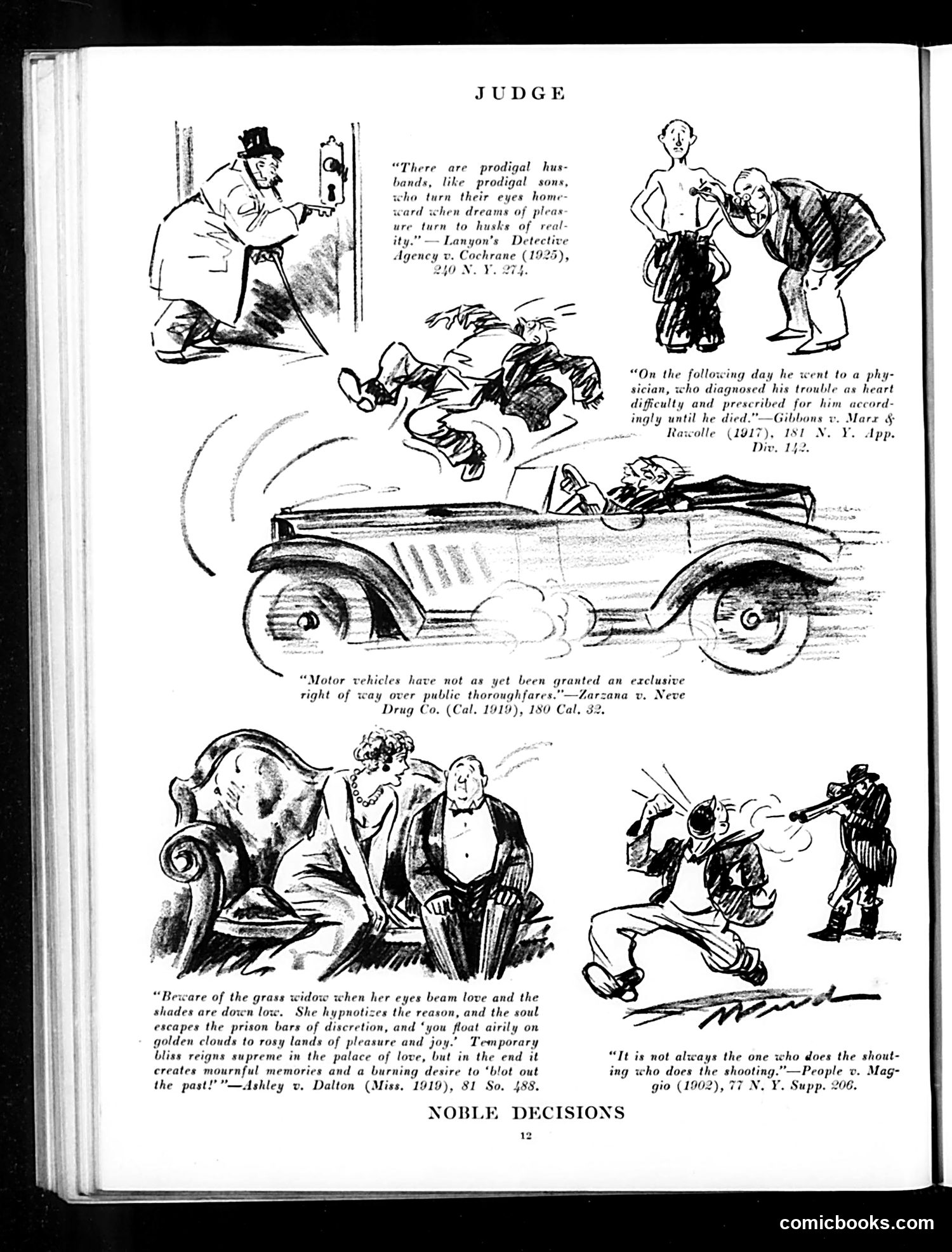
Judge Magazine Page Analysis This page from Judge satirizes the legal system by pairing humorous courtroom illustrations with absurd or overly poetic judicial quotations. The cartoons depict everyday scenarios—a man at a window, children misbehaving, a car accident, domestic scenes, and a shooting—each captioned with mock legal citations. The satire targets judicial opinions that either state the obvious in grandiose language or reach ridiculous conclusions. For example, one quote warns about "grass widows" (separated women) in flowery, moralistic prose, while another suggests a physician's negligent treatment directly caused death. The car accident citation admits motor vehicles lack legal road rights—a statement already obvious by 1919. The page mocks judges who produce overly elaborate, dramatically written decisions for trivial matters, and legal reasoning that strains credulity. "Noble Decisions" is clearly ironic—these aren't noble but absurd, highlighting the disconnect between serious legal language and the mundane or questionable circumstances they address.
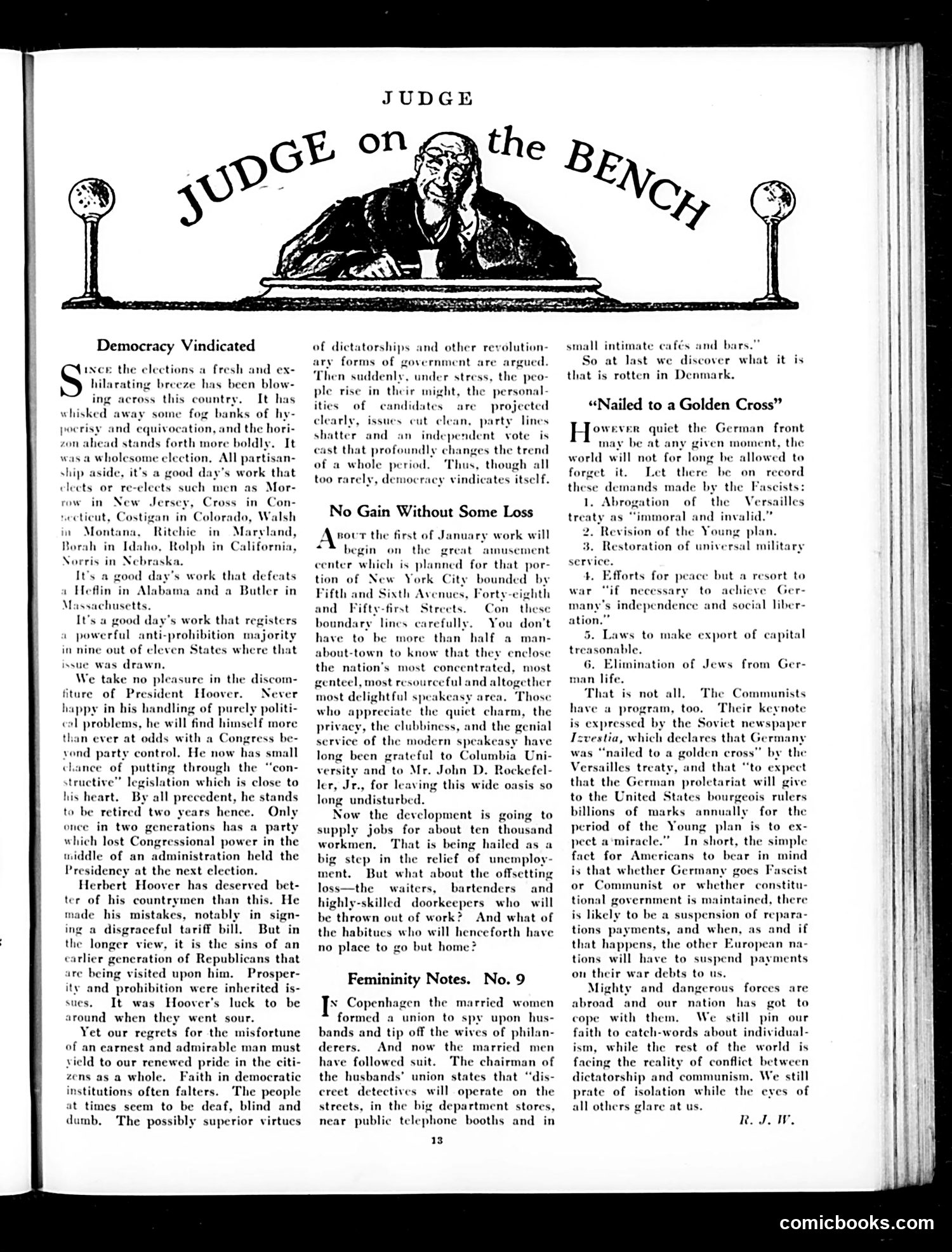
"Judge on the Bench" - Understanding This Page This page from *Judge* magazine contains two distinct political commentaries: "Democracy Vindicated" celebrates recent elections (appears to be 1930, based on references to President Hoover's Congressional defeats). The editorial praises voters for electing reform candidates like Norris and Borah while rejecting others, proving democracy works despite seeming to fail. Notably, it criticizes Hoover sympathetically—blaming inherited problems (Prohibition, tariffs) from earlier Republicans rather than his own failures. "No Gain Without Some Loss" satirizes New York's planned amusement center development (Fifth-Sixth Avenues, 48th-51st Streets). The joke: while construction creates 10,000 jobs, it will destroy the neighborhood's numerous speakeasies—those illegal bars thriving during Prohibition. The piece mourns loss of speakeasy culture with tongue-in-cheek nostalgia. "Femininity Notes" briefly mocks a Copenhagen wives' spy-union by reporting husbands formed their own counter-union.
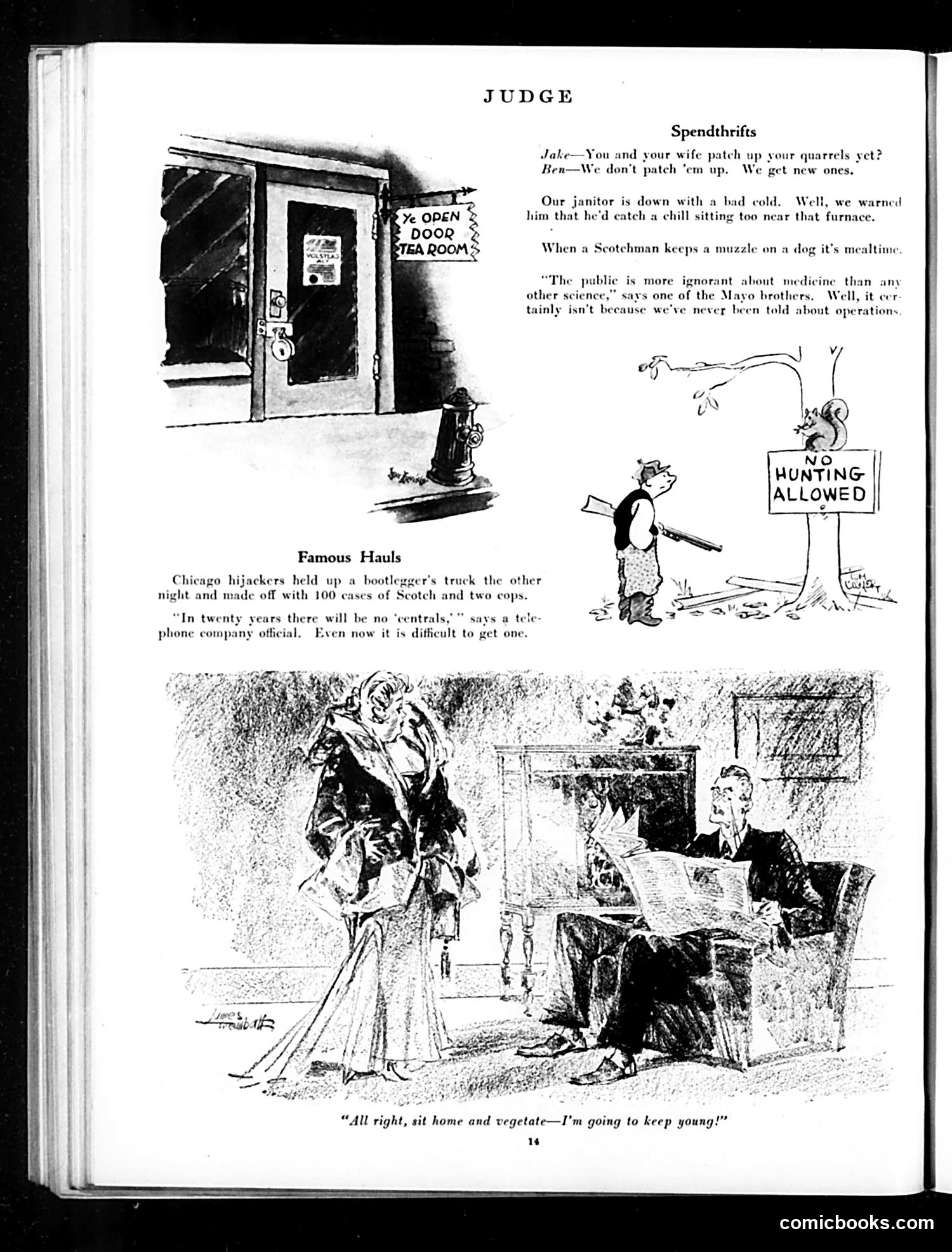
Judge Magazine Page Analysis This page contains several short humorous items typical of early 20th-century American satirical magazines: "Spendthrifts" mocks marital conflict through a joke about couples who continuously quarrel rather than reconcile. "Famous Hauls" references Prohibition-era bootlegging and the Chicago underworld, joking that hijackers stole alcohol and kidnapped police officers—reflecting contemporary concerns about organized crime and law enforcement corruption during the 1920s alcohol ban. The "No Hunting Allowed" cartoon uses a simple visual gag about wildlife protection signs. "Scotch" references appear multiple times, playing on Scottish stereotypes about frugality (the muzzled dog joke) and Irish/Scottish drinking culture during Prohibition. The final cartoon satirizes women's obsession with youth and appearance, showing a wife rejecting domestic life to pursue cosmetic rejuvenation—reflecting 1920s anxieties about changing gender roles and female vanity. The page reflects typical Judge humor: topical references, ethnic stereotypes, marital discord, and social criticism delivered through short quips and illustrations.
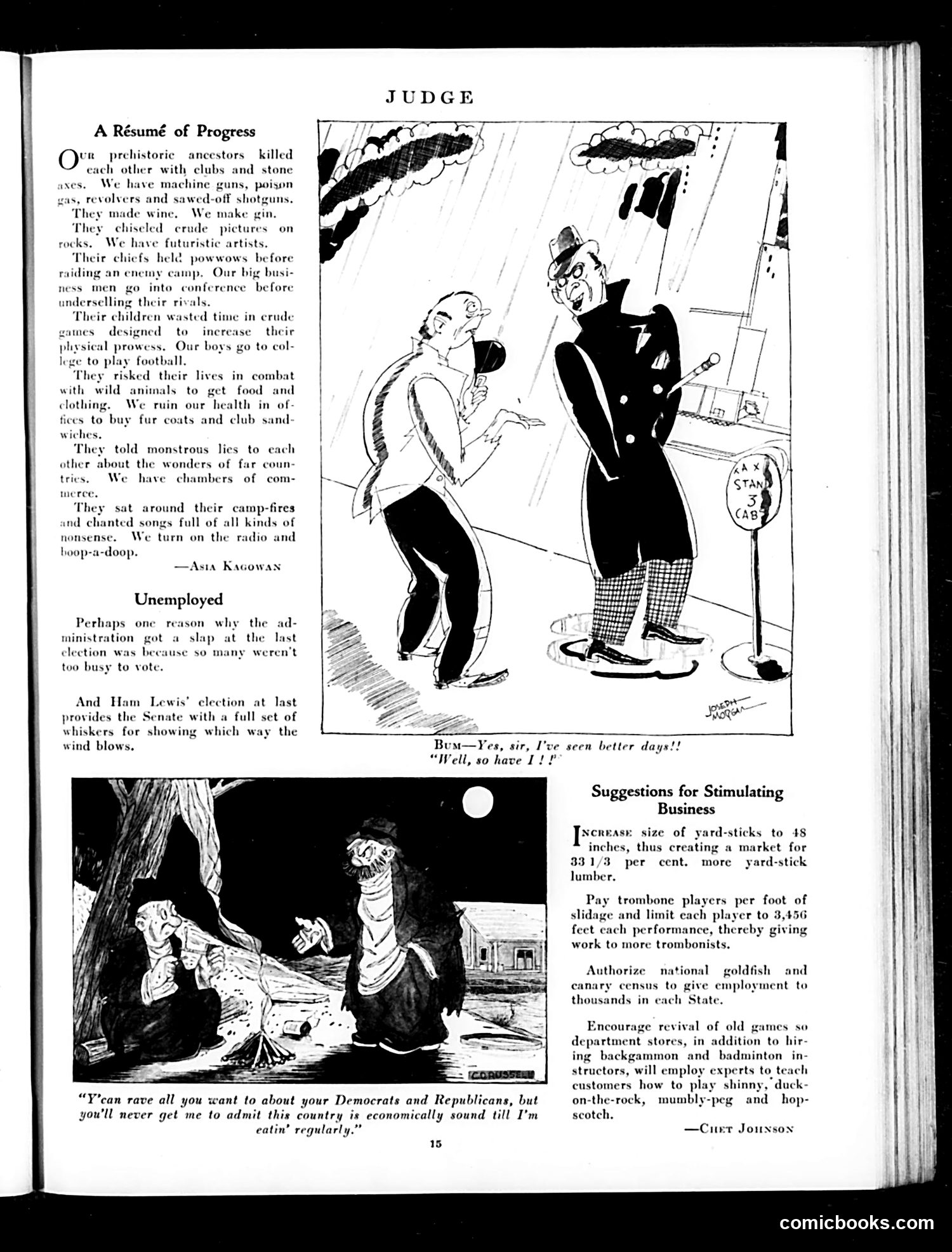
Judge Magazine Page Analysis This page contains satirical commentary on American progress and the Great Depression era. "A Résumé of Progress" (top left) sarcastically compares "primitive" ancestors to modern civilization, suggesting we've made no real moral or social advancement—just upgraded our methods of destruction, deception, and wasteful consumption. The tone is cynical about modernity. Top cartoon shows two men at a taxi stand: one shabby ("I've seen better days") and one well-dressed. This illustrates economic inequality during unemployment. Bottom cartoon depicts a beggar telling a wealthy man that he won't accept claims about economic soundness until he can eat regularly—a direct jab at Depression-era claims of prosperity. "Suggestions for Stimulating Business" (right) offers absurd, tongue-in-cheek "solutions" to unemployment (longer yardsticks, paying trombonists per foot), mocking the government's actual inadequate relief efforts. The page overall critiques both American complacency about "progress" and the administration's failure to address genuine economic hardship.
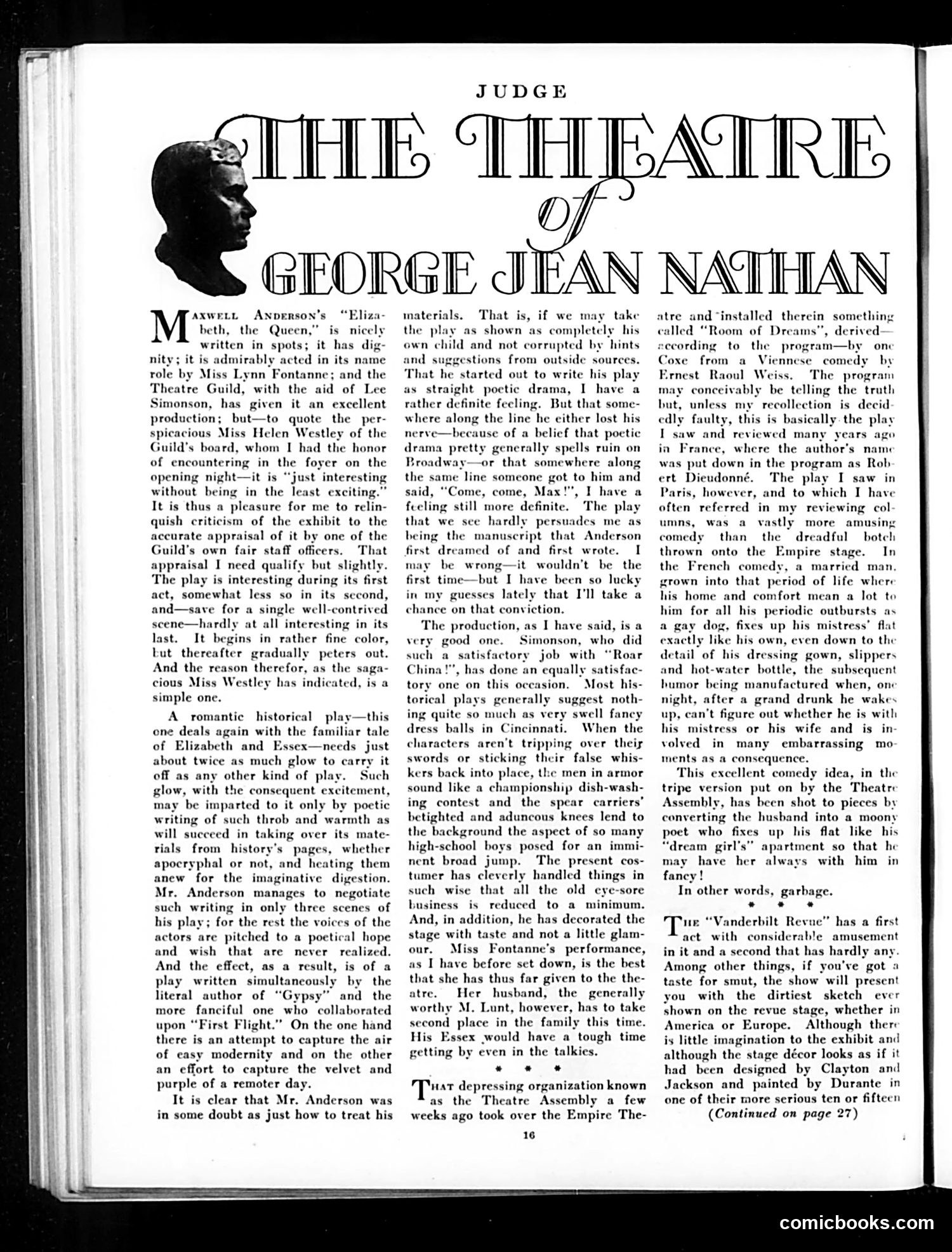
"The Theatre of George Jean Nathan" This is a theater review column, not a political cartoon. Judge magazine's drama critic George Jean Nathan critiques Maxwell Anderson's play about Elizabeth I and the Earl of Essex, produced by the Theatre Guild. Nathan's main complaint: the play lacks the poetic intensity necessary for romantic historical drama. He suggests Anderson lost confidence in his original vision, perhaps pressured by commercial concerns ("Come, come, Max!") to make it more accessible. Nathan praises the production design by Lee Simonson and Lynn Fontanne's performance, but finds the script uneven—strong in three scenes but pedestrian elsewhere. The review exemplifies Judge's literary ambitions: sophisticated theater criticism for educated readers interested in Broadway's serious dramatic offerings.
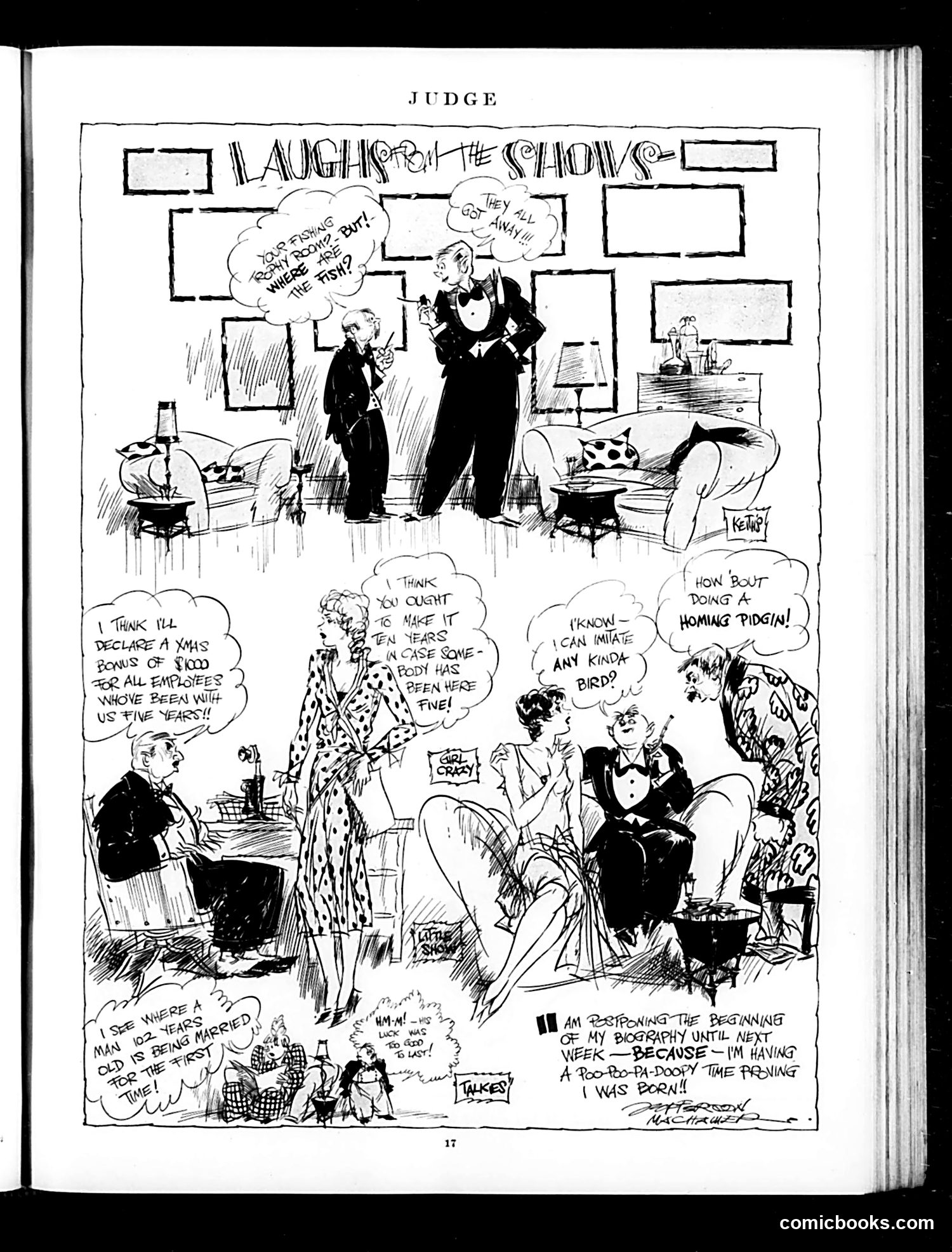
"Laughs at the Shows" - Judge Cartoon Analysis This is a satirical cartoon depicting a fancy party or social gathering where wealthy employers and guests make casual, offensive remarks. The humor relies on depicting characters speaking in exaggerated "pidgin" English and making patronizing comments about employees and servants. The central joke appears to mock upper-class pretension: an employer announces year-end bonuses for loyal workers, while guests make crude attempts at humor using stereotypical dialect. One character jokes about "doing a homage pidgin," while another postpones writing their biography because they're having a "roo-to-pa-doopy time" (nonsense slang suggesting drunken revelry). The cartoon satirizes how the wealthy entertain themselves with casual racism and crude language while congratulating themselves on their generosity—exposing the disconnect between their self-perceived sophistication and their actual behavior. The title "Laughs at the Shows" suggests this scene itself is a performance of upper-class manners.
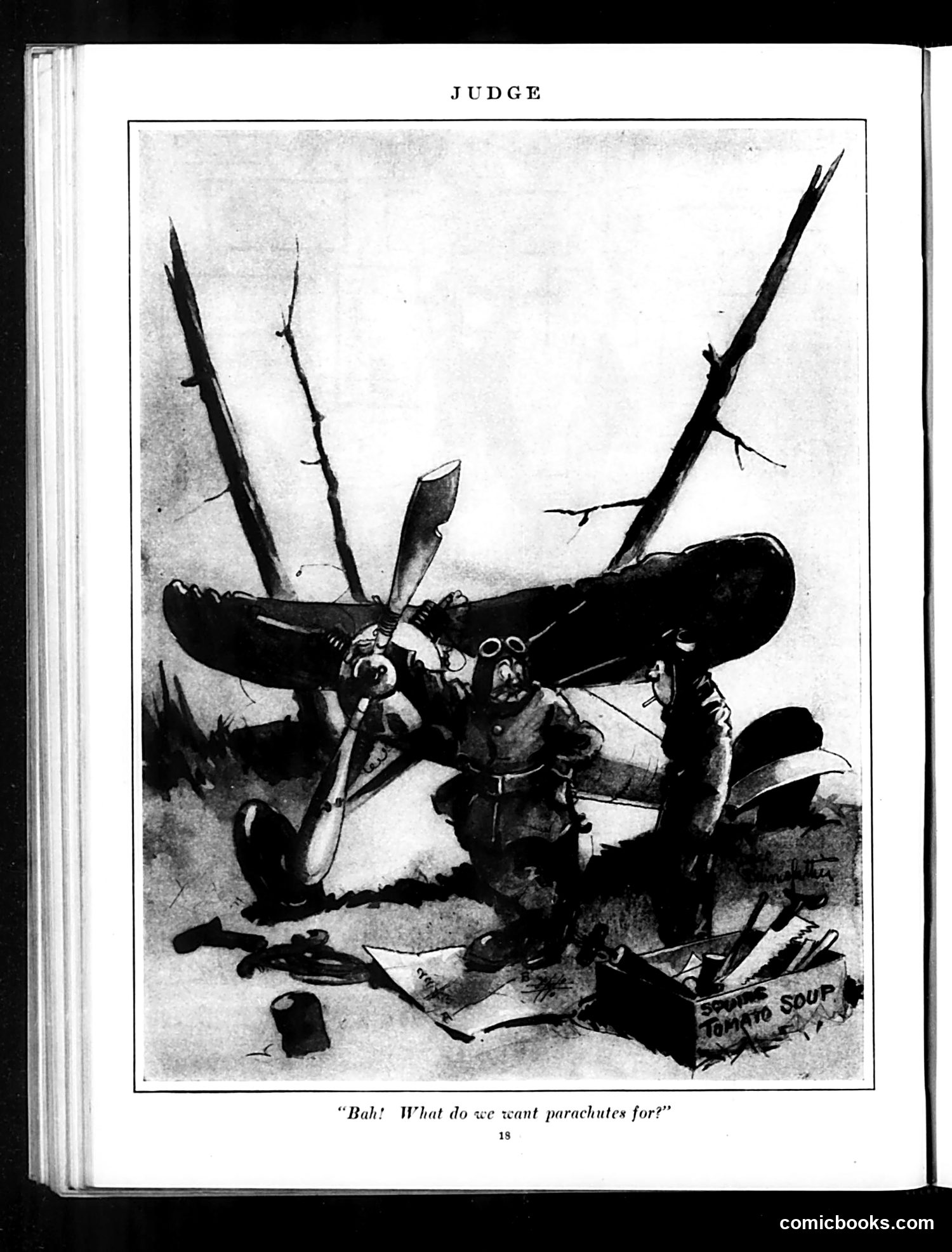
Political Cartoon Analysis This Judge magazine cartoon depicts an anthropomorphized insect or creature with prominent antennae and wings, surrounded by discarded items including what appears to be a "Tomato Soup" can. The caption reads: "Bah! What do we want parachutes for?" The satire likely references wartime resource allocation or military preparedness, possibly from WWI or WWII era. The creature's dismissive attitude toward parachutes—essential safety equipment—suggests criticism of either: 1. Military leadership ignoring practical needs, or 2. Bureaucratic incompetence in procurement The insect imagery may represent a specific political figure or group deemed foolish or insignificant. Without additional context about Judge's publication date and contemporary events, the exact target remains unclear, though the cartoon clearly mocks shortsighted decision-making regarding military equipment.
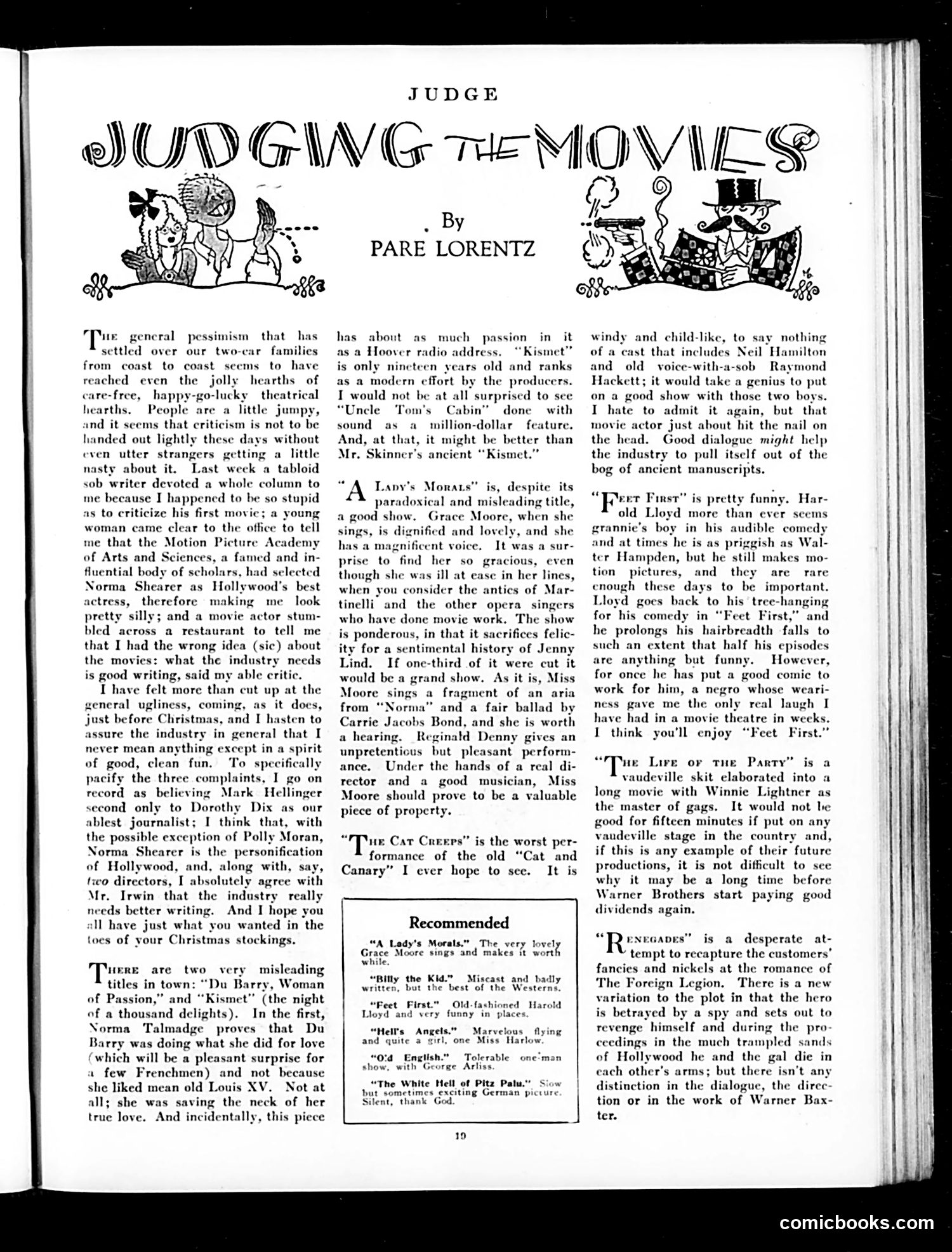
Explaining "Judge" Magazine's Movie Criticism Page This page from Judge magazine contains film reviews by critic Pare Lorentz, not political cartoons. The small decorative illustrations (showing theatrical figures) are ornamental headers, not satirical commentary. The content critiques 1920s Hollywood productions. Lorentz defends himself against industry backlash for honestly reviewing movies, claiming he praised Mark Hellinger and Norma Shearer while supporting better screenwriting. He reviews several films: "Du Barry, Woman of Passion" (criticized as lacking passion), "Kismet" (called outdated), "A Lady's Morals" (praising Grace Moore's singing), and "The Cat Creeps" (dismissed as the worst version of that story). The satire is gentle—poking fun at Hollywood's thin skin regarding criticism and the industry's recycling of old material. The "Recommended" box lists other current releases. This reflects 1920s-30s film criticism culture, when silent and early sound cinema faced constant scrutiny about artistic merit versus commercial entertainment.
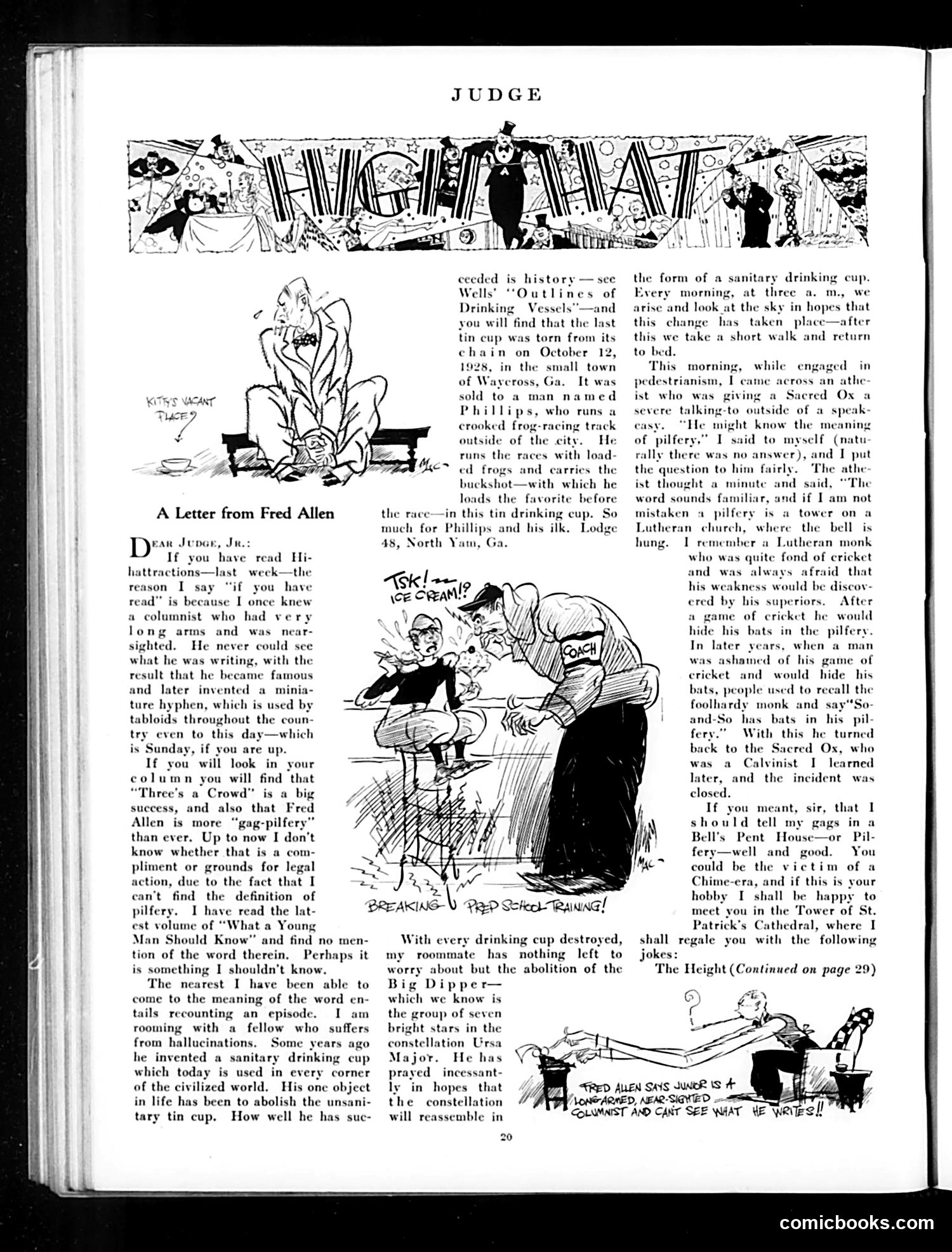
Analysis for Modern Readers This is a humorous letter from radio comedian Fred Allen to *Judge* magazine's editor, playfully mocking the publication itself. Allen complains that *Judge* accused him of "gag-pilfery" (joke-stealing) but claims he can't find the definition of "pilfery" anywhere. The satire hinges on a ridiculous anecdote: Allen's roommate invented the sanitary drinking cup to eliminate unsanitary tin cups—yet the last tin cup ended up with a crooked gambler in Georgia who uses it to carry buckshot for loading "frogs" (rigged racing frogs). The punchline: his obsessive roommate now hopes to convince the constellation Ursa Major (the "Big Dipper") to rearrange itself into a drinking cup shape. The cartoons illustrate these absurd scenarios with exaggerated drawings. Allen's self-deprecating humor deflates *Judge*'s criticism while showcasing his characteristic comedic style—elaborate setups that collapse into nonsense. This was typical of Allen's radio persona: verbose, tangential storytelling that subverts expectations.
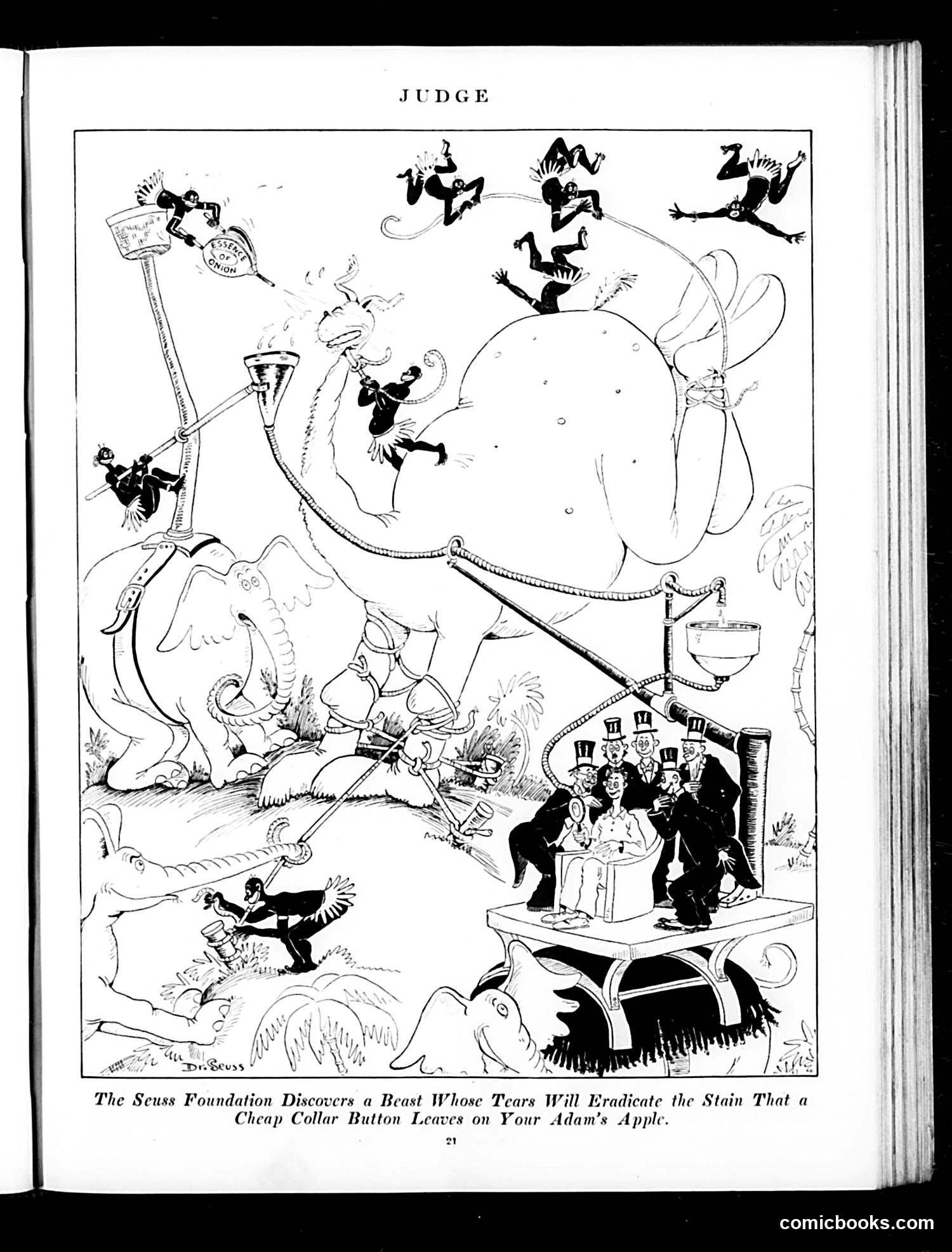
Explanation for Modern Readers This is a Seuss cartoon (signed by Dr. Seuss) satirizing what appears to be a commercial product or foundation claiming miraculous cleaning properties. The elaborate, whimsical machinery and fantastical beasts suggest absurd over-engineering for a trivial problem—removing collar button stains on the neck. The "Seuss Foundation" appears to be a fictional entity invoked for comedic effect. The cartoon mocks: 1. Advertising excess: Companies making grandiose claims about mundane products 2. Consumer gullibility: The implication that people will believe any outlandish solution 3. Class anxiety: The concern about visible stains on one's clothing as a social embarrassment The surreal Seussian creatures and contraptions emphasize the ridiculousness of the proposed solution, suggesting that solving such minor grooming issues requires absurdly complicated intervention—a commentary on aggressive marketing and product hype.
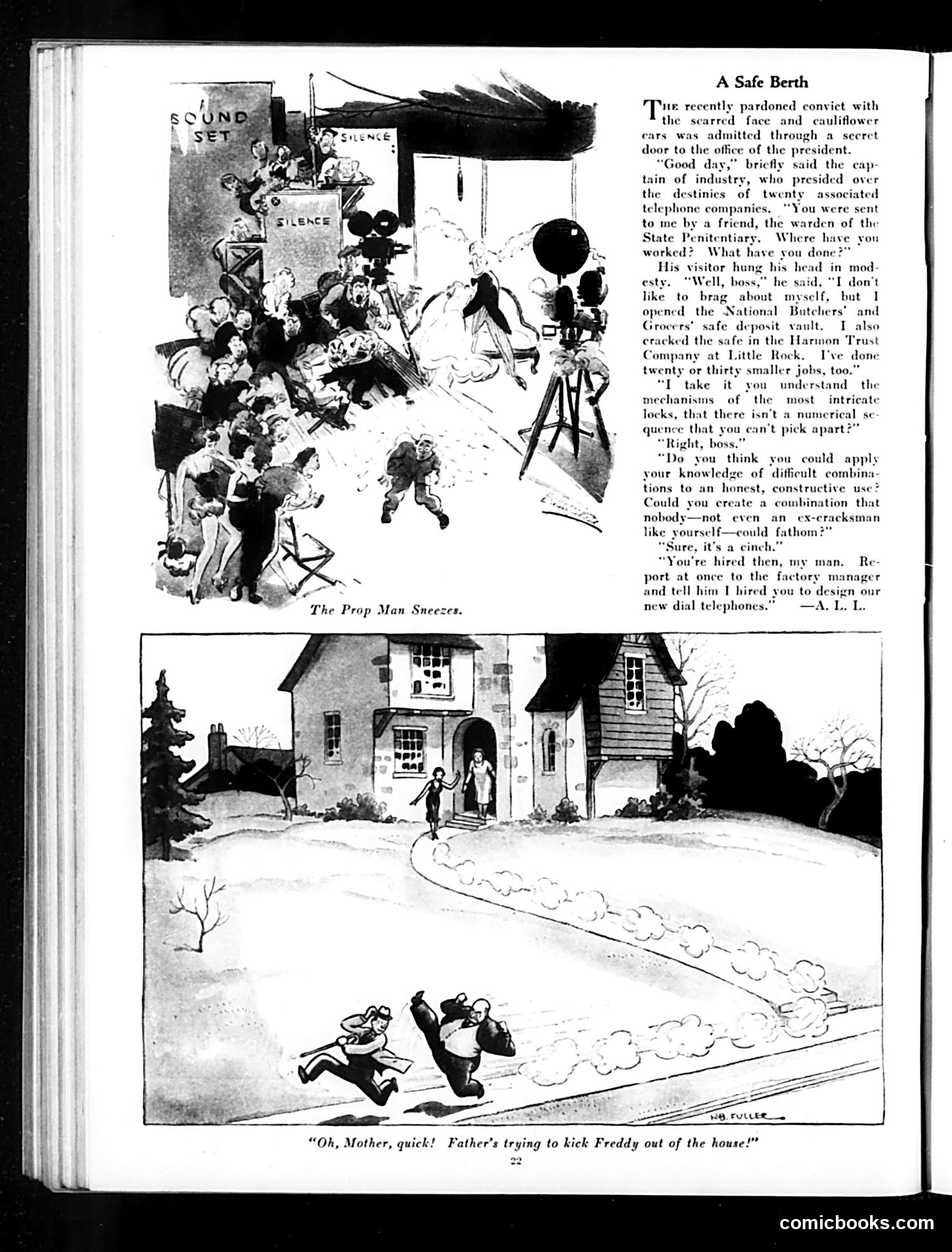
"A Safe Berth" - Judge Magazine Cartoon Analysis This satirical cartoon mocks the telephone industry's monopolistic practices and labor practices of the era. A recently pardoned safecracker is hired by a telephone company executive to design locks for their new dial phones. The joke is that the "captain of industry" running twenty associated telephone companies—clearly a reference to the consolidated Bell telephone monopoly—hires a criminal specifically for his expertise in breaking locks. The satire suggests corporate titans will exploit anyone, including criminals, to maintain their monopolistic control and keep competitors out. The caption credits "A. L. L." The lower cartoon titled "The Prop Man Sneezes" appears unrelated, depicting domestic chaos. The page critiques how industrialists cynically weaponize criminal skills for profit rather than reform.
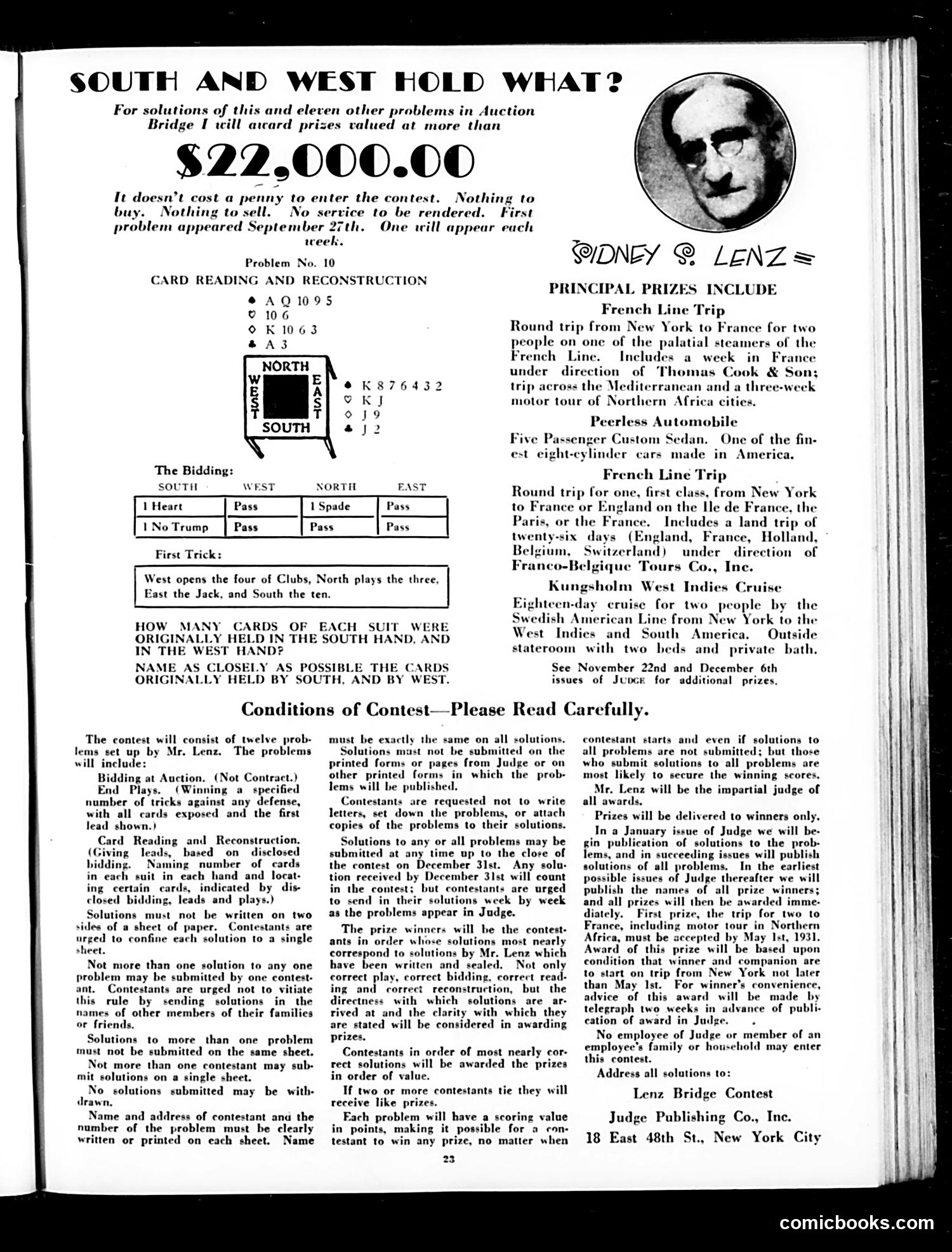
"South and West Hold What?" This page is primarily an advertisement for a bridge contest, not a political cartoon. Judge magazine is sponsoring a $22,000 prize competition for solving auction bridge problems (a card game popular in the 1920s-30s). The contest is hosted by Sidney Lenz, a renowned bridge expert whose photograph appears in the top right. The prizes are luxury travel and automobiles—a French Line ocean voyage, a Peerless automobile, and a West Indies cruise. Problem No. 10 presents a card-reading puzzle: given the bidding and first trick played, contestants must deduce which cards South and West originally held. The page's satirical element is subtle—the humor lies in Judge's typical editorial voice: a wealthy magazine offering extravagant prizes to showcase American consumer luxury and leisure culture during the Jazz Age. Bridge itself was an upper-class status symbol. This is essentially a game/puzzle advertisement, not political satire.
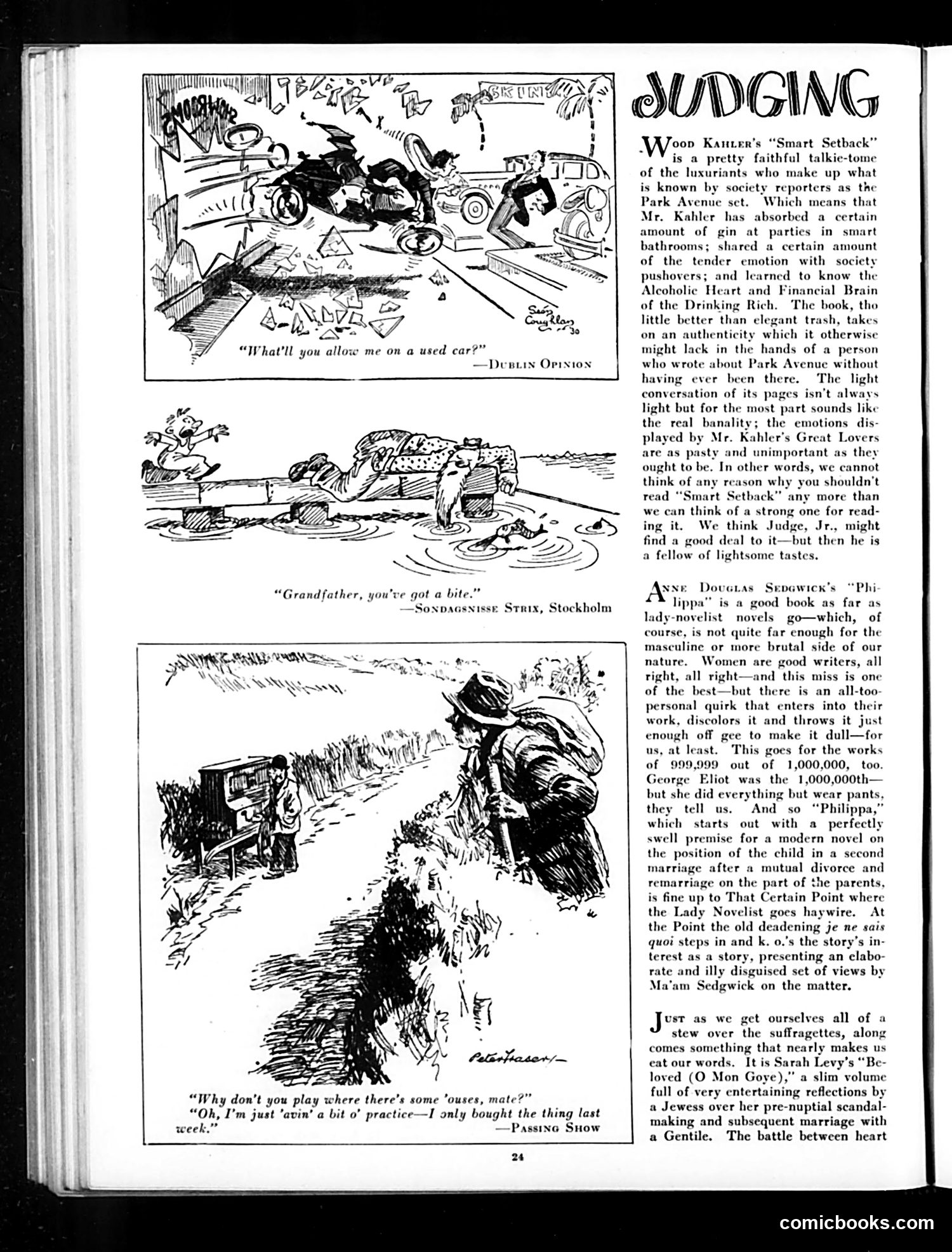
Cartoon Analysis: Judge Magazine Page This page contains book reviews paired with satirical cartoons mocking early 1920s society and modern life. Top cartoon: Depicts a chaotic used-car transaction among the wealthy elite ("Park Avenue set"), referencing Wood Kahler's novel *Smart Setback*. The satire suggests Kahler authentically captures the shallow drinking habits and emotional banality of New York's rich social circles. Middle cartoon: A fisherman's predicament, illustrating the Swedish saying about practice—likely commenting on modern leisure pursuits among the wealthy. Reviews discussed: The text critiques three novels—Kahler's *Smart Setback* (about the "Drinking Rich"), Anne Douglas Sedgwick's *Philippa* (criticized for the "personal quirk" of female novelists), and Sarah Levy's *Beloved* (about Jewish-Gentile marriage conflicts). The overall tone dismisses these works as "elegant trash" while acknowledging their social authenticity. The satire targets both the subjects depicted (wealthy socialites) and female authors' perceived tendency toward excessive personal perspective.
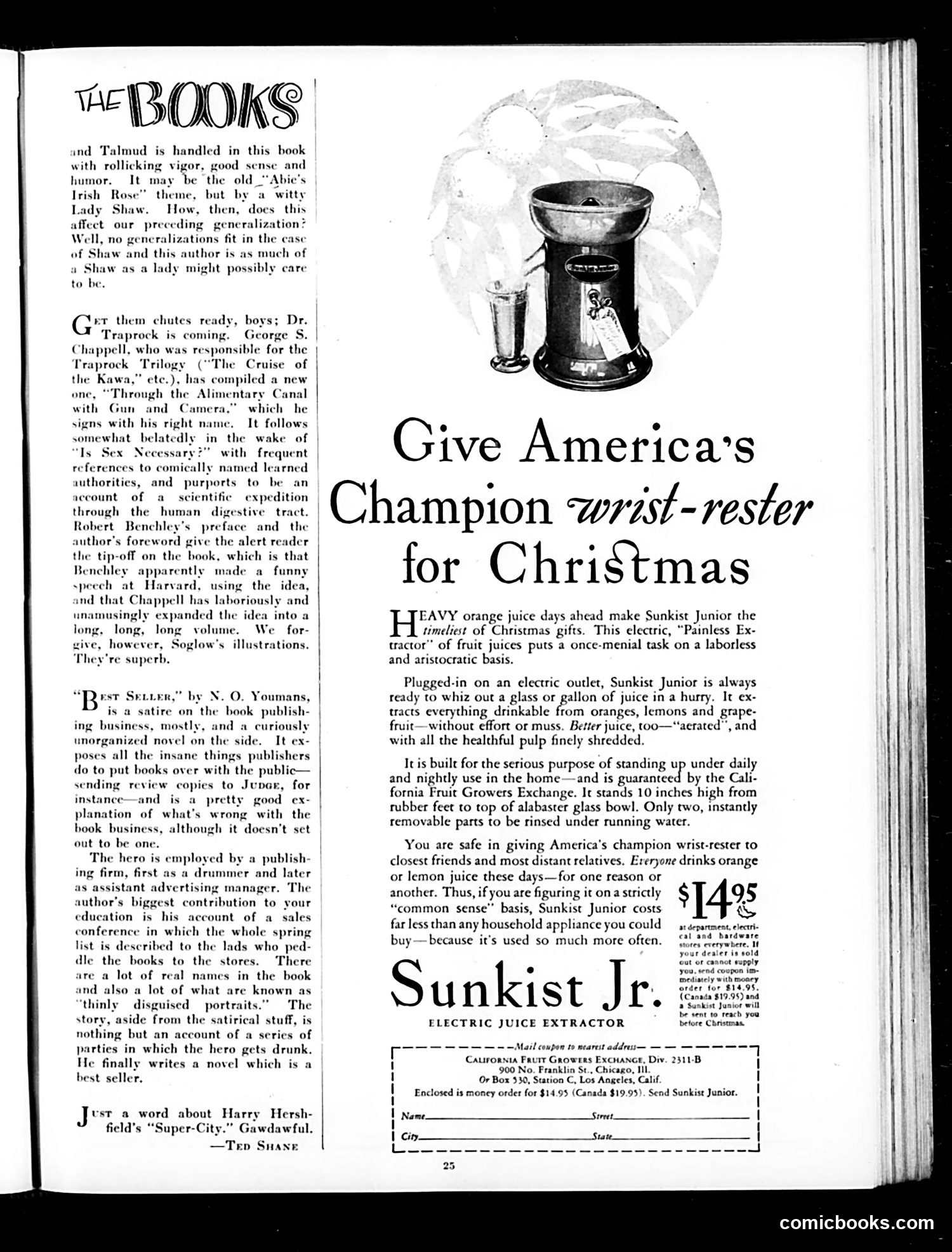
Judge Magazine Page Analysis This page combines book reviews with a commercial advertisement. The left side features Ted Shane's literary criticism of recent publications, including satire on the publishing industry itself ("Borst Seuuen") and commentary on George Chappell's humorous travel book "Through the Alimentary Canal with Gun and Camera"—a parody that follows the successful formula of absurdist comic writing popular in the 1920s. The dominant right side advertises the "Sunkist Jr." electric juice extractor, marketed as a Christmas gift. The ad's language—calling it "America's Champion wrist-rester"—humorously positions the device as a labor-saving luxury item, emphasizing electric modernity and ease. The $14.95 price (substantial for 1920s-era appliances) targets middle-class consumers seeking status and convenience. This juxtaposition of literary satire alongside consumer advertising typifies Judge's mix of sophisticated humor and commercial content.
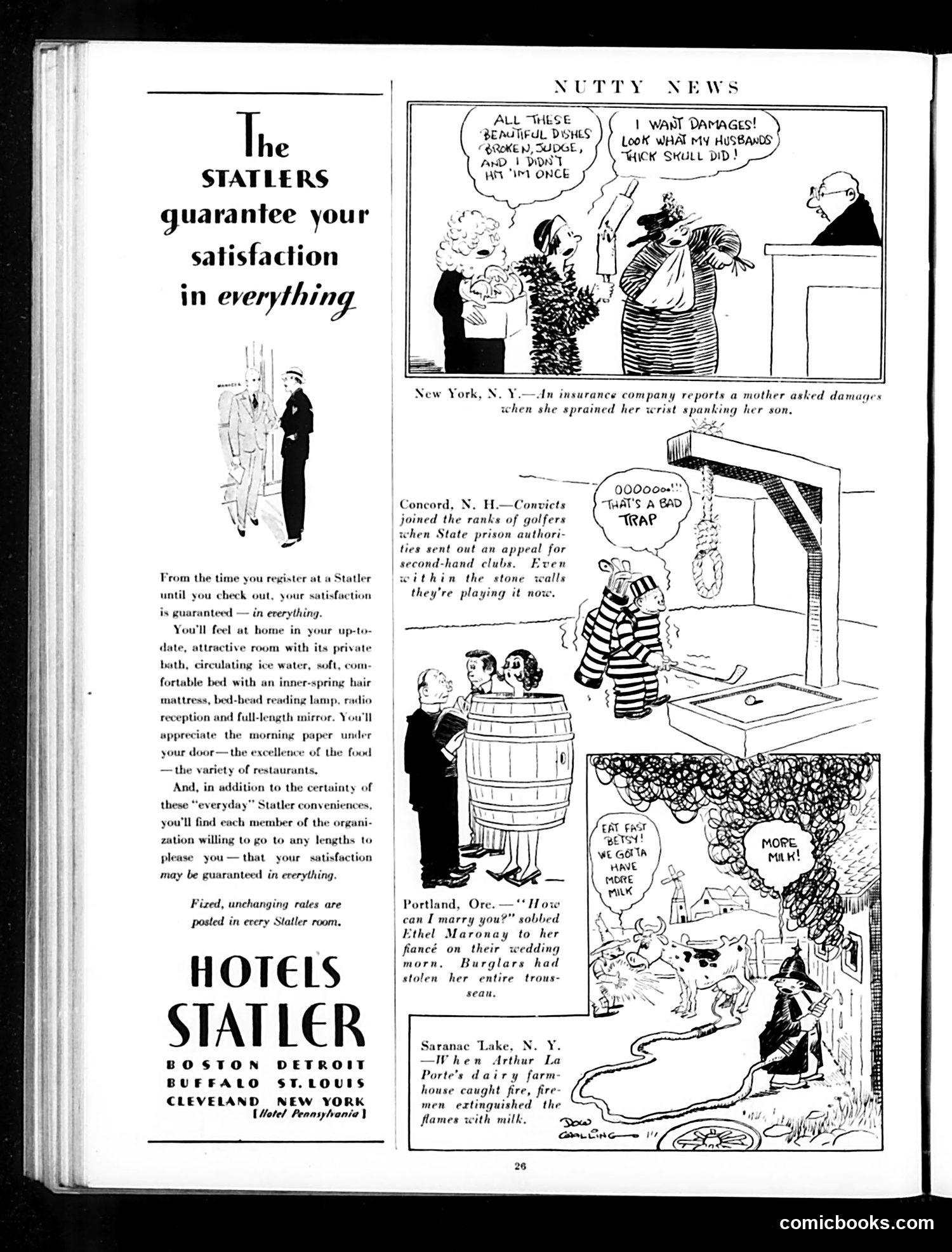
Nutty News: 1920s-30s Humor Magazine This page contains a Statler Hotels advertisement (left) and three unrelated humorous news briefs (right side, labeled "Nutty News"). The cartoons satirize absurd real events through exaggeration: 1. Top cartoon: A woman claims damages after spraining her wrist spanking her son—she's suing over injuries sustained while disciplining him, a commentary on frivolous lawsuit culture. 2. Middle cartoon: Convicts playing golf in prison. The joke is prisoners are treated so well they enjoy recreational activities, possibly satirizing either prison conditions or criminal leniency. 3. Bottom cartoon: A farmhouse fire extinguished using milk instead of water—absurd disaster management presented as fact. These were typical of *Judge* magazine's "Nutty News" format: taking ridiculous or ironic real-world incidents and presenting them with minimal commentary, letting the inherent absurdity create humor. The audience was expected to recognize these as exaggerated takes on actual news stories.
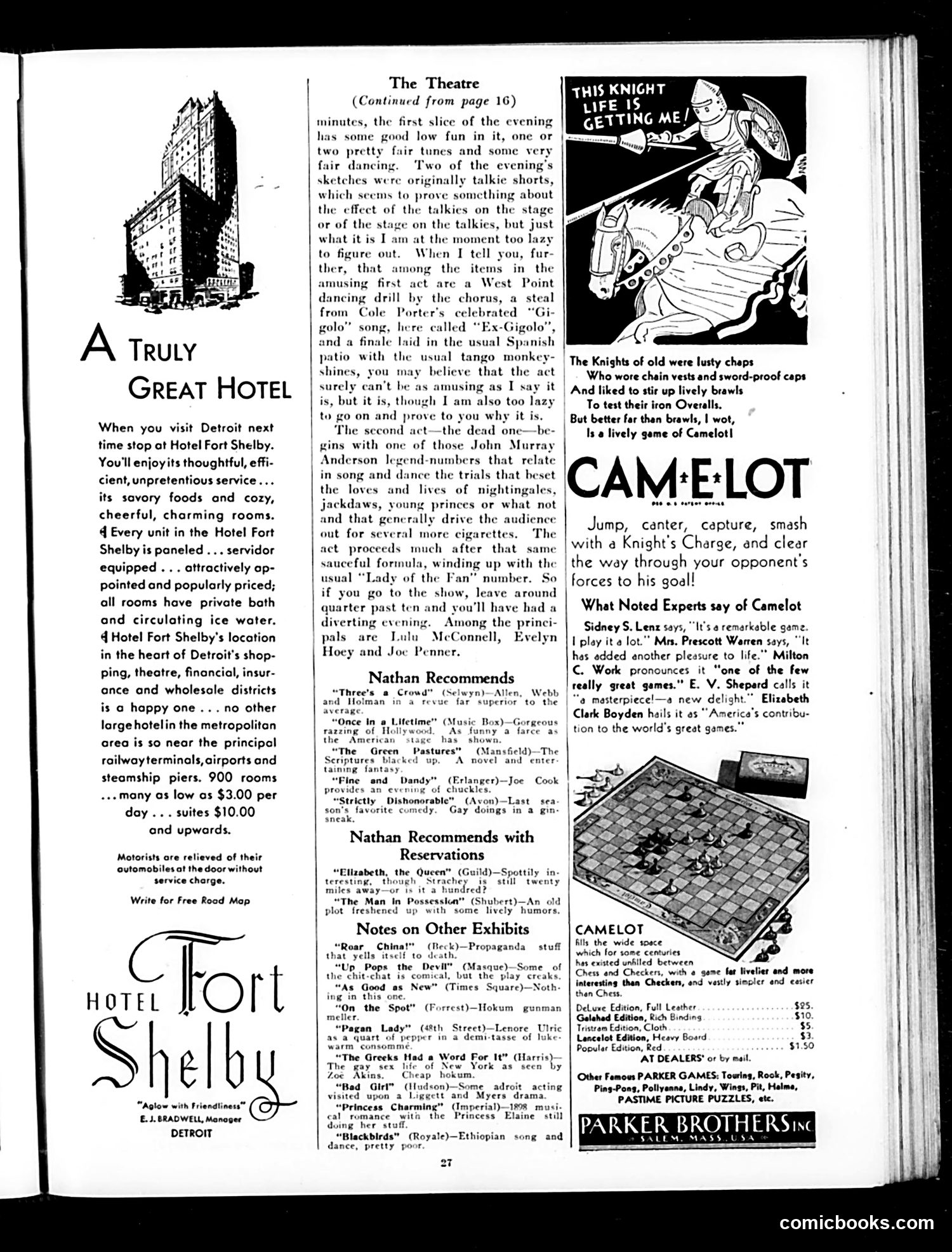
Analysis of This Judge Magazine Page This page is primarily advertising and theater reviews, not political satire. The main content includes: 1. Hotel Fort Shelby advertisement (left column): A straightforward Detroit hotel promotion emphasizing affordability ($3.00/day), modern amenities, and convenient location. 2. Theater column (center/right): Nathan's Broadway reviews of contemporary plays and musicals from the late 1920s, including "Camelot" (a board game advertisement), "Three's a Crowd," and "The Green Pastures." 3. Camelot game advertisement (right side): Promotes a chess-like strategy game with quotes from game experts. The only cartoon image appears to be a small illustration for the Camelot game showing a knight in medieval combat. No political satire is evident on this page. It represents typical Judge magazine content of the era: mixed advertising, entertainment reviews, and game promotions aimed at middle-class readers interested in theater and leisure activities.
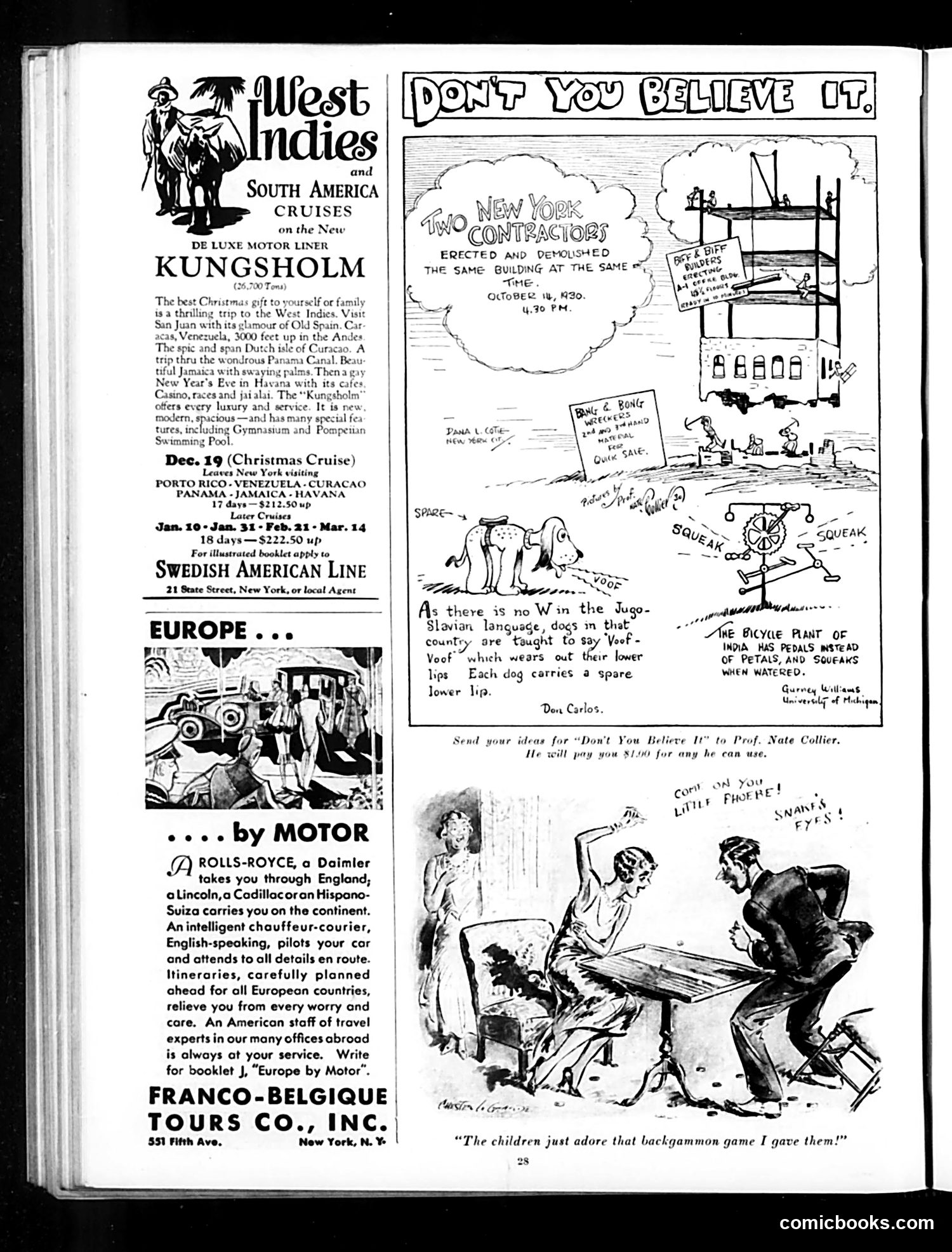
"Don't You Believe It" - Judge Magazine Satire Page This page features "Don't You Believe It," a recurring humor column in Judge magazine where readers submit absurd or dubious claims for comedic debunking. The main cartoon shows two New York contractors demolishing and immediately rebuilding the same building on October 18, 1930—at 4:70 PM (an impossible time). The joke mocks inefficient construction work and bureaucratic absurdity during the Depression era. A secondary joke by "Don Carlos" claims Yugoslavian dogs are trained to say "Voof" and wear out their lower lips, carrying spare lips as replacements. The absurdity is obvious. The final cartoon shows children playing backgammon, with the caption sarcastically suggesting they "adore" the game—implying children actually find it boring, contrary to what a gift-giver might believe. The page is primarily advertisements for luxury cruises (Swedish American Line) and European motor tours, typical of Judge's revenue model. The $1.00 payment offer incentivized reader submissions.
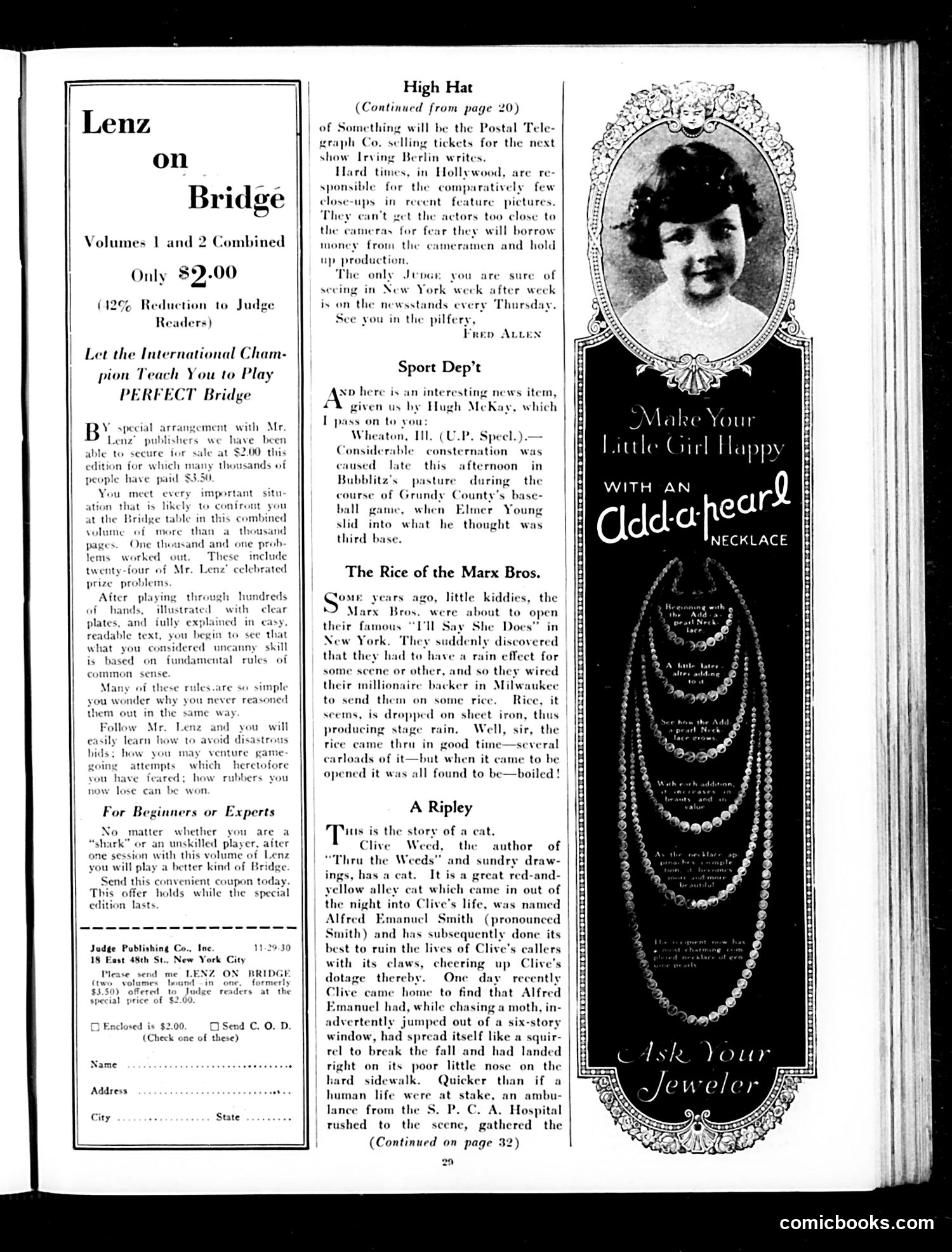
Content Analysis This page from *Judge* magazine contains primarily advertising and entertainment content rather than political satire. The main items are: 1. "Lenz on Bridge" advertisement—promoting a bridge instruction book by the International Champion, offered at a reduced price ($2.00 vs. $3.50). 2. "High Hat" column (continued)—gossip about Irving Berlin, Hollywood filmmaking practices, and theatrical anecdotes. 3. Sport Department item—a humorous anecdote about a baseball game incident at Bubblitz's pasture in Grundy County, Illinois. 4. "The Rice of the Marx Bros."—a joke about the Marx Brothers' theatrical production needing rice to simulate stage rain, only to receive boiled rice instead. 5. "A Ripley" story—a tall tale about a cat named Alfred Emanuel Smith that jumps from a six-story window. 6. Right side: Advertisement for "Add-a-Pearl" necklaces, featuring a portrait of a young girl. The page is primarily commercial and entertaining rather than satirical or political.
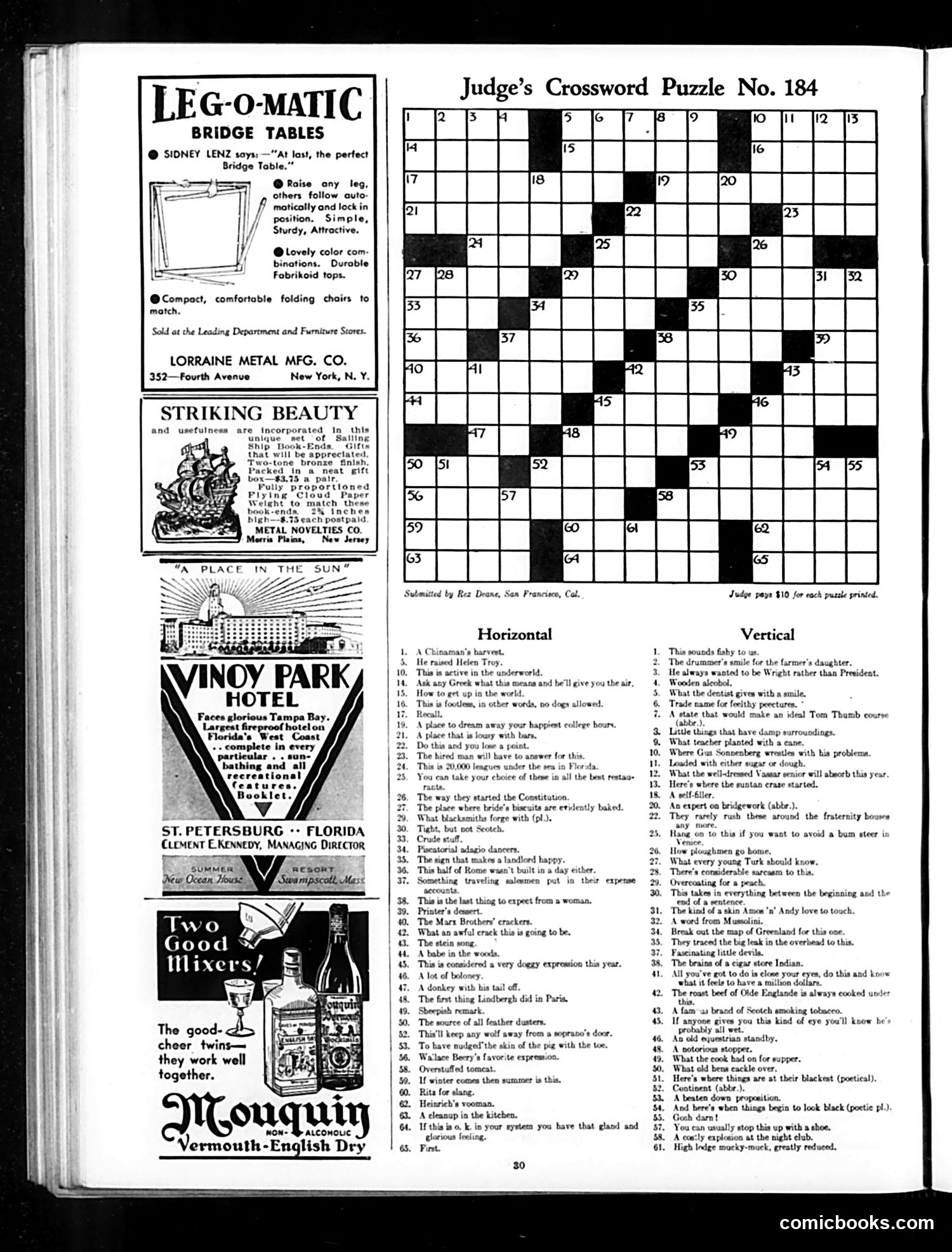
Judge Magazine, Page 80: Analysis This page is primarily advertising and a crossword puzzle rather than satirical content. The advertisements showcase 1920s-30s consumer goods: bridge tables (a popular parlor game), decorative sailing ship bookends, and Florida resort hotels. These ads reflect the era's emphasis on leisure activities and vacation destinations. The main content is Judge's Crossword Puzzle No. 184, a standard word puzzle with cultural references typical of the period. The clues reference contemporary entertainment (Marx Brothers, Lindbergh), sports figures (Gus Sonnenberg, wrestler), and popular culture (Amos 'n' Andy radio show, implied in clue references). The bottom advertisements include a vermouth brand ("Monquin"), emphasizing the post-Prohibition era when alcohol advertising had recently returned to magazines. There is no significant political satire visible on this page—it's a straightforward puzzle and product advertisement section from Judge magazine's interior pages.
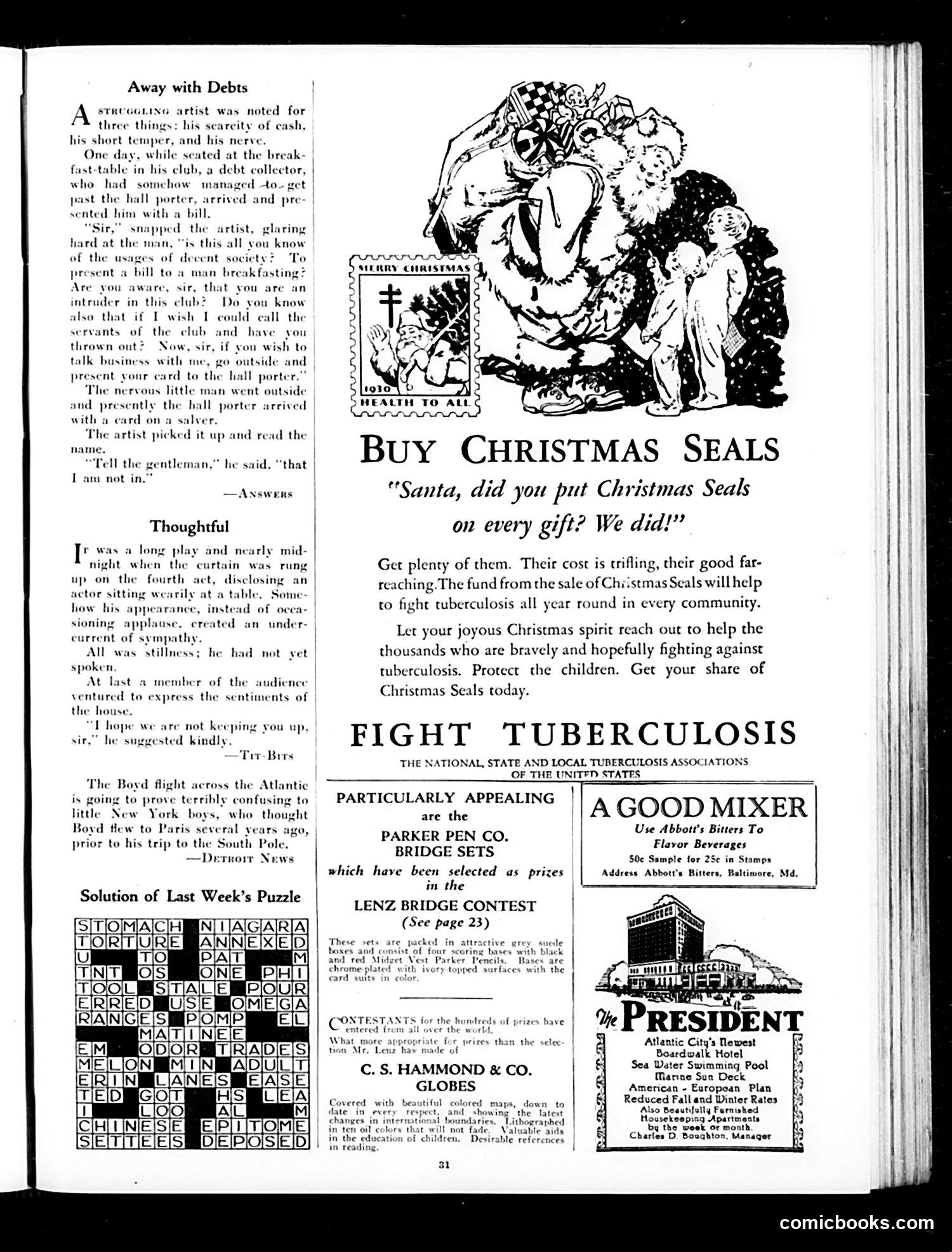
Judge Magazine Page Analysis This page contains three distinct sections: "Away with Debts" and "Thoughtful" are short humorous anecdotes (not political cartoons). The first depicts an artist snobbishly dismissing a debt collector by claiming club etiquette forbids presenting bills inside—then instructing him to return outside with a formal card. It's satire of pretension and the artist's use of social rules to evade financial responsibility. The second anecdote concerns a theater actor whose dignified but tired demeanor unexpectedly moves an audience to sympathy. The main illustration shows Santa Claus surrounded by children, accompanying an advertisement for Christmas Seals—a genuine fundraising initiative by tuberculosis associations. The ad urges readers to purchase and attach these seals to gifts to support TB treatment and prevention. The remaining content consists almost entirely of advertisements and announcements: Parker Pen bridge sets, C.S. Hammond globes, Abbott's Bitters, and The President Hotel in Atlantic City. This appears to be a typical Judge issue page blending light humor with commercial promotions and public health messaging.
Analysis of Judge Magazine Page (Circa 1920s-1930s) This page consists primarily of advertising and editorial content, not political satire. The main elements are: 1. "Christmas Shopping" Advertisement: Judge Publishing Company promotes gift subscriptions to their magazine as convenient Christmas presents. The pitch emphasizes comfort (shop from home) and value—recipients receive weekly humor magazines, which the company argues people "need a lot of laughs in these hard days." 2. "High Hat" Column: A gossipy sports anecdote about a man named Clive whose cat nearly dies and loses its ability to purr (whistles instead). The humor is light and personal rather than satirical. 3. "Recapitulation" Section: Sports commentary highlighting scandals from the football season—athletes dismissed for making wine, breaking training rules, and divorce proceedings. The tone mocks inconsistent athletic discipline rather than targeting specific political figures. The page reflects Judge's function as a general-interest humor and satire magazine of the era, mixing light entertainment with social commentary.
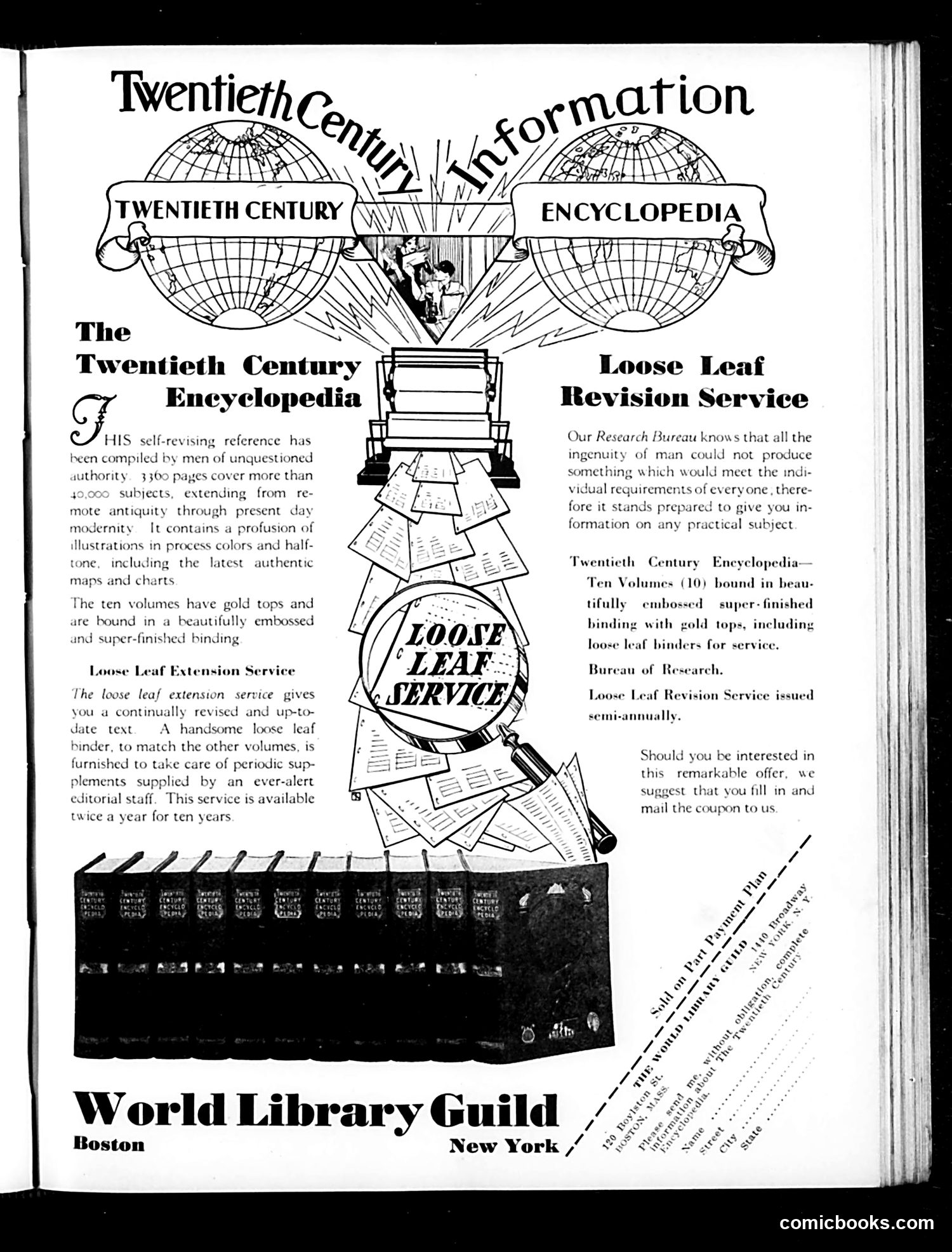
What This Page Means This is not a political cartoon or satire—it's a full-page advertisement for the *Twentieth Century Encyclopedia* published by the World Library Guild (Boston/New York). The ad promotes a ten-volume reference set with a novel selling point: a "Loose Leaf Revision Service" that provides subscribers with updated pages twice yearly for ten years. This was genuinely innovative for the early 20th century, when encyclopedias quickly became outdated. The elaborate central illustration depicts loose-leaf pages feeding into a binder mechanism—a visual metaphor showing how the encyclopedia stays current. The design emphasizes modernity and systematic organization, key appeals for a knowledge-seeking audience during the Progressive Era. There is no satire or political commentary here. It's straightforward commercial promotion targeting educated, middle-class readers who valued self-improvement through accessible reference materials.
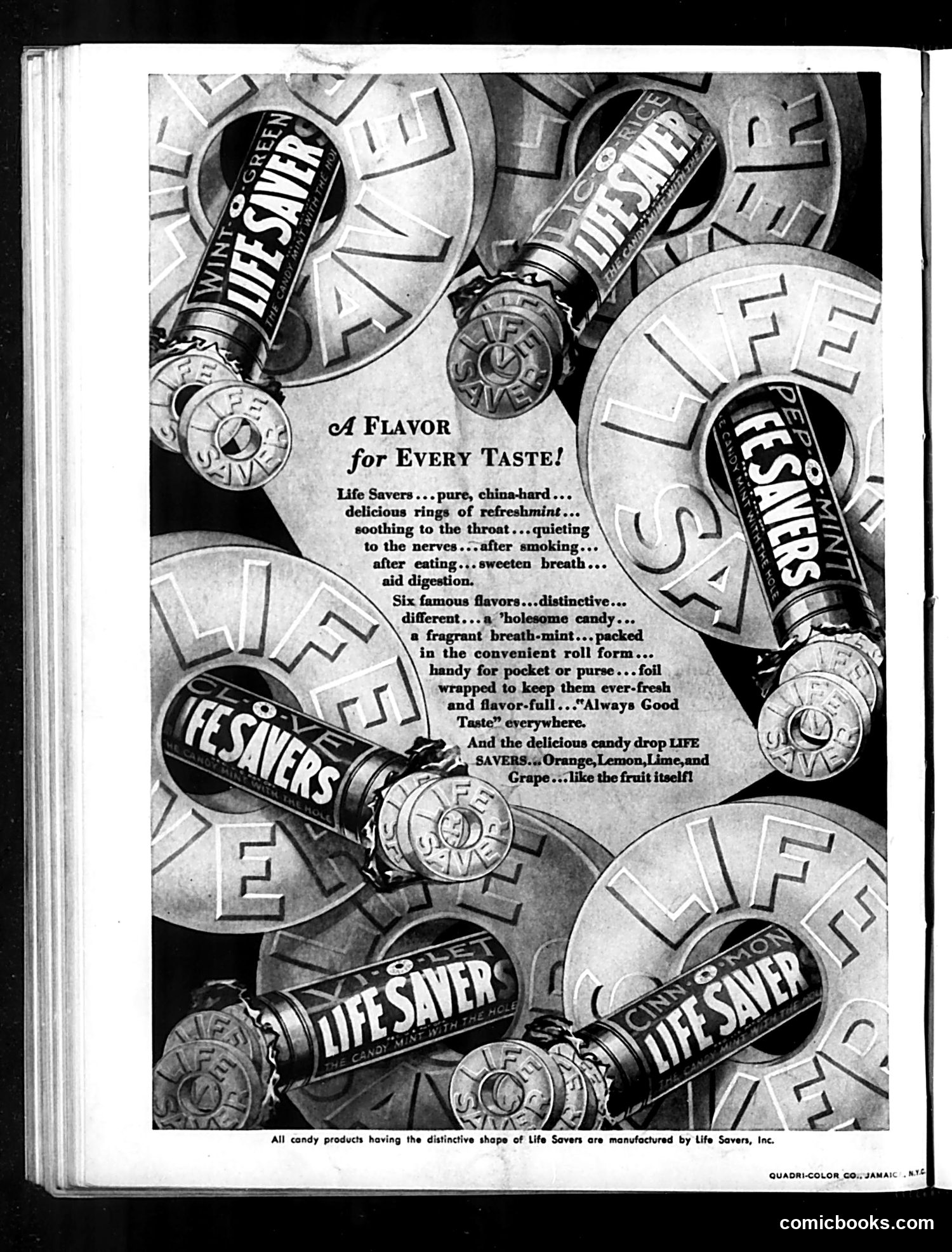
Advertisement Analysis This is a Life Savers candy advertisement, not political satire. The page promotes Life Savers' six flavors (Orange, Lemon, Lime, and Grape are mentioned) in their distinctive roll packaging. The visual design arranges Life Saver rolls and candies around large letters spelling "LIFE," creating an eye-catching geometric composition typical of 1920s-30s advertising design. The copy emphasizes the product's practical benefits: refreshment, throat-soothing, nerve-calming properties, breath-sweetening, and digestive aid—marketing claims common to vintage candy advertisements that would face regulatory challenges today. The tagline "A Flavor for Every Taste" highlights product variety as a selling point. No political commentary or satire is present; this is straightforward commercial advertising placed in *Judge* magazine.