judge
Judge — December 6, 1930
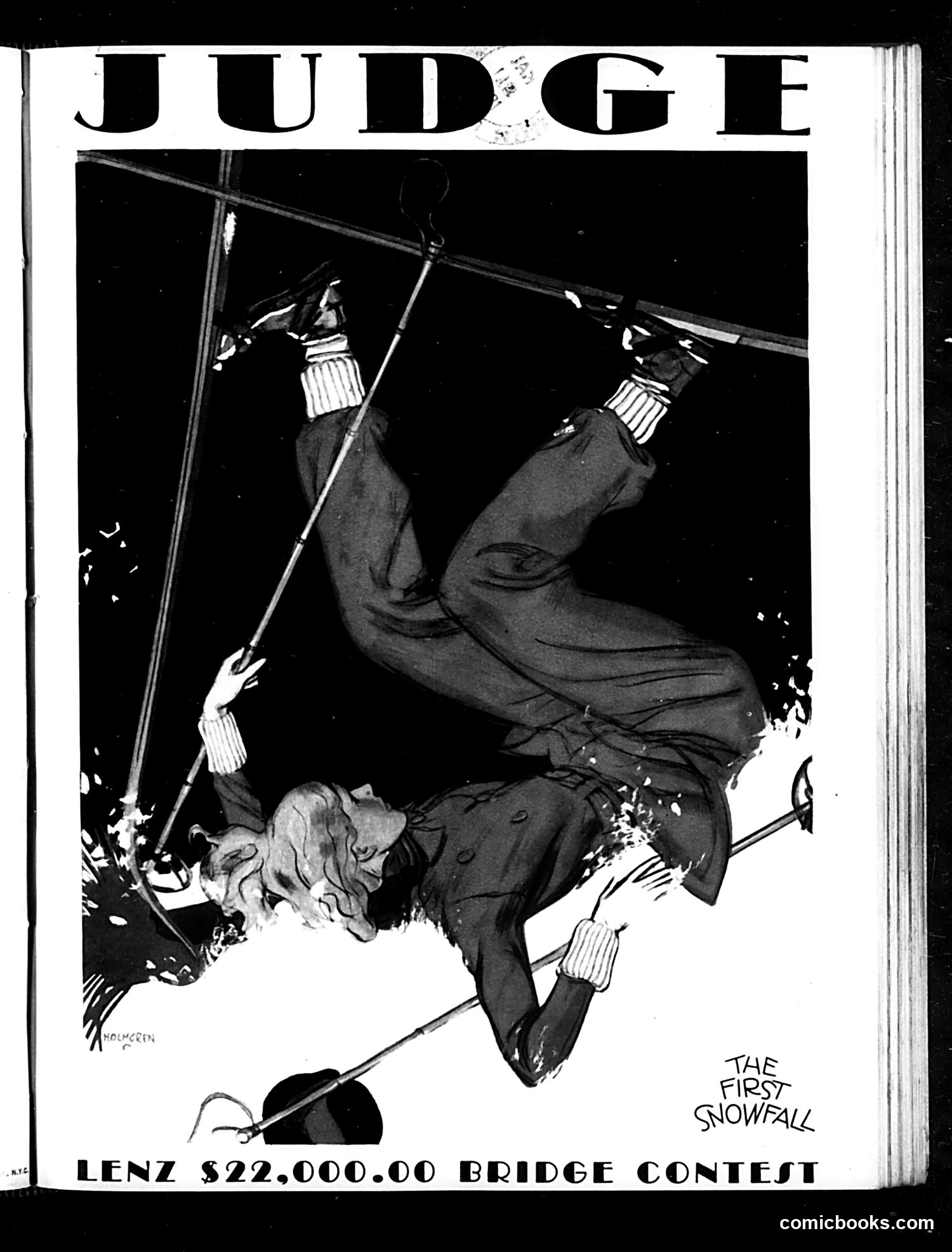
Analysis of Judge Magazine Page This appears to be a cover or advertisement page for Judge magazine featuring a cartoon titled "The First Snowfall." The image shows a figure in military dress (identifiable by the ornate epaulettes on the shoulders) who has fallen or been knocked over in the snow, lying on their back in an undignified position. The page advertises a "Lenz $22,000.00 Bridge Contest," suggesting this was a promotional or contest-related issue. Without additional context about the specific historical period or the "Lenz" reference, the exact political satire remains unclear. However, the juxtaposition of a dignified military figure in an embarrassing, fallen position suggests mockery of military authority or a specific public figure—a common theme in Judge's satirical content.
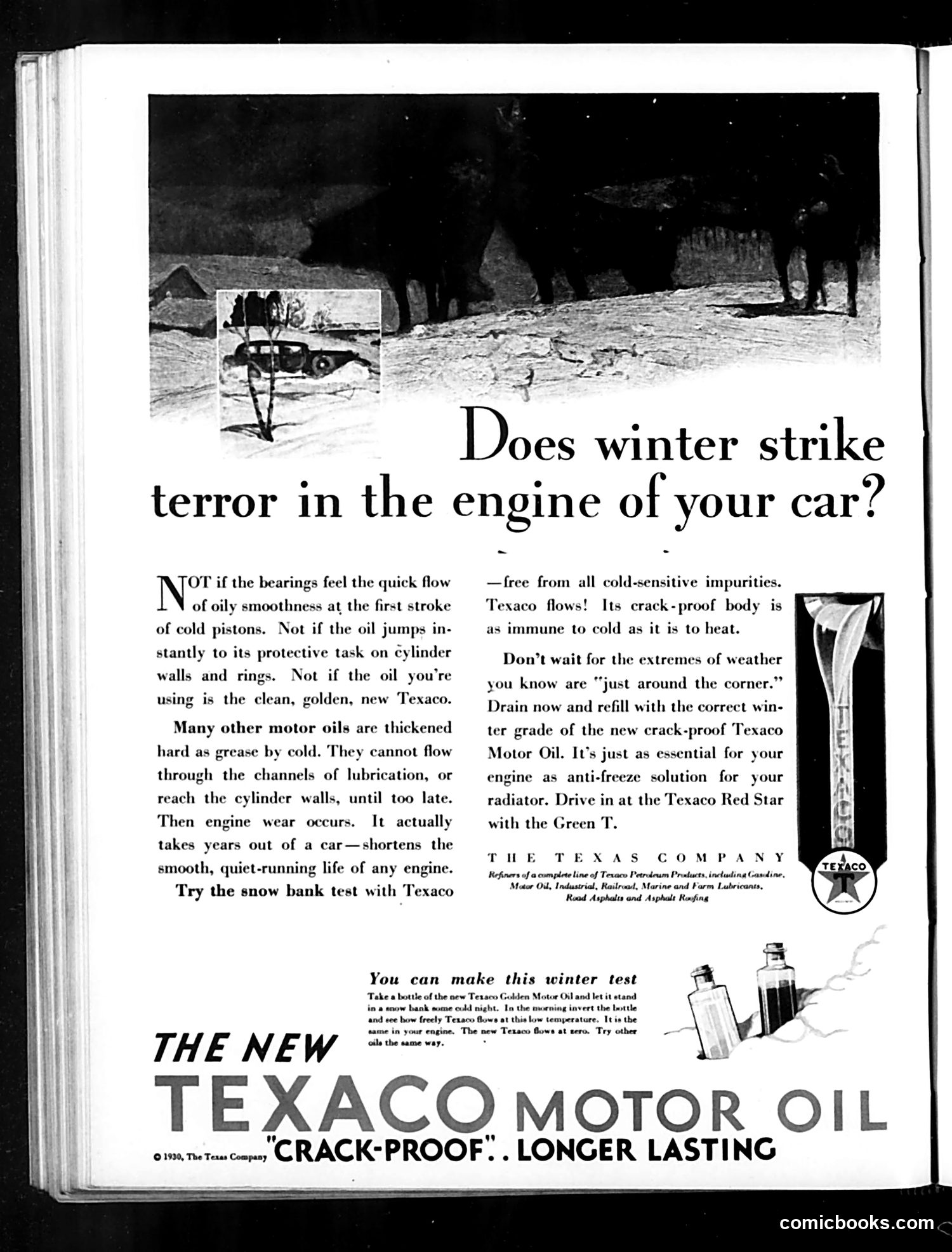
Analysis This is not a political cartoon or satire, but rather a straightforward advertisement for Texaco Motor Oil from 1935 (copyright visible). The ad addresses a genuine consumer concern of the era: winter engine problems. It claims Texaco's "crack-proof" motor oil remains fluid in cold weather, unlike competitors' oils that thicken and fail to lubricate properly—causing engine wear. The visual elements include: - A snowy rural scene with a stalled car and cattle - An inset photo of an old vehicle in snow - A product bottle illustration - A "snow bank test" demonstrating the oil's cold-weather performance The ad's language ("terror in the engine," "immune to cold") uses dramatic rhetoric typical of 1930s marketing to emphasize product superiority. This represents early automotive advertising targeting seasonal maintenance concerns.
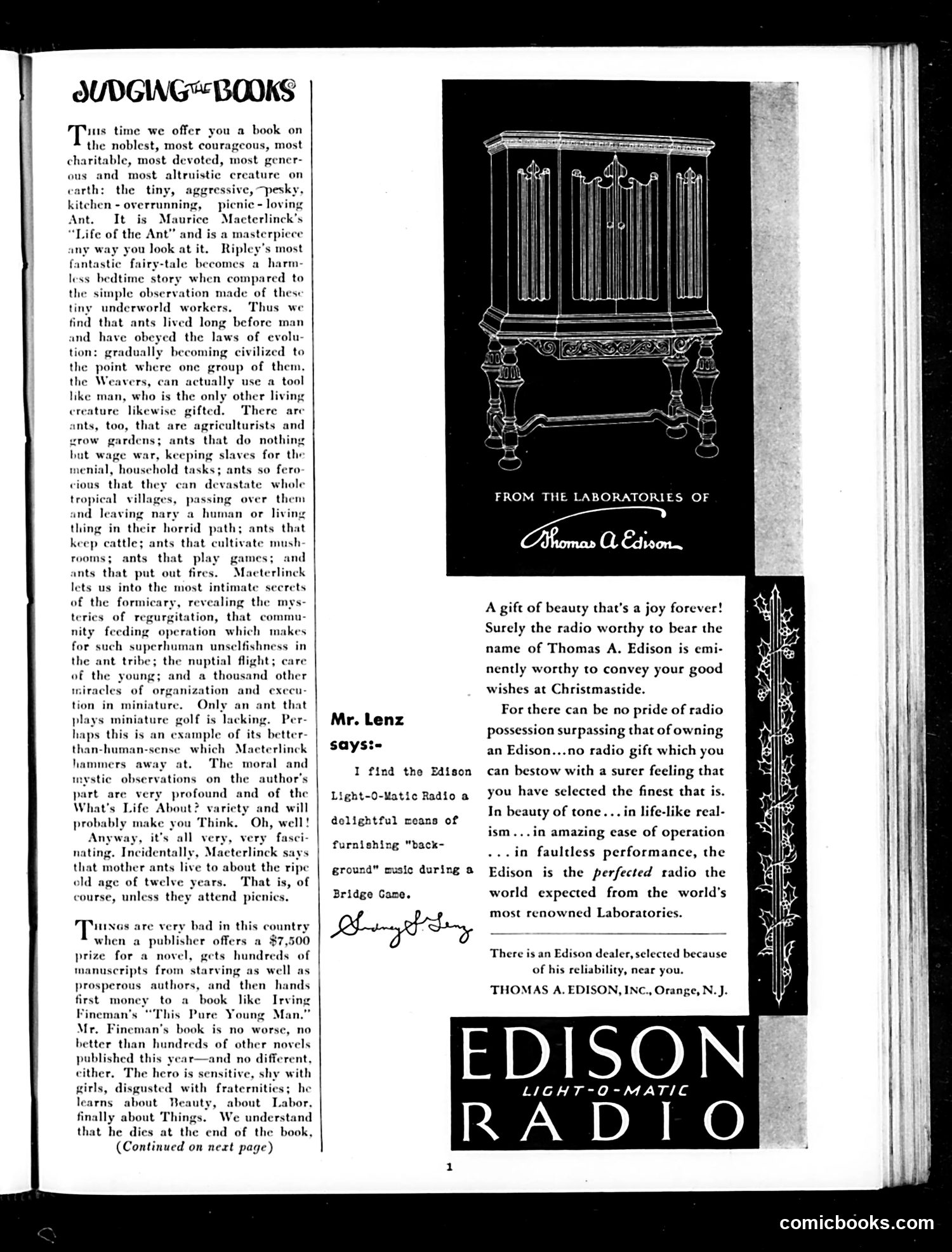
Page Analysis This page is primarily advertising, not satirical content. The left column contains a book review column titled "Judging the Books," discussing Maurice Maeterlinck's "Life of the Ant" and Irving Fineman's "This Pure Young Man." The right side features a full-page Edison Light-O-Matic Radio advertisement. It includes an ornate radio cabinet illustration and testimonial from "Mr. Lenz" praising the radio's sound quality for background music during bridge games. The advertisement emphasizes the radio as a luxury gift item worthy of bearing Thomas Edison's name, positioning it as the "perfected radio the world expected from the world's most renowned Laboratories." This reflects early 1920s radio commercialization and Edison's brand prestige. There is no political cartoon or satire on this page.
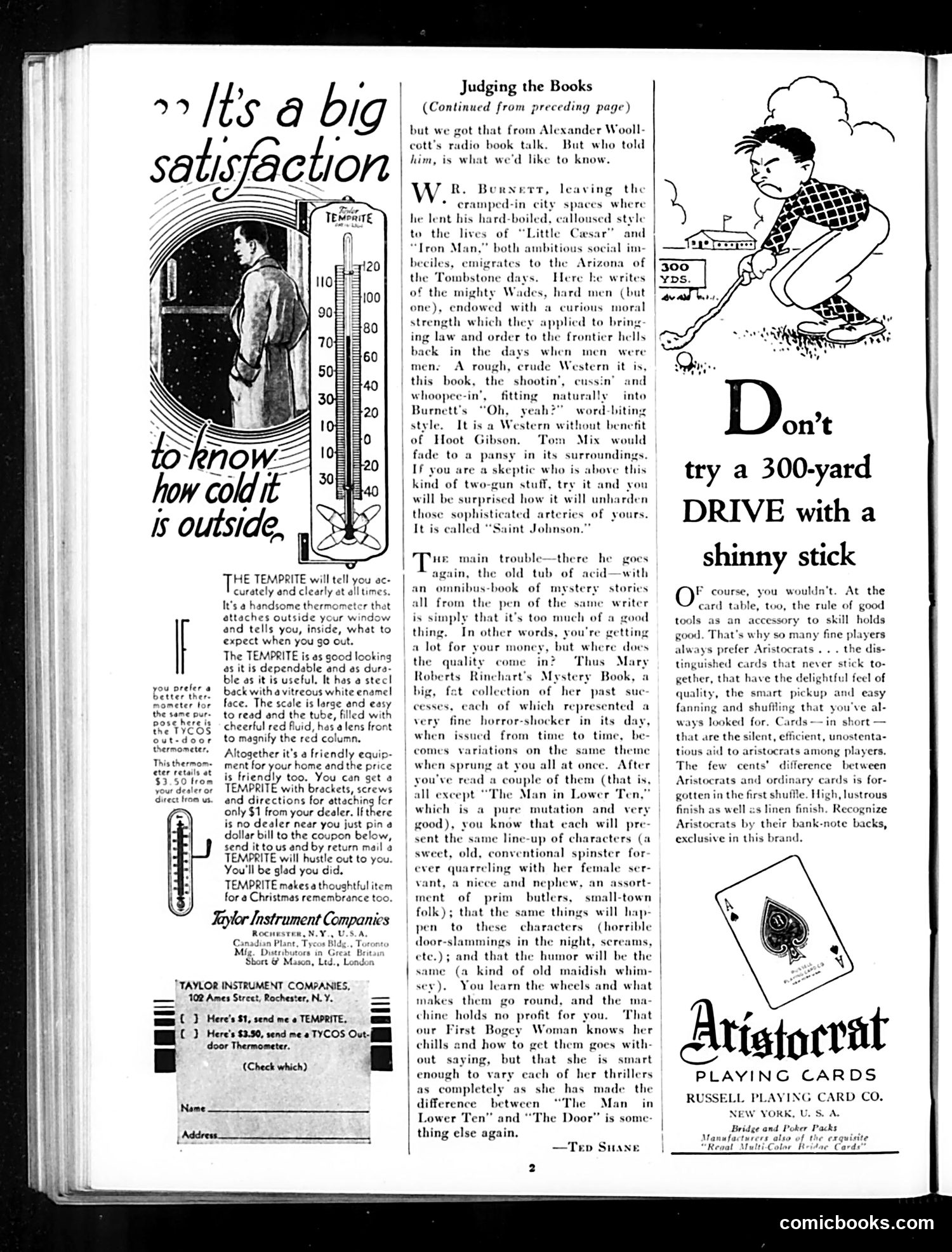
Page Analysis This page is primarily book reviews and advertisements rather than political satire. The main content features "Judging the Books," a column reviewing recent publications including W.R. Burnett's Western novel "Saint Johnson" and Mary Roberts Rinehart's mystery collection. Critic Ted Shane discusses how mystery stories have become formulaic—characters and plot devices repeat across different books, making them predictable despite their popularity. The advertisements include a Tempite thermometer (left) and Aristocrat Playing Cards (right). The cartoon "Don't try a 300-yard drive with a shinny stick" (center-right) appears to be a humorous sports illustration unrelated to the book reviews, likely cautioning against using inferior equipment for golf. The page demonstrates Judge's mix of literary criticism and commercial advertising typical of 1920s-30s magazines.
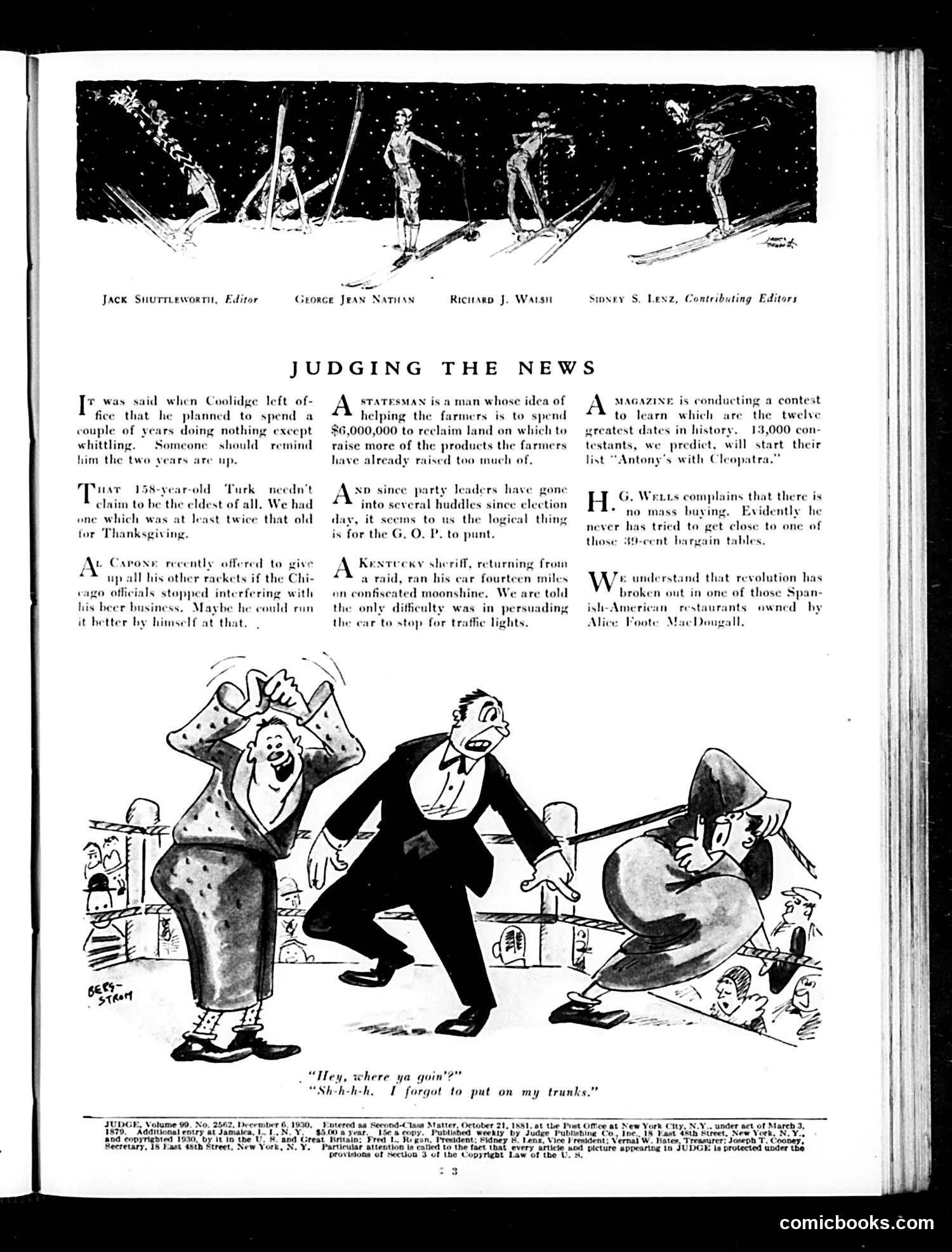
"Judging the News" - December 6, 1930 This page contains brief satirical commentary on recent news items alongside a cartoon. The visible jokes mock political figures and institutions: references to Coolidge's idleness, a statesman's plan to spend $6 million reclaiming farmland, party leaders' post-election "huddles," complaints about lack of mass buying, and a revolution at a Spanish-American restaurant. The main cartoon depicts a domestic scene: a man in formal wear appears caught between two women arguing, with the caption "Hey, where ya goin'?" / "Sh-h-h. I forgot to put on my trunks." This is likely a marital infidelity joke, suggesting the man is sneaking away for an illicit encounter. The cartoon's humor relies on 1930s social conventions around propriety and marriage.
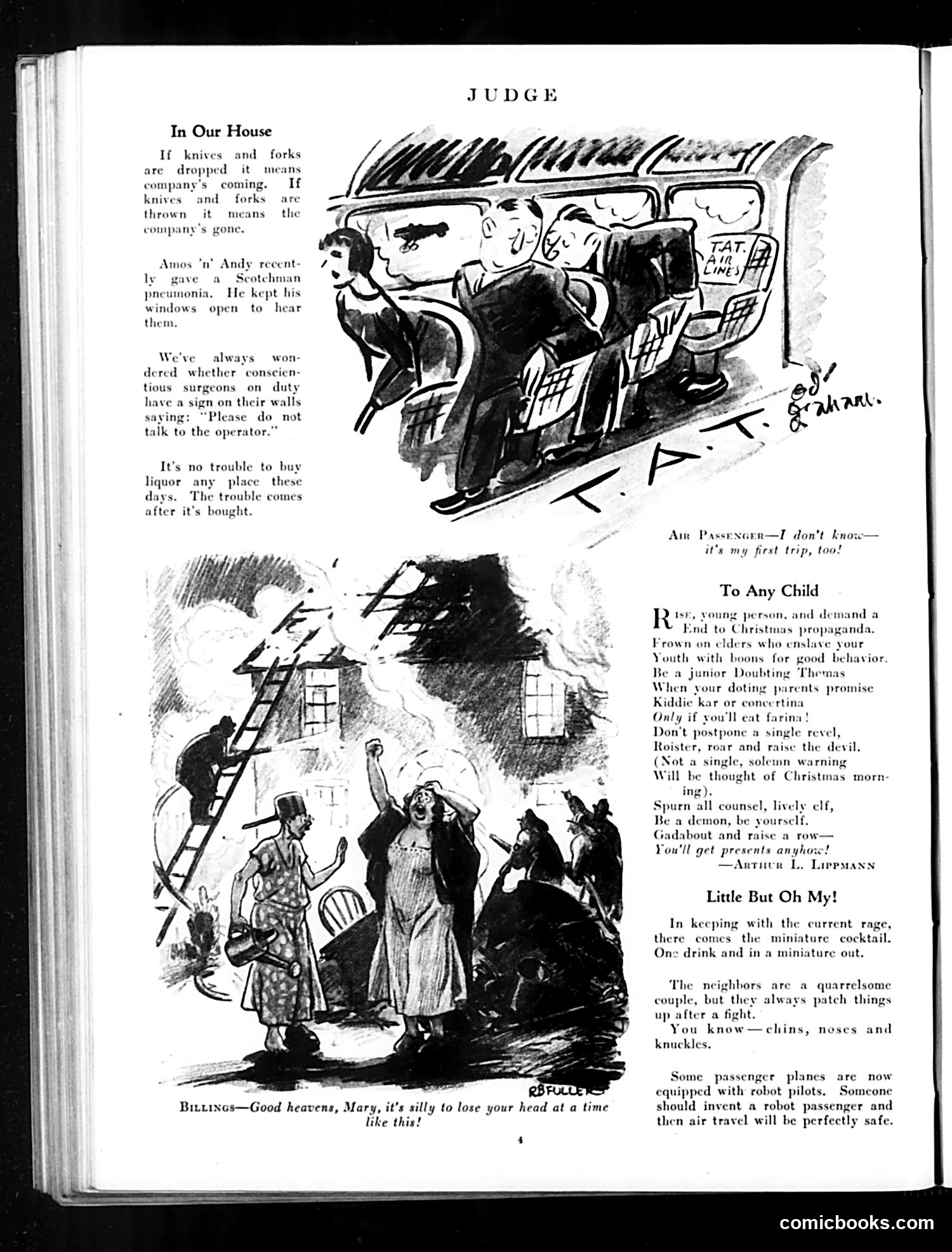
Analysis of Judge Page This page contains three separate satirical pieces: "In Our House" mocks Prohibition-era social hypocrisy—dropping silverware signals company arrival, but the real concern is purchasing illegal liquor afterward. The joke highlights how Americans circumvented alcohol bans through informal networks. "Judge as Air Passenger" (top cartoon) depicts crowded, chaotic train travel, with the caption humorously suggesting a first-time passenger. It satirizes overcrowded transportation conditions of the era. "To Any Child" by Arthur L. Lippmann sarcastically urges children to misbehave during Christmas, inverting parental warnings. It's humorous social commentary on holiday expectations. "Billings" (bottom) shows domestic chaos—a woman losing her head literally—satirizing marital discord and domestic violence through absurdist humor typical of Judge's style. The page reflects 1920s American concerns: Prohibition enforcement, transportation infrastructure, and family dynamics.
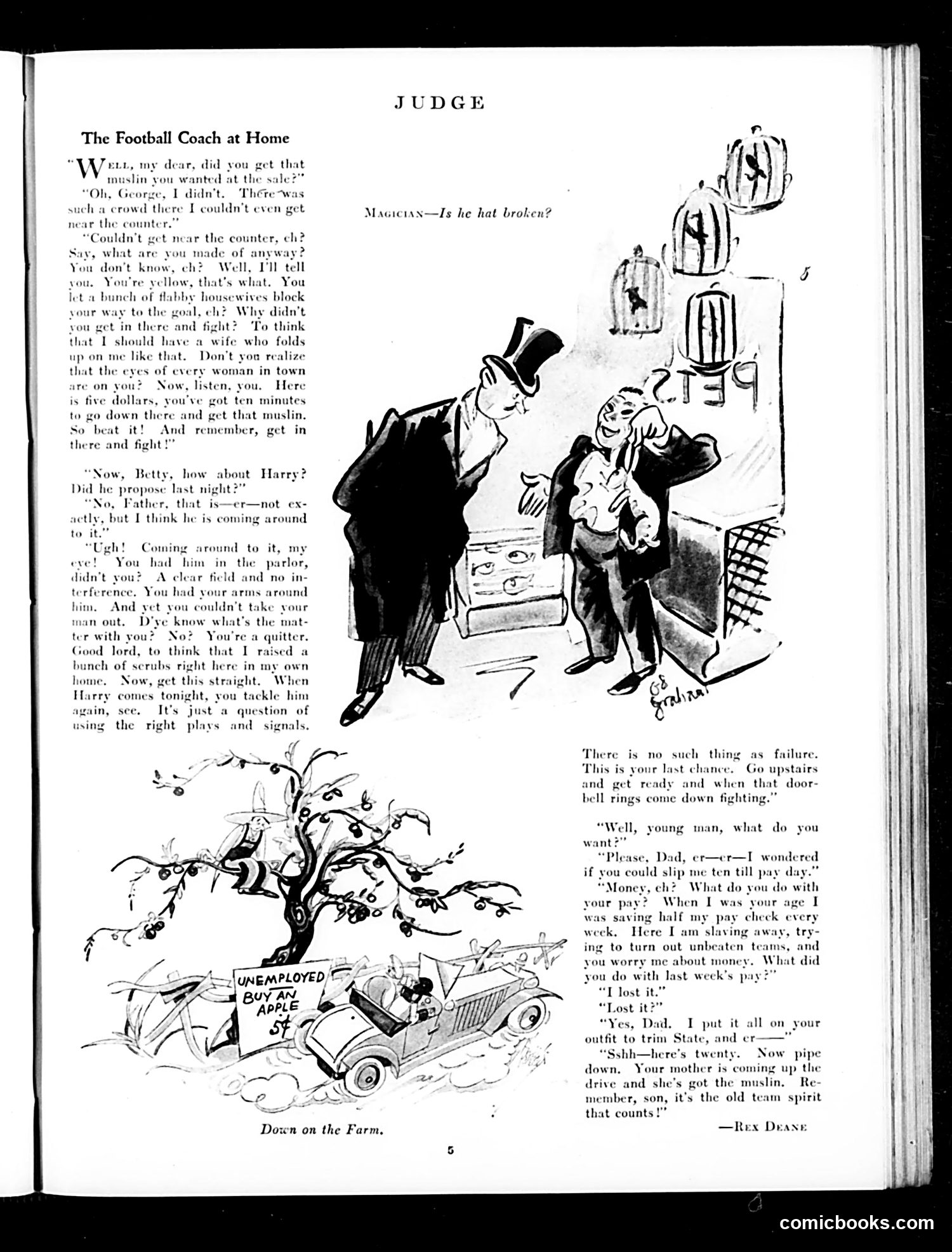
"The Football Coach at Home" - Judge Magazine This satirical piece depicts a stern football coach lecturing his son Harry about masculine toughness and fighting spirit. The coach uses football metaphors—"tackle him," "right plays and signals"—to pressure his son into aggressive behavior, claiming real men don't back down. The humor lies in the contradiction: the coach demands Harry be tough and combative, yet earlier discovers his son couldn't propose to a girl because he was intimidated by onlookers' judgment. The coach's own anxieties about social perception undermine his tough-guy posturing. The accompanying "Down on the Farm" cartoon satirizes unemployment during economic hardship, showing an "unemployed apple" in a disabled vehicle—likely Depression-era commentary on joblessness and agricultural distress.
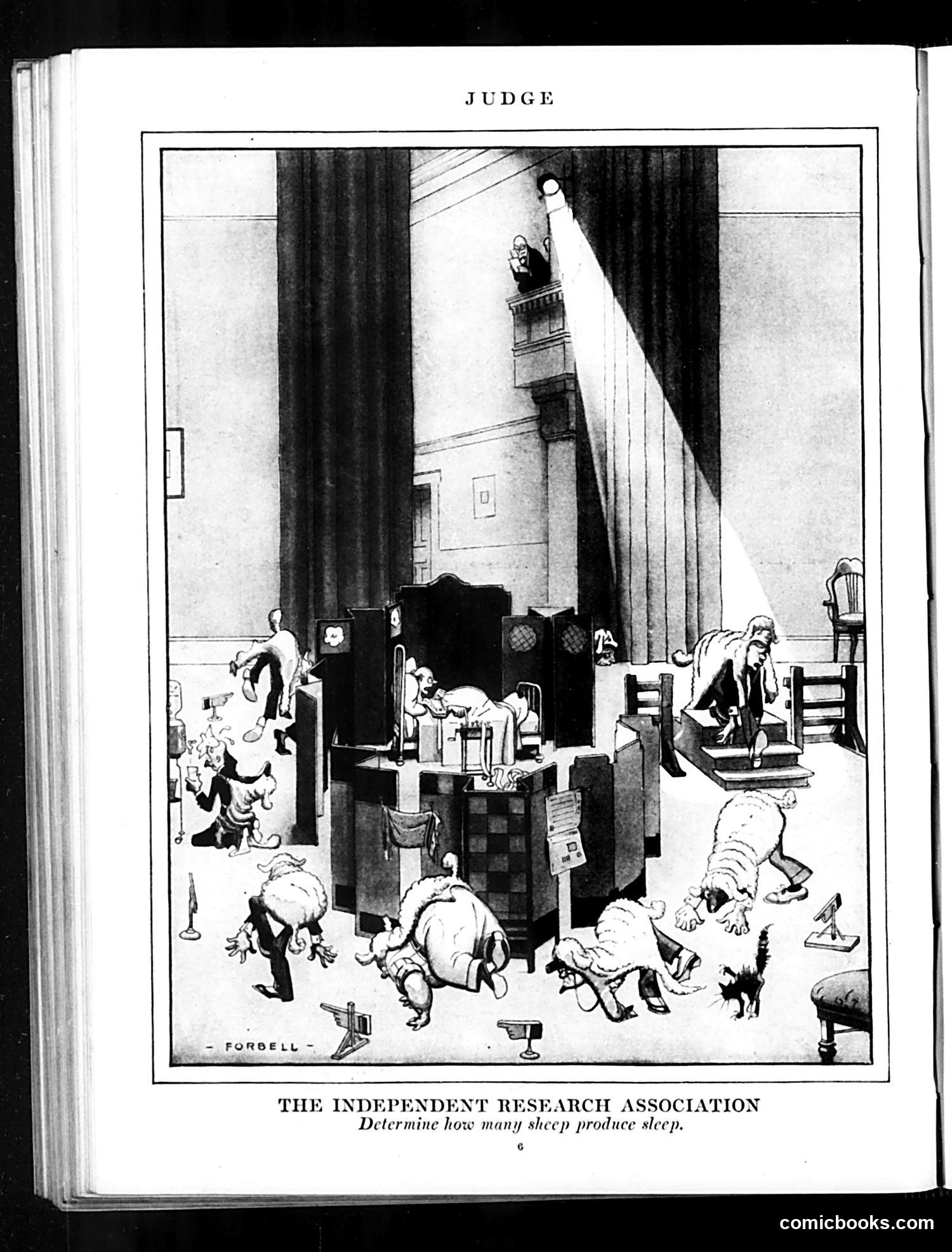
Judge Magazine Cartoon Analysis This is a satirical cartoon titled "The Independent Research Association: Determine how many sheep produce sleep." The artist is Forbell. The cartoon depicts a courtroom scene where various figures (appearing as caricatured men in suits) are conducting an absurd "research" experiment. Men in the foreground are bent over on all fours, apparently acting as "sheep" while being studied by suited observers above them. The joke plays on the common expression that "counting sheep" helps produce sleep—by literalizing it as an actual research question requiring formal investigation and a courtroom setting. The satire appears to mock pseudo-scientific organizations and their ridiculous pursuits, suggesting that the "Independent Research Association" engages in frivolous, nonsensical studies dressed up in official-sounding language and formal proceedings.
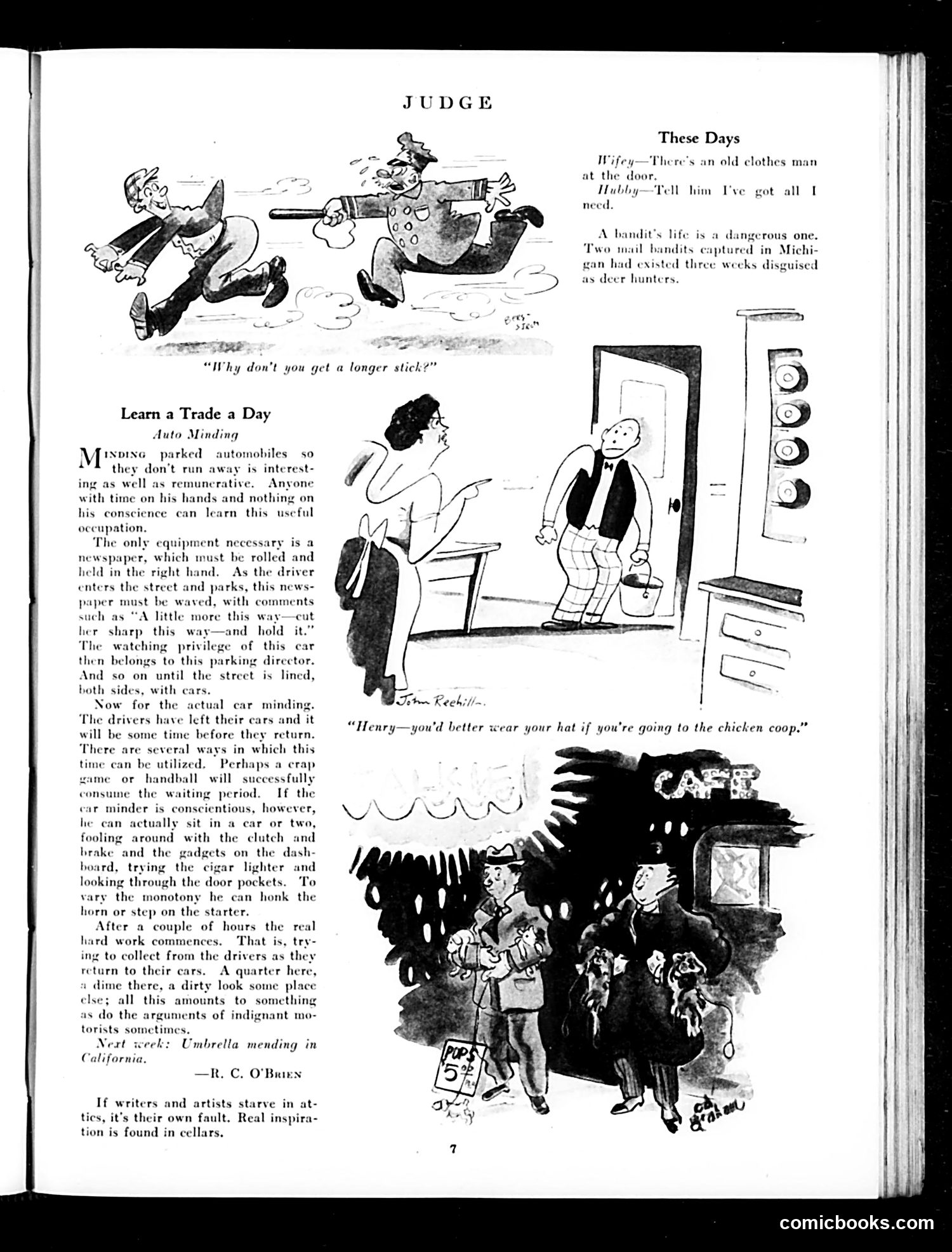
Explanation for Modern Readers This Judge magazine page contains three satirical pieces: "These Days" (top): A husband dismisses an old clothes dealer at the door, claiming he has everything he needs. The accompanying anecdote jokes darkly about two Michigan mail bandits who posed as deer hunters for three weeks—satirizing how desperate criminals must become. "Learn a Trade a Day: Auto Minding": This is the page's main satirical article, mocking the informal "parking attendant" hustle of the era. Men would stand in streets with rolled newspapers, directing parked cars' positioning, then demand tips from returning drivers. The piece sarcastically presents this as a legitimate "trade," describing how attendants occupy waiting time with gambling, gambling, or tinkering with cars they don't own—then hassle drivers for payment. It's satire on both petty street hustles and the gullibility of car owners. Bottom cartoons: Minor domestic humor about visiting a chicken coop and writers starving in cities. The overall tone mocks working-class economic desperation and informal street-economy schemes of the 1920s-era.
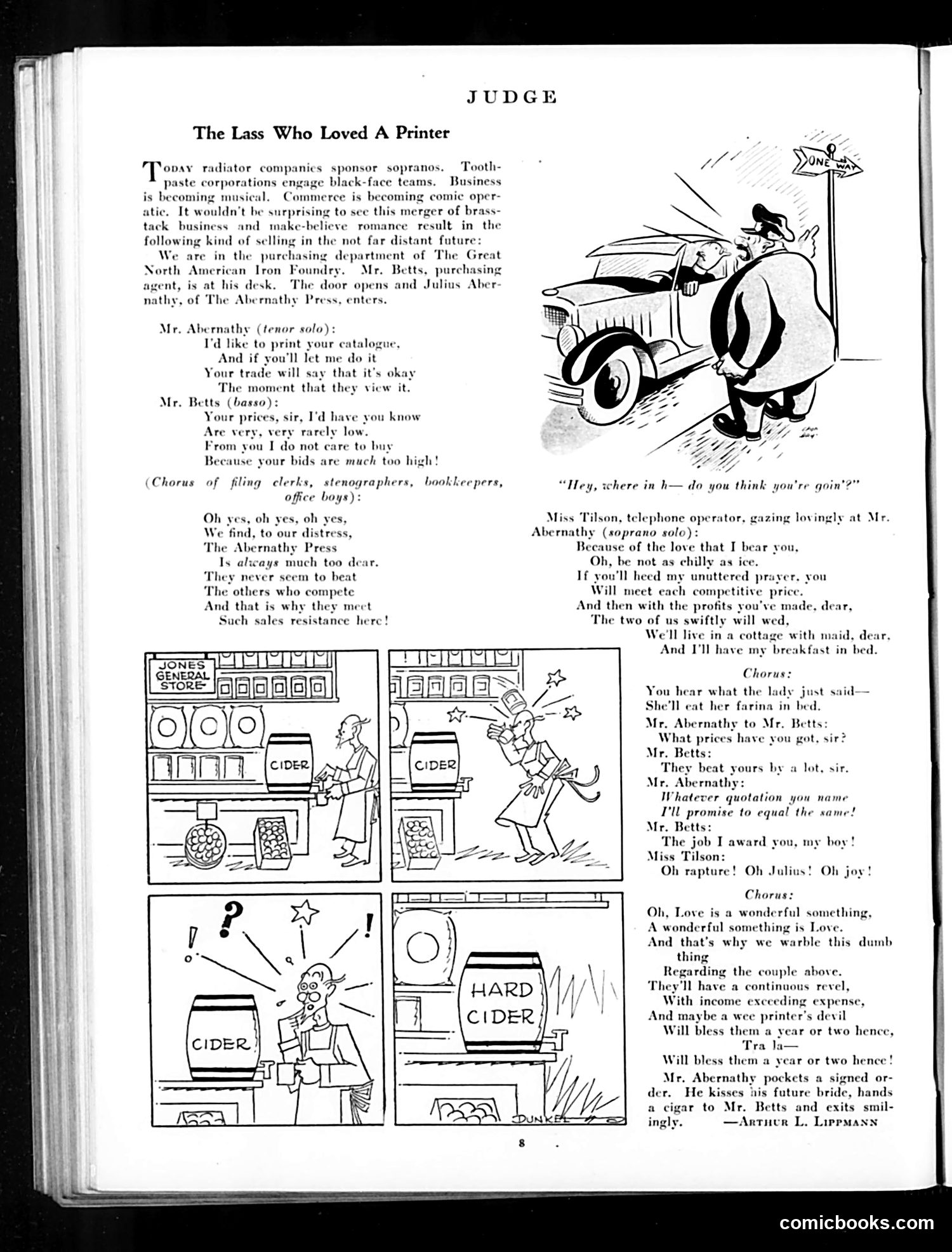
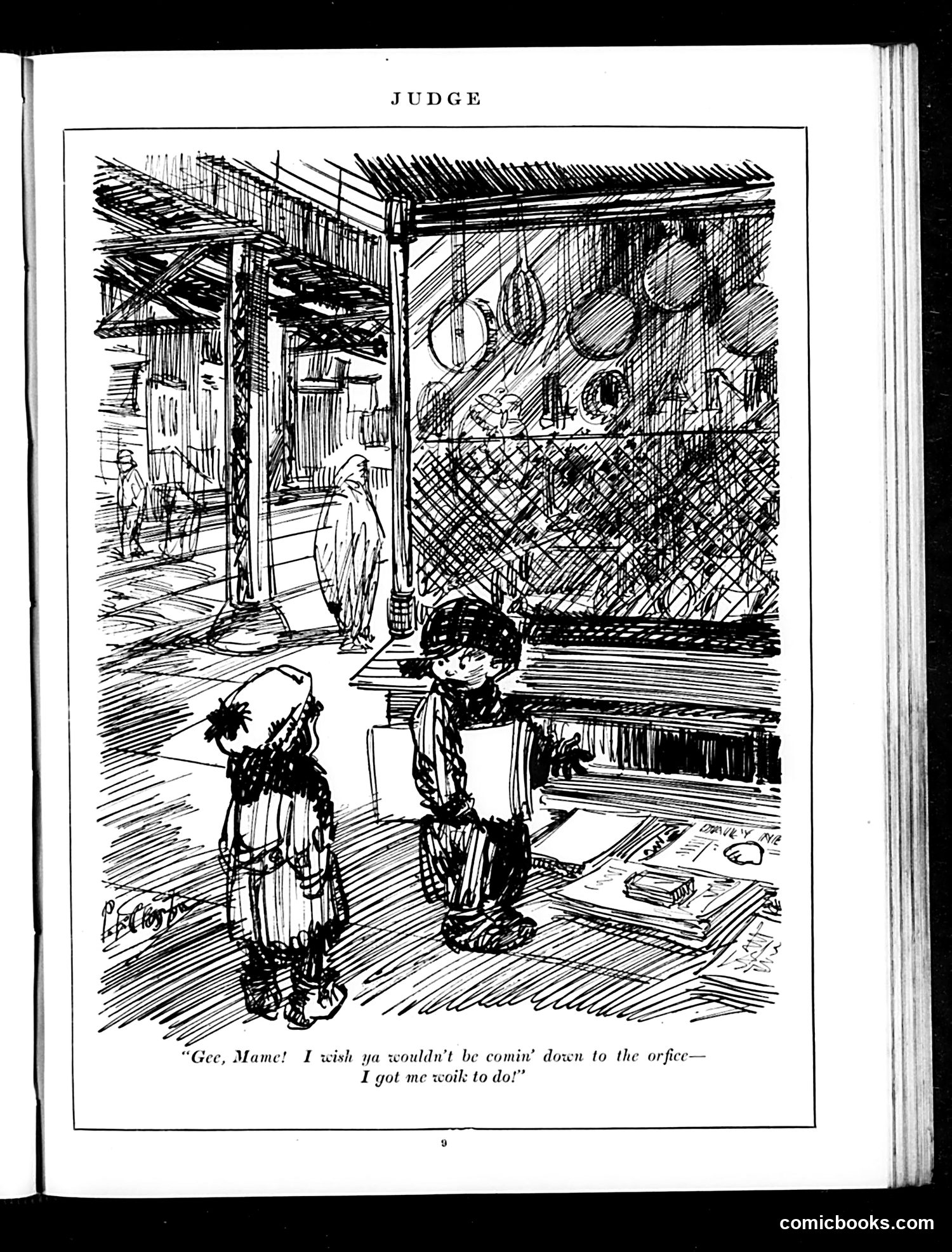
"Judge" Cartoon Analysis This single-panel cartoon depicts a domestic scene in what appears to be a judge's office or legal workspace. A child speaks to an adult woman (presumably his mother, "Mame"), expressing reluctance about her visiting his workplace: "Gee, Mame! I wish ya wouldn't be comin' down to the office—I got me woik to do!" The humor lies in the contrast between the formal legal setting and the child's casual, working-class dialect. The satire likely mocks either nepotism in the legal profession (a parent visiting/interfering with a child's job) or the incongruity of a young person working in such an official environment. The casual speech pattern emphasizes class differences, a common Judge magazine theme satirizing workplace dynamics and social pretension.
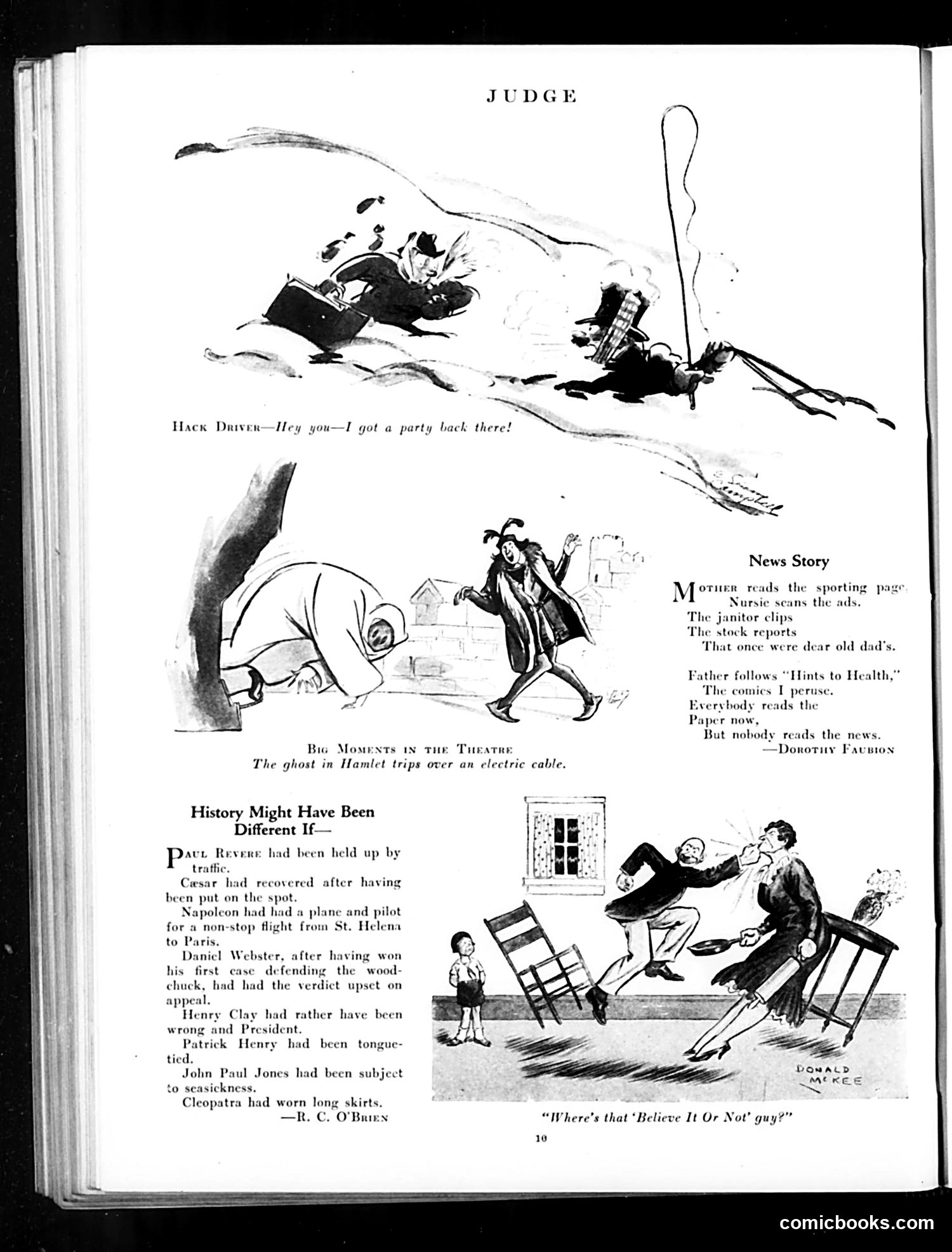
Judge Magazine Page Analysis This page contains three distinct satirical pieces: "News Story" (poem by Dorothy Fabison): Mocks how modern newspaper readers selectively consume content—everyone reads sports, ads, comics, and financial sections, but deliberately avoids actual news. This reflects early 20th-century cynicism about public disinterest in substantive journalism. "Big Moments in the Theatre": A single-panel joke about Hamlet's ghost tripping over an electric cable—anachronistic humor contrasting Shakespeare's supernatural drama with modern electrical technology. "History Might Have Been Different If": A humorous counterfactual list suggesting absurd alternate histories (Paul Revere delayed by traffic, Napoleon with an airplane, etc.). The final entry appears to reference a contemporary phenomenon or person ("Believe It Or Not guy"), likely alluding to Robert Ripley's famous odditorium column popular in that era. The cartoons criticize media consumption habits and use theatrical/historical references for comedic effect typical of Judge's satirical approach.
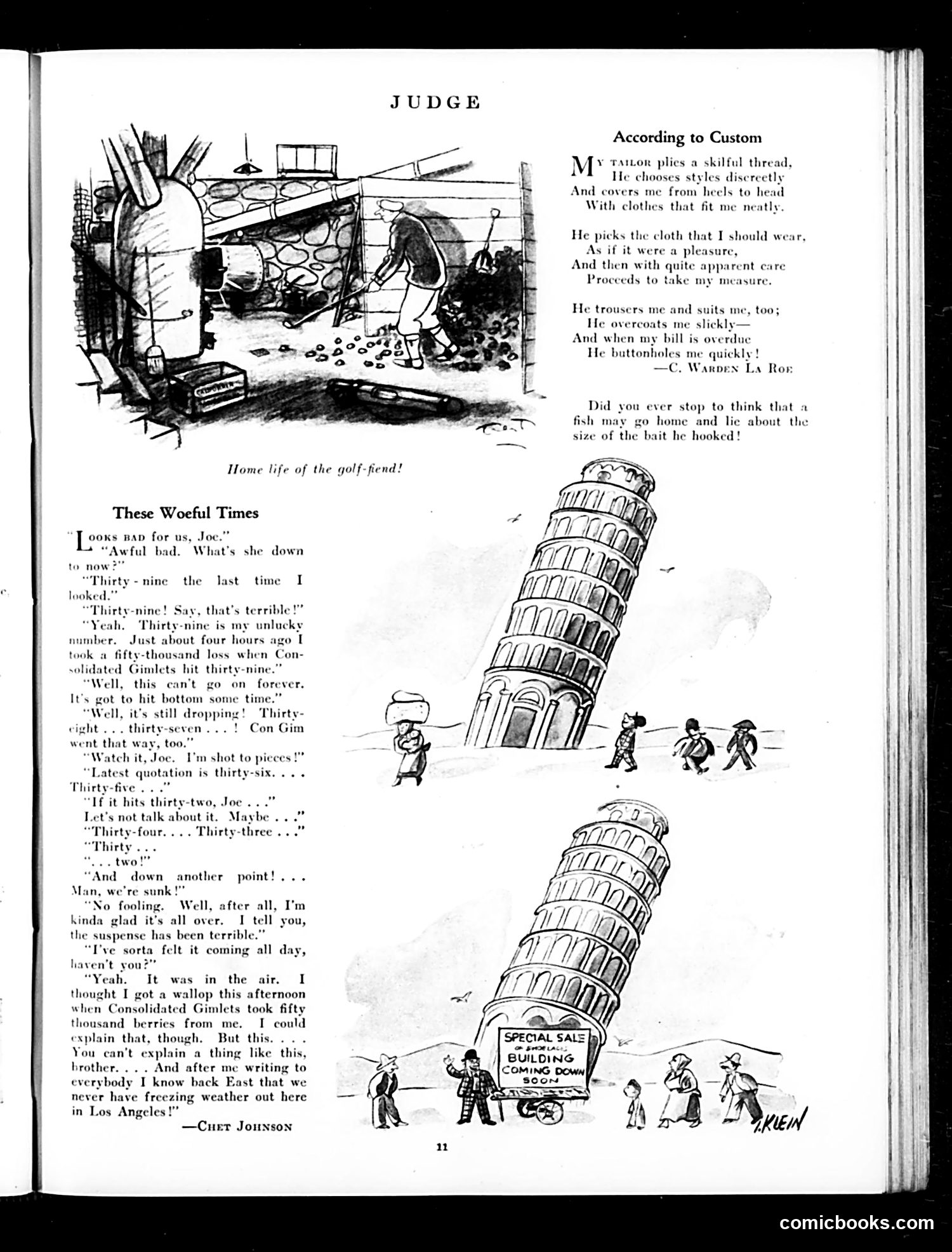
Judge Magazine Page Analysis This page contains two satirical pieces from Judge magazine: "According to Custom" (top): A poem mocking tailors who present themselves as artistic professionals while ultimately just billing customers aggressively. The humor lies in the contradiction between the tailor's pretense of careful craftsmanship and his real interest in overdue payments—he "buttonholes" customers (a pun on his profession) to collect money. "These Woeful Times" (bottom): A dialogue about stock market losses during what appears to be an economic crisis (likely the 1920s or early 1930s). Two men discuss the collapse of "Consolidated Gimlets" stock, with one having lost $50,000. The satire targets both the anxiety of investors watching stocks plummet and the absurdity of trying to rationalize financial disaster. The final joke—complaining that the bad news undermines his credibility back East—suggests American anxiety about appearing successful. Both pieces use humor to critique economic precarity and social pretense of their era.
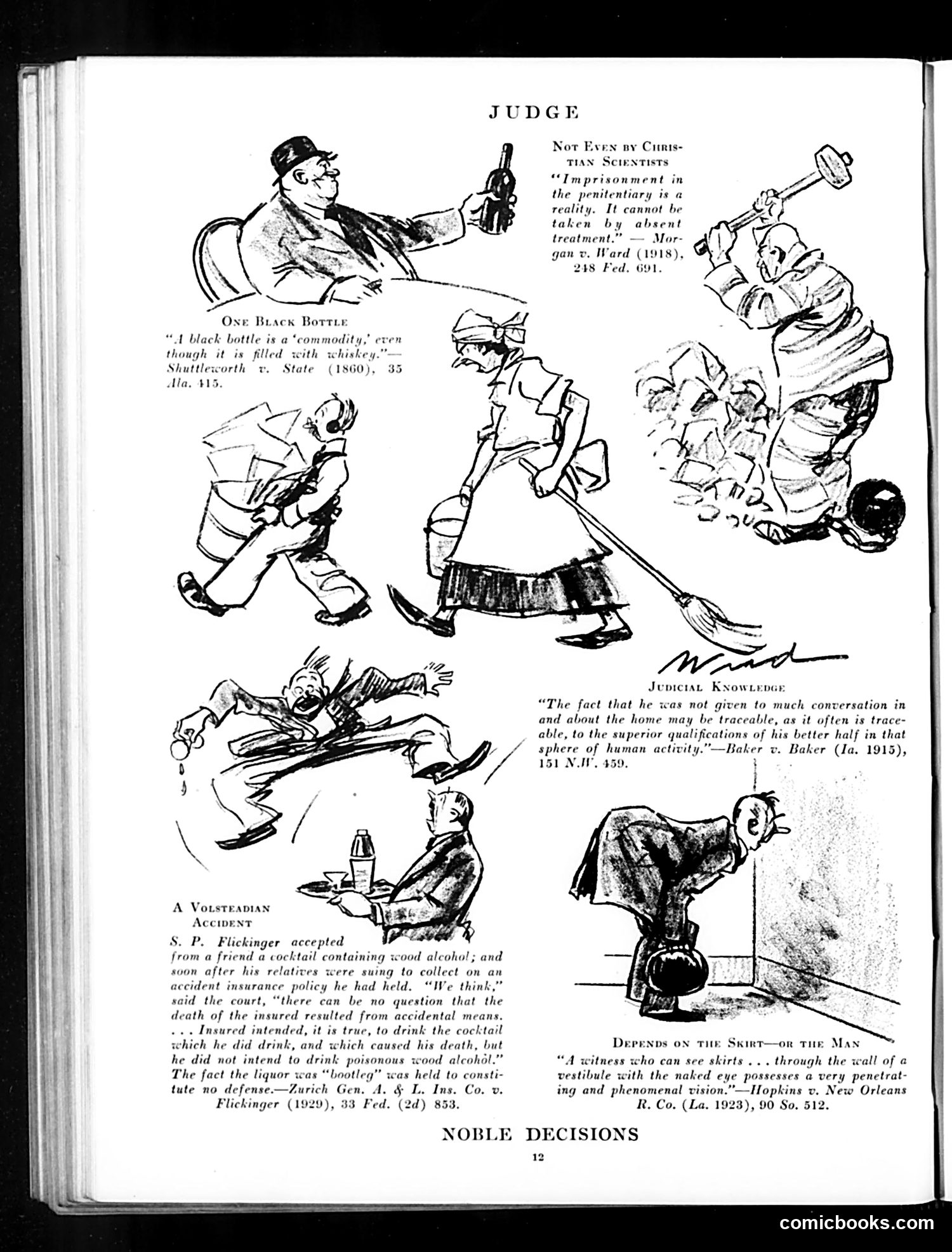
Judge Magazine Legal Satire Page This page from *Judge* magazine satirizes absurd legal decisions through cartoon commentary. The page contains several humorous court rulings with accompanying illustrations: "One Black Bottle" mocks a case defining a bottle as a "commodity" even when filled with whiskey—playing on Prohibition-era legal technicalities. "A Volsteadian Accident" ridicules a 1929 insurance case where a man died from wood alcohol poisoning. The court ruled it was "accidental" because while he intended to drink the cocktail, he didn't intend the poison—a ludicrous distinction the cartoonist highlights. "Not Even by Christian Scientists" references a case denying that imprisonment can be negated by "absent treatment" (Christian Science belief in mental healing). Other panels mock judicial rulings about marital silence, witness credibility regarding impossible vision, and a child's dependency on whether wearing a skirt or being male. The satire targets judicial absurdity and legal sophistry during the Prohibition era.
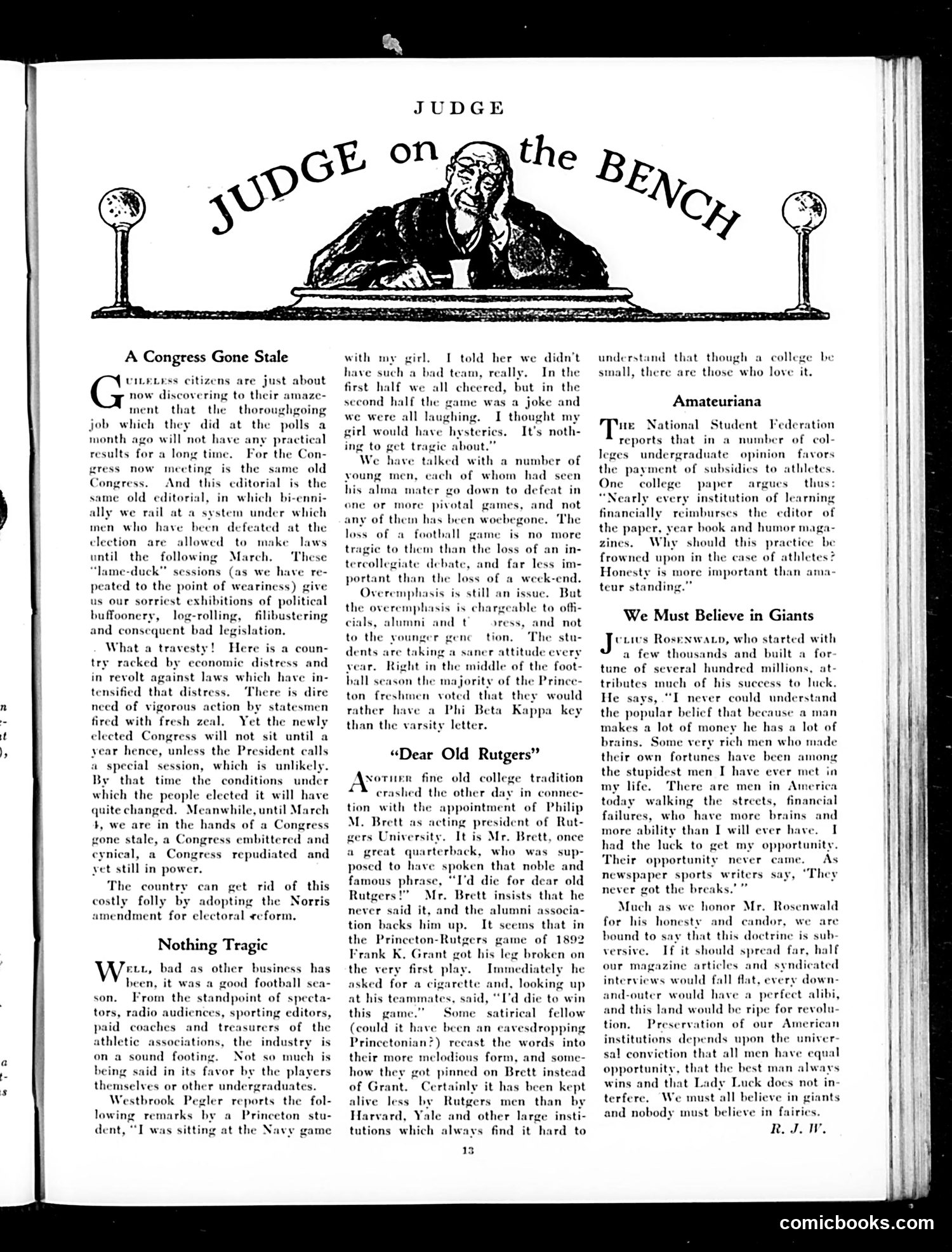
Judge Magazine Page Analysis This page from Judge magazine contains editorial commentary on early 20th-century American politics and college culture. "A Congress Gone Stale" criticizes Congress for ineffectual governance. The piece argues that annual lame-duck sessions waste time with political posturing. It advocates the Norris amendment for electoral reform, allowing newly-elected representatives to take office promptly rather than waiting months—a specific critique of delayed congressional transition procedures that apparently frustrated the magazine's editors. "Nothing Tragic" discusses college football season, questioning whether the sport's emphasis on winning causes moral problems. The author (Westbrook Pegler, mentioned in the text) argues the industry has grown excessive but claims the actual games themselves remain wholesome entertainment, not inherently corrupting. "We Must Believe in Giants" praises successful men's self-made fortunes, suggesting luck matters less than ability and opportunity.
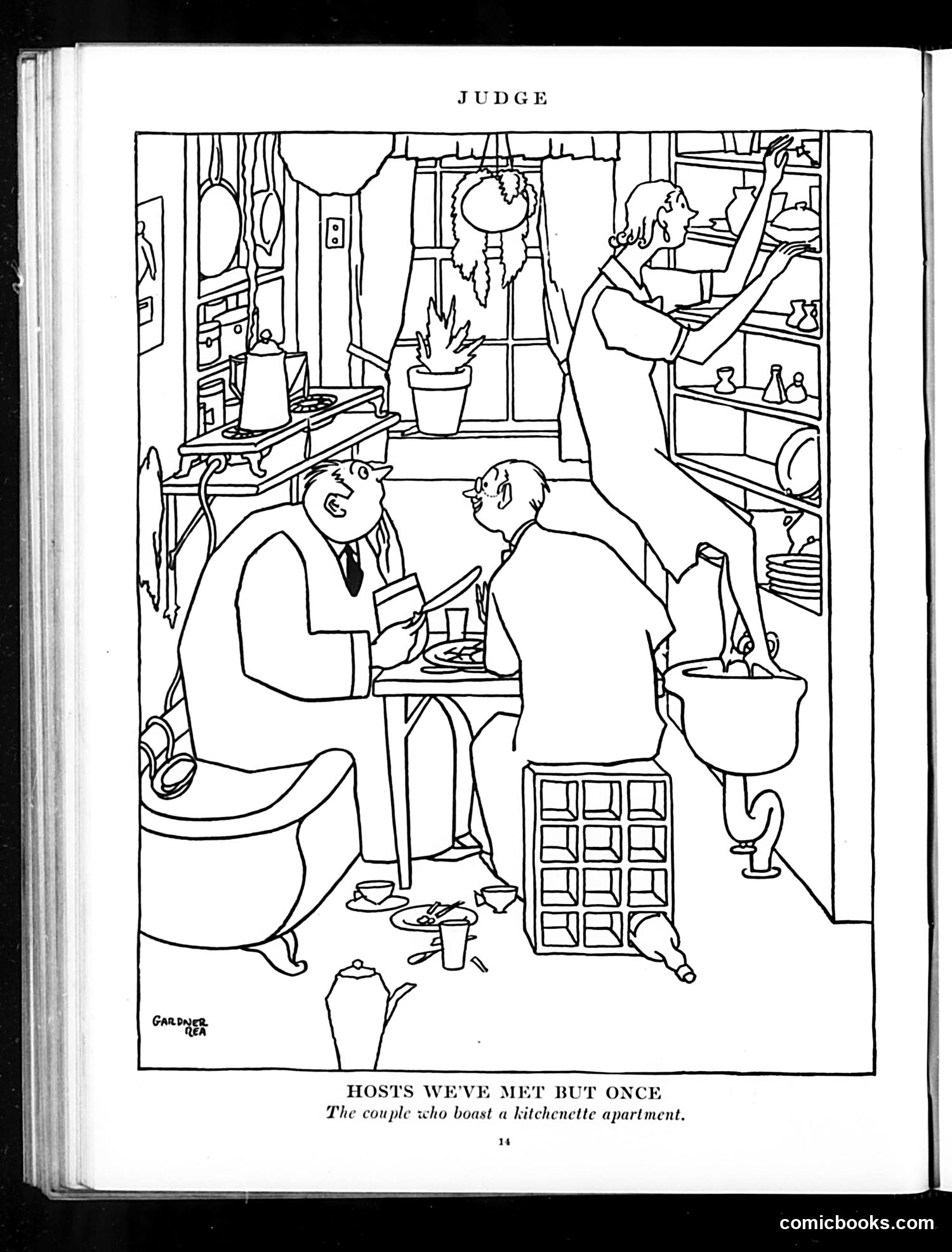
"Hosts We've Met But Once" This cartoon satirizes a newly married couple who boast about owning a "kitchenette apartment"—a fashionable but cramped urban dwelling that became popular in early 20th-century American cities. The humor targets their pretentiousness: they invite guests to their tiny kitchen space as if it were an impressive accomplishment, when the cartoon depicts the absurdity of the situation—multiple people crowded into a microscopic kitchen with minimal appliances, barely room to move. The satire comments on the aspirational middle class's enthusiasm for modern apartment living and their tendency to inflate the appeal of modest living spaces. The cramped, chaotic scene undercuts their pride, suggesting that cramped quarters are nothing to boast about, no matter how "modern" they seem.
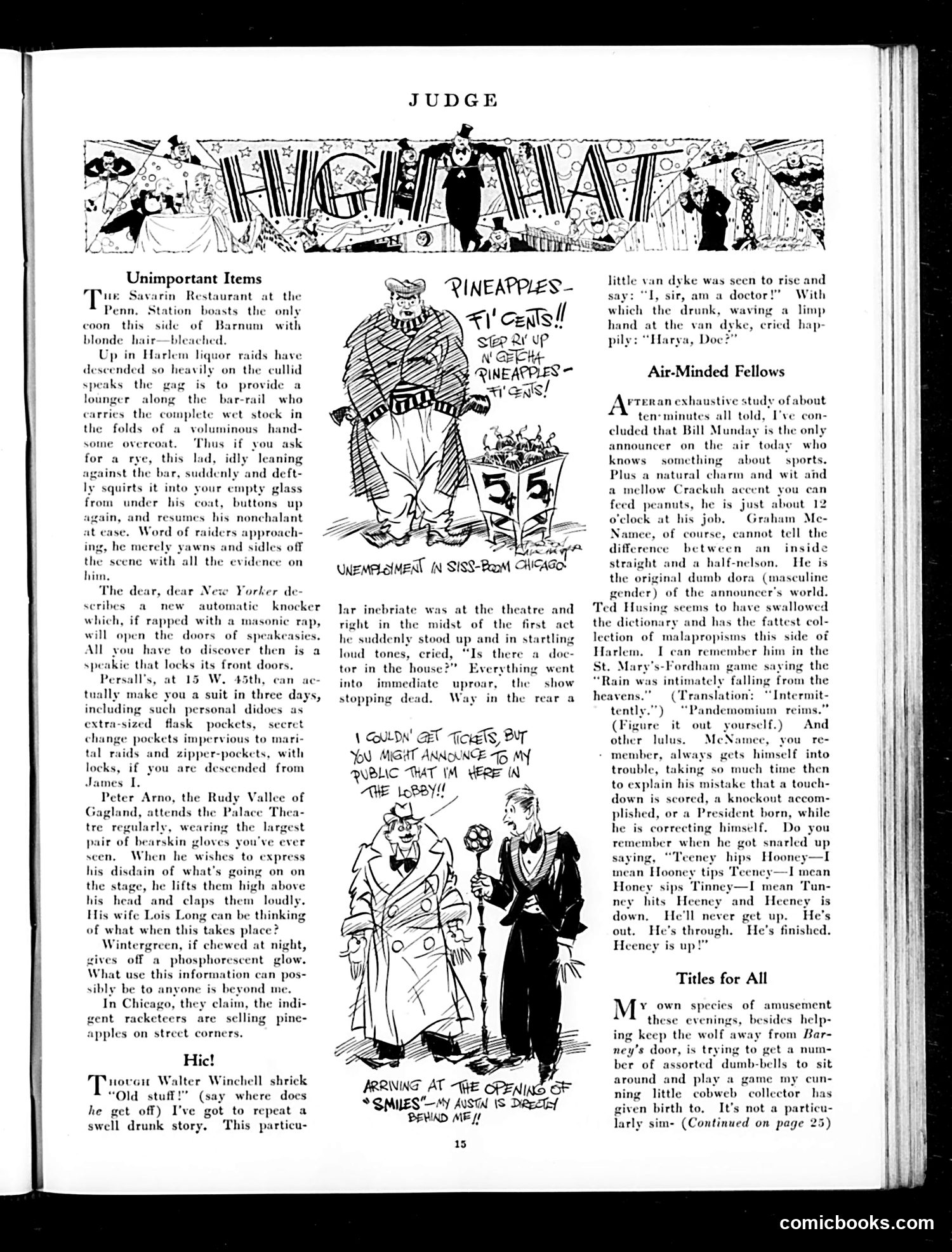
Analysis for Modern Readers This page from Judge magazine contains social commentary on 1920s-30s America, reflecting the era's casual racism and Prohibition-era humor. The cartoons and items mock: 1. Prohibition enforcement: References to illegal alcohol sales ("speaks," "speakeasies," "wet stock") and creative smuggling methods—reflecting widespread defiance of the 18th Amendment. 2. Chicago crime: A cartoon showing pineapples (slang for hand grenades) being sold on streets, satirizing gangster violence and unemployment during economic hardship. 3. Radio announcers: Critique of early sports broadcasters, particularly their verbal fumbles and inability to speak coherently under pressure—mocking emerging mass media personalities. 4. Period racism: The opening "Unimportant Items" contains deeply offensive racial stereotypes reflecting the magazine's audience attitudes. The humor relies on readers' familiarity with contemporary speakeasies, bootlegging, Chicago gang violence, and early radio personalities—cultural touchstones of the Prohibition era.
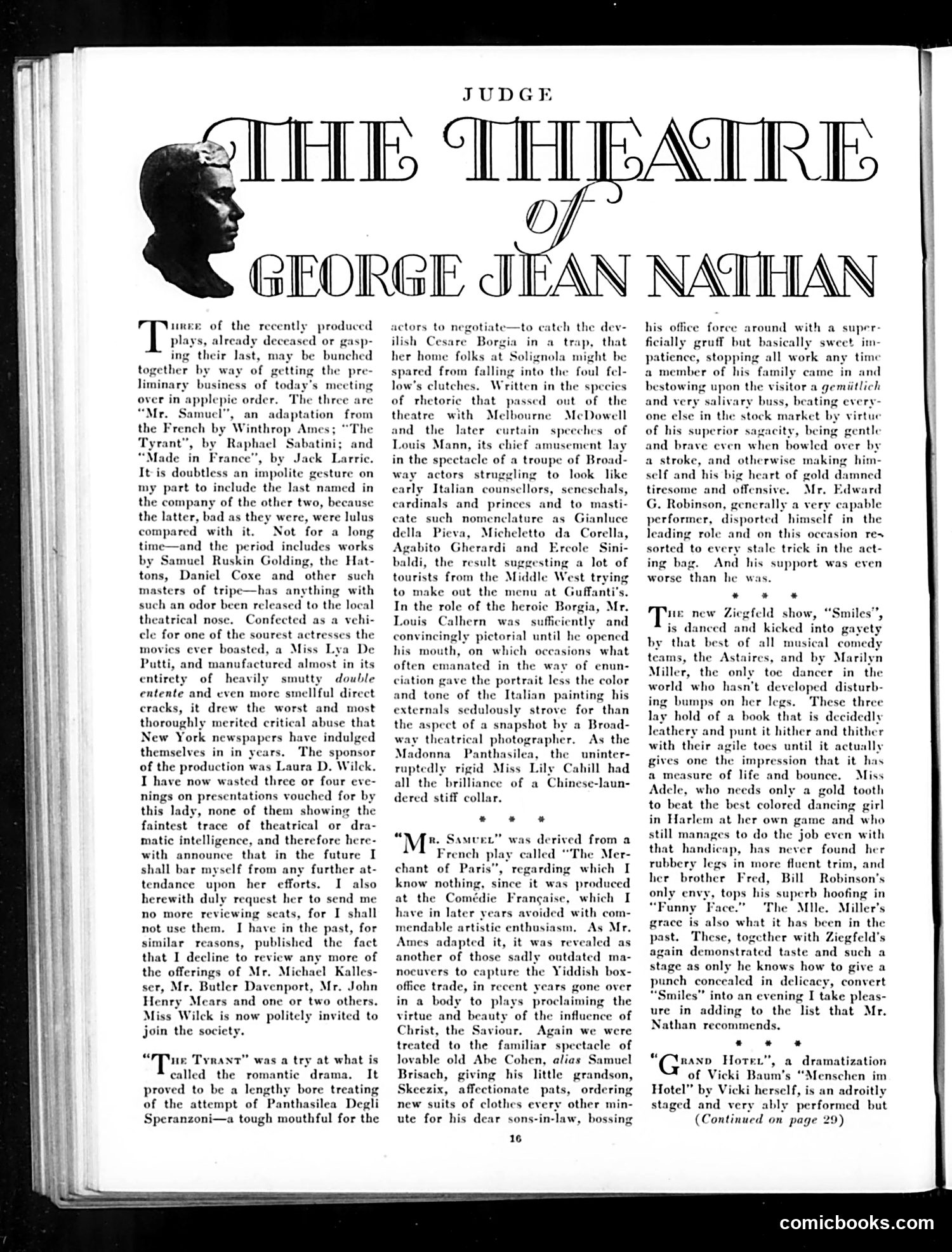
The Theatre of George Jean Nathan This is a theatre review column by Judge's drama critic George Jean Nathan, critiquing three recent Broadway productions: "Mr. Samuel," "The Tyrant," and "Made in France." Nathan savagely dismisses all three plays. He reserves particular contempt for "Made in France," produced by Laura D. Wilck and starring actress Lya De Putti, calling it stuffed with "smutty double entendre" and worthy of the worst critical abuse New York papers have delivered "in years." He formally bans Wilck from sending him review copies. "The Tyrant," a romantic drama about Italian Renaissance intrigue, amuses Nathan only as unintentional comedy—Broadway actors grotesquely attempting Italian accents and struggling with character names like "Micheletto da Corella." The silhouette profile portrait shows Nathan himself, the bylined critic delivering these verdicts. His columns represent Judge's theatrical commentary and satirical assessment of popular entertainment quality of the era.
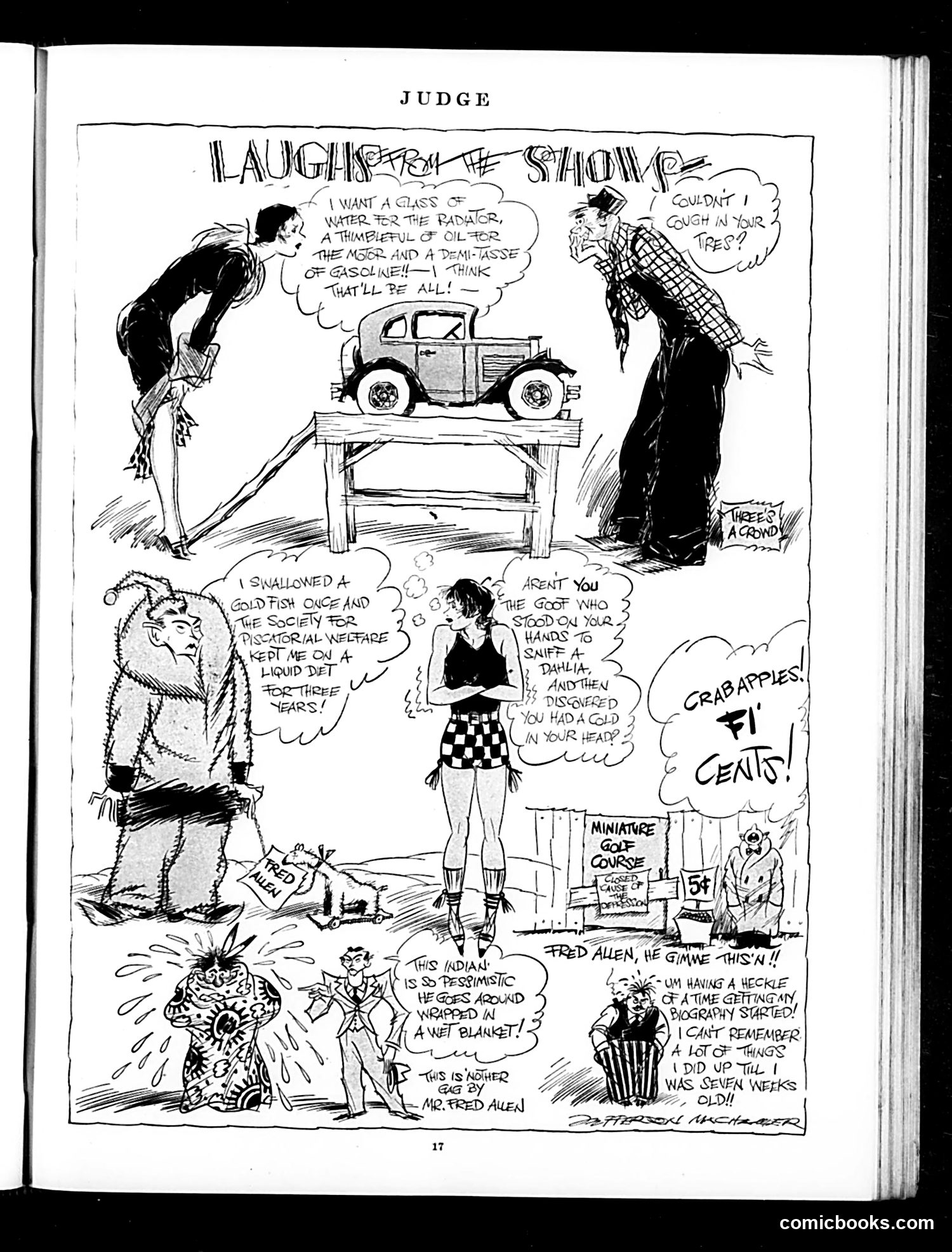
"Laughs by the Shovel" - Judge Magazine Cartoon Analysis This is a multi-panel satirical cartoon depicting various characters engaged in absurd boasting or tall tales. The central figure appears to be a carnival or sideshow performer ("Fred Allen," likely the radio comedian), surrounded by exaggerated character types: a woman at a miniature golf course, a man describing swallowing a goldfish (referencing the 1930s fad), and another man with bizarre claims about an "Indian" wrapped in a blanket. The satire targets American showmanship culture and the public's appetite for outlandish stunts and celebrity gossip. References to Fred Allen suggest mockery of radio entertainment personalities and their self-promotional antics. The "crap apples, five cents" sign and crude caricatures reflect Judge's satirical style lampooning American entertainment, consumerism, and the gullibility of audiences who embrace ridiculous spectacles. The exact historical context remains somewhat unclear without a publication date.
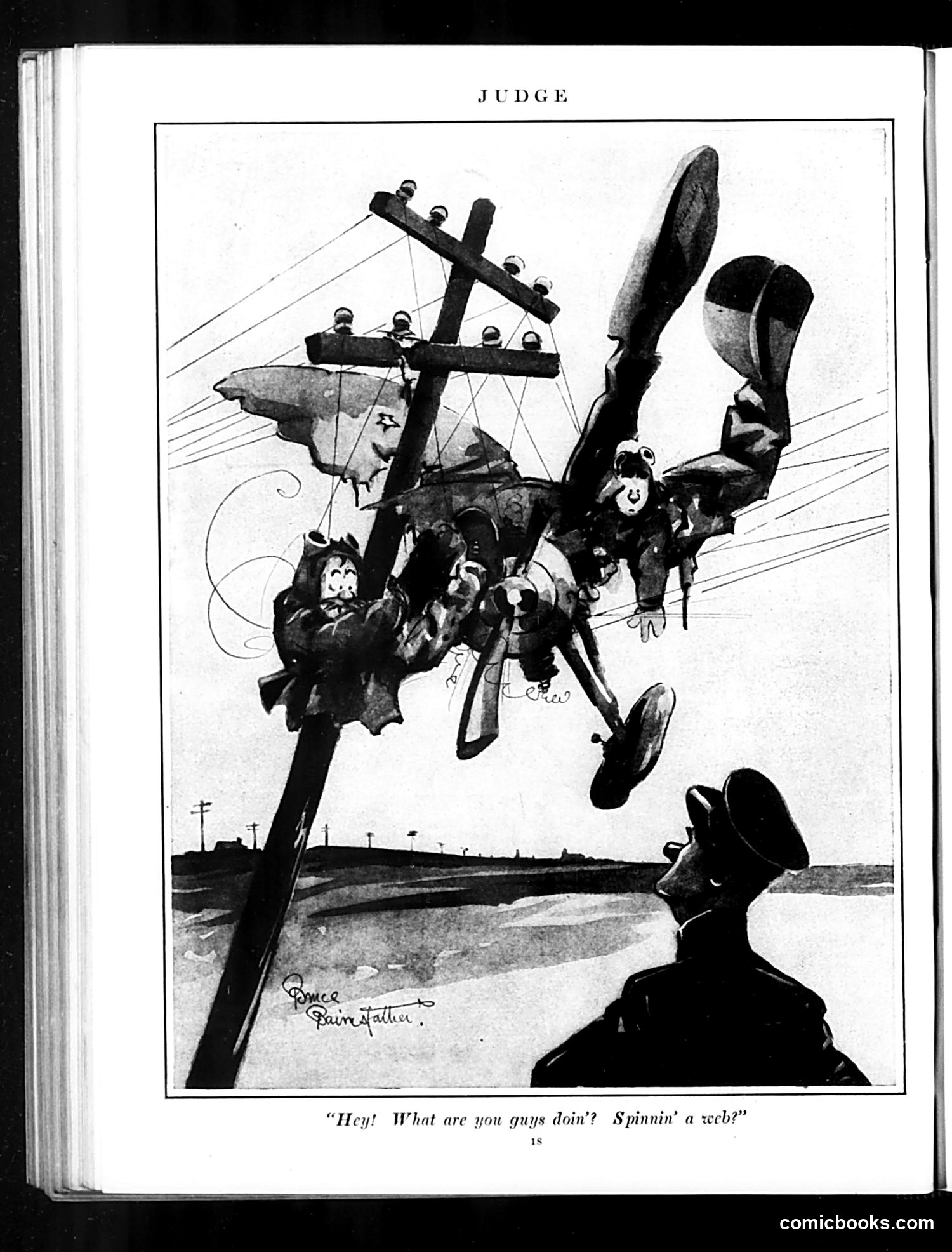
Political Cartoon Analysis: "Judge" Magazine This cartoon satirizes what appears to be judicial or political figures suspended from a utility pole, engaged in dubious activity. The caption—"Hey! What are you guys doin'? Spinnin' a web?"—suggests they're weaving deception or conspiracy. The figures hang like marionettes, implying they lack independence or are controlled. The "web" metaphor indicates entanglement in corrupt schemes. The observer on the ground confronts them directly, representing public scrutiny. The rural landscape with crosses and utility poles suggests American heartland concerns about corruption reaching local governance. Without clear date or context, this likely critiques judicial impropriety, political collusion, or abuse of authority—positioning judges or officials as deliberately constructing false narratives to deceive the public.
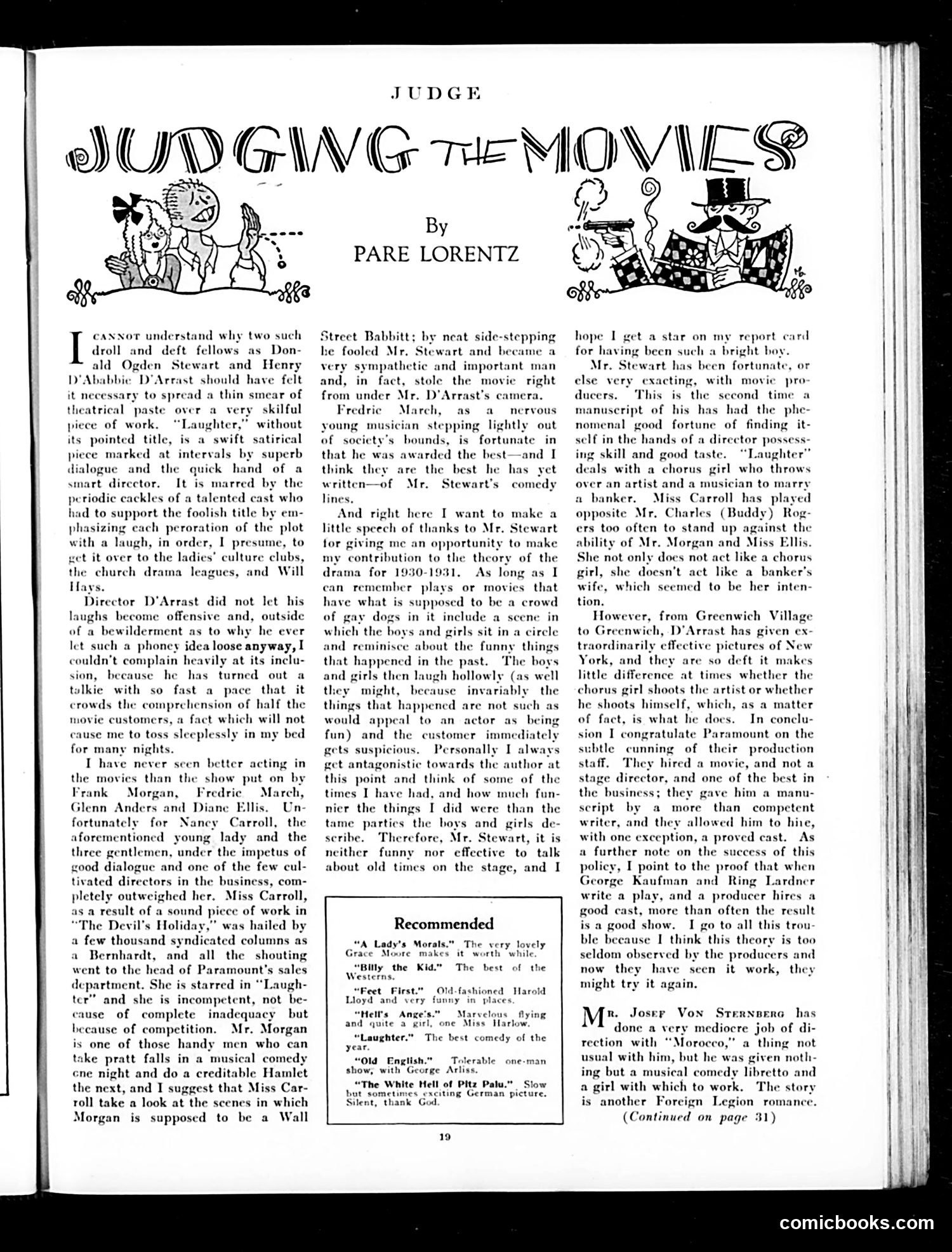
"Judging the Movies" by Pare Lorentz — Judge Magazine This is a film criticism column reviewing the 1930 movie *Laughter*, directed by Harry d'Abbadie d'Arrast. Lorentz praises the film's wit and direction but criticizes its reliance on an exaggerated "laugh track" approach—the cast heavily emphasizes comedic moments to satisfy ladies' club audiences and Will Hays (the film industry censor). Lorentz specifically lauds actors Frank Morgan, Fredric March, Glenn Anders, and Diane Ellis for superior performances, but faults star Nancy Carroll as outmatched by the competition. He critiques a clichéd scene where characters reminisce about "funny things," arguing it rings false—a common theatrical trope he finds tedious. The column includes brief recommendations for other 1930-31 releases: *A Lady's Morals* (Grace Moore), *Billy the Kid*, and flying sequences in *Hell's Angels*. The page reflects 1930s film criticism standards and ongoing tension between artistic merit and commercial/censorship pressures.
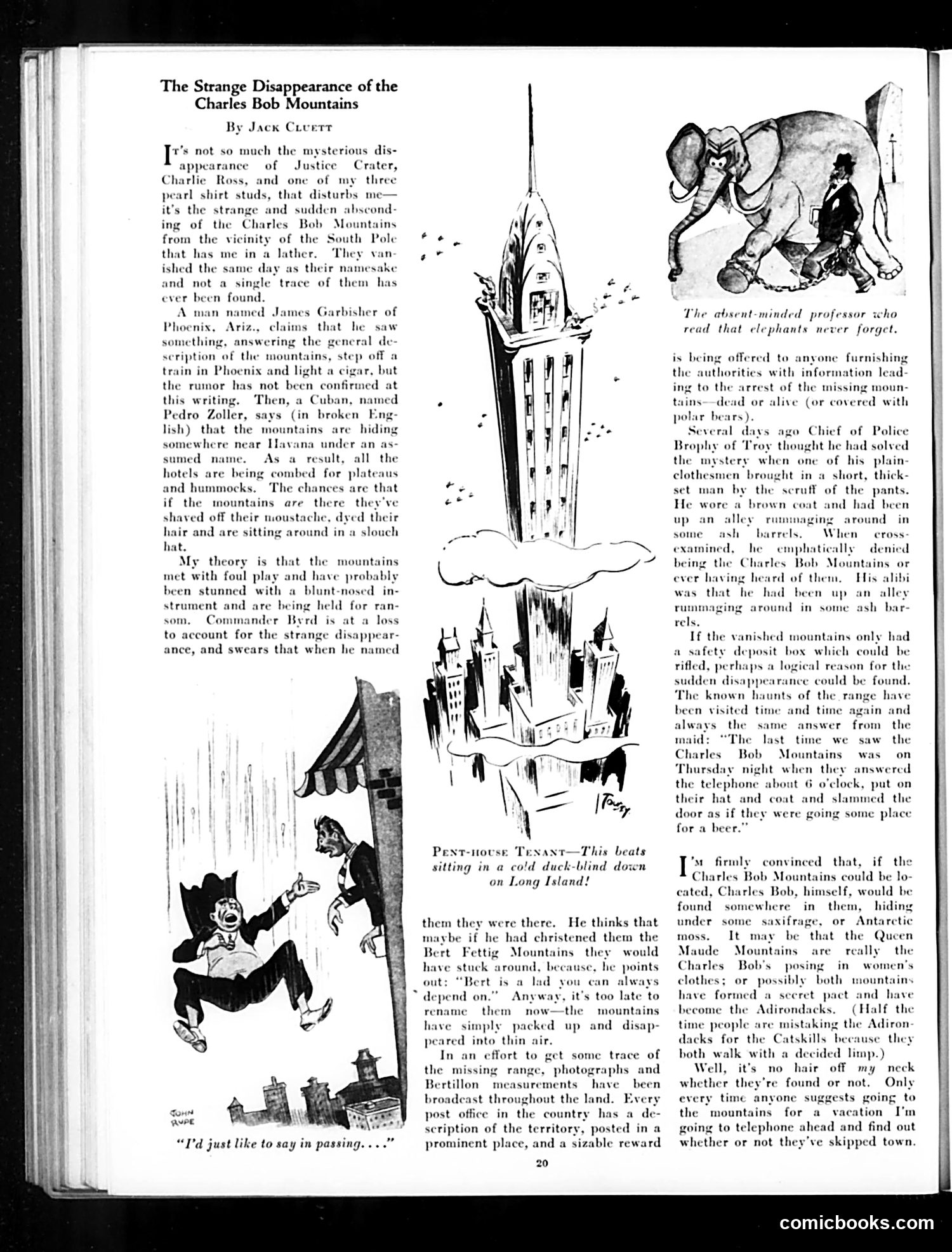
The Strange Disappearance of the Charles Bob Mountains This is a humorous fantasy article satirizing the public obsession with sensational disappearances. The author references real vanished figures—Justice Crater and Charlie Ross (famous unsolved cases)—then absurdly expands the mystery to include fictional mountains named after someone called "Charles Bob." The satire mocks how disappearances capture public imagination: police conduct searches, hotels are ransacked, reward notices posted nationwide, and wild theories circulate (the mountains "rummaging" in ash barrels). The cartoons show exaggerated urban scenes supporting this ridiculous premise. The joke targets how Americans became collectively invested in celebrity mysteries during this era, treating impossible scenarios (missing mountains) with the same investigative fervor as actual crimes. It's a deadpan mockery of mass hysteria and media-driven mystery mania—suggesting the public will believe anything if packaged as intrigue.
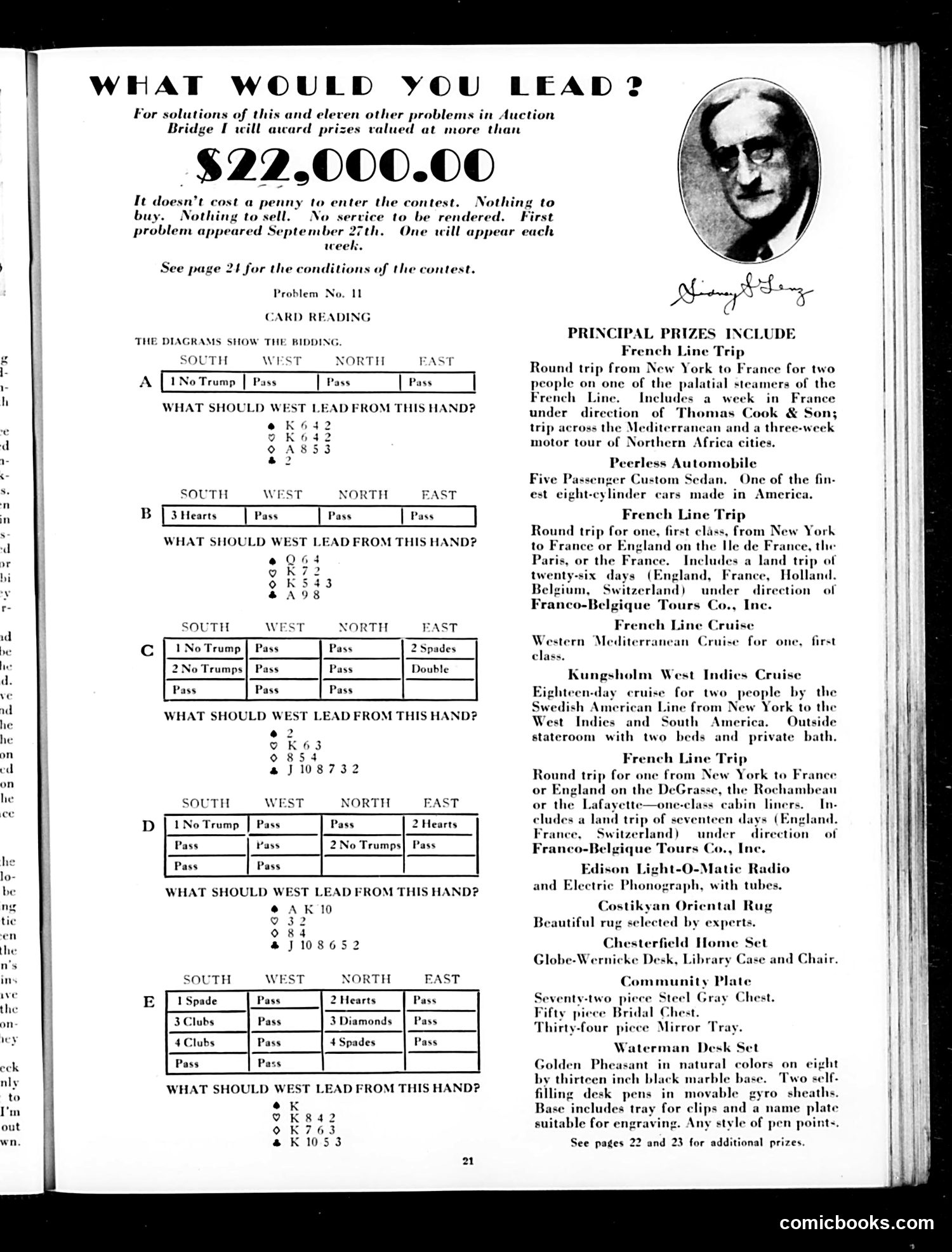
What Would You Lead? — Judge Magazine Bridge Contest This page is primarily a bridge card game contest, not a political cartoon. Judge magazine is running a puzzle competition offering $22,000 in prizes for readers who can solve twelve bridge bidding problems. The content shows five different card hands (labeled A through E) with bidding diagrams, asking solvers "What should West lead from this hand?" — a technical question about bridge strategy. The prizes listed are luxury travel (French Line cruises and trips), an automobile, furniture, and consumer goods—typical Depression-era or early 20th-century prizes designed to attract contestants. The portrait appears to be of Ely Culbertson or another famous bridge authority, lending credibility to what Judge presents as an intellectually challenging contest. This represents leisure activity and conspicuous consumption during a specific historical period—bridge was a fashionable game among the middle and upper classes.
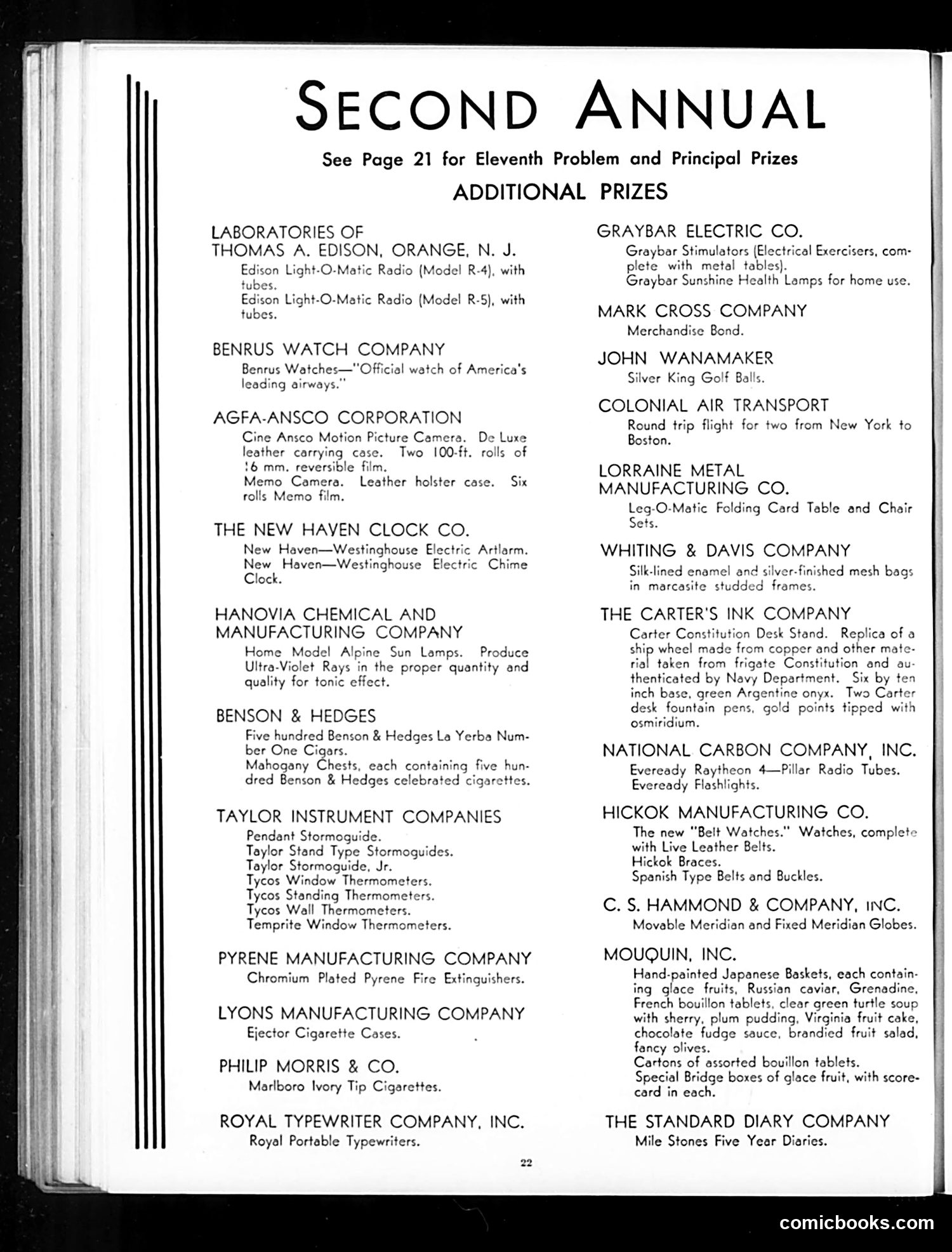
Page Analysis: Judge Magazine Prize List This page is not a cartoon or satirical content—it's a prize list for what appears to be a Judge magazine contest or competition (referenced as "Second Annual" with eleventh problem mentioned). The page lists corporate sponsors and their donated prizes, reflecting 1920s-1930s American commerce: Edison radios, Benrus watches, cameras, typewriters, luxury goods (caviar, cigars), and notably a round-trip flight to Boston from Colonial Air Transport—suggesting aviation was still a novel luxury prize. The sponsors represent emerging modern industries (radio, aviation, electrical appliances) alongside established luxury brands (Philip Morris cigarettes, Benson & Hedges). The elaborate prizes suggest Judge's readership was affluent, educated consumers interested in technology and sophistication. This is primarily advertising and administrative content, not satire or humor.
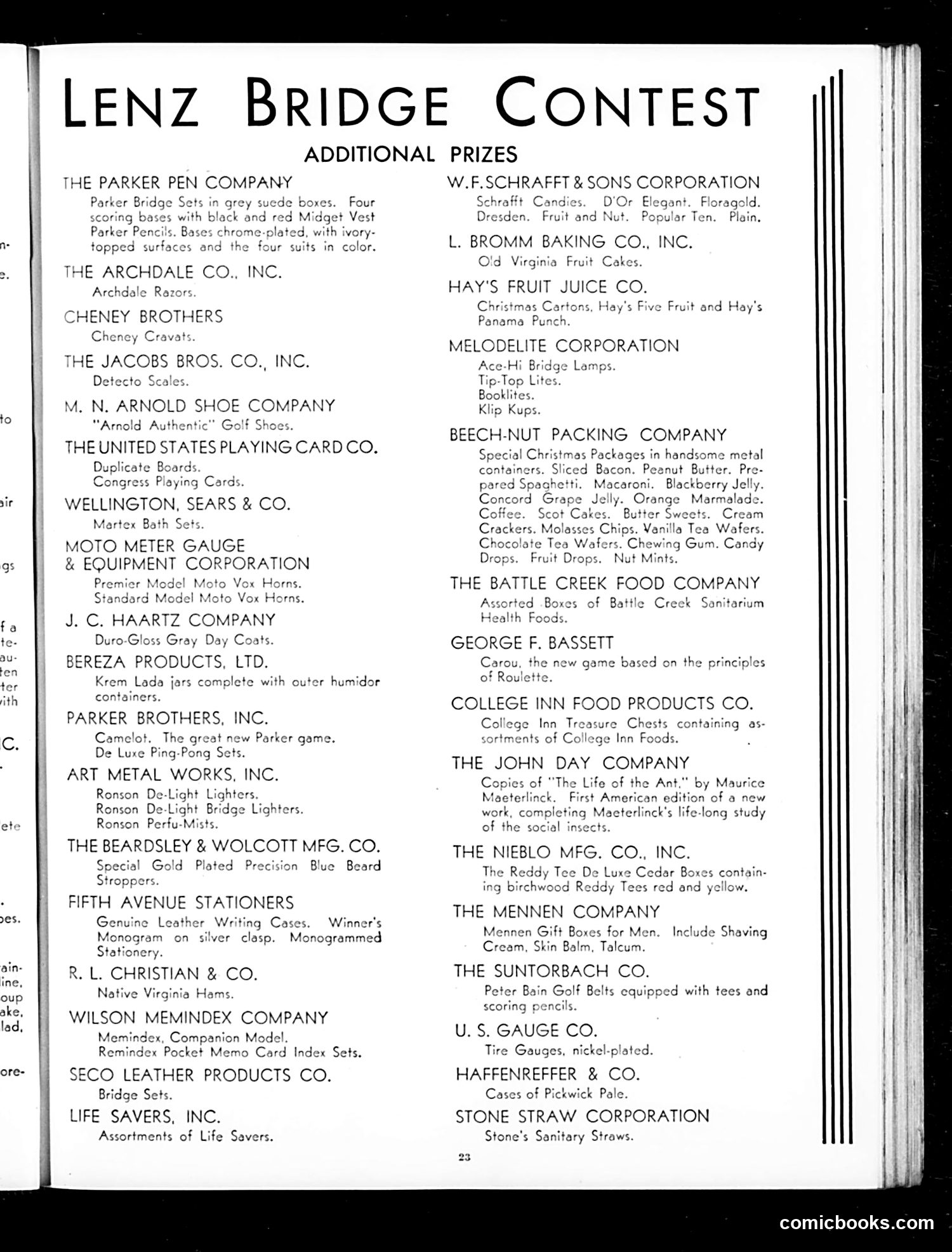
Lenz Bridge Contest Additional Prizes This page is not a cartoon or satirical content—it is purely an advertising section listing prize donors for a "Lenz Bridge Contest." Judge magazine appears to have sponsored a bridge (the card game) competition, and this page catalogs the companies contributing prizes. The prizes reflect 1920s consumer goods: Parker pen sets, razors, playing cards, golf equipment, candy, food products, and household items like bath sets and lighters. Notable are luxury items (leather writing cases, monogrammed stationery) and period-specific products (tire gauges, smoking accessories). This represents how magazines monetized editorial content through sponsorships—companies gained advertising exposure by donating merchandise as contest prizes, a common practice in early 20th-century publishing.
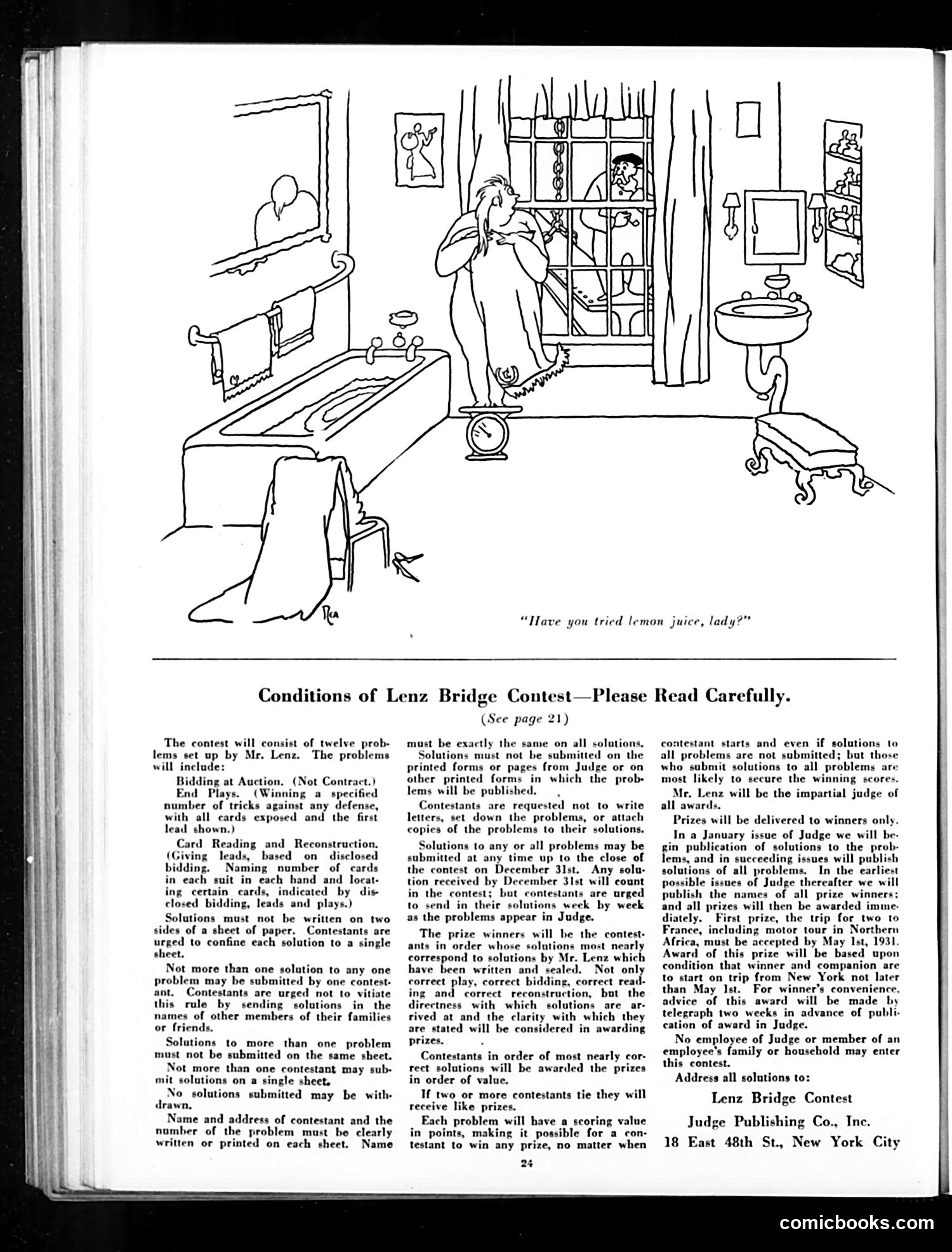
Explanation for Modern Readers This page combines a cartoon with contest rules. The cartoon shows a woman in a bathroom, apparently unwell or hung-over, while a man (likely a doctor or servant) suggests "Have you tried lemon juice, lady?" as a remedy. This appears to be a humorous domestic scene, possibly satirizing either folk remedies or the woman's condition—though the exact social commentary is unclear from the image alone. The bulk of the page announces the "Lenz Bridge Contest," a competitive bridge card-game problem-solving competition sponsored by *Judge* magazine. The contest invites readers to solve twelve bridge problems set by "Mr. Lenz," with prizes including a trip to France. This was typical early-20th-century magazine content: *Judge* combined satirical humor with reader engagement through contests, making the publication interactive and encouraging repeat purchases.
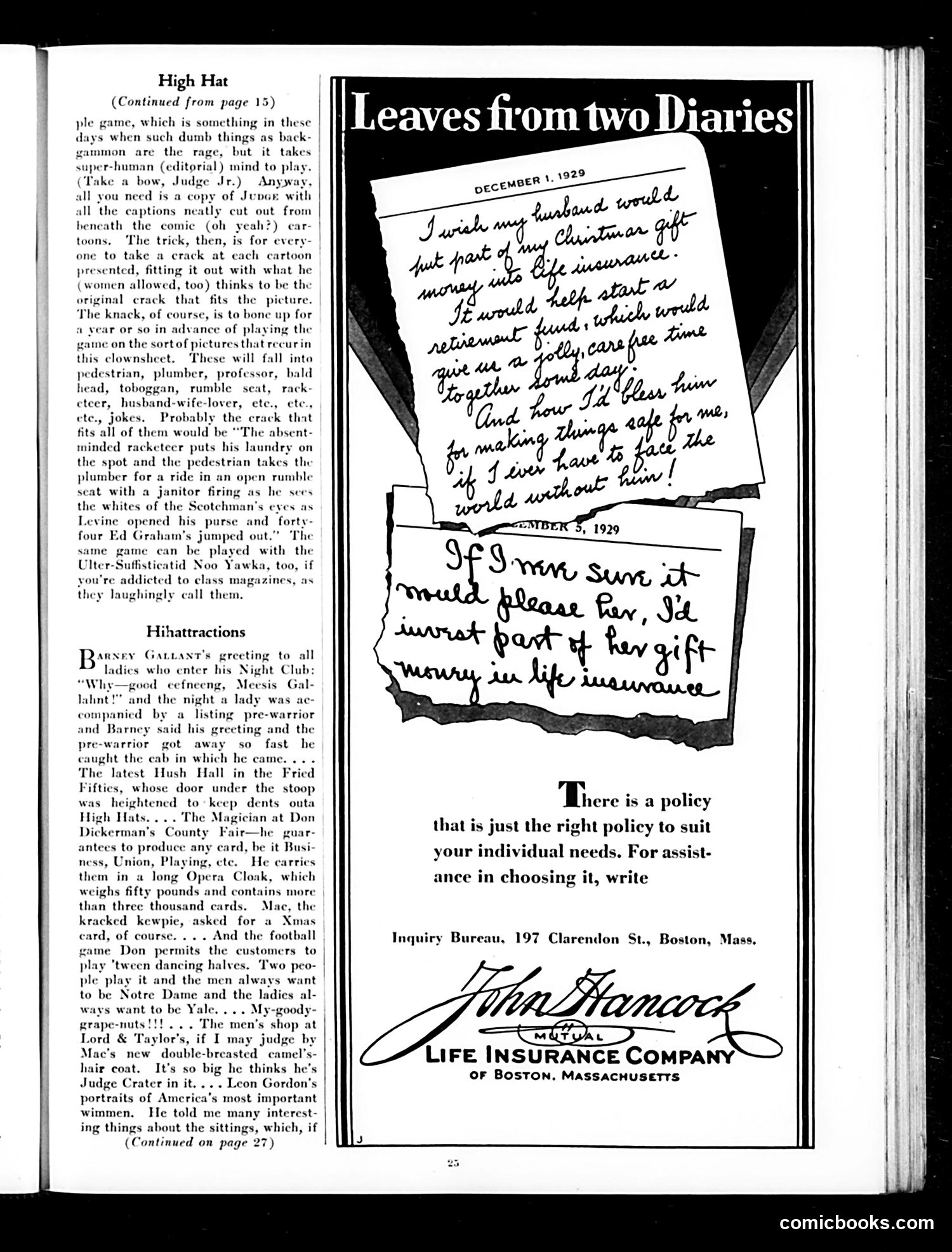
"Leaves from Two Diaries" — John Hancock Life Insurance Advertisement This page is primarily a life insurance advertisement disguised as editorial content. The two handwritten diary entries (dated December 1, 1929 and October 5, 1929) present contrasting scenarios: the first describes a husband wishing he could provide better financial security for his family; the second celebrates having purchased life insurance as a gift, ensuring family protection. The advertisement's point is straightforward: life insurance provides peace of mind and financial security for dependents. The "diary" format creates emotional resonance by showing real-life concerns about family welfare and retirement security. The left column contains unrelated satirical content about Judge magazine's humor-caption game and nightclub/social scene observations, suggesting this was a standard magazine layout mixing editorial and advertising content. Context for modern readers: This 1929 advertisement predates the Great Depression (October 1929 stock market crash), making the financial security pitch particularly resonant—though likely unintentionally prescient.
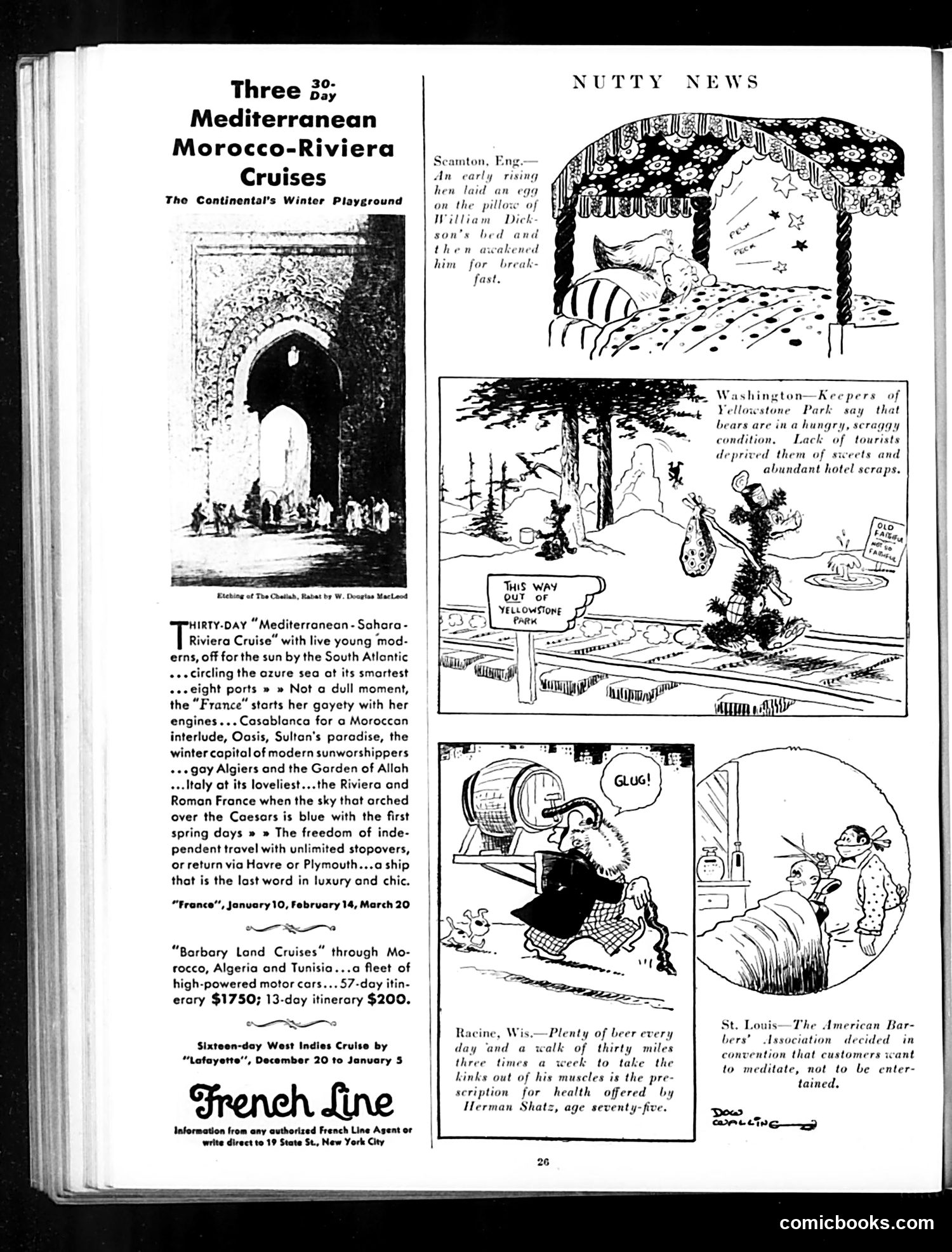
"Nutty News" Page Analysis This page is primarily travel advertising for French Line cruises (Mediterranean, Morocco-Riviera, and West Indies routes), with a sidebar humor section called "Nutty News." The "Nutty News" section contains four brief, absurdist animal and human-interest gags typical of 1920s-30s magazine humor: 1. A hen laying an egg on a sleeper's pillow (physical comedy) 2. Yellowstone bears going hungry without tourist food scraps (Depression-era reference—lack of visitors) 3. A barbershop association preferring quiet meditation to entertainment (social observation) 4. A seventy-five-year-old's health regimen of daily beer and thirty-mile walks (humorous folk remedy) The accompanying cartoons illustrate these items with simple line drawings. The humor relies on incongruity and mild absurdism rather than political satire. The Yellowstone cartoon most clearly reflects contemporary concerns about Depression-era tourism decline affecting wildlife management. The page is essentially light filler content around the cruise advertisements.
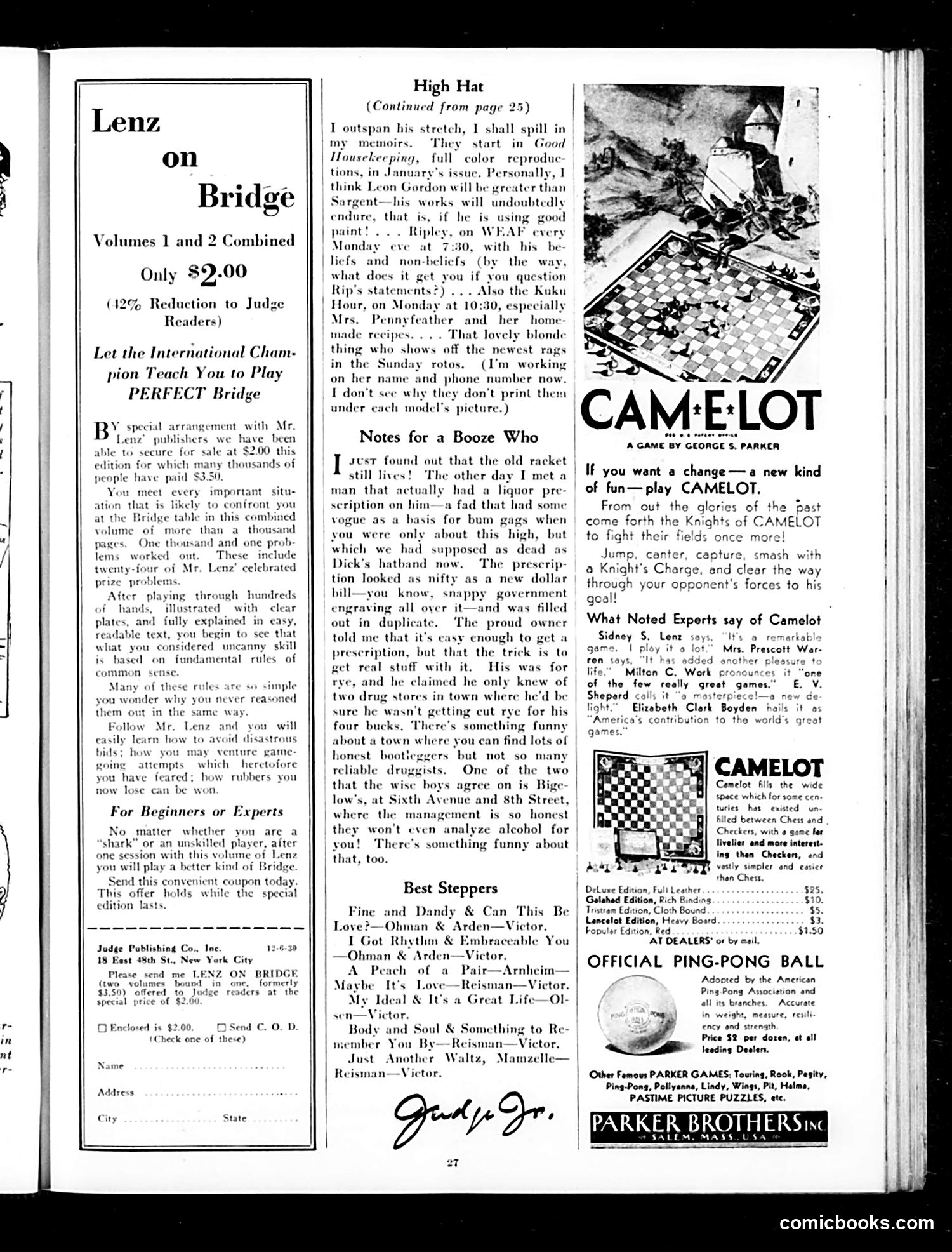
Analysis of Judge Magazine Page This page is primarily advertising and entertainment listings rather than political satire. The main content includes: 1. "Lenz on Bridge" advertisement—promoting a bridge instruction book at reduced price for Judge readers, targeting the 1930s parlor-game enthusiast. 2. "High Hat" column—gossip about radio personalities and entertainers (Ripley, Leon Gordon, various singers), reflecting the era's fascination with celebrity and emerging broadcast media. 3. "Notes for a Booze"—humor about Prohibition-era liquor prescriptions and bootlegging, a timely joke since Prohibition remained in effect until 1933. The writer pokes fun at the absurdity of obtaining alcohol legally through prescriptions while black-market alternatives flourished. 4. Game advertisements for *Camelot* and *Ping-Pong Ball*, typical period pastimes. The page reflects 1930s leisure culture and the specific humor of Prohibition's contradictions, but contains no significant political cartoon or satire.
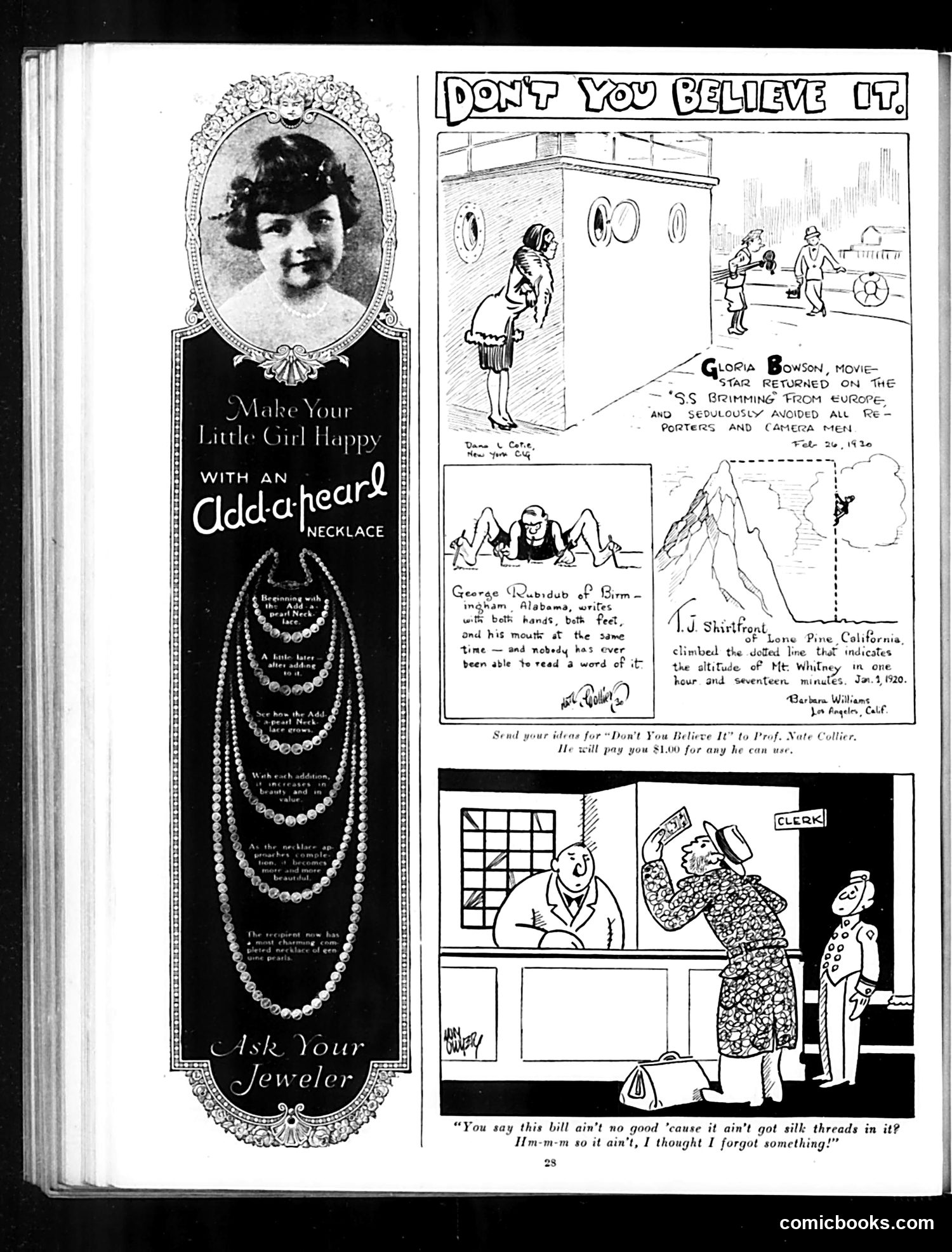
"Don't You Believe It" - Judge Magazine Page Analysis This page features a satirical column titled "Don't You Believe It," which publishes humorous reader submissions debunking tall tales and exaggerations. The three submissions mock implausible claims: 1. Gloria Bowson's return: A movie star allegedly avoided all porters and camera men upon returning from Europe—a joke about the impossibility of celebrity privacy. 2. George Quurdub's feat: A man who can write simultaneously with both hands, feet, and mouth, yet produces illegible text—satirizing pretentious multi-tasking claims. 3. J.J. Shirtfront's climb: Someone allegedly climbed Mt. Whitney's marked elevation line in 1 hour 17 minutes—physically impossible, mocking exaggerated athletic feats. The bottom cartoon shows a store clerk and customer disputing a bill's authenticity based on silk threads, with the punchline revealing the clerk forgot something essential—likely satirizing quality concerns in manufactured goods during the 1920s. The left advertisement for "Add-a-Pearl" necklaces provides period context for consumer culture.
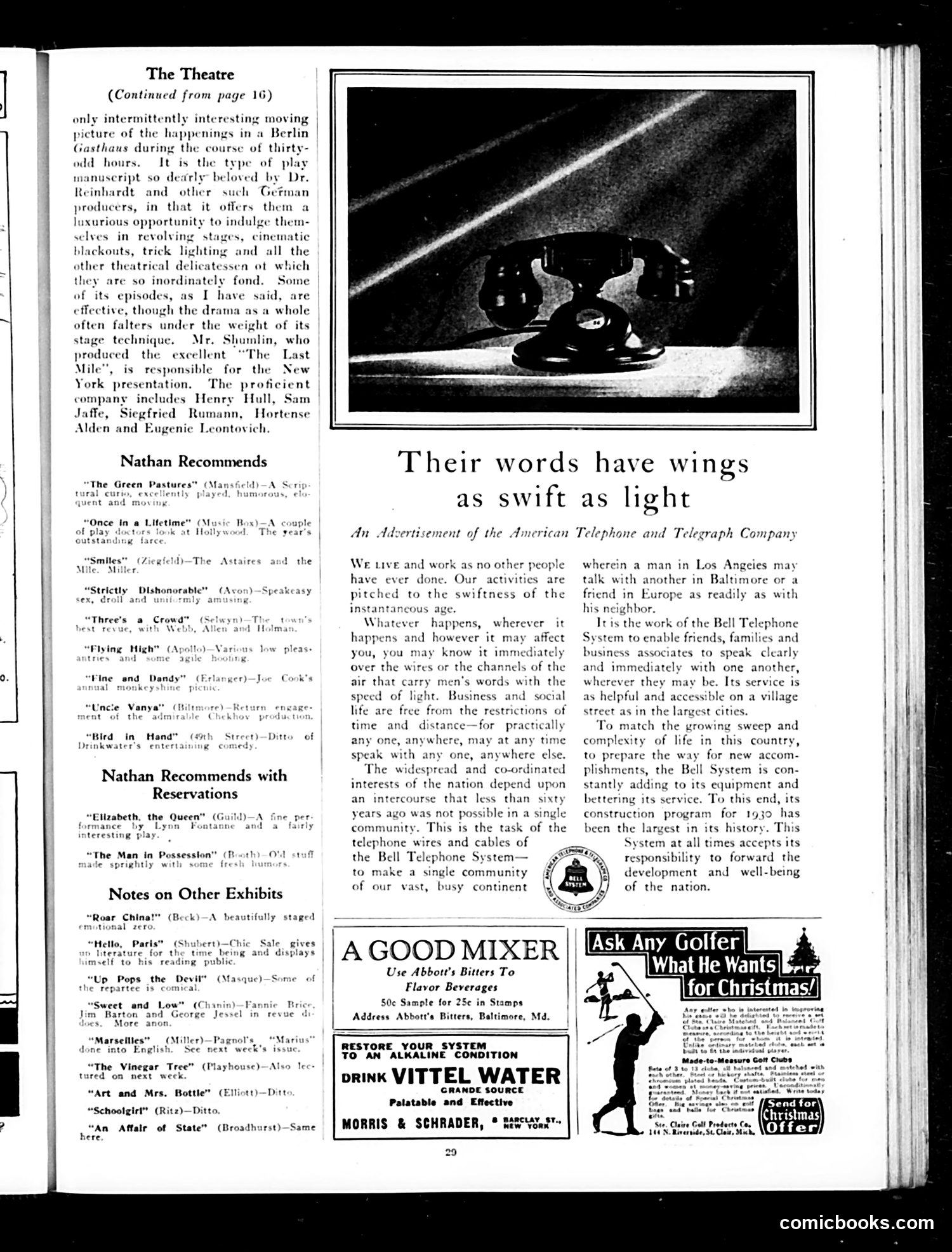
Analysis of Judge Magazine Page 29 This page is primarily advertising and theater reviews, not political satire. The main content comprises: Theater Section: Nathan's drama reviews recommend plays including "The Green Pastures," "Once in a Lifetime," and "Strictly Dishonorable"—popular Broadway productions of the era. The Cartoon/Image: The black-and-white photograph shows what appears to be a dramatic theater scene with figures in shadow, likely illustrating one of the reviewed productions. Major Advertisement: A full-page Bell Telephone and Telegraph Company advertisement dominates the right side. Its headline—"Their words have wings as swift as light"—promotes long-distance telephone communication, emphasizing how the Bell System connects people across vast distances (Los Angeles to Baltimore, or Europe to America) as easily as neighbors. Supporting Ads: Minor advertisements for Abbott's Bitters and Vittel Water appear at the bottom. The page reflects 1920s consumer culture and commercial optimism about modern technology rather than political commentary.
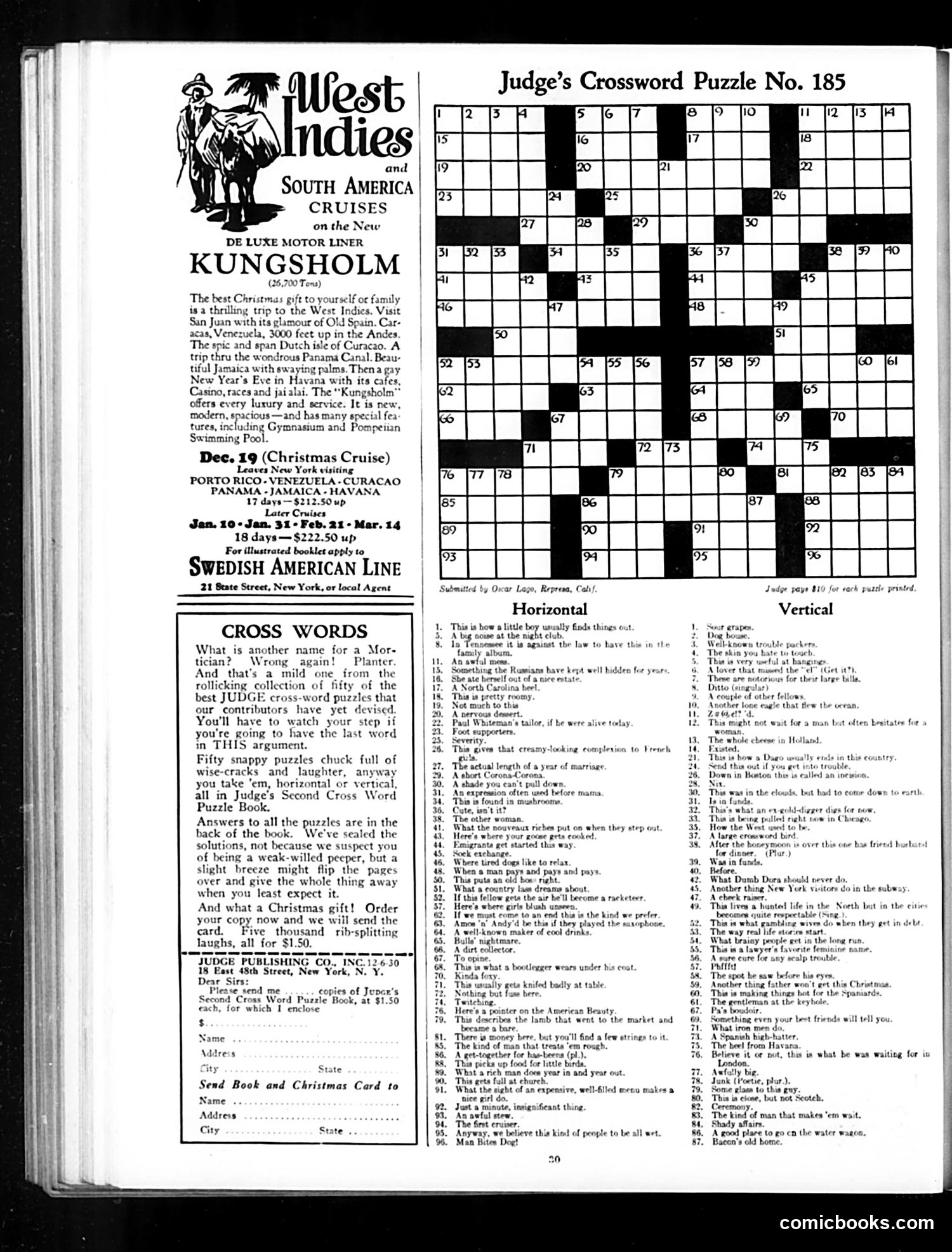
Judge Magazine Page Analysis This page is primarily advertising and crossword puzzle content, not political satire. The dominant feature is a cruise ship advertisement for the Swedish American Line's *Kungsholm*, promoting Caribbean and South American voyages departing December 19 (Christmas cruise) with stops in Puerto Rico, Venezuela, Curaçao, Panama, Jamaica, and Havana. The ad emphasizes luxury amenities like gymnasiums and swimming pools, targeting wealthy holiday travelers. Below that is marketing for Judge's Second Cross Word Puzzle Book ($1.50), promoting fifty puzzles with humorous clues. A sample horizontal clue reads: "What is another name for a Mortician? Wrong again! — Planter" (dark humor suggesting undertakers plant bodies). The actual crossword puzzle (#185) occupies the right side, with 95 clues listed horizontally and vertically. There is no political cartoon visible. The page reflects 1920s-30s consumer culture: luxury travel marketing and middlebrow entertainment for Judge's readership.
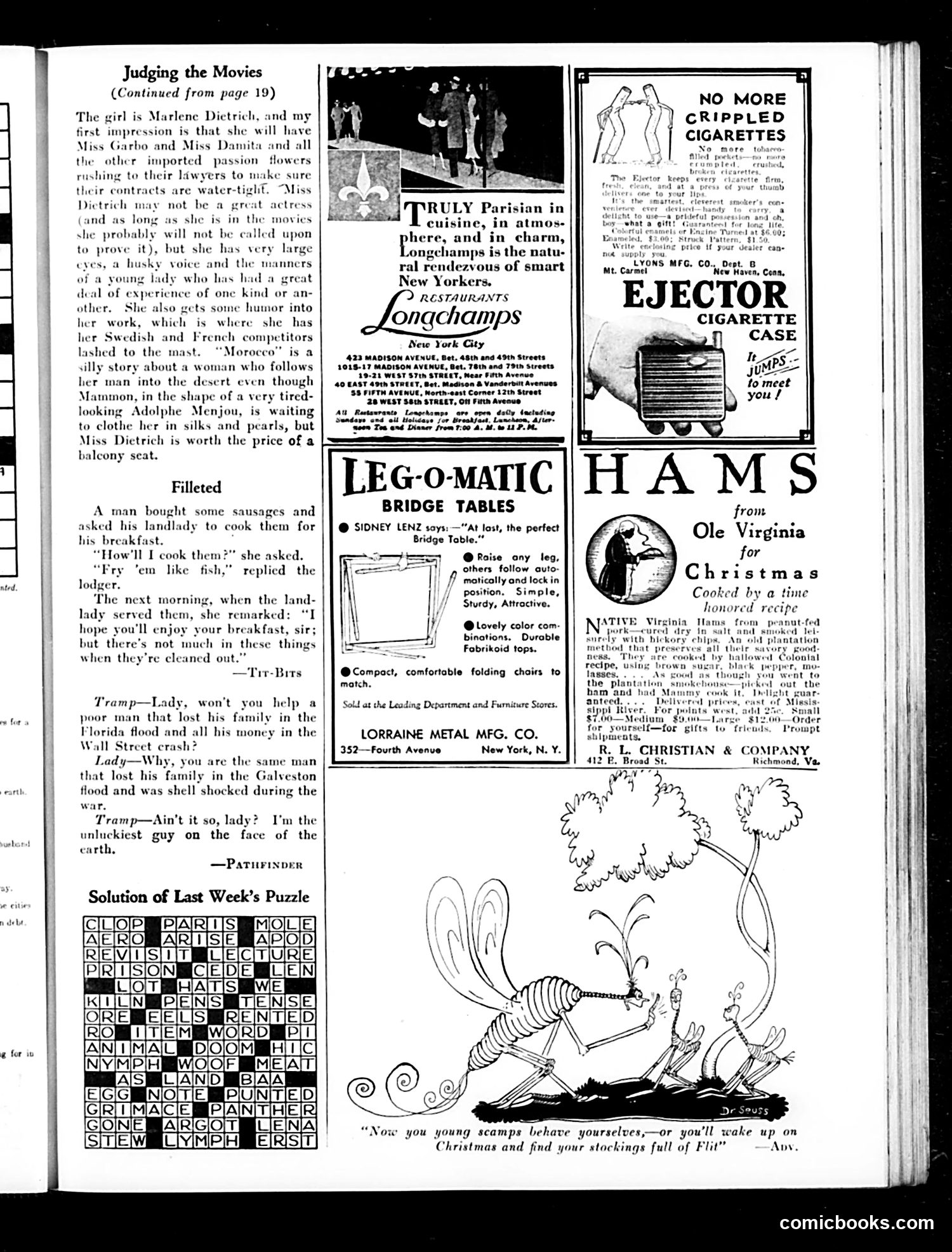
Analysis of Judge Magazine Page This page is primarily advertisements and filler content rather than political satire. The main elements: Movie Review (top left): Discusses Marlene Dietrich in the film "Morocco," comparing her favorably to Greta Garbo. The reviewer notes she's not a great actress but has good looks, voice, and manners—typical entertainment journalism of the era. Humorous Anecdotes: Short jokes about a man cooking sausages and a vagrant, representing the light humor filler common in magazines. Advertisements: The bulk of the page features ads for Longchamps restaurants, Leg-O-Matic bridge tables, Ejector cigarette cases, Virginia hams, and a Flit pest spray cartoon (bottom). The Flit ad cartoon depicts an exaggerated insect threatening plants, using the product's standard scare-tactic approach to advertising insecticide—humor through grotesque imagery meant to drive sales. This appears to be a typical 1930s magazine page blending light entertainment with commercial promotion, with no significant political content.
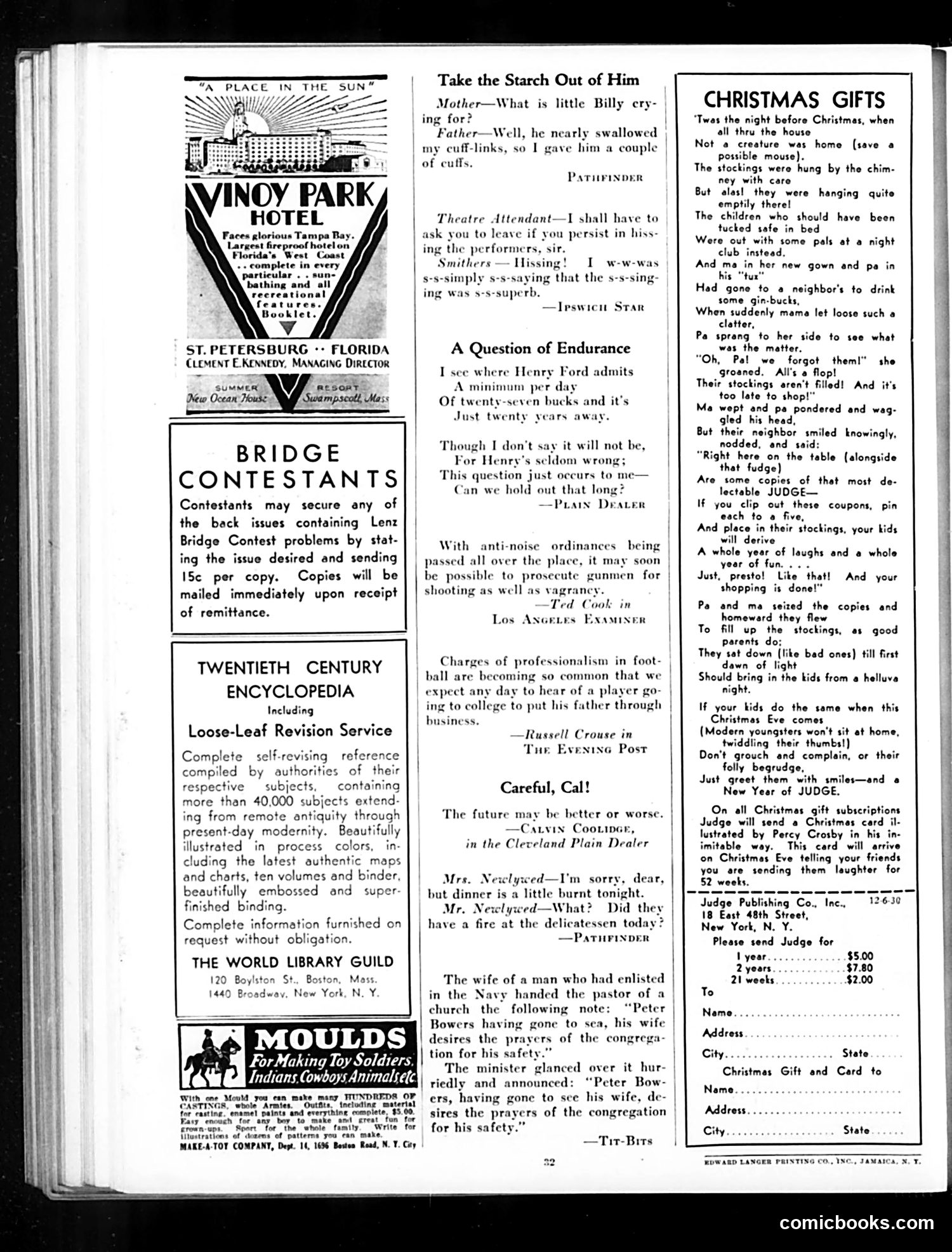
Analysis of Judge Magazine Page Content This is primarily an advertising and humor page from Judge magazine, with several unrelated short jokes and advertisements rather than a unified cartoon commentary. The humor pieces are domestic comedy typical of 1920s magazines: - "Take the Starch Out of Him" uses a pun on "cuffs" (both shirt cuffs and hitting) - "Theatre Attendant" jokes about a stammering man whose speech impediment makes his hissing criticism of performers sound like stuttering appreciation - "A Question of Endurance" references Henry Ford's prediction about automobile production timelines, questioning whether society can survive that long - The anti-noise ordinance joke plays on prosecuting criminals for "noise" - Multiple jokes about married life, including burnt dinner and naval wives' prayers The page reflects 1920s middle-class concerns: theaters, automobiles, marriage dynamics, and domestic life. The "Christmas Gifts" poem satirizes modern absent parents prioritizing nightclubs over children—social commentary on changing family values during the Jazz Age. No significant political figures or events are referenced; this is light, general-audience satire.
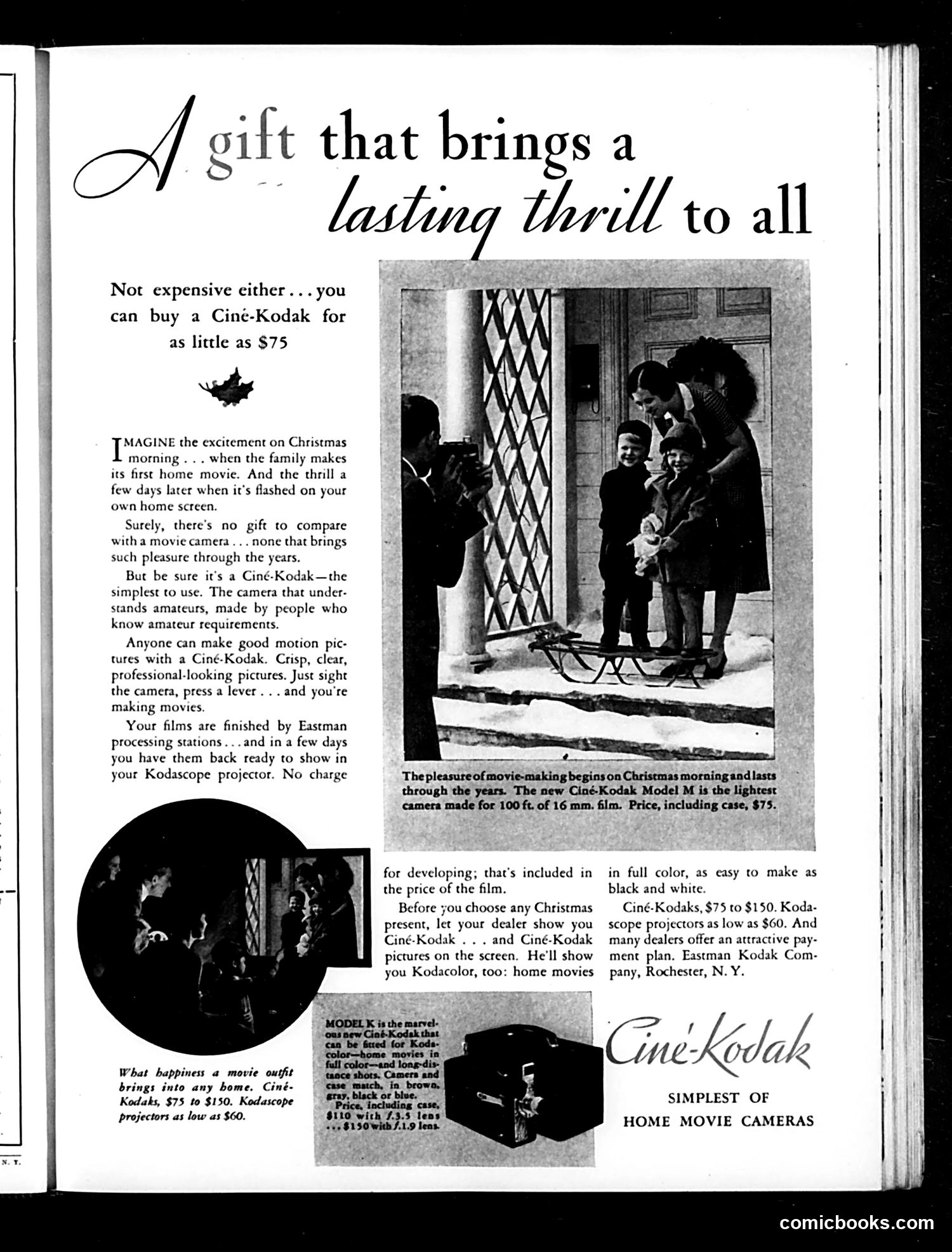
Analysis This is not a cartoon or satire—it's a straightforward advertisement for Ciné-Kodak home movie cameras, disguised as editorial content in Judge magazine. The page promotes consumer adoption of home film technology as a Christmas gift. The text emphasizes accessibility ("not expensive," starting at $75) and ease of use ("simplest to use," "anyone can make good motion pictures"). The accompanying photographs show a family making a home movie and the Ciné-Kodak Model M camera itself. The "thrill" referenced is literal: the excitement of families recording and screening their own films at home—a novelty in this era. Eastman Kodak processing stations handled film development. This represents mid-20th-century consumer marketing targeting middle-class households, presenting home moviemaking as an aspirational leisure activity. There is no political satire or social commentary—Judge appears to have published this as paid promotional content or native advertising.
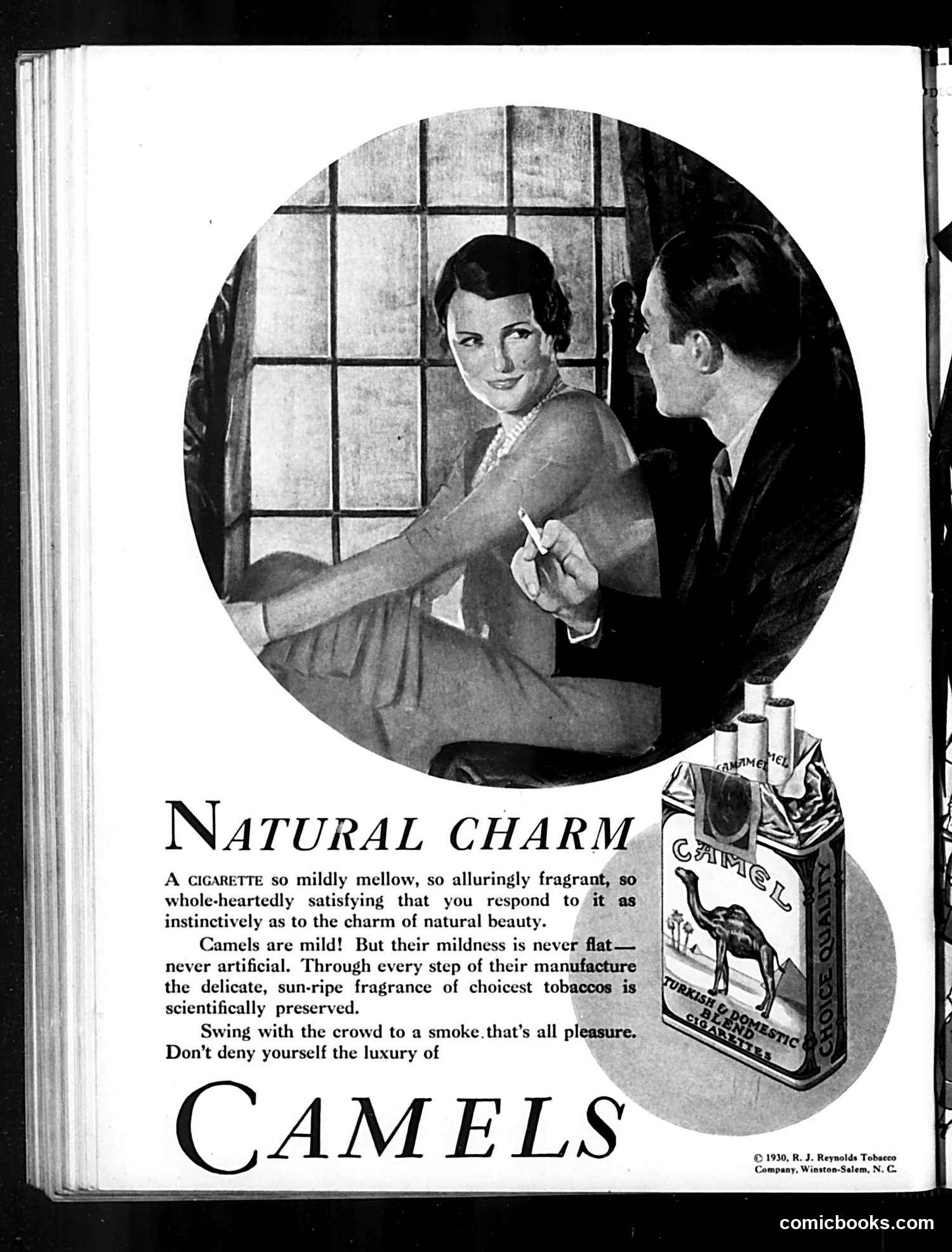
Analysis This is primarily a cigarette advertisement, not satire or political commentary. It appears in *Judge* magazine (1930) but functions as a commercial endorsement for Camel cigarettes. The image shows a well-dressed couple in an intimate moment by a window—a romantic scene designed to associate smoking with sophistication and natural appeal. The advertisement emphasizes "natural charm" and "mildness," claiming Camel's manufacturing process preserves tobacco's "delicate, sun-ripe fragrance." The tagline "Swing with the crowd to a smoke that's all pleasure" appeals to social conformity and leisure culture of the 1930s. Key context for modern readers: This predates widespread knowledge of smoking's health dangers. The phrase "never artificial" and scientific language were used to establish credibility and luxury, not transparency. Such ads were standard in magazines of this era.