judge
Judge — December 13, 1930
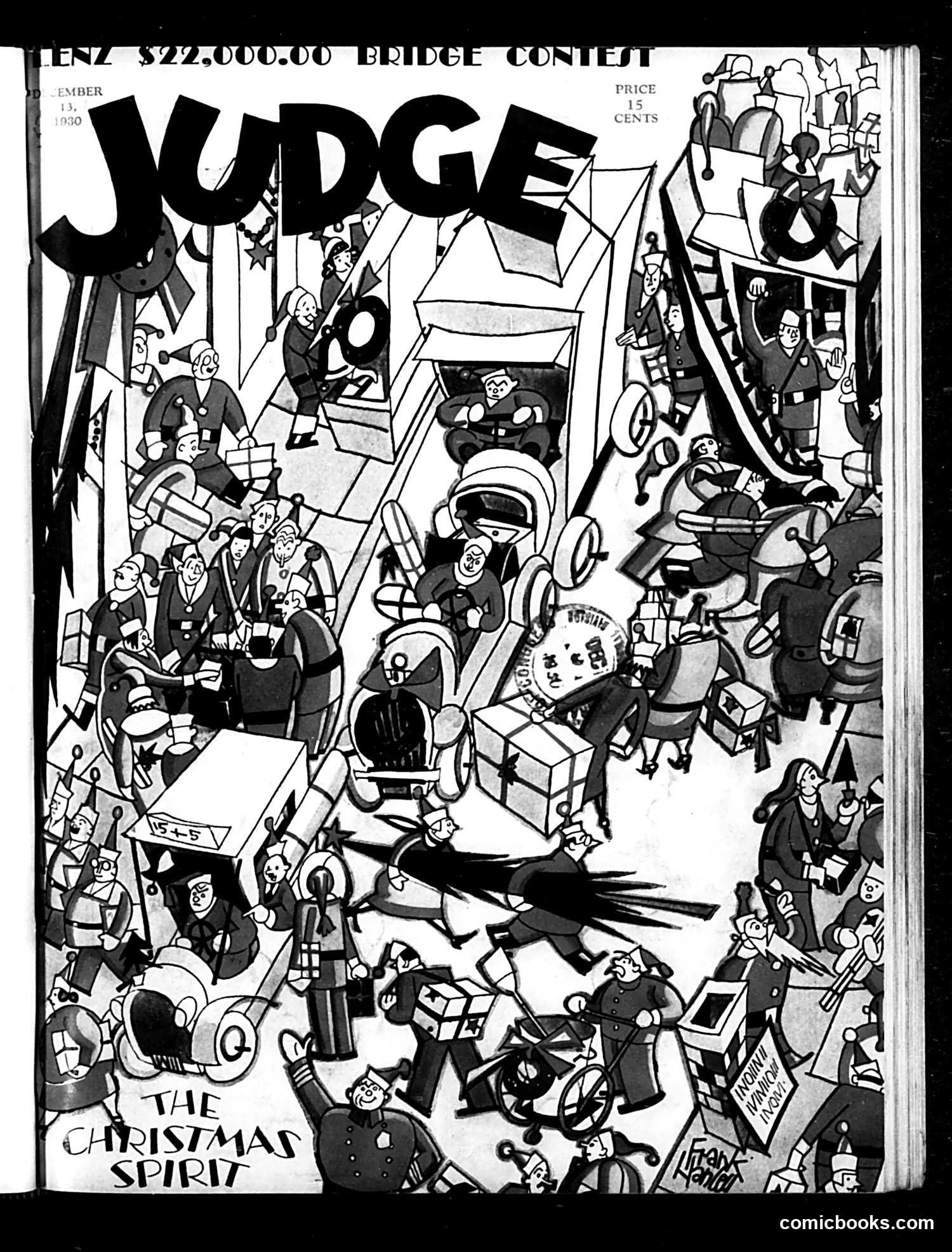
Analysis of Judge Magazine Cover (December 1930) This is a satirical Christmas-themed cover depicting a chaotic toy store or gift-buying scene. The central figure appears to be Santa Claus surrounded by frenzied shoppers, mechanical toys, and commercial activity—likely satirizing the consumer frenzy of holiday shopping during the Great Depression era. The title "THE CHRISTMAS SPIRIT" suggests ironic commentary on materialism overshadowing the holiday's spiritual meaning. The crowded, mechanical composition emphasizes commercialism's dominance. The cartoon critiques how American consumer culture and gift-buying have become the dominant expression of Christmas, even amid economic hardship. The "$22,000.00 BRIDGE CONTEST" reference at the top indicates additional page content unrelated to the main cover illustration.
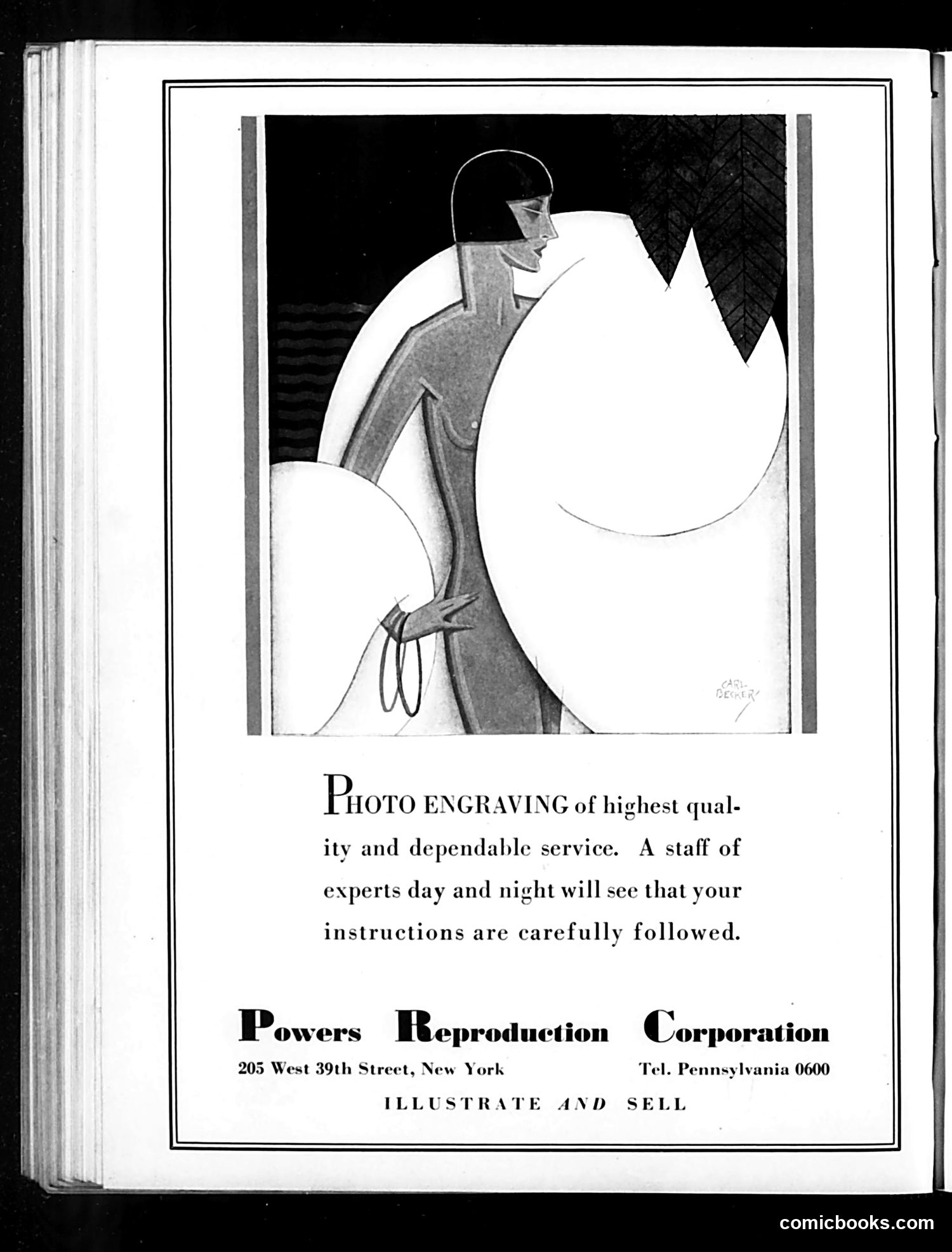
Analysis This page is primarily advertising, not editorial content or satire. It features an Art Deco-style illustration of a stylized female figure in white garments against a dark background—typical 1920s-1930s modernist design aesthetics. The ad promotes Powers Reproduction Corporation, a photo engraving service located at 205 West 39th Street, New York. Photo engraving was a commercial printing technique essential for reproducing images in publications and advertisements. The text emphasizes quality workmanship and round-the-clock expert service ("day and night"). The tagline "ILLUSTRATE AND SELL" appeals to publishers and advertisers as business customers. This is not political or social satire, but rather a professional services advertisement targeting the publishing industry.
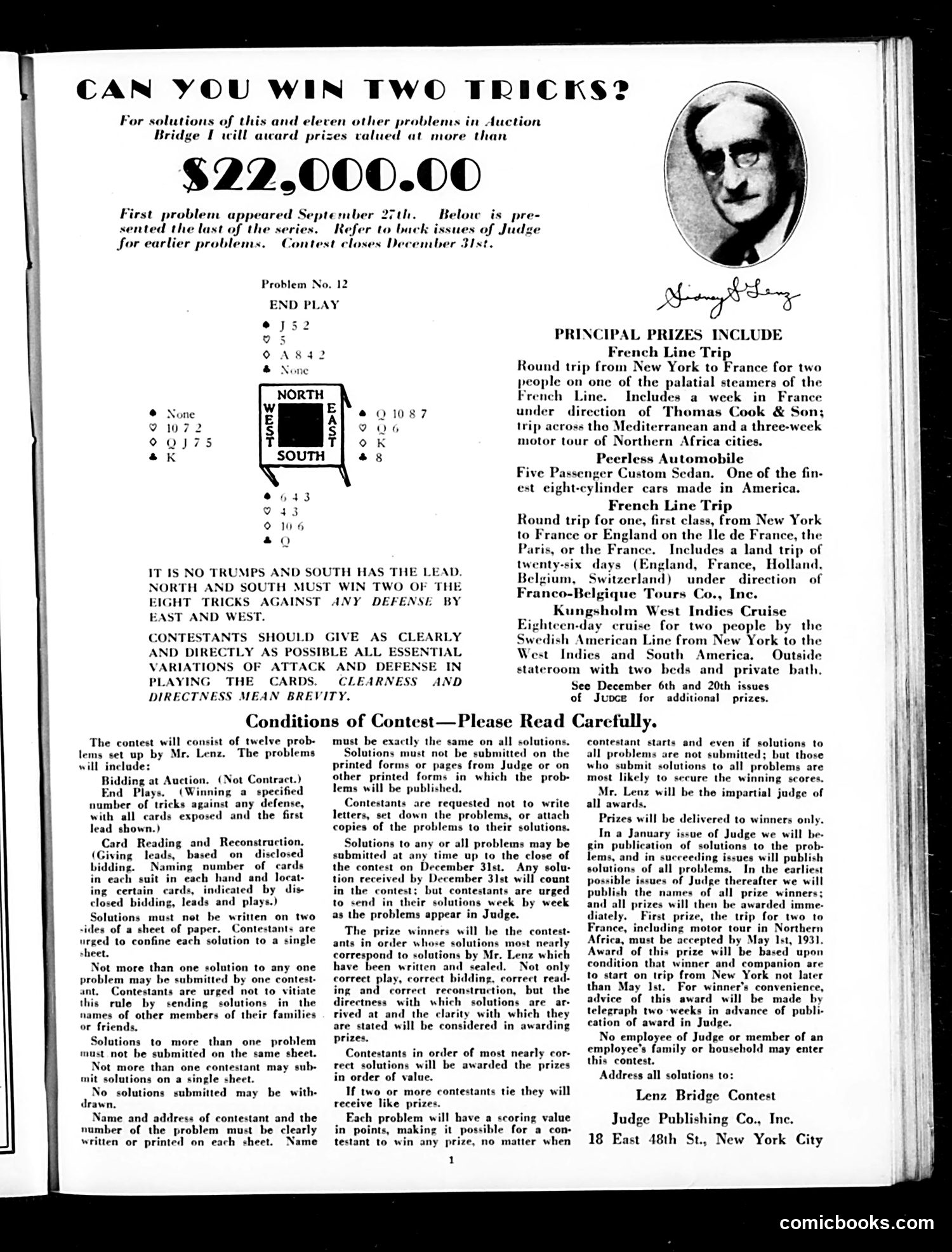
Analysis This page is primarily a contest advertisement, not a political cartoon. Judge magazine is offering $22,000 in prizes (a substantial sum for the era) for solving twelve bridge problems—card game puzzles where players must deduce hidden cards based on bidding and play. The portrait shows Mr. Lenz, the contest judge and apparently a notable bridge expert. The problems involve analyzing trick plays and card distributions, requiring "clearness and directness" in explanations. Principal prizes include a French Line ocean voyage, a Peerless automobile, and a Caribbean cruise. The page emphasizes that solutions must be submitted by December 31st and published in Judge magazine. This reflects bridge's popularity as an intellectual leisure pursuit among affluent Americans in this period.
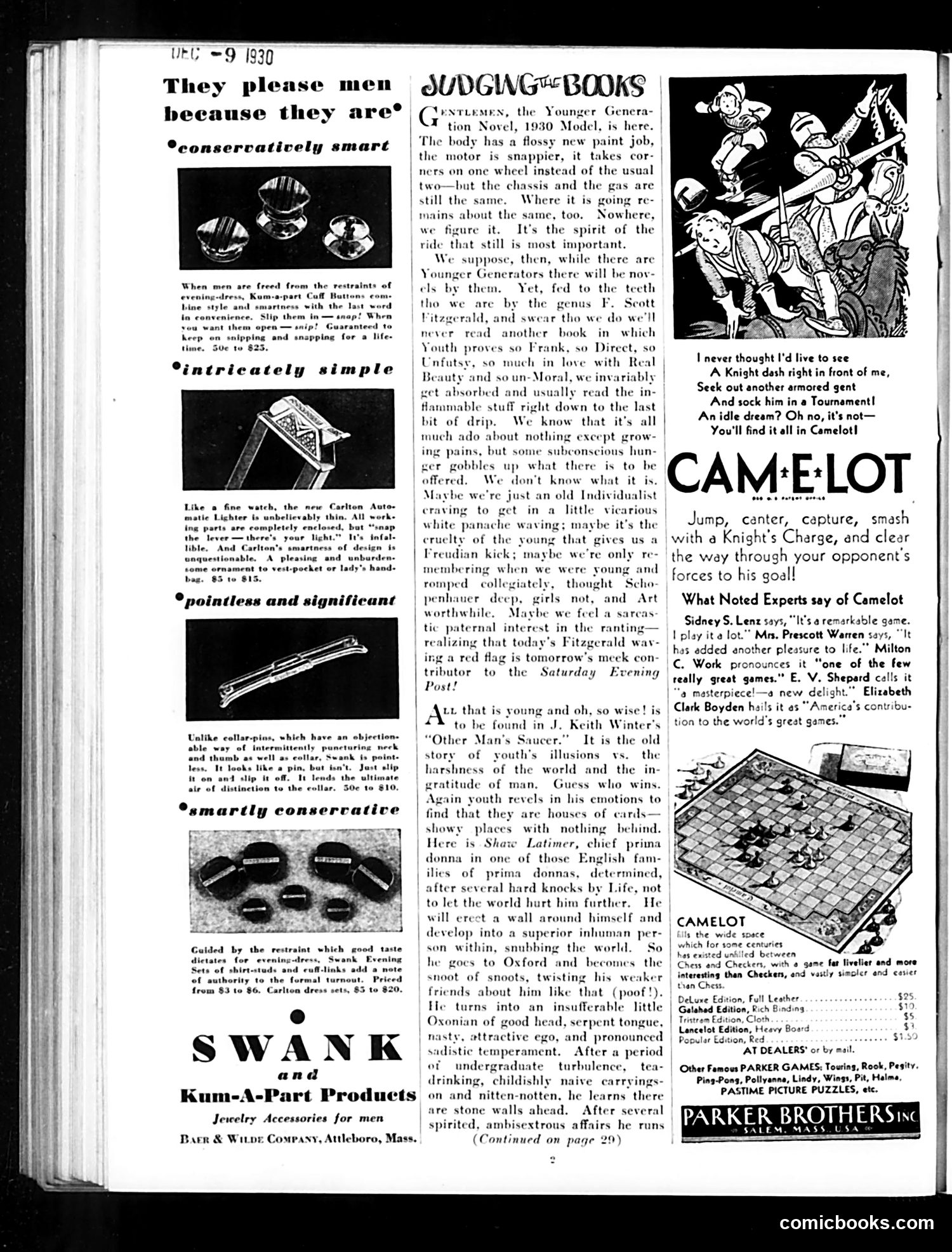
Analysis This page is primarily advertising and book reviews, not political satire. The top left features ads for jewelry and accessories ("conservatively smart," "intricately simple," "pointless and significant"), emphasizing design sophistication for men. The center contains "Judging the Books"—a literary review section praising the 1930 Younger Generation novel by F. Scott Fitzgerald. The reviewer celebrates Fitzgerald's ability to capture youth's contradictions: romantic idealism versus worldly disillusionment, frivolity versus depth. Camelot (right side) is a board game advertisement featuring knights and tournaments, marketed to appeal to adventurous players. Bottom advertising includes Swank jewelry and Parker Brothers games. This reflects 1930 consumer culture: the magazine balanced satirical commentary with high-end product marketing for affluent readers interested in literature, games, and masculine accessories.
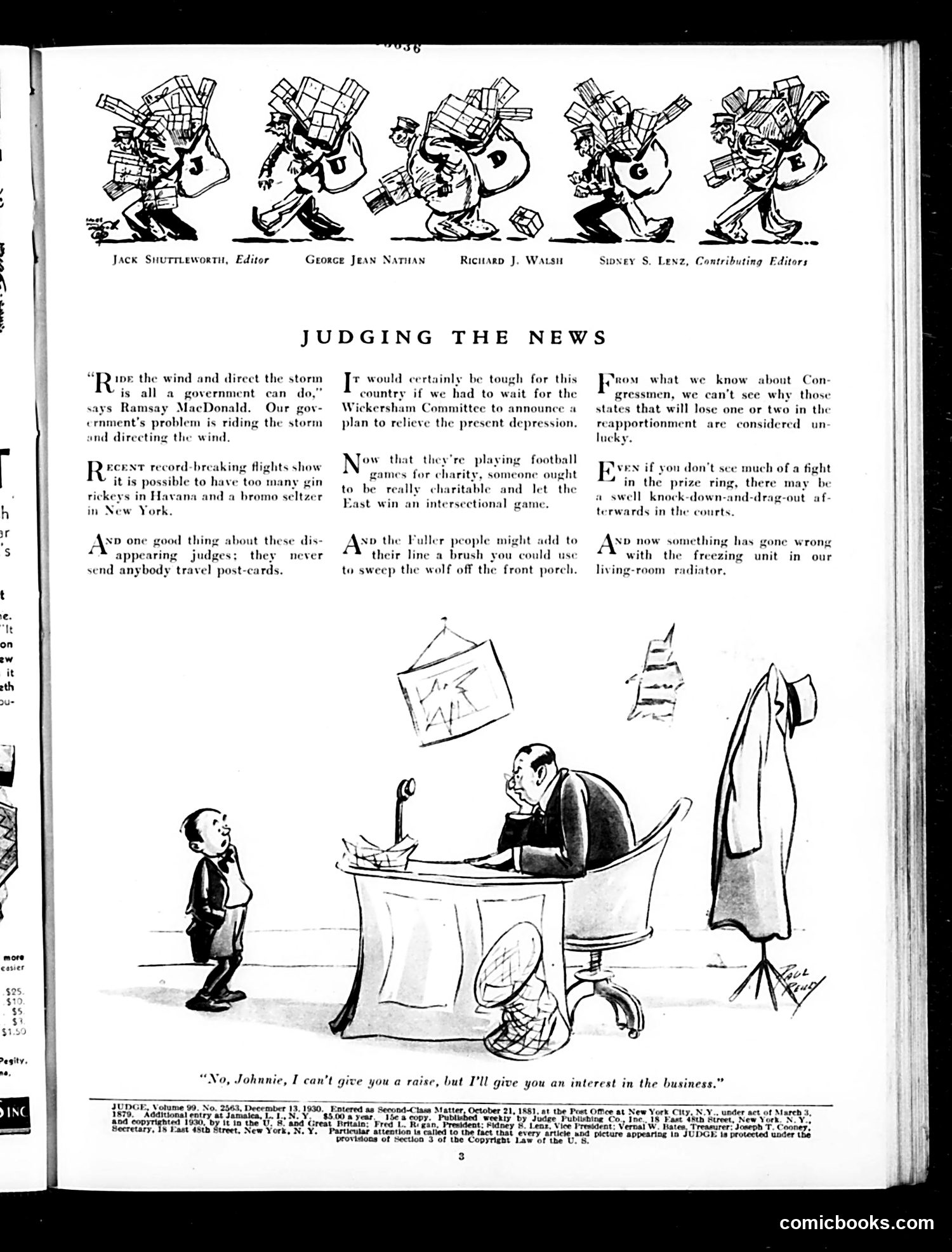
"Judging the News" - December 13, 1930 This page satirizes Depression-era news stories through short commentary and a cartoon. The editorial quips mock government inaction ("all a government can do" is "ride the storm"), excess gin consumption in Harlem despite Prohibition, charity football games, and other current events. The main cartoon depicts a businessman at a desk telling a young boy: "No, Johnnie, I can't give you a raise, but I'll give you an interest in the business." This is bleak Depression humor—the businessman offers only false hope (a "share" in the business) instead of actual wage increases, reflecting how employers exploited workers during economic hardship by promising future gains instead of immediate pay.
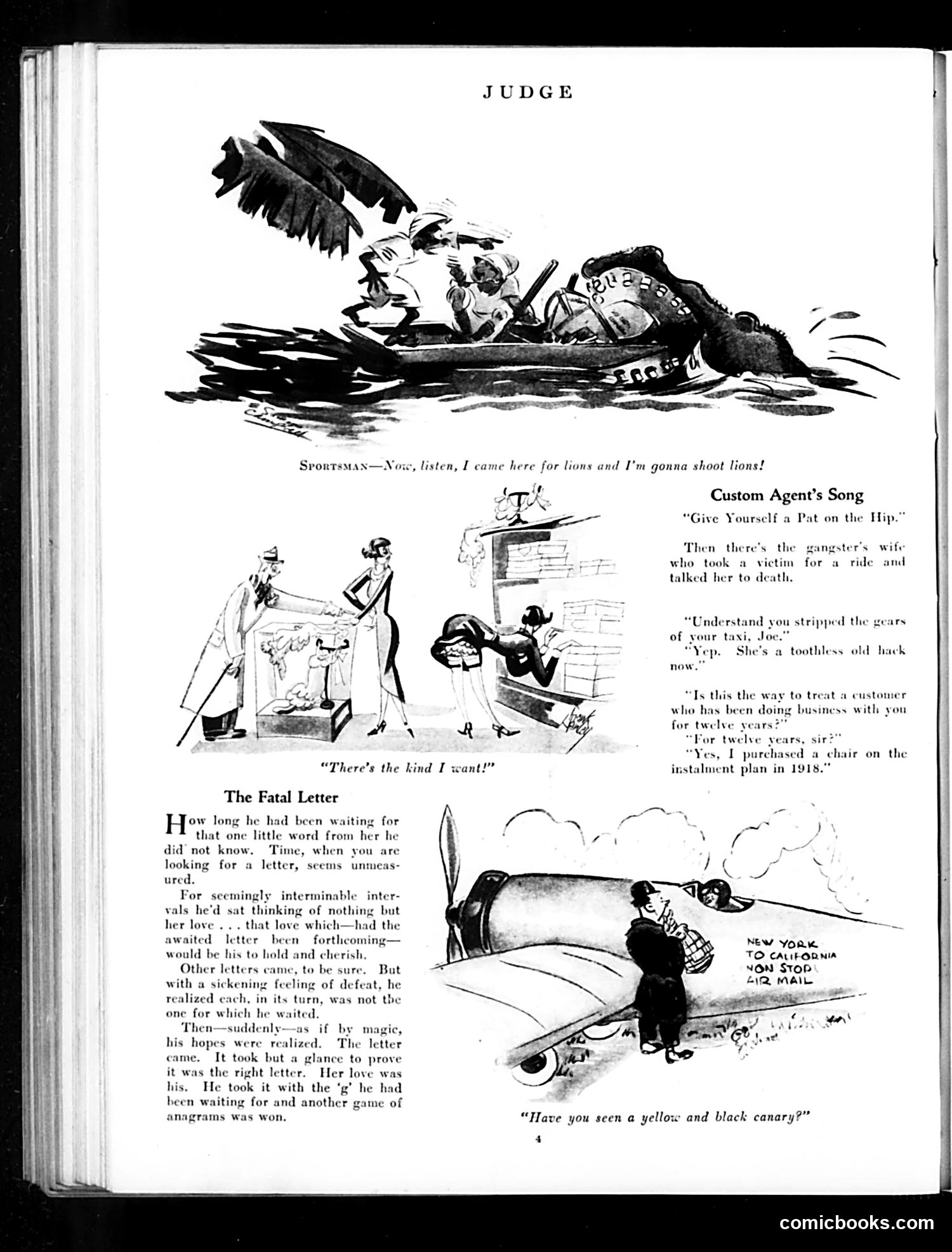
Analysis of Judge Magazine Page Top Cartoon ("Sportsman"): A hunter in a sinking boat confronts an eagle, boasting he came to shoot lions—implying overconfidence meeting reality. This appears to be generic satire about poor planning or mismatched expectations. Middle Section ("There's the kind I want!"): Shows a domestic dispute, likely satirizing marital conflict or consumer behavior. "Custom Agent's Song": Mocking text about a taxi driver mistreating a customer, suggesting satire of working-class service industry abuses or labor disputes. "The Fatal Letter": A sentimental story about a man awaiting a love letter, with accompanying illustration of someone intercepting mail. This appears to be light romantic satire rather than political commentary. Overall: This page mixes generic humor, domestic comedy, and sentimental fiction rather than pointed political satire.
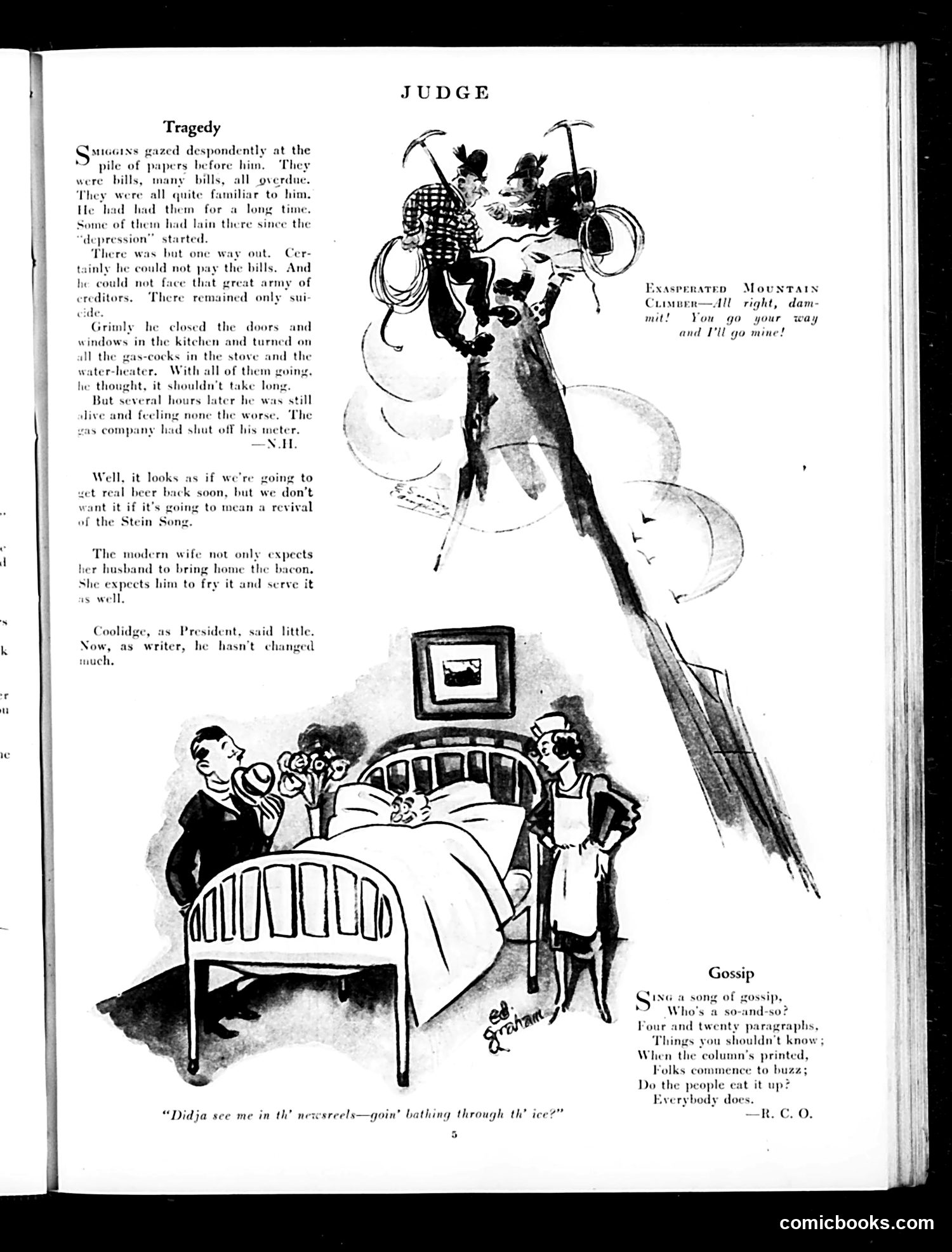
Analysis of Judge Magazine Page This page contains three separate satirical pieces: "Tragedy" (left column): A commentary on economic hardship, depicting a man facing overdue bills during what appears to be the Depression era. The satire suggests his only solution is suicide—turning on gas appliances to asphyxiate himself. The dark humor critiques both his financial desperation and the impotence of institutions to help. "Exasperated Mountain Climber" (top right): A cartoon showing two cyclists on a mountain, with one exasperatedly telling the other to go their own way. The humor appears to involve romantic or relationship conflict during leisure activity. "Gossip" (bottom right): A poem-caption satirizing how gossip spreads through society—from newspapers to social circles, with people eagerly sharing scandalous information regardless of accuracy. The overall tone reflects early-20th-century social commentary on economic anxiety, modern dating, and information culture.
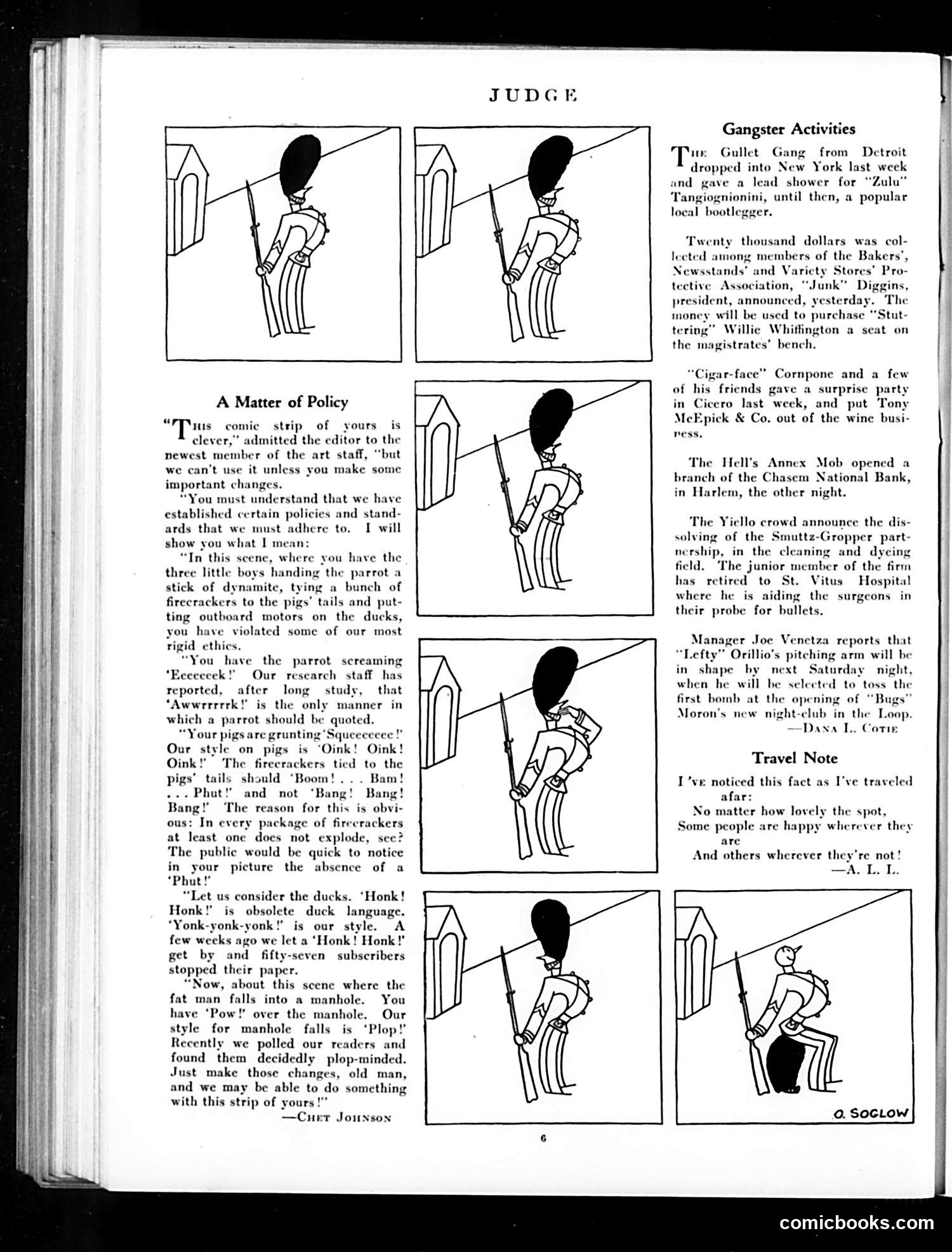
"Judge" Page Analysis This page contains a comic strip titled "A Matter of Policy" by Chet Johnson (signed at bottom). The strip depicts a conversation between an editor and a new staff member about establishing editorial standards for a comic strip. The editor explains policies regarding character dialogue and sound effects—notably that parrots should say "Eeeeeeck!" rather than "Awwwrrr!", pigs should grunt "Squeeeece!" not "Oink! Oink!", and ducks should say "Honk! Honk!" (not "Yank-yank-yank!"). He emphasizes consistency and reader preferences, mentioning they polled readers who demanded changes. The humor satirizes editorial micromanagement and arbitrary creative restrictions. The comic strip's visual gags show characters falling through a manhole to illustrate these absurd stylistic rules. The right sidebar contains unrelated brief news items about gangster activities and other contemporary topics.
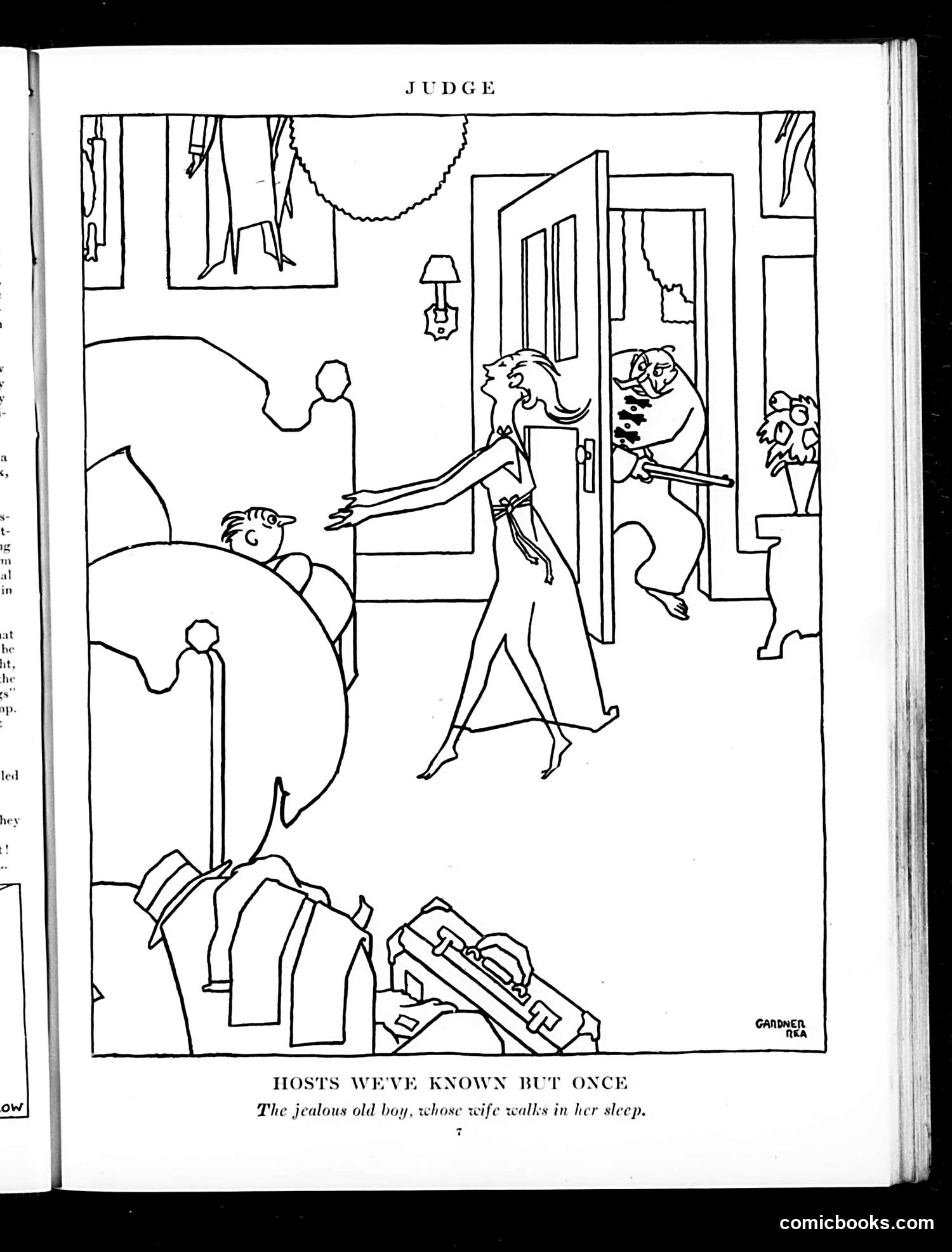
"Judge" Cartoon Analysis This single-panel cartoon titled "Hosts We've Known But Once" depicts a domestic scene with the caption: "The jealous old boy, whose wife walks in her sleep." The humor plays on a common marital anxiety trope of the era: a husband suspiciously monitoring his sleepwalking wife's nighttime movements through their home. The illustration shows the wife in a nightgown moving through doorways while the husband watches from bed, with other household members visible in adjacent rooms. The satire targets masculine jealousy and paranoia—specifically, the anxious husband who interprets his wife's innocent sleepwalking as potential infidelity or improper behavior. It mocks both the husband's unfounded suspicions and the social context where wives' autonomy was subject to such scrutiny. The joke relies on period understanding of sleepwalking as a genuine concern and marriage dynamics of that era.
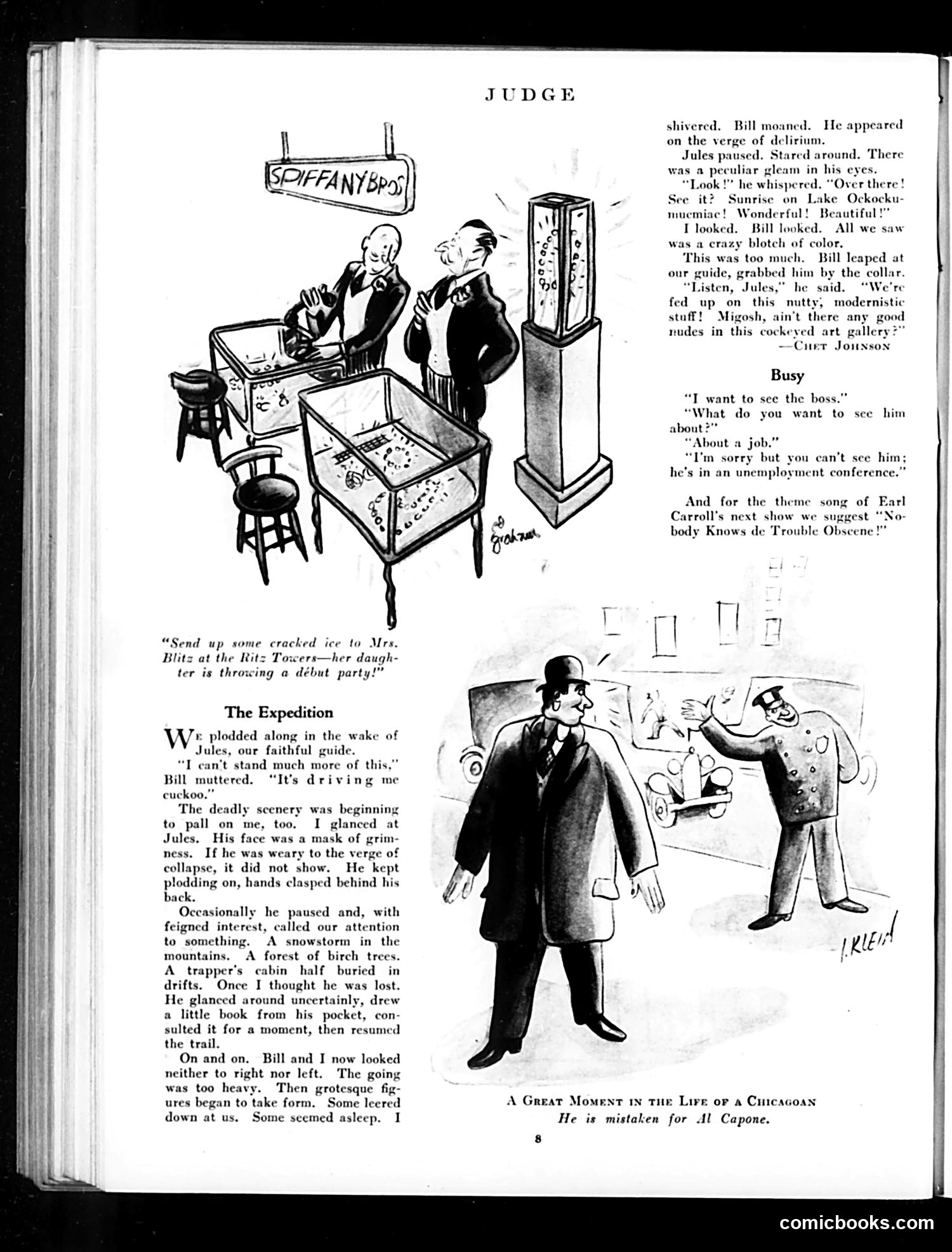
Analysis of Judge Magazine Page This page contains multiple satirical pieces typical of 1920s-30s Judge magazine: "The Expedition" (main story): A narrative mocking modernist art appreciation. Jules, an affected guide, rhapsodizes over mundane landscapes ("Sunrise on Lake Ockocku-mucmiac") while the narrator and Bill see only "a crazy blotch of color." Bill's outburst—demanding "good nudes" instead of "nutty, modernistic stuff"—satirizes the pretentiousness of modern art enthusiasts versus common-sense viewpoints. "Busy" (top right): A joke about unemployment during what appears to be Depression-era economic crisis. The boss is unavailable because he's "in an unemployment conference"—darkly ironic given the visitor seeks a job. "A Great Moment" (bottom): Shows a man mistaken for Al Capone, the famous gangster. The humor derives from mistaken identity and the era's gangster obsession. The cartoons collectively mock modernism, unemployment anxiety, and 1920s-30s celebrity culture.
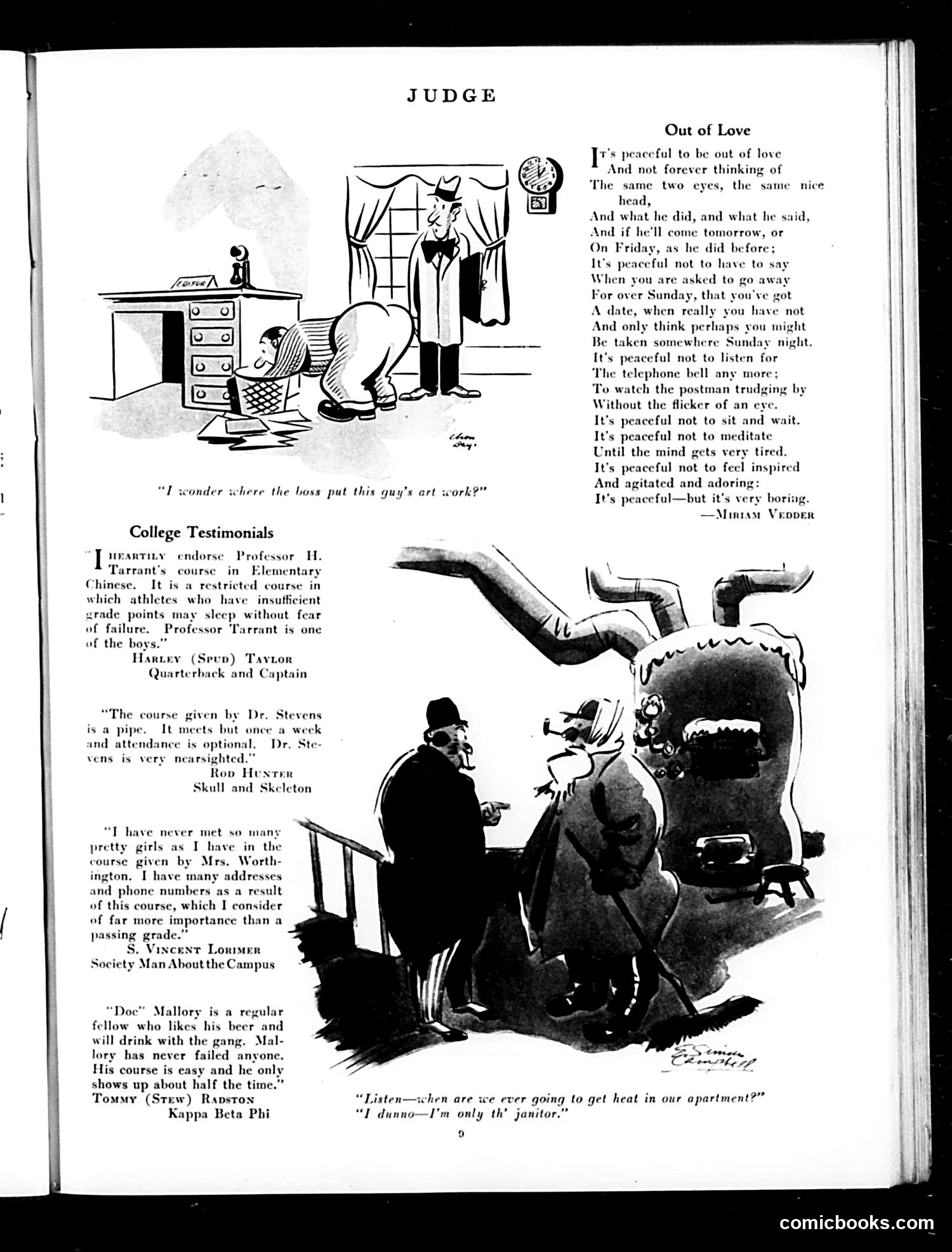
Judge Magazine Page Analysis This page from *Judge* magazine contains satirical commentary on college life and romantic relationships. "Out of Love" is a poem by Miriam Vedder exploring the paradox of being romantically unattached—it offers peace from obsessive thinking and waiting, but proves "very boring." The sentiment captures early 20th-century romantic anxieties. "College Testimonials" mocks academic standards through fake student endorsements. Athletes praise courses for being easy (Professor Tarrant's for sleeping through, Dr. Stevens's for minimal attendance). One student values a professor's course primarily for meeting "pretty girls," while another praises "Doc" Mallory for never failing anyone and being lenient. These reveal satirical critiques of grade inflation, academic laxity, and students prioritizing social benefits over education. The cartoons show workplace and domestic absurdity—one depicts a messy artist's workspace; another shows a tenant complaining about lack of heat to an indifferent janitor, illustrating housing complaints and class indifference typical of the era.
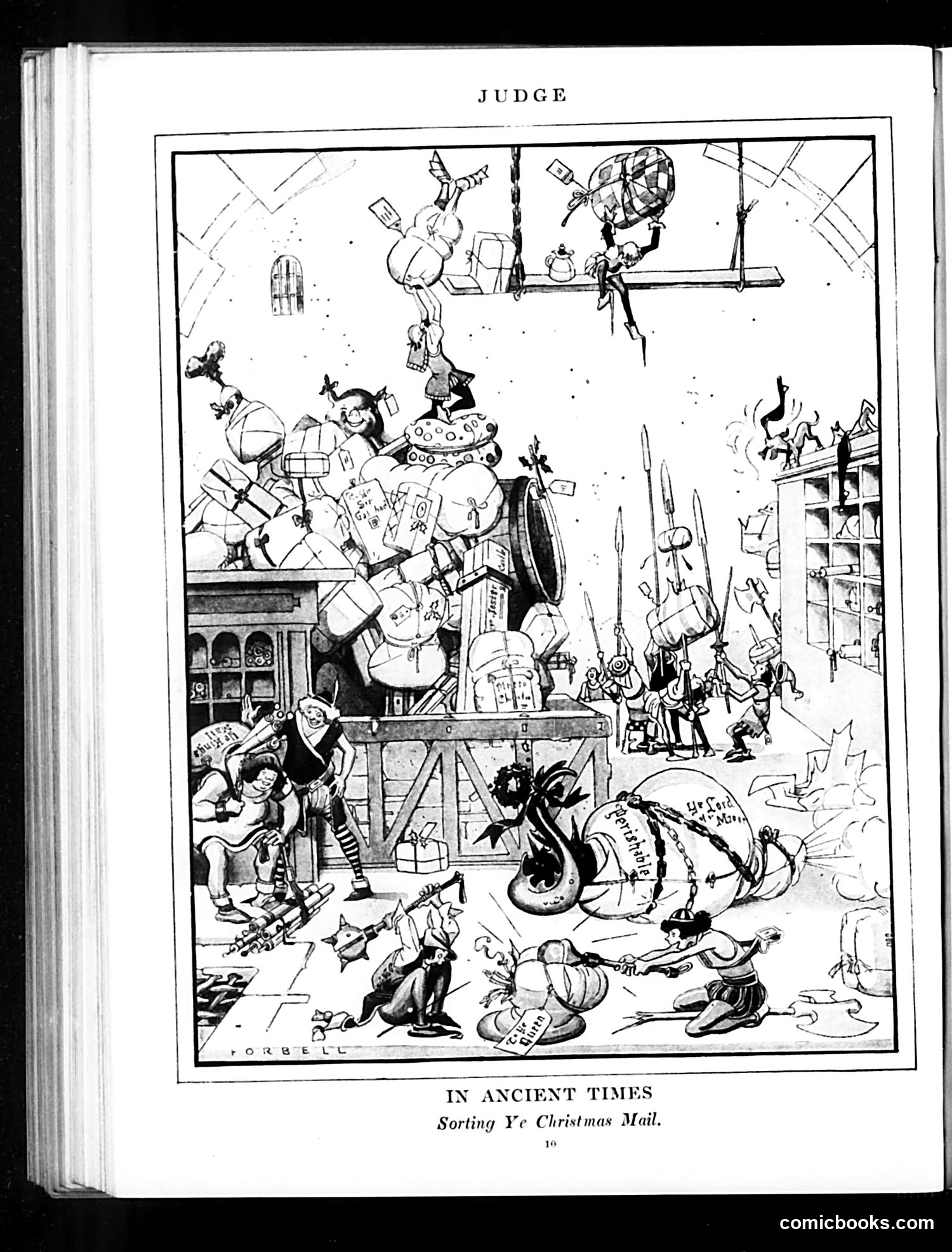
Analysis This satirical cartoon depicts a chaotic medieval-style workshop scene titled "Sorting Ye Christmas Mail" in "Ancient Times." The image humorously imagines how Christmas mail sorting might have occurred in a fantastical past era. The scene shows numerous small figures engaged in frantic activity around oversized mail bags and packages. There's a central figure (possibly representing authority) elevated above the chaos, while workers below struggle with enormous bundles. Dragons, magical creatures, and impossible contraptions appear throughout, suggesting absurdity. The satire likely mocks the annual Christmas mail surge—a perennial logistical challenge. By depicting it in "ancient times" with fantastical elements, Judge magazine humorously exaggerates the overwhelming chaos postal workers faced during the holiday season, transforming a contemporary problem into comedic medieval fantasy.
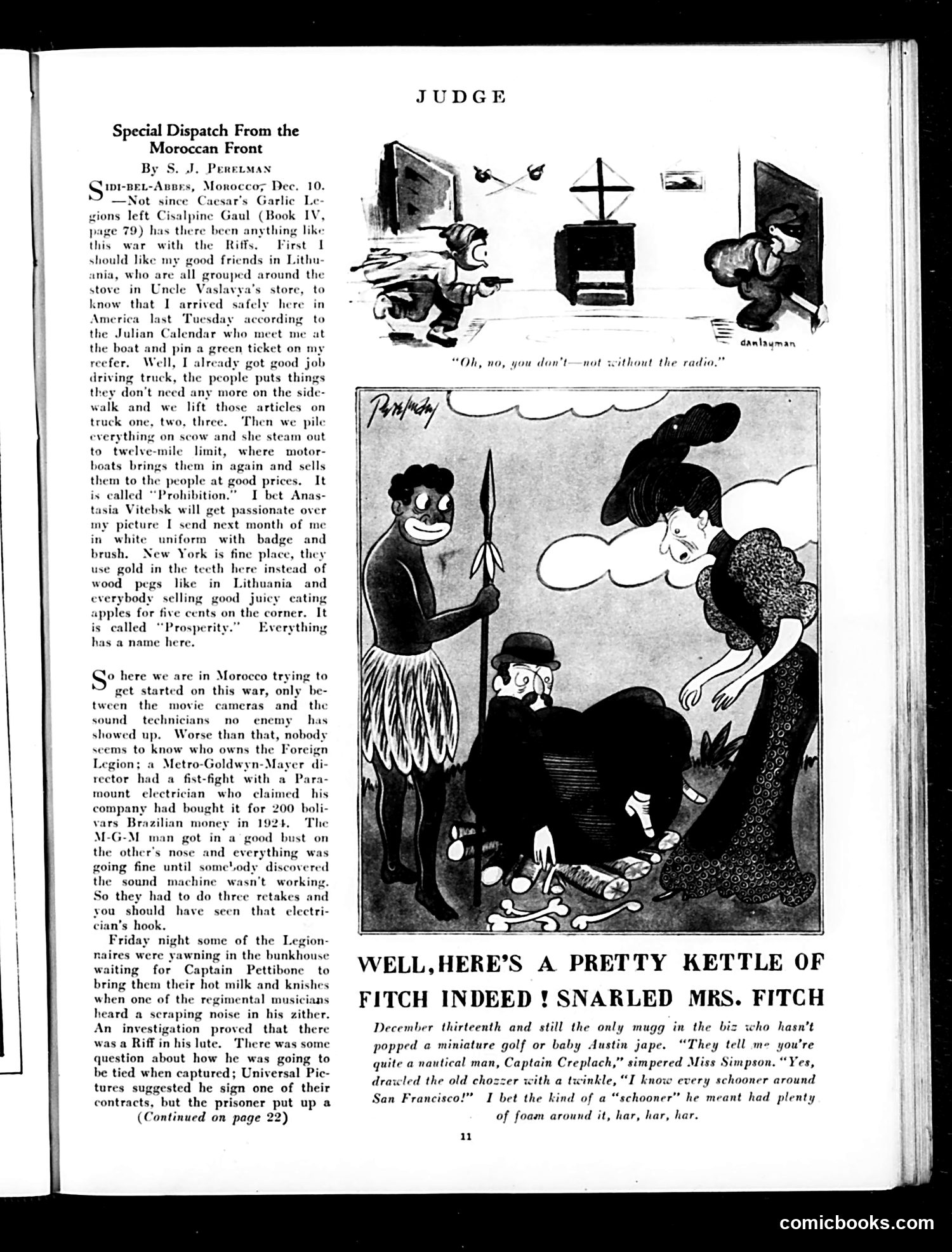
"Special Dispatch From the Moroccan Front" - Judge Magazine This page satirizes Hollywood's filmmaking during the 1920s Rif War (a real conflict in Morocco, 1921-1926). The main article, by S.J. Perelman, mocks movie studios competing to film the war. The satire targets the absurdity of production: rival studios (Metro-Goldwyn-Mayer vs. Paramount) arguing over rights to the Foreign Legion, sound equipment failures forcing retakes, and more concern for contracts than actual combat. A "Riff" (Moroccan fighter) captured in a musician's zither becomes another contract negotiation. The sidebar cartoon about "Mrs. Fitch" is unrelated—a separate domestic humor piece involving a woman catching someone in a nautical lie about "schooners" (playing on "schooner" as both a ship and a beer glass). The article's opening joke compares the invasion to Caesar's legions, then shifts to a narrator describing 1920s New York "prosperity" (bootleg liquor during Prohibition) and "success"—satirizing American optimism amid real geopolitical conflict being trivialized by Hollywood.
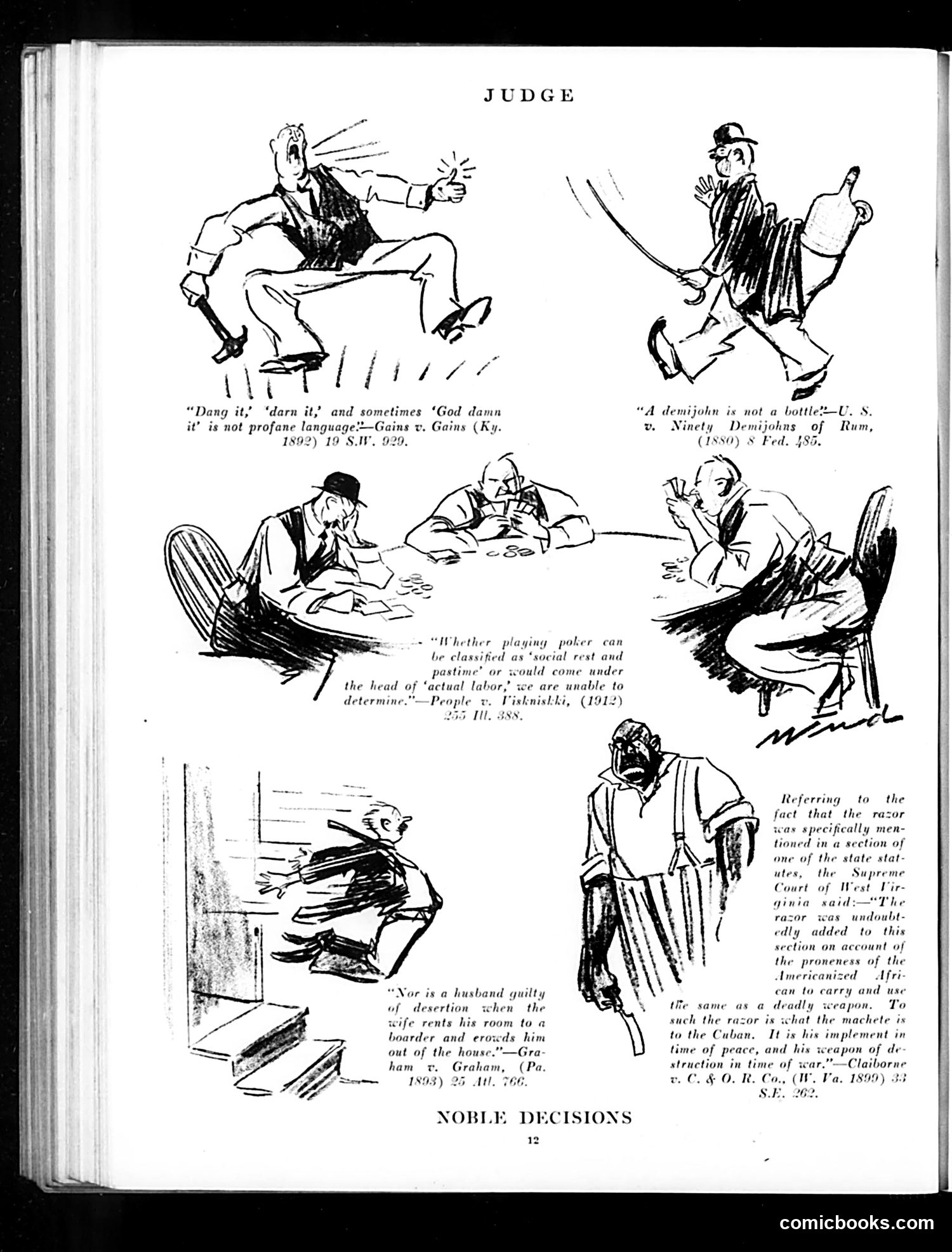
"Noble Decisions" - Judge Magazine Satire This page satirizes absurd court rulings through illustrated vignettes paired with actual case citations. The cartoons mock judicial logic by depicting ridiculous legal interpretations: Top panels show judges responding dramatically to trivial matters—profanity rulings and demijohn measurements—suggesting courts waste time on semantic nonsense. Middle section depicts men playing poker, illustrating a case debating whether poker constitutes "rest" or "labor." Bottom panels mock rulings about marital desertion and razor ownership, with the final section's citation to a West Virginia decision appearing to defend African Americans' right to carry razors by comparing it to Cubans with machetes—language revealing the era's casual racial stereotyping. The satire targets judicial overreach and the absurdity of codifying trivial distinctions into law. The page title, "Noble Decisions," is ironic—these rulings are anything but noble.
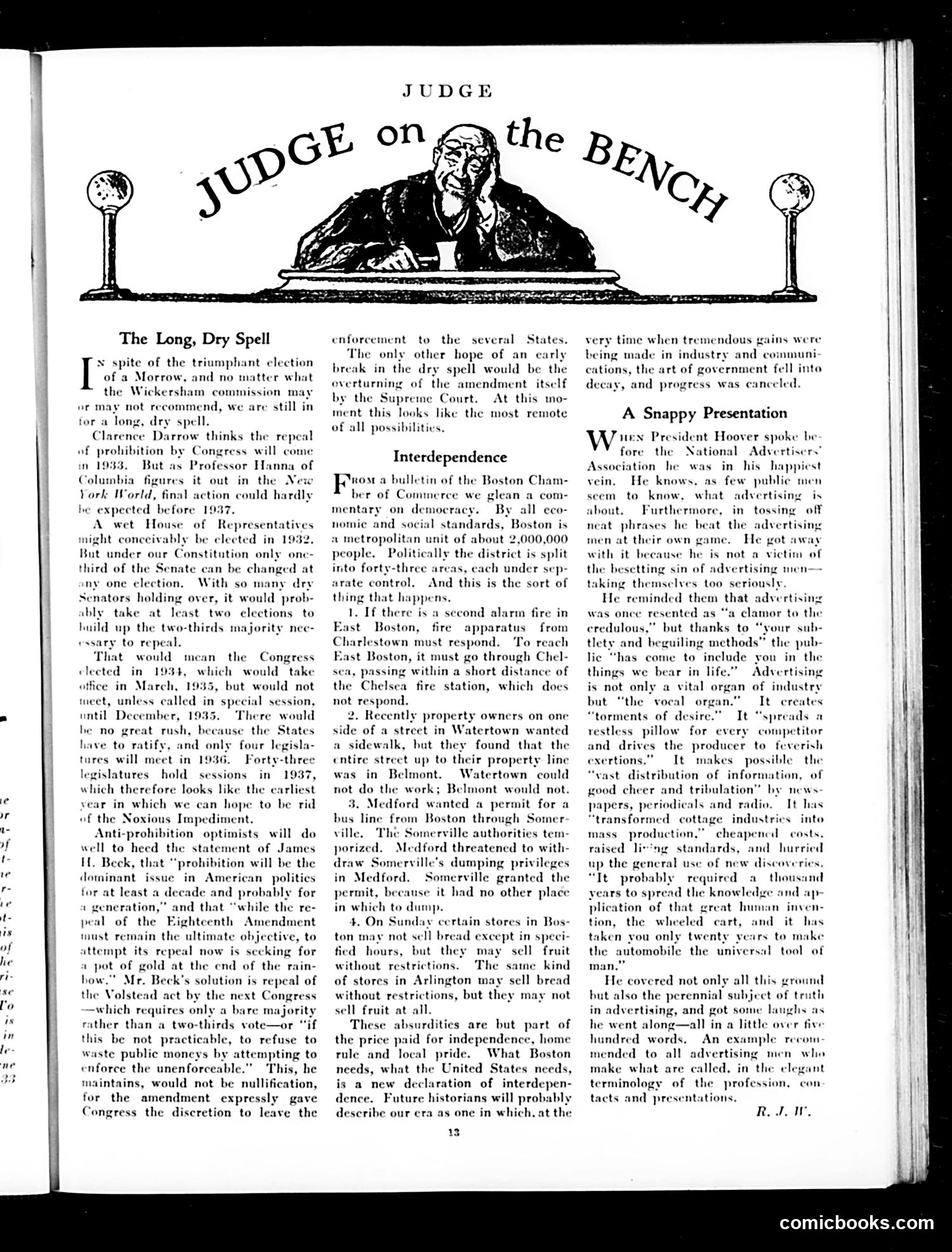
Judge Magazine Political Commentary Page This page from Judge magazine contains two separate satirical pieces on American politics and society: "The Long, Dry Spell" discusses Prohibition's near-permanent entrenchment. The article satirizes how difficult repeal would be—requiring constitutional amendment, congressional action, and state ratification. References to figures like Clarence Darrow (famous anti-Prohibition lawyer) and the Wickersham Commission (which investigated Prohibition enforcement) anchor the piece in 1930s political debate. The satire mocks how Prohibition, despite widespread unpopularity, seems impossible to overturn due to constitutional and political obstacles. "A Snappy Presentation" praises President Hoover's speech to advertisers, portraying advertising as essential to American capitalism—distributing information and driving industrial progress. The satire is gentler here, celebrating advertising's role in transforming cottage industries into mass production while gently mocking advertisers' self-importance. Both pieces reflect early 1930s concerns: Prohibition's failure and advertising's expanding cultural power. The page contains no cartoon illustrations, only text columns.
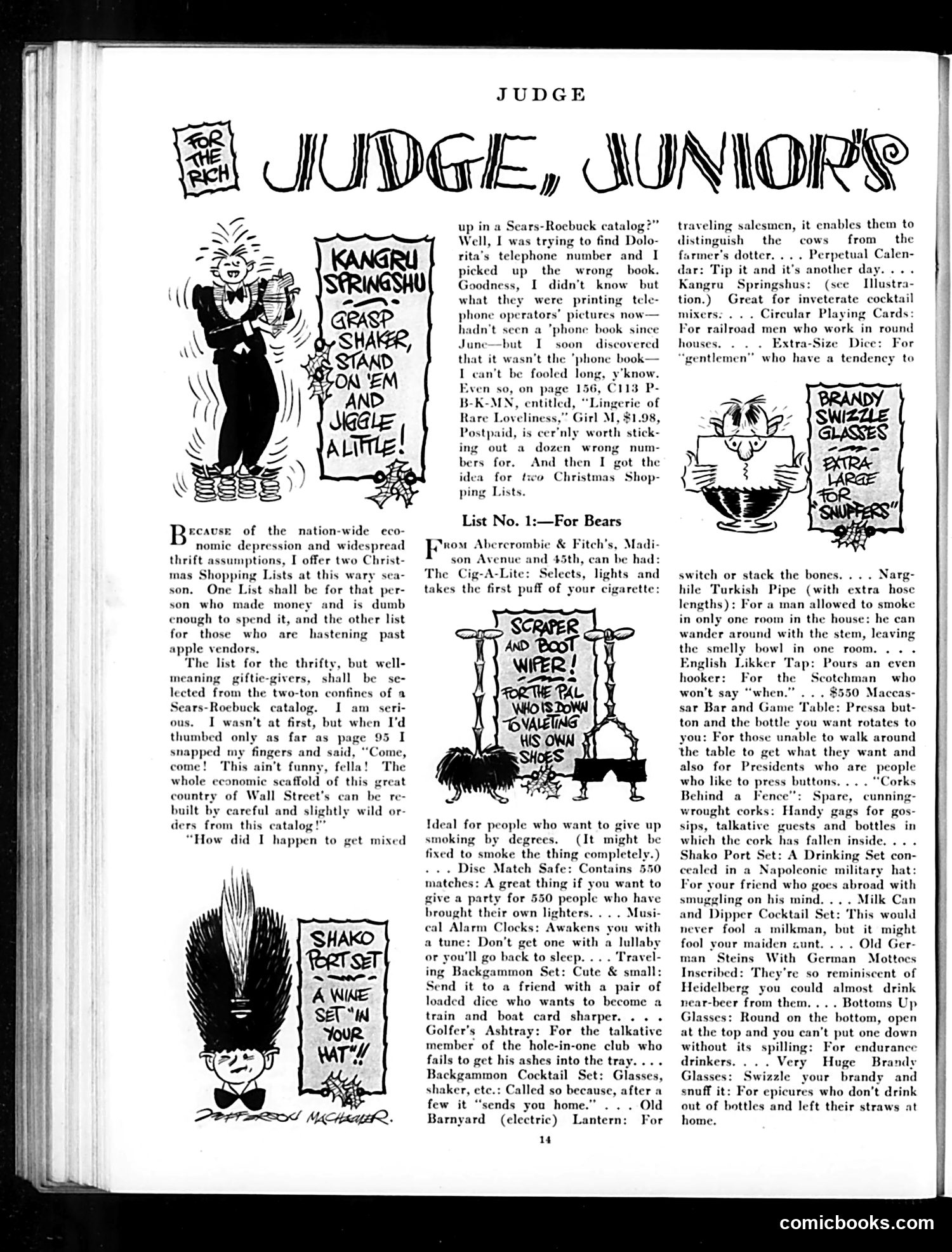
Judge Magazine: "Judge, Juniors" Christmas Shopping Lists This is a satirical gift guide published during the Great Depression, mocking both wealthy spenders and catalog shopping culture. The author humorously claims to have confused a Sears-Roebuck catalog with a phone directory while seeking a woman's number, then uses this "mistake" to justify creating Christmas lists. The joke targets two audiences: the rich who wastefully spend despite economic crisis, and the thrifty poor who must shop from catalogs. The "List No. 1: For Bears" portion mockingly recommends absurd luxury gifts from Abercrombie & Fitch—items like electric cigarette lighters, trick dice for cheating at games, and a hidden alcohol flask disguised as a military hat—items clearly designed for wealthy, morally questionable buyers rather than actual "bears" (unclear what "bears" specifically refers to here, possibly slang for wealthy men). The satire critiques both Depression-era excess and the catalog as a symbol of American consumer culture.
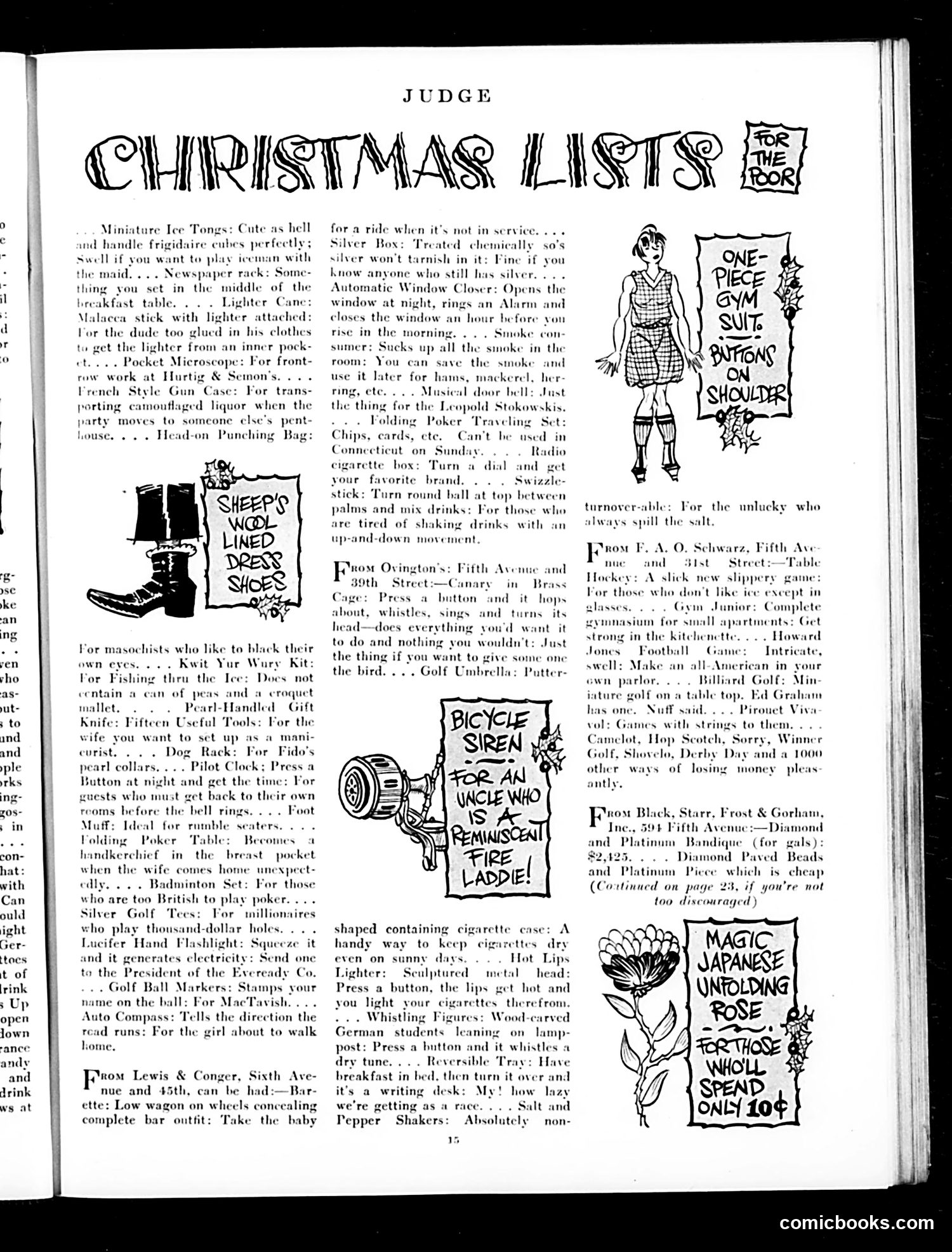
Christmas Lists (Judge Magazine) This page is a satirical gift guide presenting absurdly impractical or luxurious Christmas gift suggestions, mostly from high-end retailers like F.A.O. Schwarz and Ovington's. The humor targets wealthy consumers and commercial excess. The jokes mock: - Prohibition-era smuggling: "Camouflaged liquor" cases, hidden flasks disguised as golf equipment - Class anxiety: Gifts for the ostentatiously rich (silver golf tees "for millionaires," thousand-dollar poker games) - Marital discord: Punching bags, folding poker tables that hide when wives arrive home - Impracticality: A canary that whistles and dances instead of singing naturally; salt shakers promising not to spill The small cartoons in boxes advertise specific items with mock earnestness—a bicycle siren "for an uncle who is a reminiscent old laddie," a Japanese paper flower. This reflects 1920s consumer culture's rapid expansion and the era's satirical skepticism toward materialism and married-life stereotypes. The tone is lighthearted rather than condemning.
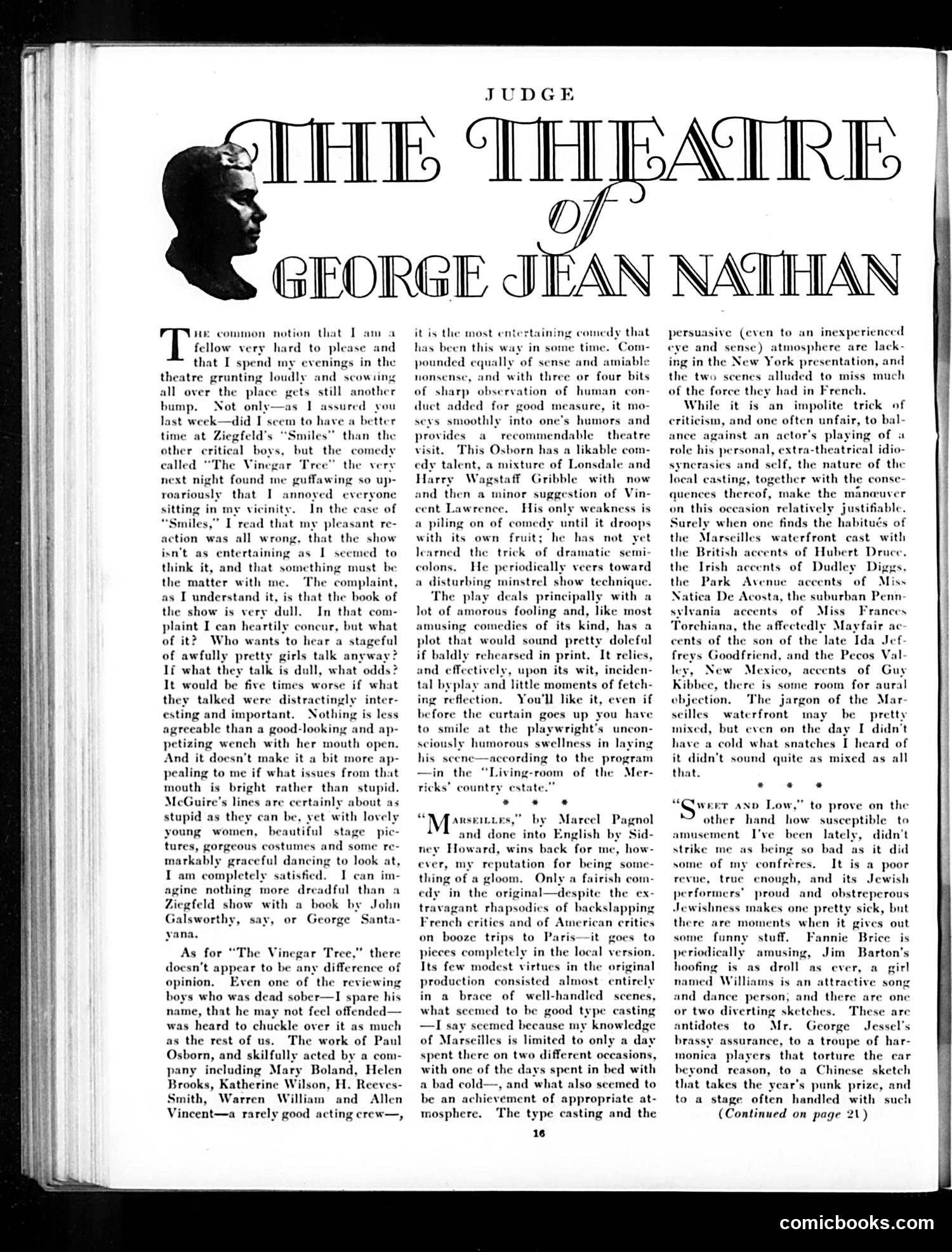
Analysis of Judge Page: Theater Reviews by George Jean Nathan This page features theater criticism by Judge's drama critic, George Jean Nathan. The header includes a profile portrait identifying him as the author. Nathan reviews three Broadway productions: Ziegfeld's Follies (a revue featuring pretty girls and dancing), The Vinegar Tree (a comedy by Paul Osborn), and Marseilles (a French play adapted into English by Sidney Howard). The satire targets Nathan himself—the opening establishes him as famously "hard to please," yet he's enthusiastically praising shows others dismissed. He defends enjoying spectacle despite weak plots, arguing that beautiful actresses don't need intelligent dialogue. The humor lies in Nathan's unapologetic lowbrow tastes contradicting his critical reputation, while he simultaneously demolishes the French play as inferior to its original. This represents typical Judge content: insider entertainment criticism using self-deprecating humor about New York's theater scene.
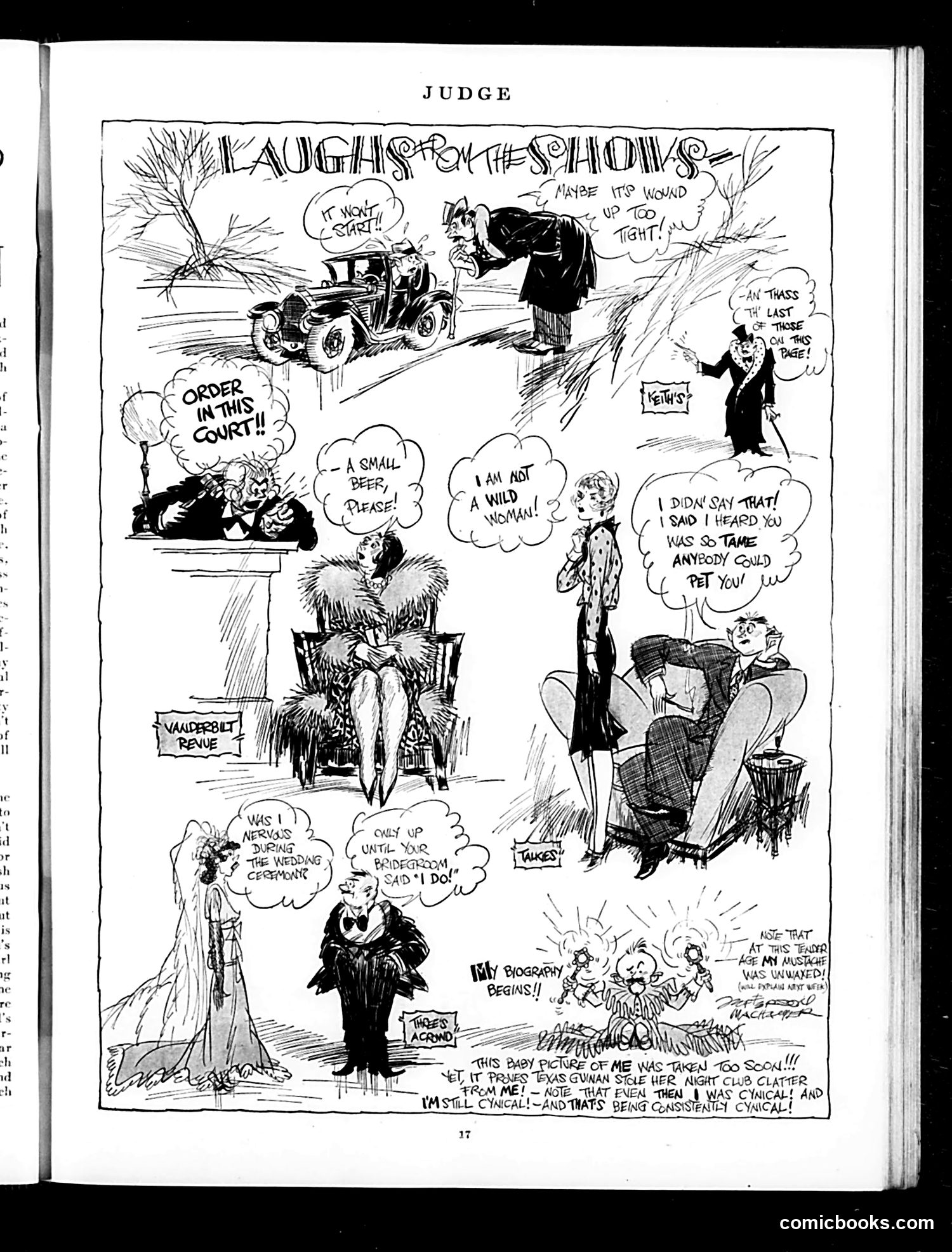
"Laughs by the Shoals" - Judge Magazine Cartoon This single-panel satirical cartoon depicts a chaotic courthouse scene where a judge presides over marital discord. The central figure appears to be a bride in a wedding dress, while various characters—including what looks like a groom, lawyers, and spectators—argue about the marriage. The satire targets the cynicism surrounding modern marriages, with dialogue emphasizing how the bride was "tame," the groom heard complaints during the wedding ceremony, and accusations of mutual cynicism. A baby's photo appears mid-scene, suggesting infidelity or illegitimacy complications. The cartoon mocks both the institution of marriage and courtroom proceedings by presenting domestic disputes as theatrical absurdities requiring judicial intervention. The overall joke critiques early 20th-century attitudes about matrimonial disputes becoming public entertainment—treating serious marital breakdown as fodder for gossip and legal farce.
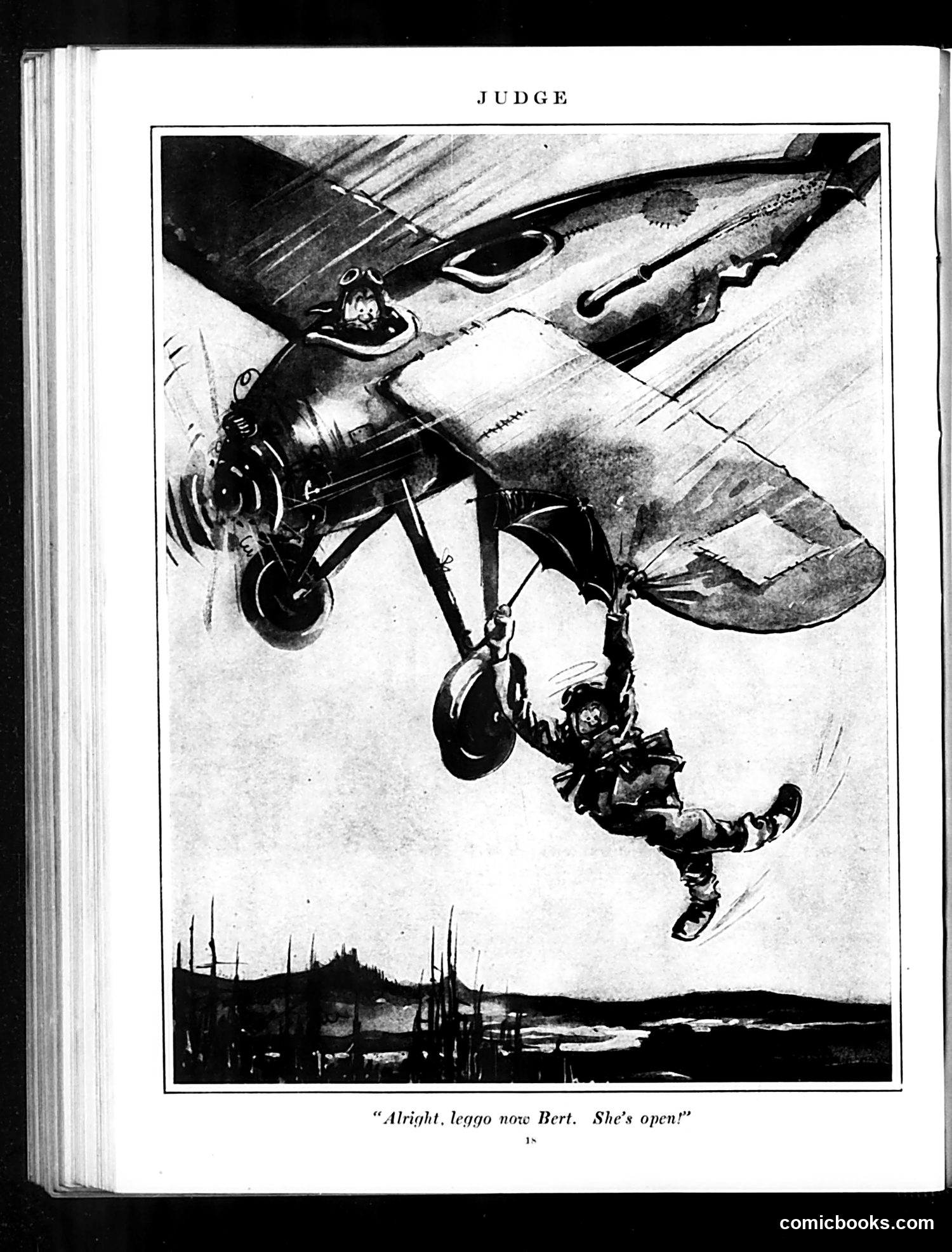
Analysis This appears to be a Judge magazine illustration depicting an airplane in flight with two figures suspended beneath it—likely a pilot and passenger. The caption reads: "Alright, leggo now Bert. She's open!" The cartoon satirizes early aviation, probably from the 1920s-1930s era when flying was novel and dangerous. The humor seems to involve the precarious nature of early aircraft and the casual attitude toward risk ("leggo now"—let go). The image shows the plane from below with what appears to be an open cargo door or hatch, suggesting either a stunt, mail drop, or comedic misadventure. Without additional context about specific historical events or political figures, the satire primarily mocks the recklessness and improvisation characteristic of pioneering aviation, rather than commenting on broader political or social issues.
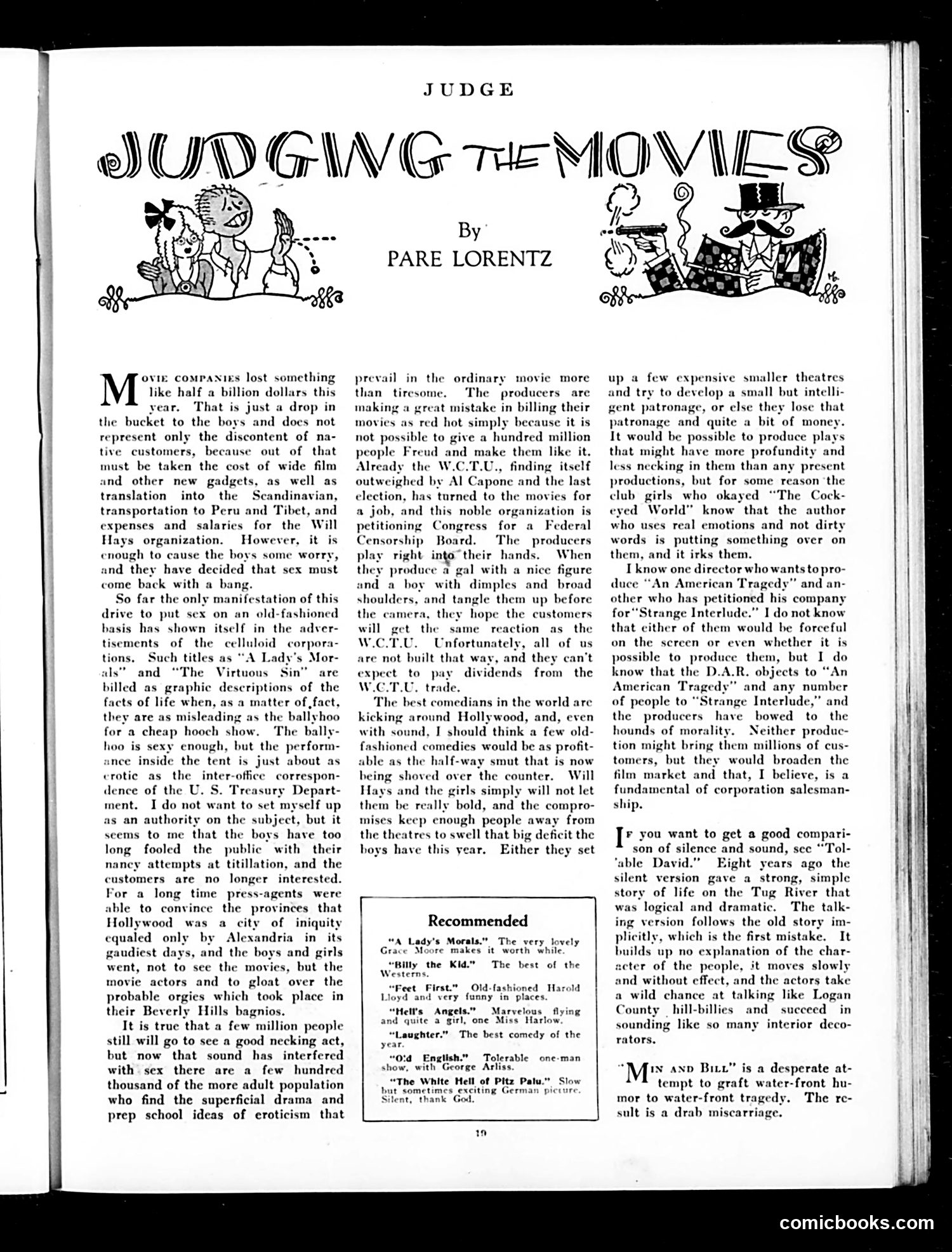
"Judging the Movies" by Pare Lorentz This is a film criticism column lamenting Hollywood's financial crisis and creative bankruptcy. Lorentz argues that movie studios lost half a billion dollars because they've deceived audiences with false advertising—promising "sexy" films with titles like "A Lady's Morals" and "The Virtuous Sin" that deliver nothing but boring moralizing. The satire targets: - Will Hays organization: The film industry's censorship apparatus, criticized for preventing genuinely bold content - W.C.T.U. (Women's Christian Temperance Union): Now petitioning Congress for a Federal Censorship Board after losing influence (outdone by Al Capone and recent elections) - Hollywood's hypocrisy: Studios market films as scandalous while remaining prudishly constrained Lorentz argues studios should embrace genuine comedy instead of half-hearted sexual titillation. The "Recommended" box lists current films, calling "Laughter" the year's best comedy and praising Harold Lloyd and Grace Moore.
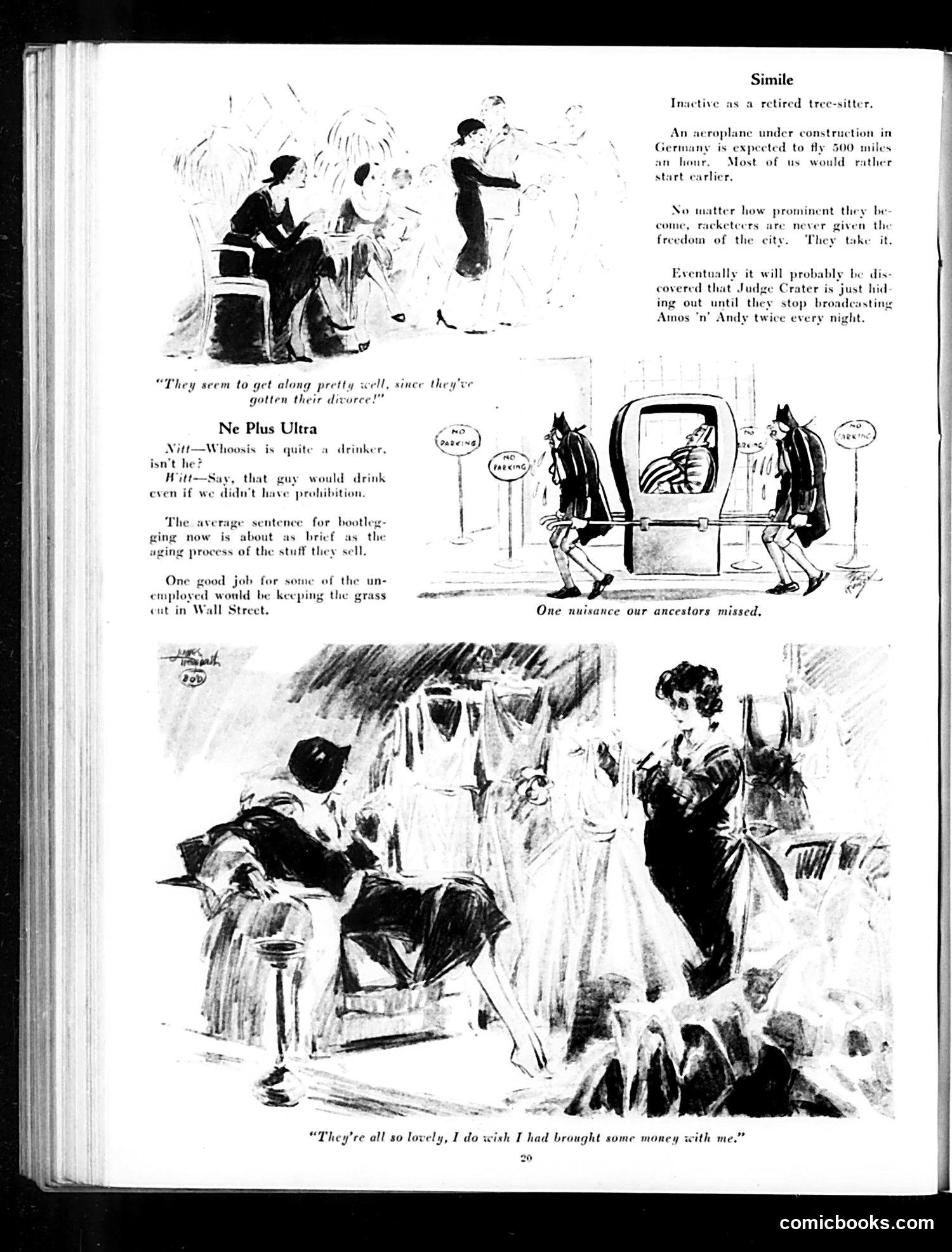
Analysis of Judge Magazine Page This page contains several separate satirical items from the 1920s-30s era: Top cartoon: Shows a couple who "seem to get along pretty well, since they've gotten their divorce"—satirizing the rising divorce rate and suggesting estranged couples sometimes maintain friendships after separation. Middle section: Brief quips include references to Judge Crater, a famous NYC judge who disappeared in 1930 (a major unsolved mystery), joked as possibly hiding to avoid the radio show "Amos 'n' Andy" (a popular but racially problematic blackface program). Other jokes target bootleggers during Prohibition, unemployment on Wall Street (post-1929 crash), and aircraft development. Bottom cartoon: Shows a woman at what appears to be a beach or seaside with fashionably dressed companions, lamenting she brought no money—likely satirizing wealthy leisure culture and casual materialism among the affluent during economic hardship. The overall tone mocks contemporary social issues: crime, unemployment, marital instability, and class divides.
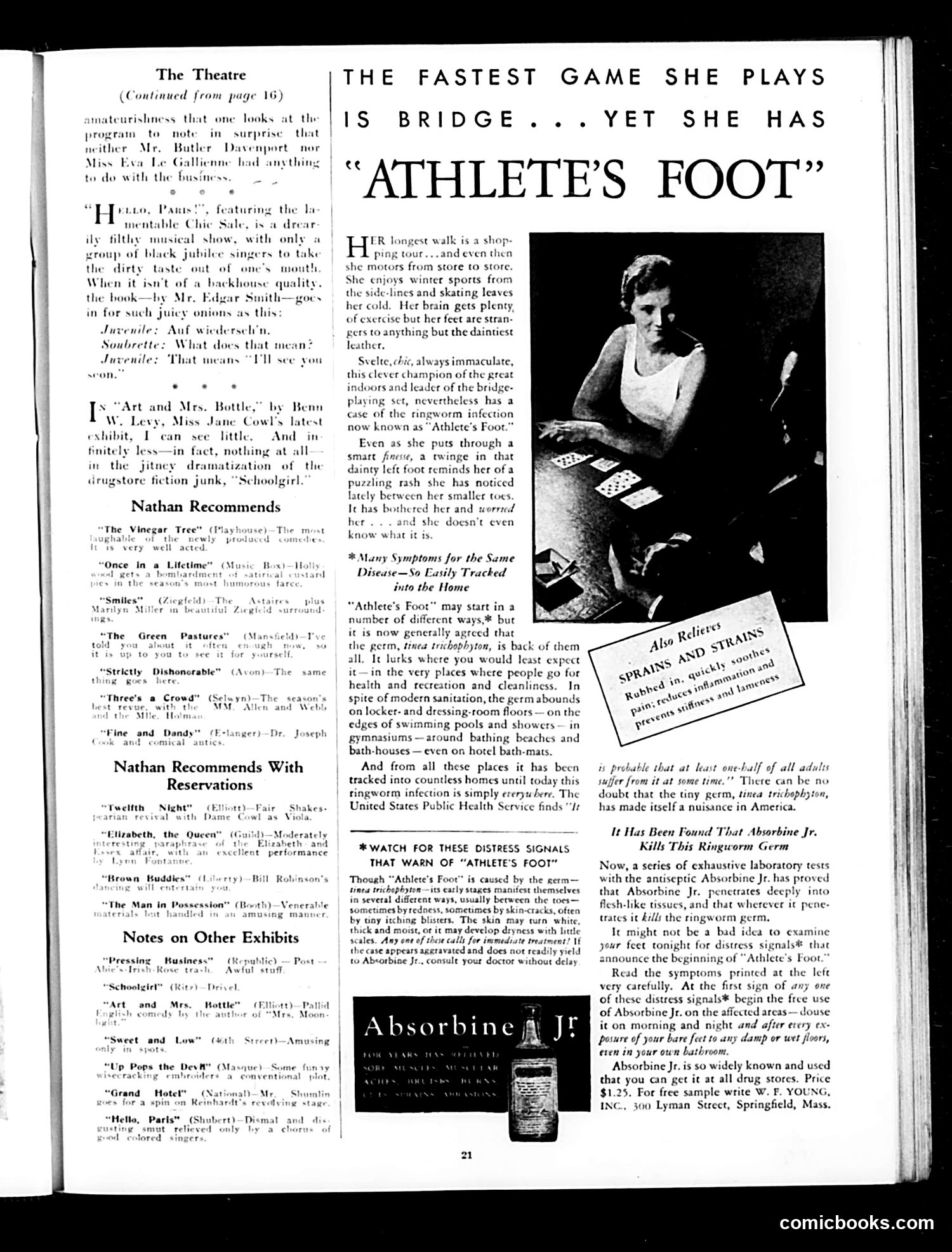
"Athlete's Foot" Advertisement in Judge Magazine This page contains a satirical advertisement for Absorbine Jr., a patent medicine, disguised as a theatrical review column. The central image shows an elegant woman playing bridge—depicted as the "fastest game she plays"—who paradoxically suffers from "athlete's foot," a fungal infection. The satire targets the disconnect between wealthy, refined women and mundane physical ailments. The ad emphasizes that despite her sophistication (bridge champion, winter sports enthusiast, always immaculate), she contracts this "ringworm infection" from public spaces: gym floors, swimming pools, hotel bathrooms—places where ordinary people congregate. The humor lies in the incongruity: a woman of leisure and elegance is vulnerable to the same afflictions as athletes and working people. The detailed medical information about *tinea trichophyton* lends pseudo-scientific authority to market a commercial remedy, a common advertising tactic of the era. The ad warns readers to watch for "distress signals"—redness, blisters, itching—normalizing discussion of an embarrassing bodily condition to drive sales.
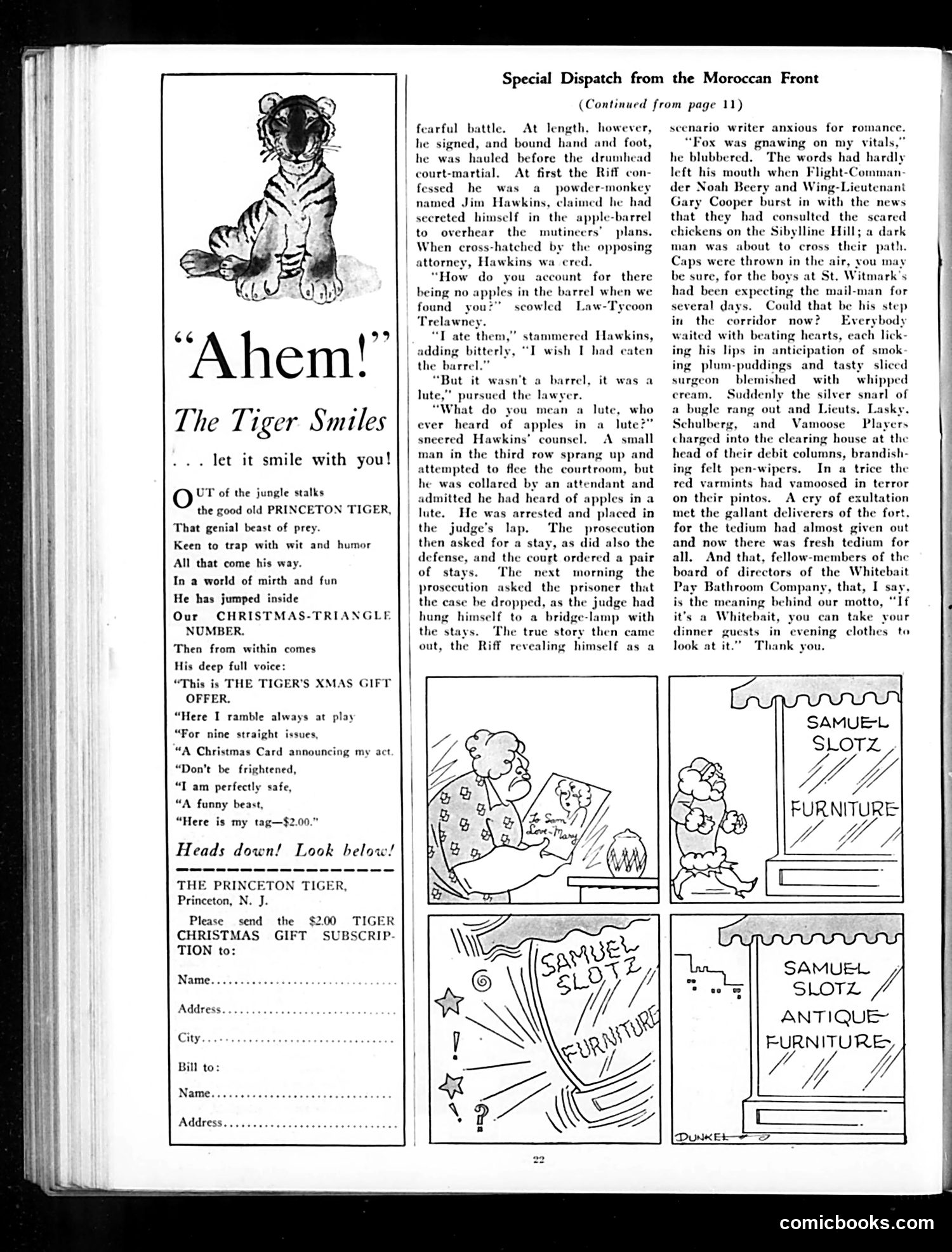
Analysis of This Judge Magazine Page This page combines two distinct elements: a Christmas subscription advertisement for *The Princeton Tiger* (the university's humor magazine) and a satirical story titled "Special Dispatch from the Moroccan Front." The Tiger Advertisement: Uses the Princeton Tiger mascot to humorously promote a $2.00 subscription, positioning the magazine as a "genial beast" delivering wit and humor. The Moroccan Story: A absurdist satire mocking overly dramatic war reporting and pulp adventure narratives. It features a farcical court-martial where a prisoner is revealed to be a "scenario writer" (screenwriter) seeking romance rather than an actual combatant. The story deliberately nonsensical—apples in a lute, judges hung by stays, film stars (Noah Beery, Gary Cooper) appearing unexpectedly—satirizes the melodramatic, implausible plots of contemporary adventure fiction and cinema. The page also includes Samuel Slotz furniture advertisements, typical of period magazine layout. The humor relies on readers recognizing tropes of adventure serials and understanding that the absurdity *is the point*—mocking overwrought storytelling conventions.
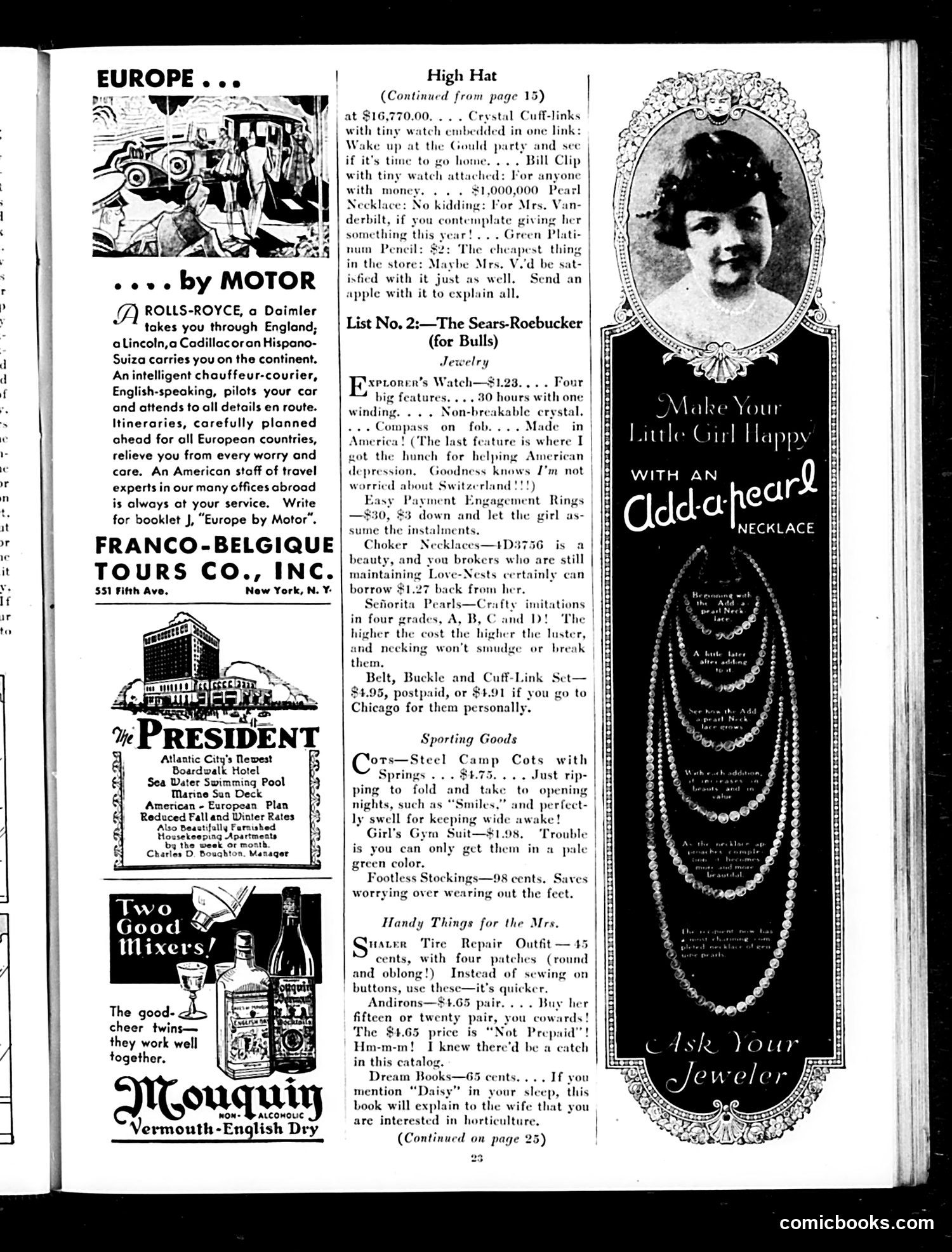
"High Hat" Humor Column Analysis This page is primarily advertising and a humor column rather than political satire. The "High Hat" section mocks wealthy Americans' conspicuous consumption through satirical gift suggestions divided into two lists. List No. 1 targets the ultra-wealthy (specifically referencing Mrs. Vanderbilt), suggesting absurdly expensive items: a $1,000,000 pearl necklace, a watch embedded in cufflinks, and a green platinum pencil—the joke being that even the cheapest option would satisfy her. List No. 2—"The Sears-Roebucker (for Bulls)" inverts this, offering cheap Sears catalog items ($1.23 watches, $3.50 necklaces, 45-cent tire repair kits) to working-class men, with crude humor about "bulls" (appearing to reference unsophisticated men) and marriage troubles. The satire targets class contrast and gender stereotypes—mocking both wealthy women's materialism and working-class men's supposed ignorance. The humor relies on period assumptions about consumption, courtship, and masculine/feminine behavior that read as dated today.
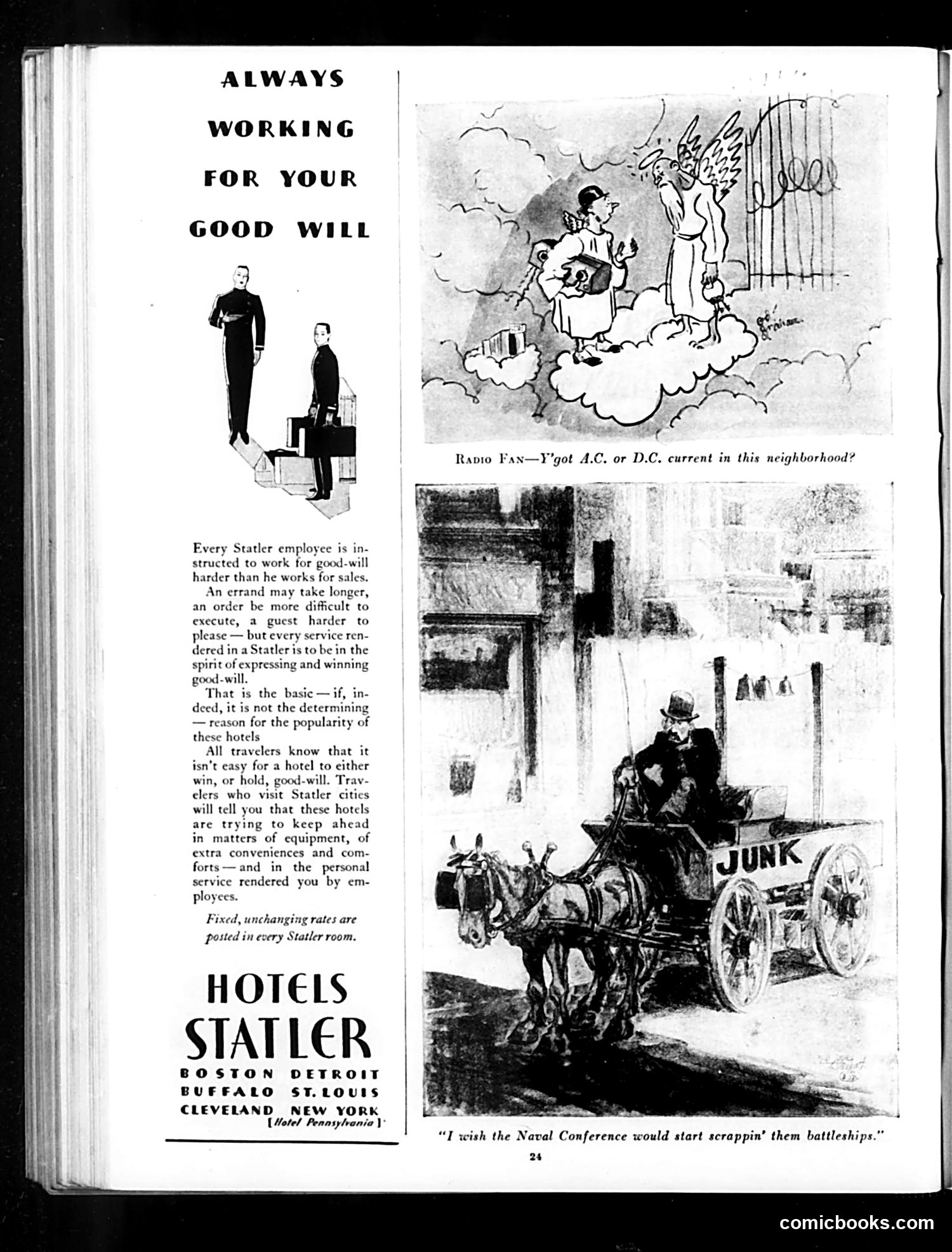
Judge Magazine Page Analysis This page combines a Statler Hotels advertisement (left side) with two cartoons (right side). The cartoons satirize the 1920s Naval Conference (likely the Washington Naval Conference of 1921-1922), which aimed to limit battleship construction and military spending. Top cartoon: A heavenly scene where angels question a newly arrived radio fan about "A.C. or D.C. current in this neighborhood"—a technical joke about electrical current types that most readers wouldn't understand, mocking the era's fascination with new radio technology. Bottom cartoon: A junk dealer driving a cart full of scrap metal quips, "I wish the Naval Conference would start scrappin' them battleships." This is the page's main political satire—cynically suggesting that instead of diplomatic treaties limiting naval arms, the government should literally scrap warships for metal. It critiques both the ineffectiveness of international negotiations and military-industrial waste. The ad emphasizes employee goodwill, contrasting sharply with the satirical critique of government and waste on the same page.
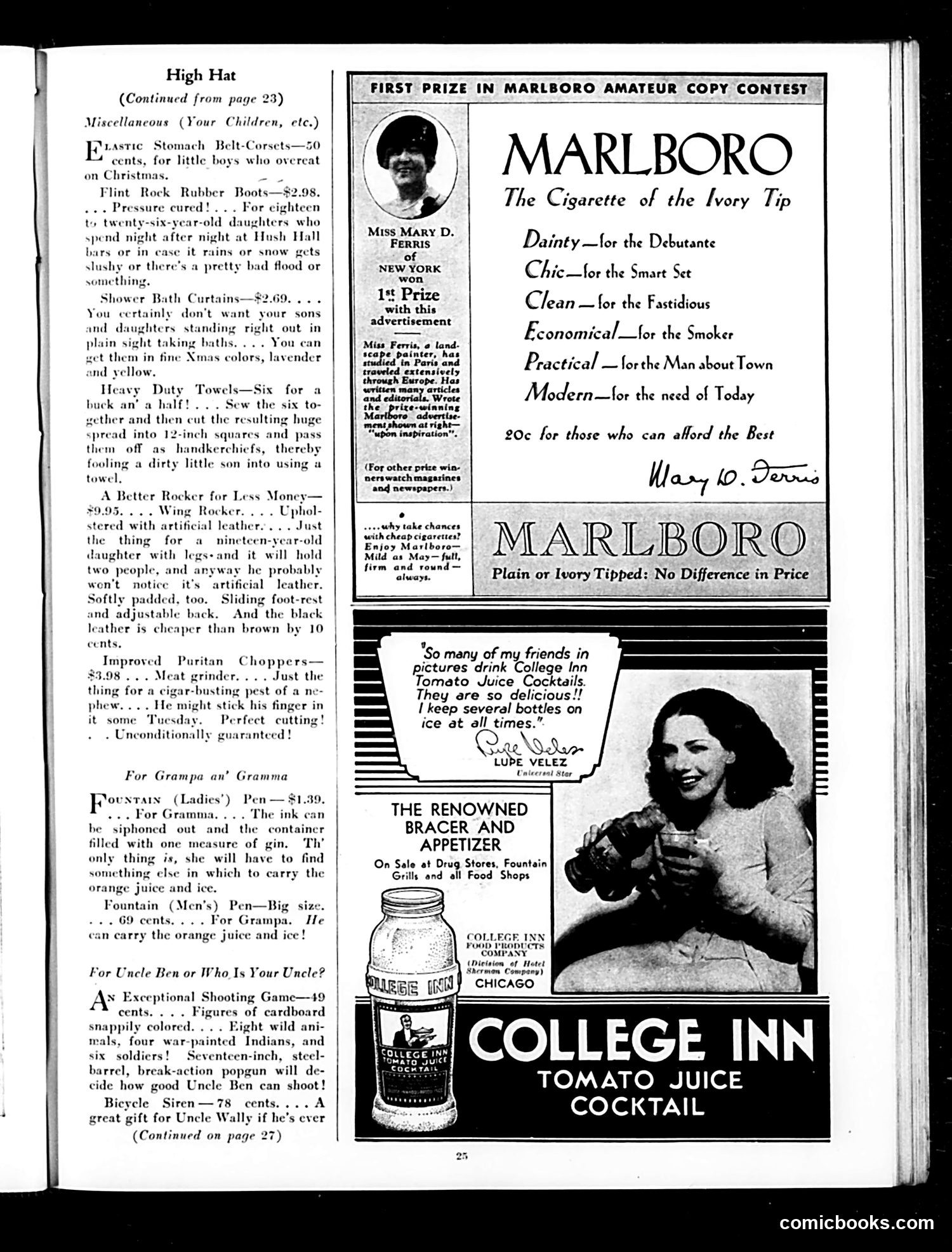
Content Analysis: Judge Magazine Page This page is primarily advertising, not satire or political commentary. The left column contains "High Hat," a humorous gift-suggestion column for Christmas, offering tongue-in-cheek product recommendations with comedic descriptions—elastic stomach corsets for children who overeat, shower curtains for modesty, and a "shooting game" featuring "war-painted Indians." The advertisements feature: 1. Marlboro Cigarettes - promoting a "First Prize" winning ad copy by Mary D. Ferris of New York, marketing cigarettes as "Dainty" for debutantes and "Chic" for the smart set at 20¢. 2. College Inn Tomato Juice Cocktail - endorsed by actress Lupe Velez, promoting a pre-mixed cocktail available at drug stores and food shops. The page reflects 1920s-30s consumer culture, advertising luxury goods and alcohol (ironically, during or near Prohibition), targeting middle-class aspirations. No political cartoon or satire appears here—it's a commercial product page.
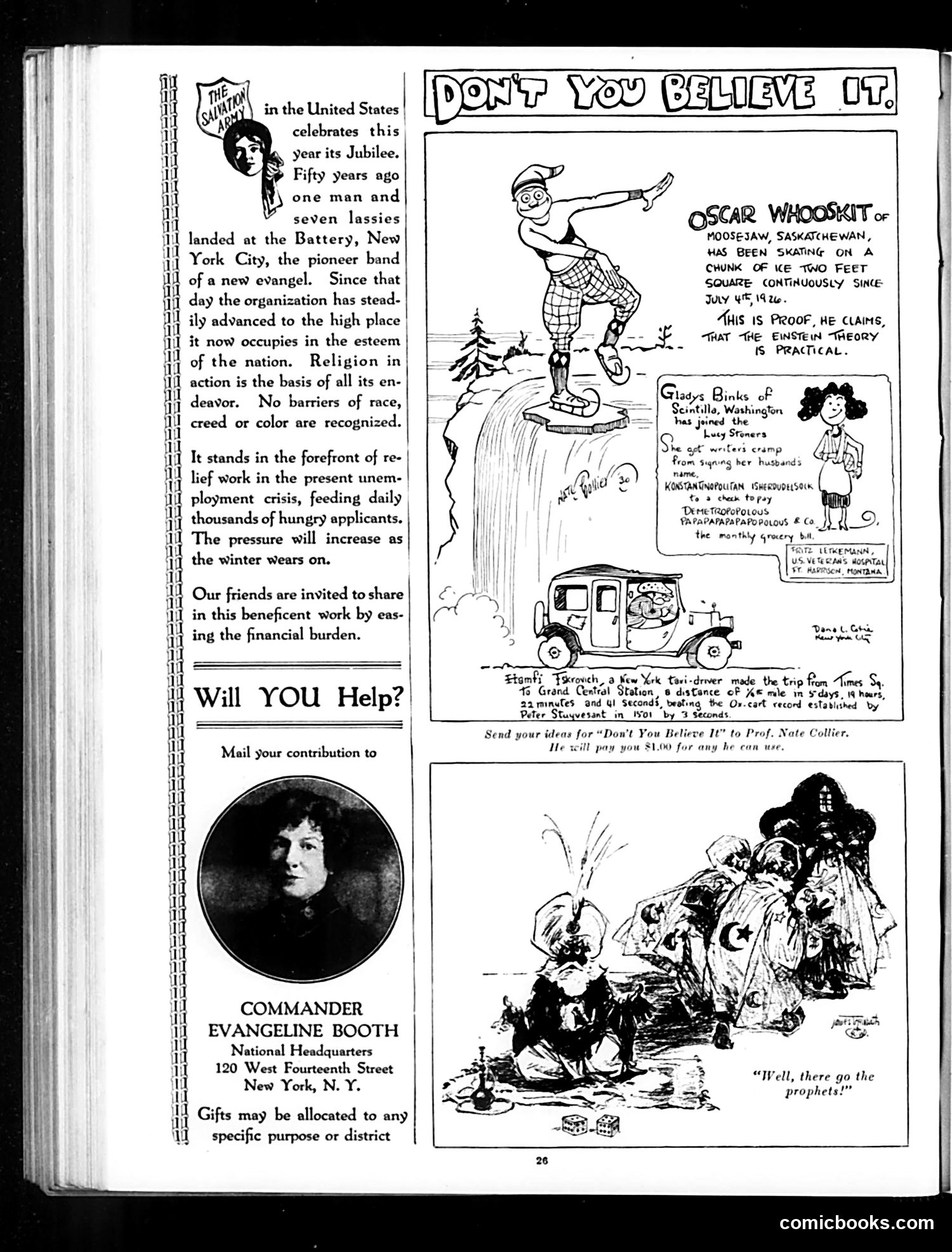
"Don't You Believe It" - Judge Magazine Satire Page This page combines a Salvation Army fundraising appeal with a humorous "tall tales" feature mocking implausible claims. Left side: A serious charitable pitch from Commander Evangeline Booth (head of the Salvation Army), celebrating their 50-year jubilee and requesting donations for Depression-era relief work. Right side: The satirical "Don't You Believe It" column presents absurd, obviously false claims: - Oscar Whooshkit supposedly ice-skating continuously since 1914 as "proof" Einstein's theory works - Gladys Binks joining the "Lazy Dreamers" club with an impossible name - A taxi driver breaking a speed record supposedly set by Peter Stuyvesant in 1691 The final cartoon shows a charlatan or con-artist figure surrounded by gullible followers, captioned "Well, there go the prophets!"—mocking people who believe dubious claims. The satire targets credulous readers and fraudulent hucksters, while the juxtaposition with the legitimate charity appeal creates ironic contrast.
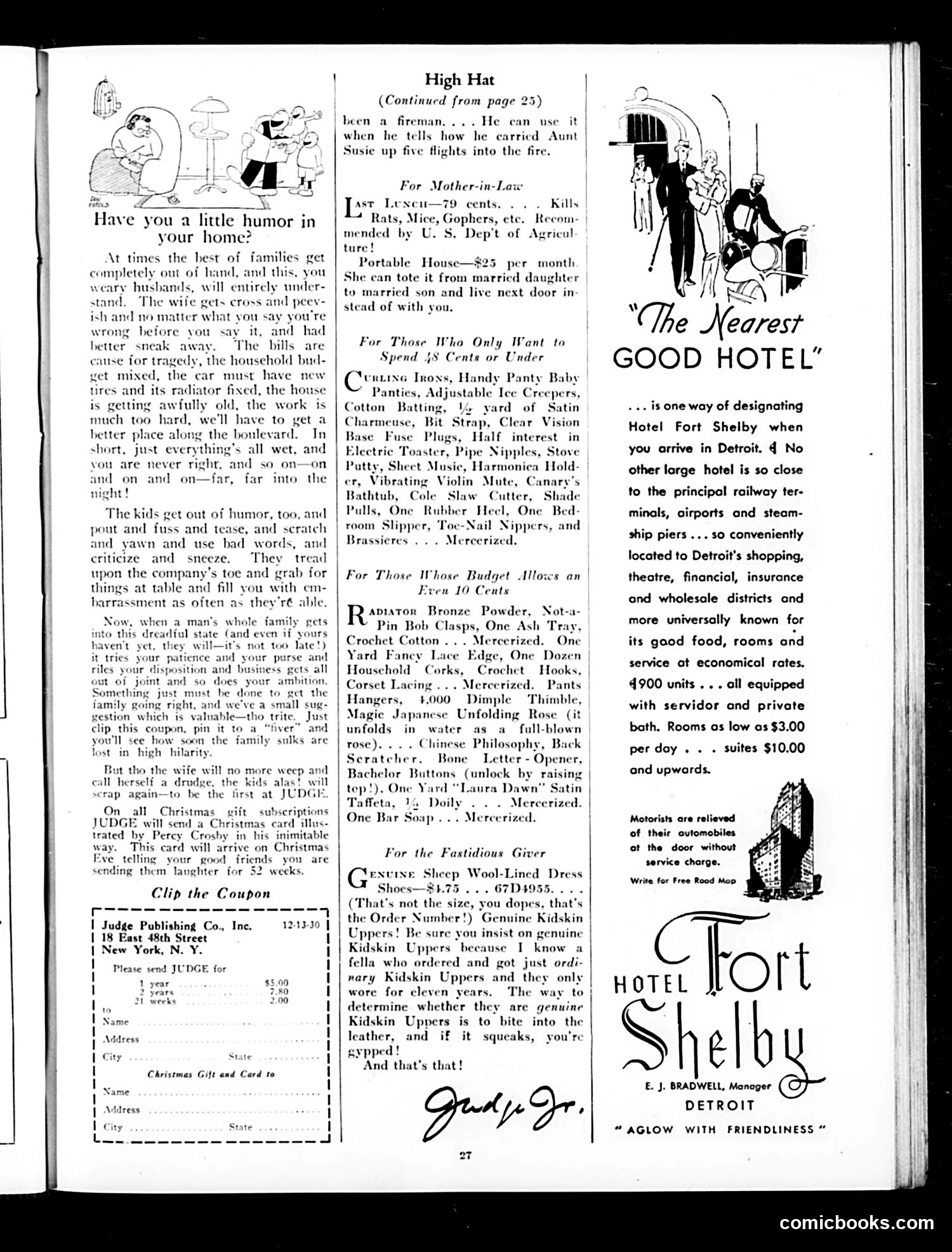
Analysis for Modern Readers This page contains two distinct elements: Left side: A humorous editorial essay about domestic discord. The piece satirizes married life by depicting a husband's frustration when his wife becomes perpetually cross—nothing he says is right, bills mount, the house needs repairs, and the children misbehave. The satire suggests that family tension is universal and inevitable ("even if yours haven't yet, they will"). The solution offered is tongue-in-cheek: subscribe to *Judge* magazine as a Christmas gift to restore family happiness through laughter. Right side: Mostly advertising, including a Hotel Fort Shelby Detroit ad and product gift suggestions at various price points (48 cents to $10+), such as cleaning products, kitchen gadgets, clothing, and shoes—typical 1920s-30s gift recommendations. The editorial uses exaggeration and self-deprecating humor to create relatable marital comedy, typical of *Judge's* satirical approach to middle-class American life.
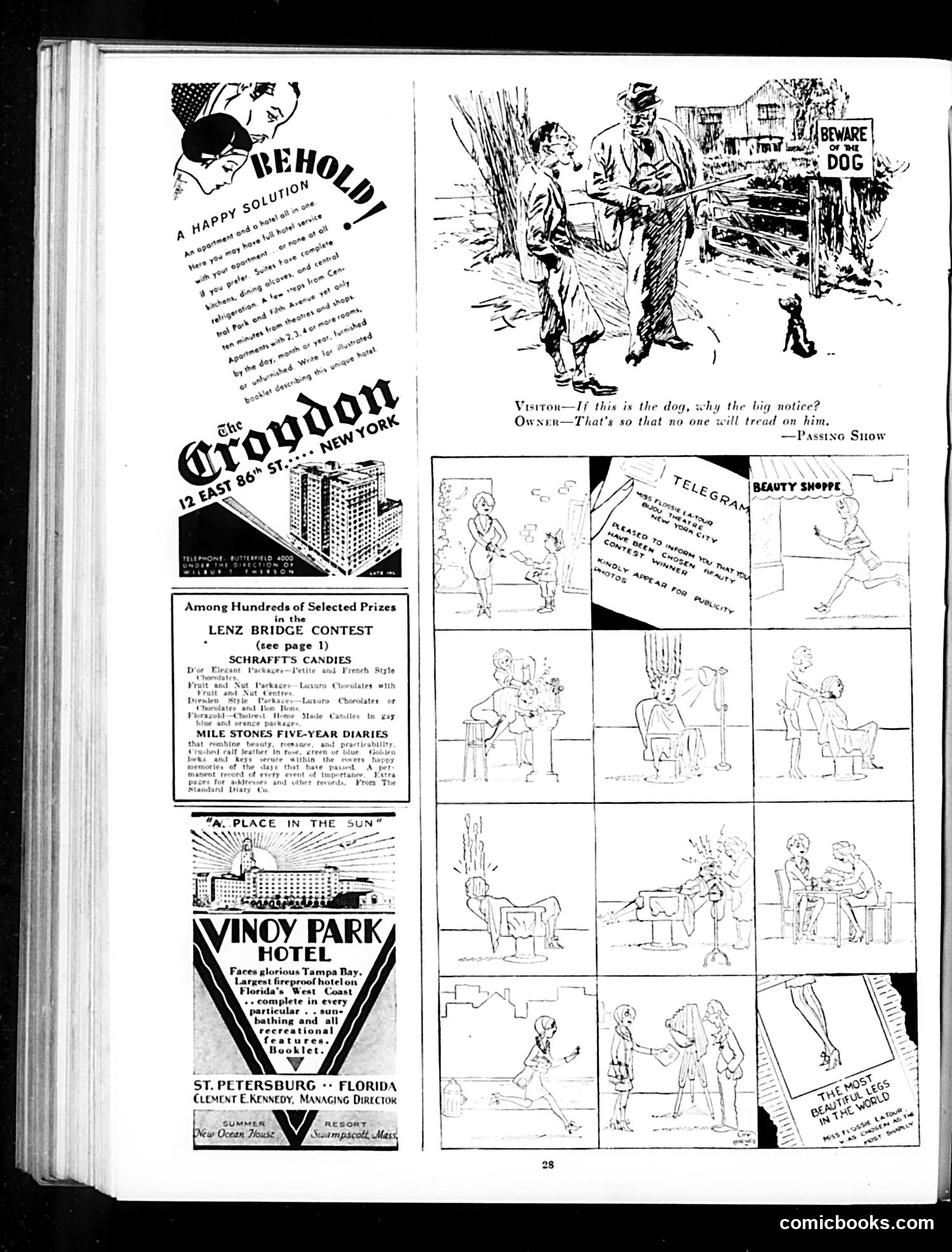
Analysis of Judge Magazine Page This page mixes advertisements with a single cartoon joke. The main comic (top right) depicts a humorous misunderstanding about a dog and a "Beware of the Dog" sign. A visitor questions why such a warning is necessary for what appears to be a small, non-threatening dog. The owner explains the sign exists to prevent people from accidentally stepping on the tiny animal—a simple visual gag playing on the contrast between the sign's intimidating purpose and the dog's diminutive, harmless nature. The surrounding content consists entirely of advertisements: The Croydon hotel in New York, Schrafft's candies, Mile Stones diaries, and Vinoy Park Hotel in Florida. This reflects Judge's business model of combining satirical editorial content with paid advertising to sustain publication during this era.
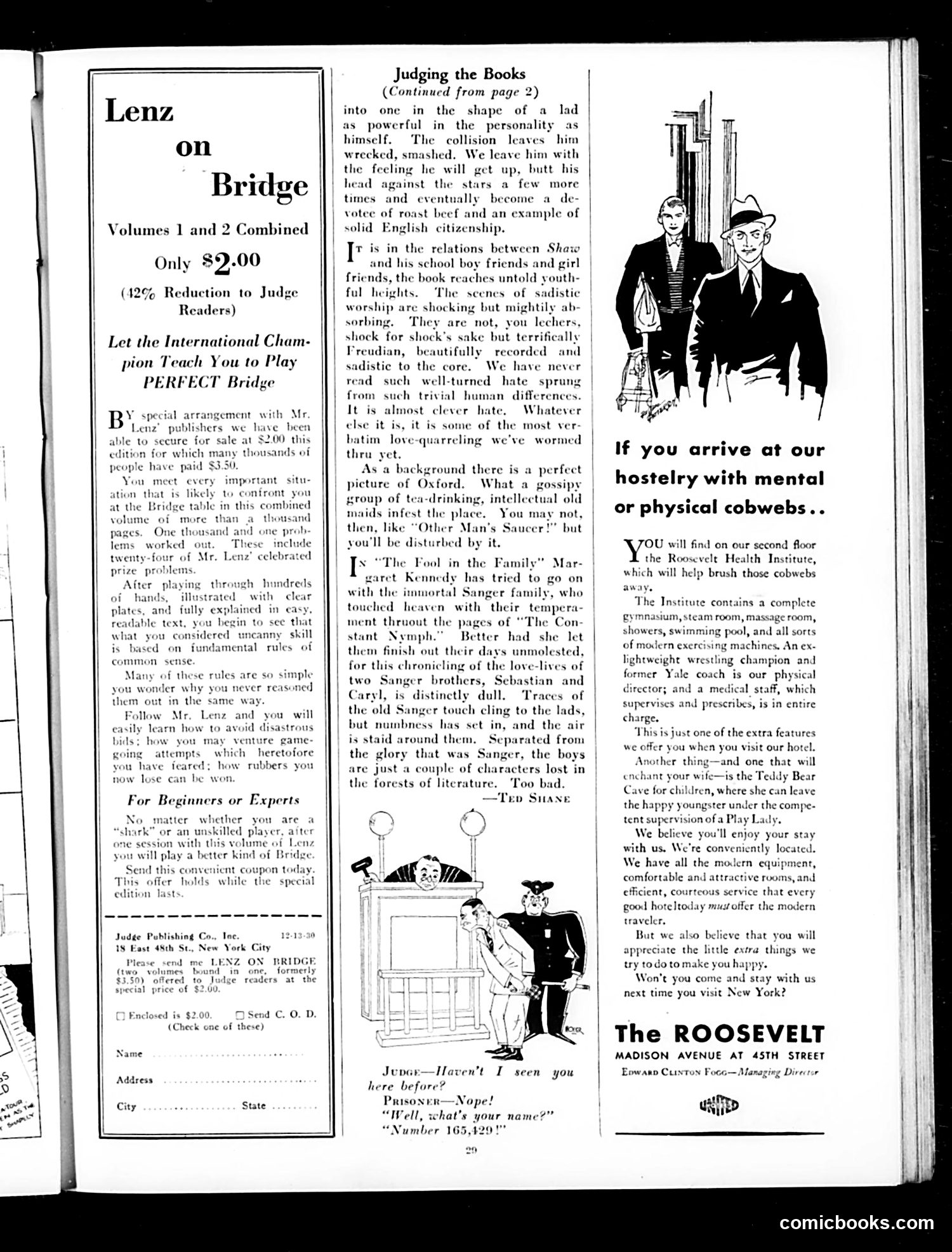
Explanation for Modern Readers This page is primarily advertising and book reviews, not political satire. The main content includes: 1. "Lenz on Bridge" advertisement—a how-to book for the card game bridge, offered at discounted price ($2.00) to Judge magazine readers. 2. "Judging the Books" section—literary reviews of novels including works by Shaw and Margaret Kennedy. The reviews discuss character development and emotional authenticity in these stories. 3. A small cartoon at bottom showing a jailer and prisoner exchange: "Haven't I seen you here before?" / "Nope!" / "Well, what's your name?" / "Number 165,420!" This is a mild joke about prison overcrowding or repeat offenders, presented without specific political commentary. 4. "The Roosevelt" hotel advertisement—promoting a New York hostelry with health facilities (gymnasium, steam room, massage). The page reflects 1920s-30s leisure interests (bridge games, novels, hotels) rather than political satire.
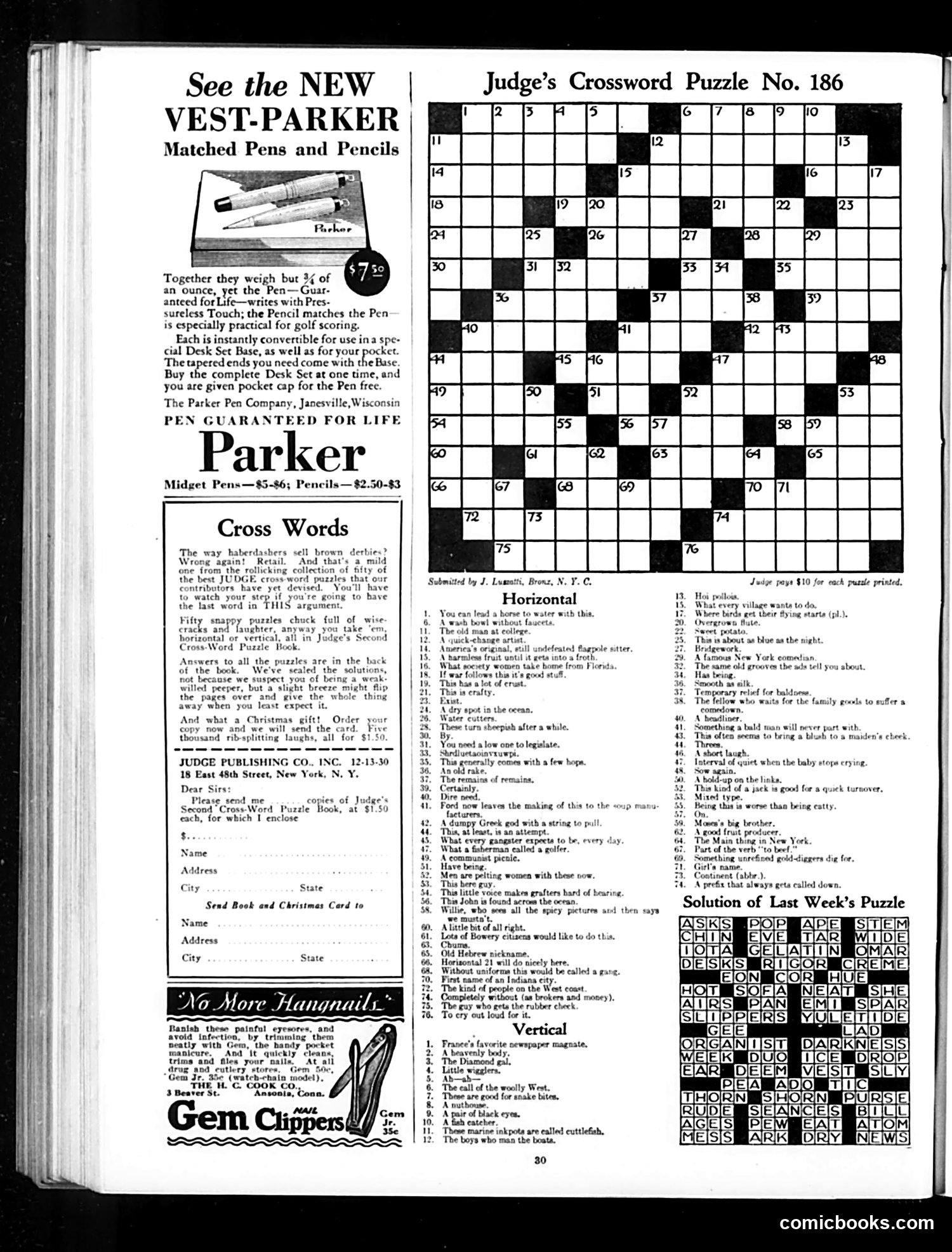
Judge Magazine Page Analysis This page is primarily advertising and a crossword puzzle, not political satire. The main content includes: - Parker Pen advertisement for matched pen-and-pencil sets ("Guaranteed for Life") - Judge's Second Cross-Word Puzzle Book advertisement ($1.50), emphasizing it contains "fifty snappy puzzles" full of "wise cracks and laughter" - Crossword Puzzle No. 186 with horizontal and vertical clues - Gem Clippers advertisement for manicure tools - Hannamill's ad (partially visible) - Solution to last week's puzzle The crossword clues are typical period humor—wordplay about everyday objects, slang, and mild contemporary references (gangsters, Wall Street brokers, "the West coast"). One clue references "A famous New York comedian," but the specific person isn't identified. This is essentially a commercial magazine page designed to sell products and entertainment rather than deliver political commentary.
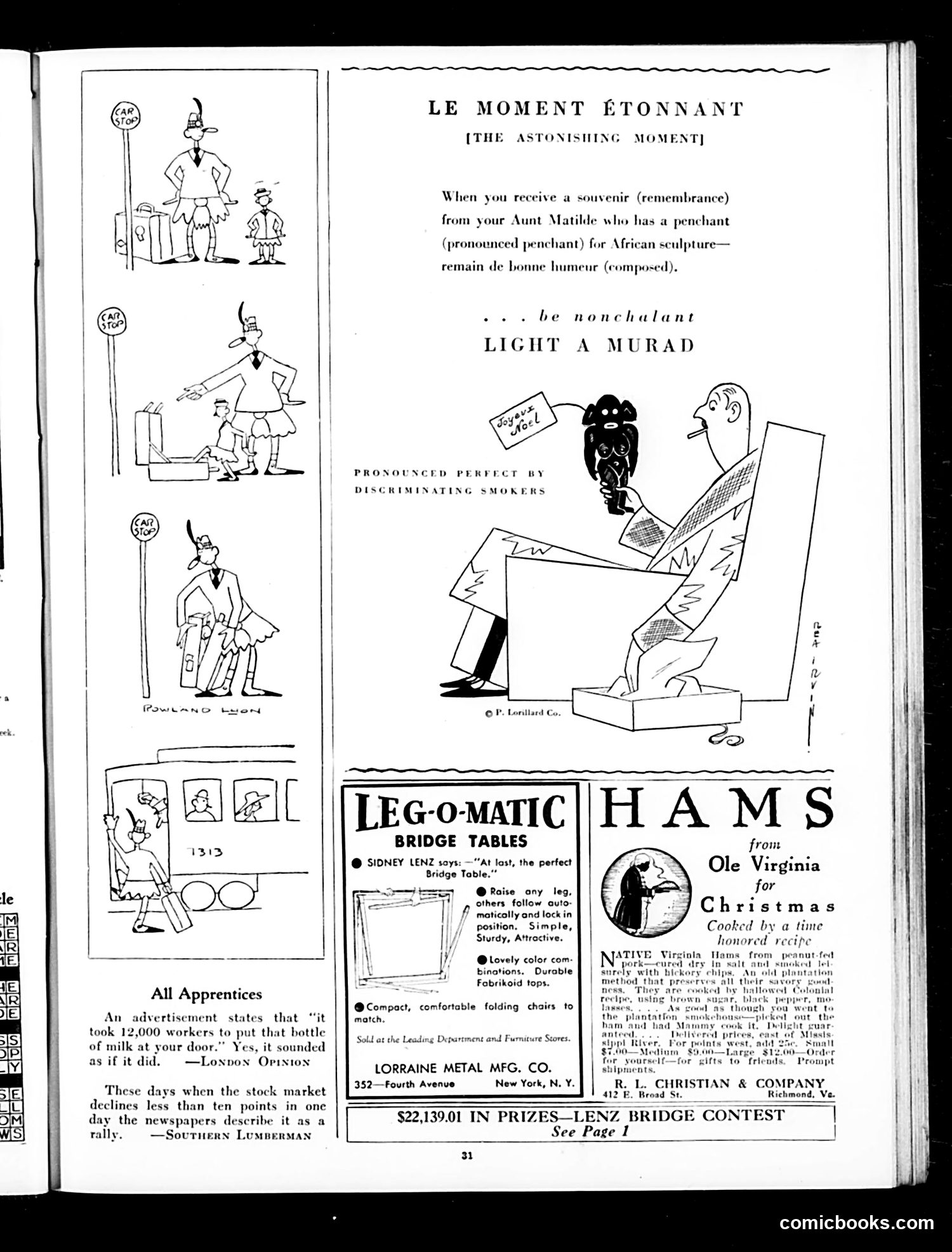
Political Cartoons & Satire from Judge Magazine This page contains three distinct satirical items: "Le Moment Étonnant" mocks pretentious affectation. The cartoon depicts someone receiving an African sculpture from "Aunt Matilde" and struggling to maintain composure (remain "nonchalant") despite finding it ugly or ridiculous. The French language and affected tone parody sophistication while the visual humor undercuts it—satire of people pretending to appreciate art they don't actually like. Two brief quips at bottom left ridicule contemporary exaggeration: one mocks a milk company's claim that 12,000 workers were needed to deliver milk (absurdly inflating labor involved), the other satirizes financial reporting, where minor stock market declines are optimistically called "rallies." The remainder is advertising—bridge tables, ham, and cigarettes—typical of Judge's revenue model. The satire targets consumer culture absurdity, false sophistication, and media sensationalism common in early-to-mid 20th century American life.
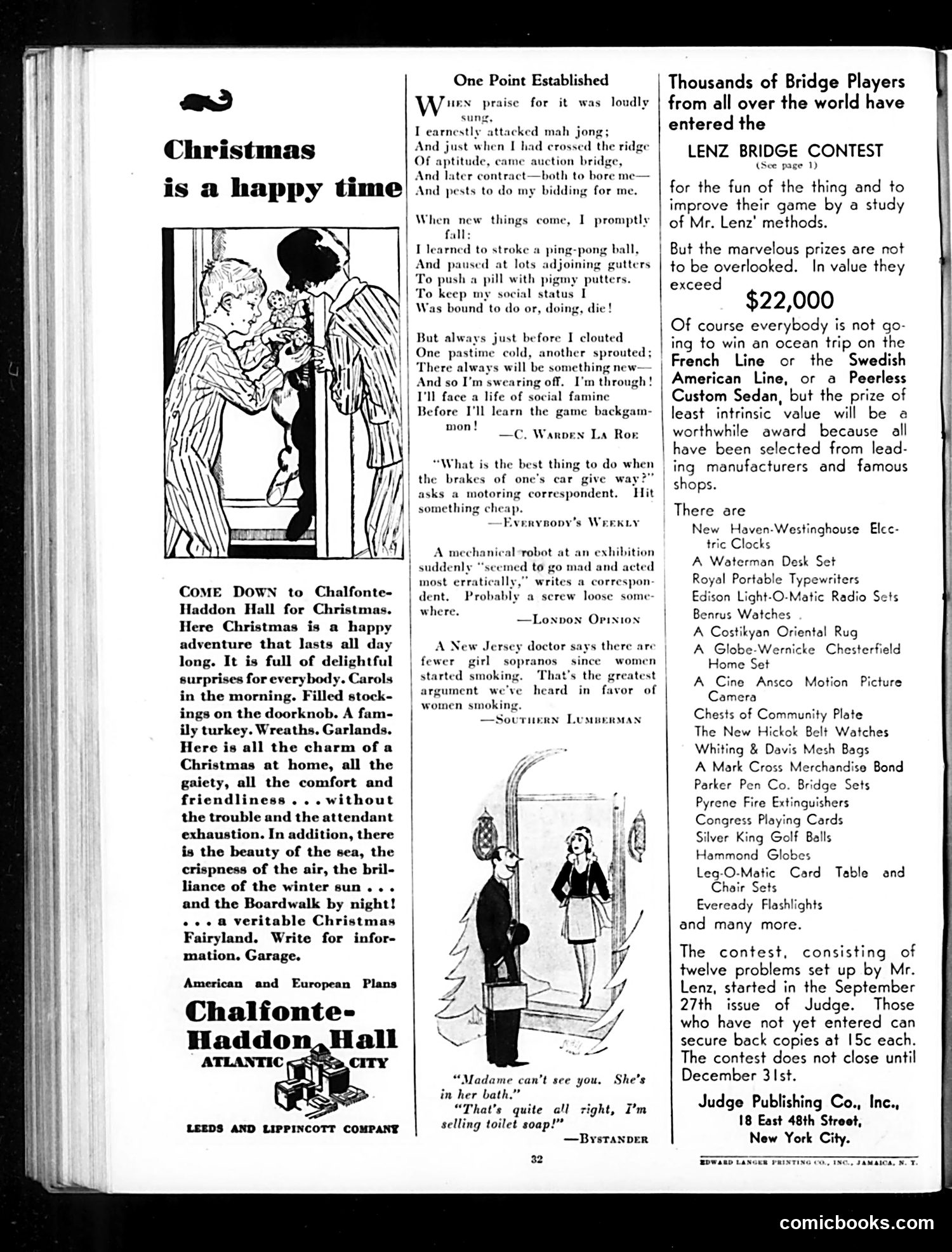
Analysis of Judge Magazine Page This page contains primarily advertisements and promotional content rather than political satire. The main illustrated content shows a humorous poem about social climbing through fashionable games. The speaker describes frantically adopting each new fad—mah jong, auction bridge, contract bridge, ping-pong, miniature golf—to maintain social status, only to abandon each before mastering it. The joke satirizes the shallow status-consciousness of the leisure class, who chase trends compulsively rather than developing genuine skill or interests. The cartoon illustrations depict scenes of these activities and social anxiety, supporting this theme of exhausting, superficial status-seeking. The rest of the page advertises the Chalfonte-Haddon Hall hotel in Atlantic City (a luxury resort) and promotes a bridge-playing contest with substantial prizes ($22,000 value), ironically published in Judge magazine itself. The scattered witticisms from various publications provide light humor typical of Judge's satirical miscellany, but they're disconnected from the main content's commentary.
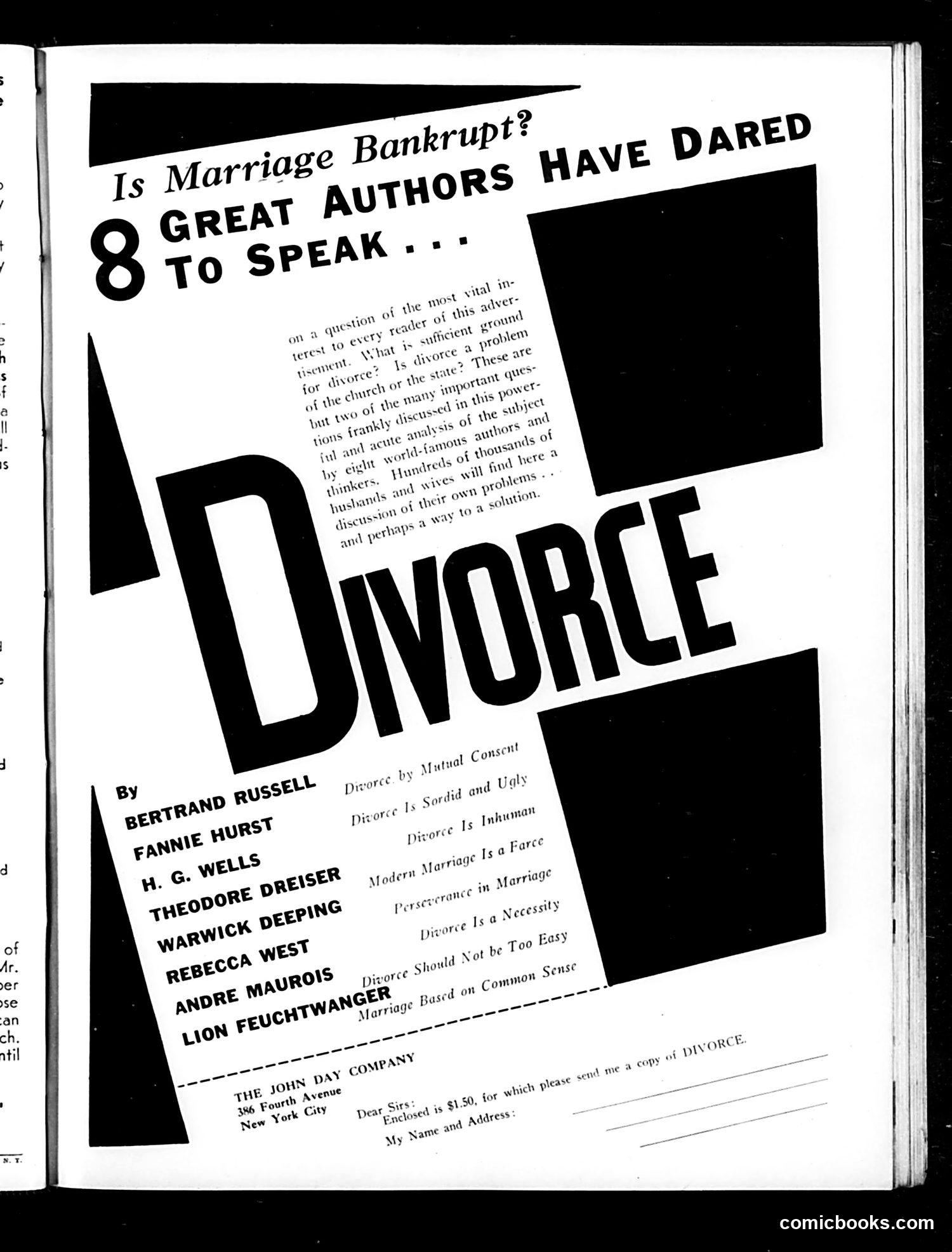
Advertisement for "Divorce" Book This is primarily a book advertisement from *Judge* magazine. It promotes a collection titled "Divorce" featuring essays by eight prominent early 20th-century authors: Bertrand Russell, Fannie Hurst, H.G. Wells, Theodore Dreiser, Warwick Deeping, Rebecca West, André Maurois, and Lion Feuchtwanger. The ad frames divorce as a serious topic worthy of intellectual discussion, with chapter titles addressing contemporary debates: "Divorce by Mutual Consent," "Is Divorce Sordid and Ugly?," "Modern Marriage Is a Farce," and "Divorce Should Not be Too Easy." The satirical angle—implied by its placement in *Judge*—appears to be that celebrities and intellectuals were publicly debating marriage's viability during a culturally contentious period. The ad positions these famous thinkers as authorities on a scandalous subject, reflecting 1920s-era tensions over traditional morality versus modern skepticism about marriage.
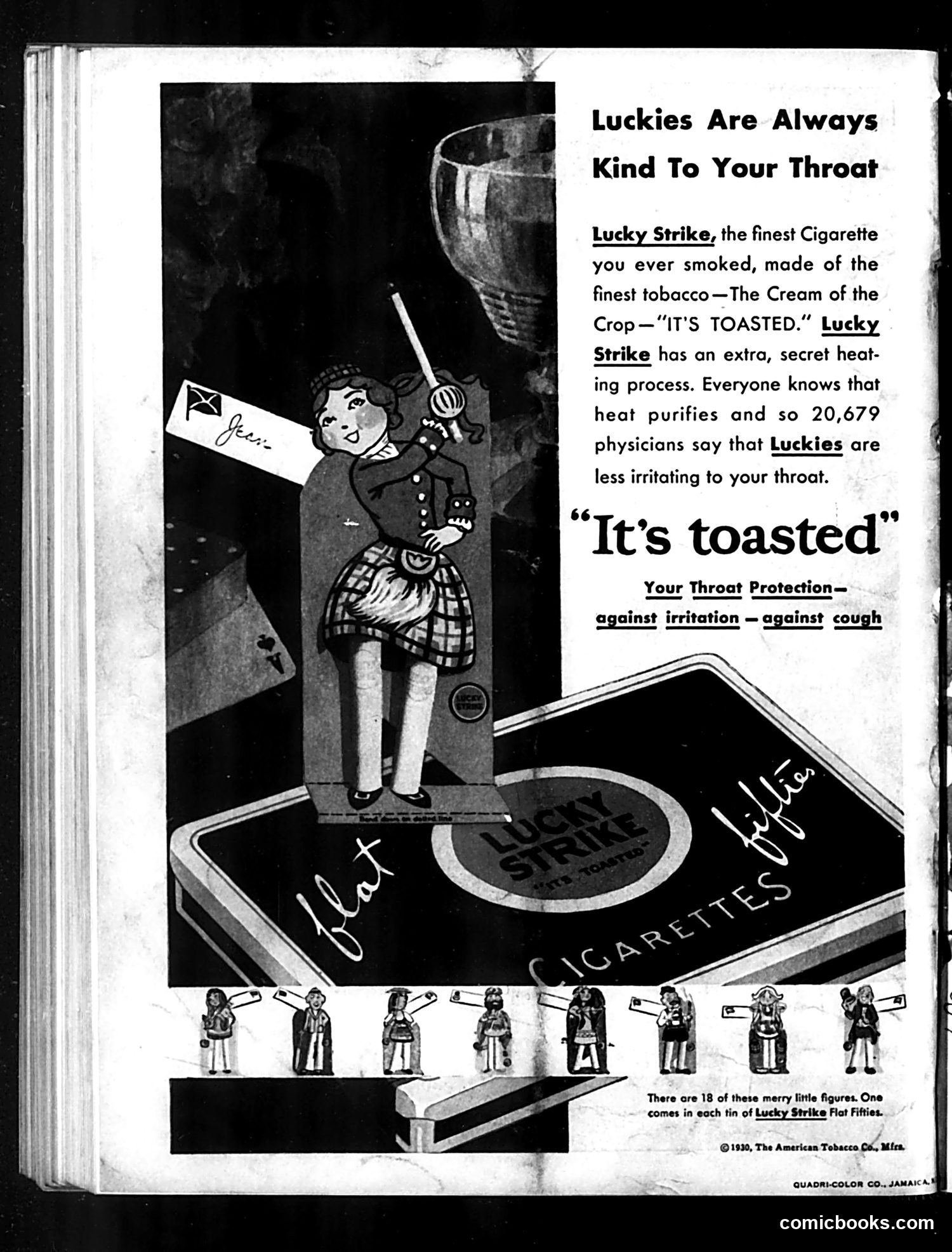
Lucky Strike Cigarette Advertisement (1930) This is a cigarette advertisement, not satire or political cartoon. It promotes Lucky Strike cigarettes using now-discredited health claims. Key elements: - A Scottish-themed figure holding a cigarette and glass represents the product - The central claim: Lucky Strike's "toasting" process makes cigarettes "less irritating to your throat" - The ad cites "20,679 physicians" endorsing this—a common marketing tactic of the era - Promises "throat protection against irritation—against cough" - Advertises collectible figures inside cigarette tins (18 different ones available) Modern context: This exemplifies pre-regulation tobacco advertising that made unsubstantiated medical claims. The "physicians say" assertion was marketing fiction; cigarettes cause throat irritation and coughing. The Federal Trade Commission would later ban such false health claims. The product itself was deadly, though that wasn't publicly acknowledged then.