judge
Judge — December 20, 1930
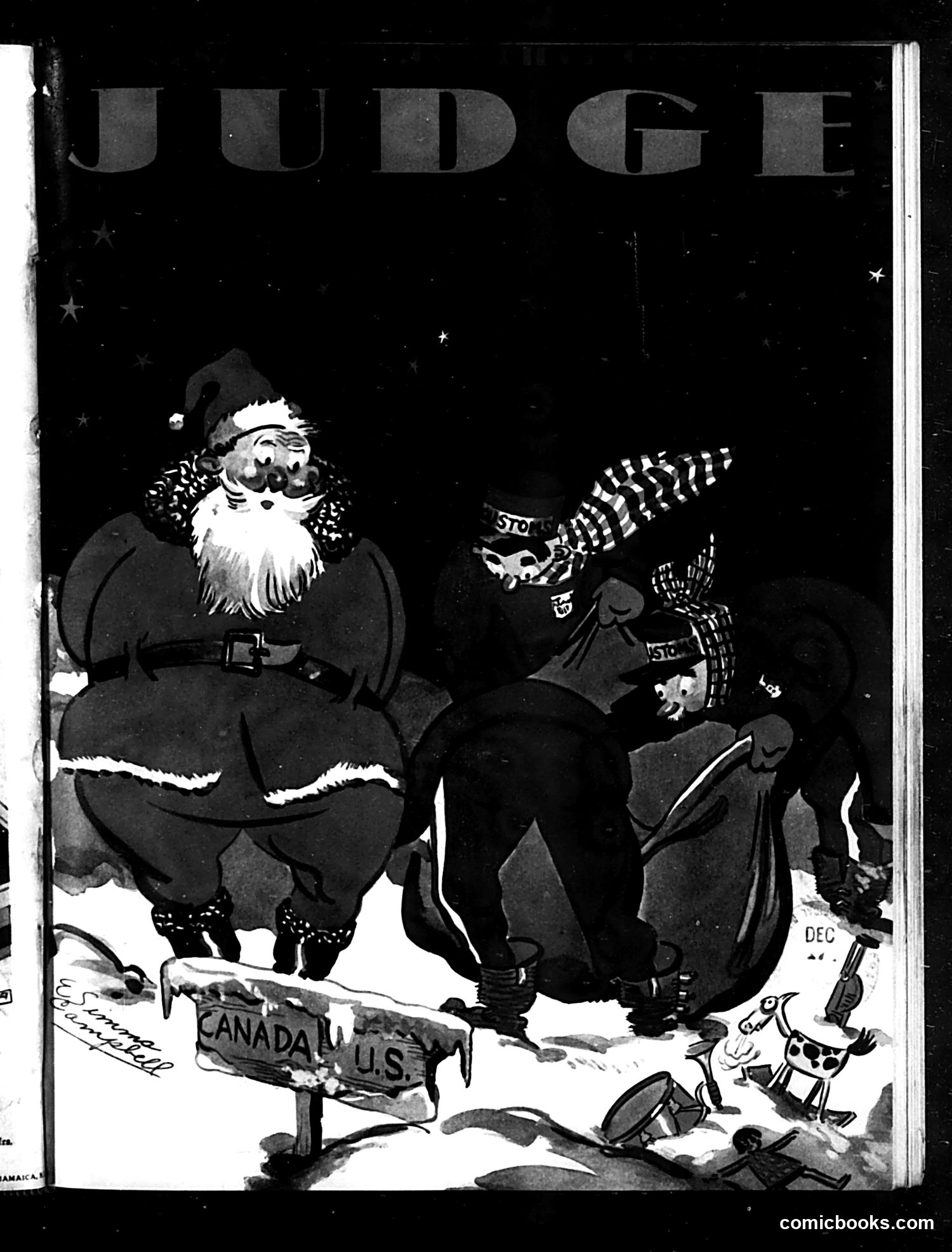
Political Cartoon Analysis This Judge magazine cover depicts Santa Claus and what appears to be a witch or dark figure at the Canada-U.S. border during winter. The satire likely comments on cross-border relations or trade between the United States and Canada, a recurring theme in early 20th-century American political humor. Santa represents American goodwill or commerce, while the witch figure (possibly personifying Canada or a Canadian political figure) suggests suspicion or hostility in bilateral relations. The snowy border setting emphasizes the geographical and political divide. Without the specific publication date visible, the exact historical context remains unclear—this could reference tariff disputes, trade wars, or diplomatic tensions common during this era. The starry sky and holiday setting contrast sharply with the tense encounter depicted.
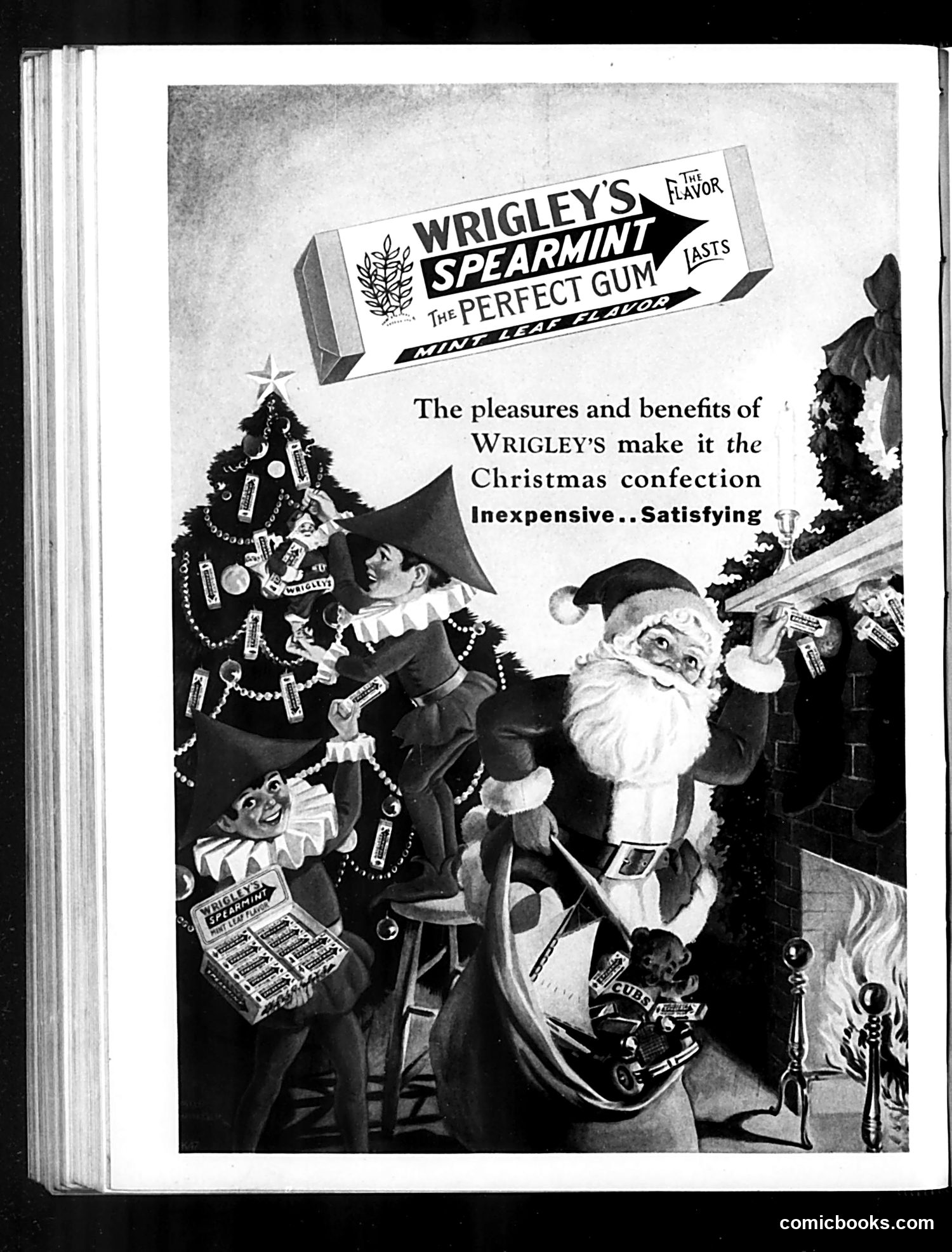
Wrigley's Spearmint Gum Advertisement This is a commercial advertisement, not political satire. It depicts Santa Claus and elves decorating a Christmas tree with Wrigley's Spearmint Gum packages as ornaments. The ad copy emphasizes that Wrigley's gum makes an "Inexpensive...Satisfying" Christmas gift. The visual joke plays on the idea of gum as stocking-stuffers or small presents—affordable enough for mass gift-giving during the holiday season. This reflects 1920s-30s consumer culture when mass-produced goods became popular Christmas gifts. There is no political content or satirical commentary present. Judge magazine, while primarily known for satire, regularly published advertisements like this one to generate revenue.
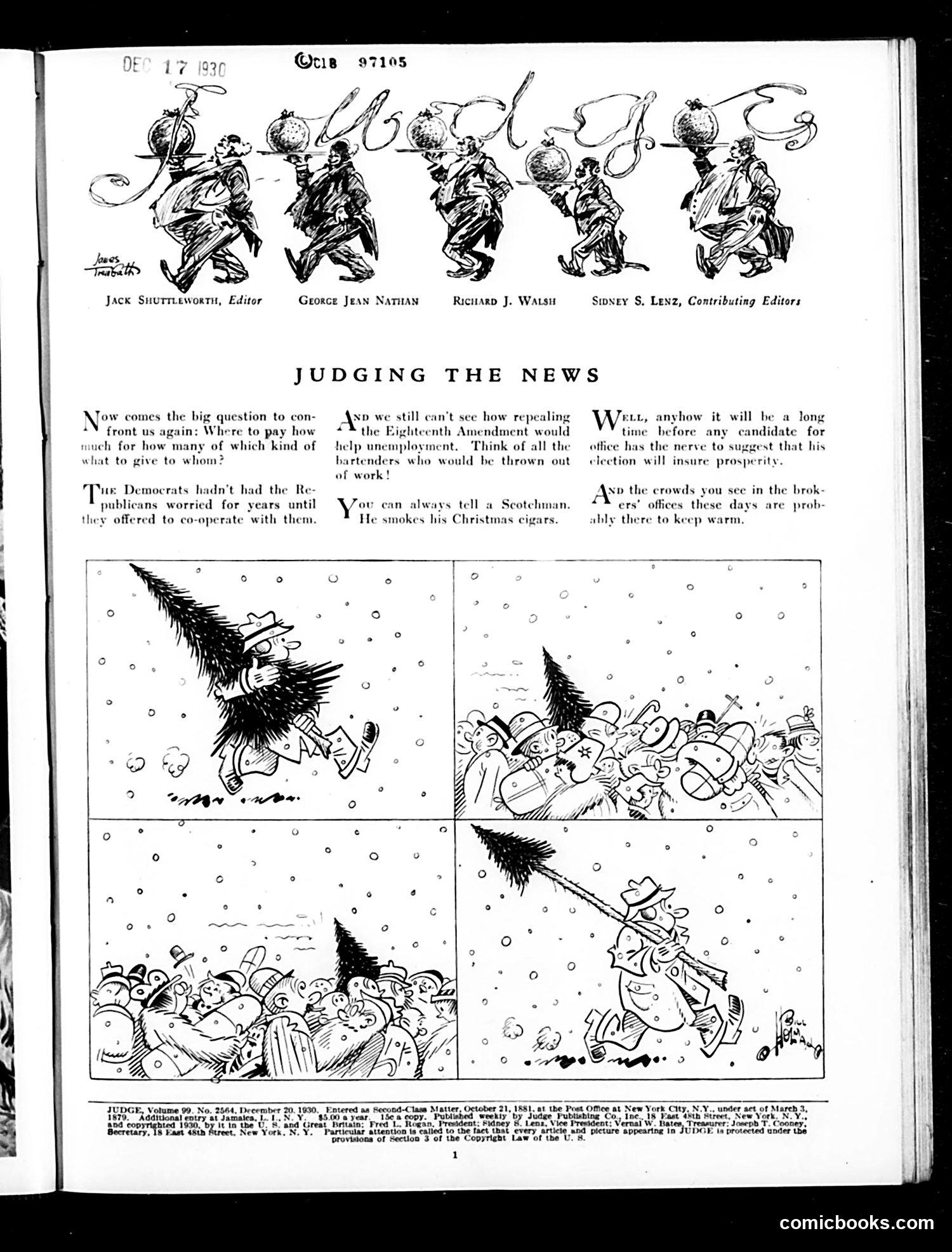
Analysis of "Judging the News" This December 1930 *Judge* page satirizes contemporary economic and political debates during the Great Depression's early stages. The header cartoon shows five editors juggling globes and tools—visual metaphors for handling news stories. The main comic strip (three panels) depicts a Christmas tree being carried through increasingly crowded, chaotic scenes. The satire likely comments on how people are struggling during economic hardship while still attempting holiday celebrations. The text snippets reference Republican-Democratic cooperation on unemployment relief and make a cynical joke about Scottish Christmas traditions (smoking cigars indoors to stay warm), implying the Eighteenth Amendment (Prohibition) prevents alternative warming methods. The overall message criticizes politicians' inability to address Depression-era suffering while ordinary citizens maintain desperate normalcy.
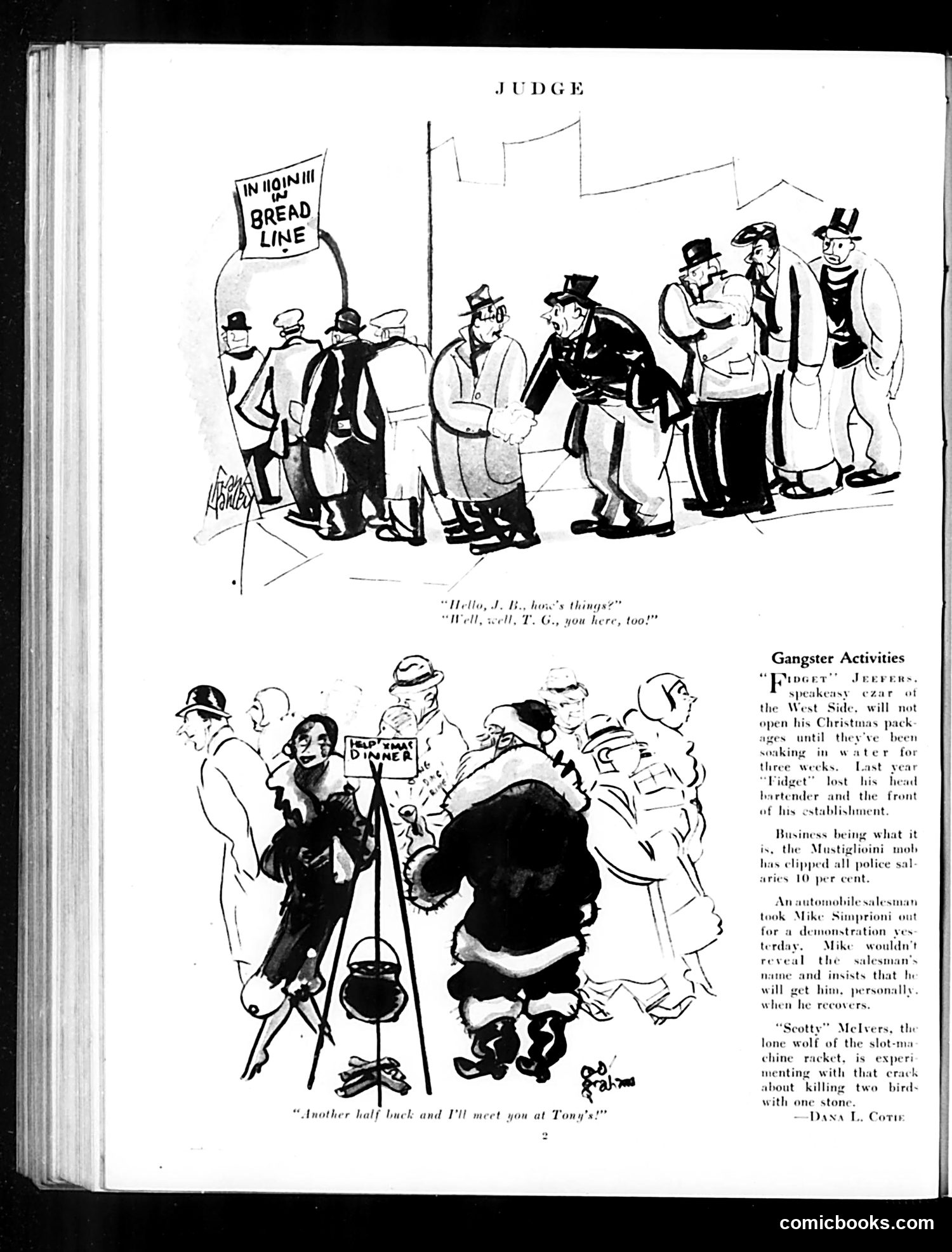
Analysis of Judge Magazine Page Top Cartoon ("Judge"): Depicts a bread line—unemployed men waiting for food assistance. One holds a sign reading "UNION BREAD LINE." The caption exchanges greetings between "J.D." (likely J.D. Rockefeller or similar wealthy figure) and "T.G." (unclear), sarcastically suggesting these wealthy individuals are present in the breadline. This satirizes wealth inequality and the contrast between the rich and poor during economic hardship. Bottom Cartoon & "Gangster Activities" Section: Illustrates criminal underworld figures near a restaurant, referencing Prohibition-era organized crime. Text details "Fidget" Jeffers' speakeasy operations and violence. Accompanying stories describe mob extortion, automobile salesmen being targeted, and "Scotty" Melvers' slot-machine racket experiments. This documents contemporary gangster activities during Prohibition.
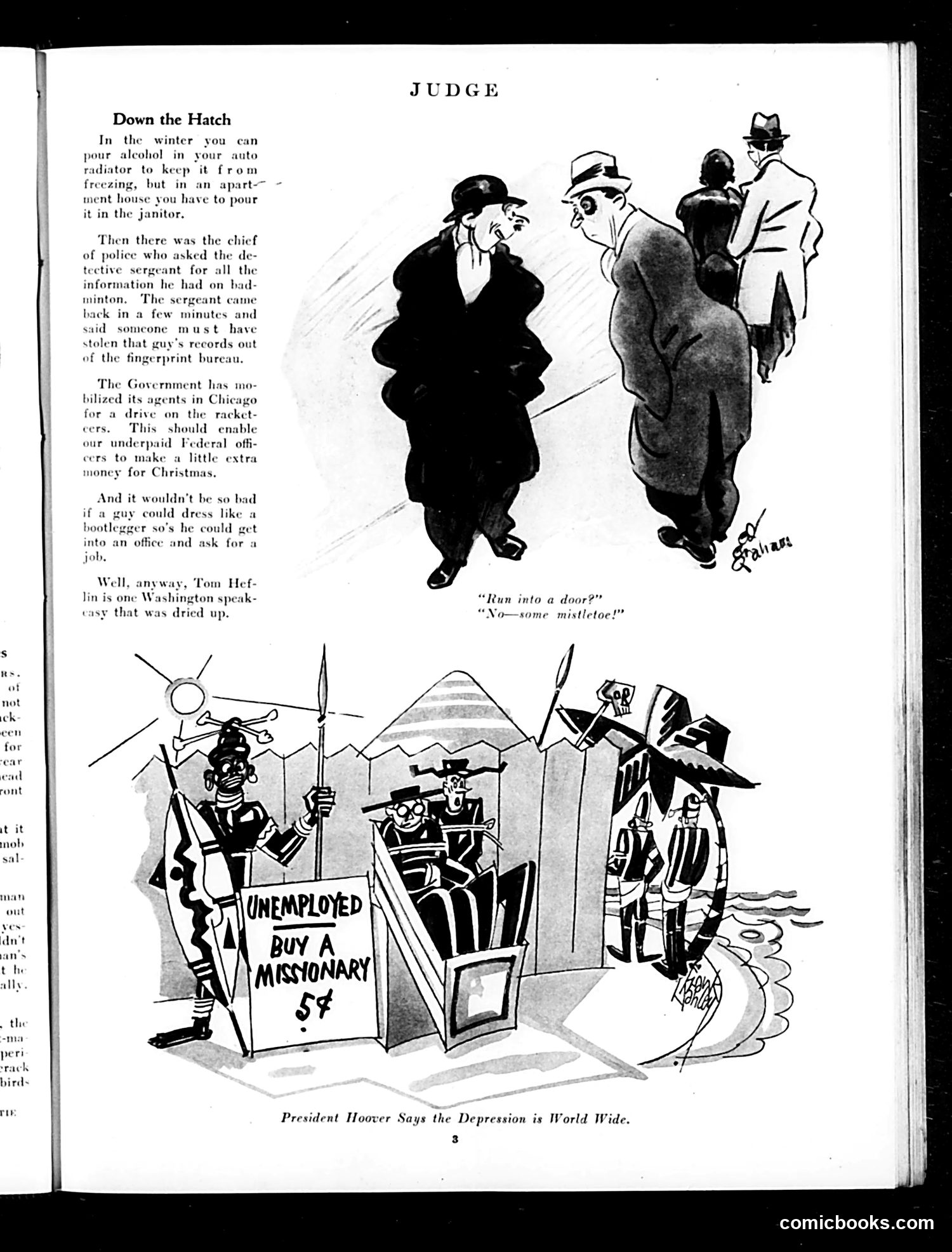
Analysis of Judge Magazine Page Top Cartoon: Shows men in coats and hats running, with caption "Run into a door?" and "No—some mistletoe!" This is a holiday-season visual gag about Christmas mistletoe traditions (kissing under mistletoe), with the implication that someone's black eye came from amorous holiday encounters rather than accident. Bottom Cartoon: Depicts a tent labeled "UNEMPLOYED BUY A MISSIONARY 5¢" with various caricatured figures around it, including what appears to be an indigenous figure with a spear and wealthier figures with money. The caption states "President Hoover Says the Depression is World Wide." Context: This satirizes the Great Depression-era irony of Americans being too poor to help themselves while still expected to fund missionary work. The cartoon mocks the disconnect between widespread unemployment and continued charitable appeals.
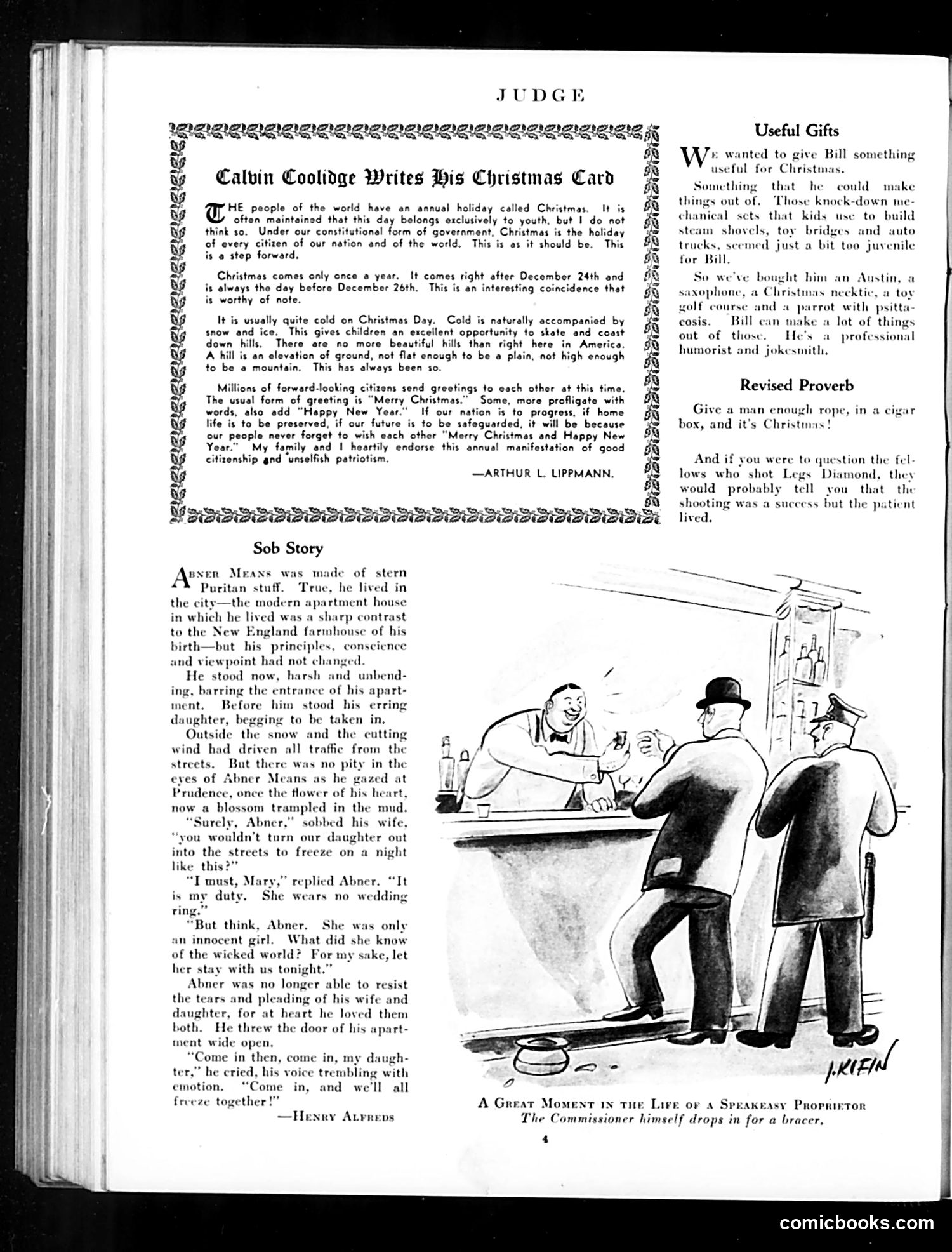
Analysis of Judge Page Content This page contains three distinct pieces: 1. "Calvin Coolidge Writes His Christmas Card" — An editorial essay by Arthur L. Lipmann praising Christmas as an American holiday that transcends politics, written in Coolidge's voice. 2. "Sob Story" by Henry Alfreds — A narrative about Abner Means, a stern Puritan-like figure who initially refuses to let his daughter leave on a snowy night, then relents emotionally, inviting her to "come in" and "we'll all freeze together." 3. "A Great Moment in the Life of a Speakeasy Proprietor" — A cartoon (signed by Kirn) showing men at what appears to be an illegal bar during Prohibition, with the caption suggesting a police commissioner making a bribe ("drops in for a brocer"). The speakeasy cartoon satirizes corruption during Prohibition, depicting the normalized bribery between law enforcement and illegal alcohol establishments.
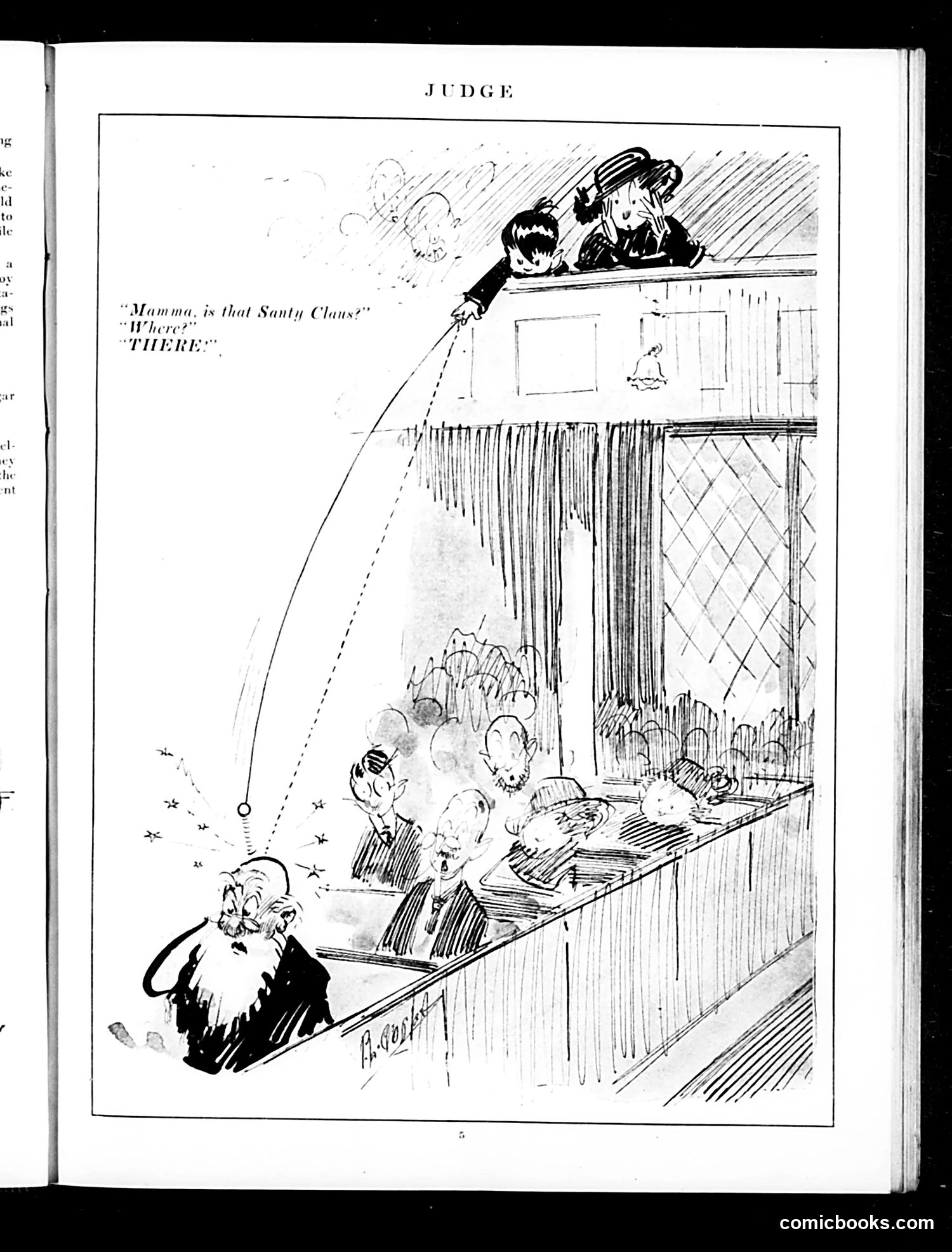
Analysis of "Judge" Cartoon: "JUDGE" This cartoon depicts a courtroom scene with a clear satirical message. Two children peer from a window above, with one asking "Mamma, is that Santy Claus?" while pointing downward with the response "THERE!" The figure below—an old man with a long beard seated in the courtroom—is being identified as "Santa Claus" by the children. This appears to be political satire conflating a judge or legal authority with Santa Claus, likely mocking either the judge's appearance, decisions, or reputation. The jury members visible in the background suggest an active trial. The satire's precise target remains unclear without additional context, but the comparison suggests either criticism of judicial leniency, favoritism, or the judge's character—presenting him as either benevolent or ridiculous, depending on intended tone.
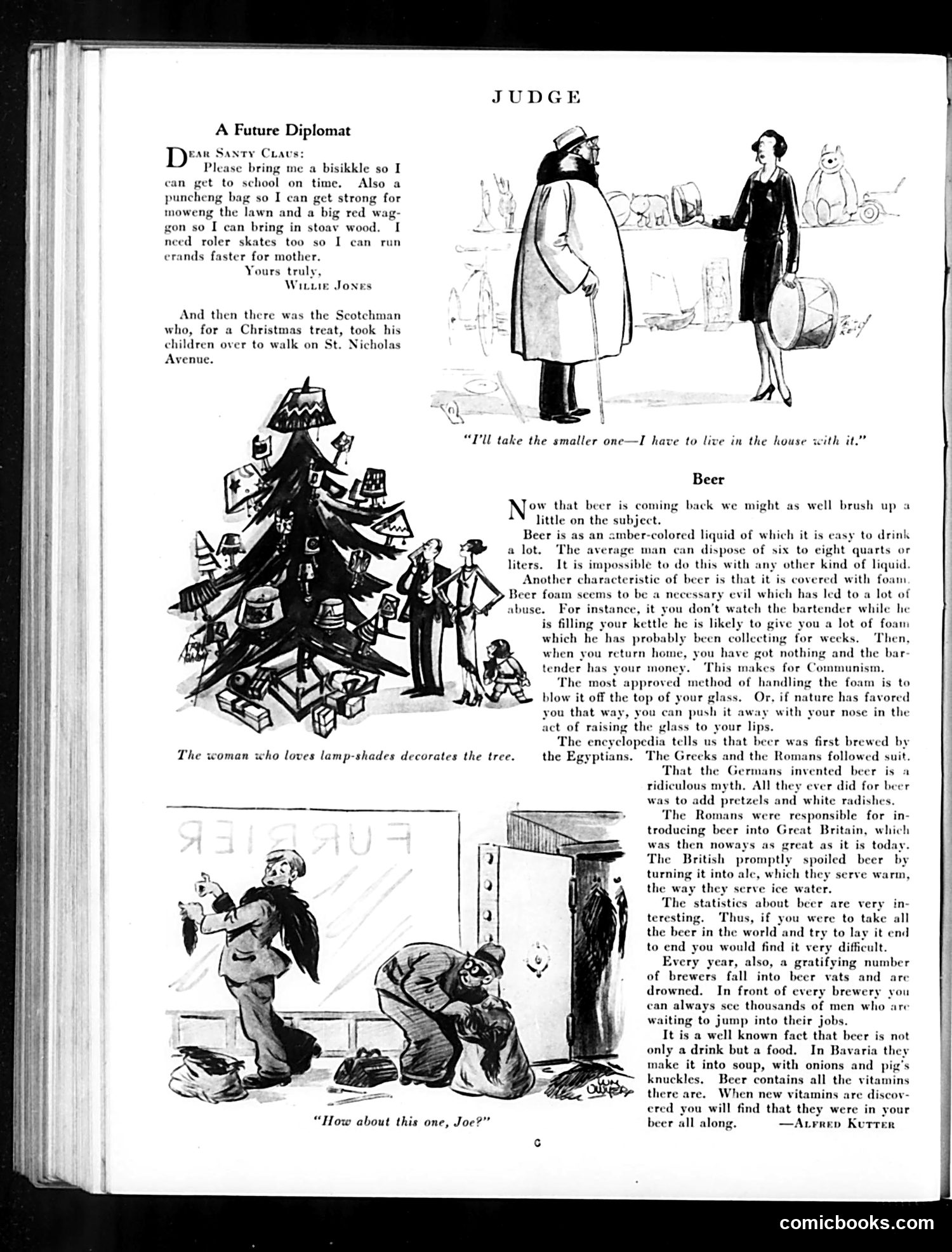
Analysis of Judge Magazine Page This page contains three separate pieces: "A Future Diplomat" - A humorous letter from child Willie Jones to Santa Claus requesting practical items (bicycle, punchbag, roller skates, wood) rather than toys, framed as preparation for diplomatic work. The joke is that this practical-minded child will become a diplomat. "The woman who loves lamp-shades decorates the tree" - A cartoon satirizing women who excessively decorate Christmas trees with lampshades, treating holiday decoration as excessive interior design rather than traditional celebration. "Beer" - A lengthy article by Alfred Kütter discussing beer's history, properties, and cultural significance. The accompanying cartoon labeled "How about this one, Joe?" depicts working-class men casually selecting beer, reflecting beer's role as an everyday beverage. The page reflects early 20th-century American attitudes toward consumption, domesticity, and class culture.
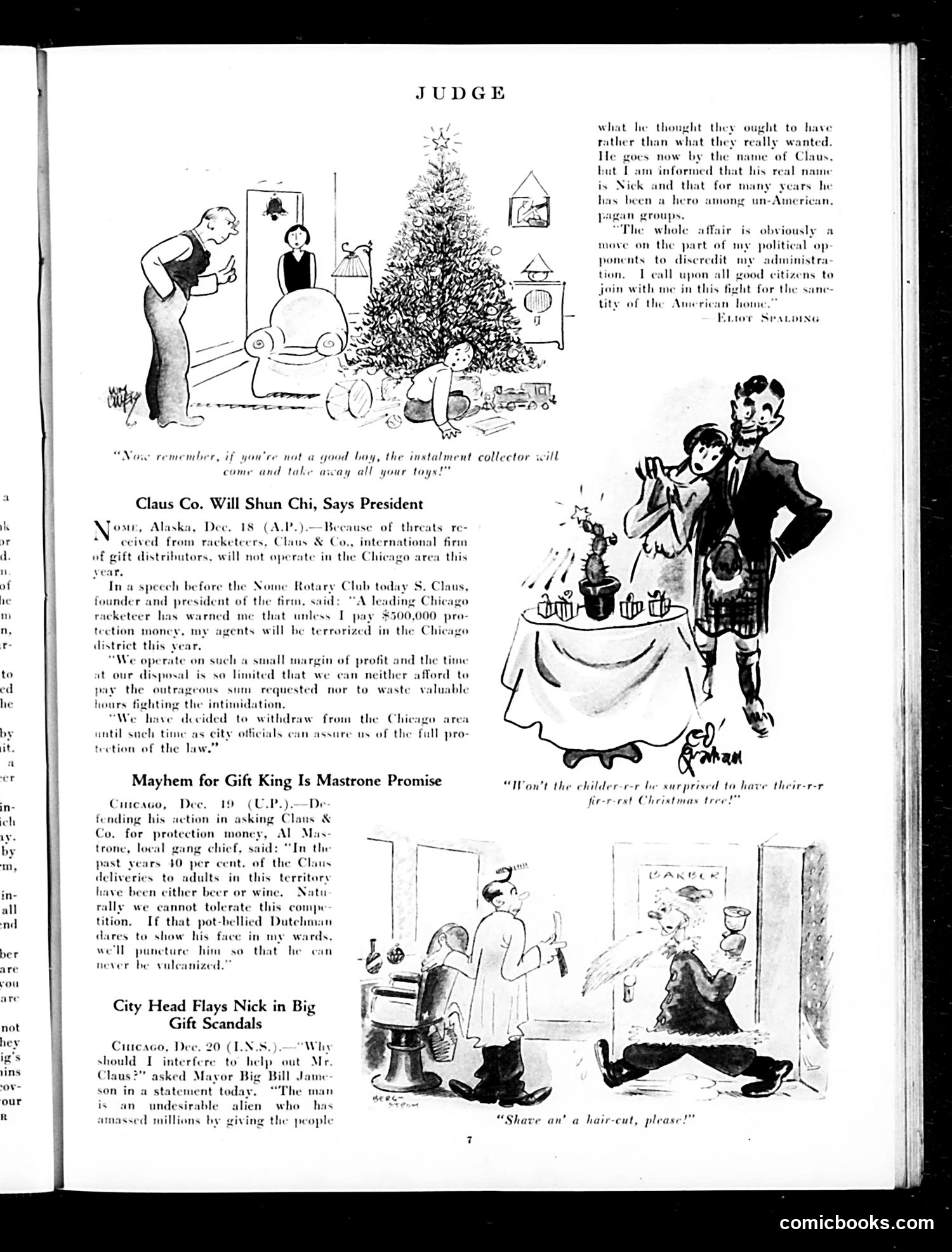
Judge Magazine Political Satire Analysis This page satirizes Depression-era Chicago corruption through a fake news story about Santa Claus ("Claus & Co."). The satire works on multiple levels: The Setup: Santa is being extorted by Chicago racketeers (led by "Mastrone," likely referencing real gang activity) demanding $500,000 protection money, forcing him to abandon Chicago. The Political Target: Mayor "Big Bill" Jameson (based on real Chicago Mayor Big Bill Thompson) dismisses Santa's plight, calling him an "undesirable alien"—a xenophobic attack using anti-immigrant rhetoric. An unnamed politician quotes Santa as having a "real name" ("Nick"), implying foreign/un-American origins, a dog-whistle against immigrants. The Joke: Authorities blame the victim rather than address organized crime. The cartoons show children robbed of Christmas gifts, highlighting how corruption harms ordinary citizens. Historical Context: This reflects real 1920s-30s Chicago gang violence, police corruption, and nativist politics that scapegoated immigrants while ignoring criminal syndicates. The satire criticizes both organized crime and hypocritical politicians who exploit xenophobia instead of actually protecting citizens.
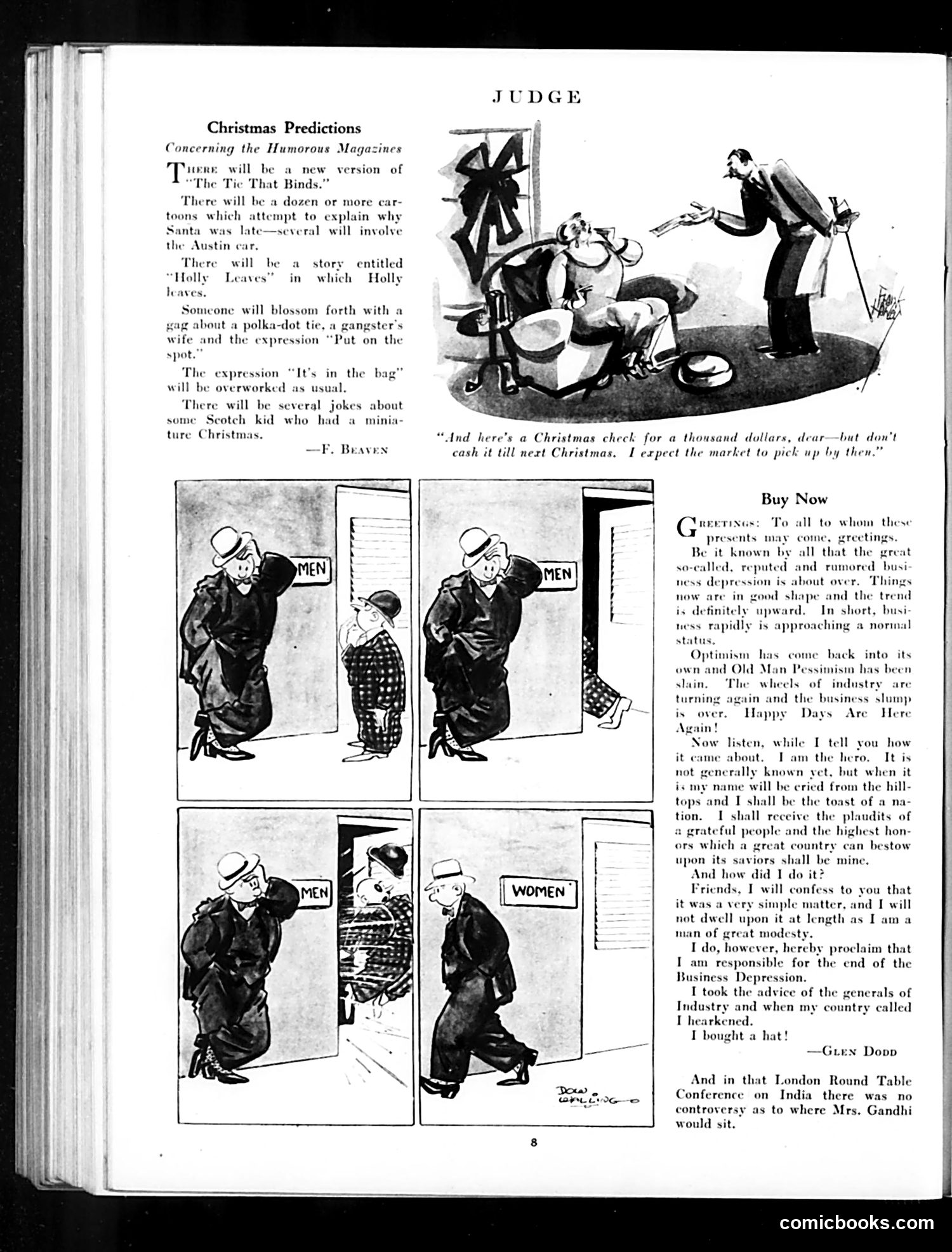
Explanation for Modern Readers This page from *Judge* magazine contains Christmas predictions satirizing typical holiday content in humorous magazines, plus two pieces claiming credit for ending the Great Depression. The four-panel cartoon (bottom left) shows a man repeatedly trying to enter doors marked "MEN" and "WOMEN," apparently confused about which restroom to use—a slapstick gag about gender confusion typical of early 20th-century humor. The "Buy Now" section mocks overconfident economic optimism following the Depression. One piece facetiously claims the narrator single-handedly ended the crisis by "buying a hat"—satirizing both the absurdity of consumer confidence and business leaders' simplistic solutions. The final line references the London Round Table Conference on India and Mrs. Gandhi (Mohandas Gandhi's wife), joking that there was "no controversy as to where Mrs. Gandhi would sit"—likely alluding to seating disputes at the real 1931 conference regarding British colonial hierarchy and Indian representation. The satire targets both shallow magazine content and unfounded economic optimism.
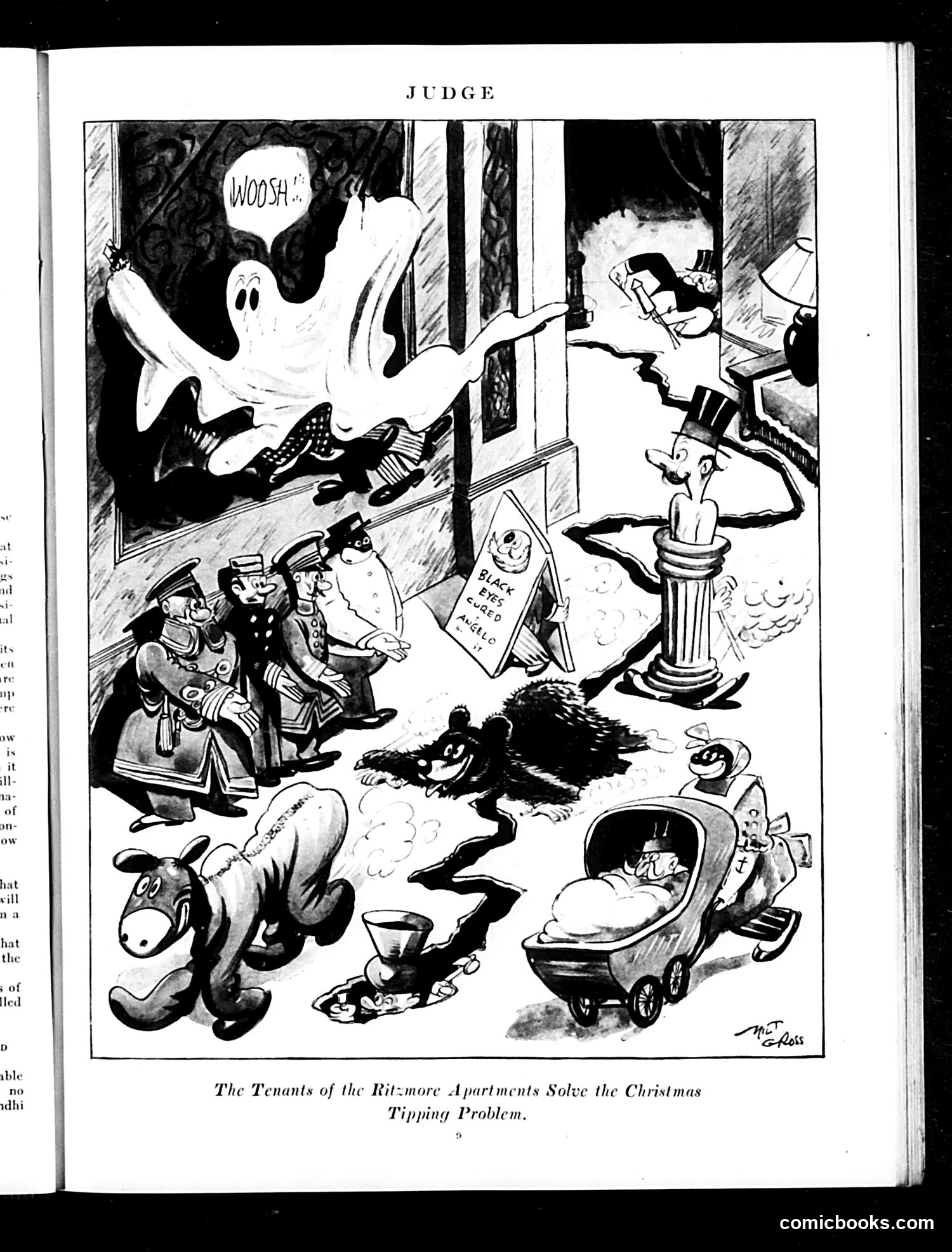
Analysis This satirical cartoon illustrates the "Christmas tipping problem"—a social issue where tenants of apartment buildings were expected to give monetary gifts to doormen, superintendents, and other service staff during the holidays. The cartoon depicts the Ritzmore Apartments' tenants solving this by creating chaos: a ghost haunting the building, animals running loose (including what appears to be a donkey and a black cat), and general mayhem involving delivery vehicles and household disruption. The satire suggests that rather than pay customary tips, wealthy apartment dwellers deliberately make conditions so unpleasant that service staff quit or flee, eliminating the obligation. It's a commentary on both the burden of the tipping custom and the callousness of the wealthy toward their employees' livelihoods—a perennial social tension that remains relevant today.
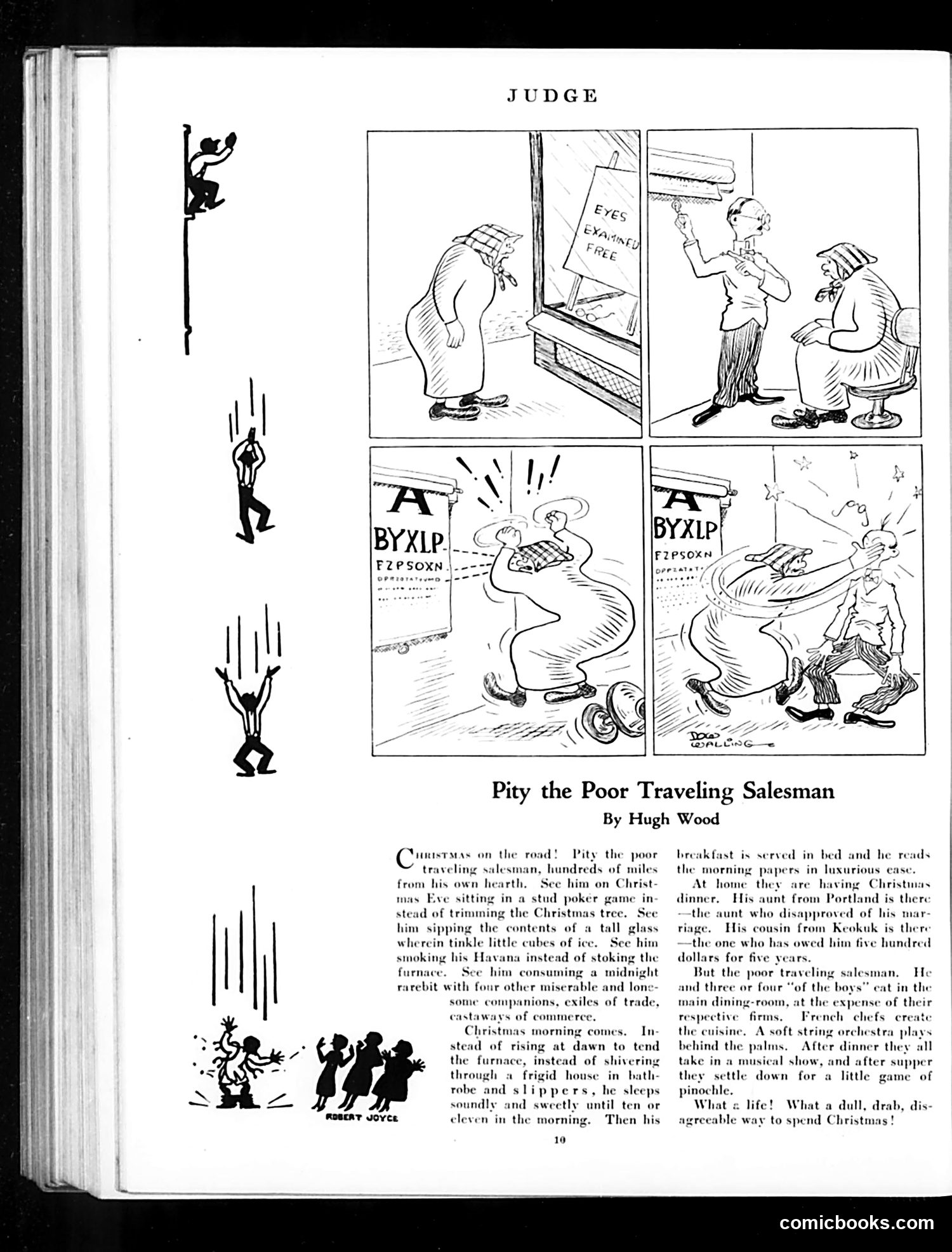
"Pity the Poor Traveling Salesman" This is a humorous commentary on the traveling salesman's peculiar Christmas situation by Hugh Wood. The four-panel cartoon shows a salesman examining his reflection in a mirror marked "Eyes Examined Free," then interacting with an optometrist or eye doctor, followed by two panels depicting his exaggerated physical distortions—likely representing dizziness or disorientation. The accompanying text ironically contrasts the salesman's lonely, vice-filled Christmas away from home (poker games, whiskey, late-night meals) with the domestic misery he'd face if present (disapproving relatives, unpaid debts). The satire's "pity" is tongue-in-cheek: the salesman actually escapes Christmas obligations and family friction, living in comparative luxury—suggesting his exile from home is secretly preferable. The joke targets both traveling salesmen (a common figure in early-20th-century commerce) and the hypocrisy of forced holiday sentimentality.
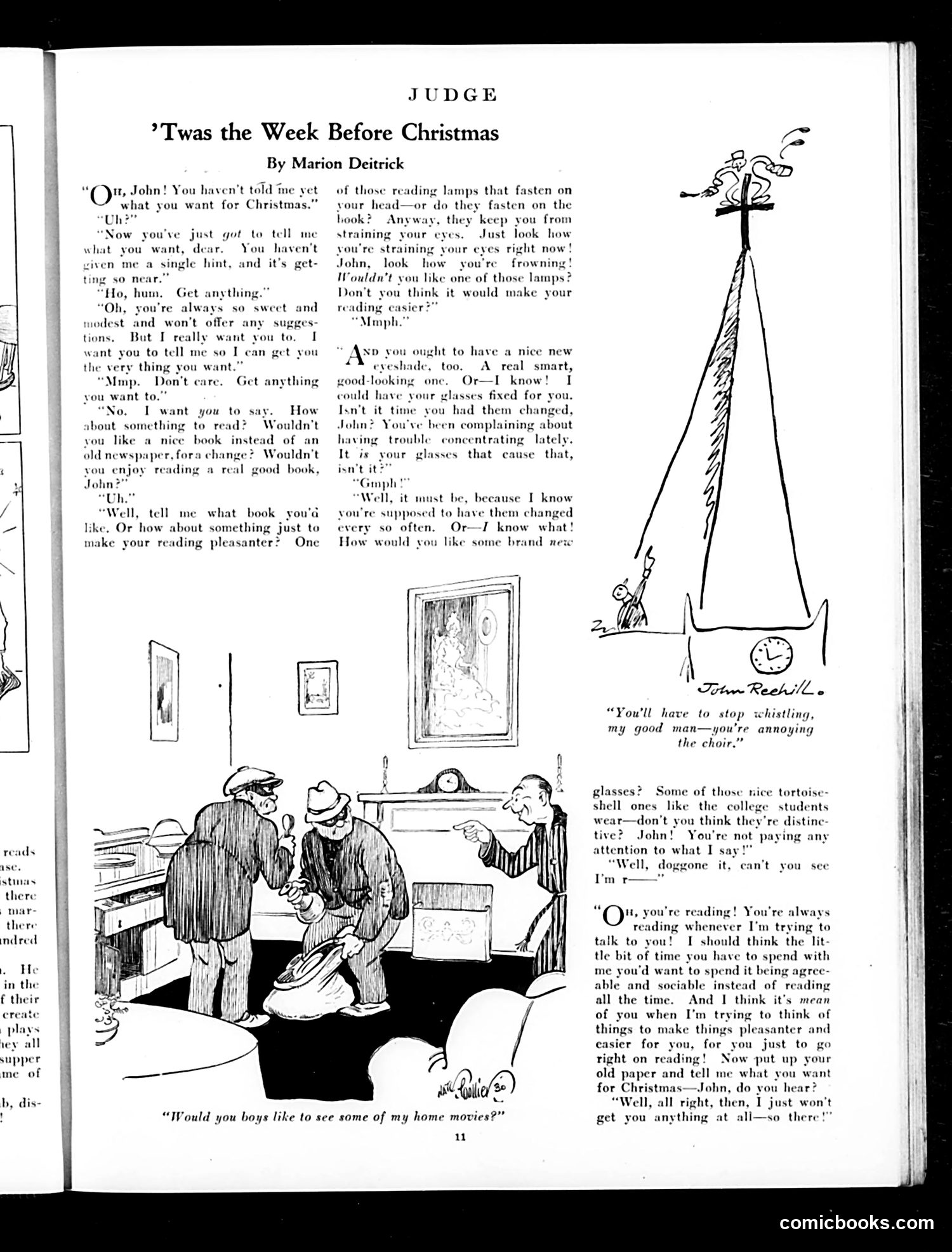
"Twas the Week Before Christmas" (Judge Magazine) This domestic comedy depicts a husband-wife negotiation over Christmas gifts. The wife persistently suggests practical items—reading lamps, eyeshades, new glasses—to "improve" her husband's reading habits, which she views as antisocial. The husband repeatedly responds with monosyllables ("Mmph," "Gmph") and refuses engagement, wanting no gifts at all. The satire targets two 1920s-30s domestic stereotypes: the well-meaning wife who meddles under the guise of helpfulness, and the husband who escapes family interaction through reading and refuses to participate in shopping rituals. The wife's final threat—"I just won't get you anything at all"—reveals the real complaint: his indifference to her gift-giving efforts. The cartoon mocks both characters: her nagging helpfulness and his stubborn withdrawal into print. The joke reflects period anxieties about reading as potentially antisocial behavior disrupting marital companionship.
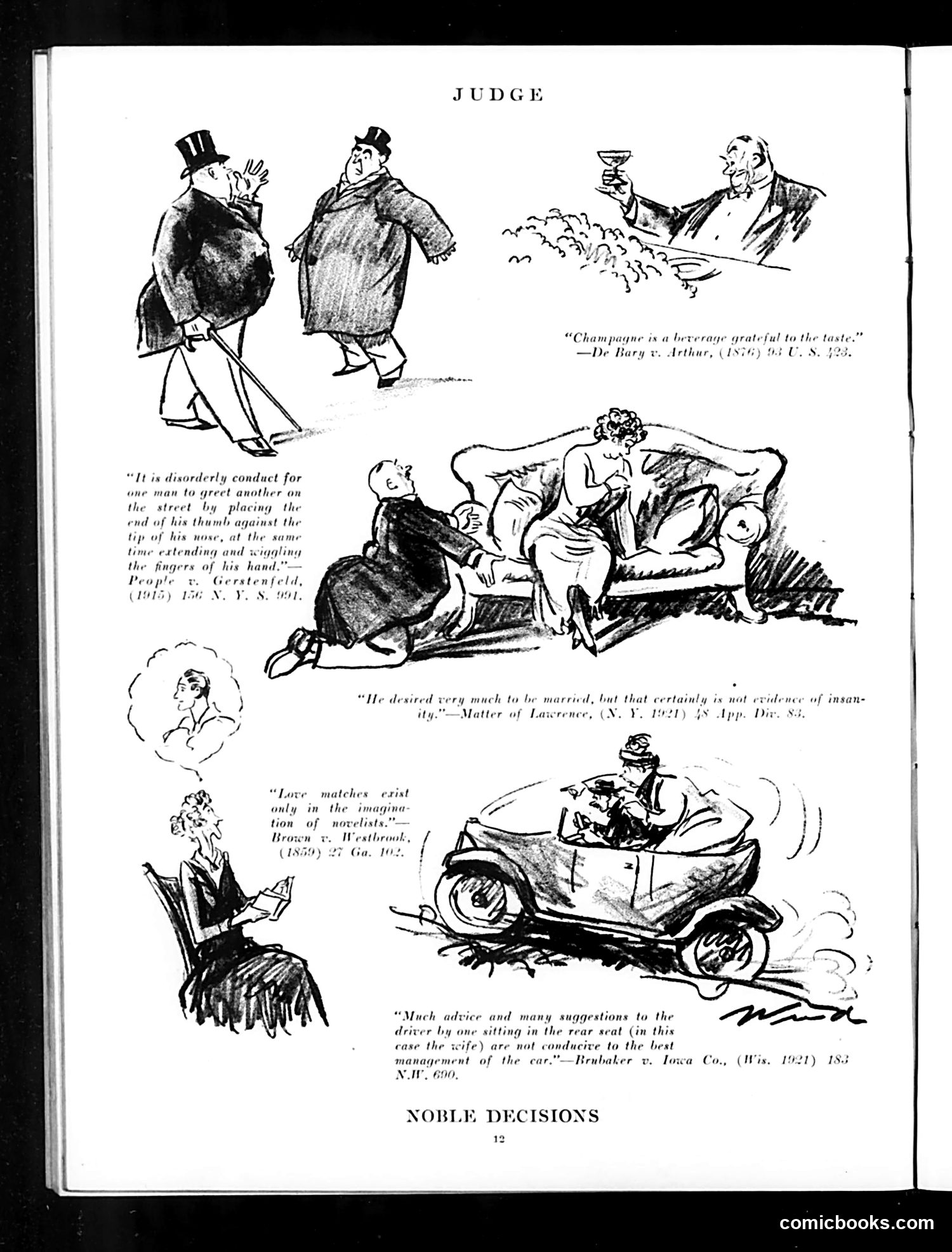
Explanation for Modern Readers This page satirizes absurd court rulings by pairing them with humorous illustrations. Each cartoon references an actual legal decision, mocking the specificity or oddness of judicial logic. The top scenes illustrate cases about greeting etiquette and champagne appreciation. The middle section shows a couple on a couch with a quote about marriage and insanity. The bottom features a man and woman in a car, referencing a Wisconsin case about wives giving driving advice. The satire's point: judges sometimes issue rulings so specific, petty, or obvious that they seem ridiculous when stated formally. By matching real case citations with cartoons of everyday situations, *Judge* magazine highlights how the legal system occasionally produces comically overwrought decisions. The humor relies on the contrast between dignified legal language and mundane domestic scenarios—the implicit message being that not every social interaction requires judicial definition.
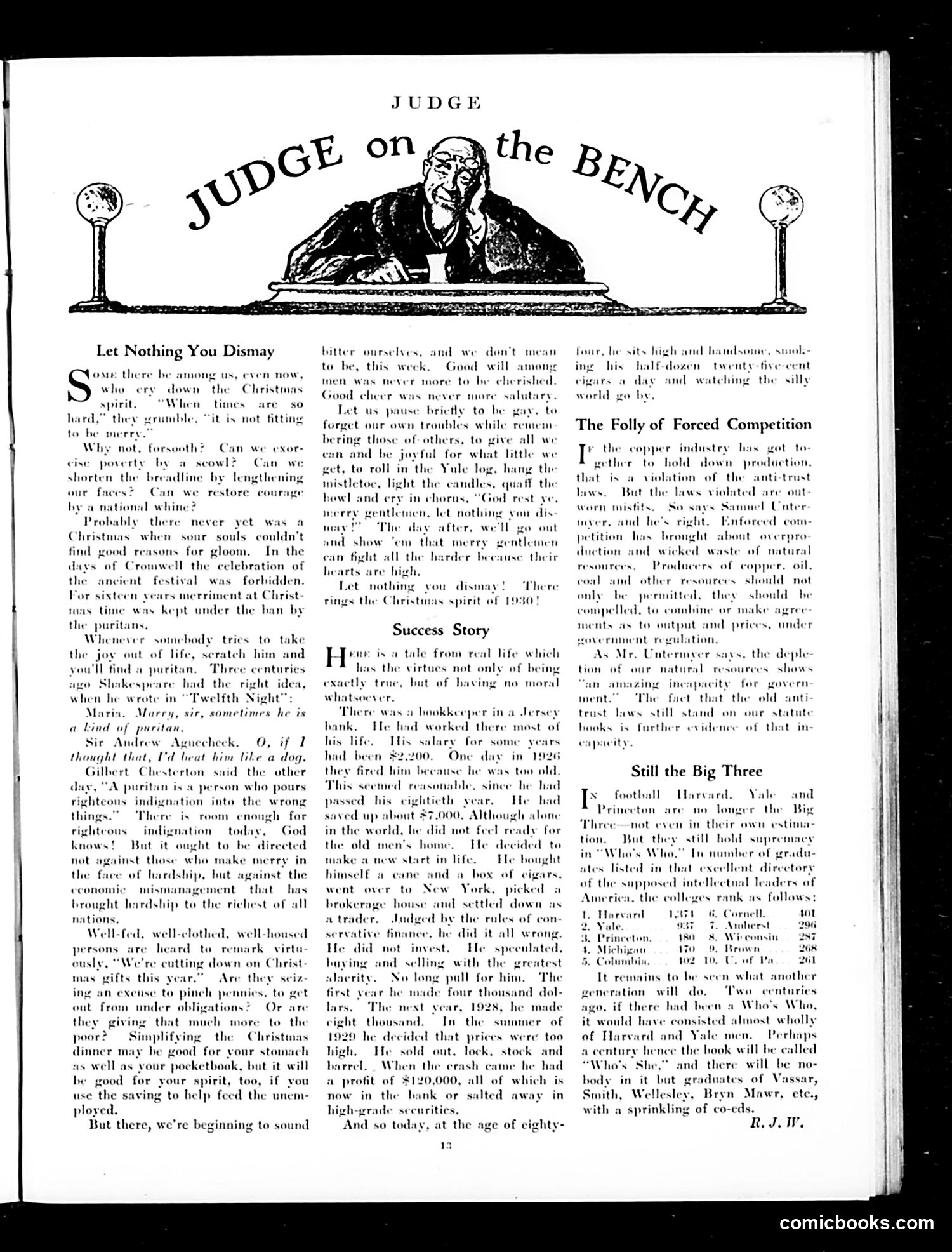
Judge Magazine Page Analysis This page from Judge magazine contains holiday-season editorializing and three separate articles. "Let Nothing You Dismay" is an editorial arguing against puritanical gloom during Christmas, referencing historical Puritan suppression of holiday celebration and invoking Shakespeare. It critiques wealthy people who claim to "simplify" Christmas spending without redirecting savings to the unemployed—a clear reference to Depression-era economic hardship. "Success Story" narrates an actual case: an 80-year-old Jersey bank bookkeeper fired for age discrimination uses his $7,000 savings to become a successful stock trader, profiting enormously before the 1928 market crash. The piece notes approvingly that he ignored "conservative finance" rules—satirizing conventional wisdom as the market neared collapse. "Still the Big Three" discusses Ivy League football rankings, noting Harvard, Yale, and Princeton no longer dominate as they once did. The page reflects 1920s-end anxieties: economic inequality, age discrimination, and blind faith in market speculation just before the October 1929 crash.
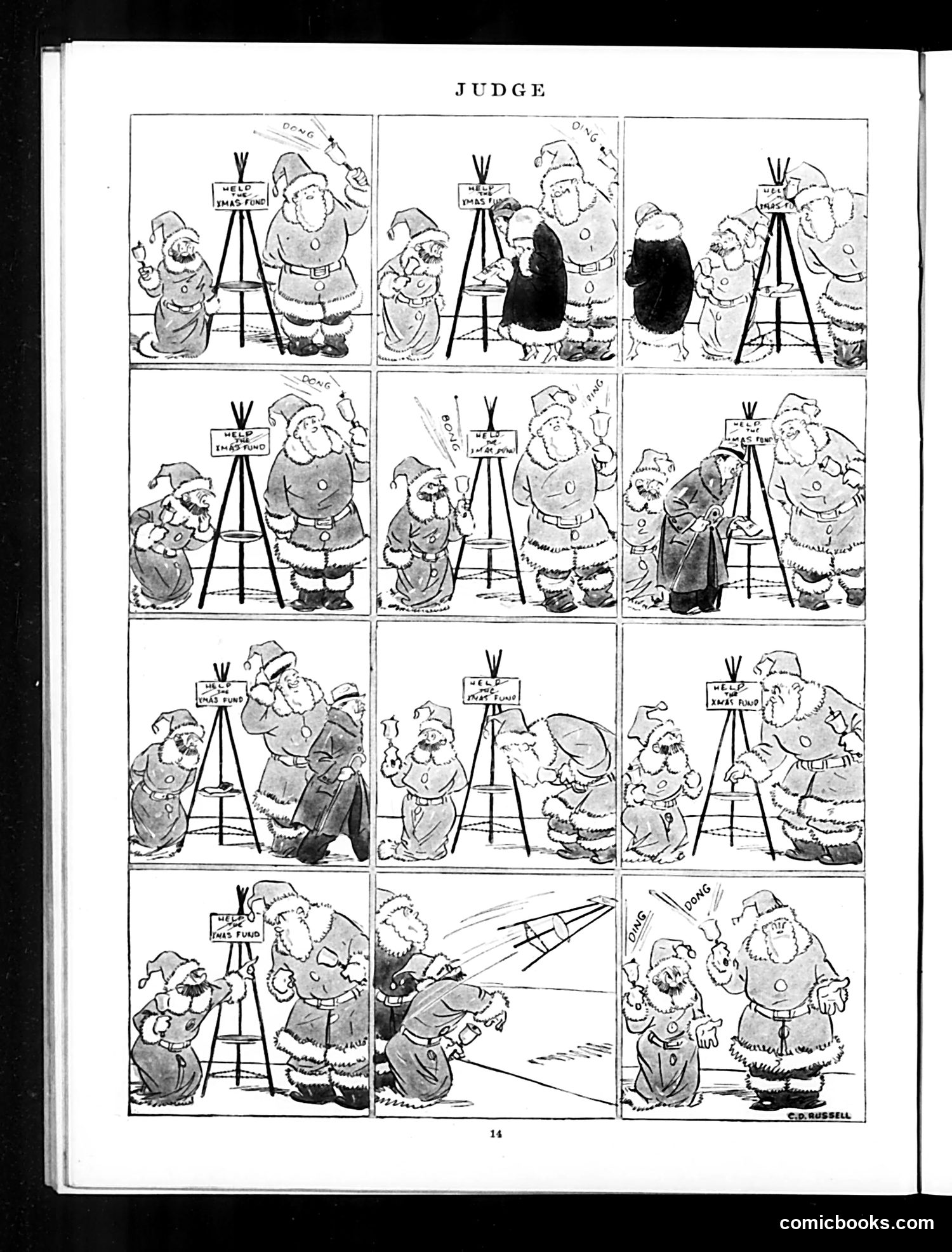
Judge Magazine Page Analysis This is a multi-panel comic strip titled "Judge" depicting a character (appears to be Santa Claus based on the hat and beard) standing before a "Help the Xmas Fund" donation stand. The strip shows a sequential narrative where various figures—appearing to represent different social classes or character types—approach the stand to contribute or interact with Santa. The satire likely comments on Christmas charity drives and public donation campaigns, possibly mocking either the generosity (or lack thereof) of different social groups, or the effectiveness of seasonal charitable appeals. The "Help the Xmas Fund" sign suggests this references real Depression-era or early-20th-century charity efforts. The artist is signed C.D. Russell.
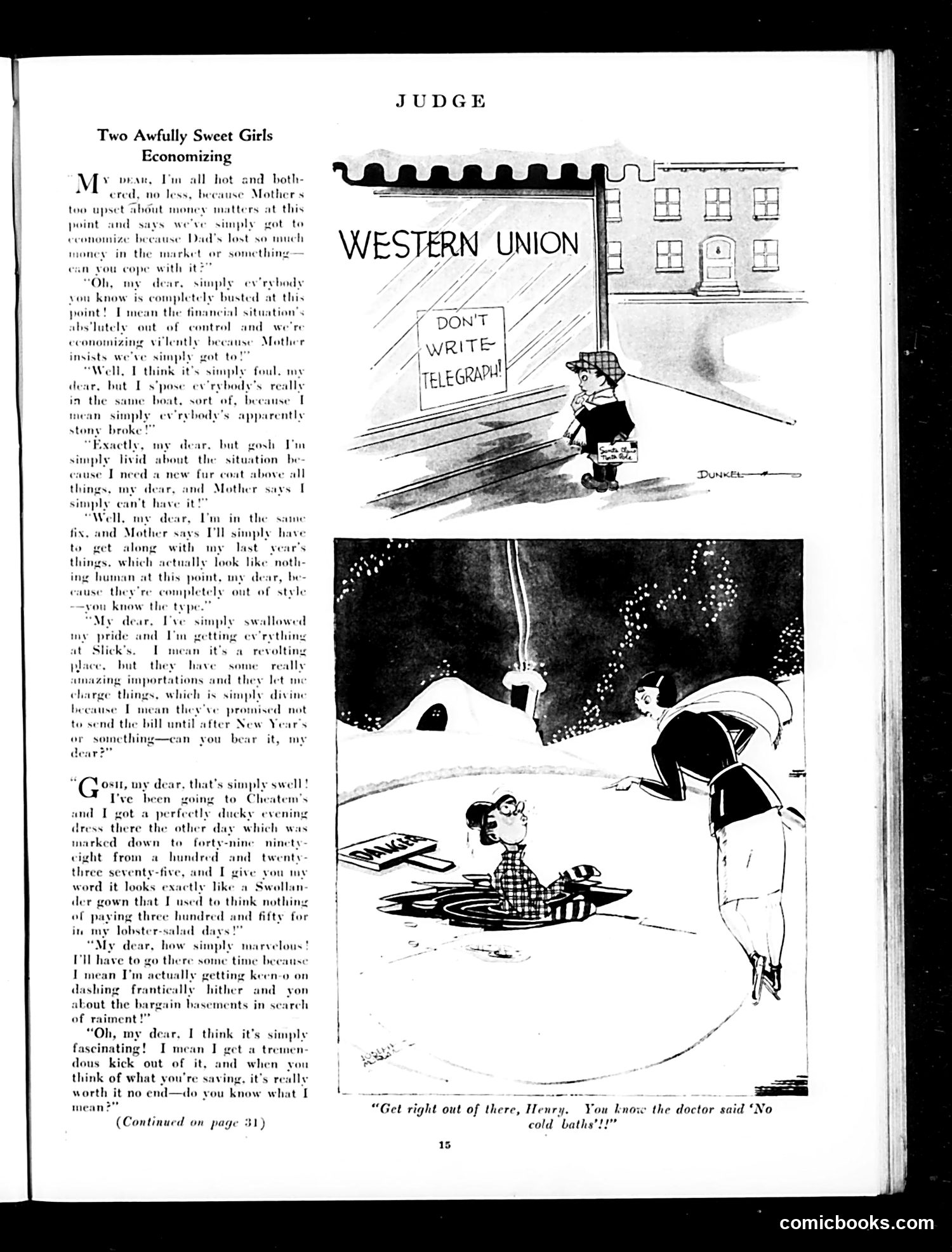
Two Awfully Sweet Girls Economizing This page satirizes wealthy young women during an economic downturn (likely the 1920s market crash era) who claim to be "economizing" while actually maintaining luxurious lifestyles through credit and self-deception. The dialogue between two society girls reveals the satire: they're "economizing vigorously" because their fathers lost money, yet they're buying fur coats, designer gowns, and charging purchases at expensive department stores (like "Slick's"), simply delaying payment until after New Year's. The cartoon above shows a Western Union office with a sign "DON'T WRITE TELEGRAM!"—mocking the irony of economizing by avoiding telegram expenses while engaging in frivolous spending elsewhere. The bottom cartoon depicts a woman in a bathtub despite doctor's orders against "cold baths"—likely satirizing how the wealthy ignore practical health advice while indulging in wasteful habits. The satire targets upper-class hypocrisy: claiming financial hardship while maintaining conspicuous consumption through debt and rationalization.
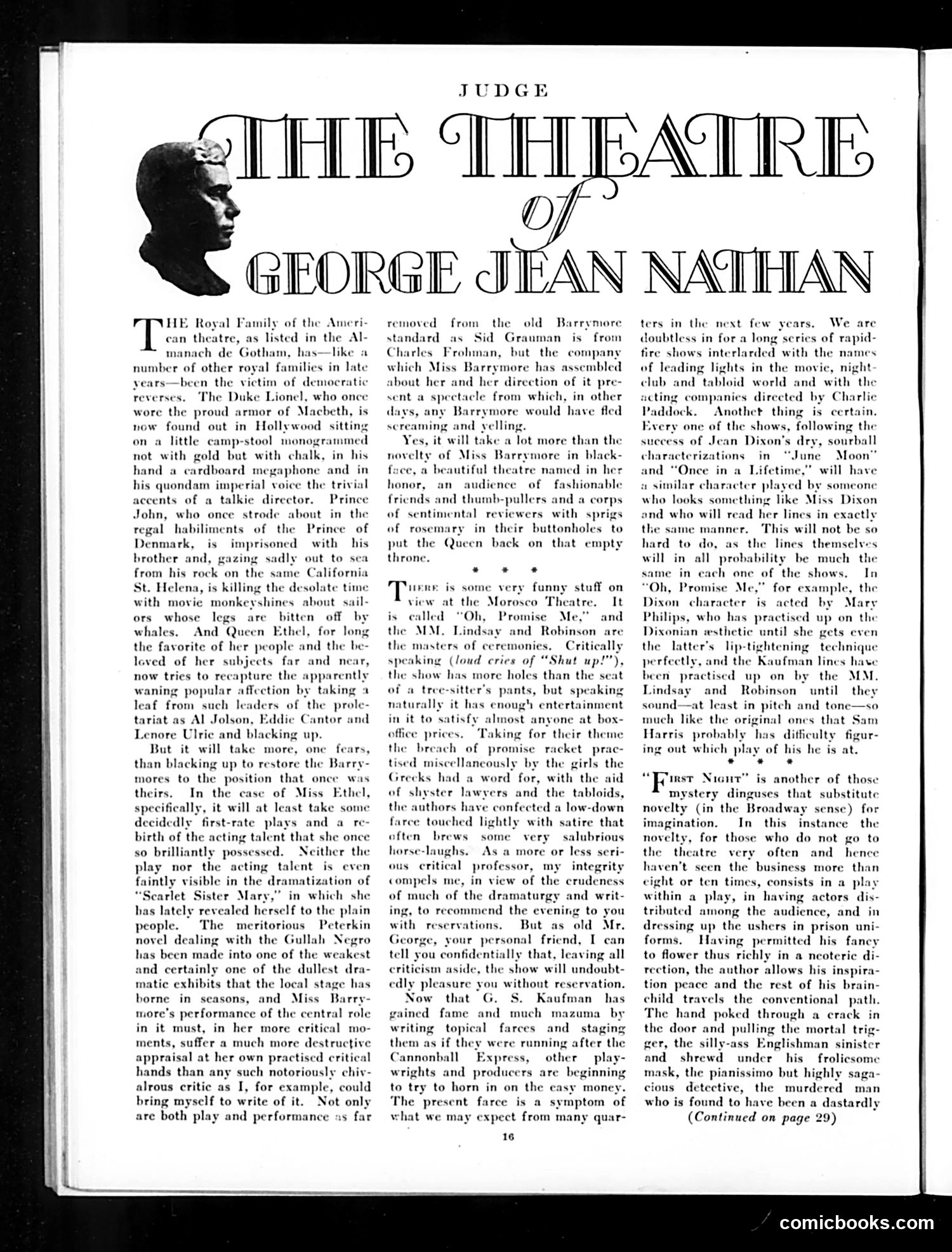
Judge Magazine Analysis: "The Theatre of George Jean Nathan" This is a theater criticism column by Judge's drama critic, identified in the header as George Jean Nathan. The piece satirizes the decline of the famous Barrymore acting family—once theatrical royalty—who have fallen into mediocrity. The Satire: Nathan compares the Barrymores to a deposed "royal family," mocking their current circumstances: Lionel directing talkie films from a "camp-stool monogrammed...with chalk"; John imprisoned in California like Napoleon on St. Helena; and Ethel attempting comebacks through blackface performance ("blacking up") and appearing in poorly-written plays with weak direction. The Point: Nathan criticizes Ethel's recent vehicle—a play at the Morosco Theatre—as having more "holes than...a flea-sitter's pants," yet confesses he enjoyed it despite its crude dramaturgy. He's highlighting both the family's artistic decline and theater critics' compromised judgment when entertainment appeals to them emotionally, regardless of quality. The column mixes professional integrity with personal enjoyment, satirizing critical hypocrisy.
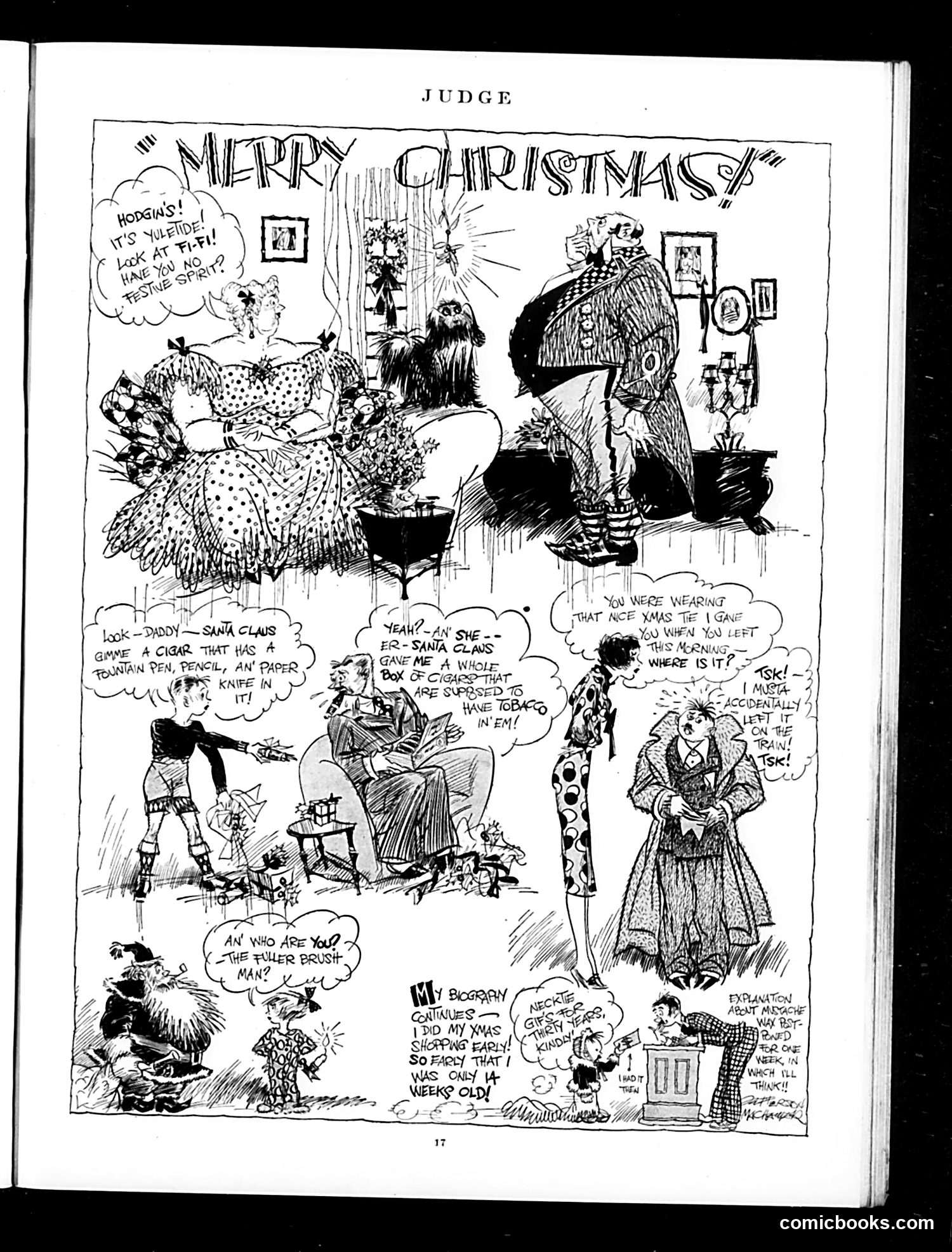
"Merry Christmas!" from Judge Magazine This is a multi-panel Christmas humor cartoon satirizing gift-giving excess and family dynamics. The central joke involves children receiving increasingly ridiculous or impractical gifts from Santa Claus—a cigar with a fountain pen and knife attachment, a box of cigars (for a child), and an Ace Christmas tie that gets accidentally left on a radiator. The humor targets turn-of-the-century consumer culture: the absurdity of giving adult items to children, poor gift choices, and holiday commercialism. One panel includes a "Fuller Brush Man" reference, likely a popular door-to-door salesman of that era. The cartoon mocks how Christmas shopping had become divorced from appropriateness—giving whatever was convenient or trendy rather than thoughtful gifts. The exaggerated scenarios and children's confused reactions underscore Judge magazine's satirical critique of modern holiday consumerism and family chaos.
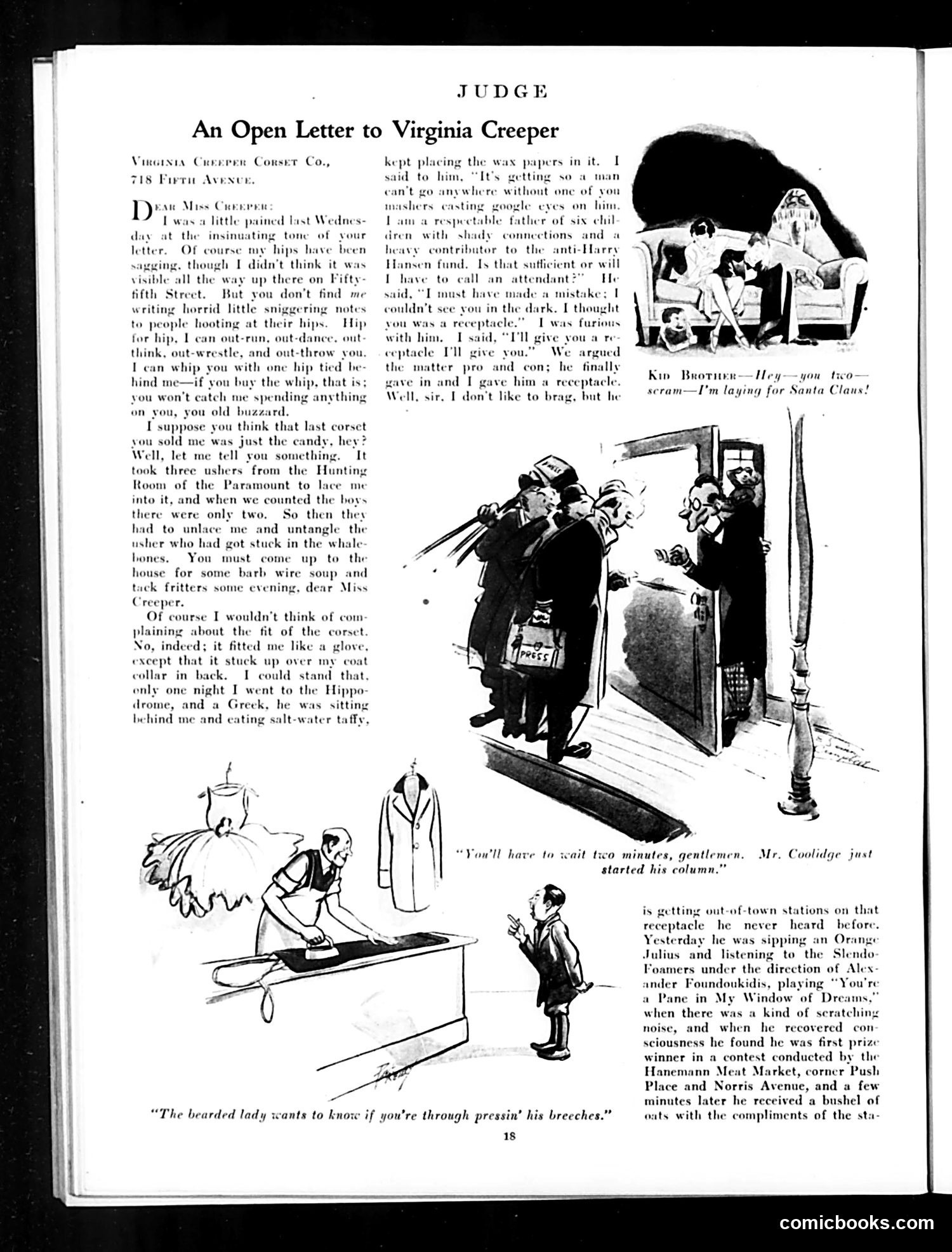
Analysis of Judge Magazine Page This is a humorous open letter from a woman to Virginia Creeper Corset Company, satirizing both aggressive corset advertising and the absurdity of restrictive 1920s fashion. The Main Satire: The letter writer responds to the company's "insinuating tone" about her sagging hips with mock-indignation and increasingly absurd complaints about the corset itself. She claims three ushers from the Paramount theater were needed to lace her in, with one getting stuck in the whalebone. She describes the corset sticking up over her collar and being mistaken for a "receptacle" by a man at the Hippodrome. The Point: Judge ridicules how corset manufacturers shamed women about their bodies while their products were simultaneously uncomfortable, dangerous, and socially embarrassing. The exaggerated complaints highlight the ridiculousness of the fashion industry's expectations. Supporting Cartoons: The accompanying illustrations show women struggling with corset-fitting and a tailor measuring garments—visual reinforcement of the fashion industry's demands on women's bodies. The reference to "anti-Harry Hansen fund" appears to be a contemporary in-joke, now obscure.
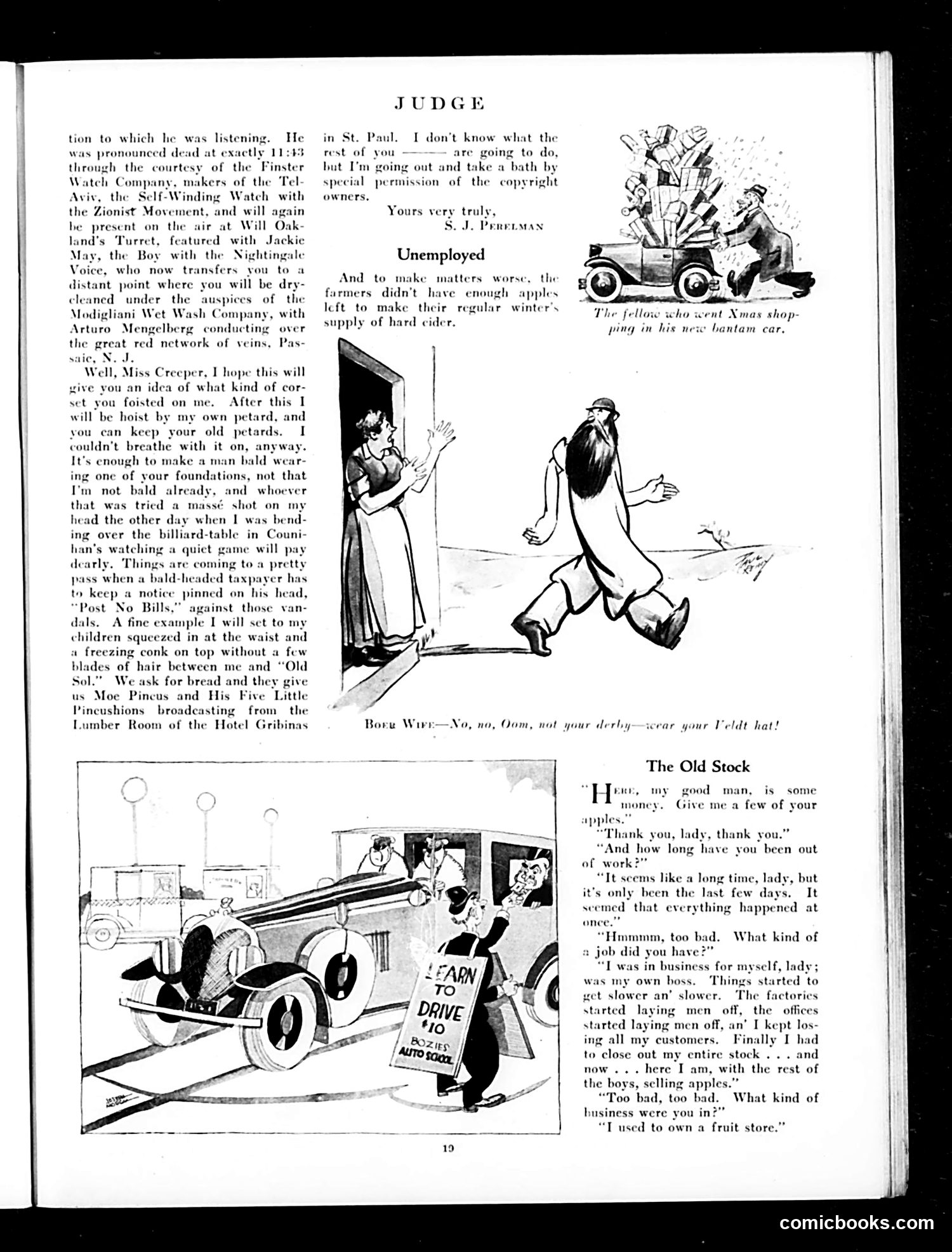
Analysis of Judge Magazine Page This page from Judge (a satirical American magazine) contains three distinct pieces satirizing Depression-era unemployment and economic hardship. "Unemployed" section: Shows a farmer who couldn't produce enough apples for winter cider—a commentary on agricultural collapse during hard economic times. "Borg Wire" cartoon: Depicts an unemployed man trying to sell apples on the street, humorously warned not to wear his formal derby hat—suggesting the absurdity of maintaining dignity while reduced to street vending. "The Old Stock" dialogue: Features a formerly successful fruit-store owner now selling apples alongside other unemployed men. The narrative traces his downfall: business slowed, factories and offices laid off workers, he lost customers, and finally closed his entire inventory. This illustrates how the economic collapse cascaded from businesses to individual workers. Together, these pieces satirize widespread Depression unemployment by showing respectable former businessmen reduced to street-corner apple sales—a visible symbol of 1930s economic desperation.
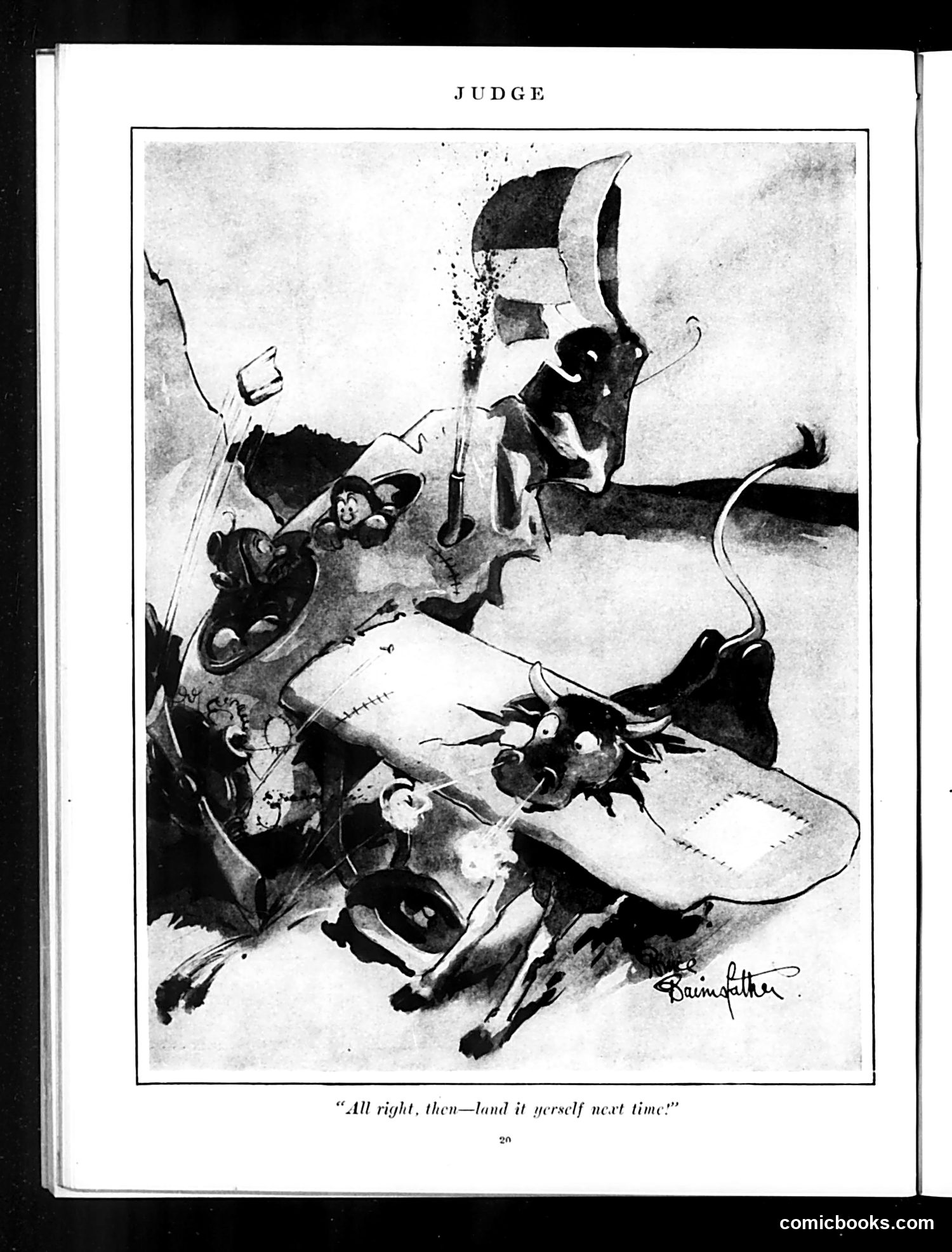
"All right, then—land it yerself next time!" This page from *Judge* magazine features a single cartoon titled "JUDGE" at the top. The illustration depicts what appears to be a courtroom or legal dispute scene with anthropomorphic animals—likely dogs or similar creatures—in conflict. One figure appears to be a judge or authority figure (top center, wearing formal attire), while others seem to be litigants or disputants below. The caption reads, "All right, then—land it yerself next time!" suggesting a dispute over responsibility or blame. The specific historical or political context remains unclear without additional information about the publication date or accompanying text. The cartoon likely satirizes legal proceedings, judicial authority, or a contemporary dispute, though the exact reference cannot be determined from the image alone.
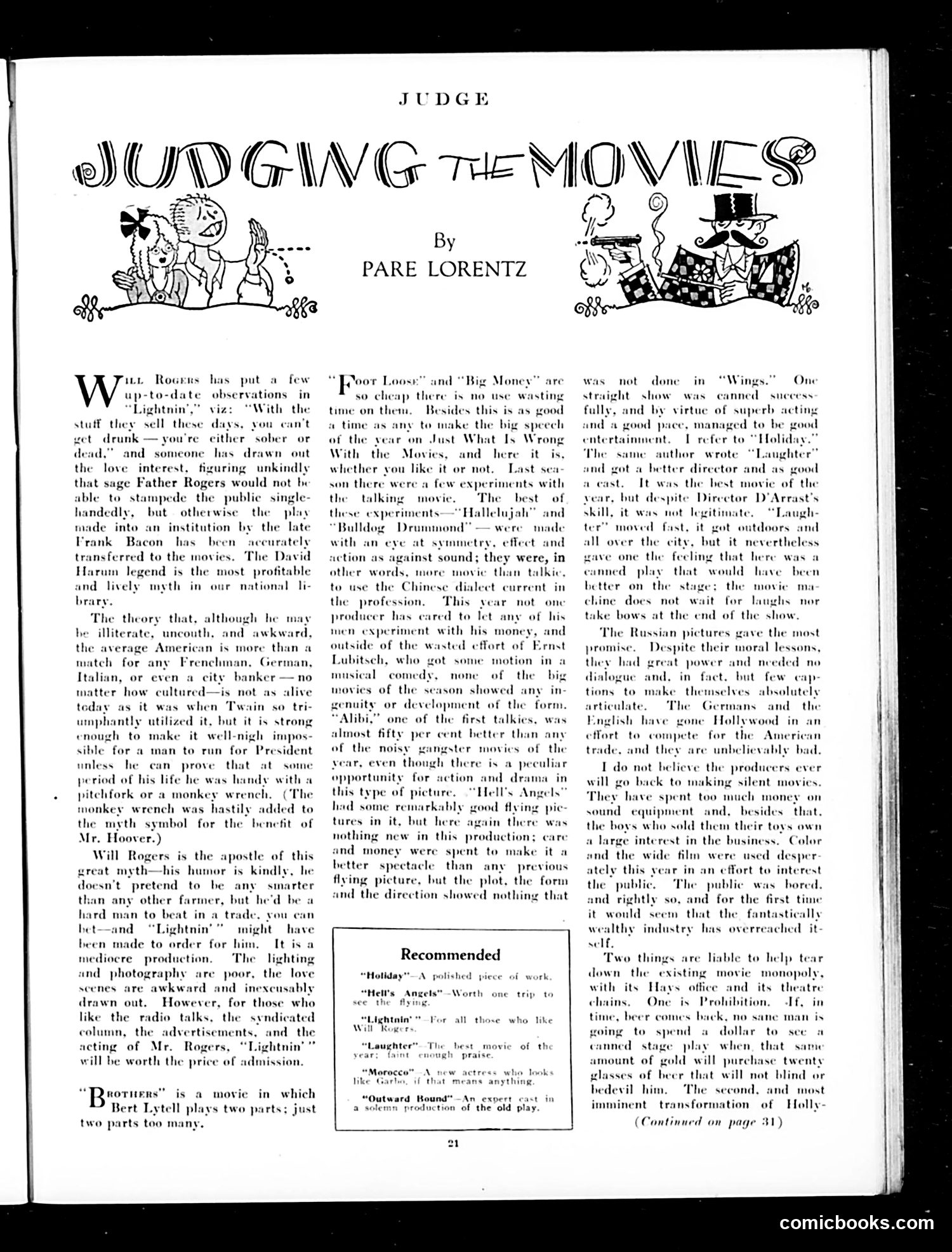
"Judging the Movies" by Pare Lorentz — Judge Magazine Film Criticism This is a film criticism column reviewing current movies. The author praises Will Rogers and the movie "Lightnin'" (adapted from a stage play), arguing Rogers embodies an enduring American myth: the folksy, uneducated farmer who's shrewder than educated city folk. Lorentz suggests this myth, popularized by Mark Twain, remains powerful enough that politicians must prove their humble origins. The column's main critique concerns talking pictures: producers are squandering the new sound technology by making talkie spectacles rather than experimenting with form. Films like "Hell's Angels" and "Bulldog Drummond" added dialogue without advancing cinema as an art. "Laughter" receives highest praise as the year's best film for its mobile direction and pacing, though Lorentz questions its artistic legitimacy. The "Recommended" box highlights current releases. "Brothels" gets a dismissive quip: Bert Lytell playing dual roles is "two parts too many."
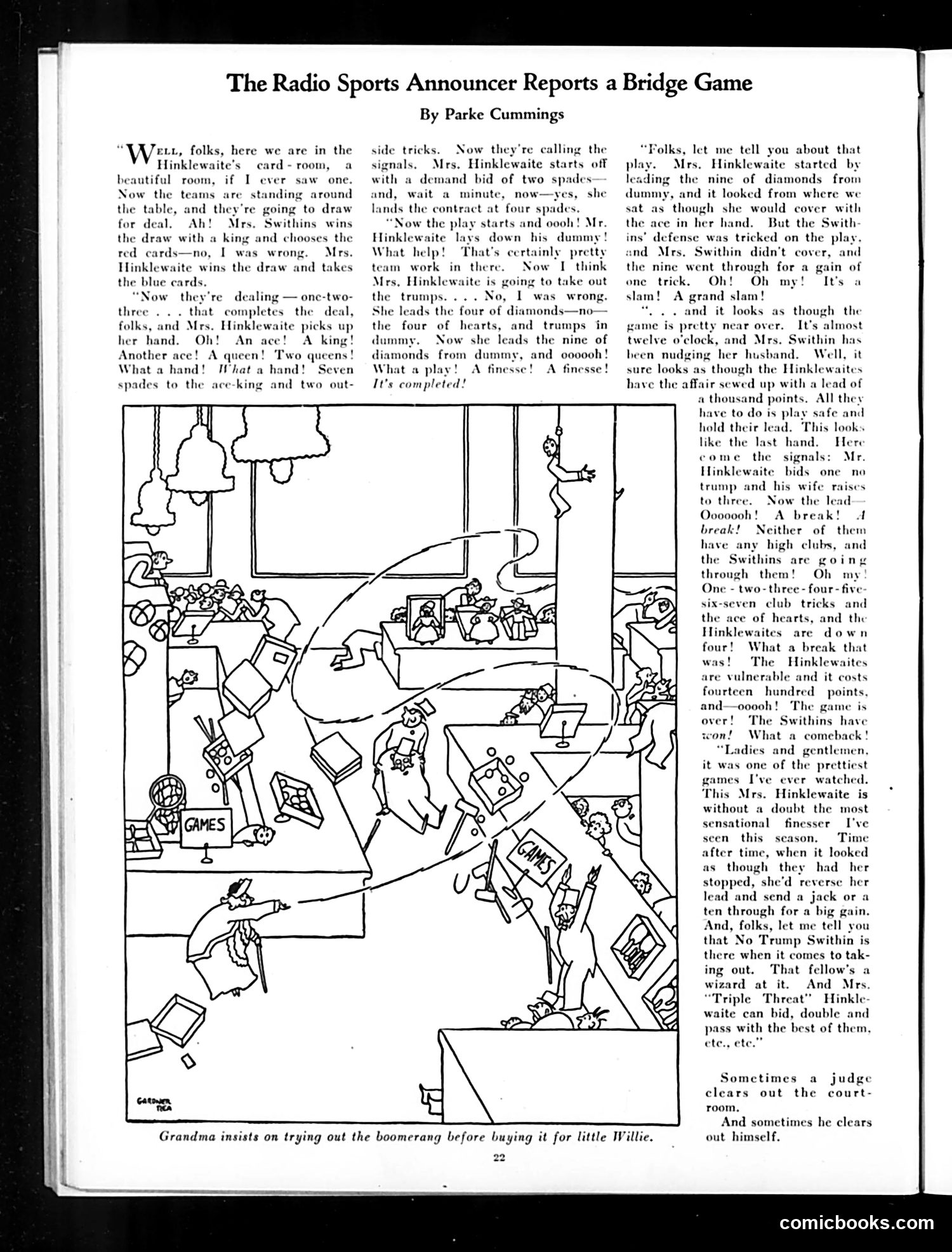
Analysis of "The Radio Sports Announcer Reports a Bridge Game" By Parke Cummings, this humorous piece satirizes the then-popular radio sports commentary style by applying it absurdly to a domestic bridge card game. The announcer provides breathless, excited play-by-play narration of what should be a quiet parlor activity—treating bidding and card plays as dramatic sporting events ("What a hand! What a hand!"). The cartoon mocks both radio sports announcers' overwrought delivery and the competitive intensity bridge players brought to their hobby. The illustration shows a chaotic living room scene with couples playing cards while the announcer broadcasts their game. The satire works through incongruity: applying masculine, action-sports rhetoric to genteel domestic entertainment was a recognizable comedic device for 1920s-30s readers familiar with the new medium of radio sports reporting.
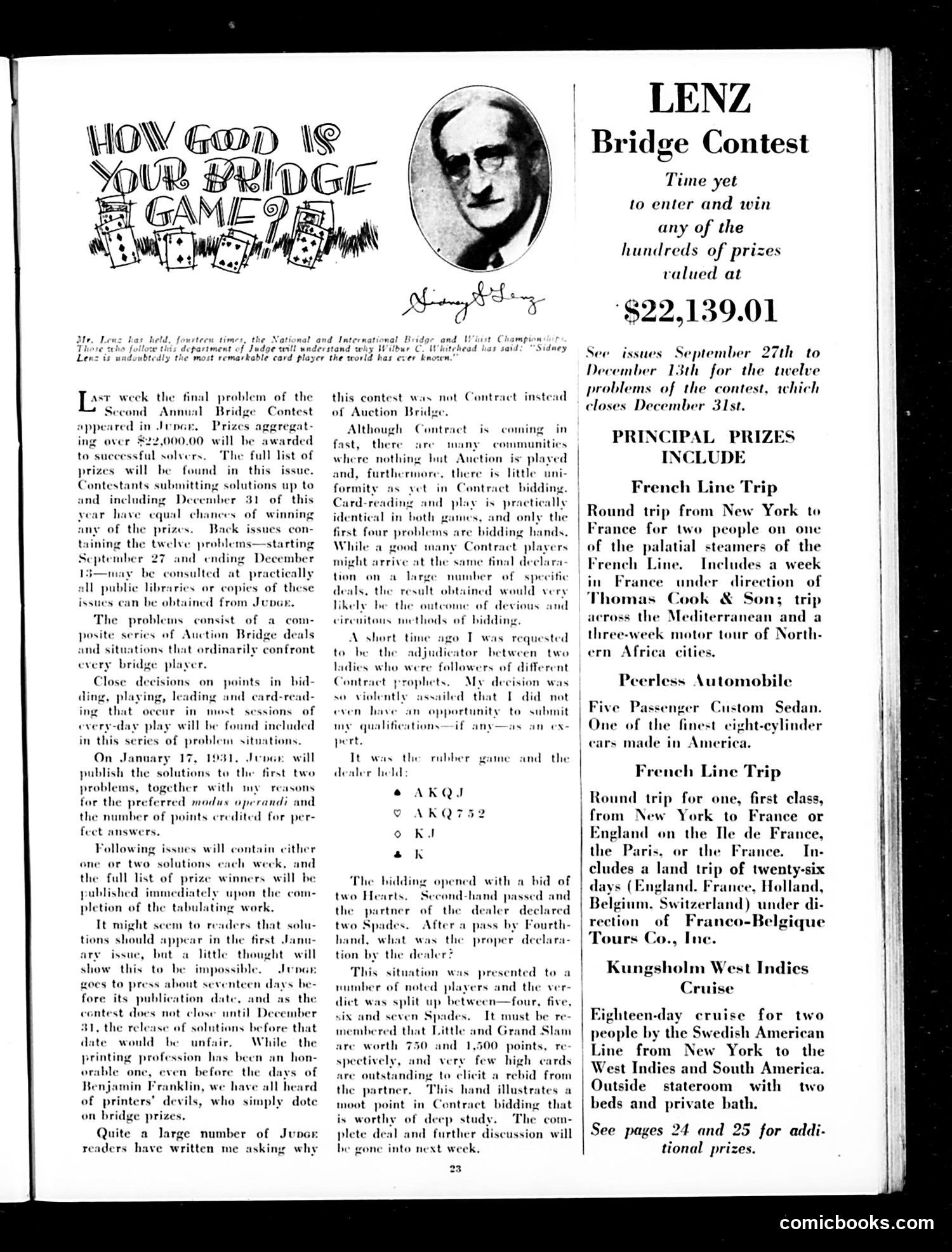
Judge Magazine Bridge Contest Page This page announces Judge magazine's "Lenz Bridge Contest," a major promotional competition running September-December 1930, with prizes totaling $22,139.01. The contest features weekly bridge problems (card game scenarios) that readers solve for chances to win substantial prizes including a French ocean liner trip, an automobile, and Caribbean cruise. The left column discusses the contest's focus on Auction Bridge rather than the newer "Contract Bridge," explaining that Auction remains more standardized and playable across communities. The text includes an actual bridge hand problem for readers to solve, with technical bidding notation (AKQJ, KQ752, etc.). The photograph shows Ely Culbertson (though his name appears as a signature), likely the era's most famous bridge authority. This was peak bridge-playing mania in America—the game was a major social phenomenon during the 1920s-30s. The page is primarily advertising disguised as editorial content—a common Judge magazine practice where contests drove circulation and readership.
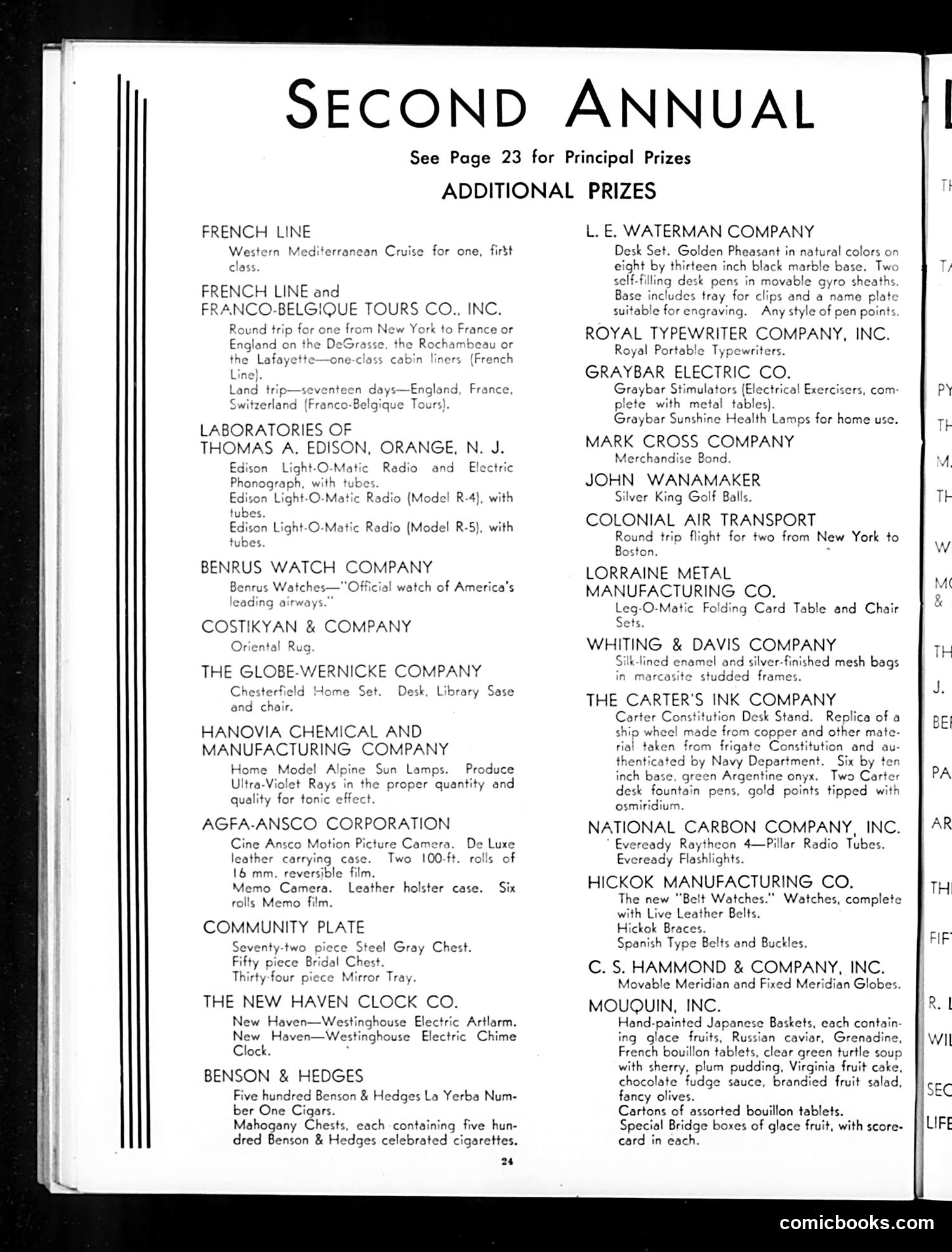
Analysis This is a prizes/advertisements page, not a cartoon or satirical content page. It lists "Additional Prizes" for Judge magazine's "Second Annual" competition (likely a contest for readers or contributors). The page showcases luxury and consumer goods typical of the 1920s-1930s era: European cruises, radios, watches, typewriters, golf balls, an airplane flight, desk sets, and gourmet food baskets from companies like Edison Labs, Benrus, Royal Typewriter, and Mouquin. The prizes reflect aspirational middle-to-upper-class consumption—travel, technology, and fine goods. There is no political satire or cartoon content visible on this page. It functions purely as a commercial incentive list, demonstrating what Judge magazine's audience valued and what major brands were willing to sponsor as contest prizes during this period.
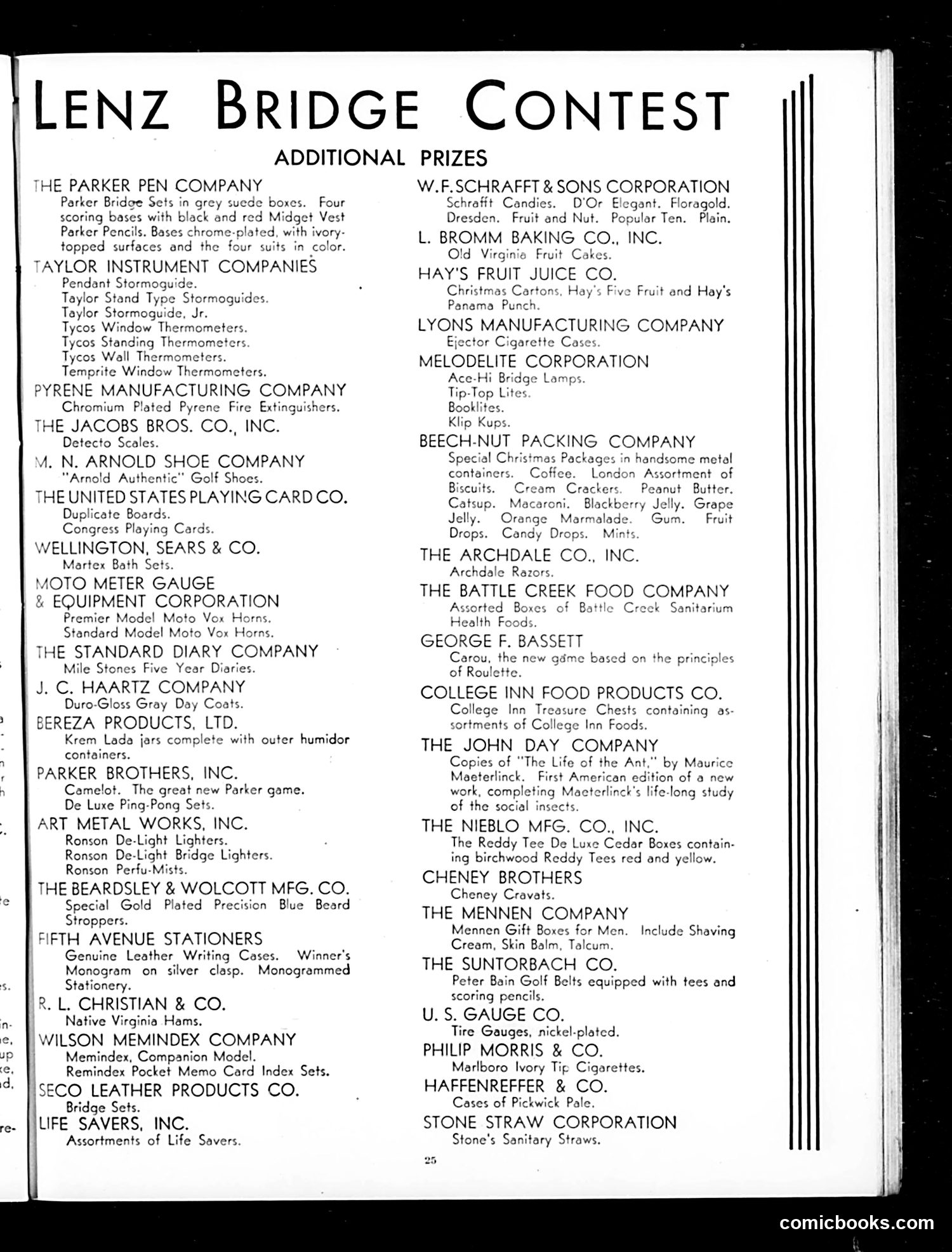
Lenz Bridge Contest Additional Prizes Page This is not a cartoon or satirical content—it's a prize list for a bridge tournament contest ("Lenz Bridge Contest"), likely from Judge magazine's early 20th-century era when bridge was a fashionable parlor game. The page catalogs donated prizes from numerous American manufacturers, organized by company. These range from practical items (Parker pens, thermometers, playing cards) to luxury goods (Ronson lighters, leather cases, Schrafft's candies) to novelty products (fire extinguishers, tire gauges, cigarette cases). The inclusion reflects bridge's popularity among affluent Americans of the period—the prizes emphasize quality brands and genteel leisure pursuits. Notably absent is any political or social satire; this appears to be straight advertising/sponsorship content inserted into Judge, monetizing the magazine's readership of bridge enthusiasts and consumers with disposable income.
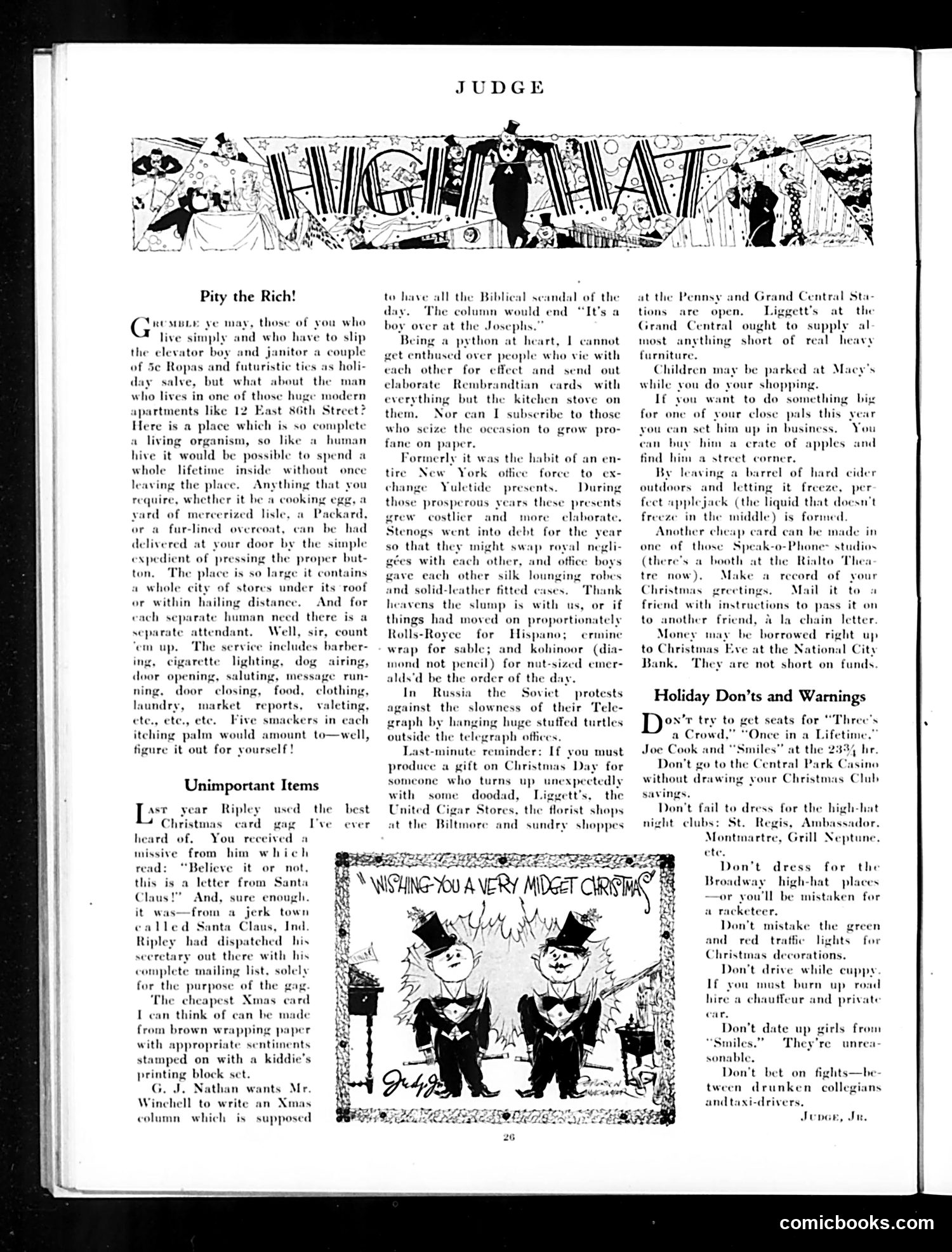
Explanation for Modern Readers This Judge magazine page contains two sections: "Pity the Rich!" satirizes wealthy Manhattan apartment dwellers in luxury buildings like those on East 86th Street. The joke: these residents live in self-contained "human hives" with so many services (doormen, barbers, valets, messengers) that tipping everyone requires spending enormous sums. The satire mocks the absurd servant economy of 1920s-30s wealth—the rich are so isolated and dependent on staff that their "luxury" becomes a financial burden. "Holiday Don'ts and Warnings" offers tongue-in-cheek Christmas advice: don't try getting theater seats ("Three's a Crowd"), don't dress up for Broadway (you'll look like a "racketeer"), don't mistake traffic lights for Christmas decorations, don't date chorus girls from "Smiles," etc. The humor targets holiday season clichés and New York social pretension. The cartoon shows two identical figures in formal wear with text "WISHING YOU A VERY MIDGET CHRISTMAS"—likely a pun on contemporary slang or a vaudeville reference, though the precise joke is unclear without additional context.
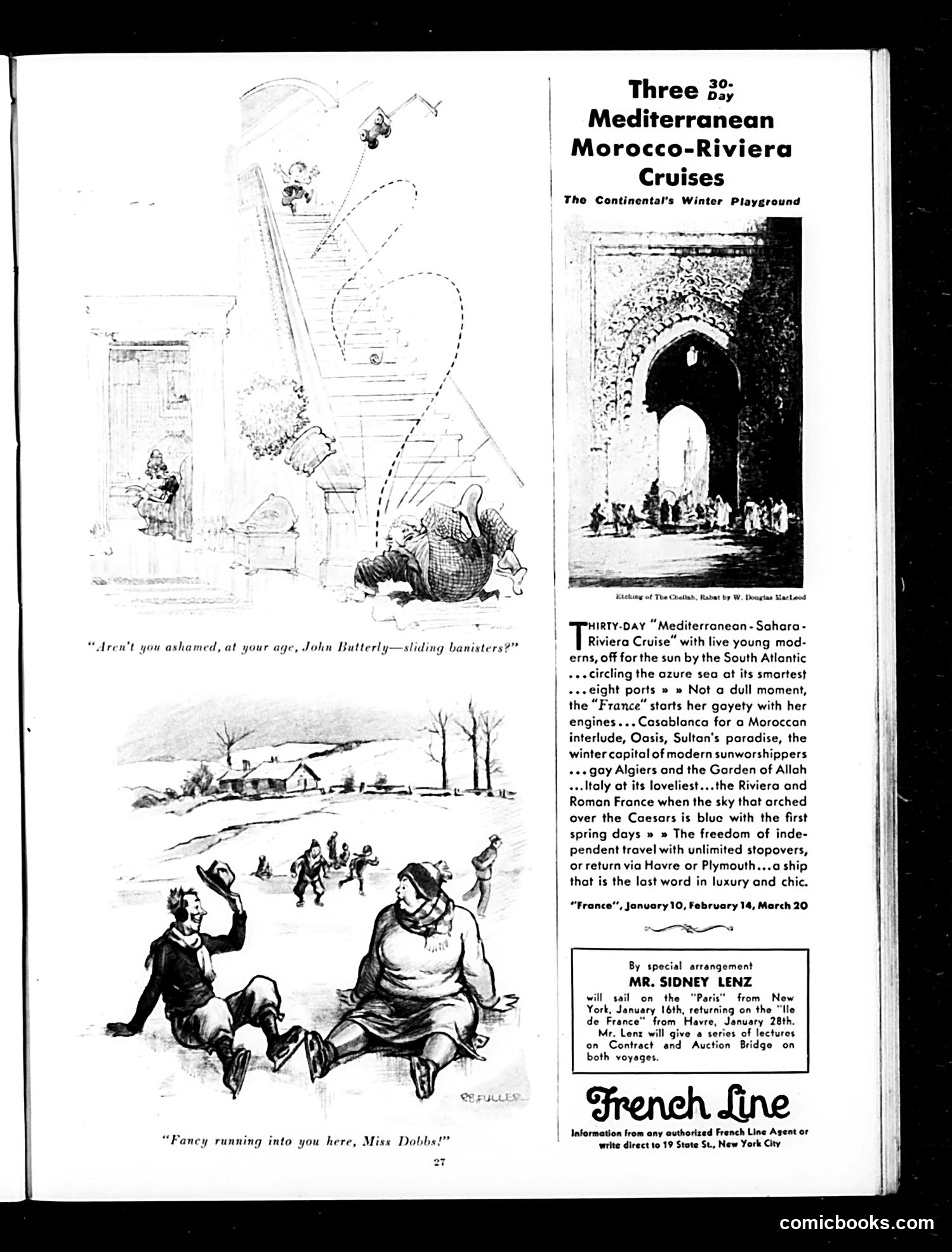
Analysis of Judge Magazine Page This page combines satirical cartoons with luxury cruise advertising. The two cartoon vignettes on the left mock wealthy travelers: 1. Top cartoon ("Aren't you ashamed, at your age, John Butterly—sliding banisters?"): Depicts an older gentleman acting childishly, sliding down a bannister. The joke satirizes how wealthy adults abandon dignity when traveling or on vacation. 2. Bottom cartoon ("Fancy running into you here, Miss Dobbs!"): Shows people ice-skating or slipping on ice. The humor appears to rest on the awkwardness of unexpectedly encountering an acquaintance in an embarrassing situation. The right page is an advertisement for French Line cruises aboard the S.S. *France*, promoting 30-day Mediterranean voyages to North Africa and southern Europe. It notably features a special announcement that cruise lecturer Mr. Sidney Lenz will give bridge-playing lessons aboard—reflecting the leisure-class pastimes of the era's cruise passengers. Together, the content satirizes wealthy travelers' pretensions while simultaneously selling them luxury experiences.
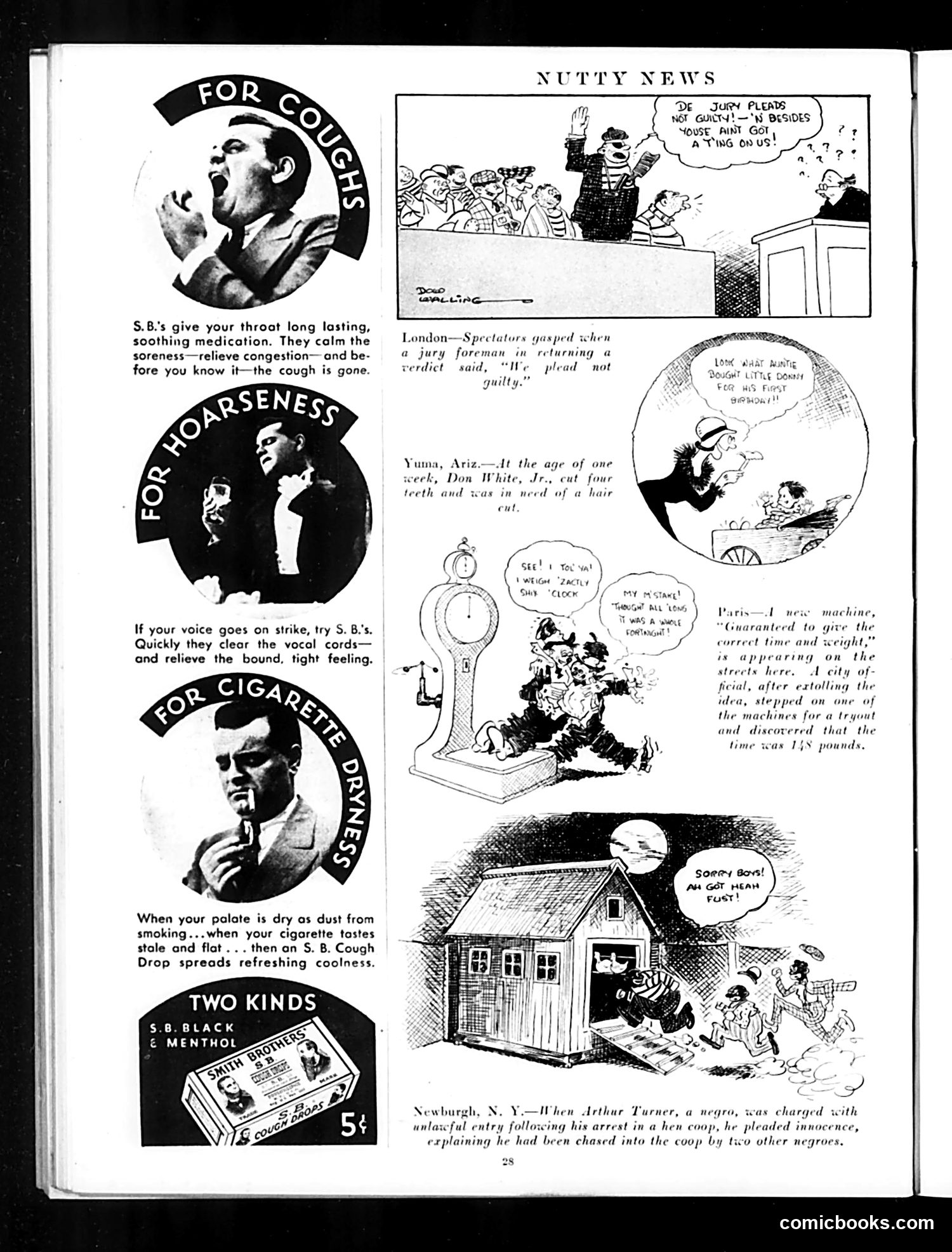
Nutty News Page Analysis This page from *Judge* magazine combines S.B. cough drop advertisements with satirical "news" briefs mocking absurd court cases and human folly. The left side features product ads using illustrated testimonials about throat lozenges for coughs, hoarseness, and dry mouth from smoking. The right side presents four humorous anecdotes: 1. London jury verdict: A foreman's confusion saying "not guilty" when meaning to say guilty—mocking judicial incompetence. 2. Arizona infant: A one-week-old needing a haircut—absurdist humor about impractical parenting. 3. Paris weight machine: A city-installed device advertised as giving "correct time and weight" actually weighs 148 pounds—satirizing fraudulent or useless city infrastructure. 4. Newburgh arrest: A Black man arrested in a hen coop claims he was chased there by other Black men—the racial caricature and absurd legal situation are presented as humorous fodder, reflecting the magazine's casual use of racist stereotypes common to early 20th-century American humor publications.
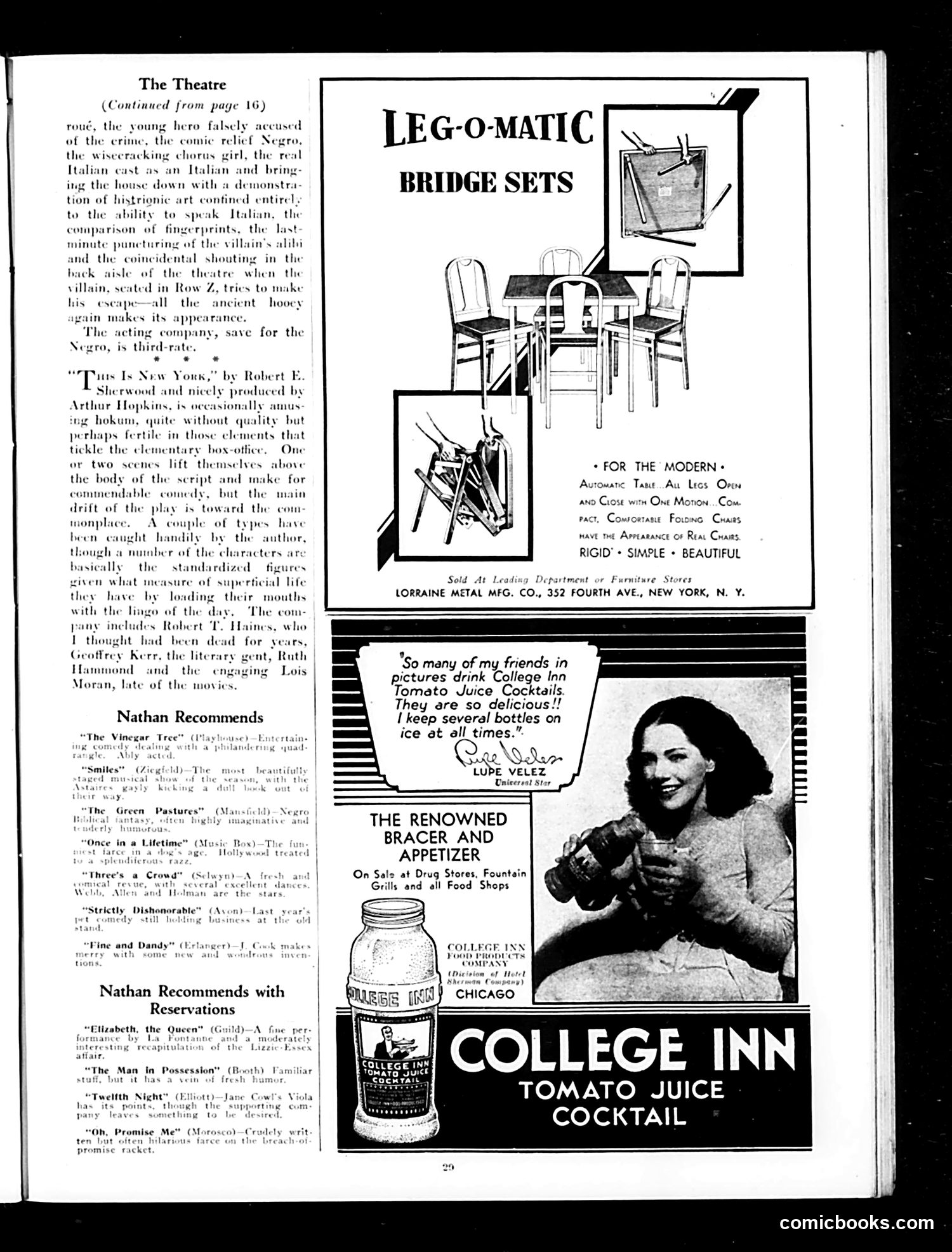
Judge Magazine Page Analysis This page mixes theatre criticism with period advertising. The text reviews Broadway plays, including "This Is New York" by Robert E. Sherwood, critiquing it as entertaining but formulaic hokum with standardized character types. The advertisements are period artifacts: a Leg-O-Matic bridge table set (automatic, collapsible furniture marketed as "modern"), and prominently, a College Inn Tomato Juice Cocktail endorsement featuring actress Lupe Vélez. The Vélez testimonial—claiming her film-industry friends drink these cocktails regularly and keep bottles "on ice at all times"—exemplifies 1920s-30s celebrity product placement. The juxtaposition reflects Judge's dual purpose: satirical commentary on theatre alongside commercial sponsorship. The ads target middle-class consumers aspiring to modern convenience and Hollywood glamour. No specific political satire appears on this page; it's primarily commercial content framing entertainment criticism.
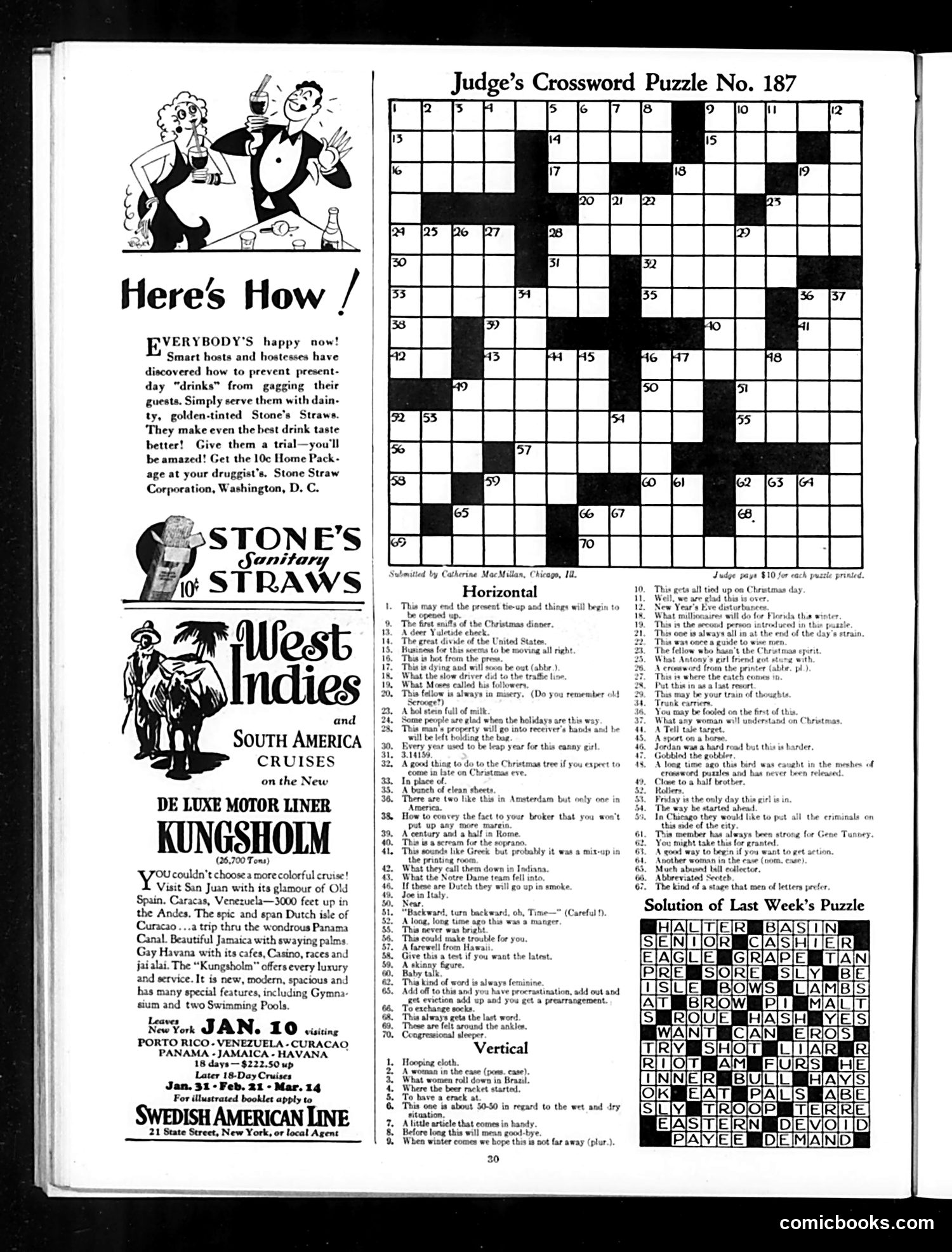
Judge Magazine Page Analysis This page is primarily advertising and a crossword puzzle rather than political satire. The main content consists of: 1. Stone's Straws Advertisement ("Here's How!"): A vintage ad promoting drinking straws as a solution to an apparent Prohibition-era problem—preventing guests from noticing they're being served non-alcoholic "drinks." The cartoon shows a well-dressed couple serving guests, playing on the humor that hosts could disguise weak beverages with attractive straws. 2. Crossword Puzzle No. 187: A standard puzzle with clues referencing Christmas, everyday life, and current events. 3. Cruise Ship Advertisements: Full-page ads for luxury cruises to the Caribbean and South America, typical of 1920s-30s travel marketing. The implicit satire concerns Prohibition (likely 1920s-1933): the Stone's Straws ad humorously acknowledges that hosts were serving non-alcoholic substitutes to guests and needed creative ways to make these disappointing drinks palatable—a sideways commentary on how unpopular Prohibition enforcement had become.
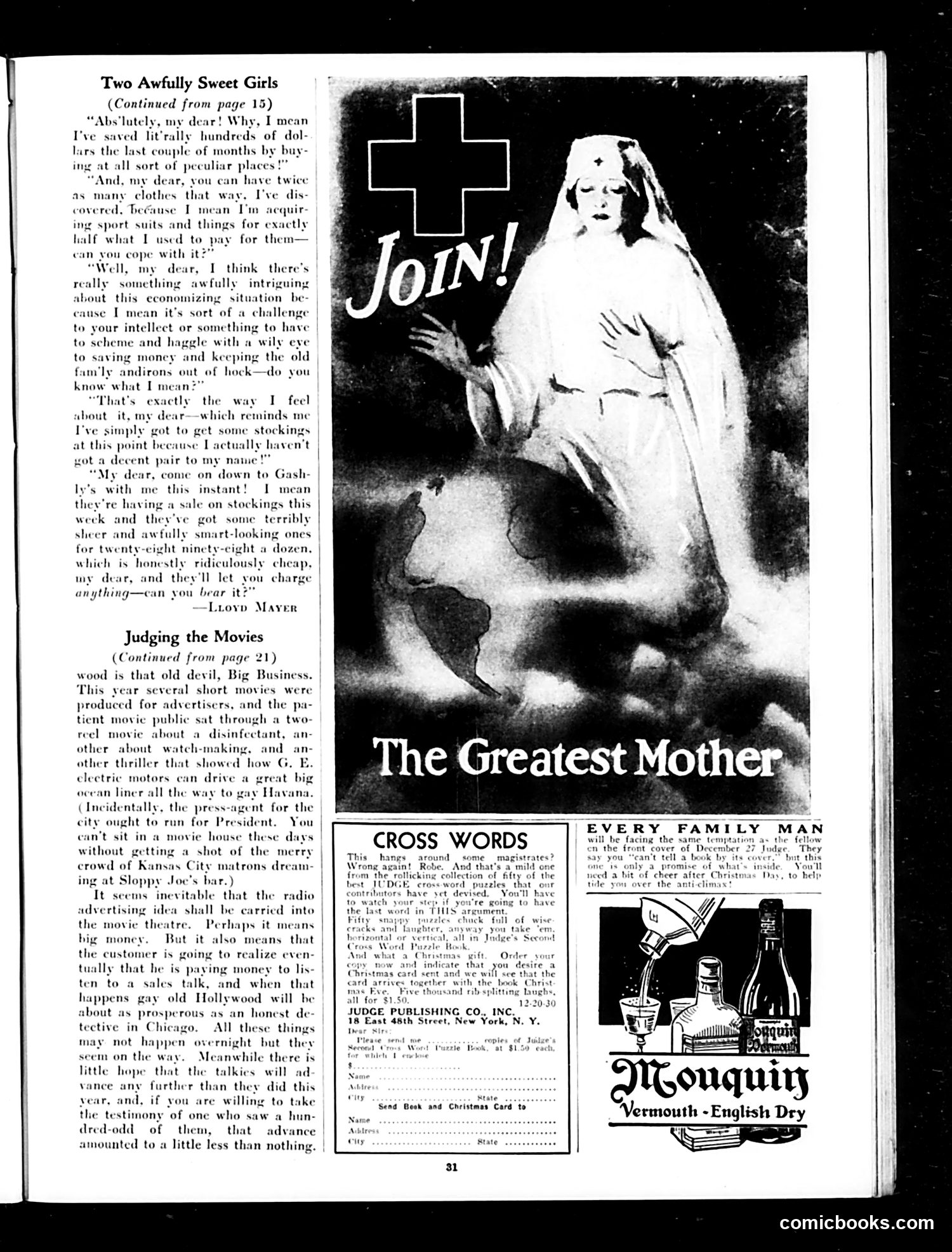
Page Analysis: Judge Magazine This page contains two distinct satirical pieces: "Two Awfully Sweet Girls" A dialogue mocking wealthy women's obsession with economizing while shopping. Two society ladies discuss "bargain hunting" for expensive clothes and stockings—finding it intellectually stimulating to "scheme and haggle"—while simultaneously spending freely on luxuries they charge to accounts. The satire targets the contradiction between frugality-boasting and actual extravagance among the affluent during what appears to be a post-WWI period. "Judging the Movies" Criticism of 1920s cinema, warning that commercial advertising is infiltrating Hollywood films. The piece worries that audiences will eventually resent "paying money to listen to sales talk," predicting this will damage the industry. It's satirizing the creeping commercialization of entertainment and the public's tolerance for it. Both pieces exemplify *Judge*'s satirical style: exposing hypocrisy and social folly among the wealthy and in commercial institutions, written with witty, knowing cynicism typical of the era's sophisticated humor magazines.
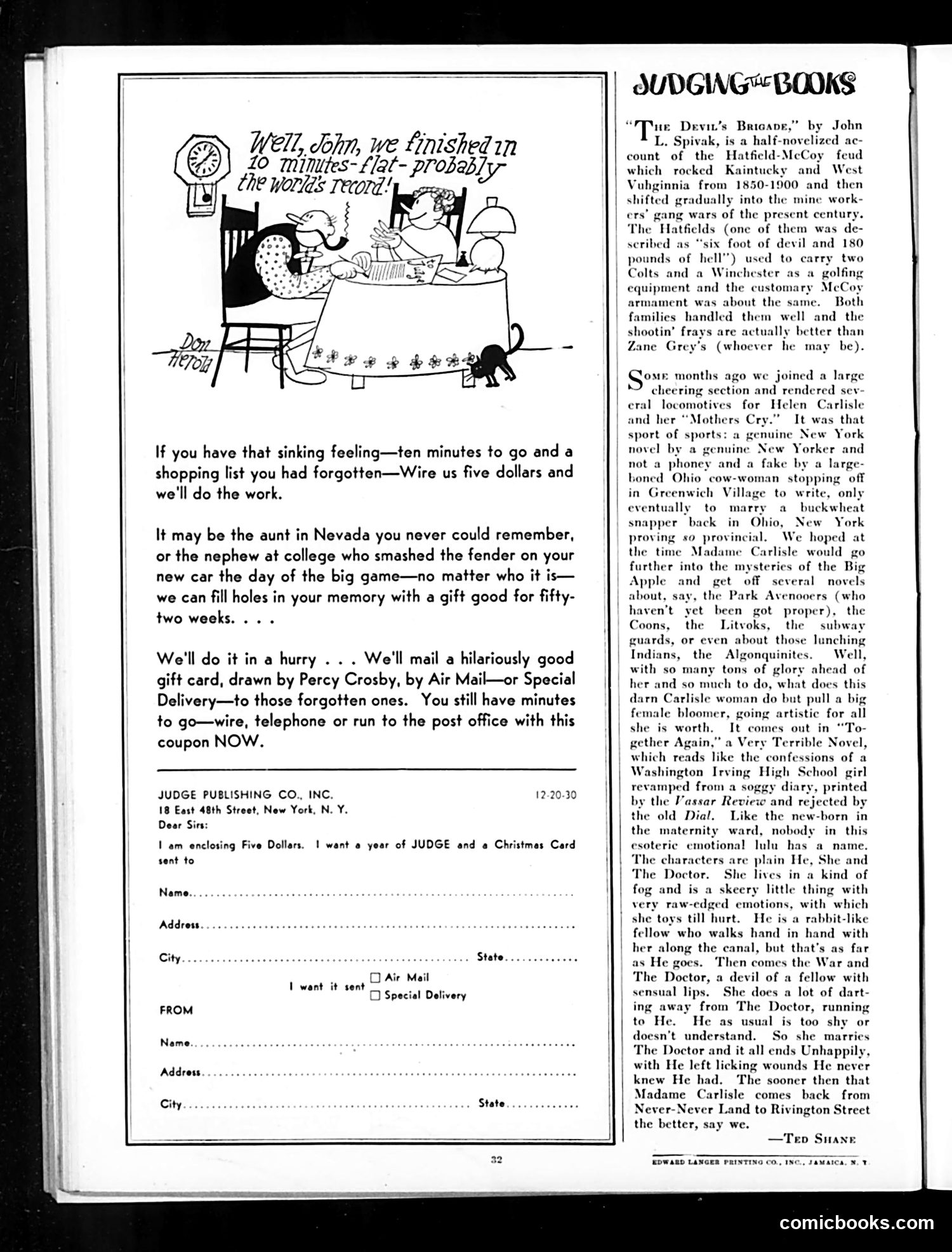
Judge Magazine Page Analysis This page combines advertising with book criticism. The left side is a coupon advertisement for Judge Publishing's gift card service, featuring a cartoon by Percy Crosby showing a couple finishing dinner. The joke: they've completed a shopping list in ten minutes—"probably the world's record"—making it an absurd premise for why readers should use Judge's convenient gift-sending service. The right side reviews "The Devil's Brigade" by John L. Spivak, a semi-fictionalized account of the Hatfield-McCoy feud (the famous Kentucky family conflict of 1850-1900). The critic dismisses Helen Carlisle's novel "Mothers Cry" as derivative and provincial—a work by an Ohio woman who moved to Greenwich Village but lacked the sophistication to properly explore her New York setting. The scathing review mocks her characters as clichéd and her romance plot as melodramatic, suggesting she should return to her rural roots rather than pretend to literary ambition.
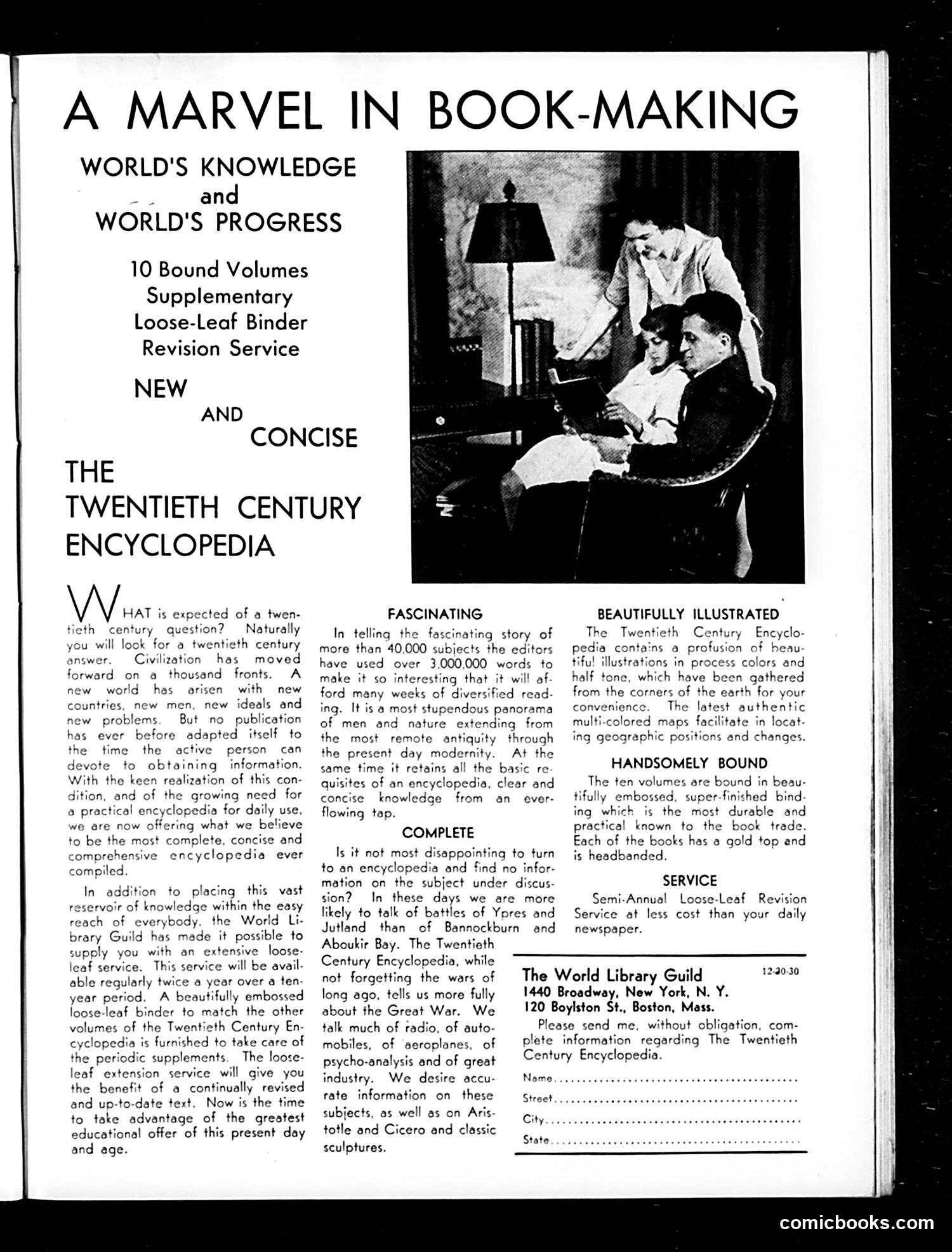
Analysis This is primarily an advertisement rather than satirical content. The page promotes "The Twentieth Century Encyclopedia," a 10-volume reference work marketed as modern and comprehensive. The photograph shows a family (two adults and a child) consulting the encyclopedia together, illustrating the product's appeal to domestic users seeking accessible knowledge. The advertisement's pitch emphasizes timeliness: it claims to address twentieth-century concerns (the Great War, aviation, automobiles, psycho-analysis) rather than only classical subjects. The text stresses completeness, affordability through a loose-leaf subscription service, and handsome binding—positioning the encyclopedia as a practical educational investment for the contemporary household. There is no visible satire or political cartoon on this page. It appears to be a straightforward commercial promotion from the World Library Guild, using common early-twentieth-century advertising rhetoric about progress, modernity, and self-improvement through knowledge.
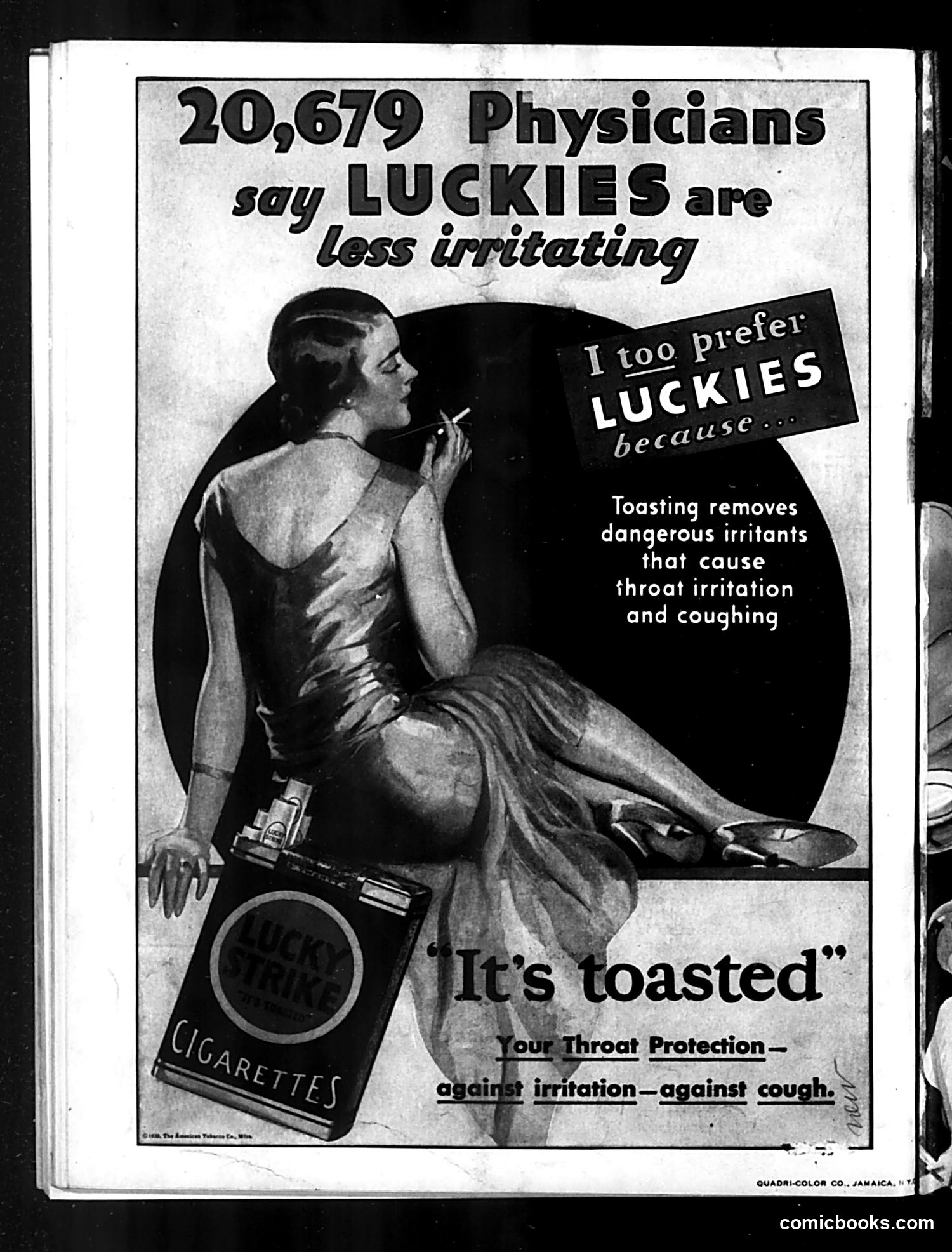
Analysis This is a cigarette advertisement, not satirical content. It features Lucky Strike cigarettes making a health claim: that 20,679 physicians endorse them as "less irritating" because toasting removes "dangerous irritants" causing throat irritation and coughing. This represents pre-regulation tobacco marketing (likely 1930s-40s), when cigarette companies routinely made unsubstantiated medical claims. The advertisement exploits physician endorsements and pseudo-scientific language about "toasting" to suggest health benefits—tactics later banned by the Federal Trade Commission. The image of a glamorous woman smoking reinforces the aspirational lifestyle marketing typical of mid-century cigarette advertising. By modern standards, such health claims would be illegal and laughable given tobacco's documented dangers.