judge
Judge — December 27, 1930
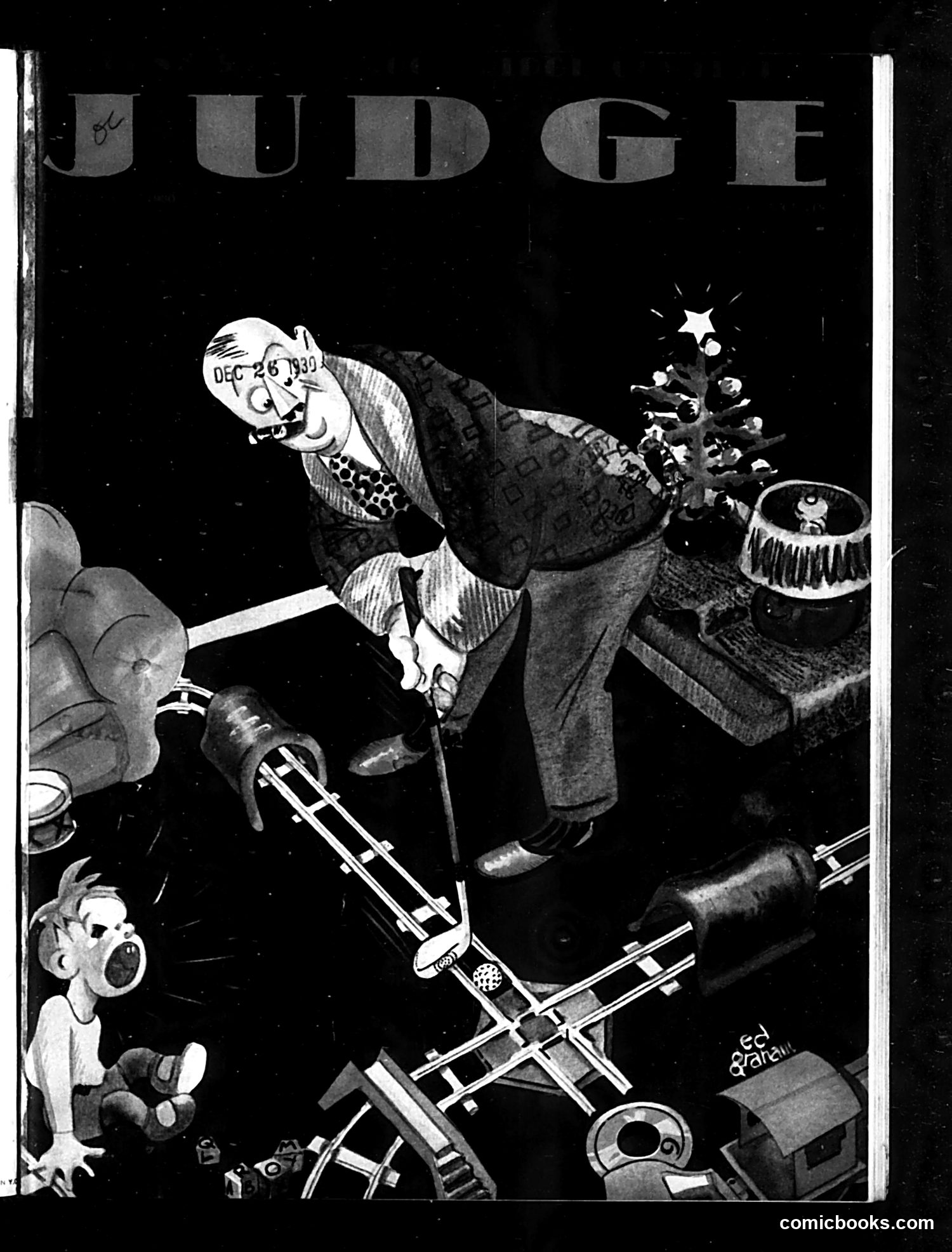
Analysis of Judge Magazine Page This appears to be a Christmas-themed cover from Judge magazine (dated December 26, 1903, visible on the figure's head). The central figure is an elderly man in formal dress depicted as Santa Claus, surrounded by toys and Christmas imagery including a decorated tree with a star. The satire likely targets a wealthy businessman or political figure of the Gilded Age era, shown as a miserly or corrupt "Santa" distributing toys—perhaps commenting on charitable giving, labor practices, or economic inequality during this period. The exaggerated caricature style was typical of Judge's social commentary. Without clearer identification of the specific figure or contemporary event reference, the exact political target remains unclear, though the theme suggests criticism of wealth distribution or hypocrisy among the privileged classes.
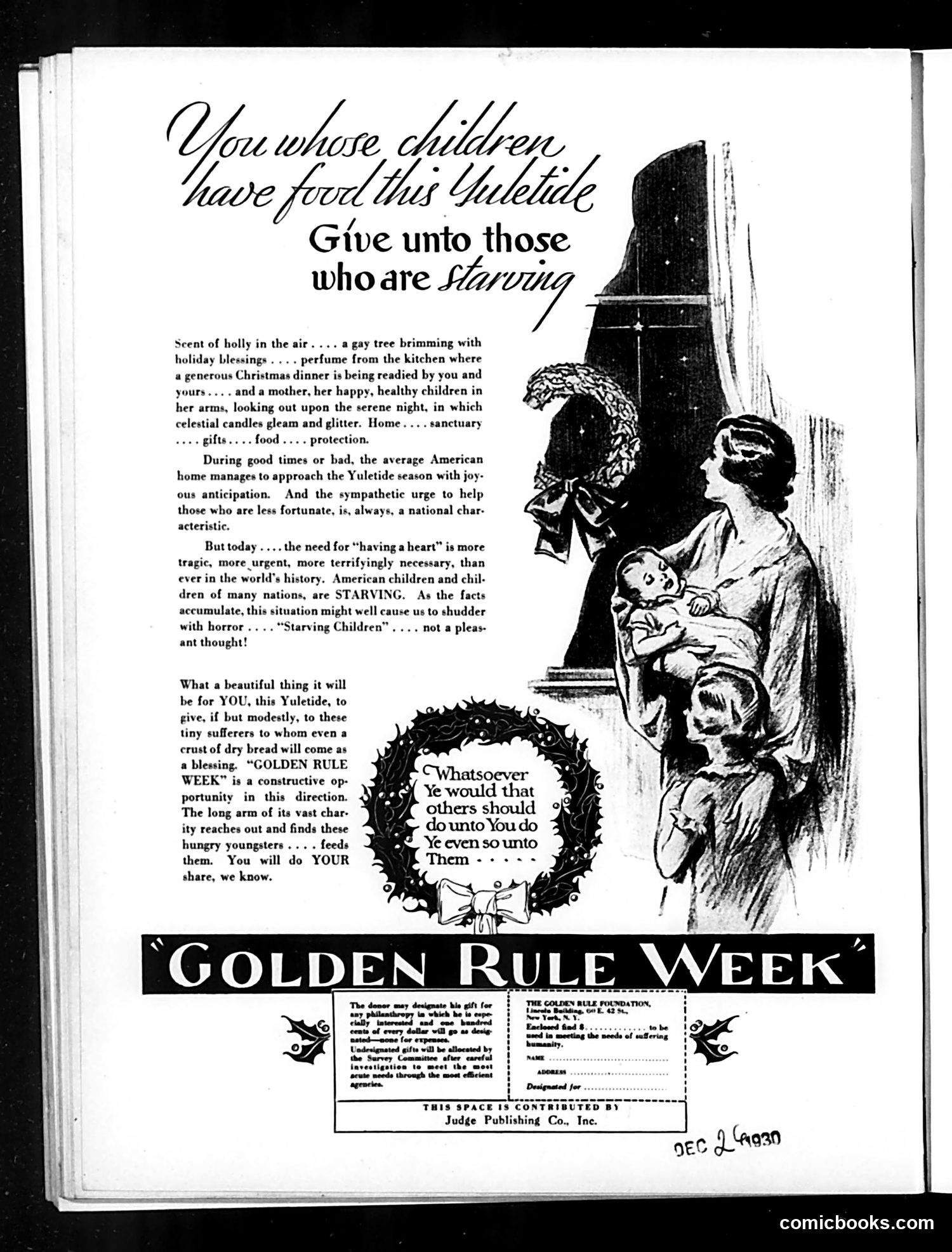
Analysis of "Golden Rule Week" Advertisement This is a charitable appeal, not political satire. The page promotes "Golden Rule Week," a fundraising initiative by the Golden Rule Foundation to address child starvation during what appears to be an economic crisis (likely the Great Depression era, based on the reference to "good times or bad"). The illustration contrasts affluent Christmas celebrations—holly, candles, generous dinners—with starving children outside. The appeal invokes Christian charity (the "Golden Rule" biblical quotation in the wreath) and asks prosperous Americans to donate modest amounts to feed hungry youngsters. The central message: those enjoying holiday abundance should share with the destitute, framing charitable giving as both a moral obligation and patriotic duty. Judge Publishing Co. contributed the advertising space.
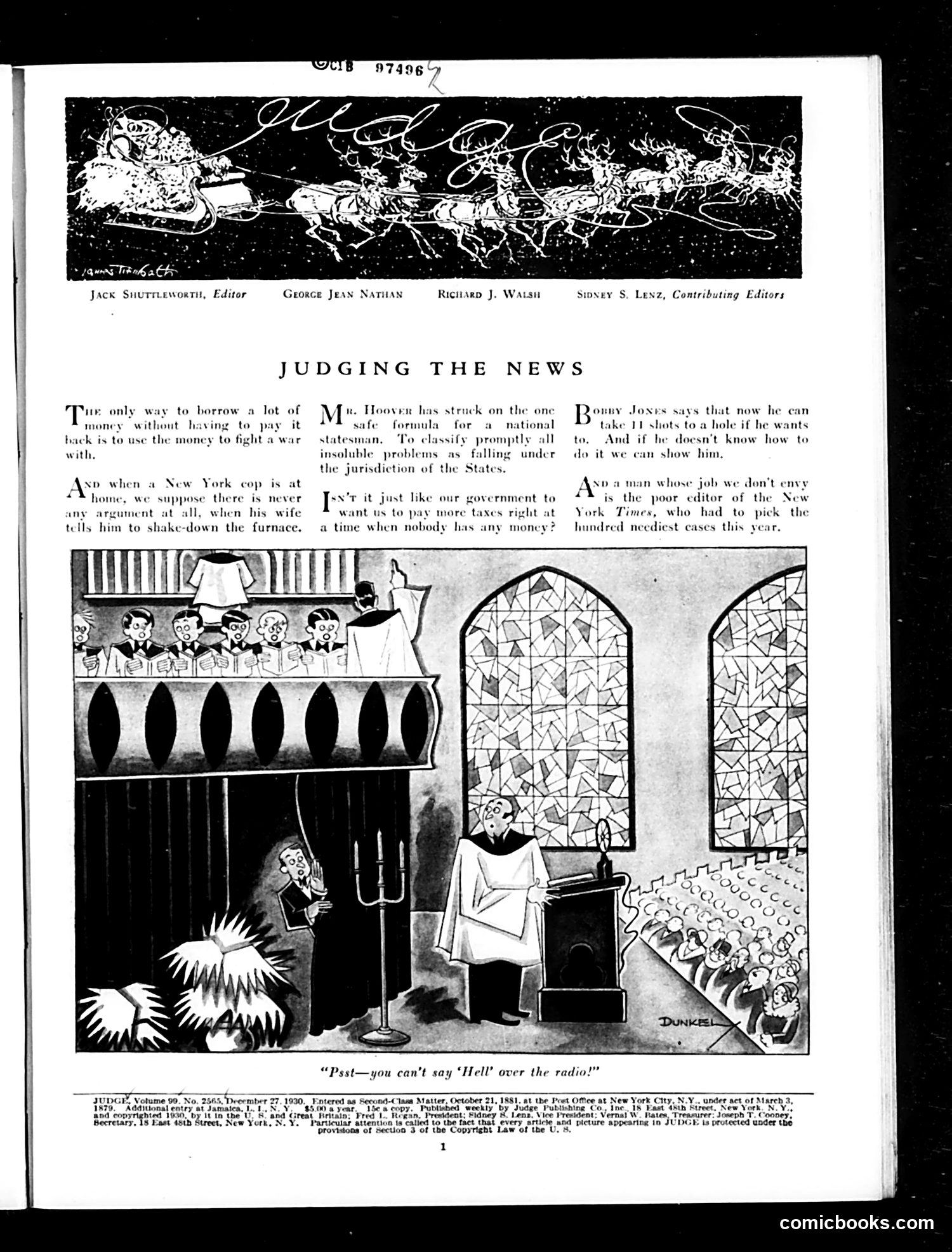
"Judging the News" - December 27, 1930 This page contains three brief satirical commentaries on current events: 1. Borrowing for war: Critiques using borrowed money to fund warfare without repayment mechanisms. 2. Domestic argument: Mocks a New York police officer refusing to engage in a marital dispute with his wife—suggesting police involvement in domestic matters is absurd. 3. Radio censorship (main cartoon): The illustration depicts a preacher at a pulpit in a church with stained-glass windows, addressing crowds below. The caption "Past—you can't say 'Hell' over the radio!" satirizes broadcast regulations that prohibited profanity, including religious language. The joke critiques the absurdity of censoring even theological language in public discourse. This reflects 1930s concerns about government and institutional censorship of speech.
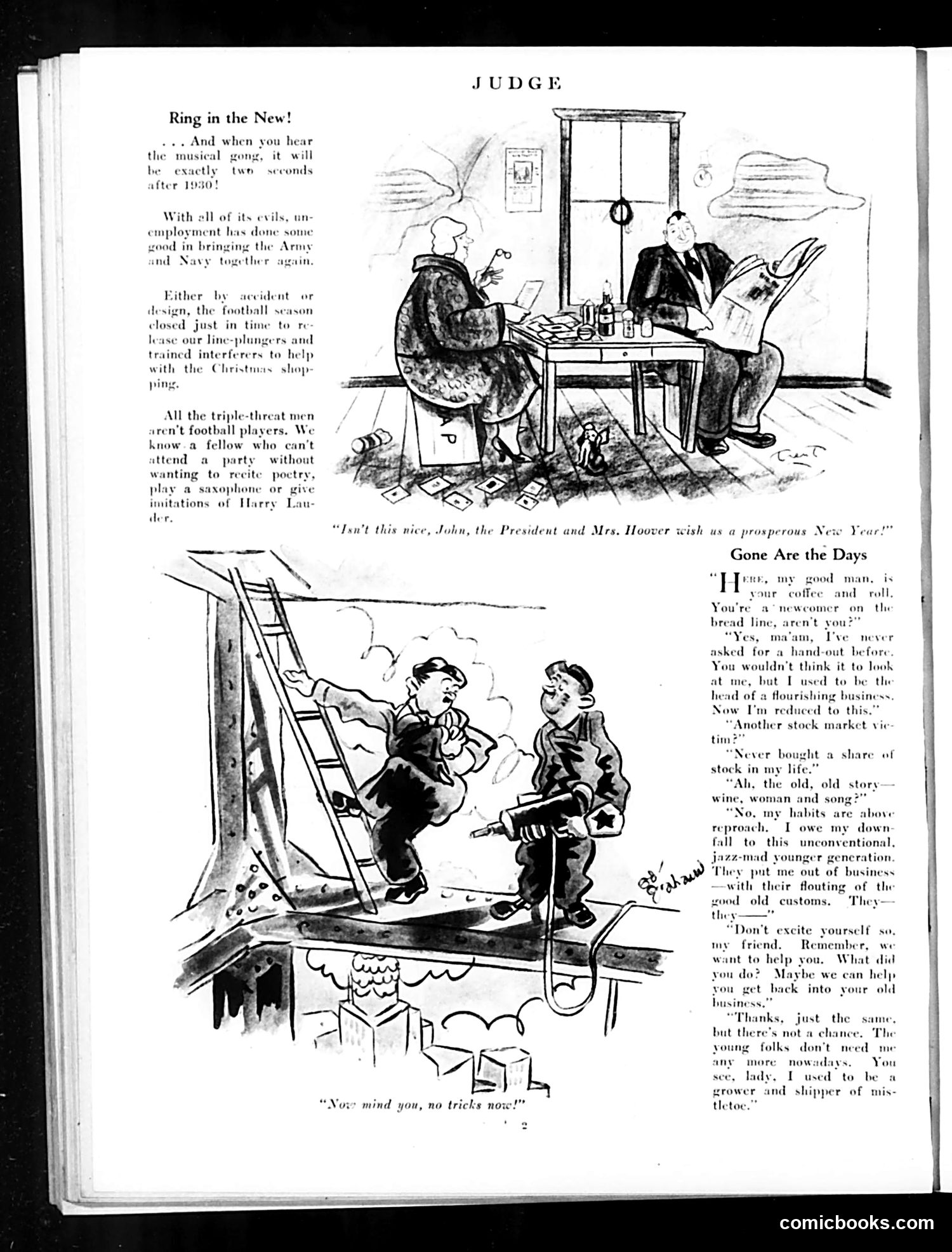
Analysis Top cartoon ("Ring in the New!"): Satirizes post-WWI economic hardship. Two men—one rotund and disheveled, one thin and haggard—sit at a table toasting the New Year. The caption wishes "the President and Mrs. Hoover" prosperity, but the figures' appearance contradicts this hope. The text references unemployment from the war, football season closures, and Christmas shopping failures. This appears to mock President Hoover's administration during early Depression-era economic struggles, suggesting gap between official optimism and citizens' actual suffering. Bottom cartoon ("Care Are the Days"): A destitute man recounts lost fortune to a sympathetic listener. He mentions once heading a "flourishing business," now reduced to breadline poverty. He blames "jazz-mad younger generation" and their disregard for "good old customs." The cartoon illustrates class anxiety and generational resentment during economic decline.
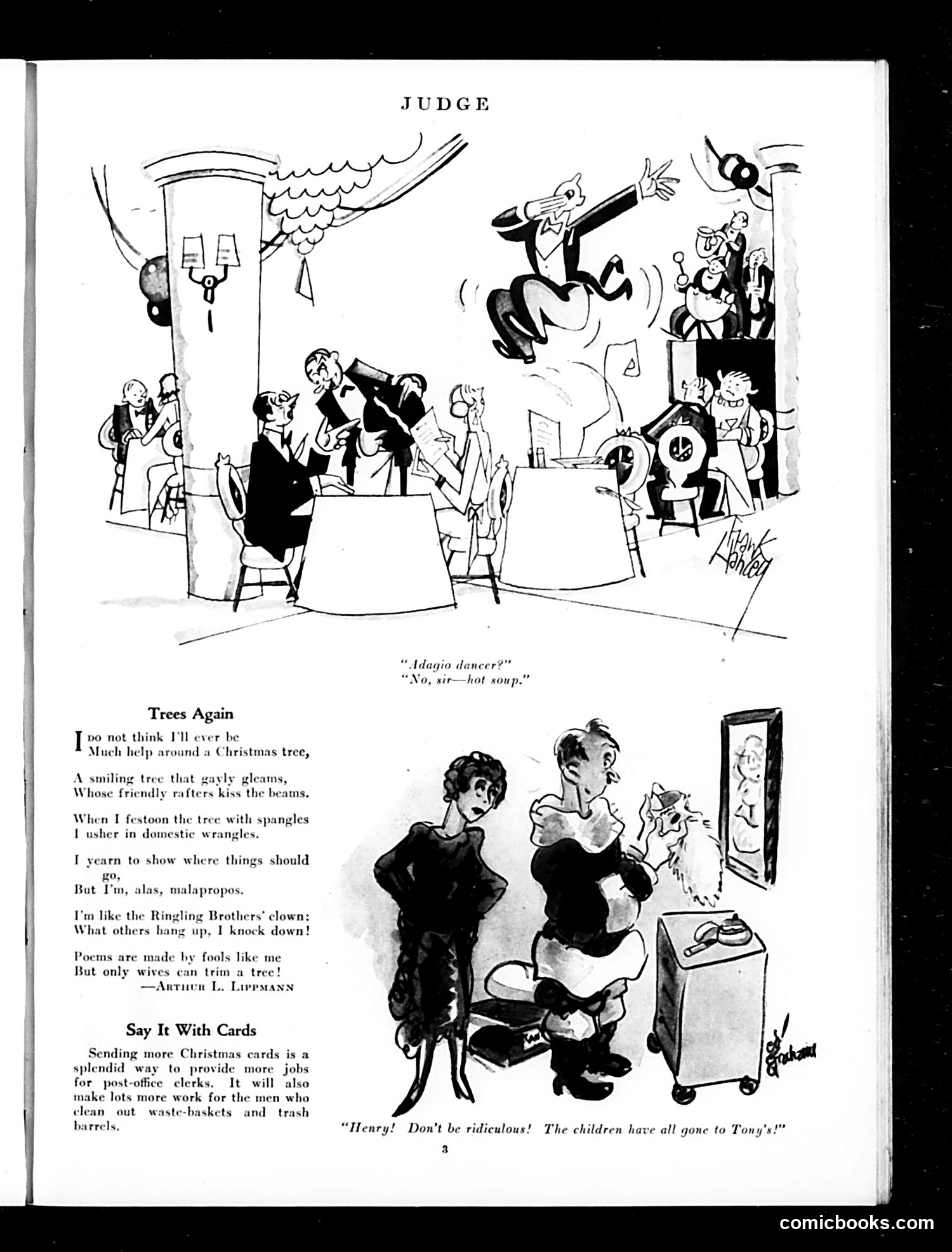
Analysis of This Judge Magazine Page Top Cartoon ("Judge"): Shows a courtroom scene where a man in formal dress is energetically dancing or jumping while a judge presides. The caption reads: "Adagio dancer?" / "No, sir—hot soup." This is a visual pun: the defendant's frantic movements are being mistaken for artistic dance, when he's actually reacting to accidentally consuming hot soup. The joke satirizes both courtroom formality and the absurdity of misconstrued circumstances. Lower Section: Contains a poem titled "Trees Again" by Arthur L. Lippmann, expressing cynicism about Christmas trees and domestic life, followed by a separate item "Say It With Cards," which humorously promotes sending more Christmas cards as a job-creation scheme for postal workers and sanitation staff. The page's humor relies on wordplay, domestic comedy, and satirical social commentary typical of early 20th-century Judge magazine.
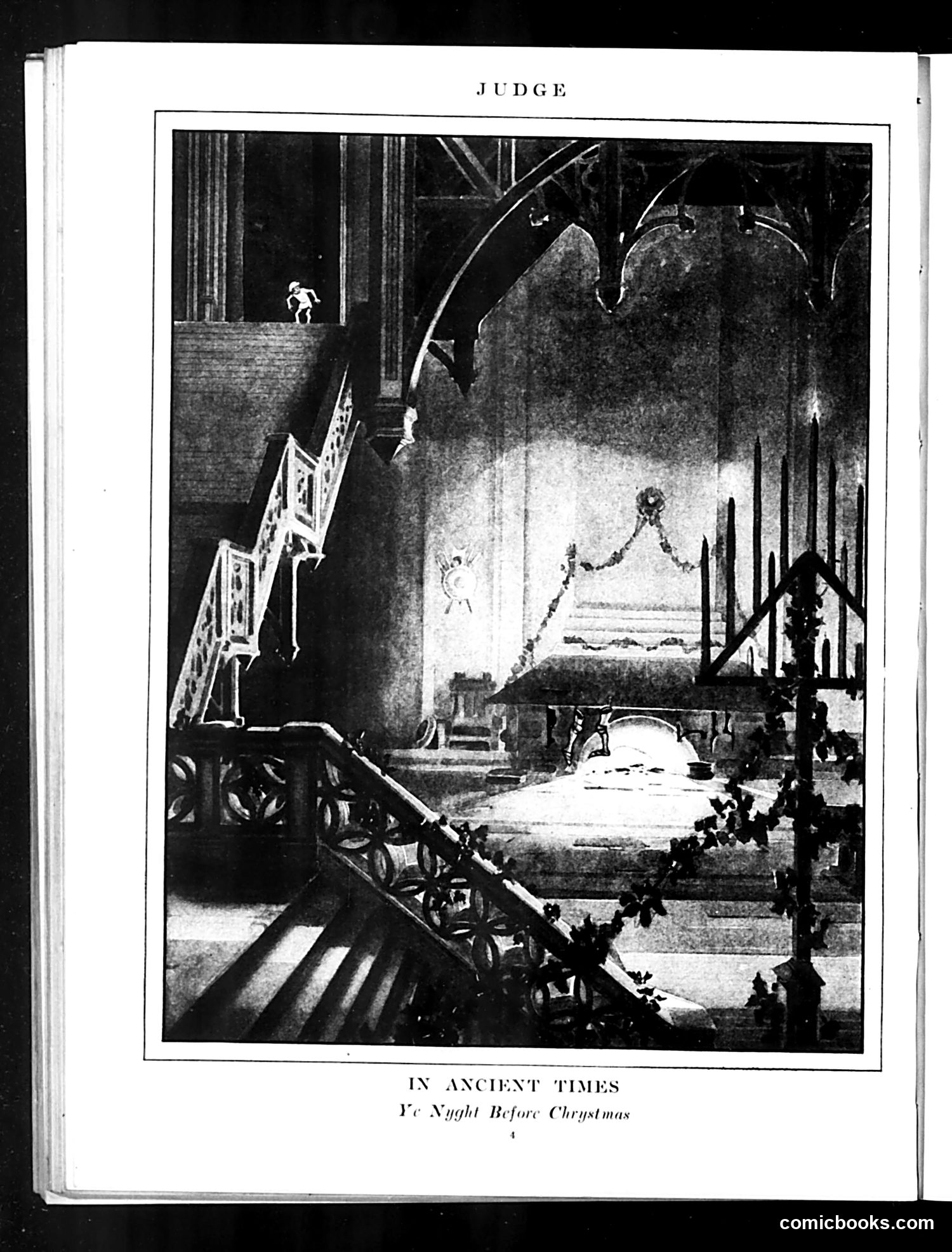
Analysis: "In Ancient Times: Ye Night Before Christmas" This illustration appears to be a theatrical or artistic interpretation of the Christmas Eve scene from Clement Clarke Moore's "A Visit from St. Nicholas" (the poem "Ye Night Before Christmas"). The image depicts an elaborate interior—likely a grand manor or cathedral—decorated for Christmas with garland and candles. The dramatic Gothic architecture and staged lighting suggest this is either a theatrical production or an artistic rendering meant to evoke a historical or period setting. The caption's reference to "ancient times" suggests satire about how the poem, published in 1823, had become historicized or romanticized by the time this Judge magazine piece was published. Rather than contemporary commentary, this appears to be festive seasonal entertainment capitalizing on nostalgic Christmas imagery.
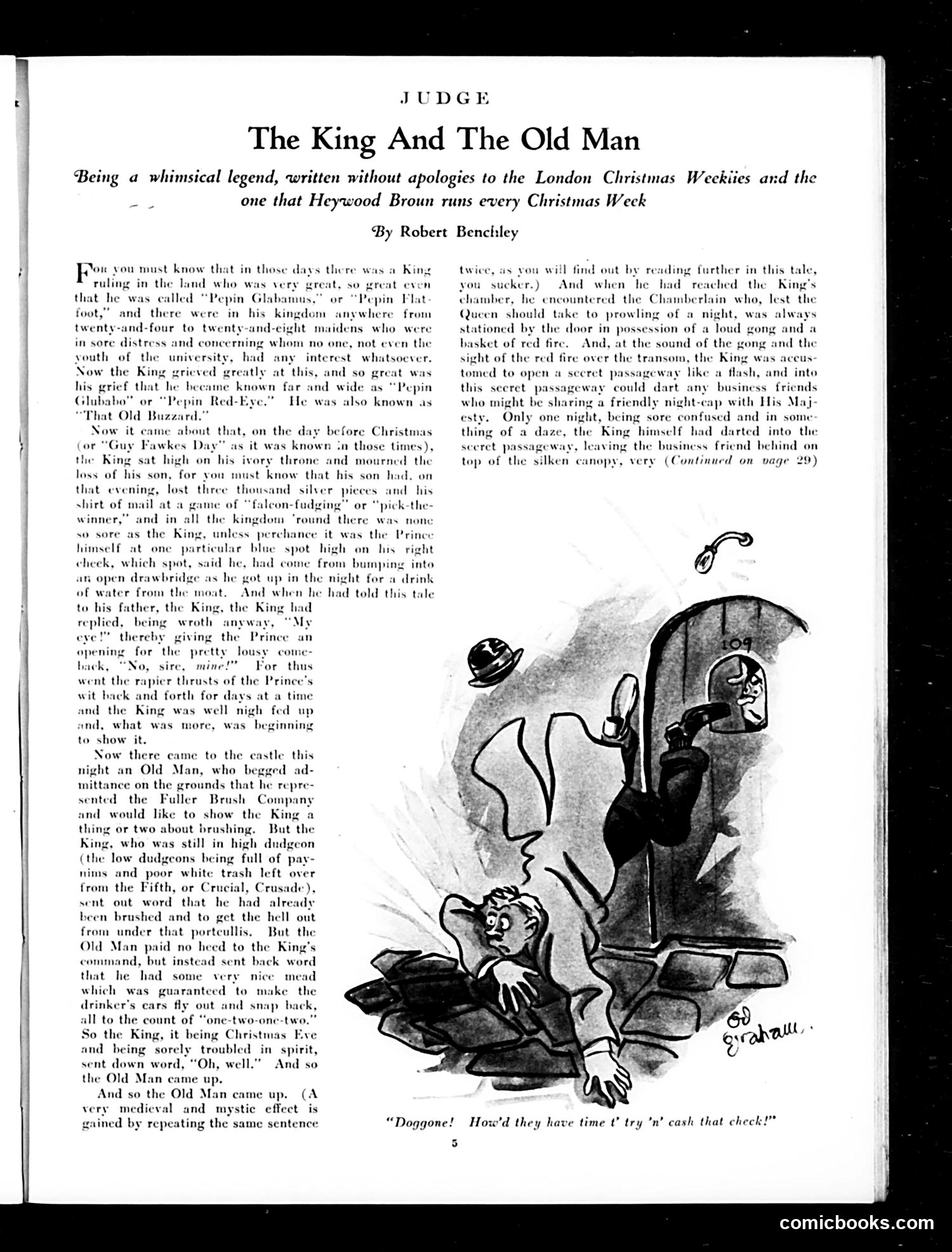
Analysis This is a whimsical Christmas fantasy tale titled "The King and the Old Man" by Robert Bentcley, presented as lighthearted fiction rather than political satire. The accompanying illustration shows two figures in what appears to be a comedic scene—one holding an umbrella in stormy weather, the other gesturing animatedly below. The story itself concerns a king in distress who encounters an old man at his castle on Christmas Eve. The narrative is purely fantastical storytelling: the king has lost his son, the Prince is injured, and the Old Man arrives claiming to represent the "Fuller Brush Company," offering brushes as a solution. The text indicates this continues on page 29. This is entertainment fiction, not political commentary. The satire is domestic and humorous rather than topical.
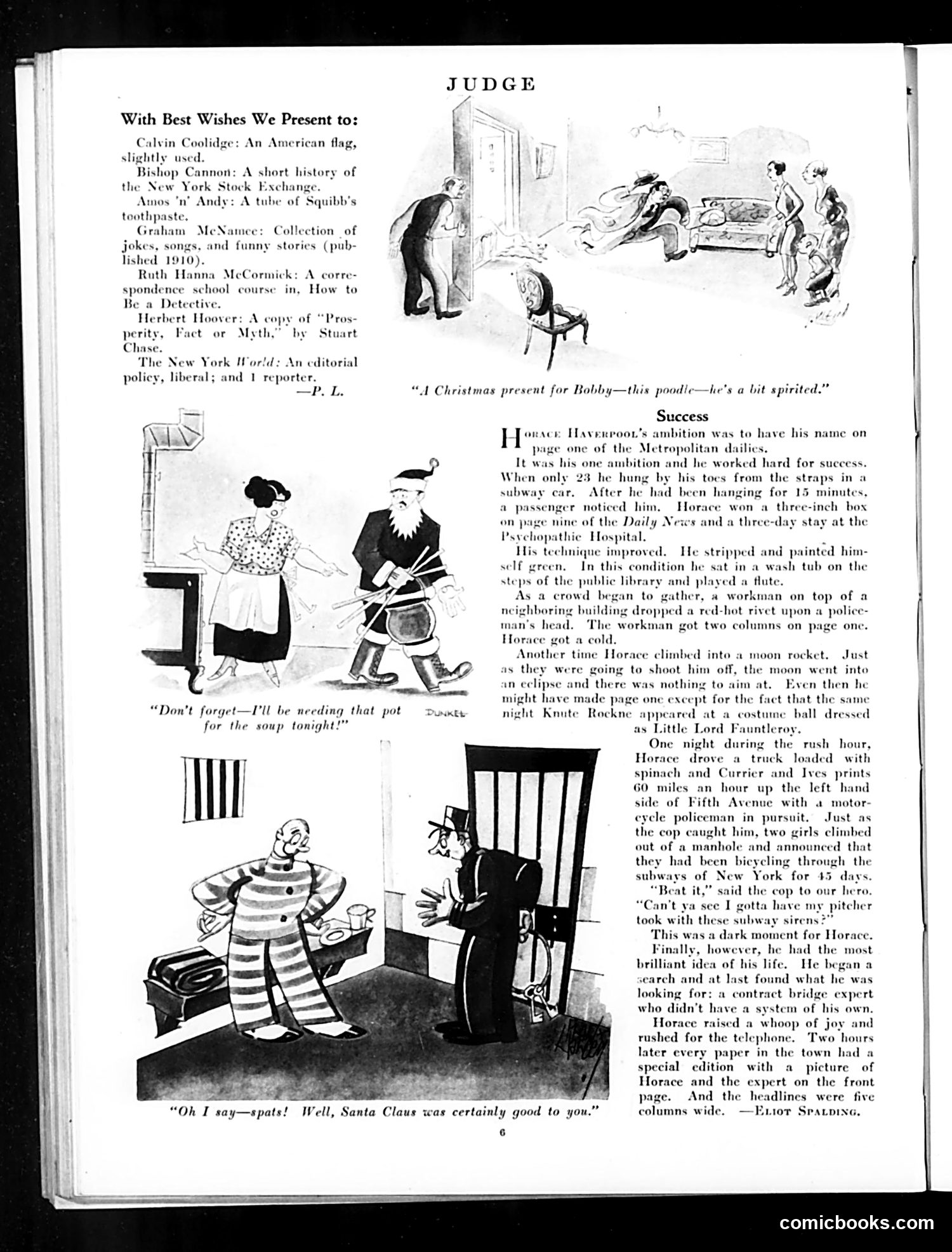
Analysis of Judge Magazine Page This page contains three cartoon vignettes satirizing domestic life and social ambition: 1. Top cartoon: A man presents his wife with a poodle as a Christmas gift, labeled "A Christmas present for Bobby—this poodle—he's a bit spirited." The joke plays on the double meaning of "spirited"—the dog is misbehaving while the wife expects an obedient pet. 2. Bottom left: "Don't forget—I'll be needing that pot for the soup tonight!" depicts a woman trying to repurpose kitchenware, satirizing domestic budget constraints. 3. Bottom right: "Oh I say—spats! Well, Santa Claus was certainly good to you." A man admires another's new spats (ankle coverings), a minor fashion accessory, with mock envy—satirizing materialism and vanity among men. The page mocks petit bourgeois pretensions and domestic comedy.
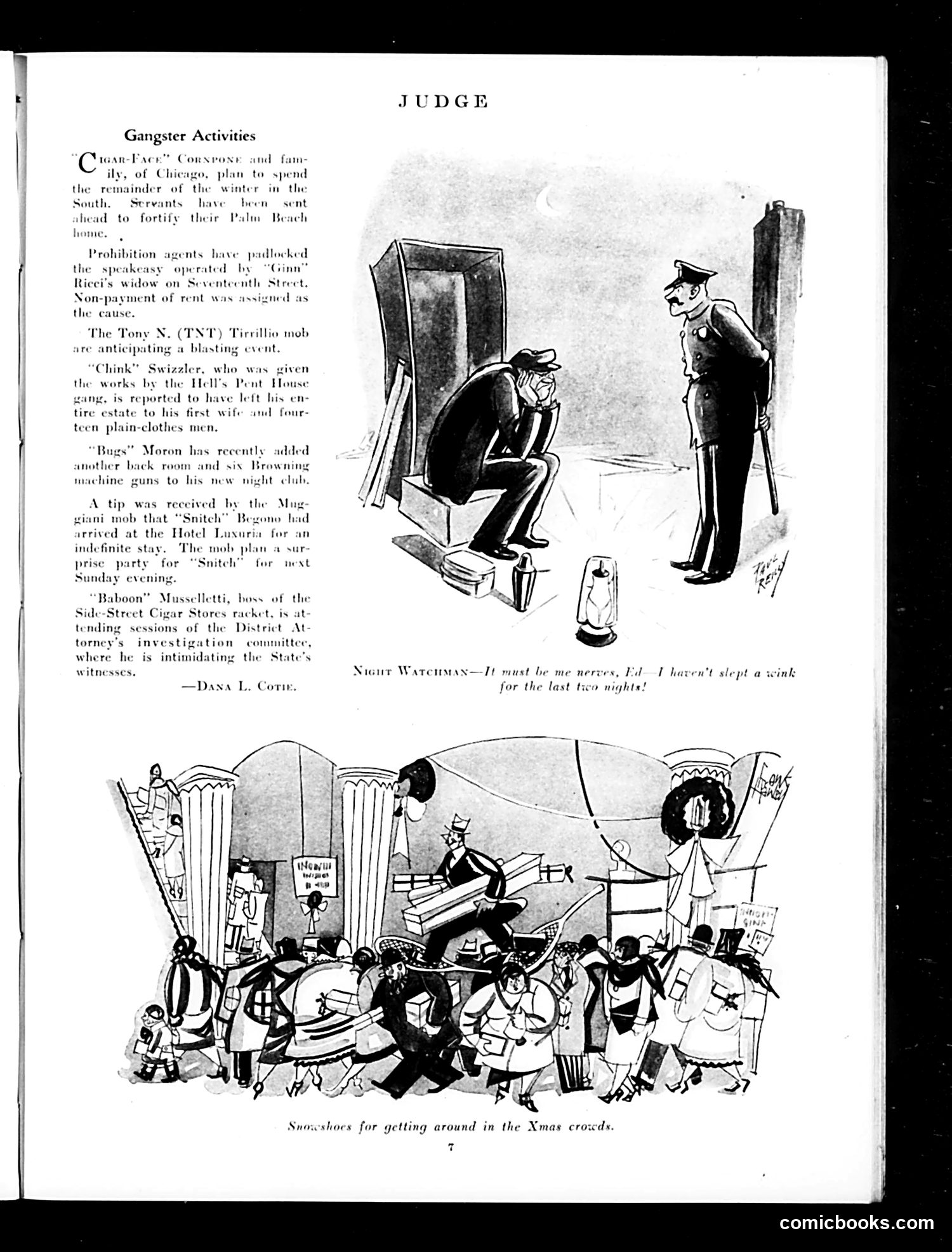
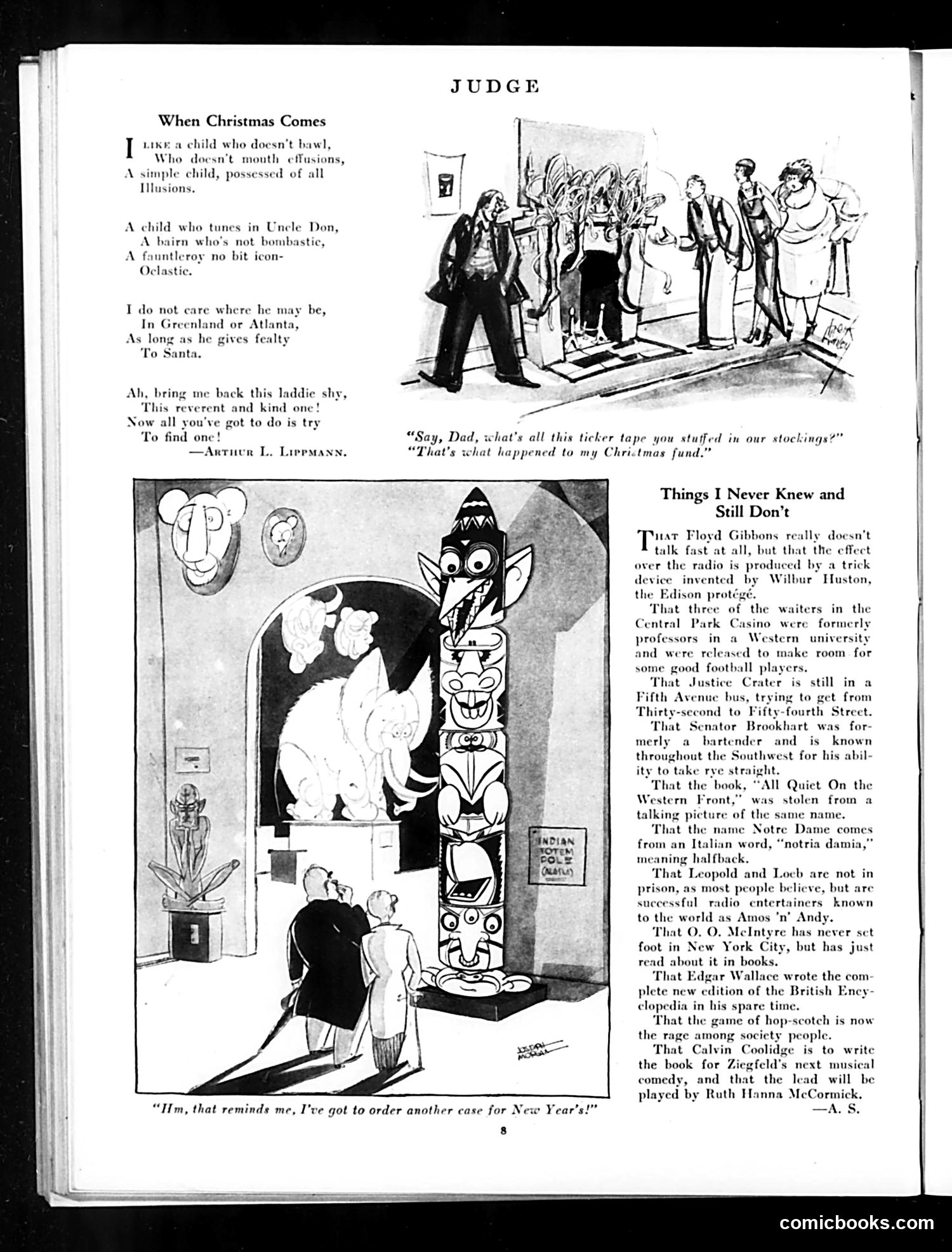
"When Christmas Comes" and Judge Magazine Satire This page from Judge magazine contains holiday-themed humor targeting 1920s American society and celebrity culture. Top cartoon: A father has stuffed ticker tape (stock market records) into Christmas stockings instead of gifts—satirizing how the 1920s stock market boom consumed Americans' finances and attention, leaving nothing for actual holiday spending. "When Christmas Comes" poem: By Arthur L. Lippmann, it nostalgically celebrates innocent childhood wonder, contrasting with modern materialism. "Things I Never Knew and Still Don't": A satirical gossip column mocking contemporary celebrities and cultural figures—Floyd Gibbons (fast-talking radio personality), Judge Crater (missing justice), Senator Brookhart, and references to popular entertainers like Amos 'n' Andy and Ruth Hanna McCormick. The column playfully debunks rumors and exaggerates absurdities about public figures' private lives, typical Judge humor targeting the famous and fashionable of the Jazz Age. The overall page reflects 1920s concerns: financial speculation, celebrity obsession, and the gap between myth and reality.
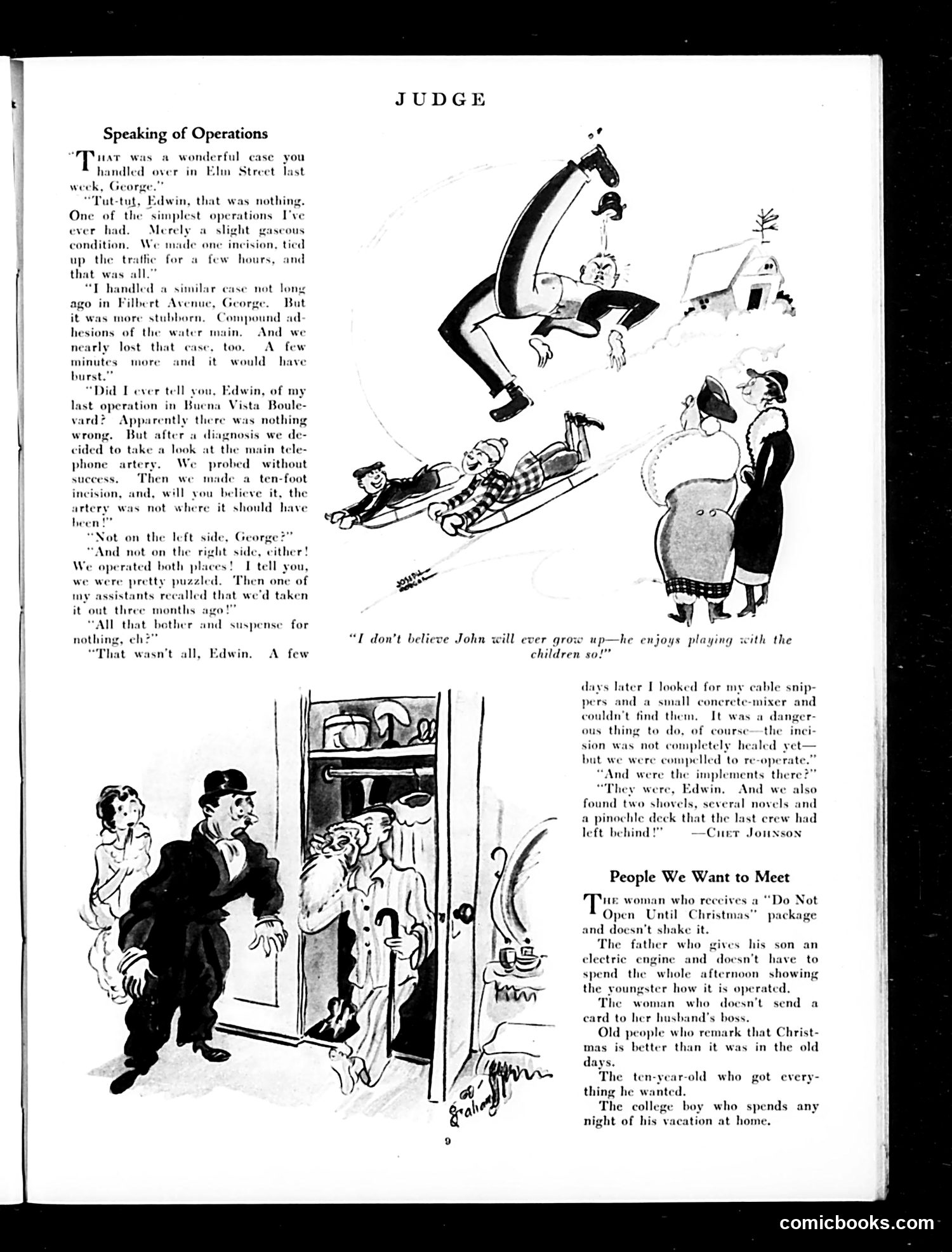
Judge Magazine Satire Analysis This page contains two distinct humorous pieces: "Speaking of Operations" is a satirical dialogue between two men (appearing to be city officials or engineers) who discuss urban infrastructure work using medical surgery terminology. They describe traffic disruptions, water main problems, and telephone line repairs as if performing surgical operations. The joke plays on the grandiose language professionals use for routine maintenance work—treating street repairs with the drama of major surgery. References to Elm Street, Filbert Avenue, and Buena Vista Boulevard suggest these are actual city locations, making the satire locally specific. "People We Want to Meet" is a list of desirable character types—people who restrain themselves during the holidays (don't shake presents, don't complain about Christmas, don't demand attention). The humor lies in identifying increasingly rare examples of self-control and moderation, implicitly criticizing the opposite behaviors as common among readers' acquaintances. Both pieces use gentle, observational satire typical of *Judge* magazine's approach to American middle-class life and civic affairs.
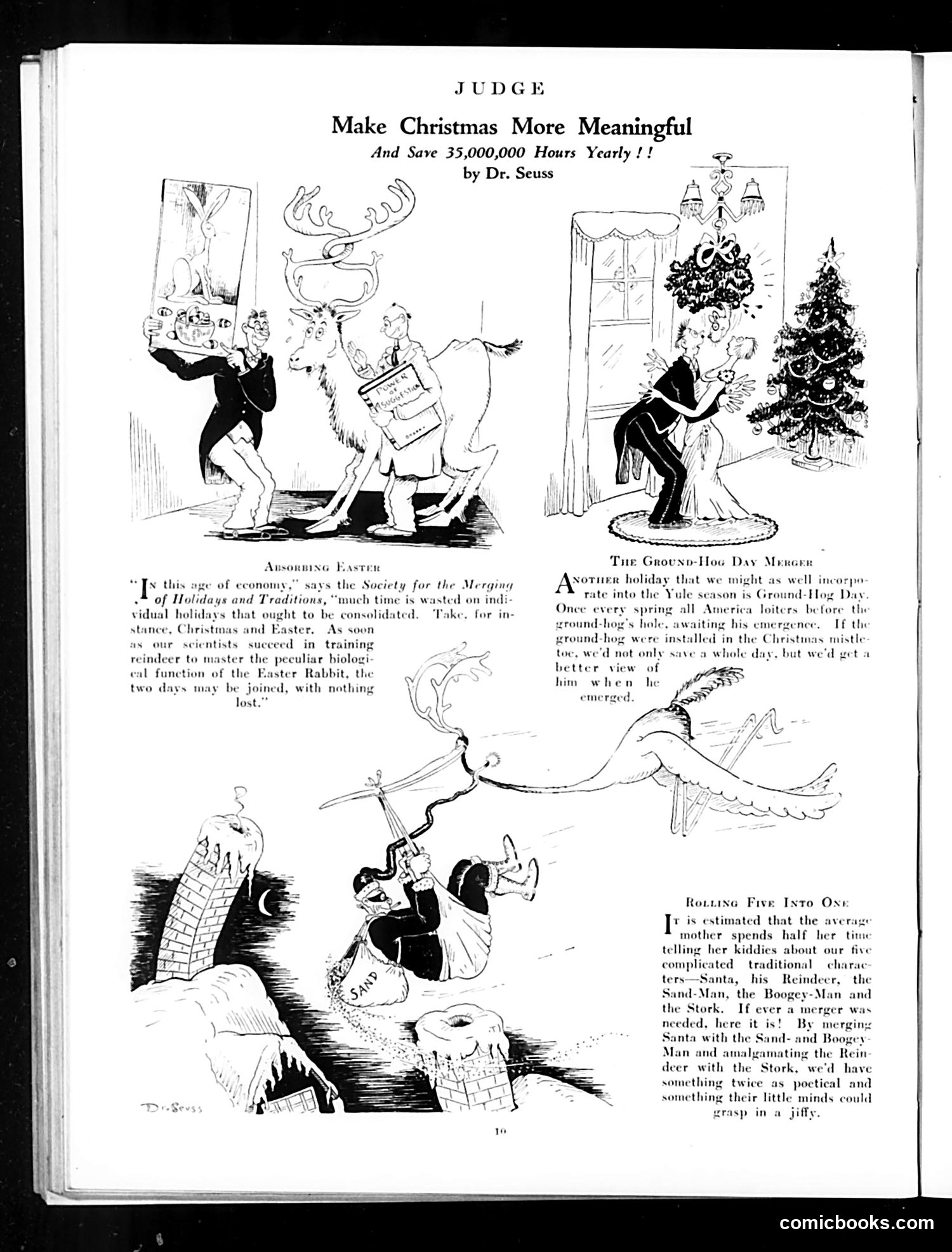
"Make Christmas More Meaningful" by Dr. Seuss This 1930s-era satirical piece by Dr. Seuss mocks the efficiency-obsessed business culture of the era. Under the guise of a "Society for the Merging of Holidays and Traditions," it proposes consolidating Christmas with Easter, installing a Groundhog Day creature in Christmas decorations, and merging Santa with the Sandman, Boogeyman, and Stork into one character—supposedly to "save 35,000,000 hours yearly." The satire targets two absurdities: (1) corporate America's obsession with time-saving and rationalization applied to sacred traditions, and (2) the resulting nonsensical chaos that would result. The cartoons show families struggling with increasingly bizarre holiday customs. Seuss uses this to critique how efficiency-obsessed modernization can destroy meaning and cultural coherence, reducing cherished traditions to mere time-management problems.
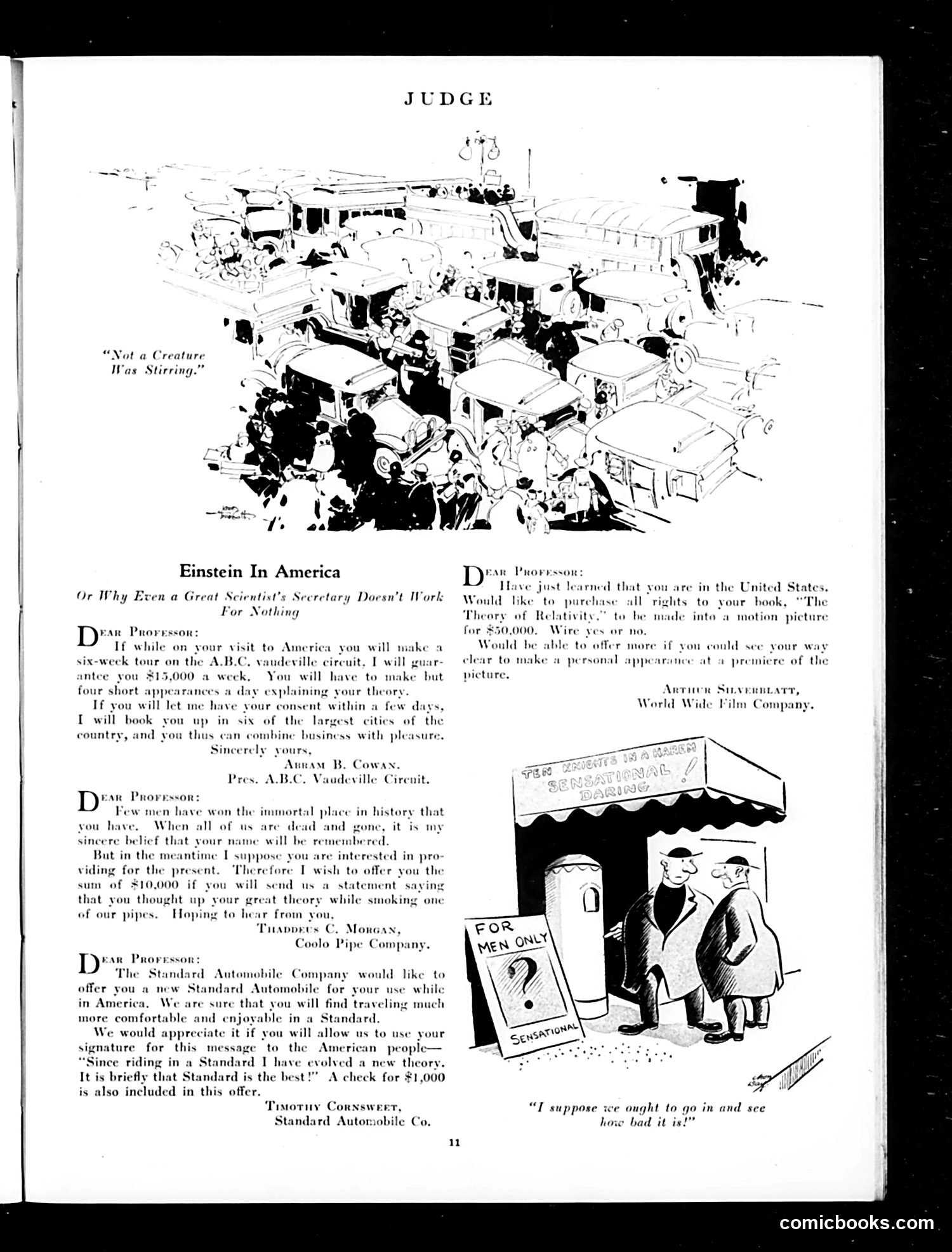
Satire of Einstein's American Celebrity This page satirizes the commercial exploitation of Albert Einstein's 1921 visit to America. The top illustration shows a chaotic mob scene around Einstein, captioned "Not a Creature Was Stirring"—a sardonic reference suggesting his arrival created pandemonium. Below, multiple letters from American businessmen propose absurd commercial deals: vaudeville circuit appearances ($15,000/week), endorsements for pipes and automobiles, and film rights to "The Theory of Relativity" ($50,000). Each sender cynically flatters Einstein's genius while transparently seeking profit. The cartoon at bottom shows two men outside a theater marked "For Men Only," with one saying they should "go in and see how bad it is"—likely referencing a lowbrow entertainment, contrasting with Einstein's intellectual stature. The satire's point: America reduces even humanity's greatest scientific minds to marketing commodities, with corporations shamelessly attempting to capitalize on celebrity rather than genuine achievement.
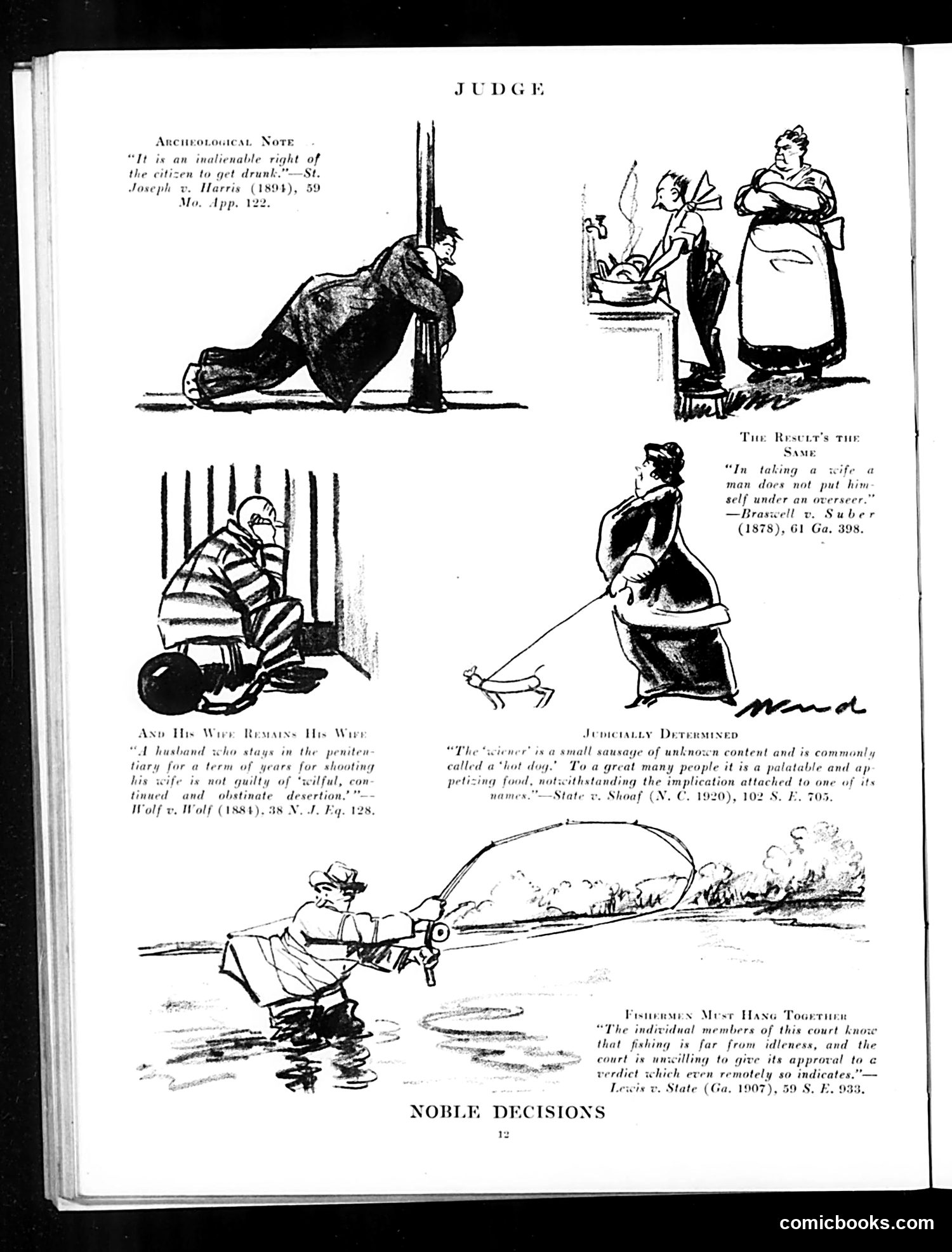
Judge Magazine: "Noble Decisions" Page This page satirizes absurd legal rulings through cartoon vignettes paired with real case citations. Each depicts a ridiculous judicial decision: 1. Top left: A drunk man collapsed against a pillar—mocking a Missouri court ruling that citizens have an "inalienable right" to get drunk. 2. Top right: A man with a woman and child—referencing a Georgia case declaring that marriage doesn't place a man "under an overseer" (i.e., wives have no authority). 3. Middle left: A prisoner—satirizing a ruling that a husband imprisoned for shooting his wife isn't guilty of desertion. 4. Center: A woman with a hot dog on a string like a pet—mocking a North Carolina court's definition of "wiener" as food of "unknown content," absurdly named "hot dog." 5. Bottom: A fisherman—ridiculing a Georgia ruling that fishing isn't idleness. The satire targets the gap between judicial logic and common sense, using real cases to expose legal reasoning as comically disconnected from reality.
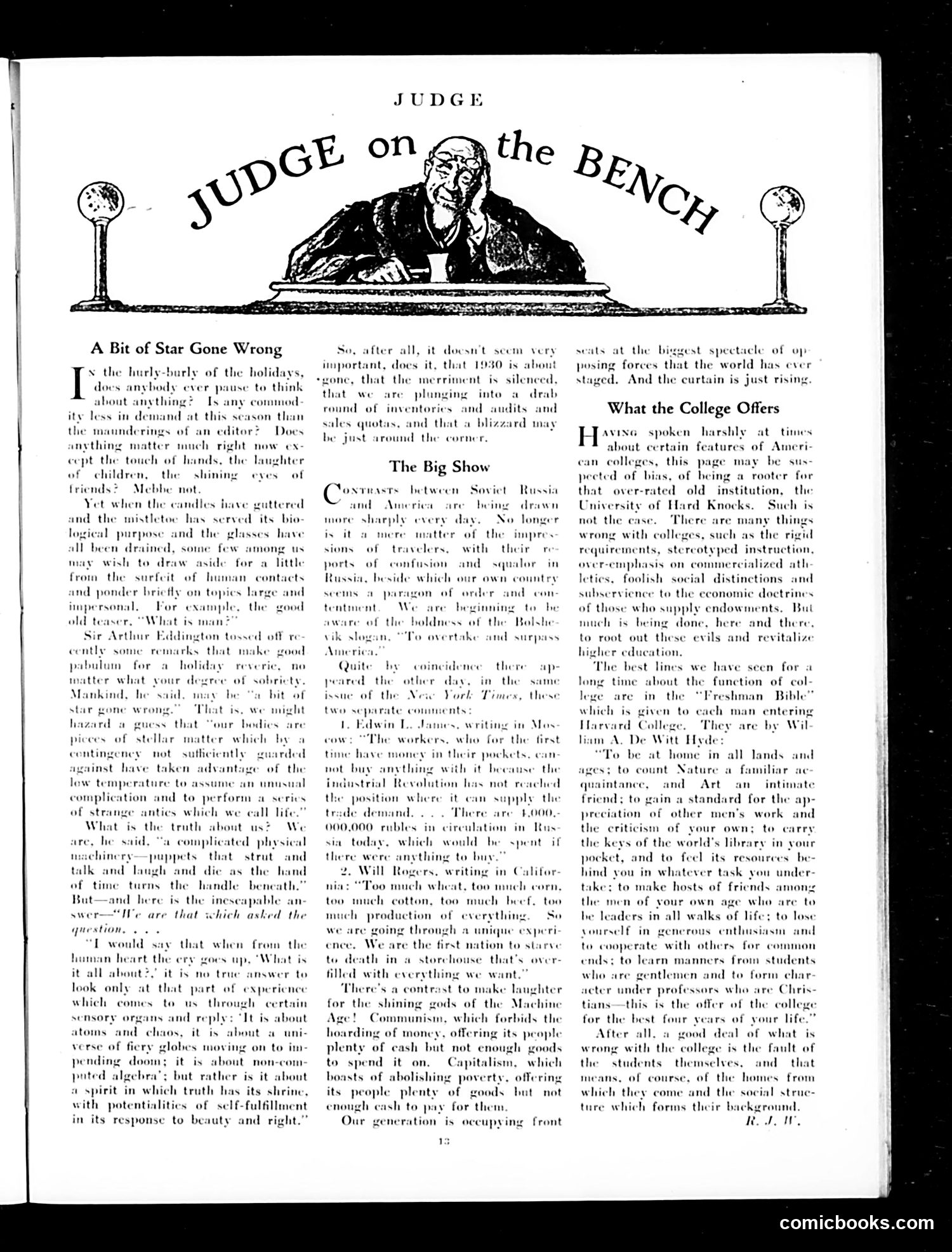
"Judge on the Bench" - Political Commentary Page This editorial page from Judge magazine (circa 1930, based on the date mentioned) contains two distinct pieces of social criticism: "A Bit of Star Gone Wrong" responds to remarks by Sir Arthur Eddington (a prominent British physicist) about human existence. The editor uses Eddington's philosophical musings—that humans are merely complicated physical machines—as a springboard to argue for human dignity and spiritual meaning beyond mechanistic materialism. "The Big Show" compares Soviet Russia and America during the Great Depression. It juxtaposes two contemporaneous New York Times reports: one describing Soviet workers with money but nothing to buy, another by humorist Will Rogers noting America starving amid abundance. The satire highlights capitalism's paradox—producing plenty but unable to distribute it—while communism hoards cash without goods. Both economic systems appear absurdly broken, making the contrasting ideologies equally laughable to Judge's perspective. Both pieces reflect 1930s anxieties about philosophy, economics, and competing ideological systems during economic crisis.
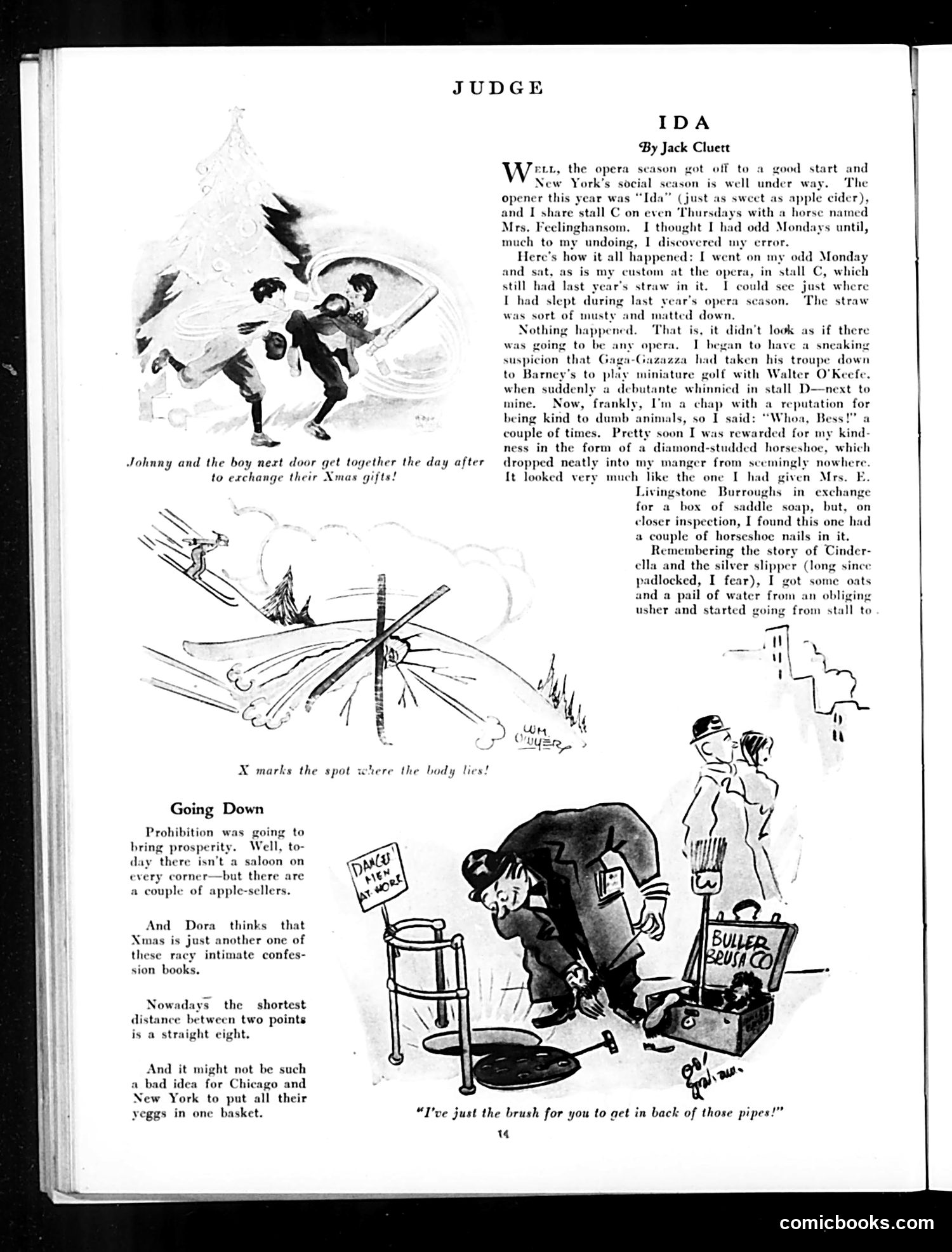
Judge Magazine: "Judge Ida" Satire Explanation This page contains a humorous short story by Jack Cluert satirizing 1920s opera culture and Prohibition-era social decline. The main narrative mocks the pretensions of New York's opera season, depicting an absurd scenario where the narrator attends an opera in a filthy stall (implying opera houses' deterioration) and encounters a horse named Mrs. Feelinghansom in an adjacent seat—a comedic inversion suggesting the opera audience itself has become bestial. The sidebar "Going Down" references Prohibition's failure: despite promises of prosperity, apple-sellers (illegal alcohol vendors) now occupy street corners where saloons once stood. The cartoon satirizes Prohibition's hypocrisy and urban decay. References to "yeggs" (criminals/burglars) suggest rising crime under Prohibition. The overall message critiques both cultural decline and Prohibition's unintended social consequences in 1920s America.
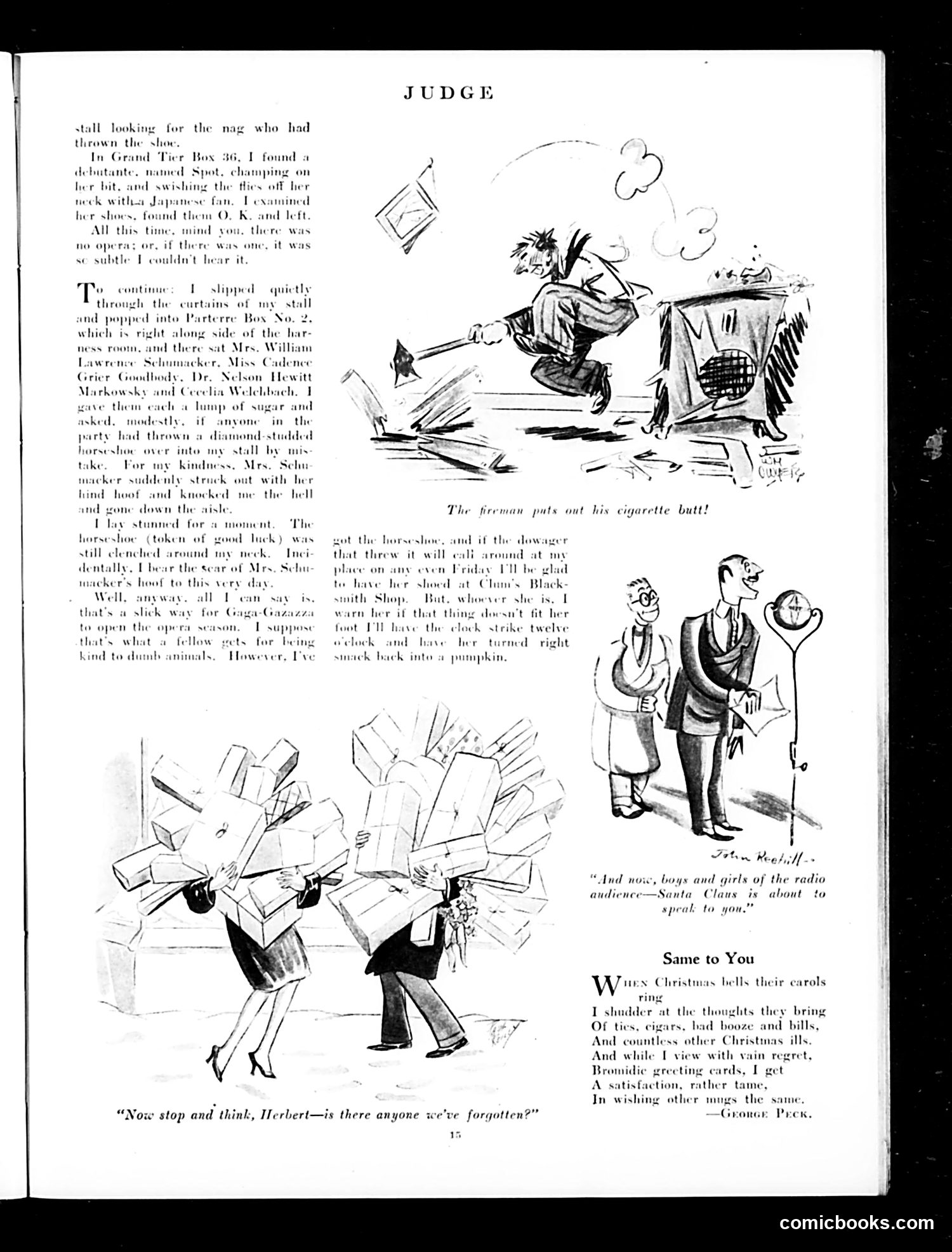
Judge Magazine Satire Analysis This page contains two distinct satirical pieces from Judge magazine (likely early 20th century): Top narrative with illustrations: A humorous account of an opera-goer searching for who threw a horseshoe into his box. The joke relies on the absurdity of high-society opera patrons behaving like roughnecks—a debutante with a horse ("Spot"), socialites named Mrs. Schumacker striking people with their hooves. The satire mocks the pretentiousness of wealthy opera attendees by suggesting they're literally animals. The final illustration shows the narrator confronted by two men, one holding a clock—a visual gag playing on Cinderella ("turned right smack back into a pumpkin"). "Same to You" poem: A cynical Christmas greeting mocking the obligatory sentimentality of holiday season. The speaker resents receiving ties, cigars, and greeting cards, expressing spite by wishing the same tedium on others ("wishing other mugs the same"). It satirizes forced holiday cheer and commercial greeting-card culture. Both pieces target social hypocrisy and artificial politeness.
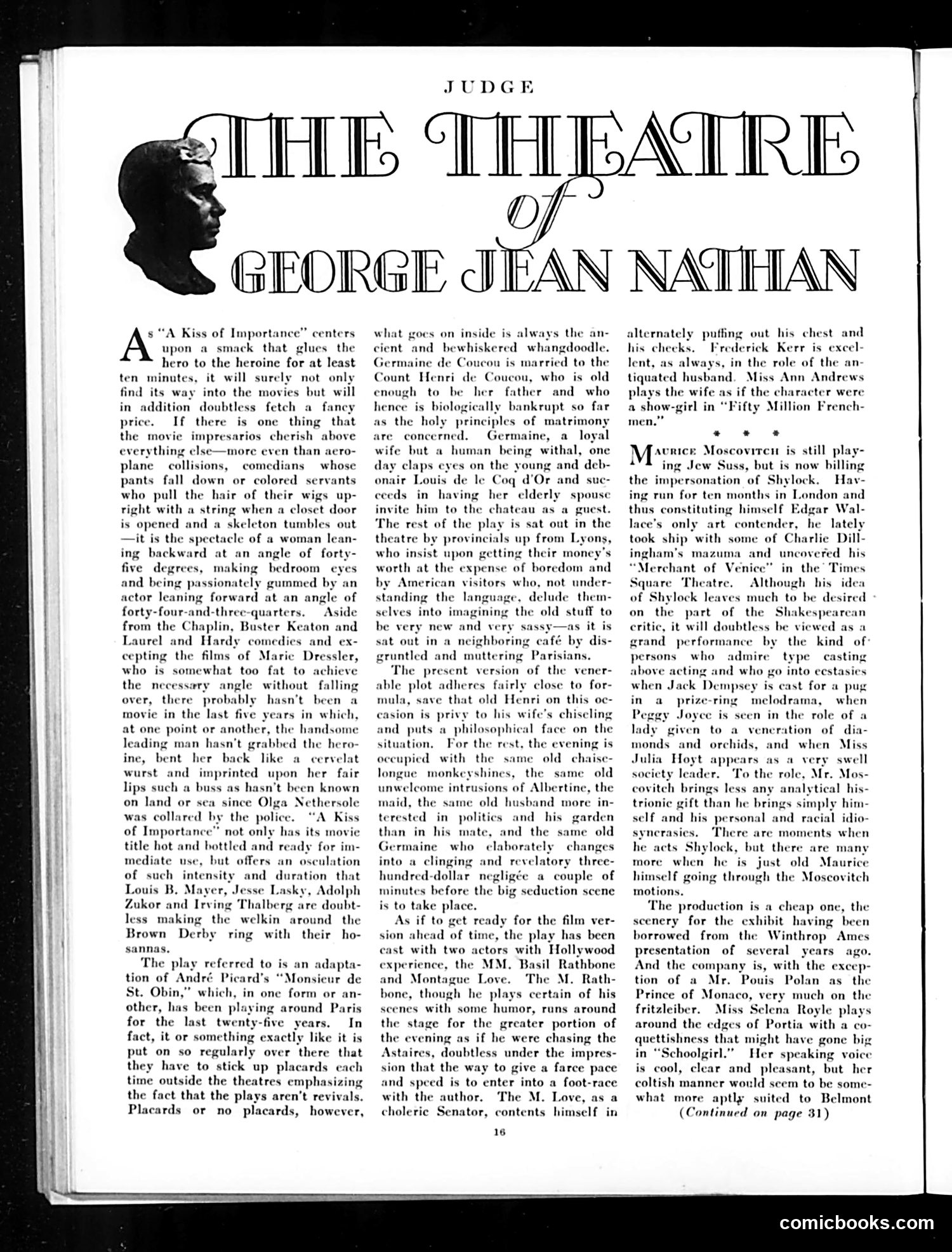
"The Theatre of George Jean Nathan" - Judge Magazine Review This page is a theater review by Judge's drama critic, discussing a play adaptation of André Picard's "Monsieur de St. Obin." The review satirizes both the play itself and Hollywood's obsession with physical spectacle. The opening paragraph mocks movie studios' reliance on formulaic scenes—particularly the "backward-leaning woman at 45 degrees" being kissed passionately by the leading man. Nathan names real studio heads (Louis B. Mayer, Adolph Zukor, Irving Thalberg, Jesse Lasky) who would celebrate such dramatic moments. The review dismisses the plot as an old, recycled French farce that's been performed repeatedly in Paris for 25 years, yet still draws audiences. The current production, cast with Hollywood actors Basil Rathbone and Montague Love to boost prestige, remains fundamentally unchanged—featuring the same tired comedic elements and seduction scenes. Nathan's satire targets both theatrical mediocrity and cinema's lowbrow pandering to audiences seeking spectacle over substance.
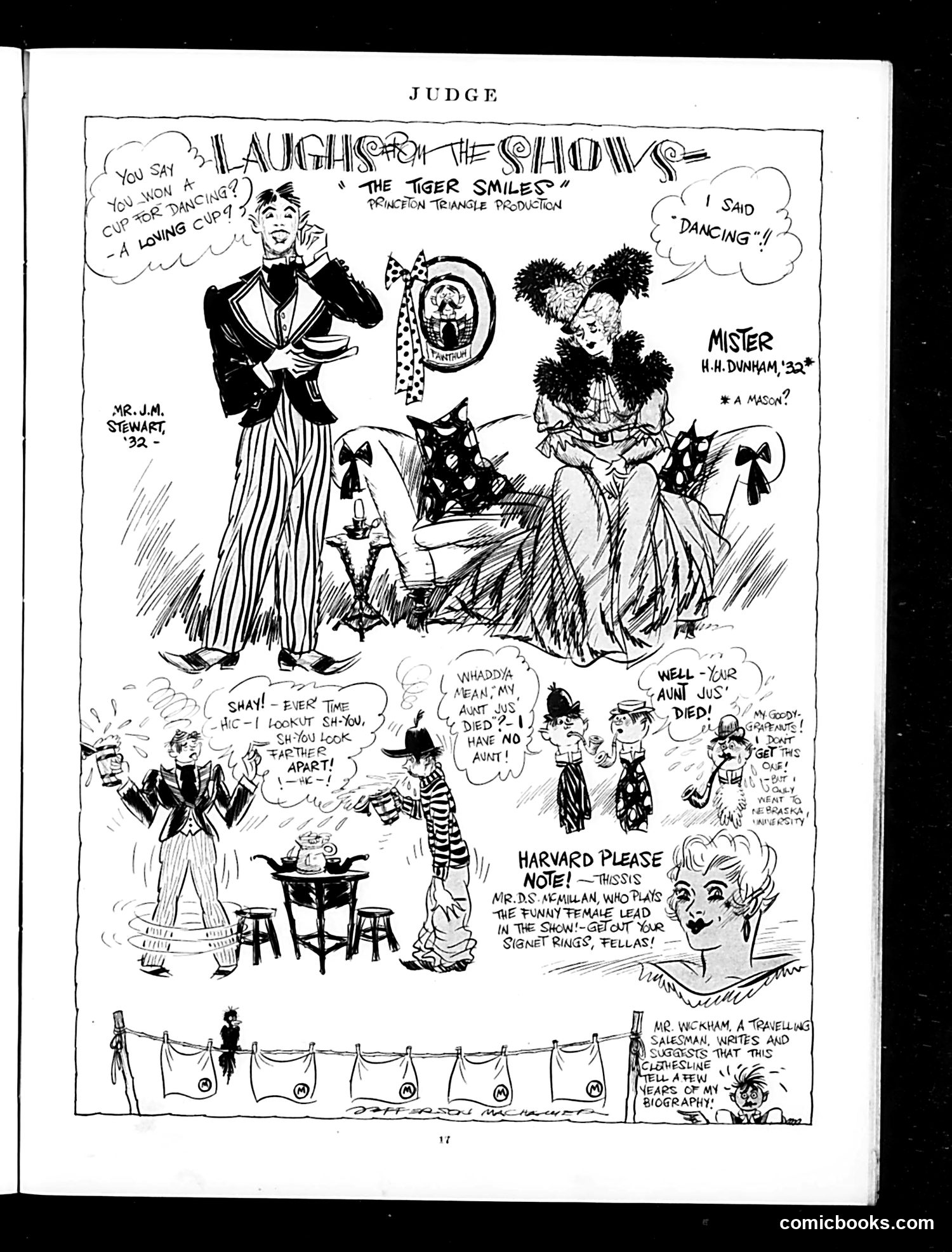
Judge Magazine Cartoon Analysis This page satirizes "The Tiger Smiles," a Princeton Triangle Club theatrical production. The cartoon mocks the show's cross-dressing tradition where male students performed female roles—a common practice in all-male college theater at the time. The central joke involves Mr. J.M. Stewart (left) claiming he said "dancing" when discussing a "loving cup" (trophy), while the female character insists otherwise. The humor derives from the awkward femininity of male performers. The Harvard note is a competitive jab: it urges Harvard students to retrieve their class rings before seeing the show, implying they'd be so distracted by the cross-dressed performer (Mr. D.S. Aemillan) that they'd lose their jewelry. This references inter-Ivy League rivalry and playfully suggests the female impersonator is dangerously attractive. The "Aunt just died" joke satirizes theatrical melodrama. Overall, it's affectionate ribbing of collegiate theater traditions and masculine anxieties about gender performance.
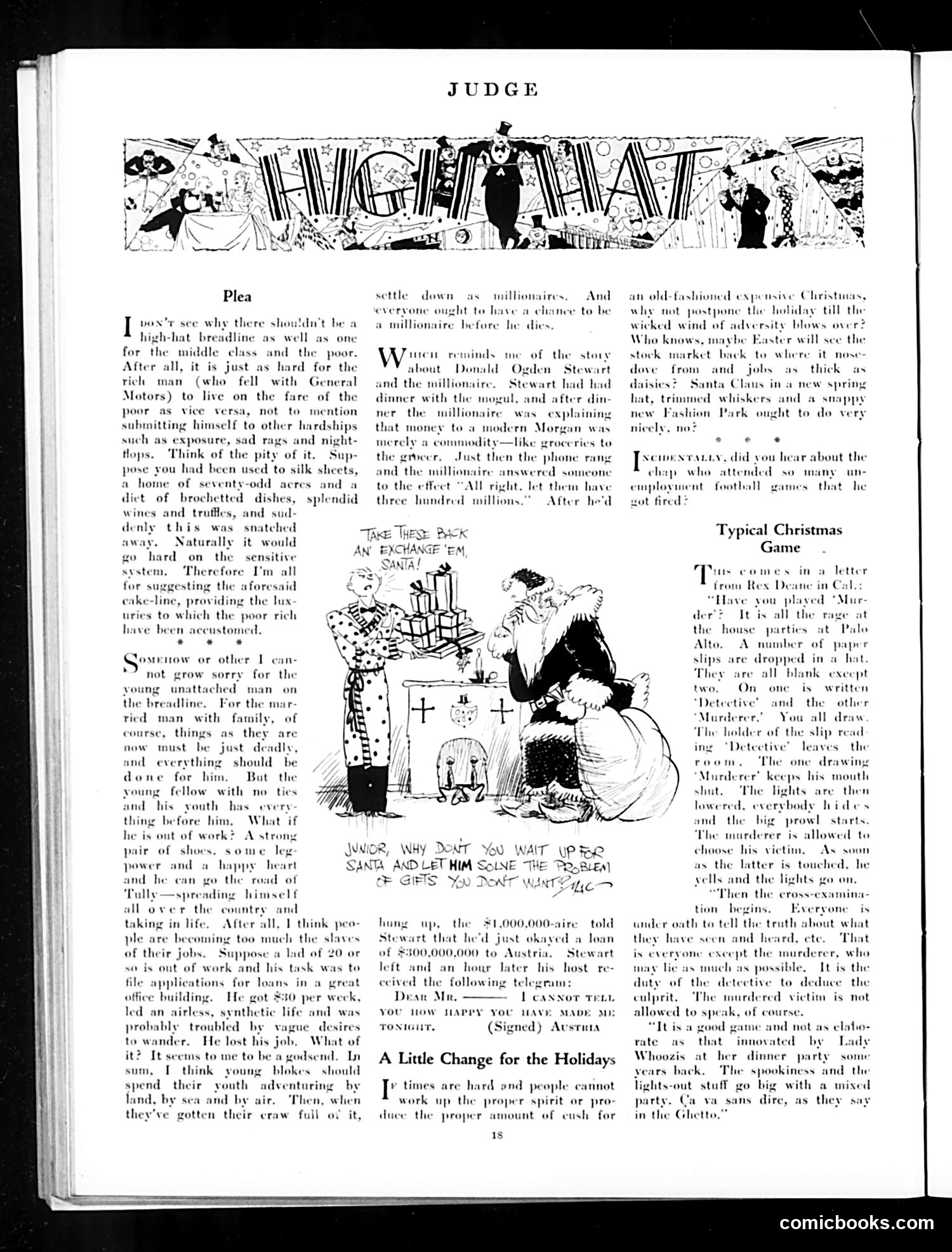
Analysis: "Judge" Magazine Page - Depression-Era Satire This page contains two distinct pieces of social commentary from the Great Depression era: Main Article ("Plea"): The author sarcastically argues for a "high-hat breadline" for wealthy people who've lost fortunes. The piece mocks the notion that wealthy unemployed deserve sympathy equivalent to working-class jobless. It references a "rich man (who fell with General Motors)"—likely alluding to the 1929 stock market crash that devastated industrialists. The satirical point: the wealthy shouldn't expect luxury accommodations during economic hardship. Cartoon Insert: Shows a child asking Santa to "let him shine" their shoes—illustrating Depression-era child labor and poverty. "A Little Change for the Holidays": Proposes postponing Christmas celebrations until the economy recovers, sardonically suggesting Easter might bring stock market recovery and employment. This satirizes both economic desperation and the assumption that prosperity will inevitably return. The overall tone mocks both the rich's entitlement and public naïveté about economic recovery during the Depression.
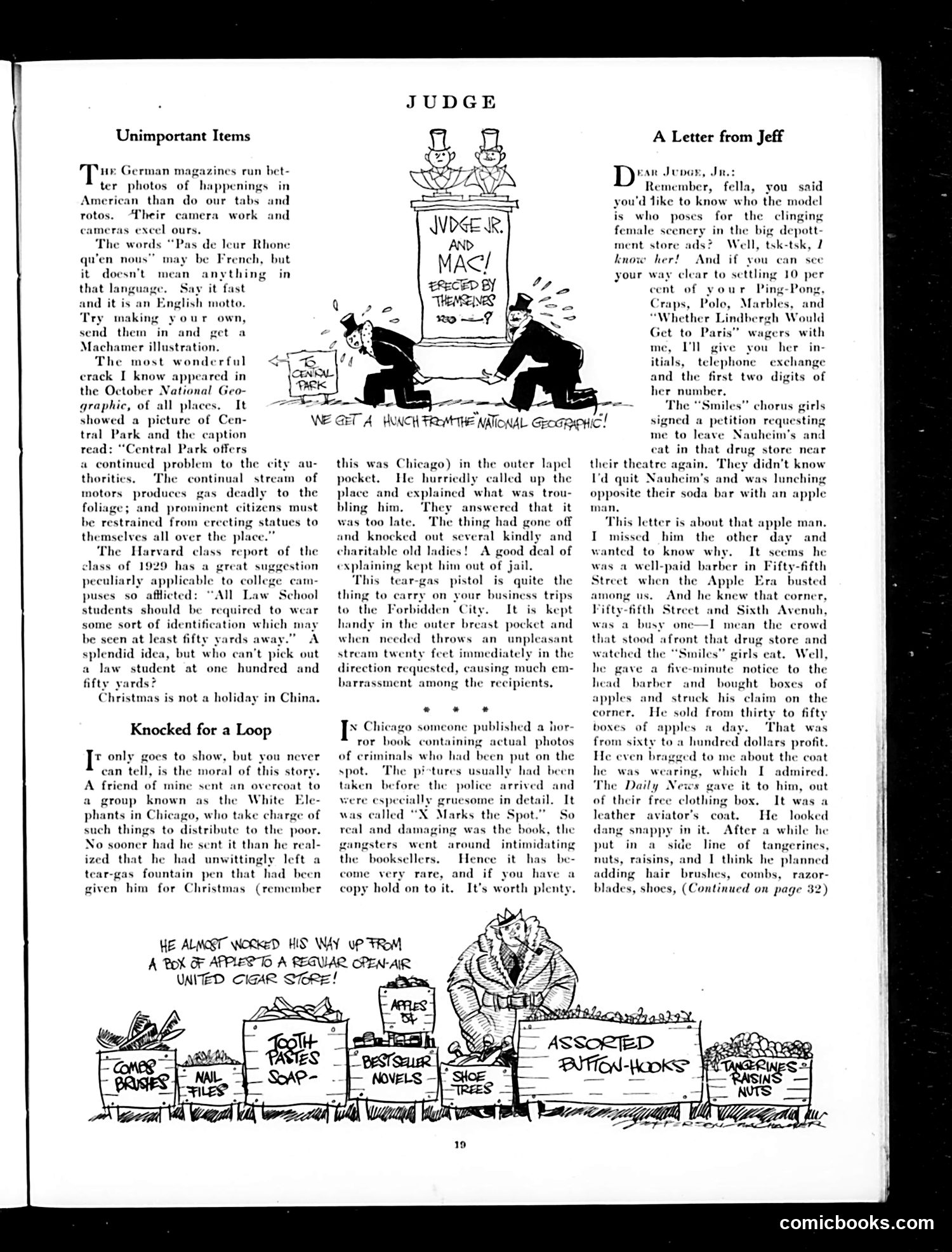
Analysis for Modern Readers This Judge magazine page (circa late 1920s) contains three satirical pieces: "Unimportant Items" mocks American journalism's inferiority to German magazines, ridicules pretentious French phrases, and notes Central Park's pollution problem from automobiles—a contemporary concern. "A Letter from Jeff" recounts an anecdote about a barber who pivoted to selling apples on a street corner during what appears to be the Depression era. The "Smiles" chorus girls reference suggests vaudeville culture. The narrative celebrates American entrepreneurship and resilience amid economic hardship. "Knocked for a Loop" describes a gruesome true-crime photography book called "X Marks the Spot," which apparently featured criminals photographed at crime scenes before police arrived. The satire criticizes sensationalist publishing and morbid public curiosity—a recurring 1920s concern about vulgar entertainment. The bottom cartoon depicts someone's comical attempt to profit from selling apples and miscellaneous goods as a street vendor—visualizing Depression-era economic desperation dressed as opportunity.
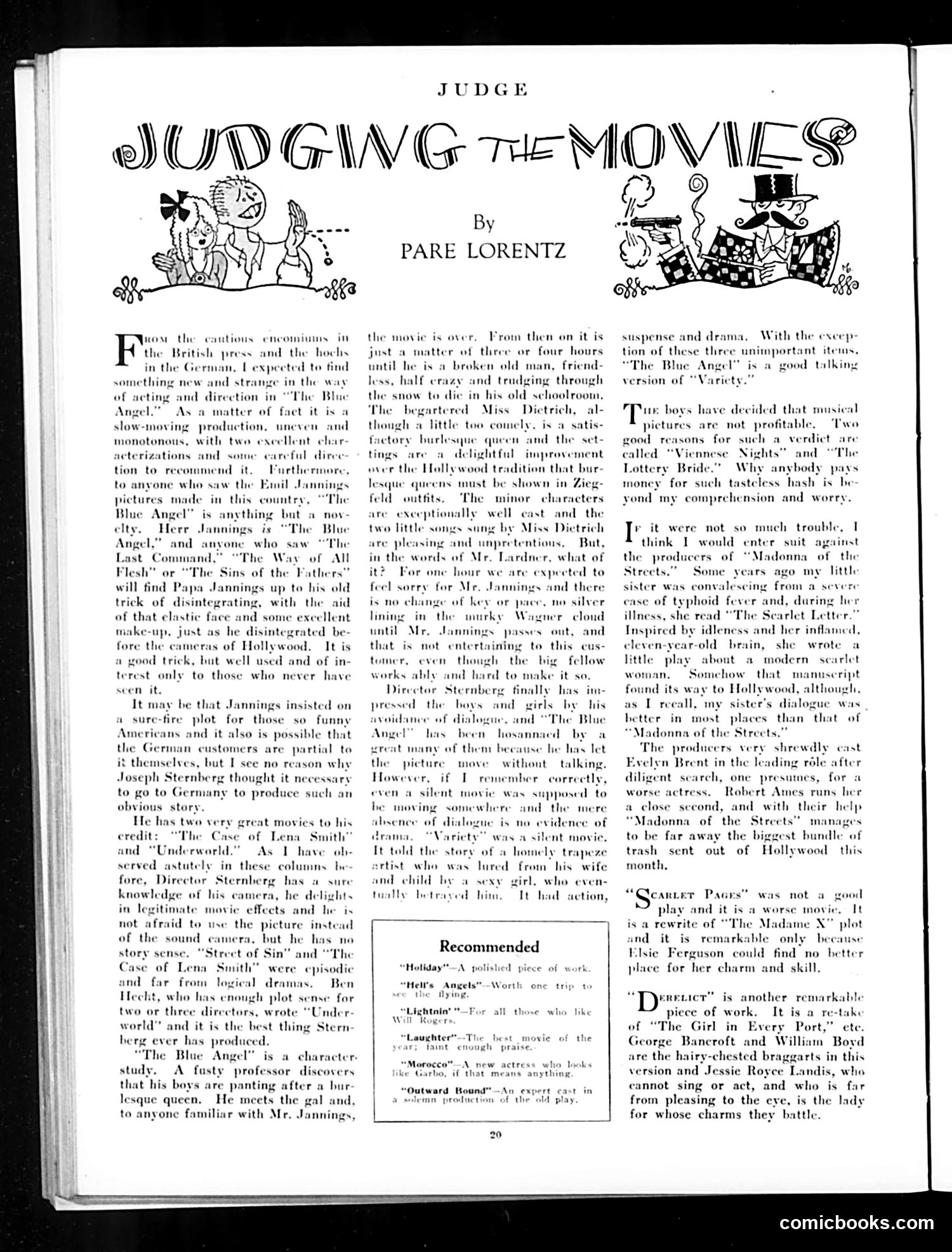
"Judging the Movies" by Pare Lorentz This is a film review column critiquing *The Blue Angel*, the famous 1930 German film starring Emil Jannings and Marlene Dietrich. Lorentz praises Jannings's acting and Dietrich's performance, calling her "a delightful improvement" over typical Hollywood portrayals of cabaret dancers. However, he sharply criticizes director Josef von Sternberg for lacking story sense, arguing the plot is "obvious" and monotonous—merely three hours of watching Jannings's character deteriorate. Lorentz contrasts Sternberg's camera skills with his narrative weakness, noting that screenwriter Ben Hecht's contributions to *Underworld* proved essential to that film's success. He also dismisses the "boys" (apparently studio executives) for deciding musicals aren't profitable, calling films like *Viennese Nights* and *The Scarlet Pages* tasteless. The column represents contemporary American film criticism evaluating European cinema against Hollywood standards.
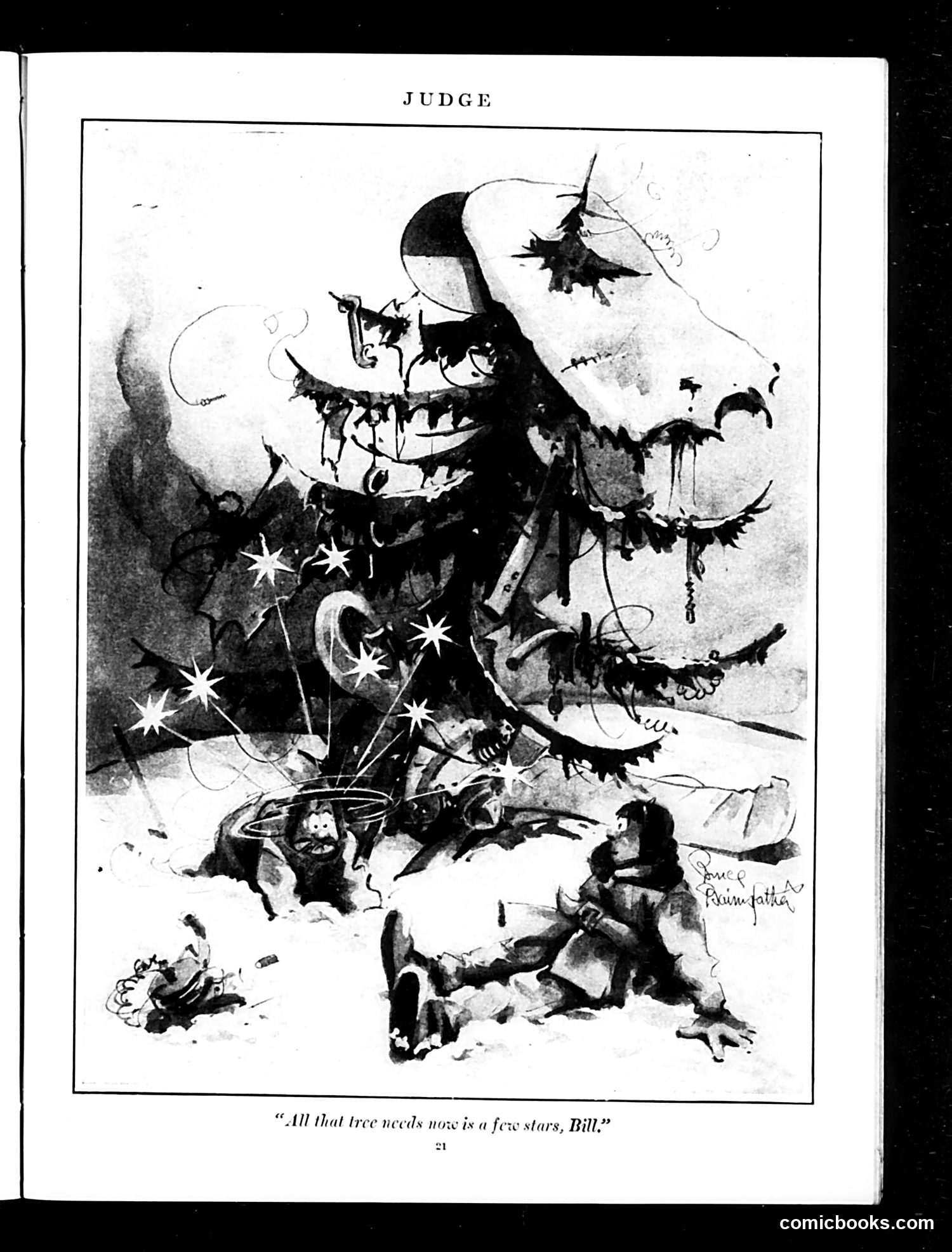
Analysis of "Judge" Cartoon Page This is a satirical cartoon titled "Judge" depicting a grotesque face formed from dark, chaotic imagery—demons, creatures, and tangled forms—decorated with white stars. The caption reads: "All that tree needs now is a few stars, Bill?" The cartoon appears to be political satire, likely from the early-to-mid 20th century based on style. The reference to "Bill" and "stars" suggests commentary on American patriotism or national symbols. The grotesque composition suggests the artist is critiquing something presented as patriotic but actually ugly or monstrous underneath. Without clearer historical context or dating information visible on the page, the specific target of this satire—whether a political figure, policy, or movement—remains unclear, though the tone is decidedly critical of hypocrisy or false patriotism.
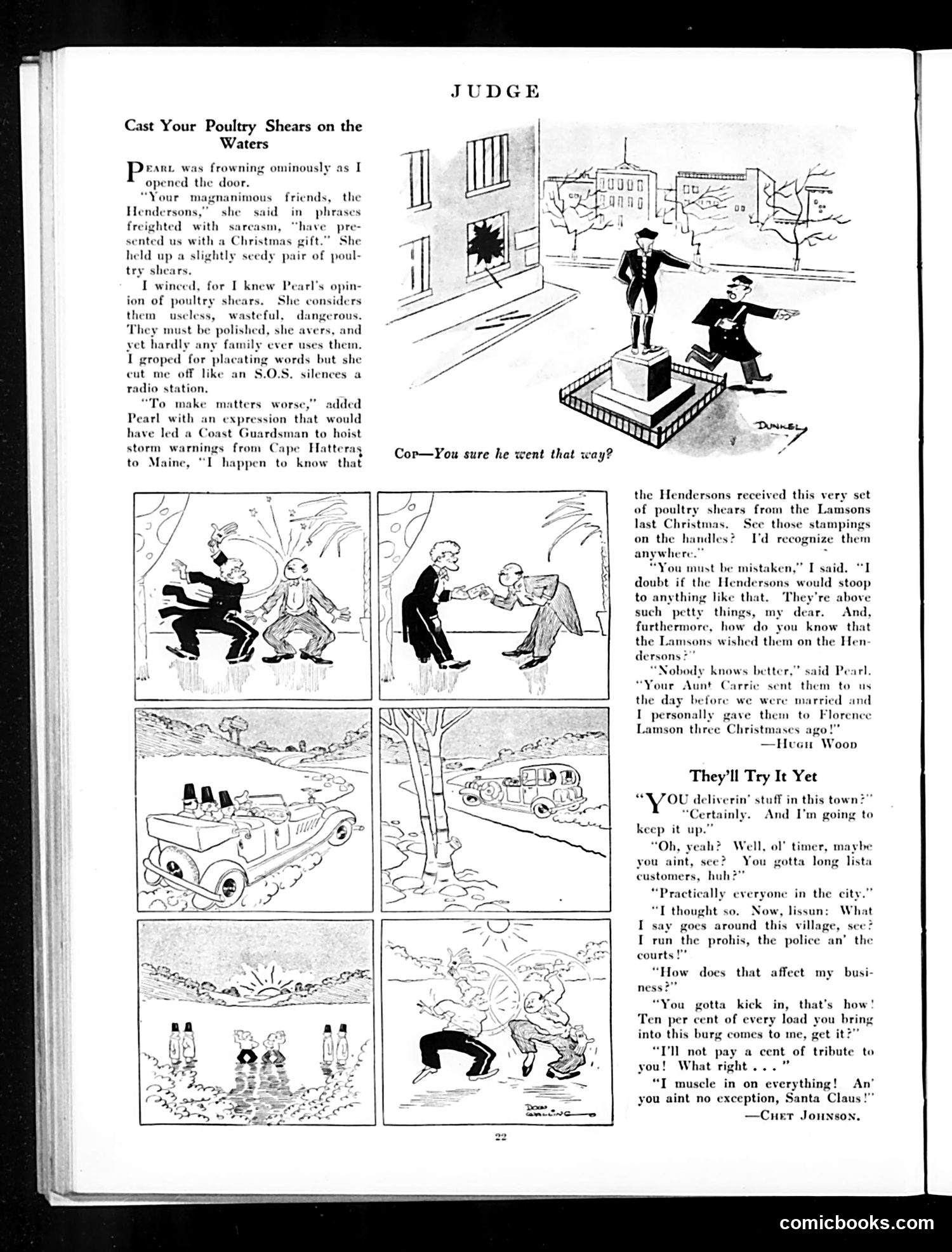
"Cast Your Poultry Shears on the Waters" & "They'll Try It Yet" This page contains two unrelated satirical stories. Top story: A domestic comedy about a wife (Pearl) receiving used poultry shears as a Christmas gift—she recognizes them as hand-me-downs previously given to the gift-givers (the Hendersons) by other friends (the Lamsons). The satire targets the awkward social pretense of regifting and the hypocrisy of "polite society" passing along unwanted items while maintaining appearances of originality and thoughtfulness. Bottom story: Social satire about Prohibition-era organized crime. A delivery driver is confronted by a local crime boss ("I run the prohis, the police an' the courts") who demands a 10% protection racket payment on every shipment. The joke's title suggests criminals will "try it yet"—the ongoing cat-and-mouse game between law enforcement and gangsters during the Prohibition period (likely 1920s-early 1930s).
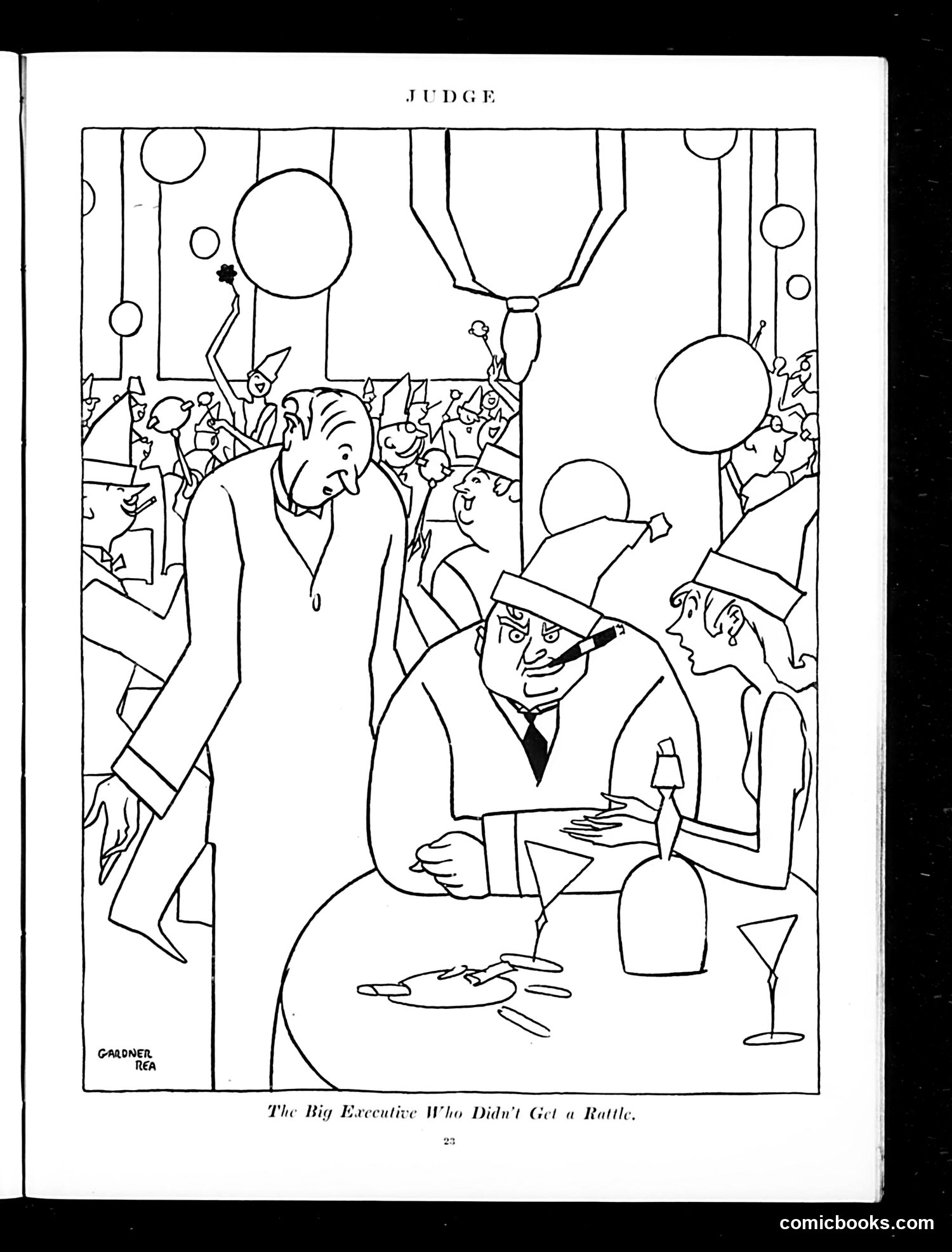
"The Big Executive Who Didn't Get a Rattle" This cartoon satirizes a wealthy businessman at a festive party—likely a New Year's Eve or similar celebration—surrounded by revelers with party hats and decorations. The title's phrase "didn't get a rattle" is a joke about party favors: everyone at celebrations receives one, but this "big executive" apparently didn't, suggesting he was excluded or overlooked despite his status. The satire likely mocks corporate executives who, despite their wealth and prominence, find themselves socially isolated or excluded from ordinary pleasures. The irony is that someone so powerful in business matters can still be left out of simple social courtesies, undercutting his supposed importance. The crowd of happy partygoers contrasts with his apparent exclusion, emphasizing the joke's point about deflating executive pretension.
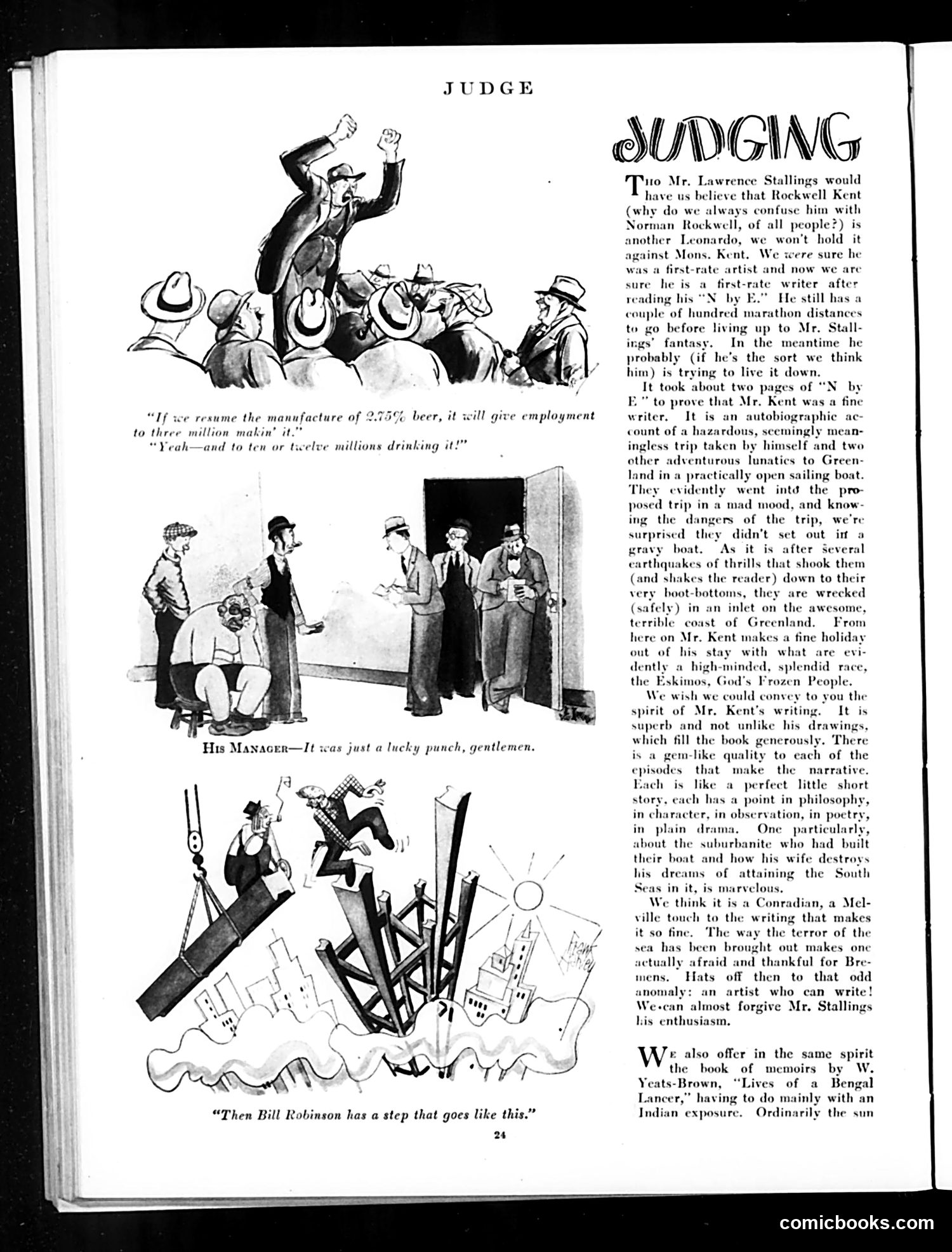
Explaining This Judge Magazine Page This is a book review section titled "Judging." The critic discusses Rockwell Kent's autobiography "N by E" (about a Greenland sailing expedition), distinguishing him from Norman Rockwell. The reviewer praises Kent as both artist and writer, calling his account of a dangerous open-boat journey to Greenland "superb" with gem-like quality. The cartoon at top satirizes beer prohibition—a politician claims resuming 2.75% beer manufacture would employ 3 million workers and support 10 million drinkers, an absurdly inflated economic argument for alcohol production during Prohibition era. The lower cartoon shows a shipwreck scene captioned "Then Bill Robinson has a step that goes like this"—likely a vaudeville or slapstick reference, though the specific joke is unclear without fuller context. The page primarily promotes Kent's writing talent while poking fun at contemporary beer politics.
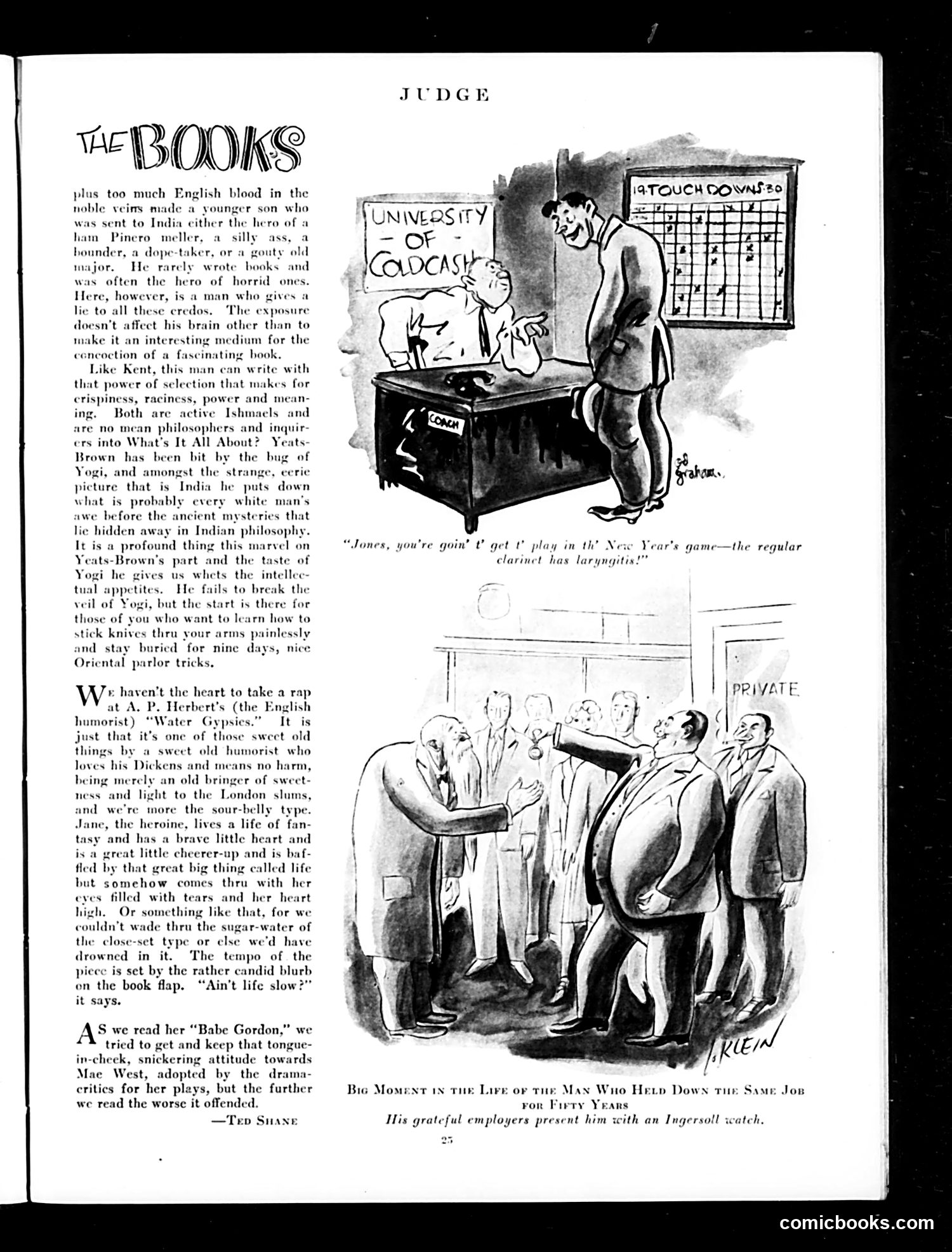
Judge Magazine Book Review Page Analysis This page from *Judge* magazine contains book reviews and satirical cartoons. The upper cartoon mocks a football coach preparing an inexperienced player ("Jones") for the New Year's game, joking that the "regular clarinet has laryngitis"—a nonsensical punchline typical of *Judge*'s absurdist humor. The lower cartoon illustrates workplace exploitation: a long-serving employee (fifty years at the same job) receives only an inexpensive Ingersoll pocket watch as a gift from "grateful employers." The satire critiques corporate stinginess and worker mistreatment—the irony being that such meager compensation was considered "gratitude" for decades of labor. The text reviews several books, including one by Yeats-Brown about Indian philosophy and yogis, and A.P. Herbert's sentimental novel "Water Gypsies." The reviewer dismisses Herbert's saccharine sentimentality while acknowledging his literary merit, displaying the magazine's characteristic snide tone toward popular sentimental fiction.
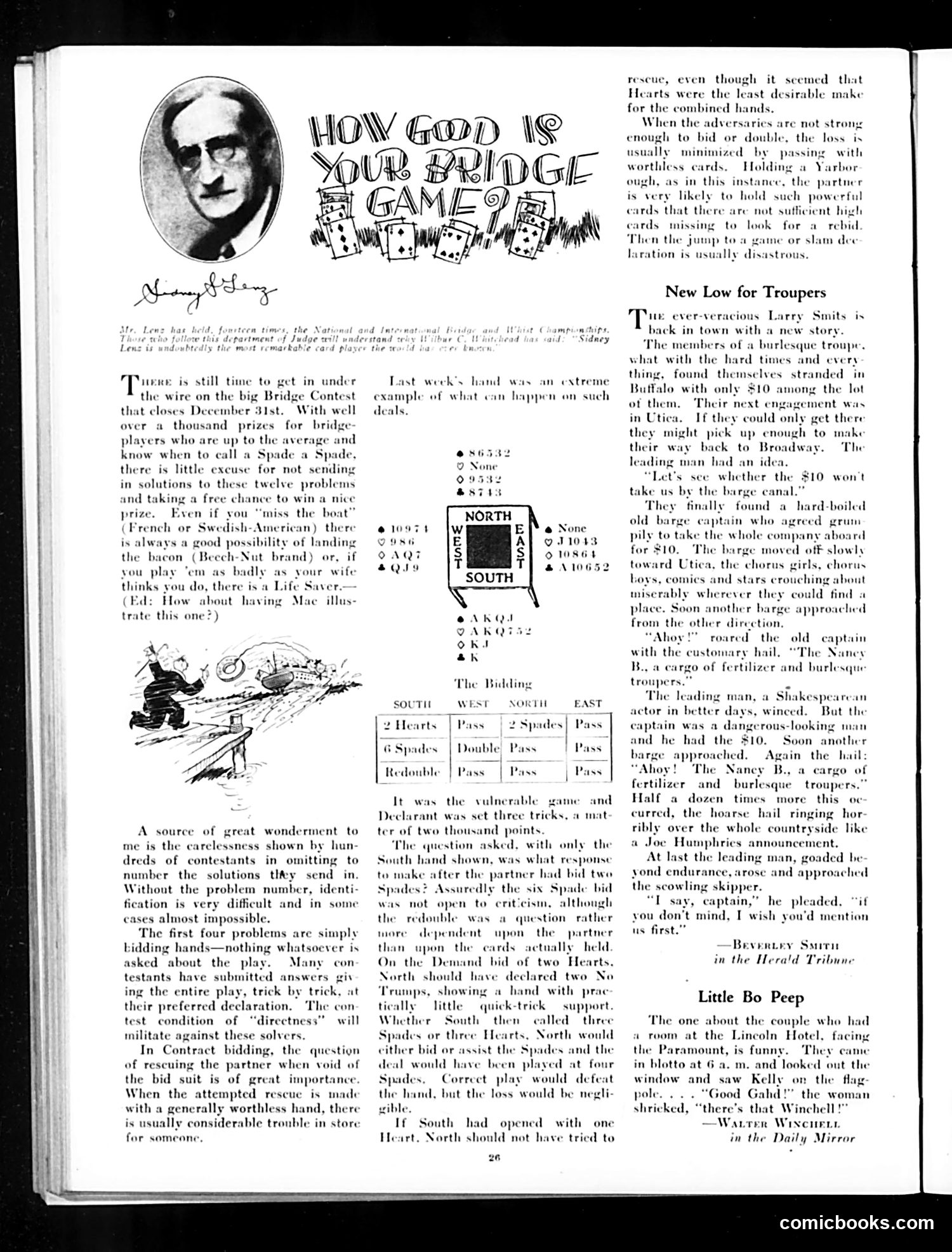
Analysis of Judge Magazine Page This page from *Judge* magazine contains bridge game instruction mixed with humorous anecdotes. The main cartoon shows a portrait of what appears to be a bridge expert (likely Sidney Lenz, based on the credit line), with the heading "HOW GOOD IS YOUR BRIDGE GAME?" This introduces a bridge contest with prizes. The body content consists of: 1. Bridge instruction explaining common bidding mistakes in Contract Bridge, a popular parlor game of the era 2. "New Low for Troupers" — a humorous story about burlesque performers stranded in Buffalo during the Great Depression with only $10, attempting to reach Utica by convincing a barge captain to transport them via canal The humor appeals to readers familiar with bridge (a widespread middle-class pastime) while the burlesque anecdote reflects Depression-era economic hardship treated as light entertainment. The overall tone is instructional mixed with entertainment—typical of *Judge's* blend of satire, games, and modern life commentary.
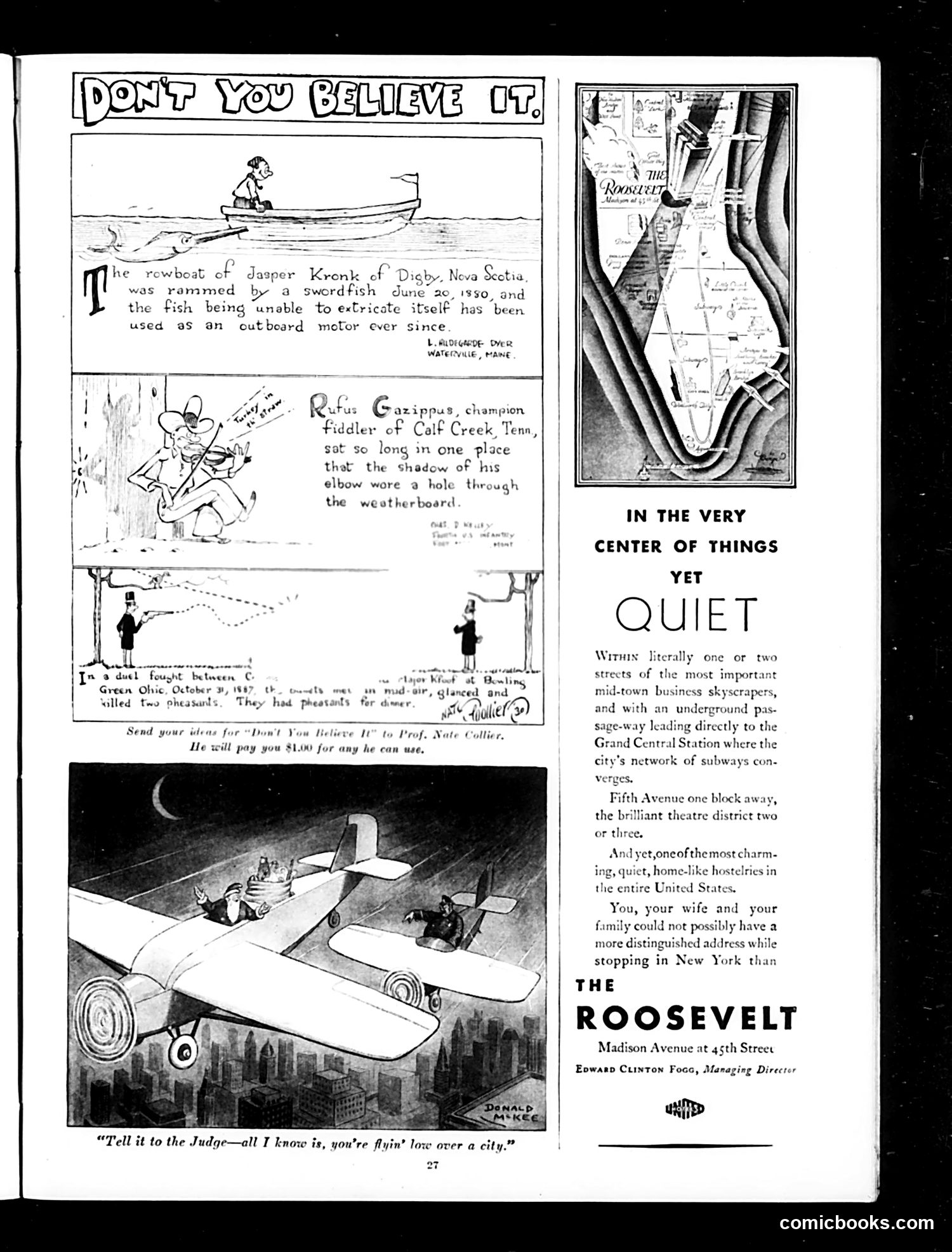
"Don't You Believe It" - Judge Magazine Satire This page features a humorous column presenting tall tales and implausible anecdotes submitted by readers. The three main stories claim: a rowboat has used a swordfish rammed through it as a motor since 1880; a fiddler's elbow shadow wore a hole through weatherboard from sitting too long; and a duel in 1847 Ohio killed two pheasants (appearing to exaggerate minor details into absurd claims). The implicit joke is that readers submit these obviously fictional or wildly exaggerated stories to Judge, which publishes them with mock-serious attribution. The magazine offers payment ($1.00) for submissions, satirizing both gullible readers and the magazine industry's appetite for sensational content. The page also includes a Roosevelt Hotel advertisement, unrelated to the satire above it.
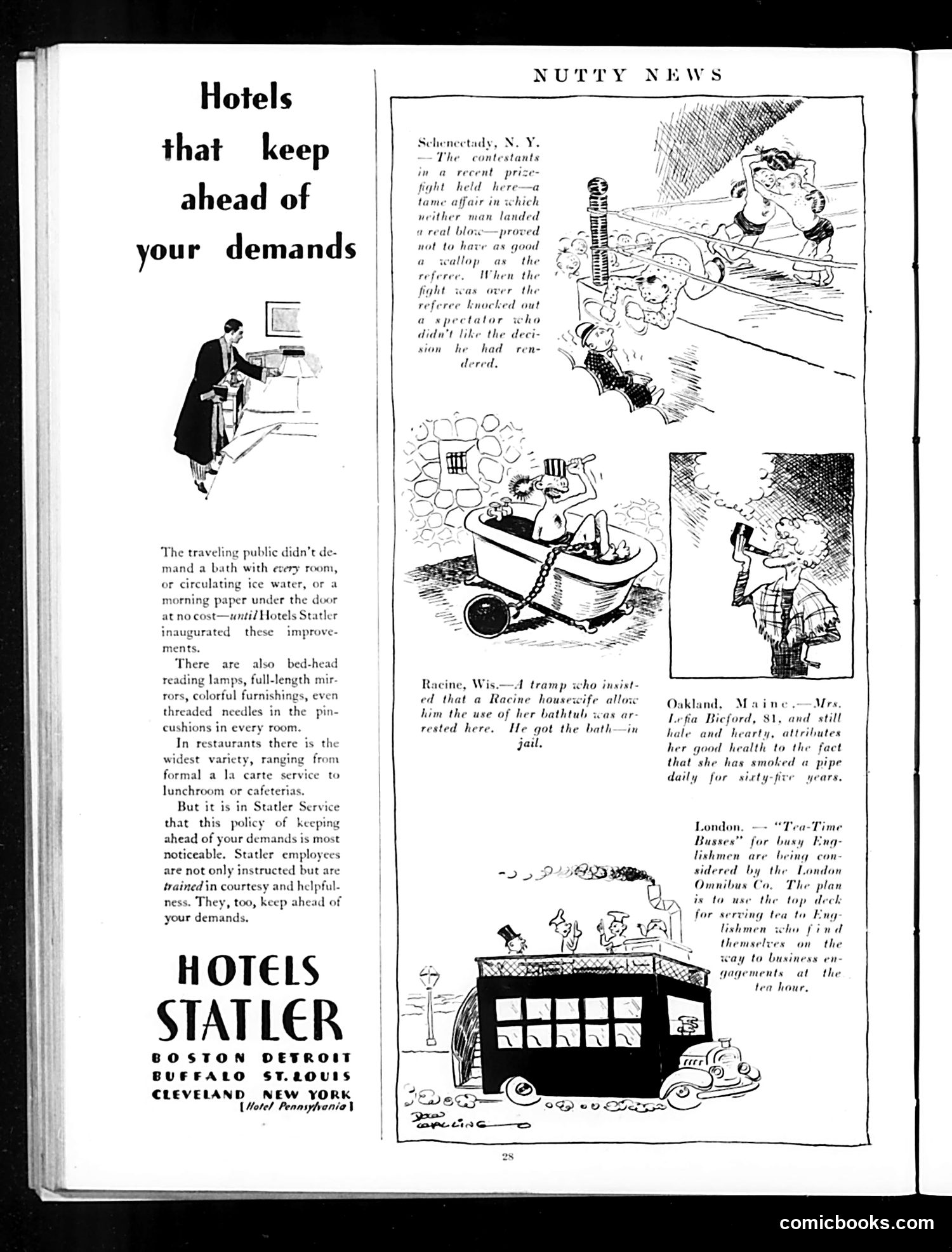
NUTTY NEWS Analysis This page combines a Statler Hotels advertisement with satirical "Nutty News" anecdotes—humorous human-interest stories mocking everyday absurdities. The cartoons illustrate four brief jokes: 1. Schenectady prizefight: A referee punches out a spectator who disagreed with his decision—absurdist humor about overreaction to sports officiating. 2. Racine tramp: A vagrant demands bathtub access from a housewife and gets arrested, receiving his bath in jail instead—satirizing the absurd persistence of a homeless person and ironic "justice." 3. Oakland woman: An 81-year-old attributes her longevity to smoking a pipe daily for 65 years—mocking health claims and vice-based wellness. 4. London buses: Double-decker buses propose serving tea on the upper deck for businessmen—poking fun at British tea culture's absurd prioritization even during commutes. The ad positions Statler Hotels as anticipating guest needs, while the "Nutty News" undercuts this with stories of ordinary people behaving illogically. The juxtaposition is intentional satire.
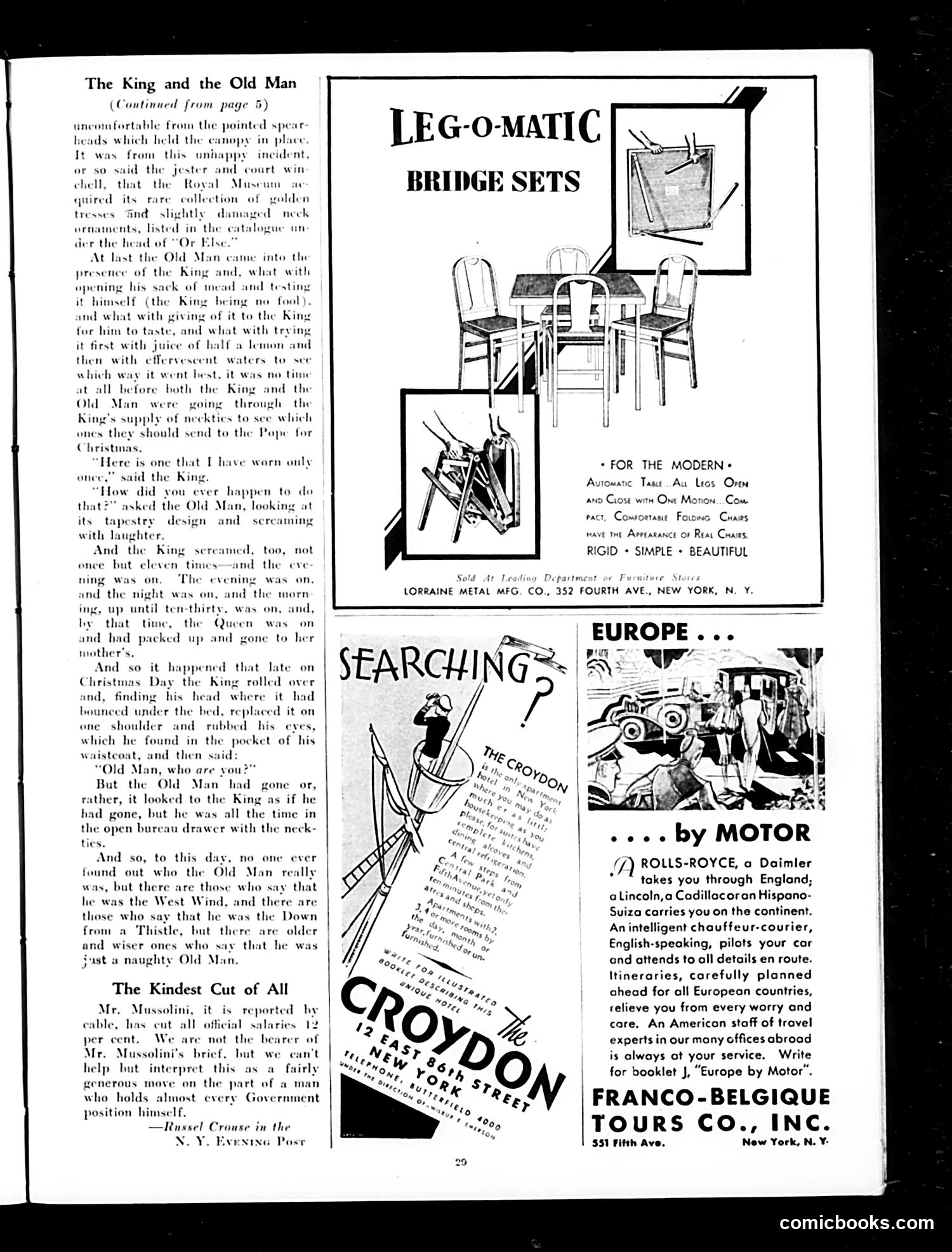
"The King and the Old Man" - Judge Magazine Page Analysis This page contains the conclusion of a whimsical fairy-tale style story about a mysterious "Old Man" who visits a King. The narrative is absurdist humor: the Old Man arrives with mead, they taste-test it extensively, and through their revelry the Queen abandons the King. The Old Man then vanishes into a bureau drawer, and no one ever discovers his true identity—though speculation suggests he might be the West Wind or the Down from a Thistle, or simply "a naughty Old Man." The satire appears gentle rather than political. The humor lies in the nonsensical logic and the King's bewilderment. The remainder of the page is advertising: Leg-O-Matic bridge furniture sets, a "Searching for the Croydon" travel advertisement, and Franco-Belgique Tours promoting European motor travel with luxury cars.
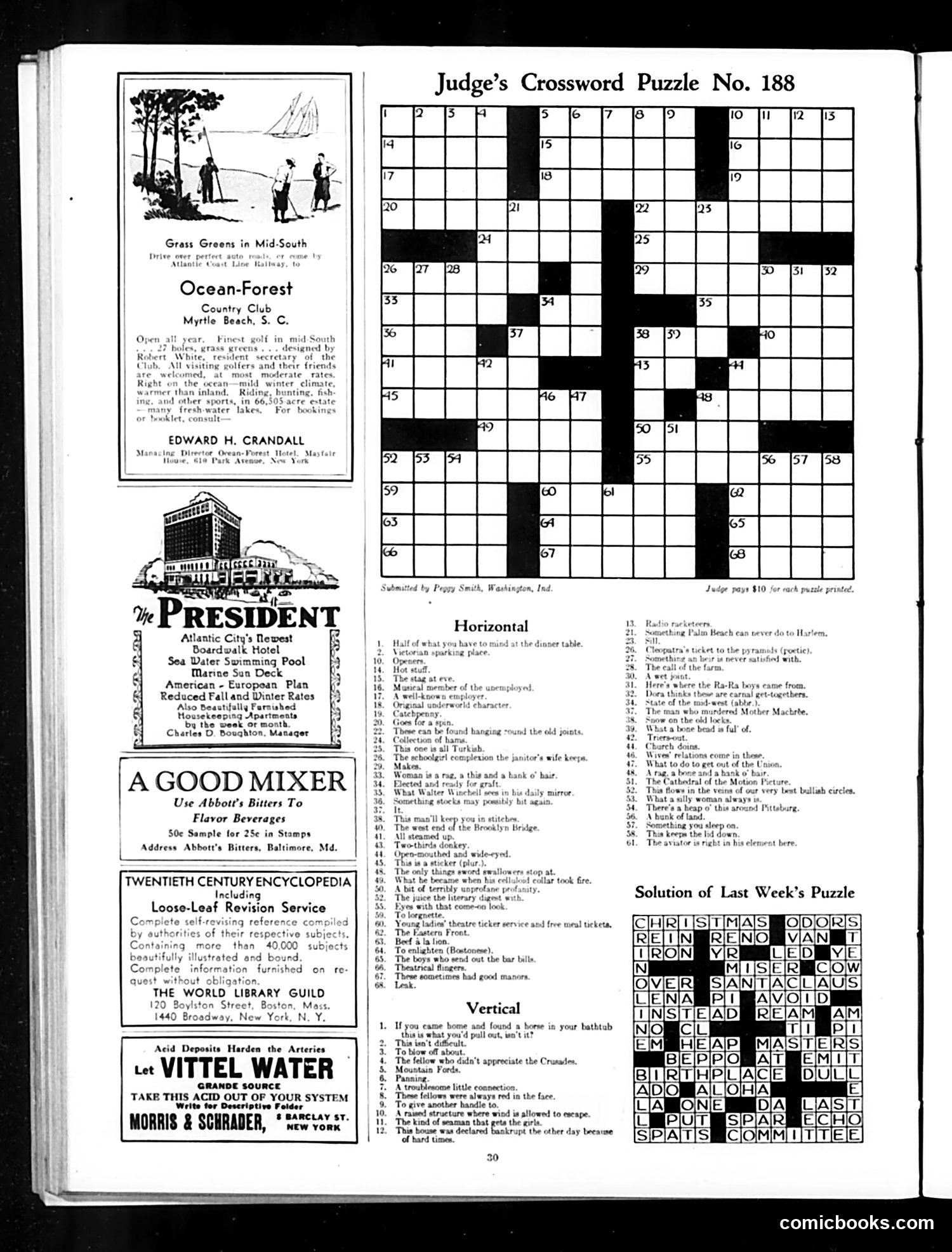
Judge Magazine Page Analysis This page is primarily advertisements and a crossword puzzle, not political satire. The advertisements promote leisure destinations and products typical of the 1920s-30s: the Ocean-Forest Country Club in Myrtle Beach (a golf resort), the President Hotel in Atlantic City, Abbott's Bitters (a flavoring for beverages), and Vittel Water (marketed as health-promoting). The only satirical content is Judge's Crossword Puzzle No. 188, which appears to contain humorous clues rather than political commentary. References like "What Water Warburst sees in his dully mirror" and "Two-thirds donkey" suggest wordplay and gentle character humor typical of the magazine's lighter puzzle content. The page reflects the period's advertising culture and leisure industry rather than containing pointed political or social satire.
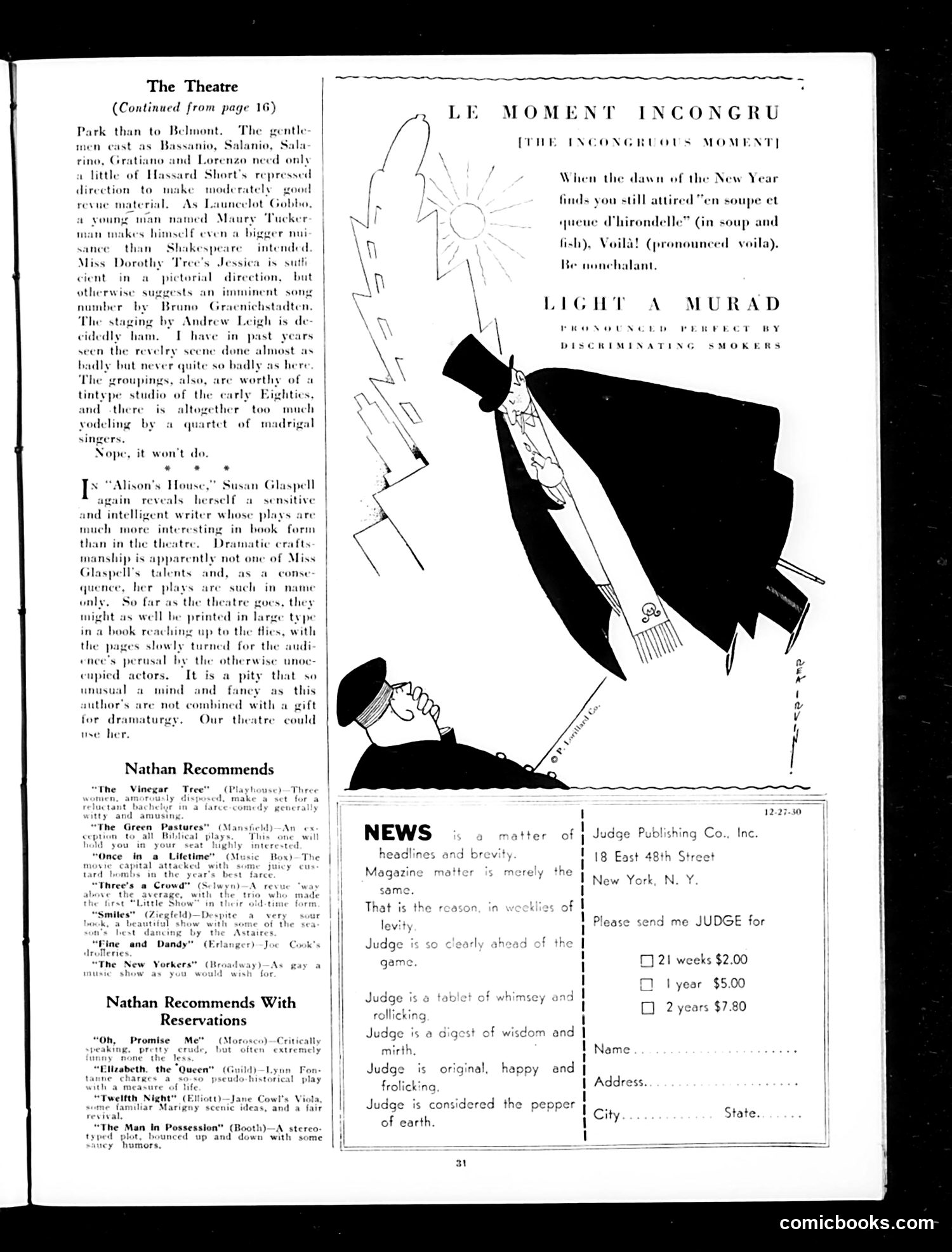
Analysis of Judge Magazine Page Content This page contains theatre reviews and advertising rather than political cartoons. The main illustration depicts a caricatured figure labeled "Light a Murad" — appearing to be a cigarette advertisement showing a well-dressed man with an exaggerated profile, meant to appeal to smokers as a "discriminating" choice. The text consists of theatre criticism by Nathan (likely George Jean Nathan, a prominent drama critic of the era). He reviews several Broadway productions, praising Susan Glaspell's writing while criticizing her lack of theatrical craft, and offering mixed assessments of various shows' performances and staging. The page includes subscription information for Judge magazine itself at the bottom. The content reflects 1920s-30s American entertainment culture: theatre criticism, luxury product marketing targeting affluent readers, and the magazine's self-promotion. There is no significant political satire visible on this particular page.
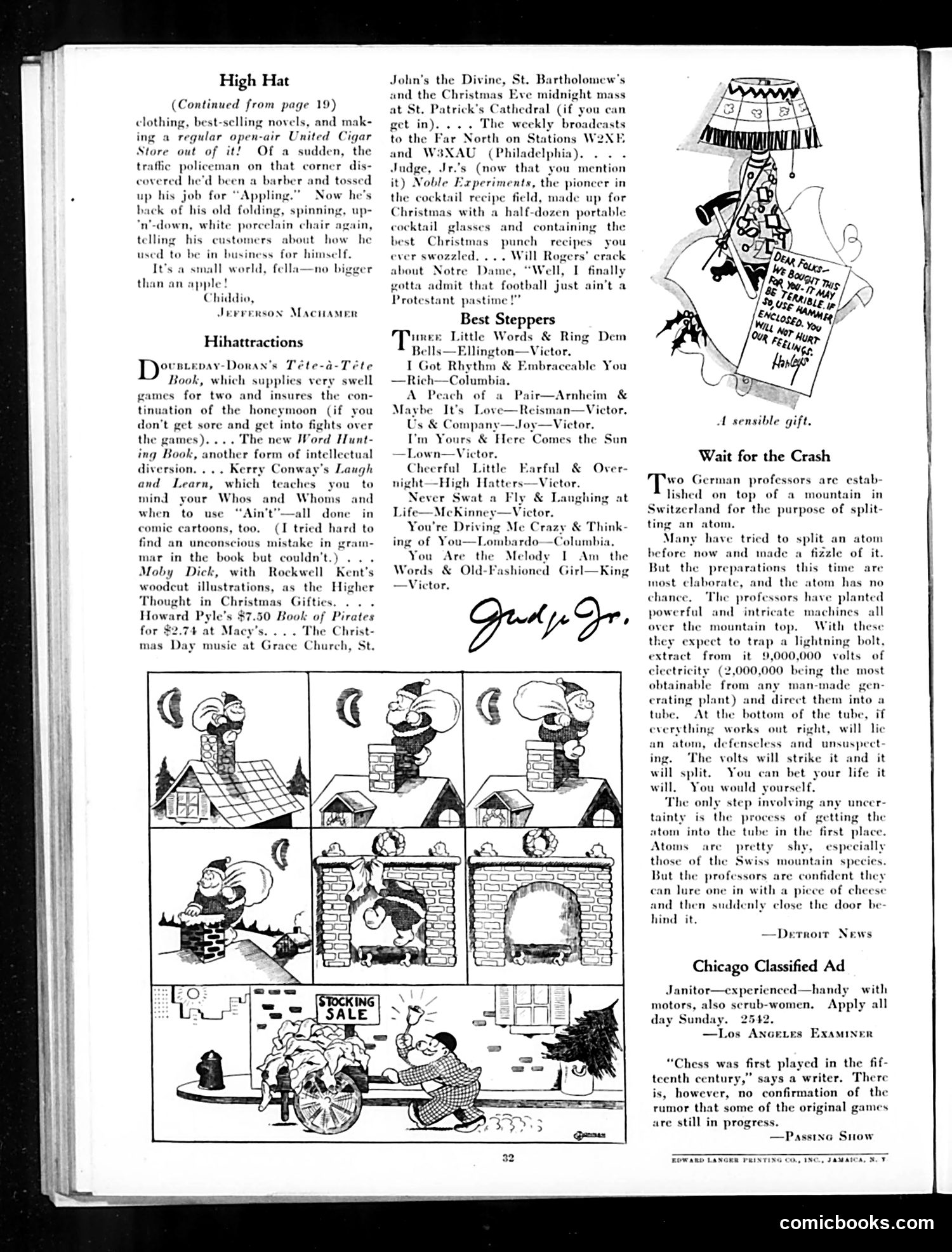
Analysis of Judge Magazine Page Content This page from Judge magazine (a satirical publication) contains several entertainment reviews and humorous pieces typical of the era. Main Content: The "High Hat" section reviews gift books and novelties—including word games, Rockwell Kent's illustrated *Moby Dick*, and Howard Pyle's *Book of Pirates*—presented as holiday suggestions for readers. "Best Steppers" lists popular jazz records and songs of the era, reflecting 1920s-30s popular music culture. "Wait for the Crash" satirizes contemporary scientific ambitions by mocking Swiss physicists attempting to split an atom atop a mountain using captured lightning. The humor derives from treating atomic physics as absurdly simple: "lure" an atom with cheese, trap it in a tube, electrocute it. This playfully deflates the era's sometimes naive optimism about scientific progress. Comic strips below show slapstick humor about a stocking sale, typical of Judge's visual gags. The page reflects 1920s-30s American consumer culture, jazz enthusiasm, and popular attitudes toward cutting-edge science.
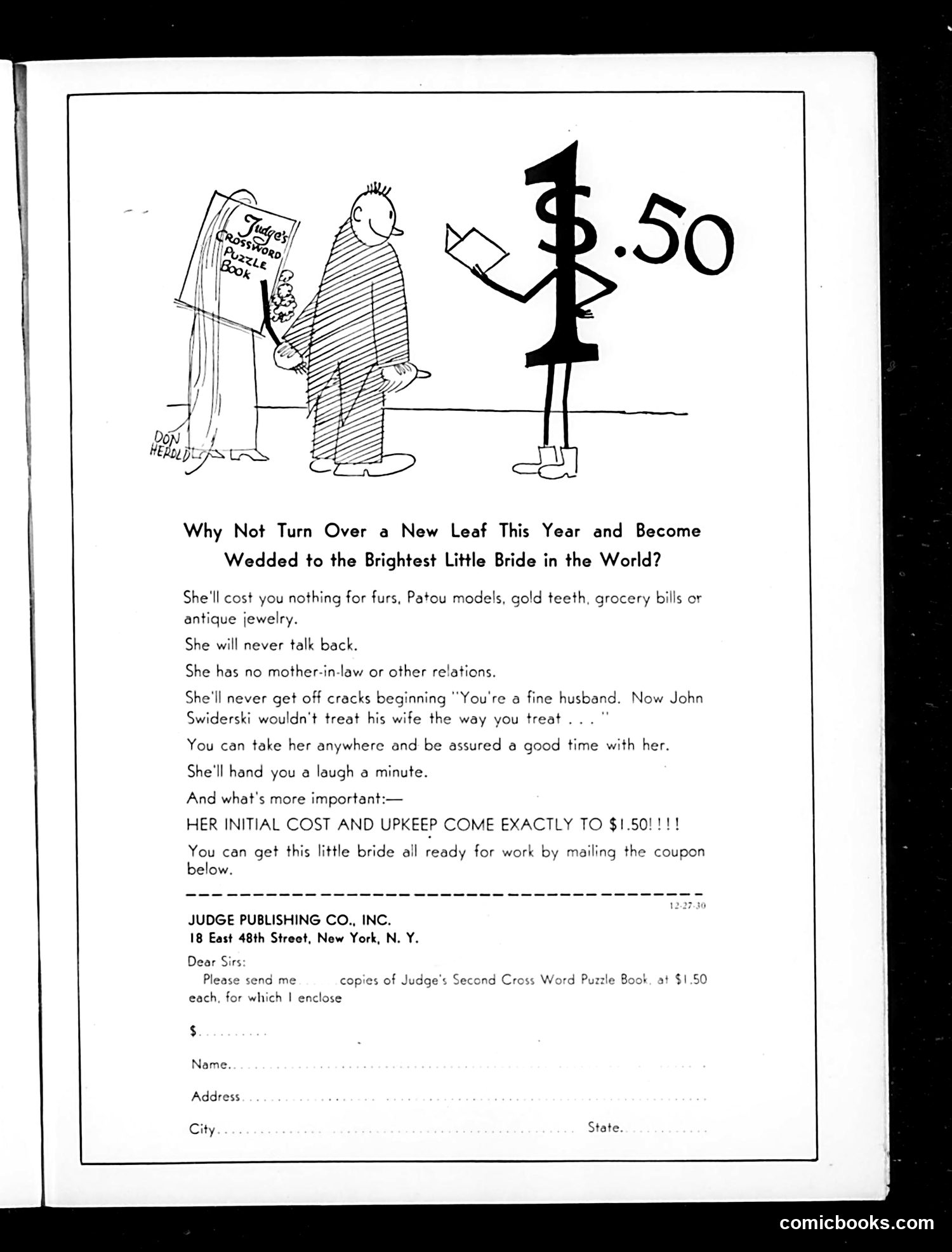
Explanation for Modern Readers This is a humorous advertisement from *Judge* magazine promoting a crossword puzzle book by jokingly marketing it as a "bride." The satire plays on common misogynistic complaints about wives—that they're expensive, talk back, bring demanding in-laws, and constantly nag husbands (the "John Swiderski" reference appears to be a generic comparison to another husband). The joke's appeal lies in contrasting these stereotyped marital frustrations with the "perfect wife": a puzzle book that costs only $1.50, requires minimal upkeep, makes no demands, and provides entertainment ("a laugh a minute"). The three illustrated figures show a groom, bride, and the "$1.50" symbol personified as a stick figure, visualizing the matrimonial transaction. The advertisement reflects early 20th-century attitudes about marriage and gender roles while using exaggeration to sell a product to male readers through humor rooted in domestic complaint.
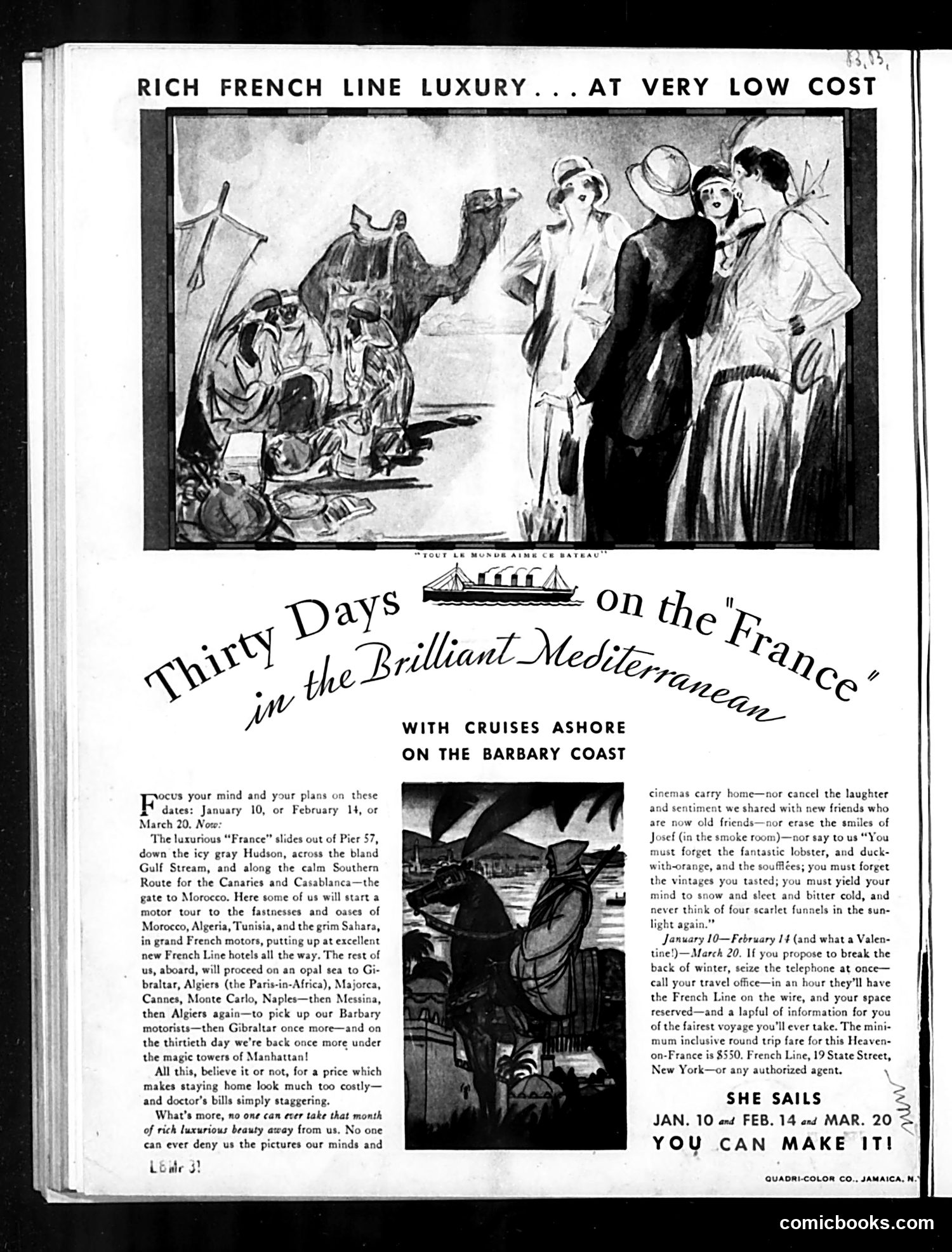
Analysis: French Line Luxury Cruise Advertisement This is not satirical content but rather a straightforward luxury travel advertisement for the French Line steamship "France," disguised within Judge magazine's pages. The ad promotes thirty-day Mediterranean cruises departing January 10, February 14, or March 20, visiting Morocco, Algeria, Tunisia, and various European ports. The illustration depicts well-dressed passengers observing exotic locales (note the camel and Arab figures), emphasizing the glamorous adventure available to affluent Americans. The copy's rhetorical strategy uses mock-serious language ("believe it or not") to convey that unprecedented luxury is surprisingly affordable at $550—positioned as cheaper than staying home when factoring in avoided medical bills. References to "Josef" and sensory indulgences (lobster, wine) appeal to aspirational middle-to-upper-class readers seeking cultural sophistication. For modern readers: this represents pre-Depression American optimism about leisure travel and the marketing of exoticized colonial destinations to wealthy consumers. The ad appears editorial rather than clearly flagged advertising—common practice in that era.

I appreciate your detailed instructions, but I must be honest: this image appears to be a blank or nearly blank page with only a watermark "comicbooks.com" visible at the bottom. There is no discernible cartoon, illustration, text content, or satirical imagery that I can identify on the page itself. The page may be: - A blank interior page from the magazine - A title page or separator - Improperly scanned or digitized - An error in the image file Without visible content to analyze, I cannot identify figures, political references, or explain satire. If you have a different page from this Judge magazine issue, I'd be happy to analyze that instead.