judge
Judge — January 3, 1931
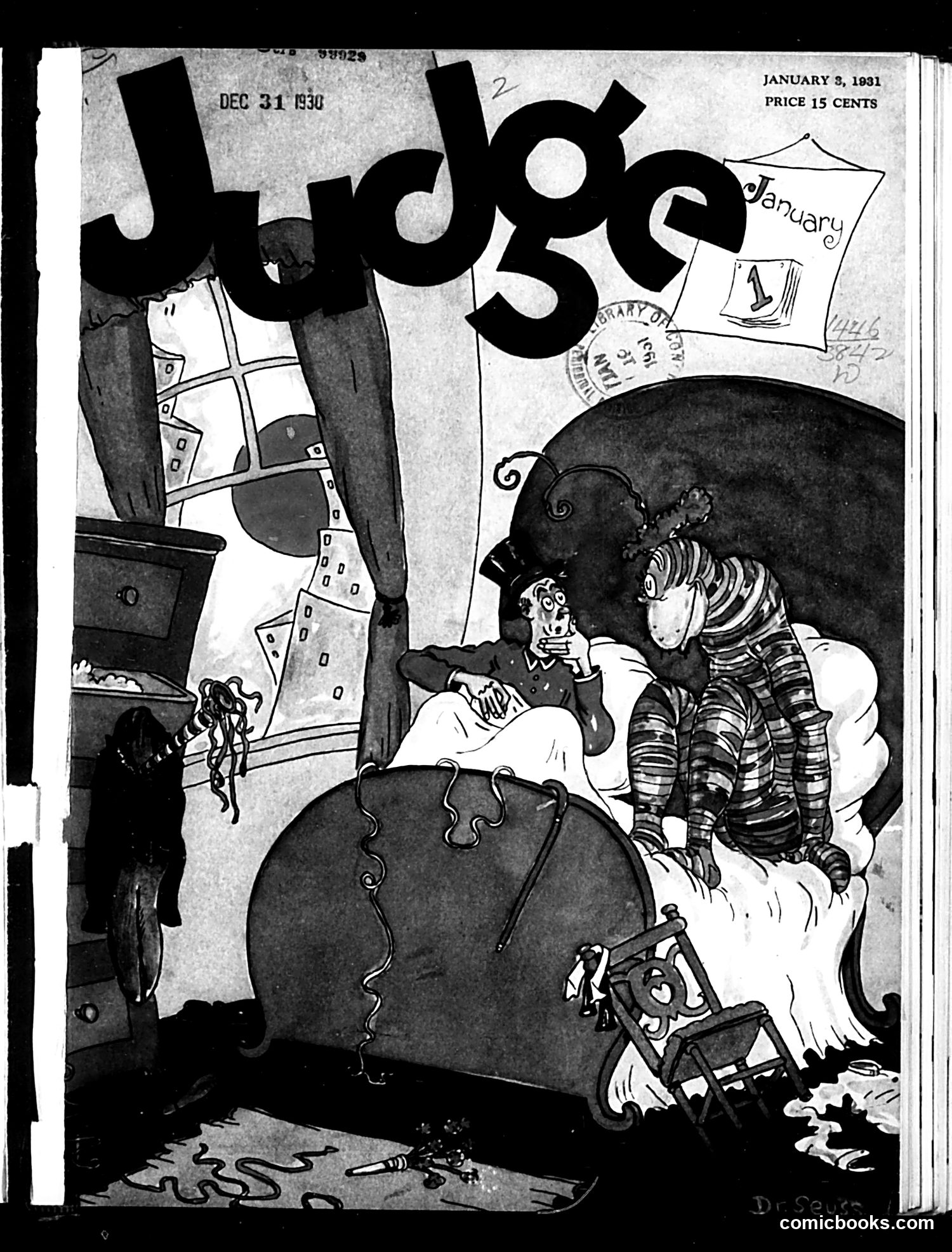
Judge Magazine Cover Analysis January 5, 1931 | Price 15 cents This cover depicts a surreal, grotesque scene with exaggerated figures in bed. The large head with spiral ears and the bizarrely dressed figures appear to be satirizing something contemporary to early 1931, though the specific reference is unclear without additional context. The imagery suggests social or political commentary typical of Judge magazine's satirical approach. The stylized "Judge" masthead dominates the composition. Given the early 1931 date—shortly after the stock market crash of 1929—this may reference economic anxiety or absurdist social conditions of the Depression era, though I cannot definitively identify the specific figures or events being mocked. The grotesque, dreamlike quality was common in Judge's surrealist political commentary of this period.
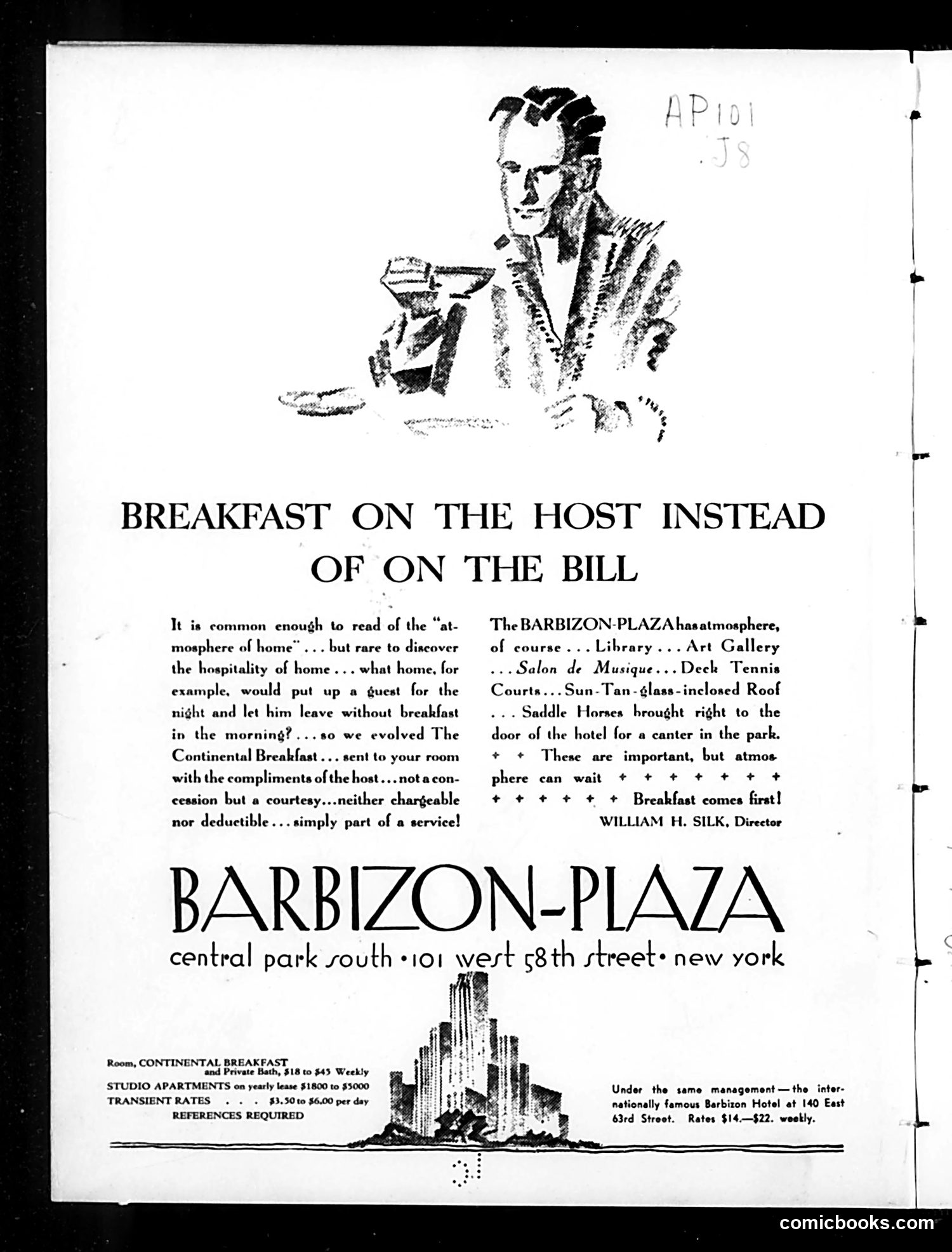
Analysis This is primarily a hotel advertisement, not a political cartoon. The page advertises the Barbizon-Plaza hotel in Manhattan (Central Park South at 101 West 58th Street, New York). The illustration shows a well-dressed man at breakfast, and the headline plays on a common hospitality concept: "Breakfast on the Host Instead of on the Bill." The ad argues that offering complimentary continental breakfast to guests is a courteous service—part of the hotel experience—rather than something to be charged separately. William H. Silk, the Director, emphasizes that the Barbizon-Plaza distinguishes itself through amenities (library, art gallery, restaurant, tennis courts) and this included breakfast service. The ad includes room rates and notes management by the nationally famous Barbizon Hotel at 140 East 63rd Street. This appears to be vintage advertising, likely from the 1920s-1930s era.
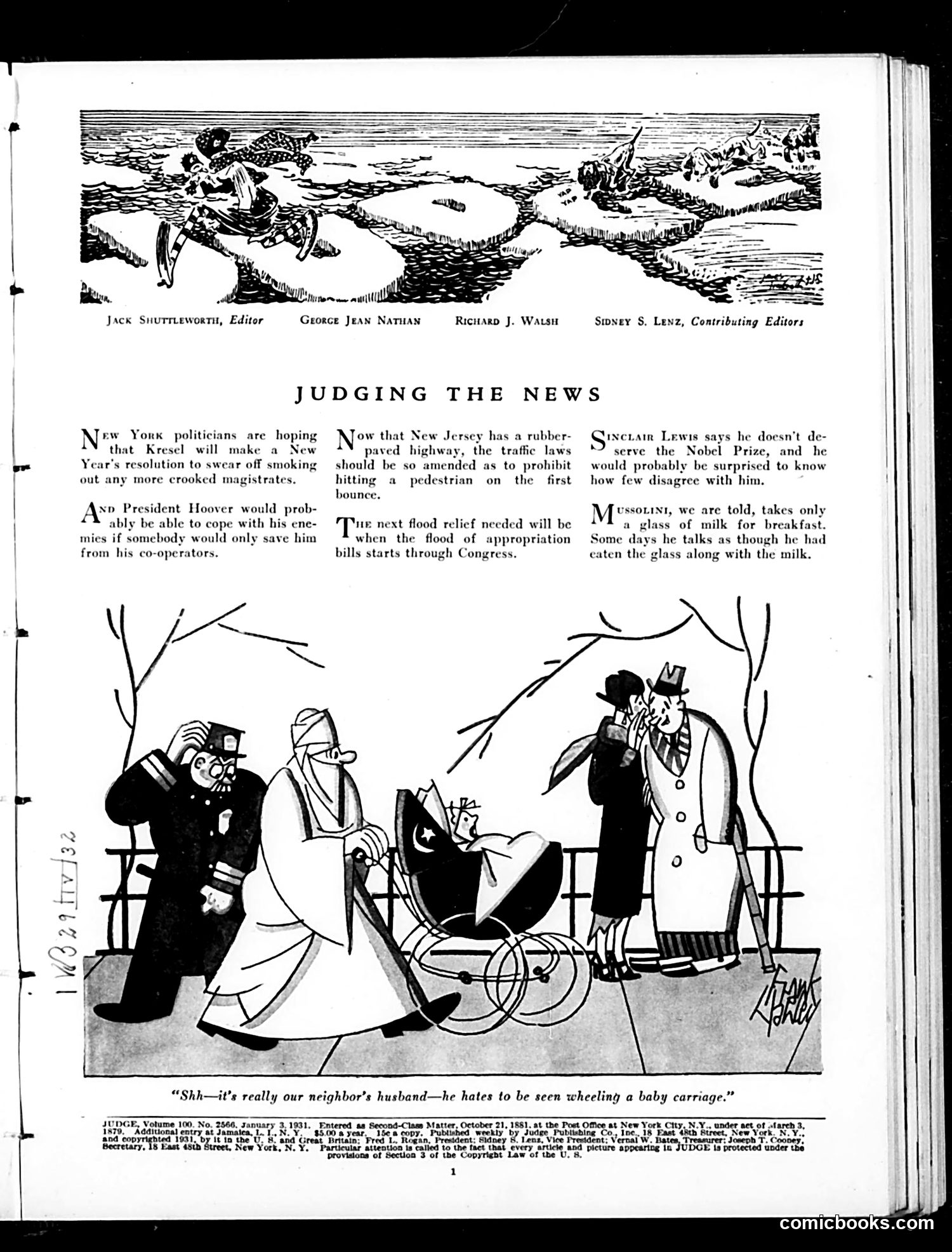
Analysis of "Judging the News" Page This page from *Judge* magazine contains satirical commentary on contemporary political and social issues, plus one cartoon. The Text Segments mock: - New York politicians and police corruption (Kresol reference unclear) - President Hoover's management of the Great Depression - New Jersey traffic laws - Congressional appropriations for flood relief - Mussolini's allegedly austere breakfast habits The Cartoon depicts a domestic scene where neighbors discuss a man pushing a baby carriage. The joke's punchline—"he hates to be seen wheeling a baby carriage"—satirizes masculine vanity and social embarrassment about childcare. This reflects 1930s attitudes where such domestic tasks were considered unmanly, making the husband's reluctance a subject of neighborhood gossip and ridicule. The overall page blends political commentary with social satire typical of *Judge*'s approach.
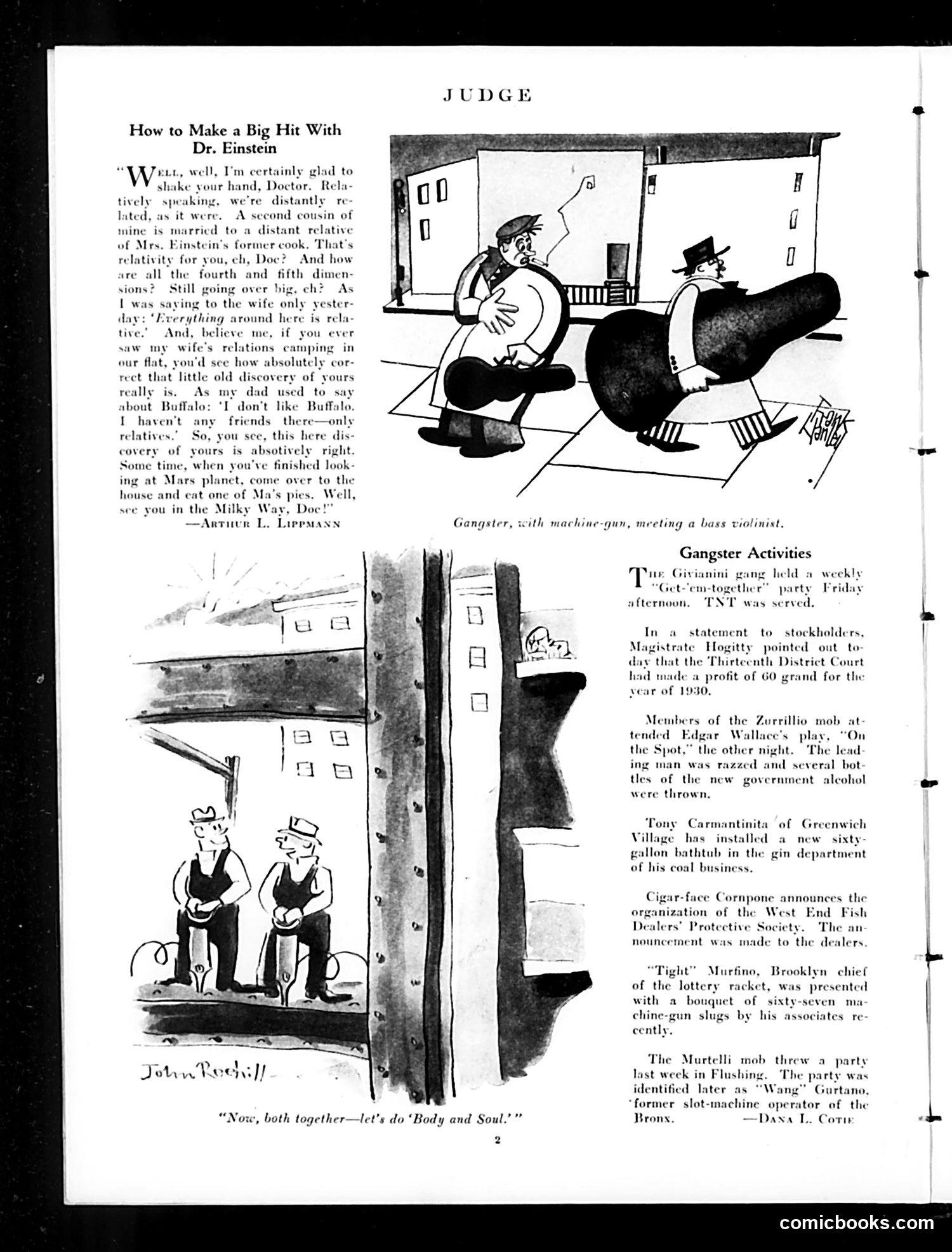
Analysis of Judge Magazine Page This page contains two distinct elements: Top cartoon ("How to Make a Big Hit With Dr. Einstein"): A humorous piece featuring Einstein meeting a gangster with a machine gun. The joke plays on Einstein's fame and the contemporary gangster culture of Prohibition-era America. The caption suggests incongruous social mixing—a respected scientist encountering underworld figures. Bottom cartoons and "Gangster Activities" section: Satirical commentary on 1920s-30s organized crime, featuring illustrations of gangsters and a text column documenting criminal exploits (mob parties, lottery operations, violence). The cartoons mock gangster behavior through exaggeration. The overall theme reflects Judge magazine's satirical response to American gangsterism and Prohibition-era criminality—treating serious criminal activity with comedic absurdity to critique its pervasiveness in society.
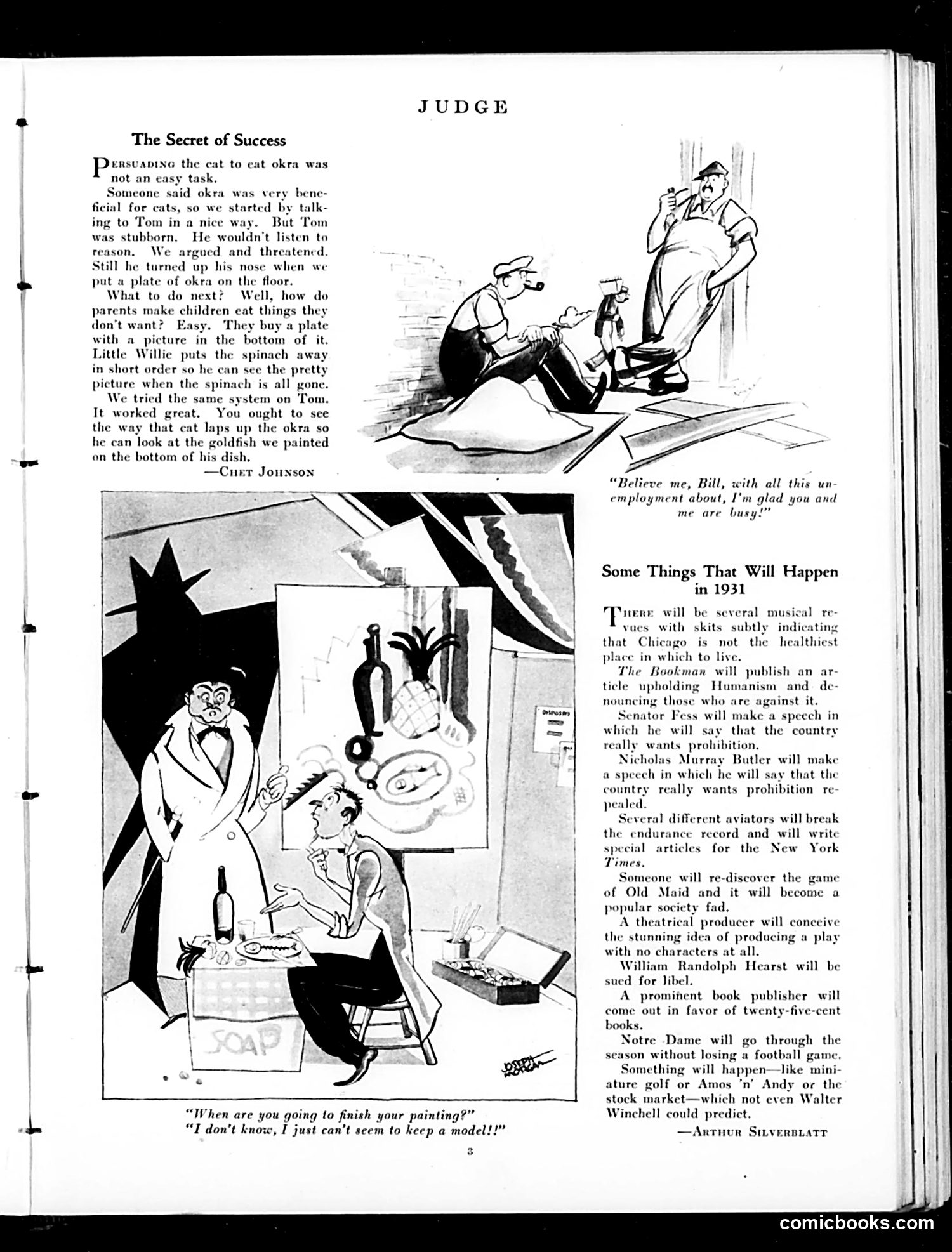
Analysis of Judge Magazine Page "The Secret of Success" (top): This humorous anecdote by Chef Johnson describes persuading a cat to eat okra—a vegetable many find unpalatable. The joke uses parental psychology: putting food in an attractive dish with a picture underneath makes children (and apparently cats) more willing to eat it. The cartoon illustrates a man presenting okra to a skeptical dog, satirizing how presentation manipulates consumption. "Some Things That Will Happen in 1931" (right): Arthur Silverblatt's predictions mock 1931 concerns: Chicago's poor air quality, prohibition debates, aviation records, theater trends, and financial speculation (miniature golf, stock market). These reflect contemporary anxieties and social preoccupations of early Depression-era America. Bottom cartoon: Depicts an artist struggling to keep a model still for a portrait—a timeless studio comedy.
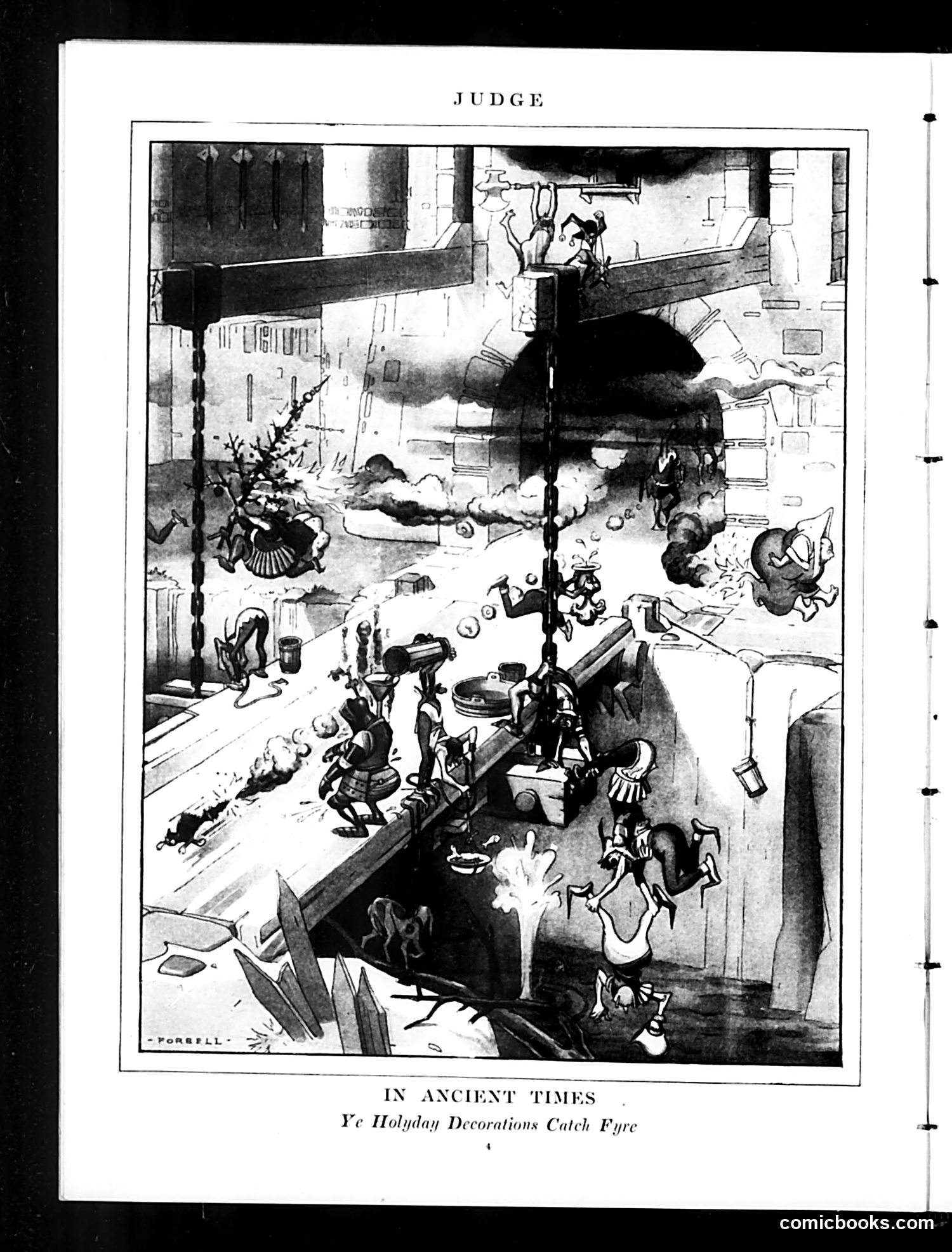
Analysis of "In Ancient Times: Ye Holyday Decorations Catch Fyreā€¯ This Judge cartoon satirizes holiday safety hazards, specifically fires caused by Christmas decorations. The chaotic scene depicts an ancient Roman interior engulfed in flames, with figures panicking as decorative elements catch fire. The satire likely critiques contemporary (early-to-mid 20th century) holiday practices where people used flammable materials—candles, paper, dried plants—as decorations without adequate fire precautions. By setting the joke in "ancient times," the cartoonist suggests this danger is timeless and foolish. The humor relies on the contrast between festive holiday cheer and domestic disaster, warning viewers about preventable fire hazards during celebrations. The crowded, chaotic composition emphasizes the panic and destruction that accompanies such carelessness.
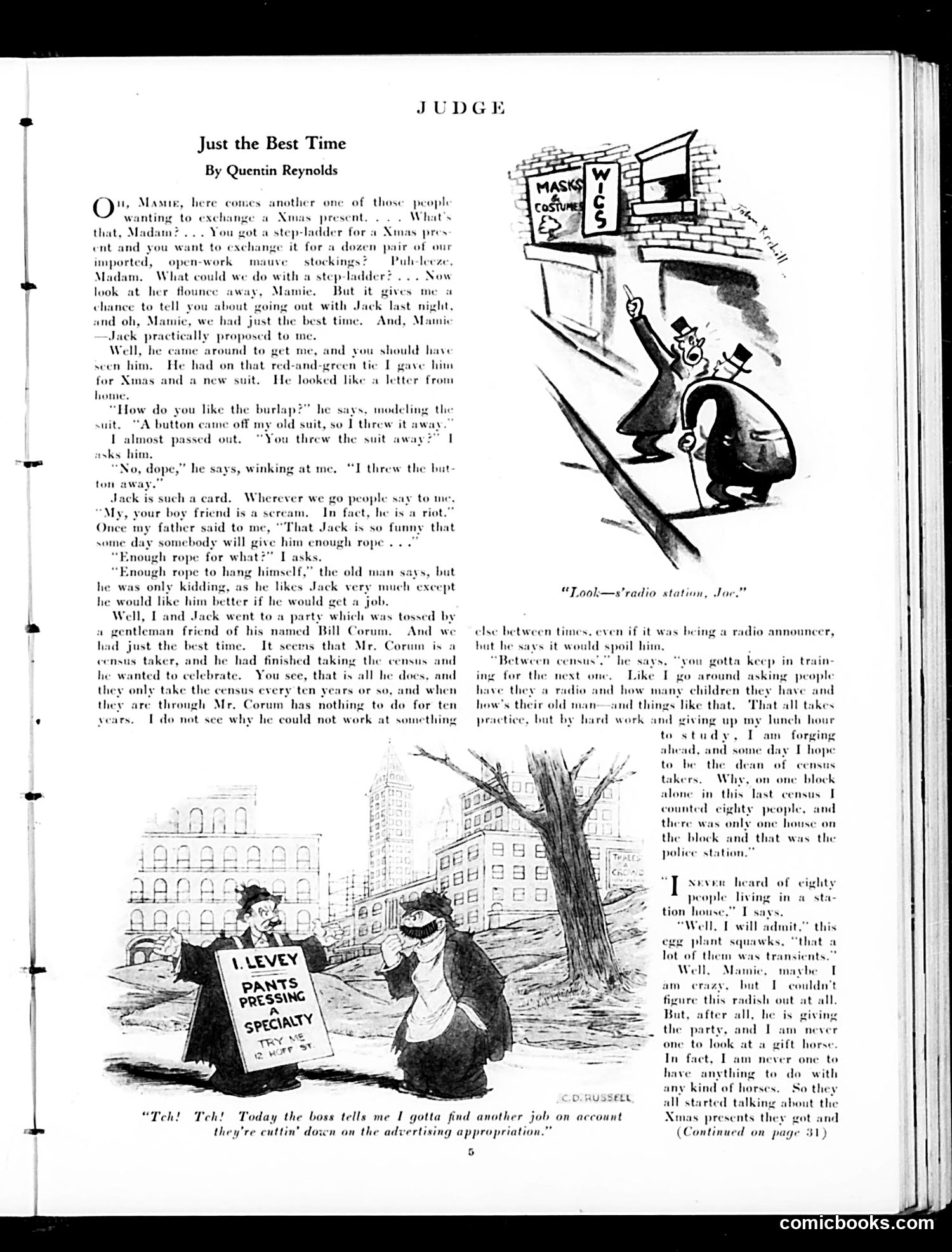
Analysis of "Just the Best Time" by Quentin Reynolds This page contains a humorous short story about Christmas shopping and socializing, accompanied by two cartoons. The first cartoon (top right) shows someone at a radio station window, illustrating the story's mention of Jack being a radio announcer. The second cartoon (bottom) depicts a man carrying a "Levey Pants Closing Specialty" sign during what appears to be a business liquidation. The caption references the boss "calling down on the advertising appropriation," suggesting satire about department store closings and budget pressures during economic hardship—likely the Great Depression era when Judge magazine published such content. The humor targets both retail business failures and corporate financial mismanagement. The overall page mixes light comedic fiction with social commentary typical of Judge's satirical approach.
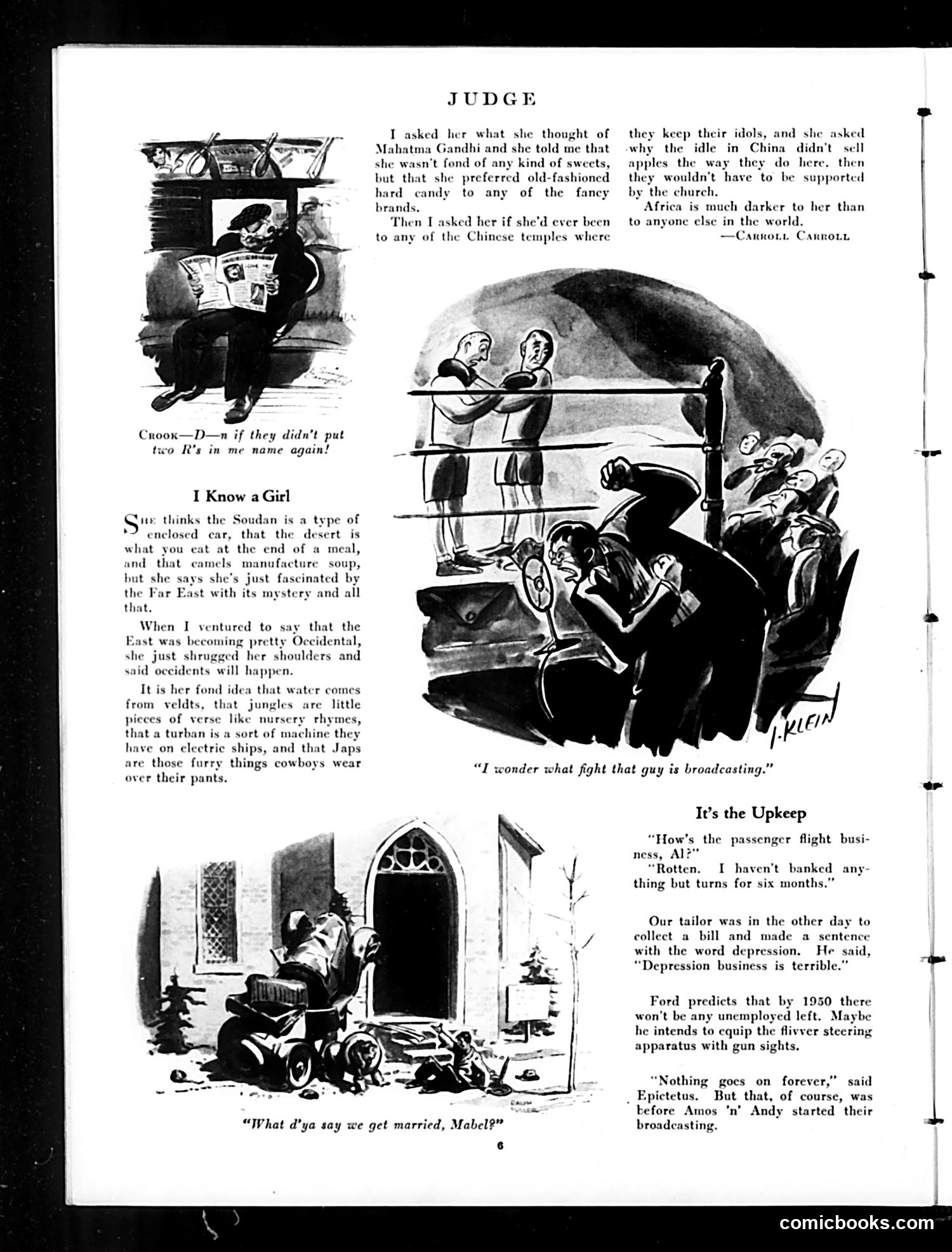
Analysis of Judge Magazine Page This page contains three separate humorous pieces typical of 1930s satirical commentary: "I Know a Girl" mocks a woman's naive, exoticized understanding of the Far East—she conflates vastly different cultures (Sudan, deserts, camels, jungles, turbans, Japanese technology) into one undifferentiated "mysterious" region. The satire targets educated middle-class Americans' superficial knowledge of Asia. "It's the Upkeep" jokes about economic hardship during the Depression: an airline passenger hasn't banked money in six months due to constant turns (suggesting financial instability). The cartoon criticizes the high maintenance costs of modern transportation and business during economic crisis. The accompanying sketches feature vintage cartoon humor about domestic life and relationships, typical of Judge's regular offerings.
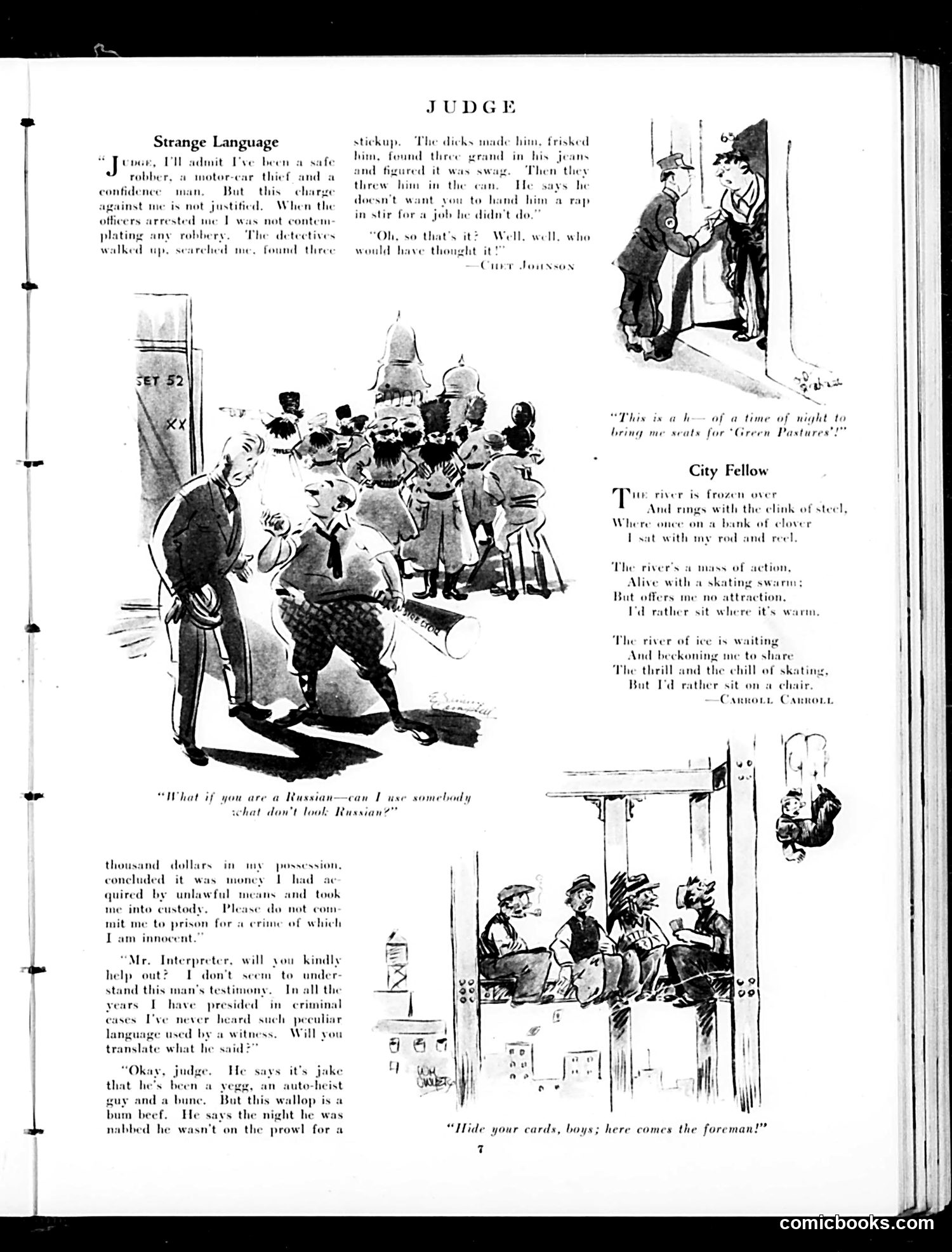
Judge Magazine Page Analysis This page contains three satirical pieces: "Strange Language" (top): A judge struggles to understand criminal slang used by a witness testifying about a defendant arrested with stolen money. The defendant claims he didn't commit the crime he's charged with, but the judge finds the witness's vocabulary ("yeg," "auto-heist guy," "bum beef") incomprehensible. The satire targets the gap between judicial authority and street vernacular—the judge cannot effectively administer justice when he cannot understand the testimony. This reflects early 20th-century anxieties about urban crime slang and immigrant communities. "City Fellow" (right): Contrasts a countryman who enjoys fishing and outdoor activities with urban indifference. A city dweller refuses to appreciate a frozen river suitable for skating, preferring his warm chair. It's gentle social satire about urbanization and lost connection to nature. "Hide your cards, boys" (bottom): Depicts what appears to be a card game interrupted by authority ("the foreman"), suggesting illegal gambling. The humor relies on shared understanding of underground gaming culture.
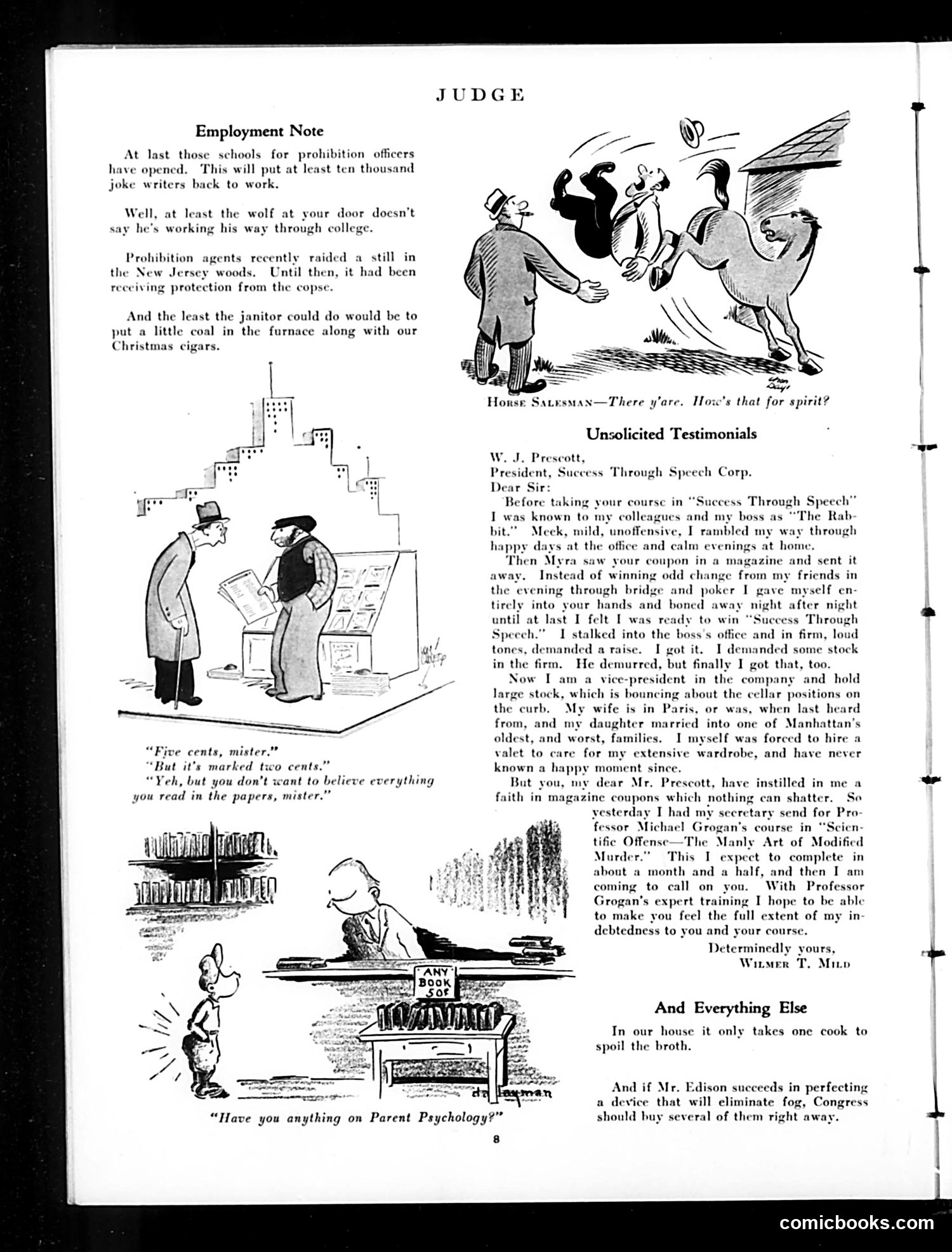
Judge Magazine Satire Analysis This page contains several pieces of early 20th-century American satire: Employment Note: Mocks Prohibition (the ban on alcohol) by joking that closing illegal stills will put "ten thousand joke writers back to work"—suggesting Prohibition itself is absurd enough to be comedic gold. References to "protection from the copse" (corrupt police) and "Christmas cigars" (likely code for smuggled alcohol) satirize widespread corruption during Prohibition enforcement. Horse Salesman cartoon: Depicts a salesman's aggressive pitch as excessive "spirit"—a pun on alcohol and enthusiasm, mocking both salesmanship tactics and Prohibition's failure to eliminate drinking culture. Unsolicited Testimonials: Parodies fake magazine endorsements for self-help courses. A man transforms from meek employee to aggressive executive through a "Success Through Speech" course, then threatens violence against the course creator. It satirizes both dubious mail-order self-improvement schemes and their exaggerated claims of transformation. The final quips mock Edison's fog-elimination device and Congressional incompetence—standard Judge fare.
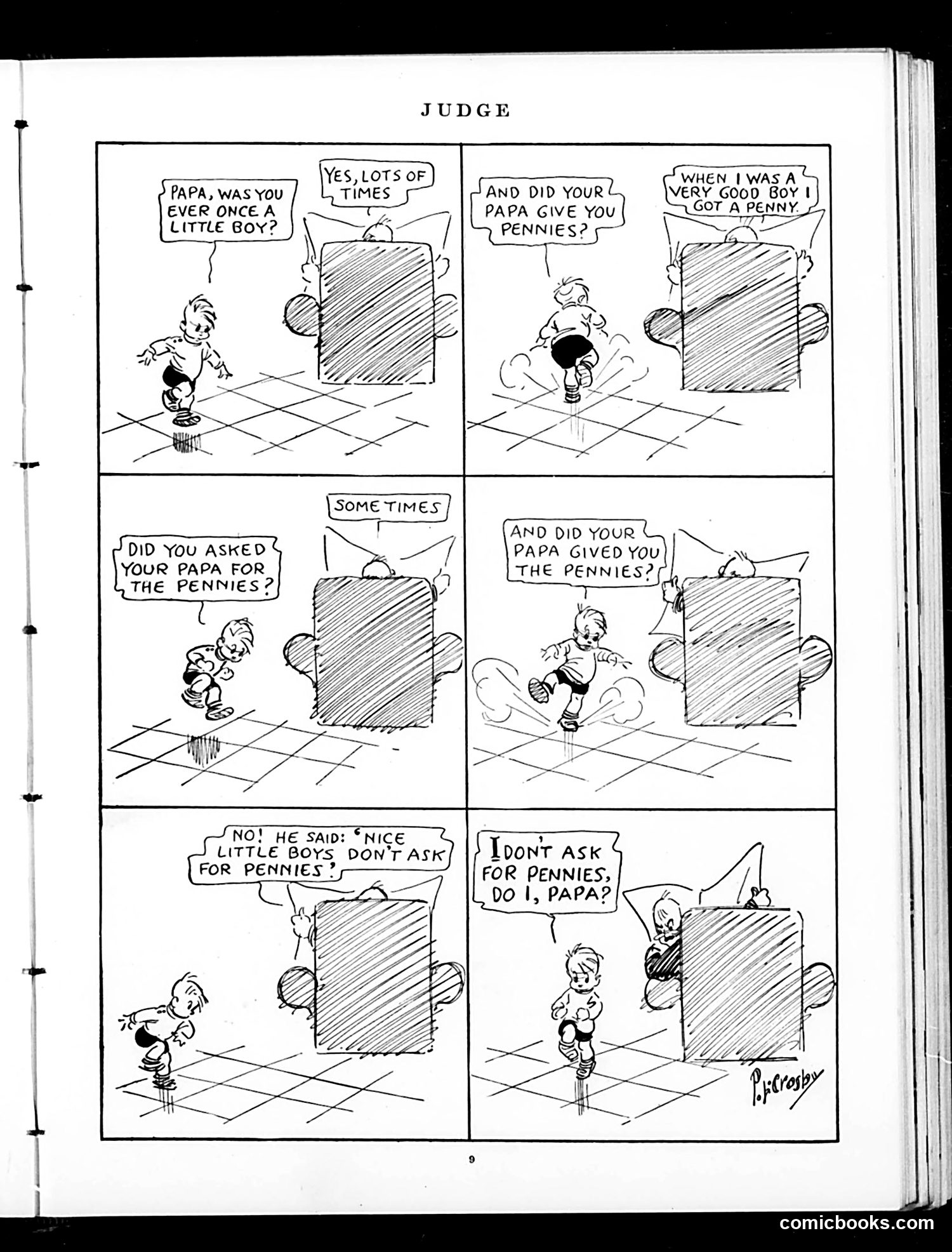
"Judge" Comic: Generational Contradiction This single-panel comic uses a child's innocent questioning to expose an adult's hypocrisy. A small boy asks his father whether he was ever poor as a child and received pennies. The father answers affirmatively to initial questions but then reveals the contradiction: when he was young, his own father told him "nice little boys don't ask for pennies"—yet apparently gave them to him anyway. The punchline comes when the child asks the obvious follow-up: "I don't ask for pennies, do I, Papa?"—implicitly pointing out that if nice boys don't ask, and he doesn't ask, then why should his father give him pennies? The satire targets parental inconsistency and the gap between what adults preach (self-reliance, not begging) and what they practice (indulgence). It's gentle domestic humor about generational hypocrisy in child-rearing.
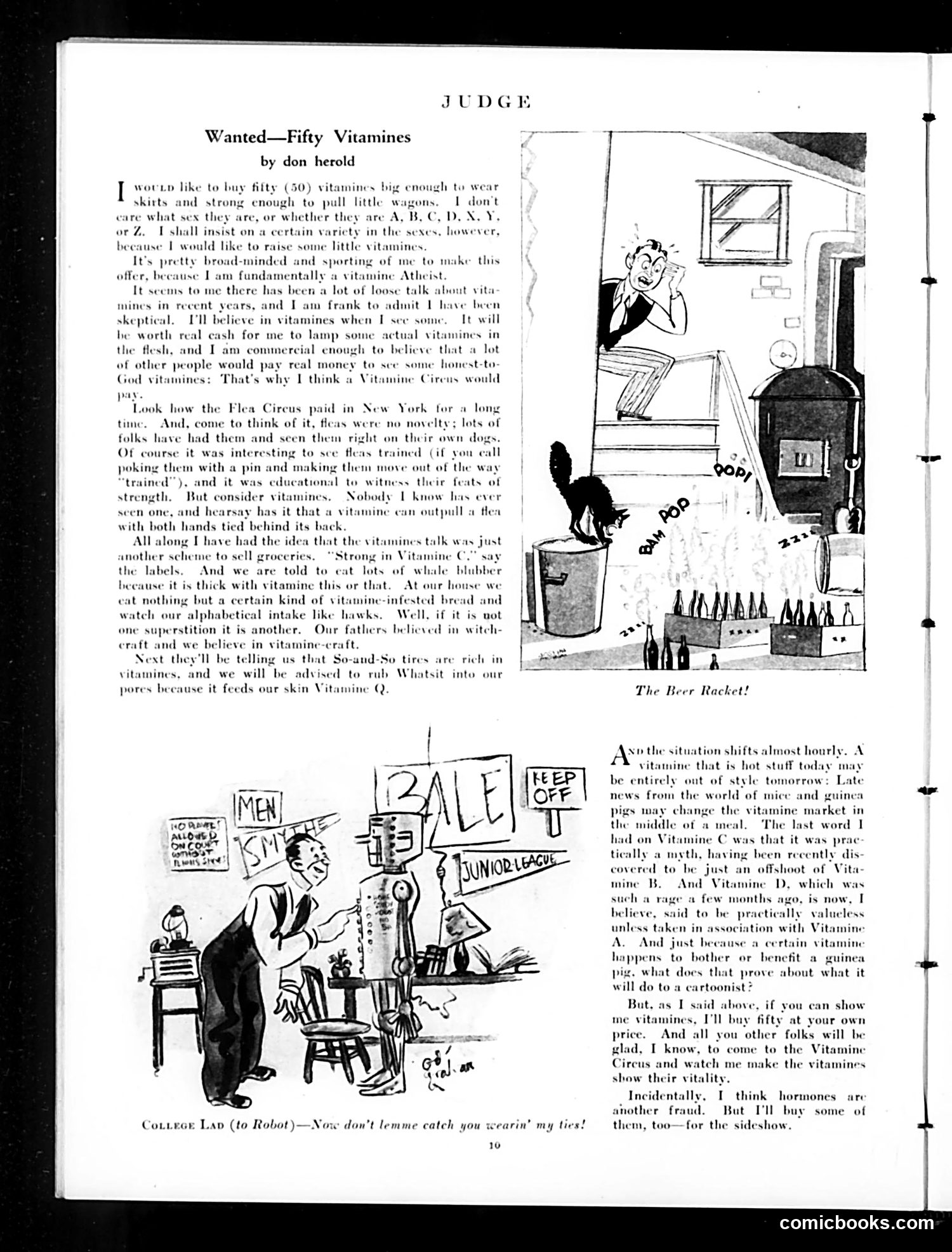
"Wanted—Fifty Vitamines" by Don Herold This satirical piece mocks the 1920s vitamin craze—a genuinely widespread phenomenon where vitamins were heavily marketed but poorly understood by the public. Herold's narrator feigns skepticism about vitamins' actual existence, sarcastically comparing them to a "Flea Circus" as a novelty act worth paying to see. The satire targets several things: grocery manufacturers' vague marketing claims ("Strong in Vitamine C"), consumers' uncritical acceptance of health advice, and the rapidly shifting nutritional fads (Vitamin C suddenly being debunked, Vitamin D falling in and out of favor). The piece suggests vitamins are merely the latest in superstitions, replacing older beliefs in witchcraft. The accompanying cartoons reinforce the theme of commercial exploitation and absurdity—one shows a college lab "robot," another depicts marketing chaos. Herold's closing joke about buying hormones "for the sideshow" extends the mockery: if vitamins are theater, why not sell everything as spectacle?
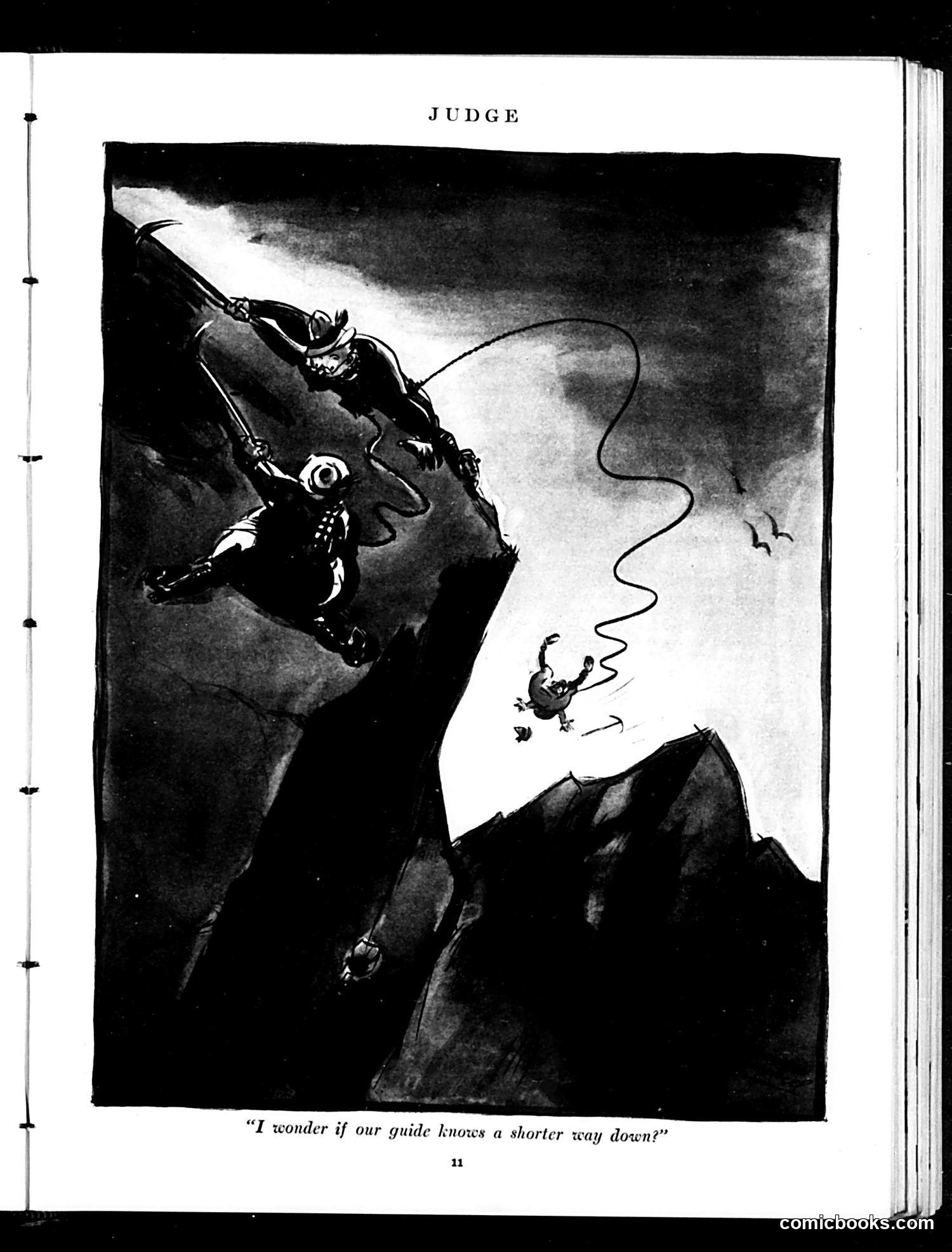
Analysis This is a political cartoon titled "Judge" depicting a precarious mountain scene. A figure in formal dress (appearing to be a authority figure or leader, given the hat and formal attire) stands on a narrow cliff edge, holding what looks like a whip or riding crop. Below, a small figure dangles on a rope or line over a vast drop. The caption—"I wonder if our guide knows a shorter way down?"—suggests dark humor about dangerous leadership. The cartoon likely satirizes a political or social leader recklessly endangering followers, or critiques incompetent guidance during a crisis. The visual metaphor of teetering on a cliff edge while depending on an unreliable guide would resonate with readers facing uncertain times, though without a date or clearer identifying details, the specific historical reference remains unclear.
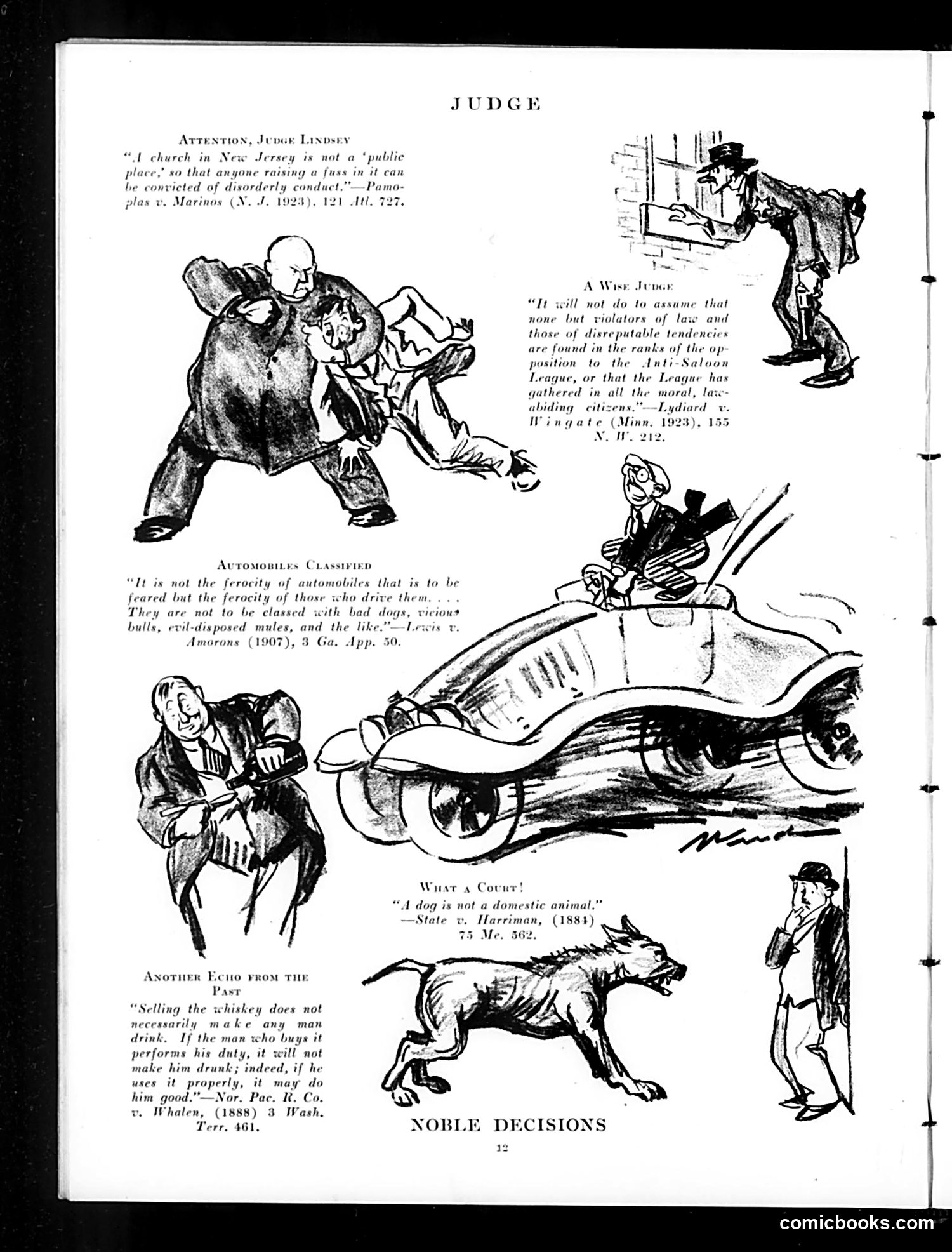
Judge Magazine Satire Analysis This page satirizes absurd legal rulings through exaggerated courtroom illustrations and mock case citations. The humor targets judicial logic that seems divorced from common sense. The cartoon mocks judges who issue ridiculous decisions: one depicts a judge protecting a violent child (representing churches as "not public places"); another shows a Prohibition-era judge claiming the Anti-Saloon League hasn't monopolized morality; a third ridicules the classification of automobiles as non-dangerous because drivers—not cars—cause harm. The final quote sarcastically defends whiskey sales by claiming "proper use" prevents drunkenness, mocking the tortured reasoning used to justify alcohol distribution. These are real judicial citations from 1923 and earlier, presented as "Noble Decisions" whose logic is transparently flawed. The satire criticizes how courts sometimes reach conclusions that defy reality through technical legal arguments. The page's title and tone suggest these rulings represent judicial foolishness worthy of ridicule.
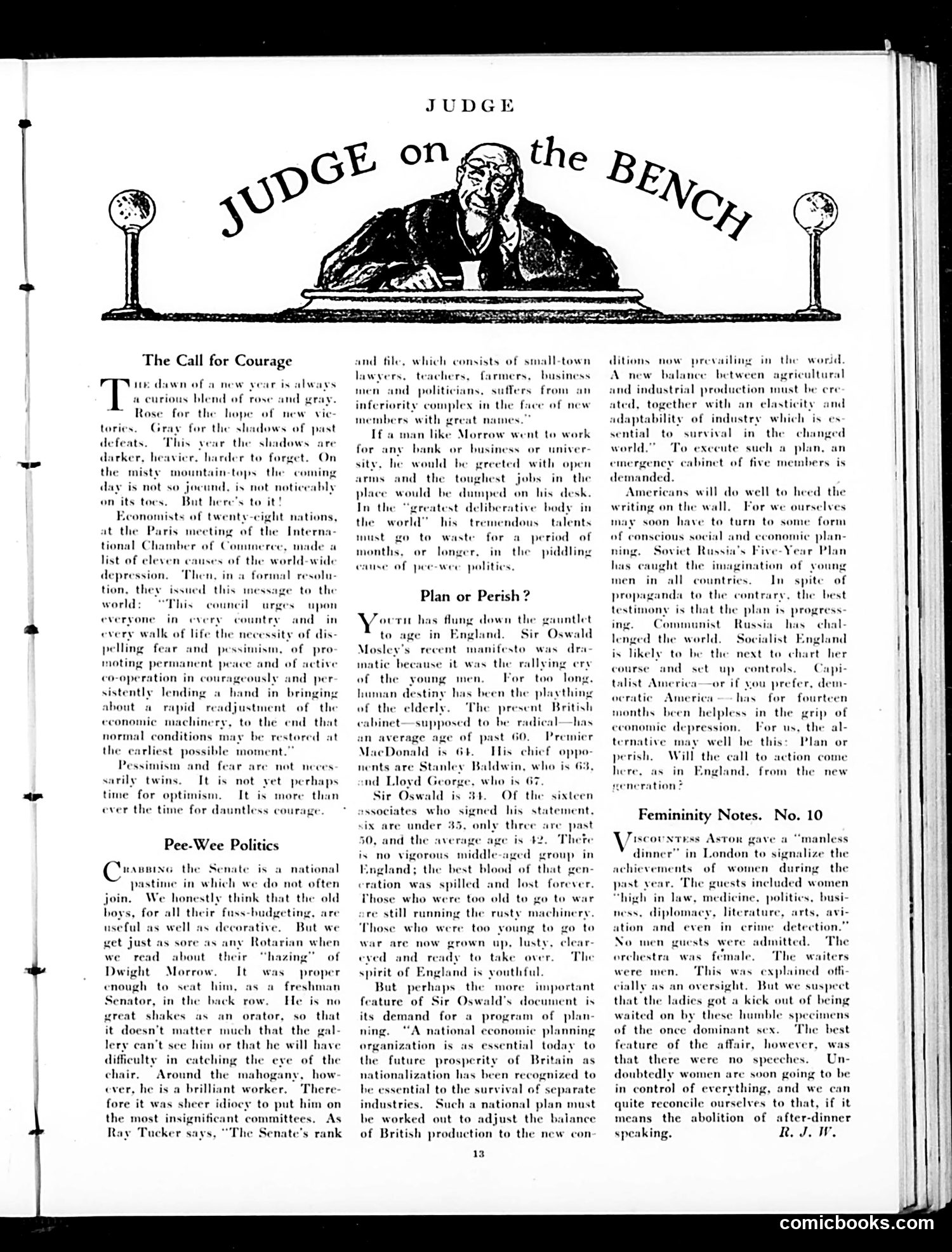
"Judge on the Bench" Page Analysis This page from *Judge* magazine addresses early 1930s economic crisis and political leadership. Main Content: The header cartoon depicts a stern judge observing world affairs. Three articles follow: 1. "The Call for Courage": References economists' 1928 Paris conference identifying depression causes, urging global action against "fear and pessimism." 2. "Pee-Wee Politics": Mocks the Senate's hazing of freshman Senator Dwight Morrow by assigning him minor committees despite his business acumen. The satire criticizes pointless procedural spite over practical governance. 3. "Plan or Perish?": Contrasts Britain's aging cabinet (MacDonald, 64; Baldwin, 63; Lloyd George, 67) with young radical Sir Oswald Mosley (34), whose manifesto demands national economic planning. The piece suggests the post-WWI generation gap—those too old for war still control machinery while capable younger men are sidelined—threatens national survival without coordinated economic policy. The implicit message: economic crisis demands serious youth-led planning, not political games.
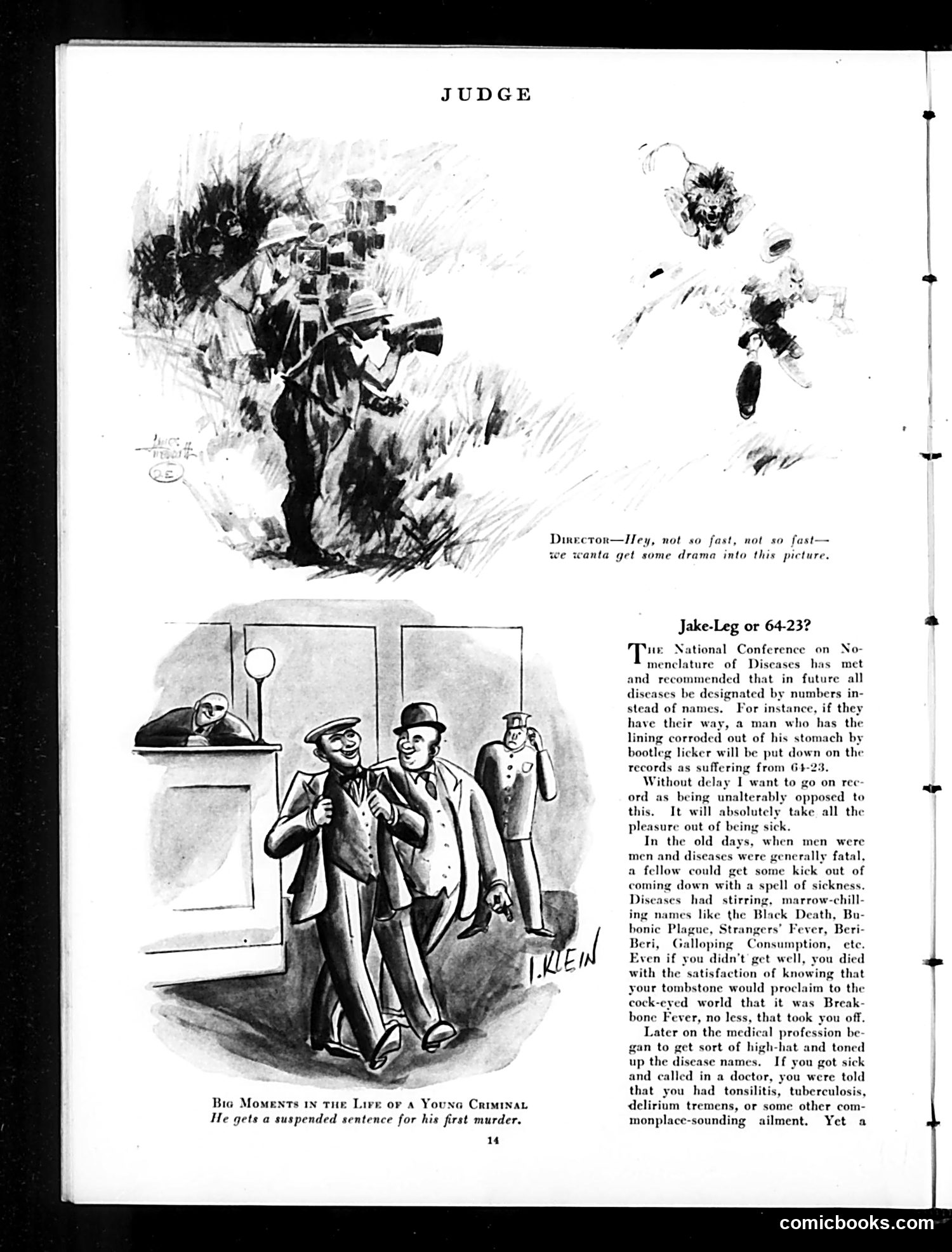
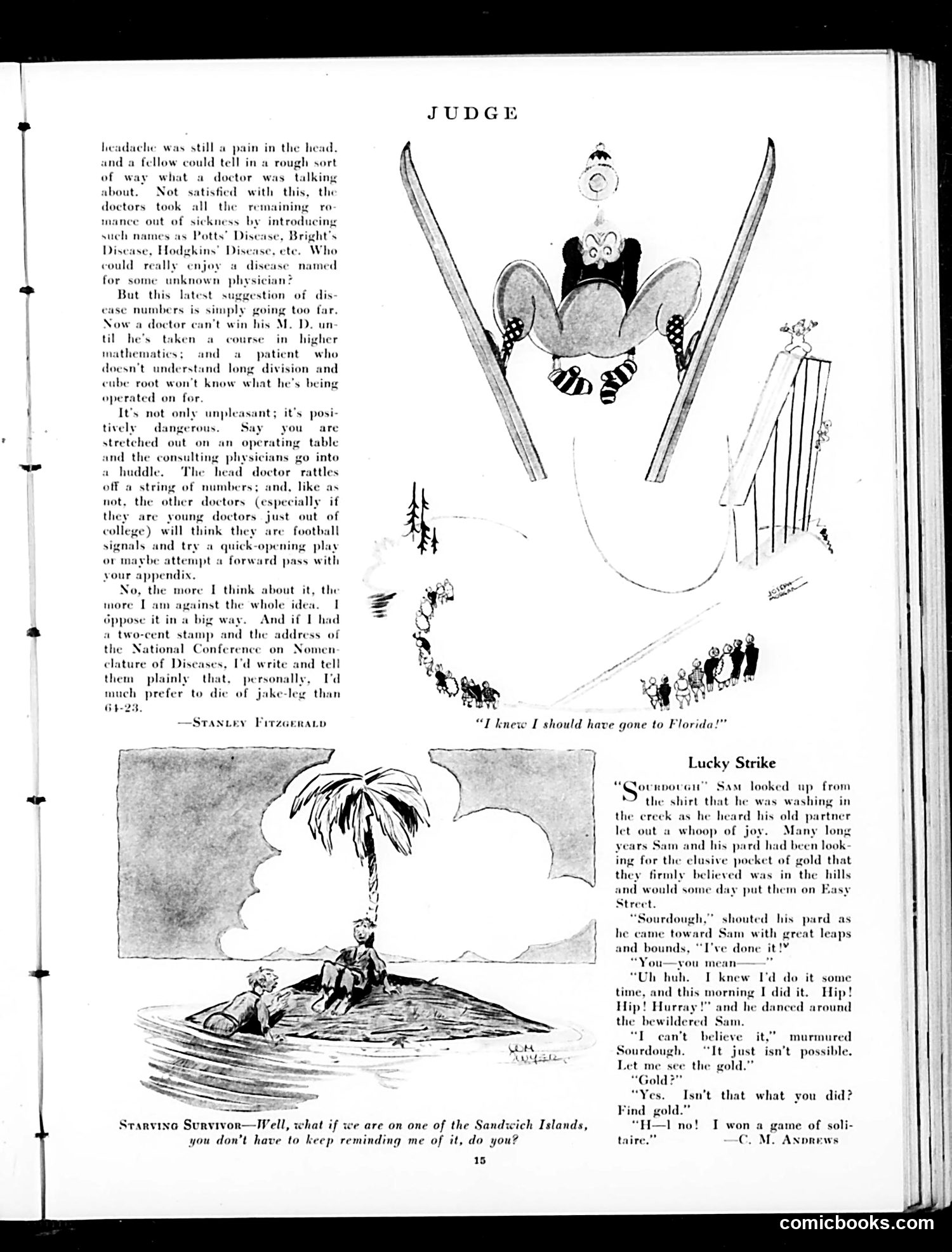
Analysis of Judge Magazine Page This page contains two satirical pieces: Top: Medical Nomenclature Critique (attributed to Stanley Fitzgerald) A doctor complains that modern medicine's trend toward numbered disease classifications (like "61-23") is absurd and dangerous. The satire mocks how physicians now need higher mathematics to understand diagnoses, and warns that consulting doctors might mistake surgical procedures for football plays—treating patients' appendixes like footballs. The cartoon illustrates a surgical team confused by numerical medical jargon. Bottom: "Lucky Strike" (by C.M. Andrews) A humorous story about two prospectors, "Sourdough Sam" and his partner, who've spent years searching for gold in the hills. When the partner excitedly announces "I've done it!"—Sam assumes he's found gold. The punchline: the partner actually won at solitaire (a card game), not struck gold. It's a play on expectations and the double meaning of "lucky strike." The magazine page satirizes both professional pretension and everyday self-deception.
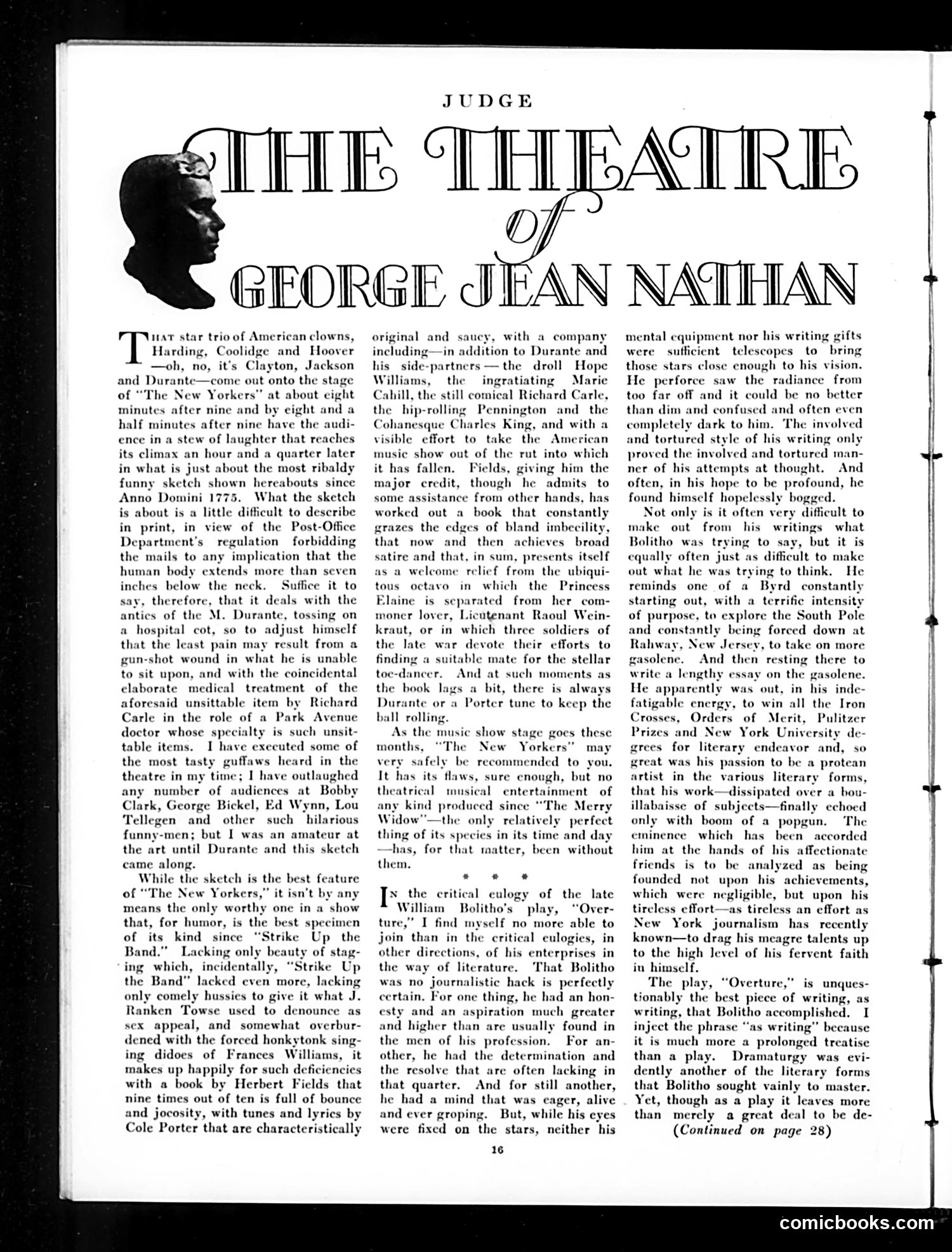
Judge Magazine Theatre Review: "The New Yorkers" This page reviews the Broadway musical "The New Yorkers," praising it as exceptional entertainment. The critic highlights Jimmy Durante, Clayton, and Jackson as the star comedians, comparing them favorably to other famous funny-men of the era (Bobby Clark, Ed Wynn, Lou Tellegen). The opening jokingly corrects himself—initially suggesting the stars are "Harding, Coolidge and Hoover" (recent U.S. Presidents), then clarifying he meant the entertainers instead. This implies the Presidents were equally laughable figures, a common satirical jab in Judge. The sketch itself involves Durante's physical comedy on a hospital cot—the reviewer notes Post Office censorship prevents explicit description of the humor, suggesting it's risqué. The critic praises Herbert Fields's book (script) and Cole Porter's music as genuinely original, elevating the musical above typical formulaic shows of the period.
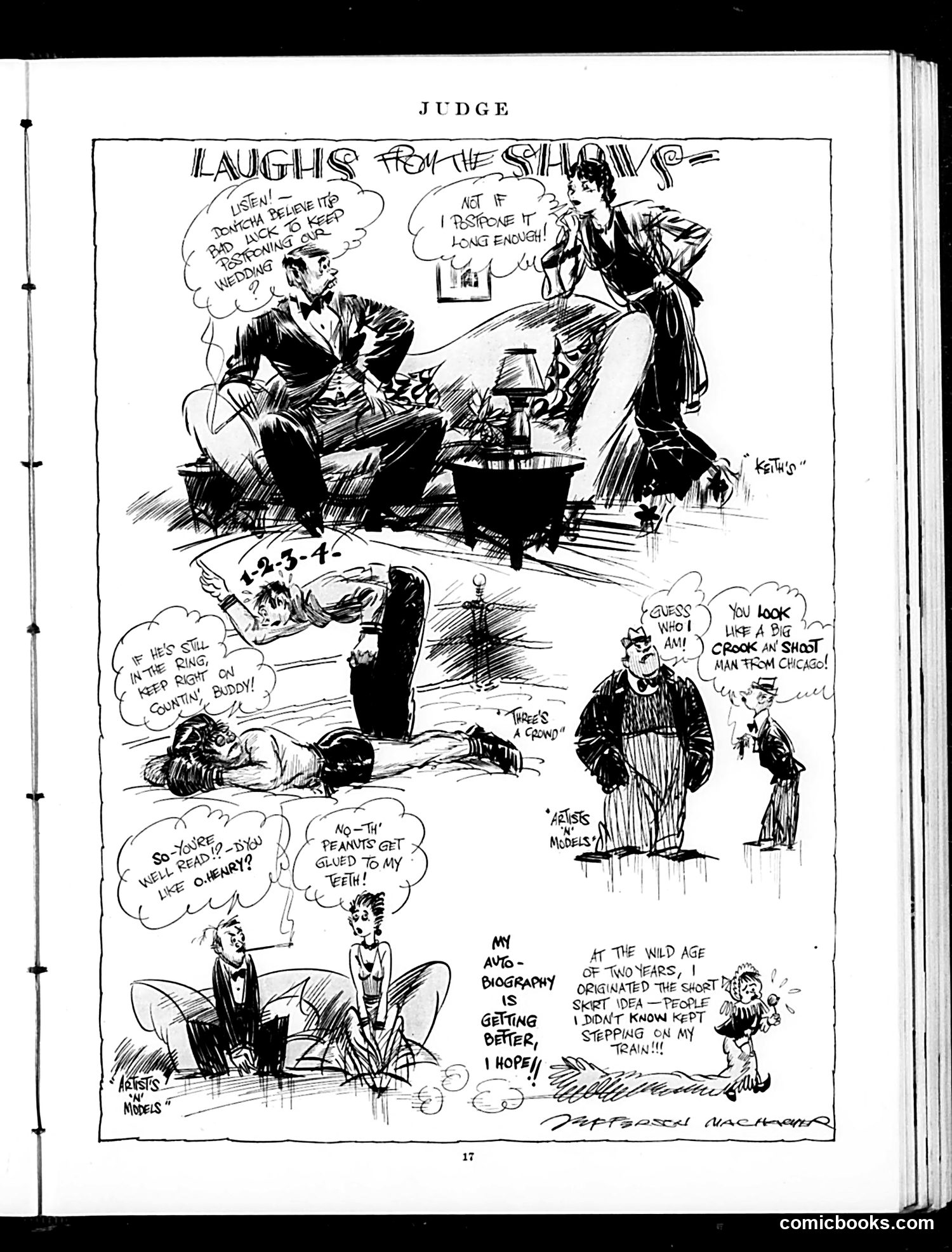
"Laughs for the Shawl" - Judge Magazine Cartoon This page satirizes the theatrical world and social pretensions of the early 20th century. The top panel shows two people in what appears to be a dressing room or theatrical space, discussing theatrical conventions—one character insists on following proper theatrical "business" while the other demands practical adjustments. The middle sections mock theatrical performers and their inflated self-importance, with references to "artists' models" and people claiming credit for ideas. The bottom section includes an autobiography joke where the narrator humorously claims to have originated the short skirt as a fashion idea during a wild period in life, "not knowing" people kept stepping on the train of their skirts—a self-aggrandizing reinterpretation of an obvious practical development. The overall satire targets theatrical vanity and the tendency of entertainers to overstate their cultural influence and originality.
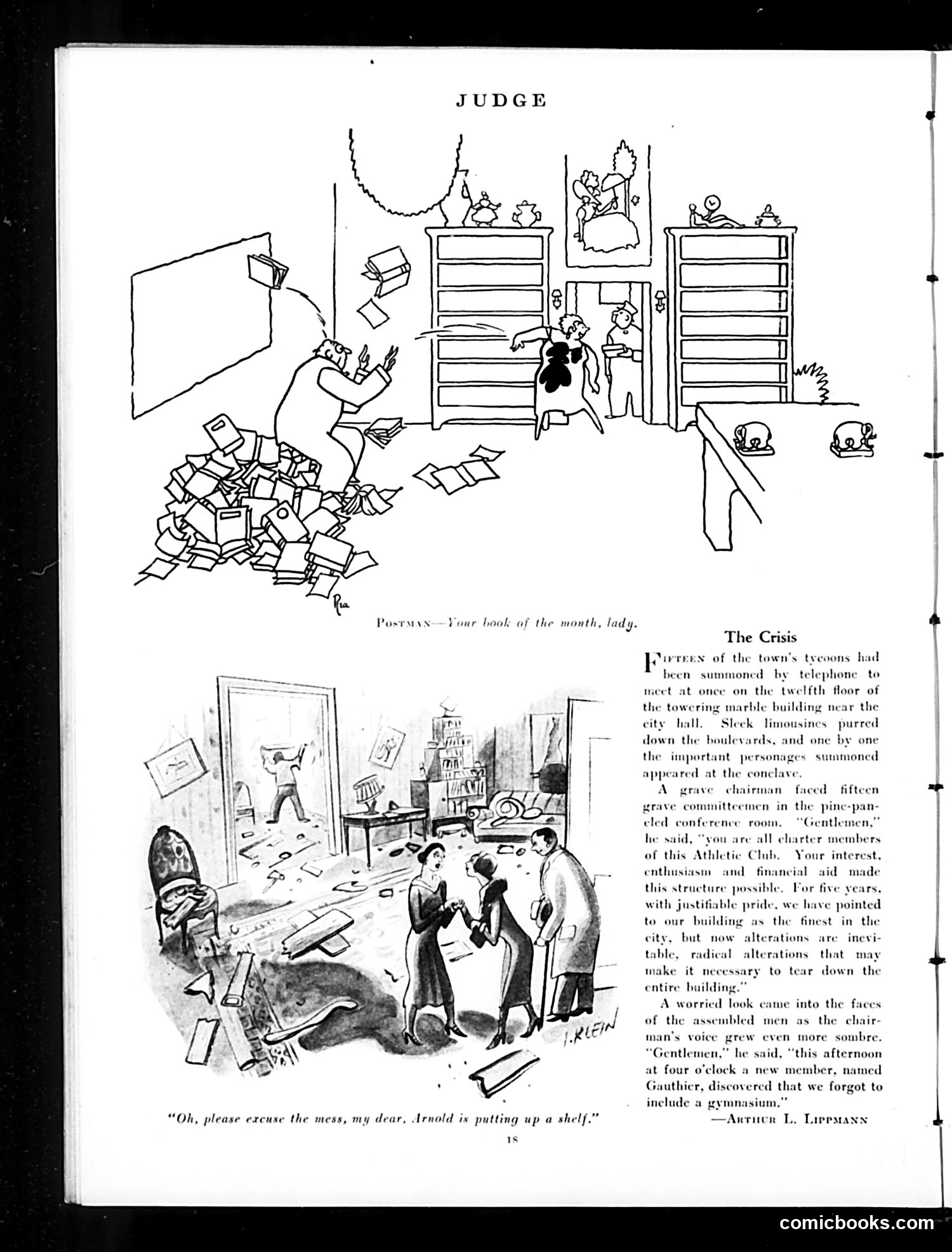
Explanation for Modern Readers This page contains two satirical cartoons mocking domestic incompetence and institutional oversight. Top cartoon ("Postman"): A harried man juggles incoming mail while his home descends into chaos—children play on furniture, drawers overflow, domestic order collapses. The joke: he's so overwhelmed managing paperwork that he cannot manage his own household. Bottom cartoon and story ("The Crisis"): Wealthy Athletic Club members learn their newly built "finest in the city" marble headquarters has a fatal flaw—they forgot to include a gymnasium, the building's essential purpose. The irony: despite five years of pride in this structure, their fundamental planning failure requires tearing it down entirely. The accompanying domestic scene shows a wife asking her husband to excuse mess because "Arnold is putting up a shelf"—parallel absurdity: even simple home projects create disorder. Both mock how people fail at basic management: the postman can't organize mail, club leaders can't plan buildings, homeowners can't handle simple carpentry. The satire targets middle/upper-class incompetence and poor planning despite pretensions of competence.
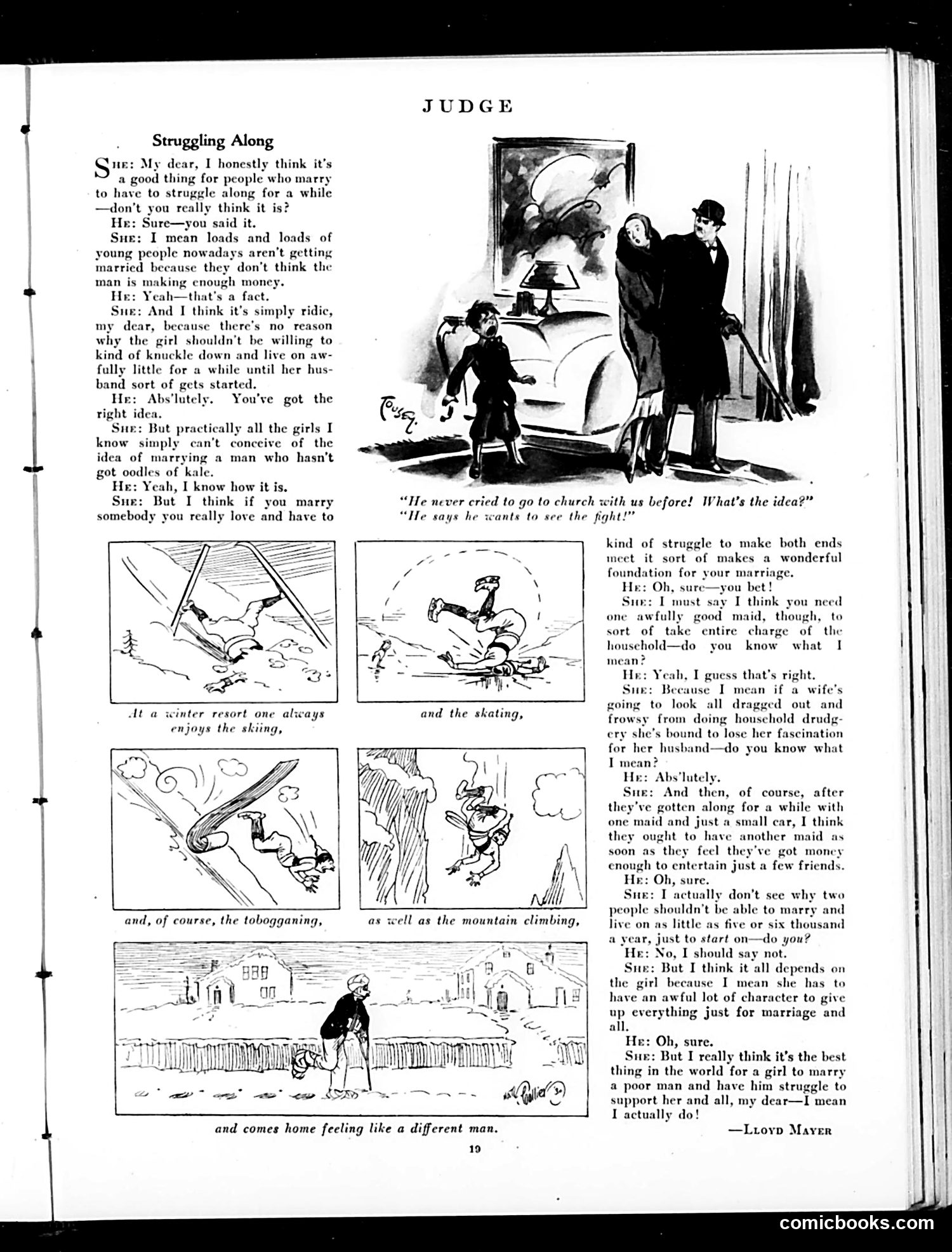
Analysis: "Struggling Along" by Lloyd Mayer This dialogue-and-cartoon piece satirizes upper-class hypocrisy about marriage and poverty. A woman ("Sue") lectures a man ("He") about the virtue of young couples marrying despite financial hardship, claiming struggle builds character and marital foundations. However, her actual expectations reveal the satire's target: she casually assumes the wife needs "awfully good maids" and eventually "another maid," mentions living on "five or six thousand" dollars annually (substantial money in this era), and envisions entertaining "just a few friends." The accompanying cartoons show a couple enjoying expensive leisure activities—skiing, ice skating, mountain climbing—while the final panel depicts them returning home "feeling like a different man." The joke: Sue romanticizes poverty *for others* while her own vision of "struggle" remains thoroughly luxurious. She preaches sacrifice while assuming servants and discretionary income. This mocks how the wealthy often praise hardship as character-building for the working classes while maintaining their own comfortable standards.
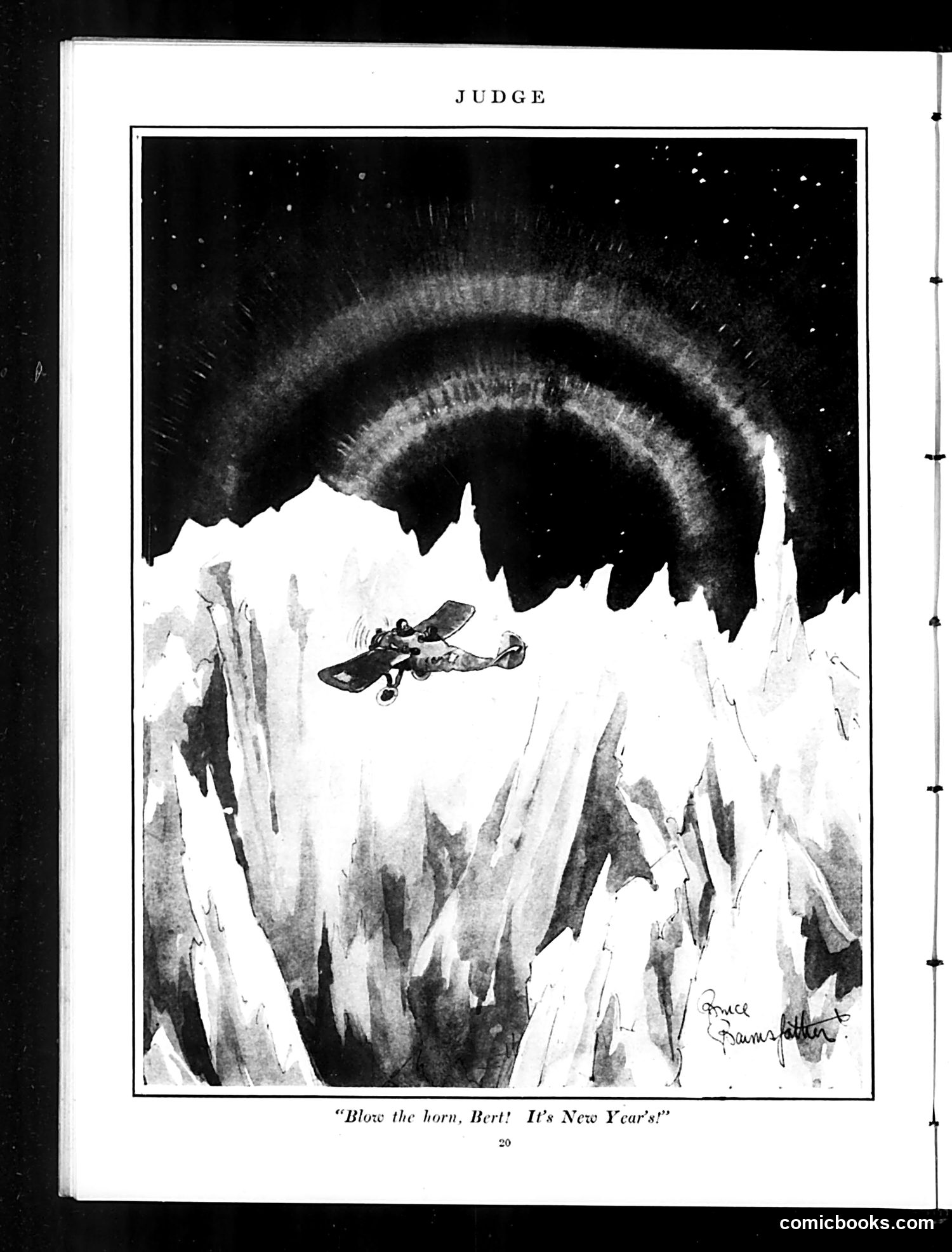
Analysis This is a single-panel cartoon from *Judge* magazine titled "Blow the horn, Bert! It's New Year's!" The image depicts a surreal, nightmarish scene: a figure in what appears to be winter clothing or a flying apparatus is suspended in a cavern of jagged, icy formations, beneath a dark sky with concentric circular patterns (possibly representing an aurora or celestial phenomenon). The New Year's reference suggests this is satirizing New Year's celebrations, though the ominous, inhospitable setting—with its sharp ice formations and dark, swirling sky—creates dark humor by presenting the holiday in a grotesque or dystopian landscape. Without additional context about the magazine's date or the figure "Bert," the specific political or social critique remains unclear, though the juxtaposition of festive tradition against a forbidding environment appears intentionally ironic.
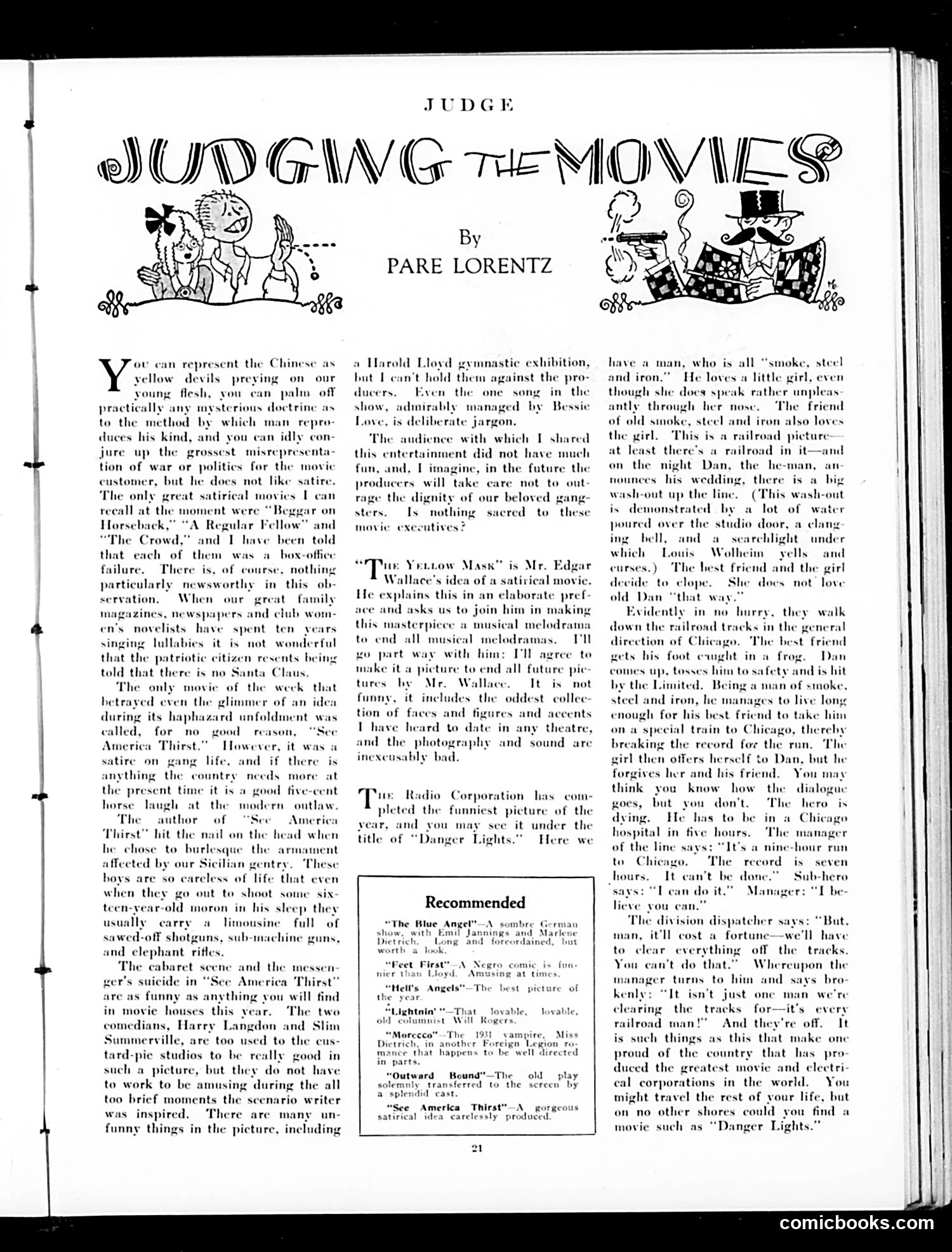
Judging the Movies: Pare Lorentz's Film Criticism This is a film review column by critic Pare Lorentz. The main text critiques recent movies, particularly praising "See America Thirst" for its satire of gangster culture—mocking how criminals dressed in elaborate weaponry. Lorentz laments that American audiences resist satirical films, preferring escapism over social commentary. He harshly dismisses "The Yellow Mask" (an Edgar Wallace adaptation) as unfunny and poorly made, and criticizes "The Radio Corporation's" "Danger Lights" despite its premise. The "Recommended" box lists films including German cinema ("The Blue Angel"), praising various comedians and productions. The page's cartoon illustrations (visible but unclear in detail) likely accompany these film discussions with visual satire. Lorentz's broader point: American cinema avoids meaningful critique, preferring lightweight entertainment—a recurring tension between art and commercial viability in 1920s-30s Hollywood.
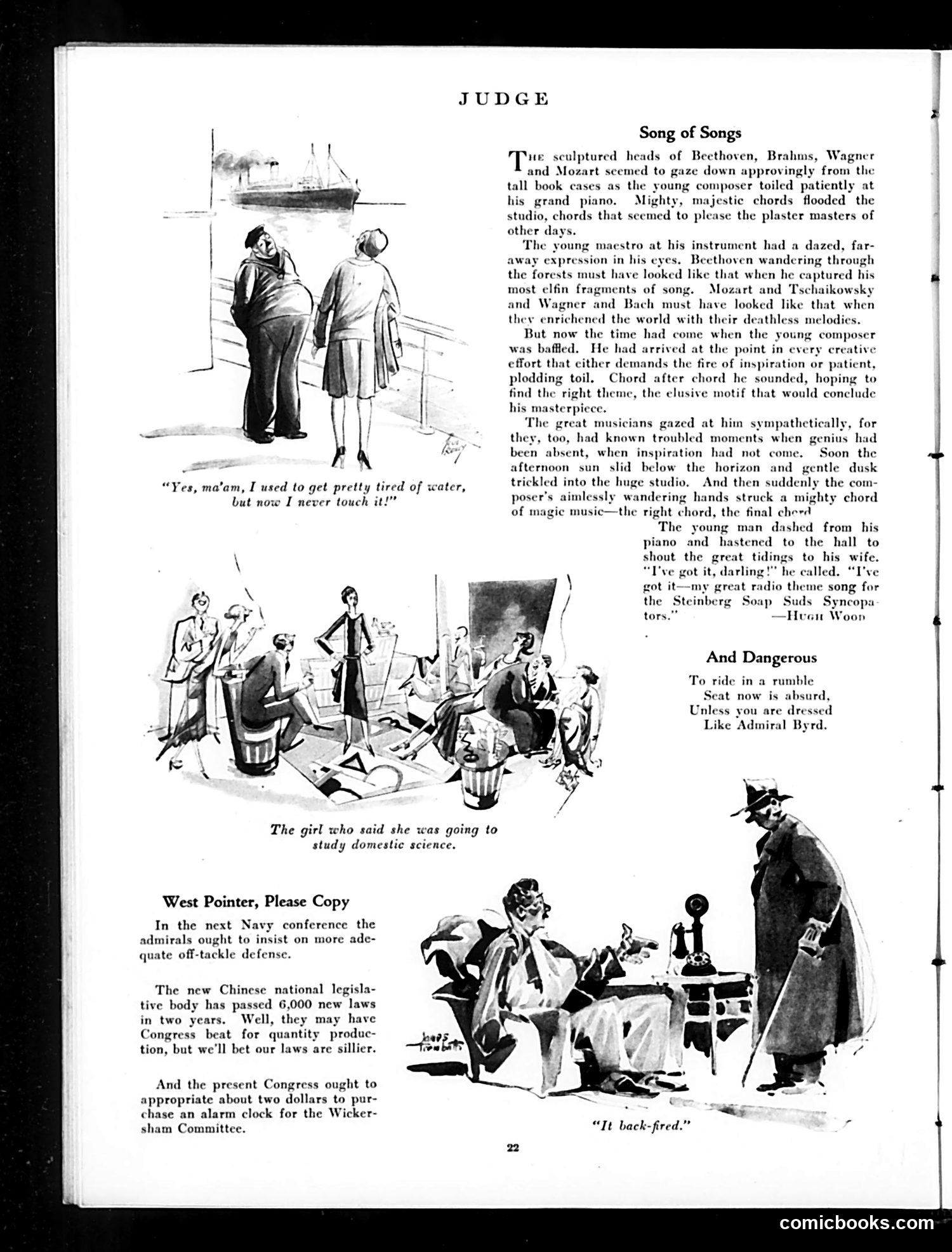
Judge Magazine Page Analysis This page contains multiple satirical pieces: "Song of Songs" (main story): A young composer struggles to finish a masterpiece while busts of classical composers watch approvingly. He finally achieves inspiration—only to discover his "great" work is a radio jingle for Steinberg Soap Suds. The satire mocks the commercialization of serious music and the gap between artistic ambition and commercial reality in the 1920s-30s radio era. "And Dangerous": A brief joke about rumble seats (open-air car seating) being risky unless one dresses like Admiral Byrd, referencing the explorer's Arctic expeditions. "West Pointer, Please Copy" and other brief items: Political humor about Navy defense strategy, Chinese legislation, and the Wickersham Committee (a contemporary government body)—typical Judge magazine "squeeze" humor mocking current events and politicians. The page exemplifies Judge's blend of longer narrative satire with quick topical one-liners targeting readers familiar with contemporary news and cultural trends.
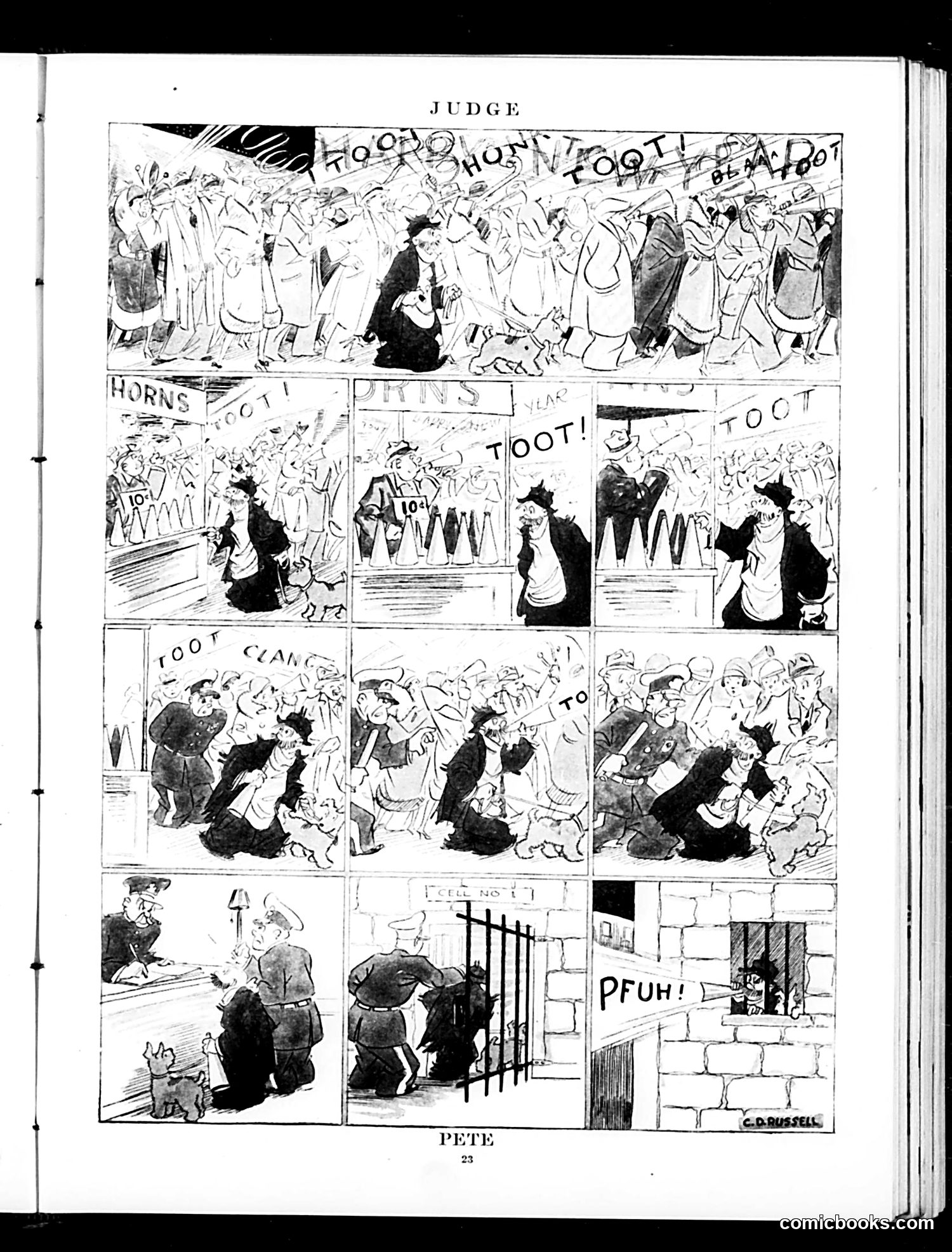
"Judge" Comic Strip Analysis This appears to be a multi-panel comic strip titled "Judge" (credited to C.D. Russell), depicting a courtroom or legal proceeding scenario. The narrative follows a figure in dark clothing through various scenes involving crowds and authority figures, with sound effects like "TOOT!" and "CLANG!" suggesting commotion or disturbance. The strip appears to satirize either a specific trial, legal case, or public figure's encounter with the justice system, though without additional context or date information, I cannot identify which specific historical figure or event is being lampooned. The chaotic crowd scenes and the central character's apparent distress suggest mockery of either legal proceedings or public scandal. The exact political or social reference remains unclear from the image alone.
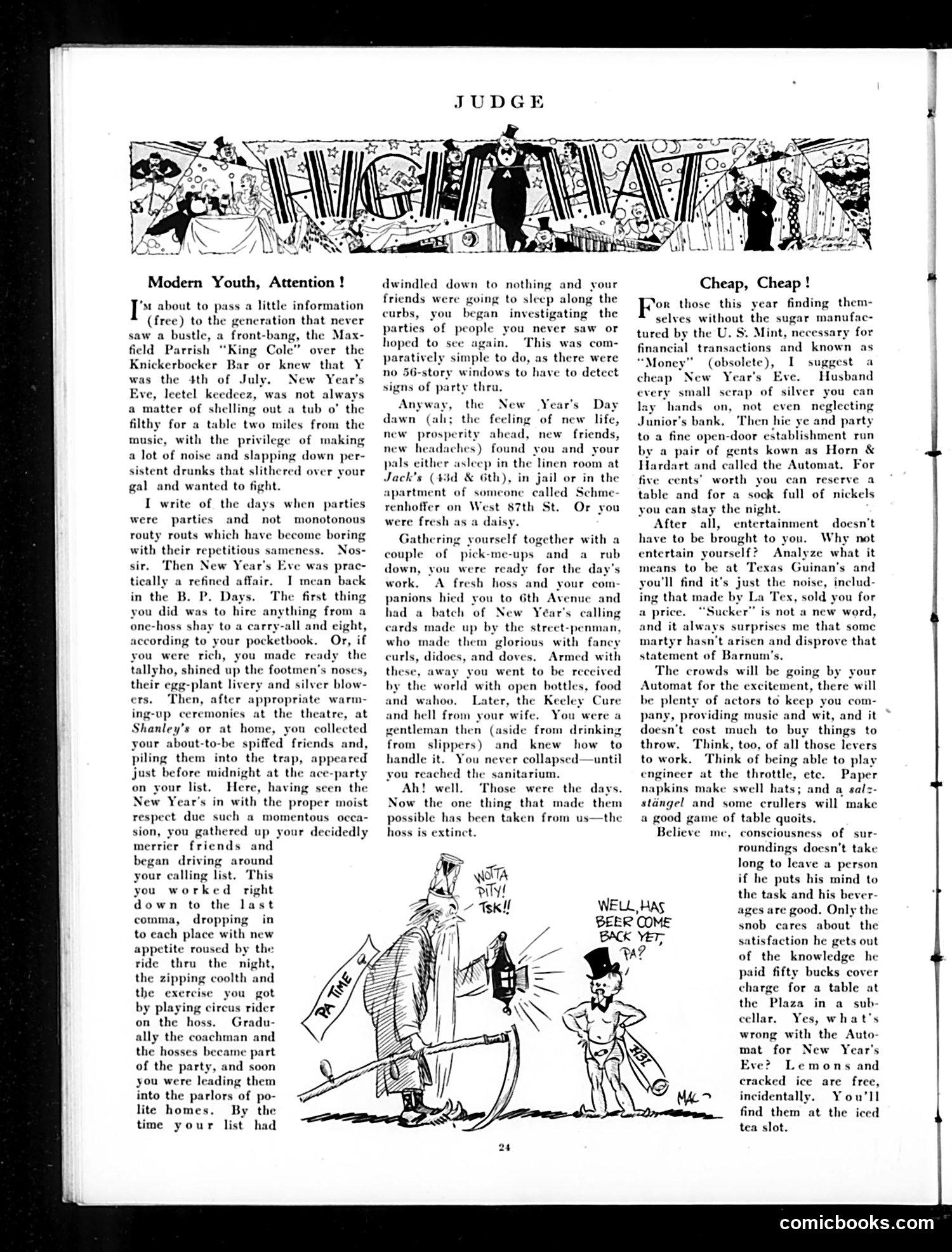
Analysis of "Judge" Magazine Page This page from Judge satirizes generational differences about New Year's Eve celebrations. The left column nostalgically describes elaborate pre-Prohibition era parties involving hired carriages, multiple social calls, and refined entertainment, contrasting sharply with contemporary youth culture described as monotonous and commercialized. The cartoon depicts a disheveled reveler arriving late to a party, illustrating the decline from the "B.P. Days" (Before Prohibition, likely) when celebrations were supposedly more dignified and horse-drawn. The right column's "Cheap, Cheap!" section mocks Depression-era or post-Prohibition constraints, sarcastically suggesting budget alternatives like the Automat (a coin-operated restaurant chain) instead of expensive venues. The piece laments that "the hoss is extinct"—both literally (automobiles replaced carriages) and metaphorically representing lost elegance. Overall, this is nostalgic social commentary criticizing modern youth's constrained, commercialized celebrations while romanticizing an idealized past.
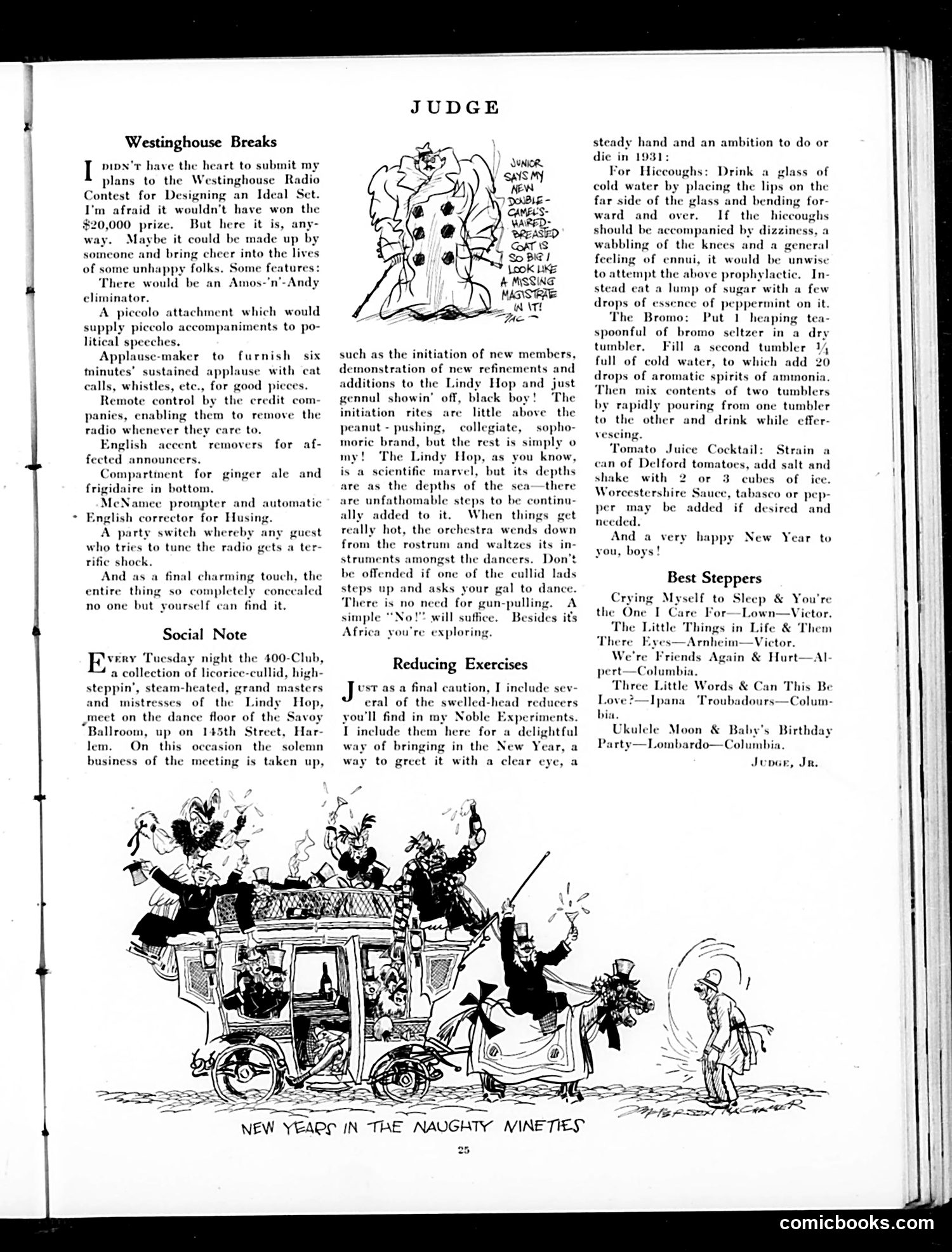
Explanation for Modern Readers This Judge magazine page contains satirical commentary on 1920s American culture: "Westinghouse Breaks" mocks radio technology and popular broadcasts. The cartoon proposes absurd radio features: an "Amos-'n'-Andy eliminator" (referencing a popular but racially offensive minstrel show), a "piccolo attachment" for political speeches, and a "party switch" that shocks guests. The satire targets both radio's growing cultural dominance and irritating programming. "Social Note" describes the 400-Club's Lindy Hop dance gatherings in Harlem. The text uses period-typical racial stereotypes and dialect ("cullid," "black boy") common to 1920s Judge, presenting jazz culture as exotic entertainment for the presumed white readership. "Reducing Exercises" offers humorous hangover remedies and cocktail recipes—fitting 1920s Prohibition-era humor. The illustration shows a chaotic New Year's celebration in a car, depicting wild partying during the Jazz Age. The overall tone reflects Judge's satirical approach to contemporary entertainment, technology, and racial attitudes of the era.
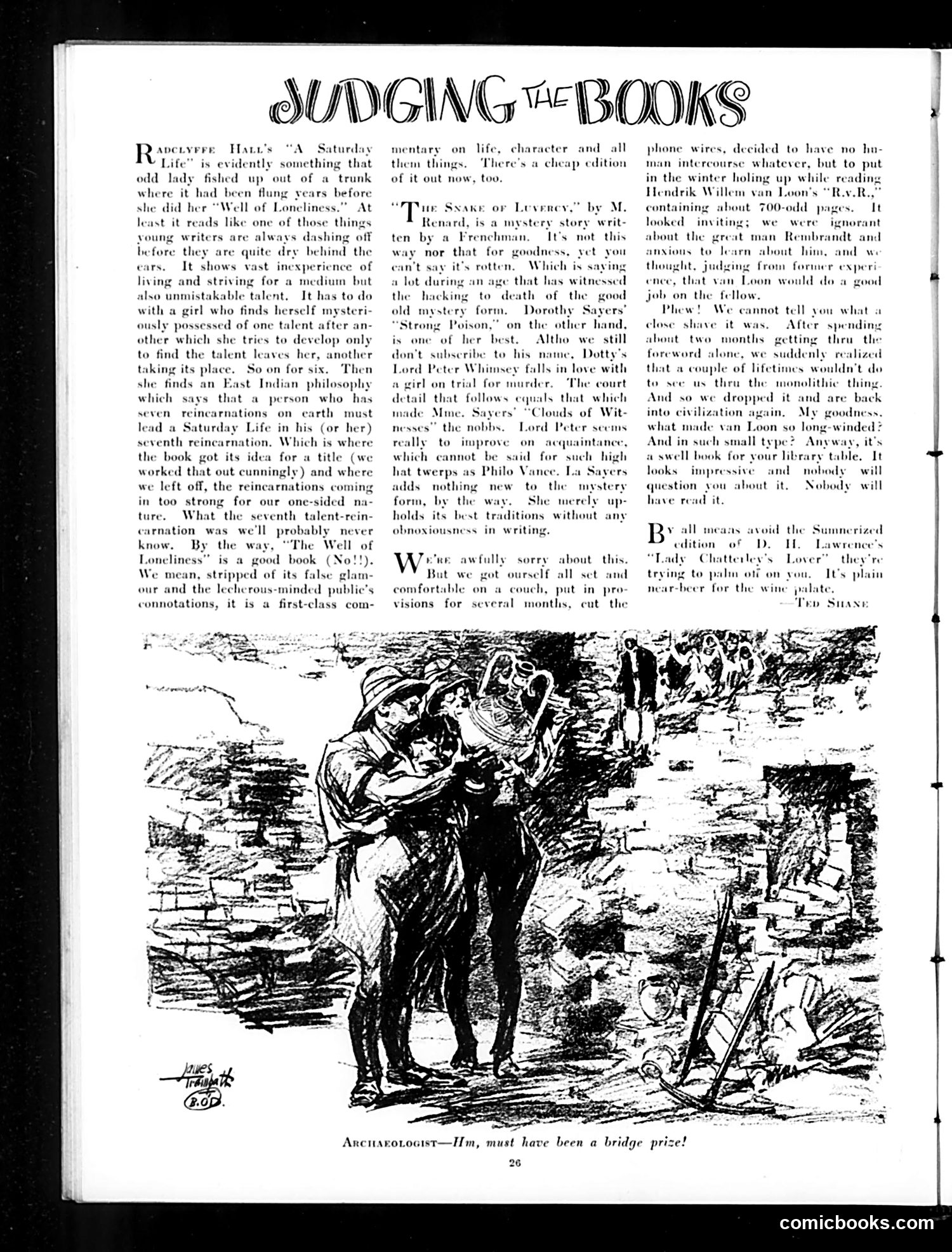
Judging the Books: A Book Review Column This page features a book review column from Judge magazine. The text critiques several literary works: Radclyffe Hall's "A Saturday Life" (dismissed as amateurish), M. Renard's "The Snake of Luvency" (a competent mystery), Dorothy Sayers' "Strong Poison" (praised for its courtroom detail and detective Lord Peter Wimsey), and Hendrik Willem van Loon's illustrated history book (criticized as tedious and overly lengthy despite its impressive appearance). The cartoon below depicts an archaeologist discovering human remains at a dig site, captioned "Hm, must have been a bridge prize!" This likely references Bridge, a popular card game of the era, joking that someone was buried with a bridge trophy—a humorous non sequitur typical of Judge's style. The reviews reflect 1920s-30s literary tastes and concerns about modernist literature's propriety.
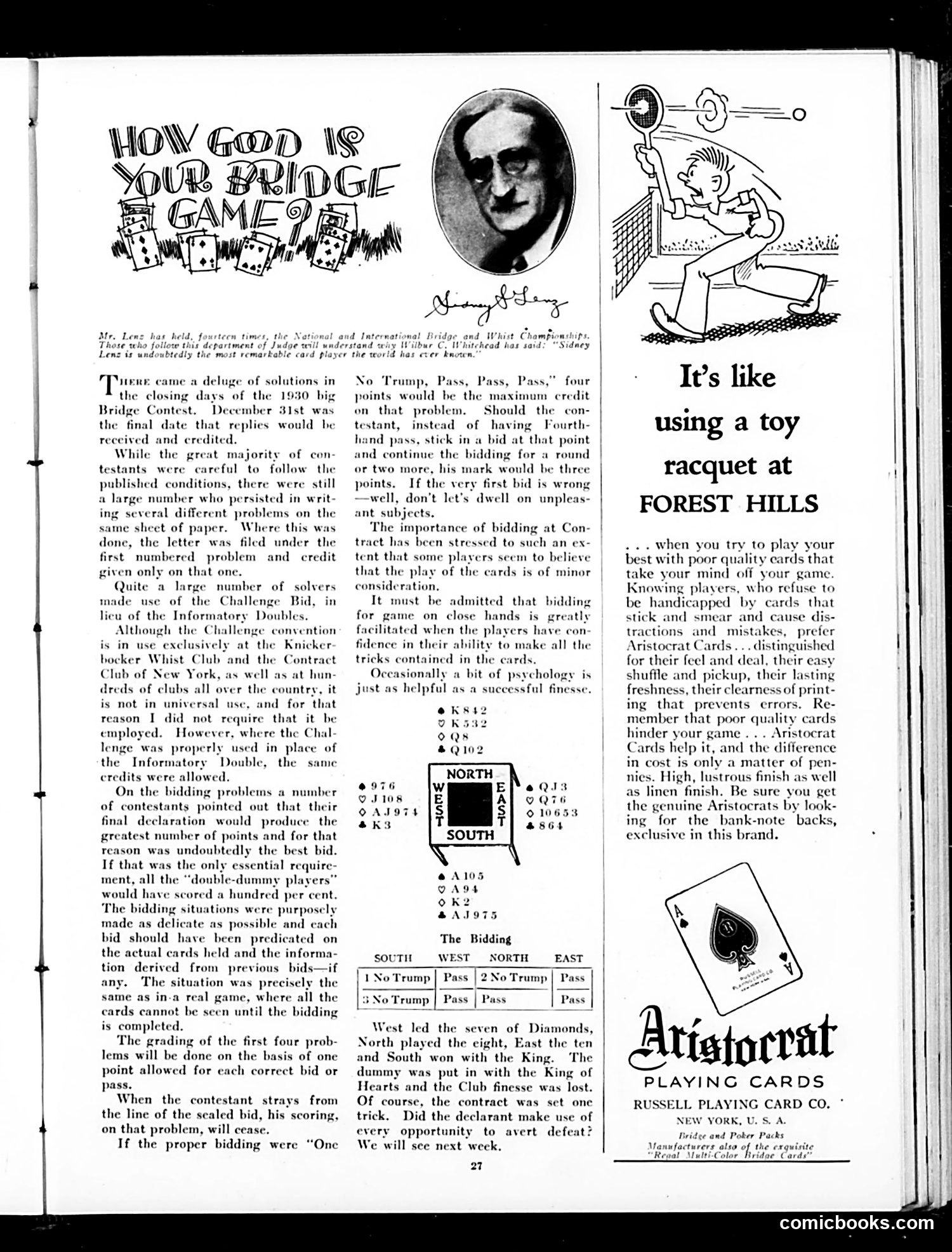
"How Good Is Your Bridge Game?" - Judge Magazine Page This page combines bridge instruction with advertising. The main content discusses the 1930 Bridge Contest, analyzing contestants' solutions to bidding problems. The article criticizes players who submit multiple solutions on one sheet and those who rely on "double-dummy" playing (seeing all cards) rather than making bids based on actual hand knowledge and psychology. The upper left features a portrait (likely of the contest organizer or notable bridge player), though the caption is partially illegible. The right side contains an advertisement for Aristocrat Playing Cards, using a humorous analogy: attempting to play serious tennis at Forest Hills with inferior equipment is like playing bridge with poor-quality cards. The ad emphasizes that quality cards prevent errors and distraction—a pitch to serious bridge players that good equipment matters for competitive play. This reflects bridge's prominence in 1930s leisure culture.
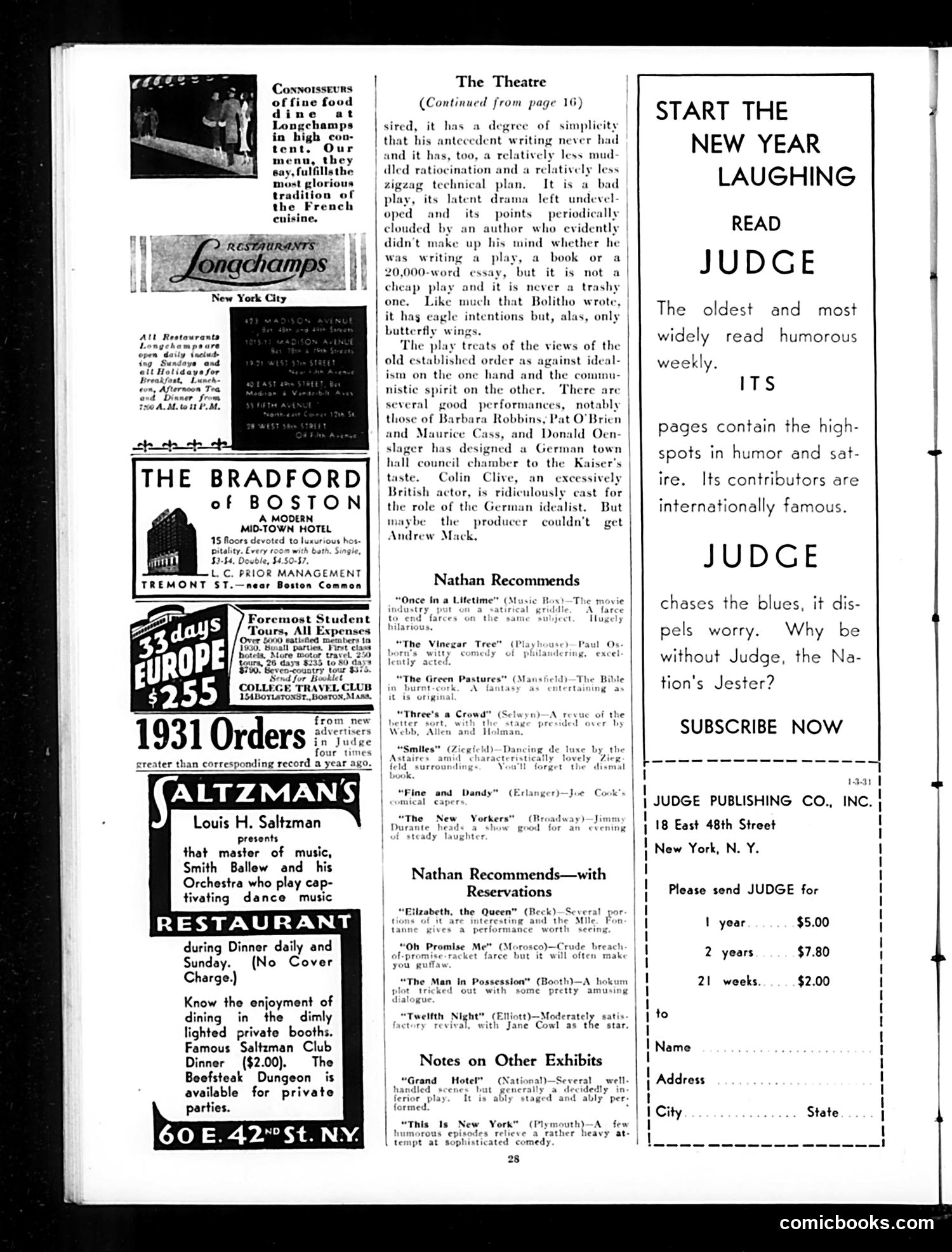
Judge Magazine Page Analysis This page is primarily advertising and subscription promotion for Judge magazine itself, with some theatre reviews mixed in. The main content features: 1. Restaurant/hotel advertisements (Longchamps, The Bradford of Boston, Saltzman's Restaurant) — typical 1930s luxury dining promotions 2. Travel advertising (Foremost Student Tours to Europe for $255) — appealing to college students 3. A theatre review section critiquing several Broadway plays, including productions featuring actors like Pat O'Brien and Colin Clive, discussing their merits and flaws 4. Judge magazine's self-promotion (right column) — marketing itself as "the oldest and most widely read humorous weekly" with "internationally famous" contributors, calling it "the Nation's Jester" that "chases the blues" and "dispels worry" The subscription rates ($5.00/year, $7.80 for two years) anchor the pitch to readers. This appears to be from early 1931 based on the "1931 Orders" reference and theater listings. It's primarily a sales/marketing page rather than satirical content.
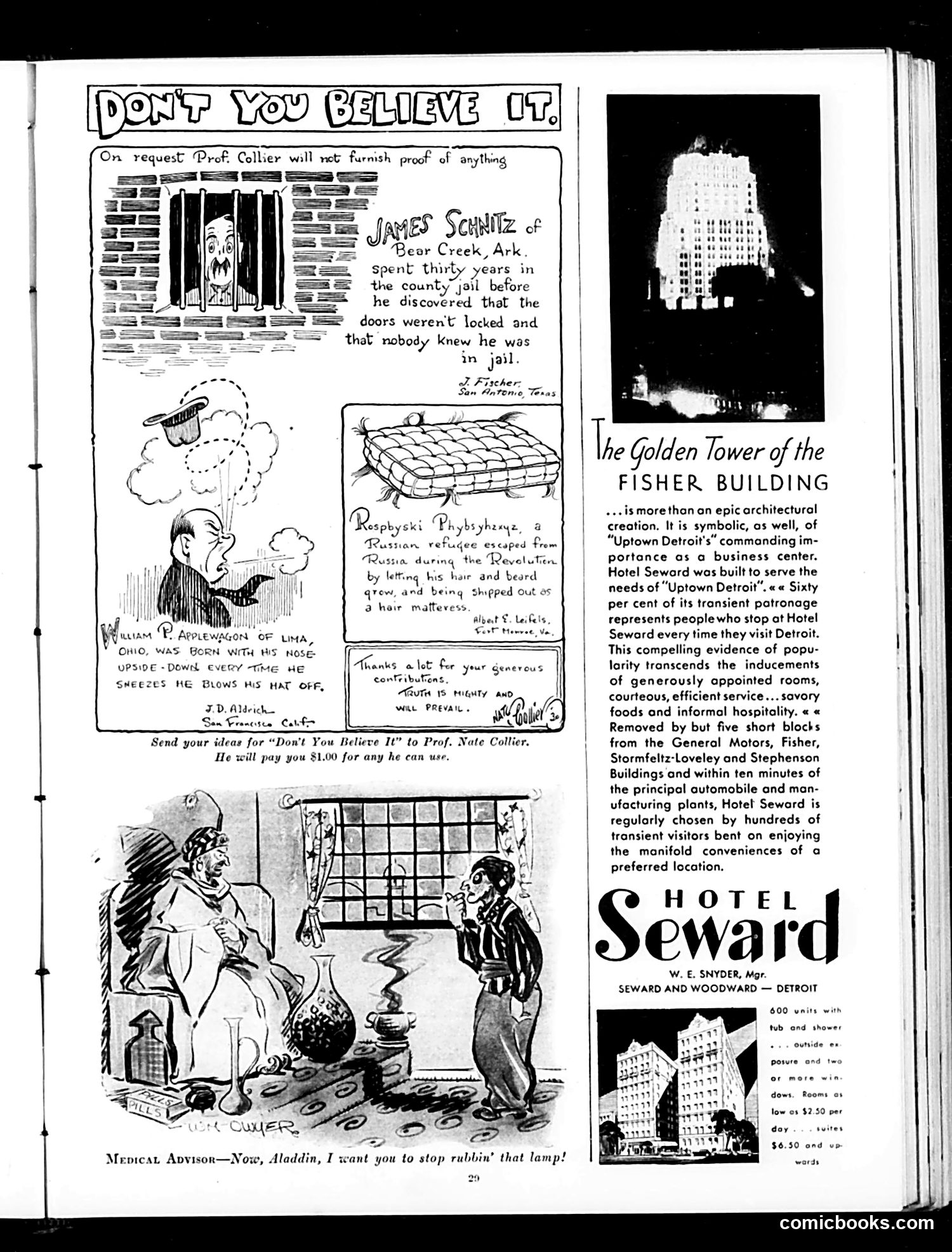
"Don't You Believe It" Page Analysis This page features Judge magazine's humorous "tall tales" column, where readers submit outlandish, clearly false anecdotes. The cartoons illustrate three absurd claims: 1. James Schmitz: A man who spent 30 years in an unlocked county jail without anyone noticing his presence—satirizing institutional incompetence. 2. Resoryski: A Russian refugee who escaped the Revolution by growing out his hair and beard, then being shipped out as a hair mattress—mocking the implausibility of refugee stories circulating post-WWI. 3. J.D. Aldrich: A man born with his nose upside down who blows his hat off every time he sneezes—pure absurdist humor. The column's premise is satirical commentary on credibility and tall tales. The page also contains a Hotel Seward advertisement featuring Detroit's Fisher Building—typical magazine filler of the era. The humor relies on readers recognizing the stories as impossible fabrications.
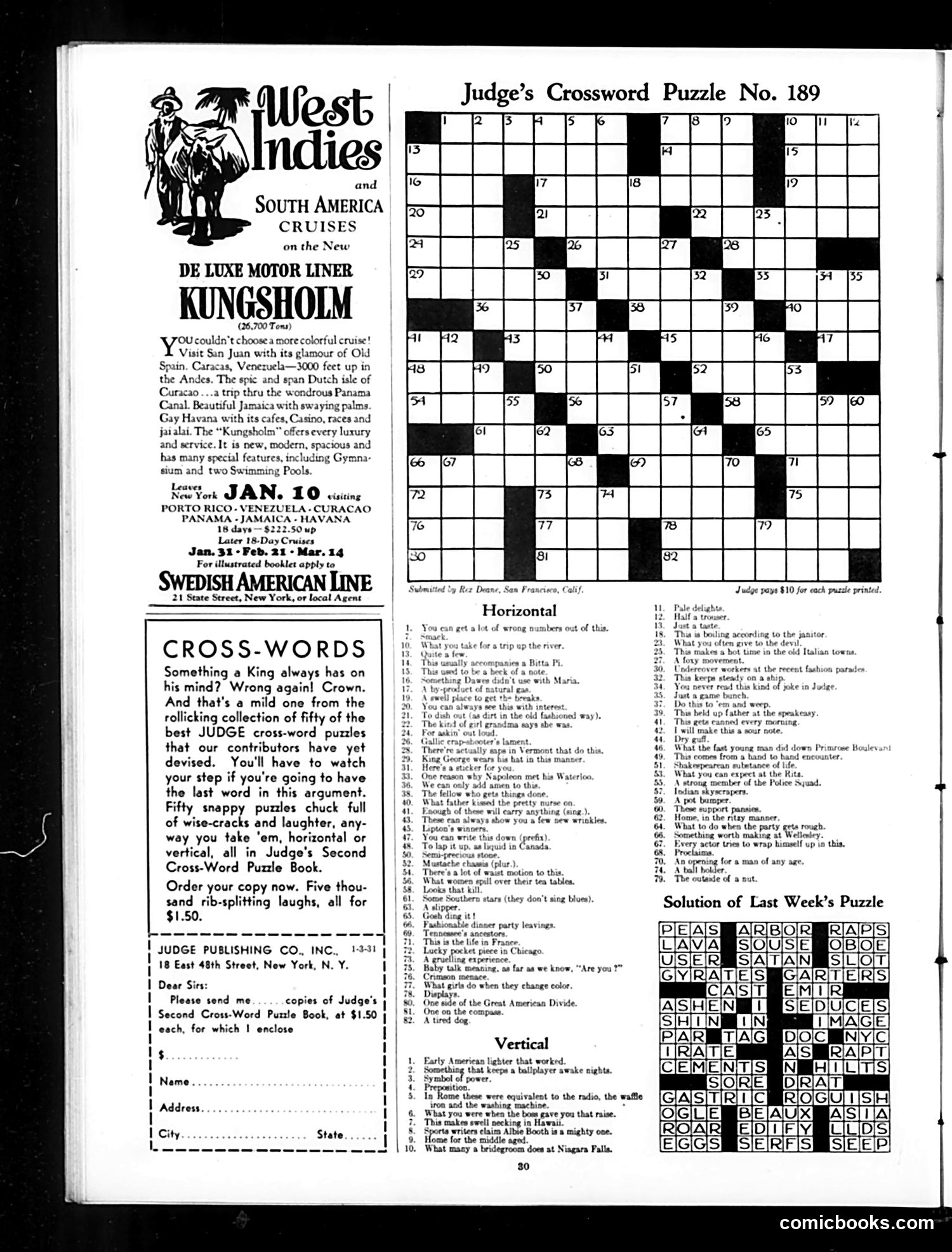
This page is primarily advertising and puzzle content, not political satire. The top half advertises the Swedish American Line's luxury cruise ship *Kungsholm*, promoting Caribbean and Central American destinations (Venezuela, Panama, Jamaica, Cuba, Puerto Rico). The text uses period-typical language ("spic and span Dutch isle") reflecting 1930s travel marketing conventions. The bottom half promotes Judge magazine's "Second Cross-Word Puzzle Book" for $1.50, featuring fifty puzzles with humorous clues. Examples include wordplay references to Napoleon's defeat at Waterloo, contemporary figures like "Albse Booth" (unclear which Booth is meant), and period details like necking in Hawaii and Wellesley College activities. The solved puzzle grid from the previous week is shown as reference. This appears to be a standard magazine page mixing revenue-generating advertisements with self-promotion—not satirical content. The "humor" is limited to mild crossword puns typical of the era.
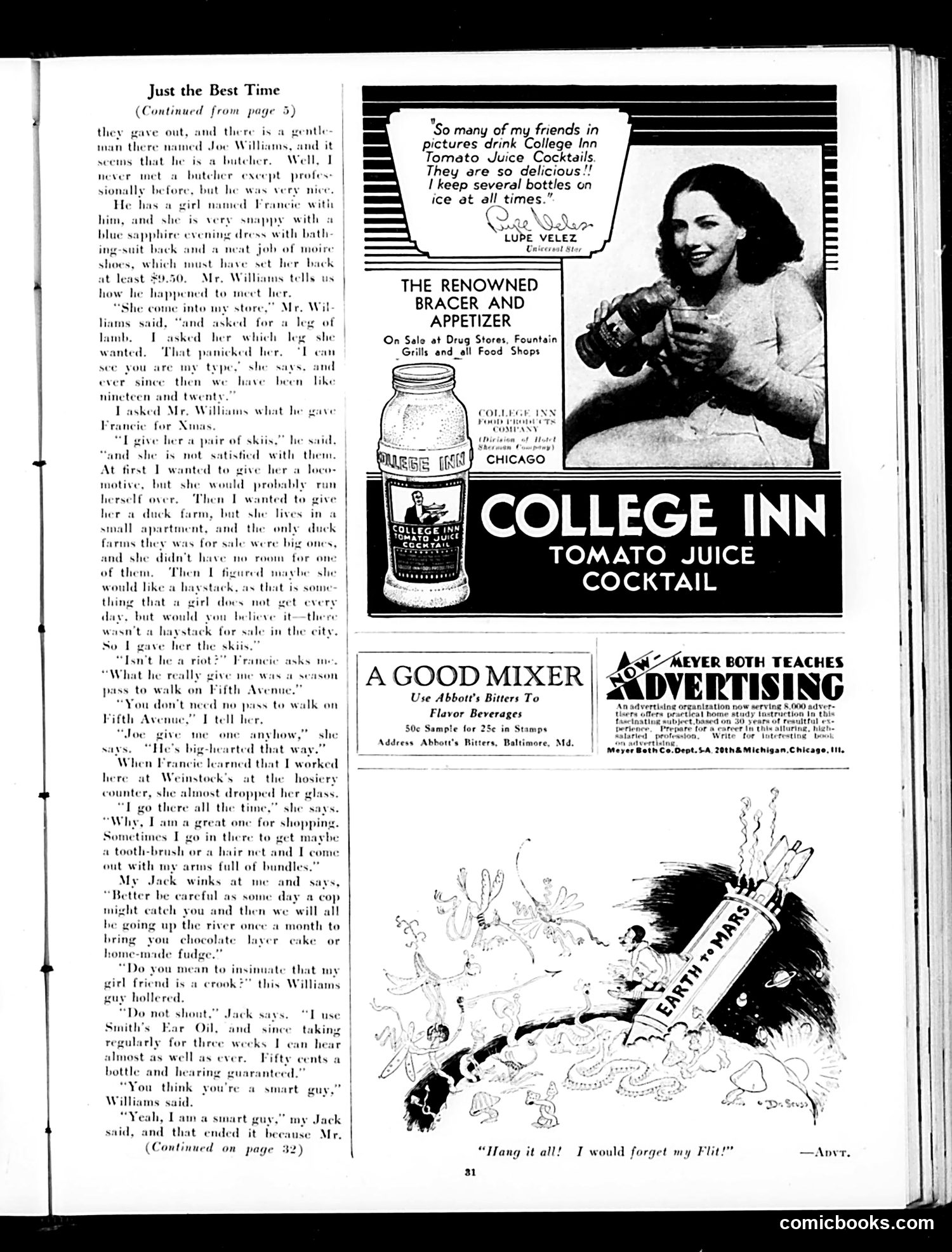
Analysis of Judge Magazine Page This page mixes editorial content with advertisements typical of 1920s-30s Judge magazine. Main Content: "Just the Best Time" is a humorous romantic narrative about a butcher named Joe Williams and his girlfriend Francie. The story plays on working-class courtship and domestic life—Williams gives Francie skis for Christmas; she frequents department stores; a character named Jack makes wisecracks about her potentially being a shoplifter. The humor relies on characters' folksy dialogue and malapropisms (Williams confuses "insinuate" and "shout"). Advertisements: The page features endorsements from actress Lupe Velez for College Inn Tomato Juice Cocktails, Abbott's Bitters as a mixer, and a Flit insecticide ad showing comedic explosion. These ads reflect Prohibition-era culture, when cocktail ingredients were advertised as legitimate beverages, and pest control was a common household concern. Overall Context: The page exemplifies Judge's blend of domestic comedy and commercial advertising aimed at middle-class readers.
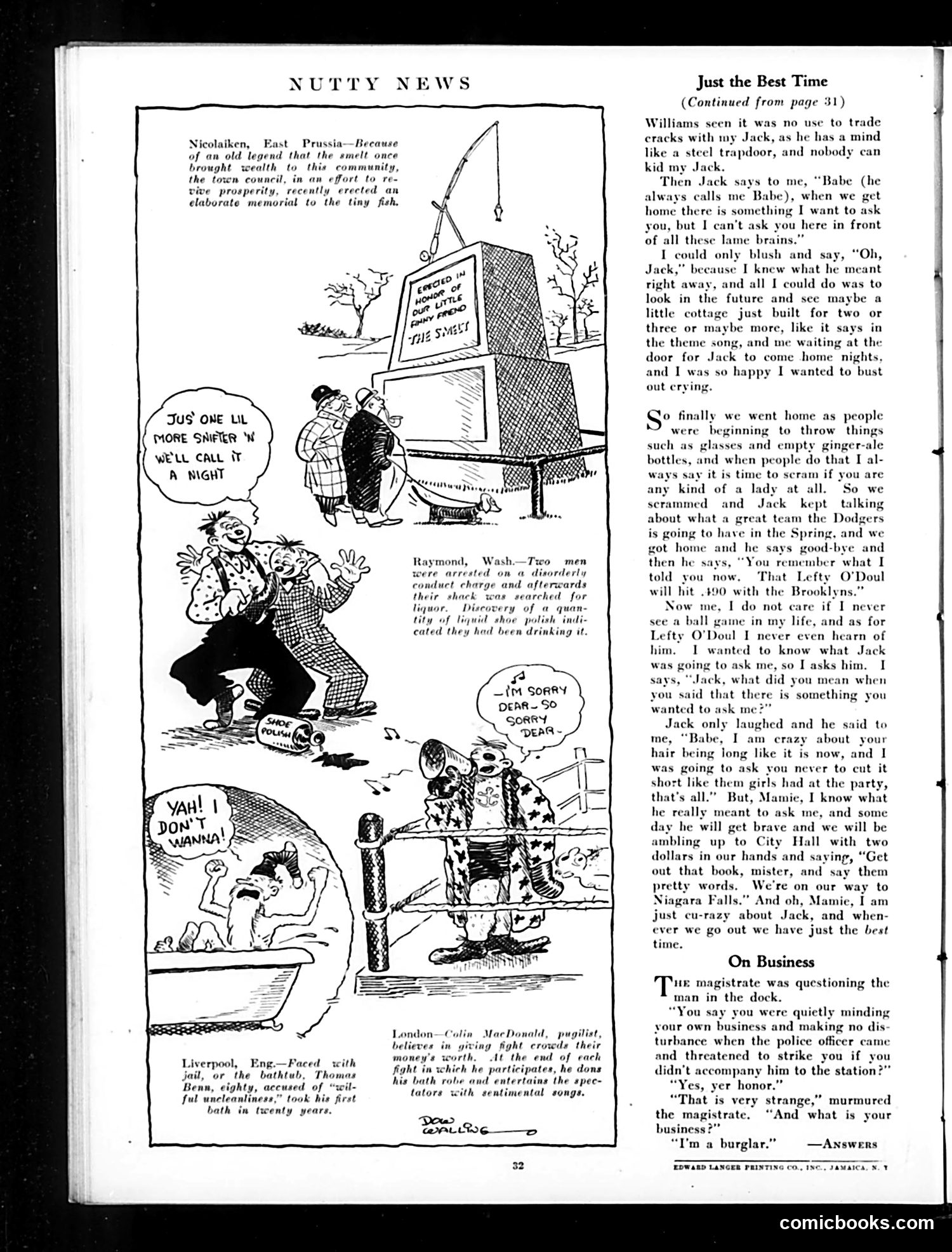
Judge Magazine Satire Analysis This page contains multiple short humor items typical of Judge's "Nutty News" section, mocking real absurdities: The cartoons satirize actual news stories: East Prussia erecting a memorial to smelt fish to revive prosperity (mocking misplaced civic pride); two men arrested in Raymond, Washington for drinking shoe polish (depicting urban desperation during Prohibition); a London boxer who performs sentimental songs after fights (mocking overwrought entertainment); and a London man forced to take his first bath in twenty years by authorities (ridiculing extreme uncleanliness). The accompanying prose is a serialized romantic story about a woman named Mamie and her boyfriend Jack, baseball fan and potential marriage prospect—a common Judge feature mixing sentiment with humor. The final "On Business" joke presents a magistrate's ironic exchange with an arrested burglar, exploiting the criminal's candid admission of his profession—simple wordplay humor. The satire relies on readers recognizing these as real news stories, finding humor in society's genuine oddities.
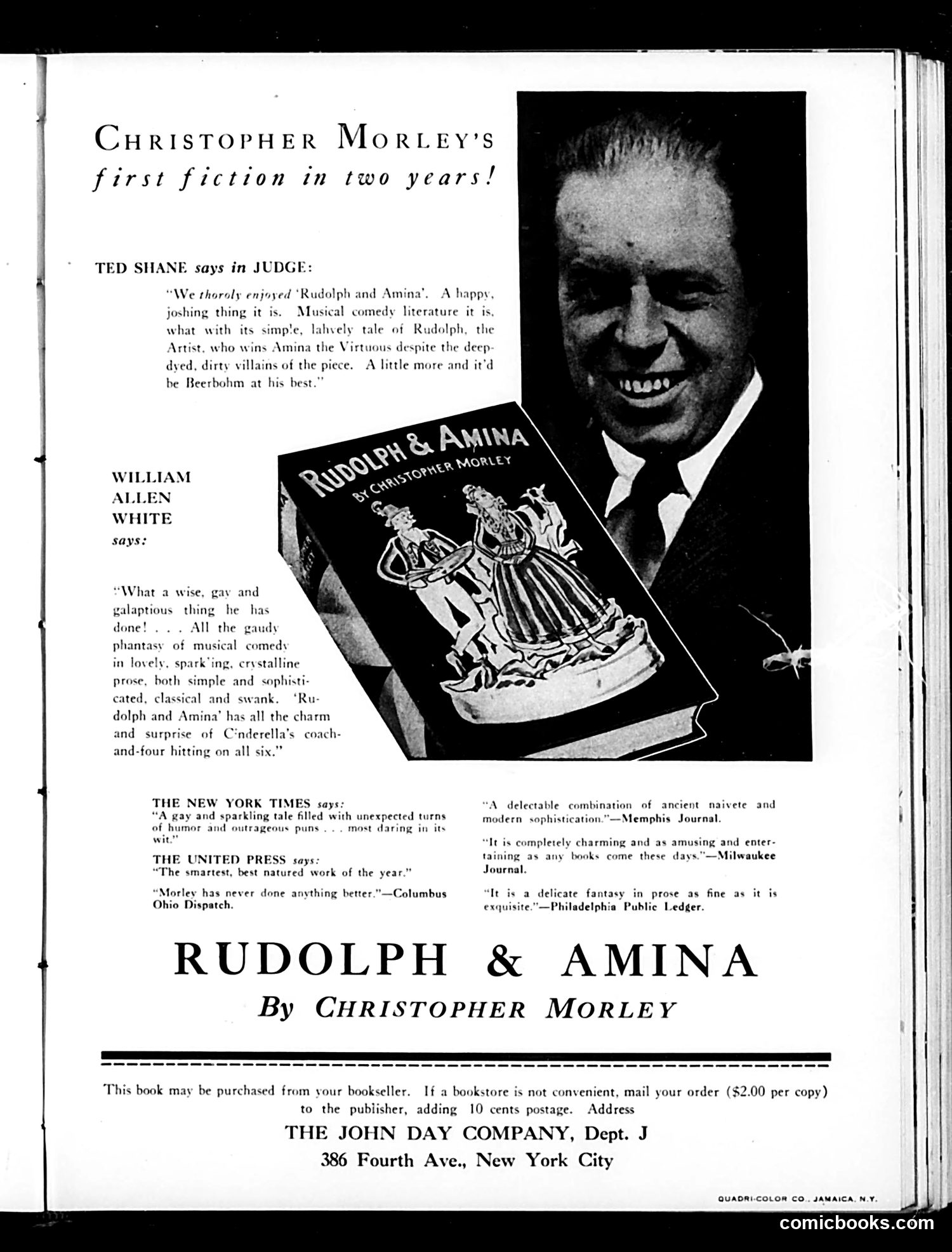
Advertisement for "Rudolph & Amina" by Christopher Morley This is primarily a book advertisement rather than a satirical cartoon. It promotes Christopher Morley's novel as "his first fiction in two years," positioning it as a musical-comedy-styled prose work about a virtuous heroine named Amina and an artist protagonist named Rudolph who triumphs over villains. The page features praise quotes from prominent publications (Judge, The New York Times, United Press) and literary figures like William Allen White, emphasizing the book's wit, charm, and elegant prose style. The language reflects 1920s literary taste—comparing it favorably to classic fairy tales and Max Beerbohm's sophisticated writing. The photograph shows a smiling man (likely Morley) holding the book. The advertisement cost is $2.00 per copy plus postage, distributed by The John Day Company. This is essentially a dignified marketing appeal to educated readers rather than satire.
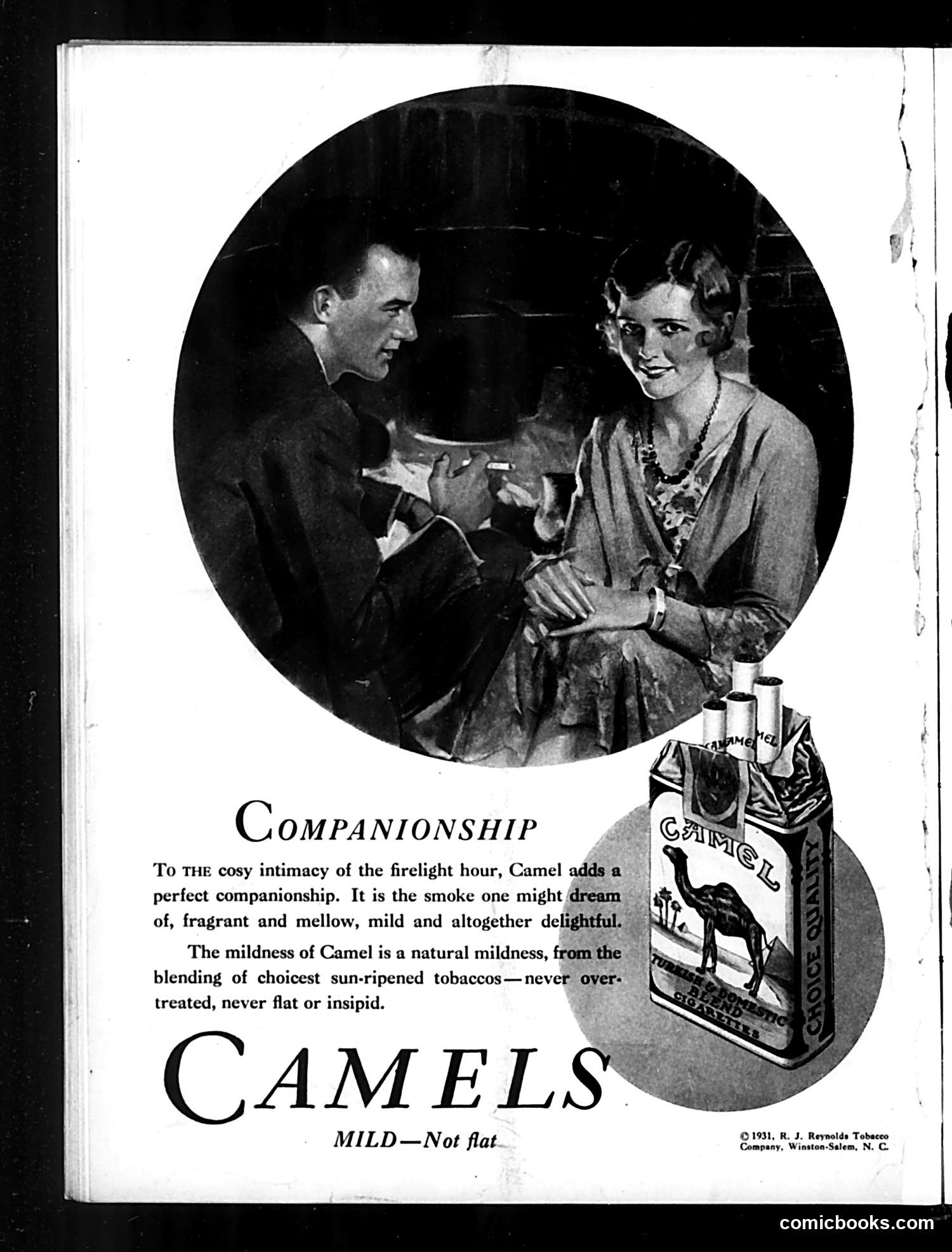
This is a Camel cigarette advertisement, not editorial content or satire. The page shows a man and woman in an intimate social setting by firelight, with copy emphasizing the cigarette's "mild" quality and "natural mildness" from blended tobaccos. The ad positions Camel smoking as enhancing social companionship and romance. There is no cartoon or political satire here to analyze—this appears to be a straightforward 1931 cigarette advertisement placed in *Judge* magazine. The imagery and messaging reflect period advertising conventions marketing cigarettes to consumers as sophistication and social pleasure, before modern health warnings existed. The only notable element is how openly such advertising appeared in mainstream publications at the time.