judge
Judge — January 10, 1931
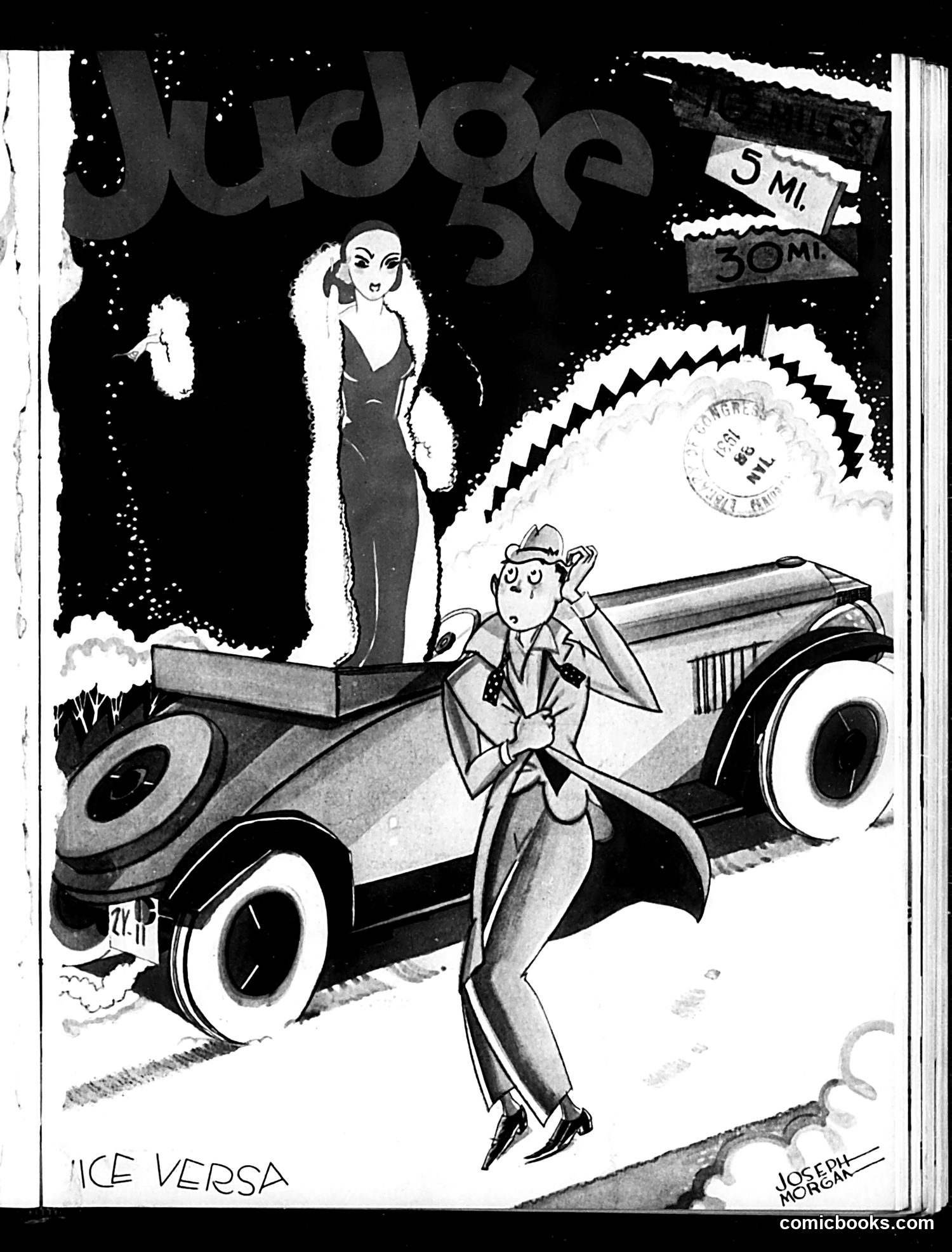
Judge Magazine Page Analysis This appears to be a cover or feature page from *Judge* magazine titled "Ice Versa" (a pun on *vice versa*). The illustration shows a wealthy man in a suit reacting with shock beside a luxury automobile, while an elegant woman in a fur coat and formal dress stands dominantly in the background. The satire likely plays on gender role reversals—the title "Ice Versa" suggests the typical social dynamics are inverted. The man's surprised expression and subordinate posture contrast with the woman's commanding presence and association with luxury goods, satirizing either changing social conventions or anxieties about female independence and economic power during the early-to-mid 20th century when *Judge* was active. The exact historical moment remains unclear without additional context.
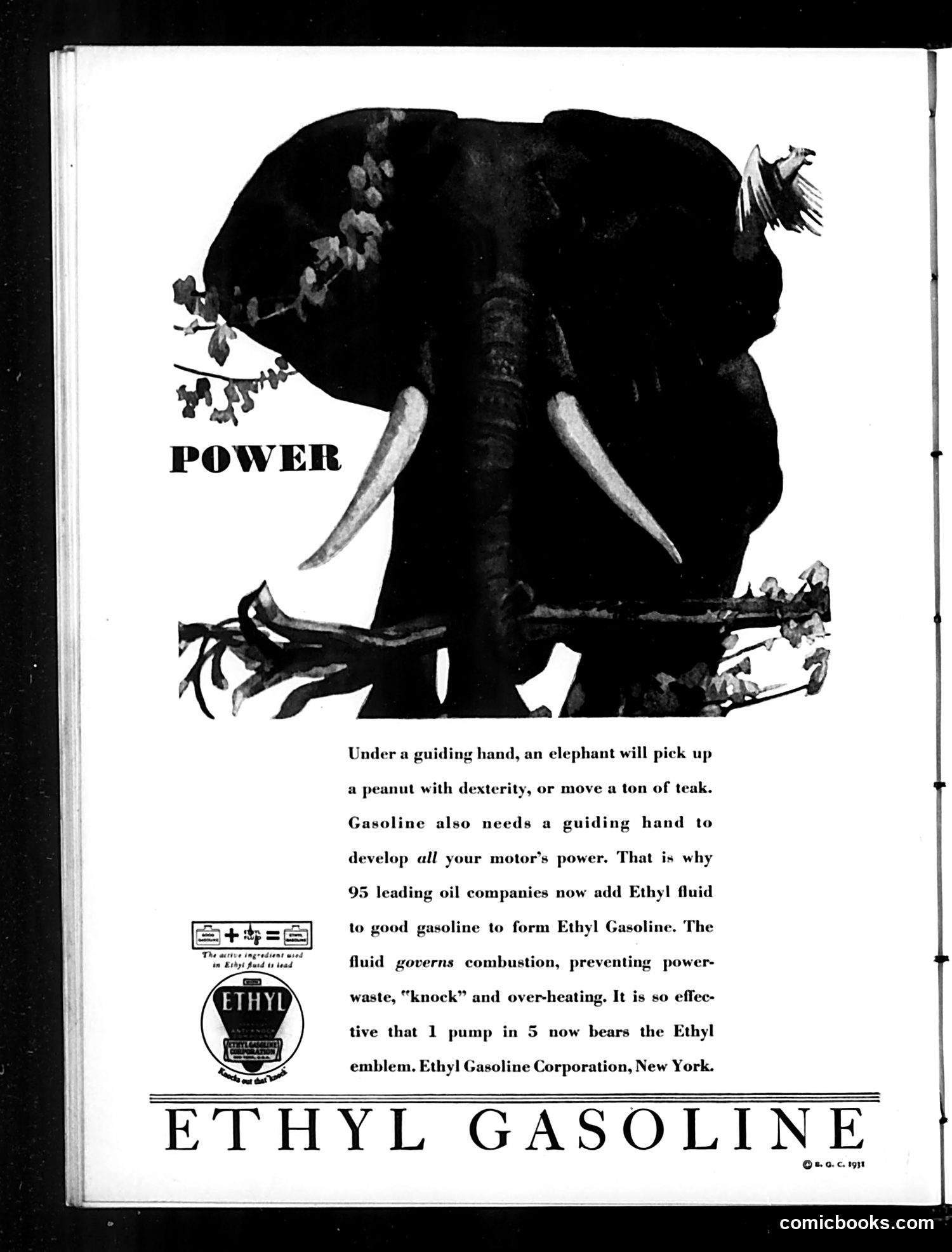
Analysis This is primarily advertising, not political satire. The page promotes Ethyl Gasoline, a brand that added tetraethyl lead to fuel (later recognized as toxic). The elephant functions as a metaphor for power and control: just as an elephant requires a "guiding hand" to direct its considerable strength—whether delicate tasks or heavy work—gasoline requires Ethyl fluid's additive to "guide" its combustion, maximizing engine power while preventing "knock" and overheating. The ad claims 95 oil companies now use Ethyl Gasoline, and that "1 pump in 5 now bears the Ethyl emblem." This reflects genuine 1920s-30s marketing, when leaded gasoline was promoted as scientifically superior before its neurological dangers became widely known. The satire here, if any exists, is unintentional—presenting a harmful product as a beneficial innovation.
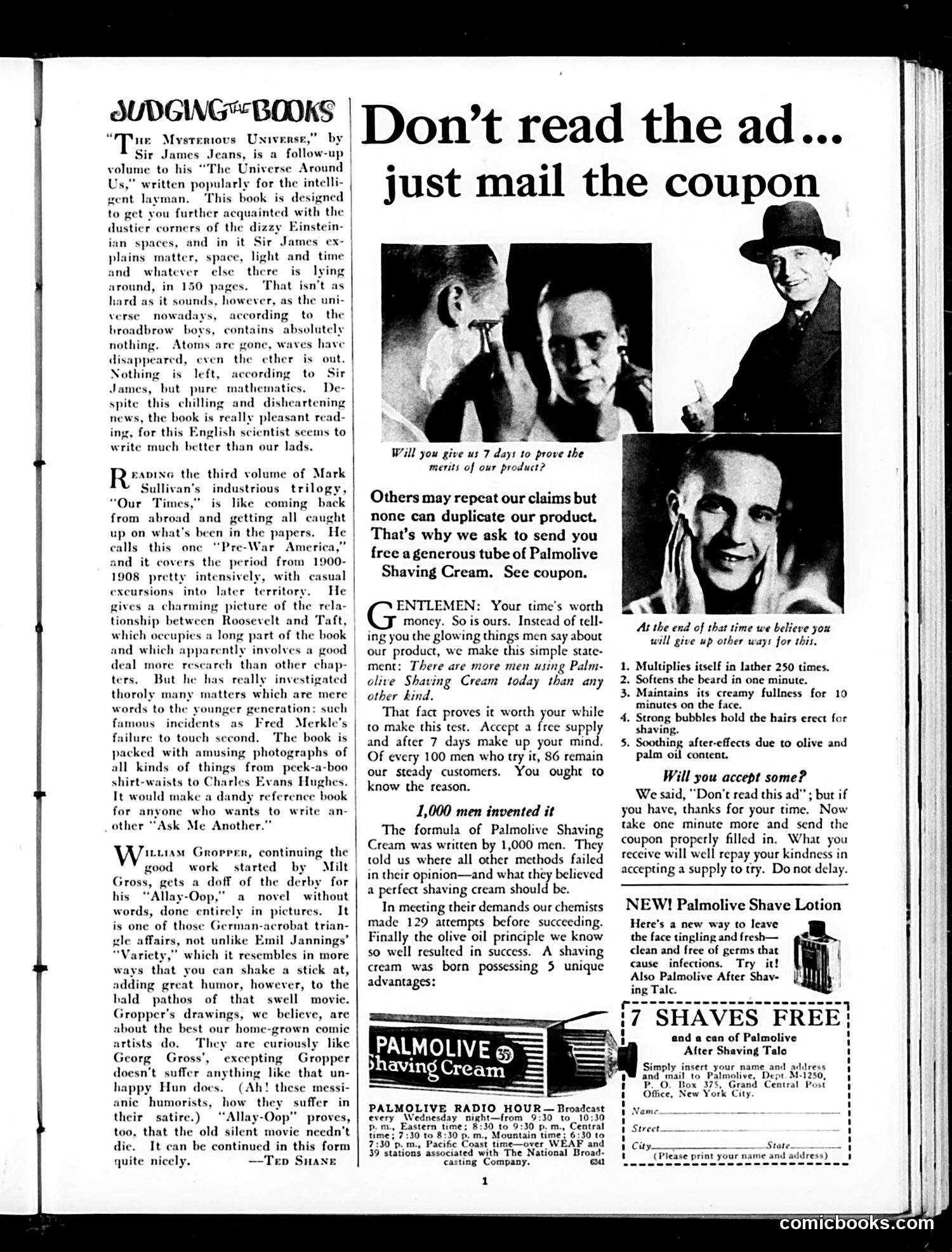
Page Analysis This page is primarily advertising for Palmolive Shaving Cream, not political satire. The large advertisement occupies the right half, featuring photographs of men and a coupon offer for "7 shaves free." The left side contains book reviews ("Judging the Books") by what appears to be a regular Judge magazine columnist, discussing three new volumes: Jeans's "The Mysterious Universe," Sullivan's "Our Times," and Groppenian's "Allay-Oop." The Palmolive ad's headline—"Don't read the ad, just mail the coupon"—is a tongue-in-cheek marketing appeal that ironically acknowledges reader reluctance to engage with advertisements, while still encouraging participation through a free sample offer. This reflects early-20th-century advertising strategies that mixed humor with direct sales pitches. No political cartoon or satire is present on this page.
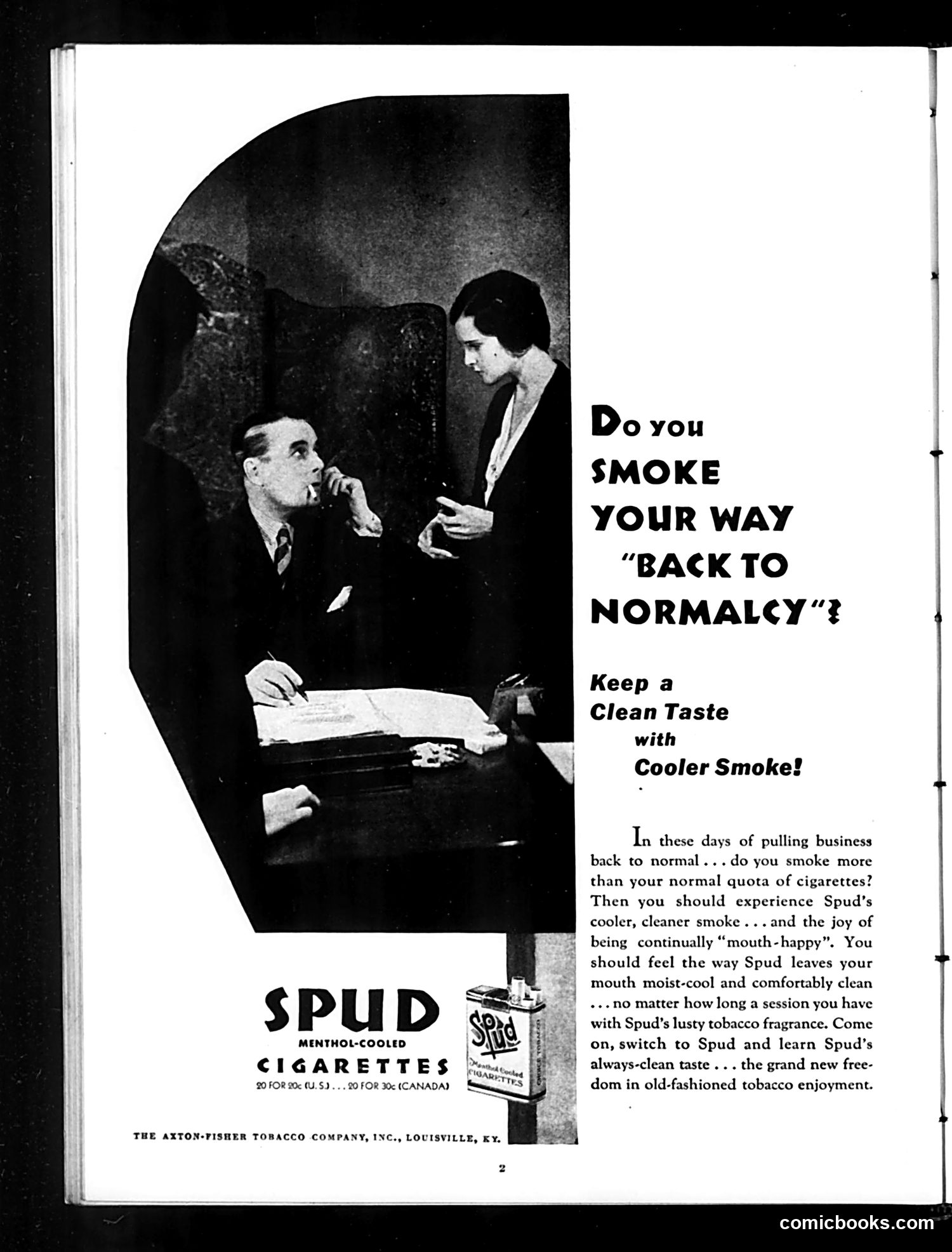
Analysis This page is primarily a cigarette advertisement, not satire or political commentary. It's a Spud menthol cigarettes ad from the Axton-Fisher Tobacco Company (Louisville, Kentucky). The advertisement uses a business office scene showing a man at a desk with a woman standing nearby. The tagline "Do you smoke your way 'back to normalcy'?" appears to reference the post-WWI period when "return to normalcy" was a common phrase. The ad's pitch: during busy times returning business to normal, smokers consume more cigarettes than usual. Spud's menthol cooling supposedly keeps your mouth fresh despite increased smoking. The ad emphasizes "clean taste" and "moist-cool" sensation. This reflects early-to-mid 20th century cigarette marketing before health warnings, when smoking was normalized in professional settings.
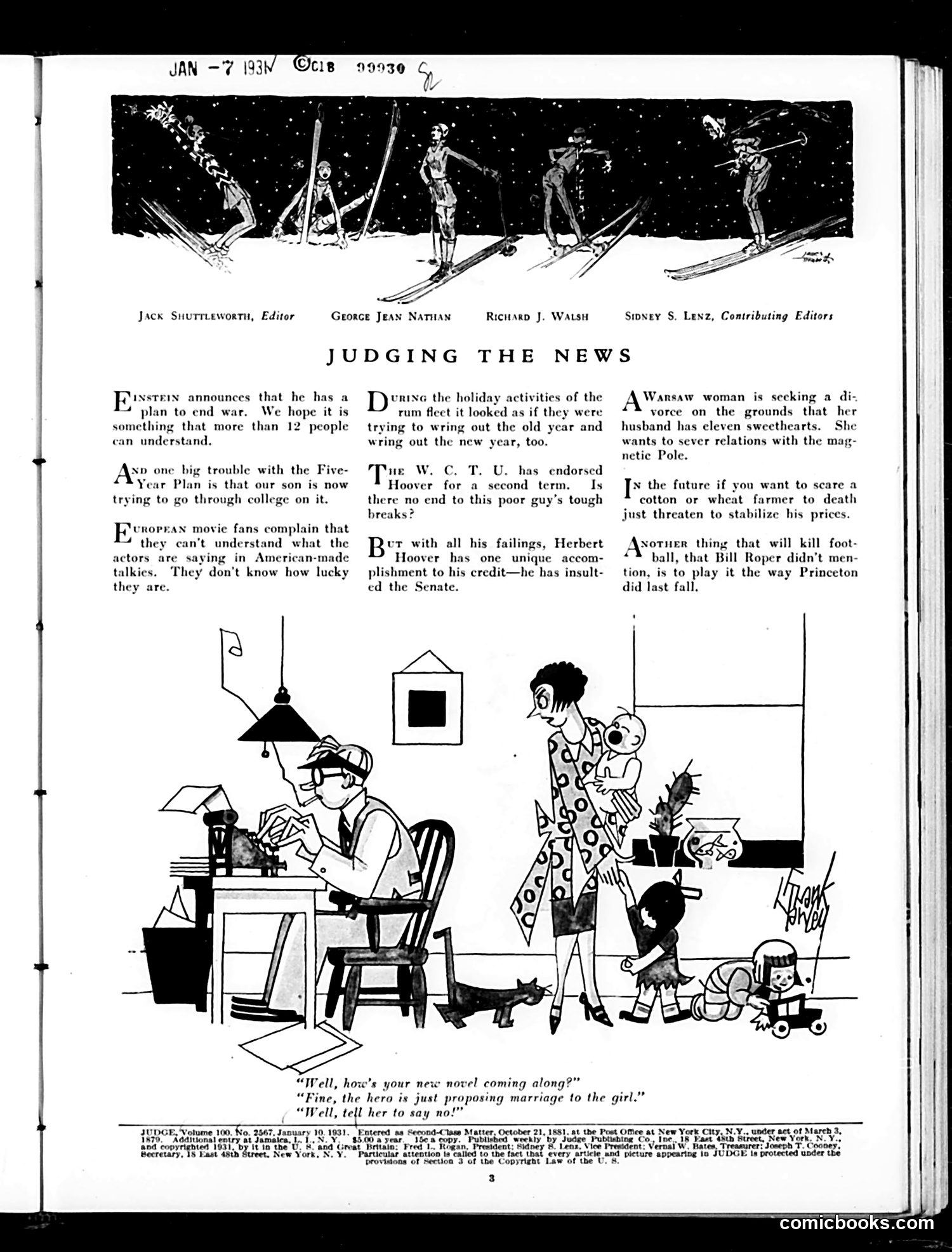
"Judging the News" - January 10, 1931 This satirical column comments on contemporary events through brief jabs: Einstein's "plan to end war" is mocked as too complicated for ordinary people to grasp. The Five-Year Plan (likely referring to Soviet economic policy) is criticized as impractical for American college tuition. American film dialogue is ridiculed as incomprehensible—audiences don't understand actors' speech patterns. Herbert Hoover's endorsement for a second term is sarcastically praised, with the jab that his "unique accomplishment" was insulting the Senate. The main cartoon shows a writer struggling to finish his novel while juggling domestic chaos (children, pets, interruptions). The joke: his hero is proposing marriage, but the writer's wife says "tell her to say no!"—implying married life is miserable, so the character should avoid it. The overall tone reflects Depression-era cynicism about politics and American life.
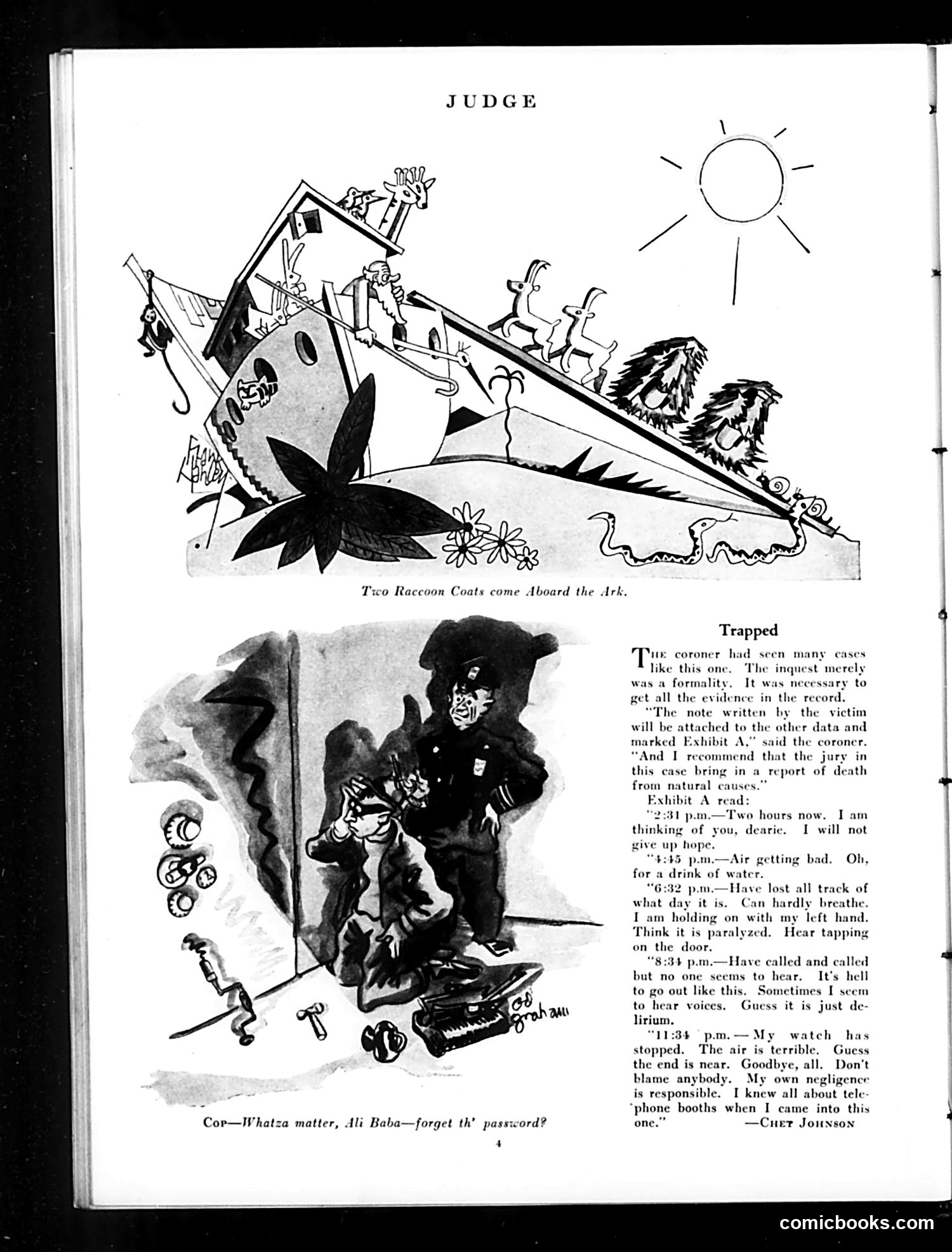
Analysis of Judge Page Top Cartoon: "Two Raccoon Coats come Aboard the Ark" satirizes wealthy passengers, likely on a ship or during a social event. The raccoon coat—a status symbol of the 1920s-30s—marks these figures as frivolous socialites. The "ark" reference suggests either a voyage narrative or metaphorical commentary on class dynamics during crisis (possibly the Depression era). Bottom Section ("Trapped"): Features a coroner's case involving timestamps of a victim's final hours (2:31 p.m. through 11:34 p.m.). The accompanying illustration shows an elderly figure with small characters, possibly depicting Ali Baba or a fairy-tale reference. The caption "Whatza matter, Ali Baba—forget th' password?" suggests confusion or memory loss, possibly satirizing legal proceedings or the victim's circumstances. The overall piece appears to critique investigative procedures or society's indifference to tragedy.
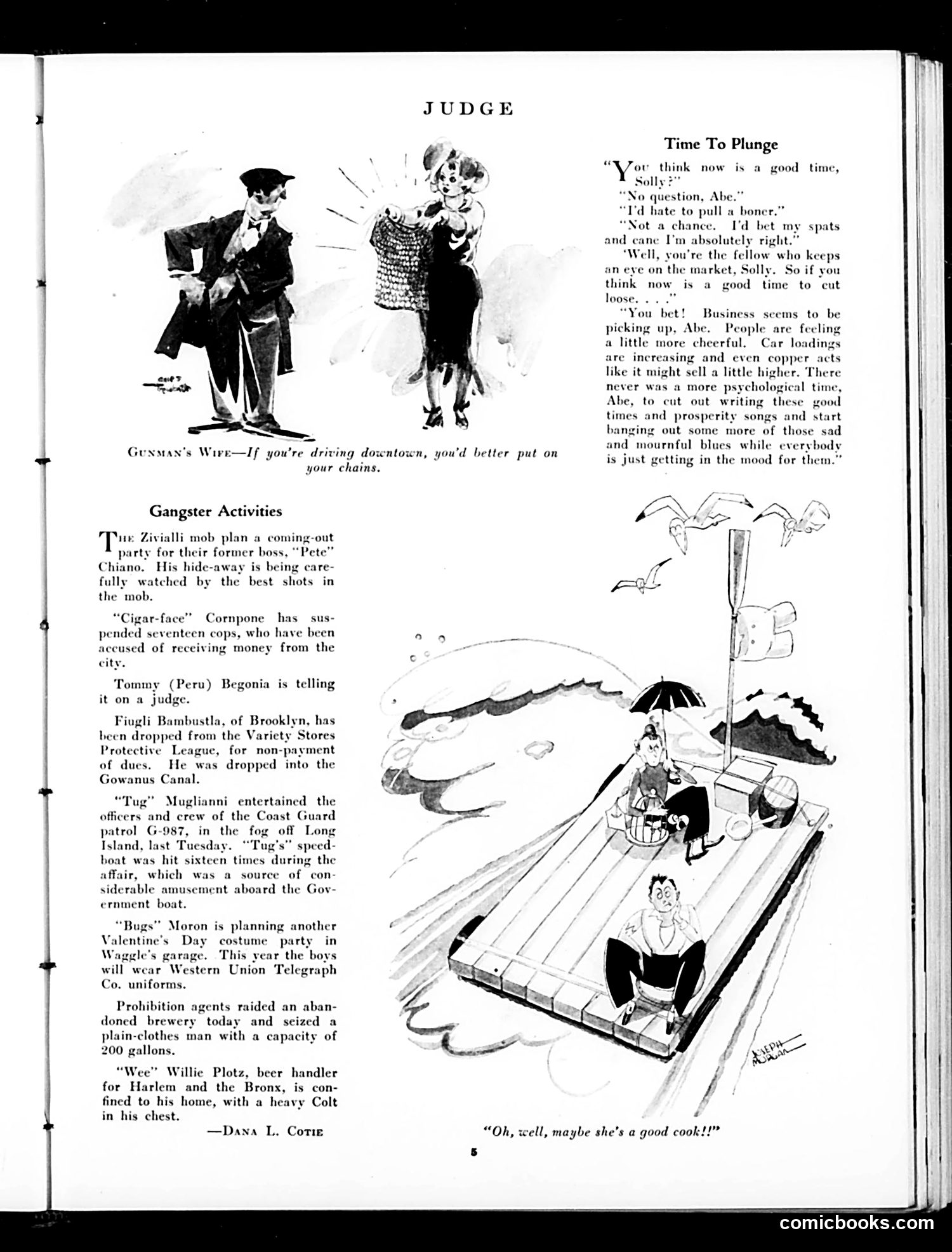
Analysis: Judge Magazine Page This page contains two distinct sections: Top cartoon ("Gunman's Wife"): A woman warns her husband about driving downtown without chains on his tires during winter—a practical safety joke unrelated to satire. "Gangster Activities" section: A column by Dana L. Cotie reporting on organized crime figures and Prohibition enforcement. It references actual underworld nicknames ("Cigar-face" Corpone) and real incidents—police suspensions, Coast Guard patrols, and raids on illegal breweries. The tone is tongue-in-cheek, treating gangster exploits as gossip column material. Bottom cartoon ("Oh, well, maybe she's a good cook!"): A husband in a small boat observes his wife's poor navigation skills, suggesting her only value is domestic cooking—a dated gender-stereotype joke. The page reflects 1920s Prohibition-era concerns, mixing crime reporting with domestic humor.
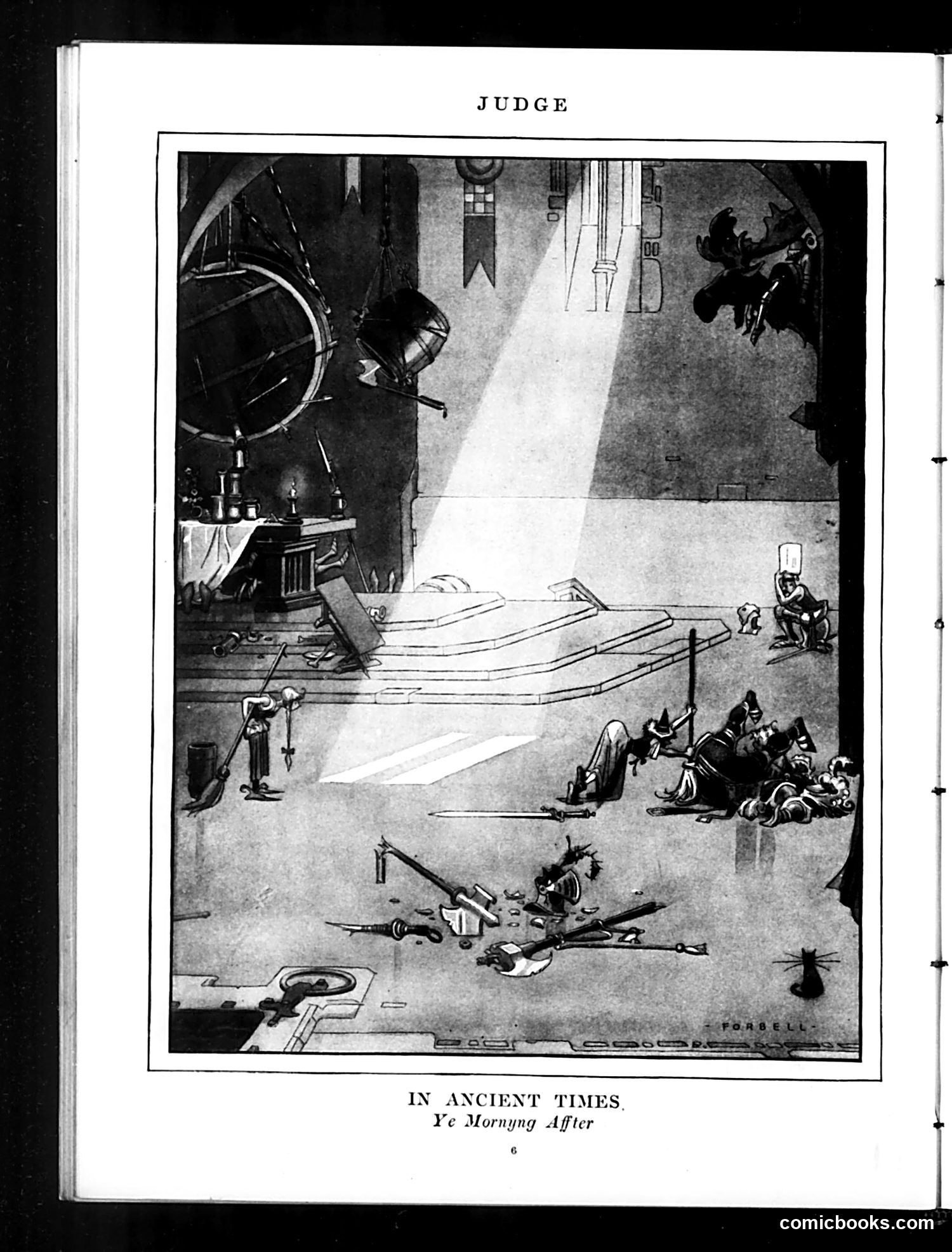
Analysis of Judge Page: "In Ancient Times. Ye Morning After" This satirical cartoon depicts a courtroom scene titled "In Ancient Times. Ye Morning After," suggesting a humorous look at ancient justice proceedings. The image shows what appears to be a judge's chamber or court with various figures scattered about—some appearing disheveled or in disarray, with weapons and objects strewn across the floor. The "morning after" subtitle implies this is depicting the aftermath of some tumultuous event or trial. The satire likely mocks either archaic legal processes or the chaotic nature of ancient justice systems, presenting them as crude and disorganized compared to contemporary (presumably more civilized) methods. The specific figures and exact historical reference remain unclear without additional context about Judge magazine's publication date and concurrent events.
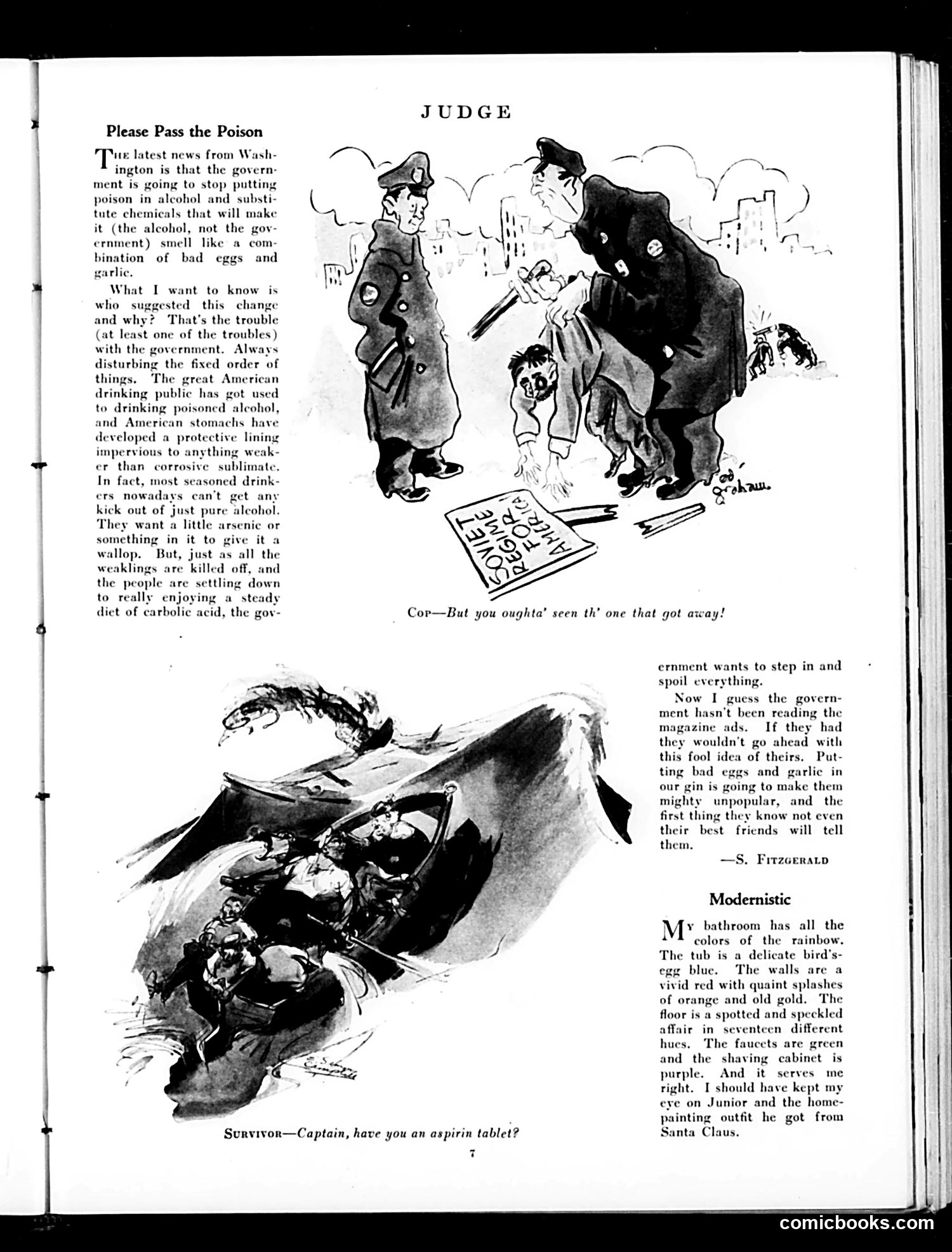
Political Satire from Judge Magazine This page contains two satirical pieces from the Prohibition era (when alcohol sales were banned in the U.S.). "Please Pass the Poison" mocks the government's plan to add foul-smelling chemicals to alcohol to deter drinking. The satire argues that American drinkers have become so accustomed to poisoned bootleg alcohol that they now *require* toxins for a "kick"—making the government's intervention counterproductive and unpopular. The cartoon shows police officers discovering a bottle, illustrating enforcement efforts. "Modernistic" is a lighter domestic humor piece about a bathroom painted in garish, mismatched colors—the result of letting a child loose with paint supplies from a Christmas gift. It's unrelated to the political content above. The author (S. Fitzgerald) uses exaggeration to critique government overreach during Prohibition, suggesting Washington doesn't understand American drinking culture and will only succeed in making alcohol worse, not better.
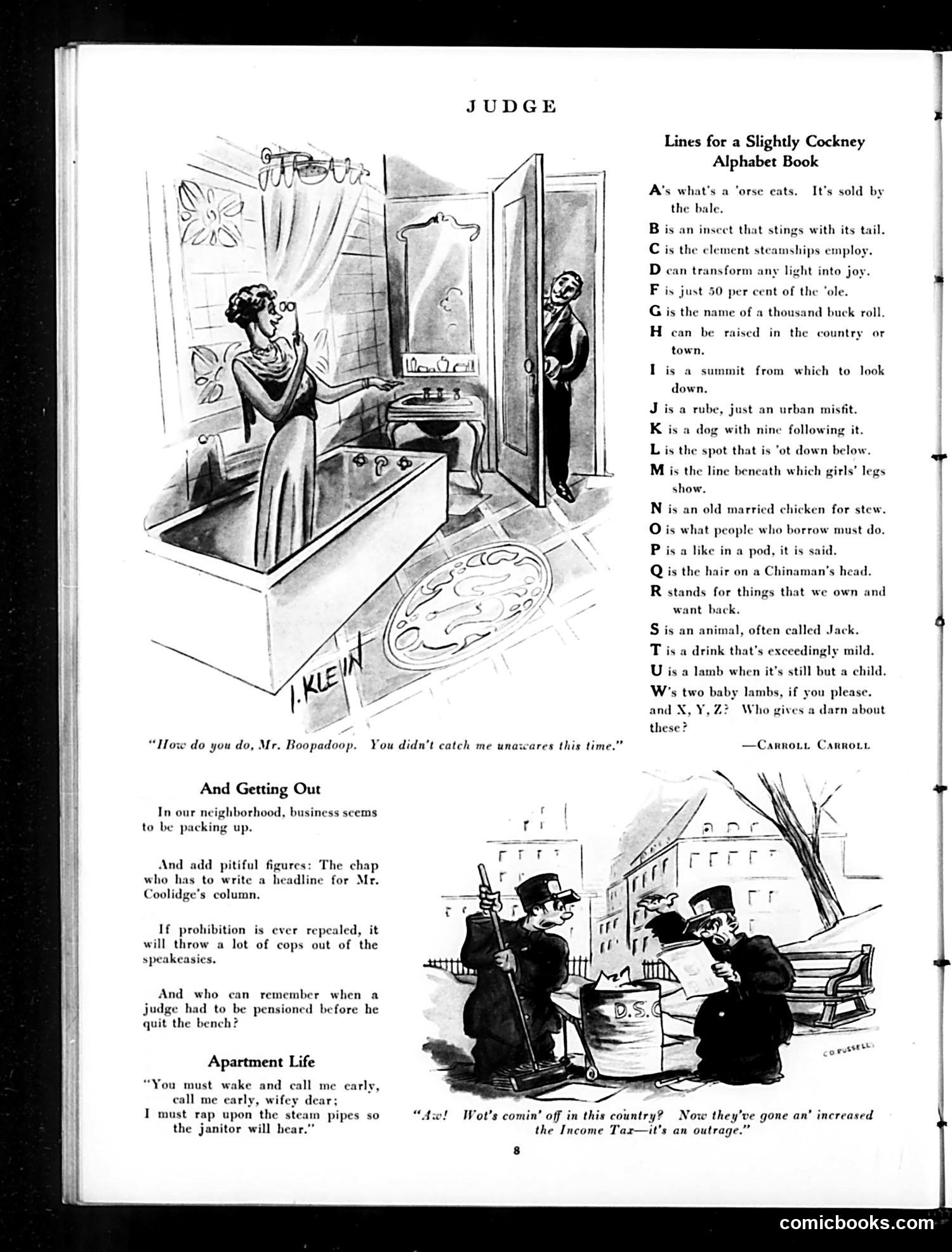
Content Analysis: Judge Magazine Page This page contains three distinct satirical pieces about 1920s American life: "Lines for a Slightly Cockney Alphabet Book" is a humorous alphabet rhyme in working-class British dialect, poking fun at slang and common expressions. The crude drawings accompanying it suggest urban lower-class humor. "And Getting Out" offers brief social commentary on Prohibition's effects (suggesting police would lose speakeasy raid opportunities if repealed), judicial corruption, and business decline in the neighborhood—likely referencing 1920s economic anxieties. "Apartment Life" features two cartoons mocking tenement living: one about a wife demanding early waking so sounds travel through steam pipes to alert the janitor, and another where working-class men complain about increased income taxes. The second figure appears labeled "D.S." (unclear significance). The overall tone satirizes working-class and urban concerns: poverty, housing conditions, and taxation—typical Judge magazine fare targeting middle-class readers with humor about "the lower orders."
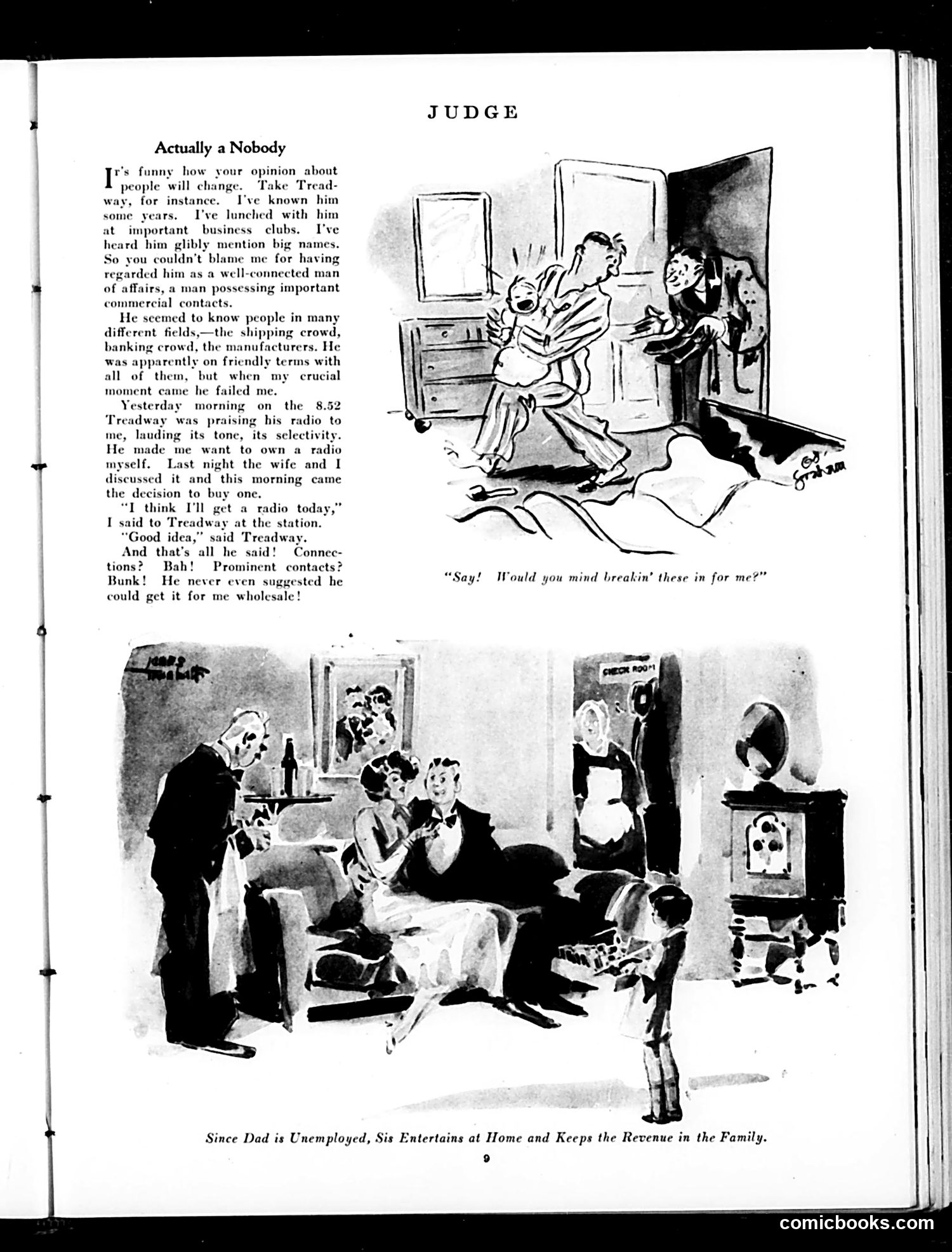
"Actually a Nobody" — Judge Magazine Satire This page satirizes the hollowness of social networking and false prestige. The narrator describes a man named Treadway whom he's known for years, believing him to be well-connected in shipping, banking, and manufacturing—someone with "important commercial contacts" worth cultivating. The joke's punchline: when the narrator decides to buy a radio and mentions it to Treadway, Treadway cannot (or will not) use his supposed wholesale connections to get him a discount. This single failure exposes Treadway's entire reputation as fraudulent. The narrator's realization—that Treadway is "actually a nobody" despite appearing important—mocks both the man's fakeness and the narrator's gullibility in being impressed by mere social association. The lower cartoon shows a family entertaining themselves with various radios and entertainment devices while unemployed ("Since Dad is Unemployed, Sir Entertains at Home"), likely satirizing Depression-era leisure or ironic domesticity.
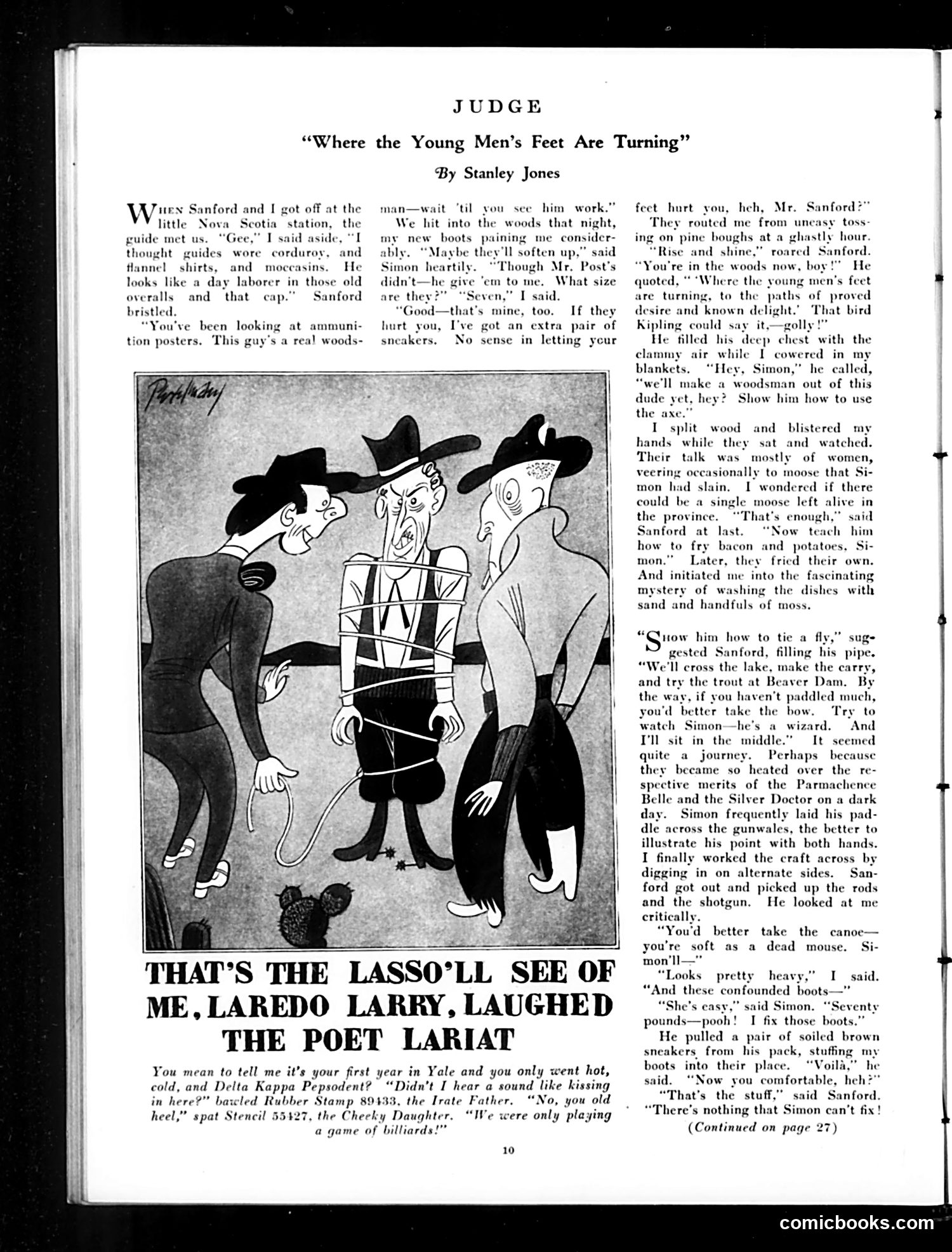
"Where the Young Men's Feet Are Turning" This page presents a short story by Stanley Jones about a city narrator taken on a wilderness hunting trip to Nova Scotia by his friend Sanford and their guide Simon. The cartoon illustration shows three men in outdated or mismatched clothing—likely meant to humorously depict the contrast between civilized and wilderness life. The narrative satirizes the narrator's urban inexperience and discomfort in nature. Sanford and Simon patronizingly "educate" him in woodsman skills (splitting wood, cooking, tying fishing flies, paddling), while the narrator suffers through blistered hands, uncomfortable boots, and cold nights. The humor derives from his fish-out-of-water predicament and the guides' patient condescension toward the soft city dweller. The title references a Rudyard Kipling poem, suggesting themes of masculine adventure and testing one's mettle in nature—tropes Judge's readers would recognize and find amusing when applied to this bumbling urbanite.
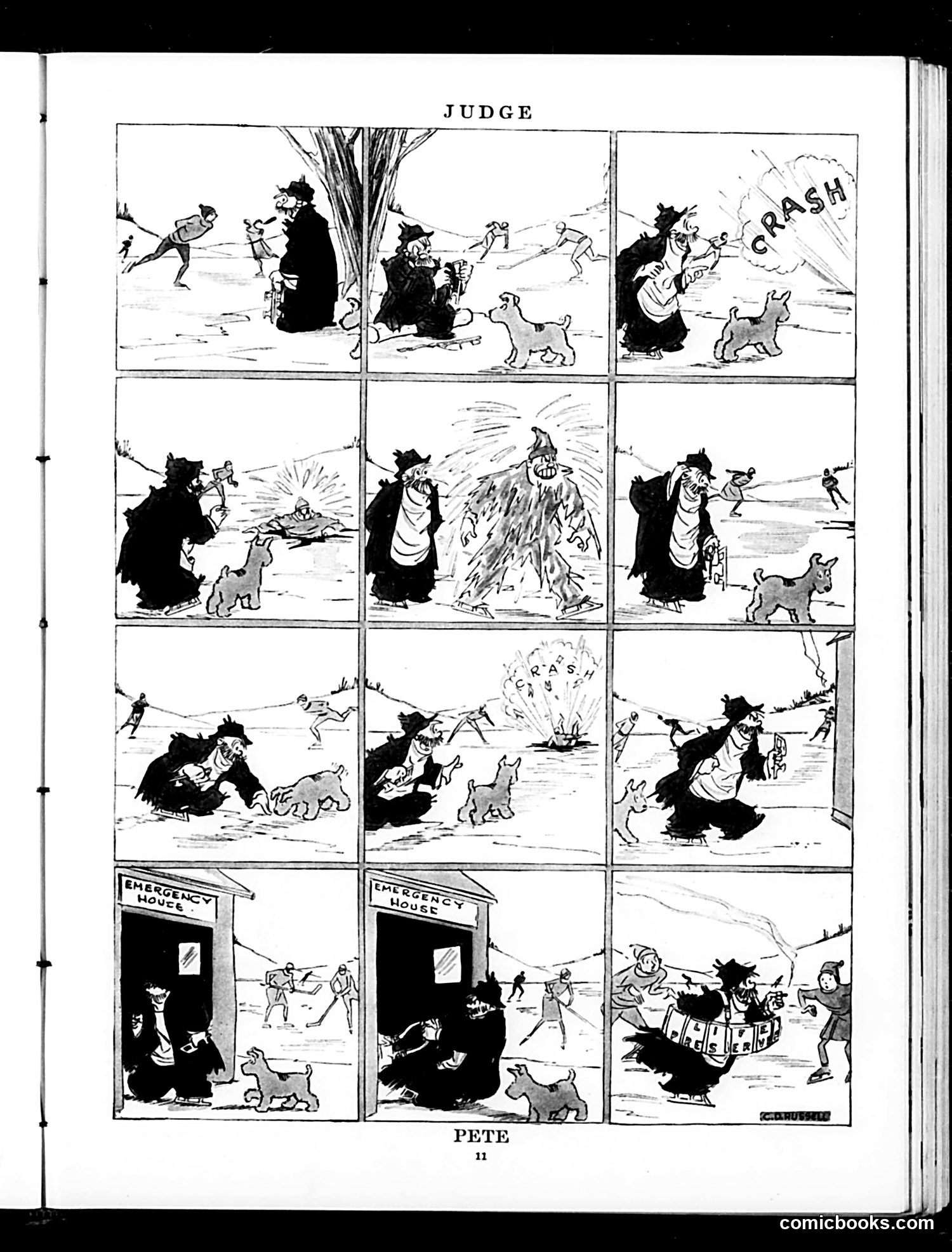
Judge Magazine Comic Strip Analysis This appears to be a multi-panel comic strip titled "Judge" featuring a judge character and a small dog named "Pete." The narrative follows the judge's escalating misadventures as he attempts to manage the dog's chaotic behavior in a public setting. The strip satirizes judicial authority and dignity—a high-ranking official is repeatedly humiliated and outwitted by a small animal. Each panel shows the judge's failed attempts at control, with the situation deteriorating into slapstick chaos involving other citizens and an "Emergency House" (likely a police or emergency station). The humor derives from the contrast between the judge's formal position and his complete inability to maintain order, even over a dog. This likely critiques pompous authority figures of the period.
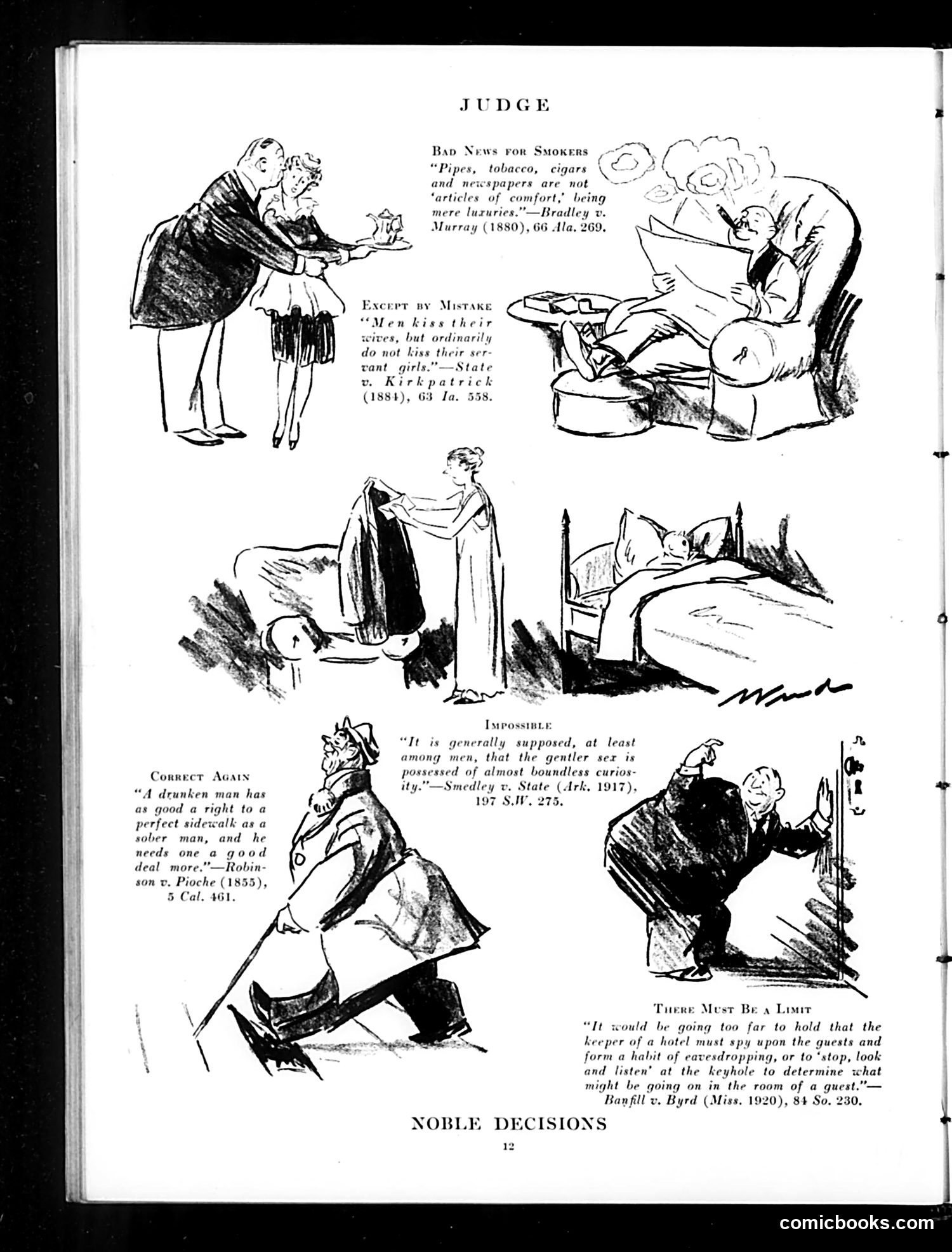
"Noble Decisions" — Judge Magazine Legal Satire This page satirizes absurd court rulings through illustrated vignettes paired with actual legal case citations. Each cartoon mocks the logical inconsistencies or ridiculous implications of real judicial decisions: "Bad News for Smokers" ridicules a ruling that smoking luxuries aren't "articles of comfort." "Except by Mistake" shows a man kissing a servant girl, mocking a court's distinction that men kiss wives but "ordinarily" not servants. "Impossible" depicts a woman's insatiable curiosity, sarcastically noting courts assume women are endlessly inquisitive. "Correct Again" illustrates a drunk man needing sidewalk safety "more"—absurdly suggesting intoxication increases pedestrian rights. "There Must Be a Limit" shows a hotel manager spying through keyholes, mocking a ruling that hotels needn't eavesdrop on guests. The satire critiques judicial reasoning: using real cases with specific citations, Judge demonstrates how literal interpretations of law produce ridiculous conclusions. The cartoonist exposes judicial logic's inherent contradictions and absurdities.
Judge Magazine Page Analysis This page from *Judge* magazine presents satirical social commentary through three distinct articles: "Parental Fears" discusses generational anxiety about youth morality. The piece argues that parental lecturing is ineffective; instead, children learn from their parents' *character* and must gradually gain independence and self-reliance. "The Great Indoors" satirizes the new Cincinnati mega-building—a massive enclosed structure combining stores, hotel, offices, and garage. The satire peaks in the final paragraph: it describes a future where people need never go outside, living entirely indoors from birth through cremation. This mocks the era's enthusiasm for enclosed, artificially-ventilated spaces and urban consolidation. "The Kings of Alky" references a wedding between the relatives of two major organized crime figures—Al Capone's sister marrying into Frank Diamond's family. The "marriage of convenience" between these crime families' branches satirizes how such unions strengthen criminal enterprises during Prohibition. The page reflects 1920s-30s American anxieties: youth behavior, urban development trends, and Prohibition-era organized crime.
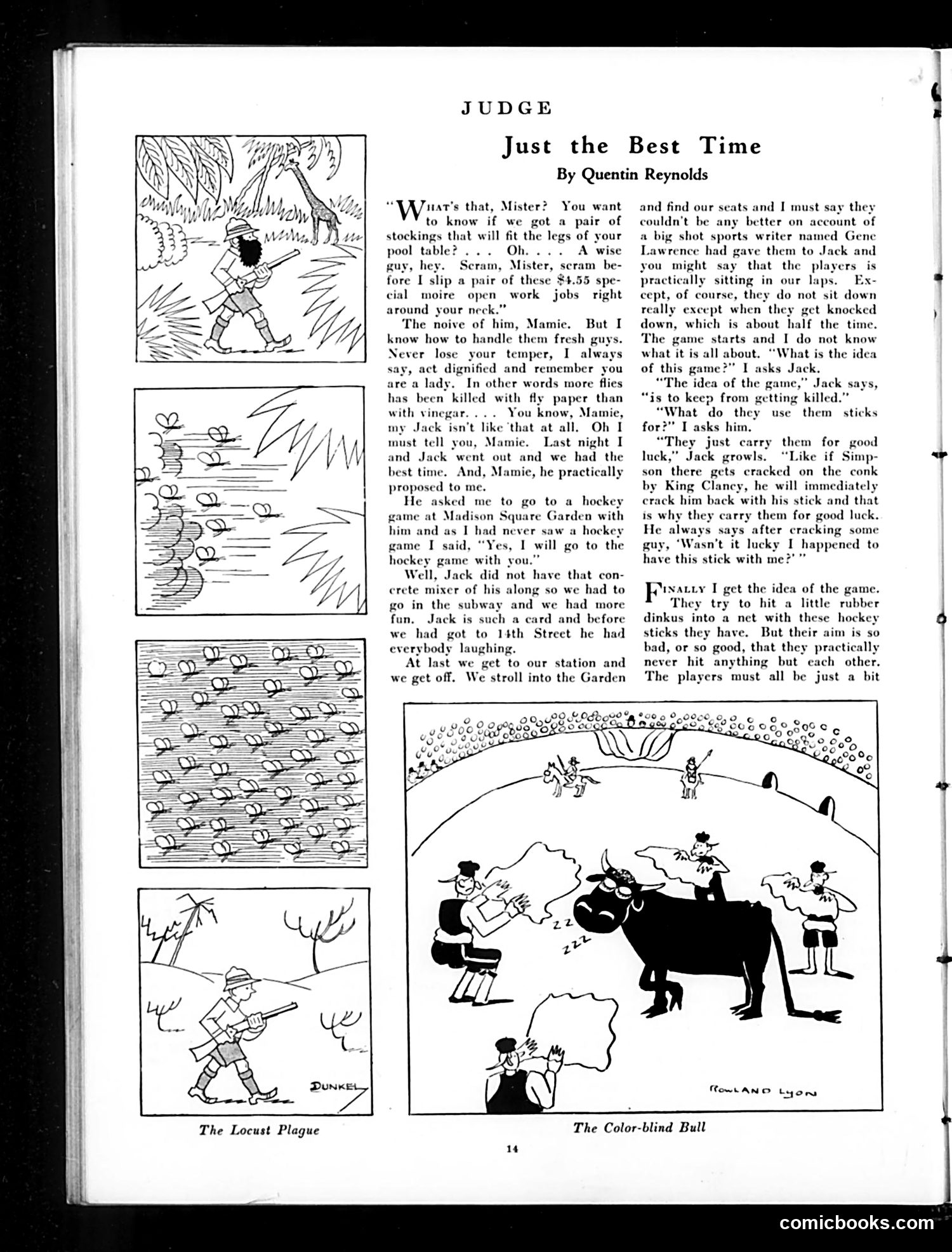
Analysis This page contains a humorous short story by Quentin Reynolds about a woman's first hockey game experience, accompanied by comic illustrations. The Main Content: The narrative is a monologue from a woman (Mamie) describing her date with Jack to Madison Square Garden. Jack, portrayed as charming and funny, takes her to a hockey game. The humor derives from her complete ignorance of hockey's purpose and rules. She misunderstands the sport's objective, thinking players carry sticks "for good luck" and that the goal is "to keep from getting killed." The Satire: The joke targets both hockey's seemingly chaotic nature and the naïveté of casual spectators unfamiliar with sports. The woman's bewildered observations—that players "practically never hit anything but each other"—poke fun at hockey's rough, contact-heavy gameplay. The Illustrations: The cartoons labeled "The Locust Plague" and "The Color-blind Bull" appear unrelated to the main text, suggesting this is a typical Judge magazine layout mixing multiple comedic pieces on one page. The overall tone is light, 1920s-era social comedy about dating, sports culture, and gender-based assumptions.
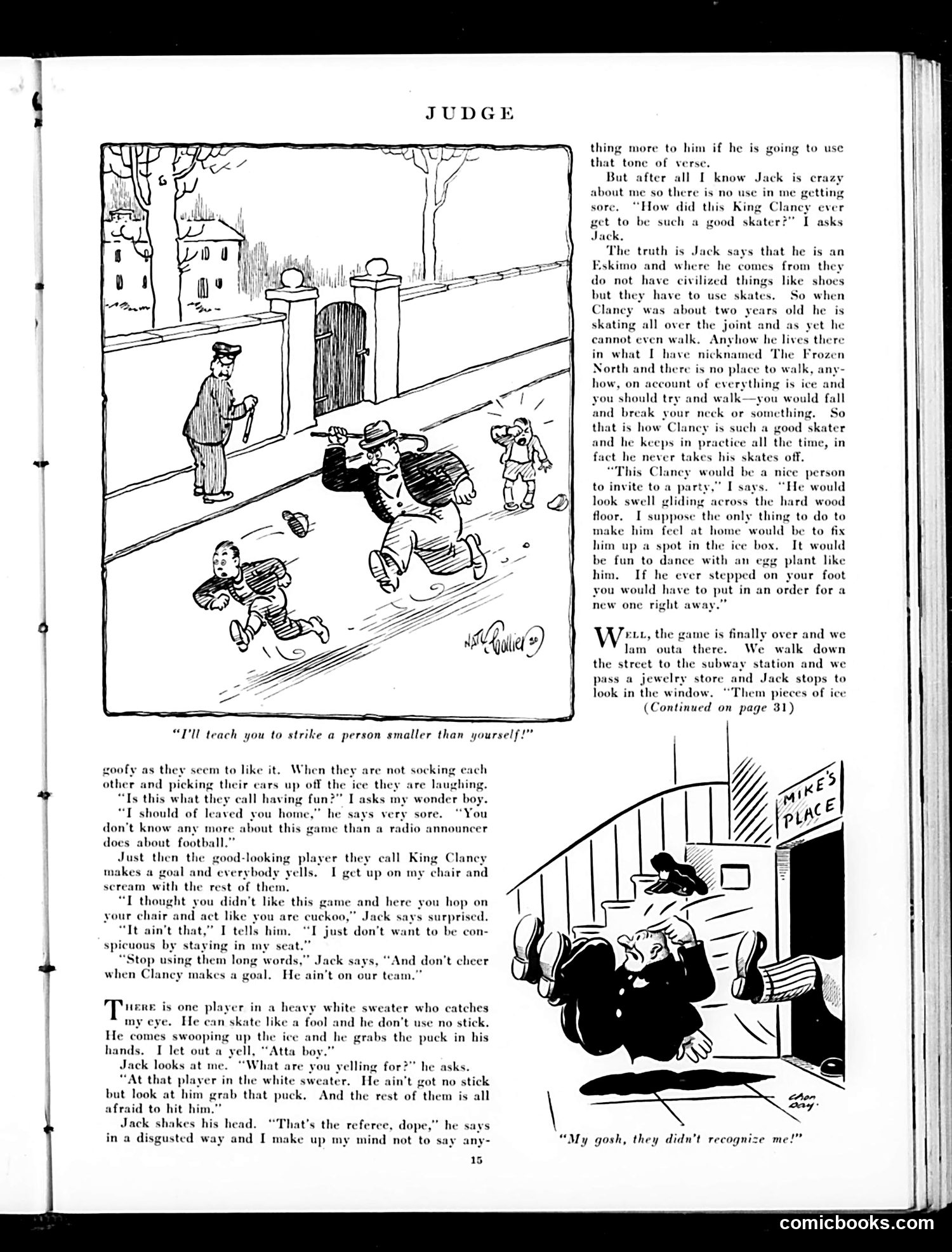
Analysis: "Judge" Magazine Page This page contains a humorous narrative about attending a hockey game, likely from the 1920s-1930s based on the style and references. The Main Story: The narrator, apparently a woman unfamiliar with hockey, attends a game with "Jack." She mistakenly cheers for the referee, thinking he's a skilled player because he's grabbing the puck without a stick. Jack corrects her dismissively, calling her "dope." The Satire: The humor targets gender stereotypes—specifically, the assumption that women don't understand sports. The narrator's genuine confusion about hockey rules becomes comedic fodder, reinforced by Jack's condescending attitude. The Cartoons: Two accompanying illustrations show ice skating and people at what appears to be a jewelry store entrance. These appear to illustrate the narrative's digressions about "King Clancy," an apparently famous skater they discuss, and their subsequent evening plans. Social Context: This reflects early 20th-century assumptions about women's lack of sports knowledge and their comic role as bewildered observers of "masculine" activities.
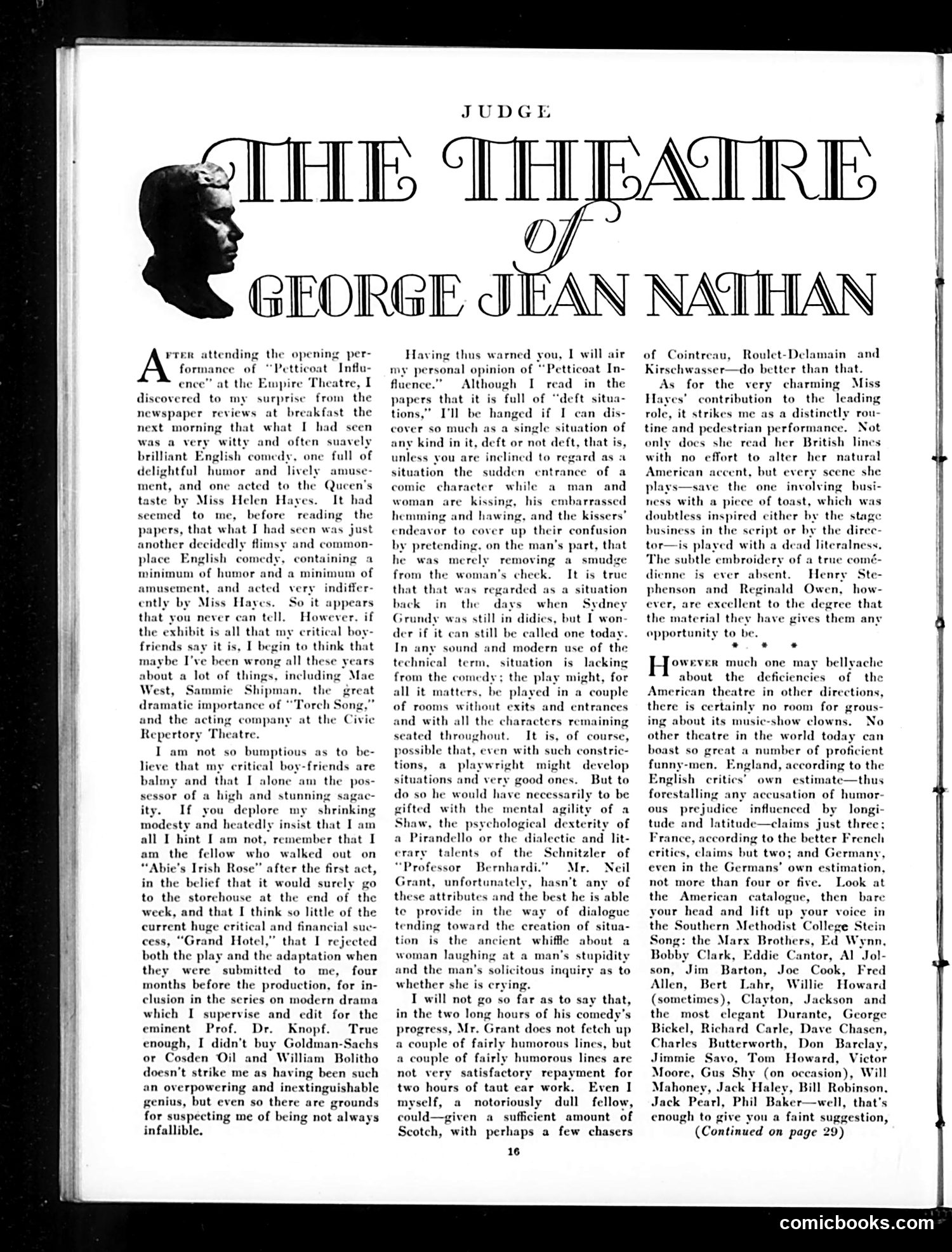
"The Theatre of George Jean Nathan" - Judge Magazine Theater Criticism This page presents a theater review by George Jean Nathan, a prominent American drama critic of the early 20th century. Nathan dismisses the English play "Petticoat Influence," starring Helen Hayes, despite positive newspaper reviews. The satire targets Nathan's own critical contradictions: he admits to major misjudgments (rejecting "Grand Hotel" and "Abie's Irish Rose" before their success) yet confidently pronounces the current play lacking in "deft situations." He attacks the playwright's derivative techniques—characters kissing while others enter awkwardly—as outdated since "Sydney Grundy was still in didies" (a reference to Victorian-era playwright Sydney Grundy). The piece mocks Nathan's pretentious critical standards, comparing unfavorably the playwright to Shaw, Pirandello, and Schnitzler, while revealing Nathan's own unreliability as a judge of theatrical merit. The irony is heavy: Nathan acknowledges his fallibility while asserting authoritative judgment.
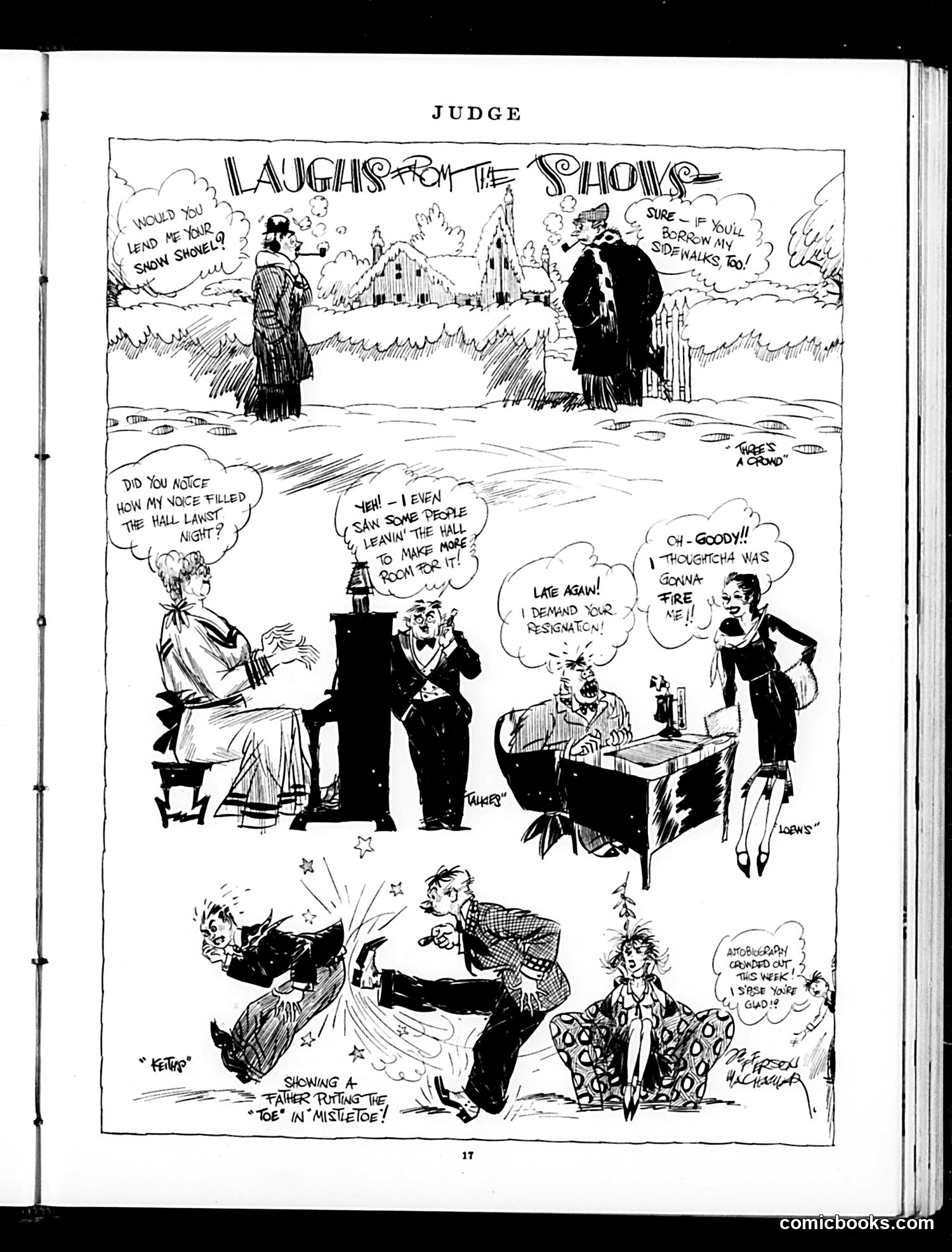
"Laughs from the Schoolhouse" This Judge cartoon satirizes a chaotic schoolhouse scene, likely from the early 20th century. The top panel shows snowy weather; the bottom depicts various classroom disruptions: a student kicking up his heels, another roughhousing, someone late arriving, a teacher dealing with noise and misbehavior, and students causing general pandemonium. The humor targets the difficulty of maintaining classroom discipline and order. Characters complain about noise, late arrivals, and rowdy behavior. One figure mentions "showing a father rotting the ice in mistletoe"—likely a garbled reference to holiday mischief. The satire mocks both unruly students and the exasperated authority figures struggling to manage them. It reflects contemporary concerns about American schoolhouse discipline and the challenges teachers faced controlling boisterous youth.
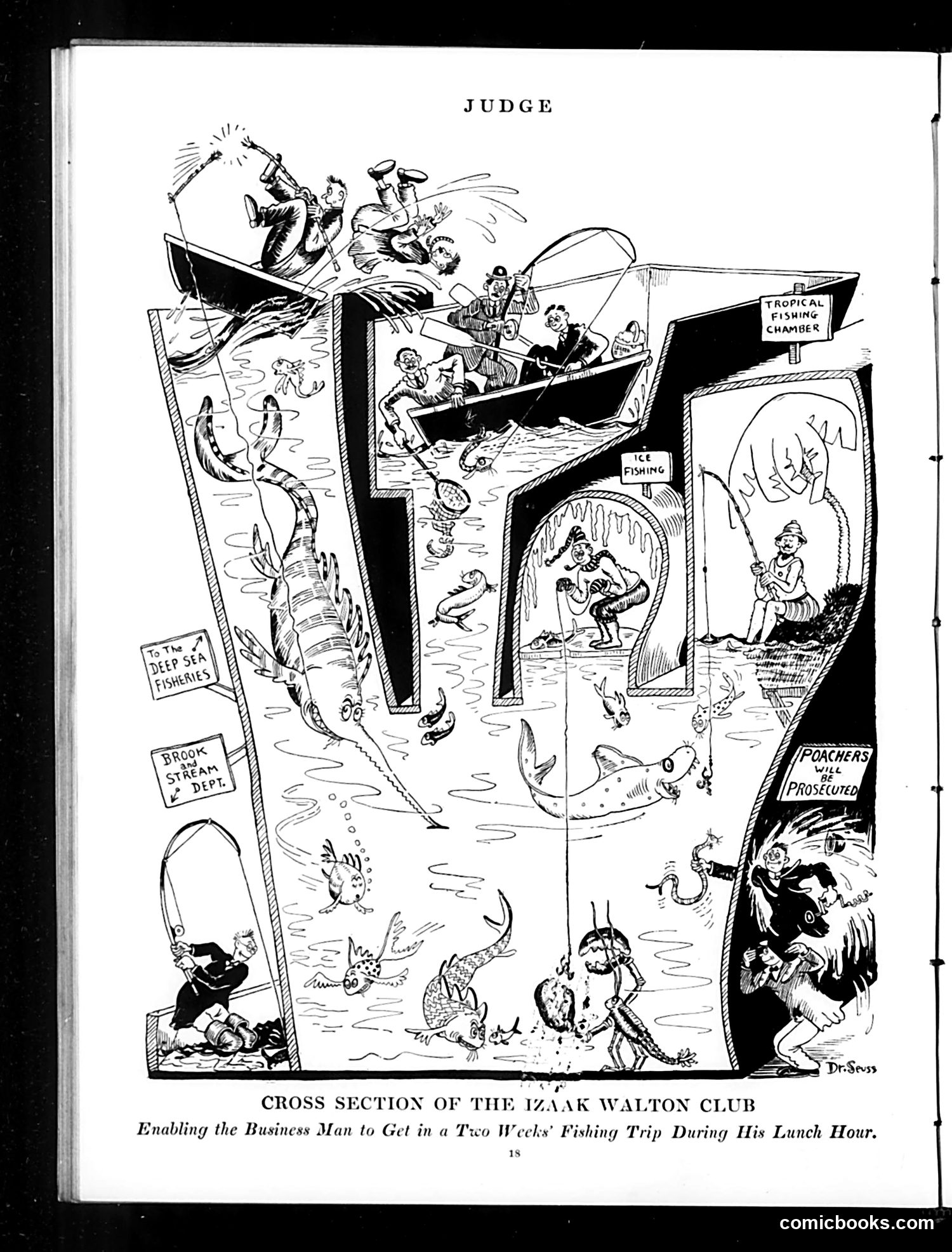
JUDGE Magazine Cartoon: "Cross Section of the Izaak Walton Club" This is a satirical cross-section diagram mocking the Izaak Walton Club, a real organization for fishing enthusiasts named after a famous 17th-century fishing writer. The joke targets busy businessmen who want to fish but have limited time. The cartoon shows an elaborate underground structure enabling men to compress a "two weeks' fishing trip" into their lunch hour. Various labeled sections include "Tropical Fishing Chamber," "Ice Fishing," and "Brook Stream Dept."—offering different fishing experiences stacked vertically. The diagram depicts fish of all kinds, fishing equipment, and businessmen in various poses enjoying their hobby. The satire mocks the absurdity of modern urban life: the idea that a businessman could somehow enjoy extended outdoor recreation within an hour-long break through mechanical/architectural engineering. It's also poking fun at the Izaak Walton Club members' aspirations to balance corporate work life with leisurely sport fishing.
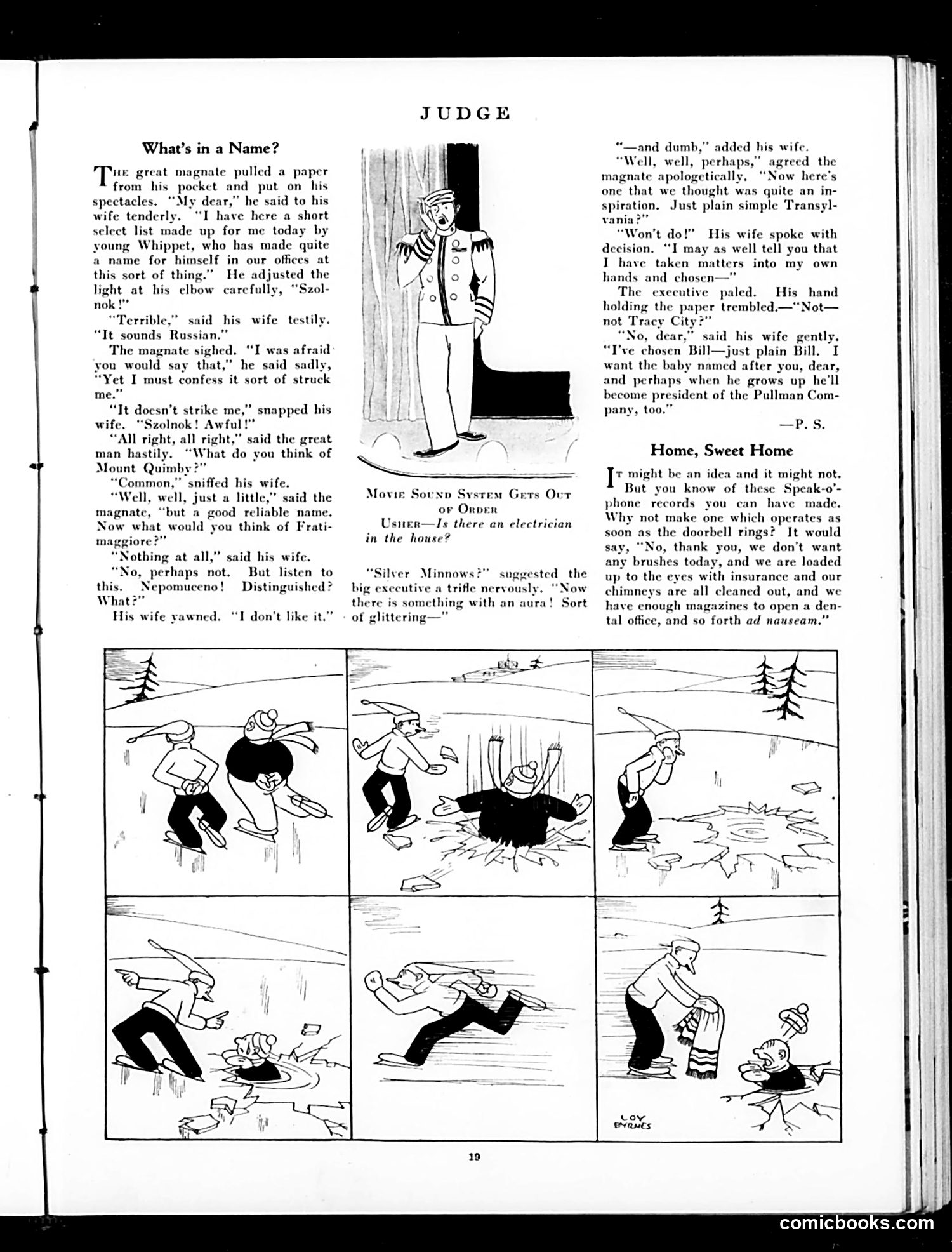
What's in a Name? The top piece satirizes wealthy businessman's pretentious naming practices. A magnate solicits "distinguished" baby names from his employee, proposing increasingly exotic options (Szolnok, Nepomuceno, Transylvania) to impress his wife. She rejects them all as either "Russian," "common," or "dumb"—until she announces she's chosen "Bill," after her husband, hoping their son becomes Pullman Company president. The joke mocks both the magnate's social climbing and his wife's deflating practicality: all that affected naming aspirations collapse into mundane domesticity. The comic strip below depicts slapstick winter scenes of people falling through ice—visual humor unrelated to the text. "Home, Sweet Home" (right column) satirizes telephone answer-machine recordings as solutions to unwanted solicitors and door-knockers, listing tedious sales pitches they'd deflect.
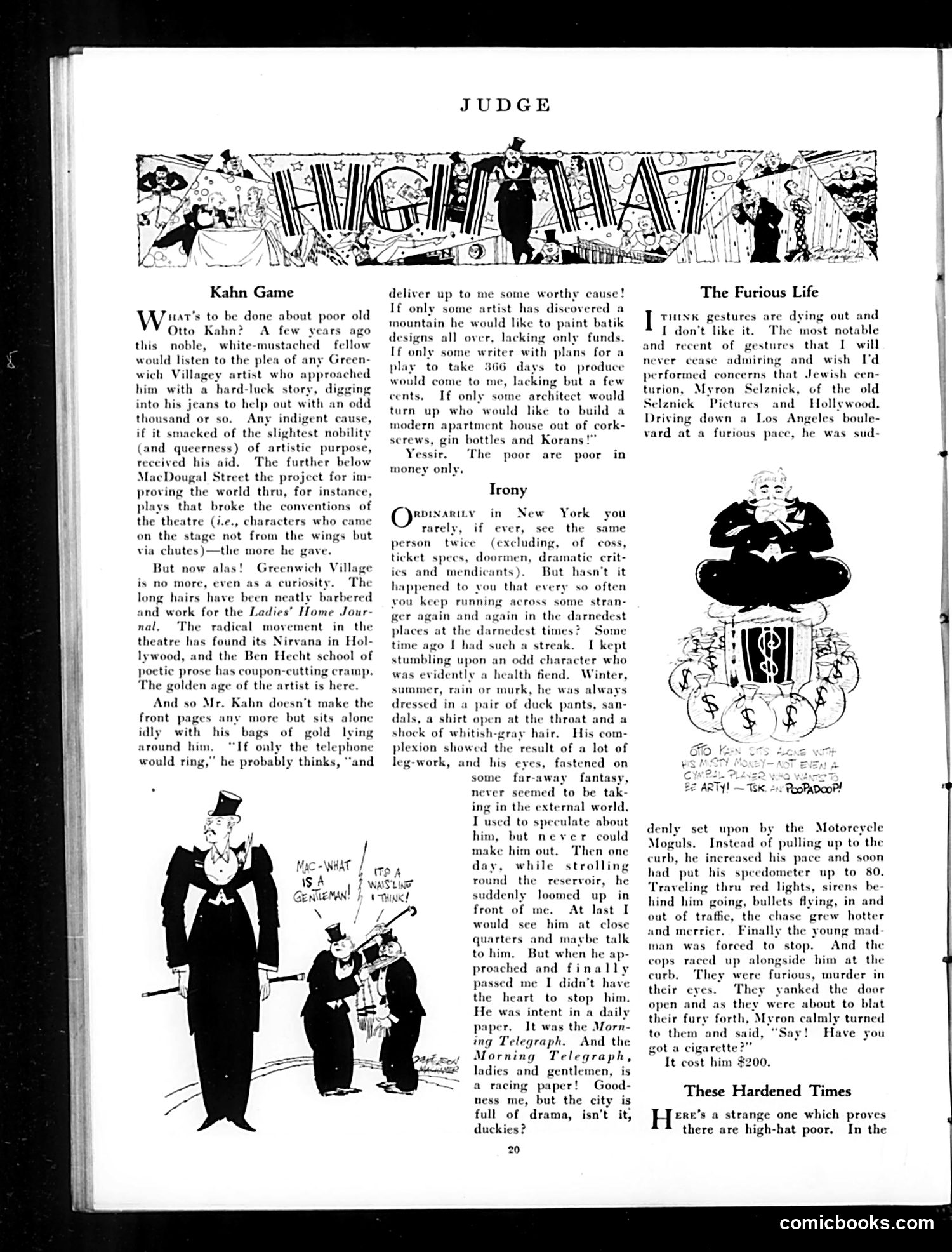
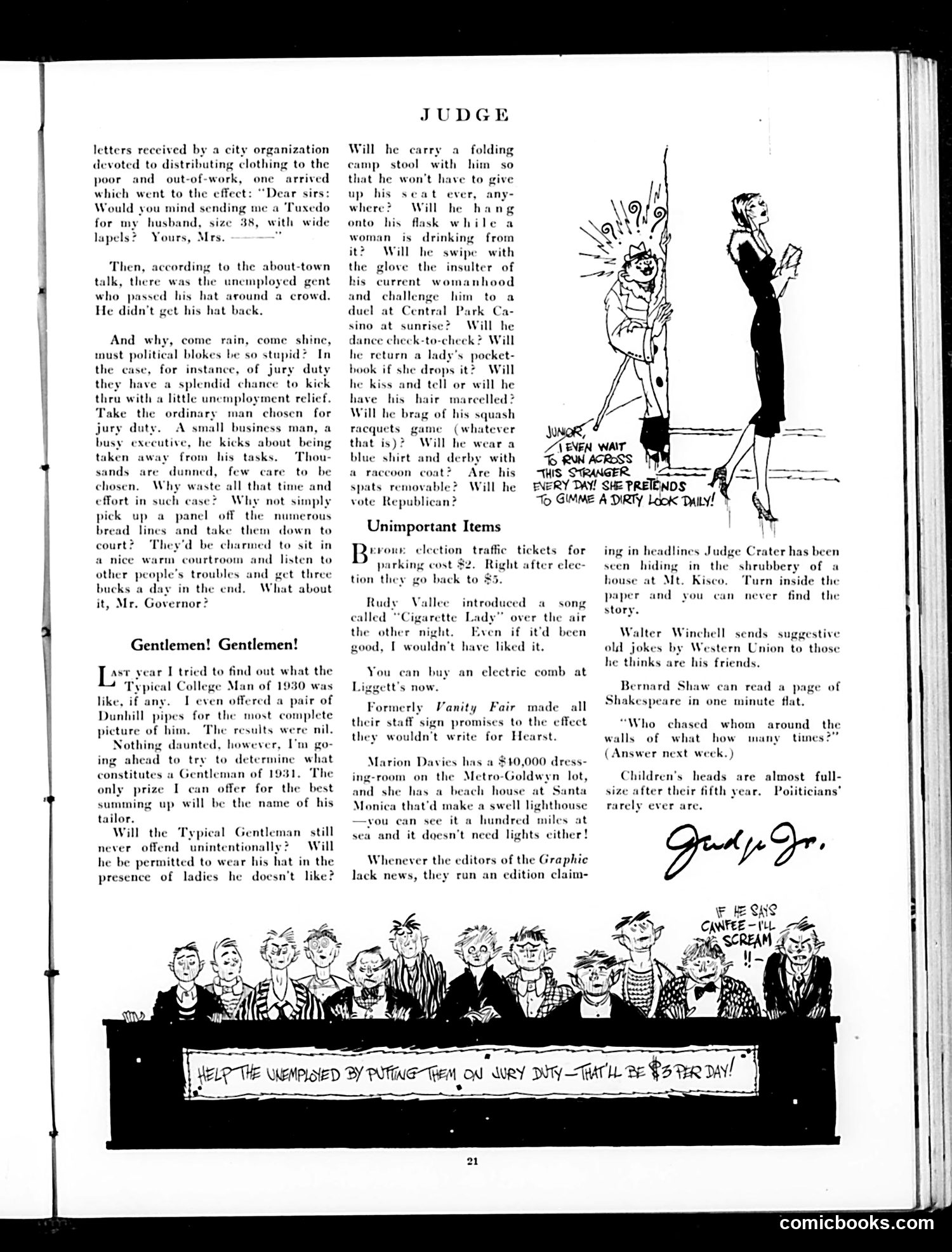
Judge Magazine Satire Analysis This page contains satirical commentary on 1930s social issues. The main content criticizes political inefficiency: during the Great Depression, politicians waste time on jury duty when they could solve unemployment by recruiting jobless people from "bread lines" to serve as jurors at $3/day—benefiting both the courts and the desperate poor. The upper cartoon depicts a woman accosting a man about his infidelity, demanding he "run across the springer" daily and claiming she befriends women to expose his cheating. The "Gentlemen! Gentlemen!" section sarcastically defines a modern "Gentleman of 1931" through absurd questions about etiquette (keeping his flask while women drink, wearing a folding camp stool to avoid giving up seats, voting Republican)—mocking declining standards of civility. The "Unimportant Items" section includes brief jokes: Judge Crater's mysterious disappearance (a famous 1930 case), celebrity gossip about Marion Davies and Rudy Vallée, and a dig at the *Graphic* newspaper for running sensational coverage when lacking real news.
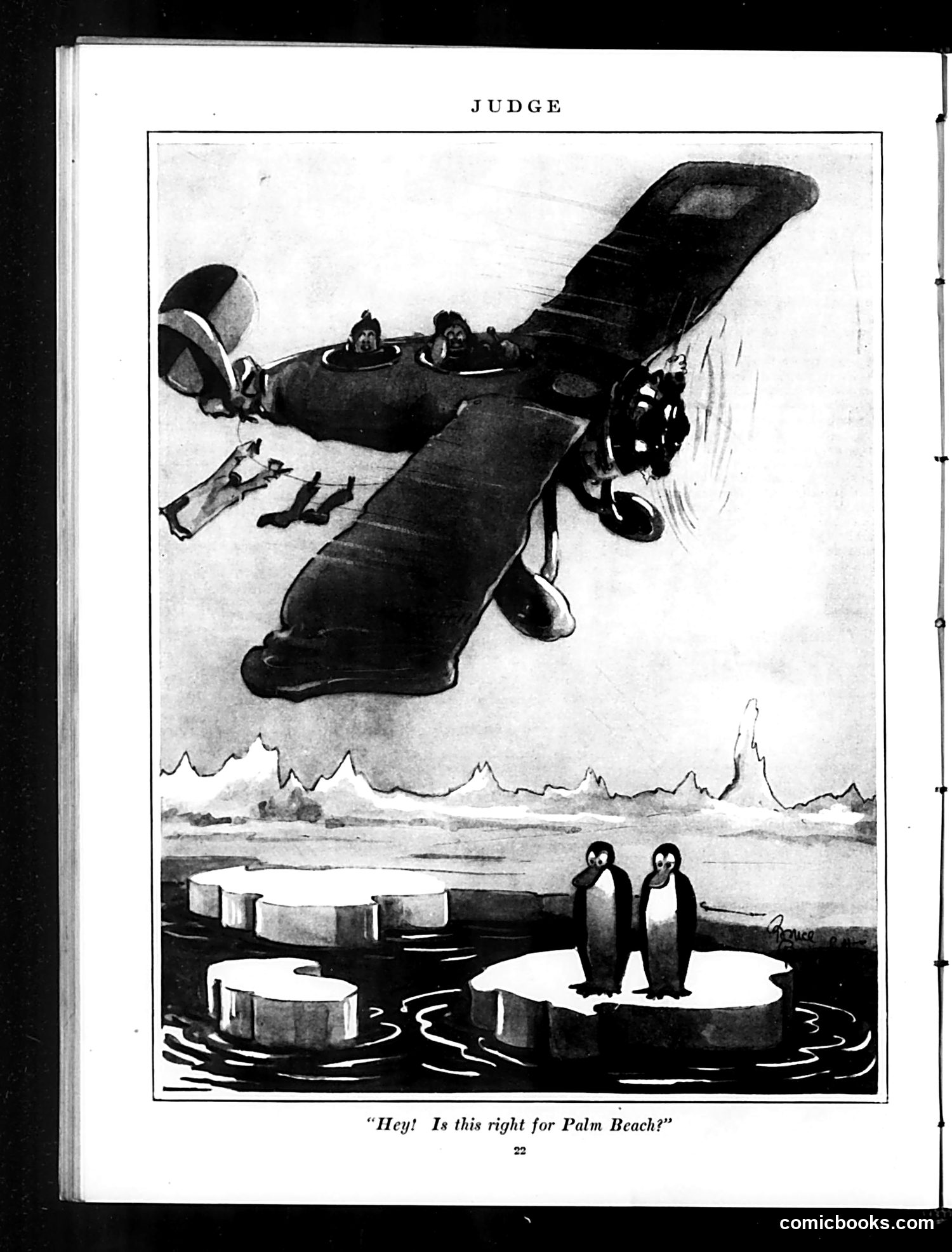
Political Cartoon Analysis This Judge magazine cartoon depicts an airplane flying low over icy Arctic terrain where two penguins stand on ice floes. One penguin asks, "Hey! Is this right for Palm Beach?" The satire plays on a geographic absurdity: the plane appears to have flown to the wrong destination entirely—to the Arctic instead of Palm Beach, Florida, a warm and fashionable destination. The joke mocks either: 1. Poor navigation/incompetence of early aviation 2. Someone's travel mishap or confusion about directions The penguin's bewildered question emphasizes the ridiculousness of arriving at the opposite climate from one's intended destination. This likely satirizes either early aviation's unreliability or a specific contemporary travel incident, though without a date visible, the exact reference remains unclear.
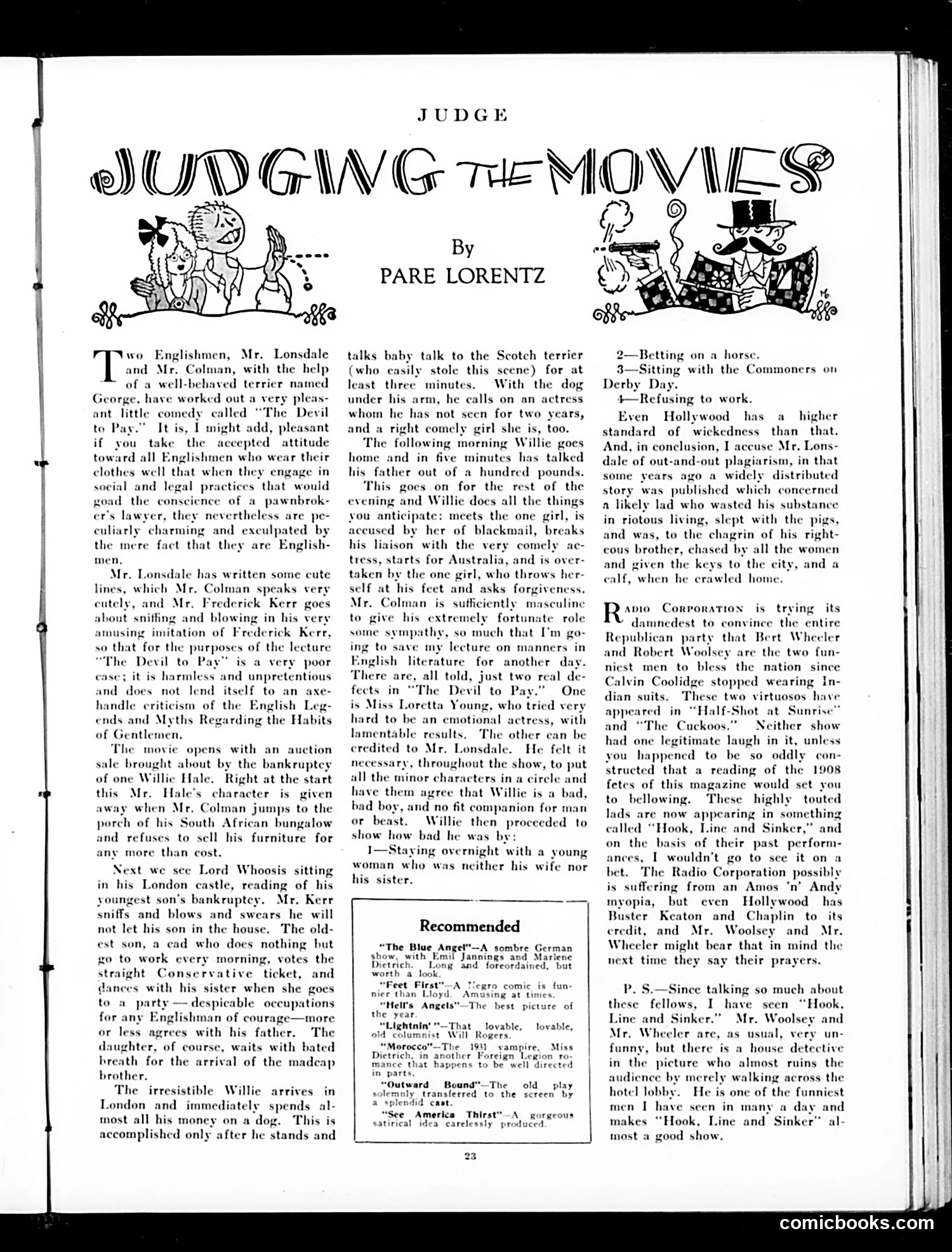
Analysis This is a film review column titled "Judging the Movies" by Pare Lorentz. Rather than a political cartoon, it's a satirical critique of contemporary films and Hollywood figures. The review criticizes "The Devil to Pay" as lacking genuine English character, arguing it promotes unflattering stereotypes. Lorentz praises performances by Loretta Young and credits Mr. Lonsdale for elevating the material, while accusing the film of plagiarism from an earlier published story. The "Recommended" section briefly endorses several other films including comedies with Emil Jannings and a picture called "Morrocco." The final note commends "Hook, Line and Sinker" as genuinely funny, suggesting Woolsey and Wheeler succeed where more prestigious productions fail—a jab at Hollywood's pretensions disguised as film criticism.
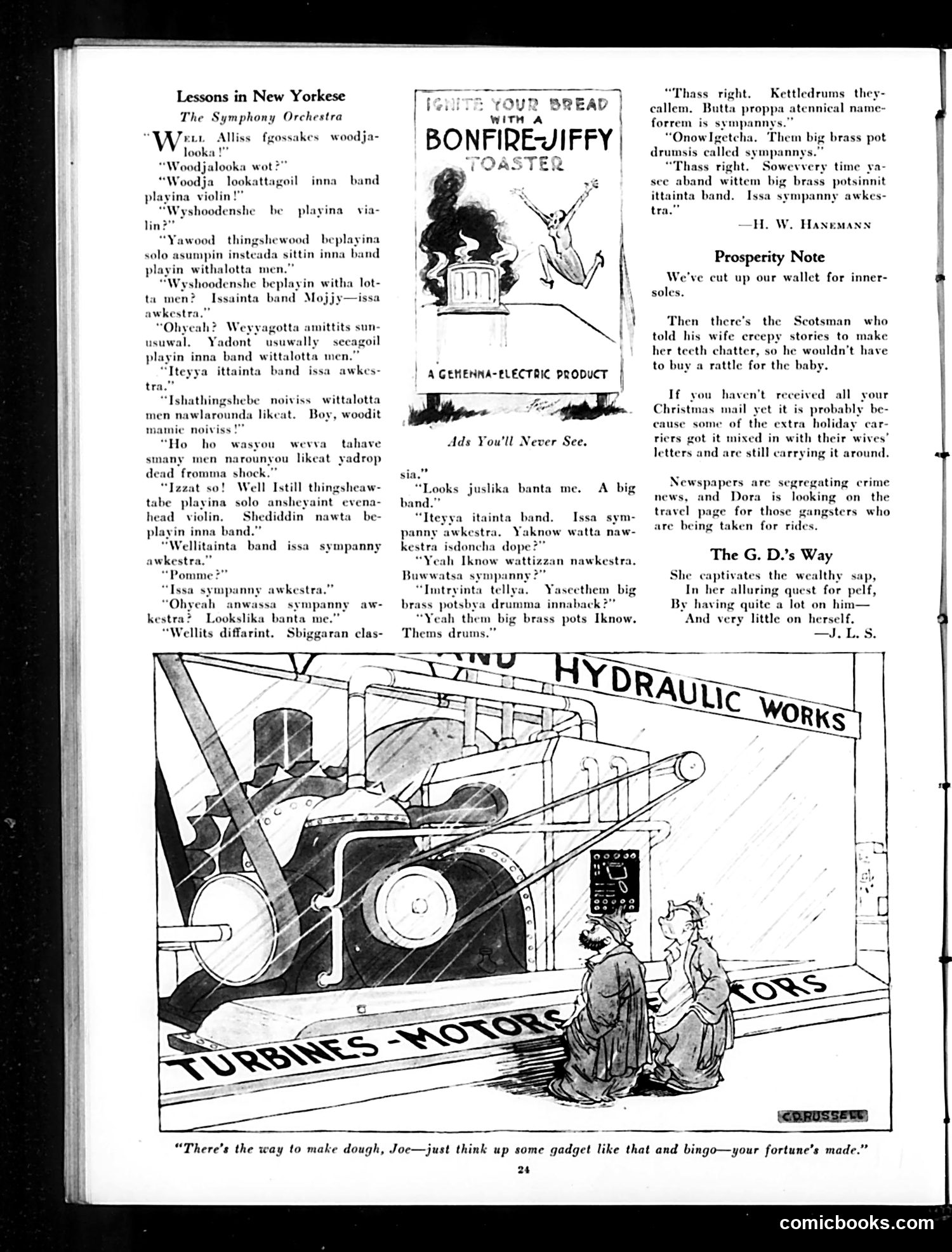
Analysis of Judge Magazine Page This page contains three distinct elements: "Lessons in New Yorkese" (top left) is a humorous dialect piece mimicking exaggerated immigrant or working-class New York speech patterns, poking fun at how Symphony Orchestra musicians mispronounce English. "Bonfire-Jiffy Toaster" (center) is a product advertisement for an electric toaster, one of the era's modern conveniences. Bottom cartoon depicts two women at an industrial "Turbines-Motors Hydraulic Works" facility. The caption suggests one is advising the other to "think up some gadget like that" to ensure financial security—satirizing women's economic dependence on either invention, marriage, or wealth acquisition during this pre-modern era when female employment options were severely limited. The page reflects early 20th-century attitudes toward class, immigration, and gender roles.
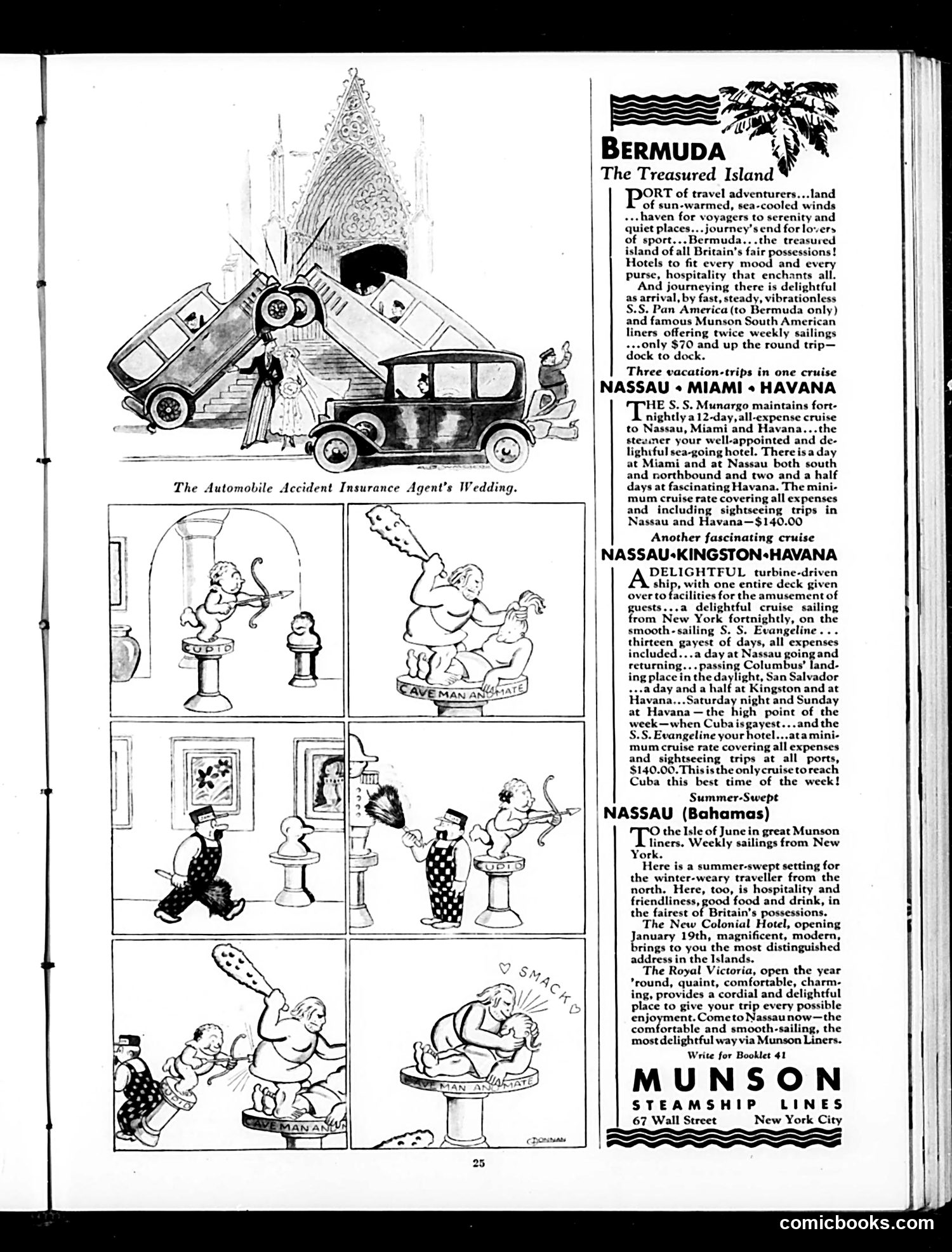
Analysis of Judge Magazine Page This page is primarily advertising content, not editorial cartoon or satire. The top cartoon titled "The Automobile Accident Insurance Agent's Wedding" is a visual gag showing a wedding ceremony disrupted by a car crash—a joke about the insurance agent's profession intruding into his personal life. Below that are six comic panels depicting slapstick humor in what appears to be a caveman or primitive setting, with characters engaging in physical comedy around furniture and household items. The bulk of the page comprises travel advertisements for Munson Steamship Lines promoting luxury Caribbean cruises (Bermuda, Nassau, Miami, Havana, Kingston) priced at $70-$140 for round-trip voyages. The ads emphasize comfort, hospitality, and all-inclusive amenities. Historical context: This reflects the 1920s-30s leisure travel industry targeting affluent Americans seeking tropical vacations accessible by steamship before widespread air travel.
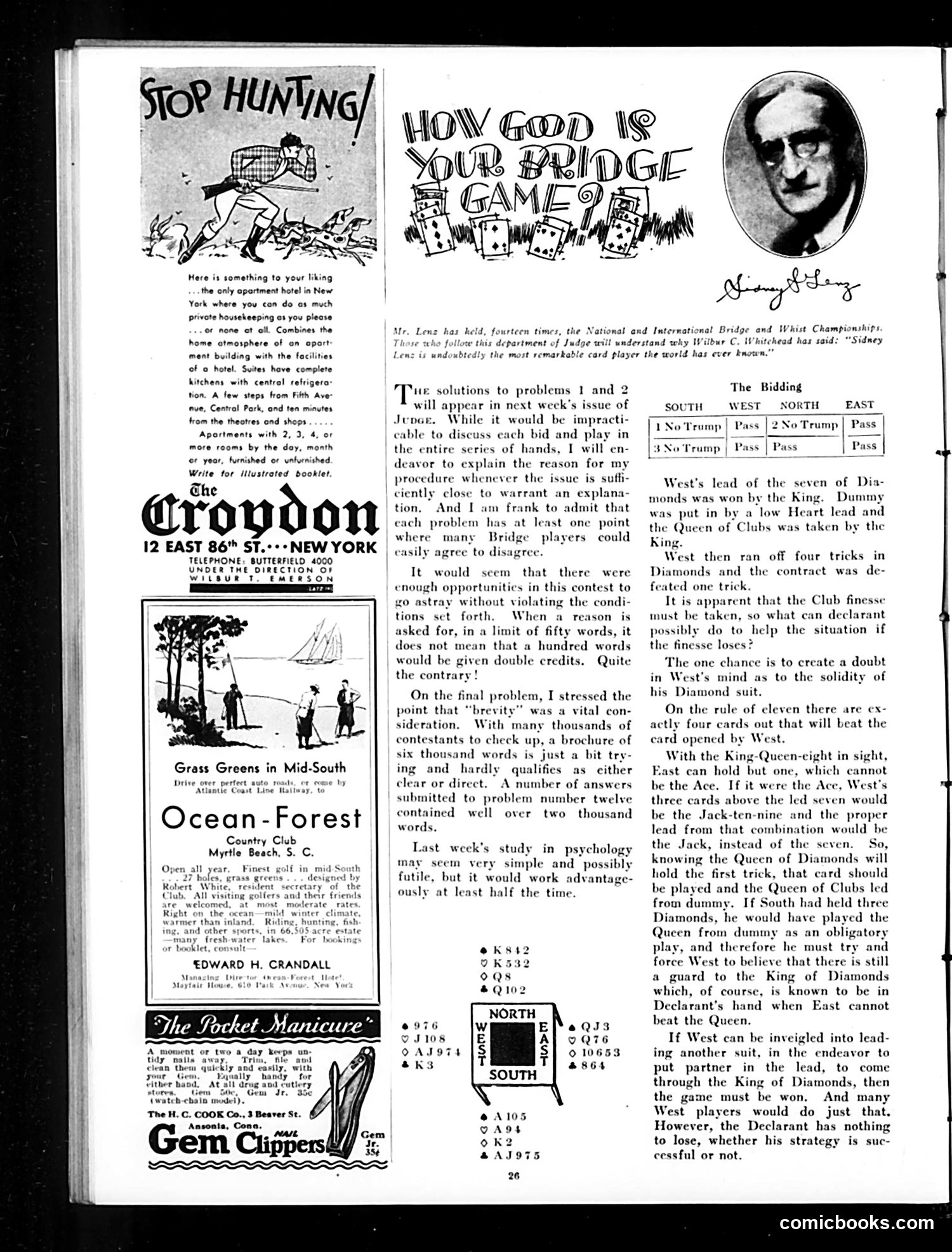
Judge Magazine Page Analysis This page is primarily advertisements and a bridge column, not satirical political content. The only cartoon visible is the small "Stop Hunting!" illustration (top left), which appears to be an advertisement for a New York apartment hotel emphasizing private domestic living. It's mildly humorous rather than satirical—showing a hunter pursued by rabbits to suggest one can "hunt" (search) for ideal housing. The main content is "How Good Is Your Bridge Game?"—a bridge strategy column by someone named Lenz (signature visible), discussing card-playing problems and bidding techniques. The text notes Lenz is a 14-time National and International Bridge Champion. The remaining content comprises advertisements for: - The Croydon apartment hotel - Ocean-Forest Country Club in Myrtle Beach - "The Pocket Manicure" grooming product - Gem Clippers No political satire or caricature is present on this page. It represents Judge's mix of light humor with paying advertisements and specialized hobby columns targeting educated, affluent readers.
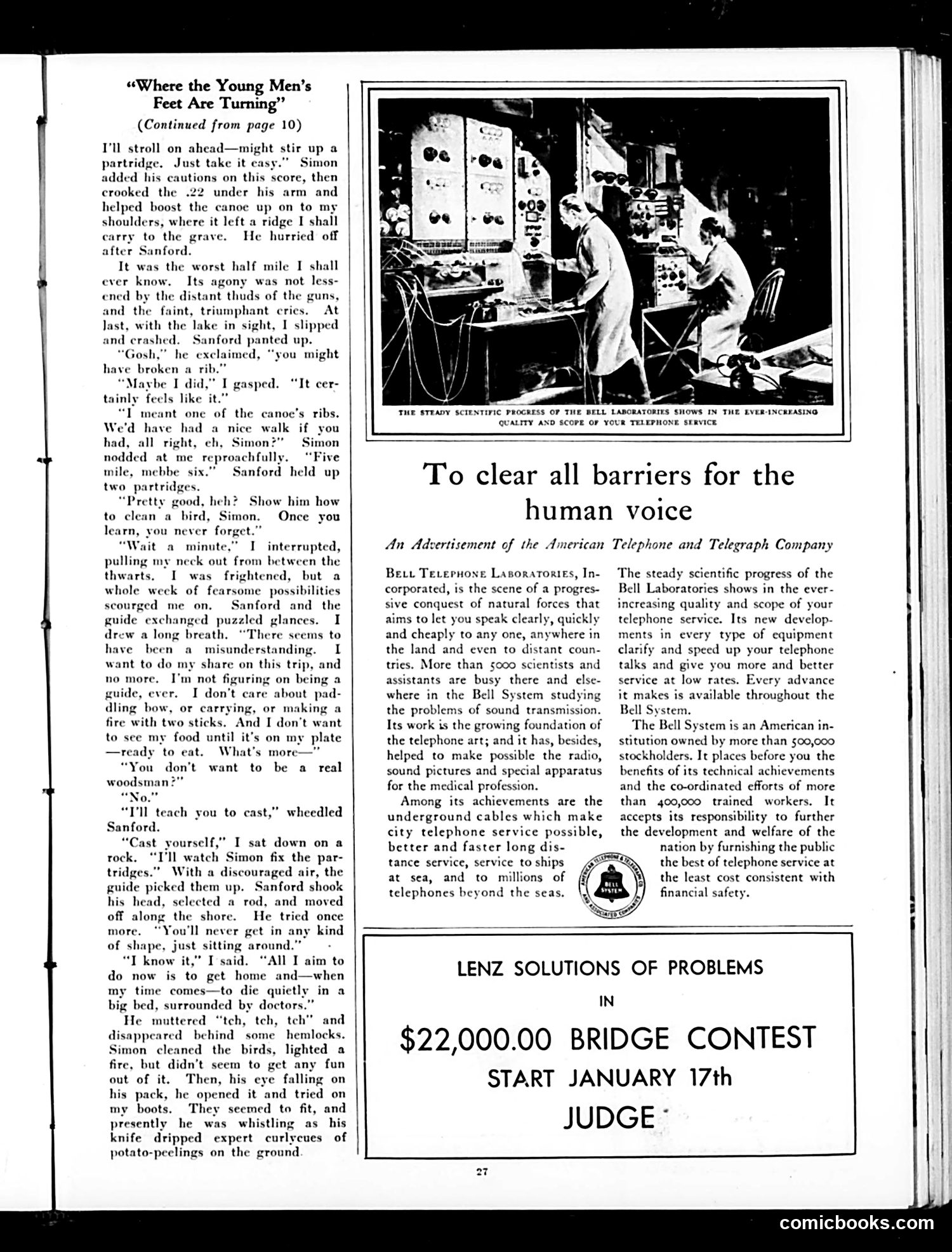
Analysis of Judge Magazine Page This page contains two distinct elements: Story Content: The left side continues a fictional narrative about a city man on a hunting trip who resists his guide's attempts to teach him outdoor skills. The protagonist refuses to participate in camping activities, insisting he simply wants to relax and eventually "die quietly in a big bed, surrounded by doctors." The humor derives from his stubborn rejection of the masculine outdoor experience his companions value. Advertisement: The right side is a full-page ad for American Telephone and Telegraph Company's Bell Laboratories. It emphasizes scientific progress in telephone technology and infrastructure—mentioning 5,000 scientists working on sound transmission, underground cables, and service improvements. The ad appeals to national pride in American innovation and promises better, cheaper telephone service. The juxtaposition is typical of Judge's format: entertainment mixed with corporate advertising. The ad's emphasis on "clearing barriers for the human voice" represents early-20th-century telephone advancement, before widespread long-distance calling was reliable.
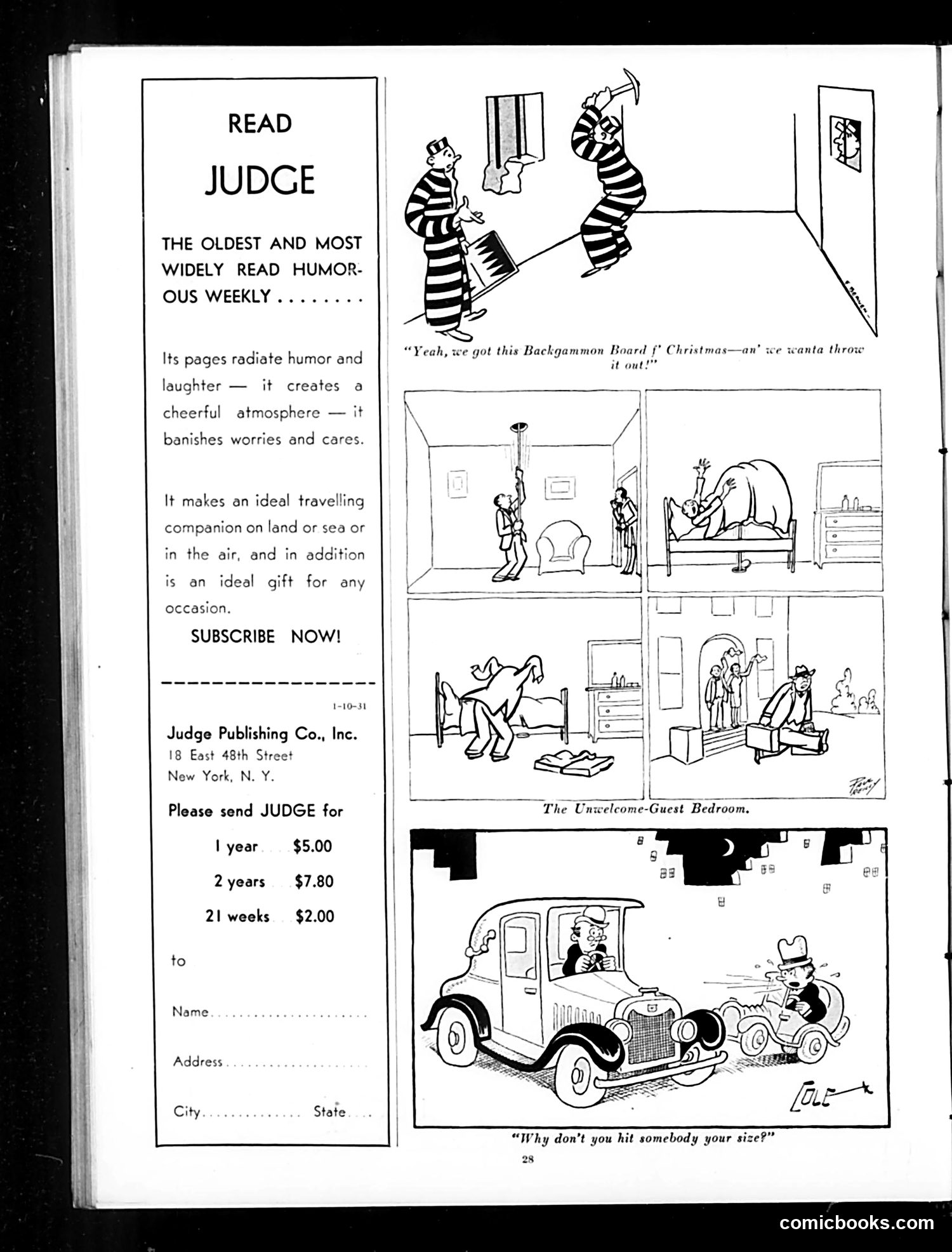
Judge Magazine Advertisement & Cartoons This page primarily advertises Judge magazine, described as "the oldest and most widely read humorous weekly." The subscription rates (1 year/$5.00, 2 years/$7.80, 21 weeks/$2.00) and mailing address (18 East 48th Street, New York) date this to around 1911. The three cartoons illustrate Judge's humor style: 1. "Backgammon Board": Children complain about receiving a board game as a Christmas gift, wanting to throw it out—satirizing impractical holiday gifts. 2. "The Unwelcome-Guest Bedroom": A multi-panel comic showing houseguests' various comedic misadventures in a bedroom, poking fun at awkward overnight visitors. 3. "Why don't you hit somebody your size?": A traffic accident scene where a large car has hit a small toy vehicle/toy car, the joke being about a comical mismatch in scale. These cartoons exemplify Judge's focus on domestic humor and everyday social situations rather than political satire.
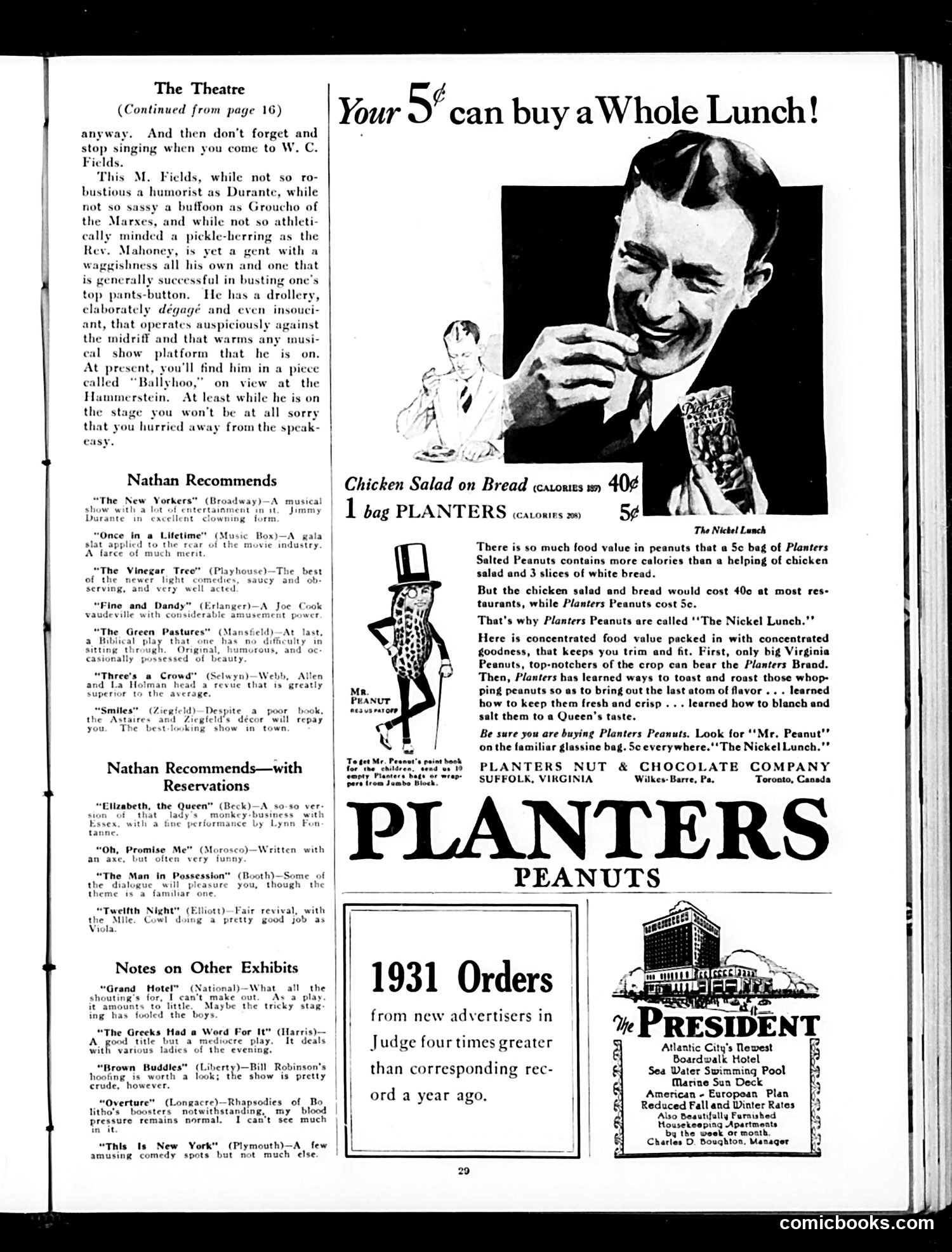
Analysis for Modern Readers This page contains theatre reviews by critic Nathan (likely George Jean Nathan) alongside a Planters Peanuts advertisement—not a political cartoon. The theatre section recommends 1930s Broadway shows featuring performers like W.C. Fields, the Marx Brothers, and Fred Astaire. The references are entertainment-industry specific: Fields is praised as a subtle comedian with distinctive timing ("elaborately dégagé"). The dominant advertisement promotes Planters' "Nickel Lunch"—a Depression-era marketing pitch. With 5¢ buying "a whole lunch," the ad argues peanuts provide equivalent calories to a 40¢ restaurant chicken salad sandwich. This reflects 1931 economic hardship: the company is selling affordable nutrition during the Great Depression. The "Mr. Peanut" mascot (visible on the glassine bag) was Planters' established brand symbol. The ad emphasizes quality (Virginia peanuts, roasting methods) to justify the price. There is no political satire on this page—it's primarily advertising within an entertainment magazine.
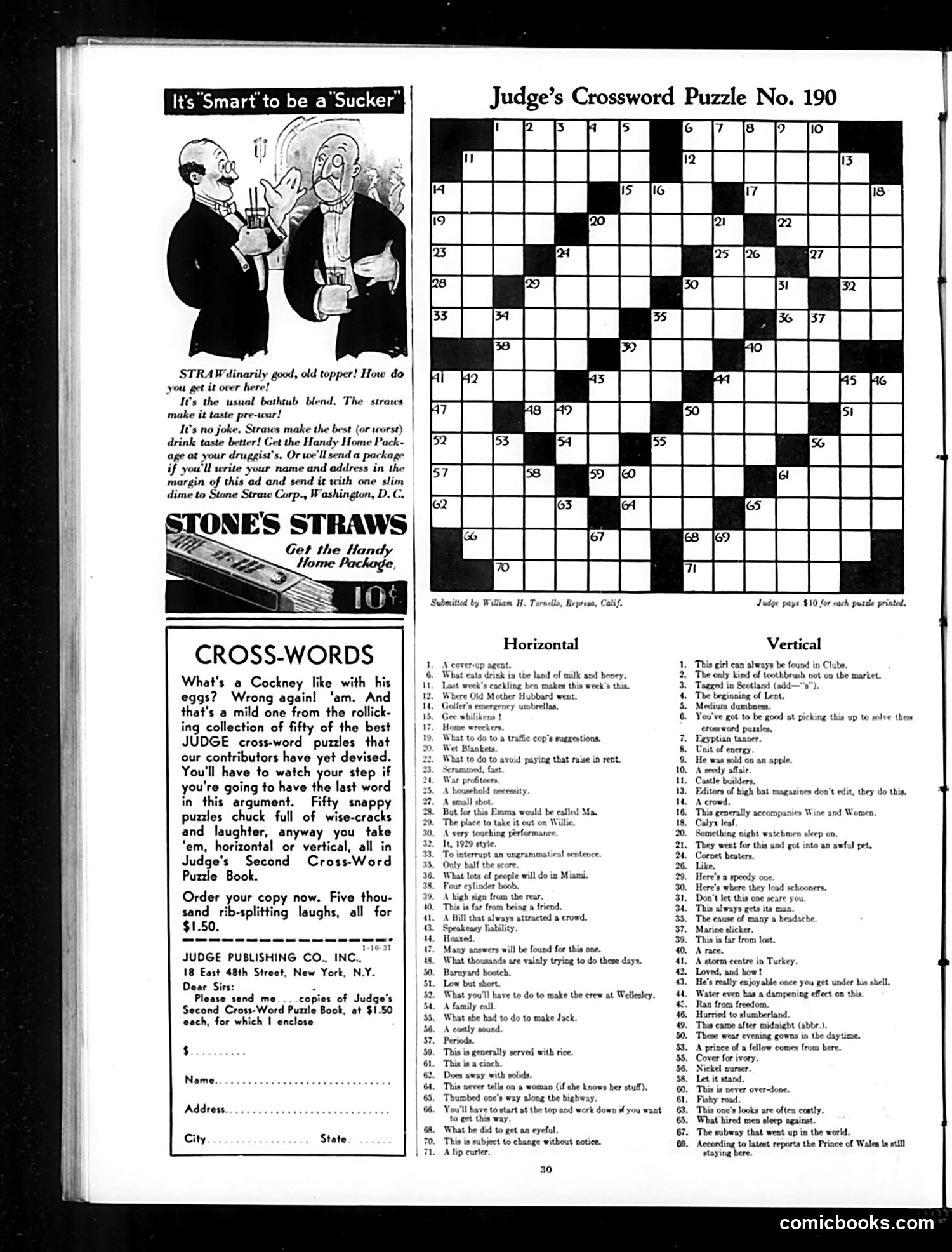
Judge Magazine Page Analysis This page combines advertising with Judge's Second Cross-Word Puzzle Book promotion. The Cartoon ("It's 'Smart' to be a 'Sucker'") Two well-dressed men in formal attire discuss a drink. One praises the quality of what he's drinking, calling it "extraordinarily good." The other reveals it's made from "bathtub blend"—illegal homemade liquor from Prohibition era (clearly post-1920). The "straws make it taste pre-war"—masking the harsh taste of bootleg alcohol. The satire: Despite Prohibition's intent to stop drinking, wealthy urbanites openly consume illegal liquor and fool themselves about its quality. The "sucker" of the title is anyone believing prohibition works or that bathtub gin is actually good. The Advertisement Stone Straws product placement ties directly to the cartoon's joke—straws supposedly improve bad-tasting bootleg drinks. The Cross-Word Section Judge advertises its puzzle book ($1.50) with clues that are themselves jokes mocking contemporary culture: speakeasies, war profiteers, Miami real estate, and Wellesley girls. Overall context: This reflects 1920s urban sophistication and cynicism about Prohibition's failure.
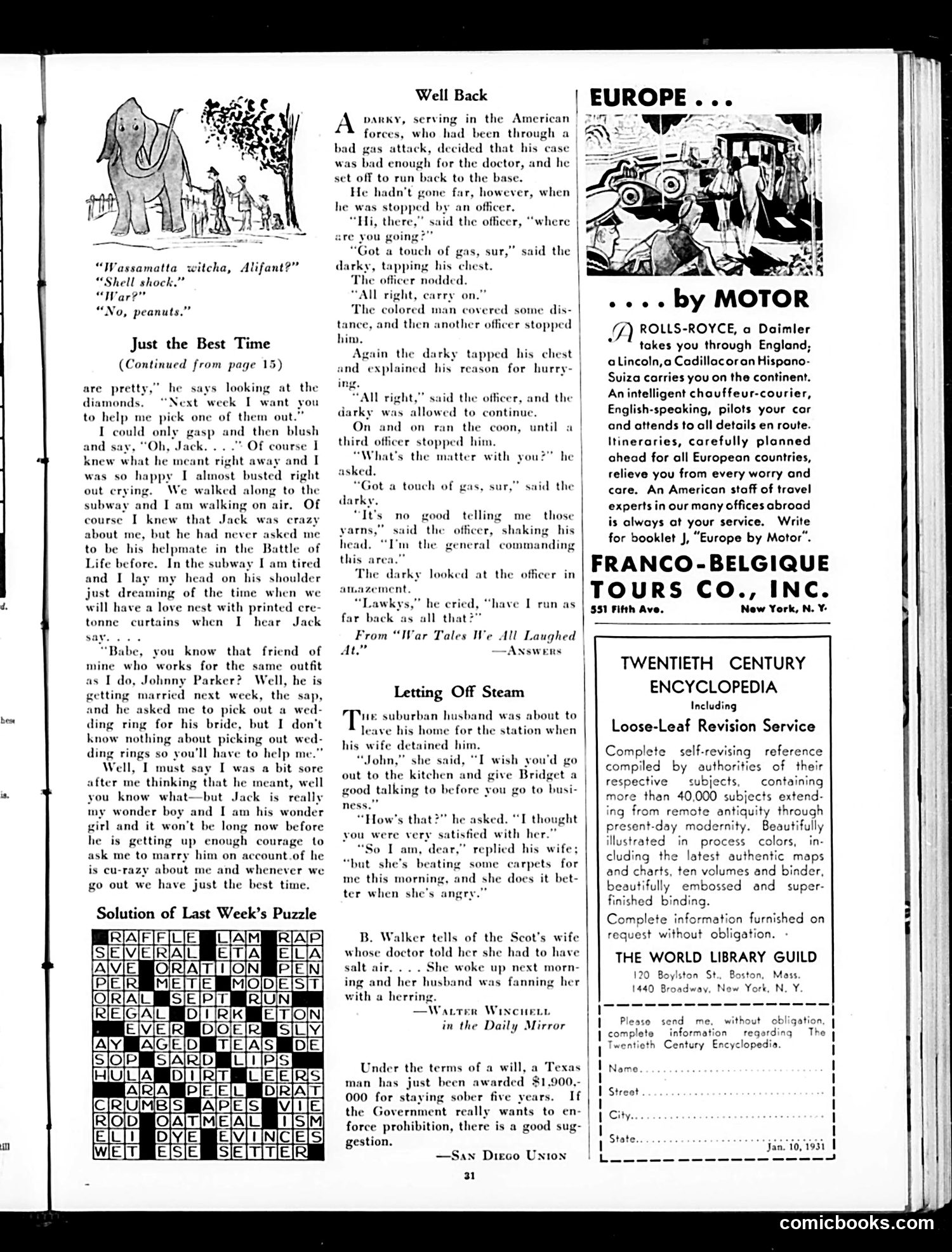
Judge Magazine Page Analysis This page contains three humor pieces typical of Judge's satirical style: "Well Back" is a WWI military anecdote satirizing racial stereotypes. A Black American soldier repeatedly tells officers he has "a touch of gas" (gas poisoning from chemical weapons), stopping three different officers. The joke's punch line—"have I run as far back as all that?"—plays on the officers' progressive skepticism, suggesting the soldier is using the same excuse too many times. The piece reflects period attitudes about both warfare and race. "Letting Off Steam" is a domestic humor piece where a wife admits she prefers her maid to work angry because she does better carpets. It satirizes working-class household dynamics. "Just the Best Time" (continued) is a serialized romantic story about a marriage proposal. The page is primarily filled with advertisements—notably for Franco-Belgique Tours offering European motor travel, and the Twentieth Century Encyclopedia—indicating this is a commercial publication balancing editorial content with revenue. The date visible is January 10, 1923.
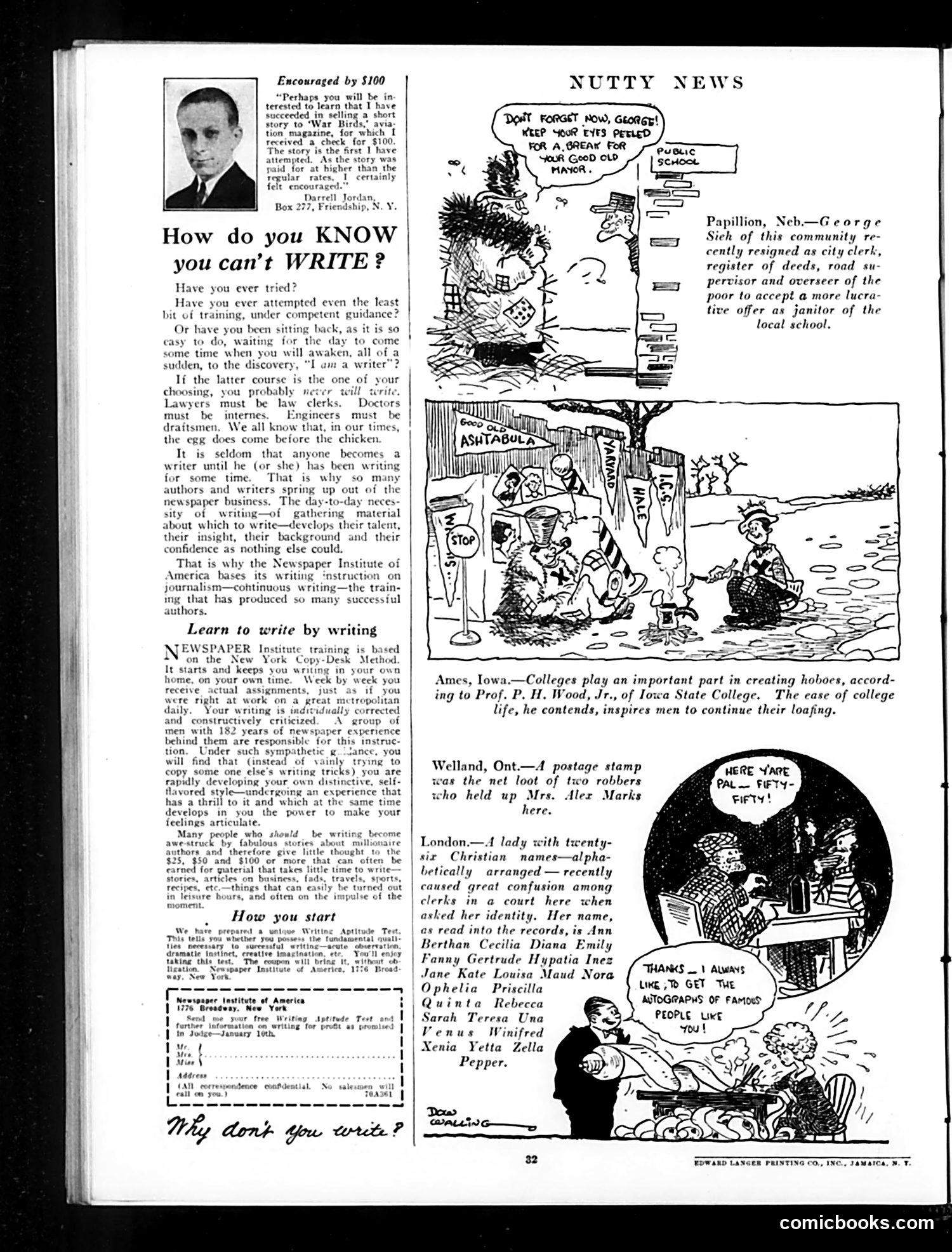
Nutty News Page Analysis This page from *Judge* magazine combines writing instruction advertising with humorous "news" briefs—a common format for the era. Main Content: The left side features an advertisement for the Newspaper Institute of America's writing course, using a success story from a reader who sold a short story for $100. The pitch: you can't know you can't write until you try; journalism training develops writing talent through continuous practice. "Nutty News" Section (right): Four brief, absurdist humor items mock everyday life: - A man resigns prestigious civic posts to become a school janitor (degradation humor) - A professor claims college inspires loafing - Robbers steal only a postage stamp - A woman with 26 alphabetically-arranged Christian names (Ann through Zella) confuses court clerks The cartoons illustrate these items with exaggerated, slapstick drawings typical of 1920s-30s humor magazines. Point: These "news" items aren't real—they're absurdist jokes mocking human behavior, bureaucracy, and social pretension through impossible or ridiculous scenarios. The humor relies on the incongruous and the exaggerated.
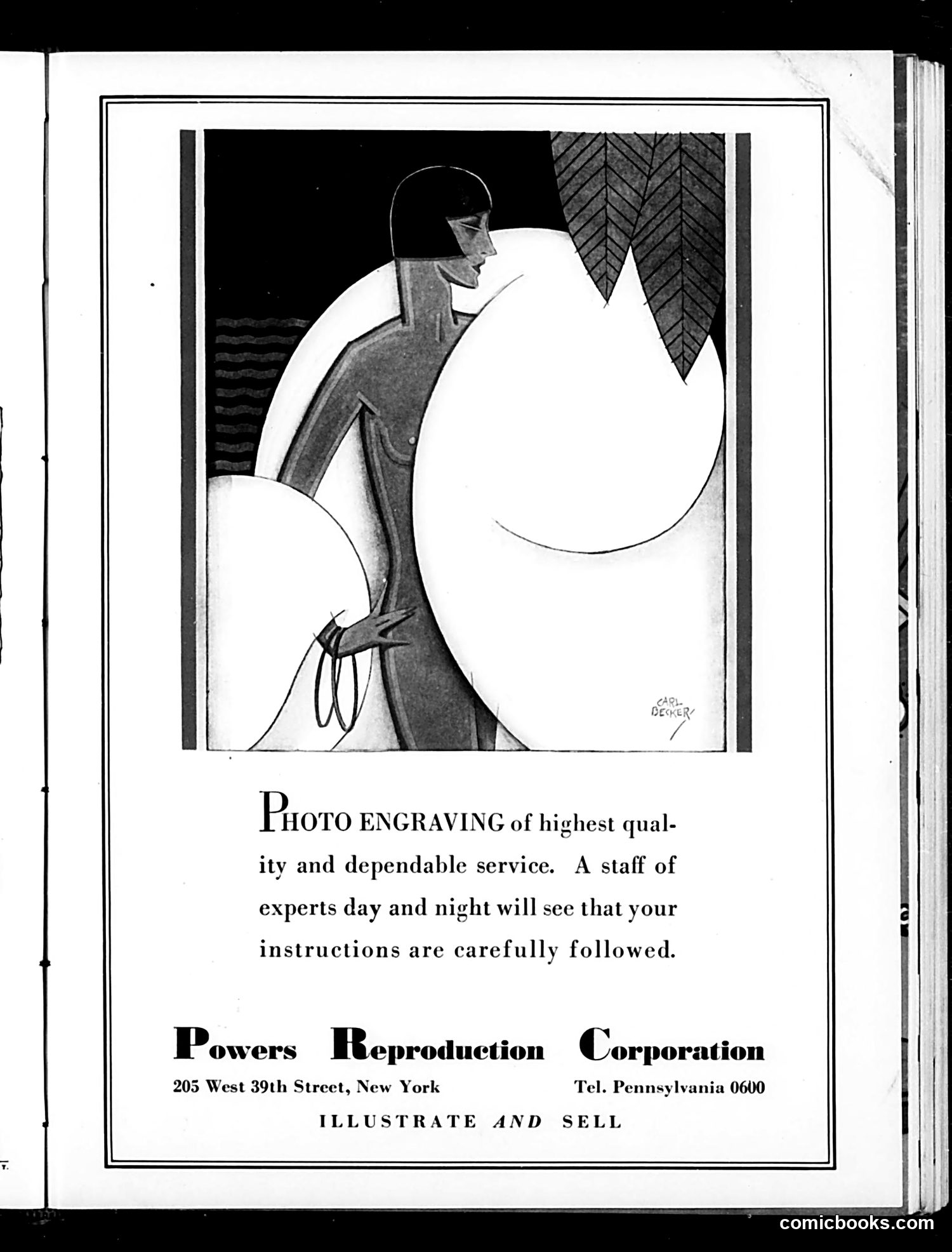
This is a full-page advertisement for Powers Reproduction Corporation, a photo engraving service in New York. The ad features an Art Deco-style illustration of a stylized woman in profile, wearing draped clothing and holding what appears to be a large spherical object or balloon. The image exemplifies the sleek, modernist aesthetic popular in 1920s-30s advertising and design. The advertisement emphasizes the company's quality and round-the-clock service for photo engraving—a crucial pre-digital printing technology. The tagline "ILLUSTRATE AND SELL" highlights how their engraving services help businesses market products visually. There is no political satire or cartoon content on this page; it is purely commercial advertising.
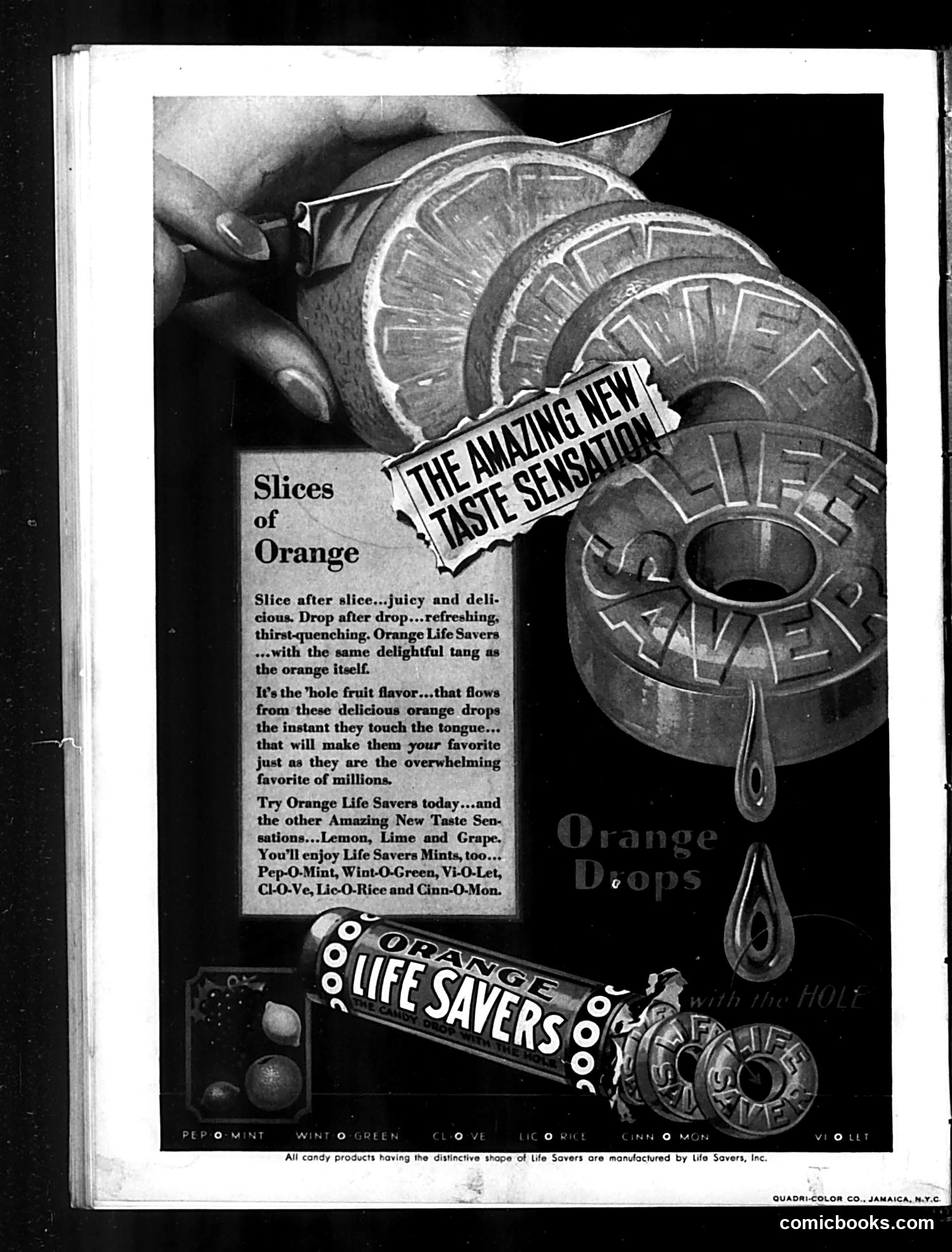
Life Savers Candy Advertisement This is a vintage advertisement, not political satire. The page promotes Life Savers candies, particularly their new orange-flavored drops. The imagery shows sliced oranges and juice drops to emphasize the product's citrus flavor and refreshment appeal. The ad lists multiple candy varieties available: Orange Life Savers, plus "Amazing New Taste Sensations" in Lemon, Lime, and Grape, along with mint varieties with playful names (Pep-O-Mint, Wint-O-Green, Vi-O-Let, etc.). The distinctive ring-shaped candy is prominently displayed. The text uses period advertising language—"juicy and delicious," "thirst-quenching"—and claims the product is "the overwhelming favorite of millions." This appears in *Judge* magazine as a full-page advertisement rather than editorial content. The printing credit indicates it's from Quadri-Color Company in Jamaica, New York.