judge
Judge — January 17, 1931
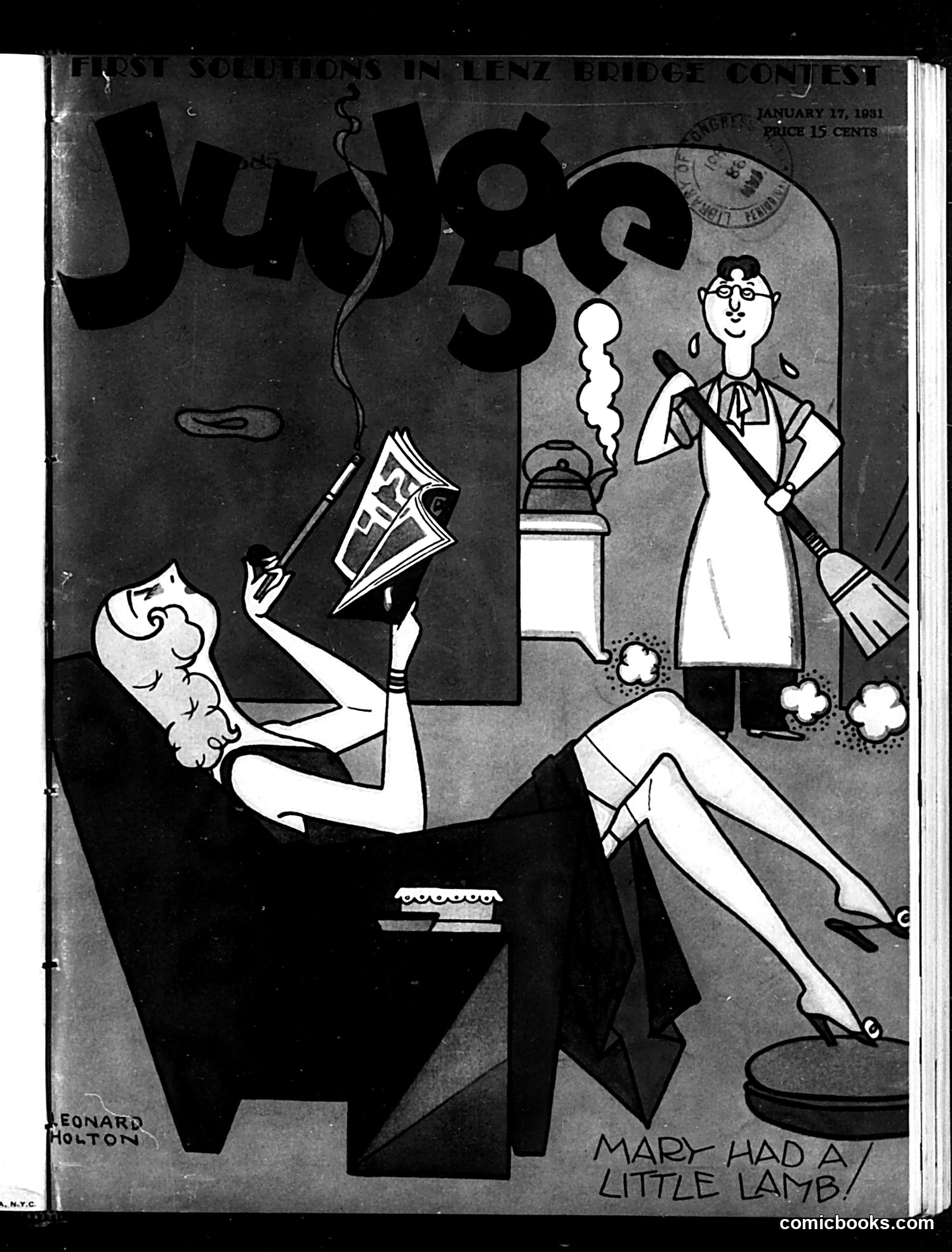
Analysis This Judge magazine cover from January 17, 1921 satirizes domestic life through two scenes. On the left, a relaxed woman reads magazines while reclining, apparently indifferent to housework. On the right, another woman stands actively cleaning with a broom and dustpan. The title "Mary Had a Little Lamb" appears to reference the nursery rhyme, but here applies satirically to domestic duty. The contrast between the leisured woman and the diligent one likely critiques changing attitudes toward housework—possibly mocking either the "new woman" of the 1920s who rejected traditional domestic roles, or conversely, praising women who maintained household standards. The "15 cents" price and "First Solutions in Lenz Bridge Contest" text suggest this was entertainment/puzzle content mixed with social commentary typical of Judge's format.
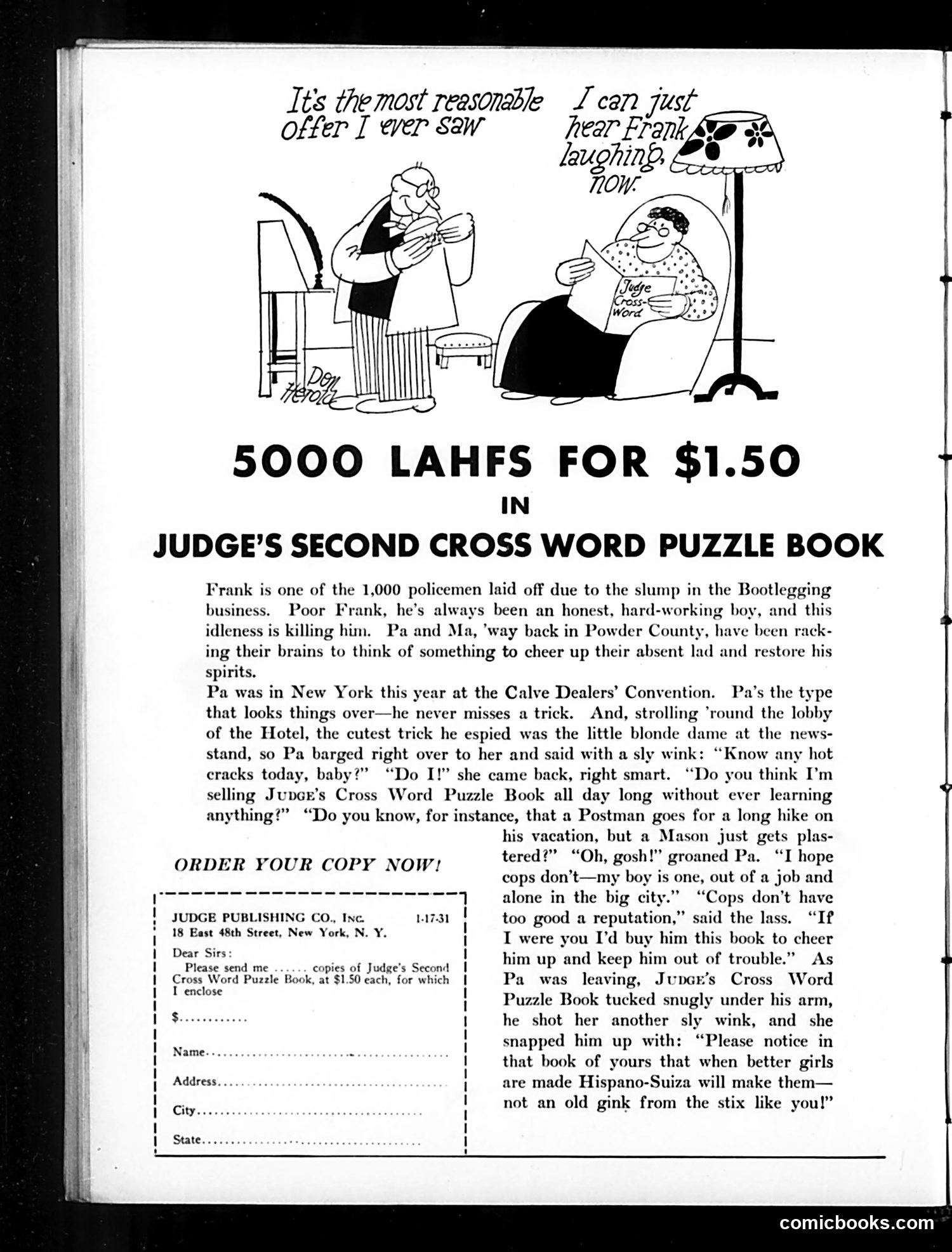
Analysis This page is primarily advertising for Judge's Second Cross Word Puzzle Book, priced at $1.50. The cartoon depicts a domestic scene where a father (Frank) is unemployed due to "the slump in the Bootlegging business," indicating this dates to Prohibition era (1920s-early 1930s). The accompanying narrative is a humorous sales pitch: Pa encounters a newsstand clerk selling the puzzle book and uses it as a conversation starter, ultimately recommending it to cheer up his idle son. The humor relies on the contrast between the "honest, hard-working boy" now idle due to economic conditions, and the implication that puzzle-solving beats getting into trouble. The satire is economic rather than political—critiquing Depression-era unemployment and idle youth, while cleverly advertising the product as wholesome entertainment.
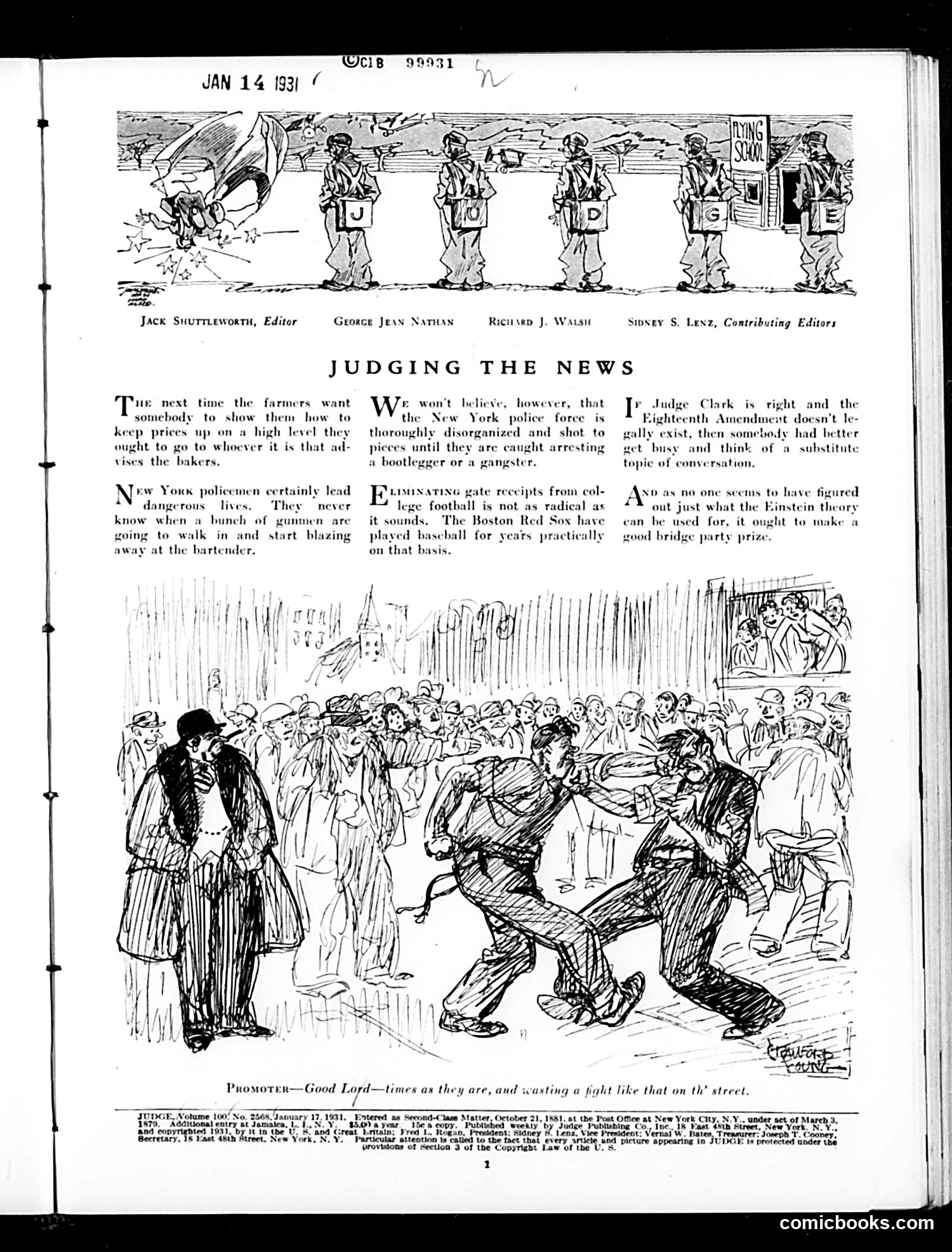
"Judging the News" - Judge Magazine, January 14, 1931 This editorial page features commentary on contemporary issues. The main cartoon depicts a street fight between two men while a well-dressed "Promoter" watches, captioned "Good Lord—times as they are, and wasting a fight like that on th' street." The satire critiques economic desperation during the Great Depression: rather than waste energy on street brawls, the promoter sees profit opportunity—suggesting fights could be monetized. The cartoon mocks both Depression-era poverty (driving men to street violence) and capitalist exploitation of misery for entertainment. The text above discusses New York police tactics and Boston Red Sox baseball, using these topics to make broader points about governance and institutions, though specific references are unclear without additional historical context.
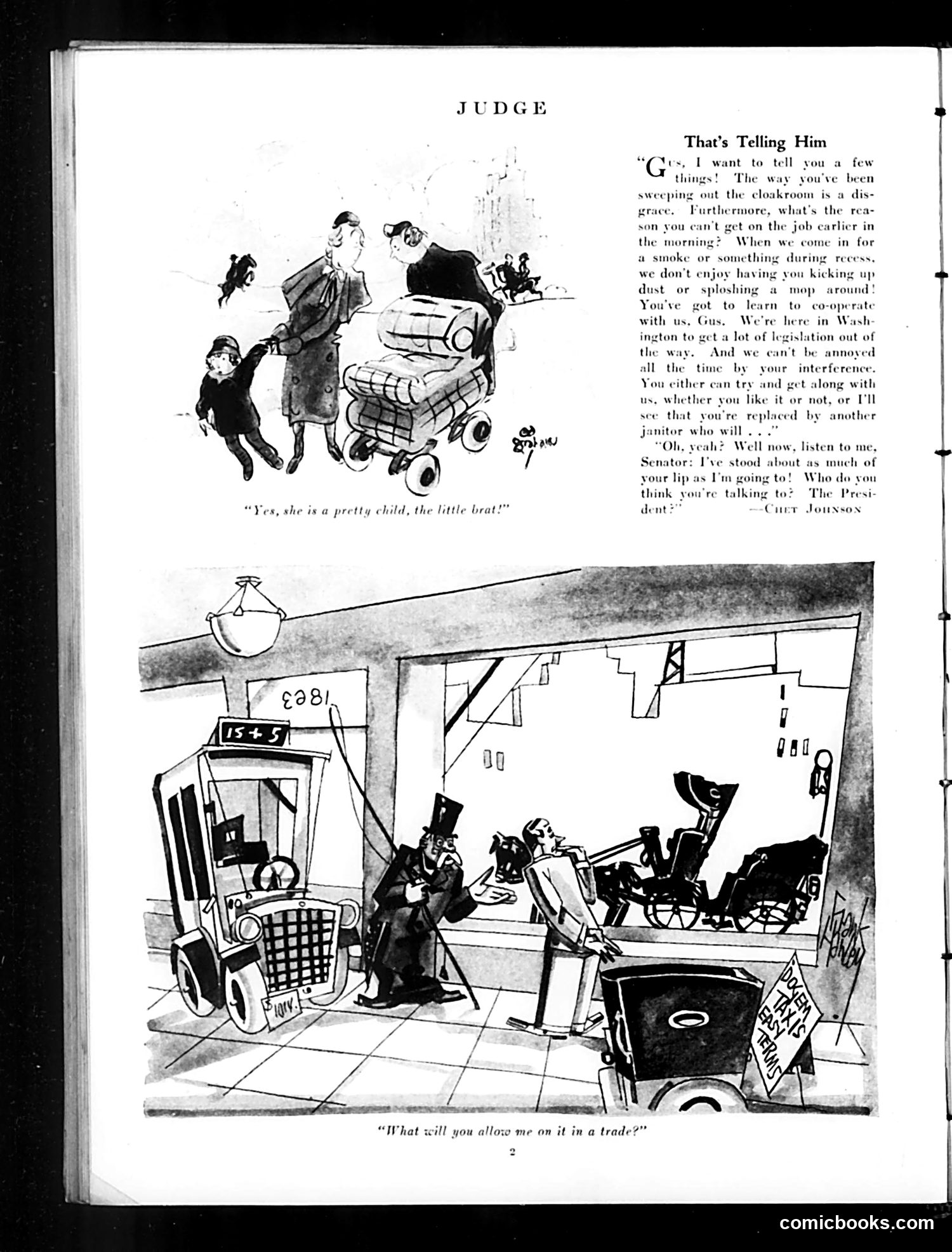
Political Satire Analysis This Judge magazine page contains two cartoons addressing Congressional dysfunction and bureaucratic inefficiency. The top cartoon depicts a Senator being confronted about messy office conditions—sweeping out cloakrooms, interfering with job carriers—with a child in a carriage. The figure labeled "Gus" (likely representing ordinary constituents or bureaucratic workers) complains the Senator won't cooperate and threatens replacement by "another janitor." The bottom cartoon shows a street vendor with a toy carriage, asking "What will you allow me on it in a trade?" This appears to satirize government deals and legislative horse-trading—politicians bartering favors and compromises like marketplace transactions. Together, the cartoons mock Congressional incompetence, obstruction, and the transactional nature of legislative politics, suggesting politicians prioritize petty disputes over actual governance.
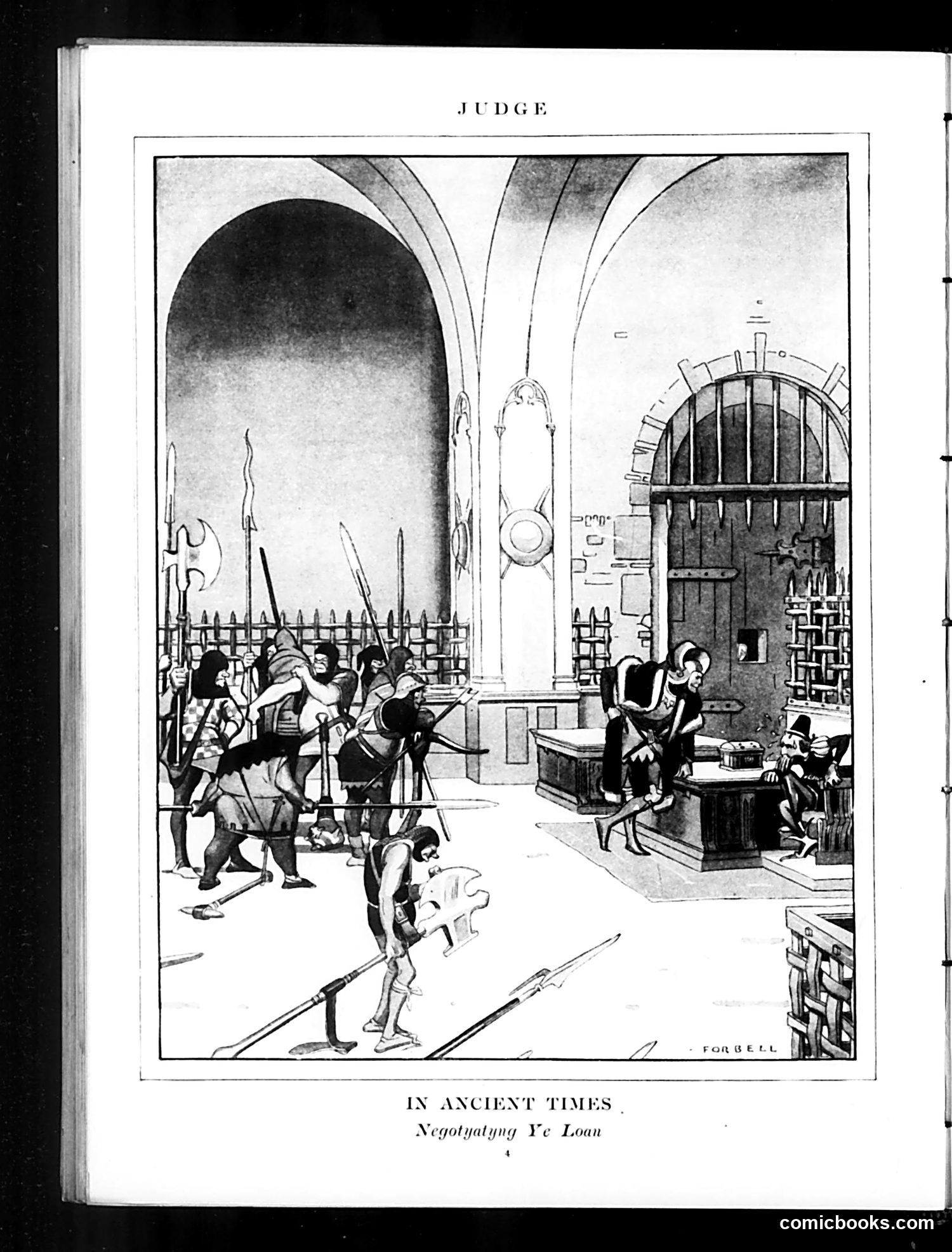
Judge Magazine: "In Ancient Times—Negotiating Ye Loan" This cartoon satirizes loan negotiations by presenting them as a medieval/ancient court scene. Armed soldiers with pikes surround a figure seated at a desk (likely representing a lender or judge), while supplicants approach with weapons and armor, seeking to "negotiate" a loan. The satire suggests that in "ancient times," borrowers resorted to intimidation or force to obtain loans—implying that modern loan negotiations similarly involve coercion or aggressive tactics, just dressed in contemporary language. The title "Negotiating Ye Loan" puns on "ye olde" English while mocking the pretense of civilized negotiation masking what amounts to threats. The cartoon likely critiques aggressive lending practices or borrower desperation during Judge's publication period.
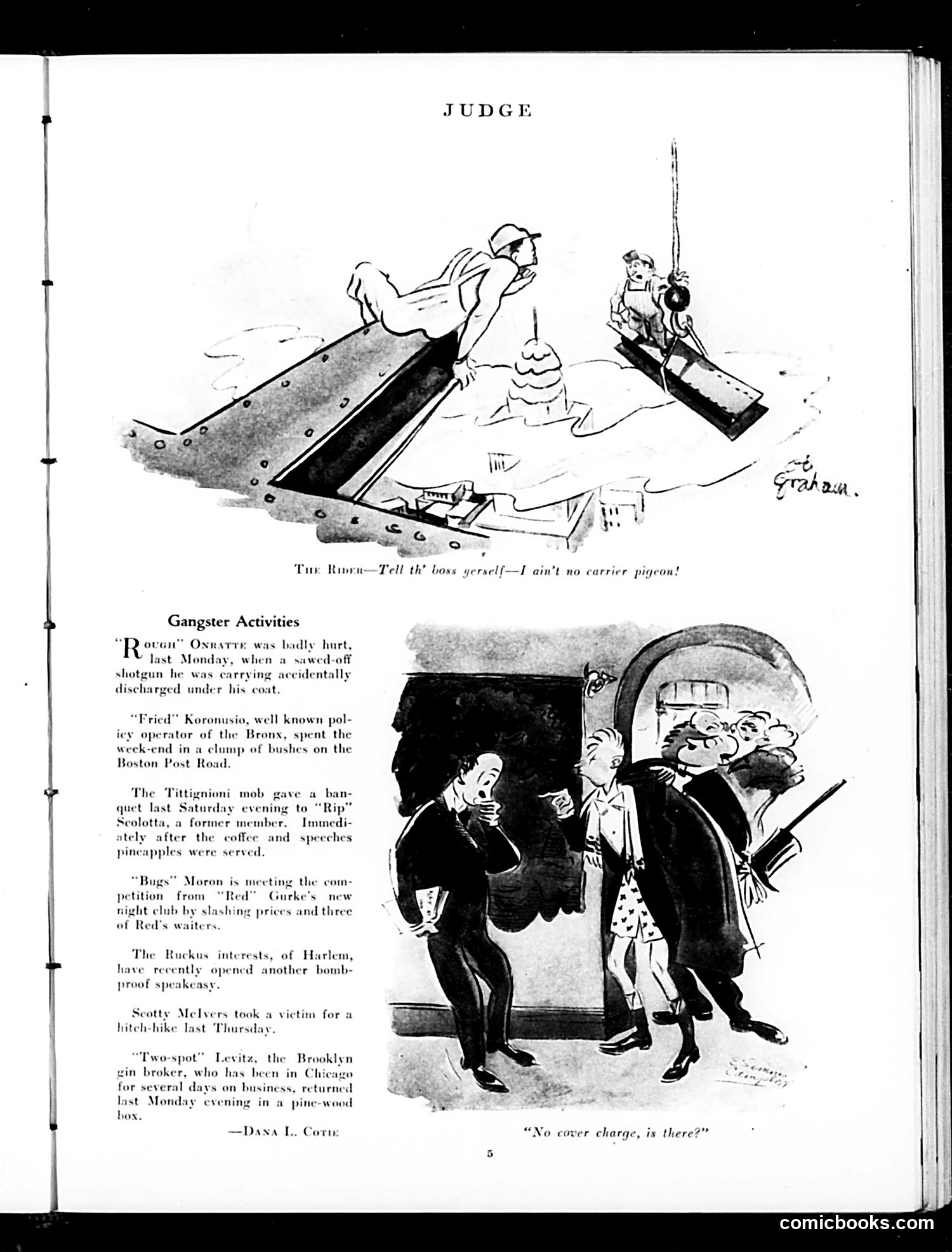
Judge Magazine Page Analysis This page satirizes 1920s gangster culture during Prohibition. The top cartoon mocks gang violence: a man slides down a chute labeled "The Rider" while declaring "I ain't no carrier pigeon!"—suggesting he's been disposed of by criminals. The "Gangster Activities" section below reports on organized crime figures with dark humor: "Roman" Onsatte's accidental shotgun discharge, "Fried" Koromusio's weekend hideout, the Tittignoni mob's banquet, "Bugs" Moran's rivalry with "Red" Curke, and Ruckus interests' speakeasy opening. The lower cartoon shows men entering what appears to be an illegal bar, with one asking "No cover charge, is there?"—satirizing the prevalence and open operation of Prohibition-era speakeasies despite legal bans on alcohol sales.
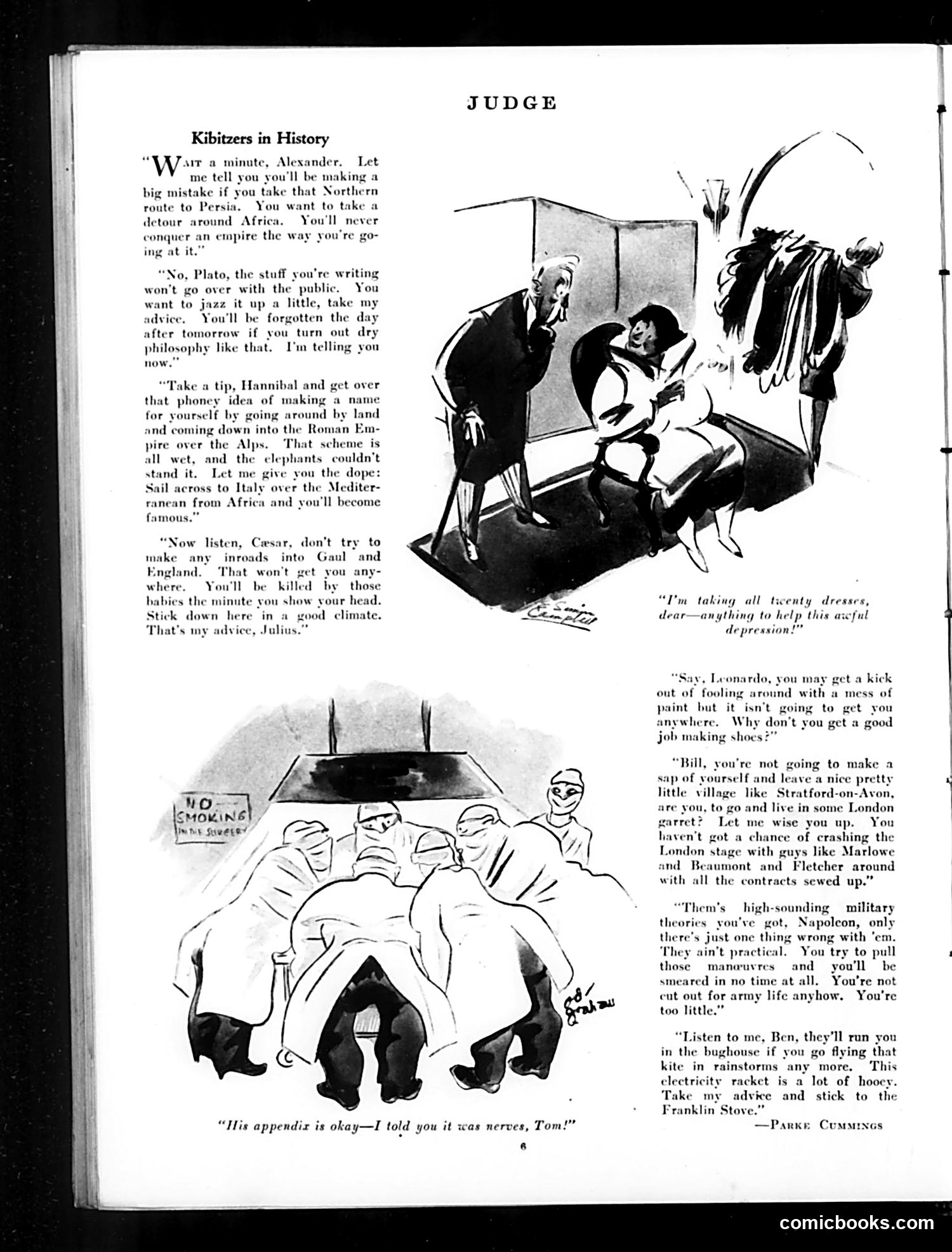
"Kibitzers in History" - Judge Magazine Satire This page satirizes armchair strategists and backseat commanders throughout history. The top cartoon shows someone offering unsolicited advice to historical figures (Alexander, Plato, Hannibal, Caesar) about military campaigns—suggesting their famous strategies were actually flawed. The bottom cartoon depicts men in what appears to be a WWI-era hospital or military shelter (marked "NO SMOKING"), with the caption "His appendix is okay—I told you it was nerves, Tom!" This mocks civilians pretending to be medical experts, confidently diagnosing conditions they're unqualified to assess. The right-side quotes continue the theme: various "kibitzers" (unsolicited advisers) offer contradictory wisdom about careers and life choices, all equally presumptuous and unhelpful. The satire targets human tendency to give confident advice outside one's expertise.
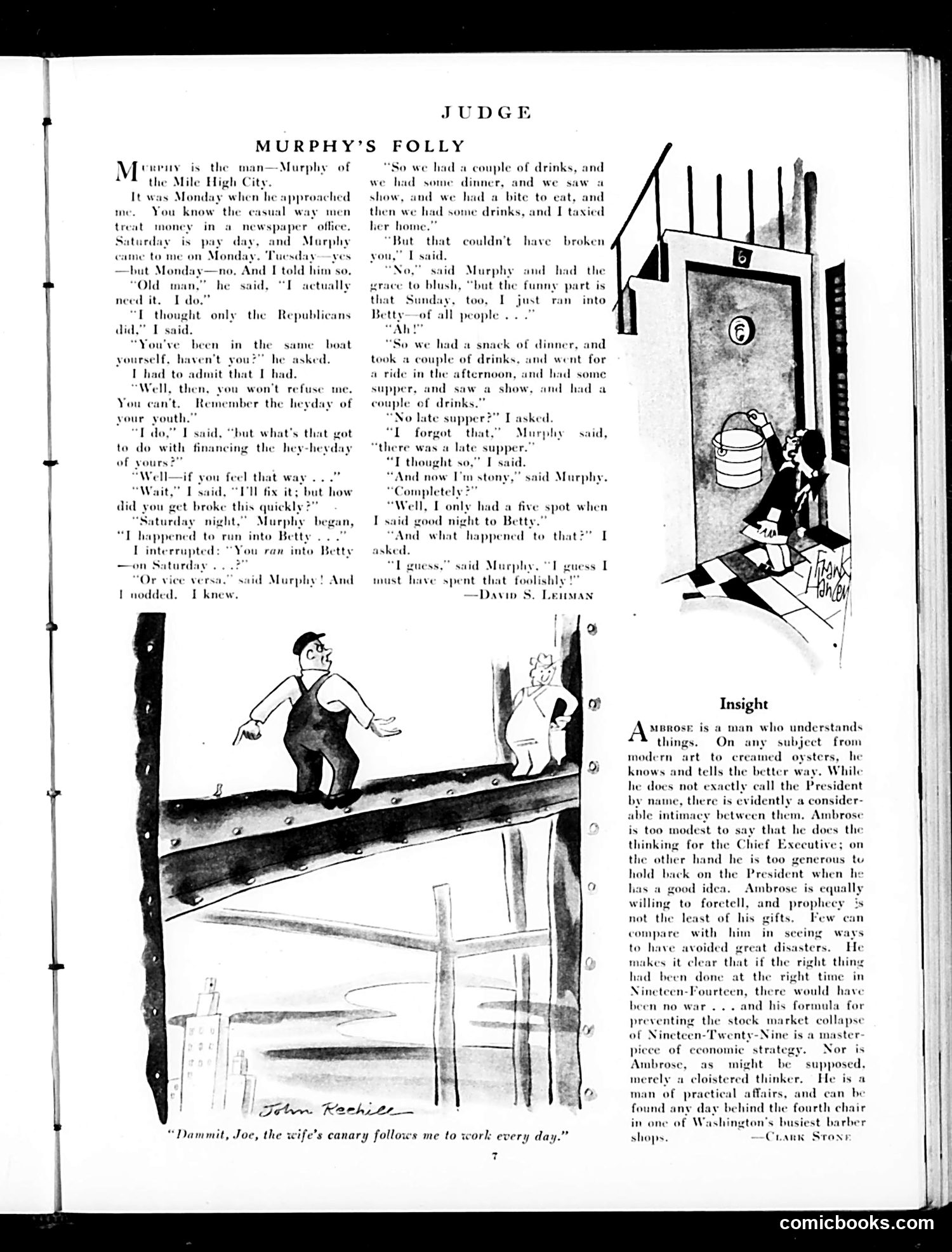
Murphy's Folly & Judge Magazine Page Analysis "Murphy's Folly" is a humorous narrative about a man who borrows money from the narrator on Monday, claiming poverty. Murphy then admits he spent the entire weekend—Saturday and Sunday—taking his girlfriend Betty on repeated outings: dinners, drinks, shows, taxi rides, and more drinks. Each day he "accidentally" ran into Betty and spent lavishly on entertainment, completely depleting his finances. The satire targets post-WWI leisure spending and dating culture—the casual way young men frittered away wages on entertainment and women. Murphy's repeated claim of coincidentally encountering Betty while broke suggests either poor judgment or romantic impulsiveness. The secondary cartoon (by John Rachilze) shows a man on a high beam, with the caption "Dammit, Joe, the wife's canary follows me to work every day"—a domestic complaint joke about marital entanglement. "Insight" appears to be a separate humorous essay about an unnamed advisor figure (possibly satirizing Washington insiders) who offers unsolicited expertise on everything from art to economics and presidential matters.
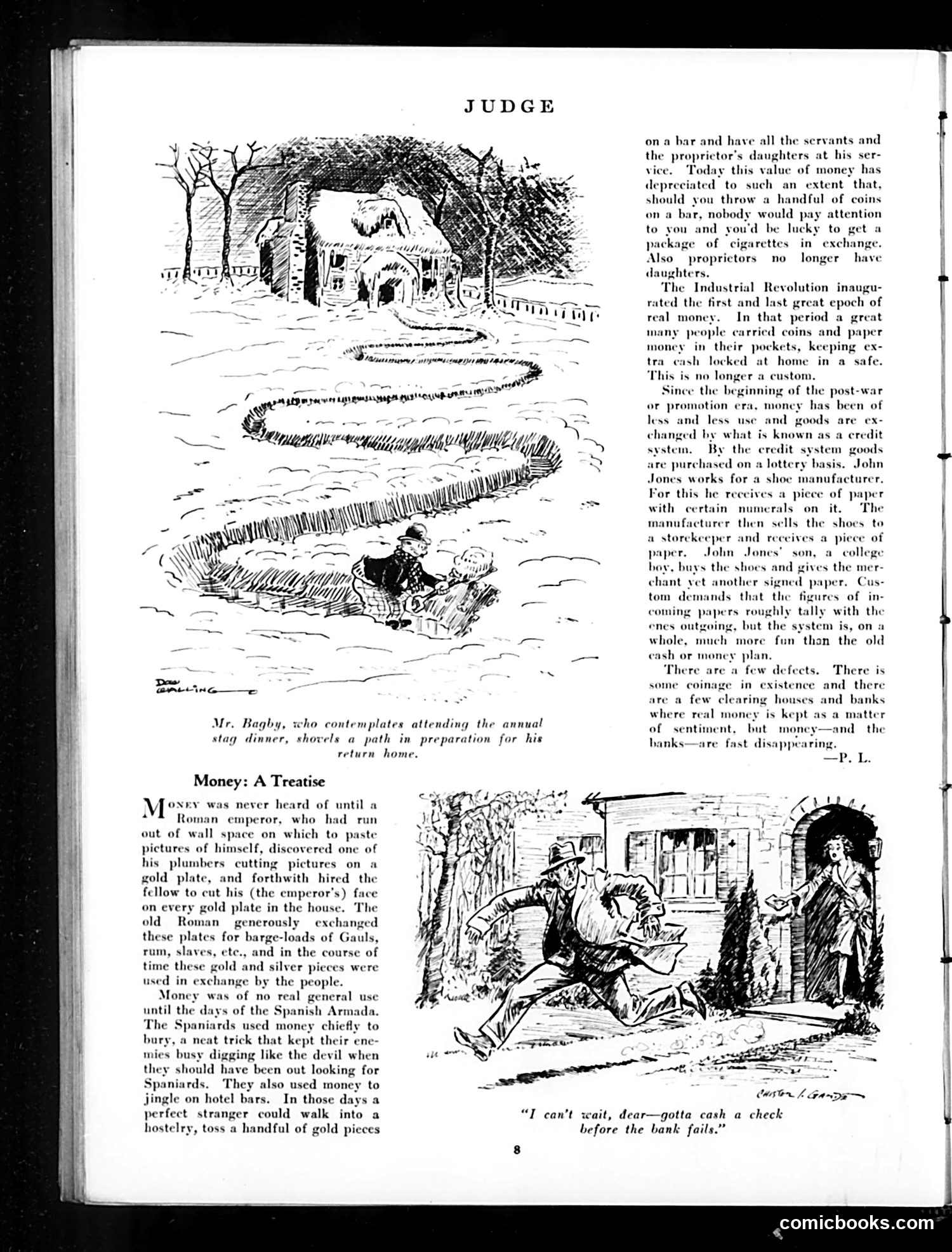
Analysis of Judge Magazine Page This page contains two satirical pieces on money and finance, likely from the 1920s post-WWI era. Top section ("Judge"): A cartoon shows a man shoveling snow, illustrating how money's value has collapsed—he must physically labor rather than rely on cash. The accompanying text laments that real money has nearly disappeared, replaced by a credit system based on exchanging signed papers. The example of "John Jones" demonstrates the absurdity: a manufacturer receives paper for shoes, a storekeeper receives different paper, Jones's son receives yet another signed paper—an unstable chain dependent on numbers "roughly" matching. "Money: A Treatise": A humorous pseudo-historical essay traces money from Roman emperors to the Spanish Armada, ending with a cartoon showing a couple urgently discussing cashing a check "before the bank fails." This captures post-war economic anxiety—the satire suggests banking collapse is imminent and inevitable. The satire's point: Both pieces mock the fragility of credit-based economics and the public's loss of faith in financial institutions during this economically turbulent period.
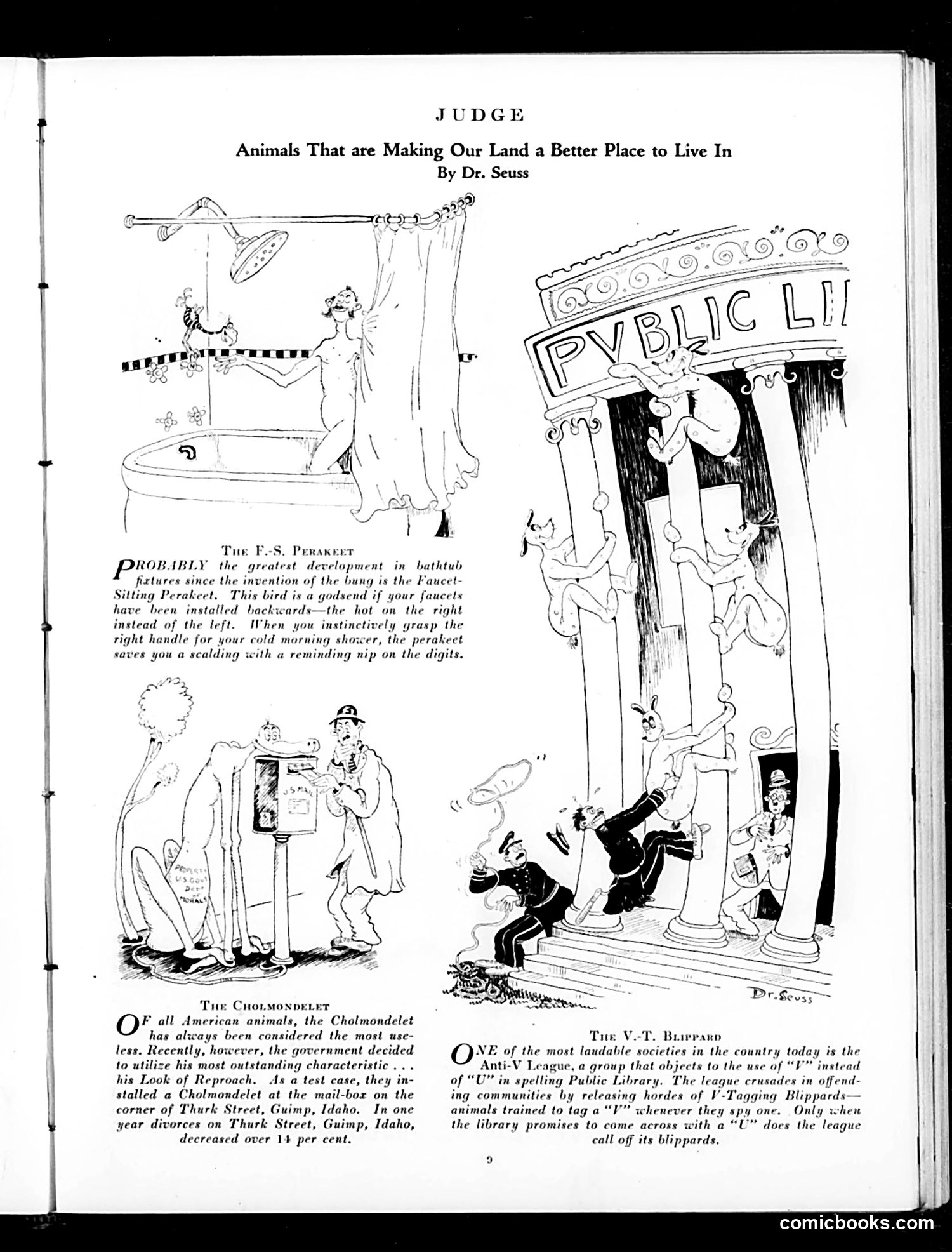
Judge Magazine: Dr. Seuss's Satirical "Animals" This is a Dr. Seuss humor piece from Judge magazine featuring three absurdist inventions disguised as animal discoveries. Each represents contemporary annoyances rendered ridiculous: The Faucet-Sitting Perakeet satirizes poor bathroom fixture design (hot/cold handles installed backwards), proposing a bird that pecks your hand as a "solution." The Cholmondelet mocks useless things given forced utility—a creature valued solely for its disapproving expression, credited with reducing divorces in a fictional Idaho town by 14 percent through shame alone. The V-T Blippard parodies pedantic activist groups. The "Anti-V League" objects to "V" replacing "U" in "Public Library" and releases trained animals to correct the "error." This satirizes both prescriptivist language crusades and overzealous civic organizations. The humor relies on Seussian invented creatures and deadpan absurdity—treating ridiculous problems with mock-serious solutions, poking fun at both consumer complaints and social reform movements of the era.
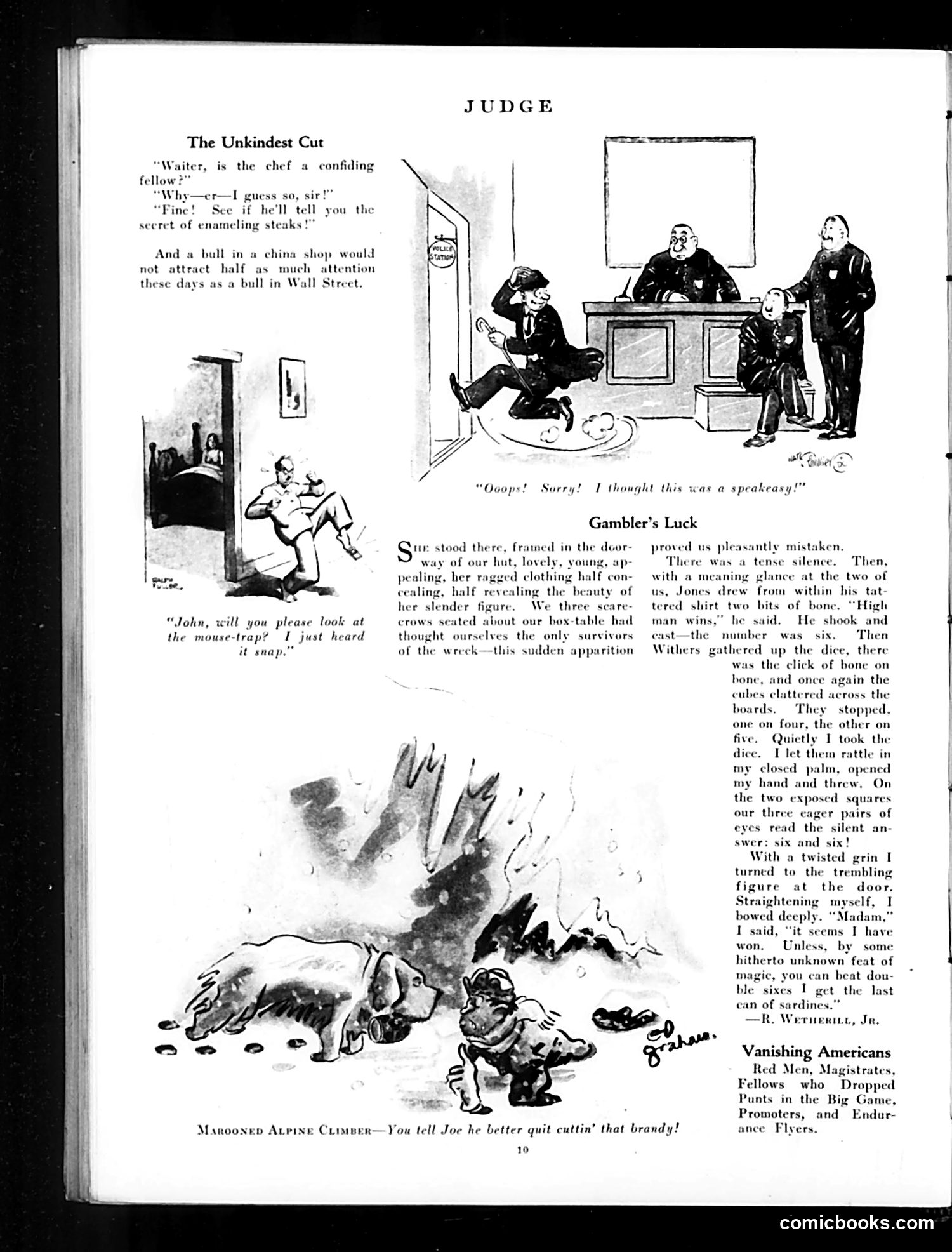
Judge Magazine Page Analysis This page contains three separate satirical pieces: "The Unkindest Cut": A brief joke about a chef guarding his steak-enameling secret, with commentary comparing a "bull in a china shop" to a "bull in Wall Street"—suggesting Wall Street speculation/chaos is as destructive as literal property damage. "Oops! Sorry! I thought this was a speakeasy!": A courtroom scene where someone crashes through the door, confusing the judge's bench with an illegal speakeasy—satirizing Prohibition-era confusion and the prevalence of underground bars. "Gambler's Luck": A longer narrative about shipwreck survivors gambling with bone dice. A woman appears at their hut; the narrator rolls double sixes and claims victory. The joke appears to concern whether supernatural luck or deception determines outcomes in gambling. "Marooned Alpine Climber": A cartoon about someone drinking brandy in distress. The page mixes social satire (Wall Street excess, Prohibition) with humor about gambling and vice.
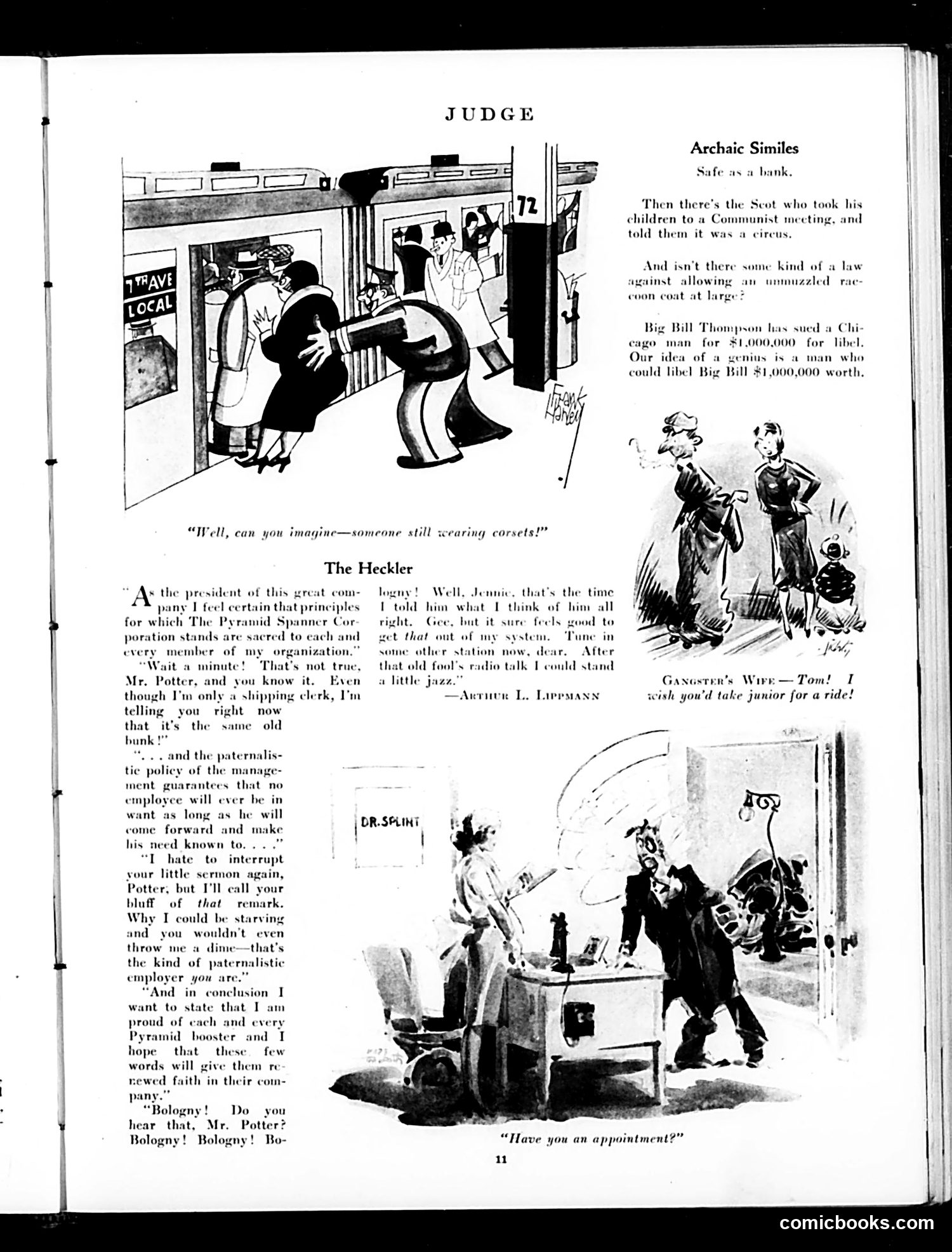
Analysis of Judge Page Content "The Heckler" is the main satirical piece. It depicts a shipping clerk interrupting his company president's paternalistic speech about worker welfare at the Pyramid Spanner Corporation. The heckler calls out the hypocrisy: the boss claims workers won't want as long as they make needs known, but the clerk counters he'd starve before receiving help. The satire targets corporate management that preaches loyalty and care while practicing indifference to actual worker hardship—a common labor critique during the industrial era. "Archaic Similes" section includes topical jokes, notably one mocking Chicago's Big Bill Thompson, a controversial mayor known for libel suits, with the quip that only a genius could slander him for a million dollars. The other cartoons appear to mock outdated fashion (corsets) and social pretense. The overall page reflects early-to-mid 20th-century American anxieties about corporate paternalism versus worker exploitation.
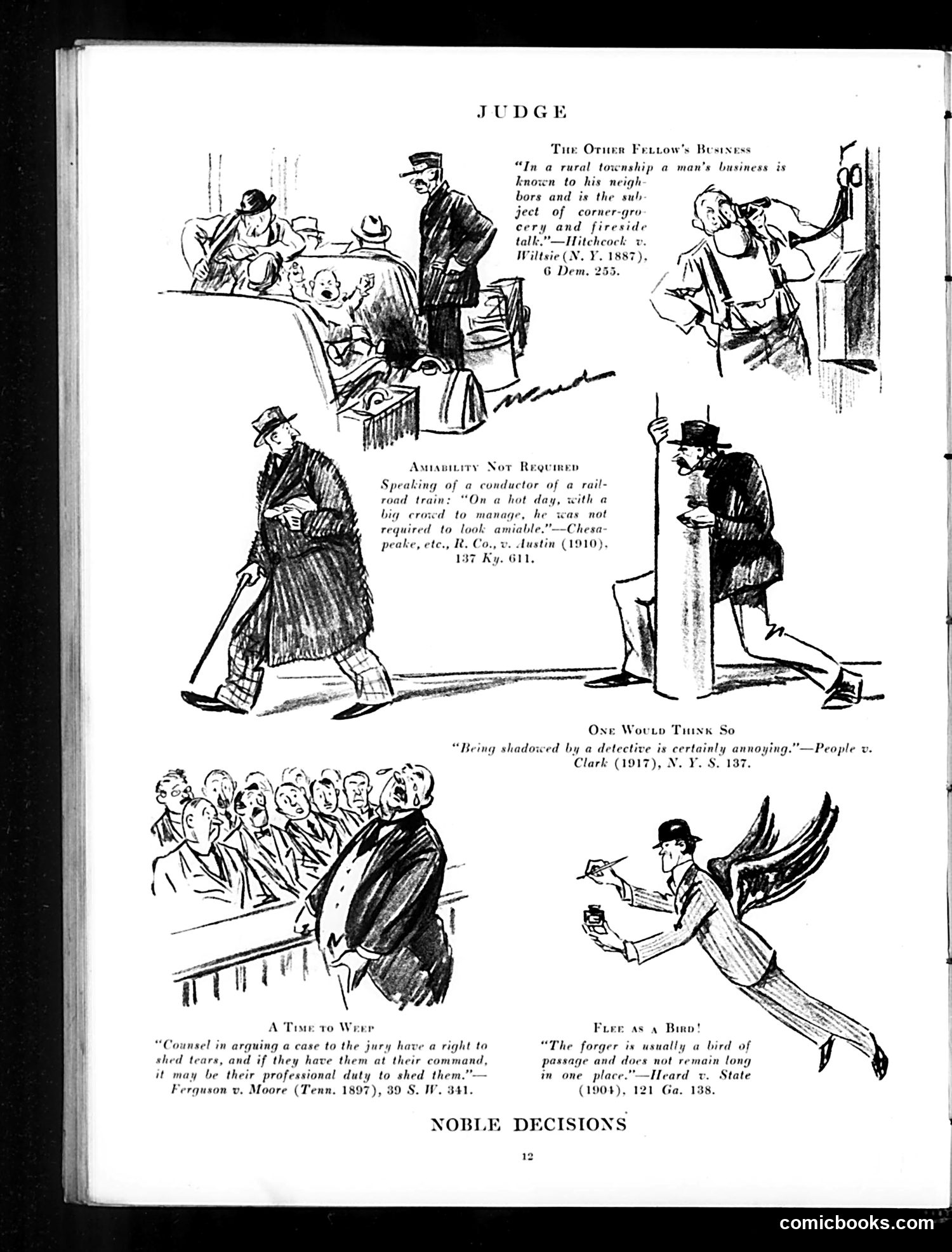
Judge Magazine: "Noble Decisions" Page This page satirizes absurd legal rulings through cartoon vignettes paired with actual court citations. Each illustration lampoons a specific judicial decision's ridiculous logic: "The Other Fellow's Business" mocks a ruling that rural neighbors naturally discuss each other's affairs—shown as gossip at a general store. "Amiability Not Required" ridicules a court excusing a railroad conductor from being pleasant to passengers on crowded, hot days. "One Would Think So" shows a detective shadowing someone, sarcastically titled as if being followed by police is merely "annoying." "A Time to Weep" depicts a lawyer crying in court, illustrating a ruling that attorneys have a *professional duty* to shed tears for juries. "Flee as a Bird" shows a forger with wings, parodying a decision characterizing forgers as transient "birds of passage." The satire targets judicial overreach and absurd legal reasoning—judges stretching logic to justify counterintuitive outcomes. The cartoons make these decisions laughably obvious through visual exaggeration.
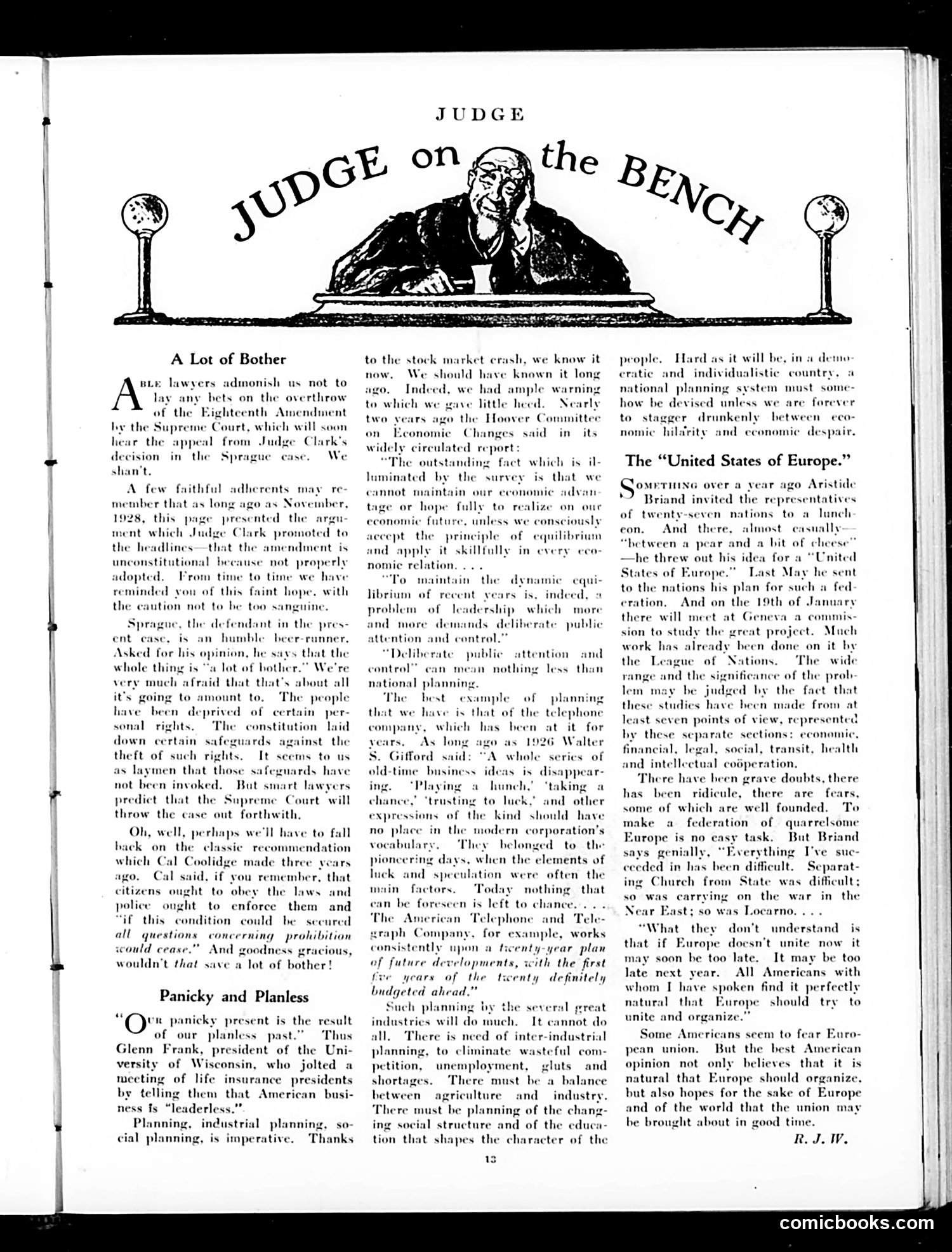
"Judge on the Bench": A Depression-Era Editorial Page This page from *Judge* magazine features two editorial commentaries on major 1920s-30s American crises, presented under a masthead showing a stern judge. "A Lot of Bother" critiques the legal challenge to Prohibition. The author expresses frustration that despite clear constitutional safeguards against rights violations, lawyers predict the Supreme Court will dismiss the Sprague case (a test case against Prohibition). The piece sarcastically invokes Calvin Coolidge's naive 1920s-era faith that citizens obeying laws and police enforcing them would solve everything—a sentiment now clearly inadequate after the stock market crash and economic collapse. "Panicky and Planless" argues that America's economic disaster resulted from lack of planning. Quoting University of Wisconsin President Glenn Frank, the author contrasts American business's haphazard "play a hunch" mentality with the telephone company's deliberate twenty-year planning. The piece advocates for coordinated national industrial and social planning—a remarkably forward-looking position for this conservative publication during the early Depression.
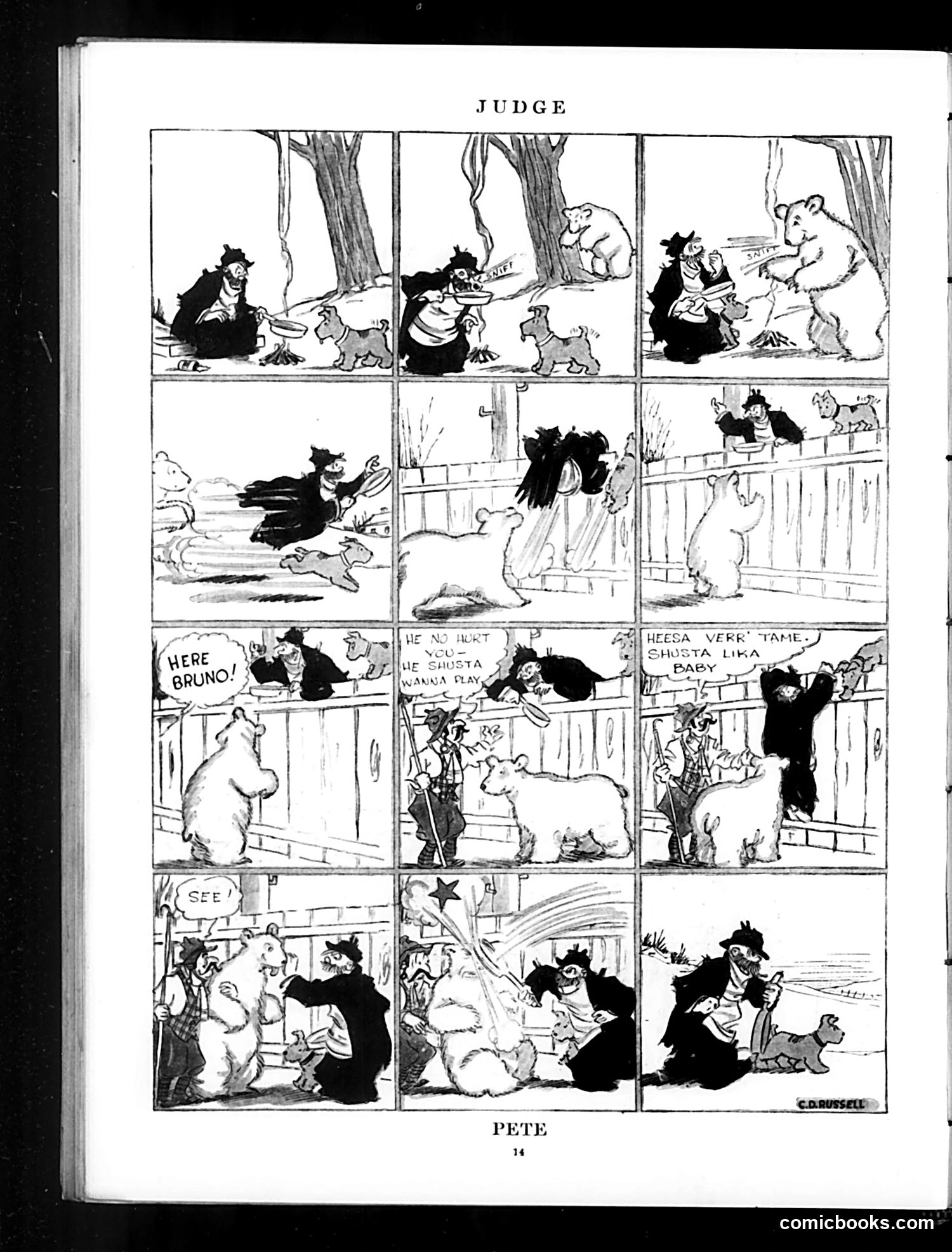
Analysis of "Judge" Comic Page This is a comic strip titled "Judge" (credited to C.D. Russell) featuring a judge character interacting with dogs. The narrative appears to be a humorous take on judicial proceedings: the judge encounters various dogs, attempts to maintain order and decorum, and ultimately fails to control the situation as the dogs misbehave. The satire likely mocks the dignity and authority of the legal system—the judge, meant to represent law and order, is rendered helpless against canine chaos. The strip uses animal characters as a vehicle for social commentary about courtroom incompetence or the breakdown of judicial authority, which was a common satirical theme in early-to-mid 20th century American humor magazines. The specific historical context remains unclear without additional information about publication date.
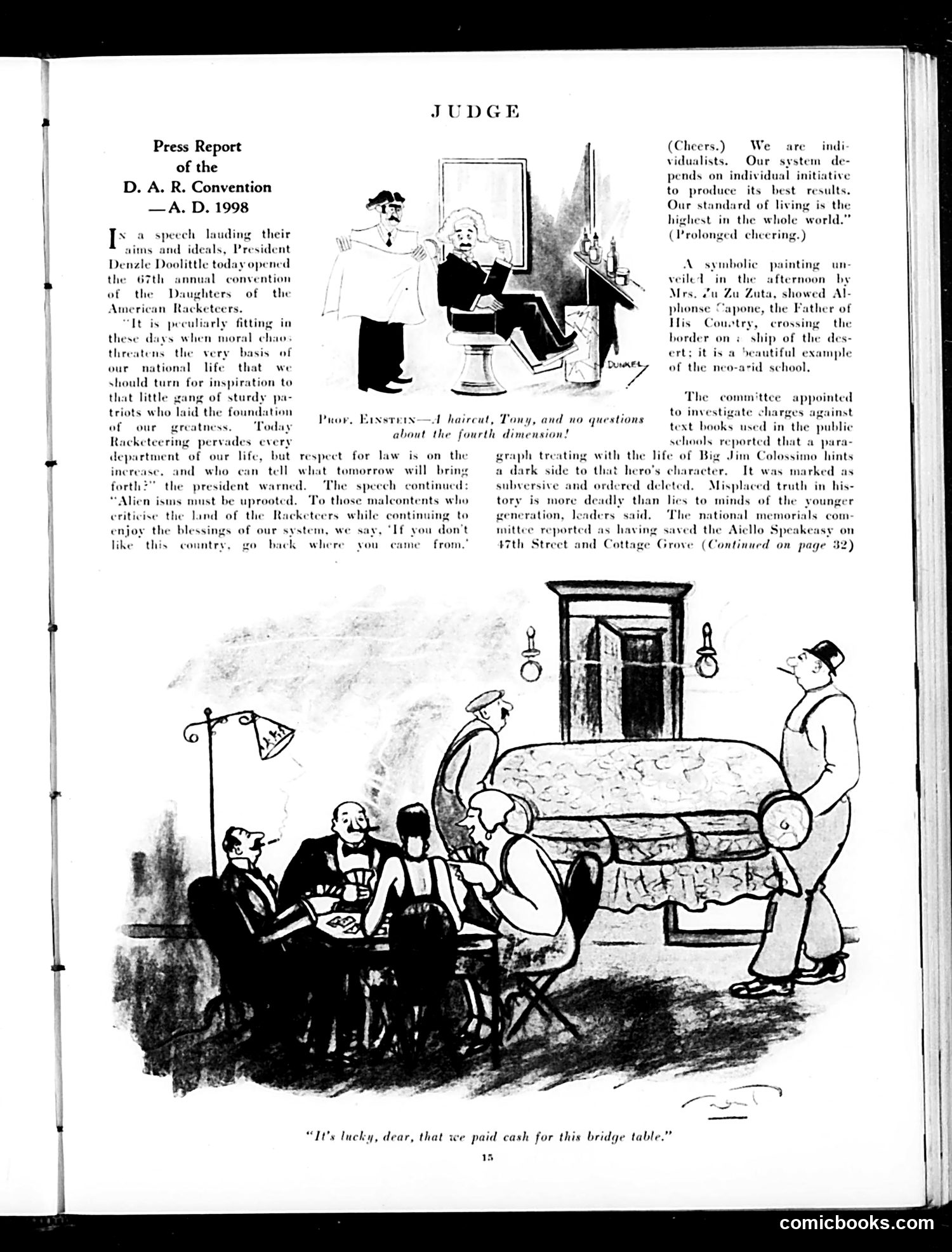
Satire of the D.A.R. Convention (1998 Projection) This Judge magazine cartoon satirizes the Daughters of the American Revolution by imagining their 1998 convention as the "Daughters of the American Racketeers"—a scathing critique of 1920s corruption and organized crime. The text mocks the D.A.R.'s patriotic rhetoric while the nation suffers moral decay from racketeering (Prohibition-era gangsterism). The fictional president warns against "alien isms" while praising a system built on lawlessness. The committee censors history textbooks to hide unsavory truths about criminals like "Big Jim Colossimo" (an actual Chicago mob boss). The bottom cartoon jokes grimly that citizens must pay cash for furniture to avoid leaving financial traces—implying widespread criminal activity and graft. The satire suggests the D.A.R.'s conservative, nationalist posturing masks complicity in American corruption and criminality.
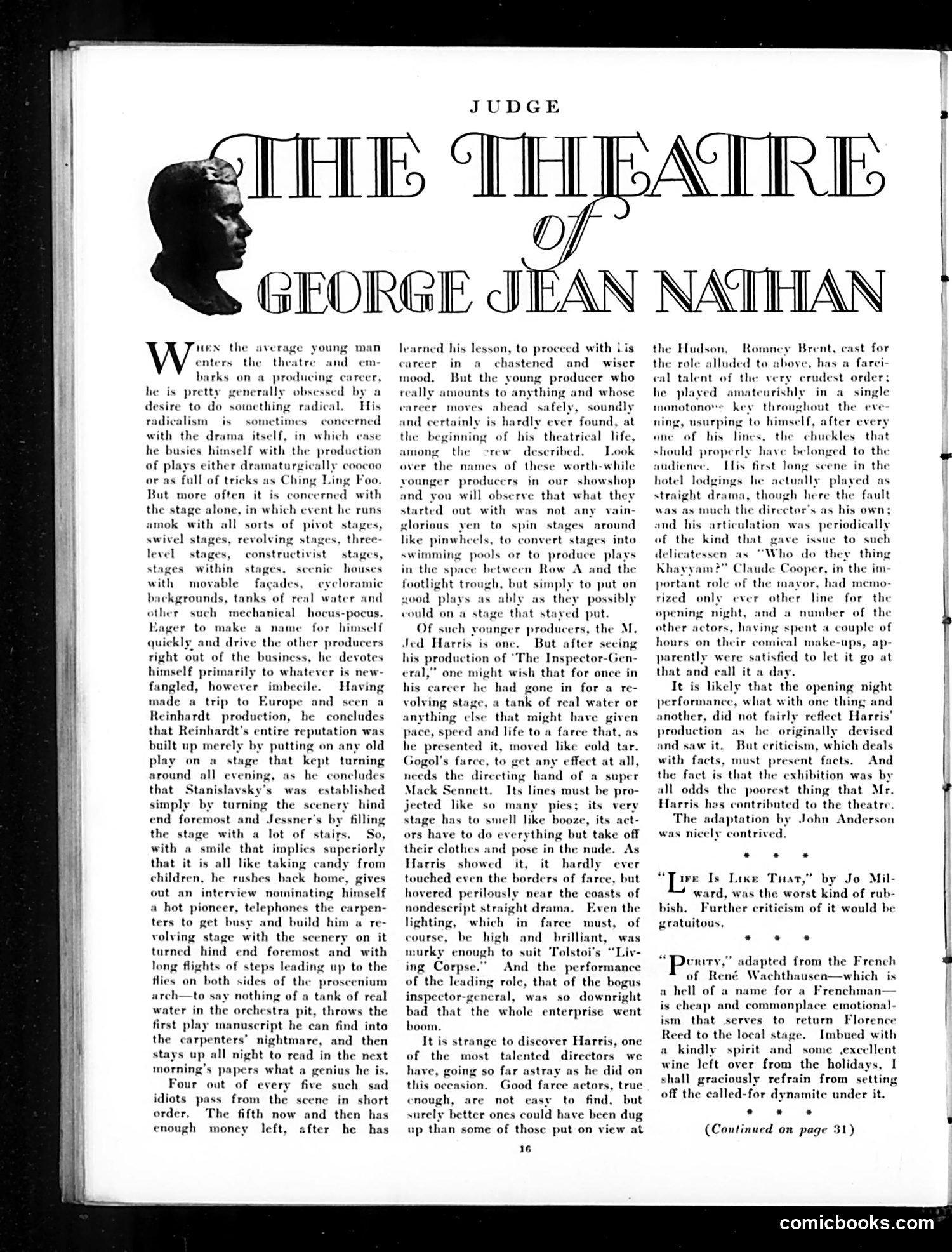
"The Theatre of George Jean Nathan" This is a theater criticism piece by Judge magazine's drama critic George Jean Nathan. The article satirizes young theatrical producers who chase experimental staging tricks—revolving stages, constructivist sets, tanks of water—to gain quick fame, citing European directors like Reinhardt, Stanislavsky, and Jessner as their inspiration. Nathan argues most such "sad idiots" fail within years. The successful producers, he contends, focus on good plays on simple, stationary stages. He uses producer Jed Harris as a case study: Harris produced Gogol's "Inspector-General" but failed to inject the necessary frenetic energy the farce demands. The piece criticizes Harris's static, murky staging as incompetent—the opposite of what Gogol requires. The critique reflects 1920s theatrical debates about modernist staging versus dramatic substance.

"Cruisers" - Judge Magazine This page appears to be a title page or section divider for Judge magazine, featuring the word "Cruisers" split across white space on either side of a central illustration. The image shows a cross-section view of what appears to be a naval warship or cruiser, rendered in stark black and white, displaying the vessel's internal structure and decks from above. Given the publication's satirical nature and the early 20th-century timeframe suggested by the styling, this likely relates to naval policy debates of that era—possibly commentary on military spending, naval expansion, or international naval competition. However, without additional context or accompanying text visible on the page, the specific satirical point remains unclear.
Analysis This appears to be a title page or section divider from *Judge* magazine, showing only the text "a,C,f," at the top and two horizontal black bars below it. The OCR'd text is largely garbled characters, suggesting this is primarily a blank or mostly blank page with minimal content. Without visible cartoon imagery, political figures, or satirical content, I cannot identify specific references, caricatures, or the intended joke or message. The abbreviated text "a,C,f," is unclear—it could be initials, a filing reference, or a printing mark, but its meaning isn't evident from context. This page does not contain sufficient visible content for meaningful analysis of political or social satire.
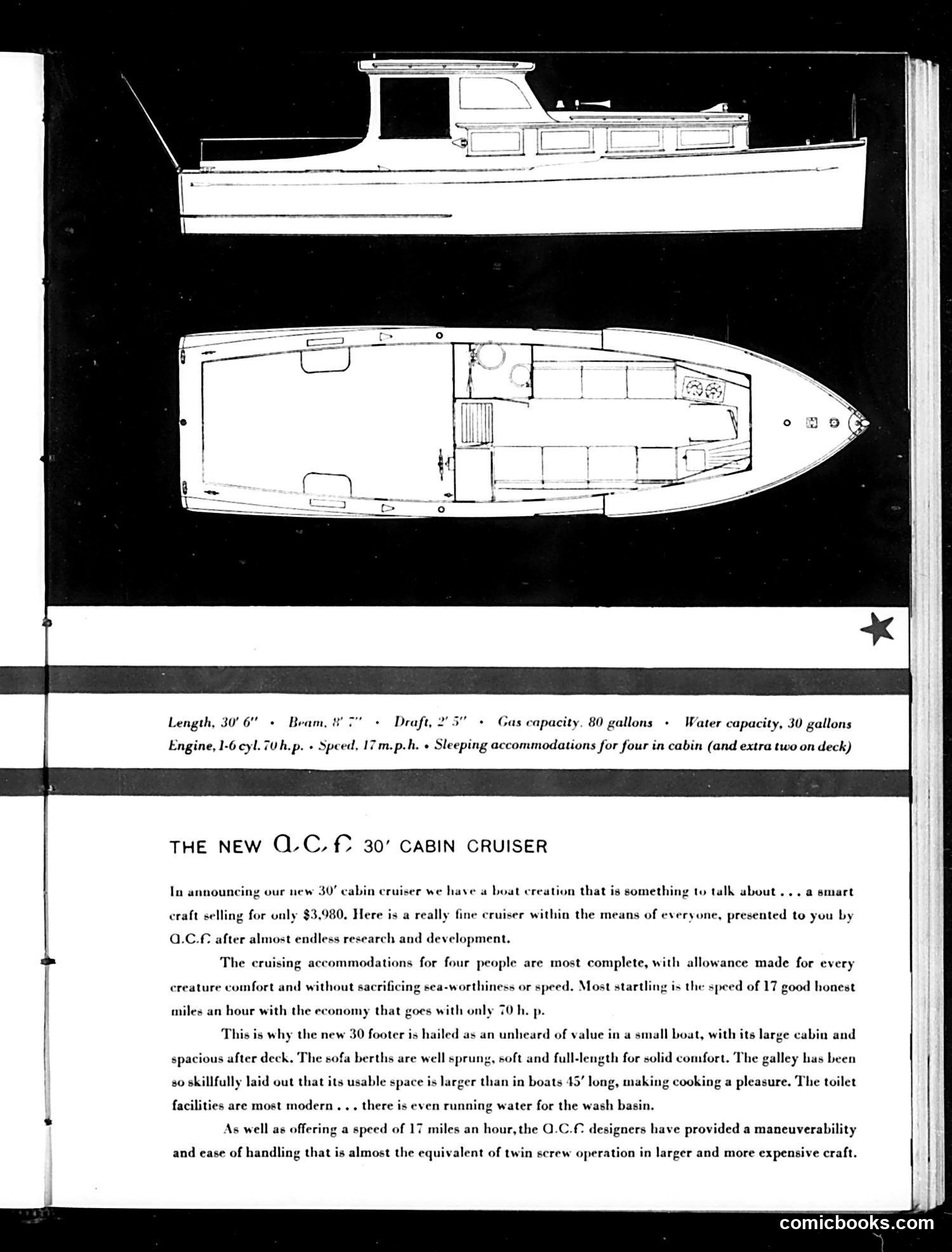
Content Analysis This is not a cartoon or satire—it's a product advertisement for a cabin cruiser boat manufactured by O.C.F. The page shows technical drawings (side profile and top-down deck plan) alongside promotional copy. The ad targets middle-class buyers in what appears to be the 1930s-40s, emphasizing value: a "$3,980" vessel offering luxury amenities (running water, full galley, sleeping quarters) in a compact 30-foot design. The marketing emphasizes practical benefits—17 mph speed on minimal fuel, clever space design rivaling larger boats—positioning this as accessible leisure for "everyone." There is no political satire or social commentary visible. Judge magazine did publish advertisements alongside satirical content; this page represents the commercial side of the publication rather than editorial humor or social criticism.
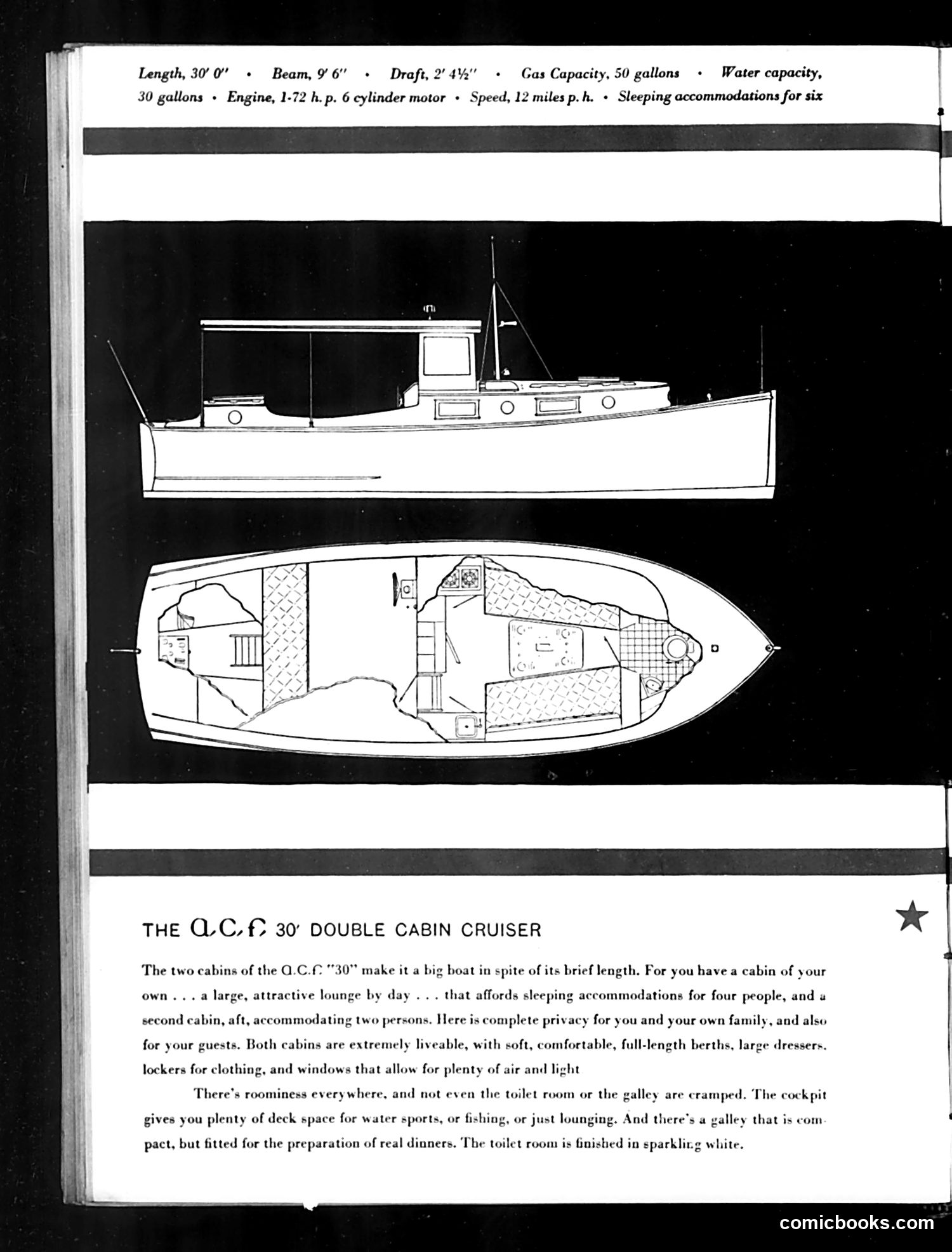
Analysis This is not a political cartoon or satire—it's a product advertisement for a recreational motorboat, the "OLC 30° Double Cabin Cruiser." The page shows technical specifications (length, beam, engine capacity) and a side-view illustration plus deck plan of the vessel. The accompanying text is marketing copy emphasizing the boat's practical features: two separate cabins providing privacy for family and guests, comfortable sleeping berths, a functional galley (kitchen), spacious cockpit for recreation, and efficient use of limited space. This represents leisure advertising from the mid-20th century, targeting affluent Americans interested in recreational boating. There is no satire, political commentary, or social criticism present—merely commercial promotion typical of Judge magazine's advertising content during this period.
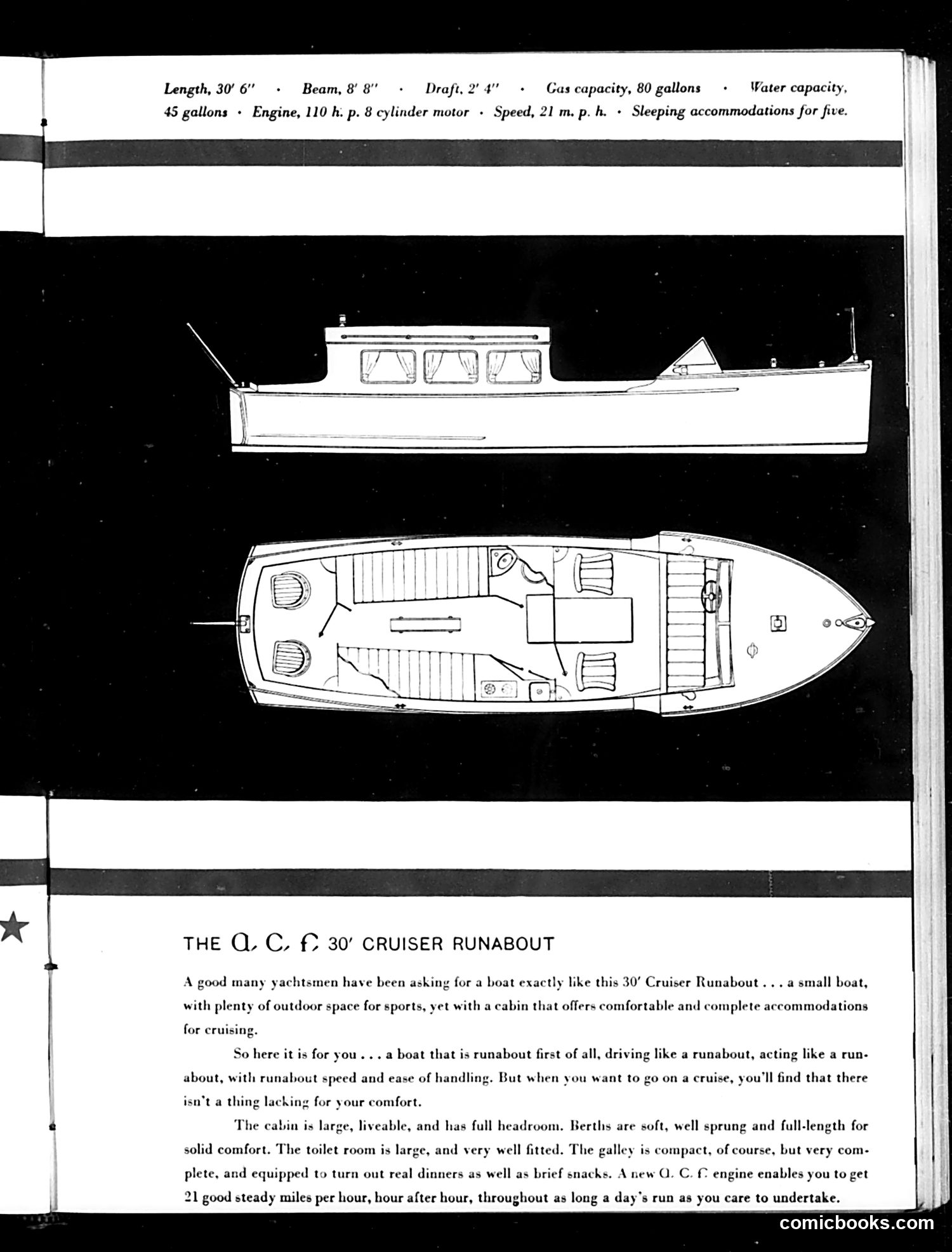
Analysis This page is not a political cartoon or satire—it's a straightforward product advertisement for a luxury boat, the Q.C.C. 30' Cruiser Runabout. The page features technical specifications (length, beam, engine horsepower, fuel capacity) and marketing copy targeting wealthy yachtsmen. It emphasizes the boat's dual functionality: a fast, maneuverable runabout for sports and recreation, yet with comfortable cabin amenities (full headroom, proper galley, toilet facilities) for extended cruising. The text highlights a design compromise—compact but "complete" accommodations—that appeals to those seeking both performance and comfort. The side-profile and deck-plan drawings show the practical layout. This appears in *Judge* magazine likely because *Judge* carried upscale advertising aimed at its affluent readership. There is no satirical commentary, political reference, or hidden joke visible here—simply vintage yacht marketing.
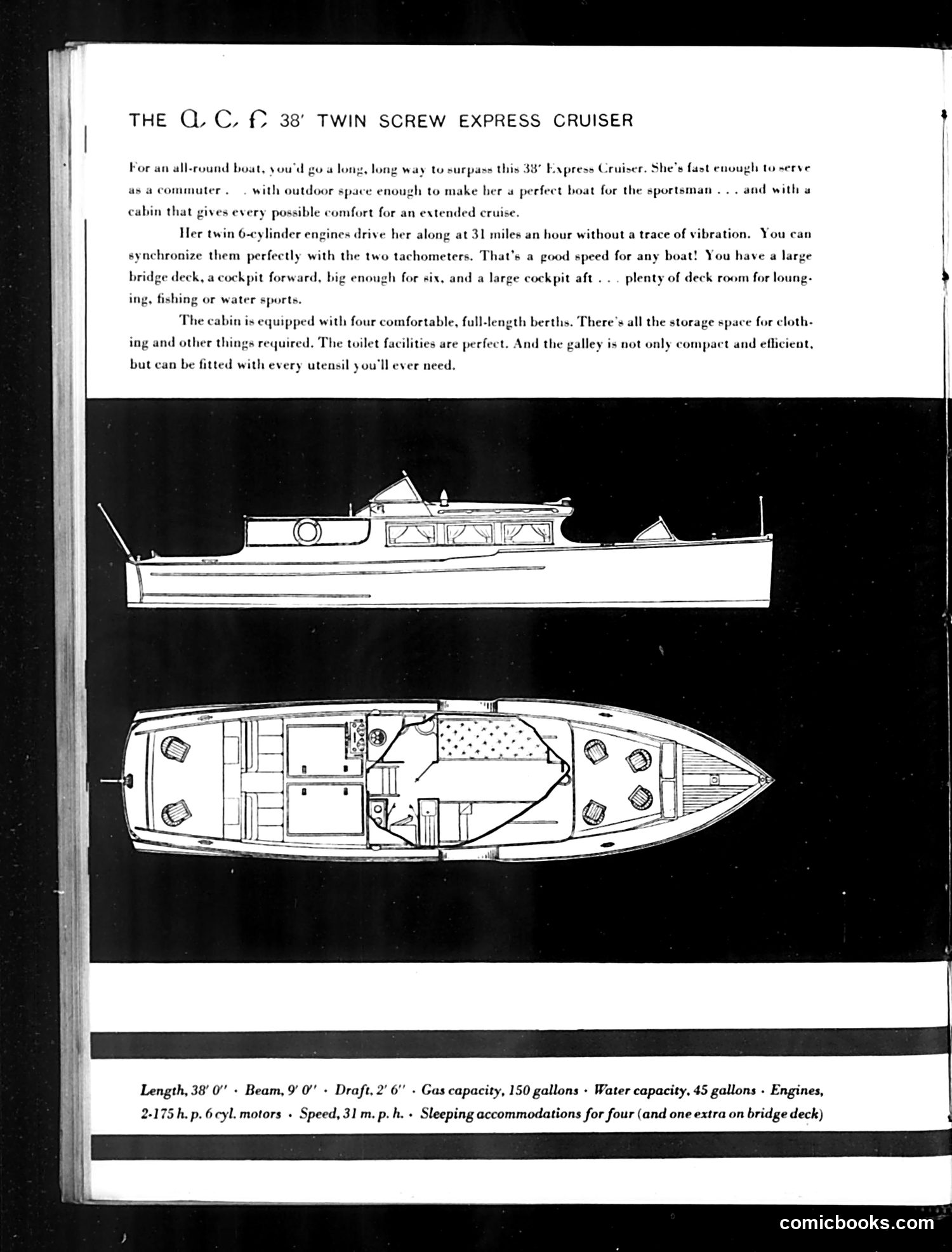
Analysis This is not a cartoon or satire—it's a straightforward advertisement for a luxury boat, the Q.C.F. 38' Twin Screw Express Cruiser. The page features marketing copy and technical specifications alongside side-profile and top-down deck-plan drawings of the vessel. The ad targets affluent sportsmen and commuters, emphasizing speed (31 mph), comfort (four berths, full galley, perfect toilet facilities), and performance (twin synchronized 6-cylinder engines with minimal vibration). The detailed layout diagram shows sleeping quarters, cockpits, bridge deck, and storage. This represents typical 1920s-30s leisure marketing to wealthy clients—positioning the boat as both practical commuter transport and recreational luxury craft. There is no political satire or social commentary present; it's purely commercial advertising that Judge magazine carried to generate revenue.
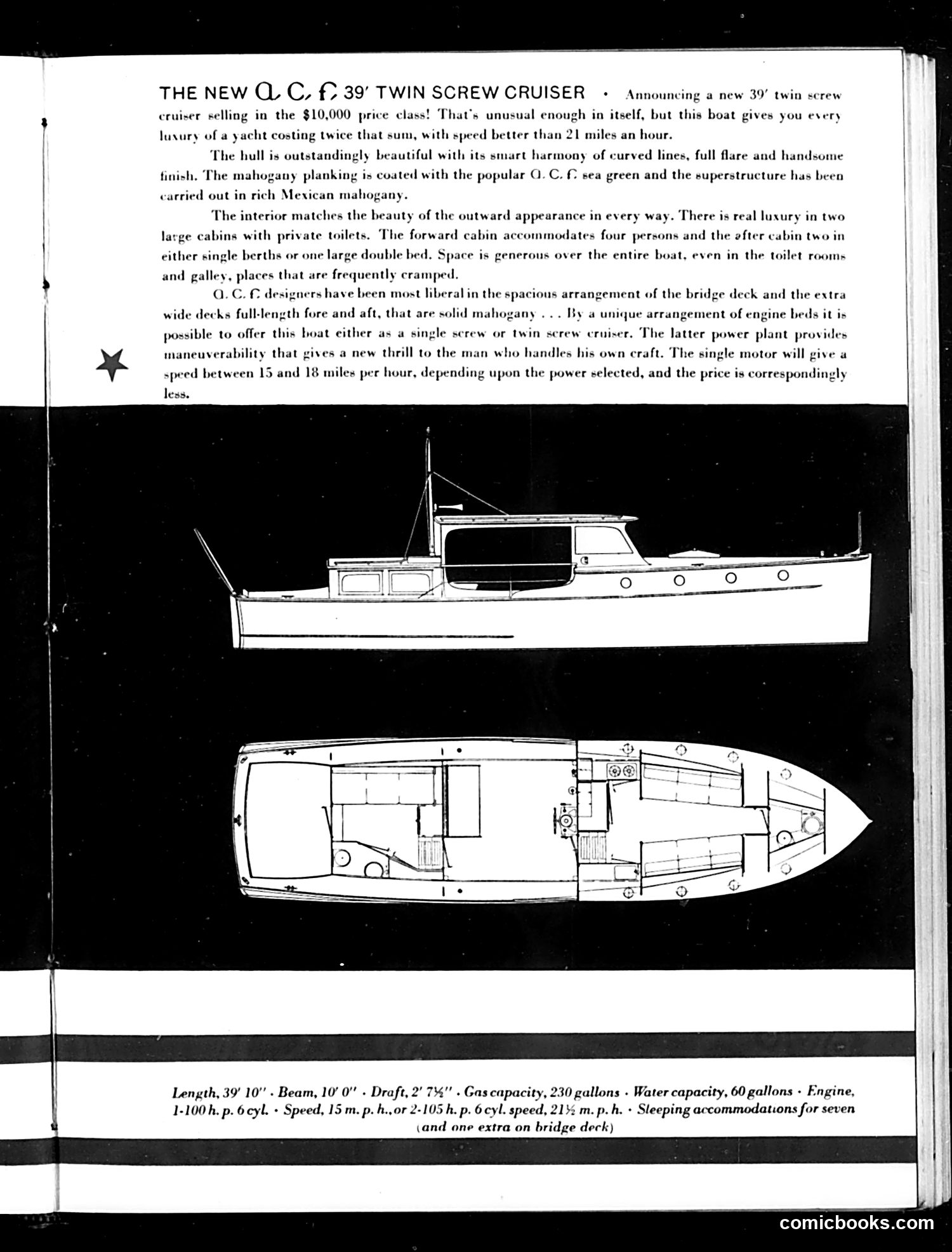
This Page is Not Satirical This is a straightforward luxury yacht advertisement, not a political cartoon or satire. It announces a new 39-foot twin-screw cruiser from Q.C.F. (a boat manufacturer) selling in the $10,000 price class—positioned as an affordable luxury vessel. The page features: - Descriptive sales copy highlighting the boat's features: mahogany construction, spacious cabins for seven people, twin screw engines offering speeds up to 21+ mph, and elegant appointments - Technical specifications and floor plan diagrams showing the interior layout The ad appears in *Judge* magazine because wealthy readers were the target audience. There is no political commentary, caricature, or joke—just mid-century luxury marketing. The inclusion of such ads was common in satirical magazines, which relied on high-end advertising to fund operations while serving affluent readers.
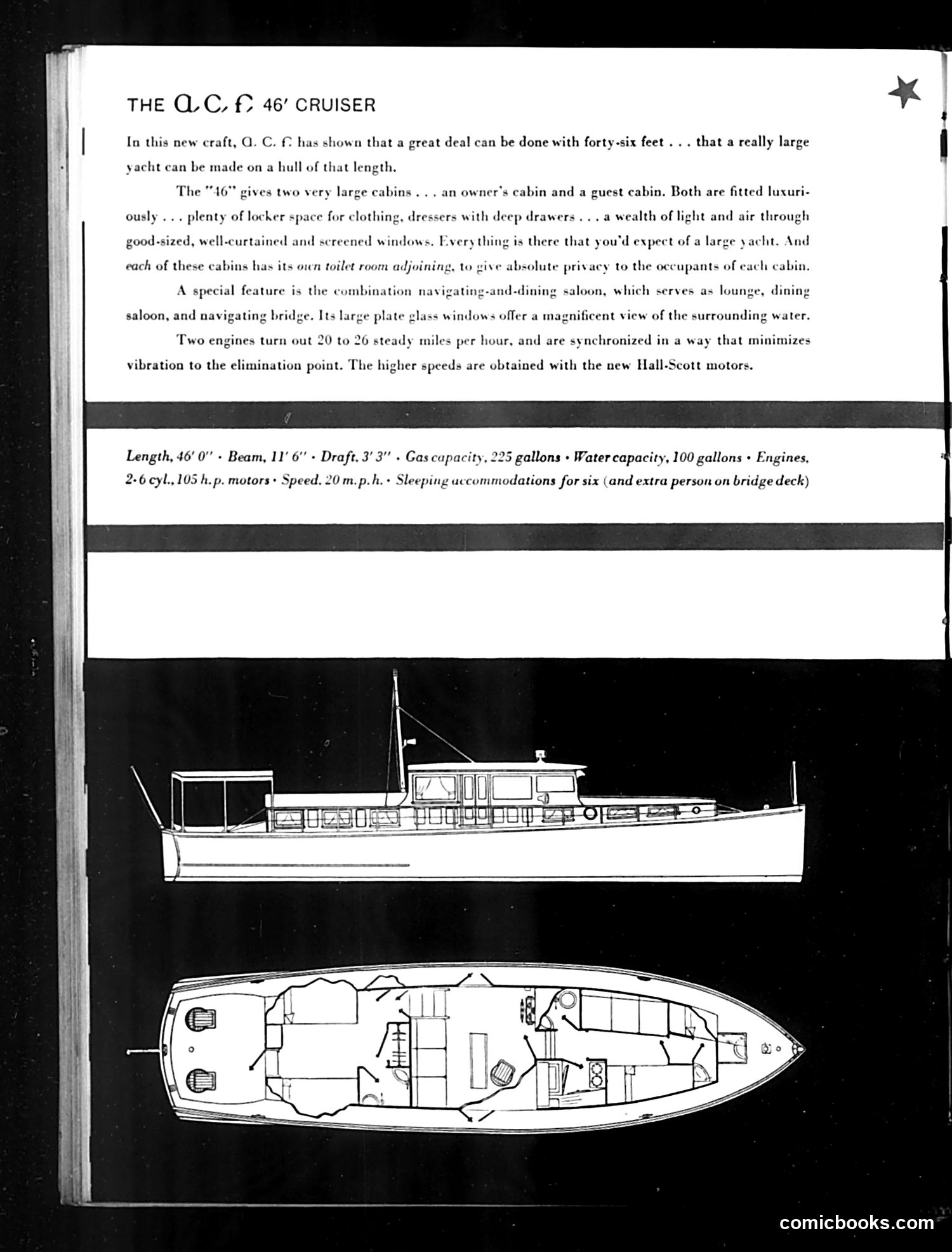
Analysis This page is not a cartoon or satire—it's a straightforward advertisement for a luxury yacht, the Q.C.F. 46' Cruiser. The text and technical drawings (side profile and overhead deck plan) describe a high-end recreational boat marketed to wealthy buyers. It emphasizes luxury amenities: two spacious cabins with private bathrooms, ample storage, large windows, a combined dining-and-navigation saloon, and powerful synchronized engines capable of 20-26 mph. This appears in *Judge*, a satirical magazine, likely because Judge accepted paid advertisements to fund publication. The yacht ad itself contains no satire, political commentary, or humor—it's a genuine product pitch to the magazine's affluent readership during what appears to be the early 20th century. The "G. C. F." manufacturer remains unclear from the visible text.
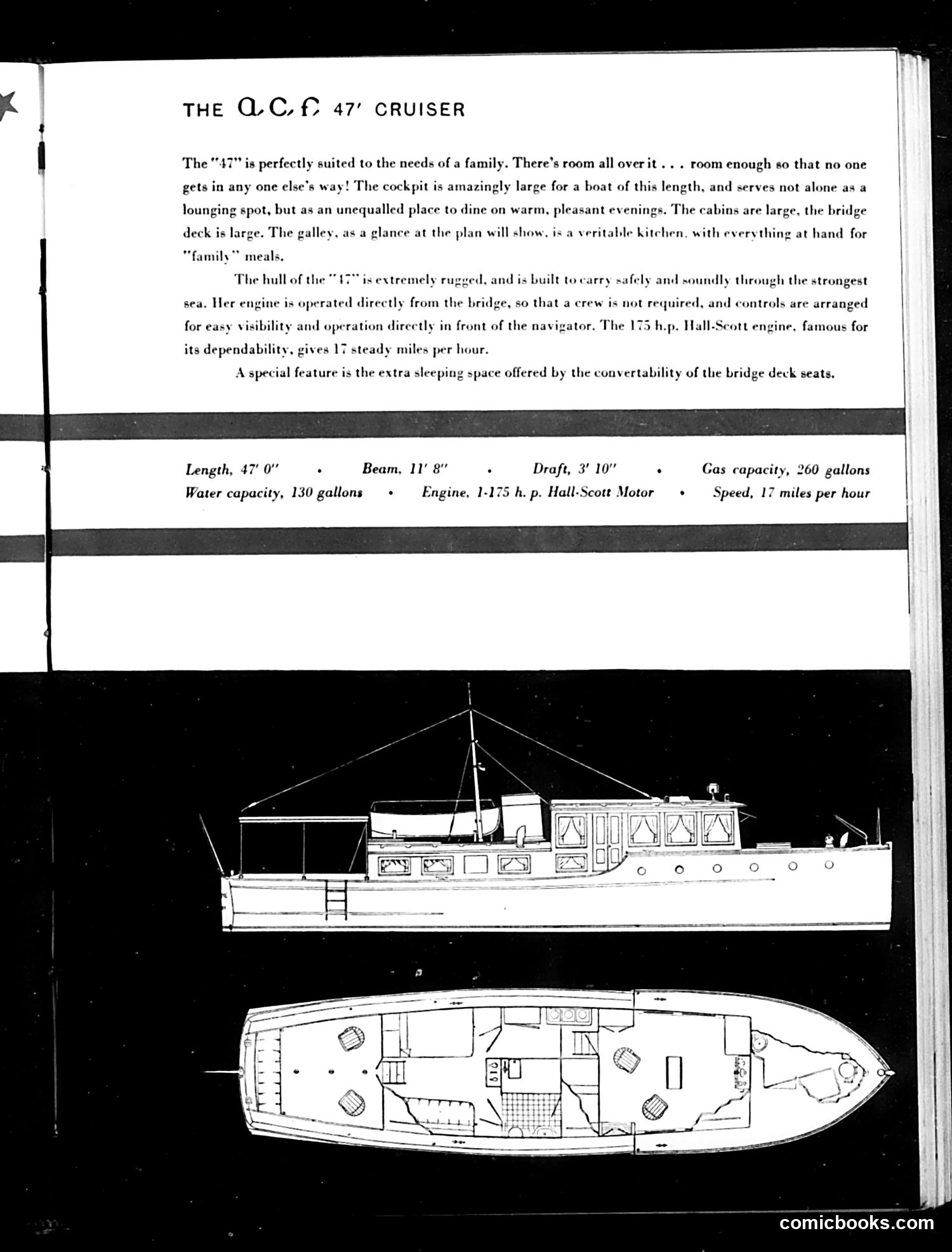
Analysis: This is NOT a cartoon or satire. This page is a product advertisement for the O.C.F. 47' Cruiser, a motorboat. There are no political cartoons, satirical commentary, or jokes present. The content consists of: - Promotional text describing the boat's family-friendly features (spacious cockpit, large cabins, galley) - Technical specifications (47-foot length, 175 h.p. Hall-Scott engine, 17 mph speed) - Two technical drawings: a side profile view and an overhead deck plan showing interior layout This appears in *Judge* magazine likely as a paid advertisement, which was common in period magazines. The boat's emphasis on family comfort and ease of operation (single operator possible) reflects early-20th-century recreational boating marketing rather than any satirical message.
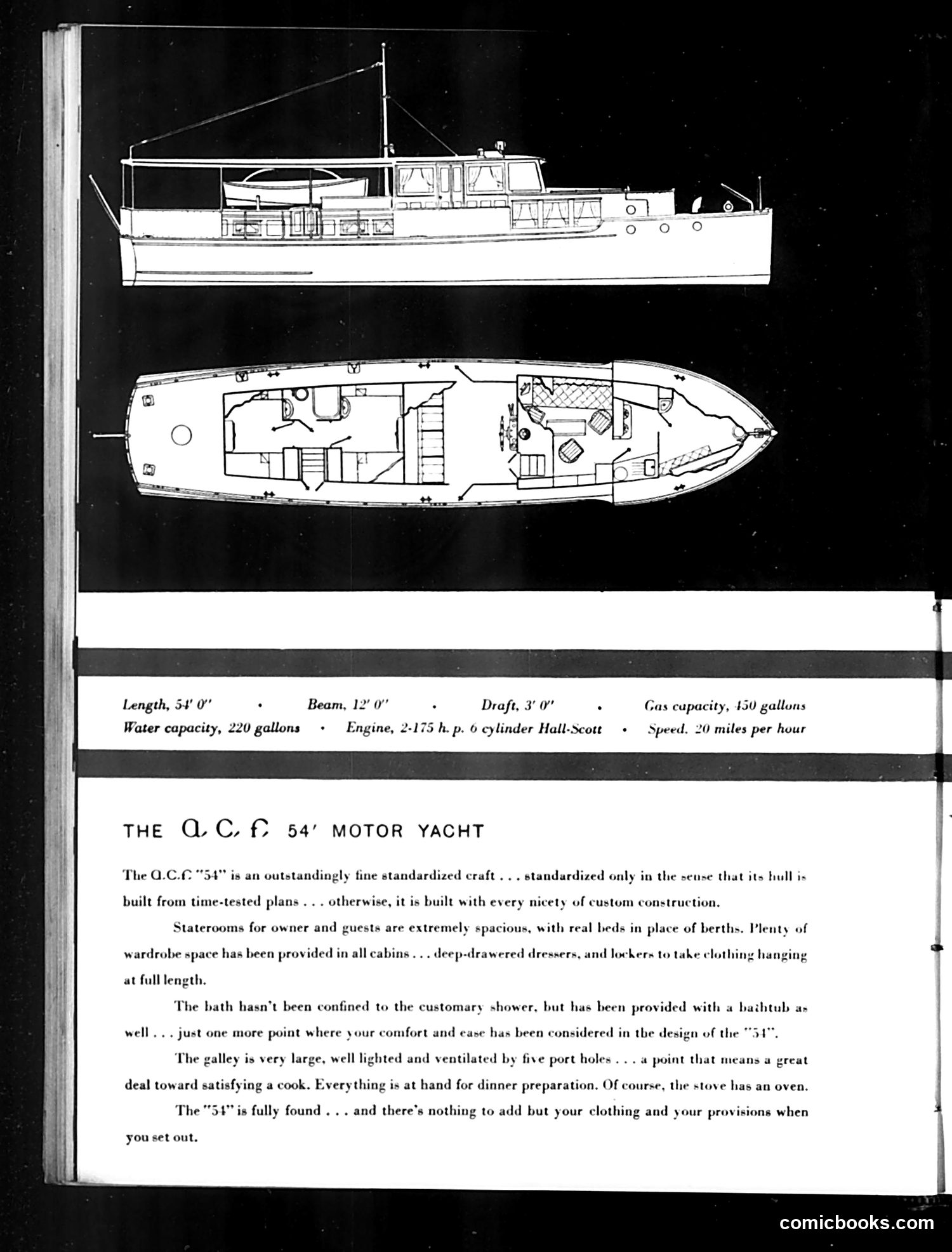
The Q.C.F. 54' Motor Yacht This page is not a cartoon or satire—it's a straightforward advertisement for a luxury motor yacht. The image shows technical side-profile and deck-plan drawings of the vessel, with detailed specifications (54 feet long, 220-gallon water capacity, Hall-Scott engine, 20 mph speed). The promotional text emphasizes the yacht's appeal to wealthy buyers by highlighting comfort amenities: spacious staterooms with real beds rather than berths, full wardrobe storage, a bathtub (not just shower), and a large, well-equipped galley. The copy targets affluent leisure boaters, assuring them the craft is "fully found"—completely outfitted and ready to use immediately. This appears to be luxury lifestyle advertising from Judge magazine's commercial pages, not editorial content or political satire.
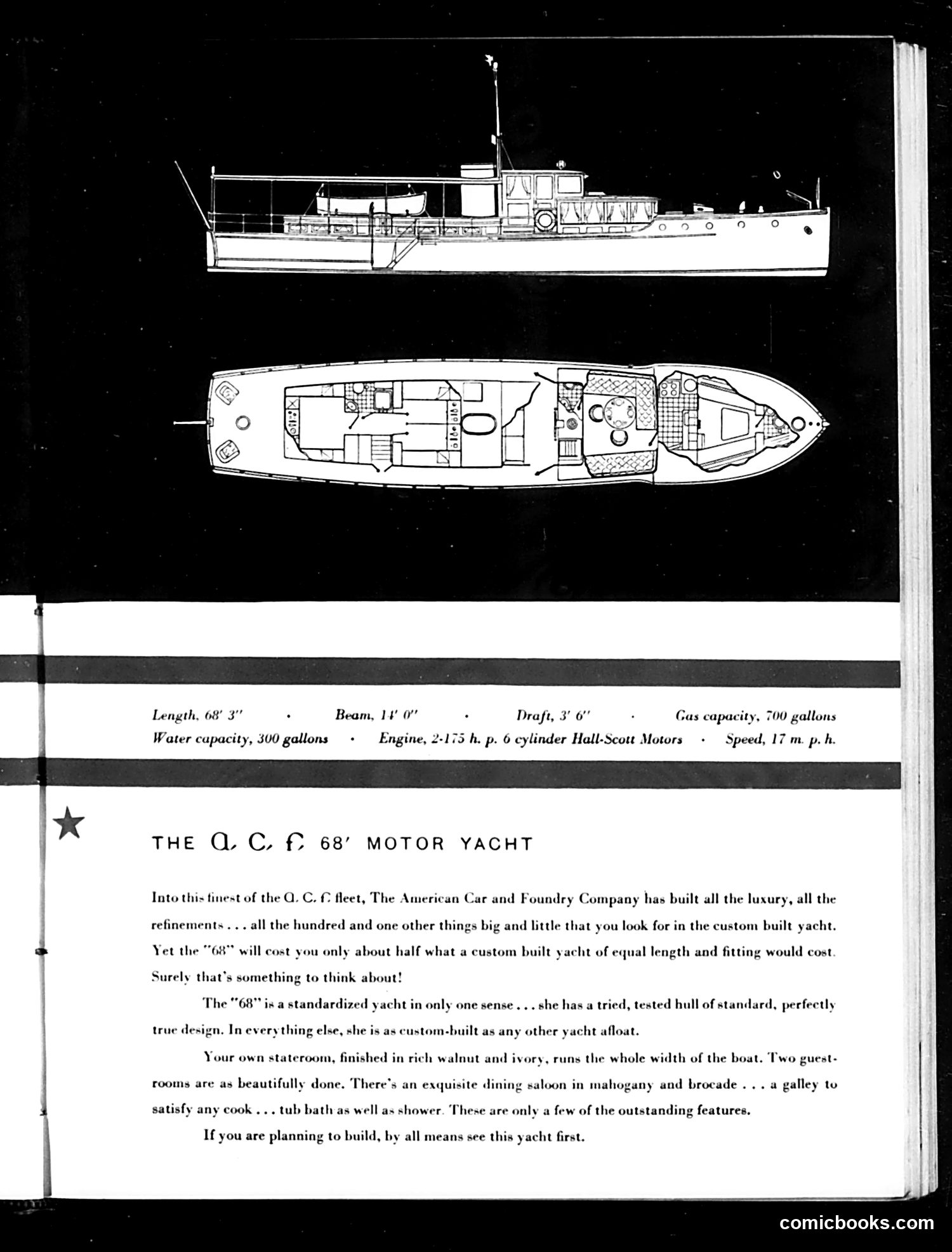
Analysis This is not a cartoon or satire — it's a product advertisement for the American Car and Foundry Company's 68-foot motor yacht. The page features technical drawings (side profile and deck plan) and promotional copy emphasizing the vessel's luxury features and value proposition. The pitch targets wealthy buyers: the yacht offers custom-built amenities (mahogany dining saloon, walnut staterooms, full bath) at "only about half" the cost of a truly custom-built yacht. The implicit appeal is to the aspirational wealthy during an era when motor yachts signaled status. The copy emphasizes standardized hull design as an efficiency that doesn't compromise luxury — a sales technique suggesting buyers get custom quality at mass-production prices. This represents typical interwar advertising in *Judge* magazine, which mixed satirical content with upscale advertisements targeting its affluent readership.
This is a title page or advertisement for American Car and Foundry Company, located at 217 West 57th Street in New York City. The page lists the company's showroom locations across major American cities from coast to coast. There is no cartoon or satirical content visible on this page. It appears to be purely a business advertisement or header page, likely from a Judge magazine issue, displaying the company's name, address, and distribution network. The abbreviated notation "a,c,f," at the bottom appears to be the company's initials.
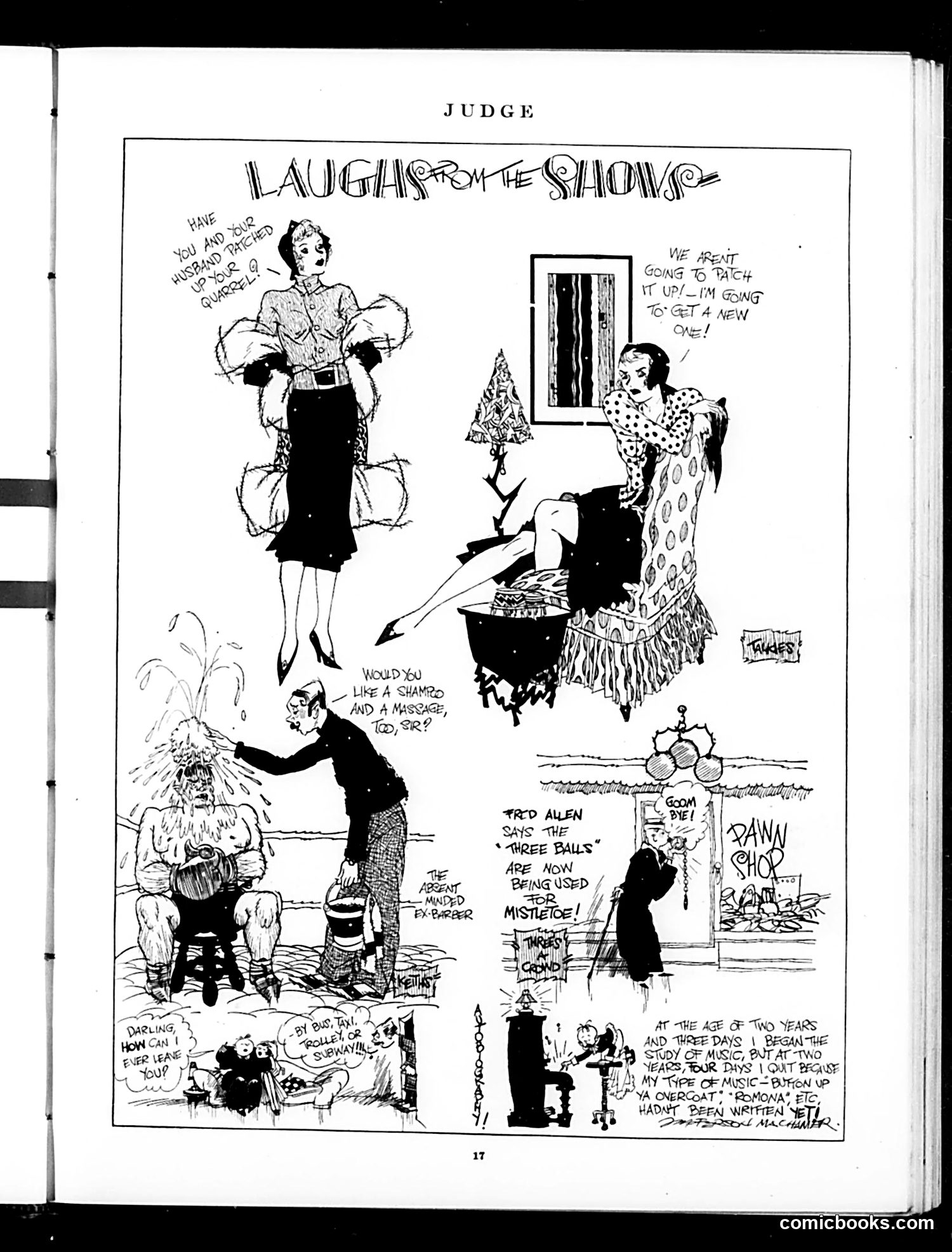
"Laughs from the Salons" - Judge Magazine Cartoon This page satirizes wealthy society women and their leisure pursuits. The main figure is a fashionable woman in elaborate dress with exaggerated puffy sleeves, representing high-society vanity. The surrounding vignettes mock various upper-class concerns: a woman getting beauty treatments (shampoo and massage), another replacing worn-out furniture, and society ladies obsessing over trivial matters. The bottom panel includes text about a music student beginning studies at age two—satirizing the pretentious cultured education of wealthy children, mentioning "overcoat," "pomona," and other dismissive details suggesting the absurdity of such early, exhaustive instruction. The overall message critiques the shallow materialism, obsession with appearance, and affected cultural pretensions of the wealthy elite. The cartoonist (signature appears to be "Thurber" or similar) uses exaggeration and incongruity to mock these social attitudes.
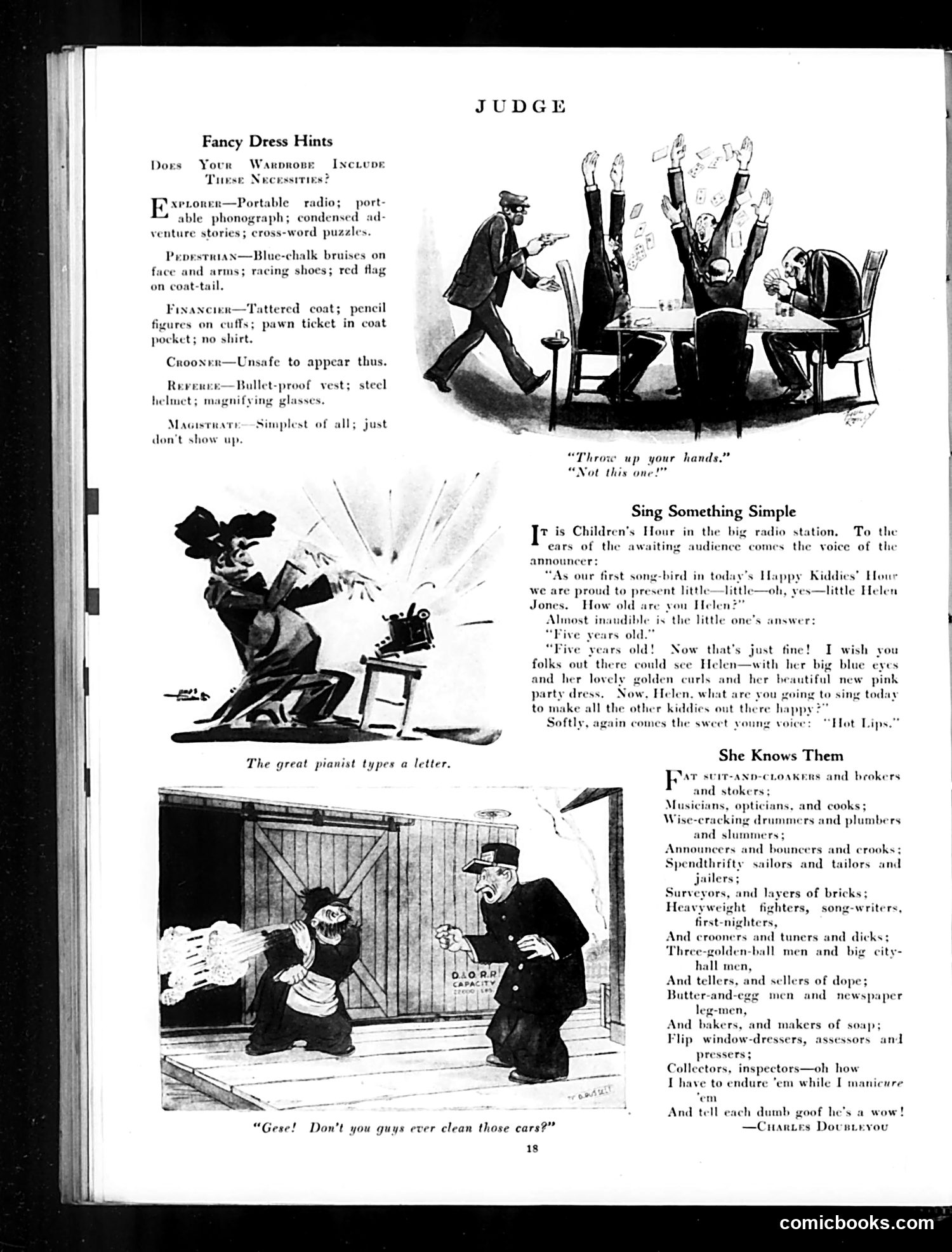
Judge Magazine Page Analysis This page contains three satirical pieces targeting early 1920s American society: "Fancy Dress Hints" mocks costume party attendees by listing stereotypical "disguises" for various professions. The humor lies in suggesting that explorers, pedestrians, financiers, and others need minimal props—their actual lives are already theatrical or absurd. The magistrate joke (simply "don't show up") implies judicial corruption or incompetence. "Sing Something Simple" satirizes radio's Children's Hour programming. The joke appears to be that a five-year-old's singing talent is fabricated for radio audiences—the announcer hypes her appearance extravagantly while she meekly sings "Hot Lips," an adult jazz song entirely inappropriate for children, exposing the phoniness of early radio entertainment. "She Knows Them" is a poem (credited to Charles Doubleau) celebrating a manicurist or salon worker who encounters all social types—from criminals to society figures. It's gentle satire suggesting working-class women possess shrewd social observation. All three pieces reflect Jazz Age cynicism about modern institutions: fashion, broadcast media, and social hierarchy.
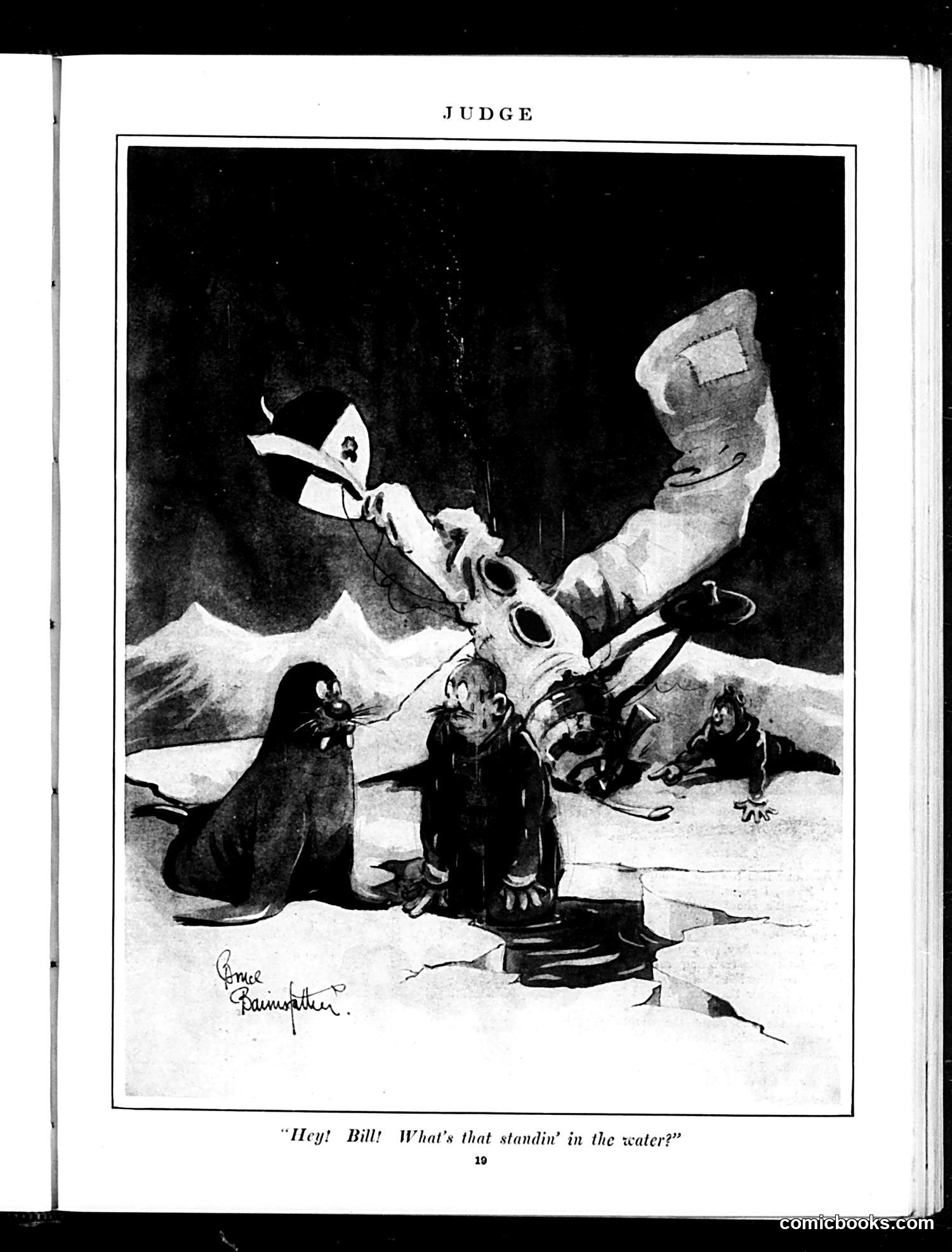
Judge Magazine Cartoon Analysis This appears to be a satirical cartoon from Judge magazine depicting an arctic or snowy scene. Two figures in dark winter clothing stand in snow, pointing at what looks like a large mechanical or strange creature standing in water in the background. The creature has an unusual, possibly insect-like or alien appearance with elongated limbs. The dialogue—"Hey! Bill! What's that standin' in the water?"—suggests confusion or alarm about an unexplained presence. Without additional context about the publication date or political events of the period, the specific satirical target remains unclear. It could reference contemporary anxieties about technological advancement, foreign threats, or industrial intrusion into natural spaces, but this cannot be confirmed from the image alone.
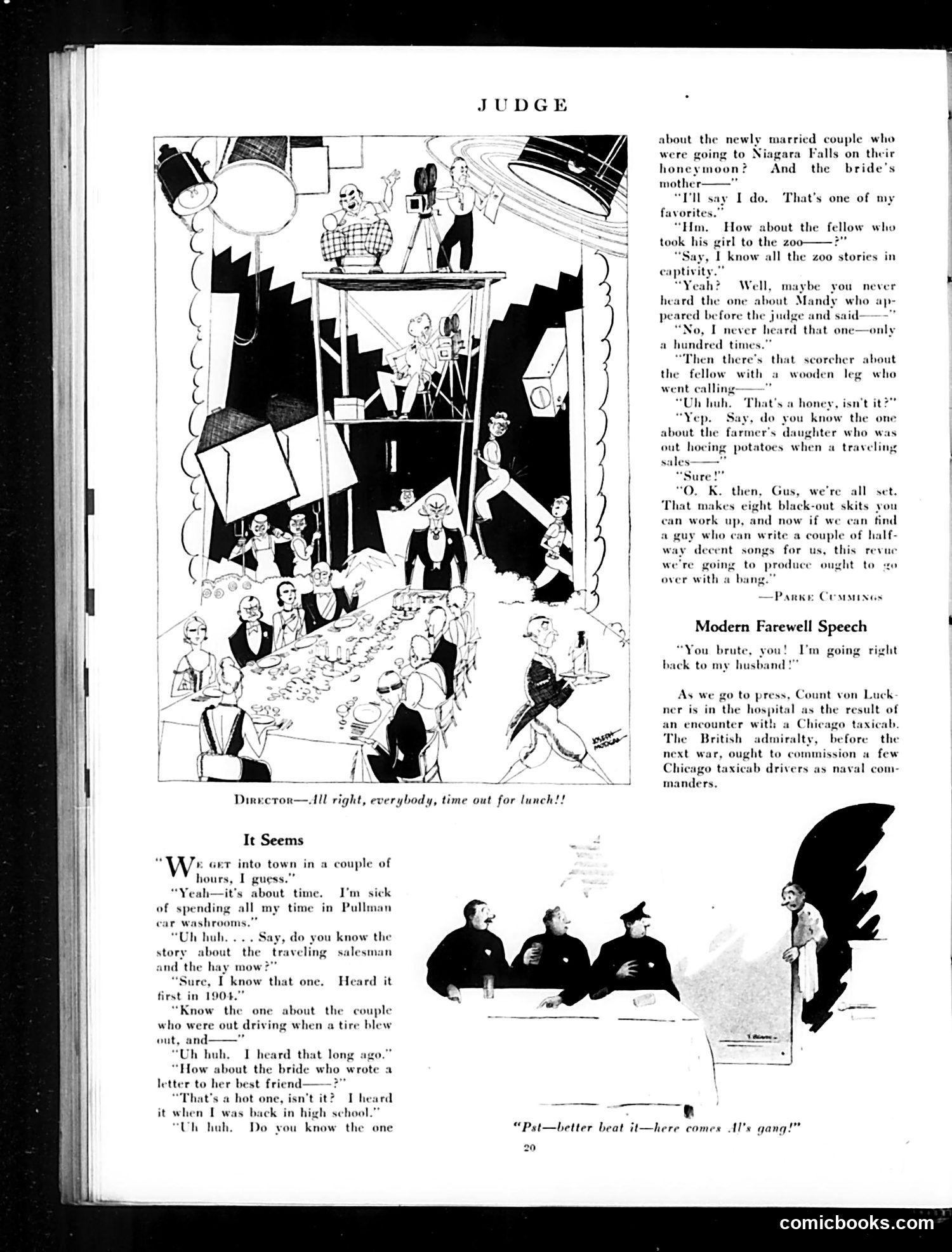
Judge Magazine Page Analysis This page contains theatrical and humor content rather than political satire. The main cartoon depicts a theater director ("Director—all right, everybody, time out for lunch!!") overseeing what appears to be a revue production, with performers and crew visible in a multi-level stage setup. The accompanying dialogue sketches ("It Seems" and "Modern Farewell Speech") are vaudeville-style joke exchanges. They feature traveling salesmen stories, honeymoon gags, and zoo anecdotes—standard commercial humor of the era. The speakers discuss assembling a revue with "eight black-out skits," referring to short comedic sketches. A brief satirical note references "Count von Luckner," apparently hospitalized after an encounter with a Chicago taxicab, with a jest that Chicago taxi drivers should become naval commanders—likely mocking either Luckner's incompetence or Chicago's rough reputation. The page primarily showcases entertainment industry humor and theatrical production rather than substantive political commentary.
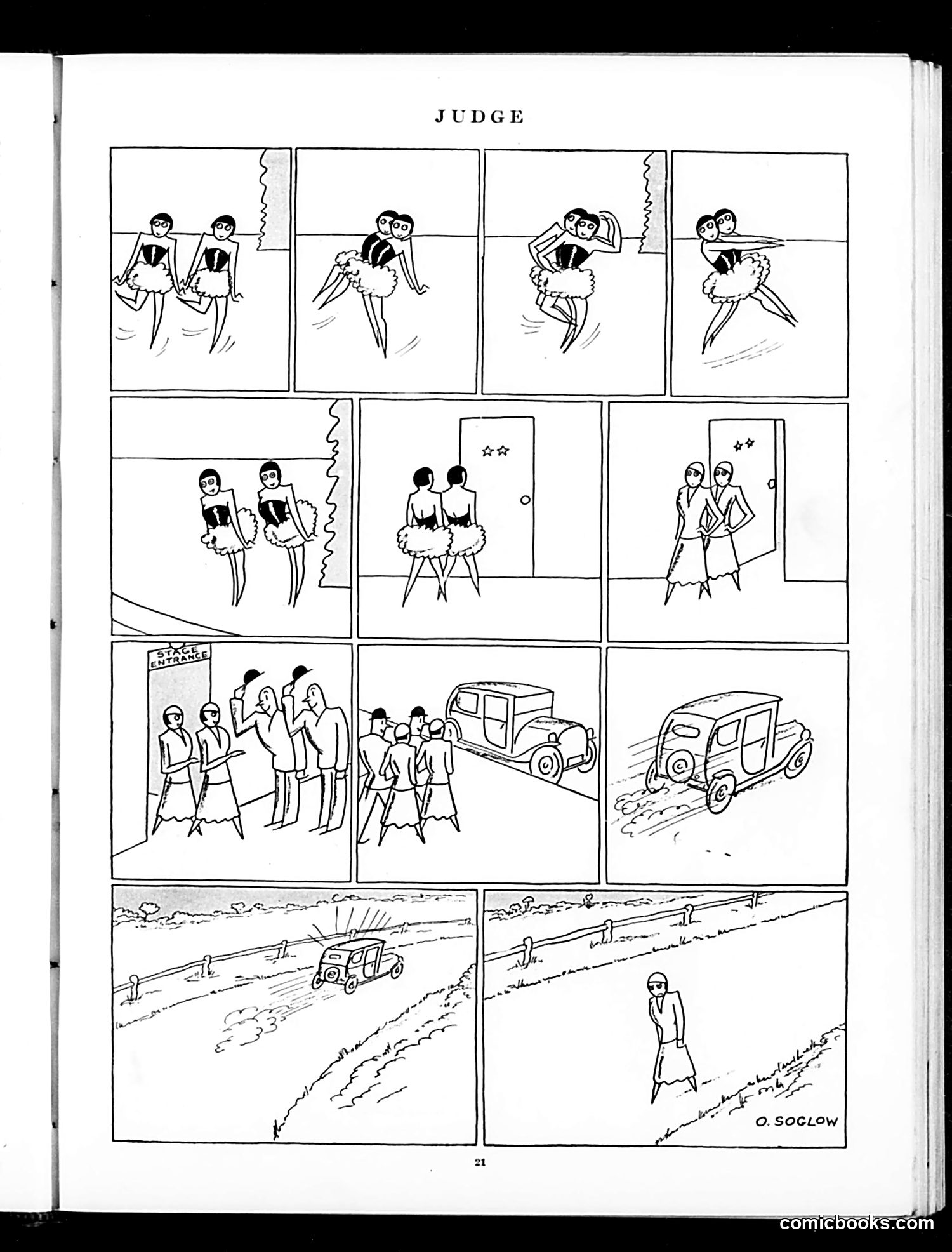
"Judge" Page Analysis: "Judge" This page presents a multi-panel comic strip titled "Judge" by O. Soglow. The narrative appears to satirize women's fashion and behavior in the Jazz Age era. The opening panels show women in short, revealing flapper dresses engaged in increasingly athletic or undignified poses—dancing, jumping, and contorting themselves. Middle panels depict these women being judged or evaluated in social settings, suggesting commentary on how women were assessed. The strip's conclusion shifts to an automobile chase sequence across rural terrain, culminating in a solitary woman standing in an empty landscape—implying consequences or isolation resulting from her scandalous behavior. The satire likely critiques both the liberation of 1920s-30s women's fashion and the persistent moral judgment they faced, presenting the "judge" as society's disapproving gaze.
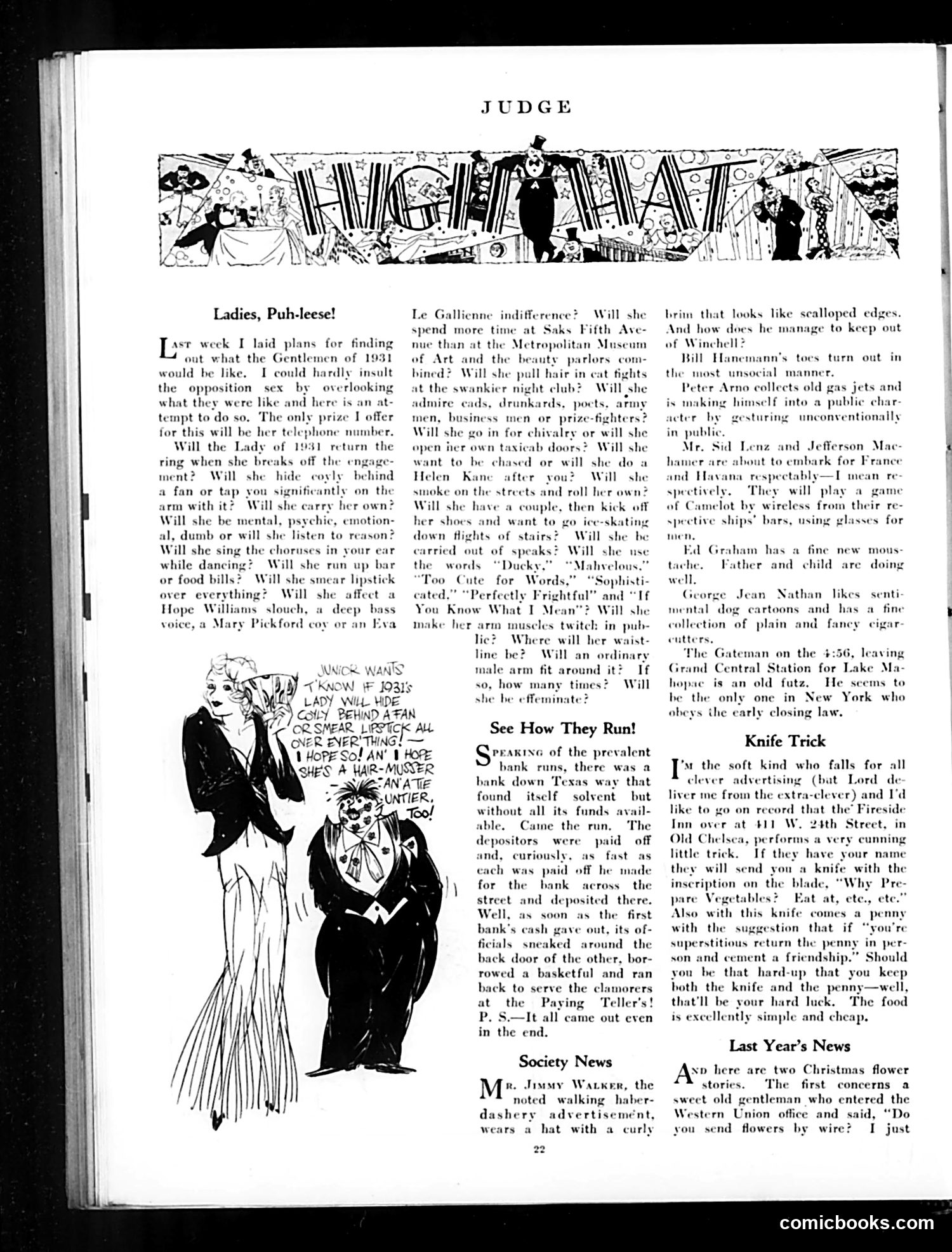
Analysis: "Ladies, Puh-leese!" — Judge Magazine Satire This page satirizes anxieties about modern women in 1931. The main article poses absurd questions about "the Lady of 1931," mocking contemporary debates over women's changing roles and behavior. It ridicules stereotypical female behaviors of the era—excessive makeup ("smear lipstick"), affected speech ("Ducky," "Mahvelous"), drinking in speakeasies, smoking publicly, and physical affectations (flexing arm muscles). The accompanying cartoon (left) visually exaggerates these concerns through caricatured female figures. The satire works by treating minor social transgressions as scandalous, mocking both the women being described and the men anxiously cataloging their faults. The broader context: post-Prohibition, post-suffrage concerns about "flappers" and independent women challenging traditional gender roles. Judge's satire ridicules male anxiety over female emancipation, suggesting the complaints are petty and overwrought—the joke ultimately targets the complainers more than the women themselves.
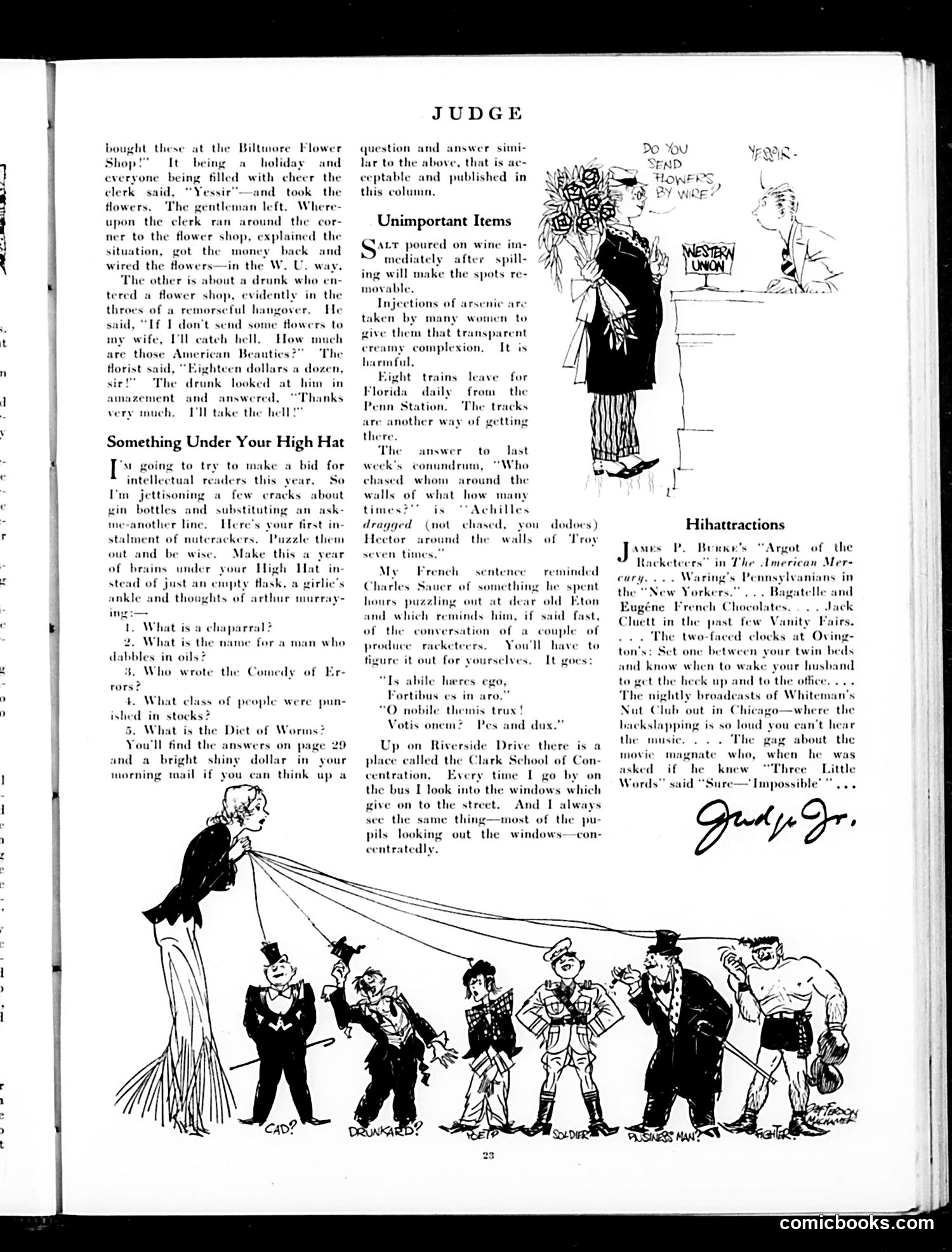
Judge Magazine Page Analysis This page from *Judge* satirical magazine contains three distinct sections: "Something Under Your High Hat" presents a quiz for readers—five trivia questions designed to challenge "intellectual readers" as an alternative to mindless drinking ("instead of just an empty flask"). The framing suggests *Judge* is promoting mental exercise over alcohol consumption, a social message typical of the era. "Unimportant Items" offers mock advice and observations: women using arsenic for pale complexions (darkly satirizing dangerous beauty standards), and a joke about pupils at a "Clark School of Concentration" staring out windows instead of concentrating—obvious irony. The bottom cartoon depicts a tall figure (appearing to be a puppet master or manipulator) controlling several smaller figures labeled as different character types (appears to include "CADDY," "DRUNKEN," "MOVIE," "SOLDIER," "SOCIETY MAN," "RUFFIAN"). This likely satirizes how various stereotypical characters are controlled by society's expectations or a single manipulative force. The overall page promotes intellectual engagement while mocking social pretensions and mechanical conformity.
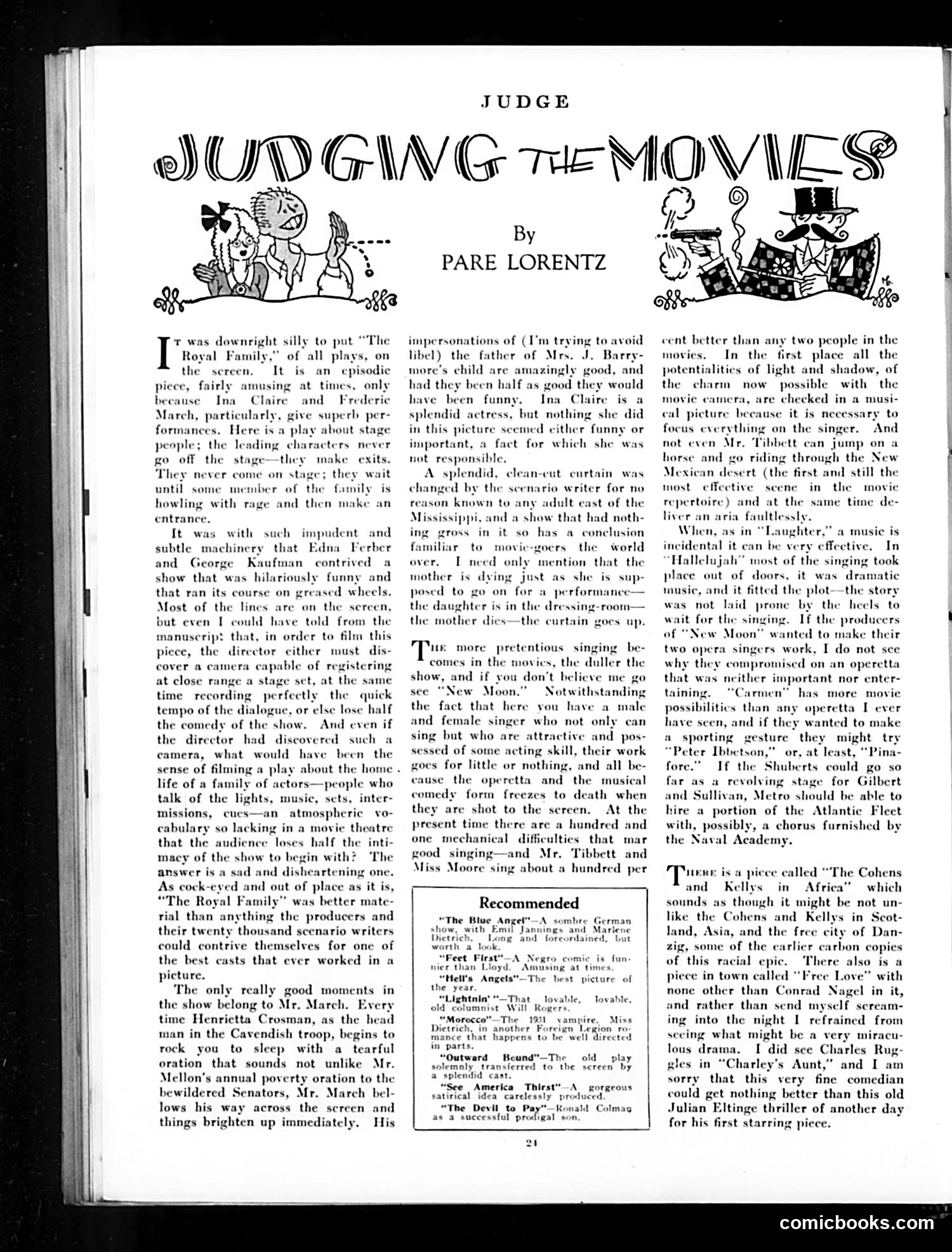
"Judging the Movies" by Pare Lorentz This is a film criticism column reviewing contemporary 1920s-30s movies. Lorentz critiques *The Royal Family*, a stage play adapted for cinema starring Ina Claire and Frederic March. The satire's point: Stage plays make poor films. The author argues *The Royal Family*—about theatrical people discussing technical stage details—loses its humor when translated to screen. The snappy dialogue and quick theatrical timing that made the play "hilariously funny" cannot be adequately captured by cinema technology of the era. Key criticism: March's performance saves the film; Claire's talent goes to waste. The scenario writers added melodramatic elements (a dying mother before a performance) foreign to the original, making it conventionally sentimental rather than cleverly comedic. Additional complaint: Musical films suffer similarly—singers freeze on screen despite talent. The "Recommended" section lists contemporary films worth seeing, suggesting *Lightnin'* with Will Rogers and *Hell's Angels* as the year's best picture.
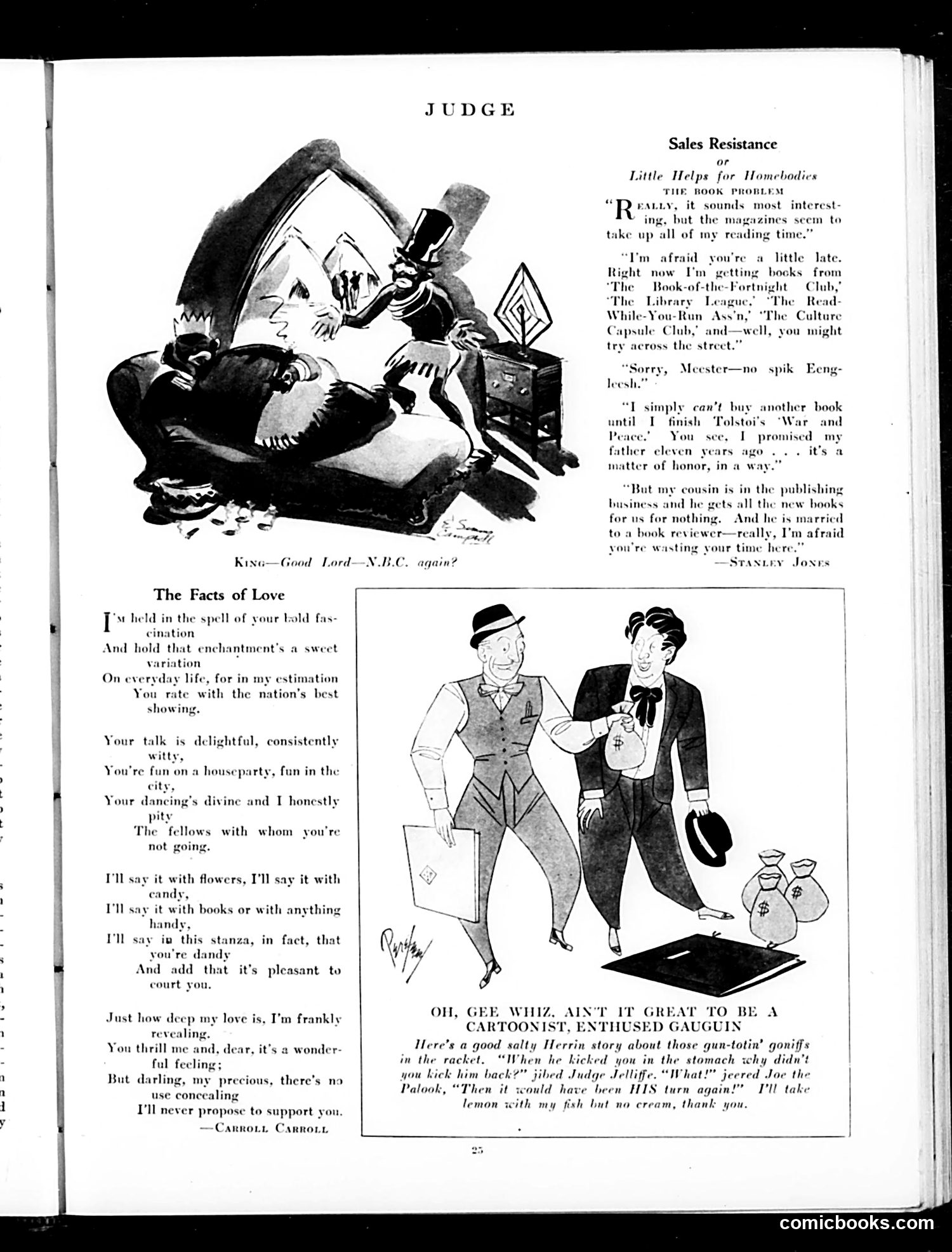
Analysis of Judge Magazine Page This page contains two distinct pieces of satire: "The Facts of Love" (left): A poem by Carroll Carroll mocking romantic declarations. The speaker elaborates eloquently on his beloved's charms—her wit, dancing, conversational skills—only to conclude with a brutal punchline: he'll never actually marry her or support her financially. The satire targets men who court women with flowery language while avoiding real commitment. "Sales Resistance" (right): A humor piece about book-buying excuses. A salesman encounters a customer who deflects purchase attempts by citing various "book clubs" (Book-of-the-Fortnight Club, Library League, Culture Capsule Club) as reasons she's too busy reading to buy more books. The satire mocks the proliferation of subscription book services that promise to deliver reading material, and by extension, people who use such services as convenient excuses for non-consumption. Both pieces employ ironic understatement and the subversion of expectations to generate humor about social pretense and avoidance.
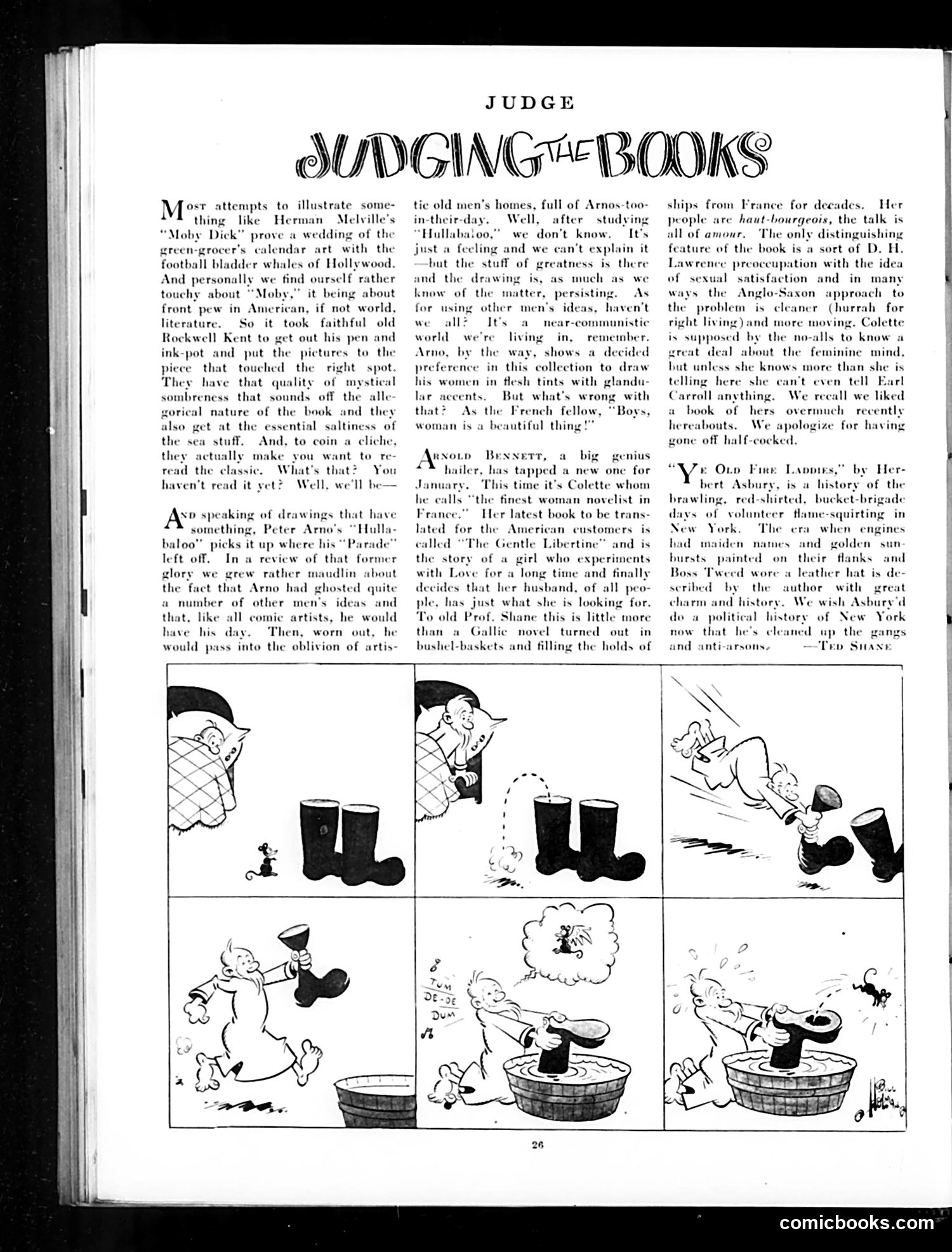
Judge Magazine Book Review Page This page contains literary reviews rather than political cartoons. The main content discusses four books: 1. Rockwell Kent's illustrations for *Moby Dick* — praised for capturing the novel's mystical, allegorical quality and maritime authenticity, contrasting with inferior Hollywood-style adaptations. 2. Peter Arno's *Hullabaloo* — a collection of drawings by the cartoonist, which the reviewer reconsiders favorably despite earlier skepticism about Arno borrowing others' ideas. The review notes Arno's distinctive depiction of women. 3. Arnold Bennett on Colette — discussion of the French author's latest novel about a woman experimenting with love before choosing her husband. The reviewer dismisses it as typical Gallic romance, though acknowledges Colette's reputation for psychological insight. 4. Herbert Asbury's *Yer Olde Fire Laddies* — a history of volunteer firefighting in New York's colorful past under Boss Tweed, praised for charm and historical detail. The comic strip below depicts slapstick humor about rubber boots.
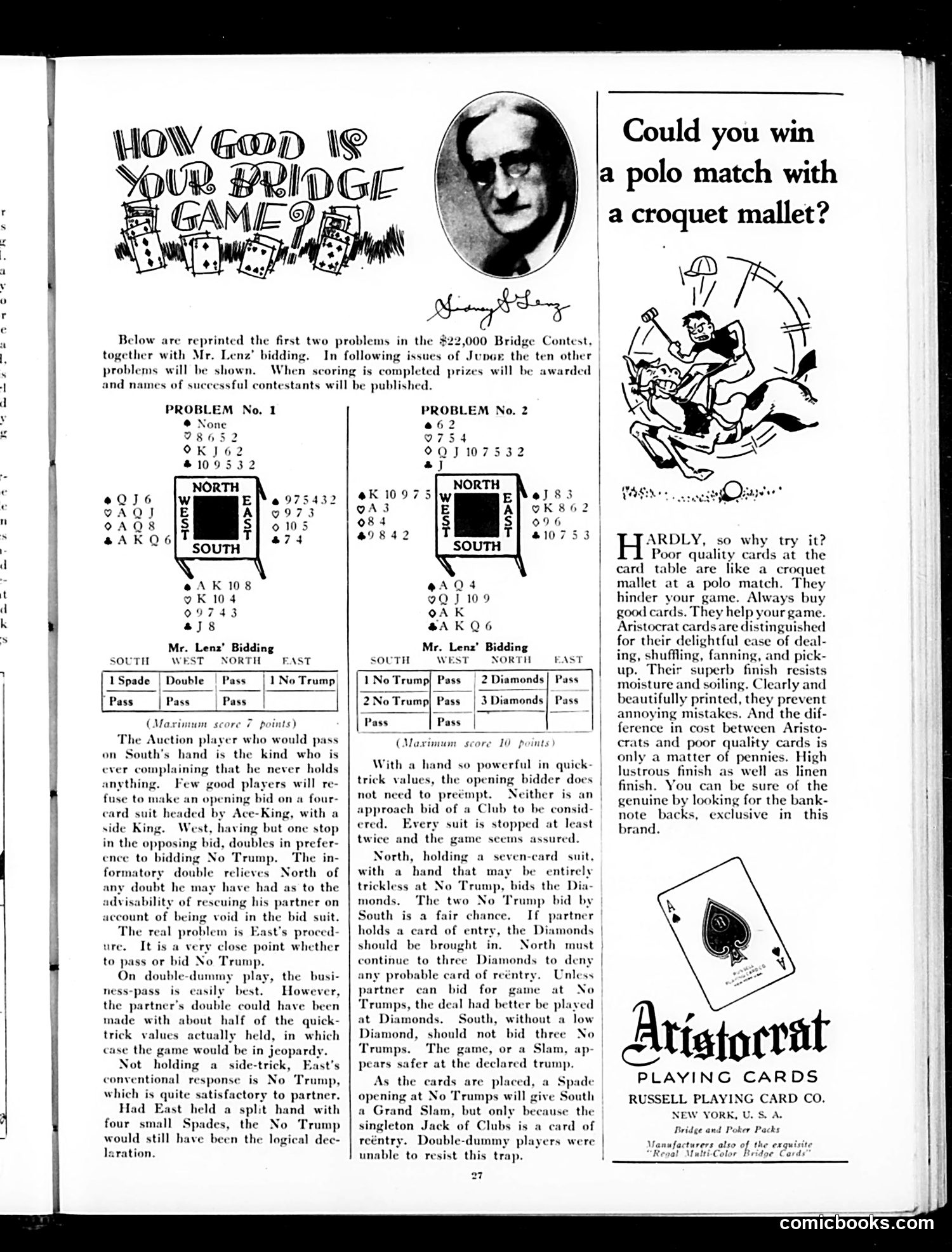
Judge Magazine Bridge Content Analysis This page from *Judge* magazine features bridge strategy problems from a "$22,000 Bridge Contest," presenting two detailed card hands with bidding analysis by "Mr. Lenz." The problems walk readers through auction sequences and optimal play decisions—Problem No. 1 concerns whether to bid "No Trump," while Problem No. 2 involves complex diamond and trump considerations. The satirical element appears in the accompanying advertisement: a cartoon asking "Could you win a polo match with a croquet mallet?" This is a visual metaphor for why one should buy quality Aristocrat playing cards rather than cheap alternatives. The ad argues that poor-quality cards "hinder your game" just as an improper tool sabotages sport—a clever rhetorical device positioning card quality as essential to bridge success. The page thus blends instructional content with product advertising, using sport-based humor to pitch premium cards to *Judge*'s affluent, leisure-focused readership.
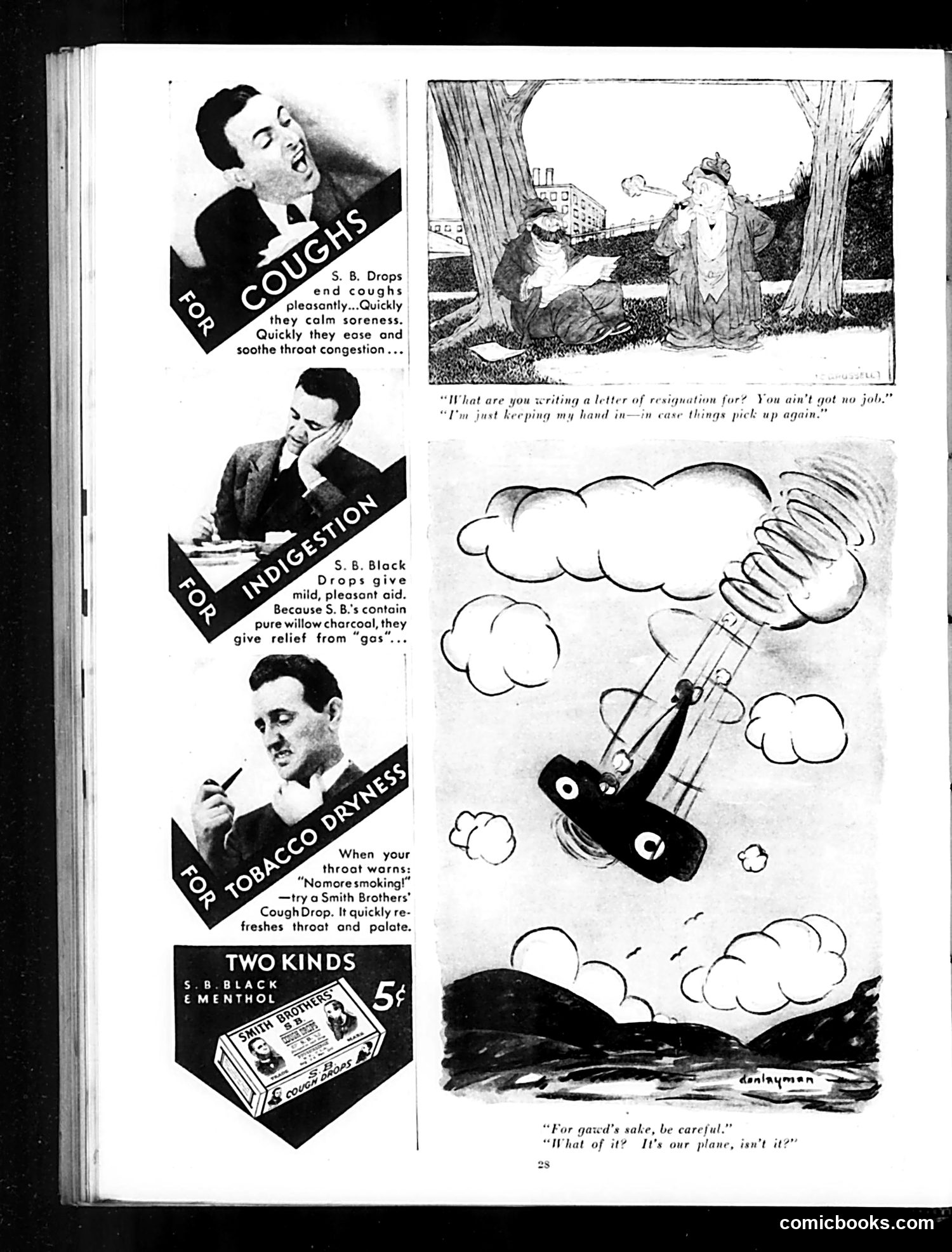
Analysis of Judge Magazine Page This page mixes Depression-era advertisements with satirical cartoons. The left side advertises Smith Brothers Cough Drops through product testimonials addressing common ailments (coughs, indigestion, tobacco dryness). The top cartoon shows two unemployed men: one writing a resignation letter despite having no job, joking he's "keeping [his] hand in—in case things pick up again." This satirizes Depression-era desperation and false optimism about economic recovery. The bottom cartoon depicts a small airplane in clouds with two figures inside. One warns "be careful," and the other flippantly responds "What of it? It's our plane, isn't it?"—suggesting reckless overconfidence in ownership or control, possibly mocking wealthy aviators or wartime pilots indifferent to danger. Both cartoons use dark humor to comment on 1930s-40s economic anxiety and social attitudes.
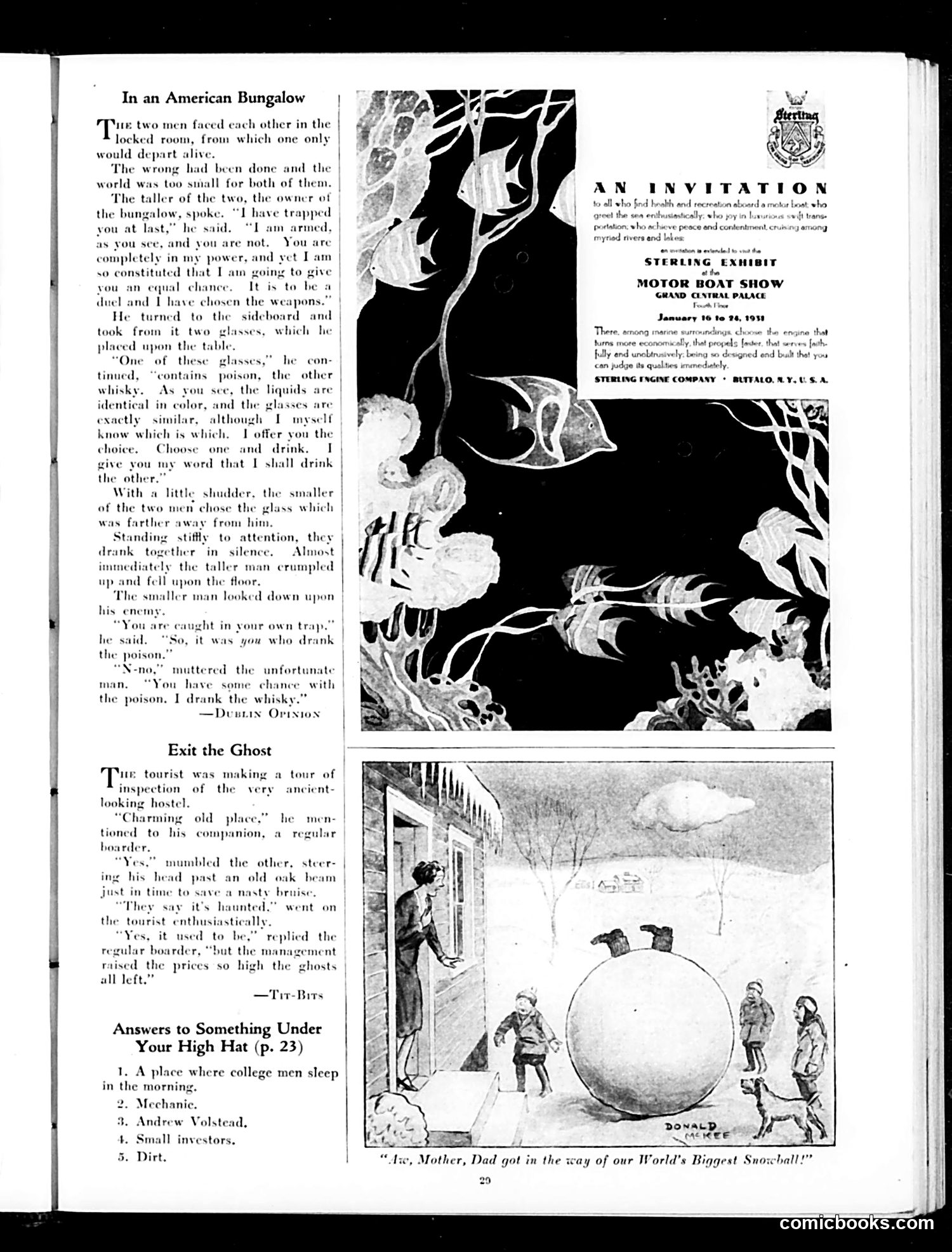
Judge Magazine Page Analysis This page contains three distinct pieces: "In an American Bungalow" presents a twist on the classic "poisoned drink" duel scenario. Two men in a locked room each choose between two identical glasses—one containing poison, one whisky. The taller man claims to give his opponent a fair choice, but the joke's irony is that he outsmarted himself: he dies from the poison he intended for his rival, who drank the whisky. The satire mocks overconfidence and backfiring schemes. "Exit the Ghost" is a brief comedic anecdote about a "haunted" old hotel. When a tourist asks if it's truly haunted, the regular boarder explains the ghost left because management raised prices so high. The humor relies on economic practicality overcoming supernatural folklore—even ghosts won't tolerate inflation. Lower section includes an advertisement for a Sterling Engine Company motor boat show at Grand Central Palace, and a cartoon caption about children with an oversized snowball blocking their father, credited to artist Donald (likely Donald McGill, a prolific cartoonist of the era). The page reflects early 20th-century American humor emphasizing irony and wordplay.
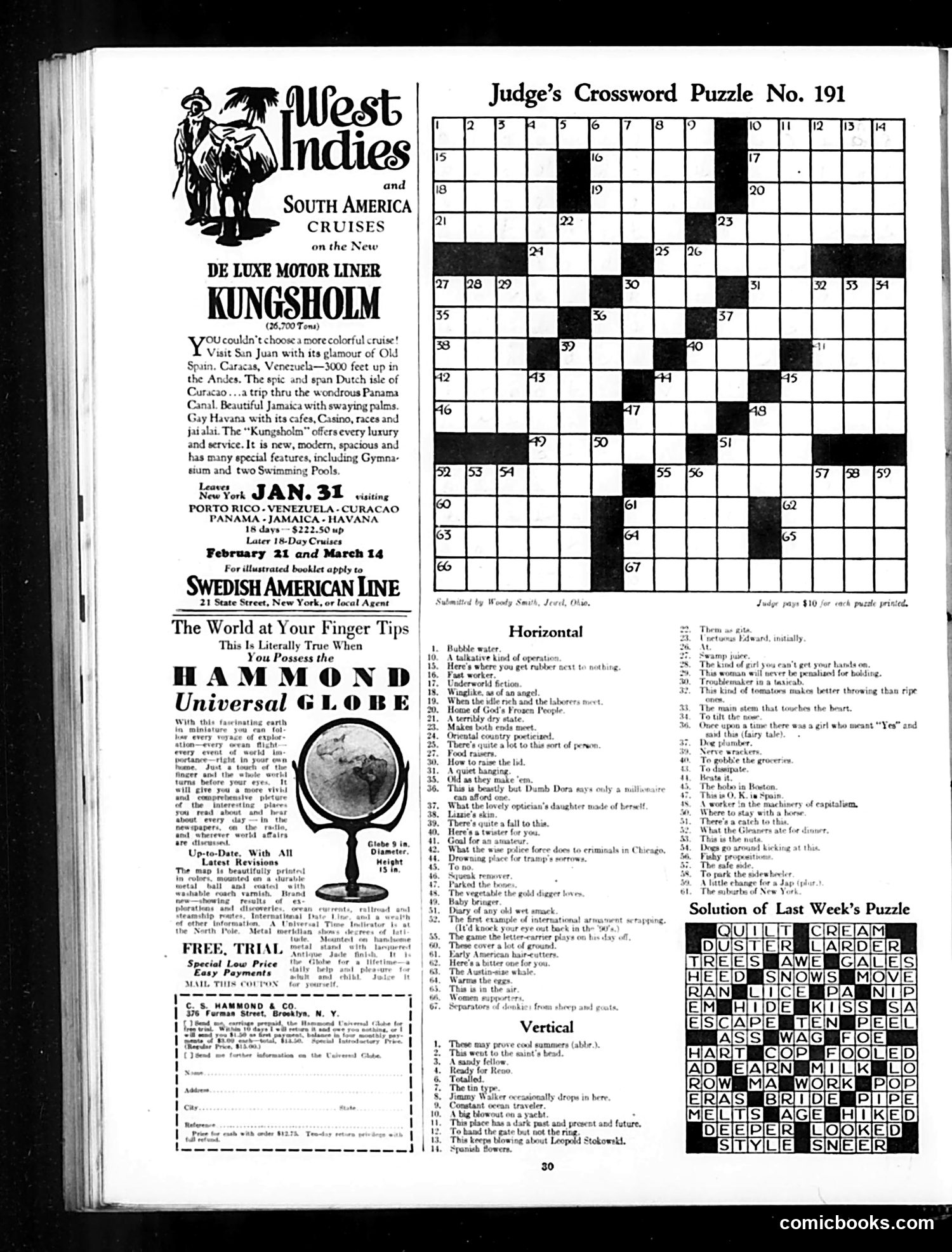
Analysis of Judge Magazine Page This page is primarily advertising and reference material rather than editorial content or satire. The main features are: 1. Cruise Ship Advertisement - A large ad for the Swedish American Line's luxury motor liner "Kungsholm," promoting Caribbean and Panama Canal cruises departing January 31. The copy uses colorful language ("glamour of Old Spain," "wondrous Panama") typical of 1930s travel marketing. 2. Hammond Universal Globe Advertisement - Promoting a desktop globe product with educational appeal. 3. Crossword Puzzle #191 - A standard feature, with clues referencing contemporary topics (Leopold Stokowski, the Panama Canal, etc.). 4. Solution to Previous Week's Puzzle - Showing completed answers. There is no political cartoon or satire on this page. It represents the commercial and entertainment content Judge used to sustain its publication—advertisements and puzzles interspersed with the magazine's satirical editorial material.
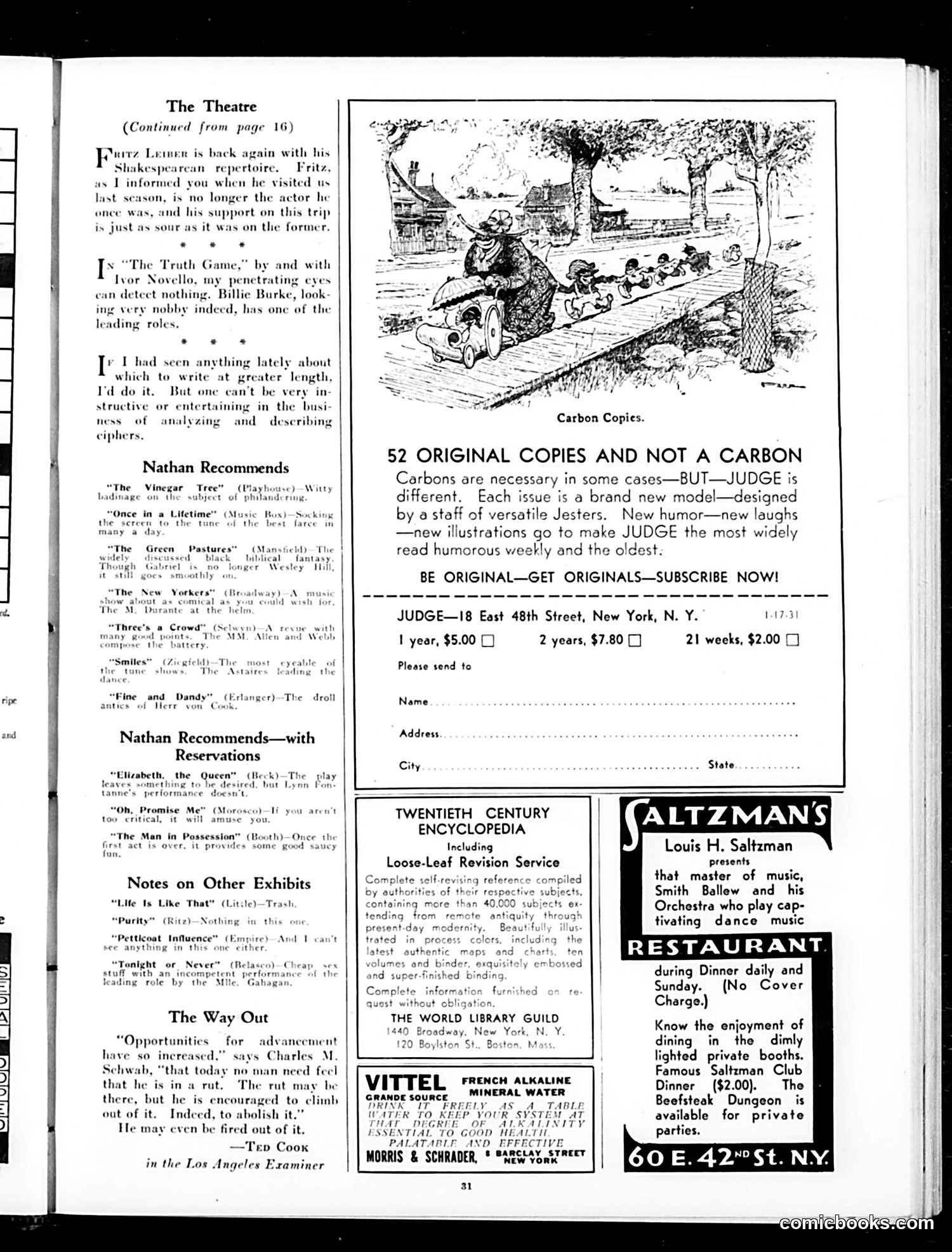
Explanation for Modern Readers This page is primarily advertisements and theater reviews, not political satire. The main content includes theater criticism by "Nathan" (likely George Jean Nathan, a prominent drama critic of the era), reviewing Broadway shows like "The Truth Game" with Ivor Novello and "Elizabeth, the Queen." The central illustration shows a large figure in a toy car with children, captioned "Carbon Copies"—this advertises Judge magazine's subscription pitch. The joke is visual wordplay: the cartoon depicts literal copies/duplicates (children in a toy car), while the text argues Judge provides "52 original copies and not a carbon"—meaning each weekly issue is freshly designed, not recycled content. The surrounding ads promote various products (Vittel mineral water, Saltzman's restaurant) and reference works (Twentieth Century Encyclopedia). The satire is mild: Judge's self-promotional claim that it's more creative than competitors who reuse material. No specific political figures are caricatured on this page.
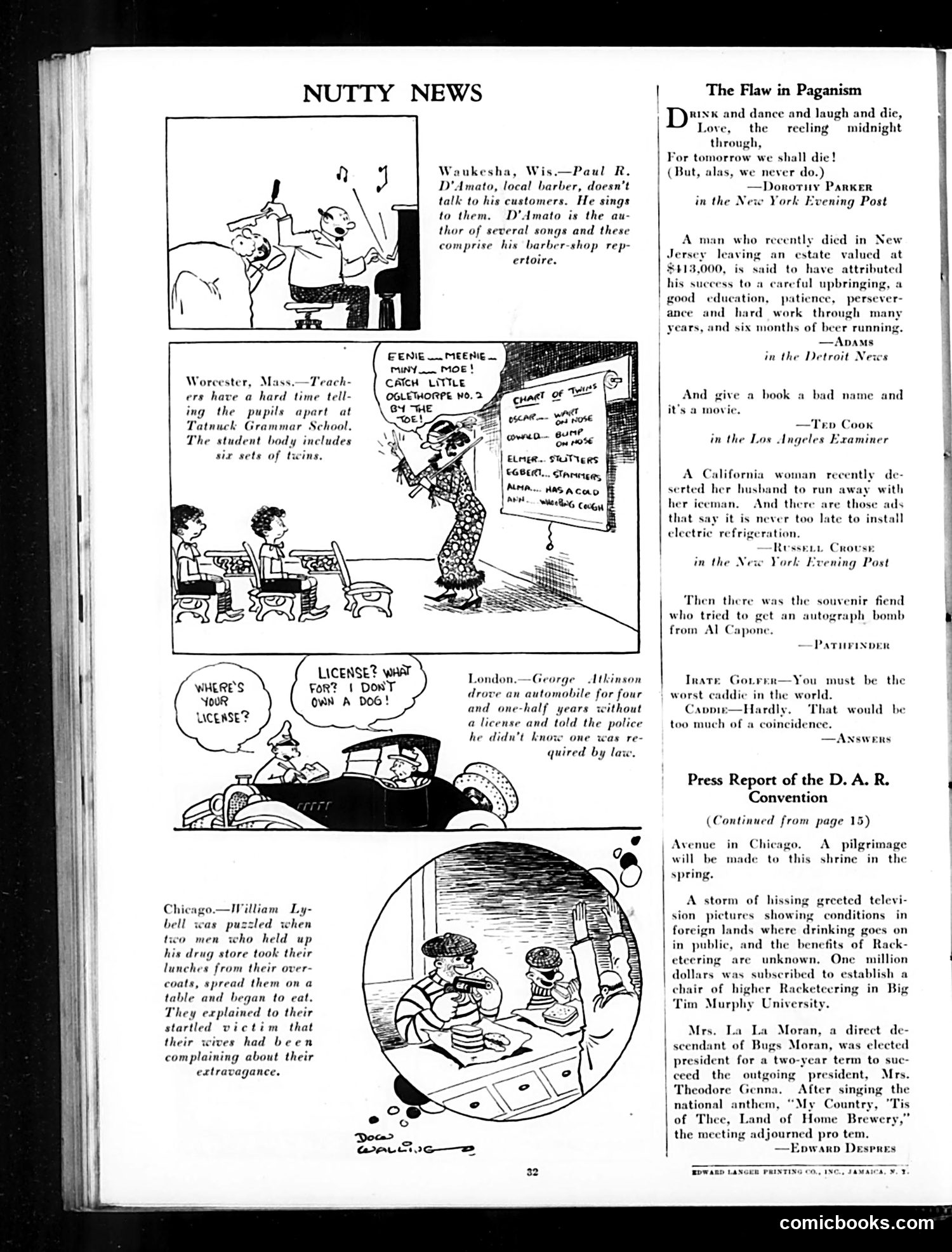
Nutty News Page Explanation This is a humor page from Judge magazine featuring brief comic anecdotes and cartoons mocking American life. Key items: The cartoons illustrate absurd news items: a barber who sings instead of talking to customers; twins at a grammar school confusing their teachers; a man ignorant of dog licensing laws; a drug store robber who stops to eat lunch he brought from home (complaining his wife thinks him extravagant). The right column reprints witty one-liners from other newspapers, often playing on pretentious or foolish behavior—like a California woman leaving her husband for a refrigerator, or someone trying to get Al Capone's autograph. The D.A.R. Convention section (bottom) satirizes the Daughters of the American Revolution as snobbishly unconcerned with crime and racketeering in America, while mocking their patriotic self-importance. Overall, the page uses gentle ridicule of everyday American foibles and institutions—the tone is lighthearted rather than biting political satire.
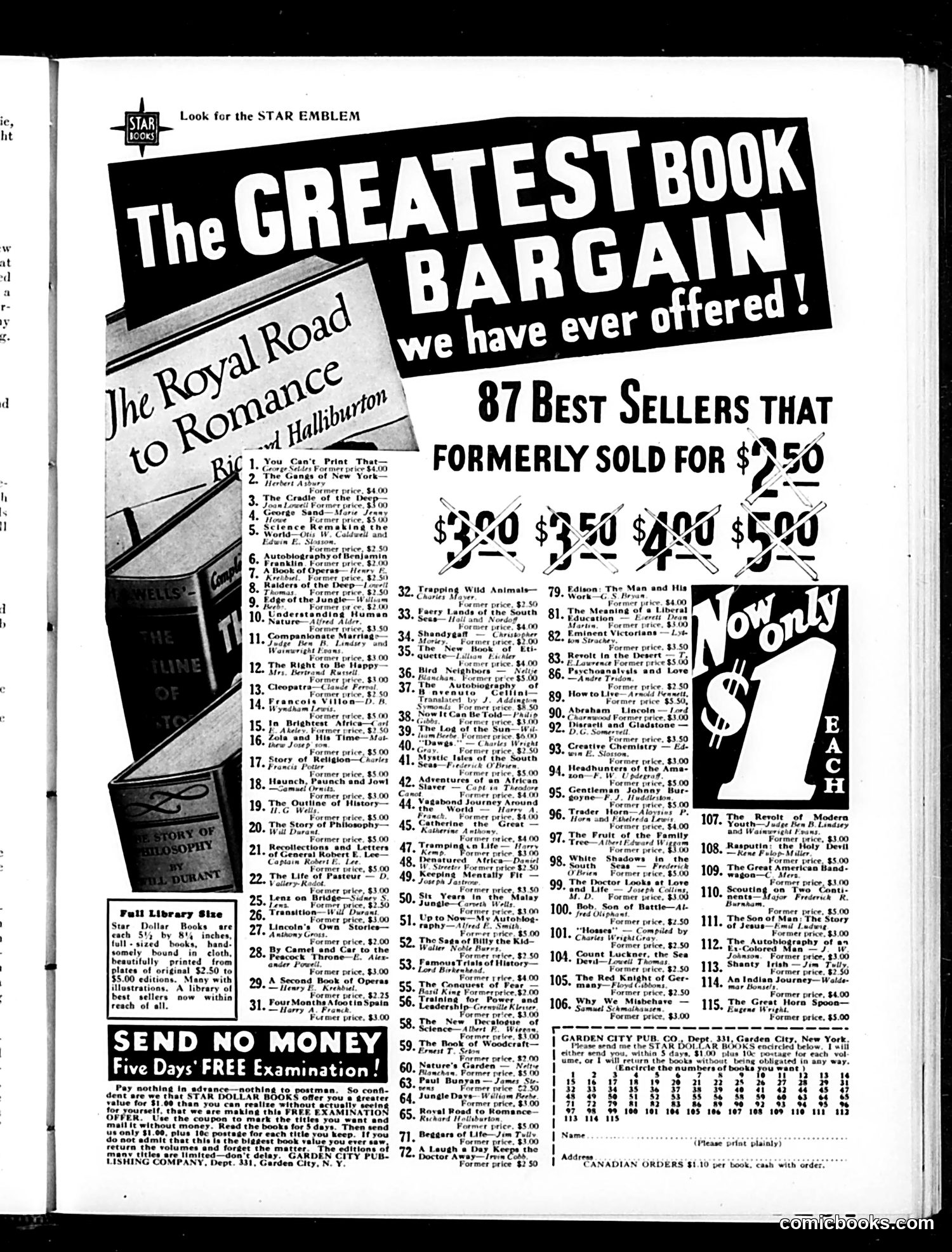
What This Page Shows This is not a cartoon page but rather a book advertisement from Judge magazine. It promotes the "Star Dollar Books" series—a mail-order book club offering 87 bestselling titles for $1.00 each, down from their original $2.50-$5.00 prices. The page lists classic and popular works from the early 20th century, including biographies (Benjamin Franklin, General Robert E. Lee), adventure narratives ("Raiders of the Deep"), philosophy (Will Durant), and practical guides. Notable titles include "The Gangs of New York" and "Autobiography of Benjamin Franklin." The advertisement emphasizes the bargain through bold typography ("GREATEST BOOK BARGAIN we have ever offered!") and includes a "five days' free examination" offer—customers could examine books before paying, reflecting common mail-order marketing tactics of the era. This reflects Depression-era consumer culture: affordable access to literature for middle-class readers.

This is a cigarette advertisement, not political satire. It's a 1931 Chesterfield cigarettes ad featuring a glamorous woman's portrait with the tagline "They Have a Way with Them." The copy claims Chesterfield's blend of domestic and Turkish tobaccos creates a milder, better-tasting smoke that doesn't require an acquired taste. The "way" is a double entendre—suggesting both the cigarette's appealing qualities and implying the woman herself has charm or appeal. This reflects 1930s advertising's common strategy of associating cigarettes with sophistication and attractiveness. The ad appeared in *Judge*, a humor magazine that ran commercial advertisements alongside satirical content.