judge
Judge — January 24, 1931
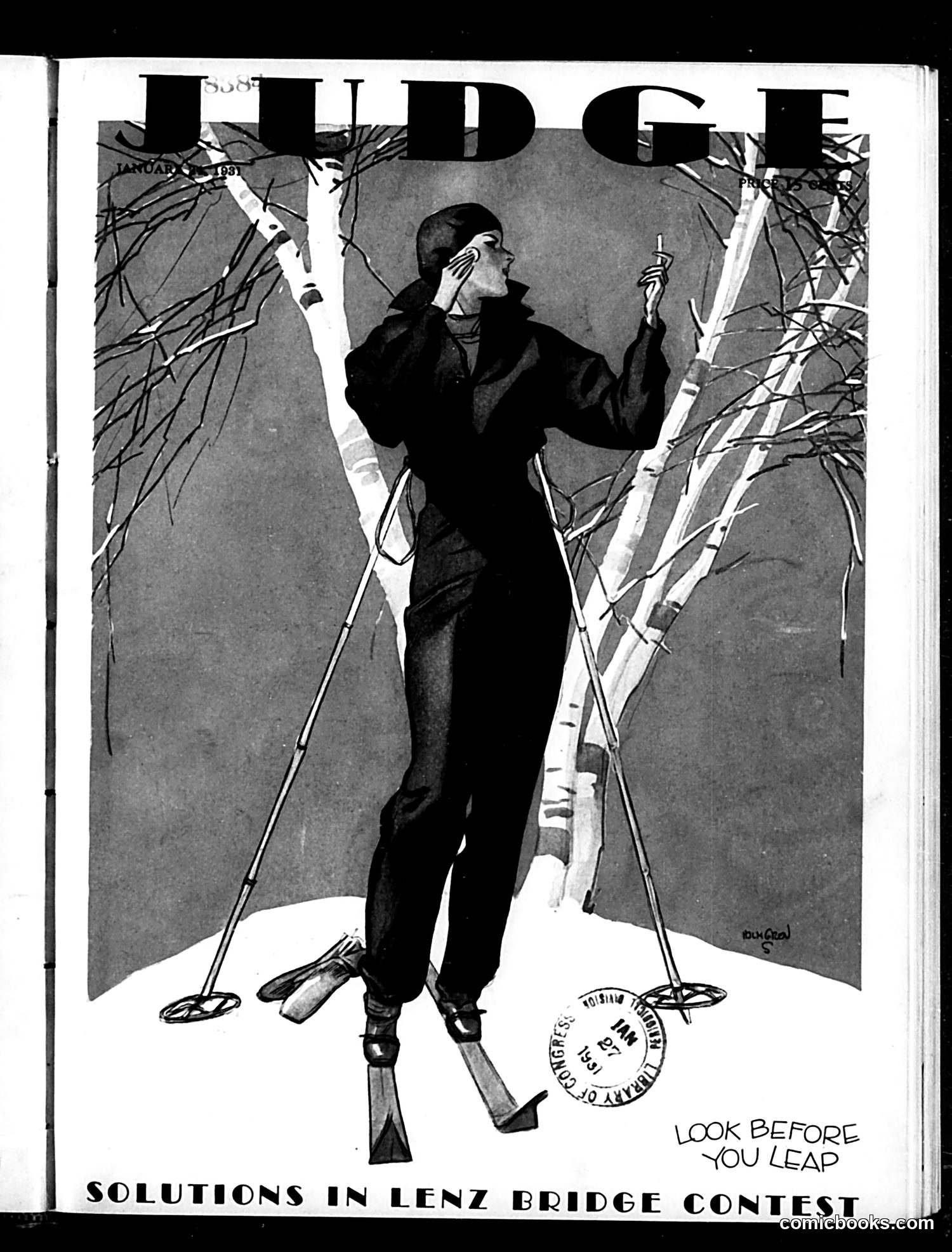
"Look Before You Leap" - Judge Magazine Cover This cover depicts a stylized skier poised at a cliff edge between birch trees, holding ski poles and gazing downward uncertainly. The phrase "Look Before You Leap" serves as both title and moral warning. The accompanying text references a "Lenz Bridge Contest," suggesting this satirizes a specific contemporary skiing competition or stunt. The image likely warns against reckless winter sports participation—a timely concern in early 1900s America when skiing was becoming a fashionable but dangerous recreational activity. The artistic style is characteristic of Judge's sophisticated satirical approach: using elegant illustration to mock human folly and impulsive behavior. Without additional context about the specific "Lenz Bridge Contest," the exact target remains unclear, though the message about prudence versus recklessness is unmistakable.
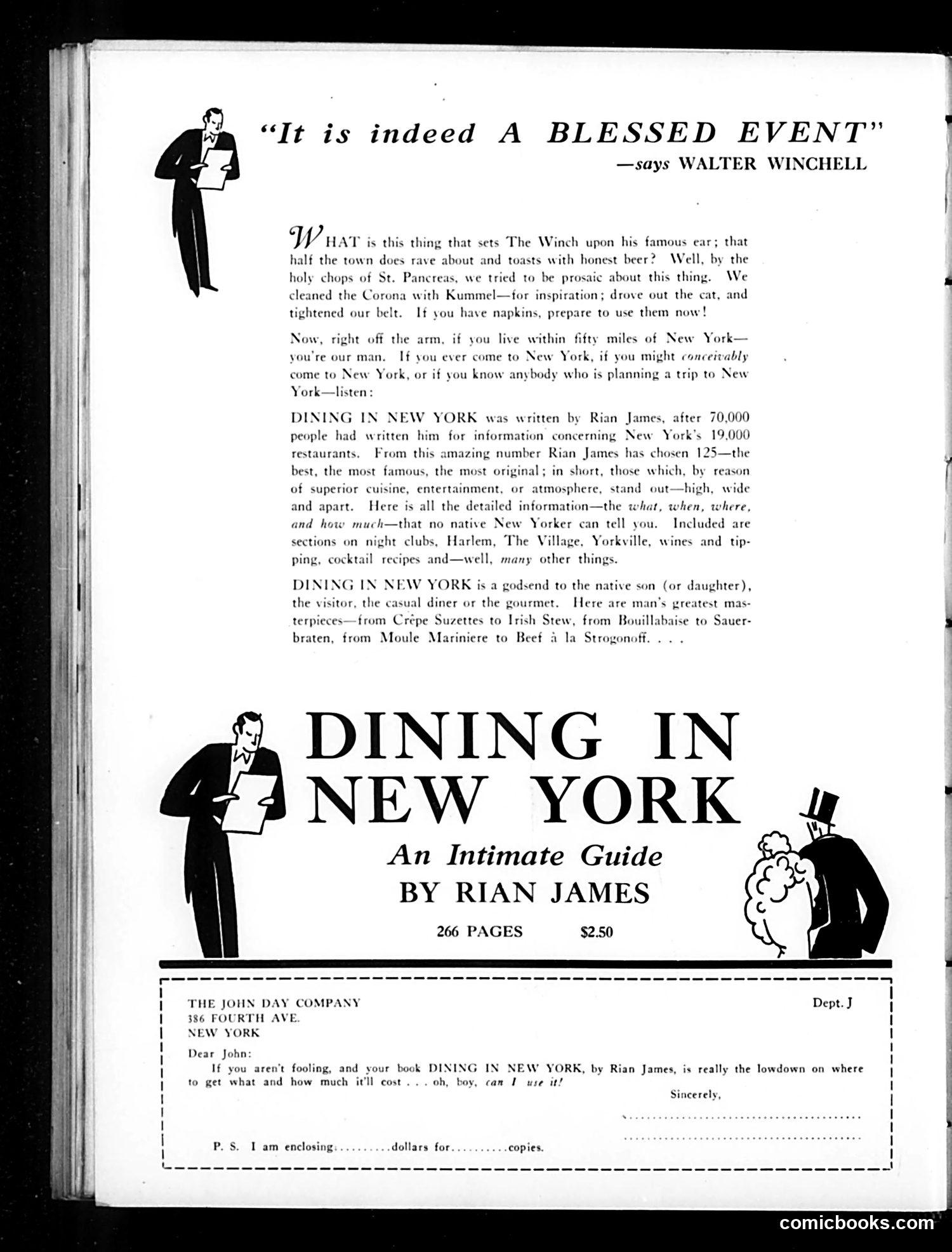
Analysis This page is primarily advertising rather than editorial content. It promotes "Dining in New York: An Intimate Guide" by Rian James—a 266-page restaurant guidebook priced at $2.50, published by The John Day Company. The advertisement opens with a testimonial attributed to "Walter Winchell," the famous gossip columnist, calling it "A BLESSED EVENT." The ad uses humorous language ("holy chops of St. Pancreas," references to cleaning the Corona with Kummel) to position the guidebook as essential for New York visitors and locals. The illustrations show men in formal attire holding documents—typical period imagery suggesting sophistication and insider knowledge. This is a straightforward commercial advertisement rather than political satire.
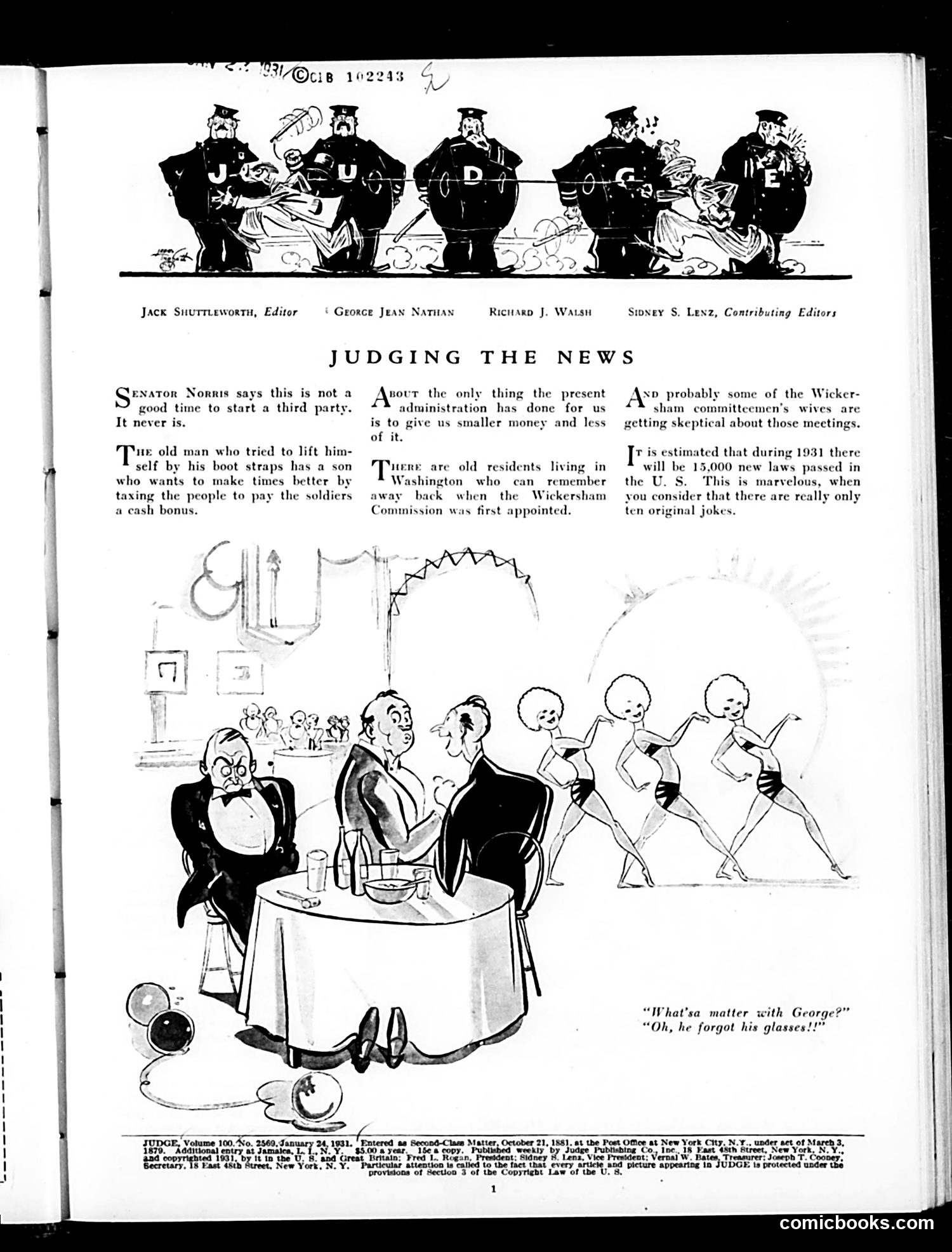
Analysis of Judge Magazine Page This page satirizes 1931 American politics and social conditions. The header cartoon shows five judges labeled with letters spelling "JUDGE," representing the magazine's editorial board. The main cartoon depicts a nightclub scene where two men in formal wear sit at a table while scantily-clad women dance in the background. One man says to the other, "What's a matter with George? Oh, he forgot his glasses!" The satire appears to target wealthy men's behavior during Prohibition-era nightlife, suggesting moral blindness or deliberate ignorance about dancing girls. The text sections mock Senator Norris's political third-party suggestion, reference the aging Wickersham Commission, and joke about the estimated 15,000 new laws expected in 1931—suggesting legislative excess and absurdity.
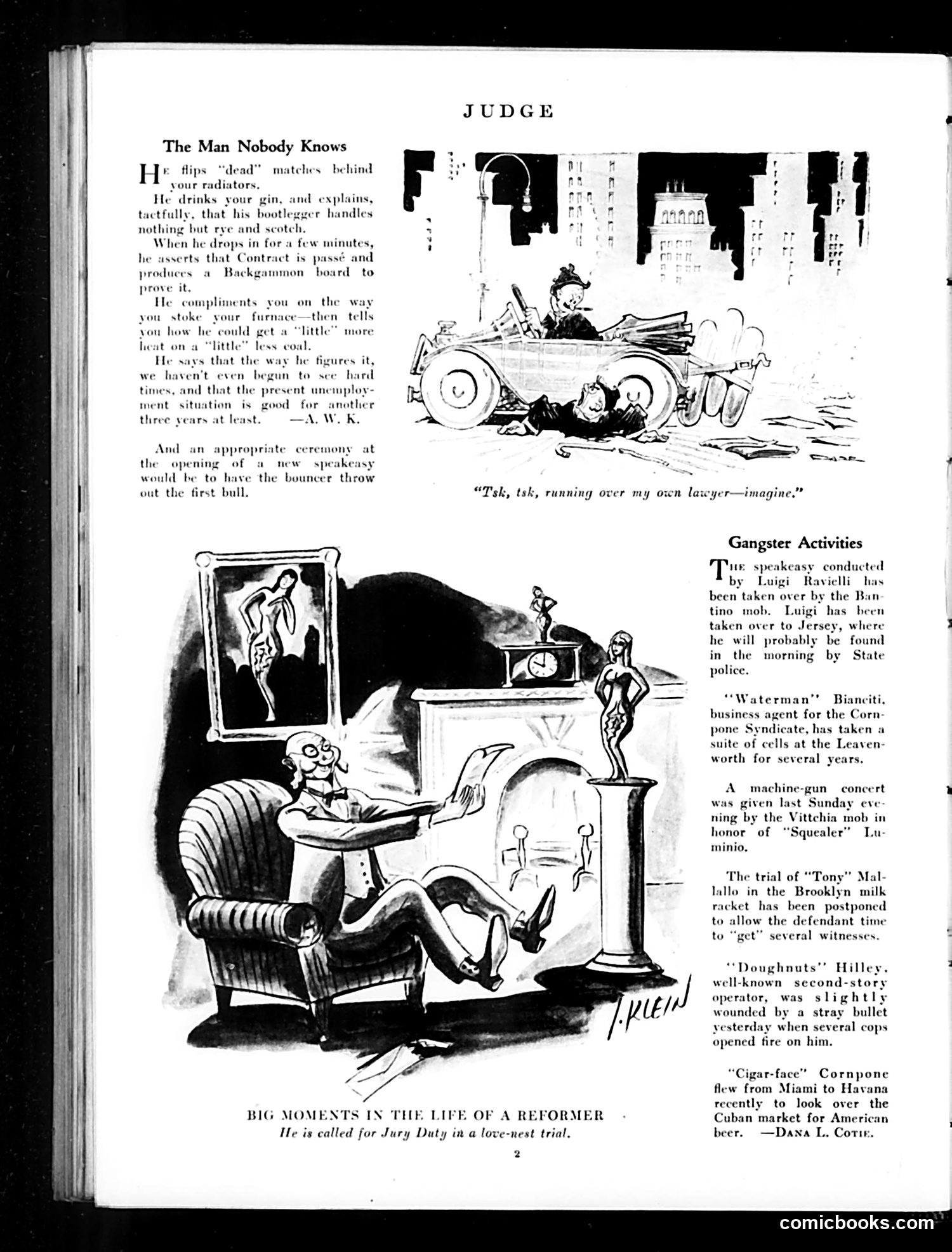
Judge Magazine Page Analysis This page satirizes Prohibition-era crime and reform in 1920s America. "The Man Nobody Knows" (top) mocks a man who frequents speakeasies, drinks bootleg gin, and uses Contract Law arguments to justify illegal activities—suggesting the hypocrisy of educated criminals who rationalize lawbreaking. "Big Moments in the Life of a Reformer" (bottom cartoon) shows a self-righteous reformer luxuriating amid naked entertainers in what appears to be an illegal speakeasy—the core satirical point being that vocal Prohibition reformers were themselves patrons of the very illegal establishments they publicly condemned. The "Gangster Activities" section (right) reports on actual mob violence and bootlegging operations, grounding the satire in real 1920s criminal activity that made such hypocrisy widespread and obvious to readers.
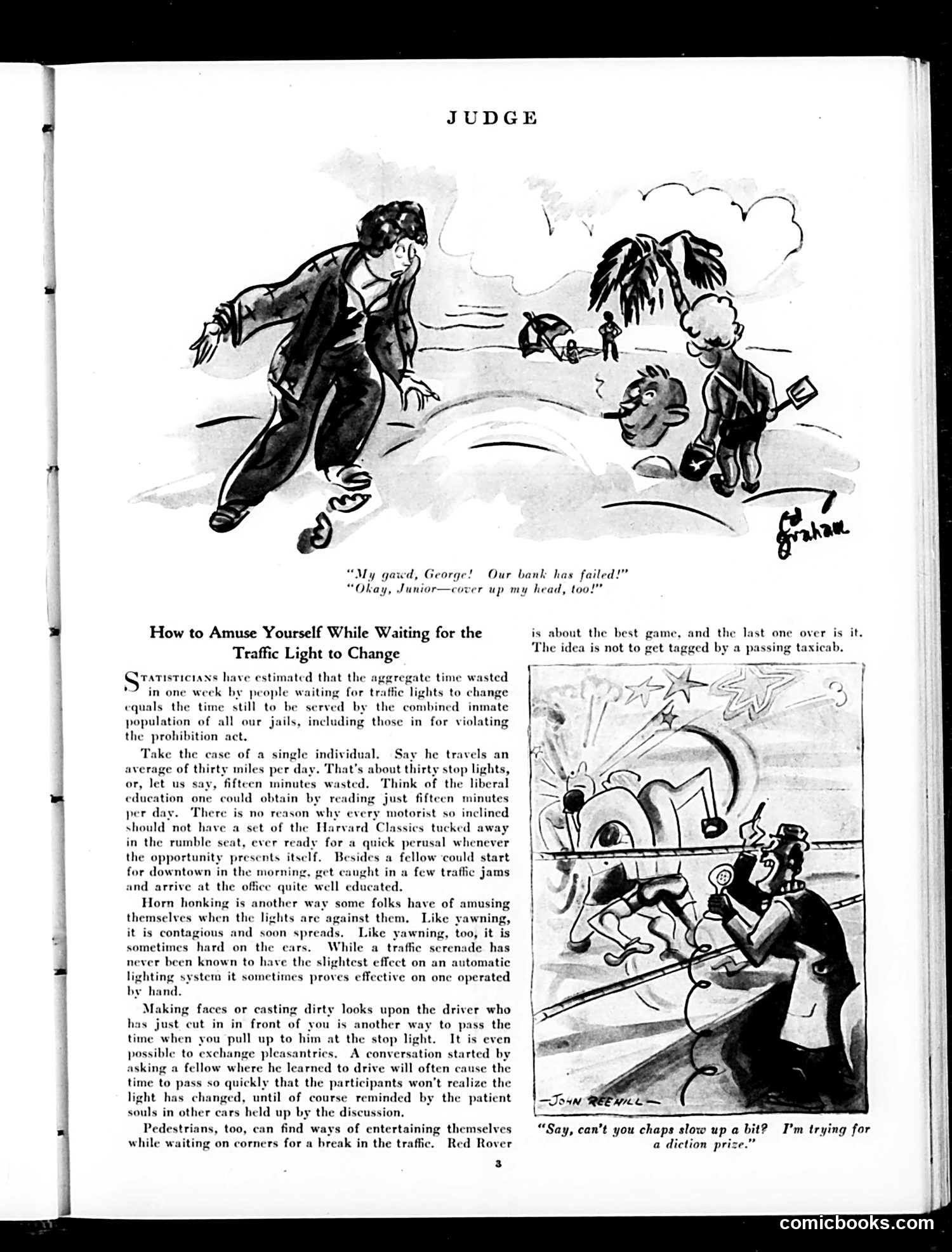
Analysis This page satirizes waiting at traffic lights through humorous suggestions for passing time. The top cartoon shows a judge figure and small character (likely representing a banker and junior employee) during a financial crisis—the judge says "My gawd, George! Our bank has failed!" with the junior responding "Okay, Junior—cover up my head, too!"—a dark joke about the economic collapse being so total that death seems preferable. The main article offers comedic advice: horn-honking, making faces at other drivers, yawning contagiously, and chatting with pedestrians. The bottom cartoon depicts someone attempting an acrobatic stunt for "a diction prize" while stopped in traffic. The satire critiques both traffic tedium and the economic despair of the era (likely Depression-era Judge magazine), using humor to address widespread frustration.
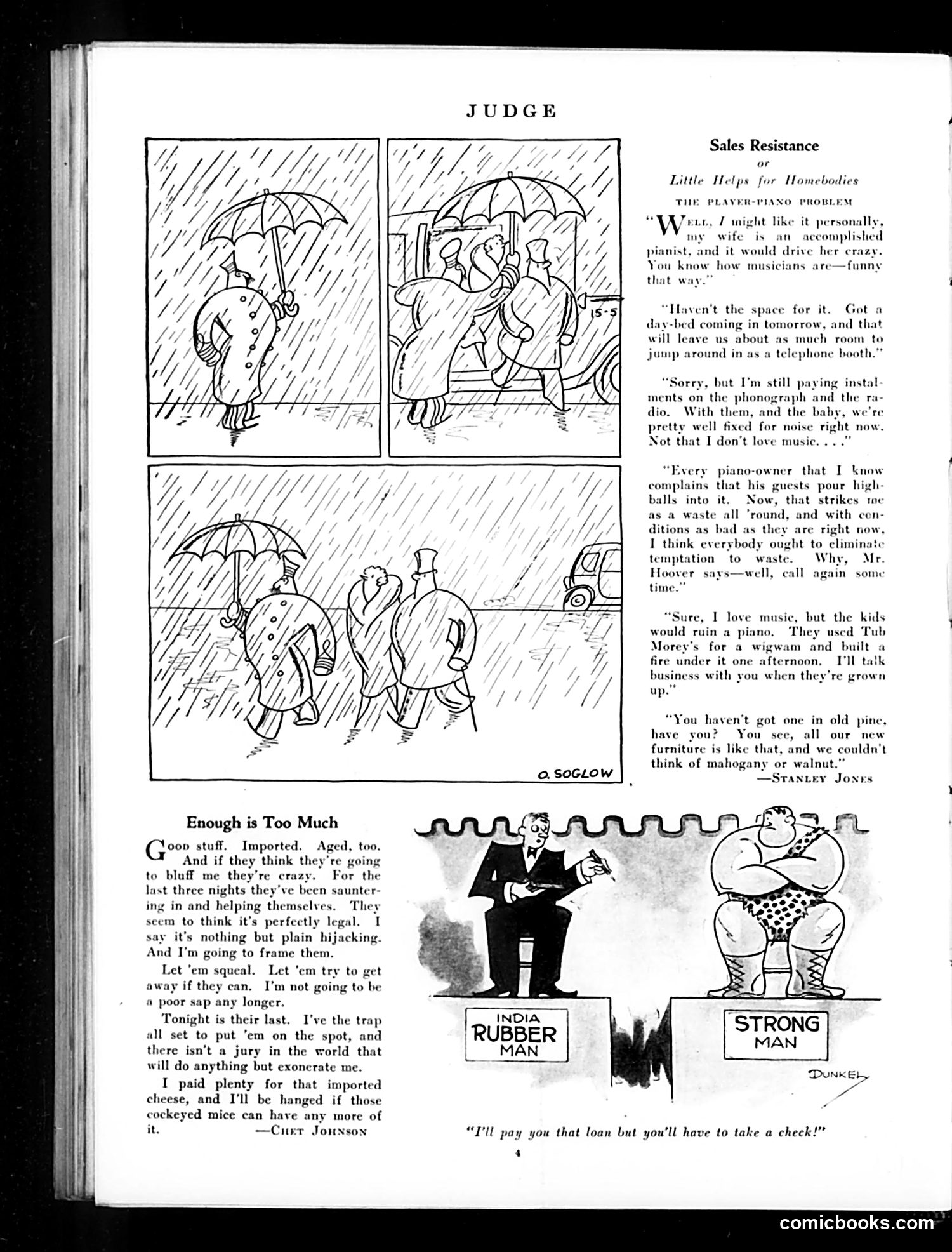
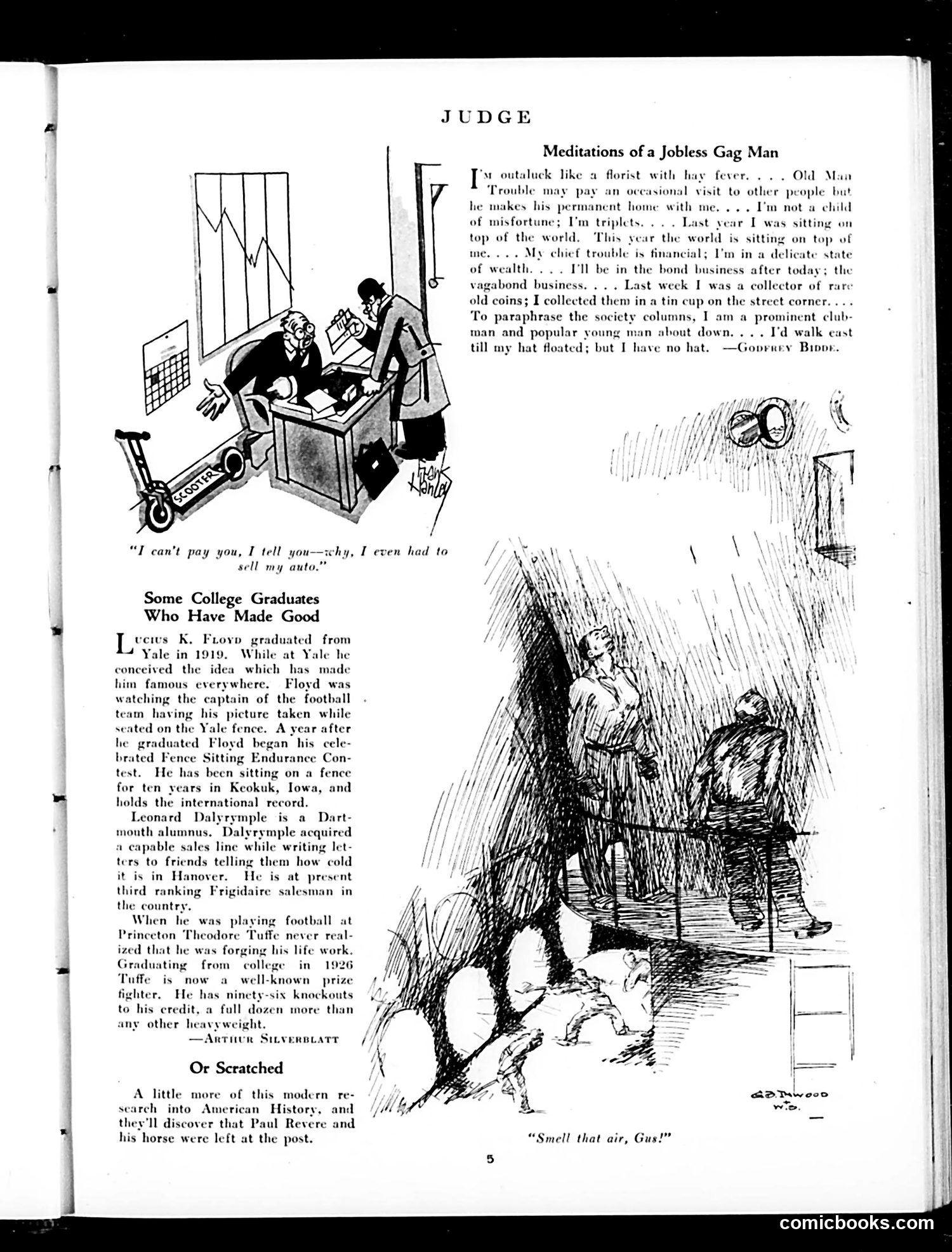
Analysis of Judge Magazine Page Top Section - "Meditations of a Jobless Gag Man": This satirizes a struggling comedy writer during what appears to be the Great Depression era. The monologue lists cascading personal failures—financial ruin, homelessness, collecting coins for survival—while maintaining darkly humorous dignity. The illustration shows a poorly dressed man pitching jokes to an editor, the caption reading "I can't pay you, I tell you—why, I even had to sell my auto." This targets the plight of creative professionals during economic collapse. Lower Section - "Some College Graduates Who Have Made Good": This profiles successful Yale and Princeton alumni (Lewis K. Floyd, Leonard Dalrymple, Theodore Tuffe), highlighting unexpected career paths. The satire suggests college education's uncertain connection to success, contrasting formal credentials with unconventional achievements like "fence-sitting endurance contests." The page generally satirizes Depression-era economic anxiety and career instability.
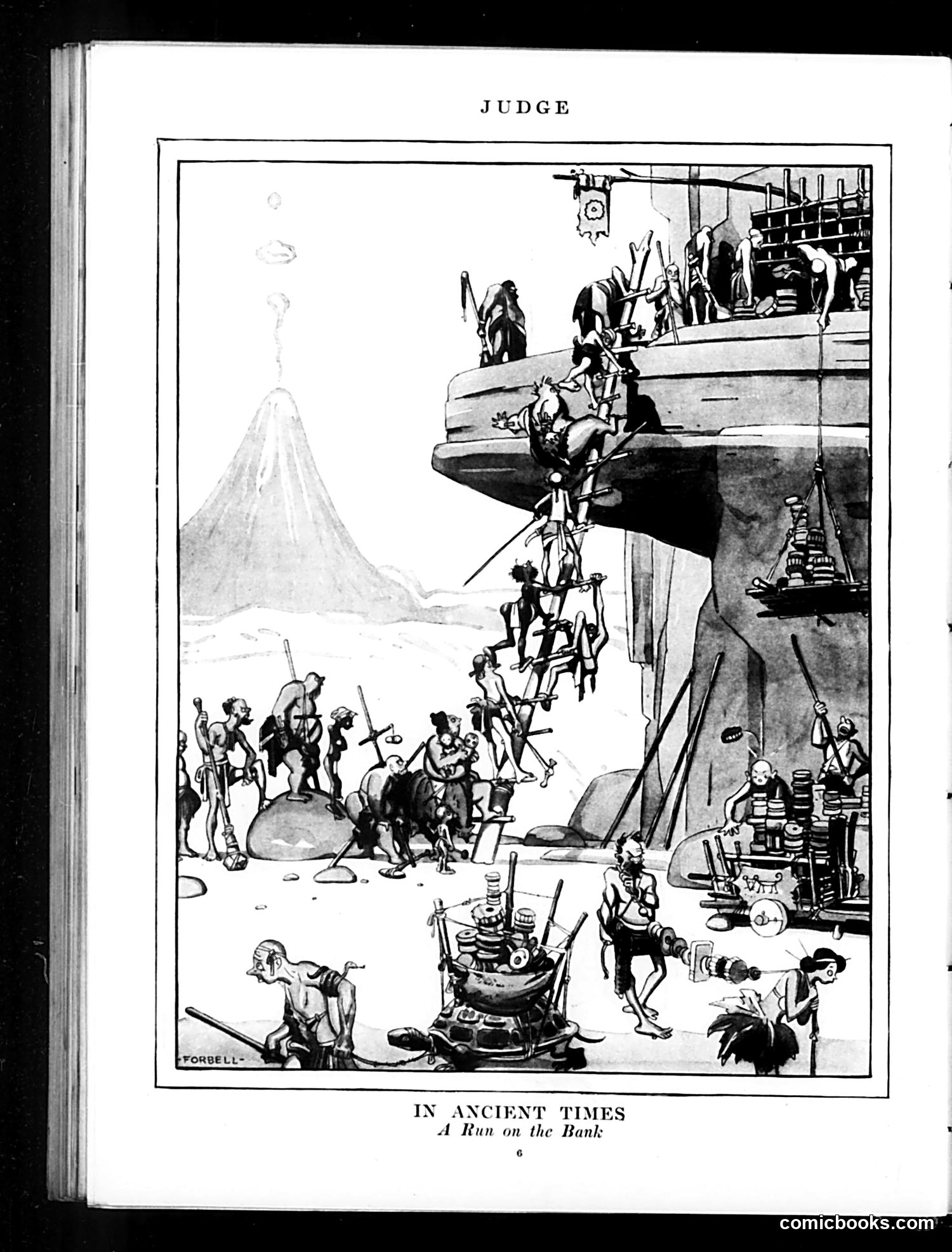
"A Run on the Bank" — In Ancient Times This satirical cartoon depicts a bank run in a prehistoric or mythological setting. Tiny, primitive figures swarm around massive stone structures and vessels, attempting to withdraw their deposits amid chaos and panic. The juxtaposition of ancient civilization with modern banking anxiety creates the humor—suggesting that financial panics are timeless human follies, not unique to contemporary society. The "run on the bank" was a genuine economic crisis where depositors rushed to withdraw funds simultaneously, fearing bank failure. By setting this scenario in "ancient times," Judge magazine satirizes how such panics recur throughout history, implying that financial instability and human panic are eternal patterns rather than modern problems.
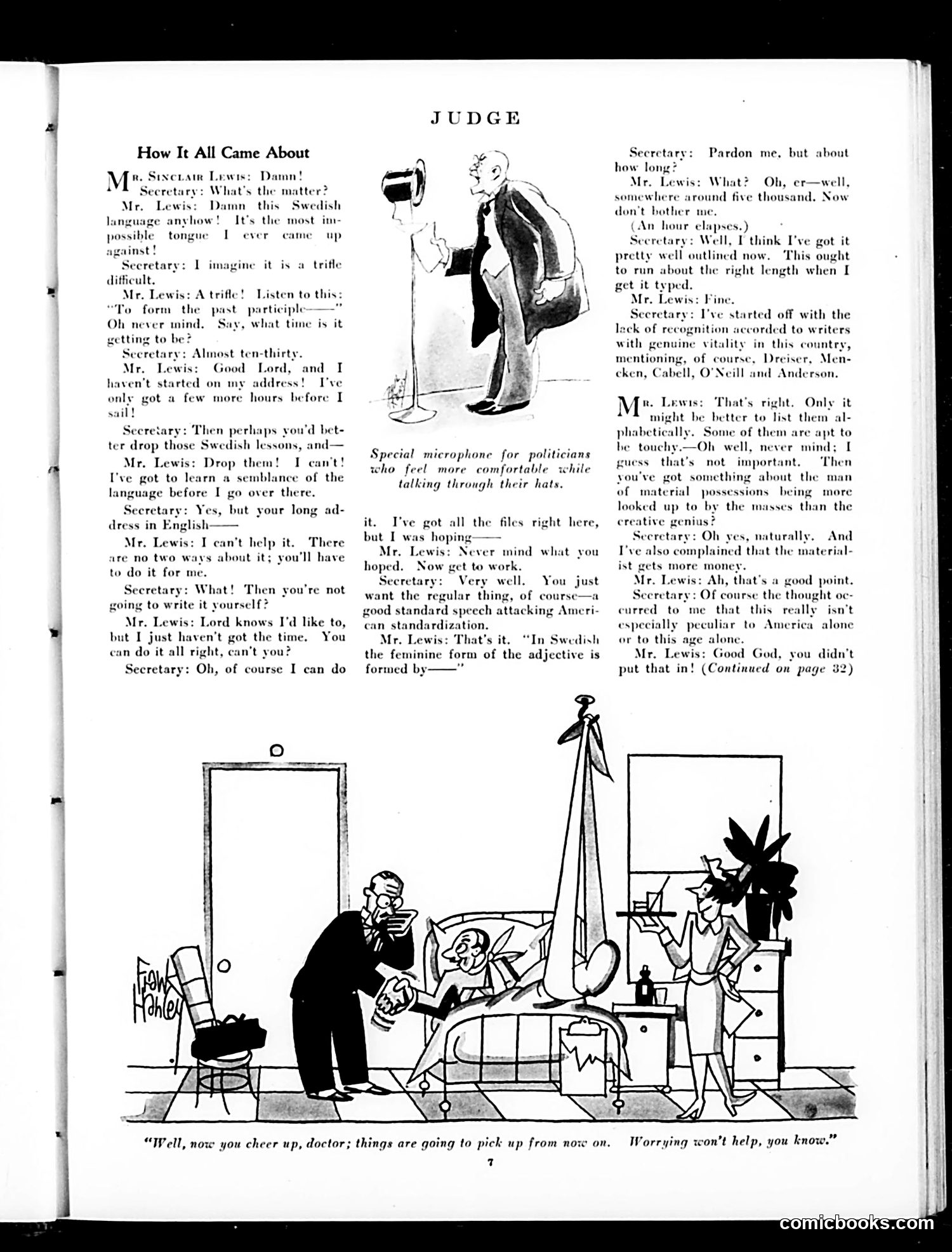
Explanation for Modern Readers This page satirizes Sinclair Lewis, the prominent American novelist, preparing a speech attacking American standardization—ironically while rushing through it without writing it himself. He delegates the entire task to his secretary, insisting she use his notes and published opinions about underappreciated writers (Dreiser, Mencken, Cabell, O'Neill, Anderson). The satire's point: Lewis preaches against conformity and materialism while embodying exactly those flaws—he's too busy/lazy to write his own critique, demands "the regular thing" (formulaic speech-writing), and prioritizes material concerns (his sailing deadline) over authenticity. The bottom cartoon shows a doctor reassuring a worried patient, a visual palate-cleanser typical of Judge's format. The humor targets intellectual hypocrisy: a celebrated author crusading against standardization relies entirely on standardized speechwriting formulas and ghostwriting—the very commodification of ideas he claims to oppose.
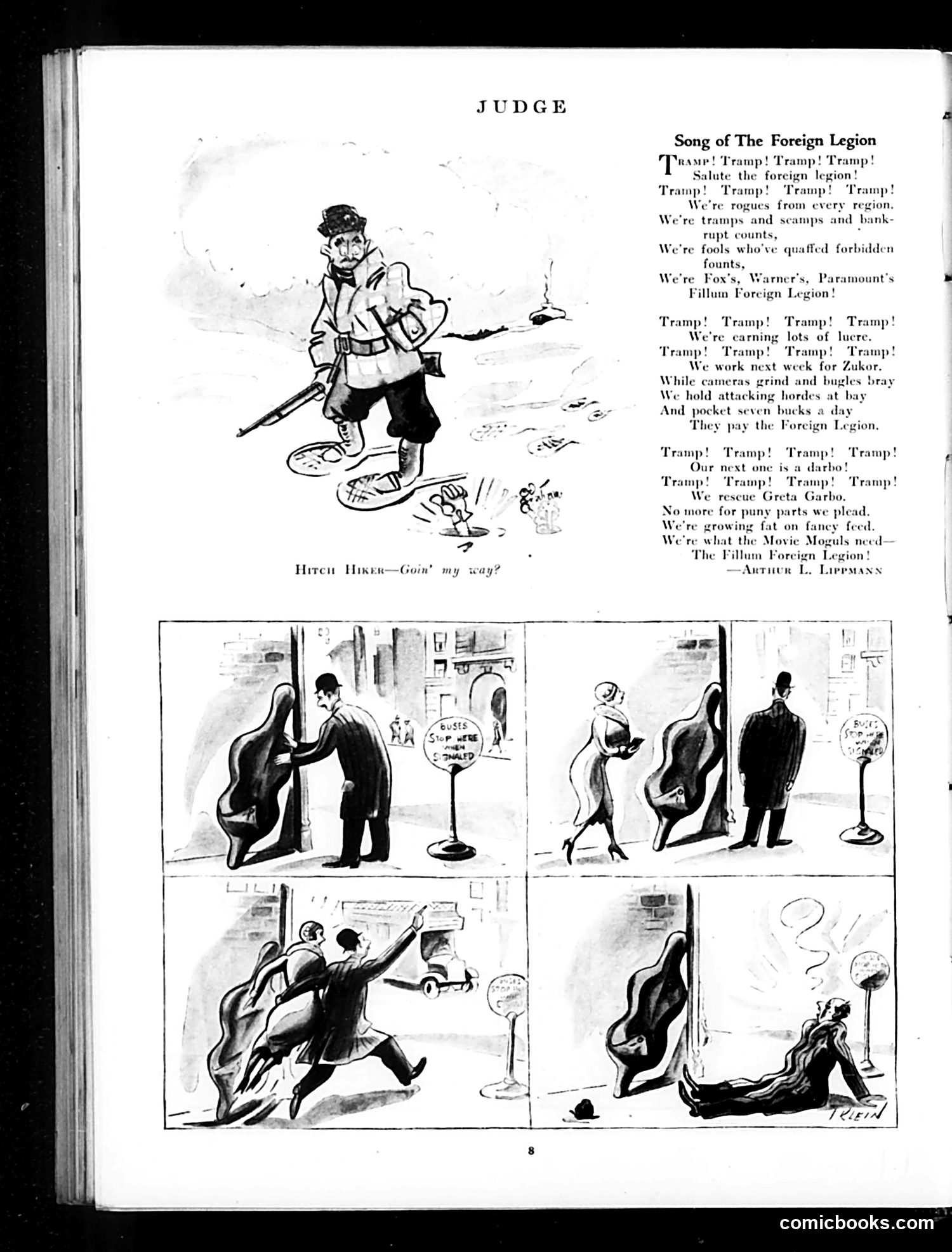
"Song of The Foreign Legion" - Judge Magazine Satire This page satirizes Hollywood's "Foreign Legion" films, a popular 1920s-30s genre. The song mocks B-movie actors who played mercenaries, describing them as "rogues from every region"—washed-up performers hired by studios (Fox, Warner's, Paramount) for cheap adventure films. The humor targets: - Studio exploitation: Actors earn minimal pay ("seven bucks a day") while studios profit - Career desperation: Unemployed actors accept any role ("No more for puny parts we plead") - Genre absurdity: Formulaic plots recycled endlessly (rescuing "Greta Garbo") - Hollywood hierarchy: "Movie Moguls" control struggling performers The comic strip below shows a woman in a clinging gown repeatedly appearing before/with a man in formal dress, apparently satirizing the melodramatic, repetitive nature of these films and their reliance on physical comedy or titillation. The satire reflects Judge's cynical view of mass-market entertainment and studio-system labor practices.
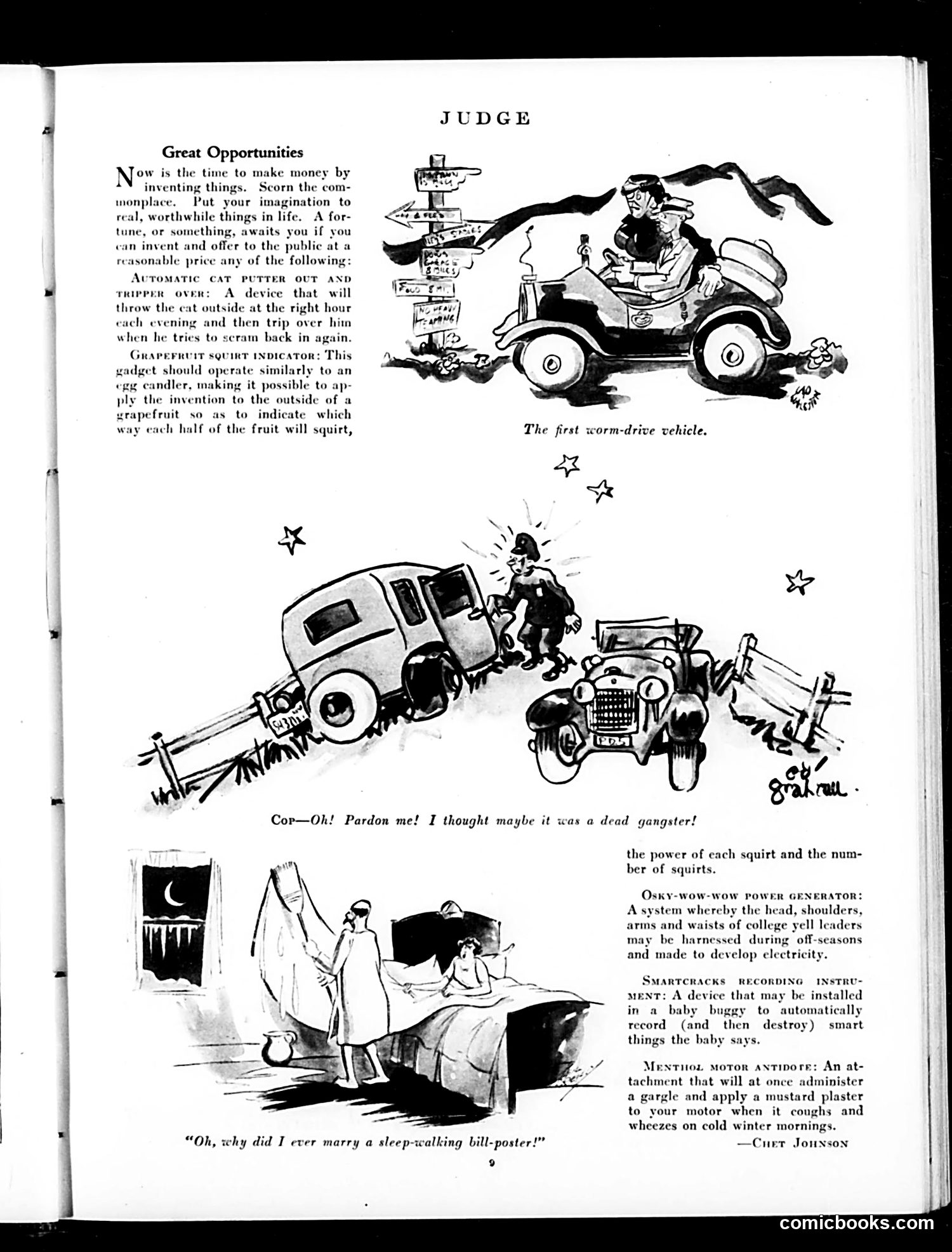
Judge Magazine Satire Analysis This page satirizes the American obsession with consumer inventions and patents during the early 20th century. The "Great Opportunities" section mocks absurd, impractical invention ideas, many targeting domestic annoyances: Key satirical inventions: - An automatic cat ejector (poking fun at pet owners) - A grapefruit squirt predictor (absurdly specific) - A college yell-leader power generator (mocking student culture) - A baby buggy recording device that destroys "smart remarks" (satirizing modern technology applied to parenting) - A menthol motor antidote for cars (treating vehicles like people) The cartoons ridicule motorcar culture: a "worm-drive vehicle" and a mistaken-identity gag about gangsters, reflecting 1920s anxieties about organized crime and rapid automobile proliferation. The overall message: Americans will patent *anything*, no matter how useless or bizarre, reflecting contemporary consumer capitalism and technological mania.
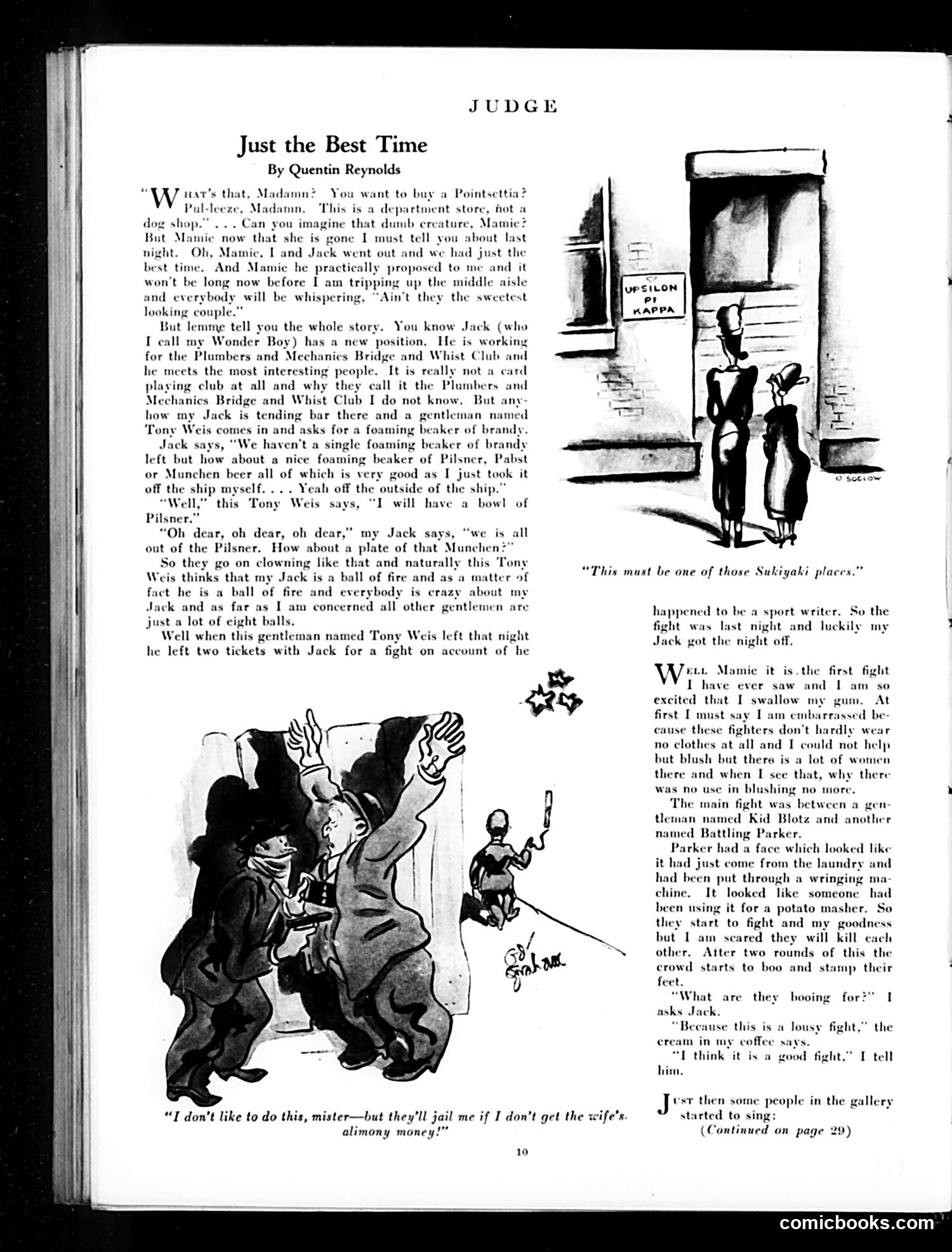
"Just the Best Time" - Judge Magazine Satire This page contains a humorous short story by Quentin Reynolds satirizing working-class social life and courtship in what appears to be the Prohibition era (references to beer, brandy, Pilsner). Main narrative satire: A woman tells her friend "Mamie" about her boyfriend "Jack" (called "Wonder Boy"), who works tending bar at a gentlemen's club. Jack charms a customer named Tony Weis with witty banter about unavailable drinks, impressing him enough to receive fight tickets. The cartoons illustrate comic situations: one shows two men fighting violently over money ("alimony"), the other depicts people outside a "Sukiyaki place" (mocking exotic restaurants). The satire targets: Working-class pretension, dating culture, boxing matches as entertainment, and the slightly disreputable world of speakeasies and "clubs" that weren't really card-playing establishments. The narrator's breathless, gossipy tone and malapropisms ("Pointsettia," "foaming beaker") parody lower-class speech patterns that 1920s-30s readers found amusing.
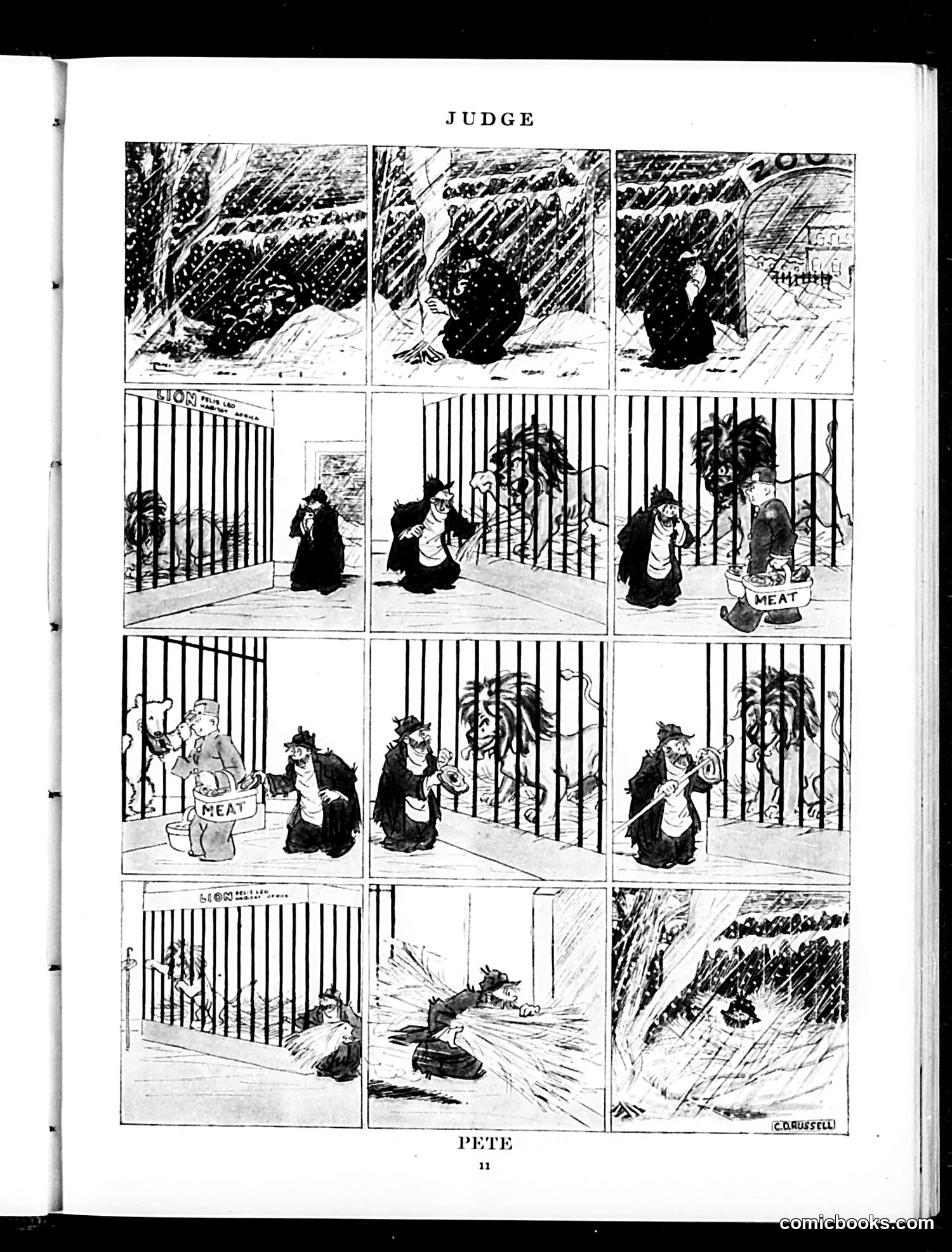
Analysis of "Judge" Page: "Pete" This comic strip, titled "Pete," depicts a narrative involving a caged lion and human characters in formal dress (appearing to be zookeepers or officials). The sequence shows: 1. Top panels: A figure approaching the lion's cage in snow 2. Middle panels: Characters offering meat to the lion through cage bars 3. Bottom panels: The lion escaping and chasing a figure The satire appears to reference feeding or appeasement of a dangerous force—likely a political metaphor common to Judge magazine's satirical commentary. The "Pete" character (possibly a public figure of the era) seems to represent either foolish appeasement or dangerous mismanagement. Without clearer date context or identifying marks, the specific political target remains unclear, though the cartoon criticizes someone's naive or reckless handling of a dangerous situation through metaphorical depiction.
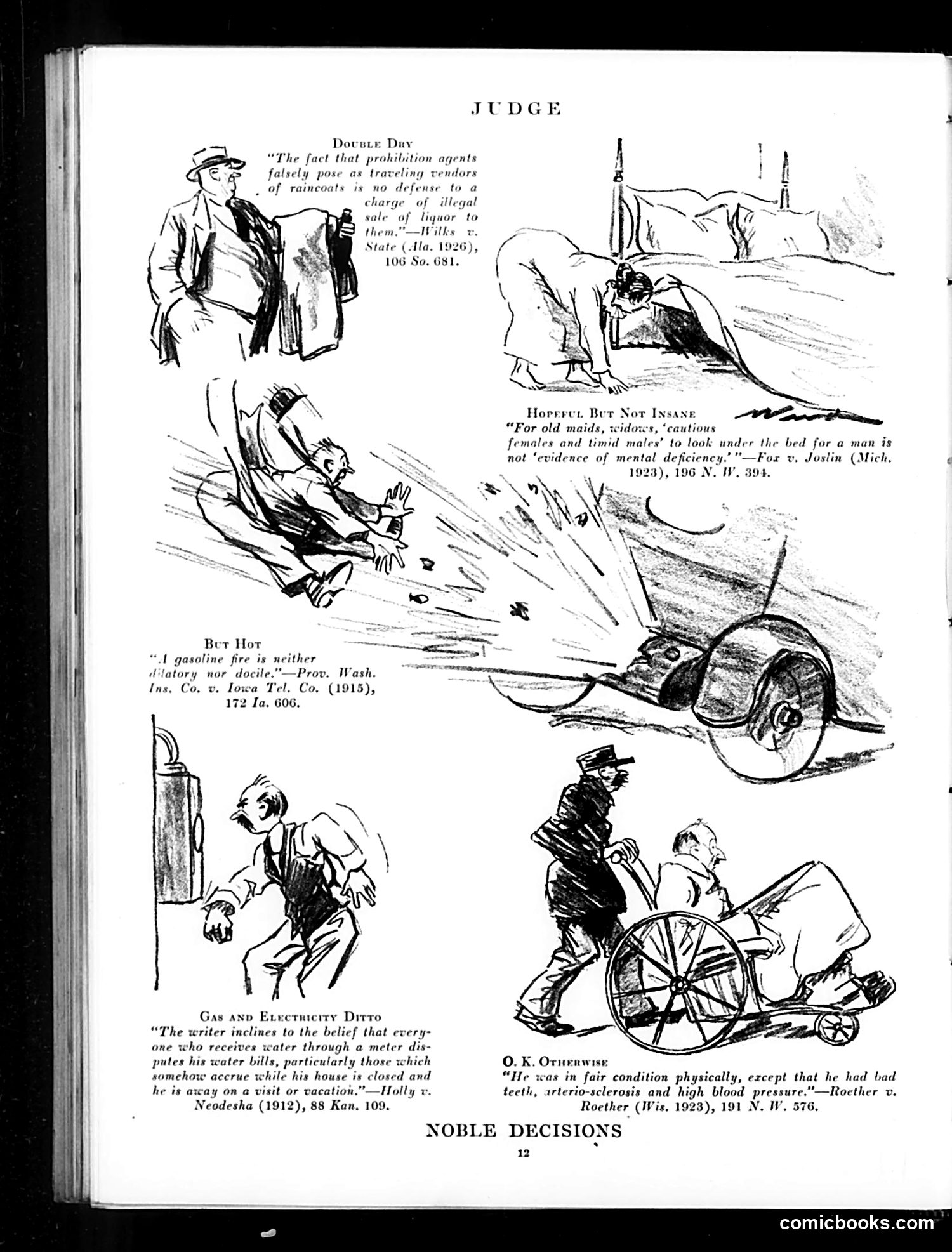
"Noble Decisions" – Legal Absurdism in Judge Magazine This page satirizes absurd or contradictory court rulings through humorous illustrations paired with actual case citations. Each cartoon depicts a legal principle that seems ridiculous when applied to real life. "Double Dry" mocks Prohibition enforcement: agents disguised as raincoat salesmen (traveling vendors) can still prosecute liquor sales—the deception itself isn't a legal defense. "Hornet But Not Insane" ridicules a ruling that elderly women's caution about looking under beds for men isn't evidence of mental illness—implying the court found this behavior suspiciously normal. "But Hot" notes gasoline fires are neither "retaliatory nor docile"—absurd personification of a fire's legal status. "Gas and Electricity Ditto" sarcastically observes that people dispute water bills while away on vacation, blaming the meter rather than accepting the charges. "O.K. Otherwise" depicts someone in "fair condition" despite bad teeth, arterial disease, and high blood pressure—a darkly comic understatement of serious health problems. The page lampoons judicial logic that technically holds but seems logically hollow.
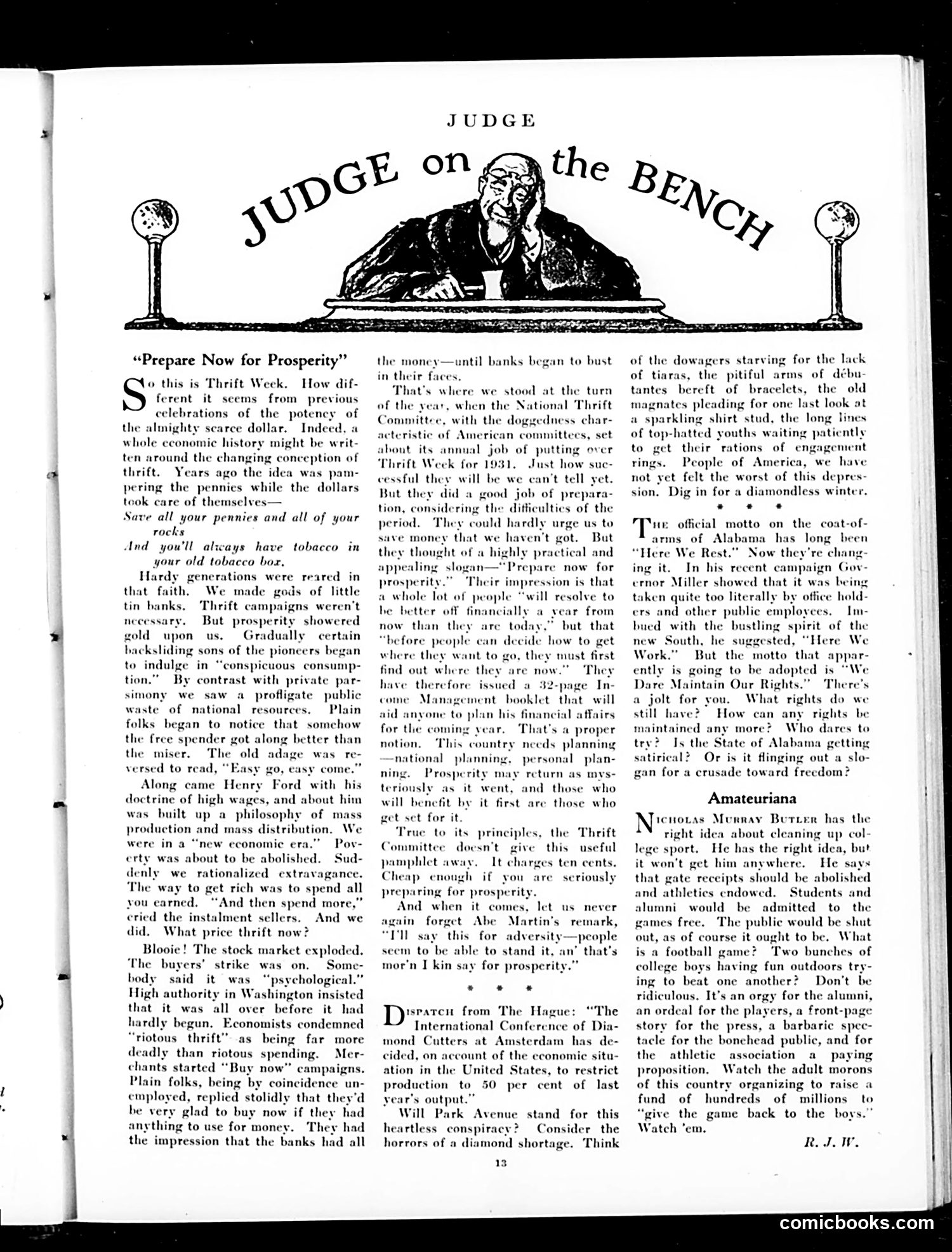
Judge Magazine: "Judge on the Bench" (circa 1931) This page combines editorial commentary on economic policy with satirical social criticism. The main article, "Prepare Now for Prosperity," critiques American attitudes toward thrift and spending during the Great Depression aftermath. The text traces how Americans shifted from valuing savings to embracing consumption under Henry Ford's mass-production philosophy and installment credit. The satire mocks this reversal: when the stock market crashed and banks failed, ordinary people discovered they had no money to spend—despite being urged to "buy now." The National Thrift Committee's response ("Prepare now for prosperity") is presented as well-intentioned but somewhat absurd given widespread unemployment. The secondary item mocks international diamond cutters restricting production during the Depression, sarcastically questioning whether wealthy Park Avenue residents will tolerate this "heartless conspiracy." The overall satirical thrust: Americans were sold easy-credit materialism, then blamed for lacking thrift when the economy collapsed.
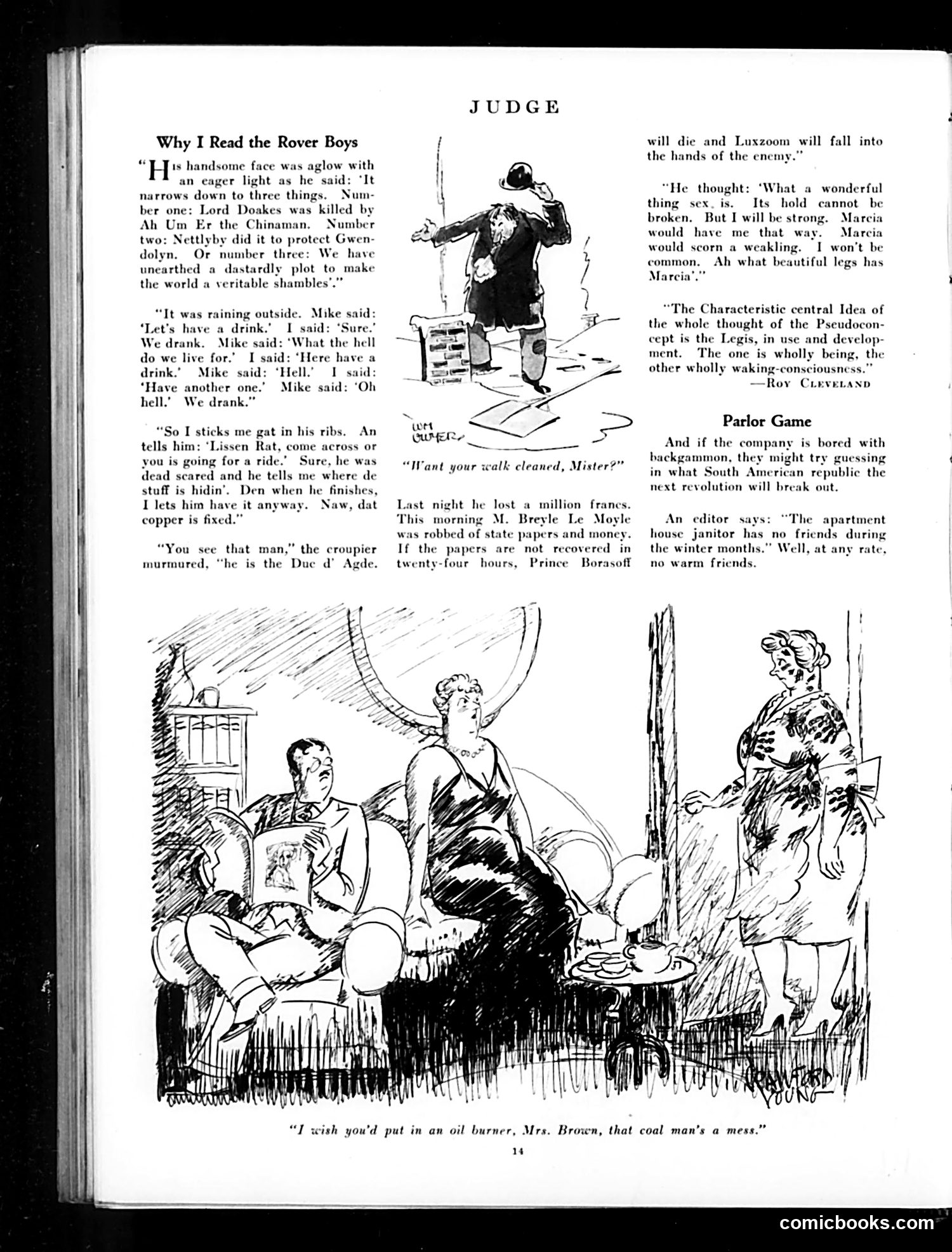
Analysis: Judge Magazine Page This page satirizes popular adventure fiction of the era through parody and commentary. "Why I Read the Rover Boys" mocks the Rover Boys series—popular early 20th-century juvenile adventure novels featuring melodramatic plots, stilted dialogue, and contrived coincidences. The excerpt mimics their overwrought style: characters discussing mysterious criminals, elaborate schemes to "make the world a shambles," and hard-boiled gangster dialogue ("I sticks me gat in his ribs"). The cartoons illustrate the absurdity of such fiction. The top cartoon shows a bellhop asking a disheveled man about shoe-cleaning—a mundane reality intruding on adventure fantasy. The bottom cartoon depicts socialites playing a guessing game about where the next "South American republic" revolution will occur, treating real geopolitical instability as parlor entertainment. The quotes from Roy Cleveland and the philosophical fragment about consciousness suggest Judge's critique extends to how people consume sensationalized fiction as escapism from actual problems like poverty (the janitor with "no warm friends").
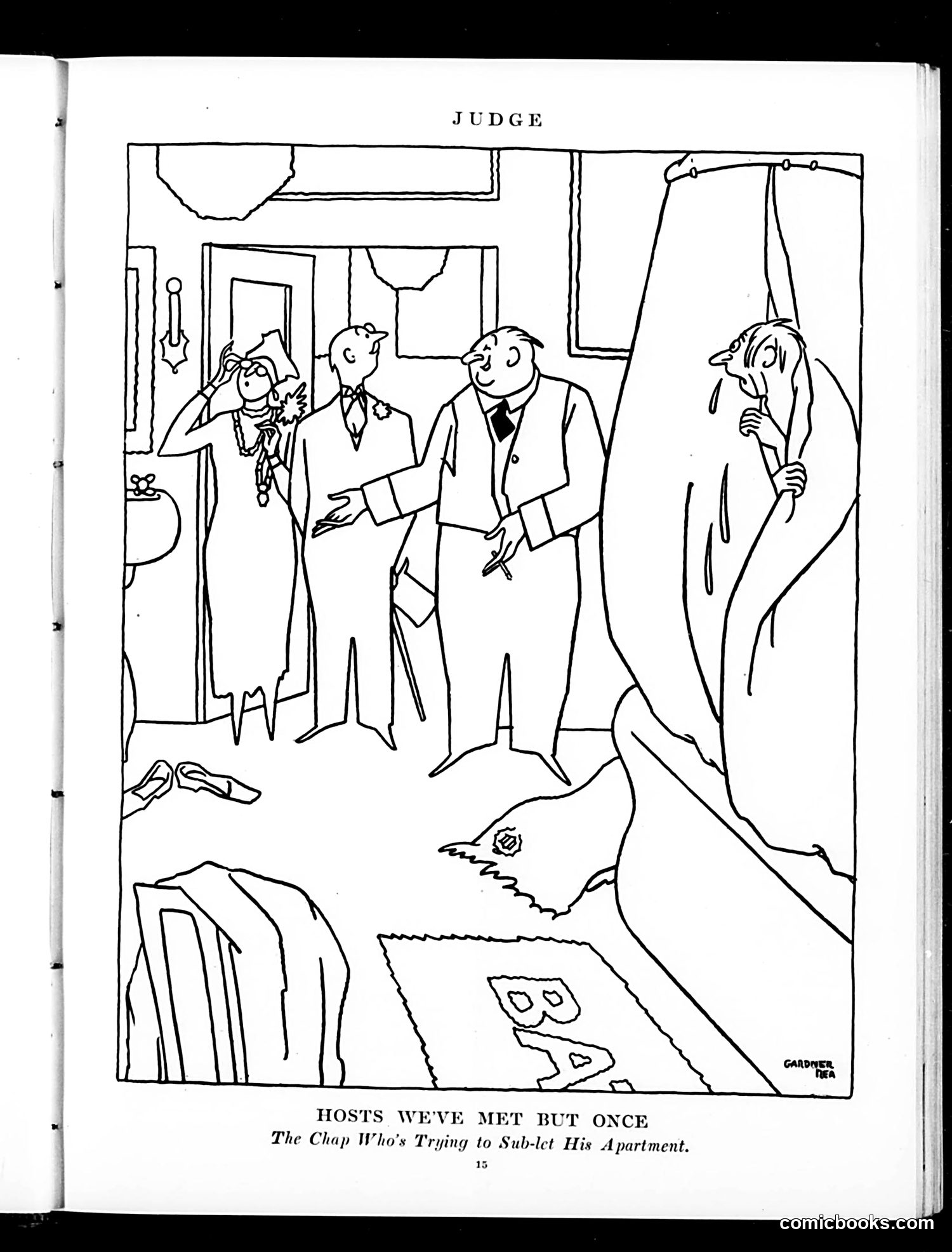
"Hosts We've Met But Once" This single-panel cartoon satirizes the awkward social dynamics of apartment living in what appears to be the early-to-mid 20th century. The caption's subtitle—"The Chap Who's Trying to Sub-let His Apartment"—identifies the situation: a tenant attempting to sublet to new occupants. The humor derives from a common social predicament: the host and prospective renters are meeting for the first time, yet must pretend familiarity or neighborly warmth. The interior setting shows the current tenant nervously gesturing while showing the space, while the new arrivals regard him with skeptical or uncertain expressions. The cartoon likely mocks the artificial courtesy and awkward pretense required in such brief, transactional housing encounters.
Judge Theatre Review: "Midnight" by George Jean Nathan This is a theatre critique by renowned drama critic George Jean Nathan, reviewing the Theatre Guild's production of "Midnight," a play by Paul Sifton (a New York World reporter) and his wife. Nathan argues the play is muddled melodrama that fails artistically. He suggests the original concept—exploring conflict between publicly-professed principles and private moral choices (in the style of Augustus Thomas's "When It Comes Home")—was abandoned after act two in favor of irrelevant farce. The critic particularly faults director Moeller's technique of having all characters speak simultaneously, intended to mirror real conversation but instead creating artificial chaos that emphasizes the actors' self-consciousness rather than naturalism. Nathan dismisses the plot as unrealistic: a newspaper reporter suppresses a major story out of sympathy for a woman he's barely met, which lacks credibility even by melodrama standards.
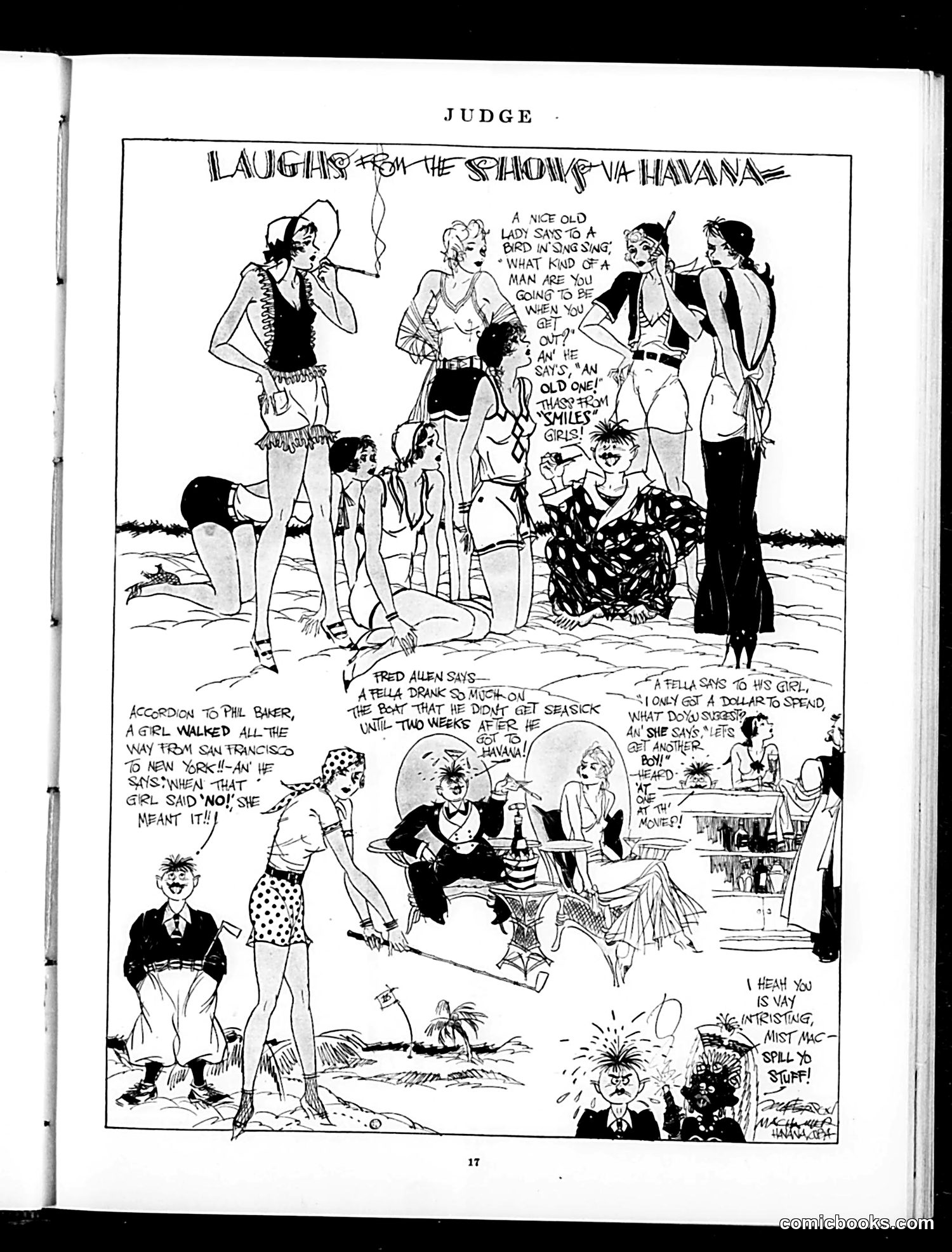
"Laughs at the Show in Havana" This cartoon satirizes early 1900s leisure culture and gender dynamics. The upper panel depicts a beach scene in Havana with fashionably-dressed women in bathing costumes, mocking contemporary attitudes about courtship and marriage prospects. A "nice old lady" asks a young woman what kind of man she'll marry—the punchline suggests she'll accept "an old one" if he has money. The lower panels contain anecdotes attributed to "Phil Baker" about a girl who walked from San Francisco to New York seeking a husband, and separate jokes about men's unreliable behavior and women's mercenary attitudes toward romance. The satire targets both male infidelity (men who claim seasickness as excuses) and female materialism—reflecting period anxieties about changing courtship norms and women's independence during the early 20th century.
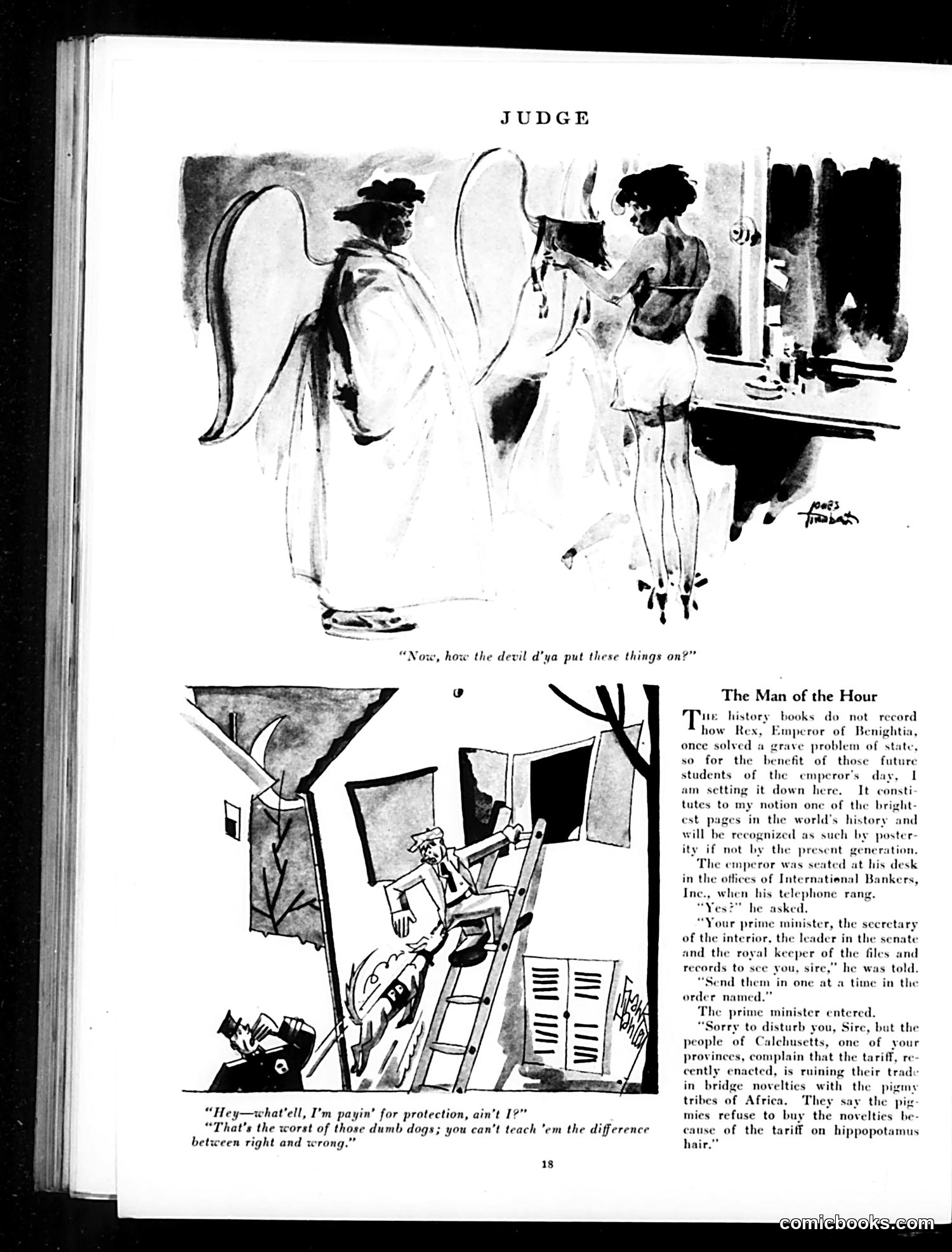
Political Satire Analysis This page from *Judge* magazine contains two cartoons satirizing political corruption and regulatory failures. Top cartoon: A figure (likely a politician or official) struggles to put on angel wings, while others comment on "protection" and inability to distinguish "right and wrong." This mocks corrupt officials attempting to pose as virtuous while accepting bribes. Bottom cartoon/story: "The Man of the Hour" parodies absurd political decision-making. A fictional emperor receives a complaint that tariffs are harming trade in "hippopotamus hair" novelties with African tribes. The satire targets: - Protectionist trade policies (tariffs) that harm commerce - International bankers' influence on government - The ridiculousness of protecting obscure luxury goods - Politicians solving problems through patronage rather than reason The overall message critiques early 20th-century political corruption, crony capitalism, and illogical protectionist economics—suggesting government serves wealthy interests rather than public welfare.
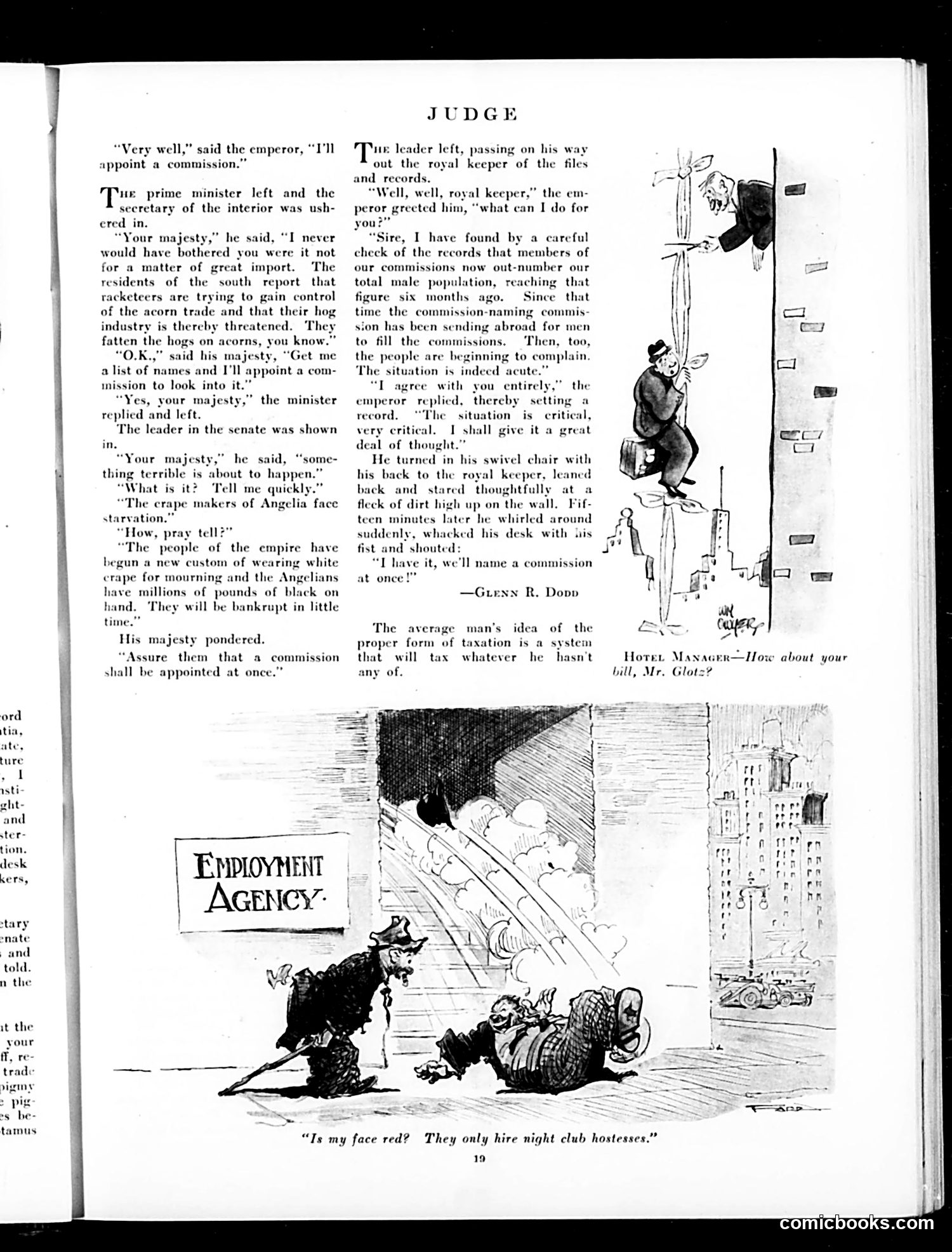
Judge Magazine Satire Analysis This page satirizes bureaucratic overreach and governmental inefficiency through a absurdist narrative. An emperor repeatedly solves every problem by appointing yet another commission—addressing acorn-trade racketeering, crape-maker starvation, and overpopulation of commissions themselves with identical solutions. The satire's point: government creates endless commissions that spawn more commissions, becoming self-perpetuating and disconnected from actual problem-solving. The royal keeper's complaint that commission members now outnumber the empire's male population illustrates how absurd this has become. The bottom cartoons provide supporting jokes about contemporary issues: taxation and nightclub employment discrimination (the "red face" reference suggests ethnic discrimination in hiring). The satire likely targets American government in the 1920s-30s era, when New Deal agencies proliferated. The message: bureaucratic solutions become the disease itself.
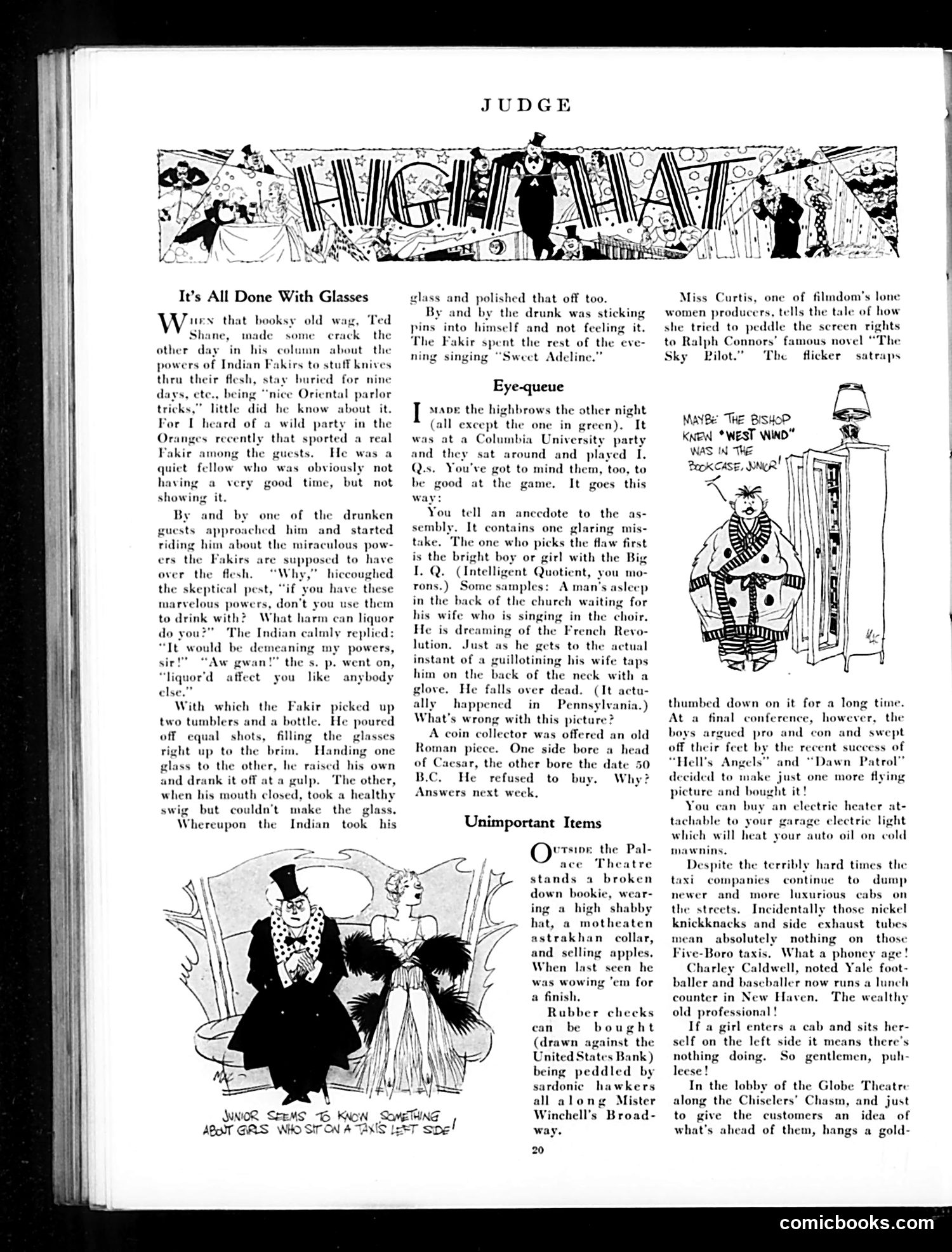
Judge Magazine Page Analysis This page from *Judge* contains humor pieces about 1920s-30s social pretensions and urban life. "It's All Done With Glasses" mocks both Indian fakir mystique and American drunkenness. A skeptical drunk challenges an Indian fakir's claimed powers, wagering that liquor affects him like anyone else. The fakir proves his discipline by drinking two full glasses while the drunk cannot finish his—then spends the evening drunk anyway, singing "Sweet Adeline." The joke satirizes both Western fascination with "Oriental" mysticism and the absurdity of American drinking culture. "Eye-queue" ridicules intellectual pretension at Columbia University parties where educated people play a game identifying logical errors in anecdotes. The examples are deliberately mundane (a church scene, Caesar dating). "Unimportant Items" offers brief satirical notes on 1920s-30s New York life: taxi companies adding luxury features that don't work, rubber checks being peddled, and a Yale athlete reduced to running a lunch counter—all depicting social decline and economic uncertainty of the era.
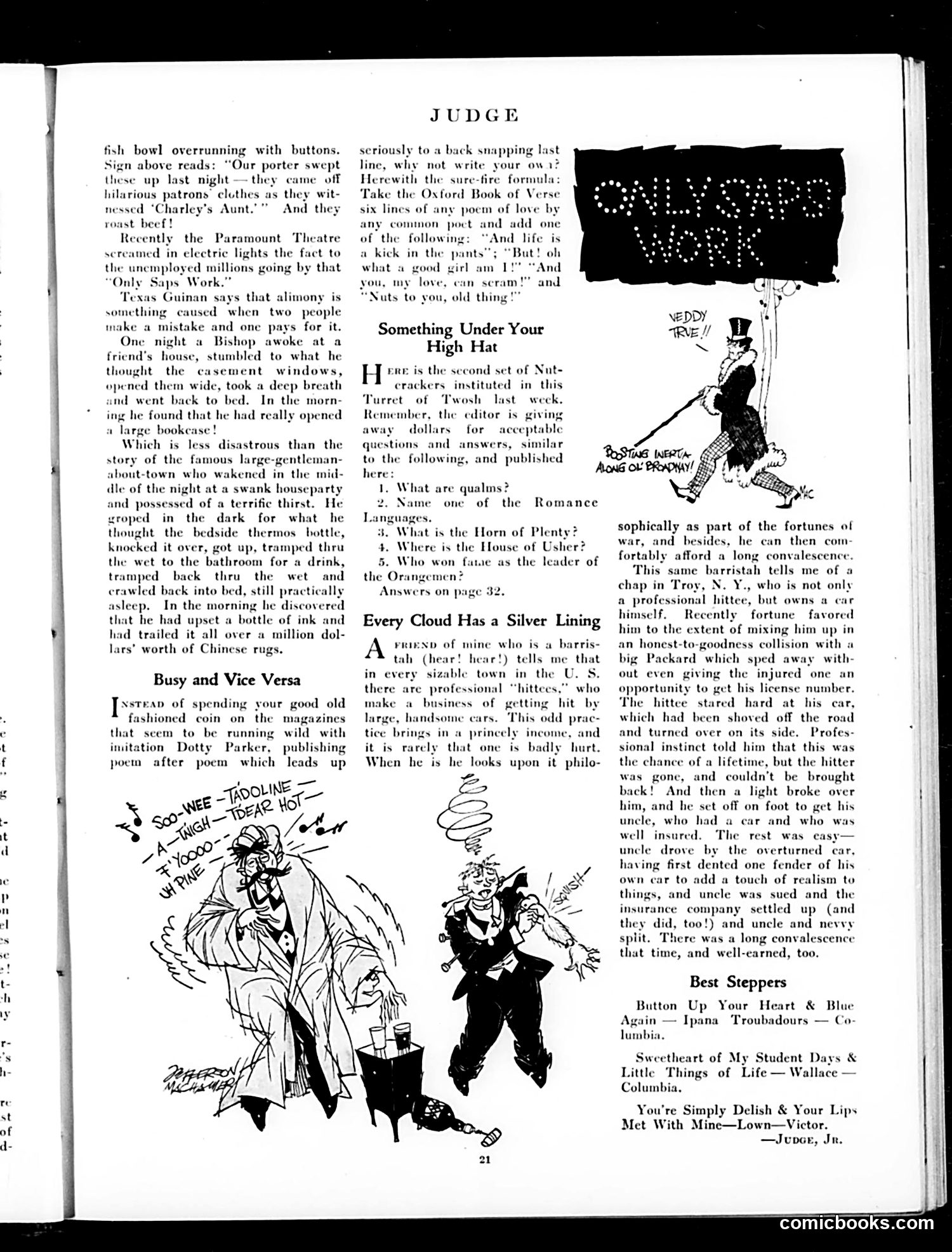
Judge Magazine Page Analysis This page from *Judge* contains several satirical pieces mocking 1920s social pretensions and publishing trends. The cartoons ridicule: 1. "Busy and Vice Versa": Satirizes the proliferation of imitation Dorothy Parker poetry in magazines—lightweight verse with formulaic "clever" endings. Judge offers readers a tongue-in-cheek template for writing such poems themselves, mocking both the poets and publications that publish them. 2. "Something Under Your High Hat": A lighthearted quiz section for readers. 3. "Every Cloud Has a Silver Lining": A darkly comic anecdote about professional "hittees"—people in towns who make income by getting hit by cars. The story describes a man who stages accidents with his uncle's car to collect insurance money, satirizing both insurance fraud and the desperation of 1920s economic schemes. The page reflects Jazz Age cynicism about commercialism, literary pretension, and financial schemes. The humor relies on reader familiarity with contemporary publishing and urban life.
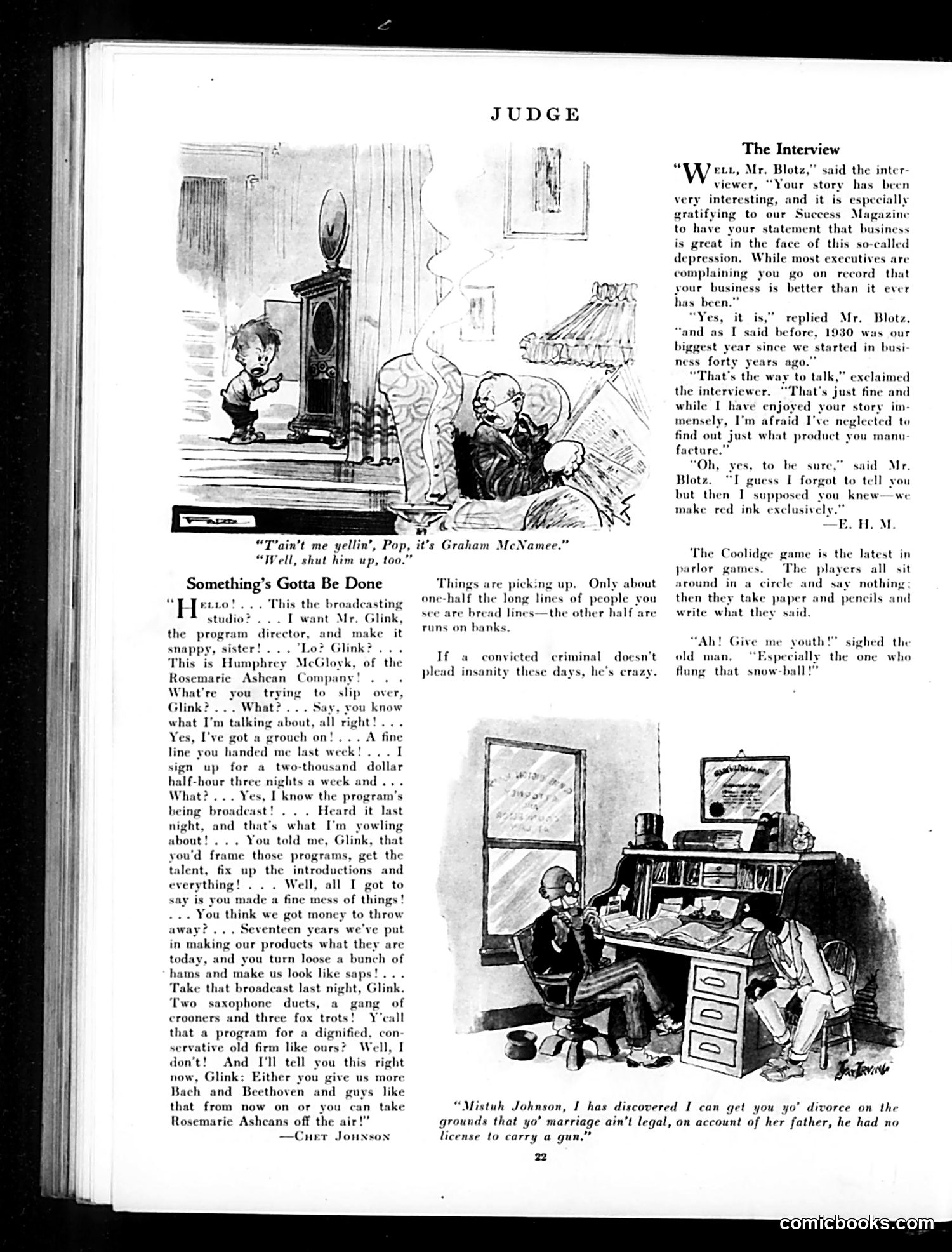
Judge Magazine Page Analysis This page contains three satirical pieces typical of 1920s-30s humor magazine content: "Something's Gotta Be Done" depicts a radio executive (Chet Johnson, credited) berating program director "Glink" for poor broadcasting choices. The satire targets early radio programming standards—the executive demands classical music (Bach, Beethoven) instead of "saps" like saxophone duets and fox trots. The punchline reveals announcer Graham McNamee is the actual problem, mocking a real, famous radio personality of the era. "The Interview" jokes about Depression-era business claims. A manufacturer boasts of record profits while admitting he makes "red ink exclusively"—a visual pun on accounting losses/debt shown in red. "The Coolidge Game" references silent President Calvin Coolidge (1923-1929), known for taciturn behavior. The parlor game mimics this: players sit silently, then write what they supposedly said—satire of Coolidge's famous reticence. The bottom cartoon makes a racial stereotype joke about divorce law, typical of period humor now considered offensive.
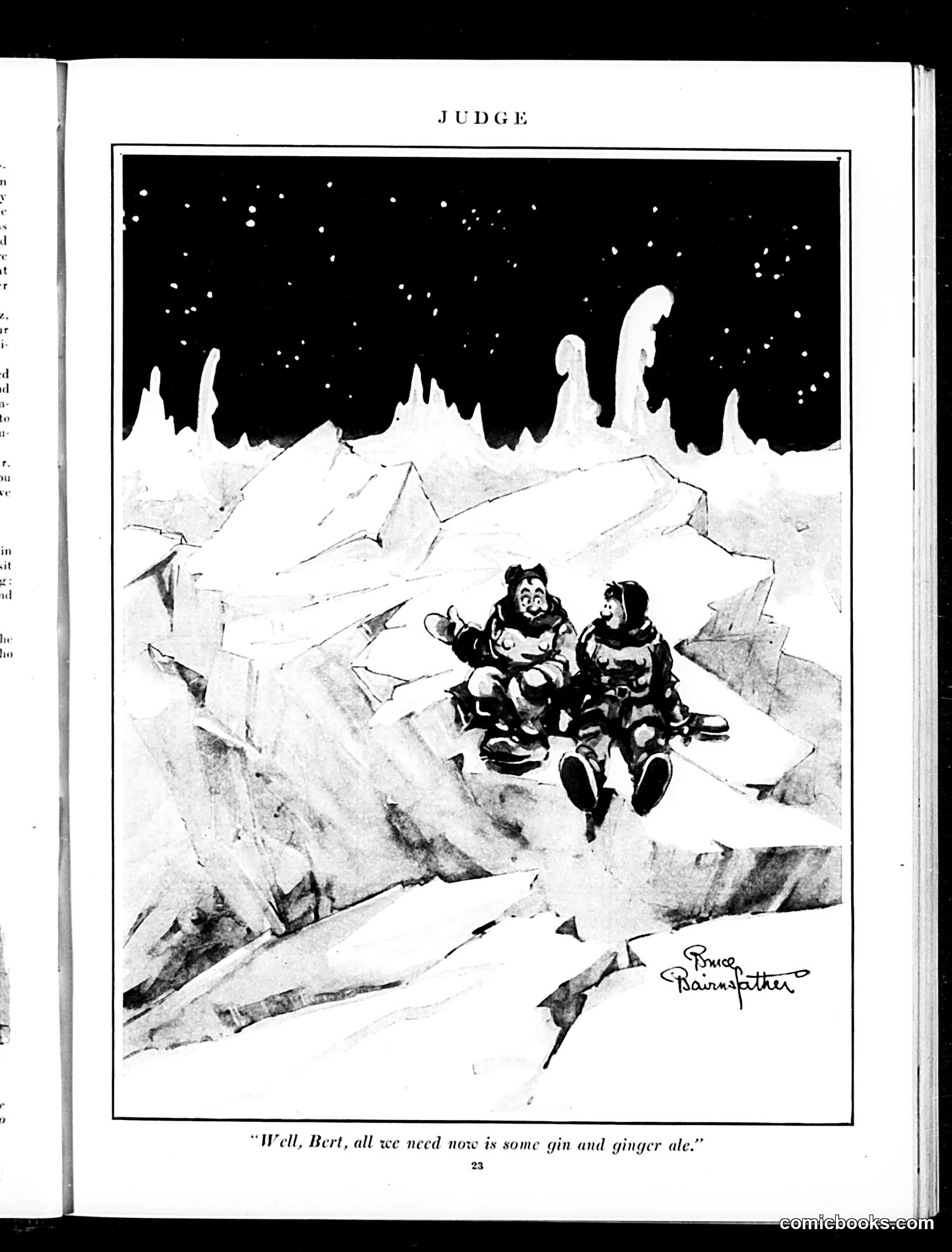
Judge Magazine Cartoon Analysis This cartoon, titled "Judge," depicts two figures sitting in a snowy, desolate Arctic landscape beneath a starry sky. One character addresses the other as "Bert," suggesting they're stranded or in dire circumstances. The caption's reference to needing "gin and ginger ale" appears to be dark humor about their predicament—requesting comfort items (alcoholic drinks) in an impossible survival situation. The cartoon likely satirizes either: 1. Ill-prepared Arctic explorers making absurd requests despite their peril, or 2. A contemporary news story about stranded travelers or an expedition Without knowing the specific publication date, the exact historical reference remains unclear. However, the satire mocks human tendency to crave comforts even in hopeless circumstances, or critiques poorly-planned expeditions.
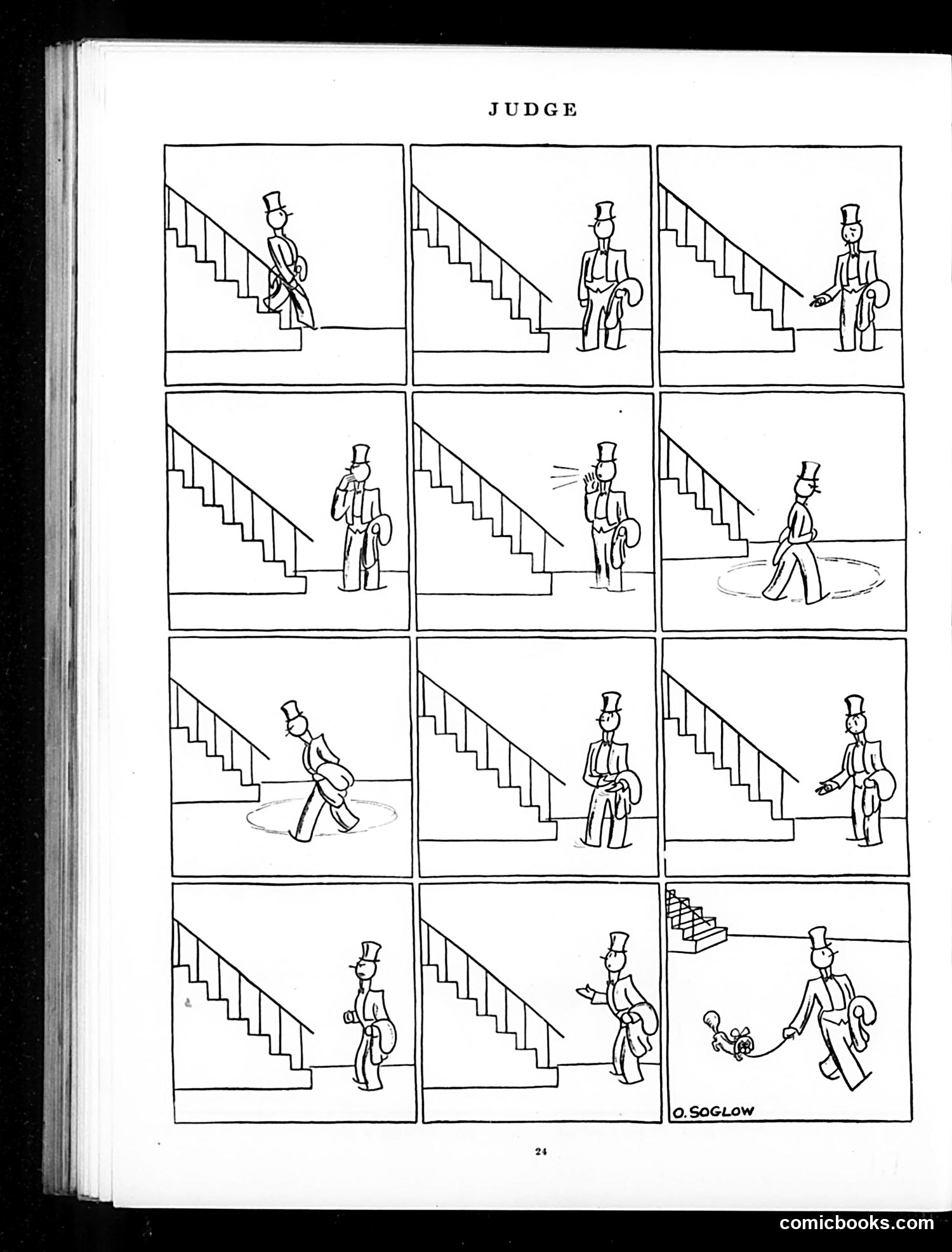
"Judge" - "Judge" (Political Cartoon) This is a wordless comic strip by O. Soglow titled "Judge," depicting a formal gentleman in a top hat repeatedly descending and ascending a staircase in various ways—walking normally, tripping, sliding down the banister, tumbling, and ultimately falling down the stairs in a slapstick finale. The satire likely mocks judicial authority or the legal system itself. The figure's repeated mishaps—despite his dignified formal dress and position—suggest incompetence or the inherent instability of the legal/judicial process. By showing a "judge" literally losing control on stairs, Soglow may be satirizing judicial decisions that appear undignified, contradictory, or chaotic. The progression from composed to chaotic visually represents the breakdown of order and authority. Without additional context about specific legal cases or judges of the period, the exact target remains unclear, but the humor derives from the contrast between the judge's formal status and his bumbling performance.
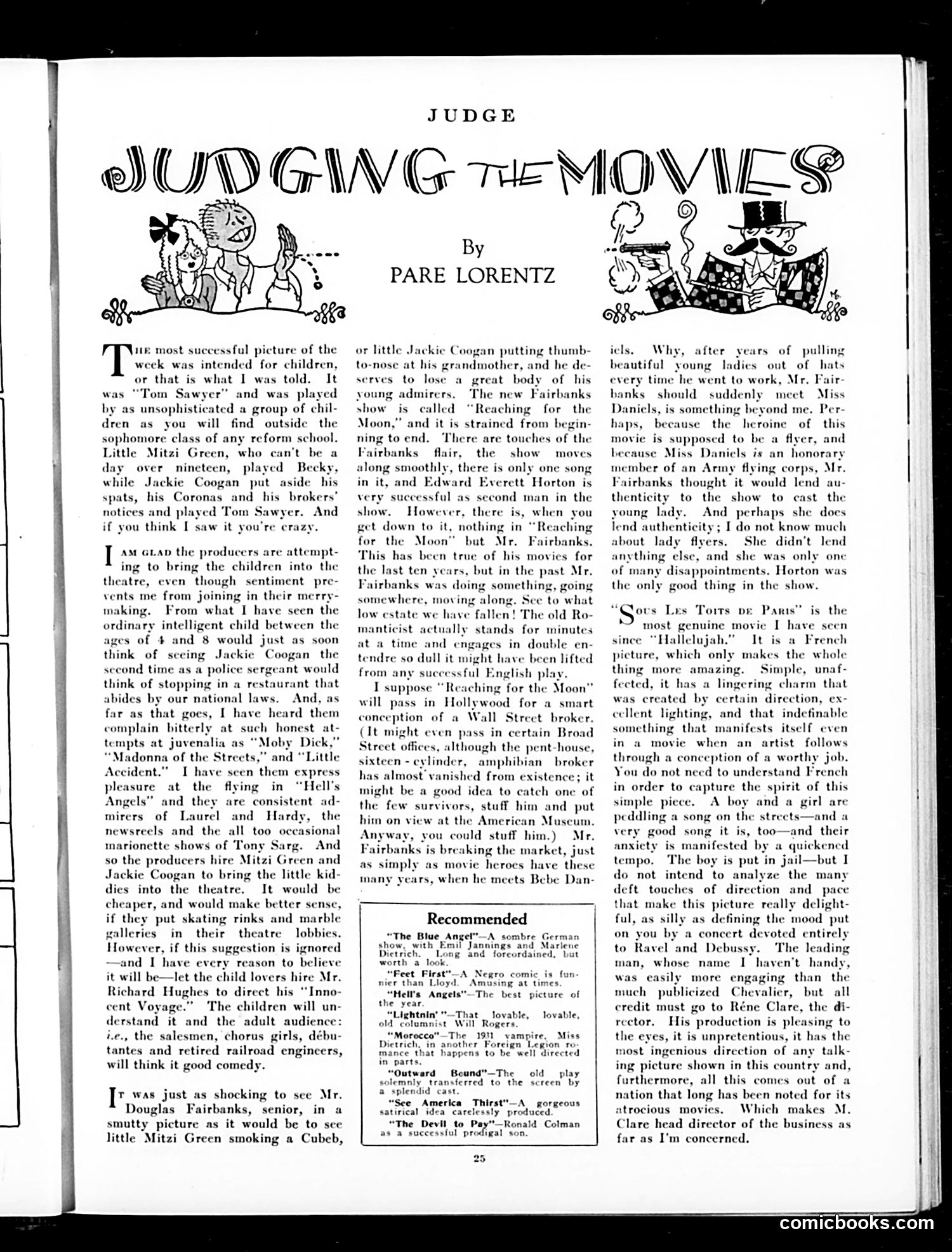
"Judge" Magazine Film Reviews This page contains Pare Lorentz's film criticism column reviewing recent Hollywood releases. The main targets of satire are: Jackie Coogan and Mitzi Green in "Tom Sawyer"—Lorentz mocks producers' assumption that hiring child stars automatically attracts children to theaters, comparing it to adding "skating rinks and marble galleries" to lobbies. Douglas Fairbanks Sr. in "Reaching for the Moon"—criticized for appearing in a mediocre film featuring crude double entendres. Lorentz notes Fairbanks once created action and movement in films; now he merely "stands for minutes" doing nothing, symbolizing Hollywood's creative decline. The satire reflects 1930s concerns about cinema's artistic quality amid the transition to talking pictures and formulaic star vehicles. Lorentz advocates for better direction (Richard Hughes) over relying on celebrity draw alone. The "Recommended" section praises films like "The Blue Angel" and "Hell's Angels" for genuine artistry.
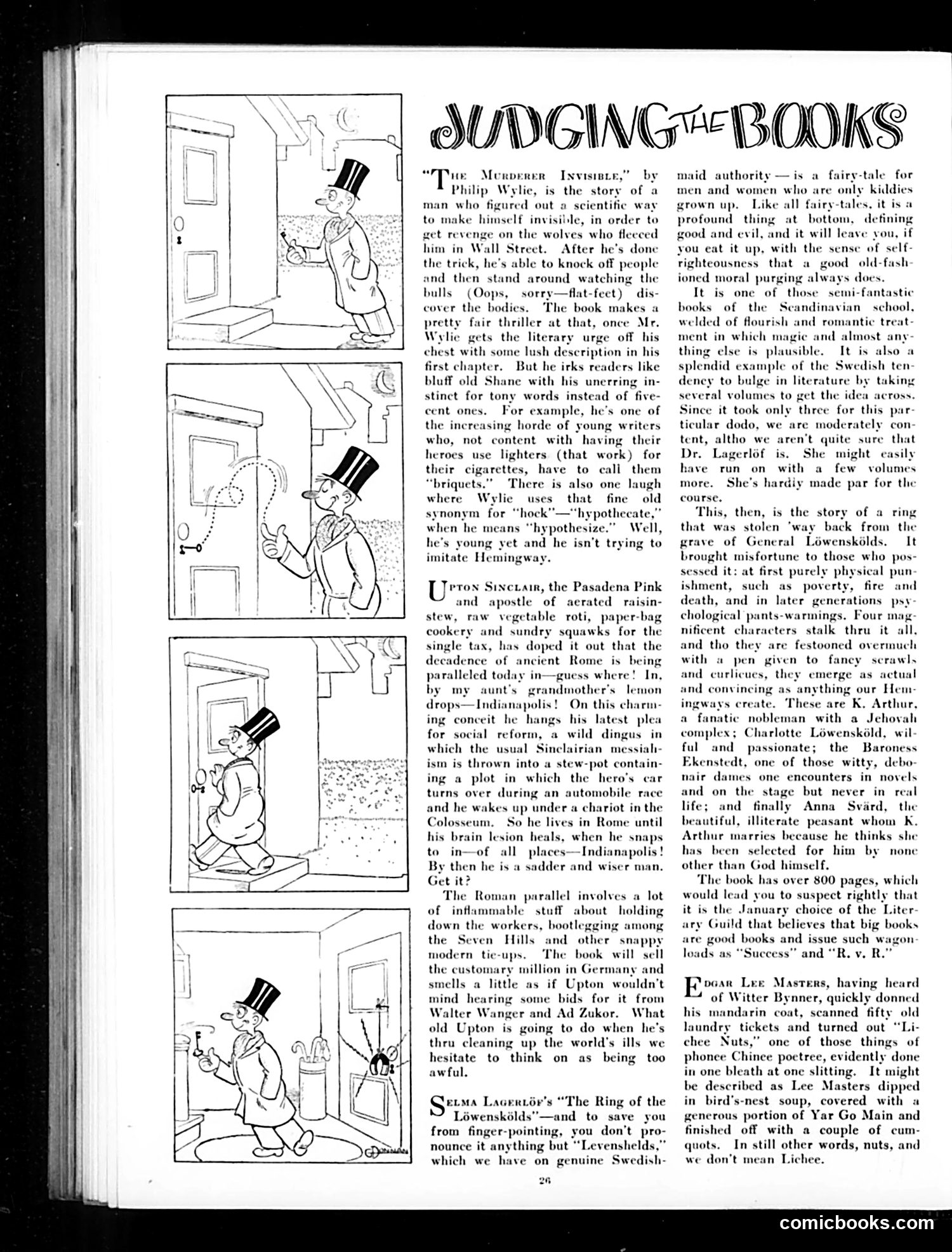
"Judging the Books" - Judge Magazine Book Review Page This page reviews three recently published novels. The cartoons illustrate Philip Wylie's "The Murderer Invisible," depicting a man who has discovered invisibility and uses it for revenge against Wall Street "wolves." The reviewer criticizes Wylie's pretentious vocabulary while acknowledging the thriller's entertainment value. The text also reviews Upton Sinclair's novel paralleling ancient Rome's decline with modern Indianapolis—a satirical dig at Sinclair's well-known socialist activism and environmental crusades ("aerated raisin stew," "paper-bag cookery," "single tax"). The reviewer mocks Sinclair's preachy reform message while predicting commercial success in Germany. Finally, Selma Lagerlöf's "The Ring of the Löwensköld" is praised as a Swedish fairy-tale for adults, though criticized for excessive length typical of Scandinavian literature. The review balances respect for these authors' literary ambitions against frustration with their stylistic excesses and ideological agendas.
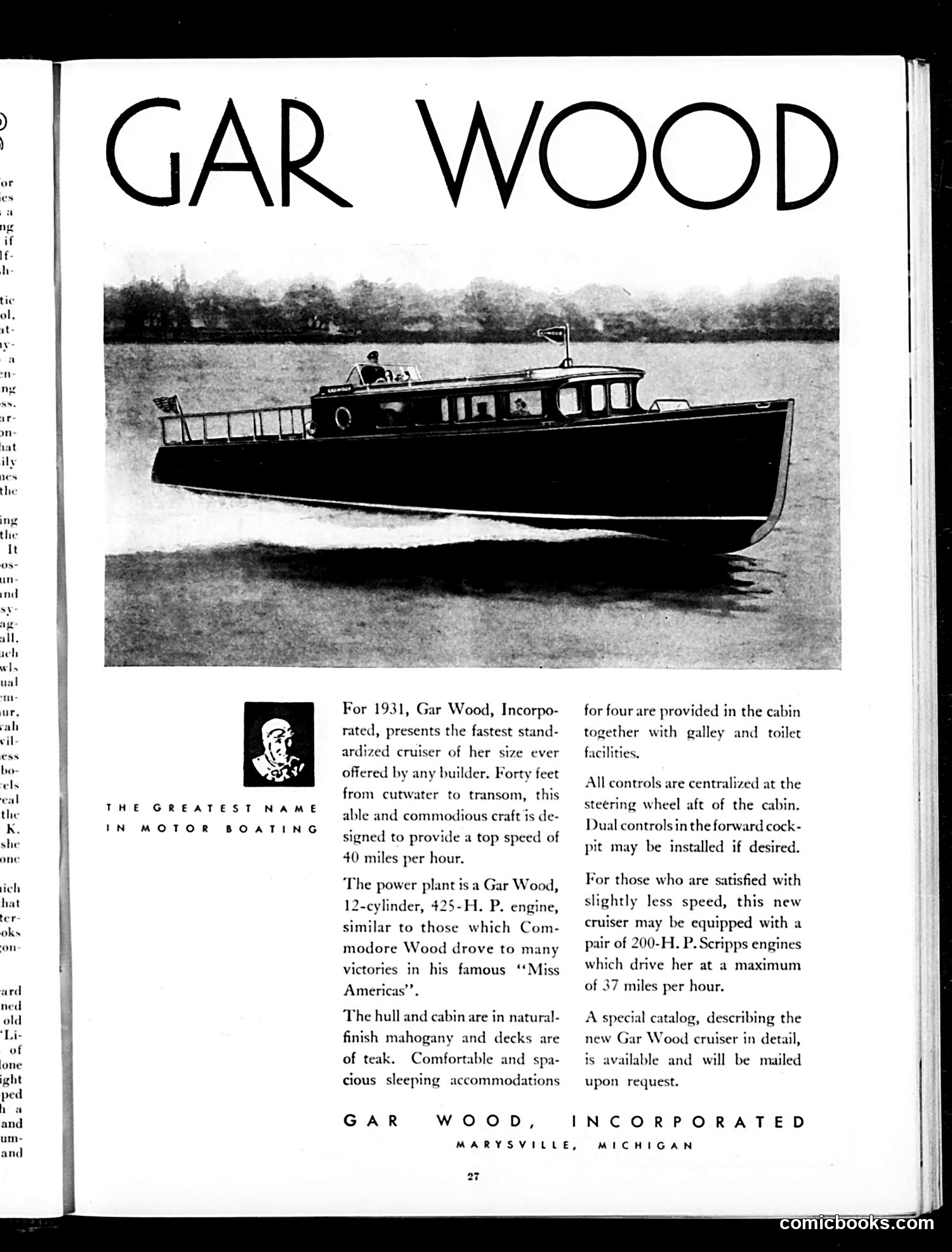
Analysis This page is not a cartoon or satire—it's a straightforward advertisement for Gar Wood motorboats, appearing in Judge magazine (1931). The ad promotes Gar Wood, Incorporated's new standardized cruiser, emphasizing luxury and speed. Key selling points include a 40 mph top speed (via a 12-cylinder, 425-H.P. engine), mahogany hull, teak decks, and sleeping accommodations for four. The reference to "Commodore Wood" and his famous "Miss Americas" victories appeals to readers' awareness of speedboat racing achievements. The tagline "The Greatest Name in Motor Boating" positions the brand as industry-leading. The company logo features a captain's face, reinforcing nautical prestige. The ad targets affluent consumers seeking both performance and comfort in recreational boating during the Depression era—a luxury market segment.
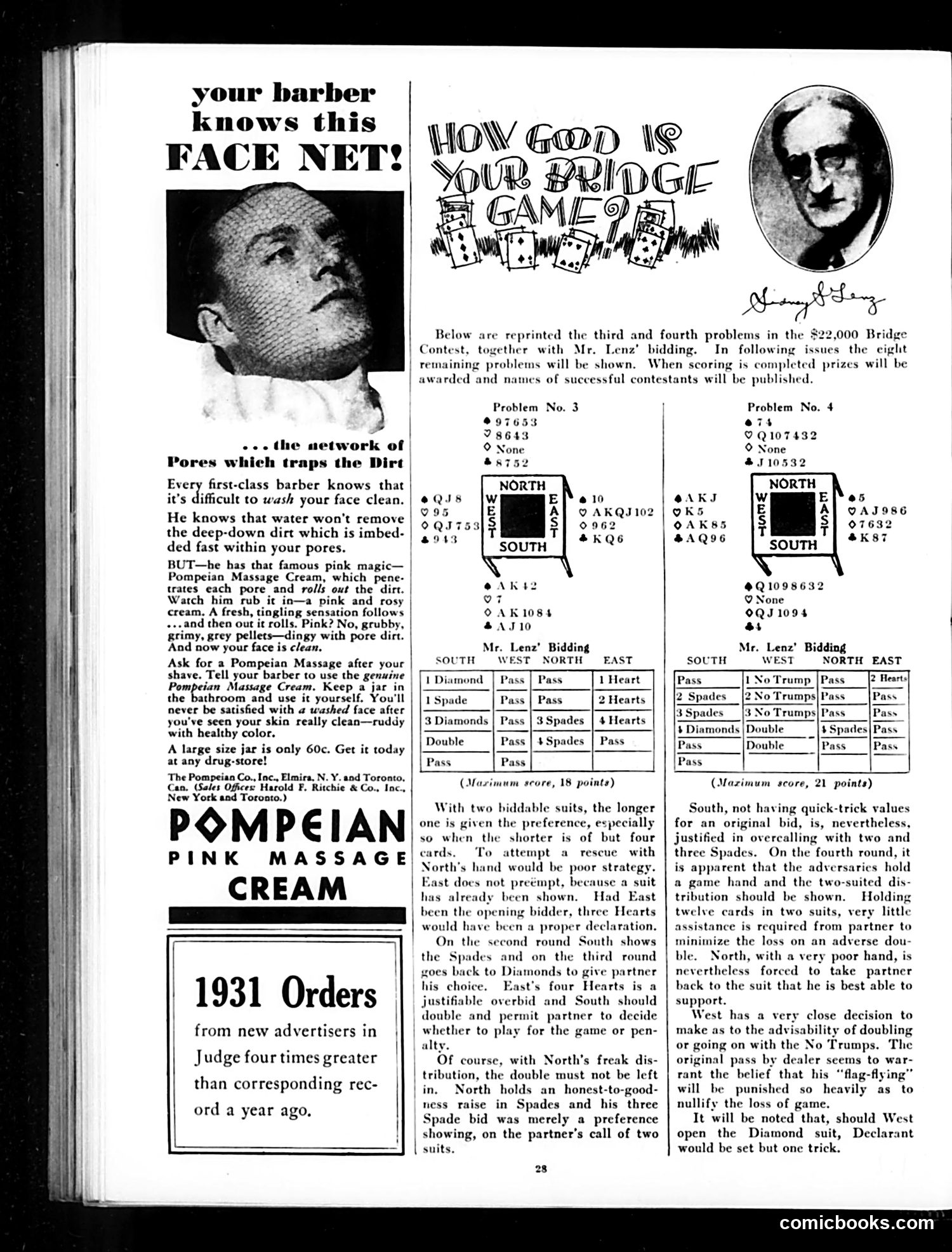
What This Page Means This 1931 *Judge* magazine page contains no political cartoon. Instead, it's primarily advertising and instructional content. The left side features a Pompeian Pink Massage Cream advertisement, using a barber's face-net image as a visual metaphor—the "network of pores" traps dirt. The ad promises the cream will extract hidden grime visibly, appearing as "grubby, grimy, grey pellets" when rubbed out. This targets male readers concerned with grooming and skin cleanliness. The center-right contains bridge card game problems and solutions from "Mr. Lenz," explaining bidding strategy to readers. An inset notes that 1931 advertising orders exceeded the previous year "four times greater," suggesting the magazine's commercial success during the Depression. No satire or political content appears here—this is straightforward commercial content typical of *Judge*'s revenue model during this period.
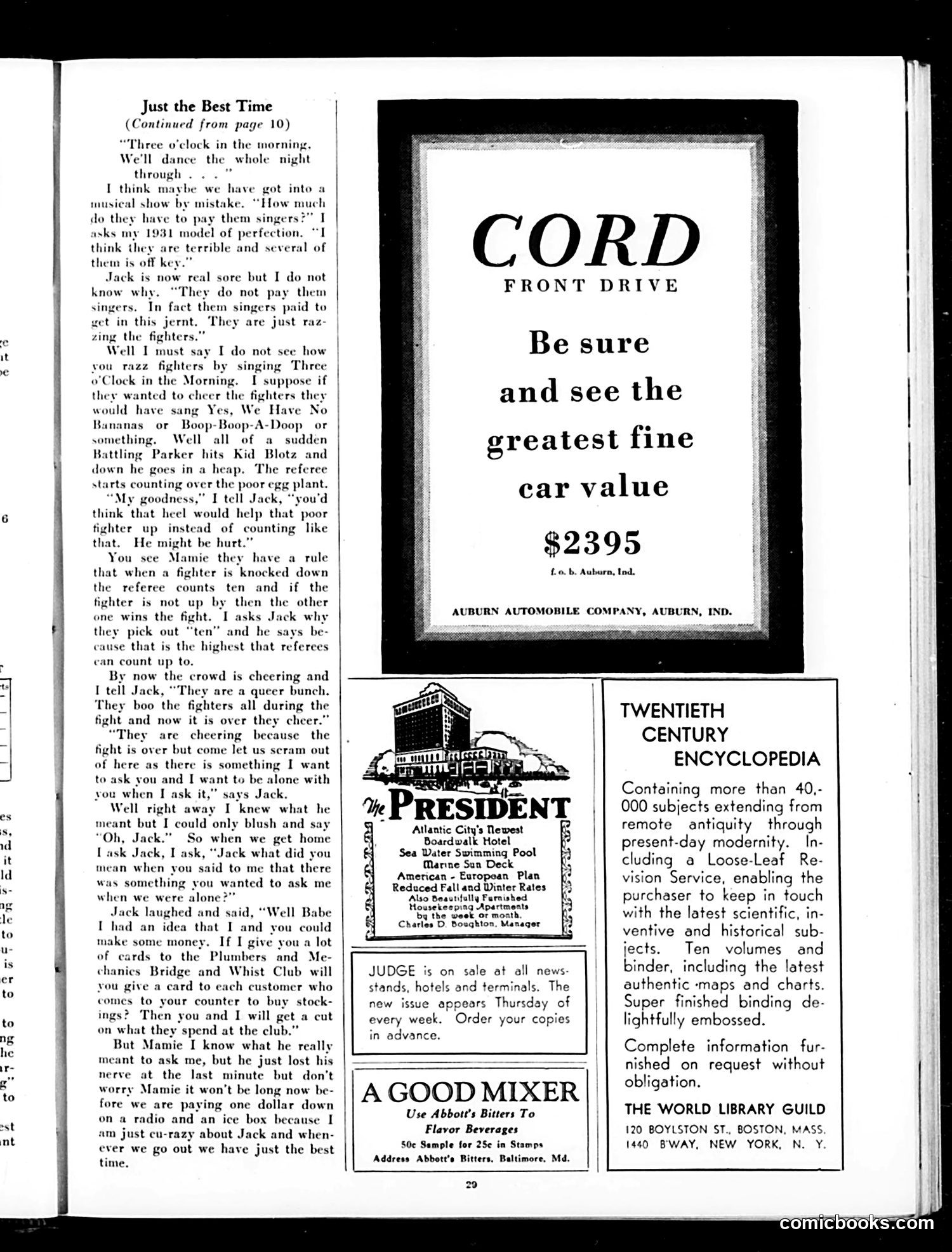
Page Analysis: Judge Magazine This page is primarily advertising and serial fiction, not political satire. The main content is "Just the Best Time," a romantic comedy serialized from page 10, narrated by a female character named Mamie describing her date with Jack at a boxing match. The humor derives from Mamie's naïve observations—she questions why boxers must pay to perform and doesn't understand boxing rules (complaining the referee counts instead of helping fallen fighters). The narrative concludes with Jack awkwardly proposing they make money together, which Mamie reads as a marriage proposal. The advertisements are typical 1931 fare: a Cord automobile ($2,395), the President Hotel in Atlantic City, Abbott's Bitters, and the Twentieth Century Encyclopedia. These reflect Depression-era consumer goods and leisure products. The "Good Mixer" ad references Prohibition-era coded language for alcohol ("bitters" as a cocktail ingredient). No political cartoon appears on this page—it's straightforward popular entertainment and period advertising.
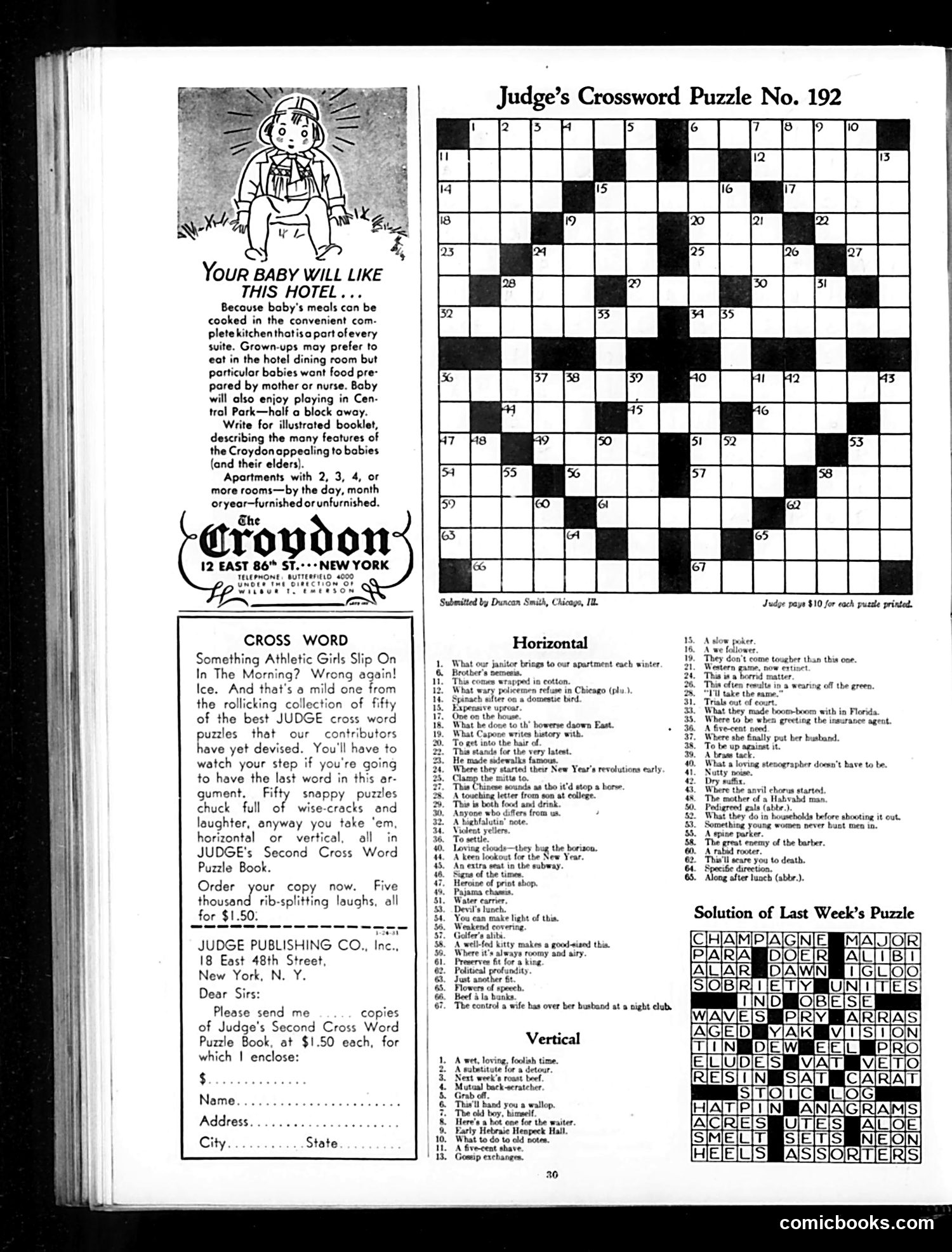
Judge Magazine Page Analysis This page is primarily advertising and puzzles, not political satire. The main content features: 1. The Croydon Hotel advertisement (top left): A pitch for a luxury apartment hotel at 12 East 86th Street in New York, specifically marketing to families with babies. The ad emphasizes convenient in-suite kitchens where mothers can prepare meals, proximity to Central Park, and various apartment sizes. This reflects 1920s-30s urban living trends and the emerging market for "family-friendly" luxury accommodations. 2. "Judge's Second Cross Word Puzzle Book" promotion: An advertisement encouraging readers to purchase the magazine's crossword puzzle collection for $1.50, claiming "fifty snappy puzzles" full of humor. 3. Crossword Puzzle No. 192: The actual puzzle with clues reflecting period concerns—references to New Year's resolutions, subway etiquette, insurance agents, Florida tourism, and marital dynamics—offering snapshots of contemporary American life and social attitudes rather than political commentary. The page demonstrates how Judge blended entertainment, humor, and advertising for its readership.
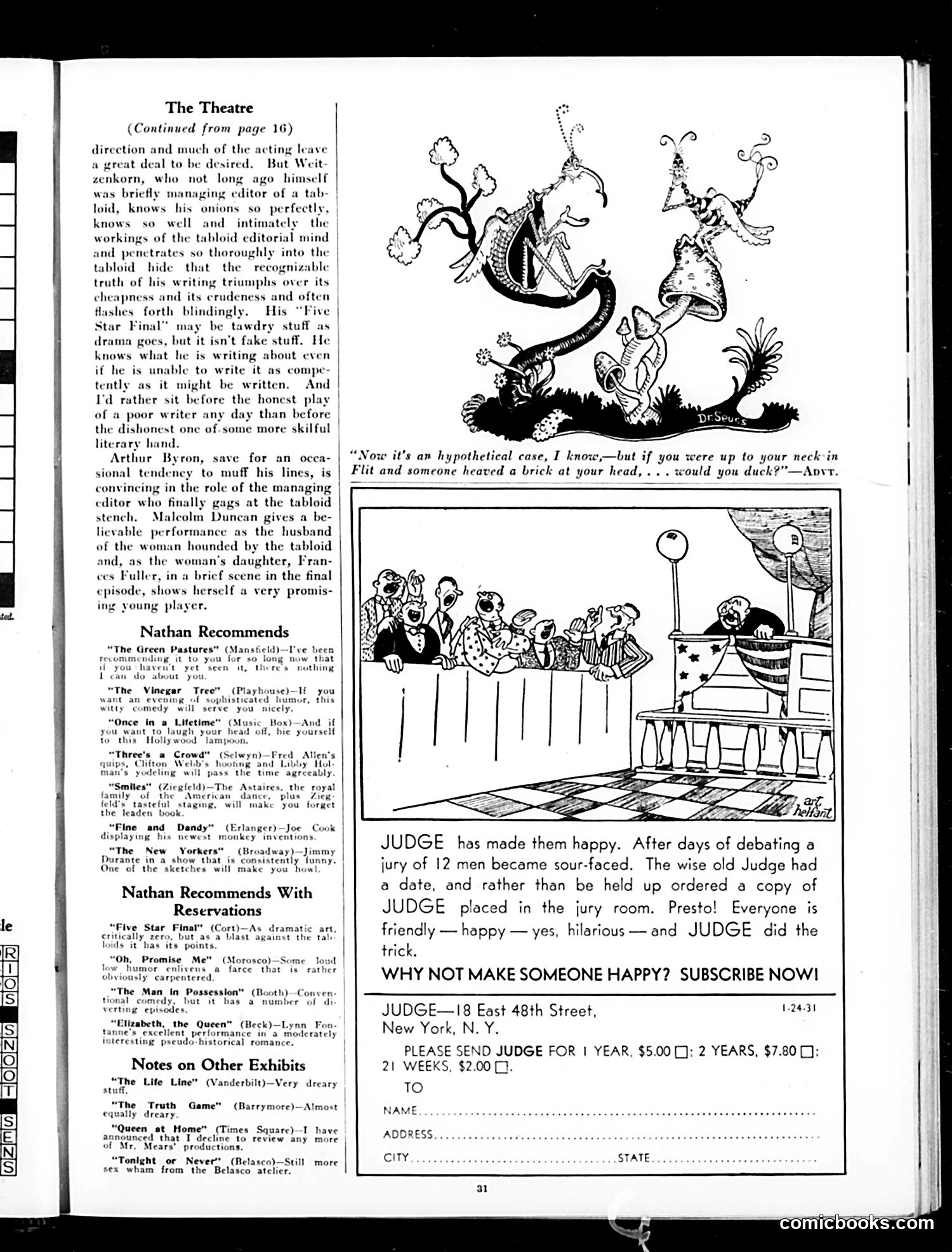
Judge Magazine Page Analysis This page showcases Judge magazine's theatrical criticism and self-promotional advertising from the 1930s. The Theater Section reviews contemporary Broadway plays, including "Five Star Final" (about tabloid journalism). The critic praises the play's authentic depiction of newspaper culture despite its melodramatic structure. The Main Cartoon depicts a courtroom scene where a jury of 12 men, initially "sour-faced" after debate, becomes cheerful after being given Judge magazine to read. The caption reads: "JUDGE has made them happy." The Satire: This is a self-referential advertisement disguised as humor. It claims the magazine is so entertaining it transforms grumpy jurors into "friendly—happy—yes, hilarious" people. The judge allegedly ordered copies placed in the jury room specifically to improve morale before his date. The Point: A tongue-in-cheek pitch to readers that Judge magazine provides escapist humor so effective it can elevate anyone's mood—even cynical jurors trapped in deliberations. The bottom section contains subscription pricing ($5.00/year).
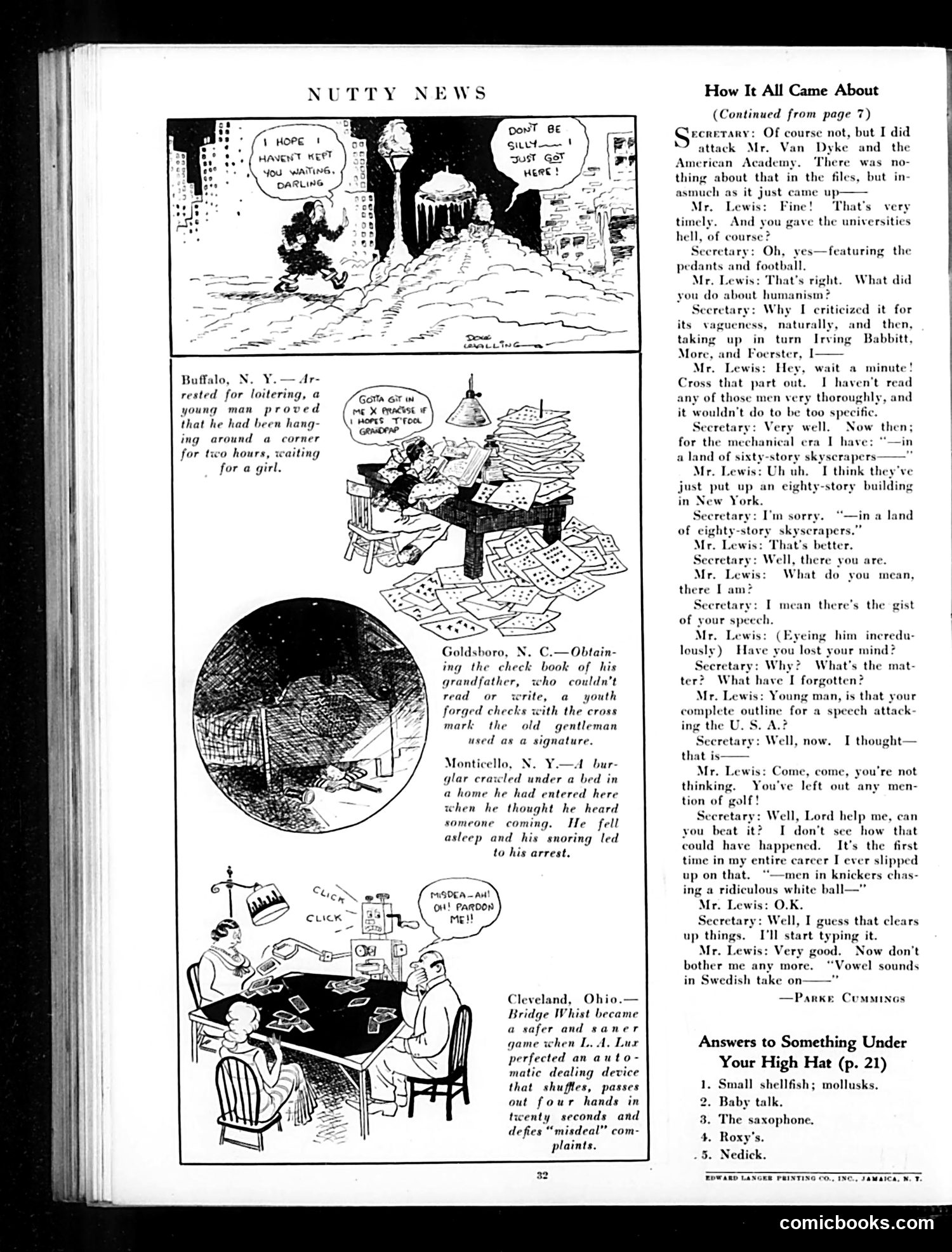
Explanation for Modern Readers This page satirizes Sinclair Lewis, the famous American novelist known for critiquing American society. The main cartoon shows Lewis discussing his recent speech attacking various American institutions—universities, humanism, and modern architecture (skyscrapers). The satire's point: Lewis is depicted as careless and intellectually lazy. His secretary catches him in multiple embarrassing errors—he hasn't actually read the humanist thinkers he criticized, he contradicts himself about building heights, and he forgot to mention golf in his speech. When challenged, he demands she simply "type it" anyway. The joke mocks Lewis (and by extension, social critics generally) for making grand pronouncements about American culture without thorough knowledge or consistency. The smaller "Nutty News" items are absurdist humor—unrelated funny news snippets typical of Judge magazine's format. This reflects 1920s-30s intellectual discourse when Lewis was actively publishing his satirical novels about American conformity and mediocrity.
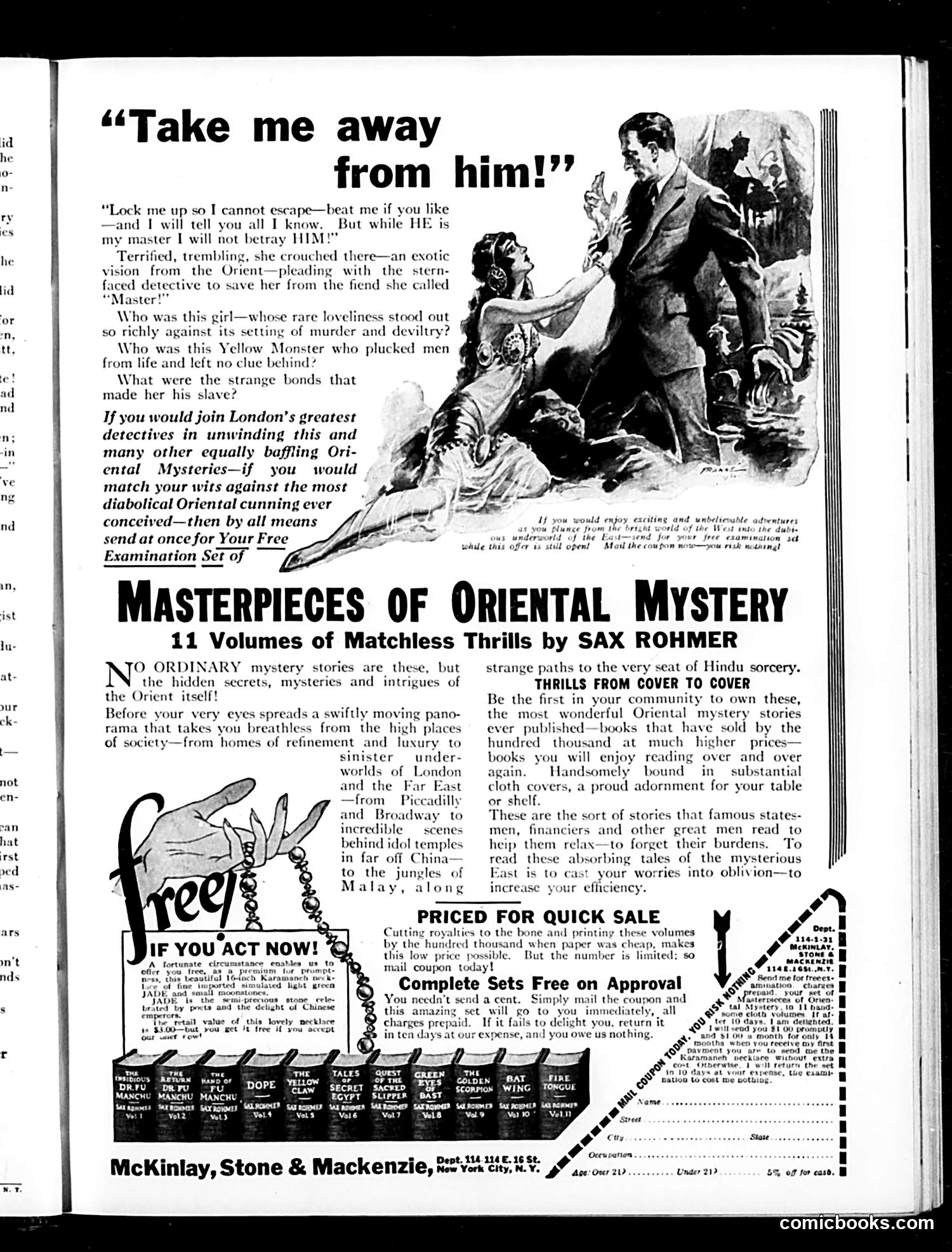
"Masterpieces of Oriental Mystery" Advertisement This is primarily a book advertisement, not satire or political commentary. It promotes an 11-volume mystery series by Sax Rohmer featuring his famous "Yellow Peril" character—a criminal mastermind of Asian origin who was a popular pulp fiction villain of the early 20th century. The imagery reflects period racial attitudes: the exotic woman in distress, the "Yellow Monster," and references to "Hindu sorcery" and "Oriental cunning" were standard tropes in sensationalist adventure fiction of that era. The ad exploits contemporary fascination with "Oriental Mysteries" and the mysterious East as settings for crime and danger. The dramatic illustration—a woman pleading to escape her "Master"—uses melodramatic appeal typical of pulp marketing. The offer of a "free examination set" with approval was a common direct-mail sales technique. This represents commercial popular entertainment of the 1920s-30s era, reflecting both the period's literary tastes and its casual embrace of Asian stereotypes.
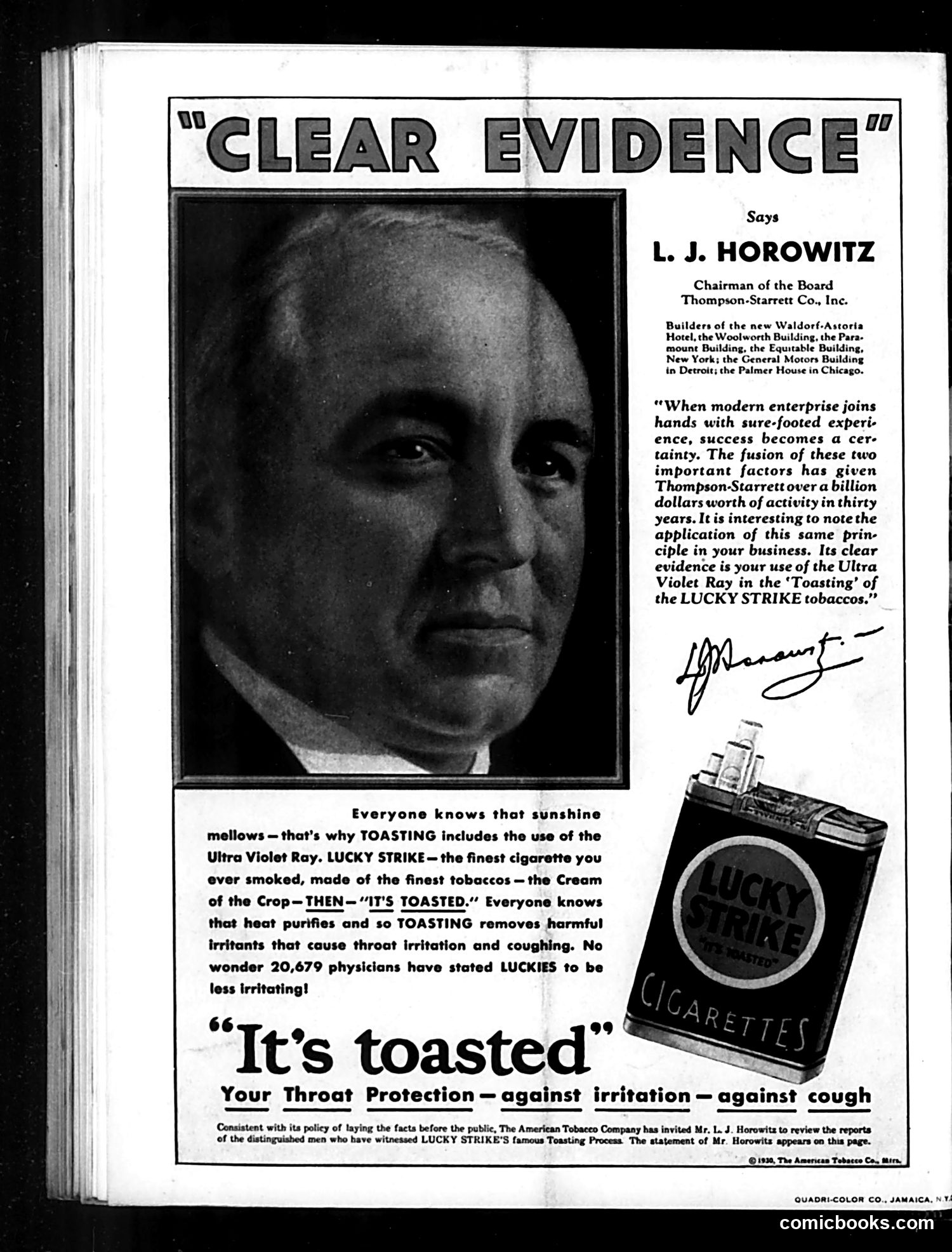
Analysis This is a Lucky Strike cigarette advertisement, not political satire. It features L.J. Horowitz, chairman of Thompson-Starrett Co. (a major construction firm), endorsing Lucky Strike's "toasting" process as health-protective. The ad uses a common 1930s marketing tactic: leveraging a respected businessman's credibility to sell cigarettes as medically beneficial. Horowitz compares Lucky Strike's "toasting" (heating tobacco with ultraviolet rays) to how "modern enterprise" succeeds through proven methods—drawing a false analogy between construction expertise and cigarette safety. The ad claims 20,679 physicians endorsed Lucky Strikes as "less irritating," a recurring claim from tobacco companies that exploited consumer health anxieties before regulations prohibited such health claims. For modern readers: This represents the pre-regulation era when tobacco companies made unsubstantiated health claims and used celebrity/expert endorsements to market cigarettes as throat-protective—practices now illegal.