judge
Judge — January 31, 1931
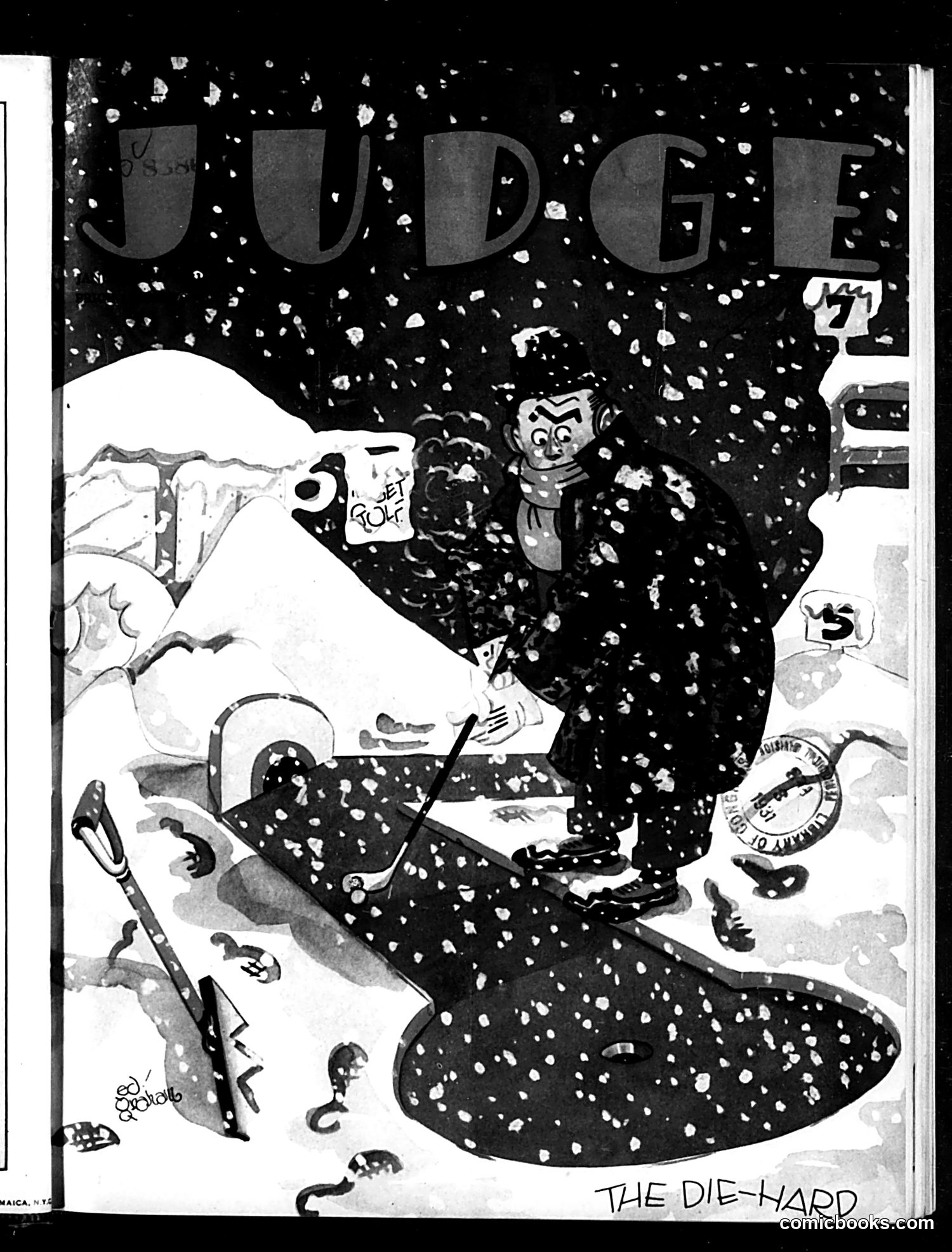
Judge Magazine Political Cartoon Analysis This appears to be a satirical Judge magazine cover titled "The Die-Hard," depicting a caricatured figure (likely representing a political or social opponent) standing defiantly amid snow and winter conditions. The character sports exaggerated features typical of period caricature. The cartoon's meaning remains somewhat unclear without additional context, though "die-hard" suggests depicting someone stubbornly resistant to change or defeat. Various small figures and symbols surround the main character, possibly representing consequences or opposing forces. The page includes advertising elements and what appears to be a mascot character ("Jet Rolf"). The satirical intent seems directed at mocking persistent resistance to something—possibly a political position, social movement, or policy—though the specific historical reference cannot be definitively identified from the image alone.
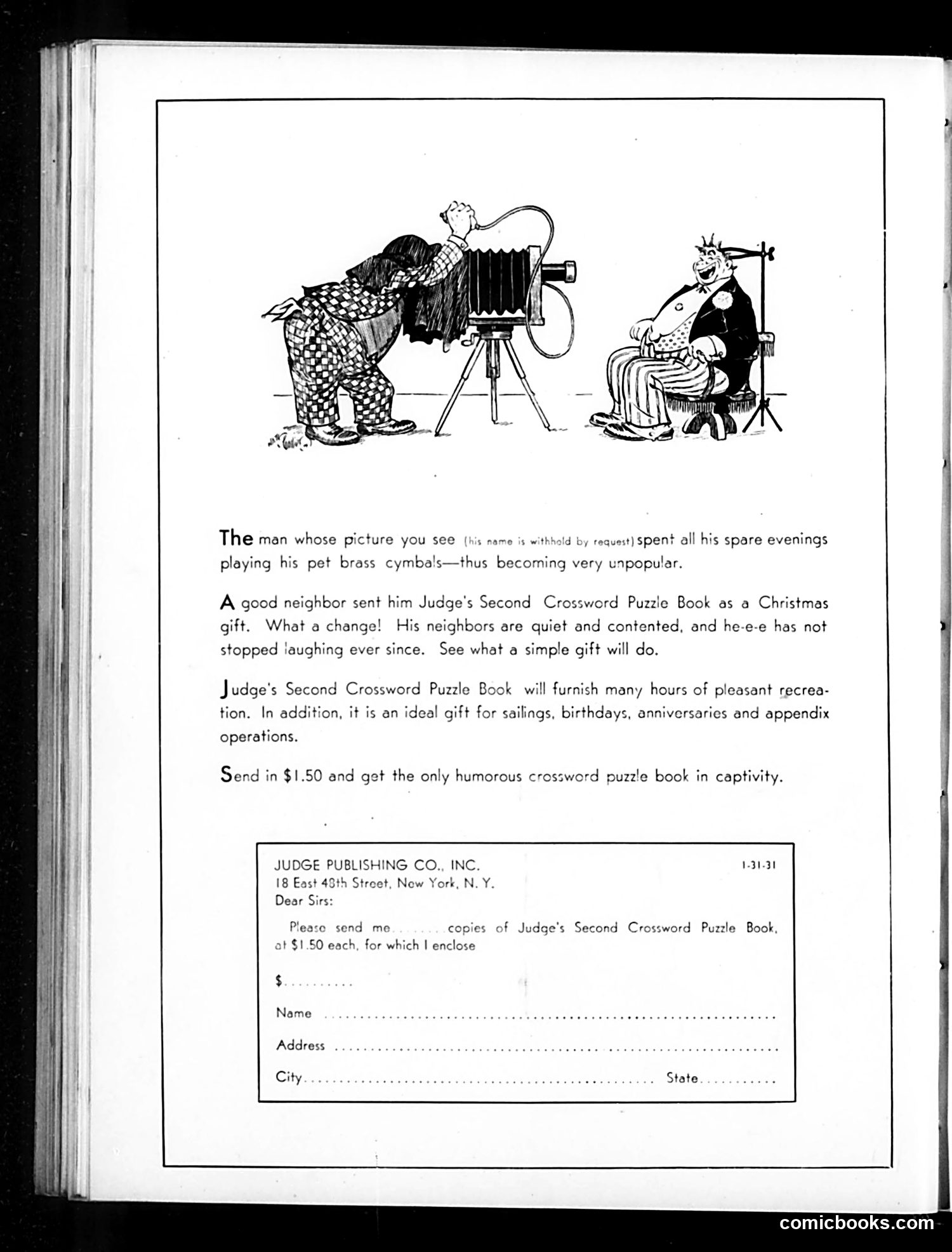
Analysis This page is primarily an advertisement for Judge's Second Crossword Puzzle Book, using humor to promote the product. The cartoon depicts a man playing loud brass cymbals during evenings, making him unpopular with neighbors. A neighbor gave him the crossword puzzle book as a Christmas gift, and it successfully redirected his attention—now he's quiet and his neighbors are happy. The satire is straightforward: the puzzle book is presented as a gift that transforms antisocial behavior. Rather than targeting a specific political figure or current event, it's social satire about annoying hobbies and neighborly relations. The humor relies on the exaggerated contrast between the cymbal-playing nuisance and the reformed, puzzle-absorbed man. The advertisement then encourages readers to purchase the book for $1.50, positioning it as an ideal gift for various occasions.
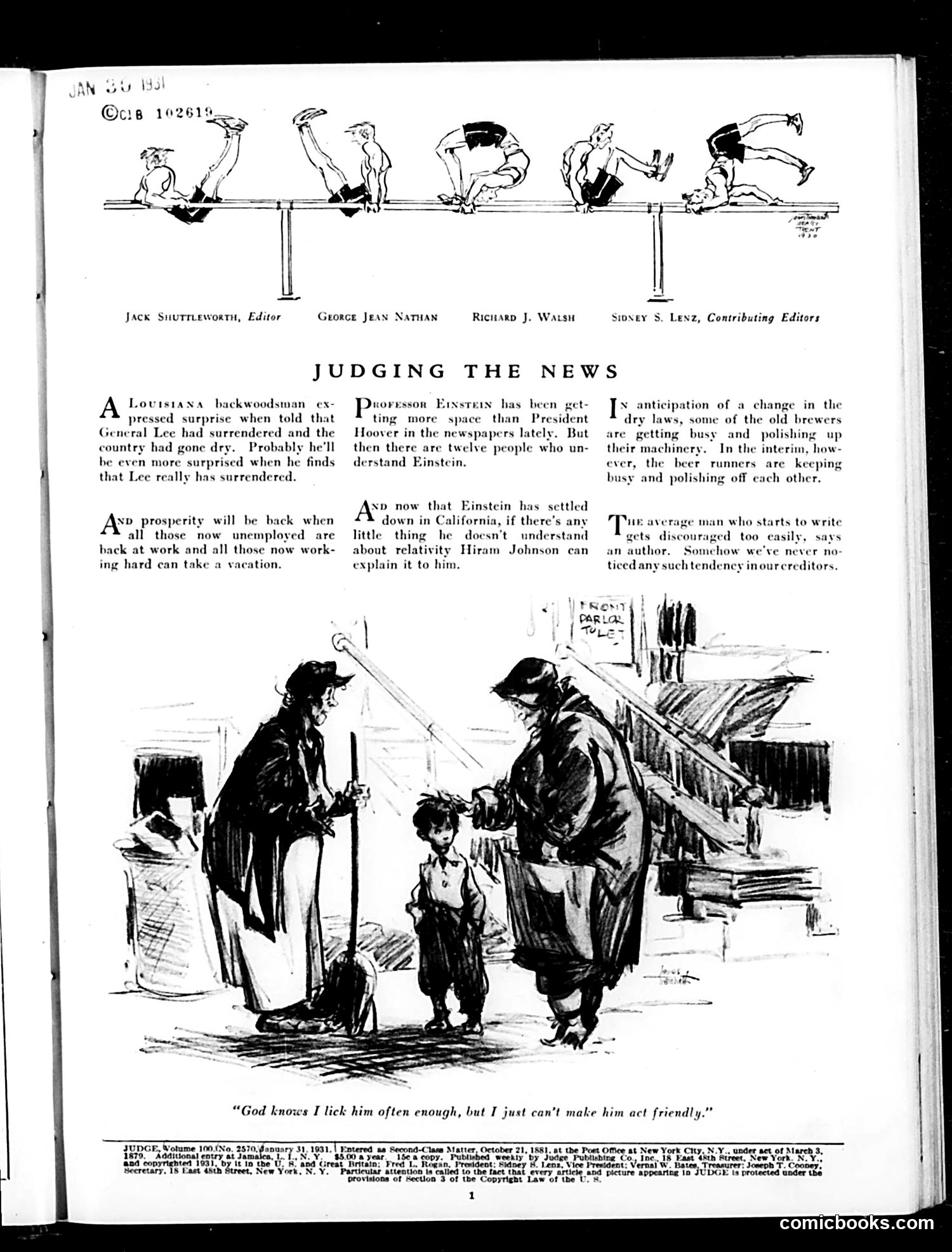
Analysis of "Judging the News" Page This page from Judge magazine (dated Jan 30, 1931) features editorial commentary with satirical short pieces: Top section discusses economic hardship: a Louisiana backwoodsman's surprise at dry conditions, and predictions that prosperity will return when unemployed workers take jobs (rather than vacations)—likely commentary on Depression-era unemployment. Einstein reference: The piece notes Einstein's recent arrival in California, joking that among twelve people who understand relativity, perhaps Hiram Johnson could explain it to him—a common contemporary joke about Einstein's complex theories. Writing commentary: Addresses aspiring authors' discouragement, attributing failures to "tedious affectations of predecessors." Bottom cartoon: Shows two working-class men speaking to a child about a third figure, with caption: "God knows I lick him often enough, but I just can't make him act friendly." This appears to satirize corporal punishment attitudes of the era.
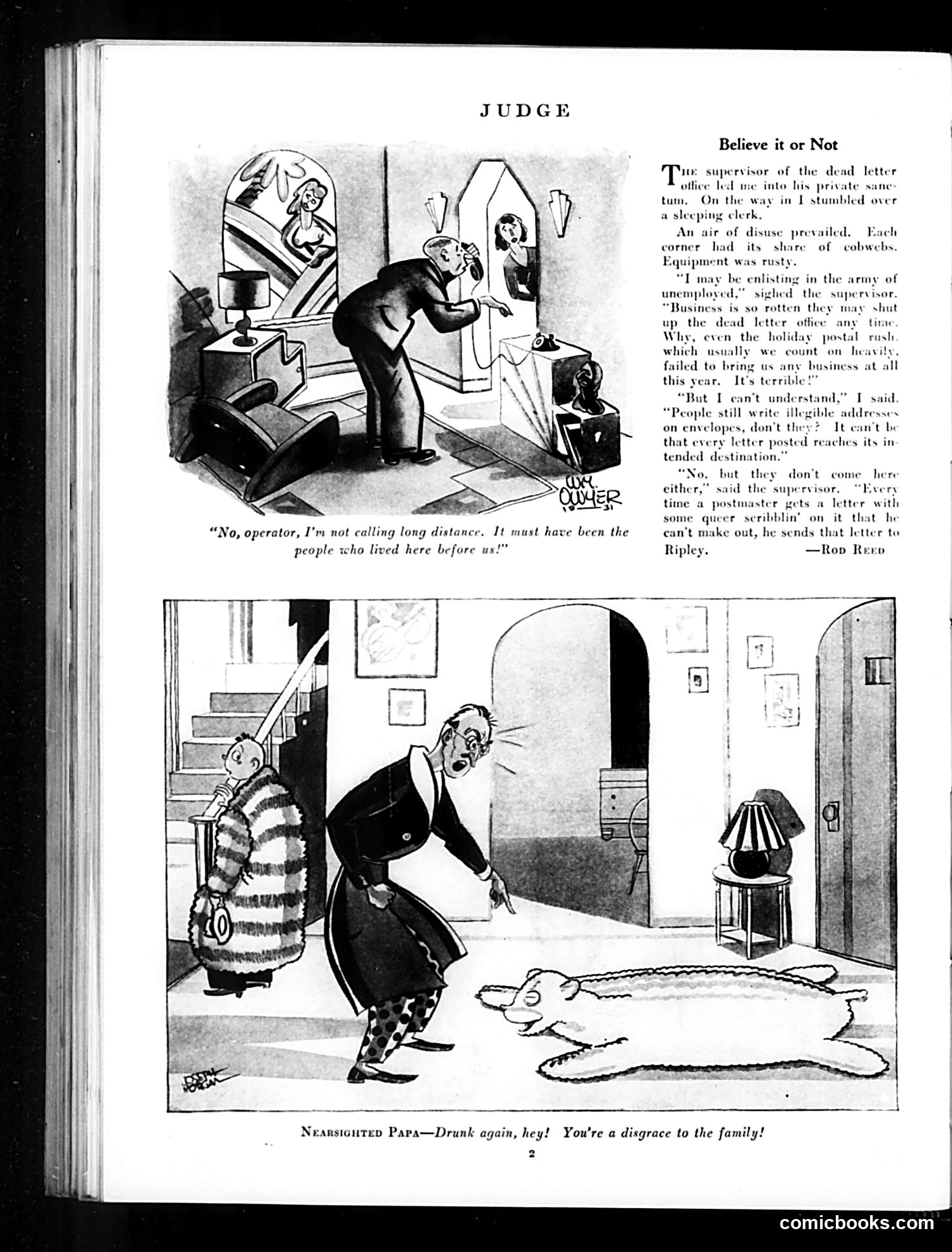
Analysis of Judge Magazine Page This page contains two unrelated cartoons satirizing early 20th-century American life: Top cartoon: A frustrated postal supervisor complains to an operator about mail delivery collapse. The joke critiques the post office's inability to handle business correspondence—even holiday mail fails to arrive. The supervisor ironically suggests the previous occupants of the building handled it better, implying current postal service is incompetent. Bottom cartoon: Titled "Nearsighted Papa," shows a man discovering what appears to be a snake on his floor while scolding a woman (likely his wife) for drunkenness. The humor derives from his mistaken identity—he's angry at the wrong "culprit," suggesting his poor vision causes domestic misunderstanding. Both cartoons rely on situational comedy about everyday frustrations rather than political commentary.
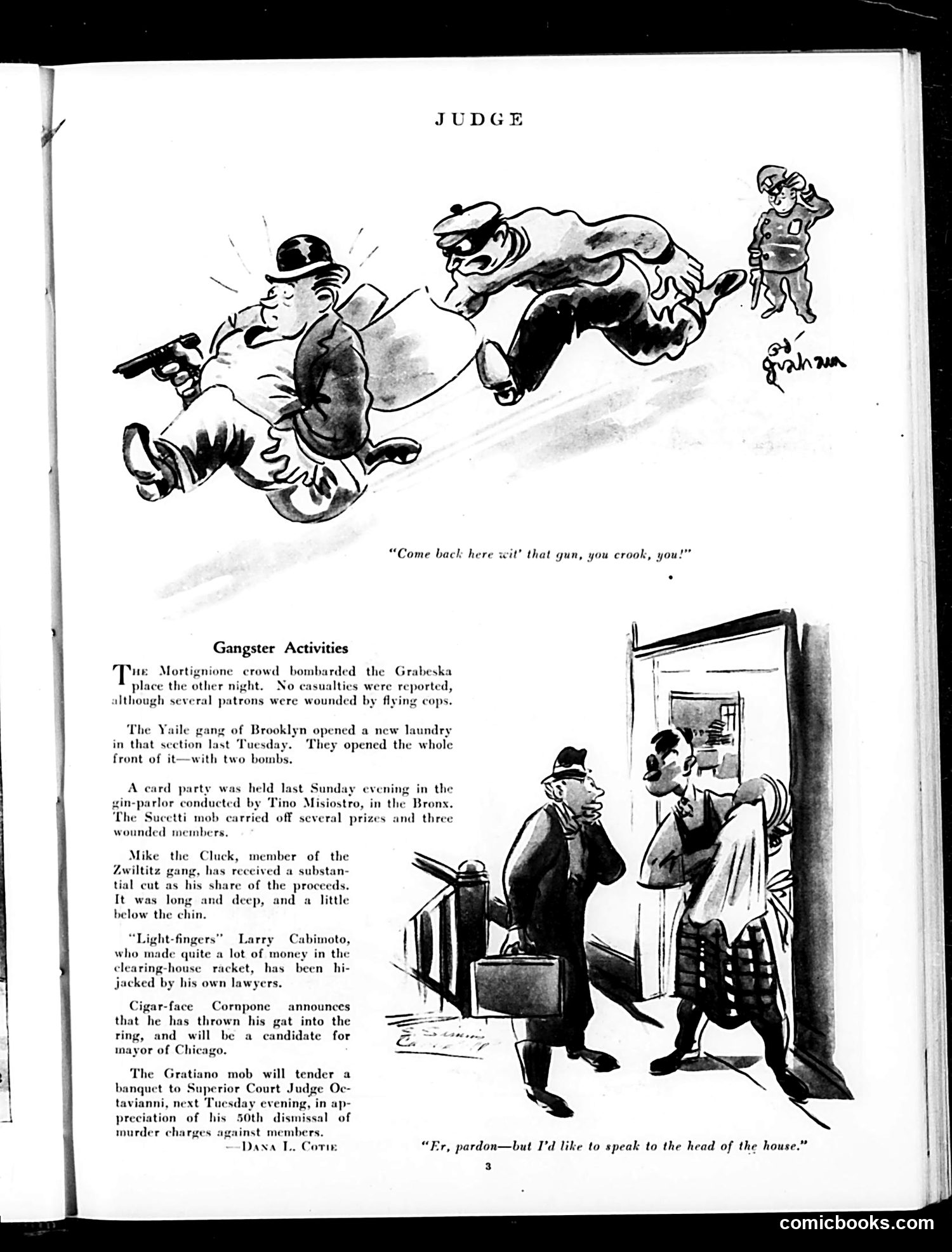
"Judge" Page Analysis: Gangster Activities This satirical page mocks 1920s organized crime through two cartoons and a gossip column. The top cartoon shows a judge chasing a fleeing gangster, captioned "Come back here wit' that gun, you crook, you!" — satirizing the apparent inability of law enforcement to prosecute criminals effectively. The bottom cartoon depicts gangsters at a doorway saying "Er, pardon—but I'd like to speak to the head of the house," mocking how organized crime infiltrated everyday life and conducted business brazenly. The "Gangster Activities" column details real incidents: bombings, laundry explosions, mob violence at card games, and gang members receiving wounds or payouts. The tone treats serious criminal violence with dark humor, reflecting public frustration with Prohibition-era lawlessness that seemed unstoppable by authorities.
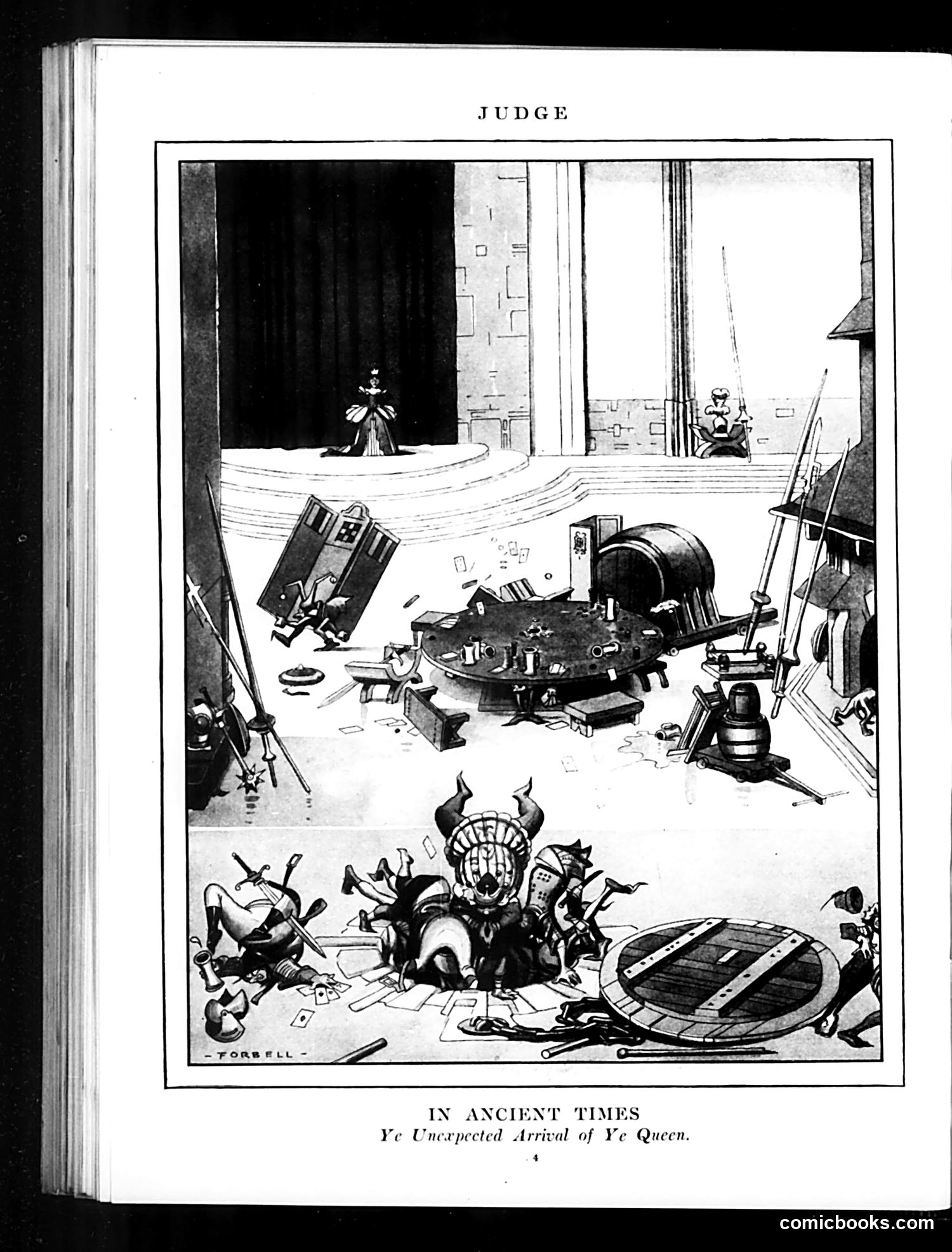
Analysis This cartoon, titled "In Ancient Times: Ye Unexpected Arrival of Ye Queen," uses anachronistic humor to satirize court chaos. The scene depicts a medieval or ancient throne room in disarray—with scattered weapons, armor, and debris covering the floor while courtiers scramble about in confusion. A queen (or dignitary) sits elevated on the throne, observing the pandemonium below. The joke appears to contrast the dignity expected of royal proceedings with the actual chaos of court life. The cartoonist (signed "Torbell") suggests that even in "ancient times," unexpected royal arrivals caused comical disorder among unprepared courtiers. This likely mocks contemporary political or social institutions by implying institutional incompetence is timeless.
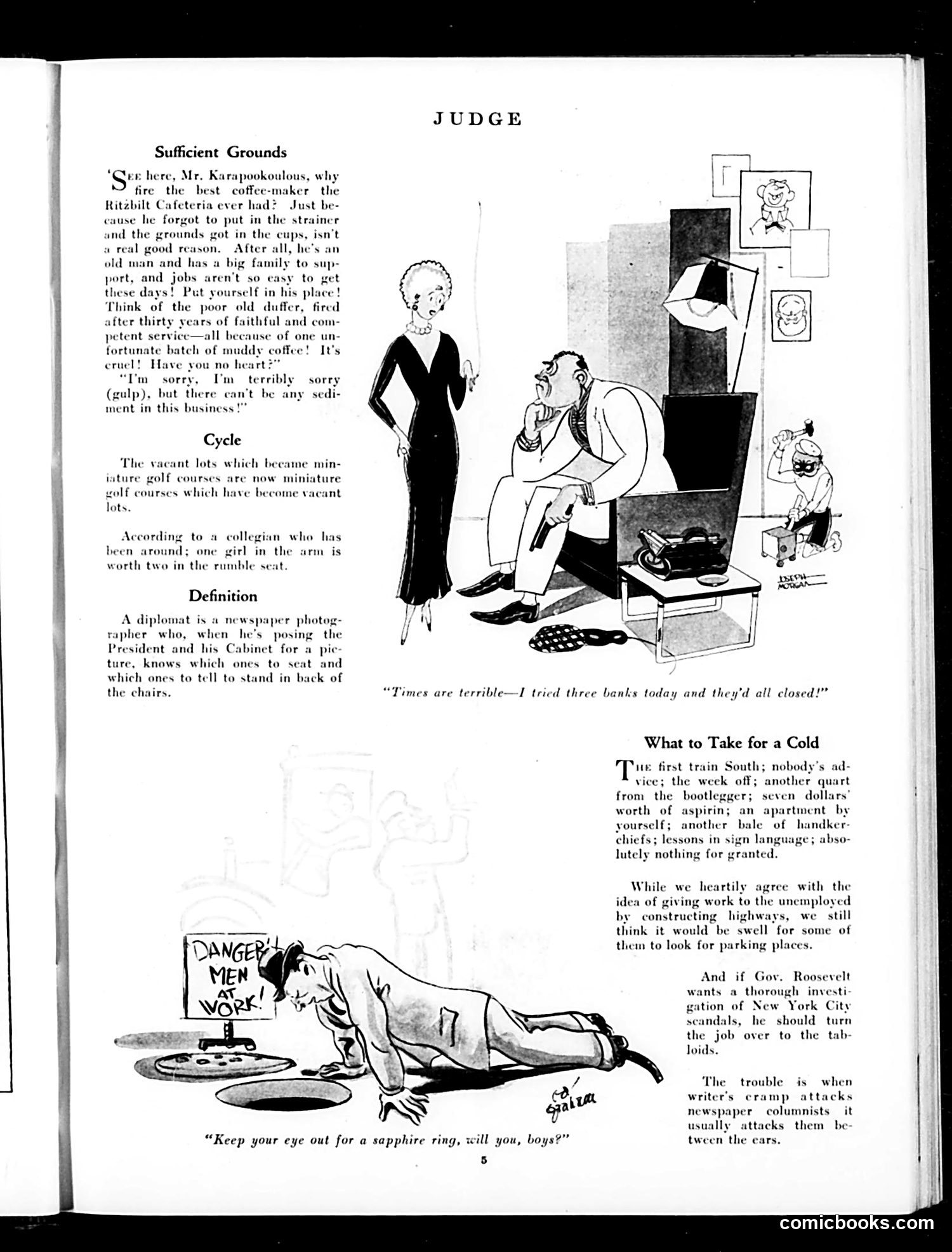
Analysis of Judge Magazine Page "Sufficient Grounds" (top cartoon): A woman fires her coffee-maker, Mr. Karapasokoulous, blaming him for poor coffee despite his 30 years of faithful service and large family. The satire critiques the callousness of employers during economic hardship—firing loyal workers over minor grievances when jobs are scarce and families depend on employment. "Cycle" and "Definition": Brief humorous notes about miniature golf courses and diplomats. "Danger! Men at Work" (bottom): A construction worker lies injured or dead near a manhole, illustrating workplace dangers. The caption's sarcasm ("Keep your eye out for a sapphire ring") darkly jokes about workplace accidents. "What to Take for a Cold": Satirizes unemployment remedies—absurd suggestions like "first train South" or "bootlegger's liquor"—mocking inadequate relief during economic crisis.
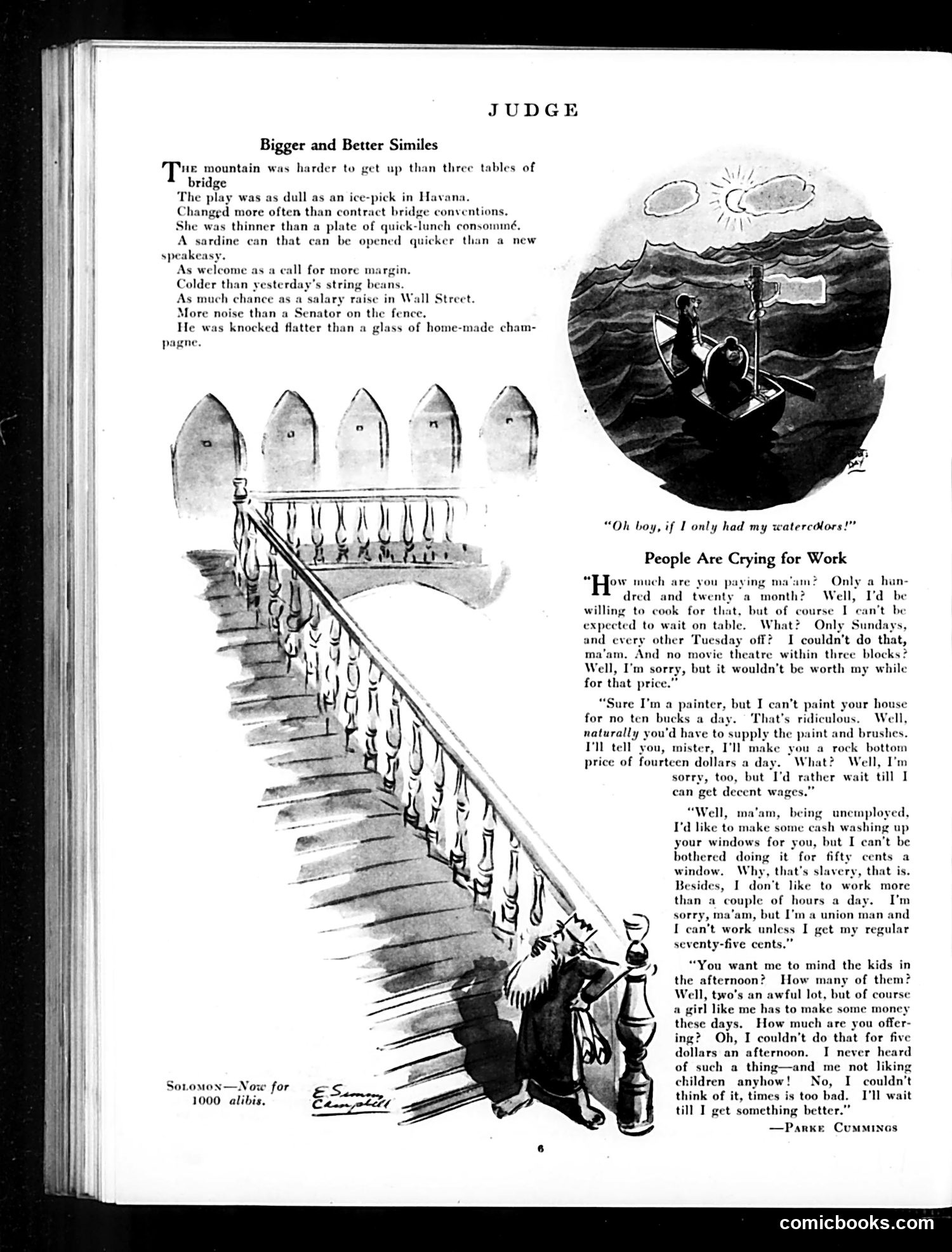
Judge Magazine Page Analysis This page contains two distinct elements: "Bigger and Better Similes" (top): A series of comparative phrases mocking various topics—mountains, plays, Havana conditions, speakeasies, senators, and champagne. These appear to be topical jokes referencing Prohibition-era culture and contemporary politics, though specific references are unclear without dating. "People Are Crying for Work" (bottom): A satirical dialogue between unemployed workers and a potential employer, illustrated by a figure on a bridge railing. The exchange mocks the vast gap between job-seekers' desperation and employers' unwillingness to pay reasonable wages. Workers accept near-slavery wages while employers demand unrealistic conditions. The cartoon critiques both economic inequality and labor market dysfunction, likely from the Depression or post-WWI period, though the exact date isn't visible.
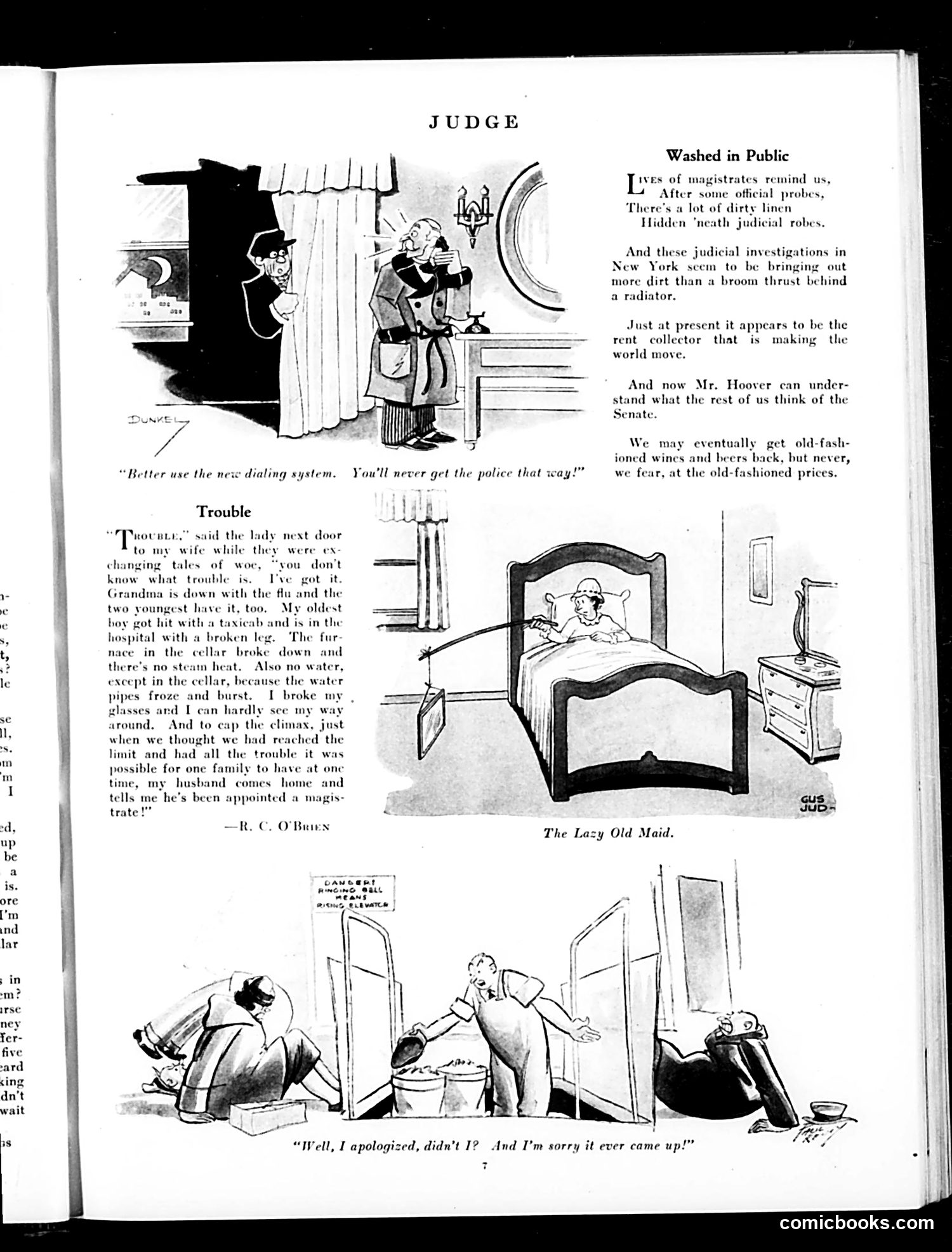
Judge Magazine Page Analysis This page contains satirical commentary on 1920s-30s American life: "Washed in Public" poem mocks judicial corruption in New York, suggesting magistrates hide misconduct ("dirty linen hidden 'neath judicial robes"). It references ongoing investigations exposing corruption and rent-collector scandals. The quip about Hoover likely refers to President Hoover's unpopularity during economic crisis, while the Prohibition-era joke warns that even if alcohol returns, prices won't fall. "Trouble" story (by R.C. O'Brien) humorously catalogs domestic disasters—flu, accident, broken furnace, frozen pipes, broken glasses—then delivers the punchline: the husband's appointment as magistrate tops them all. This satirizes the irony that a judicial appointment, normally prestigious, becomes the final indignity given the corruption exposed in the "Washed in Public" section. The cartoons illustrate both pieces with visual gags matching the text's tone of social critique wrapped in humor.
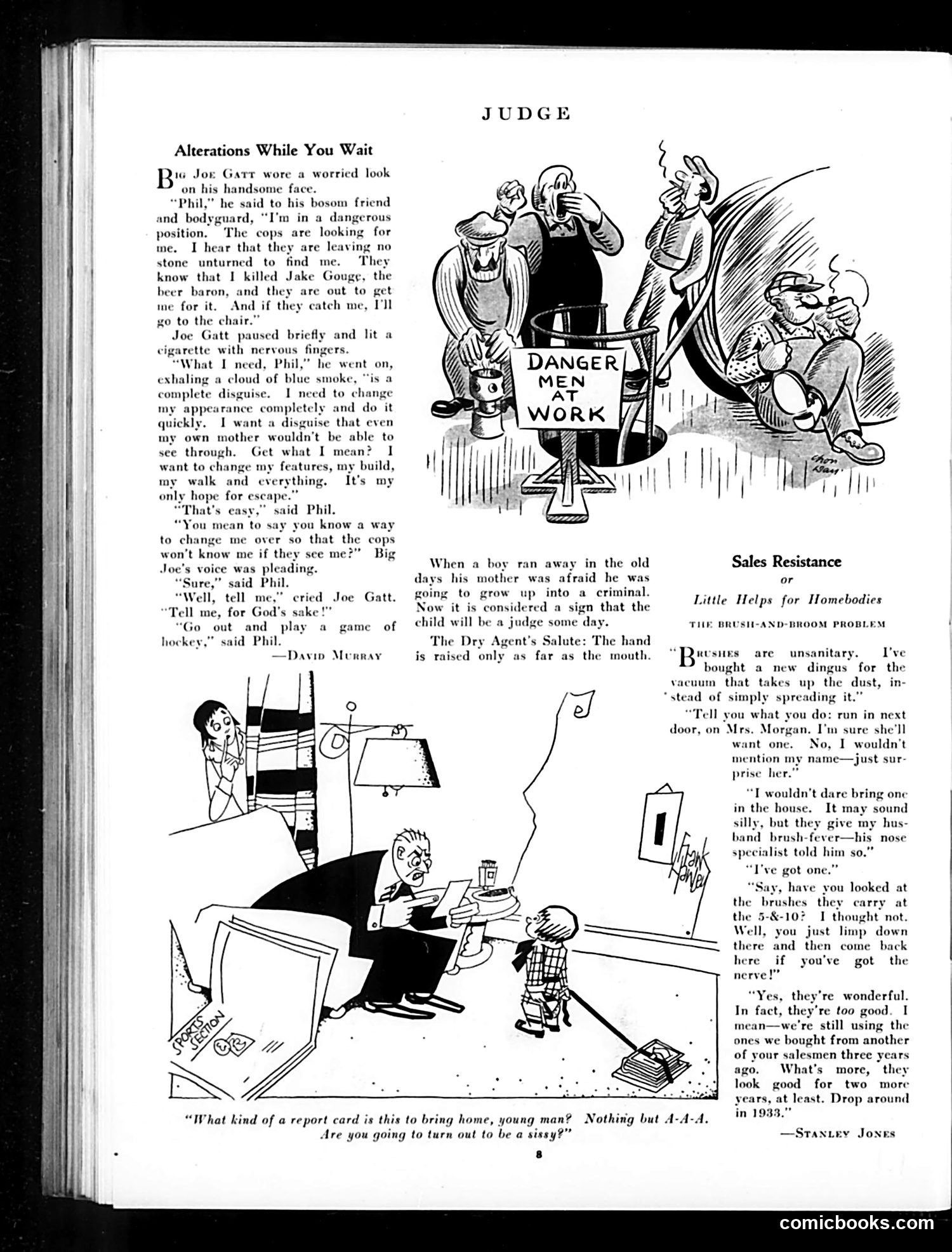
"Alterations While You Wait" — Judge Magazine This page contains two satirical pieces lampooning American society: Main Cartoon: A gangster (Big Joe Gatt) seeks a complete disguise to evade police after allegedly killing a "beer baron" named Jake Gouge. His friend Phil suggests he simply "go out and play a game of hockey"—the joke being that a disguise is unnecessary; ordinary law-abiding behavior itself is the perfect cover. The satire targets Prohibition-era criminals and police ineffectiveness. Secondary Jokes: - A quip about boys becoming judges (reversing the moral anxiety of earlier generations) - "Sales Resistance": A housewife resists buying a new vacuum cleaner because her old brushes still work perfectly—satirizing both consumer pressure and domestic thrift during economically uncertain times (the 1930s reference to "1933" suggests Depression-era frugality) - A father angered his son earns only A's in school, fearing academic excellence indicates weakness—mocking parental values and masculinity anxieties. The page reflects Depression-era concerns: crime, consumerism, and changing social expectations.
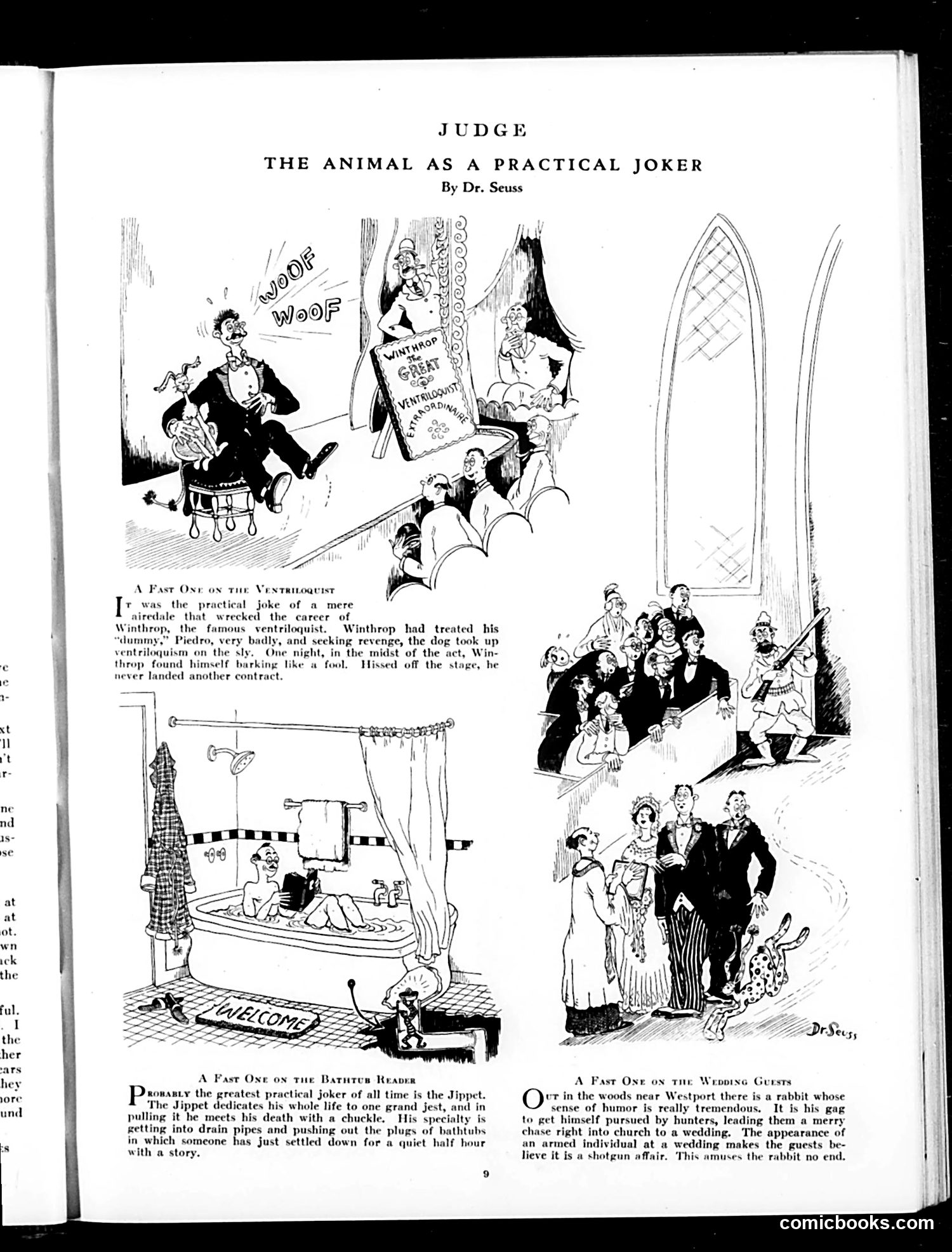
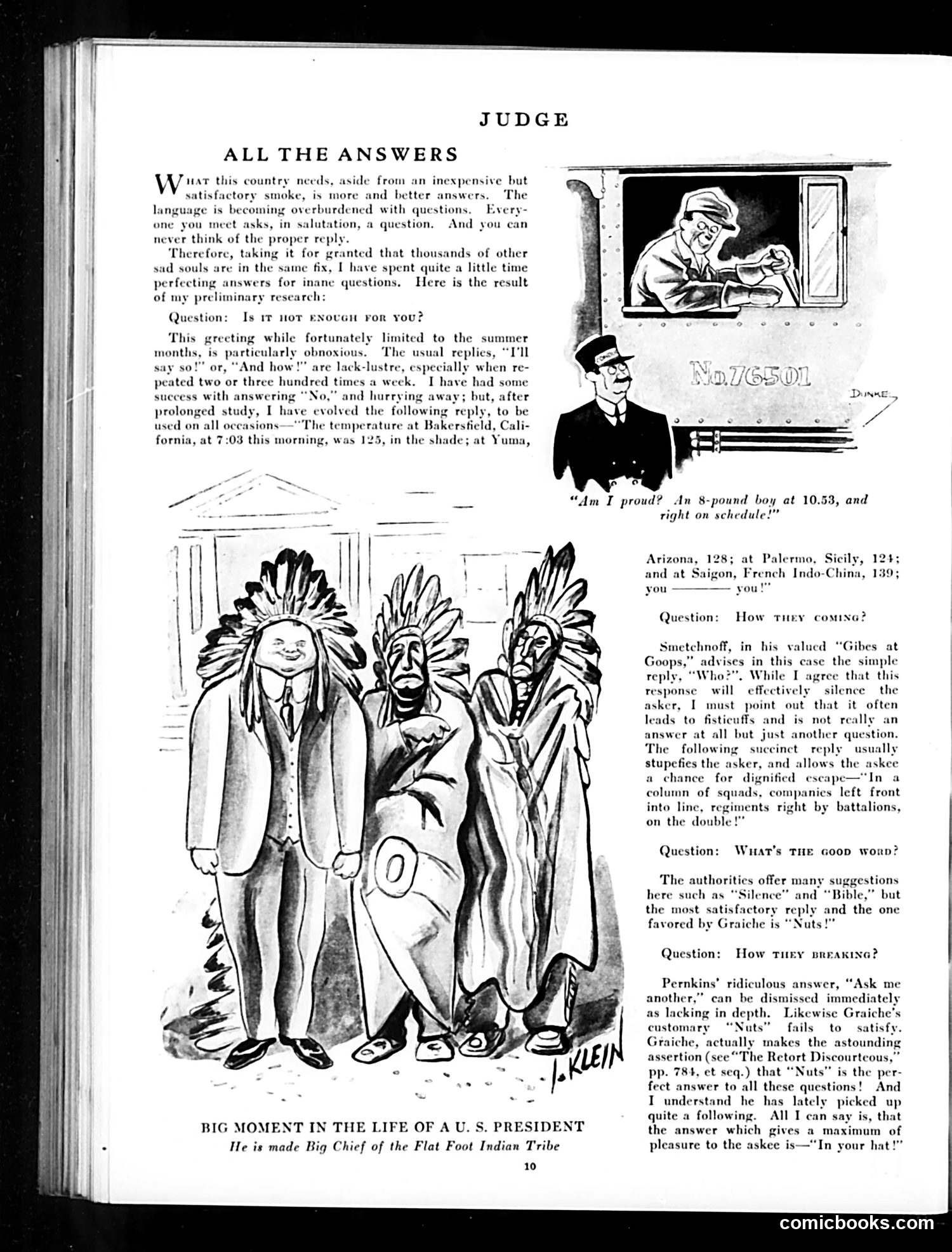
"Judge" Magazine: "All the Answers" (c. 1920s) This satirical piece mocks the American habit of greeting strangers with tired, repetitive questions ("Is it hot enough for you?") and proposes absurdly elaborate or dismissive answers. The main cartoon depicts a U.S. President being made "Big Chief of the Flat Foot Indian Tribe"—a reference to the era's crude racial caricatures and the condescending treatment of Native Americans. The caption sardonically elevates this ceremonial "honor." The article's recurring punchline is "Nuts!"—suggesting that when faced with inane social questions, the best response is to dismiss them as nonsensical. This reflects 1920s-era humor valuing wit and verbal sparring. The cartoon critiques both shallow American social conventions and contemporary attitudes toward Indigenous peoples, using exaggerated stereotypes typical of early 20th-century publications. The advice to answer "In your hat!" offers mock-earnest solutions to meaningless pleasantries.
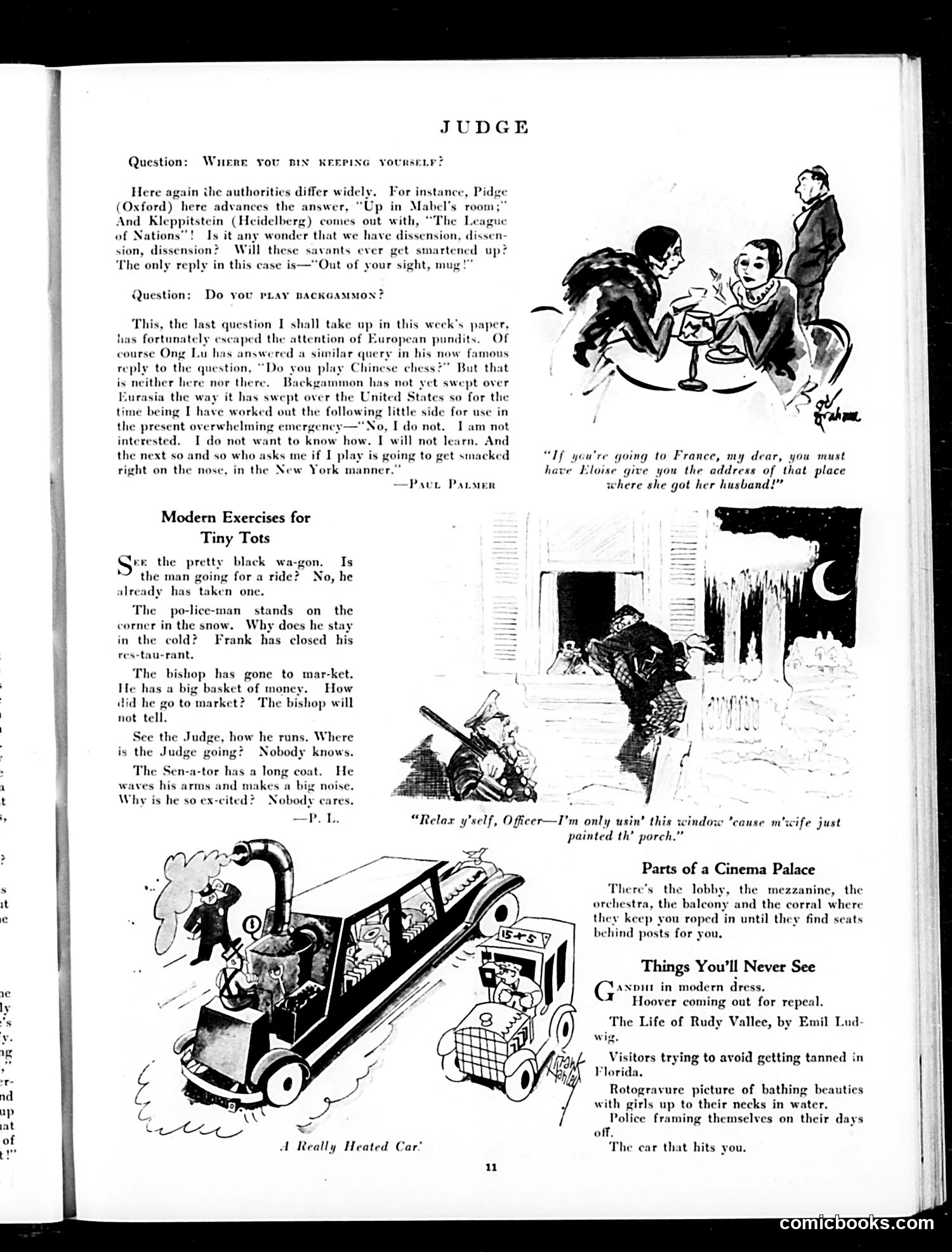
Judge Magazine Page Analysis This page from Judge magazine (circa 1920s-30s) contains humorous social commentary: "Judge" Column: Satirizes academic pretension by mocking how European scholars ("Pidge of Oxford," "Kleppitstein of Heidelberg") offer absurdly different answers to simple questions about where people keep themselves ("Up in Mabel's room" vs. "The League of Nations"). The joke ridicules intellectual pomposity and European-American cultural differences. Modern Exercises for Tiny Tots: Parodies children's educational primers with nonsensical scenarios (a policeman standing in snow, a bishop going to market) that teach nothing practical—mocking overly sentimental or pointless pedagogy. Cartoon captions include jokes about marital infidelity ("address of that place where she got her husband") and social pretense. "Things You'll Never See" is a satirical list mocking 1920s-30s society: Prohibition-era references ("Hoover coming out for repeal"), celebrity culture (Rudy Vallee), and the pretense that American life is orderly (ending with "The car that hits you"—dark humor about traffic fatalities being unavoidable). The overall tone is cynical, class-conscious satire of contemporary American and European society.
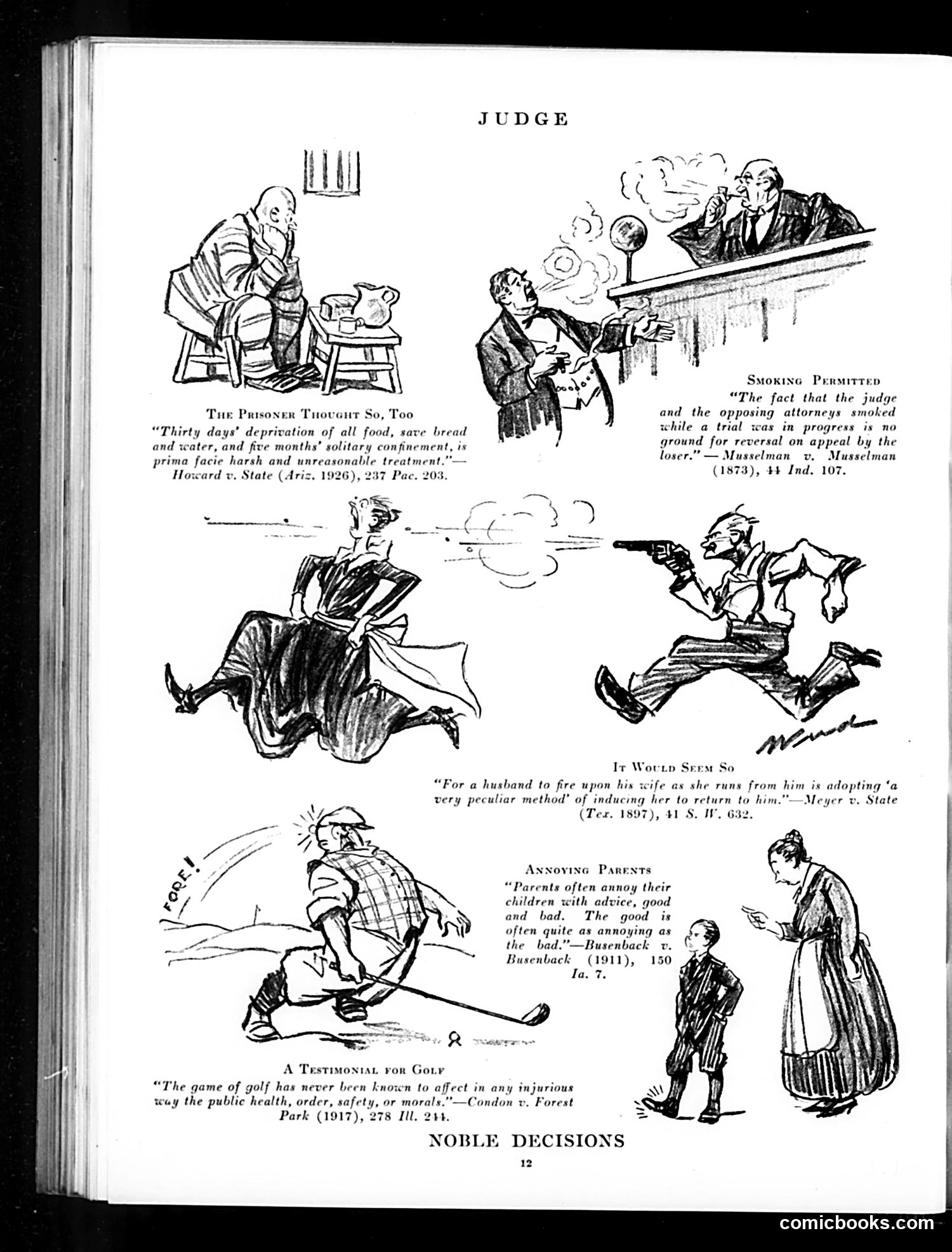
Explanation: "Judge" Magazine's "Noble Decisions" Page This page satirizes absurd legal rulings by pairing humorous illustrations with real court citations. Each cartoon ridicules a seemingly nonsensical judicial decision: 1. "The Prisoner Thought So, Too": Mocks a ruling that harsh prison conditions (starvation, solitary confinement) aren't grounds for appeal—the prisoner's emaciated appearance proves the decision's cruelty. 2. "Smoking Permitted": A judge and lawyers smoke during trial, yet smoking doesn't invalidate verdicts—satirizing the judiciary's self-serving logic. 3. "It Would Seem So": A husband shoots at his fleeing wife; courts ruled this wasn't necessarily wrong—the cartoon's exaggeration highlights the decision's absurdity. 4. "Annoying Parents": Parents' advice (good or bad) equally annoys children—mocking the court's circular, unhelpful logic. 5. "A Testimonial for Golf": Golf poses no public health threat—likely satirizing golf's social cachet protecting it from regulation. The page uses vintage legal precedents to critique judicial reasoning through dark humor and irony.
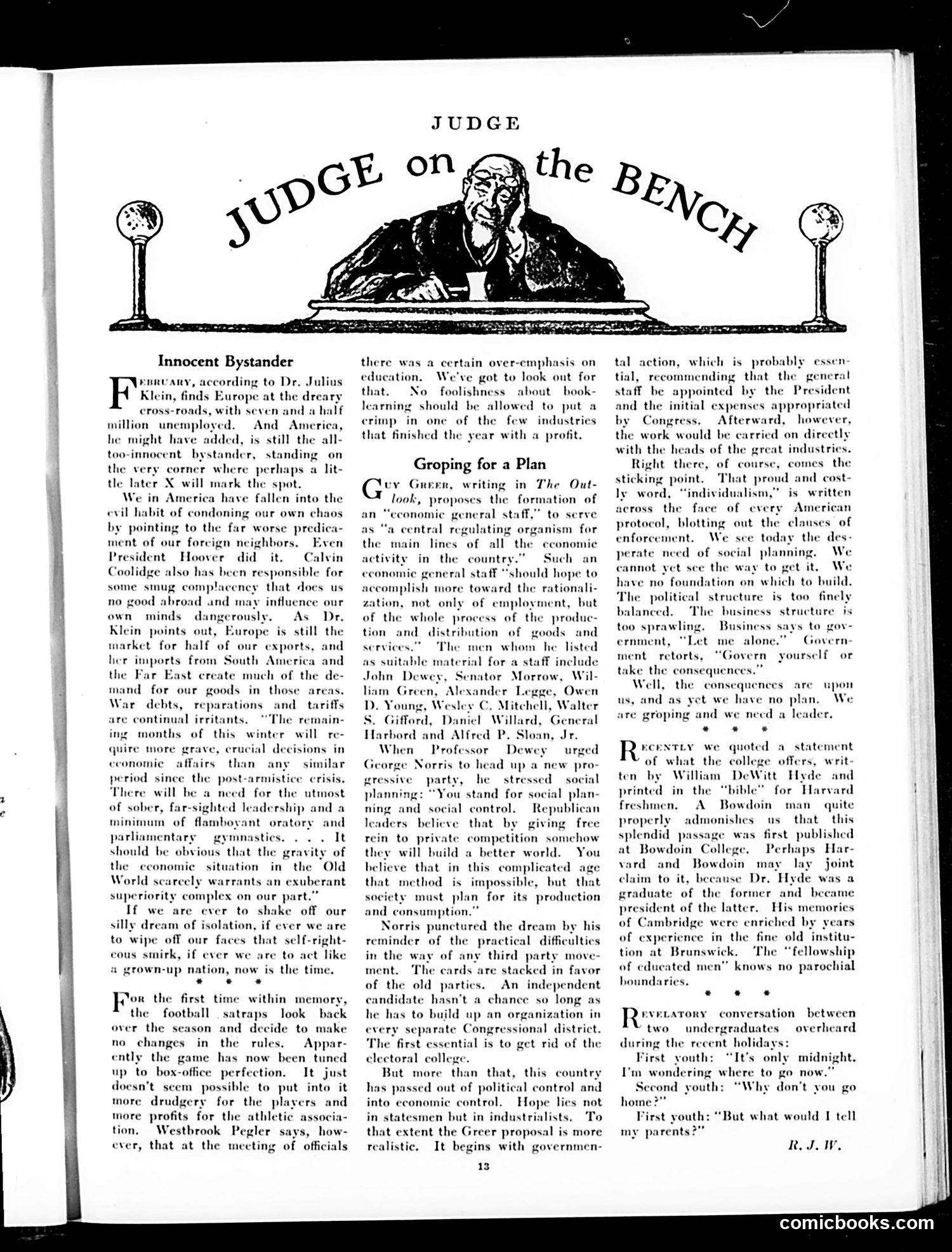
Political Satire Analysis: Judge Magazine Page This page contains three separate satirical commentaries on American politics and society, circa early 1930s: "Innocent Bystander" critiques American isolationism and smugness toward Europe's economic crisis (7.5 million unemployed). The author attacks President Hoover and Calvin Coolidge for fostering complacency while America depends on European markets. The satire: America believes itself superior while ignoring interconnected global economic problems. The football section mocks college football's prioritization of profit over education—the irony being that officials eliminated educational rules to protect the sport's lucrative status. "Groping for a Plan" discusses proposals for an "economic general staff" led by figures like John Dewey and Owen Young to centrally manage economic activity. Senator Norris deflates the dream by noting third parties cannot compete within the existing two-party system without eliminating the electoral college. The overall tone: American leaders are self-deceiving, prioritizing short-term profit over long-term stability, and structurally prevented from implementing necessary reforms.
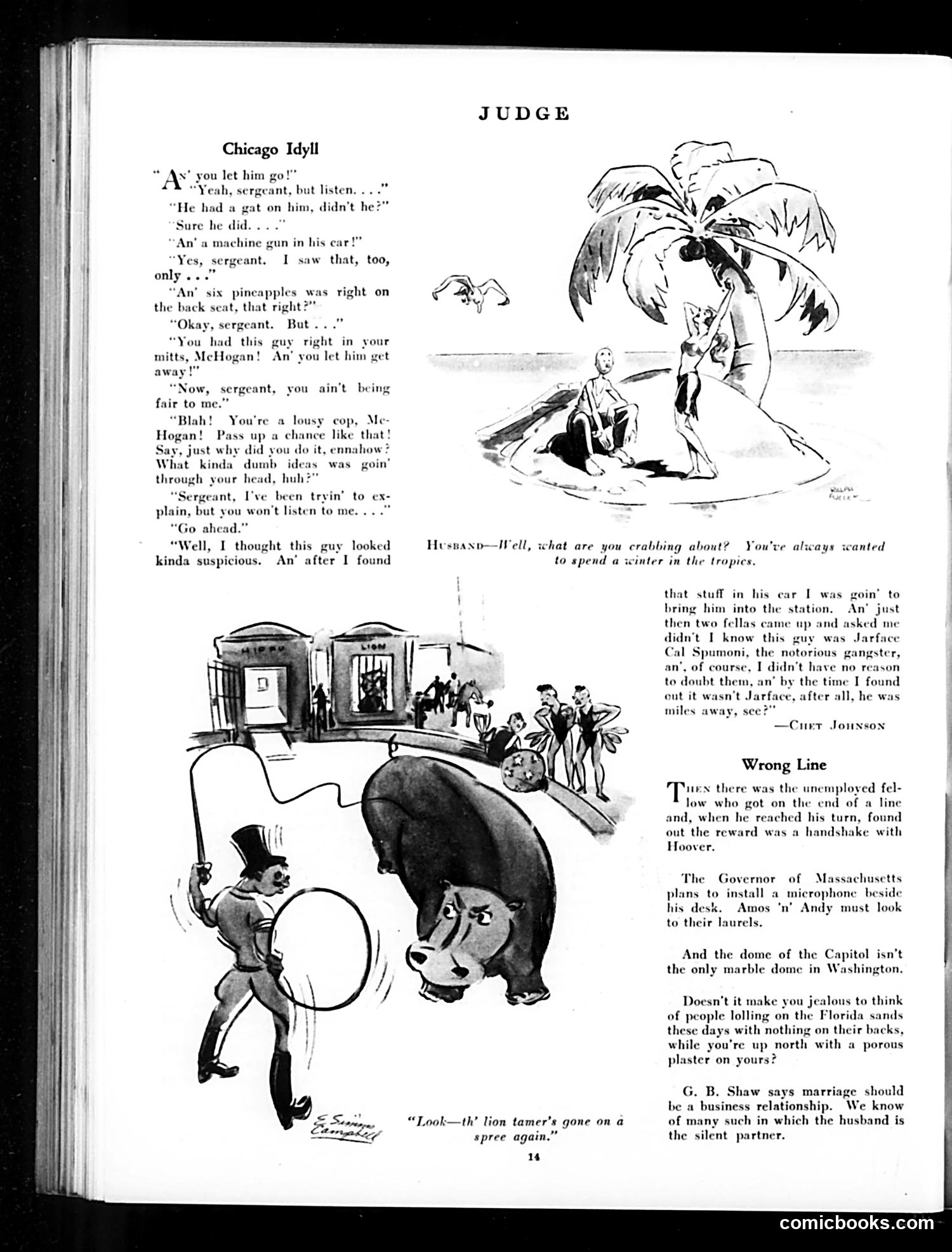
Judge Magazine Page Analysis This page contains two distinct satirical pieces: "Chicago Idyll" (top): A dialogue between a sergeant and Officer McHogan about a bungled arrest. McHogan stopped a suspicious man carrying a machine gun and pineapples (likely explosives), but released him when two men claimed to know him—who turned out to be gangsters springing their associate, Jarface Cal Spumoni. The joke satirizes police incompetence and corruption during Prohibition-era Chicago, when organized crime regularly interfered with law enforcement. "Wrong Line" (bottom): Multiple one-liner jokes about contemporary issues. One references President Hoover offering only a handshake as a "reward" to unemployed men during the Depression—sharp criticism of inadequate relief efforts. Others mock politicians (Massachusetts governor, Washington bureaucrats) and social inequities (Florida vacations vs. northern hardship). The cartoon of a man wrestling a lion illustrates the "spree" joke about a lion tamer's escape. These pieces reflect early 1930s anxieties: Depression unemployment, gangsterism, and governmental failure to address economic crisis.
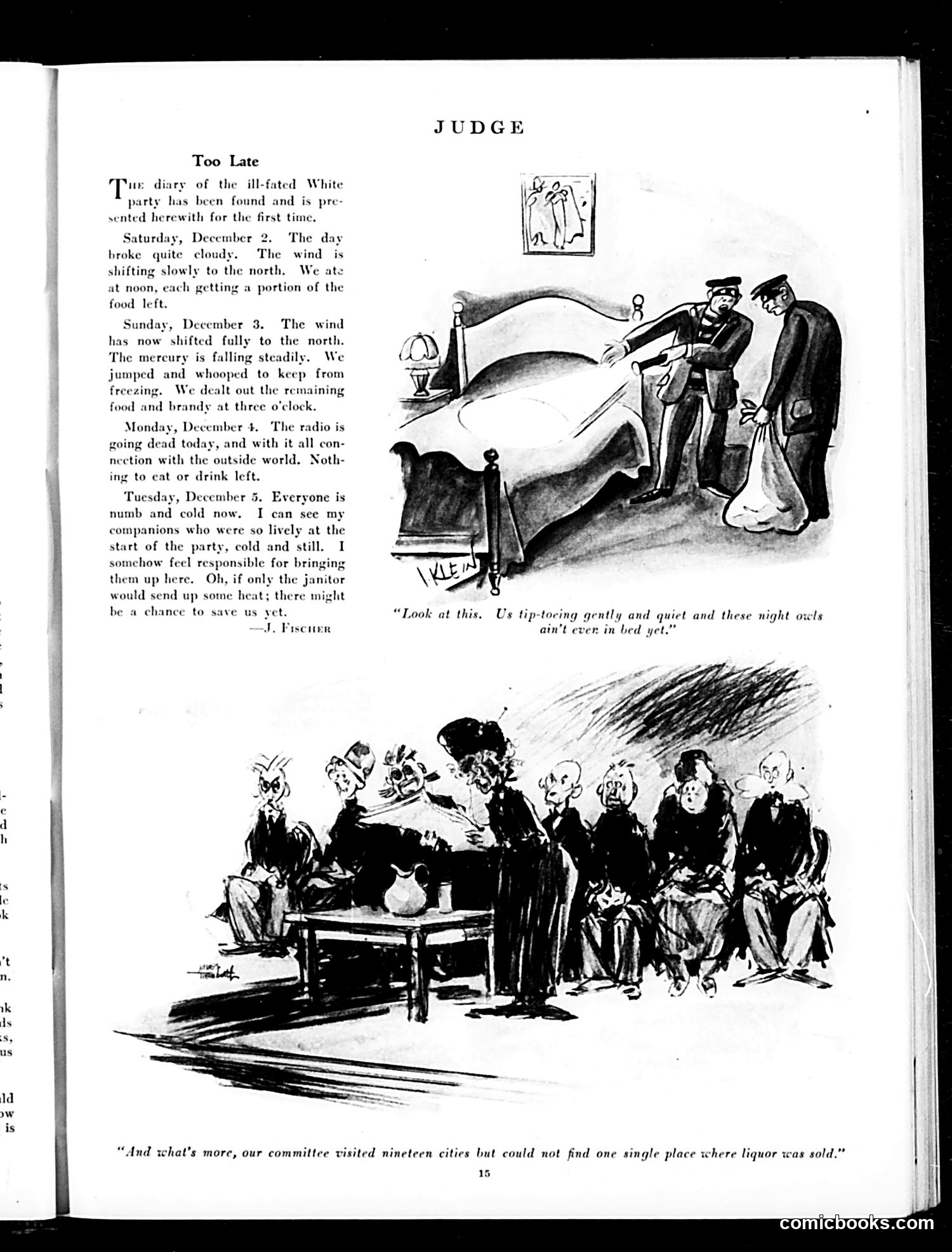
Analysis This page satirizes the failed Donner Party expedition of 1846—a pioneer group trapped in Sierra Nevada mountains during winter, facing starvation and death. The "diary" frames the tragedy as dark comedy: entries from December 2-5 chronicle dwindling food supplies, bitter cold, and mounting desperation. The final entry's plea—"if only the janitor would send up some heat"—uses absurdist humor by treating the wilderness catastrophe like a tenement apartment complaint. The upper cartoon shows what appears to be a corpse being examined by officials, captioned with a wry observation about the victims' "tip-toeing gently"—mocking the propriety of the dead. The lower cartoon depicts a committee meeting, with the caption: "our committee visited nineteen cities but could not find one single place where liquor was sold." This references Prohibition-era hypocrisy: authorities claimed to enforce alcohol bans while obviously failing. Judge uses the Donner Party tragedy as a vehicle to mock both historical incompetence and contemporary governmental ineffectiveness.
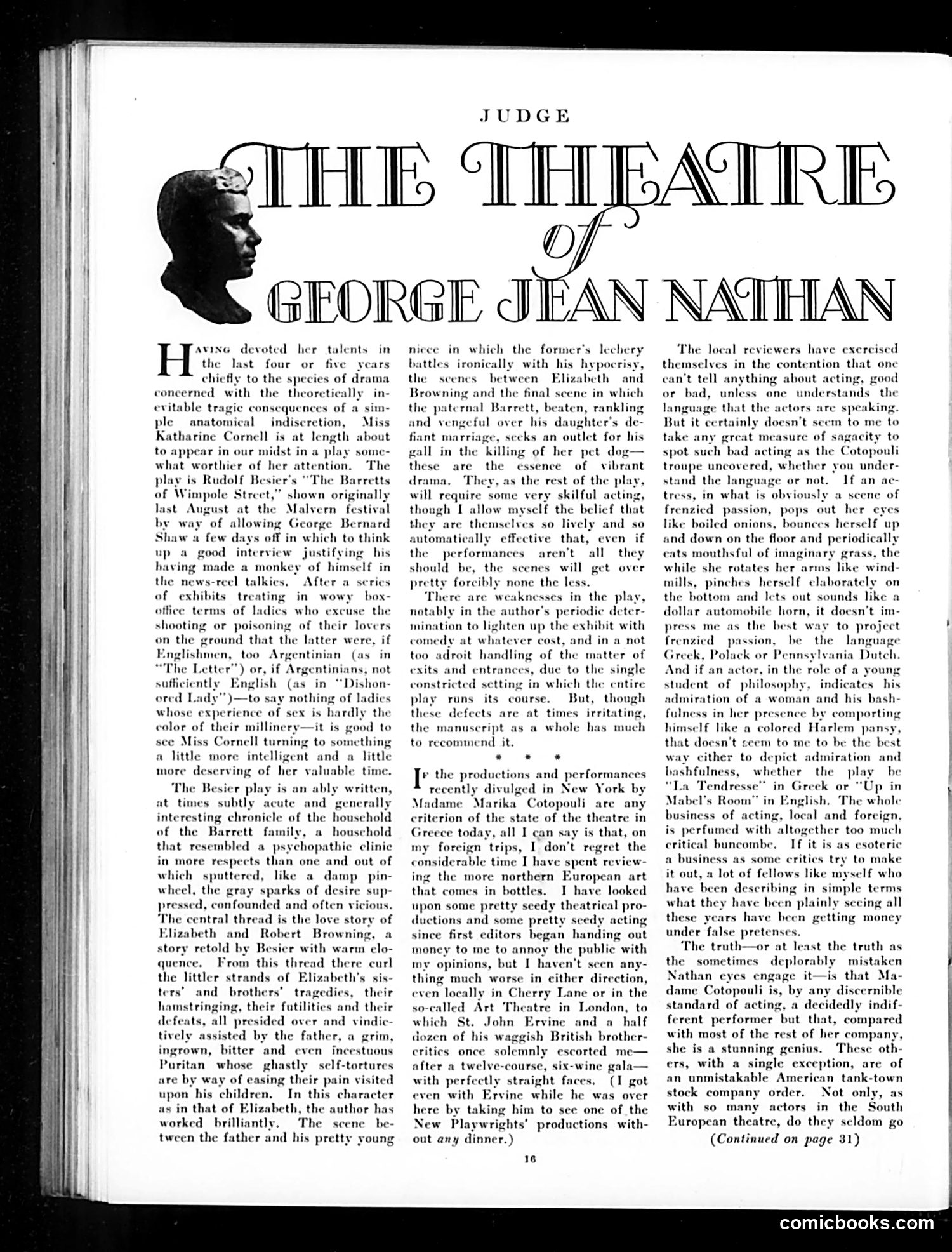
Judge Magazine Theater Review: "The Theatre of George Jean Nathan" This is a theater critique by Judge's drama reviewer, discussing actress Katharine Cornell's upcoming role in Rudolf Besier's "The Barretts of Wimpole Street." The reviewer praises Cornell for moving beyond her previous roles in melodramas about women who murder unfaithful lovers—plays the critic dismisses as emotionally manipulative but intellectually shallow. The piece celebrates the new play's psychological depth, particularly its portrayal of the Barrett family's pathological dynamics and the central love story between Elizabeth Barrett and Robert Browning. The reviewer acknowledges minor structural weaknesses but argues the material itself is strong enough to overcome them. The critique also references foreign theatrical productions, including performances by Madame Marika Cotopouli in Greece, which the reviewer uses to assert his cosmopolitan credibility as a theater critic.
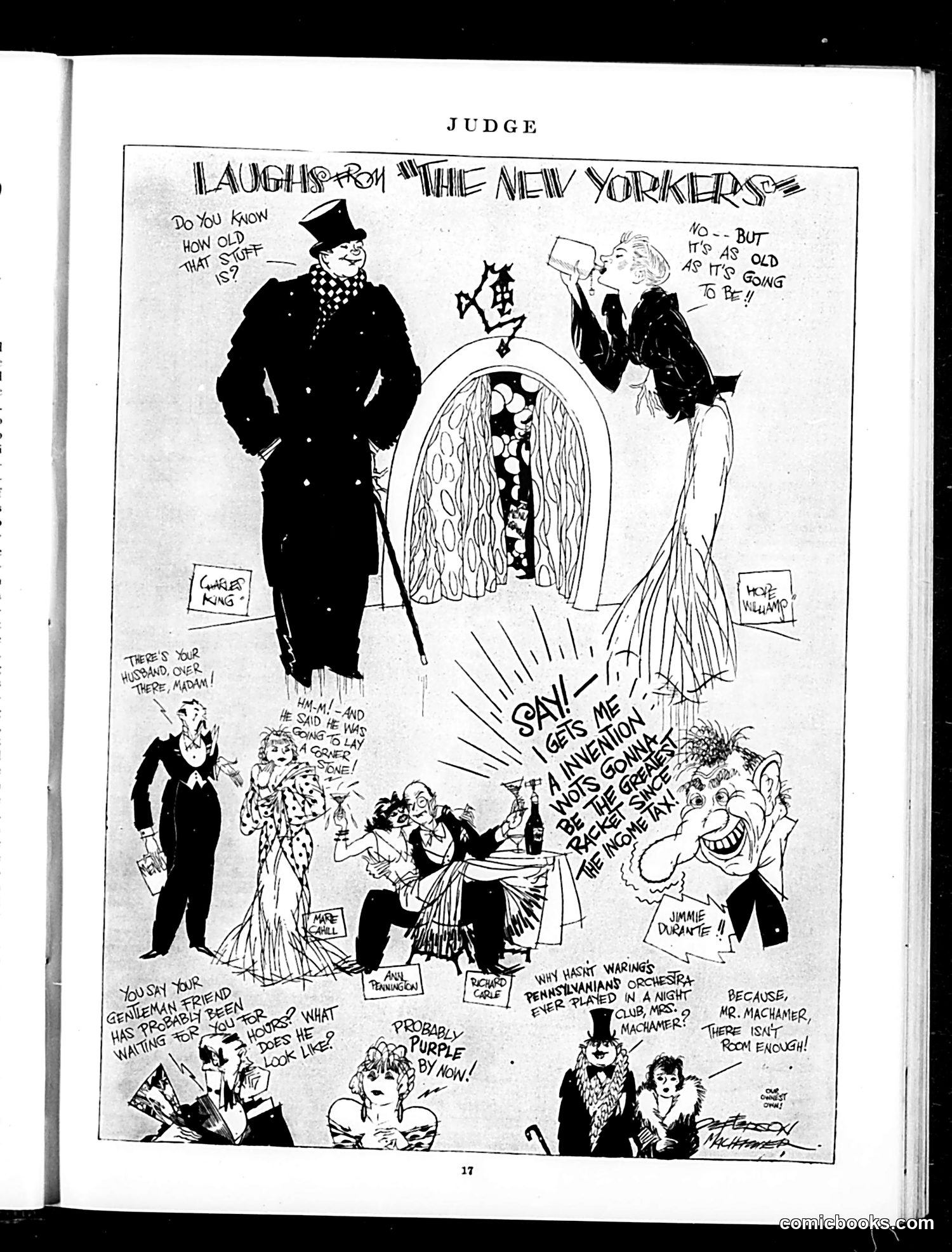
"Laughs from the New Yorkers" This is a satirical cartoon mocking New York high society and cultural pretensions. The central figure appears to be a socialite or wealthy woman in an elaborate gown, surrounded by various NYC characters discussing fashionable concerns. The jokes target: - Old money attitudes: One figure asks "Do you know anything old that stuff is?" — mocking obsession with antiquity - Musical snobbery: References to the "Pennsylvania Orchestra" and warnings about "Jimmie Durante" suggest tension between classical elitism and popular entertainment - Social status anxiety: Characters worry about "not getting an invitation" and whether they'll be "gone" socially - Space and exclusivity: The punchline references "room enough" at exclusive clubs, satirizing gatekeeping The cartoon captures 1920s-30s New York's class consciousness and the anxiety of maintaining social position. The chaotic composition mirrors the frenzied social climbing being ridiculed.
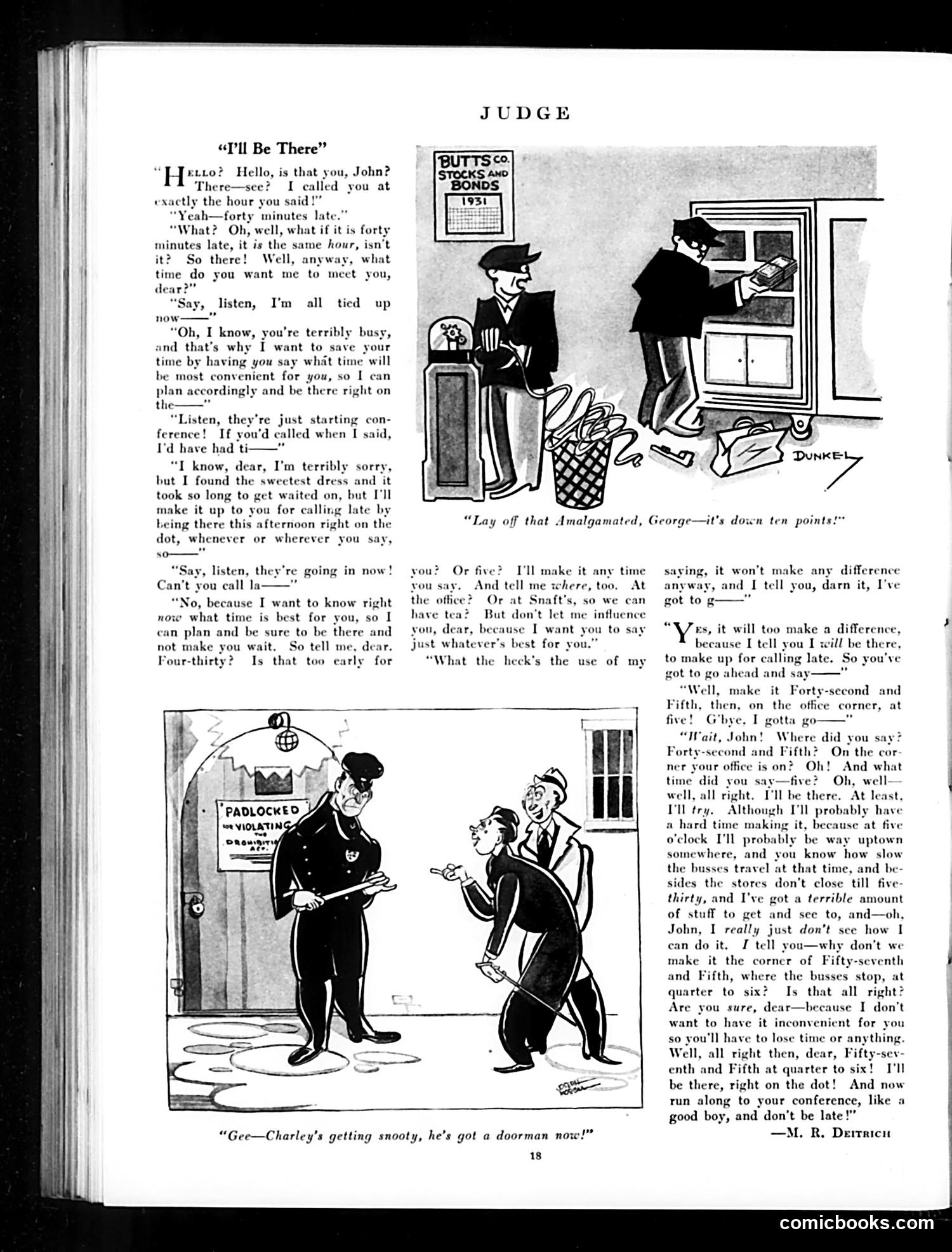
"I'll Be There" — A Satire on Women's Indecision and Inconsiderateness This two-part humor piece mocks the stereotypical inconsistent woman caller. The first cartoon depicts a woman calling a man at work, claiming to respect his time while actually wasting it through endless indecision about meeting plans. She repeatedly changes details (location, time) after insisting she wanted *him* to decide, contradicting her stated purpose. The accompanying dialogue continues this theme, with the woman promising punctuality while simultaneously listing obstacles (shopping, bus schedules, store hours) that make her arrival unlikely. She apologizes profusely yet persists in making new demands. The second cartoon shows an unrelated office scene with men discussing stock prices ("Amalgamated"). The satire targets early-20th-century gender stereotypes: women as flighty, inconsistent, and indifferent to men's professional obligations. While the humor was contemporary to Judge magazine's era, modern readers would recognize this as dated sexist comedy relying on broad female caricature.
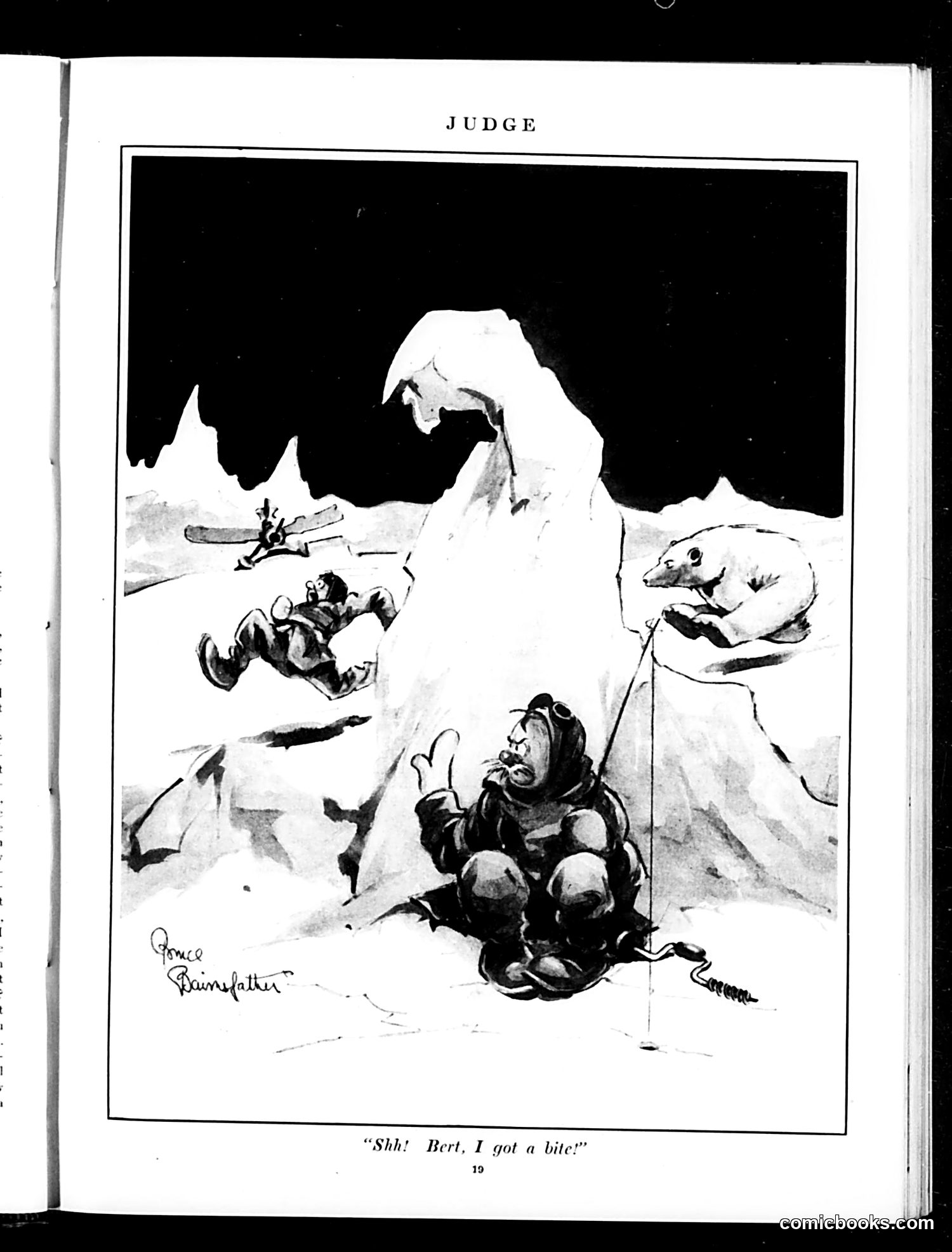
Judge Magazine Cartoon Analysis This Arctic survival cartoon depicts two figures in heavy winter gear on an icy landscape with a large polar bear looming above them. One character says to "Bert": "Shh! Bert, I got a biter!"—a darkly humorous understatement given the obvious danger posed by the massive bear. The satire appears to be a play on hunting/fishing terminology: calling the bear a "biter" uses casual sportsman's language for a situation that is actually life-threatening. The humor relies on the contrast between the calm, matter-of-fact tone and the genuine peril—a common Judge magazine technique satirizing human tendency to downplay dangerous situations. The cartoonist's signature appears to be present but is unclear. This exemplifies early 20th-century satirical comics mixing adventure with dark humor.
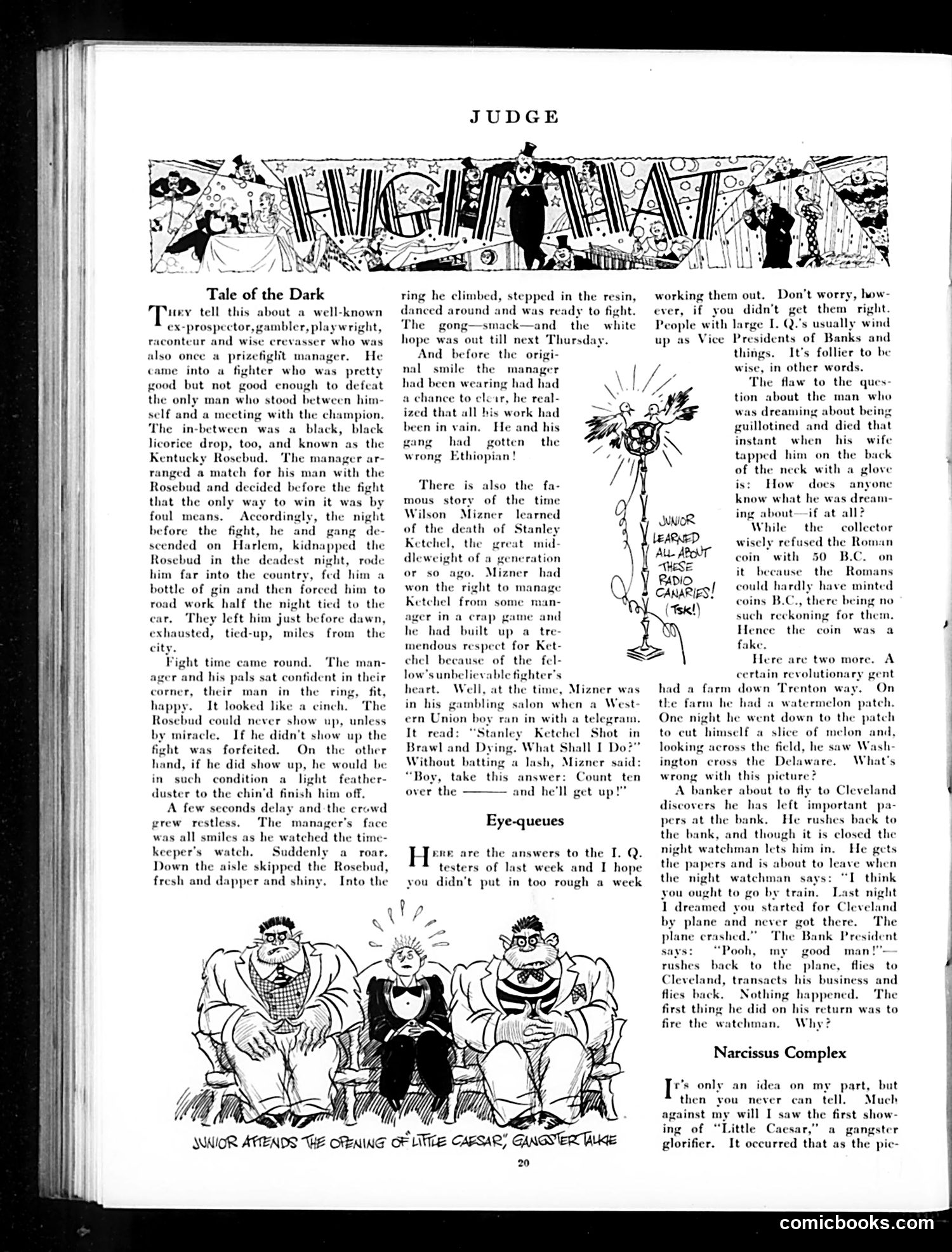
Judge Magazine Page Analysis This page from *Judge* contains two main sections: "Tale of the Dark" presents anecdotes about Wilson Mizner, a famous early-20th-century gambler, playwright, and boxing manager. The stories illustrate Mizner's cunning and wit: one describes him kidnapping an opponent's fighter (called "Kentucky Rosebud") to sabotage a match, only to accidentally grab the wrong man—who then defeats Mizner's fighter anyway. The second anecdote shows Mizner's quick thinking when hearing his boxer Stanley Ketchel was dying; he responds with the quip to "count ten over the—and he'll get up!"—a boxing reference suggesting the fighter will recover. "Eye-queues" is a humor section answering readers' IQ test questions, mocking the notion that high intelligence correlates with success (suggesting instead it leads to obscure bank vice-presidencies). It includes lateral-thinking puzzles. The cartoons depict cartoon judges and gangster-type figures, reinforcing the satirical tone about con-men and clever operators in boxing and urban underworld circles.
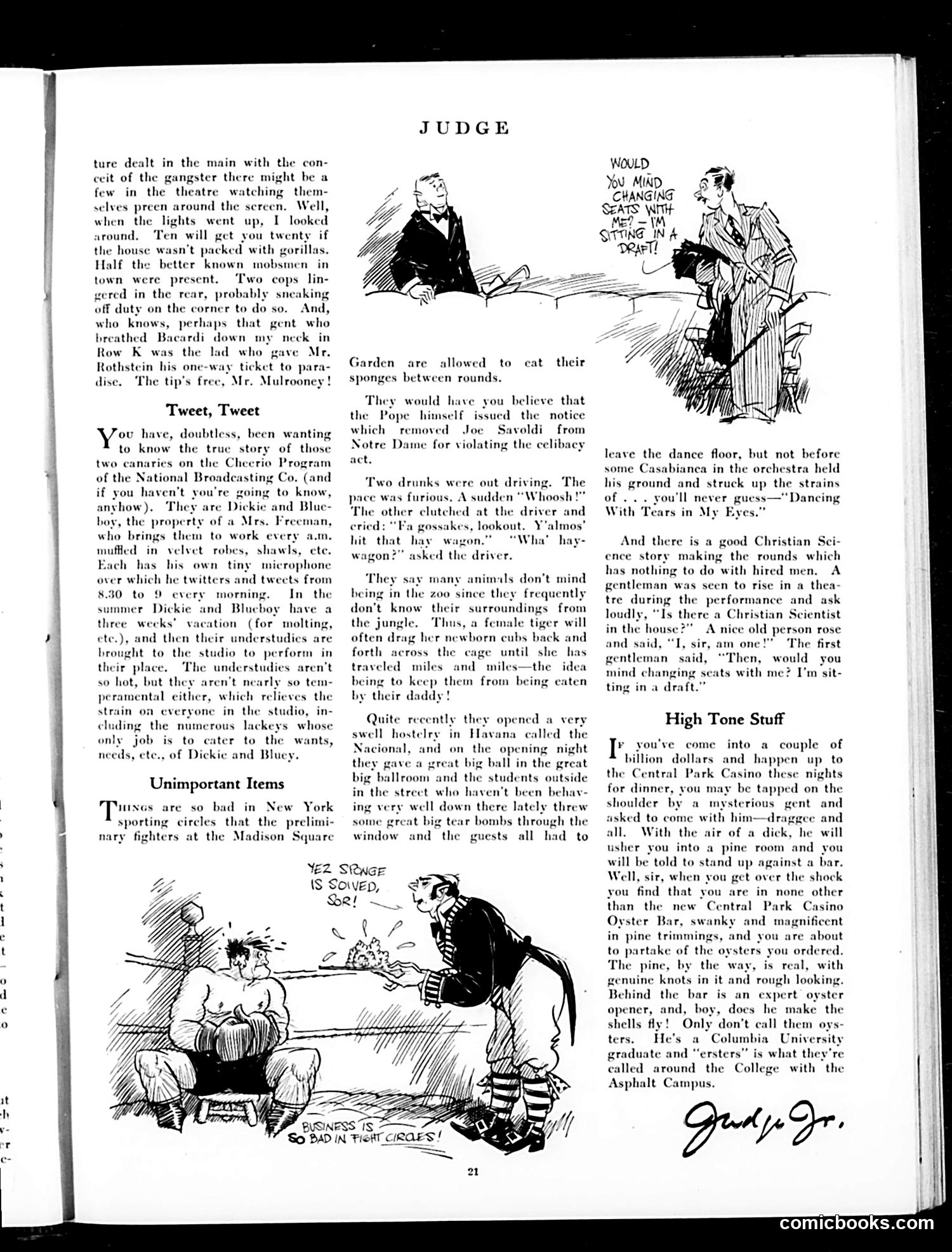
Explaining This Judge Magazine Page This page contains several satirical pieces typical of 1920s Judge magazine: "Tweet, Tweet" explains the behind-the-scenes story of canaries on a radio program (Cheerio Program), revealing they're temperamental performers requiring velvet robes, personal microphones, and vacation time for molting—mocking the absurd celebrity treatment given to minor entertainers. "Unimportant Items" collects brief satirical observations: boxers eating sponges between rounds (commentary on boxing's degraded state); a Pope notice about celibacy violations at Notre Dame; drunk drivers; and zoo animals' behavior. These mock various social phenomena through exaggeration. "High Tone Stuff" satirizes nouveau riche diners at the fancy Central Park Casino, where mysterious "gents" apparently run some kind of scheme targeting wealthy patrons—likely satirizing mobster operations and confidence games targeting the newly rich during Prohibition-era New York. The cartoons throughout use crude drawings and slang-heavy dialogue typical of Judge's comedic style, targeting 1920s social pretension, organized crime visibility, and media absurdities.
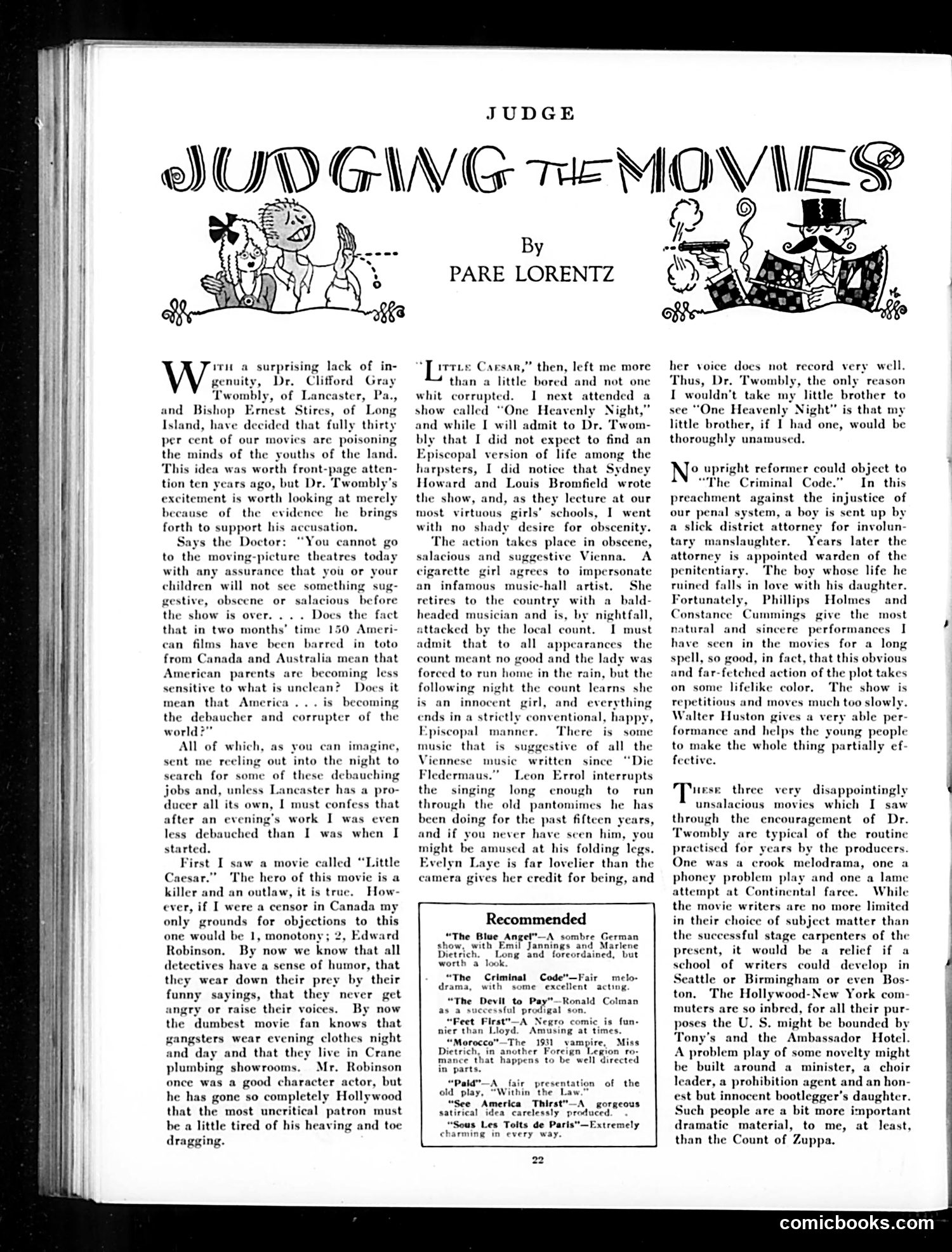
Judge Magazine Film Review Analysis This is a film criticism column by Pare Lorentz reviewing movies in response to moral panic about cinema's corrupting influence. Two clergymen (Dr. Twombly and Bishop Stires) have claimed 30% of American films poison youth. Lorentz satirizes their concern by actually watching the films they condemn. He argues *Little Caesar* (with Edward G. Robinson) is merely boring and formulaic, not corrupting—gangsters unrealistically wear tuxedos and live in "Crane plumbing showrooms." *One Heavenly Night* proves equally harmless despite its suggestive Vienna setting: the cigarette girl impersonator's seduction attempt ends in conventional, even "Episcopal" morality. The satire targets both moral crusaders (for exaggerating cinema's danger) and Hollywood (for lazy, repetitive storytelling). Lorentz's point: American films are insufficiently corrupting to worry about—they're just tediously predictable.
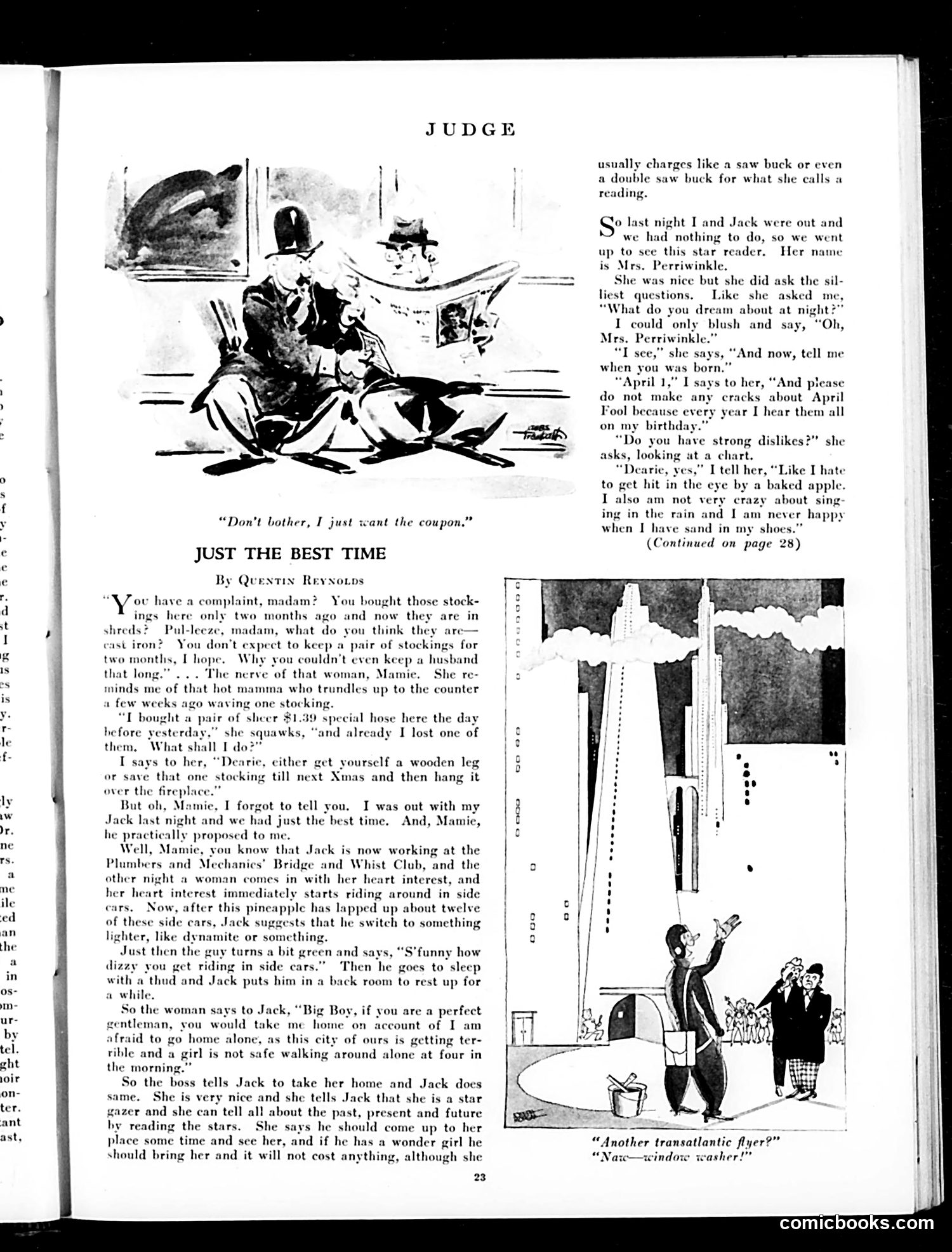
Judge Magazine Page Analysis This page contains two distinct pieces of humor: "Just the Best Time" is a short story about a department store clerk complaining to a coworker named Mamie about customers and their "unrealistic" expectations—particularly a woman angry about stockings tearing after two months. The narrator then recounts a night out with "Jack" involving a side-car ride and a visit to a fortune teller named Mrs. Perriwinkle, who asks absurdly obvious personal questions (birthdate, dislikes). The joke relies on the fortune teller's pretentiousness and the narrator's obliviousness. The cartoon at bottom right shows a street scene with the caption distinguishing between "Another transatlantic flyer?" and the answer "Nai—a window washer!" This appears to satirize the early 1920s craze for transatlantic aviation by suggesting that what looks impressive from a distance might be something mundane. Both pieces mock pretension and human folly—whether department store interactions, fortune telling, or mistaken identity.
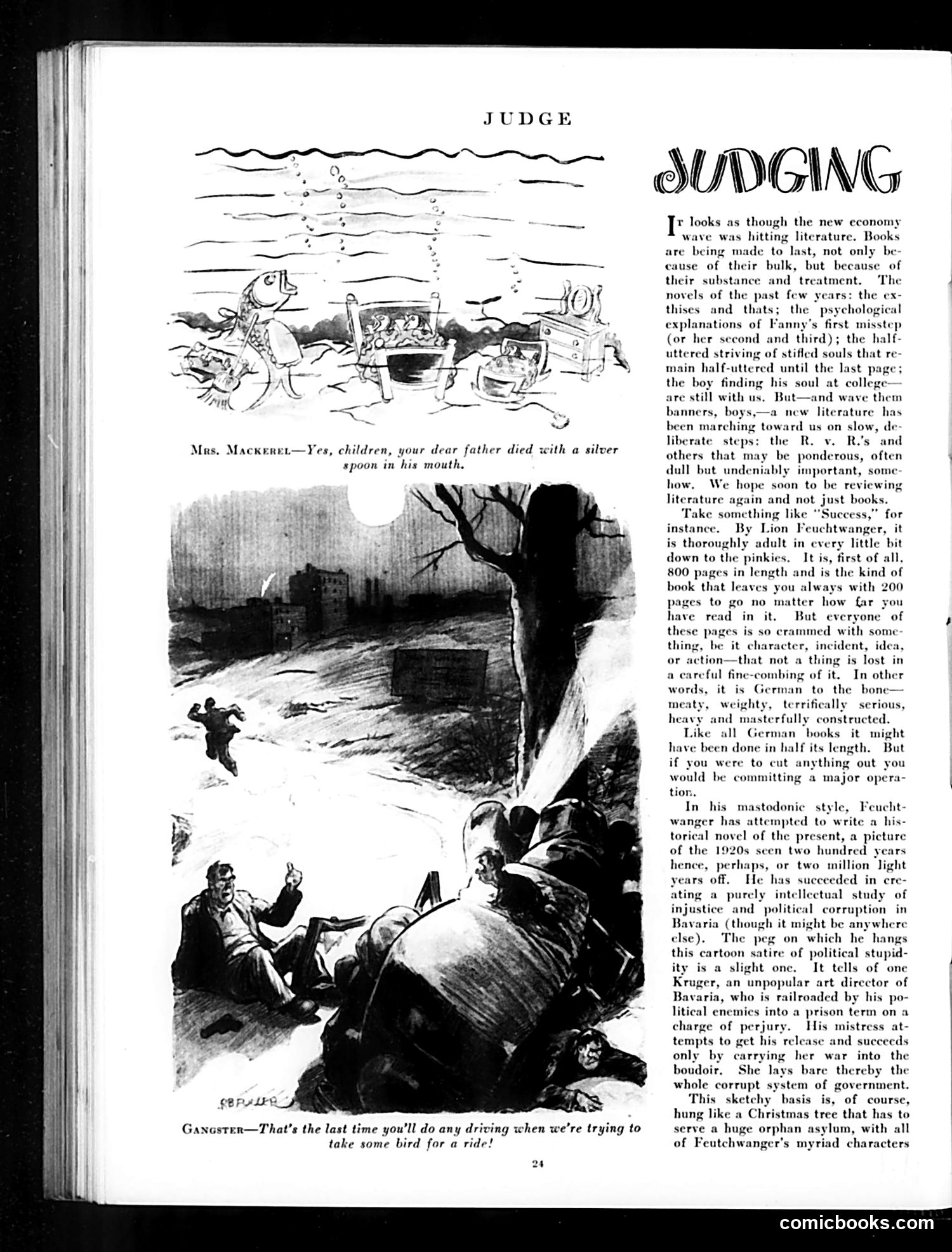
Analysis for Modern Readers This page reviews Lion Feuchtwanger's novel *Success*, a German historical satire set in Bavaria. The review praises its serious, densely packed 800-page structure, noting that while characteristically long-winded (typical of German literature), nothing is extraneous. The novel depicts political corruption through a protagonist—an unpopular art director imprisoned on perjury charges by political enemies. His mistress secures his release by exposing the corrupt government system through her seduction of officials. The two cartoons are unrelated to the review: one shows a silver spoon (old wealth/privilege), the other depicts a "gangster" warning against dangerous driving. Both are typical Judge magazine humor disconnected from the literary criticism above. The page reflects 1920s-30s American intellectual culture engaging with serious European modernist literature.
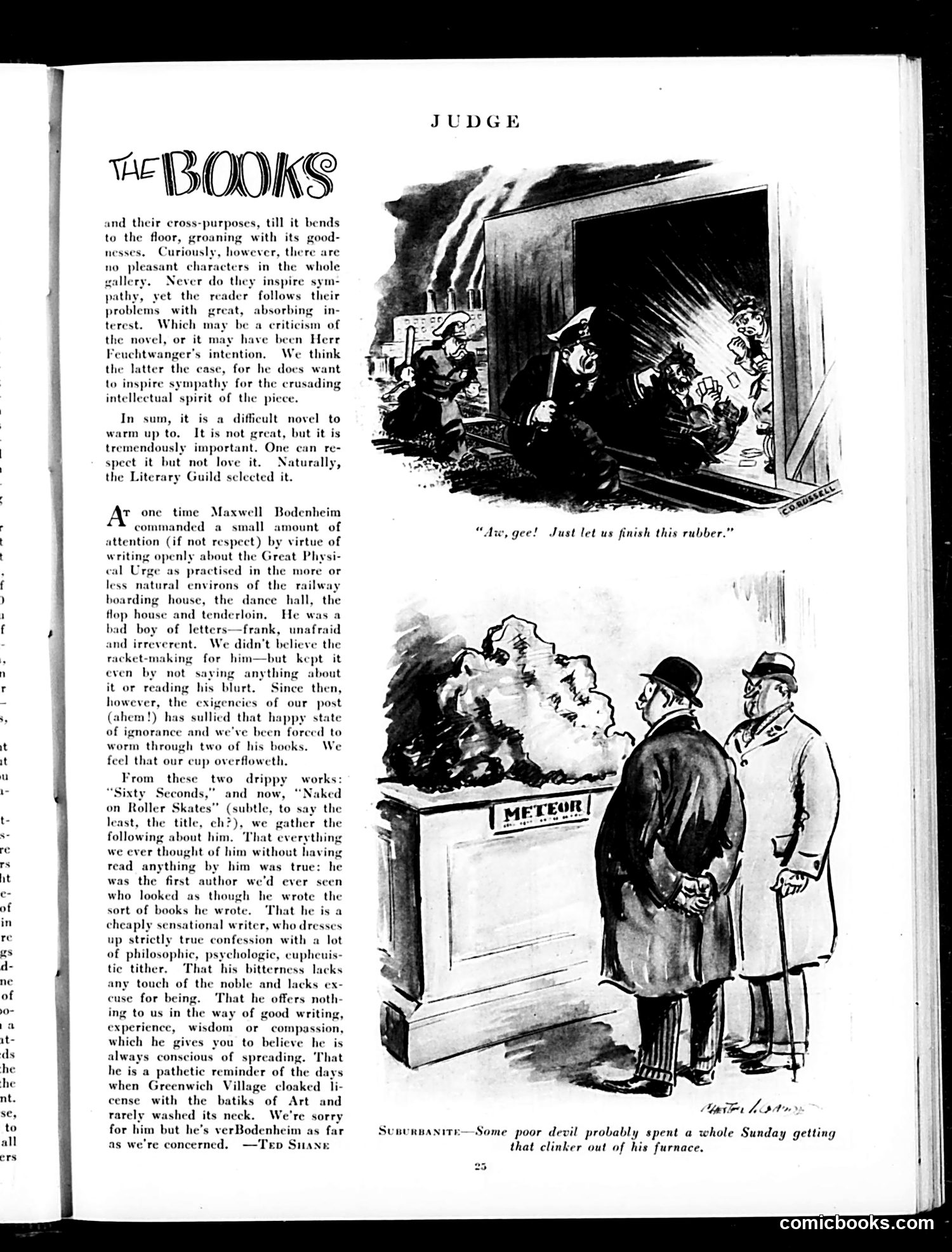
Analysis for Modern Readers This page contains a book review and two cartoons from *Judge* magazine's satirical section. The Review: Critic Ted Shane dismisses author Maxwell Bodenheim as a sensationalist writer who exploits gritty subject matter (railway boarding houses, dance halls) with pseudo-intellectual language. Shane notes Bodenheim was once notorious for frankly depicting sexuality ("the Great Physical Urge"), but now his work feels dated and cynical—a relic of 1920s Greenwich Village bohemianism that lacks genuine wisdom or compassion. The Cartoons: 1. Top: Criminals finishing a heist ("rubber" = robbery) 2. Bottom: A frustrated homeowner examines a coal furnace clinker (a hard residue from coal combustion). The caption jokes that some poor soul wasted an entire Sunday trying to remove this stubborn byproduct—relatable domestic frustration for readers who heated homes with coal. Both cartoons use visual humor to illustrate minor annoyances of ordinary life, typical of *Judge's* approach to satire.
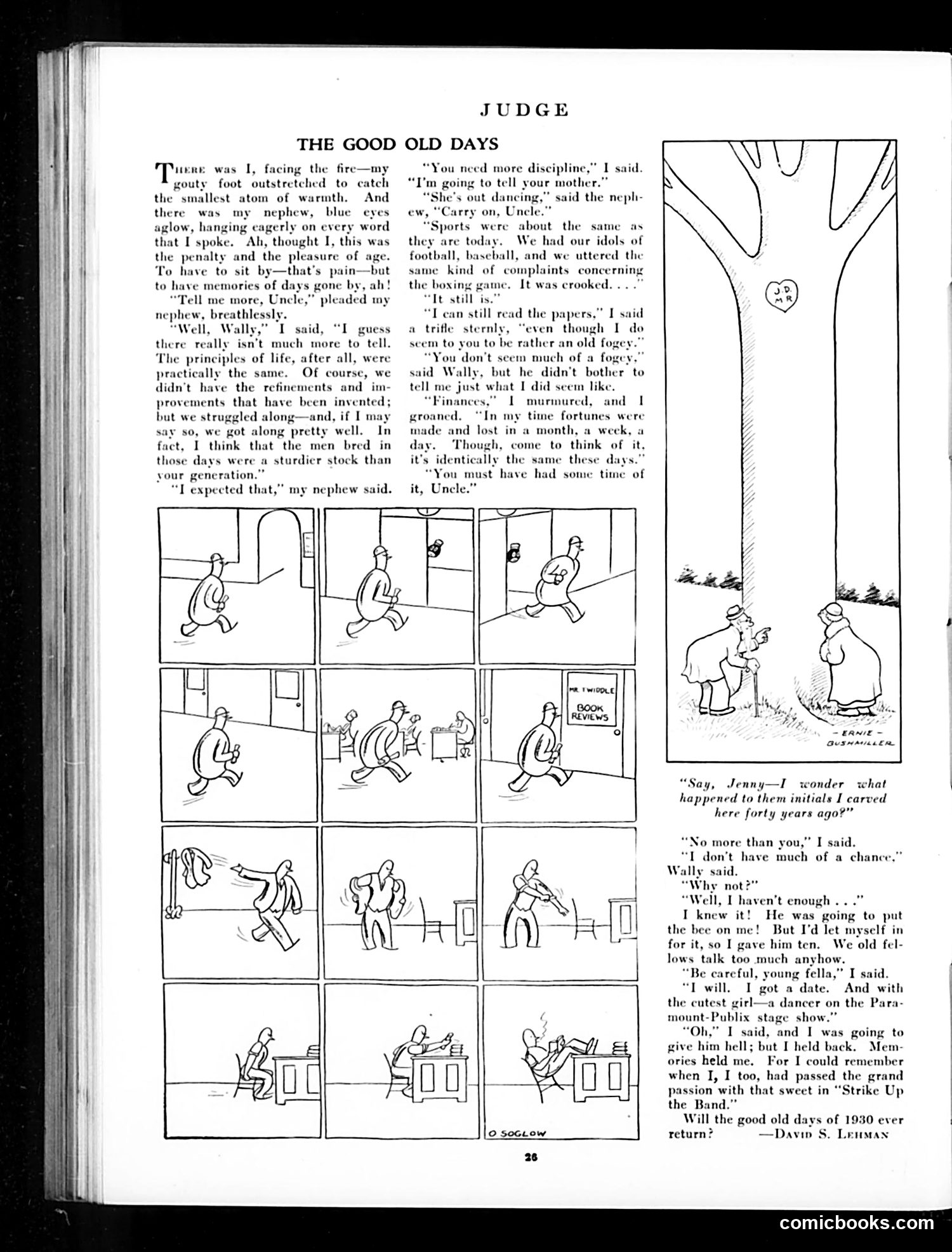
"The Good Old Days" - Judge Magazine This nostalgic piece presents an elderly narrator reminiscing with his nephew Wally about life in an earlier era (implied to be around 1900 or earlier). The satire works on multiple levels: The Setup: An uncle boasts that his generation was "sturdier" and faced greater hardships than modern youth, claiming life's principles haven't changed—sports, corruption, financial volatility all persist. The Joke: The nephew repeatedly exploits the sentimental old man: first asking for money ("put the bee on me"), then using the uncle's own romantic nostalgia against him. The uncle admits he too once chased dancers and lived frivolously, undermining his moral superiority. The Point: Judge satirizes generational finger-wagging. The uncle claims superiority while inadvertently proving each generation repeats the same mistakes, desires, and moral compromises. The 1930 publication date suggests Depression-era commentary on whether "good old days" ever truly existed or whether nostalgia simply clouds judgment. The comic strip panels (signature by Soglow) show physical comedy supporting the text's themes.
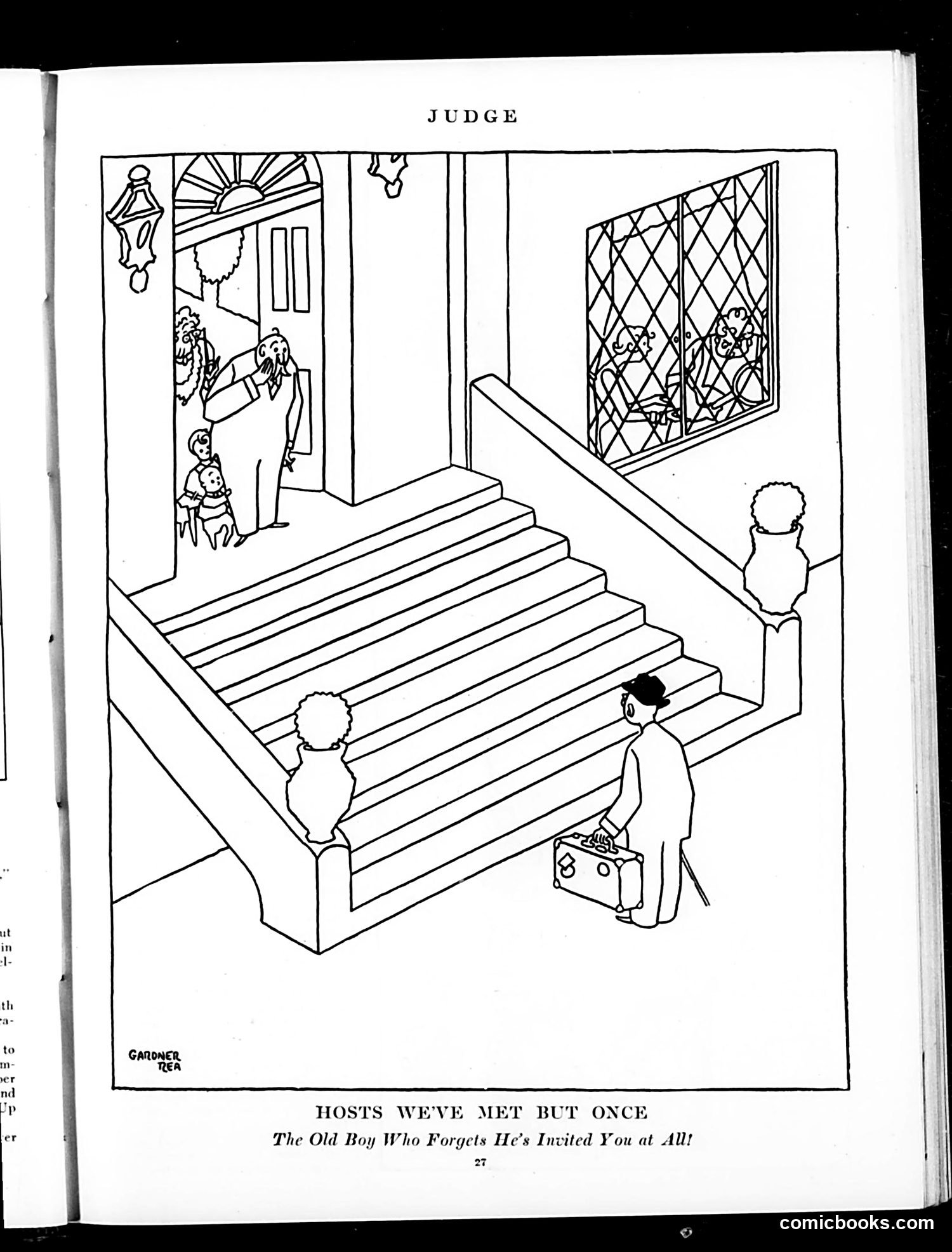
Explanation for Modern Readers This cartoon satirizes a social etiquette problem: the forgetful host. The scene shows a man arriving at a courthouse (indicated by the formal architecture and barred windows) carrying a briefcase. He appears to be a lawyer or professional attending court, but the doorman or attendant behind him seems not to recognize him—suggesting the man has been invited before but the host has entirely forgotten about him. The title's humor relies on a common social awkwardness: being invited to someone's home or event, then being treated by the host as if you're a stranger or unwelcome visitor. The "old boy" refers to this forgotten acquaintance, and the joke mocks both his embarrassment and the host's social carelessness. It's a relatable commentary on rudeness disguised as forgetfulness.
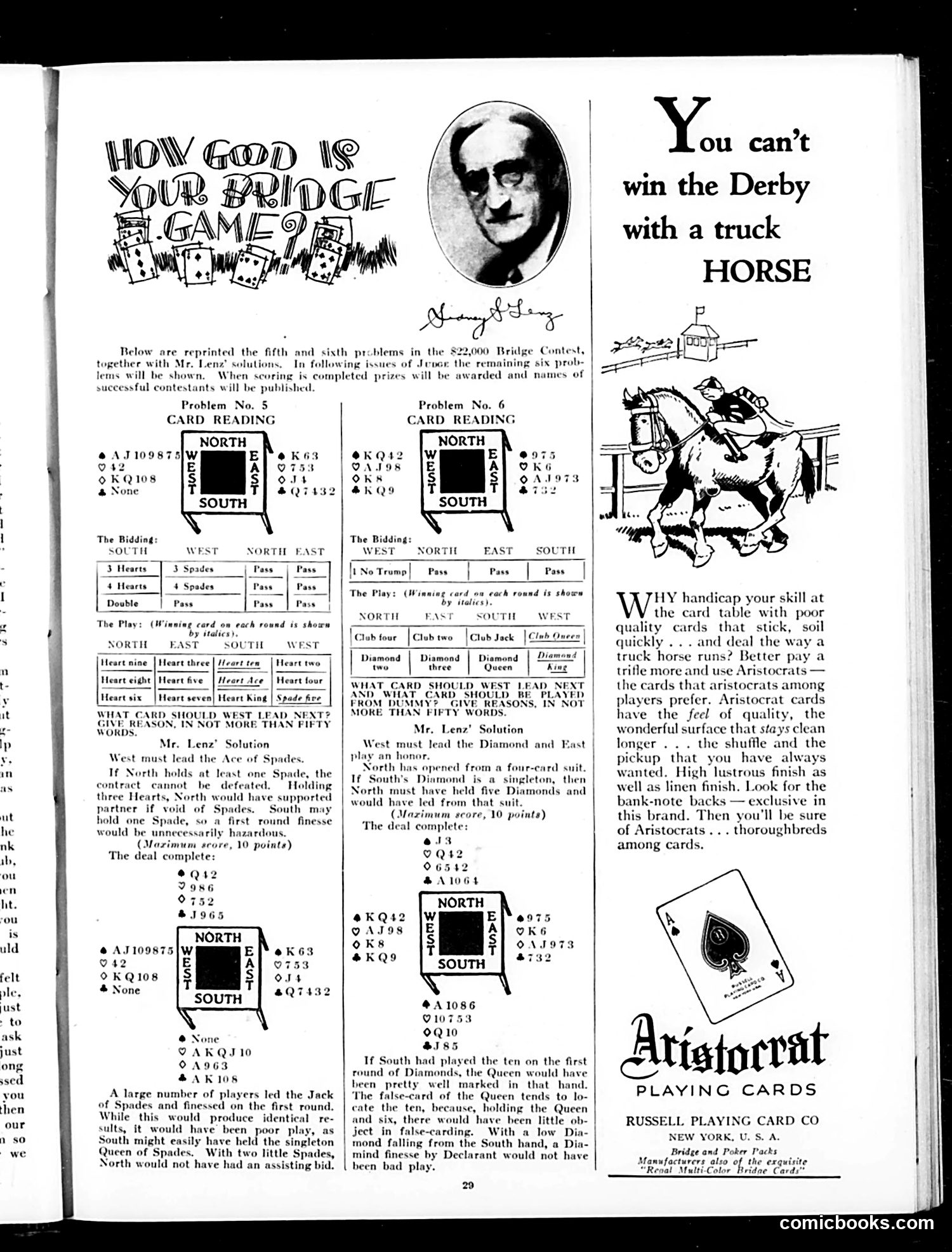
Analysis of Judge Magazine Page This page contains bridge card game instructional content rather than political satire. The prominent elements are: Main Content: Two bridge problems (#5 and #6) from an ongoing "$22,000 Bridge Contest," featuring solutions by "Mr. Lenz." These teach advanced card-playing strategy through worked examples. Advertisement: The right side features a full-page ad for Aristocrat Playing Cards by Russell Playing Card Co. The ad uses humorous copy ("You can't win the Derby with a truck horse") to position premium cards as superior to inferior alternatives. It emphasizes quality features: cards that "stick, soil quickly," better shuffling, and "linen finish." Historical Context: This reflects bridge's peak popularity in early-to-mid 20th century America, when detailed strategy instruction in magazines was common entertainment. The advertisement's class-conscious messaging ("aristocrats among cards") was typical marketing of the era. The page is primarily instructional and commercial rather than satirical or political.
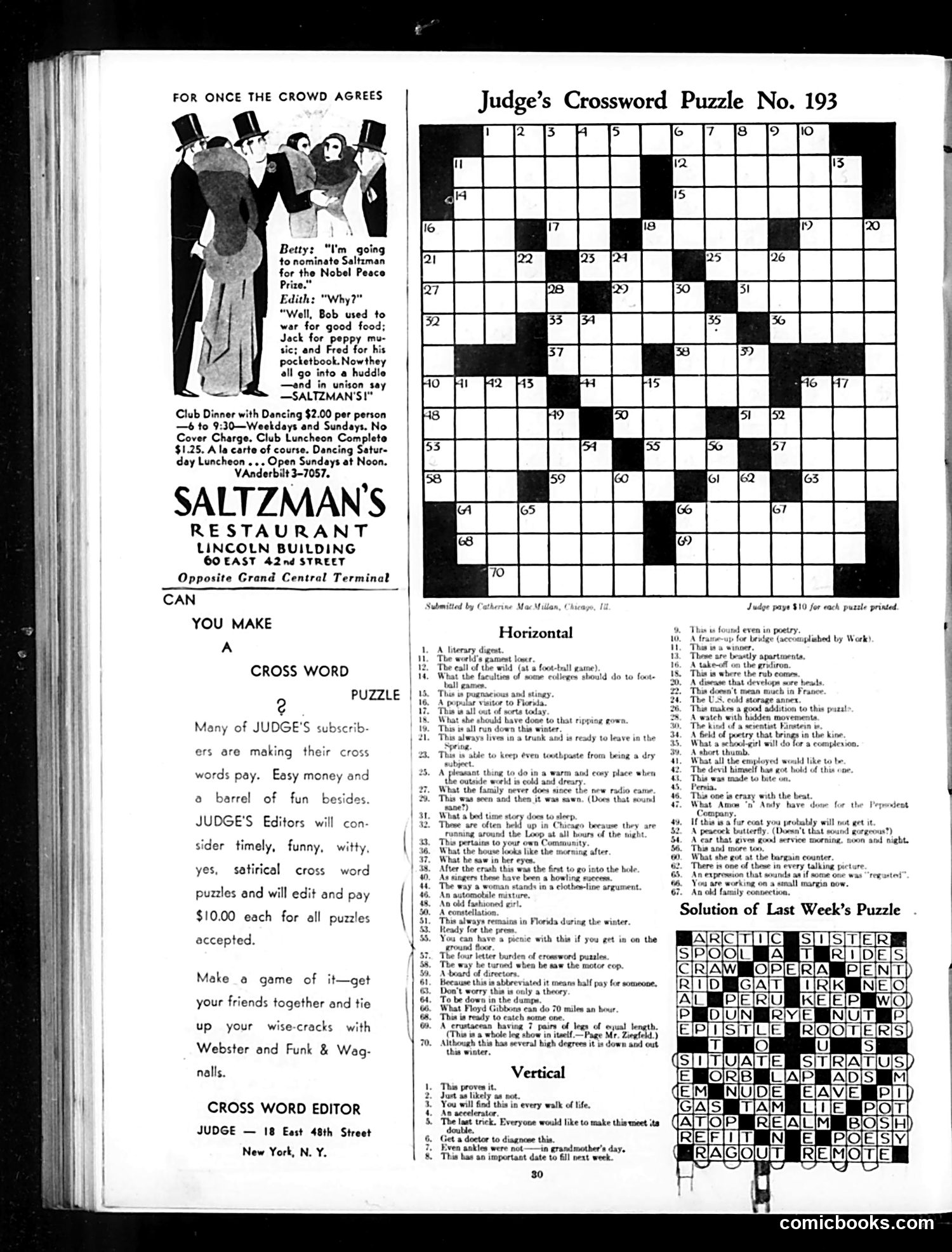
Judge Magazine Cartoon Analysis The cartoon "For Once the Crowd Agrees" depicts a social scene where multiple people—Betty, Bob, and Jock—are nominating someone (apparently "Saltzman") for various qualities: Betty suggests him for good food, Bob praises his "peppy music," and Jock mentions something unspecified. The humor lies in their reaching unexpected agreement ("for once the crowd agrees"), with the punchline showing them literally huddling together to unanimously declare "SALTZMAN'S!" This is primarily advertising disguised as editorial content—a common Judge tactic. The cartoon promotes Saltzman's Restaurant (located at 60 East 42nd Street, near Grand Central Terminal in Manhattan), which offered club dinners with dancing at $2.00 per person. The satire is gentle: the joke assumes readers find it amusing that people with different preferences (food, music, entertainment) would nonetheless agree on one establishment. It's essentially a testimonial wrapped in a relatable social scenario. The page also advertises Judge's willingness to pay $10 per published crossword puzzle, inviting reader submissions.
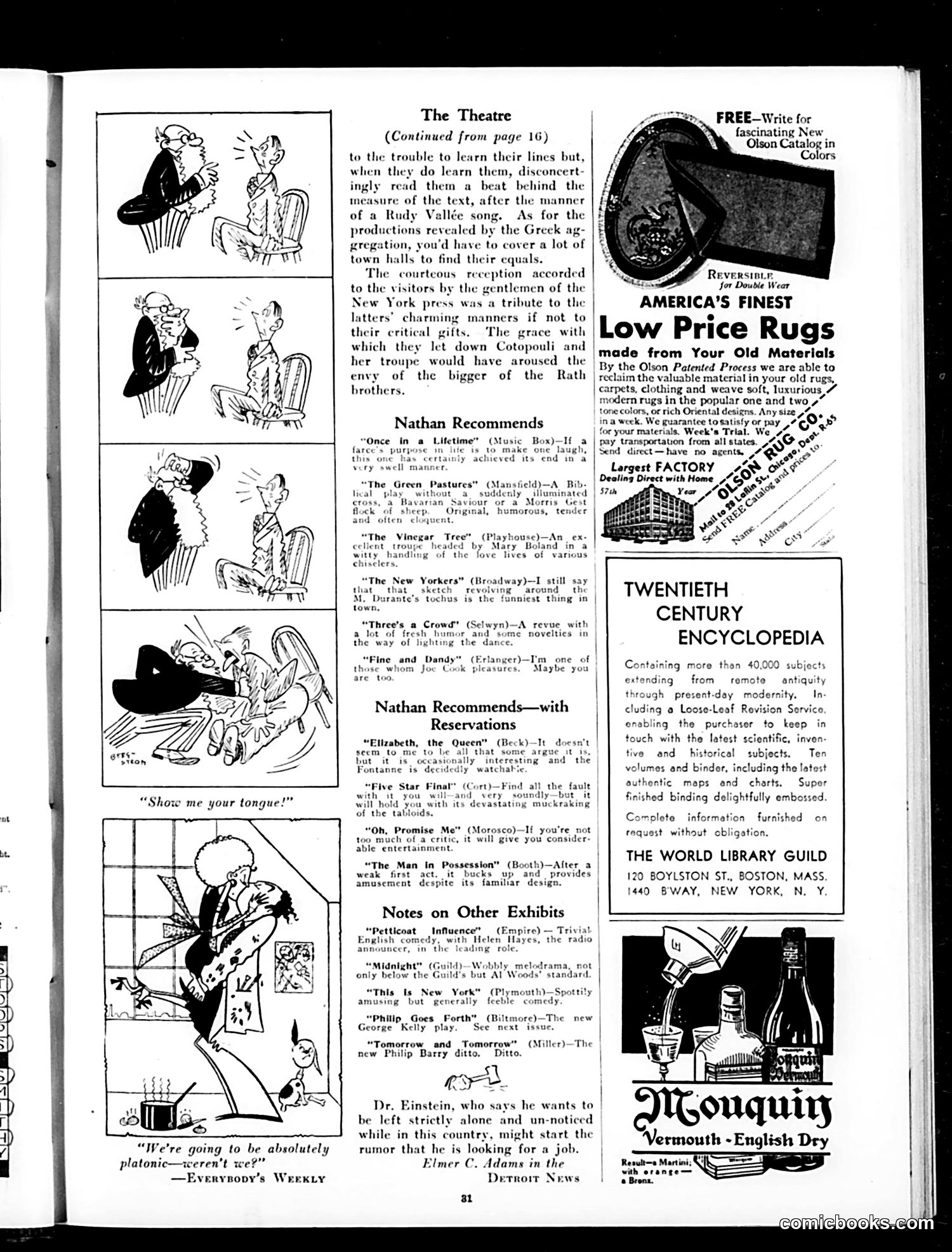
Analysis of Judge Page 21 This page primarily features theater criticism by Nathan (likely Nathan Hale Jr., Judge's drama critic) reviewing Broadway shows from the late 1920s. The cartoons illustrate social commentary about theatrical performers and audience behavior. The main cartoon shows a man coaching a woman on lines with the caption "We're going to be absolutely platonic—weren't we?" This appears to satirize actors struggling with romantic comedies or the artificiality of theatrical chemistry between performers learning lines together. The bottom cartoon depicts a character climbing or posing dramatically, likely mocking theatrical melodrama or exaggerated stage acting conventions of the era. The theater reviews reference specific 1920s Broadway productions and performers (Mary Boland, Helen Hayes), critiquing acting styles, including commentary on the "Rudy Vallée song" delivery—suggesting actors who performed lines rhythmically rather than naturally. The advertisements for home rugs, encyclopedia sets, and vermouth reflect typical 1920s consumer marketing alongside entertainment content.
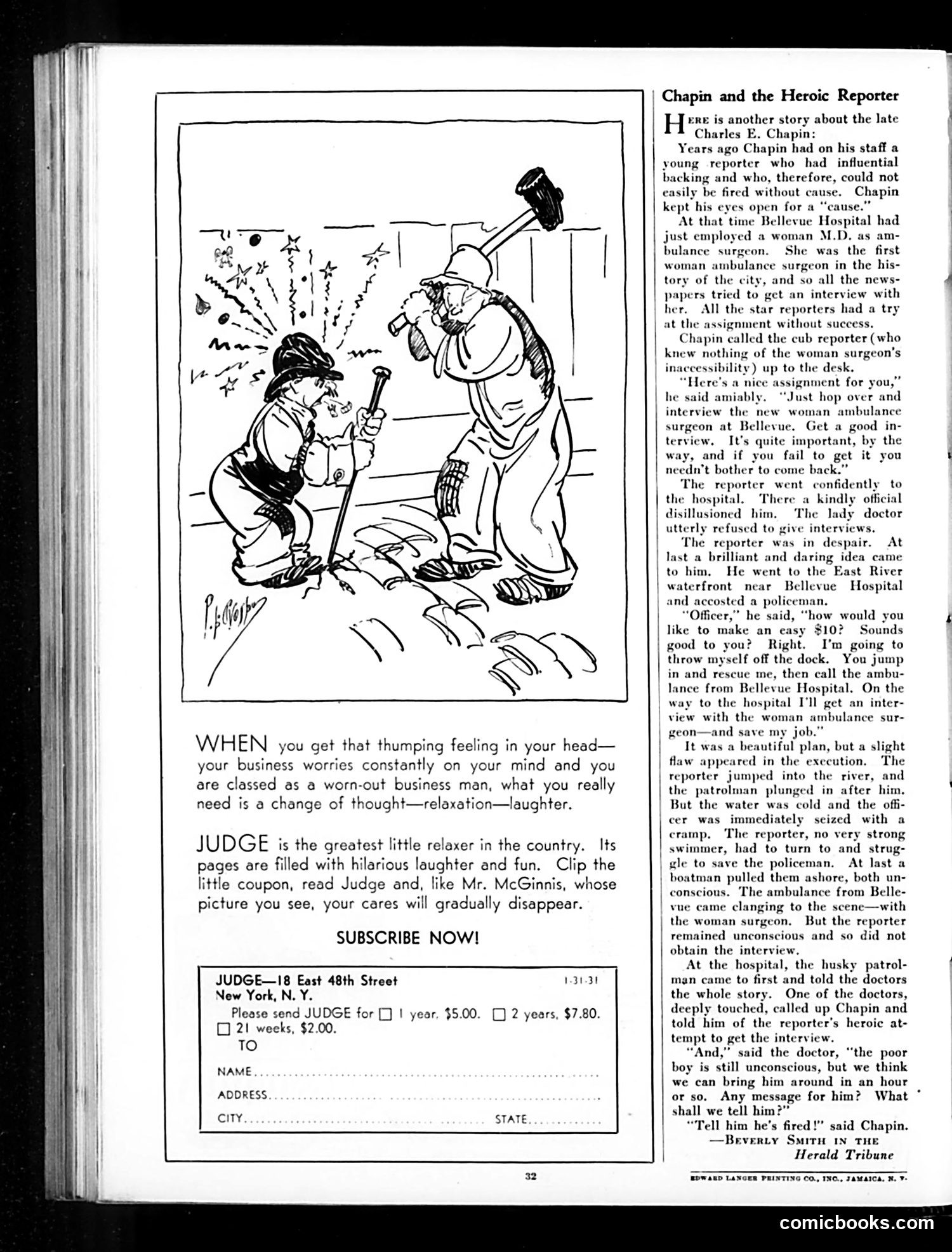
"Chapin and the Heroic Reporter" This anecdote satirizes Charles E. Chapin, a newspaper editor known for his ruthlessness. The story illustrates his cruelty: when a persistent young reporter (whom Chapin wanted to fire but couldn't without cause) goes to extraordinary lengths—literally throwing himself into the East River to stage a rescue scenario that would bring the inaccessible female ambulance surgeon to him—Chapin's response is coldly indifferent. The joke's punch line: after the reporter nearly drowns saving a policeman and lies unconscious in the hospital, Chapin's message is simply "Tell him he's fired!" The cartoonist presents this as dark humor exposing Chapin's callous nature. The accompanying illustration shows a comically large man swinging a hammer at a tiny figure, visualizing Chapin's abuse of power over his staff.
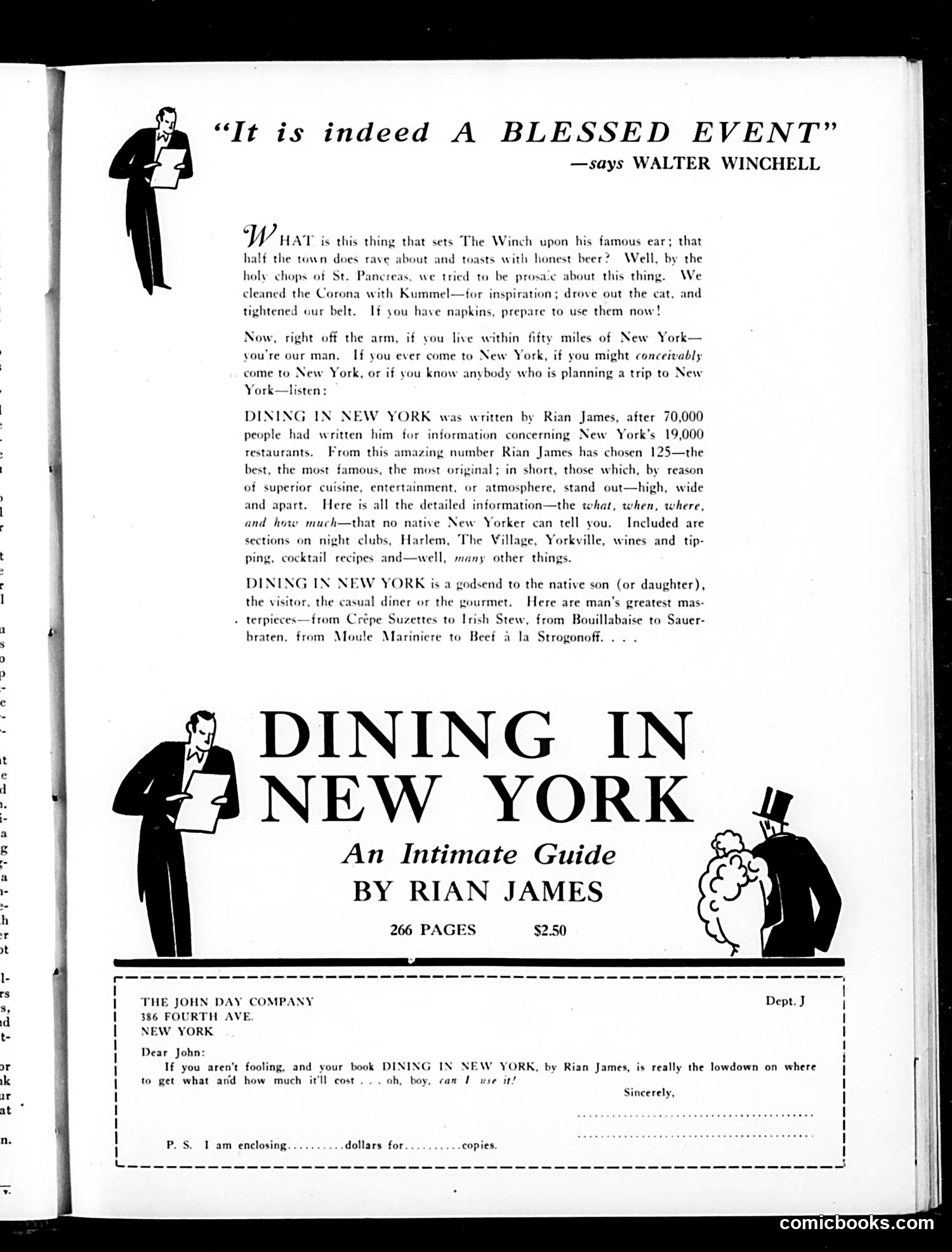
"Dining in New York" Advertisement with Winchell Endorsement This page is primarily an advertisement for a 1930s dining guide, not political satire. The "cartoon" element is minimal—stylized illustrations of well-dressed men in formal attire frame the text. The key reference is Walter Winchell, the famous gossip columnist whose endorsement ("It is indeed A BLESSED EVENT") opens the ad. Winchell's mention of "The Winch" (his nickname) and the jocular tone mimic his actual writing style—the ad humorously suggests that Rian James's restaurant guide is newsworthy enough for Winchell's attention. The mockery is gentle: the ad jokes that the *Judge* editors struggled to write about restaurants seriously (cleaning their typewriter with liqueur, driving out a cat), presenting the guide as practically indispensable for New Yorkers or visitors. The sample letter at bottom reinforces the appeal: a reader praising the guide's practical information on restaurant costs—suggesting Depression-era consumers needed guidance on affordable dining.
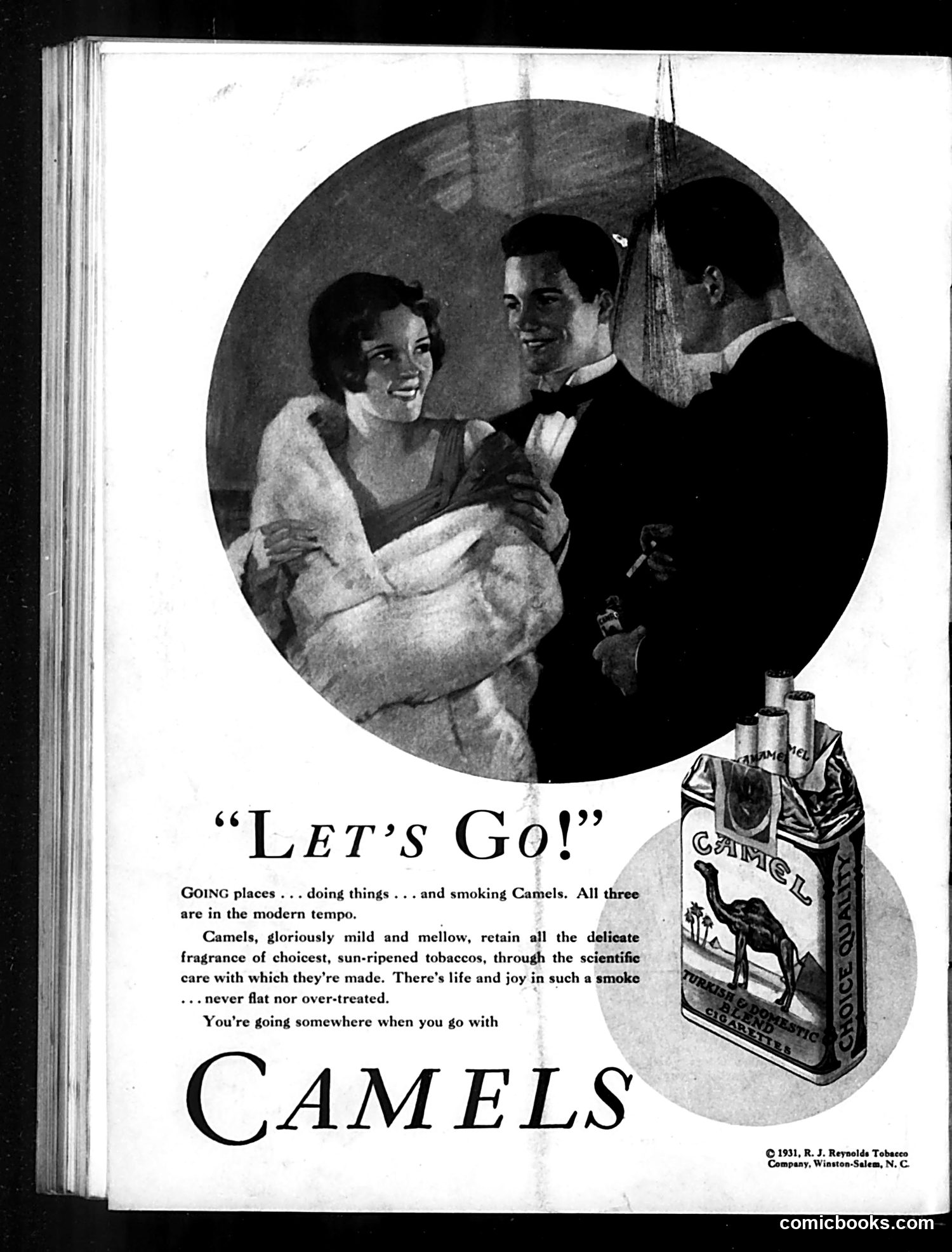
Camel Cigarettes Advertisement, 1931 This is not a cartoon or satire but a commercial advertisement for Camel cigarettes. The page shows a stylized photograph of three well-dressed people (a woman in an elegant dress and two men in formal wear) in a circular frame, suggesting social sophistication and leisure. The ad's tagline—"Let's Go!"—frames smoking as part of a modern, active lifestyle ("going places...doing things"). The copy emphasizes Camels' mildness and quality, positioning the brand as appropriate for refined social occasions. For modern readers, this represents the era when cigarette advertising could appear in mainstream publications and explicitly target aspirational lifestyles without health warnings. The imagery and messaging reflect 1930s consumer culture, where smoking signified sophistication and modernity.