judge
Judge — February 7, 1931
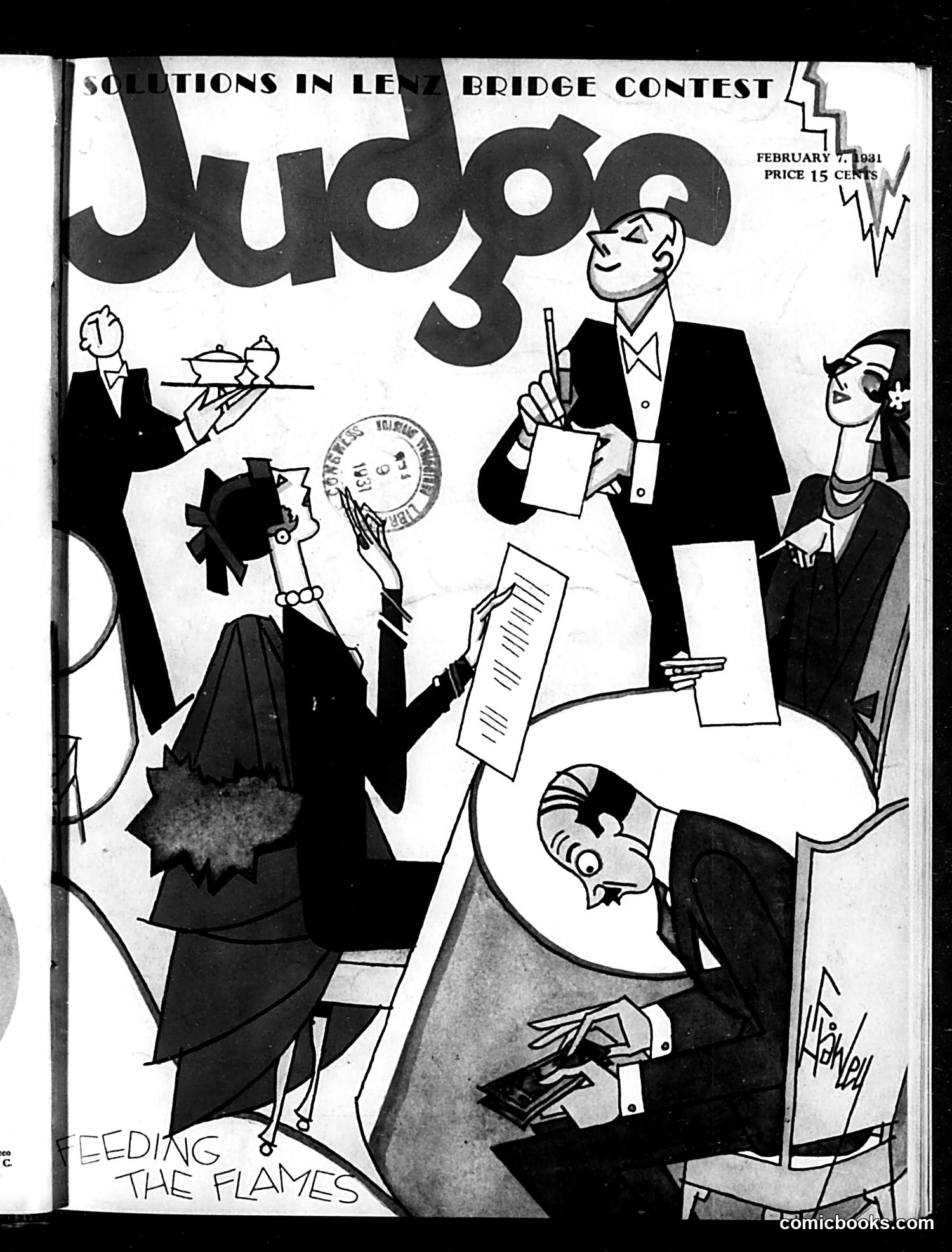
Judge Magazine, February 7, 1931 This magazine cover advertises "Solutions in Lenz Bridge Contest"—likely referring to a bridge design competition or engineering challenge of that era. The illustration depicts a chaotic scene with elegantly dressed people in 1930s attire examining documents and blueprints, suggesting competitive submission or evaluation of proposals. The phrase "Feeding the Flames" at the bottom implies the contest is generating excitement or controversy. The figures appear to represent various parties—possibly judges, architects, or contestants—engaged in the competitive process. The satirical tone typical of *Judge* magazine suggests this mocks either the contest's organization, the proposals submitted, or public obsession with the competition. Without identifying specific individuals, the cartoon lampoons what appears to be a notable contemporary engineering or architectural competition drawing public attention in 1931.
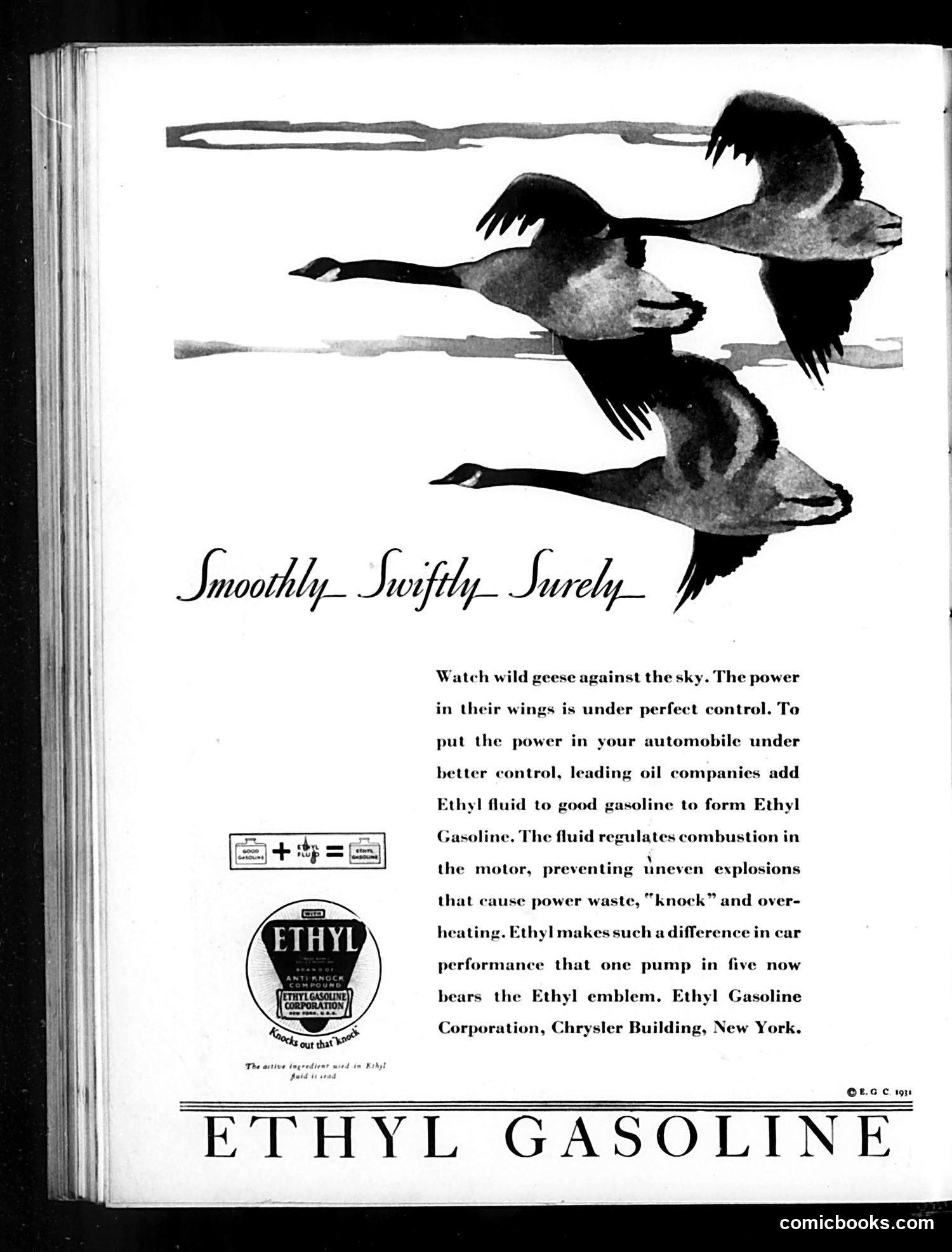
Ethyl Gasoline Advertisement This page is primarily a commercial advertisement, not satire or political commentary. The image shows three wild geese in flight, labeled "Smoothly Swiftly Surely," used as a metaphor for controlled power and motion. The advertisement promotes Ethyl Gasoline, a fuel additive containing tetraethyl lead. The copy claims that adding "Ethyl fluid" to gasoline prevents engine "knock" and uneven combustion, thereby improving automobile performance and control—much like the geese's controlled flight. The Ethyl Gasoline Corporation, based in the Chrysler Building in New York, notes that "one pump in five now bears the Ethyl emblem," suggesting market dominance. This represents early-20th-century automotive marketing. The health dangers of leaded gasoline were unknown or undisclosed at this time.
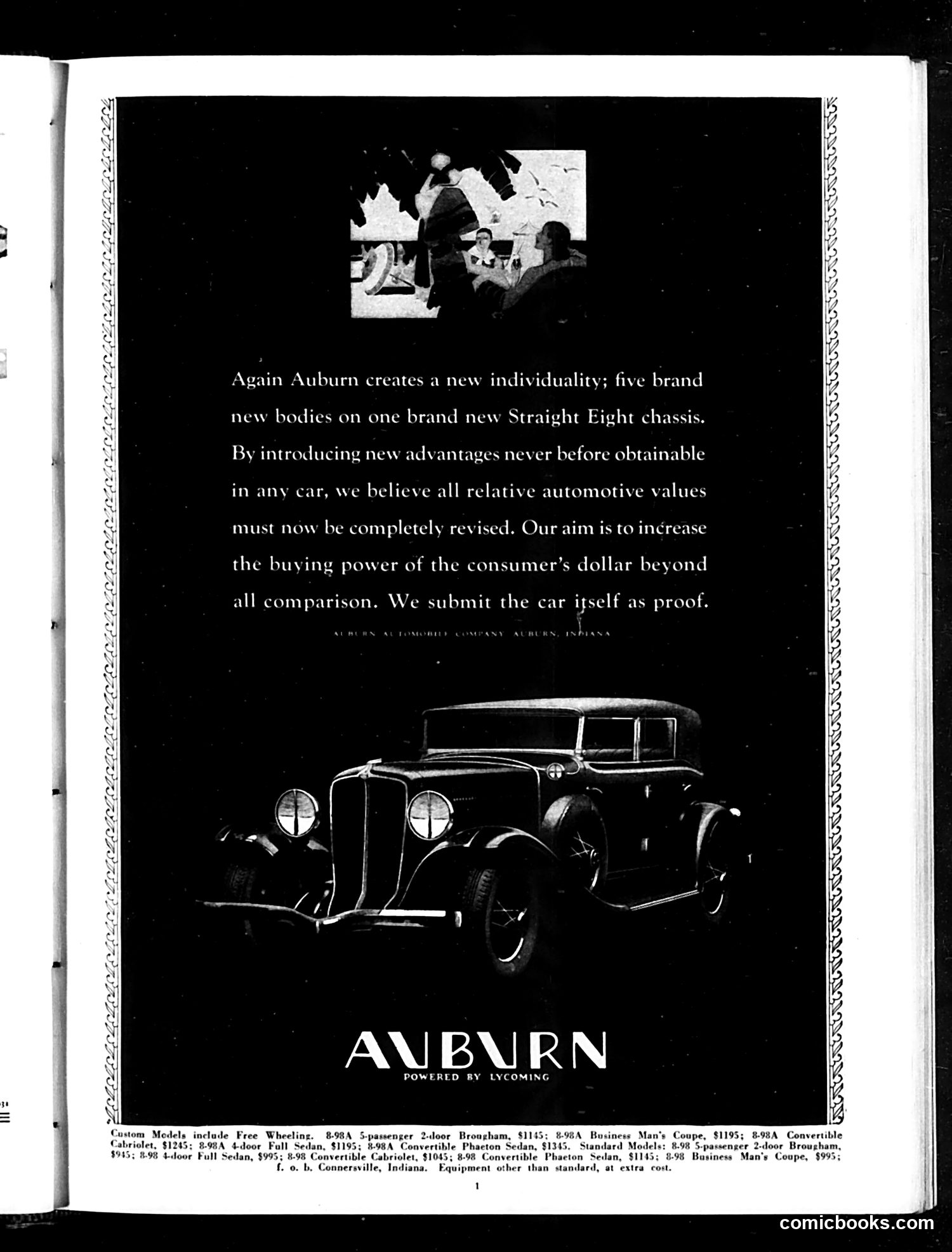
Analysis This appears to be primarily an Auburn automobile advertisement rather than satirical content. The page features marketing copy praising Auburn's "Straight Eight chassis" and five new body styles, claiming they offer "advantages never before obtainable in any car." The small photograph at top shows what appears to be a sales or promotional scene with people examining or discussing a vehicle. The large illustration below depicts a stylized Auburn automobile from a low, dramatic angle. No political cartoon or satire is evident here. This is a straightforward 1920s-era car advertisement emphasizing value and innovation to consumers. The grandiose language ("increase the buying power of the consumer's dollar beyond all comparison") is typical period advertising rhetoric, not satirical commentary. The page includes detailed model specifications and pricing information at bottom.
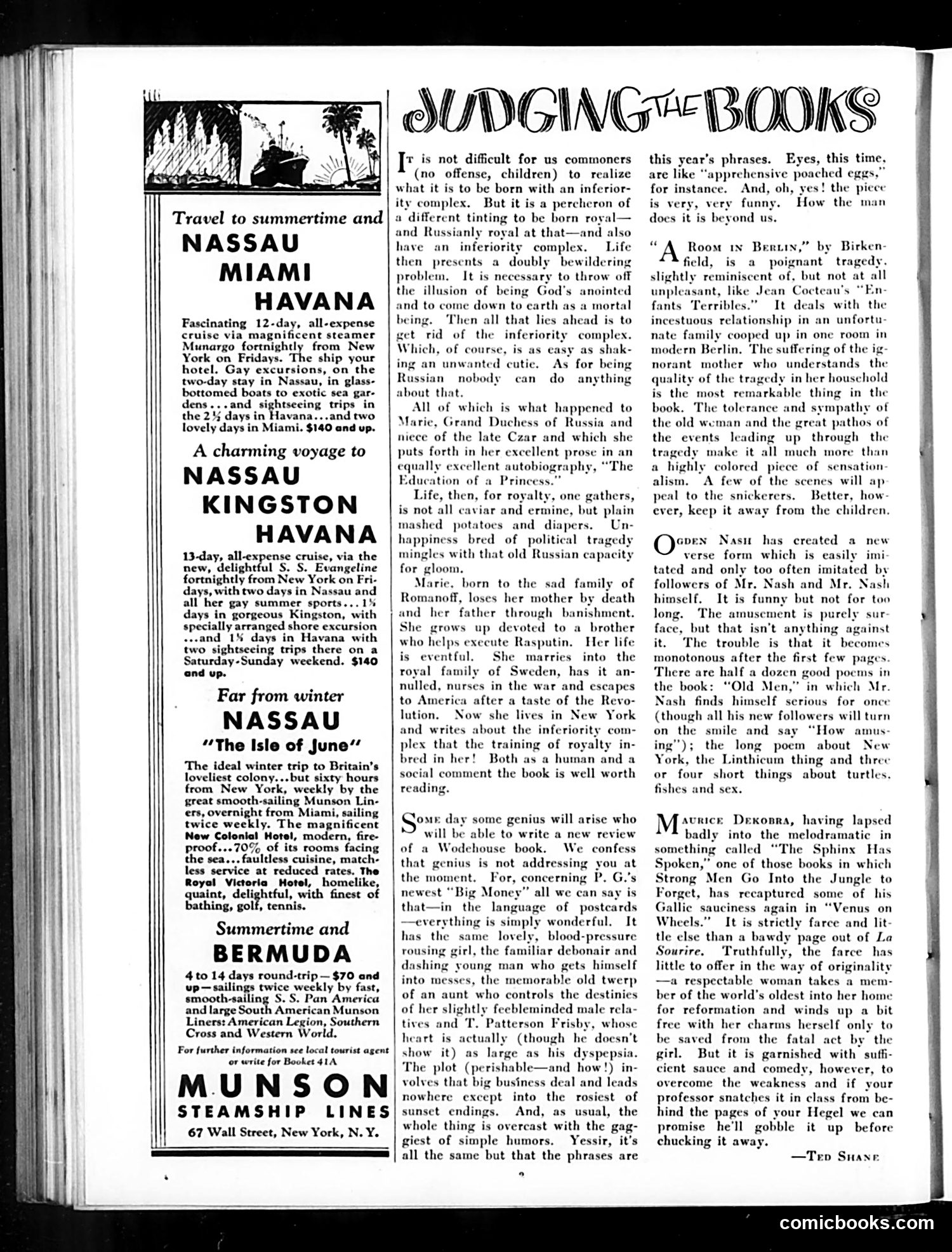
Analysis of "Judging the Books" Page This page is primarily book reviews and travel advertising rather than political satire. The "Judging the Books" column reviews several novels, including works by P.G. Wodehouse and Odgen Nash. The reviews humorously critique plot devices and character types common to popular fiction of the era—such as Wodehouse's romantic entanglements and Nash's lighthearted verse about turtles and sex. The left side features travel advertisements for steamship lines to Nassau, Miami, Havana, Kingston, Bermuda, and other destinations—typical Judge magazine fare mixing editorial content with luxury tourism marketing. No significant political cartoons or social satire appear on this page. It represents Judge's format blending literary criticism, humor, and commercial advertisements.
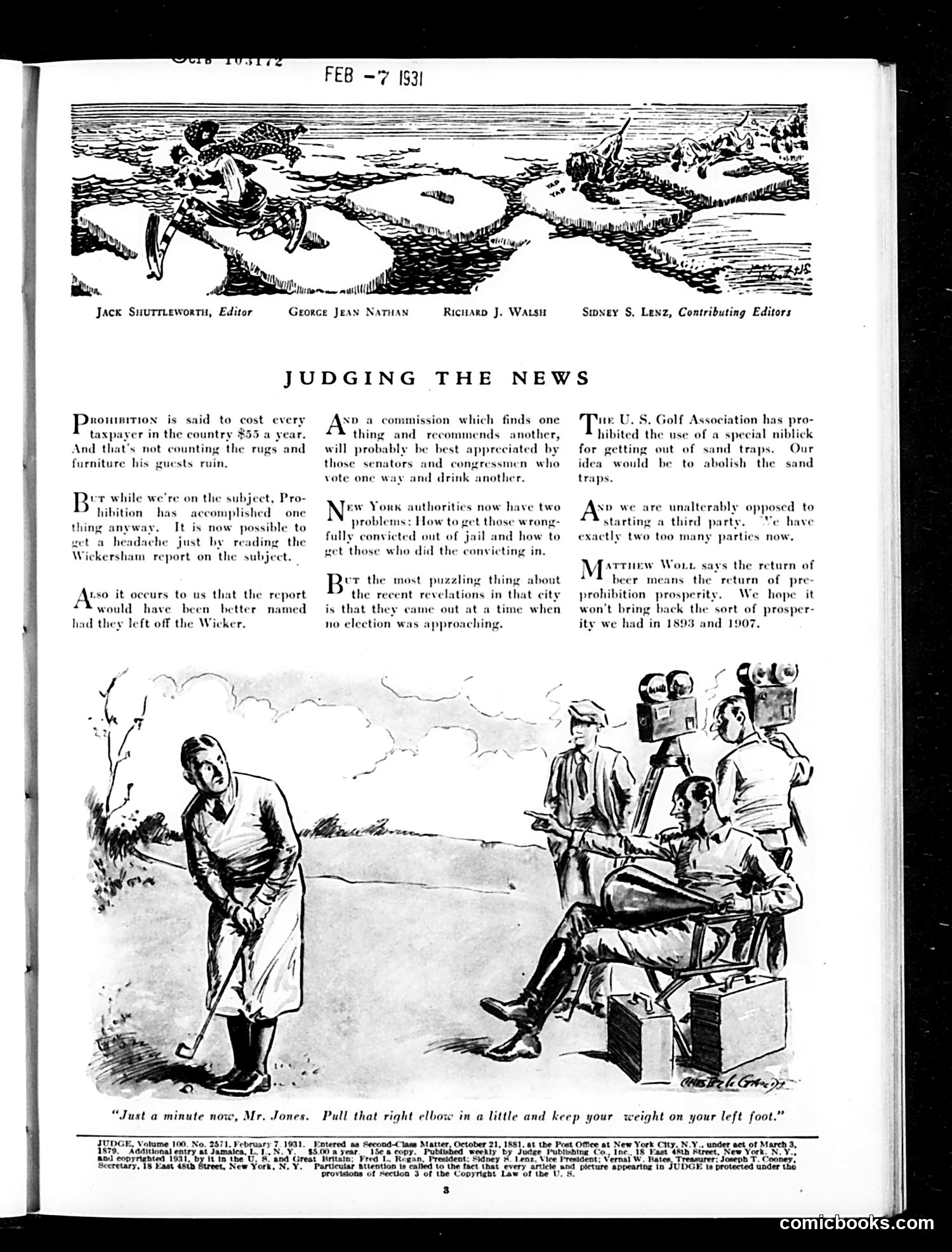
Judging the News - February 7, 1931 The main cartoon depicts a golf instruction scene with a caption: "Just a minor tone, Mr. Jones. Pull that right elbow in a little and keep your weight on your left foot." The satire appears to reference Prohibition and its enforcement failures. The text discusses how Prohibition "has accomplished one thing anyway. It is now possible to get a headache just by reading the Wickersham report on the subject." The Wickersham Commission investigated Prohibition enforcement and revealed widespread corruption and ineffectiveness. The golf metaphor likely satirizes authorities' clumsy attempts to "correct" or enforce Prohibition policy—giving instructions that miss the point entirely, much like critics felt the government's approach was fundamentally flawed. The humor suggests official guidance on the matter was as misguided as poor golf coaching.
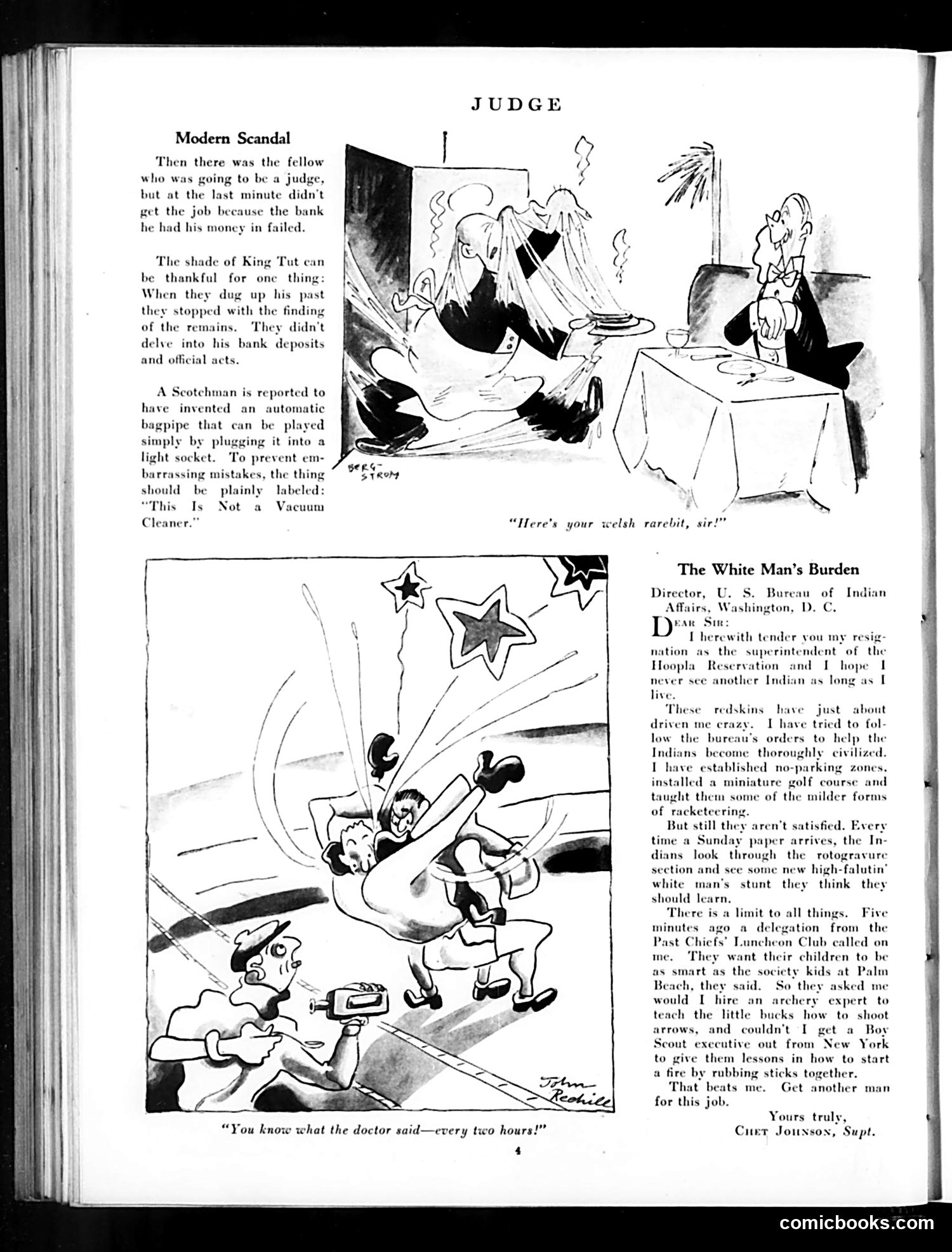
Analysis of Judge Magazine Page Top Cartoon ("Judge"): A humorous "Modern Scandal" about a would-be judge whose bank deposits failed, preventing his appointment. The cartoon mocks judicial corruption by suggesting judges were expected to profit financially from their position. Bottom Cartoon: Depicts Native Americans (labeled "redskins") in a chaotic scene with explosions and stars. This accompanies "The White Man's Burden," a letter from Chet Johnson, superintendent of the Hoopla Reservation, complaining about Indigenous peoples' resistance to "civilization" efforts—including no-parking zones, mini golf courses, and archery lessons. The satire criticizes paternalistic colonial attitudes and forced assimilation policies targeting Native Americans, presenting the superintendent's frustrations as absurd and presumptuous.
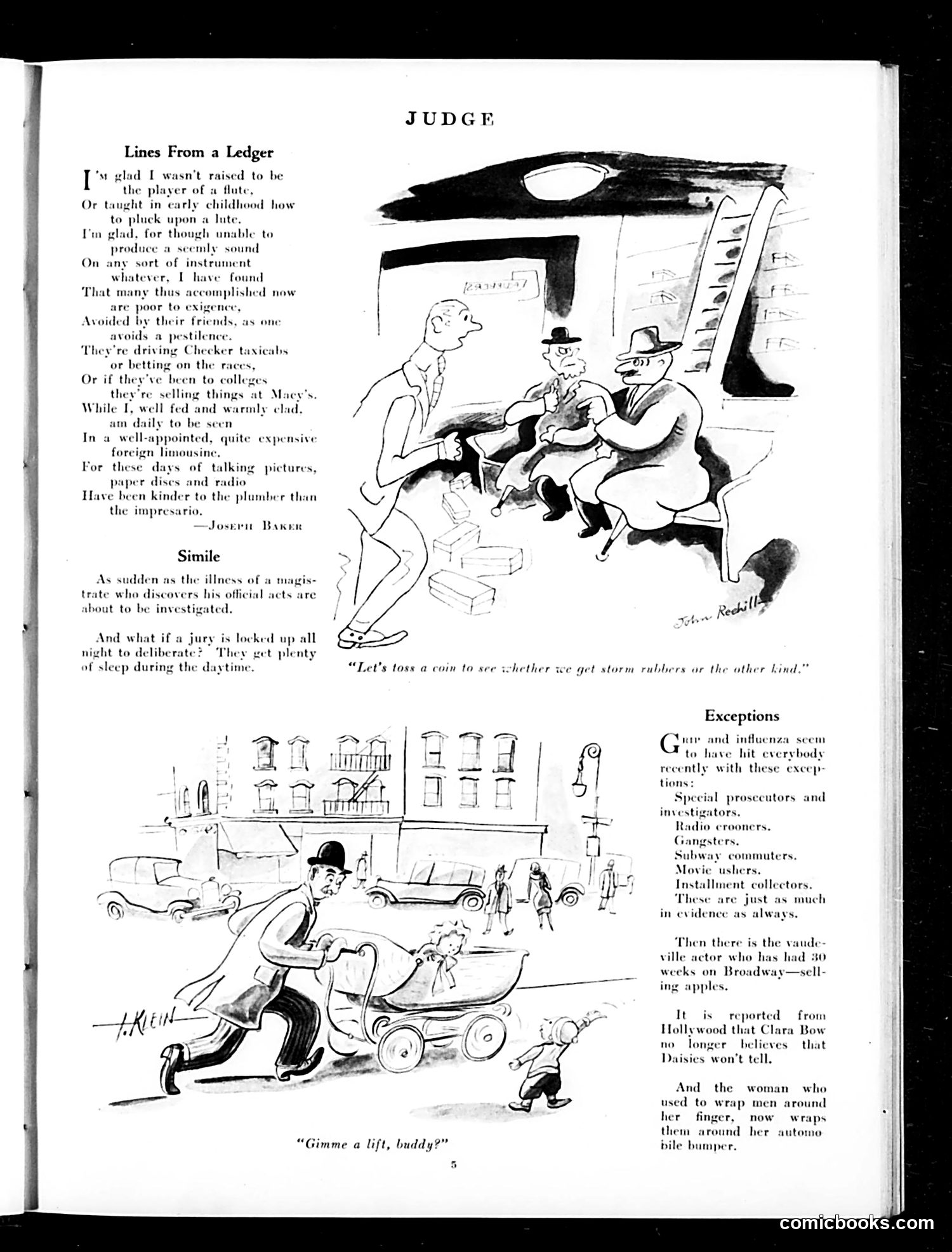
Analysis of Judge Page This page contains satirical content about judges and legal matters. The top cartoon titled "Judge" depicts three men in hats apparently conducting a transaction—possibly involving bribery or corruption—with a ladder visible in the background. The caption "Let's toss a coin to see whether we get storm rubbers or the other kind" suggests cynicism about judicial decision-making as arbitrary or corrupt. The bottom cartoon "Gimme a lift, buddy?" shows a man pushing a baby carriage on a city street, satirizing the desperation of someone needing assistance—likely referencing economic hardship. The accompanying text sections "Lines From a Ledger," "Simile," and "Exceptions" offer sardonic commentary on contemporary life, judges, and urban society, typical of Judge magazine's satirical approach to American social observation.
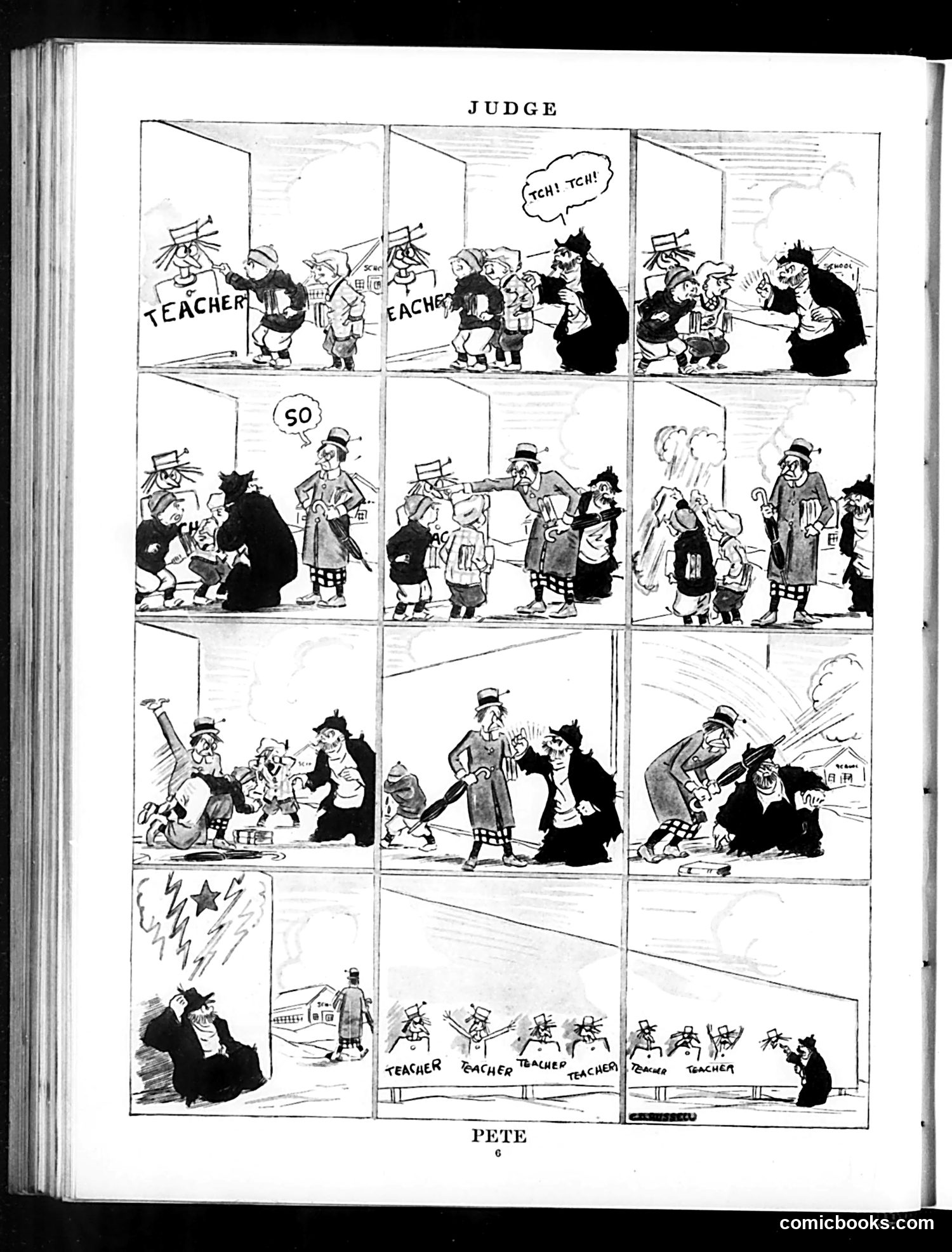
"Judge" Page Analysis This comic strip titled "Judge" (credited to "Pete") satirizes the profession of teaching. The narrative follows a teacher character encountering increasingly absurd situations with judges and legal authority figures. The strip appears to mock how teachers were treated or judged by society—perhaps commenting on oversight, discipline, or public criticism of educators. The repeated appearance of stern judges and the escalating chaos suggest the cartoon critiques excessive scrutiny or unreasonable demands placed on teachers. The final panels show the teacher surrounded by multiple "teacher" figures, possibly satirizing how the profession was being evaluated or condemned collectively. Without additional historical context about this specific Judge magazine issue, the exact date and particular educational controversies being referenced remain unclear.
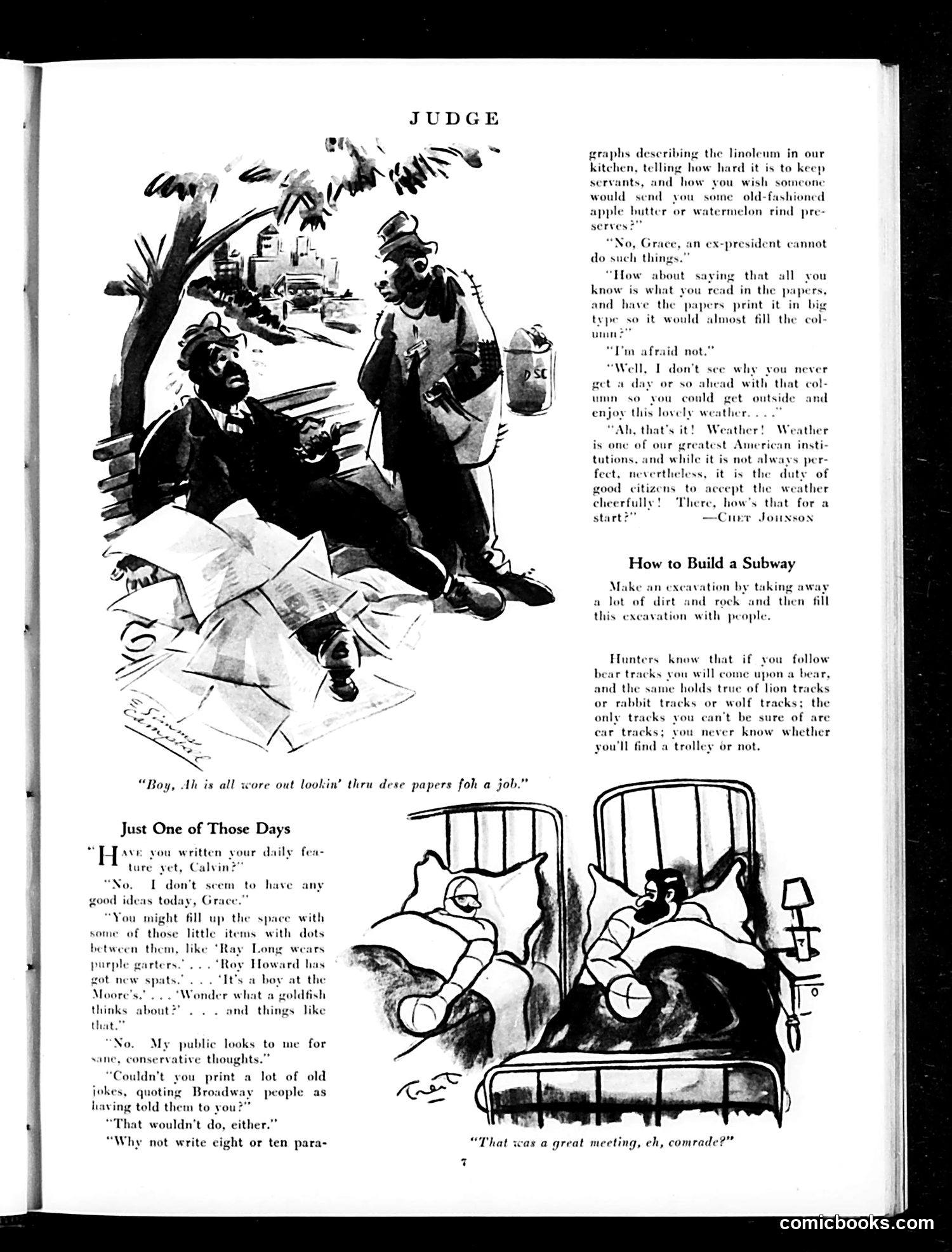
Judge Magazine Page Analysis This page contains three humorous pieces satirizing early 20th-century American life: "Just One of Those Days" depicts a newspaper columnist (Calvin) struggling to fill his daily feature. The satire mocks both the columnist's creative bankruptcy and reader expectations—suggesting newspapers padded space with trivial gossip items, recycled jokes, and vapid content. The exchange suggests the public wanted "conservative thoughts" while editors wanted filler. "How to Build a Subway" is a brief joke mocking subway construction's crowding problem—the "solution" is absurdist: dig a hole, fill it with people. The bear/lion/car tracks joke plays on logical fallacy: hunters can reliably track animals by their prints, but streetcar tracks lead unpredictably to trolleys (or nothing), mocking the era's unreliable public transportation. The top cartoon shows a man at a desk with papers, likely the same columnist, satirizing journalism's tedious demands and deadlines.
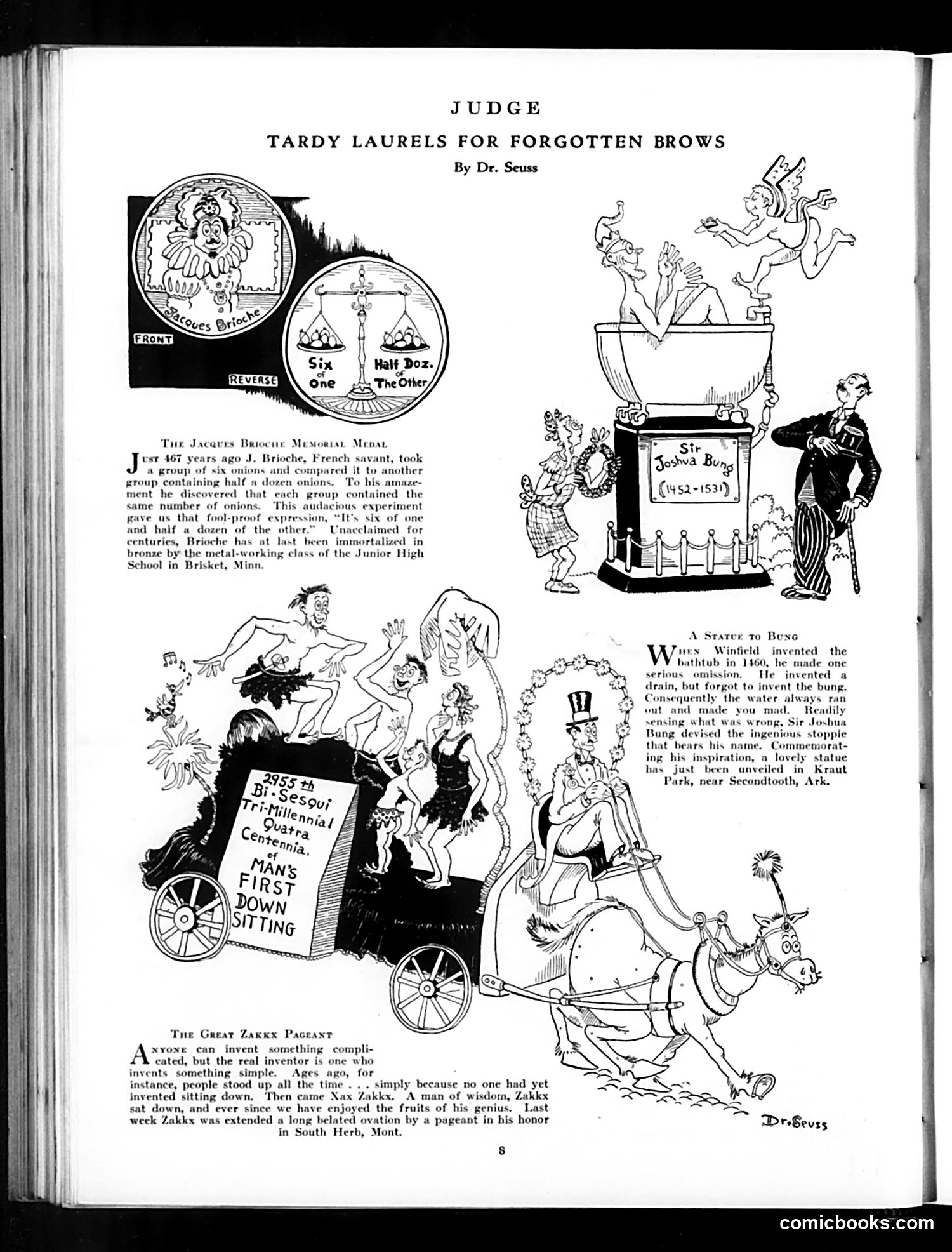
Analysis This Dr. Seuss piece satirizes the human tendency to overlook or delay recognition of simple but transformative inventions. Three examples illustrate the theme: 1. Jacques Brioche: A French savant who discovered that equal groups of onions produce consistent results—a mundane observation that took centuries to be commemorated with a medal. 2. Winfield's Bathtub: The inventor created the bathtub drain but forgot the drain plug (bung), an embarrassing oversight now memorialized with a statue despite the obvious flaw. 3. Nax Zakkx: The "real inventor" who created sitting down—positioned as the ultimate simple invention, finally receiving recognition through a pageant. The satire mocks how society celebrates trivial or incomplete accomplishments with grand monuments and delayed honors, while ignoring that these "innovations" are either obvious or flawed. Seuss critiques both human forgetfulness and our impulse to mythologize the mundane through formal commemoration.
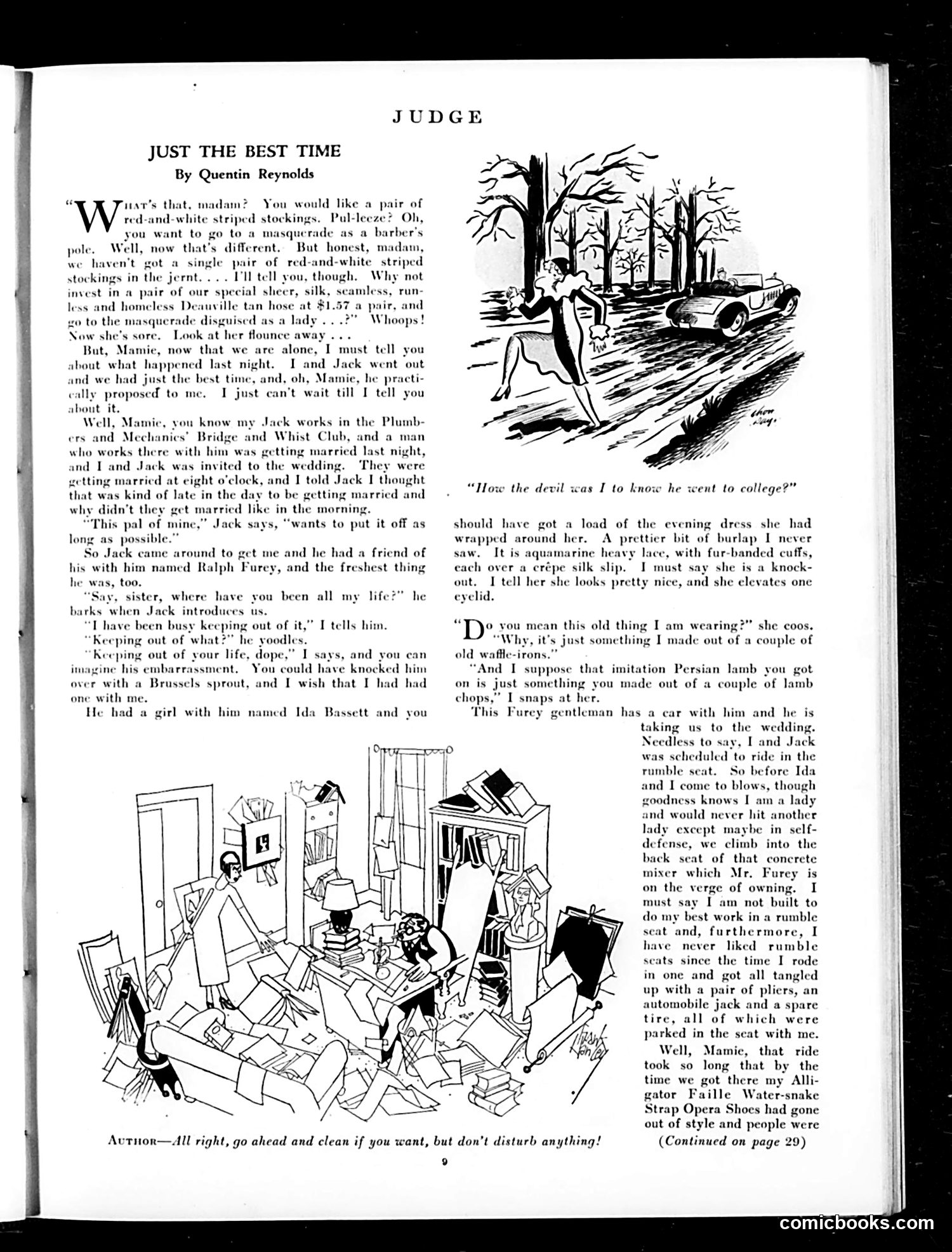
"Just the Best Time" by Quentin Reynolds This is a humorous short story in Judge magazine, illustrated with period cartoons. The narrative follows a woman (presumably the narrator "Mamie") recounting a wedding night adventure to someone addressed as "madam." The story satirizes working-class social pretensions and awkward dating rituals of the era. Key elements include: a pushy suitor named Ralph Furey who uses tired pickup lines ("where have you been all my life?"), his friend Ida Bassett wearing a cheap, poorly-made evening dress she pretends is fashionable, and an uncomfortable rumble-seat ride in Furey's car to the wedding. The humor derives from the narrator's quick comebacks and sarcasm toward the characters' social climbing and false sophistication. The final illustration shows a cluttered room, while a sidebar cartoon references college attendance as a source of embarrassment. The overall point mocks lower-middle-class aspirations and romantic mishaps.
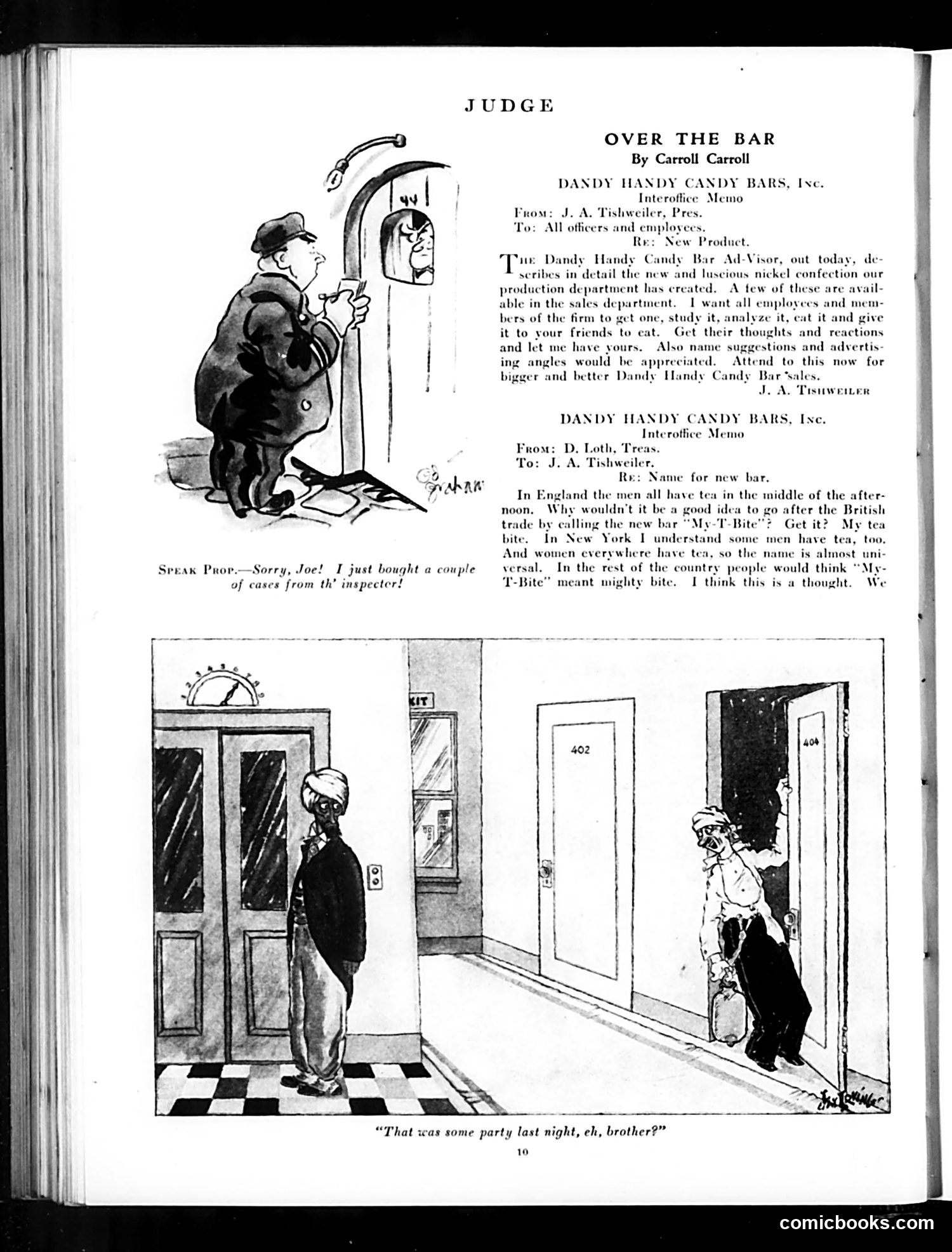
Explanation for Modern Readers This page contains two satirical pieces about a candy company's new product. Top cartoon: A man at a speakeasy or office window says he bought "a couple of cases from th' inspector"—a joke about Prohibition-era corruption. Inspectors supposedly enforced alcohol bans but actually facilitated illegal sales, making them complicit in bootlegging. Below: Two interoffice memos debate naming a new candy bar. One executive proposes "My-T-Bite," referencing the British afternoon tea tradition ("tea bite"). The humor lies in the obliviousness: American consumers unfamiliar with British customs would interpret "My-T-Bite" as "mighty bite" instead—an accidental but apt description for candy. Bottom cartoon: Two men in a hallway; one asks another about "some party last night"—likely implying illegal drinking, consistent with the Prohibition-era context of the page's humor. The satire targets corporate miscommunication and the absurdities of Prohibition enforcement.
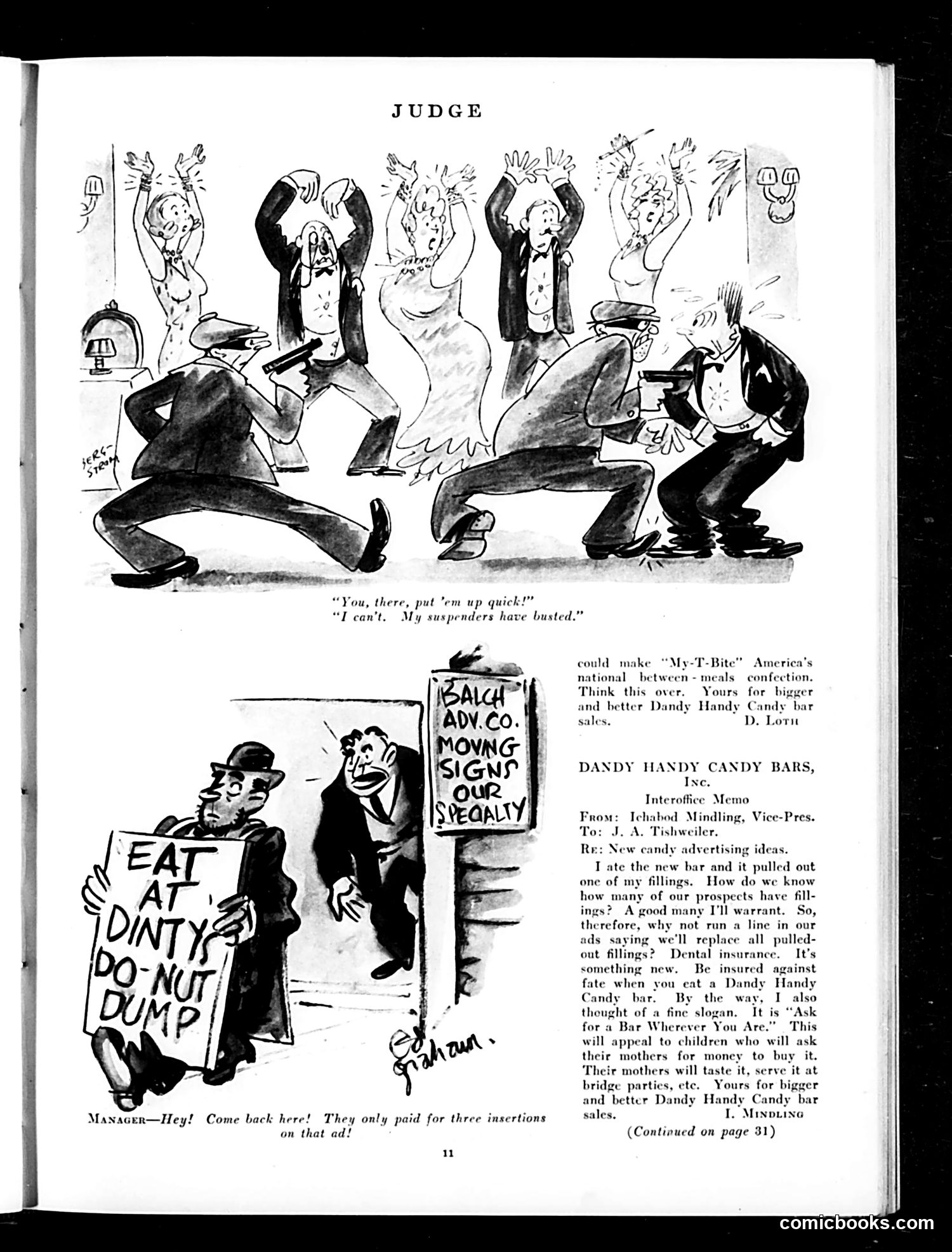
Judge Magazine Page Analysis This page contains two distinct satirical pieces: Top cartoon ("Judge"): Shows judges or legal figures in chaotic disarray, with one man's suspenders broken. The caption reveals the absurdist humor: when told to "put 'em up quick," he cannot comply because his suspenders have failed. The manager complains they've only paid for three ad insertions, suggesting this chaos is itself an advertisement that ran beyond its contract. Bottom section: A fake interoffice memo from Dandy Handy Candy Bars proposing darkly humorous advertising ideas. The memo suggests marketing the candy by promising to "replace all pulled-out fillings"—acknowledging their product damages teeth—as a form of "dental insurance." The accompanying cartoon shows street advertising with deliberately crude signage ("Eat at Dinty Do-Nut Dump"). The satire mocks both corporate advertising absurdity and product liability—suggesting companies would cynically capitalize on harm their products cause. The humor relies on readers recognizing the obvious contradiction between selling candy while acknowledging it destroys teeth.
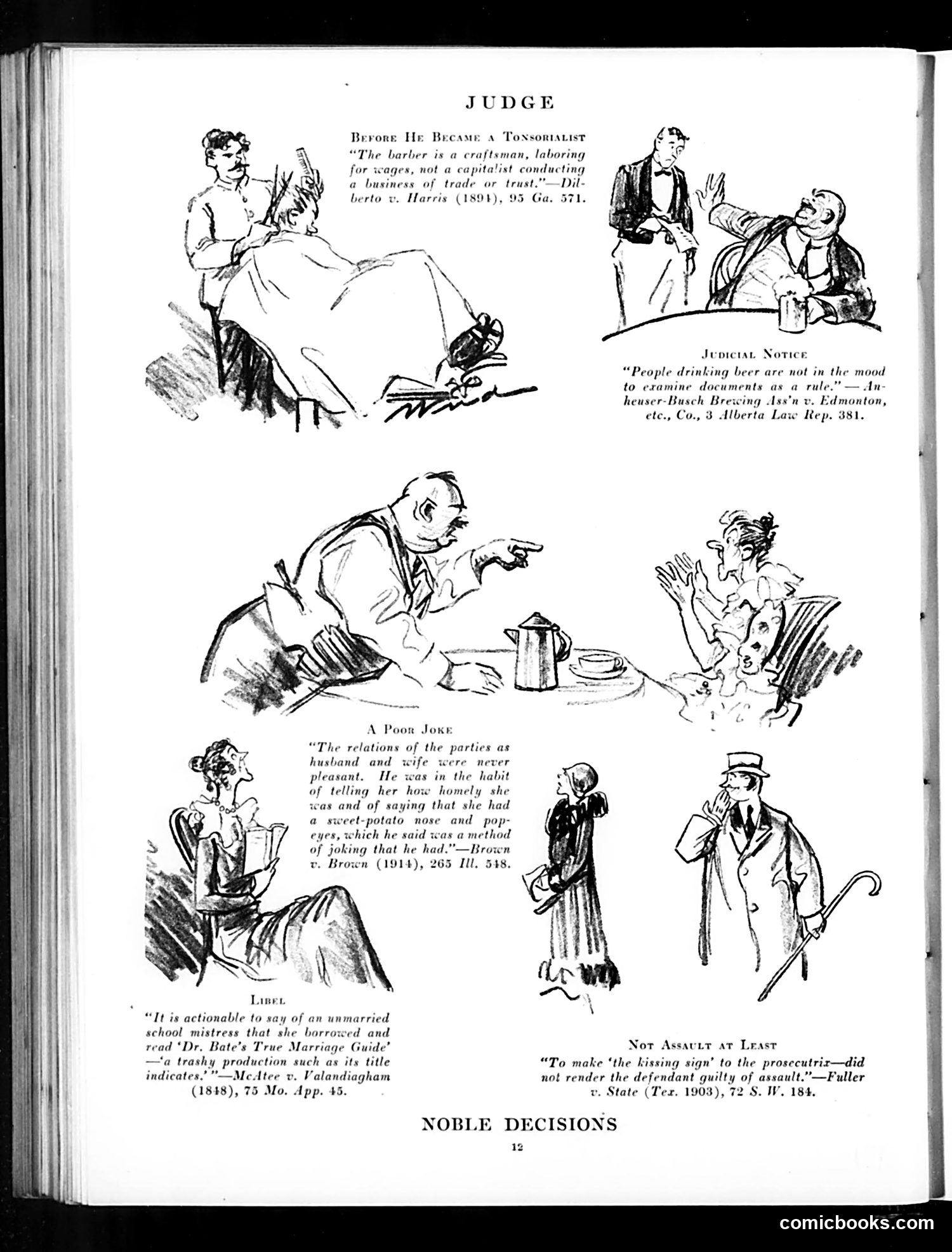
"Noble Decisions" - Judge Magazine Legal Satire This page satirizes absurd court rulings through illustrated vignettes paired with actual case citations. Each cartoon mocks the legal system's peculiar determinations: "Before He Became a Tonsorialist": A barber case ruling that distinguishes barbers as wage-laborers, not businesspeople—seemingly splitting hairs over occupational classification. "Judicial Notice": Anheuser-Busch brewery argument that drunk people won't scrutinize documents, poking fun at corporate legal defenses. "A Poor Joke": Husband systematically insulting wife's appearance as "joking," which courts found acceptable—satire of marital abuse rationalization. "Libel": Attacking a schoolteacher's morality by mentioning she read a marriage guide constituted actionable defamation. "Not Assault at Least": Making a "hissing sign" at a prosecutor didn't legally constitute assault. The cartoons ridicule how courts reached technically defensible but socially absurd conclusions, using real cases to expose legal reasoning's disconnect from common sense and justice.
Judge Magazine Page Analysis This page from *Judge* contains three editorial columns discussing contemporary policy debates, likely from the late 1920s or early 1930s. "Reduce the War Debts?" argues that banker Albert Wiggin is correct that the U.S. government should forgive Allied war debts to stimulate international commerce—a counterintuitive economic argument the satirist suggests Congress cannot grasp. "The Pressure for Planning" surveys recent calls for government economic coordination from universities, business associations, and trade journals—even praising Herbert Hoover's engineering background and planning ability, despite his unpopular tariff and Prohibition stance. The satire suggests centralized economic planning, once radical, now has mainstream support. "We Could If We Would" celebrates Winnipeg's central heating infrastructure as an example of modern progress—district heating systems reducing costs and fire hazards. It's presented as practical proof that coordinated systems work. The "Judge on the Bench" header frames these as judicial commentary on contemporary American issues.
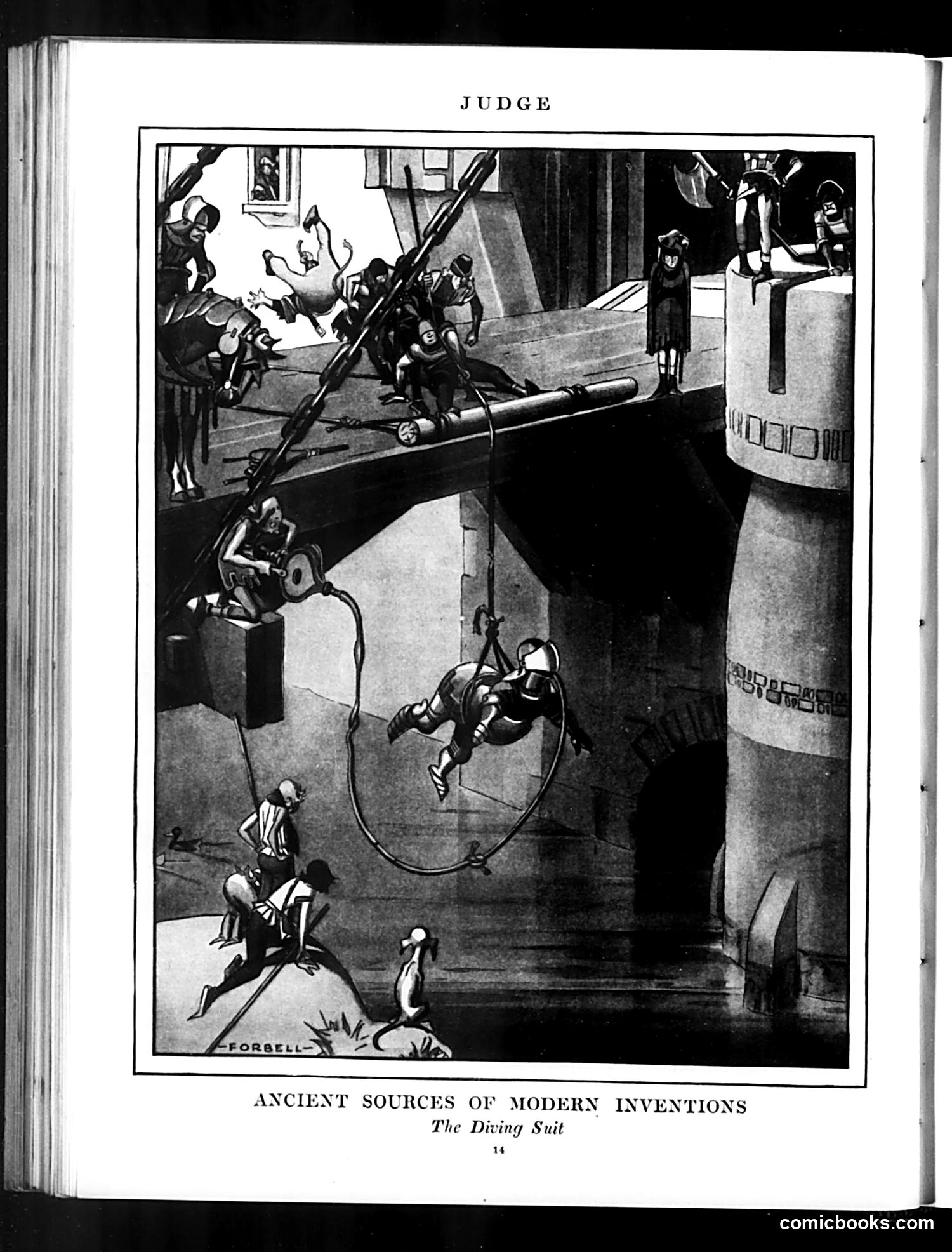
Analysis This is a satirical illustration titled "Ancient Sources of Modern Inventions: The Diving Suit," signed by Forbell. The cartoon depicts a humorous origin story for the diving suit by showing what appears to be classical or biblical-era figures using rope-and-pulley systems to lower a person into water between two large cylindrical structures (possibly representing early diving apparatus or towers). The satire suggests that modern diving suits aren't genuinely new inventions but rather adaptations of ancient techniques. The illustration presents this with comedic exaggeration—showing primitive methods achieving similar results to contemporary technology. This reflects a common Judge magazine theme: mocking human pretensions to originality by tracing modern conveniences back to ancient practices, thereby deflating contemporary pride in technological progress.
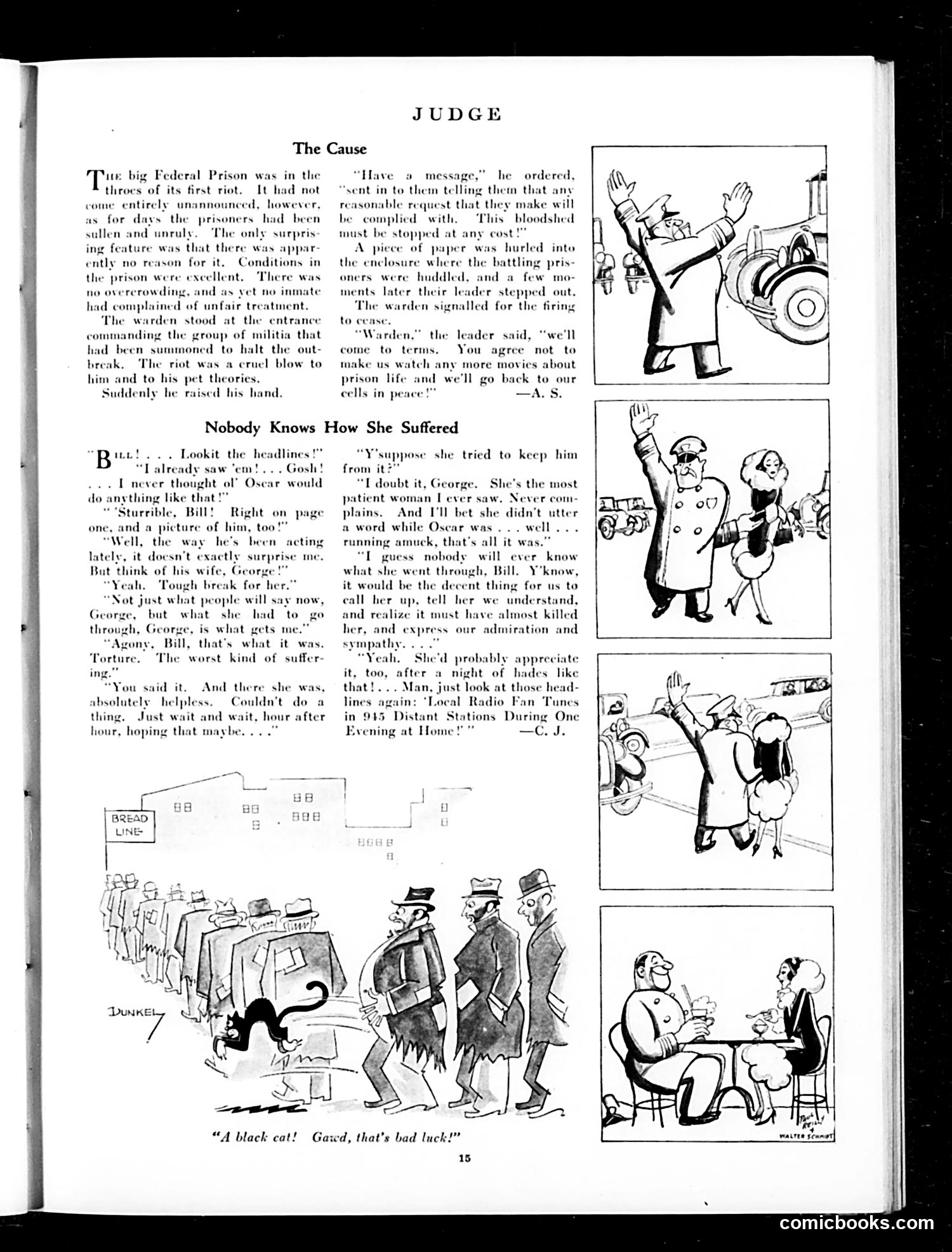
Analysis: "Judge" Magazine Page This page contains two satirical pieces from the American humor magazine *Judge*. "The Cause" mocks prison reform theory. A warden runs an exemplary federal prison with excellent conditions, yet a riot breaks out anyway. The prisoners' demand—to stop watching movies about prison life—reveals the satire's point: the warden's progressive, humane approach fails because the real cause of unrest isn't material deprivation but something inherent to incarceration itself. The joke undercuts the era's faith in rational prison management. "Nobody Knows How She Suffered" satirizes gossip and performative sympathy. Two men discuss a scandal (likely Oscar's infidelity or arrest), focusing obsessively on his wife's suffering while displaying no genuine concern. Their plan to call and express "admiration" reveals hollow sentimentality—they're more interested in the drama than actual compassion. The cartoon mocks how society performs concern for wronged women while exploiting their misfortune as entertainment. Both pieces critique public hypocrisy and failed institutions with characteristic early-20th-century satirical bite.
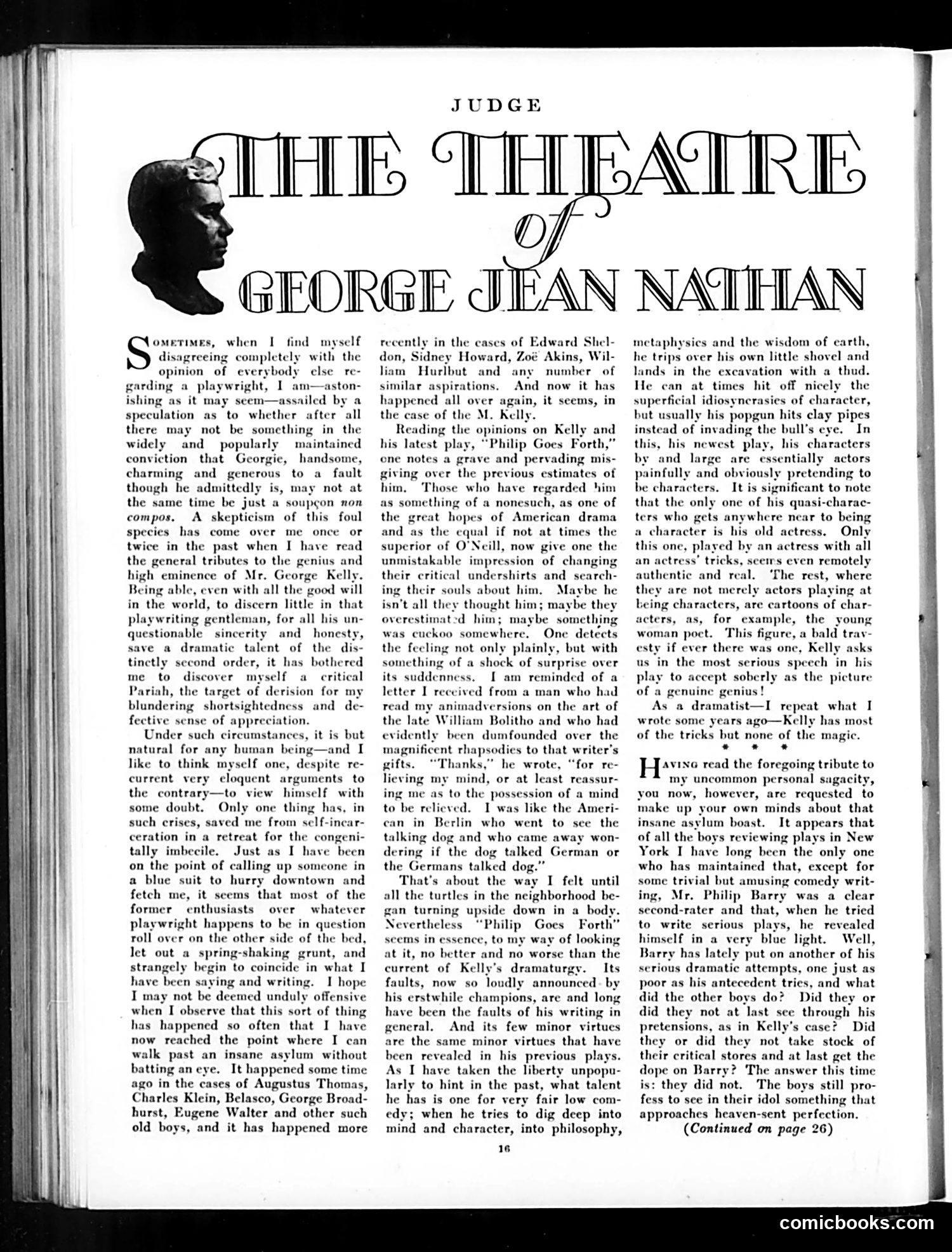
"The Theatre of George Jean Nathan" — Judge Magazine Critique This is a literary essay (not a cartoon) by theater critic George Jean Nathan, reviewing playwright George Kelly and his recent play "Philip Goes Forth." Nathan argues that Kelly, despite public acclaim as a major American dramatist comparable to O'Neill, lacks genuine dramatic talent—possessing only "second order" ability. Nathan notes a pattern: critics initially praise playwrights (citing Thomas, Klein, Belasco, Howard, Akins), then collectively reverse course, admitting their earlier enthusiasm was misplaced. The essay's humor lies in Nathan's self-deprecating admission that his contrarian skepticism initially made *him* feel like the crazy one—until the theatrical establishment inevitably agreed with his negative assessment. He compares this to a man bewildered watching a trained dog in Berlin, wondering if the dog or Germans were the real oddity. This reflects early 20th-century theater criticism's volatility and Nathan's reputation as an iconoclastic reviewer unafraid to challenge popular opinion.
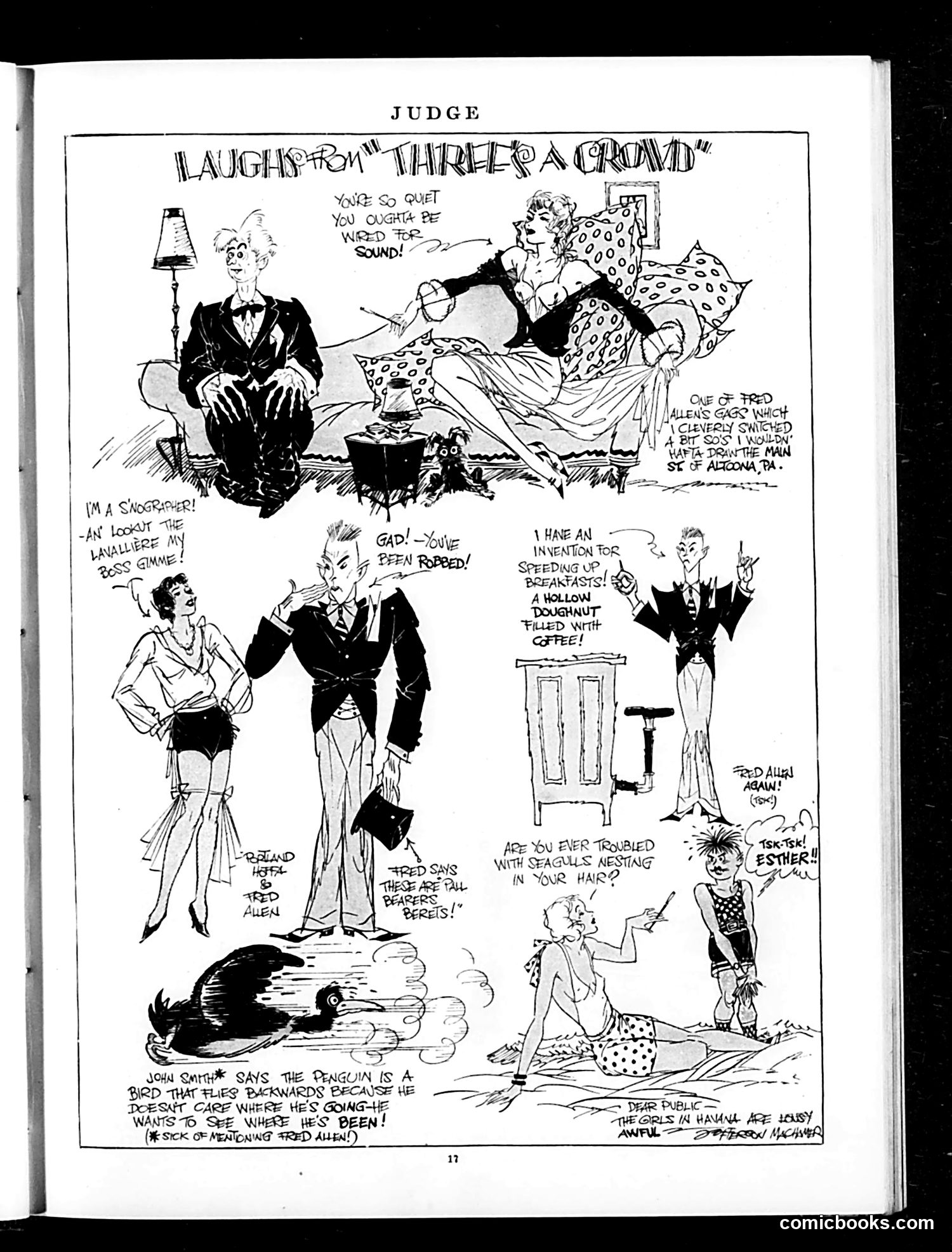
"Laugh? Three a Crowd" - Judge Magazine Satire This page collects several unrelated gags typical of Judge's humor style. The main cartoon shows a couple being entertained by various absurd inventions and observations: - Fred Allen (a famous radio comedian of the era) is referenced multiple times, suggesting topical humor about a contemporary celebrity - Inventions satirized: a coffee-filled doughnut for "speeding up breakfasts," and a solution for seagulls nesting in hair (appearing to reference Hawaii, given the "Hana" reference) - The penguin joke mocks nonsensical logic popular in radio comedy - Social commentary targets trivial concerns among the wealthy leisure class The cartoons use exaggerated character types (sharp-dressed men, fashionable women) to mock everyday absurdities and fads. The humor relies on absurdist logic and topical radio celebrity references that would resonate with Judge's educated, urban readership of the 1930s-40s.
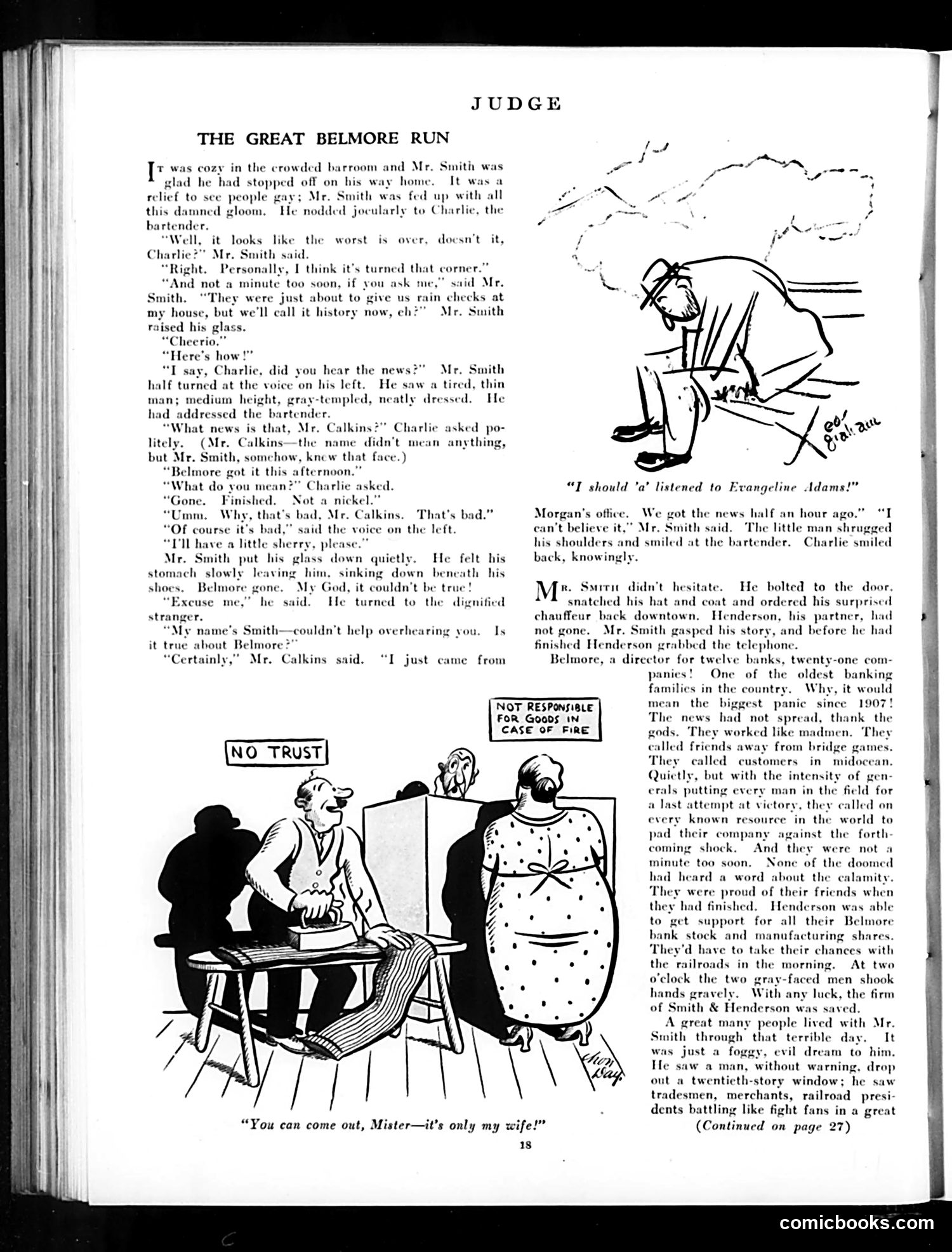
"The Great Belmore Run" — Judge Magazine Cartoon Analysis This page depicts a financial panic narrative centered on the collapse of Belmore, apparently a major banking/investment entity. The story illustrates how devastating news of a financial failure spreads through social circles, threatening established businessmen like Mr. Smith. The cartoon labeled "NO TRUST" shows two men confronting a large woman—likely satirizing public anxiety and distrust during financial crises. The woman's protective posture and the "not responsible for goods in case of fire" sign suggest commentary on institutional instability and loss of confidence. The narrative demonstrates the era's banking fragility: one director's failure threatens multiple banks and companies simultaneously. Smith and his partner Henderson frantically mobilize their network to shore up their own company before the news spreads, illustrating how crisis contagion worked in pre-regulation banking. The story likely reflects early 20th-century financial instability, possibly the 1907 panic referenced in the text.
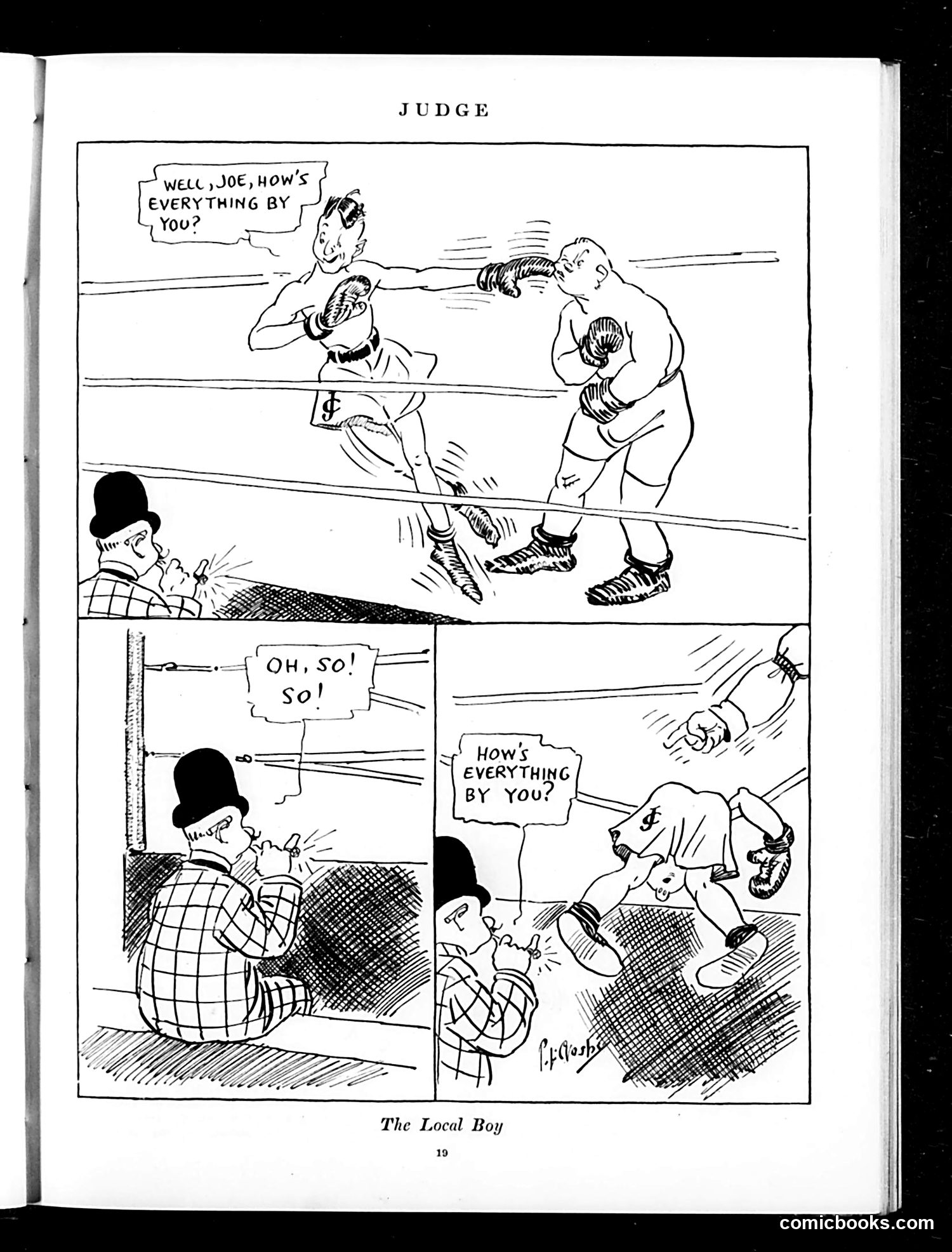
This comic titled "The Local Boy" depicts a boxing match where a man in a bowler hat watches from ringside. The referee asks "Well, Joe, how's everything by you?" The fighter responds "Oh, so! So!" before getting knocked down. When asked again "How's everything by you?" he replies from the canvas. The satire appears to target working-class or immigrant attitudes—the repeated "so! so!" and casual "by you" phrasing suggest Yiddish or Eastern European immigrant speech patterns common in early 20th-century American cities. The joke satirizes how someone maintains optimistic cheerfulness despite being literally beaten down, possibly mocking either immigrant resilience or naive optimism in the face of hardship. The bowler-hatted observer likely represents a more established American authority figure witnessing this scene.
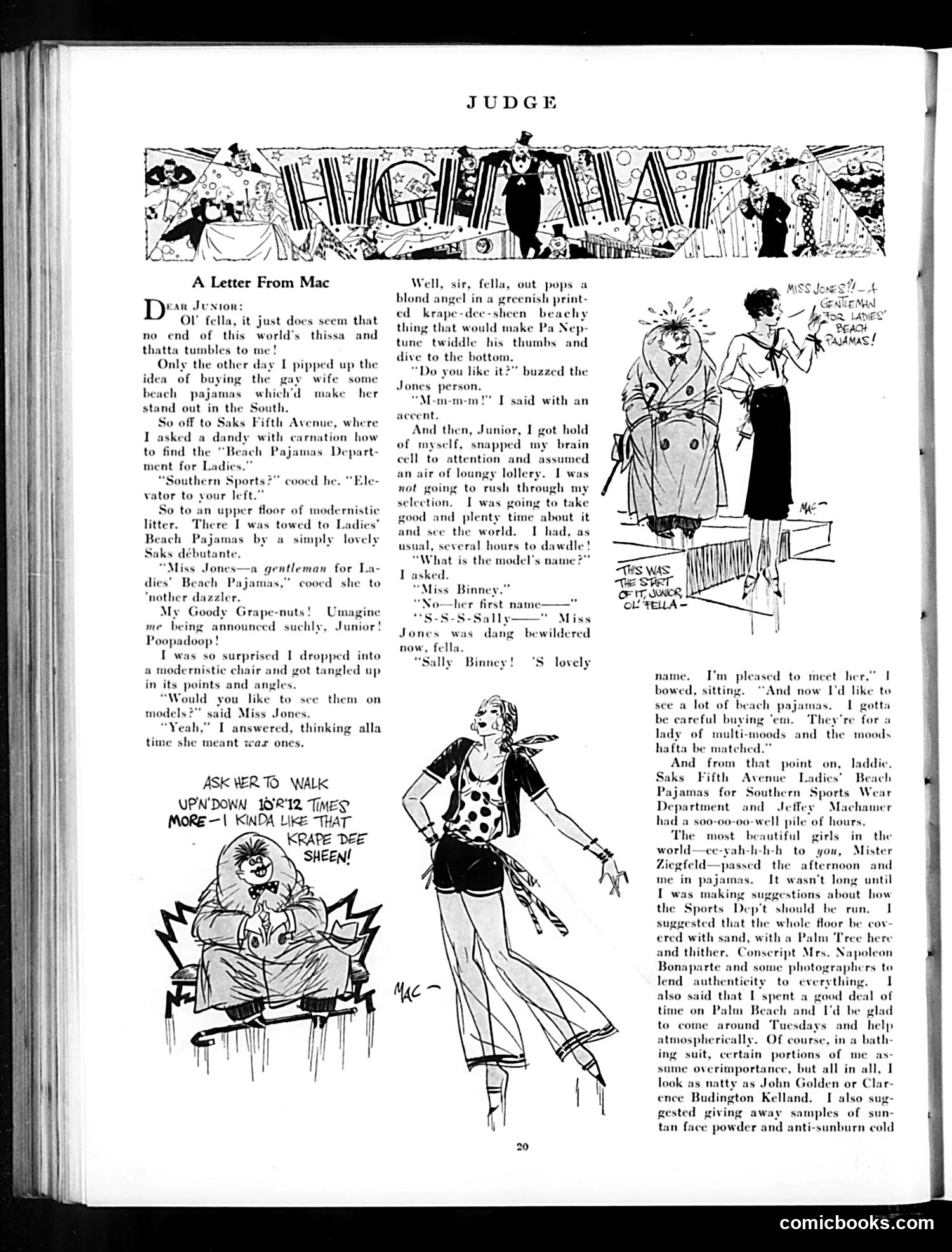
"A Letter From Mac" - Judge Magazine Satire This piece satirizes 1920s consumer culture and male incompetence in shopping. The narrator (a man called "Mac" writing to "Junior") describes his bumbling attempt to purchase beach pajamas at Saks Fifth Avenue for his wife. The humor lies in several layers: Mac's malapropisms and affected speech ("Poopadoop," "Grape-nuts"), his complete befuddlement by the sales process, and his tendency to get distracted by attractive saleswoman Sally Binney rather than focus on his purchase. The illustrations show his physical comedy—tangling in modernistic furniture, his bewilderment. The satire mocks both male shoppers' incompetence in department stores (traditionally female domains) and the absurdity of 1920s fashion trends like "beach pajamas"—casual loungewear marketed as fashionable sportswear. His overwrought suggestions about staging the display (sand, palm trees, actresses) parody advertising excess of the era. The overall target: masculine bumbling meets commercialized consumer culture.
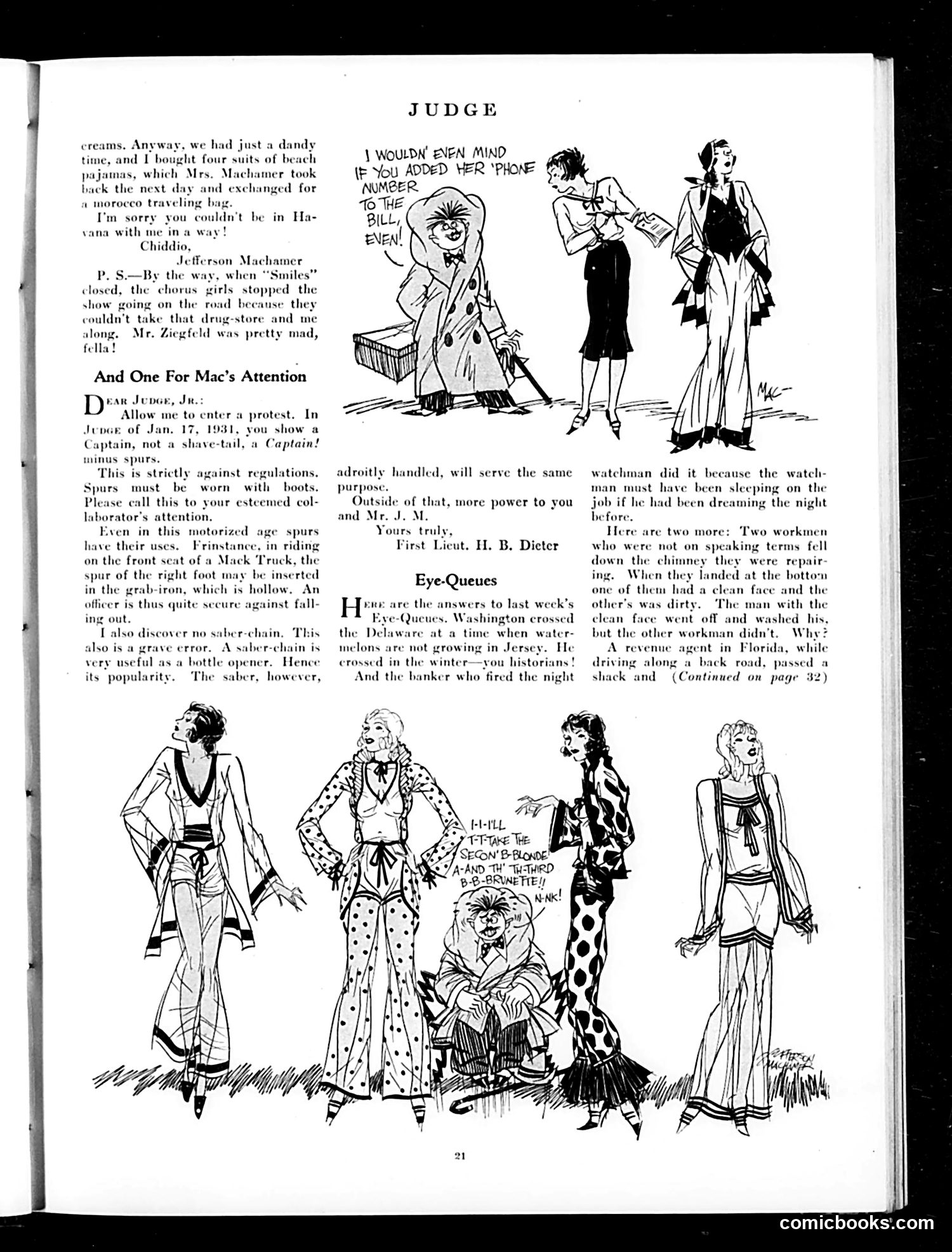
Judge Magazine Page Analysis This page contains reader letters and humor sections from Judge magazine (circa 1931, based on the Jan. 17 reference). "And One For Mac's Attention" is a mock-serious letter protesting a military uniform illustration showing a Captain without proper spurs and saber-chain. The satire lies in the writer's deadpan justifications for these items: spurs serve practical purpose on truck running boards, and saber-chains function as bottle openers. The humor mocks both military protocol and 1930s improvisation. "Eye-Queues" presents riddle answers, including a Washington crossing joke (likely playing on the famous painting) and a chimney-cleaning anecdote. The final setup about a revenue agent in Florida suggests Prohibition-era bootlegging humor (though it's cut off mid-page). The cartoons above show fashionably dressed 1930s women in various social situations, with dialogue about phone numbers and bills—typical Judge satirical commentary on modern dating and social conventions of the era.
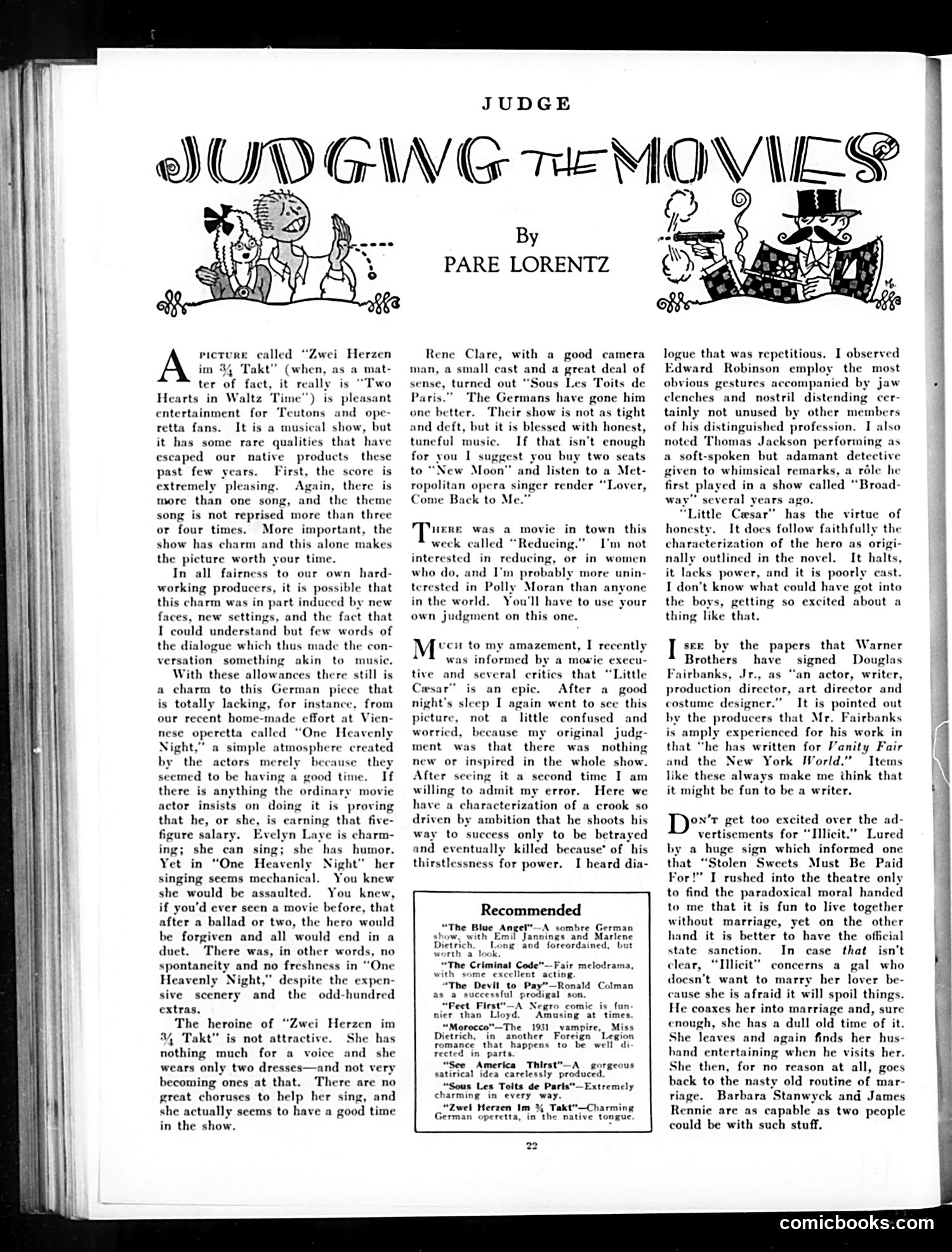
"Judging the Movies" by Pare Lorentz — Judge Magazine Film Review This is a film criticism column reviewing recent movies. Lorentz discusses German operetta film "Zwei Herzen im 34 Takt," praising its charm and genuine music over formulaic American productions. He criticizes "One Heavenly Night" (starring Evelyn Laye) for mechanical, predictable storytelling typical of Hollywood stars eager to display their five-figure salaries. Most notably, Lorentz reconsiders "Little Caesar," initially dismissing it as uninspired but admitting error upon second viewing. He praises the characterization of the protagonist—a ruthless criminal driven by ambition to ultimate betrayal and death—as genuinely compelling. This suggests contemporary recognition of the film's psychological depth in depicting criminal ambition. The "Recommended" box lists several 1930-31 films including Marlene Dietrich vehicles and Ronald Colman, typical of early-sound cinema fare.
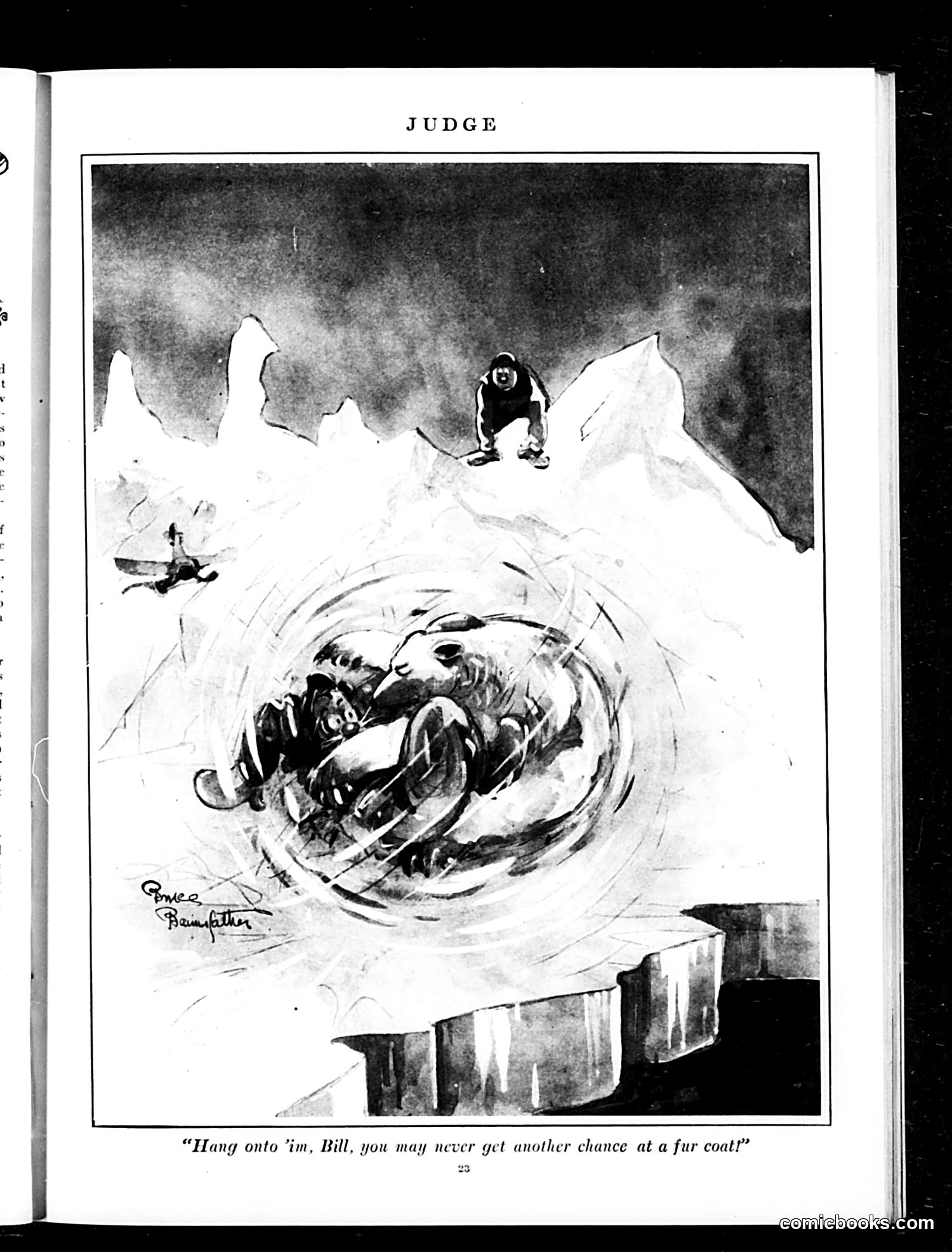
Political Cartoon Analysis: "Judge" Magazine This cartoon depicts a precarious situation on an icy mountain landscape. A figure labeled "Bill" clings to a dangerous position above a gaping maw—likely representing financial ruin or bankruptcy. The caption reads: "Hang onto 'im, Bill, you may never get another chance at a fur coat!" The satire appears to mock financial desperation during economic hardship, suggesting someone ("Bill") is clinging to a risky venture or person promising luxury goods (a fur coat) despite obvious danger. The dark pit represents financial catastrophe. Without the magazine's date visible, the exact historical context remains unclear, but this likely comments on 1920s-1930s economic speculation or the consequences of pursuing wealth during unstable times.
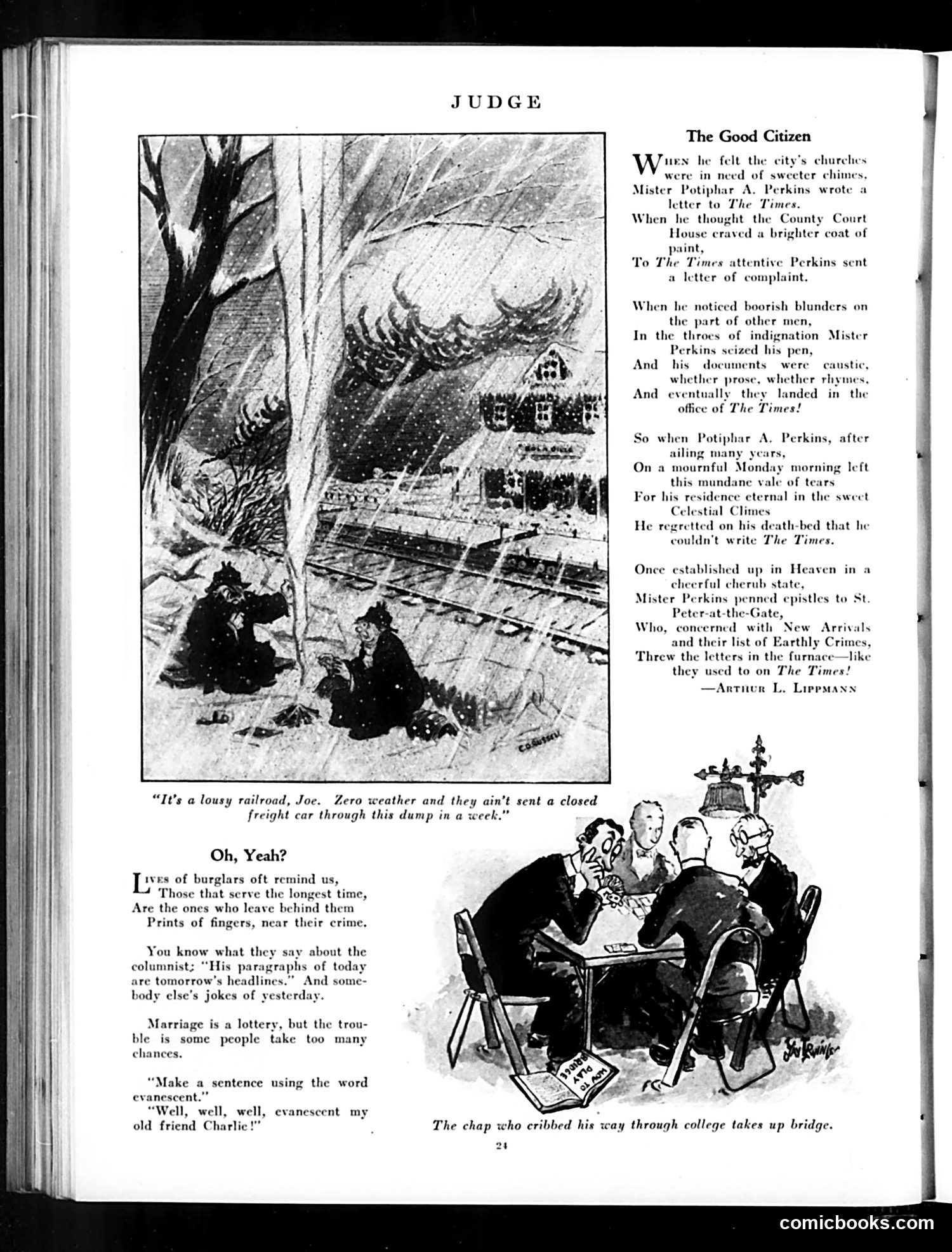
"The Good Citizen" - Judge Magazine Satire This page satirizes chronic letter-writers to newspapers, specifically *The Times*. The main poem follows Mister Potiphar A. Perkins, a compulsive complainer who writes endlessly about minor civic issues—church chimes, courthouse paint, bureaucratic errors. The satire's punch: even in Heaven, Perkins can't stop, pestering St. Peter with complaint letters that get thrown in the furnace like they were at *The Times*. The humor targets self-important citizens who believe their grievances are vital public concerns, when editors actually discard them. It mocks both chronic complainers and the newspaper's perceived indifference to reader complaints. The lower cartoon "Oh, Yeah?" offers unrelated quips about burglars, columnists, marriage, and a college cheat—typical period filler humor. The railroad dialogue cartoon references labor/transportation complaints common to the era.
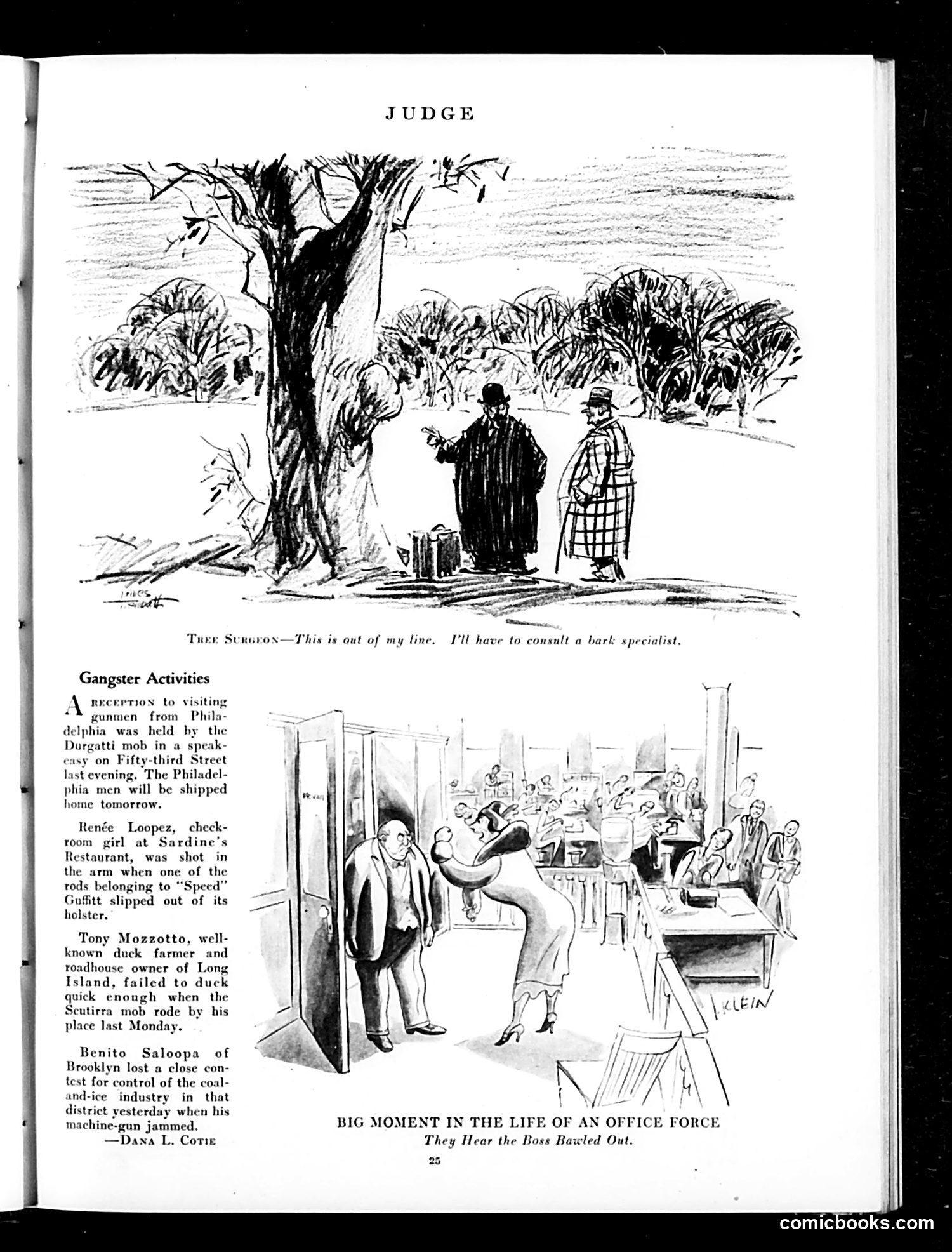
Judge Magazine Page Analysis Top Cartoon ("Judge"): A tree surgeon declines work on a damaged tree, saying he'll need to consult a "bark specialist"—a pun on "bark" (the tree's covering) that likely also references organized crime's "barking" or threats. The joke's unclear without more context. "Gangster Activities" Section: This satirizes Prohibition-era organized crime through mock-serious "news briefs" about mobsters (Durgatti, Guffitt, Scutirra gangs) conducting violent business. The tone mimics crime reporting while treating murders and turf wars as mundane social events—the satire lies in presenting deadly violence with bureaucratic casualness ("Philadelphia men will be shipped home tomorrow"). Bottom Cartoon ("Big Moment in the Life of an Office Force"): Shows office workers eagerly listening at a doorway as their boss is "bawled out" (scolded). The humor captures working-class schadenfreude—employees enjoy witnessing their superior being reprimanded, a moment of role reversal in the hierarchical workplace. Both items satirize American urban life and class dynamics of the Prohibition/early 20th-century era.
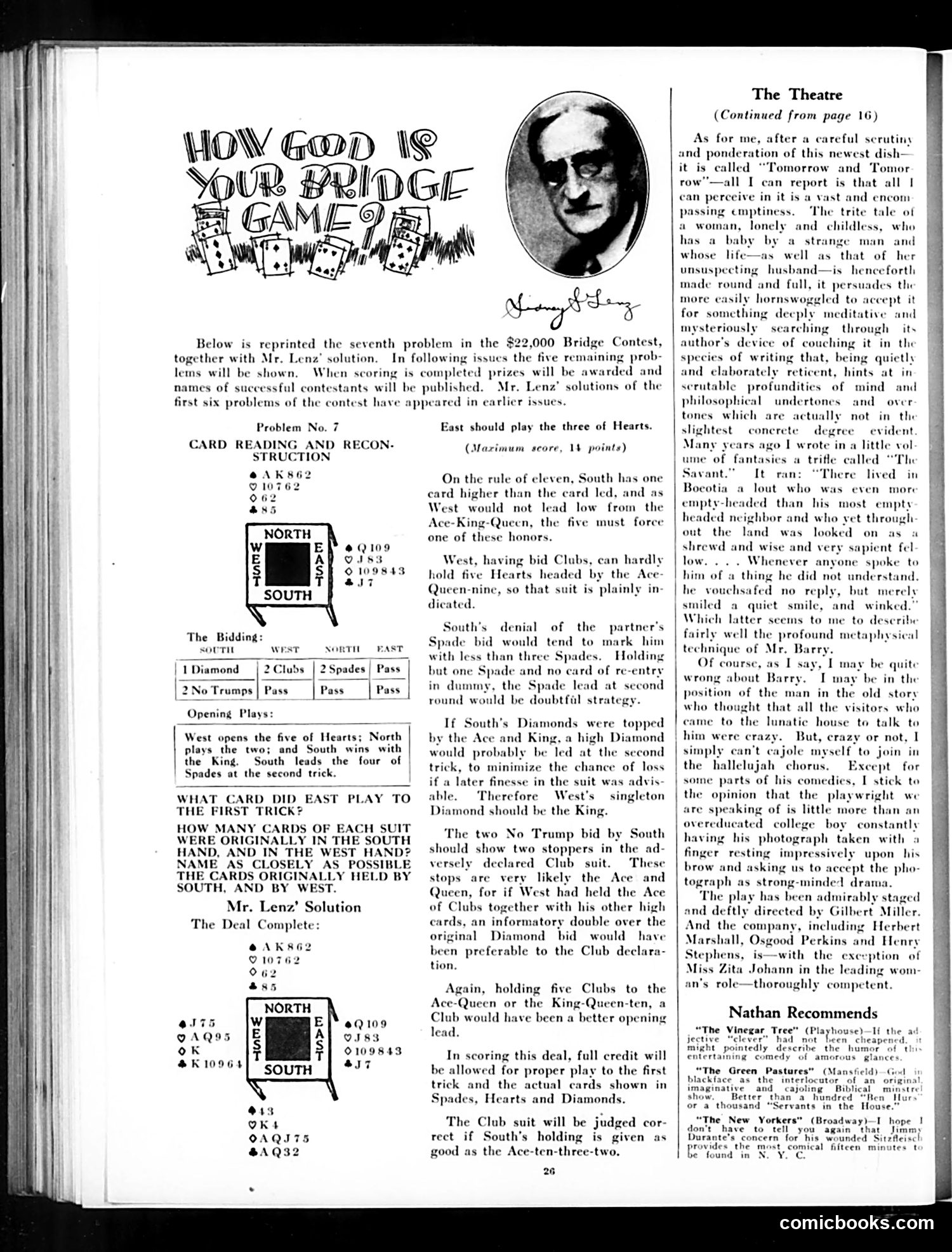
Content Analysis This page from *Judge* magazine presents bridge card game problem No. 7 from a $22,000 contest, with solution by "Mr. Lenz" (likely Ely Culbertson, famous bridge expert of the era). The cartoon headline "HOW GOOD IS YOUR BRIDGE GAME?" is a straightforward challenge to readers. The bulk of the page is instructional: it shows a card deal, bidding sequence, and opening play, asking readers to deduce what card East should play and reconstruct the full hand distribution. This represents *Judge*'s popularization of contract bridge, which was a fashionable craze among American upper classes in the 1920s-30s. The right column contains theater criticism (unrelated to the bridge content), reviewing a play called "Tomorrow and Tomorrow" negatively. No political satire is present here. This is primarily entertainment and puzzle content for educated, leisure-class readers interested in bridge strategy.
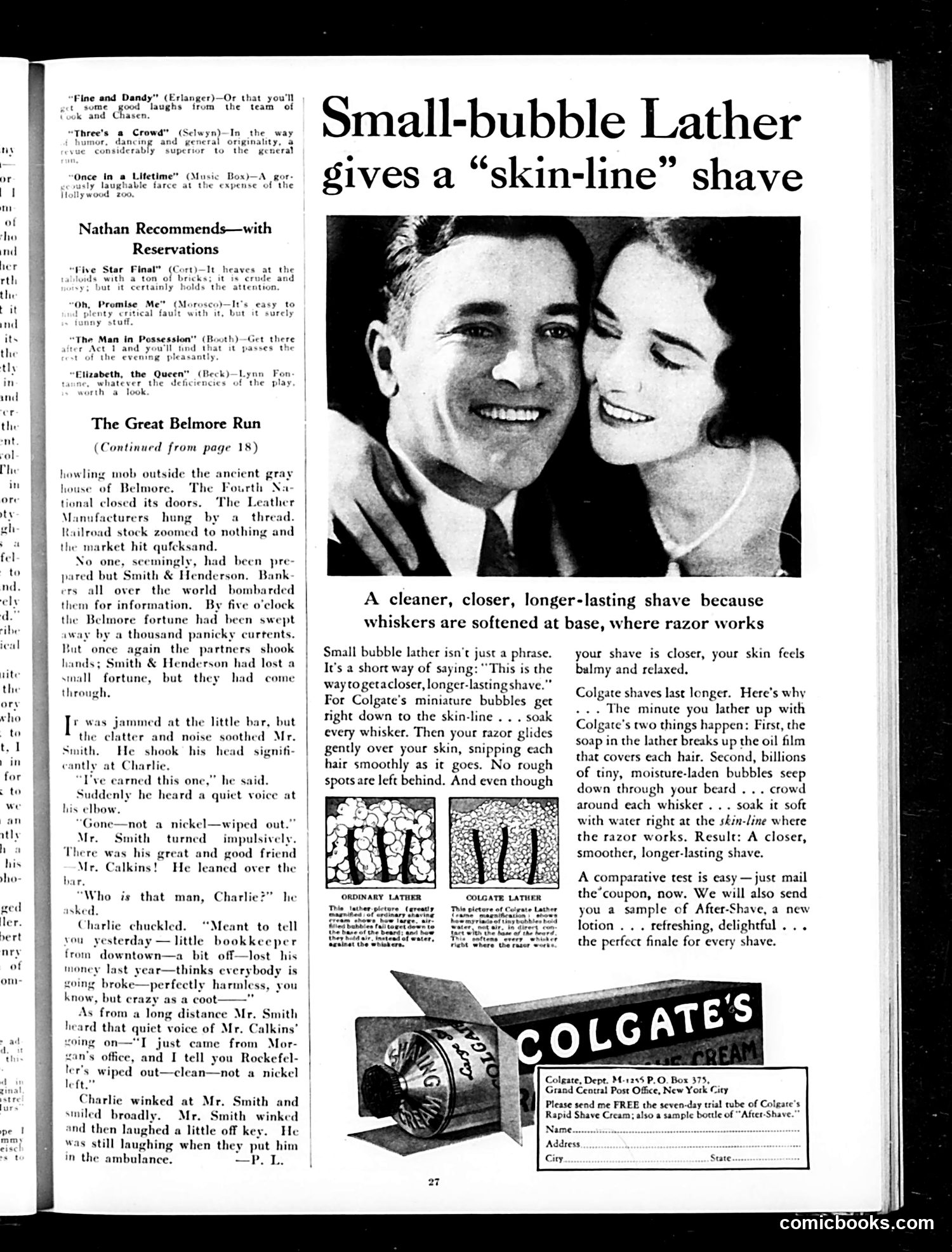
Analysis of Judge Magazine Page This page contains no political cartoon. Instead, it's a mixed-content page featuring: 1. Theater reviews by Nathan (left column): Brief critiques of Broadway plays like "Fine and Dandy" and "The Star Final," with typical entertainment-section commentary. 2. "The Great Belmore Run" (fiction excerpt): A serialized short story about financial panic and banking collapse, involving characters Smith, Henderson, and Calkins. The narrative climaxes with a nervous breakdown—the protagonist laughs maniacally as he's loaded into an ambulance after learning of financial ruin. 3. Colgate shaving cream advertisement (majority of page): A full commercial for "small-bubble lather," featuring a smiling couple and technical explanation of how the product works. Includes a coupon for free samples. The page is primarily advertising disguised within editorial content, typical of early-20th-century magazines that blended promotional material throughout.
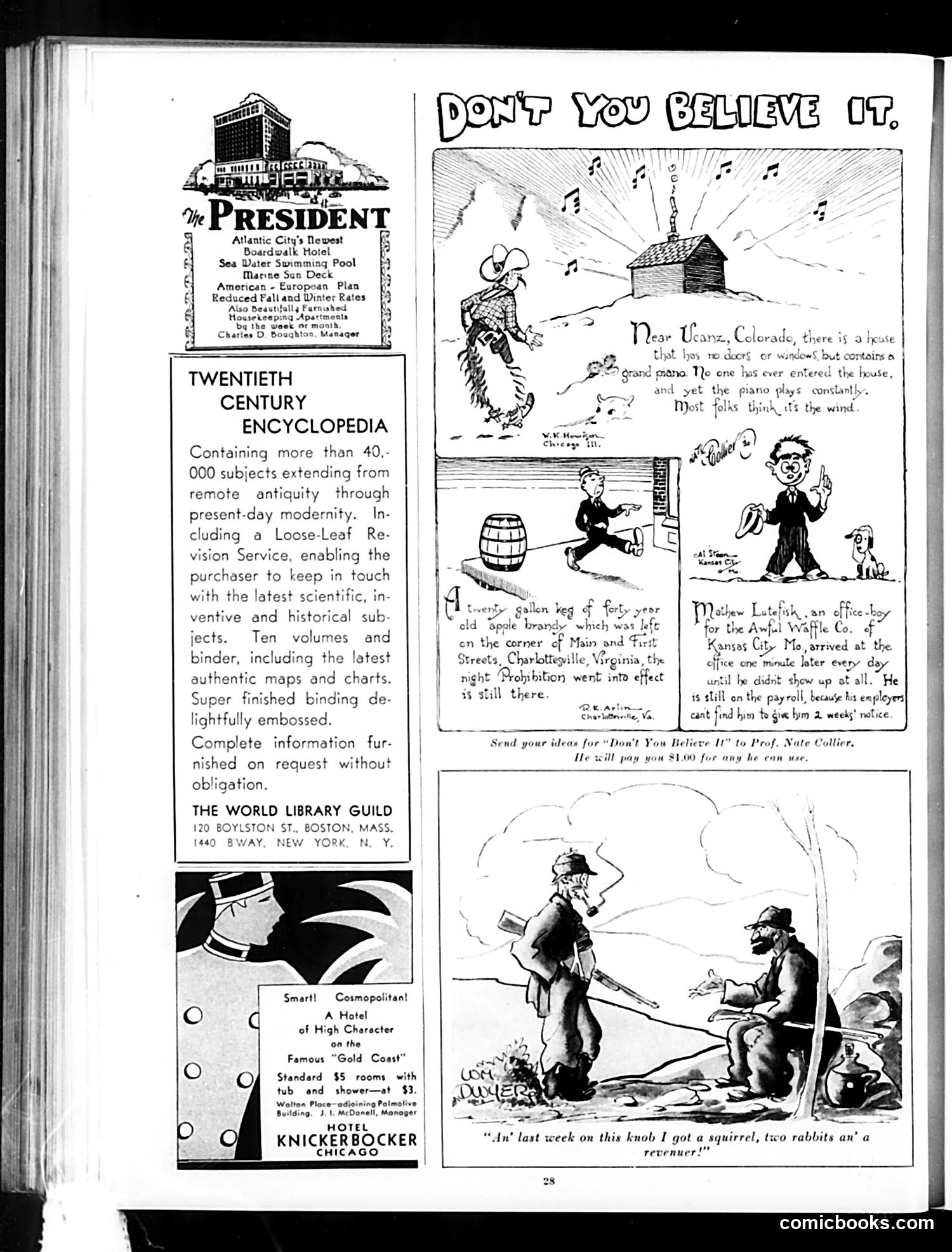
"Don't You Believe It" — Judge Magazine Satire Page This page features "Don't You Believe It," Judge's recurring humor column presenting tall tales and impossibilities. The three illustrated anecdotes mock absurd claims: 1. The haunted piano: A house with no doors/windows containing a self-playing grand piano—readers should disbelieve the supernatural explanation. 2. The 22-year-old apple brandy: Whiskey supposedly hidden since Prohibition (1920) remained undiscovered in plain sight in Charlottesville, Virginia. 3. The phantom employee: A man hired at the Awful Waffle Co. (Kansas City) who never actually showed up but remained on payroll because his employer couldn't locate him to deliver termination notice. The satire targets Prohibition-era absurdities, employment inefficiency, and general human credulity. Readers submitted ideas; Prof. Nate Colliers paid $1.00 per accepted contribution. The page's left side contains advertisements (The President Hotel, Twentieth Century Encyclopedia, Hotel Knickerbocker)—typical of Depression-era magazine layouts.
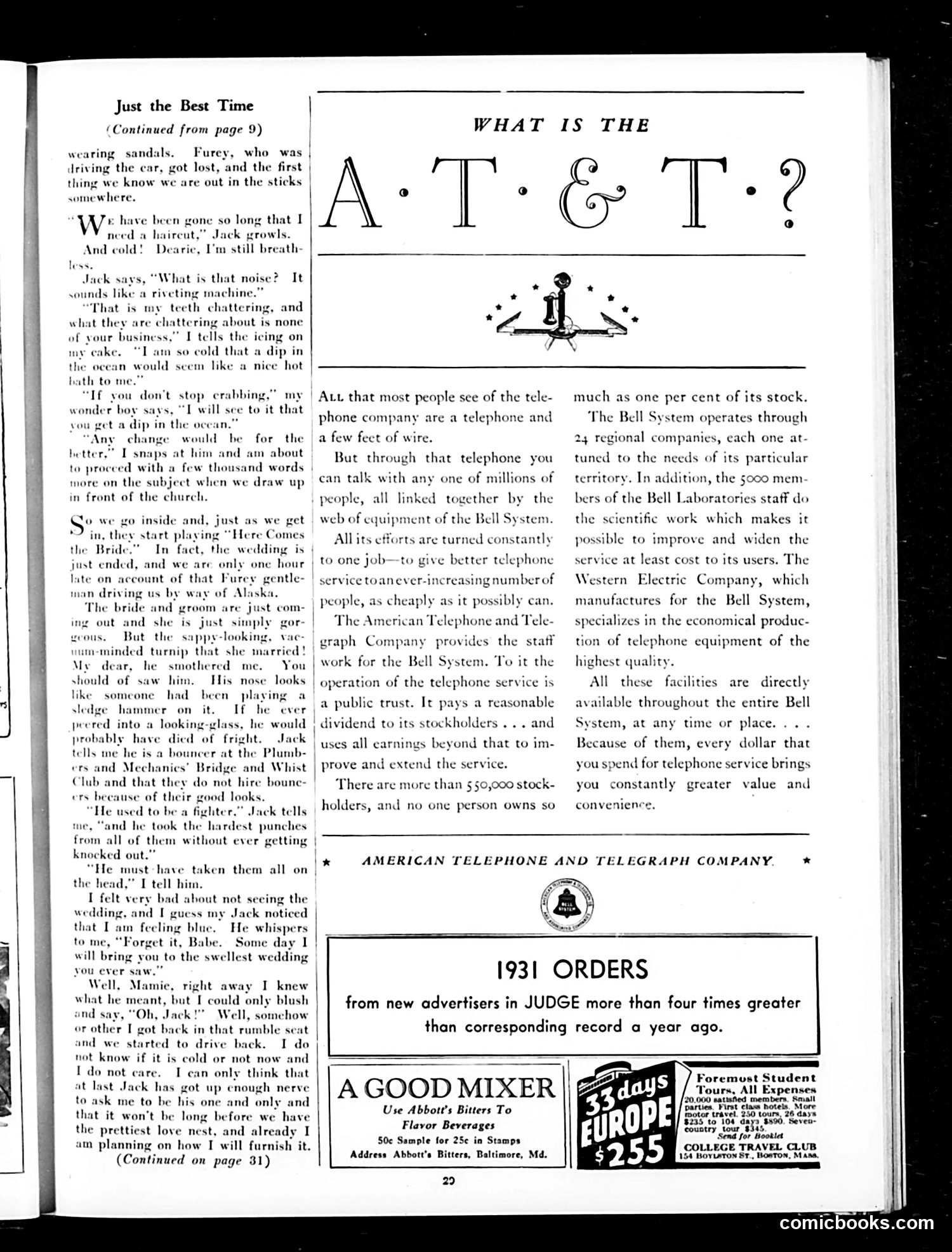
"What Is the A.T.&T.?" — Page Analysis This page contains two distinct elements: Left side: A serialized romantic short story ("Just the Best Time," continued from page 9) about a woman named Mamie describing a chaotic car trip to a wedding with her boyfriend Jack. The narrative focuses on their banter and Jack's implied marriage proposal—typical light romantic humor for Judge magazine's audience. Right side: A full-page corporate advertisement for the American Telephone and Telegraph Company (AT&T), structured as an explanatory feature titled "What Is the A.T.&T.?" The ad uses corporate messaging to educate readers about AT&T's structure: 550,000 stockholders with no single majority owner, 24 regional Bell operating companies, the Bell Laboratories research division, and Western Electric manufacturing. It frames telephone service as a "public trust" providing affordable, improving service. Context: This 1931 advertisement appears during the Great Depression, likely addressing public concerns about monopolistic corporate power by emphasizing democratic stock ownership and public benefit. The page is primarily advertising content, with the story serving as editorial filler.
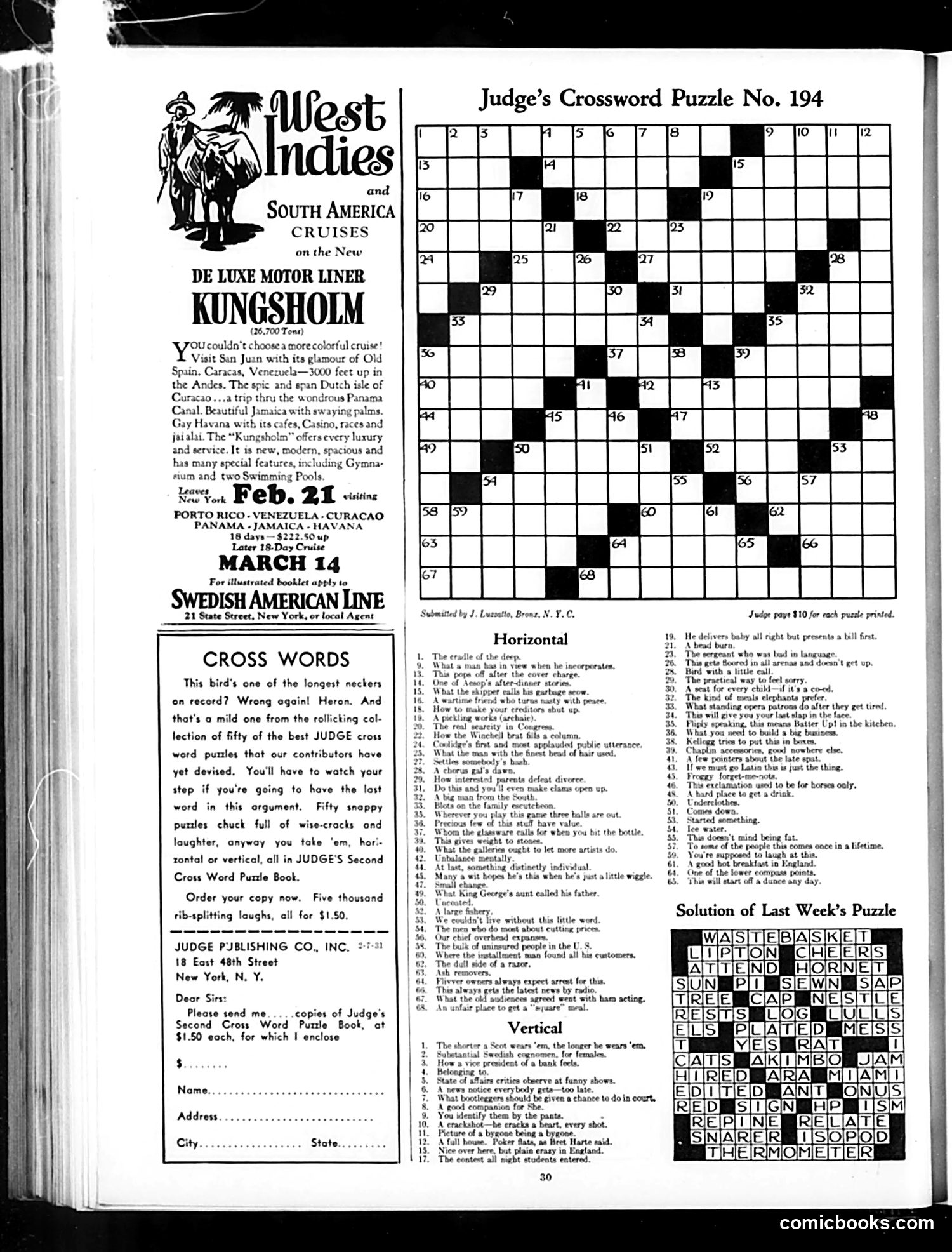
Judge Magazine Page Analysis This page is primarily advertising and puzzles, not political satire. The dominant content is a full-page advertisement for the Swedish American Line's cruise ship *Kungsholm*, promoting luxury voyages to the Caribbean and Central America (Puerto Rico, Venezuela, Curaçao, Panama, Jamaica, and Havana). Below the ad is a crossword puzzle (#194) with themed clues—most are light contemporary humor about 1920s-30s life: references to installment buying, radio, flivvers (Model T Fords), jazz, and social attitudes. The clues mock modern conveniences and behaviors rather than target specific political figures. The page also promotes Judge magazine's own "Second Cross Word Puzzle Book" ($1.50), emphasizing its humor content. There is no identifiable political cartoon or caricature visible. This appears to be a standard commercial/entertainment page from the magazine's middle section, focused on selling cruises and puzzle books rather than satirizing current events or politicians.
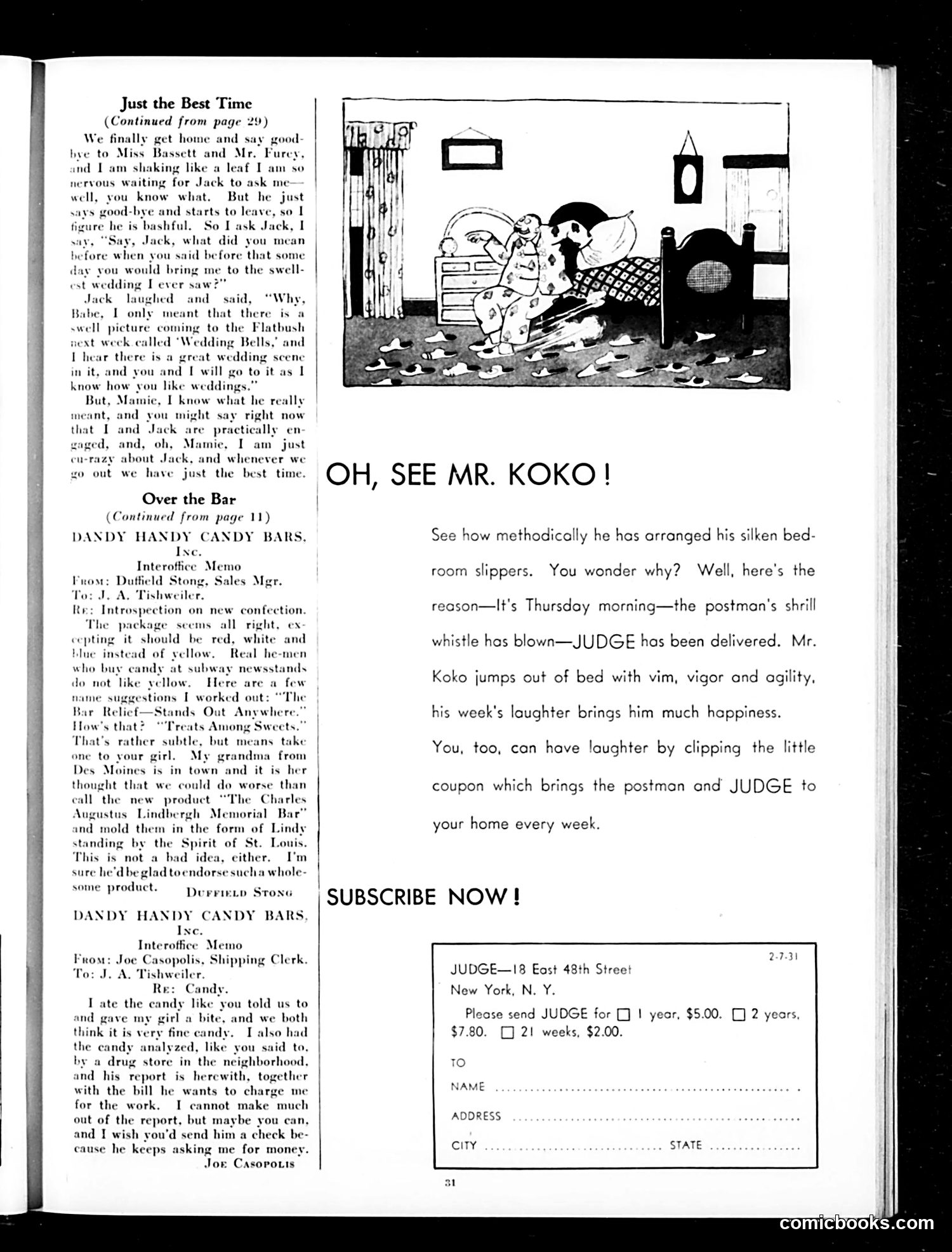
"Oh, See Mr. Koko!" - Judge Magazine Cartoon Analysis This is an advertisement for Judge magazine, disguised as a humorous cartoon. The illustration depicts "Mr. Koko" (likely a cat or anthropomorphic animal character), who eagerly jumps from bed upon hearing the postman deliver his weekly copy of Judge. The joke's premise: Mr. Koko arranges his bedroom slippers with such meticulous care on Thursday morning specifically because he anticipates Judge's arrival—the magazine brings him such joy and laughter that he wants everything perfectly ordered to celebrate the occasion. The satire is self-promotional: Judge humorously suggests that receiving their publication weekly is so delightful it becomes a highlight worth ritualistic preparation. The accompanying subscription form offers options for one year, two years, or 21 weeks, encouraging readers to similarly experience this promised weekly happiness. This reflects early 20th-century magazine marketing strategies, positioning humor magazines as essential sources of entertainment and social commentary.
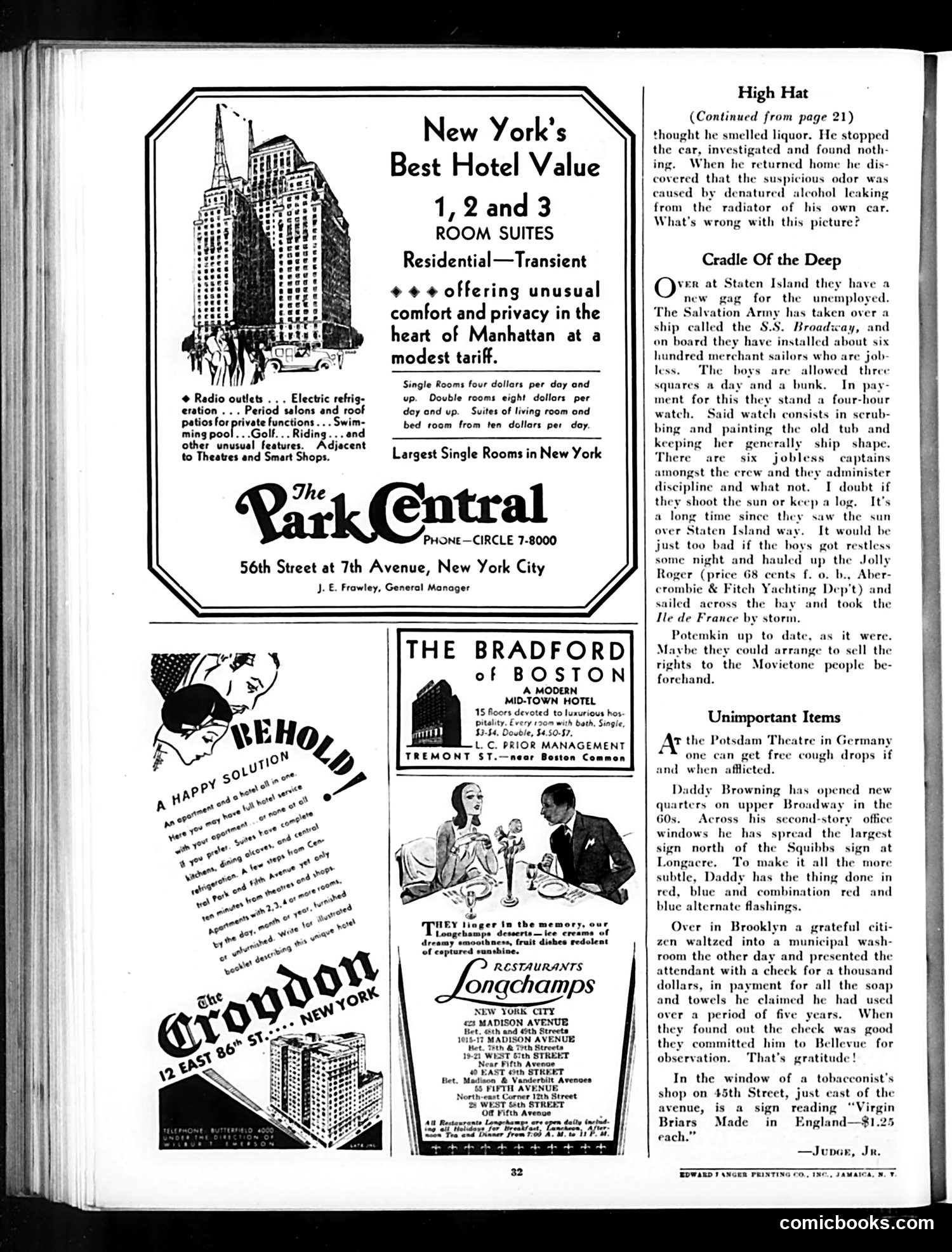
Judge Magazine Page Analysis This page is primarily advertising for New York hotels and restaurants (Park Central, Bradford of Boston, Longchamps), with a sidebar column of brief satirical social commentary titled "High Hat." The "High Hat" column contains three short humorous anecdotes: 1. "What's Wrong with This Picture?" — A man suspects his car smells of liquor, investigates, and discovers the odor actually comes from leaking radiator fluid (denatured alcohol). 2. "Cradle of the Deep" — The Salvation Army has converted a ship called the S.S. Broadway into housing for unemployed merchant sailors during what appears to be the Great Depression, allowing them to work off room and board through ship maintenance. 3. "Unimportant Items" — Brief gossip: Daddy Browning opened new Broadway offices with a large sign; a Brooklyn man checked into a mental hospital after generously "repaying" a public bathhouse for five years' worth of towels and soap. The satire targets economic hardship, eccentric wealthy figures (Browning), and misplaced gratitude. The style is dry, observational humor typical of 1920s-30s American magazines.
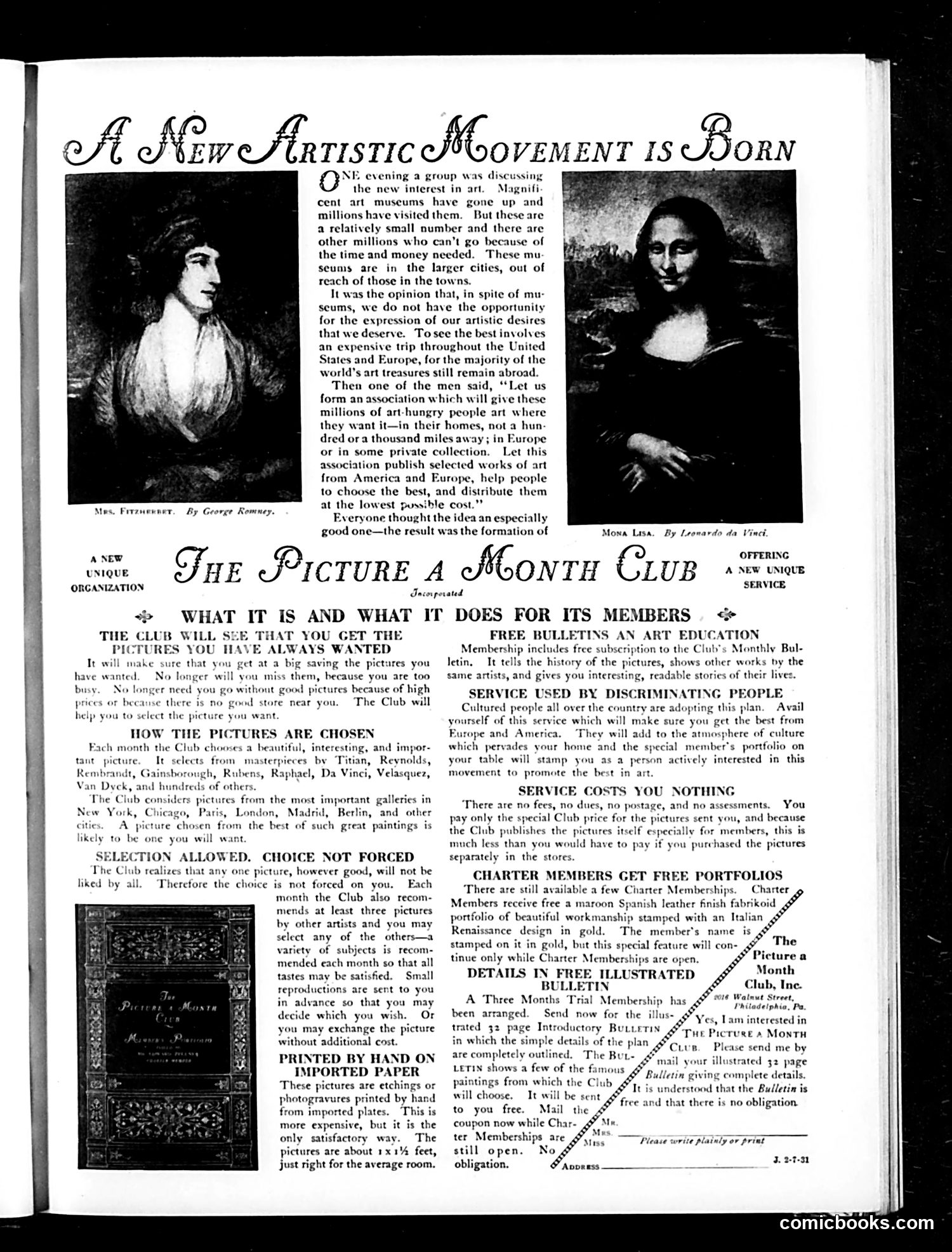
"A New Artistic Movement is Born": The Picture a Month Club This page announces a new mail-order art service—The Picture a Month Club—marketed as a democratic solution to art access. The opening narrative describes a group discussing how millions of Americans lack museum access due to distance and cost, proposing instead to distribute quality reproductions to homes nationwide. The two portraits shown (Mrs. Fitzherbert by George Romney and Mona Lisa by Leonardo da Vinci) exemplify the "masterpieces" members would receive. The satirical point appears gentle: the Club promises cultured people affordable exposure to famous artworks while positioning membership as a status marker ("stamp you as a person actively interested in this movement"). This reflects early 20th-century anxiety about art democratization—the tension between making culture accessible and maintaining exclusivity. The extensive promotional copy emphasizes "discriminating people" adopting this plan, subtly suggesting that even democratic access to art requires refined judgment.
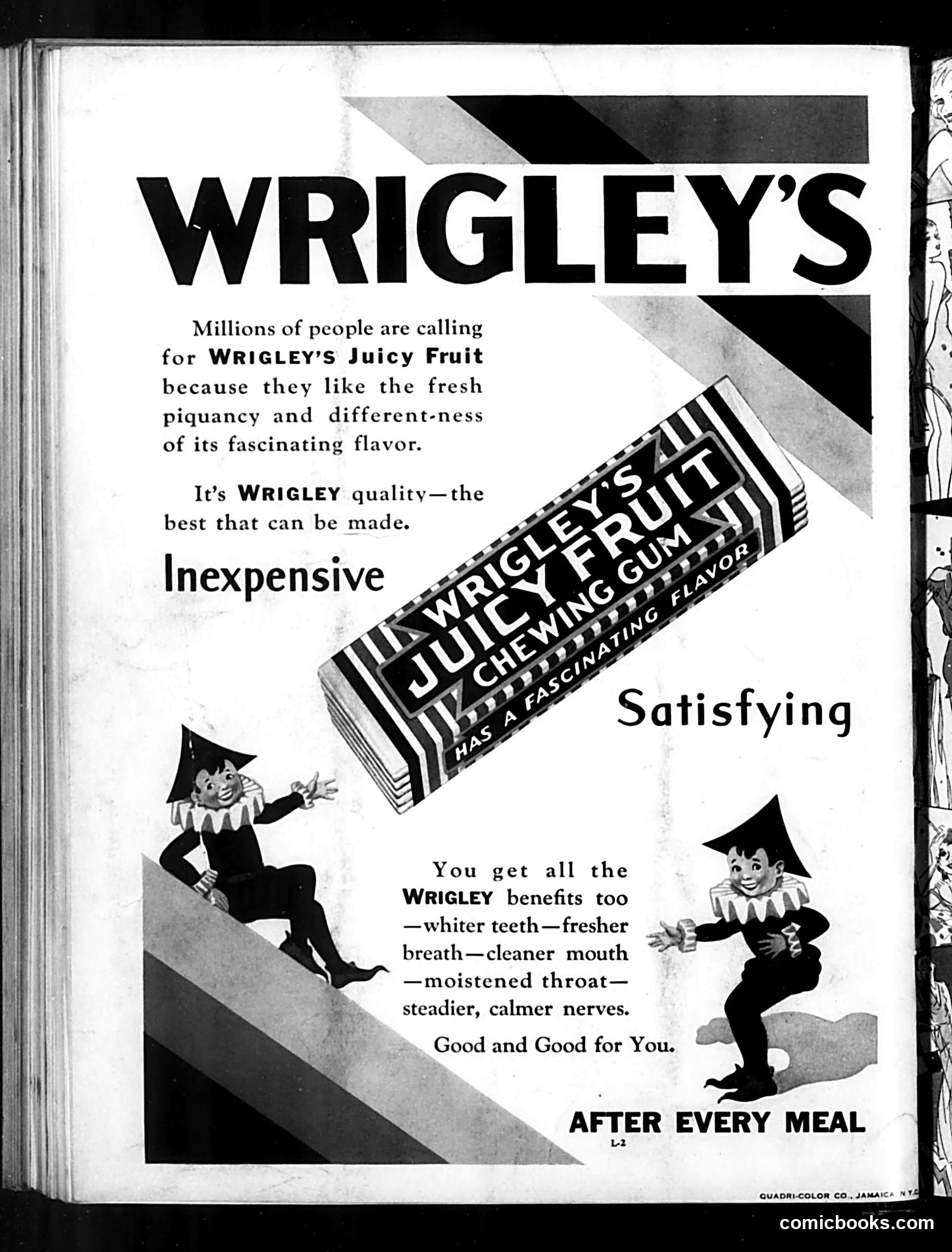
Analysis This is primarily a Wrigley's Juicy Fruit chewing gum advertisement, not satirical content. The page features two identical cartoon figures—appearing to be stylized jesters or mascots with pointed hats—positioned on diagonal geometric shapes flanking a product image. The ad claims gum provides health benefits beyond flavor: whiter teeth, fresher breath, cleaner mouth, moistened throat, and "steadier, calmer nerves." This reflects early 20th-century advertising that made exaggerated health claims now considered misleading—particularly the assertion that chewing gum calms nerves. The emphasis on "Inexpensive" and "Wrigley quality" targets budget-conscious consumers. The "After Every Meal" tagline suggests routine use as a health practice, typical of vintage product marketing before modern advertising regulations. No political satire is present; this is straightforward commercial promotion.