judge
Judge — February 14, 1931
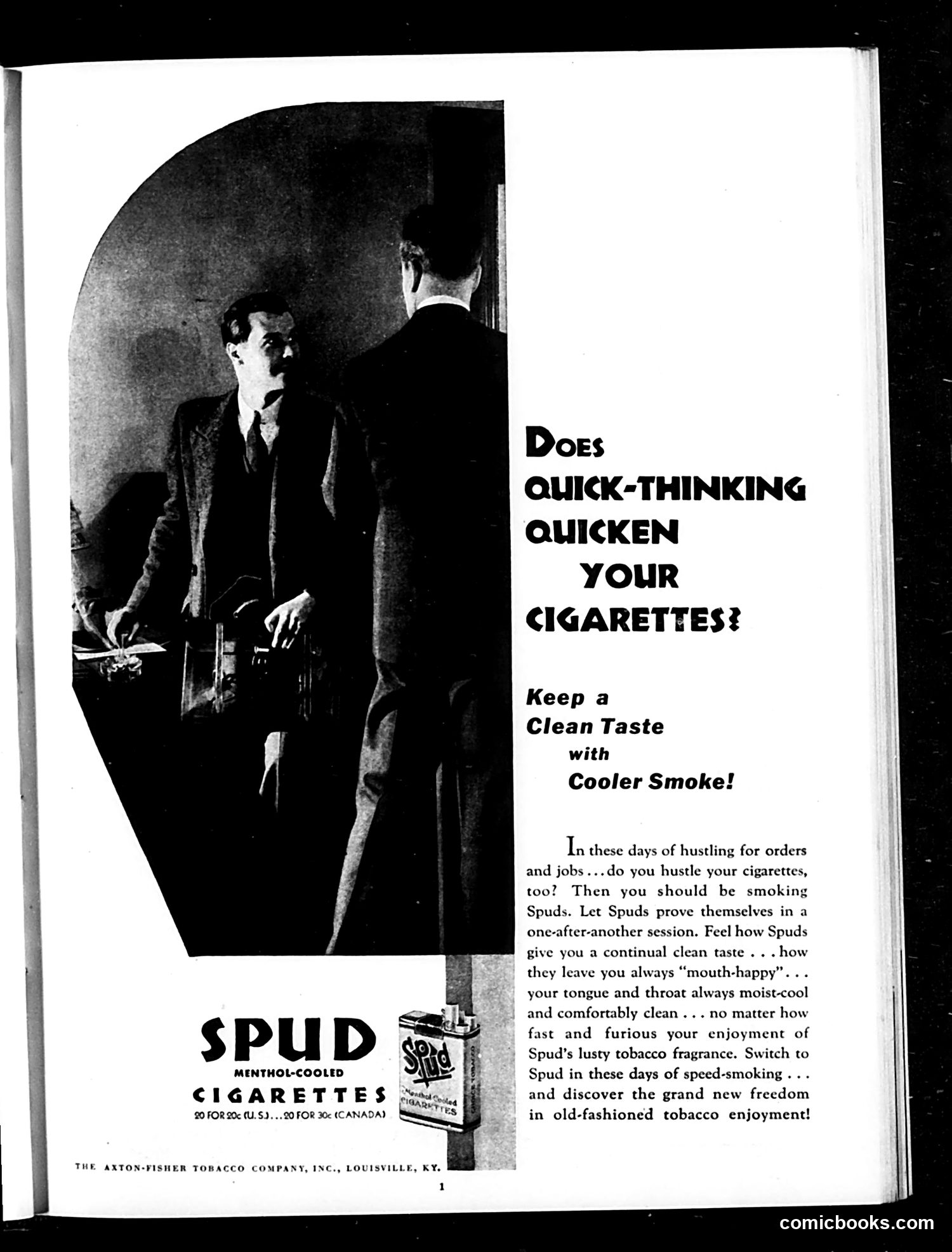
Analysis This page is primarily a cigarette advertisement, not satire or political commentary. It's an ad for Spud menthol cigarettes by the Axton-Fisher Tobacco Company of Louisville, Kentucky. The image shows a businessman in formal attire appearing anxious or stressed. The ad's premise plays on 1930s-40s workplace culture: it suggests that quick-thinking professionals who smoke cigarettes constantly should choose Spuds because menthol keeps their mouths and throats "moist-cool" and "comfortably clean" despite heavy smoking. The phrase "cooler smoke" is literal, not figurative—referencing the menthol cooling sensation. This reflects the era's acceptance of cigarette advertising and the marketing strategy of addressing heavy smokers' physical discomfort from constant use rather than discouraging the habit.
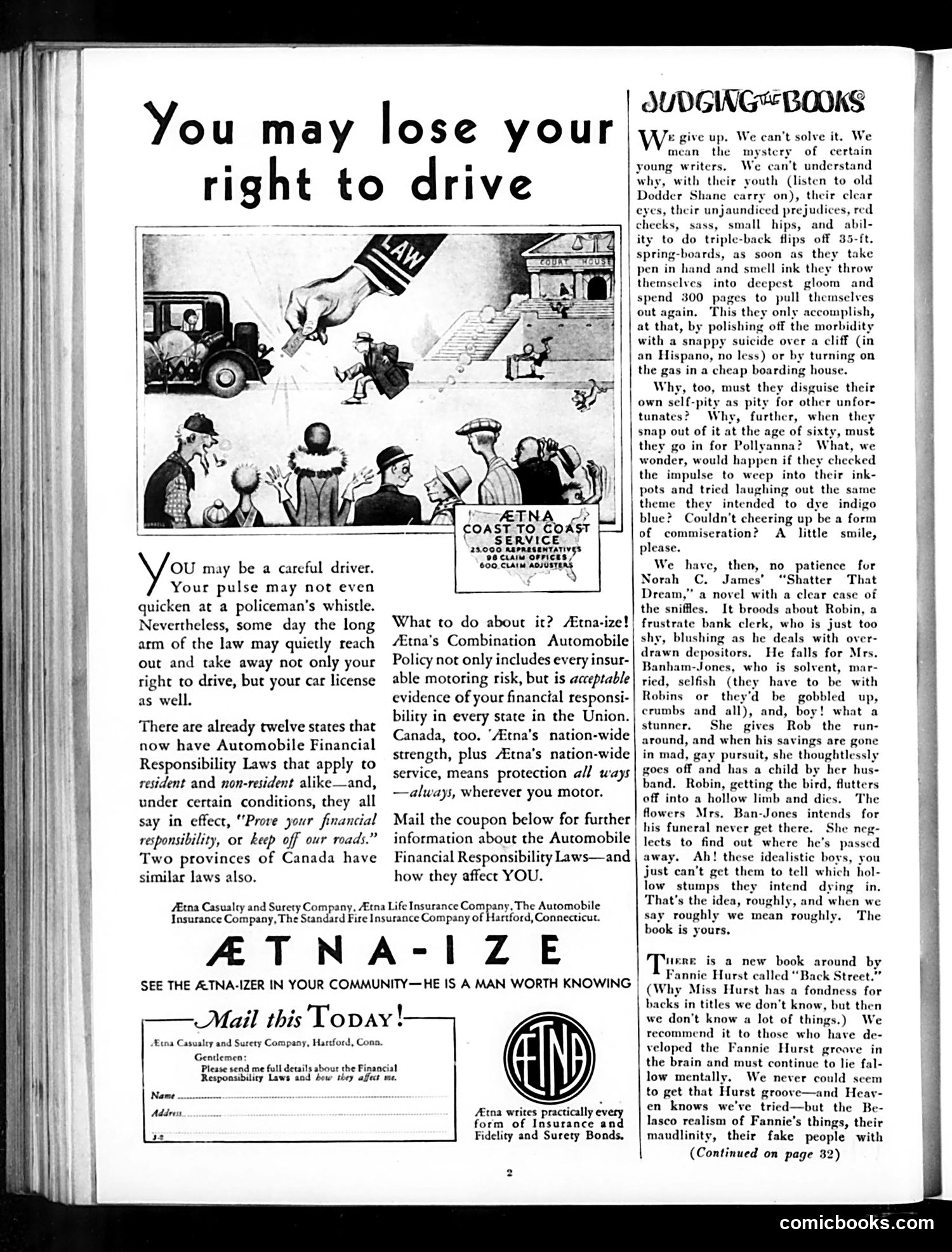
Analysis This page combines a public safety advertisement with a book review. The main cartoon illustrates the consequences of reckless driving: a giant hand labeled "LAW" pours out consequences onto pedestrians and vehicles below, showing how careless drivers endanger others. The accompanying text warns that despite being a careful driver, one might lose driving privileges due to accidents—and crucially, one's *license* as well. The advertisement promotes Ætna's Financial Responsibility Laws, explaining that twelve states now require drivers to prove financial responsibility for damages. The right column reviews a novel called "Shatter That Dream" by Norah C. James, criticizing the protagonist as a selfish bank clerk. This appears to be Judge's typical satirical commentary on contemporary social and moral issues alongside consumer protection messaging.
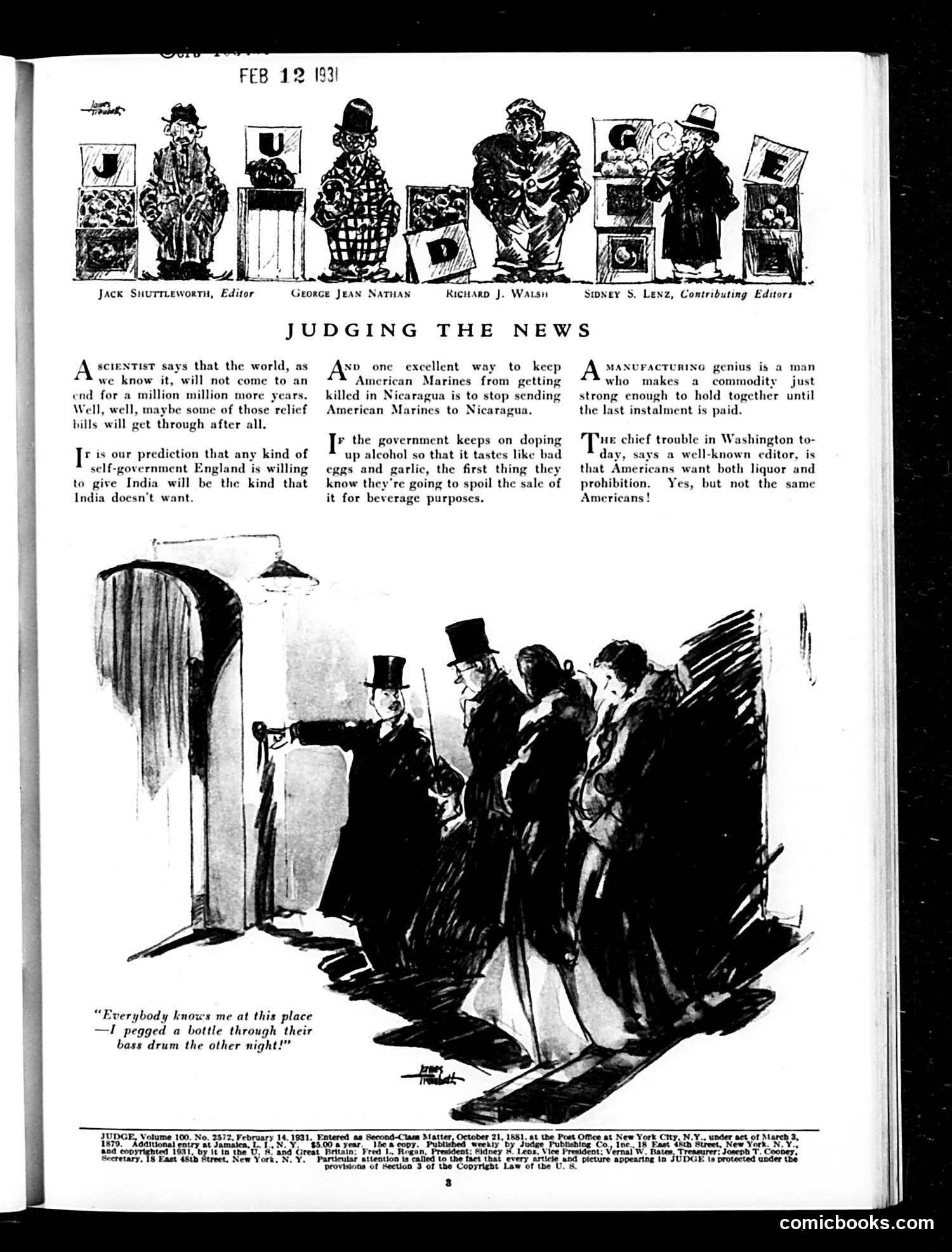
"Judging the News" - February 12, 1931 This page satirizes current events through brief editorial commentary and a cartoon. The main cartoon depicts men in top hats (representing wealthy/elite figures) peering through a keyhole at a woman, with the caption: "Everybody knows me at this place—I pegged a bottle through their bass drum the other night!" The joke appears to reference Prohibition-era speakeasy culture: someone is boasting about their notoriety in an illegal drinking establishment, not realizing they're being watched/judged. The editorial snippets above mock contemporary issues: India's independence negotiations with Britain, alcohol policy contradictions, and Washington's hypocrisy regarding prohibition versus consumption. The overall page uses humor to critique political inconsistencies and social absurdities of the early Depression era.
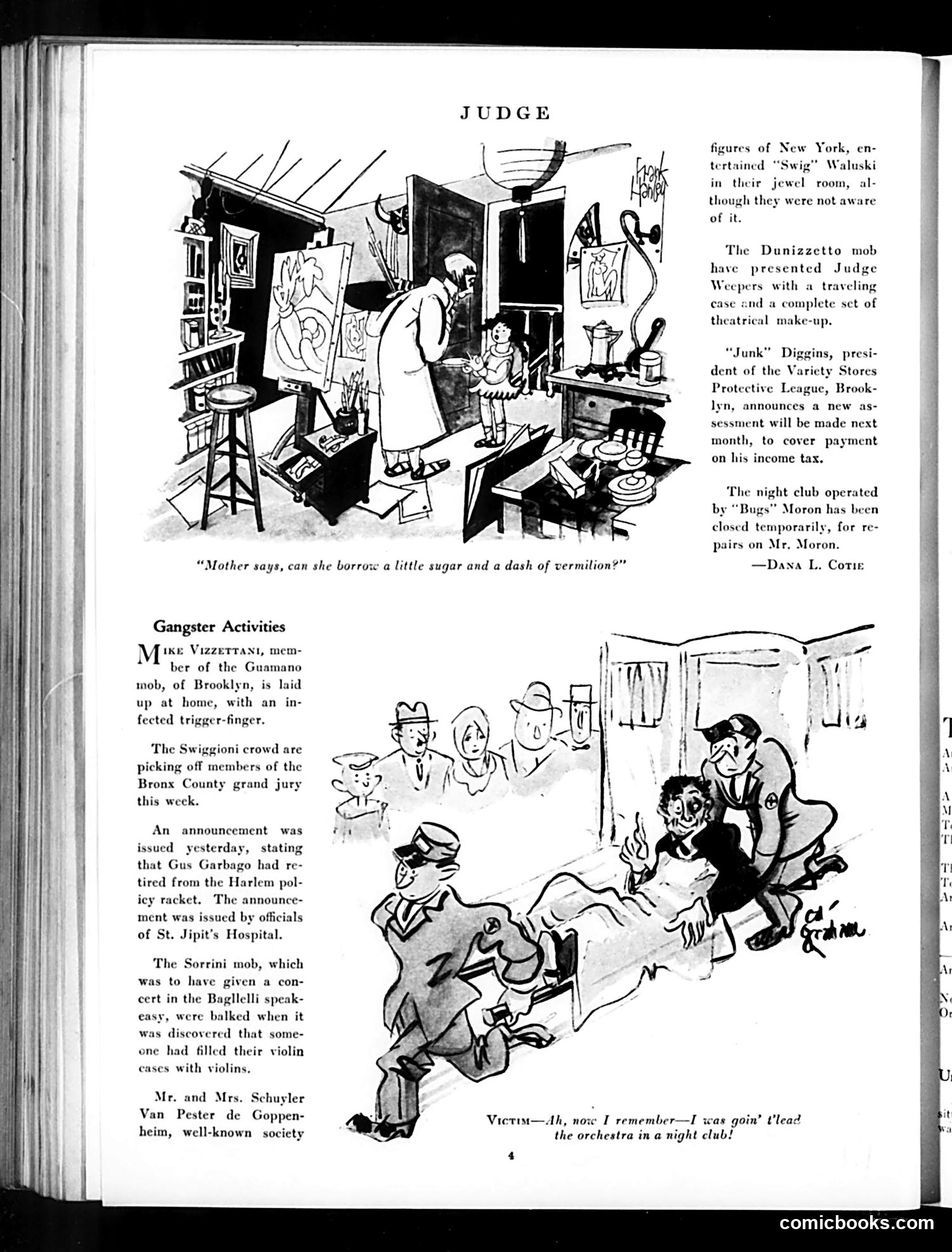
Analysis of Judge Magazine Page This page satirizes 1920s organized crime and urban vice through two sections: Top cartoon: Shows a theatrical makeup artist working on a client, with the caption "Mother says, can she borrow a little sugar and a dash of vermillion?" This appears to be gentle social satire about cosmetics or theatrical artifice, likely referencing the Judge Weepers theatrical group mentioned in the adjacent text. "Gangster Activities" section: Contains brief news items about Brooklyn mobsters (Mike Vizzettani of the Guamano mob, the Swiggioni and Sorrini mobs) and their criminal exploits—violence, jury tampering, stolen violins. The accompanying cartoon depicts a mobster beating a victim, with the caption referencing being "knocked out" in a night club. The satire targets organized crime's prevalence in contemporary New York City society.
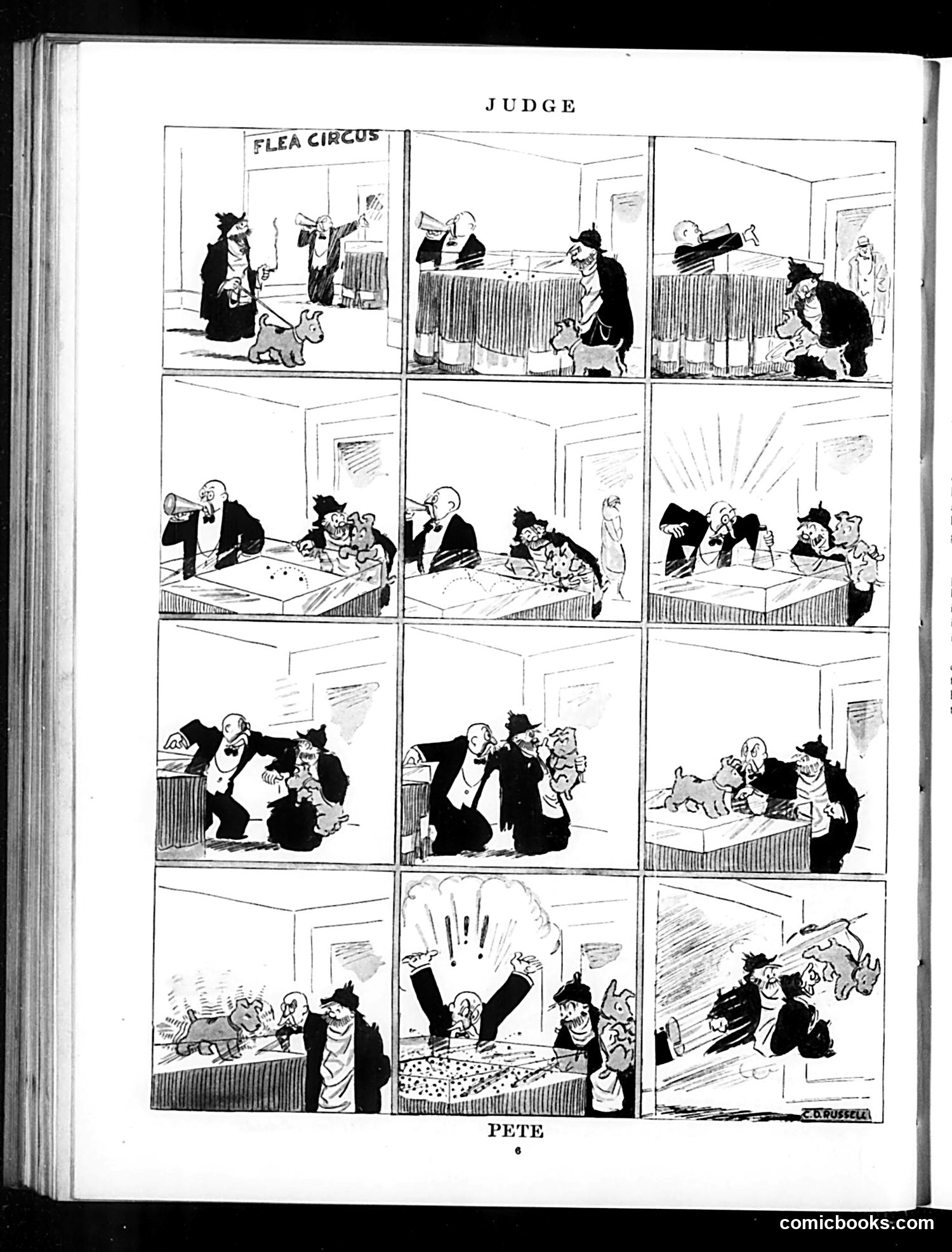
Judge Comic Page Analysis This is a multi-panel comic titled "Judge" (top) and "Pete" (bottom), credited to artist C. Russell. The narrative follows what appears to be a judge or authority figure interacting with a small dog at a "Flea Circus" attraction. The comedy stems from the judge's escalating, exaggerated reactions to the flea circus—moving from curiosity to amazement to complete chaos, culminating in physical comedy where he's tumbled about or loses control. The humor relies on visual slapstick: the dignified authority figure is undone by the absurdity of watching fleas perform tricks. Without additional context about when this was published, the specific satirical target remains unclear, though it may mock judicial pomposity or the era's fascination with novelty attractions.
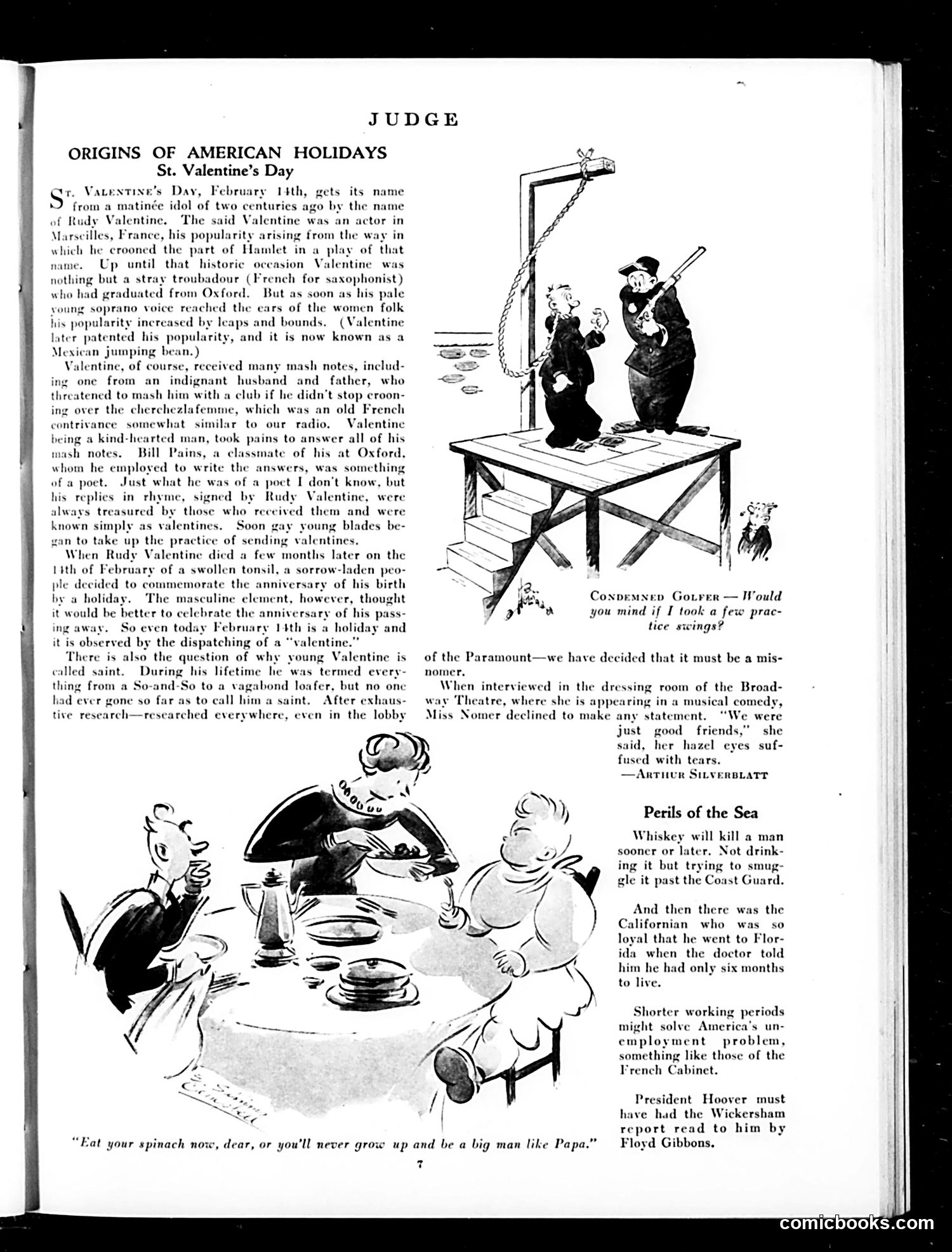
Judge Magazine Satire Analysis This page from Judge magazine contains humorous mock-historical content satirizing American culture circa the 1920s-30s. "Origins of American Holidays: St. Valentine's Day" is a comedic fabrication deliberately misattributing Valentine's Day to "Rudy Valentine," a fictional actor-crooner from Marseilles (a transparent reference to Rudolph Valentino, the famous silent film star). The satire mocks celebrity worship by inventing an absurd origin story where a saxophone-playing Oxford graduate's romantic persona spawned the holiday through mash notes. The cartoons illustrate period humor: one shows two figures apparently executing someone (dark gallows humor about relationship troubles), another depicts a family dinner scene with a father-figure joke about eating spinach. Side commentary includes topical jabs: references to Prohibition enforcement ("smuggle it past the Coast Guard"), unemployment solutions, and President Hoover's Wickersham Report (investigating Prohibition enforcement). The "Condemned Golfer" gag appears unrelated to the main content. The overall tone is irreverent satire targeting contemporary celebrities, government policies, and social absurdities through deliberately false historical narratives.
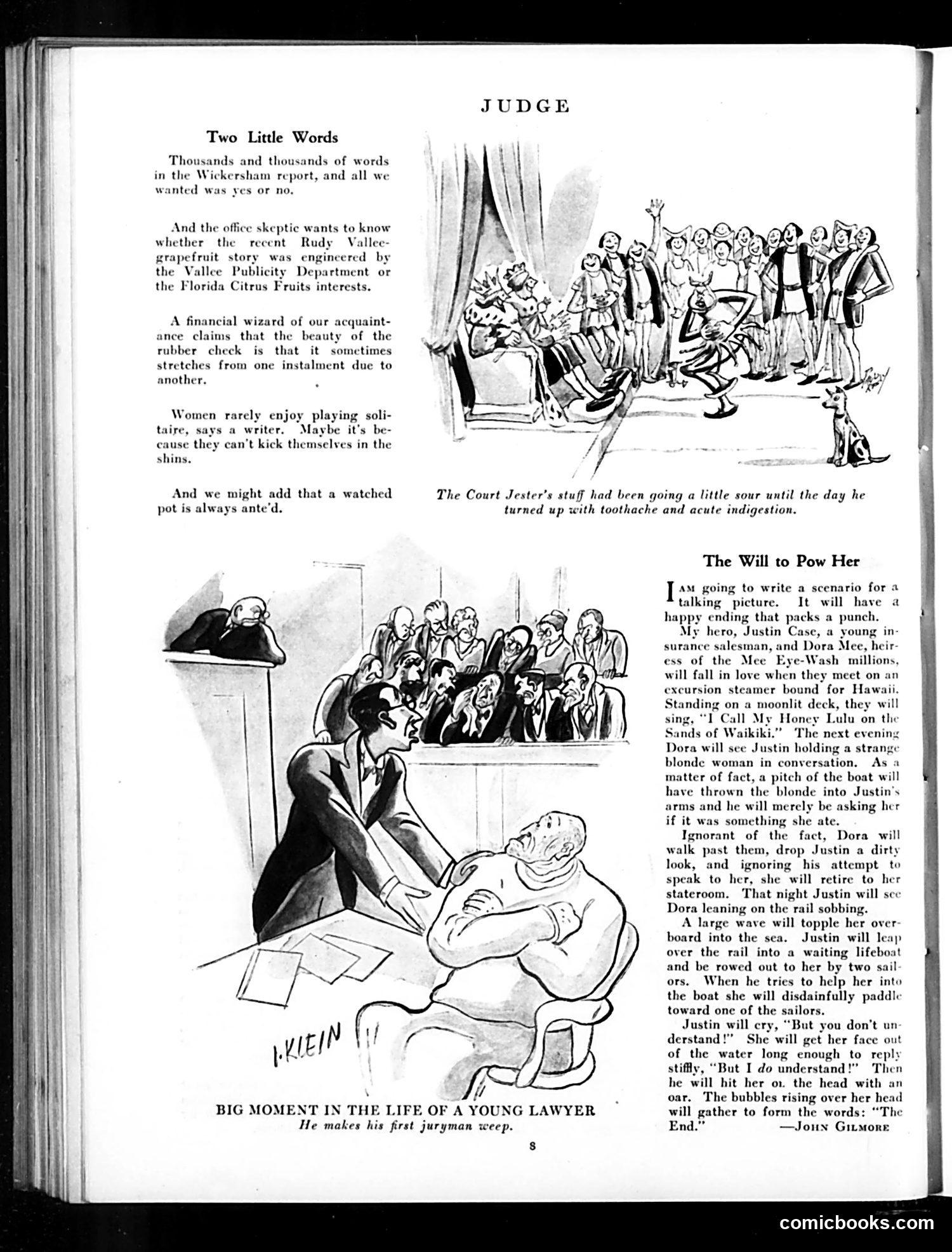
Judge Magazine Page Analysis This page contains satirical commentary and humor pieces typical of Judge magazine's style. "Two Little Words" mocks the Wickersham Report (a 1931 Prohibition enforcement study) for its verbosity—thousands of pages when a simple yes/no answer would suffice. Other brief quips mock celebrity publicity (Rudy Vallée and grapefruit), rubber checks, and gender stereotypes. "The Court Jester's staff" cartoon depicts a courtroom scene where the jester's health complaint (toothache/indigestion) ironically improves the court's mood—suggesting his performances had been poor. "Big Moment in the Life of a Young Lawyer" shows a lawyer making his first juror cry, presented as a career milestone. "The Will to Pow Her" is a longer comedic film scenario parody by John Gilmore. It satirizes melodramatic silent-film plotting: a romance between an insurance salesman (Justin Case—a pun) and a wealthy heiress involving misunderstandings, ocean drama, and violence played for laughs. The absurd title itself jokes about feminine domination through wordplay on "power."
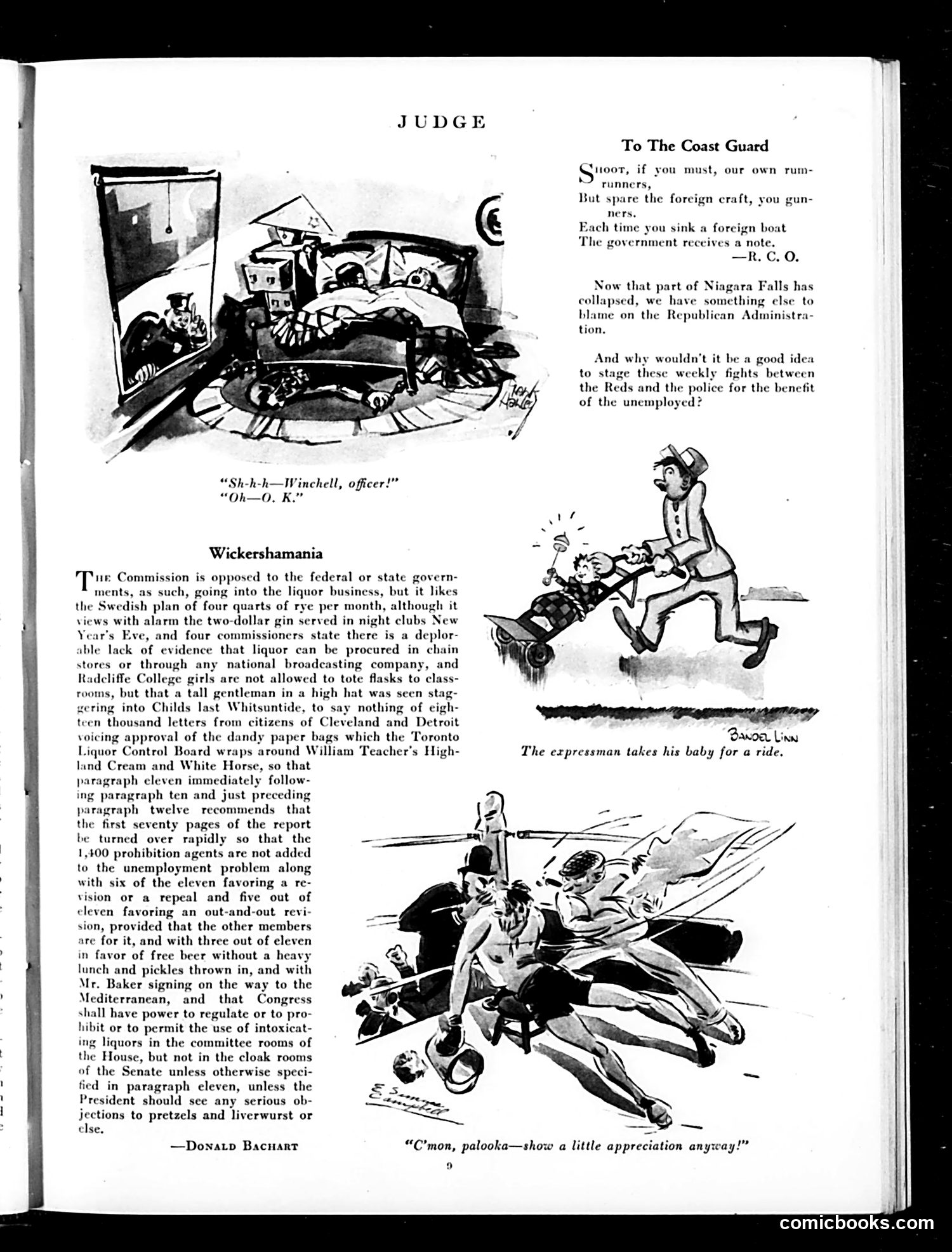
Judge Magazine Page Analysis This page satirizes Prohibition-era politics and enforcement, circa early 1930s. "To The Coast Guard" mocks the inconsistent enforcement of rum-running: smugglers should target foreign vessels to avoid diplomatic complaints, not American ones. The Niagara Falls reference blames Republicans for infrastructure failures. "Wickershamania" (the main article) ridicules Henry Wickersham, likely the Prohibition Commissioner, for contradictory enforcement policies. The piece sarcastically catalogs absurd inconsistencies: the government permits Swedish alcohol limits but prosecutes gin smuggling; it won't regulate broadcasting but restricts college women with flasks. The convoluted prose mocks bureaucratic nonsense—eleven commissioners can't agree on repeal versus enforcement, yet somehow regulations multiply. The cartoons illustrate Prohibition's failures: one shows police/officials ignoring obvious smuggling ("Sh-h-h—Winchell, officer!"), another depicts reckless black-market distribution ("show a little appreciation anyway!"). The overall satire: Prohibition enforcement is hopelessly hypocritical, contradictory, and corrupt, benefiting criminals while punishing ordinary citizens and creating administrative chaos.
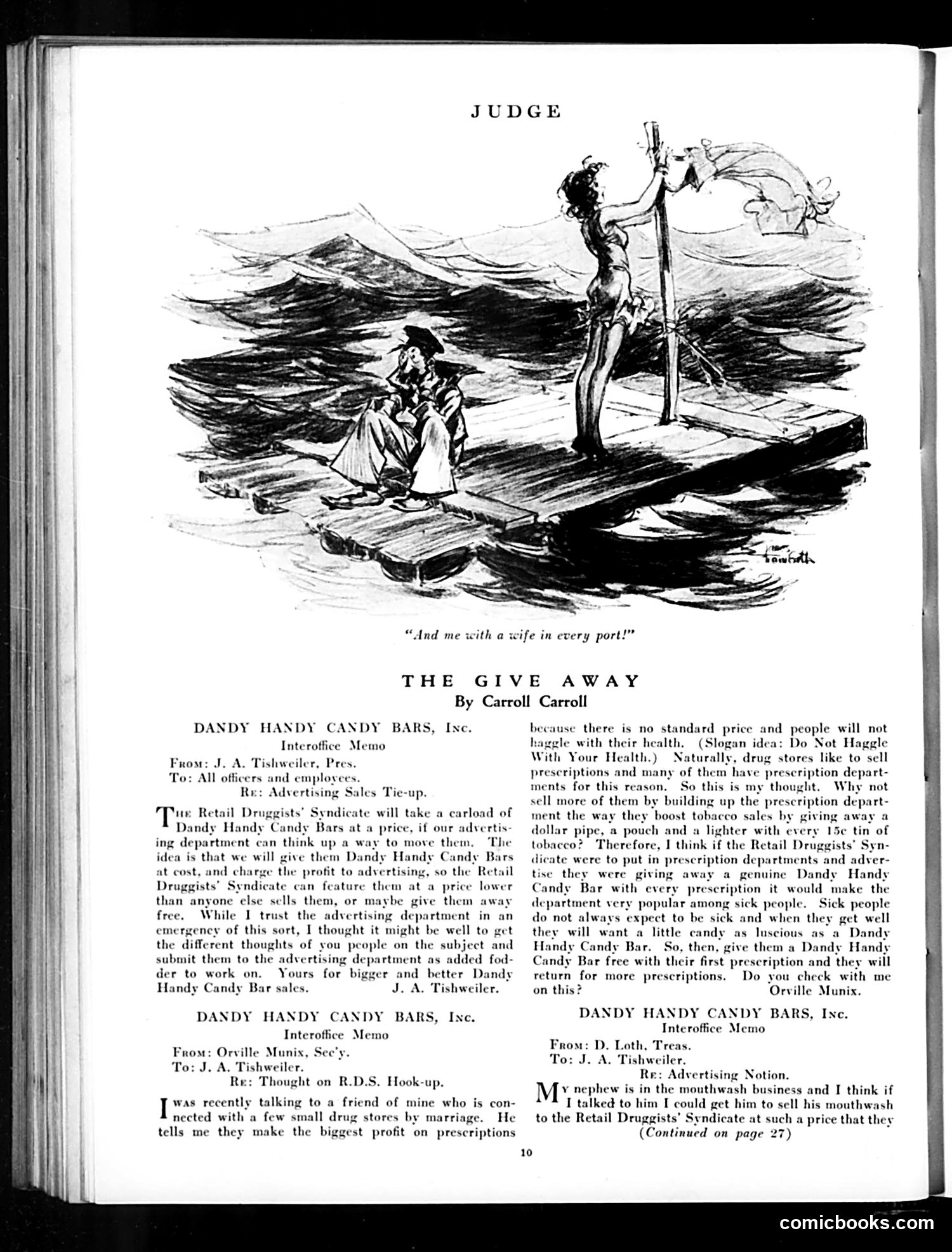
"The Give Away" - Judge Magazine Satire This page satirizes pharmaceutical industry marketing practices through fictional corporate memos. The cartoon depicts a sailor claiming "And me with a wife in every port!" — likely referencing the common promotional giveaway strategy of offering free items with purchases. The satire centers on Dandy Handy Candy Bars company scheming to boost sales by having retail druggists distribute free candy with prescription purchases. The memos reveal cynical corporate logic: employees suggest leveraging sick people's vulnerability, mimicking how tobacco companies used free pipes to drive sales. One memo explicitly notes that prescriptions have "no standard price" — implying profit manipulation. The joke is that candy companies are essentially bribing pharmacies to push more prescriptions, turning drugstores into candy distributors while exploiting patients. This critiques how commercialism corrupts healthcare and how businesses target vulnerable populations (the sick) to create repeat customers. The casual tone of the memos makes the scheme's amorality darkly comedic.
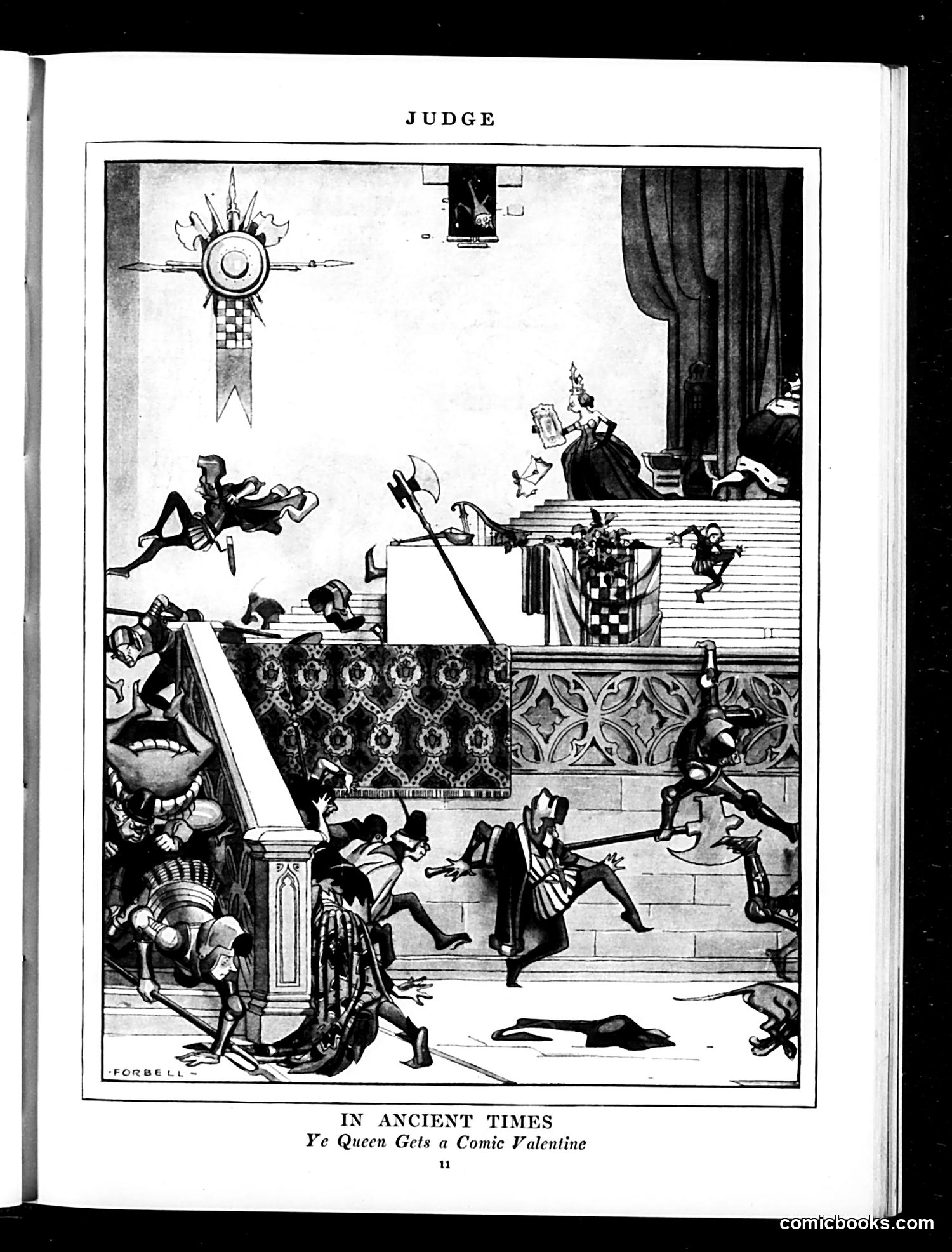
Analysis The cartoon is titled "In Ancient Times: Ye Queen Gets a Comic Valentine" and depicts a chaotic royal court scene. A queen sits elevated on a throne (upper right) while below, jesters, acrobats, and courtiers perform comic antics—tumbling, gesturing wildly, and creating general mayhem in her presence. The satire appears to mock the tradition of Valentine's Day entertainment or courtly "comic valentines" (humorous, sometimes insulting greeting verses popular in the era). By showing the queen receiving literal physical comedy and absurd performances rather than refined romantic gestures, Judge ridicules either: (1) the degraded state of courtly entertainment, or (2) the ridiculousness of Valentine customs themselves when taken literally. The "ancient times" framing suggests nostalgia or historical parody, though the specific political target remains unclear from the image alone.
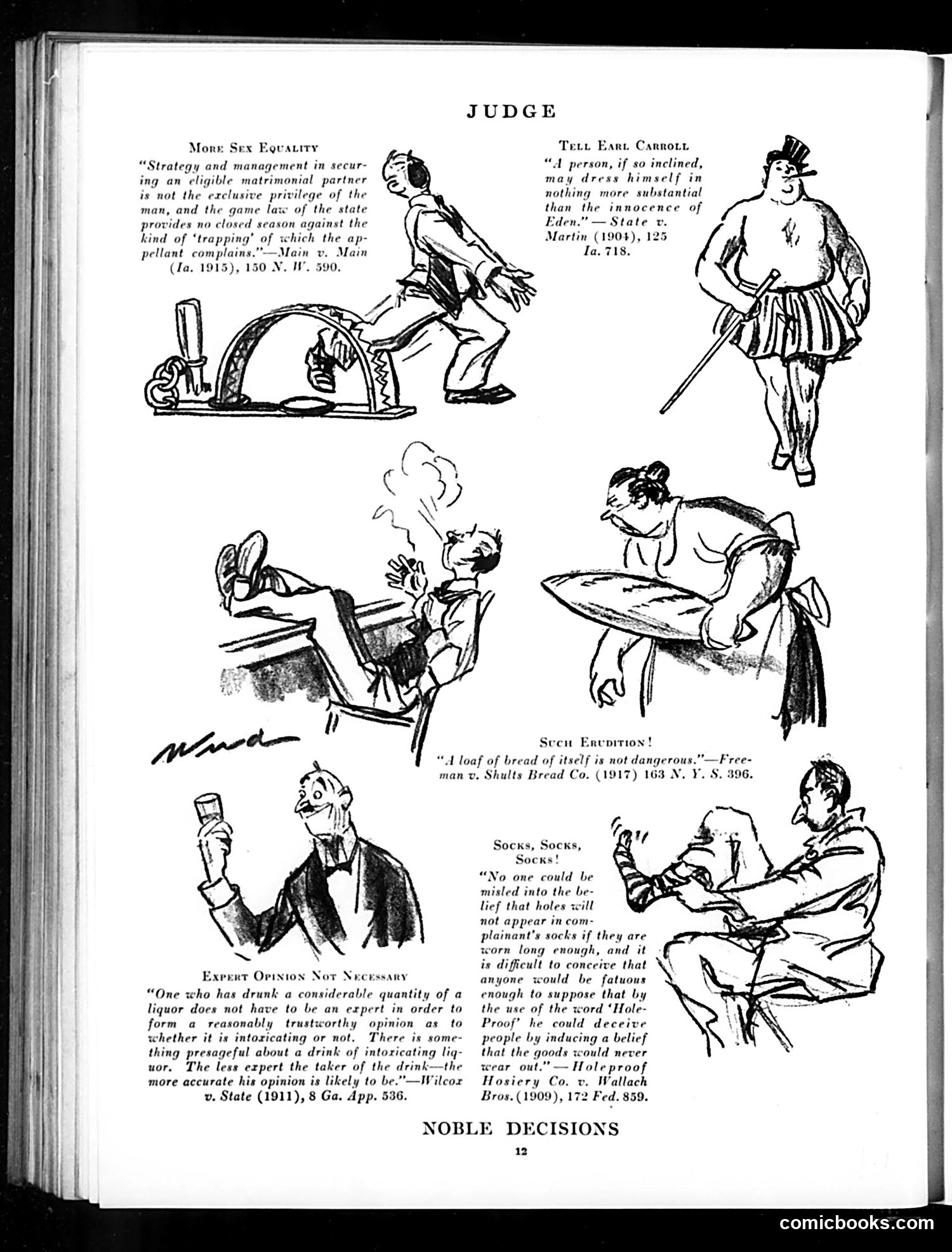
Judge Magazine: "Noble Decisions" Satire This page satirizes absurd legal rulings through illustrated vignettes and quoted court decisions. Each cartoon mocks judicial logic that strains credulity: "More Sex Equality": A woman operates machinery to "trap" a man into marriage, parodying a court ruling that states women have equal rights to pursue matrimonial partners—treating courtship like hunting with "game laws." "Tell Earl Carroll": References an apparent obscenity case about indecent dress, mocking the court's claim that wearing only "innocence" is legally defensible. "Such Erudition": Satirizes bread safety litigation with absurd reasoning. "Socks, Socks, Socks!": Ridicules a trademark case where courts claim no reasonable person would believe "Hole-Proof" socks literally never wear out—highlighting the gap between marketing claims and legal interpretation. "Expert Opinion Not Necessary": Mocks a ruling that drunk people need no expertise to judge intoxication, suggesting inexperience paradoxically produces accuracy. The page collectively lampoons judicial reasoning that prioritizes literal interpretation over common sense.
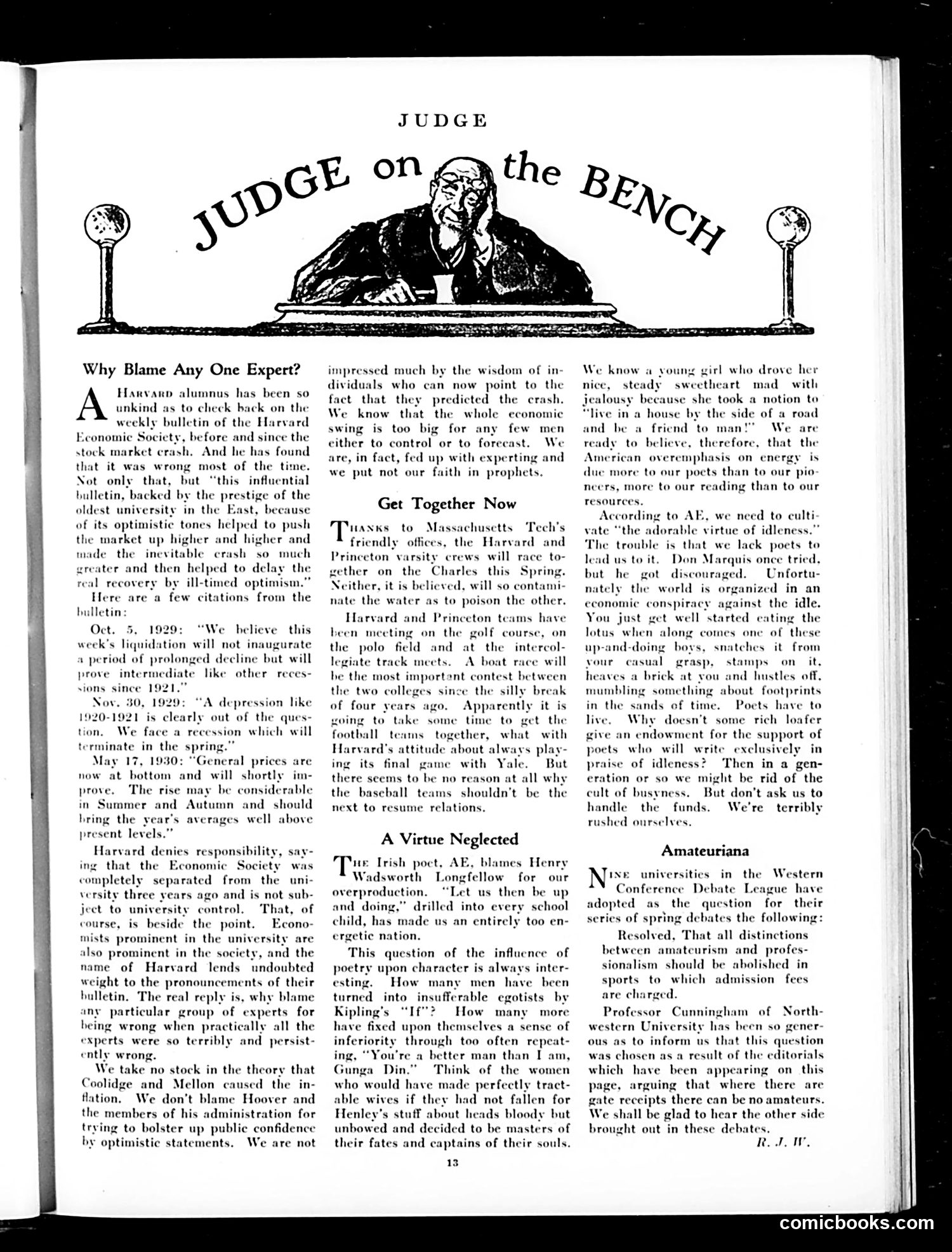
Judge Magazine Satire Analysis "Why Blame Any One Expert?" This article satirizes the Harvard Economic Society's failed predictions before and after the 1929 stock market crash. The society issued multiple optimistic bulletins (October 1929: "liquidation will not inaugurate prolonged decline"; November 1929: recession would "terminate in the spring"; May 1930: prices "now at bottom"). The satire's point: rather than blame specific experts or institutions like Harvard, we should recognize that economic forces are too vast for *anyone* to predict or control. The author mocks both those claiming to have predicted the crash and those defending the experts. It's a broader indictment of expert pretension during the Depression era. Minor items: The page also discusses Harvard-Princeton athletic cooperation and humorously suggests that Longfellow's "Let us then be up and doing" made Americans *overproductive*—blame poetry, not economics.
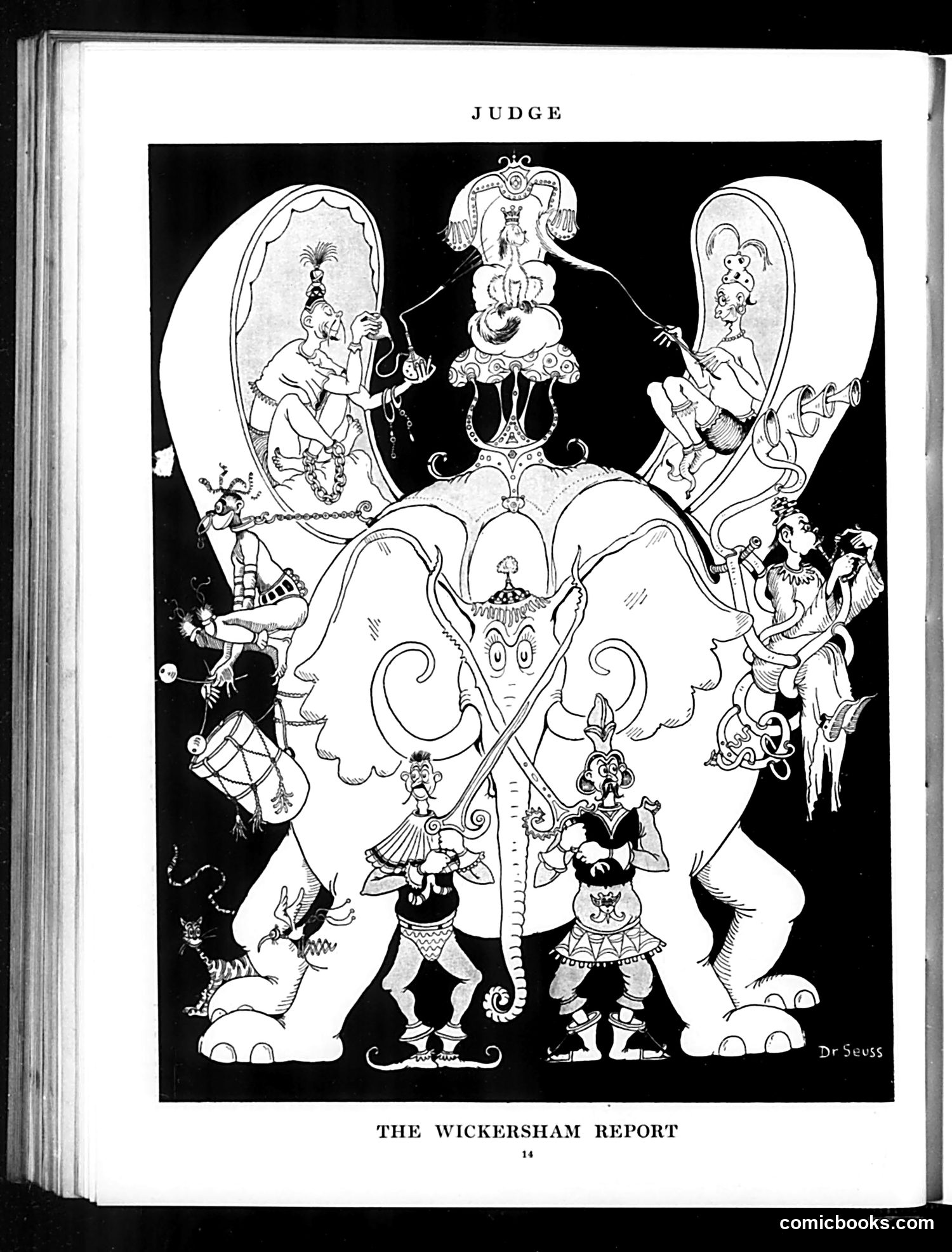
"Judge" - "The Wickersham Report" This Dr. Seuss cartoon satirizes the Wickersham Report, likely referring to the 1931 National Commission on Law Observance and Enforcement (chaired by George Wickersham). The central figure appears to be a large elephant—possibly representing the U.S. government or justice system—surrounded by smaller figures in ornate dress, mirrors, and various attendants. The satire likely mocks the report's findings regarding Prohibition enforcement and organized crime, suggesting bureaucratic bloat, self-delusion, or ineffectual government response. The elaborate, ridiculous pageantry and the elephant's confused expression imply the investigation produced absurd or useless conclusions. The mirrors and surrounding figures may represent politicians, judges, and officials engaging in performative rather than substantive reform—looking at themselves rather than addressing real problems.
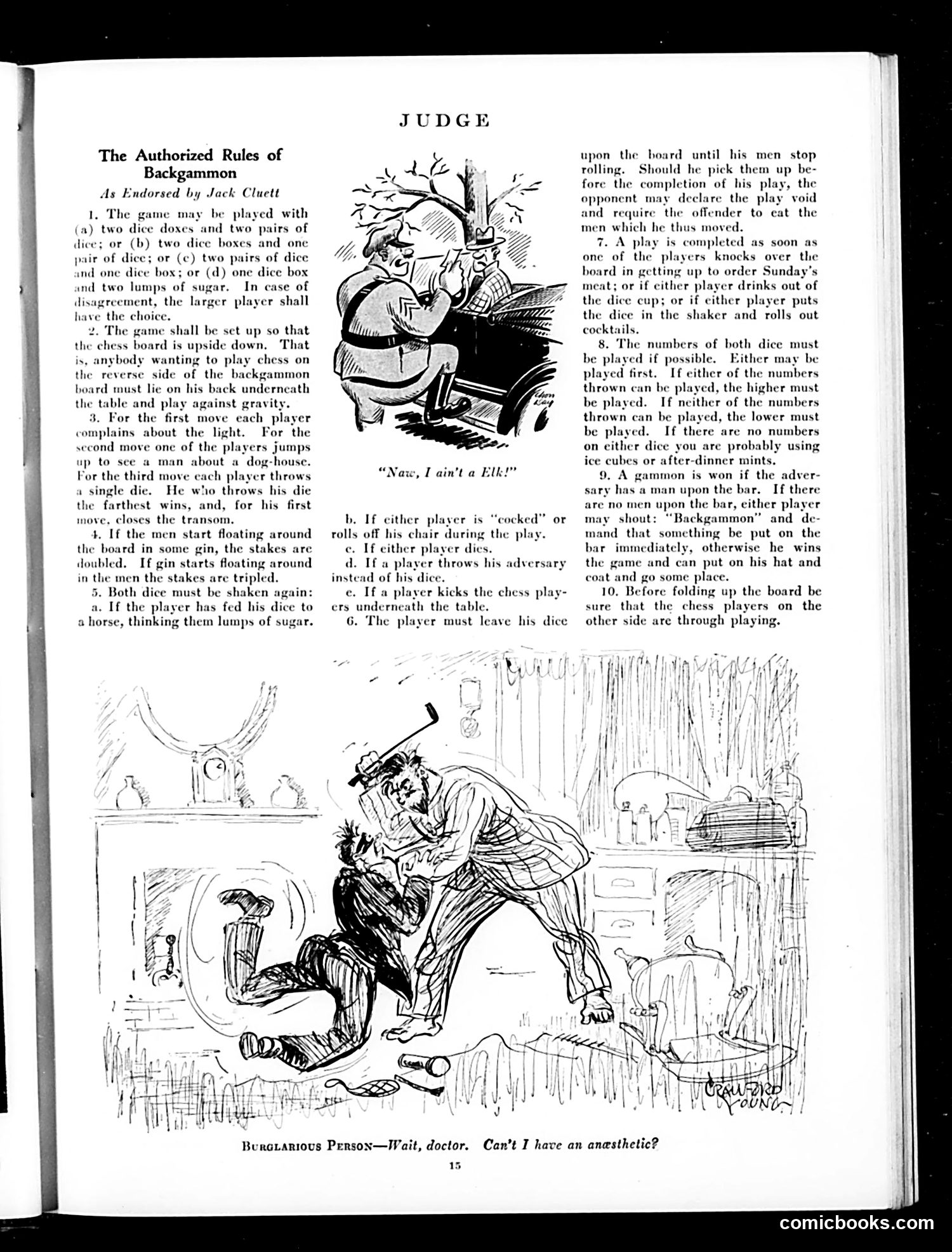
Judge Magazine: "The Authorized Rules of Backgammon" This is a humorous parody of official game rules, endorsed by "Jack Cluett" (likely a contemporary figure, unclear from the image alone). The satire mocks overly complicated rulebooks through deliberately absurd provisions: players may use "two lumps of sugar" instead of dice; the larger player gets to choose equipment in disputes; gin consumption affects gameplay stakes; a player who feeds dice to a horse thinking them sugar must reshake them. The joke escalates with nonsensical rules (throwing your opponent instead of dice; rolling out "cocktails"). The two cartoons illustrate the chaos: one shows a man refusing to be an "Elk" (fraternal organization reference), the other depicts a burglar asking a doctor for anesthesia during a robbery—both depicting situations as absurdly rule-bound as the game itself. The satire critiques both game rule-mongering and contemporary social conventions through deliberate illogic.
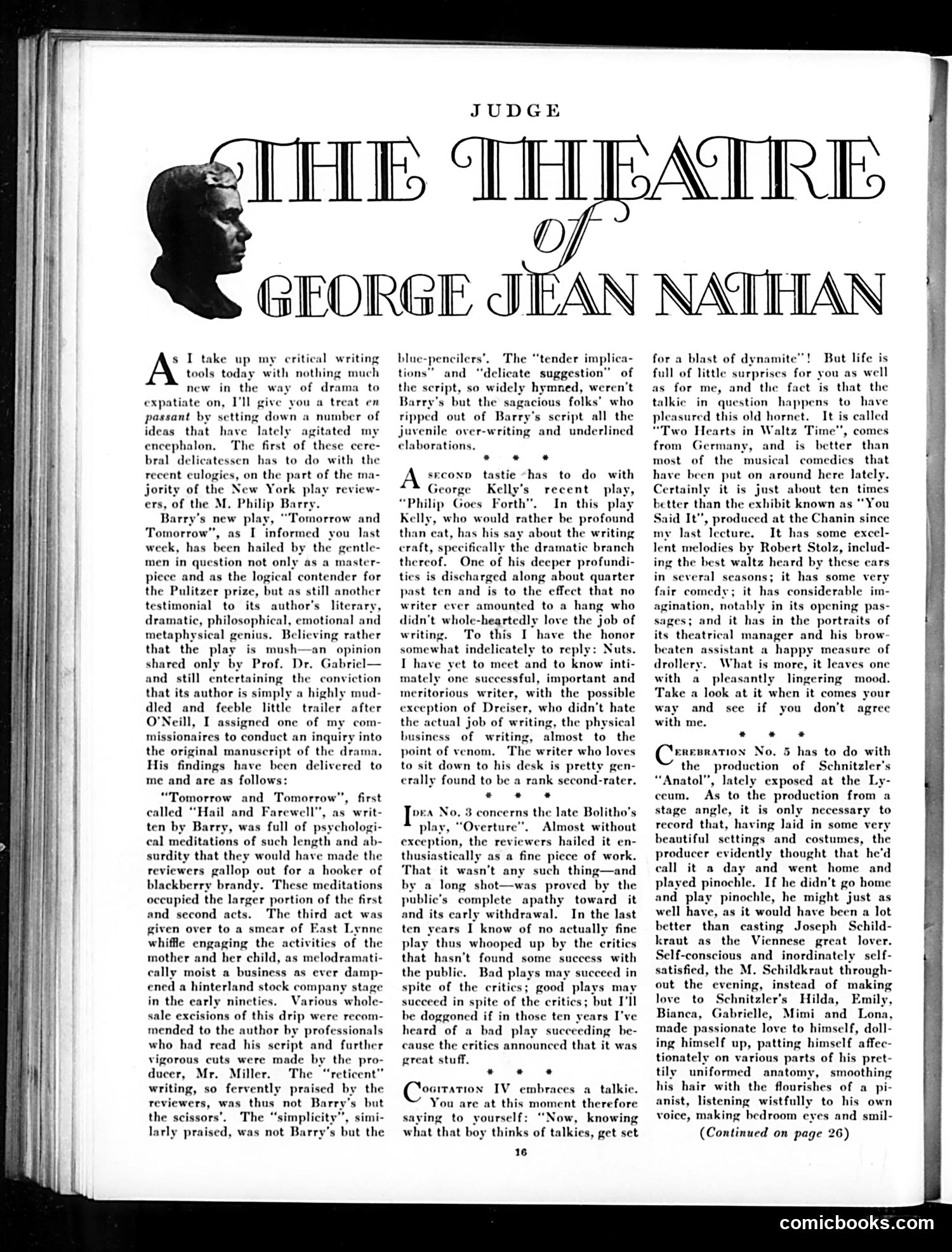
Judge Magazine Theater Critique (circa 1920s-30s) This page is primarily a theater review essay, not a political cartoon. The author—identified as "Judge" (the magazine's critic persona)—critiques contemporary American playwrights. Key targets: 1. Philip Barry's "Tomorrow and Tomorrow": The critic dismisses the play as "mush," revealing that New York reviewers praised qualities (tenderness, simplicity, reticence) that resulted from heavy editing by the producer, not Barry's original writing. 2. George Kelly's "Philip Goes Forth": Mocks Kelly's philosophical claim that successful writers love the act of writing itself, countering that serious writers actually hate the physical labor of composition. 3. Bolitho's "Overture": Notes that critics praised this play, yet public indifference proved their judgment wrong. The satire targets pretentious theater criticism—reviewers praising plays and attributing qualities to playwrights that editors actually created, exposing the disconnect between critical enthusiasm and actual artistic merit or public reception.
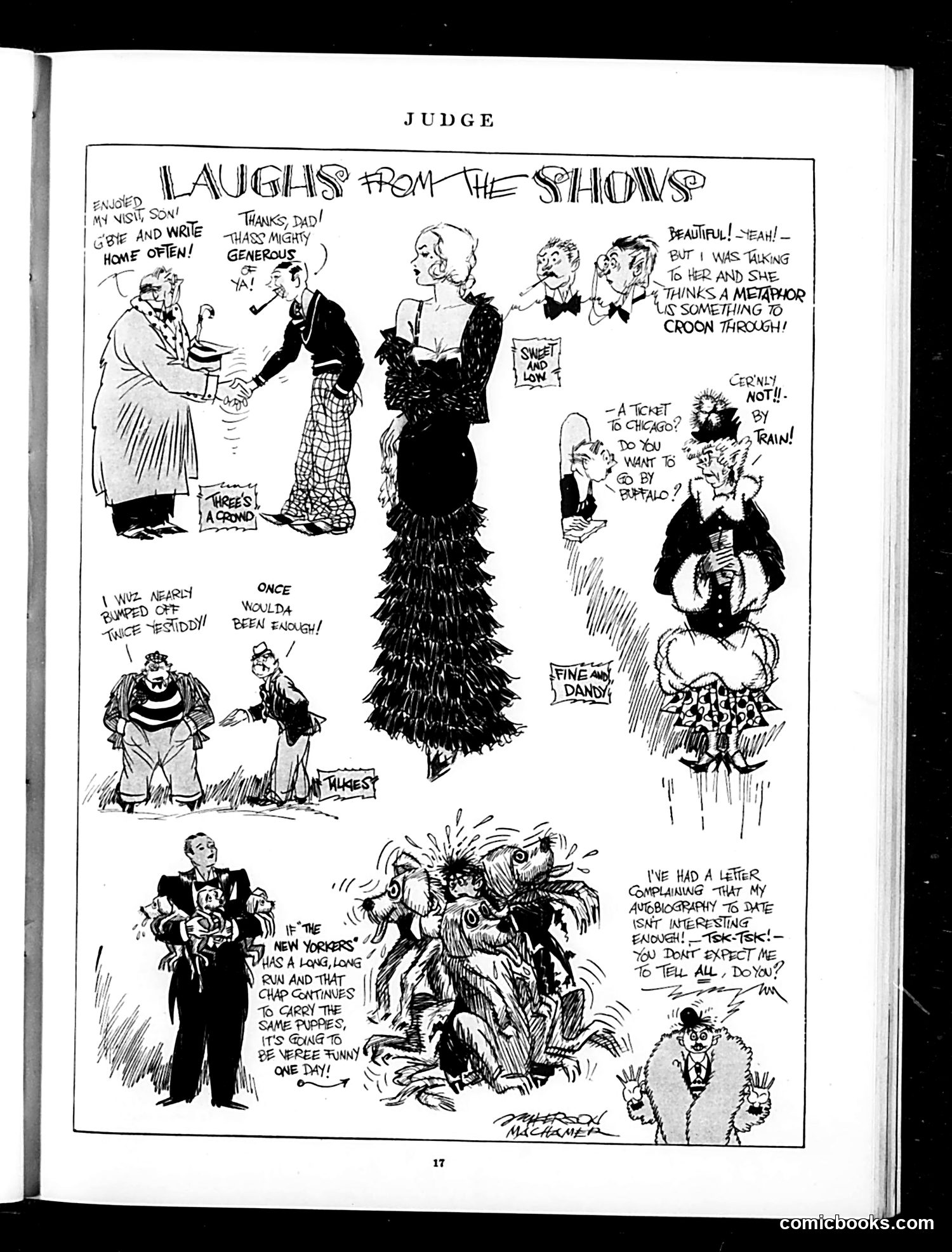
"Laughs from the Shows" - Judge Magazine Satire This page collects theatrical humor about stage performances and show-business personalities. The cartoons mock various theatrical conventions and performer attitudes: The top section ridicules wealthy patrons congratulating themselves for attending shows, with dialogue emphasizing their self-importance ("Thanks! That's mighty generous of ya!"). Middle scenes satirize theatrical pretension—a woman's elaborate feathered gown, actors' affected speech about "metaphors," and requests for impossible favors (a Chicago ticket, wanting to travel "by buffalo"). Lower sections mock performers' egos: someone claiming near-bankruptcy from maintaining stage costumes, and a final scene ridiculing an author who received a complaint letter about their autobiography being uninteresting, defensively insisting readers shouldn't expect entertainment. The satire targets the disconnect between theatrical self-importance and actual artistic merit—a recurring Judge theme criticizing both performers' vanity and audiences' pretentious patronage of mediocre entertainment.
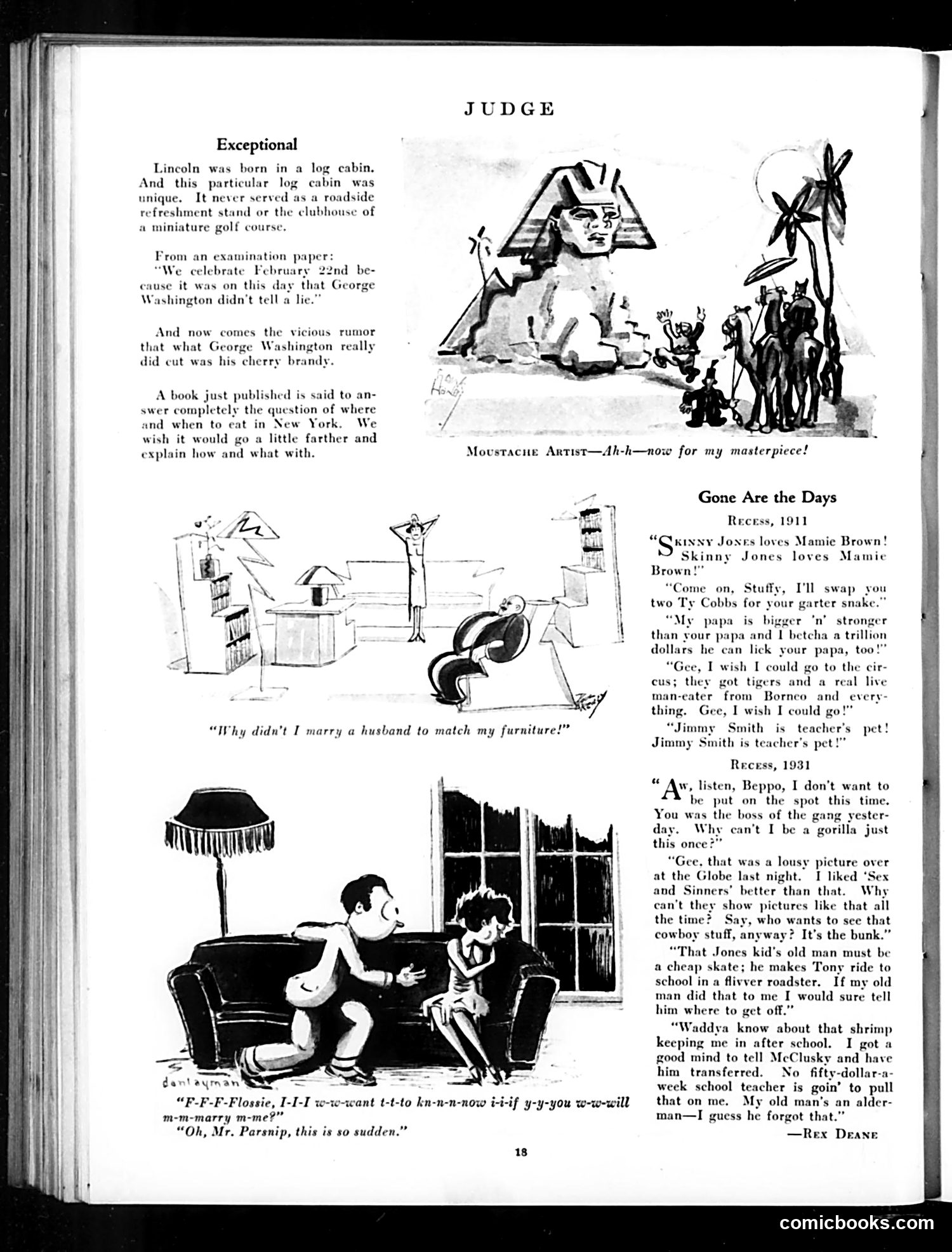
Judge Magazine Page Analysis This page contains nostalgic social commentary contrasting children's playground conversations across two decades. "Gone Are the Days" presents a stark before-and-after comparison of American childhood. The 1911 "Recess" section shows innocent, wholesome exchanges: children trading baseball cards (Ty Cobb), discussing circuses, and engaging in simple romantic banter about classmates. The 1931 "Recess" section reveals a dramatically corrupted youth culture: children discuss risqué movies ("Sex and Sinners"), use gangster slang ("on the spot," "boss"), reference organized crime ("gorilla"), and display cynical materialism and disrespect for authority. A child brags his father is an alderman, implying nepotistic privilege. The satire's point: The Great Depression and Prohibition era (1931) have coarsened American children compared to the Progressive Era (1911). Modern youth are worldly, cynical, and morally compromised—a sharp critique of changing social values and entertainment's corrupting influence on young people. The author, Rex Deane, laments lost innocence. The page's other cartoons offer lighter social commentary about Lincoln mythology and modern restaurant guides.
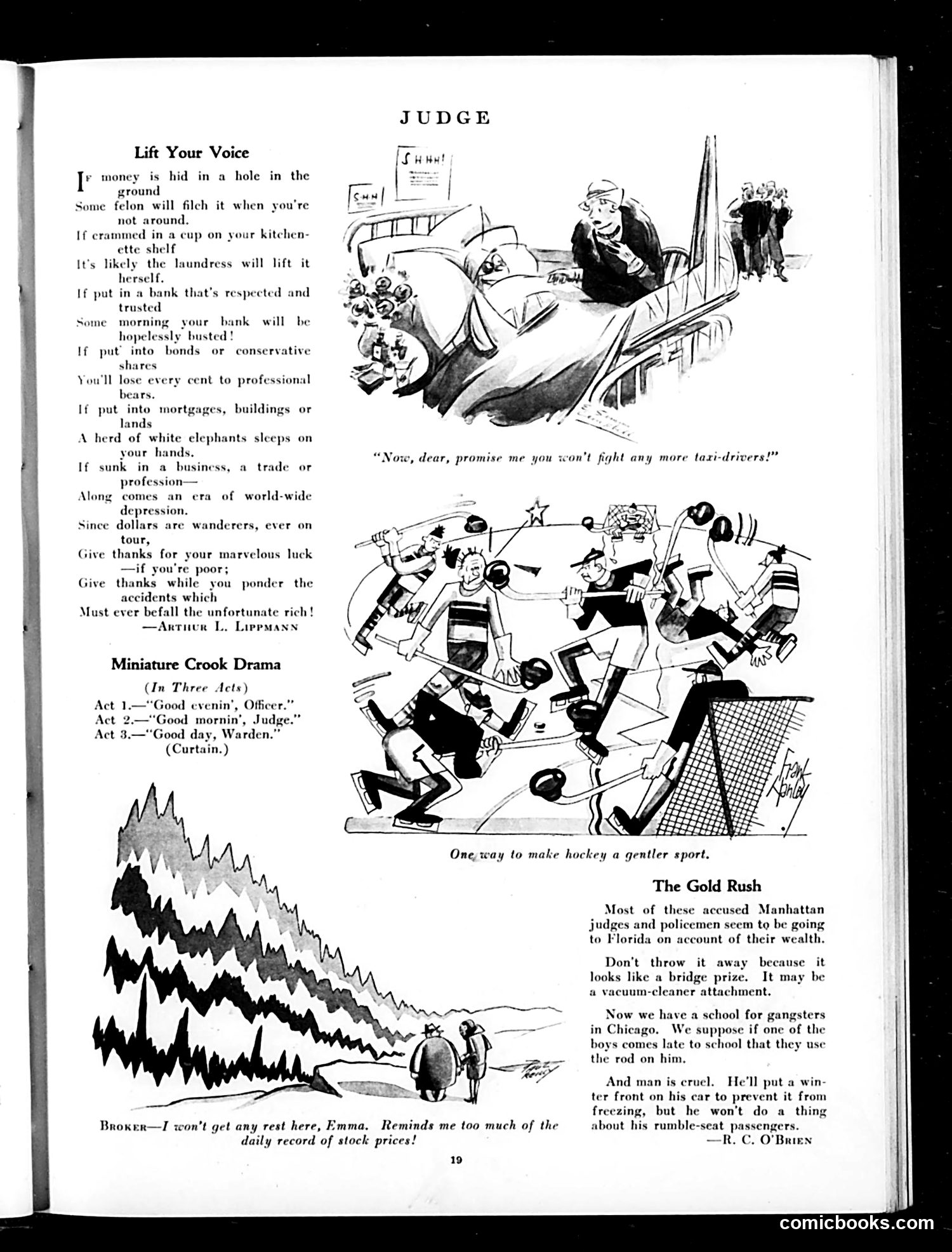
Explaining Judge Magazine Page 19 This page contains three separate satirical pieces critiquing 1920s American life: "Lift Your Voice" (poem by Arthur L. Lippmann): A cynical commentary on wealth management during economic uncertainty. It mocks every savings option—banks fail, stocks crash, investments produce "white elephants" (useless assets)—concluding that only the poor escape financial anxiety. This reflects post-1920 financial instability and the stock market volatility of that era. "Miniature Crook Drama": A dark joke showing a three-act play where a criminal is arrested and reaches prison ("Warden"), suggesting rapid prosecution or inevitability of criminal consequence. "The Gold Rush": Satirizes Manhattan judges and police allegedly fleeing to Florida with ill-gotten wealth, implying widespread corruption. It includes social commentary on Chicago gangster schools and cruel human nature (people winterize cars but neglect passengers). The hockey cartoon depicts players in violent collision, captioned as "one way to make hockey a gentler sport"—sarcastic commentary on the sport's brutality. These pieces target corruption, financial anxiety, and social hypocrisy characteristic of 1920s America.
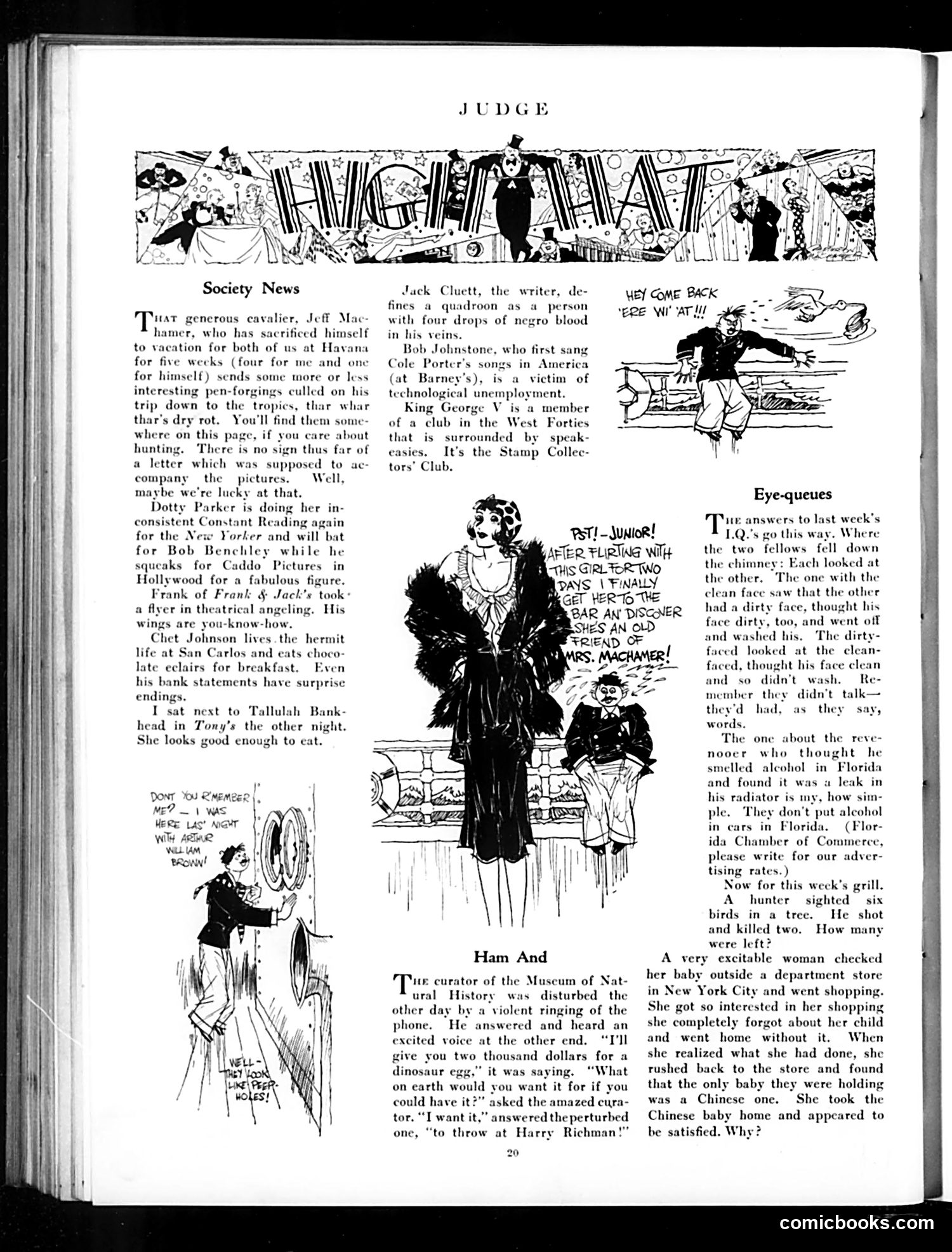
Judge Magazine Page Analysis This is a society gossip column with cartoons from Judge magazine, likely 1920s-30s based on references and style. Content includes: - Celebrity gossip: Brief mentions of figures like Dotty Parker, Frank (theatrical producer), and Tallulah Bankhead dining at "Tony's" - Small cartoons with jokes: One shows a woman telling a child "Don't you remember? I was here last night with your mother"—implying infidelity - "Ham and" section: A curator receives a call from someone offering $2,000 for a dinosaur egg, then revealing they want it "to throw at Harry Richman" (likely a performer/public figure being mocked) - "Eye-queues" riddle column: Includes the racist "Chinese baby" joke at bottom—reflecting deeply offensive period attitudes The satire targets: Wealthy socialites, theatrical personalities, Prohibition-era speakeasies ("Stamp Collectors' Club"), and technological unemployment. The page trades in casual cruelty typical of 1920s-30s satirical humor, including racial mockery considered acceptable at that time.
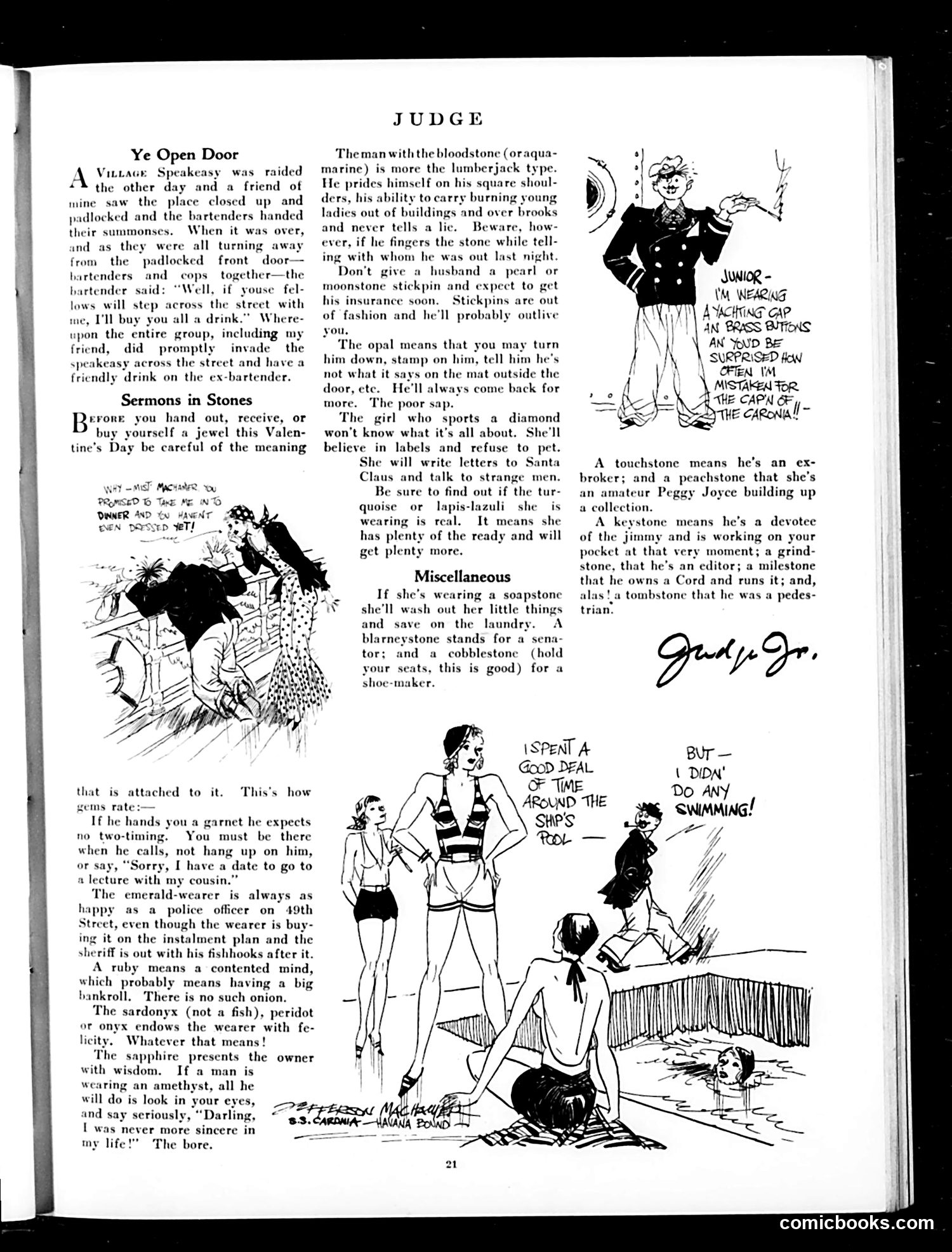
Judge Magazine Satire Analysis This page from Judge magazine contains two distinct satirical pieces: "Ye Open Door" satirizes Prohibition-era speakeasies and the casual corruption of law enforcement. The anecdote depicts a raided illegal bar where the bartender, after being shut down by police, immediately buys drinks for the very cops and bartenders who just padlocked his establishment—suggesting widespread complicity and hypocrisy around Prohibition enforcement. "Sermons in Stones" is a humorous guide assigning character meanings to gemstones given as Valentine's Day gifts. It mocks both romantic pretense and class stereotypes: diamonds signify gullibility, emeralds indicate police-like strictness, rubies suggest wealth, opals mean desperate faithfulness, etc. The final cartoon illustrates a woman bragging about her yachting outfit while admitting she never actually swims—pure pretentious affectation. Both pieces ridicule 1920s American social hypocrisy, materialism, and superficiality.
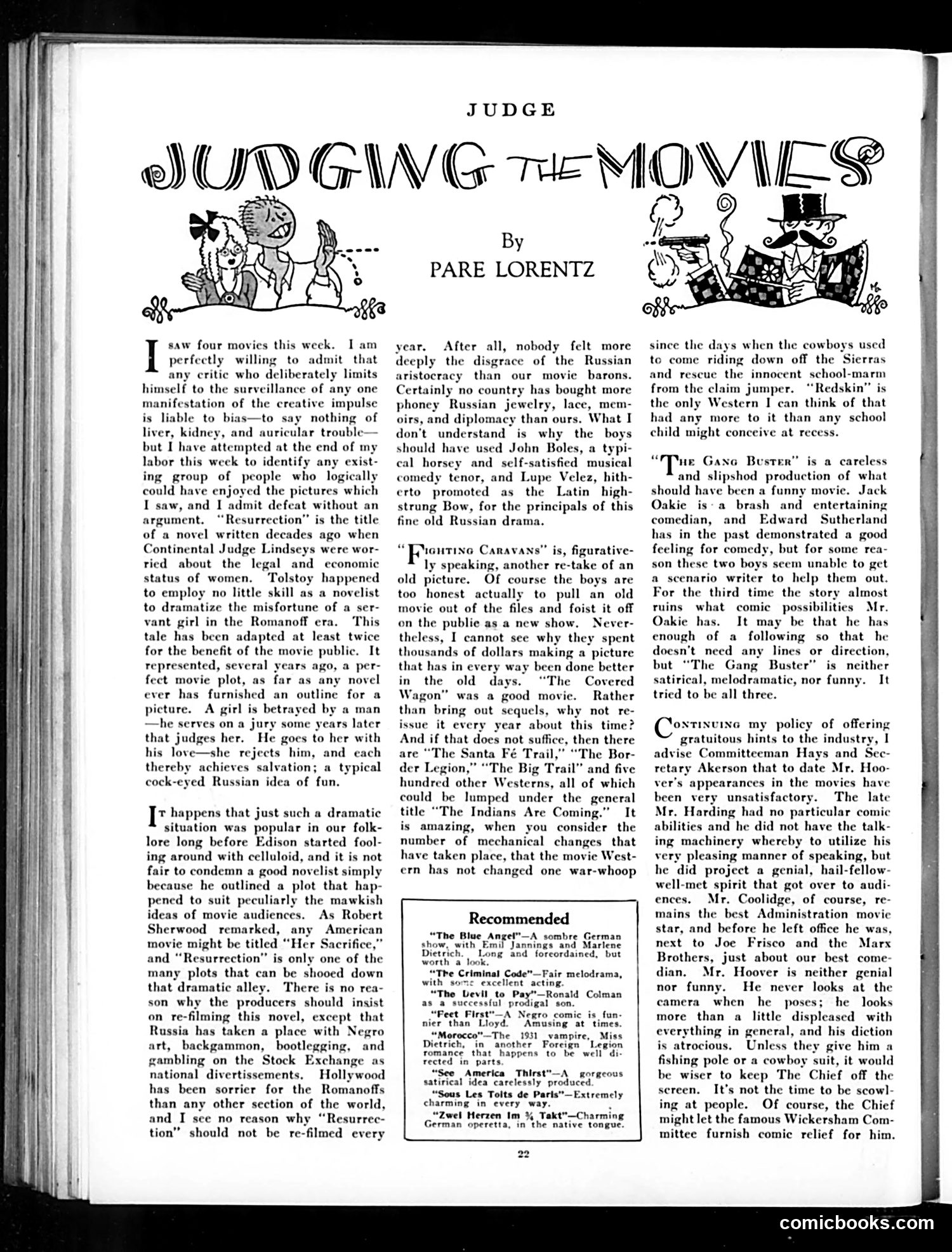
"Judging the Movies" by Pare Lorentz This is a film criticism column reviewing four movies. The cartoons show whimsical figures representing cinema entertainment. Key criticisms: - "Resurrection": Lorentz attacks the refilming of Tolstoy's novel, arguing Hollywood has become obsessed with Russian subjects (jewelry, lace, diplomacy) as fashionable divertissements. He objects to casting John Boles and Lupe Velez in Russian roles—finding them unsuitable for serious drama. - "Fighting Caravans": He criticizes Hollywood's repetitive Western formula, noting that despite technological advances, filmmakers still recycle the same "Indians Are Coming" plot repeatedly rather than re-releasing superior old films like "The Covered Wagon." The satire targets Hollywood's commercialism: studios chase trends (Russian exoticism, Westerns) and lazily remake old material instead of creating original work. The column reflects 1930s film criticism's frustration with studio formula-making and miscasting.
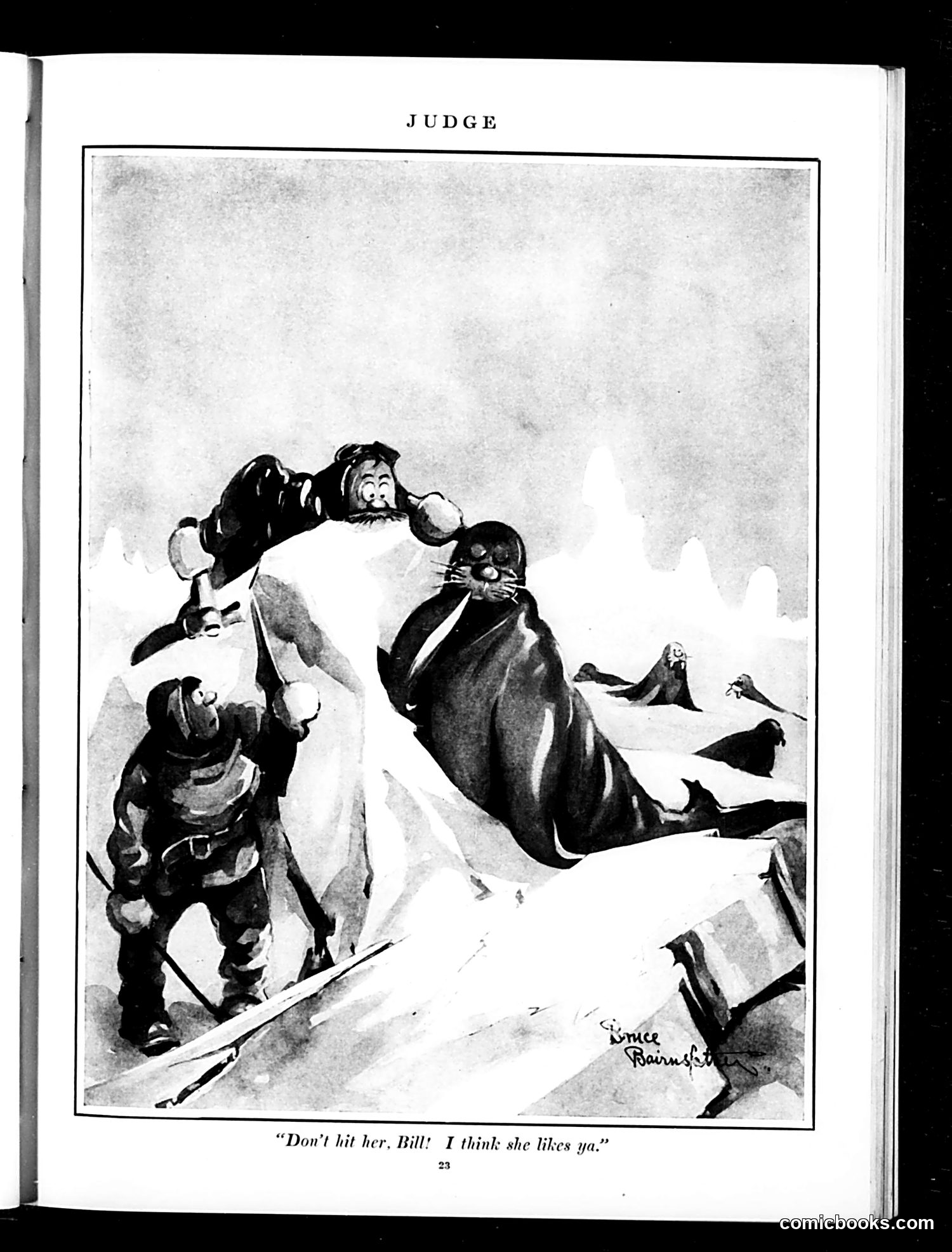
Judge Magazine Cartoon Analysis This cartoon depicts a snowy scene with what appears to be two men and a seal. The dialogue—"Don't hit her, Bill! I think she likes ya"—suggests one man is about to strike the seal, while his companion intervenes with this warning. The humor appears to rely on anthropomorphizing the seal as female and interpreting her behavior (likely approaching or nuzzling) as romantic interest rather than animal instinct. This reflects early 20th-century Judge magazine's typical style of slapstick and absurdist humor. Without additional context, the specific satirical target—if any exists beyond simple animal comedy—remains unclear. It may reference contemporary hunting practices or simply be pure nonsense humor typical of the era's popular magazines.
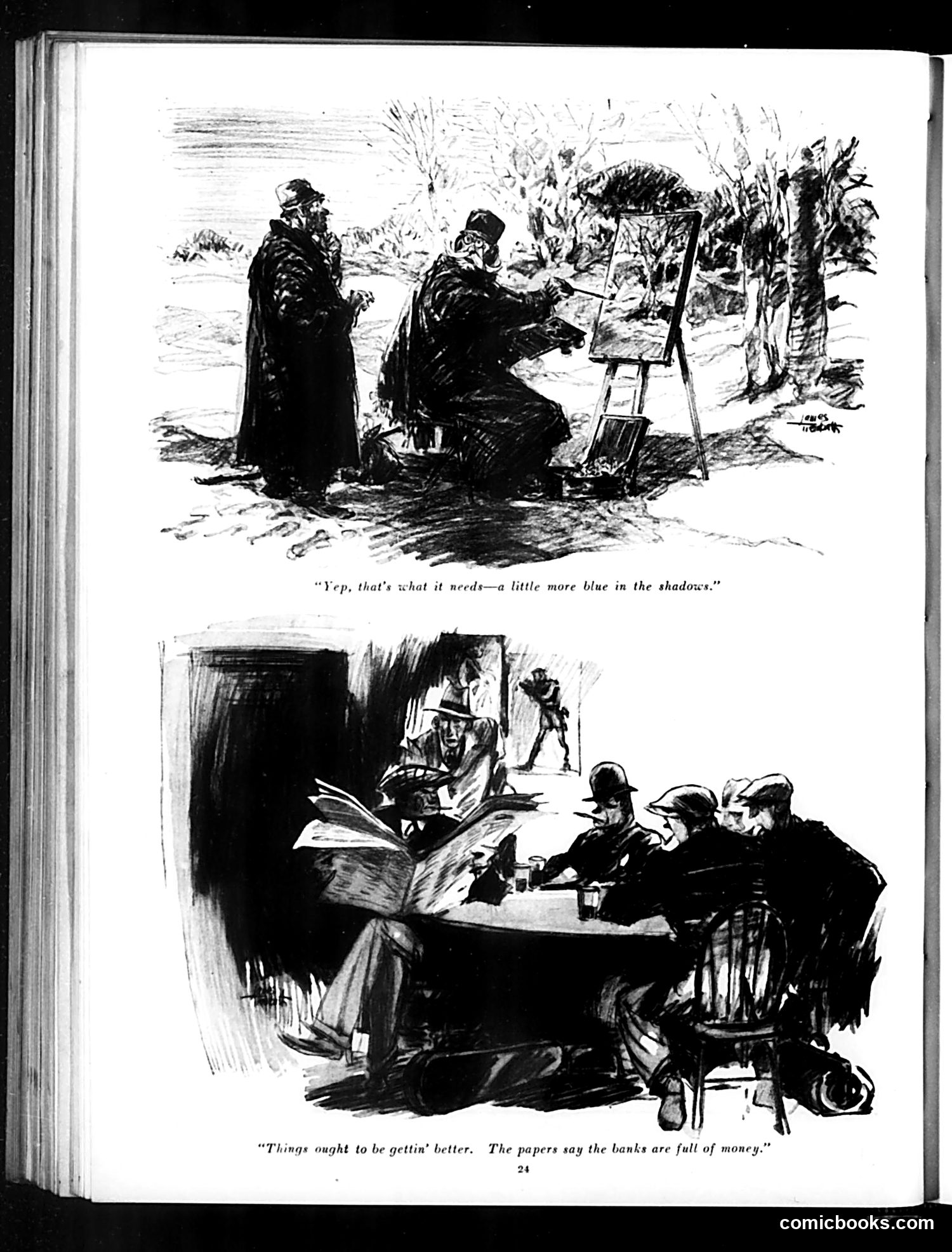
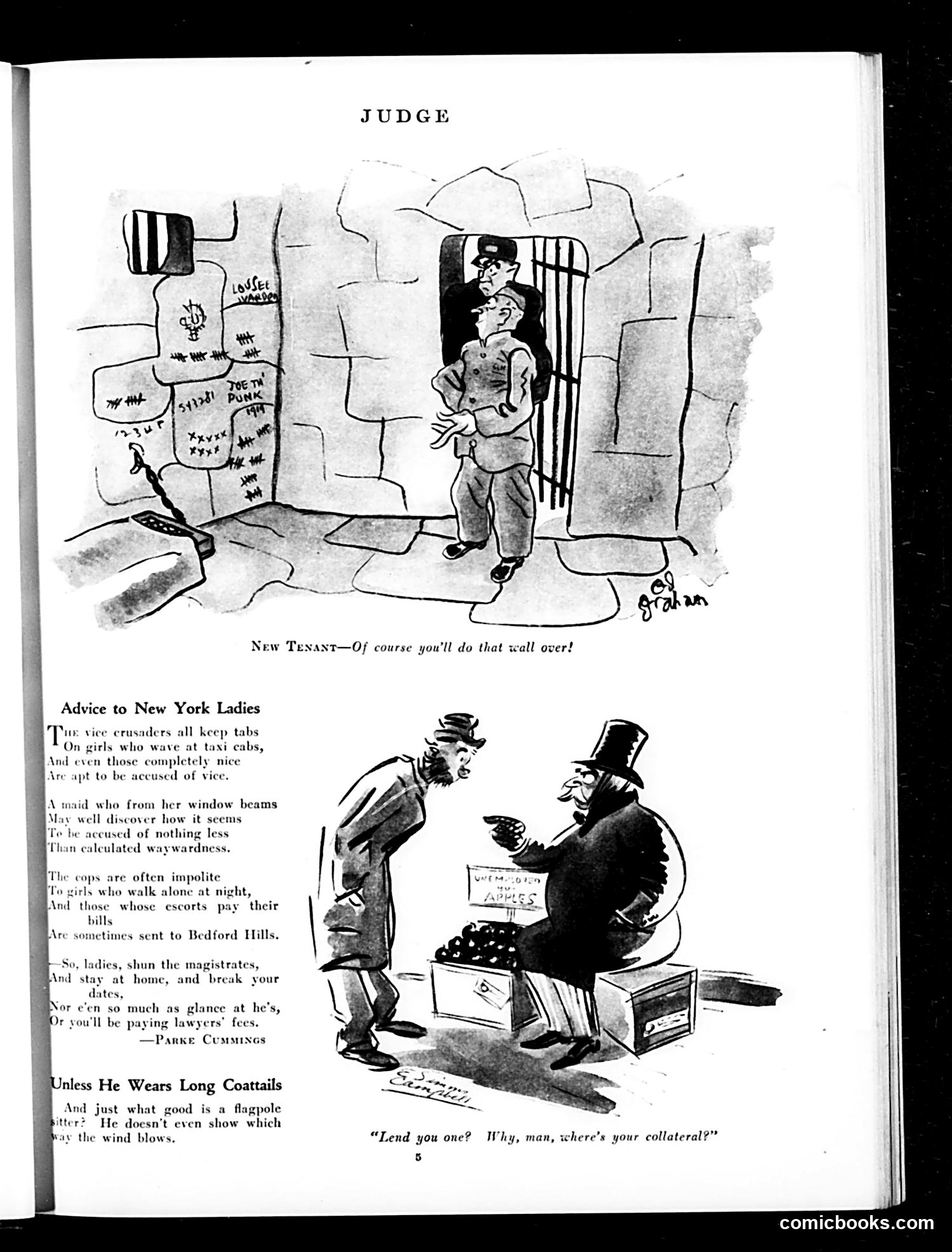
Political Commentary on Economic Inequality This two-panel cartoon satirizes the disconnect between official economic reports and working-class reality during what appears to be an economic crisis period. Top panel: An artist paints outdoors while his patron critiques the work, suggesting it needs "a little more blue in the shadows"—commentary on aesthetic refinement amid hardship. Bottom panel: Working-class men discuss newspaper claims that "banks are full of money," expressing hope that conditions "ought to be gettin' better." The irony is sharp: banks may hold wealth, but ordinary people remain impoverished and excluded from that prosperity. The satire targets the gap between financial institutions' reported health and citizens' actual suffering—a critique suggesting that aggregate bank wealth provides no relief to struggling populations. This reflects common Progressive-era criticism of concentrated wealth and banking power.
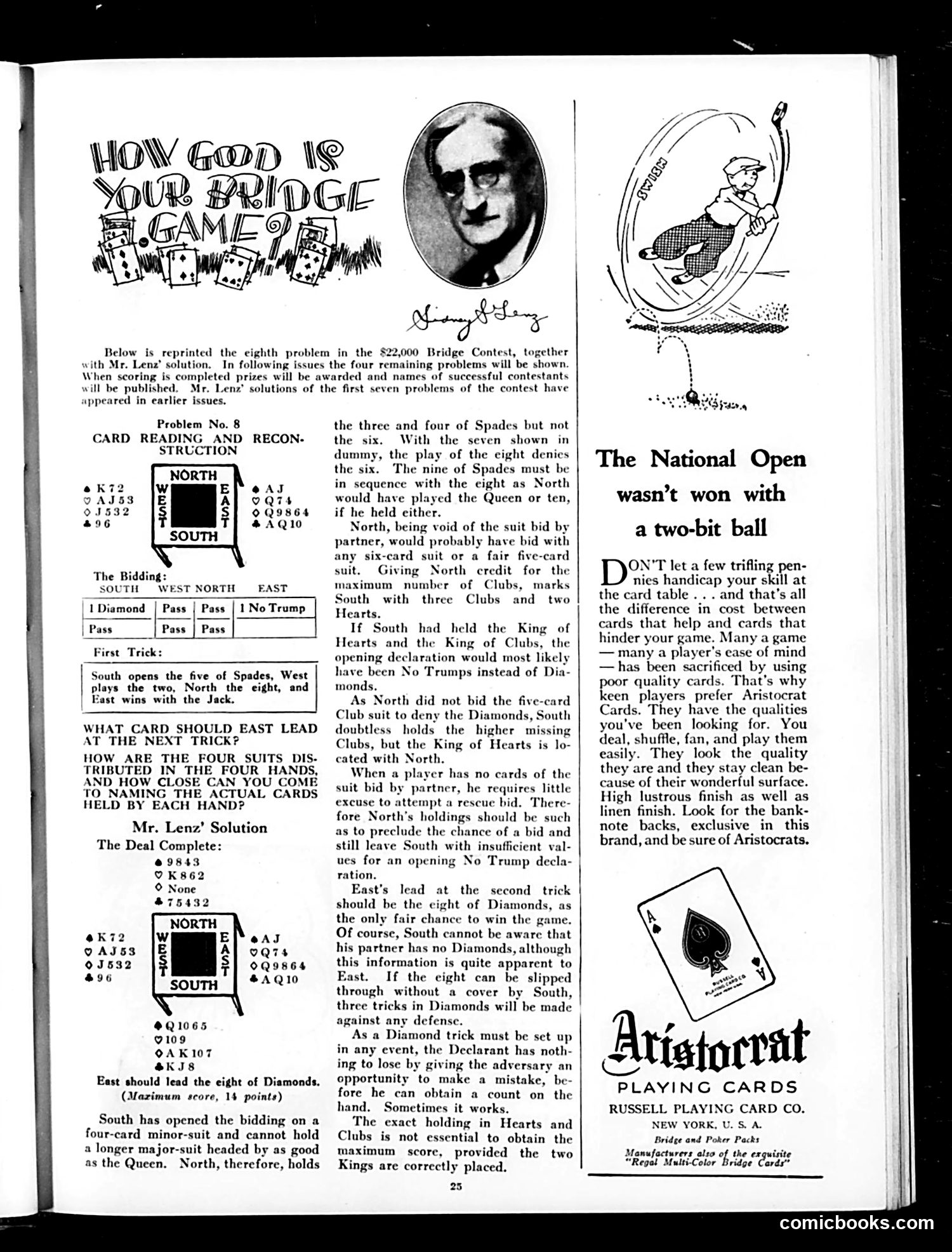
Analysis for Modern Readers This page from *Judge* magazine features a bridge card game problem and an advertisement. The main content is Problem No. 8 from a "$22,000 Bridge Contest," presented with an expert solution by "Mr. Lenz" (likely the renowned bridge authority Ely Culbertson's contemporary). The problem asks readers to deduce card distributions and optimal play—a puzzle-like challenge testing bridge expertise. The accompanying article, "The National Open wasn't won with a two-bit ball," is an Aristocrat Playing Cards advertisement disguised as editorial content. It uses a tennis reference (the "National Open") as a metaphor: just as serious athletes need quality equipment, serious card players need quality cards. The pitch emphasizes that cheap cards handicap skilled play, while Aristocrat's superior surface finish and linen backing ensure reliability. This represents early 20th-century advertorial marketing—blending advertising with editorial content to appear less like sales pitch, more like genuine magazine content.
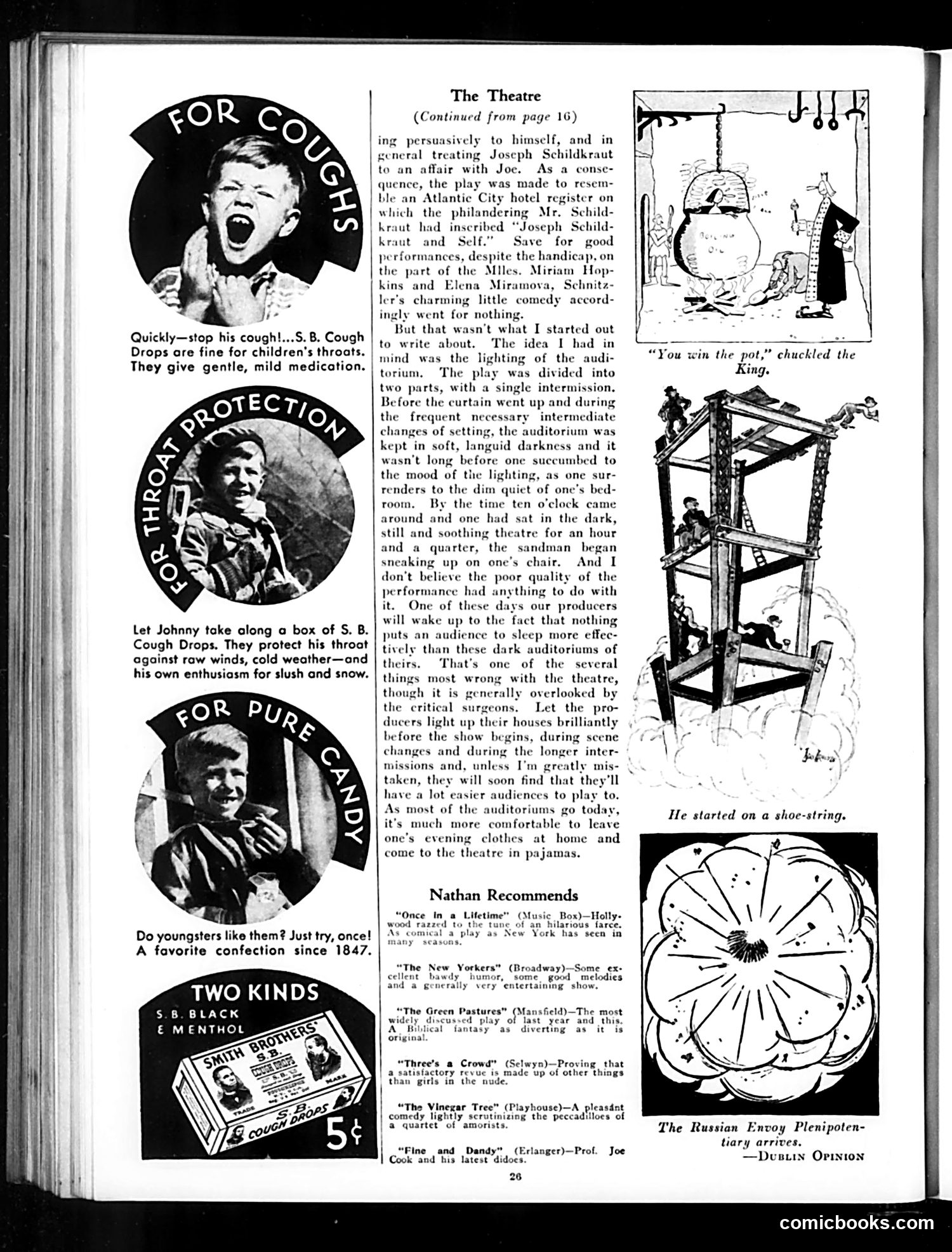
Judge Magazine Page Analysis This page contains advertising and theatre criticism, not political satire. The left side features S.B. Cough Drops ads targeting parents—depicting children coughing and promoting the product as safe, gentle medicine. The tagline notes it's been popular "since 1847," establishing brand heritage. The center contains theatre criticism by "Nathan" (likely a drama critic), discussing how dark auditoriums make audiences drowsy during performances. The critic argues producers should light theatres brightly before shows and during intermissions to keep patrons alert—and humorously notes audiences might as well stay home in pajamas given current comfort levels. The right side includes cartoon illustrations (a hanging pot, a tower structure, and a flower), plus brief theatre recommendations covering contemporary Broadway shows like "Once in a Lifetime" and "The Green Pastures." The final caption references "The Russian Envoy Plenipotentiary" with a Dublin opinion attribution, though its connection to surrounding content is unclear.
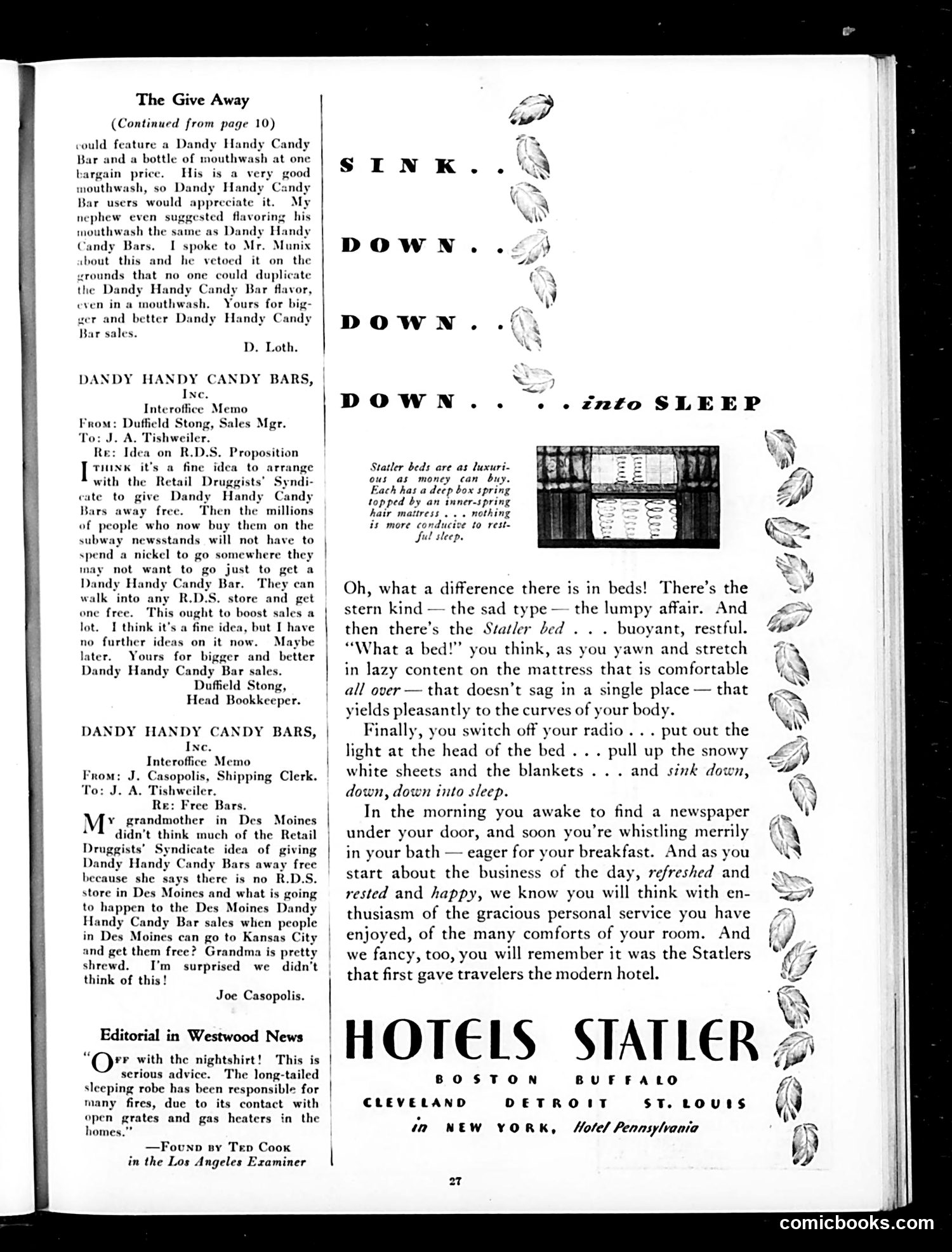
Page Analysis: Judge Magazine This page combines satirical business memos with advertising. The main content mocks corporate decision-making through interoffice communications about "Dandy Handy Candy Bars." Employees propose giving the candy away free through drugstores—a seemingly counterintuitive marketing strategy. The satire lies in how seriously the memos treat this absurd idea, with executives debating logistics while missing the obvious economic problem: giving away products destroys sales. The brief editorial excerpt about nightshirts reflects period safety concerns about flammable sleepwear near open flames and gas heaters. The dominant visual element is a Statler Hotels advertisement featuring falling feathers and lyrical copy about luxurious beds—typical 1920s-30s advertising style emphasizing comfort and modern hotel amenities for travelers. The dramatic typography ("SINK DOWN DOWN DOWN into SLEEP") uses visual repetition for effect.
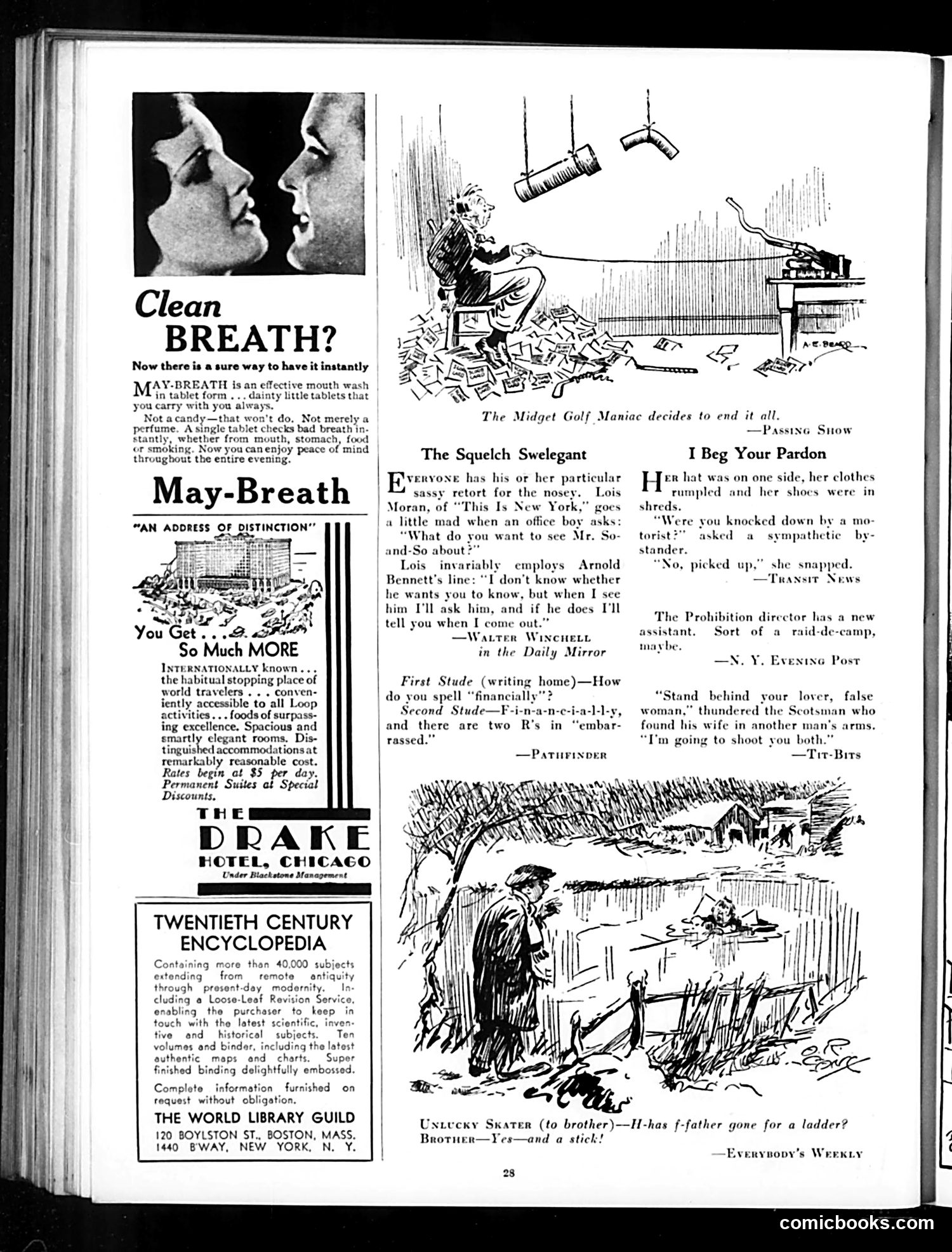
Judge Magazine Page Analysis This page mixes advertisements with humor columns and brief comic jokes, typical of Judge magazine's format. The main visual cartoon (top right) shows "The Midget Golf Maniac decides to end it all"—a darkly comic reference to the 1920s fad of miniature golf. The exaggerated figure appears suicidal over the hobby, satirizing how obsessively Americans embraced the trendy pastime. Below are short humor snippets from newspapers and magazines: - "The Squelch Swelegant" mocks people (like character Lois Moran from the film "This Is New York") who use clever deflections to avoid answering nosy questions - Spelling and skating jokes target student mishaps - References to Prohibition enforcement and marital infidelity reflect 1920s social anxieties The advertisements—May-Breath mouthwash, Drake Hotel, Twentieth Century Encyclopedia—represent typical interwar consumer products and services. Overall, the page reflects 1920s urban sophistication, technological novelty, and social preoccupations rather than focused political satire.
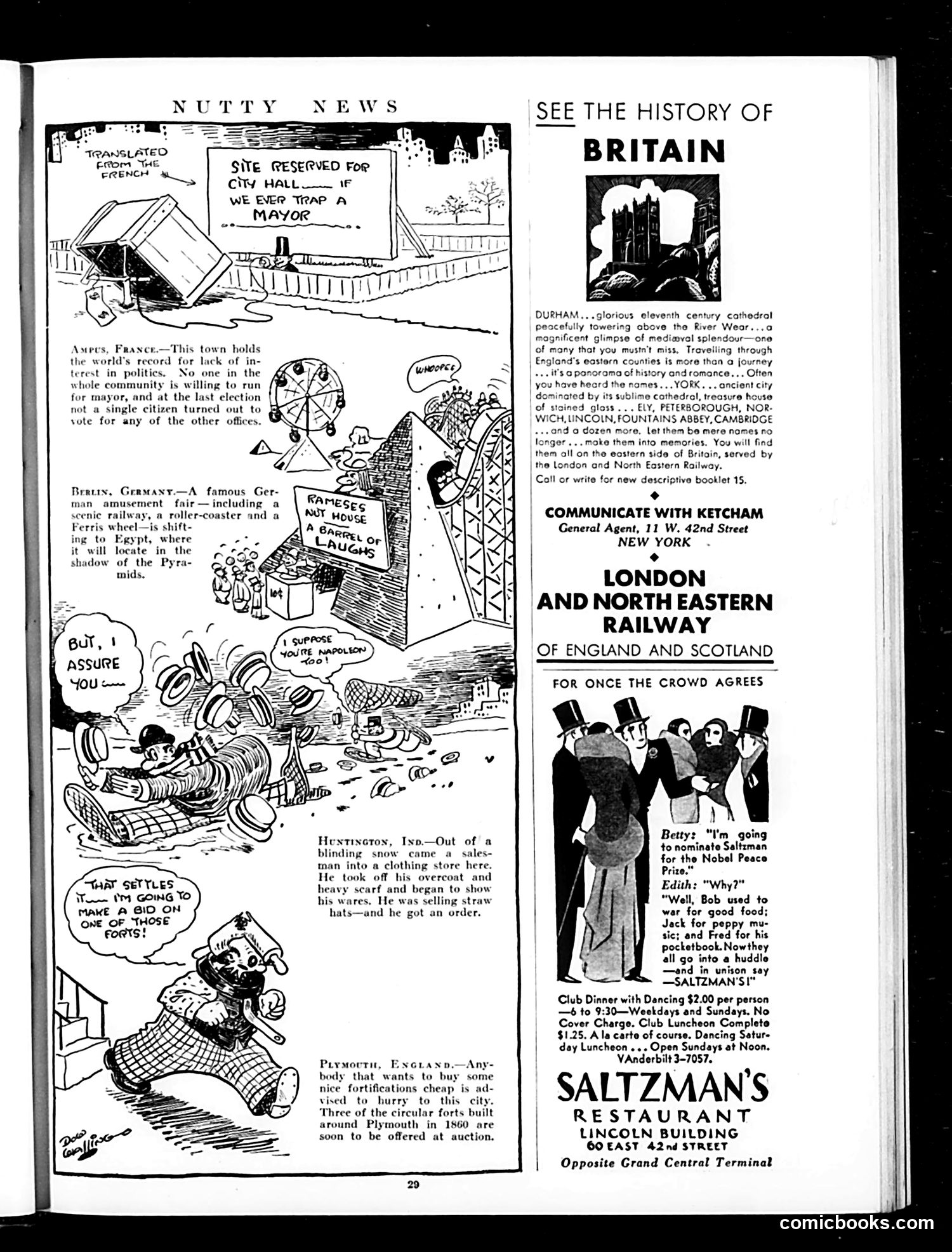
"Nutty News" Page Analysis This page from *Judge* magazine contains three humorous "news" items satirizing human nature and municipal politics: Amiens, France: A town claims to hold the world record for mayoral elections where citizens can't be bothered voting—no one ran against the incumbent, so he won by default. The satire: political apathy and the absurdity of uncontested elections. Berlin, Germany: An amusement park (with roller-coaster, Ferris wheel) is relocating to Egypt near the pyramids. The joke appears to be about incongruous juxtaposition—modern entertainment machinery next to ancient monuments. Huntington, Indiana & Plymouth, England: Brief anecdotes about a salesman selling straw hats during a blizzard and a town auctioning old fortifications. These mock the absurdity of ill-timed sales pitches and obsolete military infrastructure. The page is primarily advertisements (Ketcham travel agency, Saltzman's restaurant, railway company), with crude comic illustrations accompanying each item. The overall tone mocks human folly through exaggerated international "news."
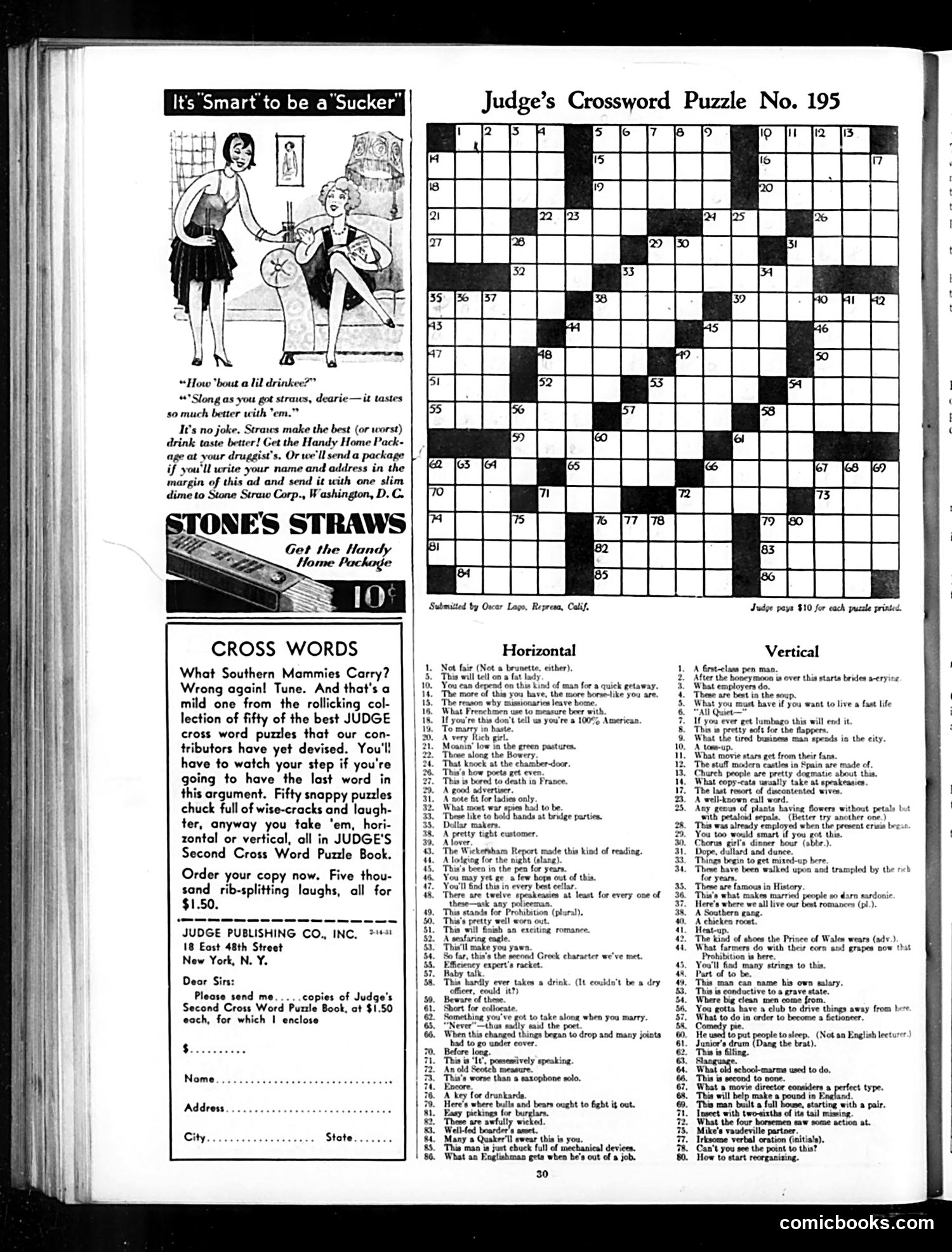
Judge Magazine Satire Analysis This page contains a cartoon advertisement for Stone Straws paired with commentary on drinking culture during Prohibition. The Cartoon & Advertisement: The illustration shows a woman offering a man a drink through a straw, with the caption suggesting straws make drinks taste better. The accompanying ad copy jokes that straws are the solution to making alcohol more palatable—a transparent reference to drinking illegal liquor during Prohibition (1920-1933). The Satire: Judge magazine is mocking Prohibition's failure and the public's creative workarounds. The "joke" that straws improve taste is actually satirizing how Americans were consuming bootleg alcohol despite the law. The ad for Stone Straws presents a mundane product as if it's solving a genuine problem—implying everyone understands the real purpose. Historical Context: This reflects Judge's satirical stance on Prohibition, which was widely flouted and unpopular among urban sophisticates the magazine's audience represented. The humor relies on readers understanding the obvious subtext: Prohibition didn't stop drinking; it just made it illegal and creative. The crossword puzzles and other advertisements on the page are unrelated filler content typical of the era.
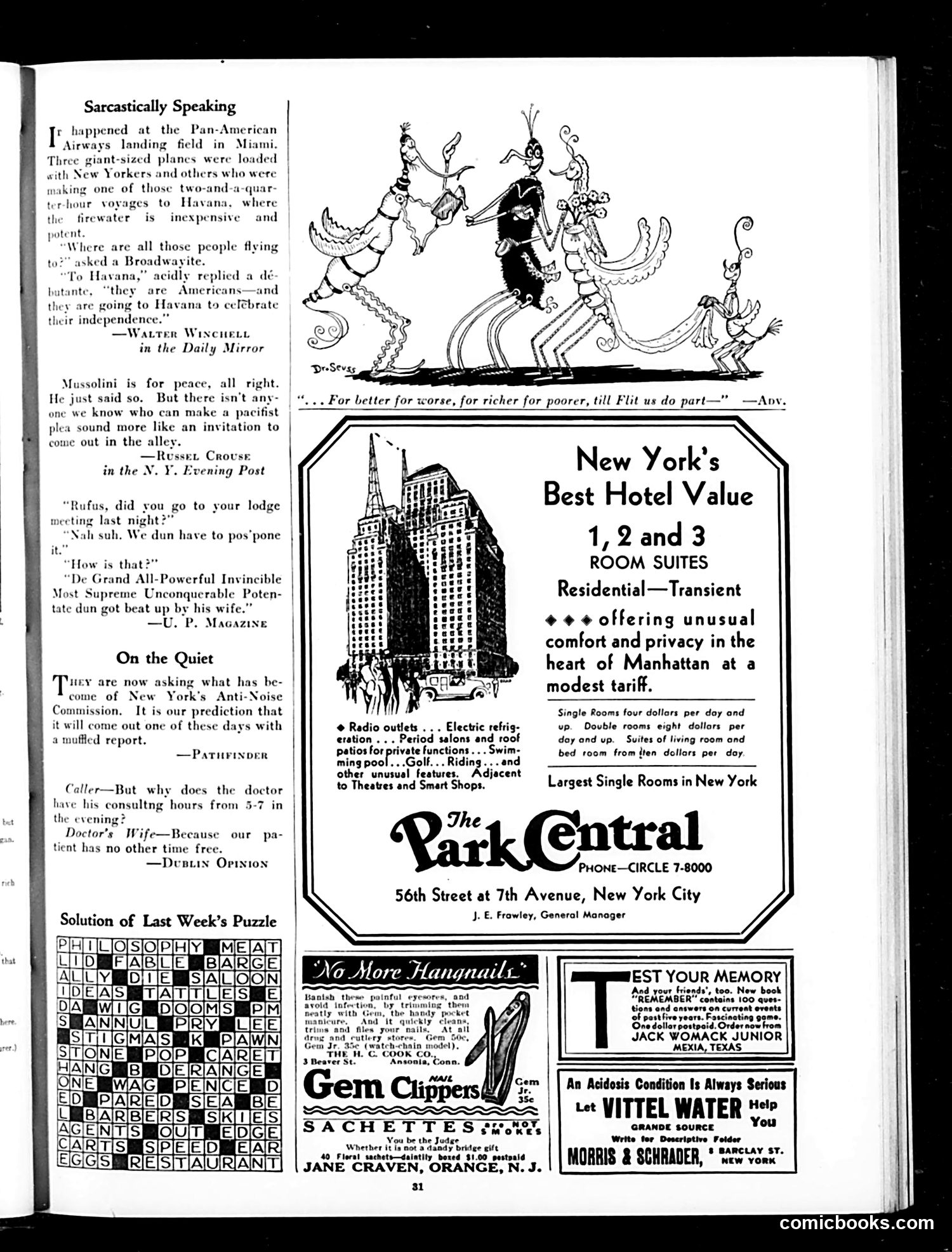
Analysis of Judge Magazine Page This page contains several satirical pieces typical of Judge's content: Main Cartoon (top): Dr. Seuss illustration satirizing couples heading to Havana to "celebrate their independence." The joke references Americans traveling to Cuba during Prohibition to drink legally—their "independence" from U.S. alcohol laws. The caption quotes a mock marriage vow about sticking together "for better or worse." Text Pieces: Short humorous anecdotes mocking various targets: - A Broadwayite's dismissive comment about New Yorkers going to Havana - Mussolini's peace declarations presented as hollow - An "Anti-Noise Commission" that produces only "muffled reports" (wordplay suggesting it's ineffectual) - A joke about a lodge member avoiding meetings because leadership got "beat up" Context: This appears to be from the early 1930s (Prohibition era), when Havana was a popular destination for Americans seeking legal alcohol. The satire targets both the hypocrisy of "independence" celebrations and contemporary political figures. The remainder of the page consists primarily of advertisements and a crossword puzzle solution.
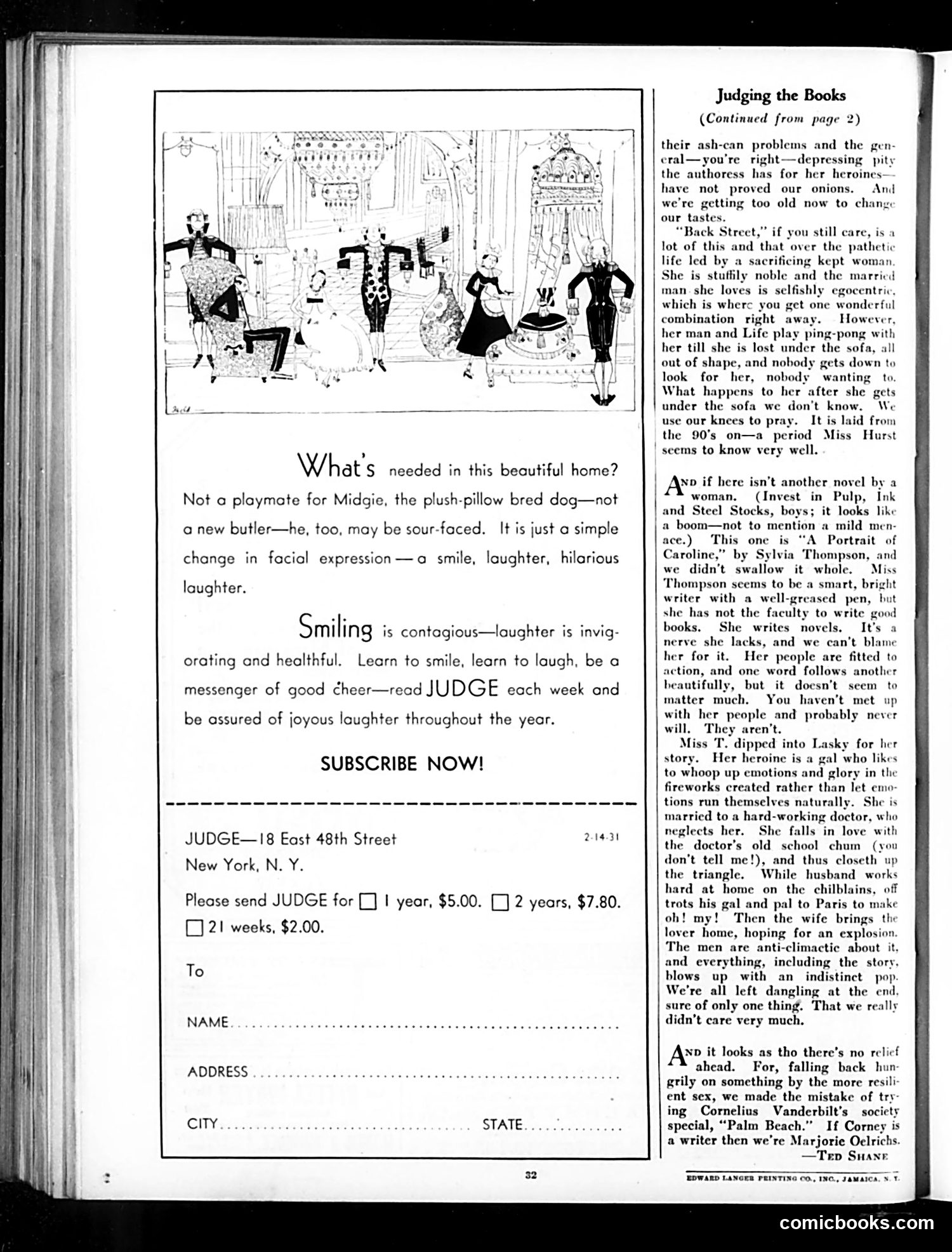
Judging the Books: A Book Review Column This page contains a book review column rather than political cartoons. The illustration shows a 1920s-30s domestic interior scene, likely accompanying the reviews discussed. The critic reviews several contemporary novels, most dismissively. "Back Street" receives backhanded criticism for its melodramatic portrayal of a kept woman's sacrificial life. The reviewer mocks "A Portrait of Caroline" by Sylvia Thompson as technically competent but emotionally hollow—the characters feel artificial and readers won't care about them. A brief plot summary describes a wife who falls for her doctor husband's old friend (clichéd love triangle) and attempts to provoke jealousy by inviting the lover home, only to have the scenario fizzle anticlimactically. The final jab targets Cornelius Vanderbilt's society column "Palm Beach," sarcastically suggesting if Vanderbilt is a "writer," then the critic is Marjorie Oelrichs (a contemporary socialite—implying Vanderbilt isn't a real writer). The page concludes with a subscription advertisement for Judge magazine itself.
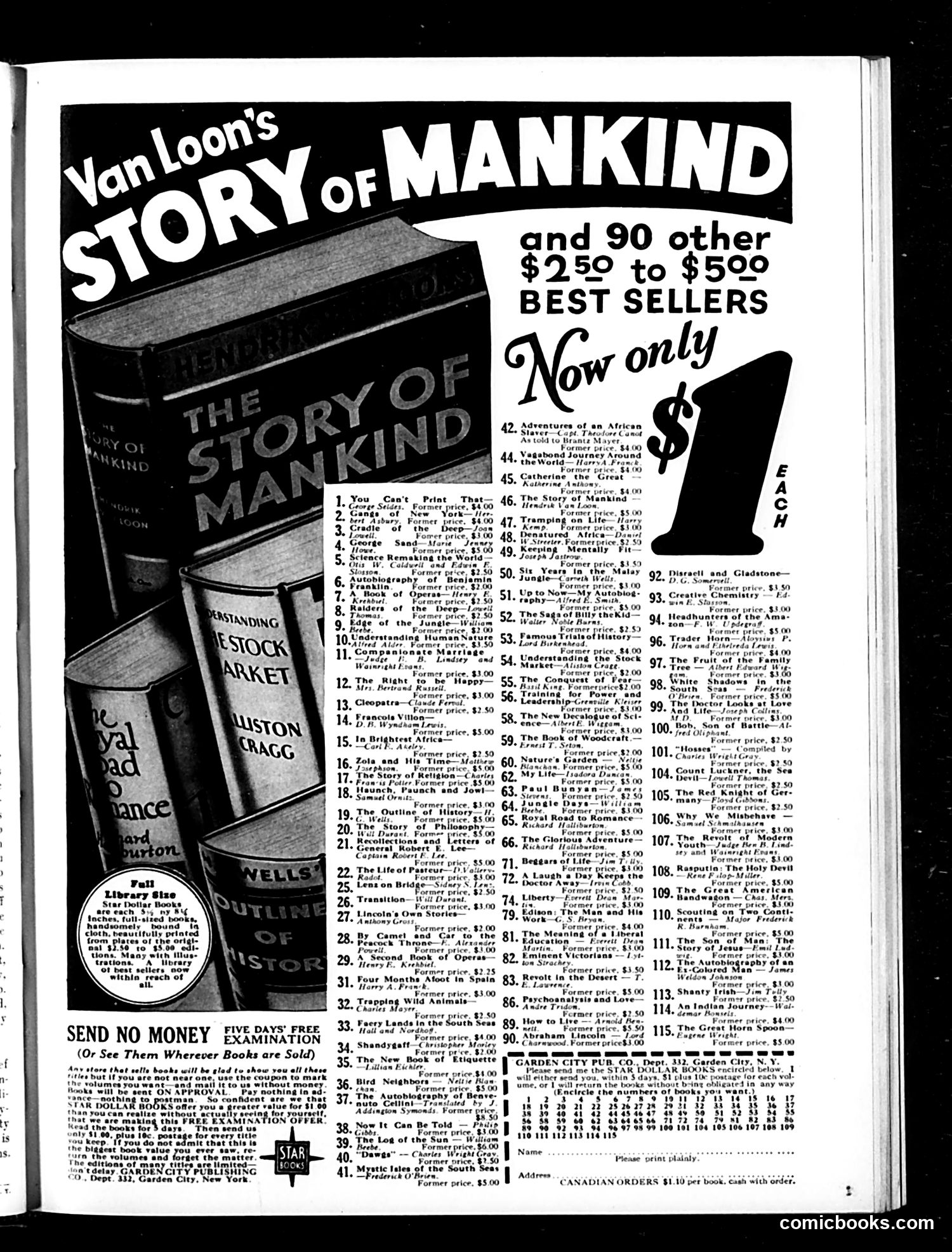
What This Page Shows This is primarily a book advertisement, not a political cartoon. It advertises the "Star Dollar Books" collection from Garden City Publishing Company—a budget book series selling approximately 90+ titles originally priced $2.50-$5.00, now marked down to $1 each. The large image on the left shows a stack of actual books, with Van Loon's *Story of Mankind* prominently featured. The bulk of the page is a numbered catalog listing titles like *Understanding Human Nature*, *The Autobiography of Benjamin Franklin*, *Paul Bunyan*, and *Trader Horn*. The sales pitch: "Send No Money—Five Days' Free Examination." Customers could order without payment, examine books at home for five days, then either buy or return them. This reflects Depression-era marketing: affordable access to classic literature and non-fiction for working-class readers. There is no political satire here—it's a straightforward commercial appeal to book buyers seeking value.
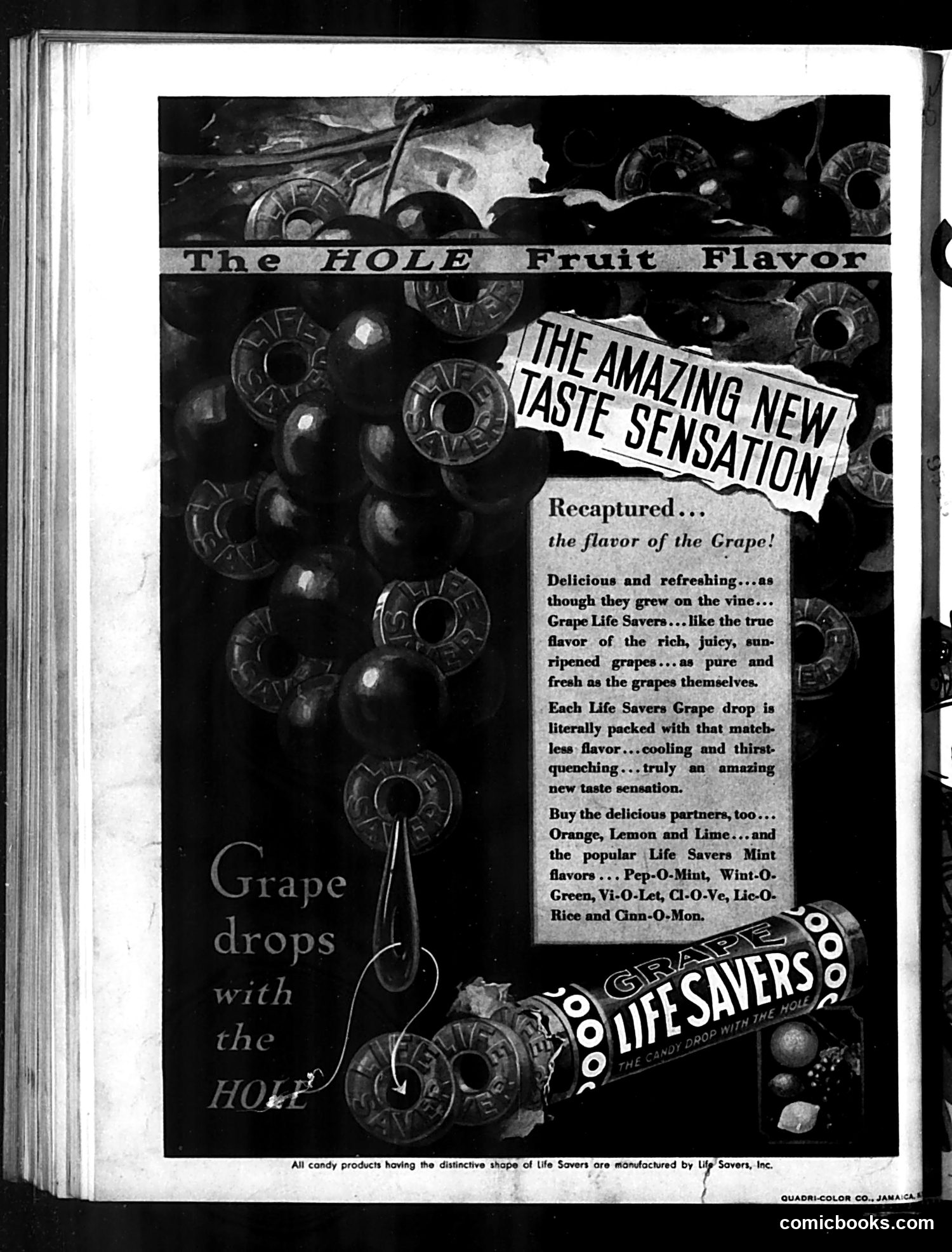
Life Savers Candy Advertisement This is a full-page advertisement for Life Savers candy, not political satire. The ad promotes a new "Grape" flavor of Life Savers drops, emphasizing that it captures authentic grape taste—"as though they grew on the vine." The distinctive ring-shaped candies are shown visually throughout. The "HOLE Fruit Flavor" headline plays on Life Savers' characteristic hole at the center. The ad highlights other flavors available: Orange, Lemon, Lime, and various mint varieties (Pep-O-Mint, Wint-O-Green, Vi-O-Let, etc.). For modern readers: this represents early 20th-century candy marketing emphasizing "natural" fruit flavoring as a novel selling point—a common advertising claim even when artificial flavoring was used. The page demonstrates how Judge magazine, primarily a satirical publication, also carried commercial advertisements.