judge
Judge — February 21, 1931
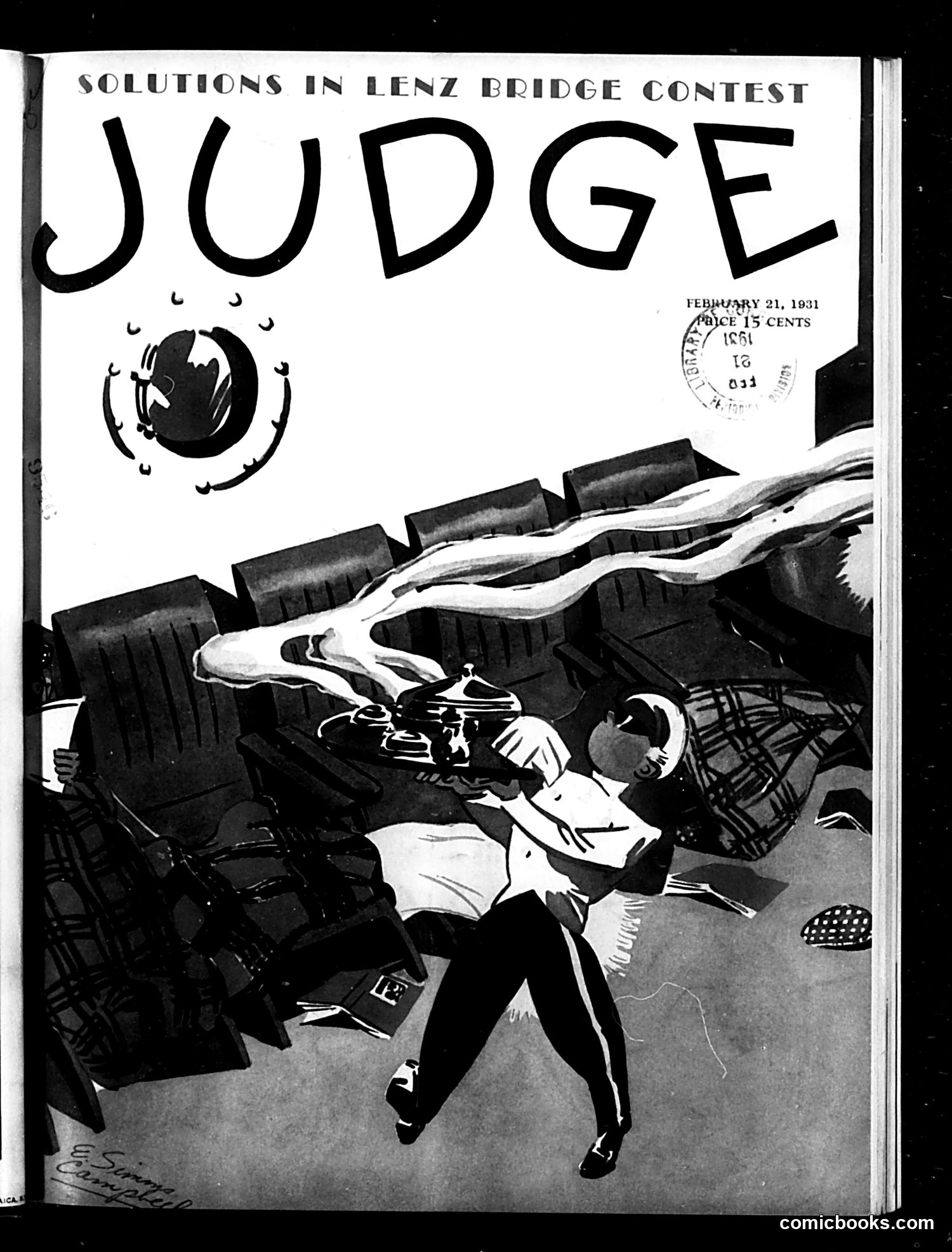
Analysis of Judge Magazine Cover, February 21, 1931 This cover references the Lenz Bridge Contest, a 1930-31 engineering competition to design a bridge. The illustration shows a figure juggling or struggling with industrial materials (steel girders/pipes), suggesting the challenge and complexity of bridge design solutions. The cartoon satirizes competing engineers attempting to solve the structural problems of the Lenz Bridge project. The figure's precarious balancing act—surrounded by heavy industrial components—mocks the difficulty of the engineering feat and perhaps the competing proposals' impracticality or instability. The small circular inset at top-left likely depicts the bridge or related imagery, though details are unclear. This was timely content given the bridge's prominence during the Depression era.
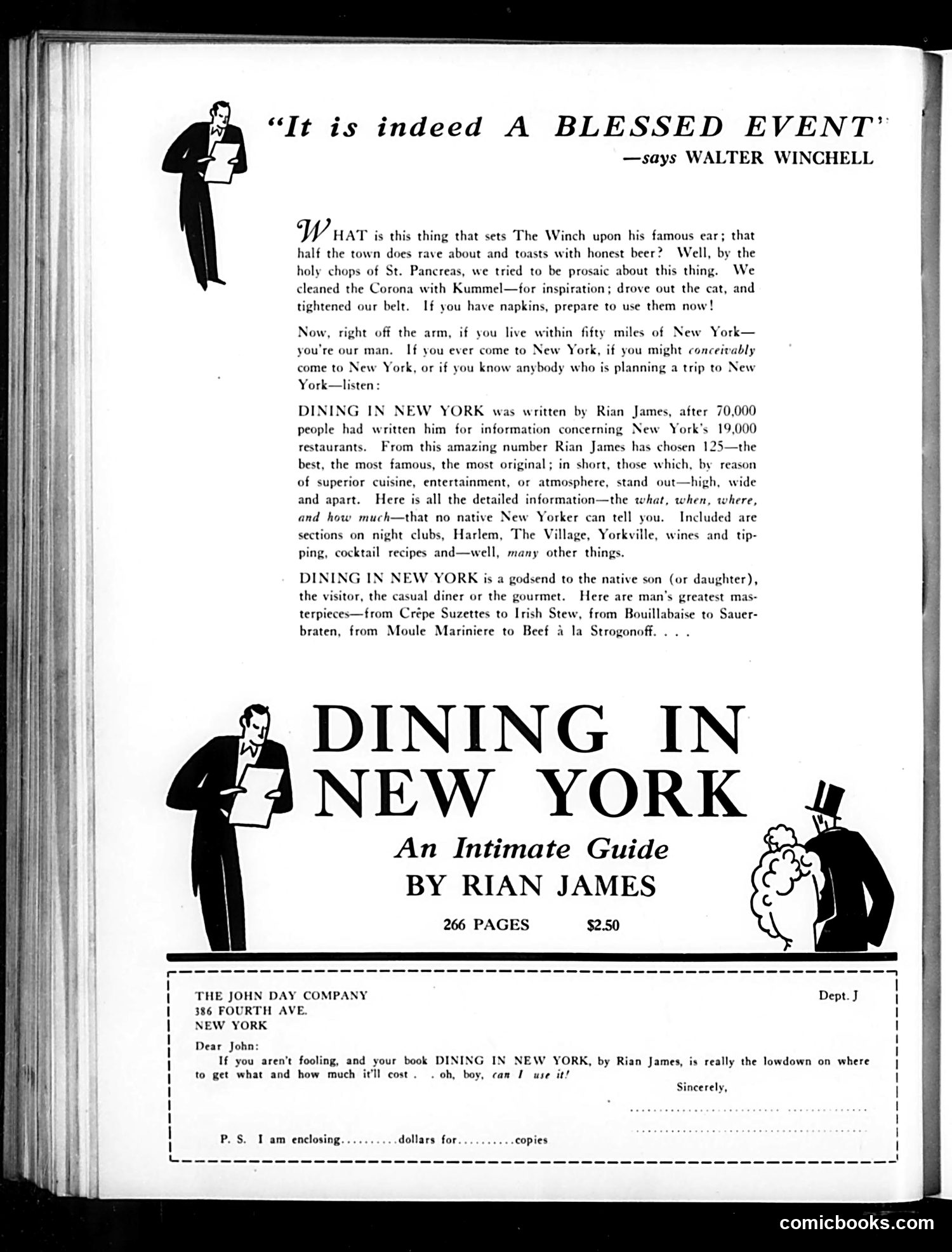
Analysis This page is primarily advertising for a guidebook, not satirical content. It promotes "Dining in New York: An Intimate Guide" by Rian James—a 266-page restaurant guide selling for $2.50. The illustrated figures (men in formal attire with clipboards) are generic representations of the author or informed guides, not political caricatures. They frame the book as an authoritative resource. The endorsement from "Walter Winchell" (a famous gossip columnist of the era) lends credibility. The text emphasizes the book covers 125 selected restaurants with details about "what, when, where and how much"—practical information for New Yorkers and visitors. The bottom section includes an order form from the John Day Company publisher. This is essentially a vintage advertisement, not satirical commentary.
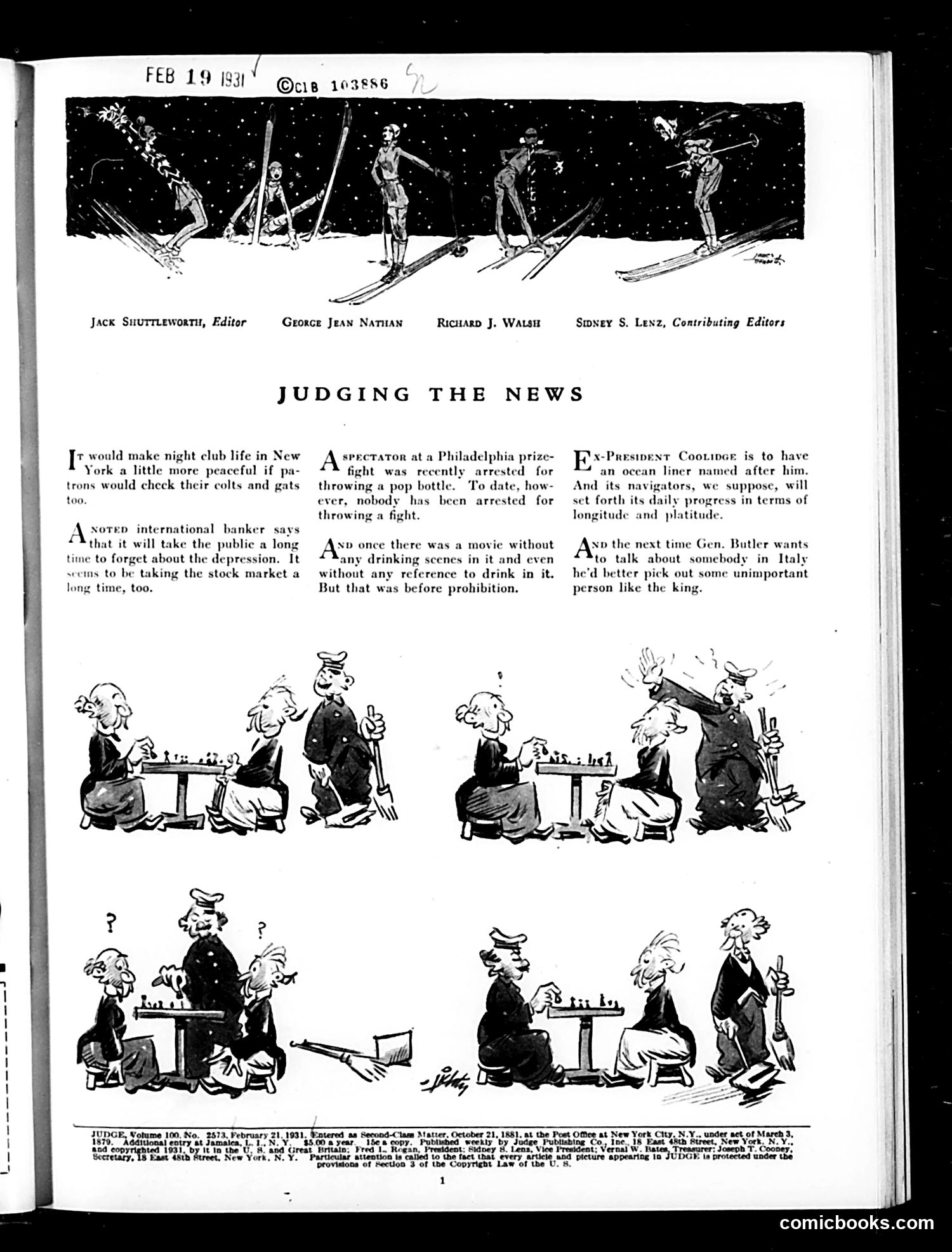
"Judging the News" - February 21, 1931 This editorial cartoon page satirizes current events through four comic vignettes featuring caricatured figures playing chess. The commentary addresses: a proposed nightclub regulation in New York; a Philadelphia incident involving a spectator throwing a pop bottle at a prizefight; nostalgia for pre-Prohibition movies with drinking scenes; and General Butler's diplomatic efforts (likely regarding Italy, referencing someone "picking out an important person like the king"). The chess motif suggests these situations involve strategic maneuvering or game-like power plays. The cartoons mock political absurdities and social contradictions of the era—particularly Prohibition's lingering effects on entertainment and culture. Ex-President Coolidge apparently planned an ocean liner voyage. The humor relies on contemporary political awareness now largely lost to modern readers.
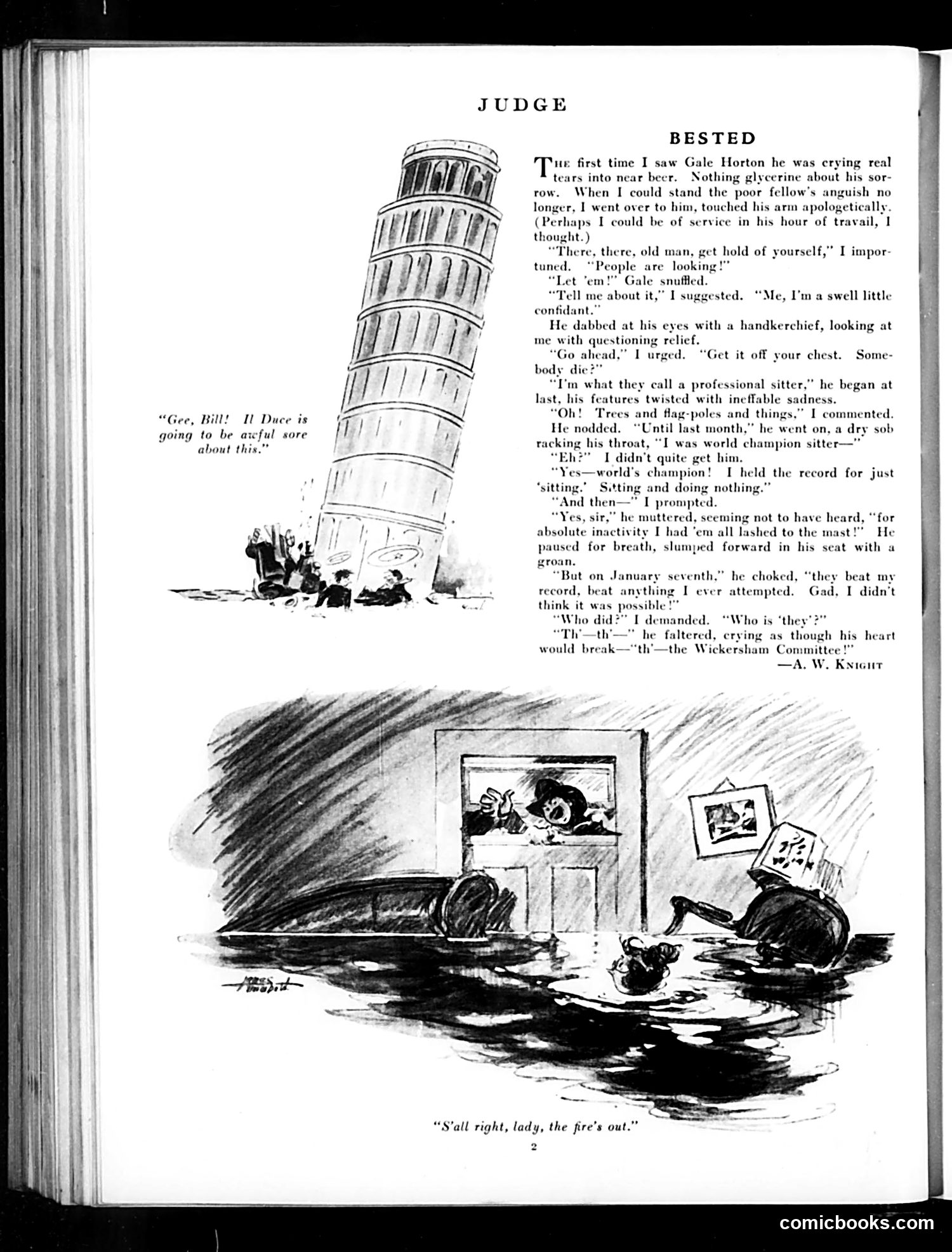
Analysis of "Judge" Page: "Judge Bested" This page satirizes Gale Horton, a professional "sitter" (likely a hired caretaker or babysitter). The story describes Horton's emotional breakdown while recounting his previous record-holding inactivity—until the "Wickersham Committee" supposedly beat his record on January 7th through complete inaction. The Wickersham Committee (1929-1931) investigated Prohibition enforcement under President Hoover. The satire mocks the committee's perceived ineffectiveness and passivity, comparing government inaction to a professional sitter's job. The cartoon suggests the committee was so inactive and useless that even a professional "do-nothing" couldn't match their record. The joke plays on frustration with government bodies appearing to accomplish nothing while tasked with important work.
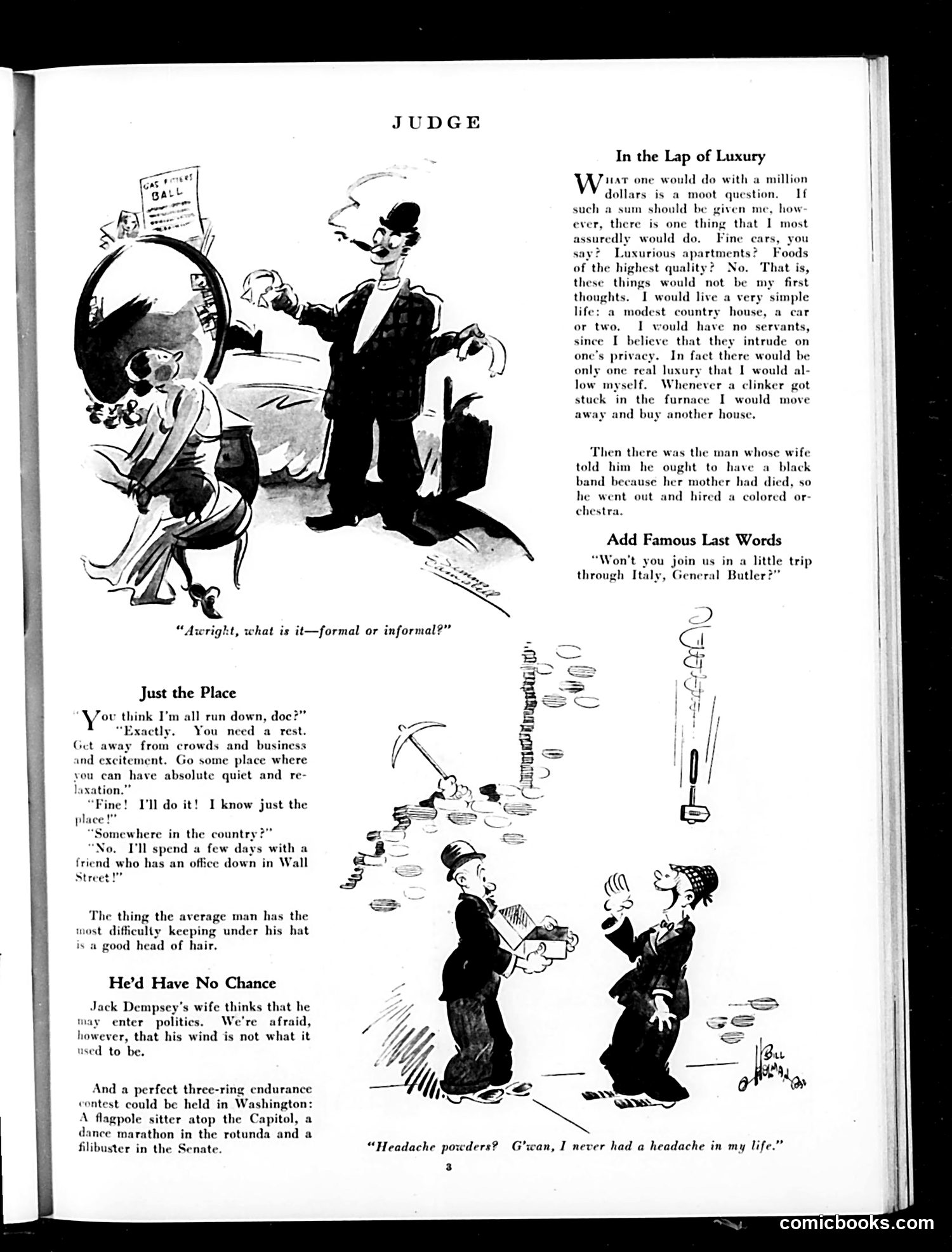
Judge Magazine Page Analysis This page contains several humorous vignettes satirizing wealthy lifestyles and social pretension. "In the Lap of Luxury" mocks the ultra-wealthy, with the author claiming he'd only truly want one luxury: moving houses when his furnace breaks. The anecdote about hiring a "colored orchestra" because his wife needed to mourn her mother satirizes performative status-seeking. "Just the Place" jokes about exhausted professionals seeking rest, with a punchline about spending days with a Wall Street friend—implying that location provides no actual escape from business concerns. "Headache powders?" shows two men exchanging headache powder, with one claiming never to have had a headache, satirizing either hypochondria or the placebo nature of patent medicines. The cartoons target wealthy pretension and 1920s-era patent medicine marketing.
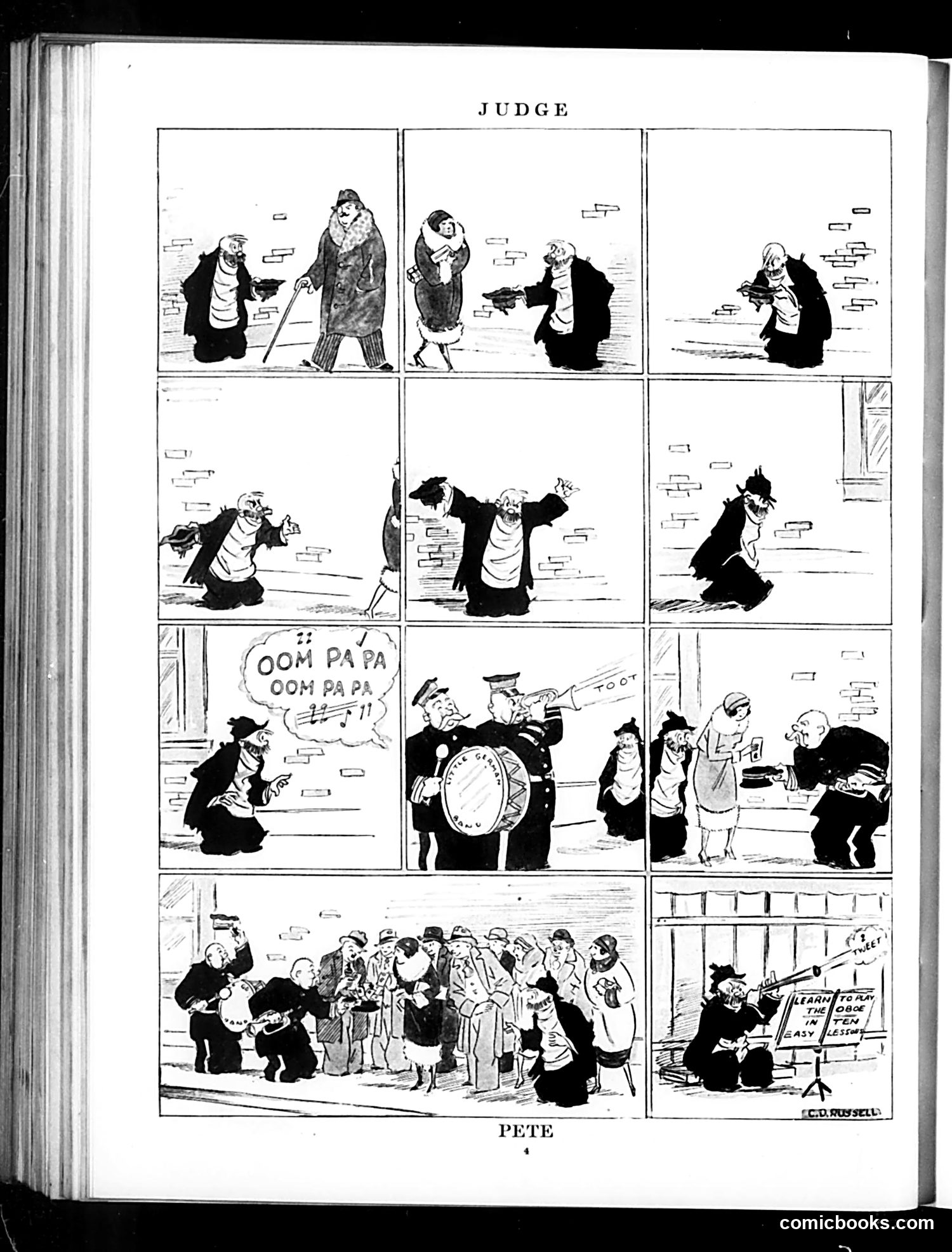
Political Cartoon Analysis: "Judge" - "Judge" and "Pete" This page presents a sequential comic strip titled "Judge" and "Pete" by cartoonist Ed Russell. The strips depict a judge character attempting to maintain courtroom order while a band or musical group creates chaos. The central panels show the judge becoming increasingly frustrated as musicians play loudly—note the "OOM PA PA" musical notation and the large drum in the middle panel. The satire appears to mock judicial authority's helplessness against disruptive noise or disorder, possibly referencing early-20th-century concerns about jazz music, street performers, or public nuisance laws. The final panel shows the judge attempting to impose order on a crowd, though the specific political context remains unclear without additional publication date information.
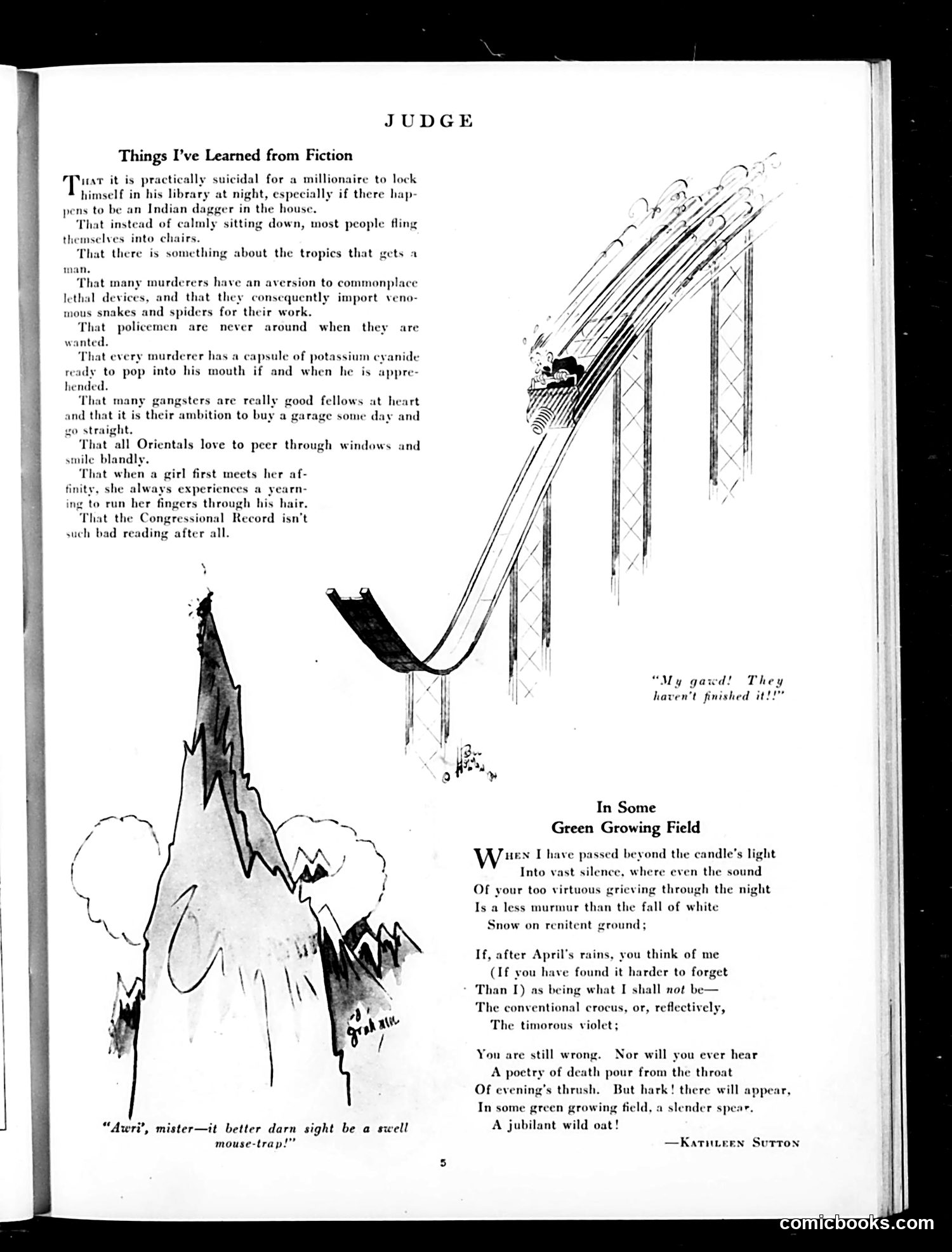
Analysis This page contains two distinct pieces: "Things I've Learned from Fiction" (top left): A humorous list of observations about tropes in crime and romance fiction—millionaires with libraries, murderers' habits, gangsters' ambitions, and romantic encounters. It's light social satire about how fiction shapes perceptions of reality. The cartoons show two scenes with dramatic dialogue. One figure warns another: "Acrid, mister—it better darn sight be a swell mouse-trap!" The other caption reads "My gosh! They haven't finished it!" These appear to be slapstick humor about everyday situations, though the specific references are unclear without additional context. "In Some Green Growing Field" (bottom): A serious poem by Kathleen Sutton about remembrance and nature—likely related to war memorials or loss, given imagery of death and "green growing field." The page mixes humor with sentimental verse, typical of Judge's varied editorial content.
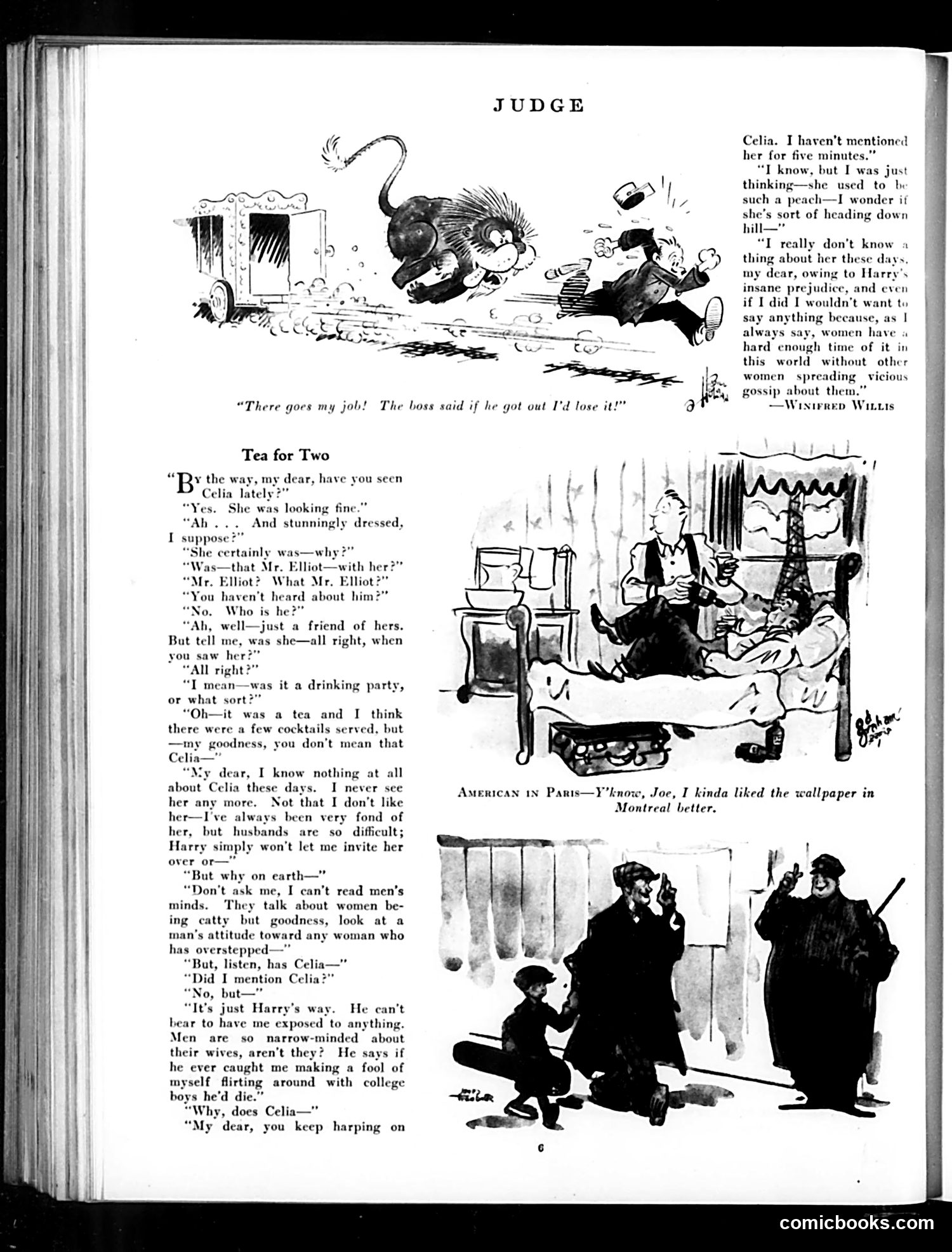
Analysis of This Judge Magazine Page Top Cartoon ("There goes my job!"): A disheveled man flees as a monkey operating a mechanical device destroys his workspace. The caption suggests the monkey will outperform him. This satirizes widespread early-20th-century anxiety about automation and machines replacing workers—a common fear during industrialization. "Tea for Two" Section: A dialogue between two women gossiping about a third woman named Celia and her association with "Mr. Elliot." The conversation reveals anxieties about women's social behavior and propriety. The male speaker expresses controlling attitudes toward women, reflecting period attitudes about wives' social conduct and marital jealousy. Other Illustrations: Appear to depict social situations—a tea party and winter street scenes—supporting the gossip theme about proper social behavior.
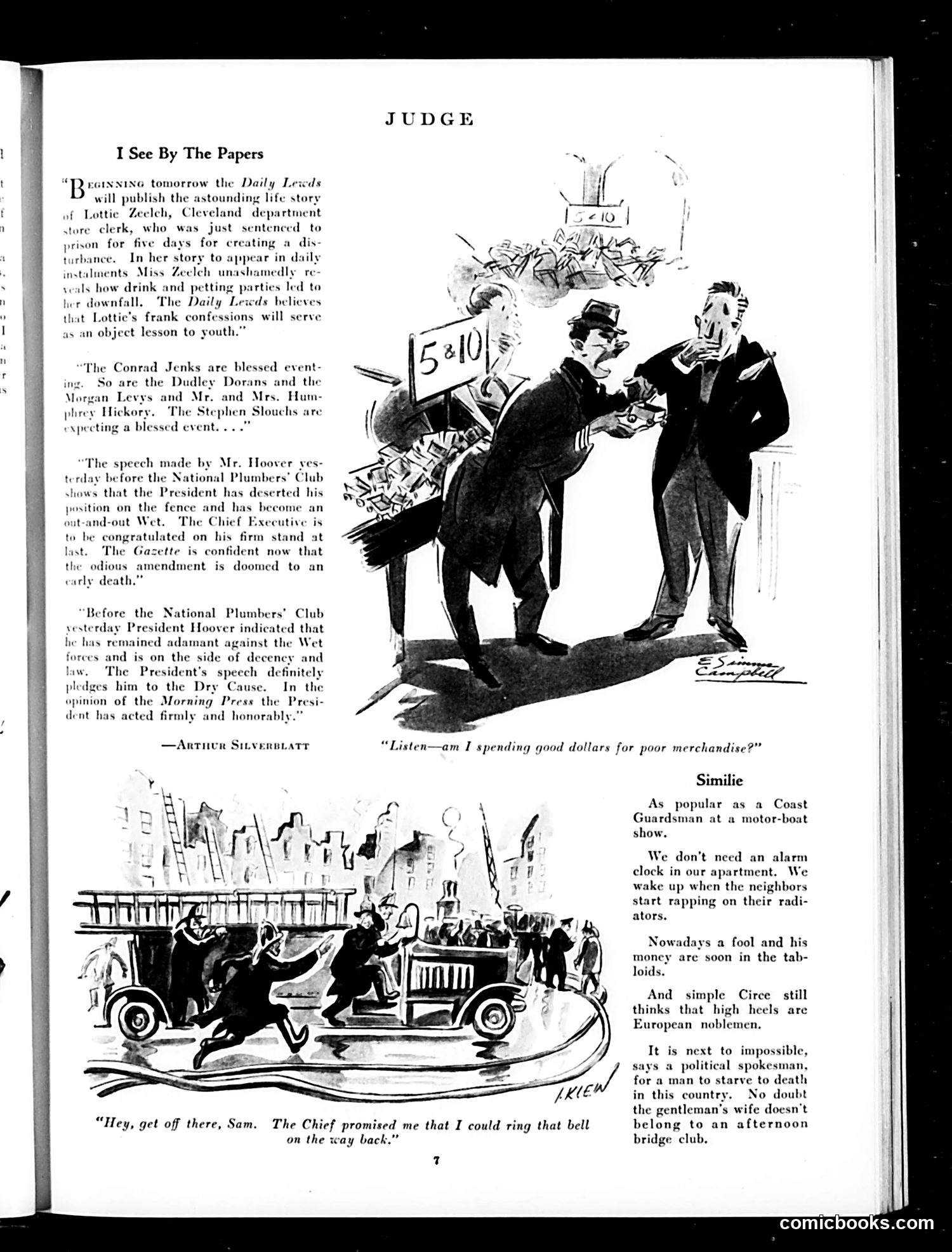
Political Satire from Judge Magazine This page contains political commentary on Prohibition-era America. The top cartoon satirizes conflicting newspaper coverage: two papers report opposite interpretations of President Hoover's speech to the National Plumbers' Club—one claiming he opposes Prohibition ("Wet"), the other insisting he supports it ("Dry"). The joke exposes how the same speech could be spun to support contradictory positions, depending on the newspaper's bias. The lower cartoon depicts a chaotic scene at what appears to be a motor-boat show, likely mocking Prohibition enforcement or smuggling activity. The "Similie" section offers unrelated witty observations about contemporary social life—apartment living, foolish spending, fashion trends, and afternoon bridge clubs. The page is attributed to Arthur Silverblatt and illustrator Cesare Zimbalist. Without a visible date, the specific year remains unclear, though references to Prohibition and Hoover suggest the 1920s-early 1930s.
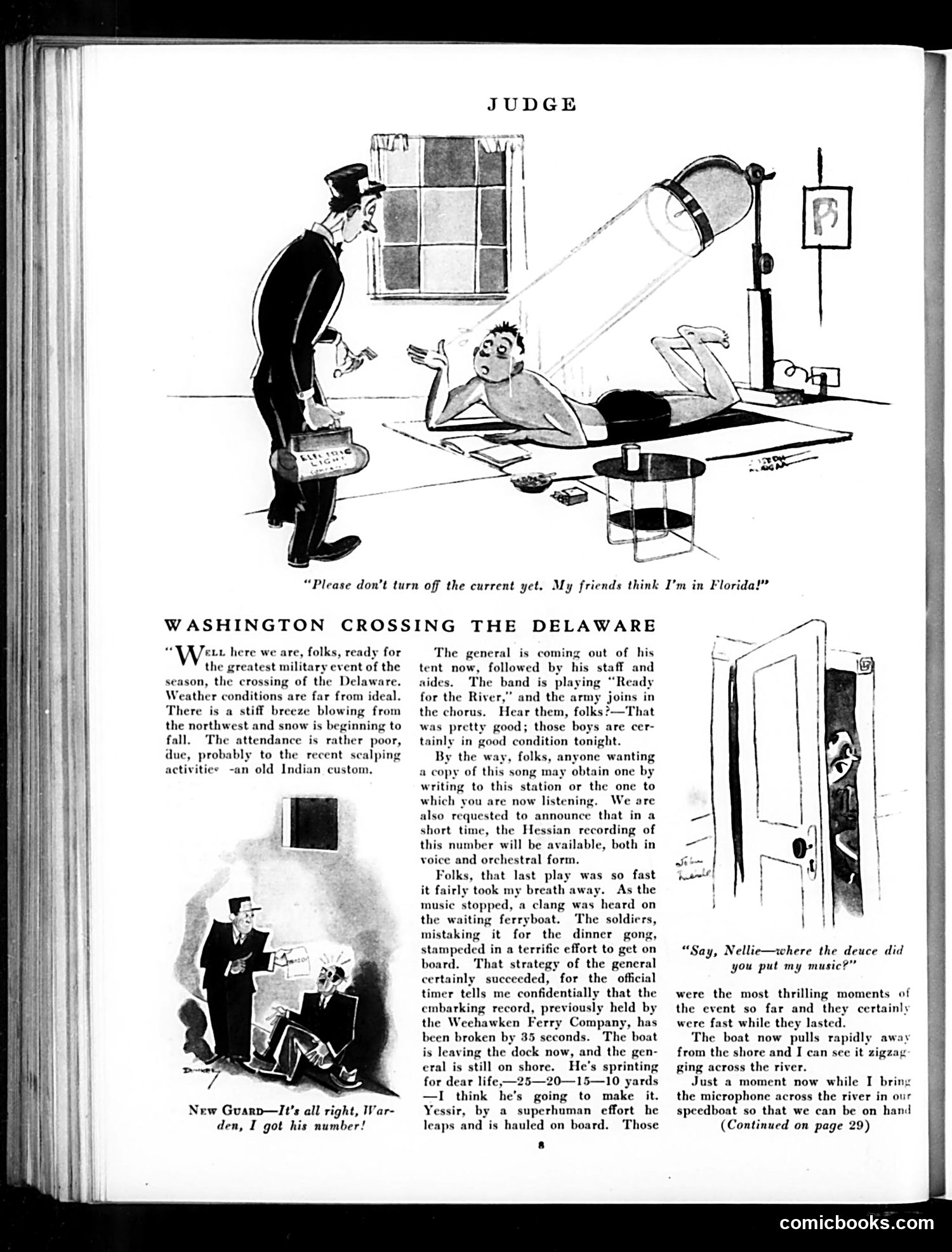
Judge Magazine Satire Analysis This page satirizes modern radio broadcasts by reimagining Washington's famous 1776 Delaware crossing as a live sports event commentary. A judge figure operates an intense spotlight on a shirtless prisoner, with the caption "Please don't turn off the current yet. My friends think I'm in Florida!"—satirizing both radio's entertainment obsession and torture disguised as recreation. The main article parodies breathless radio sportscasting, complete with a commentator breathlessly narrating the military operation as if it were a game show. The humor derives from treating a historic military event as entertainment spectacle, with absurd details: soldiers stampeding for dinner, breaking ferry-loading records by 35 seconds, and the general nearly missing his own boat. This mocks 1920s-30s American culture's appetite for sensationalized radio broadcasts and the trivialization of serious events through entertainment media—treating history and even violence as consumer products.
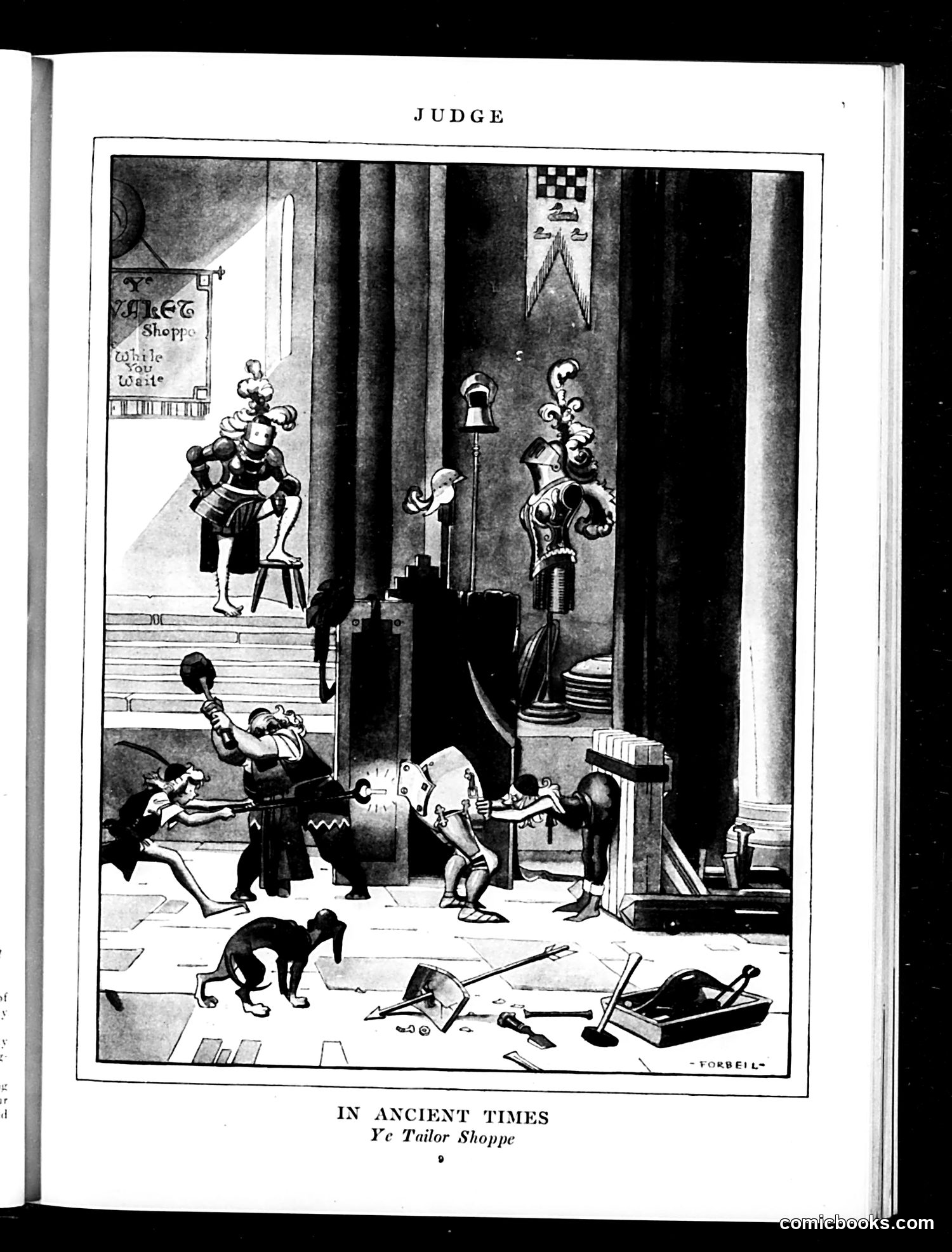
"Judge" Cartoon: "In Ancient Times - Ye Tailor Shoppe" This satirical cartoon depicts a chaotic tailor's shop in medieval or ancient times. The scene shows multiple figures—apparently tailors and customers—engaged in various activities: measuring, fitting garments, and conducting business. A dog rummages through scattered tools and fabric on the floor. The humor appears to satirize the tailoring trade itself, possibly mocking tailors' incompetence, disorganization, or the messy nature of their work. The "ancient times" framing suggests a nostalgic or historical parody—perhaps implying tailoring practices haven't improved much, or commenting on contemporary tailors through historical analogy. The specific political or social target remains unclear without additional context about Judge magazine's 1920s-era concerns or contemporary tailoring industry issues.
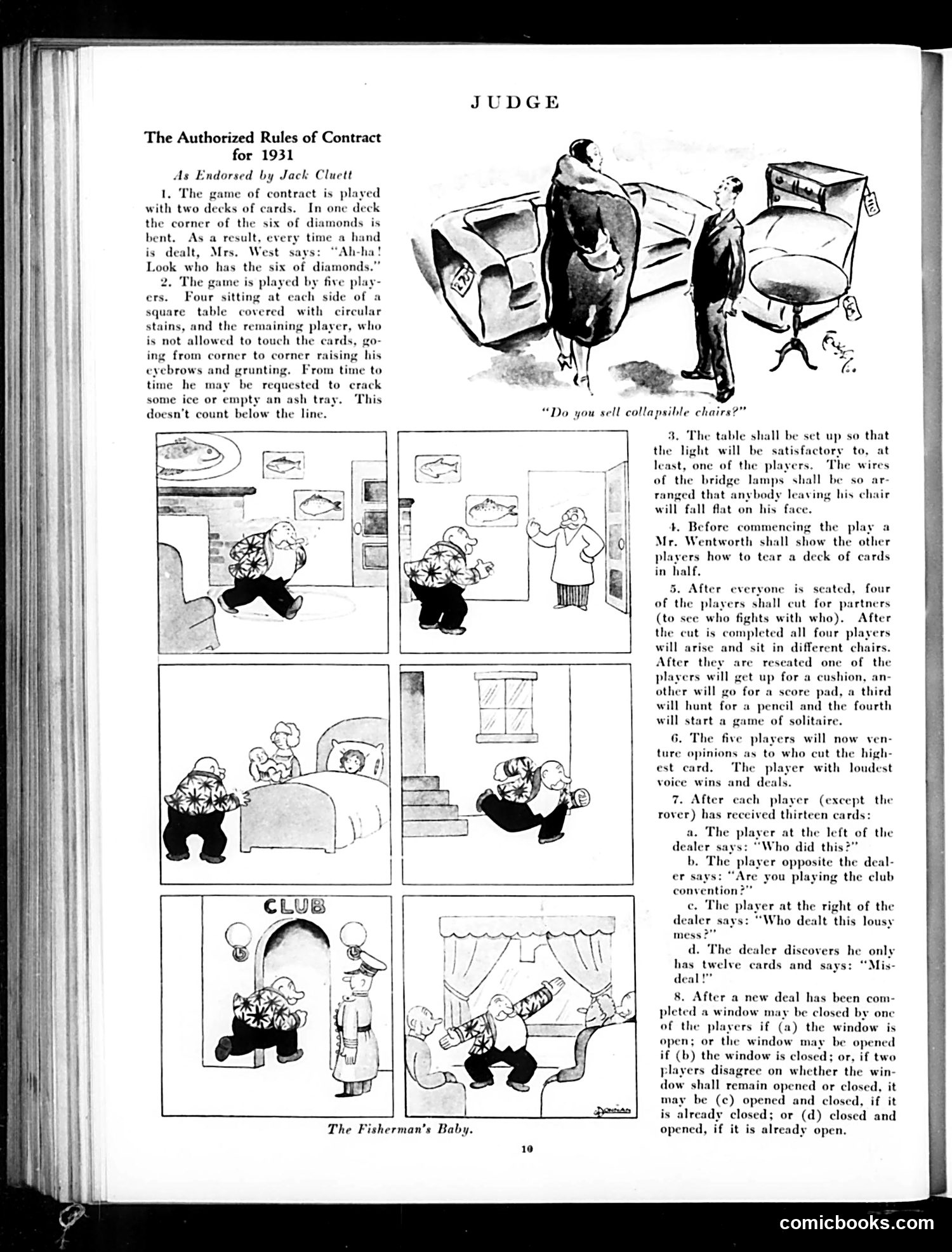
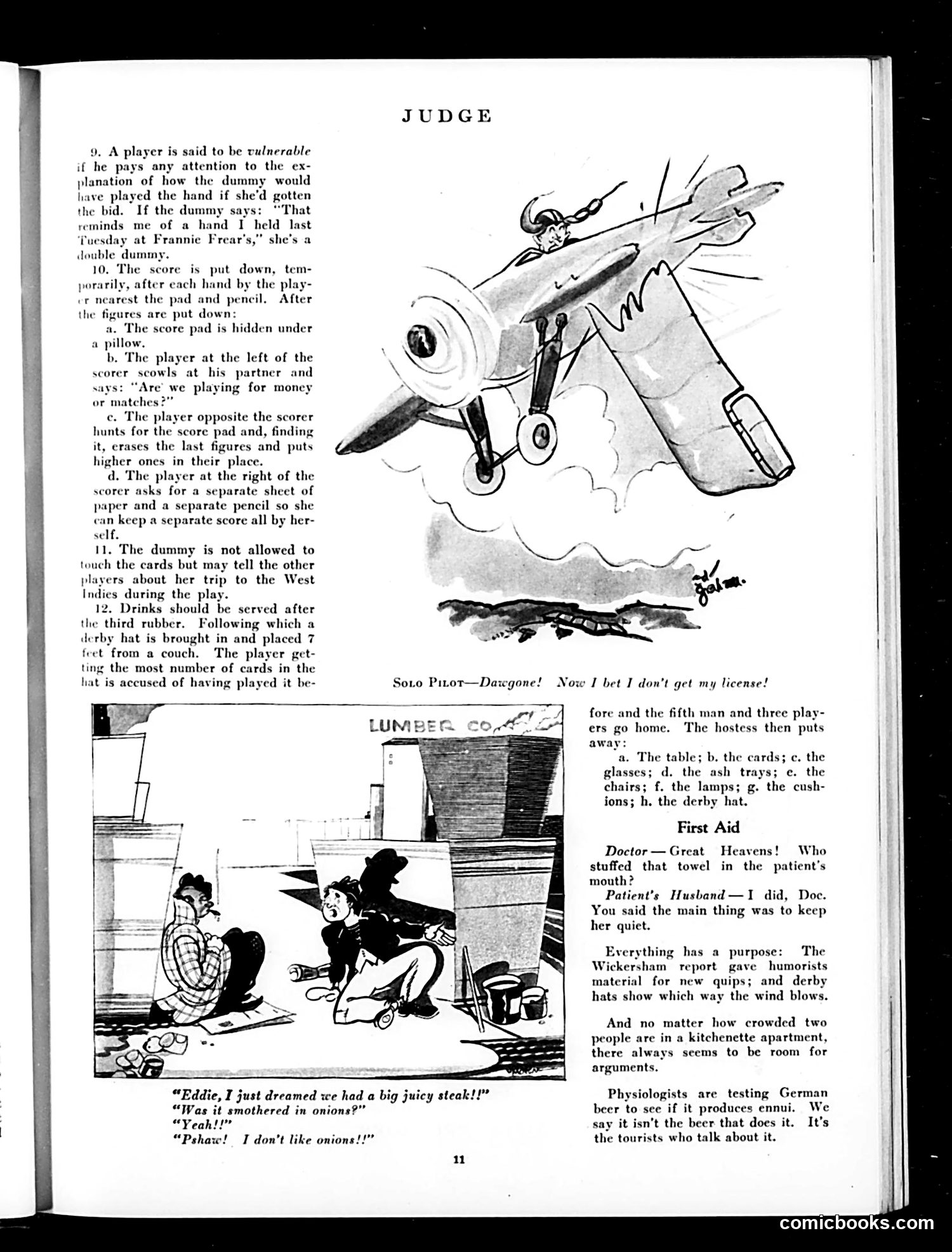
Judge Magazine: "The Authorized Rules of Contract for 1931" This is satirical humor about Contract Bridge, the wildly popular card game of the 1930s. The text, "endorsed by Jack Cluett" (likely a contemporary figure), mocks the game's actual rules by describing absurdly dysfunctional gameplay instead. The jokes target: - Cheating/suspicion: A bent card that reveals who holds it - Social chaos: Five players instead of four; one stands awkwardly raising eyebrows - Physical comedy: Hazardous wiring that trips players; constant chair-switching for cushions, scorepads, pencils - Petty argument: Players loudly disputing who cut the highest card - Incompetence: Dealers miscounting cards; endless bickering about whether to open/close windows The accompanying comic panels show portly figures in domestic chaos—a visual gag depicting real-life bridge games as suburban pandemonium rather than genteel entertainment. The satire mocks both the game's popularity and the social pretensions of players treating casual cards as serious business.
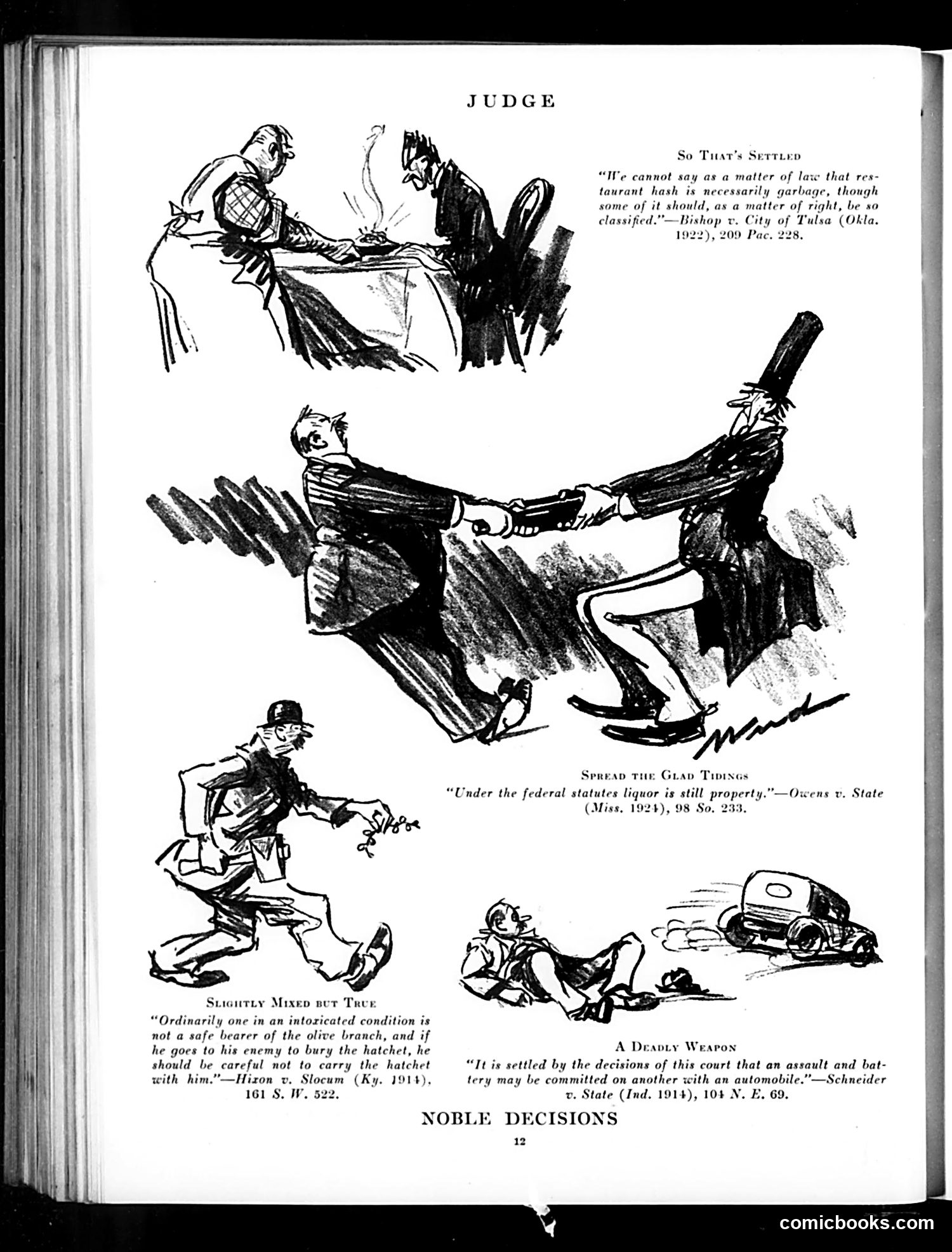
"Noble Decisions" — Judge Magazine Legal Satire This page satirizes absurd court rulings through cartoon vignettes paired with actual case citations. Each cartoon illustrates the logical absurdity of a judicial decision: 1. "So That's Settled": A judge and diner dispute over restaurant hash being classified as garbage—mocking a court's overly technical ruling. 2. "Spread the Glad Tidings": A drunk man attempting peace-making while carrying a hatchet—illustrating a court's warning about intoxicated peacemakers. 3. "Slightly Mixed but True": Similar drunk scenario with olive branch, based on an actual Kentucky ruling. 4. "A Deadly Weapon": A crashed automobile, referencing an Indiana court's startling decision that assault and battery could be committed using a car. The satire critiques judges for issuing rulings that, while technically legal, are comically impractical or dangerously absurd. Judge magazine used actual court citations to mock judicial reasoning during Prohibition-era America (1920s), when such rulings proliferated.
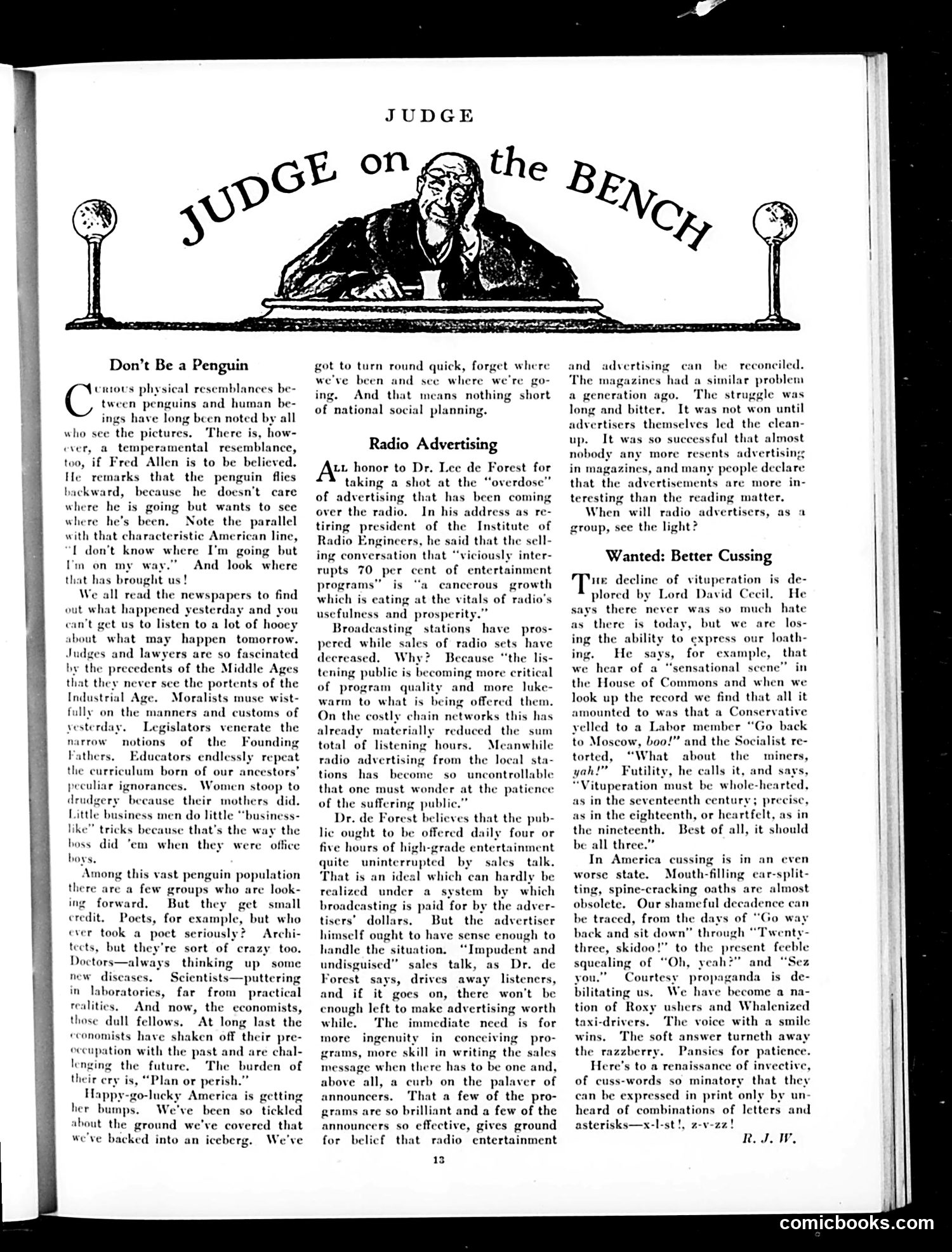
Judge Magazine Page Analysis This page contains three distinct opinion pieces labeled under the "Judge on the Bench" masthead, featuring a satirical judge illustration. "Don't Be a Penguin" criticizes American backward-looking culture. The author compares Americans to penguins who fly backward to see where they've been rather than where they're going. The satire targets lawyers fixating on precedent, educators repeating outdated curricula, and society generally preferring past comfort to future planning. The piece advocates for "national social planning," suggesting this was written during Depression-era debates about government intervention and economic reform. "Radio Advertising" praises Dr. Lee de Forest's critique of excessive radio advertising. De Forest (a real radio pioneer) complained that commercial interruptions constitute a "cancerous growth" damaging radio's appeal and causing declining set sales. The piece supports his call for uninterrupted quality programming with restrained advertising. "Wanted: Better Cussing" (partial) appears to address declining civility in public discourse, lamenting lost eloquence in American insults compared to earlier eras.
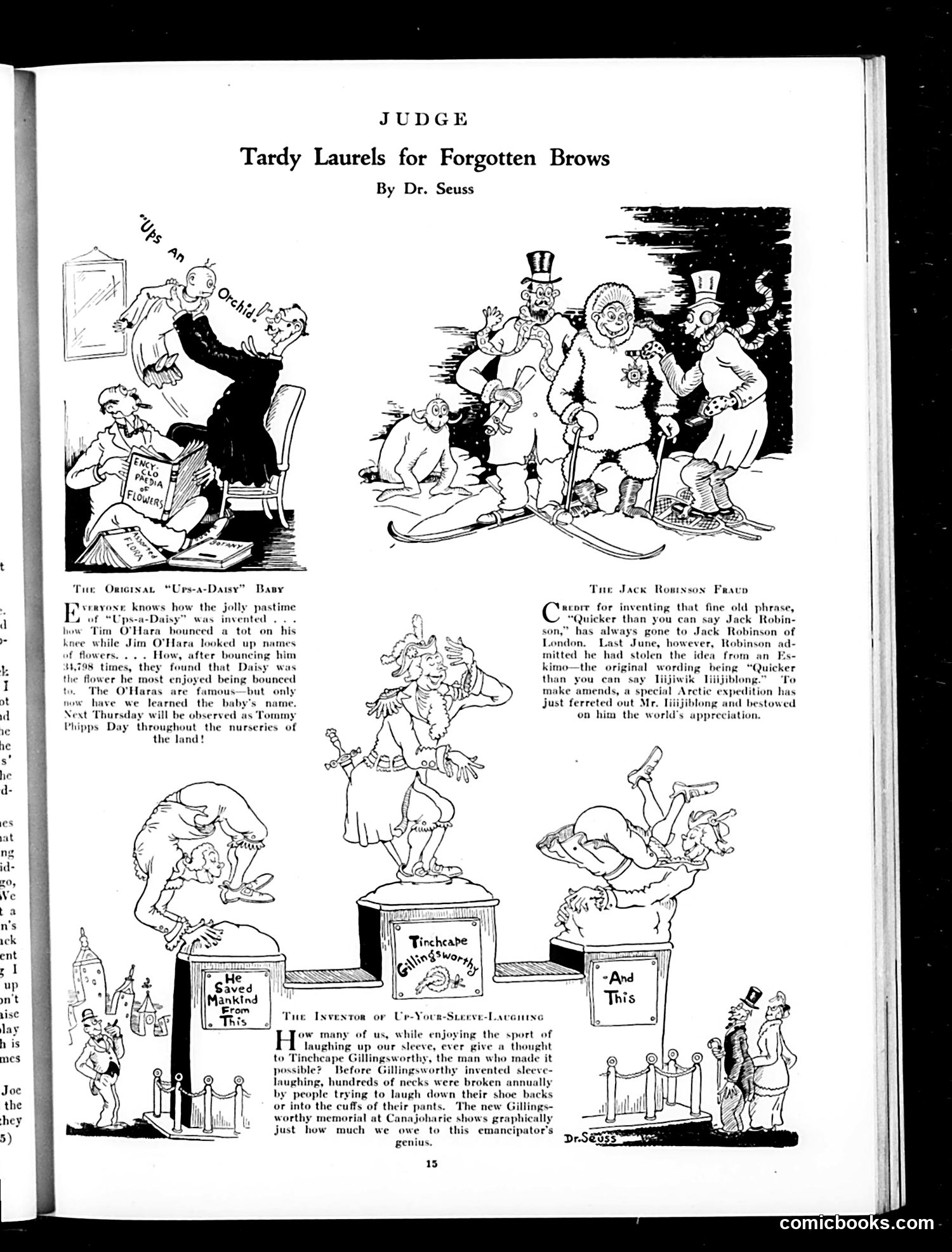
"Tardy Laurels for Forgotten Brows" by Dr. Seuss This Judge page awards humorous "credit" to overlooked originators of common phrases and practices. The "Ups-a-Daisy" Baby: Credits someone named Tim O'F (text unclear) with inventing the practice of bouncing babies on one's knee while saying "ups-a-daisy"—a nursery rhyme still used today. The Jack Robinson Fraud: Credits Jack Robinson with originating the phrase "quicker than you can say Jack Robinson" (meaning extremely fast). The text suggests Robinson actually stole the idea from someone named Lillibjilbing, whom Judge humorously credits as the true originator. The Inventor of Up-Your-Sleeve-Laughing: Features Tirsheabe Gillingsworth, credited with inventing the practice of laughing so hard you must hold up your sleeves—a physical comedy trope. The satire's point: recognizing forgotten or misattributed origins of everyday expressions and behaviors. Dr. Seuss's characteristic whimsical drawings accompany each invented "history."
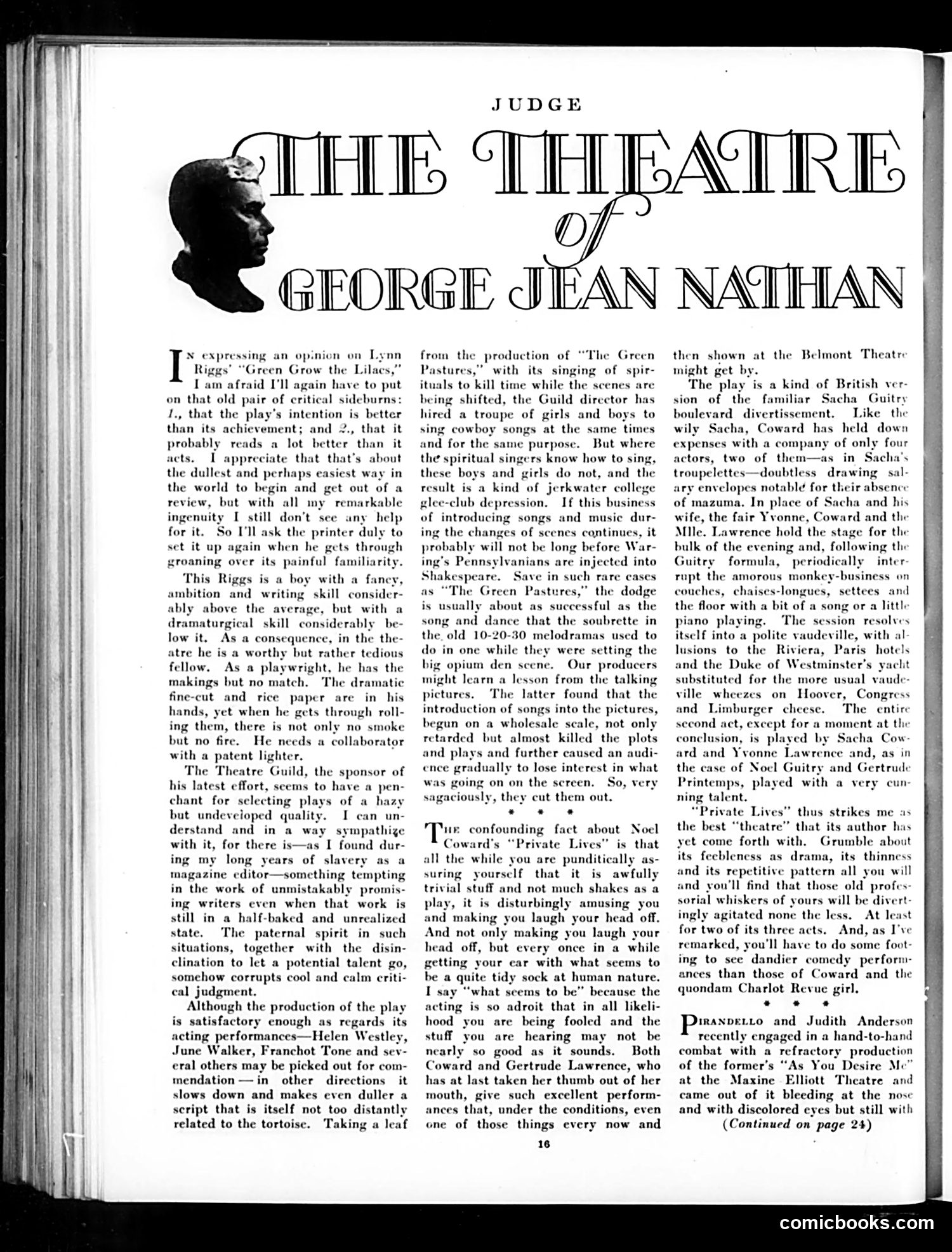
Analysis of Judge Magazine Page This page reviews theatrical productions, primarily criticizing Lynn Riggs' "Green Grow the Lilacs." The critic (identified as "Judge") employs a silhouette portrait at the top—a standard Judge convention for bylined reviews. Key Points: The reviewer argues Riggs has talent and ambition but lacks dramaturgical skill. He criticizes the Theatre Guild production for hiring a troupe to sing cowboy songs during scene changes—a technique borrowed from "The Green Pastures" but executed poorly, compared unfavorably to talking pictures that abandoned similar song insertions for damaging plots. Secondary Review: The piece also praises Noel Coward's "Private Lives," noting its paradox: while seeming trivial, it's genuinely amusing and occasionally offers sharp social commentary. He specifically commends actors Gertrude Lawrence and Coward himself. The satire targets theatrical pretension and producers who mistake novelty for artistry. The underlying joke: even trivial entertainment executed well (Coward) outperforms well-intentioned mediocrity (Riggs/Guild).
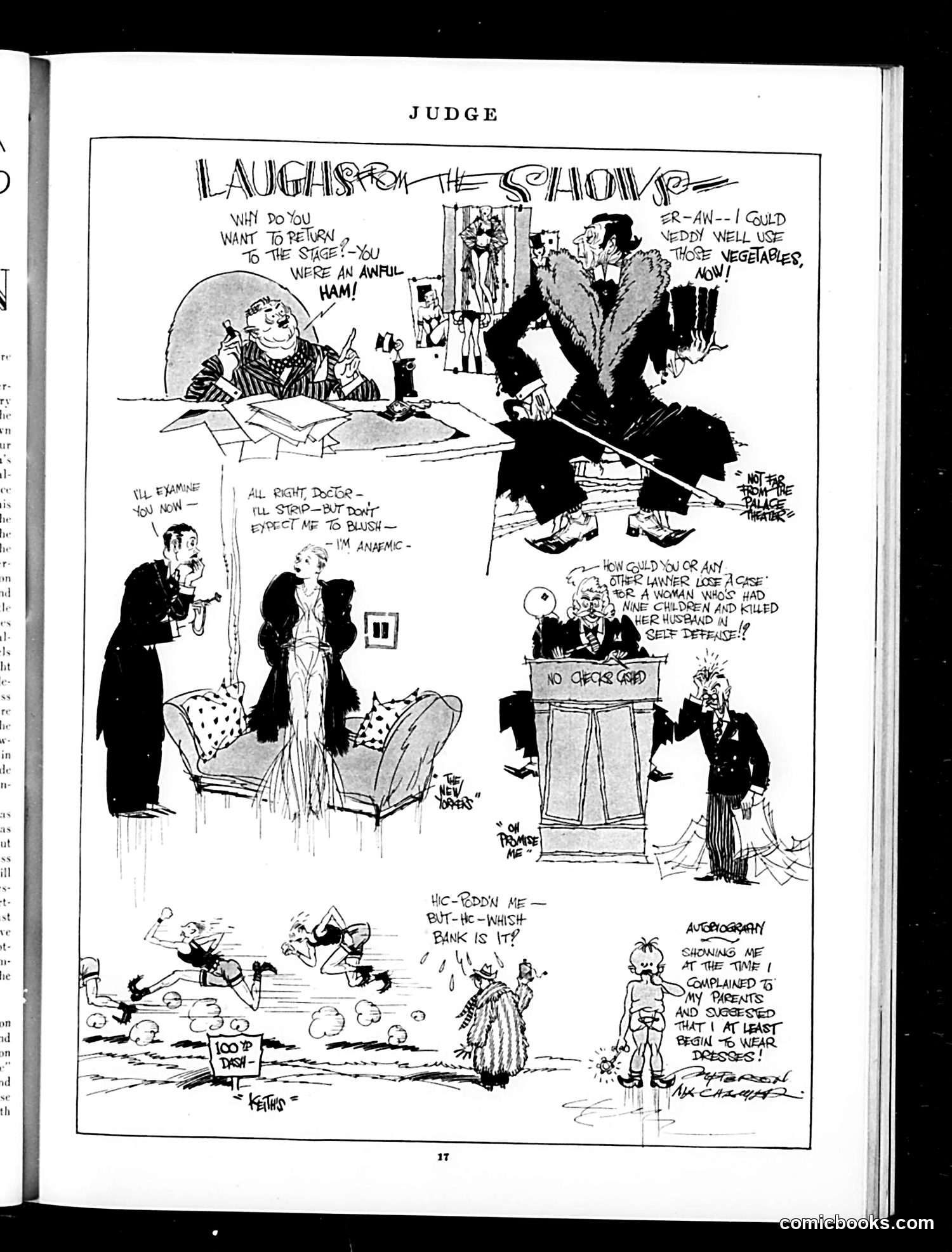
"Laughs at the Showe" - Judge Magazine Cartoon This multi-panel satirical cartoon mocks theatrical and legal absurdities. The top scene shows a stage manager dismissing an actor ("You were an awful ham"), satirizing theatrical vanity. The central panels depict a doctor examining a woman who claims to be "anaemic" while resisting examination—likely satirizing hypochondriacs or those seeking medical excuses. The prominent lower section shows a courtroom scene mocking legal defense arguments. A judge questions how any lawyer could lose a case for "a woman who's had nine children and killed her husband in self-defense"—suggesting the absurdity of legal outcomes and the melodramatic nature of some trials. The bottom vignettes appear to reference theatrical or social mishaps, with one panel labeled "100 lb dash" suggesting physical comedy. The overall point: satirizing the pretension and illogic in theater, medicine, and law—three institutions Judge magazine frequently mocked.
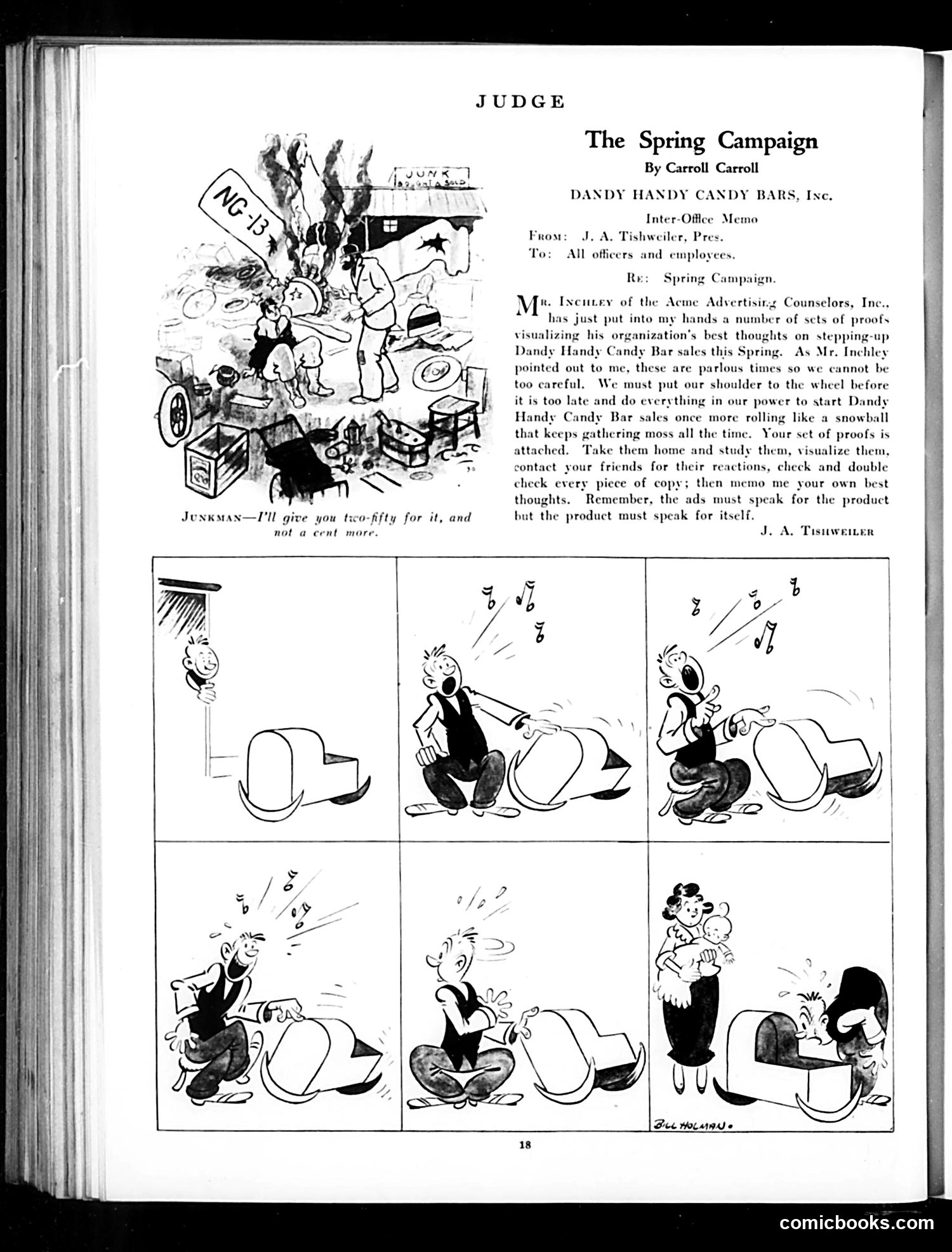
"The Spring Campaign" This is a satirical advertisement disguised as a corporate memo. The page mocks aggressive 1920s-30s advertising practices and sales culture. The comic strip below shows a junkman encountering an enormous candy bar. Through six panels, he attempts to move or deal with it—struggling, pushing, calling for help—but the massive candy overwhelms him. The final panel shows him defeated, a woman and child emerging from the wreckage. The joke satirizes the advertising industry's absurd hyperbole: the memo urges salesmen to make candy bars seem irresistible and omnipresent, yet the comic demonstrates the ridiculous result—a product so enormous and aggressive it becomes destructive. The junkman, an ordinary working-class figure, cannot escape or control this force of commercialism. It's social satire about how advertising manipulates consumers and how corporate culture pressures employees to promote products uncritically, regardless of actual merit.
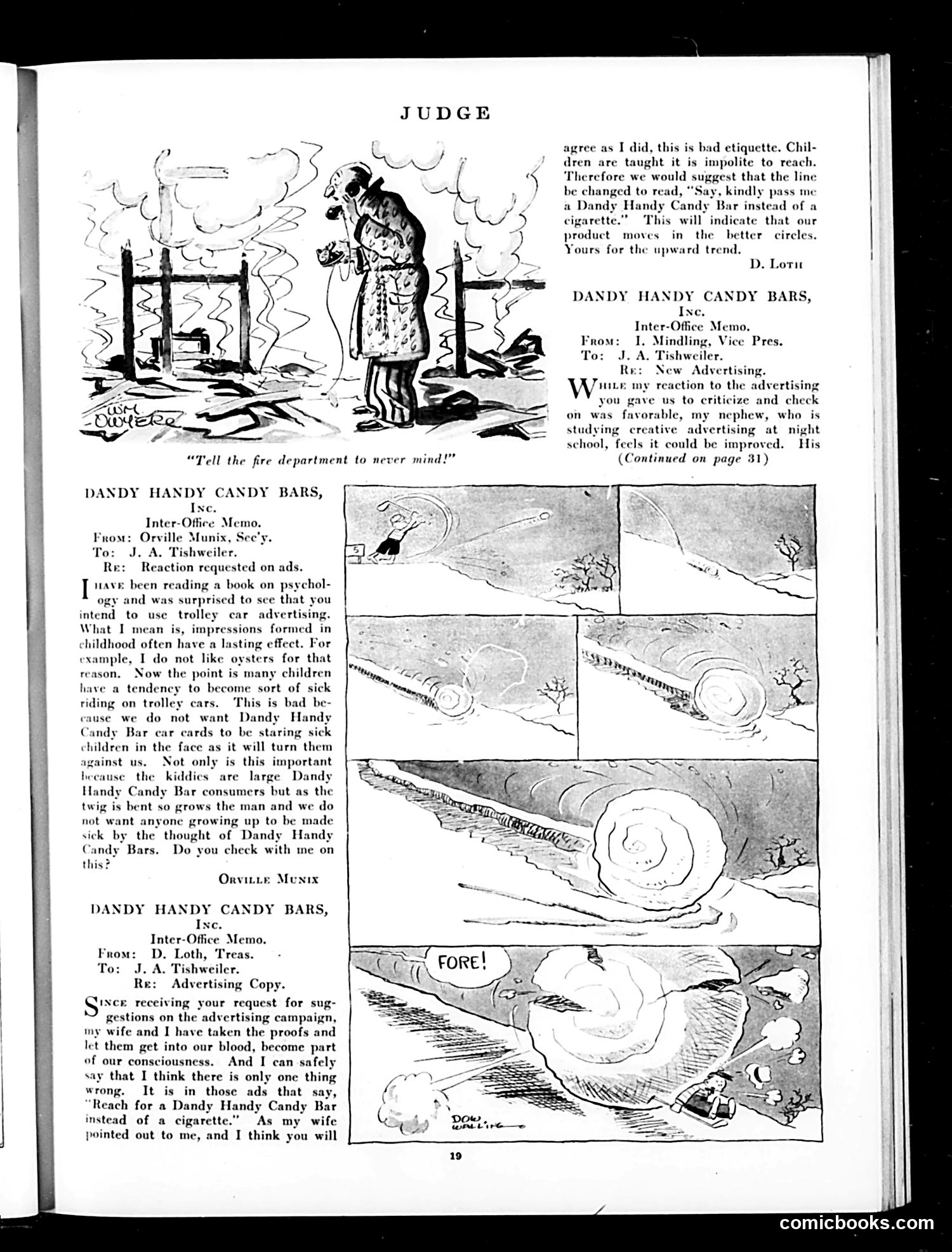
Judge Magazine Satire: Corporate Advertising Absurdity This page satirizes corporate advertising decision-making through fictional inter-office memos from "Dandy Handy Candy Bars, Inc." Each memo presents increasingly ridiculous objections to advertising copy, mocking how corporate committees nitpick campaigns: 1. Orville Munix worries trolley car ads will sicken children, creating negative associations (based on childhood psychology) 2. D. Loth objects that ads saying "reach for" a candy bar are impolite—children shouldn't "reach"—and suggests "kindly pass me" instead to appeal to "better circles" 3. I. Mindling adds his nephew's critique from advertising school The comic strip on the right (a golf ball sequence with "FORE!") appears unrelated but completes the page. The satire mocks how corporate bureaucracy produces absurd compromises, over-analysis of trivial details, and pretentious concerns about etiquette that undermine effective marketing. It's commentary on mid-20th century corporate culture's tendency toward timid, committee-driven mediocrity.
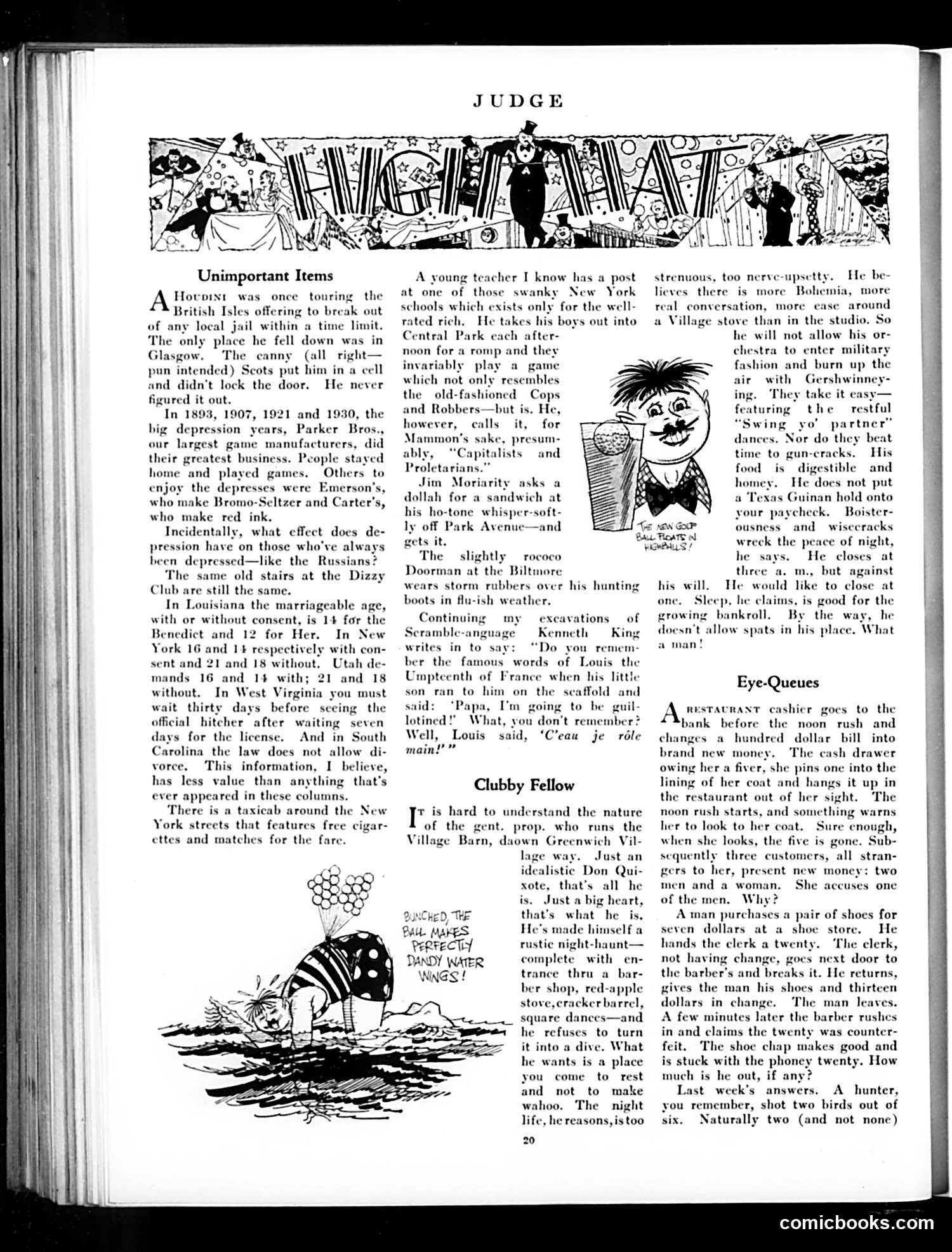
Analysis of Judge Magazine Page This page from Judge contains several satirical items mocking American social customs and Depression-era behavior. The "Unimportant Items" section offers absurdist observations: a Scottish jail joke playing on Scottish stereotypes ("canny"); commentary that board game companies thrived during depressions because people stayed home; and petty legal distinctions between states' marriage and divorce laws—presented as meaningless trivia. A cartoon shows a child's game in Central Park where wealthy Manhattan schoolboys play "Cops and Robbers" but their teacher calls it "Capitalists and Proletarians"—satirizing how even children's play becomes ideological in the wealthy class. The "Clubby Fellow" section praises the proprietor of Village Barn nightclub (Greenwich Village) for resisting commercialization—he keeps his venue restful and wholesome rather than allowing it to become a rowdy "dive," rejecting loud jazz and military-style orchestration. This reflects Judge's conservative editorial stance against modern nightclub excess. The "Eye-Queues" anecdote is a brief joke about a dishonest cashier.
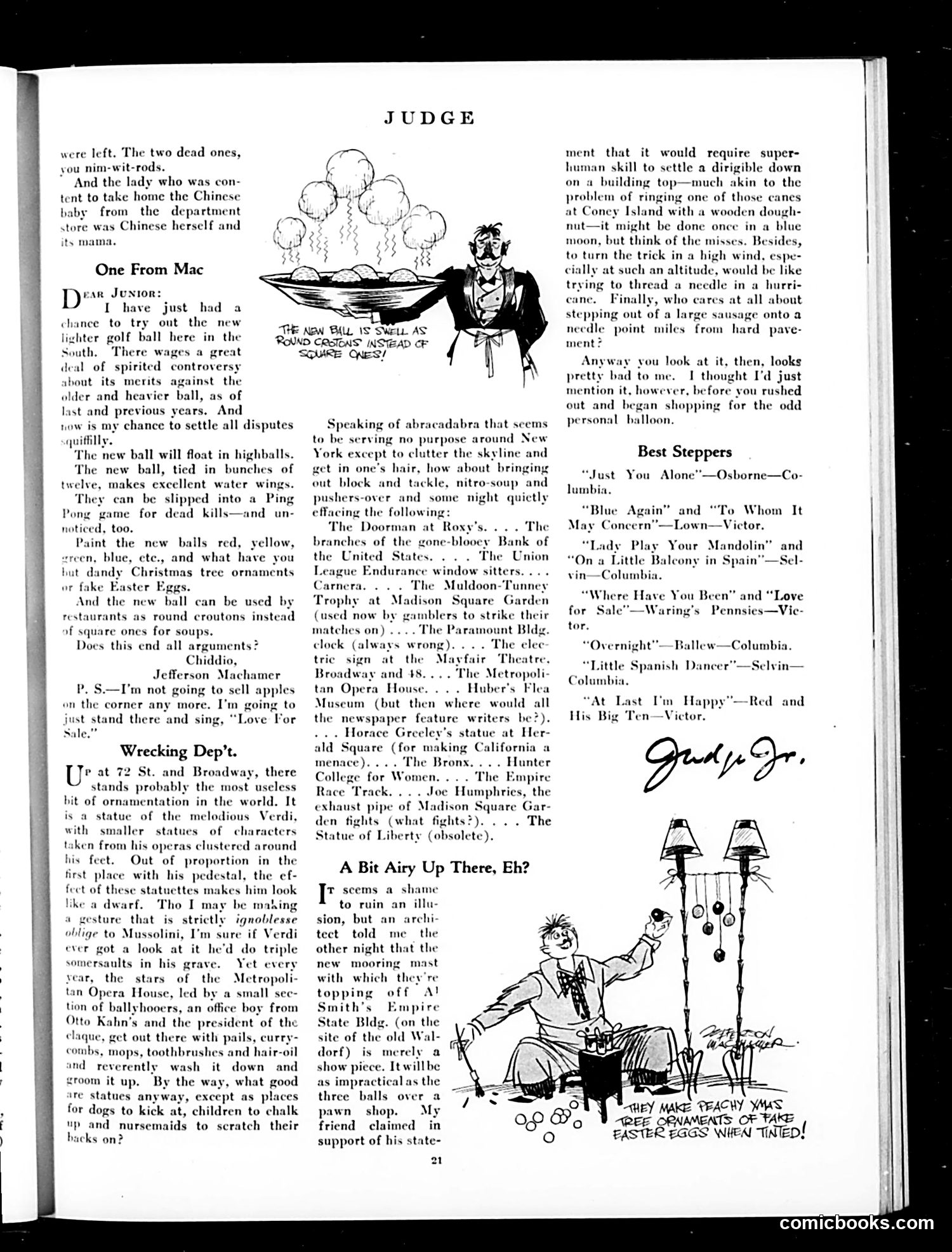
Understanding This Judge Magazine Page This page from Judge (a major American satirical magazine) contains three separate humor pieces from the early 1930s: "One From Mac" mocks the new lightweight golf ball by listing absurd alternative uses—as highballs, water wings, Ping-Pong ammunition, Christmas ornaments—suggesting the innovation is silly. "Wrecking Dep't" attacks NYC eyesores, particularly the Verdi statue at Broadway and 72nd Street. The author argues it's disproportionate and undignified, then sarcastically lists other "useless" city ornaments deserving removal (including the Statue of Liberty, called "obsolete"). "A Bit Airy Up There, Eh?" deflates the Empire State Building's new mooring mast (visible in the cartoon). An architect supposedly told the writer it's purely decorative—impractical for actually mooring dirigibles, comparable to carnival game difficulty. This satirizes 1930s hype around technological progress. All three pieces share a cynical tone mocking modern innovations, civic pride, and promotional excess during the Depression era.
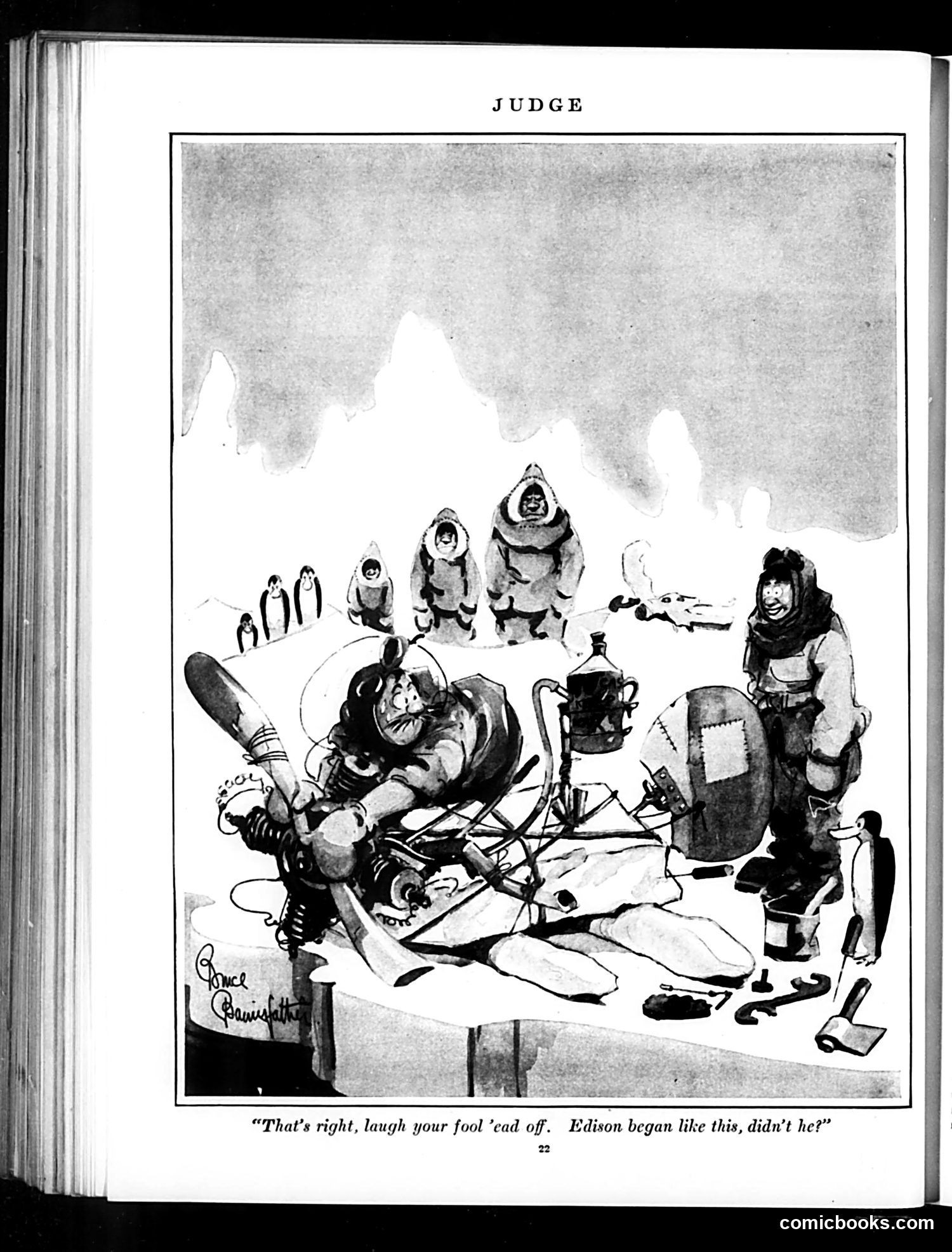
Explanation of "Judge" Cartoon Page This page shows a single cartoon titled "Judge" depicting an Arctic or polar exploration scene. A figure in heavy winter gear sits operating what appears to be early mechanical/electrical equipment, surrounded by Indigenous people and explorers in a snowy landscape. The caption reads: "That's right, laugh your fool 'cad off. Edison began like this, didn't he?" The satire compares the cartoon subject's primitive technological setup to Thomas Edison's humble beginnings as an inventor. The joke mocks someone for laughing at rudimentary equipment, suggesting that great innovations—like Edison's—started from such simple origins. The Arctic setting and Indigenous observers add elements of exploration and discovery to reinforce this theme of invention in remote, "uncivilized" contexts. The cartoon appears to satirize attitudes toward technological progress and innovation.
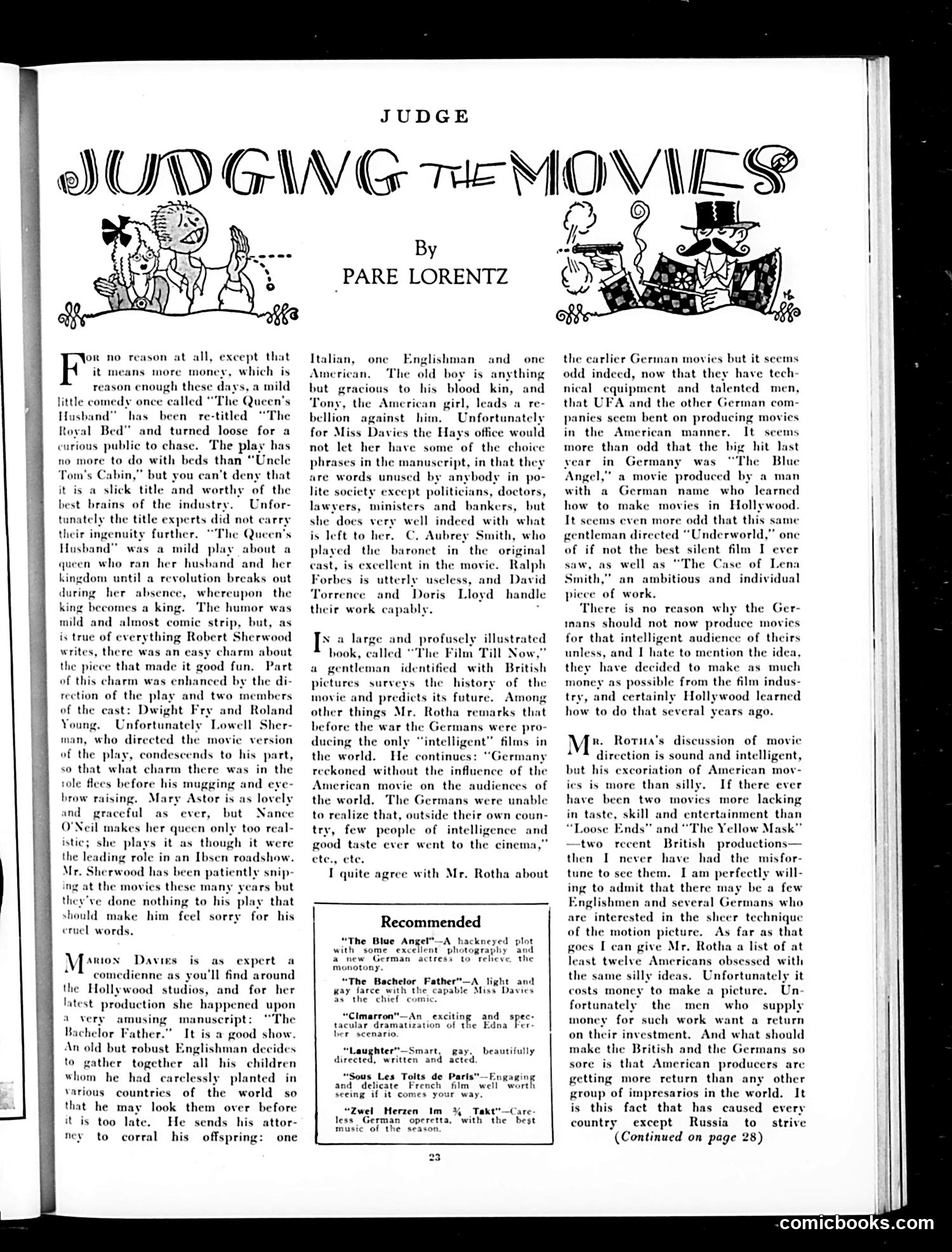
Explaining "Judge the Movies" by Pare Lorentz This is a film review column in Judge magazine. Lorentz critiques recent movies, particularly commenting on German versus American film production. Key references: - "The Queen's Husband" and "The Royal Bed" — theatrical adaptations being adapted into films - Marion Davies, C. Aubrey Smith, Ralph Forbes — Hollywood actors being reviewed - The Hays Office — the film industry's censorship body, which prevented Davies from using "colorful" language in her scenes - A book called "The Film Till Now" discussing film history, whose author (Rotha) argues pre-war Germany produced superior "intelligent" films The satirical point: Lorentz agrees with Rotha's observation that American movies' influence abroad made Germans abandon their highbrow film standards. The implication is that American commercialism and entertainment values "corrupted" German cinema's intellectual ambitions — a backhanded criticism of Hollywood's cultural dominance.
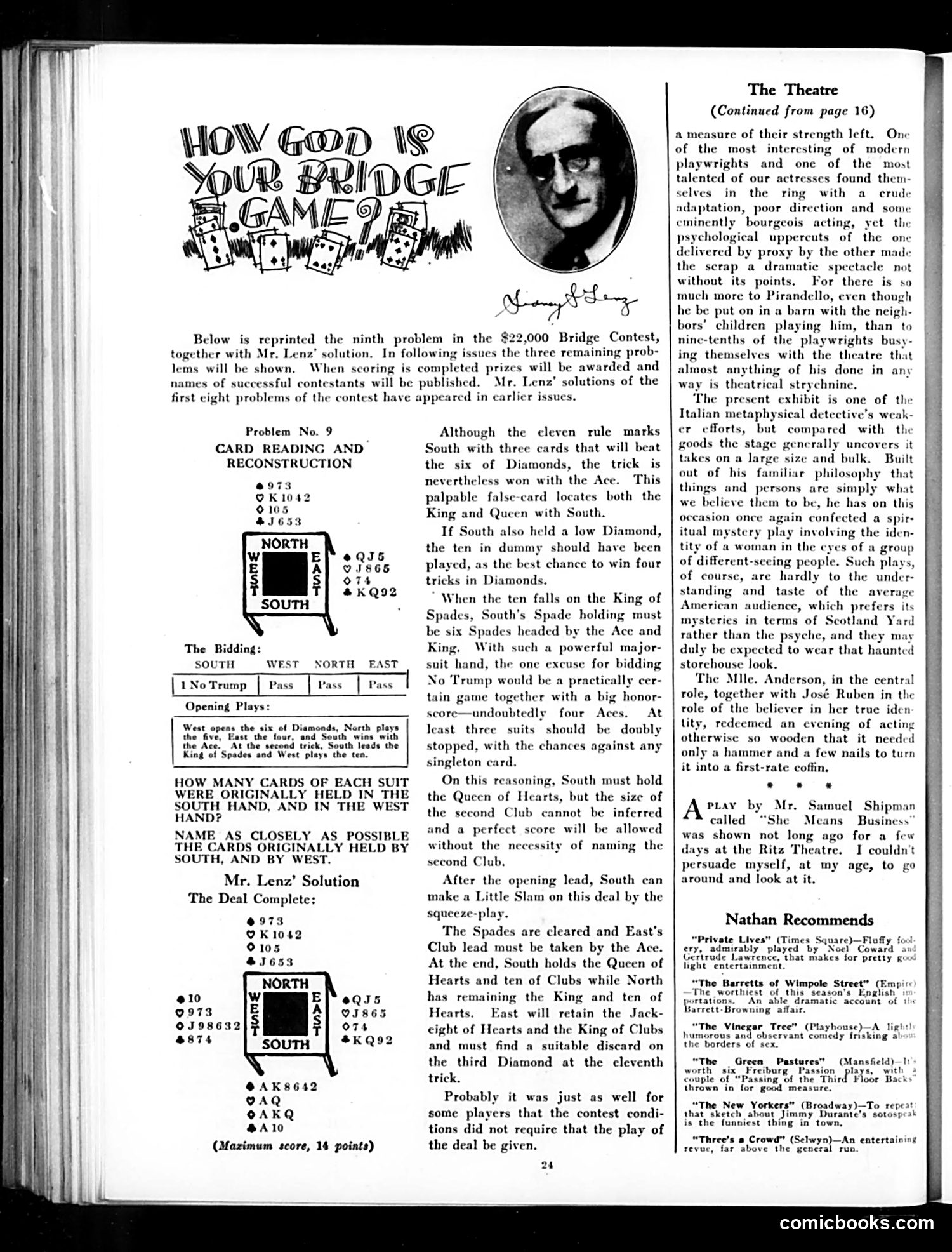
Judge Magazine Content Analysis This page is primarily a bridge card game puzzle, not political satire. It presents "Problem No. 9" from Judge's $22,000 Bridge Contest, featuring a solution by Mr. Lenz with detailed card-play analysis and bidding reconstruction. The right column contains theater criticism (continued from page 16), reviewing a production of a Pirandello play. The critic praises the playwright and lead actress but criticizes the adaptation and direction as "crude" and "bourgeois." The review argues Pirandello's metaphysical themes—exploring identity and subjective reality—are too intellectually demanding for typical American audiences, who prefer conventional mysteries like Scotland Yard stories. Neither section contains political satire or caricature. The page demonstrates Judge's editorial diversity: alongside humor and satire, it published recreational puzzles and serious arts criticism for educated readers.
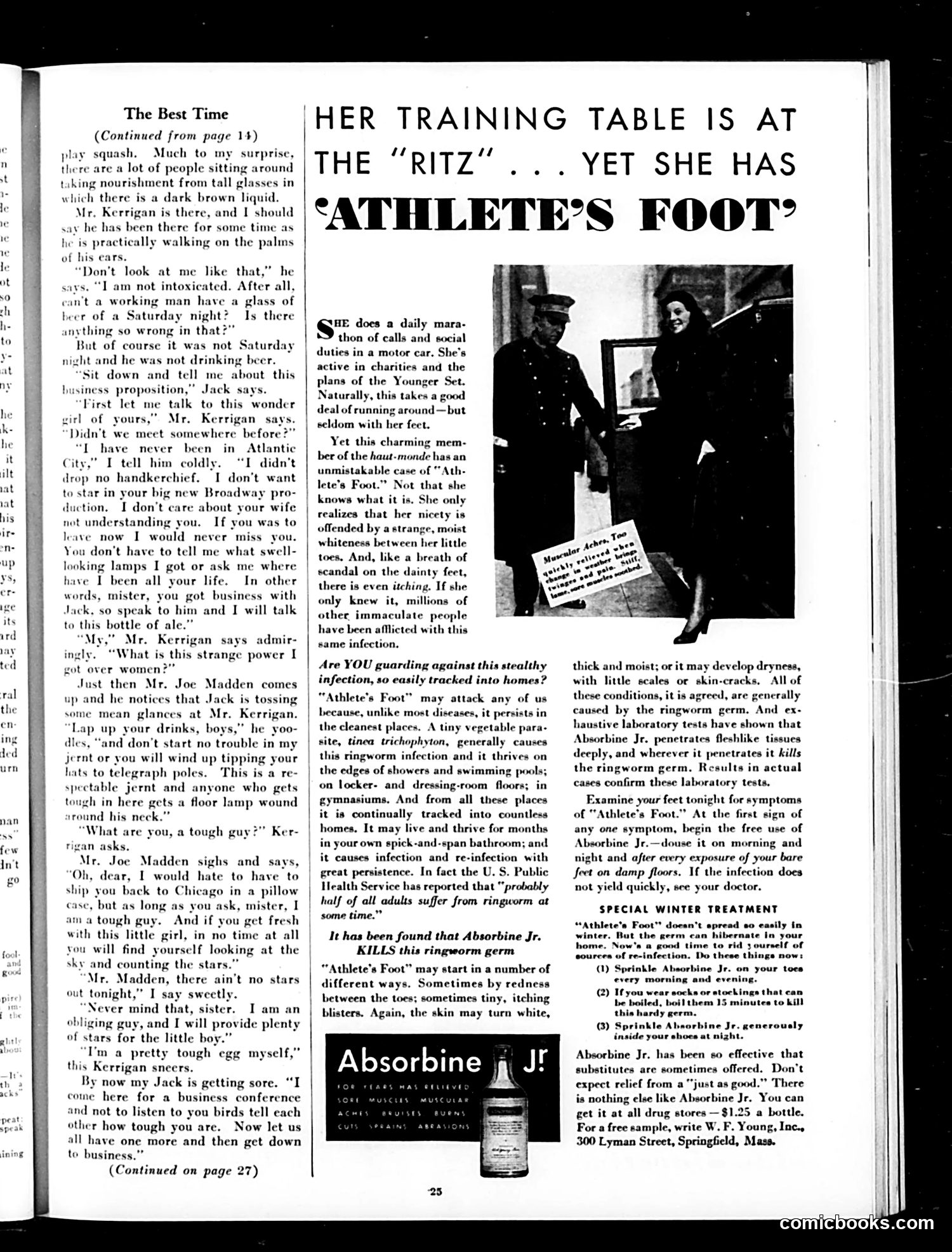
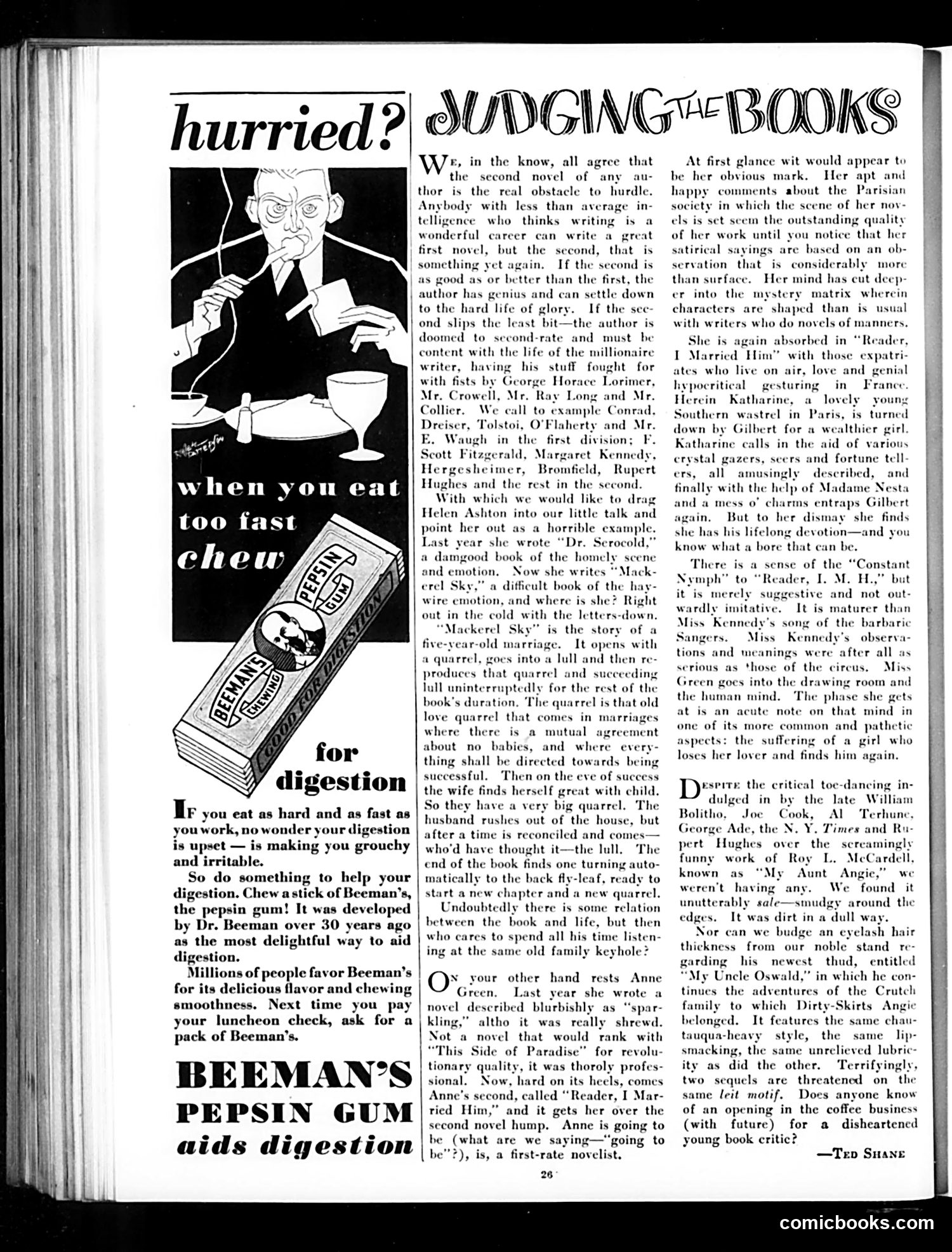
What This Page Means This page contains two distinct items: a Beeman's Pepsin Gum advertisement (left) using humor about fast eating causing digestive problems, and a book review column titled "Judging the Books" (right). The review discusses the "second novel problem"—the notion that successful debut authors often struggle with their sophomore work. The critic cites examples like Conrad, Dreiser, and Tolstoi succeeding, while newer authors like Helen Ashton ("Mackerel Sky") and Anne Green ("Reader, I Married Him") are evaluated. The piece argues that while Ashton's writing is technically skilled but emotionally repetitive, Green shows promise as a "first-rate novelist" despite initial skepticism. For modern readers: this reflects early 20th-century literary criticism's anxiety about sustaining artistic success, and the gendered dismissiveness toward women writers—even accomplished ones.
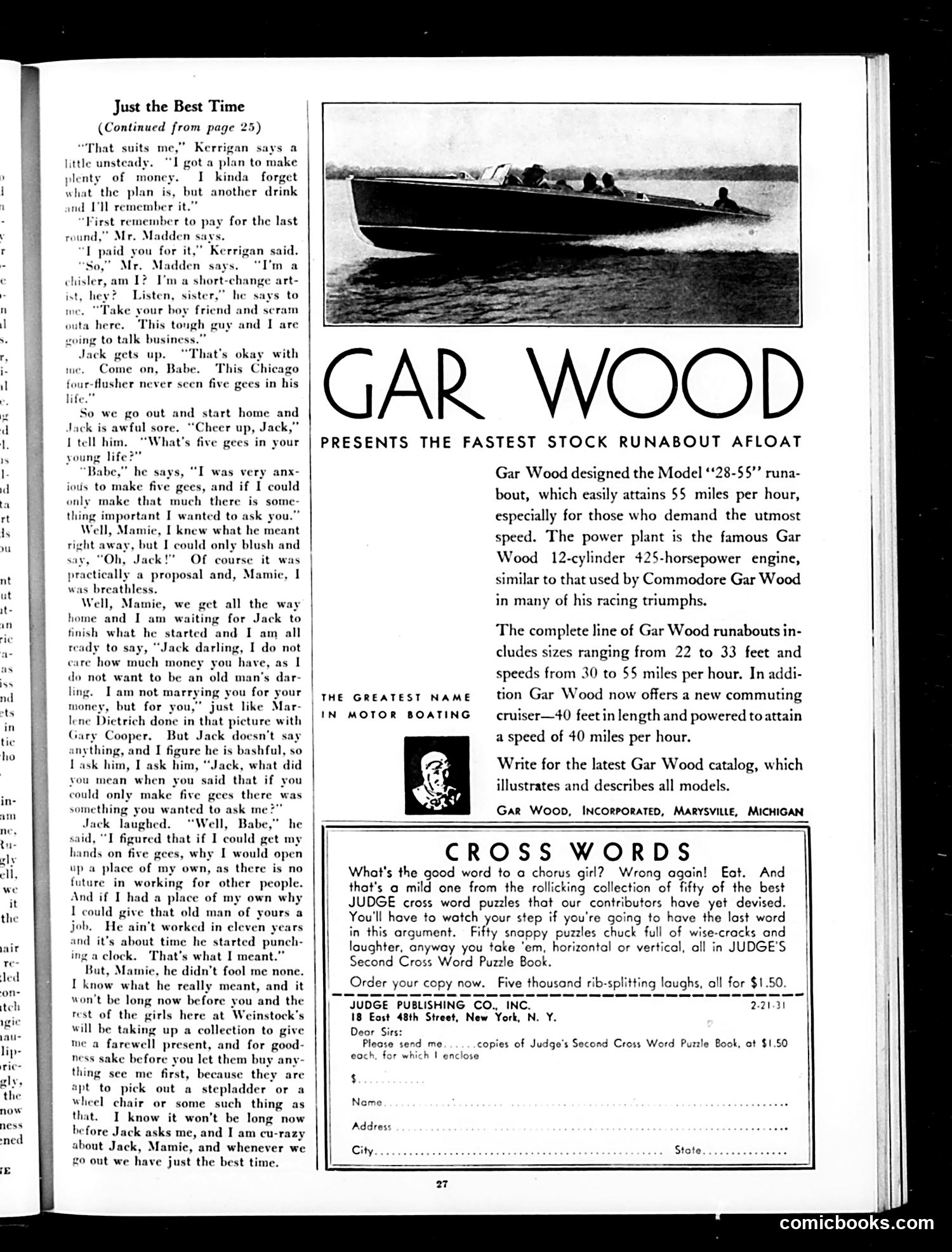
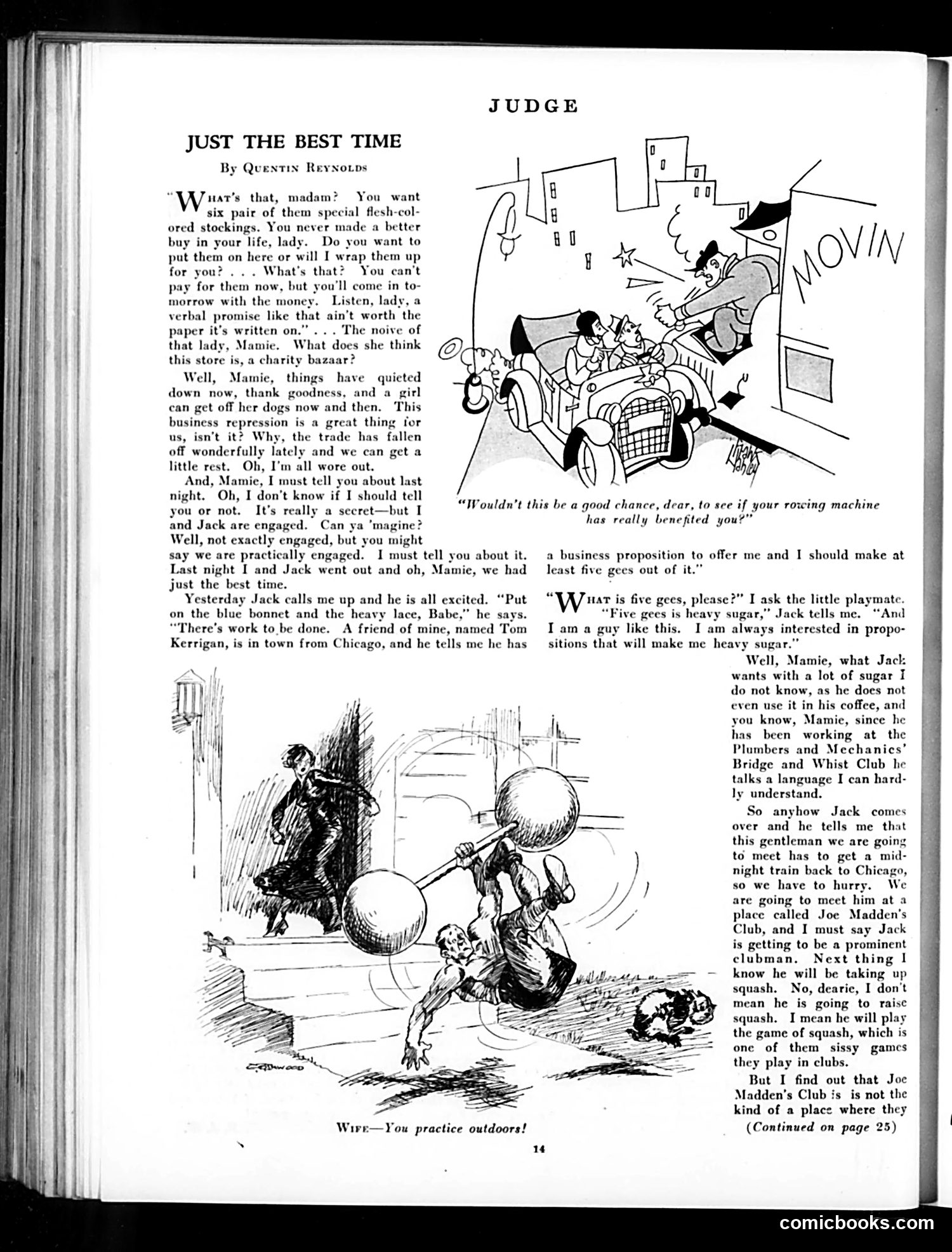
Analysis of This Judge Magazine Page This page contains the conclusion of a short story titled "Just the Best Time" alongside advertisements and a crossword puzzle promotion. The narrative features working-class characters (Jack, Mamie, Mr. Madden, and Kerrigan) in what appears to be a speakeasy or bar setting during Prohibition—evident from casual drinking references and the overall tone of petty criminal enterprise. The story's humor derives from Jack's failed romantic proposal: he hints he needs five dollars to open his own business, leading Mamie to anticipate a marriage proposal, only for the punchline to reveal he simply wants to start a small enterprise. The advertisements promote Gar Wood speedboats and a crossword puzzle book, both typical commercial offerings in 1920s magazines. The satire about "chorus girls" in the crossword promotion reflects period stereotypes about entertainers. Overall, this represents typical Judge content: working-class domestic comedy mixed with era-appropriate advertising.
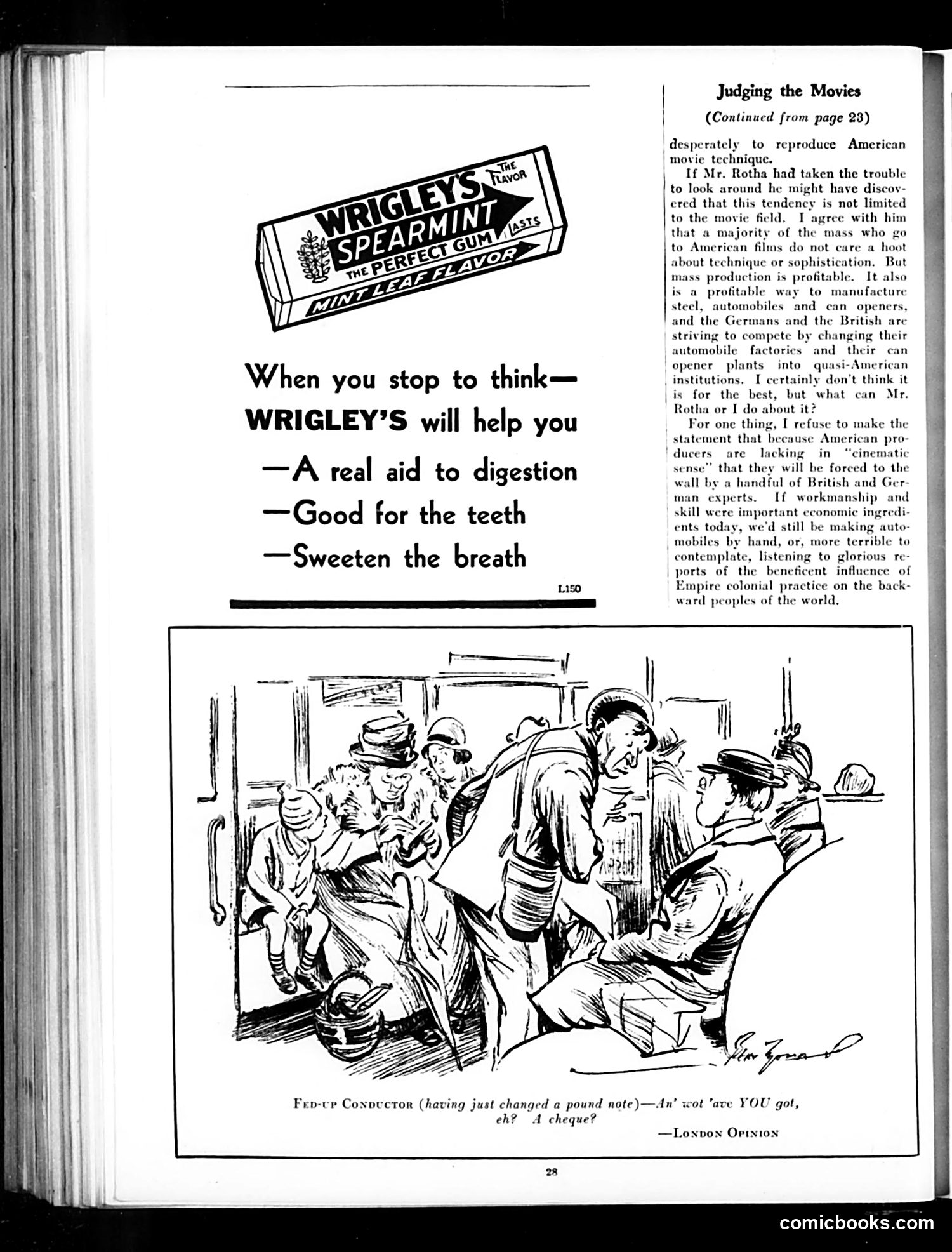
"Fed-up Conductor" Cartoon Analysis This is a British social satire from *London Opinion* about class and currency exchange. The cartoon depicts a transit conductor who has just received a pound note from a passenger, sarcastically questioning whether *they* have a cheque (check) instead—implying the conductor finds it unusual or amusing to receive actual cash. The joke satirizes the growing gap between working-class people (represented by the conductor) and middle/upper-class passengers who might conduct business via cheque rather than cash. It's commentary on economic class divisions in Britain, where using cheques was associated with wealthier citizens, while working-class people dealt in coins and notes. The title "Fed-up Conductor" suggests the character's frustration with passengers' assumptions about how ordinary workers conduct transactions.
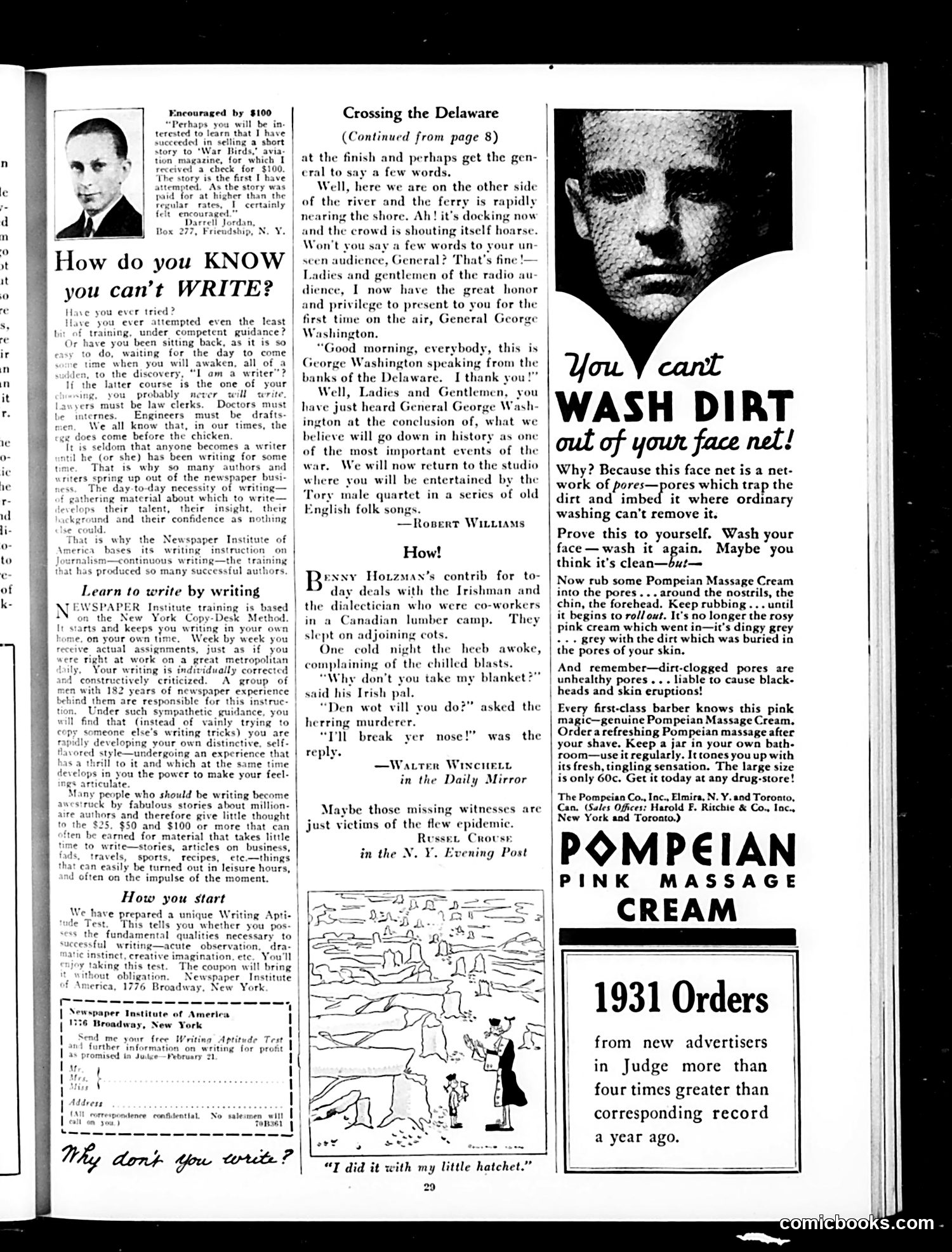
Analysis of Judge Magazine Page This page combines three distinct elements: a writing instruction advertisement, a radio dramatization sketch, and humor pieces. The main satirical content is "Crossing the Delaware"—a mock radio broadcast presenting George Washington's famous river crossing as contemporary 1931 entertainment. The humor lies in the anachronism: treating a revolutionary war event as live radio drama with modern broadcast conventions (announcers, audience reactions, musical interludes). Washington's actual speech is absurdly brief ("I thank you!"), deflating the grandeur of the historical moment for comedic effect. Below this, "How!" is a brief ethnic joke featuring an Irishman and a Jewish laborer sharing a bunk in a Canadian camp—a common vaudeville comedy trope of the era relying on dialect humor and cultural stereotypes. The left side advertises the Newspaper Institute of America's writing courses, while the right features a Pompeian face cream advertisement. The page essentially mirrors Judge's dual purpose: political/social satire mixed with practical advertisements and commercial humor.
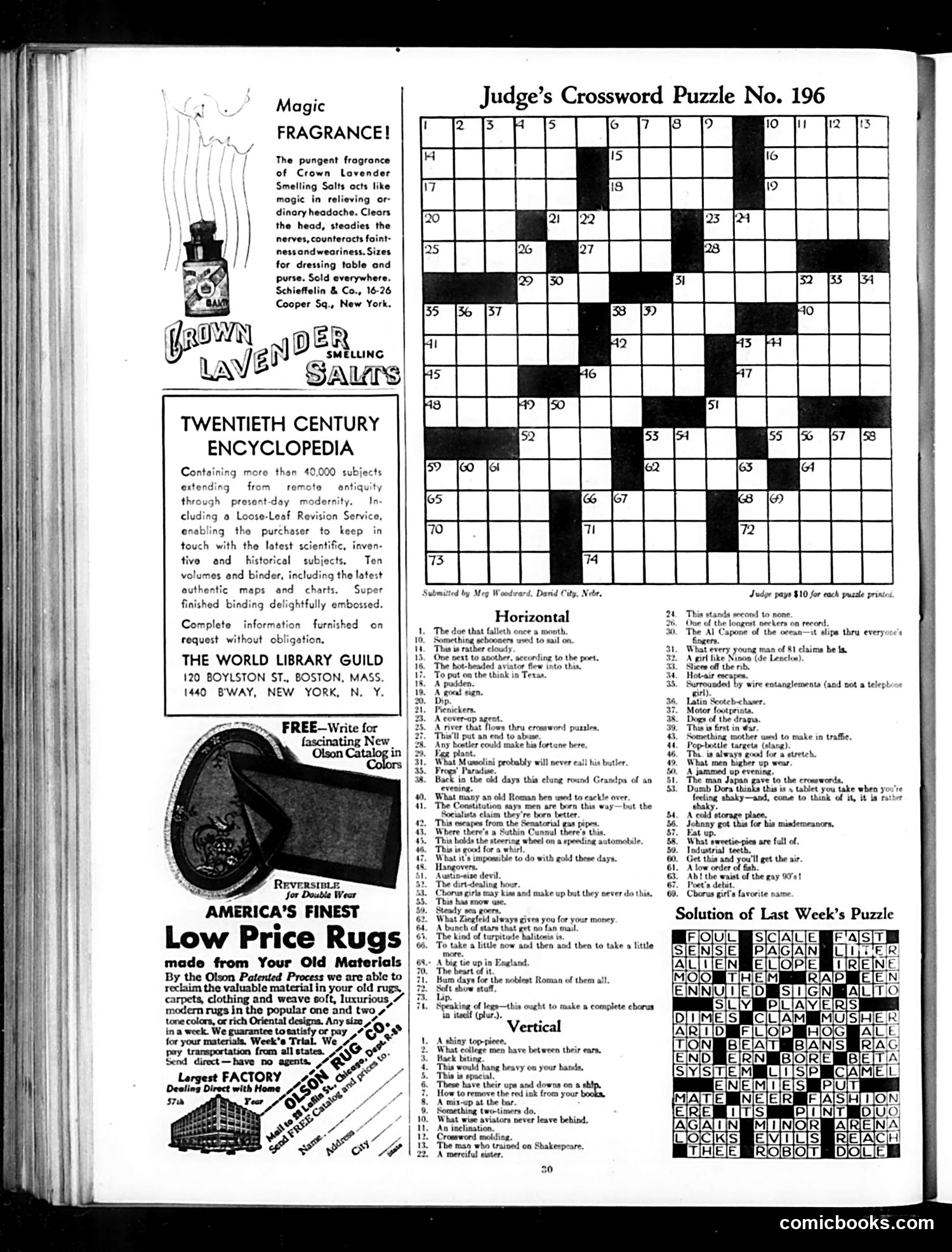
This page is primarily advertising and puzzle content, not political satire. Judge magazine here functions as a general-interest publication rather than a political vehicle. The page contains: 1. Advertisements for Crown Lavender Smelling Salts, Twentieth Century Encyclopedia, and Olson Rug Company—typical commercial placements from this era. 2. Crossword Puzzle No. 196—the main content, submitted by a reader. The clues are lighthearted wordplay and riddles typical of 1920s-era puzzles ("What every young man of $1 claims he is," "Latin Scotch-chaser"). 3. Solution to Last Week's Puzzle—a completed crossword grid shown at bottom. There is no discernible political cartoon or satirical commentary visible on this page. Judge here appears to be functioning as a family entertainment magazine featuring puzzles and ads, rather than delivering the sharp political satire the publication was historically known for.
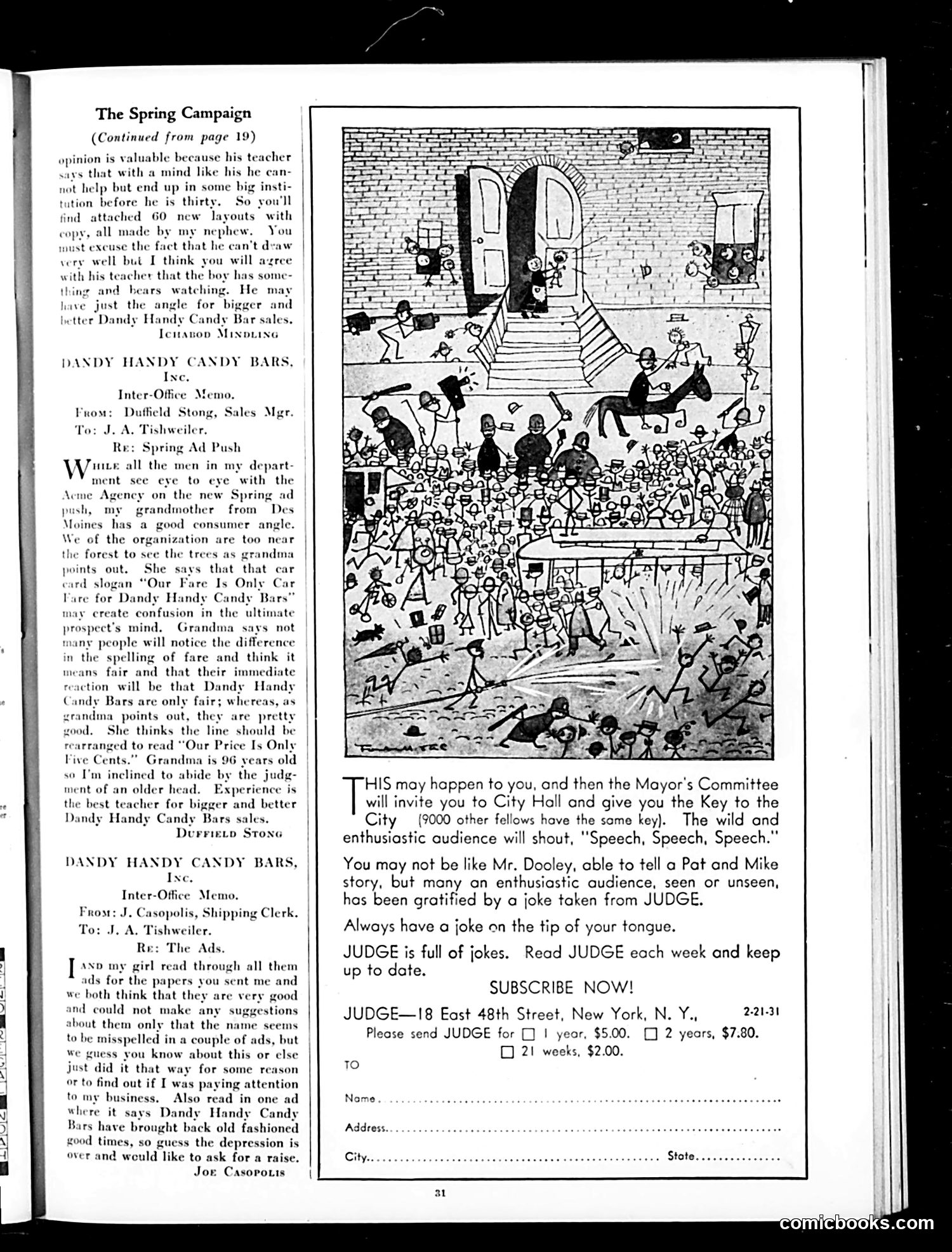
This page from *Judge* magazine contains office memos and advertising rather than political satire. The left column presents humorous inter-office communications about a candy company's spring advertising campaign—a grandmother critiquing ad copy, employees debating slogans ("Our Fare Is Only Car Vare" vs. "Our Price Is Only Five Cents"), and a shipping clerk requesting a raise. The right side features an illustrated crowd scene advertising *Judge* itself, suggesting that having a good joke ready—like one from their magazine—might help if you're unexpectedly asked to give a public speech at City Hall. The overall tone satirizes corporate bureaucracy and office culture through these fictional memos, while the advertisement promotes *Judge* as a source of humor for social situations. The content reflects 1920s-30s advertising and office culture.
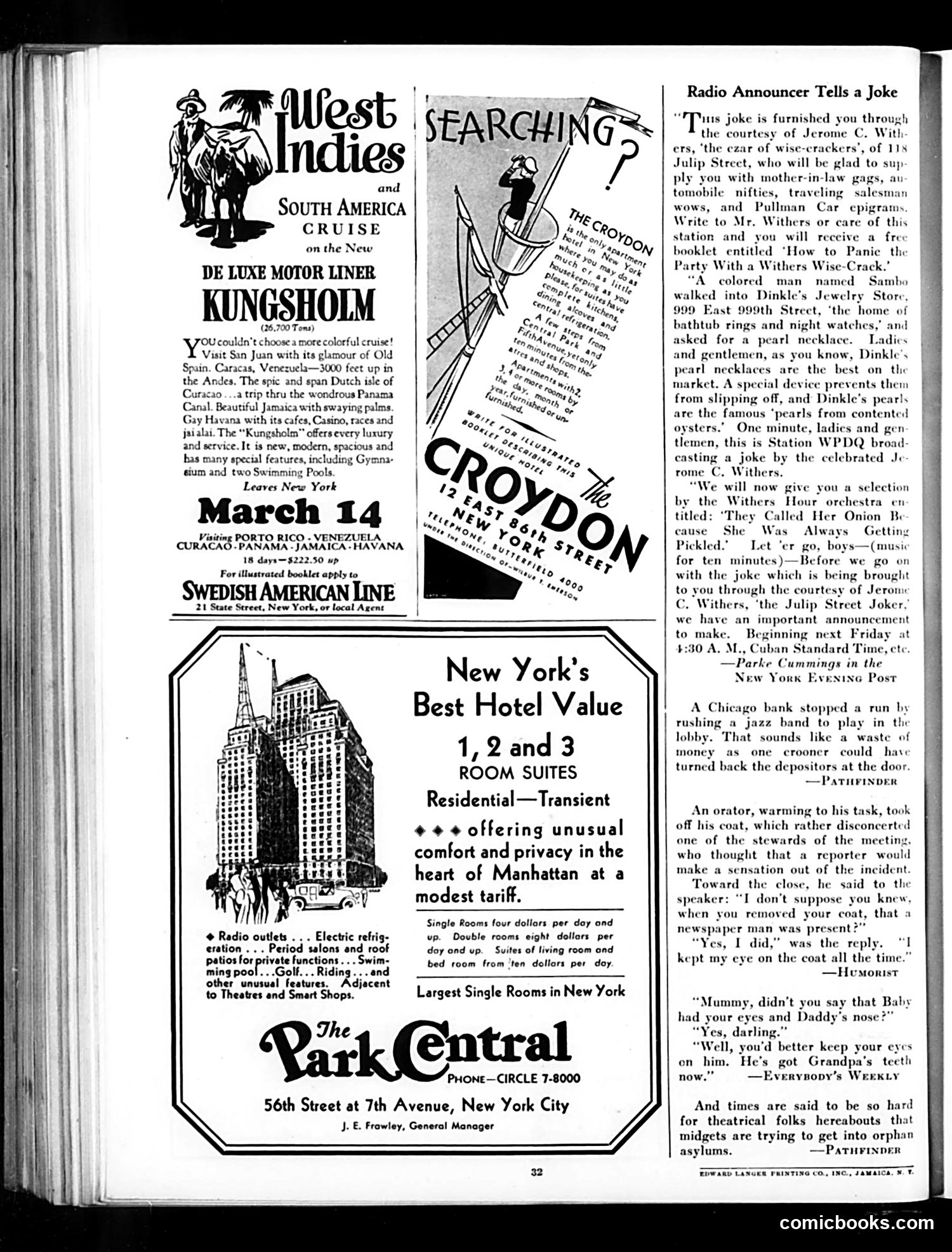
What This Page Means This is primarily an advertising page from Judge magazine, dominated by cruise ship and hotel promotions. The small editorial content consists of humor pieces typical of the era. The main satirical element is "Radio Announcer Tells a Joke"—a parody of 1920s-30s radio advertising. It mocks how broadcasters would interrupt entertainment with endless commercial plugs (here, for "Jerome C. Withers, 'the czar of crackers'"). The joke itself relies on period racial stereotypes (a Black man named "Sambo" visits a jewelry store), reflecting the casual racism common in Judge at this time. The humor is in the absurdist layers: the announcer keeps breaking the joke to advertise, inserting an orchestra number, and promoting sponsors. Below are brief, unattributed jokes poking fun at banks, orators, family dynamics, and struggling theater workers—typical filler content for magazines of this era. The page reflects Depression-era entertainment values and advertising practices now considered offensive.
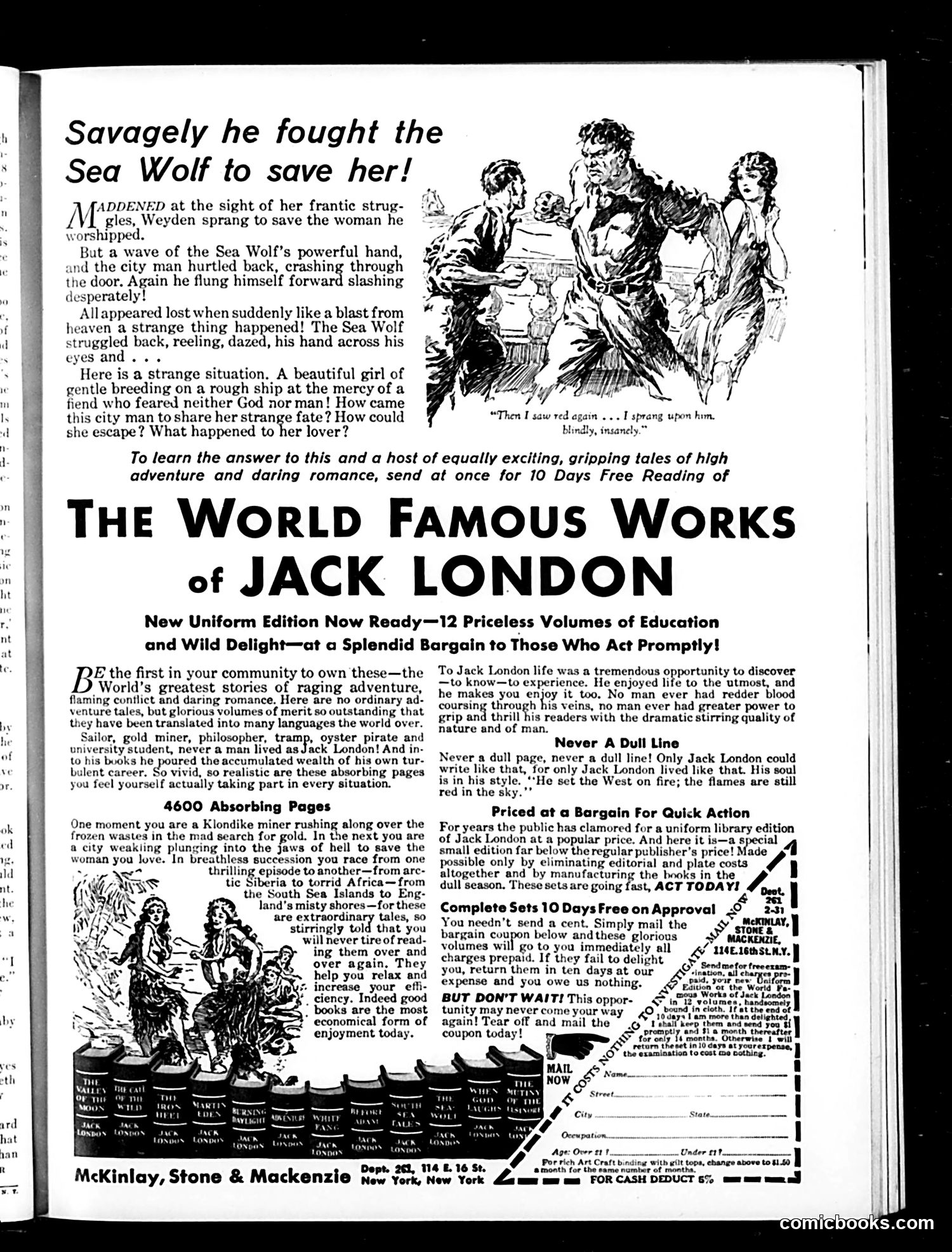
What This Page Means This is primarily a book advertisement, not political satire. The page promotes a 12-volume uniform edition of Jack London's collected works. The illustration at top depicts a scene from London's novel *The Sea Wolf*—a man named Weyden fighting to rescue a woman from a brutal sea captain. The quoted dialogue ("Then I saw red again...") comes directly from that work. The ad emphasizes London's adventure tales drawn from his own life (miner, sailor, pirate) and promises readers will feel immersed in exotic locations (Siberia, South Seas, Arctic). It stresses the books offer "4600 Absorbing Pages" at bargain pricing due to "eliminating editorial and plate costs" and manufacturing during the "dull season." The coupon offers "10 Days Free on Approval"—customers could request the set risk-free and return it within ten days if unsatisfied. This represents early 20th-century direct-mail book marketing, targeting middle-class readers seeking both entertainment and self-improvement through literature.
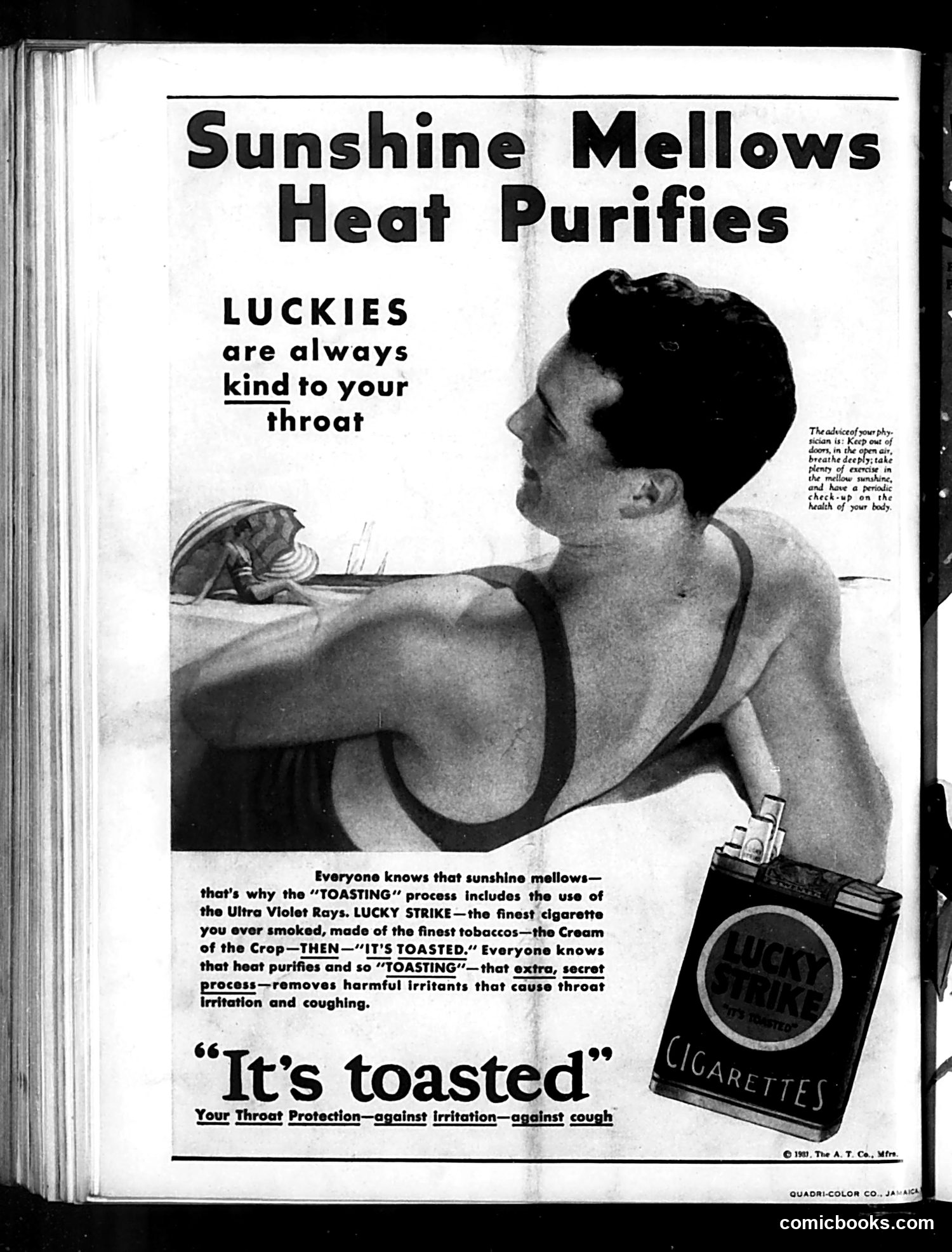
Analysis for Modern Readers This is a cigarette advertisement, not political satire. Lucky Strike cigarettes marketed themselves using pseudo-scientific health claims common in early 20th-century tobacco advertising. The ad claims the "toasting" process—allegedly using ultraviolet rays mimicking sunshine—purifies tobacco and removes "harmful irritants" causing throat irritation. It co-opts medical authority ("your physician") and natural health concepts (sunshine, fresh air, exercise) to suggest cigarettes are actually *beneficial* or at least safe for the throat. This reflects the pre-1964 era when cigarette companies could make unsubstantiated health claims. The "toasting" was genuine manufacturing (heat treatment), but the connection between this and throat protection was marketing fiction. By modern standards, this advertisement is darkly ironic—promoting cigarettes as throat-protective when we now know smoking causes serious respiratory harm.