judge
Judge — February 28, 1931
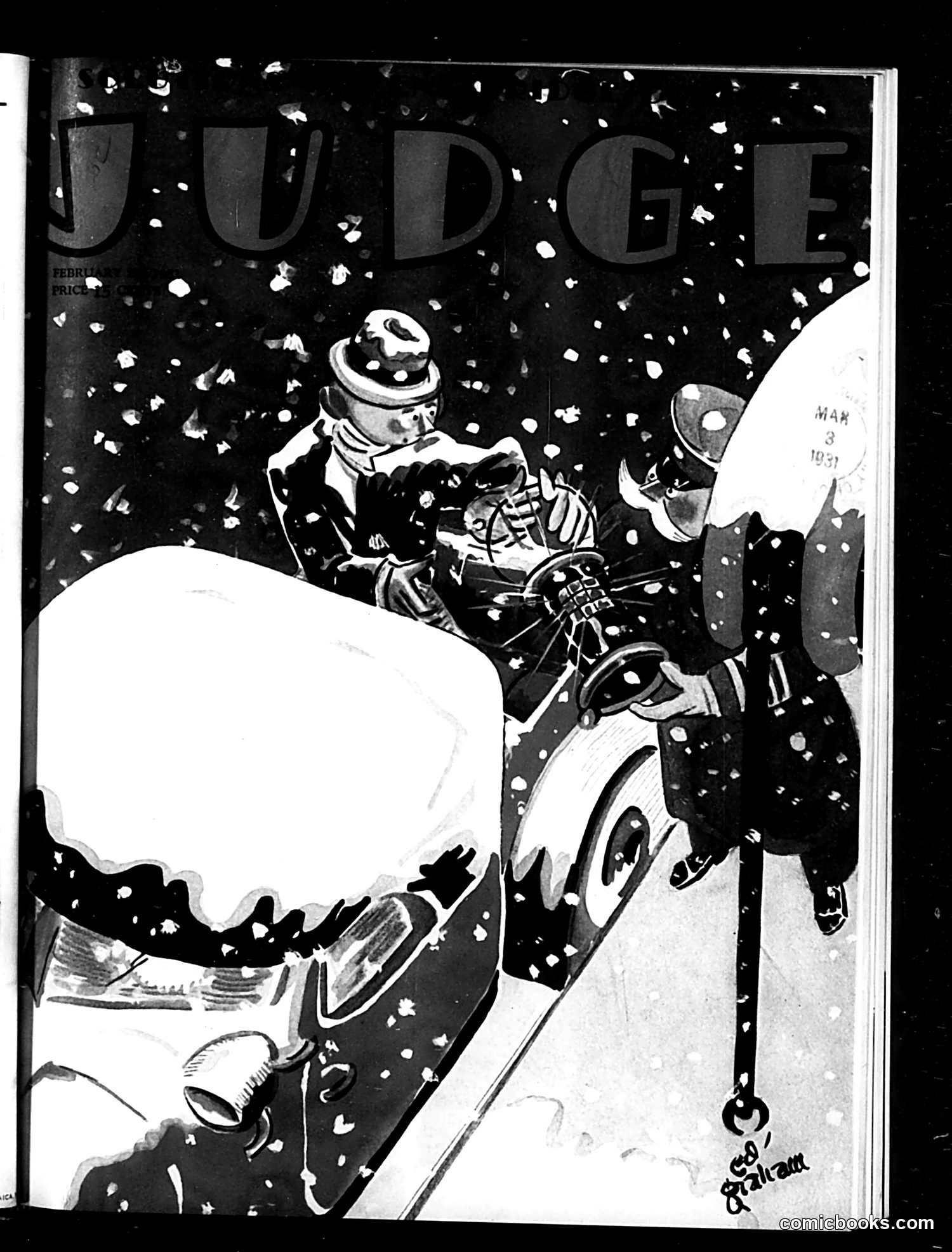
Judge Magazine Cartoon Analysis This appears to be a winter sports illustration from Judge magazine's cover (visible "JUDGE" masthead at top). The cartoon depicts a figure in winter clothing riding a bobsled down a snowy slope, with snow swirling around them against a dark background. Without clearer text or additional context visible on this page, I cannot definitively identify the specific political figure being caricatured or the precise satirical message. The style and composition suggest this is likely commentary on a contemporary political or social figure engaging in winter recreation, possibly meant as social satire about leisure activities or someone's public persona. The illustration's quality and placement suggest this was a significant cover piece, but the specific target of the satire remains unclear from this image alone.

Analysis This is not a political cartoon or satire—it's a straightforward advertisement for Dentyne chewing gum from an early 20th-century magazine. The page features a smiling woman's portrait with the tagline "Chew DENTYNE...and smile!" and "keeps teeth white." The ad copy promotes Dentyne's benefits: whitening teeth, keeping gums firm, and being superior to other chewing gums available at the time. The "gum especially made to keep teeth white" claim reflects period marketing, when chewing gum was often promoted for dental health—a common advertising strategy before modern skepticism about such claims. This is product marketing, not editorial satire or political commentary.
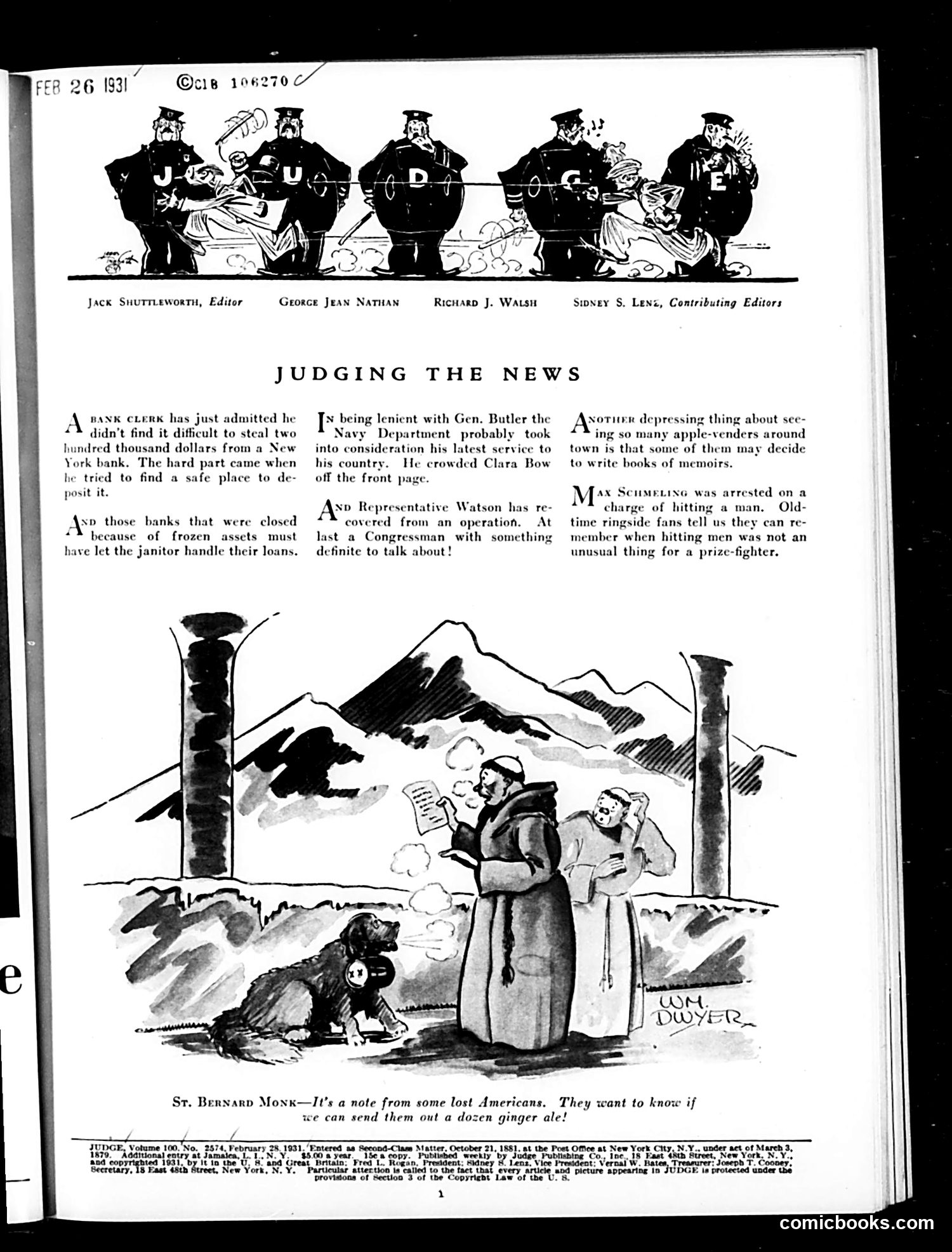
"Judging the News" – Judge Magazine, February 26, 1931 This page satirizes early 1930s economic crisis topics. The header cartoon shows five judicial figures spelling "JUDGE," commenting on news judgment. The text snippets mock: - Bank failures: A clerk admitting difficulty stealing from a New York bank during the Depression, with the joke that banks themselves were already failing - Frozen assets: Closed banks forcing janitors to handle loan paperwork - Representative Watson: Unclear what operation is referenced, but the satire suggests vague political talk - Swindlers: A boxing-related arrest joke about hitting The main cartoon depicts St. Bernard monks in snowy mountains receiving a message from "lost Americans" requesting ginger ale—satirizing Prohibition (alcohol ban) and Depression-era hardship, suggesting Americans were so desperate they'd ask monks for contraband liquor.
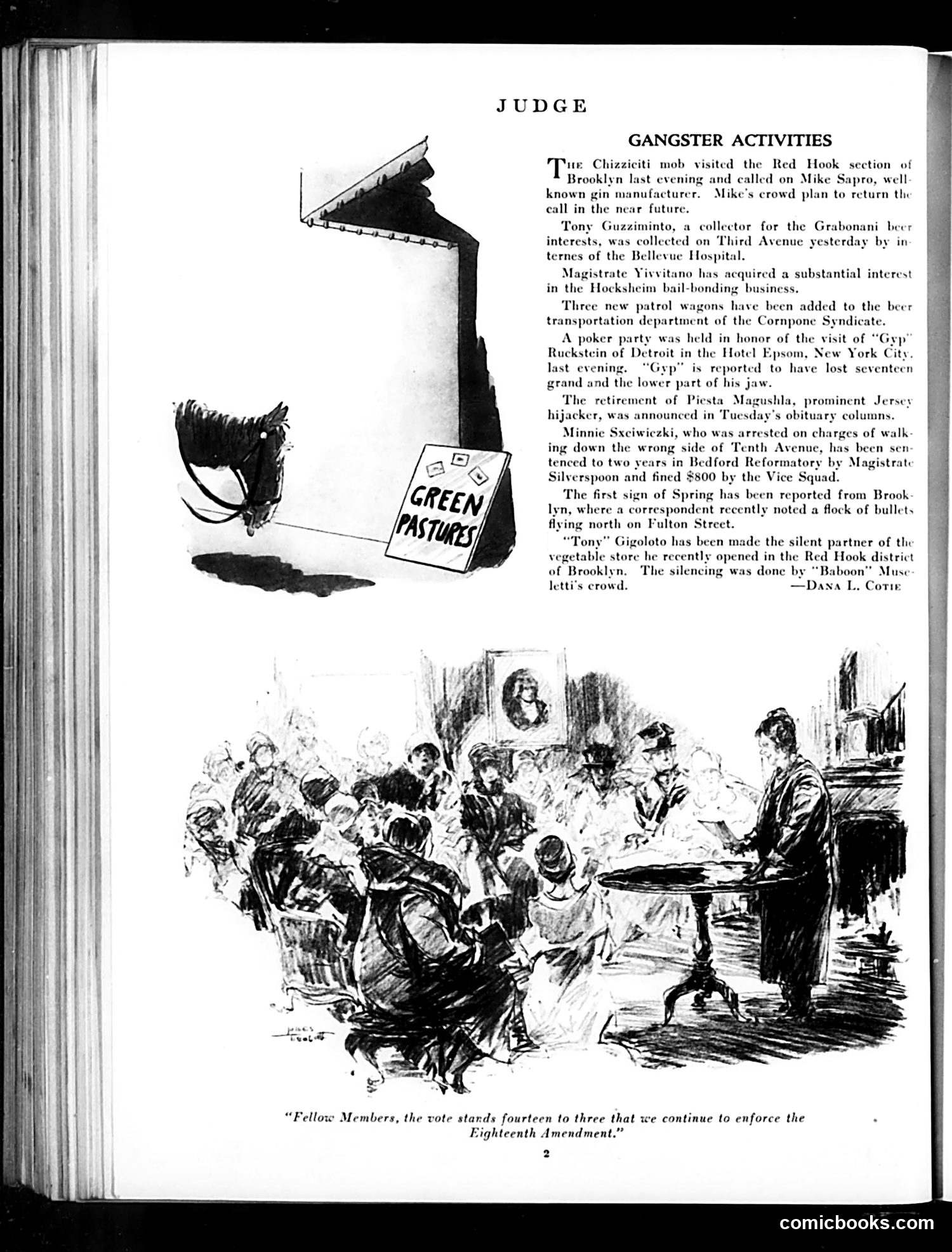
Analysis of Judge Page The page combines satirical news briefs with two editorial cartoons. The top cartoon shows a horse hung from a gallows labeled "GREEN PASTURES"—likely satirizing the play *Green Pastures* (1930), suggesting mob violence or criminal activity connected to its success. The bottom cartoon depicts a formal meeting with the caption about voting to "enforce the Eighteenth Amendment." This references Prohibition (1920-1933), showing well-dressed figures debating alcohol enforcement—likely mocking either politicians' hypocrisy or the futility of Prohibition enforcement amid widespread gangster activity mentioned in the adjacent "Gangster Activities" column. The "Gangster Activities" section itself—recounting arrests, bail-bonding, and mob violence—provides context: organized crime thrived during Prohibition, making enforcement discussions appear absurdly disconnected from reality.
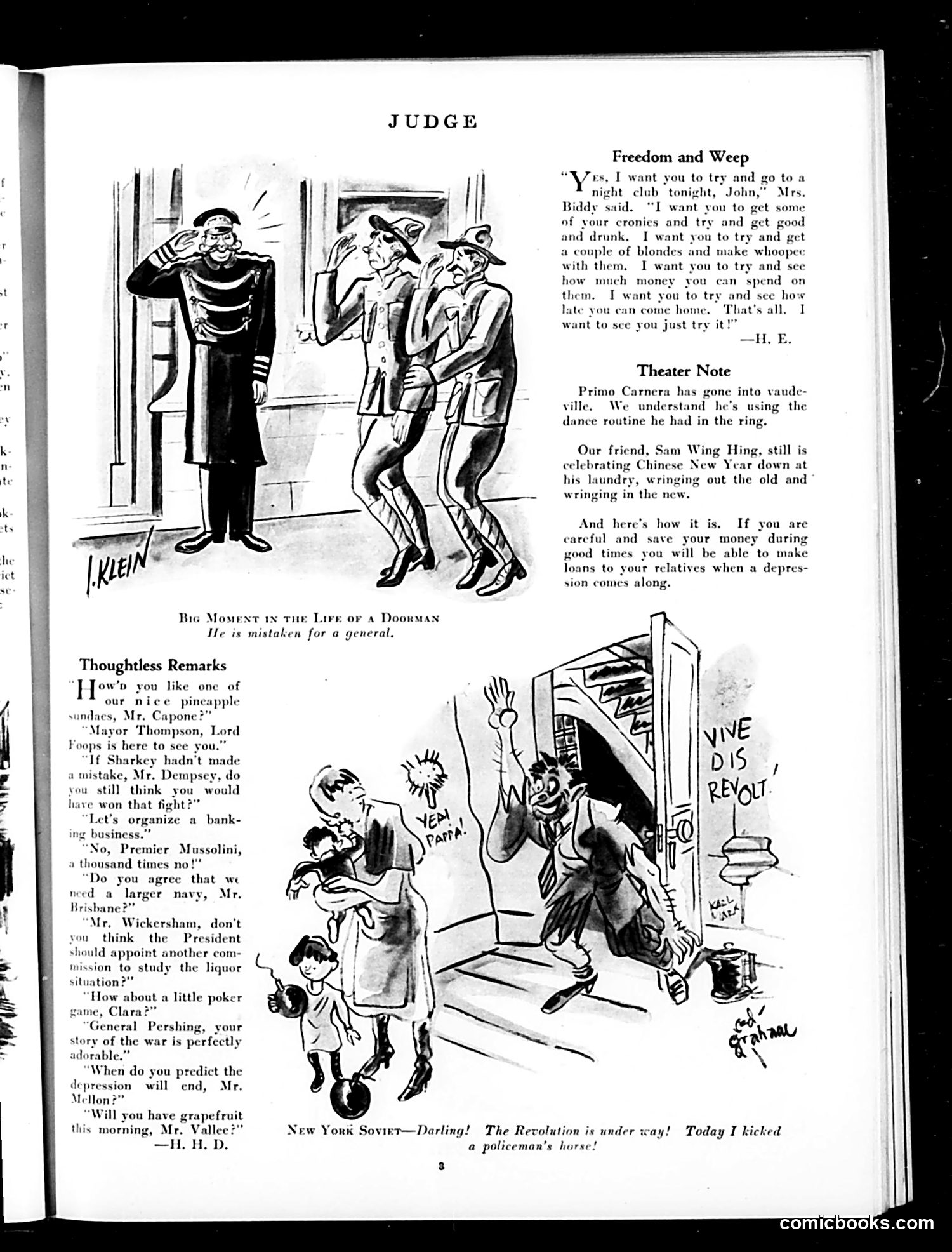
Analysis of Judge Magazine Page This page contains three distinct sections: "Big Moment in the Life of a Doorman" (top): Shows a doorman being mistaken for a general—a joke about military uniform confusion during WWI era. "Thoughtless Remarks" (left): Satirizes politicians and public figures through absurd dialogue. References include Mayor Thompson, Premier Mussolini, and General Pershing. The humor targets politicians' inconsistent or foolish statements about naval expansion, banking, liquor policy, and war predictions. "New York Soviet" (bottom right): Political cartoon depicting communist revolution fears. Shows a figure labeled "Vive Dis Revolt" (mimicking French revolutionary language) storming what appears to be government or official premises. This reflects 1920s American anxieties about Bolshevism spreading after the Russian Revolution. The page overall mocks political incompetence and contemporary communist threats.
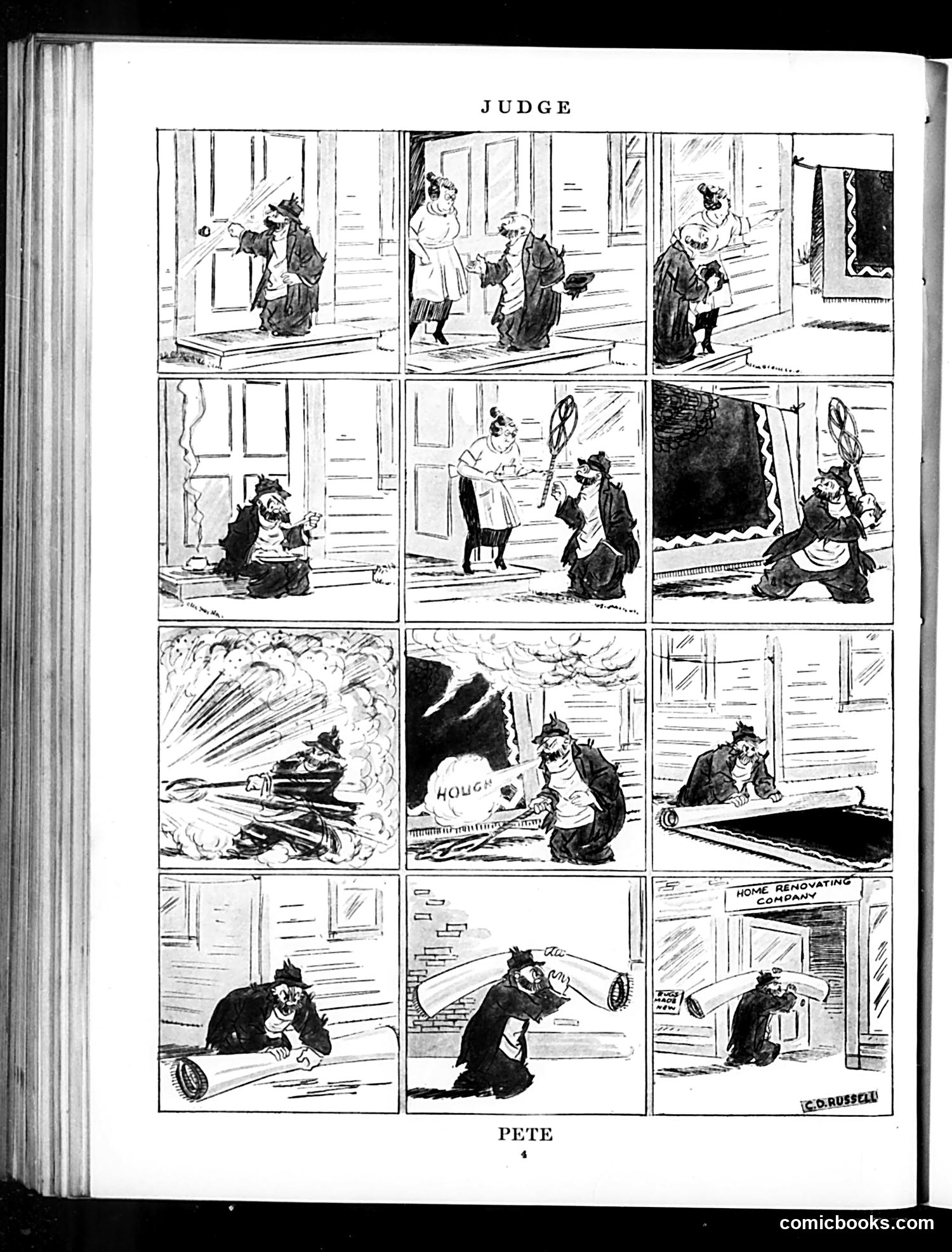
Analysis of "Judge Pete" Comic Strip This appears to be a satirical comic strip following a character named Pete through various misadventures involving home renovation. The narrative shows Pete encountering increasingly catastrophic problems with his house—from initial inspections to fires, structural collapse, and eventually hiring a "Home Renovating Company." The satire targets incompetent home repair and the frustrations of property maintenance. Pete's mounting disasters (explosions, cave-ins, falling debris) humorously exaggerate the typical homeowner's experience with renovation gone wrong. The final panel's reference to hiring a professional company suggests the strip's punchline: sometimes incompetent DIY efforts necessitate professional intervention. The style and subject matter reflect early-to-mid 20th-century American anxieties about home ownership and the emerging home repair industry.
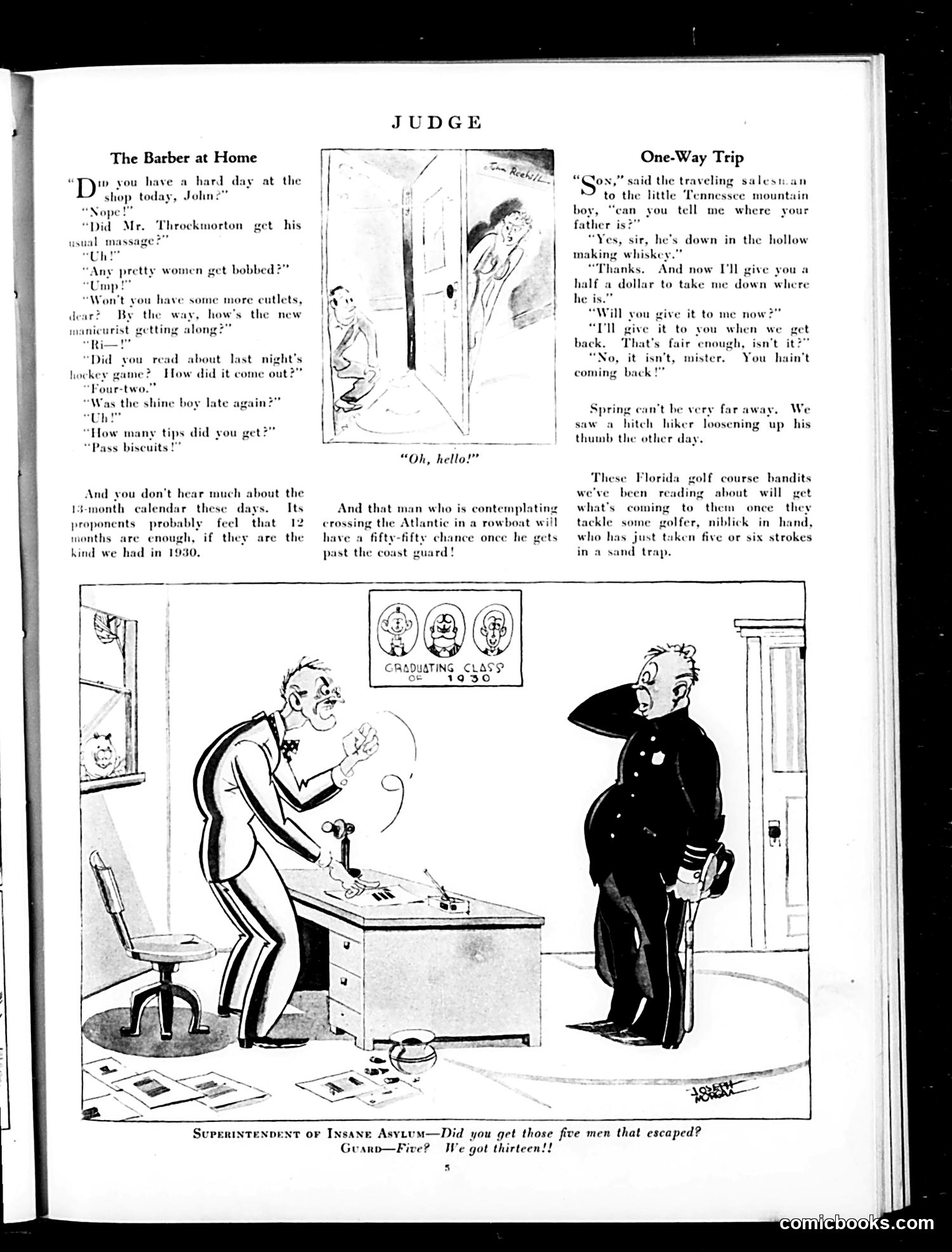
Judge Magazine Page Analysis This page contains three humor pieces typical of 1930s Judge magazine: 1. "The Barber at Home": A domestic conversation where a barber discusses his day—Mr. Throckmorton's massage, bobbed women, tips, and a hockey game. The humor relies on period-specific details (women's bobbed hair was still somewhat scandalous; tipping customs differed). 2. "One-Way Trip": A traveling salesman's exchange with a Tennessee mountain boy about locating his whiskey-making father. The satire plays on Prohibition-era bootlegging and Appalachian stereotypes. 3. "Superintendent of Insane Asylum": An official questions a guard about escaped inmates. The joke's punchline—thirteen men escaped but only thirteen were caught—appears to be absurdist humor about bureaucratic incompetence. All reflect 1930s social commentary and conventions now largely historical.
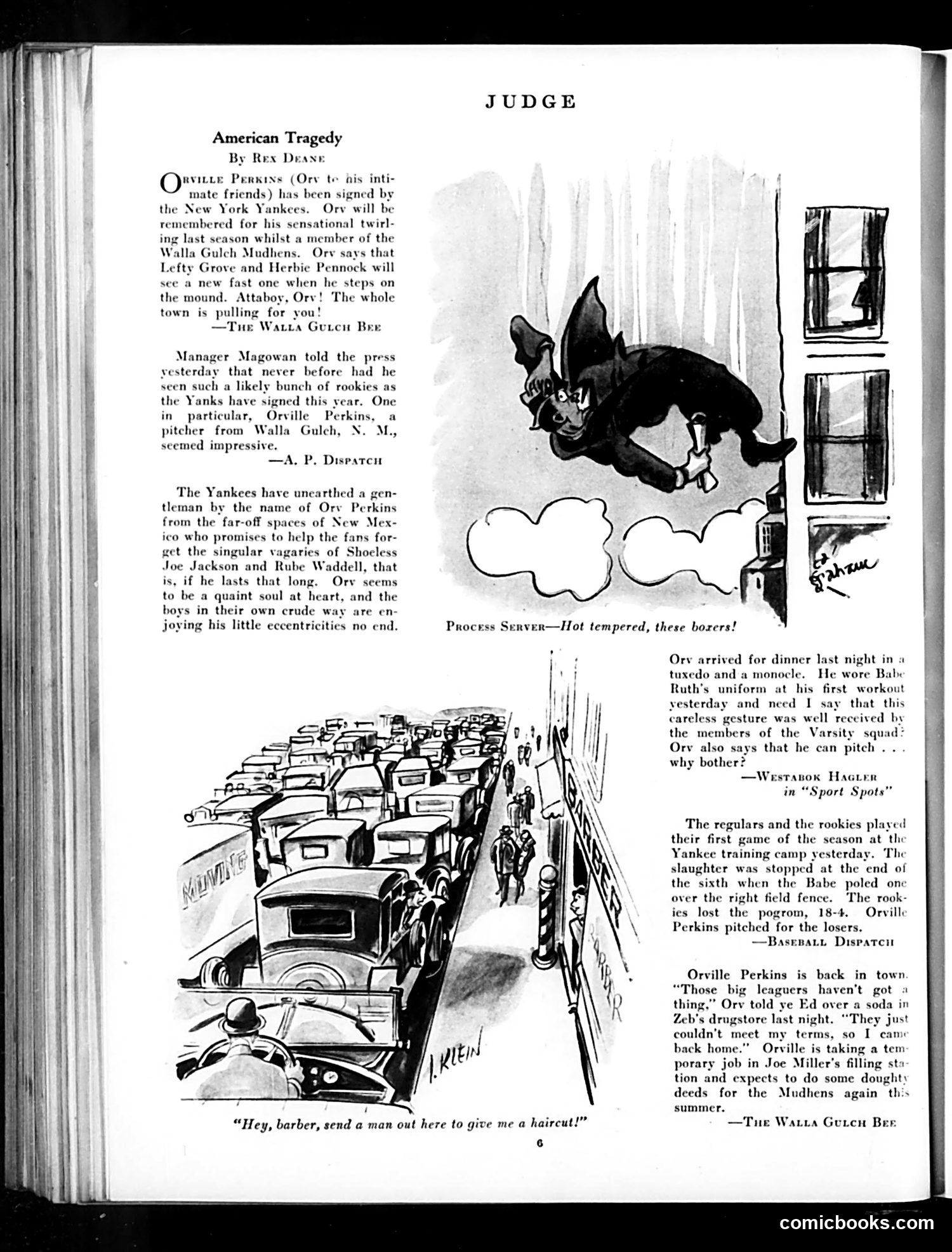
Judge Magazine Page Analysis This page features sports commentary about baseball player Orville Perkins, a pitcher signed by the New York Yankees from Walla Gulch, New Mexico. The text celebrates him as a promising talent who might help fans forget stars like Joe Jackson and Rube Waddell. The top cartoon depicts a demon or mischievous spirit labeled "Process Server—Hot tempered, these boxers!" emerging from clouds near a building, satirizing legal troubles in boxing. The bottom cartoon shows a crowded traffic jam or parking situation with the caption "Heg, barber, send a man out here to give me a haircut!"—a humorous complaint about congestion. The page mixes sports news with lighthearted social commentary typical of Judge's satirical approach.
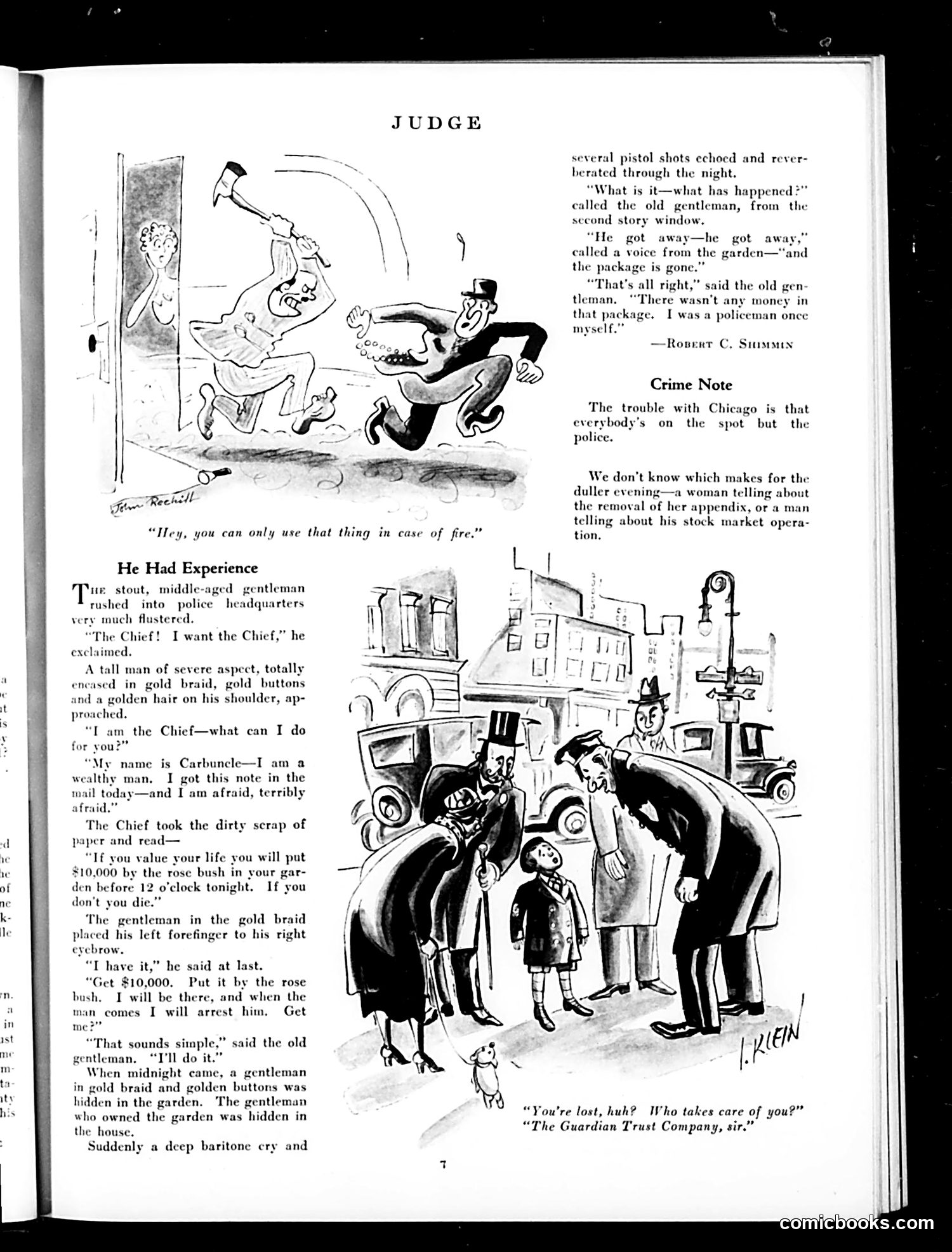
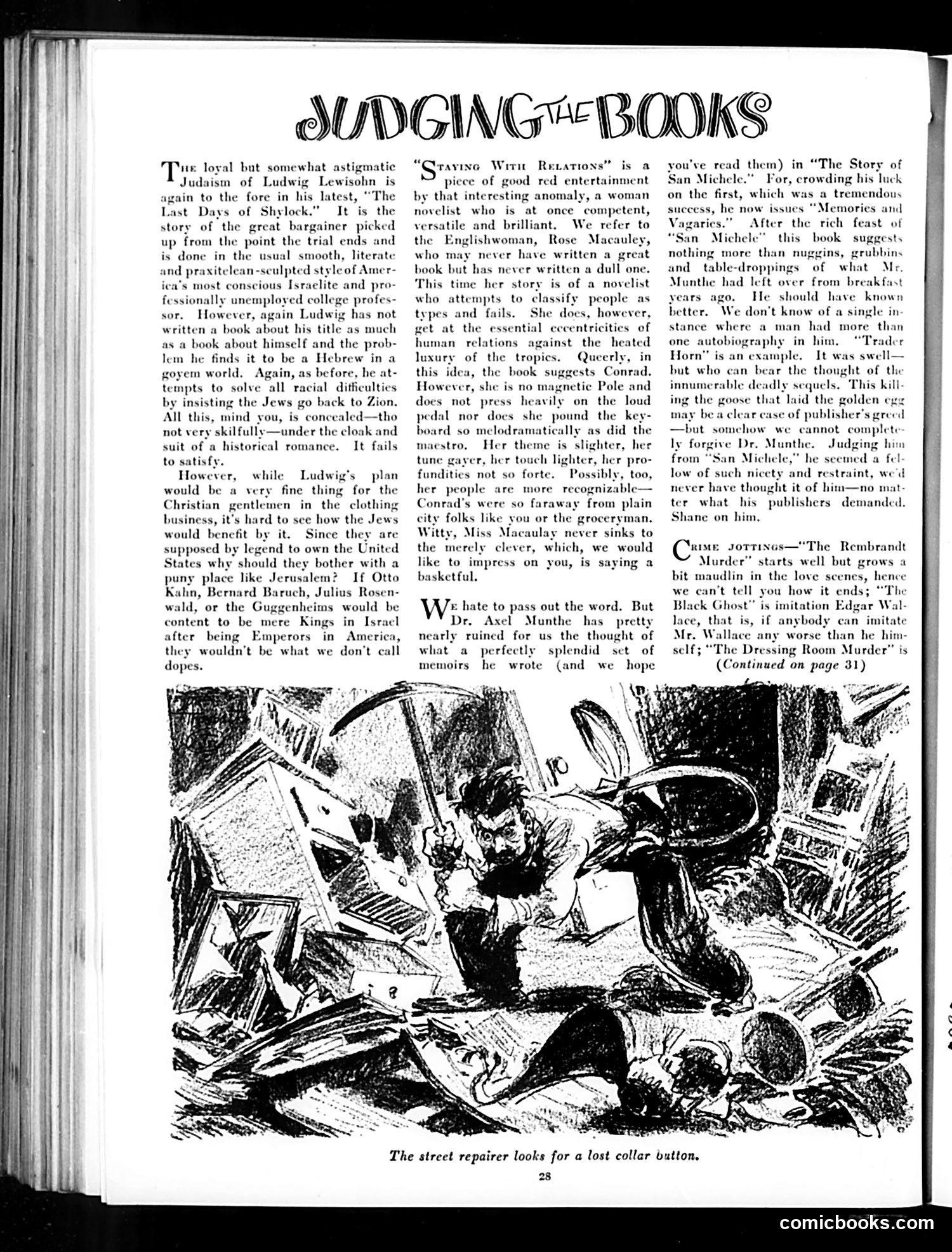
Analysis of Judge Magazine Page This page contains two satirical pieces mocking Chicago police incompetence during the era of organized crime and extortion. "He Had Experience" (main story with top cartoon): A wealthy man named Carbuncle receives an extortion note demanding $10,000. He reports it to the Police Chief, who agrees to catch the criminal. The story implies the plan fails—the criminal escapes with the money. The first cartoon shows a burglar using a fire axe, with caption "Hey, you can only use that thing in case of fire," mocking misuse of equipment. "Crime Note" (sidebar): A brief commentary stating Chicago's problem is that "everybody's on the spot but the police"—meaning citizens are vulnerable to criminals while police are ineffective. Lower cartoon: Shows concerned adults asking a lost child who cares for her; she replies "The Guardian Trust Company, sir," satirizing how corporations have become substitute guardians, implying parental/societal roles have been replaced. The satire targets police corruption and ineffectiveness during Prohibition-era Chicago.
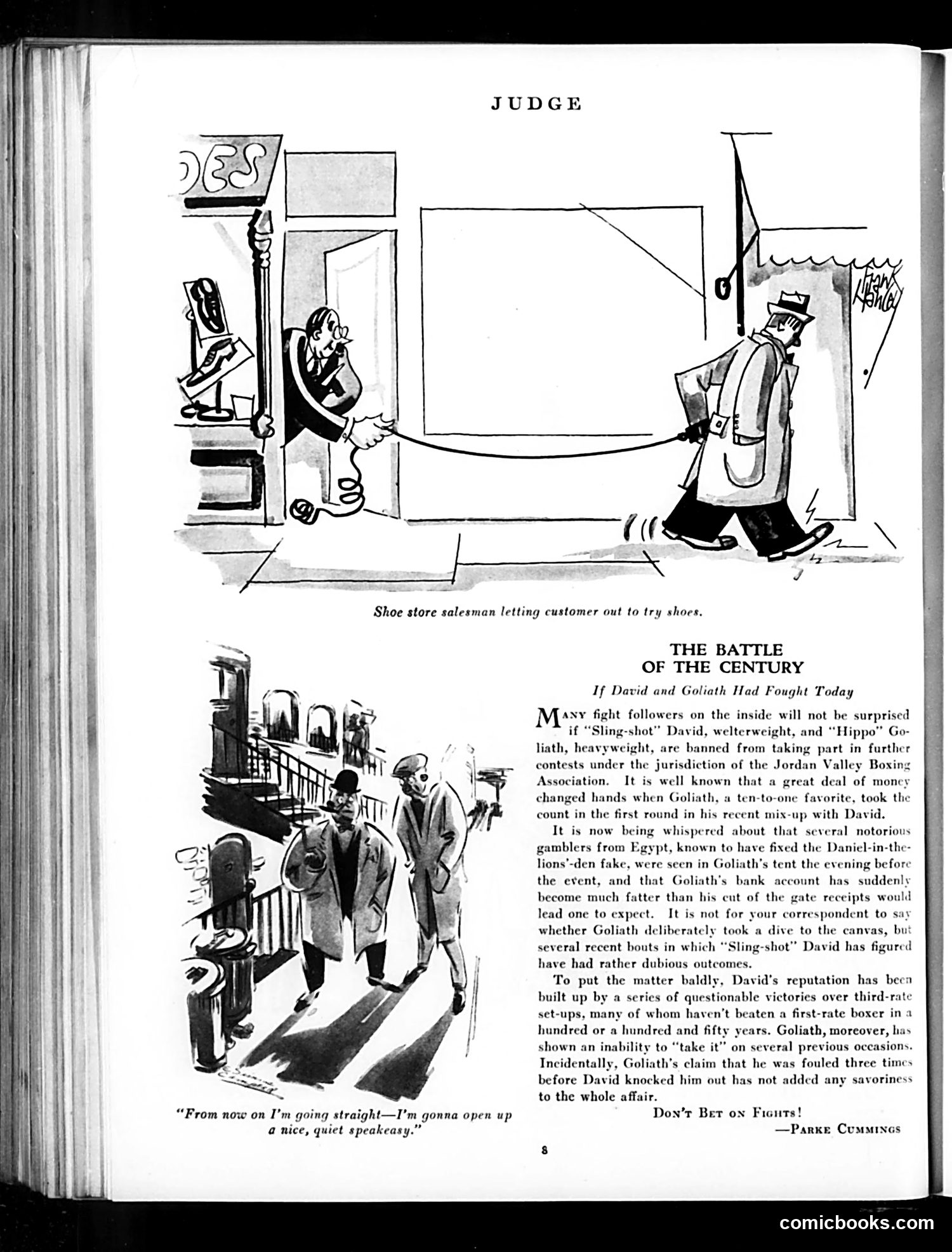
"The Battle of the Century" - Judge Magazine Satire This page satirizes contemporary boxing through a biblical lens. The top cartoon shows a shoe salesman—a visual pun on "trying shoes" that relates to the boxing content below. The main article reimagines David vs. Goliath as a modern boxing match, mocking the sport's corruption. "Sling-shot" David (welterweight) and "Hippo" Goliath (heavyweight) are banned fighters after David's suspicious first-round knockout victory. The satire exposes: - Fixed fights: Egyptian gamblers allegedly rigged the match; Goliath's bank account suspiciously fattened - Padded records: David's reputation built on victories against weak opponents ("third-rate set-ups") - Dubious outcomes: Several of David's recent bouts had questionable results - Corruption: Money changed hands; Goliath may have intentionally "took a dive" The bottom cartoon shows gangsters discussing opening a "speakeasy"—referencing Prohibition-era organized crime's connection to boxing corruption. Judge uses biblical irony to critique 1920s boxing as a criminal enterprise.
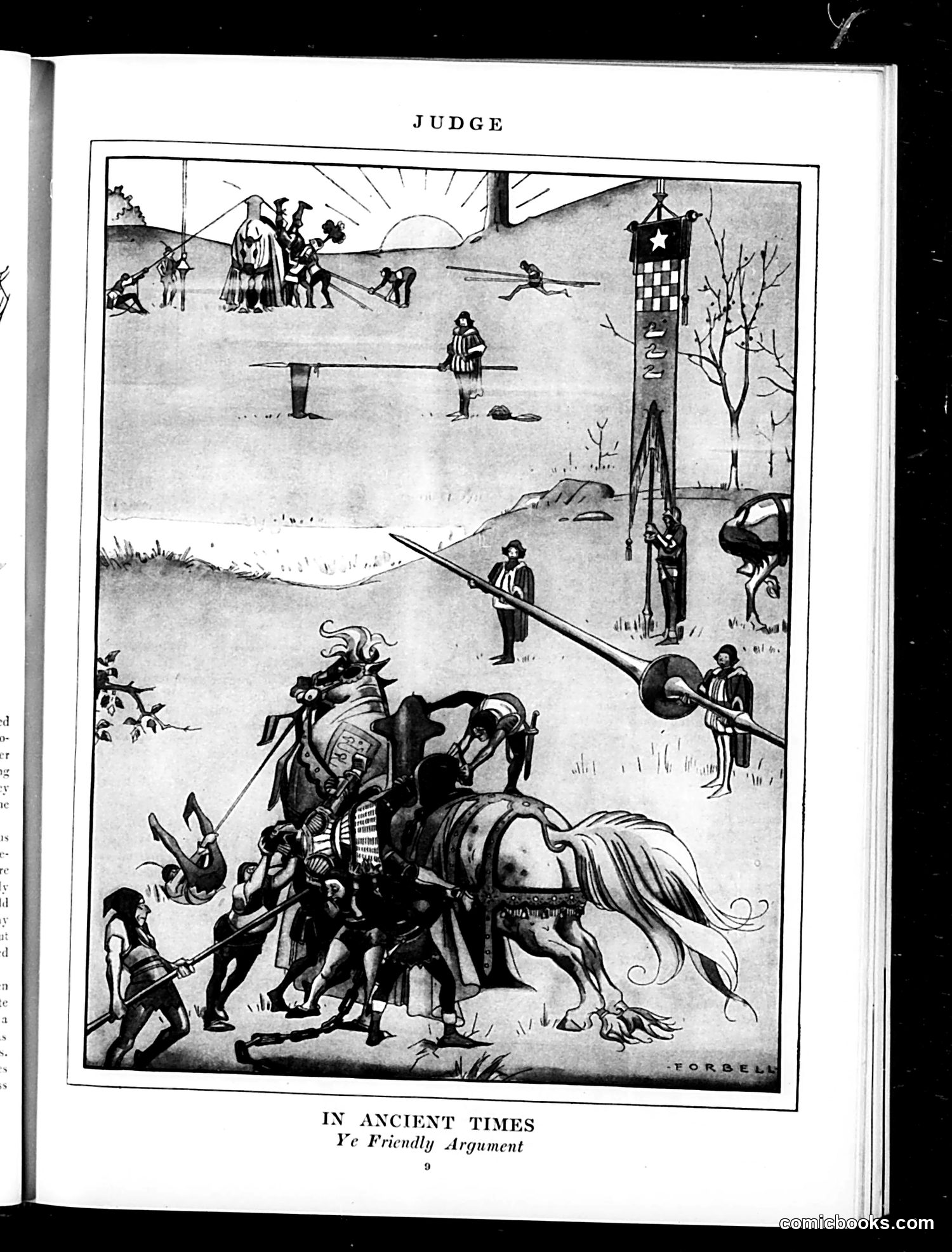
Judge Magazine: "Judge in Ancient Times—Ye Friendly Argument" This satirical cartoon depicts a mounted nobleman or judge being physically attacked and overwhelmed by multiple armed commoners with swords and pikes. The title "Ye Friendly Argument" is ironic—what appears to be a "friendly" debate has devolved into violent conflict. The satire likely comments on contemporary political disputes, suggesting that disagreements between authority figures (represented by the mounted, ornate judge) and ordinary citizens (the armed mob) inevitably escalate to violence rather than reasoned discussion. The "ancient times" framing allows the artist to critique modern politics through historical costume. The tower with a star in the background may reference governmental authority. The cartoon's message: civil discourse between classes and power is illusory.
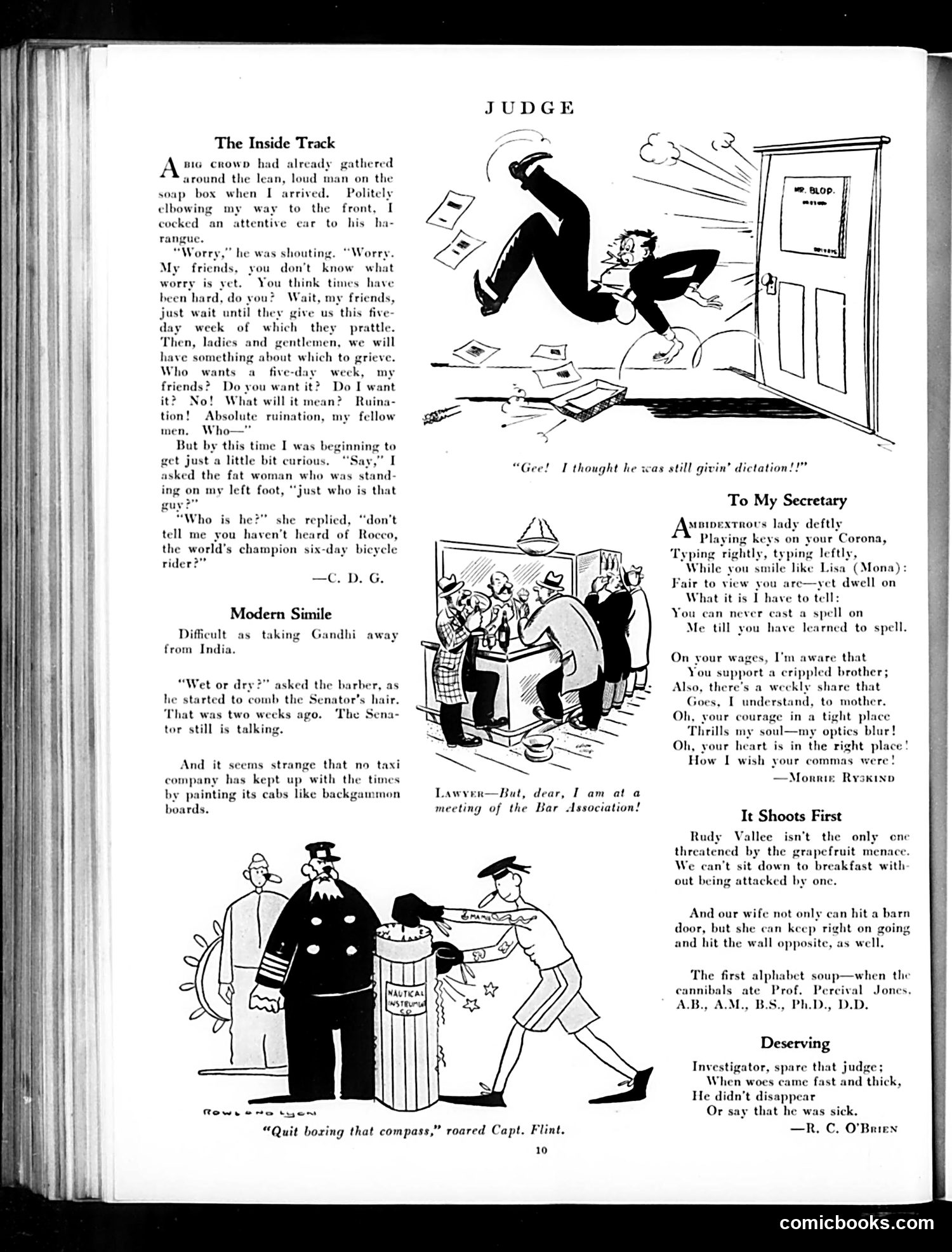
Judge Magazine Page Analysis This page contains several satirical pieces typical of 1920s-30s humor: "The Inside Track" mocks a soapbox orator ranting against a five-day work week as ruinous, revealed to be Rocco, a famous six-day bicycle racer. The joke: his opposition stems from self-interest (his sport depends on six-day races), not principle. "Modern Simile" compares Gandhi's difficulty leaving India to removing a persistent barber—likely referencing Gandhi's actual independence efforts, treating his political importance with flippant humor. The cartoon showing three figures with a "Mustard" jar appears to reference an ongoing joke about aggressive condiments or food hazards ("It Shoots First" below mentions grapefruit attacks). "To My Secretary" is affectionate office verse about a typist, comparing her to the Mona Lisa while gently mocking her spelling. Other pieces—"Deserving," "Lawyer" joke—are brief gags about professional types. The humor assumes readers recognize contemporary references like Rudy Vallee and understand workplace dynamics of that era.
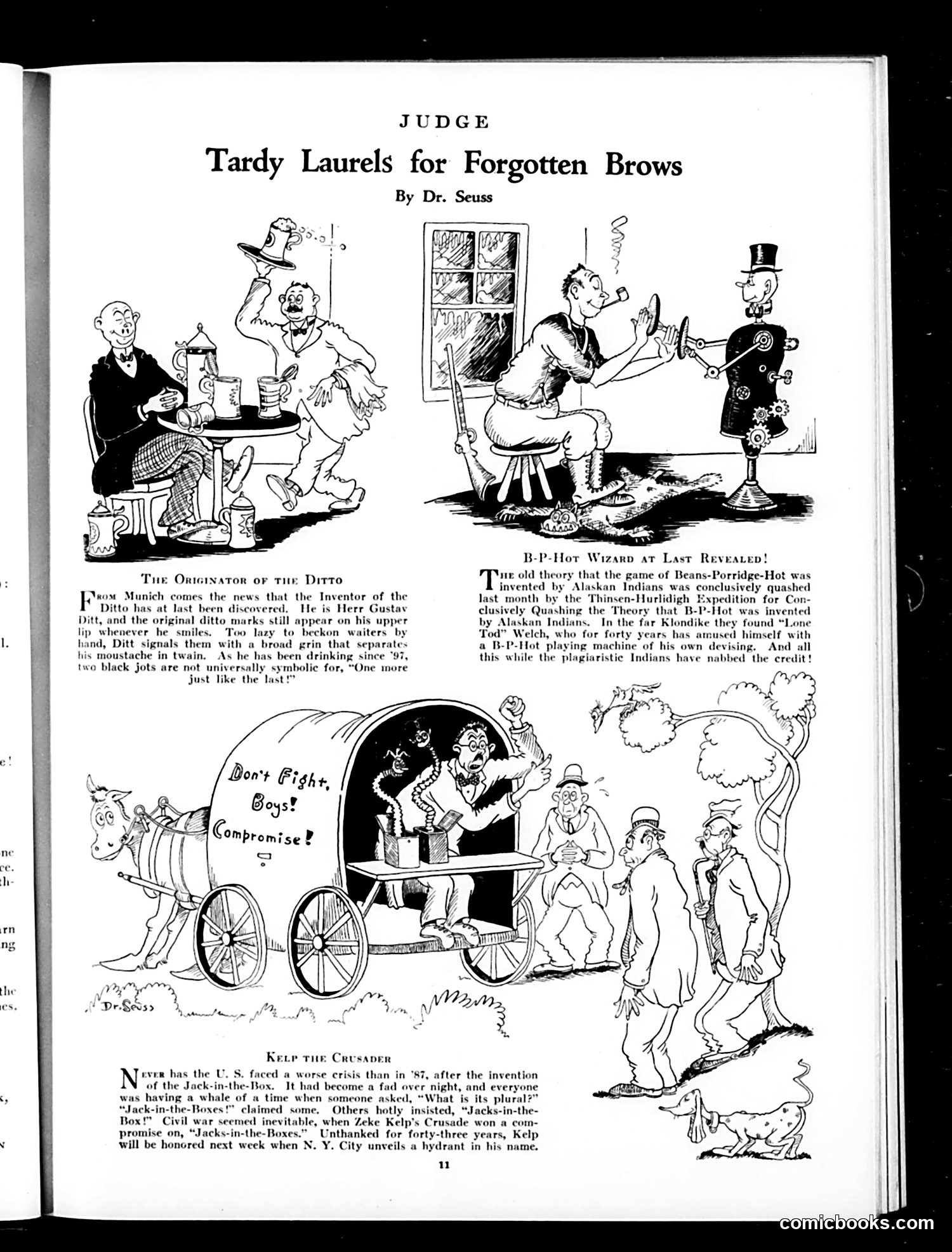
Explanation for Modern Readers This page from *Judge* magazine presents three satirical pieces mocking forgotten or disputed inventors: 1. "The Originator of the Ditto": Claims a Herr Gustav Ditt from Munich invented the copying machine, with the joke that he's been overlooked while receiving only a mustache-related pun ("ditto marks"). 2. "B-P-Hot Wizard at Last Revealed!": References a dispute over who invented a B-P-Hot (likely a heating/flying machine). The satire suggests competing claims—Alaskan Indians versus an explorer named "Lone Ted"—echoing real priority disputes in invention history. 3. "Kelp the Crusader": Mocks the 1887 "Jack-in-the-Box" craze and a figure named Zeke Kelp who apparently fought over the toy's plural form ("Jacks-in-the-Box" vs. "Jack-in-the-Boxes"). The joke: after 43 years of being ignored, he'll receive only a fire hydrant named after him—a deliberately modest honor. The overall theme: satirizing how inventors get forgotten, disputed, or inadequately credited.
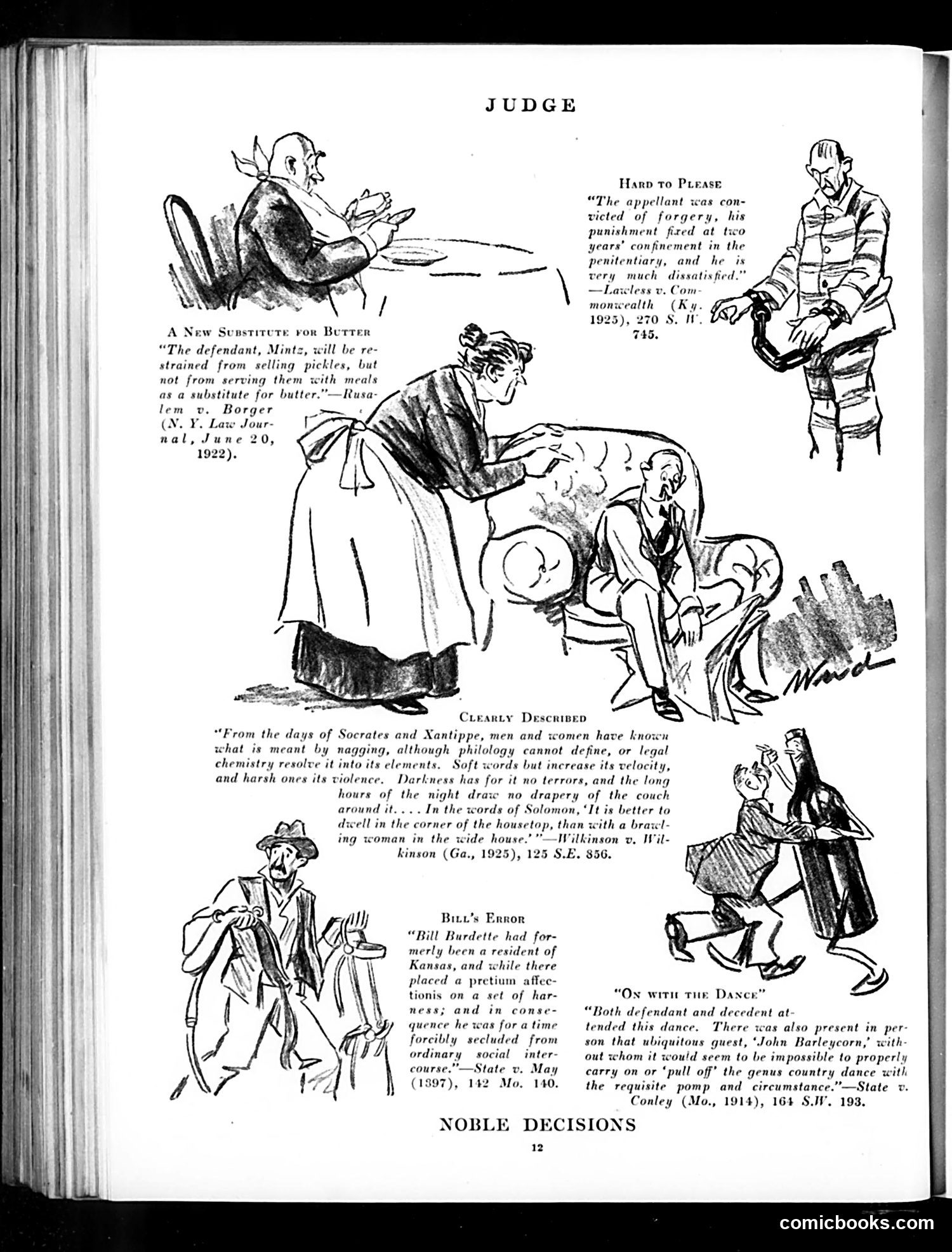
Judge Magazine: "Noble Decisions" (Legal Satire) This page satirizes absurd court rulings through illustrated vignettes. Each cartoon pairs a legal case citation with a ridiculous judicial decision: "Hard to Please": A convict dissatisfied with his two-year sentence—mocking defendants unhappy with any punishment. "A New Substitute for Butter": A judge restrains defendant Mintz from selling pickles commercially, but permits serving them with meals as butter substitute—exposing the nonsensical specificity of some court orders. "Clearly Described": Quotes a lengthy philosophical definition of "nagging" from a Georgia case, mocking overly literary judicial language when addressing domestic disputes. "Bill's Error": References a Kansas residency case involving peculiar property claims. "Os with the Dance": Notes that "John Barleycorn" (personification of alcohol) attended a country dance—sardonically suggesting liquor was an inevitable, quasi-legal party guest. The page ridicules judicial pretension, verbose reasoning, and the law's inability to address human behavior sensibly.
"Judge on the Bench" - Page Analysis This editorial page addresses Depression-era economic crises through three separate articles: The Main Crisis Editorial discusses how unprecedented unemployment and hardship demand government relief, creating tension between President Hoover (who opposes expanding state responsibility) and Congress, which increasingly supports intervention. The piece acknowledges forces beyond individual control—the Machine Age, bank failures, drought—are reshaping society. "Three Days a Week" references a real labor initiative (appears to be St. Louis-based) where workers pledge to work only three days weekly, distributing available work. The author suggests this foreshadows inevitable reduction in human labor needs as industrial production becomes more efficient. "Muddling the Public" critiques government communication, citing examples like Judge Payne's confusing Red Cross statements and President Hoover's unclear Wickersham Report messaging. The satirical point: officials lack basic clarity in explaining policy, requiring multiple corrections. The overall theme: America faces systemic economic problems requiring clear thinking and honest communication—neither of which the current government demonstrates effectively.
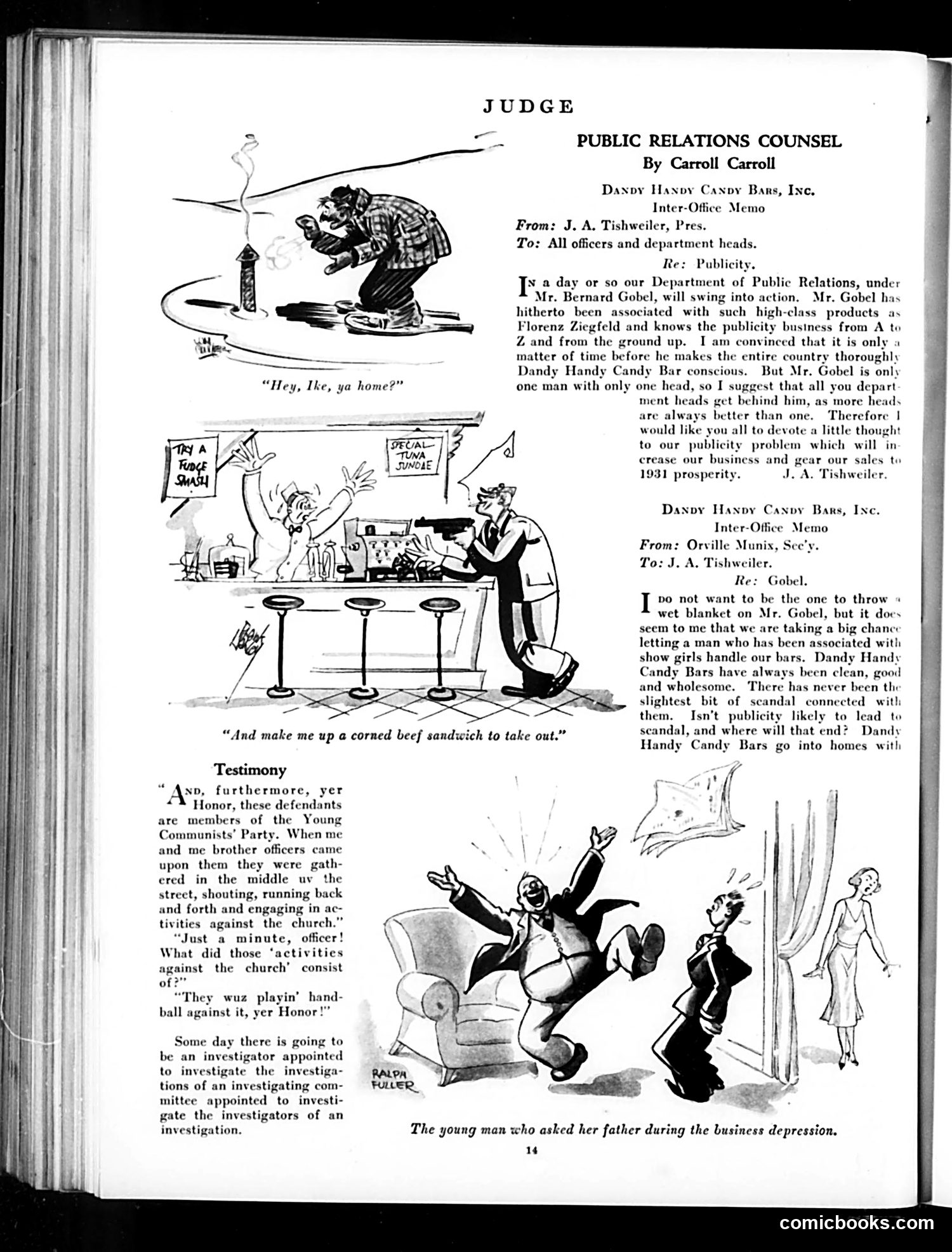
Explanation for Modern Readers This 1931 Judge magazine page satirizes corporate public relations and reputation management during the Great Depression. The top section mocks a candy company's hiring of Bernard Gobel, a publicist previously associated with Florenz Ziegfeld's theatrical productions (known for glamorous "show girls"). The irony: the company wants to promote wholesome family candy, but fears Gobel's scandalous entertainment background will taint their image—a joke about how corporate PR tries to control narratives regardless of actual product quality. The bottom cartoons ridicule absurd legal testimony and Communist-era paranoia, showing a policeman describing Young Communists' "activities against the church" as merely playing handball—mocking both prosecution overreach and the era's anti-communist hysteria. The final cartoon shows a young man's proposal during economic depression—commentary on courtship amid financial hardship, with the caption implying desperation during hard times. The overall theme: satirizing corporate anxiety, legal absurdity, and Depression-era social instability.
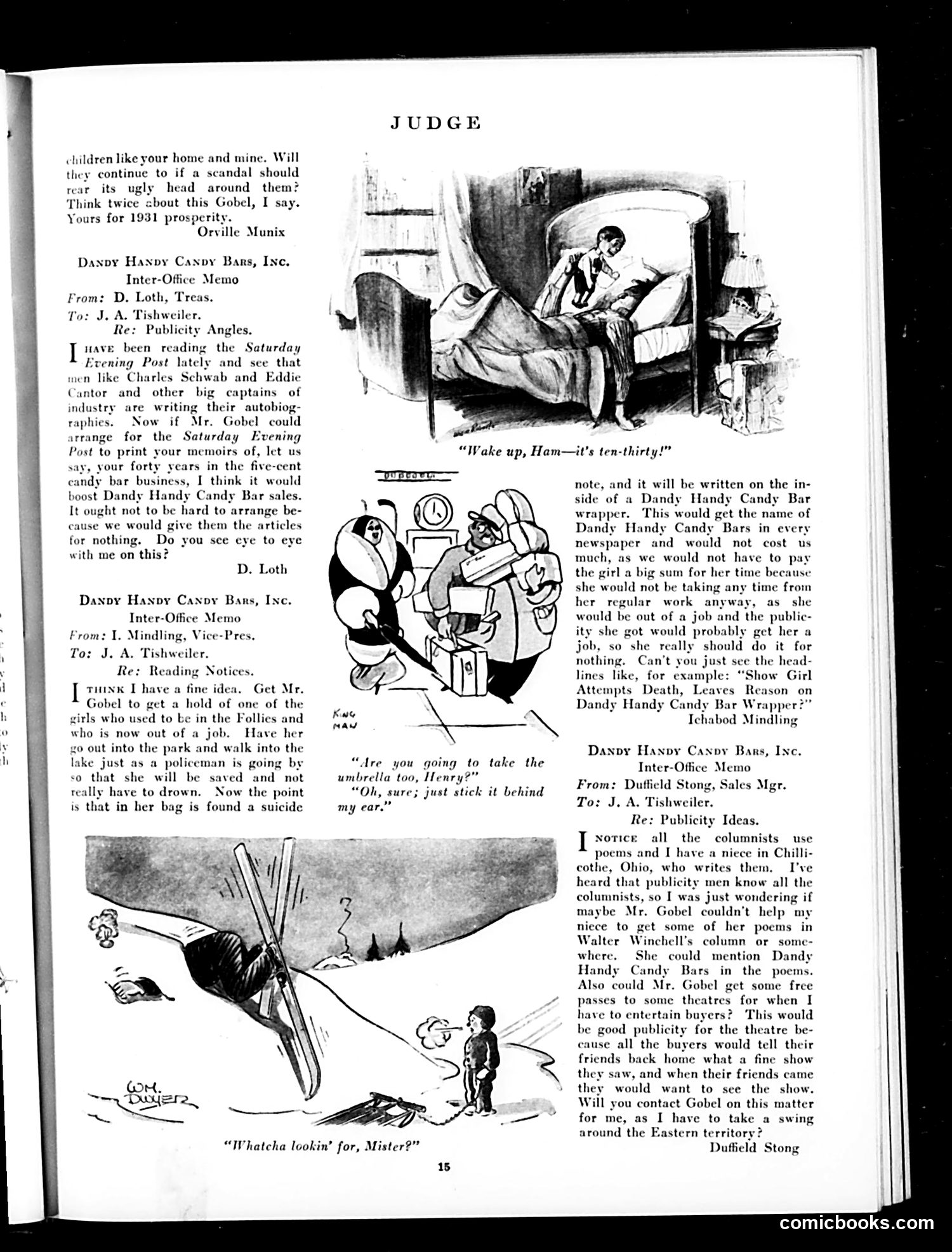
Judge Magazine Page Analysis This page satirizes corporate publicity schemes during the Depression era (circa 1931). The central content consists of inter-office memos from Dandy Handy Candy Bars executives proposing increasingly absurd marketing ideas to their boss Gobel: The satire targets: - Executives' desperation for cheap publicity during economic hardship - Cynical exploitation of unemployed workers (former Follies girls) - Proposals ranging from ghost-written executive memoirs to staging a fake suicide with a candy wrapper found in the victim's bag - Shameless nepotism and quid-pro-quo schemes (promoting the memo-writer's niece's poems in exchange for theatrical passes) The humor lies in the memos' escalating outrageousness presented as serious business proposals. Each department head earnestly pitches ethically questionable ideas as cost-effective solutions, revealing corporate callousness toward human suffering during the Depression while pursuing trivial product promotion. The cartoons above illustrate unrelated domestic humor, providing visual breaks between the memo sequence.
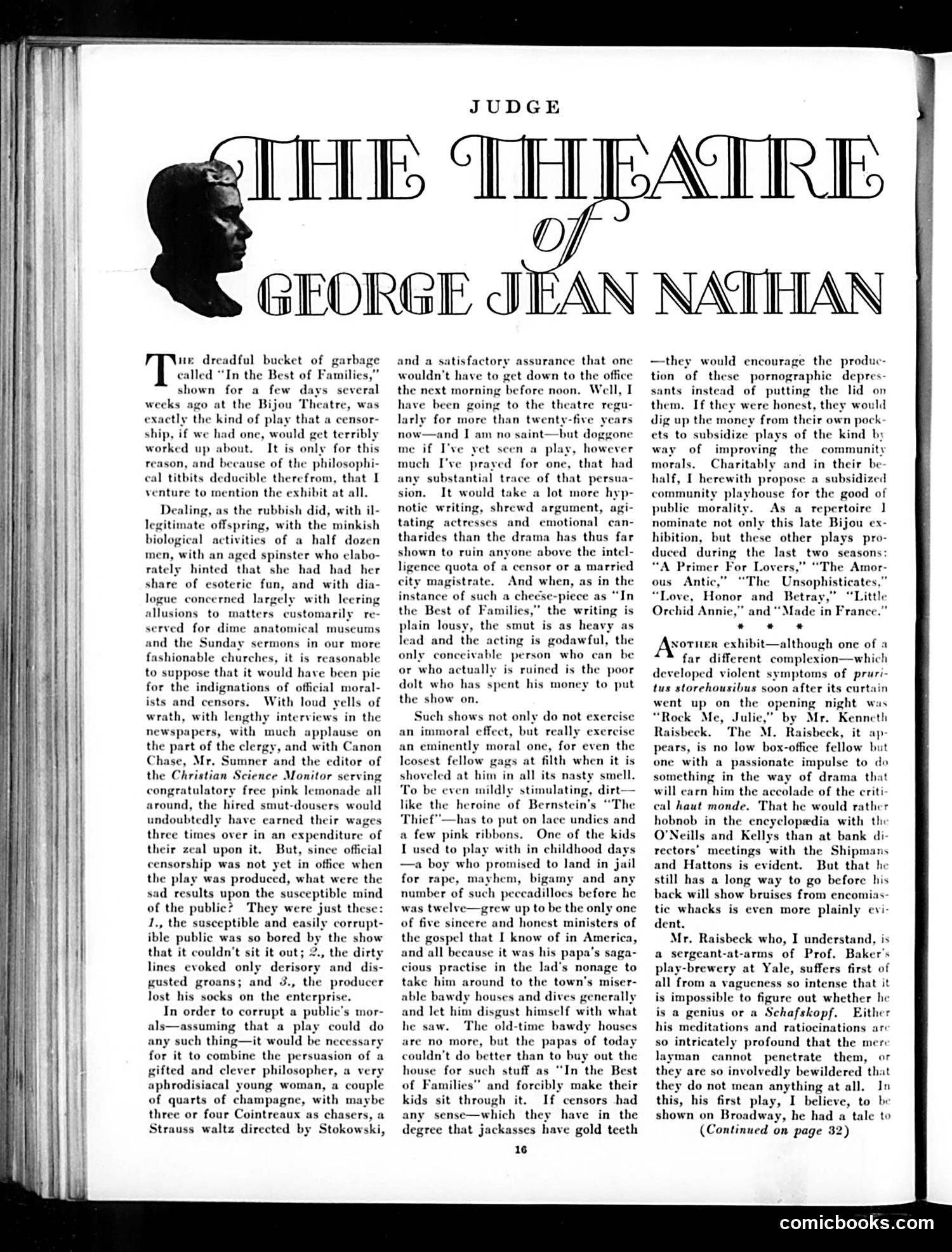
"The Theatre of George Jean Nathan" This page is a theater criticism essay by Judge magazine's drama critic, not a political cartoon. The author criticizes censorship advocates (mentioning "Canon Chase, Mr. Sumner," and the Christian Science Monitor editor) who claim stage obscenity corrupts public morals. The satire's point: Nathan argues that a poorly-made, sexually crude play like "In the Best of Families" actually *proves* obscene theater is harmless—it bored audiences so much the producer lost money. He contends that genuine moral corruption would require philosopher-level persuasion plus champagne and romantic ambiance, not cheap theatrical smut. Nathan uses a counterintuitive argument: exposure to vice can actually *improve* morality (his childhood friend visited brothels and became a minister). The piece mocks moral panic about theater while defending artistic freedom from censorious groups.
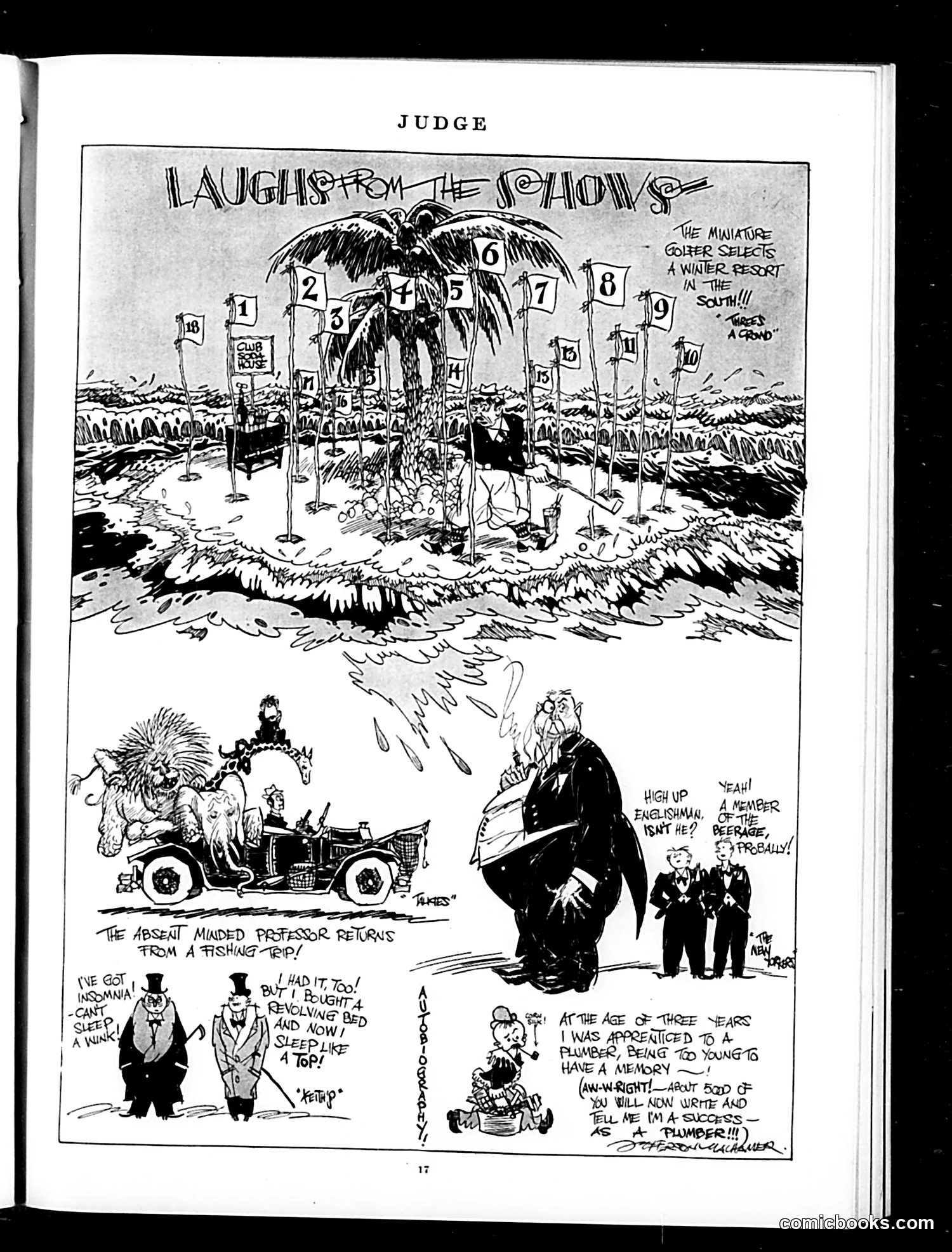
"Laughs from the Shadows" - Judge Magazine Cartoon This page satirizes the absent-minded professor archetype through multiple vignettes. The top panel depicts a miniature golf course where a befuddled professor selects a winter resort—a visual joke about obliviousness. Below, the "absent-minded professor returns from a fishing trip" shows him arriving via car with eccentric companions, having apparently confused his outing. The lower panels mock his memory lapses: he complains of insomnia despite sleeping like a top, and he recounts being apprenticed to a plumber as a youth, then claims this memory proves his success—confusing his professional identity. The satire targets the stock character of the intellectually brilliant but socially incompetent academic, whose disconnect from practical reality and poor memory make him a figure of ridicule. This was a popular comedic trope in early 20th-century American humor magazines.
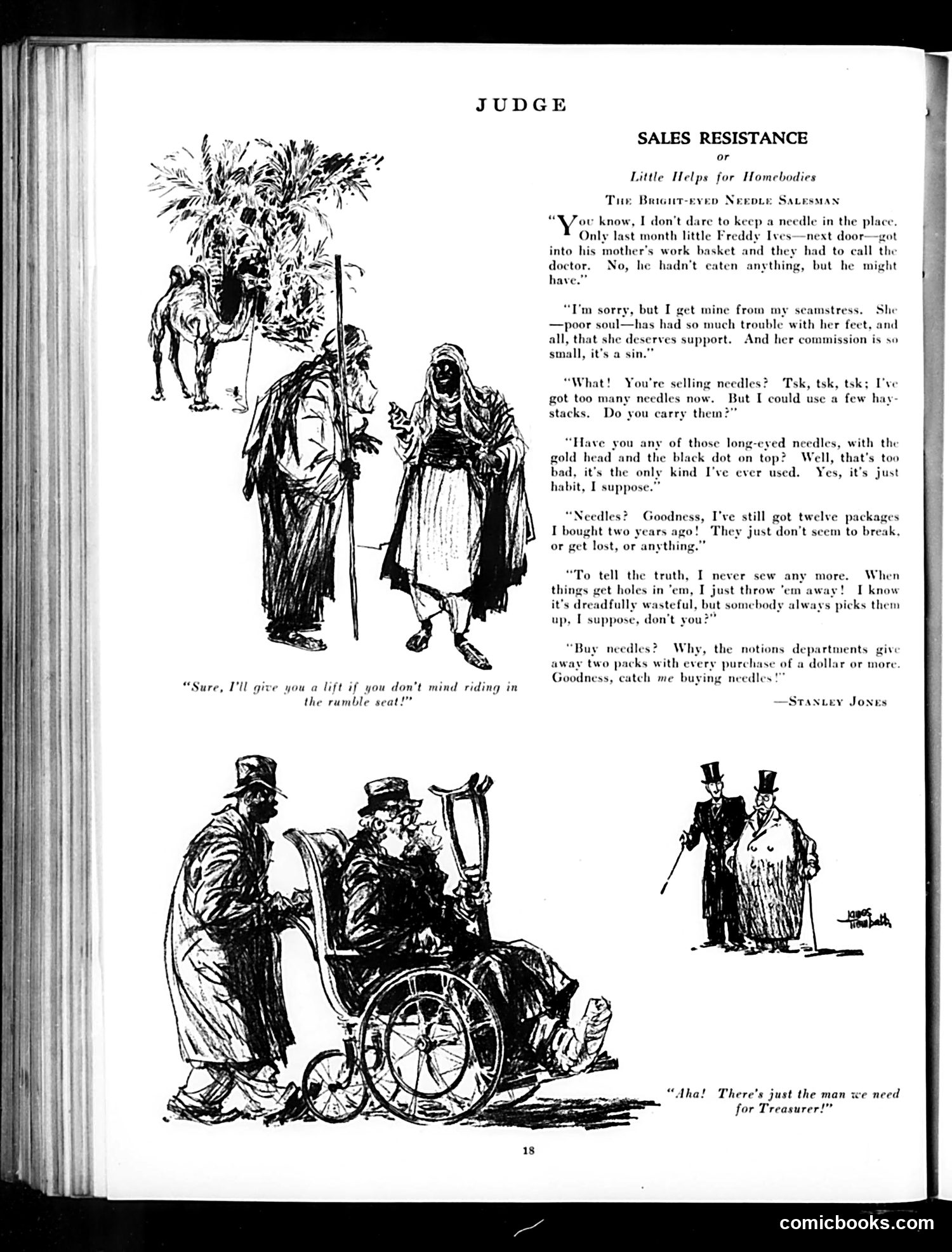
Sales Resistance: A Needle Salesman's Frustrations This satirical piece by Stanley Jones depicts a door-to-door needle salesman encountering various customer excuses and sales resistance. Each panel shows a housewife offering reasons NOT to buy needles: safety concerns (a child swallowed one), loyalty to a seamstress, overstocking, brand loyalty to specific needle types, not sewing anymore, or getting free needles with store purchases. The humor targets both consumer resistance to door-to-door sales and the absurdity of household objections. The final cartoons show the frustrated salesman being offered a ride in a "rumble seat" and jokingly identified as ideal for "Treasurer"—suggesting his ability to manage meager sales would suit financial stewardship. The piece satirizes Depression-era economic struggles, where even basic household supplies faced competitive pressure and consumer reluctance.
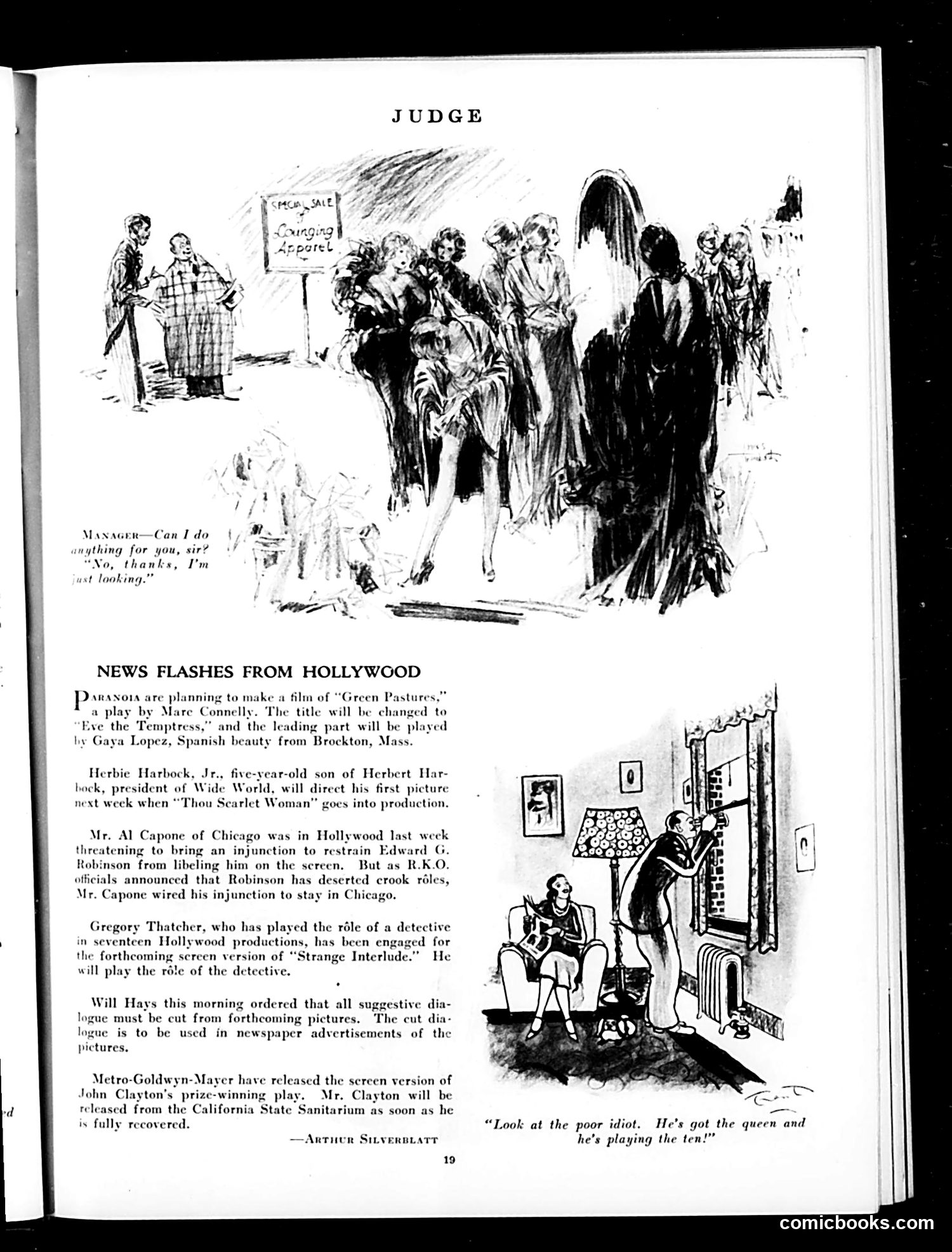
Explanation for Modern Readers This is a satirical column mocking Hollywood's film industry circa the late 1920s-early 1930s. The "News Flashes from Hollywood" use absurdist humor to critique: The jokes: - A serious play ("Green Pastures") being retitled and recast with an unrelated Spanish actress to exploit her name - A five-year-old directing a major film - Al Capone (the infamous Chicago gangster) threatening legal action over his screen portrayal, then withdrawing the threat - A detective being cast in a non-detective role through apparent error - Will Hays (the film censorship authority) banning "suggestive dialogue" while allowing it in advertisements—undermining his own morality standards - A playwright being institutionalized, implied to be driven mad by Hollywood The cartoon below shows two people watching someone play cards poorly ("the queen and he's playing the ten"), calling him "the poor idiot"—likely satirizing foolish decision-making, fitting the page's Hollywood theme. The satire targets Hollywood's commercial desperation, nepotism, censorship hypocrisy, and general incompetence.
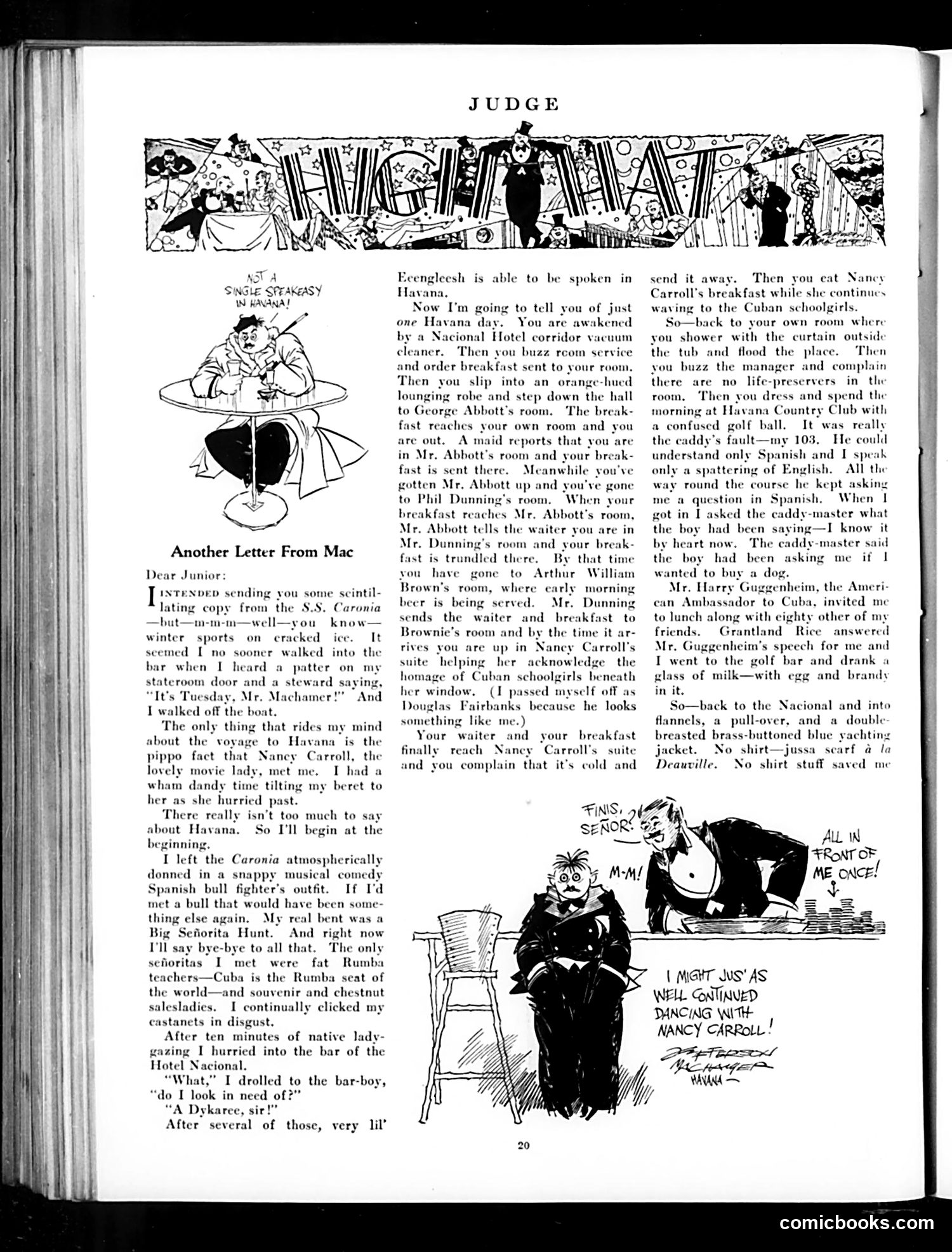
Judge Magazine: "Another Letter From Mac" — Commentary This is a humorous travel letter describing a visit to Havana, Cuba, likely from the 1920s-30s (Prohibition era, given the "speakeasy" reference). The satire targets: American tourists abroad, particularly their self-absorbed behavior and obliviousness to local culture. "Mac" describes absurd hotel antics (deliberately routing breakfast to multiple rooms to confuse staff) and his interactions with Cuban locals, whom he reduces to caricatures—"fat Rumba teachers" and "chestnut salesladies." Key figures/references: - Nancy Carroll: a real American movie actress of the period - Douglas Fairbanks: famous actor, invoked as a flattering comparison - Grantland Rice: prominent sportswriter (appears in the illustration) - Harry Guggenheim: American Ambassador to Cuba The joke: The narrator epitomizes the ugly American tourist—vain, culturally insensitive, more interested in cocktails and flirtation than genuine experience. The closing cartoon shows him preferring dancing with Carroll to anything substantive, perfectly encapsulating his shallow priorities.
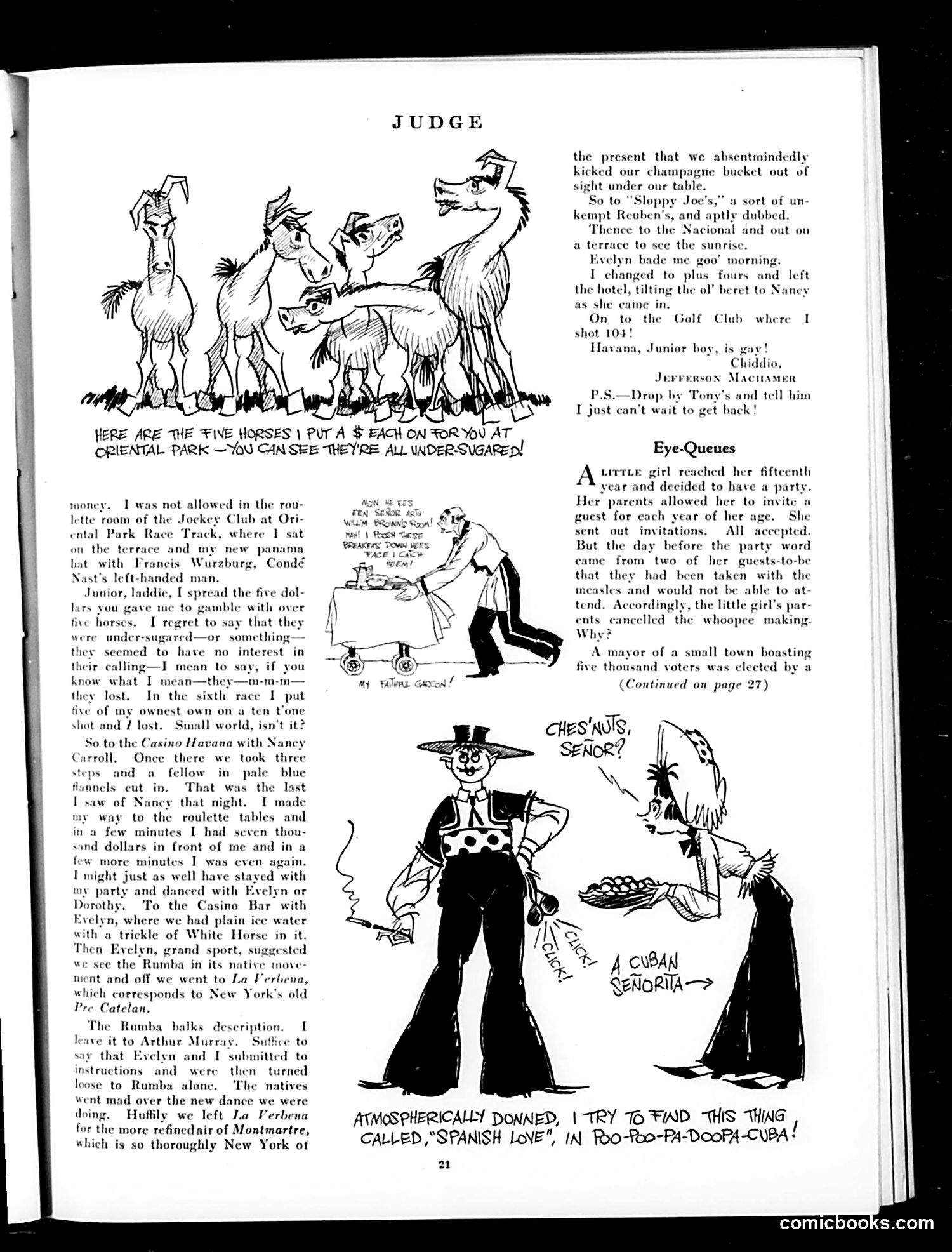
Explanation for Modern Readers This page from *Judge* magazine contains a humorous travel narrative about Havana, Cuba, mixed with visual gags and puzzles. Main narrative: The author recounts a frivolous trip to Havana with socialites, describing gambling losses at Oriental Park racetrack, nightclub visits, and attempts to learn the Rumba dance. The tone is self-deprecating—he loses money, loses his dance partner Nancy Carroll to another man, yet continues partying. Top cartoon: Shows five thin horses labeled as "under-sugared"—a joke about poor racing stock, contrasting with the author's claim he gambled on them. Bottom cartoons: Visual humor about a man trying to impress a Cuban woman ("Señorita") with "Spanish love," depicted as clumsy and overwrought. His atmospheric posturing and awkward "doo-pa-doo-pa-Cuba" nonsense satirize American tourists' fumbling attempts at continental sophistication. "Eye-Queues" section: A separate puzzle about a girl's fifteenth birthday party—likely a logic problem for readers. The satire targets wealthy American leisure travelers' affectations and poor judgment abroad.
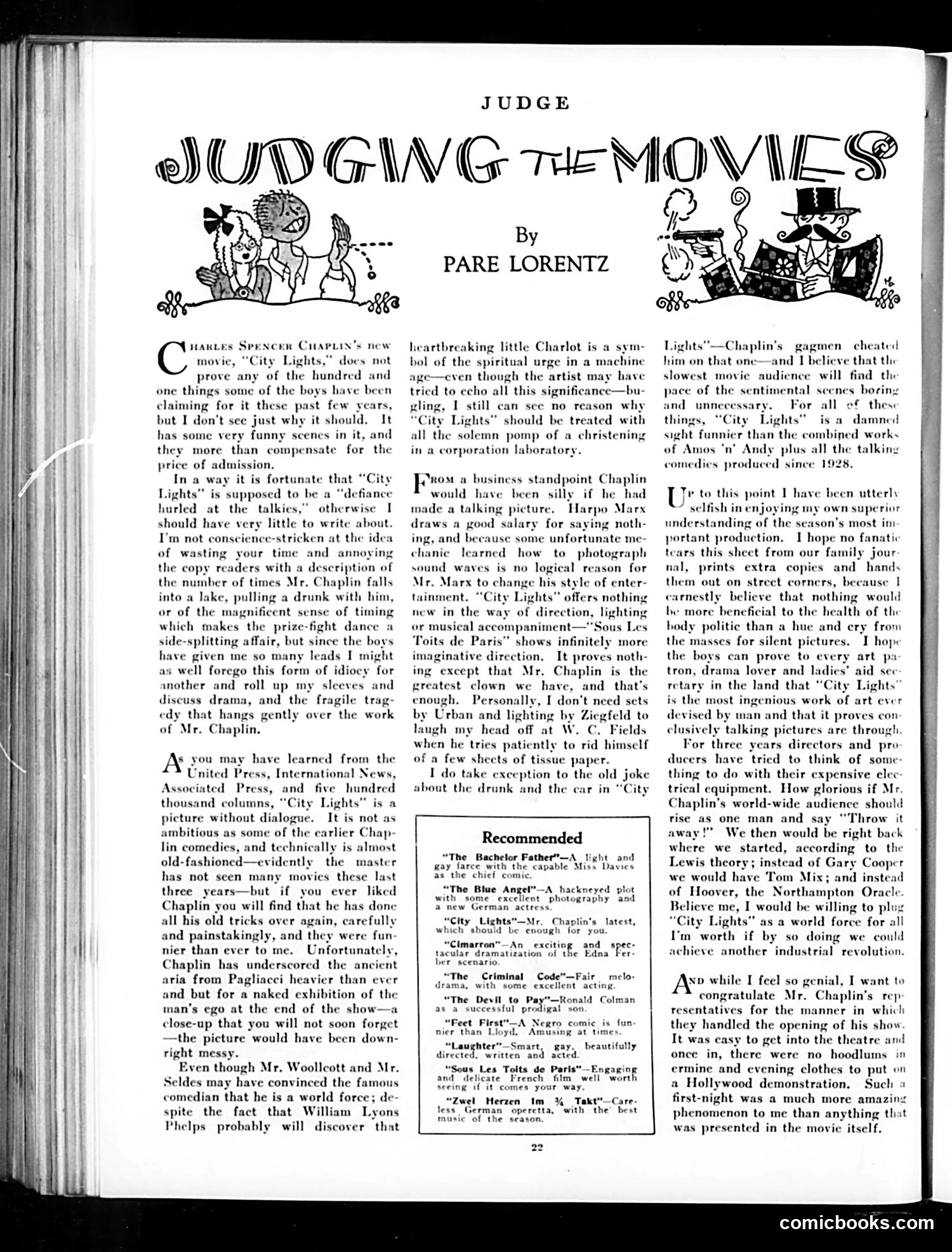
Judge Magazine: "Judging the Movies" by Pare Lorentz This is a film review column (not a cartoon) discussing Charlie Chaplin's silent film *City Lights*. The author defends the film against overstated critical praise while acknowledging its genuine merit. The Satire: Lorentz mocks pretentious critics and fellow reviewers (including noted critics Alexander Woollcott, Gilbert Seldes, and William Lyon Phelps) who claim *City Lights* represents profound artistic or social significance. He argues they're reading too much into what is essentially a series of well-executed comedic gags—the film's genius lies in Chaplin's comic timing and physical performance, not in lofty symbolism about "the spiritual urge in a machine age." The Point: A jab at film criticism's tendency toward inflated rhetoric. Lorentz suggests the film's value is simpler and more honest than the intellectual gymnastics critics perform to justify their enthusiasm. The humor lies in deflating grandiose interpretations of what is, ultimately, a funny movie about a tramp.
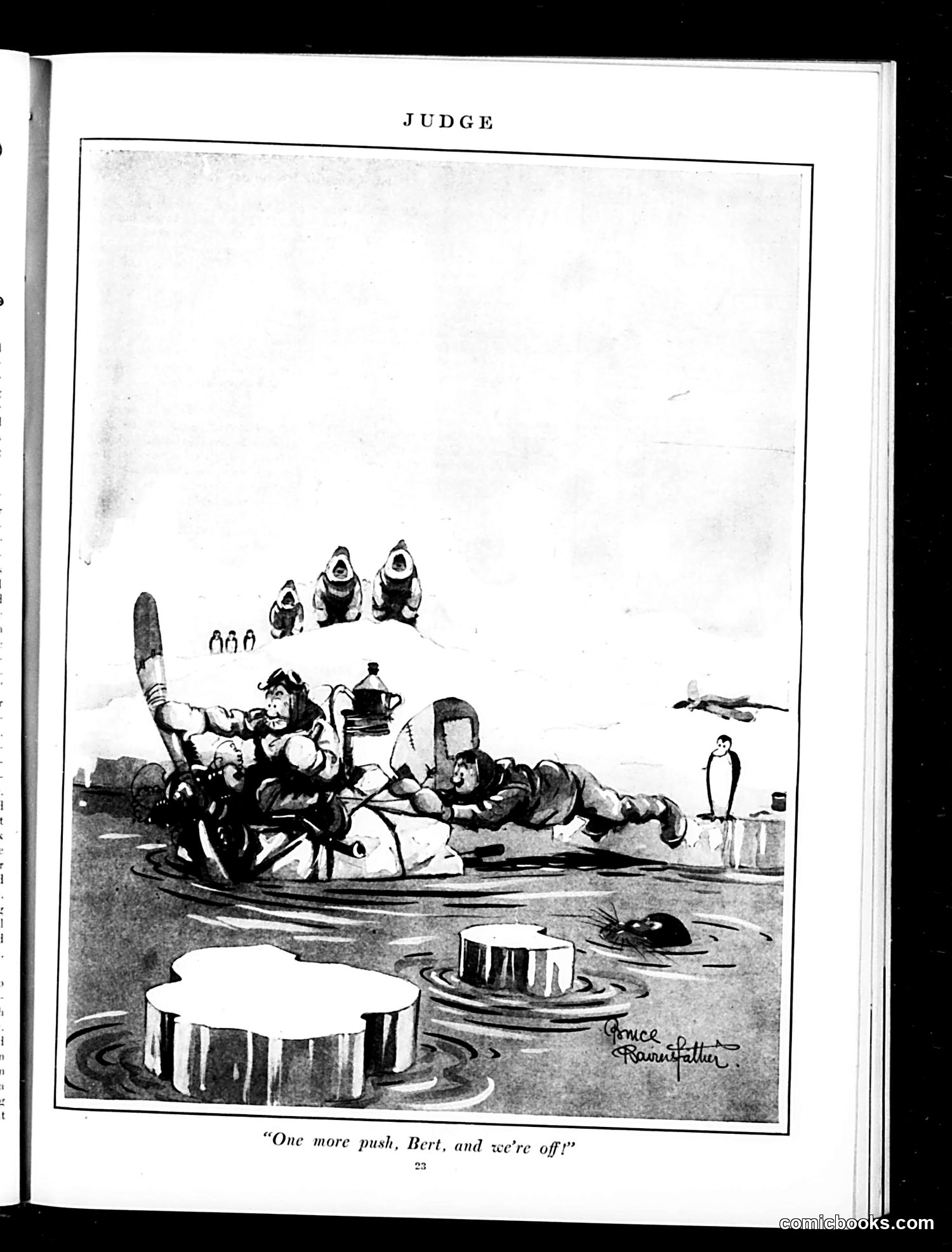
This cartoon depicts a group of men operating what appears to be an early aircraft or flying machine. The caption "One more push, Bert, and we're off!" suggests they're attempting to launch it. The figures in back appear to be Inuit or Arctic peoples, likely included for comedic contrast or to suggest an exotic/remote setting. The satire likely mocks early aviation attempts—a topical subject in the early 20th century when powered flight was still novel and often unsuccessful. The casual, determined tone of "one more push" humorously trivializes what was actually dangerous experimental technology. The various scattered objects and the chaotic scene reinforce the slapstick nature of the joke about primitive flying machine engineering.
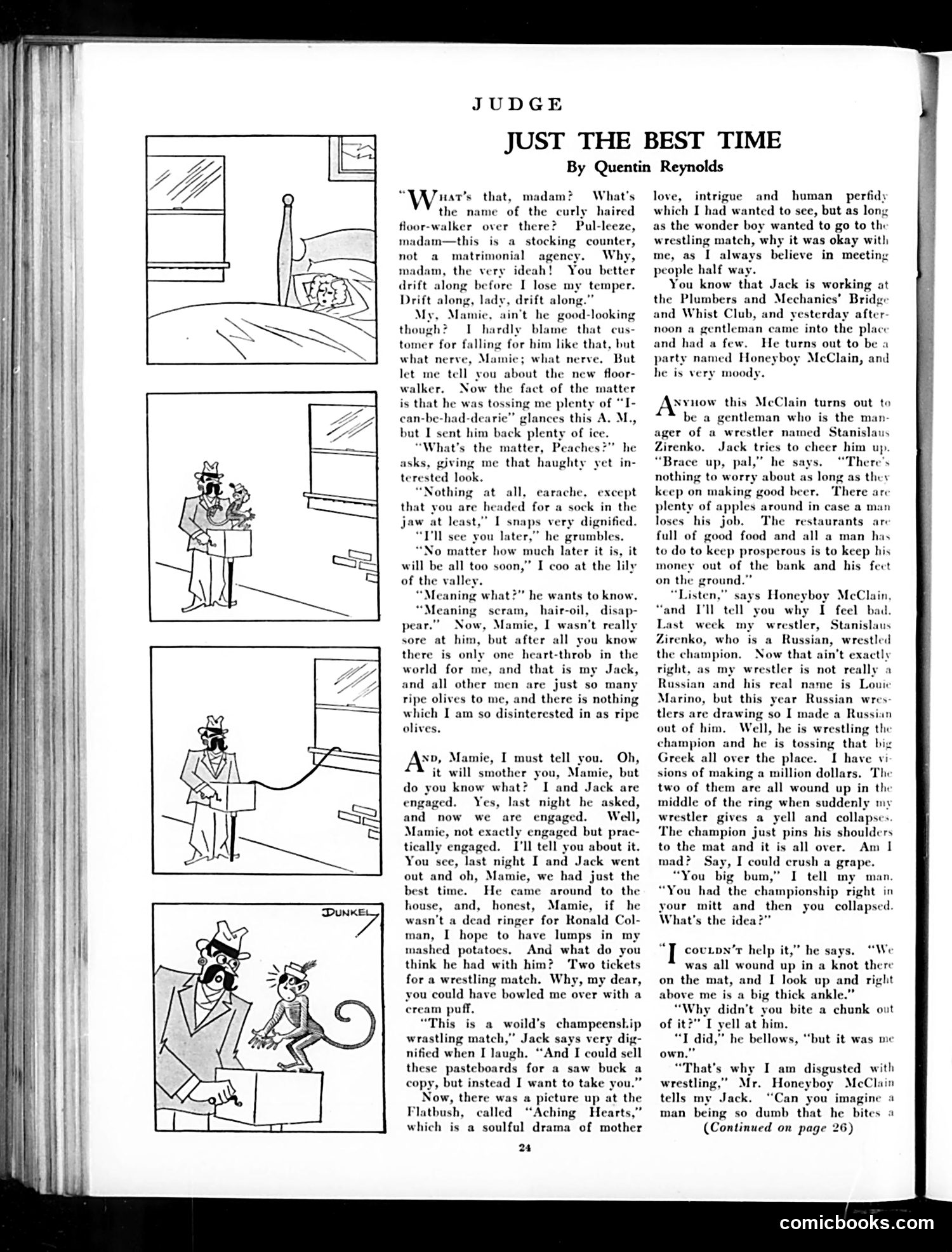
"Just the Best Time" by Quentin Reynolds This is a romantic comedy story illustrated with four cartoon panels. The narrative follows a female department store employee named Mamie who works at a stocking counter. She's distracted by a charming new floor-walker (a retail clerk who assists customers), but her heart belongs to Jack, who works at the Plumbers and Mechanics' Bridge and Whist Club. The story describes how Jack took Mamie to a professional wrestling match instead of the movie "Aching Hearts" she wanted to see. At the venue, they meet Honeyboy McClain, manager of wrestler Stanislaus Zirenko (actually an Italian-American named Louie Marino, billed as Russian to capitalize on contemporary interest in Russian wrestlers). The humor relies on class-conscious observations about working-class courtship, wrestling fandom, and period-appropriate romantic gestures. The story appears to continue on page 26.
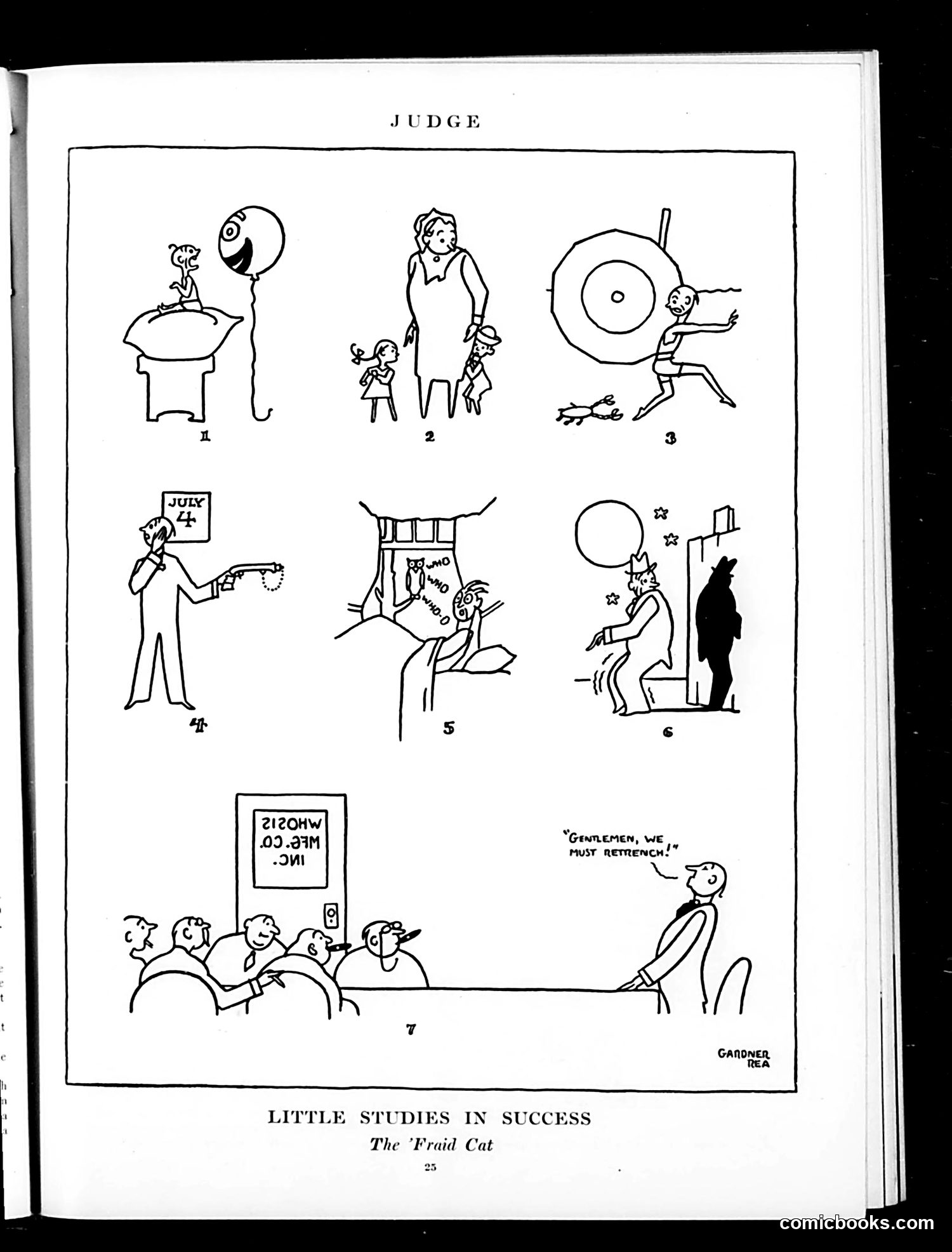
Analysis This is a satirical comic strip titled "Little Studies in Success: The 'Fraid Cat" by Gardner (signed lower right). The seven panels depict a timid man repeatedly encountering situations requiring courage—a woman with children, operating machinery, scheduling conflicts, climbing heights, and celestial imagery—yet consistently backing away or hesitating. The final panel shows him addressing a group, declaring "Gentlemen, we must retrench!" (meaning cut back expenses), apparently attempting leadership despite his demonstrated cowardice throughout the strip. The satire targets those who lack personal courage but nonetheless assume positions of authority and make decisions affecting others. It's a commentary on weak leadership and the gap between public pronouncements and private character—relevant to early 20th-century business and political culture depicted in *Judge* magazine.
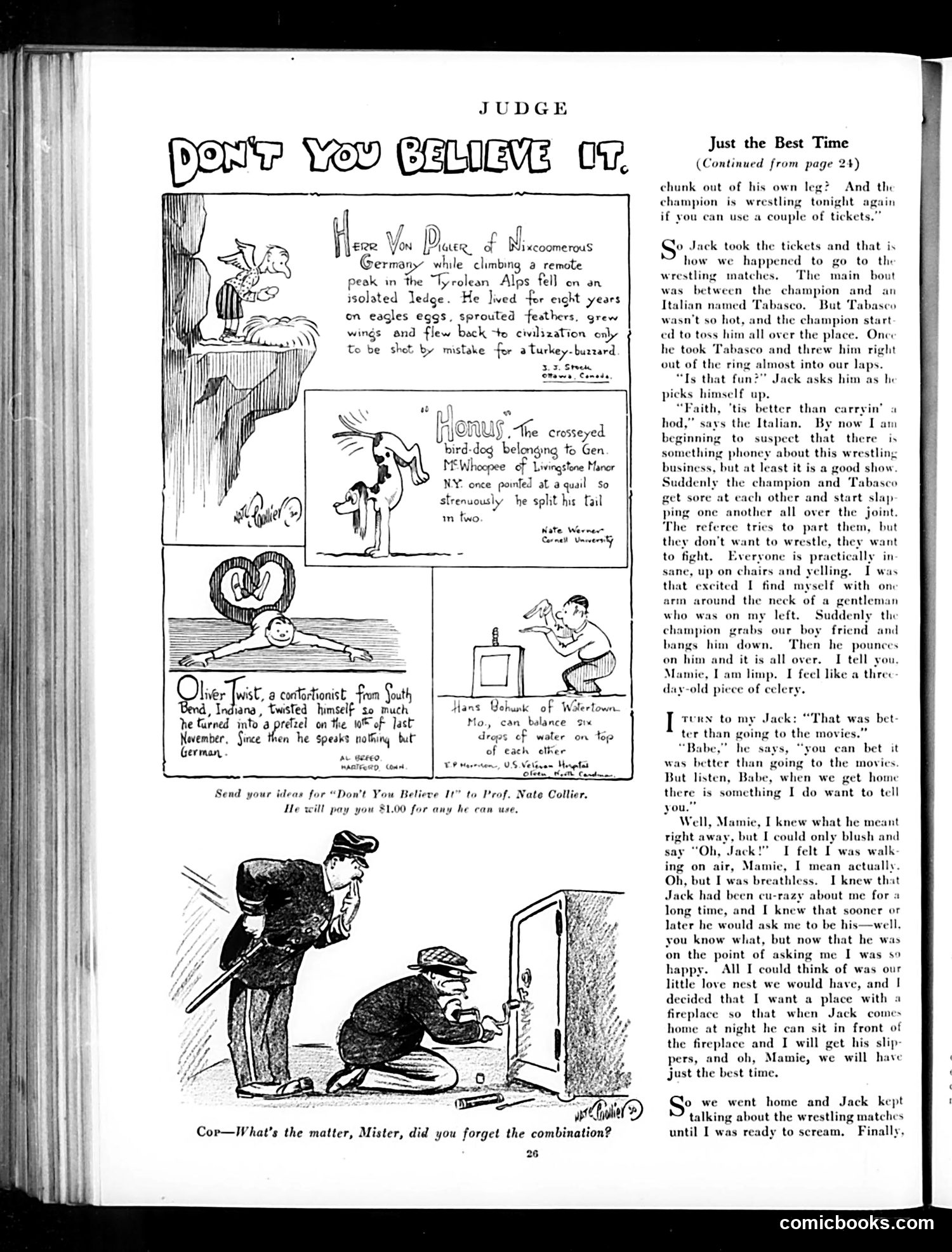
"Don't You Believe It" — A Humor Column This page features Judge magazine's "Don't You Believe It" section—a recurring feature presenting absurd, tall-tale anecdotes meant to be obviously false. The cartoons illustrate ridiculous claims: a German who survived eight years on an isolated ledge eating eagle eggs and sprouted wings; a cross-eyed hunting dog that split his own tail; a contortionist from Indiana who twisted himself into a pretzel; and a man balancing water drops. The accompanying article, "Just the Best Time," is a domestic humor piece where a woman (Mamie) recounts attending wrestling matches with her husband Jack. She hints at romantic expectations when Jack says he has something to tell her—likely a marriage proposal. The joke's payoff: Jack only wanted to talk about the wrestling matches, disappointing her completely. The page satirizes everyday life through exaggeration and anticlimax, typical of Judge's early-20th-century satirical style.
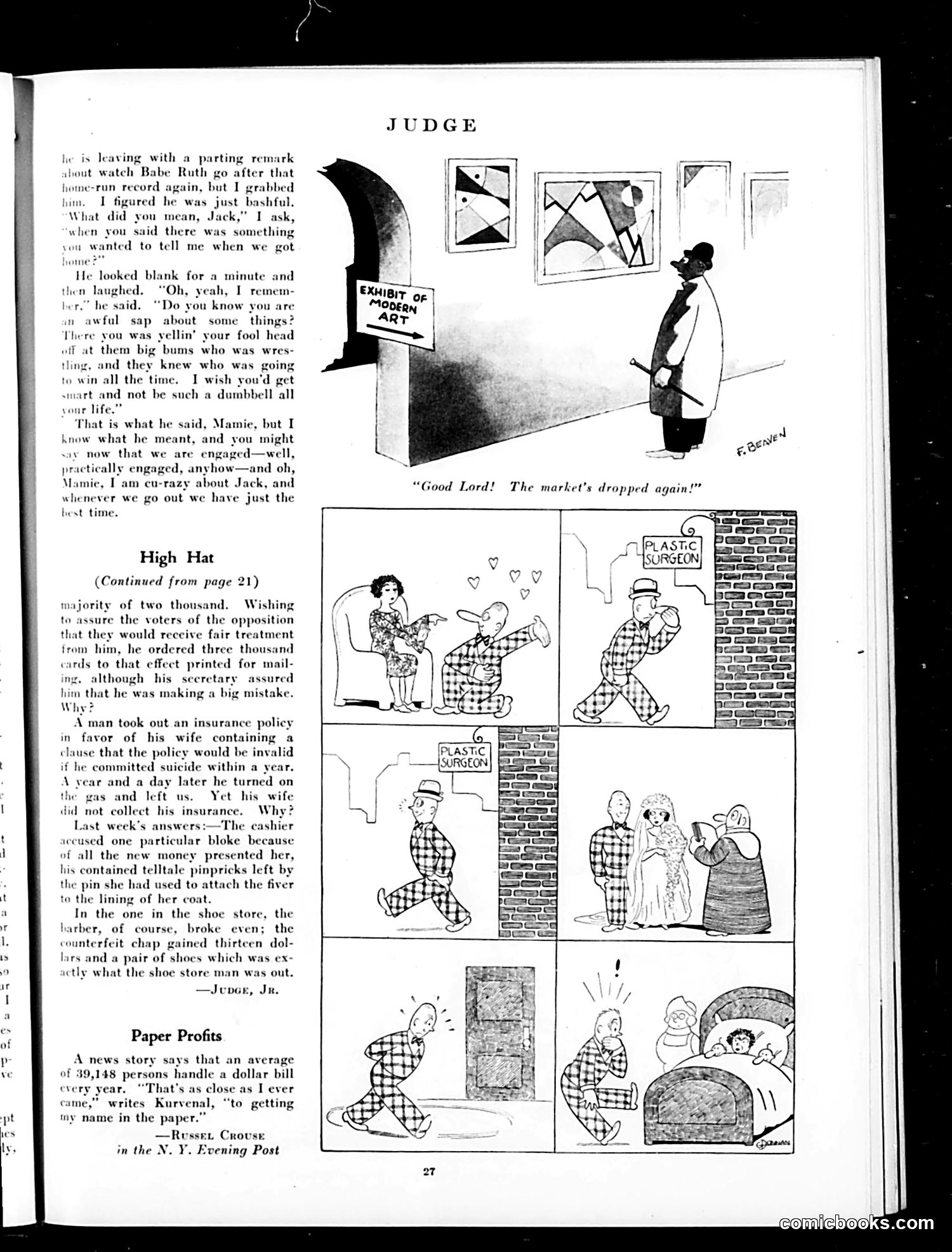
Analysis Top cartoon ("Judge"): A man in formal dress views abstract modern art at an "Exhibit of Modern Art" gallery, exclaiming "Good Lord! The market's dropped again!" This satirizes the 1920s art world and financial anxiety—the joke suggests that modern art's value fluctuates as wildly and incomprehensibly as stock markets, implying both are speculative bubbles detached from rational assessment. Comic strip ("High Hat"): A slapstick sequence shows a man in checkered clothing repeatedly colliding with a brick wall marked "Plastic Surgeon," each time appearing more damaged. Finally, two women observe him in a hospital bed, apparently bandaged. This appears to be visual humor about plastic surgery—treating the "surgeon's" wall as an actual hazard, with the implication that cosmetic procedures were a growing (and ridiculous) trend worthy of mockery. Text sections: Include anecdotal humor columns typical of Judge magazine's satirical style, with wordplay and observations about human folly.
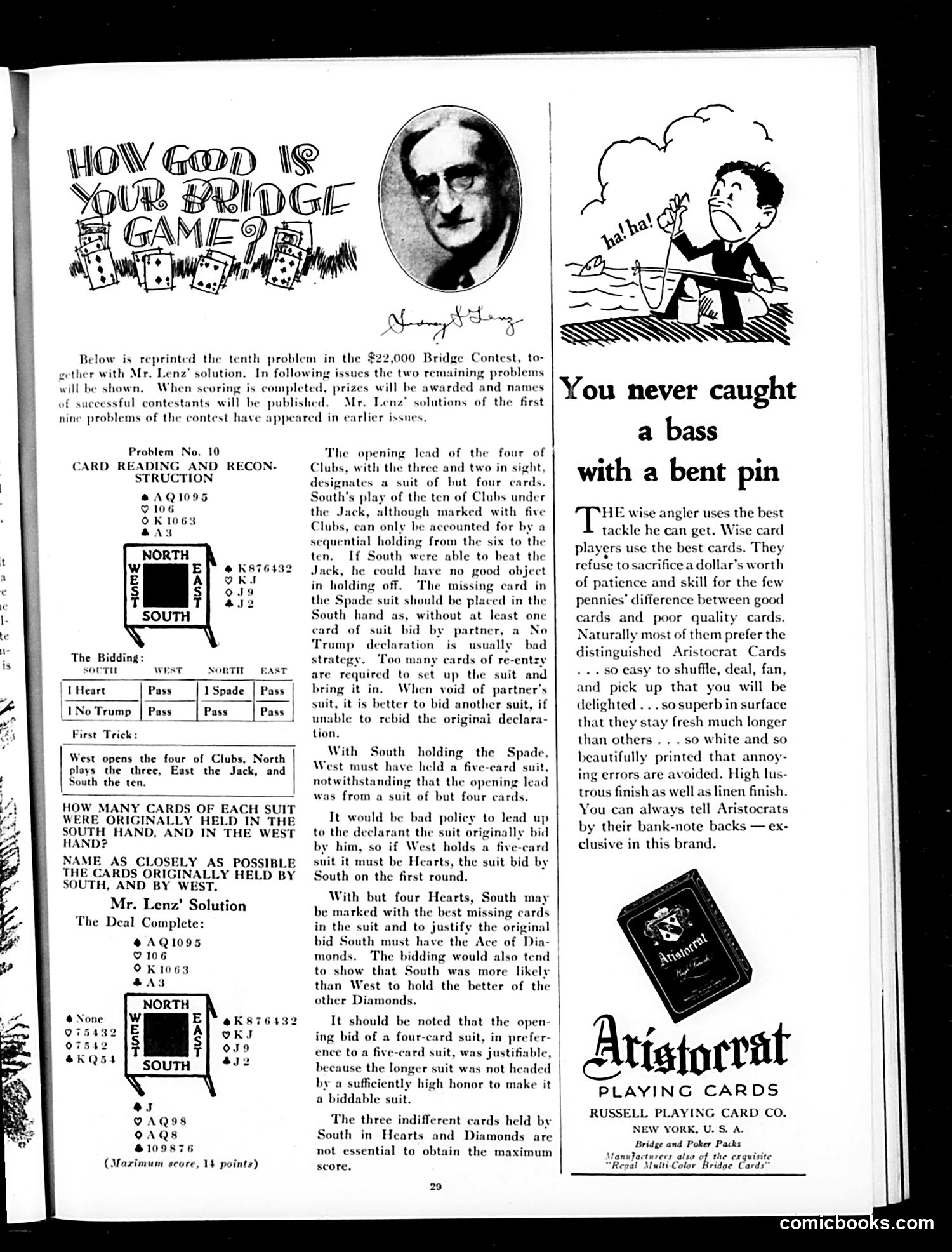
Judge Magazine Bridge Problem Page Analysis This page combines bridge instruction with advertising. The main content presents Problem No. 10 from a $22,000 bridge contest (apparently a real competition Judge was sponsoring), with expert solution by "Mr. Lenz." The problem involves analyzing a card hand and determining the original distribution of cards among players. The portrait appears to be Lenz himself, the contest's problem-setter and expert commentator. The right-side cartoon shows a frustrated fisherman saying "ha! ha!" while fishing poorly—likely referencing an idiom about using the wrong tools. Below this runs an Aristocrat Playing Cards advertisement that uses the fishing analogy as a metaphor: "You never caught a bass with a bent pin"—just as poor anglers won't succeed with inferior tackle, card players shouldn't use cheap cards. The ad emphasizes Aristocrat cards' superior quality: better shuffle-ability, durability, printing, and distinctive bank-note-style backs. The page essentially functions as sponsored bridge content doubling as card-product marketing.
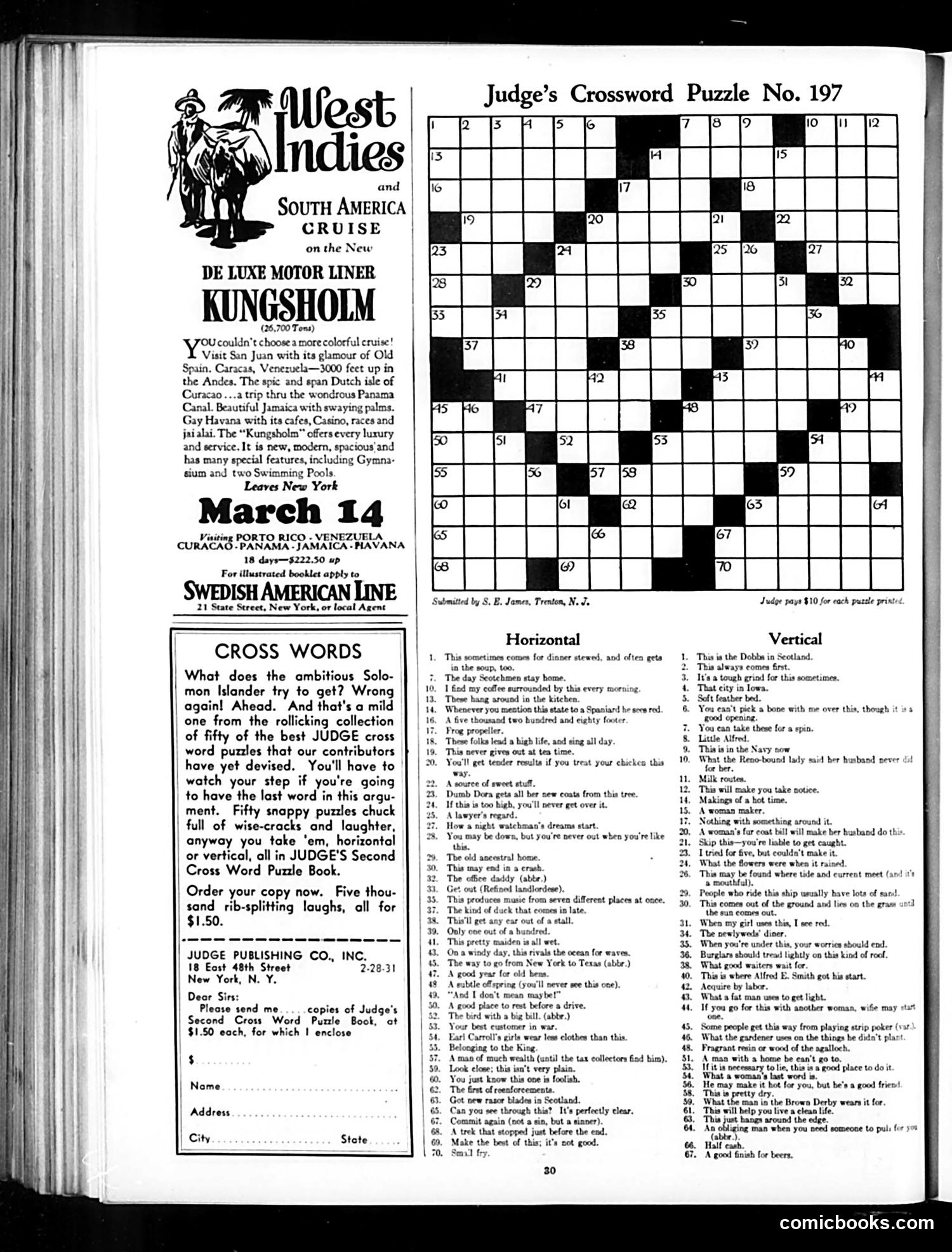
Judge Magazine Page Analysis This page is primarily advertising and puzzle content rather than political satire. The dominant feature is a cruise ship advertisement for the Swedish American Line's "Kungsholm," promoting a 18-day Caribbean voyage departing March 14, visiting ports in Venezuela, Panama, Jamaica, and Cuba. Below the cruise ad is promotional material for Judge's "Second Cross Word Puzzle Book" (50 puzzles for $1.50), followed by the actual crossword puzzle #197 with clues listed horizontally and vertically. The satirical element is minimal: The brief intro copy uses mild humor about a "Solomon Islander" trying to solve crosswords, but this is generic wordplay rather than political commentary. The crossword clues themselves contain light jokes (references to Dumb Dora, Earl Carroll's chorus girls), typical of 1930s humor magazines, but no identifiable political figures or current events are targeted. This appears to be a typical Judge magazine page mixing advertisements with entertainment content.
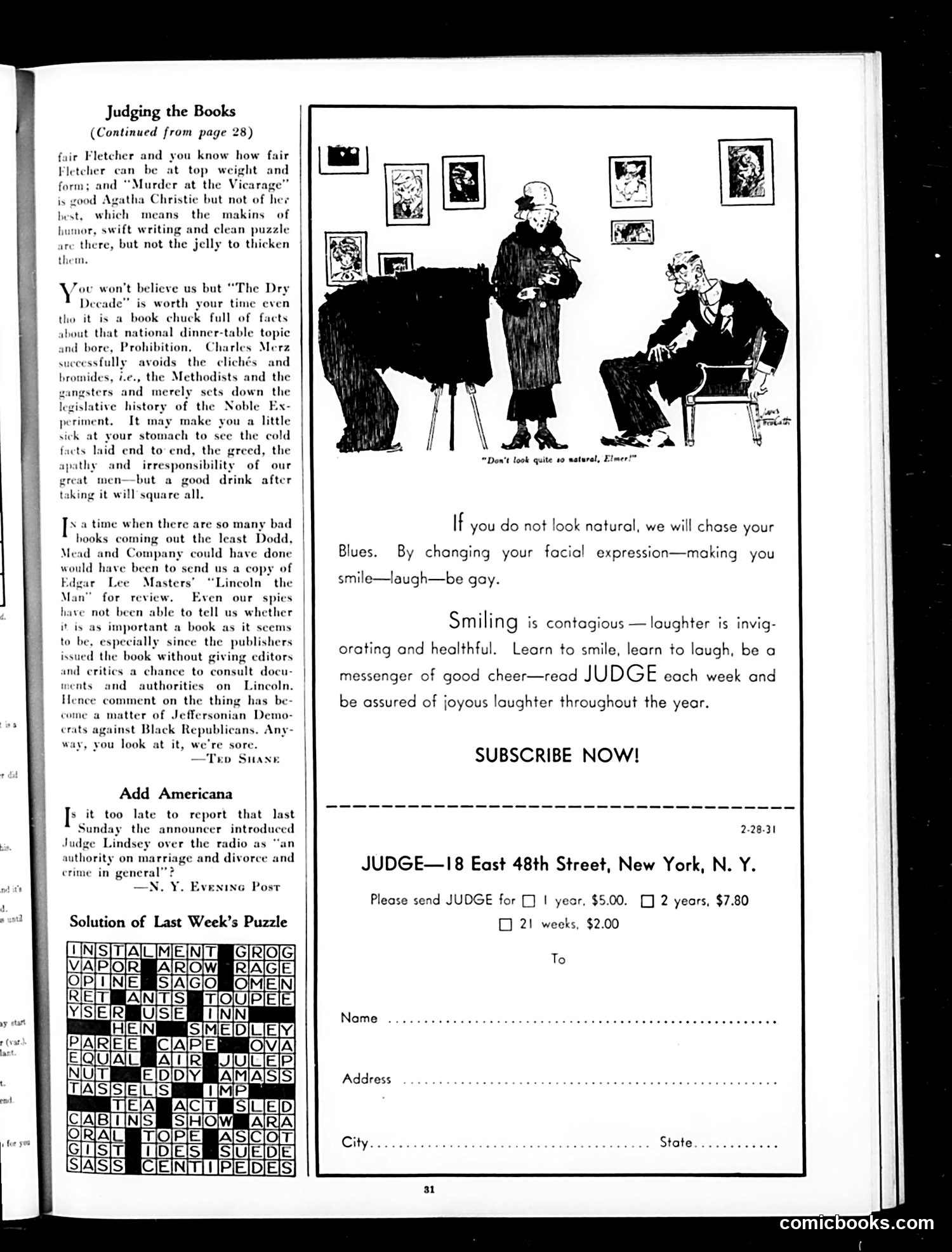
Analysis of This Judge Magazine Page This page is primarily book reviews and advertising rather than political satire. The main content critiques recent publications, including works about Prohibition ("The Dry Decade" by Charles Merz) and Edgar Lee Masters' Lincoln biography. The single cartoon depicts a scene where one man tells another, "Don't look quite so natural, Elmer!"—a joke about forced cheerfulness. The accompanying text explains the humor: by changing your facial expression to smile and laugh, you'll appear less "blue" (depressed). The message is that smiling is contagious and beneficial. The "Add Americana" section briefly mentions Judge Ben Lindsey, a real progressive-era judge famous for his advocacy on marriage, divorce, and juvenile delinquency issues. The anecdote humorously notes a radio announcer introduced him as an authority on "crime in general"—an exaggeration of his actual expertise. The page concludes with a subscription advertisement encouraging readers to read Judge weekly for humor and cheer. There is minimal political commentary; this appears to be a typical magazine filler page.
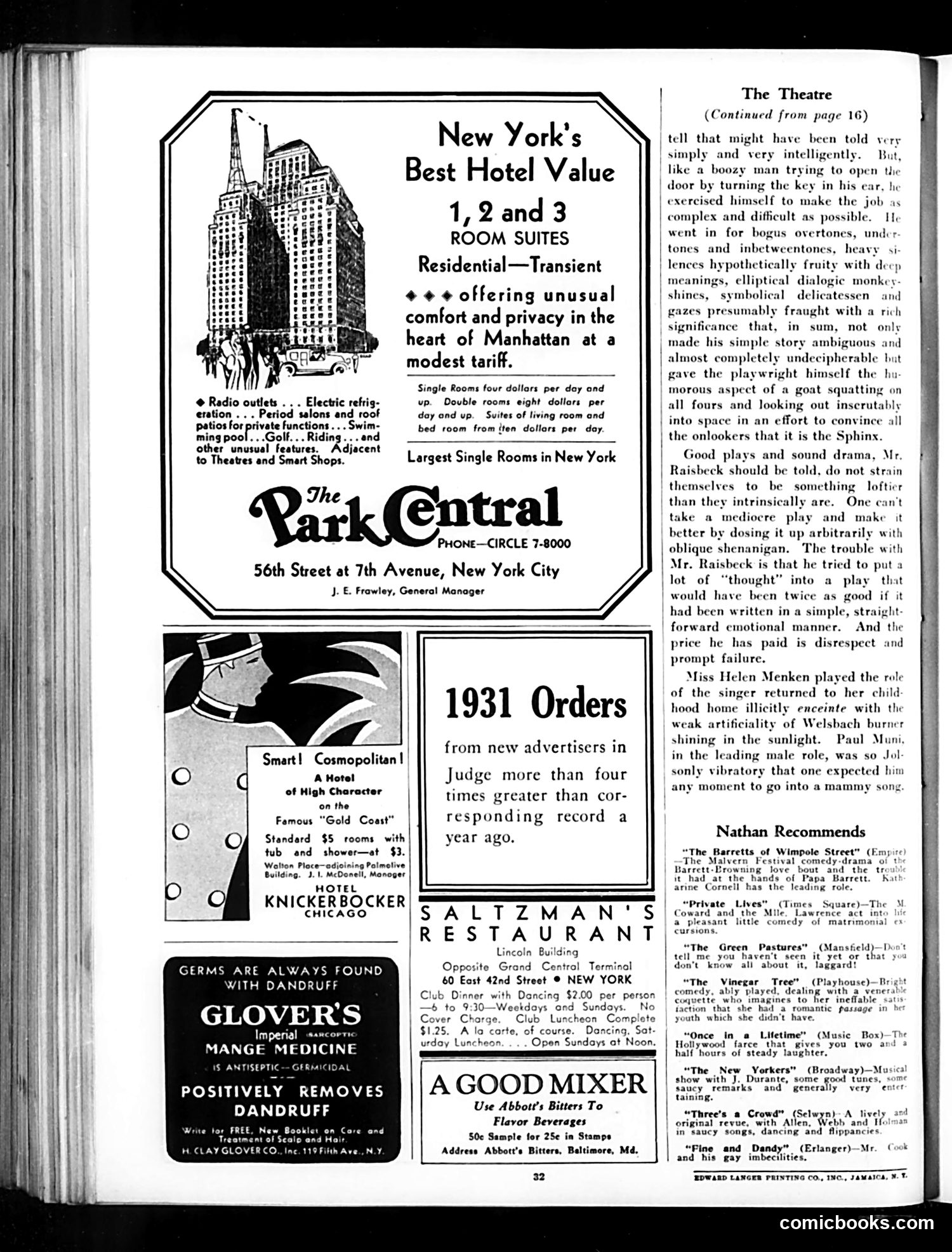
Page Analysis: Judge Magazine Advertisement & Theatre Review This page is primarily advertising for 1931 New York hotels, restaurants, and commercial products, with a theatre review column on the right. The key content point is the boxed announcement: "1931 Orders from new advertisers in Judge more than four times greater than corresponding record a year ago." This reflects economic optimism during the Depression's early stages—advertisers were still investing heavily in magazine advertising, suggesting confidence in consumer spending. The ads themselves reveal period details: hotels advertised "Radio outlets," swimming pools, and golf facilities as luxuries; Glover's "Mange Medicine" promised dandruff removal; Abbott's Bitters promoted alcohol flavoring (relevant during Prohibition's tail end). The theatre column reviews contemporary Broadway productions and performers (Helen Menken, Paul Muni, Katharine Cornell), critiquing a playwright's overcomplicated approach to storytelling—a standard dramatic critique unrelated to current events. No political satire or caricature appears on this page.
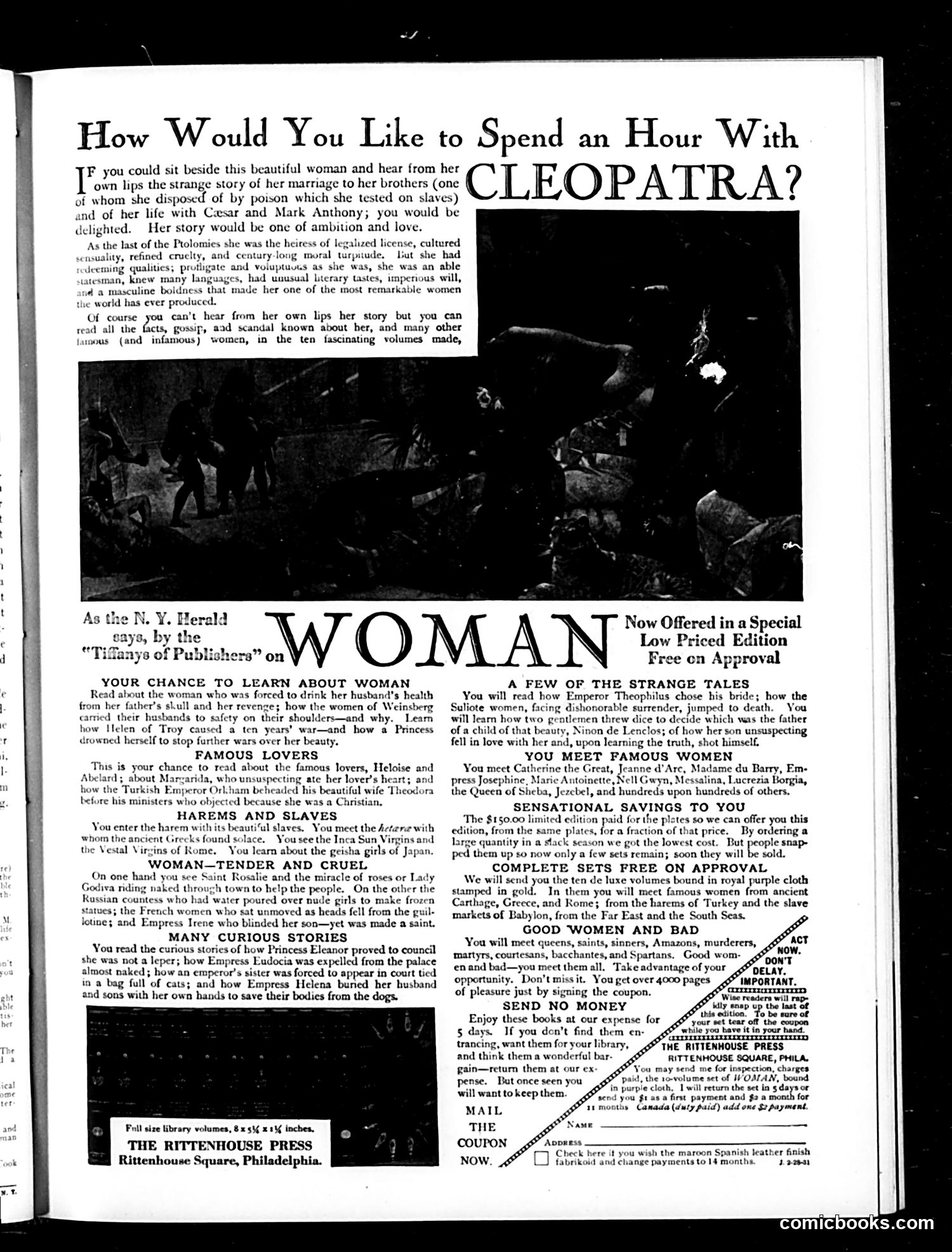
Analysis for Modern Readers This page is primarily advertising, not satire. It promotes a ten-volume book series called "Woman" published by the Rittenhouse Press, marketed as an affordable edition of previously expensive volumes. The advertisement uses sensationalism to sell the books—emphasizing lurid historical tales of famous women (Cleopatra, Catherine the Great, Marie Antoinette, Lucrezia Borgia, etc.). The headline asks readers to imagine spending an hour with Cleopatra, teasing dramatic stories: poisonings, affairs with Caesar and Mark Antony, harems, and slave women. The implicit appeal: Women presented as simultaneously cultured and morally corrupt—"refined cruelty," seduction, and shocking behavior. The framing reflects early-20th-century attitudes viewing women's power through scandal rather than accomplishment. This is not political satire but rather a period advertising strategy exploiting public fascination with sensationalized female history to drive book sales. The "Judge" magazine context suggests it targets readers seeking intellectual or educational content, albeit presented through scandal.
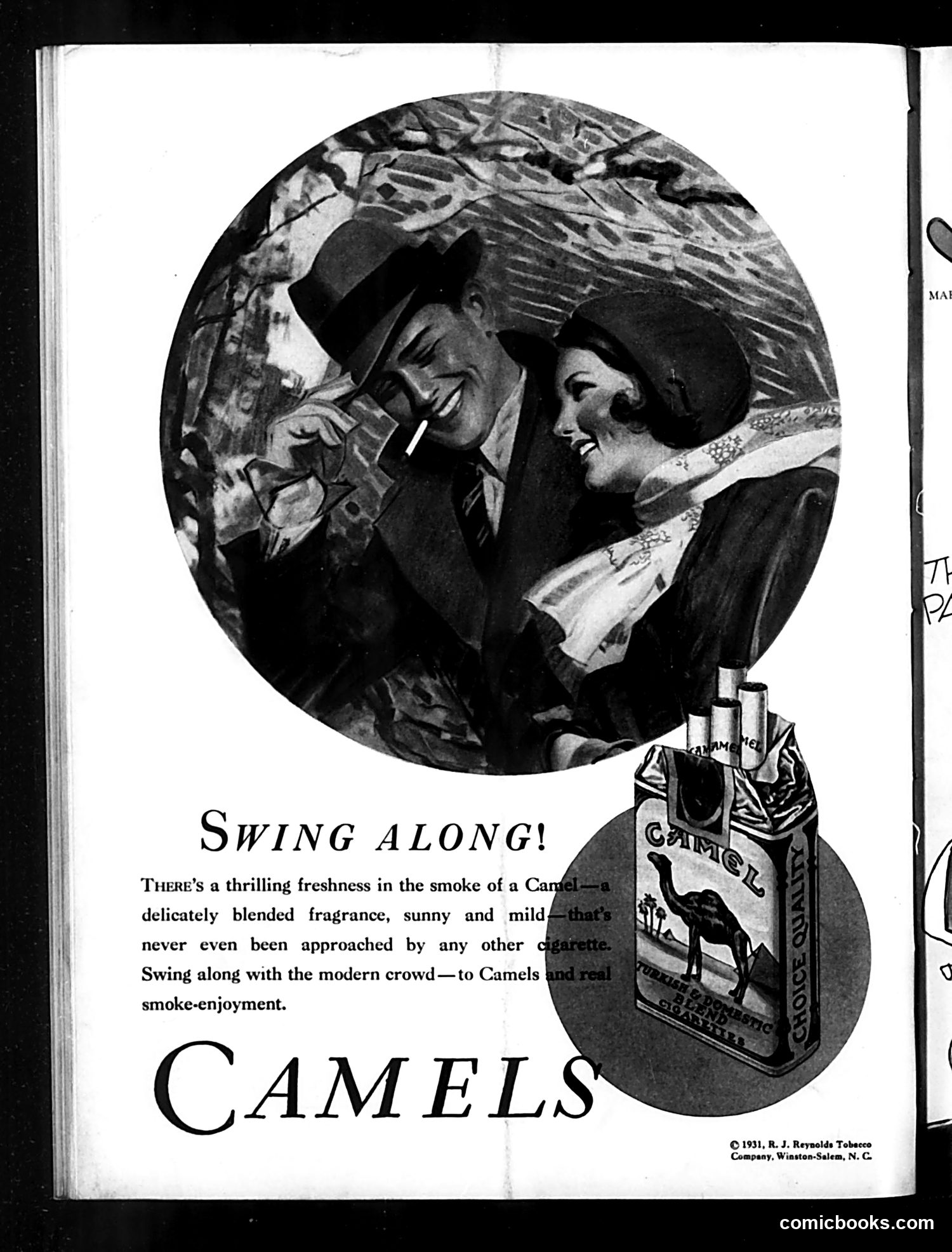
Analysis This is a Camel cigarette advertisement, not political satire. The page shows two men in 1930s attire examining what appears to be architectural plans or blueprints in a circular vignette. The "swing along" headline references the popular jazz/swing culture of the era. The ad's appeal targets the "modern crowd" by associating Camel cigarettes with contemporary sophistication and leisure. The construction/planning imagery suggests progress and modernity. The text emphasizes the cigarette's distinctive "fragrance" and mildness compared to competitors—standard advertising claims of the period. Dated 1931, this reflects pre-health-warning tobacco marketing that freely promoted cigarettes as aspirational lifestyle products without mentioning health risks.