judge
Judge — March 7, 1931
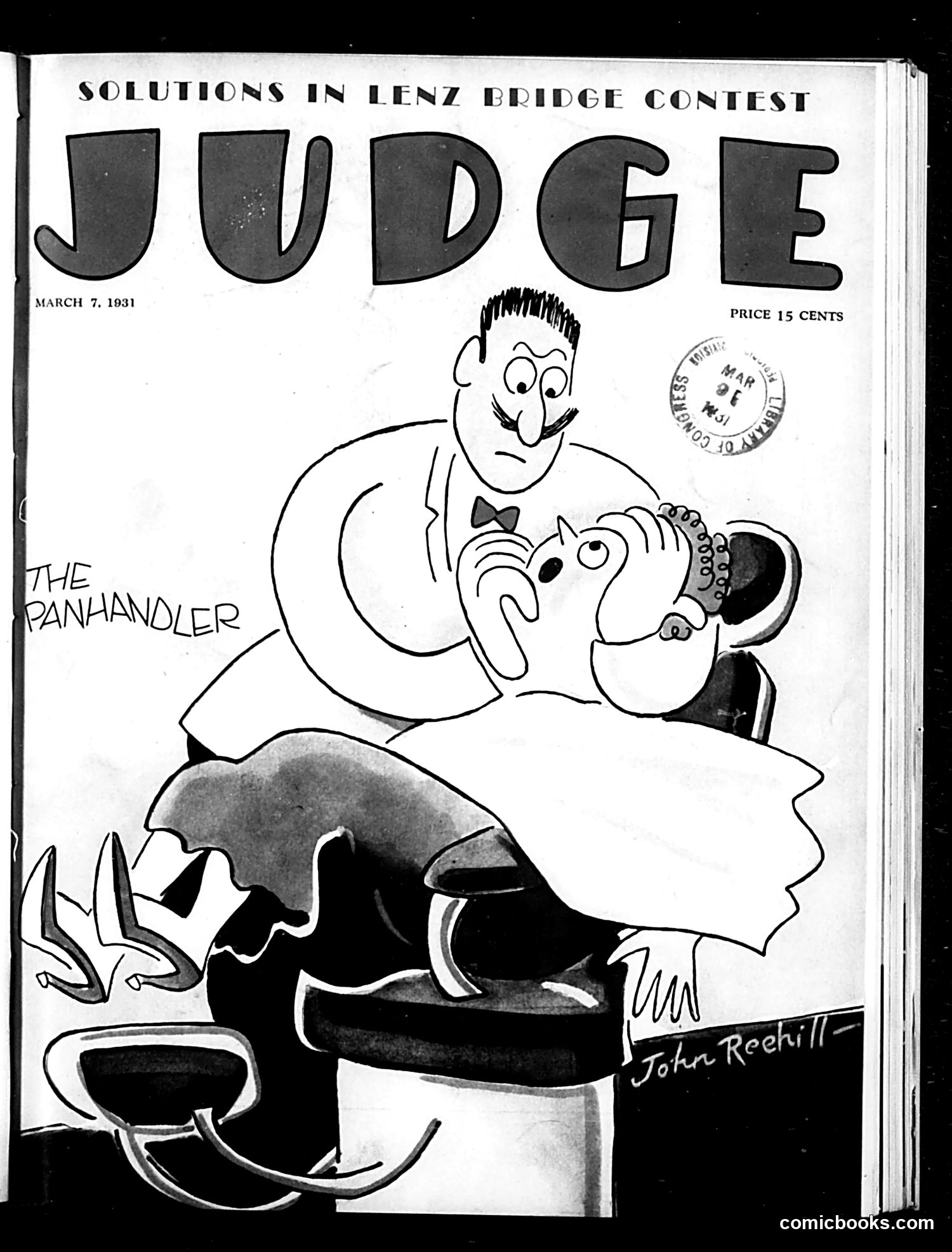
Analysis of Judge Magazine Cover, March 7, 1931 This is the cover of Judge, a satirical magazine, featuring "The Panhandler" — a cartoon about begging during the Great Depression. The illustration shows a well-dressed man with an exaggerated nose soliciting money from a woman wearing jewelry and fashionable attire. The cartoon's humor derives from the economic disparity visible during the 1931 Depression: even ostensibly respectable people were forced to panhandle, while others maintained wealth and finery. The title references "Solutions in Lenz Bridge Contest," though the connection between this contest and the cover cartoon is unclear from the visible text. The artist is credited as John Rechill.
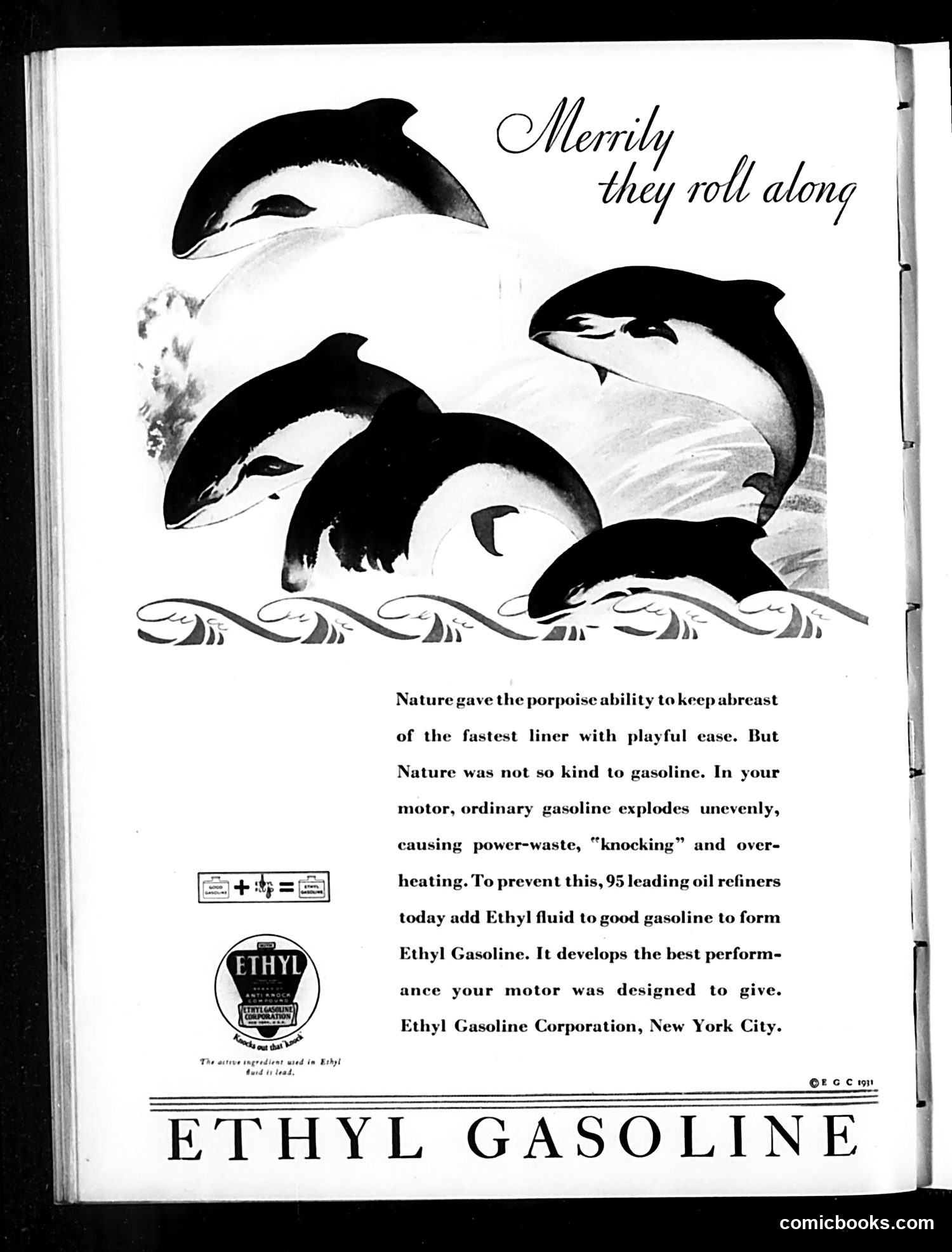
Analysis of This Page This is primarily advertising, not satire or political commentary. It's a 1911 advertisement for Ethyl Gasoline by the Ethyl Gasoline Corporation of New York City. The illustration shows dolphins jumping playfully with the caption "Merrily they roll along"—a nature metaphor suggesting smooth, effortless performance. The ad's central argument compares the dolphin's natural ability to move efficiently through water with how Ethyl Gasoline allows motors to run smoothly. The text contrasts nature's superiority with ordinary gasoline's problems: uneven combustion causing "knocking" and overheating. The solution: add Ethyl fluid to regular gasoline for optimal motor performance. This represents early automotive advertising using appealing imagery and nature-based comparisons to sell fuel additives to consumers.
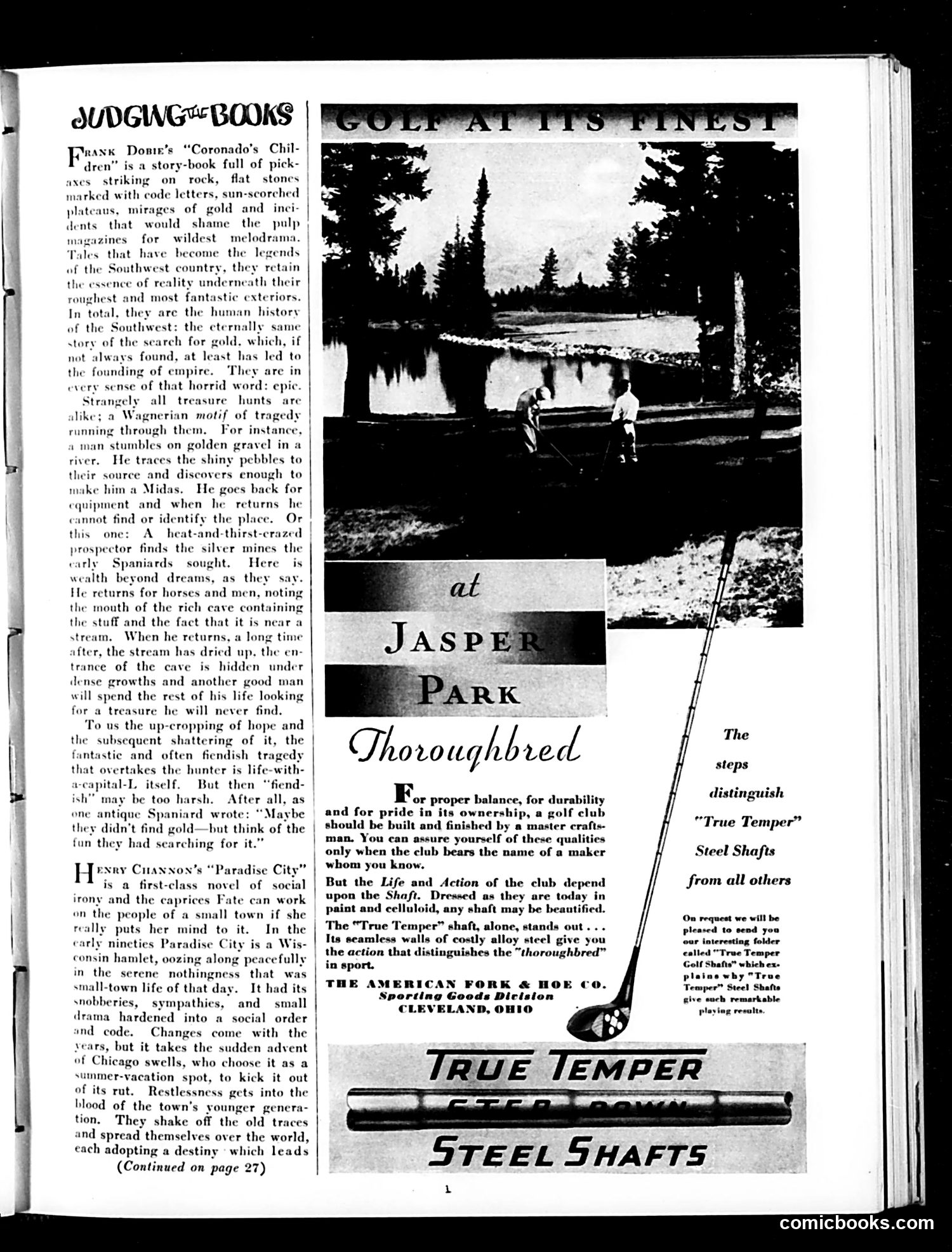
Analysis This page is primarily advertising, not political satire. The dominant content is a full-page advertisement for "True Temper" golf club steel shafts, manufactured by The American Fork & Hoe Company in Cleveland, Ohio. The ad features a scenic photograph of Jasper Park with golfers and includes promotional copy emphasizing the product's quality and durability. The left column contains book reviews under "Judging the Books," discussing Frank Dobie's "Coronado's Children" and Henry Channon's "Paradise City" — literary commentary unrelated to political cartooning. There is no political cartoon or satire visible on this page. It represents typical mid-20th century magazine layout combining editorial content with substantial advertising.
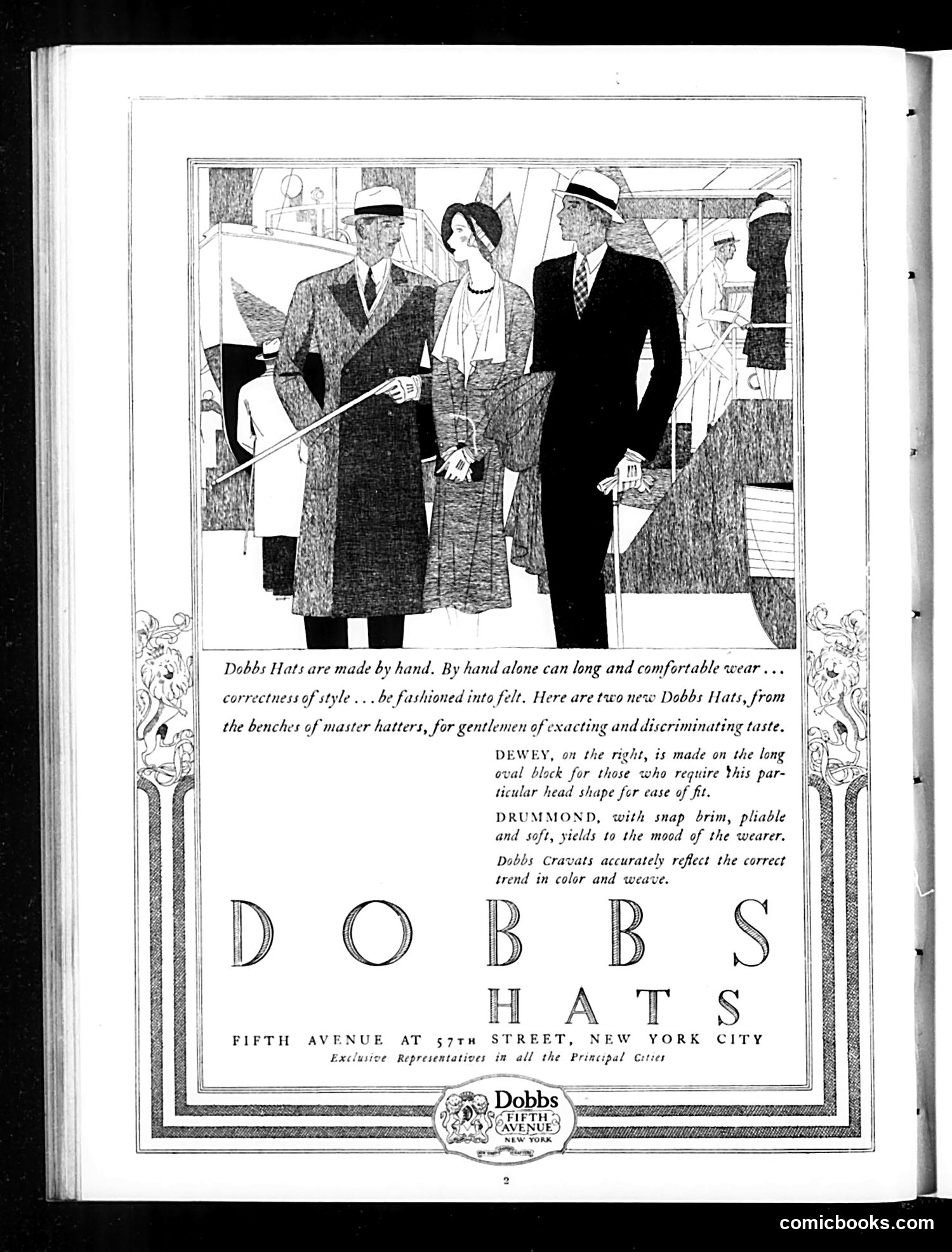
Analysis This is primarily a Dobbs Hats advertisement, not political satire. The page shows well-dressed men and a woman in what appears to be a hat shop or showroom setting, circa early 20th century. The ad emphasizes that Dobbs Hats are "made by hand" and claims they offer "long and comfortable wear" with "correctness of style." Two specific hat styles are mentioned: - Dewey: designed for oval head shapes - Drummond: featuring a snap brim described as "pliable and soft" The ad targets "gentlemen of exacting and discriminating taste" and notes that Dobbs cravats also reflect current fashion trends. The decorative border and illustration style are typical of Judge magazine advertisements from this era. There is no discernible political commentary—it's purely commercial marketing.
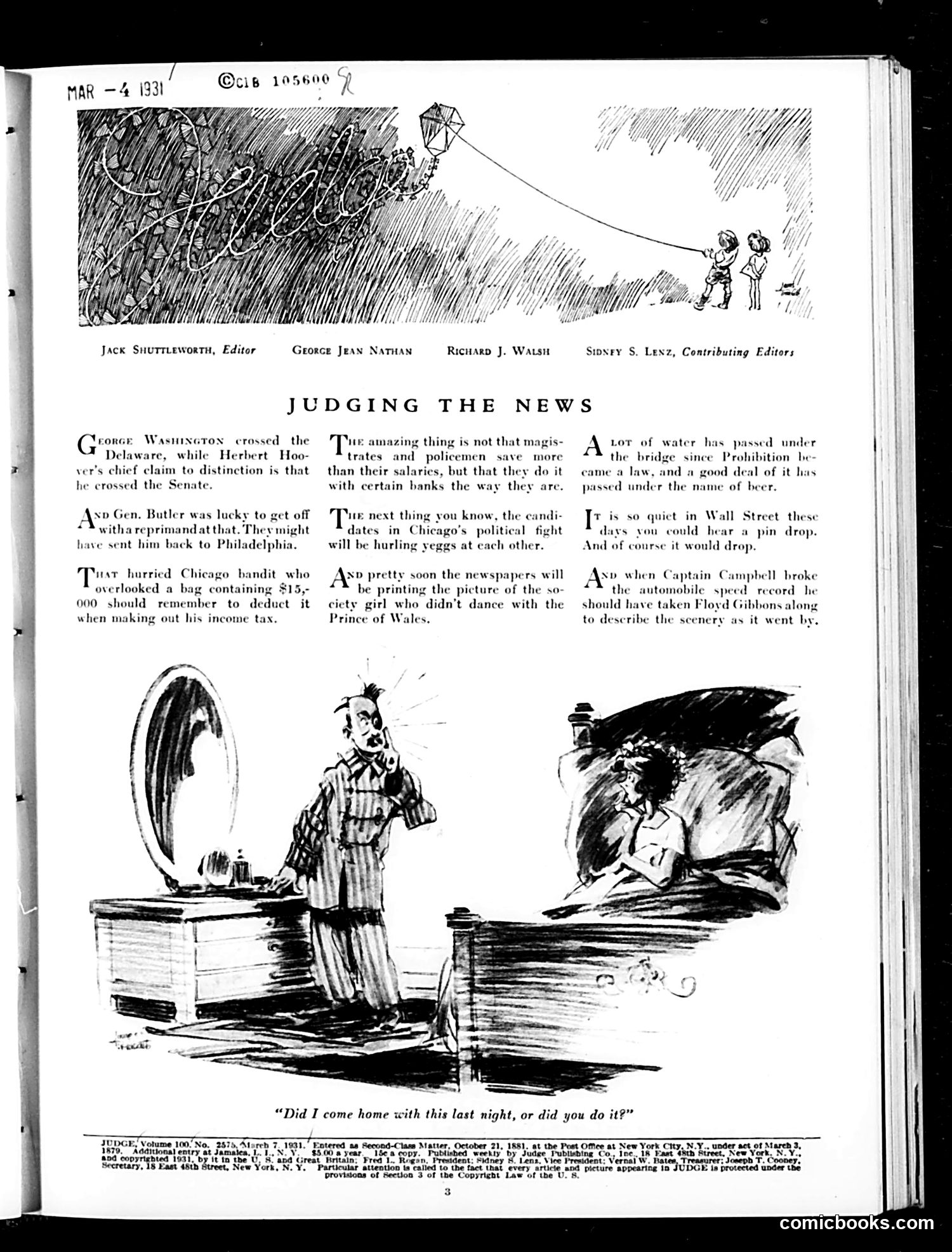
"Judging the News" - March 4, 1931 This satirical commentary page mocks contemporary political and social scandals. The text references: - George Washington crossing the Delaware vs. Herbert Hoover's claim to Senate distinction — comparing historical achievement to modern political mediocrity - Gen. Butler's reprieve — likely referring to General Smedley Butler's recent court-martial case - Chicago bandit's $15,000 tax deduction — mocking a criminal attempting to claim illegal income as a business expense - Wall Street quietness — referencing the post-1929 crash economic depression - Captain Campbell's speed record — an aviation record attempt The bottom cartoon shows a confrontation about infidelity ("Did I come home with this last night, or did you do it?"), satirizing domestic scandal-mongering in newspapers. Overall, the page critiques how newspapers sensationalize petty scandals while ignoring serious economic crisis.
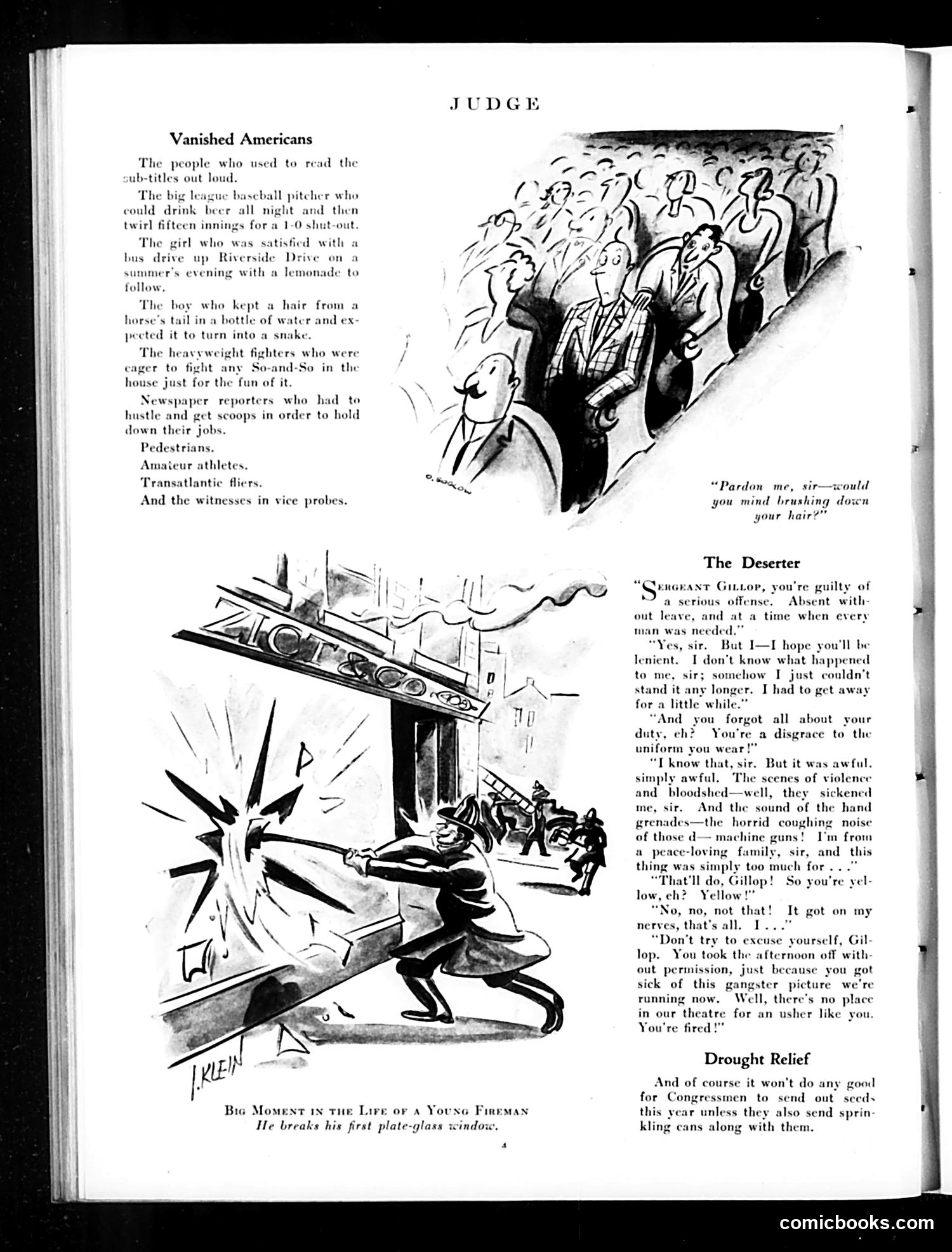
Judge Magazine Page Analysis This page contains three satirical pieces about American life: "Vanished Americans" lists groups that have disappeared from public consciousness—baseball pitchers, bus drivers, etc.—humorously suggesting they've become extinct. "The Deserter" depicts a court-martial dialogue between a sergeant (Gillop) and a soldier accused of absent without leave. The soldier claims the horrors of war—grenades, machine gun fire—overwhelmed him, a peace-loving man. The sergeant dismisses his excuse, noting there's "no place in our theatre for an usher like you." This satirizes the tension between civilian sensitivity and military duty during wartime. "Big Moment in the Life of a Young Fireman" shows a dramatic explosion as a firefighter breaks plate-glass windows during rescue operations—a humorous commentary on collateral damage. The final item, "Drought Relief," briefly jokes about agricultural aid being ineffective without proper distribution methods.
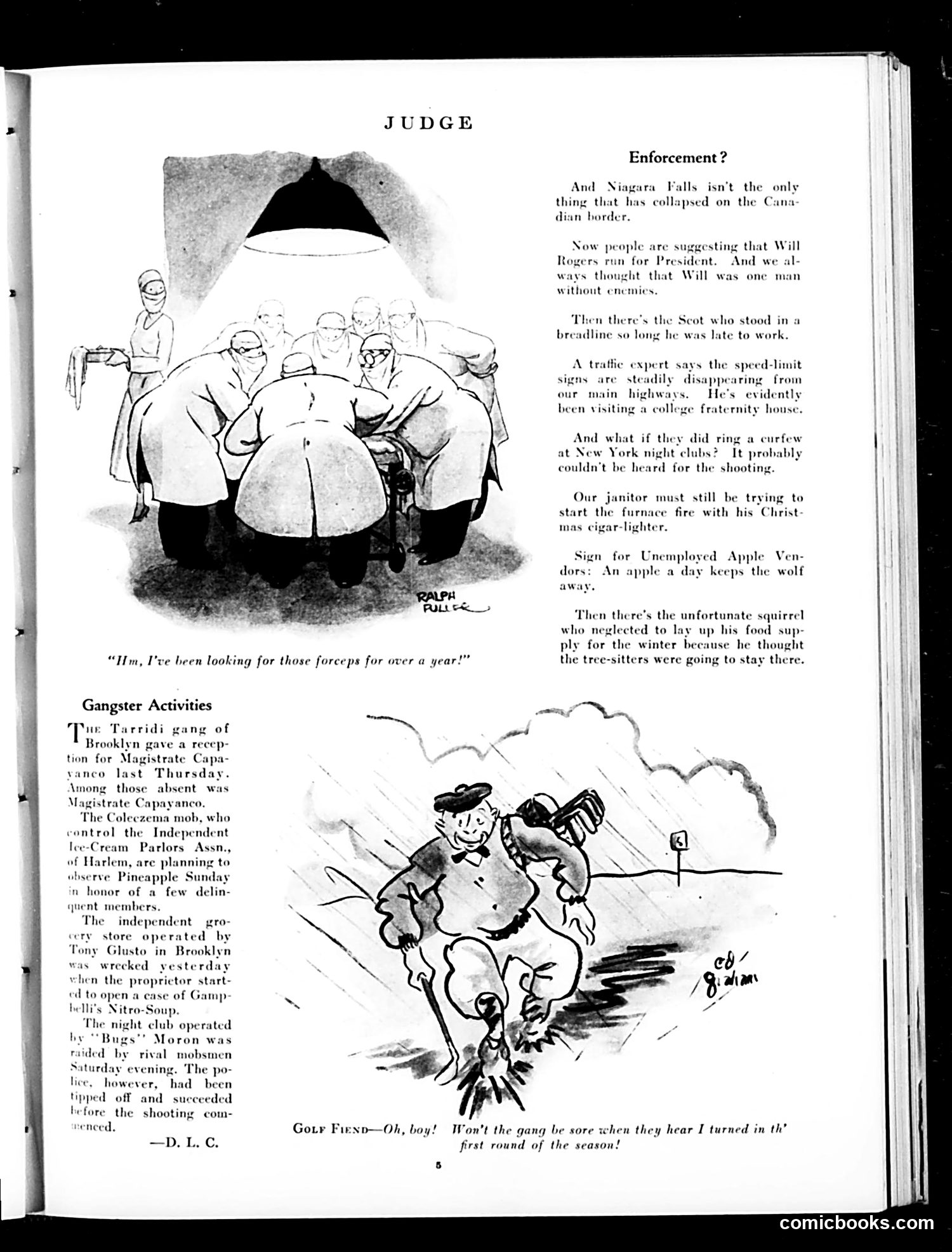
Judge Magazine Page Analysis This page contains two satirical cartoons addressing early 20th-century American social issues: Top cartoon ("Judge"): Shows men huddled under a lamp discussing law enforcement failures. The caption "I've been looking for those forceps for over a year!" appears to reference police incompetence or corruption—likely referring to organized crime's ability to evade authorities. The phrase "forceps" (surgical instruments) likely uses this as slang for law enforcement tools. Bottom cartoon ("Golf Fiend"): Depicts a snowman on a golf course, captioned about a "gang" being angry about the "first round of the season." This mocks wealthy golfers' obsession with the sport, treating winter disruptions as gang violence—satirizing upper-class preoccupations. The accompanying "Gangster Activities" column discusses Brooklyn gang arrests and organized crime, providing contemporary context for the law enforcement satire above.
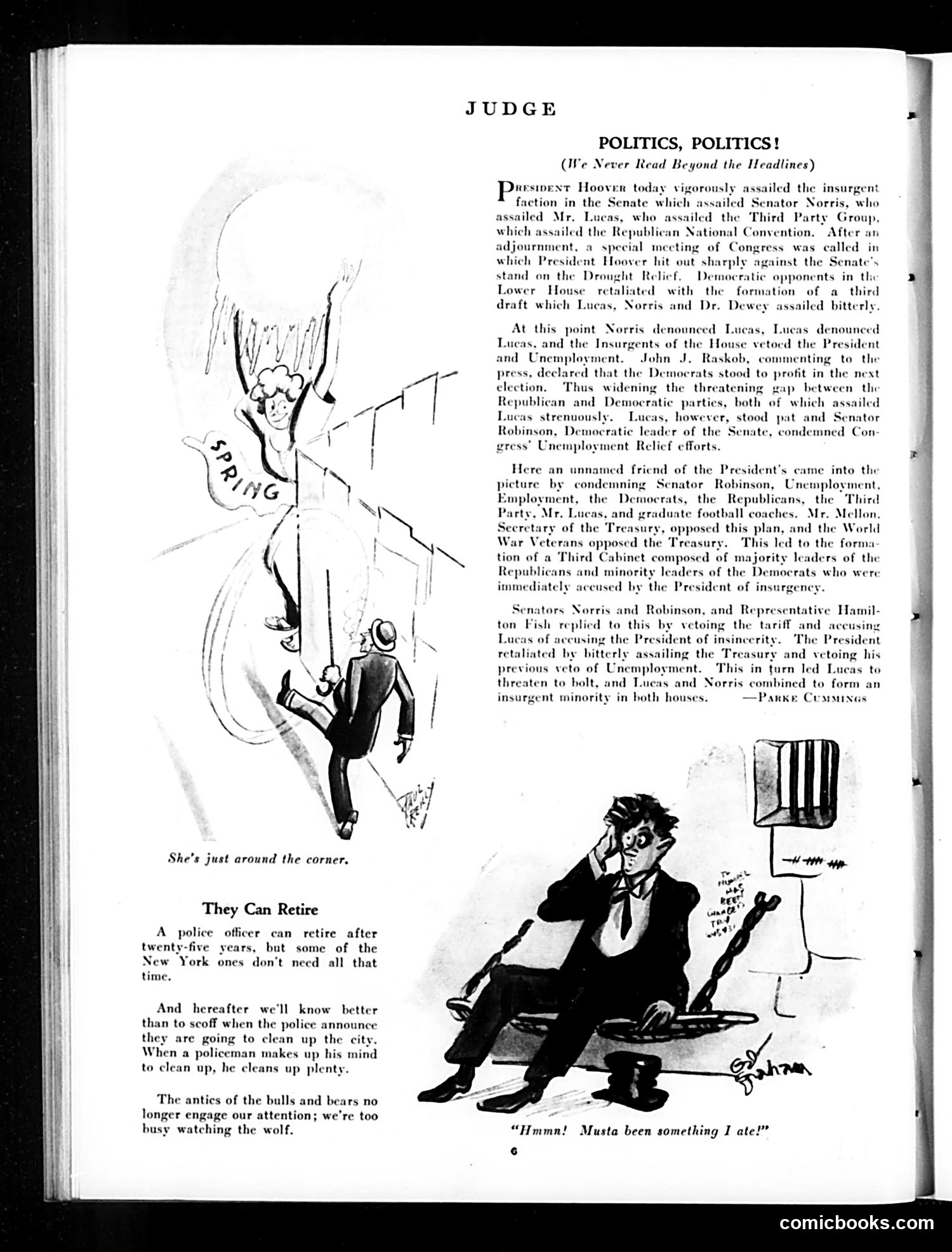
Political Cartoon Analysis: Judge Magazine This page satirizes early 1930s political turmoil under President Hoover. The top cartoon depicts political "spring" arriving—a tangled mess of competing factions (Senator Norris, Lucas, the Third Party Group, Republicans, and Democrats) all assailing each other while Hoover watches helplessly. The figure labeled "SPRING" suggests renewal or hope amid chaos. The lower cartoon mocks a police officer retiring, with wordplay about "cleaning up the city"—suggesting political corruption is so rampant that honest law enforcement has become futile. The caption "Hmm! Musta been something I ate!" implies digestive distress, likely a crude metaphor for political dysfunction. Overall, the page critiques governmental gridlock and institutional failure during the Depression era.
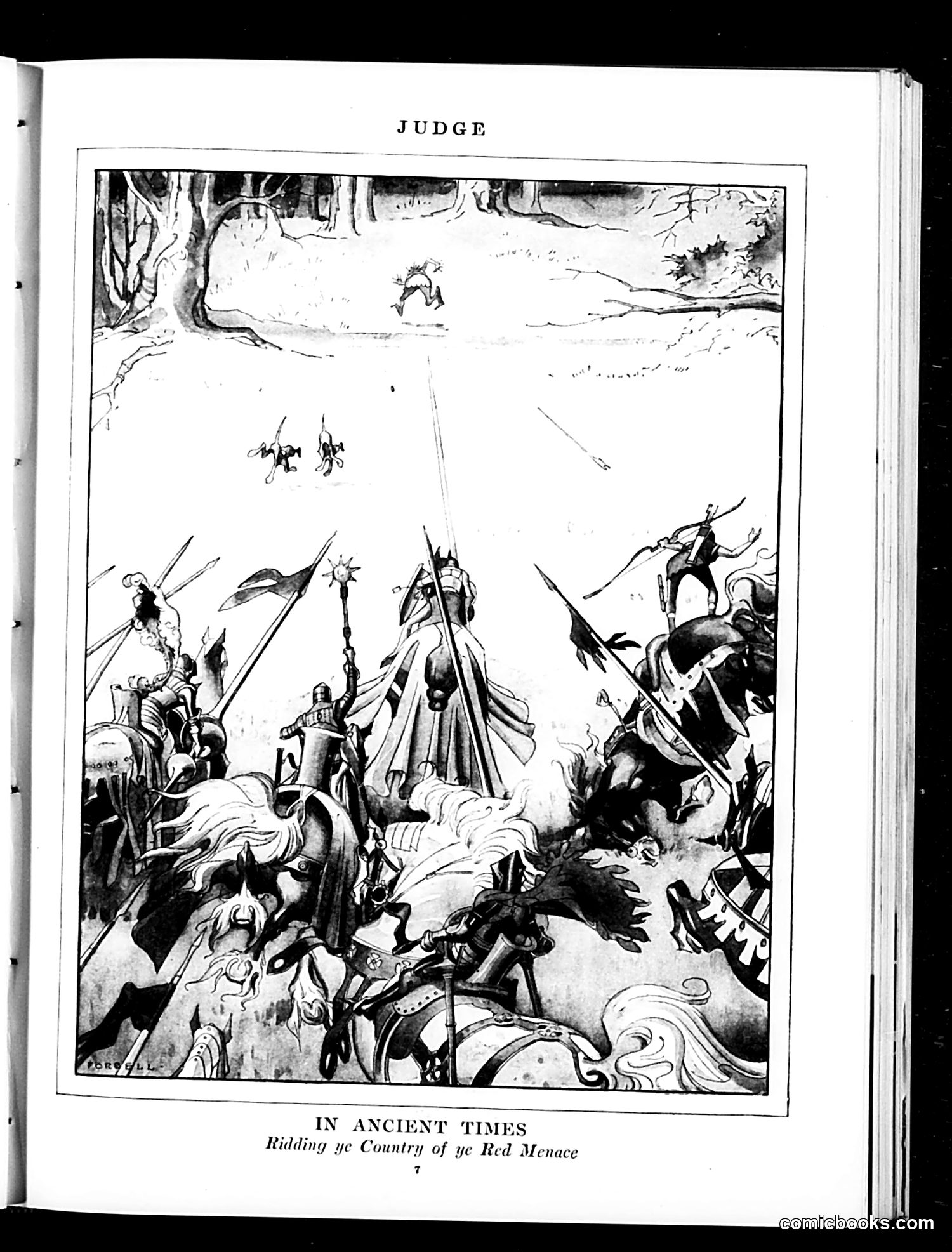
Judge Magazine Cartoon Analysis This illustration depicts a medieval-style military campaign titled "Ridding ye Country of ye Red Menace." The cartoon uses archaic language and imagery to satirize contemporary efforts to combat communism (the "Red Menace"). The scene shows armored knights, soldiers, and mounted warriors engaged in battle against what appears to be a common enemy. The anachronistic presentation—dressing modern anti-communist crusaders in medieval garb—is the satire's core joke: it suggests that contemporary anti-communist efforts are primitive, outdated, or misguided, comparable to medieval warfare rather than modern, rational approaches. The specific political moment and targets remain unclear without additional context about Judge magazine's publication date, but the piece mocks American anti-communist campaigns as backward or ineffective.
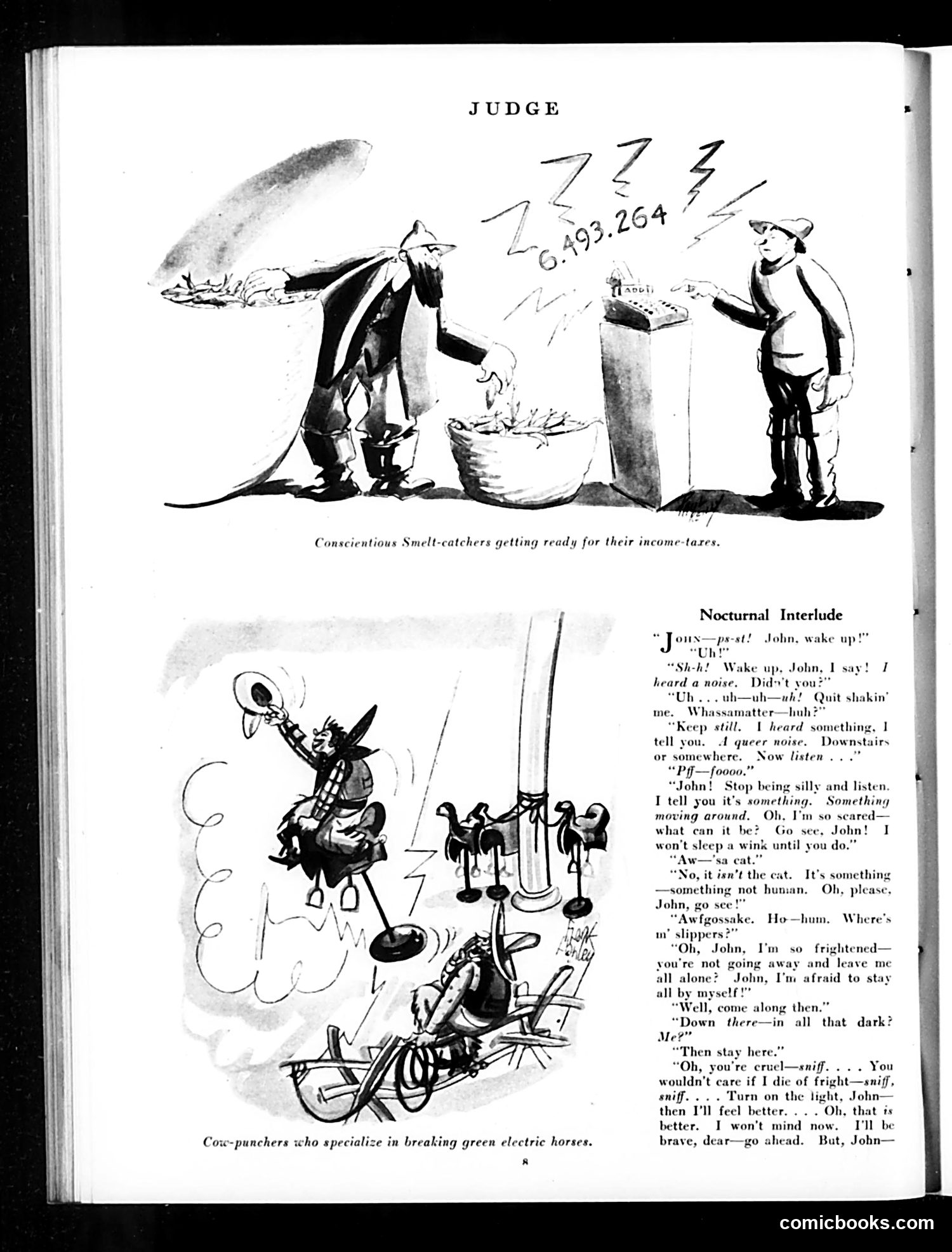
Analysis of Judge Magazine Page This page contains two satirical cartoons mocking tax avoidance schemes of the era. Top cartoon: "Conscientious Smelt-catchers getting ready for their income-tares" depicts anthropomorphic animals preparing fish for sale while zzz's (representing hidden/concealed amounts marked "0.893.264") float above. The pun on "income-tares" (taxes) suggests wealthy people using financial tricks to hide taxable income. Bottom cartoon: "Cow-punchers who specialize in breaking green electric horses" shows figures destroying electric equipment, likely satirizing wealthy industrialists who deliberately sabotage or manipulate new electric utility infrastructure to avoid taxation or regulation—"green" suggesting newly-established systems. The "Nocturnal Interlude" dialogue is an unrelated domestic comedy sketch about a nervous wife hearing mysterious noises. Context: These cartoons appear to target Gilded Age tax evasion and industrial manipulation by the wealthy, using animal/cowboy metaphors to satirize fraudulent financial practices.
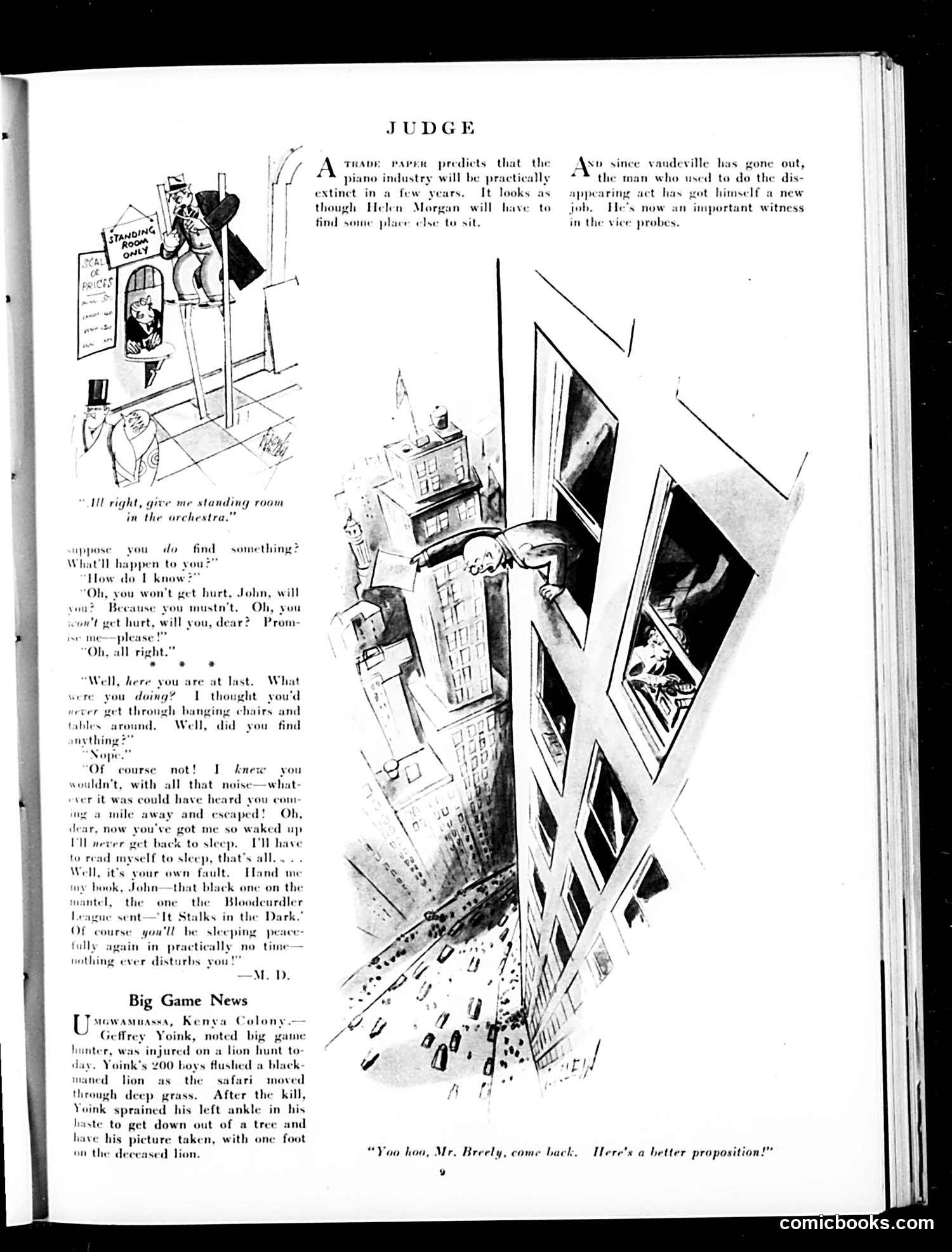
Page Analysis: Judge Magazine Satire This page contains three distinct satirical pieces: 1. "Judge" Editorial Cartoon (top): Depicts a piano industry crisis, predicting the piano business will collapse within years. Helen Morgan (a famous singer of the era) is shown needing alternative employment. The reference to vaudeville's decline and a man from "vice probes" suggests commentary on Prohibition-era changes and entertainment industry upheaval. 2. Domestic Humor Dialogue (center): A comedic exchange between a husband and wife about him searching for a book—specifically "The Bloodcurdler: It Stalks in the Dark," a pulp horror novel. The joke mocks popular cheap fiction and marital discord over noise and sleep disturbances. 3. "Big Game News" (bottom): Satirizes adventurer Geoffrey Yoink, who claims to have injured himself during a lion hunt in Kenya but actually sprained his ankle falling from a tree while posing for photographs with the dead lion—skewering the vanity and exaggeration of big-game hunting celebrities. All three pieces mock contemporary American culture: economic decline, popular entertainment tastes, and celebrity fabrication.
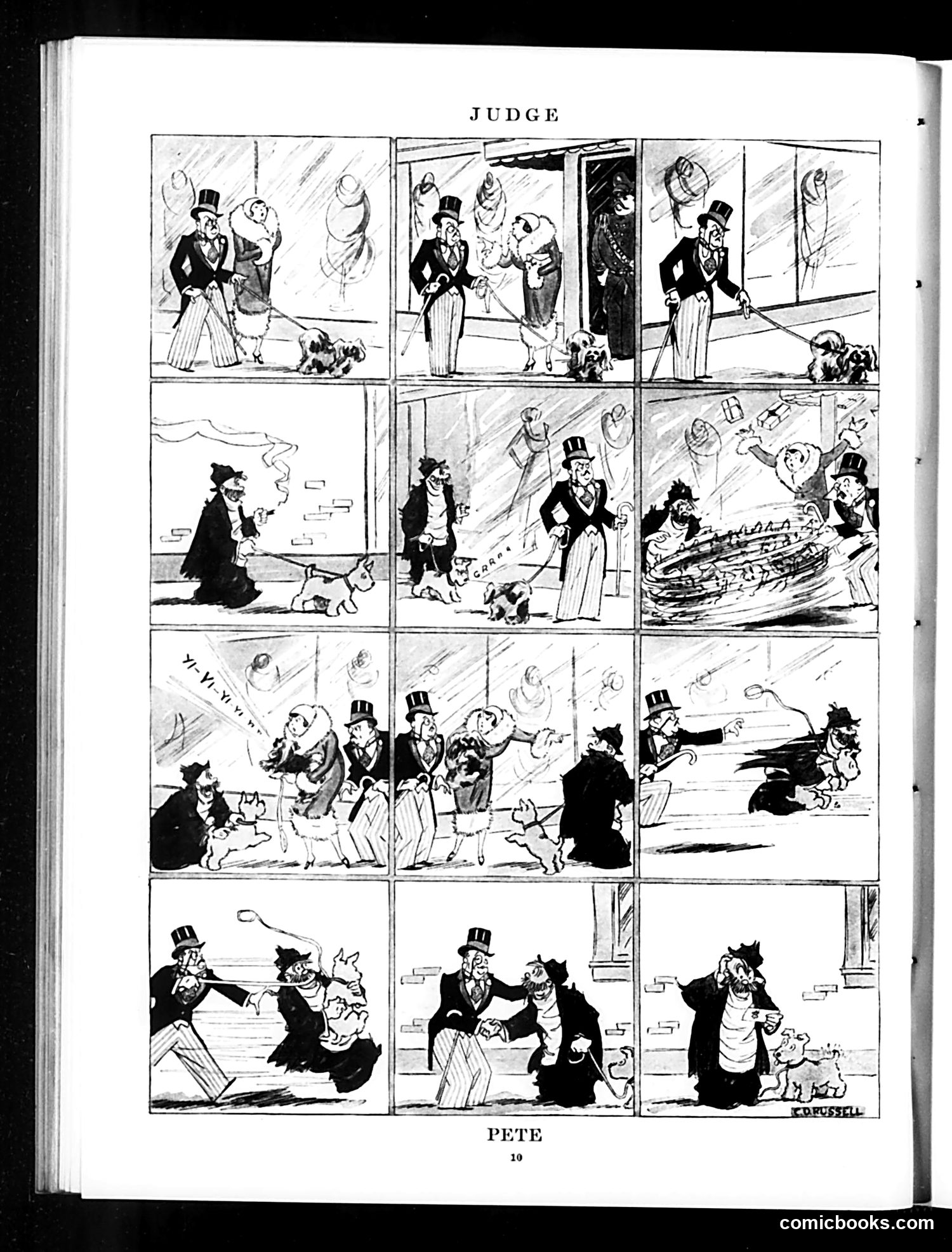
"Judge" Comic Page: "Judge" and "Pete" This page contains two sequential comic strips featuring caricatured gentlemen in top hats and formal dress, accompanied by small dogs. The strips appear to be satirical humor rather than political commentary. The "Judge" strip (top) shows a formally-dressed man with a dog in various situations—interacting with other figures, appearing before what seems to be official settings, and engaging in physical comedy with other characters. The "Pete" strip (bottom) continues similar themes with slapstick-style interactions between the main character and various figures. Without clearer identification of specific historical figures or events referenced, the exact satirical target remains unclear. These appear to be character-driven humor comics rather than topical political satire, typical of Judge magazine's general entertainment content.
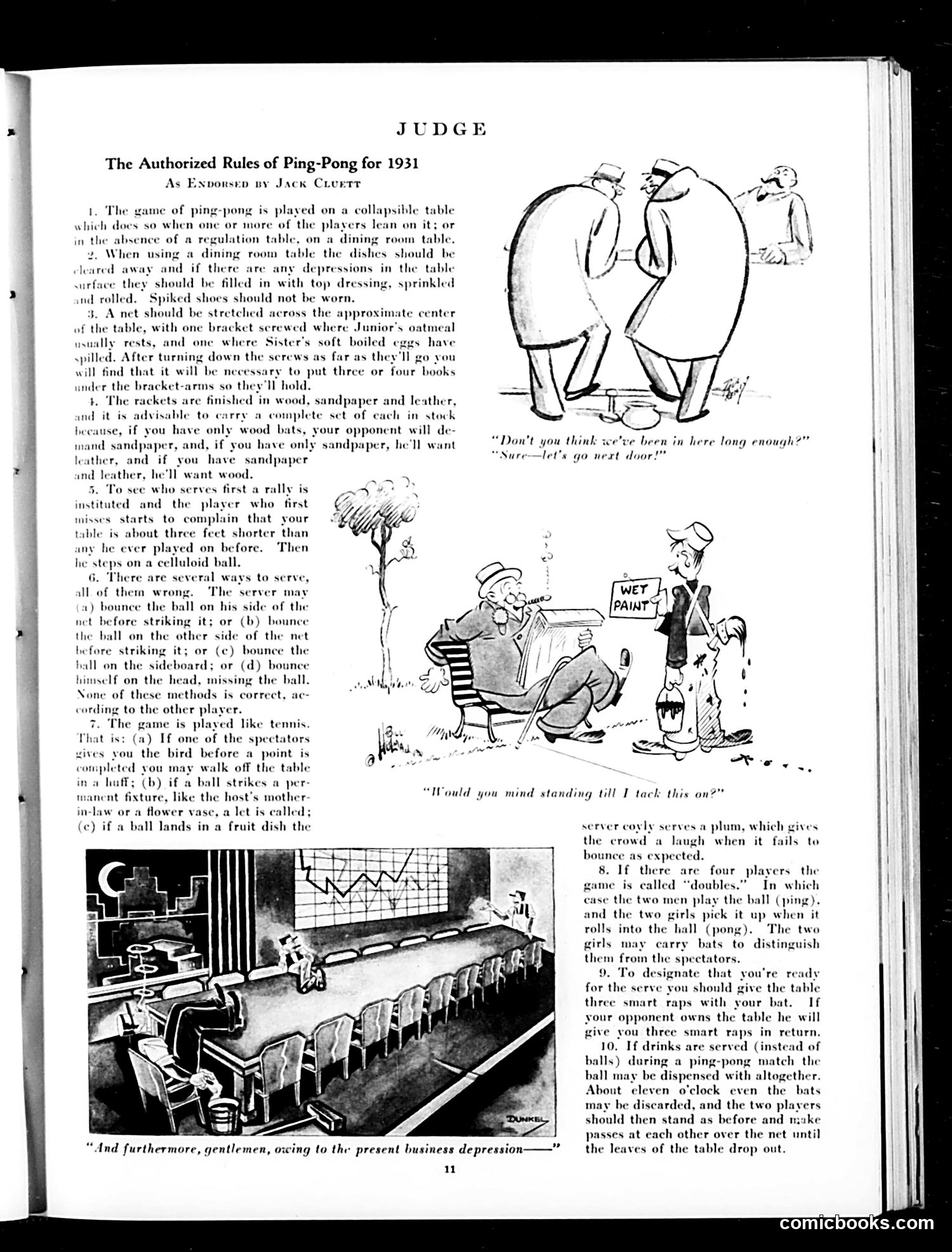
Analysis This page from *Judge* magazine presents "The Authorized Rules of Ping-Pong for 1931" as endorsed by Jack Clefft. The content is primarily instructional rather than satirical, detailing legitimate ping-pong regulations and equipment specifications. However, the accompanying cartoons contain light social satire. One illustration shows two portly men at a ping-pong table with the caption "Don't you think we've been in here long enough?" suggesting ping-pong as an excuse for socializing rather than exercise. Another depicts someone with wet paint, humorously interrupting a game. The bottom photograph shows an elaborate public ping-pong venue, captioned with a Depression-era reference: "And furthermore, gentlemen, owing to the present business depression—" implying ping-pong's role as affordable entertainment during the 1930s economic crisis. The overall tone gently mocks both excessive leisure and the sport's growing popularity during hard economic times.
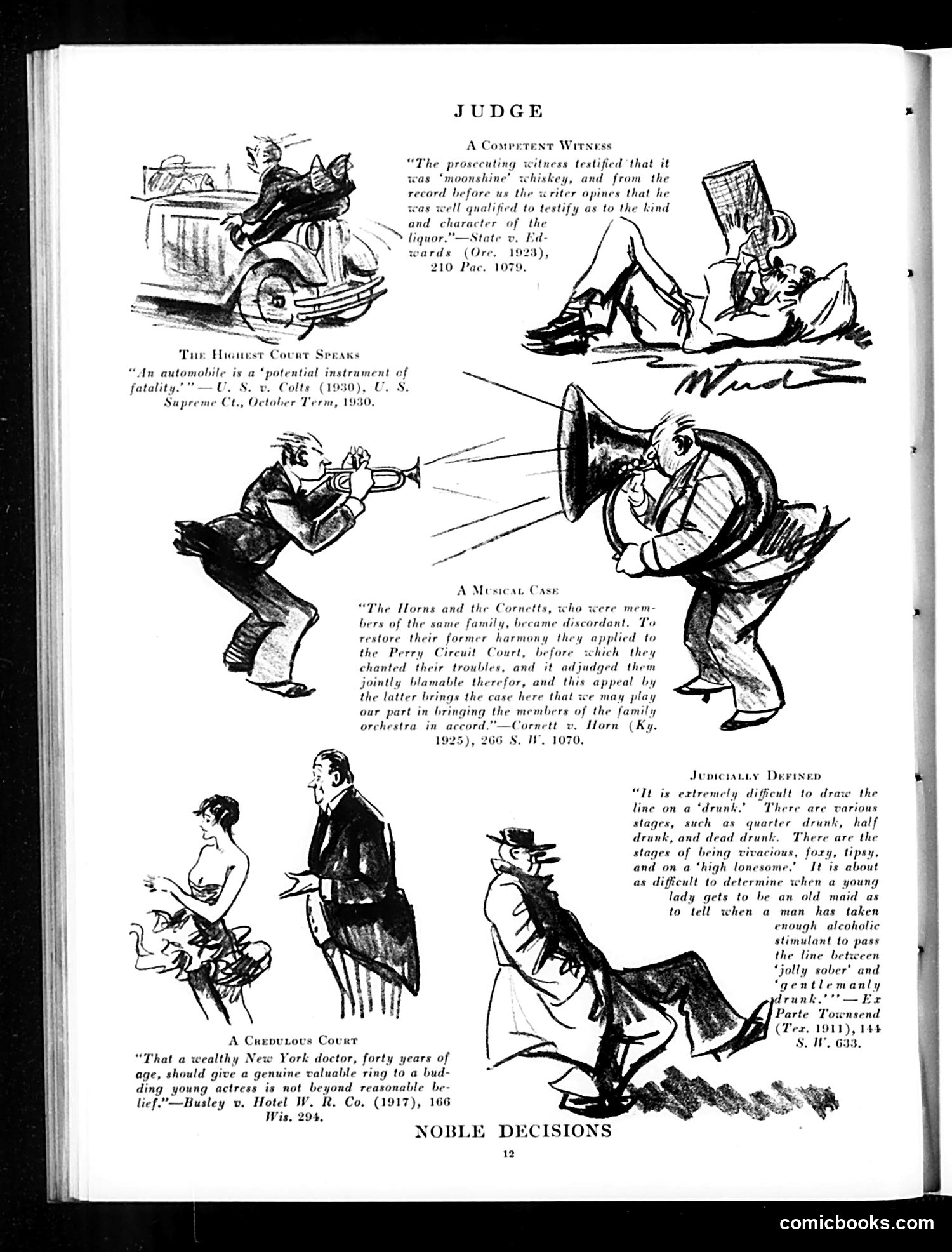
JUDGE Magazine: "Noble Decisions" This page from Judge satirizes absurd court rulings by pairing humorous illustrations with actual legal citations. The cartoons mock the judges' reasoning: "A Competent Witness" ridicules a prosecutor qualified to testify about "moonshine" whiskey solely because he drank it—suggesting the legal standard for expertise is absurdly low. "The Highest Court Speaks" features a car crash, mocking the obvious ruling that automobiles are dangerous. "A Musical Case" shows feuding family members ("Horns and Cornetts"—a pun on musical instruments) arguing before court, which then blames both equally, presented as if restoring "family orchestra harmony." "Judicially Defined" illustrates the difficulty of legally distinguishing drunkenness stages (quarter/half/dead drunk), with a woman shown in various states. "A Credulous Court" questions why a wealthy doctor giving a valuable ring to a young actress isn't suspicious—implying the court's judgment is naive. The satire targets judicial overreach and illogical reasoning, using wordplay and visual comedy to mock the legal system's earnest documentation of silly decisions.
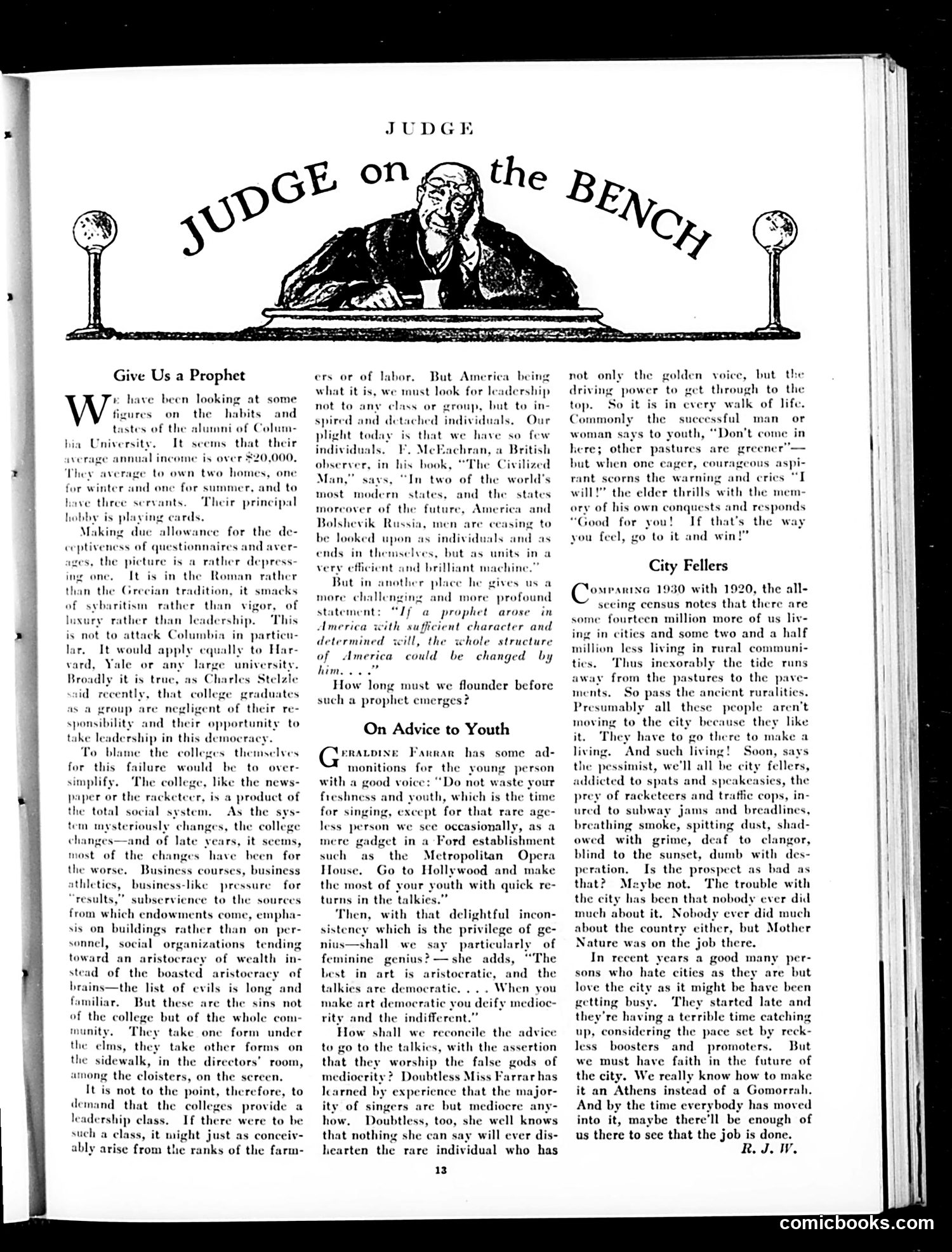
Judge Magazine Content Analysis This page contains editorial commentary rather than traditional cartoons. The header features a stern judge illustration labeled "Judge on the Bench." "Give Us a Prophet" critiques wealthy Columbia University alumni ($20,000+ annual income, multiple homes, servants) for embodying luxury and card-playing rather than leadership. The piece argues that American society—both capitalist America and Bolshevik Russia—treats people as "units in a machine" rather than individuals. It references F. McEachran's book *The Civilized Man*, quoting his observation that only a prophet with "sufficient character and determined will" could reform America's structure. The satire targets not just the colleges but the entire social system that prioritizes business, athletics, and buildings over developing principled leaders. "On Advice to Youth" mocks opera singer Geraldine Farrar's contradictory guidance: she urges young singers not to "waste" their talent in commercial establishments like the Metropolitan Opera, yet recommends Hollywood talkies for "quick returns"—then claims art is aristocratic while talkies are democratic. The piece sardonically highlights her hypocrisy about artistic integrity versus commercialism.
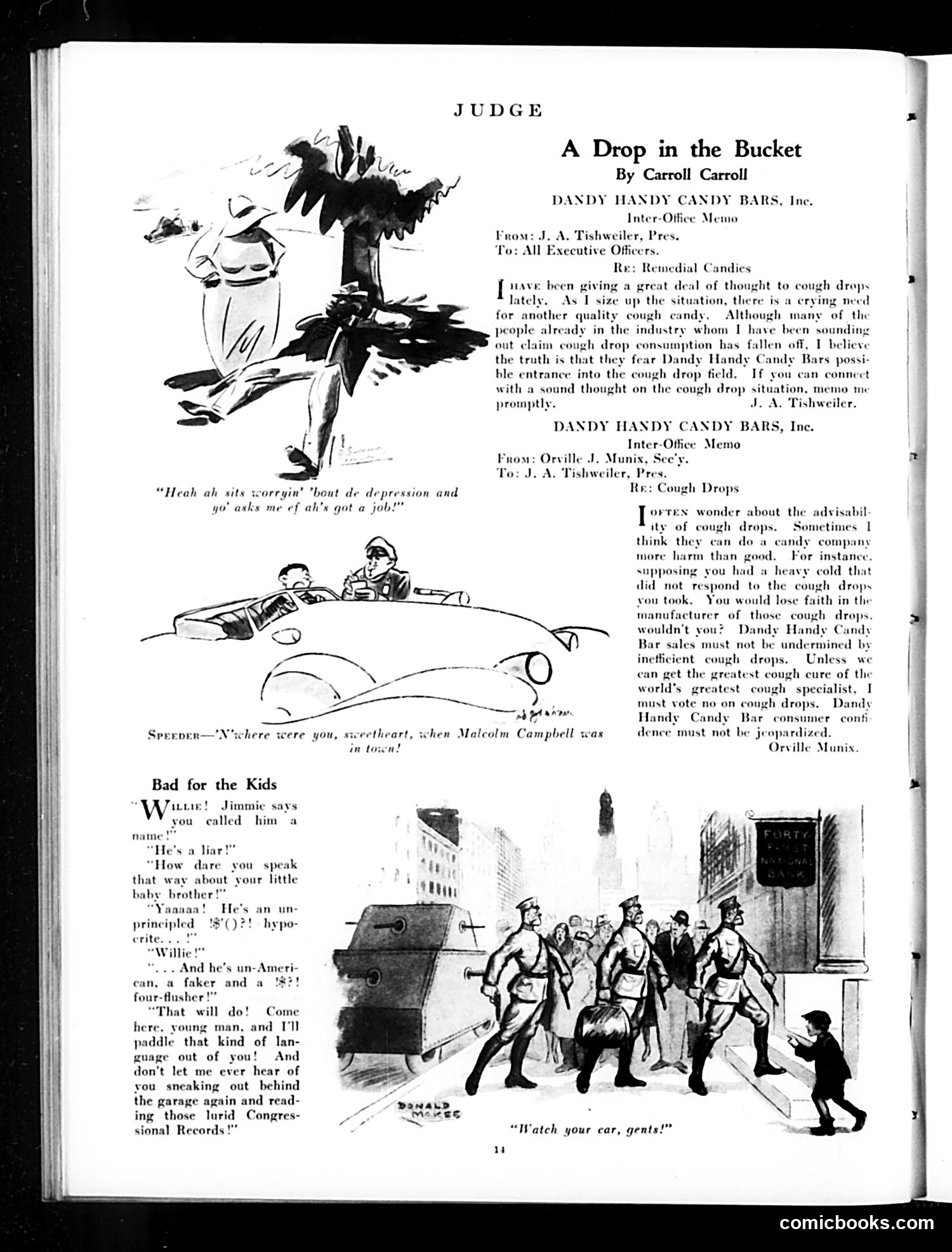
Analysis "A Drop in the Bucket" is a satirical piece about corporate anxiety during the Great Depression. The humor centers on a candy company executive (J.A. Tishweiler) worried about entering the cough drop market, fearing that an ineffective product would damage consumer trust in their brand. His subordinate Orville Munix argues against the venture entirely—if their cough drops fail to cure someone's cold, customers lose faith in the manufacturer. The satire mocks corporate risk-aversion and market timidity during economic hardship, suggesting even a seemingly simple business decision becomes paralyzing when companies fear any reputation damage. "Bad for the Kids" jokes about parental concerns over children's reading habits. A father discovers his son calling people liars and using vulgar language, then threatens to whip him—but the punchline reveals the boy has been reading "Congressional Records," implying politicians themselves are the source of such dishonest, foul language. It's political commentary wrapped in domestic humor.
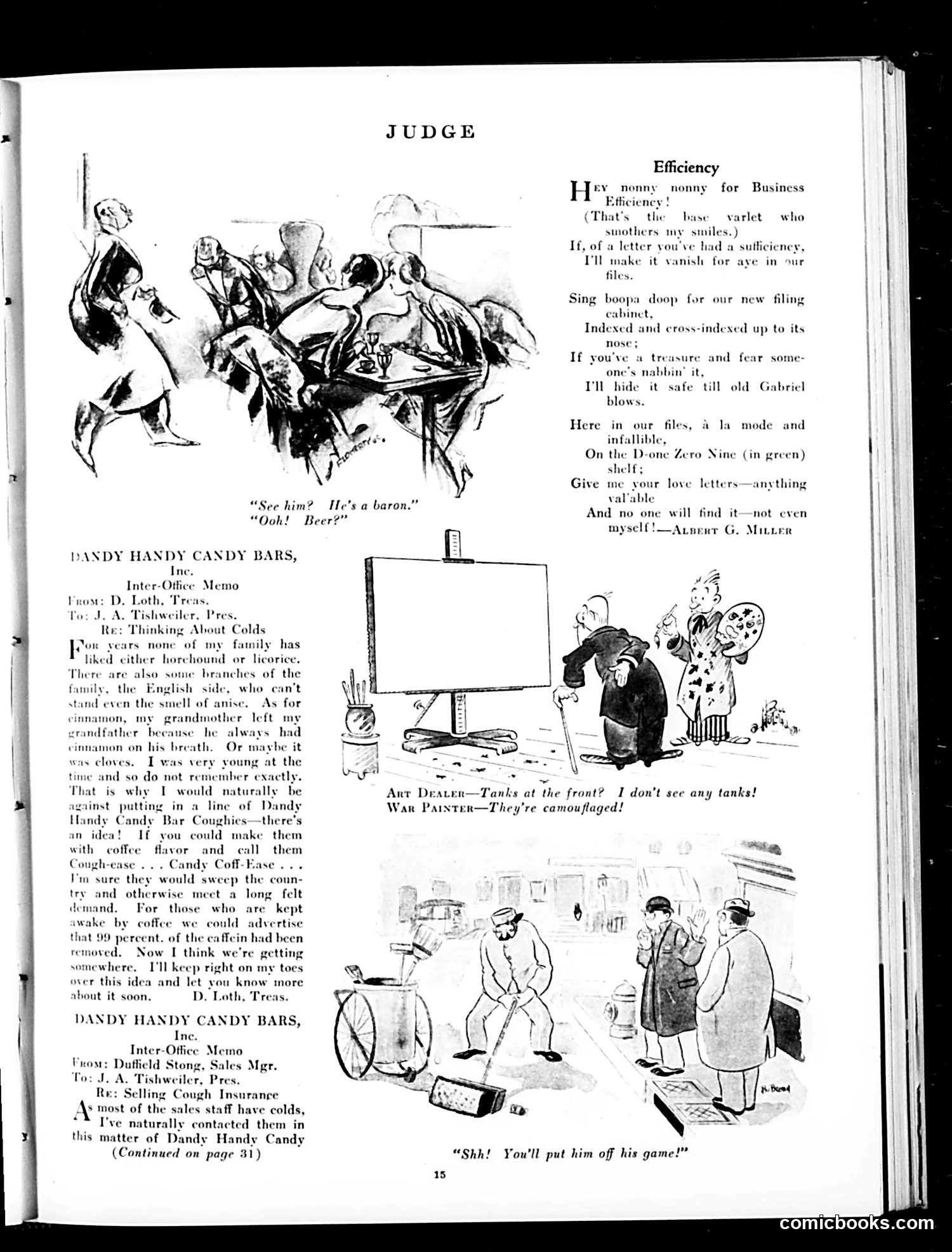
Explanation for Modern Readers This page contains inter-office memos and satirical cartoons mocking corporate inefficiency. Top cartoon: Shows chaotic office workers, likely satirizing bureaucratic confusion. The caption "See him? He's a baron" / "Ooh! Beer?" suggests mockery of pretentious office behavior. Middle cartoon: An art dealer and war painter discuss tanks. The painter claims they're "camouflaged"—a joke about wartime deception and artistic BS-ing. Bottom cartoon: Workers gathered around what appears to be a golf game with caption "You'll put him off his game!"—satirizing how office workers prioritize leisure over work. Text content: Inter-office memos from "Dandy Handy Candy Bars, Inc." debating whether to create cough-drop candies. Employees suggest flavor modifications (coffee instead of licorice/anise). This parodies how corporations justify pointless product variations and internal memo culture. Overall point: Satire of 1920s-30s office culture—bureaucratic inefficiency, corporate memo-writing as performance, workers avoiding actual productivity, and manufactured product differentiation.
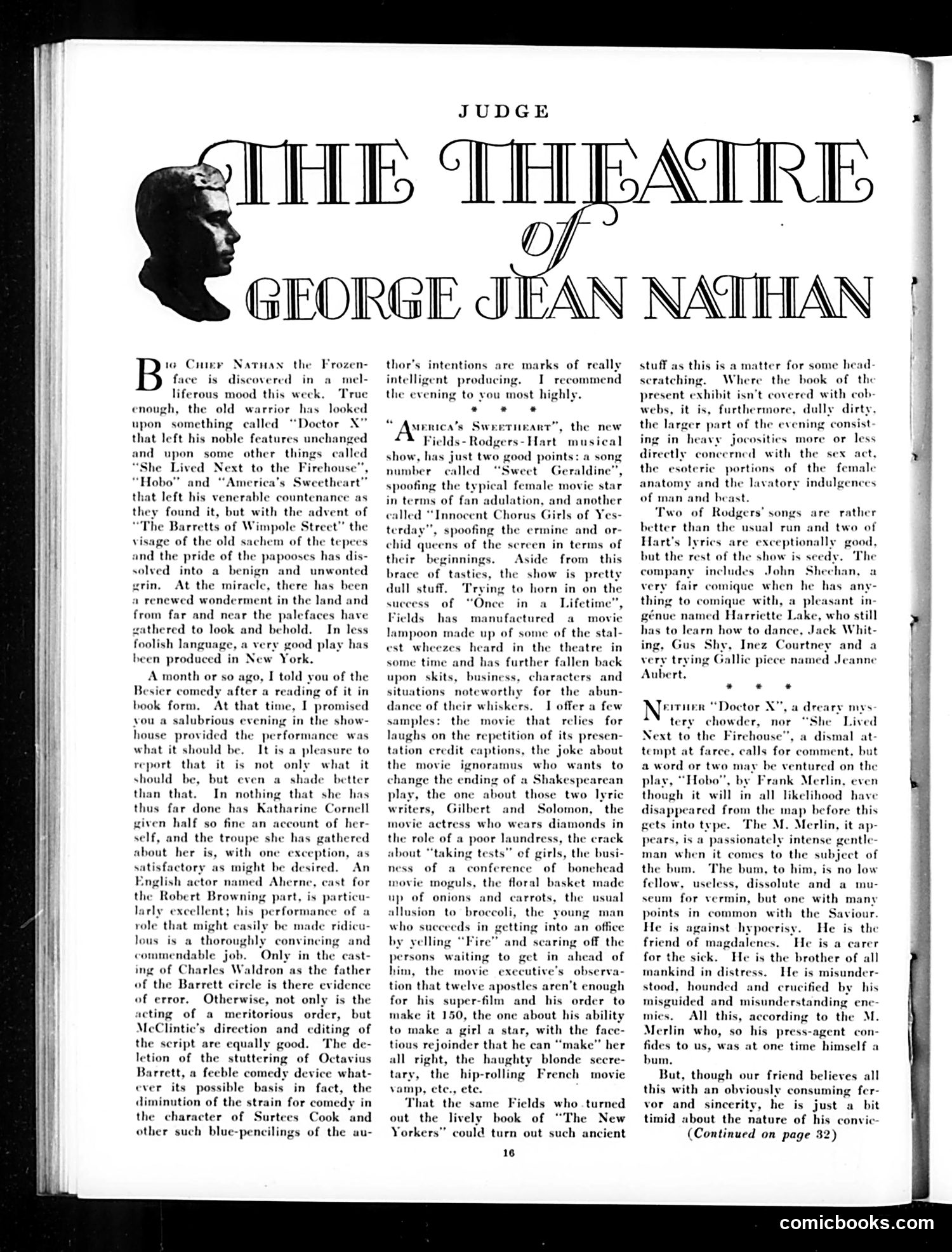
Judge Magazine Theater Criticism This page contains a theater review by Chief Judge Nathan, signed with a silhouette portrait. Nathan critiques several Broadway productions: "The Barretts of Wimpole Street" receives high praise. Nathan commends Katharine Cornell's performance and the direction, though he criticizes the casting of Charles Waldron. He appreciates cuts made to the script that removed stuttering and reduced comic strain. "America's Sweetheart," a Fields-Rodgers-Hart musical, gets harsh treatment. Nathan identifies only two worthwhile songs and dismisses the rest as recycled theatrical clichés—outdated movie-industry jokes about credit captions, Gilbert and Sullivan references, and hackneyed gags about film executives and starmaking. "Doctor X" and other unnamed films receive brief, dismissive mention. The tone is that of an established critic offering sophisticated judgment to educated readers familiar with Broadway and cinema conventions of the period.
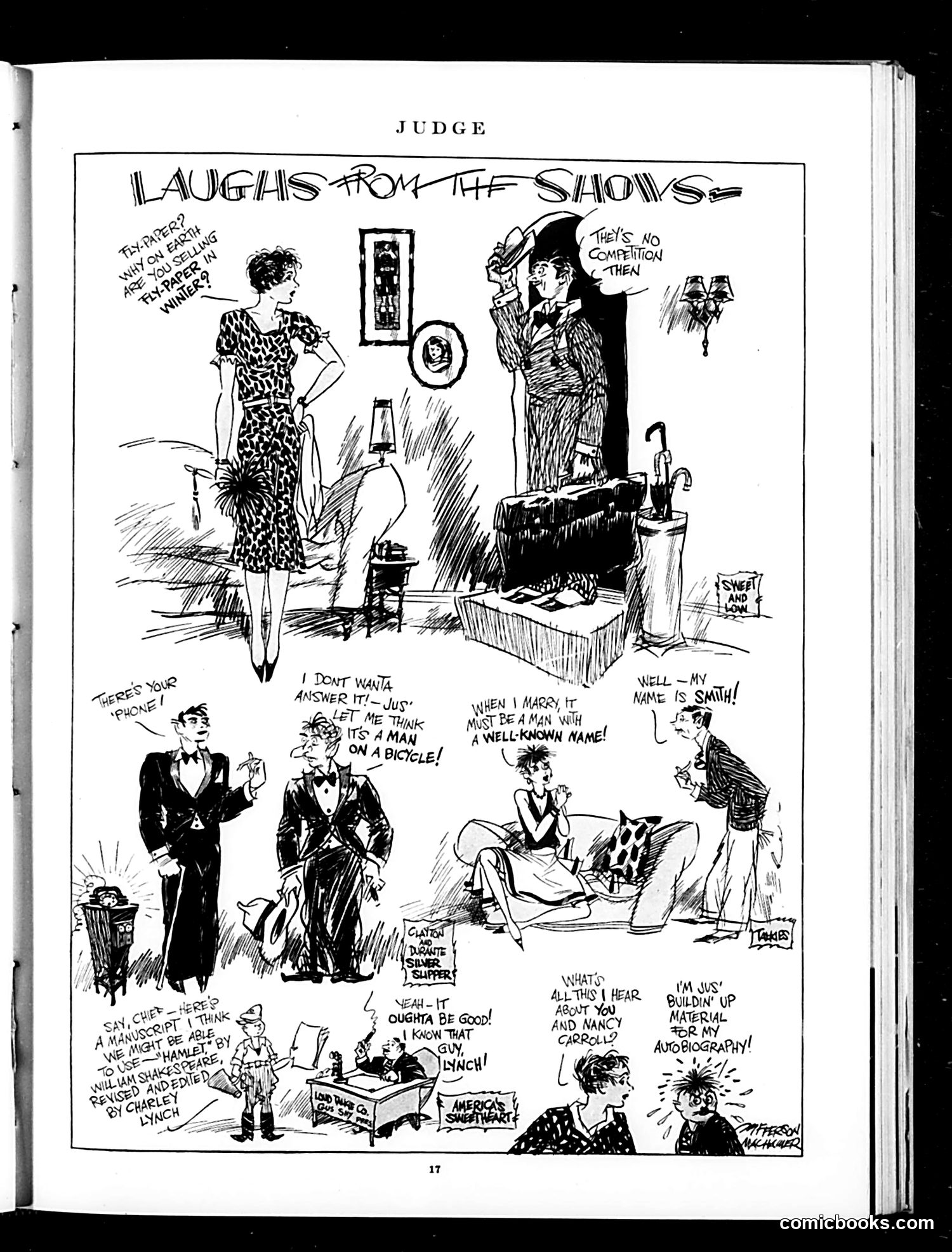
"Laughs from the Shows" This cartoon satirizes early 20th-century theatrical culture and contemporary social attitudes about women and marriage. The scene depicts various show-business figures discussing romantic and professional matters. The central joke concerns women's names and identity: a man insists when marrying, his wife must bear "a well-known name"—implying either she should be famous or adopt his surname. Another character jokes about a man answering a phone or proposal by saying "it's a man on a bicycle," mocking hesitant suitors. Lower panels show theatrical people (possibly reviewers or critics named Lynch) discussing shows and "Nancy Carroll," likely referencing an actress of the era. The overall satire targets the vanity and social pretensions of show-business circles, where status, famous names, and romantic posturing were paramount. The humor depends on recognizing period theatrical references now obscure to modern readers.
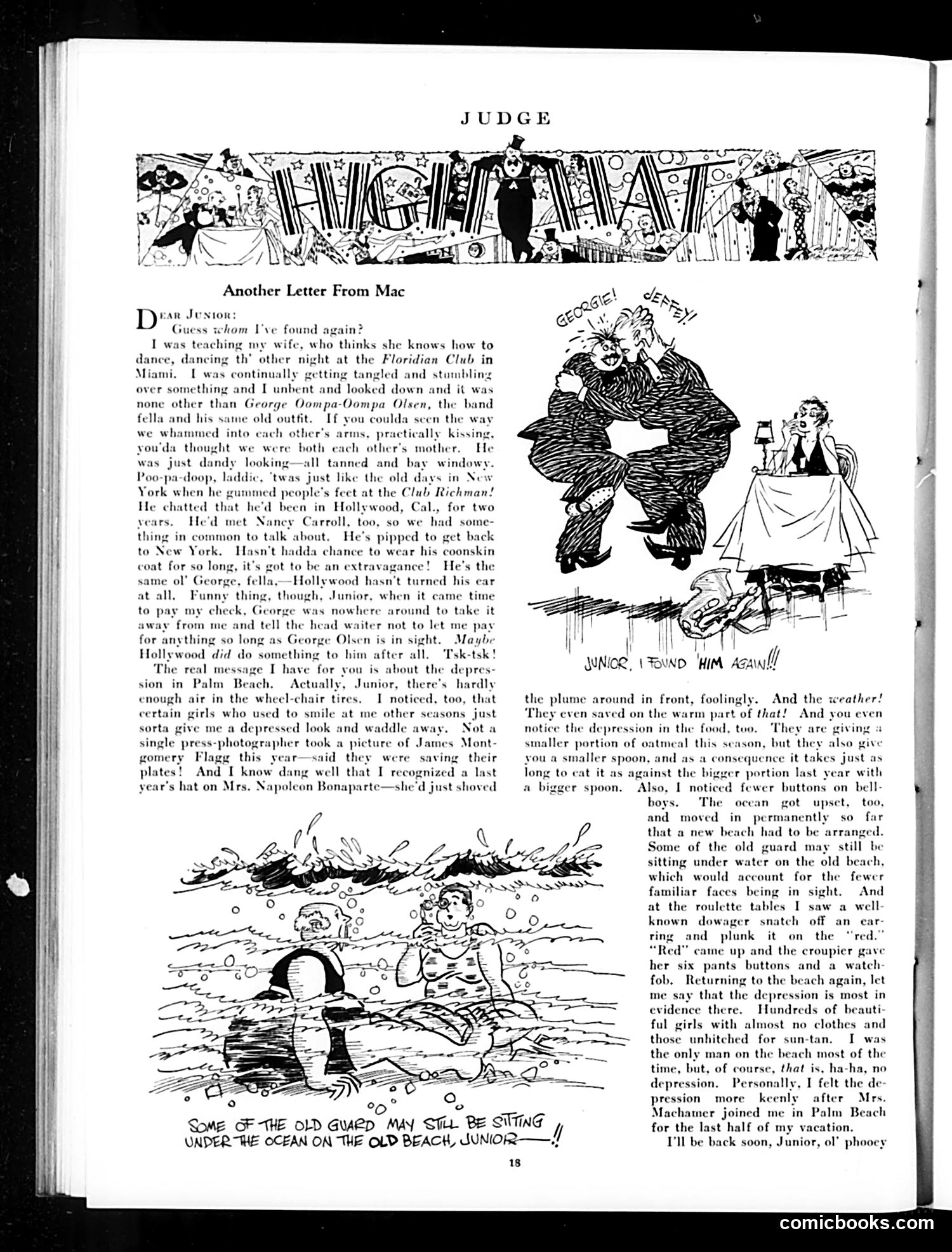
"Another Letter From Mac" - Judge Magazine This is a humorous column disguised as a letter from "Mac" to "Dear Junior," describing encounters during a Florida vacation at the height of the Great Depression. The main joke involves Mac running into George Olsen, a famous 1920s bandleader who performed at New York's Club Richman. Once a generous, carefree socialite who'd pick up checks, Olsen has apparently become stingy after his Hollywood stint—he vanishes when it's time to pay the bill, shocking Mac. The secondary satire focuses on Depression-era austerity at Palm Beach: smaller food portions, fewer fashionable clothes on beachgoers (women stripping down for sun-tanning), wheel-chair tire deflation, and fewer jewelry wearers at the casino. The cartoon at bottom illustrates the Depression's impact on the ocean itself—it's apparently receded, forcing beach reorganization. The final punchline: Mac felt the Depression keenly only *after* his wife joined him, suggesting marital expenses exceed economic hardship.
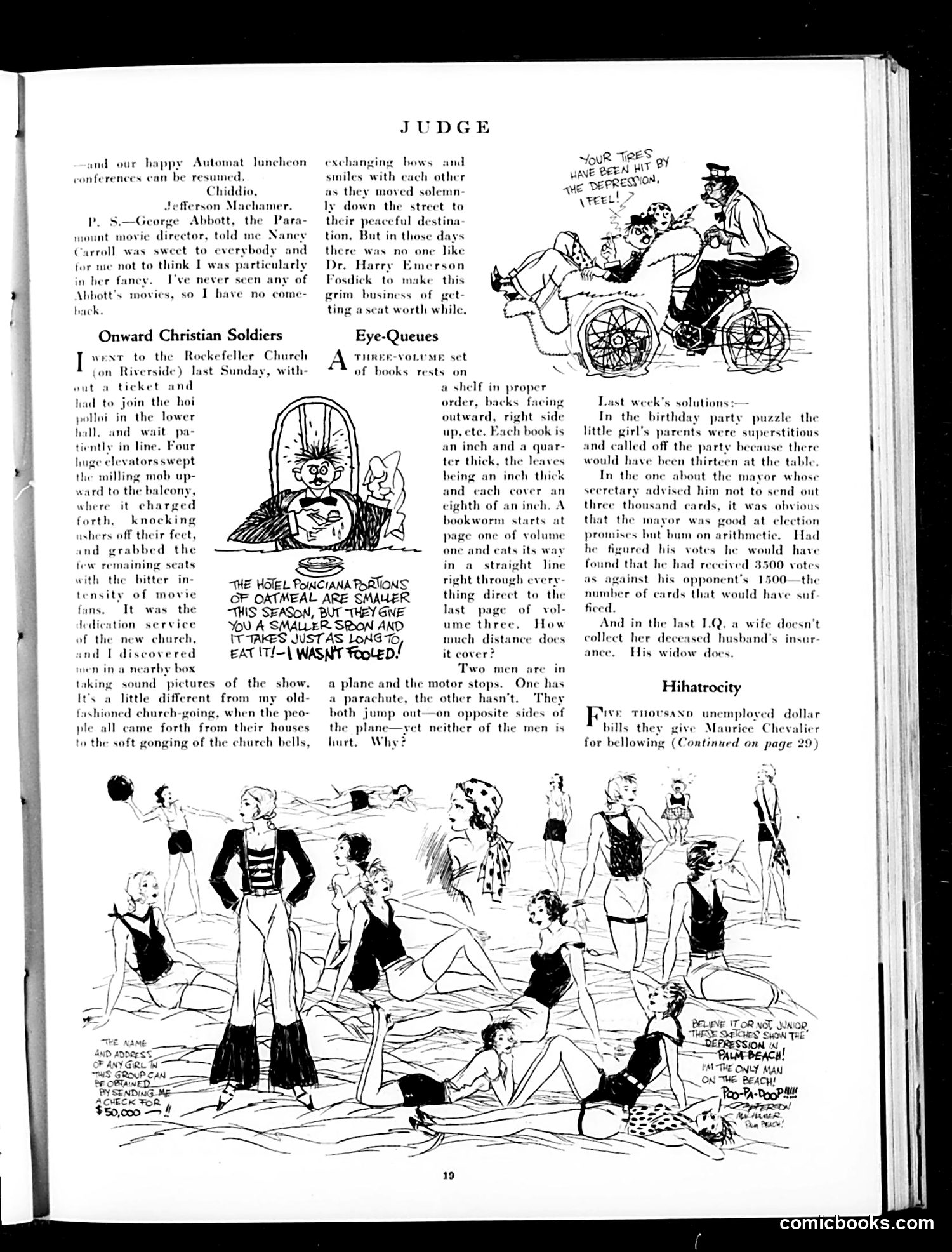
Judge Magazine Page Analysis This page contains several humor sections typical of Judge magazine's satirical content: "Onward Christian Soldiers" mocks the dedication service of the new Rockefeller Church (on Riverside, likely NYC), contrasting modern chaos—crowds rushing elevators, people scrambling for seats with "movie fan intensity," sound cameras recording—with nostalgic, orderly traditional church-going. The satire targets both modern religious spectacle and contemporary celebrity worship. "Eye-Queues" presents logic puzzles for readers, a popular recurring feature. The beach illustration (bottom) appears to satirize 1920s-30s beach culture and fashion, depicting numerous figures in bathing attire with commentary about economic depression themes (text mentions "five thousand unemployed dollar bills"). Minor items include gossip about Nancy Carroll and movie directors, and hotel dining complaints about portion sizes. The overall tone reflects Judge's characteristic blend of social observation, consumer culture criticism, and gentle mockery of contemporary American life and manners.
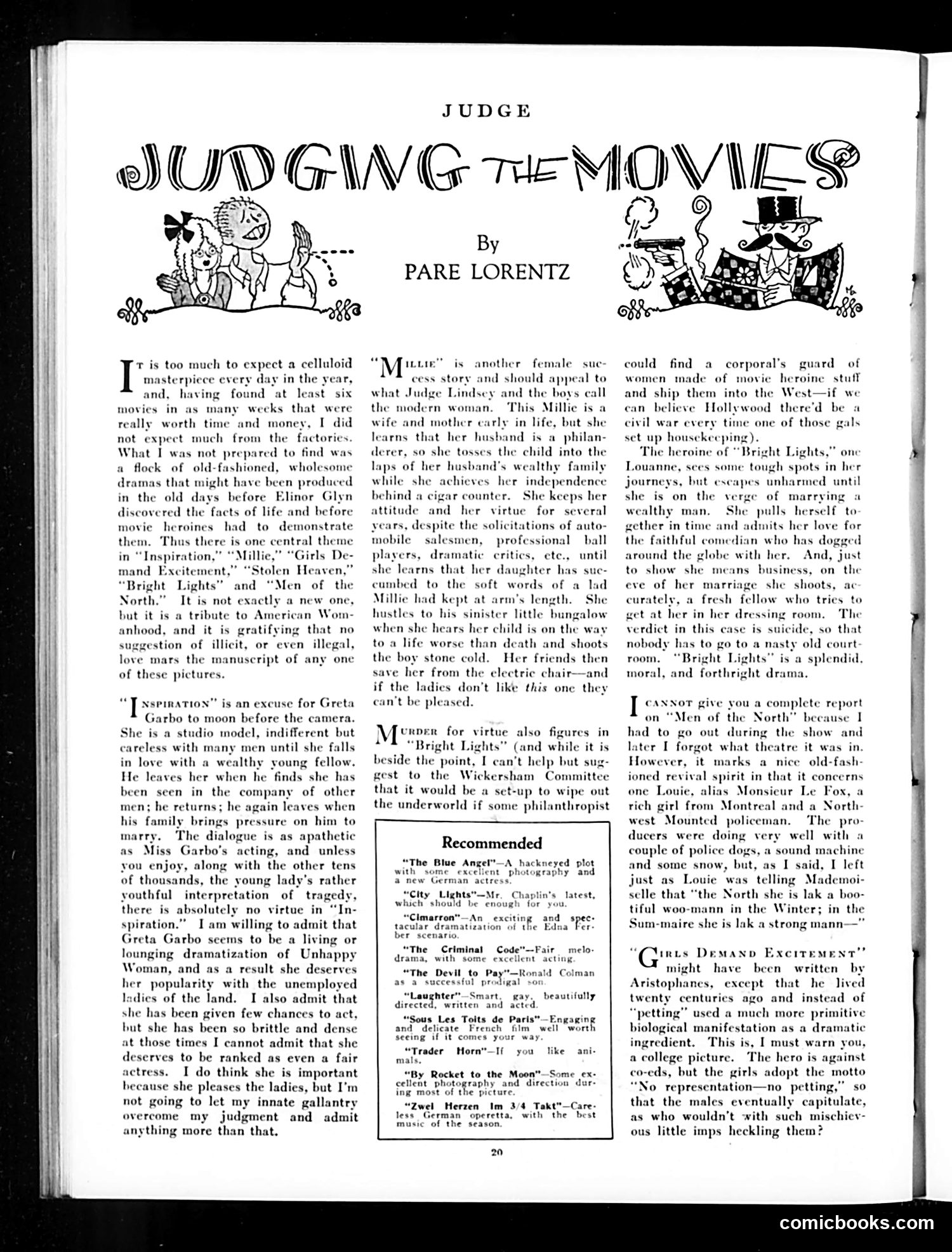
Judge Magazine Film Review Analysis This page contains film criticism by Pare Lorentz reviewing contemporary movies. The text discusses several films featuring female protagonists in morally ambiguous situations—a notable concern for 1920s-early 1930s cinema when depictions of infidelity and sexuality were controversial. The reviewer critiques Greta Garbo in "Inspiration" as emotionally flat, though acknowledging her popularity. "Millie" is praised for its "wholesome" plot about a virtuous woman protecting her daughter from moral ruin. The reviewer commends these films for avoiding "illicit or illegal" content, reflecting the era's anxiety about Hollywood's moral standards—concerns that led to the Motion Picture Production Code's stricter enforcement. The "Recommended" box lists current films including Chaplin's "City Lights" and the German import "The Blue Angel," representing both American and foreign cinema of the period. The criticism emphasizes morality and virtue as primary viewing criteria, typical of 1930s film discourse.
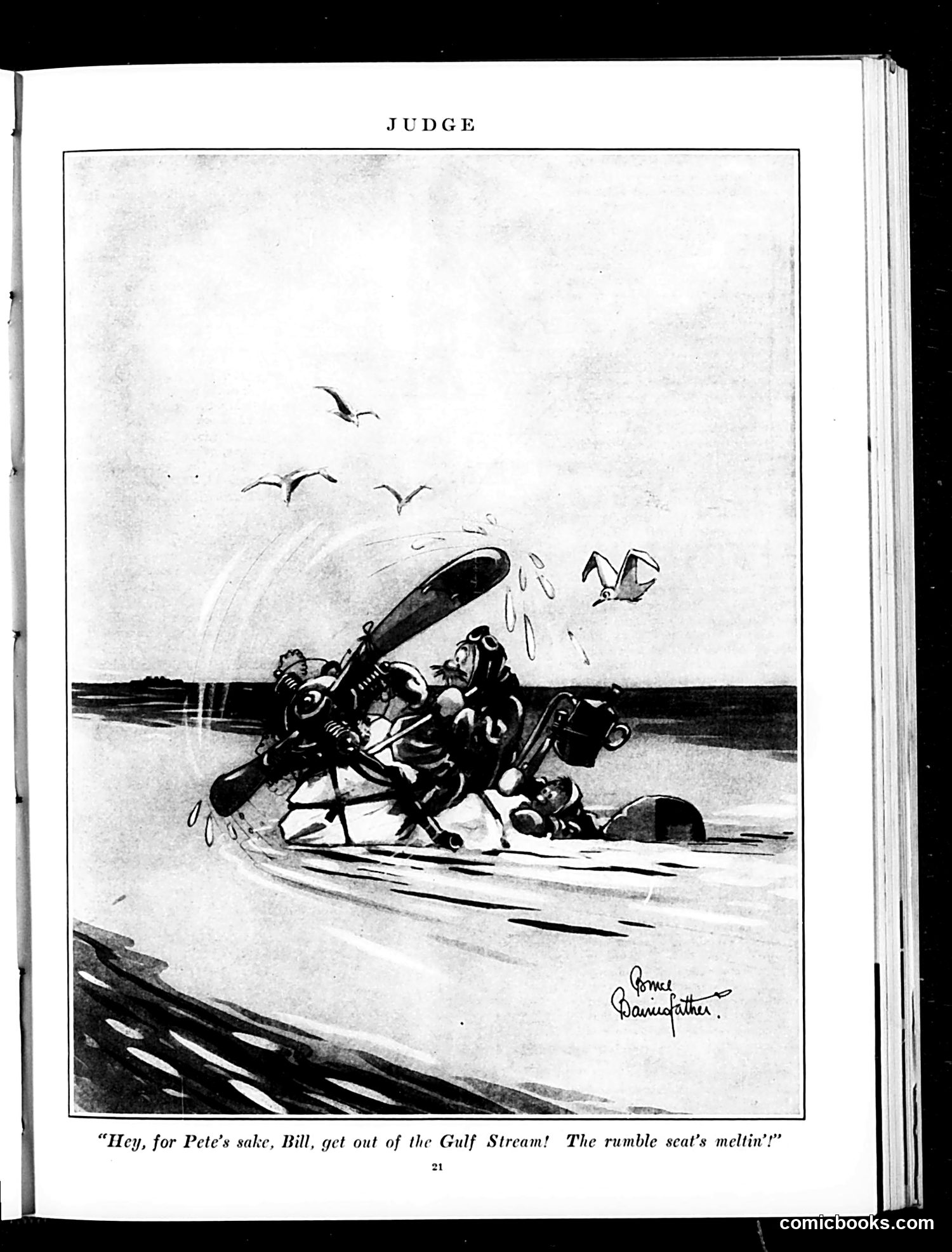
Explanation for Modern Readers This cartoon depicts an airplane in distress, with its occupants alarmed about heat. The humor relies on two now-obsolete references: 1. The "rumble seat" — an open, rear-facing seat common on 1920s-30s automobiles, exposed to the elements. 2. The Gulf Stream — the warm ocean current, here used as a comedic explanation for why the plane is overheating. The joke treats the airplane as if it were a car, confusing aerial navigation with automotive geography. One character urgently tells "Bill" to steer the plane away from the Gulf Stream because the rumble seat is literally melting from the warm waters below—an absurdist gag that plays on the novelty and unfamiliarity of early aviation technology. The cartoon satirizes how people understood or misunderstood these new flying machines through familiar automotive references.
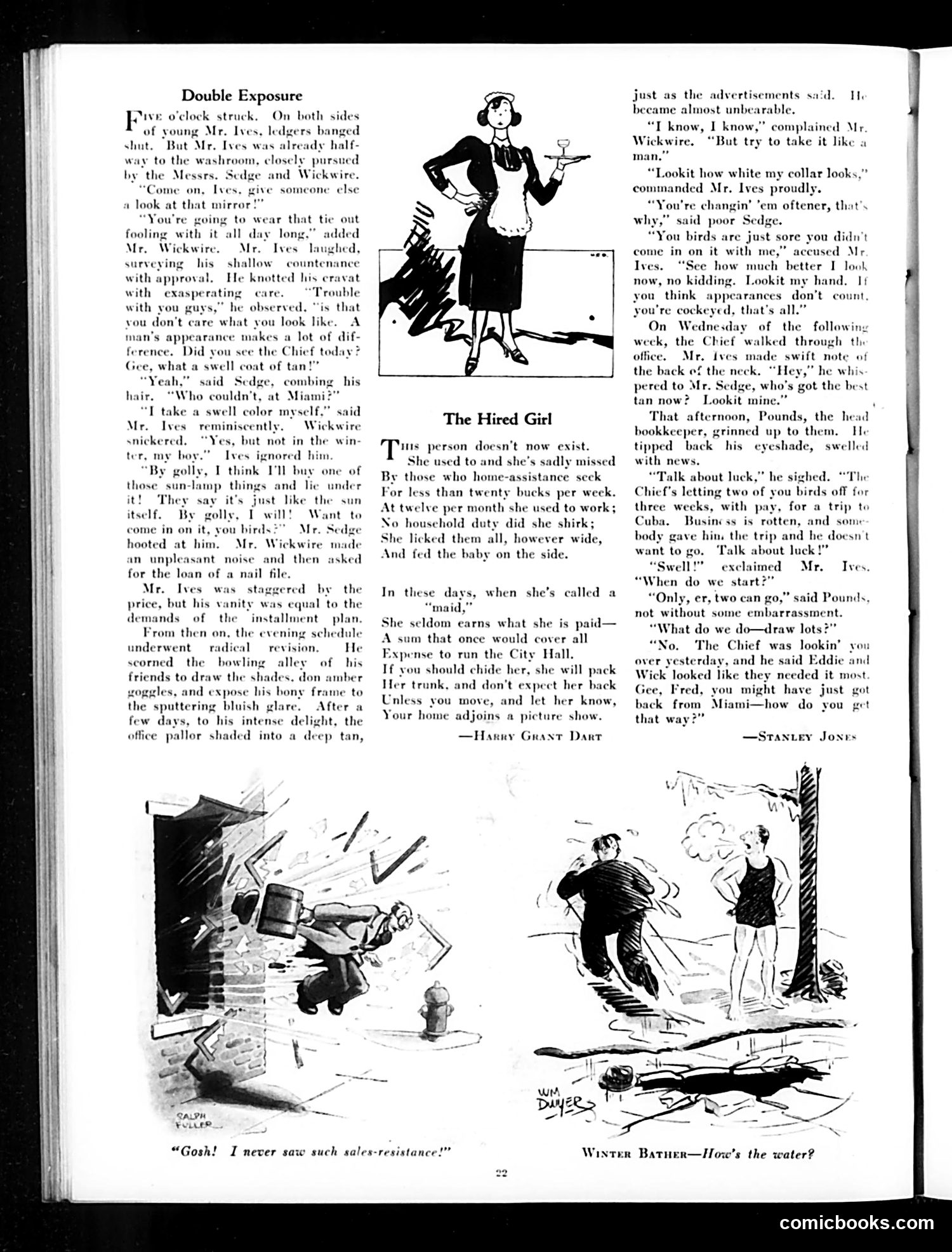
"Double Exposure" and "The Hired Girl" "Double Exposure" satirizes male vanity and workplace competition. Mr. Ives becomes obsessed with his appearance after installing a sun lamp at the office, developing an enviable tan that makes colleagues jealous. When the Chief announces a paid Cuban vacation for two employees, Ives assumes his improved looks secured him the spot—only to learn the Chief actually selected two other men (Eddie and Wick) based on their looking worn out, not tan. The joke: Ives's elaborate self-improvement backfired; vanity blinded him to what actually mattered. "The Hired Girl" is nostalgic social commentary. The poem laments the disappearance of live-in domestic servants willing to work for minimal pay ($12/month) doing unlimited household tasks. The "maid" of modern times demands higher wages for less work and threatens to quit if disrespected or if her home lacks proximity to entertainment (picture shows). The satire critiques both changing labor conditions and servants' newfound bargaining power—presented here as unreasonable ingratitude.
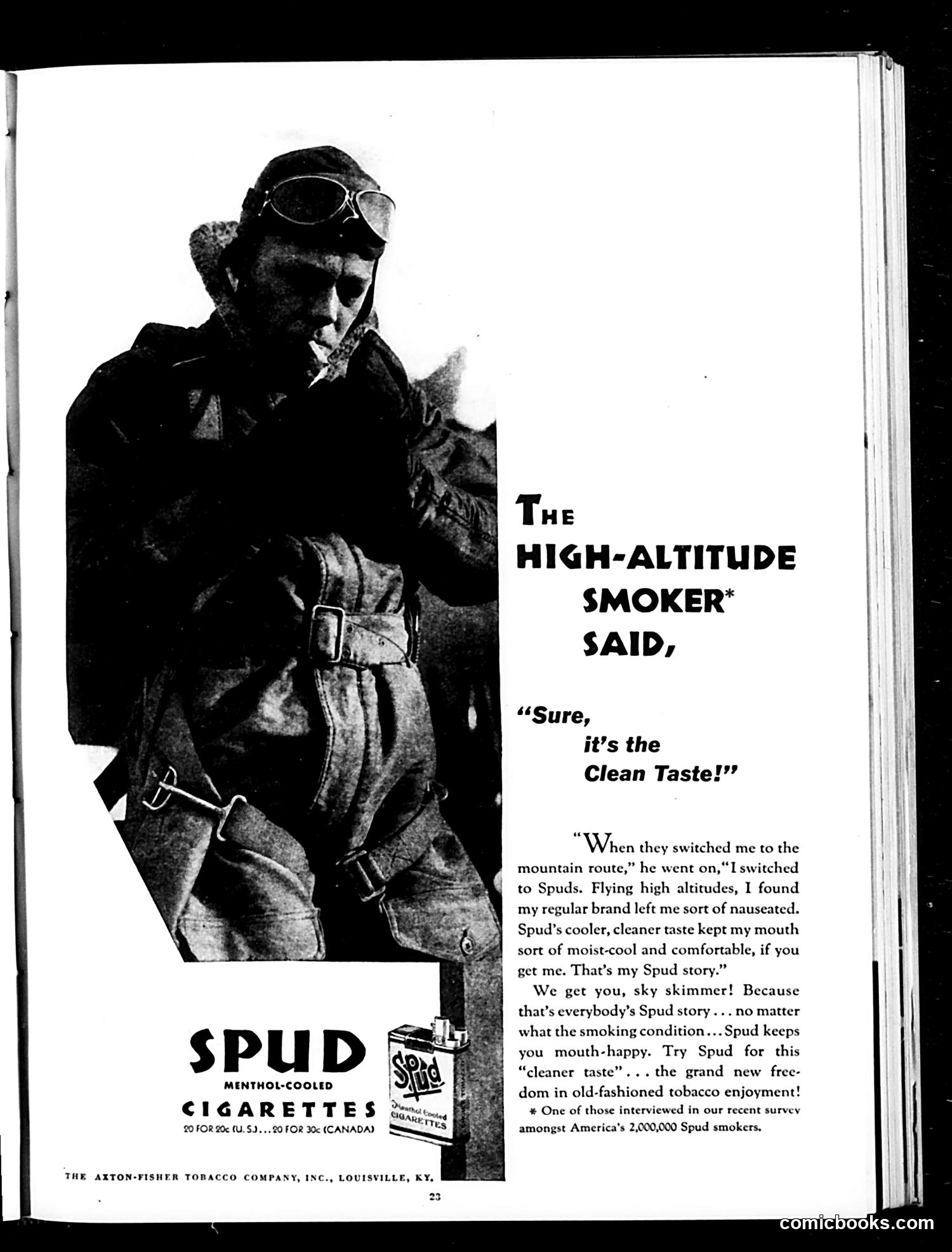
Analysis This is a cigarette advertisement, not a political cartoon. It features a pilot in high-altitude flying gear as a testimonial endorser for Spud menthol-cooled cigarettes. The "joke" or selling point: the pilot claims that at high altitudes, his regular cigarette brand made him nauseous, but switching to Spuds' "cooler, cleaner taste" solved the problem. The ad implies Spud's menthol properties are particularly suited to the physiological stress of high-altitude flying. Context for modern readers: This reflects mid-20th century cigarette marketing before health warnings were required. Manufacturers routinely made health-adjacent claims ("cleaner taste," "moist-cool") that sound absurd today. The use of a skilled professional (a pilot) as an authority figure was standard advertising strategy to build credibility around a product now known to be harmful. The ad claims to represent "one of 2,000,000 Spud smokers" surveyed—typical exaggeration in vintage tobacco advertising.
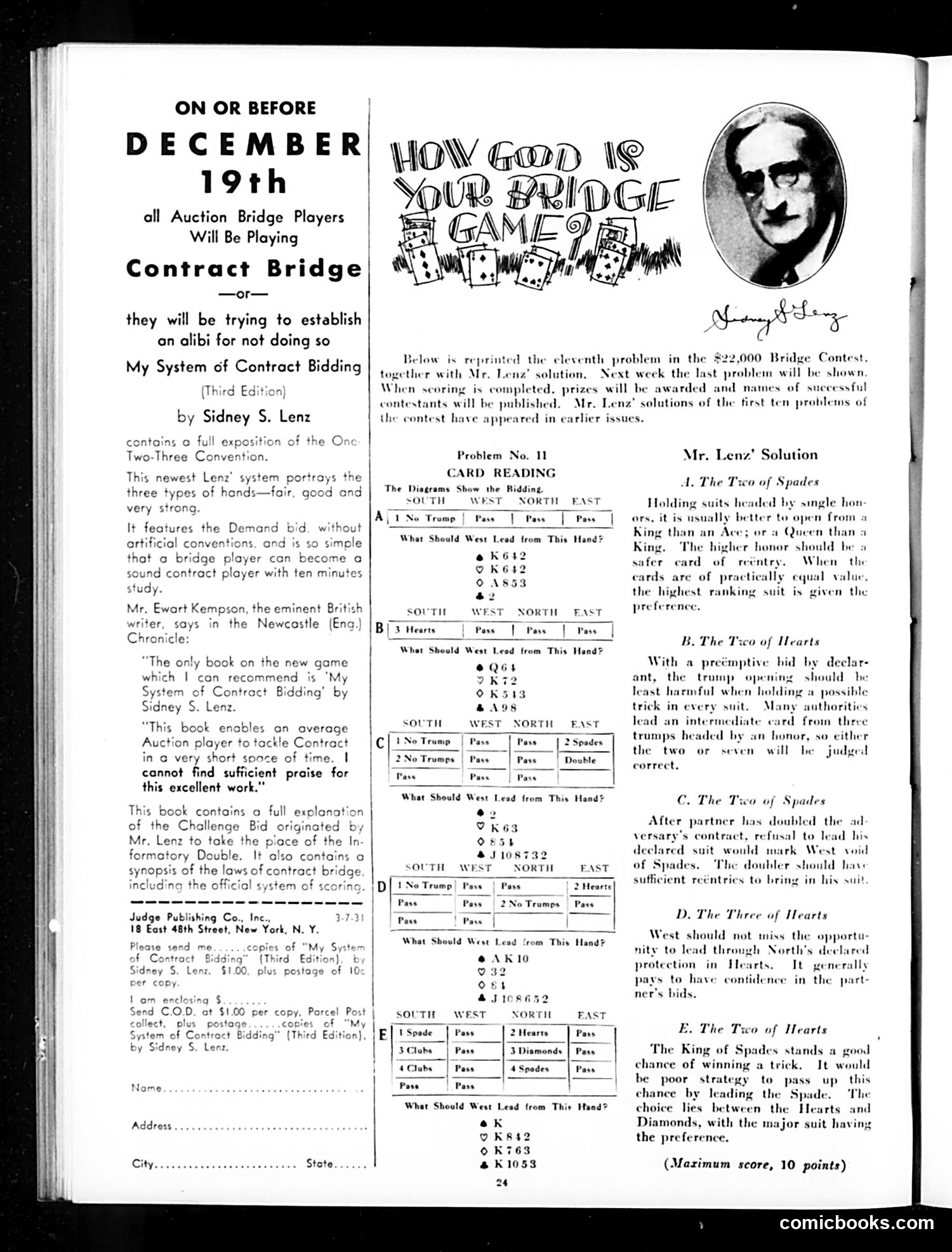
Judge Magazine Page Analysis This page is primarily advertising and instructional content rather than political satire. It promotes Sidney S. Lenz's book *"My System of Contract Bidding"* (Third Edition) for the card game Contract Bridge. The small cartoon labeled "How Good Is Your Bridge Game?" features a portrait of Sidney S. Lenz himself—the author and bridge expert—with his signature. This serves as a byline for the bridge problem and solution that follows. The main content is a bridge instruction feature: Problem No. 11 from Judge's "$22,000 Bridge Contest," showing five different card-holding scenarios (A-E) with Lenz's recommended plays and strategic reasoning. The magazine is positioning Lenz as an authoritative guide for bridge players preparing for the shift from "Auction Bridge" to the newer "Contract Bridge" format (referenced in the deadline notice). Context for modern readers: This reflects bridge's peak popularity in early-to-mid 20th century America, when it was a major social and competitive pastime. The instructional content served readers as both entertainment and practical gaming advice.
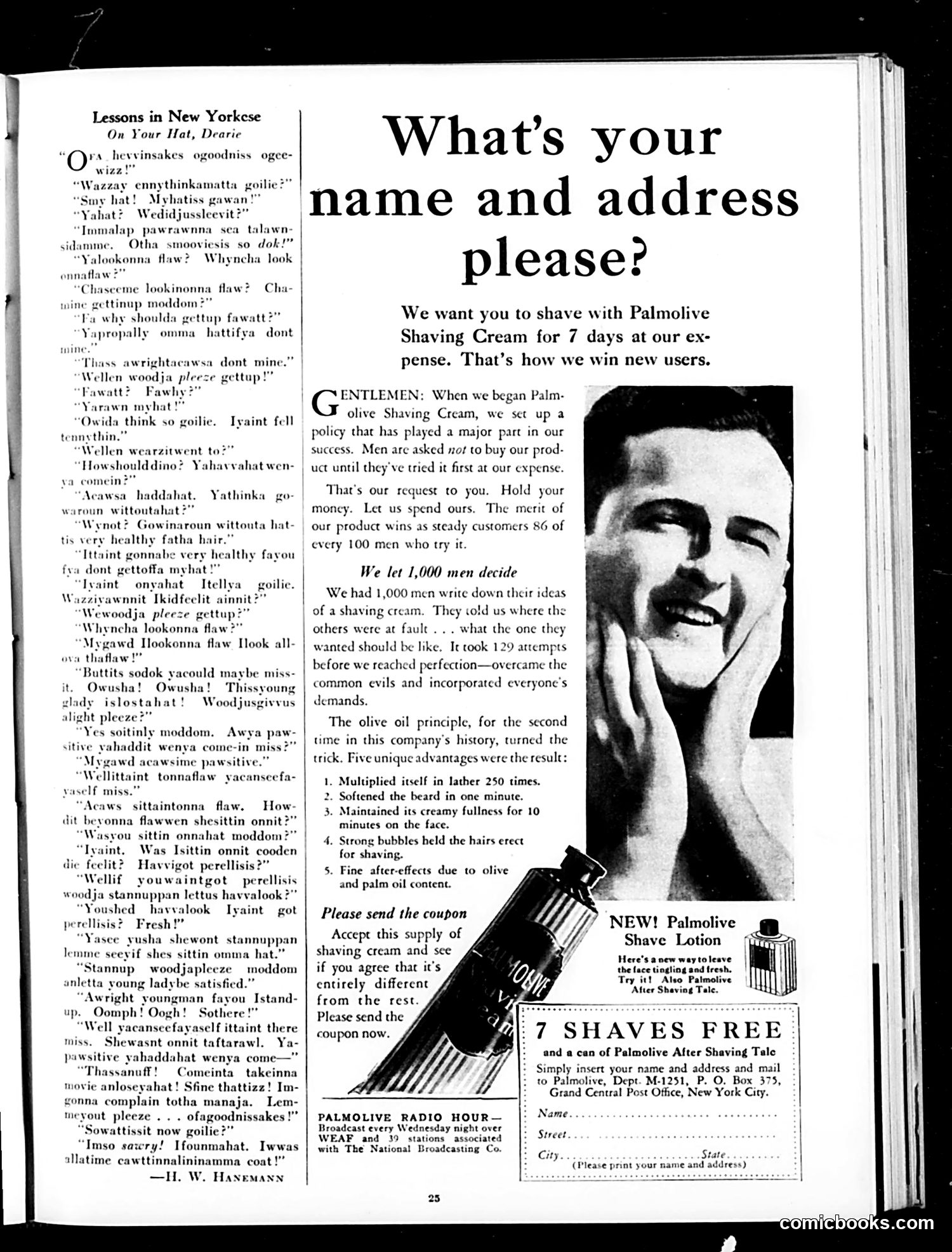
Analysis for Modern Readers This page contains a satirical humor column (left) and a product advertisement (right). The left column, "Lessons in New Yorkcese," mocks the exaggerated dialect and speech patterns of working-class New Yorkers—particularly Brooklyn/Bronx accents of the early 20th century. The joke relies on phonetic misspellings ("ogodniss," "yawrait," "woodja") to ridicule how these speakers sound. A woman repeatedly sits on a man's hat, and he struggles to recover it while she uses colorful malapropisms. The humor is based on ethnic/class stereotyping common to the era's "Judge" magazine, which often lampooned immigrant communities. The right side is a Palmolive Shaving Cream advertisement offering free samples. Rather than selling through traditional methods, Palmolive claims confidence in their product's superiority—they'll let consumers test it free for 7 days. They reference surveying 1,000 men and making 129 attempts to perfect the formula, emphasizing olive oil's benefits. Both sections reflect early-20th-century American consumer culture and attitudes toward working-class urban populations.
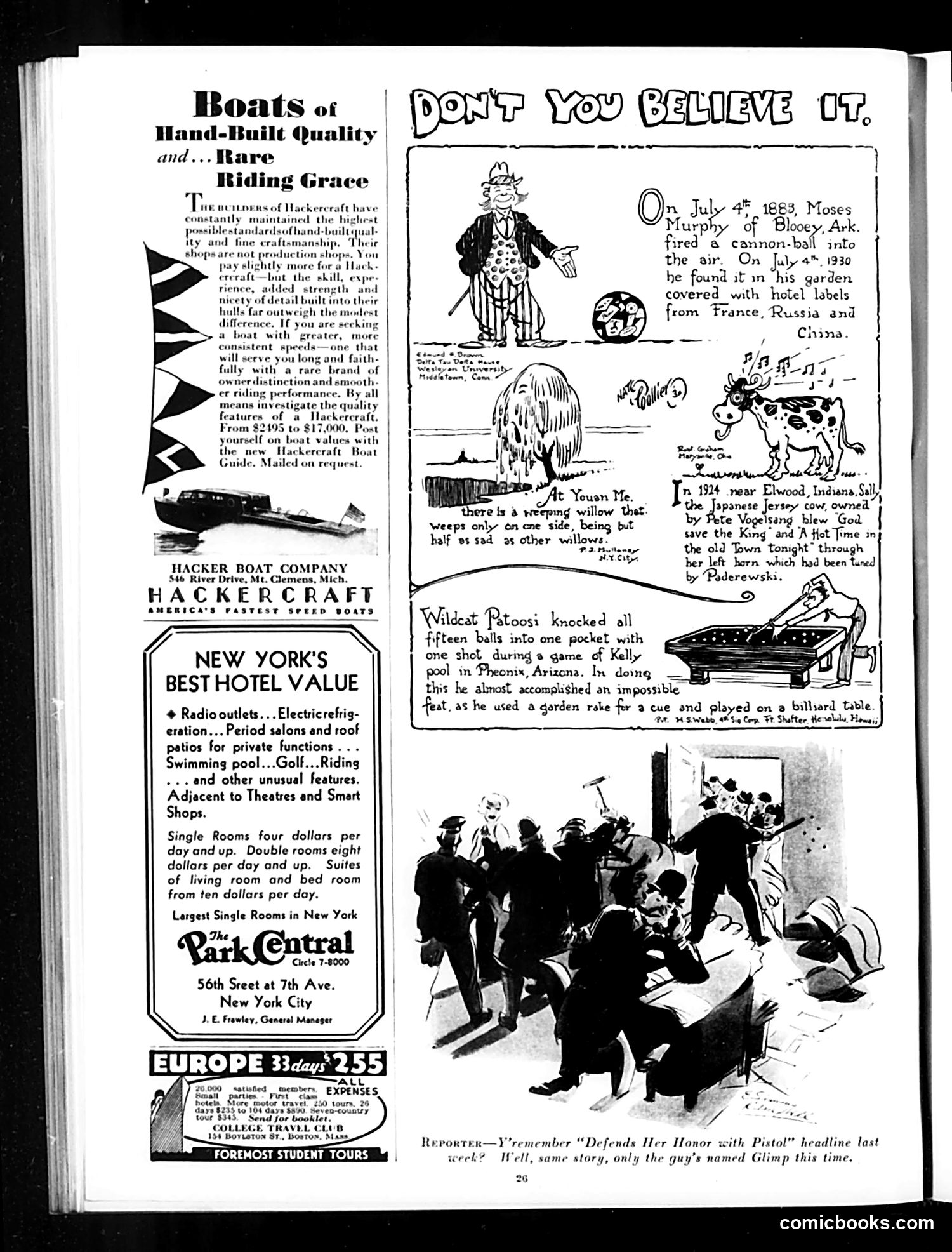
"Don't You Believe It" - Judge Magazine Tall Tales This page features a humor column mocking implausibly exaggerated stories. The "Don't You Believe It" section presents absurd anecdotes presented as fact: - A cannon fired in 1883 Arkansas lands in the same garden 47 years later, covered in foreign hotel labels - A Japanese cow supposedly plays music through a horn tuned by pianist Paderewski - "Wildest Patoosi" (likely a fabricated name) pockets 15 billiard balls with one shot using a garden rake The final cartoon joke references a recent "Defends Her Honor with Pistol" newspaper headline, sarcastically suggesting the same story is being recycled with a different (comic) character name—"Glimp." The satire targets sensationalist journalism and implausible human-interest stories that readers might encounter in newspapers. The recurring format mocks gullible audiences who accept extraordinary claims without skepticism. The bottom illustration shows reporters/editors fabricating or embellishing stories.
Explanation for Modern Readers This page is primarily book reviews and advertising, not political satire. The left column contains literary criticism of recent novels, including works about colonial life ("Mulatto Johnny") and popular music history ("Tin Pan Alley"). The reviewer dismisses some as derivative small-town fiction while acknowledging competent craftsmanship. The right side is a full-page advertisement for American Telephone and Telegraph Company. Rather than hard-sell tactics, it uses soft persuasion, arguing that telephone service provides immense value—not just for emergencies (doctors, police) but for everyday convenience. The ad emphasizes the infrastructure and public service aspect, positioning AT&T as a utility serving community growth at minimal profit margins. This reflects early 20th-century corporate PR strategy: positioning monopolistic utilities as public servants rather than profit-driven businesses. No cartoon or caricature appears on this page.
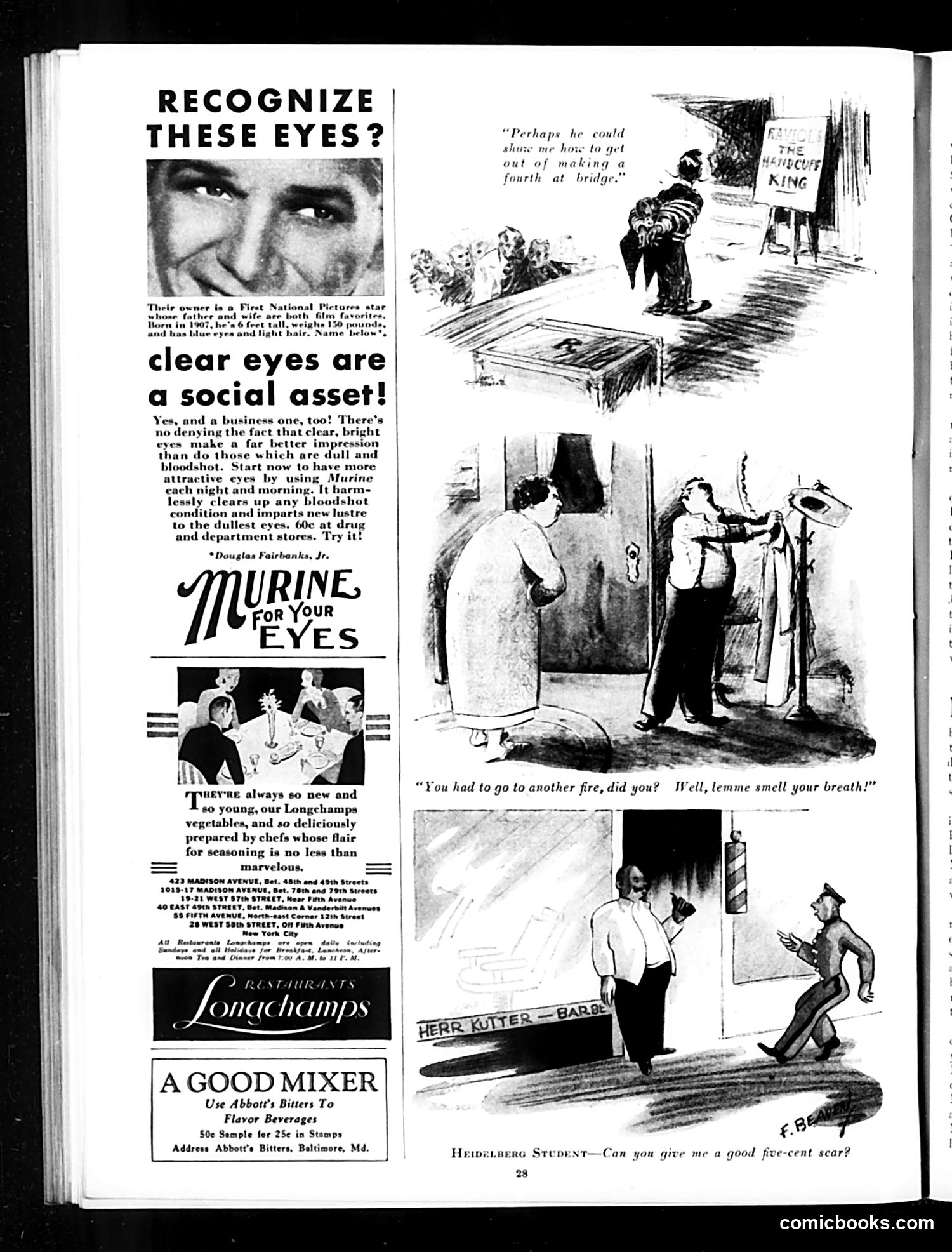
Page Analysis: Judge Magazine This page contains vintage advertisements alongside cartoon humor typical of early-to-mid 20th century Judge magazine. Left side: A Murine eye drops ad featuring Douglas Fairbanks Jr., promoting "clear eyes as a social asset" for business and personal impression-making. Right side: Three unrelated comic vignettes satirizing everyday social situations: 1. Bridge excuse: A skeleton figure asks how to avoid playing bridge—likely mocking the tedium of the card game among the social set. 2. Fire department scene: Someone's alibi about attending another fire is questioned ("smell your breath")—joking about dishonest excuses. 3. Barber scene: A student requests a "five-cent scar" from "Herr Kulter" the barber—absurdist humor about vanity or toughness. The humor relies on period-specific social conventions (bridge playing, fire brigades, barbershop culture) that are now obscure. The overall tone is light social commentary on contemporary manners and pretense.
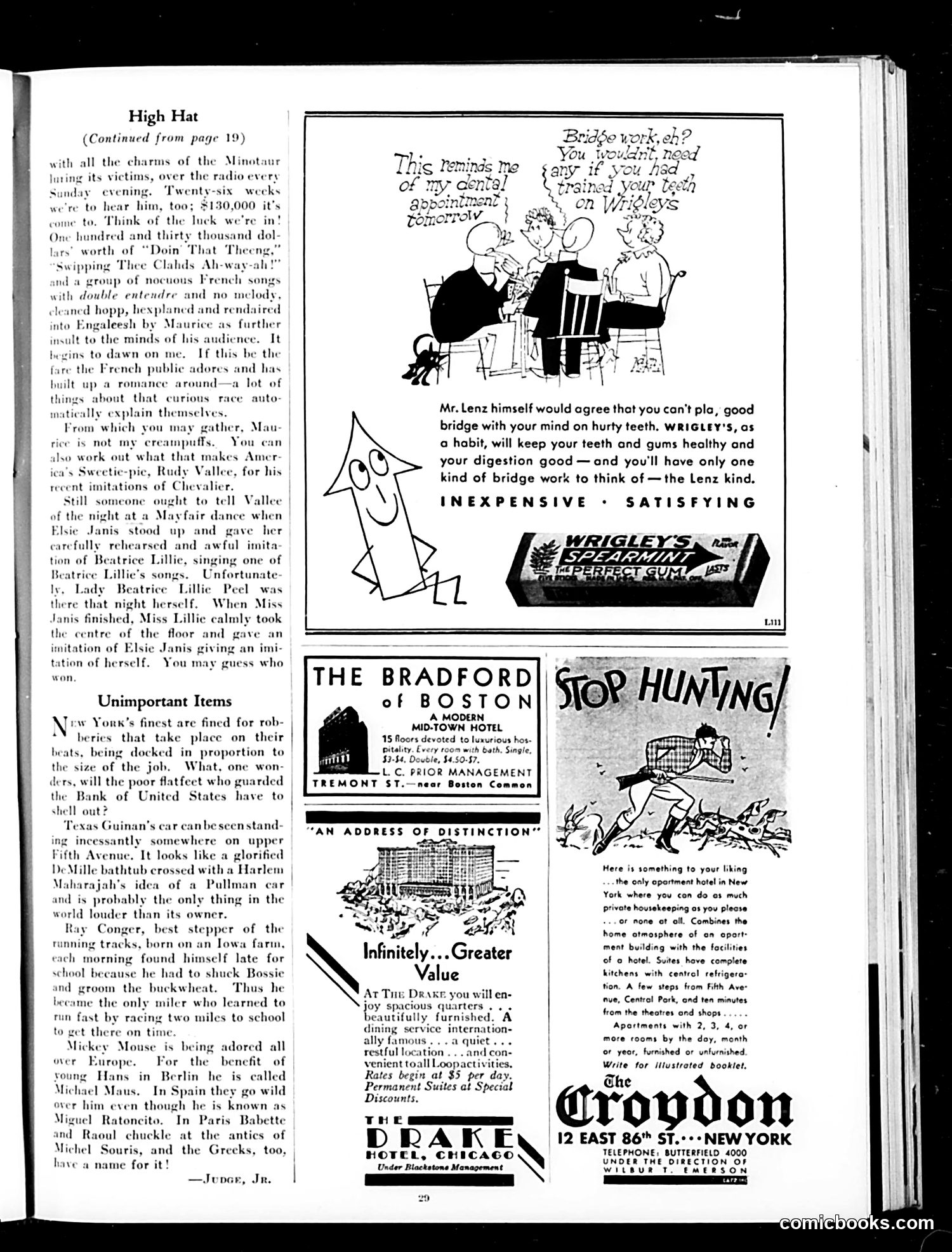
Analysis for Modern Readers This page from Judge magazine (a satirical publication) contains several elements: "High Hat" Column: A gossipy entertainment critique mocking Maurice Chevalier's radio performances and French songs, dismissing them as pretentious. The author also ridicules Rudy Vallee for imitating Chevalier. A humorous anecdote describes Beatrice Lillie publicly mocking Elsie Janis's imitation of her—a petty Hollywood rivalry joke. "Unimportant Items": Brief satirical news blurbs, including a jab at corrupt New York police (the "flatfeet" guarding a bank who might face fines), Texas Guinan's ostentatious car, and Mickey Mouse's international naming variations. Wrigley's Gum Advertisement: Uses bridge-playing dentistry as a pun—encouraging gum-chewing for healthy teeth rather than needing actual bridge work. The page is primarily light entertainment and advertising, reflecting 1920s-30s celebrity gossip and consumer culture.
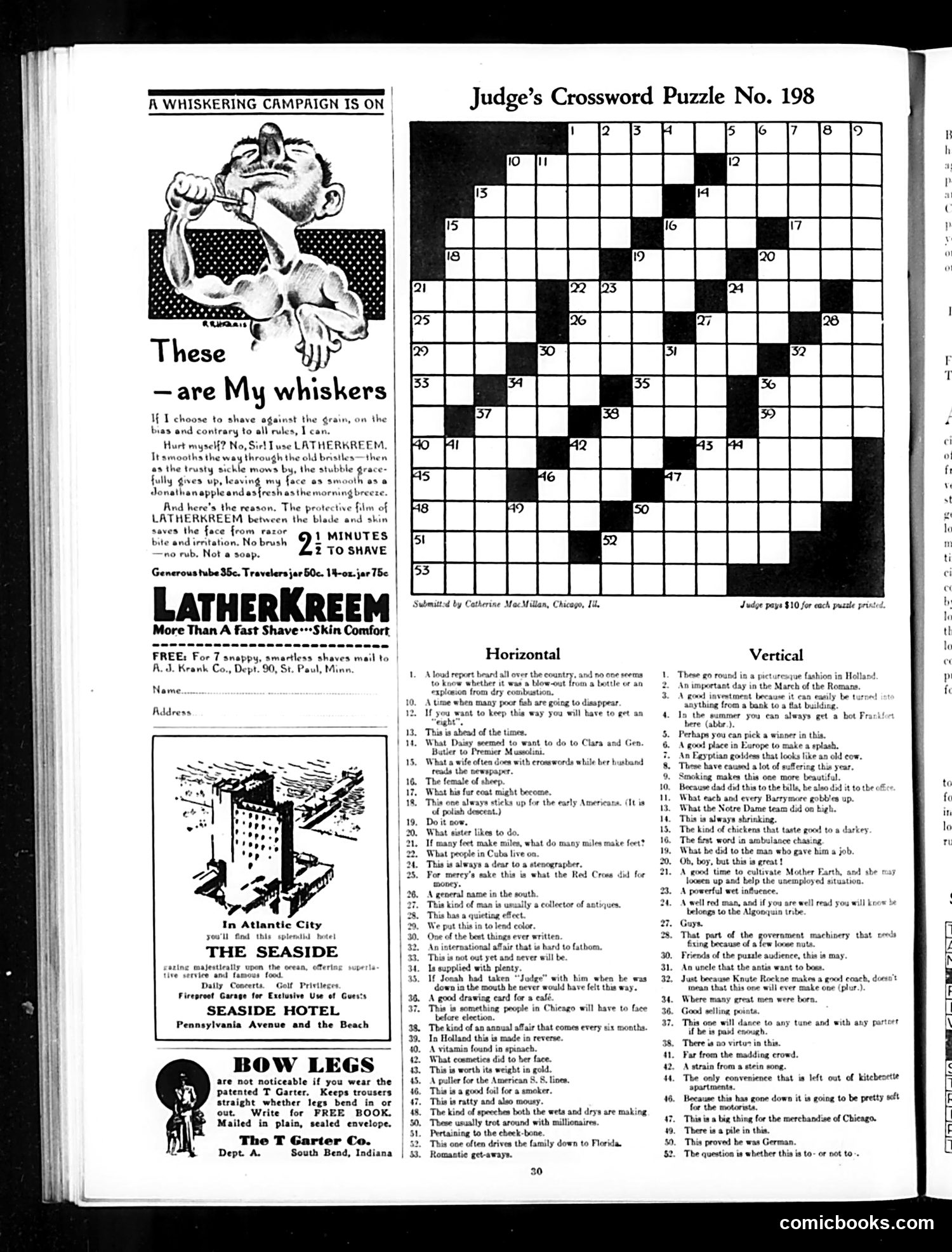
"A Whiskering Campaign Is On" – Judge Magazine Advertisement & Crossword This page is primarily advertising and puzzles rather than political satire. The main content is a Latherkreem shaving cream advertisement featuring a cartoon man with exaggerated whiskers, promoting the product's ability to provide a smooth shave in "2 minutes" without irritation. The phrase "whiskering campaign" is a pun—a play on "whispering campaign" (a political tactic of spreading rumors). The ad uses this wordplay to humorously position shaving as a "campaign" against facial hair. The remainder consists of Judge's Crossword Puzzle No. 198 with horizontal and vertical clues (many referencing contemporary 1920s-30s topics like Chicago politics, Mussolini, and the "wets and drys" debating Prohibition), plus other period advertisements for hotel accommodations, bow-leg correctors, and other products. There is no significant political or social satire on this particular page—it's a typical magazine layout mixing commercial advertising with reader entertainment.
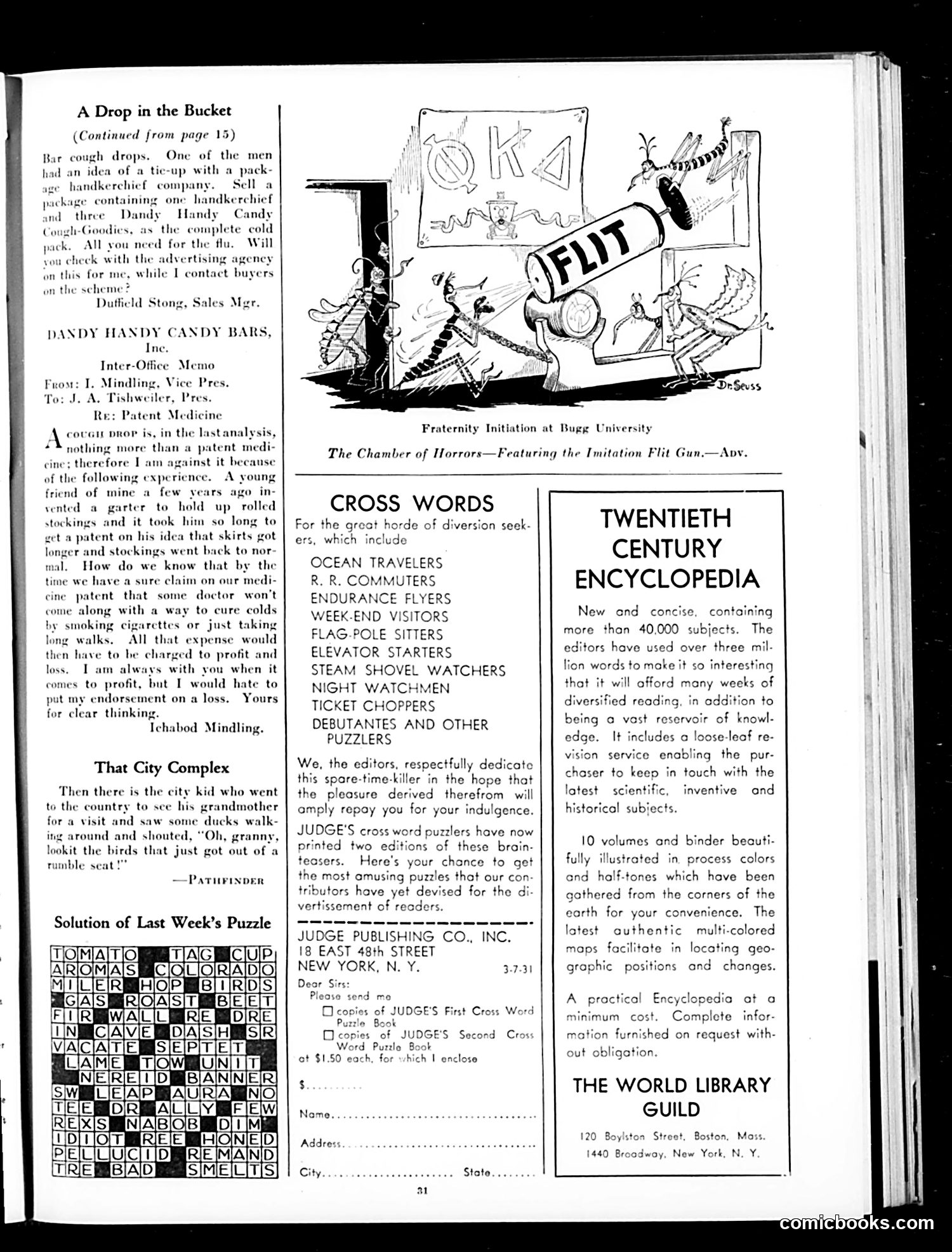
Analysis of Judge Magazine Page This page is primarily advertisements and editorial content rather than political satire. The main cartoon—"Fraternity Initiation at Bugg University"—depicts pledges being shot with an "Imitation Flit Gun," referencing Flit insecticide, a popular consumer product. The joke plays on hazing rituals by literalizing the product's purpose as a weapon against initiates (depicted as insects). This is period-appropriate dark humor from the 1920s-30s. The text sections are mundane corporate memos about patent medicines and marketing schemes. The "city kid" anecdote simply jokes that urban children are unfamiliar with rural animals. The page is otherwise filled with crossword puzzles, encyclopedia advertisements, and publishing company promotions—standard Judge magazine filler content. There is no significant political commentary or social satire present on this particular page. It represents typical period advertising and light entertainment material.
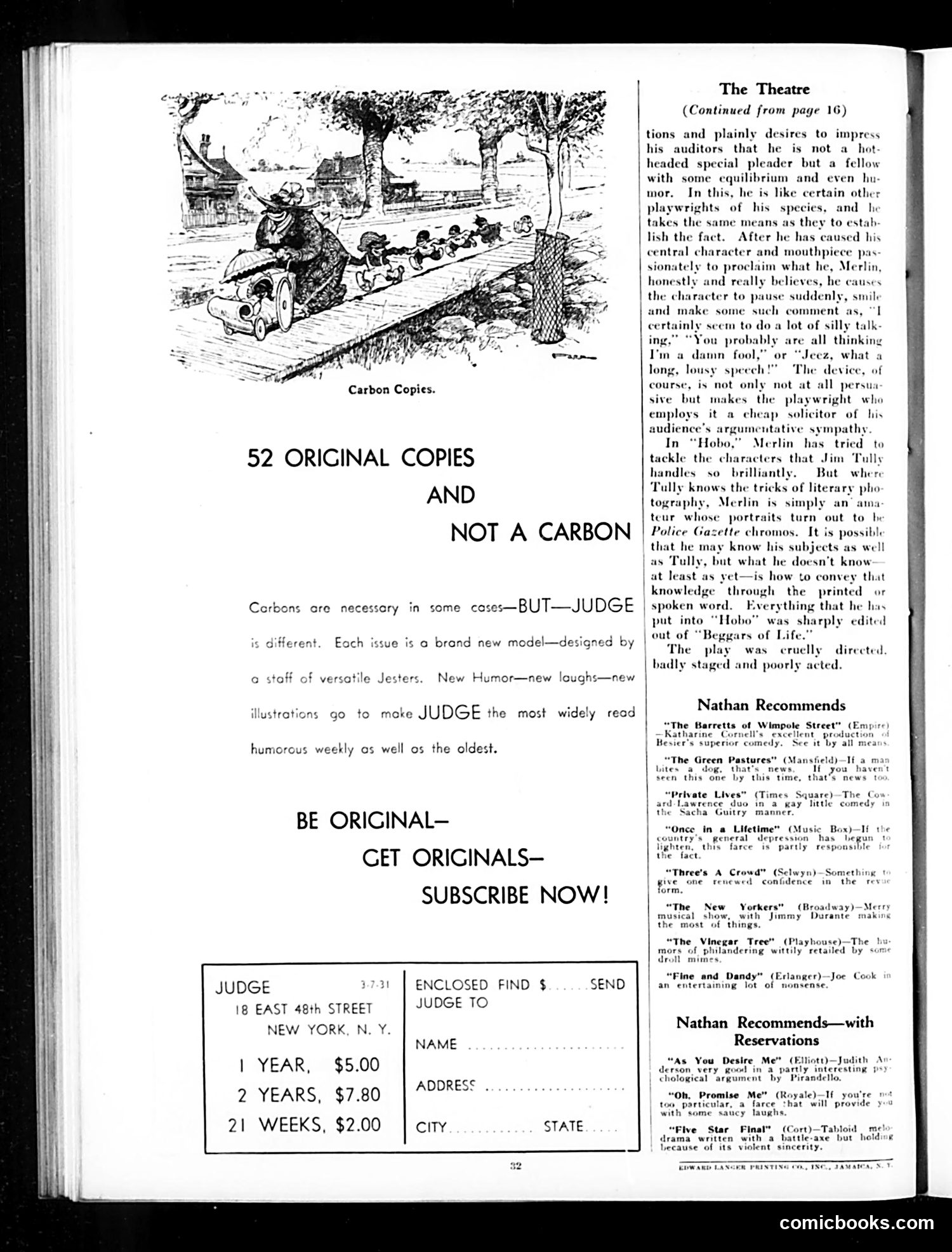
Understanding This Judge Magazine Page This page is primarily advertising and subscription promotion rather than political satire. The main content shows a cartoon labeled "Carbon Copies" depicting someone pulling children in a wagon—likely illustrating the metaphor that Judge magazine produces original content, not mere duplicates. The advertisement's central pitch claims Judge publishes "52 ORIGINAL COPIES AND NOT A CARBON," meaning each weekly issue contains fresh, original humor and illustrations rather than recycled material. This was a competitive marketing claim in the 1920s-30s magazine market. The right column, "Nathan Recommends," reviews current Broadway plays with brief critical assessments—typical entertainment journalism of the era. References to performers like Jimmy Durante and Judith Anderson anchor these to specific theatrical productions of that period. The page essentially functions as a subscription solicitation ($5 yearly) combined with entertainment coverage to demonstrate Judge's value as a humor and culture magazine.
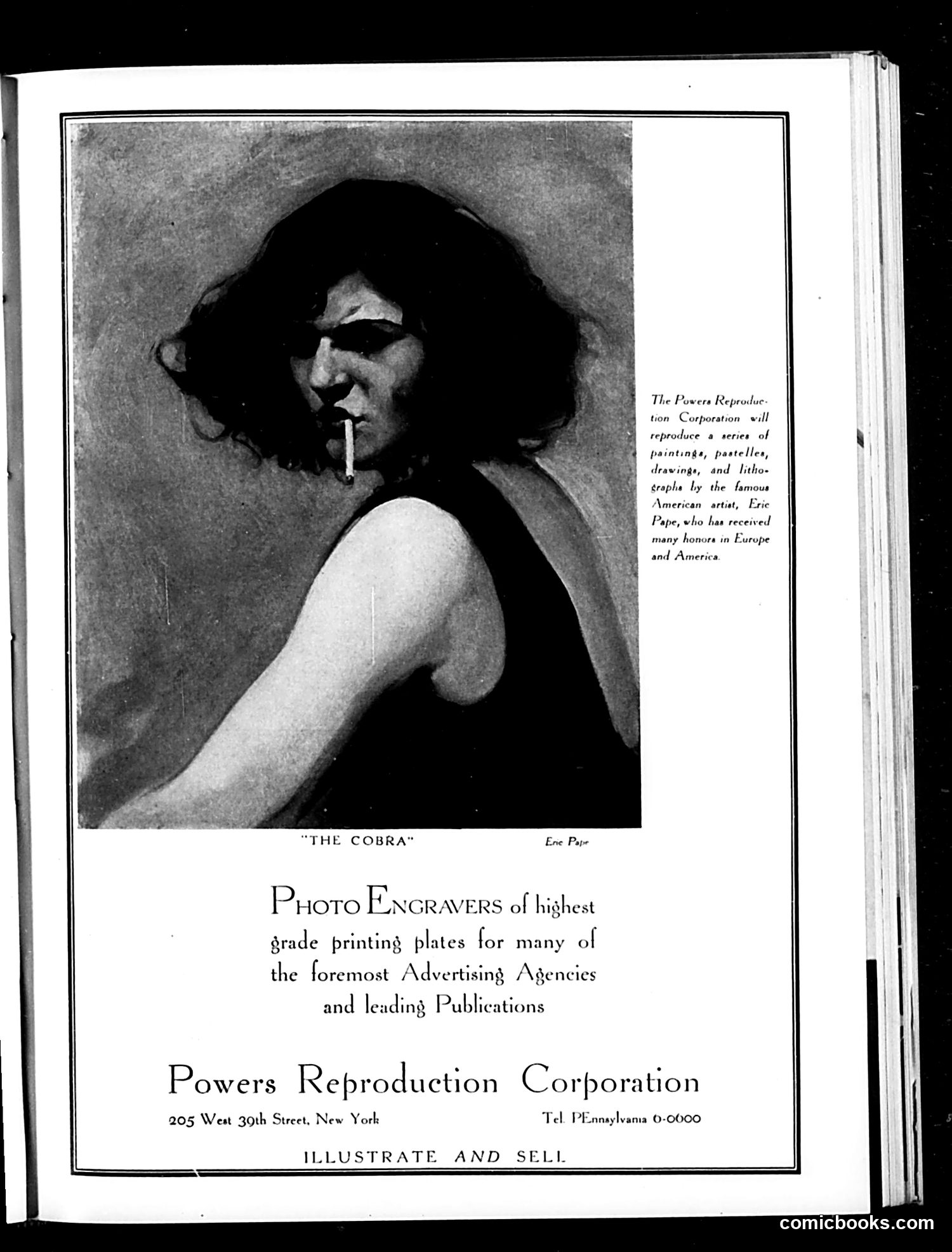
Page Analysis This is primarily advertising content, not a satirical cartoon. The page features: The Image: A portrait titled "The Cobra" by Eric Pope, showing a figure in profile wearing sunglasses and smoking a cigarette, with dramatic lighting against a textured background. The Text: An advertisement for Powers Reproduction Corporation, a New York printing business specializing in photo-engraving and printing plates for advertising agencies and publications. Historical Context: The page announces that Powers will reproduce a series of Pope's artworks (paintings, pastels, drawings, lithographs). Eric Pope was apparently an established American artist who had "received many honors in Europe and America." The advertisement's purpose was to showcase Pope's work as a portfolio example while promoting Powers' reproduction capabilities to potential clients in advertising and publishing. There is no political satire visible on this page.
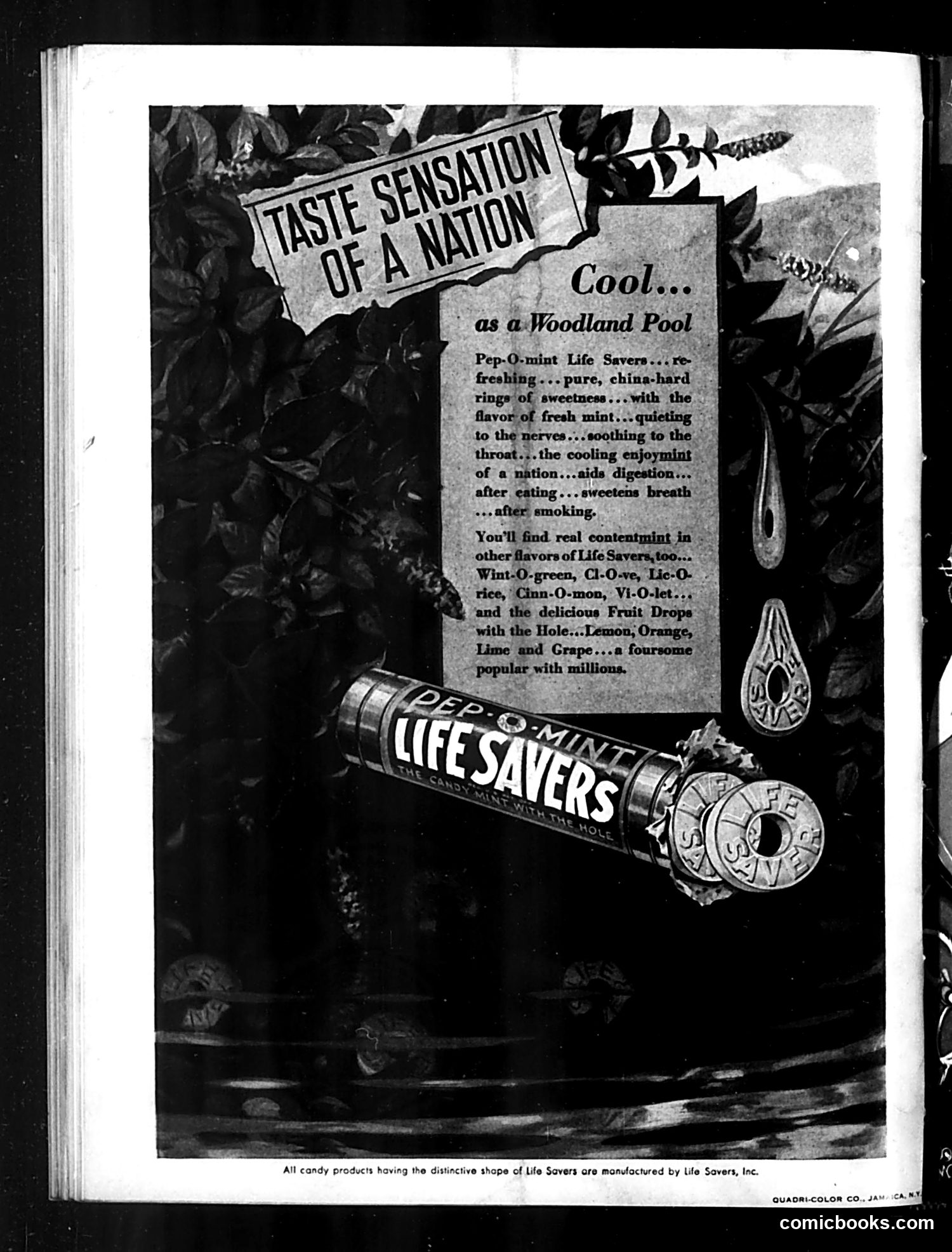
Life Savers Advertisement This is a Life Savers candy advertisement, not a political cartoon. The page features the product's iconic cylindrical roll and distinctive hole-centered candies arranged decoratively with foliage. The headline "Taste Sensation of a Nation" employs patriotic language to market the candy. The copy describes Pep-O-mint Life Savers as refreshing and beneficial—"cooling the enjoyment of a nation...aids digestion...after eating...sweetens breath...after smoking." Various flavored variants are listed: Wint-O-green, Cl-O-ve, Li-O-rice, Cinn-O-mon, Vi-O-let, plus Fruit Drops. The advertisement uses pseudo-scientific health claims typical of early-to-mid 20th century marketing, positioning candy as having digestive and social benefits alongside its taste appeal.