judge
Judge — March 14, 1931
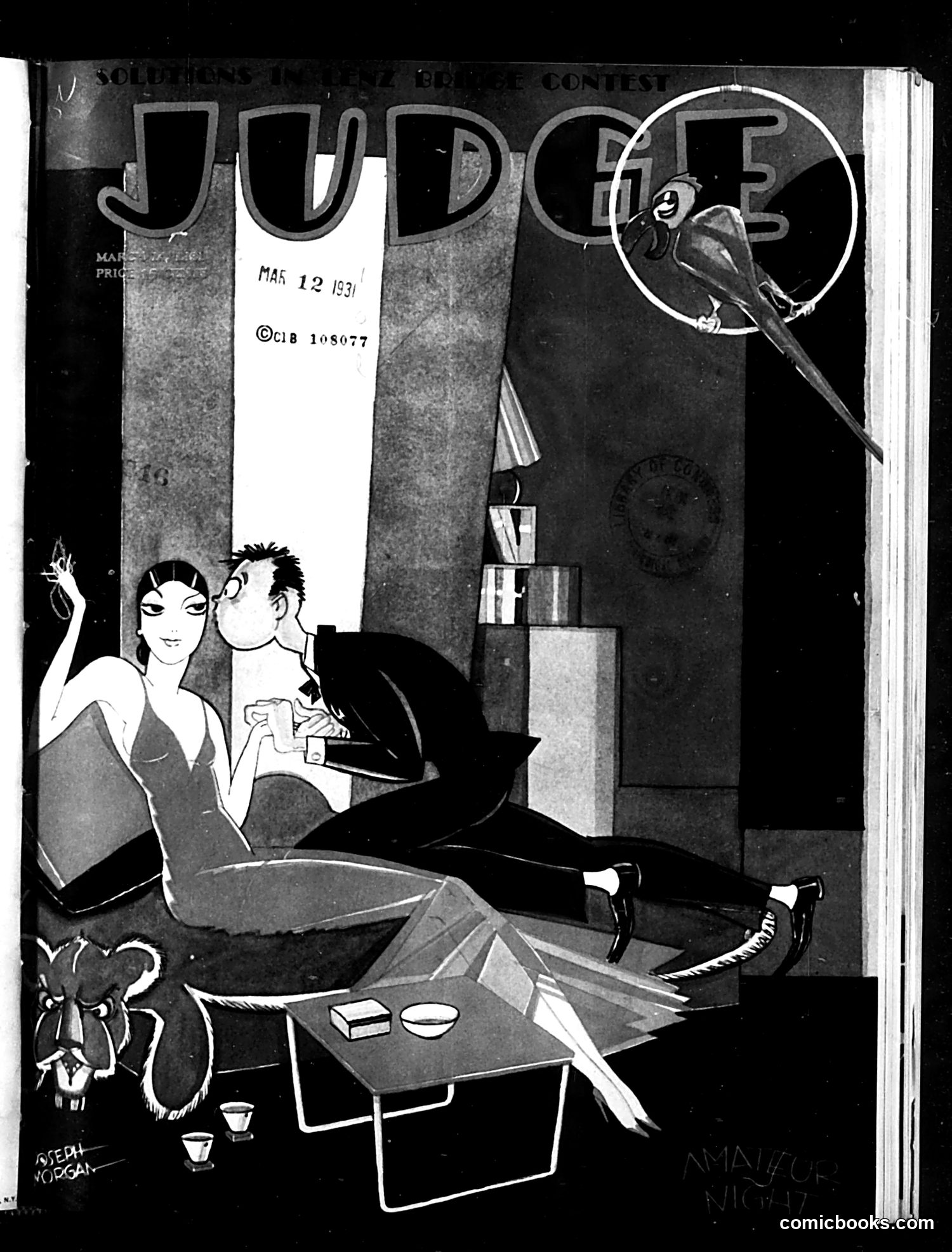
Judge Magazine Cover Analysis This appears to be a Judge magazine cover from March 12, 1931, during the Great Depression era. The cartoon depicts a stylized scene of urban nightlife—two figures in a nightclub or speakeasy setting, with a parrot perched above and cocktail glasses visible. The satirical point likely concerns Prohibition-era social life: despite the nationwide alcohol ban (in effect 1920-1933), speakeasies and illicit drinking continued flourishing in cities. The elegant figures and bird suggest commentary on how wealthy urbanites maintained lavish leisure despite economic hardship affecting most Americans. The specific identities of the figures are unclear from the image alone, though the sophisticated styling and setting are characteristic of Judge's commentary on Manhattan high society during this period.
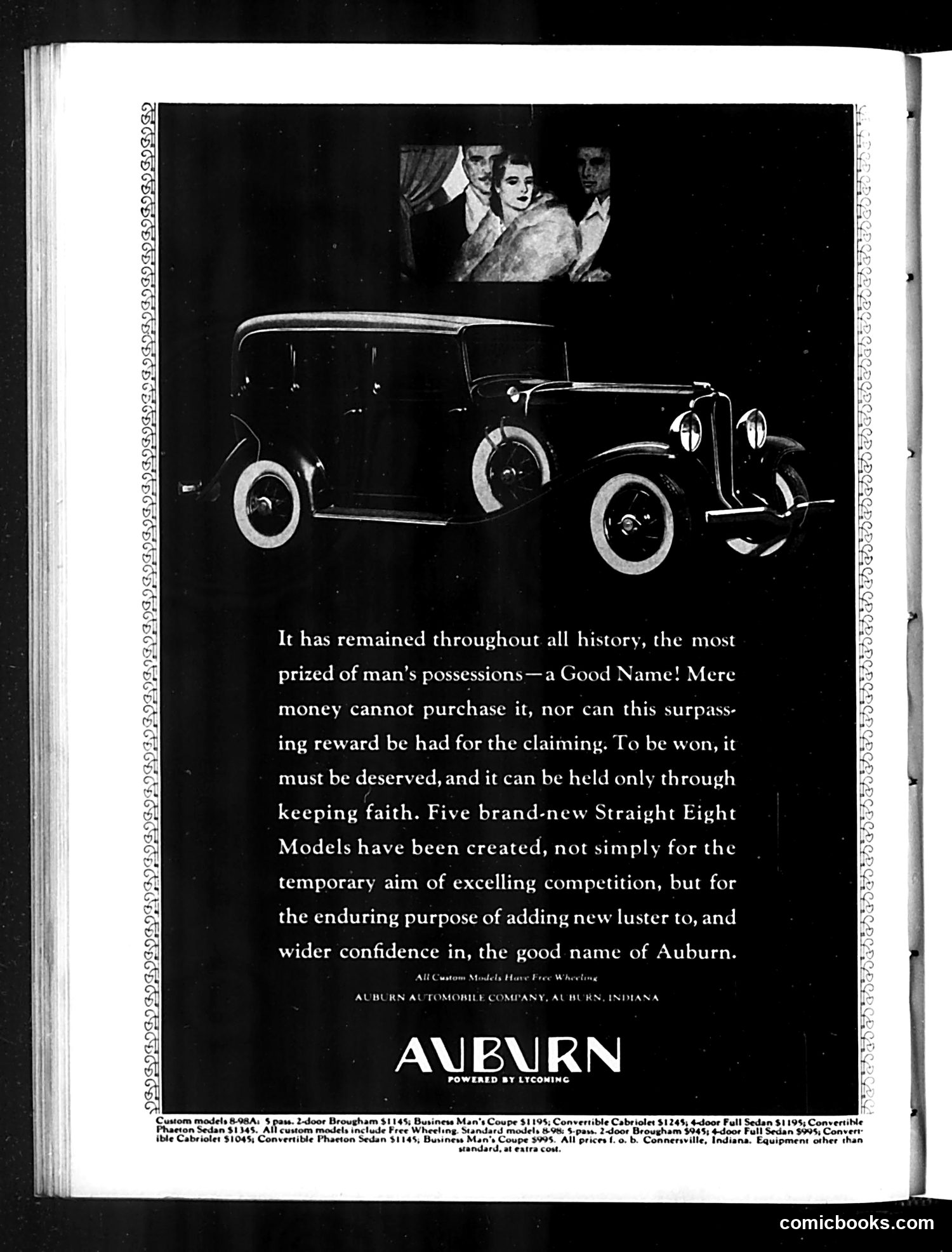
Auburn Automobile Advertisement This page is primarily a car advertisement, not political satire. It promotes Auburn automobiles, manufactured in Auburn, Indiana. The ad features two vintage cars (appearing to be from the 1920s-30s) and includes an illustration of well-dressed people in an automobile, emphasizing luxury and respectability. The accompanying text uses moralistic language about reputation ("a Good Name") to position Auburn cars as vehicles that enhance one's social standing and character. The phrase "Powered by Lycoming" refers to the engine manufacturer. The small print lists various Auburn model options and prices, indicating this is a straightforward commercial advertisement rather than satirical content. Judge magazine, while primarily satirical, regularly included such advertisements to fund publication.
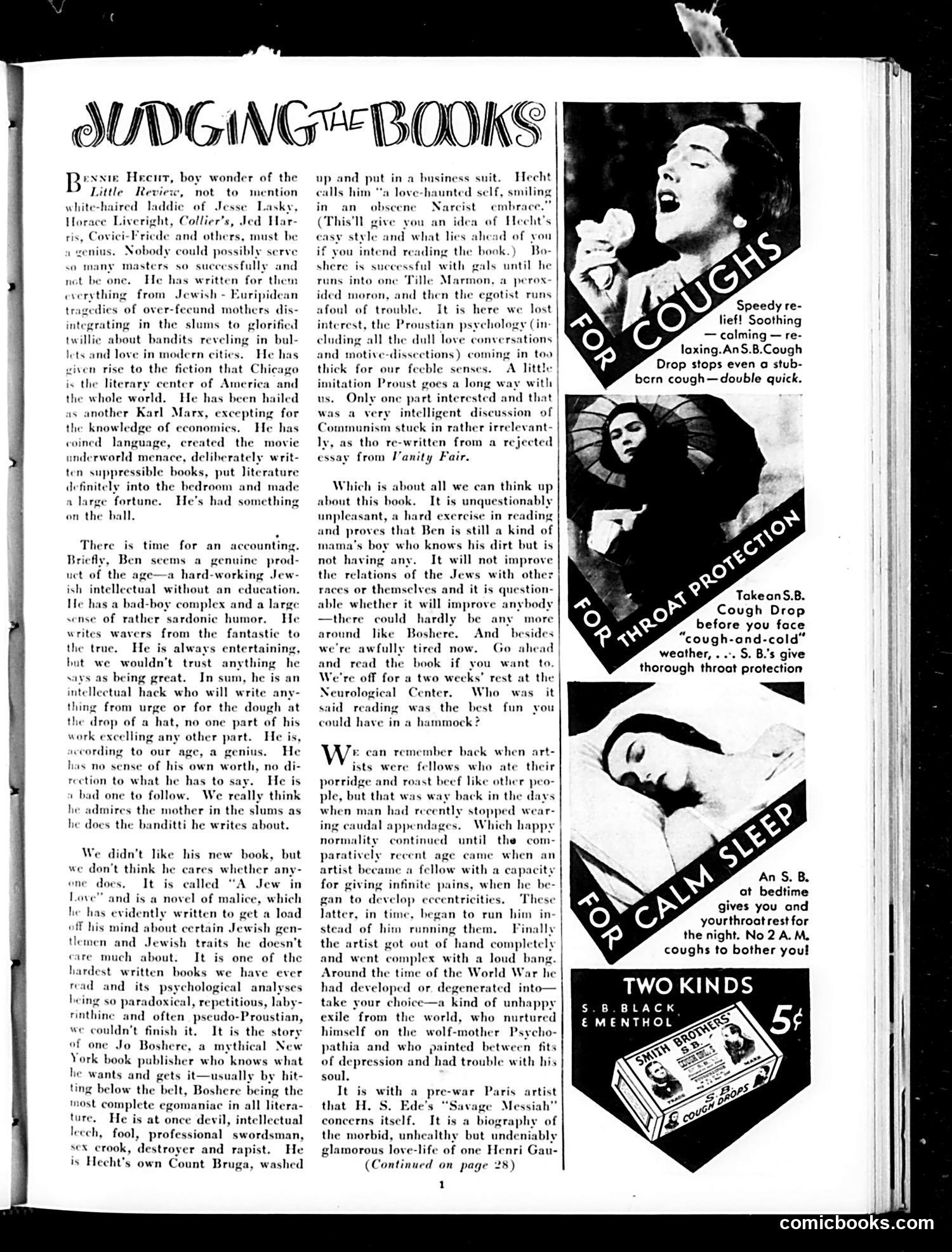
Analysis This page is primarily a book review section titled "Judging the Books," not a political cartoon. The main content critiques works by Jewish author Bysshe Hecht and others, discussing novels about Jewish life and experience. The reviewer dismisses one work as "A Jest in Love" (a novel of malice), criticizing its treatment of Jewish themes and relations with other groups. The right side contains vintage product advertisements (cough drops, throat lozenges, sleeping aids) typical of 1920s-30s magazines—not satirical content. There is no clear political cartoon on this page. The satirical element, if any, lies in the book reviews themselves, which appear to critique overly sentimental or poorly-handled literary treatments of Jewish subject matter and identity.
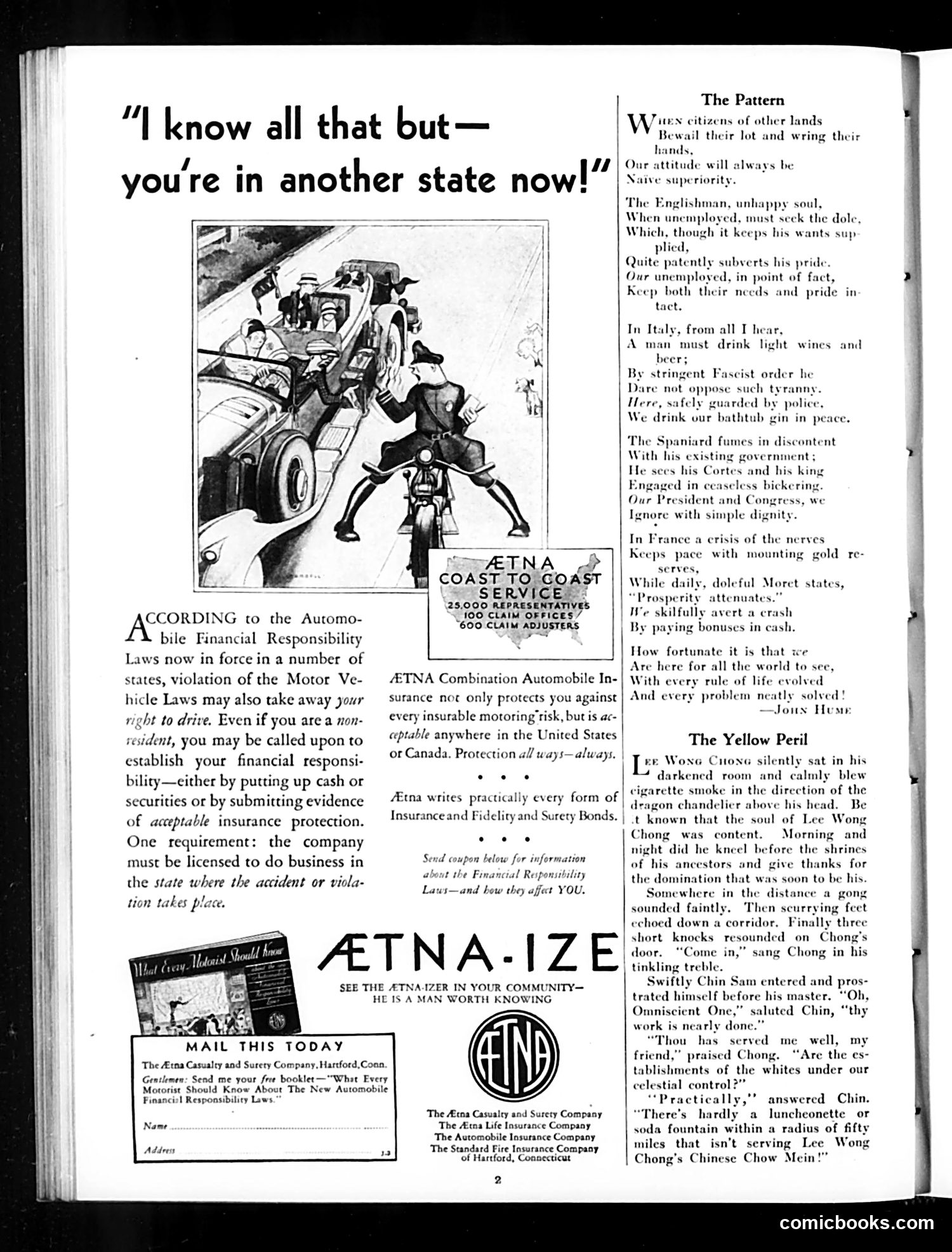
Analysis This page is primarily advertising for Aetna insurance, not political satire. The main cartoon shows a speeding car with a policeman on a motorcycle pursuing it, illustrating the headline: "I know all that but—you're in another state now!" The joke references Motor Vehicle Laws that vary by state. The ad warns that violating traffic laws in one state can result in losing your driver's license even as a non-resident, and that you may be sued for damages. The cartoon humorously depicts someone fleeing across state lines thinking they've escaped consequences—but Aetna's insurance protects against liability anywhere in the US or Canada. The right page contains unrelated fiction ("The Yellow Peril"), not political content.
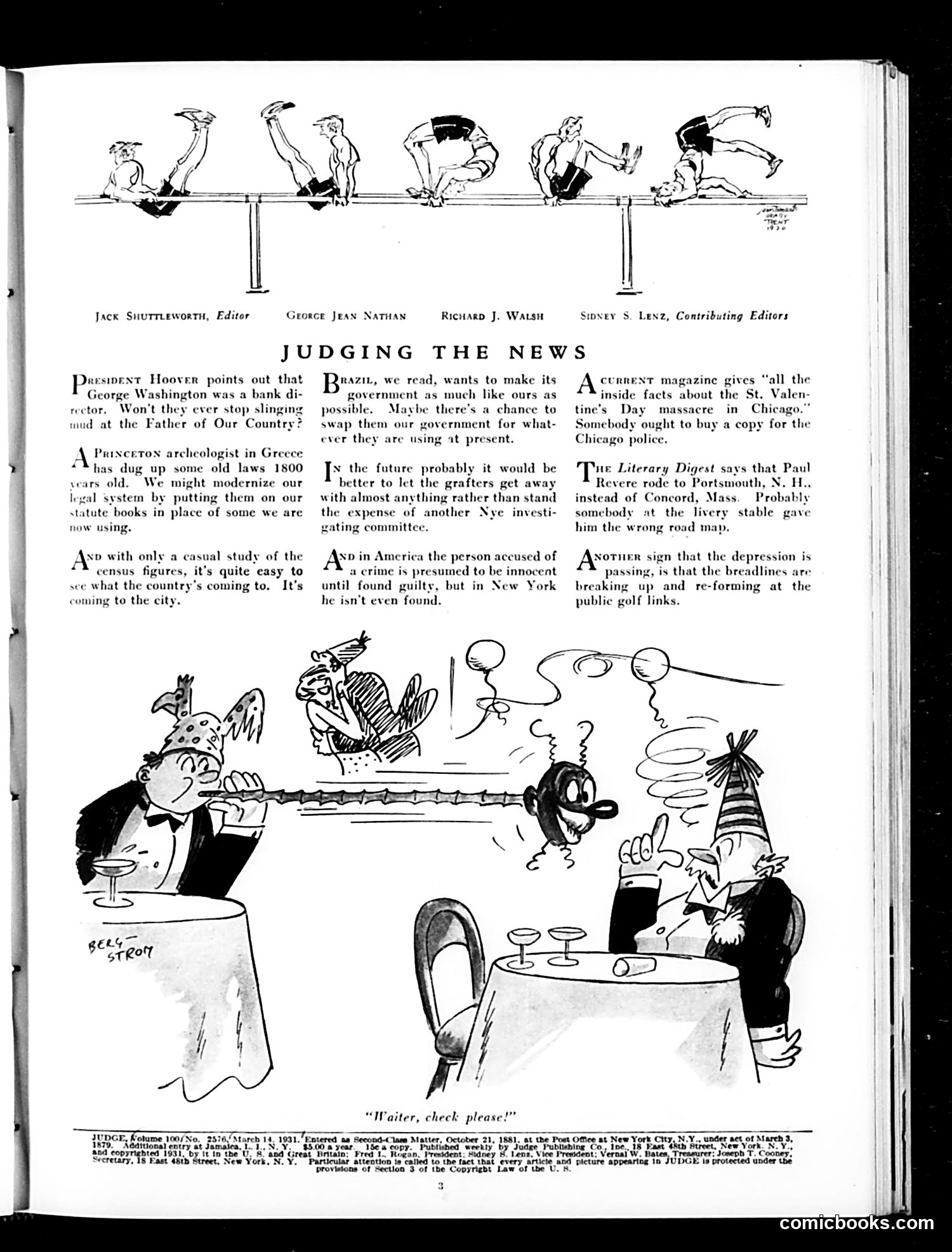
Analysis of "Judging the News" This page from *Judge* magazine features editorial commentary on current events alongside a cartoon titled "Waiter, check please!" The cartoon depicts two diners at separate tables engaged in what appears to be a tug-of-war over a bottle of beer—likely satirizing Prohibition-era tensions. One figure wears a party hat (possibly representing revelry or excess), while the other appears more formal. The "check please" caption suggests the bill is coming due, implying consequences for indulgence or illegal drinking. The text snippets comment on various topics: President Hoover comparing George Washington to a bank director, Brazilian government reform, an accused criminal in New York, and depression-era golf course development. The overall theme appears to critique current social and political issues through humor and visual metaphor typical of 1920s-early 1930s satirical journalism.
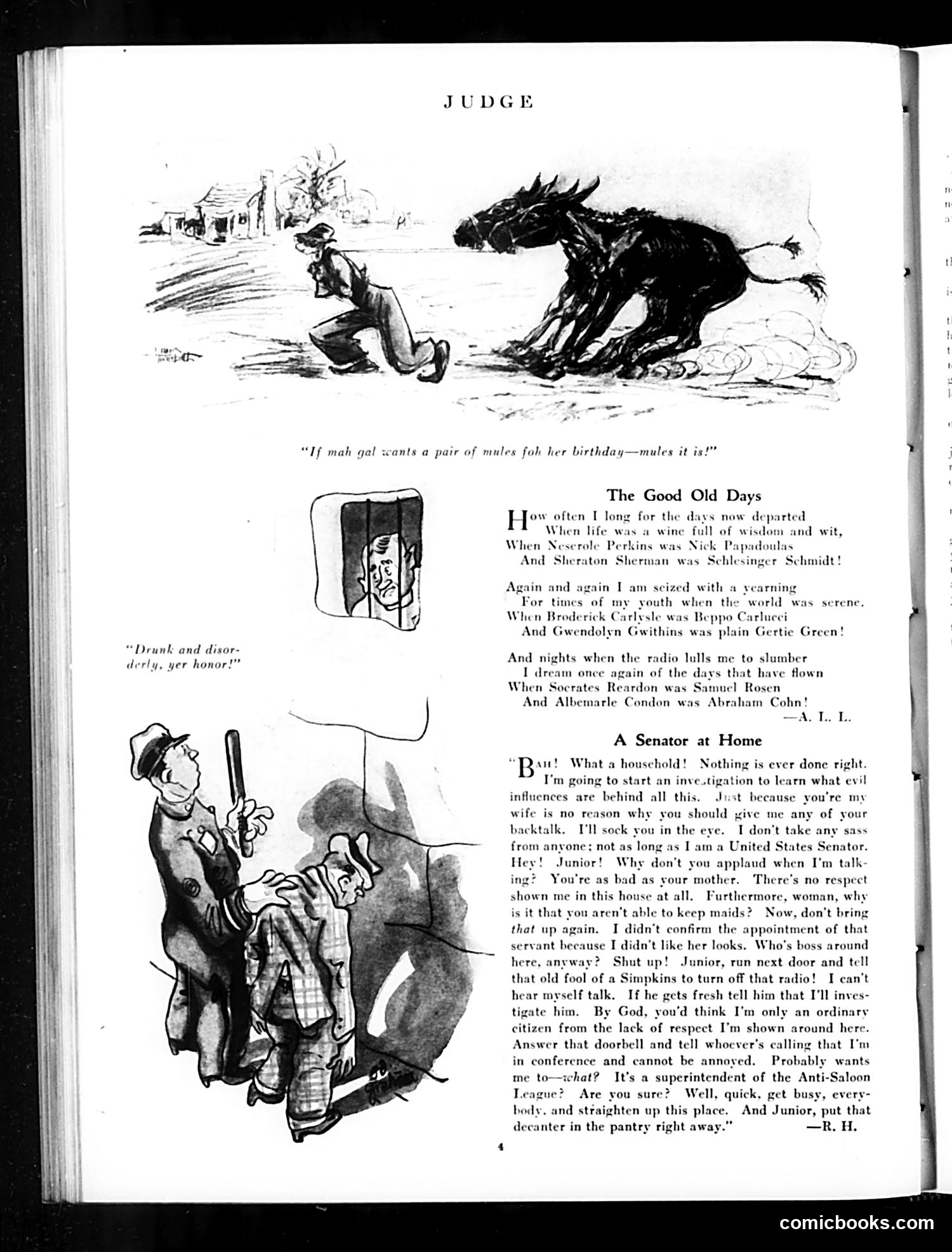
Judge Magazine Page Analysis This page contains three separate satirical pieces: Top cartoon ("If mah gal wants a pair of mules fuh her birthday—mules it is!"): A man runs from aggressive mules, satirizing rural/Southern dialect and suggesting marital subservience—he'll provide whatever his girlfriend demands, even if dangerous or absurd. "The Good Old Days" poem: Nostalgic verse lamenting lost eras when figures like Sheraton Sherman and Nick Longfellow were prominent. The references appear garbled or intentionally distorted, likely satirizing romanticized nostalgia itself. "A Senator at Home": A domineering senator bullies his family relentlessly—complaining about household management, his wife's abilities, servants, and his son's behavior. The satire mocks the hypocrisy of powerful public figures who demand respect while acting tyrannically in private.
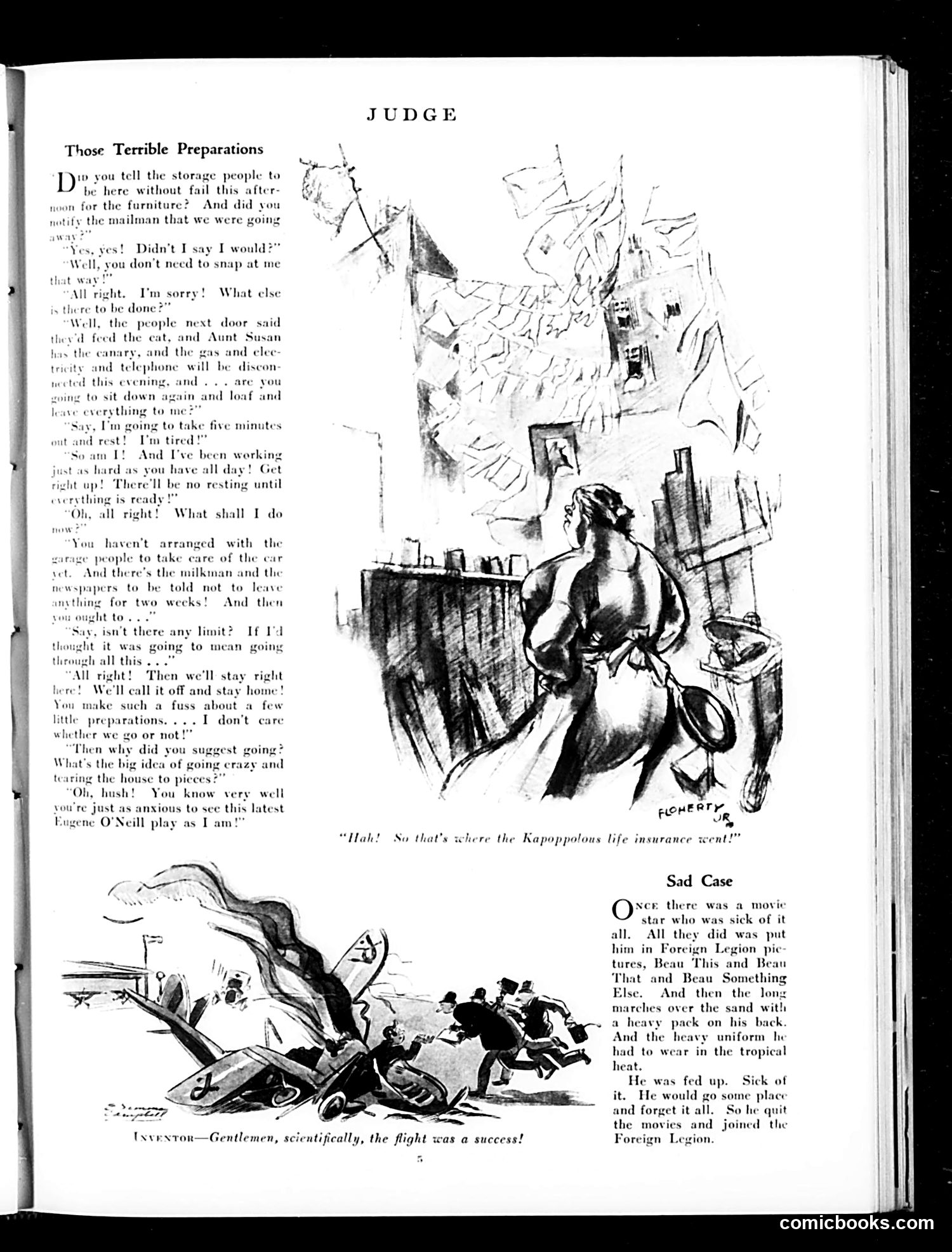
Analysis of Judge Magazine Page This page contains two satirical pieces: "Those Terrible Preparations" (top): A domestic comedy dialogue about moving preparations. A wife has instructed servants to store furniture without notifying her husband, causing marital conflict. The satire mocks the chaos and expense of household moves, with the husband eventually capitulating to stay home rather than endure further disruption. "Sad Case" (bottom): A brief story about a movie actor exhausted by appearing in numerous films with similar plots ("Beau This and Beau That"). Fed up with repetitive roles, he quits cinema and joins the Foreign Legion—a common trope suggesting escape from one's problems. Both pieces humorously critique early 20th-century American domestic life and the emerging film industry's formulaic storytelling.
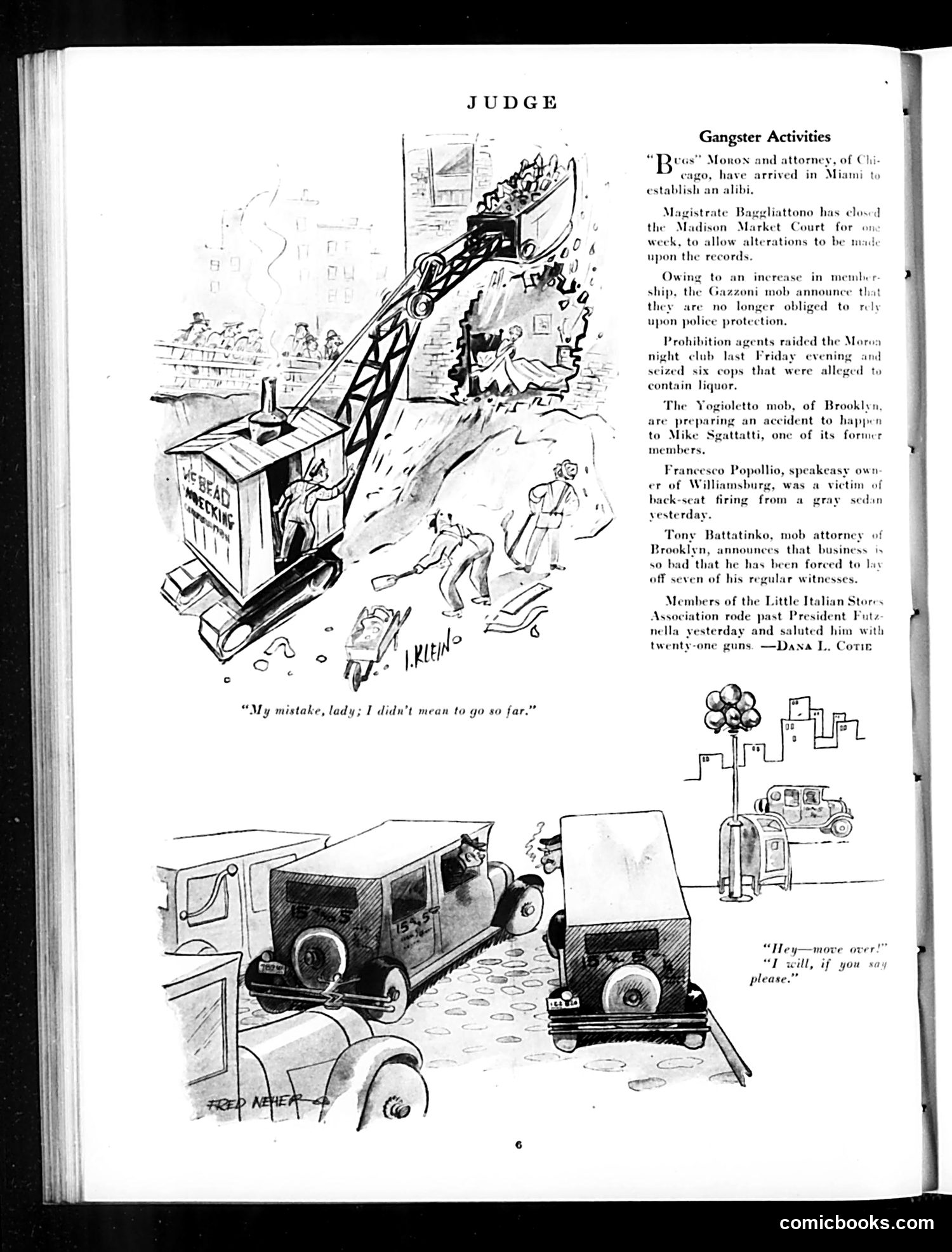
Analysis of Judge Magazine Page This page contains two cartoons satirizing urban crime and Prohibition-era gangsterism (1920s-early 1930s). Top cartoon depicts a wrecking ball labeled "BEAN WRACKING" destroying buildings, with the caption "My mistake, lady; I didn't mean to go so far." This appears to satirize either excessive urban demolition or, given the "Gangster Activities" headline, possibly mob violence disguised as construction accidents. Bottom cartoon shows vehicles at a doorway with caption "Hen—move over!" / "I will, if you say please." This likely mocks bootleggers or smugglers politely conducting illegal operations, satirizing the absurdity of "civilized" crime during Prohibition. The "Gangster Activities" column alongside reports real mob incidents (mentions of "Buss" Monos, the Vogiolette mob, etc.), contrasting actual violence with humorous cartoon commentary on organized crime's brazen normalization in American cities.
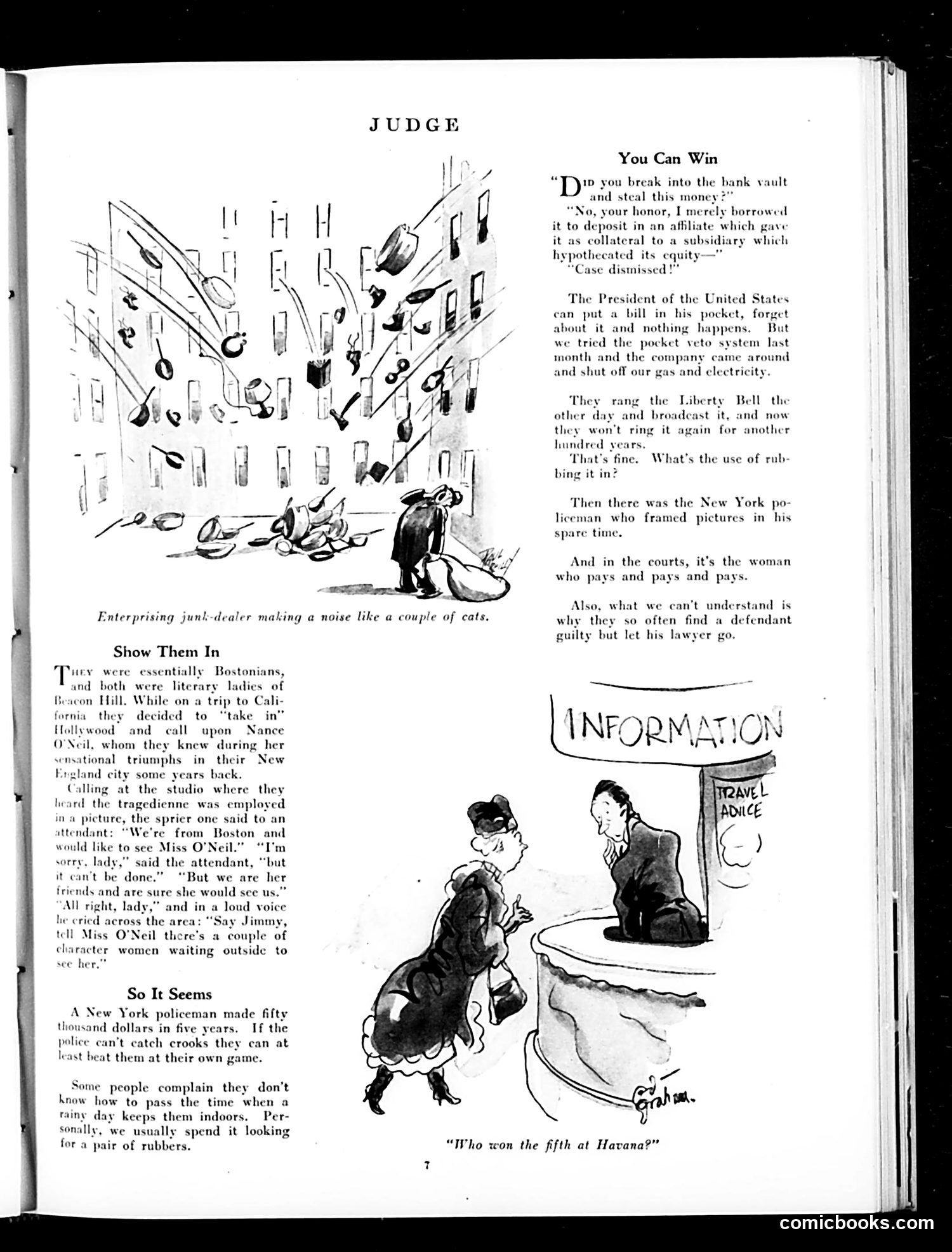
Judge Magazine Satire Analysis This page contains three satirical pieces mocking American institutions and legal/financial systems: "You Can Win" ridicules corporate financial manipulation and legal loopholes. A defendant escapes conviction by describing complex affiliate/subsidiary schemes—satirizing how wealthy corporations evade accountability through deliberately obscure financial structures. The piece also mocks the President's "pocket veto" power and the Liberty Bell's symbolic irrelevance, suggesting government operates by different rules than ordinary citizens. "Show Them In" is a humorous anecdote about Boston society women trying to visit actress Nance O'Neil in Hollywood, satirizing East Coast snobbery and Hollywood's indifference to prominent visitors. "So It Seems" presents brief cynical observations: corrupt cops profit more than they prevent crime; people waste time differently based on circumstances. The junk-dealer illustration and "Information" cartoon mock petty bureaucratic absurdity. Overall, the page reflects Judge magazine's typical Progressive-era skepticism toward institutional corruption, class disparity, and absurd legal technicalities.
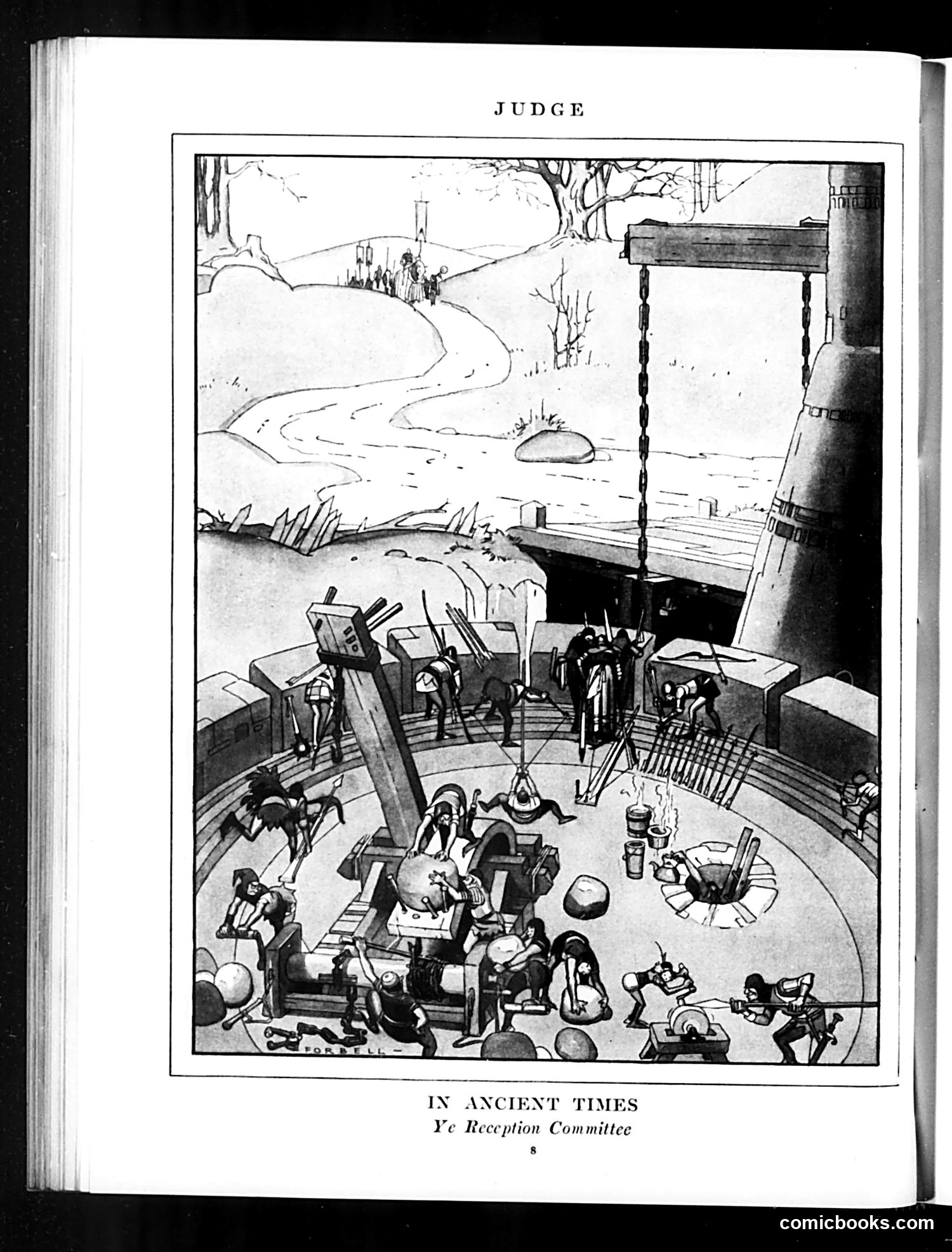
This cartoon satirizes a "Reception Committee" by depicting it as an ancient Roman arena scene. The image shows an elaborate circular amphitheater filled with figures operating machinery and equipment, with what appears to be execution or torture devices visible. Outside the arena, a medieval or ancient landscape stretches into the distance. The satire likely mocks overly elaborate, formal reception committees of the Gilded Age era—suggesting they function like gladiatorial spectacles designed to exhaust, humiliate, or "execute" their guests through excessive ceremony and pageantry. By framing it as "ancient times," the cartoon implies such committees represent barbaric, outdated practices, turning what should be hospitable civic functions into brutal public performances. The mechanical complexity emphasizes the absurd machinery behind seemingly simple social rituals.
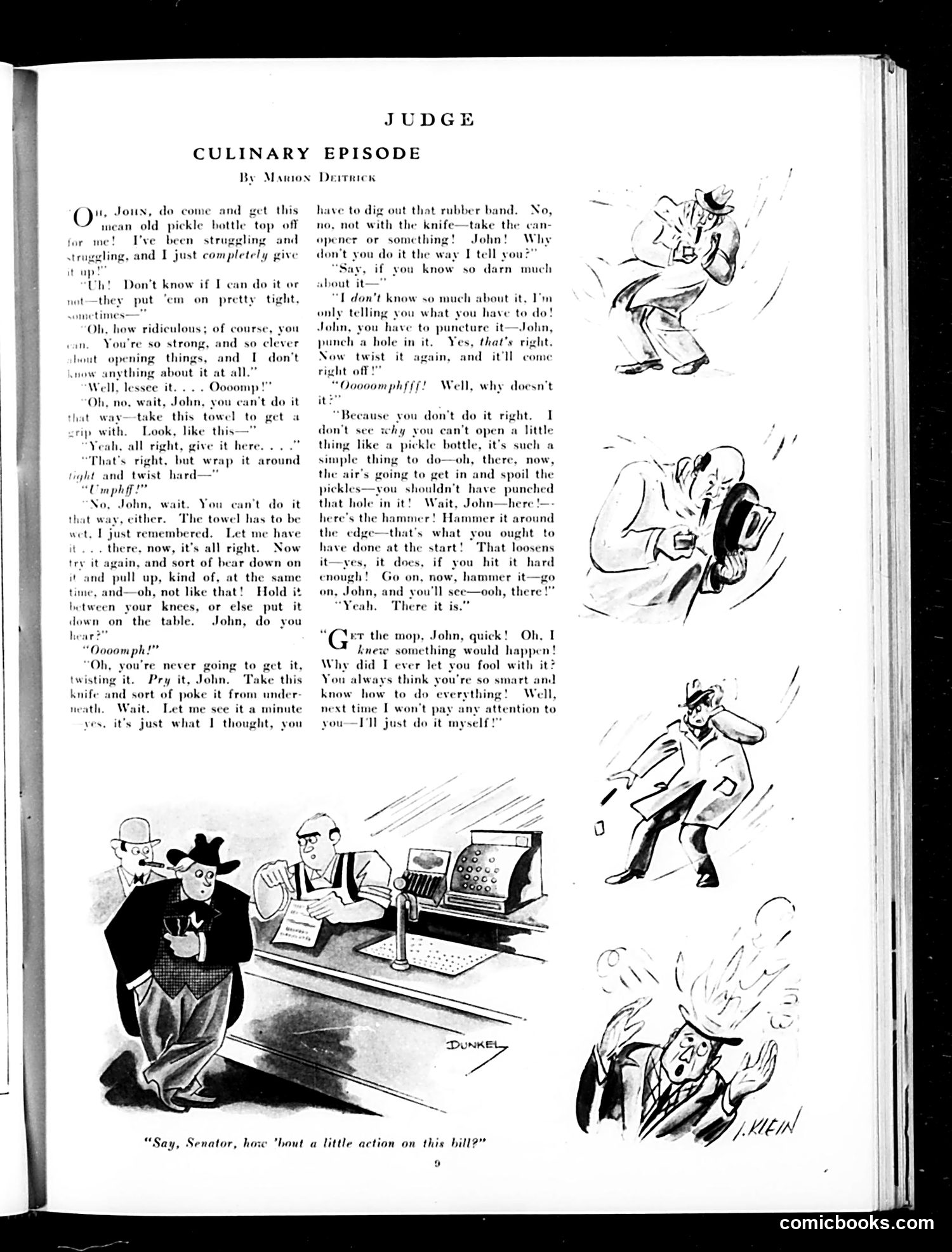
"Judge" Culinary Episode Analysis This domestic comedy by Marion Deitrick satirizes the frustration of incompetent husbands versus the exasperation of wives who must instruct them. The narrative centers on John struggling to open a pickle jar while his wife provides contradictory, increasingly absurd instructions—towel wrapping, twisting, puncturing with a can opener, then hammering the edge. The satire targets gender dynamics: the wife's constant corrections ("you can't do it that way") mock both spousal nagging and the husband's stubborn incompetence. Her final exasperated threat—"next time I won't pay any attention to you—I'll just do it myself!"—ironically undercuts her own micromanaging. The bottom cartoon shows a senator asking another figure for "a little action on this bill," likely a separate political joke about legislative gridlock, using similar language to the domestic struggle above for contrast. The humor reflects early-20th-century domestic comedy conventions mocking marital conflict and masculine inadequacy in mundane household tasks.
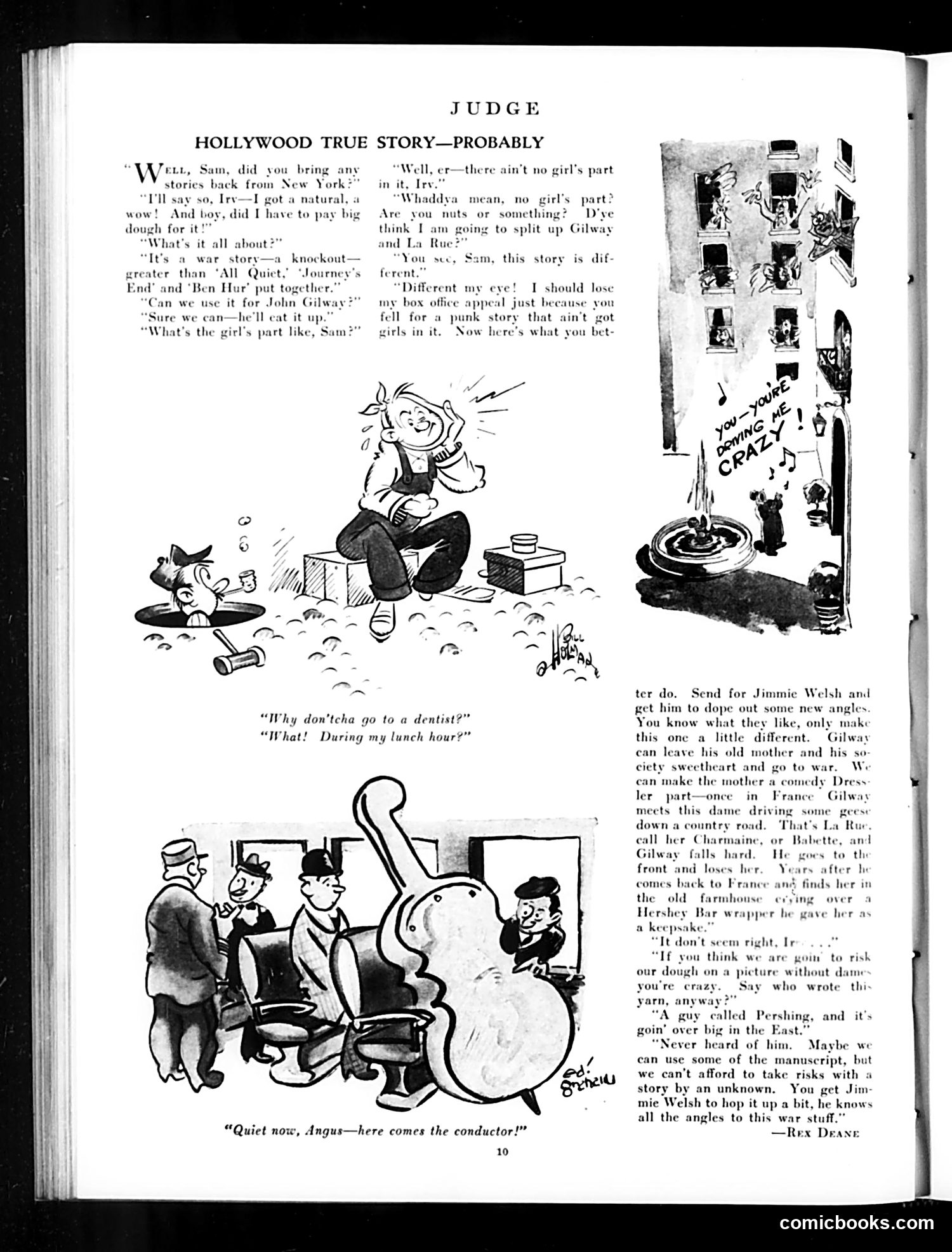
"Hollywood True Story—Probably" This page satirizes 1920s Hollywood's formula-driven approach to filmmaking. Two producers discuss buying a war story, likely about WWI. When told the script lacks a female lead, the executive is appalled—female stars were box-office gold. He instructs his colleague to hire screenwriter Jimmie Welsh to retrofit the story with romantic subplots: adding a love interest named "Charmaine" or "Babette," making the hero's mother a comedic character, and staging an emotional reunion. The satire mocks how studios systematically rewrote stories to fit star vehicles and audience expectations rather than preserving original material. The reference to the writer "Pershing" (likely evoking General John Pershing) suggests a serious war narrative being hollowed out for commercial appeal. The accompanying cartoons humorously illustrate Hollywood's superficiality and chaos.
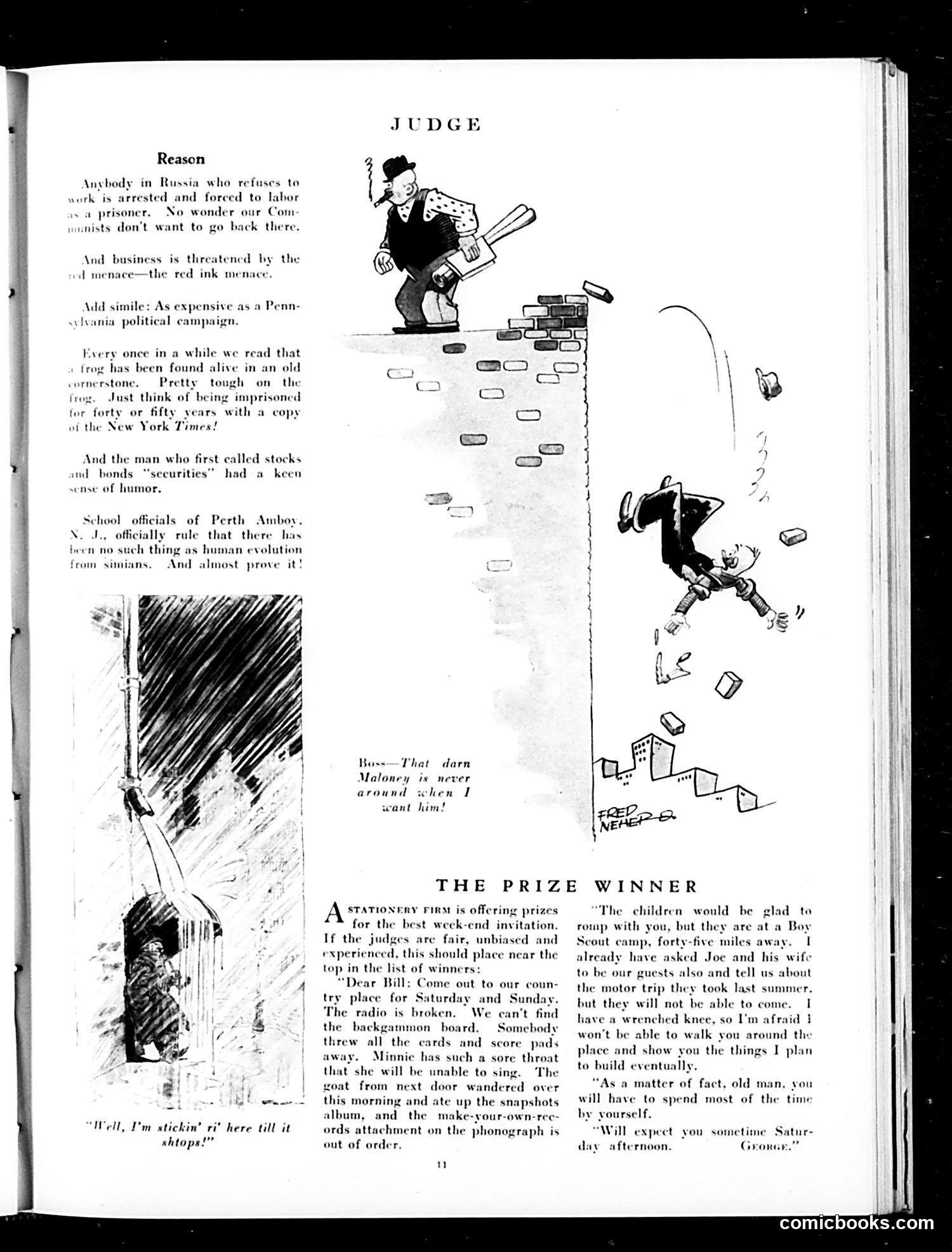
Judge Magazine Page Analysis This page contains political and social satire typical of Judge magazine. The "Reason" section attacks American communists through anti-Soviet rhetoric, mocking the notion that U.S. communists would want to return to Russia, where forced labor and authoritarianism prevail. It also includes light jabs at Pennsylvania politics and business anxiety about economic loss ("red ink menace"). The top cartoon shows a figure (likely representing a capitalist or businessman) balanced atop crumbling bricks labeled with financial terms, being knocked down—satirizing economic instability or the threat to business interests. The bottom section, "The Prize Winner," is humorous rather than political: it's a satirical "invitation" highlighting domestic misfortunes (broken radio, sick houseguest, wandering goat eating photos) to mock the artificial cheerfulness of social invitations. The humor relies on the contrast between polite invitation conventions and deliberate unpleasantness. The scattered references and cartoons suggest this is a general-interest satirical magazine mixing political commentary with everyday humor for educated readers.
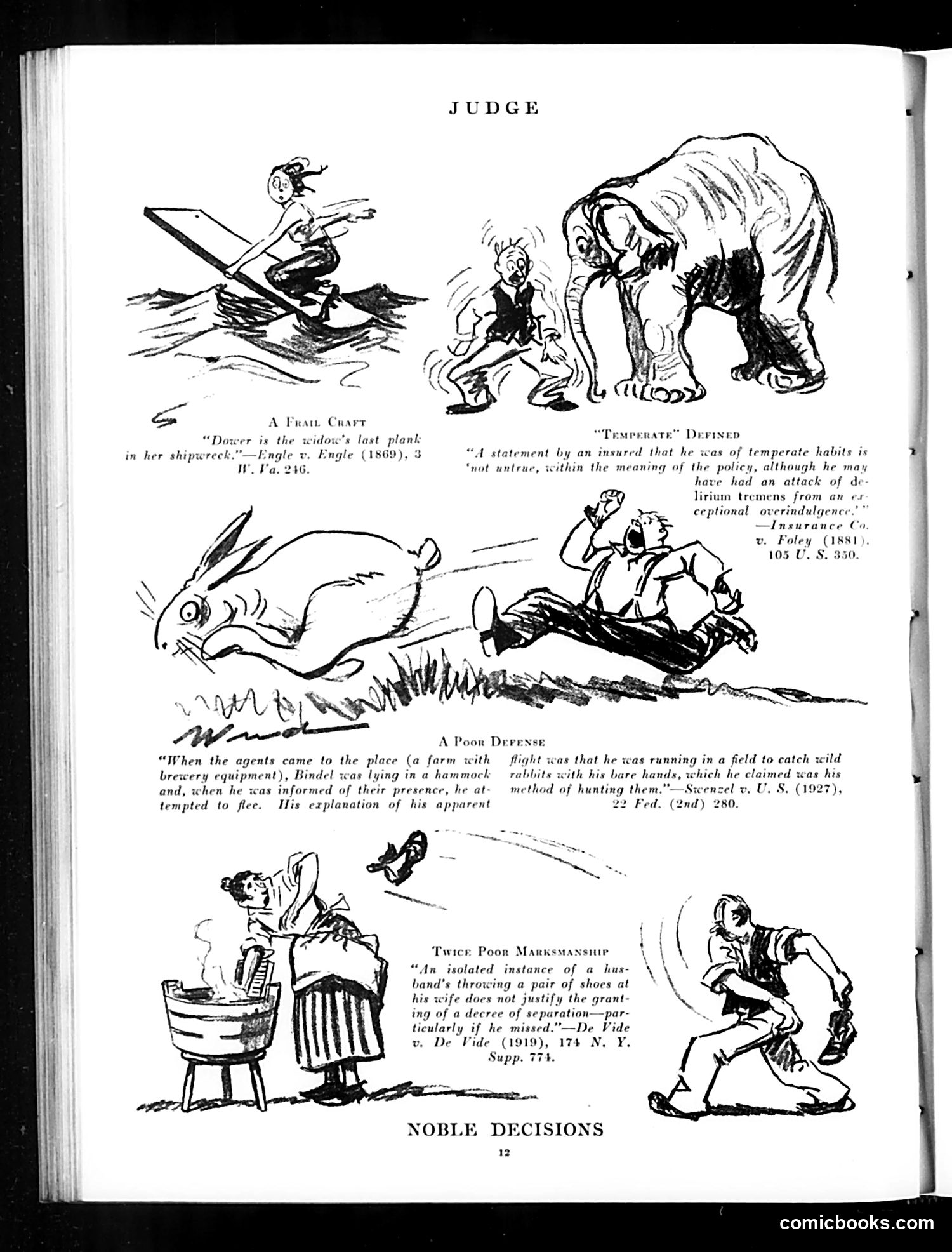
Judge Magazine: "Noble Decisions" Legal Satire This page satirizes absurd court rulings through humorous illustrations paired with real case citations. Each cartoon mocks the logical extremes courts reached when interpreting laws literally: "A Frail Craft": A widow clings to a plank—mocking a ruling that defined "widow's last plank" literally rather than recognizing its metaphorical meaning. "Temperate" Defined: Men chasing an elephant with a delirium-trembling defendant—ridiculing an insurance decision that claimed one attack of delirium tremens didn't prove "intemperate habits." A Poor Defense: A man catching rabbits barehanded as his actual hunting method—absurdly accepting a defendant's implausible excuse. Twice Poor Marksmanship: A husband throwing shoes that *missed*—mocking a judge who ruled one missed shoe-throwing incident insufficient grounds for separation. The satire targets judicial literalism and technicalities that produced ridiculous outcomes, using exaggerated cartoon logic to highlight how legal reasoning sometimes contradicts common sense. It's commentary on judicial absurdity dressed as humor.
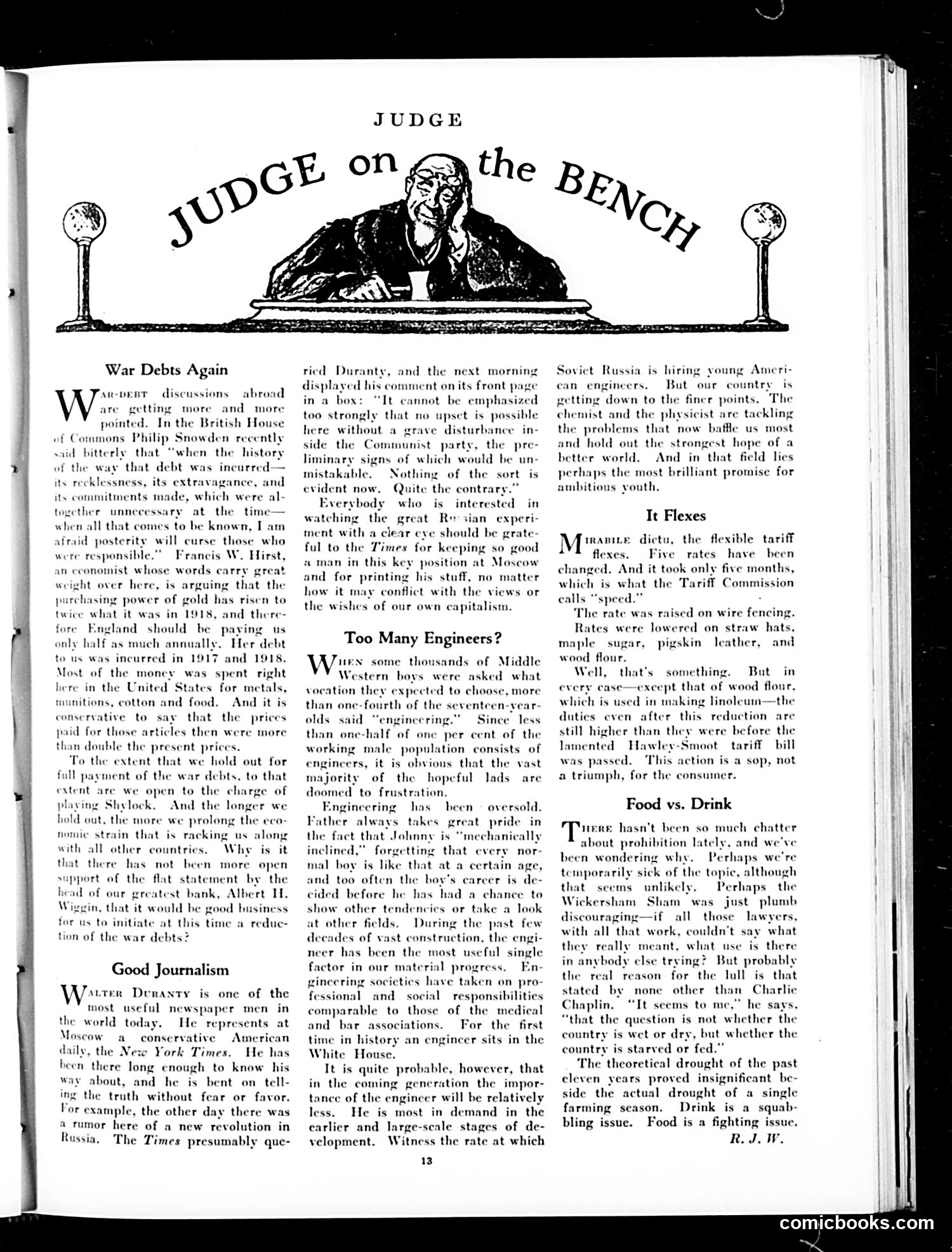
Judge Magazine Page Analysis This page contains four opinion essays under the "Judge on the Bench" masthead, featuring a judge illustration. "War Debts Again" discusses post-WWI debt repayment negotiations between Britain and America. It references British politician Philip Snowden's criticism of Britain's wartime spending and economist Francis Hirst's argument that America should reduce Britain's debt burden since prices have doubled since 1918. The piece also cites Albert Wiggin (head of Chase Bank) supporting debt reduction. The satire questions why America pursues full payment like "Shylock" (Shakespeare's moneylender), straining international economic recovery. "Good Journalism" praises Walter Duranty, *New York Times* Moscow correspondent, for reporting objectively on Soviet Russia despite potential bias from American capitalism. It commends his skepticism about rumors of revolution. "Too Many Engineers?" criticizes vocational counseling that steers too many boys toward engineering careers despite limited job prospects. It notes that while engineers were crucial during construction booms, fewer will be needed in coming generations. "It Flexes" and "Food vs. Drink" discuss tariff policy and prohibition, respectively.
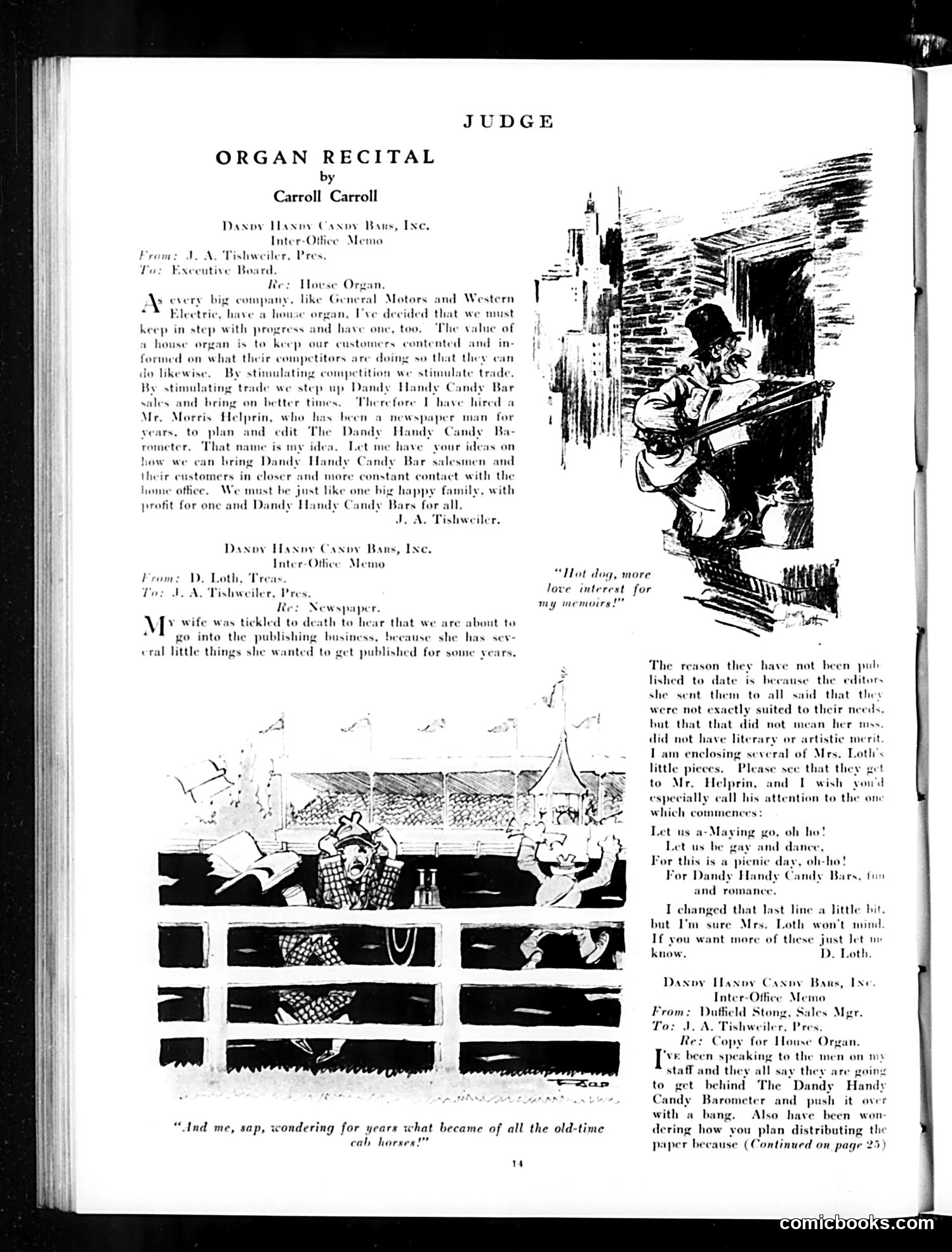
"Judge" Magazine Satire: Corporate House Organ This page satirizes corporate "house organs"—in-house publications companies created to boost employee morale and sales. The Dandy Handy Candy Bar company decides to launch one, called "The Dandy Handy Candy Barometer." The joke unfolds through inter-office memos: The president announces the organ as modern business practice (comparing it to General Motors and Western Electric). The treasurer then reveals his wife wants her unpublished writings featured—including awful poetry about "a-Maying" that he's quietly revised. A sales manager expresses enthusiasm, though distribution logistics remain unclear. The satire targets corporate pretension and the blurred line between genuine business improvement and vanity publishing. The wife's desperate desire for publication, the treasurer's embarrassed editing, and the vague executive planning all mock how companies used house organs less for actual communication than for self-promotional theater. The illustration shows people performing music, reinforcing the "organ recital" title's double meaning—corporate performance for its own sake.
"The Theatre of George Jean Nathan" This is a theater review column, not a political cartoon. Judge magazine's drama critic (likely the famous Nathan himself, given the title) reviews two Broadway productions with biting satire. The first concerns a Warner Brothers film set in colonial India, featuring racist "burnt-cork" caricatures of Indian servants. The plot involves a love triangle culminating in murder—Nathan mocks its melodramatic pretension, calling it "hogwash" despite its attempts at profundity (e.g., "pipe-smokers expect little"). The second targets the Minsky Brothers' "Fanny Fortson in Paris" at the Republic Theatre—a burlesque show featuring belly-dancing ("hoochie-coochie"). Nathan sarcastically notes the brothers care only about "female abdomens," not cinema. He includes publisher Jonathan Cape's participation to amplify the absurdity of calling vulgar entertainment "fine arts." The satire attacks both lowbrow entertainment pretending to sophistication and the racial stereotyping endemic to 1920s popular culture.
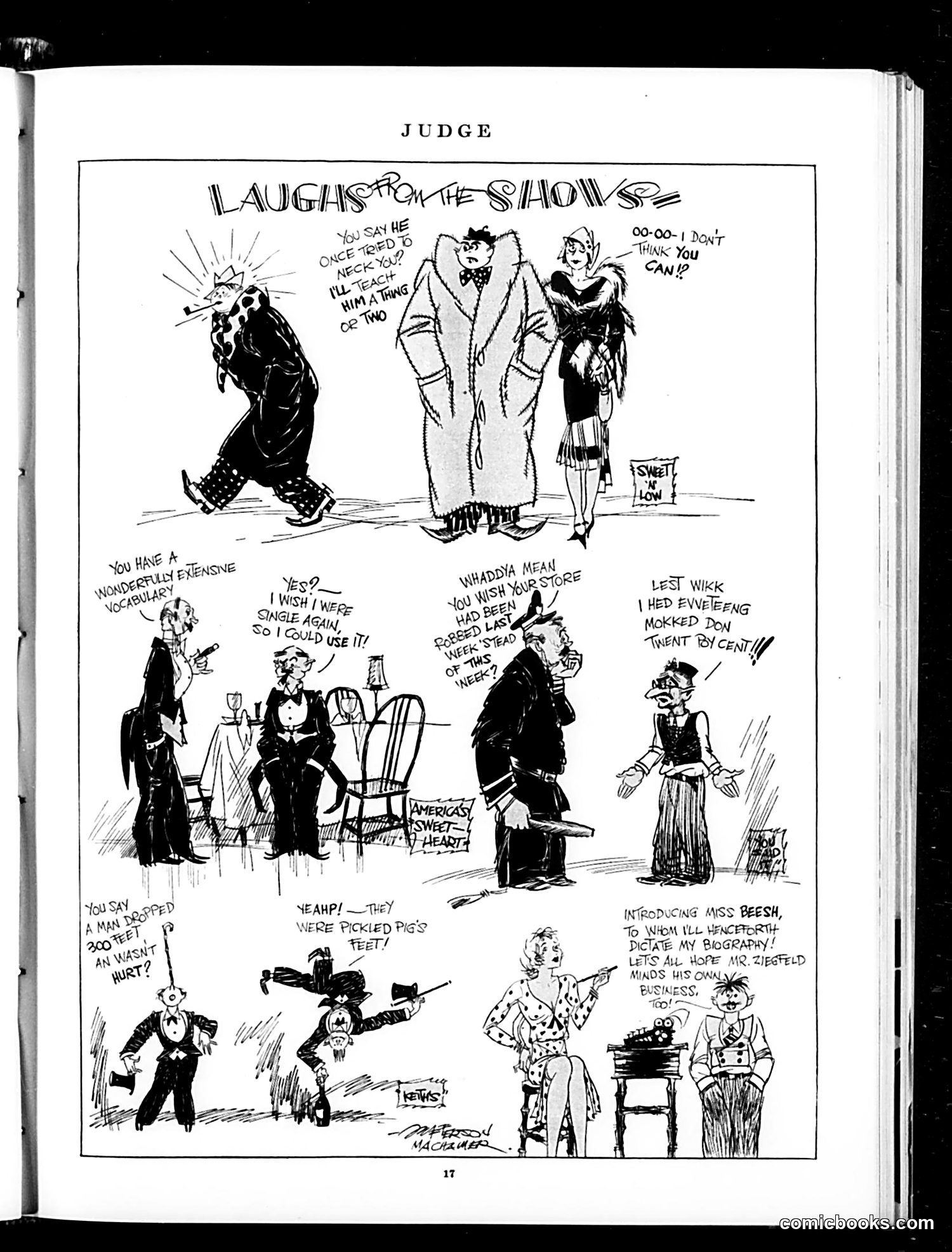
"Laughs for the Salon" - Judge Magazine Cartoon This satirical comic page mocks high society and theatrical pretension. The central figure appears to be a wealthy or prominent man surrounded by various acquaintances, each representing social types. The humor derives from exaggerated dialogue showing superficial interactions: someone boasts about their "wonderful extensive vocabulary," another references pickled pigs' feet (lowbrow food masquerading as refined), and characters make absurd claims about their accomplishments and relationships. The introduction of "Miss Beesh" at the bottom—apparently a stenographer hired to record the protagonist's biography—satirizes vanity and self-importance. The cartoon suggests that people in this social circle are pretentious, foolish, and obsessed with appearing cultured while revealing their actual crassness through their speech and behavior. The overall target is the affectation and shallowness of salon society.
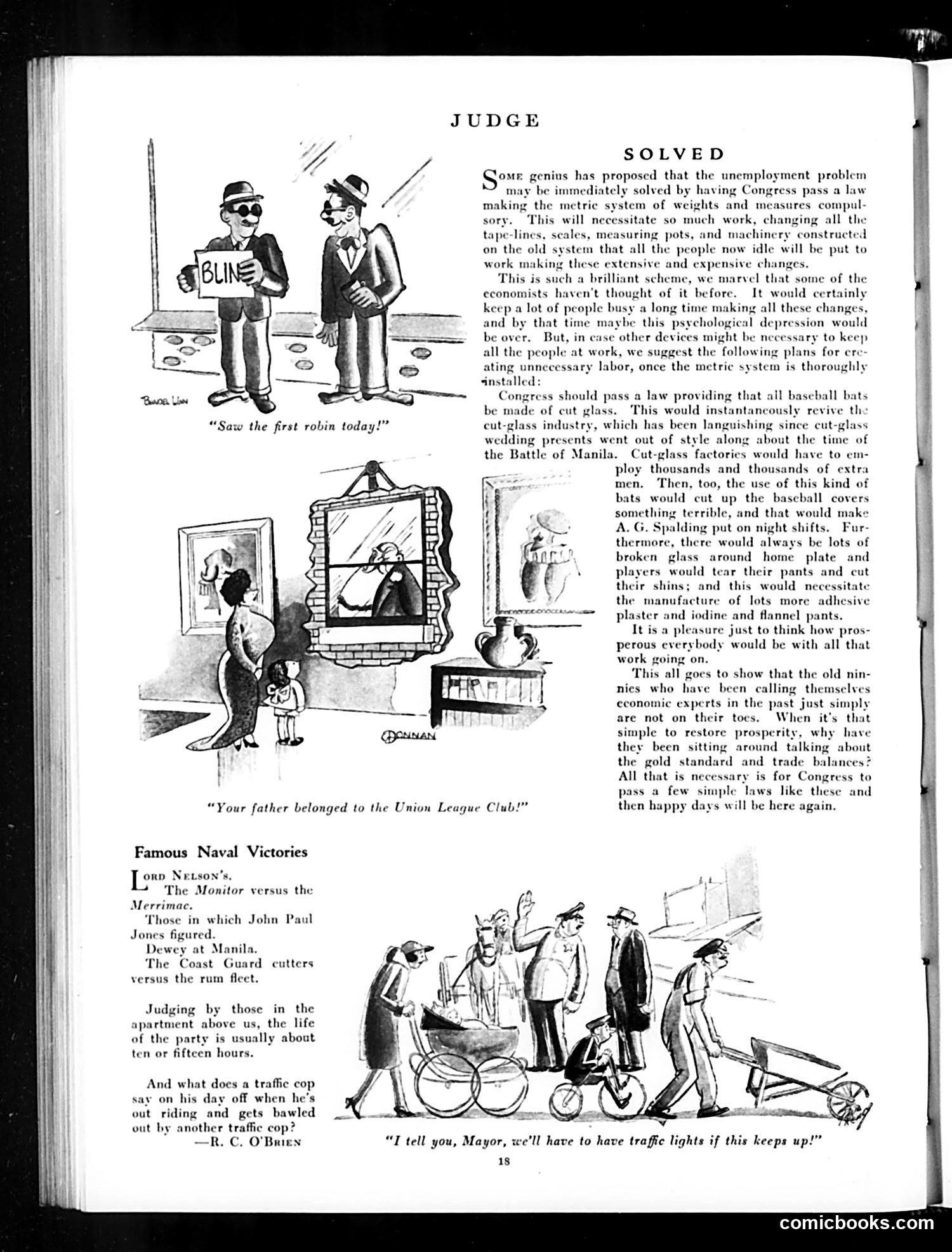
Understanding This Judge Magazine Page This page from *Judge* magazine satirizes economic policy responses to unemployment, likely from the 1920s depression era. "Judge Solved" (main article with cartoons): The satire proposes absurd job-creation schemes: (1) adopting the metric system to employ workers converting measurements, and (2) mandating baseball bats be made of cut glass to revive the languishing cut-glass industry. The joke mocks economists and policymakers for overlooking "obvious" solutions while debating gold standards and trade balances. Top cartoon: "Blind" man holding a cane labeled "BLIND" suggests willful ignorance of simple solutions. Middle cartoon: References the "Union League Club"—an elite institution—implying out-of-touch wealthy interests. Bottom section: Brief naval history references and an unrelated traffic-safety joke. The underlying satire: policymakers are intellectually blind to straightforward fixes for unemployment, instead pursuing complex economic theories while supposedly obvious public-works solutions exist.
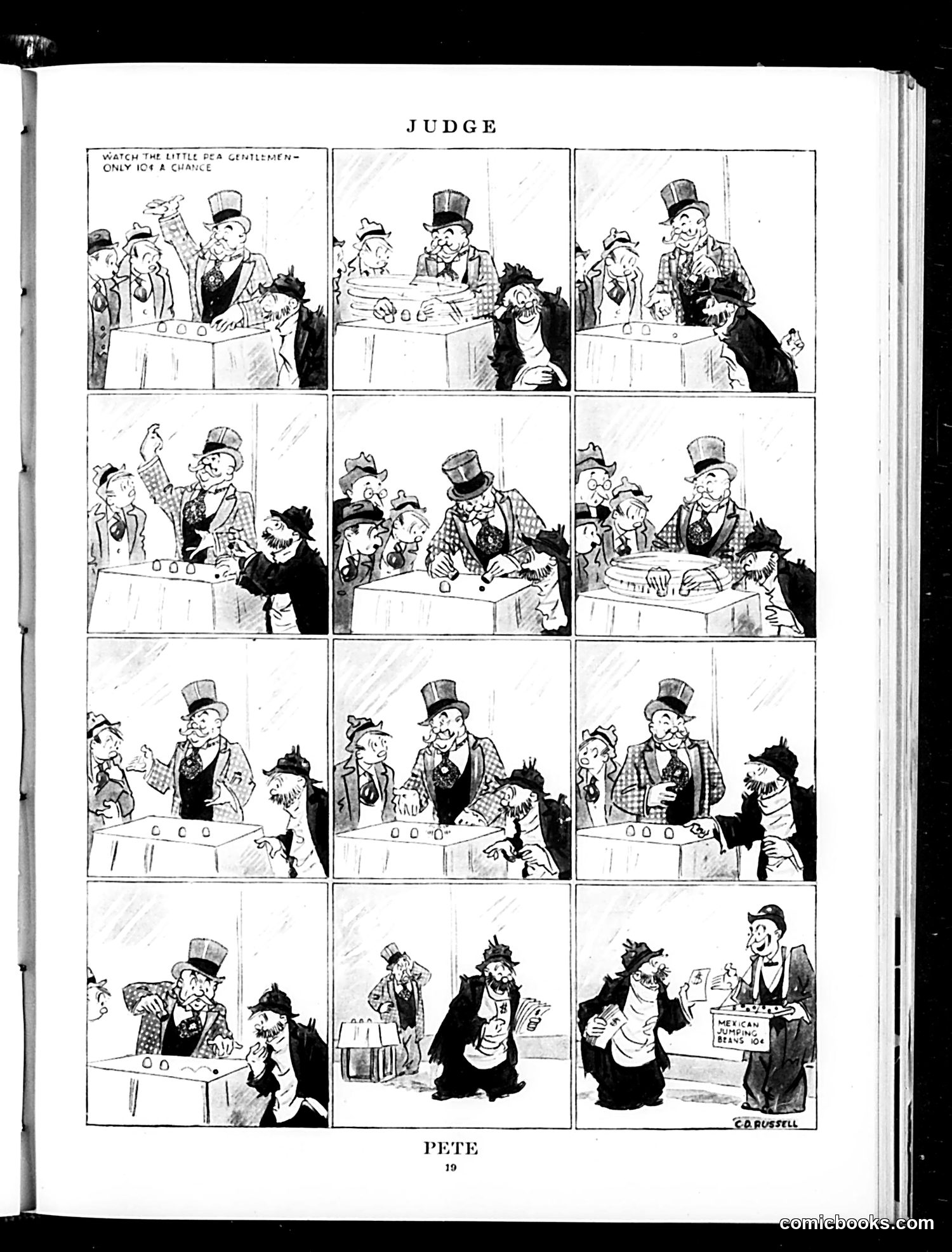
"Judge" Page: "The Shell Game" This is a comic strip titled "Judge" by cartoonist Bardwell (signed lower right) depicting a classic street con: the shell game or "pea and thimbles" hustle. The well-dressed man in the top hat is the con artist running the game, while various working-class men (the "little pea gentlemen") watch and participate. The progression shows the mark repeatedly losing money as the operator manipulates the shells, moving the pea while the victim tries to track it. The satire targets both the con man's deceptiveness and the mark's gullibility—a commentary on how easily people are swindled by obvious tricks when greed clouds judgment. The "10¢ a chance" wording references the minimal bet that draws in victims. It's social satire on street crime and human folly common to turn-of-the-century American cities.
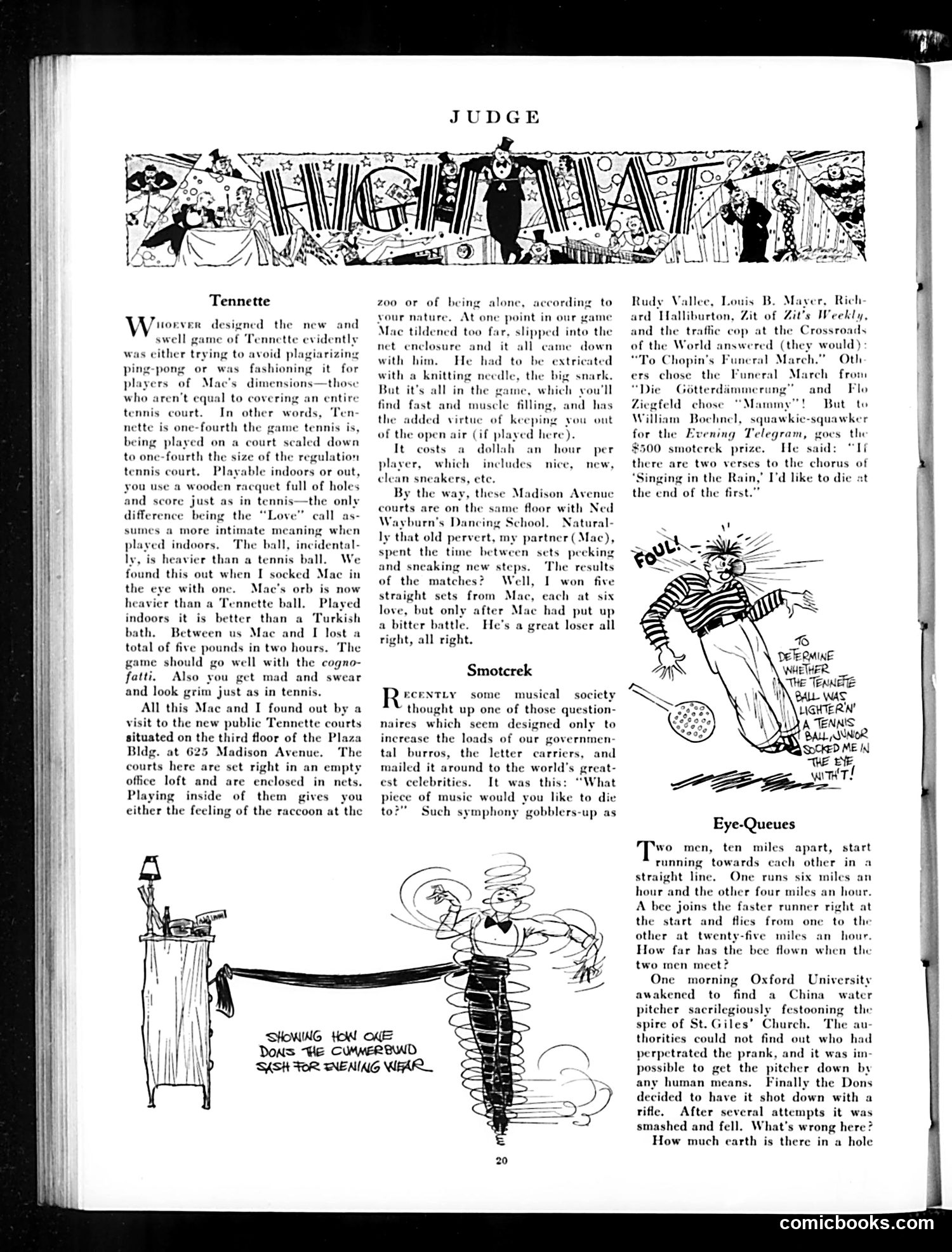
Explanation for Modern Readers This Judge magazine page contains three distinct pieces: Tennette: A humorous article about a new indoor sport—a scaled-down version of tennis played on courts at 625 Madison Avenue. The writer and "Mac" (likely his partner) test it out, with comedic results including Mac getting a heavier eye from being hit with the ball and the entire net collapsing when Mac falls into it. The joke plays on the novelty sport's absurdity and the physical comedy of playing in an enclosed space. Smotcrek: A satirical piece mocking a musical questionnaire sent to celebrities asking "What piece of music would you like to die to?" Famous figures like Rudy Vallée and Florenz Ziegfeld give pompous answers (funeral marches), while a newspaper writer gives a more relatable response about "Singin' in the Rain." Eye-Queues: A logic puzzle section with two riddles—one mathematical (about runners and a bee), another about Oxford University students placing a Chinese water pitcher on a church spire as a prank that authorities cannot remove. The page showcases Judge's typical blend of social commentary, celebrity mockery, and whimsical humor.
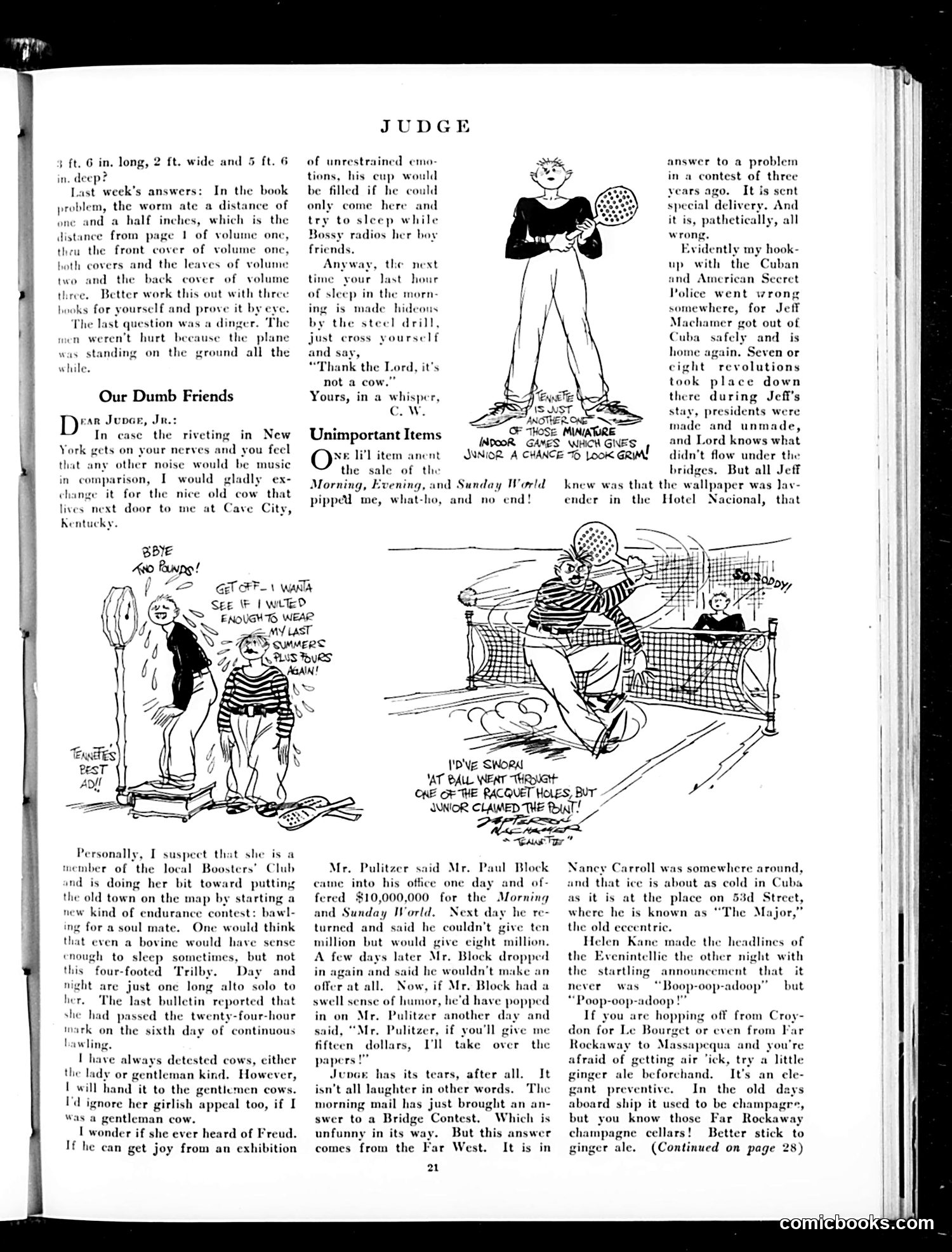
Judge Magazine Page Analysis This page contains humor pieces and illustrated jokes typical of Judge magazine's satirical content: "Our Dumb Friends" features a letter about an incessantly mooing cow in Kentucky, contrasting it unfavorably with urban noise (riveting). The joke mocks both rural life and the writer's exasperation. The illustrated cartoons show children playing indoors and lawn games, depicting typical youth activities of the era with gentle humor about childhood behavior. "Unimportant Items" satirizes newspaper publishing, including a anecdote about publisher Joseph Pulitzer and businessman Paul Block negotiating over the *Morning and Sunday World* newspaper. The joke involves Block's shifting offers ($10-8 million), mocking business deal-making absurdity. References to Nancy Carroll (likely the actress) and Helen Kane (known for the "boop-boop-a-doop" catchphrase) suggest celebrity gossip content typical of the magazine. The overall tone is light, domestic satire—poking fun at modern conveniences, rural life, childhood, and media personalities rather than targeting serious political issues.
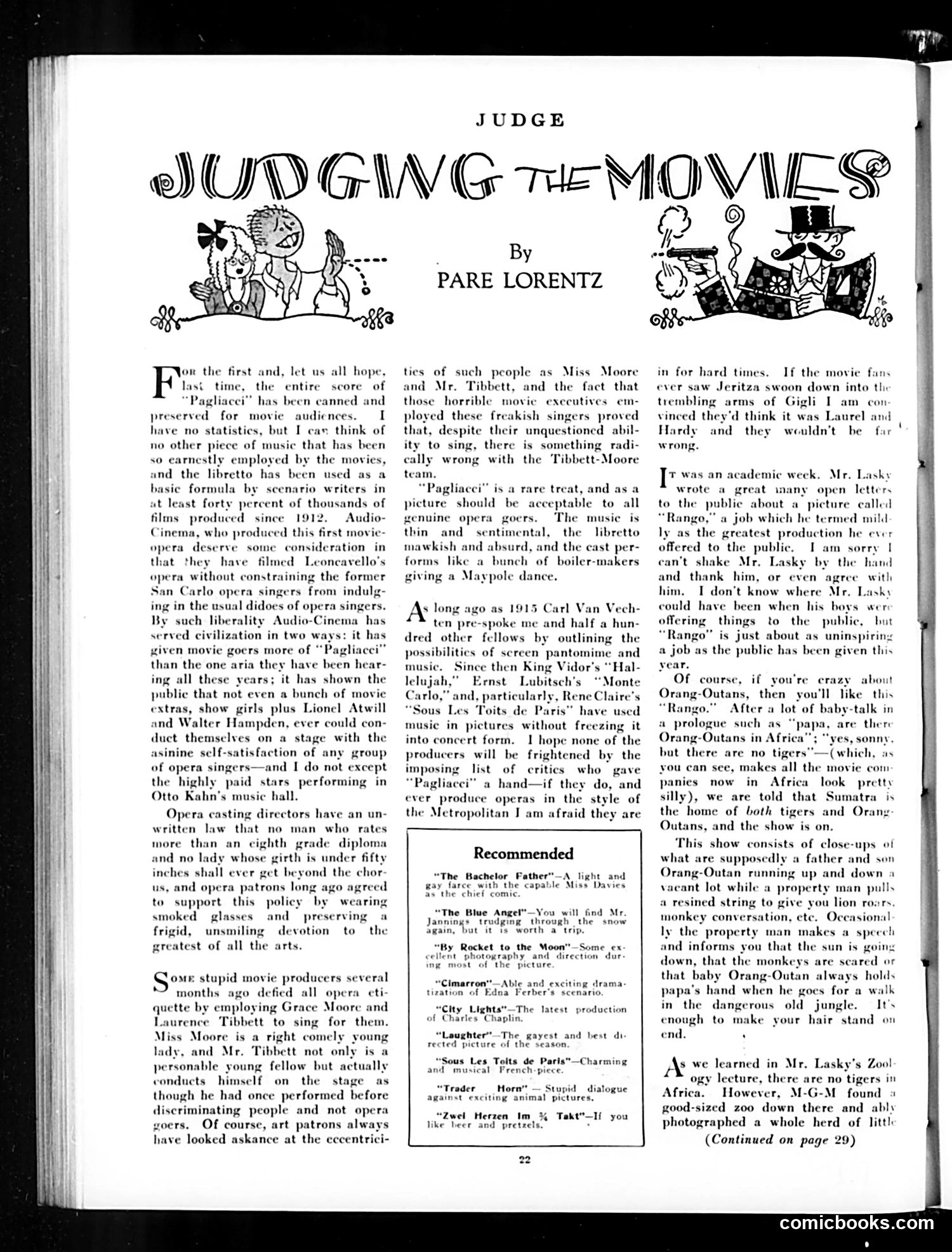
Understanding "Judging the Movies" by Pare Lorentz This article satirizes opera elitism and celebrates cinema's democratization of high art. Lorentz mocks opera's rigid class conventions—its unwritten rule that performers must lack education and female singers must be thin—as pretentious gatekeeping. He praises Audio-Cinema's film adaptation of *Pagliacci* for casting trained singers like Grace Moore and Lawrence Tibbett, who actually behave professionally rather than with the "asinine self-satisfaction" typical of opera performers. The satire targets snobby opera patrons who've "looked askance" at cinema's embrace of popular entertainment. By showing that serious music can work on film without freezing into stiff concert form (citing examples like King Vidor's *Hallelujah*), Lorentz argues movies are democratizing opera, freeing it from artificial pretense. The underlying joke: cinema's "stupid movie producers" accidentally prove superior to opera's rigid, elitist establishment.
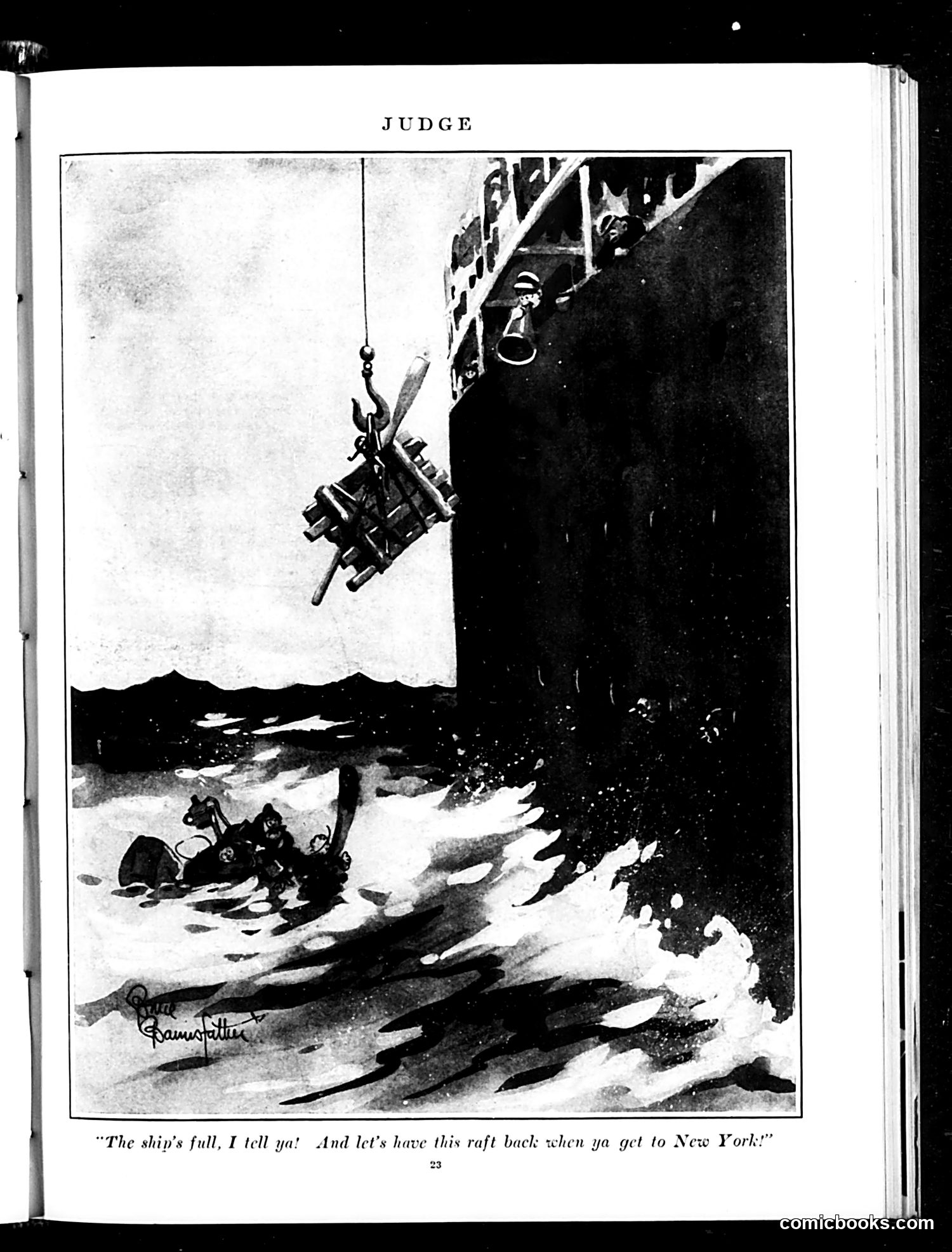
Analysis of "Judge" Magazine Cartoon This single-panel cartoon depicts a maritime scene with moral commentary. A large ship looms over a small lifeboat in turbulent waters. One figure in the boat addresses another with dialect speech: "The ship's full, I tell ya! And let's have this raft back when ya get to New York!" The cartoon satirizes the contrast between those aboard the overcrowded ship (appearing to represent wealth or privilege, given their position "above") and those struggling in the lifeboat below (appearing to represent the poor or desperate). The demand to return the raft suggests exploitation—the privileged expect the desperate to survive on minimal resources, then reclaim even that. The satire critiques class inequality and indifference to human suffering, likely reflecting early 20th-century social anxieties about immigration, poverty, or labor conditions.
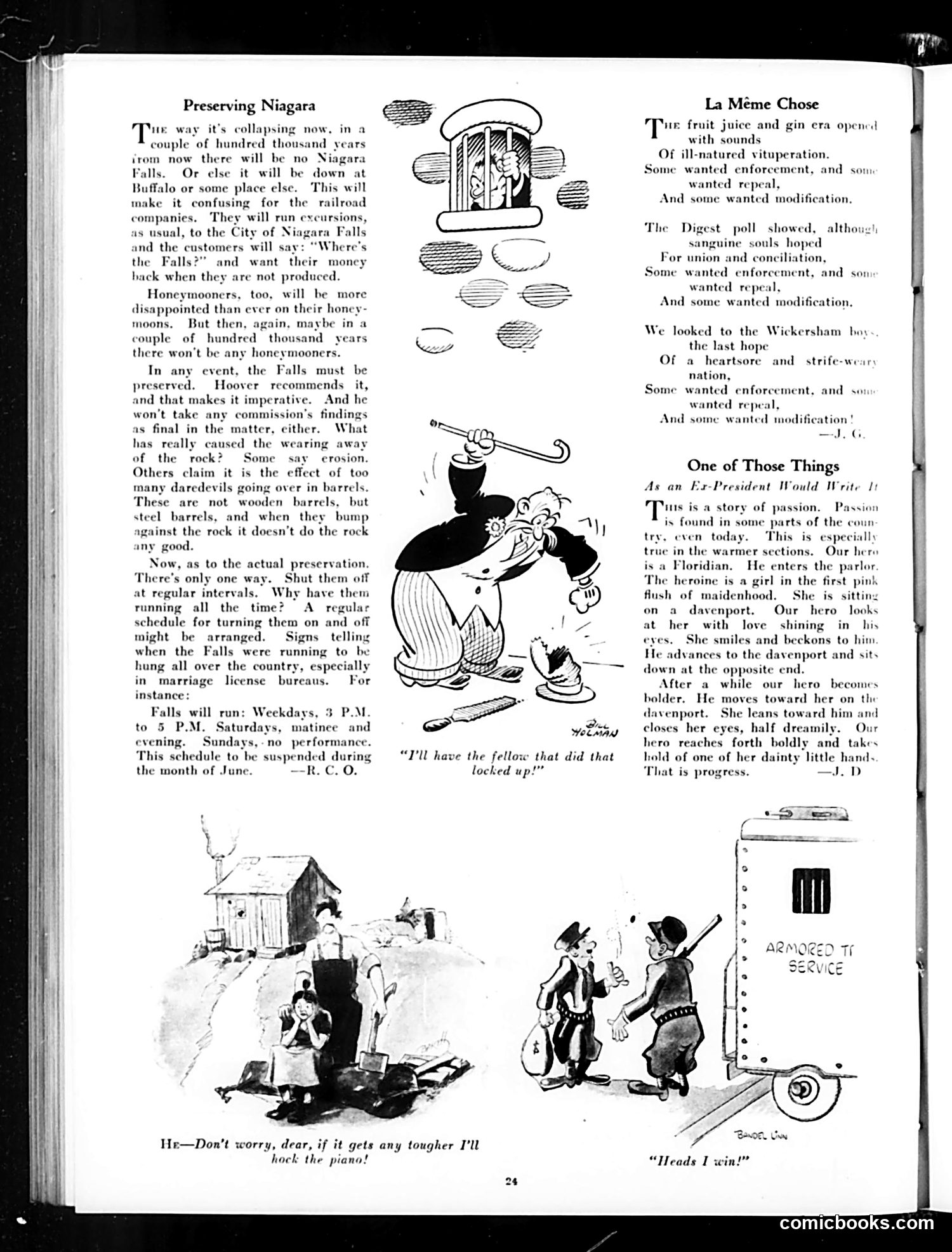
Political Satire on Prohibition and Hoover This Judge page satirizes two major 1920s issues: "Preserving Niagara" mocks President Hoover's interventionist approach. The writer suggests Niagara Falls erodes naturally, yet proposes an absurd "solution": shut off the Falls on a schedule (closed Sundays, open weekdays 3-5 PM), with signs posted in marriage license bureaus. This ridicules Hoover's willingness to micromanage and regulate—a jab at his philosophy that government should control even natural phenomena. "La Même Chose" (The Same Thing) directly addresses Prohibition enforcement debates. It parallels the Niagara piece: just as people want the Falls "shut off" periodically, Prohibition advocates were split on enforcement, repeal, or "modification." The reference to the "Wickersham boy" (likely the Wickersham Commission investigating Prohibition) suggests even official investigations couldn't resolve the national divide. The cartoons mock Hoover-era regulatory overreach and the futility of Prohibition policy amid irreconcilable public opinion.
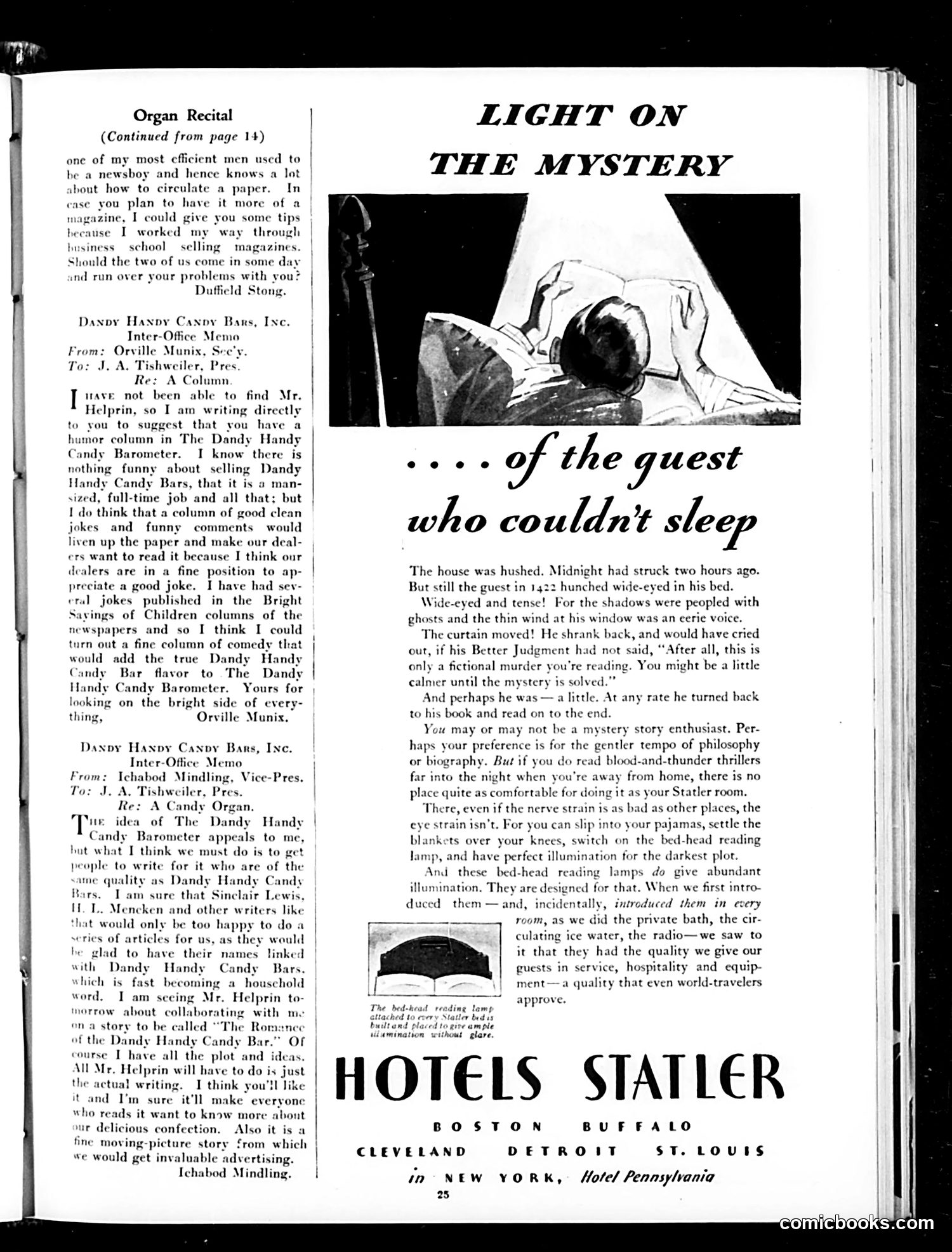
Analysis of Judge Magazine Page This page contains two distinct sections: Left side: Office memos satirizing corporate culture at "Dandy Handy Candy Bars, Inc." The humor targets the absurdity of executives trying to commercialize quality literature. A vice president proposes commissioning stories from renowned writers (Sinclair Lewis, H.L. Mencken) as mere advertising vehicles for candy bars, suggesting the writer do only "actual writing" while he handles "all the plot and ideas." The satire mocks corporate pretension and the degradation of serious literature into marketing copy. Right side: A Hotels Statler advertisement disguised as a short story about a nervous guest reading mystery novels in bed. The narrative illustrates why Statler's bed-head reading lamps are superior—perfect for late-night thriller reading in comfort. This is essentially advertising presented as editorial content, typical of Judge's sponsored material. The juxtaposition creates ironic contrast: corporate mediocrity on the left; commercial sophistication on the right.
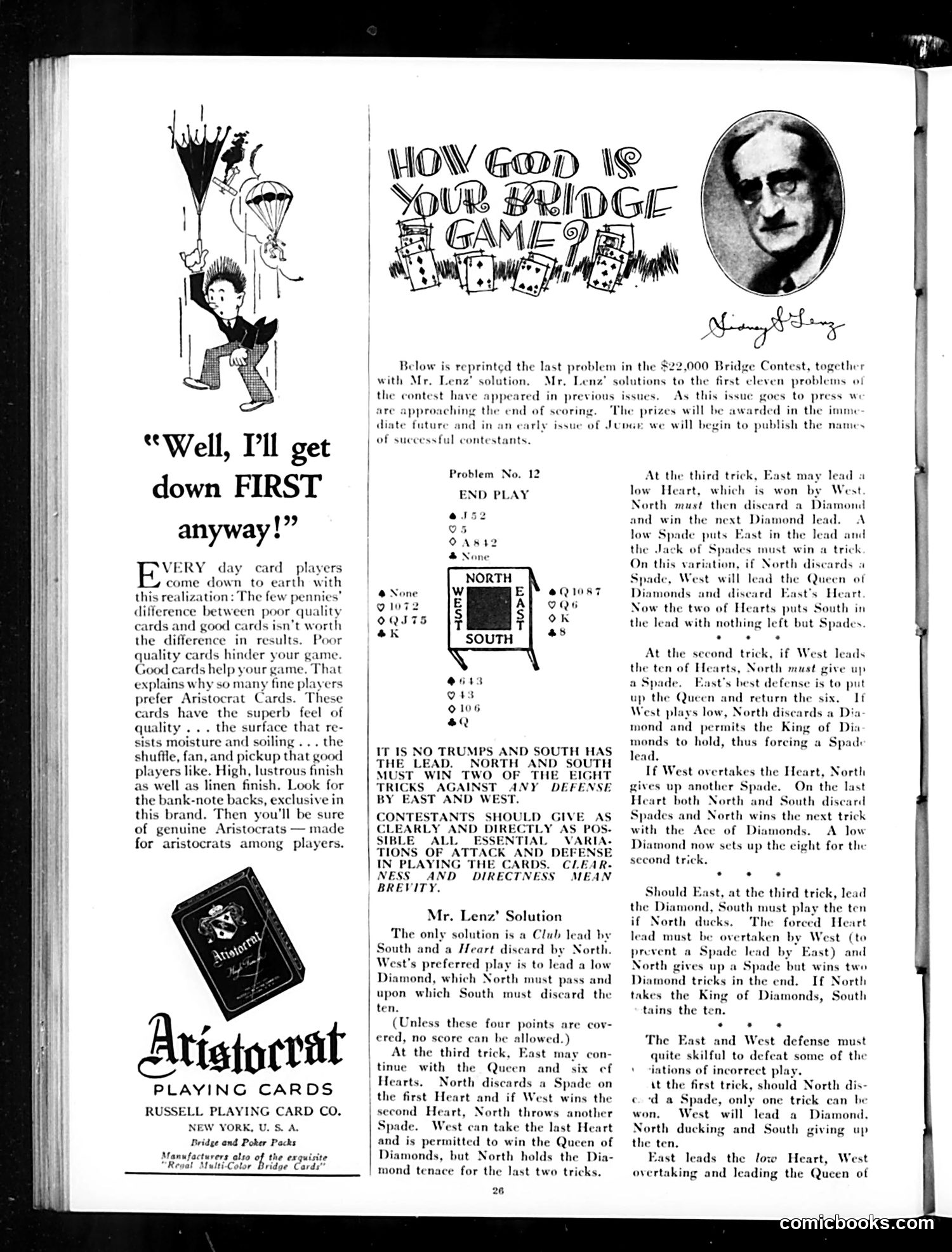
Judge Magazine Bridge Problem Page This page mixes bridge instruction with advertising. The main content features Problem No. 12, the final puzzle in Judge's $22,000 Bridge Contest. A photograph shows Mr. Lenz, whose solution is reprinted here—the contest has been running across multiple issues, with winners to be announced soon. The cartoon at left ("Well, I'll get down FIRST anyway!") shows a parachutist, likely satirizing competitive eagerness or desperation—the phrase suggests someone willing to do anything to win, even if undignified. It sets up the adjacent Aristocrat Playing Cards advertisement, which argues that quality cards matter in card games: poor cards hinder performance while good cards help skilled players succeed. The ad equates superior cards with superior players, appealing to competitive bridge enthusiasts reading Judge. The page reflects bridge's enormous popularity in 1920s America, when the game was a cultural phenomenon, particularly among wealthy players.
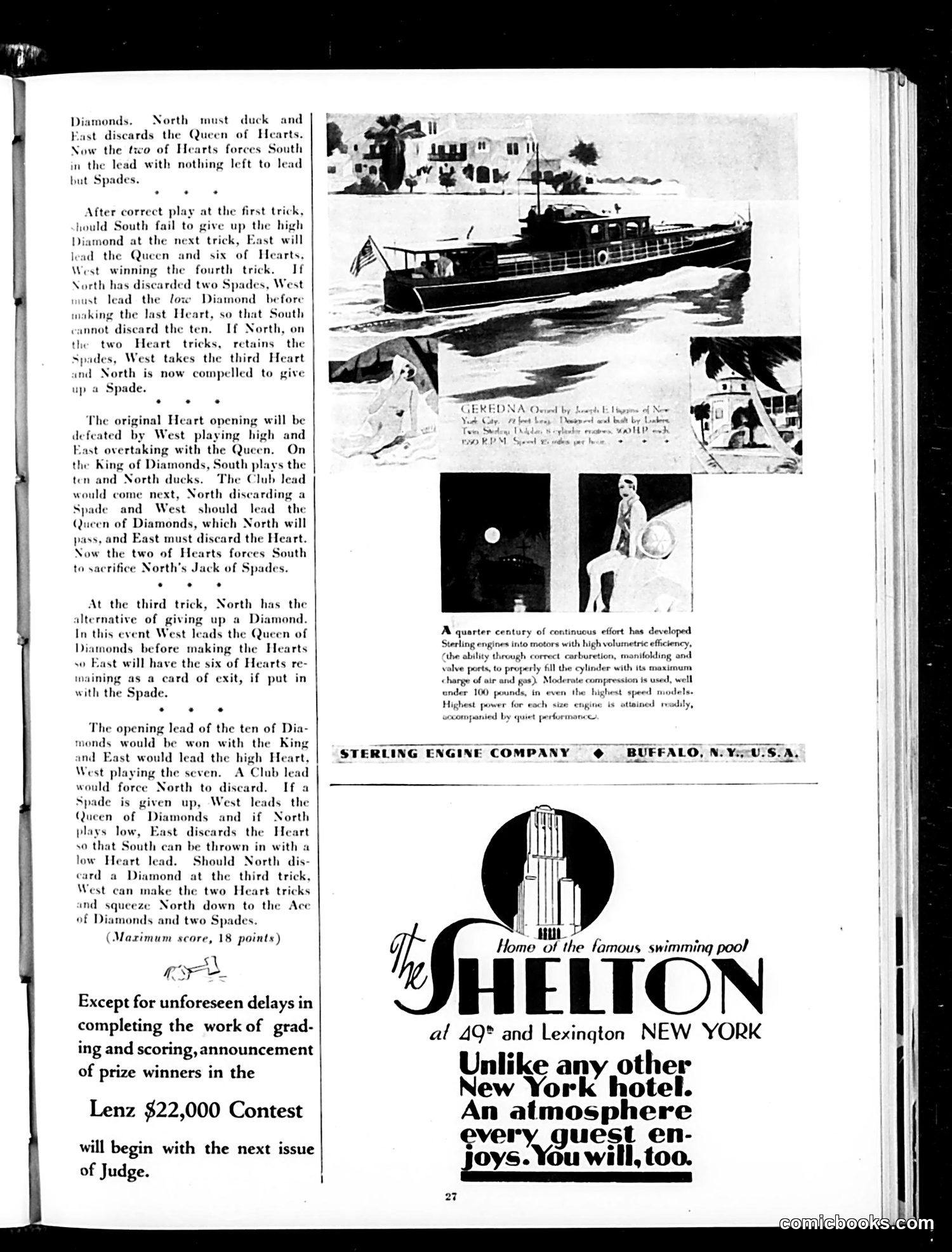
Analysis of Judge Magazine Page This page is primarily instructional content about bridge card strategy, not satire or political commentary. The left column provides detailed technical analysis of bridge hand-play scenarios, discussing optimal card sequences and scoring (maximum 18 points). The page features two advertisements: 1. Sterling Engine Company (Buffalo, N.Y.) — showcasing marine/industrial engines with photographs of a boat and technical diagrams. The copy emphasizes quarter-century development of high-efficiency motors. 2. Shelton Hotel (49th and Lexington, New York) — promoting their swimming pool as a distinguishing feature, positioning the hotel as uniquely appealing compared to competitors. There is also a notice about the "Lenz $22,000 Contest," indicating Judge magazine ran a bridge competition with substantial prize money, with winners to be announced in the next issue. The page contains no political satire or social commentary — it's a mix of bridge instruction and period advertising typical of Judge's content during this era.
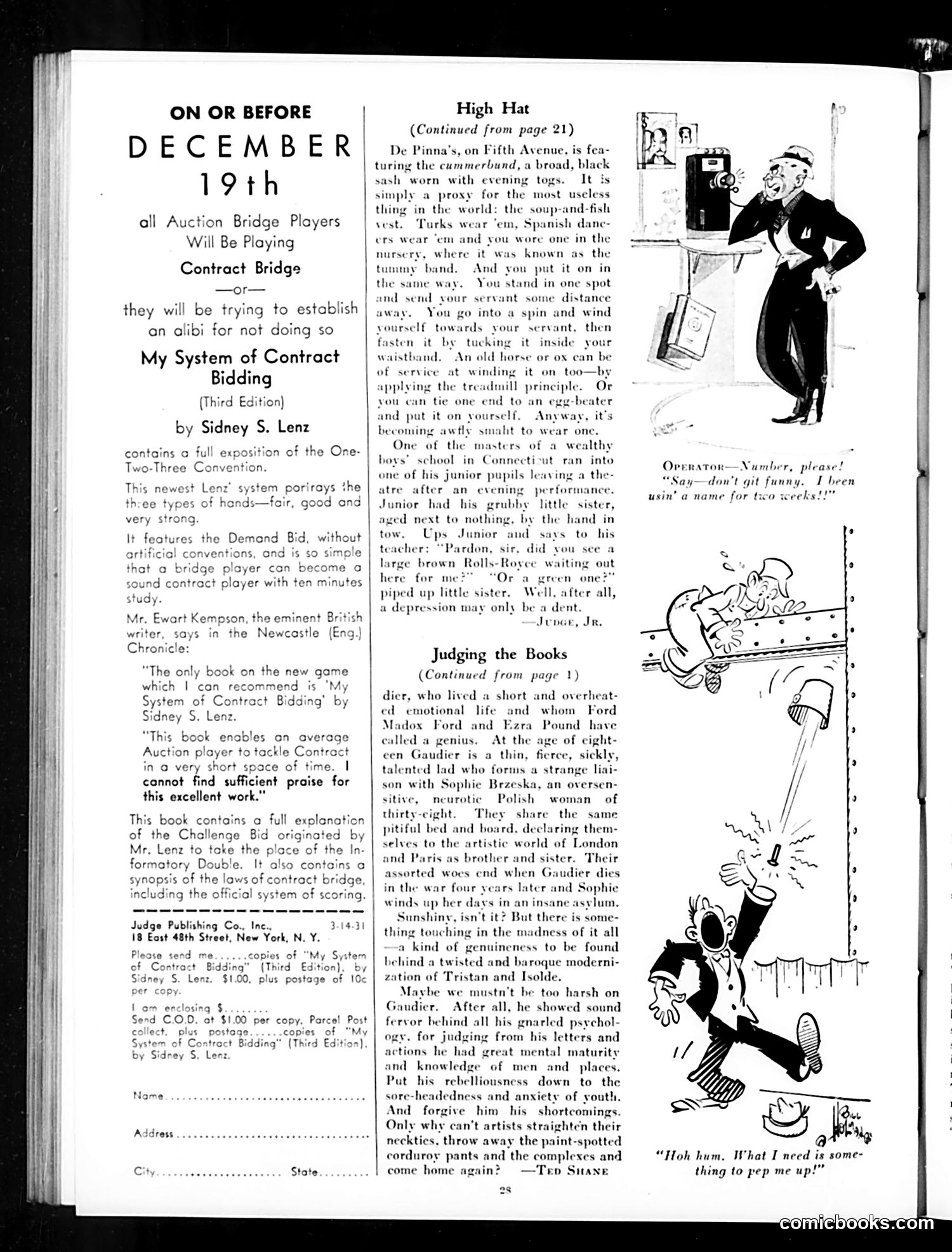
Judge Magazine Page Analysis This page contains two distinct elements: Left side: An advertisement for Sidney S. Lenz's "My System of Contract Bidding" (Third Edition), a bridge instruction manual. The ad emphasizes that Contract Bridge is becoming the fashionable card game, and that by December 19th, all auction bridge players will need to either play Contract Bridge or create alibis for not doing so. It includes endorsements from a British bridge expert. Right side: Two pieces of satirical content. The "High Hat" column mocks the fashion trend of wearing cummerbunds (decorative sashes) with formal wear, describing their impracticality through humorous anecdotes. Below that, "Judging the Books" reviews a novel about a sculptor (likely Henri Gaudier-Brzeska), critiquing its emotional intensity and unconventional relationships while ultimately sympathizing with youthful artistic rebellion. The small cartoon at bottom depicts someone falling through a floor, with a caption about needing "something to pep me up!"—likely a humorous non sequitur.
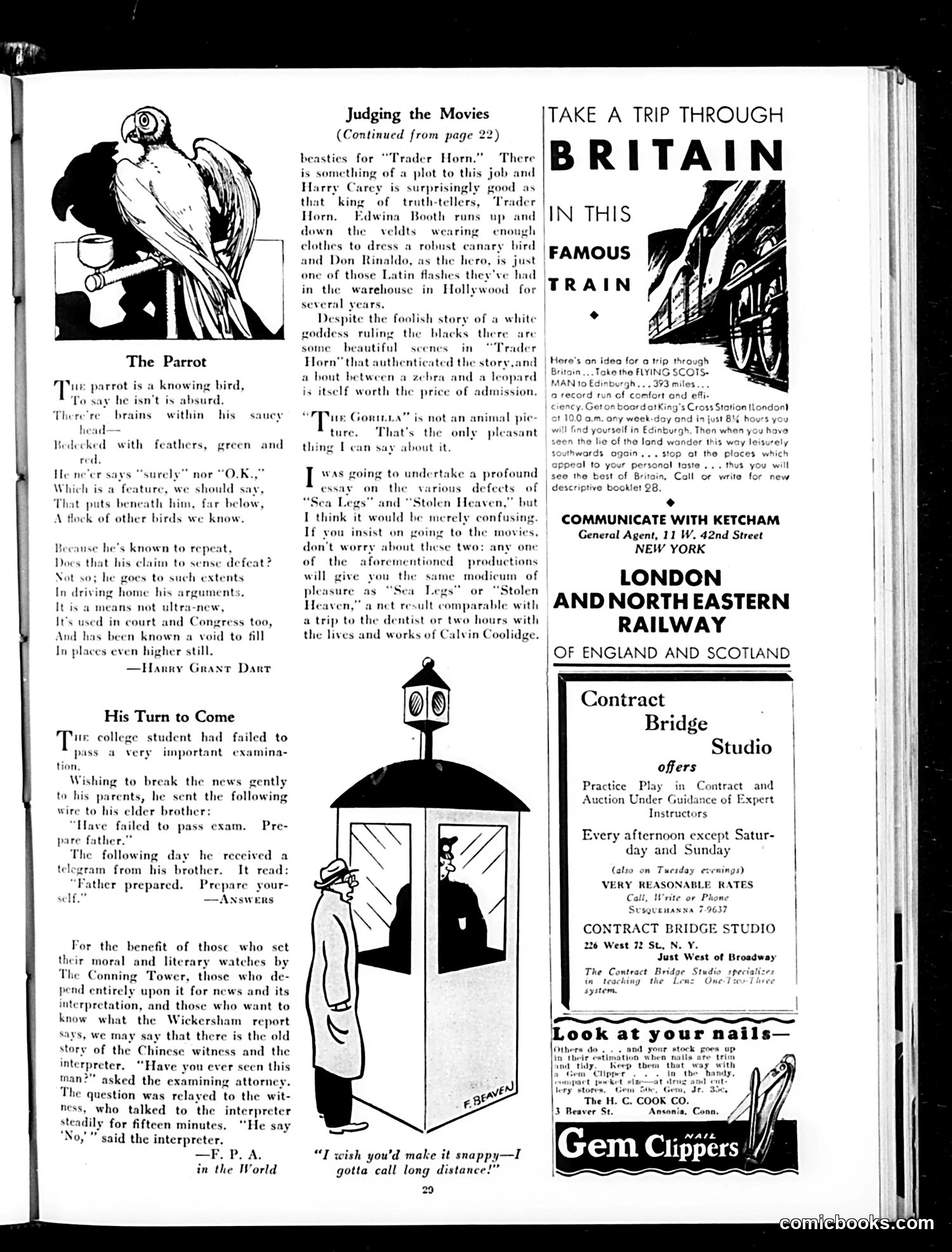
"Judging the Movies" - Judge Magazine Page Analysis This page contains three main humor pieces and period advertisements. The column reviews contemporary 1930s films—"Trader Horn," "The Gorilla," and "Sea Legs"/"Stolen Heaven"—with the critic dismissively comparing viewing them to dental torture or enduring Calvin Coolidge's company. The cartoons illustrate unrelated jokes: a parrot demonstrating argumentative competence (suggesting parrots argue better than some humans, including Congress members), and an exchange where a college student failing an exam telegrams his brother, who responds that "Father prepared"—meaning the father already anticipates bad news, so the son should simply accept consequences. The advertisements promote London & North Eastern Railway travel, a bridge studio, and nail clippers—typical commercial content for the era. The humor assumes readers recognize contemporary film titles and share the critic's sardonic view of American cinema's quality.
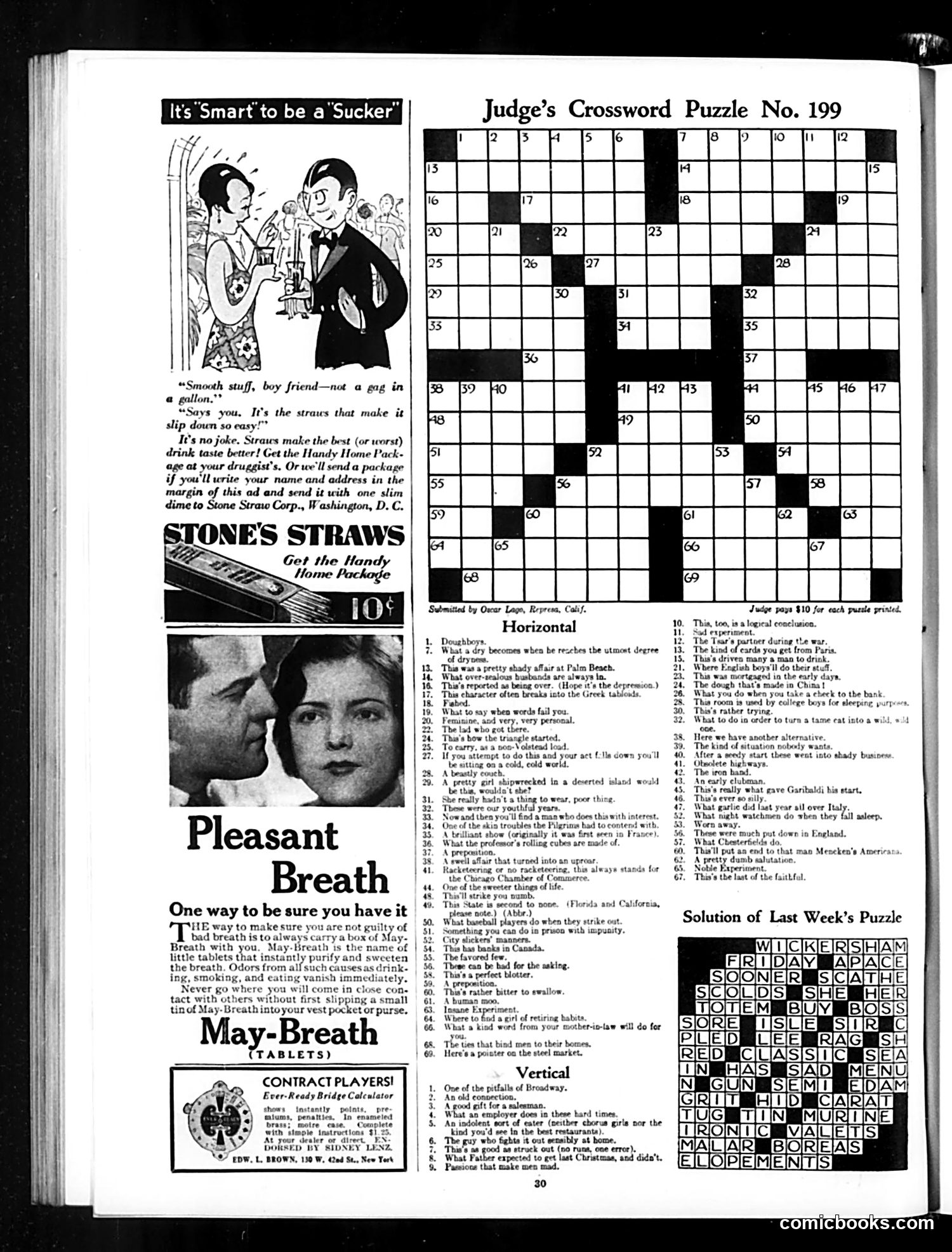
Judge Magazine Crossword Puzzle No. 199 - Content Analysis This page is primarily advertising and puzzle content rather than political satire. The main elements are: Top Left: A small cartoon advertisement for Stone Straws, featuring two men discussing drink quality. It's a product pitch emphasizing that straws improve beverage consumption—a practical sales joke, not political commentary. Center: A photograph and advertisement for "Pleasant Breath" (May-Breath tablets), addressing social anxiety about bad breath—a common early 20th-century consumer concern. Right Side: Judge's crossword puzzle No. 199, with clues and a solution grid from the previous week's puzzle. Bottom Left: An advertisement for an "Ever-Ready Bridge Calculator" for contract bridge players. The page reflects 1920s-30s consumer culture: anxieties about personal hygiene, social acceptance, and leisure activities (bridge playing). There is no significant political satire visible. The content is typical filler/revenue content from a humor magazine relying on advertisements to sustain publication.
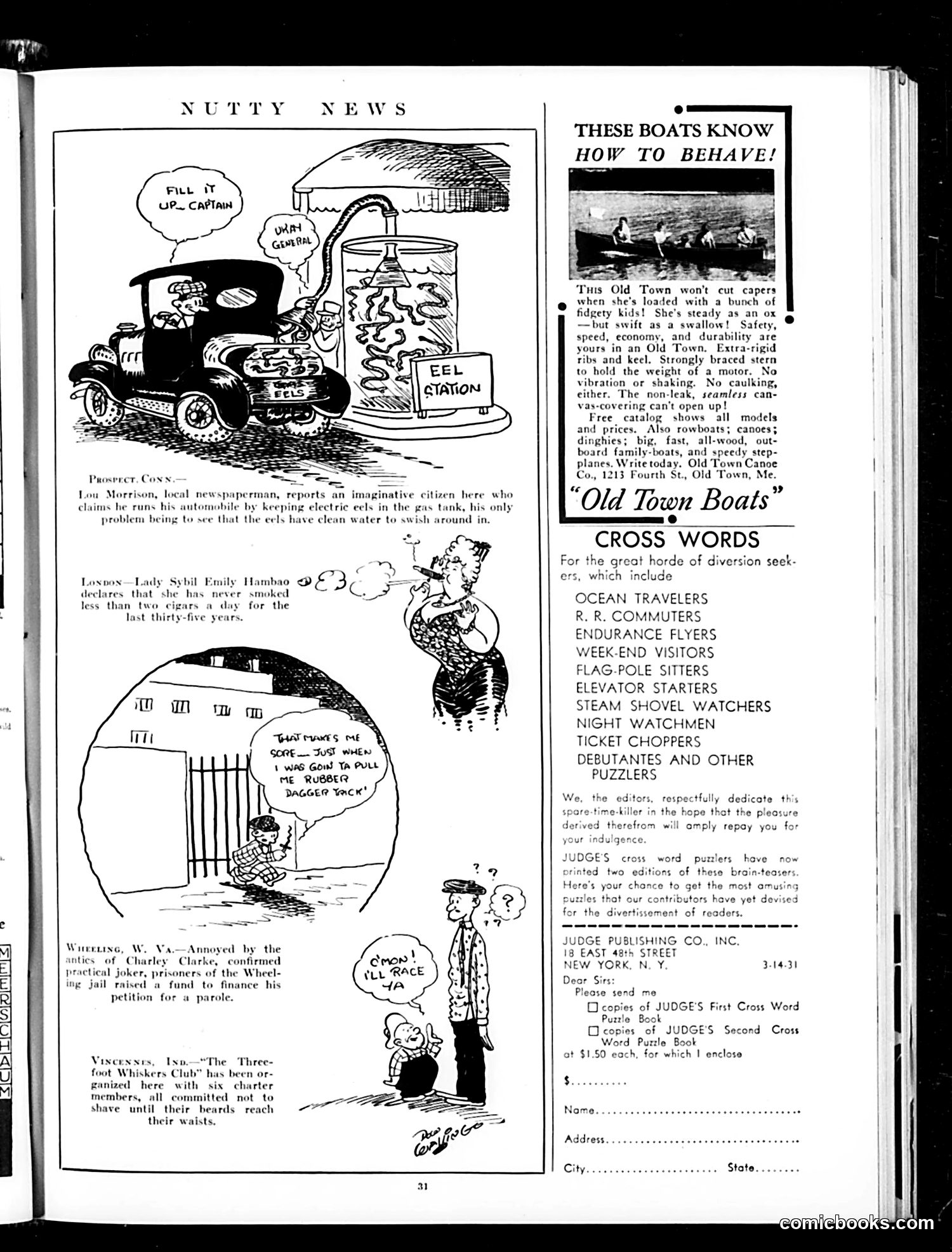
"Nutty News" Page Analysis This page from *Judge* magazine contains three humorous anecdotes and advertisements, typical of the publication's satirical format. Top cartoon: A motorist at an "Eel Station" (gas pump) complains about keeping electric eels in the fuel tank. The joke mocks absurd automotive innovations and pseudoscientific claims popular in the 1920s-30s. Middle anecdotes: Brief humorous news items about eccentric behavior—a practical joker in jail whose inmates fund his parole to be rid of him; a British noblewoman claiming to smoke minimally; a "Three-Foot Whiskers Club" where members pledge not to shave until their beards reach extreme lengths. Bottom cartoon: A man yells at someone about a rubber dagger, illustrating petty frustrations. The right side features advertisements for "Old Town Boats" (emphasizing reliability for children) and a *Judge* cross-word puzzle book promotion—cross-words were newly fashionable diversions in this era. The overall tone is lighthearted mockery of contemporary fads, vanity, and peculiar human behavior.
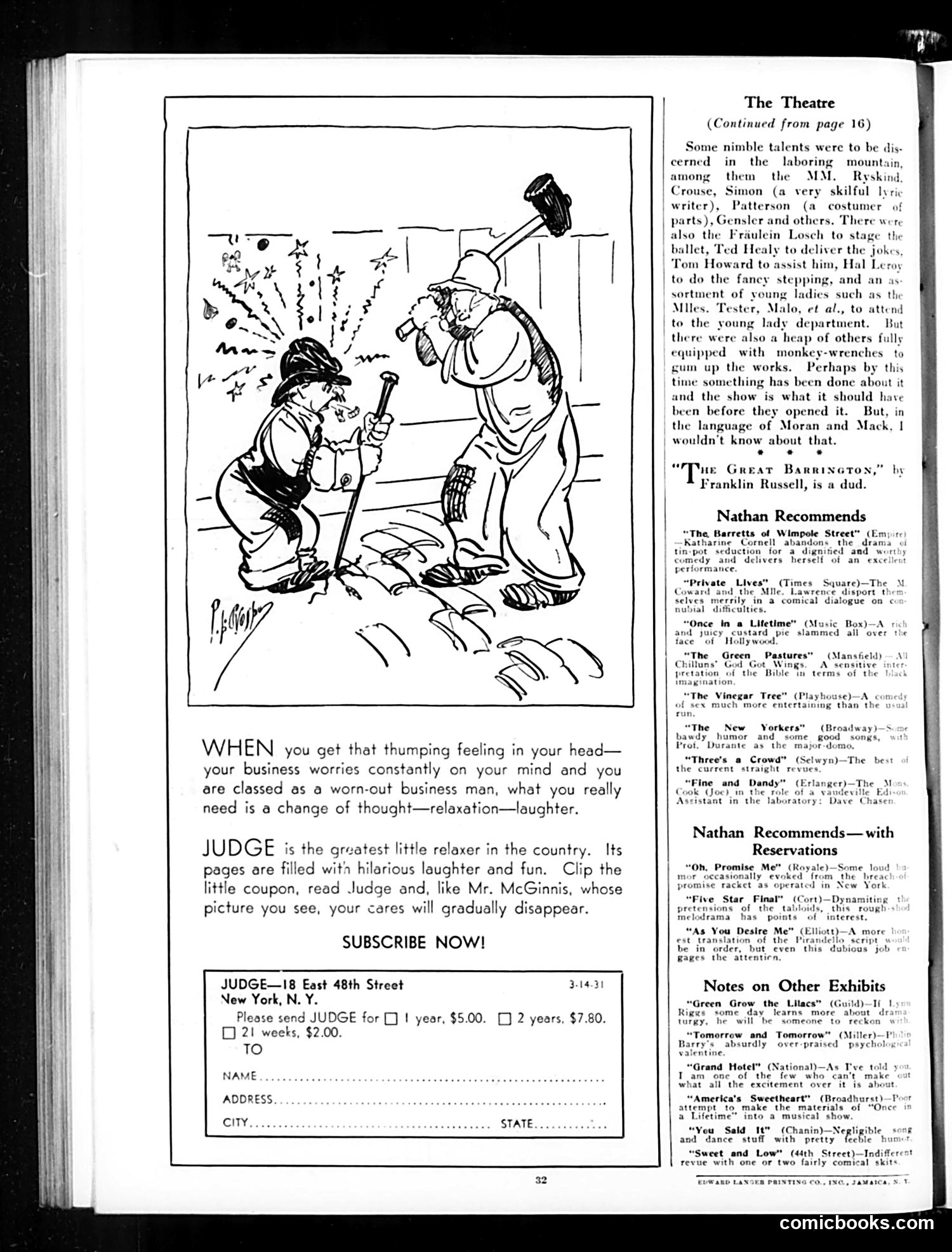
Judge Magazine Page Analysis This page is primarily advertising for Judge magazine itself, with theatrical reviews as secondary content. The Main Cartoon The cartoon depicts a small man (labeled "Mr. McGinnis") striking a large man with a hammer, creating an explosion of stars around the victim's head. The visual joke plays on the advertisement's opening line about "that thumping feeling in your head"—literally depicting the business stress Judge claims to cure. The Advertisement Judge promotes itself as a stress-relief publication for overworked businessmen. The pitch: reading humorous content will cure headaches and business worries. Subscription options ranged from 10 weeks ($2.00) to 2 years ($7.80). Theater Reviews The right column contains brief reviews of Broadway shows—mostly positive recommendations praising comedies like "The Green Pastures" and "Once in a Lifetime," with some reservations noted. References appear to contemporary 1930s productions and performers (though specific names are partially obscured by OCR errors). The page reflects Judge's positioning as entertainment/escapism for a professional male audience.
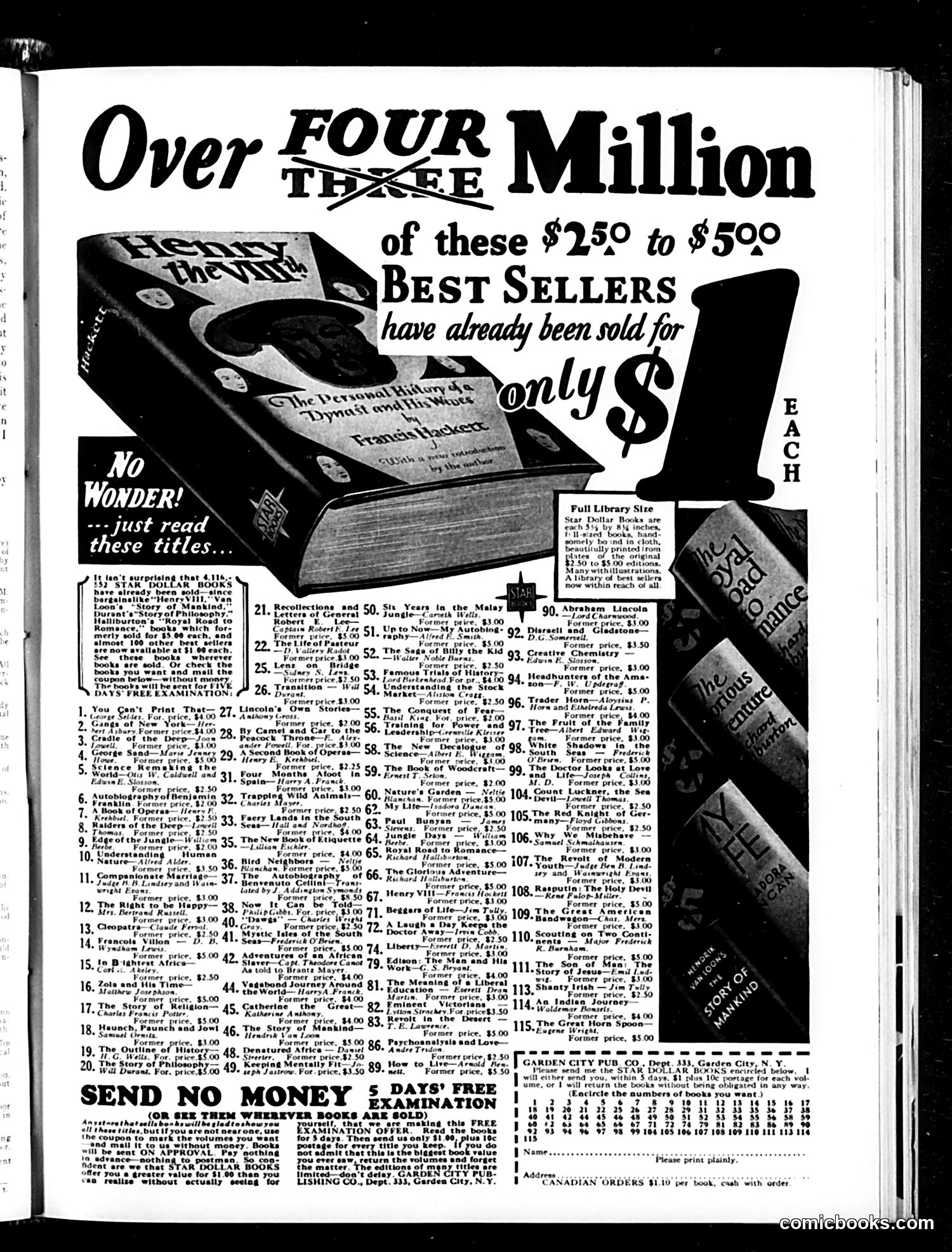
Analysis This is primarily a book advertisement, not a political cartoon. It promotes "Star Dollar Books"—a mail-order offer selling previously expensive bestsellers ($2.50–$5.00) for $1.00 each. The page announces that "over four million" copies have sold and lists approximately 115 titles, mostly serious non-fiction from the 1910s–1920s: H.G. Wells' *Outline of History*, biographies (Lincoln, Benjamin Franklin), travel narratives (*Royal Road to Romance*), and educational works (*Book of Operas*, *Nature's Garden*). The sales pitch uses the "send no money" examination offer common to that era—customers could request books without payment, then decide whether to buy. For modern readers: This reflects a pre-internet era when mail-order book clubs made affordable literature accessible to ordinary households. The emphasis on "bestsellers" and educational titles suggests marketing to middle-class aspirants seeking self-improvement and culture. The volume of sales boasted (four million) underscores the format's commercial success before alternatives like libraries and paperbacks became widespread.
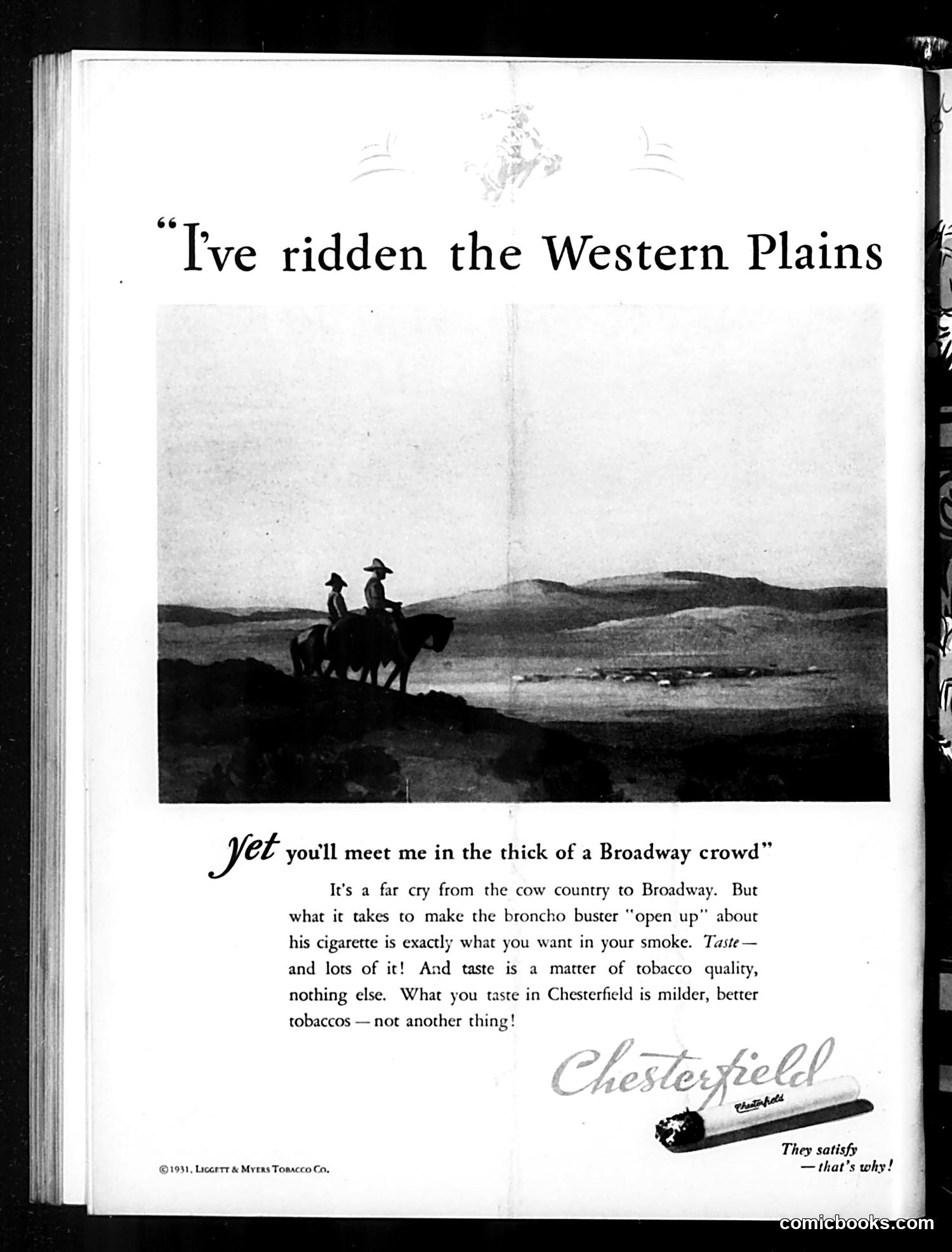
Analysis This is a Chesterfield cigarette advertisement, not political satire. The image shows two cowboys on horseback overlooking the Western Plains, establishing a rugged, authentic "American frontier" persona. The ad's premise contrasts the cowboy's rough origins with urban sophistication: despite coming from remote ranch country, he'll meet the reader "in the thick of a Broadway crowd"—suggesting the product appeals across social classes. The sales pitch emphasizes tobacco quality and taste as the sole distinguishing factor in cigarettes. The copy claims Chesterfield uses "milder, better tobaccos" without artificial additives. This represents vintage mid-century advertising strategy: associating cigarettes with masculine independence and authentic American values while making health-conscious claims (mildness) that would later be recognized as misleading. The 1951 copyright date places this before tobacco's health dangers were widely acknowledged publicly.