judge
Judge — March 21, 1931
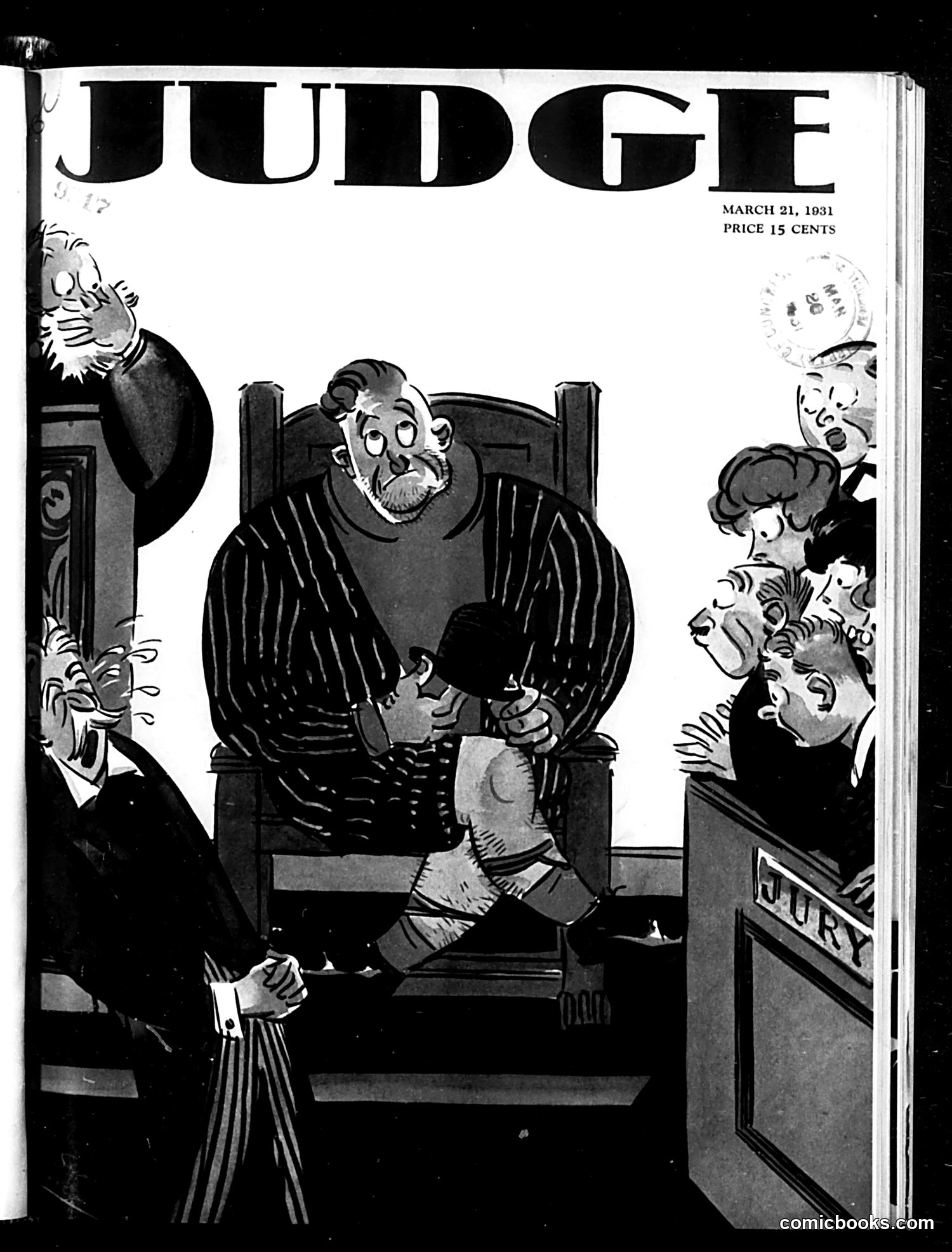
Judge Magazine Cover - March 21, 1931 This satirical cover depicts a courtroom scene centered on a distressed man seated in what appears to be a judge's chair or witness stand. He's surrounded by angry or accusatory figures—likely lawyers, jurors, or witnesses—pointing fingers at him. The man's exaggerated facial expression and body language suggest he's being interrogated or condemned. Given the 1931 date during the Great Depression, this likely references contemporary legal troubles or financial scandals. The specific identity of the central figure isn't clear from the image alone, but the cartoon's intent appears to be mocking either a particular defendant or the judicial process itself during a period of widespread economic crisis and public distrust of institutions.
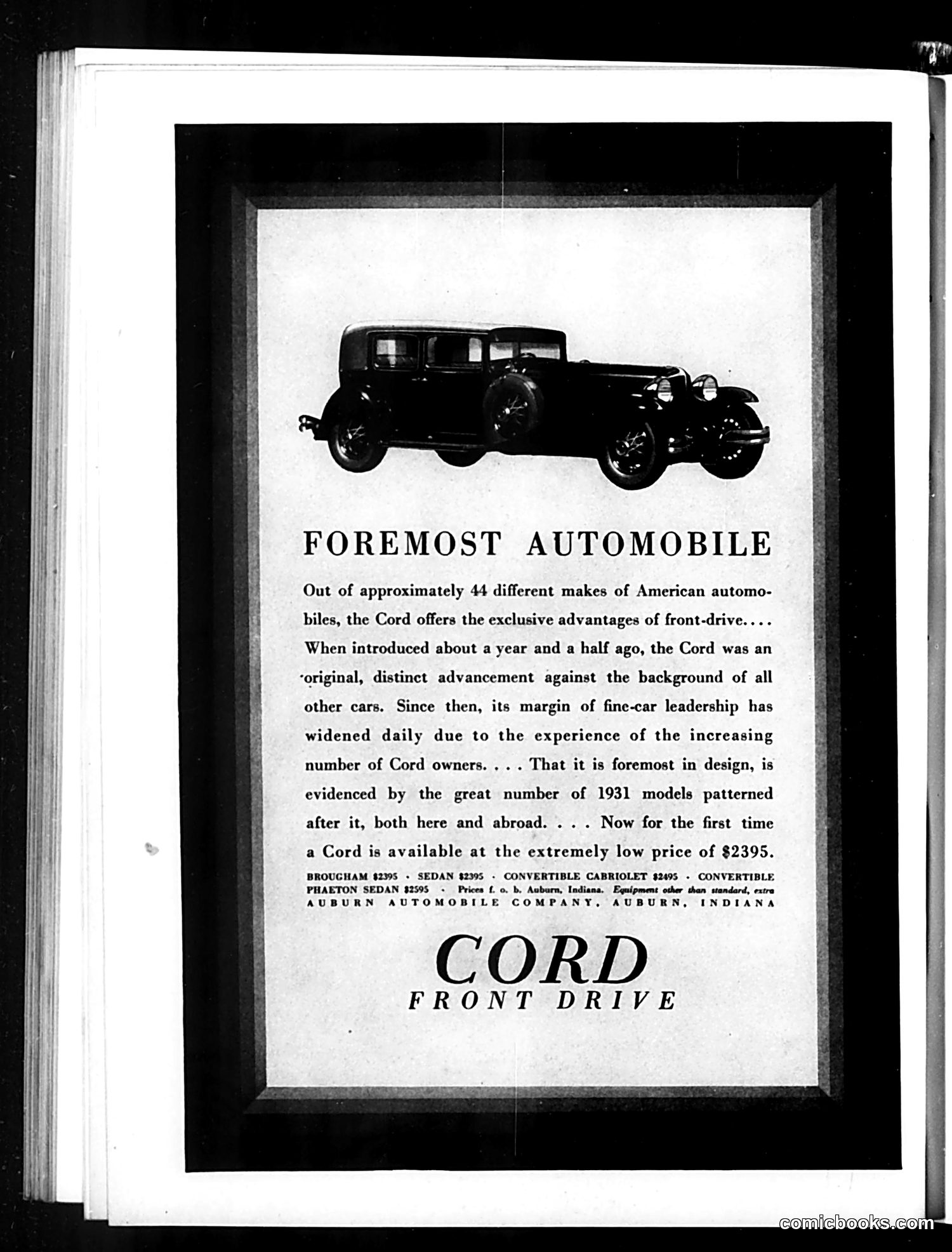
Analysis This page is primarily advertising, not satire or editorial content. It's a Cord automobile advertisement from the Auburn Automobile Company of Auburn, Indiana. The ad claims the Cord is the "foremost automobile" among 44 American car makes, emphasizing its exclusive front-wheel drive as a major innovation introduced about 18 months prior. The copy argues that numerous 1931 models copied this design, proving Cord's leadership in automotive engineering. The advertisement highlights the car's low price of $2395 for the basic model, with variant prices listed (brougham, sedan, convertible options). The silhouetted illustration at top shows a Cord sedan in profile. There is no political cartoon or satire present on this page—it's straightforward product advertising typical of Judge magazine's commercial content.
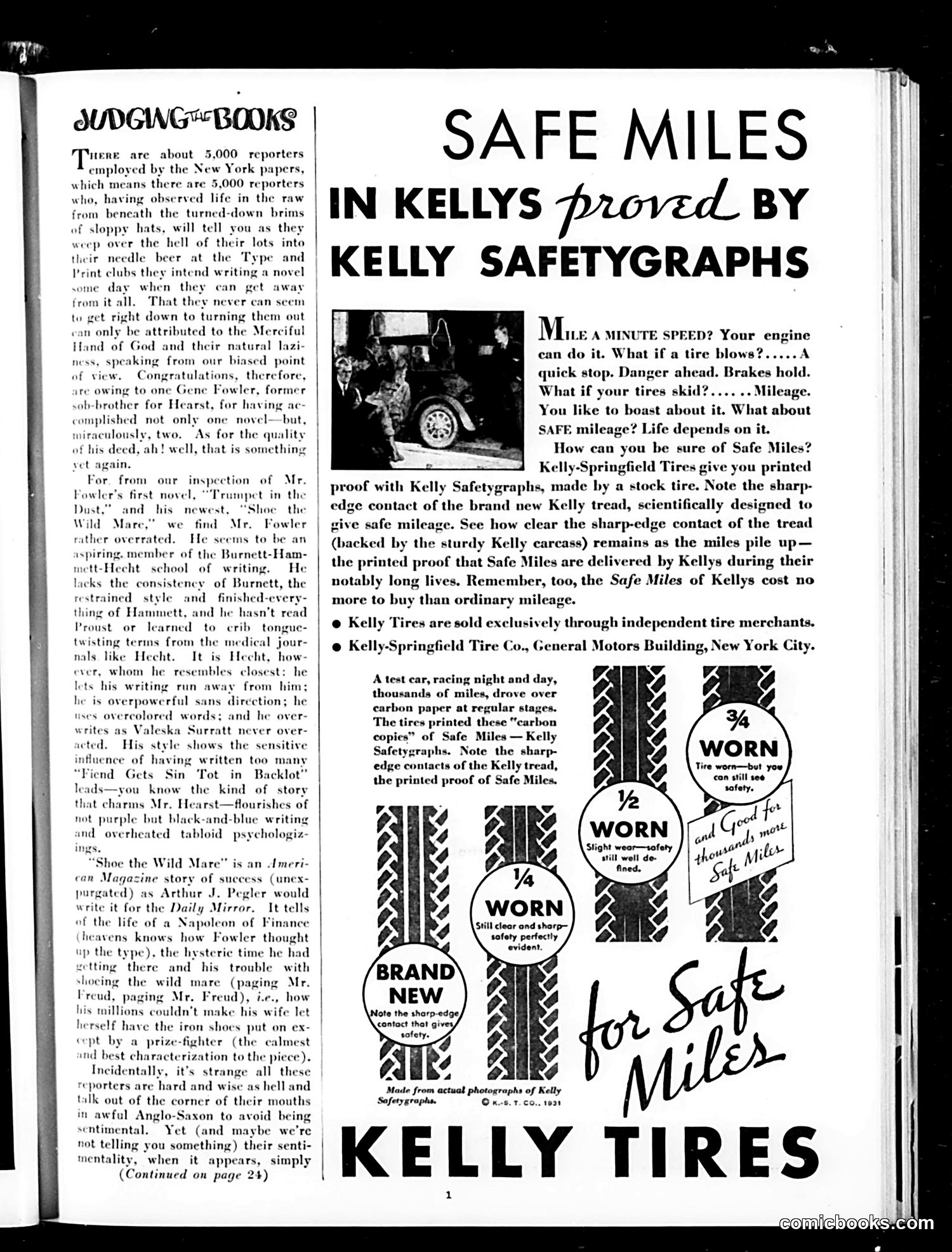
Analysis This page is primarily advertising, not satirical content. The left column contains "Judging the Books," a literary review section discussing newspaper reporters and various writers' styles—standard magazine commentary rather than political satire. The dominant right side is a Kelly Tires advertisement promoting "Safe Miles" through Kelly Safetygraphs (tire tread wear documentation). The ad uses comparative tire tread images labeled "BRAND NEW," "1/4 WORN," "1/2 WORN," and "3/4 WORN" to demonstrate tire durability and safety. A test car narrative describes driving over carbon paper to create printed proof of safe mileage performance. This reflects early 20th-century advertising approaches: using technical proof and consumer testimonials rather than humor. There is no political satire visible on this page.
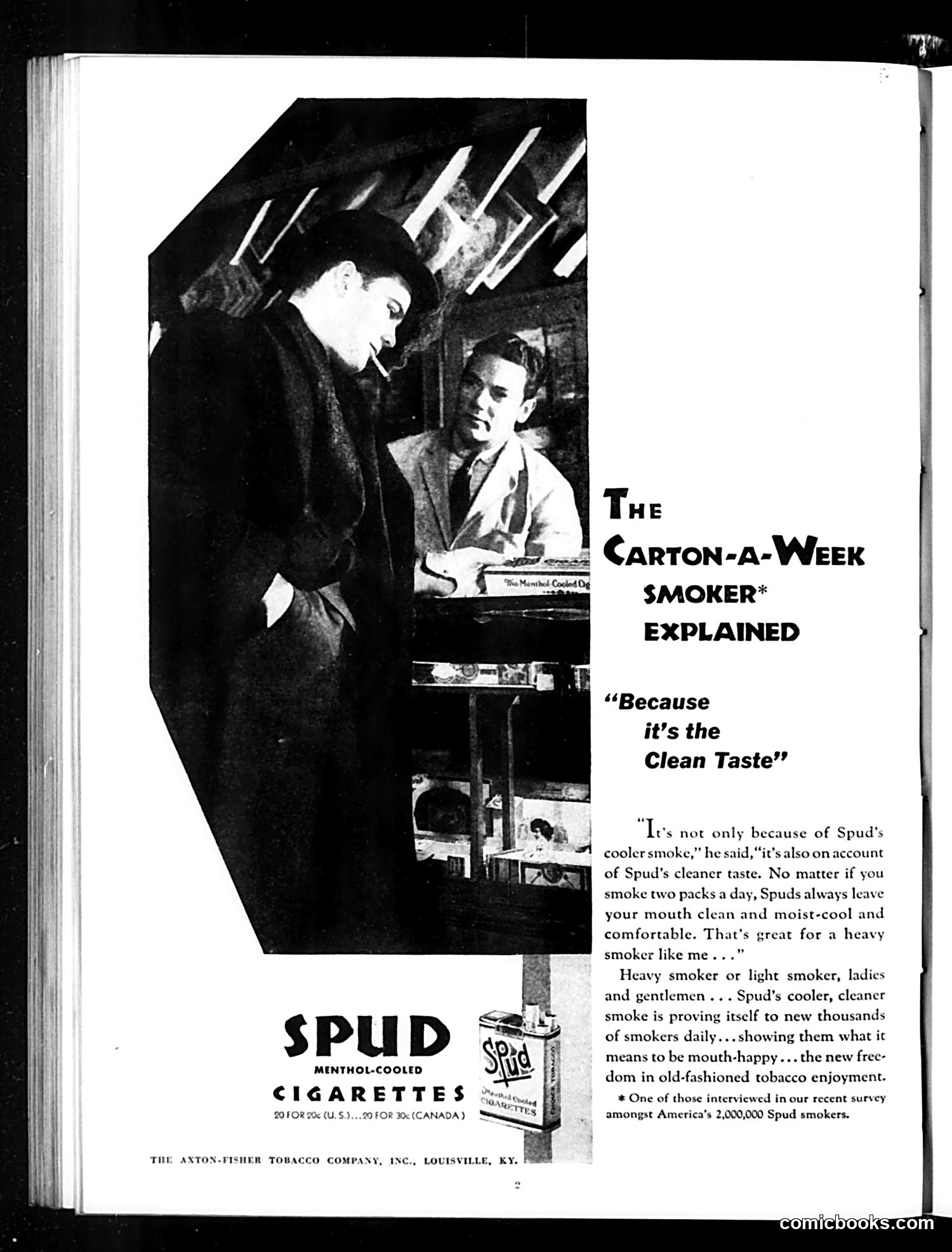
Spud Cigarettes Advertisement This is not a cartoon or satire — it's a straightforward cigarette advertisement from *Judge* magazine for Spud menthol cigarettes. The image shows two men in what appears to be a store or shop, with one examining a Spud cigarette package. The ad's central claim is that Spud cigarettes offer a "clean taste" because of menthol cooling and reduced harshness compared to regular tobacco. The quote attributes this testimonial to one of 2,000,000 Spud smokers surveyed. The marketing emphasizes that even "heavy smokers" can smoke frequently while maintaining "clean and moist-cool and comfortable" mouth conditions — a health-adjacent claim typical of mid-20th-century tobacco advertising before smoking's dangers were widely acknowledged.
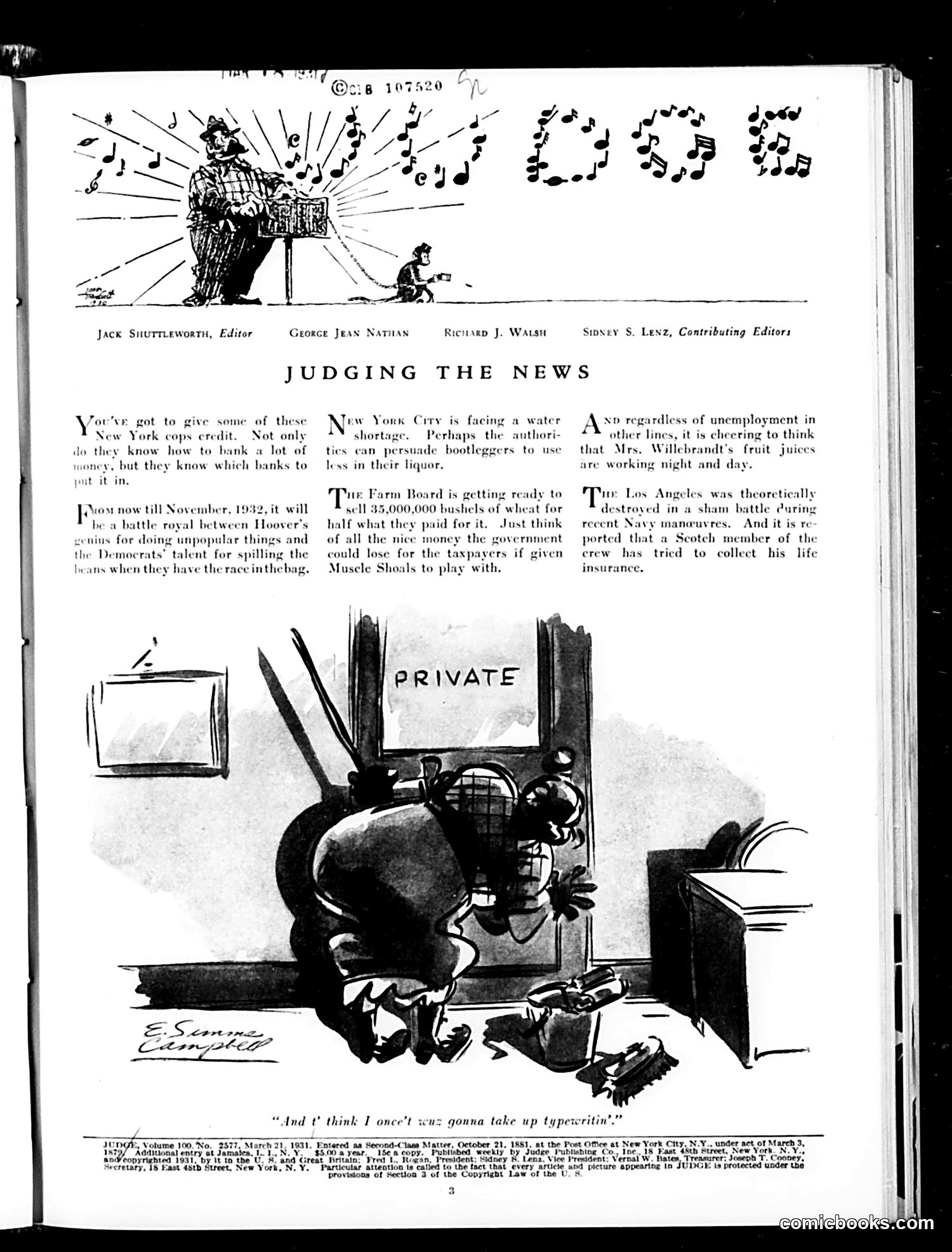
"Judging the News" - Judge Magazine Satire Page This satirical commentary page addresses 1932 American economic and political issues during the Depression. The main cartoon depicts a figure labeled "PRIVATE" at a desk marked with broadcasting equipment, satirizing media privacy concerns or government secrecy during news reporting. The text columns mock: - New York City's financial crisis and bootleggers exploiting water shortages - The Farm Board's planned wheat sales at loss to taxpayers - A naval incident involving the USS Los Angeles and insurance fraud The top illustration shows a conductor-like figure with musical notes, likely satirizing how news is "orchestrated" or controlled. The cartoons critique government mismanagement, financial corruption, and media manipulation during the Depression era. The overall tone suggests skepticism toward official narratives and institutional competence.
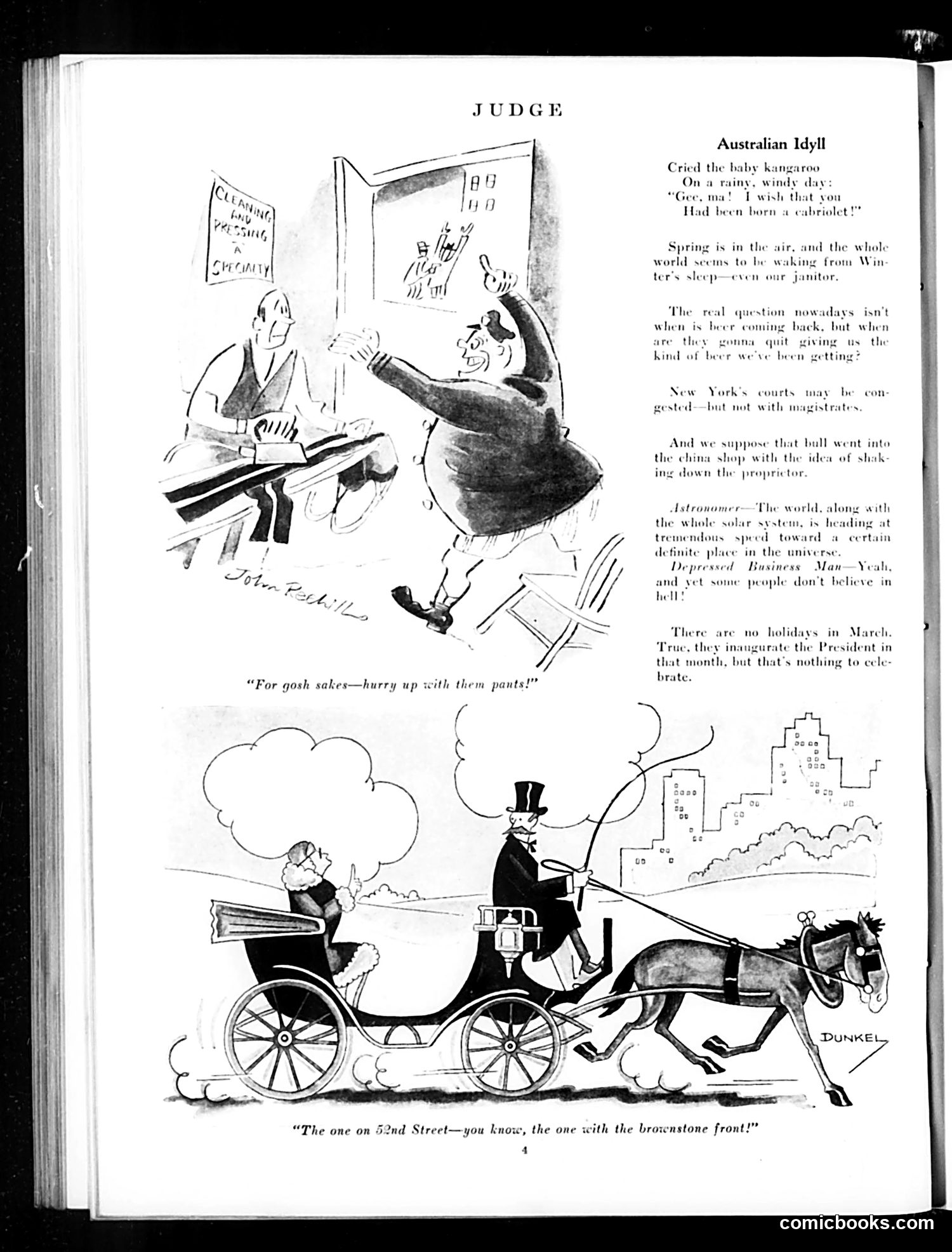
Analysis of Judge Magazine Page This page contains two cartoons satirizing early 20th-century American life and politics. Top cartoon: A judge examines a clerk's filing system labeled "Clearing House Pressing Specialty." The joke suggests judicial incompetence or corruption—the clerk frantically tries to hide disorganized records, implying courts mishandle cases or evidence. Bottom cartoon (signed Dunkel): A well-dressed man in a top hat drives a horse-drawn carriage while holding papers, with another figure behind. The caption references "52nd Street" and "brownstone front," likely mocking wealthy New York real estate dealings or social pretension among the affluent. The text snippets on the right ("Australian Idyll," "Astronomer," "Depressed Business Man") appear unrelated to the cartoons—standard magazine filler satirizing various social types and current anxieties about economic conditions.
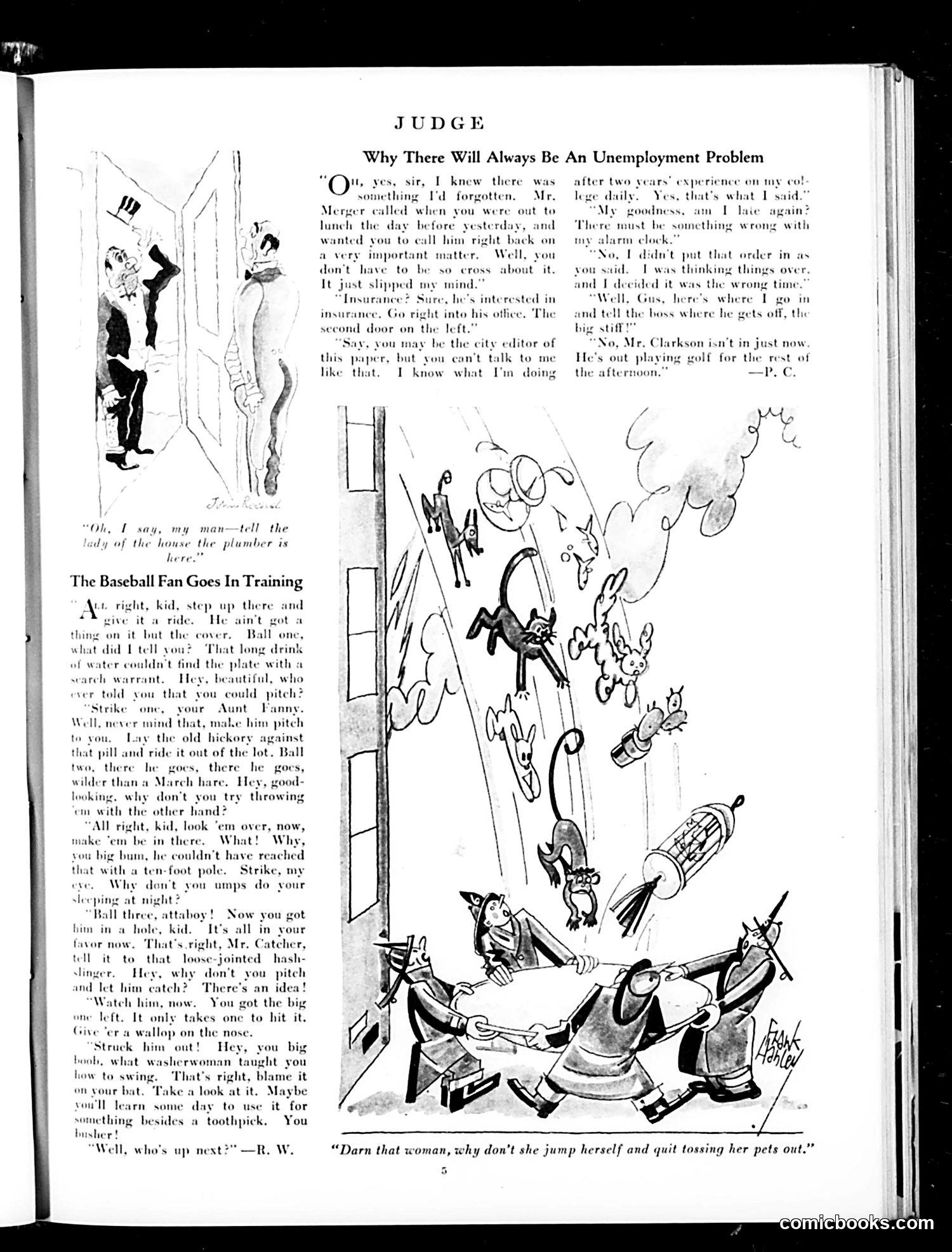
Judge Magazine Page Analysis This page contains two separate pieces of humor: "Why There Will Always Be An Unemployment Problem" (top) is a dialogue joke about a businessman who forgot an important matter, then dismisses his employee's concerns about being called back to work urgently. The humor relies on the businessman's scattered priorities and indifference to others' time. "The Baseball Fan Goes In Training" (bottom left) is a humorous monologue offering absurd baseball coaching advice, full of malapropisms and nonsensical suggestions (like using a ten-foot pole to hit). It's gentle sports satire. The large cartoon (right) shows someone throwing household items and pets out a window in frustration, with the caption "Darn that woman, why don't she jump herself and quit tossing her pets out." This appears to be domestic humor, though the subject matter is dark by modern standards.
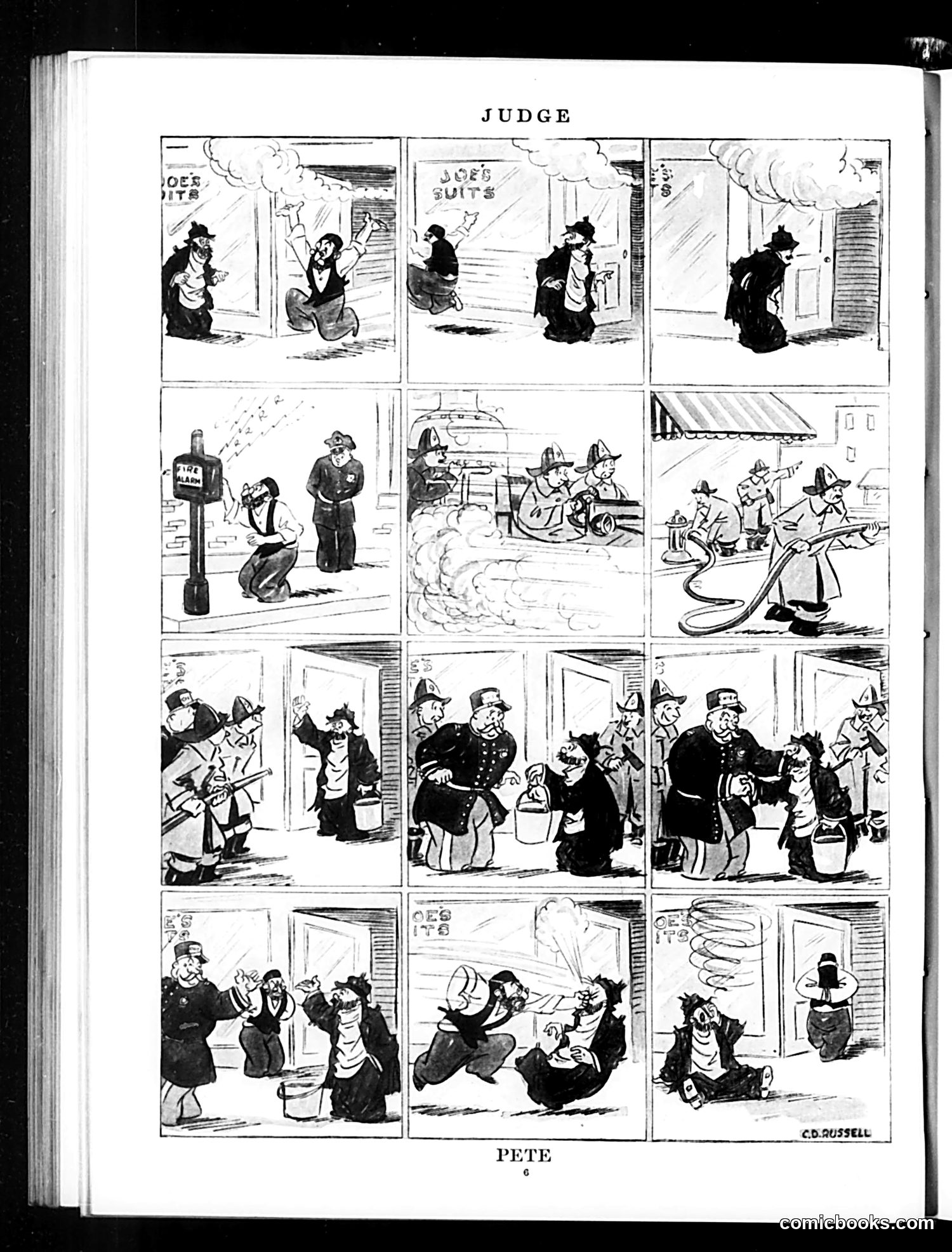
"Judge Pete" Comic Strip Analysis This appears to be a multi-panel comic strip titled "Judge Pete" by C.D. Russell (credited at bottom). The narrative follows a man in formal attire encountering various urban situations. The strip satirizes bureaucratic red tape and municipal authority. Early panels show the protagonist repeatedly finding "Dog Suits" signs at different locations—suggesting frustration with regulations or legal restrictions. Middle panels depict firefighting and what appears to be emergency response chaos. Later panels show interactions with officials and crowds, possibly critiquing the inefficiency of city government or law enforcement. Without specific date context, the exact political targets remain unclear, but the overall tone mocks municipal incompetence and the absurdity of conflicting or excessive regulations affecting ordinary citizens.
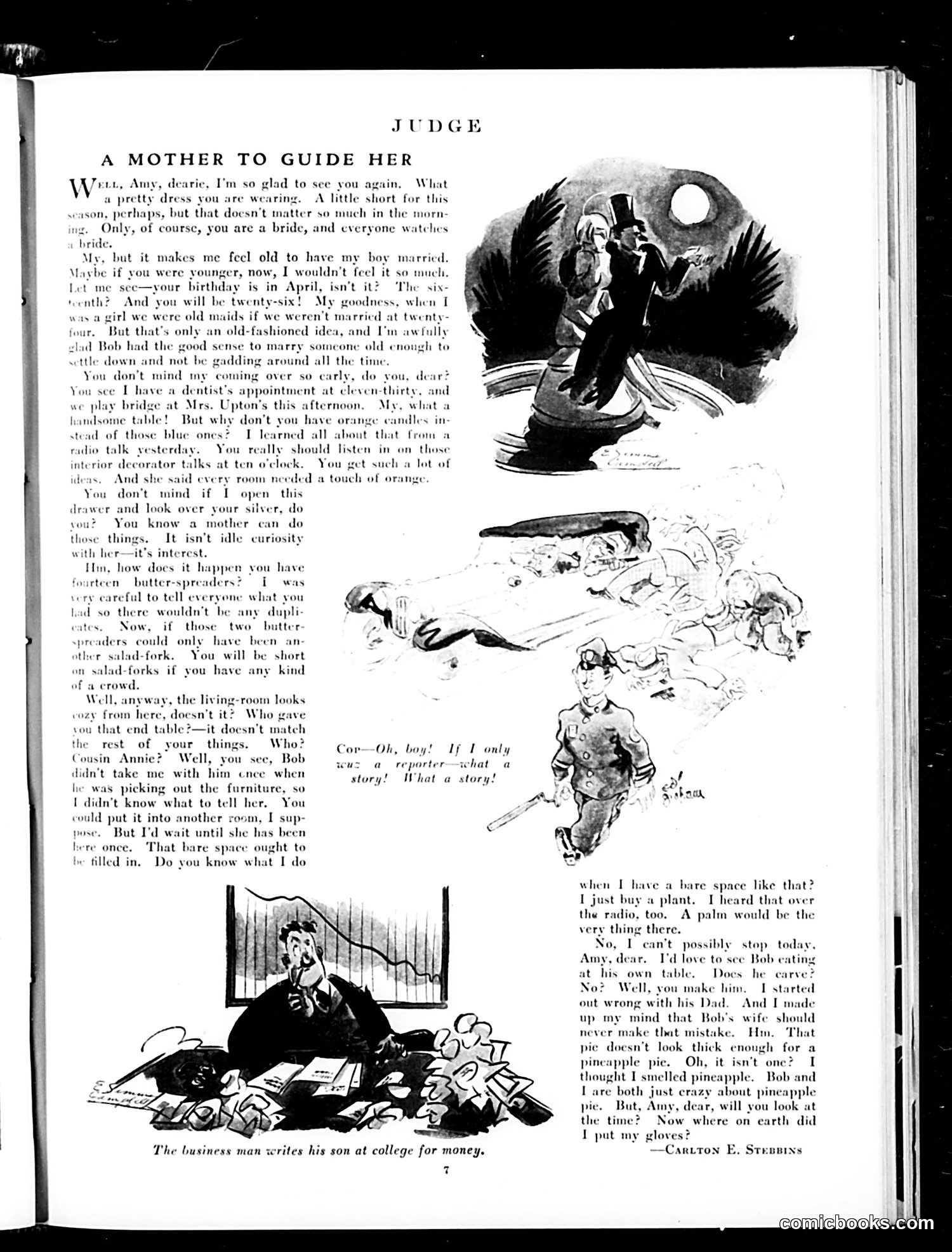
Judge Magazine Analysis: "A Mother to Guide Her" This is a domestic humor piece satirizing the overbearing mother-in-law. The unnamed elderly mother visits her new daughter-in-law Amy, ostensibly to welcome her but actually to critique every aspect of her home and married life. The satire targets: 1. Intrusive maternal oversight: The mother uninvitedly examines Amy's silver, comments on furnishings, and offers unsolicited advice about candle colors and palm plants—claiming it's "interest" rather than "idle curiosity." 2. Radio culture: References to radio decorator talks reflect 1920s-30s fascination with mass media as advice source, humorously portrayed as the mother's source of decorating wisdom. 3. Social anxiety about marriage: The mother critiques Amy's dress length, her age (twenty-six), and worries about proper entertaining and table settings. 4. Gender dynamics: The illustration of a businesslike male figure suggests contrast with domestic female concerns. The cartoon below shows a man drowning in paperwork—likely illustrating the final caption about fathers writing sons for money during college. The byline credits Carlton E. Stebbins (cartoonist).
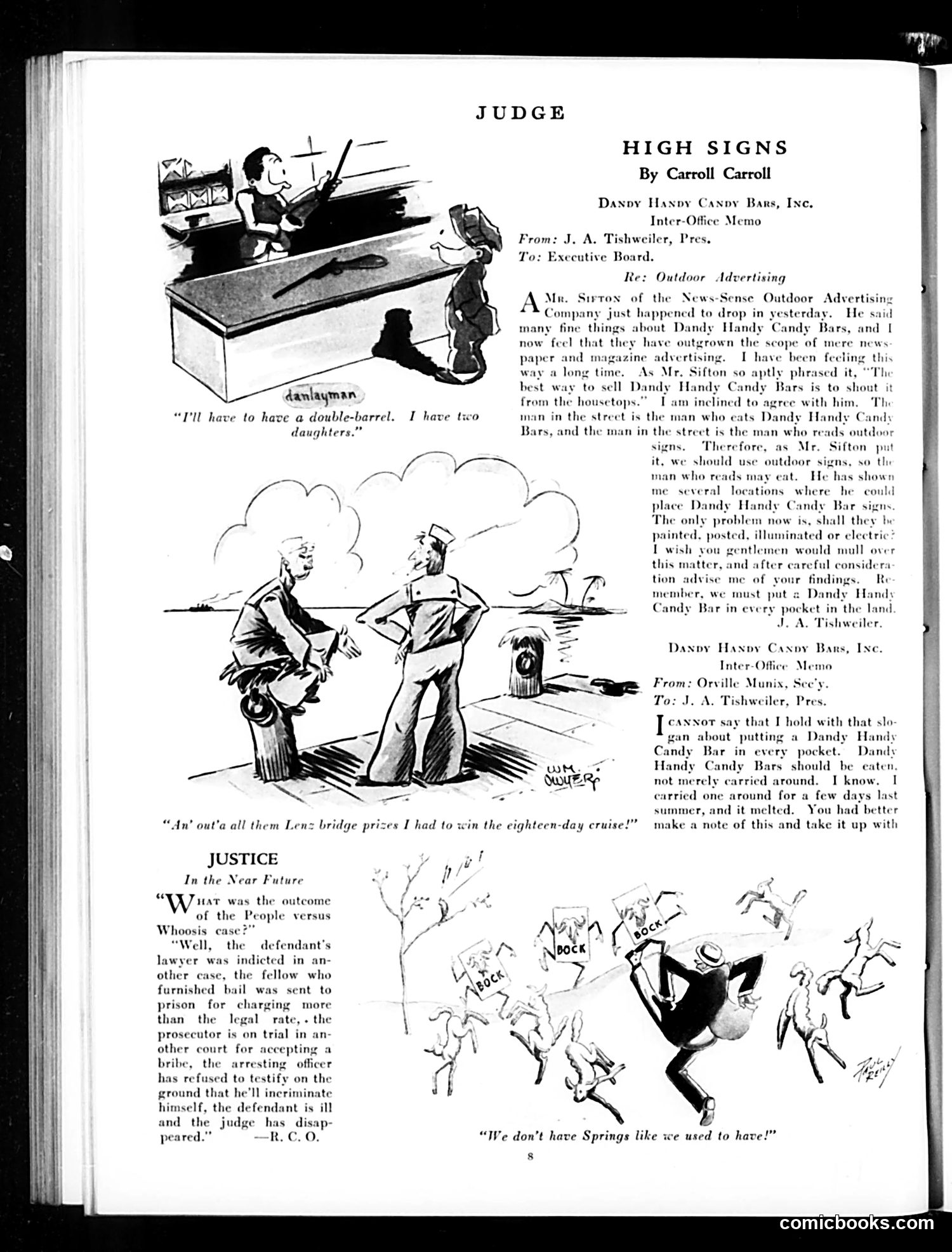
Analysis: Judge Magazine Page This page contains three separate satirical pieces about American consumer culture and legal corruption circa the 1920s-1930s. "High Signs" mocks outdoor advertising excess. A candy company memo proposes plastering "Dandy Handy Candy Bars" everywhere—on buildings, streets, even in pockets. The irony: a follow-up memo notes a bar left in someone's pocket melted, defeating the purpose. The satire targets aggressive marketing's obliviousness to practical reality. "Justice: In the Near Future" depicts systemic legal corruption. A court case collapses because everyone involved is compromised: the defendant's lawyer faces charges elsewhere, the prosecutor is on trial for bribery, the arresting officer refuses testimony to avoid self-incrimination, the defendant is ill, and the judge vanishes. The joke critiques a justice system where corruption has become so endemic that cases become impossible to prosecute—a commentary on Prohibition-era institutional decay. Both cartoons satirize American institutions' dysfunction through exaggeration and dark humor.
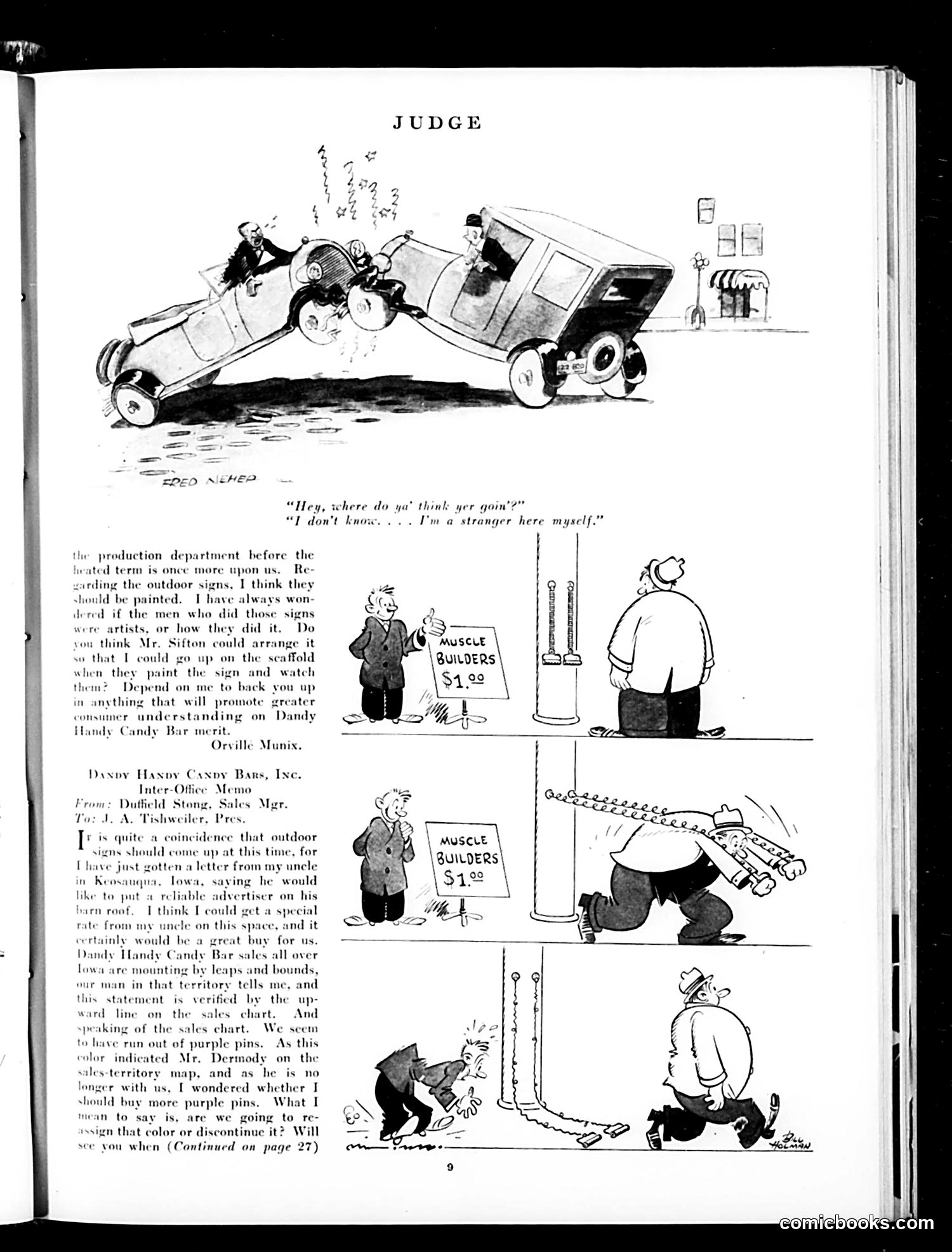
"Judge" Magazine Page Analysis This page combines corporate satire with advertising humor. The top cartoon depicts two automobiles colliding, with occupants asking each other for directions—a joke about strangers and traffic confusion in an era when automobiles were still relatively novel. Below are inter-office memos from executives at "Dandy Handy Candy Bars, Inc." discussing marketing strategies. The satire targets corporate bureaucracy: one proposes painting outdoor advertising signs while hiring artists to publicize the work; another suggests using his uncle's barn roof in Iowa as billboard space. The memos humorously reveal how small business decisions get bogged down in petty details—notably, they've run out of purple pins on their sales chart. The accompanying cartoons show a "Muscle Builders" product being marketed, with comedic illustrations of salesmen struggling with heavy chains and equipment. The overall satire mocks both corporate inefficiency and the hard-sell advertising culture of the era.
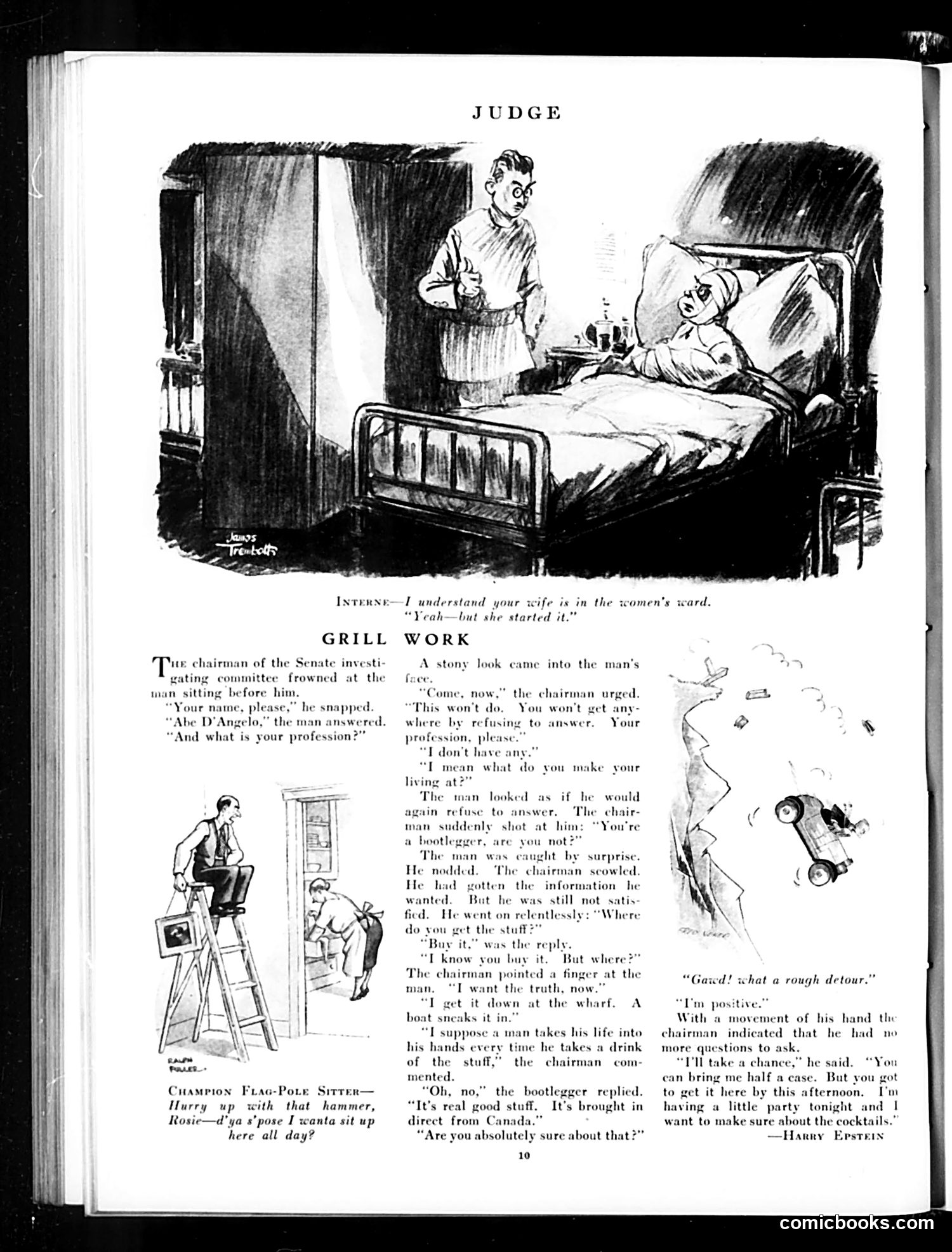
Explanation of Judge Magazine Page This page contains two separate satirical pieces from the Prohibition era (likely 1920s-1930s). "Grill Work" (main story): A Senate investigating committee chairman interrogates a bootlegger about his illegal alcohol operation. The satire targets the futility of Prohibition enforcement—the chairman ultimately reveals he's not trying to stop the bootlegger but rather to secure a reliable supply for his own party that evening. The joke exposes the hypocrisy of lawmakers: they publicly prosecute bootleggers while privately patronizing them. "Champion Flag-Pole Sitter" (small cartoon, left): A satirical jab at the 1920s fad of flag-pole sitting—a pointless endurance stunt where people sat atop poles for days. "Rosie" appears to reference female participation in this trend. "Interne" (top): A hospital scene joke about a doctor's wife in the women's ward, implying marital discord. All three pieces mock contemporary American behaviors and legal contradictions with sharp, cynical humor typical of Judge's editorial voice.
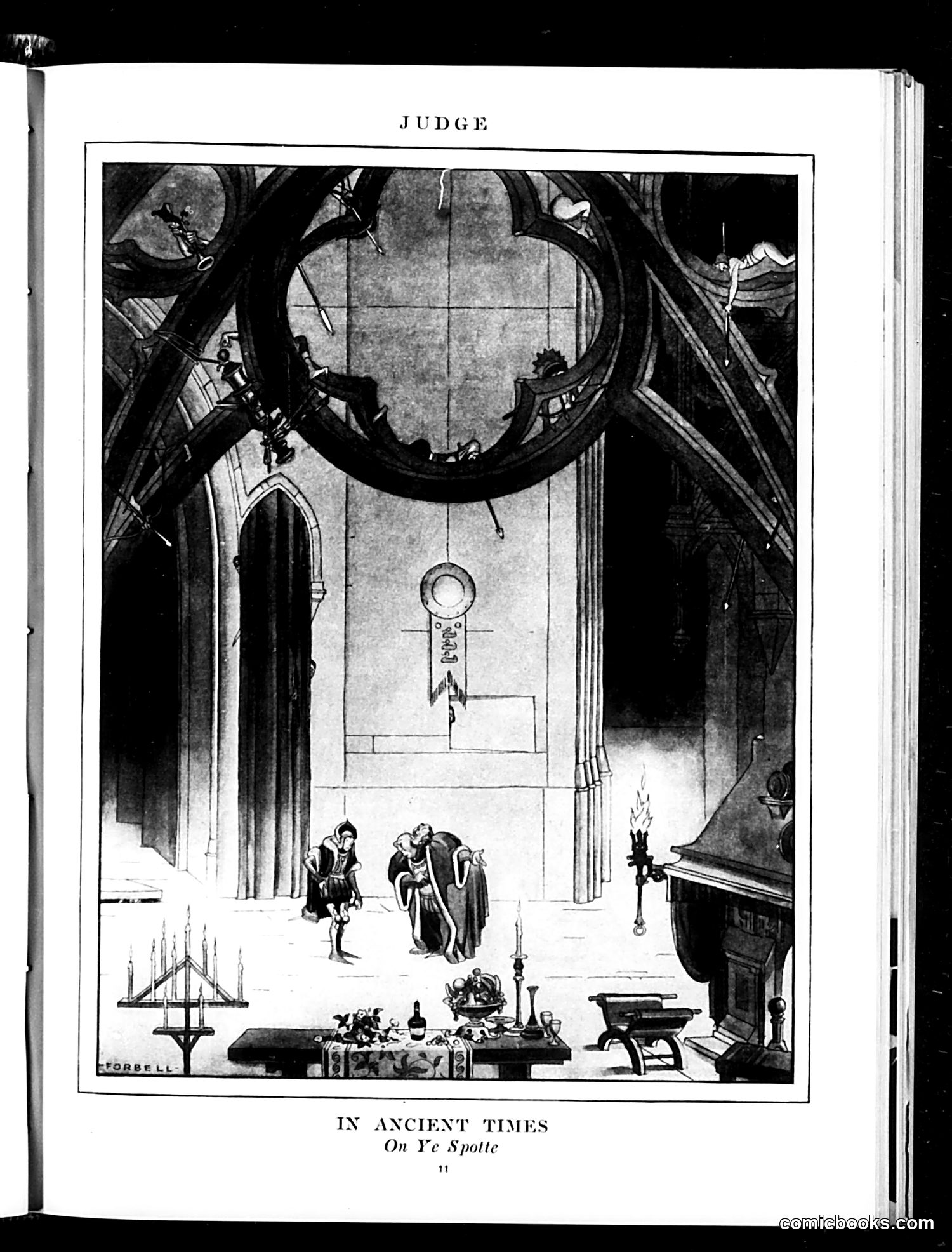
Analysis This is a theatrical scene illustration titled "Judge: In Ancient Times, On Ye Spotte," signed by artist Forbel. The image depicts what appears to be a grand interior space—possibly a cathedral or palace—with dramatic architectural elements including a large circular window or opening overhead and tall columns. Several figures in period costume stand on the floor, while various objects are scattered in the foreground, including what appears to be a scale or balance, vessels, and other implements. Without additional context about Judge magazine's specific satirical targets or the historical moment of publication, the exact political or social commentary remains unclear. The title's archaic spelling ("Ye Spotte") suggests mockery of historical or theatrical pretension, but the specific joke or criticism it intends cannot be determined from the image and caption alone.
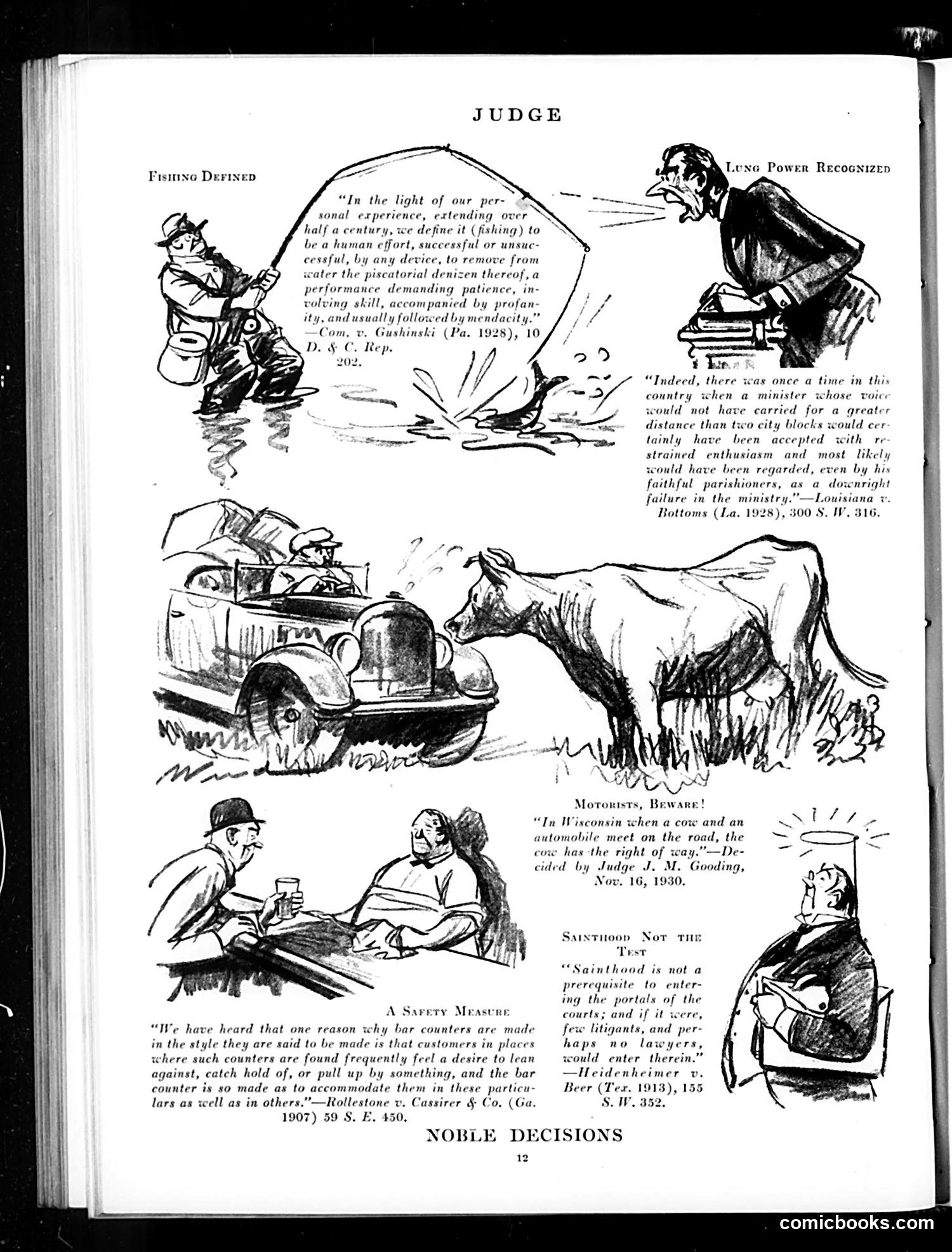
"Noble Decisions" Page Analysis This page from *Judge* magazine collects humorous legal rulings presented as social commentary. The cartoons illustrate absurd or revealing court decisions: "Fishing Defined" mocks a lengthy legal definition of fishing that essentially means lying—the judge's quote emphasizes that fishermen are inherently dishonest ("usually followed by mendacity"). "Lung Power Recognized" satirizes a Louisiana court ruling about ministerial voices, suggesting preachers with loud voices were once considered failures—a commentary on changing standards. "Motorists, Beware!" presents a Wisconsin ruling giving cows right-of-way over automobiles, highlighting the law's struggle to accommodate modern vehicles in rural/agricultural contexts. "Sainthood Not the Test" quotes a Texas ruling that you needn't be morally perfect to use courts—implying many lawyers and litigants are decidedly unsaintly. "A Safety Measure" quotes a Georgia case explaining bar counter design accommodates drunk customers' need to grab something—revealing commentary on alcohol consumption and bar culture. The overall effect satirizes how legal language can expose uncomfortable truths about human nature and society.
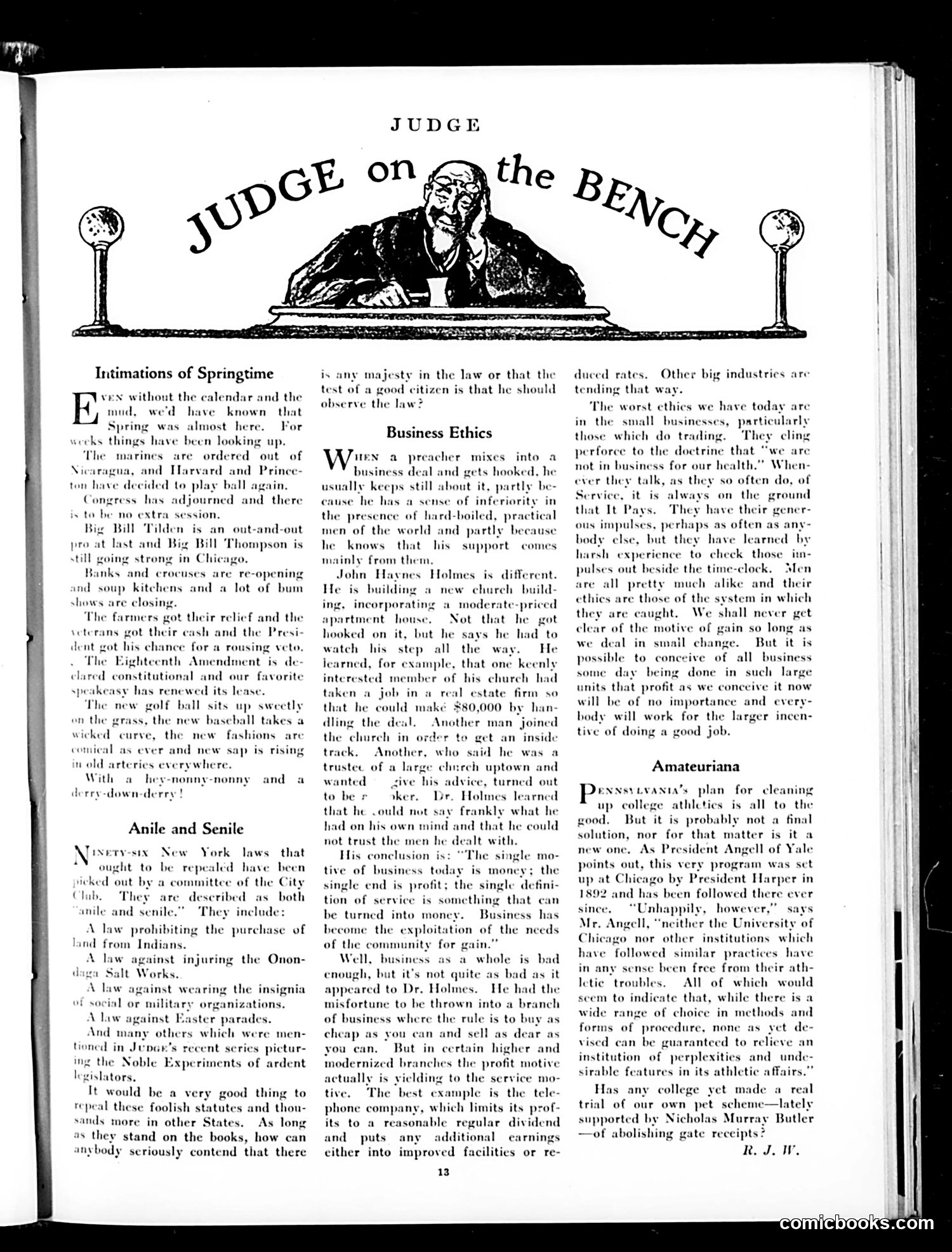
Judge Magazine Page Analysis This page from Judge magazine contains three distinct sections satirizing American life, likely from the early 1920s (given references to Prohibition's Eighteenth Amendment and "Big Bill" Thompson, Chicago's notorious mayor). "Intimations of Springtime" celebrates seasonal renewal while poking fun at contemporary events—legal baseball games resuming, the Eighteenth Amendment upheld, and speakeasies operating openly despite Prohibition. "Anile and Senile" mocks outdated New York laws (prohibiting Indian land purchases, protecting salt works) that remain on books despite being absurd, satirizing legislators who claim to uphold law's "majesty." "Business Ethics" critiques corrupt business practices through Rev. John Haynes Holmes's experience building a church facility. Church members exploited the project for personal profit ($80,000 gains), demonstrating that modern business prioritizes money-making over ethics. The piece argues small businesses operate more corruptly than larger corporations like telephone companies, which at least limit profits and reinvest in infrastructure.
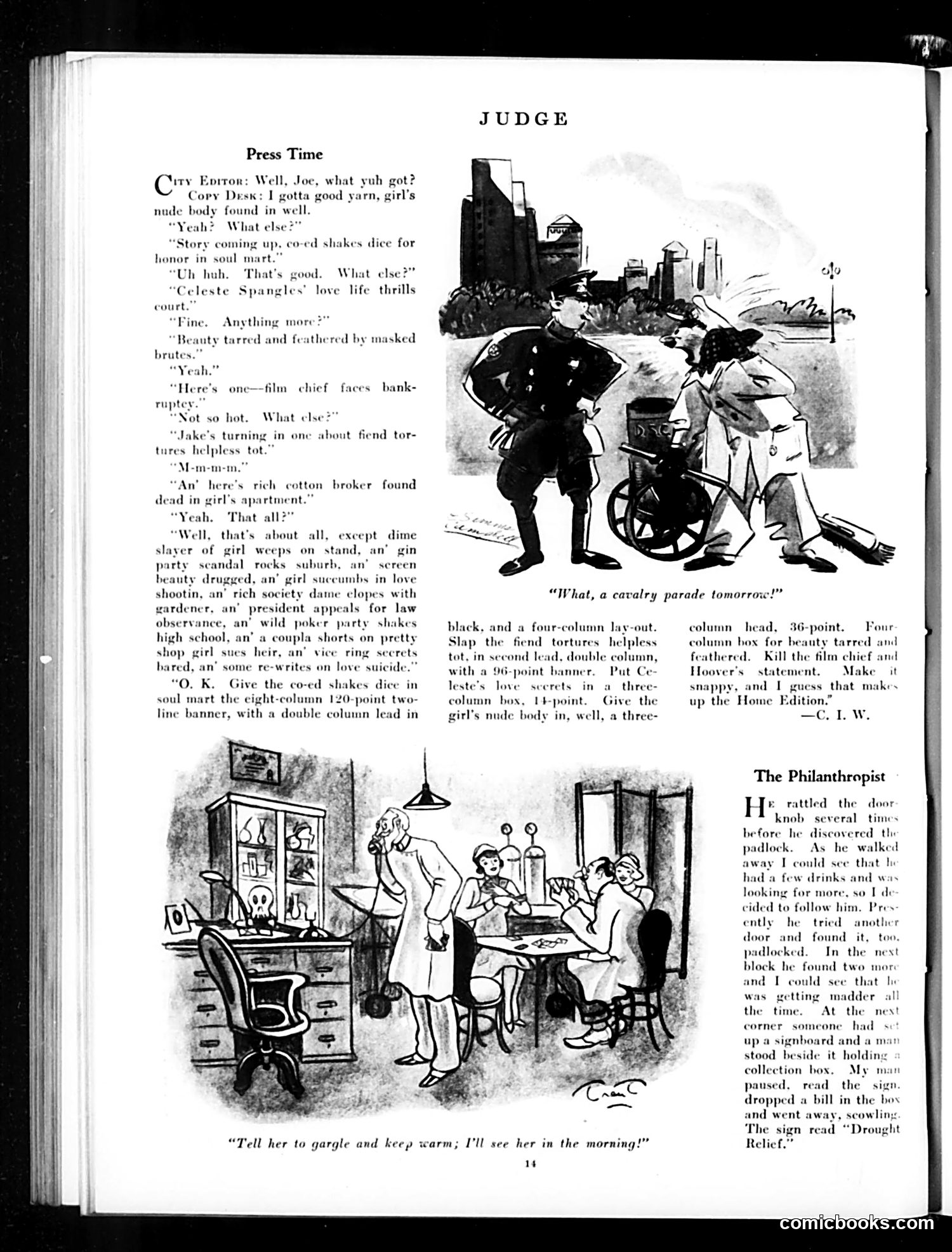
Judge Magazine Page Analysis This page satirizes the sensationalism of American newspaper journalism in the early 20th century. The top section depicts a conversation between a city editor and copy desk clerk pitching increasingly lurid story angles—murdered girls, financial scandals, drugged actresses, vice rings, society elopements. The editor's casual dismissal of each lurid tale and final layout instructions ("Slap the fiend tortures helpless tot") mocks how newspapers prioritize salacious crime and scandal over substantive reporting to boost circulation. The cartoon "What, a cavalry parade tomorrow!" depicts a journalist seemingly more interested in sensational street violence than a scheduled civic event, reinforcing the critique. The second section, "The Philanthropist," presents ironic social commentary: a drunk man encounters locked charity collection boxes but contributes anyway to a "Drought Relief" fund—suggesting either misplaced charity or mocking wealthy donors who give performatively while ignoring immediate poverty and suffering around them. Both sections critique journalistic excess and hollow philanthropic gestures in Progressive Era America.
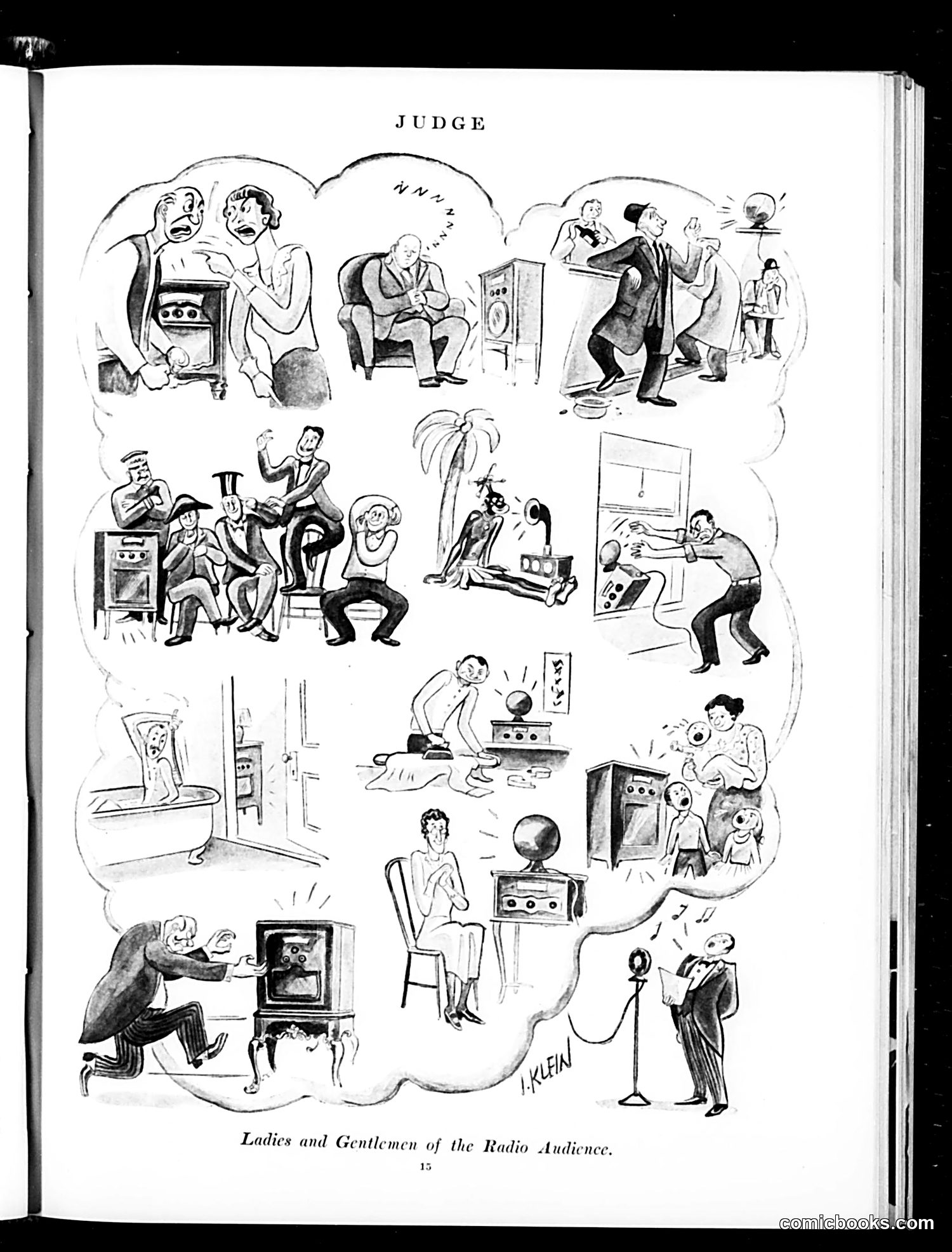
"Judge" - Radio Audience Satire This cartoon satirizes the early radio era's impact on domestic life. The title "Ladies and Gentlemen of the Radio Audience" suggests these scenes depict how radio ownership affected households. The vignettes show radios creating chaos: families fighting over programs, people neglecting chores and children to listen, someone sleeping by a radio, domestic arguments erupting, and what appears to be a man operating equipment obsessively. One scene shows a bathtub scene, possibly suggesting radio distracted people from basic hygiene. The overall message critiques radio's addictive, disruptive power—a modern technology that fractured family harmony and household order. This reflects early-20th-century anxieties about new media's social impact, mocking how the "radio audience" became absorbed, distracted, and sometimes ridiculous in their devotion to this new entertainment technology.
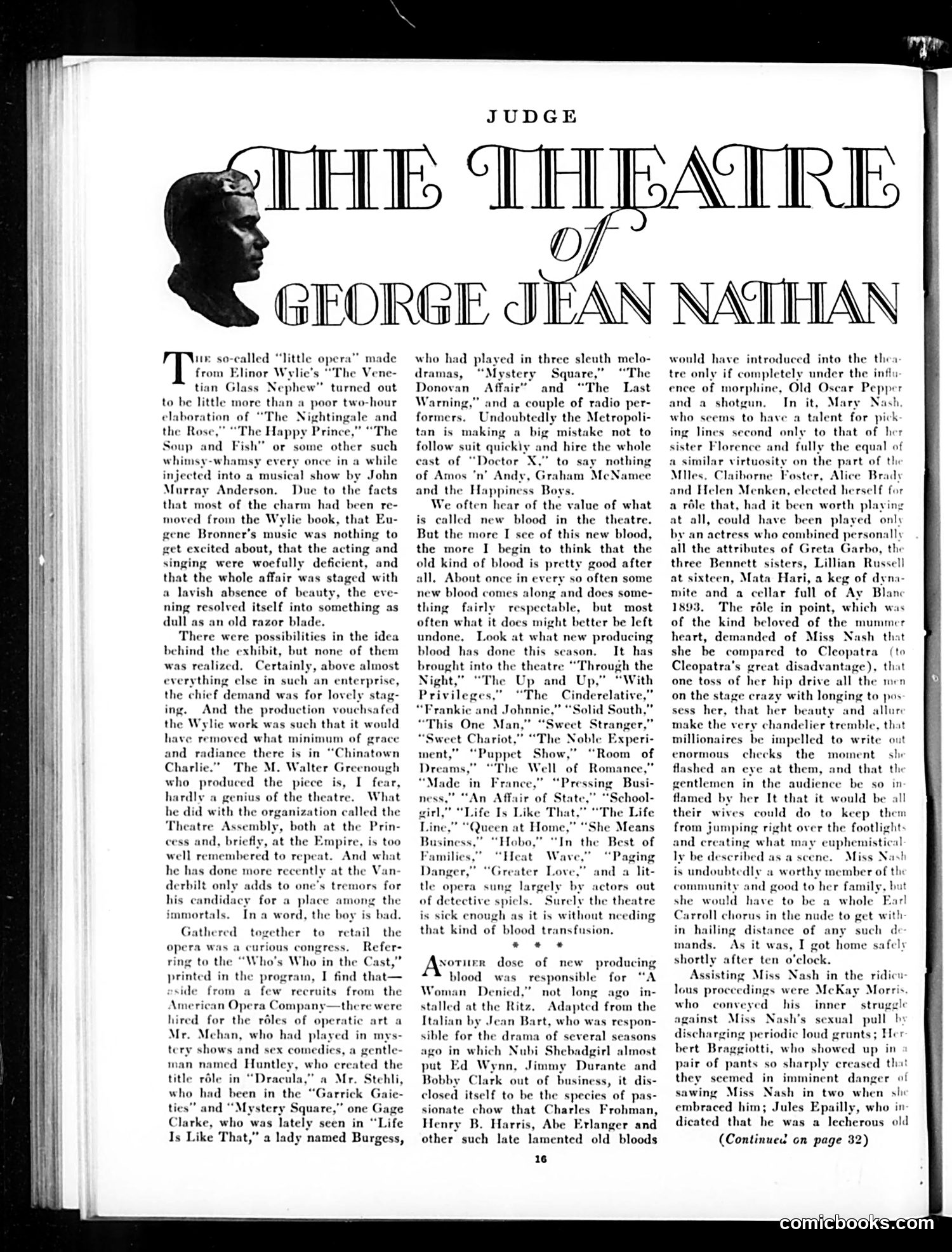
"The Theatre of George Jean Nathan" This is a theater review column by Judge magazine's drama critic George Jean Nathan (whose profile appears at top left). Nathan critiques a failed operetta adapted from poet Elinor Wylie's work, dismissing it as dull despite lavish staging. He blames director M. Walter Frankenough and criticizes the cast—actors pulled from mystery shows and radio rather than trained opera singers. Nathan's main argument: "new blood" in theatrical production is overrated. He sarcastically suggests the Metropolitan Opera hire the cast of "Doctor X" (a contemporary mystery play) and radio personalities like Amos 'n' Andy, then catalogs failed recent productions supposedly launched by inexperienced producers, concluding that old-guard theatrical producers (naming Frohman, Harris, Erlanger) understood better than modern producers what audiences actually wanted. The satire mocks both the operetta's pretensions and contemporary theater's obsession with novelty over quality.
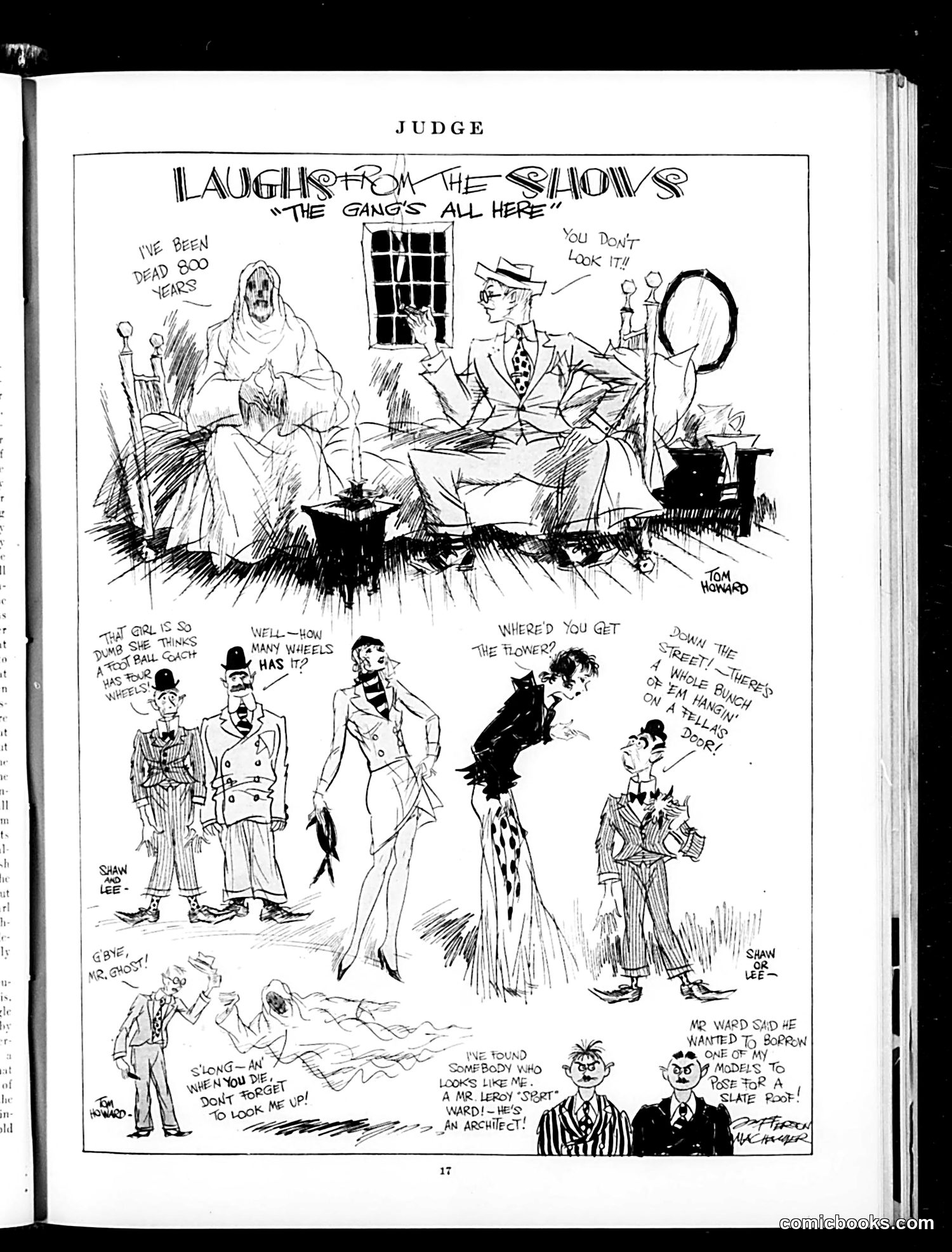
Judge Magazine Cartoon Analysis This appears to be a multi-panel satirical cartoon titled "Laugh from the Shows: 'The Gang's All Here.'" The top panel depicts a séance or supernatural gathering with a skeletal death figure claiming "I've been dead 800 years," suggesting mockery of spiritualism—a popular but widely-ridiculed Victorian craze. The lower panels feature various characters in conversation, referencing theater or vaudeville shows. References to "wheels," "flowers," and borrowing "models" for a "slate floor" suggest backstage theatrical gossip and prop acquisition. The final panel mentions someone named "Ward" who "is an architect." The overall satire targets both spiritualist pretension and theatrical/show business culture, likely mocking both the gullibility of spiritualism enthusiasts and entertainment industry figures. The specific theatrical references are difficult to place without additional context about contemporary 1910s-1920s shows.
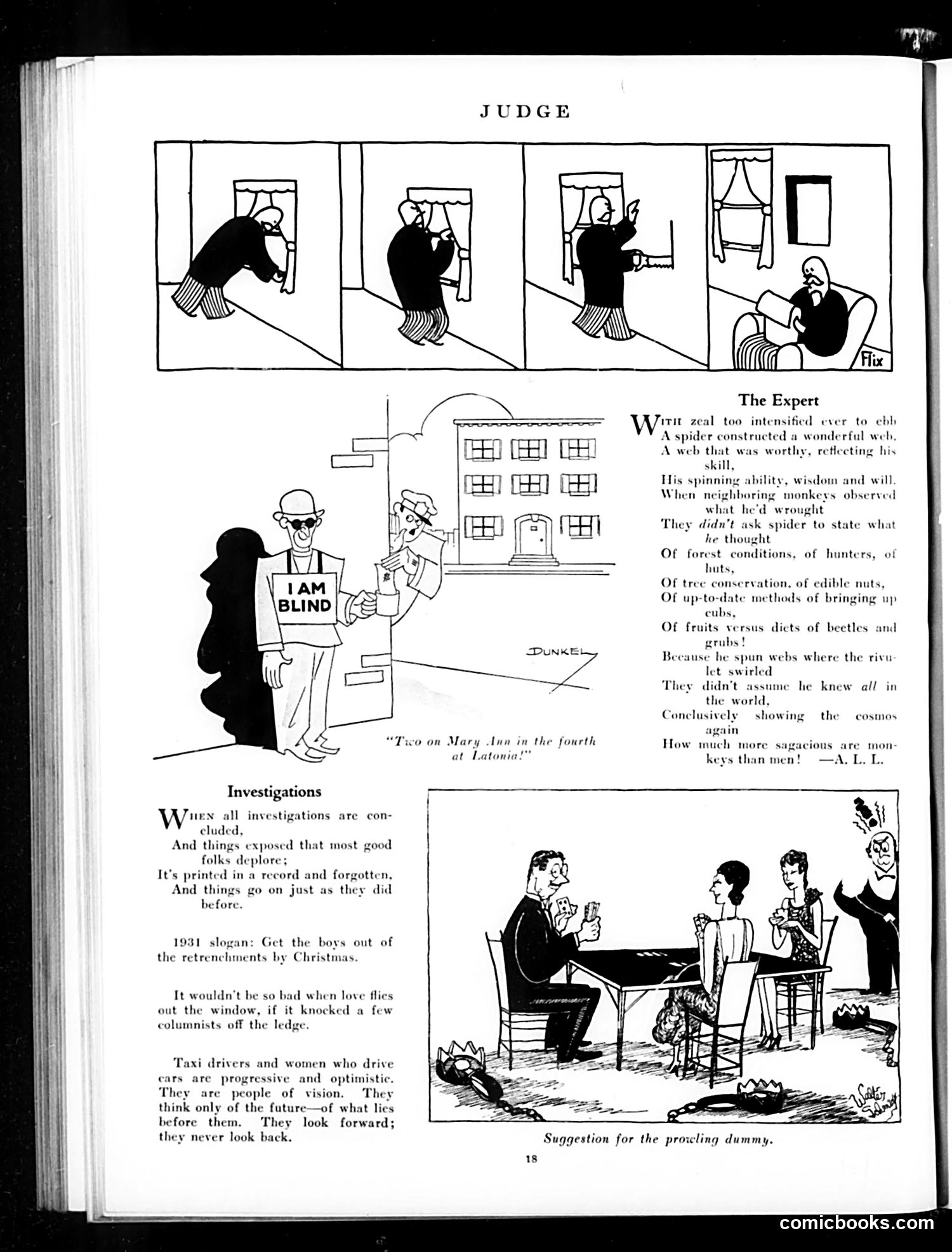
Analysis of Judge Page This page contains three satirical pieces: "The Expert" (poem with illustration): Mocks experts who overstate their authority. A spider builds an excellent web, but neighboring monkeys foolishly assume because he's skilled at web-building, he's an expert on everything—forest conditions, conservation, child-rearing, diet. The satire: specialists shouldn't be treated as universal authorities on unrelated subjects. This reflects 1920s-30s anxiety about "expert culture." "Investigations" (text): Criticizes the futility of government investigations. They expose wrongdoing, create records, then get forgotten while nothing changes. The 1931 reference to "getting boys out of the retrenchments by Christmas" likely references Depression-era relief efforts or military demobilization promises that never materialized. "Suggestion for the procing dummy" (cartoon): Unclear without more context, but appears to satirize someone being set up or manipulated in a social situation. The page's overall theme: institutions and "experts" disappoint through incompetence, hypocrisy, or irrelevance.
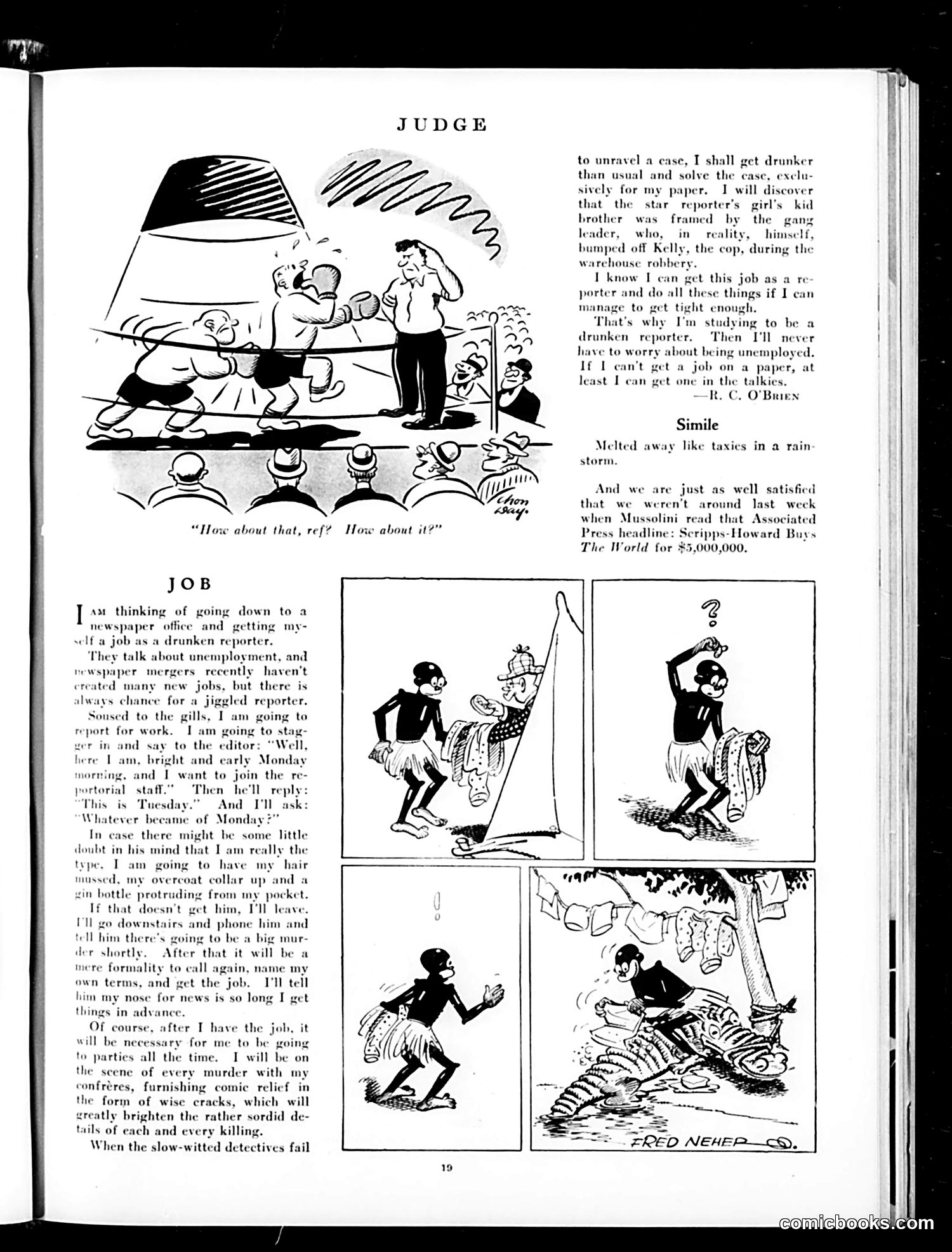
Explanation for Modern Readers This page satirizes 1920s-30s newspaper culture and employment desperation. The main article "Job" mocks the stereotype of the dissolute "drunken reporter"—a stock character in period journalism. The narrator proposes deliberately getting drunk to secure employment, claiming newspapers always need unreliable staff who show up late and disheveled. The accompanying comic strip (credited to Fred Neher) illustrates this character encountering an elegantly dressed man, apparently attempting con schemes or investigative reporting. The "Simile" and "Judge" sections contain other satirical jabs: one compares taxicabs disappearing in rain to something melting away; another references Mussolini and Scripps-Howard's purchase of The World newspaper for $5,000,000—likely mocking either the deal's absurdity or sensationalist journalism. The overall satire targets newspaper industry instability, merger-driven job losses, and the colorful desperation of 1920s-30s reporters.
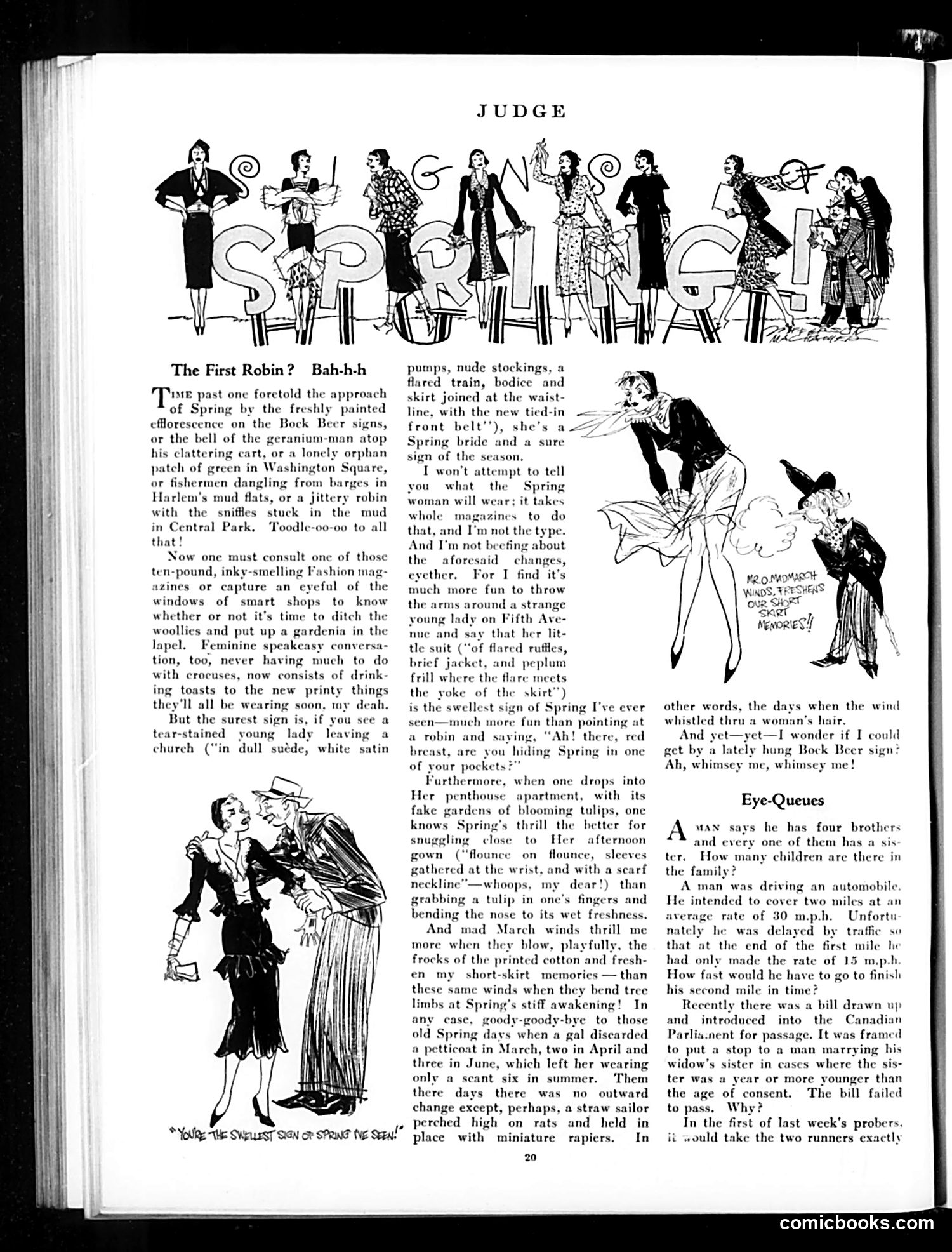
Judge Magazine Page Analysis This page satirizes spring fashion trends through two main pieces: "The First Robin?" (main article) mocks the traditional sign of spring—a robin—as outdated. The author argues that in modern times, the real indicator of spring is women's fashion: fashionable dresses with "flared ruffles, brief jacket, and peplum," new tied-in front belts, and nude stockings visible on Fifth Avenue. The satire targets both the absurdity of fashion obsession and the replacement of natural signs with commercial/consumer culture. References to "speakeasy conversation" and fashion magazine coverage suggest spring fashion has become society's primary concern, replacing older, simpler seasonal indicators. "Eye-Queues" is a puzzle section with three logic problems (about brothers/sisters, automobile speed, and a Canadian Parliament bill). These are unrelated to the spring satire above. The cartoons depict fashionable women in spring attire and a couple in period dress, illustrating the fashion-focused commentary. The overall message: modern spring means shopping, not robins.
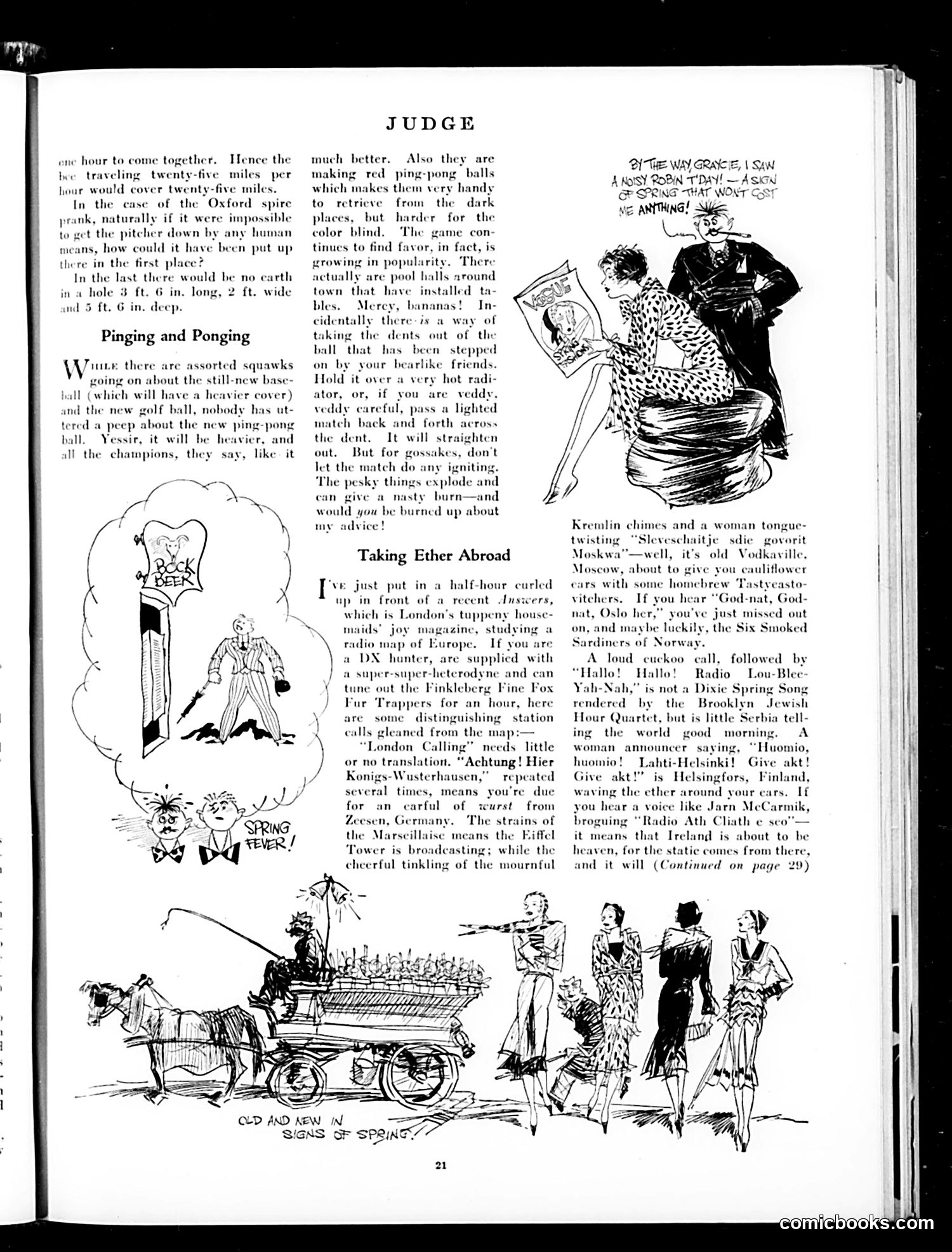
Judge Magazine Page Analysis This page satirizes contemporary leisure activities and emerging technologies of the 1930s era. "Pinging and Ponging" mocks the fuss over newly standardized ping-pong balls. The joke targets how enthusiasts obsess over minor equipment changes while overlooking practical maintenance tips—like using heat to remove dents or the fire hazard of using matches near the balls. "Taking Ether Abroad" satirizes radio enthusiasts ("DX hunters") who spend hours tuning shortwave radios to distant European stations. The humor comes from phonetically rendering station call signs in exaggerated accents and broken English—"Achtung! Hier Konigs-Wusterhausen" (Germany), "Radio Lou-Blee-Yah" (presumed Belgium/France), "Huomio...Lahti-Helsinki" (Finland), and "Radio Ath Cliath" (Dublin). The author mocks both the enthusiasts' dedication and the linguistic absurdity of international radio broadcasts, culminating in a jab at Irish radio's poor signal quality ("static comes from there"). The cartoons ridicule leisure-culture fads and technological hobbyism.
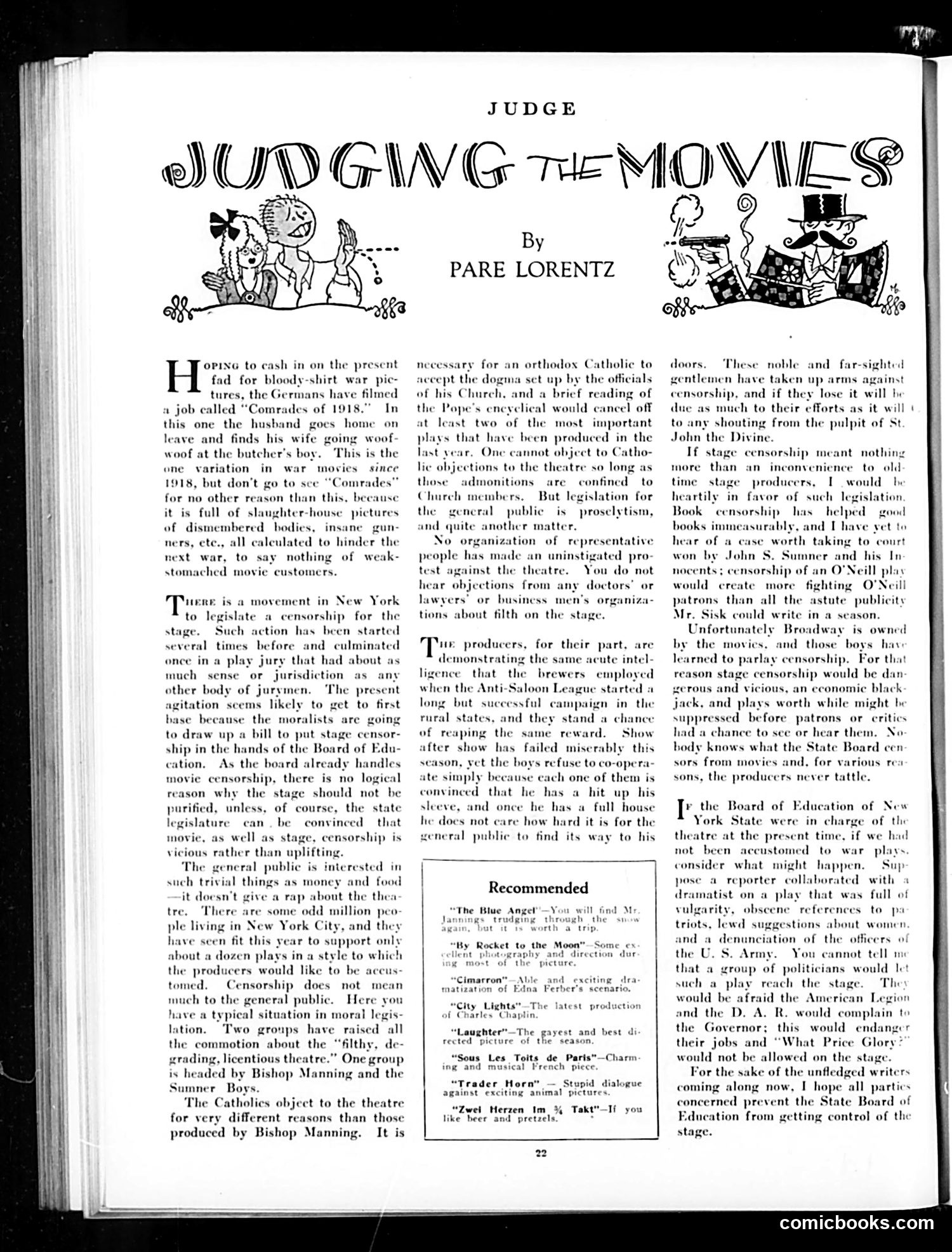
Judge Magazine: "Judging the Movies" (Pare Lorentz) This article satirizes competing efforts to censor American theater and film in the 1920s-30s. The piece argues that two distinct groups—Bishop Manning's moralists and the "Sumner Boys" (likely Anthony Comstock's successor organization)—are pushing stage censorship, though for different reasons. Catholics object on religious grounds; Protestant activists on moral grounds. Lorentz ridicules the censorship push as ineffective and self-interested. He notes producers are failing anyway (shows flopping due to poor quality), yet stubbornly resist cooperation. The article mocks that censorship advocates claim to represent "the general public," when most New Yorkers care only about money and food, not theater morality. The satire emphasizes censorship legislation serves ideological interests rather than public welfare—"proselytism, and quite another matter." A "Recommended" film list follows, reviewing current movies.
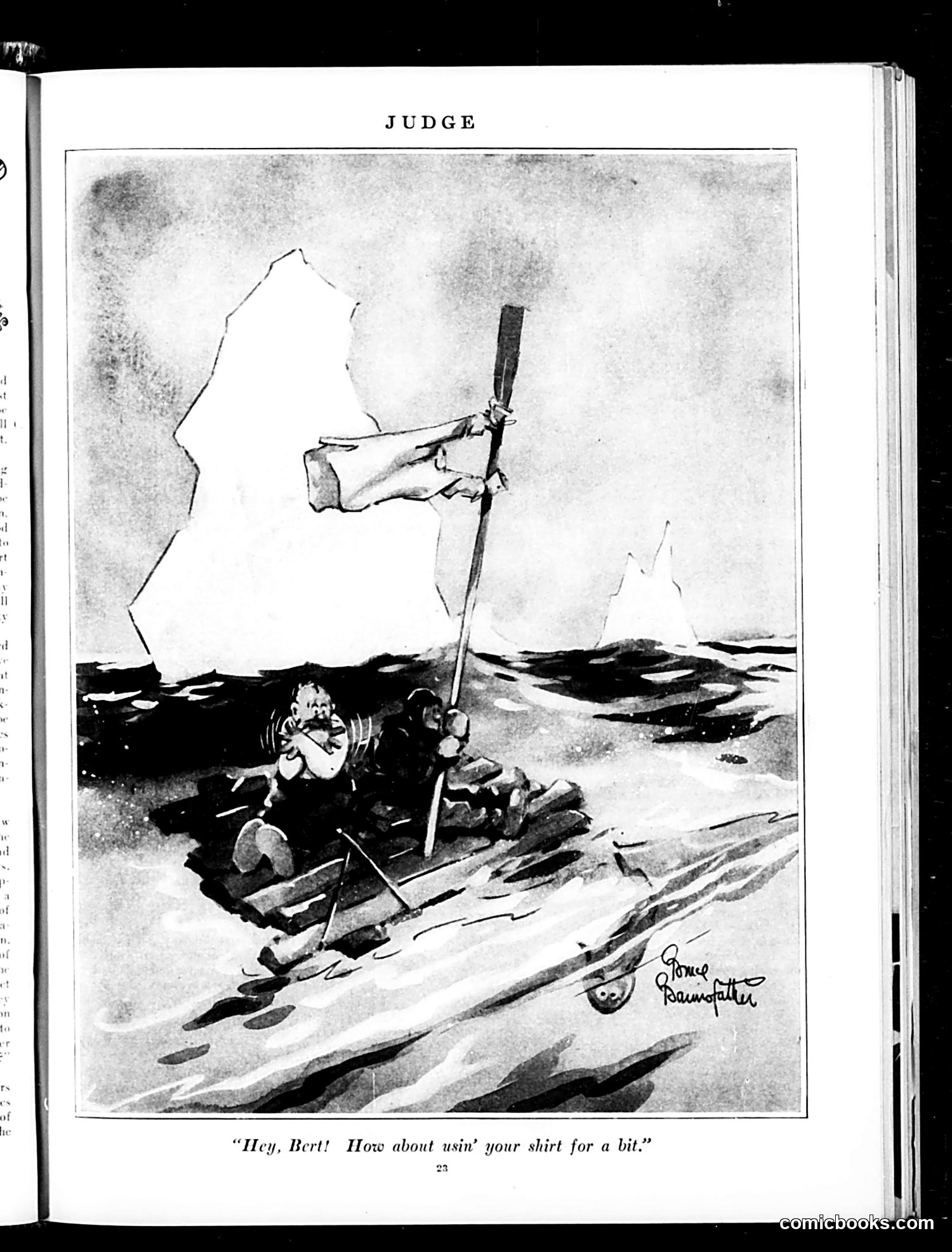
Cartoon Analysis This Judge magazine cartoon shows a sailor in distress on a sinking ship, asking another figure (presumably named Bert) to use his shirt, likely as a makeshift sail or flotation aid. The humor appears to derive from the desperation of the maritime emergency—the sailor is willing to strip his companion of clothing for survival purposes. The cartoon satirizes either nautical incompetence or the absurdity of emergency improvisation. The sailor's casual phrasing ("How about") undercuts the severity of the situation, creating dark comedy. The artist's signature appears to read "George Raoul Boatwright" or similar. Without additional context about when this was published, the specific historical maritime reference remains unclear, though the comic style and setting suggest early-to-mid 20th century publication.
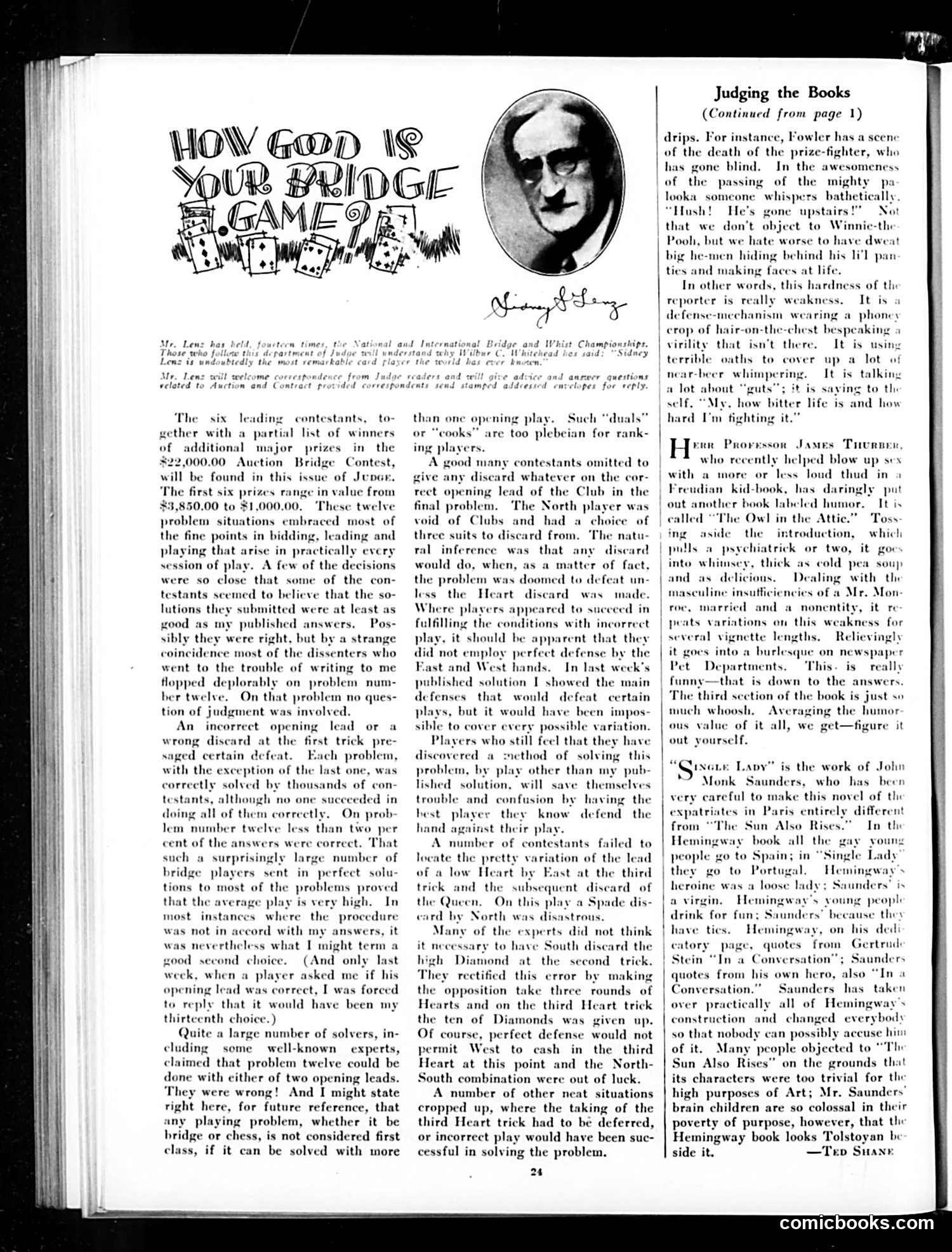
Explanation for Modern Readers This page features "How Good Is Your Bridge Game?"—a bridge problem contest run by *Judge* magazine. The cartoon shows Sidney Lenz, a famous bridge champion (identified by his signature), presenting the puzzle. The text discusses the contest results: thousands of readers attempted twelve bridge problems for cash prizes up to $20,000. Most contestants performed well, but problem twelve stumped 98% of solvers—no ambiguity was allowed in "first-class" problems. The satire is gentle: it pokes fun at bridge enthusiasts' confidence in their skills while celebrating American competitive culture and the magazine's popular puzzle contests. Bridge was a major American leisure activity in this era, and *Judge* capitalized on readers' desire to test themselves against experts. The cartoon itself is an endorsement by a real celebrity (Lenz), lending credibility to the contest and encouraging reader participation.
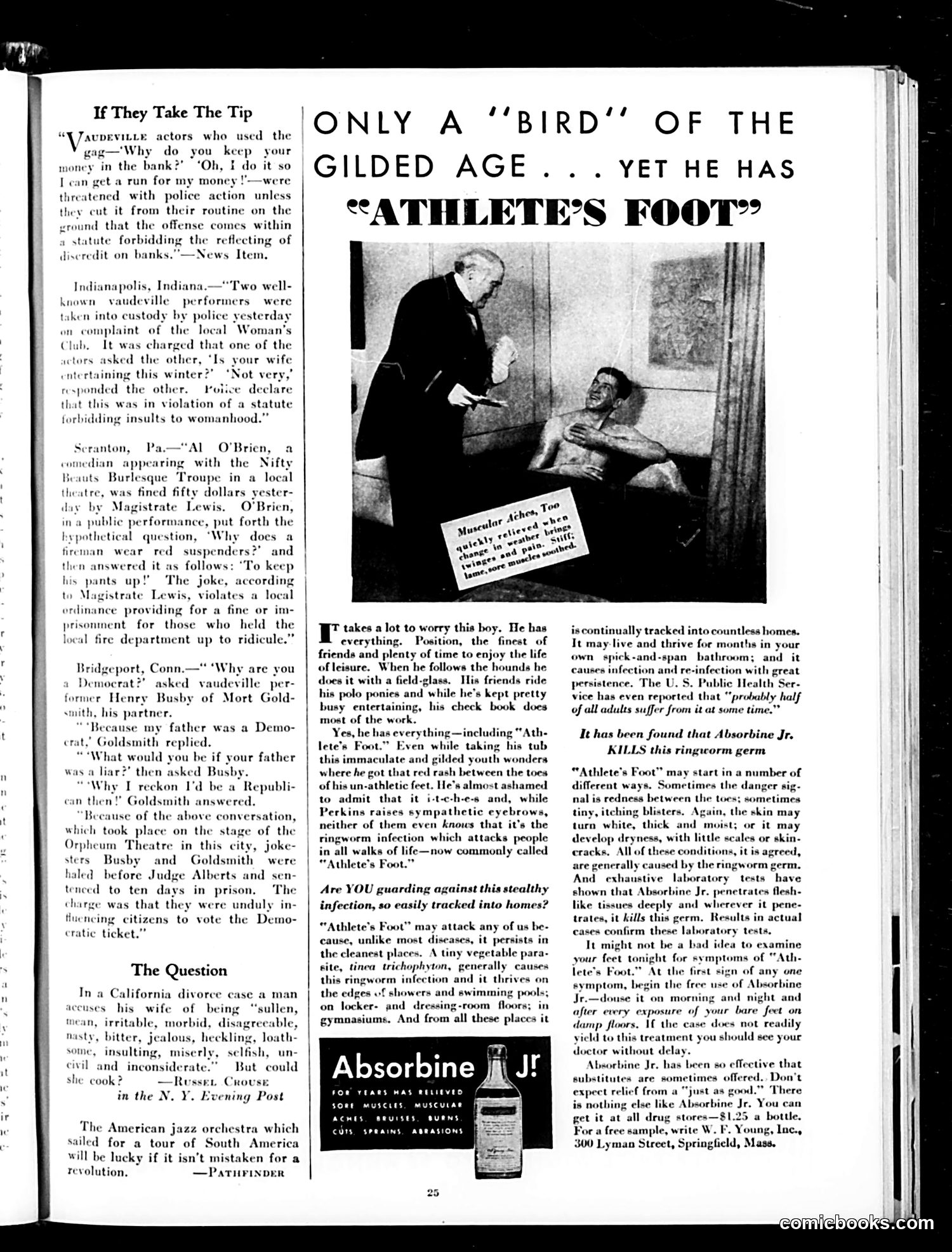
Satire Analysis: Judge Magazine Page This page combines multiple satirical pieces lampooning censorship and social hypocrisy in the Gilded Age. "If They Take The Tip" section mocks overzealous censorship: news items report comedians arrested for mild jokes—vaudeville performers jailed for asking "Is your wife entertaining?" and others imprisoned for off-color punchlines. The satire suggests authorities are absurdly criminalizing harmless entertainment. The main cartoon depicts a wealthy young man suffering from "Athlete's Foot"—a fungal infection. The irony: despite his gilded privilege (servants, polo ponies, leisure), he's afflicted by a common ailment that spreads in public facilities. The point critiques aristocratic pretension: no amount of wealth immunizes one from ordinary human problems. "The Question" at bottom satirizes divorce proceedings, noting a California man's complaint lists his wife's many faults—but never asks: "could she cook?" implying society's skewed priorities about women. The page's overall theme: social pretension and selective morality mask universal human vulnerability and absurdity.
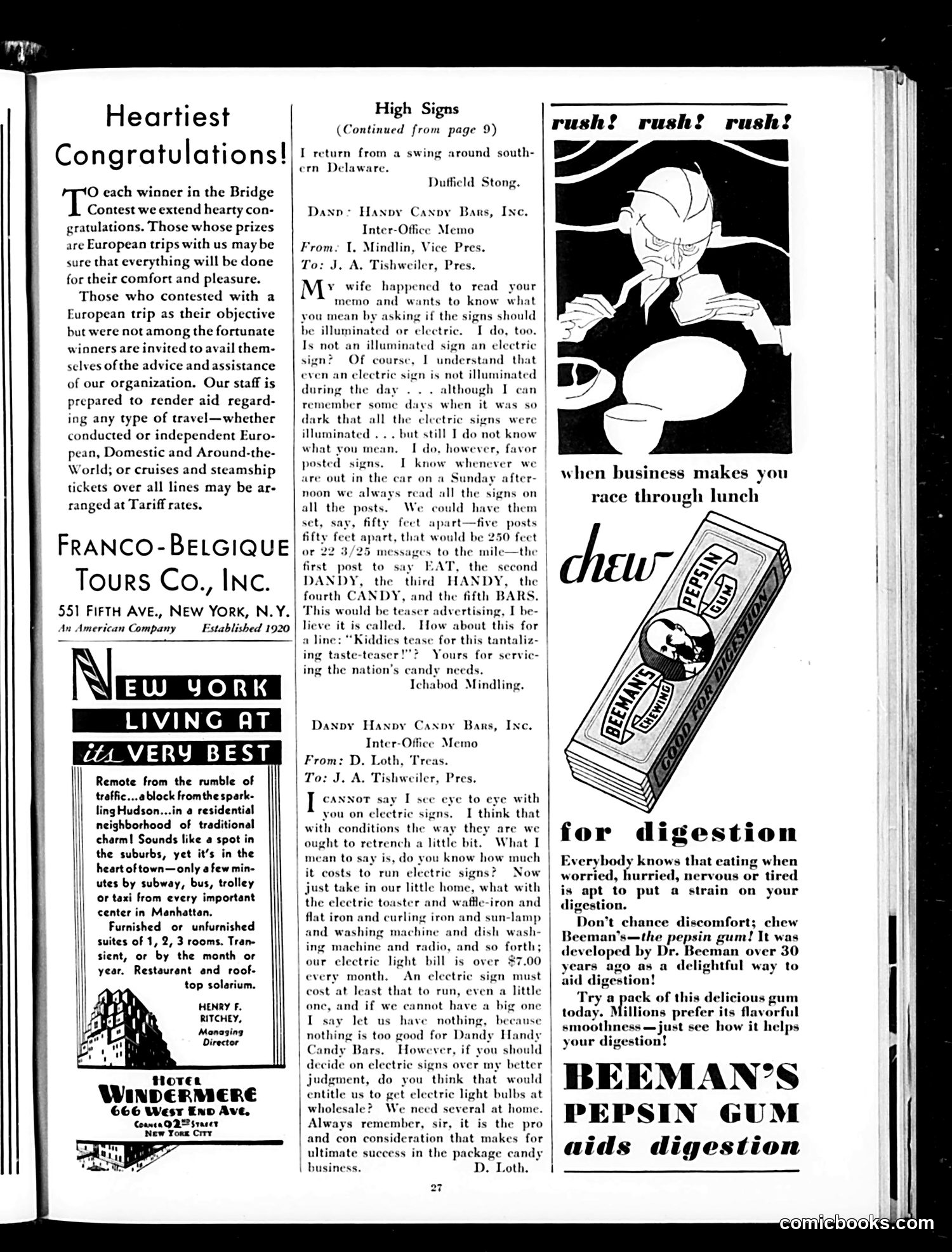
Analysis of This Judge Magazine Page This page is primarily advertising and reader correspondence, not political satire. The main content features a humorous inter-office memo exchange among executives of "Dandy Handy Candy Bars, Inc." debating whether roadside advertising signs should be "illuminated or electric"—a distinction the characters hilariously cannot agree on. One executive proposes spacing signs 250 feet apart spelling out "EAT DANDY HANDY CANDY BARS" as "teaser advertising." Another complains about his home's electric bill (over $7 monthly) to argue against expensive illuminated signs. The satire gently mocks corporate bureaucracy: executives being pedantic about terminology, missing the forest for trees, and using personal anecdotes to justify business decisions. It's a mild workplace comedy. The page also includes advertisements for travel services, a Manhattan hotel, and Beeman's Pepsin Gum, promoting the product's digestive benefits—a common health claim in 1920s advertising. No specific political figures or events are referenced.
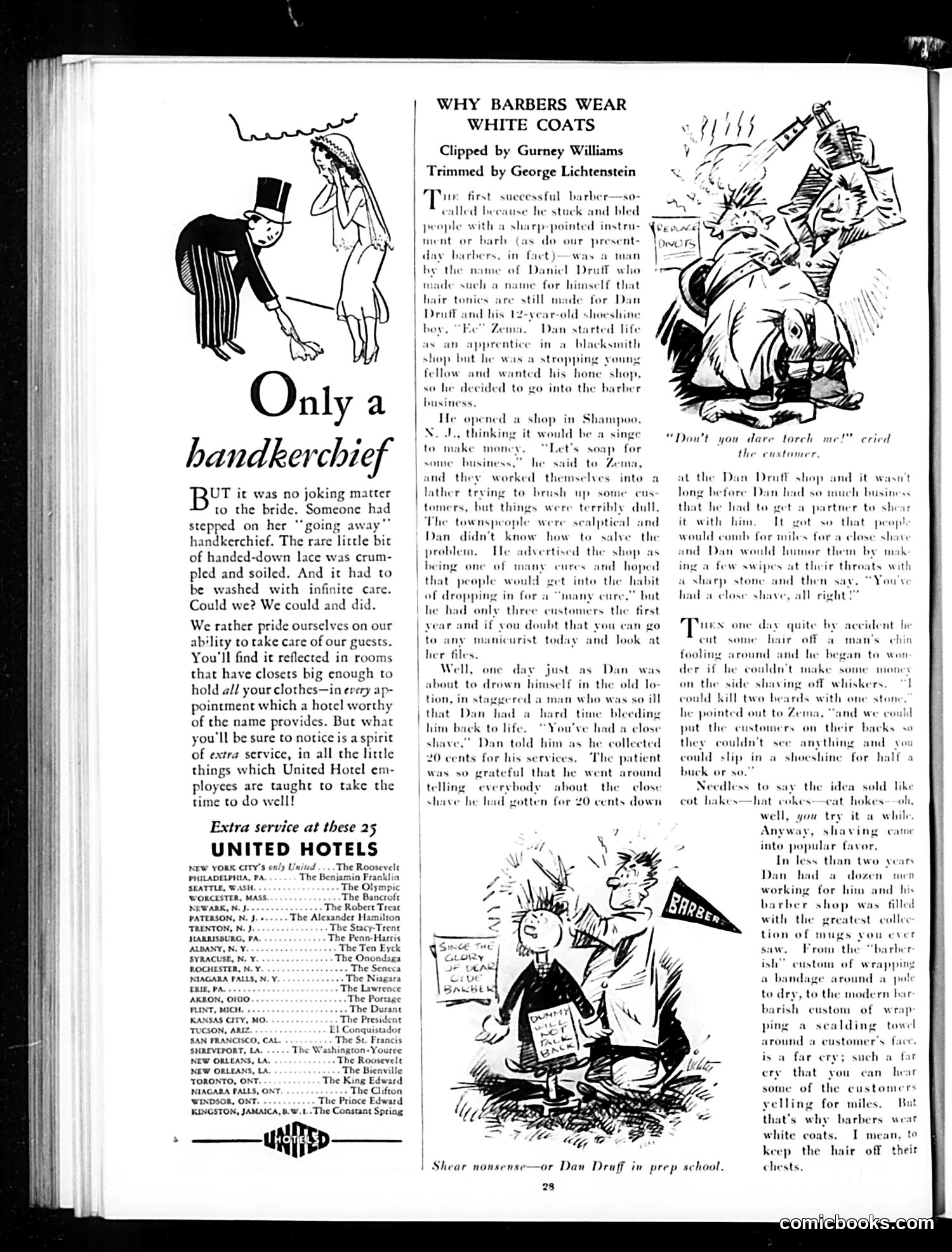
Explanation for Modern Readers This page combines a hotel advertisement with a humorous origin story about why barbers wear white coats. The Main Story ("Why Barbers Wear White Coats"): A fictionalized, tongue-in-cheek tale claiming barbers wear white coats because of Daniel Druft, an early barber. The story traces his accidental success: starting as a blacksmith apprentice, he opens a failing barbershop in "Shampoo" (a pun). Business improves when he treats a bleeding customer, then expands when he accidentally discovers he can also cut women's facial hair. The joke culminates in suggesting he wore white to hide bloodstains from shaving mishaps—presumably establishing the white coat "uniform." The Cartoons: Simple line drawings accompany the narrative, showing slapstick barbering incidents and mishaps. The Context: This is light satirical humor typical of *Judge* magazine's style—using absurd fictional histories to explain ordinary things. The "Druft" name itself is a pun (like "dandruff"), typical of the era's wordplay humor. The actual origin of white coats in barbering is professional/sanitary, but this fabrication is meant purely for entertainment.
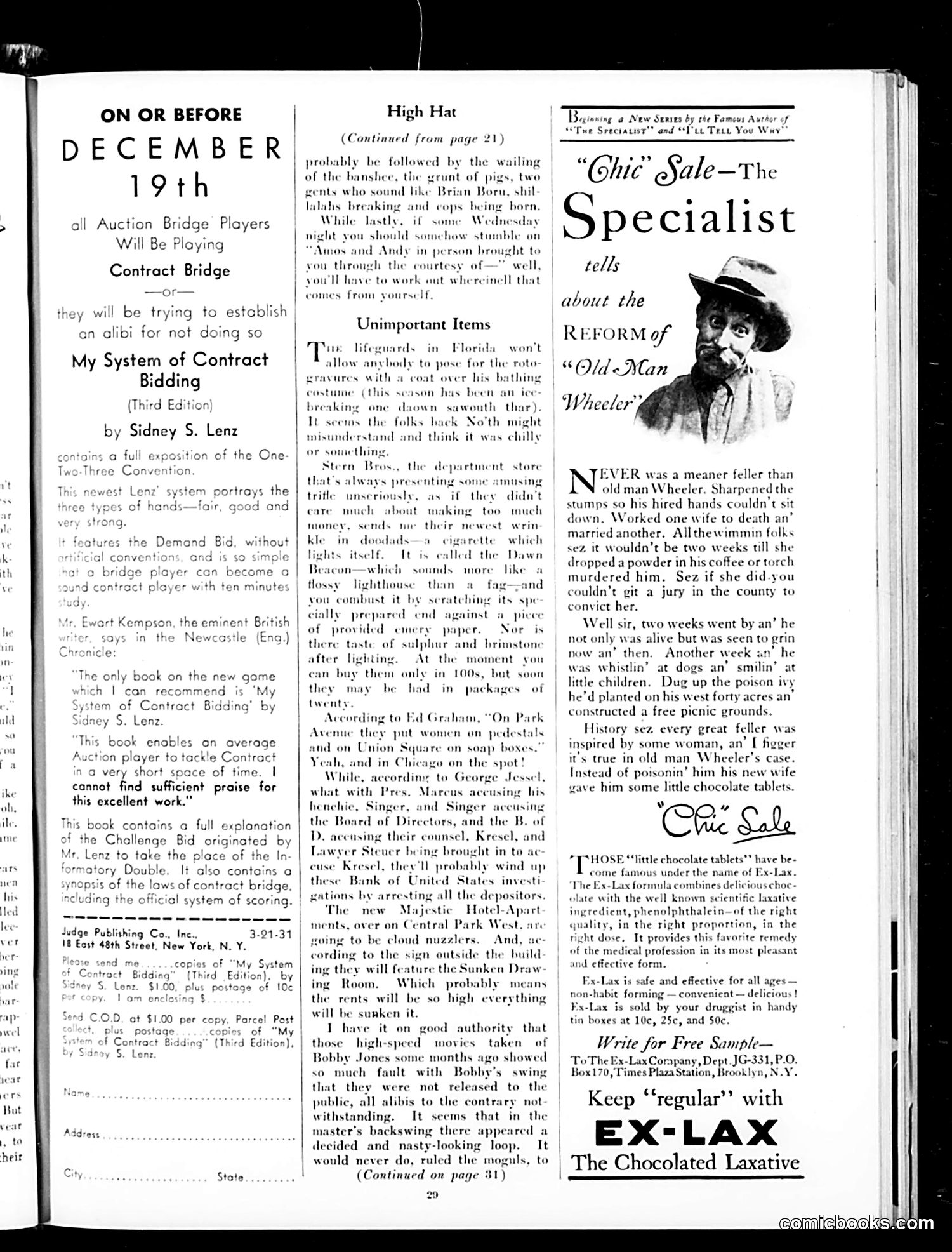
Judge Magazine Page Analysis This page is primarily advertising and book promotions, not political satire. The main content includes: Left side: Ads for contract bridge books by Sidney S. Lenz, promoting his "System of Contract Bidding" (Third Edition). The context suggests Contract Bridge was a newly fashionable card game around 1931, with serious strategy books emerging. The ad notes players will be "establishing an alibi for not doing so," a light joke about the game's complexity. Center: "High Hat" column (continued from page 21)—gossipy, humorous observations about Florida lifeguards, department stores, and Park Avenue society. No specific political figures are identifiable. Right side: Advertisement for "Chic Sale—The Specialist," a serialized story by humorist Chic Sale about "Old Man Wheeler," a mean farmer whose disposition mysteriously improves. Below this is an Ex-Lax chocolate laxative ad. Overall: This is a typical Judge magazine page mixing light humor, serialized fiction, and advertising—not focused political commentary.
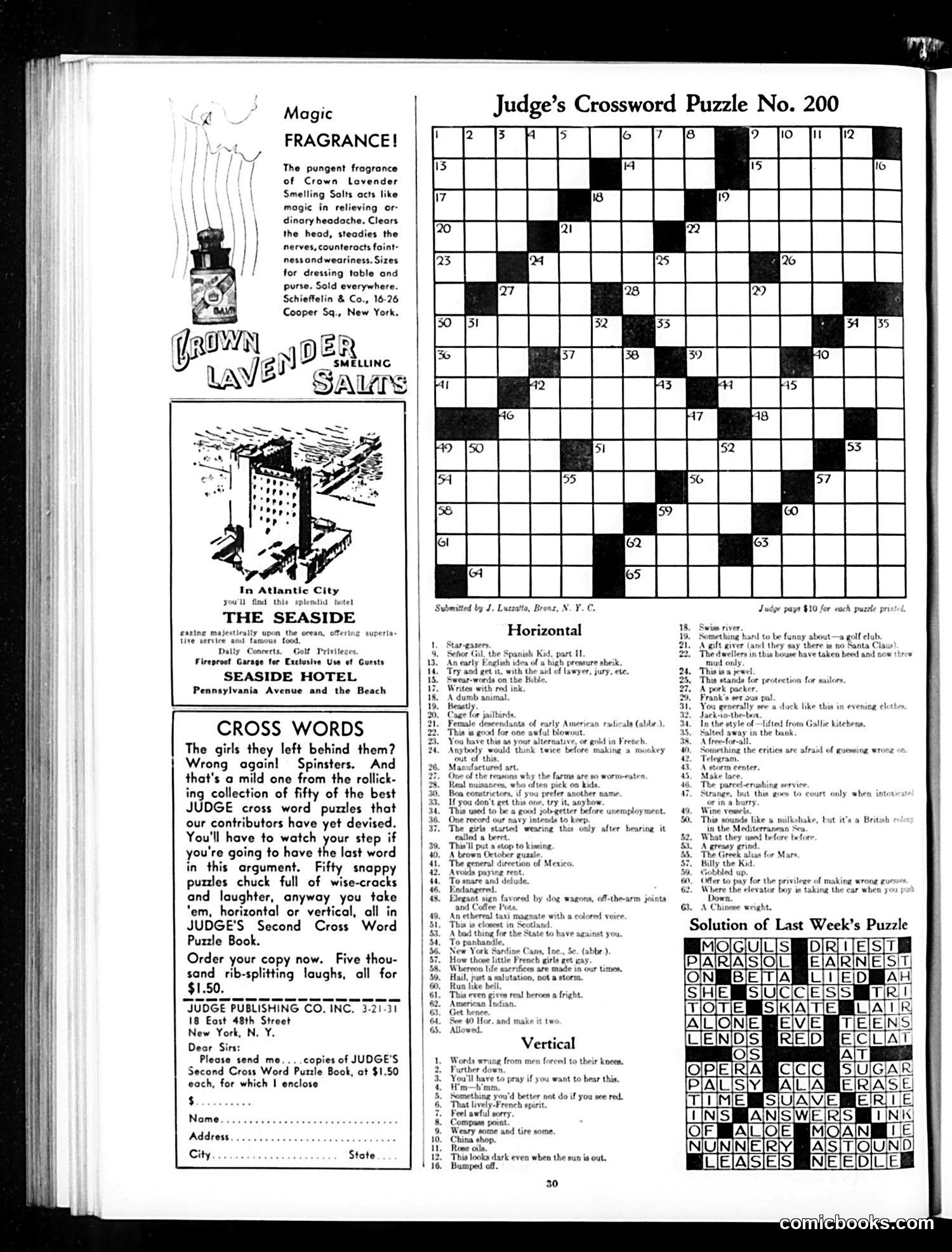
Judge Magazine Crossword Puzzle Page (circa 1920s-30s) This page is primarily advertising and puzzle content, not political satire. It features: Main Content: - Judge's Crossword Puzzle No. 200 (the actual grid puzzle) - Advertisement for Crown Lavender Smelling Salts, marketed as a headache remedy for women - Ads for Atlantic City's Seaside Hotel Promotional Material: A prominent section advertises "Judge's Second Cross Word Puzzle Book"—a collection of 50 humorous crossword puzzles selling for $1.50. The copy claims these puzzles are "snappy" and "full of wise-cracks and laughter," suggesting they incorporate wordplay and jokes typical of Judge magazine's satirical humor. Historical Context: The crossword puzzle craze was relatively new in America (1920s), so Judge capitalizing on this trend with a humor-focused puzzle book was commercially savvy. The smelling salts advertisement reflects period attitudes toward women's delicate nerves. This page demonstrates how Judge combined entertainment with advertising rather than focused political or social satire.
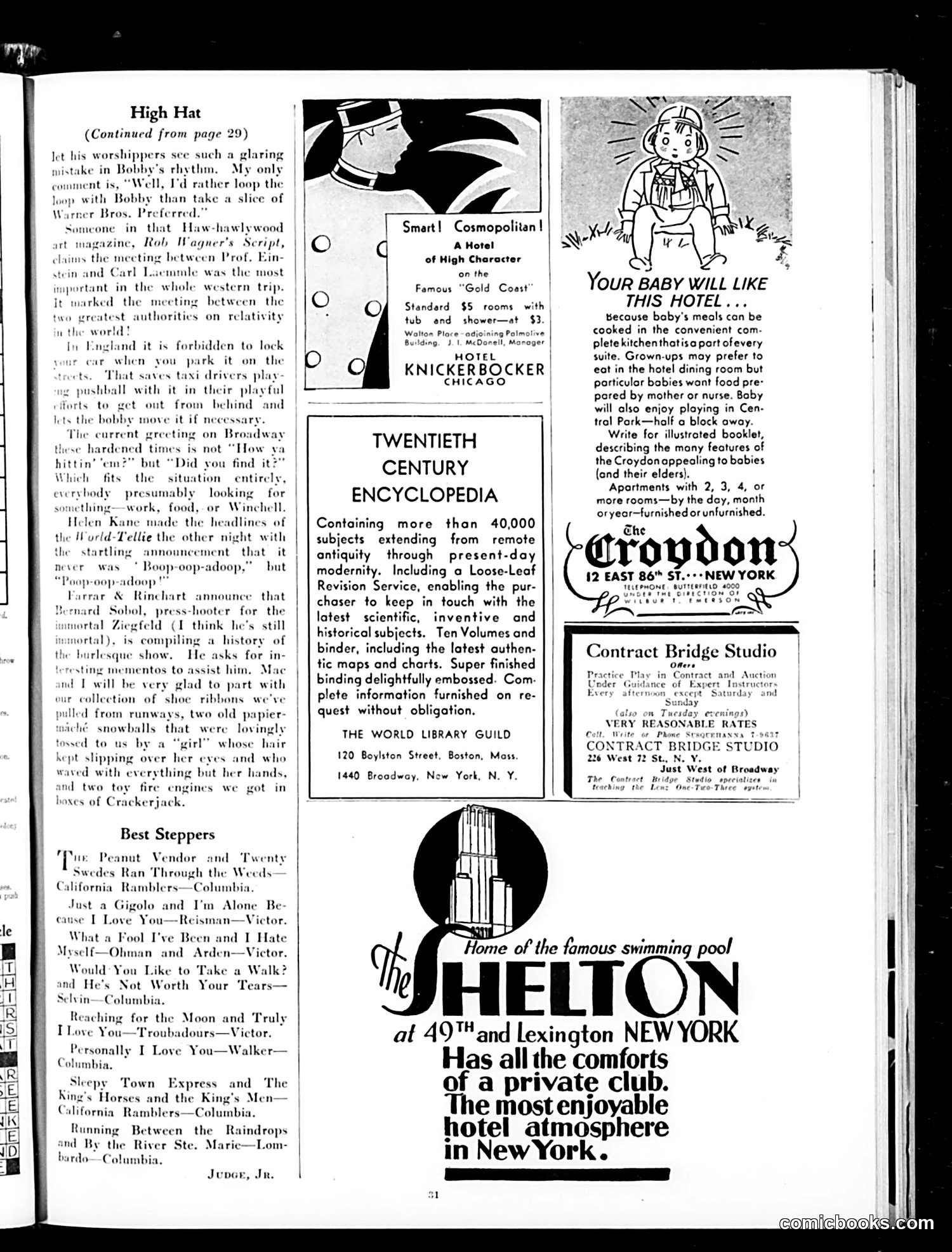
Explanation for Modern Readers This is primarily an advertisements and entertainment page from Judge magazine (a 1920s American humor publication), not a political cartoon page. The visible content includes: Editorial section ("High Hat"): A gossipy column discussing Hollywood figures, including a reference to Einstein meeting Carl Laemmle (a film producer), framed as humorously comparing two authorities on "relativity." The writing mocks 1920s celebrity culture and British customs. "Best Steppers" section: Lists popular jazz and dance songs of the era—the column's title refers to popular dance numbers, reflecting the Jazz Age obsession with music and dancing. Advertisements: The bulk of the page advertises hotels (Knickerbocker, Croydon, Shelton), an encyclopedia, and services targeting affluent 1920s New Yorkers and travelers. There is no significant political satire or social commentary on this page. It reflects 1920s consumer culture, entertainment trends, and the advertising-heavy design typical of magazines from that era.
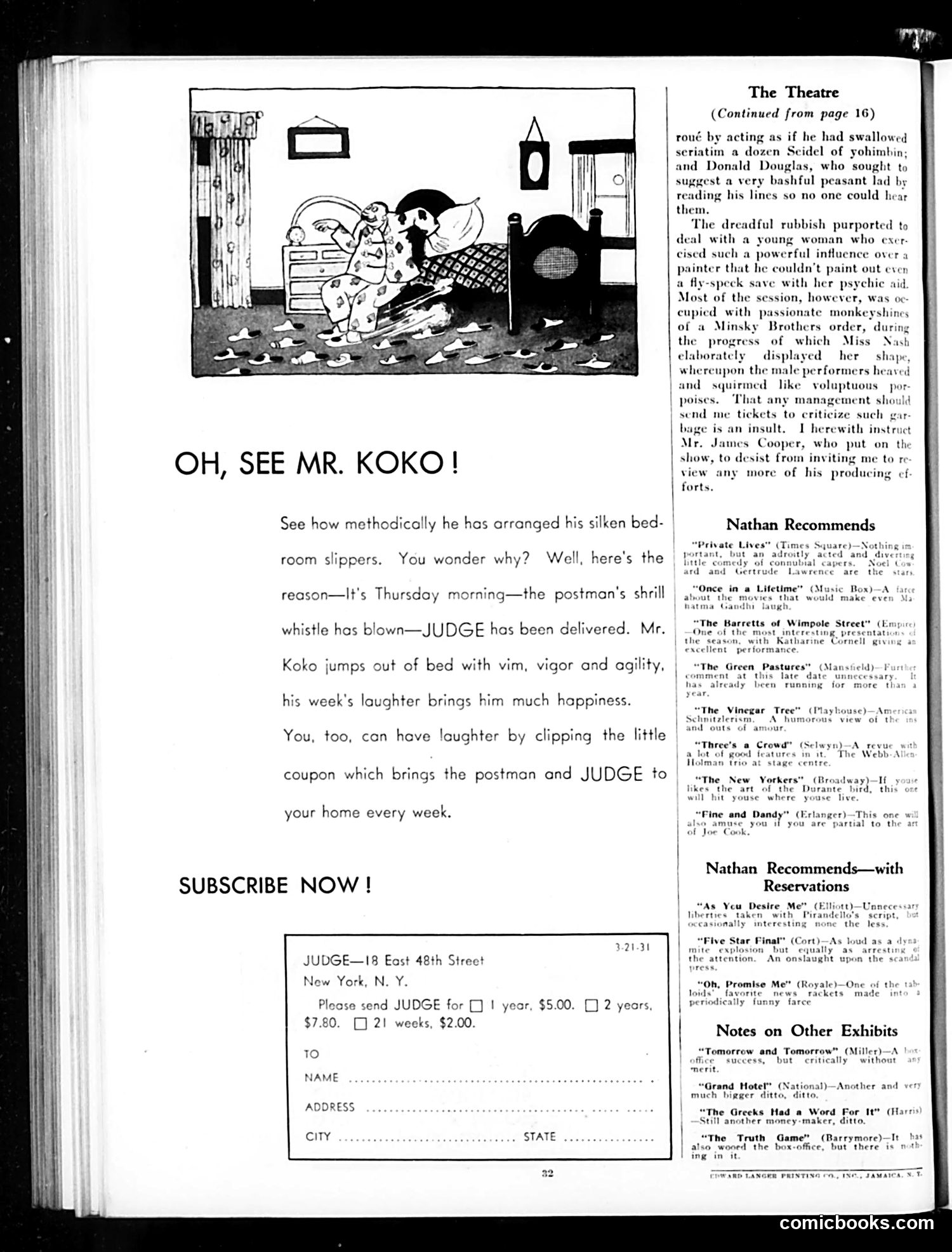
What This Page Means This is primarily a subscription advertisement for *Judge* magazine, disguised as humor content. The cartoon "OH, SEE MR. KOKO!" features Mr. Koko (likely a character readers knew), who excitedly arranges his bedroom slippers in anticipation of *Judge* arriving on Thursday morning. The joke is that he's so eager for the magazine's humor that he can barely contain himself. The ad promises that subscribing will bring "laughter" weekly to your home. It's essentially saying: *Judge* is so funny it will make you jump out of bed with excitement. The right column contains theater reviews by "Nathan" (likely drama critic George Jean Nathan), critiquing various Broadway shows with witty dismissals and recommendations—typical *Judge* content mocking theatrical productions. The page is primarily advertising wrapped in satirical humor, leveraging the magazine's reputation for comedy to sell subscriptions.
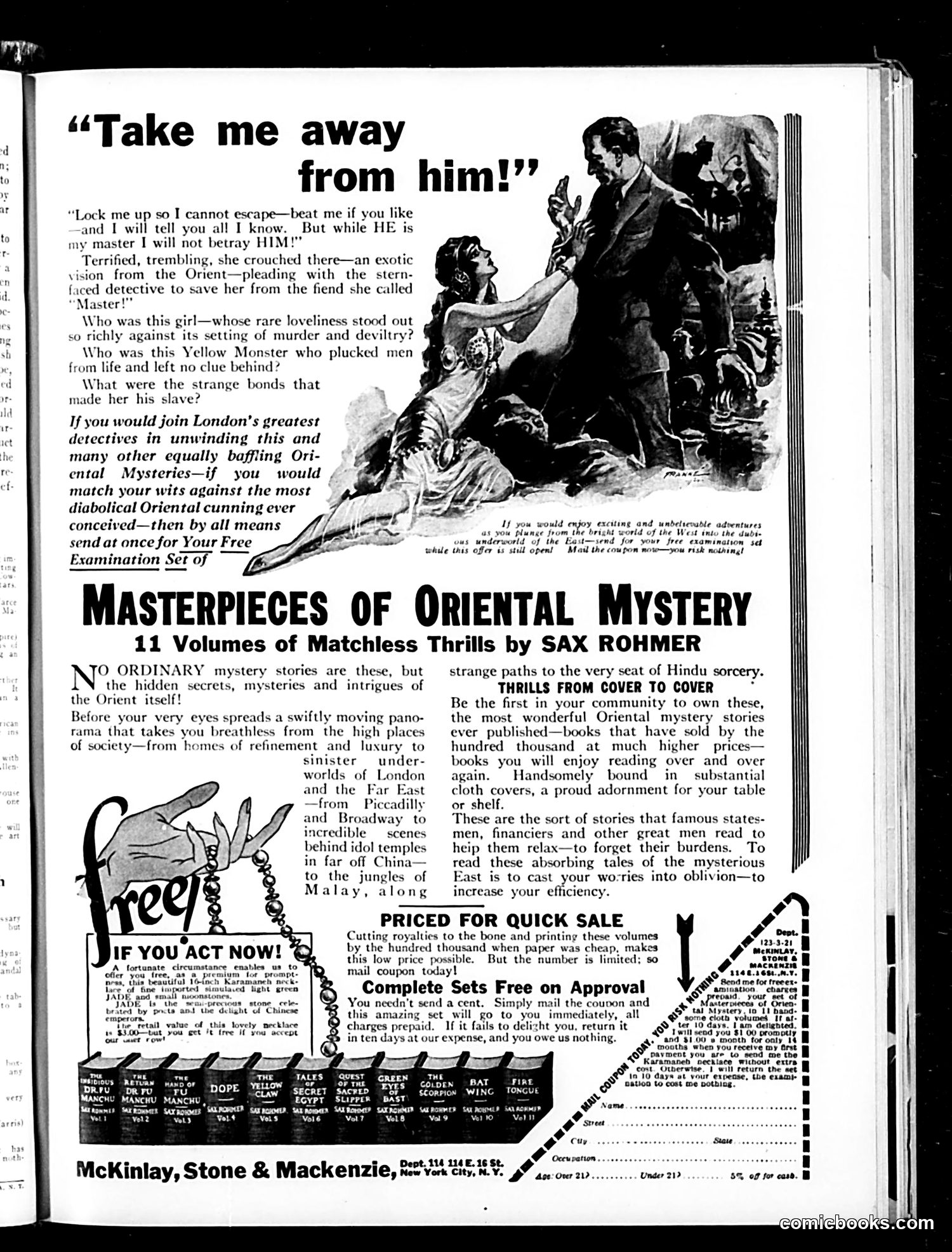
Analysis of "Masterpieces of Oriental Mystery" Advertisement This is primarily a book advertisement, not political satire. It promotes Sax Rohmer's 11-volume mystery series featuring his famous villain Dr. Fu Manchu (the "Yellow Monster" referenced in the text). The dramatic illustration depicts the pulp-fiction narrative: an exotic woman pleading with a detective to rescue her from her mysterious Oriental master. The copy exploits period stereotypes—portraying the East as inherently sinister, featuring "diabolical Oriental cunning" and "Hindu sorcery." Key context for modern readers: This represents 1920s-30s popular entertainment that relied heavily on yellow peril anxieties—fears of Asian (particularly Chinese) threats to Western society. Rohmer's Fu Manchu stories epitomized this genre. The advertisement markets exotic danger and racial otherness as entertainment, offering "thrills" centered on Oriental villainy and inscrutability. The free examination set, necklace premium, and "no obligation" pitch are typical mail-order sales tactics of the era.
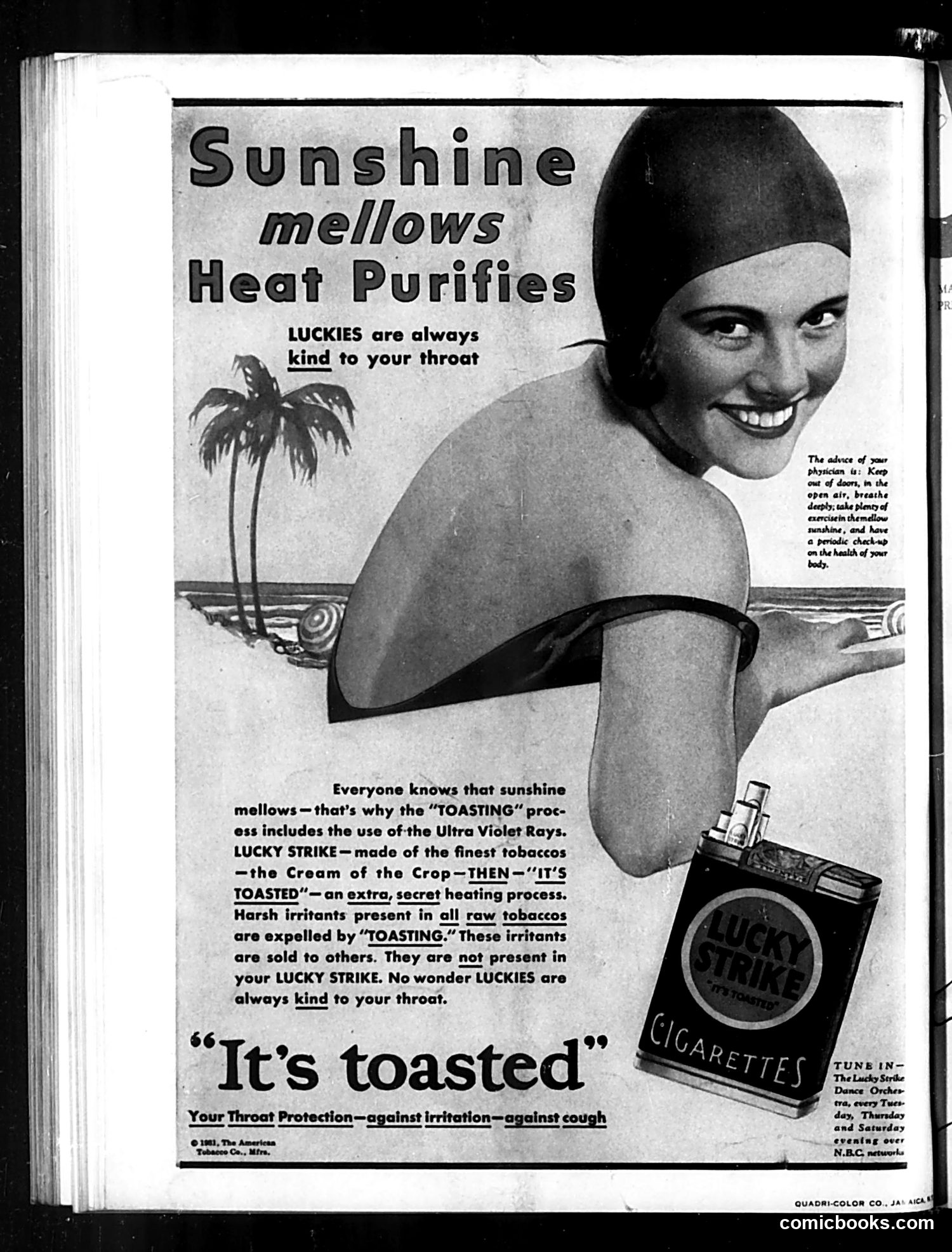
Analysis for Modern Readers This is a Lucky Strike cigarette advertisement, not satire or editorial content. It appears in Judge magazine, likely from the 1920s-1930s. The ad uses health claims to market cigarettes—a practice now recognized as deceptive. Key tactics include: - "Sunshine mellows / Heat Purifies": Pseudo-scientific language claiming the "toasting" process removes harmful irritants from tobacco - Doctor endorsement: "The advice of your physician" recommends fresh air and health, implying Lucky Strikes align with medical guidance - Throat safety claims: Promises the product is "kind to your throat" and offers "throat protection" The swimsuit model represents leisure, health, and vitality—associating smoking with wholesome living. Modern context: This represents tobacco industry marketing before health warnings were required. The "toasting" claim was marketing fiction; all cigarettes contain harmful irritants. Such ads were common and legal until the 1960s-70s when smoking's health dangers became legally undeniable.