judge
Judge — March 28, 1931
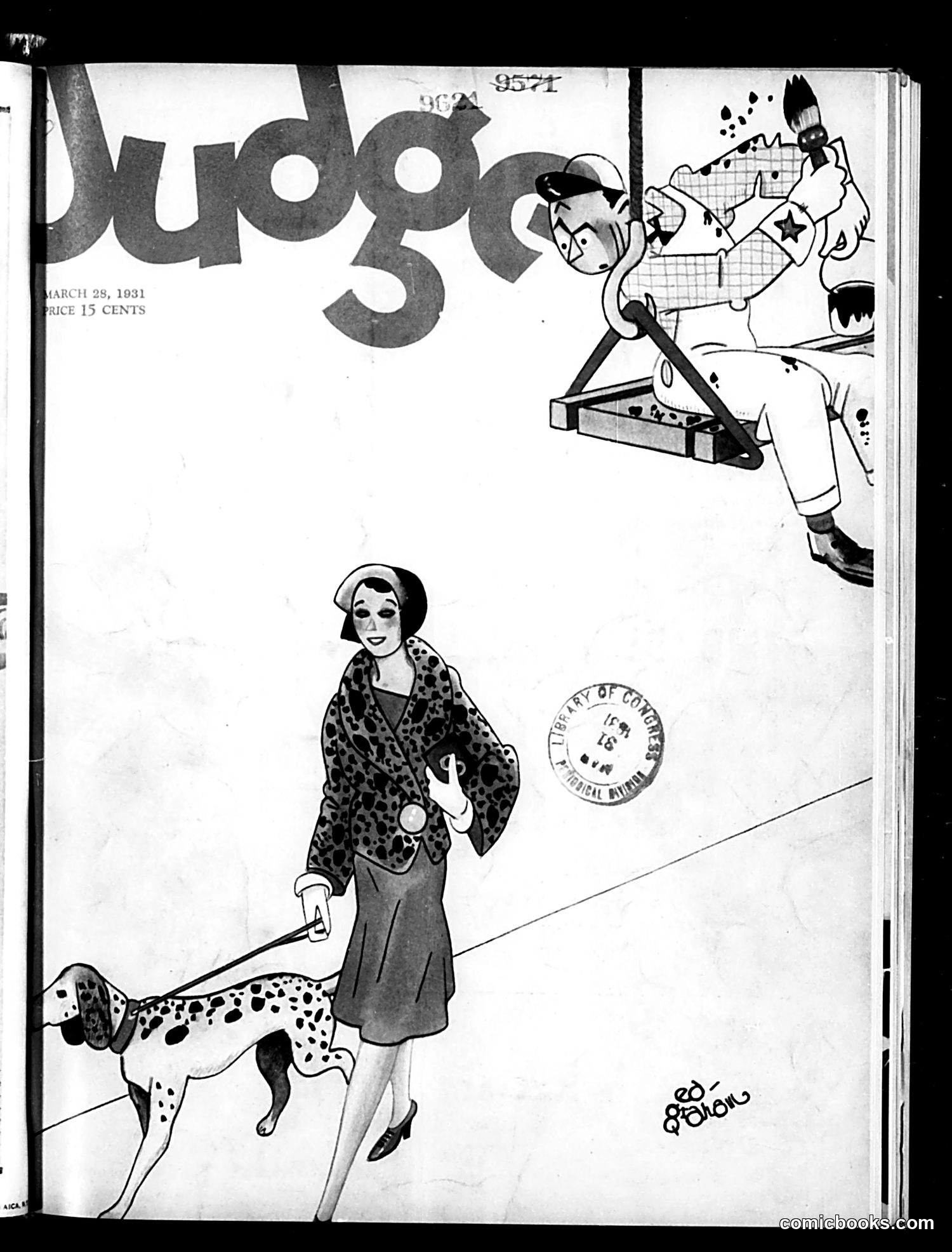
Judge Magazine Cover Analysis — March 28, 1931 This cover satirizes 1930s fashion and gender roles. The lower illustration shows a stylish woman in a patterned coat walking a spotted dog—a familiar leisure activity for affluent women of the era. The upper cartoon depicts a man in casual attire operating what appears to be a surveying or construction tool, suggesting manual labor or outdoor work. The juxtaposition appears to mock the contrast between idle leisure (represented by the fashionable woman) and productive work (the laboring man). Given the 1931 date, this likely reflects Great Depression-era anxieties about class, gender roles, and economic productivity—satirizing the perceived frivolity of wealthy women's pursuits against the backdrop of widespread male unemployment and economic hardship.
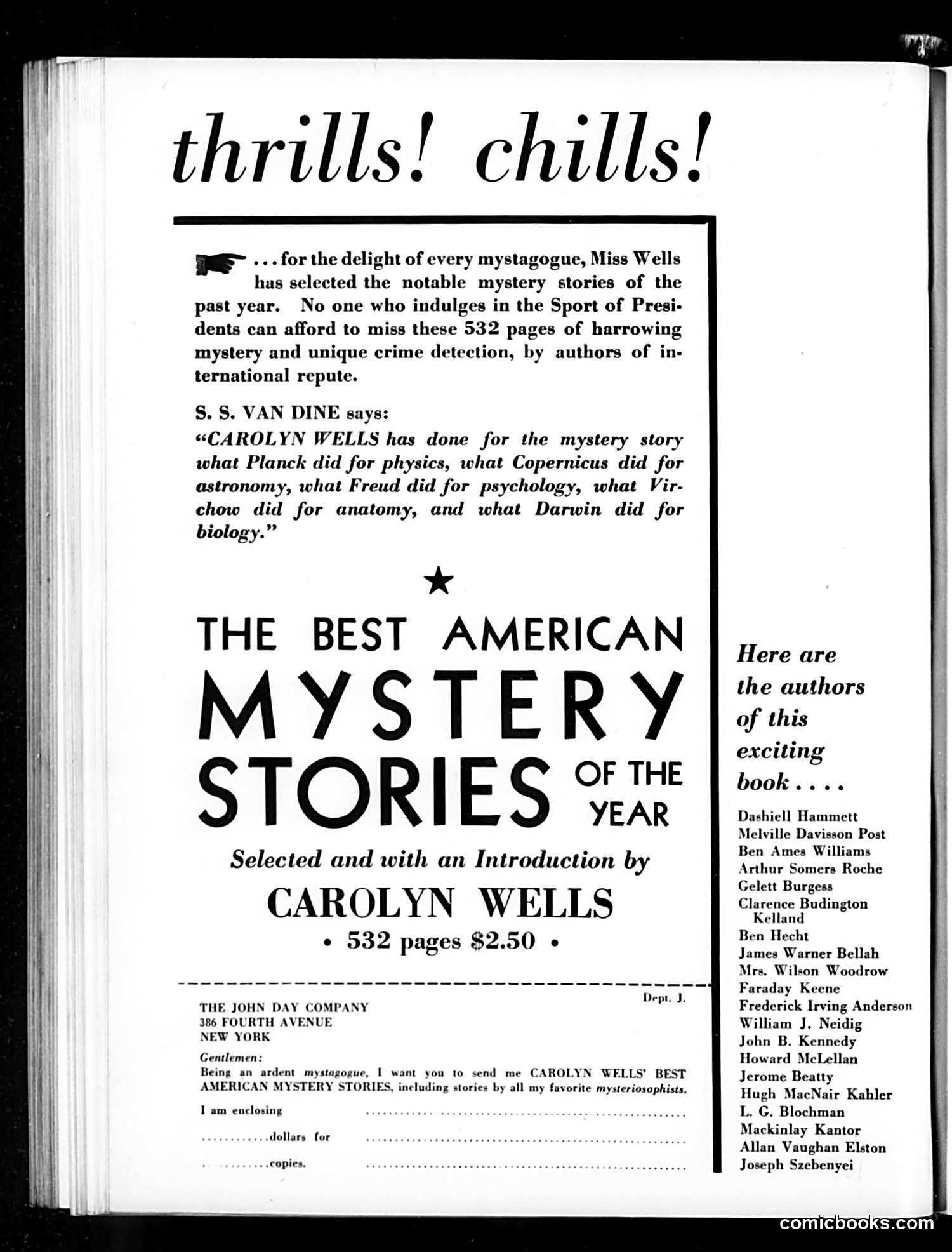
Analysis This page is primarily advertising, not satire or political content. It's a book advertisement for "The Best American Mystery Stories of the Year," selected by Carolyn Wells, published by The John Day Company in New York. The page uses promotional techniques typical of the era: - Endorsement quote from S.S. Van Dine comparing Wells's contributions to mystery fiction with major scientific figures (Planck, Darwin, etc.) - List of contributing authors including well-known names like Ben Hecht and Jerome Beatty - Mail-order coupon for customers to purchase the 532-page book for $2.50 There are no political cartoons or satirical elements visible. This is straightforward commercial advertising using credibility-building quotes and famous authors' names to market an anthology to mystery enthusiasts.
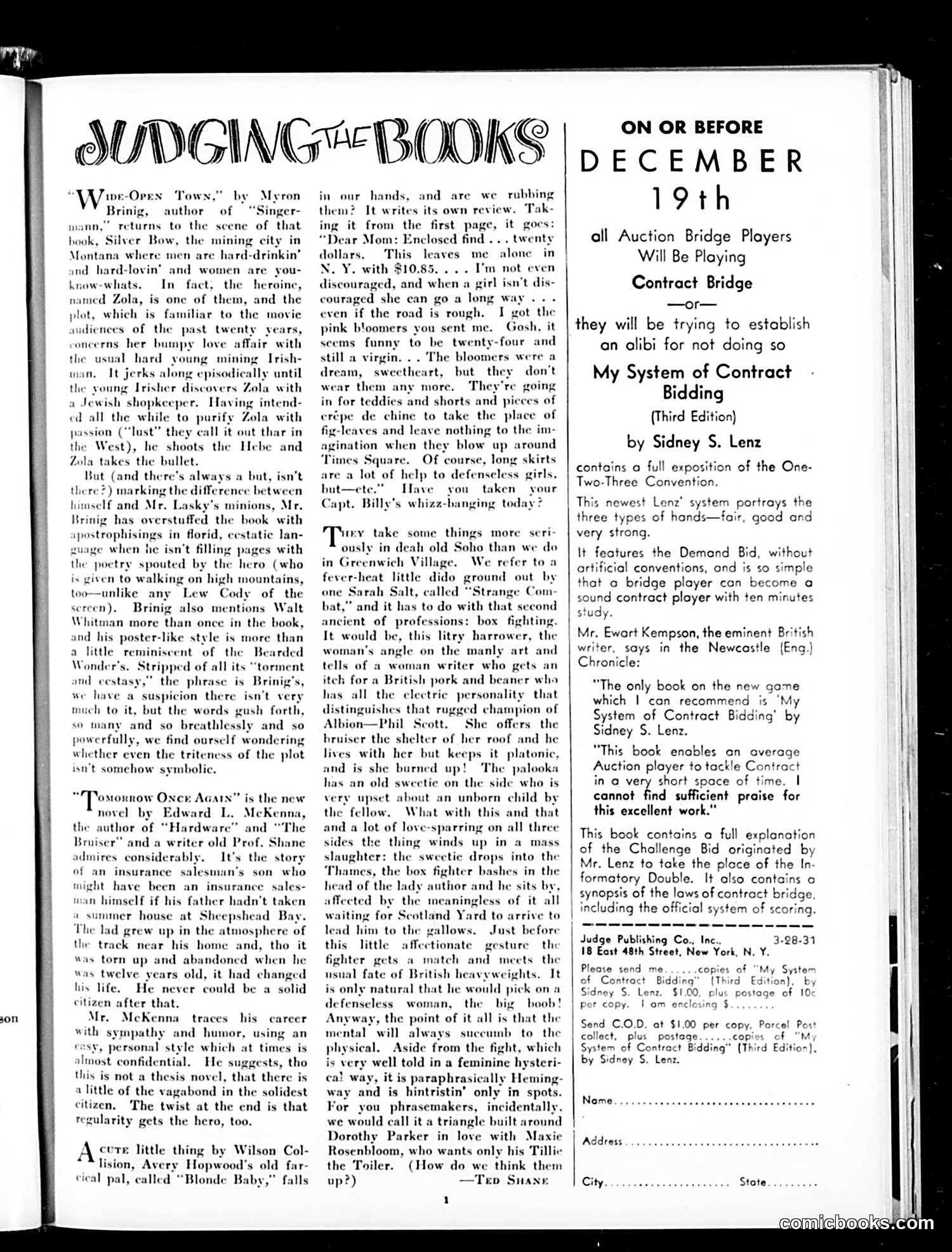
Analysis of Judge Magazine Page This page is primarily book reviews rather than political satire or cartoons. The "Judging the Books" section reviews recent novels including: - "Wide Open Town" by Myron Brinig (about hard-drinking men and women in Montana) - "Tomorrow Once Again" by Edward L. McKenna (an insurance salesman's son in Shepherd's Bush, London) - "Blonde Baby" by Wilson Collison (a farce set in Greenwich Village) The right column contains advertisements for contract bridge instruction books, promoting Sidney S. Lenz's bidding system ahead of an Auction Bridge Players event on December 19th. This appears to be a standard magazine issue mixing literary criticism with instructional advertisements—no political commentary or satirical cartoons are evident on this particular page.
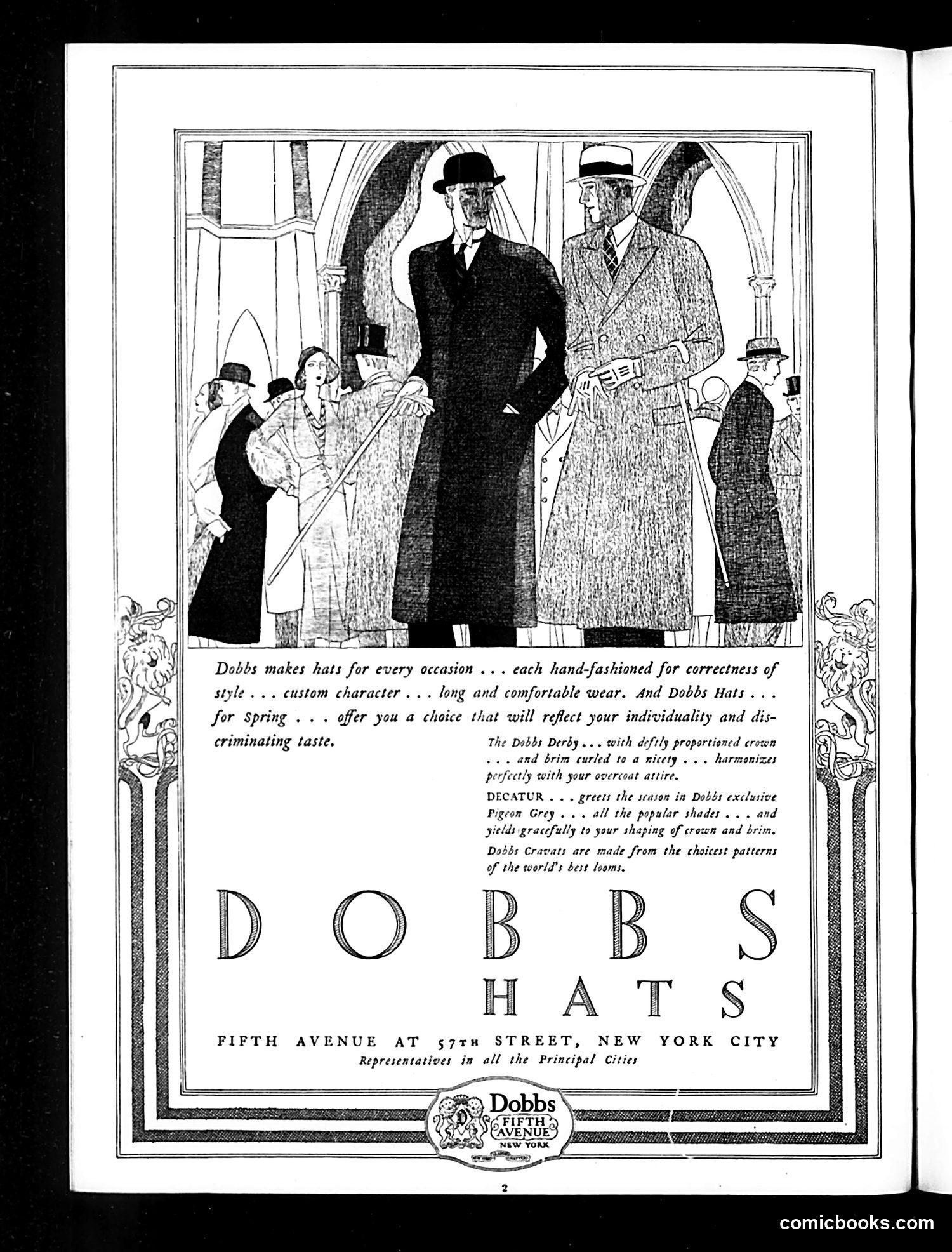
Analysis This is primarily a fashion advertisement, not a political cartoon. The image shows well-dressed men and women in 1920s attire examining hats at what appears to be an elegant interior space. The ad copy emphasizes that Dobbs hats are "hand-fashioned for correctness of style" and offers variety for "every occasion." It highlights specific models: the "Dobbs Derby" (with proportioned crown and brim), "Decatur," and "Pigeon Grey" (in various shades). The satirical element, if present, is subtle—perhaps mocking the pretension of high-fashion hat-buying culture or the notion that hats reflect "individuality and discriminating taste." However, the page functions primarily as a luxe advertisement for Dobbs Hats, located at Fifth Avenue and 57th Street in New York City, with representatives in major cities.
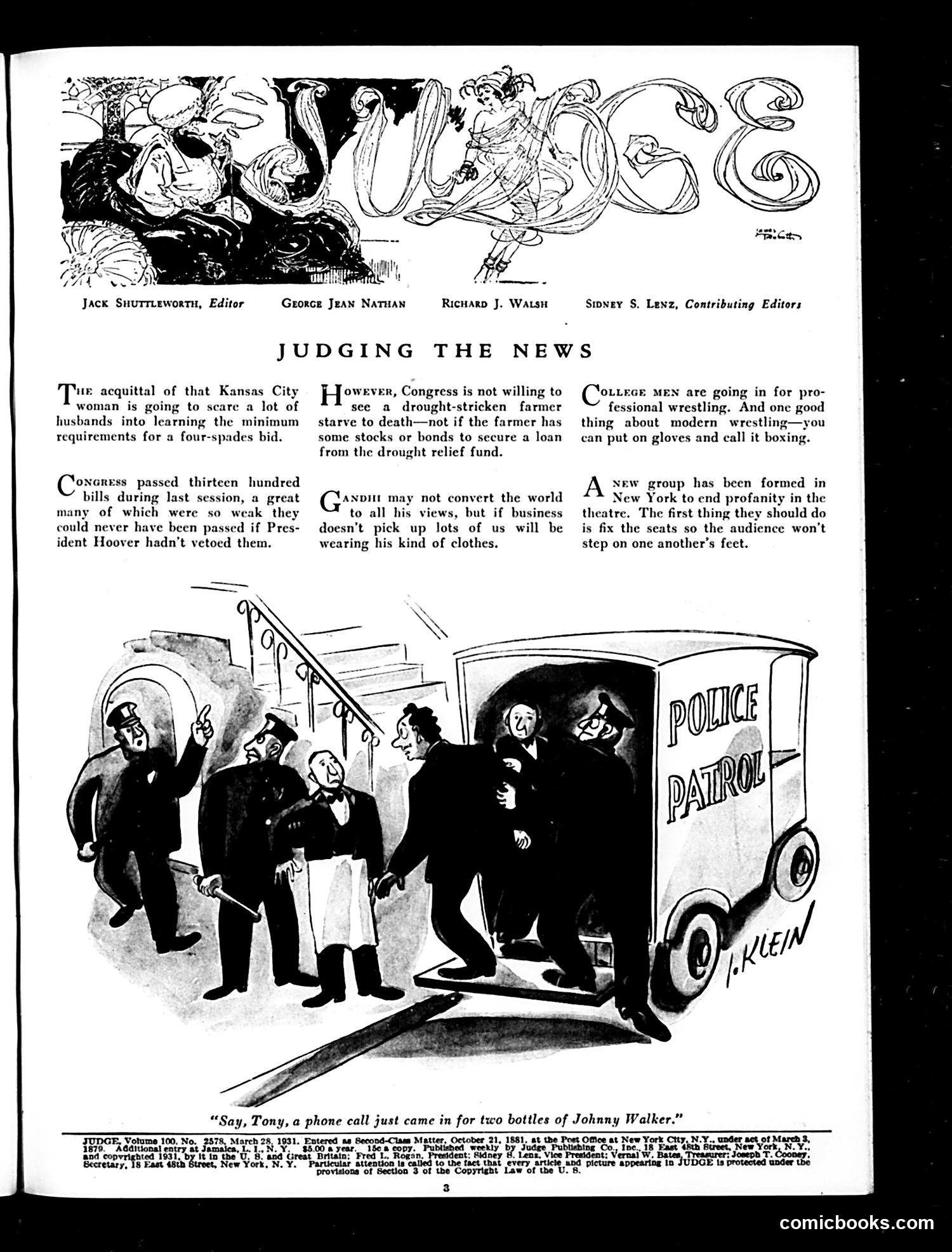
"Judge" Page Analysis - October 31, 1931 This satirical page critiques contemporary issues through brief commentary and a cartoon. The main cartoon depicts police bundling two men into a "Police Patrol" wagon while officers outside discuss "a phone call just came in for two bottles of Johnny Walker"—referencing Prohibition-era bootlegging. The surrounding commentary touches on: - A Kansas City woman suing her husband over inadequate financial support - Congress's weakness in passing legislation President Hoover might veto - Drought relief funds and farm loans - Gandhi's non-cooperation with Western business practices - A new anti-profanity theater group in New York The cartoon's humor centers on police hypocrisy: authorities arrest citizens while themselves engaged in the illegal alcohol trade they're supposedly enforcing against.
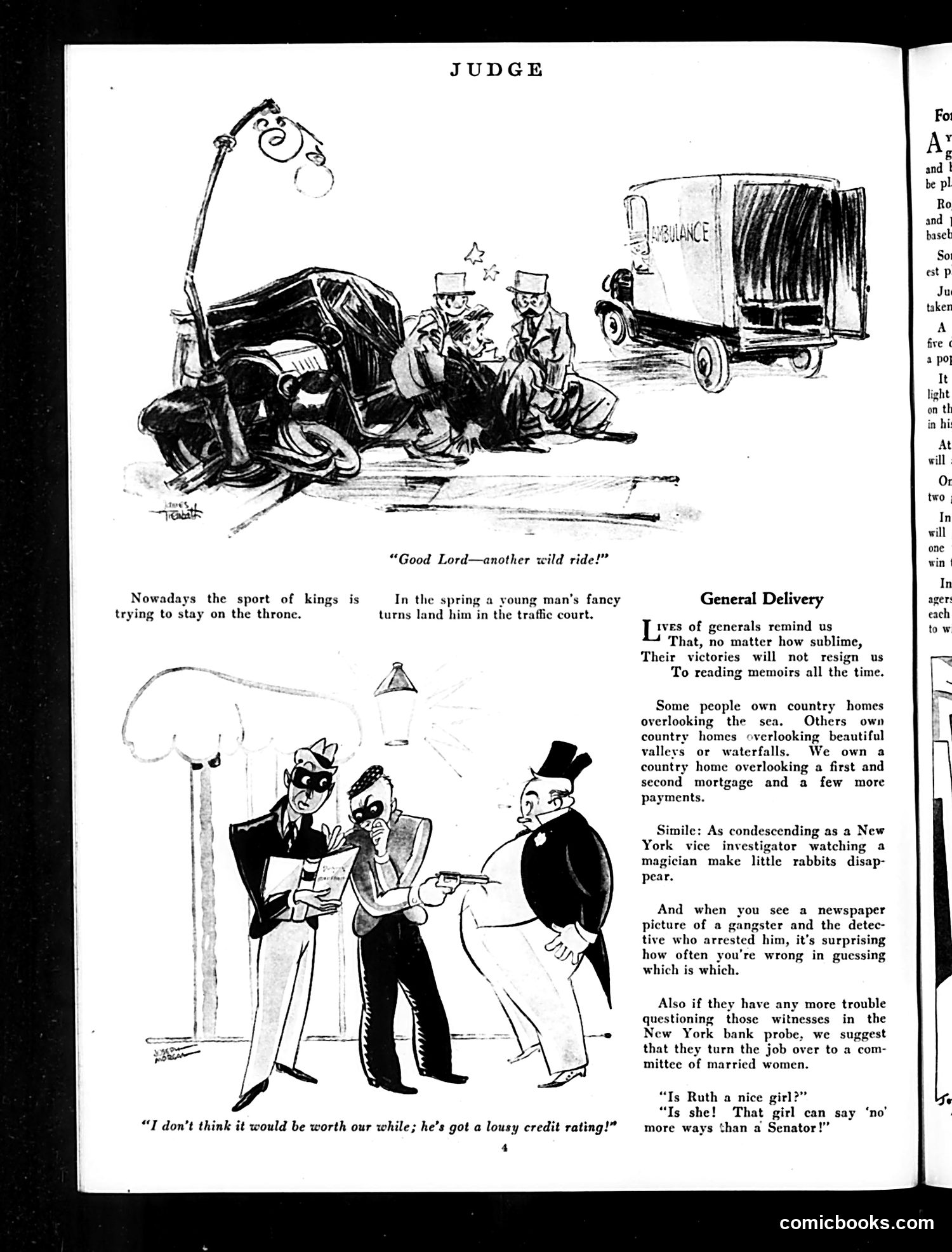
Analysis of Judge Magazine Page Top Cartoon ("Good Lord—another wild ride!"): This depicts a car accident with an ambulance arriving. The satire mocks reckless driving as "the sport of kings"—wealthy elites treating dangerous driving like aristocratic entertainment. The joke references spring as "a young man's fancy turns [him] in the traffic court," suggesting wealthy men face traffic violations rather than serious consequences. Bottom Cartoon ("I don't think it would be worth our while..."): Three men in formal dress discuss credit. One appears to be a creditor or banker rejecting a loan applicant, saying he has "a lousy credit rating." The satire comments on financial desperation or fraud during economically uncertain times. "General Delivery" section: Humorous commentary on human vanity and self-deception, comparing people's inflated self-images to actual reality.
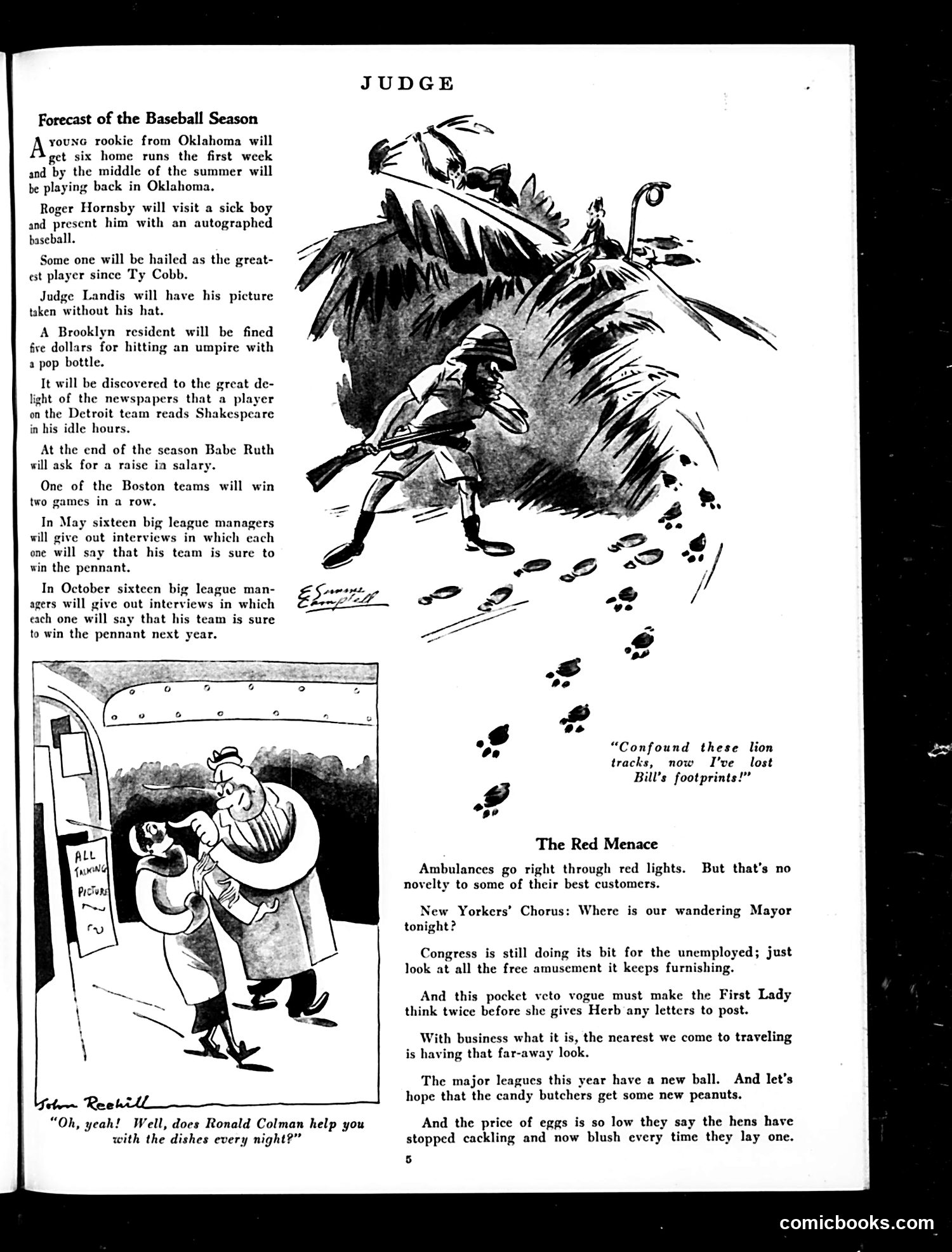
Analysis of Judge Magazine Page This page contains two satirical pieces: "Forecast of the Baseball Season" lists humorous predictions about 1920s baseball, including jokes about rookies, famous players like Babe Ruth and Judge Landis, and umpire behavior. "The Red Menace" section critiques contemporary politics with biting commentary. It references the "wandering Mayor" (likely Mayor Jimmy Walker of New York), Congress's unemployment relief efforts, presidential veto power ("pocket veto vogue"), and economic issues like egg prices and hen productivity. The cartoons are lighter—one depicts someone asking "Ronald Colman" (a silent film star) for dishwashing help, likely mocking celebrity culture or labor shortages of the era. The satire targets government incompetence, economic anxiety, and celebrity obsession typical of post-WWI American society.
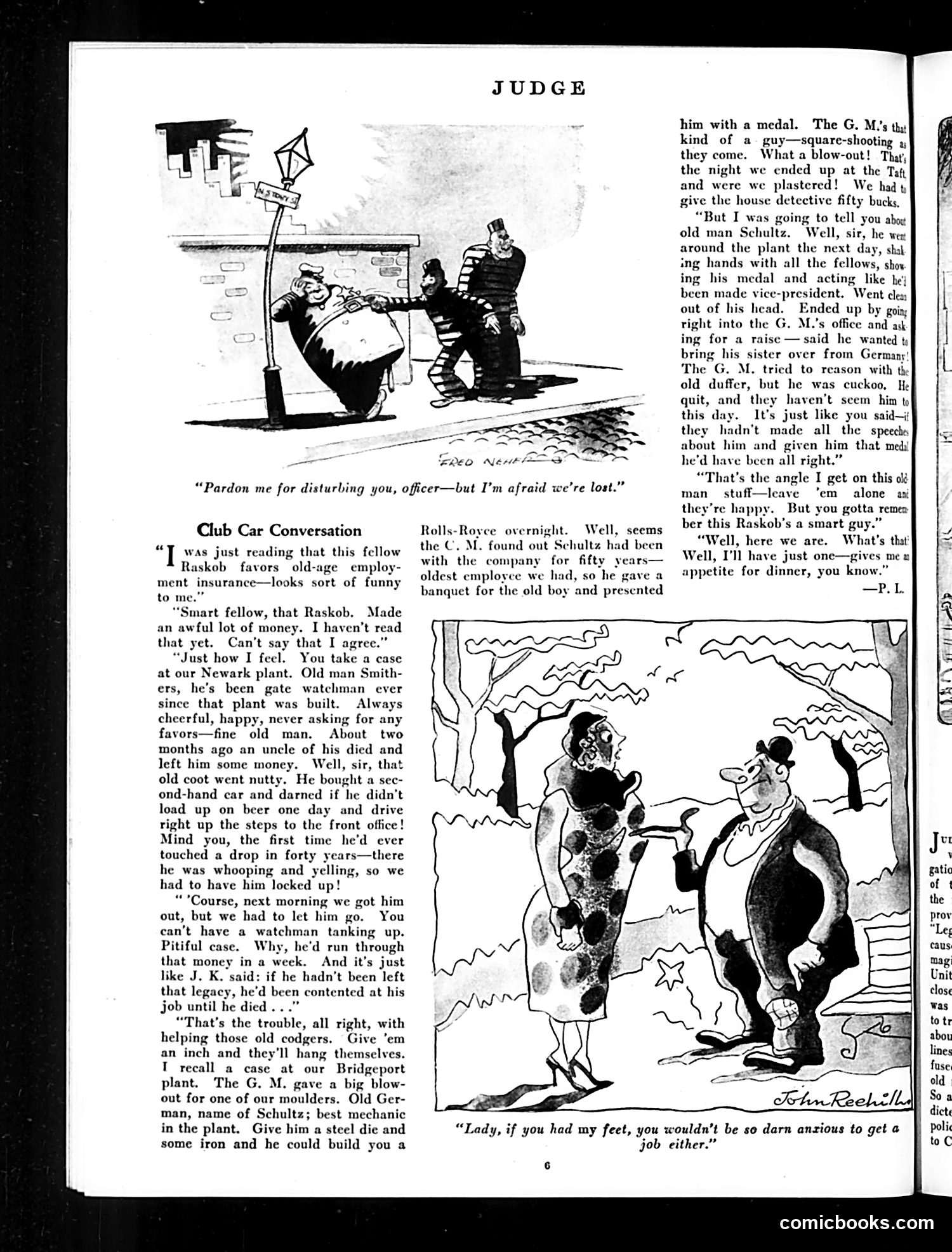
Analysis of Judge Magazine Page This page contains two separate items: Top Cartoon: A street scene where a disheveled police officer addresses two men near a street lamp, saying "Pardon me for disturbing you, officer—but I'm afraid we're lost." The humor appears to be visual—the officer looks more disoriented or drunk than the civilians asking directions. "Club Car Conversation": A multi-paragraph anecdote about an old employee named Raskok at a Newark plant who unexpectedly received money from a deceased uncle's will. The story humorously contrasts his sudden wealth with his lifelong modest circumstances—he bought a car, drove recklessly, and ultimately had to be locked up. The satire targets nouveau riche behavior and the chaos that sudden wealth can cause. Bottom Cartoon: Two figures in winter, one saying "Lady, if you had my feet, you wouldn't be so darn anxious to get a job either."
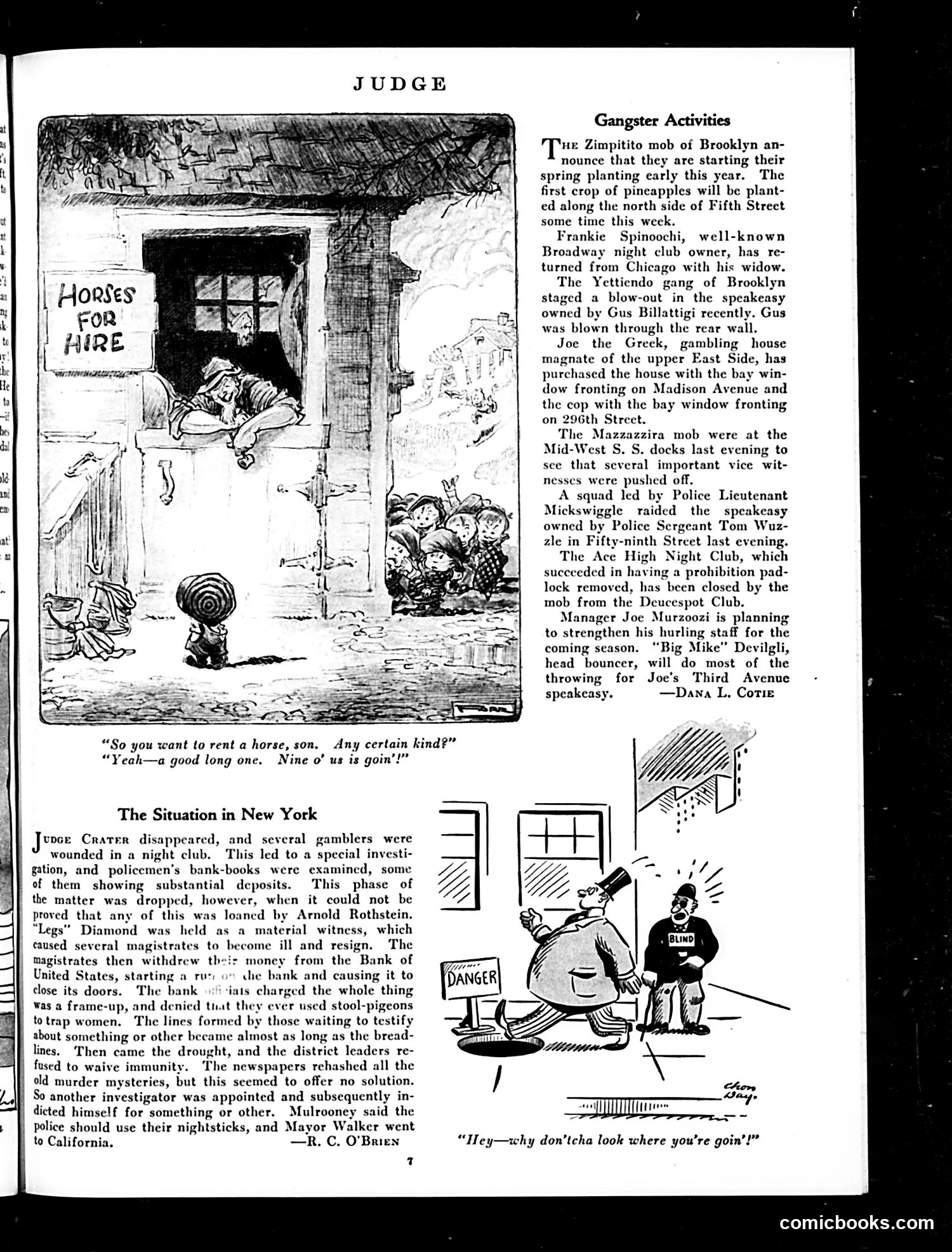
Judge Magazine Satire: Prohibition-Era Corruption This page satirizes 1920s organized crime and judicial corruption during Prohibition. The "Gangster Activities" section uses mock-serious reporting on Brooklyn mob violence—murders disguised as euphemisms ("pineapples" for bombs, witnesses "pushed off" docks)—to mock both gangster brutality and police indifference. The main cartoon shows a horse-rental shop where someone needs "a good long one. Nine o' us is goin'"—dark humor about gang executions or violence requiring multiple conspirators. "The Situation in New York" recounts real scandals: Judge Crater's disappearance, "Legs" Diamond's involvement in organized crime, and widespread police corruption (bank deposits from bribes). It satirizes the system's failure—investigations collapse, magistrates resign rather than prosecute, and even new investigators get indicted. Mayor Jimmy Walker's retreat to California caps the absurdist portrait of civic breakdown under Prohibition. The satire's point: law enforcement and judiciary are wholly compromised by organized crime.
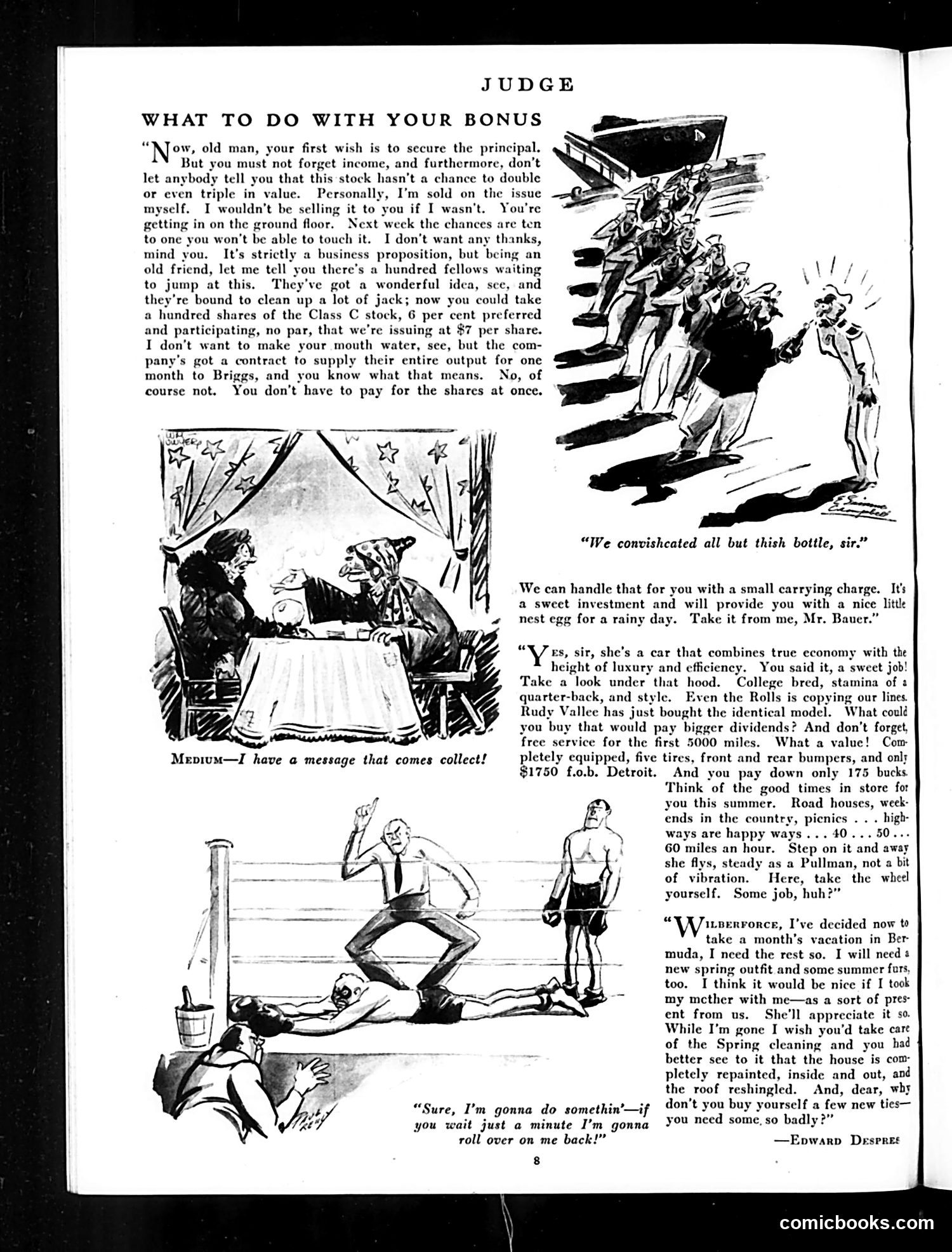
Analysis: "What to Do With Your Bonus" This Judge page satirizes the get-rich-quick schemes and aggressive sales pitches that proliferated after workers received bonuses (likely post-WWI or during the 1920s boom). The main cartoon depicts a slick salesman convincing an older man to invest his bonus in dubious stock. The salesman uses classic high-pressure tactics: claiming the stock will "double or triple," insisting others are waiting to buy it, and offering payment plans so the buyer won't feel the cost immediately. The humor lies in recognizing this as obviously predatory—the salesman admits he's "sold on the issue" while simultaneously selling it away. The accompanying vignettes mock similar overconfidence: an overpriced car advertised with unrealistic promises, and a wife's frivolous spending plans (Bermuda vacation, furs, home renovations). Together, these satirize the era's rampant consumerism and naive financial decisions among newly prosperous ordinary people—the satirical point being that bonuses were being squandered on inflated investments and luxury purchases rather than prudently saved.
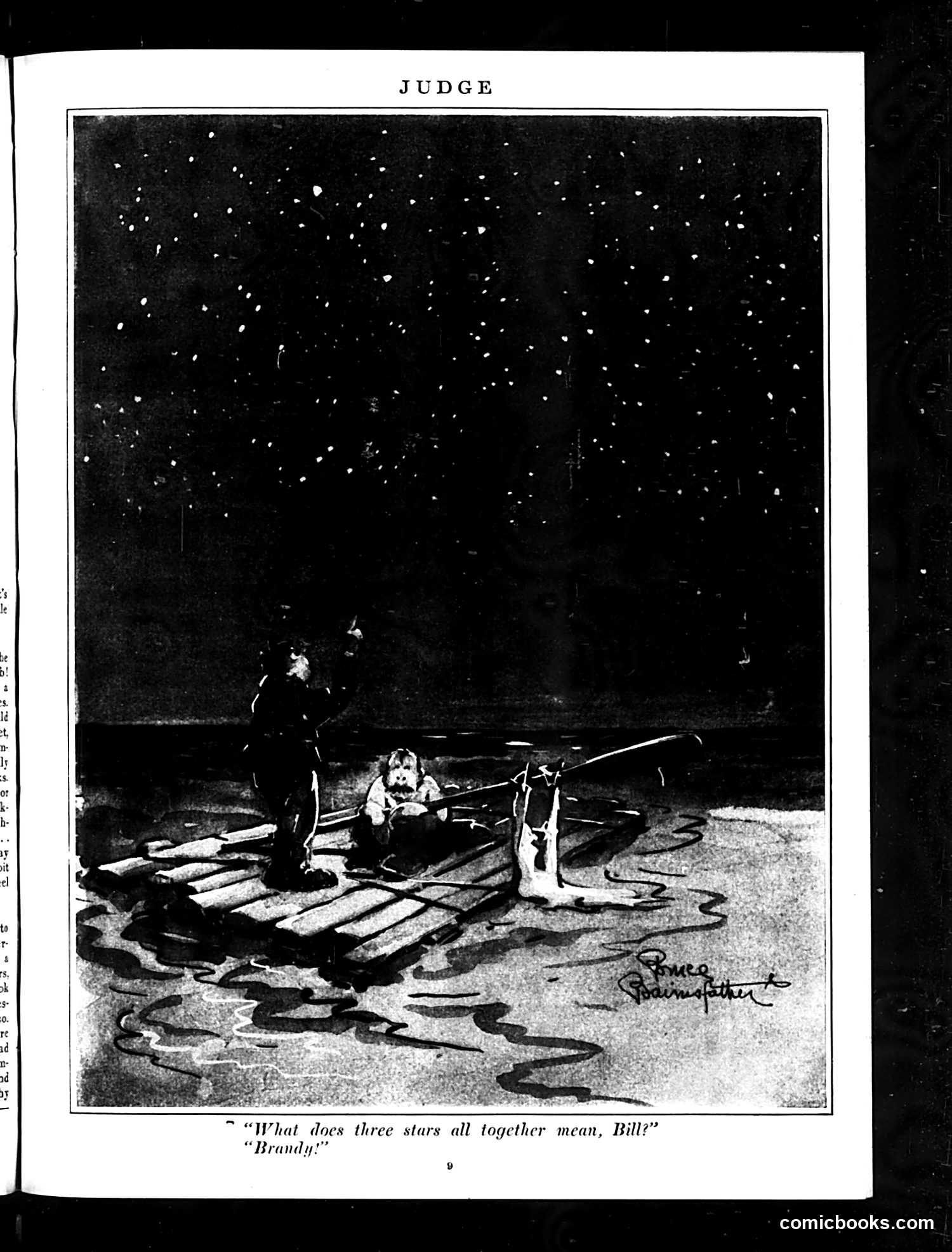
Judge Cartoon Analysis This cartoon depicts two figures examining logs under a starry night sky. The dialogue joke plays on a double meaning: one character asks what "three stars all together" signify, and the other responds "Brandy!" The humor appears to reference brandy grading systems, where stars (★★★) indicate quality levels—three stars typically denoting high-quality brandy. The rural setting with logs suggests woodsmen or laborers who would recognize this commercial designation. The cartoon satirizes either working-class unfamiliarity with luxury goods, or conversely, the unexpected knowledge of alcohol ratings among ordinary people. The starlit backdrop emphasizes the "stars" pun. Without additional context, the specific satirical target remains unclear, though it likely comments on class, consumption, or Prohibition-era attitudes toward alcohol.
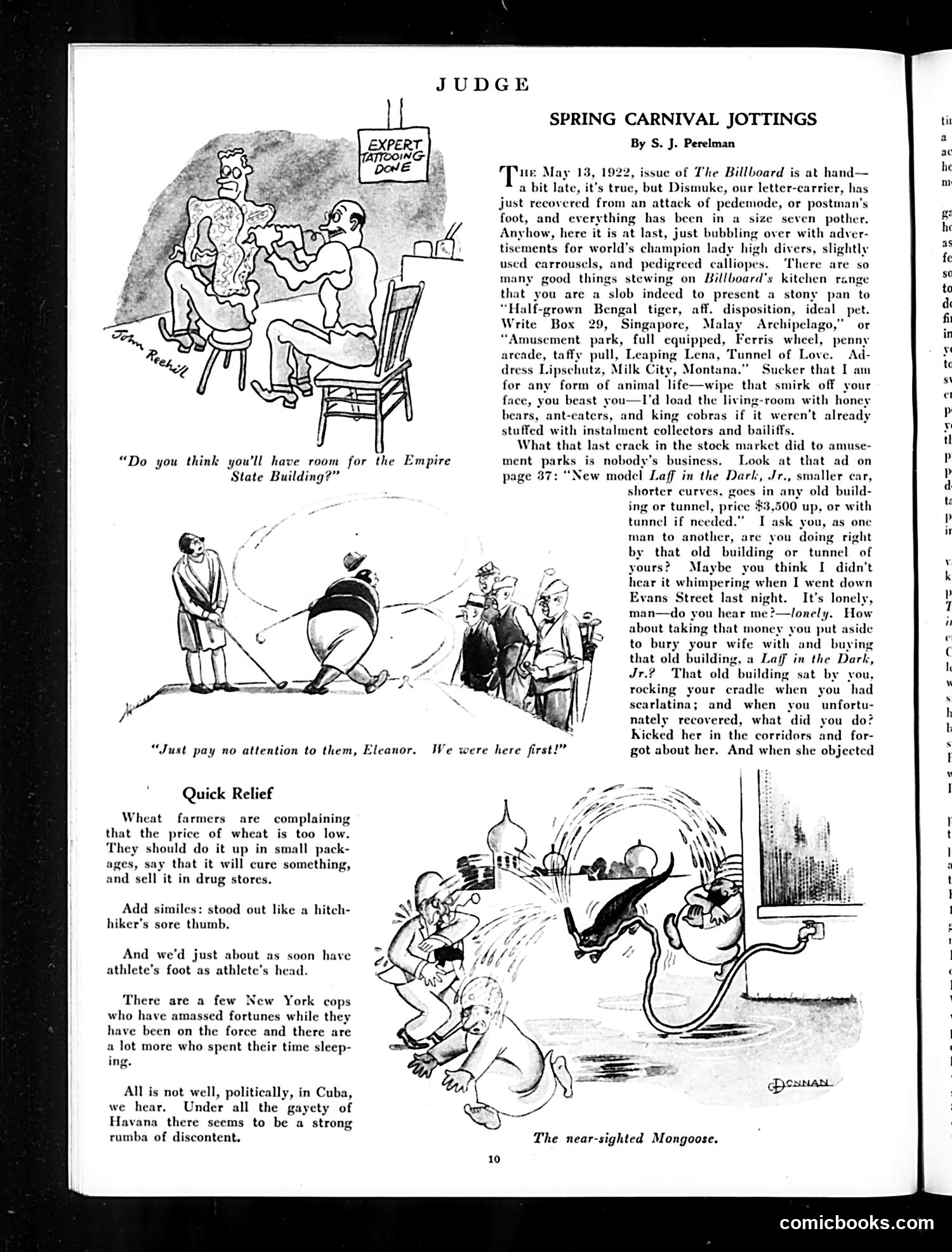
Spring Carnival Jottings Analysis This page features satirical commentary by S.J. Perelman (humorist and future screenwriter) on the May 13, 1922 *Billboard* magazine and broader 1920s economic/social issues. Main Cartoons: Top cartoon: Two figures discuss the "Empire State Building"—likely satirizing New York's real-estate boom and speculation during the 1920s construction era. Bottom cartoon: "The near-sighted Mongoose"—appears to be social satire, though the specific reference is unclear without additional context. Textual Satire: Perelman mocks *Billboard's* classified ads for amusement park equipment and exotic animals, using absurdist humor to critique post-war consumer culture and stock market volatility ("What that last crack in the stock market did to amusement parks"). The "Quick Relief" section satirizes contemporary problems: wheat price complaints, police corruption in New York, and Cuban political unrest—typical 1922 news topics treated with tongue-in-cheek commentary. The humor depends on readers' familiarity with current events and period anxieties about commerce and urban development.
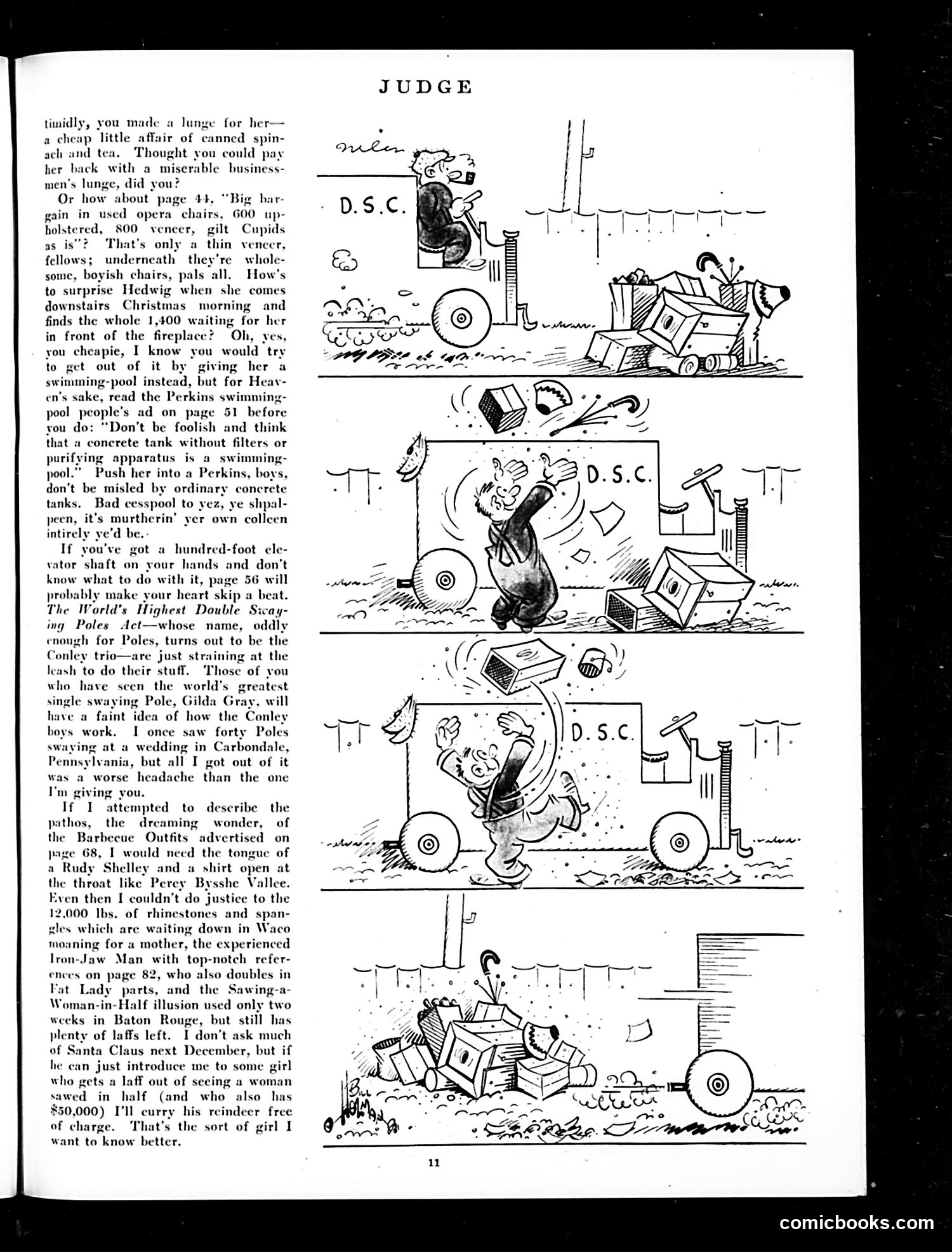
Judge Magazine Page Analysis This page from Judge magazine is primarily advertising copy disguised as editorial commentary. The text sarcastically reviews various circus and vaudeville acts advertised elsewhere in the magazine—including barbecue equipment, swimming pools, and acrobatic performers (notably "The Conley Trio" performing a "Double Swaying Poles Act"). The four cartoon panels show a figure labeled "D.S.C." (likely referencing the Conley Trio act) being thrown repeatedly by a mechanical device with wheels, depicted in slapstick fashion. The repeated tumbling illustrates the physical comedy of the circus/vaudeville acts being hawked. The satire targets both advertisers and readers: the writer mocks the absurdity of ads promising spectacular entertainment while pretending to give consumer advice. References to "Hedwig" and Irish dialect ("murtherin' yer own colleen") suggest ethnic humor typical of the era. This is essentially advertorial content—Judge using humor to promote paid advertisements while appearing to offer editorial commentary.
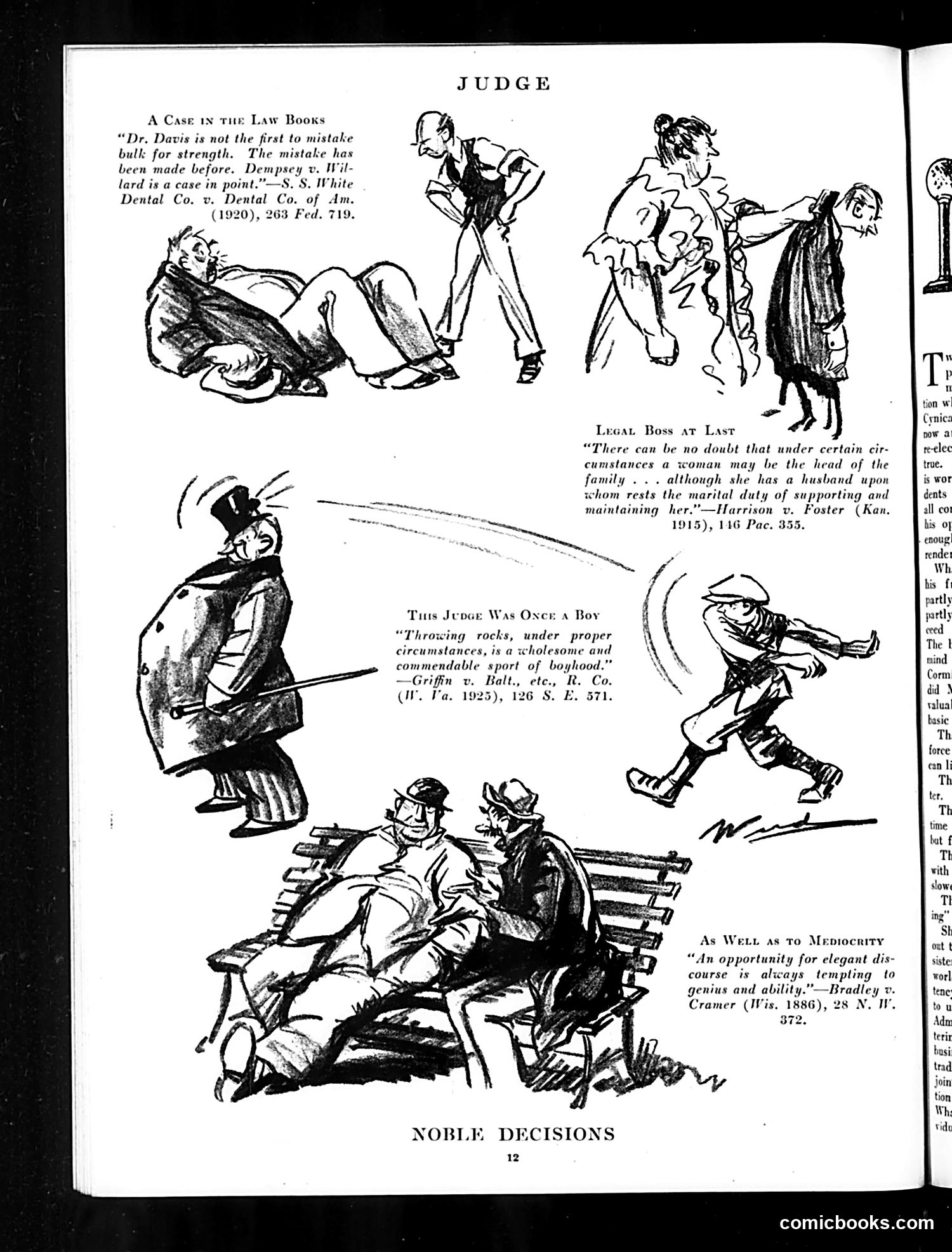
Judge Magazine Satire Analysis This page mocks absurd legal precedents through humorous illustrations paired with real court citations. Each section presents ridiculous judicial rulings as if they were serious law: "A Case in the Law Books" shows a large man being knocked down, satirizing a ruling that equated bulk with strength in a dental company lawsuit. "Legal Boss at Last" depicts a domineering woman while citing a case suggesting wives can lead households—social satire on changing gender roles in early 20th-century America. "This Judge Was Once a Boy" illustrates children throwing rocks, mocking a West Virginia court that deemed rock-throwing "wholesome boyhood sport." "As Well as to Mediocrity" shows idle men relaxing, sarcastically referencing a Wisconsin case equating mediocrity with "genius and ability." The satire targets judicial reasoning that seems transparently self-serving or ridiculous, suggesting judges rationalize questionable decisions through flowery language. Judge magazine frequently lampooned legal absurdities for its educated, professional readership.
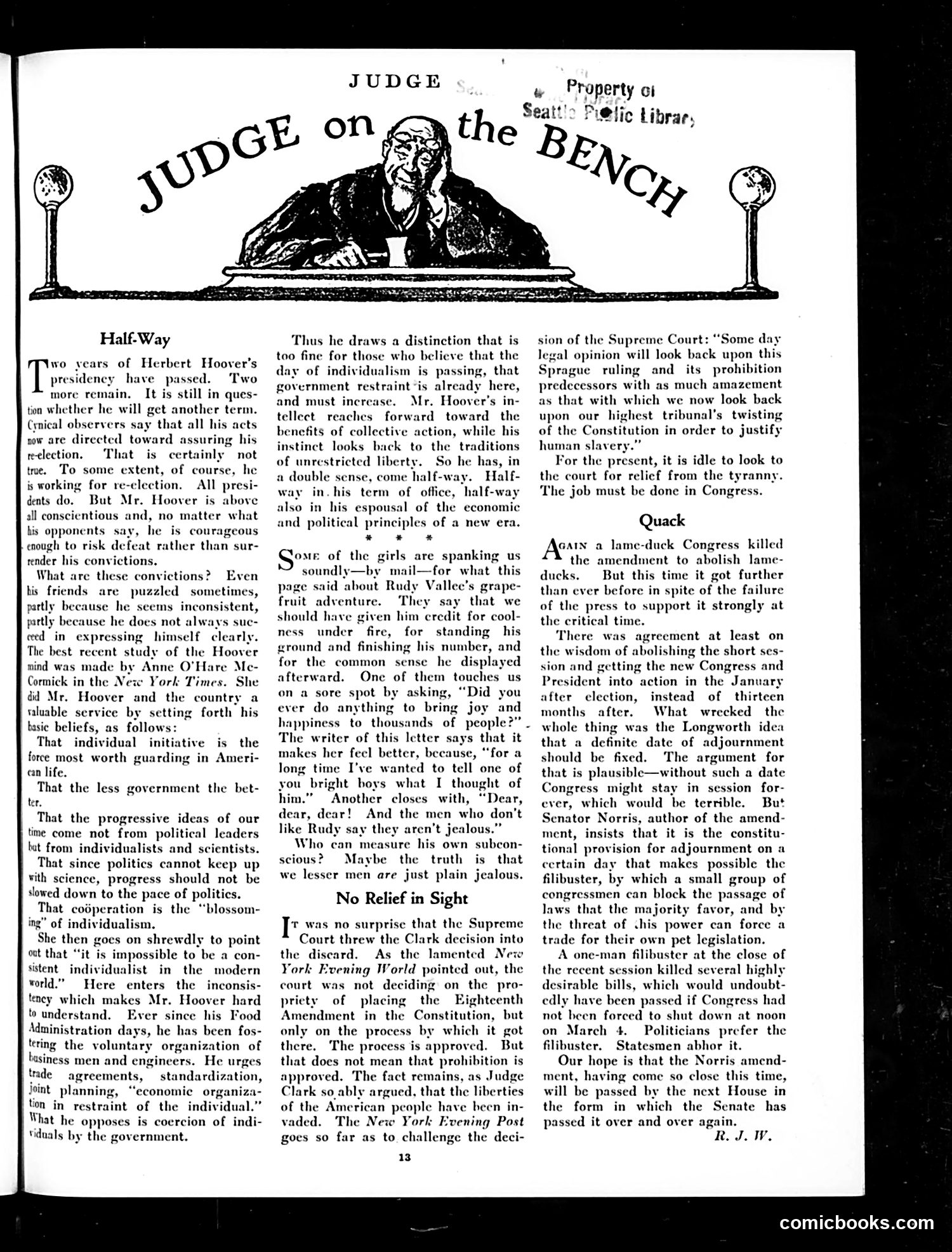
Judge Magazine Page Analysis This page from *Judge* magazine (circa 1931, during Herbert Hoover's presidency) contains political commentary rather than cartoons. "Half-Way" critiques Hoover's contradictory philosophy. The article argues that Hoover champions individualism and limited government in principle, yet actively organizes business through voluntary agreements—a halfway compromise that satisfies neither pure individualists nor those accepting expanded government. The satire targets the intellectual inconsistency of claiming to oppose government coercion while promoting state-coordinated economic action. "Quack" discusses Congress's failed attempt to abolish short-session amendments. The piece sarcastically notes that despite rhetoric about reform, politicians blocked lasting change. Senator Norris's amendment would have prevented small congressional groups from obstructing legislation through filibusters. "No Relief in Sight" covers the Supreme Court's Eighteenth Amendment (Prohibition) decision, noting that while the Court approved the amendment's procedural legality, this doesn't resolve whether prohibition itself was sound policy—a legalistic victory masking deeper civil liberties concerns.
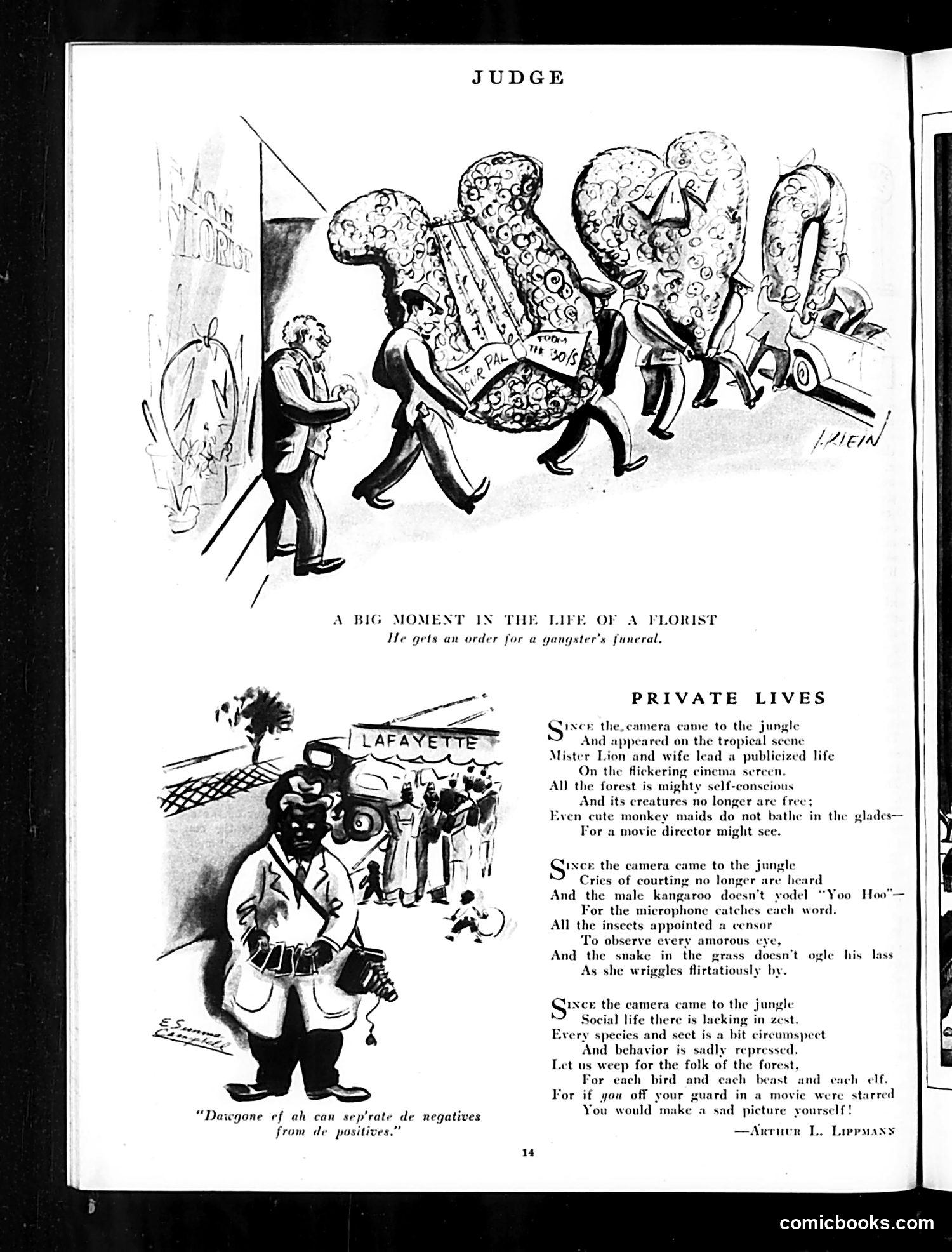
Explanation for Modern Readers This Judge magazine page contains two unrelated pieces of satire: Top cartoon: A florist receives an order for a gangster's funeral, depicted as massive floral arrangements being carried by pallbearers. The joke plays on "gangster" funerals being notoriously extravagant displays of flowers—a commentary on organized crime's ostentatious culture. Bottom section: "Private Lives" is a humorous poem about how cinema's arrival in nature disrupts animal behavior. It satirizes how movie cameras and microphones make wildlife self-conscious and inhibited—lions perform for cameras, kangaroos stop calling, insects appoint censors. The poem mocks both cinema's invasive nature and artificial behavior it creates. The final stanza suggests humans would similarly be awkward if filmed candidly, poking fun at vanity and the camera's revealing effects on natural conduct. Both pieces use exaggeration to critique modern technology's impact on authenticity.
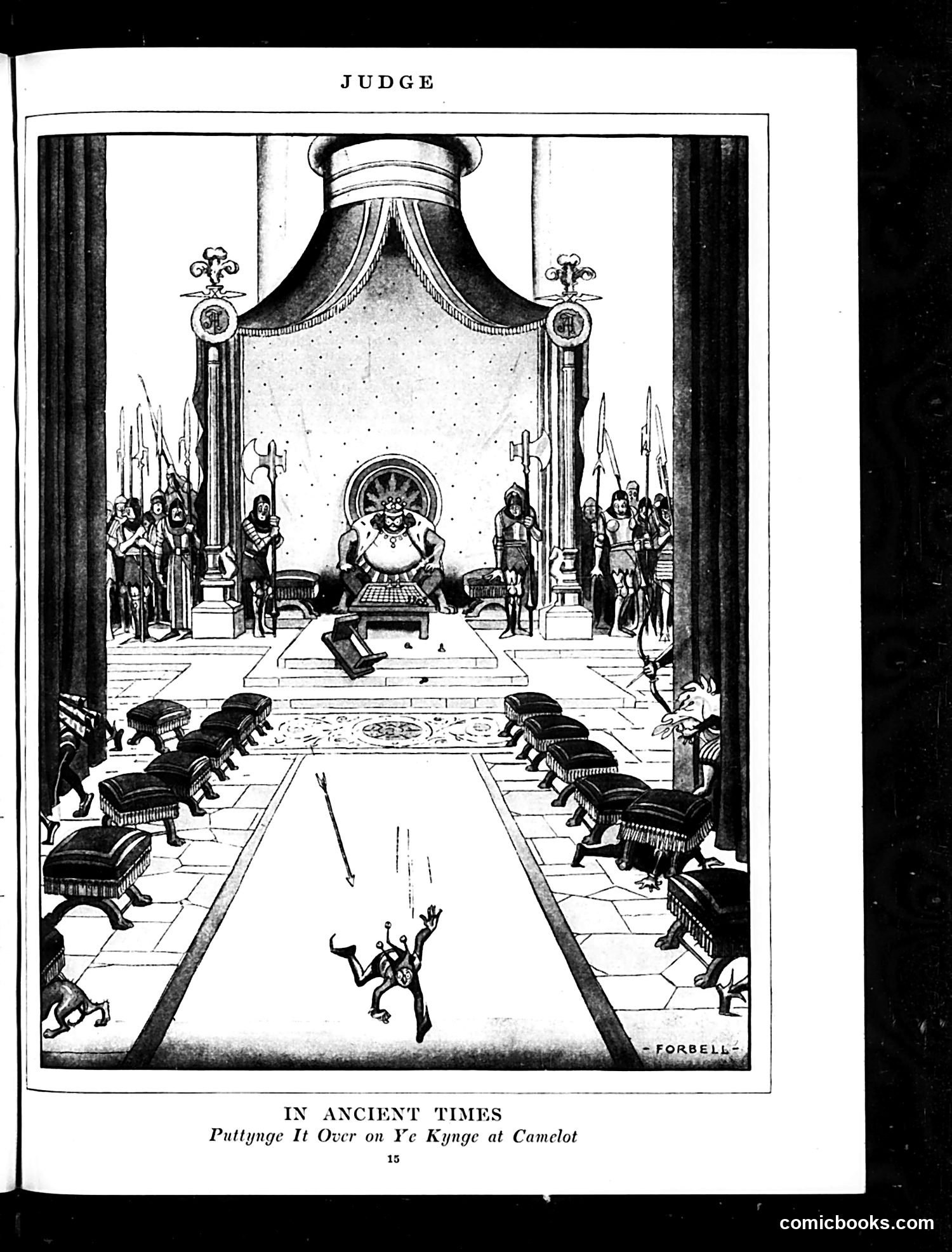
Analysis This cartoon satirizes judicial authority by presenting a medieval courtroom scene at King Arthur's Camelot. A central judge presides from an elevated throne while robed courtiers and armed guards line the chamber. In the floor's center, a small demon or imp appears to be the subject of judgment—"putting it over" (outwitting) the king through clever argument or trickery. The satire likely critiques how judges or legal systems can be manipulated by cunning defendants, or how authority figures are fooled by apparent inferiors. By setting this in legendary "ancient times" at Camelot, Judge magazine suggests such judicial manipulation is timeless—a recurring human folly regardless of era or rank. The supernatural element (the demon) may underscore that even established power structures can be outsmarted by the unexpected or unconventional.
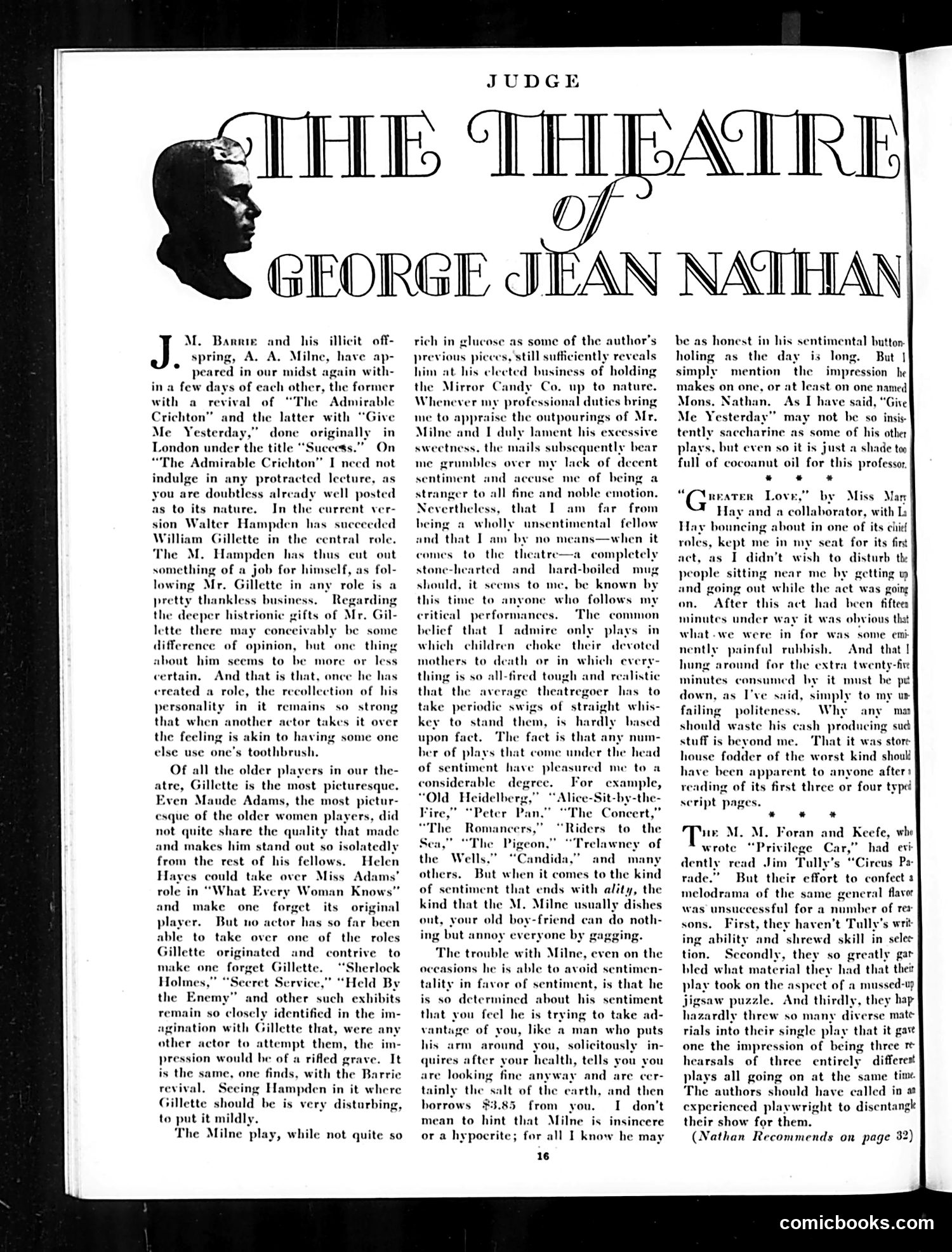
"The Theatre of George Jean Nathan" - Judge Magazine Theater Review This page presents a theater critic's review of two Broadway productions. The critic (likely George Jean Nathan, Judge's drama columnist) discusses two plays: J.M. Barrie's "The Admirable Crichton" revival (now starring Walter Hampden instead of William Gillette) and A.A. Milne's "Give Me Yesterday." The main point of satire concerns actor replacement and theatrical legacy. The critic argues that William Gillette's iconic roles are so permanently identified with him that successors—even talented actors like Hampden—cannot escape his shadow. It's "akin to having someone else use one's toothbrush." Regarding Milne's work, the critic mocks the playwright's excessive sentimentality, describing his emotional appeals as manipulative—like "a man who puts his arm around you, solicitously inquires after your health" while clearly trying to exploit your feelings. The review suggests Milne's saccharine style ("glucose") annoys rather than moves sophisticated audiences.
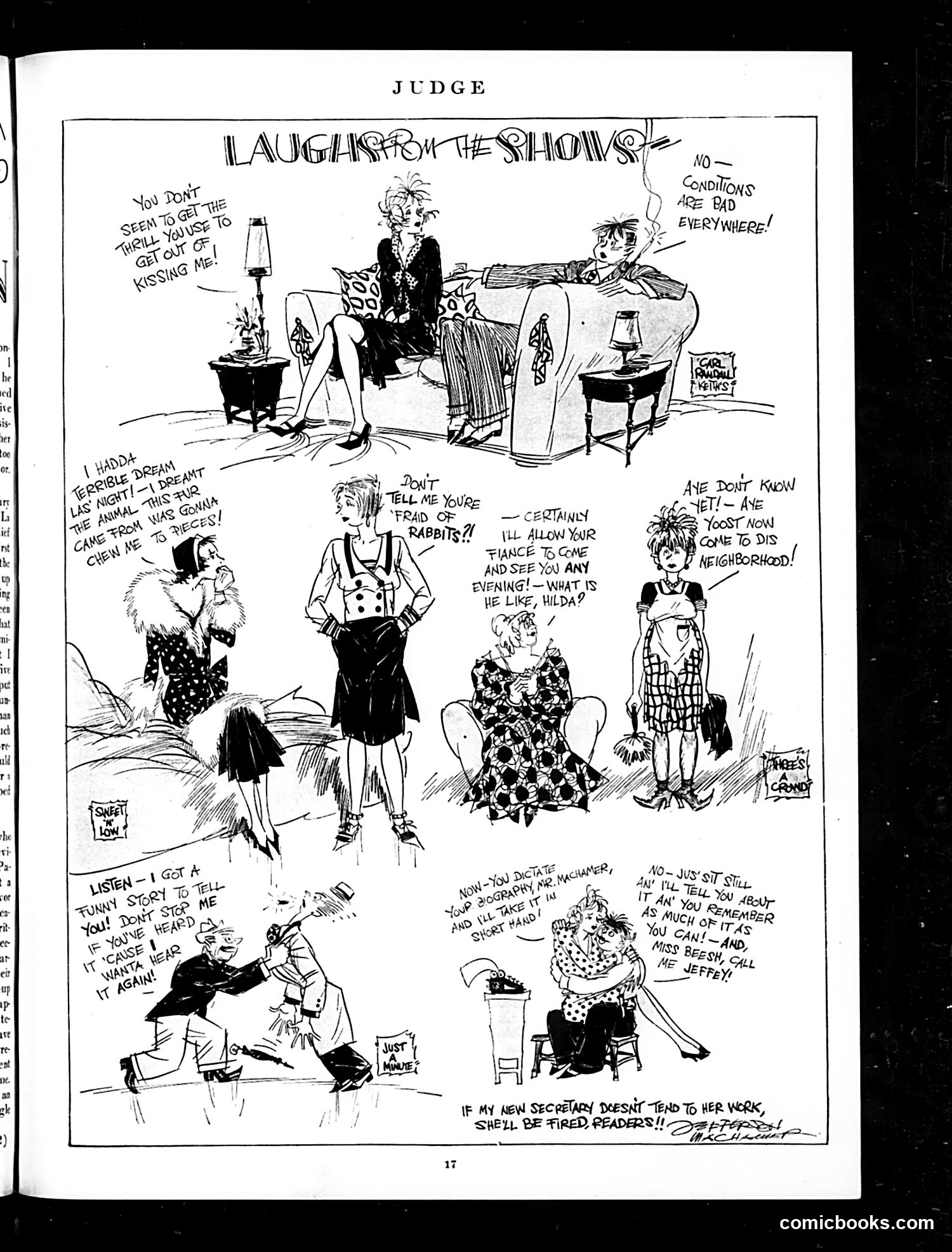
"Laugh at the Shows" - Judge Magazine Satire This page satirizes theatrical courtship conventions and social anxieties of the era (likely early 20th century). The central cartoon depicts women discussing dating rules and theater etiquette with men. The satire targets: 1. Rigid courtship protocols - Characters debate whether women should allow male suitors to attend evening entertainments together 2. Class anxieties - References to "neighborhoods," secretaries, and employment suggest social mobility concerns 3. Gender roles - Women negotiate autonomy while navigating male approval and social propriety 4. Theater culture - The title "Laugh at the Shows" references vaudeville/theatrical entertainment as a courtship venue The humor derives from characters' overwrought concerns about propriety and conditional romance ("if my new secretary doesn't tend to her work, she'll be fired"). The exaggerated dialogue and caricatured expressions mock both the strict social conventions and people's anxiety about violating them—capturing period anxieties about modernizing dating practices and women's increasing independence.
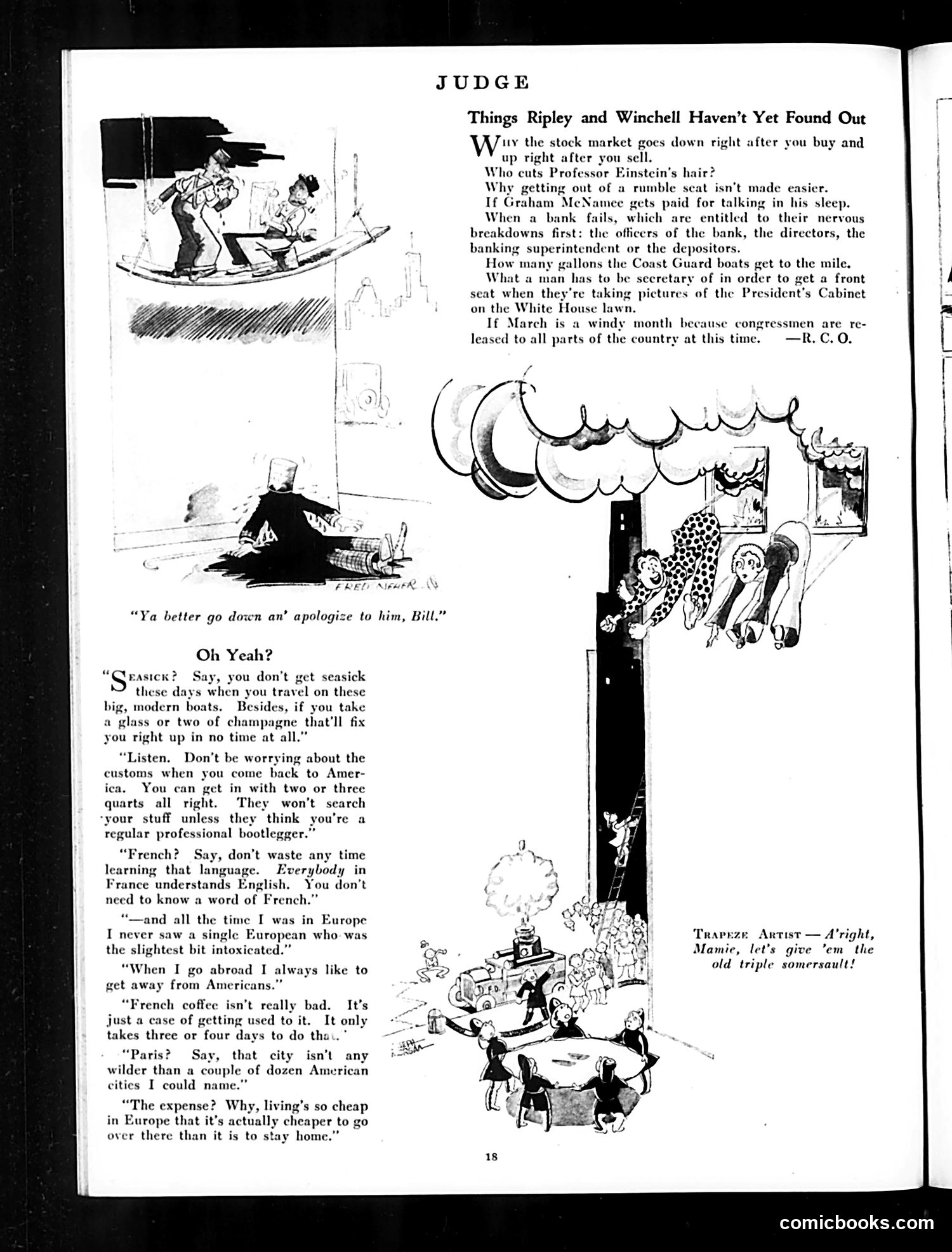
Judge Magazine Satire Analysis This page satirizes American travelers' misconceptions about Europe. The main text lists humorous "things Ripley and Winchell haven't found out"—references to Robert Ripley (cartoonist) and Walter Winchell (gossip columnist), suggesting these are overlooked curiosities. The "Oh Yeah?" section mocks a boastful American tourist spouting false claims: that seasickness is curable with champagne, that smuggling liquor through customs is easy, that "everybody in France understands English," that Europeans don't drink, and that living in Europe is cheaper than America. The satire exposes American ignorance, arrogance, and lawlessness (Prohibition-era bootlegging). The cartoon vignettes show tourists behaving badly abroad—the "Trapeze Artist" caption suggests performing dangerous stunts for entertainment. Overall, Judge ridicules American travelers as loud, drunk, xenophobic, and willfully ignorant.
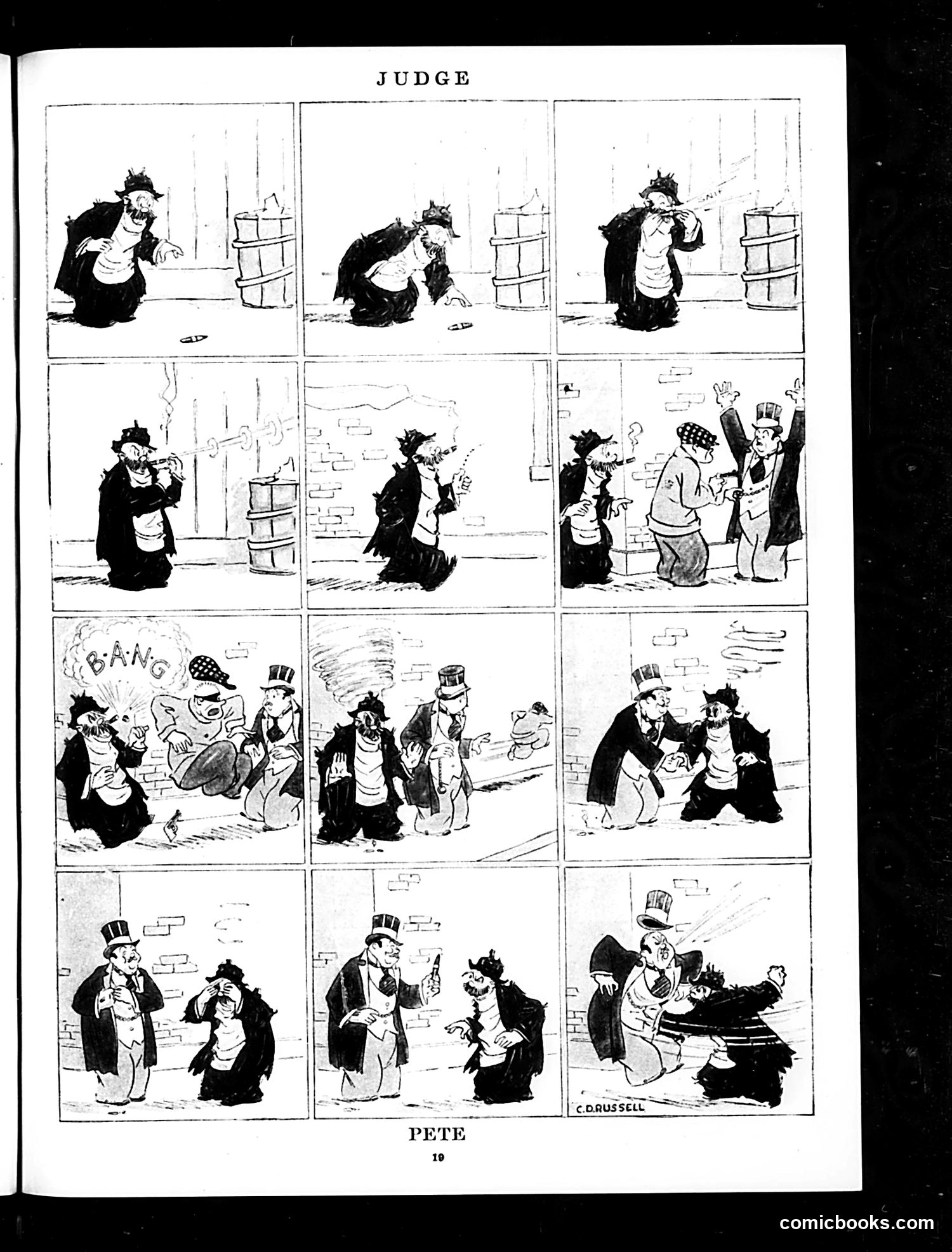
Judge Magazine Comic: "Judge" and "Pete" This page contains two sequential comic strips by C.D. Russell. "Judge" (top) appears to depict a rotund judicial figure in formal attire repeatedly interacting with cylindrical objects—possibly representing a judge's difficulty or obsession. The progression suggests physical comedy or commentary on judicial incompetence. "Pete" (bottom) shows interactions between a well-dressed gentleman in a top hat and a smaller, disheveled character, escalating from conversation to physical altercation to the gentleman playing piano. The satire likely targets class differences or social pretension—the contrast between refined appearance and chaotic behavior, a common Judge magazine theme mocking wealthy or official pretension during the early 20th century. Without additional context, the specific political reference remains unclear.
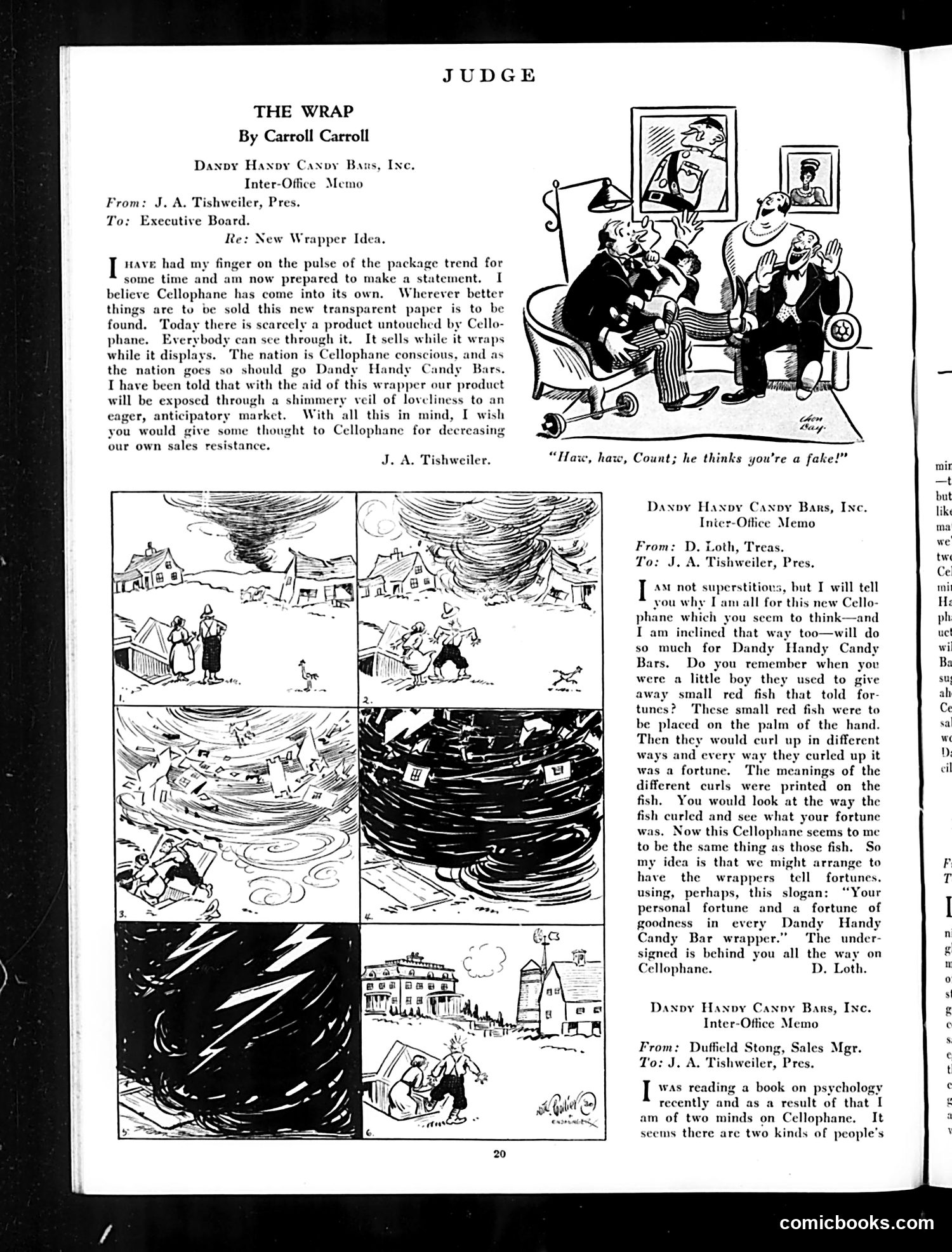
"The Wrap" - Cellophane Packaging Satire This is corporate satire about cellophane as a packaging innovation. In the 1920s-30s, transparent cellophane was revolutionary—allowing consumers to see products before buying them. Judge mocks how executives obsess over this "miracle" material. The cartoon shows company memos about wrapping Dandy Handy Candy Bars in cellophane. President Tishweiler argues it will boost sales by displaying products appealingly. Treasurer Loth compares cellophane to fortune-telling fish toys from childhood, suggesting printing fortunes on wrappers. Sales Manager Stong adds psychological mumbo-jumbo. The accompanying comic strip (by Carroll Carroll) depicts chaotic consequences—apparently showing the wrappers failing or creating problems rather than solutions. The satire targets corporate groupthink: executives enthusiastically embracing a trendy material as a cure-all, each adding increasingly absurd justifications without questioning whether it actually solves anything.
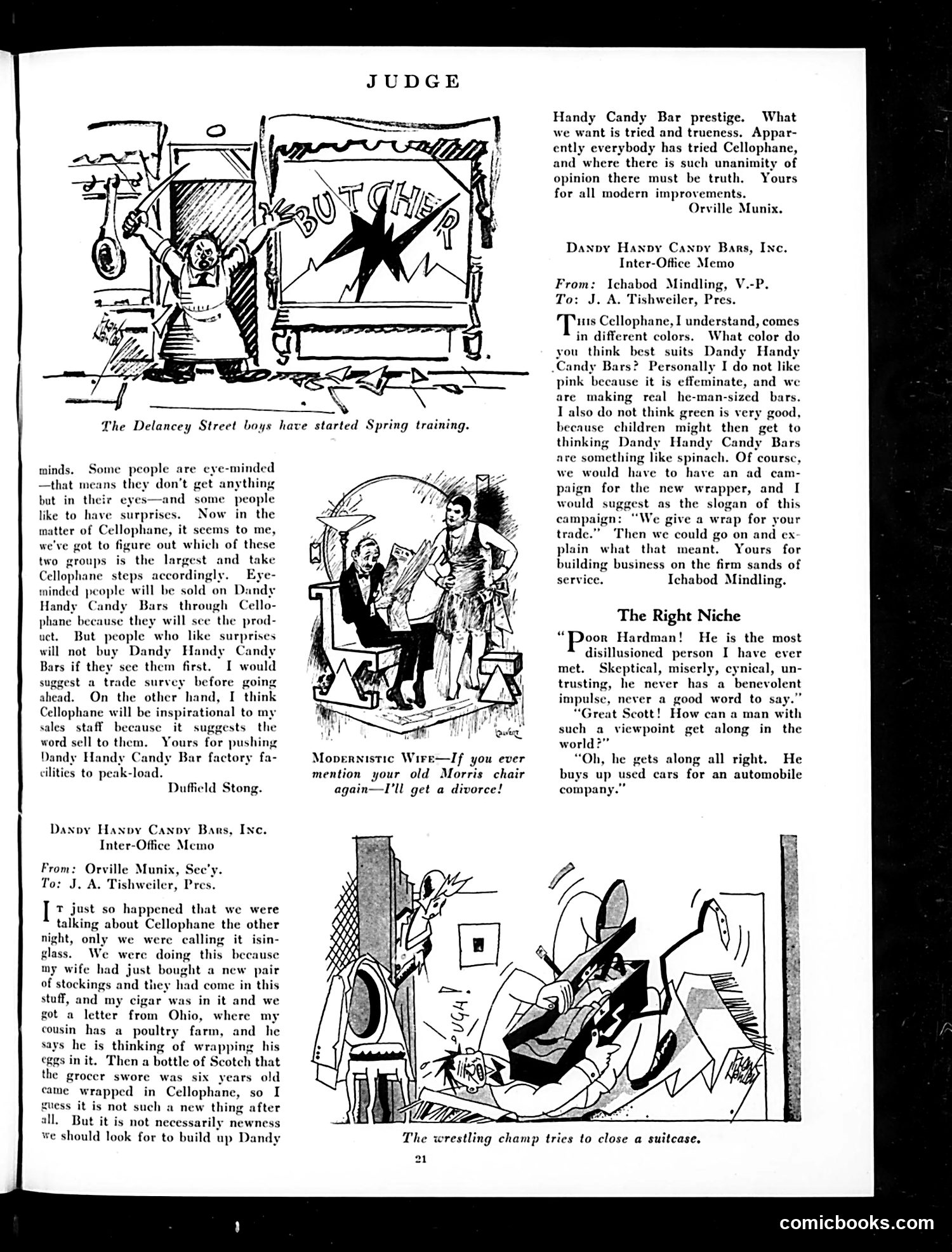
Judge Magazine Page Analysis This page satirizes corporate bureaucracy and advertising through inter-office memos at "Dandy Handy Candy Bars, Inc." The Satire: Multiple executives propose contradictory strategies for marketing candy bars wrapped in the then-novel material "cellophane." One argues cellophane appeals to visual consumers; another worries it will disappoint people who like surprises. A third obsesses over wrapper color, rejecting pink as "effeminate" and green as resembling spinach. Each memo earnestly proposes absurd logic while claiming business wisdom. The Point: Judge ridicules corporate decision-making where executives generate elaborate justifications for minor choices, treating trivial matters with false gravitas. The contradictions and overthinking lampoon how modern business bureaucracy manufactures complexity around simple questions. Additional Content: A cartoon shows "The Delancey Street boys" training in spring, and a brief joke about a modernistic wife threatening divorce over mentioning a Morris chair. A cartoon depicts a wrestler struggling with a suitcase. The page mocks post-industrial corporate culture's tendency toward verbose, circular reasoning.
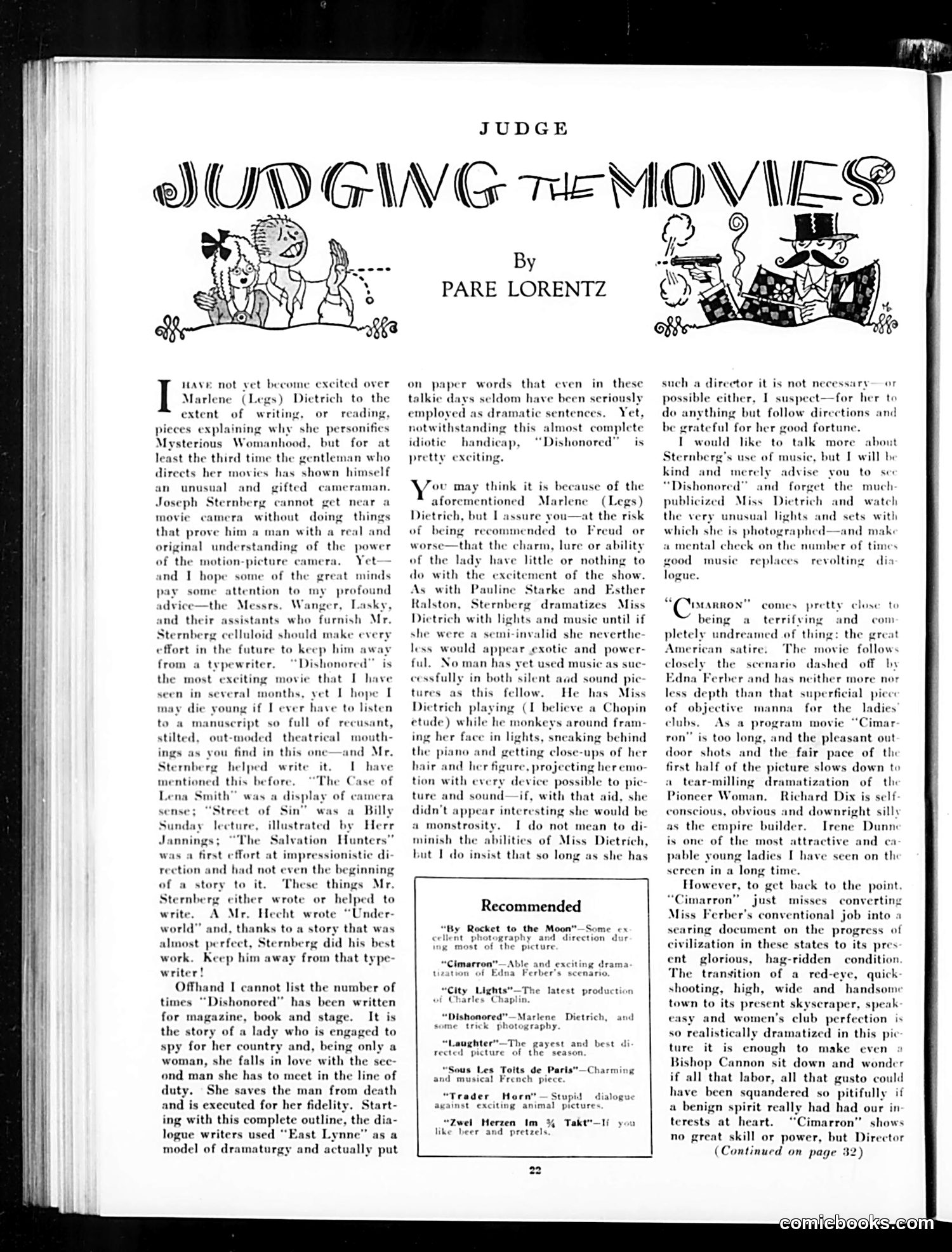
"Judging the Movies" by Pare Lorentz This is a film criticism column, not a cartoon. Lorentz critiques *Dishonored* (1931), starring Marlene Dietrich, praising director Joseph von Sternberg's visual mastery while sharply attacking his screenwriting. The satire: Lorentz argues Sternberg is a genius cinematographer who becomes incompetent when he writes. He urges studio heads (Messrs. Lasky and others) to keep Sternberg away from typewriters. The column contrasts his success with strong source material (*Underworld*) against his failures when he writes original scripts filled with melodramatic clichés. Context: This reflects 1920s-30s debates about silent versus sound film. Lorentz credits Sternberg's use of music and lighting—not Dietrich's glamour—for making even weak plots compelling. The "East Lynne" reference mocks his reliance on Victorian melodrama conventions. The "Recommended" box lists contemporary films, establishing Judge's role reviewing current entertainment for readers.
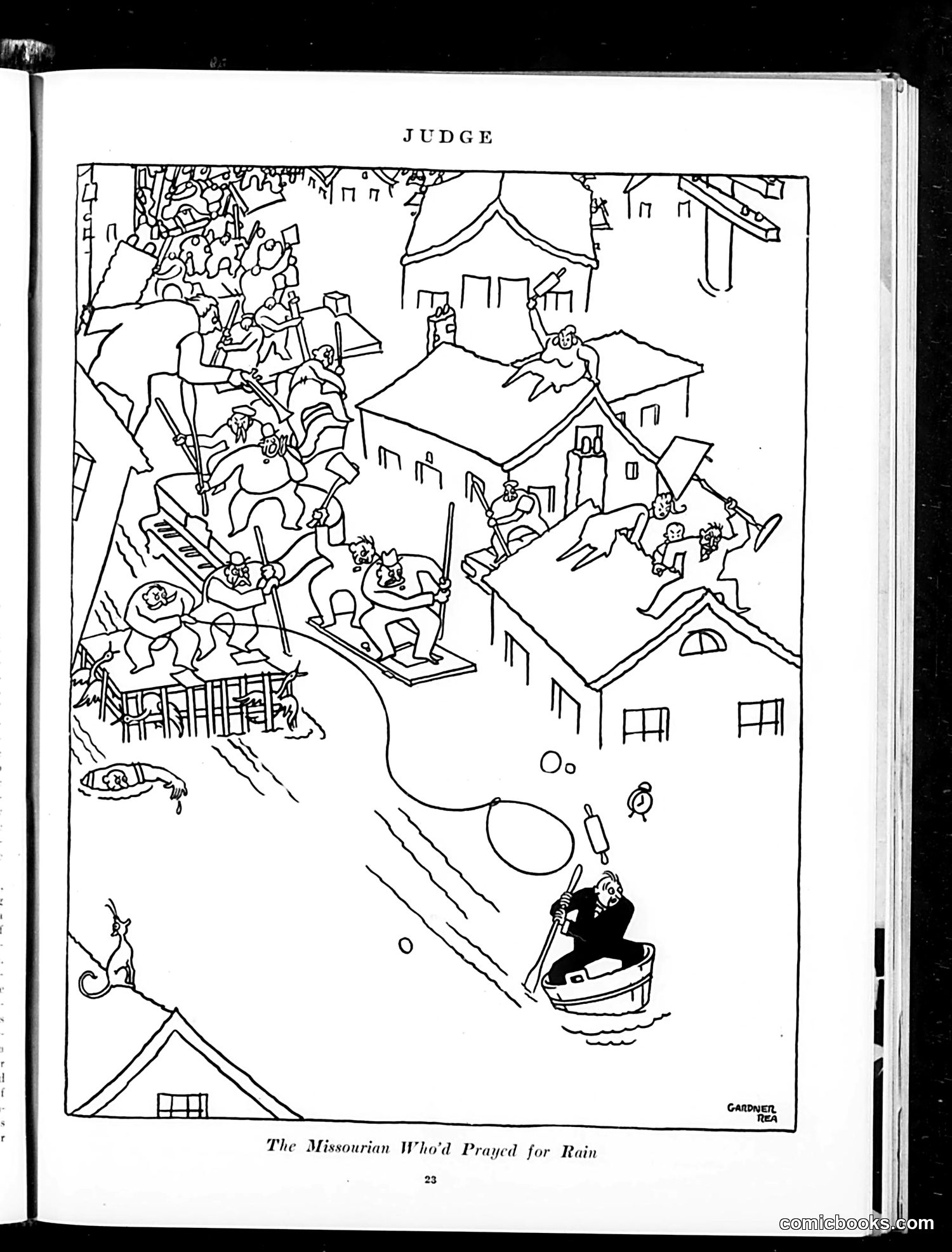
Analysis This Judge magazine cartoon satirizes a "Missourian Who'd Prayed for Rain." The image depicts a rural village during what appears to be severe flooding—the opposite of the desired outcome. The joke operates through ironic reversal: a resident prayed for rain (likely during drought), but received catastrophic flooding instead. The cartoon shows the village submerged with water rising around houses and buildings, while a figure in a boat navigates the disaster. Multiple people are shown on rooftops seeking refuge. The satire targets either the efficacy of prayer during natural disasters or perhaps comments on Midwestern agricultural vulnerability to weather extremes. The exaggerated scale of the flooding emphasizes the unintended consequences—getting literally everything one wished for, but in dangerous excess. This reflects period concerns about agricultural hardship and weather dependency in rural America.
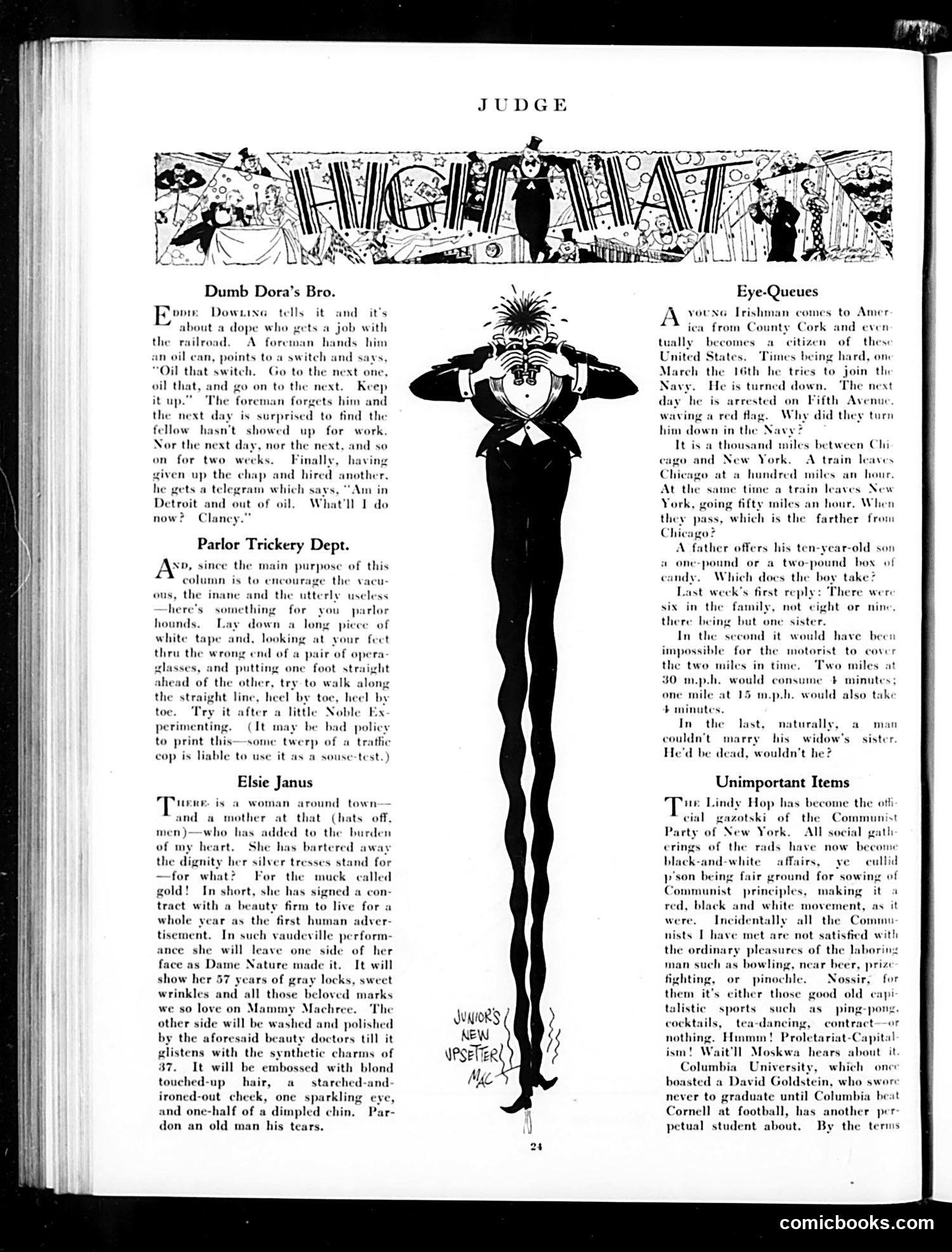
Analysis of Judge Magazine Page This page contains three humor columns typical of 1920s satirical journalism: "Dumb Dora's Bro" mocks a simpleton who literally obeys instructions to oil railroad switches—he oils every switch he encounters and disappears, eventually telegraphing from Detroit asking what to do when he runs out of oil. The humor relies on depicting stupidity as literal-minded incomprehension. "Parlor Trickery Dept" offers a parlor game trick using optical illusion (viewing through wrong end of opera glasses) to make walking a straight line difficult—humor for "vacuous" people, as the text admits. "Elsie Janus" satirizes a 57-year-old woman who contracts with a beauty firm, agreeing to display one natural, aged side of her face versus one artificially rejuvenated side for a year. It's commentary on vanity, aging, and commercialized beauty standards. "Eye-Queues" presents riddle-answers, including an Irish immigrant turned away from Navy recruitment (unclear why), train speed problems, and a widow's-sister marriage paradox. "Unimportant Items" attacks the Lindy Hop's adoption by communists and mocks communist intellectuals' participation in "capitalistic sports."
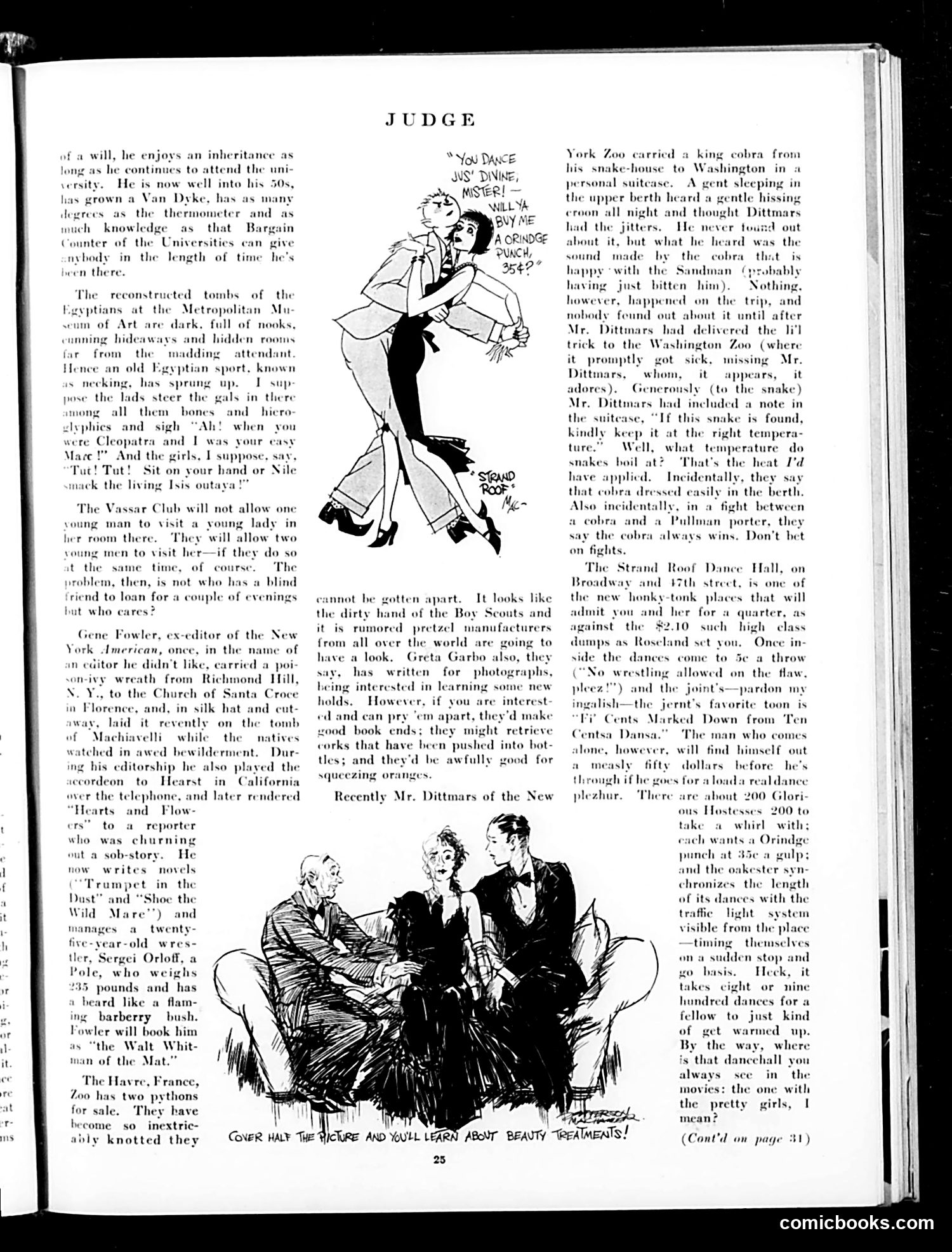
"Judge" Page Analysis This page from the satirical magazine *Judge* contains multiple short humor pieces targeting 1920s social customs and New York institutions. The top cartoon mocks the "No Dancing" rule at upscale venues like the Vassar Club—which allowed two men to visit a woman simultaneously but prohibited one man and one woman alone together. The satire highlights the absurdity of these restrictive social conventions. Other pieces joke about: - Egyptian tombs at the Metropolitan Museum becoming "necking" spots - Gene Fowler's eccentric editorial pranks (delivering a poison wreath to Machiavelli's tomb) - The Strand Roof Dance Hall's affordability versus expensive competitors like Roseland The cobra anecdote appears to be observational humor about Mr. Dittmars (likely William Dittmars, a real zoo director), mocking both the snake's journey and supposed superiority of cobras over Pullman porters in hypothetical confrontations. Overall, the page satirizes Jazz Age social restrictions, institutional pretension, and New York's emerging entertainment venues.
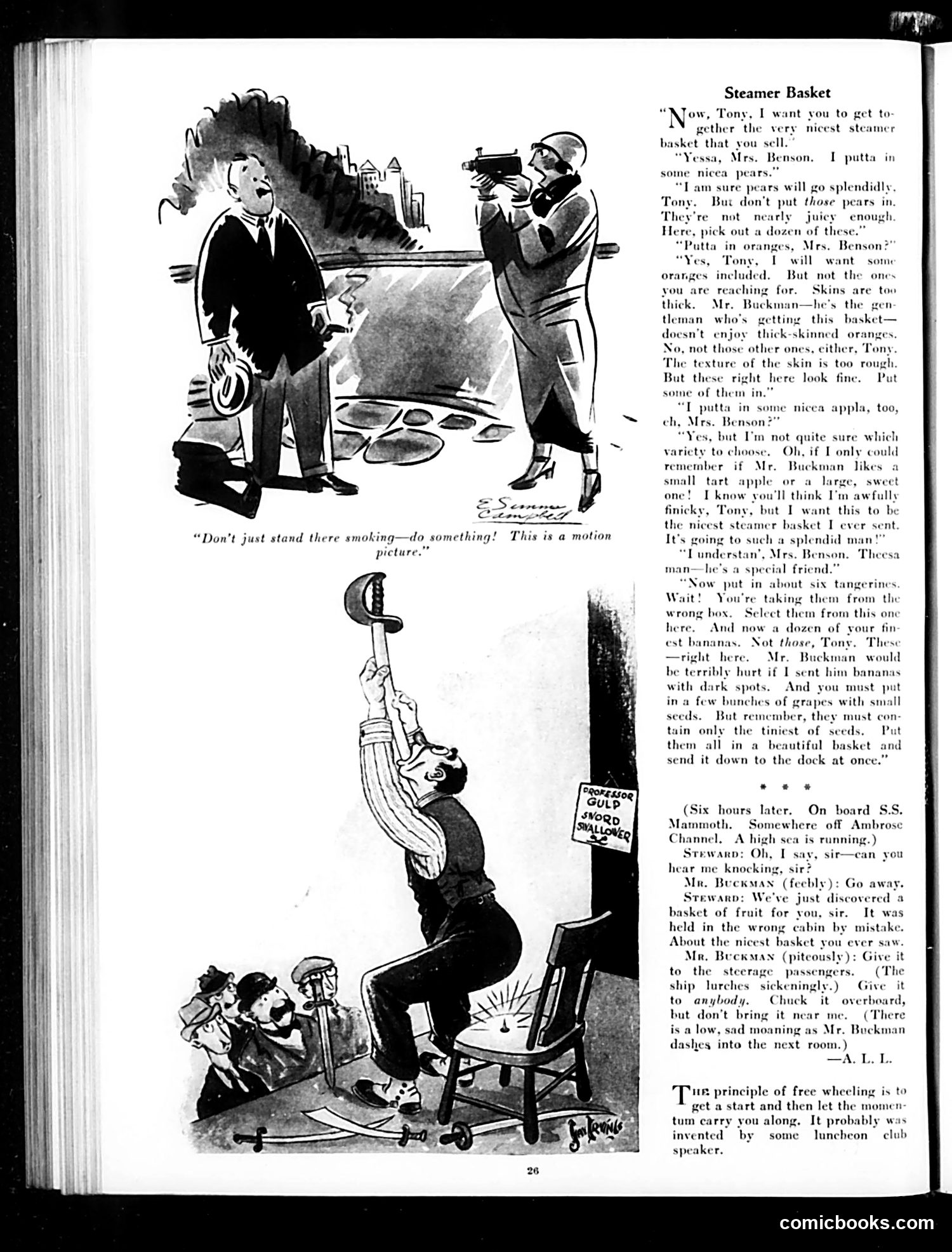
"Steamer Basket" - Judge Magazine This two-part cartoon satirizes wealthy, obsessively fastidious gift-giving. Top panel: Mrs. Benson directs Tony, a fruit vendor, to assemble an elaborate steamer basket for "Mr. Buckman," a "special friend." She hyperbolously rejects produce—pears aren't juicy enough, oranges have thick skins, apples might be the wrong variety. Her excessive pickiness about every detail is the joke. Bottom panel: Six hours later, aboard ship, Mr. Buckman is seasick and miserable. When offered the meticulously curated fruit basket he's apparently been anticipating, he's so ill he demands it be thrown overboard or given away—rendering Mrs. Benson's elaborate effort completely pointless. The satire targets upper-class affectation and the absurdity of anxious gift-giving: all that careful selection and worry produces nothing but ironic waste. The final paragraph about "free wheeling" appears unrelated filler.
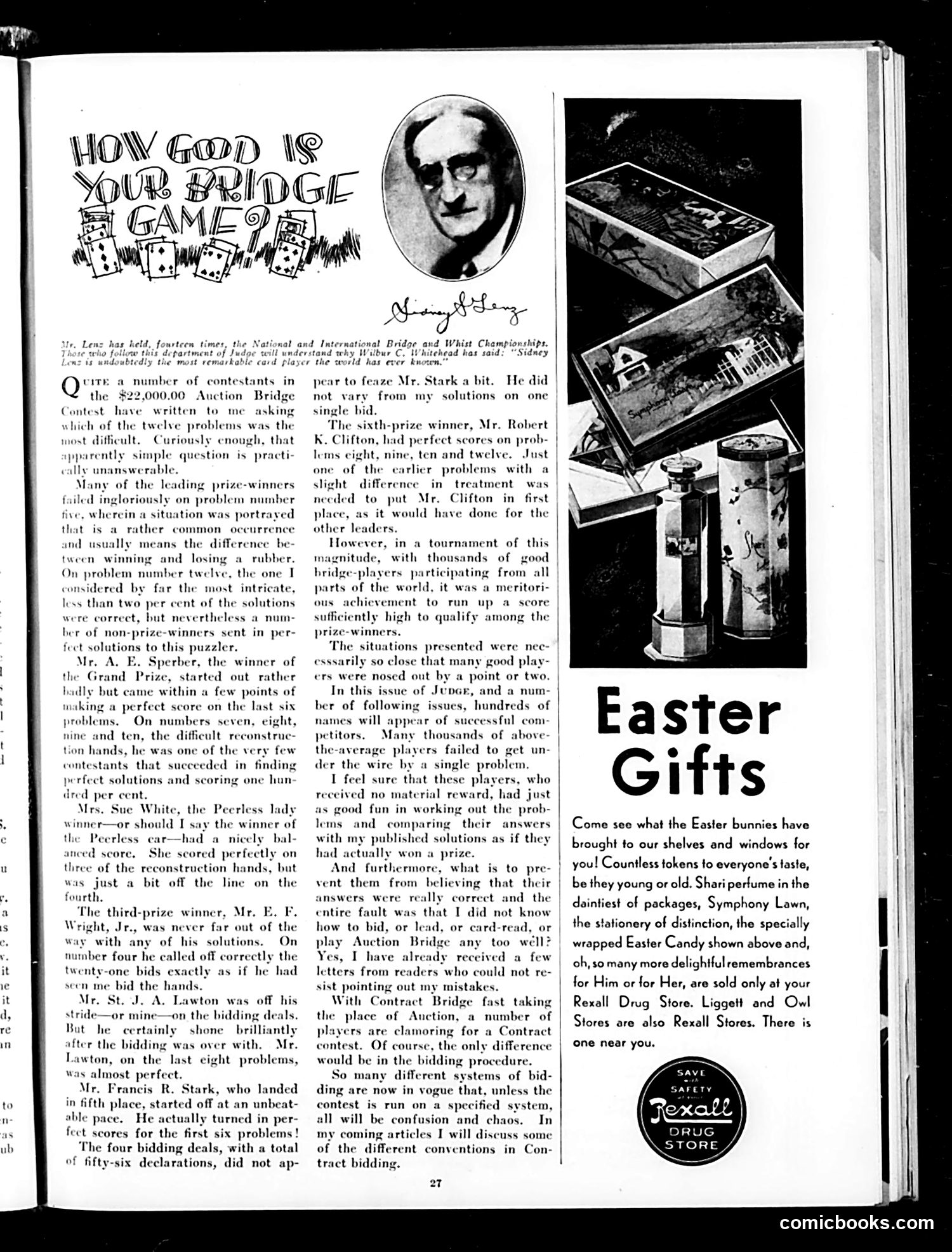
Content Analysis This page is primarily instructional and promotional rather than satirical. It features an article about bridge card game competitions, specifically discussing winners of a "$22,000.00 Auction Bridge Contest" that Judge magazine ran. The text discusses six prize-winners and their performance on twelve bridge problems. Notable winners include A. E. Sperber (Grand Prize), Mrs. Sue White (lady winner), and others. The article analyzes which problems proved most difficult and congratulates participants for their skill. The right side advertises "Easter Gifts" via Rexall Drug Stores, promoting Easter merchandise like candy, perfumes, and stationery. There is no political satire evident on this page. The portrait at top-left appears to be a bridge expert or Judge contributor, but without clearer identification, we cannot determine who. This appears to be a standard Judge magazine page mixing competitive gaming content with advertising.
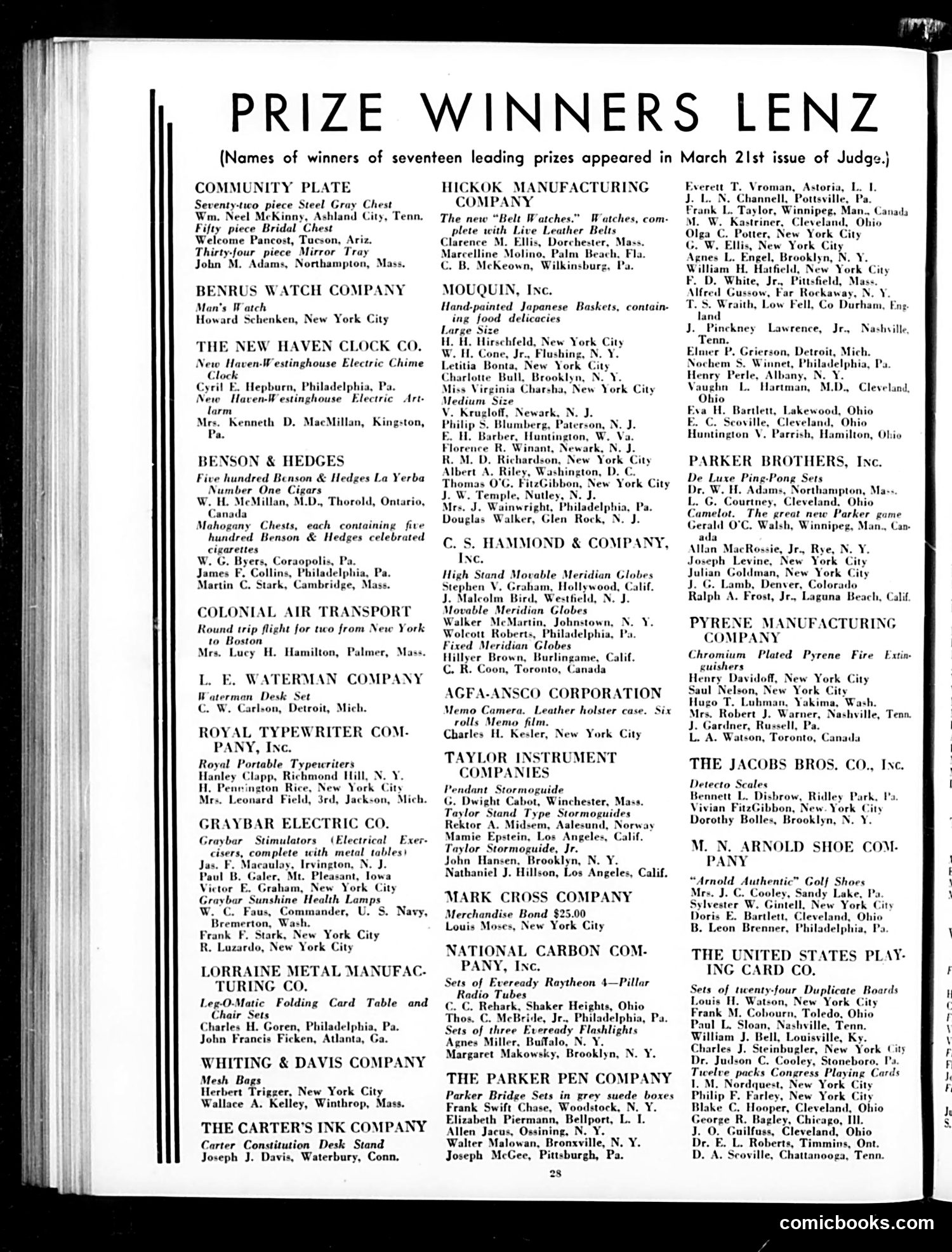
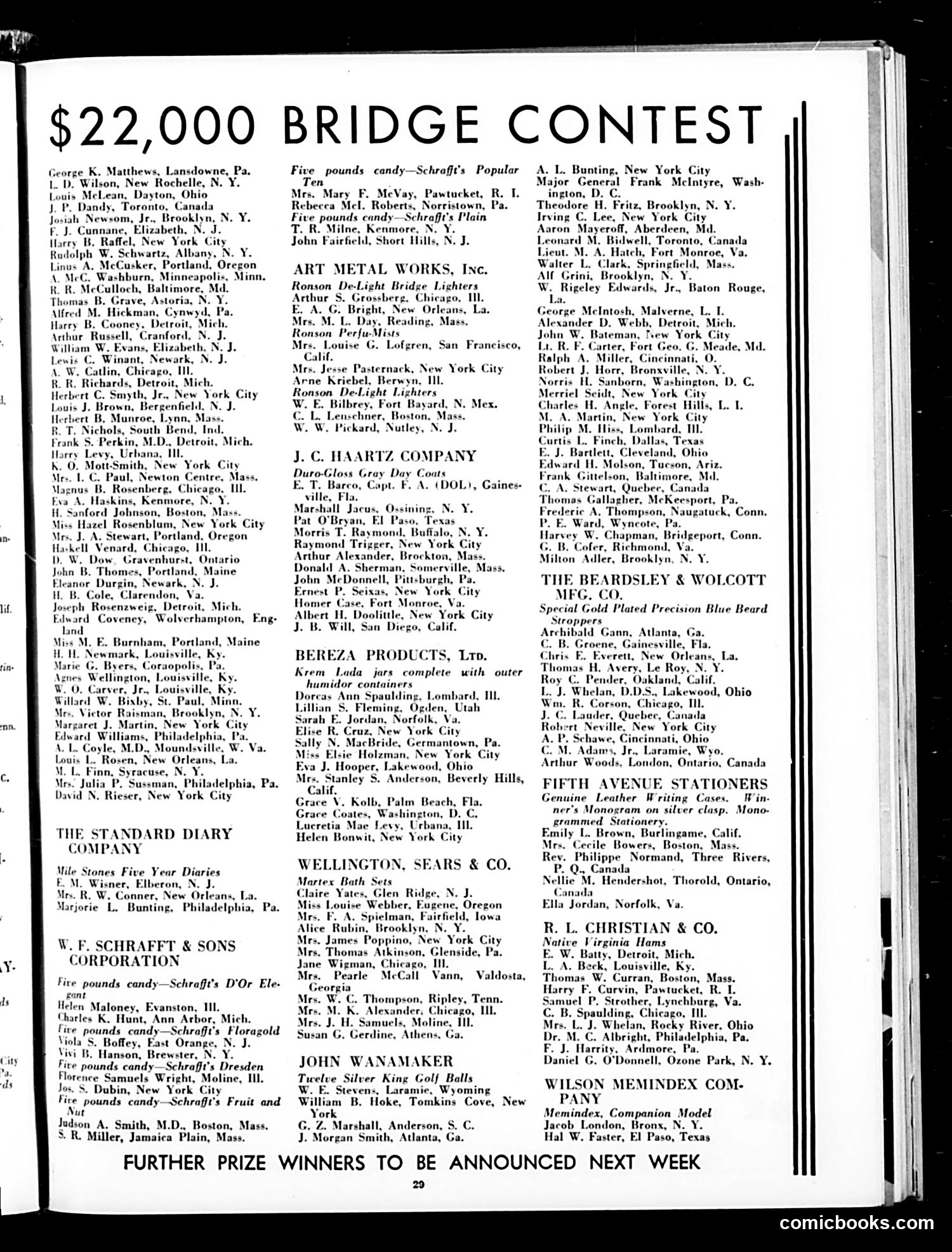
What This Page Shows This is a prize winners list, not a cartoon or satirical content page. Judge magazine published the names of people who won 17 major merchandise prizes in a contest. The winners are organized by company/prize type—ranging from Benrus watches and Royal typewriters to Graybar electrical stimulators and Mouquin Japanese baskets. The prizes themselves reveal early-20th-century consumer culture: desk sets, clocks, cigars, mesh bags, cameras, and health devices. The geographic spread (New York City dominates, but winners span Canada, California, and Norway) suggests a national or international contest. This appears to be administrative/promotional content rather than editorial satire—essentially advertising that also served editorial space. Judge likely ran such contests to boost circulation and advertise products from paying sponsors.
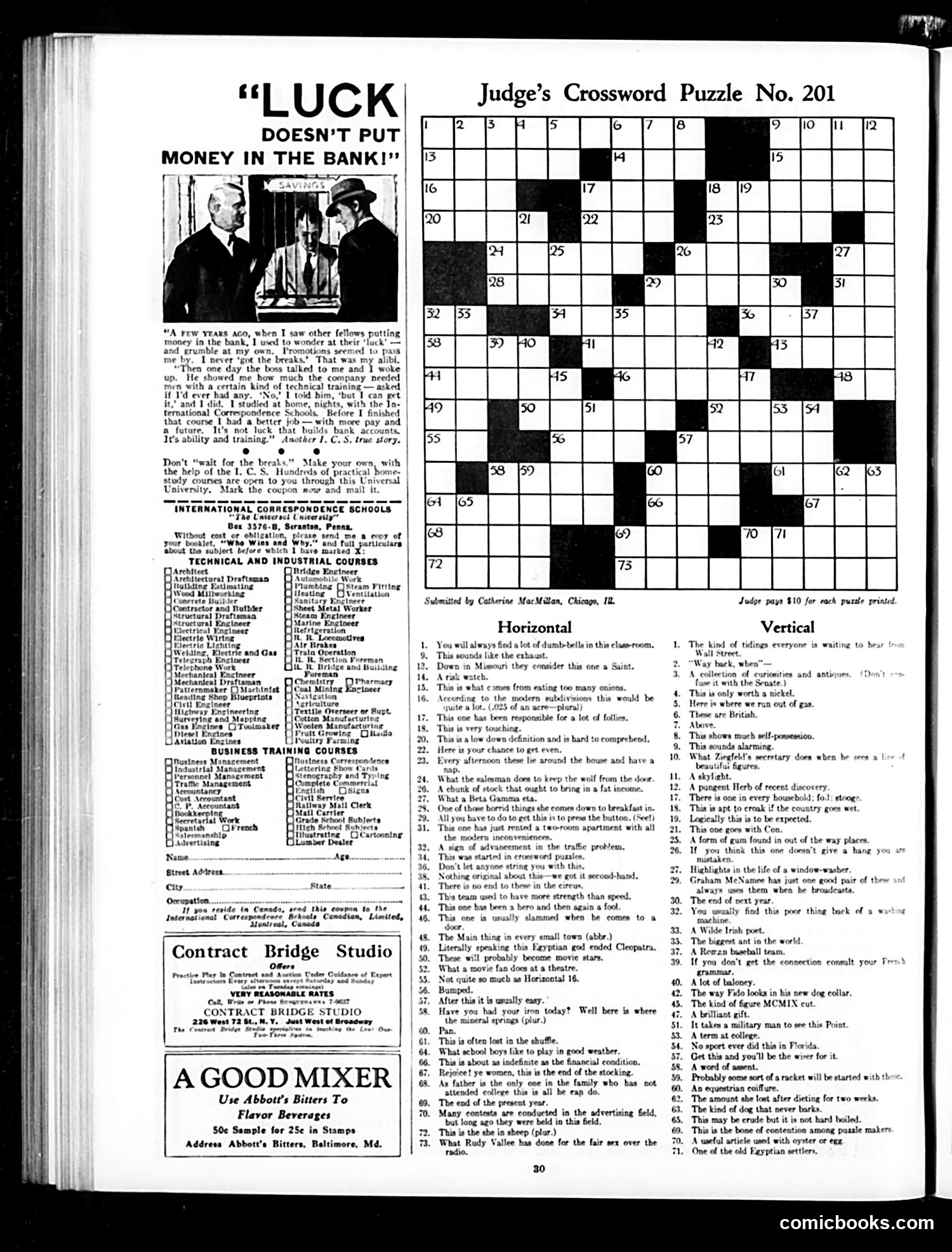
"Luck Doesn't Put Money in the Bank!" — Judge Magazine Satire This page contains a satirical advertisement masquerading as editorial content — a common Judge magazine format. The cartoon shows a banker or boss instructing a working man about financial success. The satire mocks the era's popular self-help mythology: the "I.C.S. true story" narrative claims luck is irrelevant and that success comes purely through individual effort and correspondence-school training. The irony is that Judge magazine, a satirical publication, is presenting this earnest bootstraps rhetoric straight, while the phrase "luck doesn't put money in the bank" itself contradicts the real economy where connections, inheritance, and circumstance mattered enormously. The accompanying International Correspondence Schools ad reinforces this — a company literally profiting by selling hope to working-class men that technical training alone guarantees advancement. The satire suggests this optimistic narrative itself is the "luck" — or delusion — that keeps workers compliant.
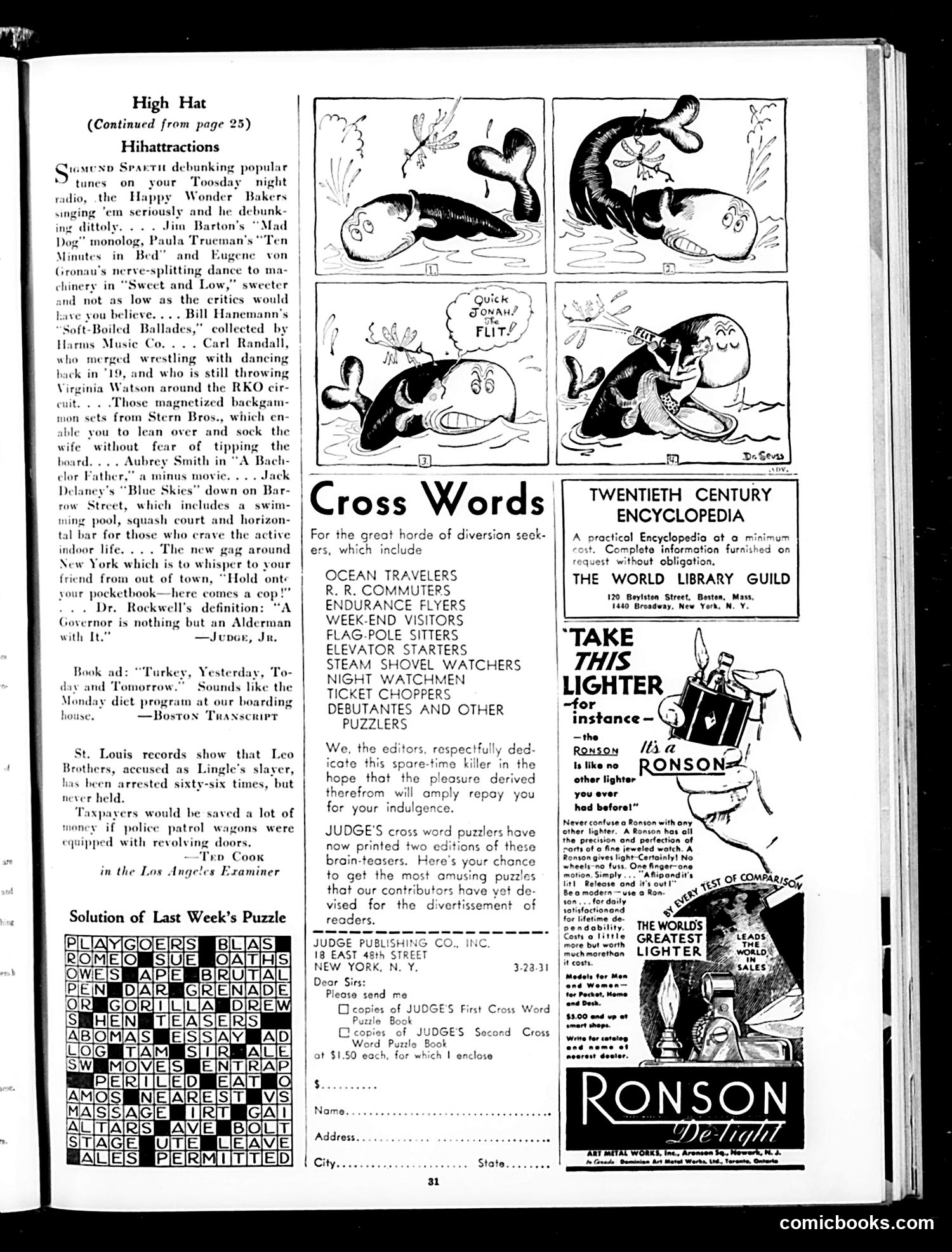
"High Hat" Page Analysis This page from *Judge* magazine contains entertainment commentary, crossword puzzles, and advertisements—primarily advertising rather than political satire. The "High Hat" section reviews 1920s-30s radio programs and entertainment acts, including popular performers and novelty acts. References like "flag-pole sitters" and "elevator starters" allude to Depression-era fad competitions for public attention and money. The cartoon panels (credited "Dr. Seuss") depict slapstick physical comedy with anthropomorphic characters—typical of the era's humor style. Social commentary appears in brief quips: a joke about Leo Brothers (appears to reference a real arrest record), and cracks about police inefficiency and taxi-related corruption—reflecting contemporary urban complaints. The advertisements promote the *Ronson* lighter and encyclopedias, standard commercial content. The crossword puzzle section demonstrates *Judge's* popular puzzle offerings for readers seeking "diversion"—entertainment during economically difficult times. Overall: a snapshot of 1930s American popular culture and middle-class entertainment preferences.
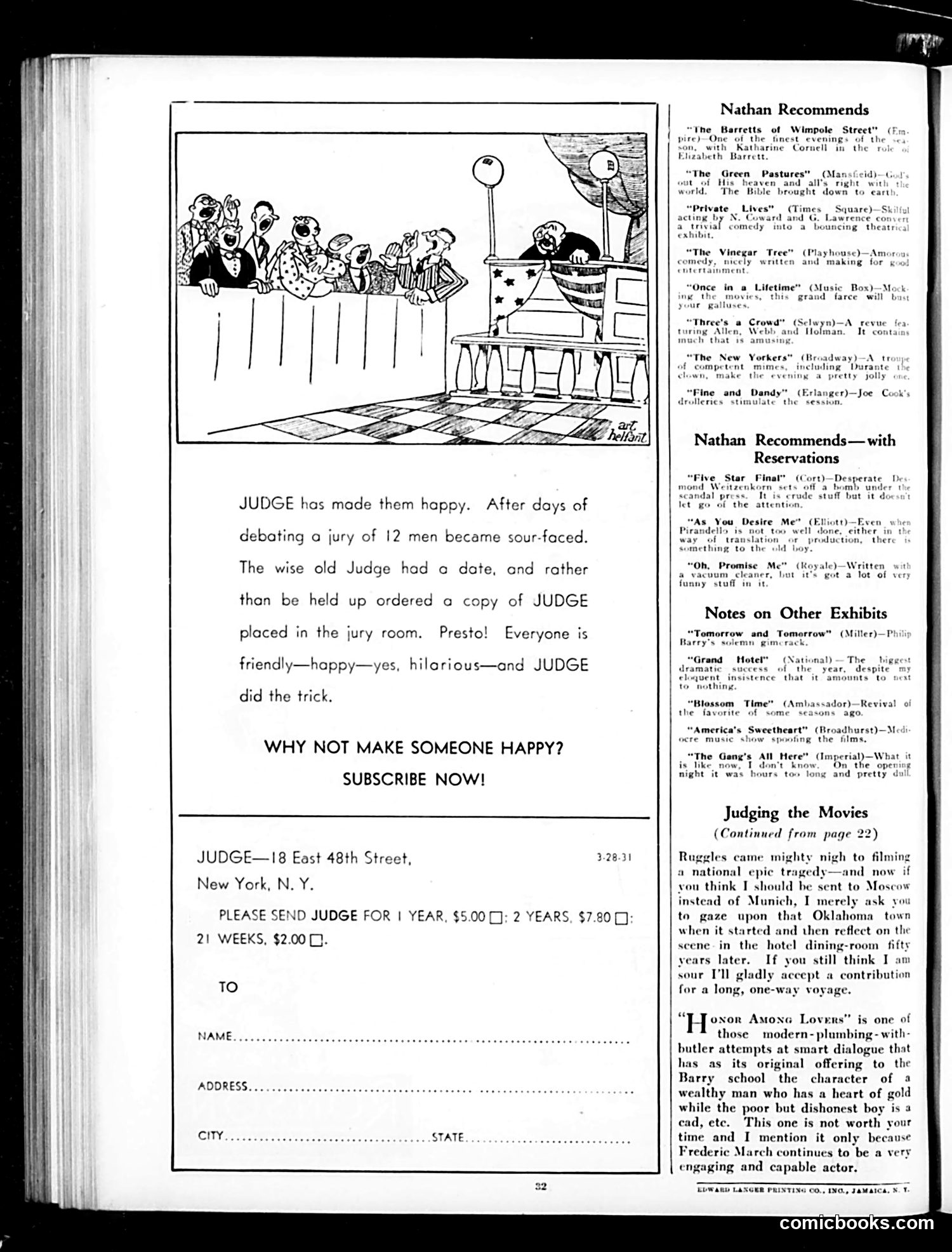
Judge Magazine Advertisement (circa 1930s) This page is primarily a subscription advertisement for *Judge* magazine itself, disguised as humorous editorial content. The cartoon depicts a jury deadlocked in deliberation—angry and argumentative. The "wise old Judge" (the judicial officer) solves the problem by having a copy of *Judge* magazine placed in the jury room. The result: everyone becomes cheerful and agreeable. The satire: This is self-promotional mockery. *Judge* claims its own magazine is so entertaining it can transform bitter, contentious people into happy ones. It's a tongue-in-cheek advertisement suggesting that subscribing to *Judge* will improve one's mood and social life—"Why Not Make Someone Happy? Subscribe Now!" The right column contains theater reviews by drama critic Nathan (likely George Jean Nathan), which serves as editorial content alongside the advertisement. Context for modern readers: This reflects an era when magazines were primary entertainment and *Judge* positioned itself as essential reading for making life pleasant.
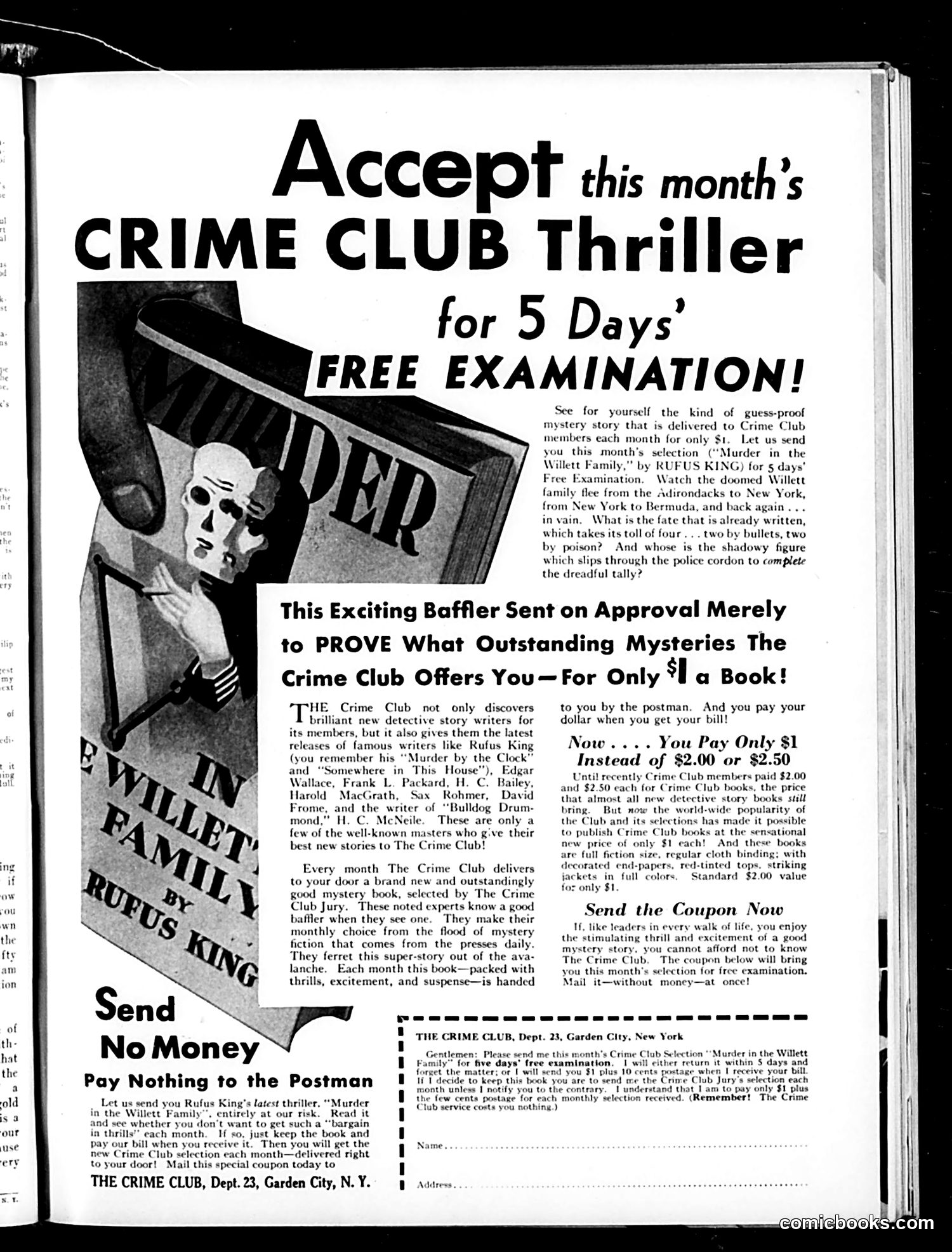
Crime Club Advertisement Analysis This page is primarily a book club advertisement, not satire or political commentary. It promotes "The Crime Club," a mail-order mystery book subscription service offering monthly selections for $1 (reduced from $2.00-$2.50). The ad features an image of a book titled "Murder in the Willett Family" by Rufus King—the current month's featured selection. The advertisement emphasizes the club's appeal by listing respected mystery writers of the era (Edgar Wallace, H.C. Bailey, Sax Rohmer) and promises readers "guess-proof" mysteries with thrilling plots. The key marketing pitch: readers can examine the book free for 5 days, then pay only $1 if they keep it—no upfront payment required. The ad stresses affordability and convenience, positioning the Crime Club as accessible to ordinary middle-class readers who enjoy detective fiction. This reflects 1930s-era direct mail marketing and the popularity of mystery/detective fiction during that period.
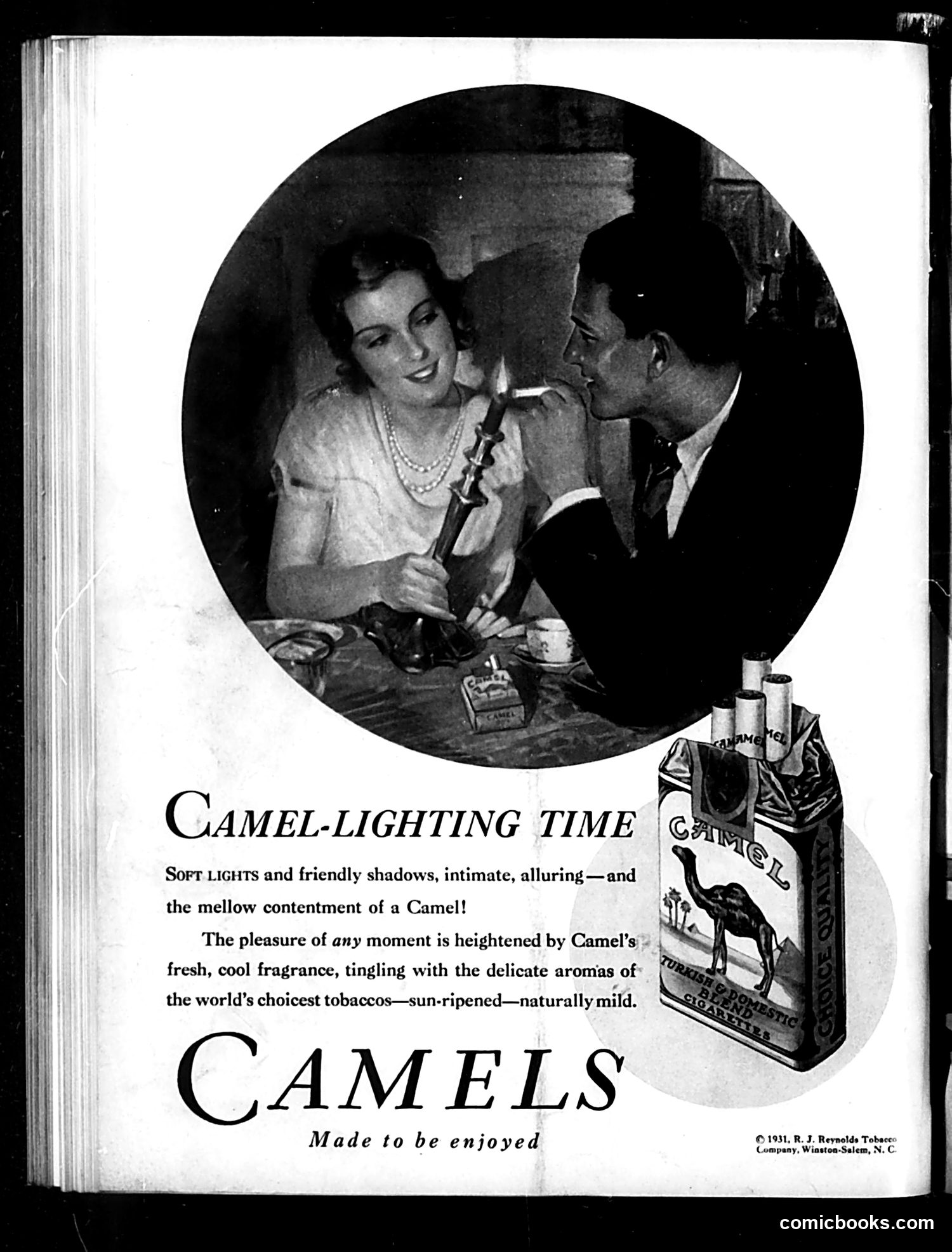
Analysis This is a cigarette advertisement, not satire or political commentary. The page shows a Camel cigarettes ad from 1931 featuring a romantic scene: a woman and man in formal attire sharing an intimate moment while lighting cigarettes. The copy emphasizes lifestyle appeal—"soft lights and friendly shadows, intimate, alluring"—using romance and elegance to market the product. The tagline "Made to be enjoyed" and descriptions of "fresh, cool fragrance" and "naturally mild" tobacco were standard advertising claims of the era. This represents the pre-regulation tobacco industry's aggressive marketing, when cigarette companies freely used glamorous imagery and health claims in publications. By modern standards, this advertisement would be prohibited; today we recognize such marketing as having deliberately targeted consumers through aspirational lifestyle imagery rather than product merit.