judge
Judge — April 11, 1931
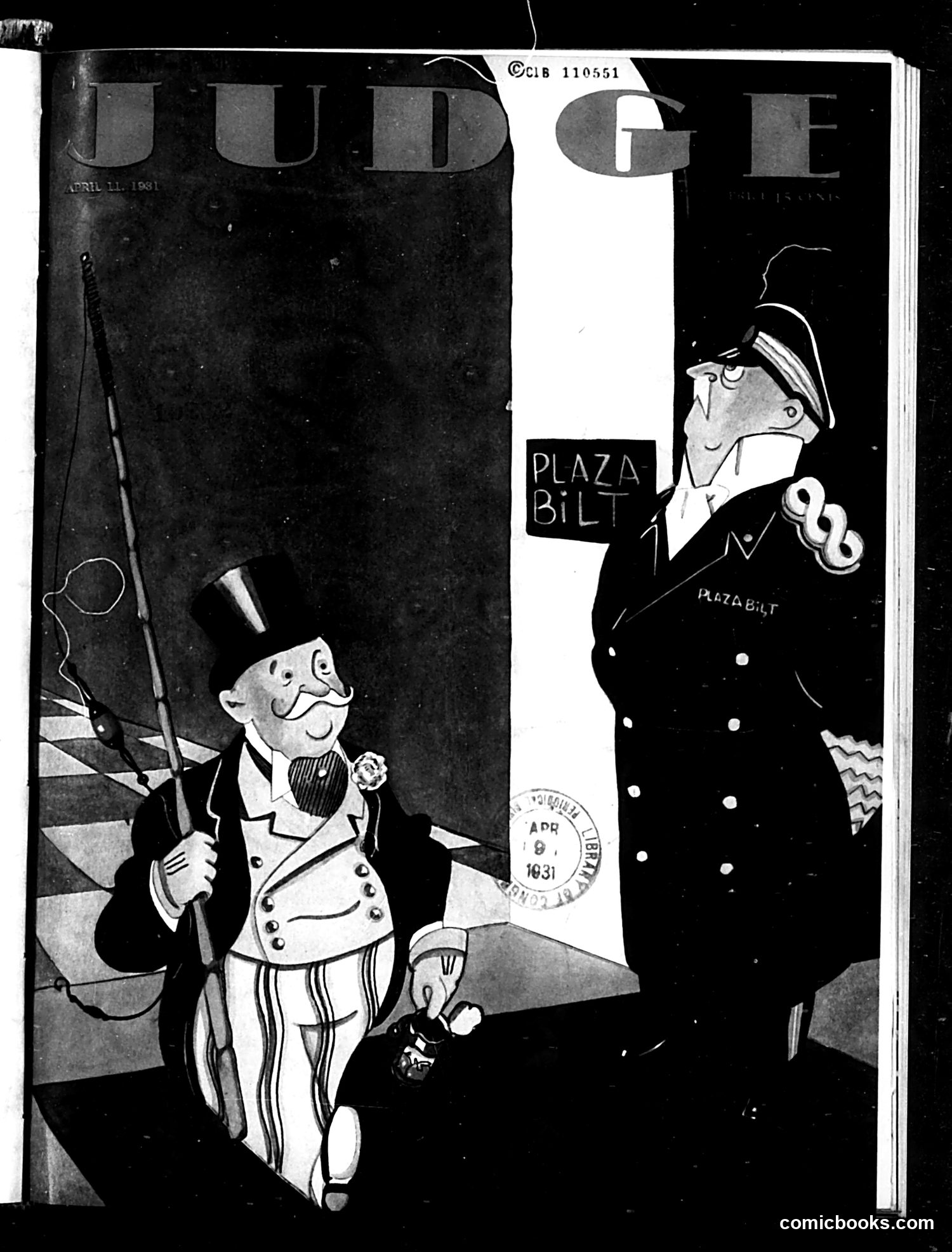
Judge Magazine Analysis - April 11, 1931 This is a satirical cartoon from *Judge* magazine's April 1931 issue, featuring two caricatured gentlemen in formal attire labeled "PLAZA BILT" (likely referencing the Plaza Hotel). The cartoon appears to satirize wealthy Manhattan socialites or hotel patrons during the Great Depression. Both figures display exaggerated facial features typical of 1930s caricature style. One holds a fishing rod, suggesting leisure and idle wealth while ordinary Americans struggled economically. The "PLAZA BILT" label repeated twice suggests mockery of the hotel's exclusivity or the pretensions of its wealthy clientele who remained insulated from Depression hardships. The juxtaposition of frivolous leisure activities with the economic crisis context makes this pointed social satire about class inequality during the nation's financial emergency.
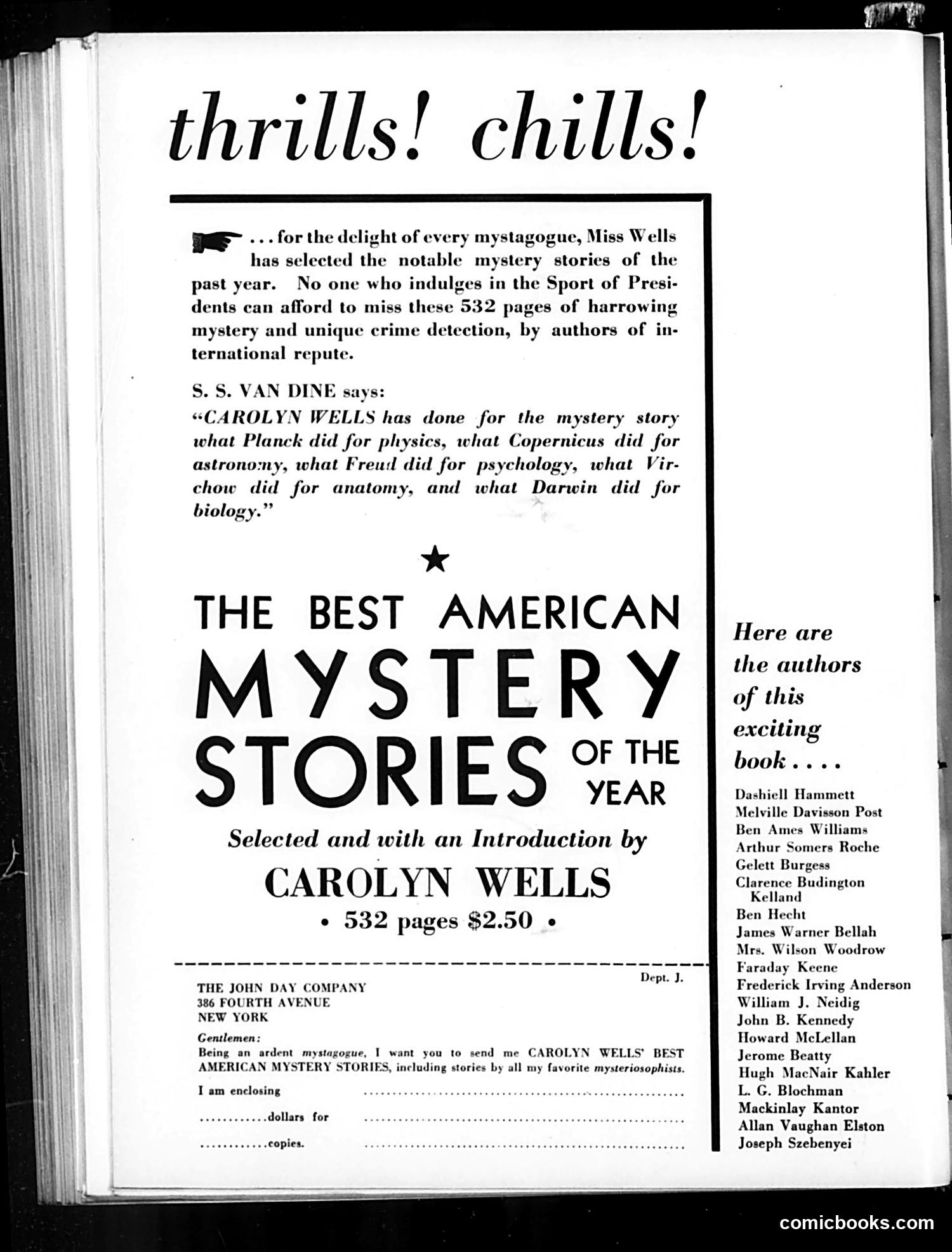
Analysis This page is primarily an advertisement, not satirical content. It promotes "The Best American Mystery Stories of the Year," a 532-page anthology selected by Carolyn Wells, priced at $2.50 and published by The John Day Company. The ad emphasizes the book's prestige through a quote from S.S. Van Dine comparing Wells's contribution to the mystery genre with major scientific figures (Planck, Copernicus, Freud, Darwin, Virol, etc.). A list of contributing authors—including Dashiell Hammett, Ben Hecht, and others—establishes literary credibility. The only potentially satirical element is the opening phrase "thrills! chills!"—typical hyperbolic advertising language that Judge readers might find mockingly overwrought. Otherwise, this is straightforward commercial promotion in a satirical magazine.
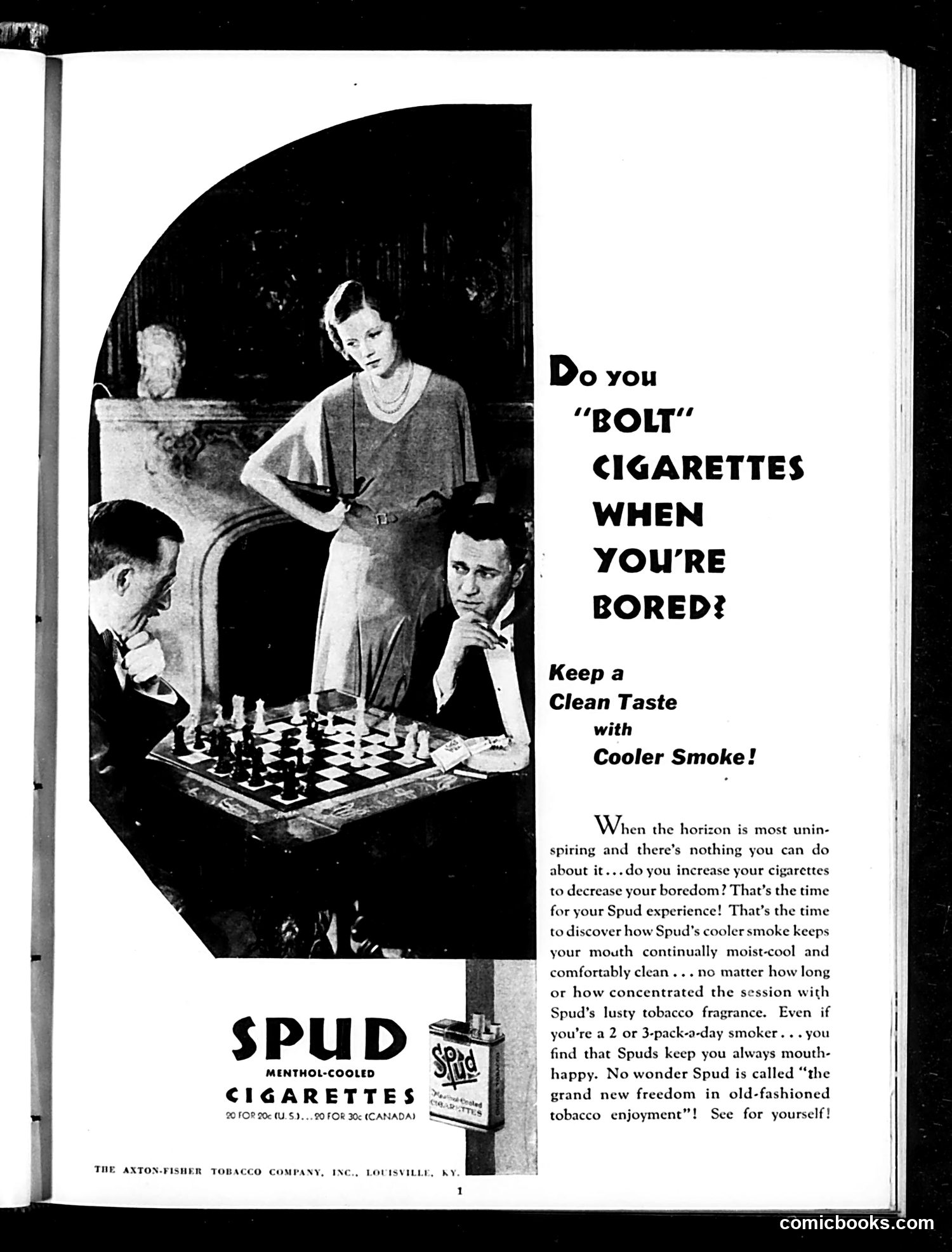
Analysis This page is not a political cartoon or satirical content—it's a cigarette advertisement for Spud brand menthol cigarettes from The Axton-Fisher Tobacco Company (Louisville, Kentucky). The ad uses a social scene showing four people playing chess to suggest that Spud cigarettes provide relief from boredom. The copy promises "cooler smoke" and a "clean taste" while smoking heavily. It explicitly encourages increased cigarette consumption during tedious moments. By modern standards, this advertisement is striking for its casual promotion of heavy smoking as a cure for monotony, with no health warnings. The gendered social setting and lifestyle marketing were typical mid-20th-century cigarette advertising tactics, now recognized as manipulative and harmful.
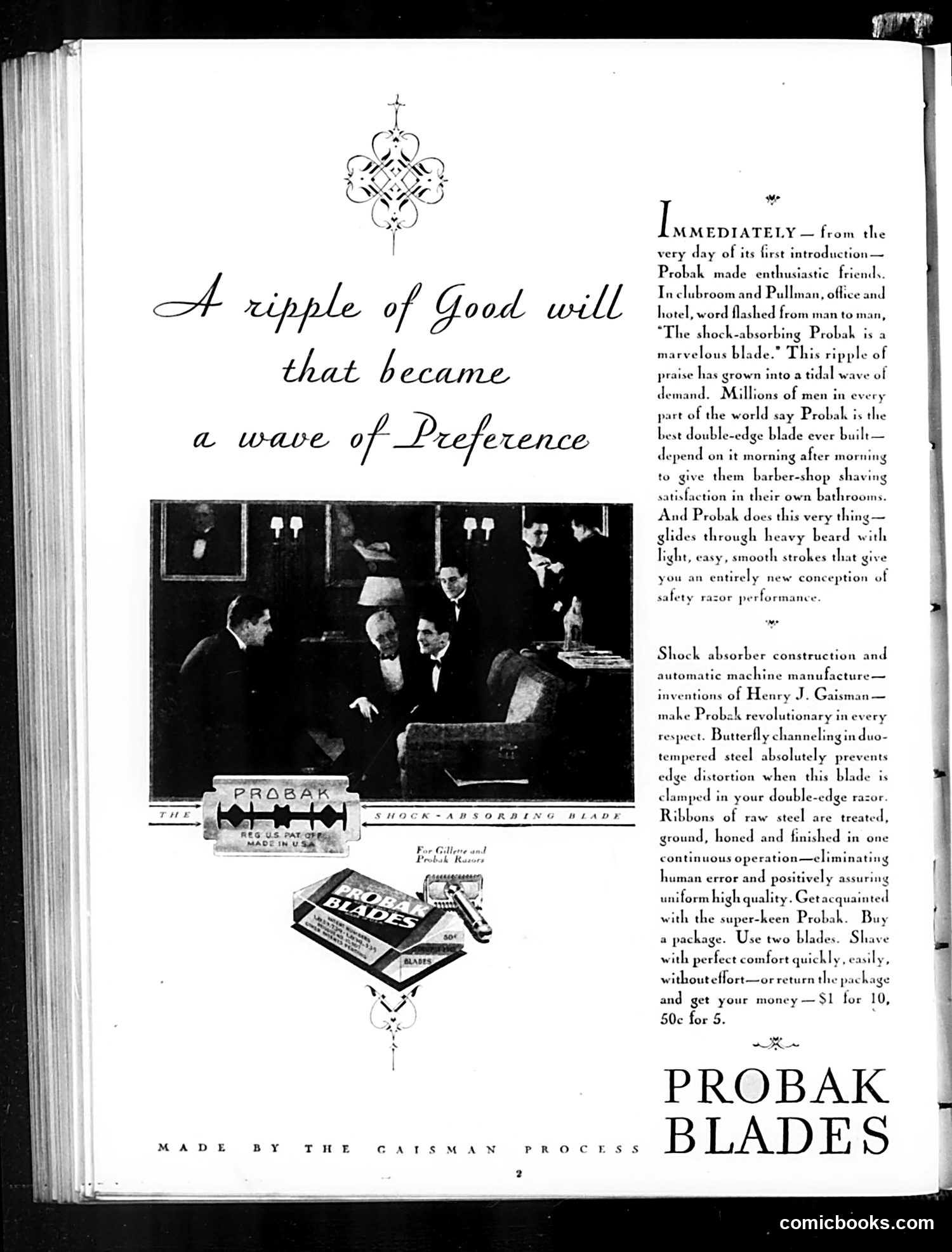
Probak Blades Advertisement This page is primarily a commercial advertisement, not political satire. It promotes Probak razor blades, a real product manufactured using the Gaisman Process. The advertisement uses a scene depicting businessmen in what appears to be a clubroom or office setting to establish credibility and aspirational appeal. The text emphasizes the blade's revolutionary "shock-absorbing" design and claims it became widely preferred among men for daily shaving. The ad promises ease, comfort, and safety while shaving, and offers a money-back guarantee ("return the package and get your money — $1 for 10, 50c for 5"). This reflects early 20th-century advertising strategy: using professional, respectable male figures to market personal grooming products to middle-class consumers.
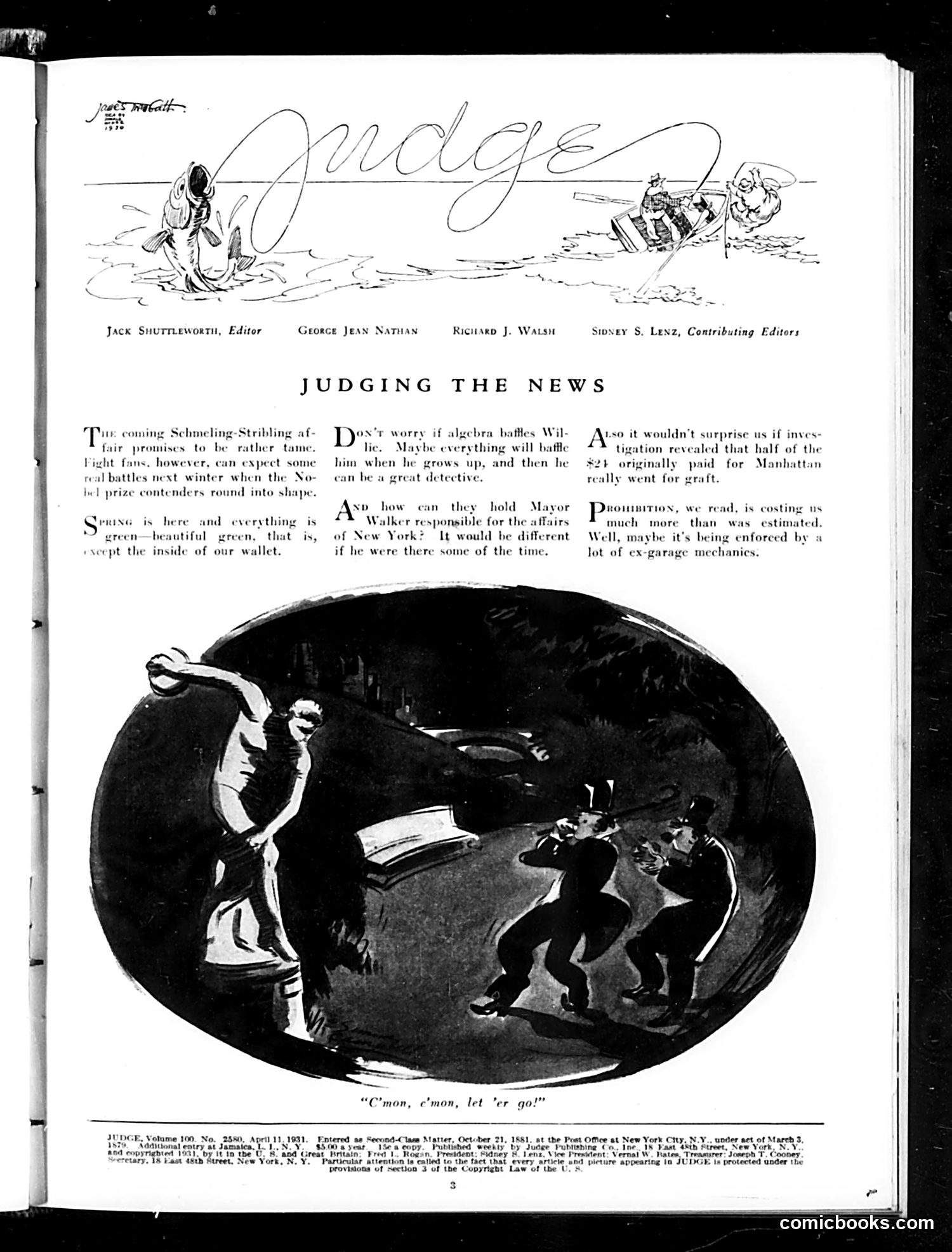
"Judge" Magazine Commentary Page - April 13, 1931 This page features editorial commentary titled "Judging the News." The brief text snippets offer satirical takes on contemporary issues: - A comment about the Schmeling-Stribling boxing match being "tame" - Observations on spring weather and its effect on wallets - Skepticism about Detective Willie (likely a public figure) solving New York's affairs - A jab at Prohibition's costs, suggesting it's being enforced by "ex-garage mechanics" The main cartoon below depicts a scene in darkness with figures and the caption "'C'mon, c'mon, let 'er go!'" The specific reference is unclear without additional context, but likely satirizes a contemporary news event or political situation from early 1931. The page represents *Judge*'s typical format: mixing short editorial quips with illustration.
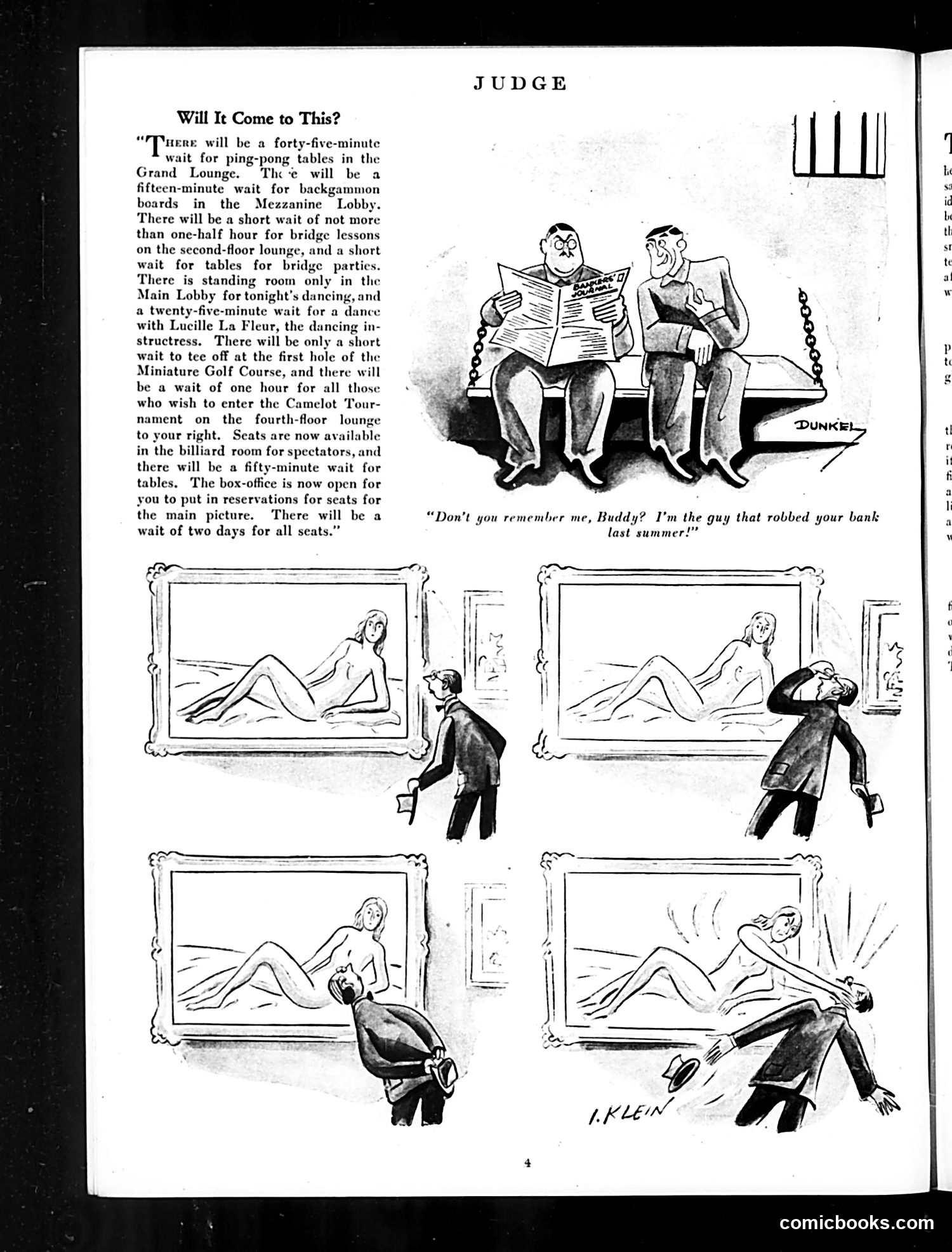
Analysis of "Will It Come to This?" The top cartoon shows two men on a swing reading a newspaper, with one asking, "Don't you remember me, Buddy? I'm the guy that robbed your bank last summer?" This references the prevalence of bank robberies during this era, satirizing how criminals might casually encounter their victims in public spaces. The four-panel comic strip below depicts men viewing nude paintings in what appears to be a gallery or art exhibition. Each panel shows a man's increasingly dramatic reaction to the artwork—from casual viewing to apparent shock or distress. The satire mocks prudish reactions to artistic nudity, suggesting hypocrisy in public attitudes toward art depicting the human form. The overall page satirizes social anxieties and behavioral contradictions of the era.
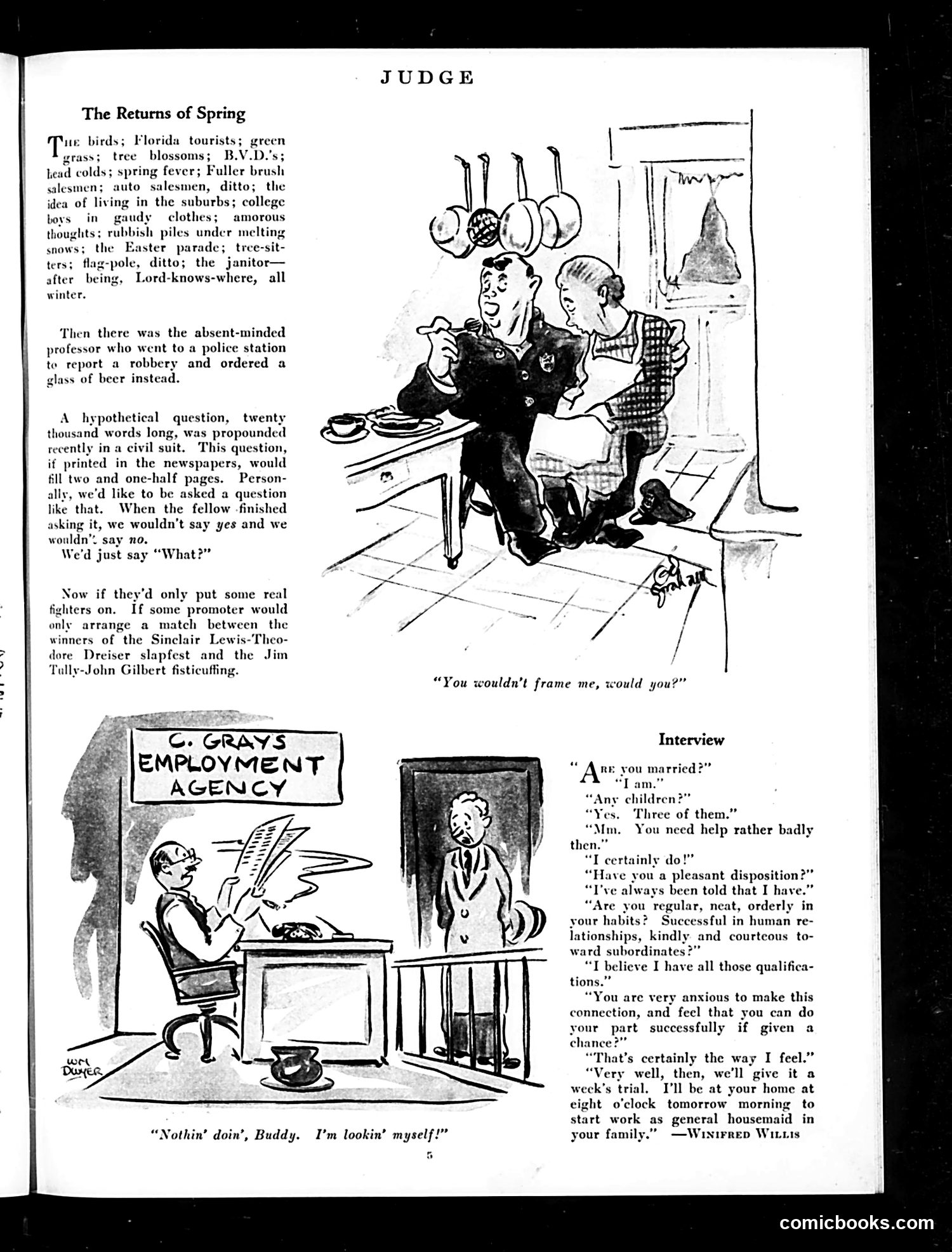
Analysis of Judge Magazine Page "The Returns of Spring" (top cartoon): A satirical piece listing spring's return signs—birds, tourists, grass—ending with absurdist items like "rubbish piles under melting snows" and "the janitor after being, Lord-knows-where, all winter." The accompanying cartoon shows two men at a restaurant table with hanging pans; one asks "You wouldn't frame me, would you?" The joke appears to reference either a robbery or romantic entanglement, playing on period slang where "frame" means to falsely incriminate someone. "C. Gray's Employment Agency" (bottom): Shows a clerk interviewing a prospective housekeeper. The dialogue reveals she's married with three children, has poor disposition, and is being offered work as "general housekeeper." The humor lies in the absurdity—she appears completely unqualified, yet the agency proceeds anyway. Both cartoons satirize everyday incompetence and poor judgment.
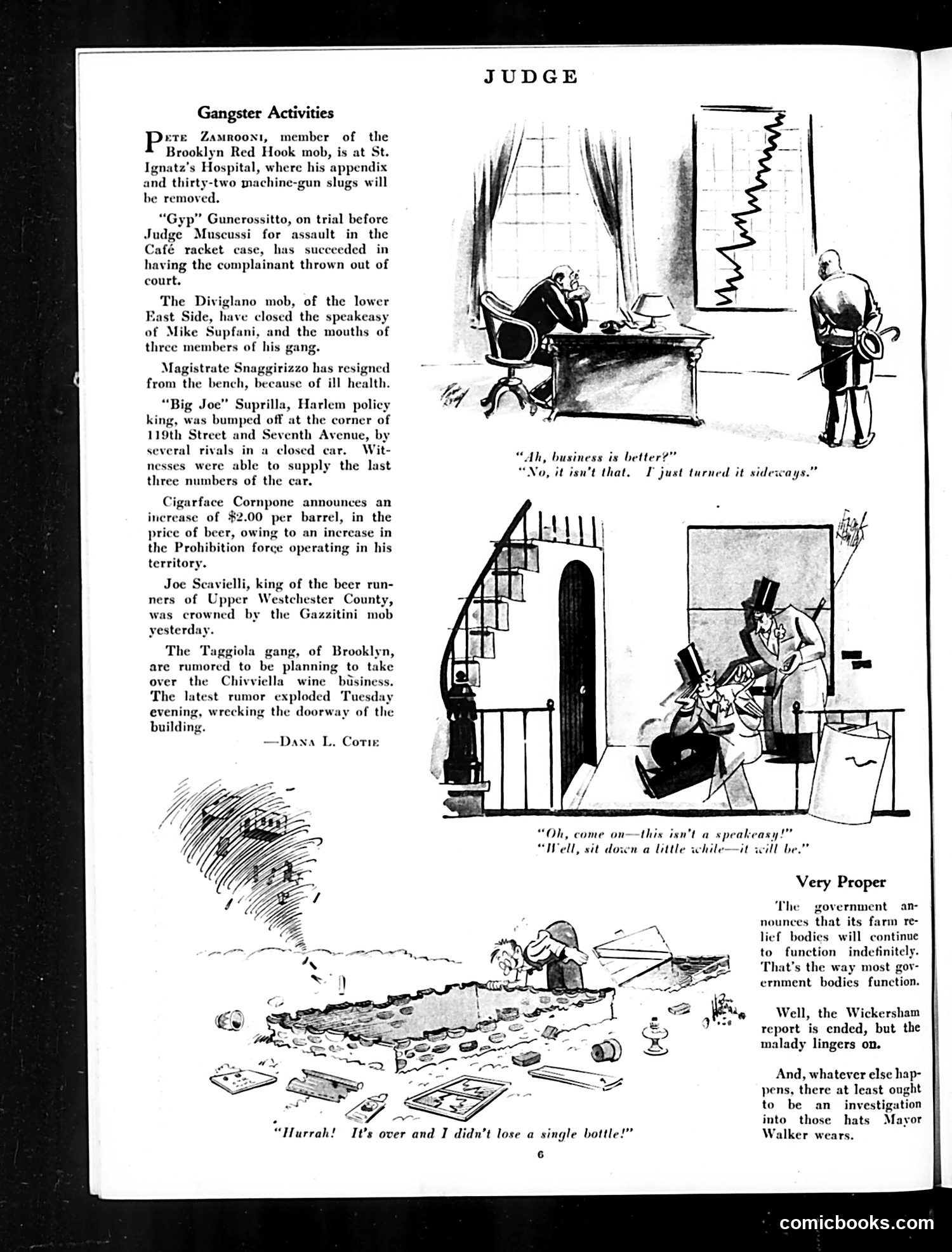
Analysis of Judge Page This page contains satirical commentary on Prohibition-era organized crime and government ineffectiveness. The top section ("Gangster Activities") reports on mob violence—assault cases, speakeasy closures, and murders—with dark humor. The cartoons illustrate the absurdity: judges conducting business while gangsters operate openly; a speakeasy disguised as legitimate premises; and a bootlegger proudly displaying undamaged bottles after a raid ("Hurrah! It's over and I didn't lose a single bottle!"). The "Very Proper" section mocks government farm relief bodies that "function indefinitely"—bureaucratic waste. The final jab questions Mayor Walker's hat spending while crime flourishes. The satire's point: Prohibition created profitable crime while authorities proved impotent. Government agencies persist uselessly while actual problems (gangsterism, corruption) go unaddressed.
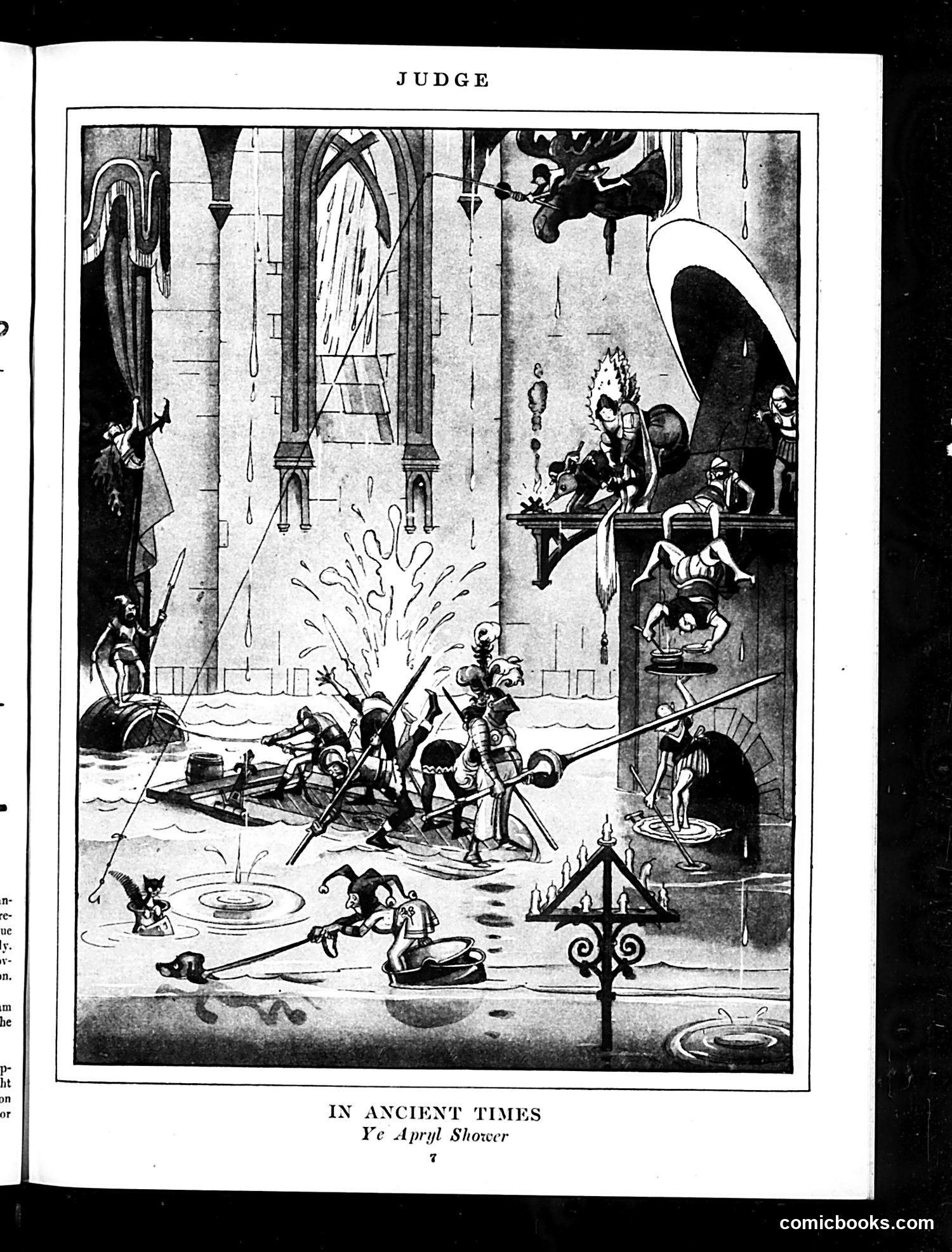
"In Ancient Times: Ye Apryl Shower" This Judge magazine cartoon depicts a medieval cathedral scene during an April rainstorm, playing on the phrase "April showers." The illustration shows tiny armored figures engaged in battle or chaos within and around a grand Gothic church, with rain falling heavily and water pooling on the ground. The satire appears to be a visual pun: rather than the gentle "April showers" of spring that "bring May flowers," this literally depicts violent chaos and destruction during rainfall in "ancient times." The medieval setting and warfare suggest mock-historical humor, treating the proverbial spring weather phenomenon as if it were an actual calamity worthy of historical record. The joke relies on taking the common saying literally and absurdly.
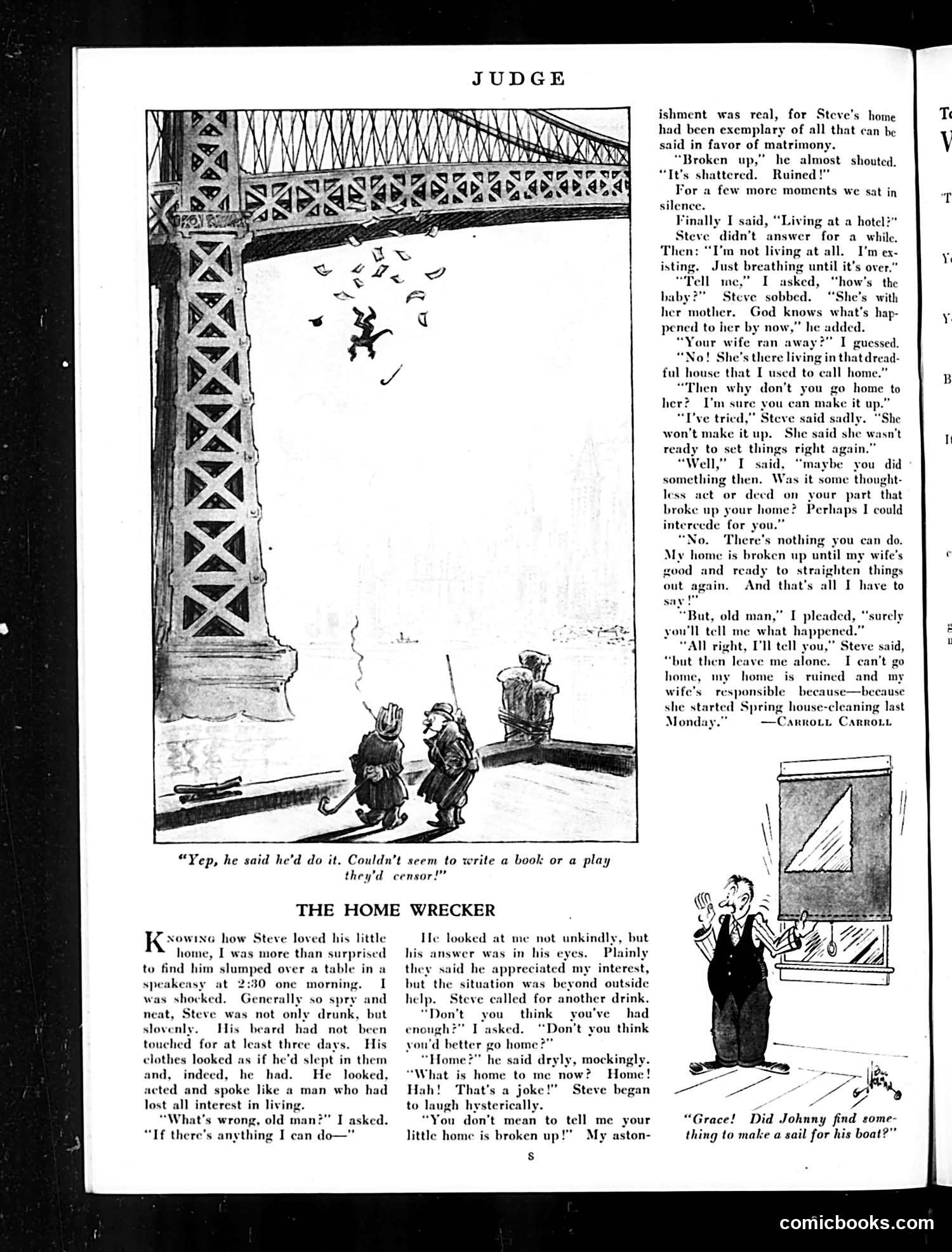
"The Home Wrecker" - Judge Magazine This satirical story mocks a common domestic complaint: a man's home is destroyed not by infidelity or serious marital conflict, but by his wife's spring house-cleaning. The narrative presents Steve, a once-respectable man now drunk and disheveled, whose entire life has collapsed because his wife started her weekly cleaning routine. The satire lies in the absurd disproportion—the narrator expects catastrophic betrayal or scandal, but discovers the "wrecker" is merely domestic tidiness. The joke reflects early 20th-century anxieties about women's domestic authority and the chaos of housekeeping. It satirizes both overly dramatic men and the invasive, disruptive nature of spring cleaning that was a major household event. The final panel provides comic relief, suggesting domestic chaos affects everyone—even children's boat projects get disrupted. The humor targets masculine self-pity and the clash between orderly housekeeping and men's desire for an undisturbed home.
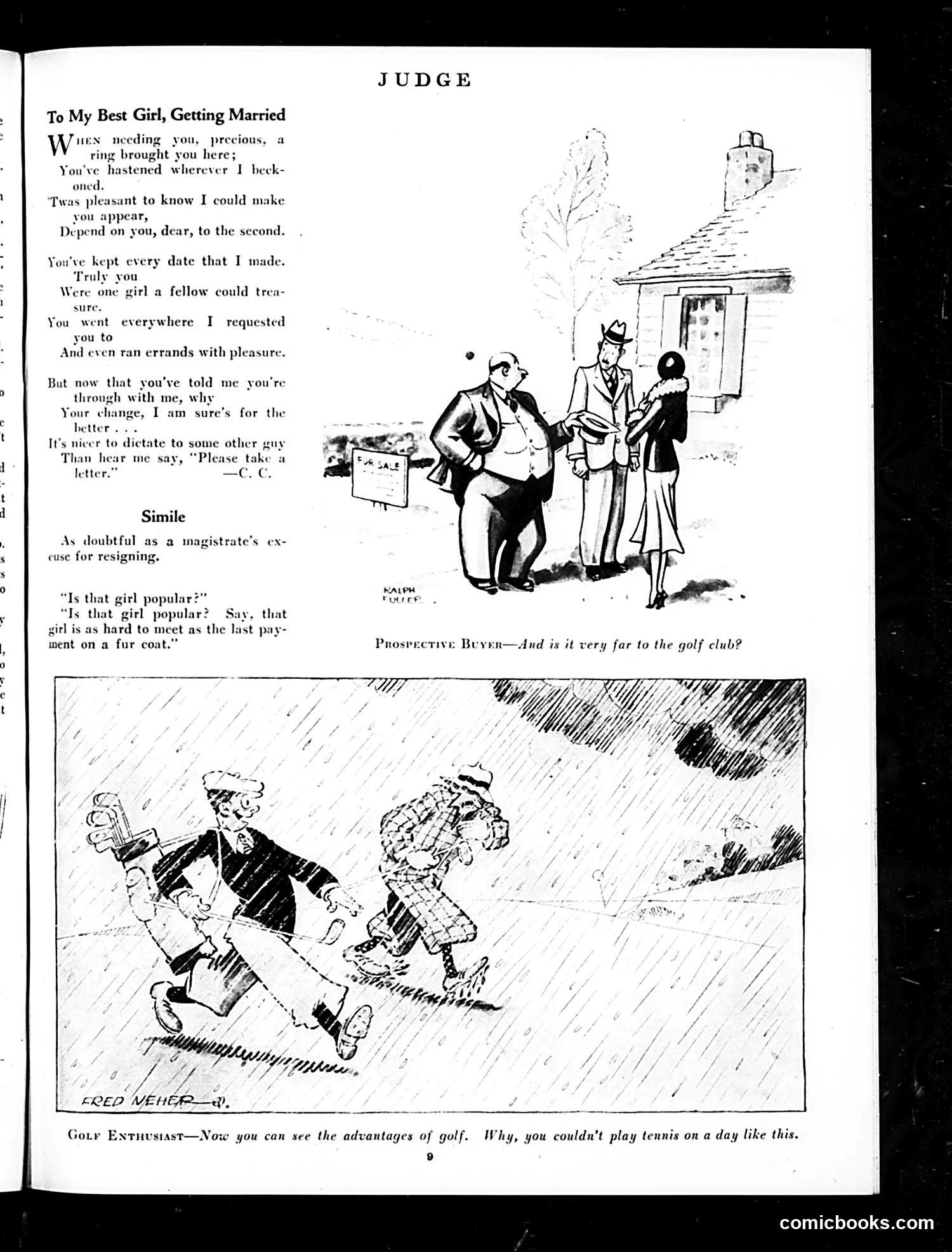
Analysis of Judge Magazine Page This page contains three separate satirical pieces typical of early 20th-century Judge magazine humor: "To My Best Girl, Getting Married" (poem): A man laments his fiancée breaking their engagement. The satire mocks male entitlement—he's upset she'll no longer obey his every whim, viewing her independence as her "gain" rather than acknowledging his loss of control. "Simile" section: Brief jokes comparing abstract concepts. The "girl is as hard to meet as the last payment on a fur coat" mocks both women's elusiveness and consumer debt culture. "Prospective Buyer" cartoon: A woman asks a real estate agent if a house is far from the golf club. The "Golf Enthusiast" below jokes that rain proves golf's superiority to tennis—implying obsessive golfers will play in any weather. The cartoons satirize early 20th-century attitudes: male dominance in relationships, women's emerging independence, conspicuous consumption, and the leisure pursuits of the affluent. The humor relies on period-specific social anxieties about changing gender roles.
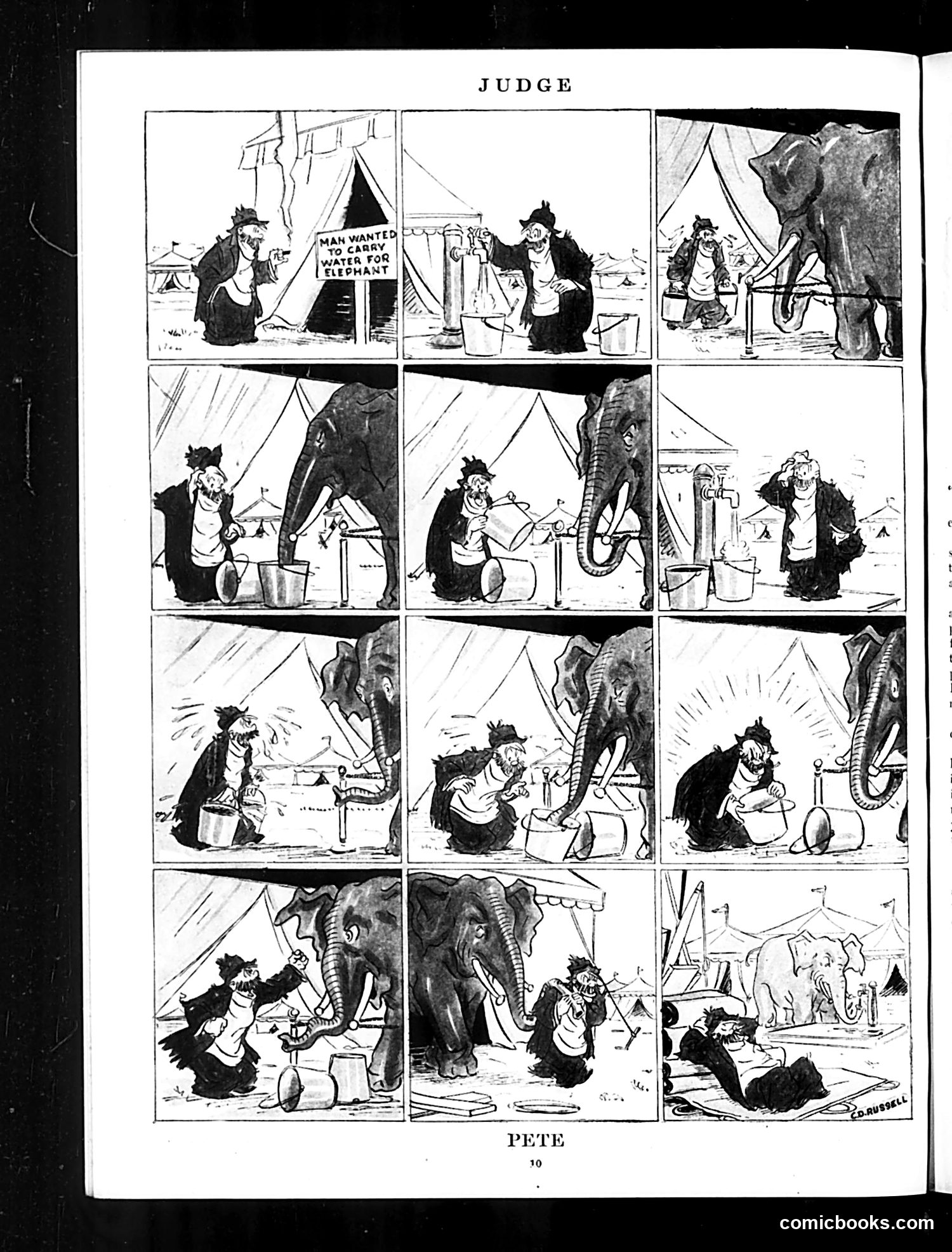
"Judge" Comic: "Judge" and "Pete" This appears to be a multi-panel comic strip satirizing circus life, specifically the challenges of obtaining water for an elephant in a traveling circus tent. The narrative follows a man (labeled "Pete") attempting to fill buckets with water while managing an increasingly agitated elephant. The elephant's trunk becomes a central comedic device—first cooperative, then destructive. The satire likely mocks either circus management incompetence or the inherent difficulties of maintaining exotic animals in portable encampments. The sign reading "MAN WANTED TO CARRY WATER FOR ELEPHANT" suggests labor shortage humor. The escalating chaos culminating in what appears to be the elephant's rampage reflects period concerns about animal handling and circus safety, presented for comedic effect.
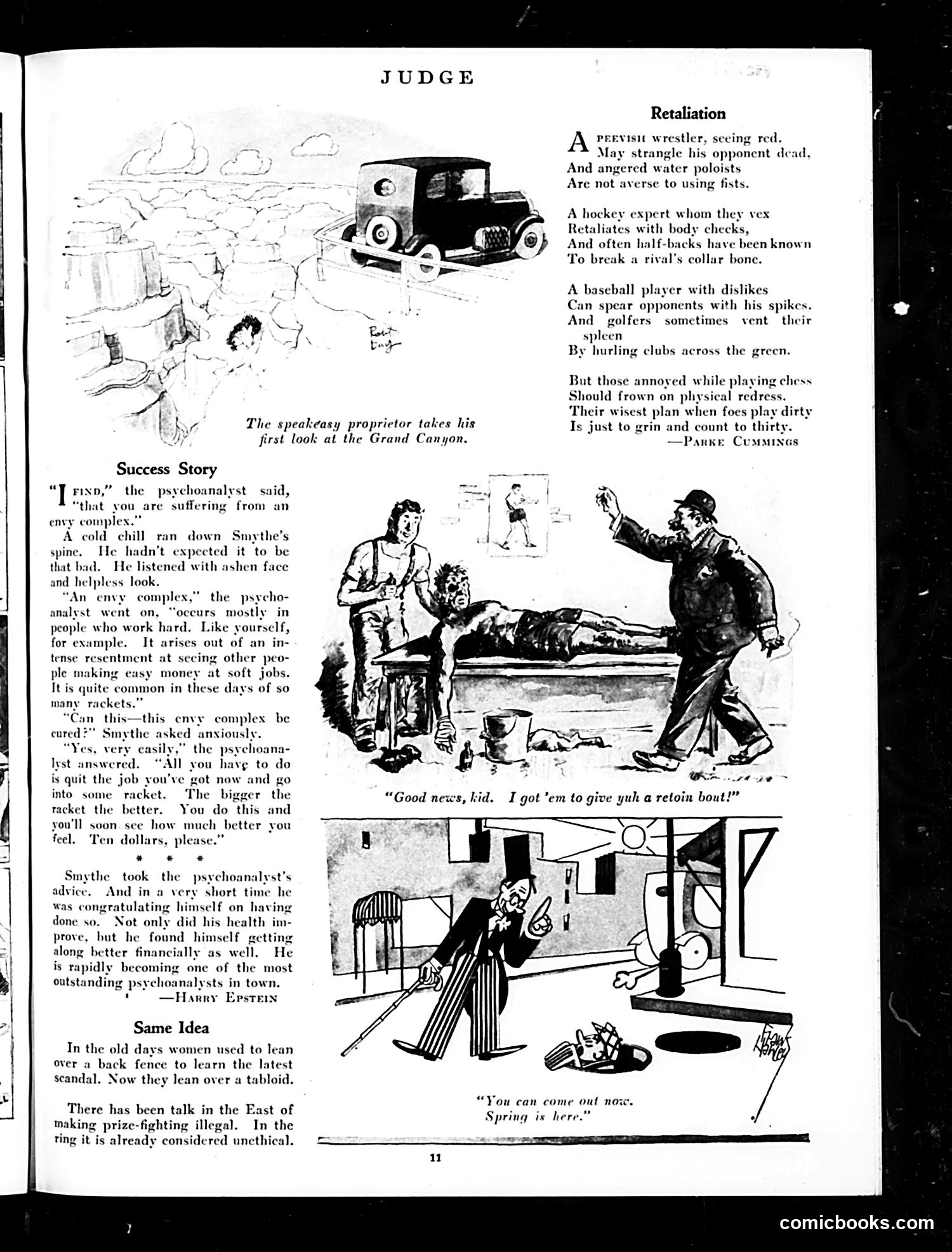
Explaining This Judge Magazine Page This page contains three satirical pieces mocking 1920s American culture: "Retaliation" is a humorous poem by Parke Cummings listing violent responses to losing in various sports—wrestlers strangling opponents, hockey players body-checking, baseball players using spikes—before ending with the joke that chess players should simply "grin and count to thirty" instead of getting physical. "Success Story" satirizes both psychoanalysis (a trendy new field) and Prohibition-era organized crime ("rackets"). A patient named Smythe complains of envy; the psychoanalyst's "cure" is to quit legitimate work and join the criminal underworld. Smythe follows this advice and becomes a successful psychoanalyst himself—the satire being that crime pays better than honest work during this corrupt era. "Same Idea" makes a brief joke equating women's gossip over backyard fences with their consumption of sensationalist tabloid newspapers—both are sources of scandal. The cartoons accompanying these pieces are generic illustrations rather than political commentary. The overall tone mocks 1920s prosperity, dubious psychology fads, and Prohibition's criminal consequences.
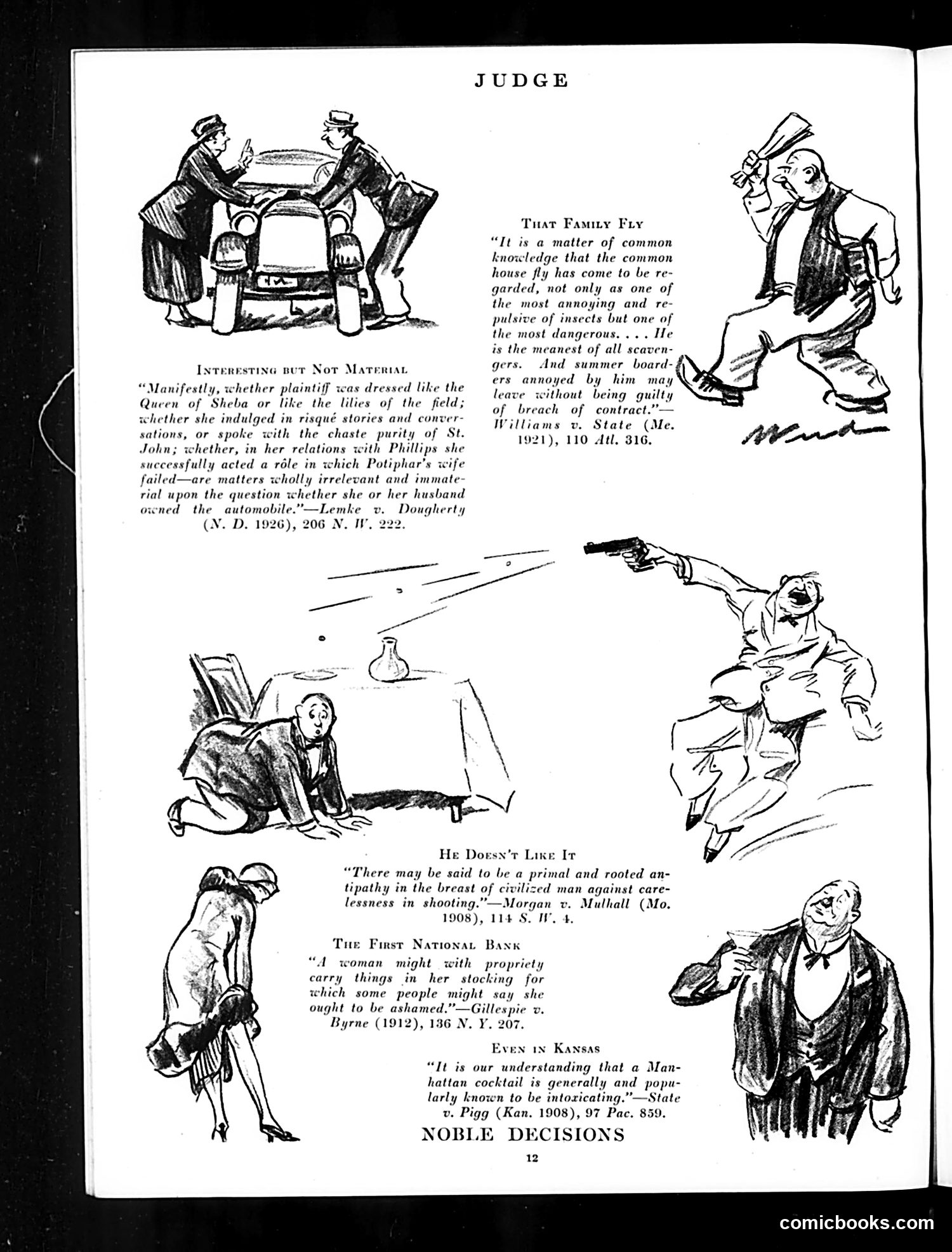
Judge Magazine: "Noble Decisions" This page satirizes absurd legal rulings through humorous illustrations and quoted court decisions. Each section mocks the disconnect between judicial logic and common sense: "Interesting but Not Material" ridicules a case where a woman's dress and conduct were deemed irrelevant to automobile ownership disputes—the satire suggests courts ignore obvious character questions. "That Family Fly" quotes a ruling that summer boarders can leave without penalty because houseflies are dangerous—mocking the court's reasoning that pest annoyance excuses contract breach. "He Doesn't Like It" shows a shooting accident victim, quoting a decision about "antipathy" to carelessness—implying the court used flowery language to excuse negligence. "The First National Bank" jokes that women can hide items in stockings without shame—suggesting judicial naiveté about propriety. "Even in Kansas" pokes fun at proving a Manhattan cocktail causes intoxication—likely mocking Prohibition-era legal gymnastics. The cartoons lampoon judicial overcomplication and questionable reasoning through real (or plausibly real) case citations.
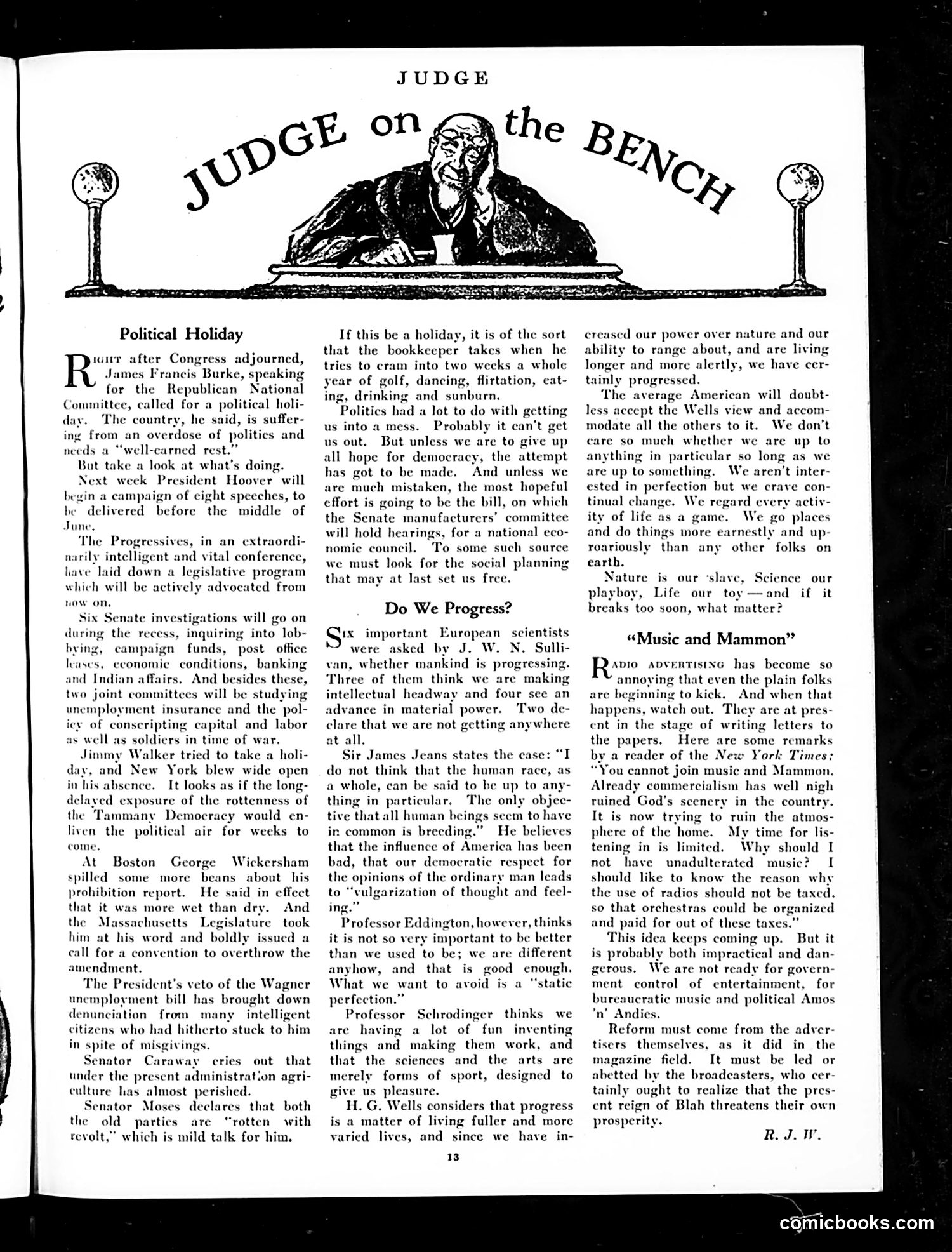
"Judge on the Bench" — Political Holiday & Progress This page from Judge magazine (appears to be early 1930s, given references to President Hoover and the Wagner unemployment bill) satirizes Republican claims that politics needs a "holiday." The Satire: James Francis Burke of the Republican National Committee calls for a political rest, yet the page catalogs intense ongoing political activity: Hoover's campaign speeches, Progressive conferences, six Senate investigations, Jimmy Walker's corruption scandal, debates over prohibition, and challenges to New Deal policies. The joke is that American politics never actually stops—claims of "rest" are hollow. Secondary Feature: "Do We Progress?" discusses European scientists' views on human advancement, with Sir James Jeans arguing humans lack clear purpose beyond reproduction, and others debating whether material/intellectual progress matters. This reflects 1930s intellectual anxiety about whether civilization is genuinely advancing. The masthead image shows a stern judge presiding over the page's commentary on political and social conditions.
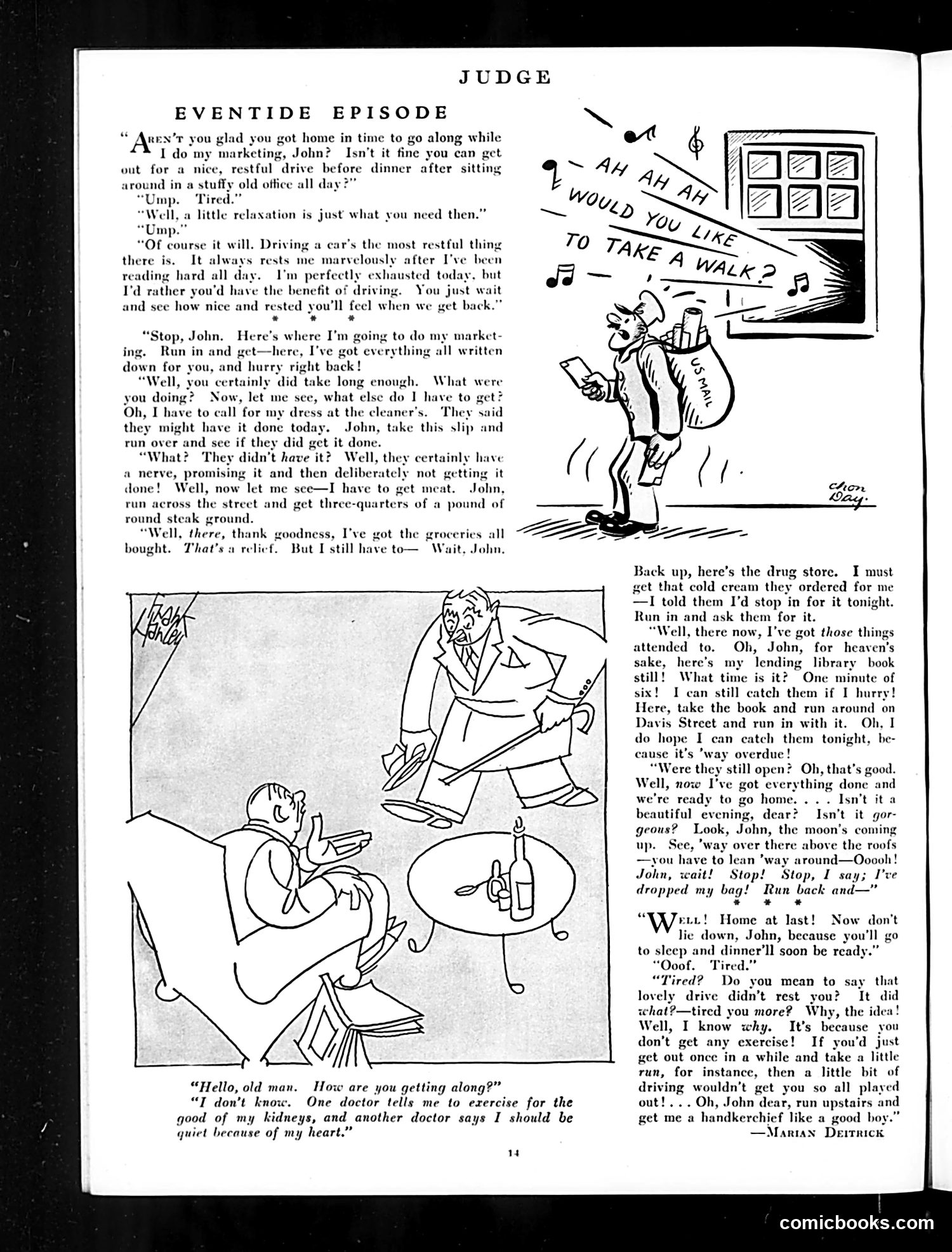
"Eventide Episode" Satire Analysis This Judge cartoon satirizes the exhausted American husband exploited by his oblivious wife's endless errands. John returns home "tired" from office work, hoping to rest. His wife cheerfully insists a "restful drive" will rejuvenate him—then uses the car trip to run continuous shopping errands: marketing, the cleaner's, the butcher, the drug store, and the lending library. Each stop forces John out to fetch items while his wife barks orders. After hours of unpaid labor disguised as leisure, John arrives home completely exhausted. His wife—mystified why he's "tired" after their "lovely drive"—blames his lack of exercise and demands he fetch her a handkerchief. The joke targets wives' complete obliviousness to using their husbands as pack animals while congratulating themselves on providing "relaxation." The competing doctor's advice quoted at bottom mirrors John's impossible situation: rest versus exercise.
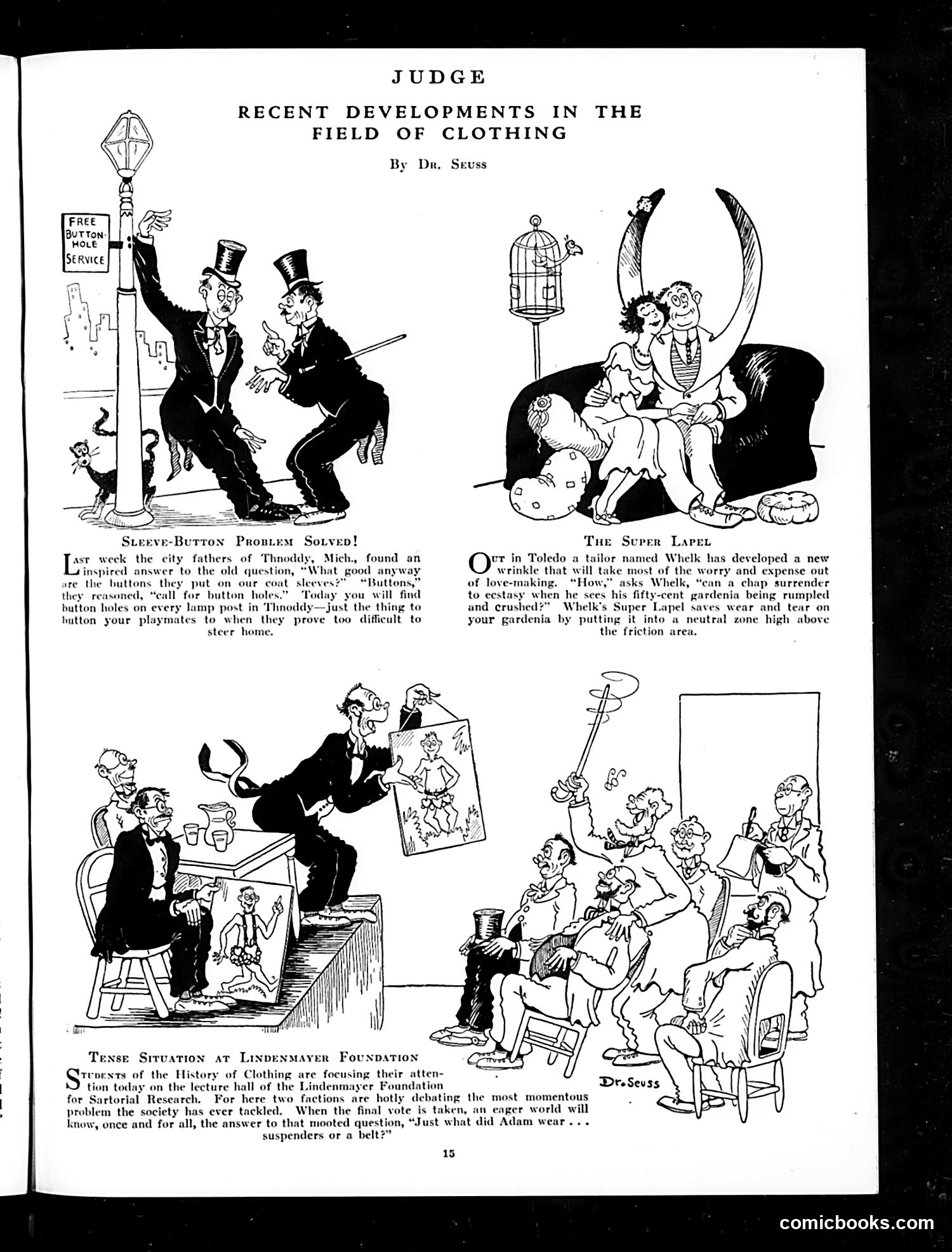
Judge Magazine - "Recent Developments in the Field of Clothing" This page by Dr. Seuss (Theodor Geisel) presents three absurdist humor cartoons mocking fashion industry debates and clothing innovations. "Sleeve-Button Problem Solved": Satirizes over-engineered solutions to trivial problems. The fictional city of Thnoddy installs lamp-post buttons as coat-sleeve substitutes—treating buttonholes as unnecessary. "The Super Lapel": Mocks protective fashion inventions. A tailor named Whelk creates a lapel elevated above the "friction area" to prevent wrinkle damage during romance—absurdly elaborate for a minor clothing concern. "Tense Situation at Lindenmayer Foundation": Parodies academic pomposity. Scholars hotly debate whether Adam wore suspenders or a belt—treating prehistoric clothing as serious historical scholarship worthy of institutional debate. All three cartoons ridicule how seriously the fashion and academic establishments treat trivial matters, using whimsical invention and pseudo-intellectual discourse as vehicles for satire.
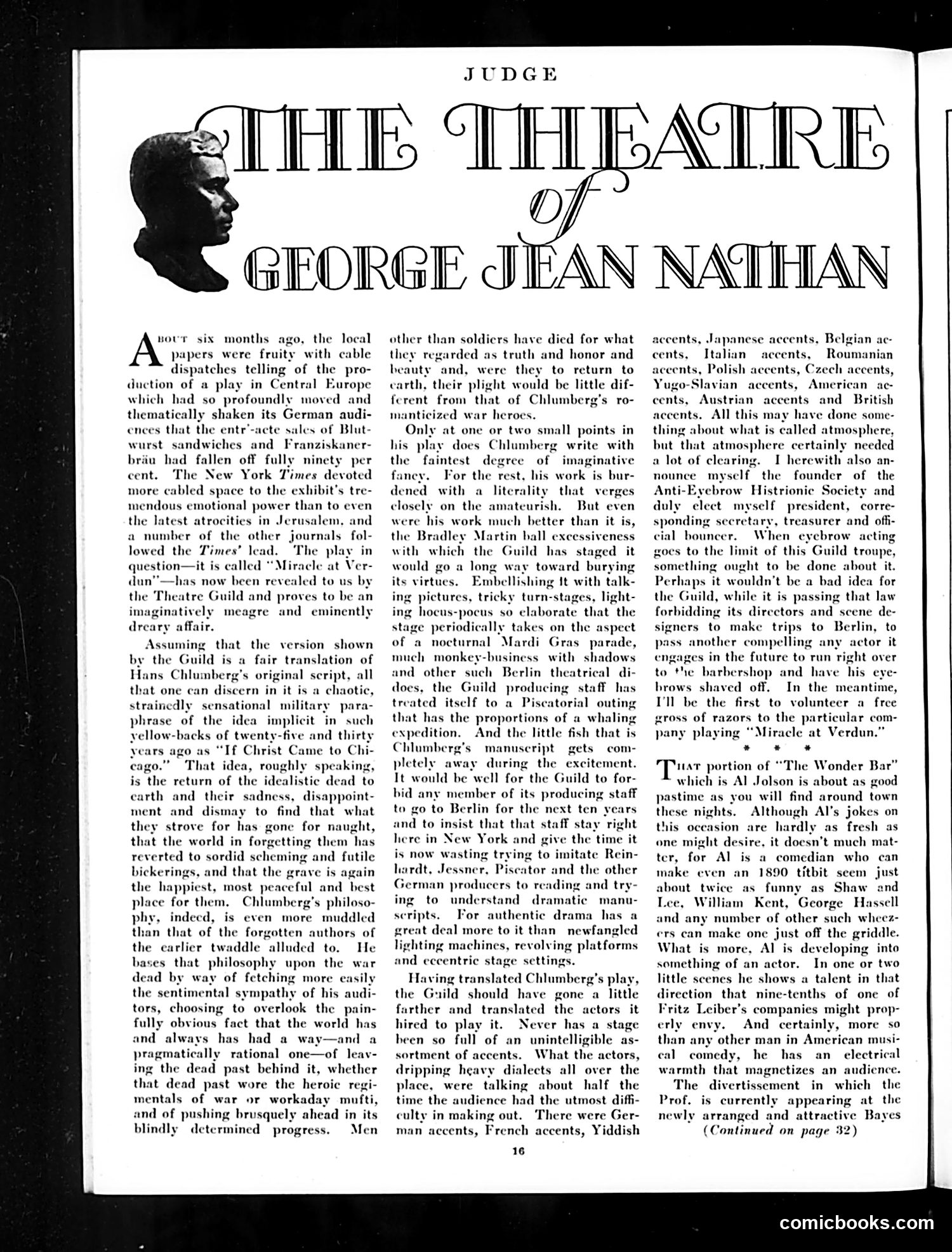
Judge Theater Review: "The Theatre of George Jean Nathan" This is a theater review by critic George Jean Nathan (whose bust appears at top left) critiquing the Theatre Guild's American production of Hans Chlumberg's German play. Nathan argues the production is pretentious and overwrought. His central complaint: the script itself is philosophically muddled—essentially recycling 1890s sentimental plots about idealistic dead returning to earth, disappointed by modern reality. Nathan dismisses this as derivative melodrama, no more profound than forgotten "yellow-back" novels. More damaging, he attacks the Theatre Guild's *staging* as excessive spectacle—"talking pictures, tricky turn-stages" and "Mardi Gras parade" lighting effects that bury the weak material beneath Berlin-style theatrical tricks. He mocks their imitation of German directors (Reinhardt, Piscator) and sarcastically suggests the staff stop visiting Berlin and focus on understanding dramatic scripts. Finally, Nathan notes the actors speak in incomprehensible accents—a jab at casting choices that prioritized authenticity over intelligibility.
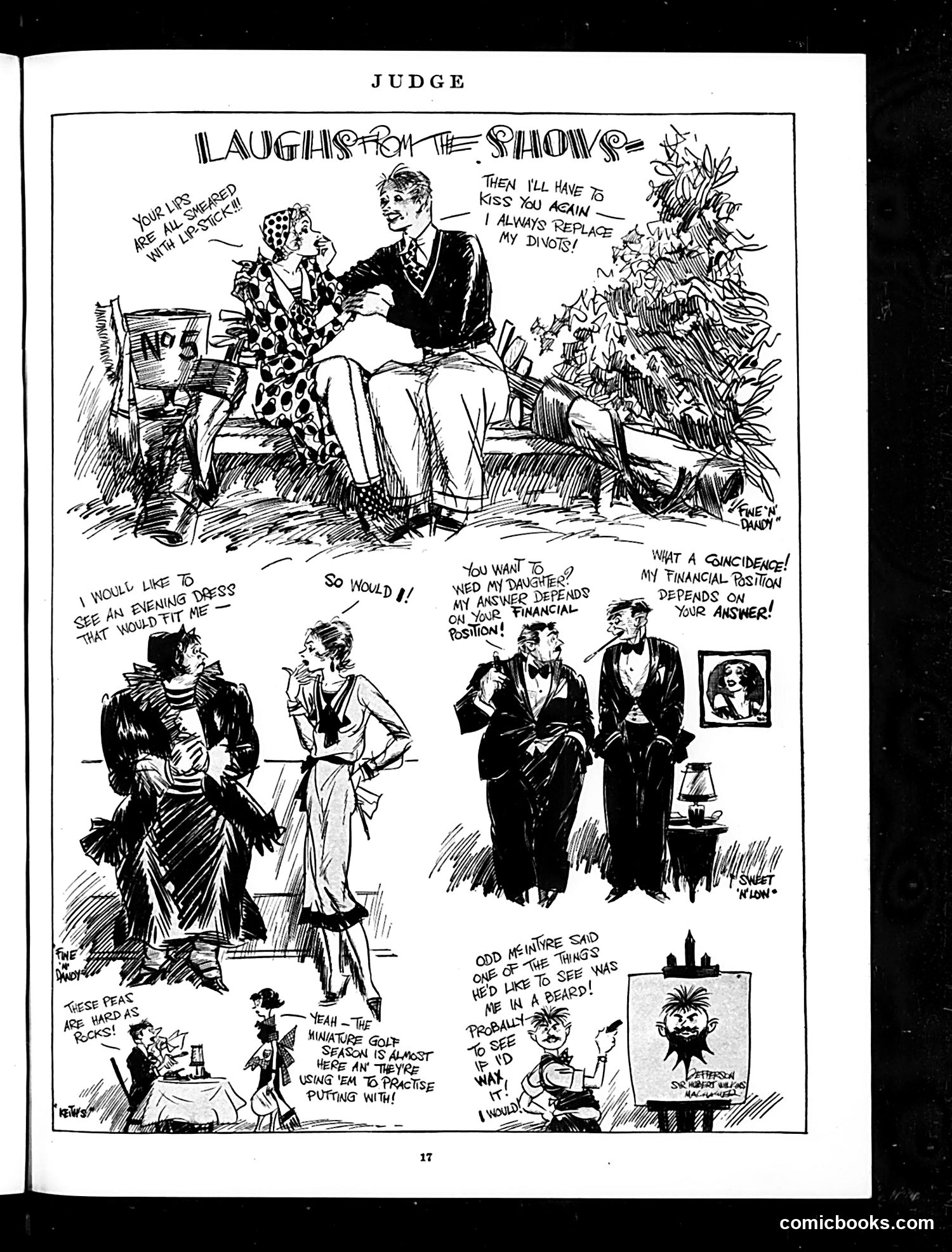
"Laughs from the Shows" - Judge Magazine Cartoon This is a satirical multi-panel cartoon about high-society courtship and marriage negotiations. The top panel shows a couple on a bench where the man proposes marriage, promising to replace her "divots" (golf term, suggesting she's worn out). The subsequent panels mock the mercenary nature of wealthy marriages: a woman asks to see a man's "evening dress," suggesting she's evaluating his appearance like merchandise. Most pointedly, two men discuss marriage as a financial transaction—one says "you want to wed my daughter? my answer depends on your financial position," while the other replies "what a coincidence! my financial position depends on your answer!" The cartoon satirizes how upper-class marriages are arranged based on wealth rather than romance, with even young women evaluating suitors as financial propositions. The final panel appears to show someone's reaction to this mercenary attitude.
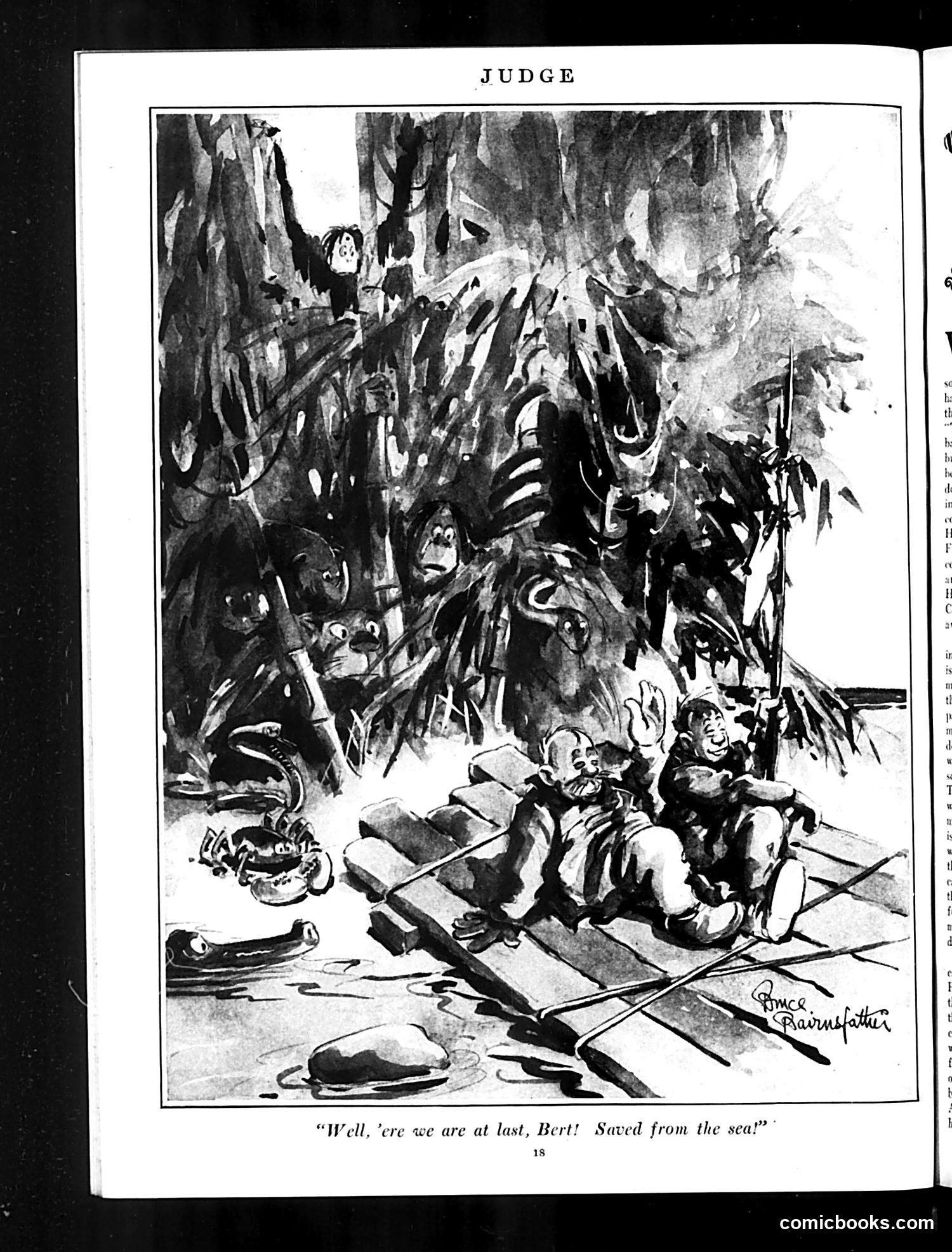
Political Cartoon Analysis: "Well, 'ere we are at last, Bert! Saved from the sea!" This cartoon depicts a dramatic rescue scene with figures being pulled from water onto wooden rafts. The caption's British dialect ("'ere," "Bert") suggests commentary on British naval or maritime affairs. The chaotic, expressionistic style shows apparent survivors among wreckage and turbulent waters. Without a visible date or additional context clues, the specific historical event referenced remains unclear—though it likely addresses a notable shipwreck or maritime disaster that Judge magazine's readers would have recognized. The dramatic imagery and relief expressed in the dialogue suggest the cartoon comments on survivors' fortune or perhaps satirizes response to such disasters. The artistic signature appears to be "Cesare Barbarella" or similar.
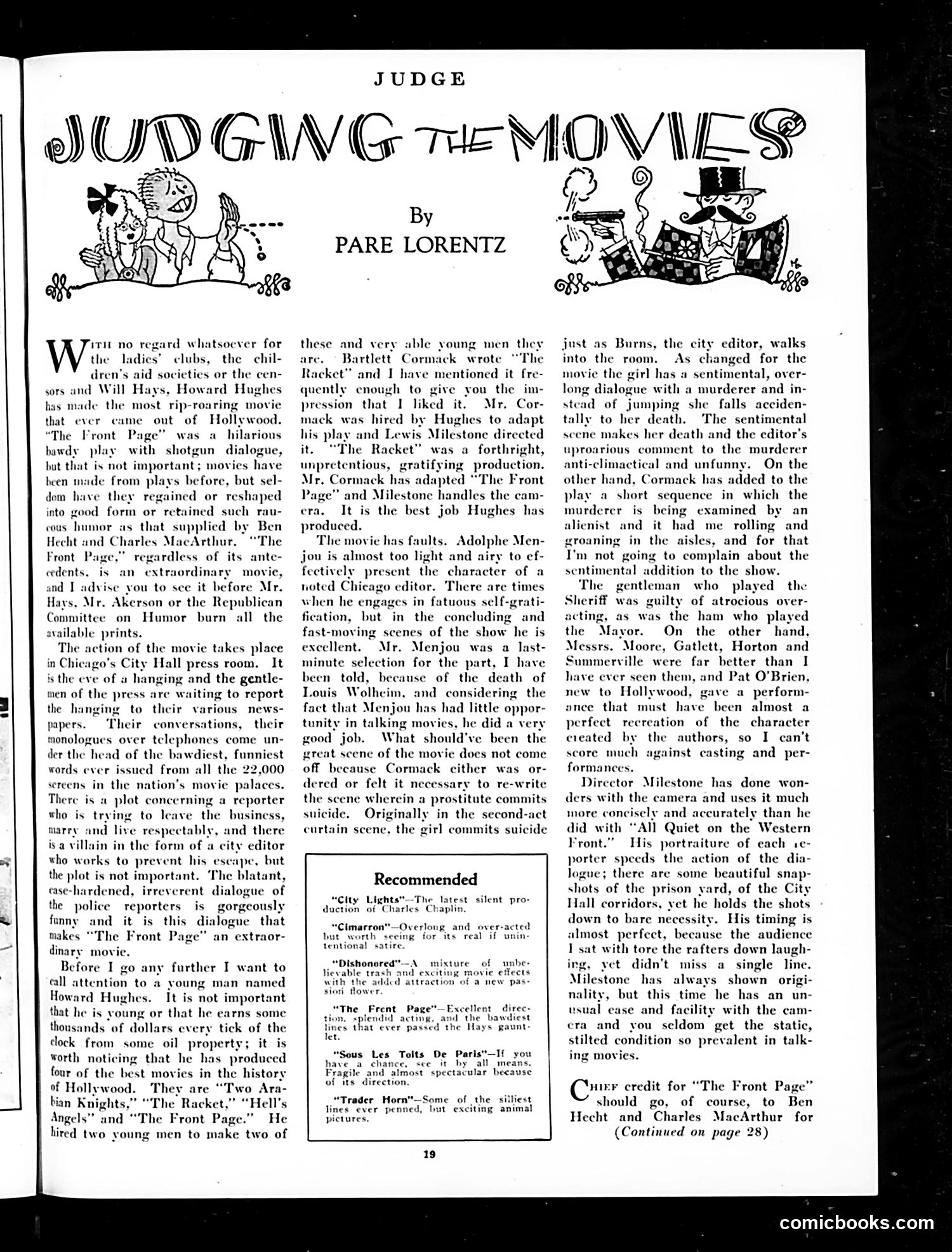
"Judging the Movies" by Pare Lorentz This is a film review column praising Howard Hughes's production of *The Front Page*, a screen adaptation of a famous bawdy play by Hecht and MacArthur. The satire targets Will Hays and film censorship. Lorentz sarcastically warns readers to see the movie "before Mr. Hays, Mr. Akerson or the Republican Committee on Humor burn all the available prints"—mocking the strict Motion Picture Production Code (the "Hays Code") that governed Hollywood content. The joke is that the film's crude language and adult themes violate censorship standards. Lorentz praises Hughes as a producer of quality films and lauds director Lewis Milestone's competent work, though he criticizes actor Adolphe Menjou's performance as understated. He notes the film originally contained a suicide scene that was rewritten, likely due to censorship pressure. The "Recommended" sidebar lists other contemporary films, with barbed comments—*Cimarron* is "unintentionally" satirical, implying it fails despite itself.
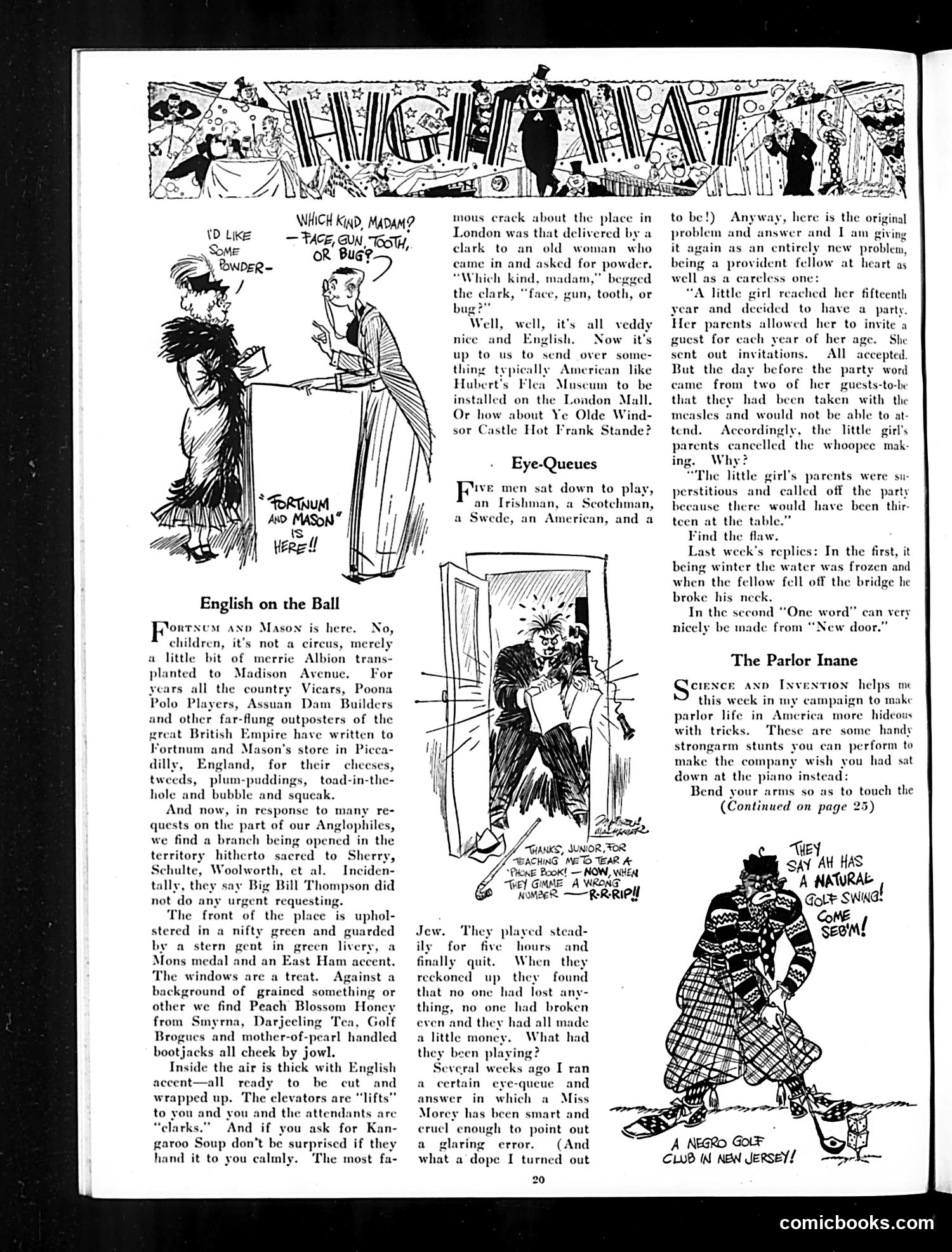
Judge Magazine Page Analysis This page from *Judge* contains three humorous pieces satirizing American society circa the 1920s-30s: "English on the Ball" mocks the opening of a Fortnum & Mason branch on Madison Avenue. The satire targets American Anglophilia—the fashionable admiration of British culture among wealthy New Yorkers. The joke suggests Americans will naively accept anything labeled "English," even absurdities like a "Flea Museum" or "Hot Frank Stande" castle. The anecdote about the clerk asking whether a customer wants powder for "face, gun, tooth, or bug" ridicules affected British speech patterns. "Eye-Queues" presents a logic puzzle about five men (an Irishman, Scotsman, Swede, American, and Jew) playing cards for five hours where everyone profits—implying they weren't actually gambling seriously, or the puzzle contains a trick. "The Parlor Inane" offers pranks to make parlor gatherings unpleasant, likely satirizing stuffy social etiquette of the era. The bottom cartoon mocks segregation, depicting a "Negro Golf Club in New Jersey" with crude racist caricature.
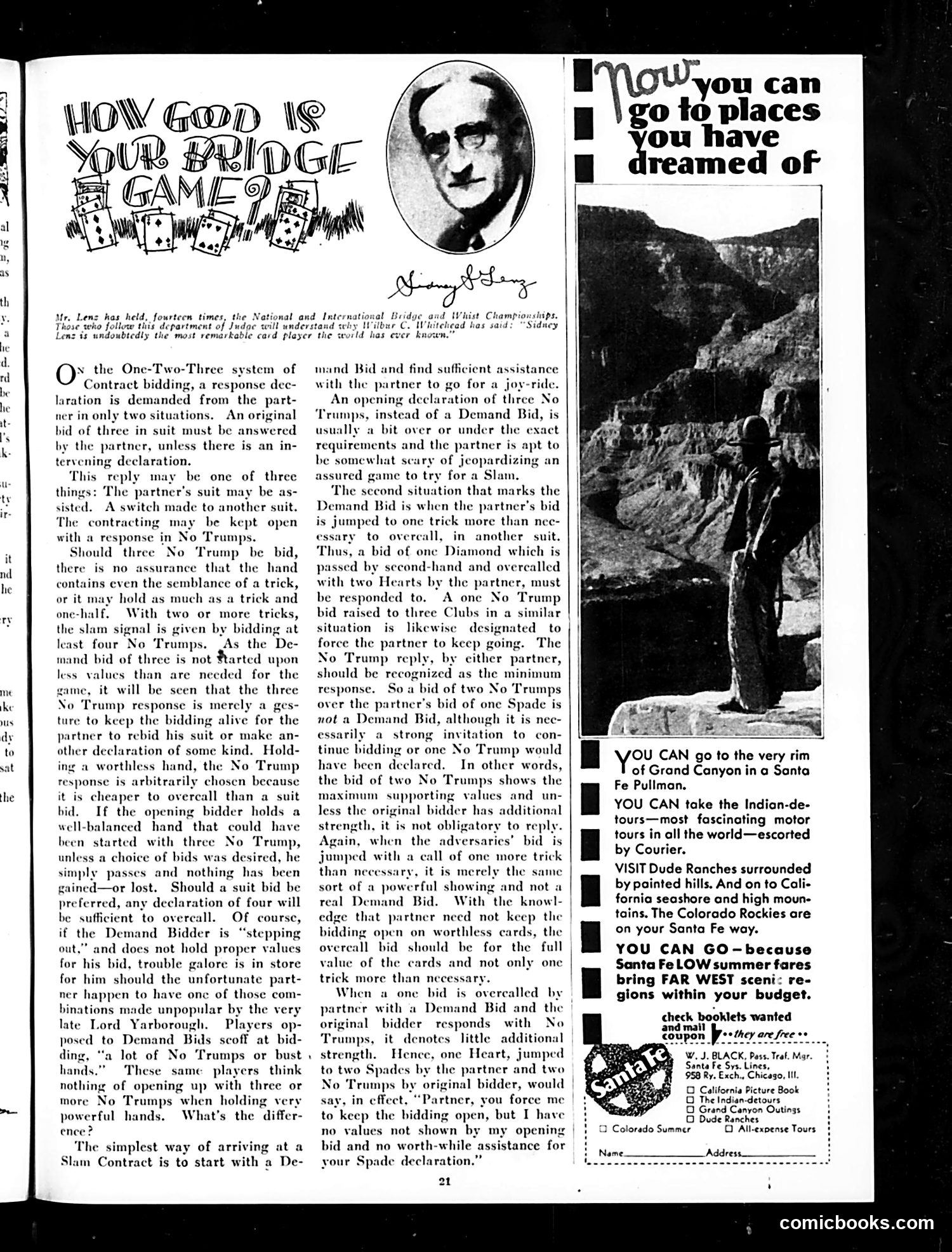
Analysis for Modern Readers This page is primarily instructional content about Contract Bridge, a card game. The main feature is an article by Sidney Lenz (visible in the portrait), described as "the most remarkable card player the world has ever known," explaining the "One-Two-Three system" of Contract bidding—technical rules for responding to opening bids. The satirical element is minimal on this page. The header "HOW GOOD IS YOUR BRIDGE GAME?" with dice imagery appears mildly humorous, suggesting Bridge requires both skill and luck. The right side contains travel advertisements promoting Santa Fe Railway destinations (Grand Canyon, Colorado, Dude Ranches), unrelated to the Bridge content. This represents *Judge* functioning as a lifestyle magazine for affluent readers—Contract Bridge was a fashionable leisure activity among the wealthy in early-to-mid 20th century America. The page reflects the magazine's blend of humor, instruction, and luxury advertising rather than political satire.
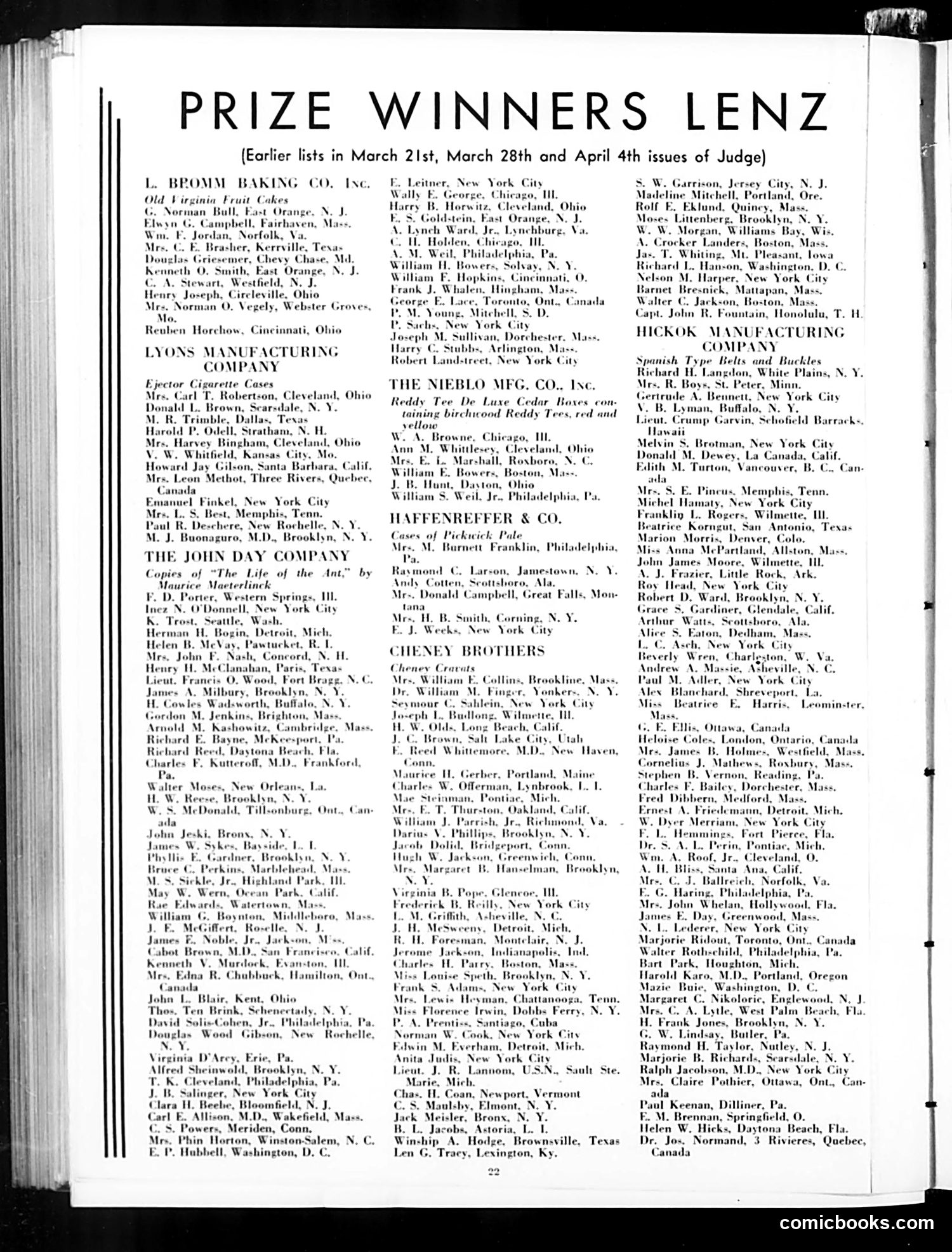
Prize Winners List — Judge Magazine This page is not a cartoon or satirical content — it's a prize winners list from Judge magazine, specifically for a contest called "Prize Winners Lenz." The header notes this is a continuation of earlier lists published in Judge's March 21st, March 28th, and April 4th issues. The page lists names and addresses of winners across multiple product categories: Bromm Baking Co. (Old Virginia Fruit Cakes), Lyons Manufacturing Company (cigarettes), The John Day Company (books), Nieblo Mfg. Co. (golf tees), Haffenreffer & Co. (beer cases), Cheney Brothers (cravats), and Hickok Manufacturing Company (belts and buckles). This appears to be advertising-driven promotional content — companies ran contests in Judge to boost readership and brand engagement. The names suggest widespread American participation from the 1920s-1930s era.
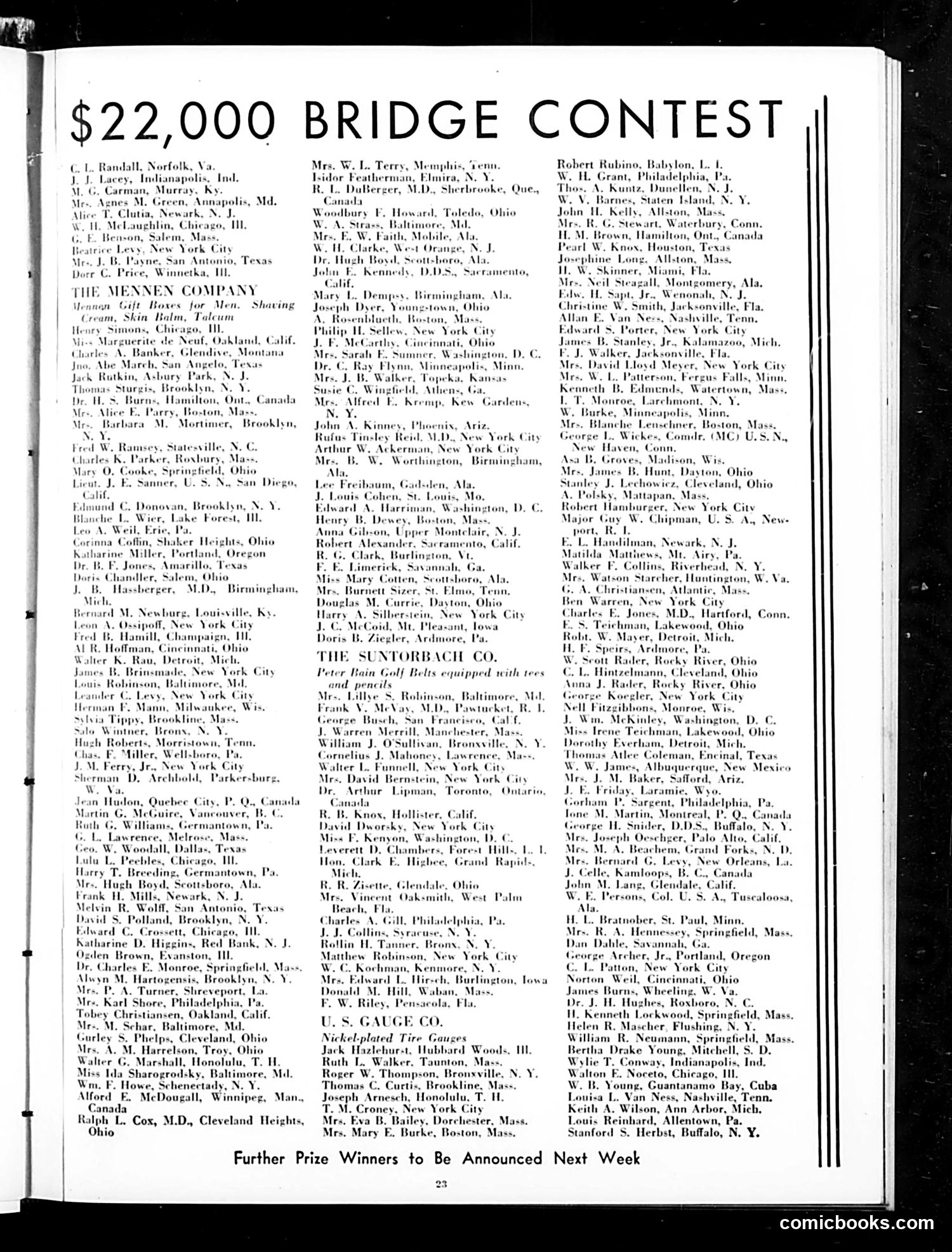
Analysis This page is not a cartoon or satirical content—it's a contest results page listing winners of Judge magazine's "$22,000 Bridge Contest." The page presents three sections of prize winners organized by sponsoring companies: 1. The Mennen Company (grooming products like shaving cream and skin balm) 2. The Suntorbacil Co. (Peter Bain Golf Belts with tees and pencils) 3. U.S. Gauge Co. (nickel-plated tire gauges) Each company offered prizes for what appears to be a bridge-playing contest—a popular parlor game of the era. The names listed represent winners from across North America, with geographical locations noted (cities and states/provinces). The note at bottom indicates "Further Prize Winners to Be Announced Next Week," suggesting this was part of an ongoing announcement series. This represents Judge's commercial side—using contests to drive readership and generate advertising revenue from companies seeking consumer engagement.
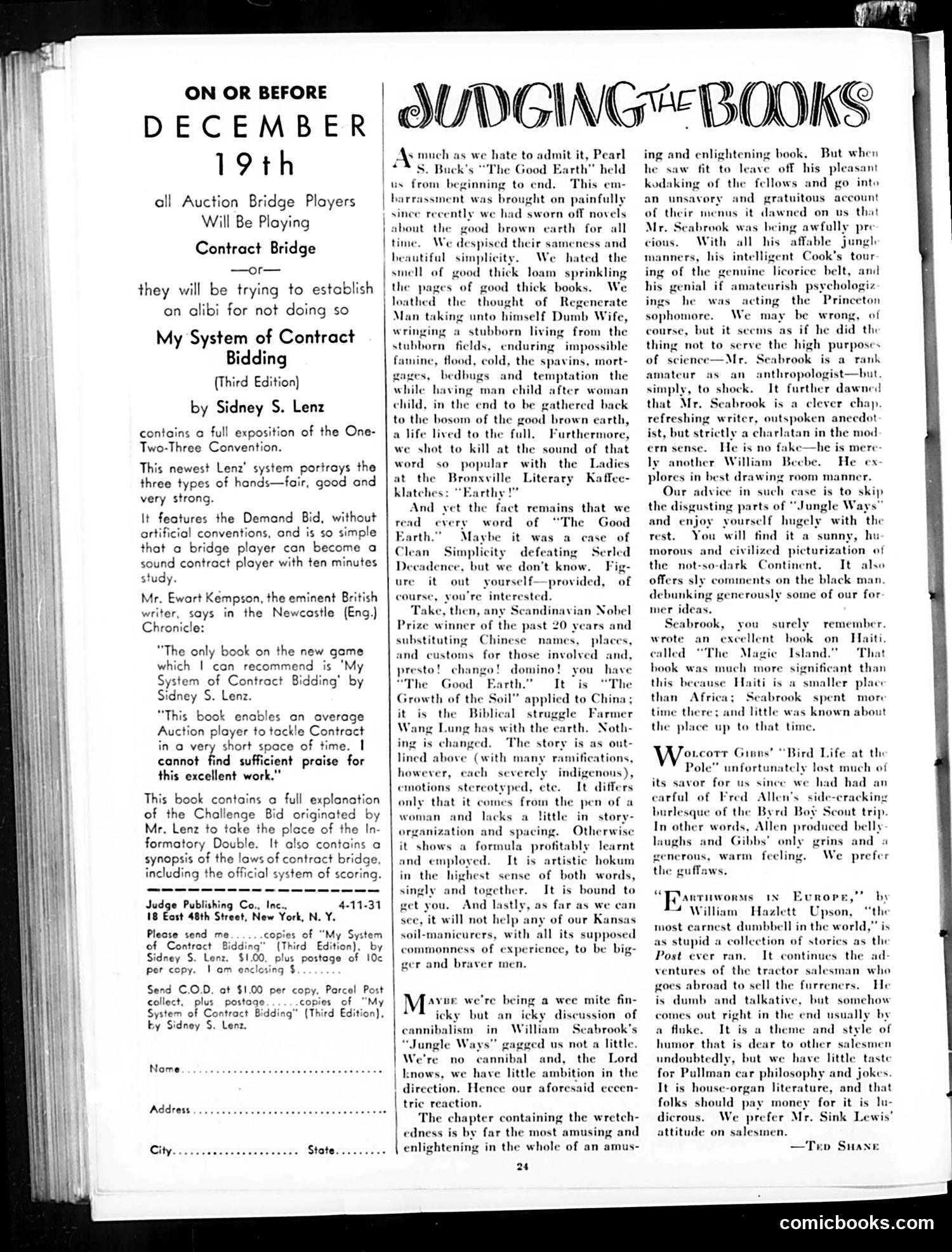
"Judging the Books" - Judge Magazine Book Reviews This page contains book reviews and advertising rather than political cartoons. The main content critiques two popular books: "The Good Earth" by Pearl S. Buck is satirized for its simplistic portrayal of Chinese rural life—the reviewer mocks its repetitive themes of earth, struggle, and endurance, suggesting it's formulaic "artistic hokum" that won't actually inspire readers to greater courage or understanding. "Jungle Ways" by William Seabrook is criticized for its "icky discussion" of primitive customs, though the reviewer admits the chapters on human suffering are genuinely amusing and enlightening—a backhanded compliment. The reviews employ sarcastic, sophisticated humor typical of *Judge's* literary commentary. The left side advertises Sidney S. Lenz's contract bridge instruction book, suggesting that by December 19th, bridge players will need excuses for not mastering this new game. The satire targets middlebrow reading tastes and exotic literature's superficial treatment of foreign cultures.
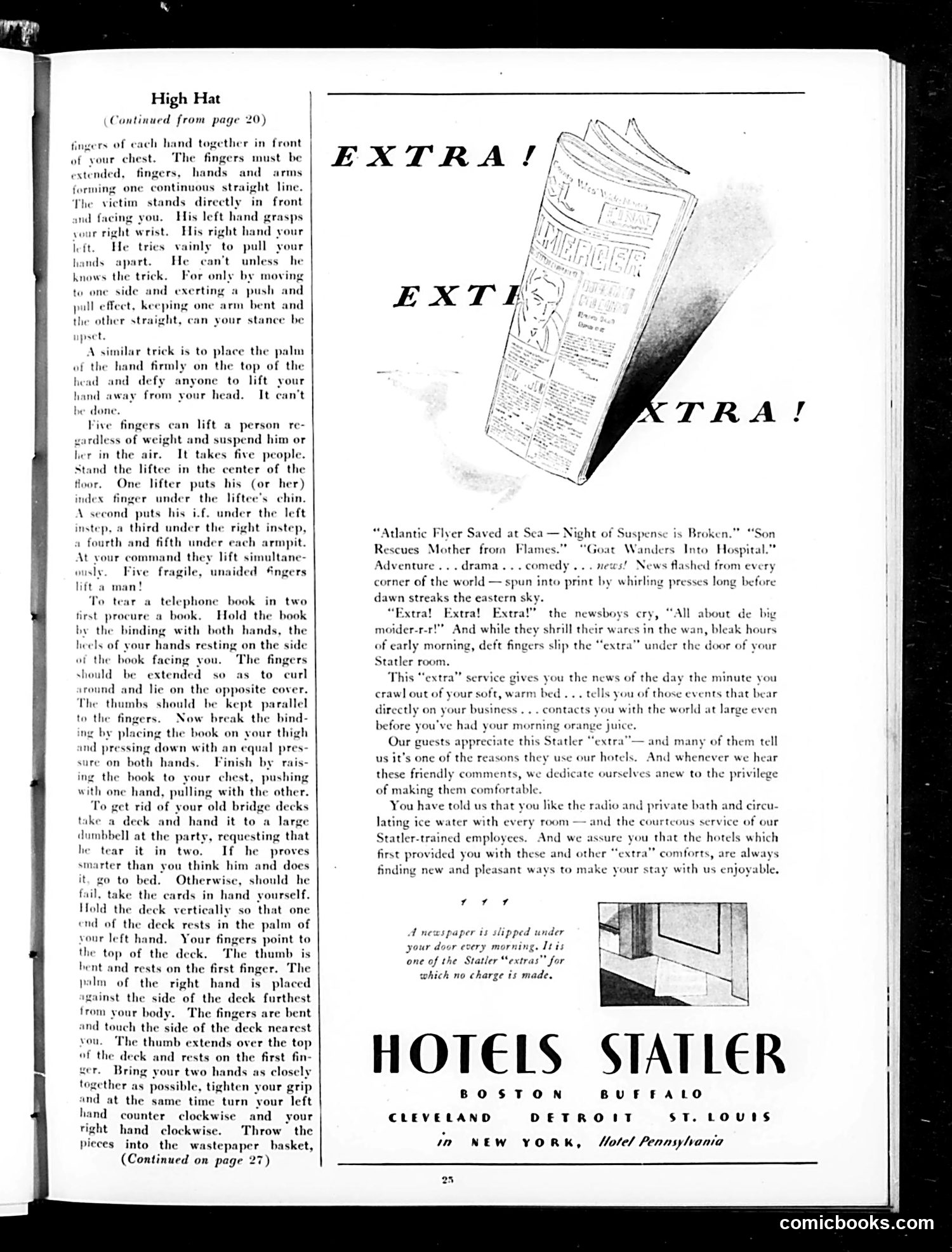
Analysis for Modern Readers This page is primarily advertising, not political satire. It contains two distinct elements: Left side: Instructions for magic tricks and parlor entertainments ("High Hat" tricks)—practical amusements popular in early-to-mid 20th century magazines. Right side: A full-page advertisement for Hotels Statler, a real hotel chain that operated in Boston, Buffalo, Cleveland, Detroit, St. Louis, and New York. The ad's headline—"Extra! Extra! Extra!"—plays on the familiar newsboy cry, promoting the hotel's service of delivering morning newspapers to guests' rooms before dawn. This was positioned as a luxury amenity: guests could stay informed about business and world events without leaving their rooms. The ad emphasizes modern hotel conveniences (radio, private bath, ice water, trained service) to appeal to business travelers. There is no political cartoon or satire on this page—it's a period advertisement using contemporary cultural references (newspaper delivery, newsboys) to market hospitality services.
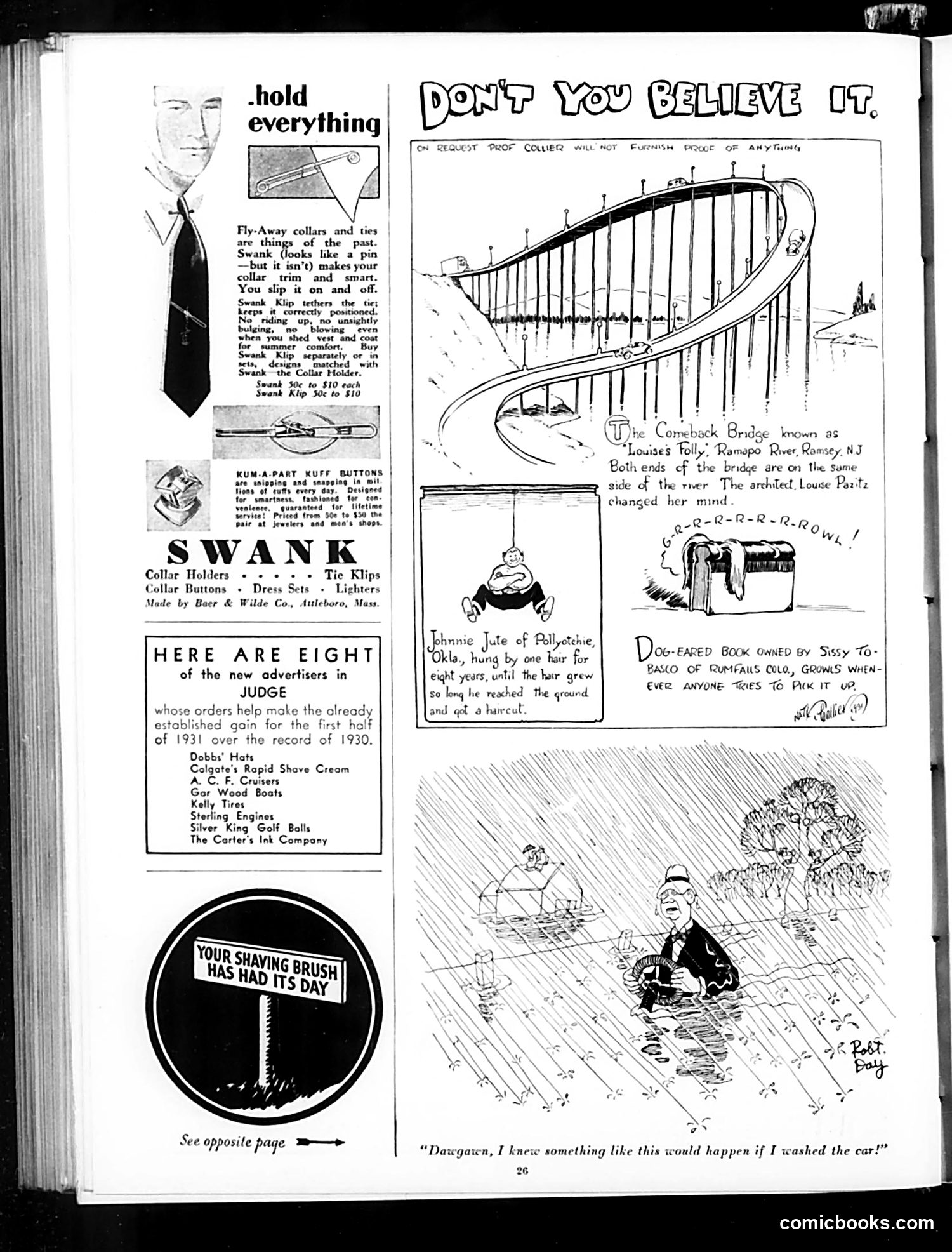
Judge Magazine Page Analysis This page combines advertisements with humorous cartoons typical of early 1930s Judge magazine. Main Content: The "Don't You Believe It" section features three absurdist jokes presented as tall tales: 1. Louise's Folly Bridge: A real bridge in Ramsey, NJ that curves back on itself because the architect "changed her mind"—satirizing poor planning or indecision. 2. Fannie Jute's Hair: A woman hung by one hair for eight years until it grew long enough to reach the ground for a haircut—nonsensical humor typical of the era's "believe it or not" style. 3. The Dog-Eared Book: A book that grows whenever someone tries to borrow it—anthropomorphizing inanimate objects for comic effect. Bottom Cartoon: A domestic scene where a man blames washing the car for causing the rainstorm—absurdist humor blaming external chaos on mundane actions. The left side advertises Swank brand collar holders and tie clips, listing eight new 1931 advertisers in Judge magazine. The humor relies on surrealism and impossible scenarios rather than political satire.
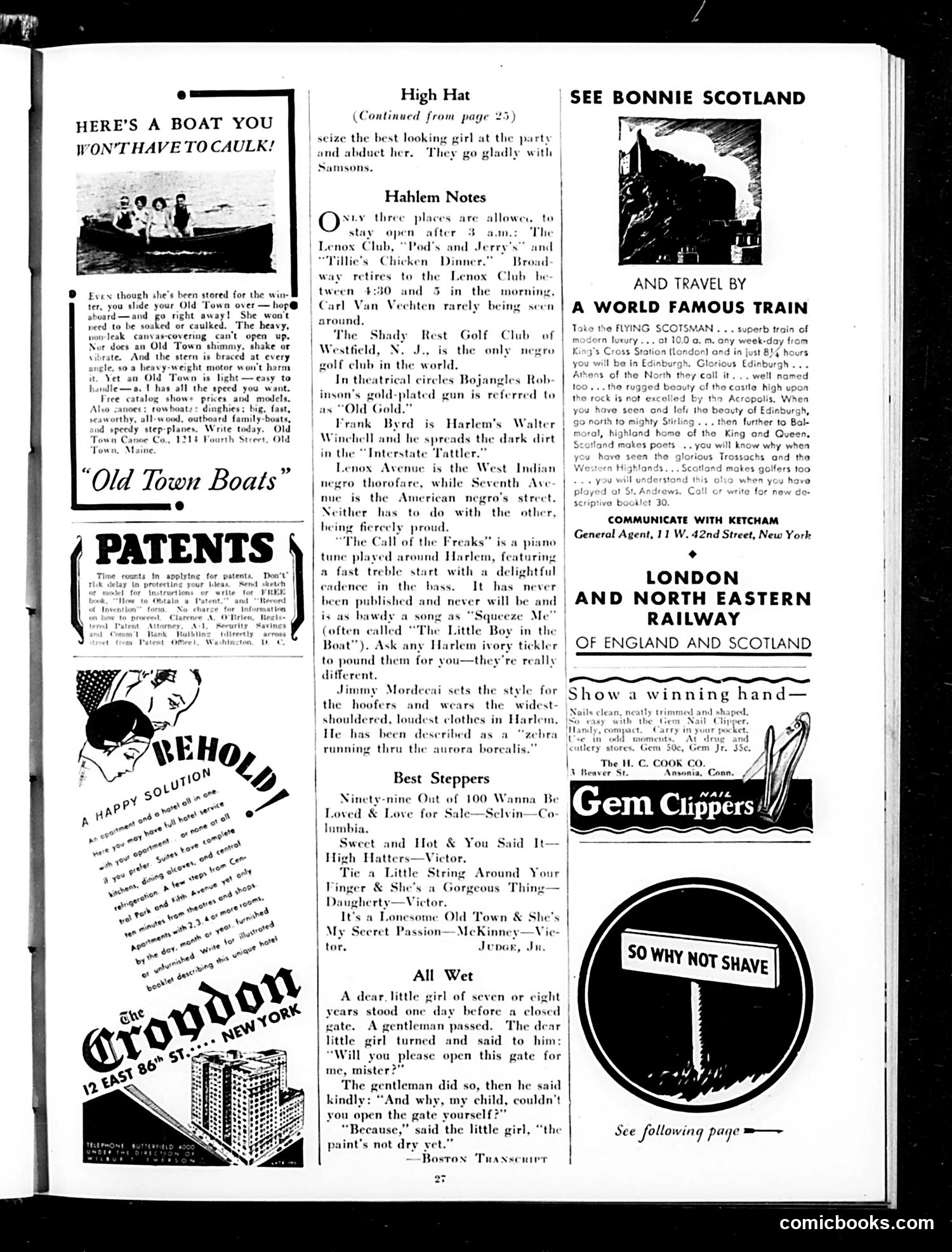
Analysis of Judge Magazine Page This page is primarily advertising and miscellaneous content rather than political satire. It contains: Main Elements: - Ads for Old Town boats and the Flying Scotsman train (promoting leisure travel) - "Hahlem Notes"—a gossipy column about Harlem nightlife and entertainment figures, including references to jazz musicians and venues like the Lenox Club - A brief joke ("All Wet") about a child unable to open a gate because paint is wet Historical Context: The "Hahlem Notes" reflects 1920s-30s Jazz Age culture, documenting Harlem's thriving African American entertainment scene. References to figures like "Bojangles Robinson" and discussions of jazz piano indicate this was written for readers interested in African American popular culture. The Satire: The page lacks significant political cartoons or pointed satire. The "All Wet" joke is mild wordplay about literal versus figurative meanings—typical magazine filler humor of the era, not social commentary. The page primarily documents period entertainment and consumer culture rather than offering sharp satirical critique.
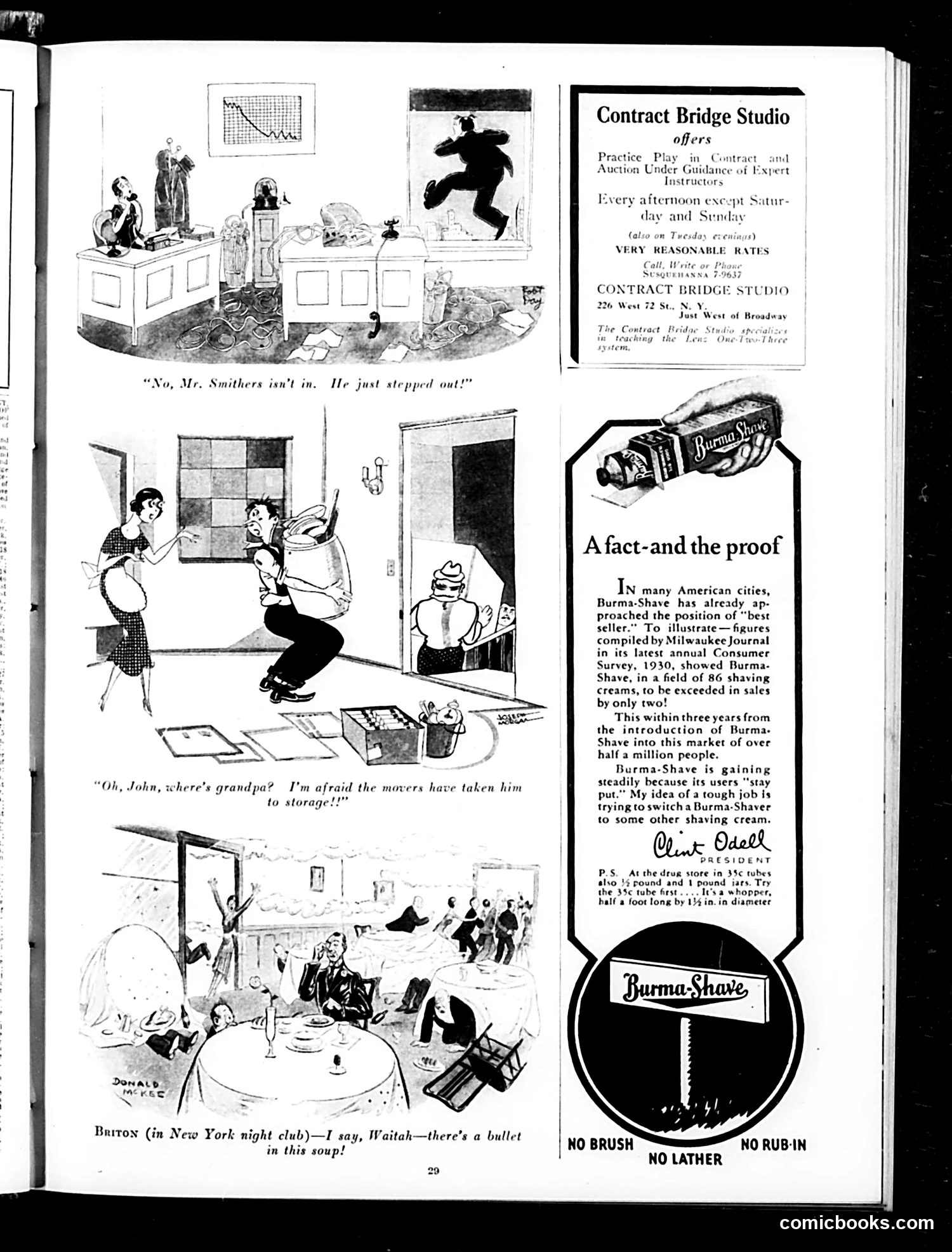
Page Analysis: Judge Magazine This page contains three cartoon jokes plus advertisements. Top cartoon: Office humor about an absent Mr. Smithers—a standard workplace gag about making excuses to callers. Middle cartoon: A domestic moving-day joke where a wife jokes that movers have taken grandpa to storage, implying he's old and gets in the way. Bottom cartoon: A British character in a New York nightclub complains to a waiter about finding a bullet in his soup—likely satirizing either the prohibition-era violence ("bullet in soup" as innuendo) or mocking upper-class British fastidiousness when dining in America. Right side: Advertisement for Burma-Shave shaving cream, emphasizing its rapid market success (ranked 3rd among 86 brands within three years). The ad includes testimonial copy and product sizing information. This represents the page's primary commercial content.
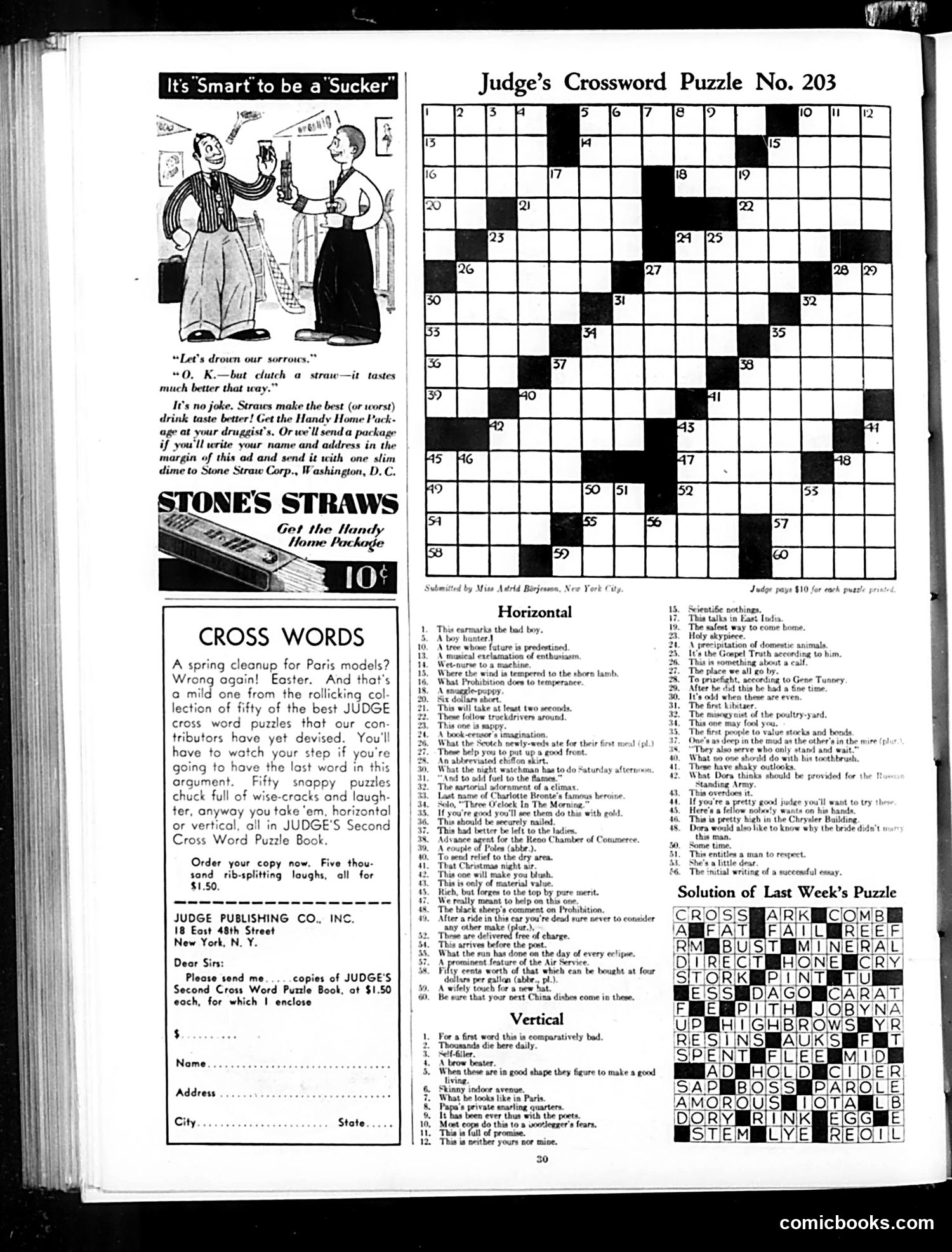
Judge Magazine Cartoon Analysis This page is primarily advertising and puzzle content rather than political satire. The main cartoon at top depicts two figures discussing drinks during Prohibition. One man says "Let's drown our sorrows," and the other responds by suggesting they use straws—implying straws make even unpalatable drinks (likely homemade bootleg liquor) taste better. This is an advertisement for Stone Straws, marketed as improving any beverage's taste. The satire is gentle: it's a tongue-in-cheek reference to Prohibition-era drinking culture, where Americans consumed illegal or poor-quality alcohol. The joke suggests that even terrible bootleg drinks become tolerable with the right straw—a humorous acknowledgment of widespread illegal drinking during this period. The rest of the page features Judge's crossword puzzle book advertisement and puzzle content, unrelated to the cartoon's social commentary.
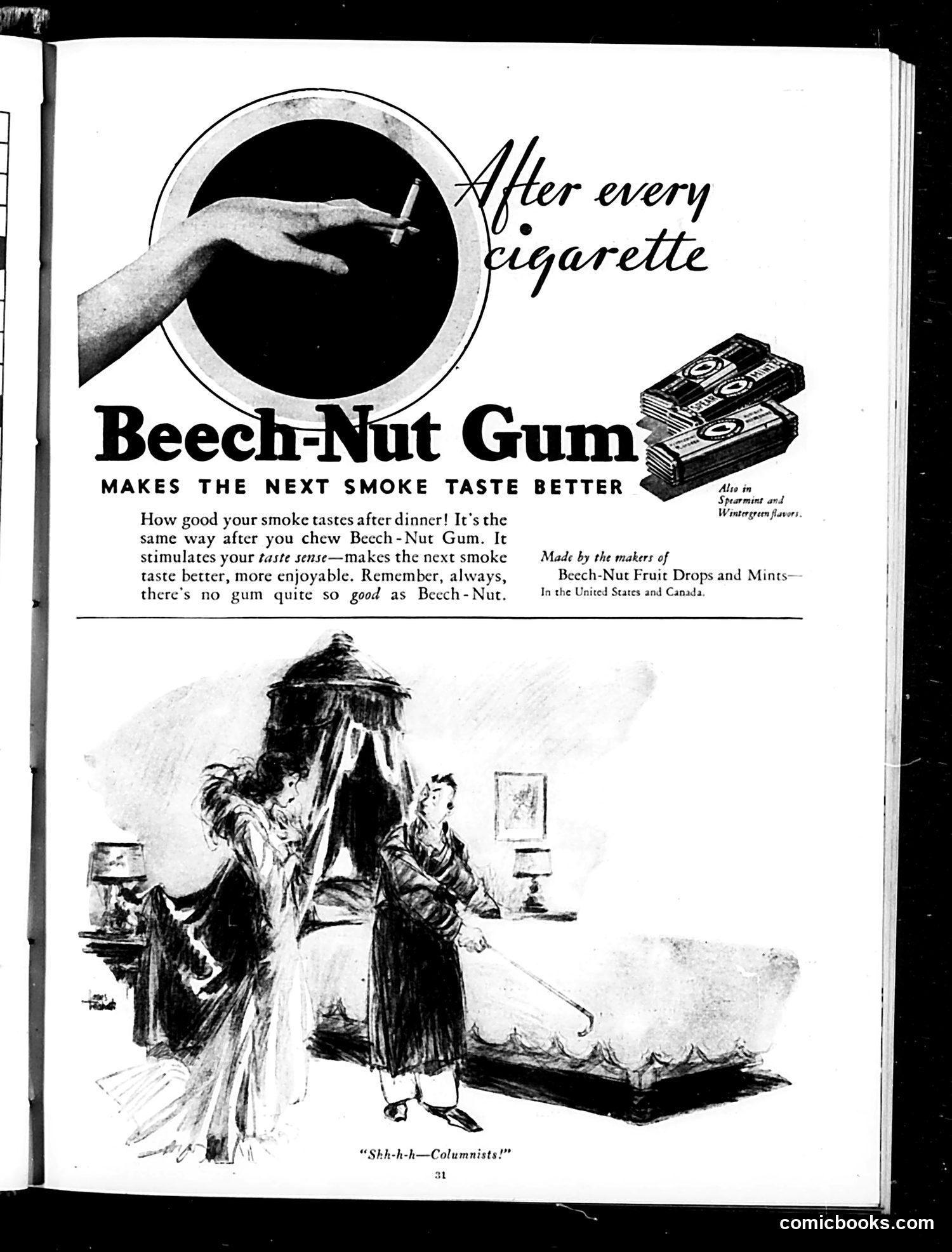
Analysis This page is primarily a Beech-Nut Gum advertisement, not political satire. The top half features a product ad claiming the gum enhances the taste of subsequent cigarettes by stimulating the taste sense—a marketing pitch linking gum consumption to smoking pleasure. The bottom illustration, captioned "Shh-h-h—Columnists!", appears to be a separate cartoon joke rather than satire. It depicts a woman in bed under mosquito netting with a man nearby, using the "shushing" sound to reference newspaper columnists (who famously reported gossip and scandal). The implication seems to be a cheeky joke about discretion regarding bedroom activities that columnists might otherwise publicize. The page reflects early-20th-century advertising norms openly promoting products alongside smoking.
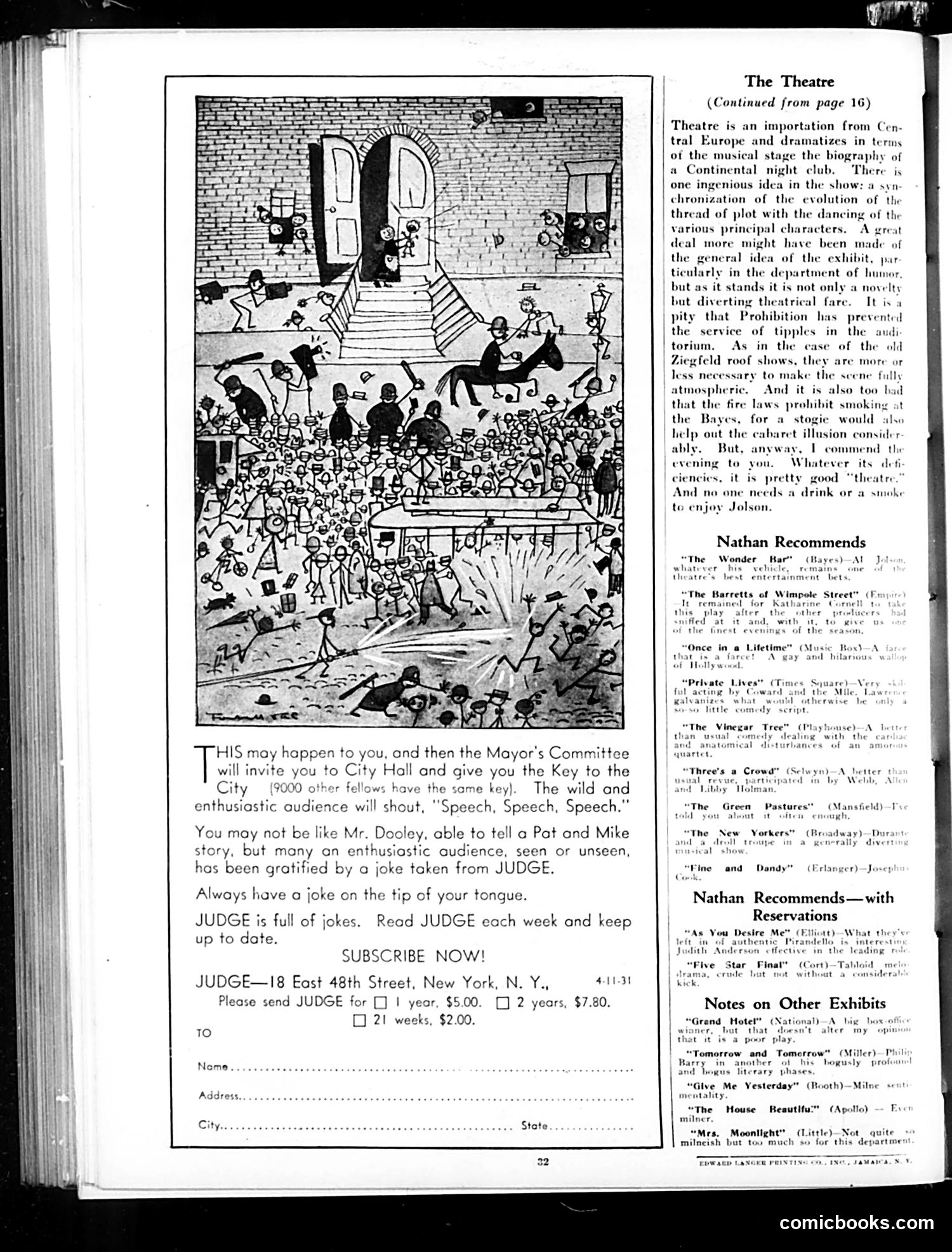
Judge Magazine Page: Theatre Review & Subscription Ad This page combines a theatre review with advertising. The large illustration depicts a chaotic theatre scene—a packed audience in formal dress, with performers on stage and various comic disruptions, likely representing the "Theatre" show being reviewed. The text discusses a Continental European-influenced musical production, praising it as "diverting theatrical fare" despite calling it a novelty. The critic notes that Prohibition prevents serving alcohol in the auditorium (a complaint about liquor bans), and fire codes prohibit certain stage effects—both practical frustrations undermining the cabaret-like atmosphere the show aims for. The bottom section advertises Judge magazine itself, encouraging readers to subscribe and keep jokes "on the tip of your tongue" for social situations—suggesting Judge's purpose as a source of humorous material for entertainment at gatherings.
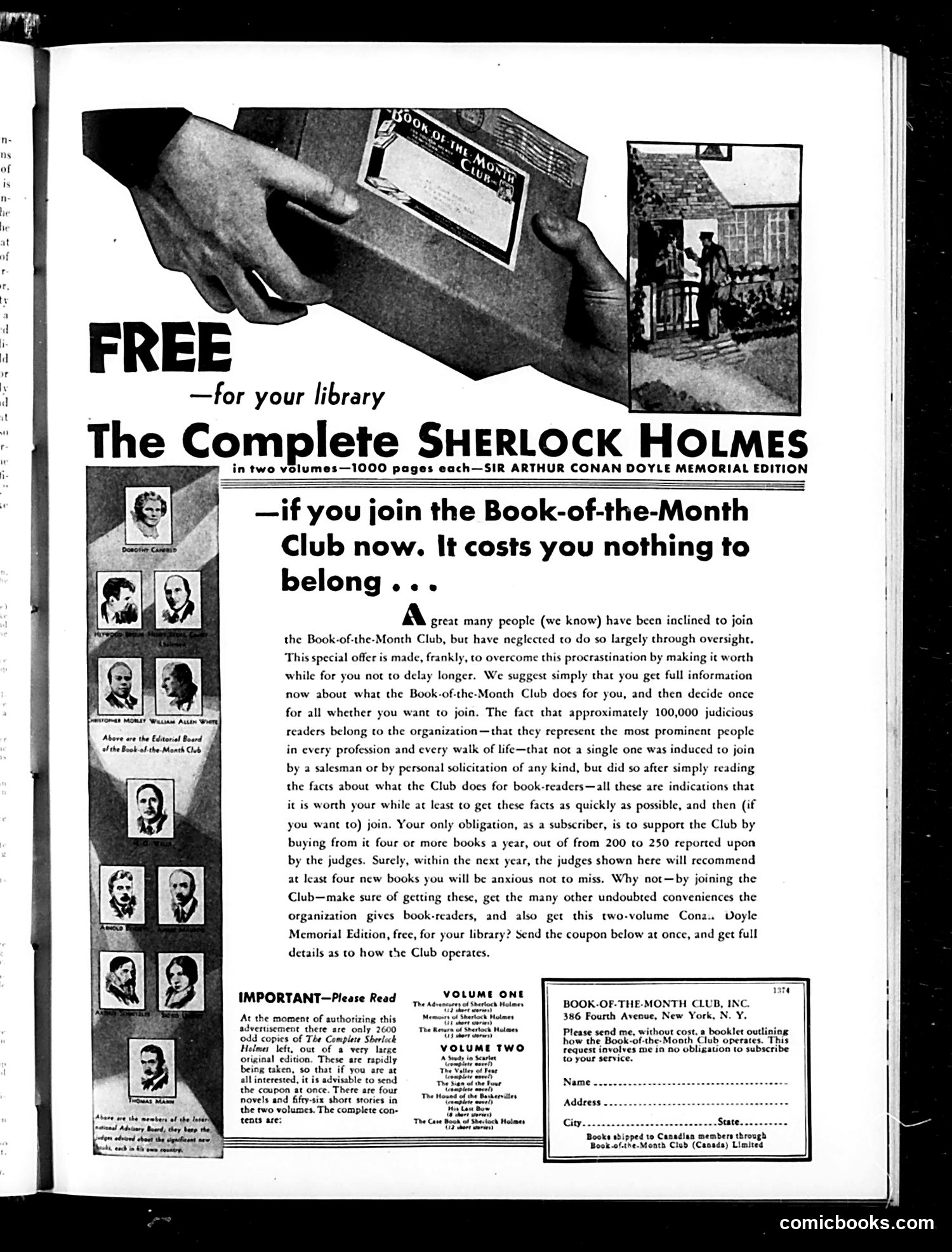
Analysis This is primarily a book club advertisement, not a political cartoon. It promotes the Book-of-the-Month Club's offer of a free two-volume Sherlock Holmes Memorial Edition to new members. The page includes portraits of what appear to be notable judges or literary figures who evaluated books for the club—identifying them specifically would require external knowledge beyond what the image supports. The advertisement's rhetorical strategy targets procrastination, emphasizing that approximately 100,000 "judicious readers" already belong, representing "the most prominent people in every profession." This appeals to social status and FOMO (fear of missing out)—a marketing tactic designed to make joining feel exclusive and inevitable. The "special offer" of a free classic book was meant to overcome hesitation about membership commitment. The modest obligation (purchasing four books yearly from curated selections) is presented as reasonable given the club's filtering service. This reflects 1920s-30s book culture when curated selections held significant prestige value.
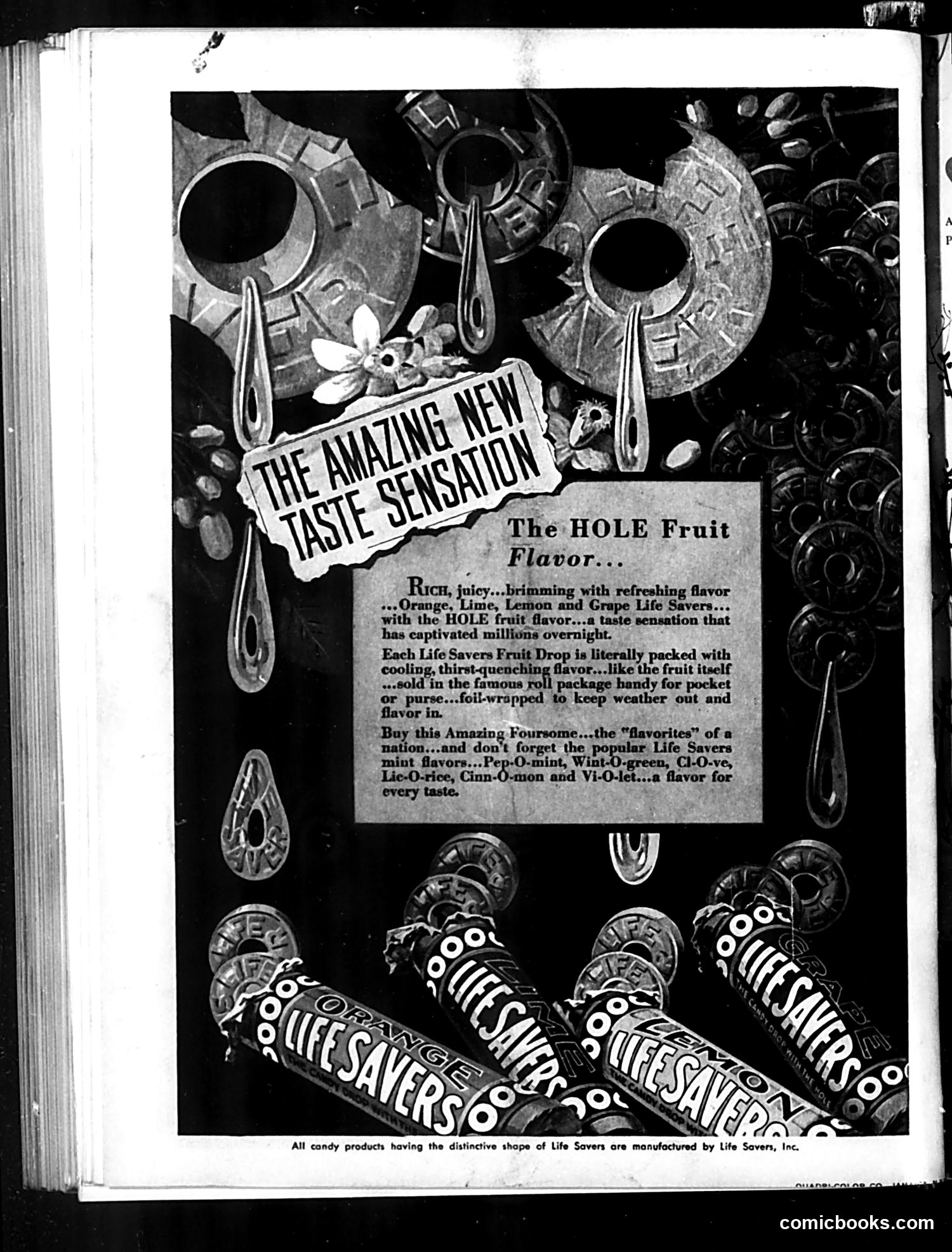
This is a Life Savers candy advertisement, not a political cartoon. The page promotes Life Savers' new "HOLE Fruit Flavor" line of candy drops, emphasizing the distinctive ring shape with a hole in the center. The ad uses playful language about "the amazing new taste sensation" and lists various fruit flavors (Orange, Lime, Lemon, Grape) plus mint varieties. The visual design features large decorative spoons and ornate vessels surrounding the product packaging at the bottom. There is no satirical content or political commentary present—this is straightforward commercial advertising from what appears to be a mid-20th century publication, using Life Savers' characteristic hole design as the central marketing concept.