judge
Judge — April 18, 1931
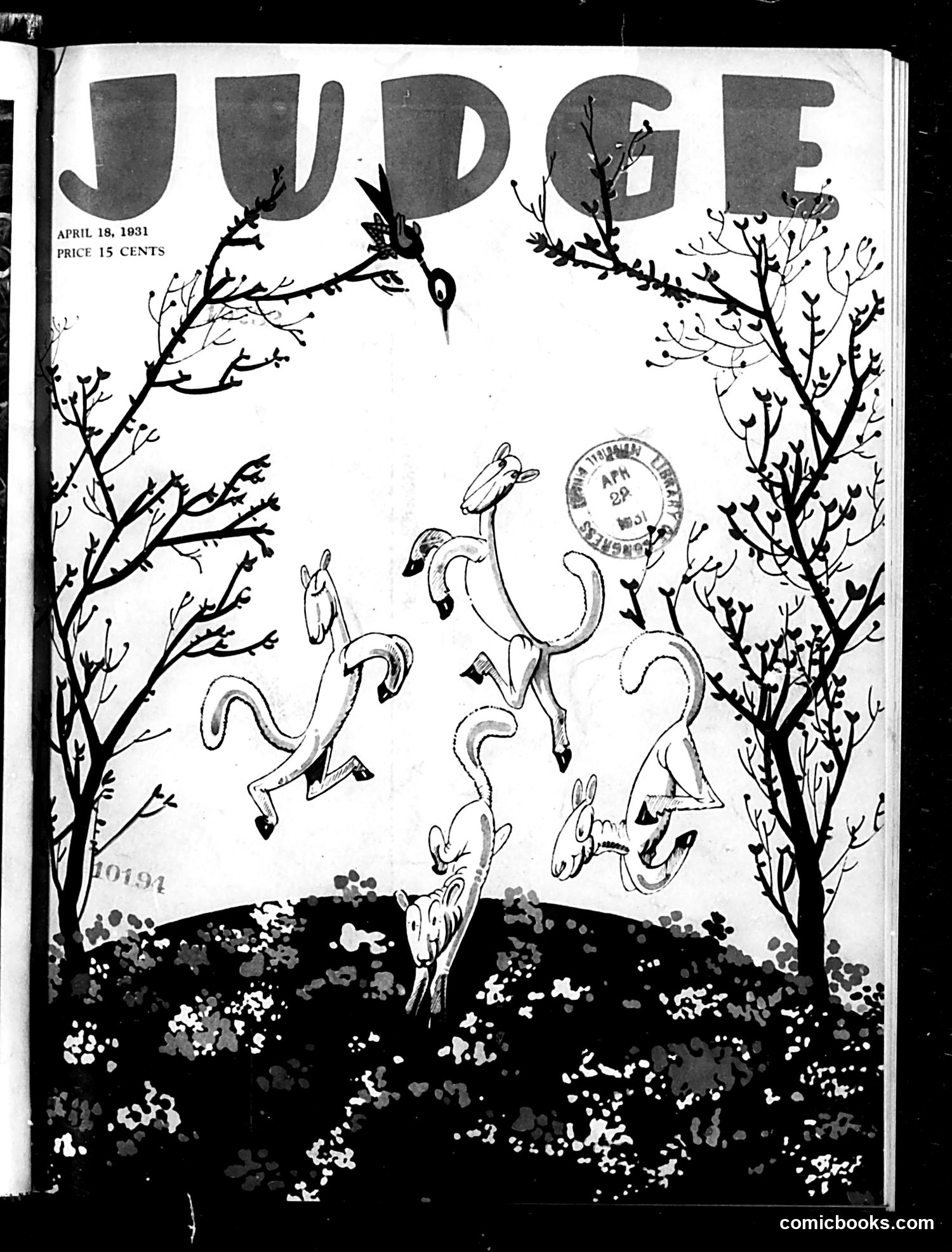
Judge Magazine Cover, April 18, 1931 This cover depicts rabbits dancing and jumping in a field with bare spring trees and flowering ground cover. The imagery appears to be a lighthearted spring celebration rather than explicit political satire. However, the timing is significant: April 1931 was during the Great Depression's early stages. The rabbits' energetic, carefree movements might represent optimism or naive hope during economically bleak times—a common satirical theme in Depression-era humor. The "Judge" masthead letters feature rabbits integrated into the design, emphasizing the spring/fertility theme. Without additional text content visible on this page, the precise satirical message remains unclear, though it likely comments on American attitudes toward economic recovery or renewed hope during hardship.
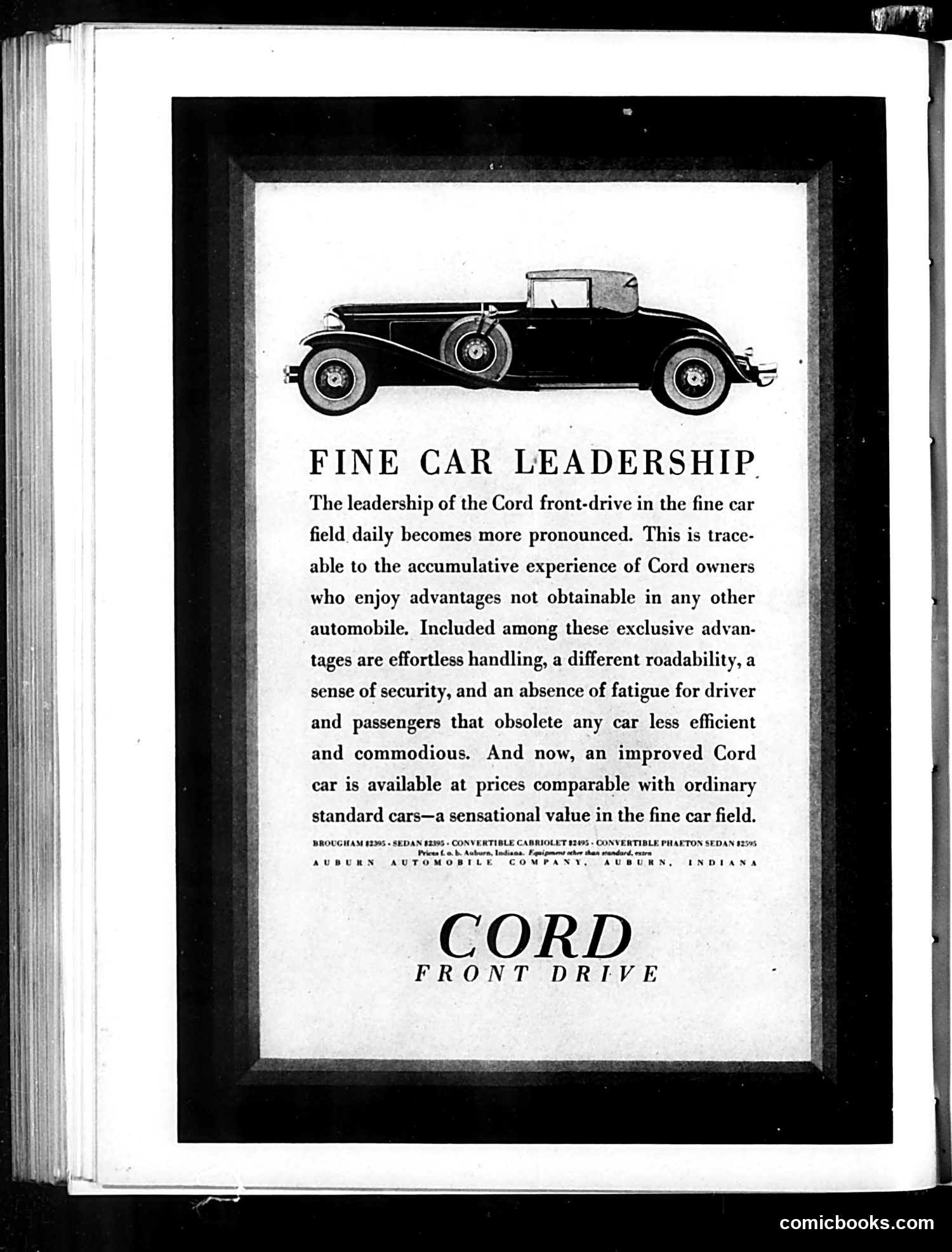
Analysis This page is primarily an advertisement, not satire or political commentary. It promotes the Cord automobile's front-wheel drive technology as a luxury feature. The ad emphasizes that Cord ownership provides exclusive advantages—"effortless handling," superior roadability, security, and reduced driver fatigue—previously unavailable in other cars. Notably, it claims these premium features are now available "at prices comparable with ordinary standard cars," positioning the Cord as a value proposition in the fine car market. The elegant side-profile illustration of a convertible roadster reinforces the luxury positioning. This appears to be straightforward product marketing rather than satirical commentary, typical of Judge magazine's commercial content alongside its humorous editorial material.
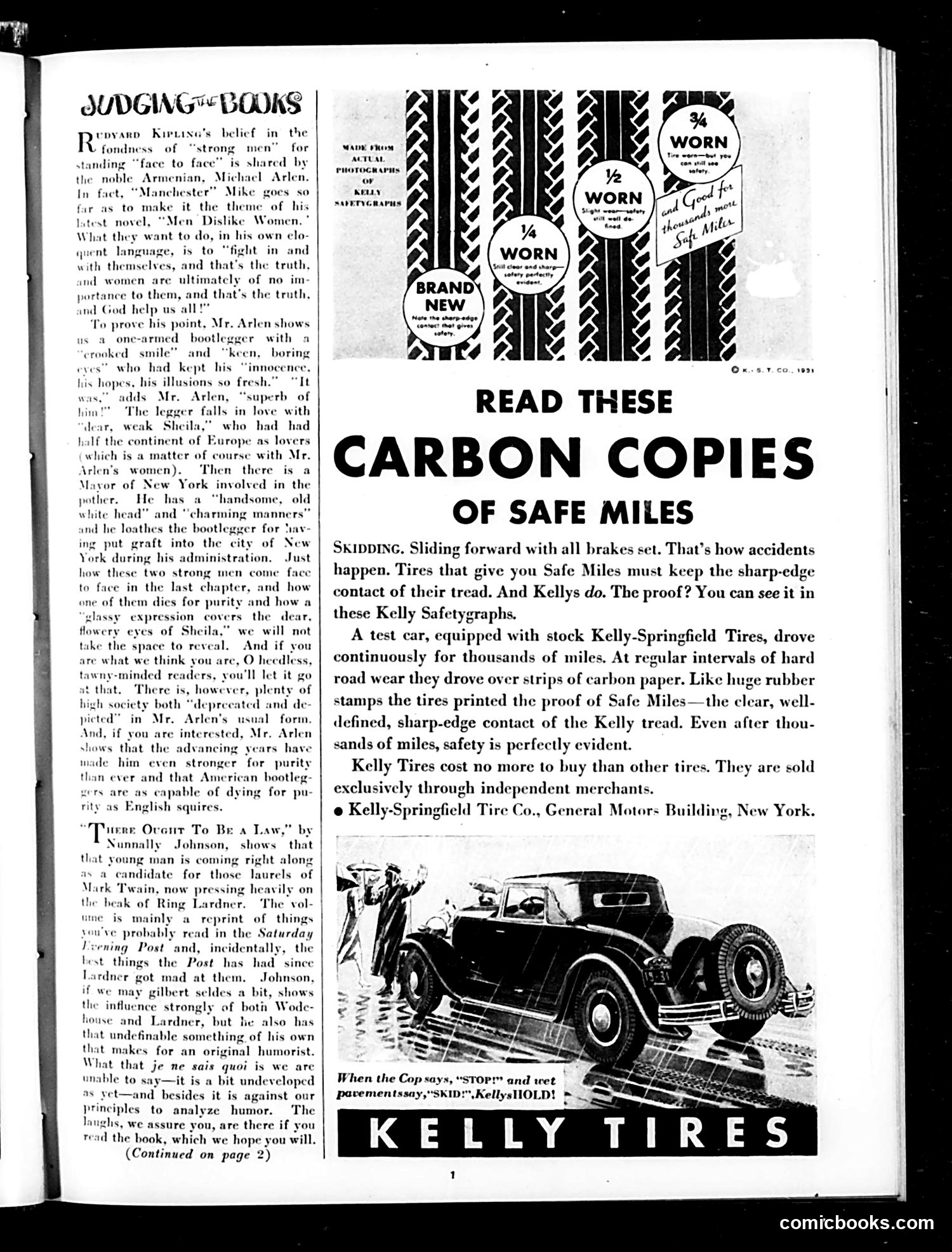
Analysis This page is primarily a Kelly Tires advertisement rather than political satire. The top-left contains a brief book review section ("Judging the Books"), but the dominant content is a large tire ad occupying roughly two-thirds of the page. The ad uses "carbon copy" safety tests as its selling point—demonstrating that Kelly-Springfield tires maintain tread contact even after thousands of miles. The accompanying illustration shows a vintage automobile, emphasizing automotive safety. The small book review discusses Michael Arlen's novel "Men Dislike Women," critiquing its portrayal of gender relations and character development. This represents Judge's commercial advertising practices rather than its satirical content, showing how magazines funded themselves through prominent paid placements.
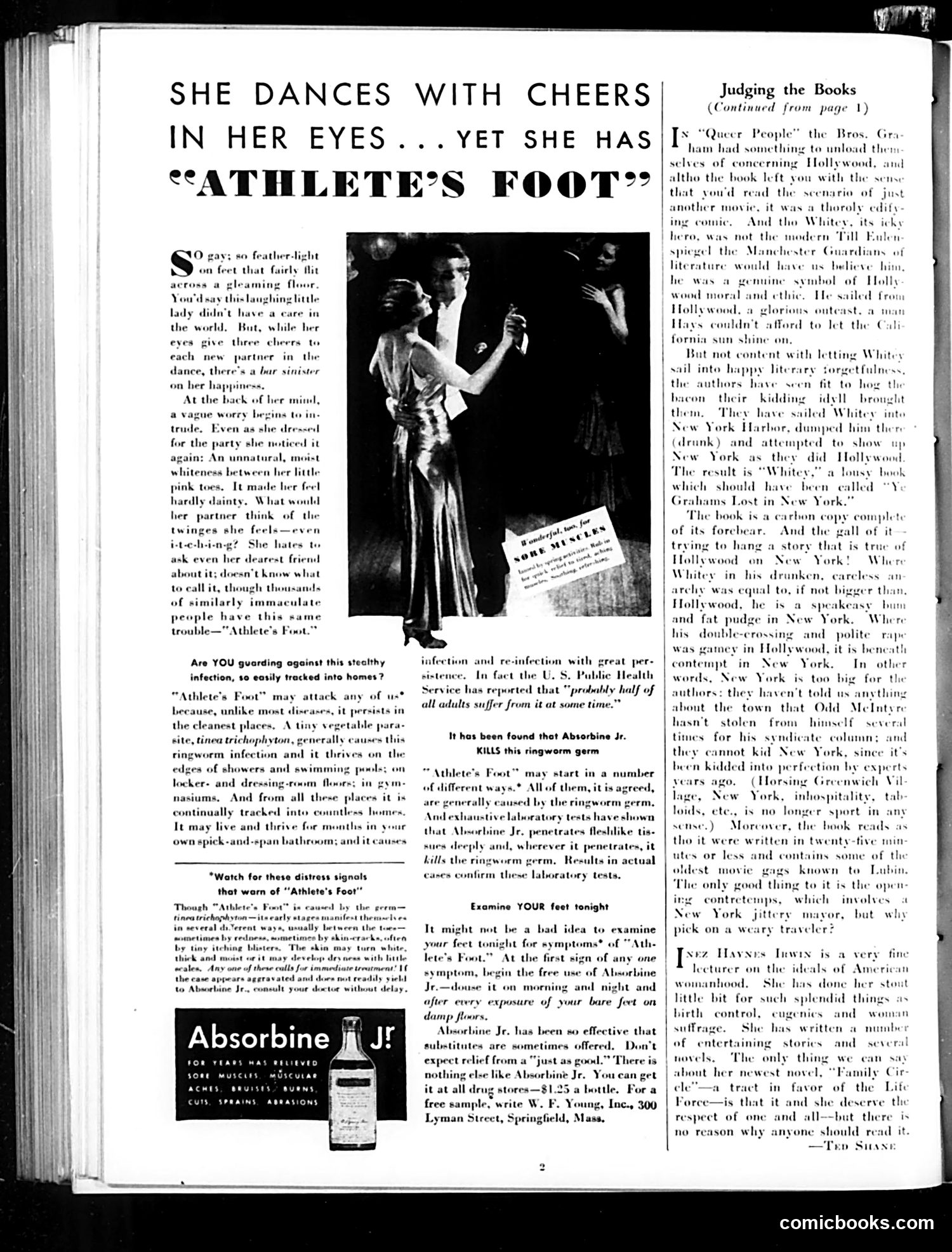
Judge Magazine Page Analysis This page contains primarily advertising and book reviews, not political satire. The dominant content is an Absorbine Jr. advertisement addressing "Athlete's Foot," a fungal infection. The ad uses fear-based messaging about the condition spreading through homes and emphasizes the product's effectiveness. This reflects early-20th-century marketing tactics that exaggerated health concerns to sell medicines. The right column contains "Judging the Books," a book review section critiquing recent publications about Hollywood and New York, including complaints that authors focused too heavily on New York rather than Hollywood's glamour. The left side shows what appears to be a dancing couple illustration accompanying the headline about an "athlete's foot" infection—using the contrast between graceful movement and physical ailment for humorous effect in the advertisement.
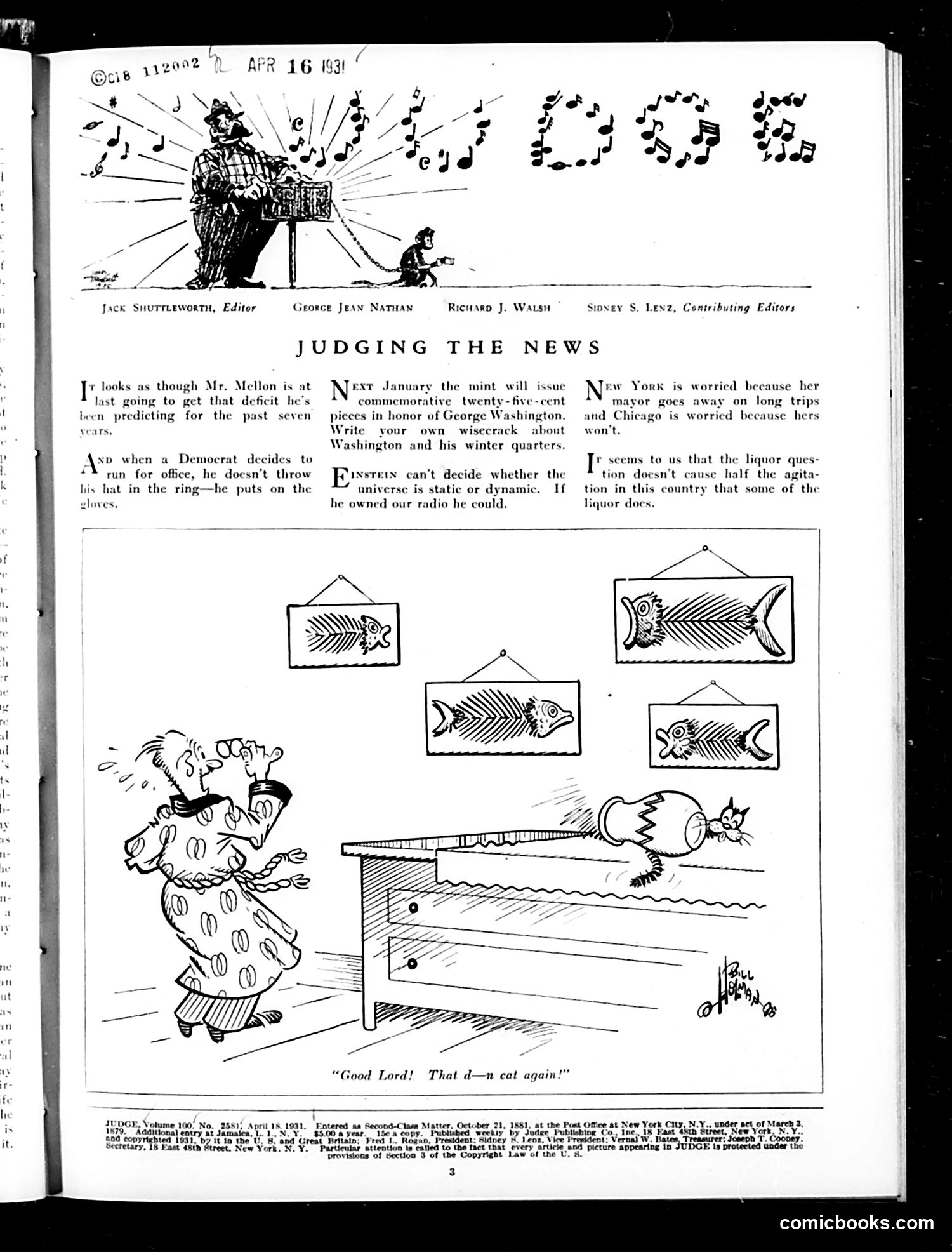
"Judging the News" - April 16, 1931 This satirical column mocks current events through brief commentary and cartoons. Top commentary references Mr. Mellon's budget deficit predictions, a Democrat's campaign style, and disputes about whether Einstein viewed the universe as static or dynamic—likely referencing the ongoing scientific debate about relativity and cosmology. Main cartoon depicts a woman at a fence watching a cat knock over a fishbowl, with the caption "Good Lord! That d—n eat again!" This appears to satirize repeated failures or mistakes—possibly political incompetence or economic mismanagement recurring despite previous consequences. The woman's exasperation mirrors public frustration with recurring problems. The cartoon's humor lies in the cyclical nature of the disaster and her resigned reaction to predictable chaos.
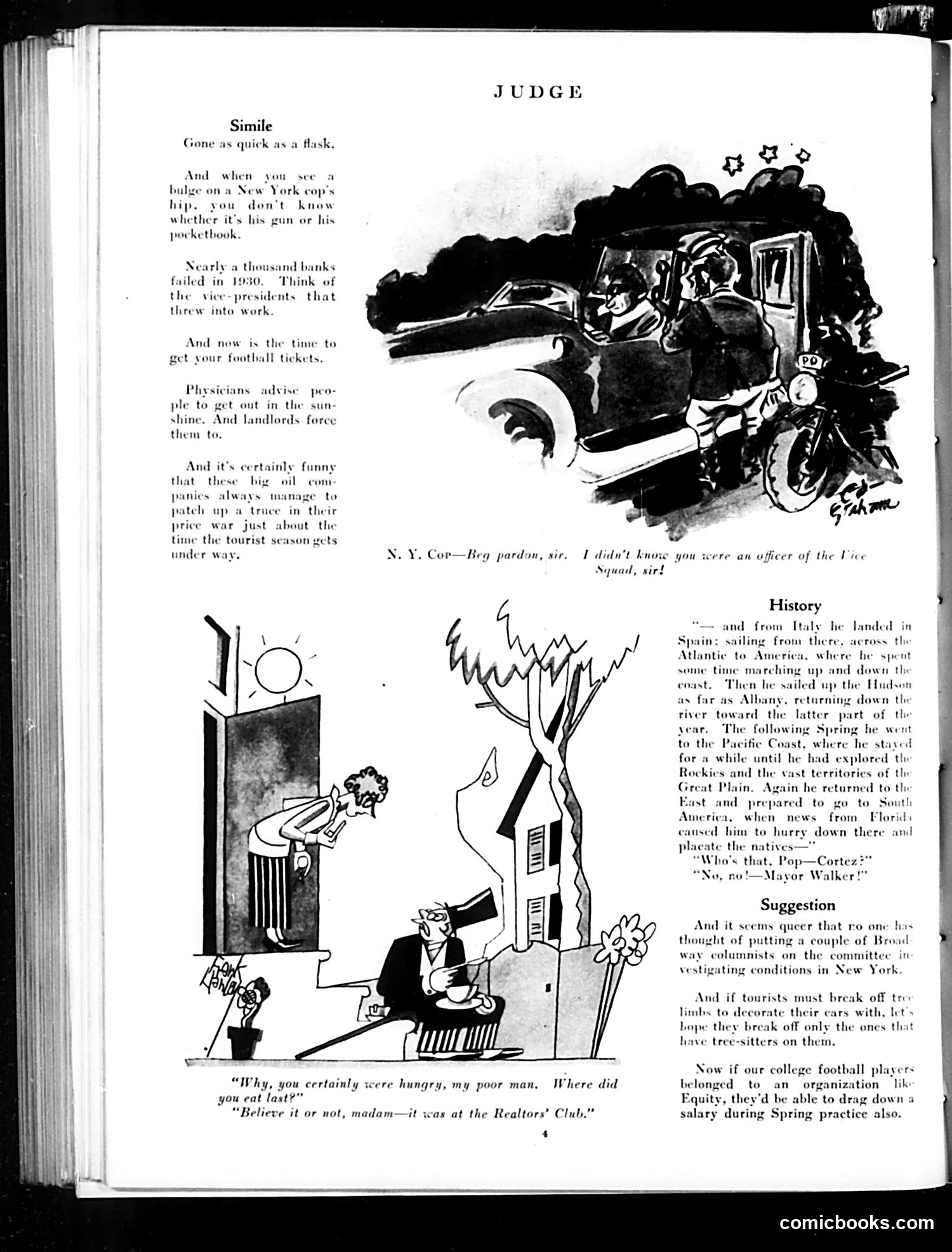
Explanation for Modern Readers This page contains three distinct satirical pieces from Judge magazine: 1. Top cartoon: A police officer stops a speeding car, confusing the driver's identity. The joke references New York City police corruption, suggesting officers couldn't distinguish between criminals and law-abiding citizens. 2. Middle cartoon: Depicts a starving man claiming he last ate at the "Realtors' Club." This satirizes the 1930 financial crisis and real estate industry's role in economic collapse—wealthy realtors' clubs contrasted absurdly with widespread hunger. 3. "Suggestion" section: Proposes that wealthy tourists and college athletes be made to support struggling communities, likely mocking the economic disparity during Depression-era America. The overall theme critiques economic inequality and institutional corruption of the era.
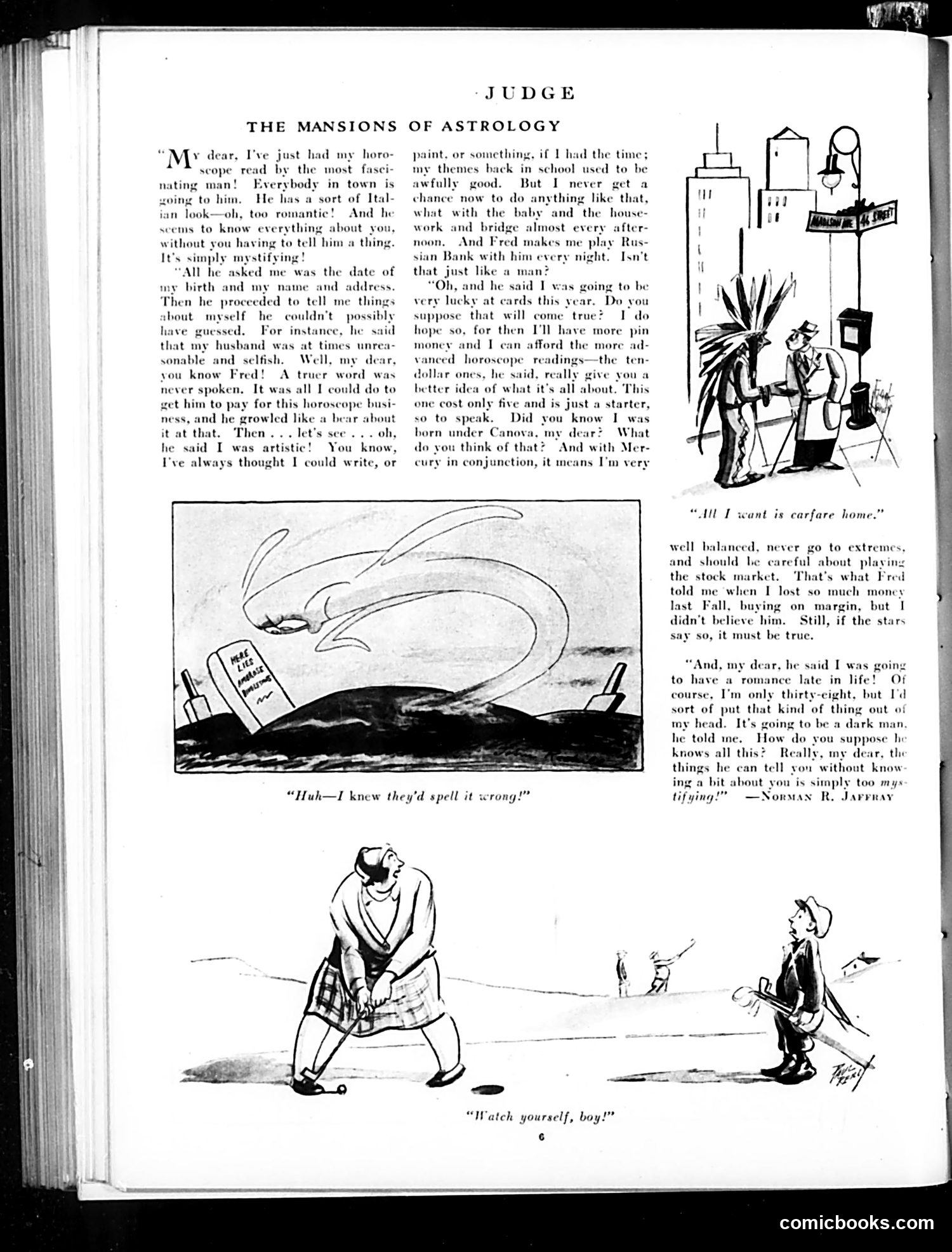
"The Mansions of Astrology" This satirical piece mocks believers in astrology and horoscope readings. A woman describes how her husband Fred became obsessed with astrology after consulting a "most fascinating man" in town who reads horoscopes. Fred now bases major life decisions—finances, romance, work—on astrological predictions, claiming the stars dictate his fate. The cartoons illustrate the absurdity: one shows a fortune-teller's spell "spelled wrong," while another depicts a woman warning "Watch yourself, bug!" as a man swings wildly, presumably following some astrological instruction. The satire targets the era's popular belief in astrology as pseudoscientific nonsense that leads gullible people to make foolish decisions while abandoning personal responsibility.
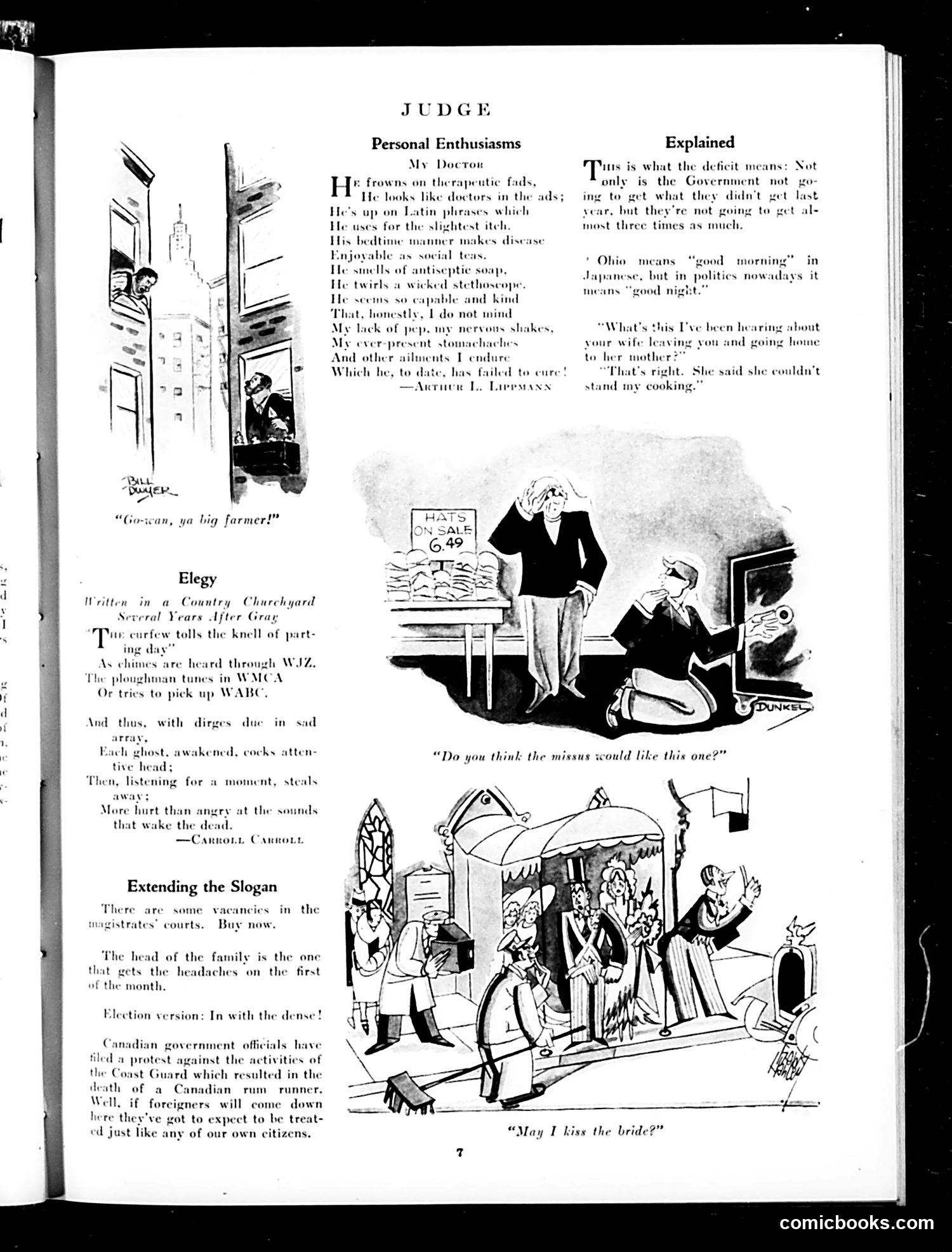
Judge Magazine Page Analysis This page contains satirical commentary typical of Judge magazine's style. The "Personal Enthusiasms Explained" section mocks a particular type of doctor—one who adopts fashionable therapeutic trends, uses pretentious Latin phrases, and employs impressive medical paraphernalia (stethoscope) while failing to actually cure patients' ailments. The "Explained" dialogue jokes about government deficit spending and a domestic dispute over cooking. The "Elegy" parodies Gray's famous poem, updating it with radio station references (WJZ, WMCA, WABC), suggesting modern life's noise disrupts even solemn occasions. "Extending the Slogan" contains political humor about magistrate vacancies, headaches (possibly referencing prohibition-era tensions), and a jab at Canada regarding Coast Guard involvement in rum-running deaths—reflecting Prohibition-era smuggling conflicts. The cartoons illustrate these pieces with typical period humor involving hat sales and a wedding scene.
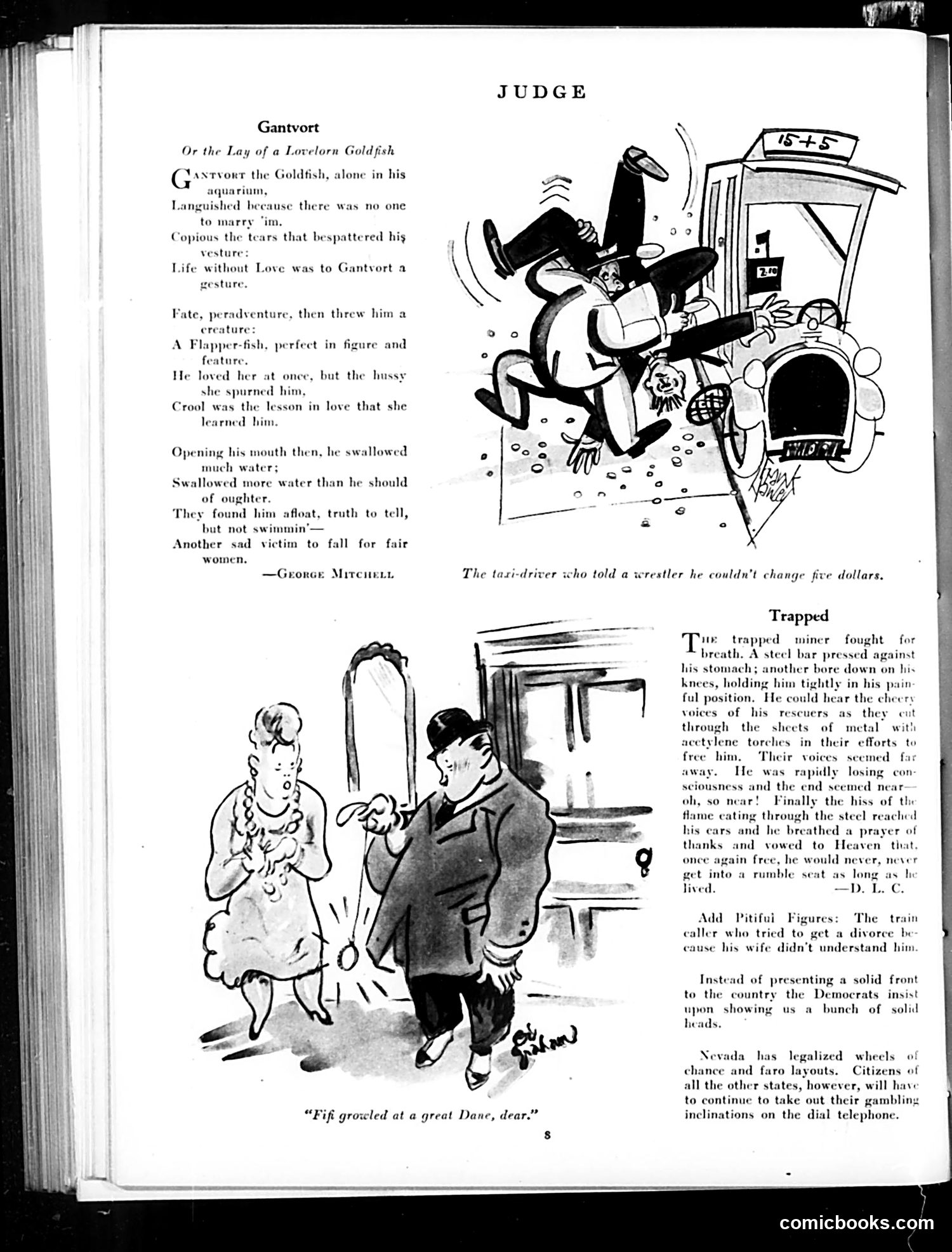
"Judge" Page Analysis This page contains three distinct items: "Gantvort" (top): A humorous poem by George Mitchell about a lovelorn goldfish who falls for a "flapper-fish" (referencing the fashionable, independent young women of the 1920s). She rejects him; he drowns himself in despair—satirizing both romantic melodrama and the "modern woman" who spurns traditional courtship. "The taxi-driver" cartoon (top right): A slapstick illustration of a taxi driver being thrown from his vehicle, captioned about a wrestler he couldn't make change for—straightforward physical comedy with no political content. "Trapped" (bottom right): A serious account of a trapped miner's rescue, followed by scattered political and social commentary: criticism of Democrats' disunity, a jab at divorce proceedings, and a quip about Nevada's legalized gambling. The page mixes humor, sentiment, and political jabs typical of *Judge*'s satirical approach.
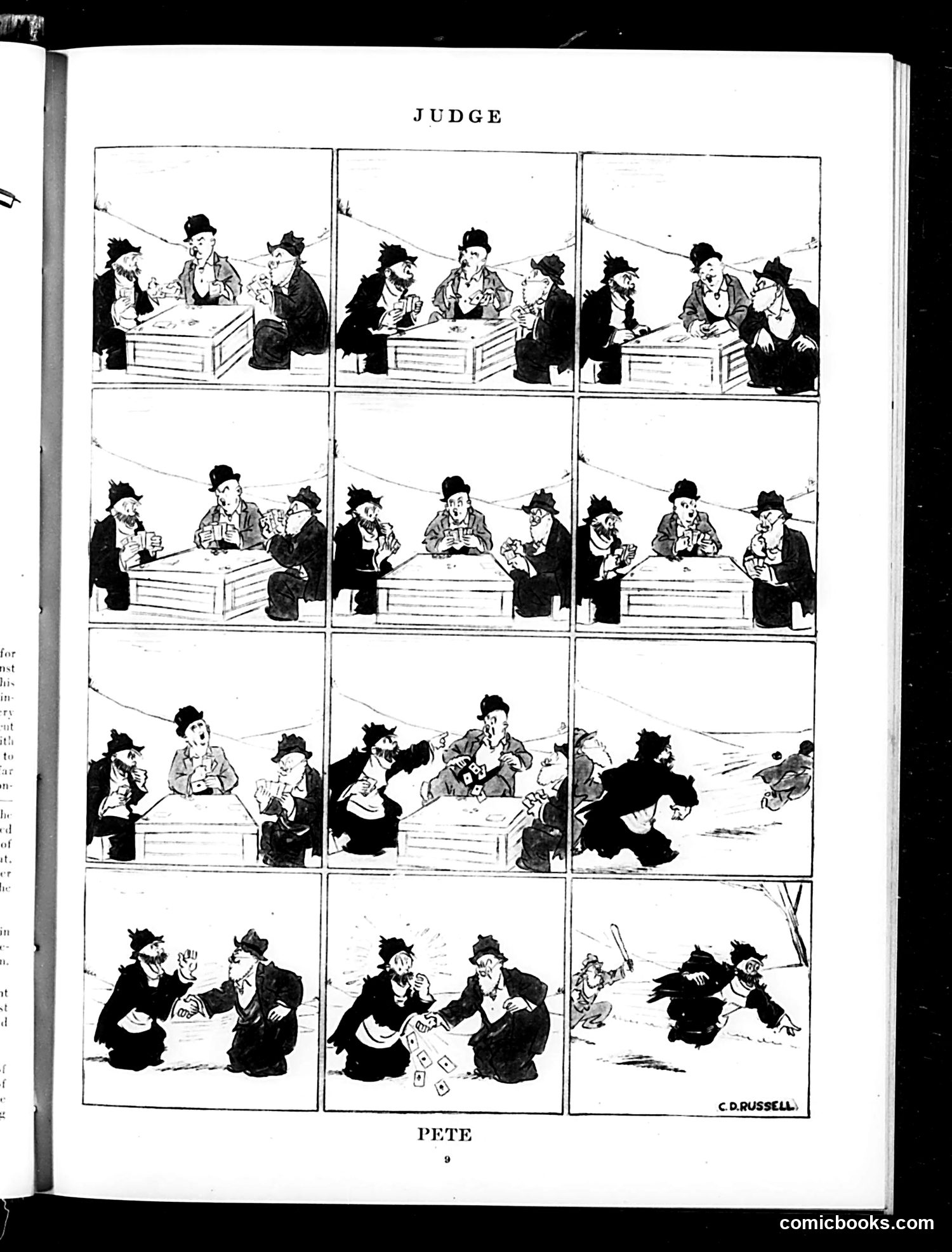
"Judge" Comic Strip Analysis This is a twelve-panel comic strip titled "Judge" (with character name "Pete" credited to C.D. Russell) depicting a courtroom scene that escalates into chaos. The narrative progresses from orderly judicial proceedings at the top—with figures seated around a judge's bench—to increasingly disorderly behavior: drinking, gambling with dice, physical altercations, and ultimately people fleeing or fighting in the final panels. The satire appears to mock the integrity of the judicial system, suggesting that courtroom proceedings devolve into lawlessness and corruption. The judges and court officials progressively abandon their formal roles, engaging in vice and violence. This likely critiques late 19th or early 20th-century concerns about judicial corruption or incompetence, a common target of *Judge* magazine's political satire.
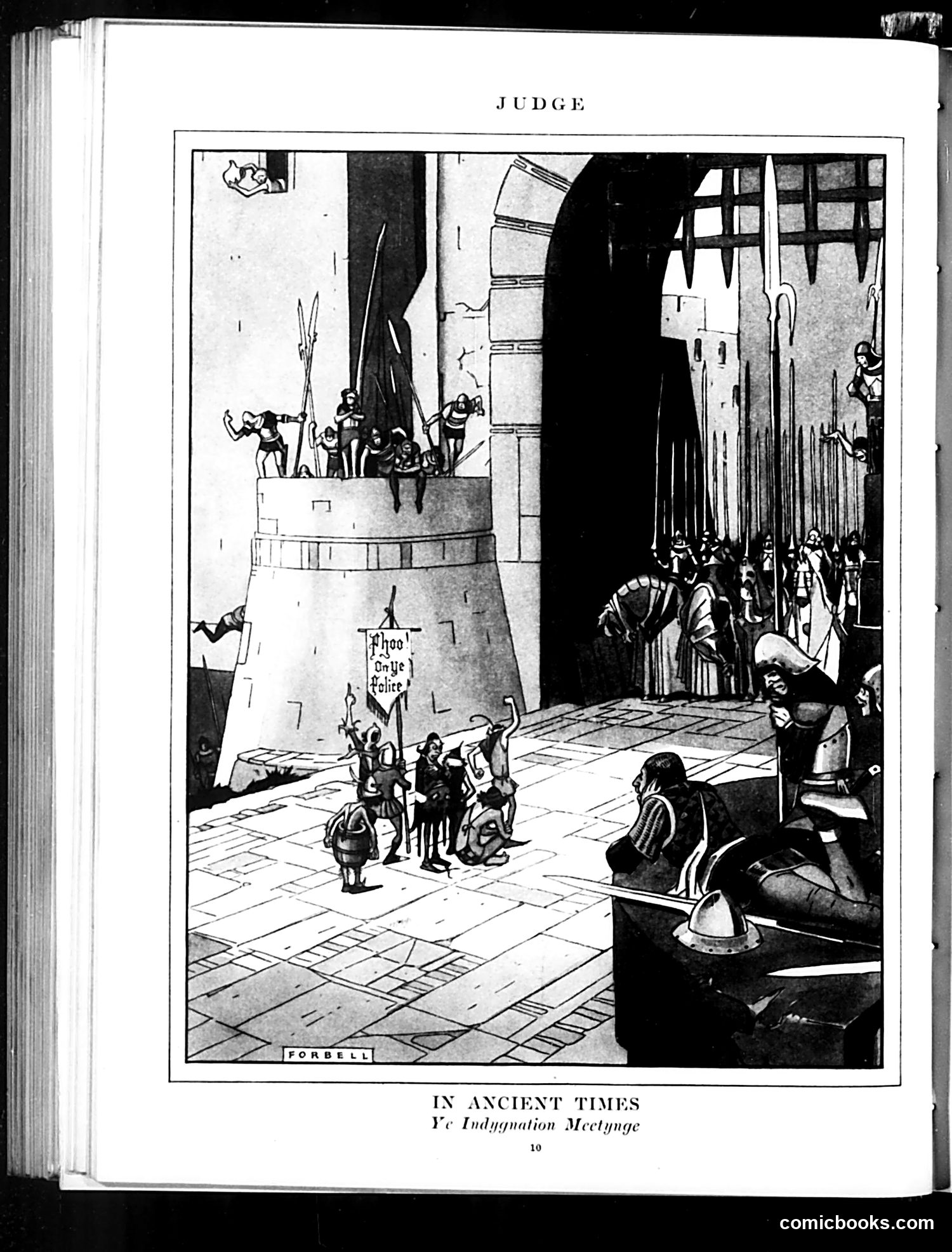
Analysis This is a single-panel satirical illustration titled "In Ancient Times: Ye Indignation Meetynge," credited to Forbell. The cartoon depicts a medieval or ancient courtyard scene with a tower where armed figures stand on top, while below, a crowd gathers around what appears to be a formal proceeding or trial. The satire uses historical setting to comment on contemporary indignation meetings—public gatherings of protest or outrage. By rendering it in pseudo-archaic style ("Ye...Meetynge"), the artist suggests that public anger and formal complaints are timeless human behaviors. The specific political target remains unclear without additional context, but the composition implies Judge magazine is mocking either the theatricality of such gatherings or their futility, presenting them as historically repetitive spectacles rather than meaningful reform.
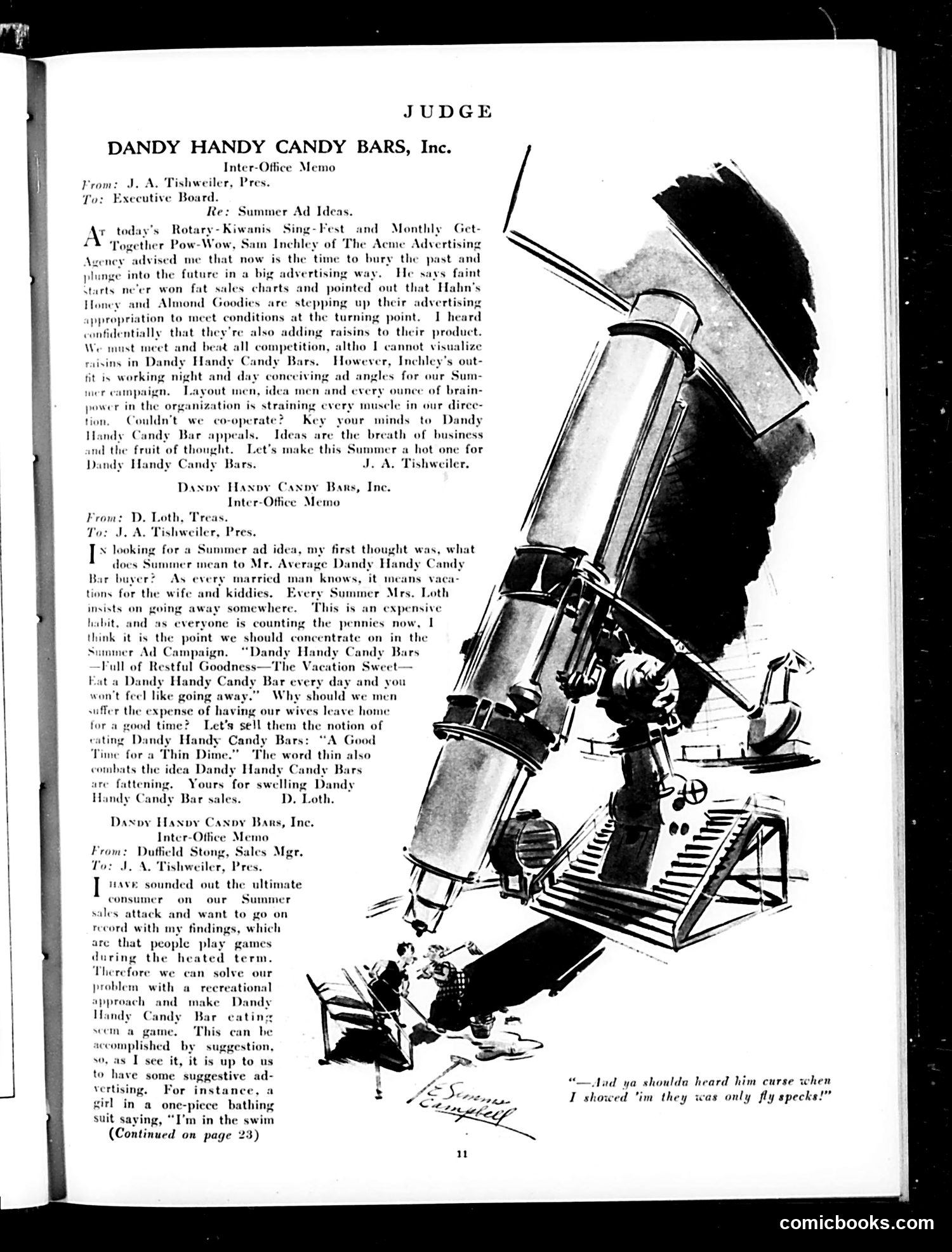
Judge Magazine Satire: "Dandy Handy Candy Bars" Ad Campaign This is office-memo satire mocking corporate advertising during the Great Depression. Three company executives propose summer marketing ideas for a candy bar: 1. President Tishweiler urges aggressive competition, praising "idea men" and aggressive advertising. 2. Treasurer Loth cynically targets wives: market candy bars as a cheap substitute keeping wives home instead of demanding expensive vacations—"A Good Time for a Thin Dime." 3. Sales Manager Stong proposes "suggestive advertising" using attractive women in bathing suits. The cartoon illustrates this last concept: a scantily-clad woman in a bathing suit climbs a telescope or surveying equipment, with the caption mocking male ogling ("fly specks"). The satire targets: Depression-era male anxiety about women's leisure demands, cynical marketing that exploits gender stereotypes, and advertising's increasingly manipulative use of female sexuality to sell products. The memos reveal corporate callousness: solving economic hardship not through fair wages but through manipulating family spending and female imagery.
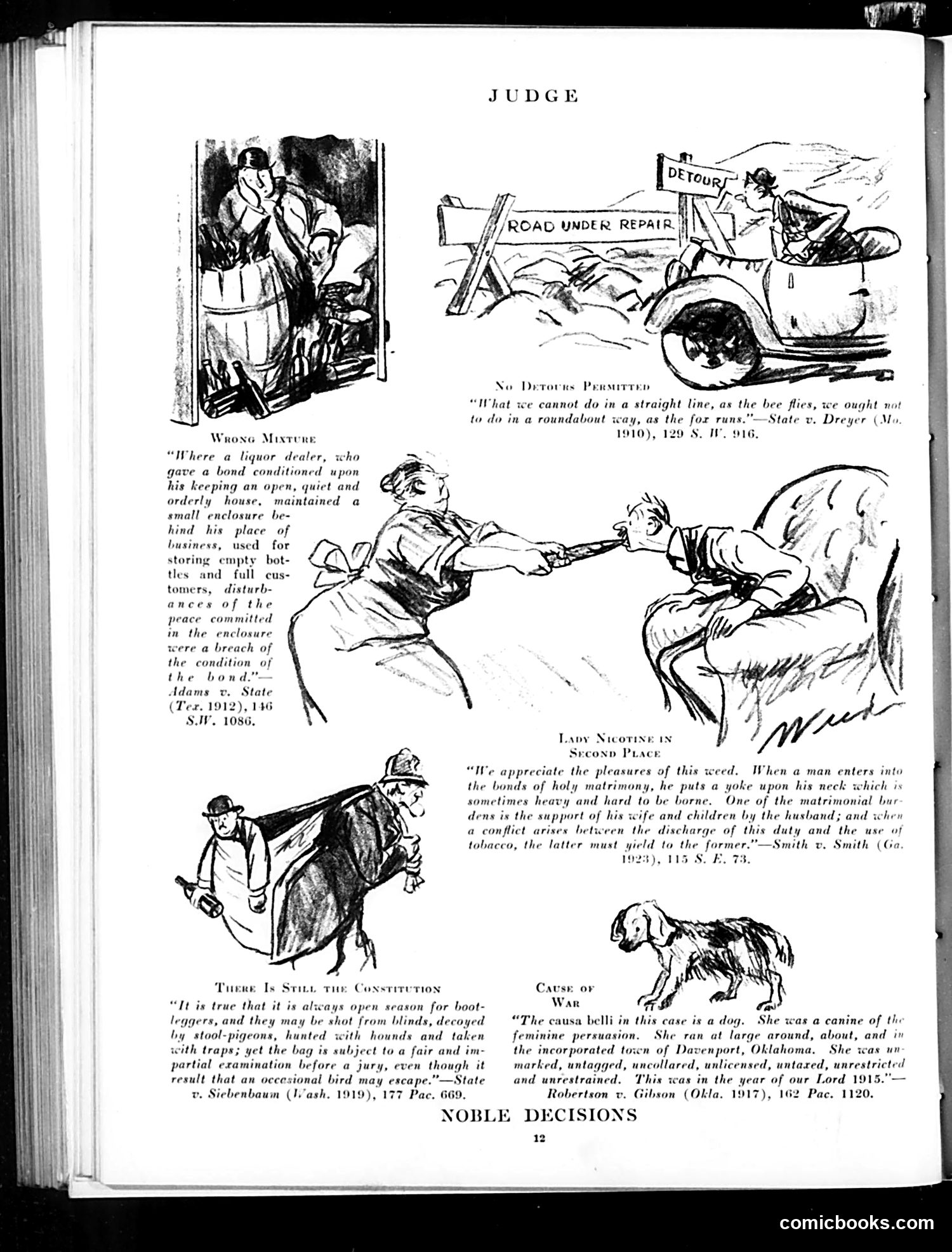
Judge Magazine: "Noble Decisions" Page This page satirizes absurd legal rulings through cartoon illustrations paired with actual court case quotes. The satire works by presenting genuinely bizarre judicial logic as "noble." Key examples: - "Road Under Repair": Mocks a ruling that permits detours despite stating one shouldn't do indirectly what's forbidden directly—a logical contradiction judges overlooked. - "Wrong Mixture": A liquor dealer's bondage violation involves a back-lot enclosure—the ruling seems petty. - "Lady Nicotine in Second Place": A marriage case where courts ruled tobacco use must yield to supporting one's family—presented as profound wisdom about matrimonial duty. - "Cause of War": An Oklahoma case over an unmarked, unleashed dog is treated as a major legal matter worthy of judicial attention. The cartoons' exaggerated, crude illustrations emphasize the ridiculous earnestness with which courts treated trivial disputes. The overall effect ridicules judicial overreach and the pompous language judges use to justify questionable decisions.
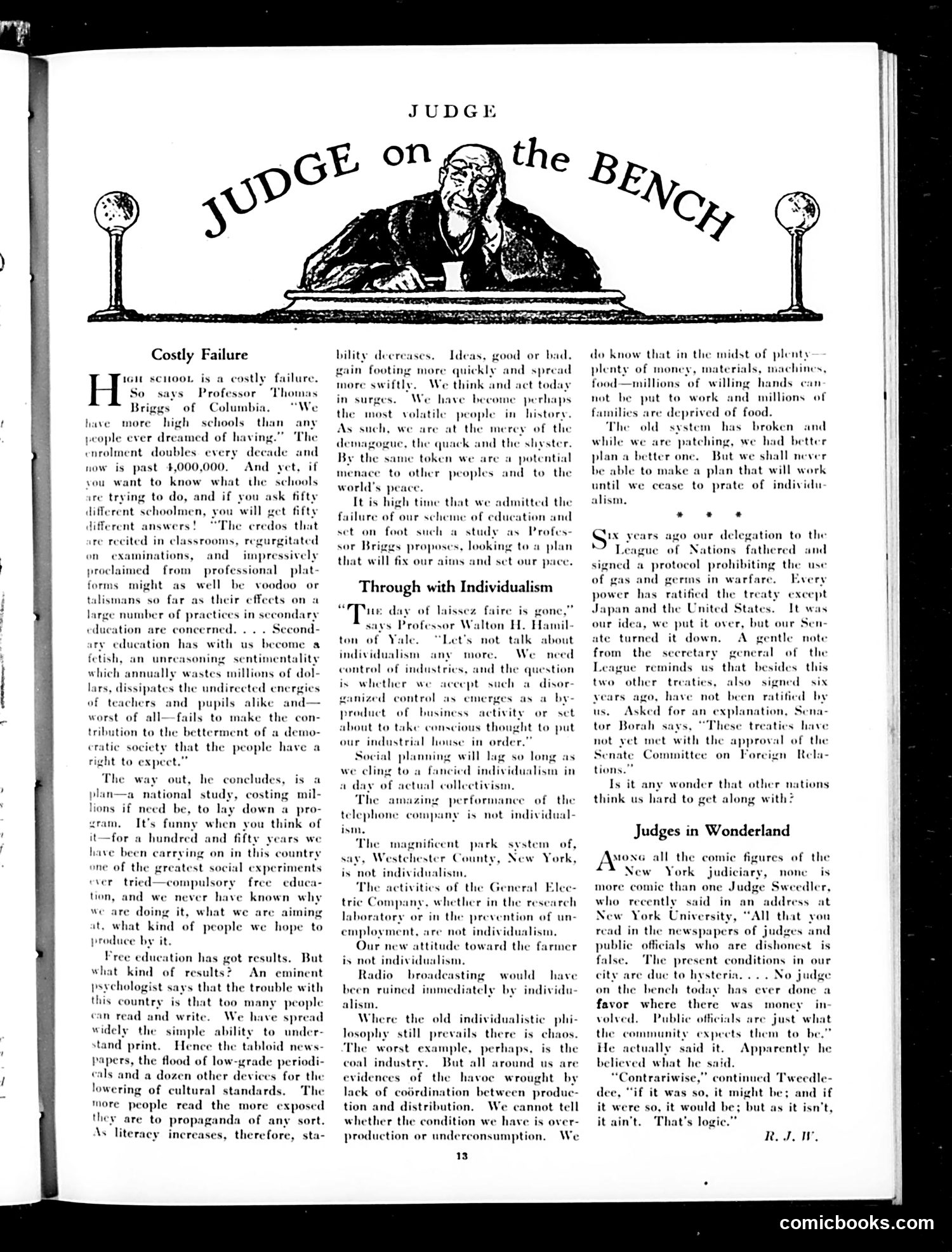
Analysis for Modern Readers This page from *Judge* magazine critiques American education and economic policy circa the 1920s-30s. "Costly Failure" attacks the expansion of high schools, arguing that despite millions enrolled, educators can't agree on goals. Professor Thomas Briggs of Columbia advocates a massive federal study to establish coherent educational policy—unusual for the era. "Through with Individualism" presents Professor Walton H. Hamilton arguing that laissez-faire capitalism has failed and requires coordinated planning. He uses examples (park systems, telephone/electric companies, radio) to show that modern infrastructure demands collective control, not individual enterprise. The satire targets the tension between traditional American individualism and emerging calls for government intervention—reflecting Depression-era debates about capitalism's viability. The column dismisses both uncoordinated education and unplanned industry as producing chaos. The judge illustration (top) serves as *Judge* magazine's masthead, lending authoritative judgment to these progressive critiques.
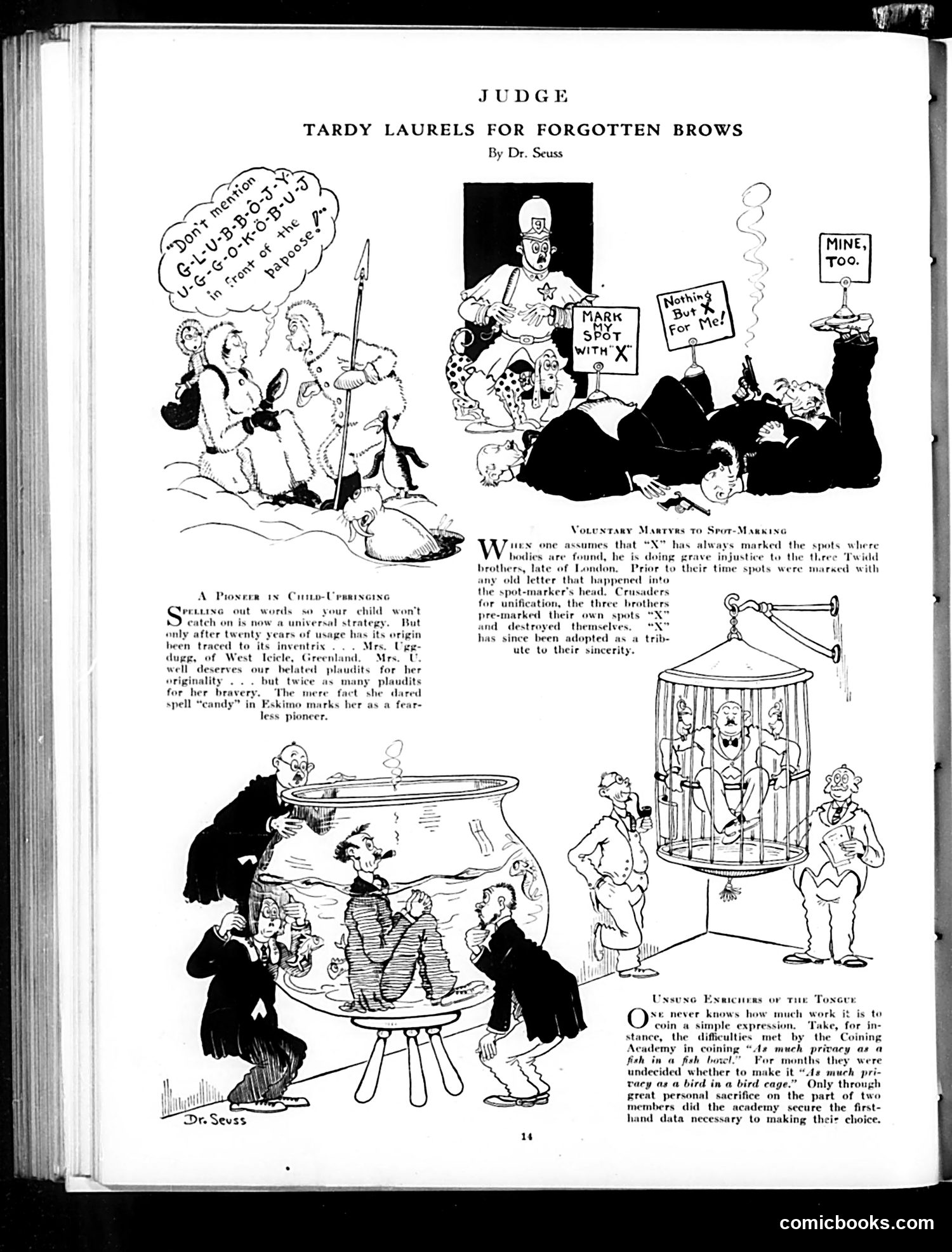
"Tardy Laurels for Forgotten Brows" by Dr. Seuss This Judge magazine page contains three satirical vignettes crediting obscure historical inventors: 1. "A Power is Child-Uprising": Mocks crediting a Mrs. Legrange of West Icycle, Greenland with inventing the safety pin, based on thin historical evidence. 2. "Voluntary Marks to Spot-Marking": Jokes about three brothers (the Twidds) credited with inventing the X-spot marker for marking things—the text notes "X has since been adopted as a tribute to their sincerity." 3. "Unsung Exorcisers of the Tongue": Satirizes an academy struggling to decide whether an expression belongs in "a bird cage" or elsewhere, requiring two members' "great personal sacrifice" to research it. The satire targets how historical credit gets assigned to minor or dubious contributors, and how institutions laboriously document trivial inventions. Dr. Seuss uses absurdist humor to mock pedantic historical record-keeping.
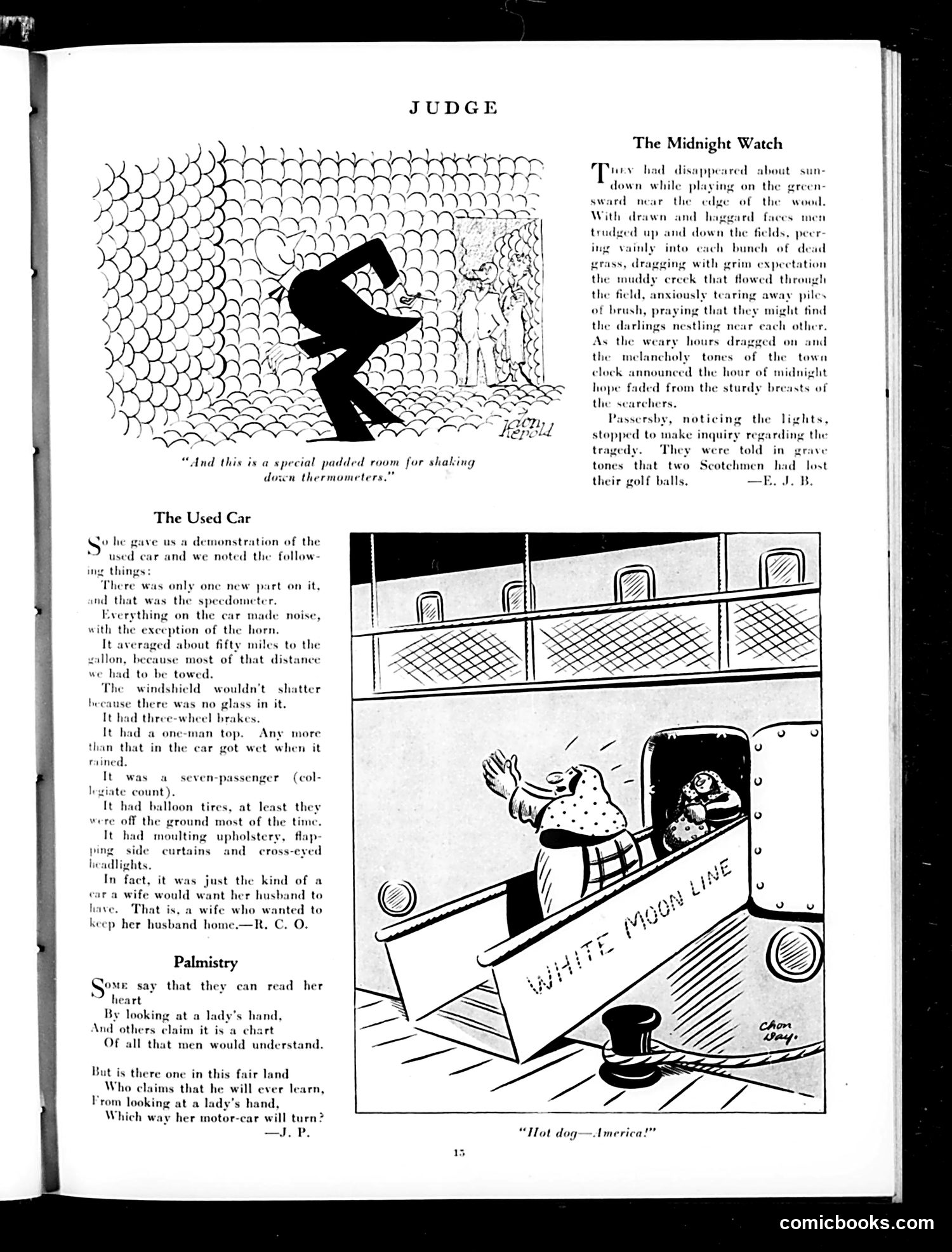
Analysis for Modern Readers This Judge magazine page contains three satirical pieces: "The Midnight Watch": A humorous short story mocking overwrought drama. Scottish golfers lose their golf balls and search desperately through the night, prompting passersby to assume a tragedy has occurred. The joke satirizes both the melodramatic tone of serious literature and the obsessive nature of golfers. "The Used Car": A comic list detailing a decrepit automobile with almost no functional parts—only the speedometer is new, the horn doesn't work, it needs towing, has no windshield glass, and breaks down constantly. The satire targets both used-car dealers' deceptive practices and the era's unreliable automobiles, ending with a jab at wives wanting to keep husbands home-bound. "Palmistry": A brief poem questioning whether anyone can predict a woman's behavior—specifically which direction her car will turn—by reading her palm. It satirizes both palmistry's claims and women drivers' unpredictability (a common early 20th-century stereotype). All three pieces reflect Jazz Age anxieties about modern technology, consumerism, and changing gender roles.
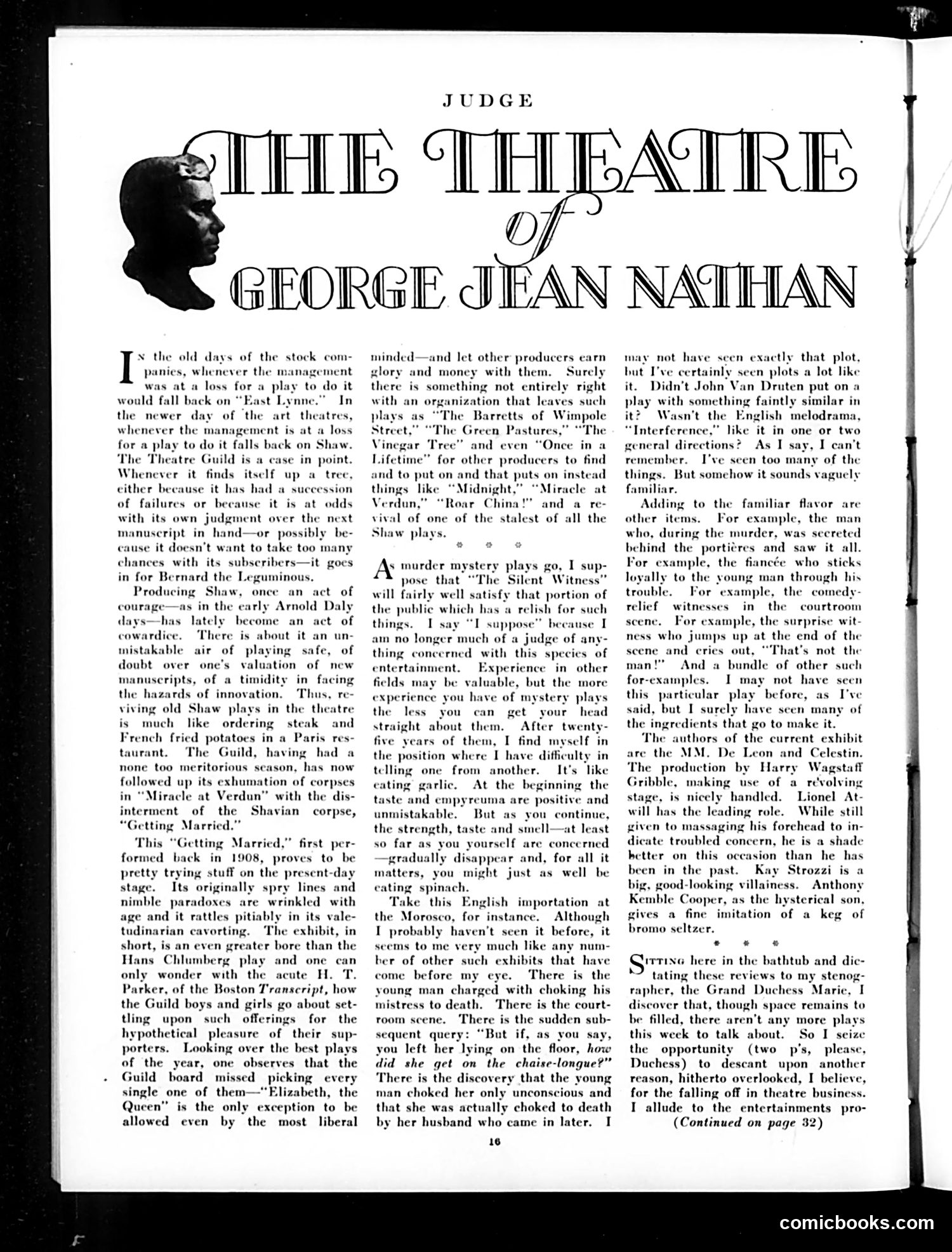
Judge Magazine: "The Theatre of George Jean Nathan" This page is not a political cartoon but rather a theater criticism column by Judge's drama critic. The illustrated head at left is George Jean Nathan, a prominent theater reviewer of the era. Nathan criticizes the Theatre Guild for repeatedly reviving George Bernard Shaw plays as "safe" choices rather than backing original work. He argues this reflects creative cowardice—like ordering steak and fries at a fancy restaurant. He notes the Guild missed championing hits like "The Green Pastures" and "The Barretts of Wimpole Street," instead staging tired productions like Shaw's "Getting Married" (1908). Nathan also briefly reviews "The Silent Witness," an English murder mystery, complaining that after 25 years reviewing such plays, they blur together indistinguishably. The satire targets institutional risk-aversion in theater management during what appears to be the 1920s-30s.
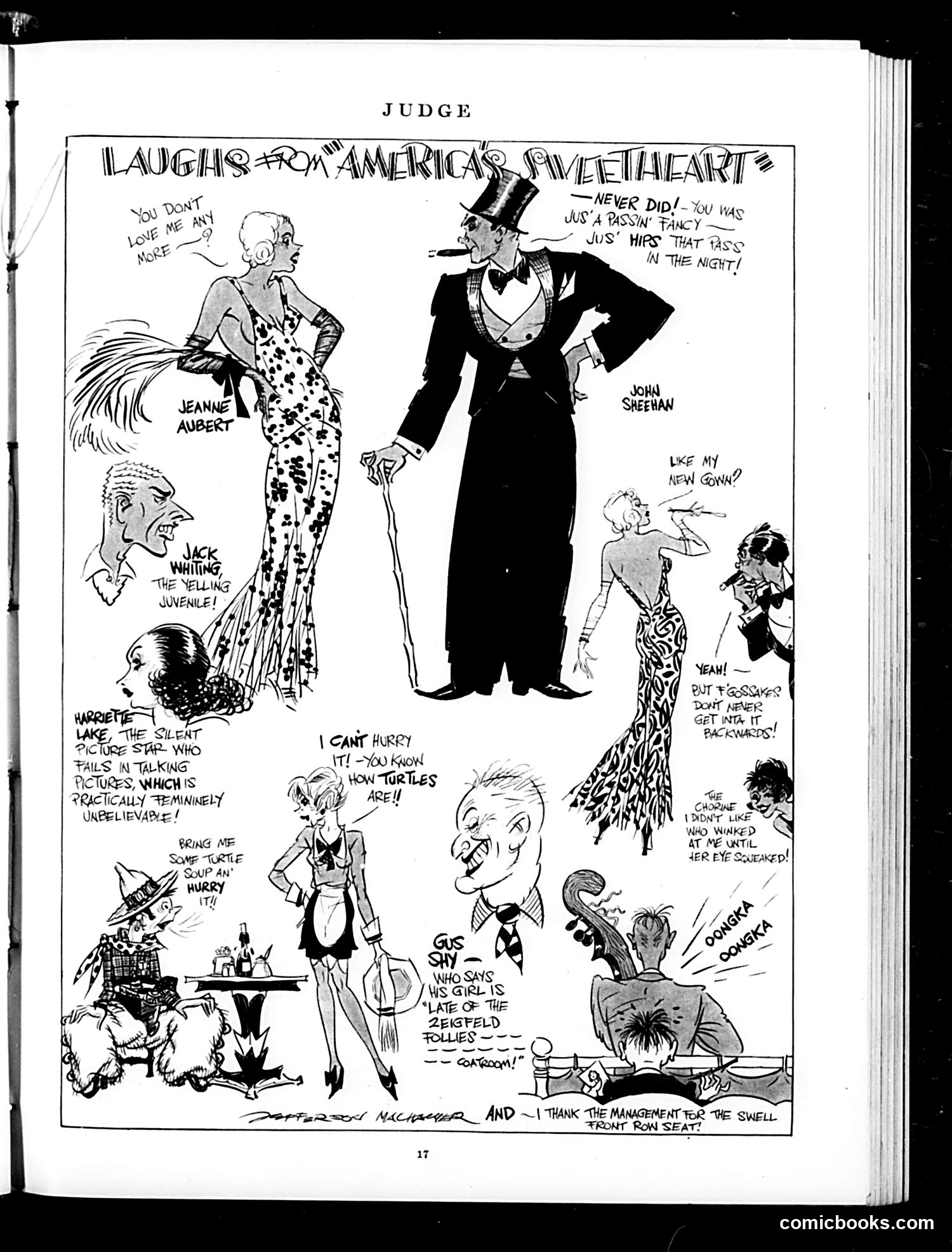
Judge Magazine Cartoon Analysis This is a satirical cartoon mocking early sound film ("talkies") and silent film stars struggling with the transition. The central figure in top hat appears to be a film producer or director urging haste ("I can't hurry it!"). The surrounding caricatures represent silent film actors named in the cartoon: Jeanne Aubert, Jack Whiting, Harriet Lake, John Sheehan, and Jean Harlow. The satire targets these performers—acclaimed in silent pictures where dialogue didn't matter—now exposed as poor speakers or unprepared for talking pictures. References to "turtles," "Ziegfeld Follies," and complaints about rushed production suggest Hollywood's chaotic scramble to convert to sound technology in the late 1920s. The joke: silent film stars' carefully cultivated images collapse when audiences actually hear them speak. Their lack of theatrical training becomes a liability.
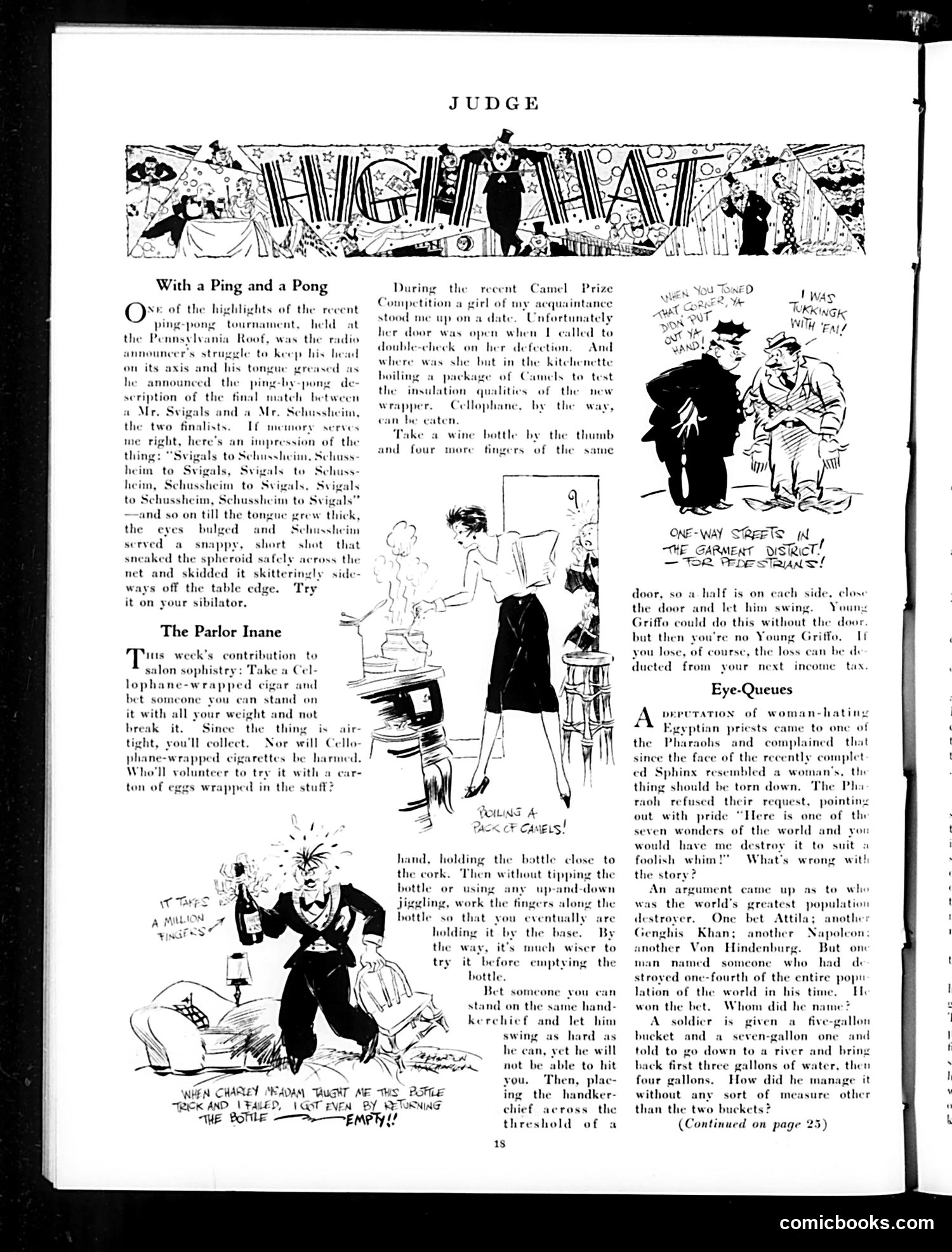
Judge Magazine Page Analysis This page contains three humorous pieces typical of Judge's satirical style: "With a Ping and a Pong" mocks the tedious radio commentary of a recent ping-pong tournament, where the announcer endlessly repeats players' names (Svigals and Schussheim) until his tongue ties itself in knots—satirizing overwrought sports broadcasting. "The Parlor Inane" offers parlor tricks exploiting cellophane's properties: standing on a wrapped cigar without breaking it, and sliding fingers along a bottle while suspended by a handkerchief. These mock salon "sophistication." "Eye-Queues" presents riddle-style puzzles (the Sphinx story, a population destroyer puzzle, and a bucket-measuring problem). These appear designed as reader challenges rather than satire. The page also includes a brief anecdote about a woman boiling Camels cigarettes to test cellophane insulation—likely advertising Camel's new packaging while framing it as humorous consumer behavior.
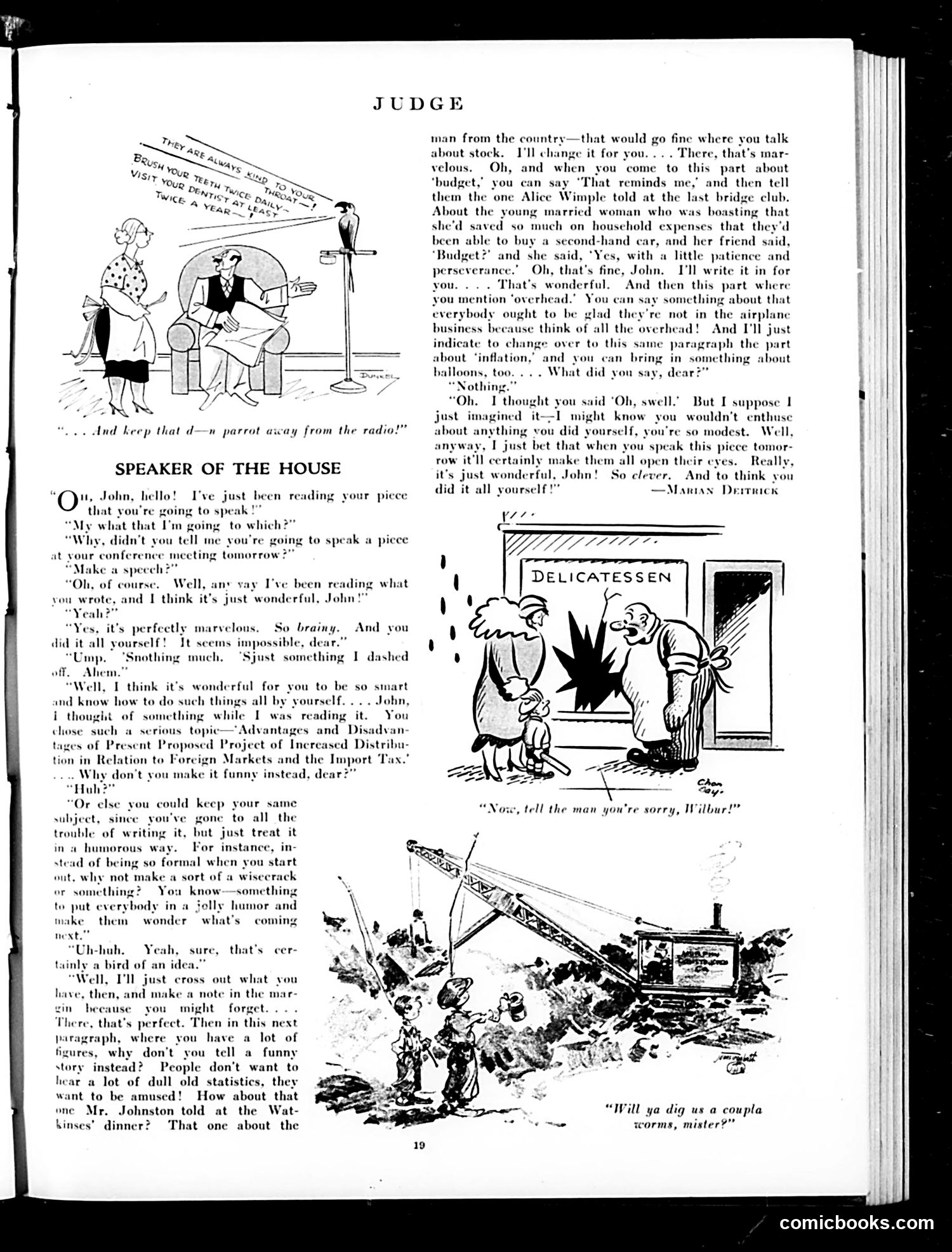
Judge Magazine Satire Analysis This page satirizes wives' interference in their husbands' professional work, specifically a wife's unsolicited "editing" of her husband John's serious conference speech. The Setup: John has written a formal business address on "Advantages and Disadvantages of Present Proposed Project of Increased Distribution in Relation to Foreign Markets and the Import Tax"—a genuinely important topic. His wife, reading it, finds it "wonderful" and "so clever," but immediately suggests he make it funny instead, adding jokes, wiseracks, and anecdotes from bridge club gossip. The Satire: The joke mocks two things: (1) wives who take credit for their husbands' work while simultaneously undermining it with unsolicited "improvements," and (2) the tendency to trivialize serious business matters with humor. John's stoic responses ("Nothing," "Huh?") underscore his exasperation at being "improved." The Title's Irony: "Speaker of the House" plays on John's role—suggesting he'll be delivering important remarks, yet his wife treats him like he needs her direction. The cartoons below reinforce themes of male frustration with female intervention in male professional spheres.
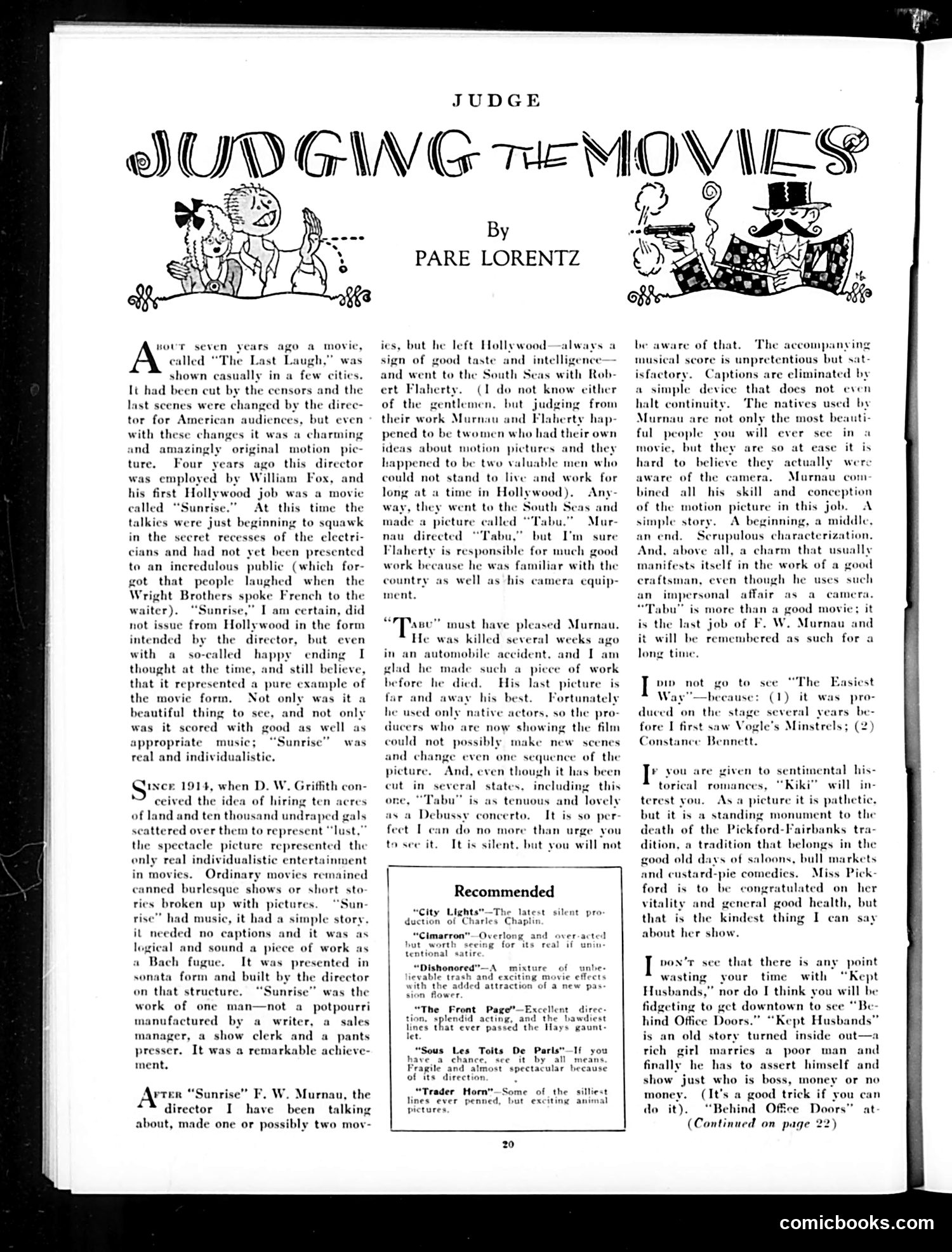
Judge Magazine: "Judging the Movies" by Pare Lorentz This is a film criticism column, not a political cartoon. Lorentz discusses F. W. Murnau, a German film director, and his trajectory in Hollywood. The key argument: Lorentz praises Murnau's artistic integrity—particularly his films "Sunrise" (made in Hollywood for Fox) and "Tabu" (made in the South Seas with Robert Flaherty). Lorentz argues that Murnau and Flaherty left Hollywood specifically because they couldn't tolerate working within the studio system, which subordinated artistic vision to commercial demands. The satire is implicit: Hollywood treated great directors as mere employees, filtering their work through censors, producers, and standardized formulas. Murnau's escape to the South Seas represents the incompatibility between genuine artistry and the commercial studio machinery. Tragic irony: Murnau died in an automobile accident before "Tabu"'s release, making it his final work—and, Lorentz argues, his best. The column exemplifies Judge's intellectual stance: satirizing Hollywood's philistinism through serious film criticism rather than caricature.
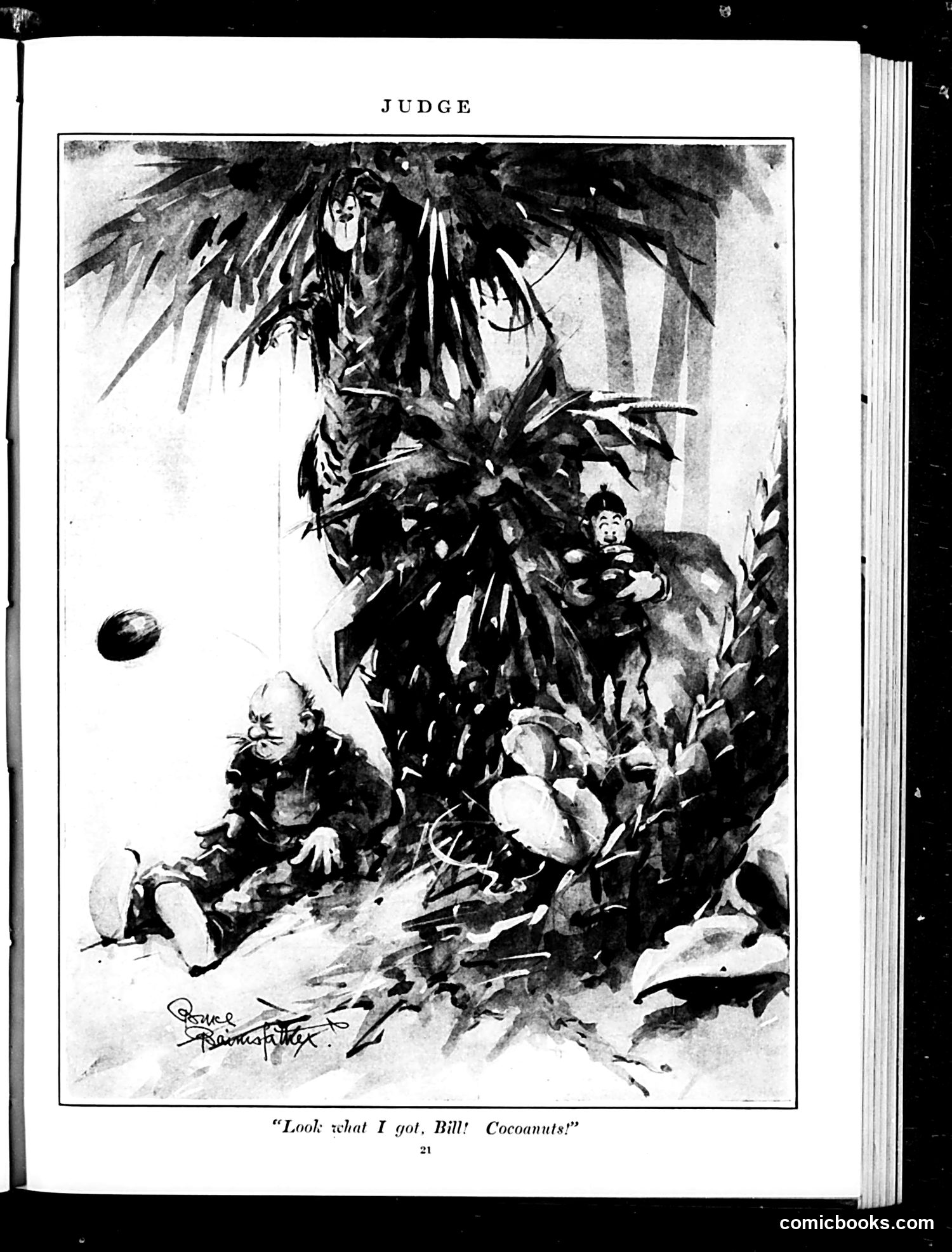
"Judge" Cartoon Analysis This single-panel cartoon depicts two figures in what appears to be a tropical or island setting with palm trees and vegetation. One character is excitedly showing coconuts to another named "Bill," as indicated by the caption. The cartoon likely satirizes either: - A colonial or tropical adventure narrative popular in early 20th-century entertainment - A comedic situation involving naive characters and exotic goods - Possibly American imperial interests in tropical regions The artist's signature appears present but is difficult to read clearly in this reproduction. Without additional context about the specific Judge issue date, the exact satirical target remains somewhat unclear, though the tone suggests humorous commentary on adventure stories or colonial stereotypes of the era.
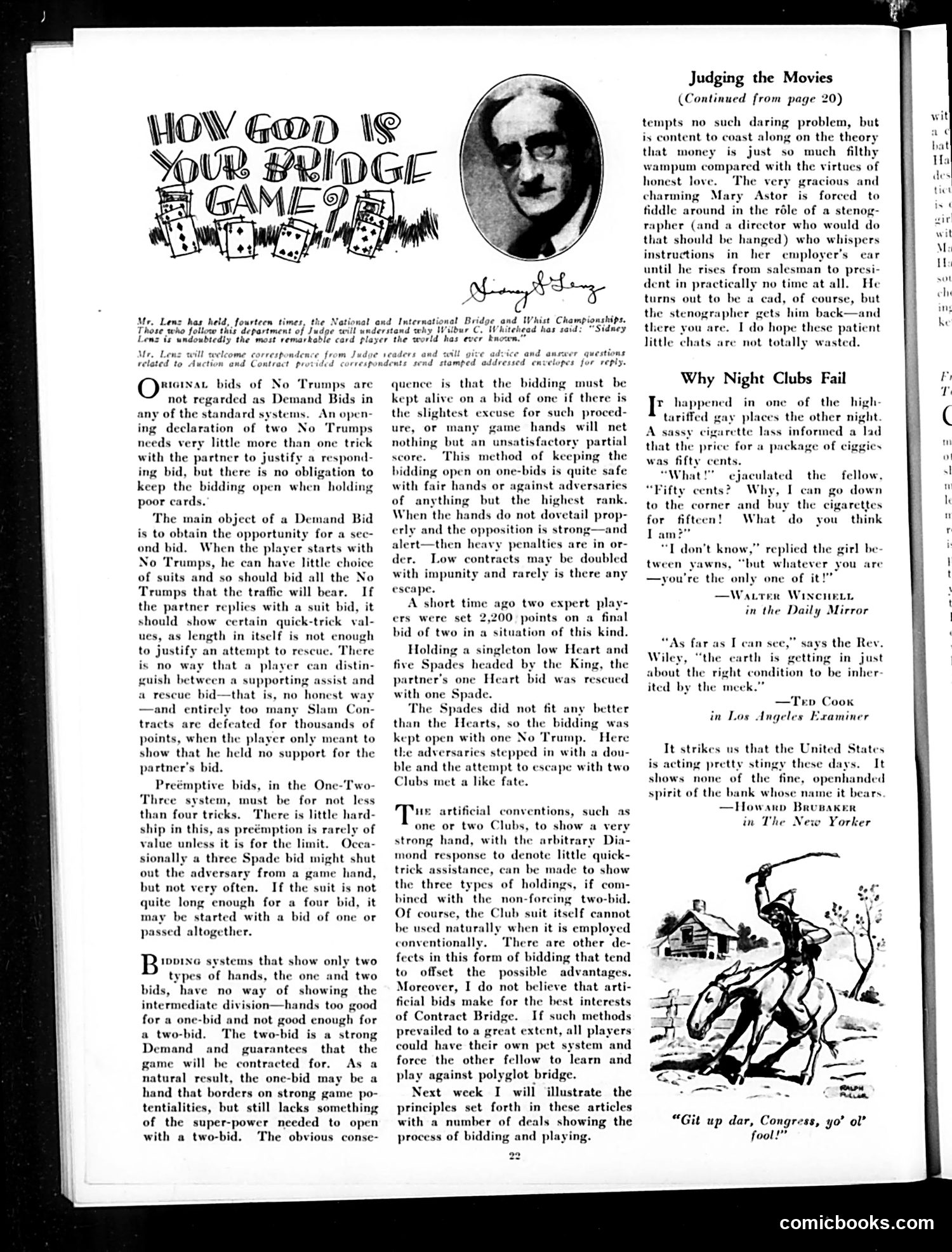
Judge Magazine Bridge Column Analysis This page discusses contract bridge bidding strategy, not a political cartoon. The illustrated masthead "How Good Is Your Bridge Game?" features a portrait of Sidney Lenz, identified in the text as holder of fourteen National and International Bridge Championships—described as "the most remarkable card player the world has ever known." The content is a technical bridge instruction column addressing bidding systems, demand bids, preemptive bids, and artificial conventions. The author advocates against overly complex artificial bidding systems, arguing they undermine the game's integrity and aren't in bridge's best interests. The right-side articles ("Why Night Clubs Fail" and quotes about social conditions) appear unrelated to bridge. The small cartoon at bottom is also disconnected from the bridge content—it simply shows generic rural/humorous subject matter typical of Judge's filler illustrations.
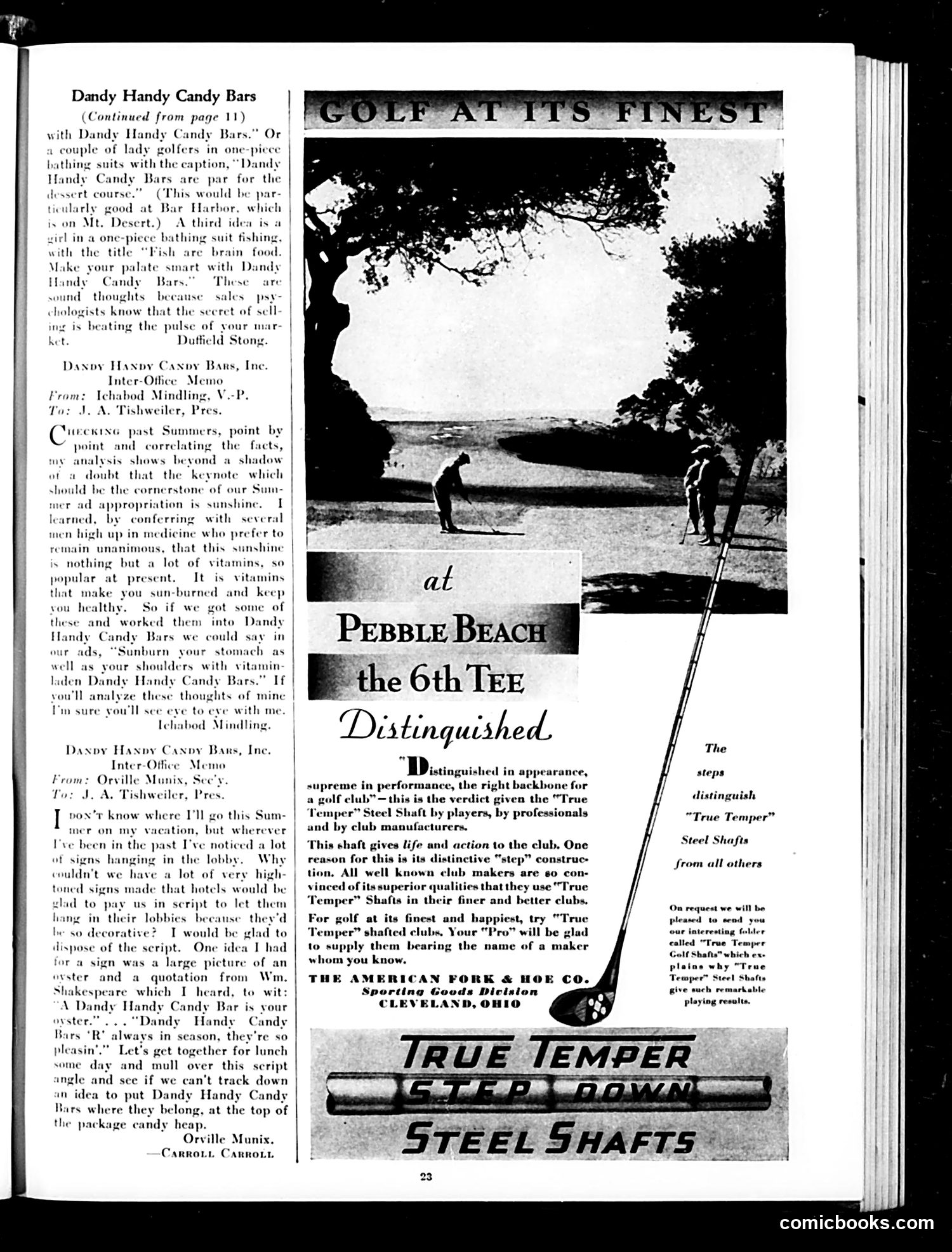
What This Page Means to Modern Readers This is primarily advertising disguised as satire. The page contains a humorous fictional memo exchange about marketing "Dandy Handy Candy Bars" to consumers, featuring absurd advertising ideas (like "sunburn your stomach" with vitamin-laden candy). The satire gently mocks corporate marketing departments and their pseudo-scientific justifications for products. The right half shifts to a serious golf equipment advertisement for "True Temper Steel Shafts," showing golfers at Pebble Beach's 6th hole. This juxtaposes the candy bar satire with earnest product promotion. The humor relies on early 20th-century advertising culture: companies' tendency to invent scientific-sounding health claims for products, office memo conventions, and the gap between marketing rhetoric and product reality. Modern readers would recognize this as proto-Mad Magazine style corporate satire, though the specific product references (vacation marketing, golf clubs) are period-specific. The page essentially uses humor to sell candy and golf equipment simultaneously.
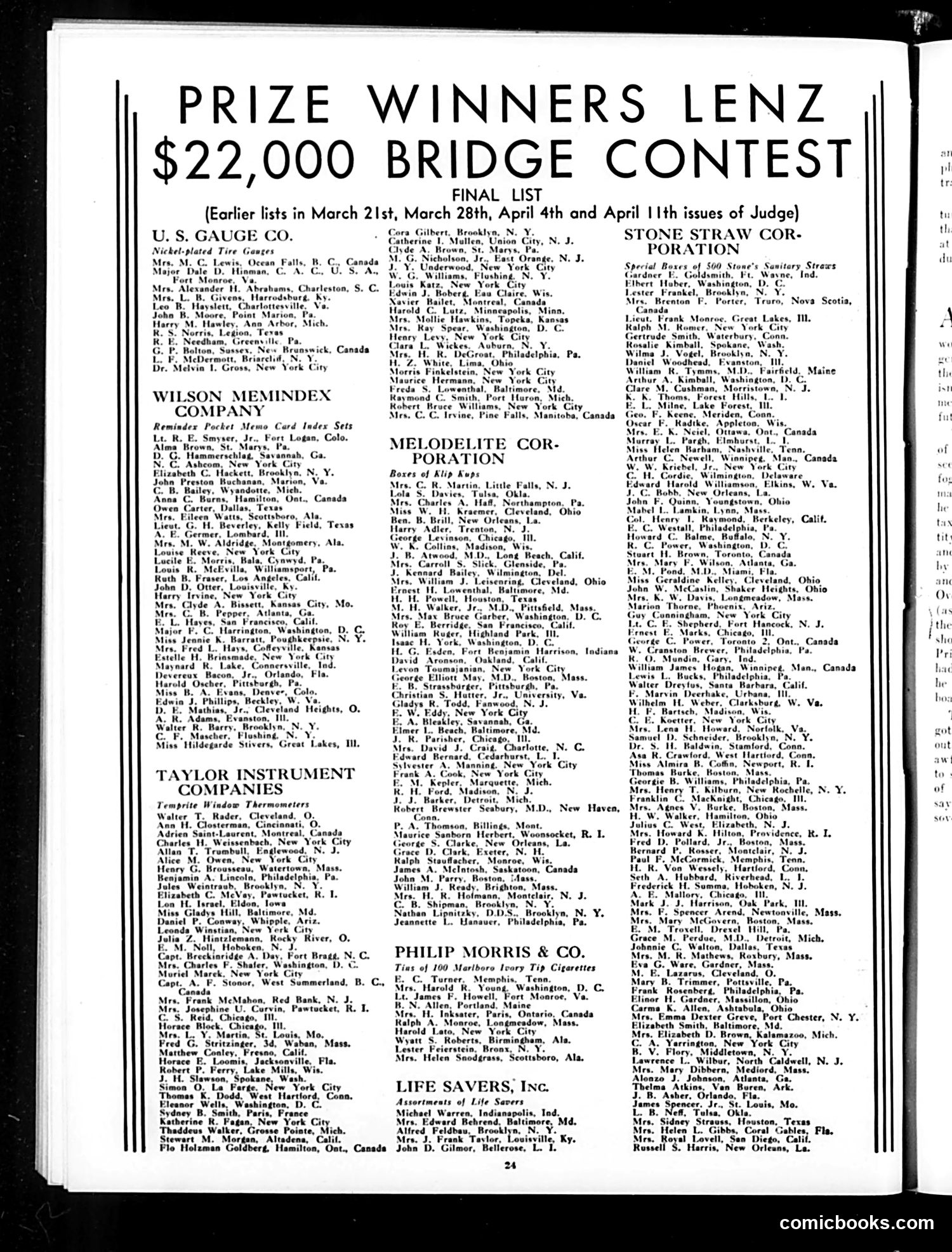
Prize Winners List for Lenz Bridge Contest This page is not a cartoon or satirical content—it is a straightforward advertisement and prize-winners announcement from Judge magazine. The page lists winners of a $22,000 bridge contest sponsored by Lenz (a bridge instruction/promotion figure). Multiple manufacturers offered prizes: U.S. Gauge Co., Wilson Memindex Company, Taylor Instrument Companies, Melodelite Corporation, Philip Morris & Co., Stone Straw Corporation, and Life Savers, Inc. The "final list" announces contest winners across different product categories, with names and addresses organized by company. This appears to be a common magazine feature—combining promotional contests with advertising for consumer goods—from the early-to-mid 20th century. There is no satirical commentary or political content on this page.
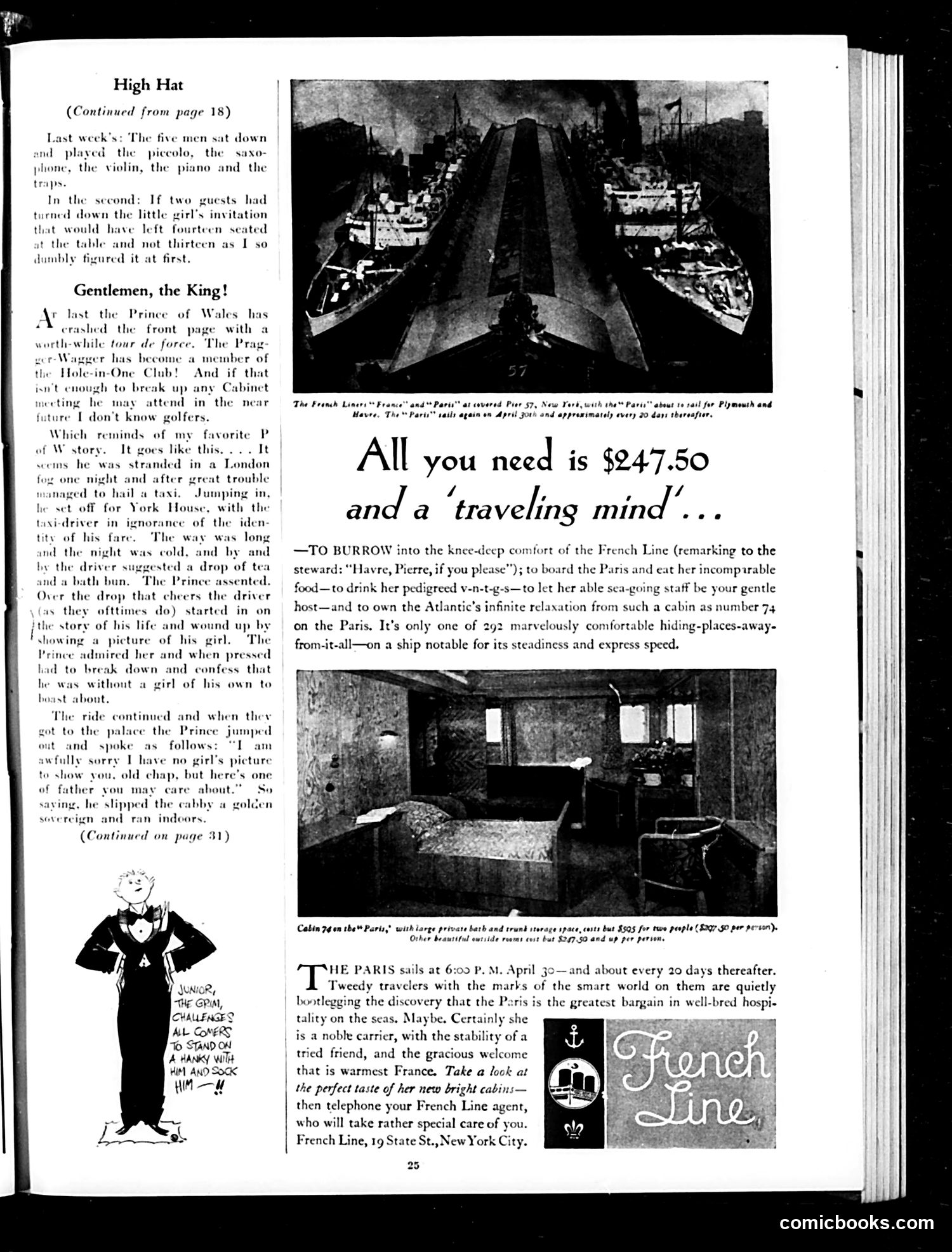
Analysis of Judge Magazine Page This page contains two distinct elements: The "High Hat" Comic Strip (left): A humorous anecdote about the Prince of Wales (later Edward VIII) stranded in London fog who hails a taxi without the driver recognizing him. After sharing tea and conversation, the Prince admits he has no girlfriend to boast about but offers a photo of "father" (King George V) instead. The joke plays on the Prince's casual irreverence and the driver's unknowing interaction with royalty—typical 1920s-30s humor about class and British social hierarchy. The French Line Cruise Advertisement (right): A full-page ad promoting transatlantic travel on the steamship *Paris*, emphasizing luxury accommodations at $247.50 per person. The advertisement targets wealthy travelers seeking leisure and comfort. The juxtaposition appears incidental—the magazine simply paired editorial content with paid advertising, which was standard practice. The Prince of Wales anecdote reflects contemporary fascination with his playboy reputation and informal demeanor, while the ad appeals to the magazine's affluent readership.
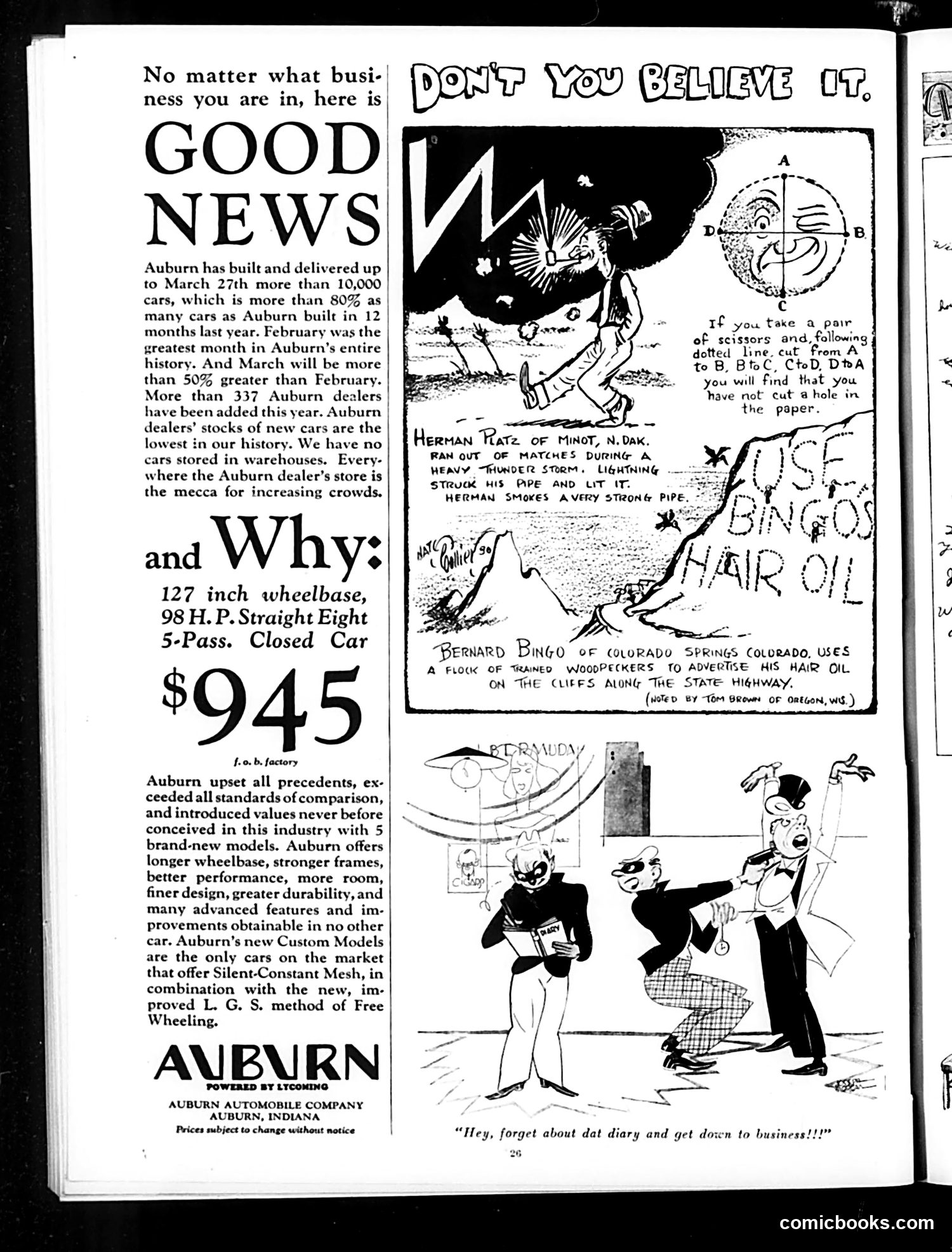
Page Analysis This page is primarily an Auburn automobile advertisement (left side) with comic content ("Don't You Believe It," right side) used as filler material typical of Judge magazine. The Advertisement: Auburn cars are promoted with sales statistics and technical specifications. The copy emphasizes production records and dealer availability—standard 1920s auto marketing. The Comic Content: Three brief, illustrated gags appear: 1. The optical illusion (top): Readers are invited to cut a circle without actually cutting a hole—a parlor trick relying on the circle's design. 2. Herman Patz's pipe (middle): A joke about a man whose pipe was struck by lightning during a storm, yet survived—playing on the absurd durability of a "strong pipe." 3. Bernard Bingo's woodpeckers (bottom): A man allegedly trains woodpeckers to peck his hair oil advertisement onto cliff faces along a highway—surreal advertising satire. The final cartoon (bottom right) shows businessmen, with one saying "forget about dat diary and get down to business"—workplace humor unrelated to the above. These are nonsense gags typical of Judge's filler material, not political satire.
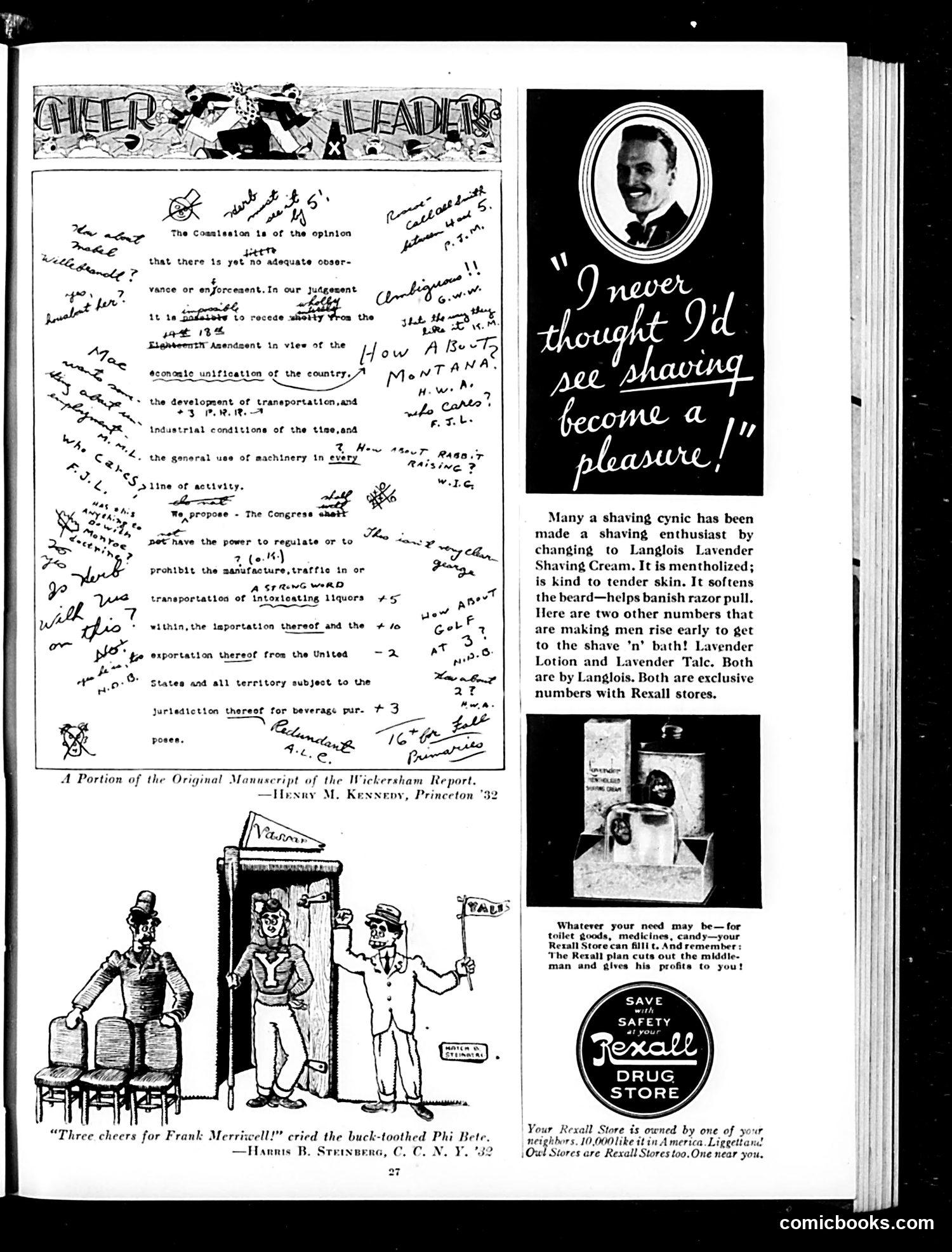
Analysis of Judge Magazine Page This page mixes Prohibition-era political commentary with advertising. The top section reproduces a portion of the Wickersham Report manuscript—the controversial 1931 federal study on Prohibition enforcement. The handwritten annotations and editorial marks satirize the report's conclusions about inadequate enforcement of the 18th Amendment and proposal for congressional power over alcohol regulation. The lower cartoon caption references "Frank Merriwell," a popular fictional hero character, in what appears to be mocking collegiate enthusiasm (the "Phi Beta" reference suggests fraternity culture). The bulk of the page consists of Rexall drugstore advertising for shaving products and toiletries—typical magazine space-filler content that contradicts Prohibition's intent by promoting consumption through retail chains. The juxtaposition critiques the gap between Prohibition's stated ideals and commercial reality during the early Depression era.
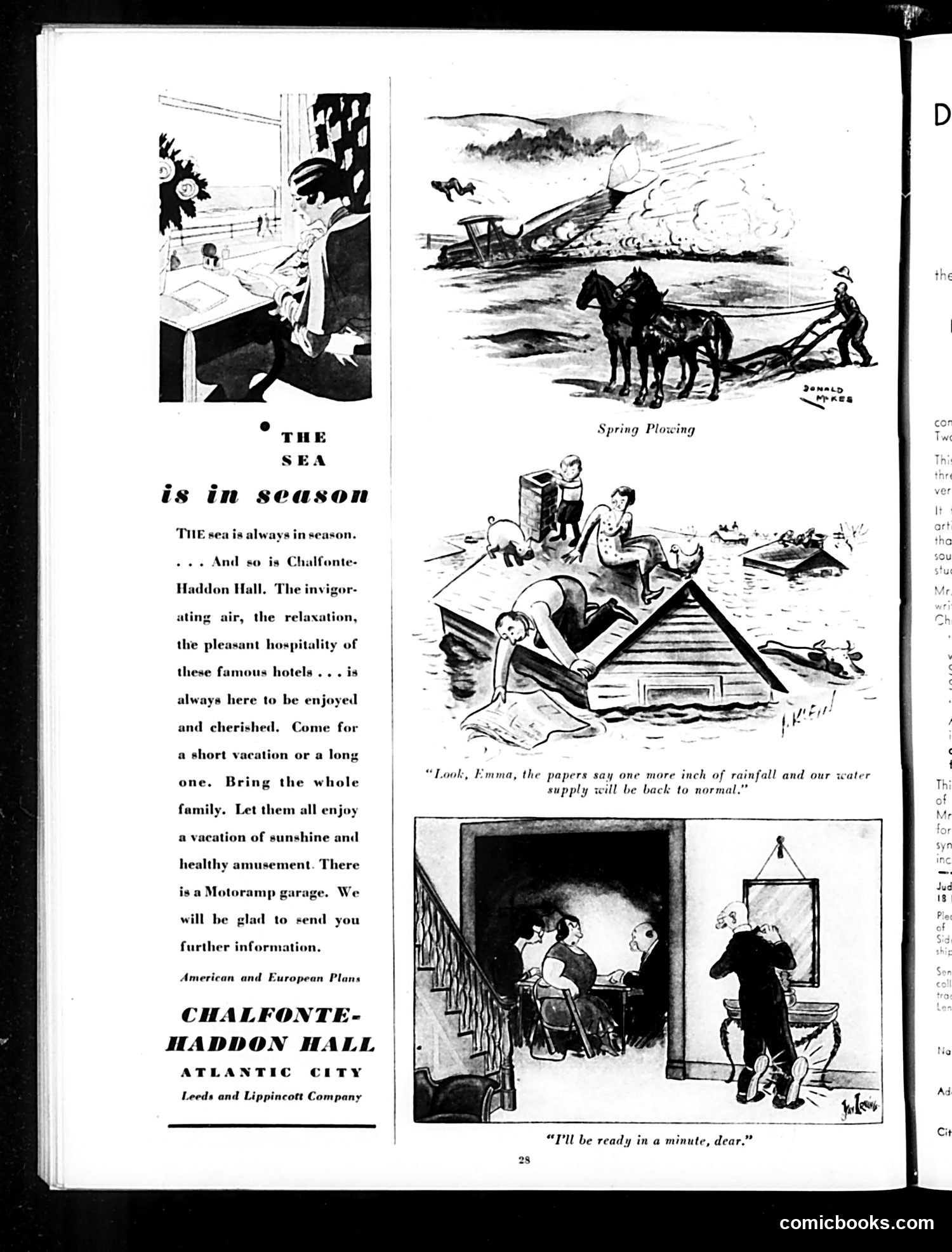
What This Page Means This is primarily a hotel advertisement, not political satire. The page promotes Chalfonte-Haddon Hall, a real Atlantic City resort, using the tagline "The Sea is in season." The three cartoon illustrations humorously depict vacation mishaps: spring flooding that destroys property, and a domestic scene where a husband promises to be ready soon. These jokes establish a relatable contrast—while vacation sounds ideal, reality involves water damage and spousal impatience. The ad's message is straightforward: despite life's complications, Chalfonte-Haddon Hall offers reliable "invigorating air, relaxation, and pleasant hospitality" year-round. The cartoons make the pitch entertaining by acknowledging real-world problems (bad weather, family logistics) that a seaside escape can temporarily relieve. This reflects 1920s-30s advertising strategy: use humor and gentle social observation to sell leisure travel to middle-class families.
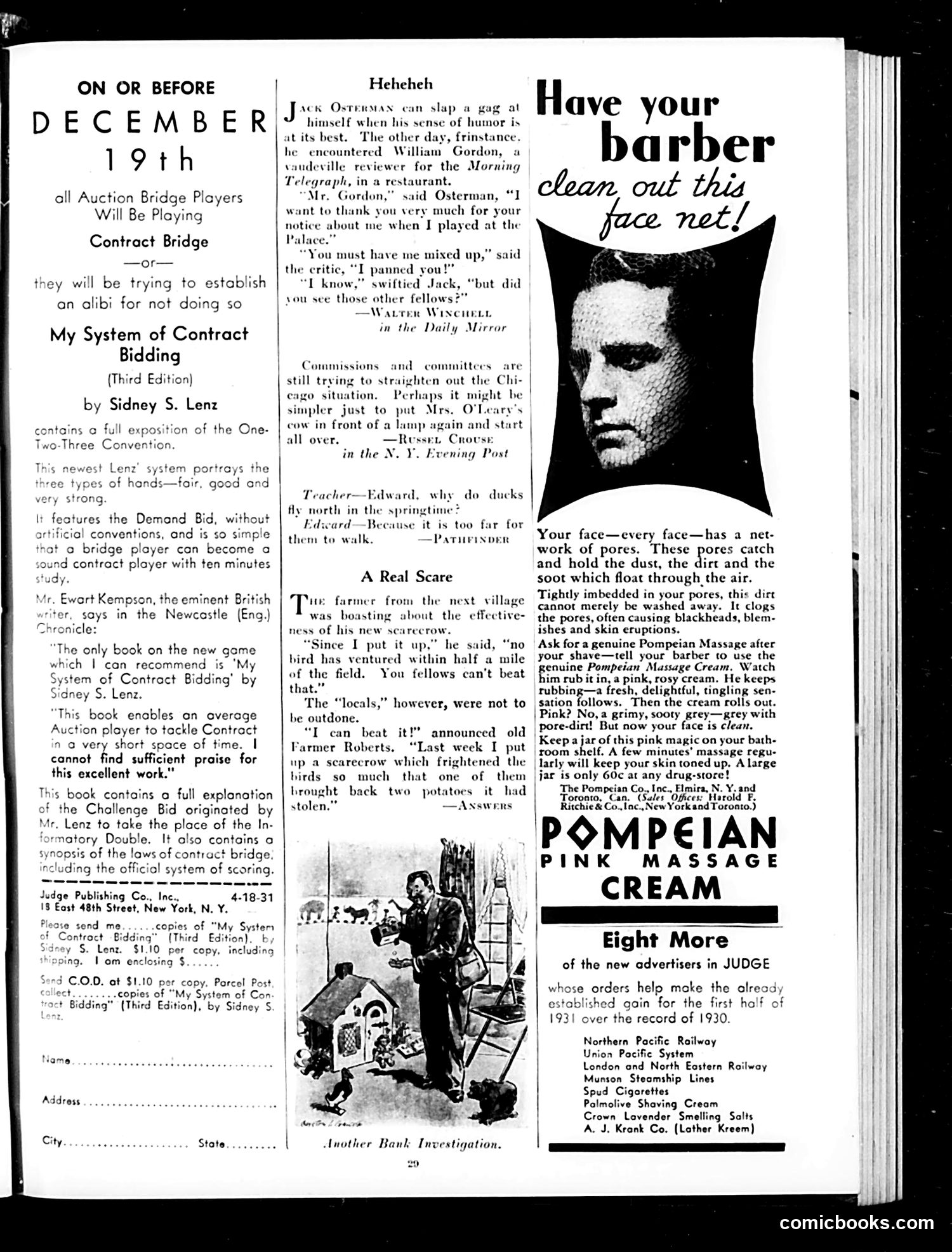
Judge Magazine Page Analysis (circa 1931) This page combines contract bridge book advertising (reflecting the card game's popularity in 1930s America) with humor pieces and beauty product advertising. The humor content includes three brief anecdotes: - Jack Osterman, a vaudeville comedian, jokes about receiving a negative review he actually thanks the critic for - A teacher's joke about ducks flying north (a simple pun) - A farmer's tall tale about a scarecrow so effective a bird returned stolen potatoes—satirizing rural boasting and one-upmanship The satire is gentle observational humor: the Osterman piece pokes fun at social awkwardness and false gratitude; the scarecrow tale mocks rural braggadocio. The prominent advertisement for Pompeian Pink Massage Cream uses pseudo-scientific language about "pore-dirt" to market cosmetics—typical 1930s advertising that exploited consumer insecurity about cleanliness and appearance through exaggerated health claims. The page overall reflects Judge's mix of light social satire, advertising revenue, and consumer culture humor typical of the early Depression era.
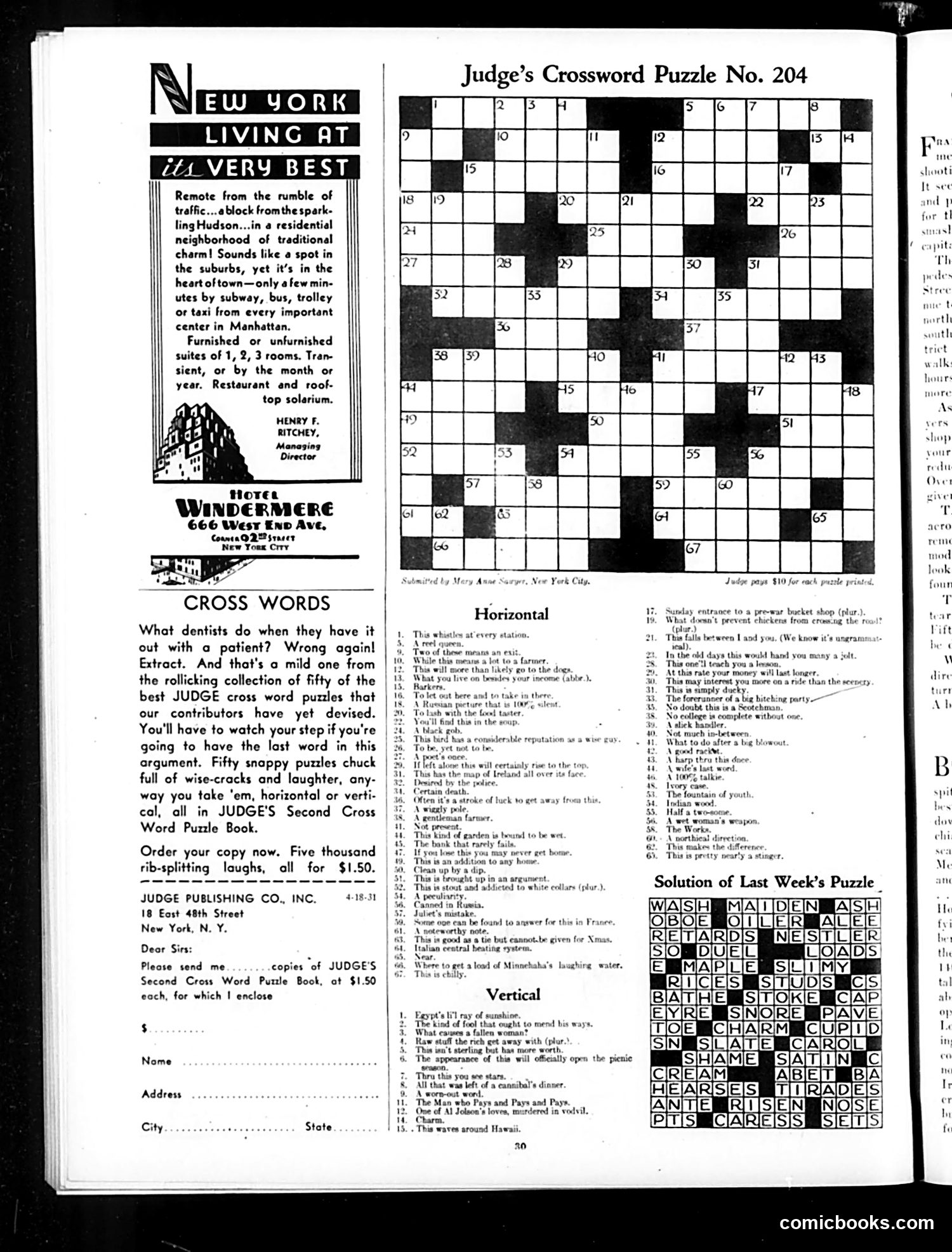
Judge Magazine Crossword Puzzle Advertisement This page is primarily advertising and puzzle content, not political satire. The main feature is Judge's Crossword Puzzle No. 204, accompanied by a book advertisement for "Judge's Second Cross Word Puzzle Book" ($1.50). The humorous framing uses self-deprecating jokes about crosswords themselves—dentists extracting teeth as a pun, the promise of "rib-splitting laughs." The puzzle clues are typical wordplay of the era ("What dentists do when they have it out with a patient?"). A secondary advertisement promotes the Windermere apartment building in Manhattan, marketing it as offering suburban charm while remaining accessible to downtown by transit—a pitch reflecting post-WWI urban development and commuting patterns in New York City. The page serves primarily as commercial content rather than editorial satire or political commentary. The "JUDGE" branding suggests this appeared in the magazine as a house advertisement promoting their own puzzle book products.
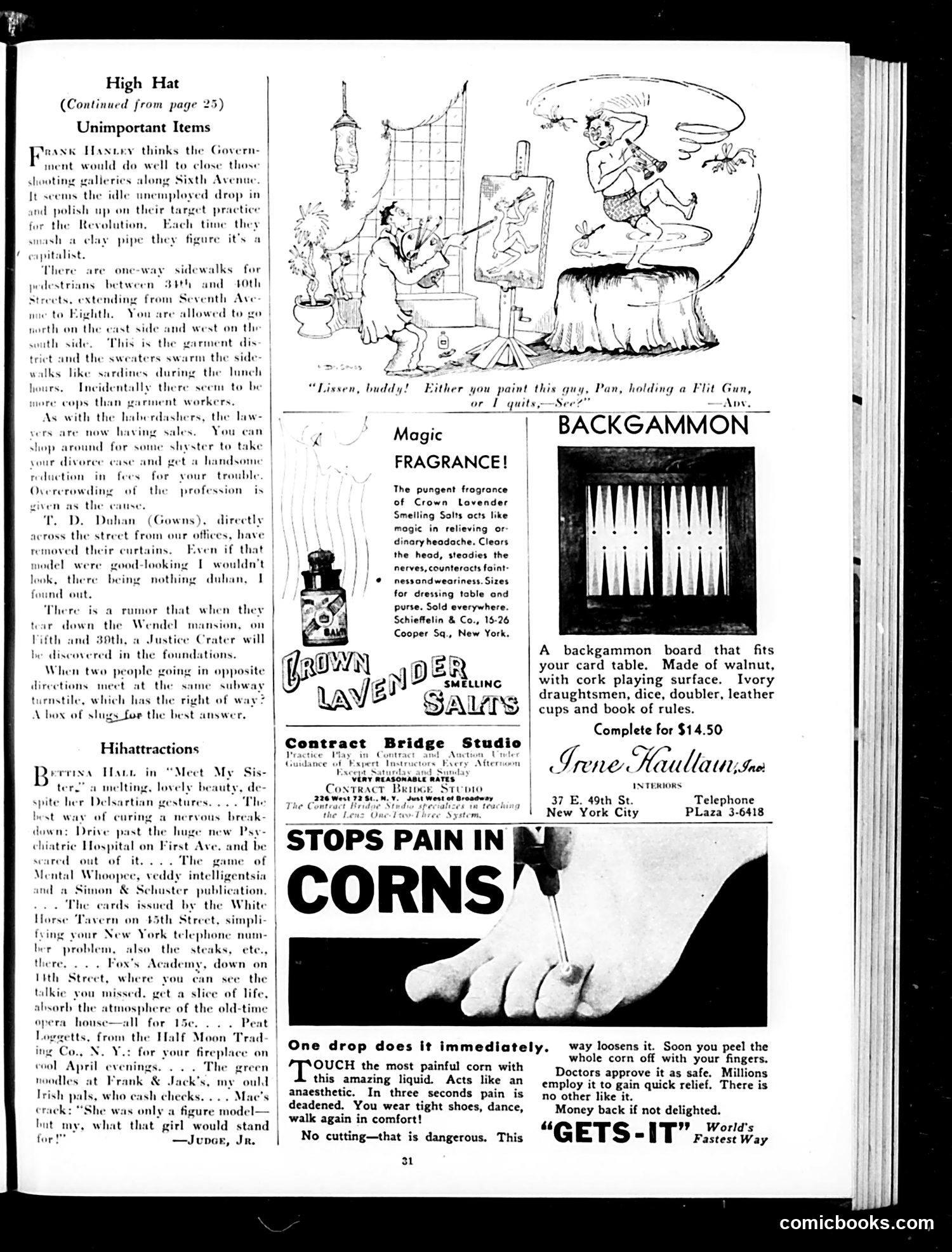
Analysis of Judge Magazine Page Content This page from Judge magazine is primarily advertisements and social commentary rather than political cartoons. The main content includes: "High Hat" Column: A gossip/humor section mocking New York City life—unemployed people at shooting galleries, crowded garment district sidewalks, divorce-seeking lawyers, and the famous Judge Crater disappearance (a real 1930 scandal involving a missing judge). The tone is lighthearted snark about urban problems and petty crimes. The Small Cartoon (top right): Shows someone at an easel, with a comment about painting a figure with a "Flit Gun"—a humorous reference to the Flit insecticide spray ads popular in that era. Advertisements: Crown Lavender Salts, Contract Bridge Studio, backgammon board, and "Gets-It" corn remover dominate the page, typical of 1920s-30s magazine filler. Overall: This is primarily a lifestyle/gossip page with product ads, not political satire. The humor targets minor urban annoyances and social foibles rather than major political issues.
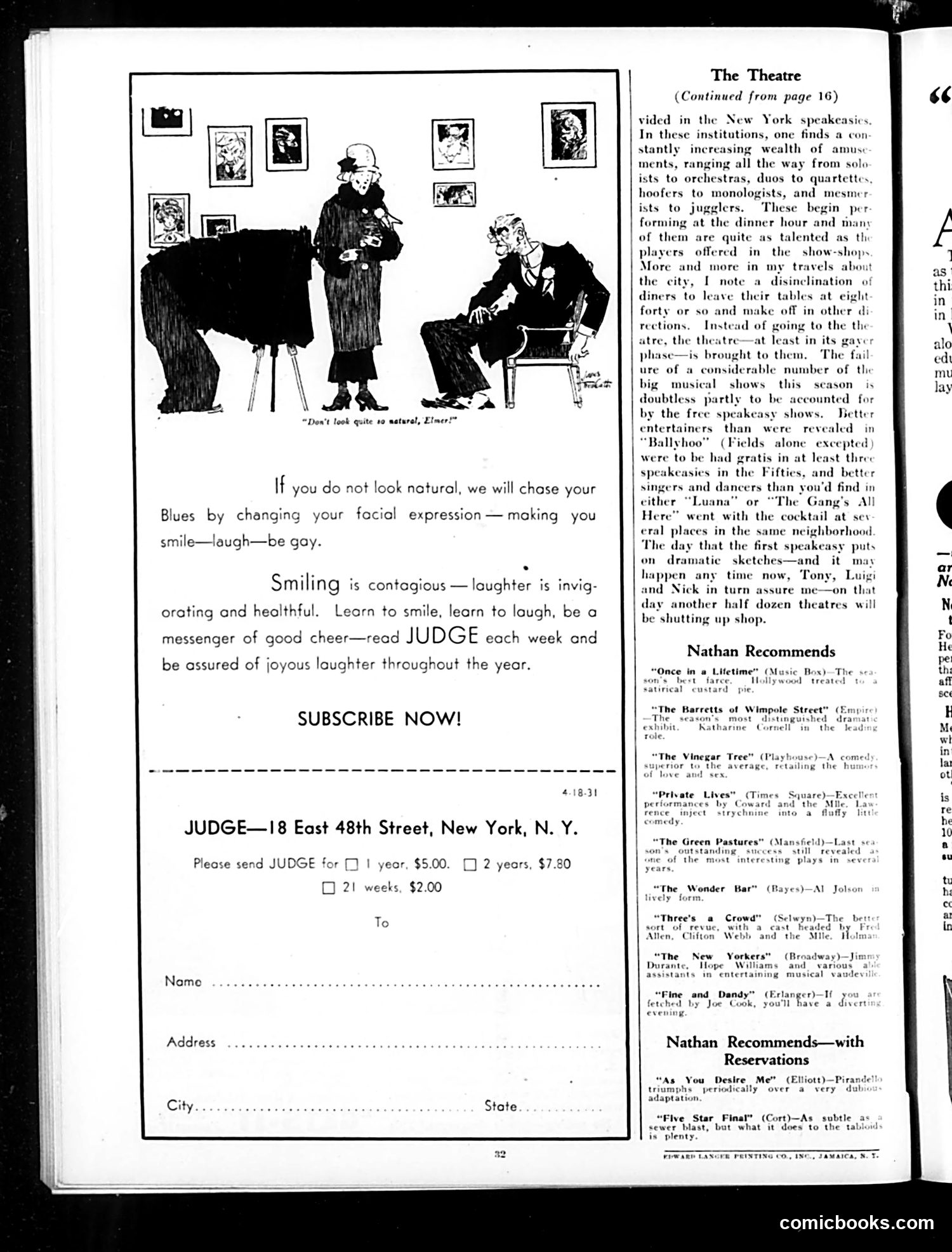
Judge Magazine: Subscription Appeal and Theatre Reviews This page combines a subscription advertisement with theatre criticism. The cartoon depicts two men at an art gallery; one tells the other "Don't look quite so natural, Elmer!" The accompanying text uses this as a metaphor: Judge promises to cure readers' "blues" by making them smile and laugh—the magazine positions itself as a mood-lifter and messenger of cheer. The right column contains Nathan's theatre recommendations for the current season. The critic notes a significant cultural shift: speakeasies (illegal bars during Prohibition) now offer live entertainment—singers, dancers, comedians—rivaling Broadway theatres. Rather than attending formal theatre, New Yorkers increasingly dine at speakeasies for entertainment. Nathan humorously predicts that when speakeasies begin staging dramatic sketches, half a dozen Broadway theatres will close. This reflects 1920s-30s economic anxiety about theatre's viability during Prohibition-era competition.
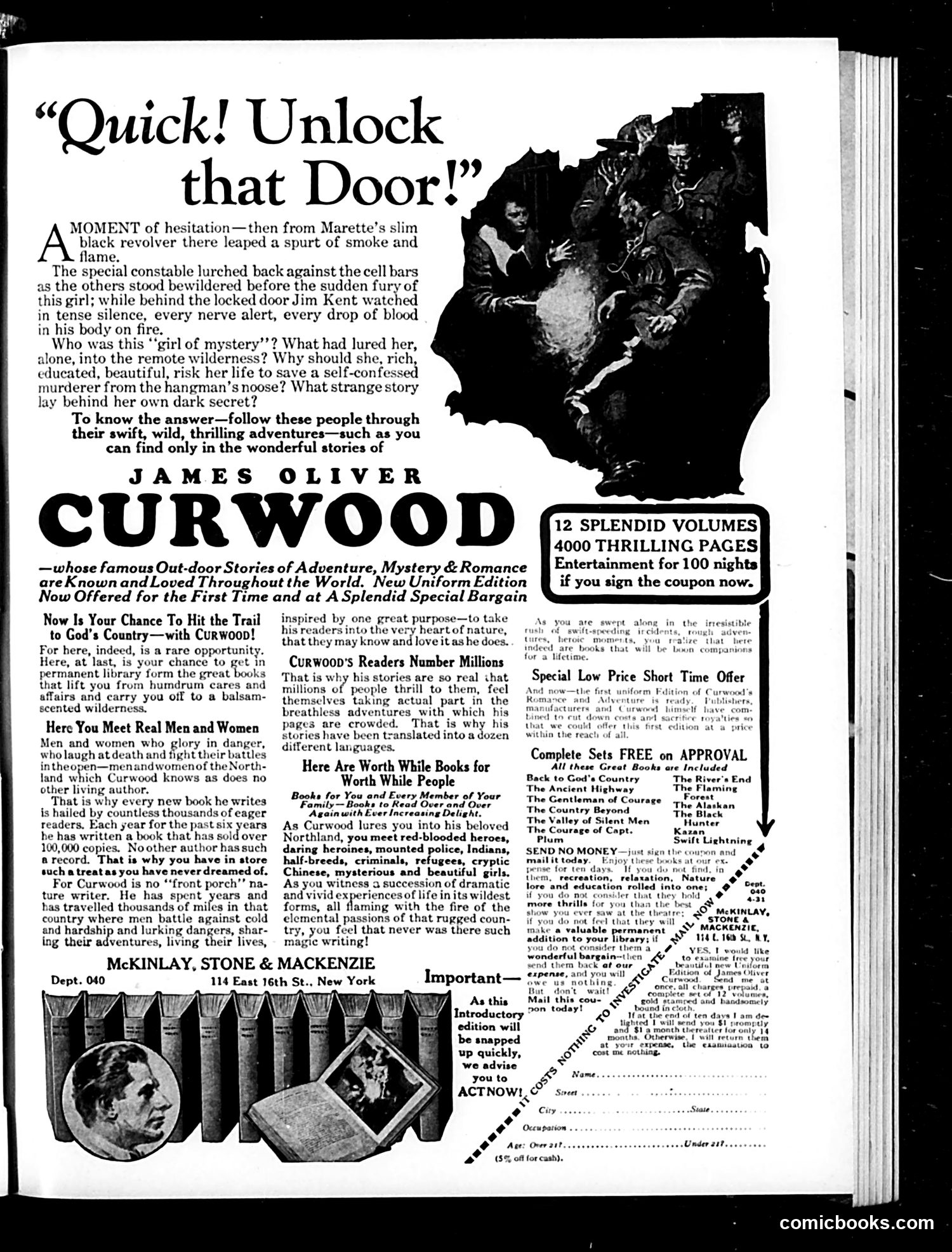
Judge Magazine Advertisement Analysis This is primarily a book advertisement, not political satire. It promotes James Oliver Curwood's collected adventure novels through McKinlay, Stone & Mackenzie publishers. The dramatic scene at top—a "girl of mystery" shooting a revolver to free a prisoner—is a marketing hook designed to intrigue readers about Curwood's plots. The copy emphasizes his popularity (millions of readers, 100,000+ copies per book) and his authentic outdoor credentials, having actually traveled the Canadian Northland rather than writing from imagination. The appeal targets middle-class readers seeking escapism: "real men and women" in danger, Indigenous peoples, criminals, and "mysterious and beautiful girls" in a "rugged country." The repeated emphasis on approval-basis ordering ("ACTNOW!") and a special bargain price reflects Depression-era sales tactics. This represents not satire but straightforward period advertising, showcasing how publishers marketed adventure fiction to American audiences seeking wilderness adventure narratives.
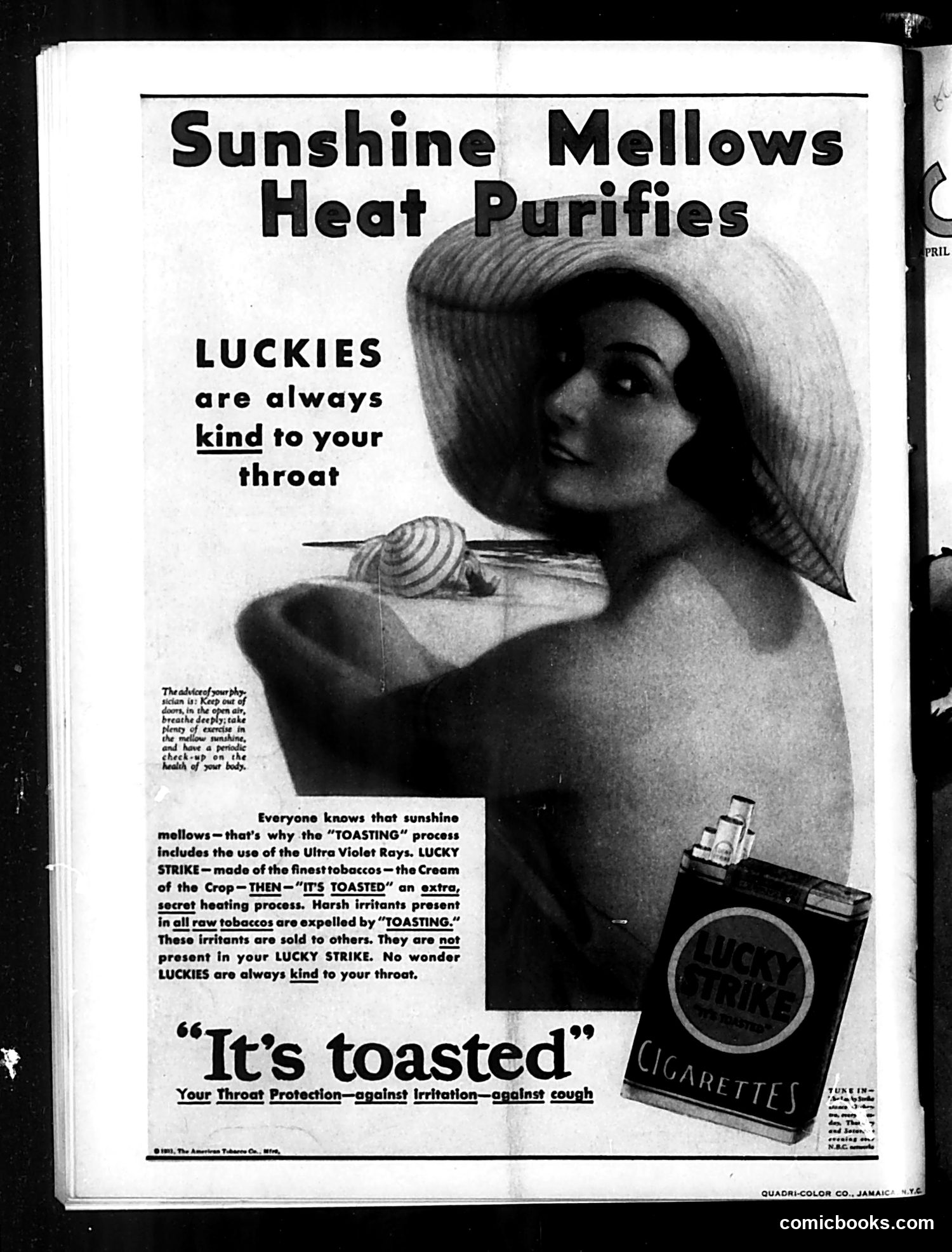
Lucky Strike Cigarette Advertisement This is a full-page cigarette advertisement, not political satire. It promotes Lucky Strike cigarettes using the slogan "It's toasted." The ad claims the "toasting" process—allegedly involving ultraviolet rays—removes harsh irritants from tobacco, making Lucky Strikes gentler on the throat. The accompanying image shows an attractive woman with a cigarette, emphasizing the product's supposed health benefit. For modern readers: This represents pre-1960s tobacco advertising when cigarette companies made unsubstantiated health claims. The "toasting" process is largely marketing fiction. Such ads would later be banned as cigarettes were conclusively linked to serious illness. This page illustrates how thoroughly tobacco companies infiltrated popular media with misleading health messaging.