judge
Judge — April 25, 1931
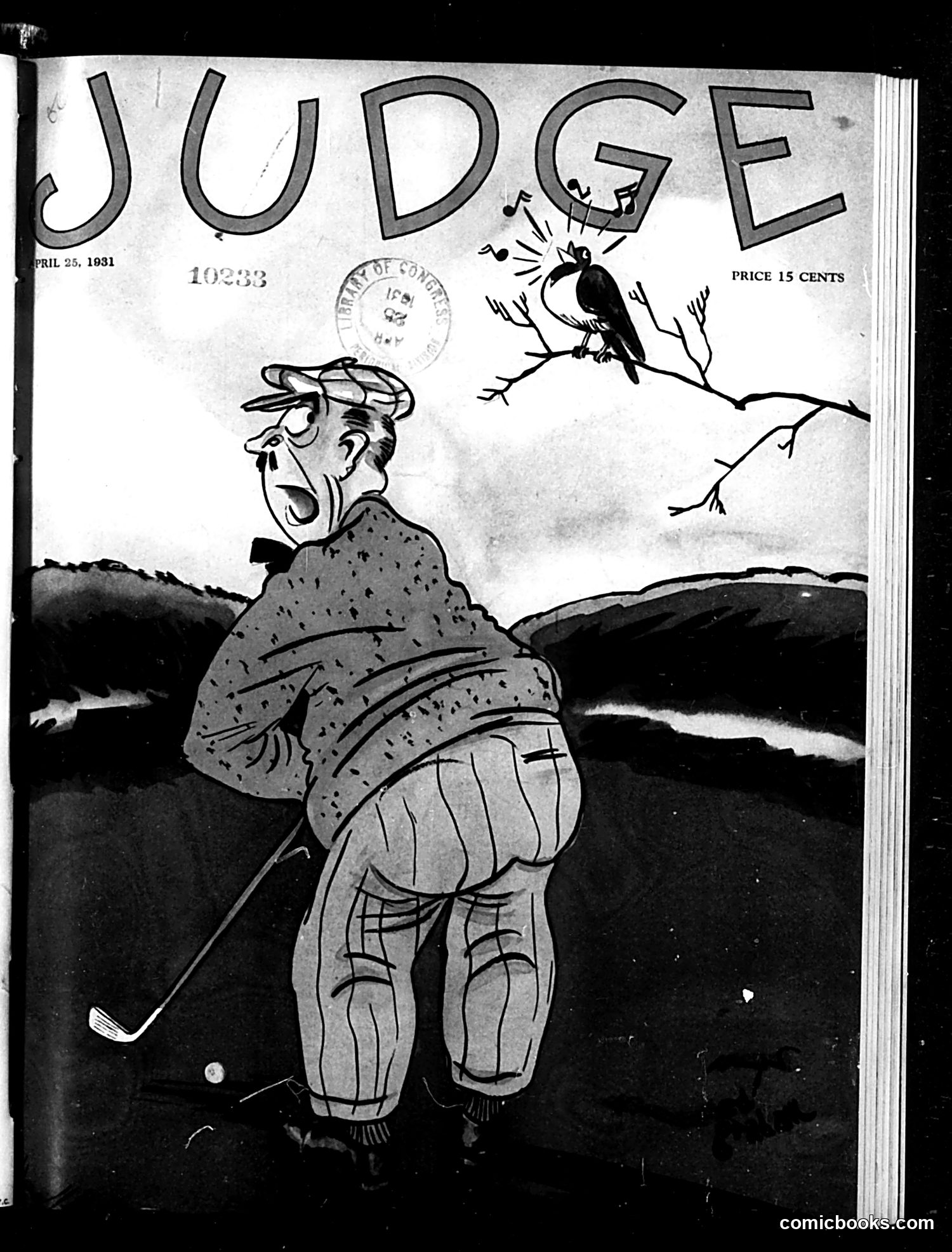
Judge Magazine Cover Analysis April 25, 1931 This cover depicts a caricatured golfer with exaggerated features playing on what appears to be a links course, while a crow perches mockingly above on a bare branch. The figure's distorted facial expression and awkward posture suggest incompetence or frustration at the sport. The satire likely comments on golf culture during the Great Depression era—a leisure activity associated with wealth and privilege during economic hardship. The crow observing from above may represent fate or misfortune mocking the golfer's efforts. The bare landscape and the bird's predatory presence reinforce themes of difficulty or bad luck. Without additional OCR text or caption information, the specific political target remains unclear, though the timing suggests commentary on Depression-era class divisions or entertainment choices.
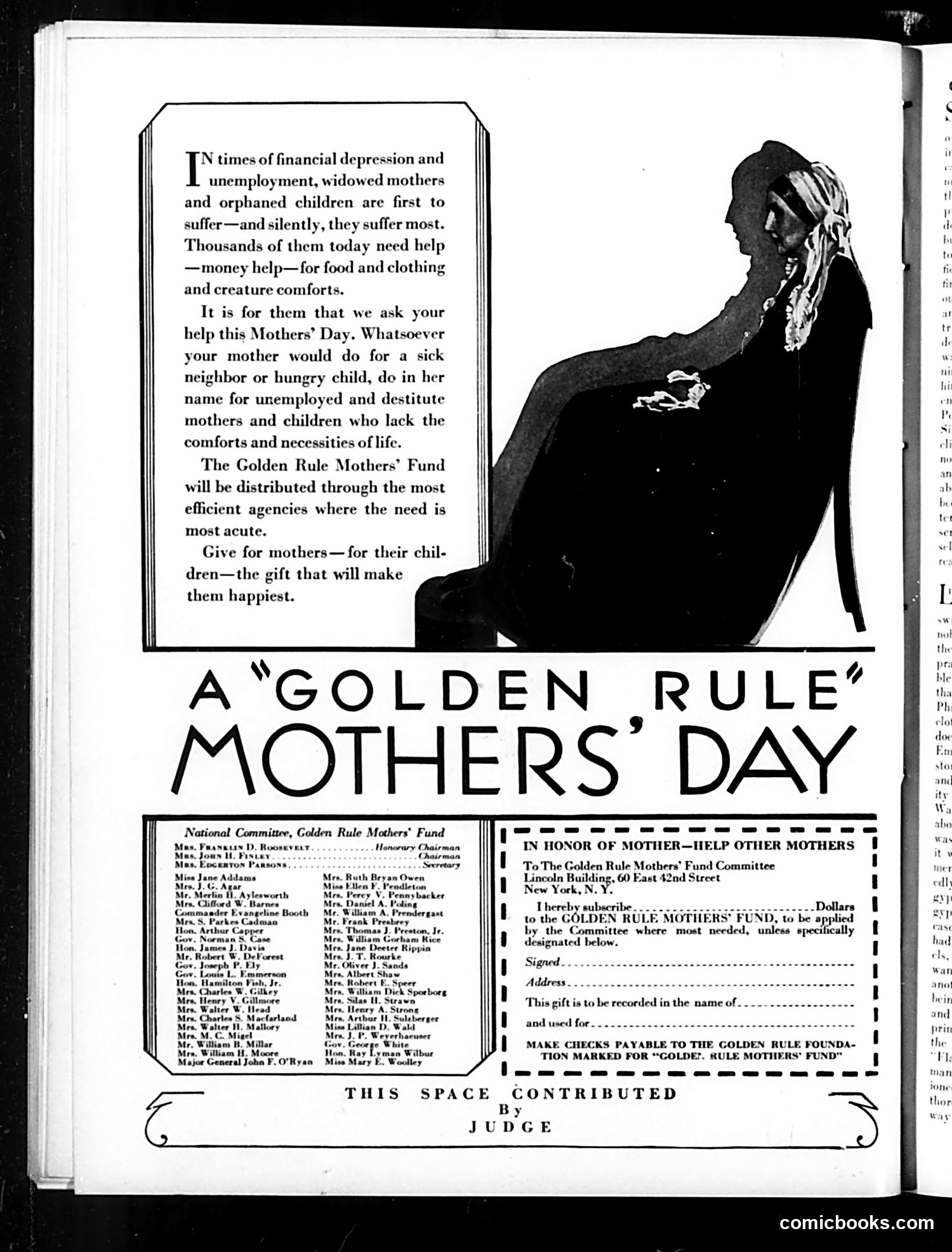
Analysis of "A 'Golden Rule' Mothers' Day" (Judge Magazine) This is not satire but a charitable advertisement dressed as editorial content. The page solicits donations for the "Golden Rule Mothers' Fund," which would distribute aid to unemployed mothers and destitute children during financial depression. The silhouetted illustration shows a mother cradling an infant—an emotionally direct appeal. The text frames charitable giving as a moral imperative, invoking the "Golden Rule" (treat others as you'd wish to be treated). The committee list suggests this was a real Depression-era relief initiative with prominent supporters, including Mrs. Franklin D. Roosevelt as honorary chairman. The contribution notice at bottom clarifies this is paid advertising space ("This space contributed by Judge"), making it a platform for philanthropic messaging rather than satirical commentary.
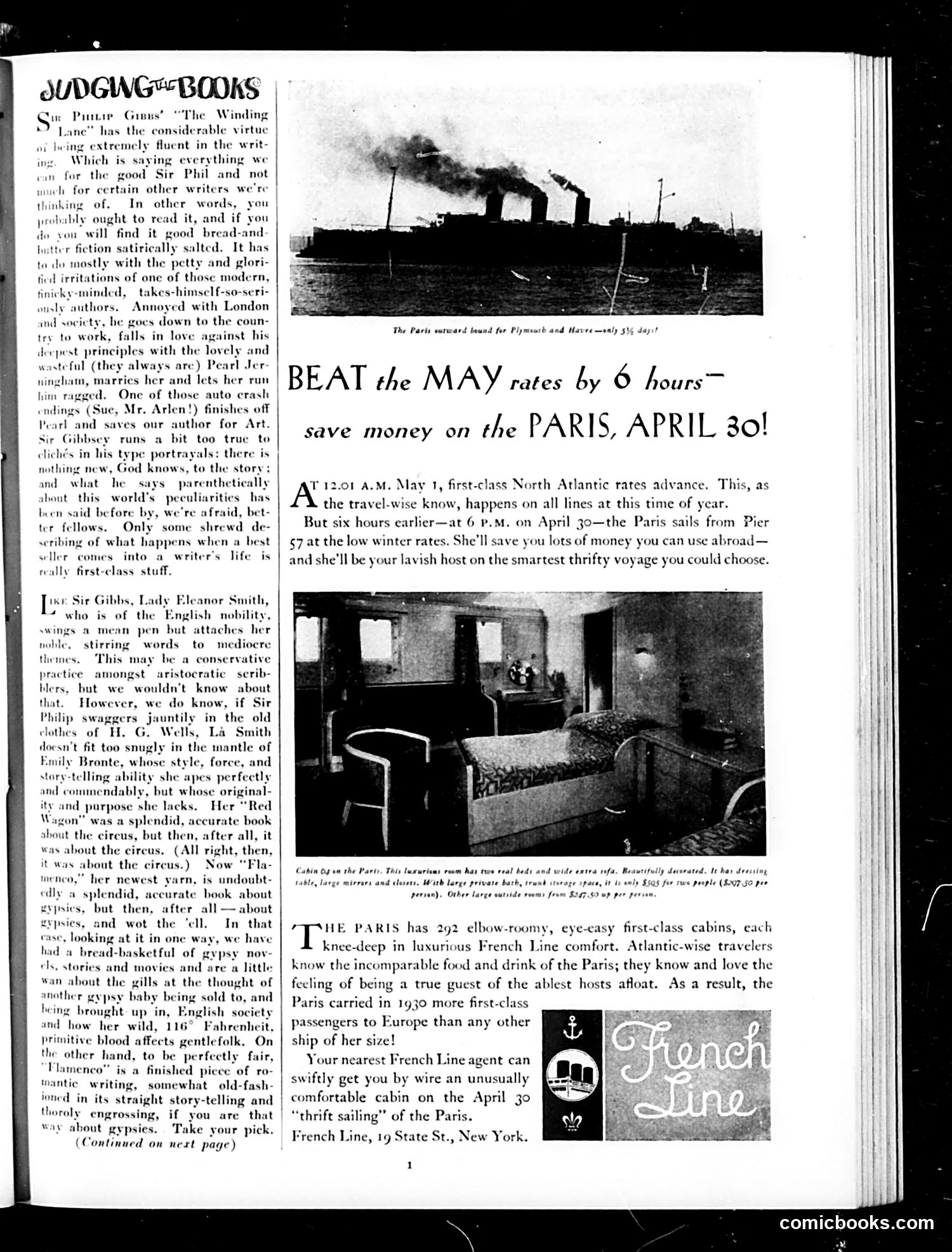
Analysis This page is primarily advertising, not political satire. The main content promotes the SS *Paris*, a French Line ocean liner, emphasizing cost savings by booking before May 1st when rates increase. The top section contains a brief book review ("Judging the Books") of Sir Philip Gibbs' *"The Winding Lane,"* praising his fluent writing style. This transitions into discussion of other authors like Lady Eleanor Smith and references to H.G. Wells and Emily Brontë. The dominant visual is a photograph of the *Paris* at sea, with a cabin interior photograph below. The French Line logo appears at bottom right. The advertisement targets affluent American readers considering European travel, promoting the ship's 292 first-class cabins and superior accommodations. No political cartoons or satirical commentary appears on this page.
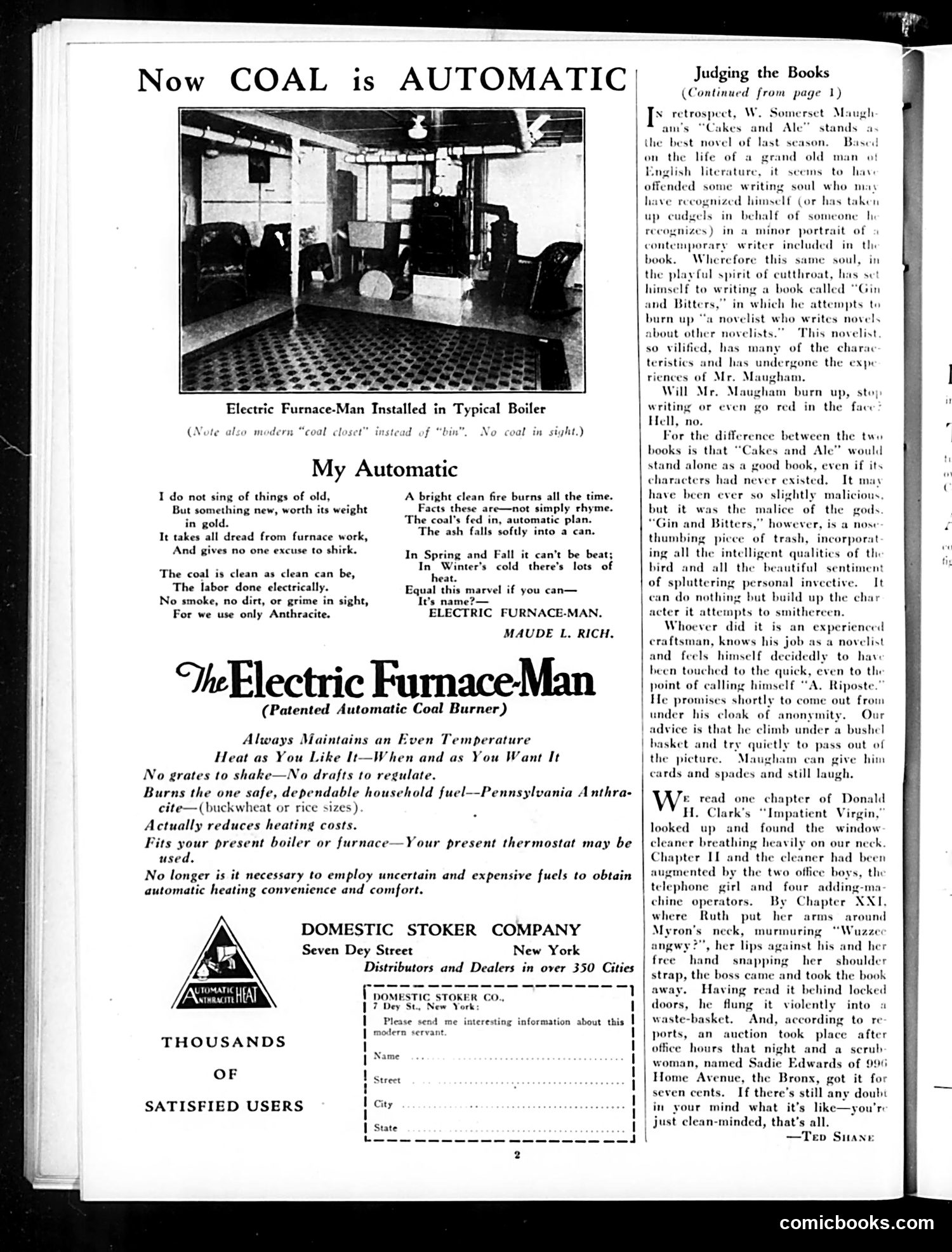
Analysis This page is primarily advertising, not political satire. The dominant content is a full-page advertisement for the "Electric Furnace-Man," an automatic coal-burning heating system by the Domestic Stoker Company of New York. The ad includes a poem by Maude L. Rich praising the device's convenience—automatic temperature control, cleanliness, and reduced labor. The photograph shows the furnace installed in a typical boiler room. The right column contains "Judging the Books," a literary review discussing W. Somerset Maugham's novel "Cakes and Ale" and Donald H. Clark's "Impatient Virgin." This is unrelated editorial content. There is no political cartoon or social satire on this page. It represents Judge magazine's revenue model: advertisements subsidizing satirical content.
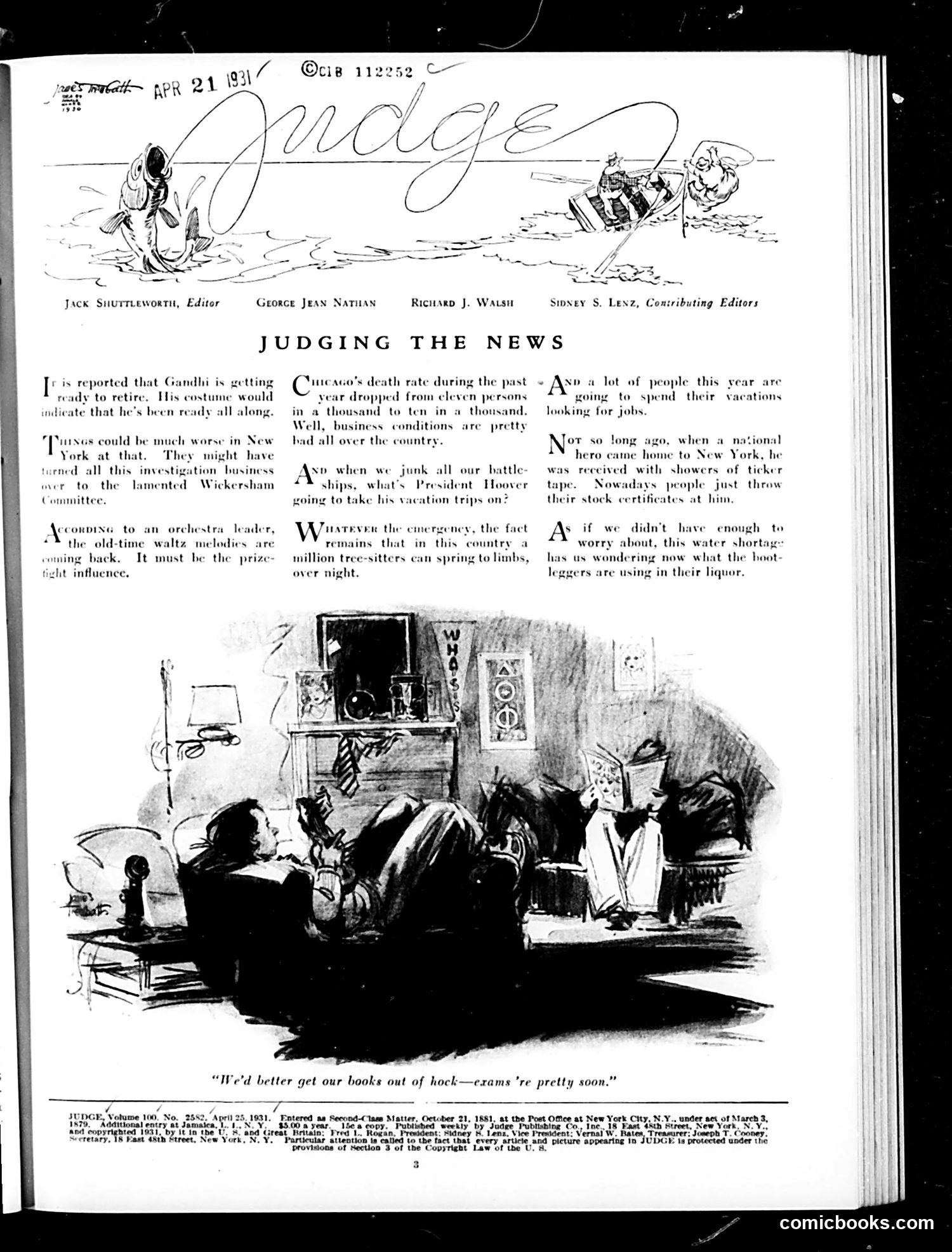
"Judging the News" - Judge Magazine, April 21, 1931 This satirical page comments on early Depression-era events through brief editorial quips paired with illustrations. The main cartoon depicts a crowded pawnshop where people are depositing books, with the caption "We'd better get our books out of hock—exams 're pretty soon." This jokes darkly about financial desperation: families pawning possessions (including schoolbooks) for survival money during the economic crisis. The text above addresses contemporary concerns: Gandhi's rumored retirement, Chicago's high death rate, vacation spending despite economic hardship, a national hero's homecoming, and water shortages allegedly caused by bootleggers during Prohibition. The satirical tone reflects Judge's practice of mocking both current events and public follies with sharp, often cynical commentary typical of early 1930s humor magazines.
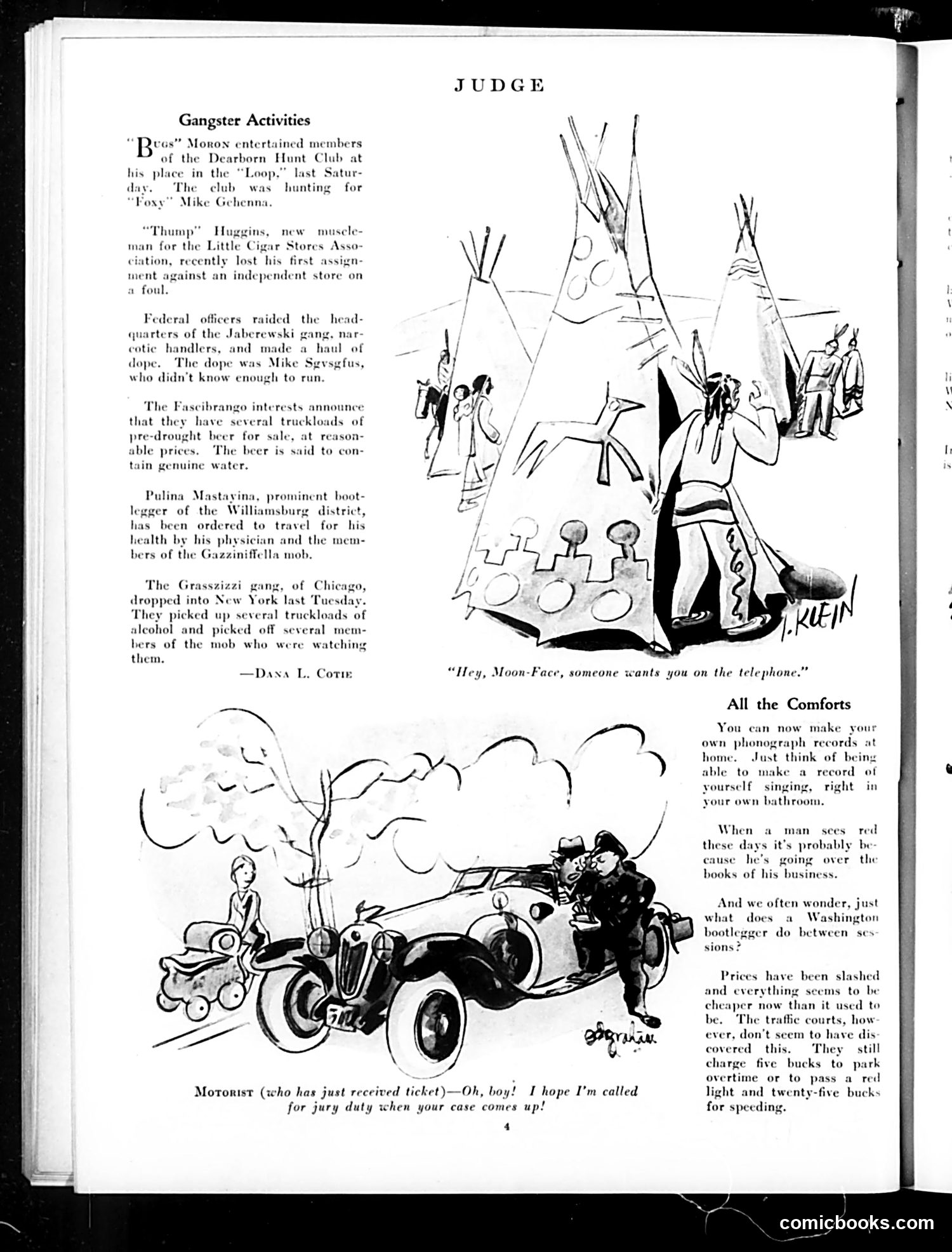
Analysis of Judge Page This page contains two main sections: "Gangster Activities" (top left) describes criminal underworld figures and incidents from Prohibition-era America, including raids on gang headquarters and bootlegging operations. The text satirizes organized crime, mentioning specific individuals like "Foxy" Mike Gehenna and the Jaberowski gang. Two cartoons illustrate the content: 1. Top right: Native American tepees with figures in Native dress, captioned about someone wanting "Moon Face" on the telephone—appears to mock gangster communications. 2. Bottom: A motorist receiving a traffic ticket, with caption about hoping for jury duty instead—satirizing the era's casual attitude toward traffic violations versus serious legal consequences. The page satirizes Prohibition-era organized crime, corruption, and the public's resigned acceptance of lawlessness as commonplace.
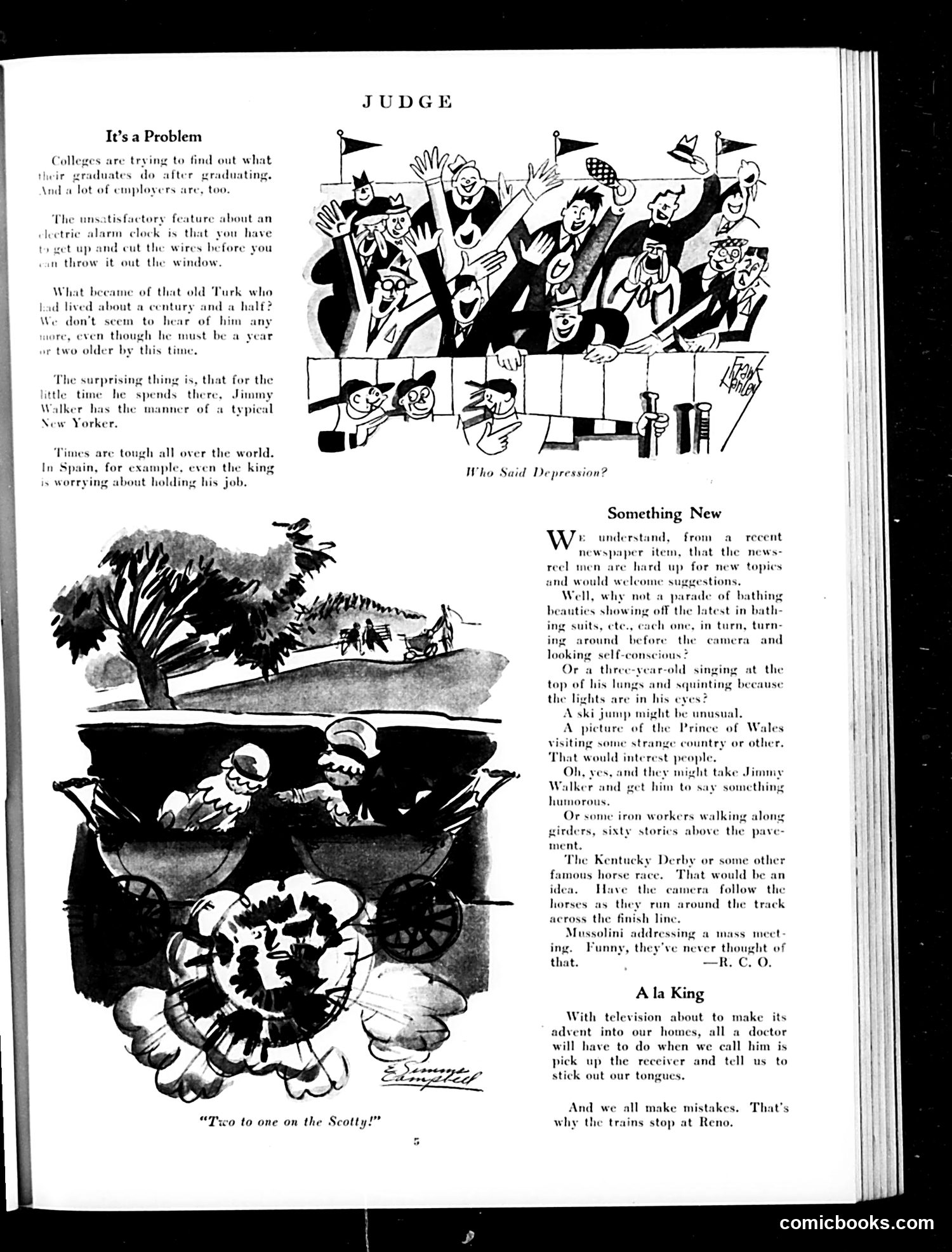
Analysis of Judge Page This page contains three satirical pieces: "It's a Problem": Comments on college employment struggles and mentions an old Turkish immigrant ("that old Turk") who's lived in America for 1.5 years—likely referencing contemporary immigration debates. Notes that Jimmy Walker (New York City's mayor during the 1920s-30s) has "the manner of a typical New Yorker." "Who Said Depression?": The top cartoon shows celebratory graduates, sarcastically titled—presumably mocking economic hardship while privileged students celebrate. "Something New" & "A la King": Discussion sections suggesting parade ideas and television's future. The final joke about trains stopping in Reno likely references the city's famous divorce industry and quick marriages. The page reflects Depression-era American anxieties about employment, immigration, and economic uncertainty.
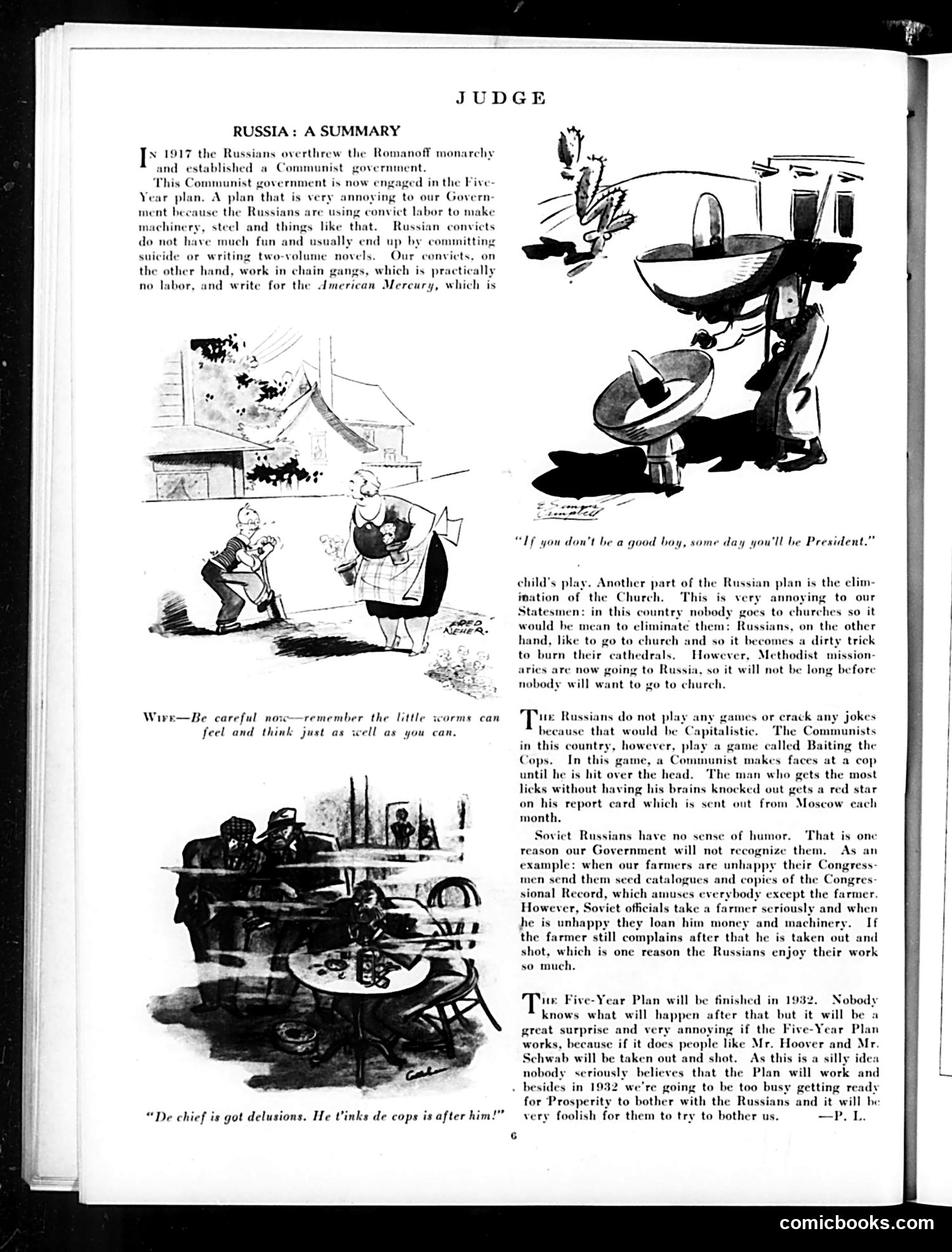
Analysis of Judge Magazine Page: "Russia: A Summary" This 1930s satirical piece mocks Soviet communism through crude caricatures. The text criticizes Russian convicts for laboring on industrial projects while American workers write for magazines like *American Mercury*. The cartoons ridicule Soviet society: one depicts children being indoctrinated ("If you don't be a good boy, some day you'll be President"), another shows farmers resenting Moscow's grain seizures, and a third illustrates "Baiting the Cops"—a supposed game where Communists attack police. The article dismisses the Five-Year Plan as doomed to fail, mocking the idea that people like "Mr. Hoover" would actually cooperate with Soviet ambitions. The satire reflects American anti-communist sentiment and Cold War anxieties of the era.
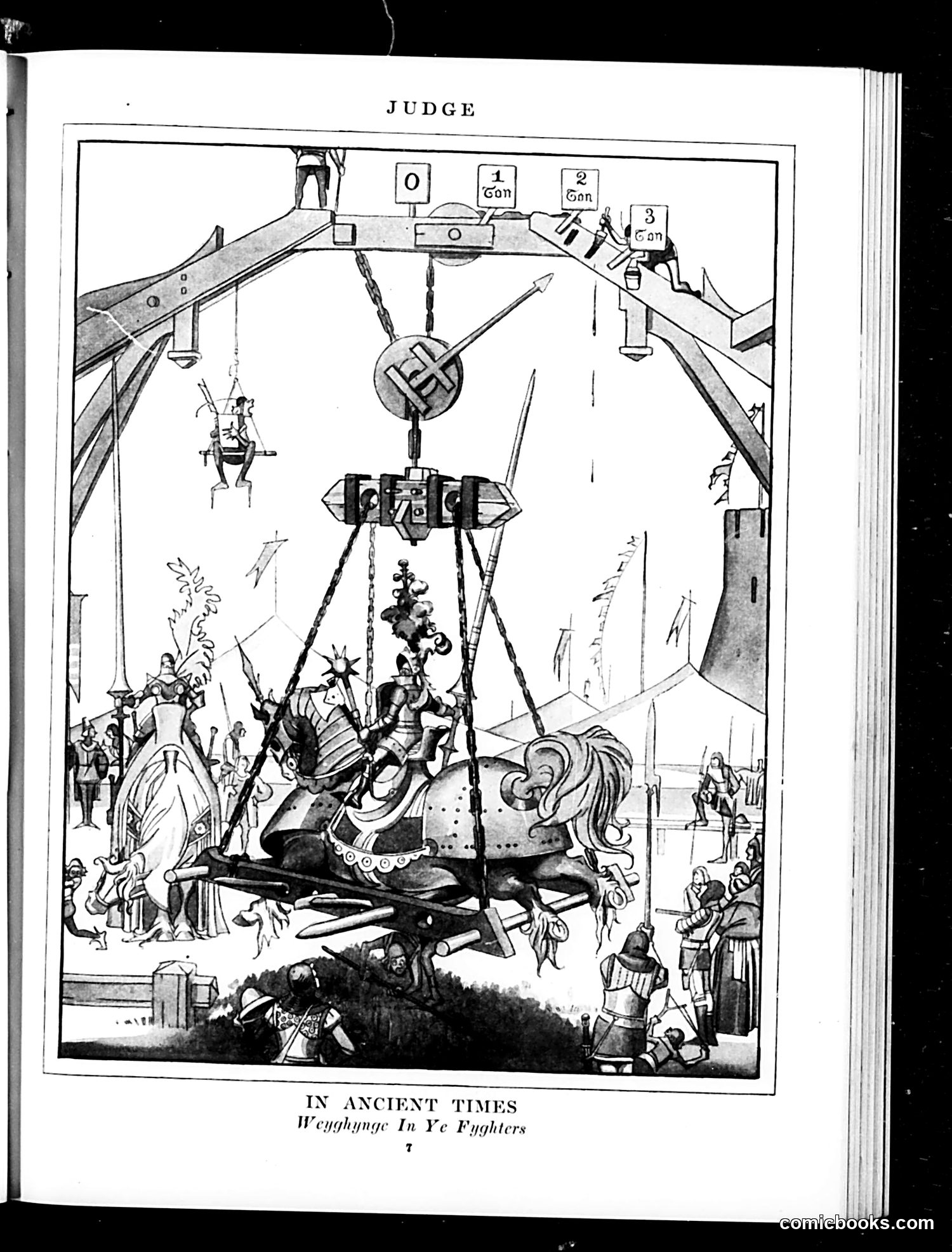
This satirical cartoon titled "In Ancient Times: Weighing in Ye Fighters" depicts a medieval or fantasy scene where armored knights and fighters are being weighed on a large scale suspended from above, as crowds observe. The scale appears to be a judge's scale, reinforced by the "JUDGE" header. The satire likely mocks prize-fighting or boxing matches, where fighters are traditionally "weighed in" before competition to ensure fair matchups by weight class. By placing this modern sporting practice in a ridiculous "ancient times" setting with knights and medieval pageantry, the cartoon ridicules the formality and spectacle surrounding boxing weigh-ins, suggesting the practice is as absurd as imagining medieval warriors being formally measured before combat.
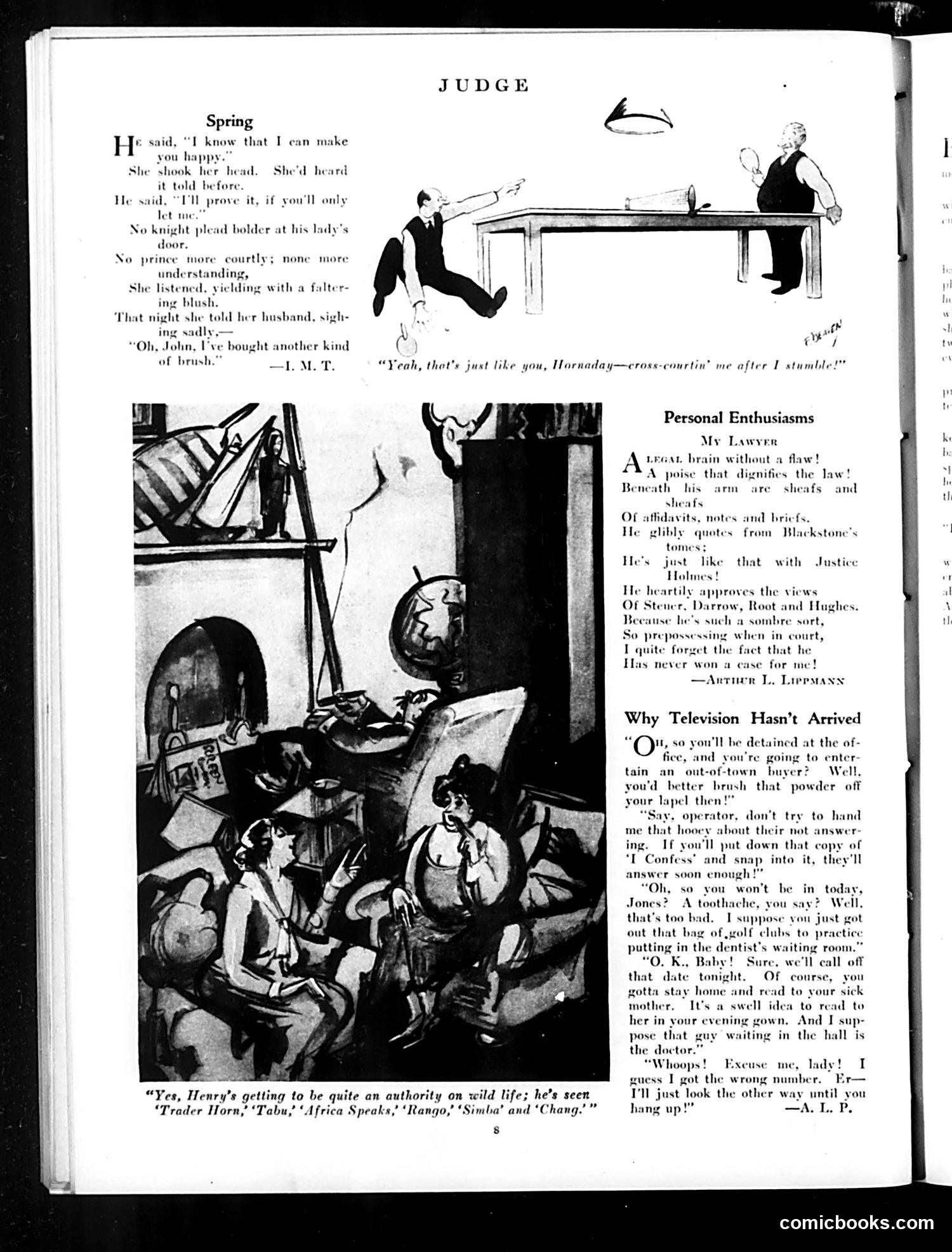
Analysis of Judge Magazine Page This page contains three satirical pieces typical of Judge's humor: Top cartoon: A domestic scene mocking marital discord. A husband attempts to prove his devotion with romantic gestures, but his wife remains skeptical—she's "heard it told before." The joke's punchline appears to reference his clumsiness ("cross-courtin' me after I stumble"), suggesting his romantic efforts are undermined by physical incompetence. Middle cartoon: Satirizes cinema obsession. A man has become an "authority on wild life" merely by watching adventure films like *Trader Horn* and *Rango*—he confuses movie-watching with actual knowledge. Right section: Two pieces mock professional pretension and the impracticality of television (still emerging technology). "My Lawyer" ridicules an eloquent but unsuccessful attorney who quotes legal authorities yet never wins cases. "Why Television Hasn't Arrived" presents absurd excuses people give for unavailability, suggesting society isn't ready for instantaneous communication technology. The humor targets human vanity, marital friction, and technological skepticism characteristic of interwar American satire.
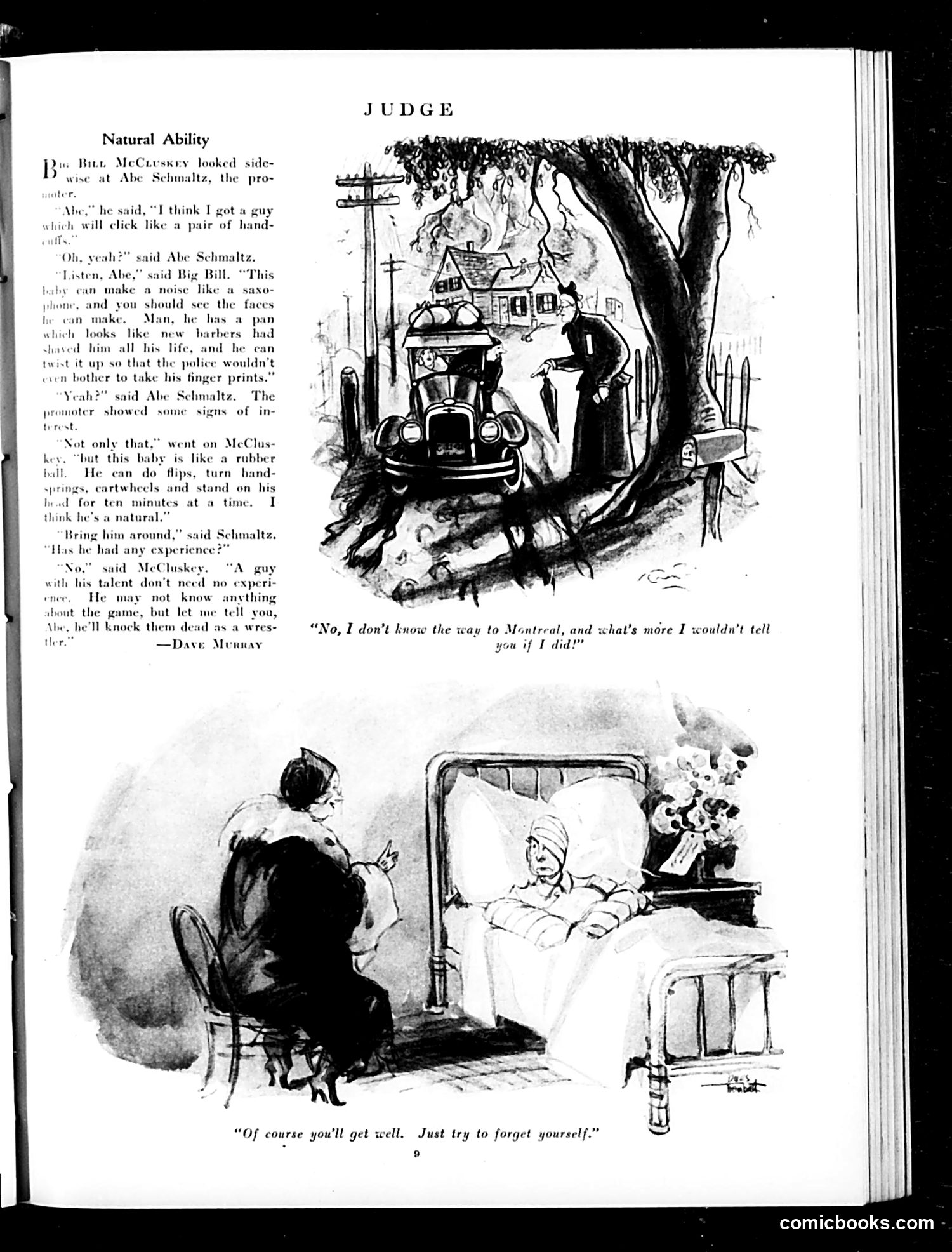
Analysis This page contains two distinct comic pieces from Judge magazine. Top cartoon ("Natural Ability"): Two promoters—Big Bill McCluskey and Abe Schmaltz—discuss a talented performer. McCluskey pitches an act featuring a saxophonist who can also perform acrobatic feats (flips, handstands, cartwheels). Schmaltz expresses skepticism about the act's viability without experience, but McCluskey insists raw talent alone will succeed. The satire mocks overconfident promoters who overvalue natural ability while dismissing the need for training or experience—a recurring theme in entertainment industry criticism. Bottom cartoon: A woman sits bedside with an ill person. The sick person says they won't forget their troubles, and the visitor replies "Of course you'll get well. Just try to forget yourself." This is absurdist humor mocking the vapid platitudes offered to the sick—well-meaning but entirely unhelpful advice that dismisses genuine suffering with cheerful willful ignorance. Both pieces use humor to critique human folly through exaggeration.
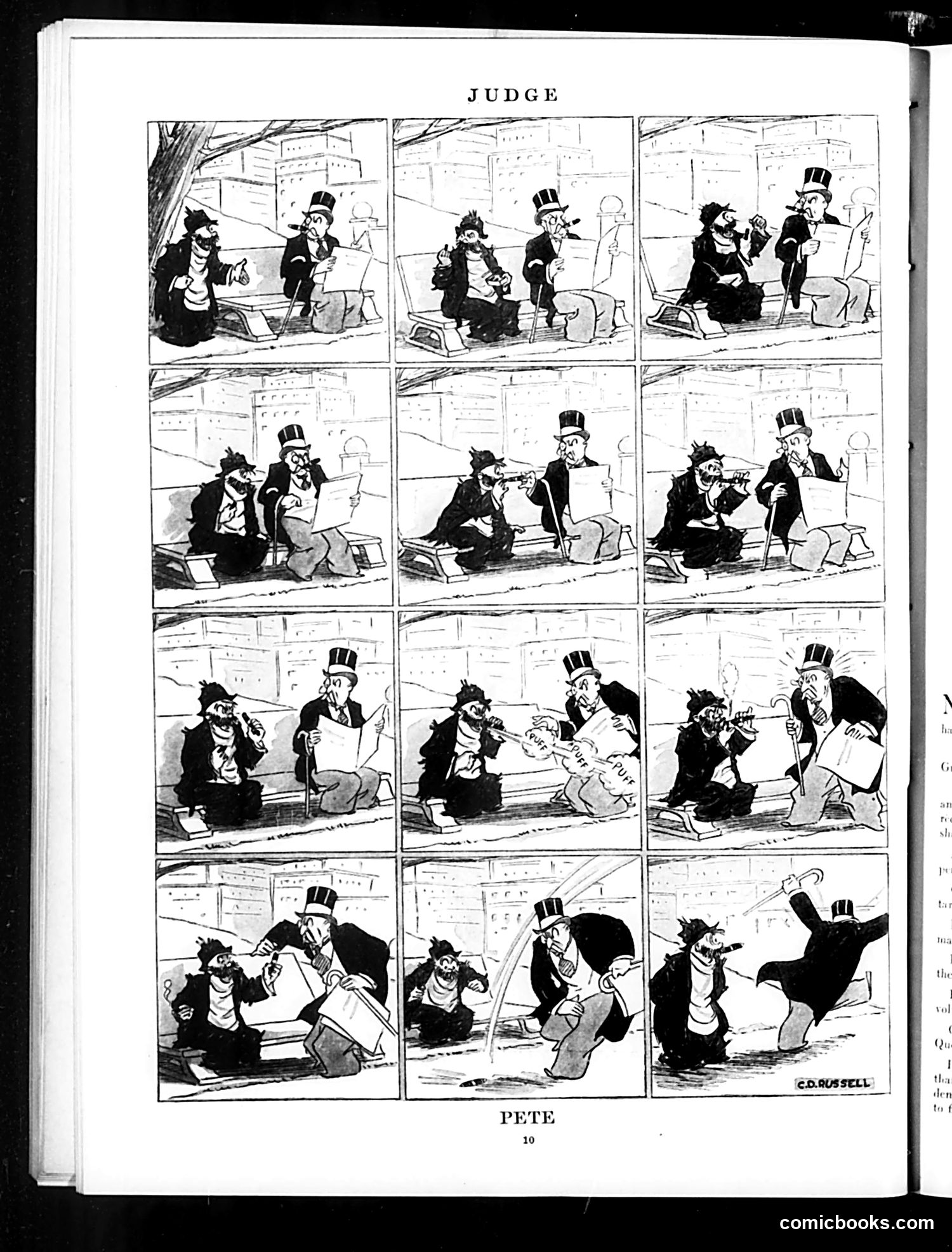
Judge Comic: "Judge" and "Pete" This is a 12-panel satirical comic strip by G.D. Russell showing two caricatured figures in formal attire (top hats and coats) in what appears to be an urban setting. The characters engage in an escalating physical confrontation, progressing from conversation to argument to fighting, culminating in one character being kicked. The figures appear to represent political or social types—their exaggerated features and formal dress suggest they're meant as satirical commentary on specific public figures or social classes, likely judges or legal/political authorities given the page title "JUDGE." However, without additional context or clearer identification of the specific individuals being caricatured, the precise political reference remains unclear. The humor derives from the visual slapstick escalation and the characters' pompous appearance contrasted with their undignified brawling.
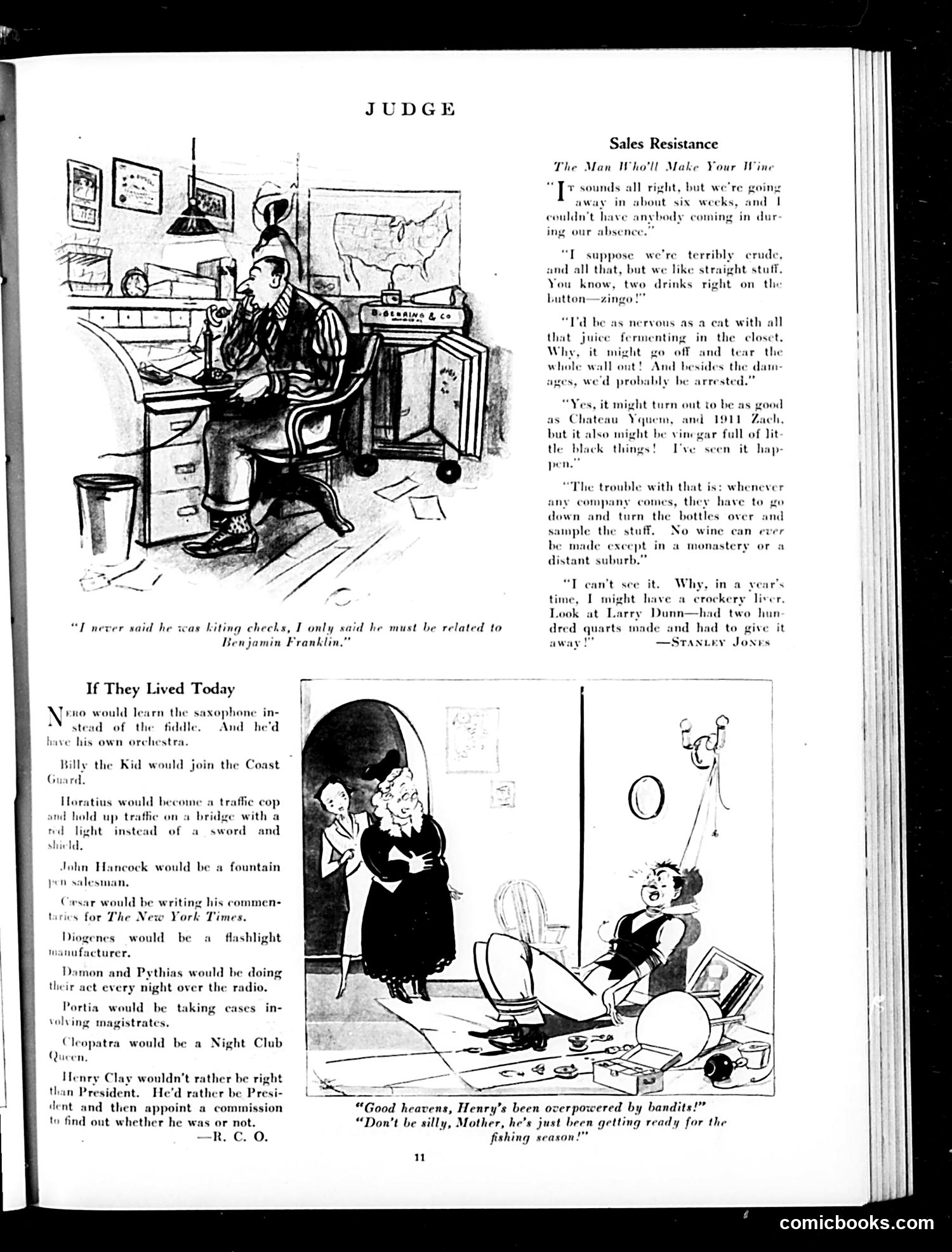
Analysis of Judge Magazine Page This page contains two satirical pieces typical of 1920s-era Judge magazine humor: "Sales Resistance" depicts a wine salesman's pitch to customers hesitant about home winemaking during Prohibition. The joke hinges on their elaborate excuses—they're leaving town, they fear explosions, the wine might turn to vinegar—while the salesman counters with references to prestigious wines like Château d'Yquem and "1911 Zach" (likely Château d'Iquem 1911). The final punchline references "Larry Dunn," apparently someone known for making homemade wine, suggesting the absurdity of their resistance. "If They Lived Today" imagines historical figures in modern (1920s) occupations: Nero as a saxophonist, Julius Caesar writing for the New York Times, Diogenes as a flashlight manufacturer. The humor relies on incongruity between ancient figures and contemporary American life. The second cartoon shows a boy surrounded by fishing gear while his mother exclaims he's been "overpowered by bandits"—likely satirizing overprotective mothers or American anxiety about childhood dangers of the era.
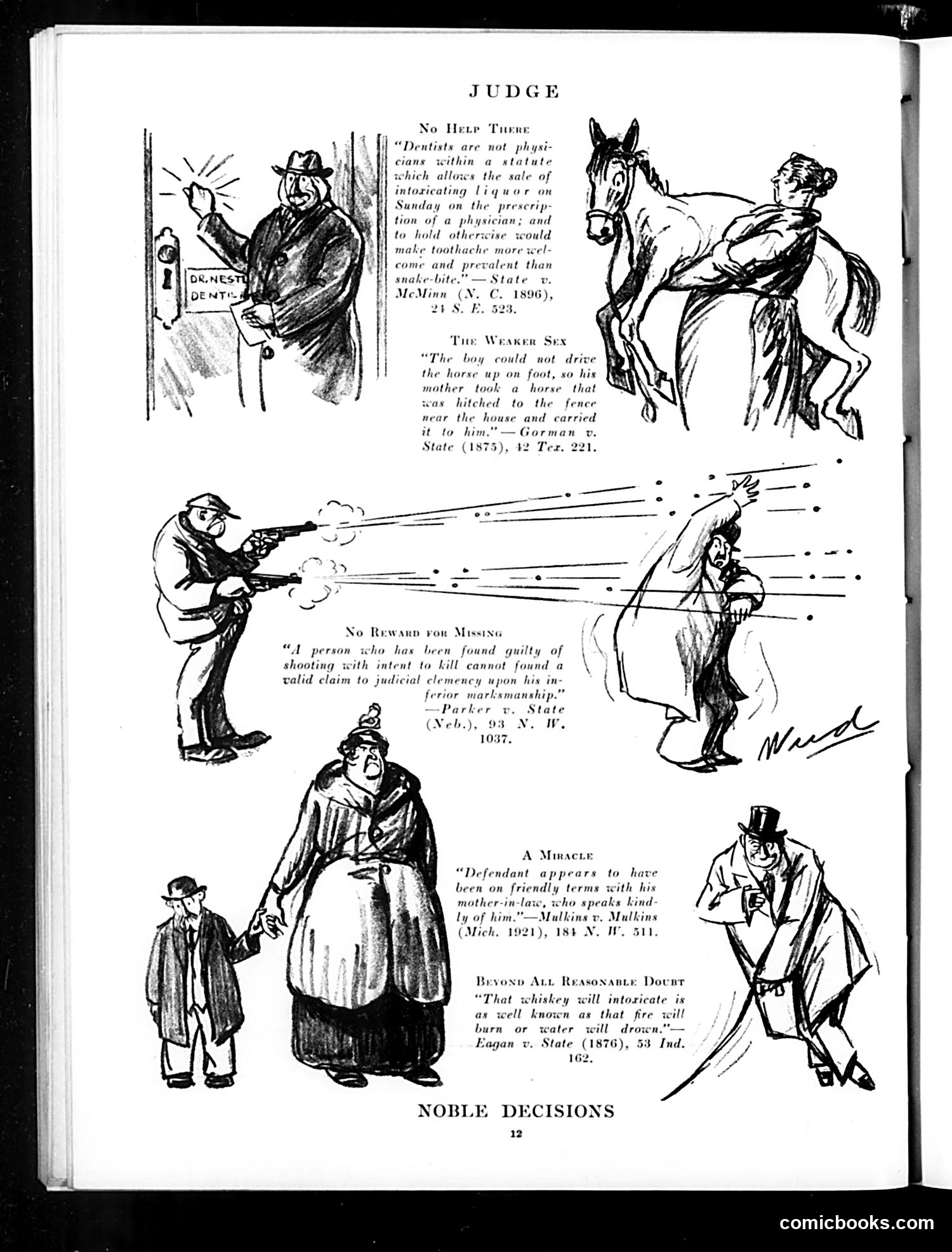
"Judge" Magazine Page: "Noble Decisions" This page satirizes absurd legal rulings through illustrated vignettes paired with actual court case citations. Each cartoon mocks the illogical conclusions of real judicial decisions: "No Help There" ridicules a North Carolina ruling denying dentists the right to prescribe alcohol on Sundays, implying toothaches would become worse than snakebites. "The Weaker Sex" depicts a woman carrying a horse—illustrating a Texas court's baffling acceptance that a boy couldn't move a horse on foot but his mother could carry it. "No Reward for Missing" shows a shooter missing his target, mocking a Nebraska ruling that poor marksmanship doesn't warrant judicial leniency for attempted murder. "A Miracle" celebrates a defendant friendly with his mother-in-law as impossibly rare. "Beyond All Reasonable Doubt" states the obvious: whiskey intoxicates. The satire targets judicial reasoning so flawed or trivial it borders on absurdity, using exaggerated illustrations to highlight the disconnect between legal language and common sense.
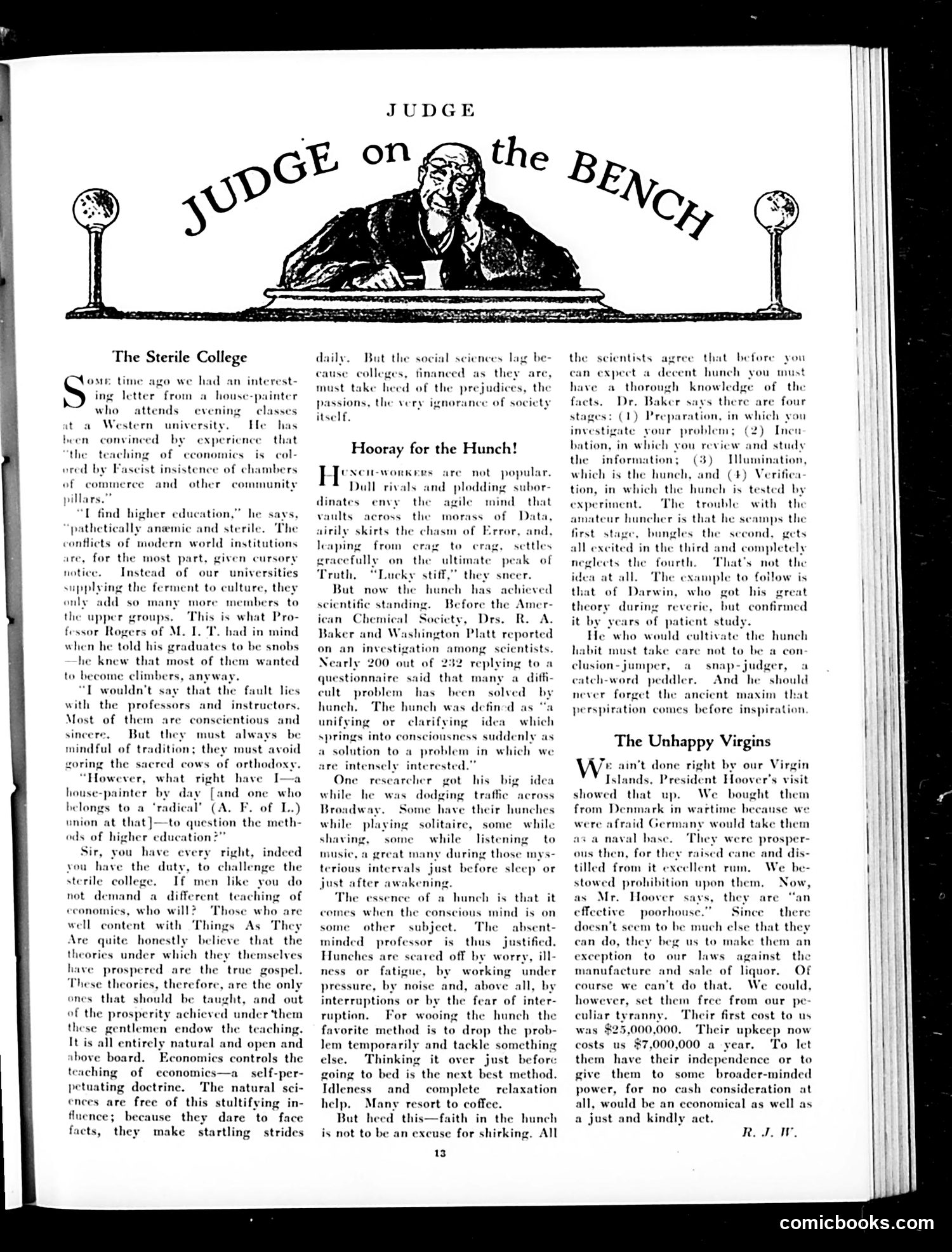
"Judge on the Bench" — Page Analysis This page contains two satirical essays under the "Judge on the Bench" masthead (featuring an illustrated judging figure). "The Sterile College" critiques American higher education as intellectually stifled by financial dependence on business interests. A house-painter writes that universities, funded by chambers of commerce, teach economics that protects the status quo rather than challenging it. He argues social sciences lag behind natural sciences because they're constrained by donor pressures and orthodox thinking, while natural sciences freely pursue factual truth. "Hooray for the Hunch!" celebrates intuitive thinking after scientists report that many breakthroughs come from sudden insights rather than systematic work. The essay argues hunches occur when the conscious mind relaxes, and warns against using "faith in the hunch" as excuse for laziness. Both pieces target intellectual conformity—one attacking institutional constraints on economic thought, the other celebrating creative insight. The satire assumes readers value independent thinking and challenge to establishment orthodoxy.
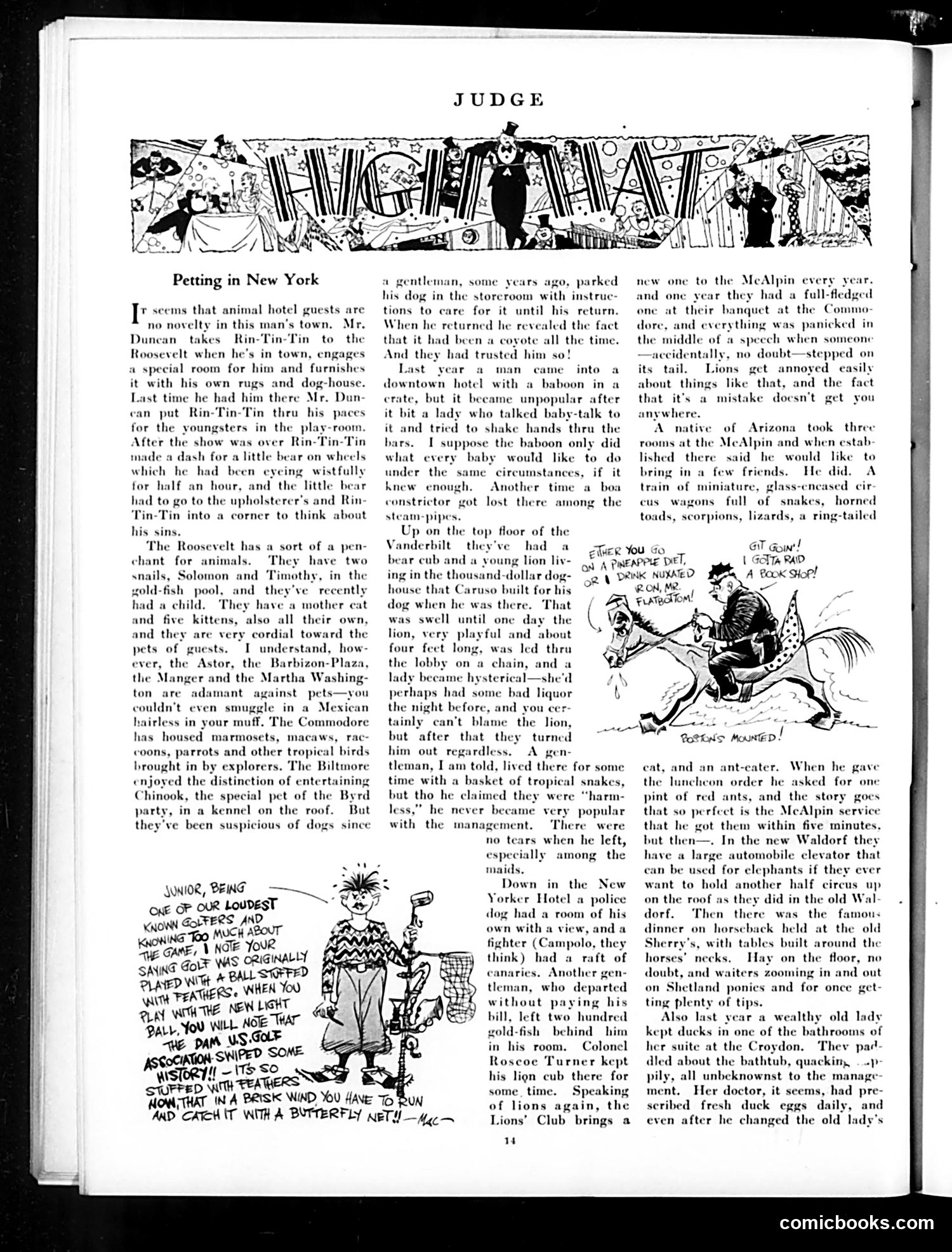
"Petting in New York" — Judge Magazine Article This is a humorous article about wealthy New Yorkers who keep exotic animals as hotel pets. It describes how the Roosevelt Hotel accommodates famous dogs like Rin-Tin-Tin (a celebrated silent-film dog actor), while other luxury hotels like the Astor and Commodore have housed lions, bears, coyotes, snakes, and tropical birds. The satire mocks both the indulgence of the wealthy and hotels' absurd tolerance for dangerous animals. Key incidents include: a lady bitten by a baboon, a lion cub that disrupted a Vanderbilt penthouse dinner, a man leaving 200 goldfish behind, and an Arizona guest who brought circus wagons full of snakes and scorpions—allegedly receiving live ants for lunch service. The accompanying cartoons mock "Junior," presented as loud and ill-behaved, contrasting with his family's pretense. The humor targets Gilded Age excess and the era's fascination with collecting exotic animals as status symbols.
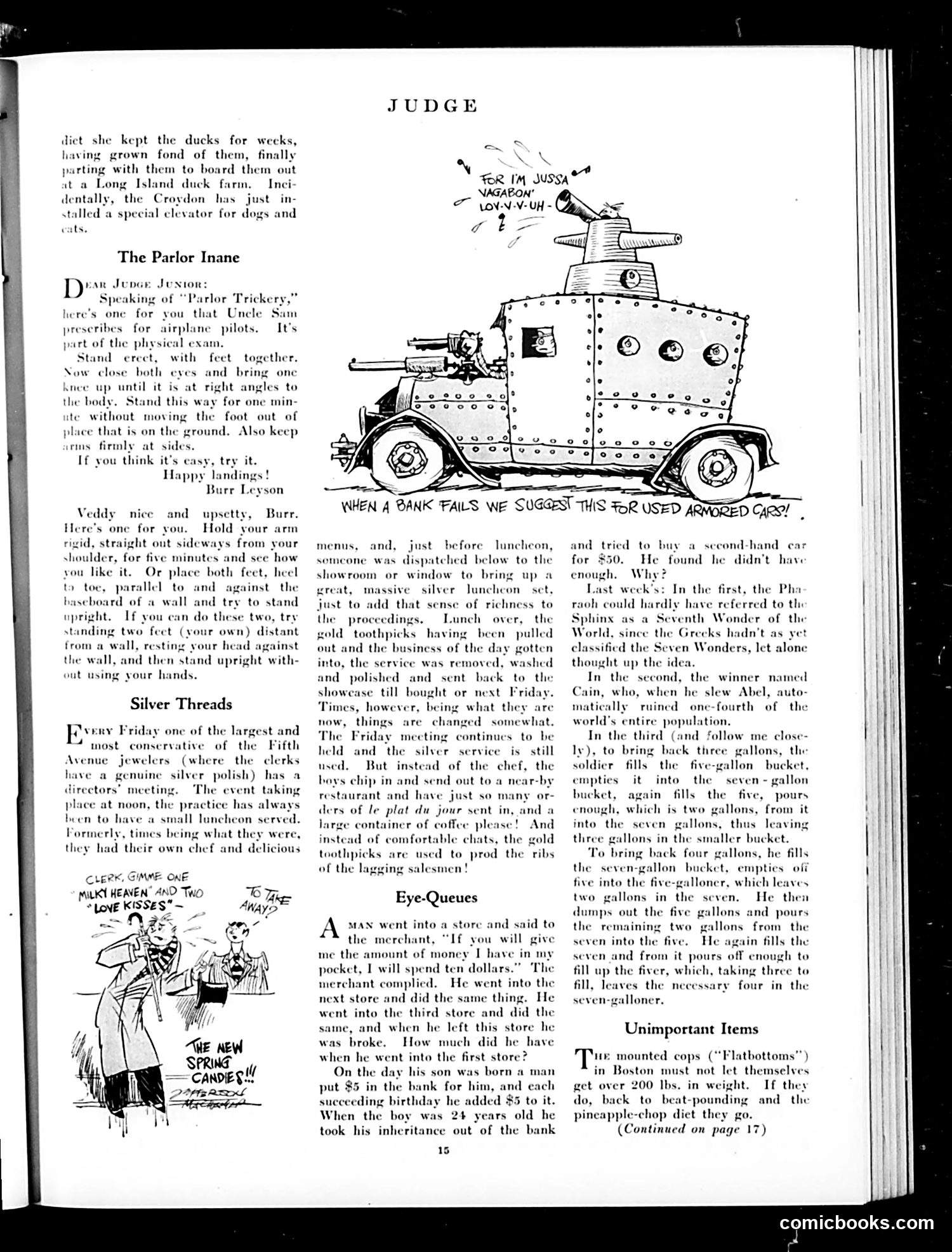
Not a Cartoon—This is an Advertisement This page is not satirical content but rather a straightforward advertisement for the American Car and Foundry Company's "A.C.F. 46' Twin Screw Cruiser" motor yacht. The photograph shows the vessel performing in rough seas (20-knot winds), demonstrating its handling capabilities and seaworthiness. The accompanying text emphasizes luxury features—dining saloon, private cabins with baths, spacious galley, and fishing cockpit—aimed at wealthy buyers. The company stakes its reputation on two generations of quality transportation equipment and uses the A.C.F. trademark as a mark of reliability and performance. This appears in *Judge* magazine likely because the publication carried both satirical content and paid advertising to support itself. There is no political or social satire present on this page—it's a period luxury product pitch to affluent readers.
Analysis of Judge Magazine Page This page primarily contains humorous social commentary rather than political cartoons. The "High Hat" column offers satirical observations on 1920s-30s American culture: Key satirical targets: 1. Radio culture: Mocks people developing "Negative Ear"—tuning into favorite stations and ignoring everything else, unable to concentrate without constant radio. This satirizes the new phenomenon of mass radio consumption. 2. Golf's history: Playfully corrects the misconception that golf is Scottish, noting it's Dutch, invented on frozen ice. 3. Broadway culture: Jokes about wealthy theater-goers who attend openings dressed formally but only arrive after intermission to socialize. 4. Gambling and taxes: Humorously notes a friend who claimed horse-racing debts as tax deductions, challenging authorities with mutuel tickets. 5. Product naming: Mocks candy bar marketing for absurdly flossy names. The page includes vintage advertisements for O.C.F. motor cruisers and American Car & Foundry Company. The humor relies on observational comedy about emerging consumer culture and modern inconveniences.
Judge Magazine Theater Review Analysis This page contains theater criticism by Judge's drama columnist, who reviews contemporary Broadway productions. The critic is evaluating "Peter Ibbetson," a revival by the Shubert brothers, arguing it's overly sentimental and maudlin for modern audiences. The satire targets what the critic sees as false sentimentality in contemporary plays by Milne, Pollock, and Levy—they claim delicacy and refinement while actually employing crude emotional manipulation ("pinning comic valentines to one's coat-tail"). The critic distinguishes between appropriate and inappropriate sentiment, favoring plays like "Cyrano" and "The Miracle" that handle emotion with restraint. The review also mocks recent productions like "Lady Beyond the Moon" as artistic drivel ("plats du nuit"—night-shift garbage). This reflects Judge's role as cultural arbiter for educated readers, lampooning contemporary theater's perceived descent into cheap sentimentality and poor quality drama.
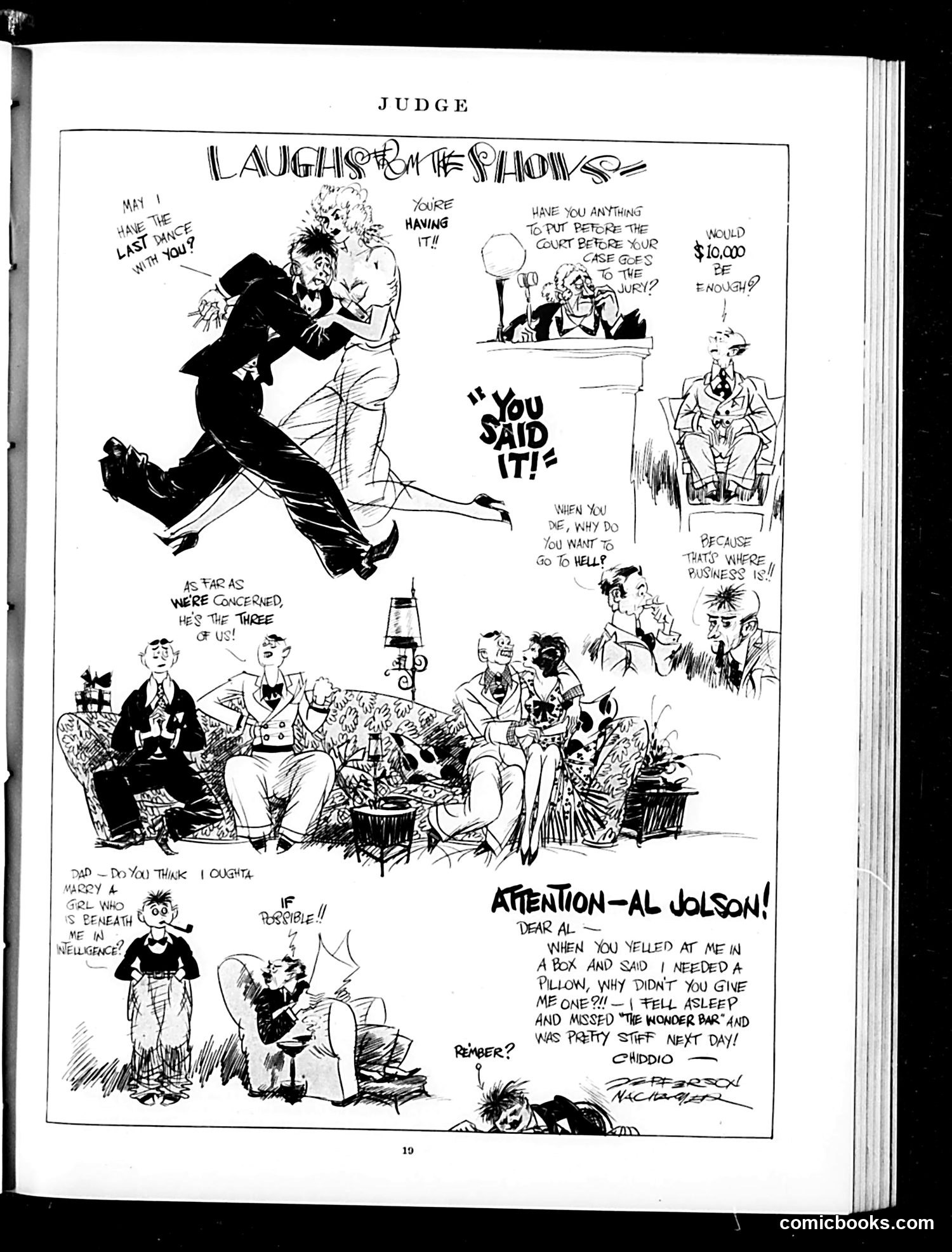
"Laughs of the Diaow" - Judge Magazine Cartoon Analysis This is a satirical courtroom scene mocking judicial proceedings. The main cartoon depicts a judge being physically attacked by an angry litigant—likely representing public frustration with the legal system's ineffectiveness or absurdity. The surrounding vignettes satirize various courtroom scenarios: a judge asking if a defendant has evidence, arguments about bail amounts ("$10,000 enough?"), and disputes about proper legal procedure. The tone suggests judges are incompetent or dismissive. The closing section addresses "Al Jolson" (the famous entertainer), complaining humorously that he was yelled at in court, given no pillow, fell asleep, missed a radio program ("The Wonder Bar"), and was stiff the next day—mocking both courtroom discomfort and celebrity grievances. The overall satire ridicules the American judicial system as chaotic, unfair, and ultimately absurd—a common Judge magazine theme critiquing institutions through exaggeration and physical comedy.
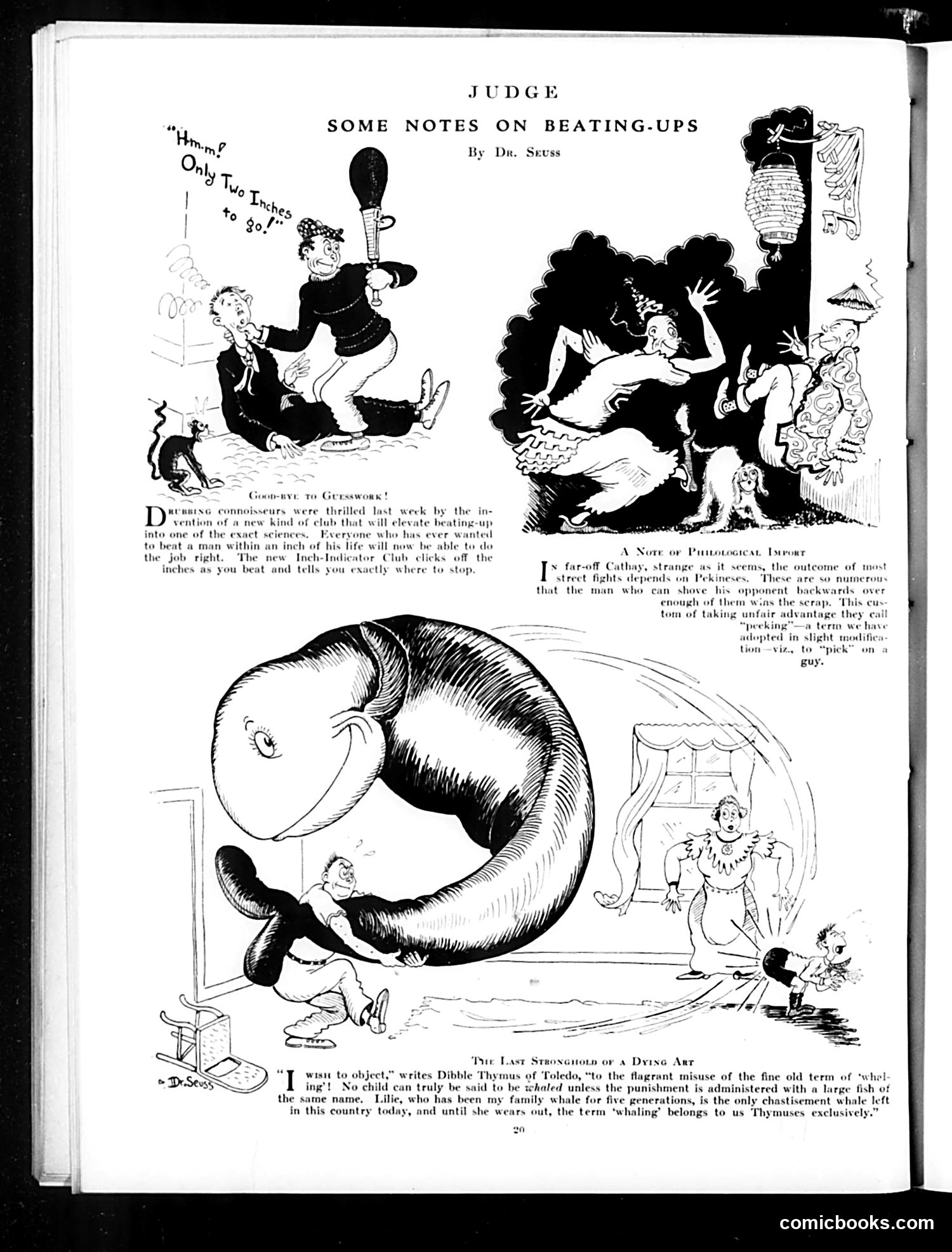
Analysis of Judge Magazine Page: "Some Notes on Beating-Ups" This satirical piece by Dr. Seuss mocks the prevalence of street violence and "beating-ups" in 1920s-30s America. The cartoons ridicule the casual brutality of the era through absurdist humor. The top illustration shows a "beating-up indicator club"—a fictional device that measures precisely how hard to strike someone, treating violence like a scientific instrument. This lampoons the casual acceptance of physical assault. The large central cartoon depicts a grotesquely exaggerated fist-fight, emphasizing the violent chaos of street brawls. The bottom section includes a letter from "Dibble Thymus of Toledo" pedantically complaining about misuse of the term "whaling" (beating), claiming his family's exclusive right to the word—a absurdist joke about propriety amid violence. The satire's point: American society tolerates street violence so routinely that people discuss it clinically and obsess over terminology rather than the violence itself. Seuss uses grotesque exaggeration and bureaucratic absurdity to critique this normalization.
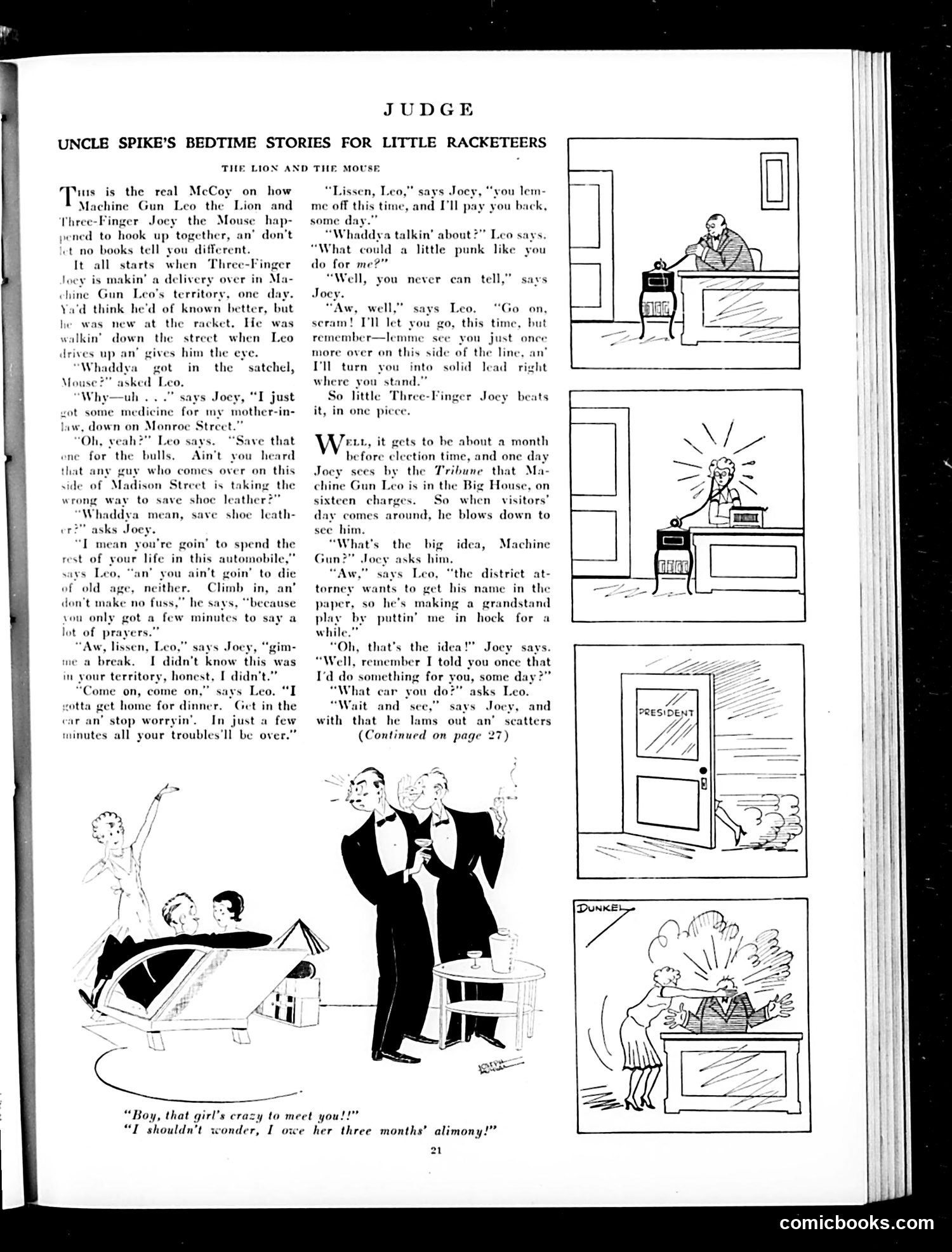
Analysis: "Uncle Spike's Bedtime Stories for Little Racketeers" This is a satirical children's story parody from Judge magazine that mocks 1920s-30s organized crime and Prohibition-era gangsters by framing mobster behavior as a fairy tale for children. The story adapts Aesop's "Lion and the Mouse," substituting underworld figures: "Machine Gun Leo the Lion" (a ruthless gangster) and "Three-Finger Joey the Mouse" (a small-time criminal). Joey accidentally encroaches on Leo's territory; Leo threatens to kill him but eventually lets him go. Later, when Leo is imprisoned on "sixteen charges" (likely bootlegging or racketeering), Joey offers to help—suggesting the fable's moral about unexpected reciprocal aid. The satire works on multiple levels: it mocks both the glamorization of gangsters in popular culture and the naïveté of law enforcement ("the bulls"). The bottom cartoon's caption about alimony suggests the piece also satirizes men's domestic obligations being ignored. The humor targets readers familiar with Prohibition-era crime headlines and the era's peculiar mixture of criminal celebrity and moral hand-wringing.
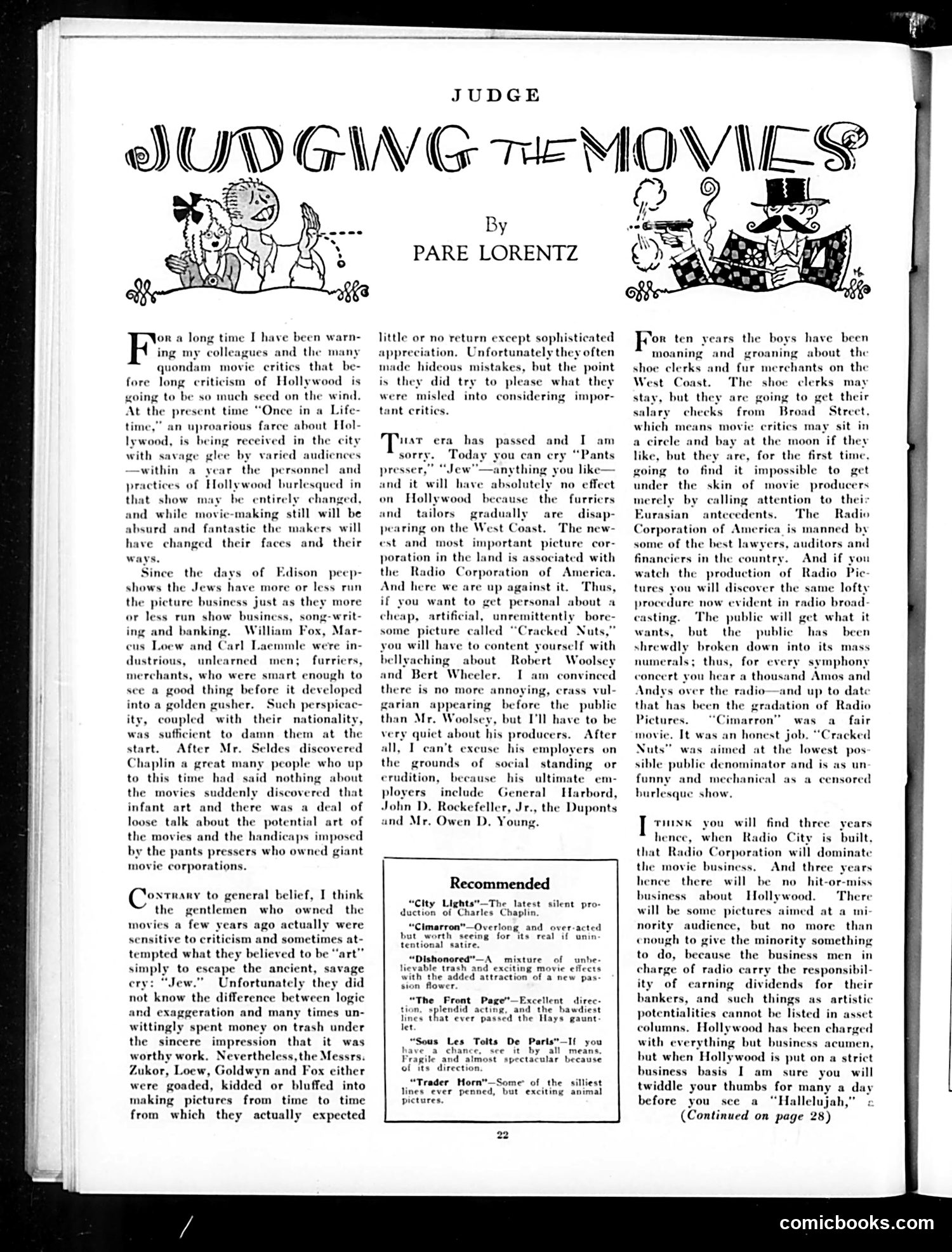
Judging the Movies: Lorentz's Critique of Hollywood Power This is a satirical essay by Pare Lorentz critiquing how Hollywood's Jewish moguls—Marcus Loew, Adolph Zukor, William Fox, Samuel Goldwyn—once felt pressured to make "artistic" films to appease critics, but no longer do. Lorentz argues that early movie executives, despite being dismissed as "pants pressers" and "Jews," initially attempted quality work when goaded by intellectual critics. However, he laments this era has ended. Now that Radio Corporation of America dominates (led by gentile executives like General Harbord and Rockefeller), and the Jewish founders are "disappearing on the West Coast," critics have lost leverage. Hollywood has reverted to making profitable trash like "Cracked Nuts." The piece reflects 1920s-30s casual antisemitism while paradoxically defending these Jewish businessmen as having possessed more artistic conscience than their WASP successors. The irony is unexamined: Lorentz simultaneously stereotypes and credits them.
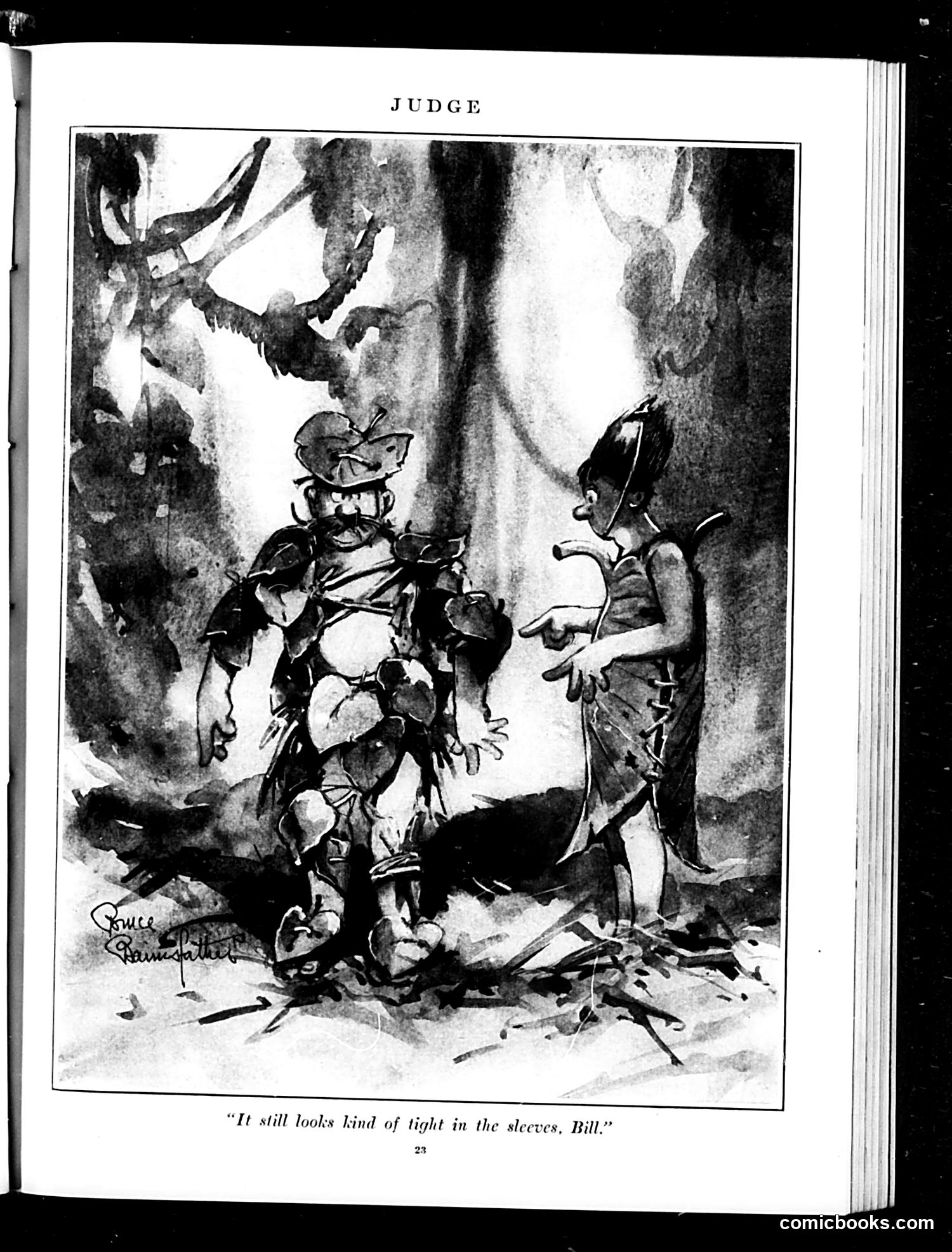
Analysis This satirical cartoon from *Judge* magazine depicts what appears to be a military or political figure (center) in ornate, elaborate uniform examining another figure's outfit. The caption, "It still looks kind of tight in the sleeves, Bill," suggests commentary on someone being uncomfortable or poorly suited for a role—likely a position of power or military command. The exaggerated, decorated uniform and the cramped fit imply the central figure is overstuffed or unsuitable for their position. The demons or devils visible in the smoky background suggest darker undertones—possibly corruption, moral unsuitability, or sinister implications about the figure's appointment or authority. Without clear identification of "Bill" or specific dating, the exact political target remains unclear, but the satire criticizes someone ill-fitted for high office or command.
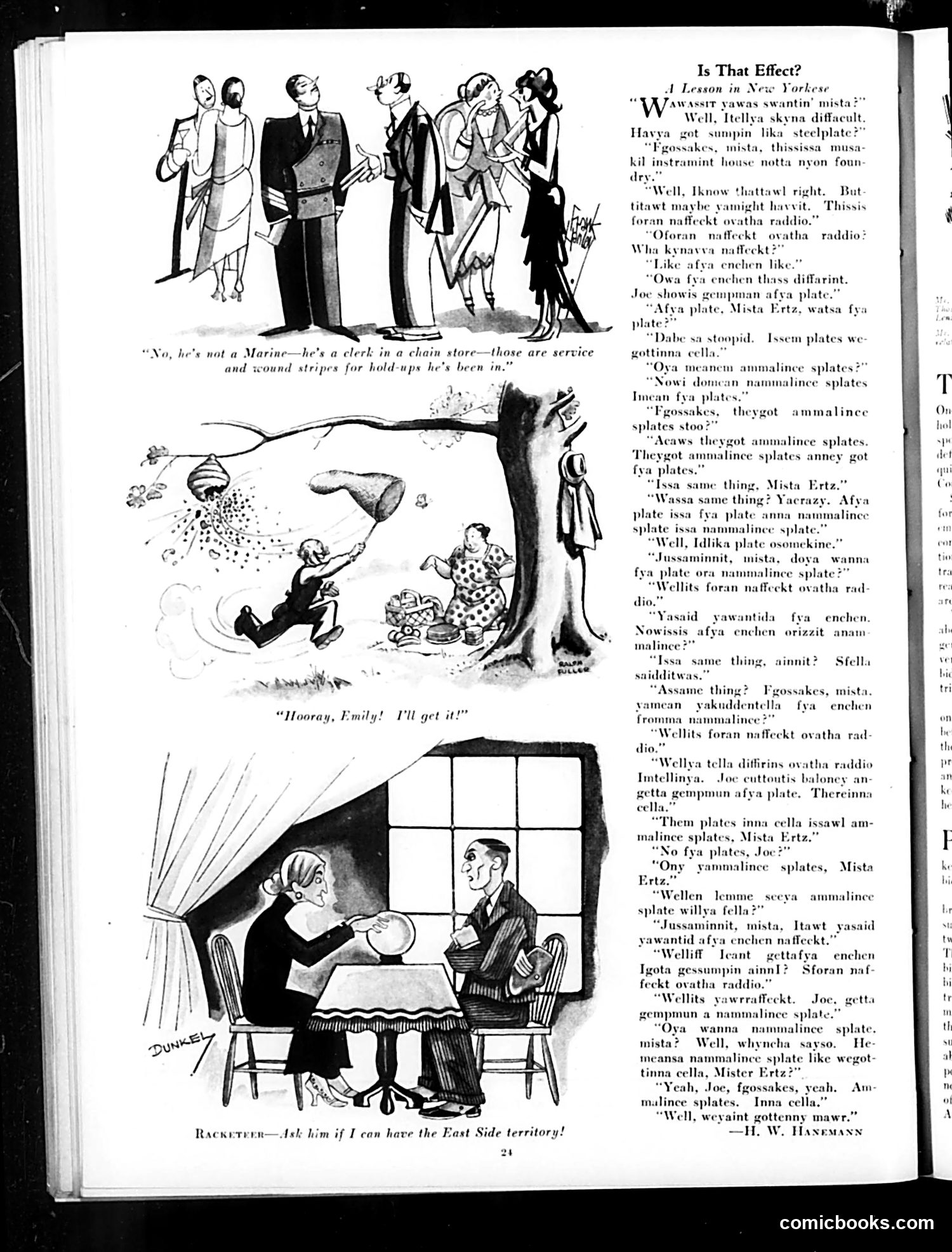
"Is That Effect?" — A Lesson in New Yorkese This page satirizes the thick accent and rapid-fire dialect of working-class New York City speech, particularly among immigrants or those from the Lower East Side. The dialogue depicts two characters (likely a shop clerk and a customer, based on the caption mentioning a "chain store" clerk) arguing incomprehensibly about "plates"—appearing to be dishware or similar items. The humor relies on phonetic misspellings and mangled pronunciation ("swantin' mista," "naffeckt," "ammalince splates") that make their conversation nearly unintelligible. The cartoons illustrate everyday scenes—children playing, a couple dining—while the text emphasizes how New York vernacular rendered ordinary commerce absurdly confusing. The satire targets both the accent itself and the stereotype of New Yorkers as loud, fast-talking, and difficult to understand. This was a common source of humor in early 20th-century American magazines.
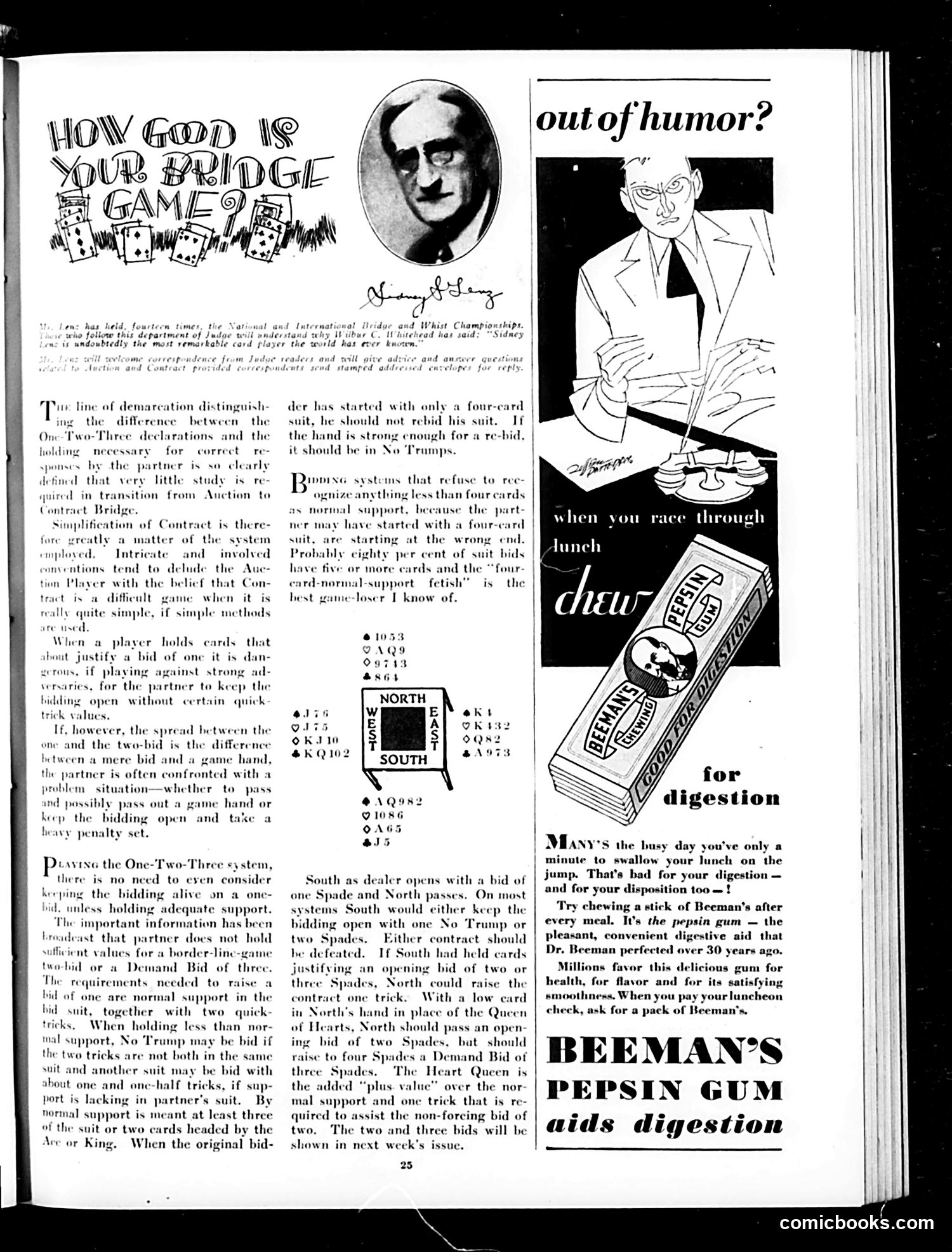
Analysis of Judge Magazine Page This page contains primarily educational bridge instruction and advertising rather than political satire. Main Content: The left two-thirds features a technical article on Contract Bridge bidding systems, authored by someone named Ely Culbertson (visible signature). The article explains proper bidding conventions—specifically the "One-Two-Three" system versus other approaches—using card hands and explanatory text. The Cartoon/Illustration: The right side contains a small cartoon labeled "out of humor?" showing a man rushing through lunch, with the caption "when you race through lunch chew for digestion." This is purely commercial advertising for Beeman's Pepsin Gum, promoting the product as an aid to digestion for busy workers. Context: This appears to be a Judge issue focused on leisure activities (bridge) and health products rather than political commentary. The "humor" referenced is lifestyle-based rather than satirical. The Beeman's ad was a common product placement in magazines of this era.
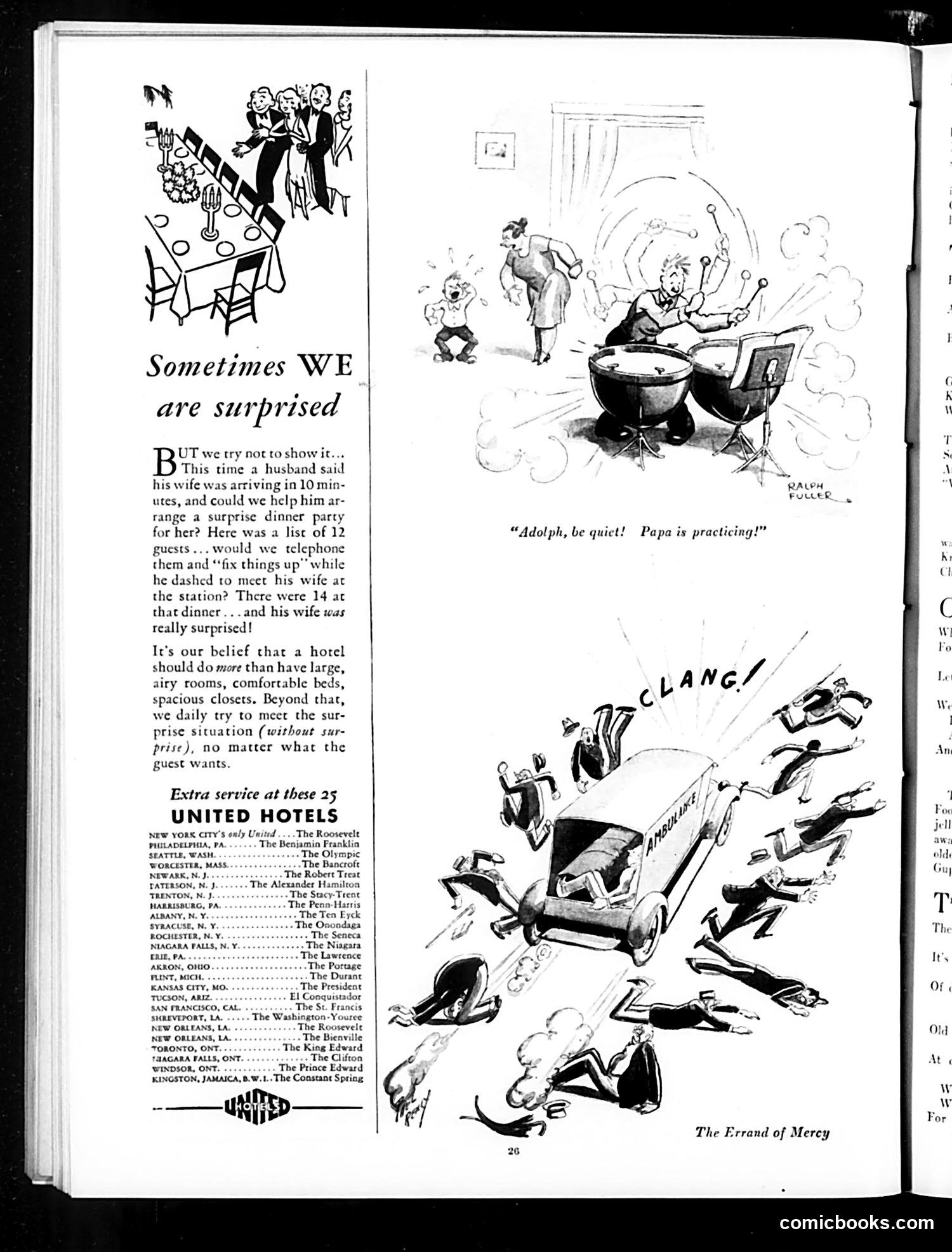
Analysis of Judge Magazine Page This is primarily a United Hotels advertising page with two distinct components: Left side: An advertisement narrative about hotel service. A husband arranges a surprise dinner party for his wife through the hotel's assistance—they contact 12 guests, though 14 arrive. The ad emphasizes that quality hotels should provide seamless, anticipatory service ("meet the surprise situation without surprise"), not just basic amenities. Right side: Two cartoons satirizing domestic life: 1. Top cartoon (captioned "Adolph, be quiet! Papa is practicing!"): Shows a man conducting with drumsticks near a large drum while children play with bubbles, presumably disturbing his musical rehearsal. The satire mocks amateur musicians and domestic chaos. 2. Bottom cartoon ("The Errand of Mercy"): Depicts multiple figures being thrown or falling from what appears to be an ambulance, labeled "CLANG!" The humor appears to target either incompetent emergency services or the chaos of charitable efforts. Both cartoons use exaggerated line-drawing style typical of 1920s-30s Judge magazine humor, emphasizing visual comedy over sophisticated wit.
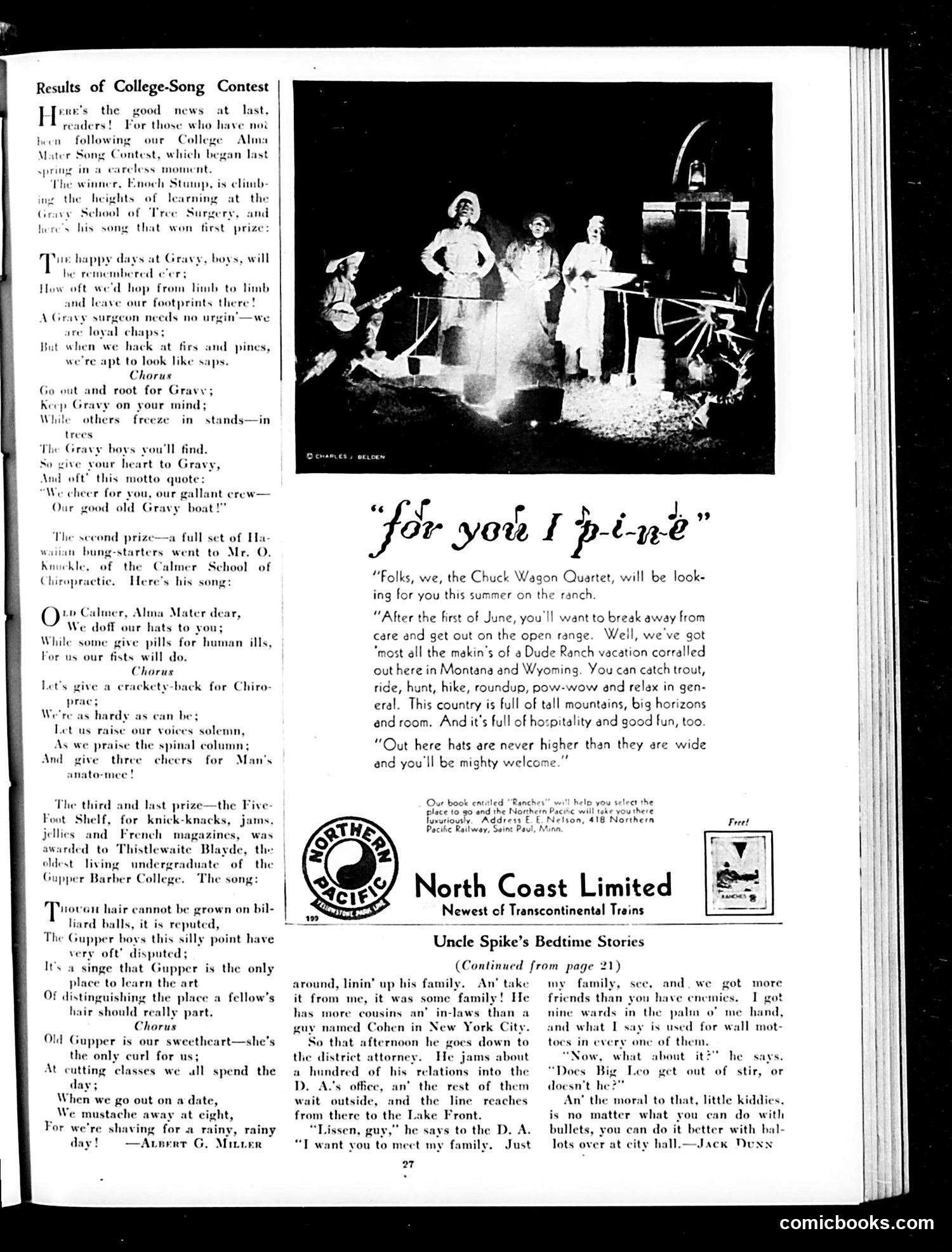
Results of College-Song Contest This page features results of a humorous college alma mater song competition judged by Judge magazine. Three fictional schools submitted winning entries: 1. Gravy School of Tree Surgery (winner) - Their song contains crude humor about monkeys swinging from trees and looking "like saps," culminating in the chorus "We cheer for you, our gallant crew—Our good old Gravy boat!" 2. Calmer School of Chiropractic (second prize) - Celebrates spinal manipulation with aggressive masculine imagery ("our fists will do"). 3. Gupper Barber College (third prize) - Makes puns about hair and bald heads. The satire mocks pretentious college traditions by presenting obviously joke institutions with absurd songs. The humor relies on the contrast between earnest alma mater conventions and ridiculous subject matter. This reflects Judge's typical irreverent approach to American institutions and middle-class pretension.
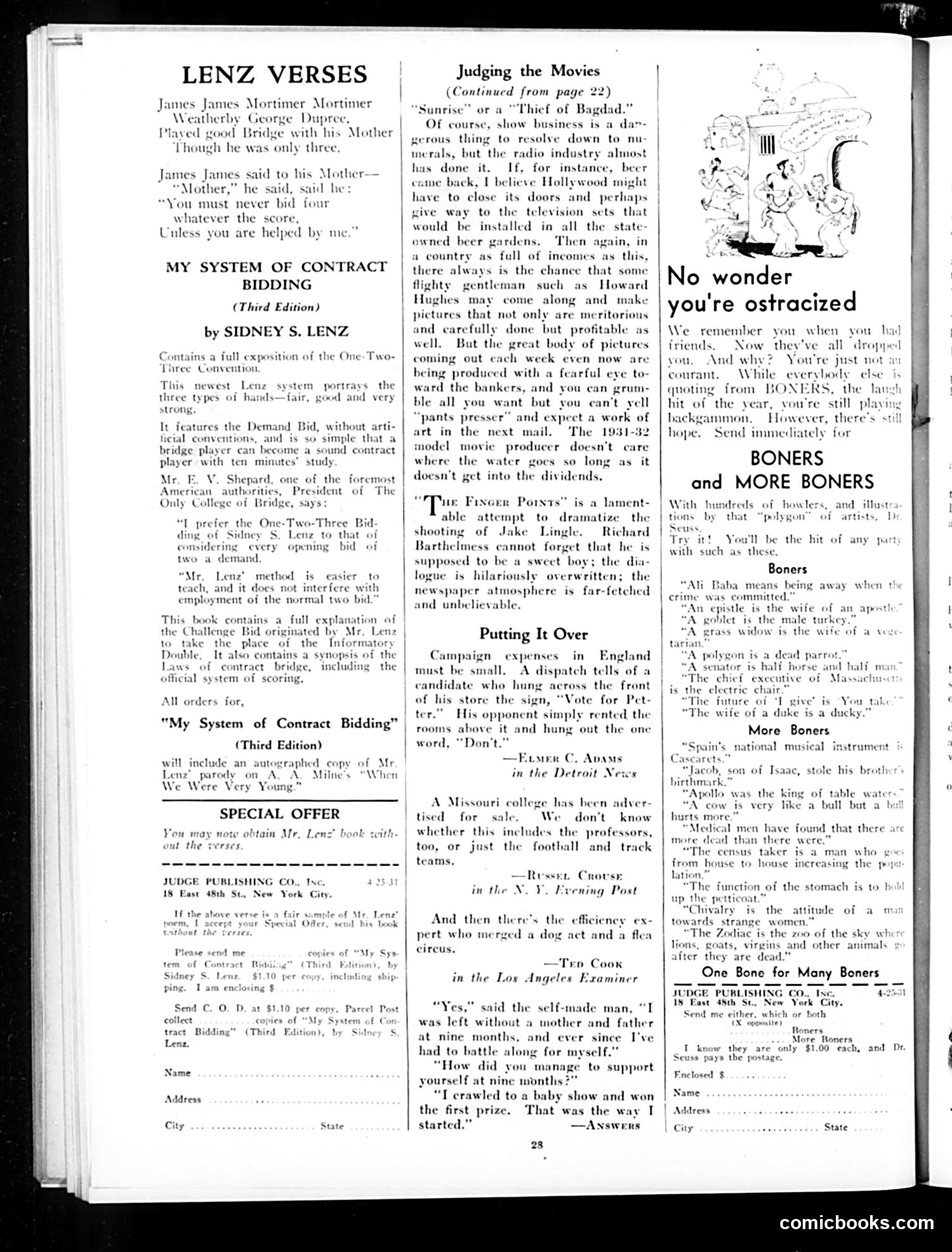
"No Wonder You're Ostracized" and "Boners and More Boners" This page features two humor sections from Judge magazine. The main cartoon "No wonder you're ostracized" (top right) appears to mock social exclusion, likely referencing someone's unpopularity, though the specific context isn't clearly visible in the image. Below that, "Boners and More Boners" is a humor column collecting amusing malapropisms and absurd statements submitted by readers. Examples include: "A goblet is the male turkey," "A grass widow is the wife of a vegetarian," and "The Zodiac is the zoo of the sky." These were popular features in satirical magazines—readers sent in funny misstatements or nonsensical definitions for publication. The humor derives from the sheer ridiculousness of these "definitions," appealing to readers' sense of superiority over the contributors' foolishness. The rest of the page contains book advertisements and other magazine content typical of the era.
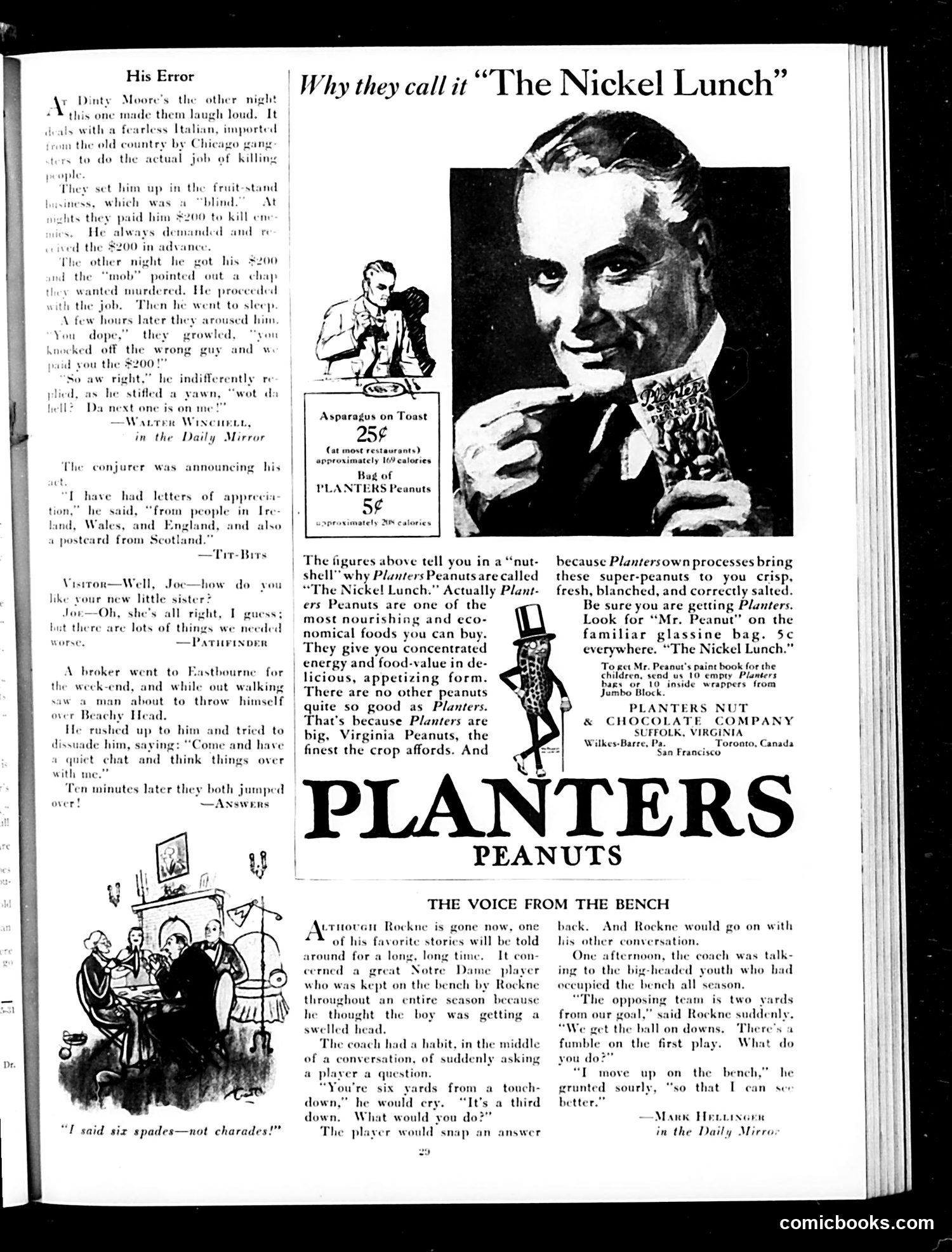
Analysis of Judge Magazine Page This page contains multiple humor pieces typical of 1920s Judge magazine, plus a Planters Peanuts advertisement. Top section ("His Error"): A dark satire about organized crime. An Italian immigrant, hired by a Chicago mob to commit murders for $200 per job, kills the wrong person. When confronted, he casually remarks the next murder is "on me"—darkly comedic given Prohibition-era gangster violence was a contemporary scandal. Middle cartoons: Brief joke pieces on unrelated topics (magicians, new siblings, suicide prevention turned tragic). "The Nickel Lunch" Advertisement: The Planters company advertises peanuts by comparing nutritional value to asparagus on toast (both 5¢). The "Mr. Peanut" mascot—a top-hatted, monocled gentleman—appears prominently. This positions peanuts as an economical, quality food for Depression-era consumers. "Voice from the Bench": A reminiscence about football coach Knute Rockne using snap questions to keep players mentally sharp, even those benched for "swelled heads" (arrogance). The humor reflects 1920s concerns: organized crime, economic thrift, and sports culture.
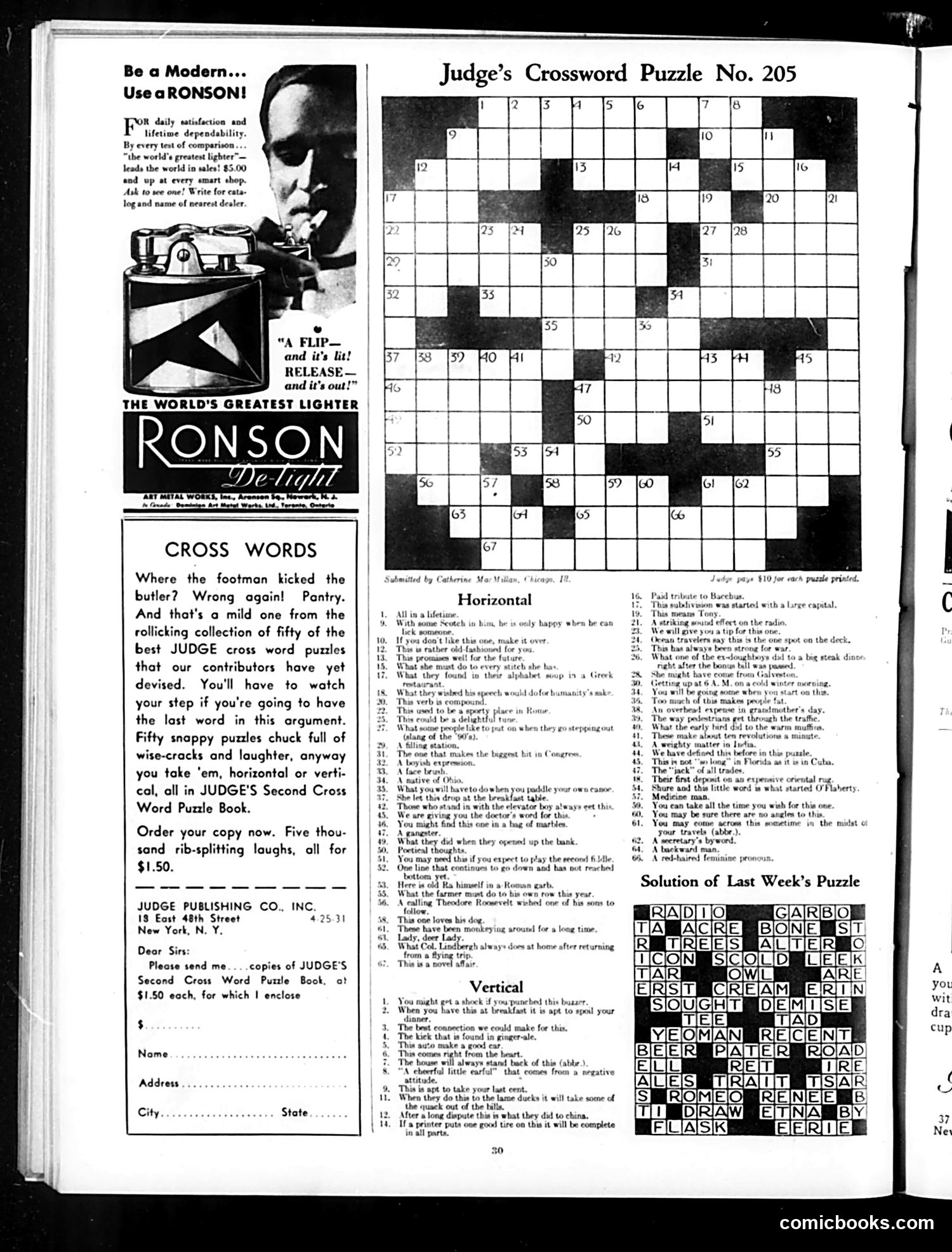
Judge Magazine Page Analysis This page is primarily advertising and puzzle content, not political satire. The dominant feature is a Ronson lighter advertisement featuring a man in sunglasses smoking—positioning the product as modern and sophisticated. The tagline "A FLIP—and it's lit! RELEASE—and it's out!" emphasizes the lighter's convenience. Below is promotional material for Judge's Second Cross Word Puzzle Book, leveraging the crossword craze of the era. The ad uses humor ("Where the footman kicked the butler? Wrong again! Pantry") to appeal to readers, promoting fifty puzzles for $1.50. The actual Crossword Puzzle No. 205 and its solution occupy the right column. The clues are typical period wordplay and references—some appear topical (references to "gangsters," "bank" activity), reflecting 1920s-30s concerns, but without dates or specific context visible, exact historical references remain unclear. This is essentially a commercial product page, not editorial satire or political commentary.
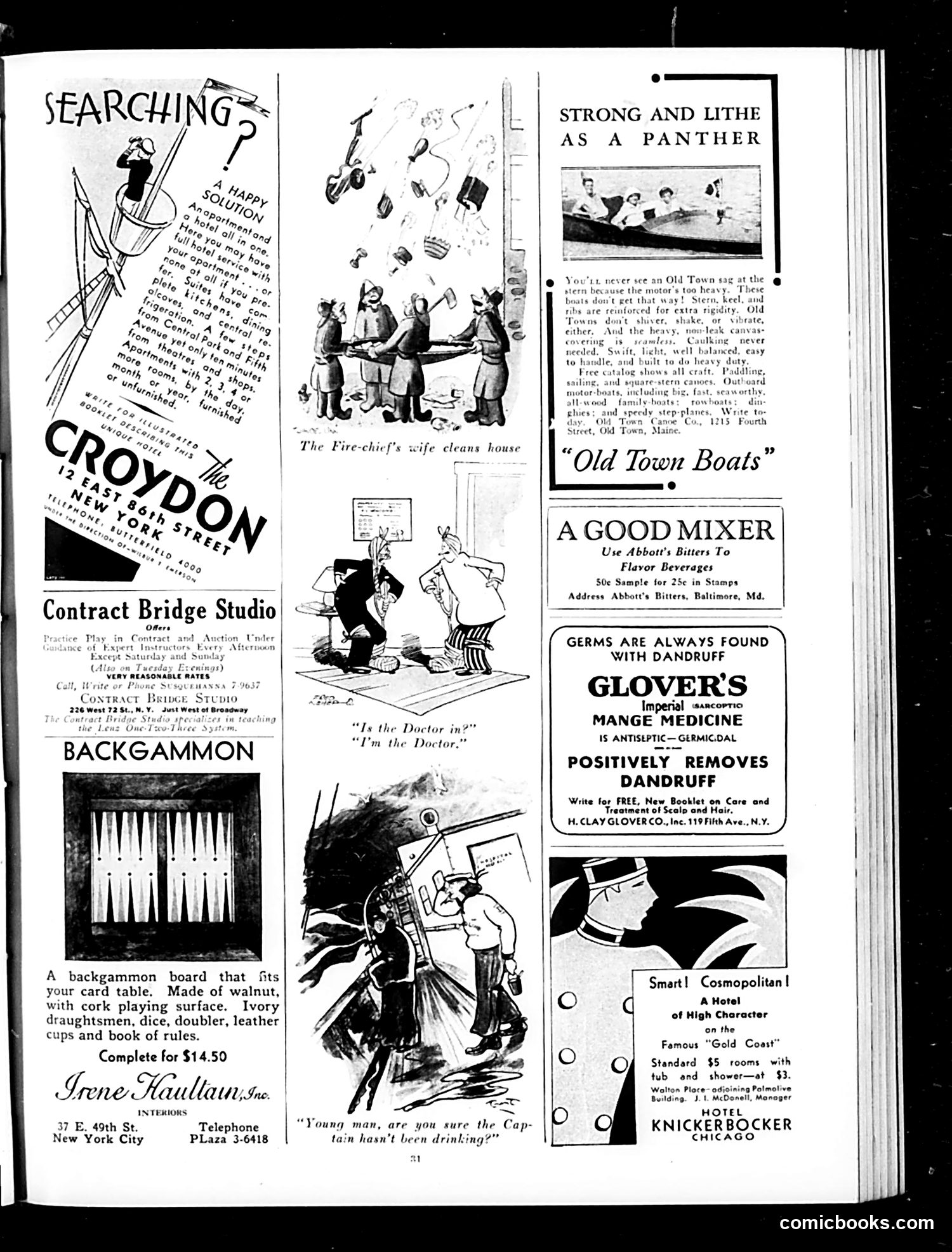
Political Cartoon & Comics Analysis This page is primarily advertising, not political satire. It contains vintage product advertisements from what appears to be an early 20th-century Judge magazine. The cartoons present are humorous domestic scenes with no political content: 1. "The Fire-chief's wife cleans house" — a slapstick illustration of a woman surrounded by scattered household items, poking fun at housekeeping chaos. 2. "Is the Doctor in?" / "I'm the Doctor" — a visual gag showing what appears to be a confused exchange, likely playing on mistaken identity. 3. "Young man, are you sure the Captain hasn't been drinking?" — appears to reference nautical humor, possibly suggesting intoxication affects judgment. The advertisements promote period products: backgammon boards, dandruff medicine, bitters (alcohol-based beverages), and hotels. These are straightforward commercial pitches rather than satirical commentary. The page reflects early 20th-century consumer culture and advertising aesthetics.
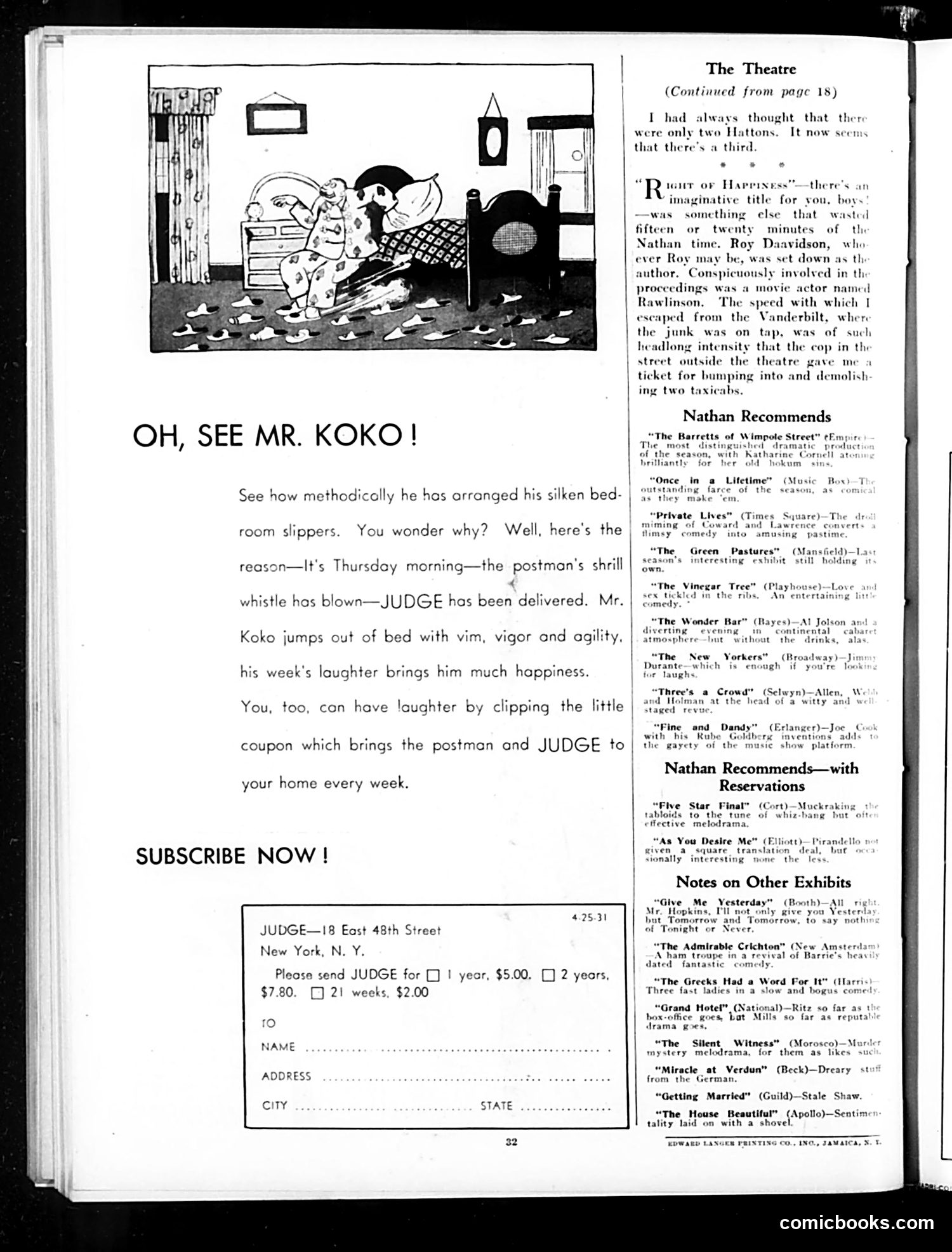
"Oh, See Mr. Koko!" This is a subscription advertisement for *Judge* magazine disguised as humorous content. The cartoon shows a character named Mr. Koko jumping energetically out of bed upon hearing the postman's whistle—the signal that the weekly *Judge* has arrived. The joke centers on the premise that *Judge*'s humor is so reliably entertaining that subscribers experience genuine joy ("vim, vigor and agility") upon its weekly delivery. The carefully arranged bedroom slippers are presented as evidence of Mr. Koko's methodical preparation for Thursday morning's postal arrival. The accompanying text pitches the magazine's subscription options ($5 for one year, $7.80 for two years) by suggesting readers can replicate Mr. Koko's weekly happiness by clipping a coupon that supposedly brings "the postman and JUDGE" to their home. The page also includes theater reviews and recommendations, reflecting *Judge*'s role as a general-interest satirical magazine covering entertainment, culture, and current events.

This Page: A Book Advertisement, Not Political Satire This is primarily a mail-order advertisement for "The World's 101 Best Detective Stories," priced at 98¢, rather than a political cartoon or satirical commentary. The page features: - A list of 101 detective stories from classic authors (Poe, Doyle, Dumas, Chekhov, Maupassant, Tolstoi, etc.) - Marketing copy emphasizing the collection's value and the quality of the thin-paper printing - A mail-order coupon offering "send no money now" terms—pay the postman when delivered, with a one-week trial period The visual element is the stylized book image on the left. There is no political satire or caricature here. This appears to be a standard commercial advertisement in *Judge* magazine, exploiting readers' interest in detective fiction—a popular genre at the time—rather than commenting on current events or social issues.
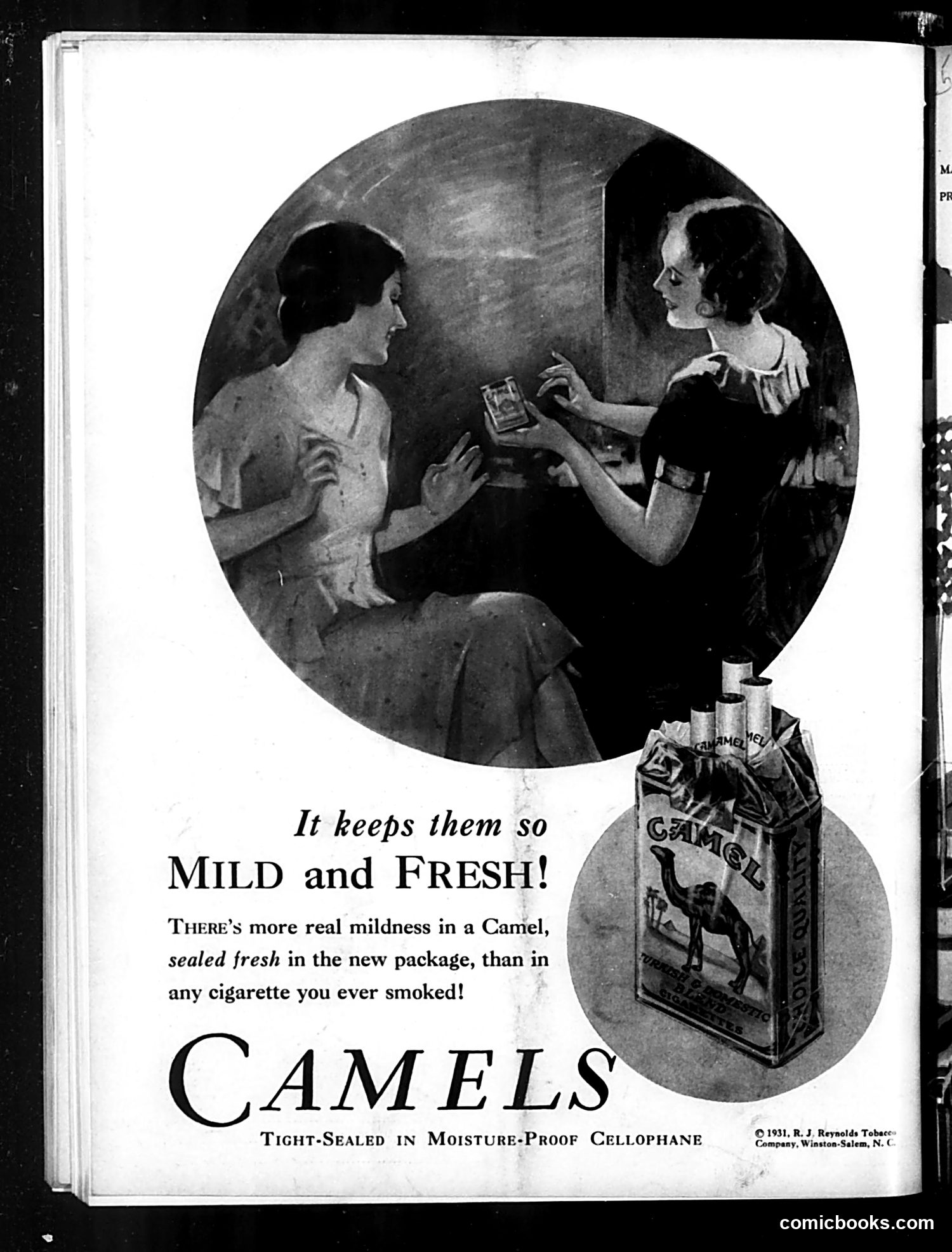
Analysis This is a cigarette advertisement, not political satire. The page shows two women in 1920s-style dress exchanging what appears to be a Camel cigarette package. The ad emphasizes the product's "mildness" and "freshness," attributing these qualities to new moisture-proof cellophane packaging. The image reflects early 20th-century advertising conventions: it uses an aspirational domestic scene with well-dressed women to market cigarettes as a desirable consumer product. The circular framing and styling suggest this is from Judge magazine (likely 1920s-1930s era, given the copyright mark visible). There is no political cartoon or satire here—it's straightforward product marketing leveraging contemporary packaging technology as a selling point.