judge
Judge — May 2, 1931
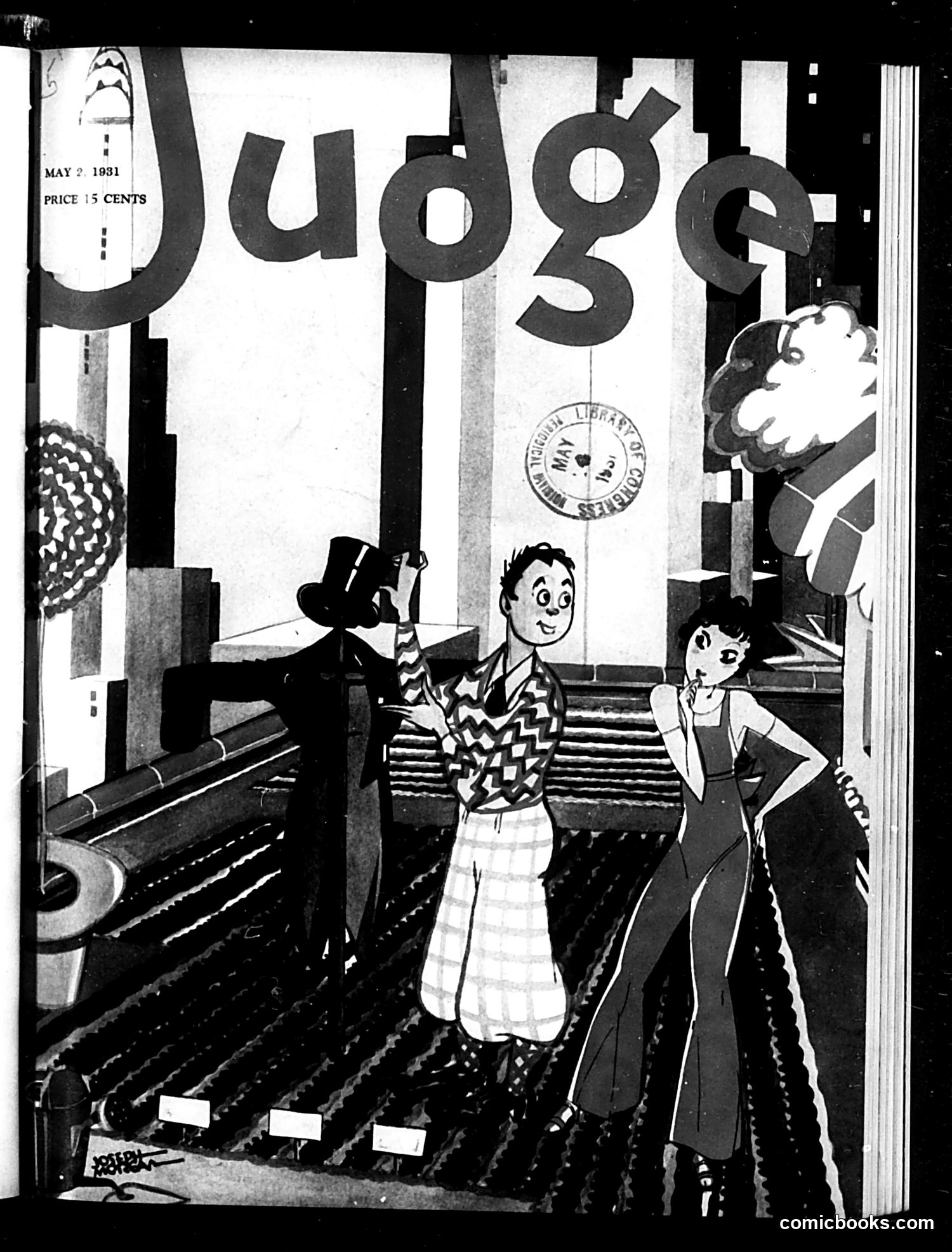
Judge Magazine, May 1931 This cover depicts three characters in what appears to be a theater or nightclub setting beneath large numbers "1931." The central figure in a patterned jacket holds a top hat, flanked by two women in performance attire. A library stamp visible on the page indicates institutional ownership. The specific identities of these figures are unclear from the image alone. However, given Judge magazine's satirical nature and the 1931 date, this likely comments on contemporary entertainment, possibly vaudeville or theatrical performers. The stylized, caricatured art style was typical of the era's comics and satire. The "15 cents" price reflects Depression-era economics. Without additional context identifying the specific performers or referencing the article text, the precise satirical target remains uncertain.

Analysis This page is primarily an advertisement for Ethyl Gasoline, not political satire. The "Power under control" headline uses an eagle silhouette as a metaphor for automotive performance. The ad compares controlling an eagle's wing power to controlling gasoline combustion. It claims Ethyl fluid prevents engine "knock" (pre-detonation), uneven explosions, and overheating—delivering smooth, consistent power. The Ethyl Corporation (New York City) marketed this as a performance advantage for automobiles. While *Judge* magazine typically contained satire, this particular page is straightforward commercial messaging, using evocative imagery rather than political commentary. The eagle represents mastery and control, appealing to aspirational motorists of the era.
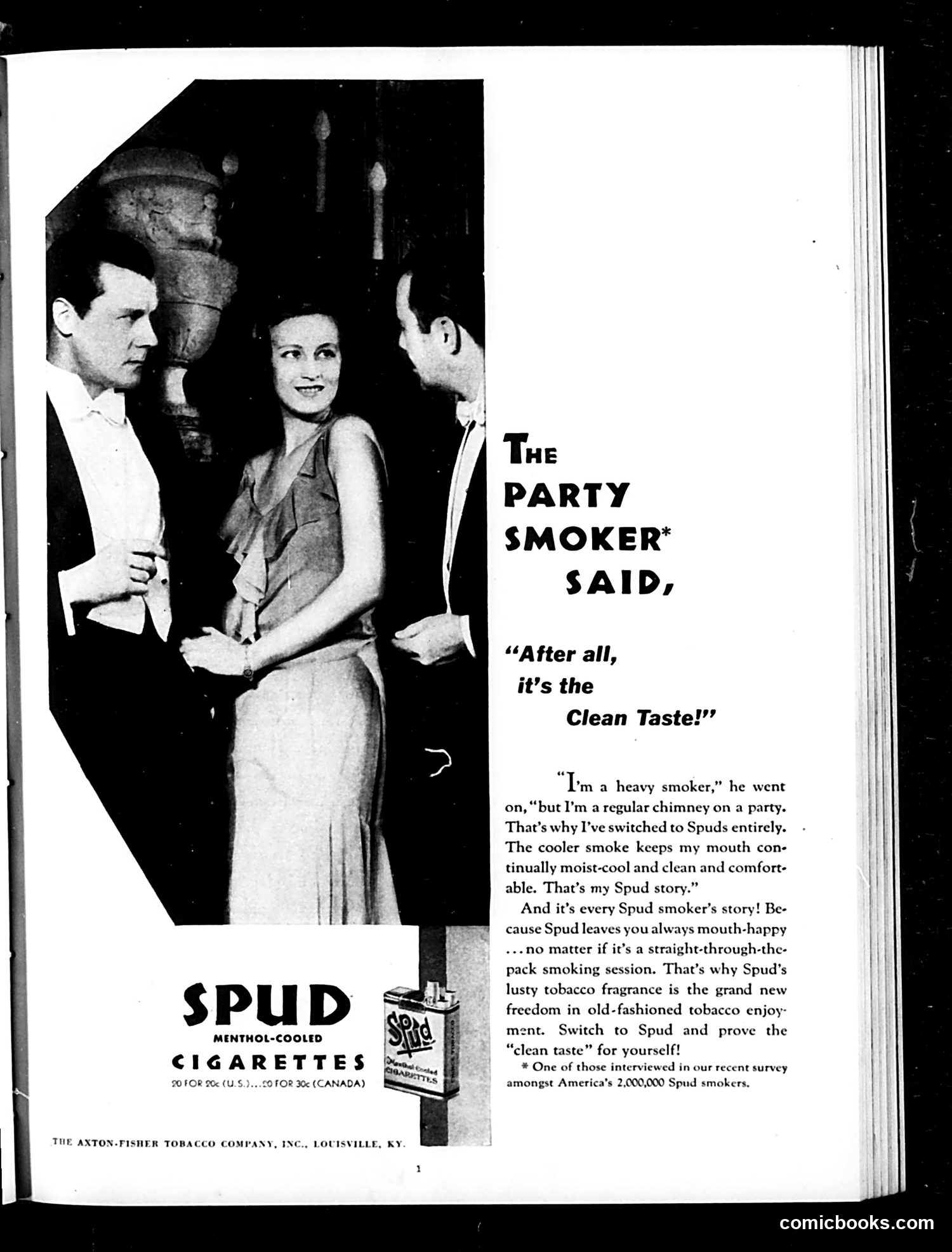
Analysis This page is primarily a cigarette advertisement, not political satire. It promotes Spud menthol-cooled cigarettes with a social scene showing well-dressed people at what appears to be a formal party or event. The "party smoker" quote emphasizes the product's appeal to social smokers, claiming the "clean taste" makes smoking pleasant in social situations. The advertisement positions Spud as superior because it keeps "your mouth...cool and comfortable." This reflects 1930s-40s advertising conventions when cigarettes were marketed as sophisticated, socially desirable products with health-adjacent claims ("clean taste"). The Anton-Fisher Tobacco Company, Louisville, KY published this. There is no political cartoon or satire on this page—it is purely commercial messaging presented in Judge magazine's format.
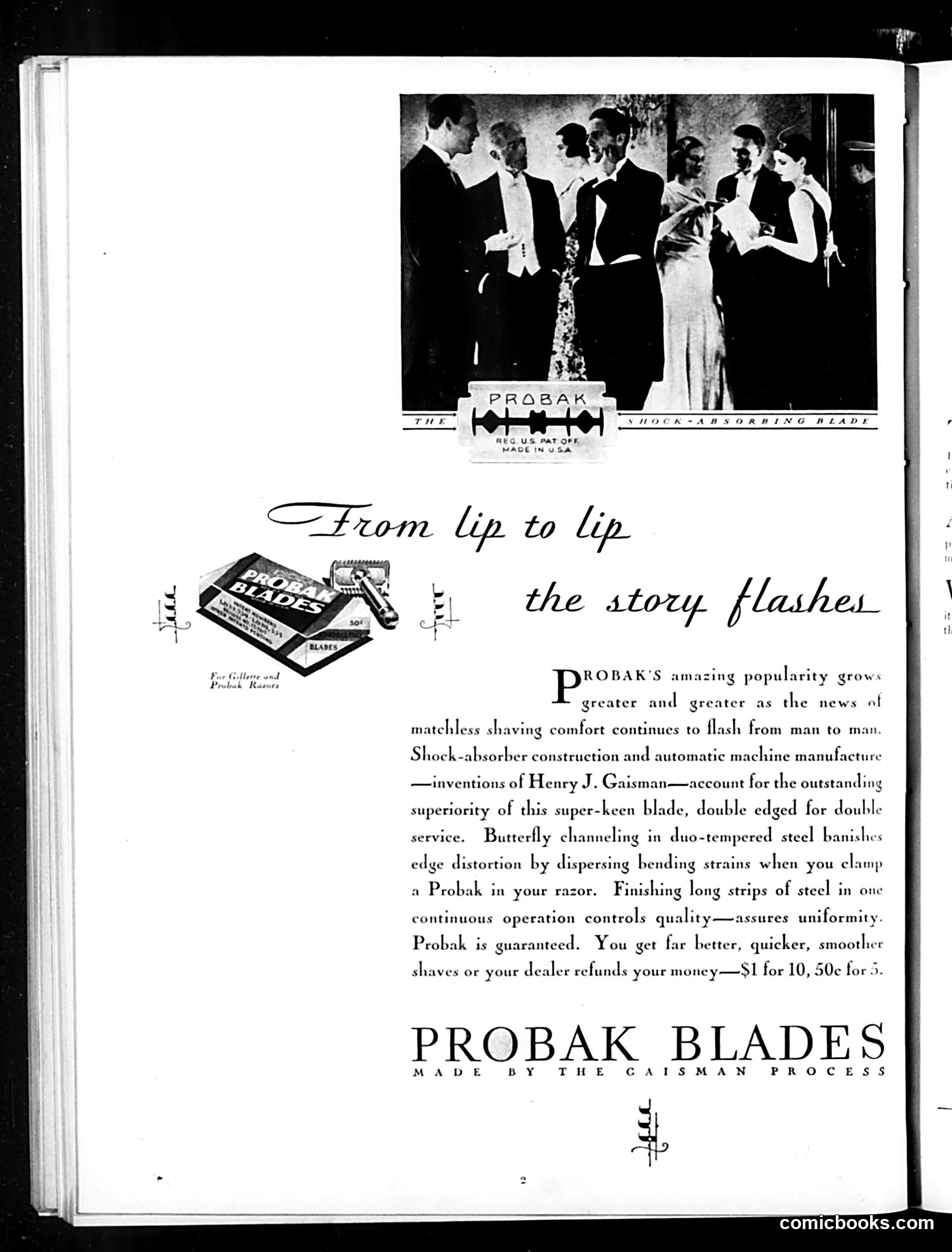
Analysis This page is primarily advertising, not satire or political commentary. It's a full-page advertisement for Probak razor blades, featuring a photograph of well-dressed people at what appears to be a formal social gathering (a cocktail party or similar event). The ad's headline—"From lip to lip the story flashes"—uses social gossip as a marketing angle, suggesting that Probak blades' quality spreads through word-of-mouth recommendations. The copy emphasizes technical features: shock-absorbing construction, double-edged design, and guaranteed quality. The ad attributes these innovations to "Henry J. Gaisman" and the "Gaisman Process," positioning Probak as a premium product backed by scientific advancement. This is straightforward commercial messaging, not editorial cartoons or political satire.
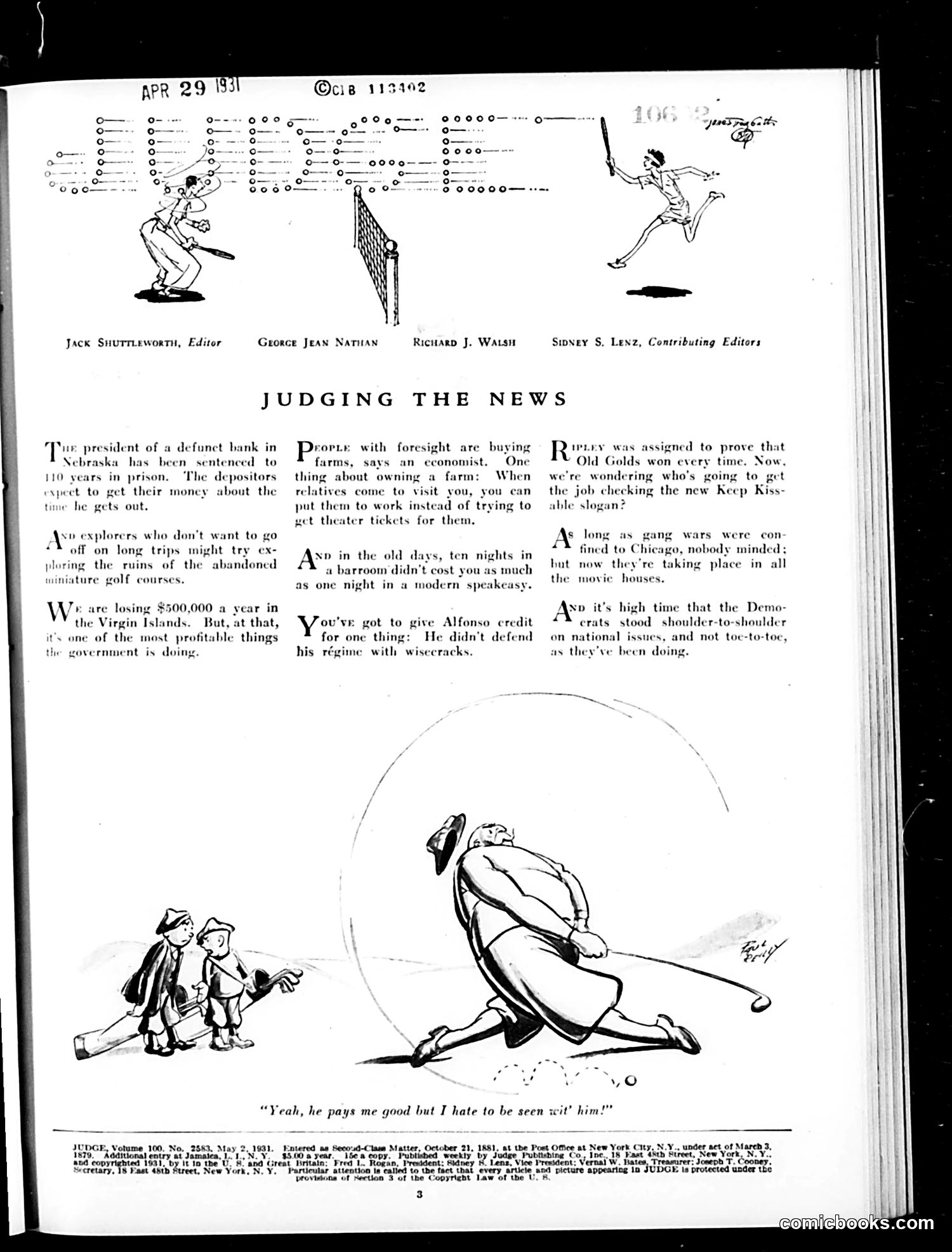
"Judging the News" - April 29, 1931 This page contains editorial commentary and cartoons critiquing current events. The main cartoon depicts a man swinging a golf club while appearing to stumble or fall, captioned "Yeah, he pays me good but I hate to be seen wit' him!" The commentary addresses several topics: a defunct Nebraska bank president sentenced to prison; farmers buying land with foresight (contrasted with those seeking theater tickets); explorers avoiding Arctic expeditions; the financial drain of the Virgin Islands; gang wars now appearing in movie theaters; and credit given to someone named Alfonso for "not defending his regime with wisecracks." The golf cartoon likely satirizes a wealthy patron embarrassed by association with his employee—a commentary on class pretension during the Depression era. The specific references are unclear without additional historical context, though the tone reflects 1931's economic crisis concerns.
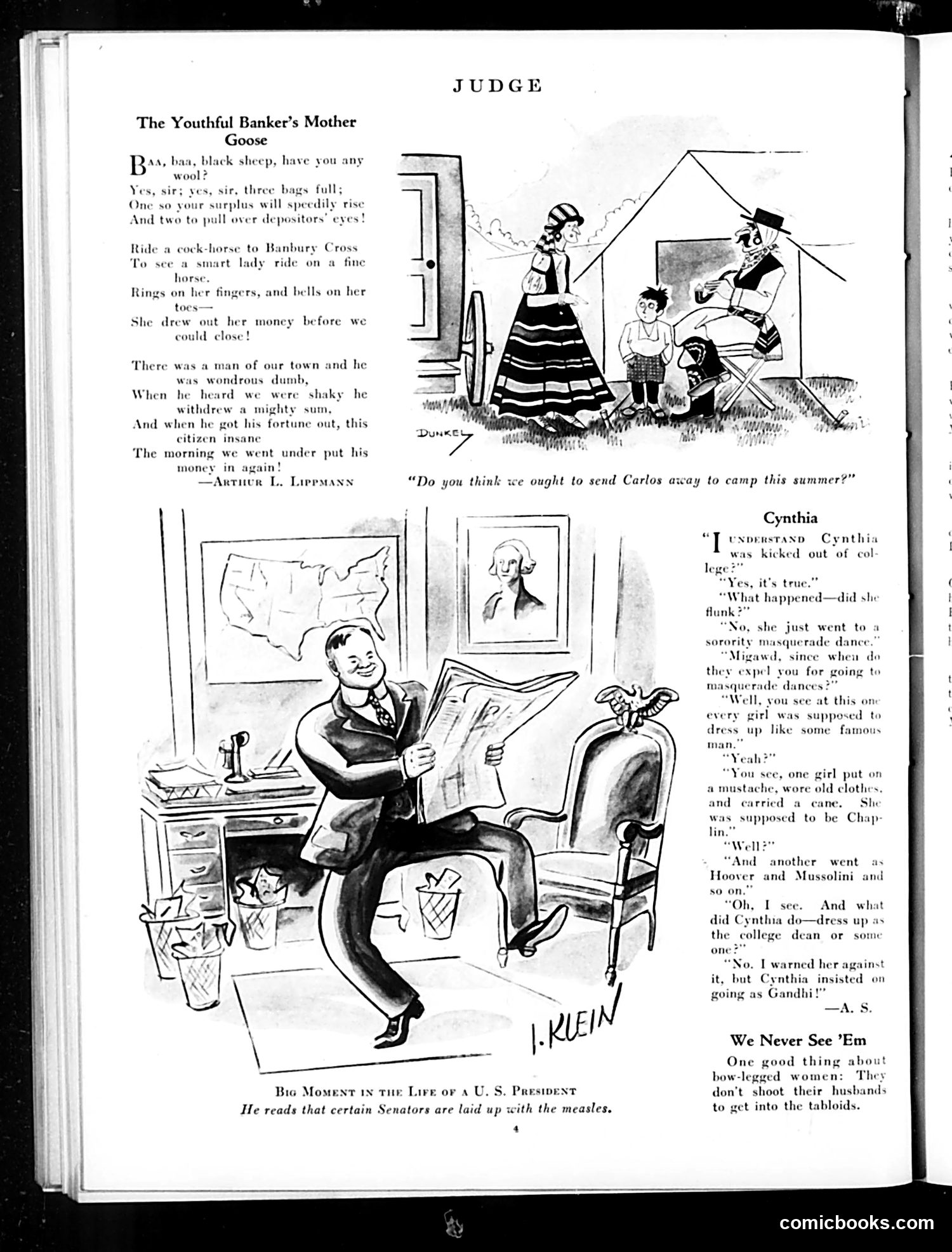
Analysis of Judge Magazine Page "The Youthful Banker's Mother" (top cartoon): A humorous poem about a wealthy woman who flaunts her riches—rings, bells, fine horses—while her banker husband remains financially unstable. The satire targets nouveaux-riche display and financial precariousness masking itself through conspicuous consumption. "Big Moment in the Life of a U.S. President" (middle cartoon): Shows a president reading newspapers while surrounded by waste baskets, with the caption suggesting certain senators "are laid up with the measles." This appears to satirize either presidential isolation from legislative reality or senators' frequent absences affecting governance. "Cynthia" (right column): A brief anecdote mocking a college girl who attended a masquerade as Gandhi, causing offense—likely satirizing pretentious or ignorant costume choices among privileged youth.
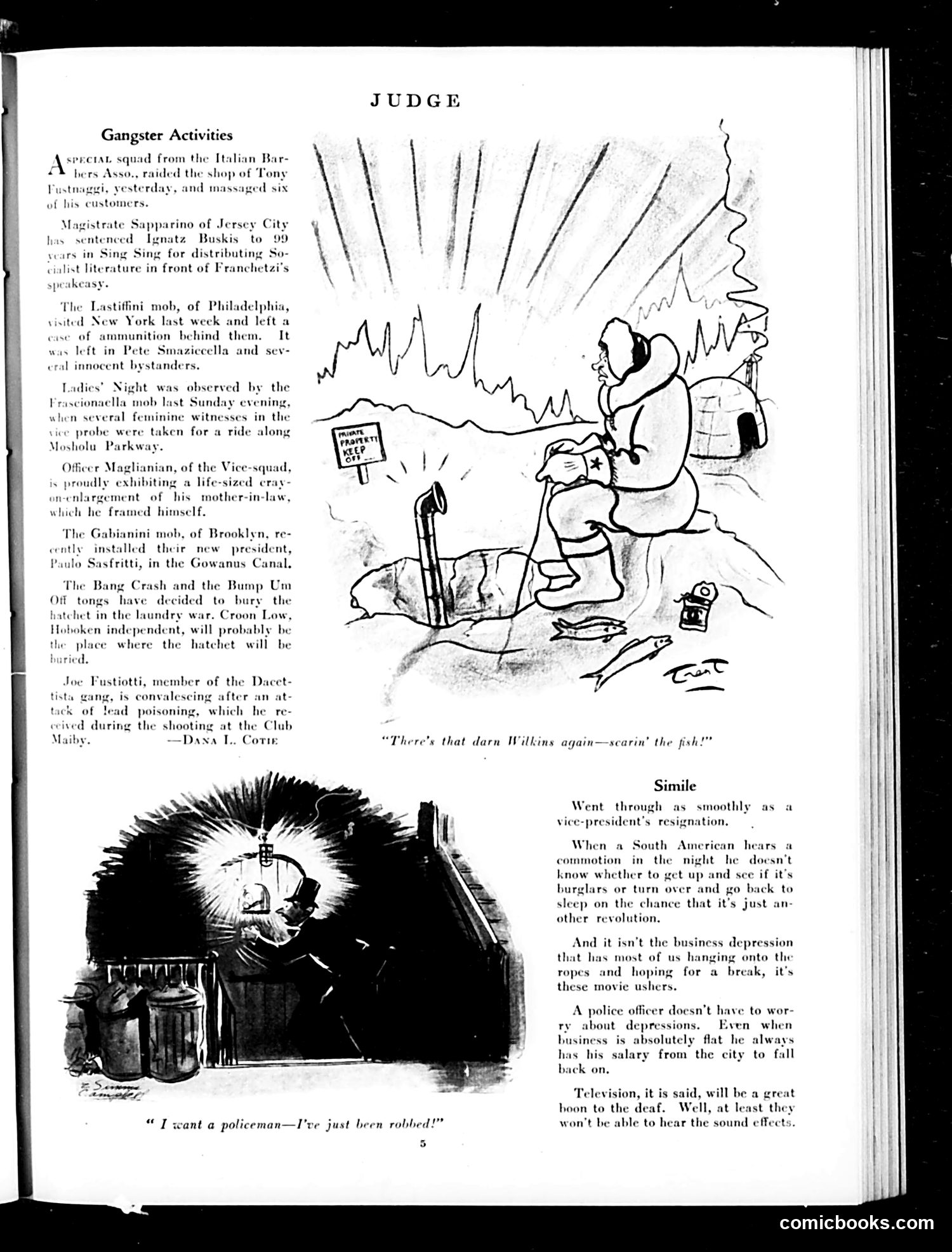
Analysis of Judge Page This page contains two distinct cartoons satirizing different aspects of 1920s-30s American life. Top cartoon: Depicts gangster activity, referencing real criminal incidents (Italian Barbers Association raid, Lasitanni mob, Gabiniani mob of Brooklyn). The humor mocks how organized crime figures conduct themselves like respectable citizens—here, someone fishing while armed gangsters operate around them. The caption "There's that darn Wilkins again—scarin' the fish!" treats violence as an everyday nuisance. Bottom cartoon: Shows a robbery victim pleading "I want a policeman—I've just been robbed!" The satire criticizes police ineffectiveness during the crime wave, suggesting citizens cannot rely on law enforcement for protection. Both cartoons reflect Prohibition-era anxieties about lawlessness and governmental failure to maintain order.
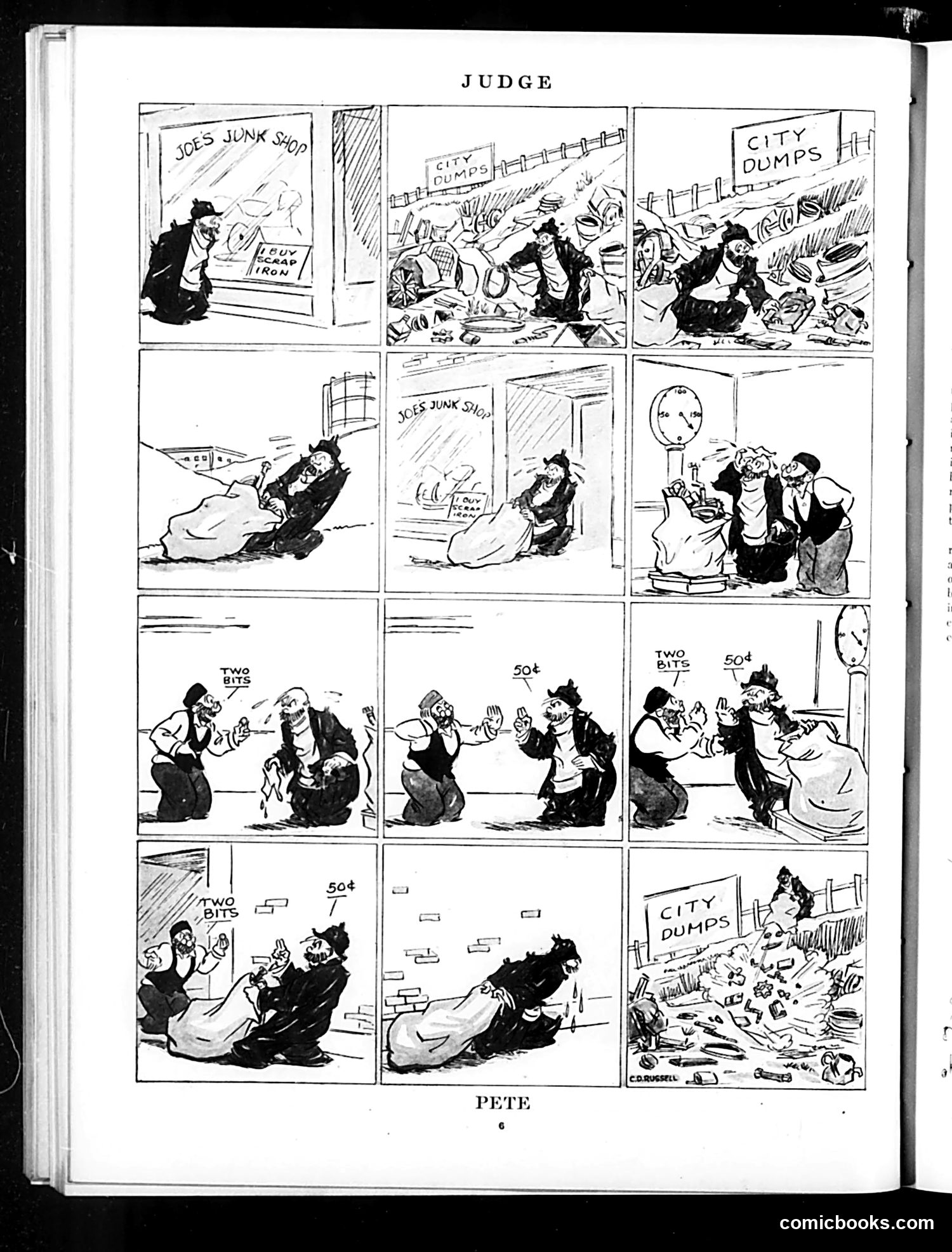
Judge Comic: "Judge" and "Pete" This appears to be a two-panel comic strip satirizing urban poverty and homelessness. The narrative follows a destitute man moving between locations—from Joe's Junk Shop to the City Dumps—scavenging for survival. The repeated exchanges of "two bits" and "50¢" suggest he's panhandling or trading scraps. The satire targets economic inequality: the contrast between established businesses (junk shops, dumps) and those forced to live in squalor. The figure's journey through progressively degraded spaces—from commerce to waste disposal—critiques how society relegates the poor to its margins. The strip's dark humor and visual economy reflect Judge magazine's working-class audience perspective on Depression-era hardship and municipal indifference to vagrancy and destitution.
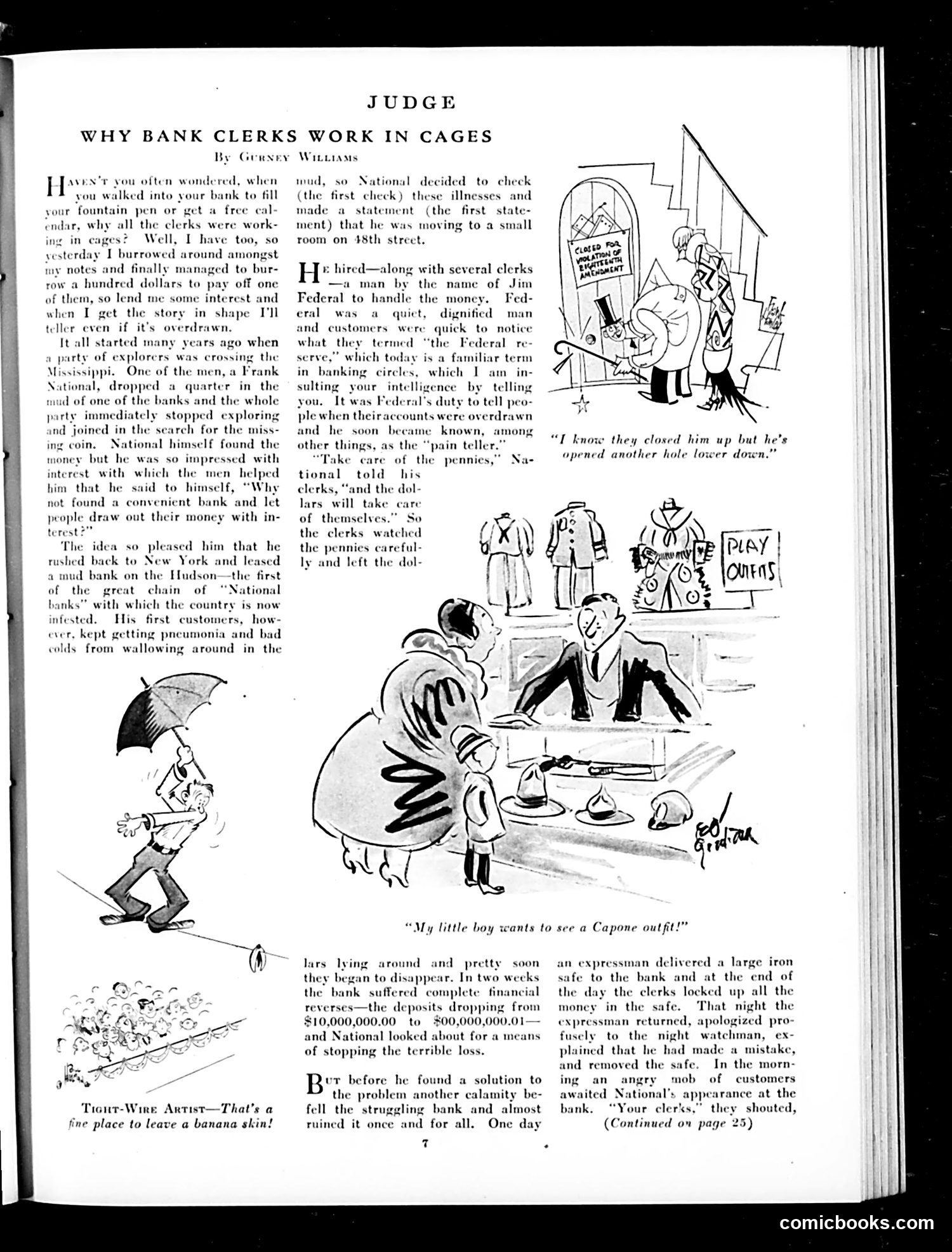
"Why Bank Clerks Work in Cages" — Judge Magazine Satire This humorous article by Chesney Williams explains the origin of bank clerk cages through a fictional tall tale. The satire mocks banking practices and incompetence. The story claims a man named "Frank National" founded the first bank after finding a lost quarter, eventually moving to a proper building. He hired "Jim Federal" to handle money—a man so quiet he became known as the "pain teller" for delivering bad news about overdrafts. The satire's point: bank clerks need protective cages because the organization is chaotic and unreliable. The story illustrates this through two disasters—clerks losing track of pennies (causing massive deposit losses) and an expressman accidentally removing the entire safe. The cartoons reinforce the joke: one shows clerks confined in a cage labeled "play chetis"; another depicts a customer requesting a "Capone outfit" (likely referencing 1920s gangster Al Capone), suggesting banks are as lawless as organized crime. The satire suggests American banking is fundamentally ridiculous and poorly managed.
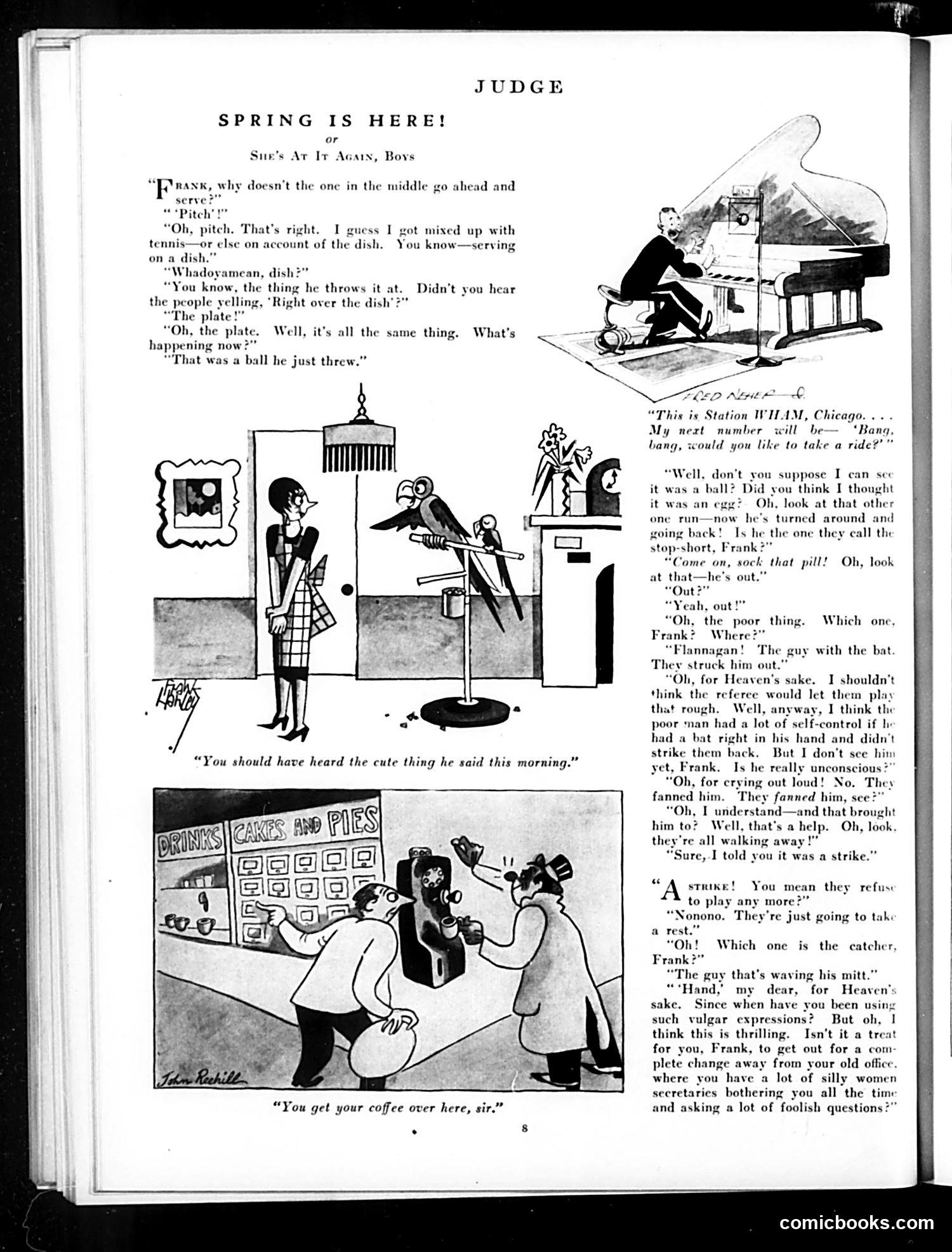
Explanation for Modern Readers This page satirizes spring baseball season and the clash between urban office culture and outdoor leisure. The main comic shows a woman unfamiliar with baseball terminology confusing "serving" (tennis) with "pitching," and mixing up baseball vocabulary—calling the plate a "dish," misunderstanding "striking out," and misusing the word "hand" instead of "mitt." The satire targets white-collar workers, particularly office men, taking rare breaks from work. The woman's cluelessness about sports reflects 1920s-era gender stereotypes (she's unfamiliar with "masculine" pursuits), while her complaints about "silly women secretaries" suggest frustration with the modern office workplace. The smaller cartoon shows a woman at a lunch counter, establishing the broader theme: spring brings relief from confining office routines. The humor rests on contrasting sophisticated urbanites' ignorance of common athletic knowledge and their eagerness to escape mundane professional life.
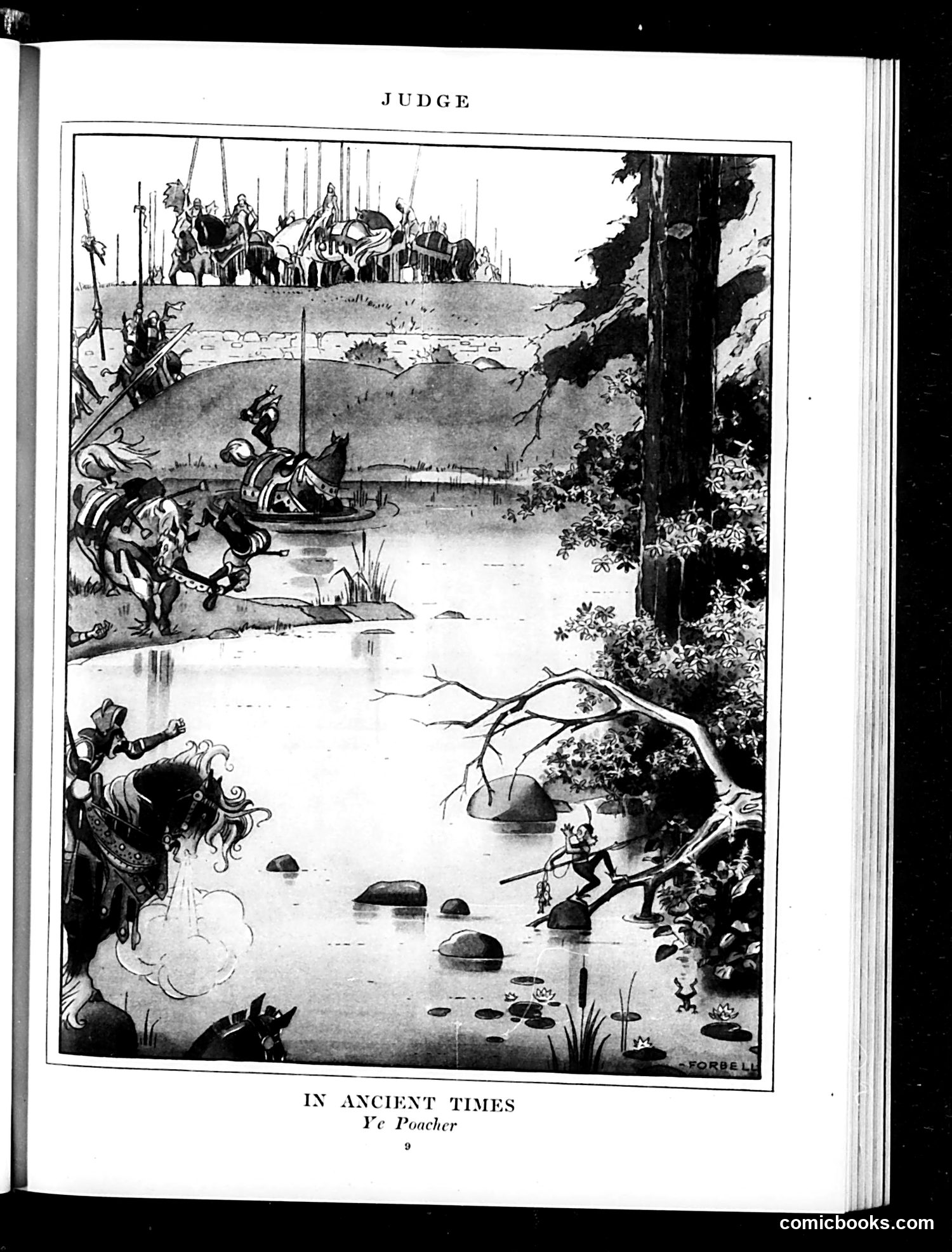
"Judge in Ancient Times: Ye Poacher" This satirical illustration depicts a medieval or ancient hunting scene. A figure identified as "Ye Poacher" (lower left, shown in elaborate dress) appears to be illegally hunting or fishing in restricted waters or lands. The scene shows armed guards or nobles on the riverbank and fortified positions in the background, suggesting this is aristocratic or royal property being violated. The satire likely comments on class tensions: poaching was historically a crime that poor people committed for survival, while the wealthy controlled hunting and fishing rights. By presenting it as "ancient times," the cartoonist may be suggesting these class-based inequalities persist despite being outdated customs. The detailed armor and medieval setting emphasize how longstanding these social divisions are. The artist's signature "FORBEL" appears in the lower right.
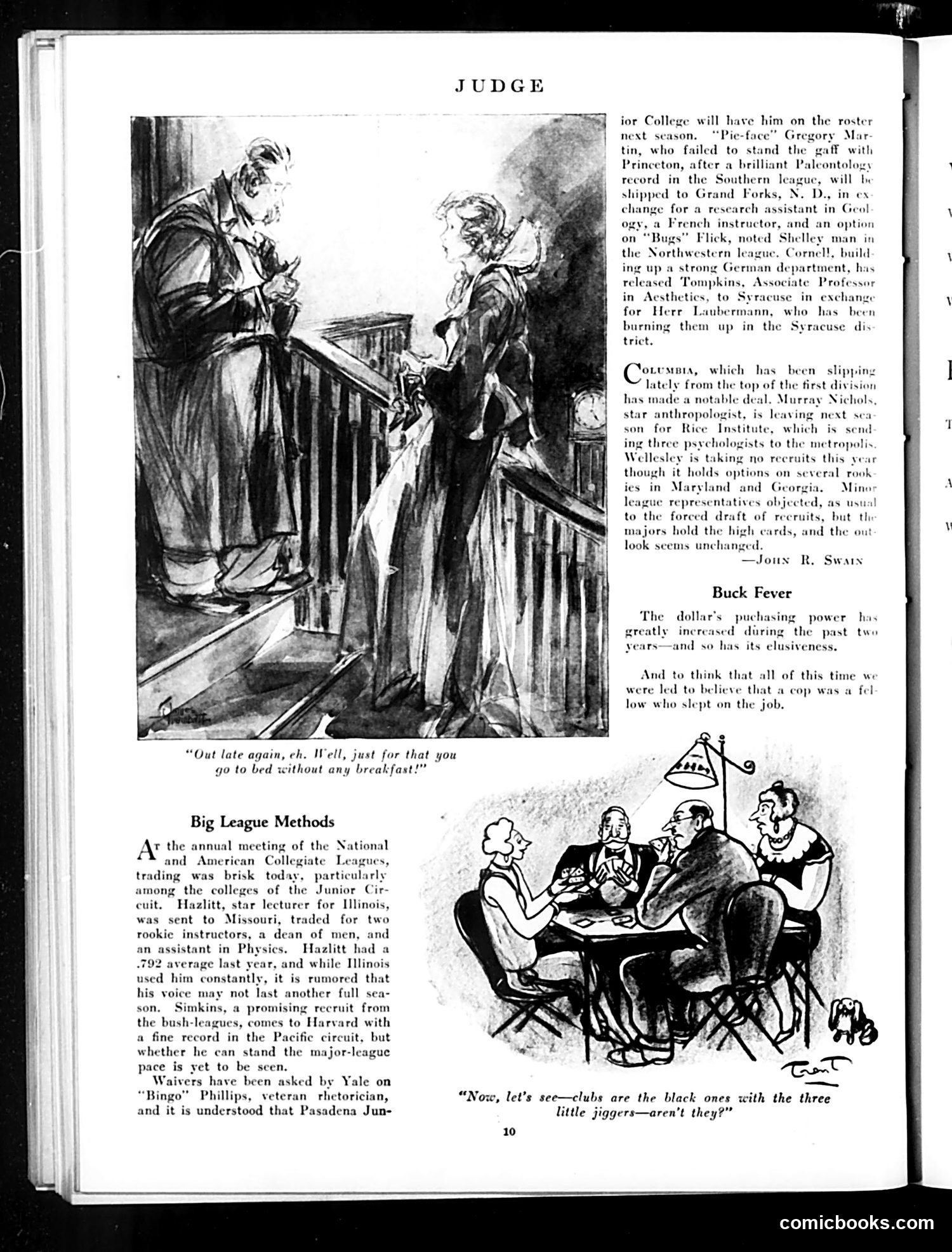
Satire of College Athletic Recruitment This page satirizes college athletics' increasingly commercialized recruiting practices, presented as if universities were trading academic faculty like baseball players. The Main Cartoon (top): Shows a stern figure (likely a college administrator) scolding someone about staying out late—a commentary on loose discipline. "Big League Methods": Mocks how colleges now "trade" professors between institutions. The text describes absurd exchanges: Illinois trades lecturer Hazlitt to Missouri for "two rookie instructors, a dean of men, and an assistant in Physics"—treating education like professional sports drafts. Yale is asking waivers on "Bingo" Phillips, a rhetorician. The Lower Cartoon: Appears unrelated socially insensitive humor about card games and racial stereotypes (text mentions "black ones"). "Buck Fever": A brief quip about inflation and police corruption—the dollar's value increased but remains elusive, and people mistakenly believed cops were lazy. The satire critiques how higher education had adopted big-business methods, commodifying faculty and turning academia into a competitive market resembling professional baseball.
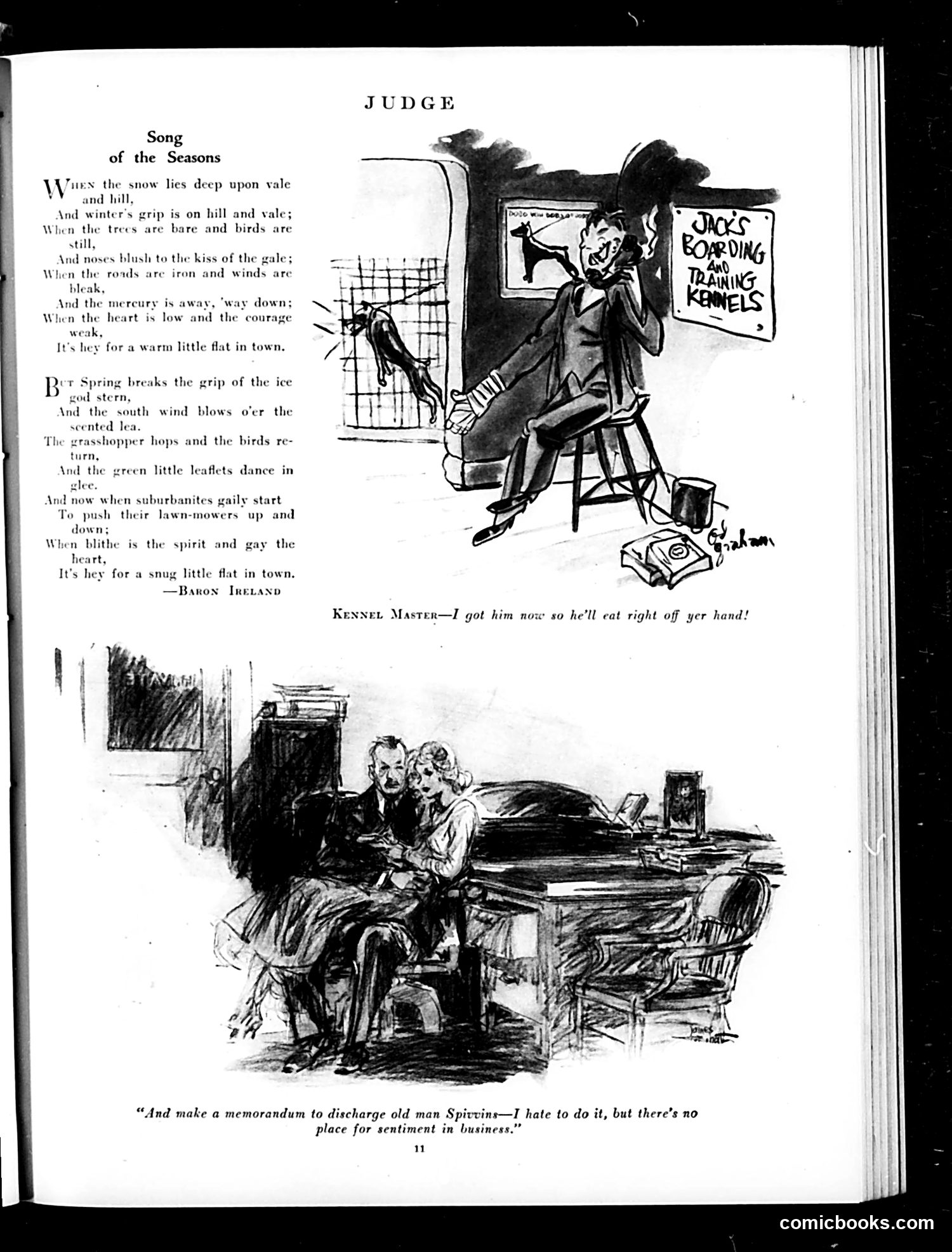
Page Analysis: Judge Magazine This page contains two distinct cartoons satirizing early 20th-century American life. Top cartoon: A man trains a dog while displaying a sign reading "Jack's Boarding and Training Kennels." The caption jokes about the dog now eating from the trainer's hand—a play on words suggesting the trainer (the "judge") is manipulating outcomes. Bottom cartoon: An office scene shows two businessmen at a desk. One dictates to the other: "discharge old man Spivvins—I hate to do it, but there's no place for sentiment in business." This satirizes the cold, ruthless nature of industrial-era business practices, mocking employers who fire loyal long-term workers without emotional consideration, treating employment as purely transactional. The poem contrasts seasonal moods with urban life, suggesting that regardless of weather, city dwellers (particularly suburbanites) prefer apartment living to country pursuits. The page satirizes both animal training deception and corporate heartlessness—typical Judge magazine targets of the era's social commentary.
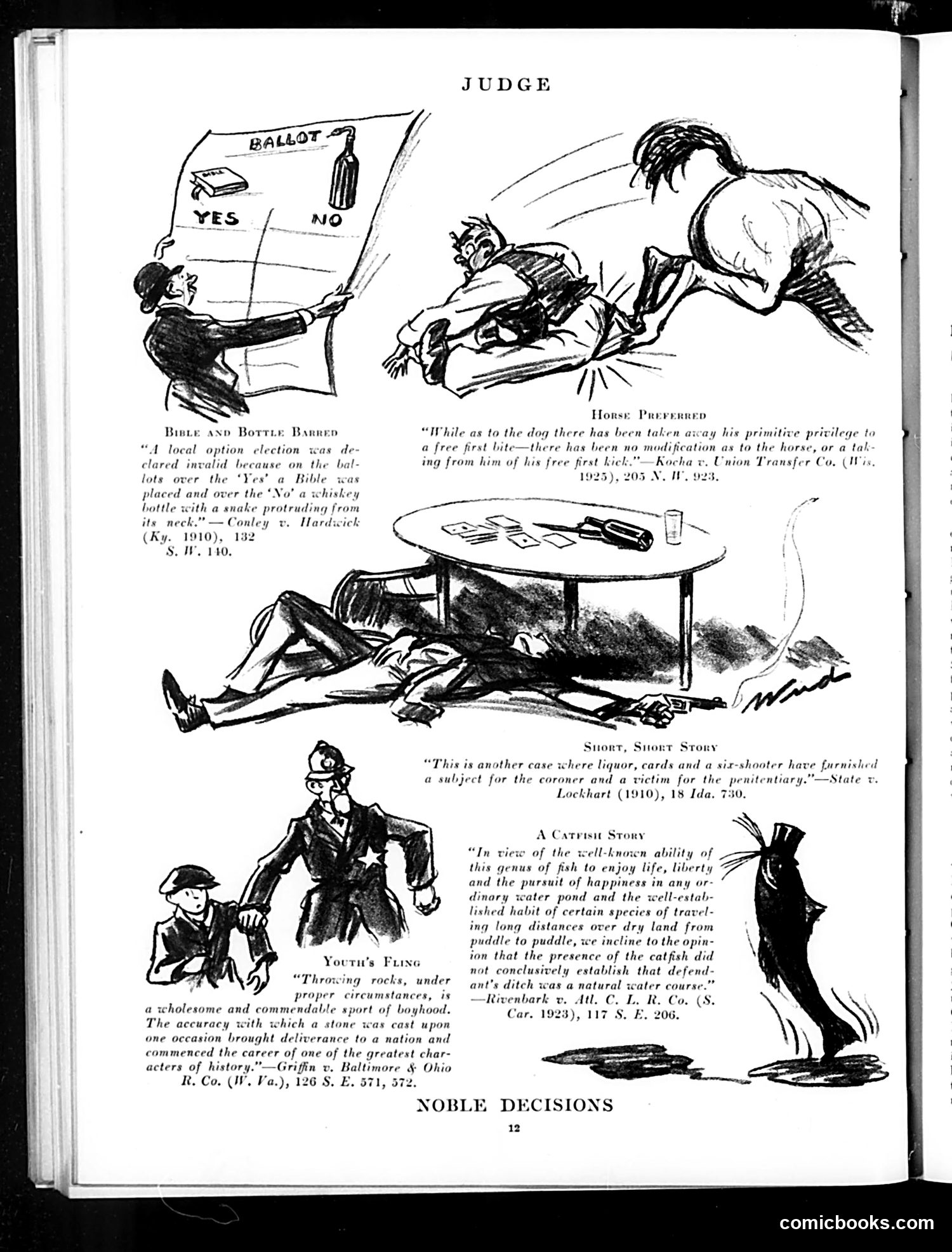
"Judge" Page: Noble Decisions (Legal Satire) This page satirizes absurd real court rulings through humorous illustrations and quoted case law. The cartoons mock judges' reasoning in actual cases: "Bible and Bottle Barred" depicts a local election invalidated because ballot boxes displayed a Bible (for "Yes") and whiskey bottle with snake (for "No")—the imagery allegedly biased voters on prohibition, a major early-20th-century issue. "Horse Preferred" illustrates a ruling that horses retain their "free first bite" (right to bite unprovoked) while dogs lost this privilege—an outdated, absurd legal distinction. "Youth's Fling" defends rock-throwing as "commendable sport of boyhood," bizarrely citing David's defeat of Goliath as precedent. The page's humor targets judicial reasoning that applies obsolete principles, technicalities, or absurdly literalist interpretations of law. Judge magazine used these to critique the legal system's disconnect from common sense during the Prohibition era.
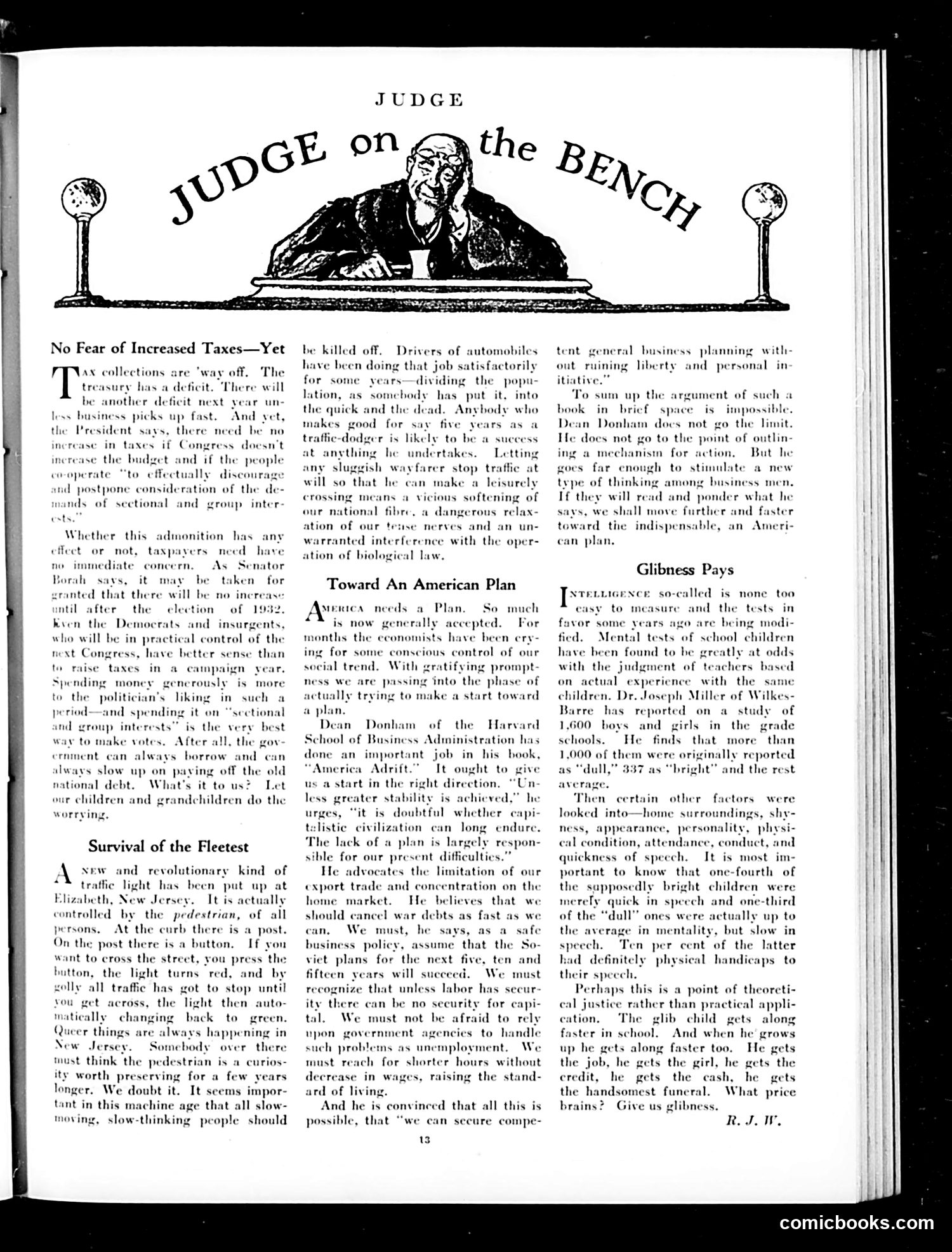
Analysis: "Judge on the Bench" This page features three opinion pieces under the "Judge on the Bench" masthead, each satirizing contemporary American policy debates, likely from the early 1930s (references to post-1932 election, depression-era deficits). "No Fear of Increased Taxes" mocks government spending practices: politicians claim no tax increases are needed despite Treasury deficits, yet continue wasteful "sectional and group interests" spending to win votes. The satire suggests fiscal irresponsibility disguised as fiscal restraint. "Survival of the Fleetest" sarcastically critiques a pedestrian-controlled traffic light in New Jersey as absurdly preserving slow people in a "machine age." The dark humor suggests natural selection should eliminate inefficient citizens—reflecting harsh social attitudes of the era. "Toward An American Plan" discusses Dean Donham's economic proposals for national planning, government intervention in unemployment, shorter work hours, and debt cancellation. The writer cautiously supports planning to achieve economic "stability." Overall, the page reflects Depression-era debates about government intervention, fiscal policy, and social modernization.
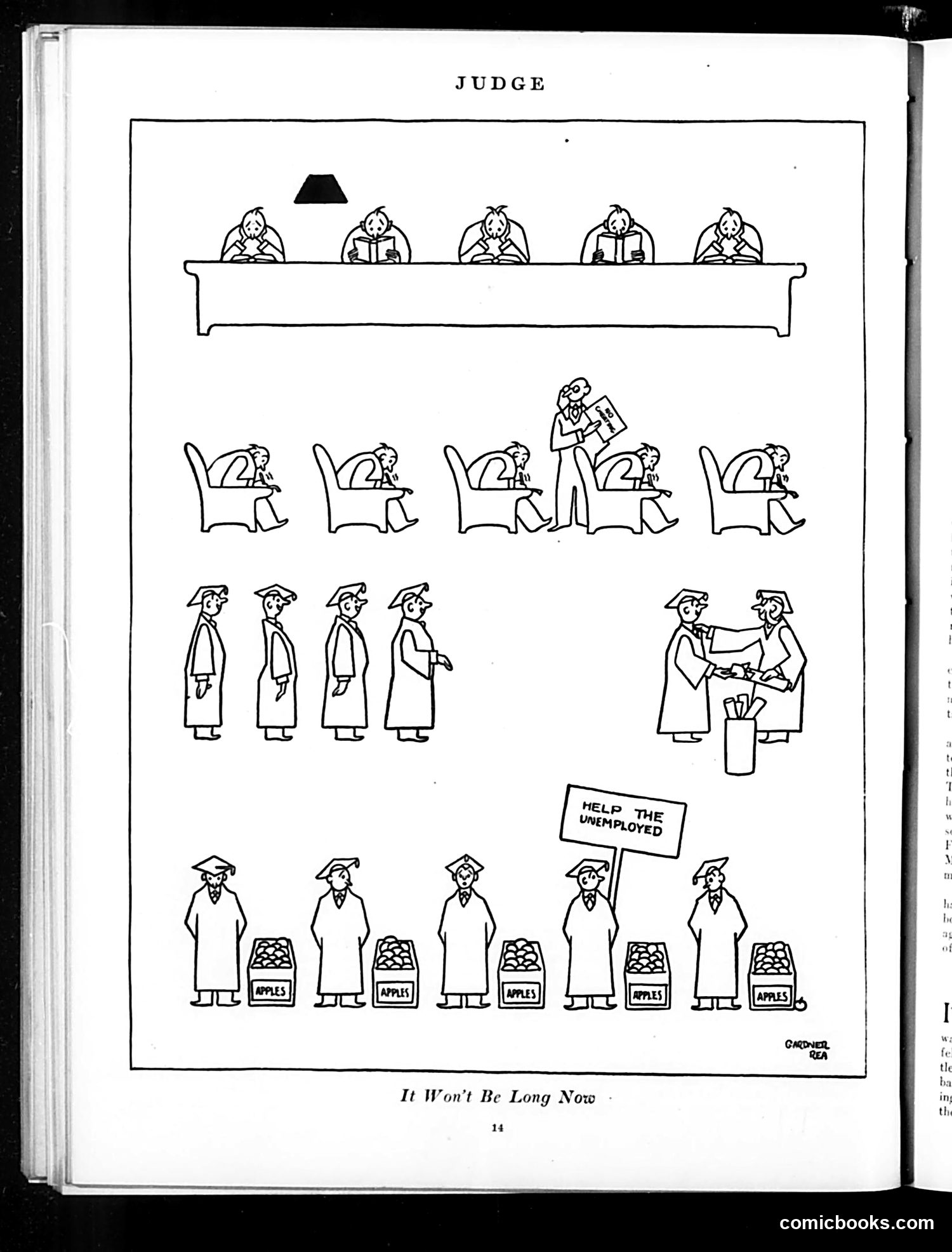
"Judge" Political Cartoon Analysis This single-panel cartoon satirizes the judicial system's slowness in addressing unemployment. The hierarchical composition shows: Top: Five judges presiding from an elevated bench Middle: Five seated jurors or court officials Lower middle: Two figures exchanging money or documents Bottom: Five unemployed men holding apple crates, one holding a "Help the Unemployed" sign The title "It Won't Be Long Now" appears ironic—suggesting the unemployed must wait indefinitely while the legal machinery grinds slowly. The contrast between the formal court proceedings above and desperate street-level poverty below critiques how distant the judiciary is from ordinary citizens' economic suffering. The apple-selling detail references Depression-era unemployment when jobless men sold apples on streets. This cartoon likely dates to the 1930s economic crisis, mocking the gap between legal processes and practical relief for the destitute.
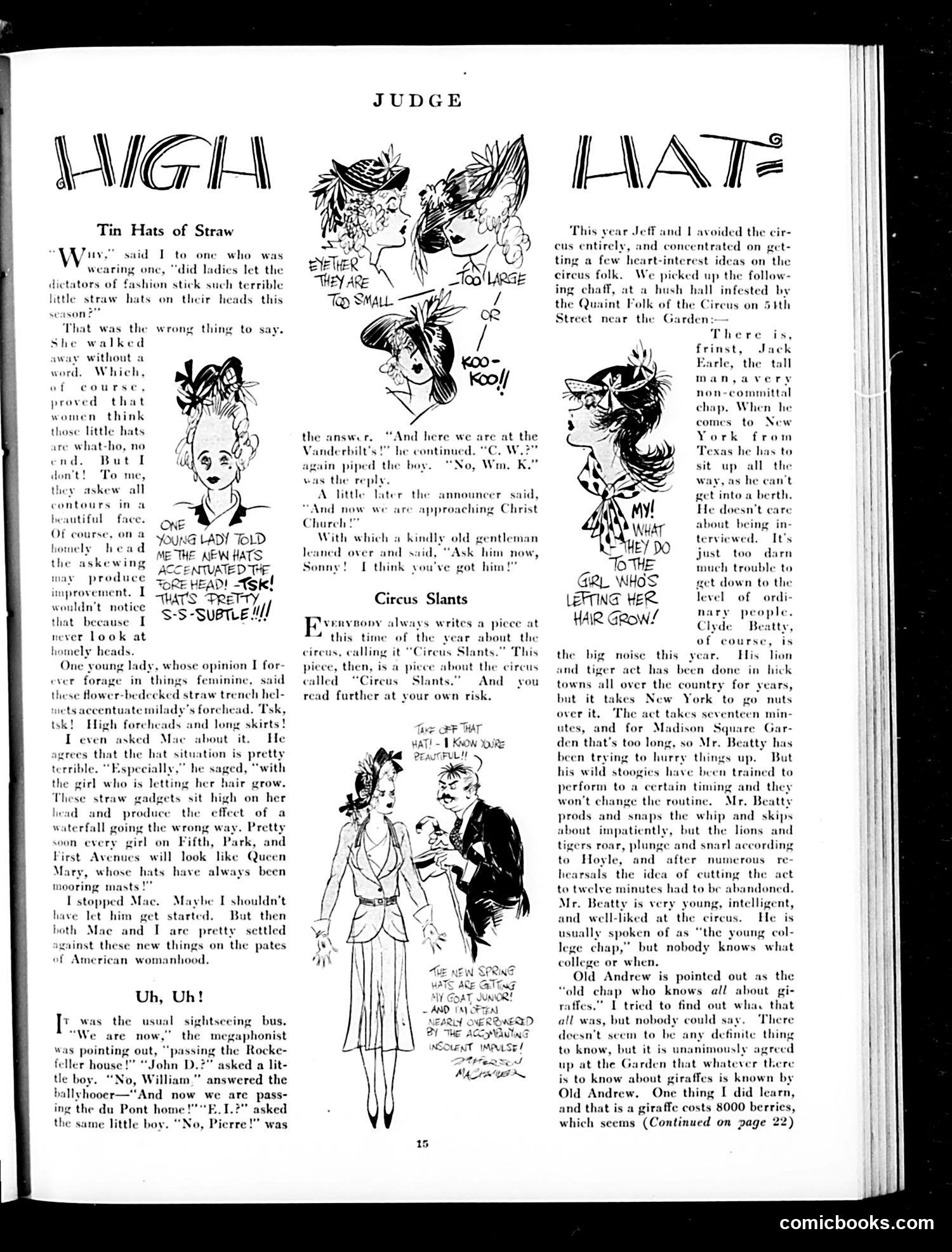
"High Hat" and Related Satirical Commentary This Judge magazine page (page 15) contains three separate humor pieces mocking contemporary social trends: "Tin Hats of Straw" ridicules the fashionable small straw hats women wore in this era. The author and his friend "Mac" find them unflattering, particularly on women with large foreheads or growing-out hair, describing them as producing a "waterfall" effect or resembling "mooring masts." "Uh, Uh!" jokes about wealthy American industrial families (Rockefeller, du Pont, Vanderbilt) through a tour-bus guide's conversation with a boy who keeps guessing which mansion belongs to which tycoon—satirizing both the prominence of these families' wealth and public fascination with it. "Circus Slants" offers backstage gossip about circus performers: Jack Earle (the tall man), tiger-trainer Clyde Beatty, and others. It mocks Beatty's attempts to modernize circus acts while animals refuse to cooperate with timing changes, and pokes fun at performers' reluctance for publicity. The cartoons' simple line drawings illustrate the straw-hat fashions criticized.
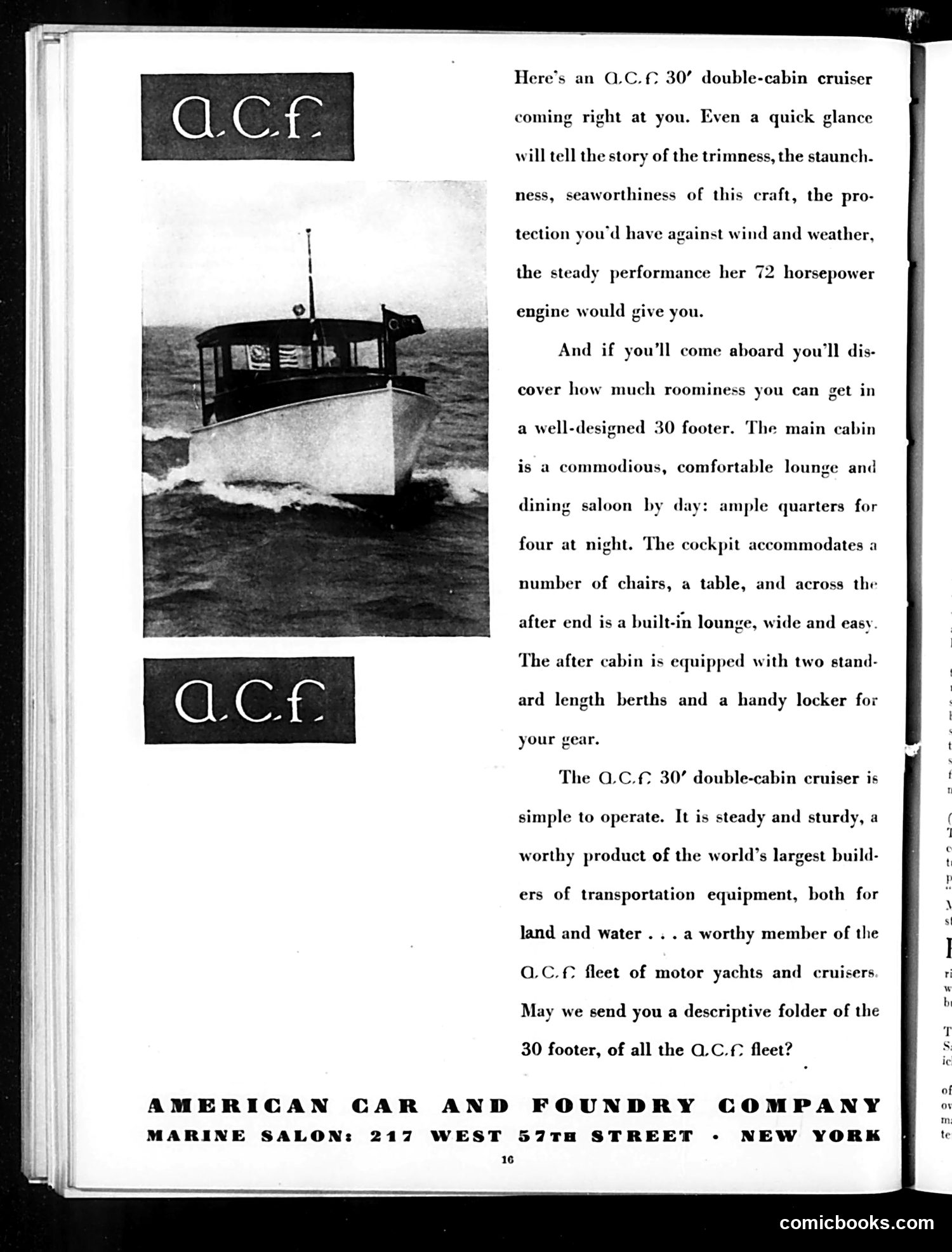
This page is entirely an advertisement, not satirical content. It promotes the Q.C.F. 30-foot double-cabin cruiser, a motor yacht manufactured by the American Car and Foundry Company. The ad features a black-and-white photograph of the vessel at sea and describes its features: a 72-horsepower engine, spacious main cabin suitable as lounge and dining area, sleeping quarters for four, and a cockpit with built-in lounging space. The copy emphasizes the craft's sturdiness, seaworthiness, and ease of operation. The ad concludes with an invitation to request a descriptive folder about the 30-footer and the broader Q.C.F. fleet. There are no cartoons, caricatures, or satirical elements visible on this page—it's straightforward commercial marketing typical of Judge magazine's advertising content.
Judging the Books: Spring Cleanup This page is a book review section titled "Judging the Books," offering brief, sardonic critiques of contemporary literature. The reviews mock various popular novels and their authors with casual dismissiveness. The tone is consistently irreverent: reviewers praise some works ("painstaking," "delicious mastery") while savagely dismissing others as "hard to swallow," "too mad," or containing "icky detail for our sensitivities." They question why anyone should care about certain plots ("Who cares?"). Notable targets include H.T. Webster's "Caspar Milquetoast" (a famous comic figure of the timid everyman) and Thorne Smith's fantasy novel, criticized as derivative Rabelaisian nonsense. The reviews assume readers share Judge magazine's sophisticated, cynical perspective—that commercial fiction is often trivial or pretentious. The "Spring Cleanup" header suggests these reviews are clearing away literary clutter, making this section function as satirical cultural gatekeeping typical of 1920s-30s literary magazines.
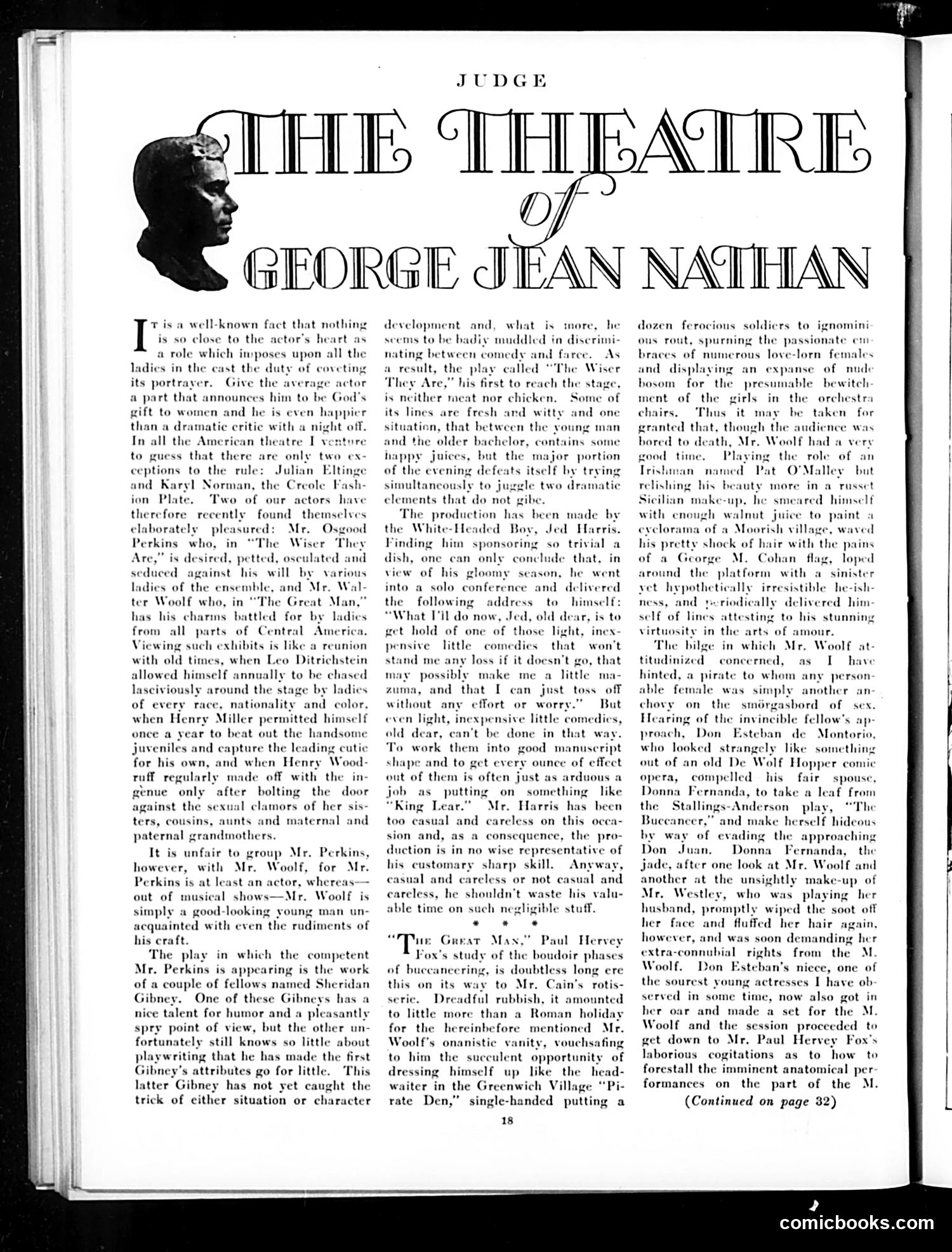
Judge Theater Review: "The Theatre of George Jean Nathan" This is a theater criticism piece by Judge's drama critic reviewing current Broadway productions. The page critiques actor Osgood Perkins in "The Wiser They Are" and Walter Woolf in "The Great Man," comparing them to earlier leading men like Leo Ditrichstein and Henry Miller who enjoyed roles where actresses competed for their affection. The critic distinguishes between Perkins—a competent actor—and Woolf, whom he characterizes as merely good-looking but lacking theatrical skill. He particularly criticizes producer Jed Harris for casually mounting a trivial comedy without proper care, arguing that even light comedies require serious craftsmanship. The piece exemplifies Judge's sophisticated theatrical commentary for educated readers familiar with Broadway personalities and dramatic standards of the era.
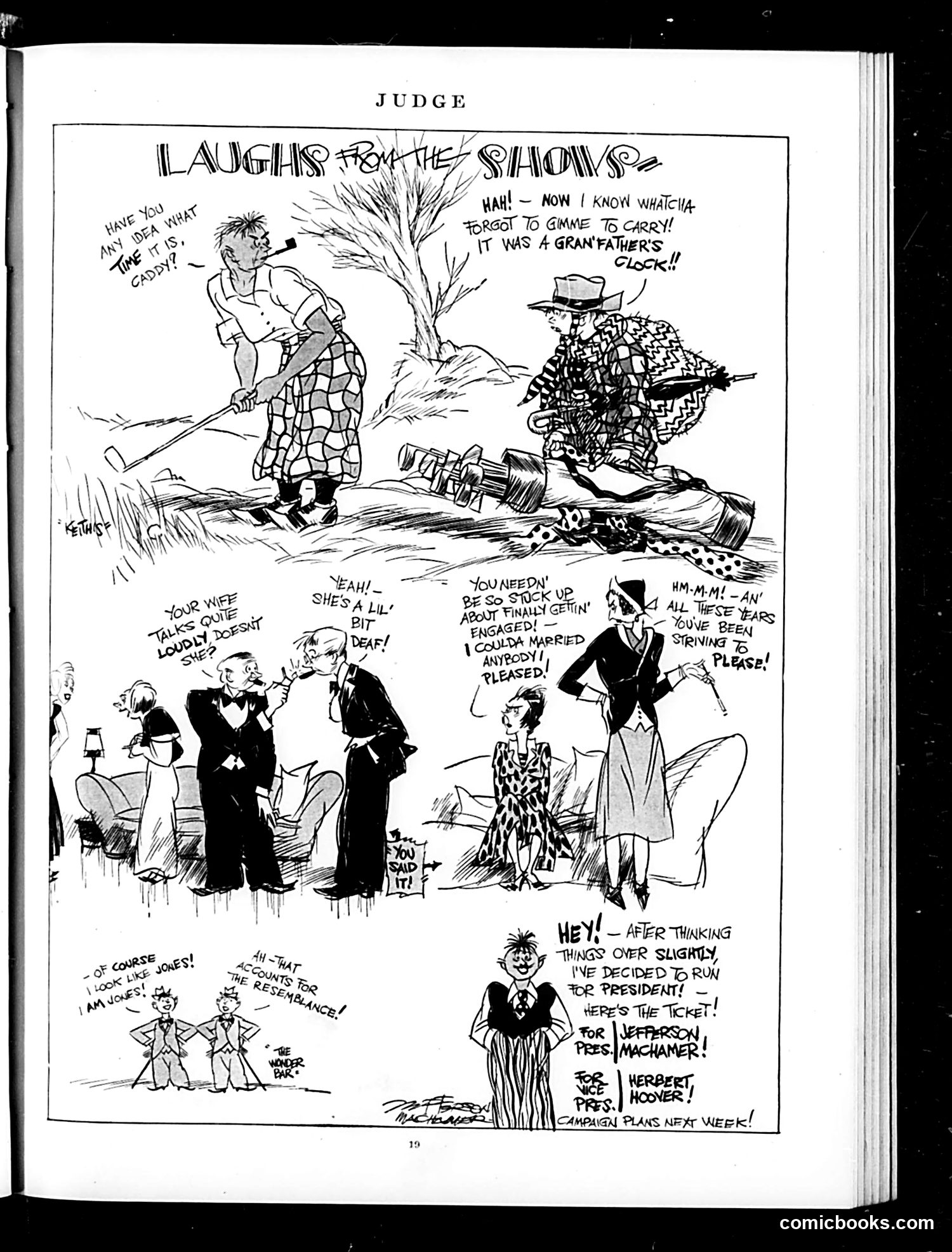
Political Cartoon Analysis: "Laughs for the Shows" This multi-panel Judge cartoon satirizes early 20th-century American politics and social pretension through interconnected vignettes. The top panels mock rural/working-class characters (a golfer and farmer) who speak in exaggerated dialect, playing on period stereotypes. The middle section depicts formal city society—men in tuxedos and women in evening wear—engaged in pompous conversation about marriage engagements and social standing, contrasting sharply with the rustic figures above. The bottom panel's punchline involves a character announcing a presidential candidacy ticket ("For President!" and "For Herbert Hoover!"), suggesting the cartoon satirizes both political ambition and the absurdity of ordinary citizens imagining themselves as serious candidates. The overall joke appears to be about class contrasts, pretension, and the gap between everyday Americans' delusions of grandeur and actual social/political reality. Without a visible date, the specific election referenced remains unclear.
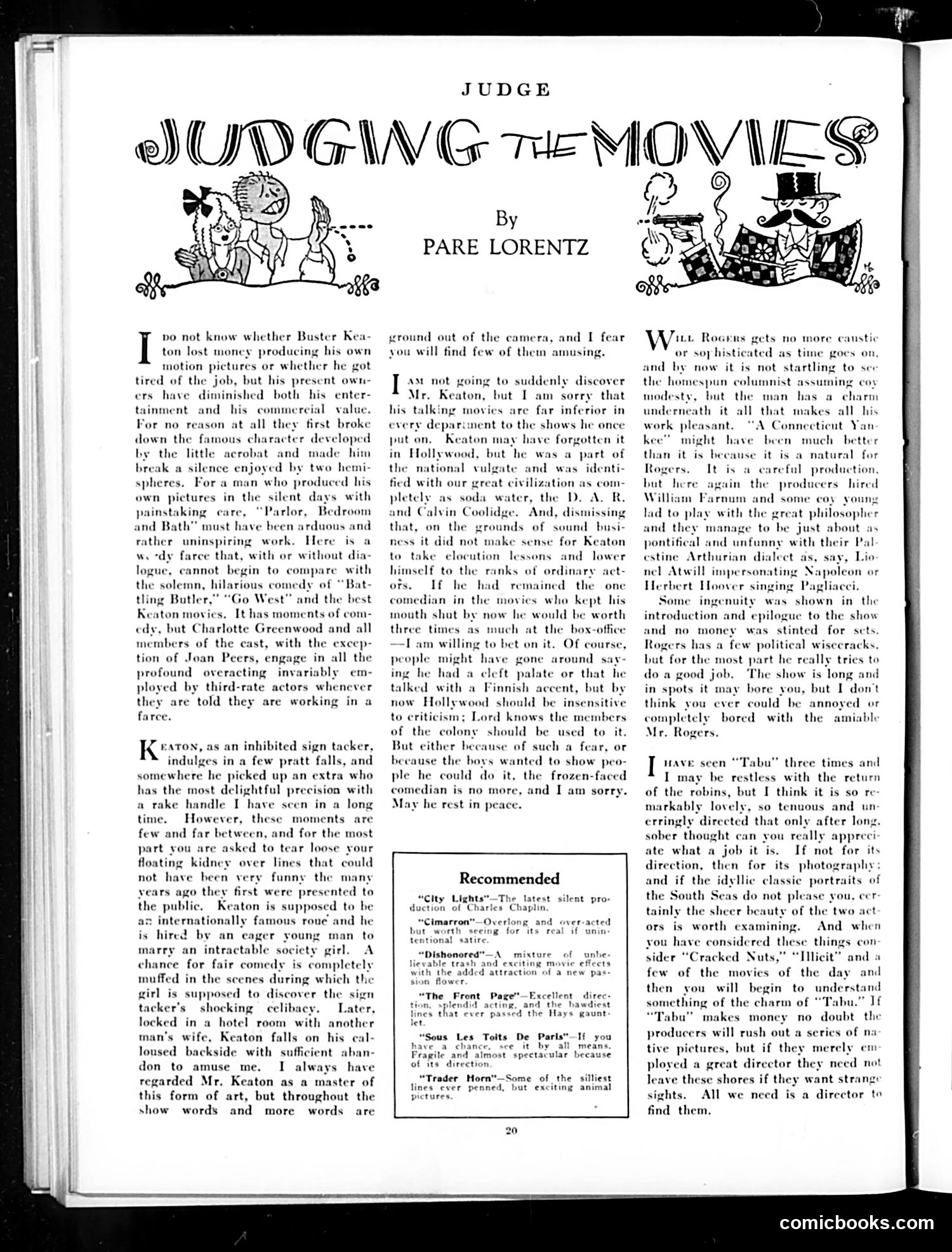
Judge Magazine Movie Review: "Judging the Movies" by Pare Lorentz This is a film criticism column reviewing Buster Keaton's talking picture career. The author laments that Keaton—a silent comedy genius known for physical humor in films like "Battling Butler" and "Go West"—has declined since transitioning to sound films. The satire targets Hollywood's mishandling of Keaton's talents. His current film "Parlor, Bedroom and Bath" is criticized as mediocre farce with excessive dialogue and overwrought acting from supporting players (notably Charlotte Greenwood). The reviewer argues Keaton's power derived from *silent* physical comedy; adding dialogue undermines his unique appeal. The broader point: Hollywood prioritized novelty (talking pictures) over artistic integrity, forcing a master of visual comedy into an inferior medium. The column includes brief reviews of other contemporary films like "Dishonored" and "Sous Les Toits De Paris."
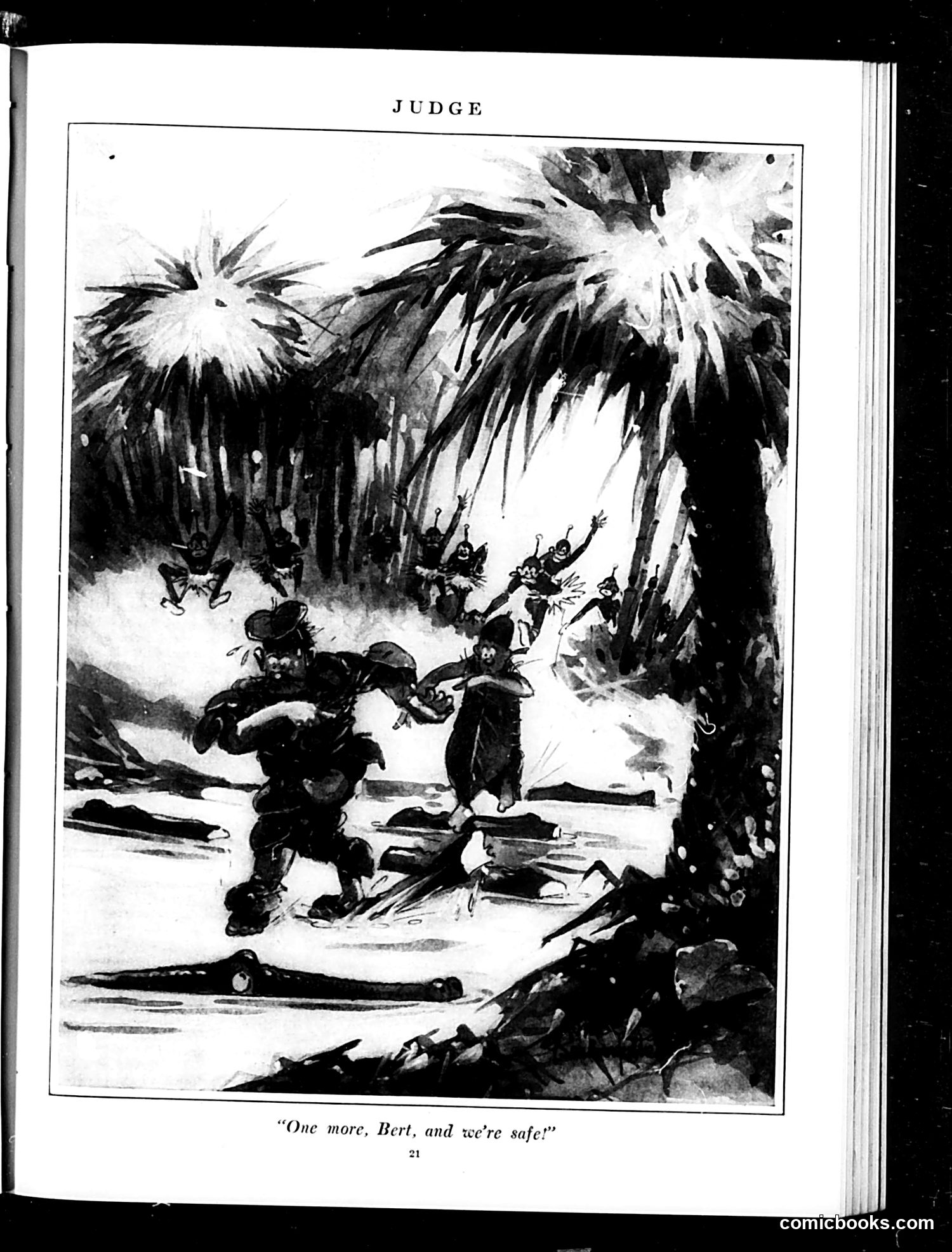
Analysis This illustration from *Judge* magazine depicts what appears to be a fantasy or adventure scene rather than explicit political satire. The image shows stylized characters (possibly dwarfs or gnomes based on their proportions) in a cave or underground setting with dramatic palm fronds or vegetation overhead. Multiple figures are shown in dynamic poses, some appearing to flee or fight. The caption "One more, Bert, and we're safe!" suggests a narrative of escape or survival—the characters apparently need to eliminate one additional threat to reach safety. Without additional context about the publication date or surrounding articles, I cannot definitively identify whether this references a specific political event, public figure, or social commentary. It may be purely entertainment-focused illustration rather than satirical commentary.
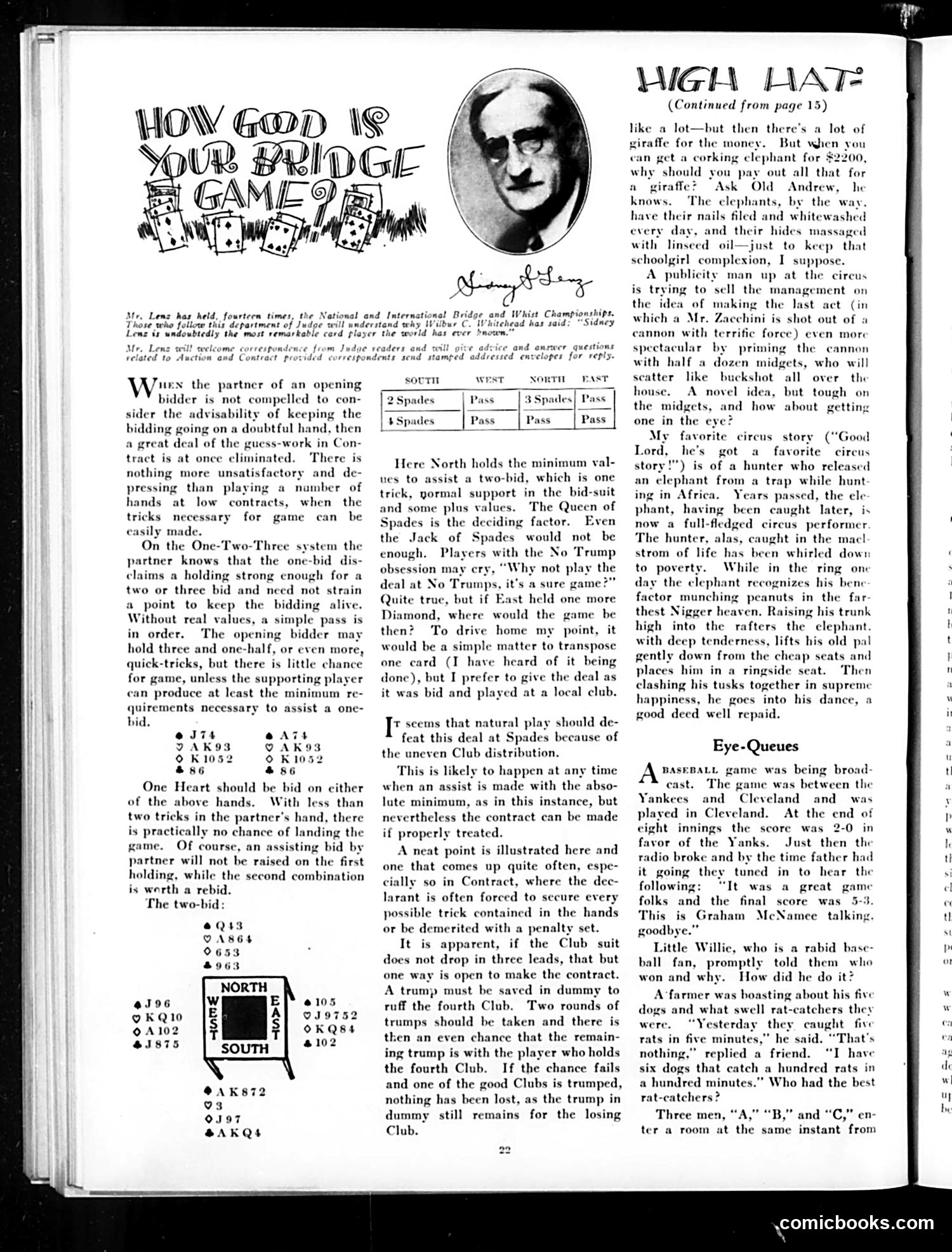
This page from *Judge* magazine contains two distinct elements: Bridge Column (Main Content): The bulk of the page is a technical bridge card game lesson by "Sidney" (likely referring to a bridge expert), explaining bidding strategy. This reflects bridge's enormous popularity in early-to-mid 20th century American culture—it was treated as serious, intellectual entertainment worthy of magazine space and expert instruction. "High Hat" Humor Column (Top Right): The sidebar satirizes circuses and carnival attractions. It mocks the era's extravagant circus showmanship—specifically referencing an act where performer Zacchini was shot from a cannon. The satire suggests the circus management's absurd cost-cutting proposal: replacing expensive animal acts (giraffes, elephants receiving daily nail-filing and oil massages) with cheaper human "midgets" as cannon projectiles. The joke targets both circus excess and the dehumanizing economics of entertainment that would literally use people as disposable props for novelty acts.
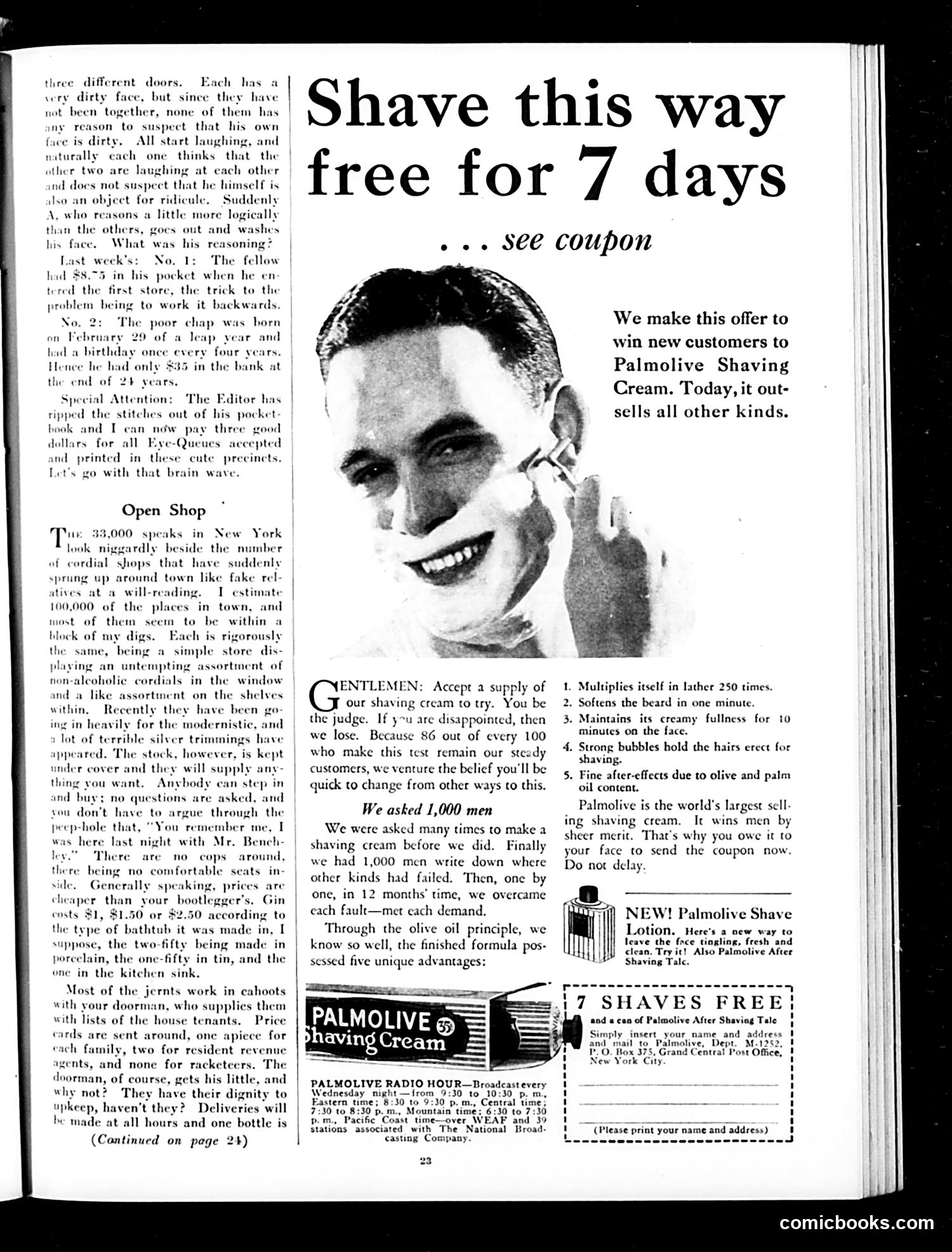
Judge Magazine Page Analysis This page is primarily advertising, not satirical content. The dominant feature is a large Palmolive Shaving Cream advertisement occupying roughly half the page. The ad uses a smiling man's face as its central image and employs marketing claims typical of 1920s advertising: the product "outsells all other kinds" and offers a 7-day free trial via coupon. It claims the cream was developed by surveying 1,000 men about shaving cream failures, then systematically addressing each complaint over 12 months—a narrative designed to establish credibility and scientific rigor. The page also contains puzzle/riddle content ("Open Shop" section) discussing Prohibition-era speakeasies in New York, though this material is secondary to the advertisement. For modern readers: This reveals how early 20th-century advertisers used before-and-after imagery, customer testimonials (the "1,000 men" claim), and free trials to build brand loyalty—strategies still common today.
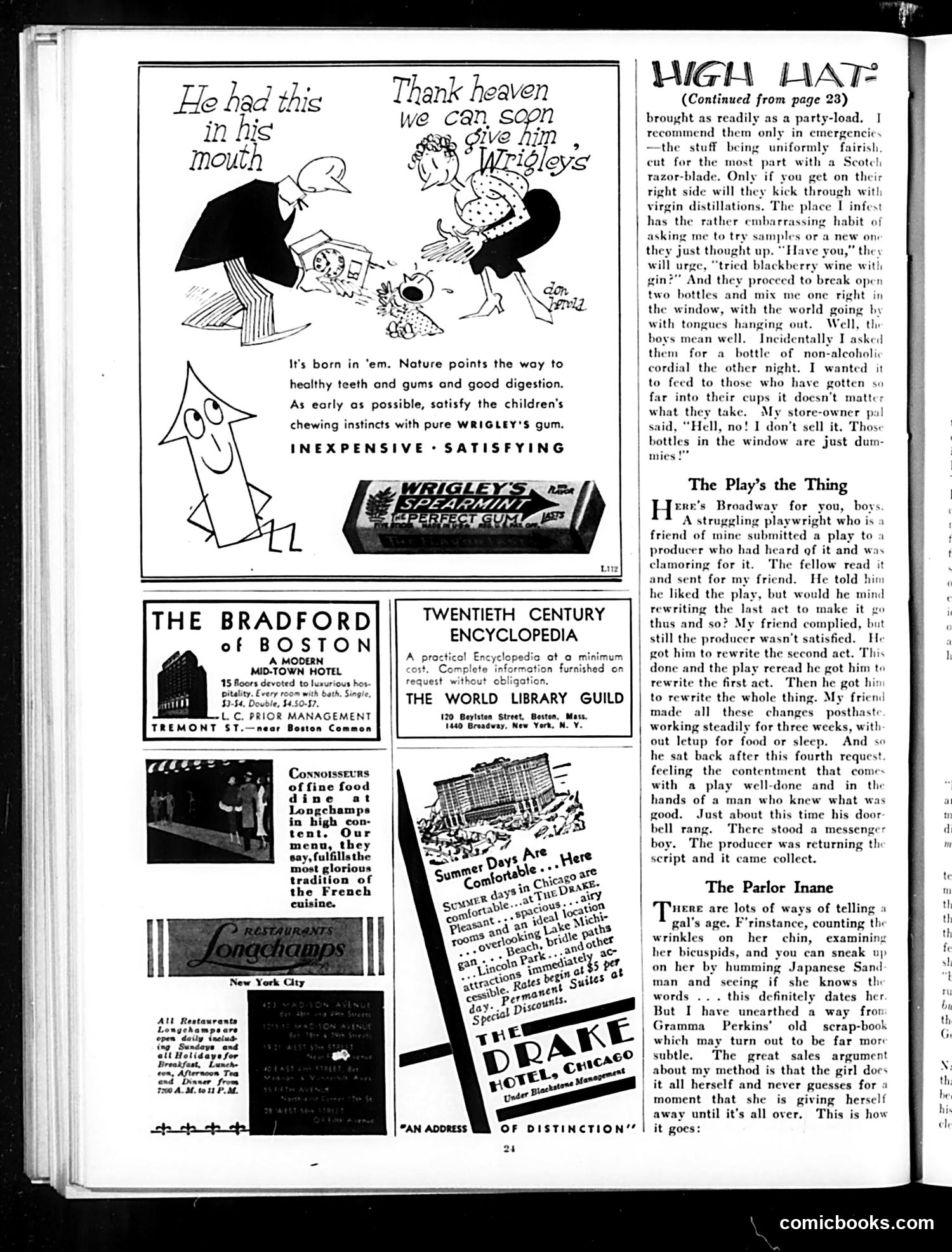
Analysis of Judge Magazine Page Content This page consists primarily of advertisements and editorial columns rather than political satire. The top features a Wrigley's gum advertisement with a cartoon showing parents encouraging children to chew gum for healthy teeth and digestion—reflecting early 20th-century marketing to parents about childhood development. The right side contains three humorous lifestyle columns: "The Play's the Thing" describes a struggling playwright repeatedly rewriting his script at a producer's demands, only to have it rejected and returned collect—satirizing the frustrations of theatrical commerce. "The Parlor Inane" discusses methods of determining a woman's age, presented as lighthearted social commentary. The remaining space features hotel, restaurant, and encyclopedia advertisements, typical of Judge's revenue model. The overall page reflects 1920s-30s consumer culture and social attitudes rather than political commentary. The humor targets everyday situations (theatrical dealings, dating conventions) familiar to the magazine's middle-class readership.
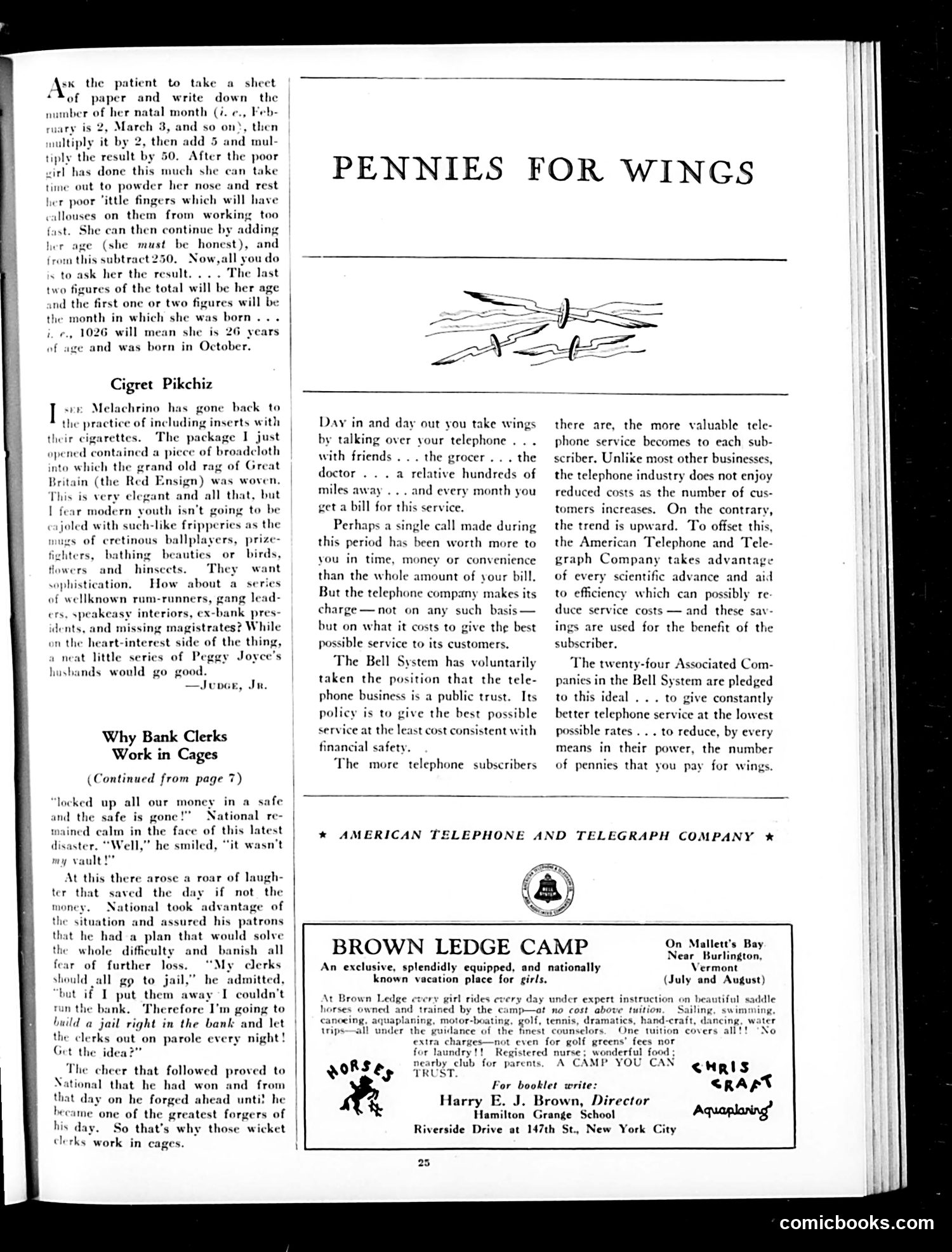
"Pennies for Wings" - American Telephone & Telegraph Advertisement This page is primarily advertising content, not political satire. The main feature is a Bell System telephone company advertisement defending its rates. The ad responds to customer complaints about high telephone bills by arguing the company operates as a "public trust." It claims that unlike most businesses, telephone service doesn't benefit from economies of scale—more customers actually increase costs. Therefore, the company argues, higher subscriber numbers don't justify lower rates. Instead, AT&T positions itself as using "scientific advances" to reduce costs for customers' benefit. The phrase "Pennies for Wings" is the ad's metaphor: telephone calls give customers figurative "wings" (connection and convenience) for pennies. The small illustrations show sticks bound together, suggesting bundled telephone lines. The surrounding content includes humor pieces about math tricks and bank security, typical of Judge magazine's mixed entertainment-and-advertising format from this era (appears early 20th century based on references to Prohibition-era "speakeasies").
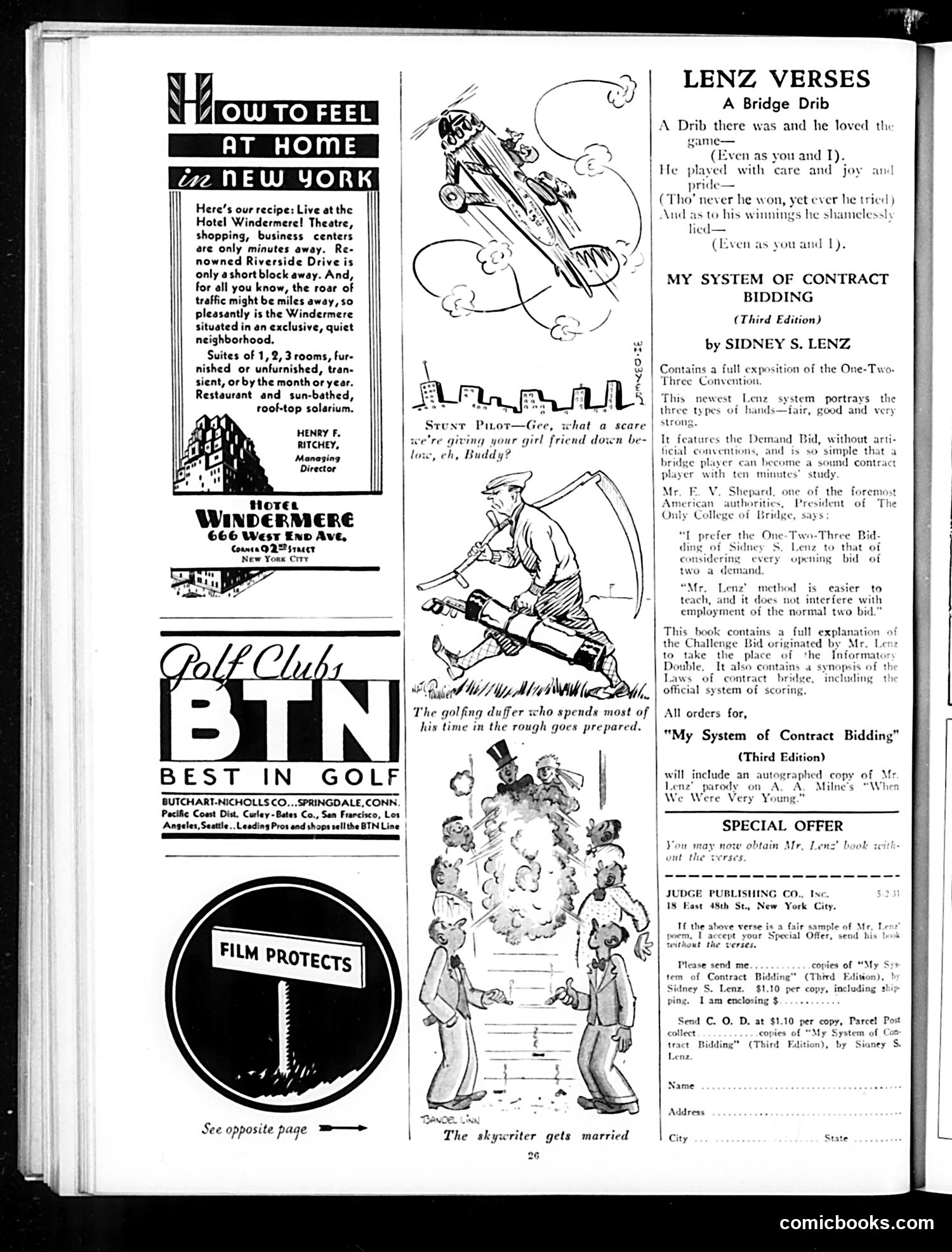
Page 26 of Judge Magazine: Mixed Advertisements and Light Verse This page is primarily advertising rather than political satire. The left side features hotel and golf club ads typical of 1920s-30s magazine content. The right side contains promotional material for Sidney S. Lenz's bridge instruction book, "My System of Contract Bidding." The only humorous content includes: - "Lenz Verses": A light poem about a bridge player who lost consistently but played with integrity—a gentle parody likely referencing A.A. Milne's sentimental style. - Two small cartoon gags: One about a pilot scaring his girlfriend with stunt flying; another about a golfer spending time "in the rough" who stays "prepared"—these are generic, non-political jokes about dating and golf incompetence. The page contains no political commentary or social satire—it's a straightforward merchandising vehicle for luxury services and instructional books aimed at affluent readers of the era.
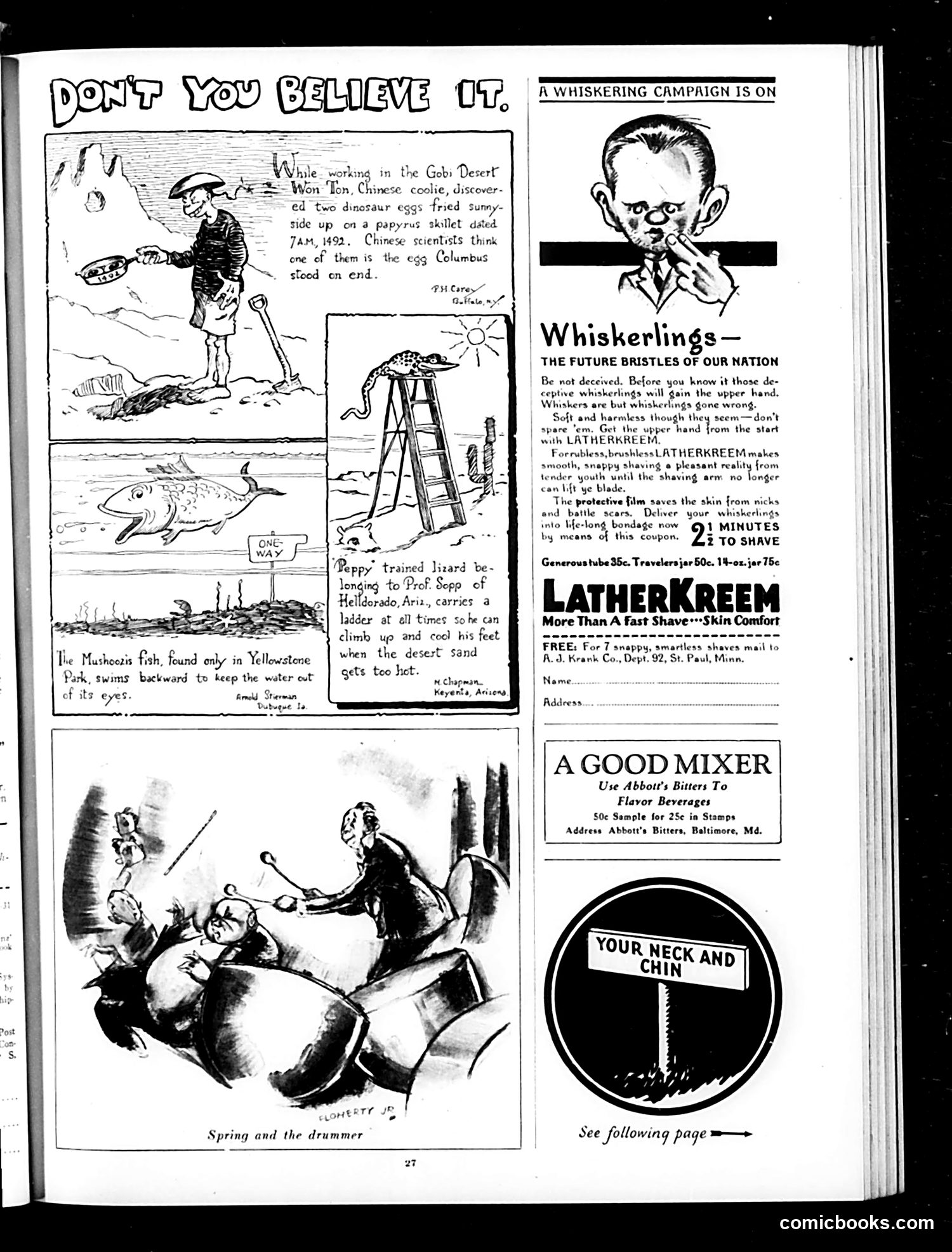
"Don't You Believe It" Page Analysis This Judge magazine page combines humor with advertising. The left side features a comic section titled "Don't You Believe It"—a recurring feature presenting absurd, tall-tale anecdotes for humorous effect. The stories mock exaggeration and folklore: a Chinese coolie finding dinosaur eggs in the Gobi Desert; a trained lizard cooling a man's feet; a fish swimming backward. These are clearly fabrications presented as amusing "facts." The right side features advertisements, including a prominent "Whiskering Campaign" ad for LatherKreem shaving cream. This uses satirical language ("whiskerlings"—young whiskers as future threats) to humorously warn against facial hair, playing on contemporary advertising's tendency toward hyperbolic product claims. The page overall exemplifies Judge's blend of satirical cartooning and period advertising, with humor derived from absurdity and exaggeration rather than specific political figures or events.
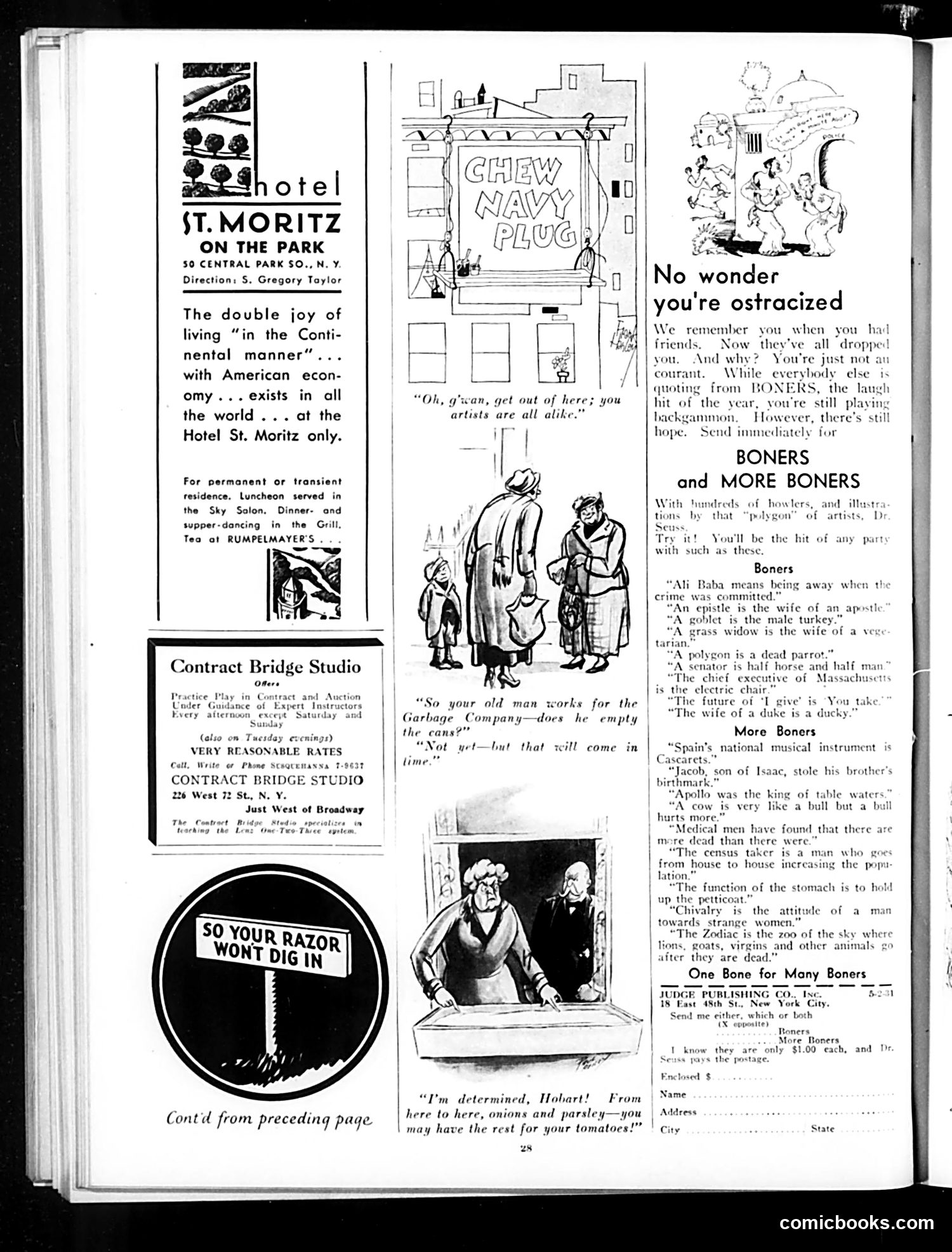
Judge Magazine Page Analysis This page primarily advertises a book called *Boners* and *More Boners*, a collection of humorous unintentional mistakes. The satire targets social conformity and status anxiety. The main cartoon features two women discussing a man who has become socially ostracized because he isn't familiar with *Boners*—the year's trendy humor book. His ignorance makes him unfashionable; everyone else quotes from it while he plays backgammon. The joke satirizes how people adopt fads to seem current, and how quickly social circles can exclude someone deemed "out of touch." The book itself collects genuine errors from students' essays and definitions—humorous malapropisms like "An epistle is the wife of an apostle" and "A grass widow is the wife of a very tan man." The smaller cartoon shows a woman pressuring a man (Hobart) to eat vegetables he dislikes, using cooking as control—a domestic humor scenario typical of 1920s-30s magazines. The advertisements (Hotel St. Moritz, Contract Bridge Studio) target affluent urban readers seeking sophistication and leisure activities.
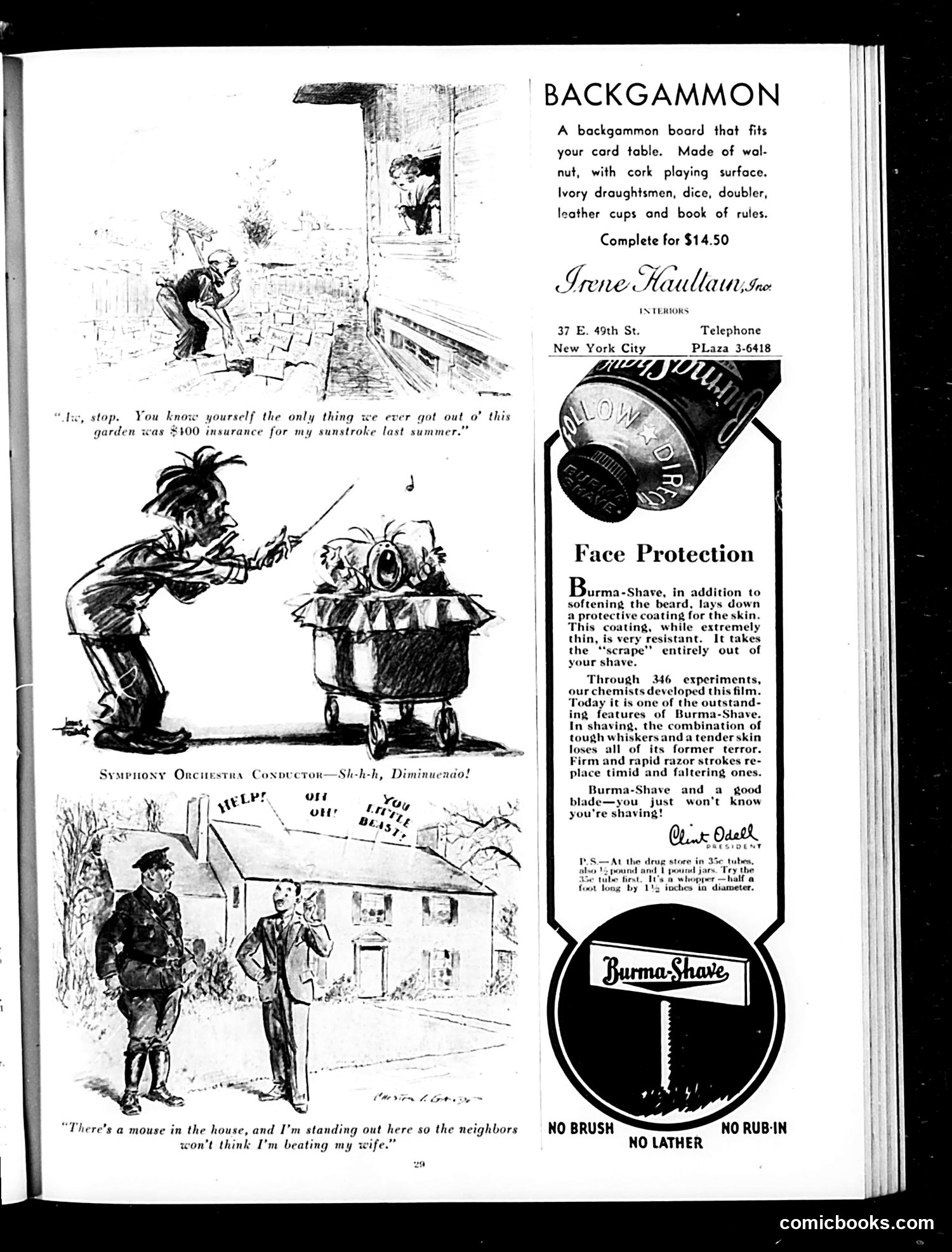
Judge Magazine Page Analysis This page contains three humorous cartoons and two advertisements (Backgammon board and Burma-Shave shaving cream). The cartoons satirize domestic life and social anxieties: 1. Top cartoon: A man explains to his wife that their garden's only value was $400 insurance from a sunstroke—dark humor about failed domestic projects and marriage disappointments. 2. Middle cartoon: Titled "Symphony Orchestra Conductor," depicts a man conducting with exaggerated gestures while a woman in a baby carriage looks alarmed—likely mocking both pretentious artistic posturing and chaotic domestic scenes. 3. Bottom cartoon: A man stands outside in the rain claiming to neighbors he's not beating his wife, but rather dealing with a mouse—satirizing both marital discord and masculine defensiveness about appearances. All three jokes rely on period assumptions about marriage conflicts, masculine insecurity, and the gap between public propriety and private behavior. The humor is crude by modern standards but represents typical Judge magazine satire of its era.
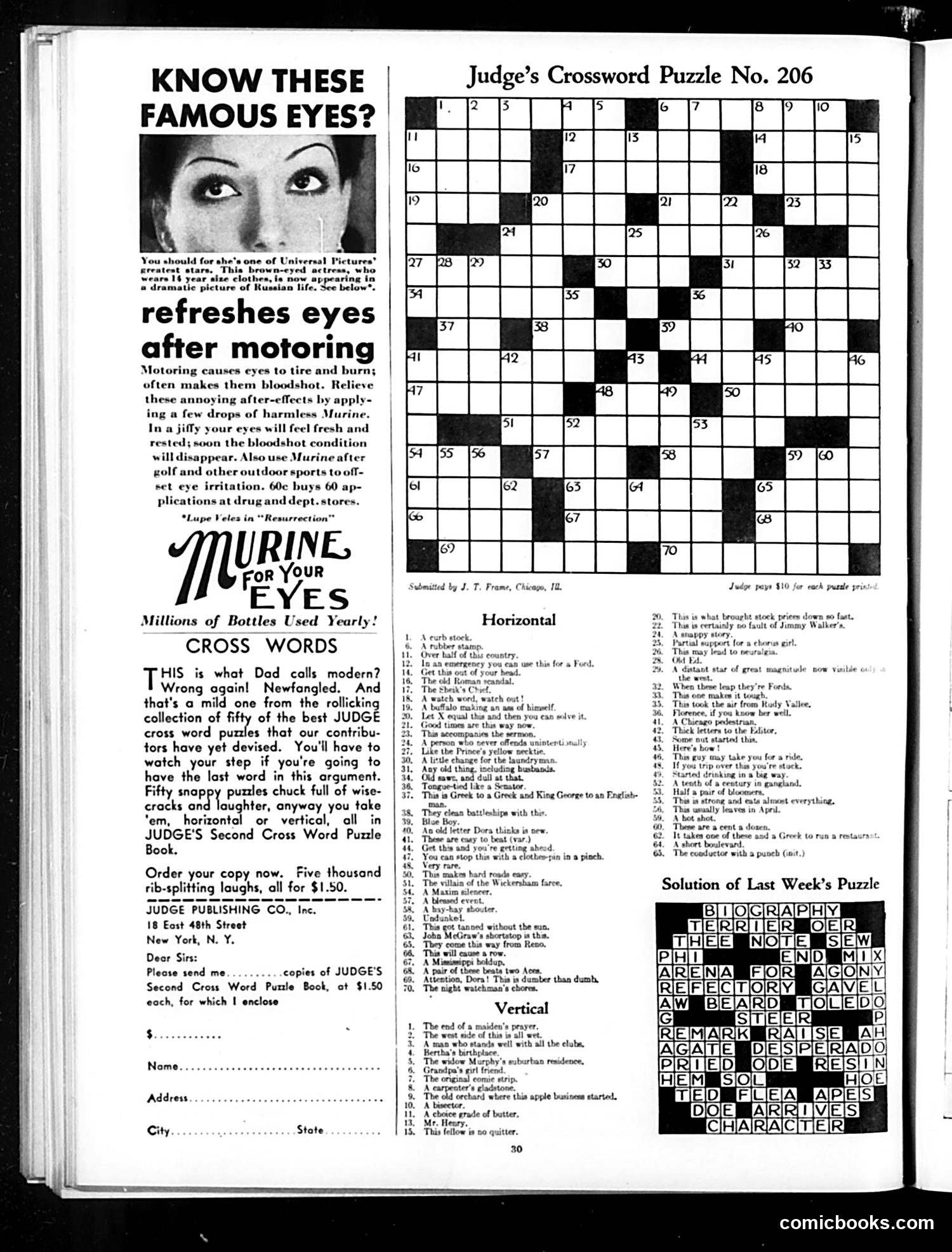
"Know These Famous Eyes?" — Judge Magazine Advertisement This page is primarily a product advertisement for Murine eye drops, disguised as entertainment content typical of Judge magazine's satirical approach. The "Famous Eyes" section features a photograph of actress Lupe Vélez, identified by the caption reference to her film "Resurrection." The ad uses her celebrity status to attract readers' attention, then pivots to the product's benefit: Murine supposedly "refreshes eyes after motoring." The advertisement addresses a genuine 1920s-30s concern—that automobile driving caused eye strain and bloodshot conditions. Murine's pitch was that a few drops would quickly restore eyes to normal, making it ideal for motorists and outdoor enthusiasts. The page also advertises Judge's Second Cross Word Puzzle Book, leveraging the era's crossword craze. The puzzles themselves contain topical references (Jimmy Walker, King George) reflecting contemporary public figures and events of the period. The overall strategy: use celebrity appeal and humor to sell products to Judge's middle-class readership.
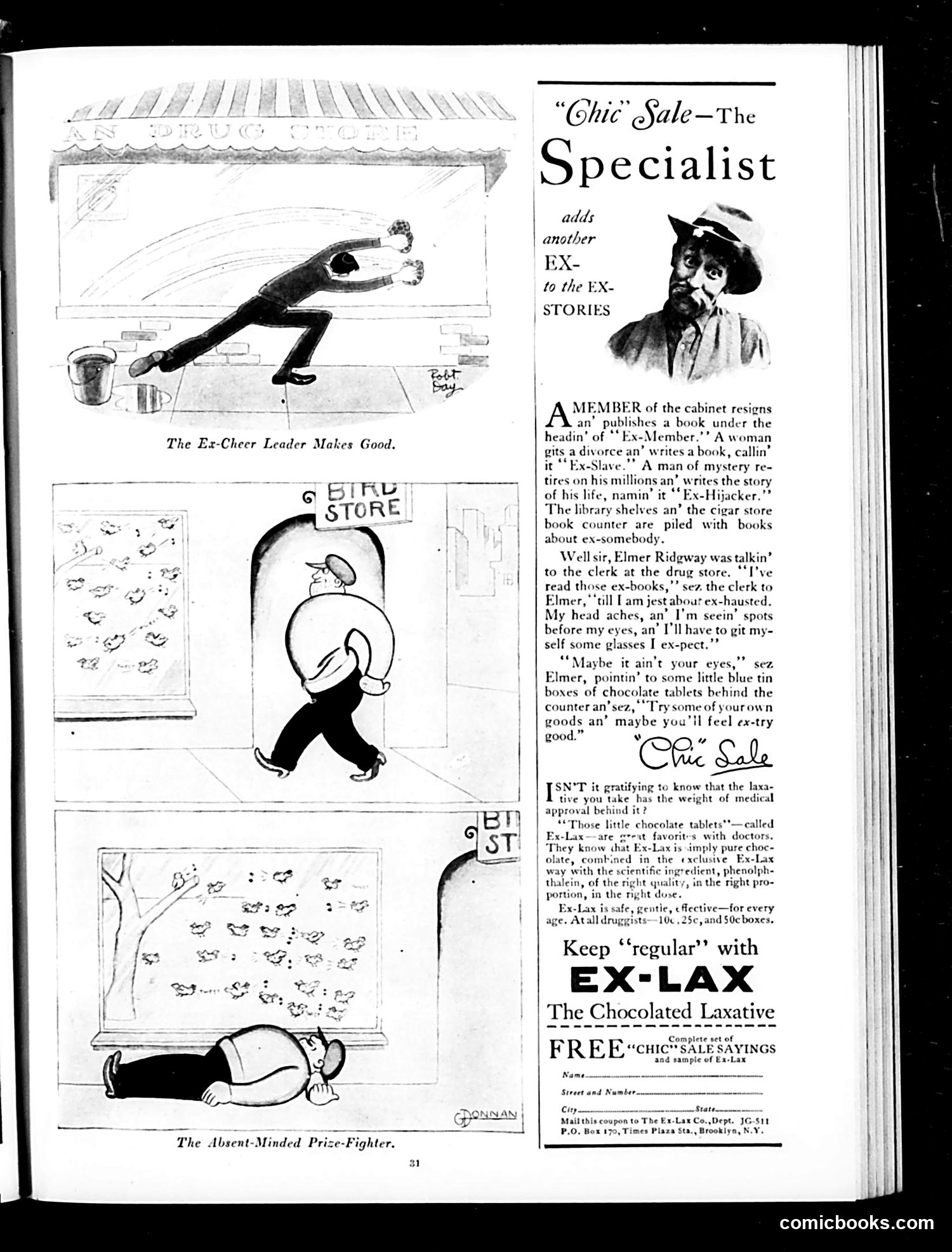
"Chic Sale—The Specialist" This page satirizes the 1920s publishing craze of "ex-" books—memoirs by former cabinet members, divorced women, retired criminals, etc. The humor rests on how ubiquitous these confessional autobiographies had become, cluttering library shelves. The cartoons show physical comedy: a man stretching impossibly to reach high shelves, and another collapsed while reading, overwhelmed by the glut of such books. The text features a folksy character (likely representing "Chic Sale," a popular humorist of the era) joking with a drugstore clerk exhausted from reading these memoirs. The clerk complains of headaches and spots before his eyes—which prompts the punch line: take Ex-Lax chocolate laxative instead. The satire works on two levels: mocking both the publishing trend and using it to advertise a laxative whose name cleverly plays on the "ex-" prefix. It's fundamentally a product advertisement disguised as social commentary.
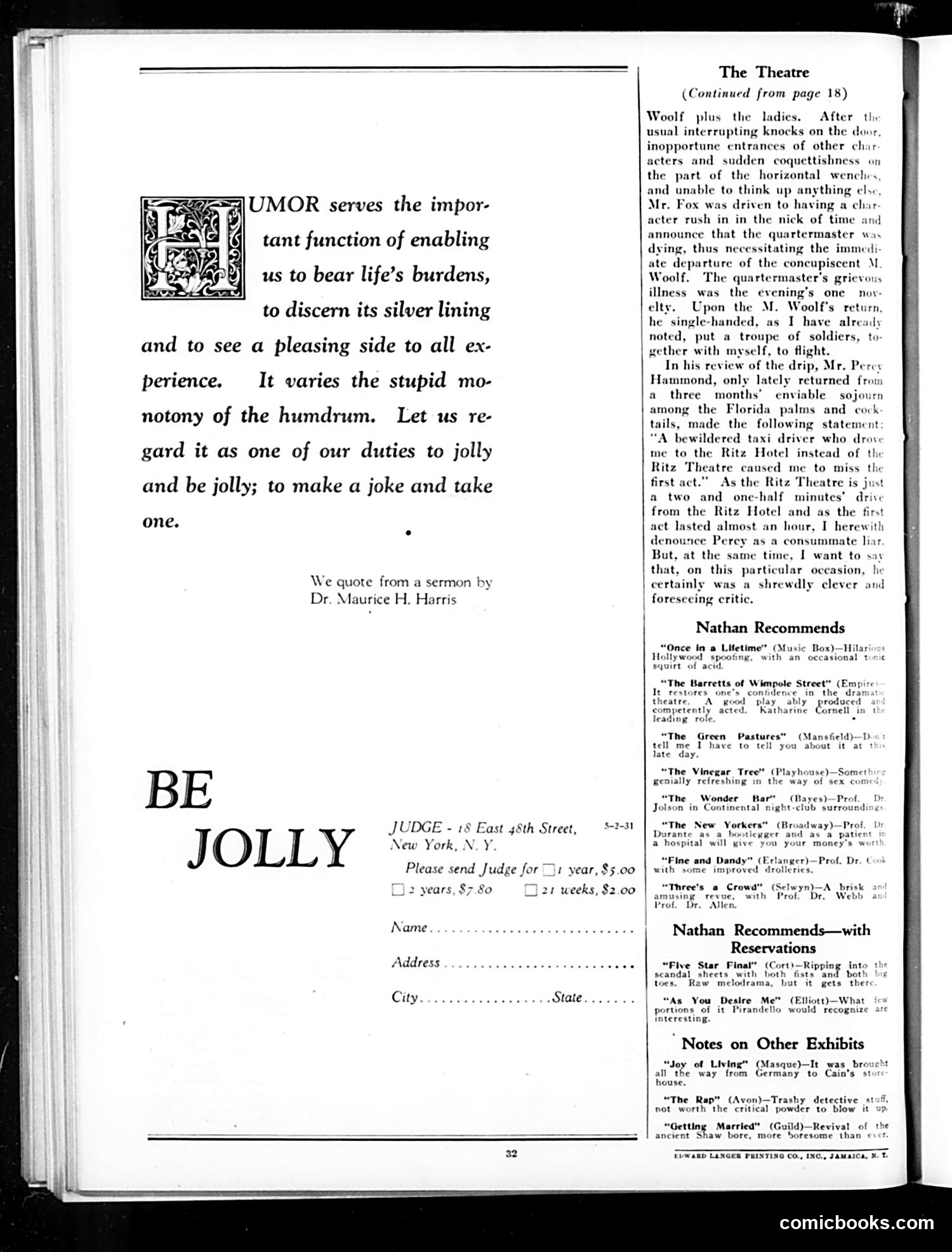
Judge Magazine Theatre Page Analysis This is primarily a theatre review section with advertising. The main content critiques recent Broadway productions and performances. The page includes a sermon quotation from Dr. Maurice H. Harris about humor's importance in enduring life's difficulties, followed by theatre recommendations and reviews. Critics discuss shows like "Once in a Lifetime" (satirizing Hollywood), "The Barretts of Wimpole Street" (starring Katharine Cornell), and "The Green Pastures." A notable review by Percy Hammond is mocked for claiming a taxi driver caused him to miss the first act of a show—the reviewer sarcastically calculates this as impossible given the Ritz Hotel's proximity to the Ritz Theatre and the act's length, calling Hammond a "consummate liar" while grudgingly acknowledging his critical acumen. The page concludes with a subscription advertisement for Judge magazine itself ("BE JOLLY") and a list of other theatrical exhibits being reviewed. This appears to be from the early 1930s based on the productions mentioned.
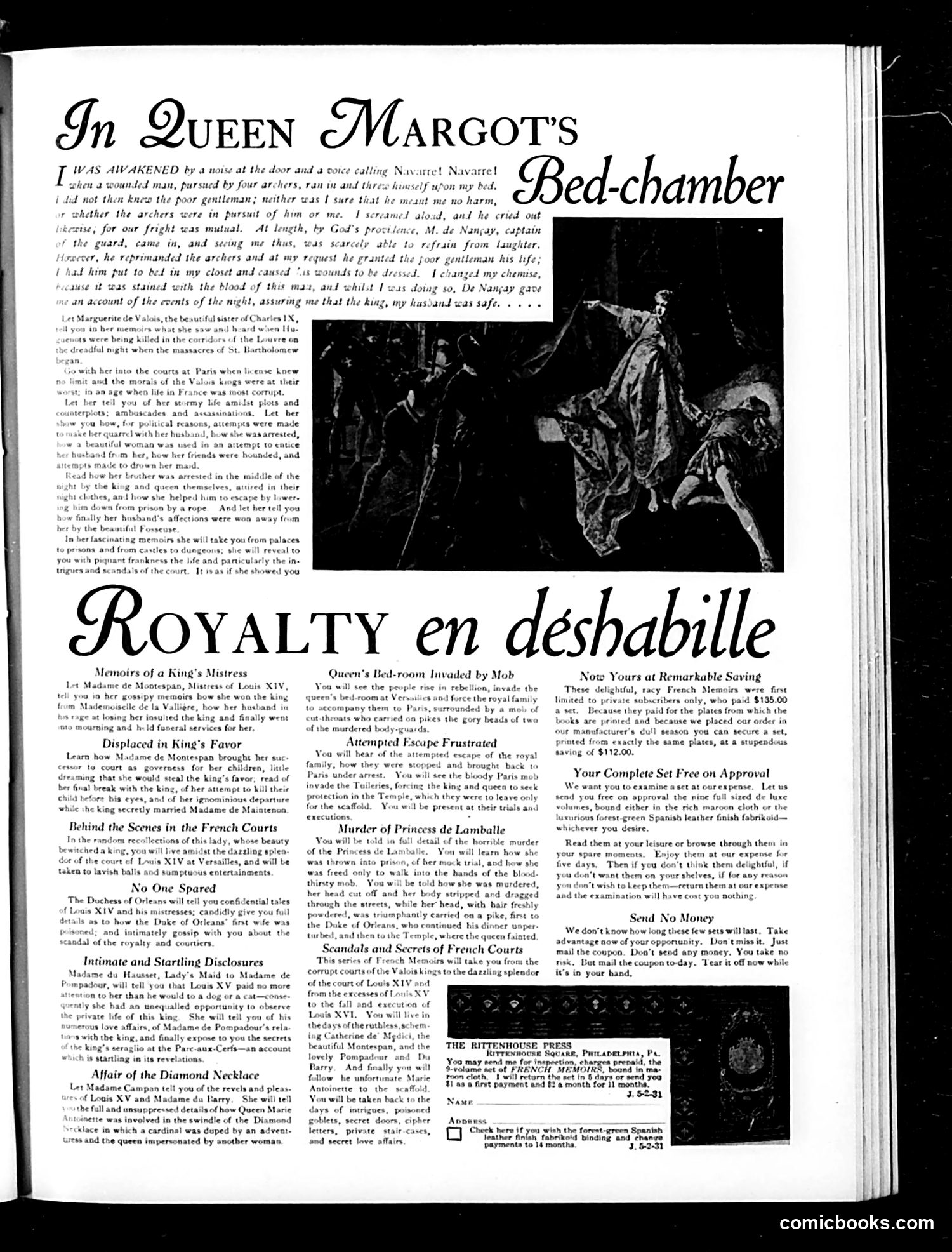
Queen Margot's Bed-chamber: Judge Magazine Content Analysis This page primarily advertises a book series: *French Memoirs* — intimate court narratives attributed to historical figures like Queen Margot (wife of Henry IV), Madame de Montespan (Louis XIV's mistress), and accounts of French royal scandals. The dramatic illustration depicts a woman in bed startled by an armed man seeking refuge ("Navarre!"), evoking the sensational historical anecdotes promised in the memoirs. The satire lies in the title's double meaning: *"Royalty en déshabille"* (royalty in undress/dishabille) — suggesting both literal bedroom scenes and figuratively "undressed" royal secrets. Judge mocks the era's appetite for exposés of royal misconduct, affairs, and violence while marketing these lurid tales to readers. The text emphasizes scandalous content: assassination plots, infidelity, imprisonment, mob violence, and murder — positioning the memoirs as revealing royal hypocrisy and moral corruption behind palace facades. The advertisement exploits Victorian-era curiosity about aristocratic depravity.
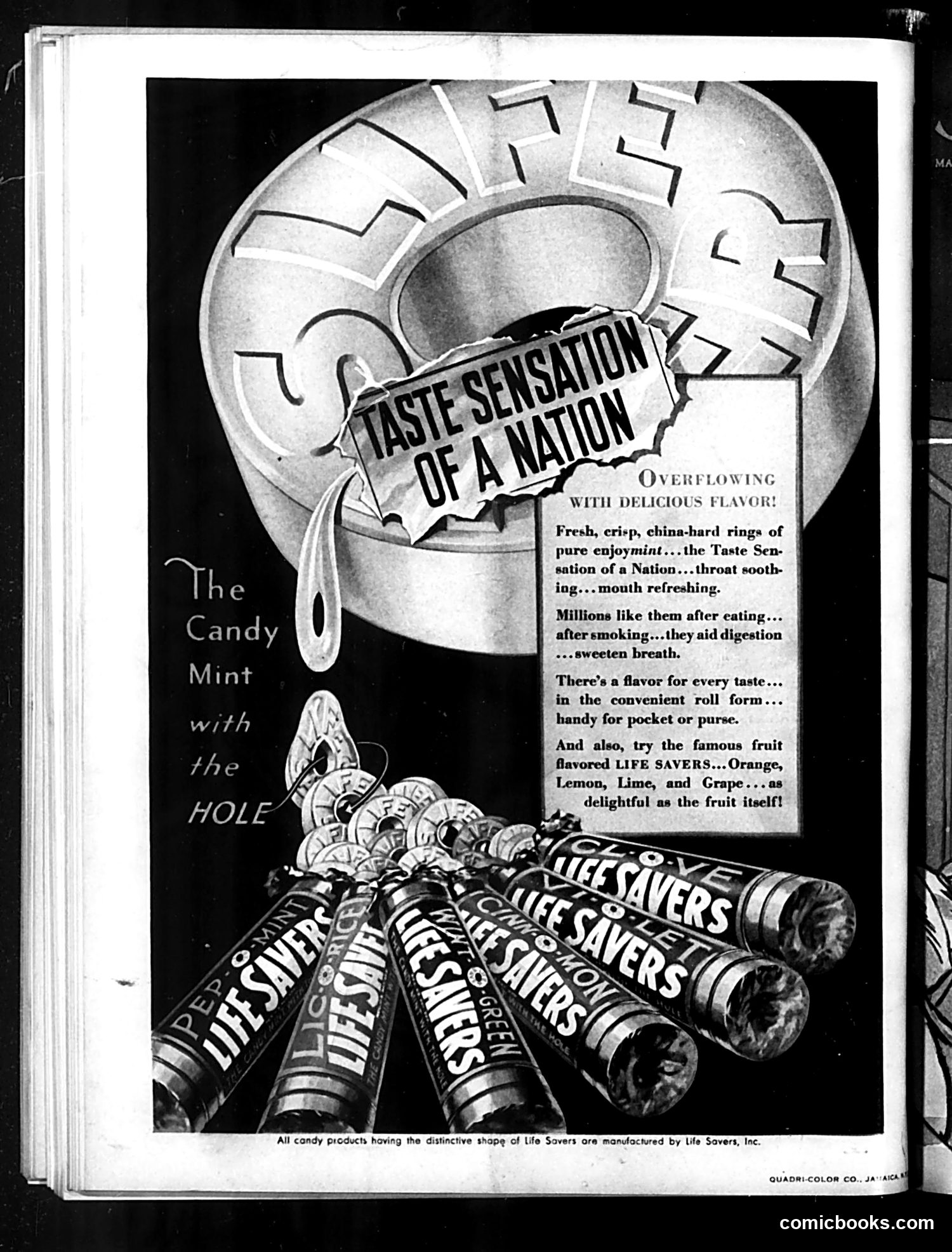
Life Savers Candy Advertisement This is primarily a Life Savers candy advertisement, not political satire. The page features a large illustration of a Life Saver mint candy (shown as a ring-shaped object with a hole) positioned like a mouth opening, with the slogan "The Candy Mint with the HOLE." Below are displayed several Life Savers roll packages in different flavors. The copy emphasizes the product's practical benefits: freshness, digestive aid, breath-sweetening qualities, and portability ("handy for pocket or purse"). Multiple flavor varieties are highlighted—both mint and fruit flavors (orange, lemon, lime, grape). This appears in Judge magazine likely as a paid advertisement rather than editorial content. The visual pun (the candy's hole forming a mouth) was the primary humor vehicle in this straightforward commercial promotion of a popular early-twentieth-century candy product.