judge
Judge — May 9, 1931
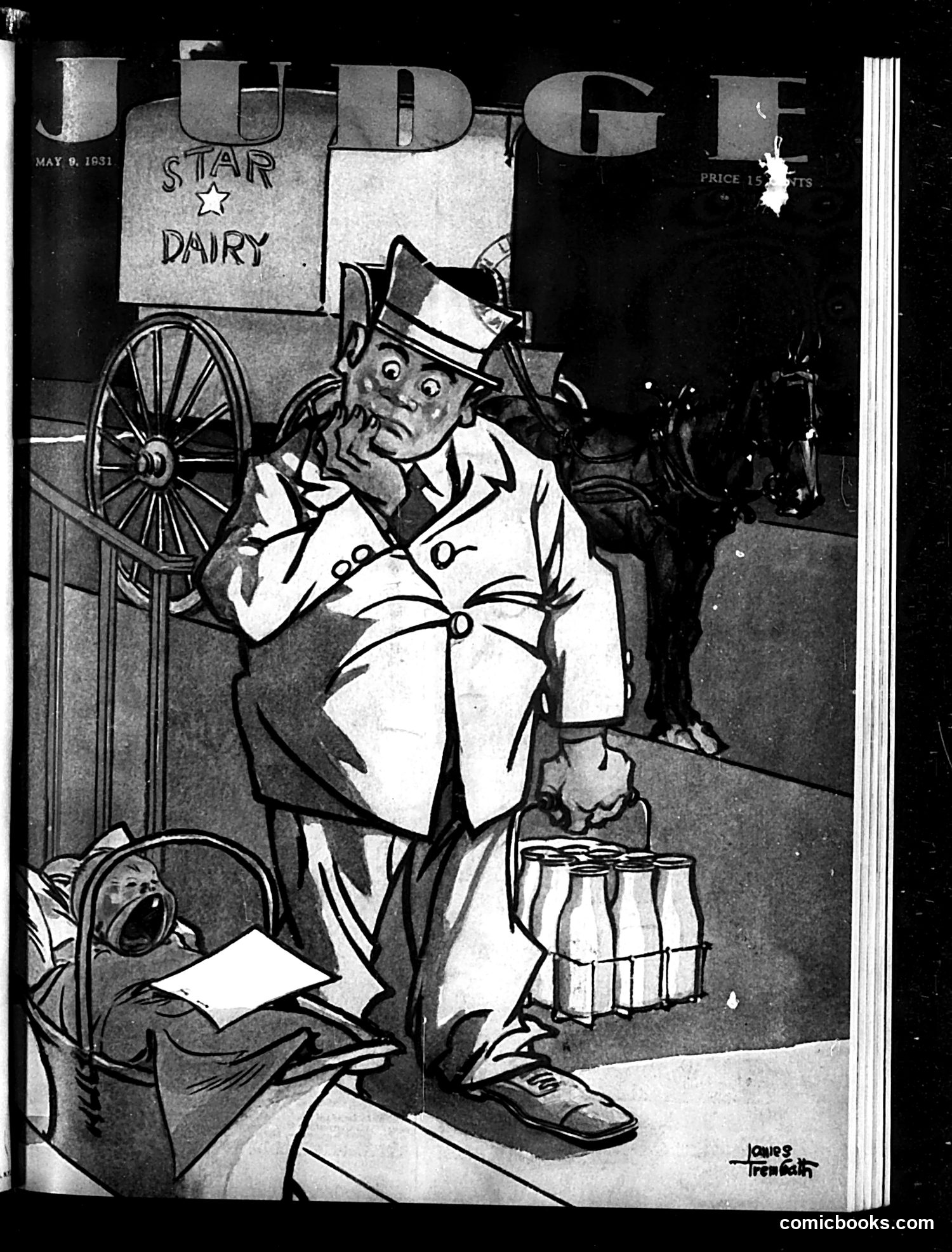
Analysis of Judge Magazine Cover (May 9, 1931) This cover features a portly milkman or dairy deliveryman in exaggerated caricature, dressed in white coat and straw hat, standing before a "Star Dairy" wagon. He appears distressed or anxious, holding his head in concern while surrounded by milk bottles and dairy equipment. The satire likely references economic anxieties during the Great Depression (1931 context), possibly commenting on: - Dairy industry struggles or price fluctuations - Labor concerns for working-class tradesmen - Consumer buying power for basic goods like milk The exaggerated facial features and body type employ caricature typical of 1930s satirical illustration, though the specific economic or social complaint remains unclear without additional contextual text or advertisements on the page.
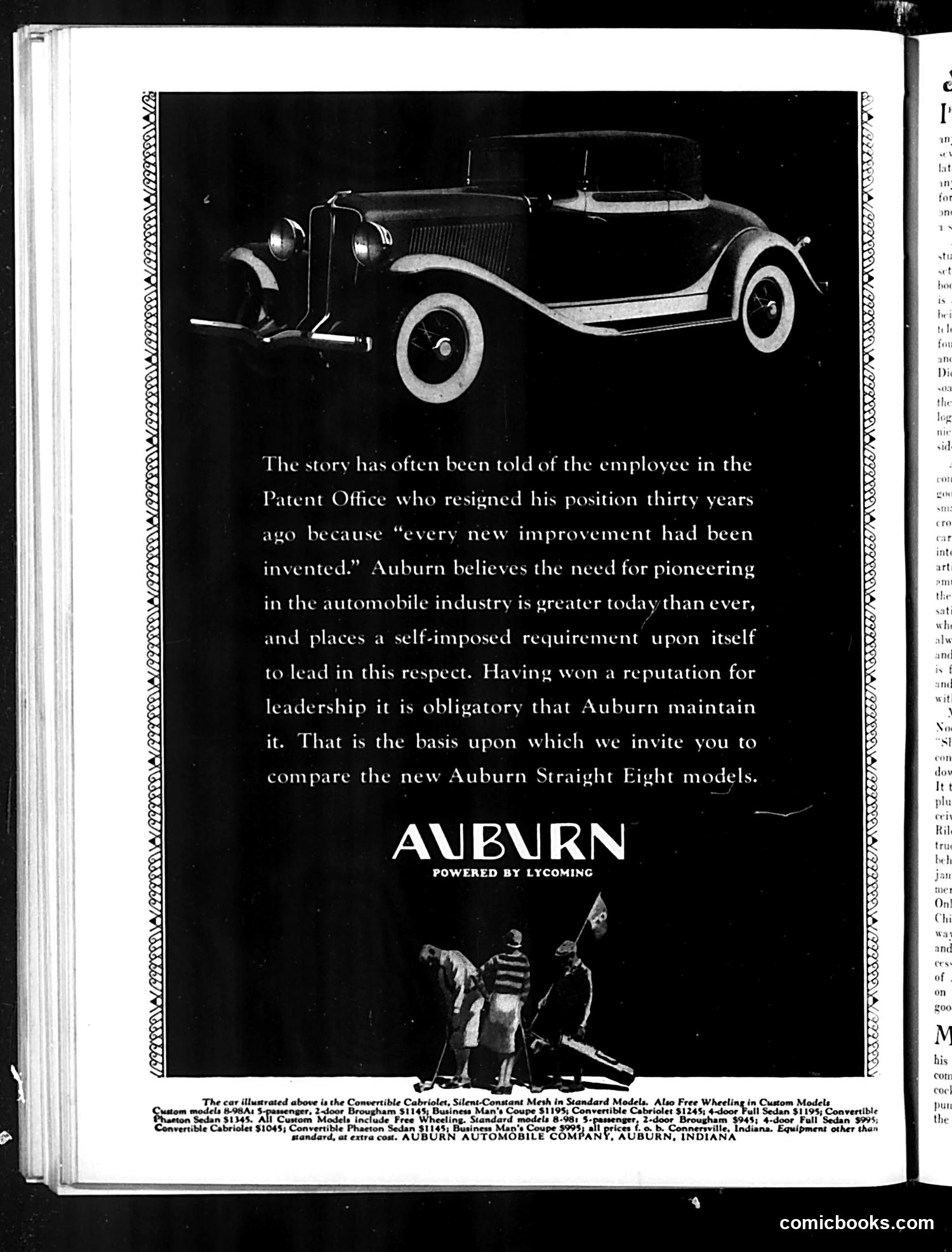
Analysis This page is primarily an advertisement for Auburn automobiles, not political satire. The ad features a luxury roadster and appeals to consumers by invoking Auburn's reputation for innovation and leadership in the automobile industry. The text references a (possibly apocryphal) story about a Patent Office employee who resigned decades earlier because "every new improvement had been invented"—suggesting the automobile industry remains dynamic and competitive. Auburn positions itself as a pioneering leader that must maintain its innovative edge, inviting readers to compare Auburn's new "Straight Eight models" favorably to competitors. The small figures at the bottom appear decorative rather than satirical. This is fundamentally commercial marketing rather than editorial commentary.
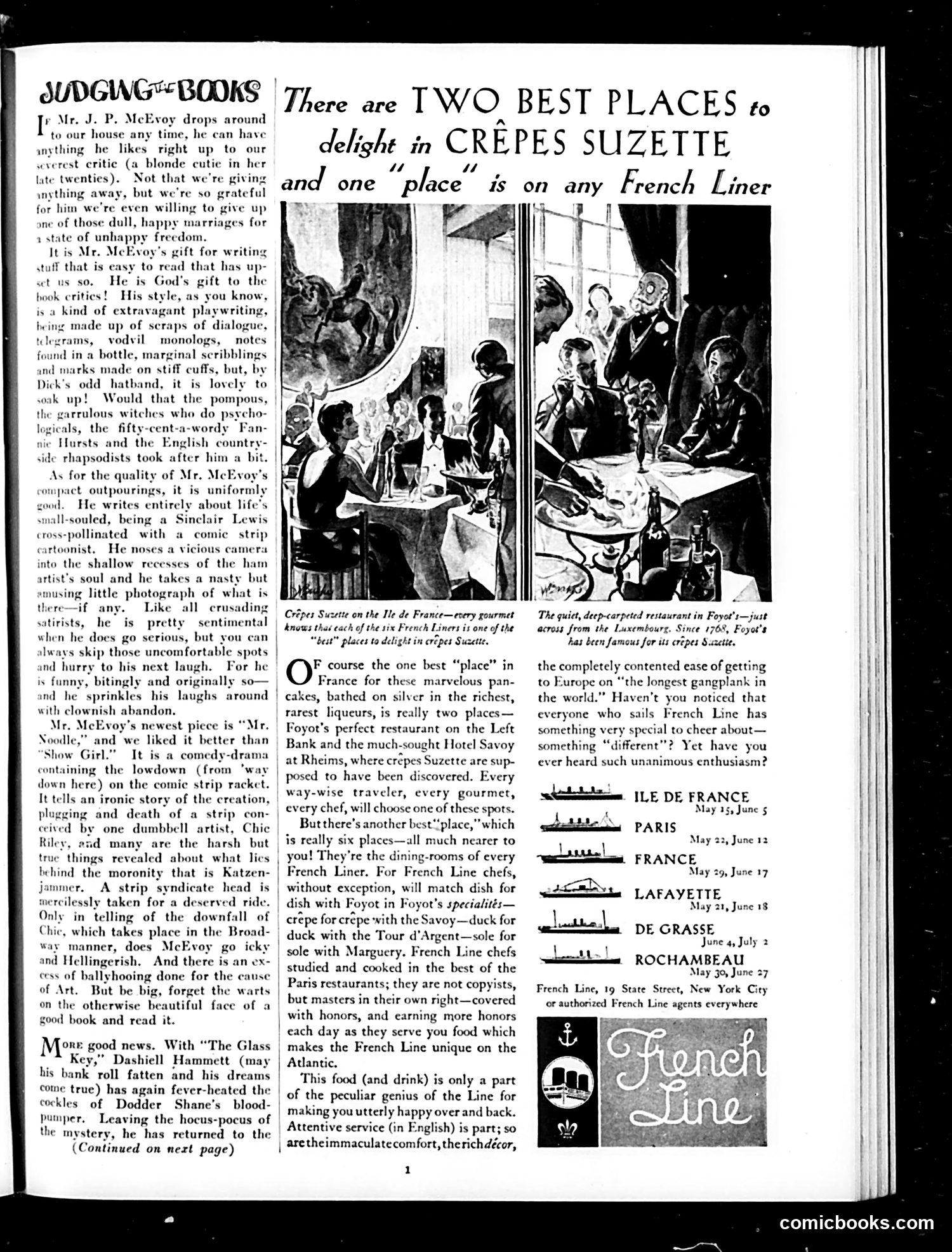
Analysis This page is primarily advertising, not political satire. The main content promotes the French Line cruise ship company and specifically Crêpes Suzette, a French dessert. The two illustrations show dining scenes aboard French ocean liners—one depicting passengers enjoying the dish at a restaurant, the other showing a more formal dining room. The text argues that French Line ships offer superior dining experiences compared to competitors, highlighting the culinary expertise of French chefs and specific dishes like Crêpes Suzette, duck with orange sauce, and sole with Burgundy sauce. The accompanying section "Judging the Books" reviews J.P. McEvoy's writing style—it's unrelated satirical commentary on an author's work, not political content. This represents 1920s luxury travel marketing rather than social or political commentary.
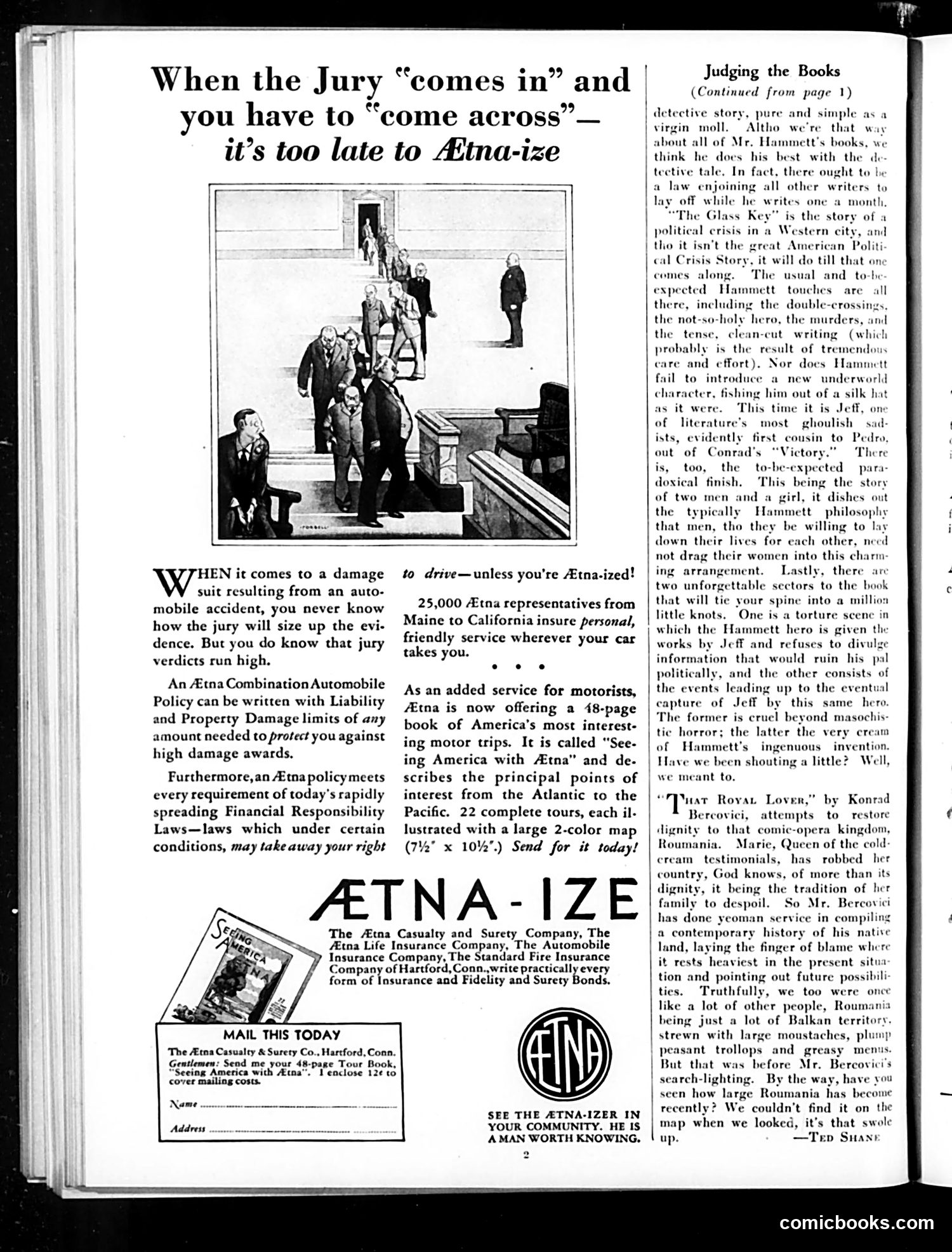
Analysis This page is primarily advertising for Ætna Insurance, not political satire. The large illustration depicts a courtroom jury scene, used to promote Ætna's automobile liability coverage. The advertisement warns that if you're in a car accident, "it's too late to Ætna-ize"—meaning you should purchase their insurance beforehand. The right column contains a book review titled "Judging the Books," discussing detective fiction and works by an author named Hammett (likely Dashiell Hammett). The review mentions "The Glass Key" and other stories. There are no identifiable political figures or satirical commentary on this page. It's a straightforward insurance advertisement using a jury courtroom scenario as its sales hook, combined with unrelated literary criticism.
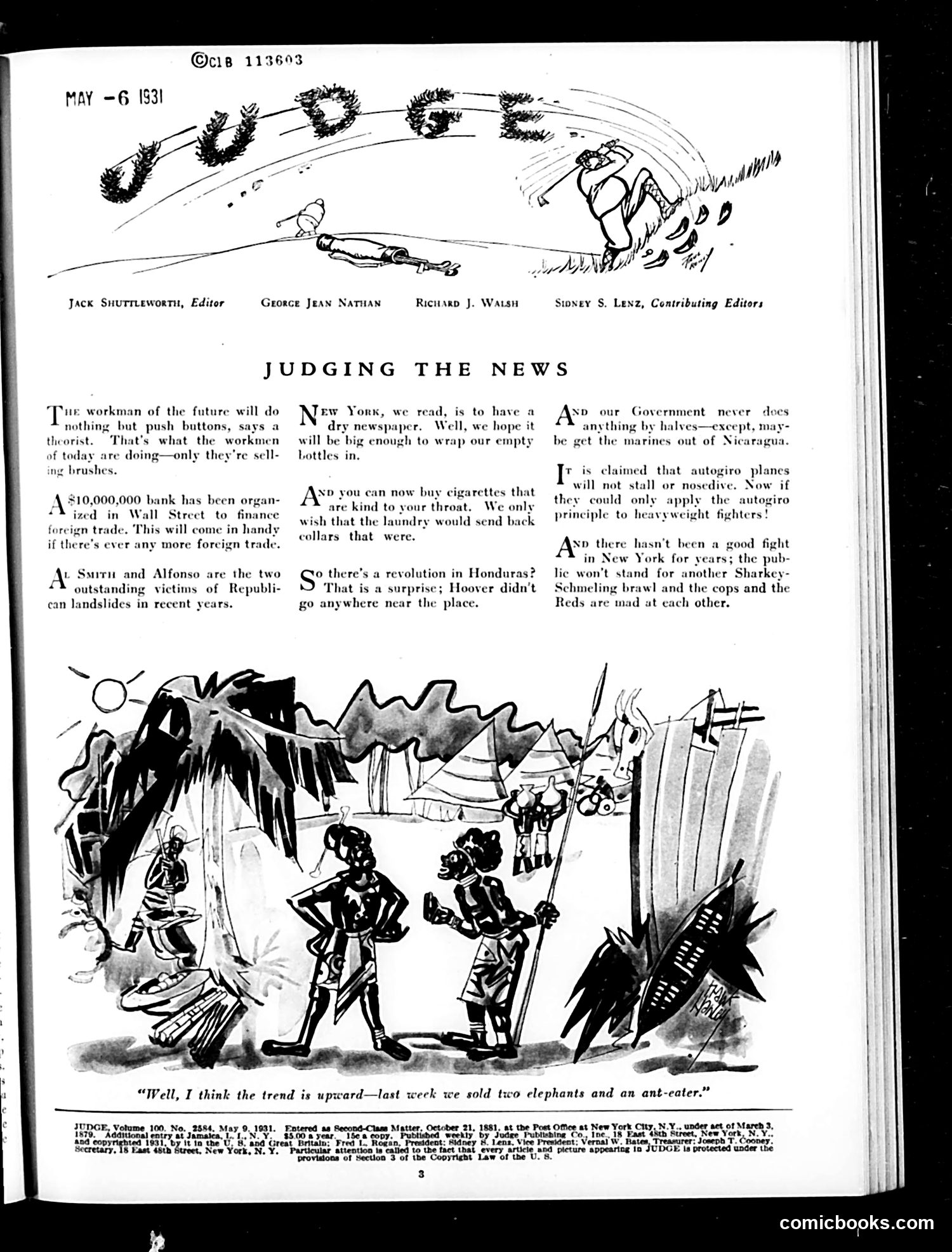
"Judging the News" - May 6, 1931 This satirical column mocks contemporary news items through brief commentary and a cartoon. The editorial criticizes: 1. Labor predictions about future workers only "pushing buttons" 2. Wall Street financing foreign trade through a $10M bank 3. Republican landslides — mentioning Suri and Alfonso as "outstanding victims" 4. Cigarette marketing claims about throat-kindness 5. Honduras revolution — sarcastically questioning Hoover's involvement The large cartoon appears to depict a circus or carnival scene with military figures, likely satirizing political instability or conflict. The caption reads: "Well, I think the trend is upward—last week we sold two elephants and an ant-eater," suggesting commentary on political/economic chaos presented as entertainment or profit opportunity. The overall tone criticizes government, big business, and media sensationalism.
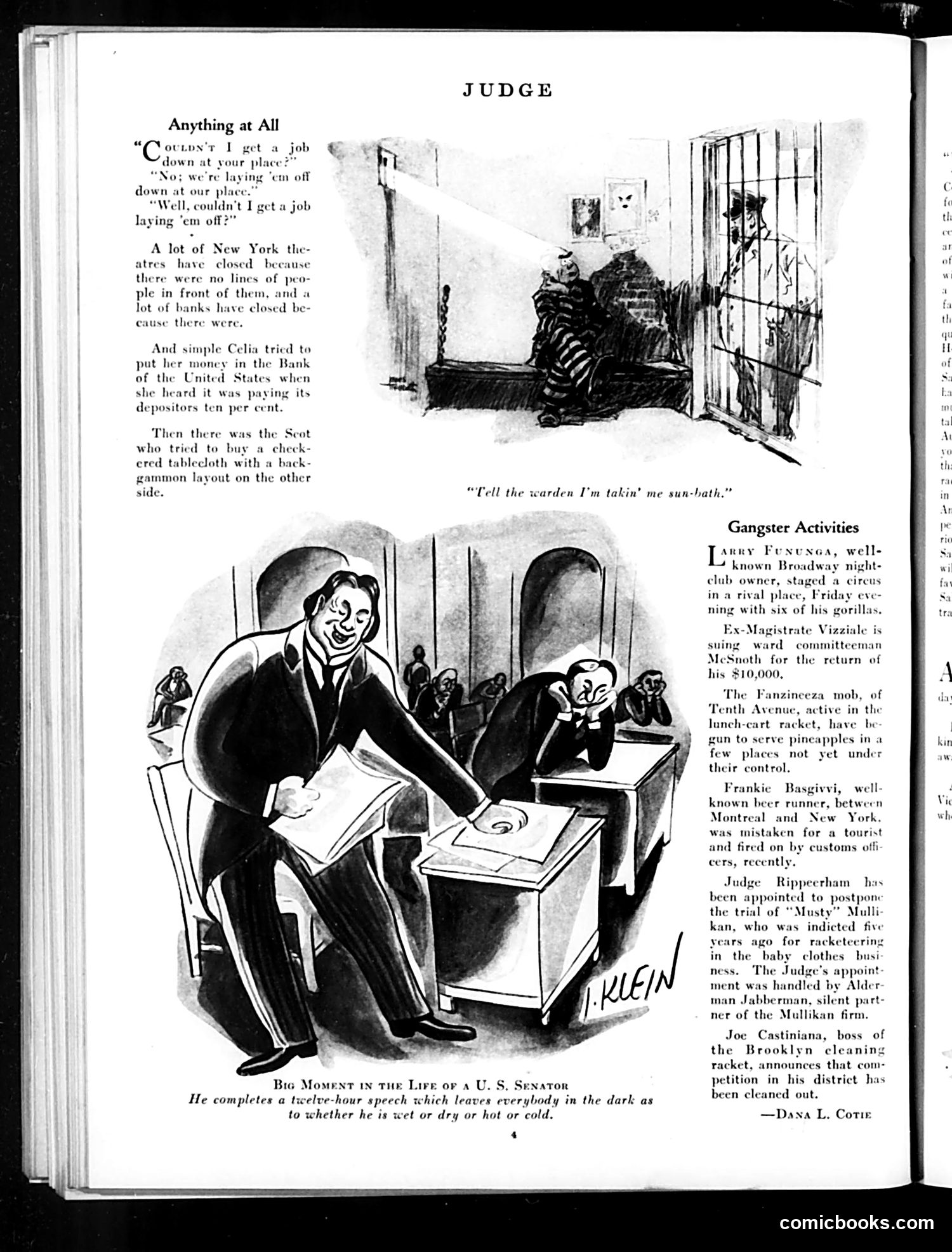
Analysis Top cartoon ("Anything at All"): This satirizes Depression-era unemployment and bank failures. The dialogue shows someone unable to find work because businesses are laying off staff, and banks are closing due to lack of deposits. Celia's attempt to save money becomes impossible when the Bank of the United States fails—a reference to the actual 1930 bank collapse. The satire highlights how economic collapse affected ordinary citizens trying to manage finances. Bottom cartoon ("Big Moment in the Life of a U.S. Senator"): Shows a senator completing a twelve-hour speech while colleagues sleep or appear indifferent. The caption's irony—"leaves everybody in the dark as to whether he is wet or dry or hot or cold"—satirizes lengthy, meaningless Senate speeches that fail to clarify anything substantive, likely referencing Prohibition-era political debates.
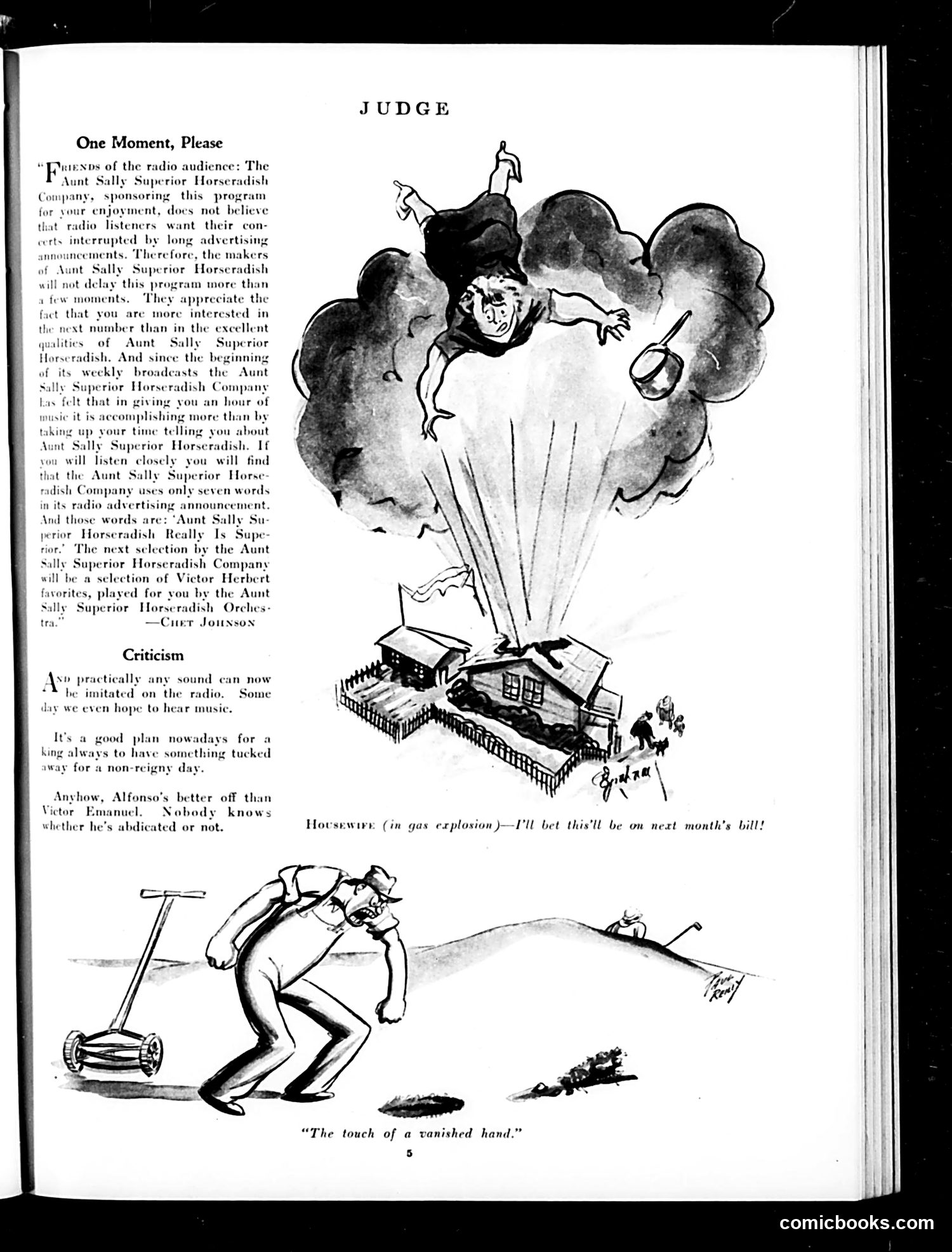
Analysis This page from *Judge* magazine contains commentary and cartoons criticizing radio advertising. "One Moment, Please" defends radio listeners against intrusive ads, noting that the Aunt Sally Superior Horseradish Company limits its advertising to just seven words—a barely-concealed joke about how minimal this protection truly is. "Criticism" mocks radio's general degradation, suggesting that "practically any sound can now be insulted on the radio" and expressing hope that "some day we even hope to hear music." The top cartoon depicts a gas explosion from a radio broadcast, captioned "I'll bet this'll be on next month's bill!"—satirizing unexpected radio-related costs. The bottom cartoon shows a man examining his lawn for damage, titled "The touch of a vanished hand"—likely referencing radio's invasive presence even in private spaces.
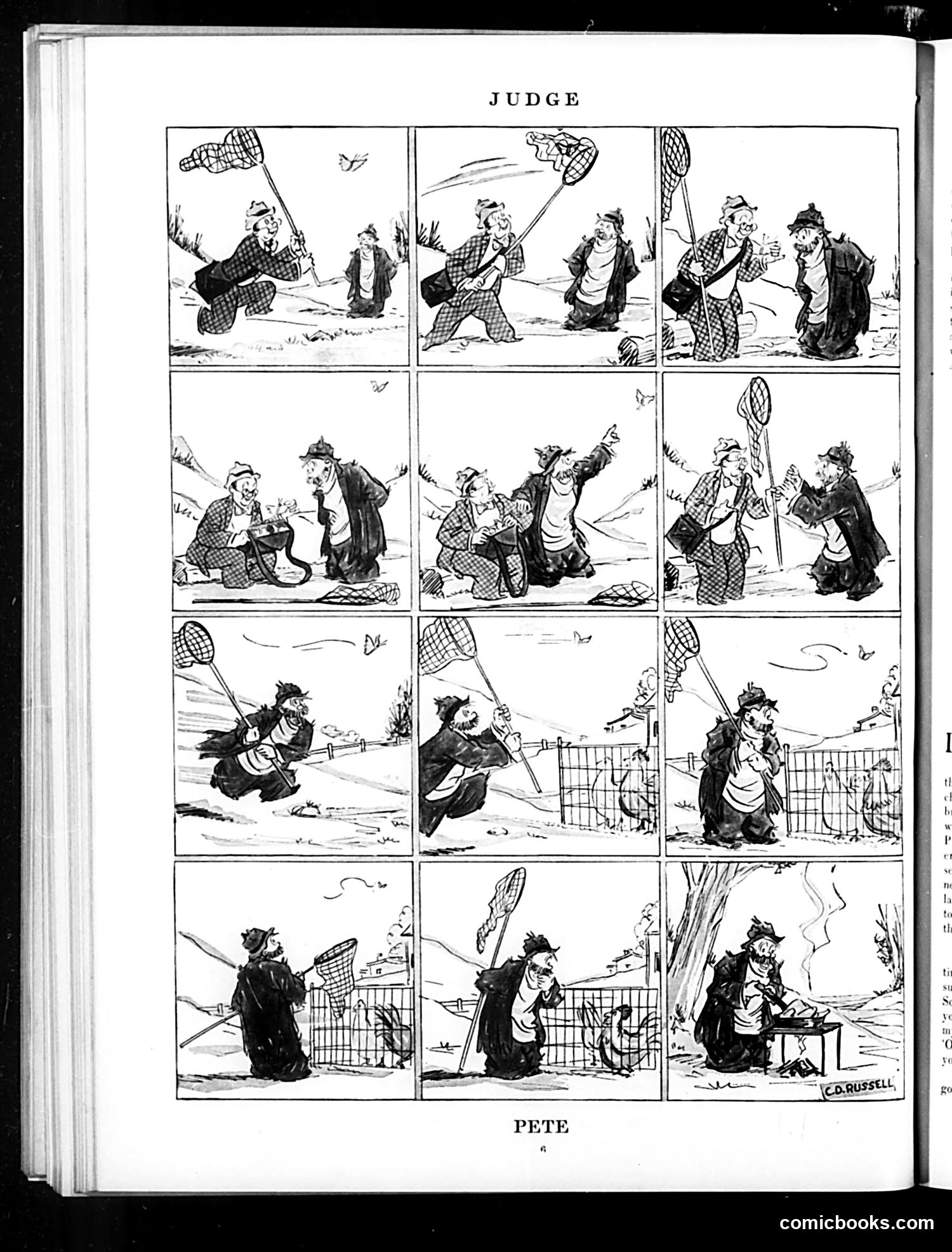
Judge Magazine Comic Page Analysis This is a 12-panel sequential comic strip titled "Judge" and "Pete" (credited to C.B. Russell). It depicts a man in a checkered suit attempting to catch butterflies or insects with a net near a pond or wetland. The narrative shows him progressively frustrated: he chases, swings, misses repeatedly, falls into water, and eventually appears to give up—ending in what looks like resignation or exhaustion by a fire. Without additional context about the publication date or specific political references, this appears to be gentle satirical humor about futility and persistence rather than pointed political commentary. The humor derives from physical comedy and the absurdity of the man's determined but unsuccessful efforts. The identity of "Pete" remains unclear from the image alone.
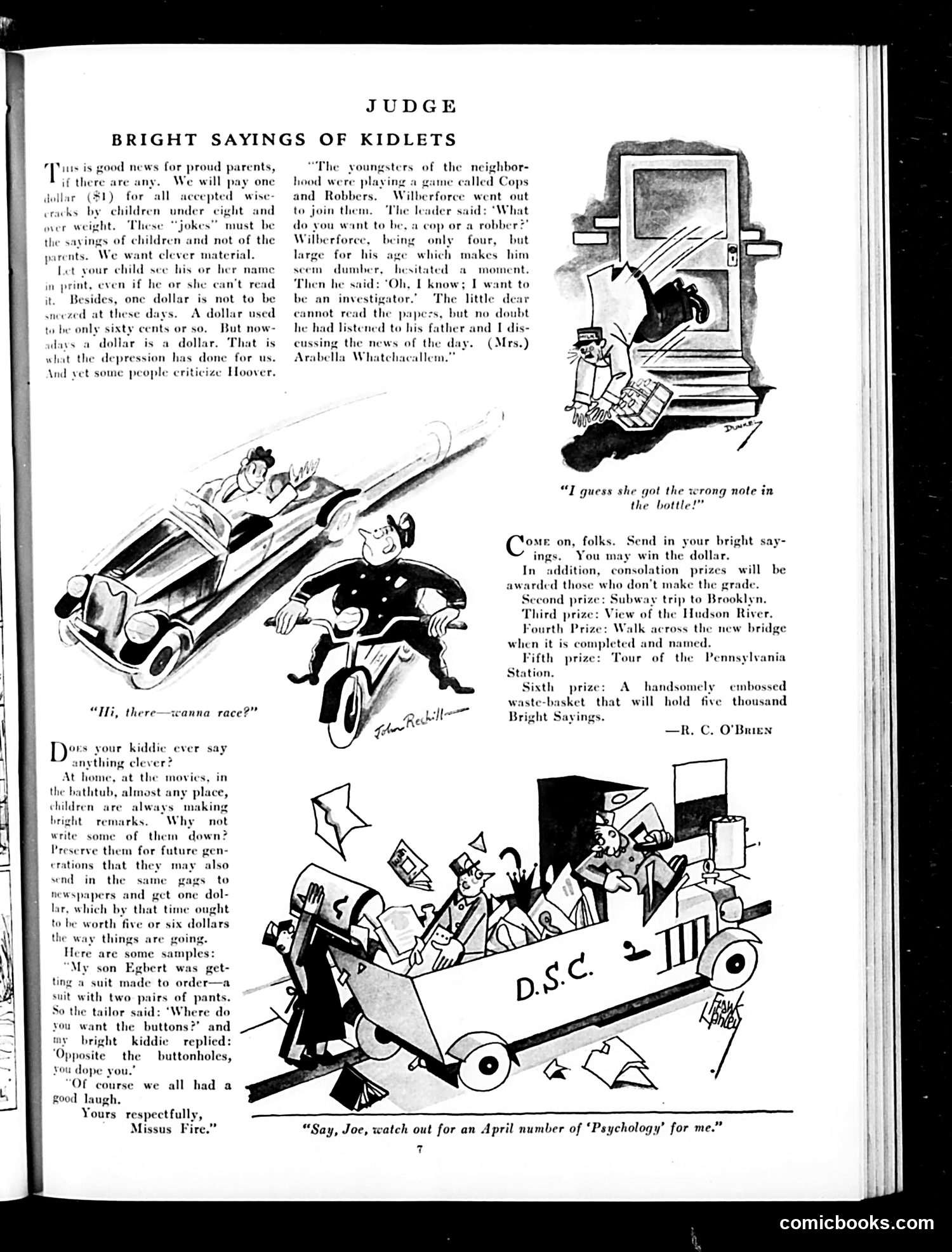
"Bright Sayings of Kidlets" — Judge Magazine Analysis This page is a humor column soliciting witty remarks from children under eight years old, offering $1 payment per accepted submission—presented as generous during the Depression era. The satire operates on multiple levels: The Setup: Judge claims to celebrate children's unfiltered wisdom while clearly acknowledging parents actually write these submissions, undercutting the premise immediately. The Jokes: Three examples illustrate children's innocent logic ("I want to be an investigator" instead of cop or robber), malapropisms, and accidental insults ("Opposite the buttonholes, you dope you"). The Social Context: The column mocks Depression-era economics—a dollar was once worth sixty cents, now it's just a dollar; people criticize President Hoover despite economic hardship. The "consolation prizes" (subway trips, bridge walks, a waste-basket) satirize how little $1 actually represents. The Cartoons: Show children racing and a chaotic scene labeled "D.S.C." (unclear reference), reinforcing the theme of childish mischief and parental amusement. The overall tone is gentle mockery of middle-class sentimentality about children's "wisdom."
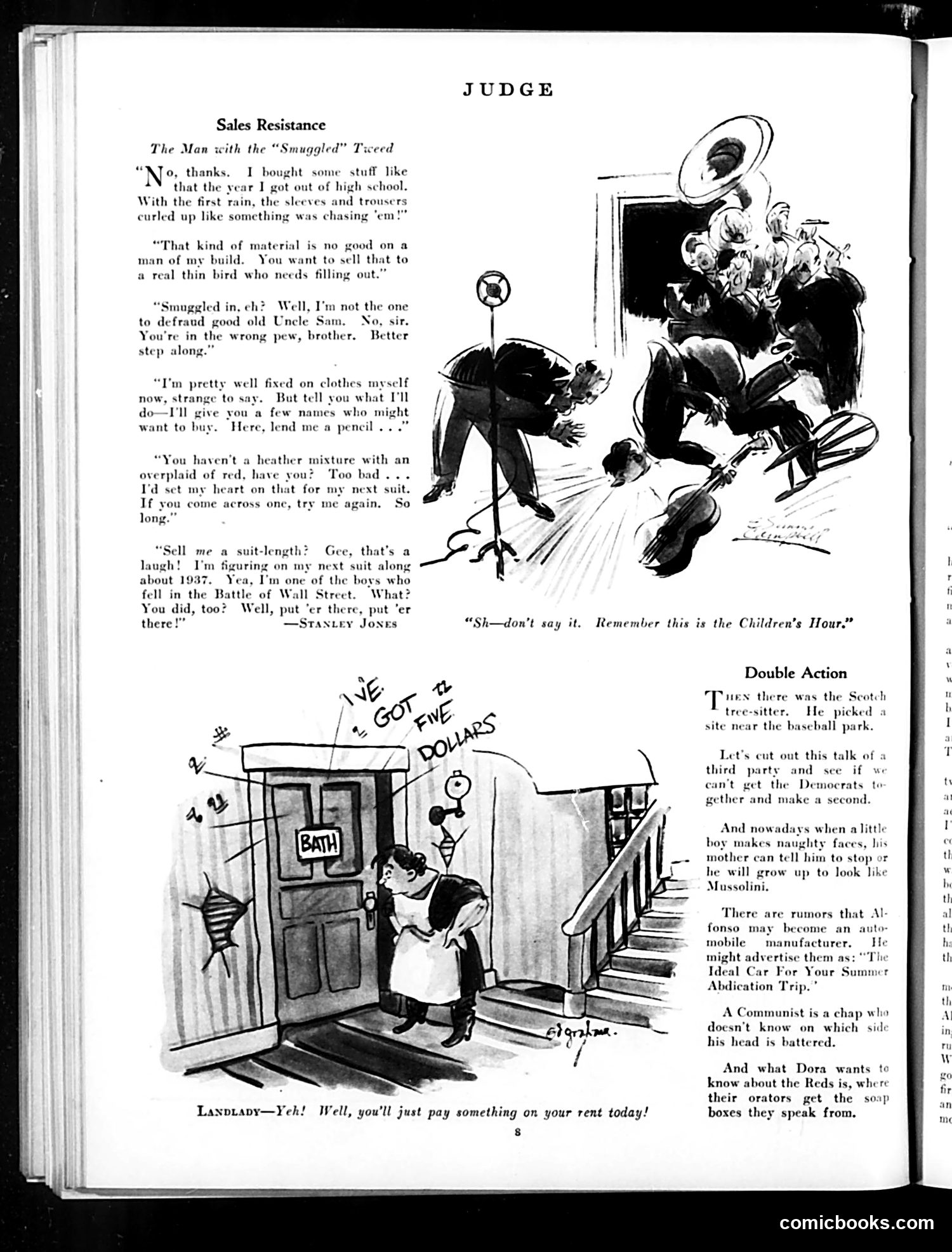
Analysis of Judge Magazine Page This page contains three satirical pieces from Judge magazine (likely 1930s based on references). "Sales Resistance" depicts a clothing salesman's pitch failing repeatedly. The joke: a man refuses to buy "smuggled" fabric (likely contraband goods during Prohibition era), citing moral concerns about defrauding "Uncle Sam," yet immediately offers to refer customers. The irony is his selective ethics. He also mentions the "Battle of Wall Street"—a reference to the 1929 stock market crash, suggesting economic hardship. "Double Action" shows a landlady collecting rent while a tenant hides. The joke plays on desperation during economic depression. The right column contains brief satirical quips mocking contemporary figures and politics: Mussolini's appearance, rumors about Alfonso (possibly King Alfonso of Spain), and jabs at Communists and Democrats. These are topical commentary rather than developed cartoons. The overall tone reflects 1930s American anxiety: economic hardship, political instability, and suspicion of foreign ideologies.
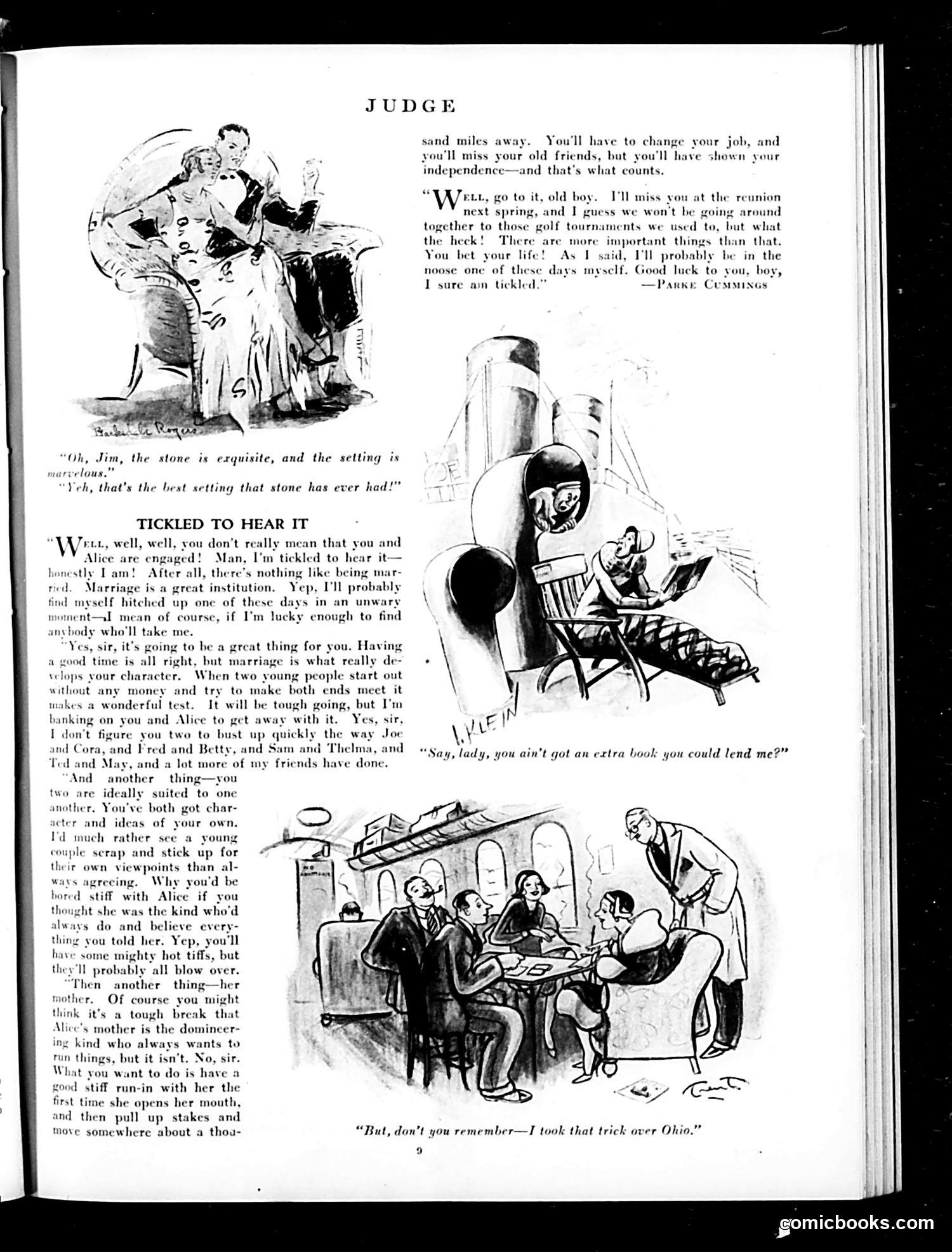
Judge Magazine Page Analysis This page contains three separate cartoons satirizing courtship, marriage, and domestic life in early 20th-century America. "Tickled to Hear It" (main text): An older man offers unsolicited marriage advice to a younger engaged man named Jim. The humor lies in the speaker's contradictions—he warns that marriage means sacrificing independence and friends, yet encourages Jim to proceed. He boasts about his own failed marriages (mentioning multiple divorced friends) while insisting marriage "develops character." The advice to have a "stiff run-in" with his future mother-in-law to establish dominance reflects period attitudes about marriage power dynamics. The three illustrated cartoons mock marital situations: an engagement ring's setting, a newlywed couple's cramped living space, and a card game where someone claims credit for a trick "over Ohio"—likely a reference to a card-playing deception between spouses. The overall satire targets patronizing male advice-giving and the gap between romantic ideals and marital reality.
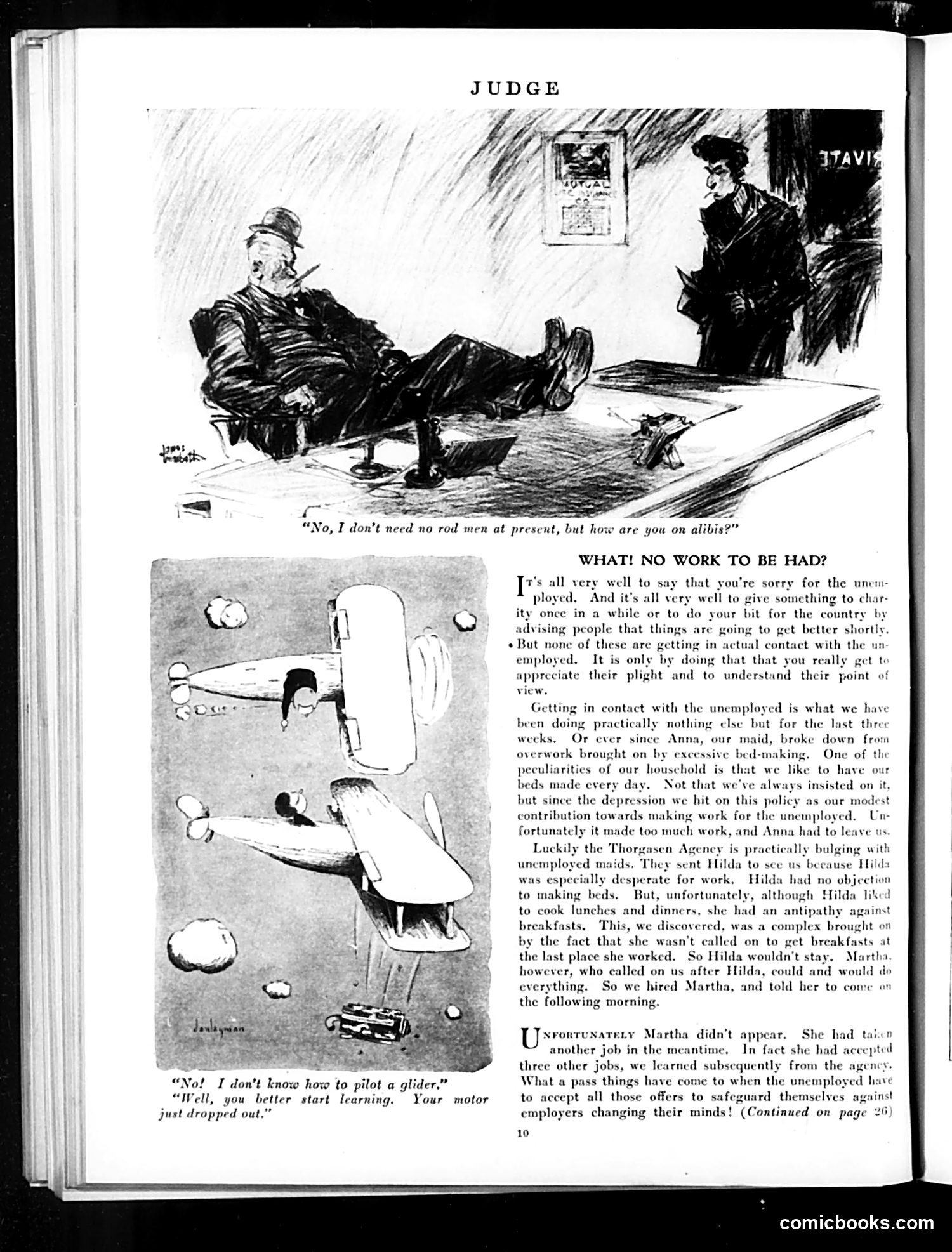
Analysis for Modern Readers This Judge magazine page satirizes Depression-era employment desperation through two interconnected cartoons and accompanying article. Top cartoon: A man reclines while interviewing someone, asking if they need "rod men" but inquiring about their "alibis"—suggesting employers were hiring people willing to commit crimes or provide false testimony, not legitimate workers. Bottom cartoon: A flying instructor tells a student, "You better start learning. Your motor just dropped out"—visual metaphor for unemployment's chaos. The article describes the author's household hiring unemployed maids through an agency. Each prospect—Hilda, Martha—either quits due to psychological quirks or accepts multiple competing job offers simultaneously to secure income. The satire targets both the absurdity of Depression unemployment and the desperation forcing jobless people to accept any work offered, even contradictory positions. The point: unemployment has become so severe that the distinction between employed and unemployed has collapsed; even "employed" people maintain multiple precarious jobs simultaneously out of fear.
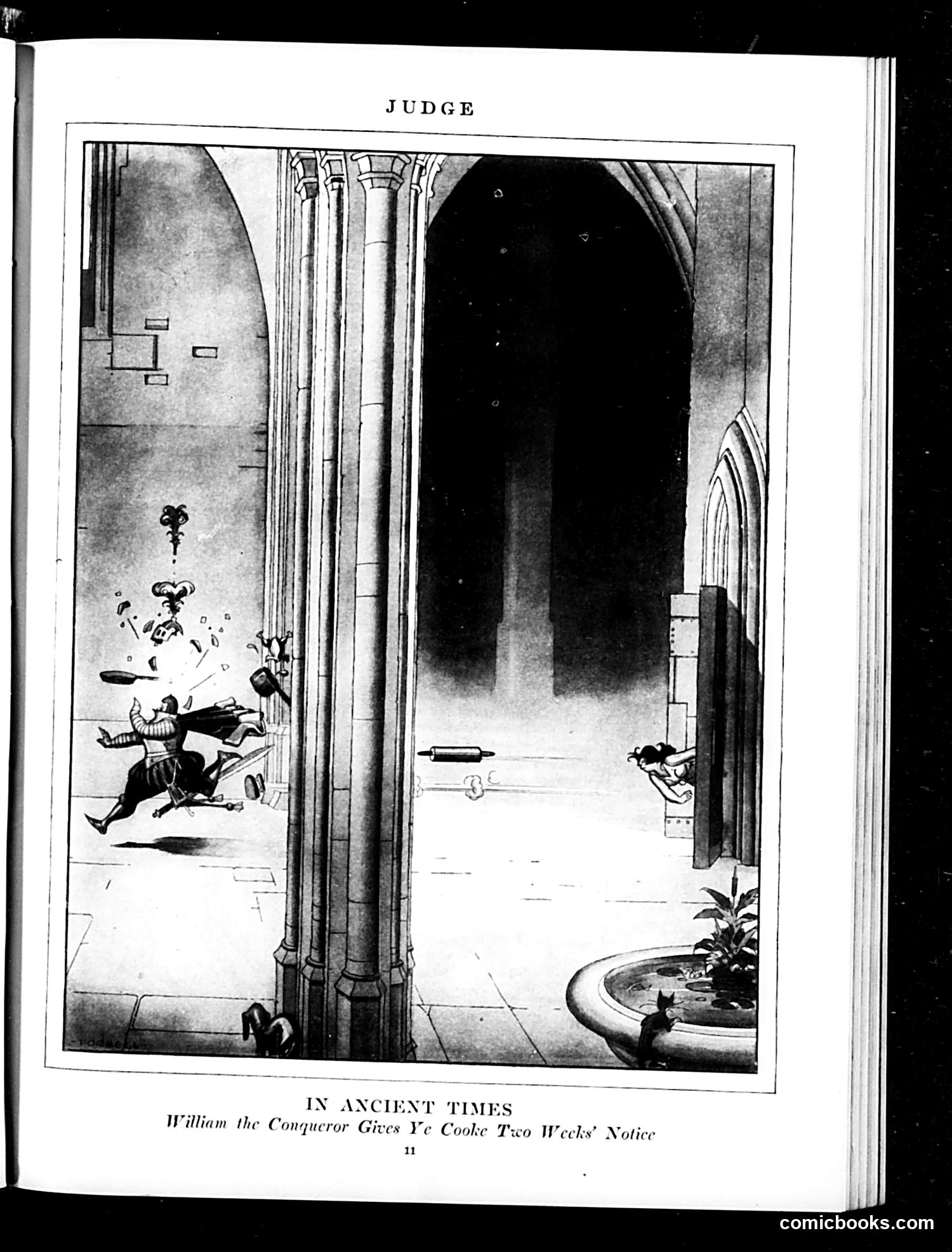
"Judge" Cartoon Analysis This is a satirical cartoon titled "In Ancient Times: William the Conqueror Gives Ye Cooke Two Weeks' Notice." The joke plays on a medieval setting to satirize modern labor practices. William the Conqueror (the Norman king who invaded England in 1066) is depicted firing a cook, delivering the formal "two weeks' notice" — a contemporary employment convention. A cook scrambles away in panic in a grand stone chamber while another figure (possibly a servant) observes from a doorway. The satire works by juxtaposing modern workplace formality with a historical figure, suggesting that even ancient rulers followed what was then considered proper dismissal procedure. This likely mocks either the rigidity of employment customs or perhaps critiques an employer's coldness in following protocol rather than showing mercy.
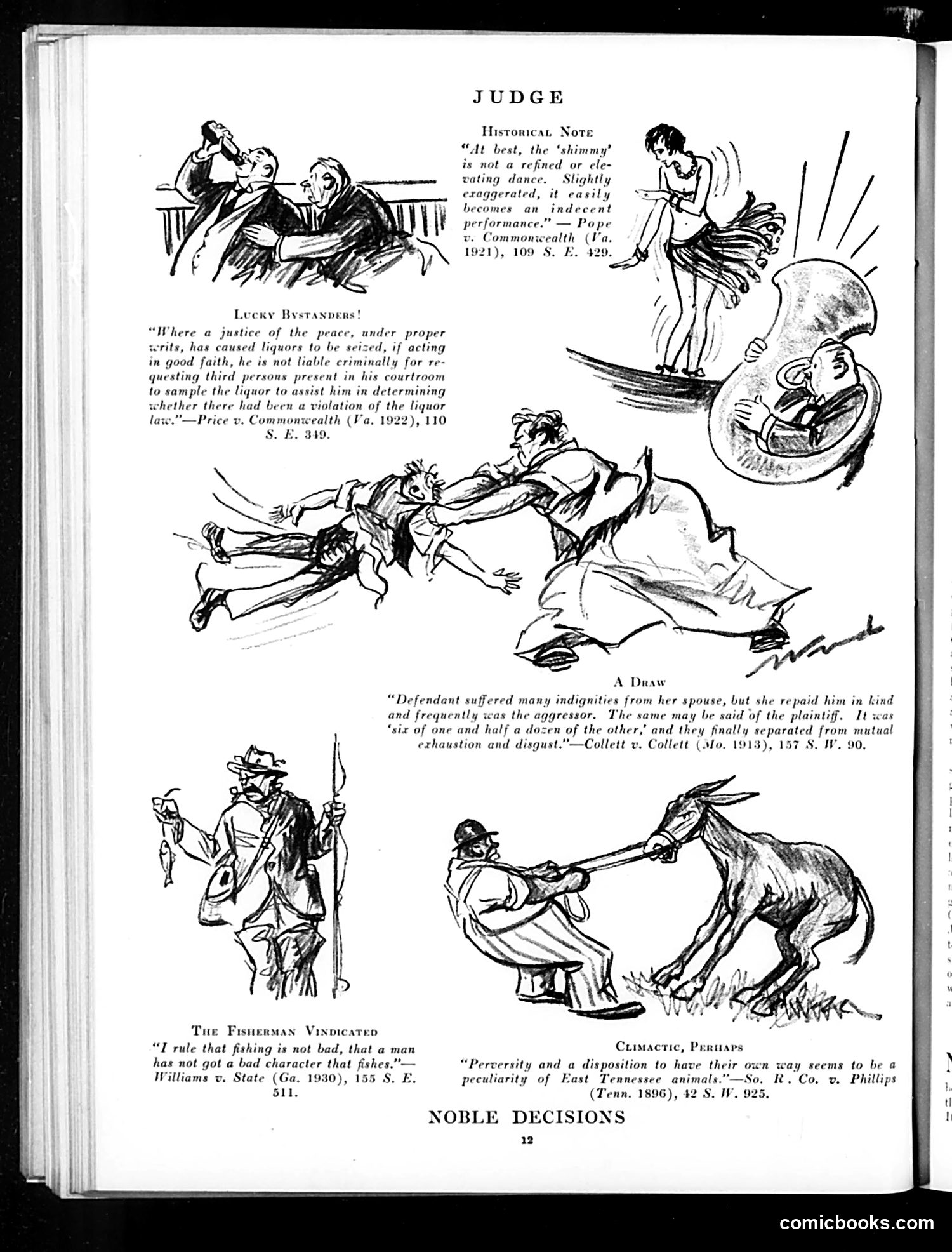
Judge Magazine Cartoon Analysis This page satirizes absurd legal rulings through illustrated vignettes paired with actual court case quotations. Each cartoon lampoons judicial decisions that seem ridiculous or permissive: "The Shimmy" mocks a Virginia court decision that distinguished between refined and "indecent" versions of the popular 1920s dance, implying courts were policing morality through dance. "Lucky Bystanders" ridicules a Virginia judge who reportedly asked courtroom observers to *taste seized liquor* to help determine violations—treating Prohibition enforcement as an excuse for sampling. "A Draw" illustrates a Missouri divorce where both spouses were equally violent, suggesting the court found their mutual brutality equally culpable. "The Fisherman Vindicated" and "Climactic, Perhaps" reference cases involving fishing rights and animal behavior, respectively. The satire suggests American courts were issuing decisions so peculiar—or lenient—they deserved public ridicule. This reflects 1920s-30s skepticism toward judicial authority during Prohibition and social change.
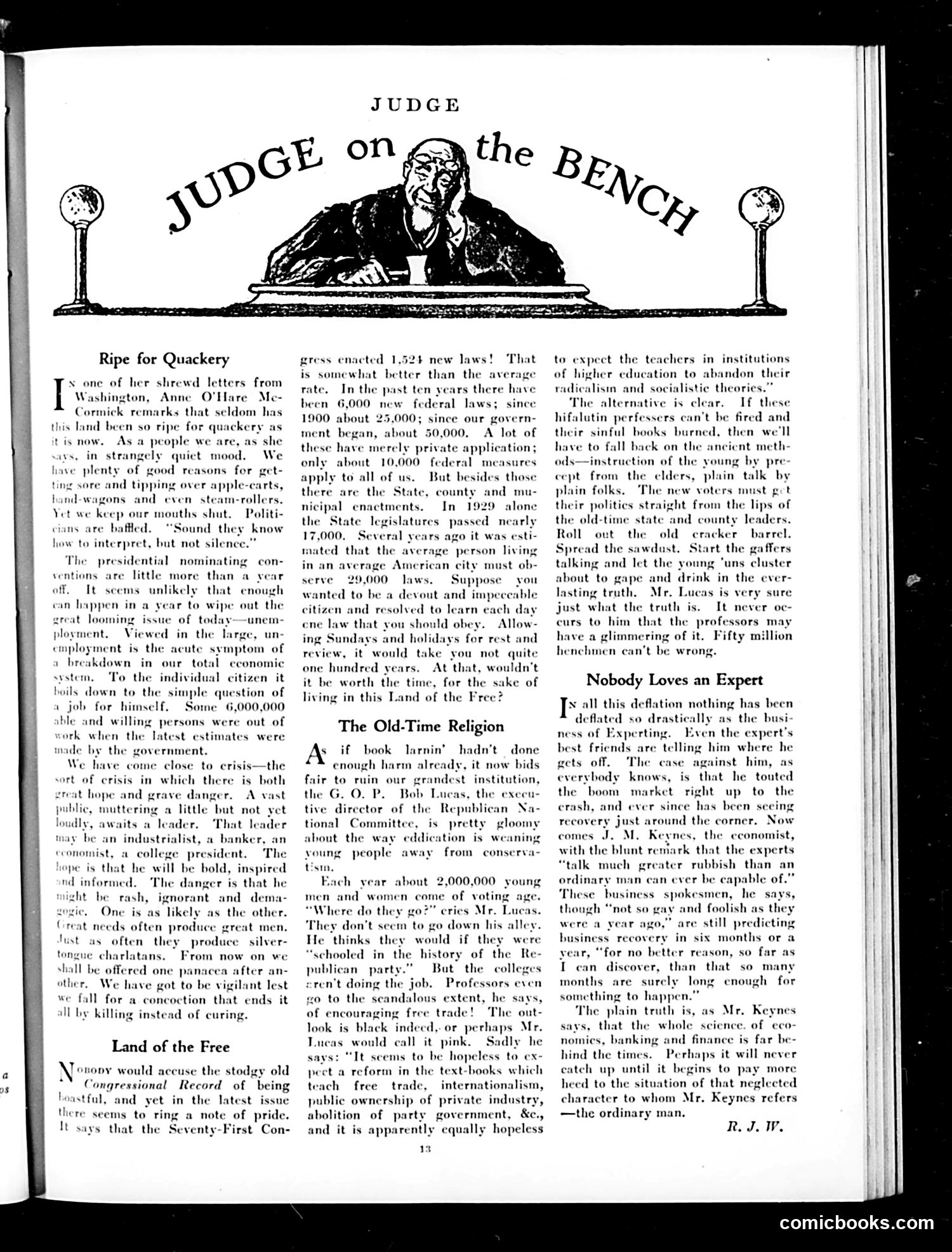
Judge Magazine Editorial Page Analysis This page from *Judge* magazine presents three satirical commentaries on American politics and society, likely from the early 1930s (references to the "Seventy-First Congress" and unemployment crisis suggest around 1931-1932). "Ripe for Quackery" warns that economic desperation from mass unemployment makes citizens vulnerable to demagogues and charlatan political leaders offering false solutions. "Land of the Free" mocks the proliferation of laws—Congress passed 1,524 laws alone; citizens must navigate 29,000 total laws. The satire suggests this contradicts the notion of living in a "free" nation. "The Old-Time Religion" ridicules Republican National Committee official Bob Lucas, who blames colleges for losing young voters by teaching "free trade, internationalism, and socialism" rather than loyalty to the Republican Party. The satire suggests conservatives want indoctrination, not education. All three pieces reflect *Judge's* conservative editorial stance, criticizing New Deal-era reforms, government expansion, and progressive academia while expressing anxiety about social instability and radical ideas gaining traction during the Depression.
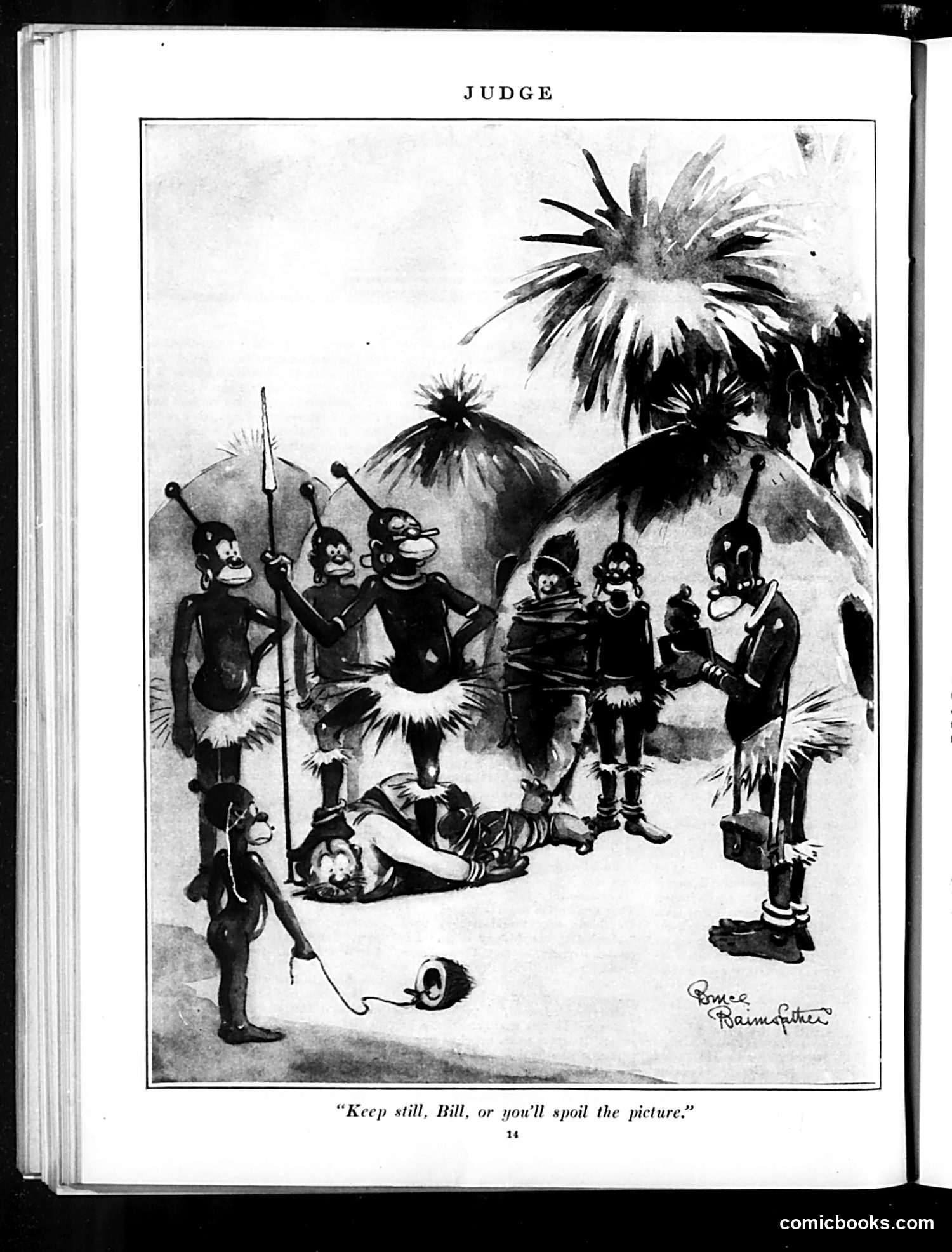
Analysis This Judge cartoon, signed by Cesare Baiamfather, depicts what appears to be a colonial or explorer scene with indigenous figures wearing feathered headdresses gathered around palm trees. One figure lies prone in the center while others stand in a circle. The caption "Keep still, Bill, or you'll spoil the picture" suggests someone is attempting to photograph or document the scene. The joke likely satirizes how Western explorers or photographers staged and manipulated "authentic" indigenous scenes for back-home audiences, positioning the subjects as exotic spectacle. The cartoon mocks both the artificial nature of such documentation and possibly the naïveté of audiences who accepted these contrived images as genuine ethnographic records—a common critique of early 20th-century colonial-era photography and anthropology.
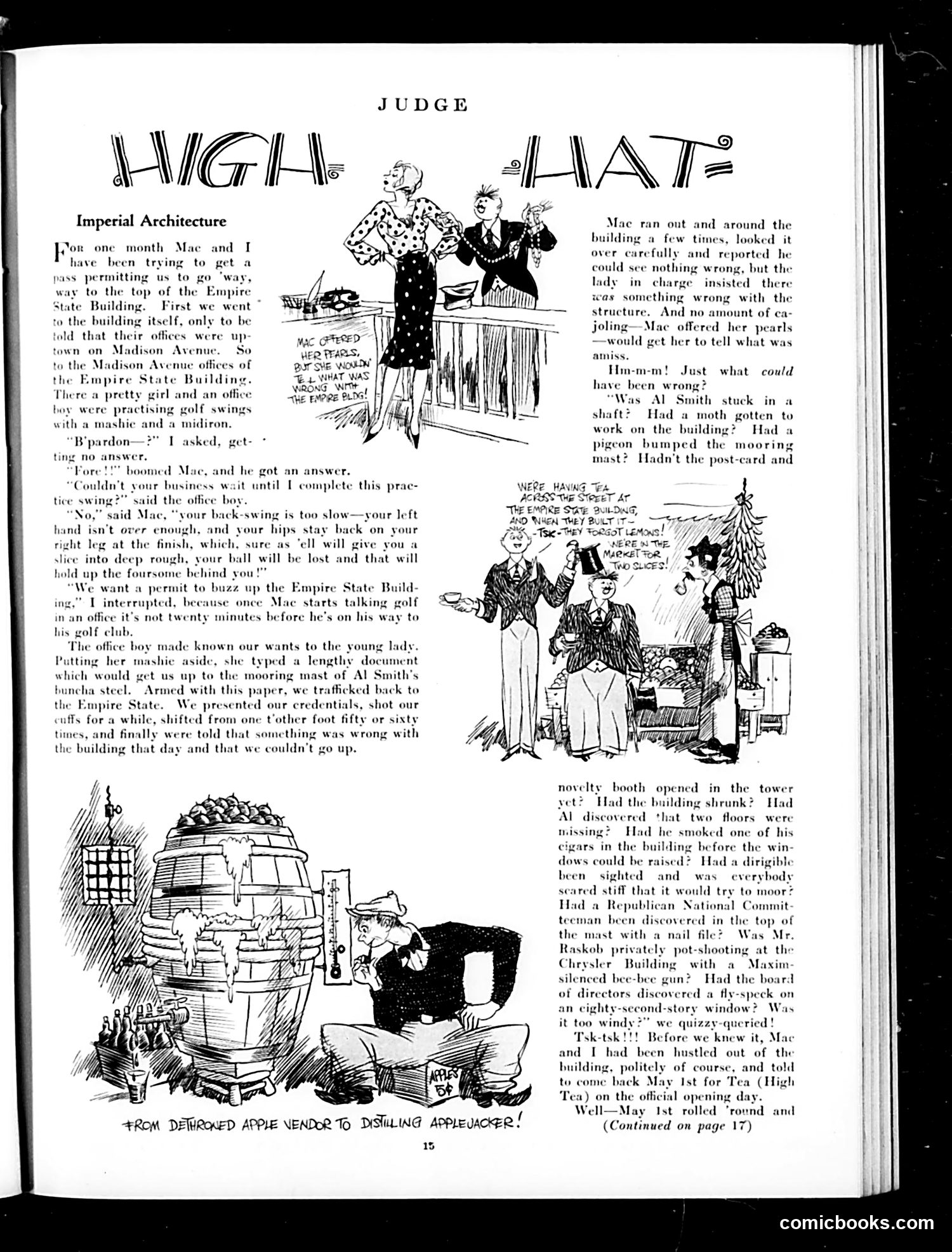
"Imperial Architecture" — Judge Magazine Satire This piece satirizes bureaucratic incompetence and runaround during the Empire State Building's construction/opening. The authors attempted to gain access to the building's top, encountering absurd obstacles: office staff prioritizing golf practice over business, a lengthy permit process yielding a mysterious document, and final rejection because "something was wrong with the building" — with authorities refusing to specify what. The satire mocks both the building's management and 1930s corporate culture. The joke escalates through increasingly ridiculous hypothetical explanations for the building's closure (Al Smith stuck in a shaft, missing floors, Republican conspirators, etc.), highlighting how nonsensical the actual reason appeared. Al Smith was the building's namesake and public face. The reference to Raskob suggests John Jakob Raskob, a Du Pont executive involved in financing the building. The piece ridicules institutional inefficiency and the disconnect between grand public projects and their actual administration.
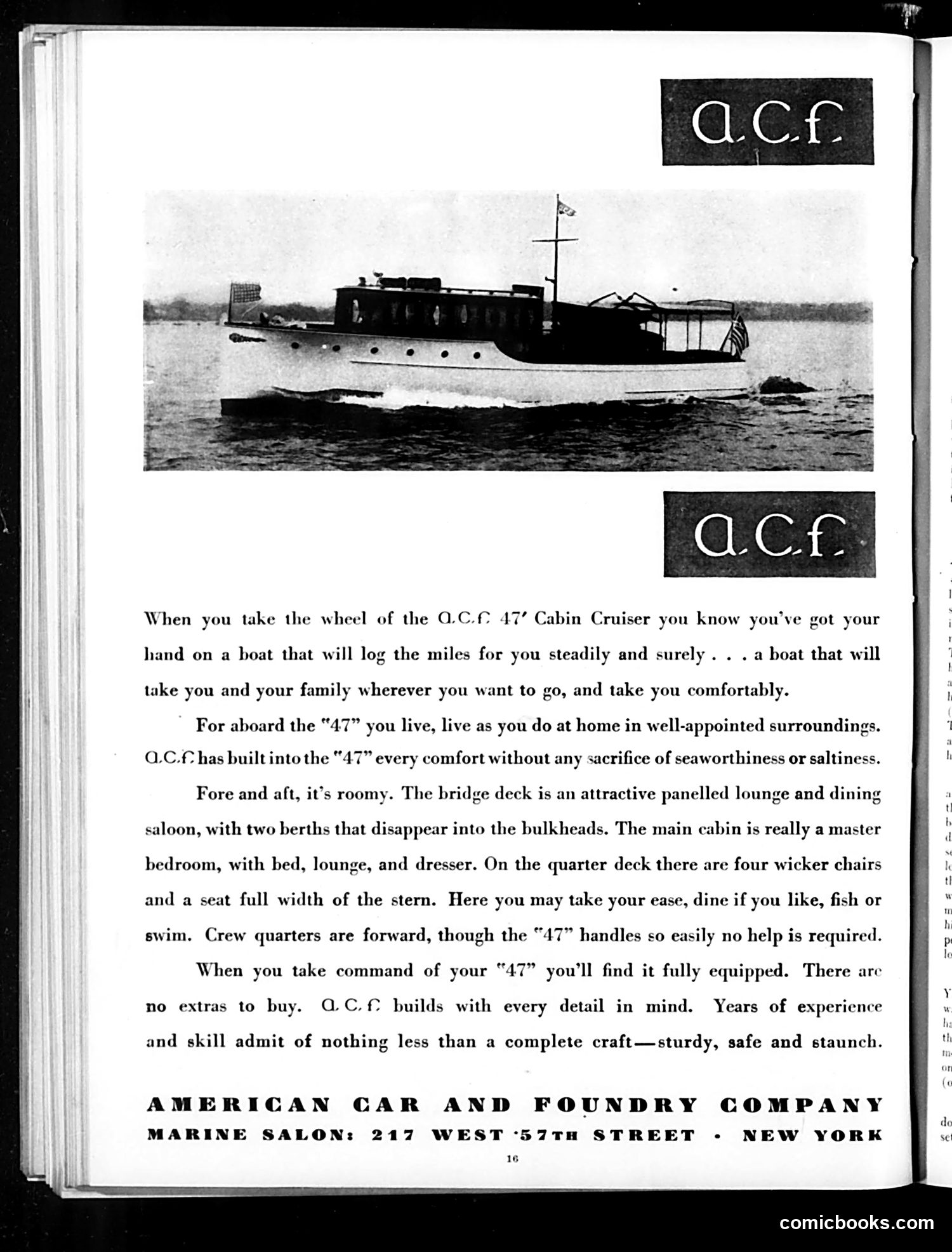
Analysis This page contains no cartoon or satire. It is a straightforward advertisement for the American Car and Foundry Company's 47-foot cabin cruiser, appearing in *Judge* magazine. The ad promotes luxury leisure boating to affluent readers, emphasizing comfort ("live as you do at home"), convenience ("no extras to buy"), and ease of operation ("handles so easily no help is required"). The photograph shows the vessel, while the text details amenities: a master bedroom cabin, dining saloon, quarters, and deck seating. This represents typical interwar advertising targeting wealthy Americans during an era of recreational boating expansion. The placement in a satirical magazine suggests *Judge* carried commercial advertising alongside humor—a common business model for period publications. There is no political commentary or social critique present.
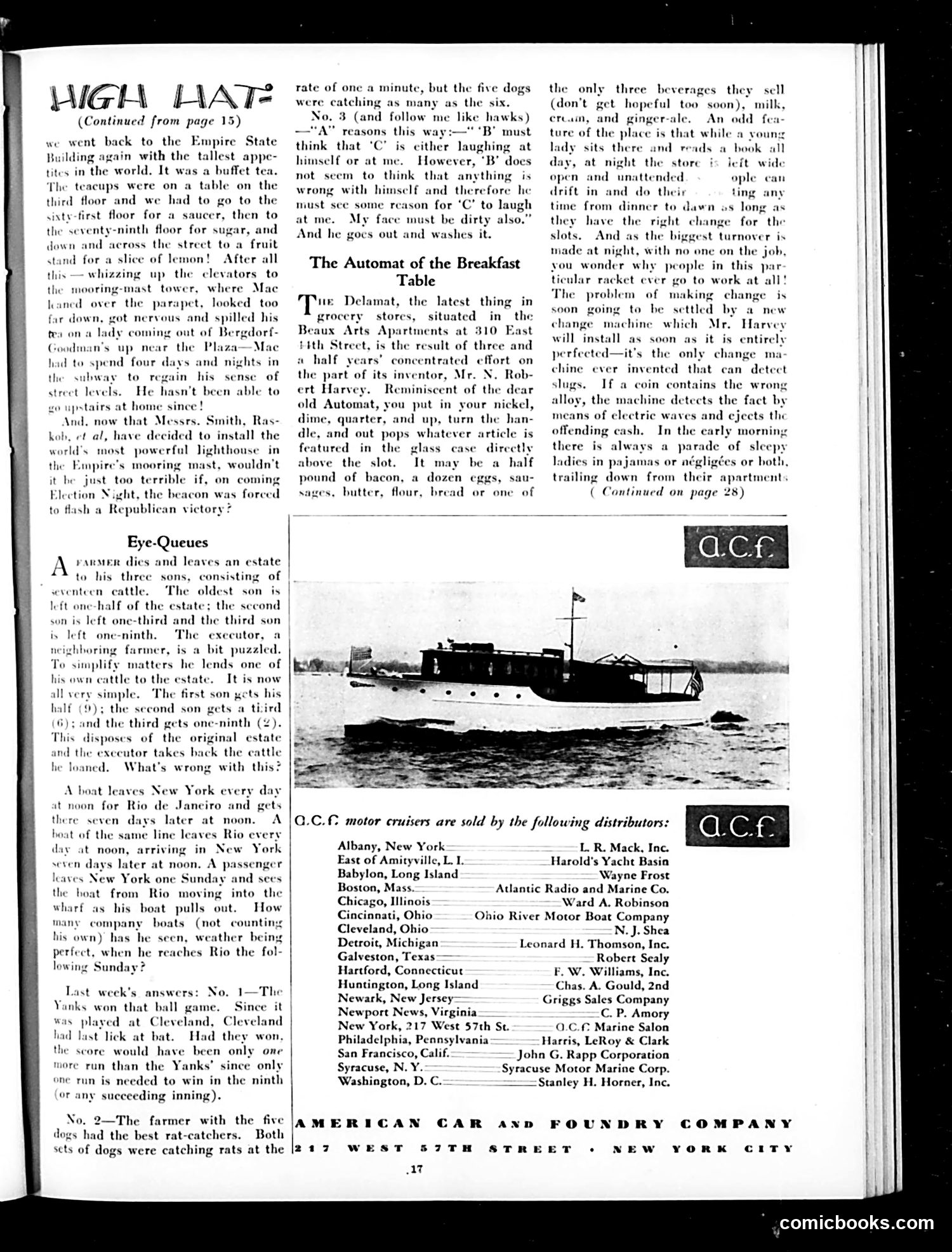
Judge Magazine Page Analysis This page contains primarily advertising and puzzle content rather than political cartoons. The main visual element is a photograph of a G.C.F. motor cruiser (a boat), with accompanying text listing distributors across America. The editorial content includes: 1. "High Hat" — a humorous column about visiting New York's Empire State Building, poking fun at the inconvenience of its buffet service requiring trips to multiple floors for different items. 2. "Eye-Queues" — a logic puzzle section with three mathematical/reasoning problems for readers to solve. 3. "The Automat of the Breakfast Table" — an article describing a new vending machine invention in a Manhattan apartment building that dispenses breakfast items, modeled after the popular Automat cafeterias of the era. The satire is mild and primarily focused on everyday inconveniences and mechanical novelties rather than political commentary. The Republican victory joke references contemporary election night concerns but lacks specific political targets.
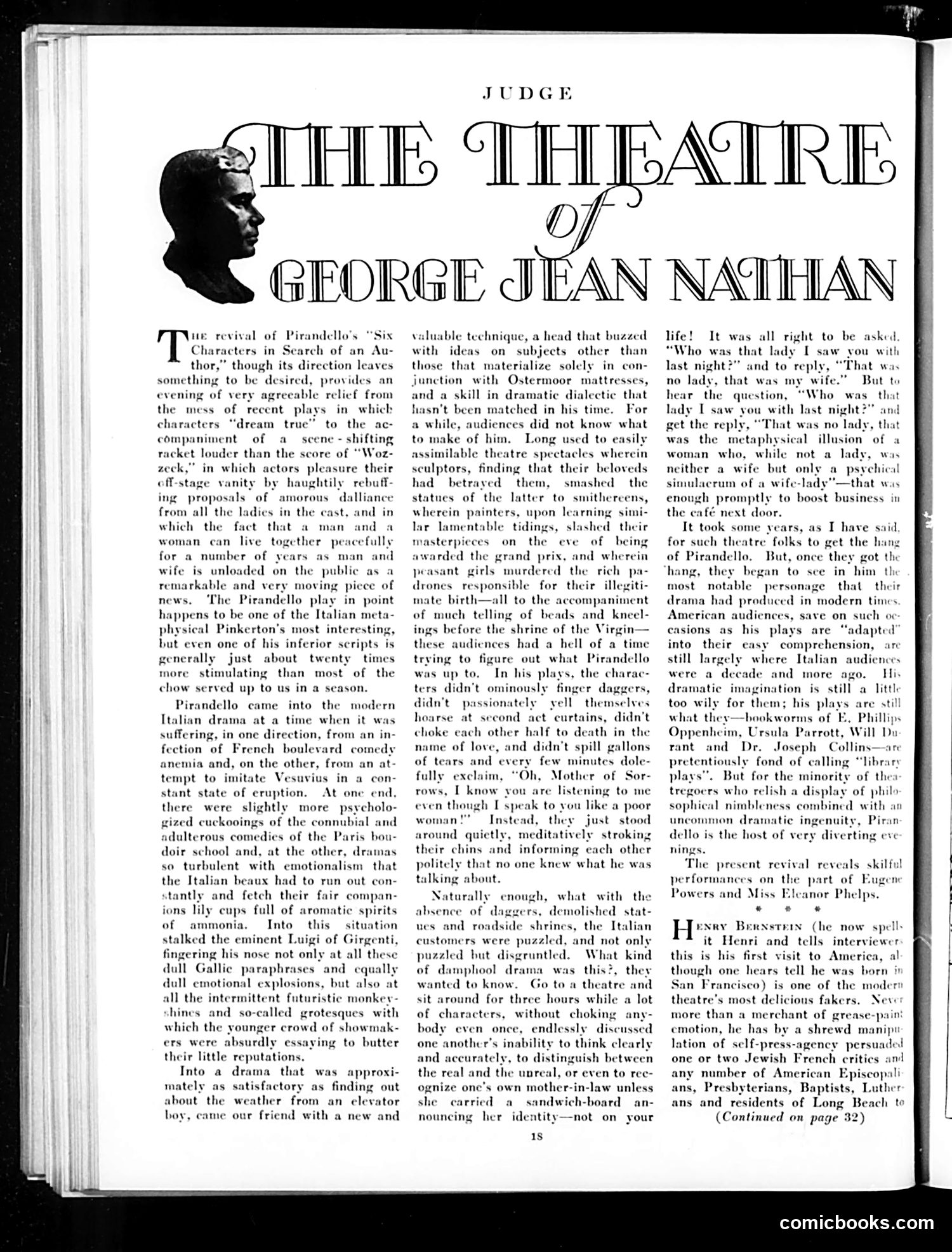
Judge Magazine Review of Pirandello's "Six Characters in Search of an Author" This is a theater review by Judge critic discussing Luigi Pirandello's avant-garde play, not a political cartoon. The piece praises Pirandello as a modern Italian dramatist who revolutionized Italian theater by rejecting both French boulevard comedy and overwrought emotionalism (contemporary Italian dramatic conventions). The satire targets recent American plays and their melodramatic excesses—characters who "dream true" with excessive set-changes, actors smugly rejecting romantic advances, and plots treating ordinary domestic life as profound drama. Judge celebrates Pirandello's intellectual restraint: his characters stand quietly discussing ideas rather than theatrical histrionics. The review mocks audiences puzzled by this subtle approach, expecting traditional dramatic fireworks (daggers, passionate yelling, tears) and finding instead thoughtful conversation—a refreshing antidote to Broadway's recent "chow."
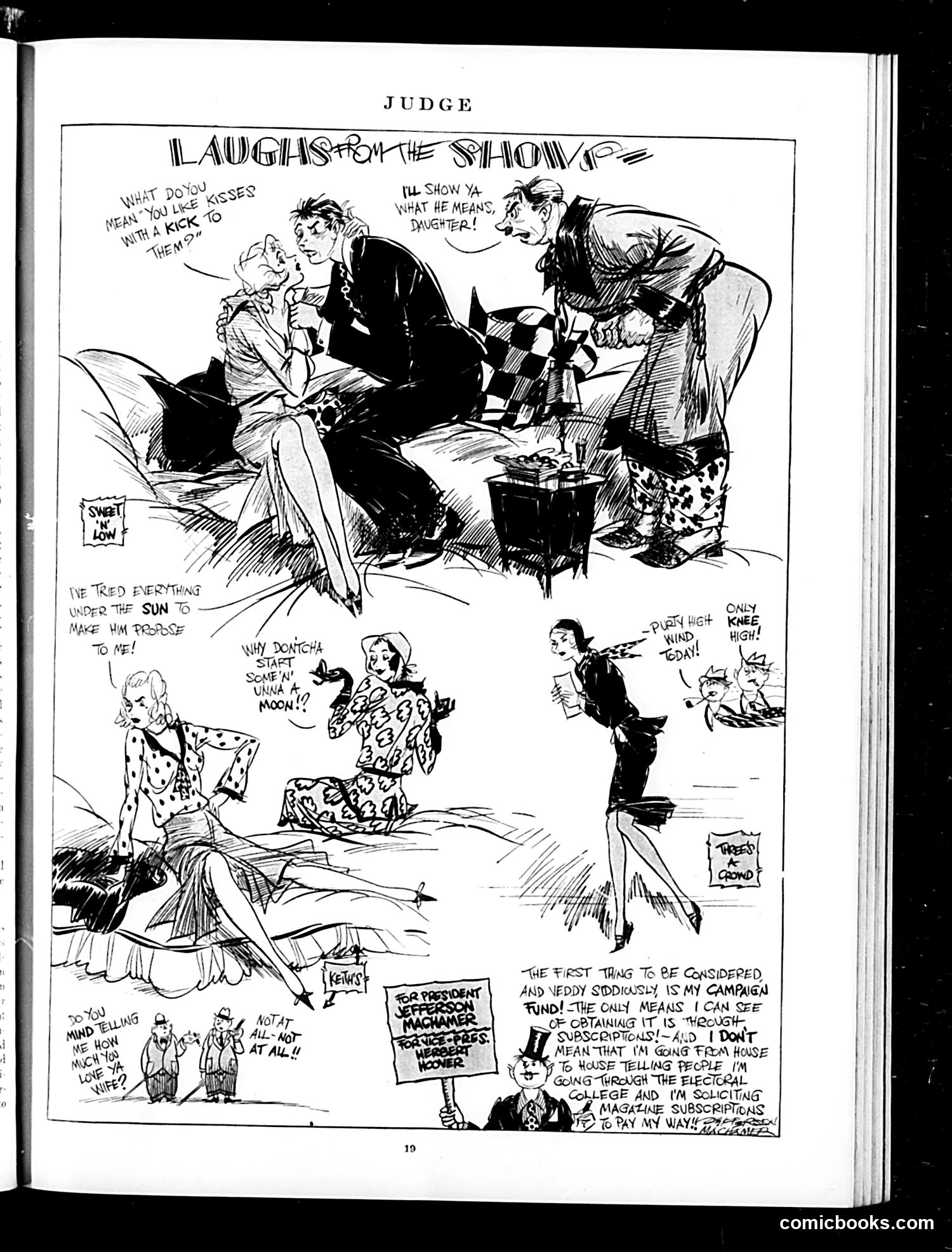
"Laughs from the Shoppe" - Judge Magazine Satire This page satirizes political campaigning and fundraising through interconnected vignettes. The central scene depicts what appears to be a political candidate surrounded by supporters and hangers-on, with dialogue mocking romantic flattery used to extract money ("kisses with a kick"). Lower panels ridicule campaign financing, particularly a candidate who explicitly states he's soliciting magazine subscriptions to fund his electoral college campaign—while ironically claiming he's NOT going door-to-door asking people directly. The satire targets the hypocrisy of indirect fundraising appeals masquerading as something other than what they are. Side scenes with couples and suitors reinforce the theme: political persuasion mirrors romantic manipulation, both aimed at extracting resources through insincerity. The overall message critiques how campaigns use charm and misdirection rather than honest appeals.
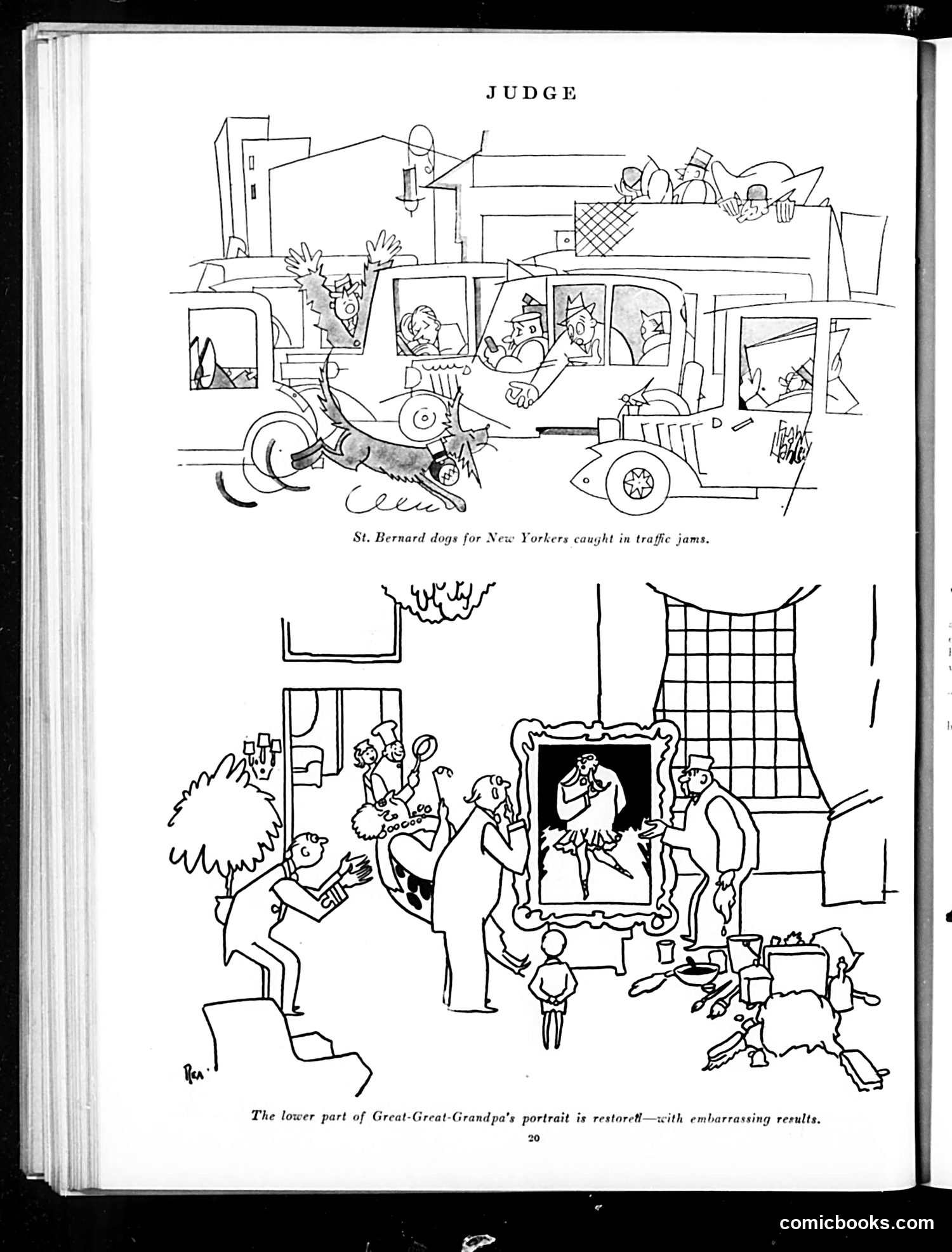
Judge Page Analysis This page contains two cartoons satirizing contemporary urban life and domestic situations. The top cartoon depicts St. Bernard rescue dogs being used to help drivers stuck in New York City traffic jams—a humorous solution to chronic congestion. The crowded, chaotic street scene mocks urban gridlock. The bottom cartoon shows a family restoring a portrait of an ancestor ("Great-Great-Grandpa"), but the lower portion's restoration reveals embarrassing content—the cartoon implies the original painting contained something scandalous or unflattering that had been deliberately hidden or damaged. The family's shocked reactions suggest ancestral shame being unexpectedly exposed. Both cartoons employ exaggerated comic-strip style drawings to satirize modern inconveniences (traffic) and family pretense (hiding unflattering truths about ancestors).
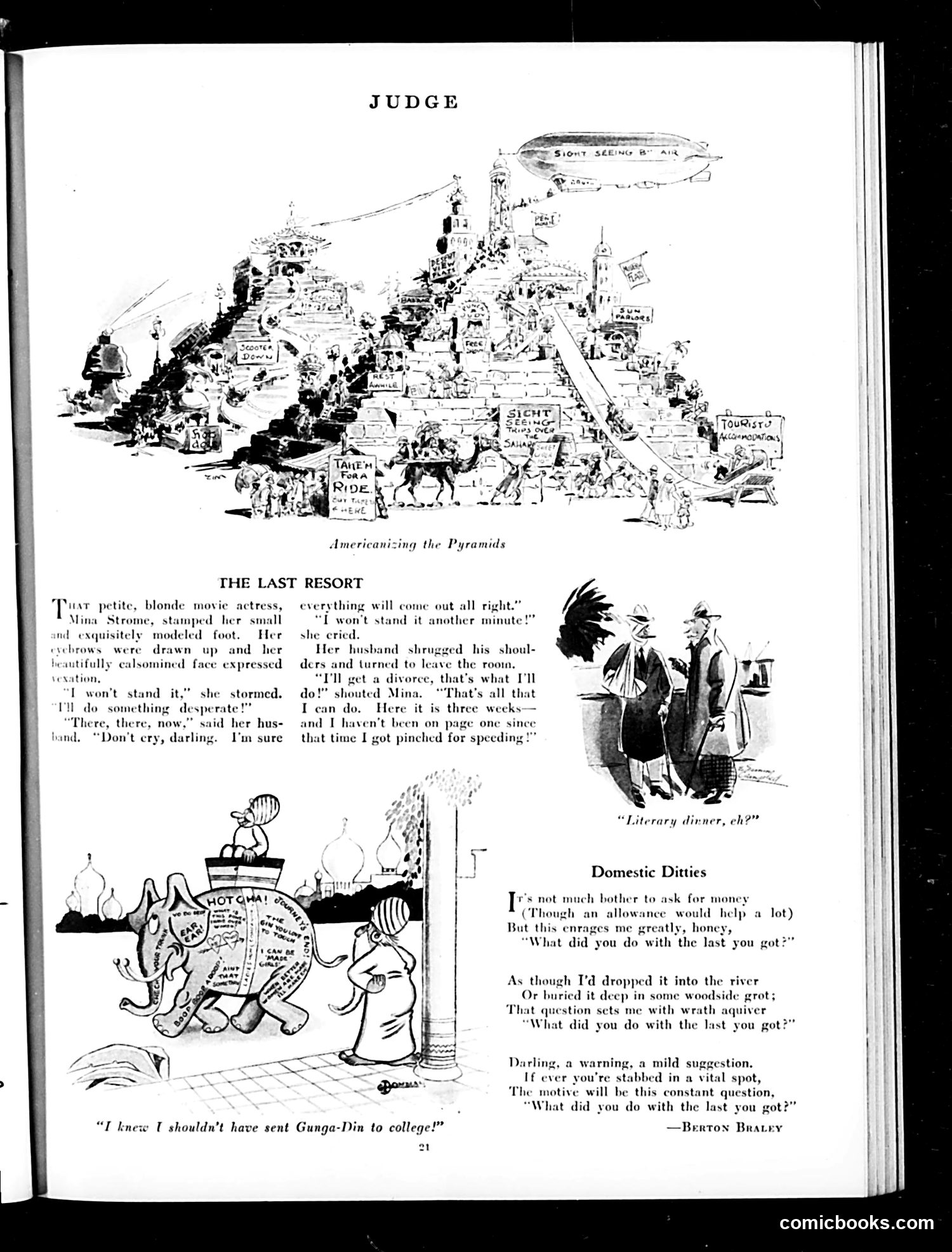
"The Last Resort" and Related Satire This page satirizes early 20th-century celebrity and domestic life. "The Last Resort" mocks a movie actress (Mina Strome) having a marital crisis: she's desperate because she hasn't appeared in newspapers for three weeks—her only notable recent mention being a speeding ticket. The joke is that her "crisis" is really about lost publicity, not genuine hardship. Her husband's dismissive response suggests her theatrical complaints are routine. "Domestic Ditties" (attributed to Berton Braley) satirizes marital conflict over money. The repeated complaint "What did you do with the last you got?" portrays wives pestering husbands about spending—ending darkly with a quip that this nagging could motivate murder. The top cartoon, "Americanizing the Pyramids," depicts tourist attractions cluttered with commercial signs and amusements, mocking American culture's tendency to commercialize and trivialize historical monuments. The overall page critiques vanity, materialism, and domestic friction in modern American life.
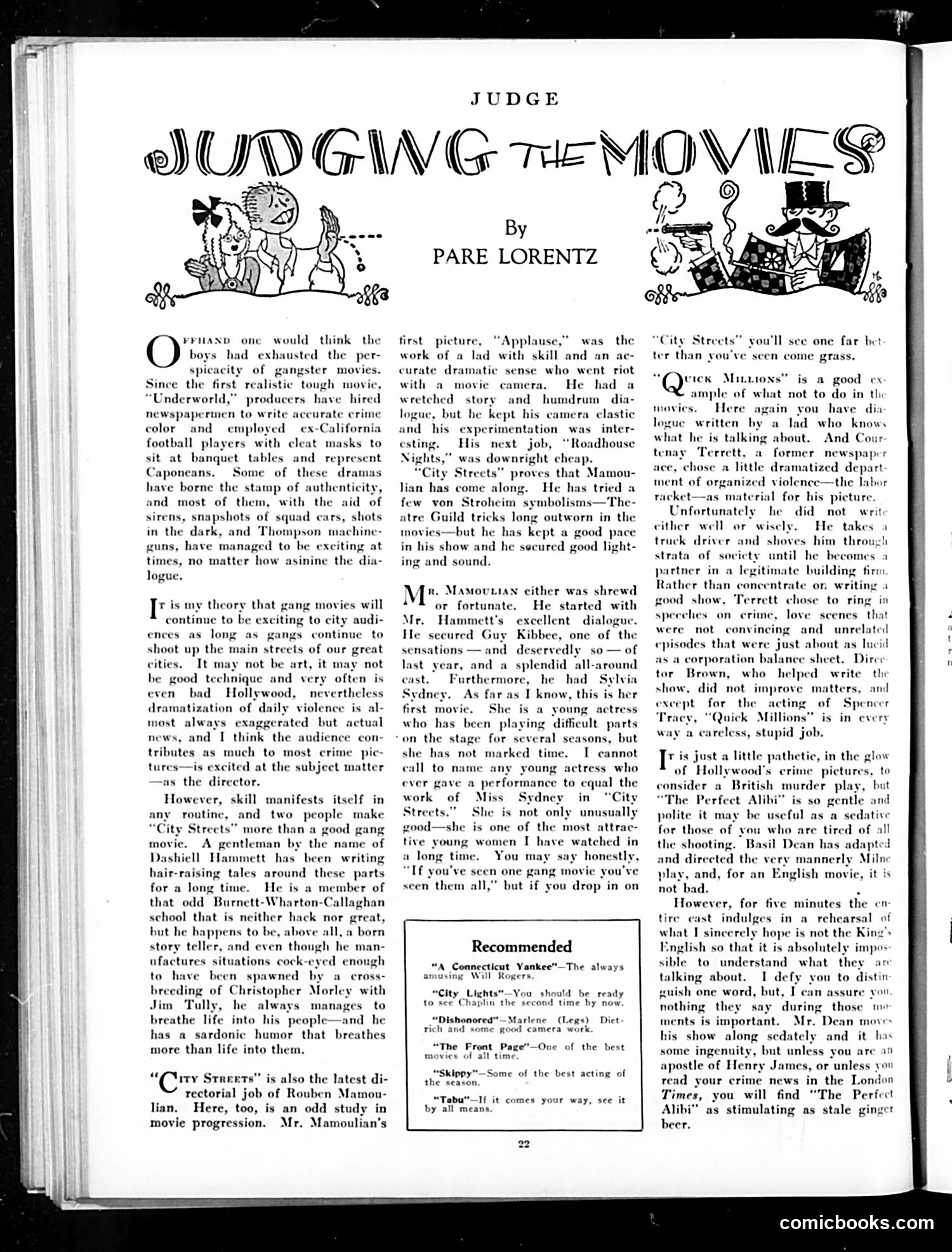
Judge Magazine Film Review: "Judging the Movies" by Pare Lorentz This page reviews contemporary 1930s gangster films for *Judge* magazine's audience. The column critiques the proliferation of crime movies since the landmark 1927 film "Underworld," noting producers now hire newspapermen and ex-football players for "authenticity." The main focus is "City Streets," directed by Rouben Mamoulian and written by Dashiell Hammett (the famous hard-boiled crime novelist). Lorentz praises the film's screenplay and particularly actress Sylvia Sydney's performance, calling her one of the most attractive actresses he's watched. He credits the film's success to skilled direction and writing elevating what could be routine gangster material. The "Recommended" box lists other current films worth seeing: Will Rogers' "Connecticut Yankee," Chaplin's "City Lights," Marlene Dietrich's "Dishonored," and "The Front Page." The satire targets the era's obsession with sensationalized crime entertainment, while celebrating when artistic skill transcends the formula.
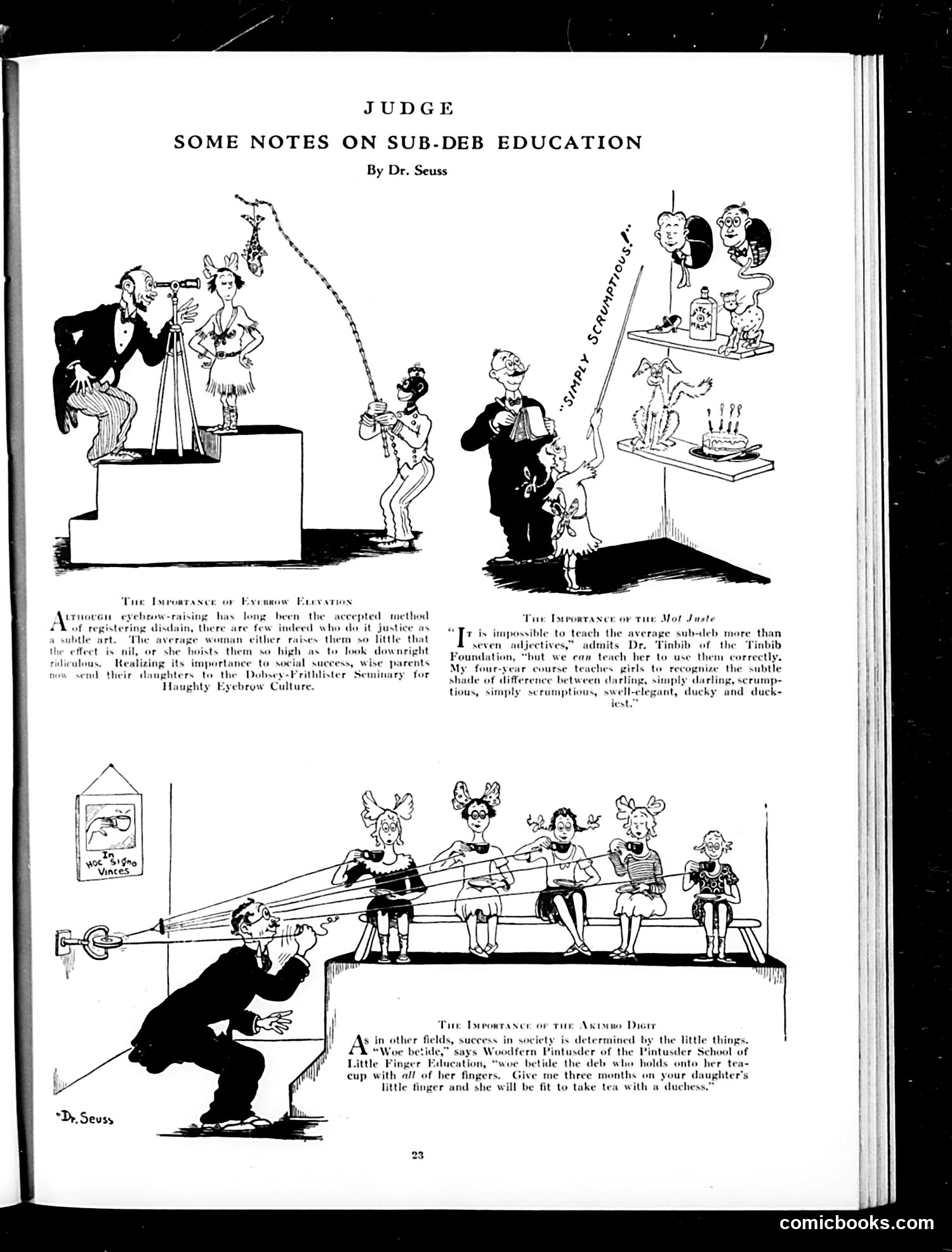
"Some Notes on Sub-Deb Education" by Dr. Seuss This satirical piece mocks the pretentious finishing schools attended by wealthy young women ("sub-debs"—debutantes) in early 20th-century America. The cartoons ridicule the absurd, frivolous curriculum these institutions offered: "The Importance of Eyebrow Elevation": Parents send daughters to "Dobsey-Frithlister Seminary for Haughty Eyebrow Culture" to learn exaggerated facial expressions—suggesting the schools taught only superficial mannerisms. "The Importance of the Mot Juste": Instruction in using the "right word"—elegant French phrases to appear cultured. "The Importance of the Akimbo Digit": Teaching girls to hold their pinkies elevated while drinking tea—an absurdly trivial "refinement." The satire's point: these expensive institutions focused on performative elegance and snobbish affectation rather than substantive education. Dr. Seuss ridicules how "success in society" depends on these ridiculous minor gestures rather than intellect or character.
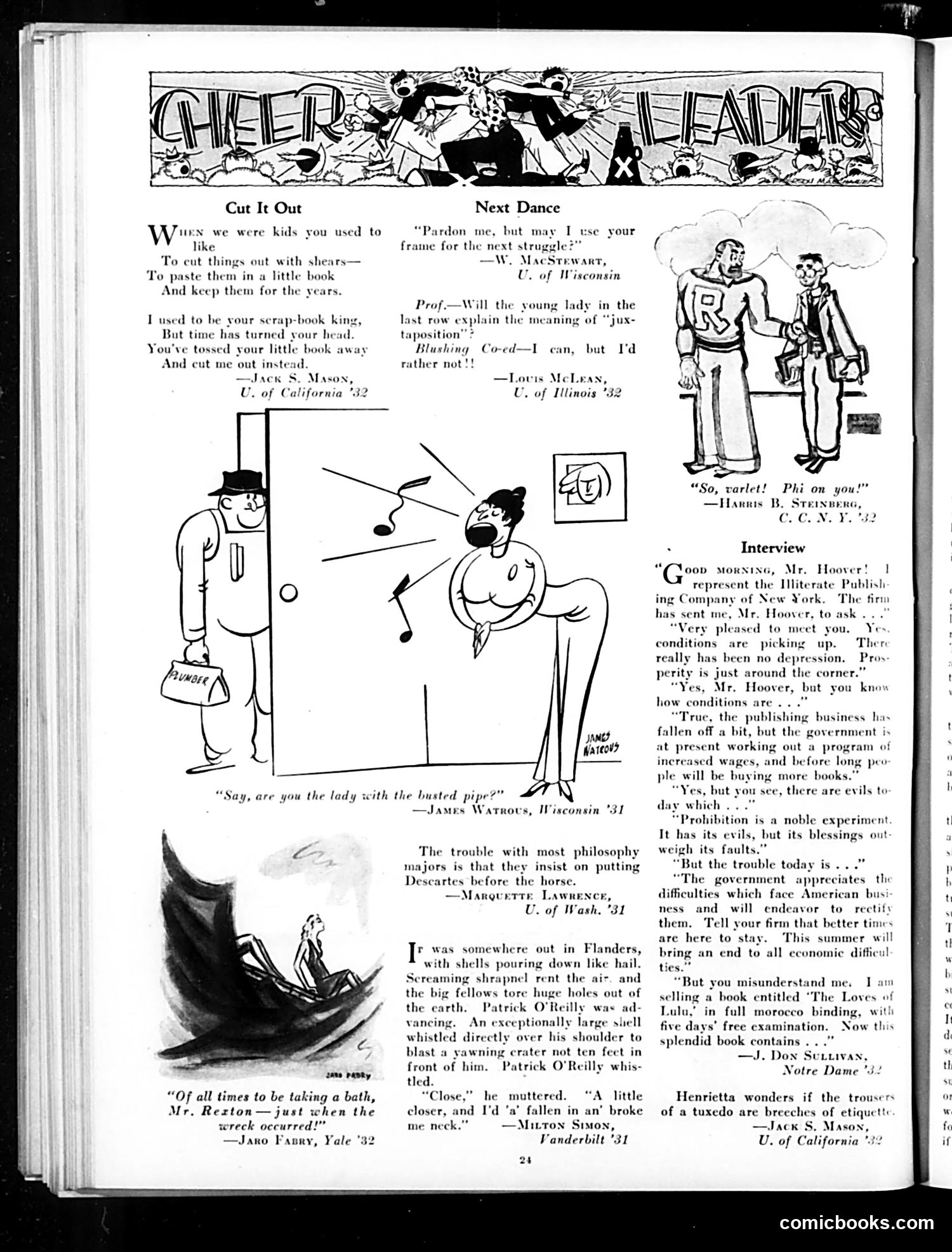
Judge Magazine Page Analysis This page from Judge contains student humor and satirical commentary, likely from the early 1930s (based on dates like '32, '31). "Cut It Out" is a nostalgic poem about romantic rejection—the speaker once kept scrapbooks of their beloved, but now finds themselves "cut out" instead. "Next Dance" features a professor-student exchange where a co-ed is asked to explain "juxtaposition" but declines, blushing—likely implying an inappropriate double meaning. The cartoons include slapstick humor: a man asking about "the lady with the busted pipe" (appears to be a confused romantic encounter), and bathroom humor about someone bathing during a wreck. "The Interview" satirizes President Hoover's economic optimism during the Depression. An interviewer from a struggling publishing company tries to discuss real hardships ("the publishing business has fallen off"), but Hoover repeatedly insists prosperity is "just around the corner," remaining oblivious to actual economic suffering. The satire mocks his disconnect from reality.
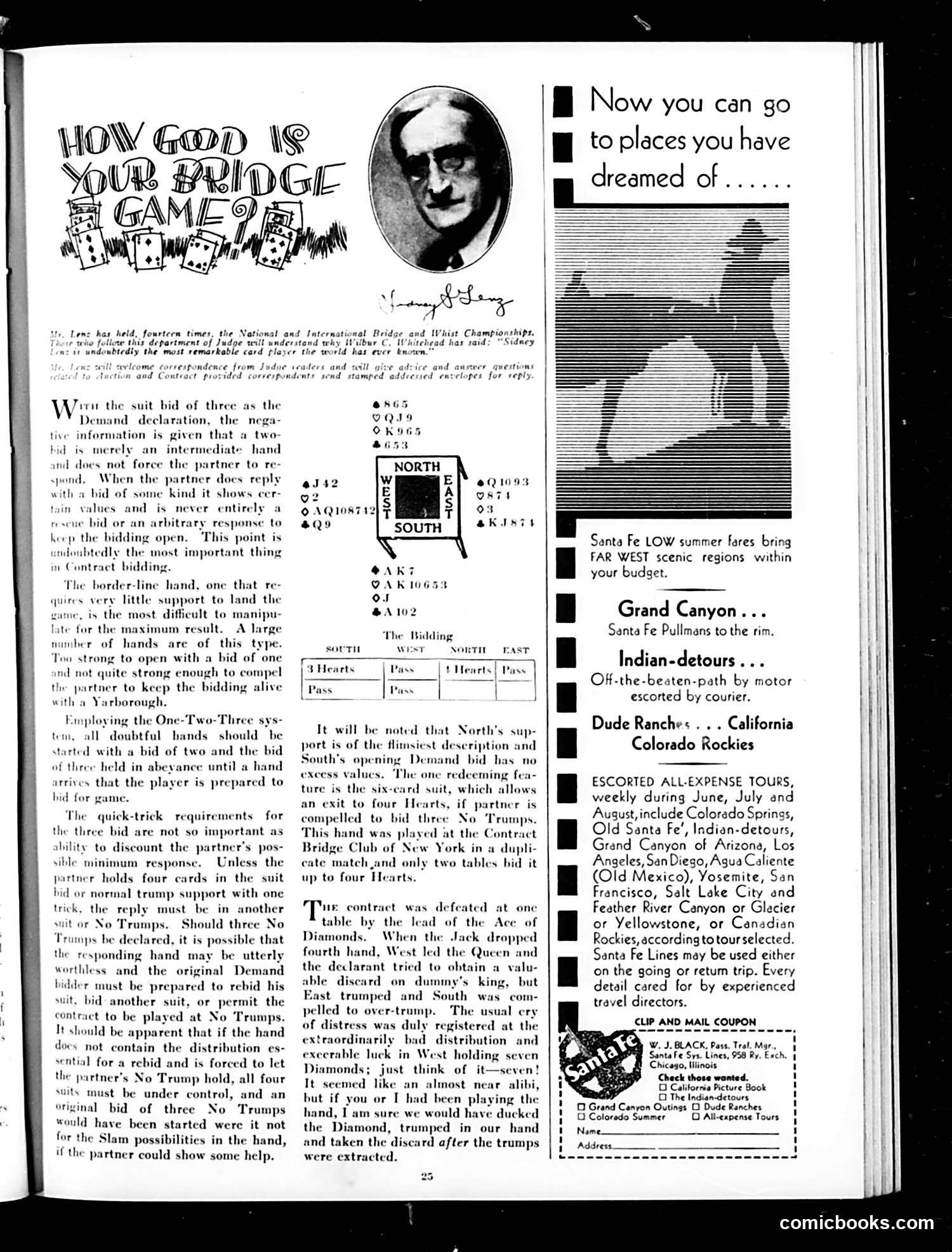
Judge Magazine Page Analysis This page combines two unrelated elements: bridge instruction and travel advertising. The left column features an instructional article on contract bridge strategy by what appears to be a prominent bridge authority (the header references "Wilbur C. Whitehead," identified as having won fourteen national and international championships). The article discusses advanced bidding techniques, particularly the "Demand declaration" and "three bid" strategy, using a specific hand example played at the Contract Bridge Club of New York. The right side contains Santa Fe Railway advertising promoting discounted summer travel fares to Western destinations—the Grand Canyon, dude ranches, and escorted tours through Colorado and the Southwest. No political satire or cartoon appears on this page. The masthead "How Good Is Your Bridge Game?" with card imagery is simply a decorative title for the instructional content, not a political commentary. This is primarily an educational and advertising page from a magazine that typically featured humor alongside practical content.
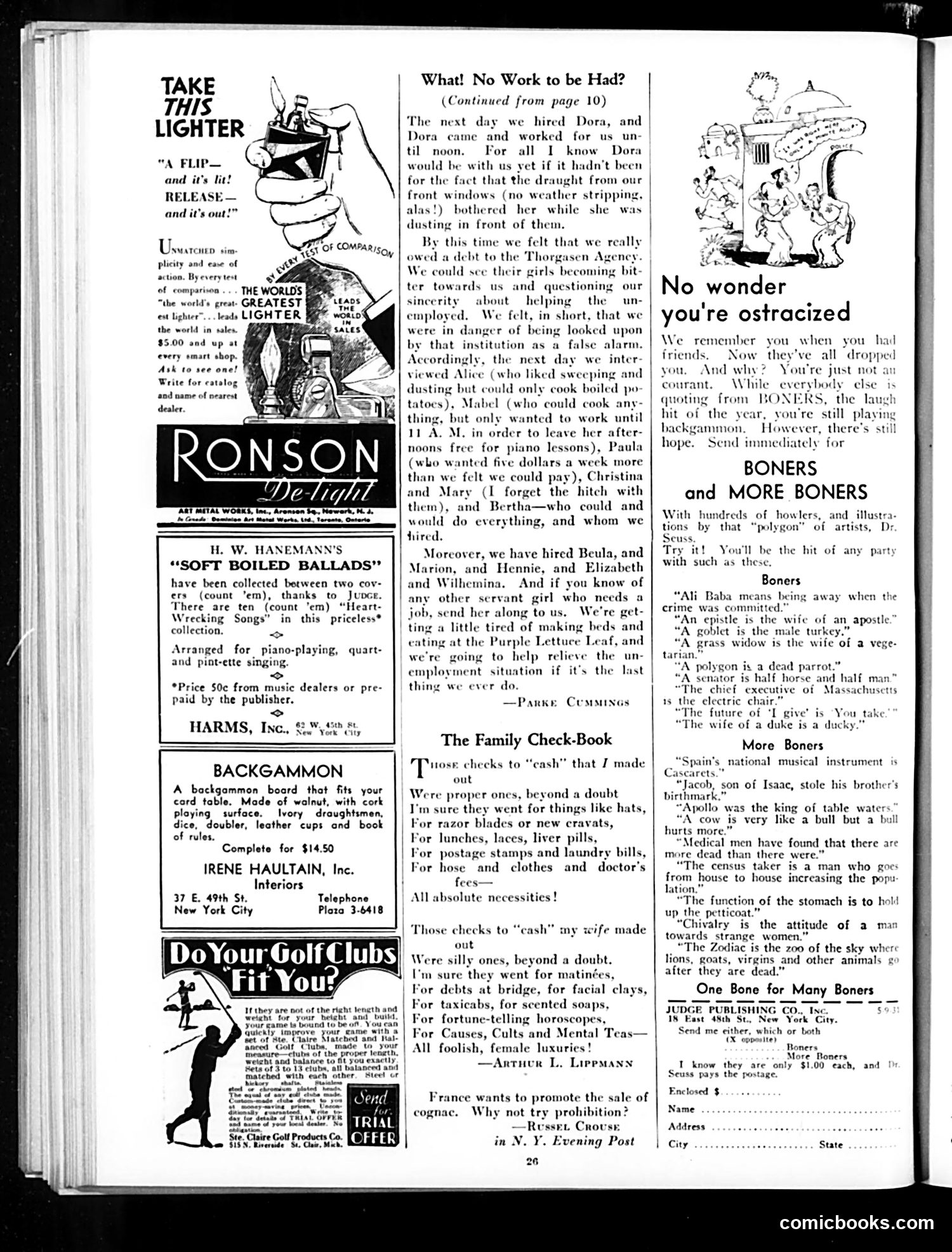
Political and Social Satire in This Judge Magazine Page This page is primarily advertising-heavy, but contains satirical commentary about employment and domestic life during what appears to be the 1920s-30s economic period. The main article "What! No Work to be Had?" satirizes wealthy households' hiring and firing of domestic servants. The narrator describes cycling through multiple housemaids—each with minor complaints or demands (drafts, limited hours, higher wages)—while feeling pressured by the "Thorgasen Agency" to appear socially conscious about unemployment. The satire mocks affluent people's performative concern for the unemployed while remaining unwilling to accommodate servants' reasonable needs. "The Family Check-Book" contrasts "proper" expenses (razors, lunches, postage) with "foolish, female luxuries" (bridge debts, horoscopes, "Causes, Cults"). This reflects era-typical gender stereotyping about women's spending habits. The ads for lighter, golf clubs, and "Boners" (a popular humor book) represent typical Judge advertising targeting middle/upper-class readers.
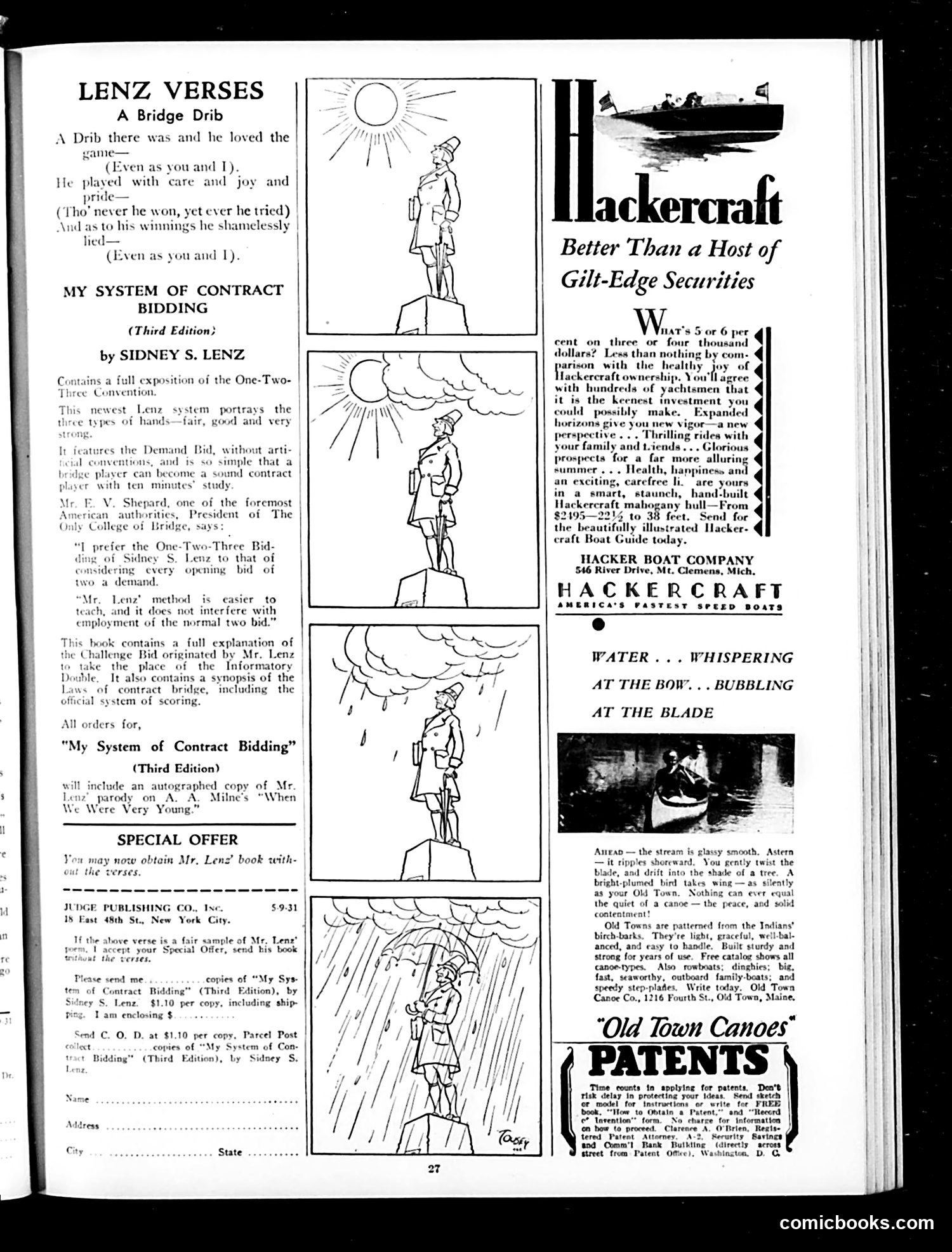
LENZ VERSES: A Bridge Drib This is a light satirical poem mocking bridge players—specifically those who cheat or exaggerate. "A Drib" (an insignificant person) plays bridge with "care and joy and pride," yet never wins honestly. Despite his losses, he "shamelessly lied" about his winnings. The poem's refrain "(Even as you and I)" suggests this dishonesty is universal human behavior. The accompanying illustrations show a figure in increasingly harsh weather conditions (sun, clouds, rain), apparently representing the player's changing fortune—or perhaps the deteriorating reality versus his false claims. The page primarily advertises Sidney S. Lenz's contract bridge instructional book and uses the poem as promotional content, playing on bridge's popularity among educated readers. The satire gently mocks competitive bridge culture and human nature rather than addressing specific political topics.
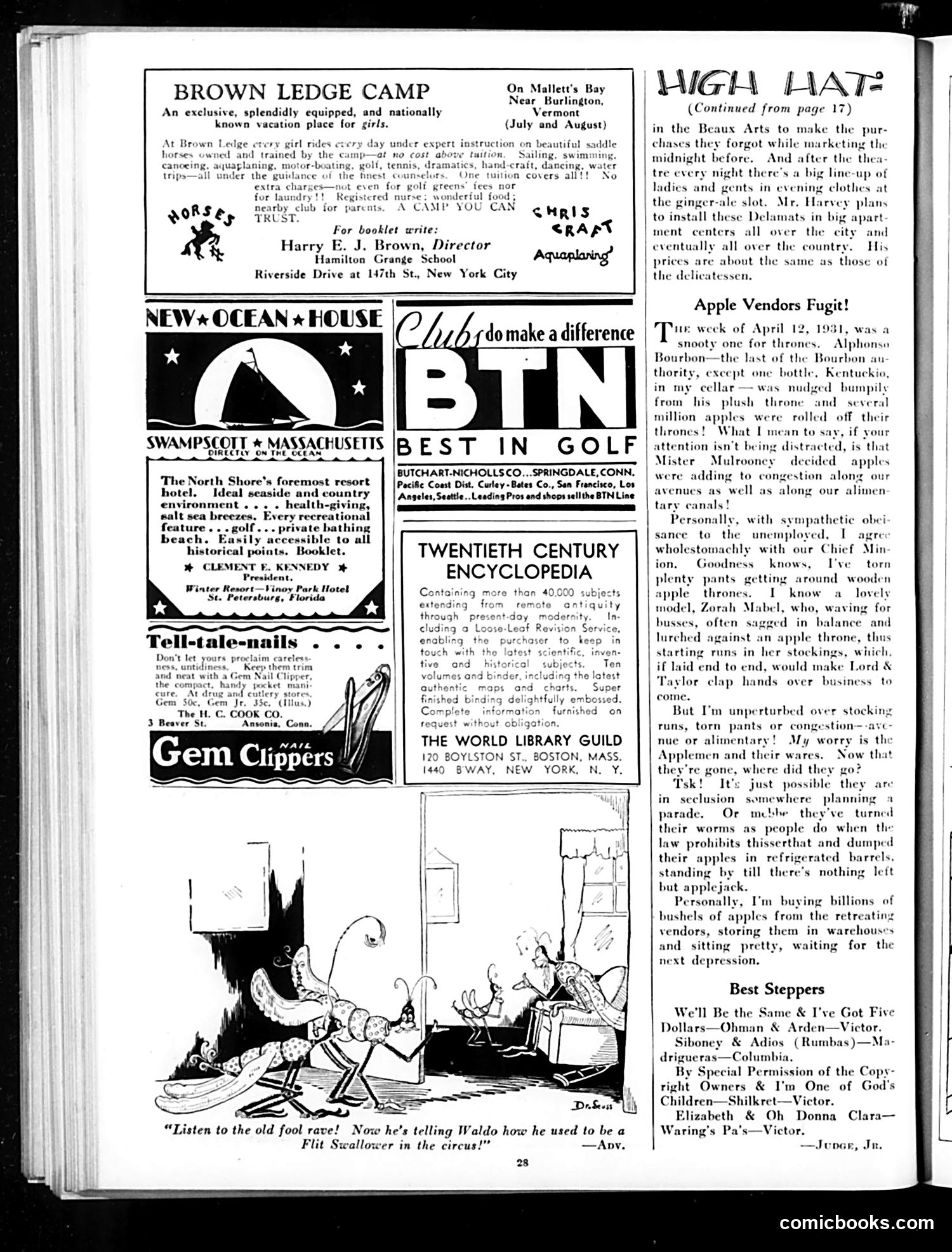
Explanation for Modern Readers This page is primarily advertisements and columns from Judge magazine (circa 1931, based on the "April 12, 1931" reference). The main cartoon shows two insects gossiping—one appears to be telling the other a tall tale about his circus past. The humor relies on anthropomorphizing bugs having human conversation, a common visual gag of the era. The "High Hat" column discusses apple vendors disappearing from New York streets in 1931—likely due to Depression-era enforcement against street commerce. The writer sardonically sympathizes with unemployed vendors while joking about buying apples to hoard for the "next depression," treating economic hardship as darkly comedic. The page is otherwise filled with resort advertisements (Brown Ledge Camp, New Ocean House), product ads (Gem Clippers, Flit insecticide), and encyclopedia promotions—typical Judge content mixing humor with commercial pitches. The tone reflects early Depression-era satire: anxious about economics but maintaining cynical wit.
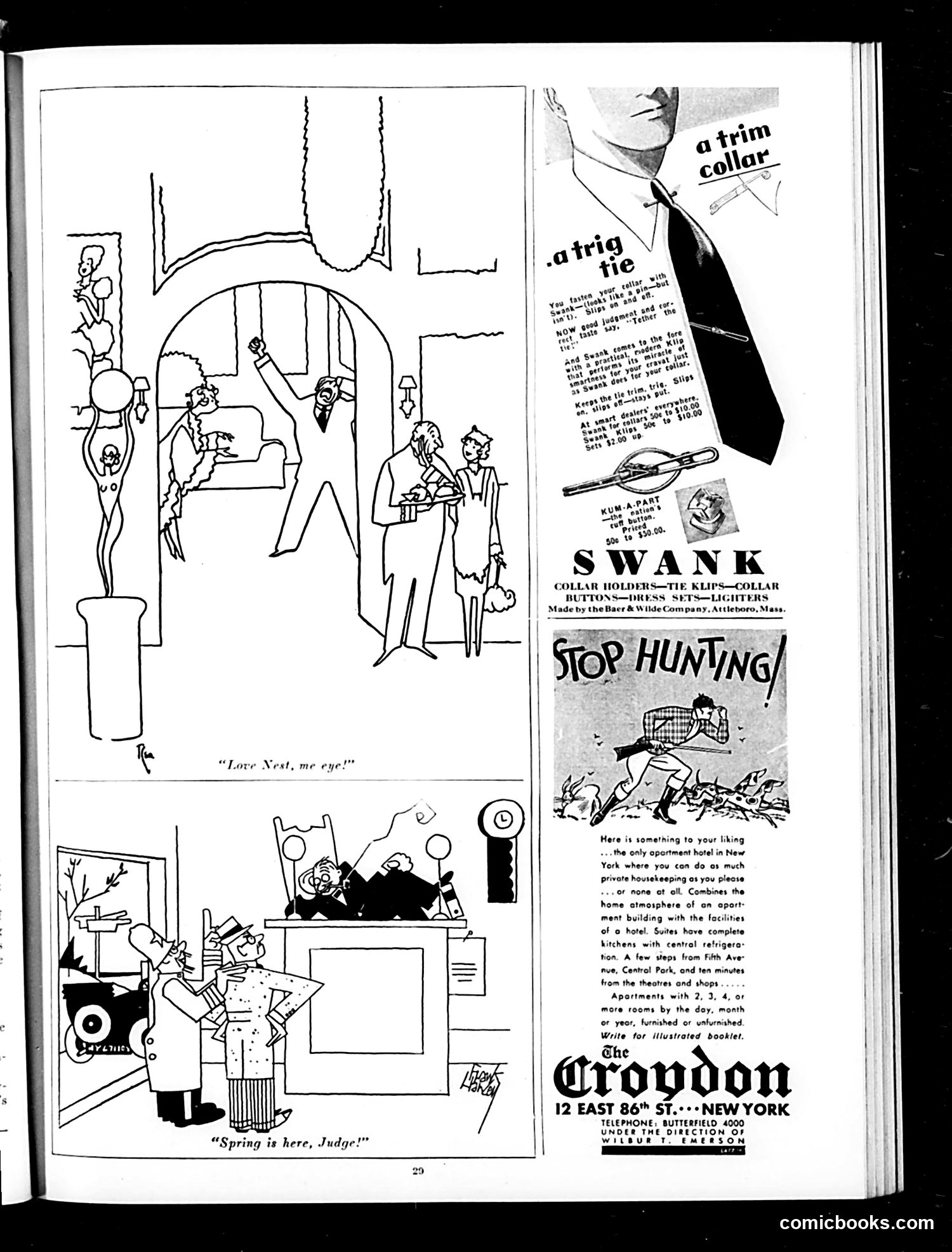
Analysis of Judge Magazine Page This page contains two separate cartoons satirizing urban social life, likely from the 1920s-30s era. Top cartoon ("Love Next, me eye!"): Depicts a chaotic apartment party scene with figures in various states of revelry—some swinging from fixtures, others lounging on furniture. The satire targets the excesses of Jazz Age urban nightlife and apartment living, mocking the frivolous behavior of well-dressed socialites. Bottom cartoon ("Spring is here, Judge!"): Shows a domestic scene where a man appears distressed while a woman gestures toward a window with spring foliage visible. The joke likely concerns springtime romantic expectations or domestic complications—possibly implying the arrival of spring prompts unwanted attention or social obligations. The advertisements for Swank accessories and the Croydon Hotel indicate this magazine addressed affluent urban readers interested in fashion and Manhattan living. The cartoons satirize modern metropolitan social conventions and the lifestyles of the leisure class.
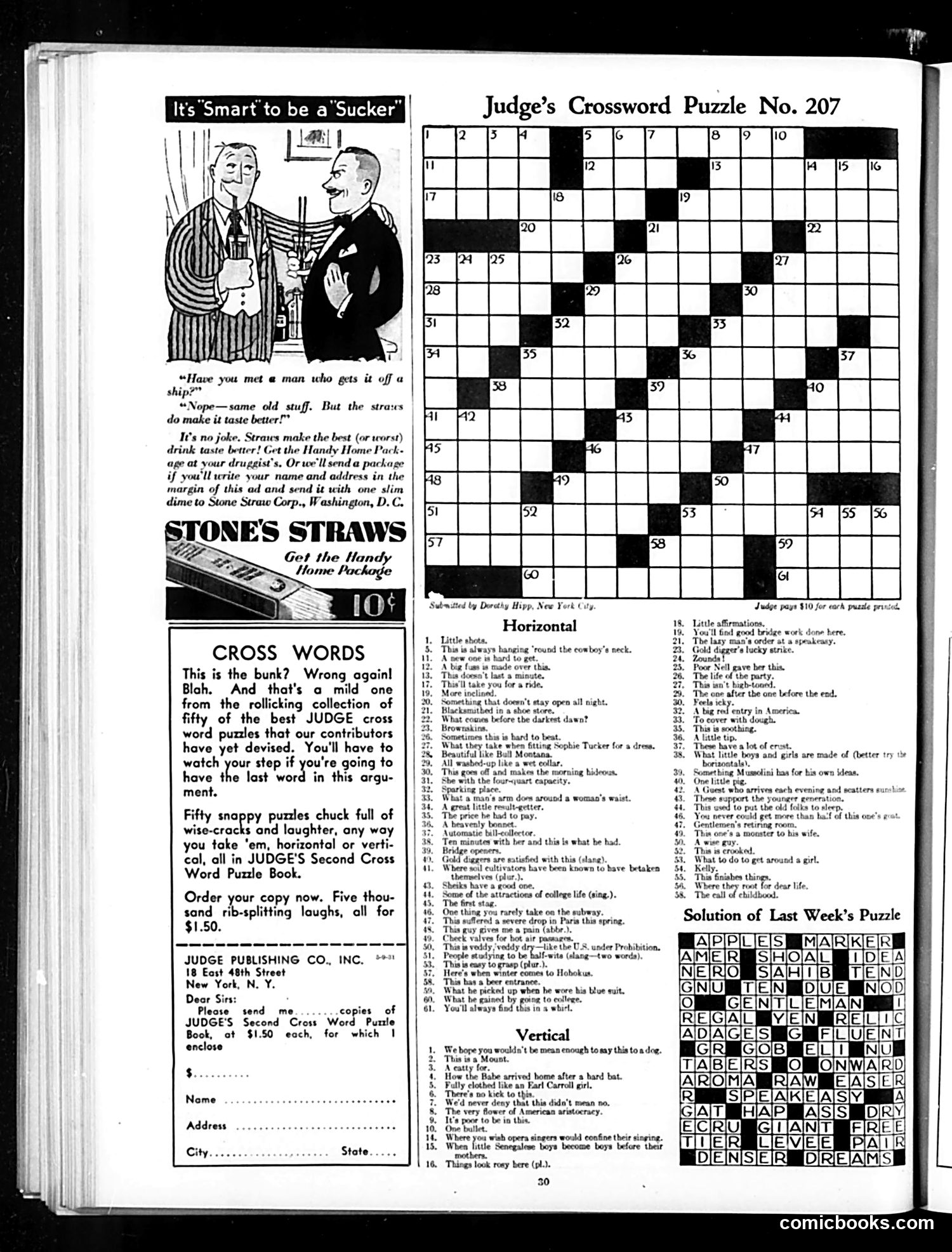
Judge Magazine Page Analysis This page is primarily advertising and puzzle content rather than political satire. The small cartoon at top depicts two men discussing alcohol obtained "off a ship"—likely referencing Prohibition-era bootlegging. The joke is that illicit liquor tastes better when consumed through straws (a Stone Straws Company advertisement). This reflects 1920s America when alcohol was legally banned but widely smuggled and consumed illegally. The bulk of the page promotes Judge's "Second Cross Word Puzzle Book" ($1.50) and includes clues for an actual crossword puzzle. The text describes the puzzles as "snappy" and full of "rib-splitting laughs," reflecting the era's popularity of crossword puzzles as entertainment. A smaller advertisement for Judge's publishing services appears at bottom left. The page reflects Jazz Age consumer culture and Prohibition-era humor rather than direct political commentary.
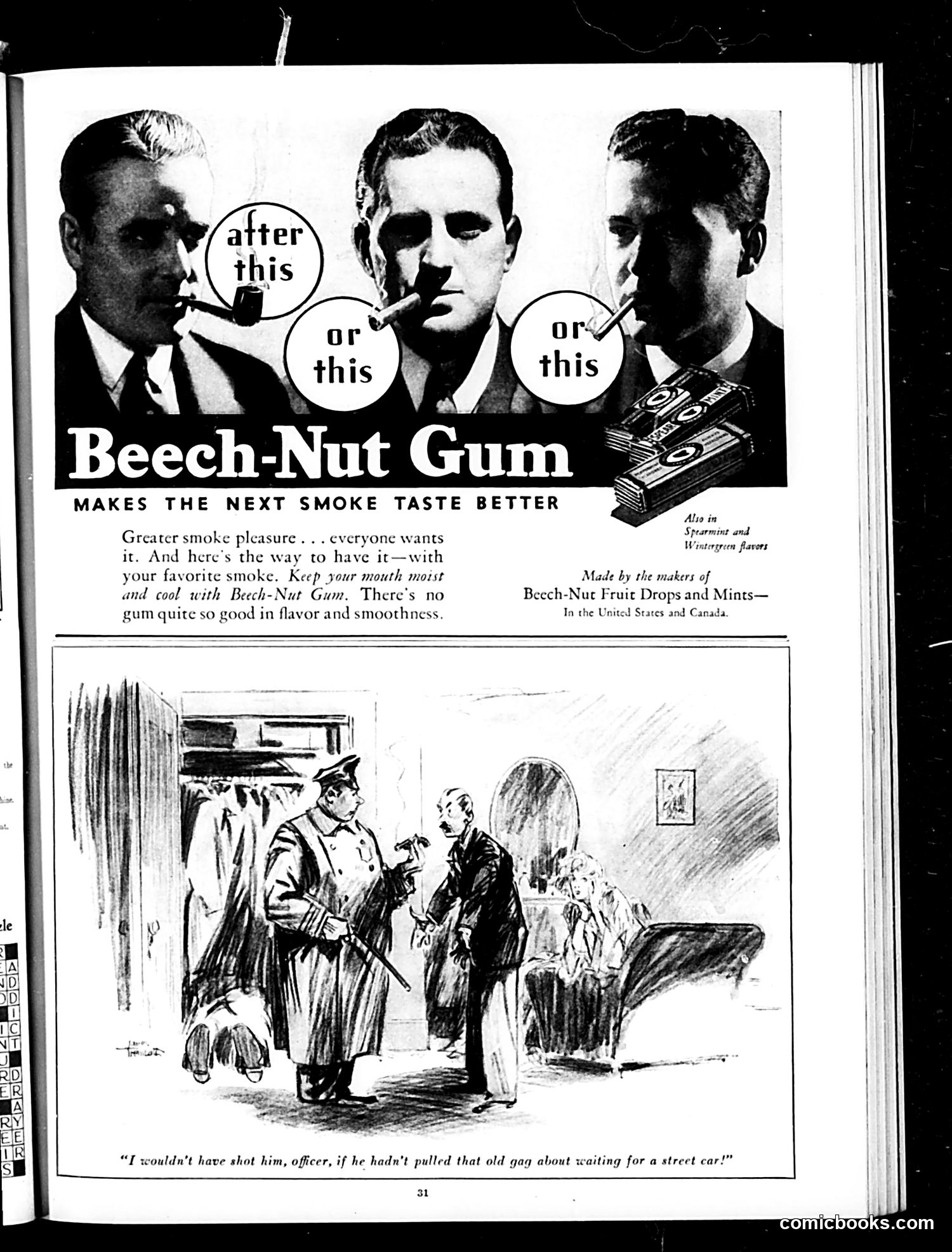
Analysis This page is primarily a Beech-Nut Gum advertisement (top two-thirds), featuring three men in profile demonstrating the product's appeal to smokers. The tagline emphasizes keeping one's mouth "moist and cool" while smoking—a practical sales pitch for the era when smoking was commonplace and socially acceptable. Below is an unrelated cartoon depicting a crime scene. A man explains to a police officer that he shot someone because that person made a tired joke about "waiting for a street car"—a reference to an old, worn-out gag. The humor is dark: the perpetrator claims justifiable homicide based on tedious conversation. This satirizes how people tolerate (or resent) repetitive social pleasantries and stale humor in everyday interaction. The two items share no thematic connection; this was typical Judge magazine layout of advertisements alongside editorial cartoons.
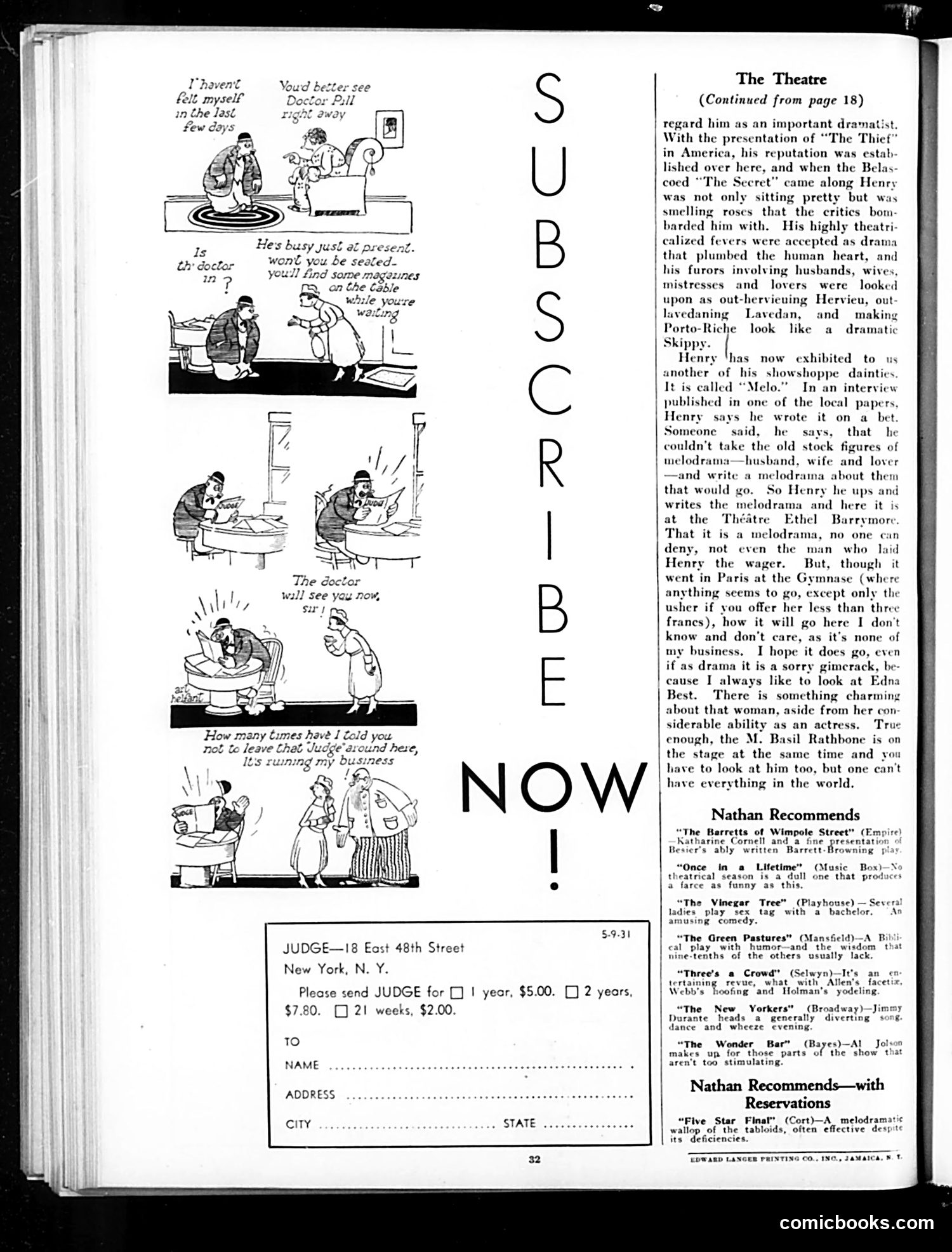
"Subscribe Now!" Comic Strip Analysis This page features a humorous comic strip about a doctor's office, where a patient complains of not feeling well for days. The doctor is perpetually "busy," forcing the patient to wait among old magazines. The final panel shows the patient's exasperated wife discovering Judge magazine left in the waiting room—she blames it for his condition, implying the magazine itself is so engaging it's made him neglect his health. The joke is self-promotional: Judge uses the strip to advertise itself as so entertaining that it causes distraction and neglect of real life. The comic plays on contemporary anxieties about media consumption while cleverly pitching subscriptions ($5 yearly, $7.80 for two years, or $2 for 21 weeks). The page also includes theatre reviews by critic Nathan, discussing contemporary Broadway productions like "The Barretts of Wimpole Street" and "The Green Pastures."
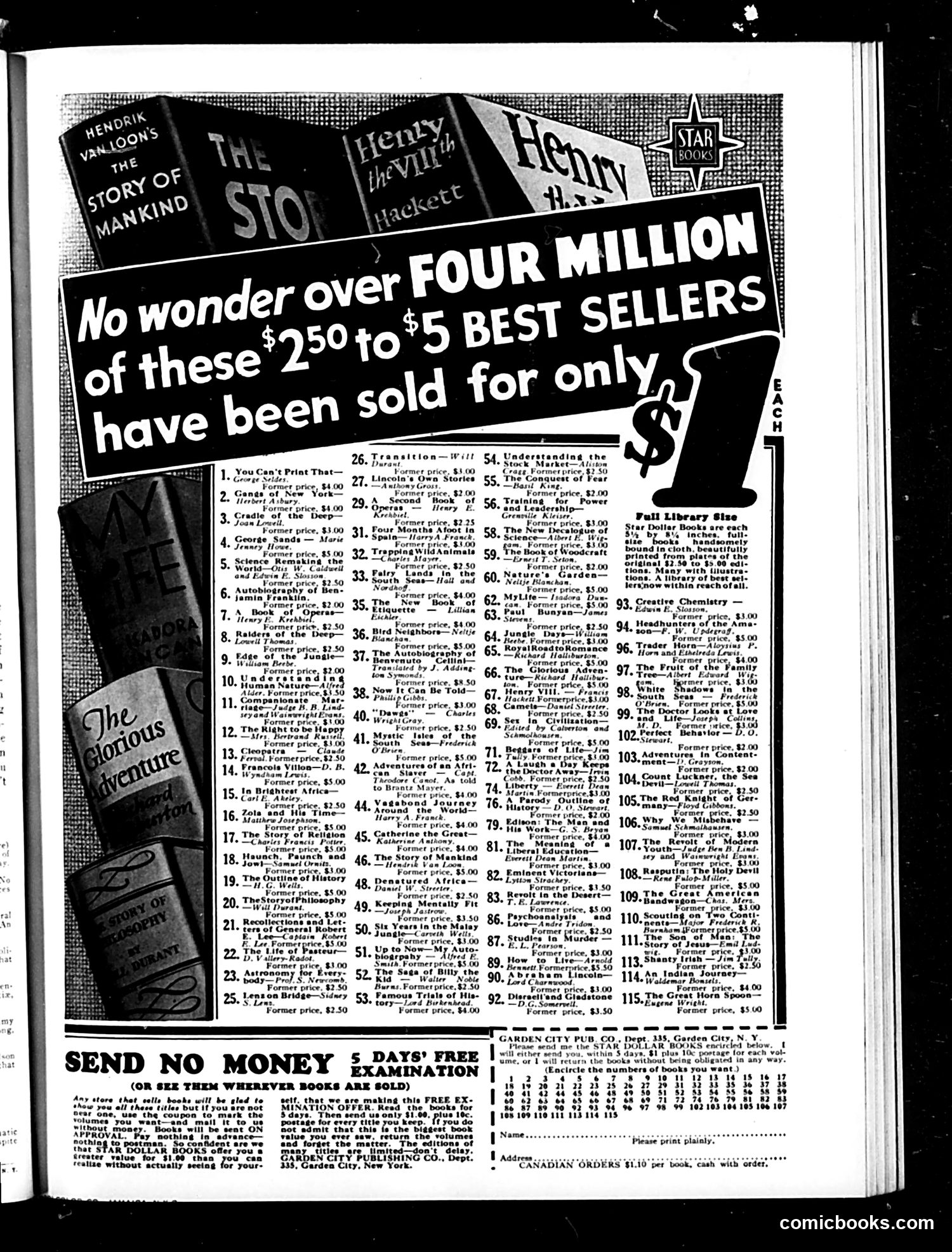
Judge Magazine Book Advertisement This page is primarily a mail-order book advertisement from Garden City Publishing Co., not a political cartoon. It advertises over 115 titles—described as "best sellers"—priced at $2.50 to $5.00, now offered for examination without money down. The books listed represent typical early-20th-century popular and literary works: biographies (*Life of Pasteur*), travel narratives (*Six Years in the Malay Jungle*), philosophy (*Story of Philosophy*), and adventure tales. The "former price" notations emphasize the discount appeal. The advertisement's satirical angle is subtle: it mocks the mail-order book-selling industry itself—promising free examination and easy payment ("SEND NO MONEY / 5 DAYS' FREE EXAMINATION")—a common sales tactic Judge readers would recognize as aggressive marketing. The sheer density of titles and aggressive pitch typifies the era's direct-mail publishing schemes. The small book images shown are decorative, not satirical caricatures.
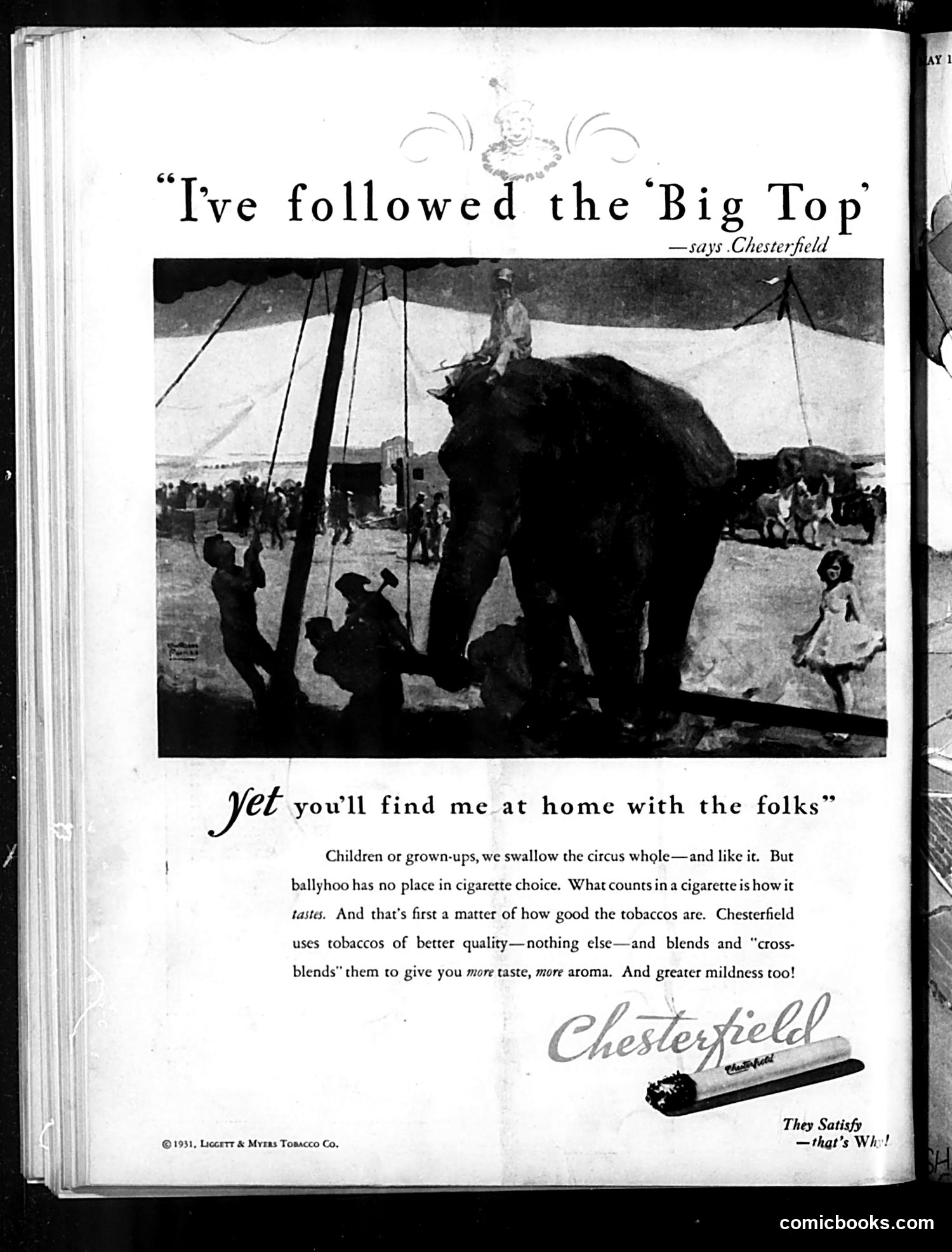
Advertisement Analysis This is a Chesterfield cigarette advertisement, not political satire. The page uses a circus elephant image to contrast two lifestyles: the excitement of following traveling circuses ("the Big Top") versus domestic contentment. The ad's argument is that while circus spectacle relies on "ballyhoo" (exaggerated promotion), cigarette quality shouldn't. Instead, Chesterfield claims superiority through actual tobacco quality—better tobaccos, superior blending, more taste and aroma, and greater mildness. The tagline "They Satisfy—that's Why!" emphasizes substance over marketing hype. This reflects 1931 advertising strategy: positioning the brand as authentic and unpretentious compared to competitors' promotional claims. The elephant and circus imagery simply provided visual interest to capture readers' attention in the magazine.