judge
Judge — May 16, 1931
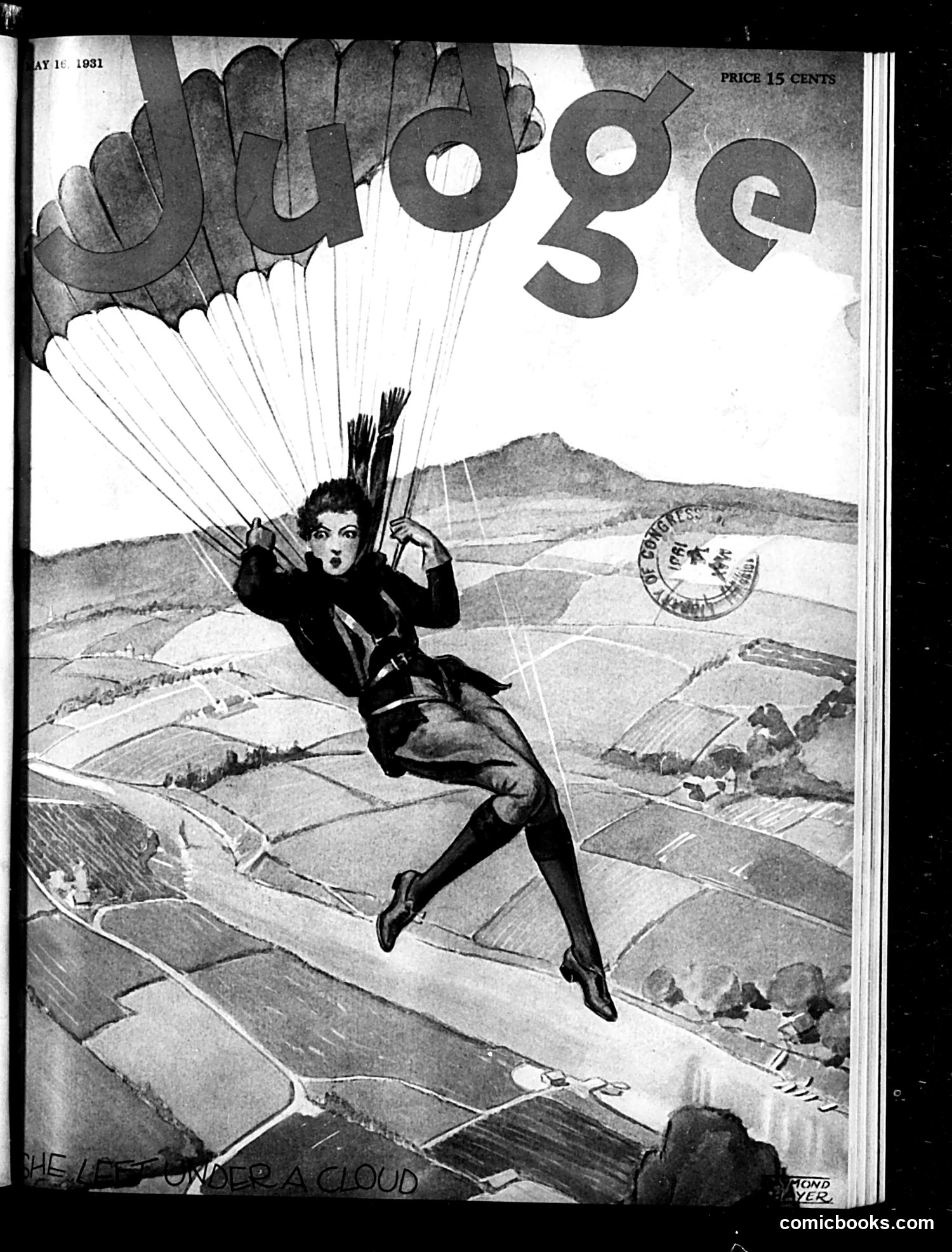
Judge Magazine Cover Analysis (May 16, 1931) This cover depicts a woman in a black outfit descending by parachute over a patchwork agricultural landscape. The large numbers "1929" appear at top, while text at bottom reads "UNDER A CLOUD." Historical Context: This is a commentary on the stock market crash of 1929 and the subsequent Great Depression. The parachute descent suggests financial "crash landing" or emergency descent from prosperity. The woman's expression of shock and the agricultural landscape below symbolize the economic devastation spreading from Wall Street to rural America. The "cloud" reference combines literal imagery (the parachute) with the figurative meaning of a dark shadow over the nation's economic future. This 1931 publication reflects ongoing Depression anxieties two years after the initial crash.
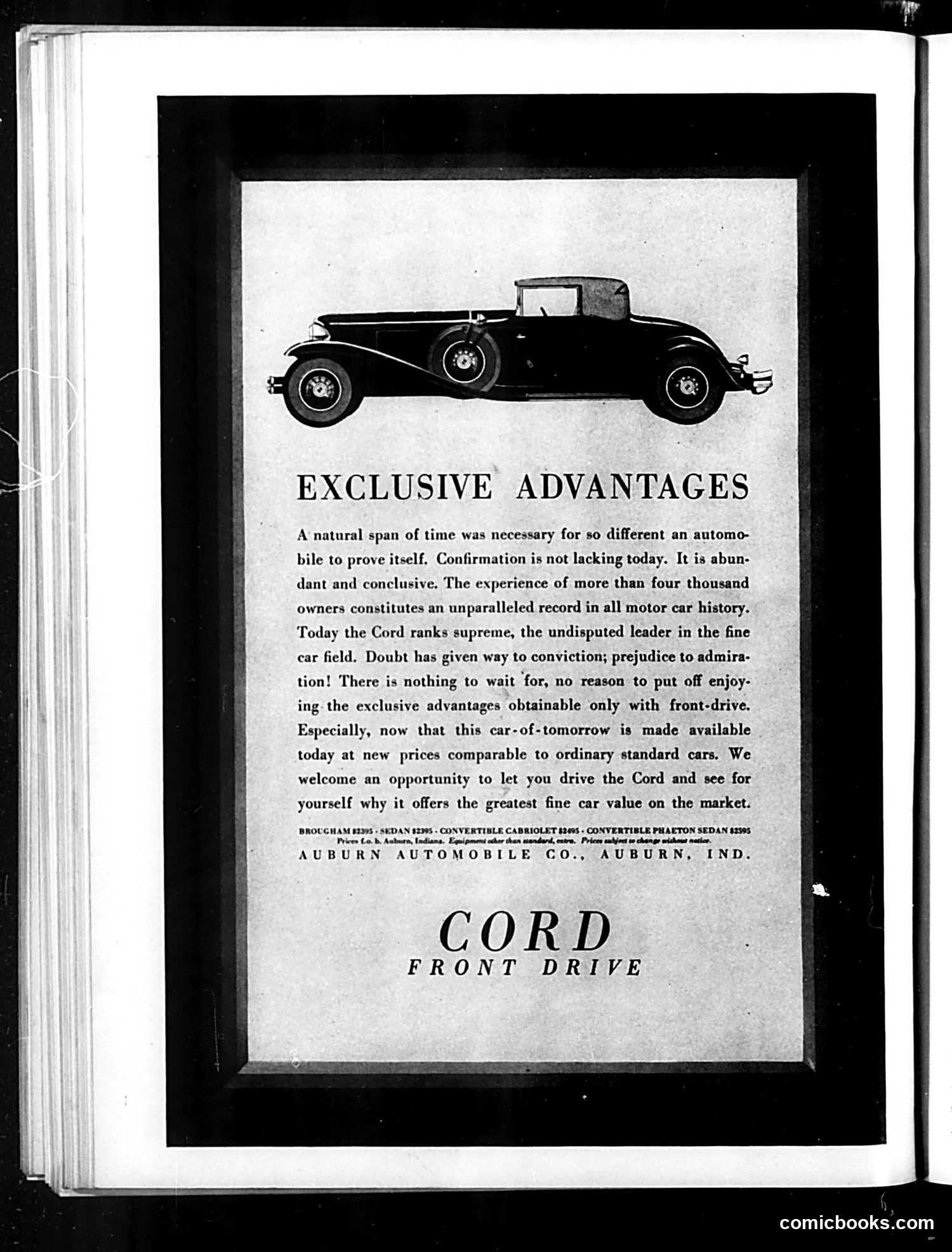
Analysis This page is primarily advertising, not satire or political commentary. It's a Cord automobile advertisement from Auburn Automobile Co. (Auburn, Indiana), promoting the Cord's front-wheel-drive technology as a revolutionary innovation. The ad's "exclusive advantages" pitch emphasizes that the Cord has proven itself through over 4,000 owner experiences—an "unparalleled record." The text argues that doubters have been converted; the car now ranks "supreme" in the fine car field. It highlights that front-wheel drive, previously available only in expensive vehicles, is now offered at prices comparable to standard cars. The elegant side-profile silhouette showcases the vehicle's sleek design, meant to appeal to luxury car buyers. This is straightforward commercial promotion, not satirical content.
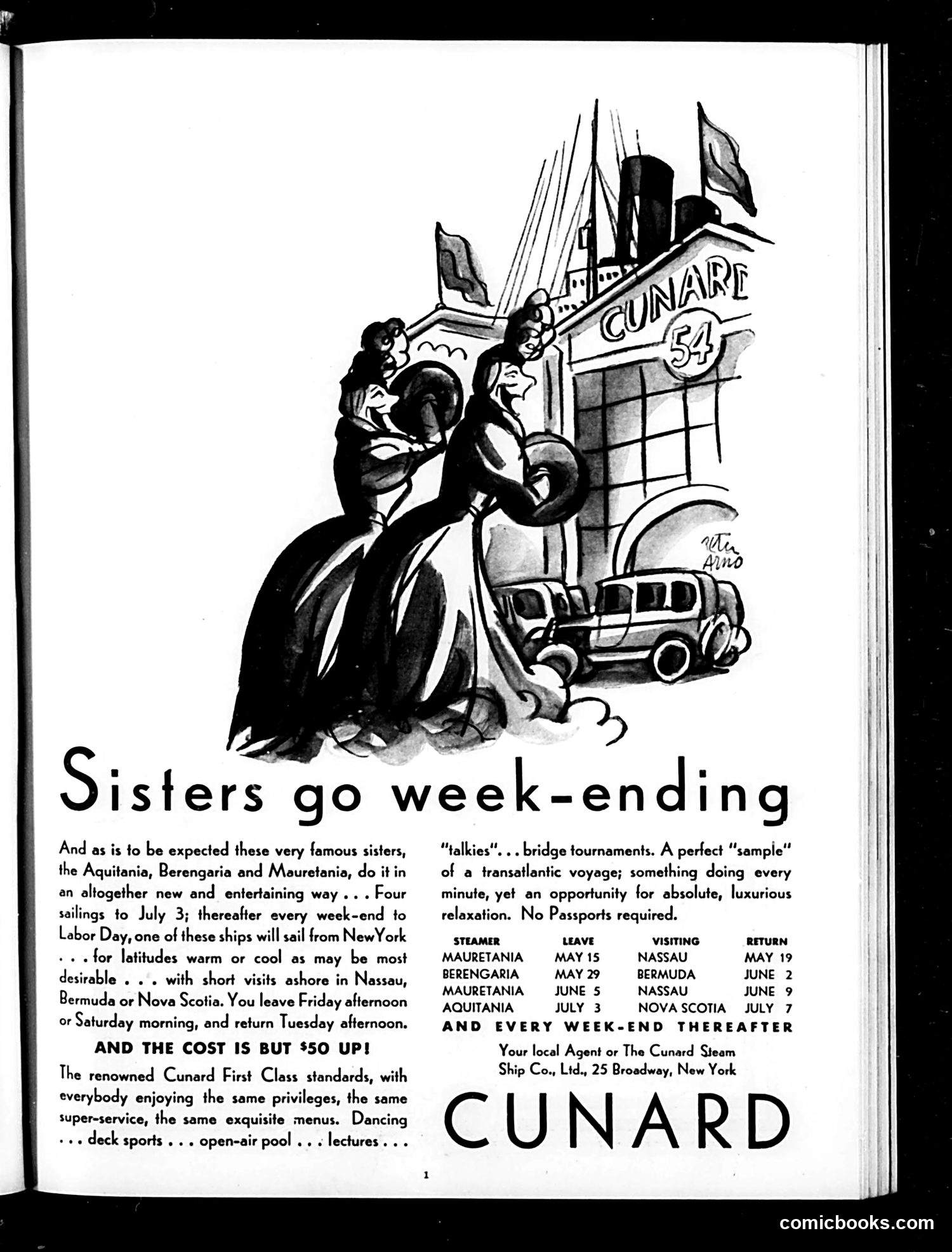
Analysis of "Sisters Go Week-ending" - Cunard Advertisement This is primarily a Cunard cruise line advertisement, not political satire. The illustration depicts wealthy women ("sisters"—likely socialites) boarding the luxury liner Cunard 54, preparing for weekend getaways. The "joke" plays on leisure culture: these famous sisters (the text mentions "Aquitania, Berengaria and Mauretania"—actually ship names, not people) enjoy transatlantic voyages costing only $50 for weekend trips to Nassau, Bermuda, or Nova Scotia. The satire is subtle and class-based: it mocks the casual wealth of the era's upper class, where luxury ocean travel was a casual weekend activity. The caricatured, fashionable women and their animated poses emphasize the frivolous leisure culture of the 1920s-30s among the extremely wealthy.
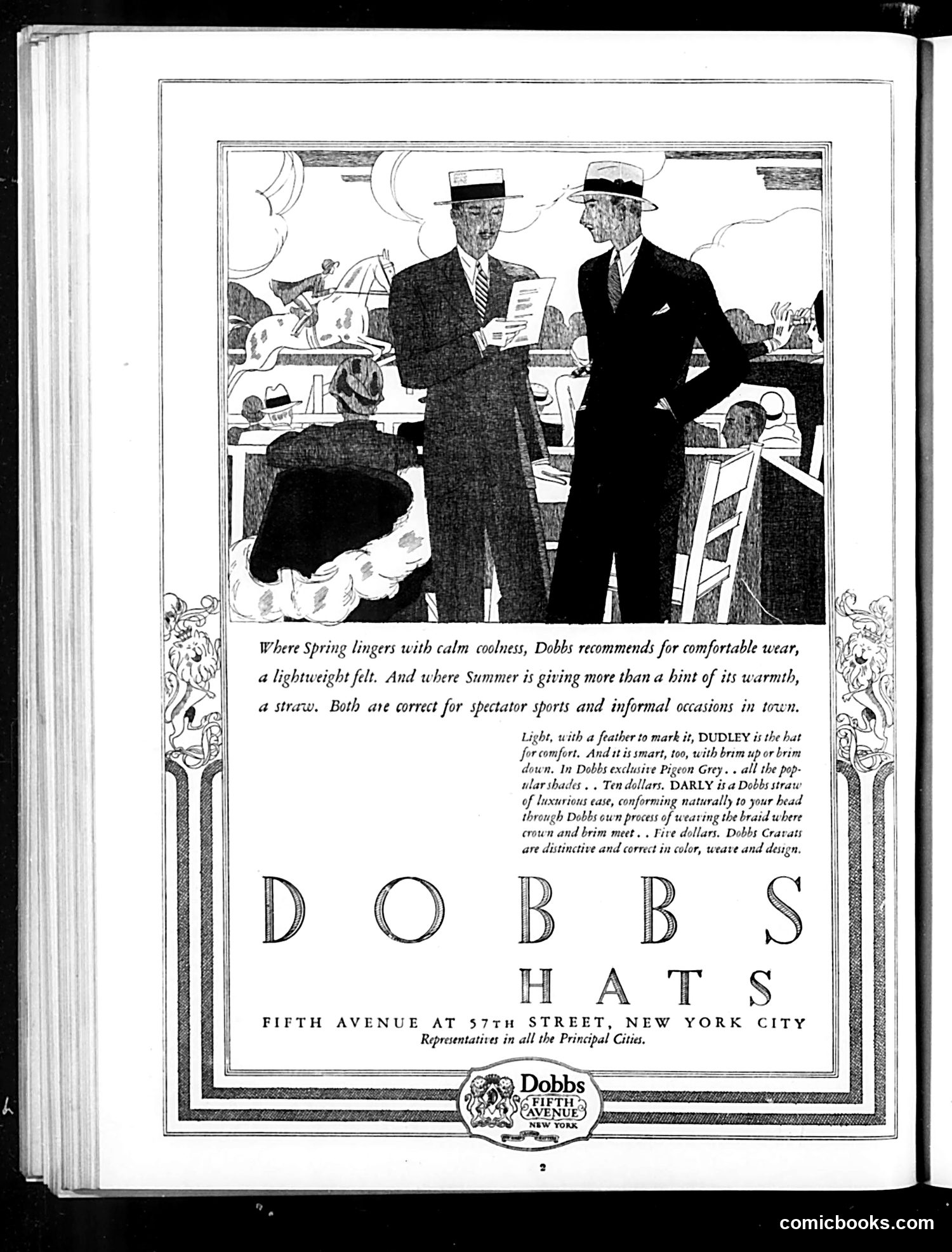
Analysis This is primarily a Dobbs Hat advertisement, not a political cartoon. The image depicts three well-dressed men at what appears to be a sporting or social event, illustrating hat recommendations for different seasons. The ad copy discusses hat choices: a "lightweight felt" for spring and a straw hat for summer, both "correct for spectator sports and informal occasions in town." It then promotes specific Dobbs hat styles—the Dudley, Darby, and Cravatti—with prices ranging from five to ten dollars. The decorative border and formal illustration style are typical of upscale magazine advertising from the early-to-mid 20th century. This represents commercial content rather than satirical commentary, aimed at affluent male readers seeking guidance on proper seasonal attire.
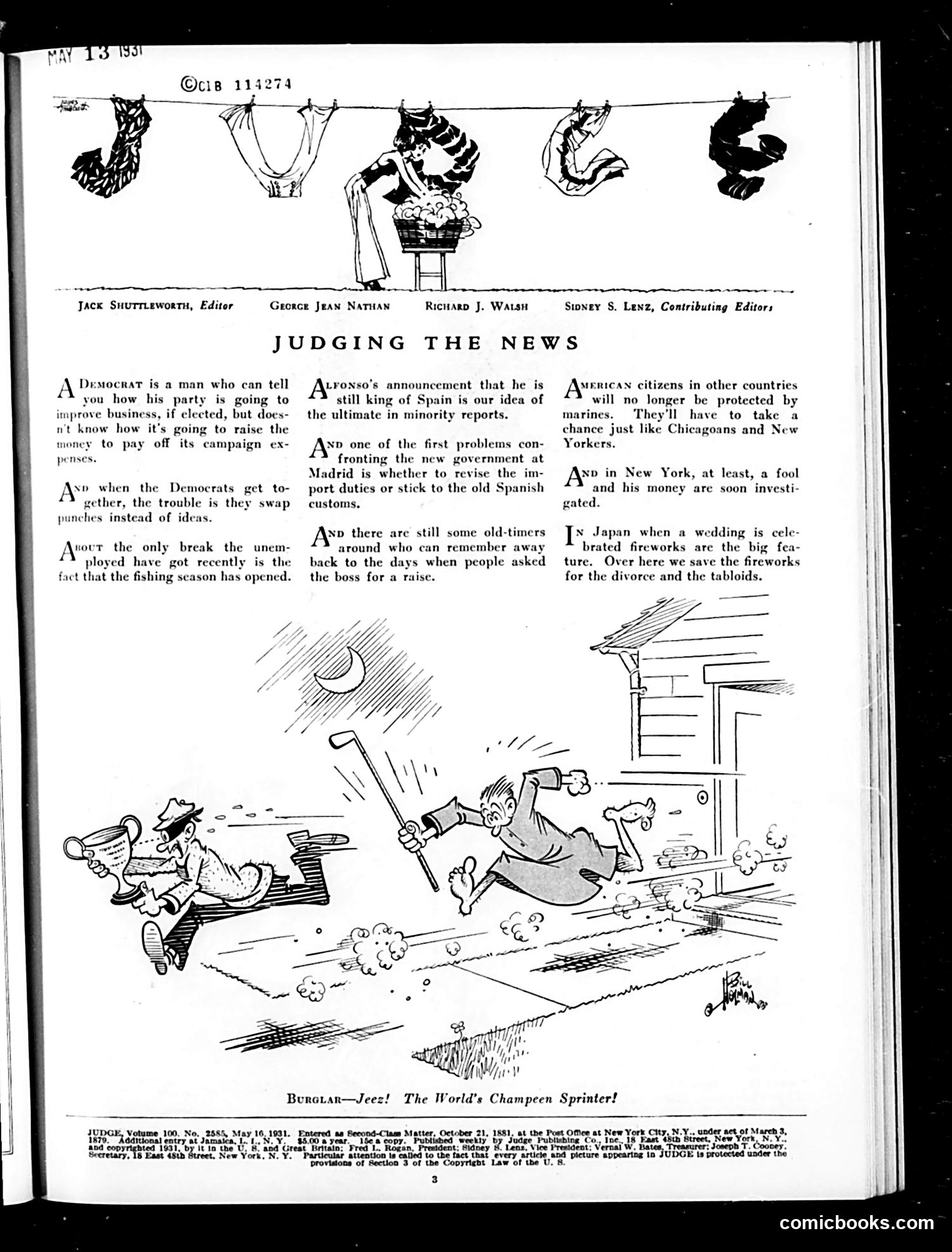
"Judging the News" - May 13, 1931 This page contains editorial commentary and one cartoon titled "Burglar—Jeez! The World's Champion Sprinter!" The cartoon depicts a burglar fleeing a house at night, running frantically while being chased. The satire comments on crime or criminal activity during the Great Depression era—likely referencing the spike in burglaries occurring as economic desperation increased. The editorial snippets above use humor to critique contemporary politics: Democratic campaign finances, Spain's government changes under Alfonso XIII, unemployment, and American expatriates abroad. One comment jokes that New York fools are "soon investigated," suggesting criticism of New York politics or society. The overall tone is cynical commentary on 1931 American politics and social problems during the Depression.
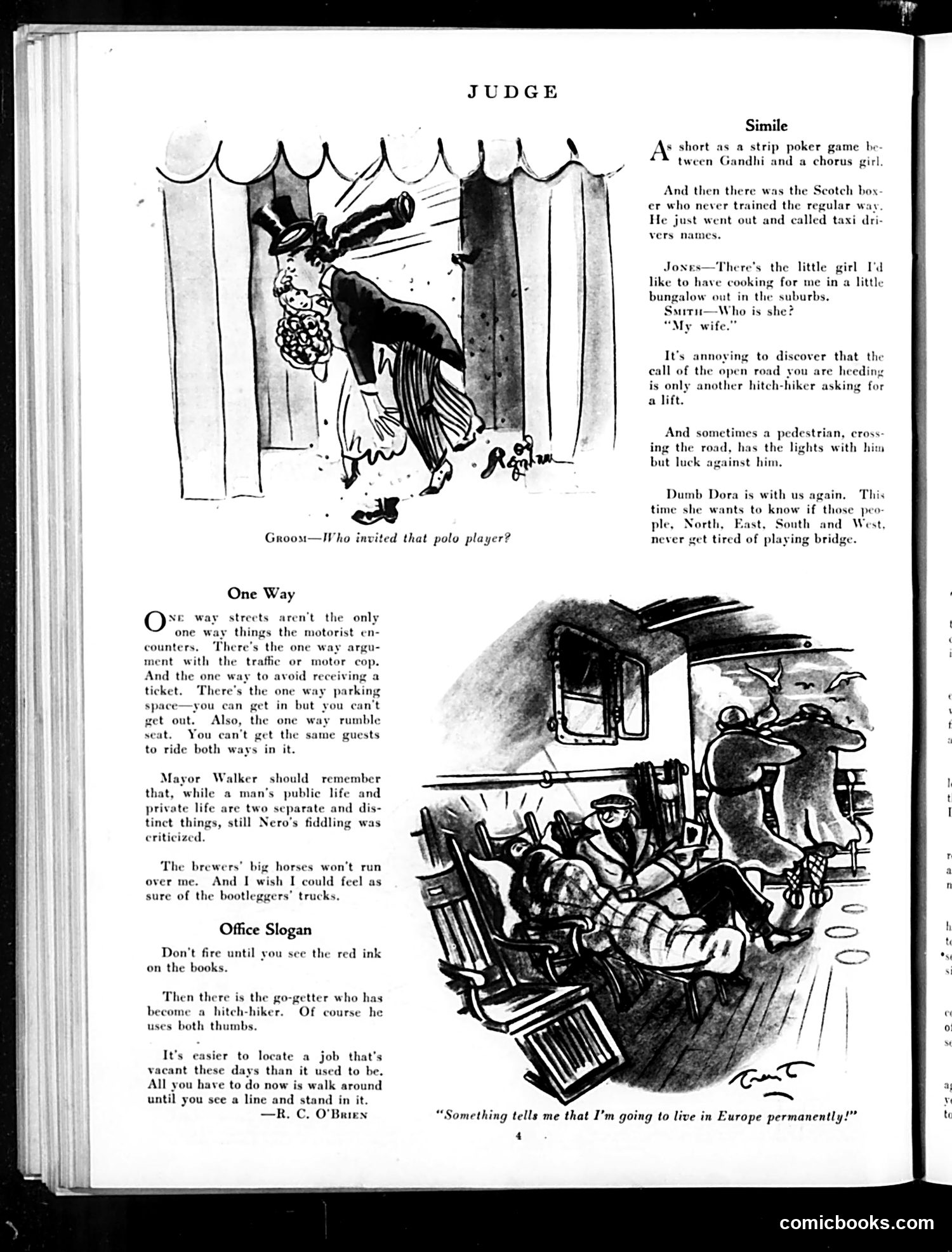
Judge Magazine Page Analysis This page contains humor columns and two cartoons satirizing early 20th-century American life. Top cartoon ("Grooms—Who invited that polo player?"): Shows a disheveled man at what appears to be a formal event, mocking social pretension and the intrusion of wealth-obsessed outsiders into exclusive circles. "One Way" section: Critiques traffic regulations and parking absurdities of the motorist era—one-way streets, no-parking zones, and contradictory rules that trap drivers. Bottom cartoon: Depicts an overcrowded car full of people heading to Europe, captioned "Something tells me that I'm going to live in Europe permanently!" This satirizes wealthy Americans' exodus abroad, likely referencing post-WWI expatriation trends when many Americans relocated to Europe, particularly Paris. The overall theme mocks modern inconveniences and social pretension.
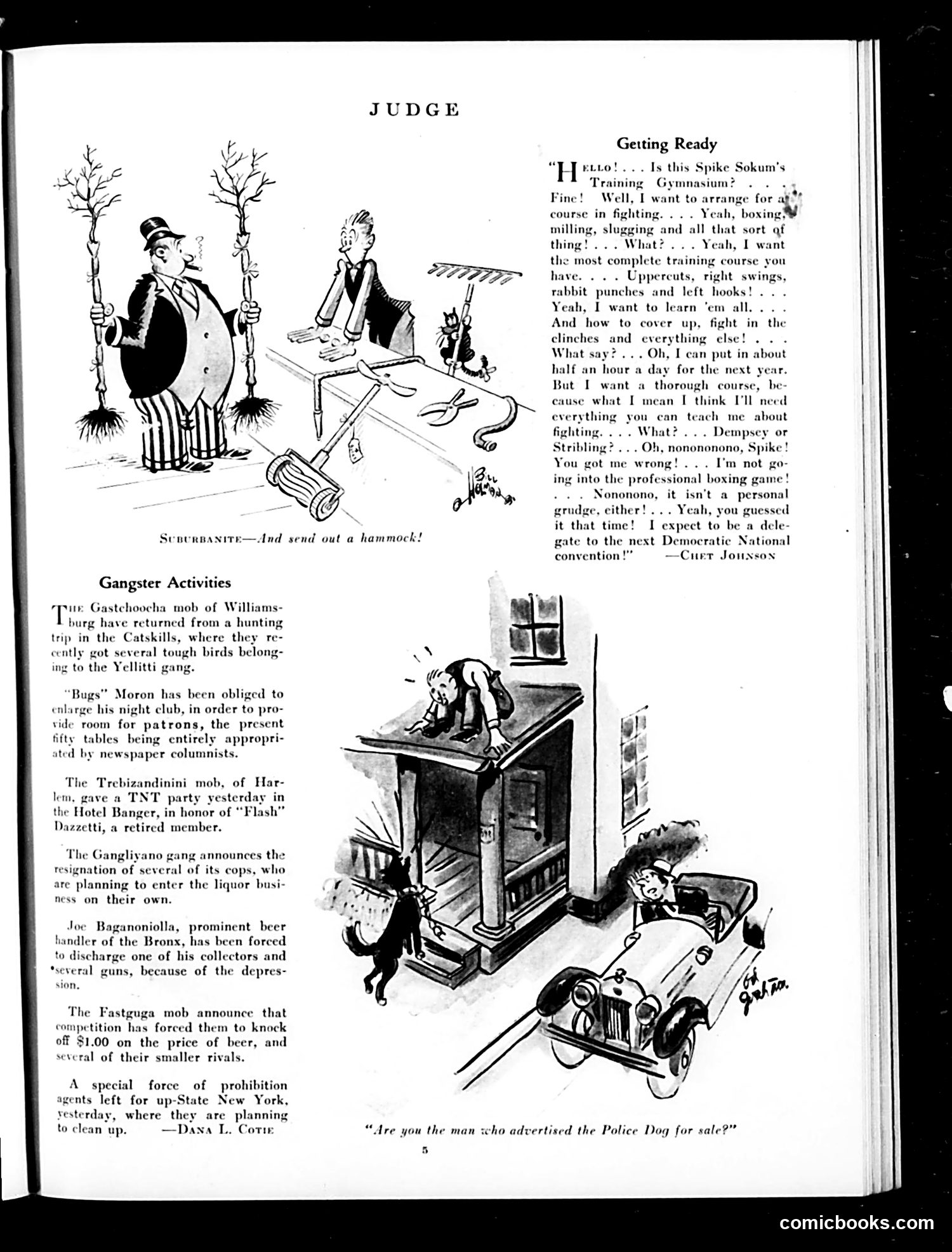
Judge Magazine Page Analysis This page satirizes Prohibition-era gangster activities in 1920s America. The top cartoon shows someone at a boxing gymnasium—a common front for illegal operations during Prohibition. The lengthy dialogue mocks how gangsters disguised criminal enterprises (bootlegging, gambling) as legitimate businesses. The "Gangster Activities" section humorously documents real mob operations: the Gastchoocha mob's hunting trip (likely code for violent activity), "Bugs" Moron's nightclub expansion, and various gangs' turf wars and price-fixing. The bottom cartoon depicts a police dog being sold—likely satirizing law enforcement's ineffectiveness against organized crime. The satire targets both gangster audacity and authorities' inability to combat Prohibition-era crime. Judge's tone suggests bemused exasperation with widespread criminal networks operating openly in major American cities.
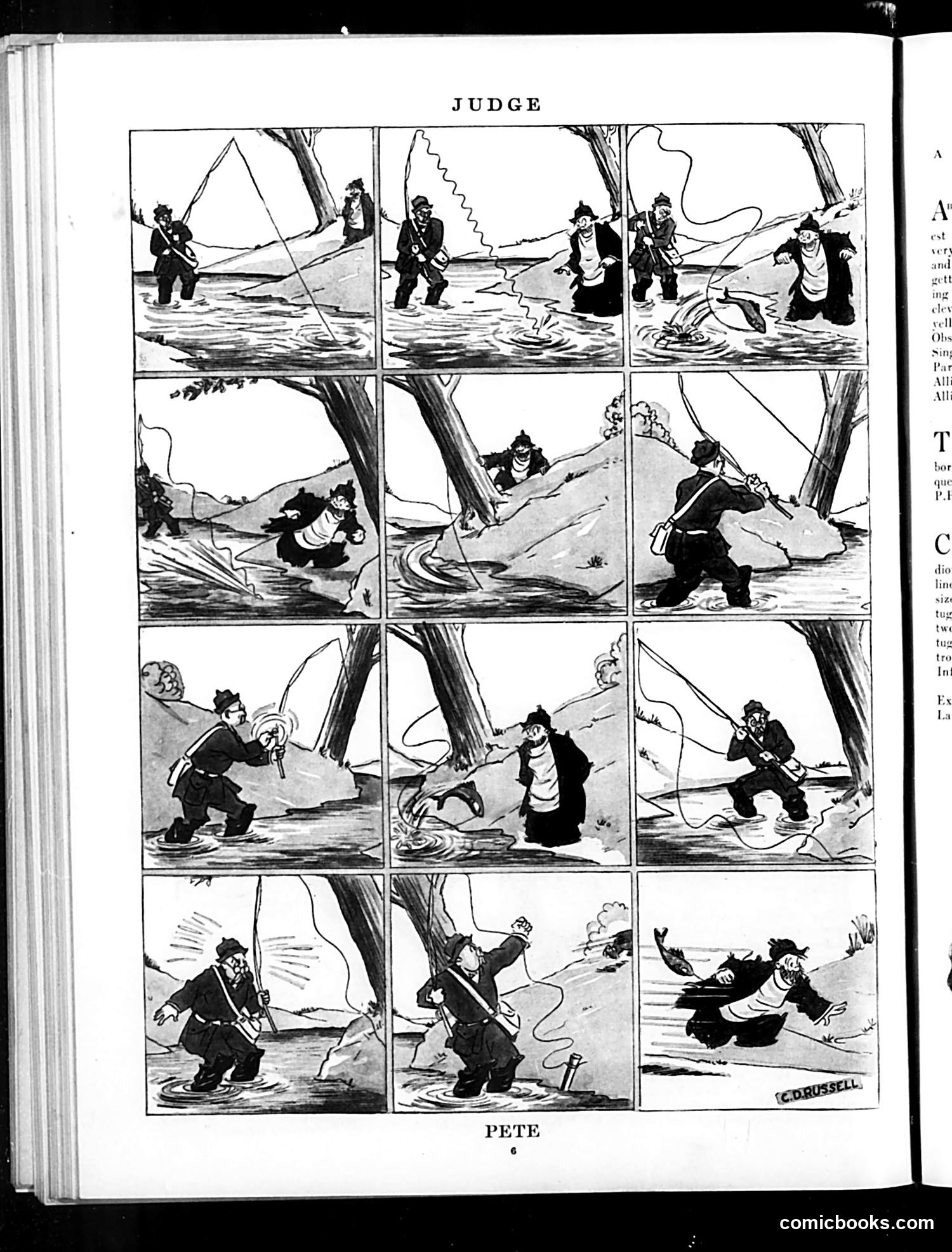
Judge Magazine Comic: "Judge" and "Pete" This is a fishing-themed comic strip showing two men in formal attire attempting to catch fish in a stream. The title "JUDGE" tops the sequence, while "PETE" appears at the bottom. The humor appears to center on incompetent or comedic fishing attempts—the men repeatedly struggle, fall, or flail with their fishing rods in increasingly absurd ways. The physical comedy and exaggerated poses suggest satirical commentary on amateur fishermen or perhaps specific public figures (the title "Judge" might reference a judge character, though specific identification is unclear without additional context). The cartoonist's signature "C.D.RUSSELL" appears in the lower right. The satire likely relies on contemporary recognition of the figures, which modern readers would require additional historical context to fully appreciate.
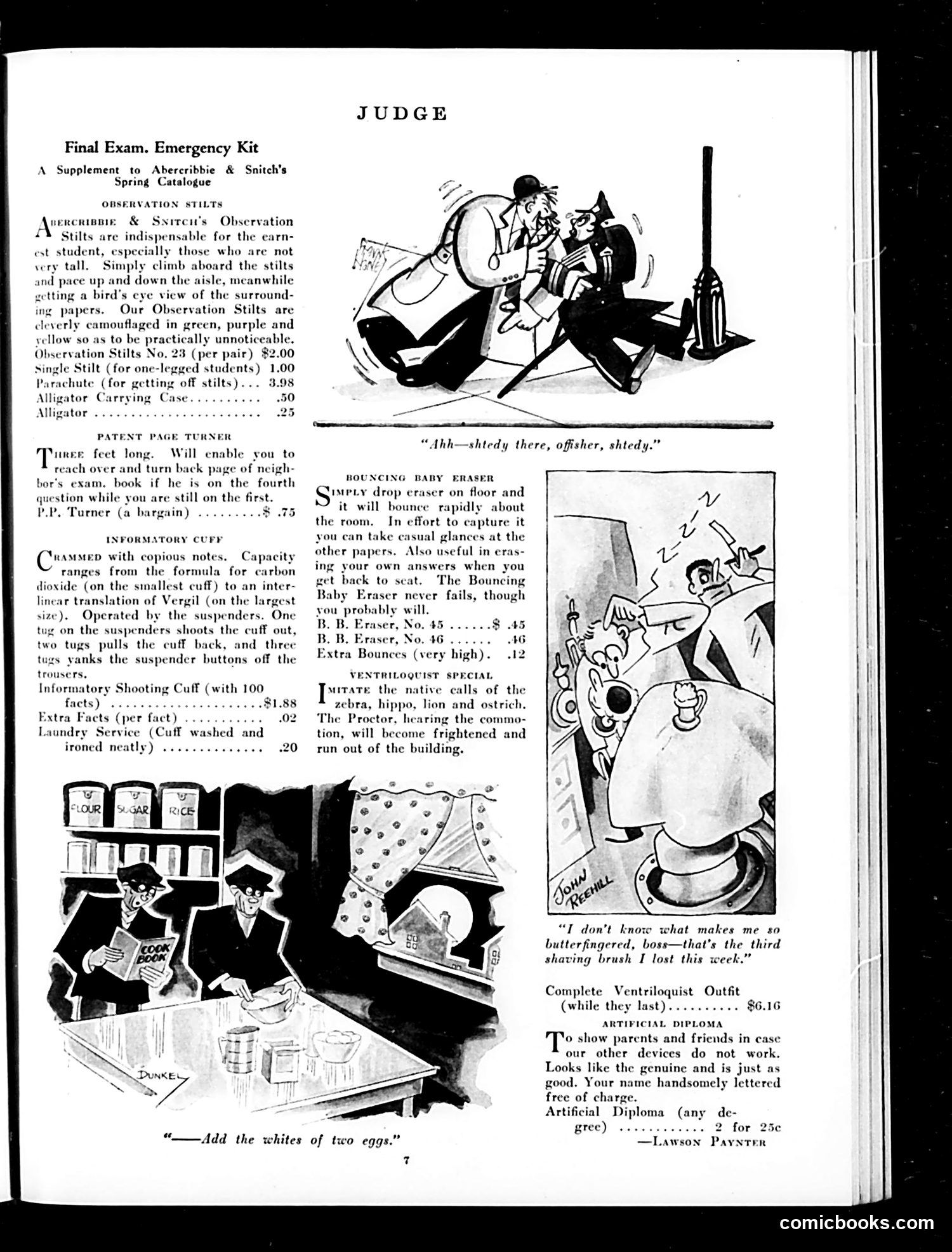
Judge Magazine Exam Cheating Satire This page satirizes student cheating methods during final exams through a fake "Emergency Kit" catalog. The humor relies on absurdly impractical cheating devices presented as legitimate products: Key items mocked: - Observation Stilts: Allow students to peek at neighbors' papers while appearing inconspicuous - Patent Page Turner: A three-foot pole to turn classmates' exam pages - Informatory Cuff: A note-filled sleeve operated by suspenders - Bouncing Baby Eraser: An eraser that bounces around, forcing casual glances at others' work - Ventriloquist Special: Making animal sounds to distract proctors The cartoons show students caught in these ridiculous schemes—one literally on stilts during an exam, another frantically chasing a bouncing eraser. The satire's point: By presenting these cheating aids as ridiculous products with specific prices and detailed instructions, Judge mocks both student desperation during exams and the elaborate dishonesty some employ. The "Artificial Diploma" at the end drives home that cheating defeats education's actual purpose.
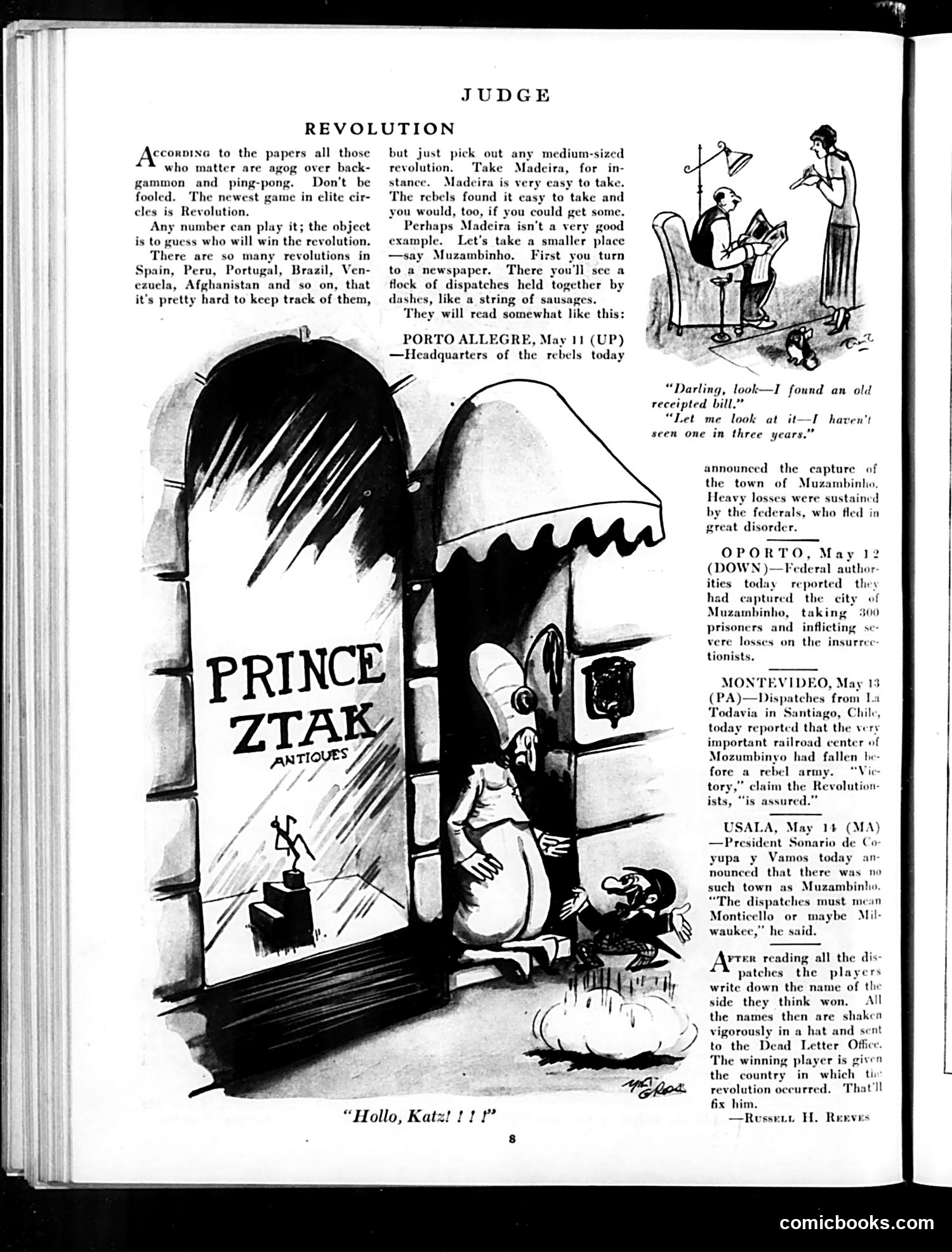
"Judge Revolution" Analysis This satire mocks the bewildering proliferation of political revolutions in the 1920s-30s Latin America and elsewhere. The article presents "Revolution" as a parlor game because actual revolutions had become so numerous and confusing that tracking them seemed impossible. The joke centers on contradictory newspaper dispatches about the fictional town "Muzambinho"—rebels claim victory in one report, federals claim it in another, and a politician denies the town exists at all. This illustrates how unreliable and contradictory press coverage made it genuinely difficult to determine who actually won any given conflict. The cartoon depicts a figure labeled "Prince Ztak Antiques"—likely a caricatured foreign observer or businessman—bewildered by revolutionary chaos. The game's "prize" is darkly comic: the winning player receives the actual country where the revolution occurred, presented as a punishment ("That'll fix him"). The satire critiques both the instability plaguing multiple nations and the inadequate, conflicting information available to observers trying to understand these events.
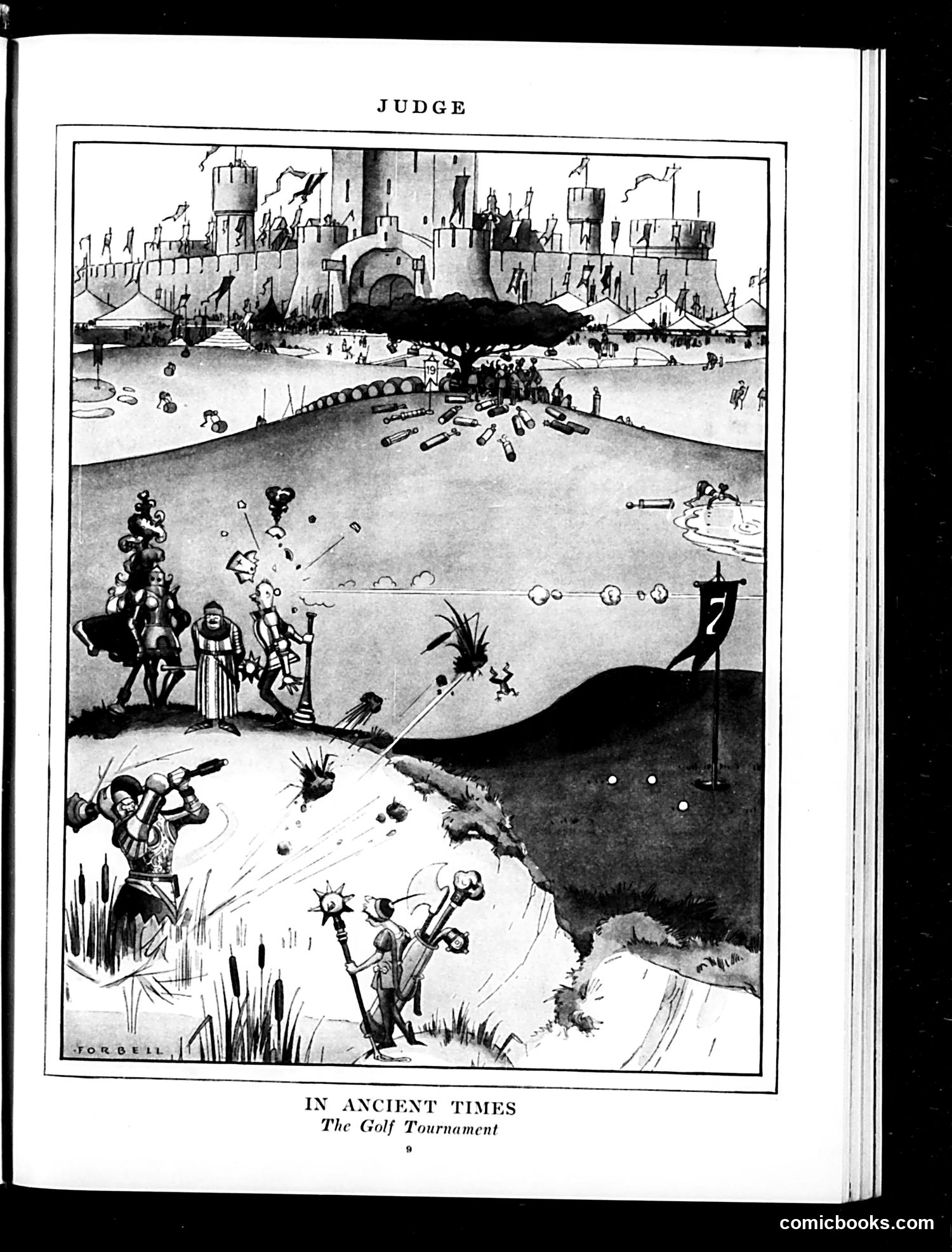
"The Golf Tournament in Ancient Times" This is a satirical cartoon imagining golf as an ancient medieval sport. The upper half shows a fortified castle city with crowds of spectators. The lower half depicts nobles and knights actively playing golf in a landscape with hazards—water, rough terrain, and what appears to be a large beast or dragon serving as an obstacle. The satire likely mocks the aristocratic pretensions of golf, suggesting that this elite leisure activity has always been a pursuit of the upper classes, even fantastically "back in time." The medieval setting humorously implies golf's perceived snobbery and exclusivity. The presence of dangerous obstacles (the creature, rough water) suggests the sport's challenges are timeless—a gentle joke about golf's inherent difficulty, regardless of era.
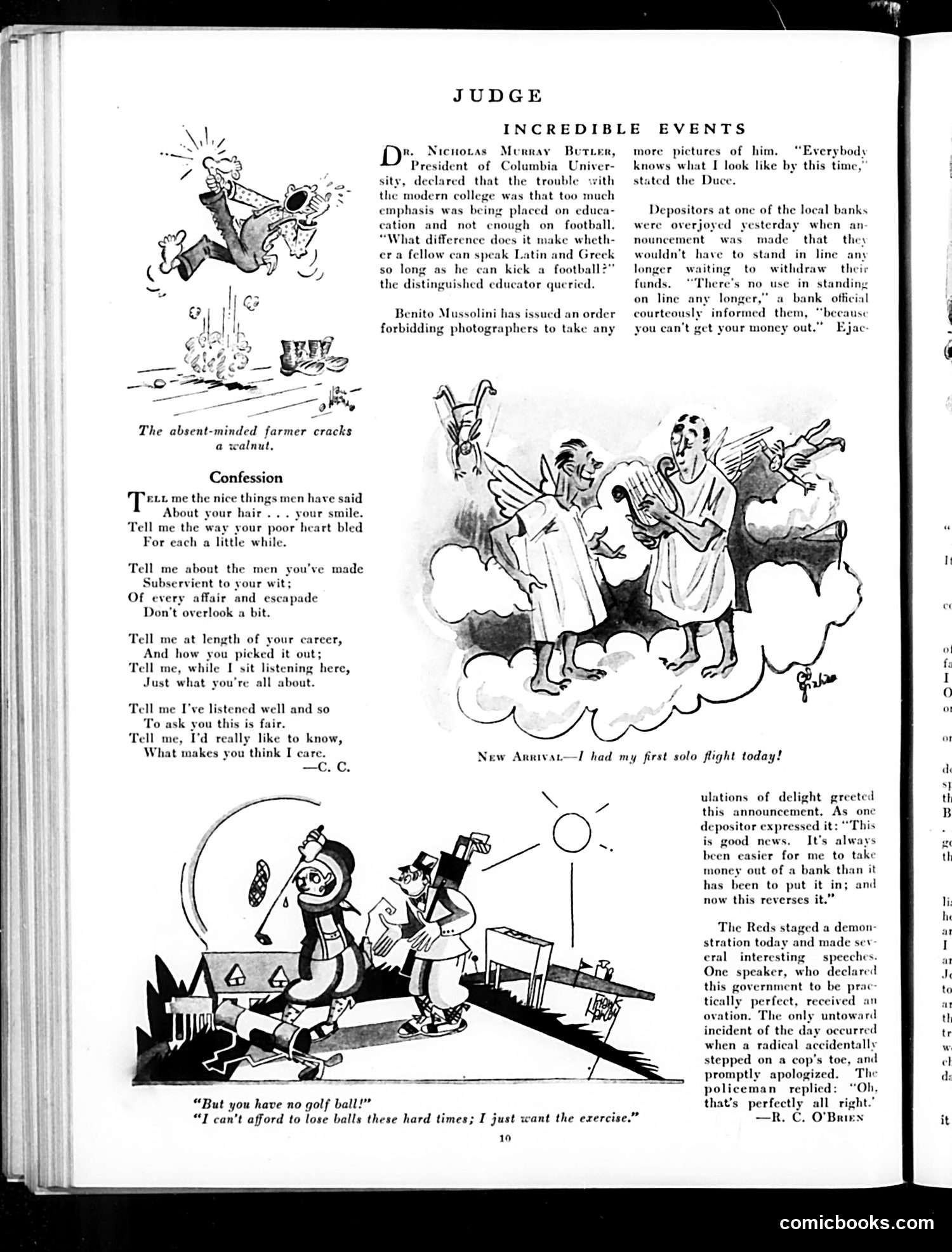
Political Satire from Judge Magazine This page contains several satirical pieces mocking 1920s-30s American institutions: Top cartoon: Dr. Nicholas Murray Butler (Columbia University president) is ridiculed for emphasizing football over academics—the satire suggests colleges prioritize sports over actual education. Bank cartoon: References a contemporary banking crisis where depositors couldn't withdraw funds. The joke inverts typical bank problems: usually people struggle to *deposit* money, but now they can't get money *out*—the "good news" is darkly ironic. "Confession" poem: A cynical piece about romantic relationships, with the twist ending that the speaker doesn't actually care about the other person's stories. Bottom cartoon: A man practices golf without a ball, claiming he can't afford to lose balls during hard economic times—satirizing Depression-era penny-pinching and illogical reasoning. "New Arrival" caption: References Mussolini's prohibition on photographers, appearing to mock fascist control while celebrating aviation progress. The overall tone reflects economic hardship and political anxiety of the early Great Depression era.
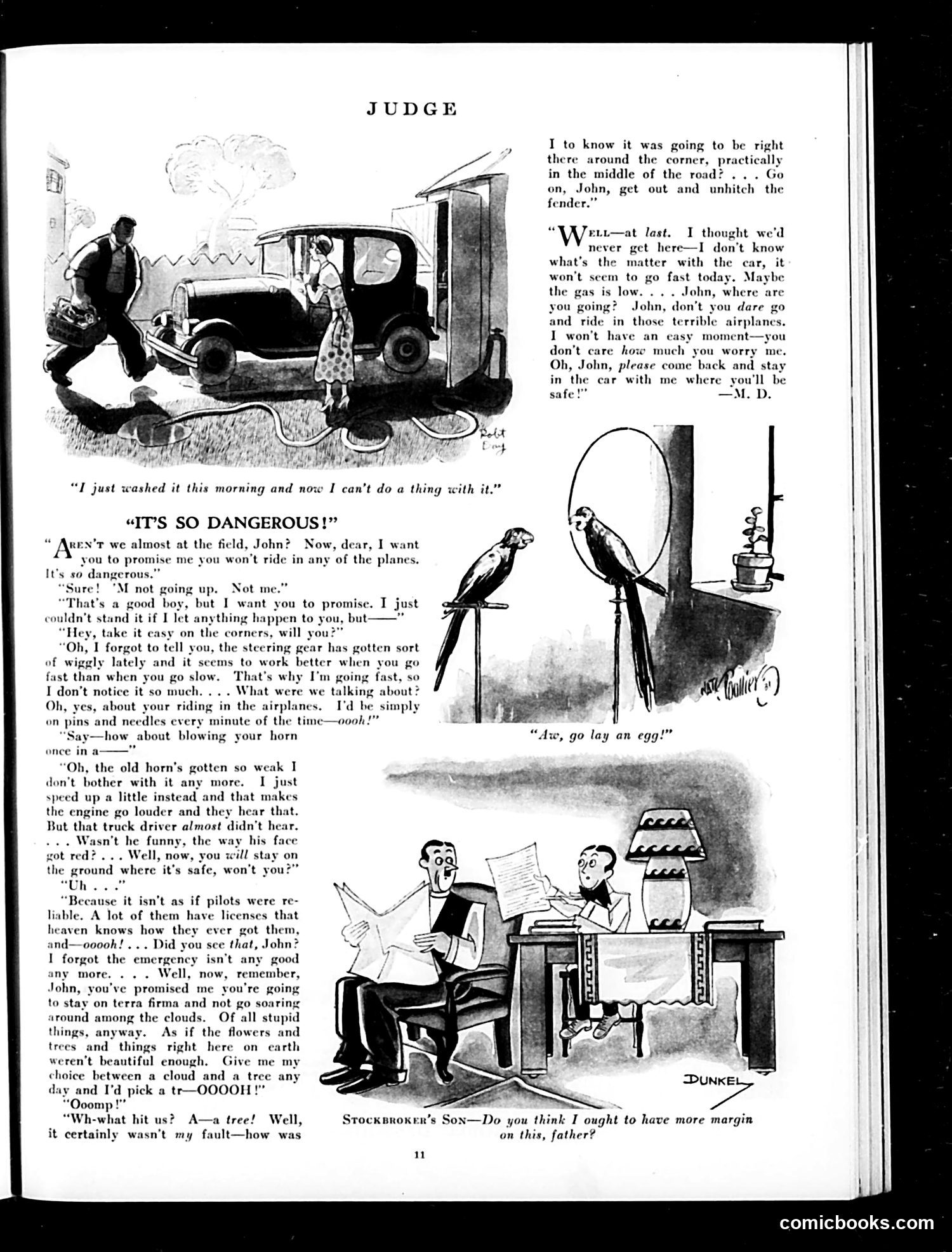
Judge Magazine Satire Analysis This page satirizes early aviation anxiety and automotive dangers through ironic contrast. The Main Joke: A wife obsessively warns her husband John against riding in "dangerous" airplanes while they drive in a clearly unsafe automobile with multiple mechanical failures—loose steering gear, broken horn, defective emergency brake. She insists on safe "terra firma," yet their car nearly hits a truck and ultimately collides with a tree. The Satire's Point: The cartoon mocks public perception of new aviation technology as inherently risky while ignoring documented dangers of automobiles. In the 1920s-30s, when this appears to have been published, cars were statistically more dangerous than early planes, yet society perceived flying as the greater threat. The Bottom Cartoon: A stockbroker asks his son about investment margins—a separate financial joke, likely referencing stock market speculation and risk. The humor relies on the audience recognizing the logical absurdity: fear of untested aviation while casually accepting automotive hazards.
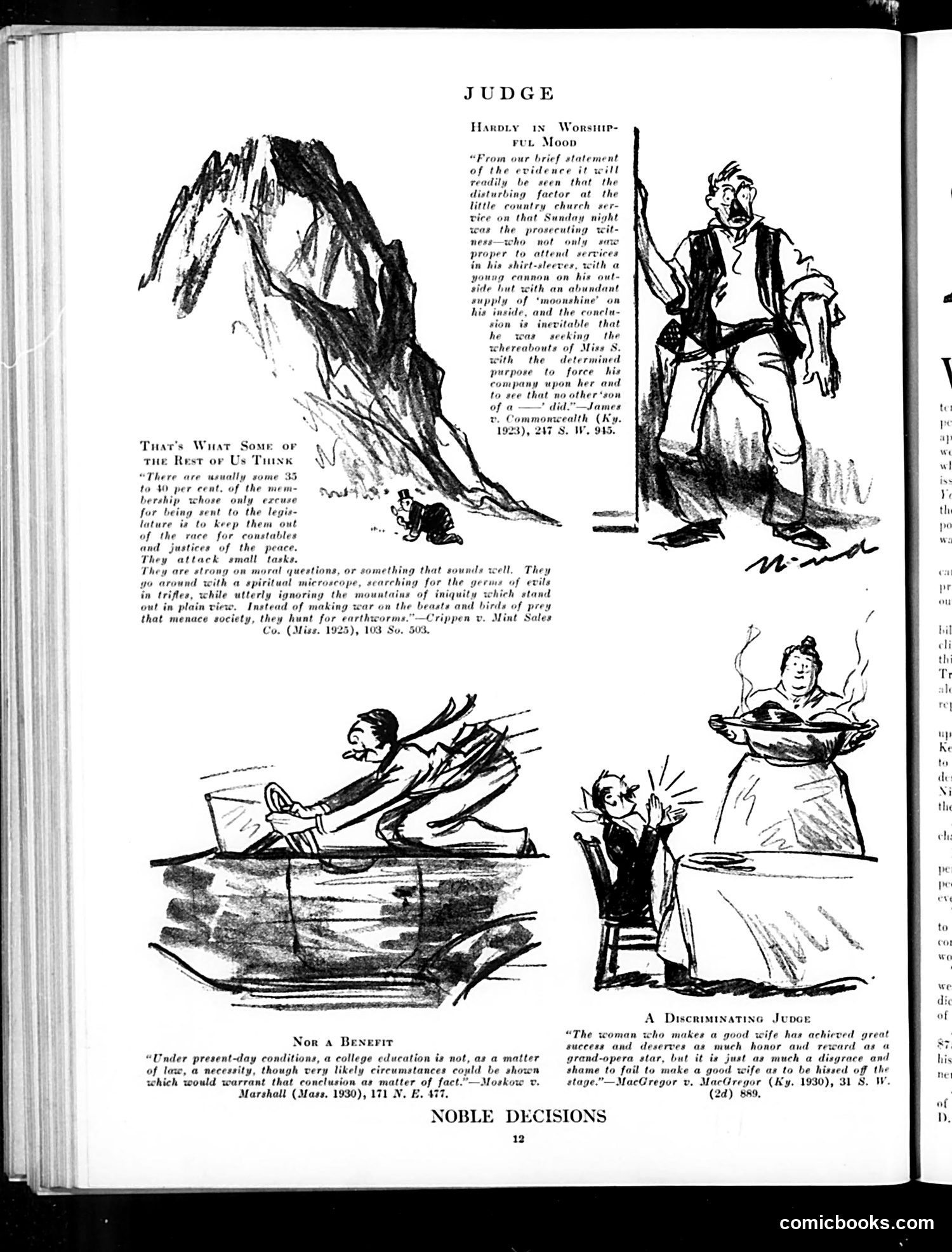
Judge Magazine Satire Analysis This page satirizes judicial absurdity through mock legal decisions. The cartoons illustrate ridiculous court rulings paired with actual case citations (appearing legitimate but highlighting legal folly). Key satires: 1. "That's What Some of the Rest of Us Think": Critiques legislators who nitpick trivial matters while ignoring serious problems—attacking "earthworms" instead of dangerous "beasts and birds of prey." 2. "Hardly in Worshipful Mood": A judge prosecutes a man for attending church in shirtsleeves while intoxicated, pedantically enforcing minor social propriety over moral substance. 3. "A Discriminating Judge": Compares women's domestic success to grand-opera stardom, suggesting society judges women's worth by marital performance alone—a backhanded commentary on gender bias in law. The illustrations show judges as absurdly pompous figures obsessing over trivialities. The satire targets judicial myopia, legislative incompetence, and society's misplaced moral priorities during the 1920s-1930s.
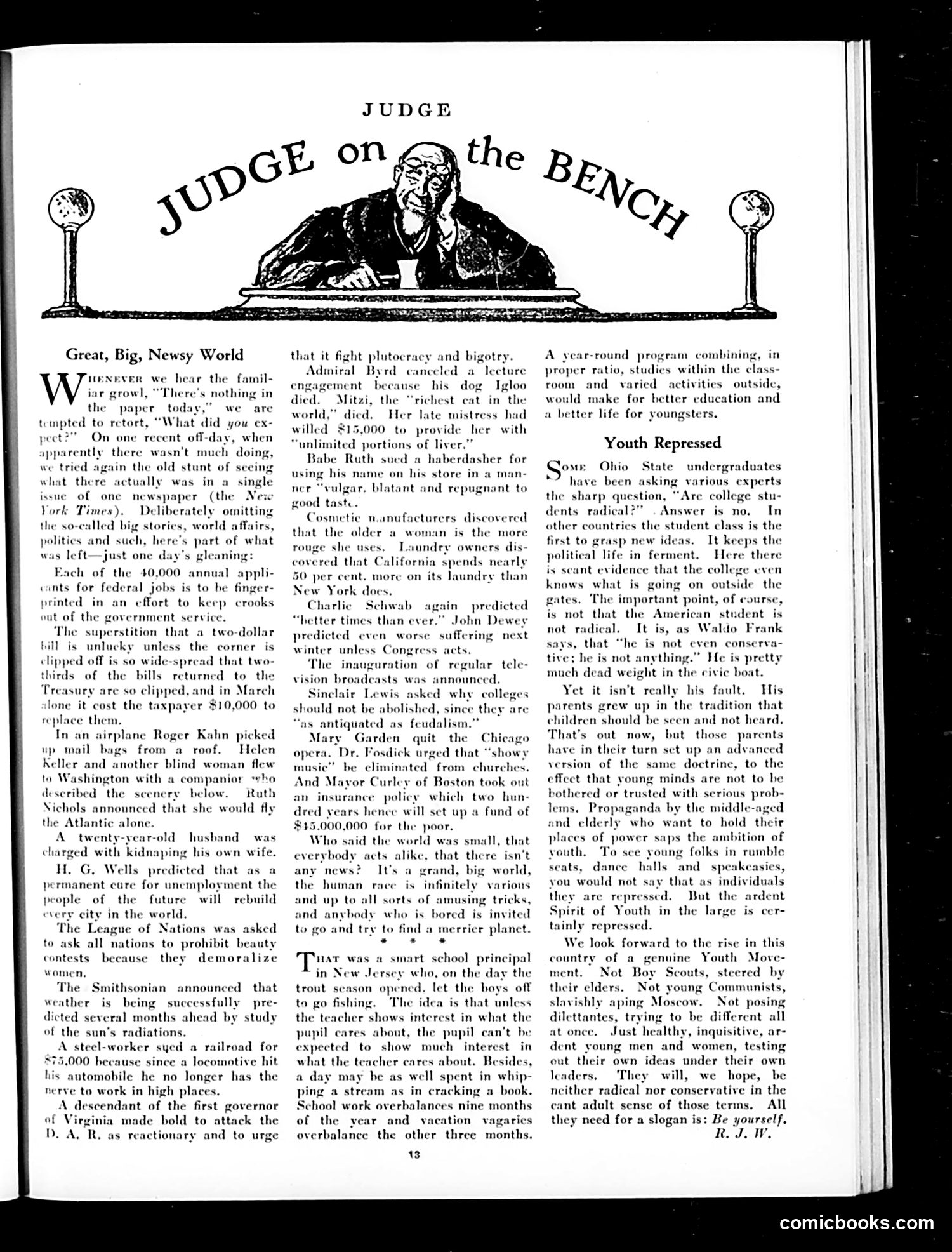
"Judge on the Bench": Satirizing American Life's Small Absurdities This column from *Judge* magazine uses the conceit of a judge presiding over everyday news to mock the trivial concerns occupying American public attention. The header illustration shows a stern judge surveying the chaos below. The satire identifies contradictions in modern life: fingerprinting federal job applicants to prevent corruption; the superstition about damaged two-dollar bills costing taxpayers $10,000 to replace; a man suing over a store using his name; a cat's $15,000bequest. These stories deliberately juxtapose petty personal grievances with grand societal problems. The broader critique targets American priorities—obsessing over beauty contests while ignoring real issues like plutocracy, or debating whether colleges should exist while parents shelter youth from the world's complexity. The concluding anecdote about a New Jersey principal allowing students to fish instead of study suggests the solution: balance between rigid tradition and genuine human interest, a theme reflected in the magazine's progressive editorial stance.
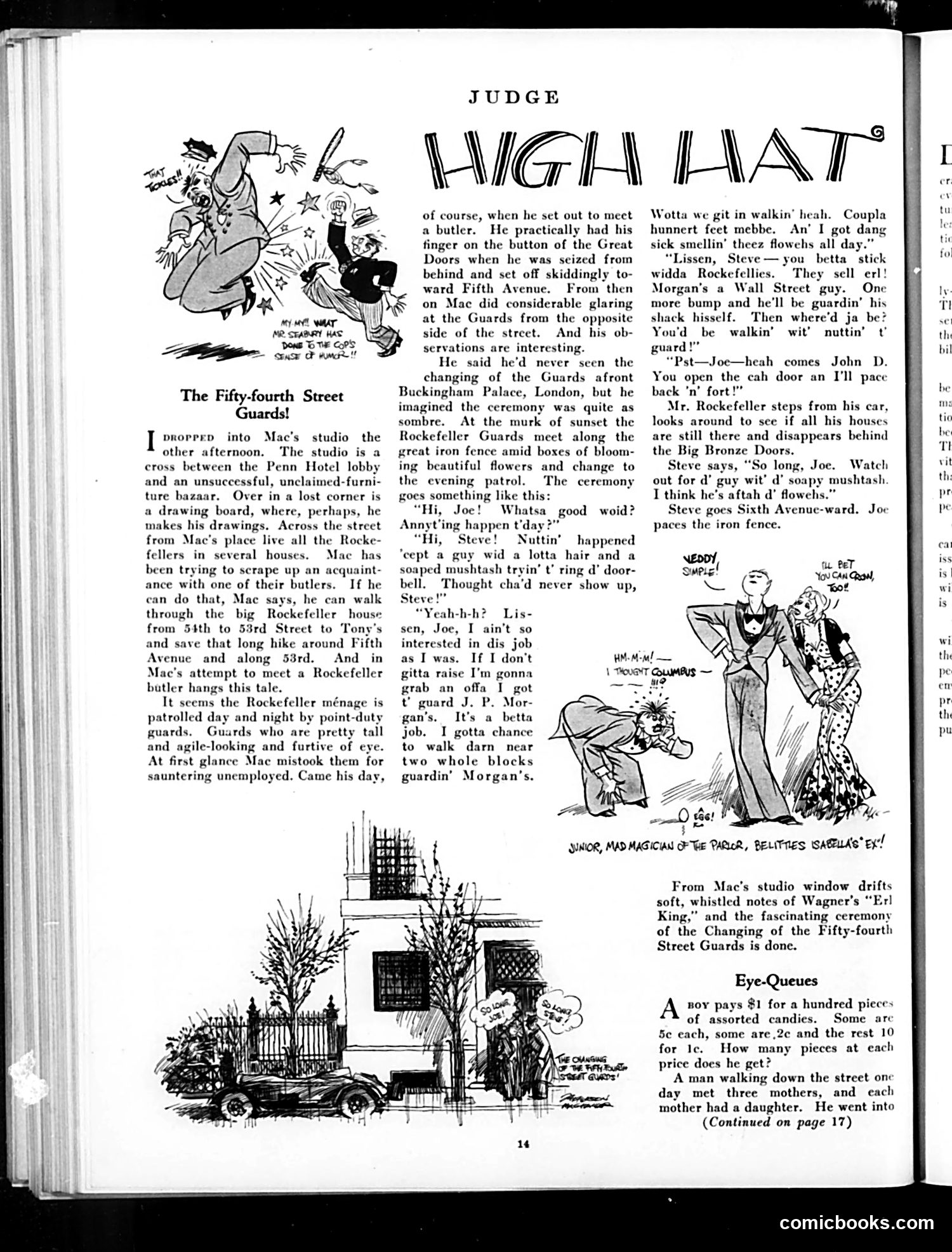
Judge Magazine: "The Fifty-fourth Street Guards" This is a humorous piece satirizing the Rockefeller family's security guards on New York's 54th Street. The author (visiting artist Mac's studio) observes the guards patrolling the Rockefeller mansion and imagines their evening shift-change ceremony, mimicking the famous Changing of the Guard at Buckingham Palace in London. The joke: The guards speak in exaggerated working-class dialect and complain about their low-paying job guarding the ultra-wealthy Rockefellers. One guard boasts he might transfer to J.P. Morgan's household for better pay and more territory to patrol—a satirical jab at both the Rockefeller family's wealth and the guards' modest circumstances. The cartoon mocks the pretension of treating ordinary security work as ceremonial, while highlighting class contrast: wealthy industrialists versus their underpaid help. The piece appears from the 1920s-30s era based on typography and illustration style.
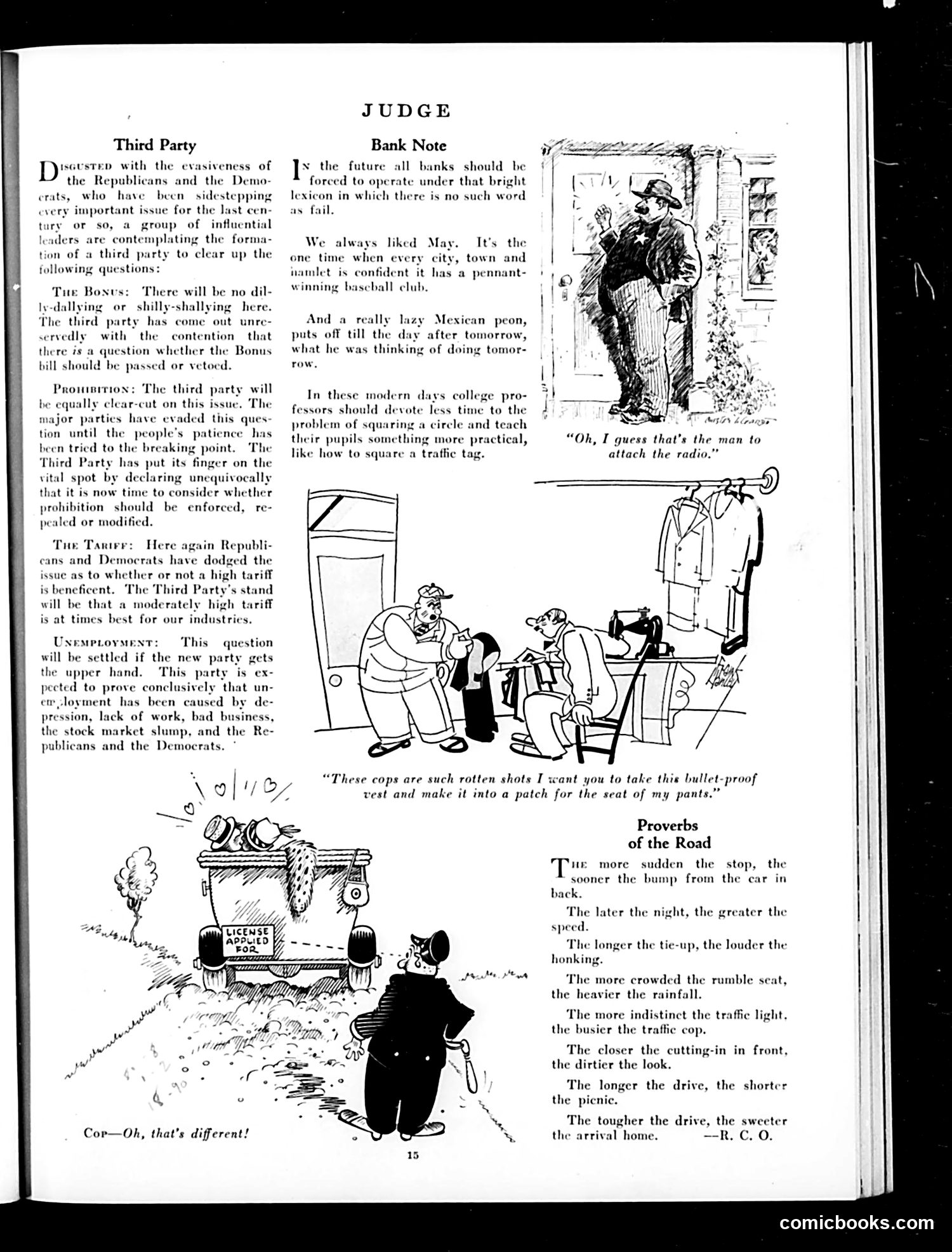
"Judge" Magazine Political Satire, circa 1920s This page satirizes the emerging Third Party movement (likely Progressive/Farm-Labor parties) by mocking its claimed clarity on major issues. The satire is ironic: the Third Party claims to take decisive stands on the Bonus bill (veterans' compensation), Prohibition, tariffs, and unemployment—but their actual positions are vague or contradictory (e.g., "moderately high tariff is sometimes best"). The humor is that the Third Party accuses Republicans and Democrats of evasion, then does the same thing. The final cartoon ("Cor—Oh, that's different!") suggests public recognition of this hypocrisy. The page also includes unrelated humor: bank jokes, traffic/driving proverbs, and a cartoon about bullet-proof vests, reflecting common 1920s urban concerns with traffic and petty crime.
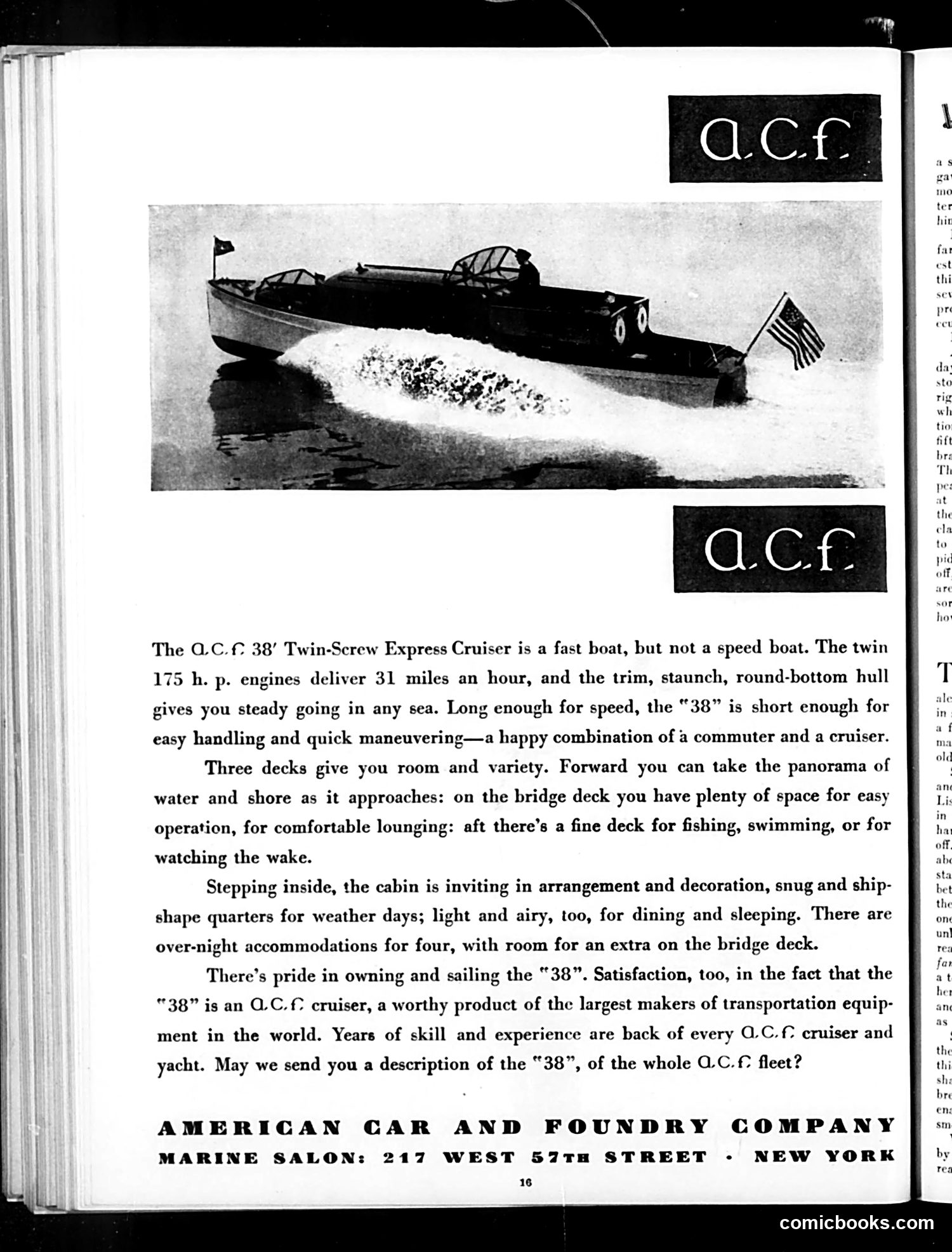
Analysis This page is not a political cartoon or satire — it's a straightforward advertisement for a luxury recreational boat. The American Car and Foundry Company (A.C.F.) is promoting their 38-foot "Twin-Screw Express Cruiser," a recreational yacht designed for wealthy consumers. The image shows the sleek vessel underway with American flags. The marketing copy emphasizes practical luxury: dual 175-horsepower engines achieving 31 mph, three decks for various activities (fishing, swimming, dining), comfortable cabin accommodations for four overnight guests, and easy maneuverability. A.C.F. leverages its reputation as a major transportation equipment manufacturer to suggest quality and reliability. For modern readers: this represents Depression-era or pre-war affluent consumer marketing, targeting the wealthy leisure class who could afford expensive recreational boats—a stark contrast to the economic hardship many Americans faced during this period.
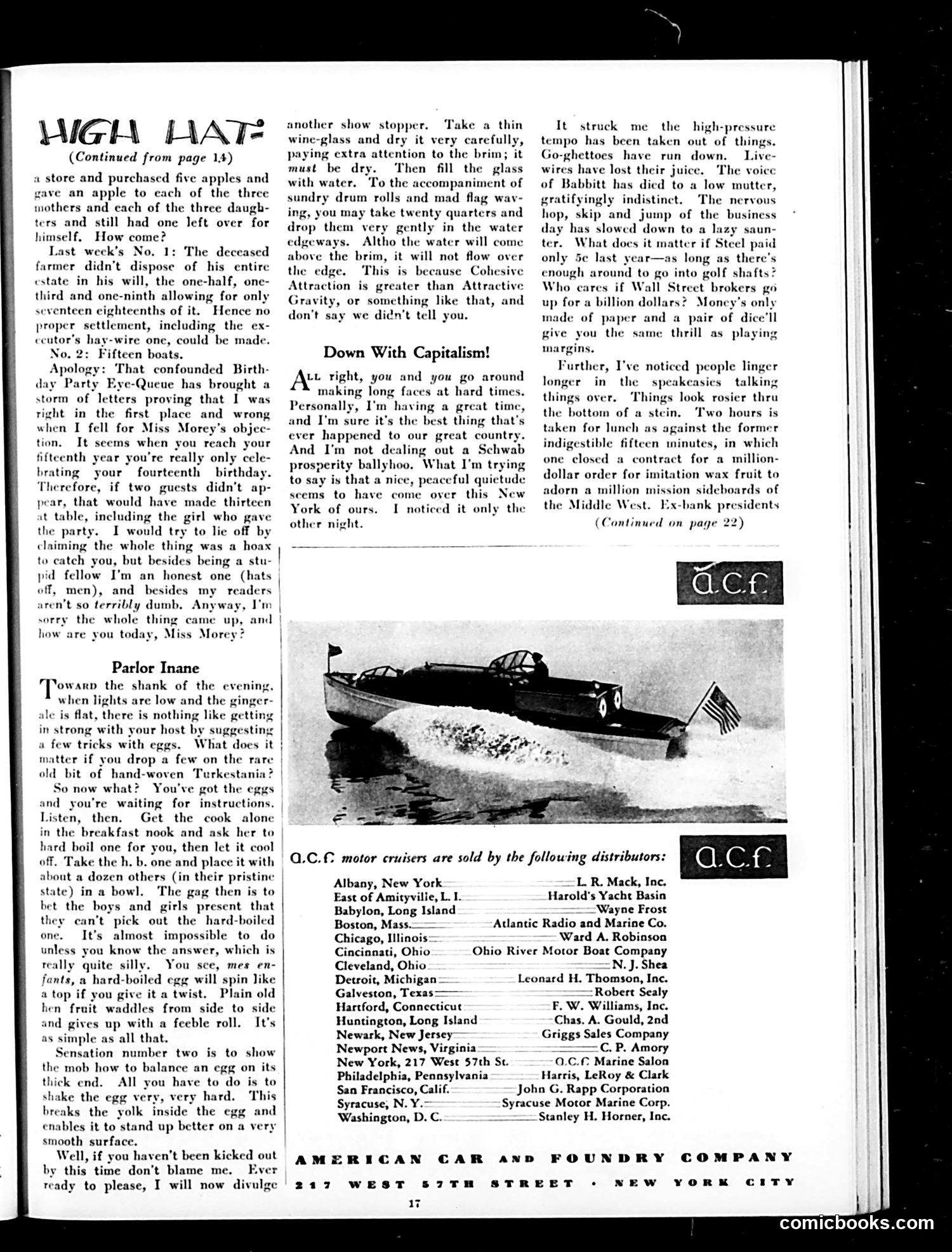
Judge Magazine Page Analysis This page contains humor columns and advertisements. The main satirical content is "Down With Capitalism!" — a tongue-in-cheek piece praising the economic downturn (likely the Great Depression era, based on references to hard times and reduced business activity). The author ironically celebrates how the slowed economy has created "a nice, peaceful quietude" in New York, noting that the high-pressure business tempo, "Go-ghettoes," and the boosterish voice of "Babbitt" (Sinclair Lewis's symbol of shallow American capitalism) have diminished. The satire targets American materialism and relentless commercialism by suggesting their collapse is actually beneficial. Other columns offer party tricks and wordplay puzzles. The page includes advertisements for Q.C.F. motor cruisers and their distributors across America, plus an ad for the American Car and Foundry Company.
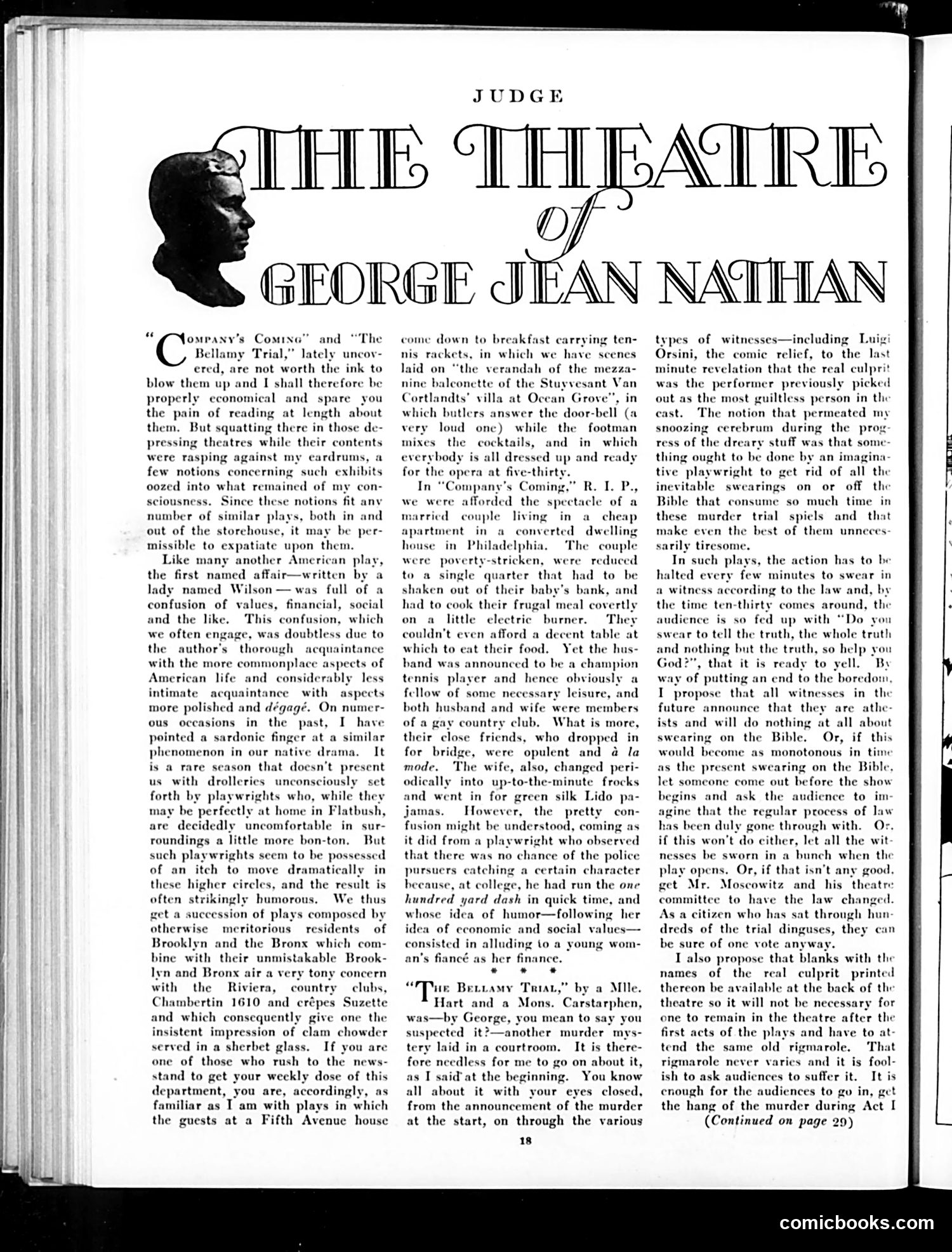
Judge Magazine Theater Critique: "The Theatre of George Jean Nathan" This is a theater review column by prominent critic George Jean Nathan, critiquing recent Broadway plays. The page contains no political cartoons—it's primarily text analysis of two productions: "Company's Coming" (by a female playwright) and "The Bellamy Trial" (by Hart and Carstarphen). Nathan satirizes playwrights from outer boroughs (Brooklyn, the Bronx) who write about high society but betray their unfamiliarity with upper-class life. His main joke: these authors create absurd incongruities—poverty-stricken couples who are country-club members, characters mixing sophisticated French cuisine with working-class circumstances. He mocks their social pretension and logical inconsistencies, including one playwright's malapropism confusing a man's "fiancé" with his "finance." The satire targets not politics but artistic incompetence and class aspiration in American theater.
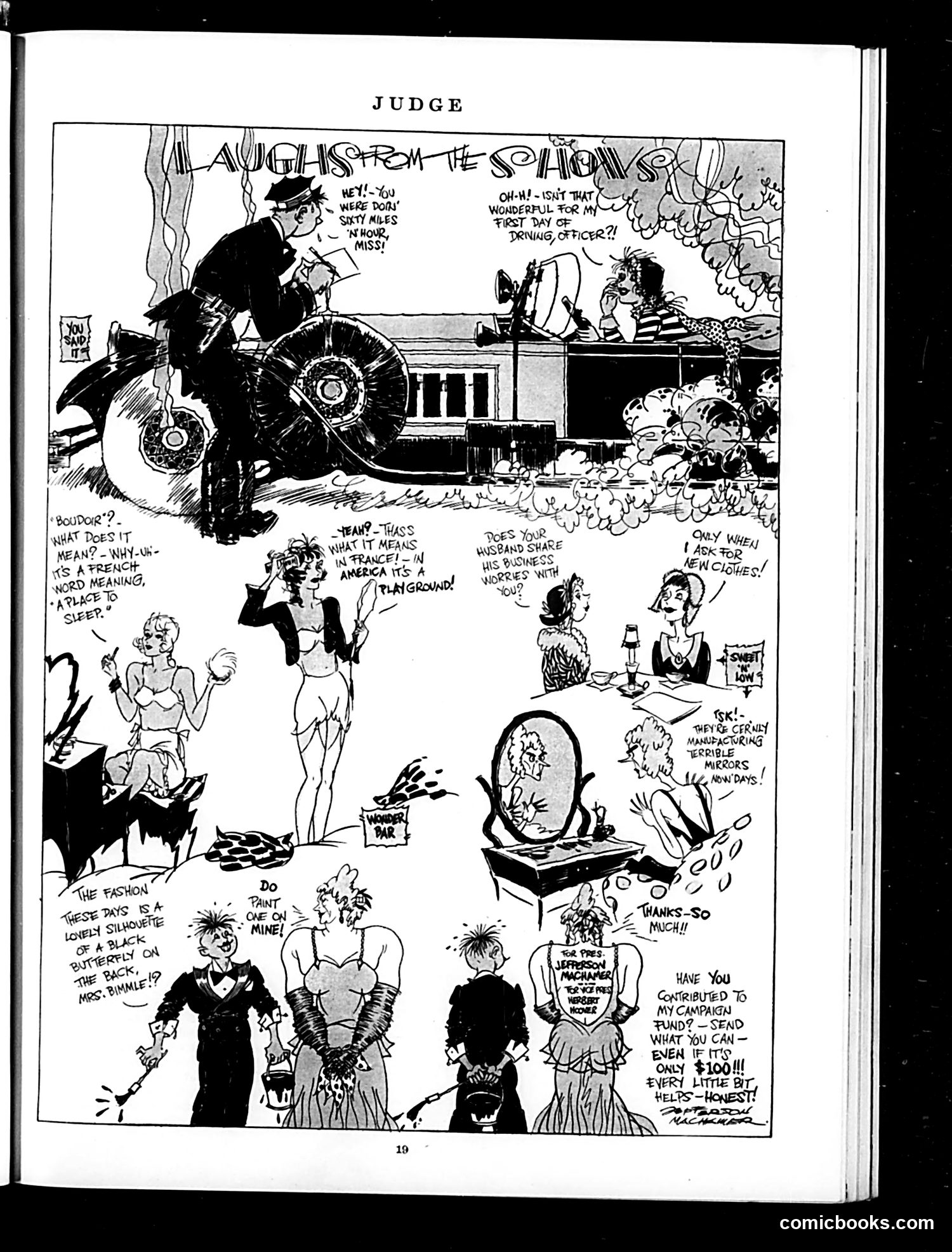
"Laughs in the Spotlight" - Judge Satirical Comic This multi-panel comic satirizes Jazz Age social absurdities and female independence. The top scene shows a motorcycle cop encountering flappers at what appears to be a roadside establishment, with characters discussing "French" words and driving etiquette—likely mocking both the perceived moral looseness of the era and women drivers (a then-controversial topic). Lower panels ridicule consumerism and vanity: women obsess over fashion silhouettes, makeup, and mirrors. One character solicits campaign contributions (possibly referencing a beauty pageant or women's organization). The humor targets 1920s consumer culture, the "new woman," and perceived frivolous spending habits—common Judge magazine themes satirizing modern femininity and changing social mores. The overall tone suggests moral disapproval dressed as lighthearted mockery, typical of conservative satirical magazines of the period.
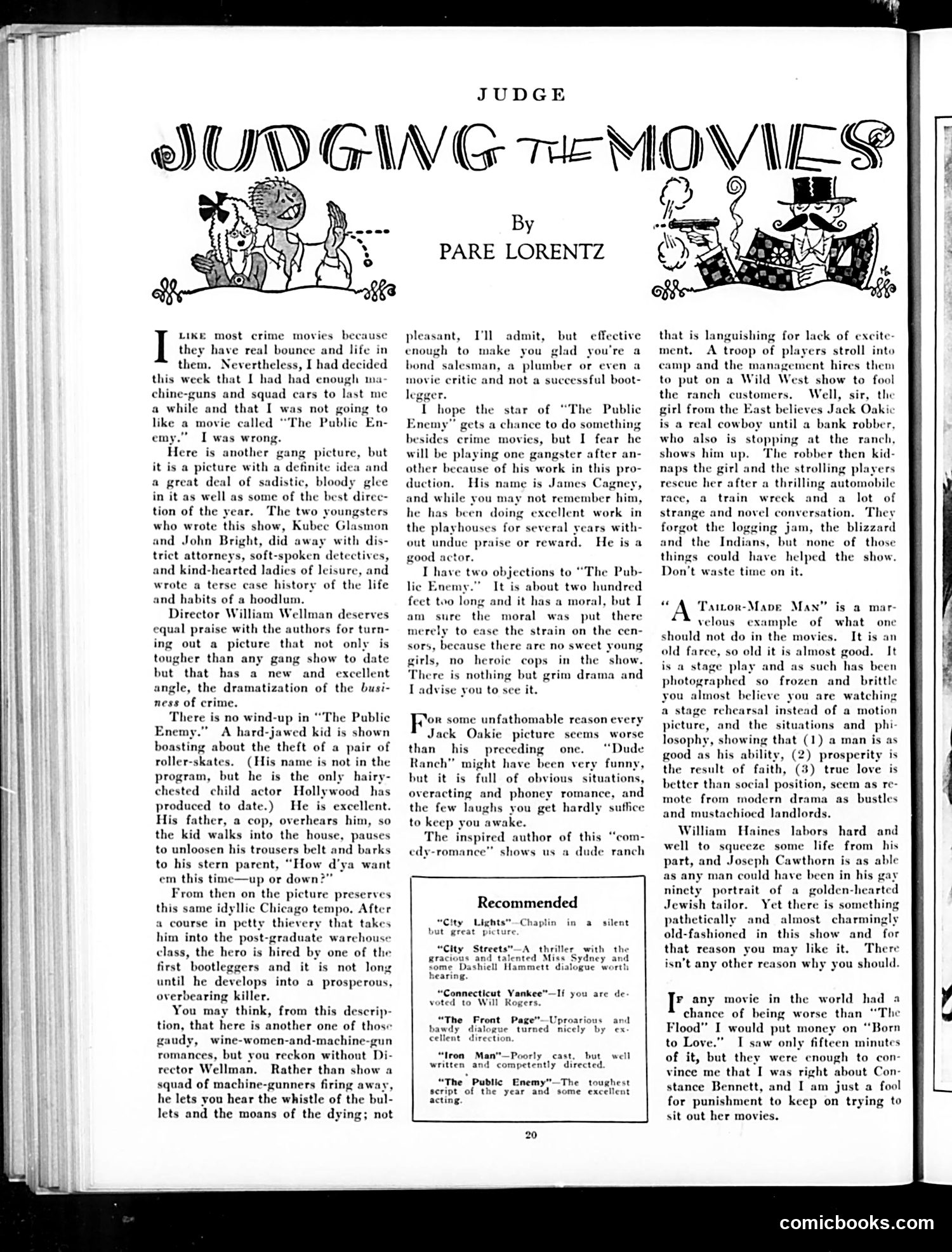
"Judging the Movies" by Pare Lorentz This is a film criticism column reviewing recent Hollywood releases. The main focus is *The Public Enemy* (1931), starring James Cagney—a gangster film that Lorentz initially dismissed as another tired crime picture but found surprisingly effective. Lorentz praises director William Wellman for creating a gritty, unsentimental portrayal of criminal life without glamorizing it. The film shows crime's brutality realistically (hearing bullets whistle, hearing dying men moan) rather than romanticizing it. Lorentz notes this realism makes viewers grateful to have safer, respectable jobs. He also reviews Jack Oakie's "Dude Ranch" negatively as phoney and overacted, and gives recommendations for other current films. The "Recommended" box lists pictures worth seeing, including Chaplin's *City Lights* and the newspaper comedy *The Front Page*. The cartoon illustrations show exaggerated figures watching movies—typical Judge magazine satirical art style reflecting on cinema culture.
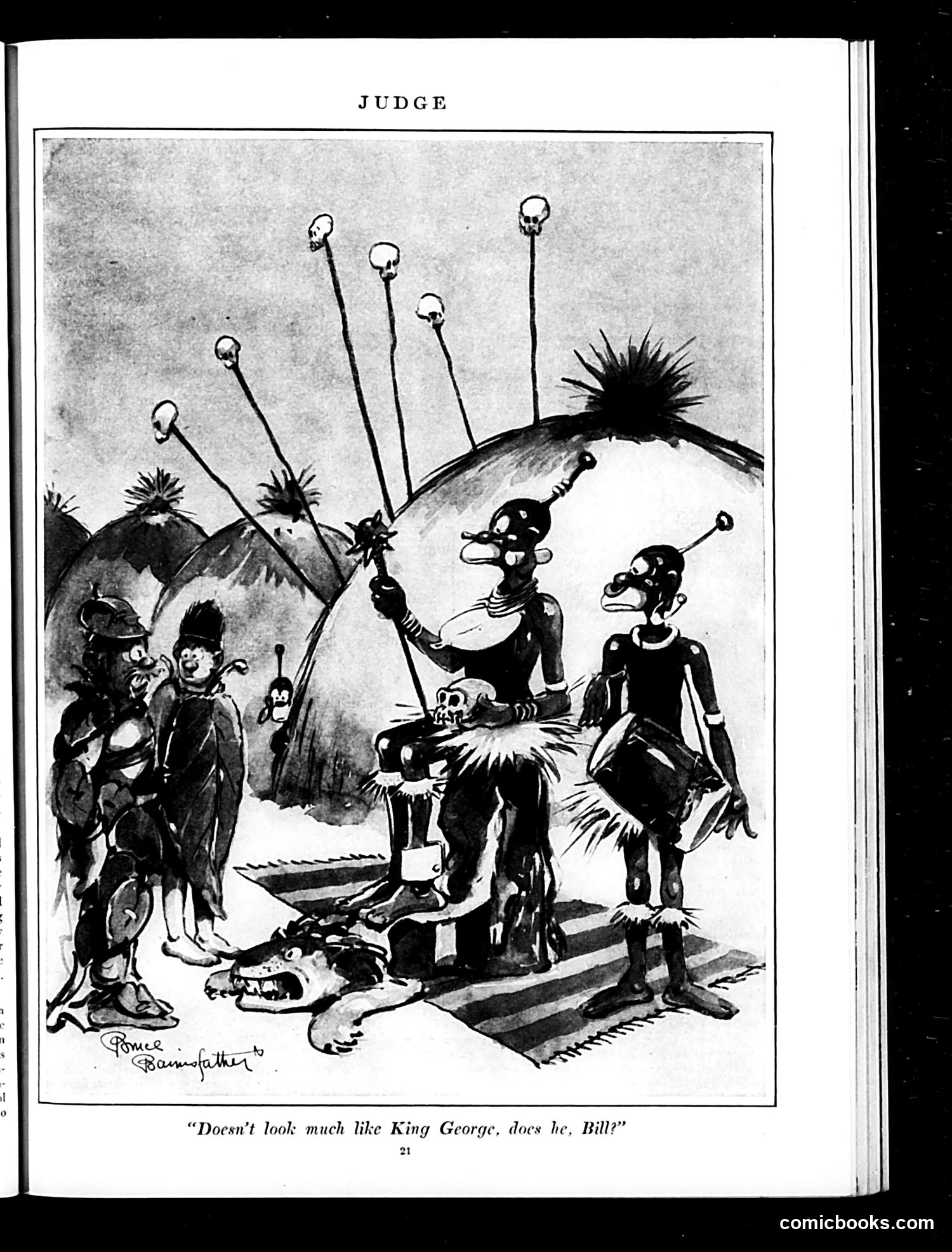
Political Cartoon Analysis This cartoon from *Judge* magazine satirizes a figure compared to "King George" — likely referencing either British monarchy or an American political leader accused of tyrannical behavior. The grotesque alien-like creatures with spiky heads and exaggerated features suggest caricature of foreigners or "uncivilized" peoples, a common trope in early 20th-century American satire. The dialogue "Doesn't look much like King George, does he, Bill?" appears to mock either a failed impersonation or an unfavorable comparison — suggesting someone fails to match the stature or legitimacy of established authority. The bizarre setting with elongated implements and fantastical creatures indicates this is likely science fiction or fantasy satire, possibly commentating on American political leadership or colonial attitudes. The exact historical reference and target remain unclear without additional dating or context.
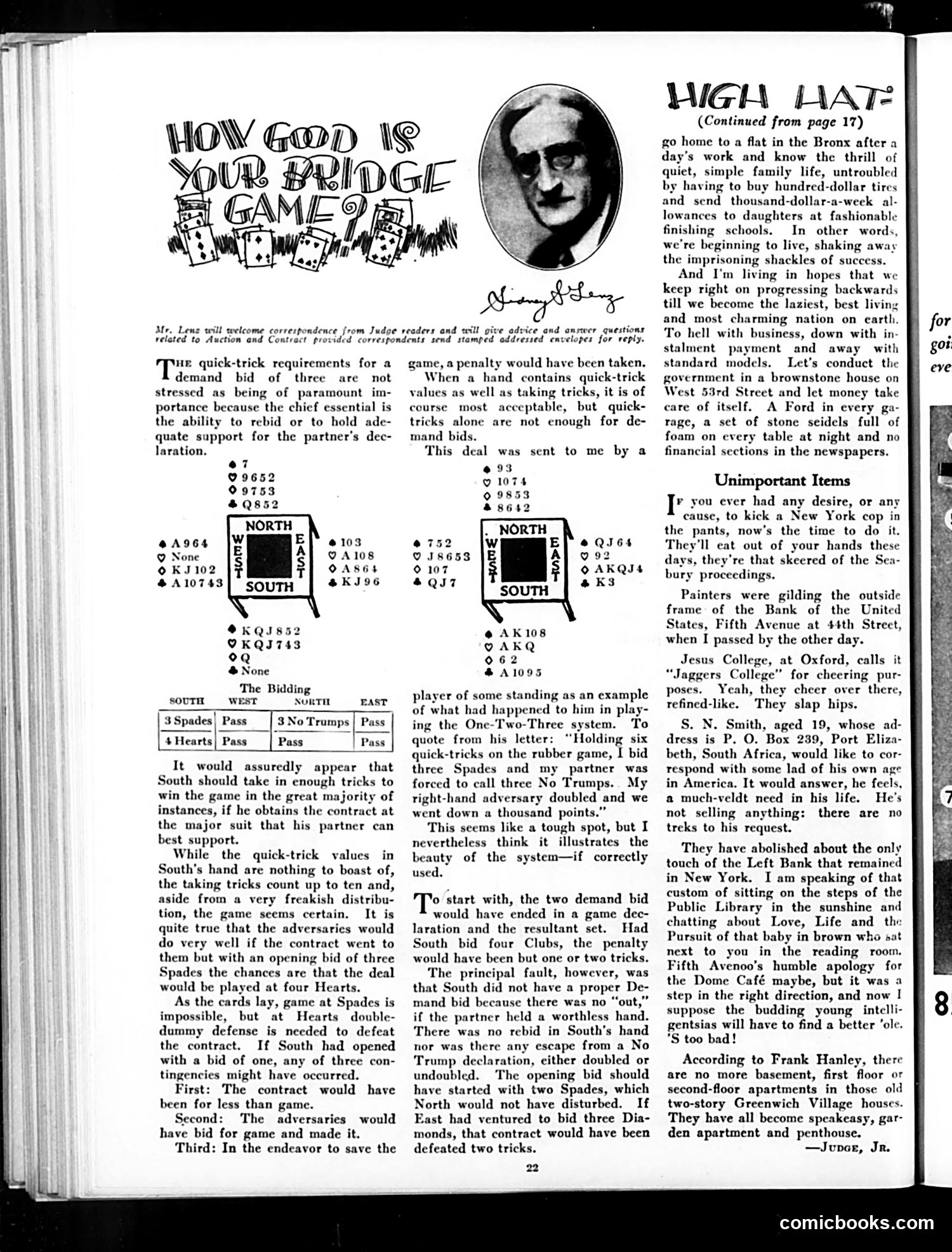
Page Analysis: Judge Magazine Bridge Column & Social Commentary Main Content: This page primarily features a bridge strategy column by Mr. Lenz, a prominent contract bridge expert of the era. The left side displays bridge hand diagrams and bidding analysis—technical card-game content for readers interested in the popular parlor game. Social Satire (Right Column): "High Hat" is a satirical piece mocking wealthy New York society's pretensions. The author ironically celebrates abandoning business success and wealth—dispensing with expensive cars, fashionable finishing schools, and conspicuous consumption—to live modestly in a Bronx apartment. The satire targets the era's nouveau riche obsession with status symbols and "standard models." Context: This reflects 1920s-30s American culture when bridge was a fashionable social activity among the middle and upper classes, while the social commentary reflects post-Depression skepticism about materialism and business culture. The "Unimportant Items" section includes brief gossip about New York cultural institutions and personalities, typical of Judge's satirical approach to contemporary social life.
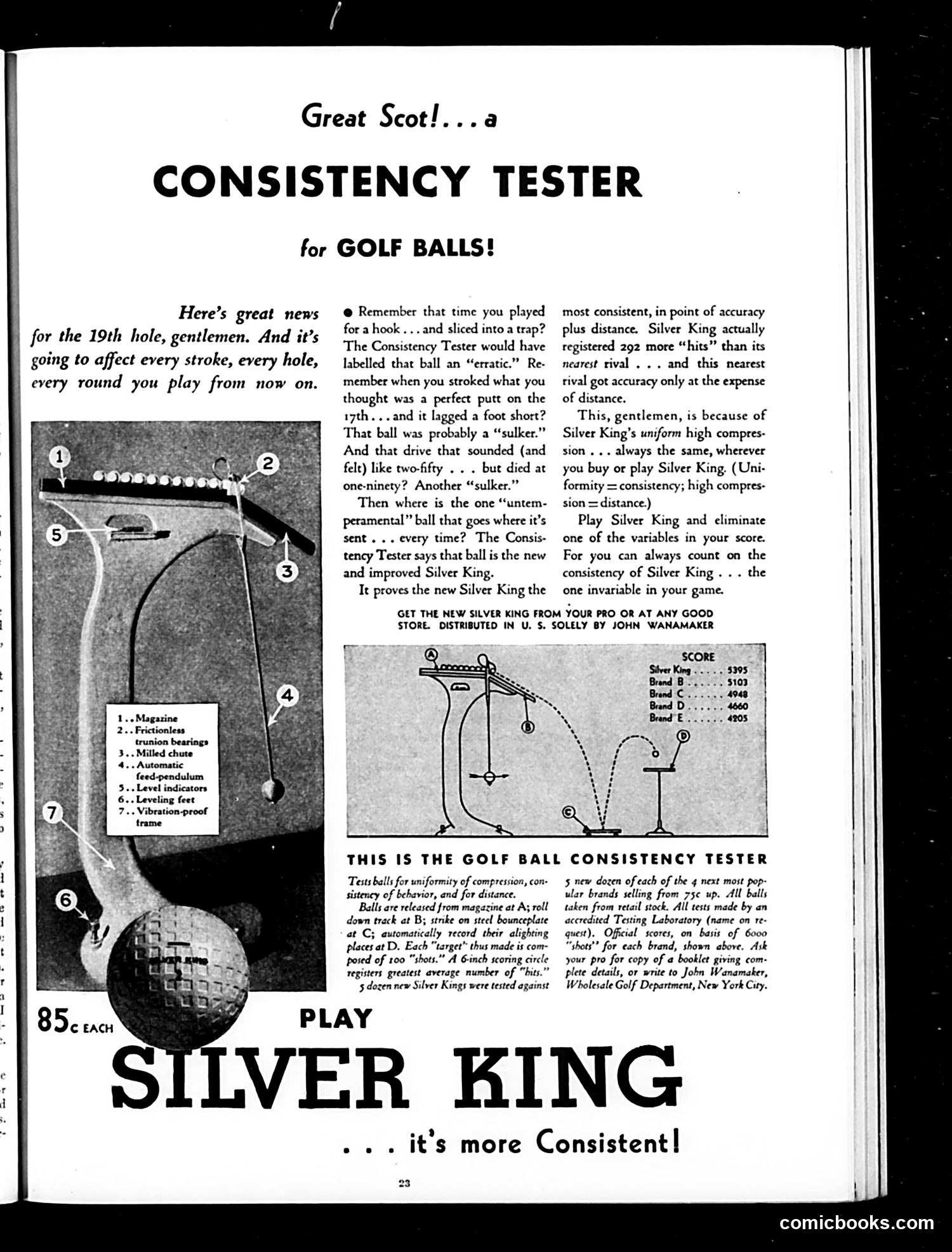
Analysis of Silver King Golf Ball Advertisement This is not a satirical cartoon but rather a full-page advertisement for Silver King golf balls, likely from the 1930s-1940s based on the design and typography. The page promotes a fictional "Consistency Tester"—an elaborate machine depicted with numbered components that supposedly scientifically proves Silver King balls are superior to competitors. The ad addresses male golfers ("gentlemen") by acknowledging relatable frustrations: unpredictable ball behavior ("sulkers," "erratic" shots) that sabotage otherwise good play. The sales pitch claims Silver King's "uniform high compression" eliminates variables in golf performance, making it "the one invariable in your game." The machine diagram and test results (comparing Silver King to four unnamed rival brands) create pseudo-scientific credibility. This represents vintage advertising strategy: using technical jargon, visual authority, and emotional appeals to justify premium pricing (85¢ each) in a competitive market. The Wanamaker department store distribution and "accredited Testing Laboratory" claims attempted to establish trustworthiness during an era when consumer skepticism about product quality was high.
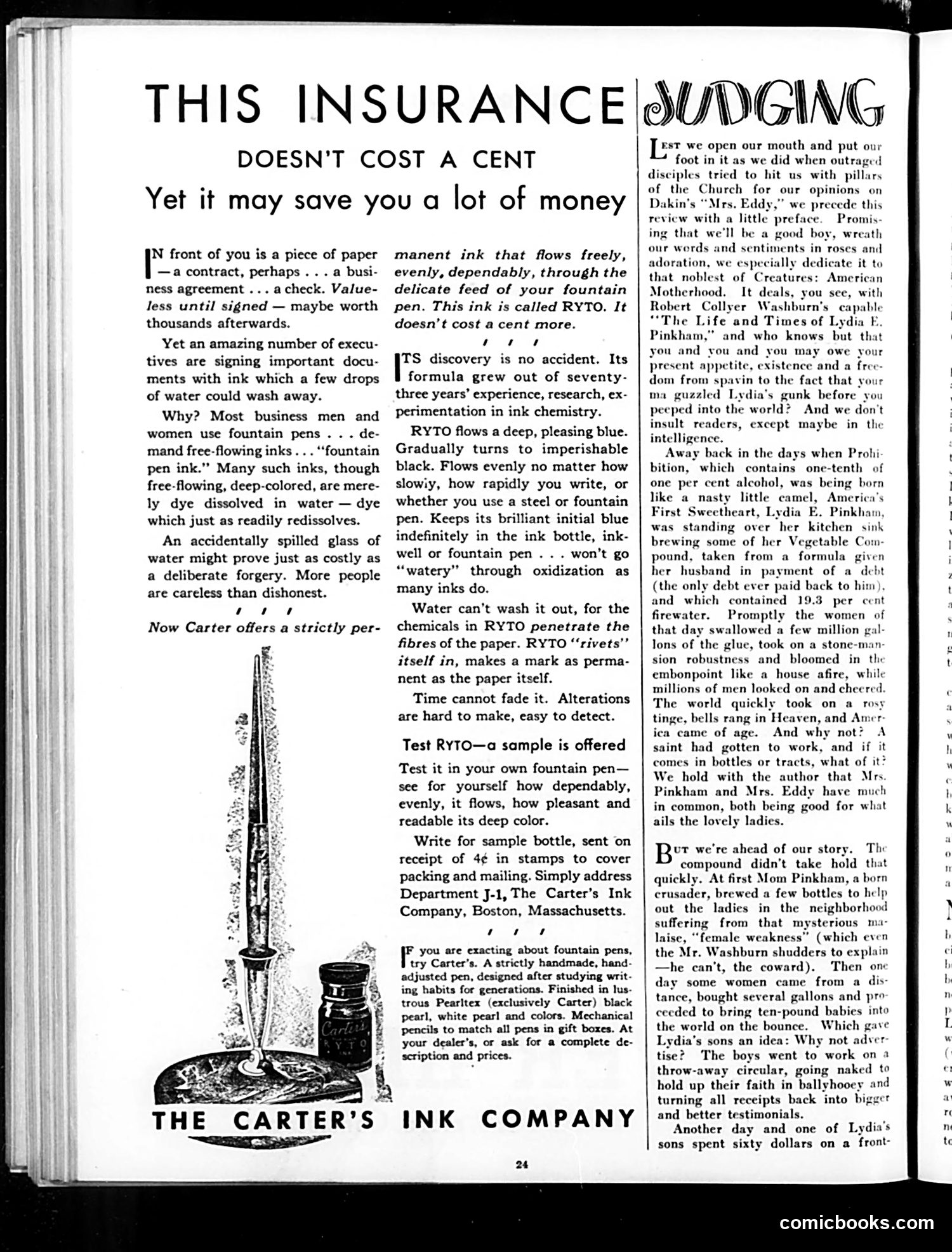
Analysis for Modern Readers This page contains two distinct sections: a Carter's Ink Company advertisement (left) and a book review titled "Judging" (right). The Advertisement Carter's promotes RYTO ink as permanent and fraud-proof—"insurance" against forged documents. The pitch targets business executives: ordinary fountain pen ink washes away with water, risking valuable contracts. RYTO's chemicals penetrate paper fibers, making alterations detectable. The ad emphasizes reliability for important signatures. The Book Review The review mockingly discusses Robert Collyer Washburn's biography of Lydia E. Pinkham, the 19th-century patent medicine entrepreneur. The satire highlights that Pinkham's famous "Vegetable Compound" contained 19.3% alcohol—essentially snake oil marketed to women during Prohibition. The review's sarcastic tone (feigned deference, tongue-in-cheek language) mocks both Pinkham's dubious product and American women's gullibility in consuming it. This represents Judge magazine's characteristic irreverent social commentary on consumer fraud and commercialism.
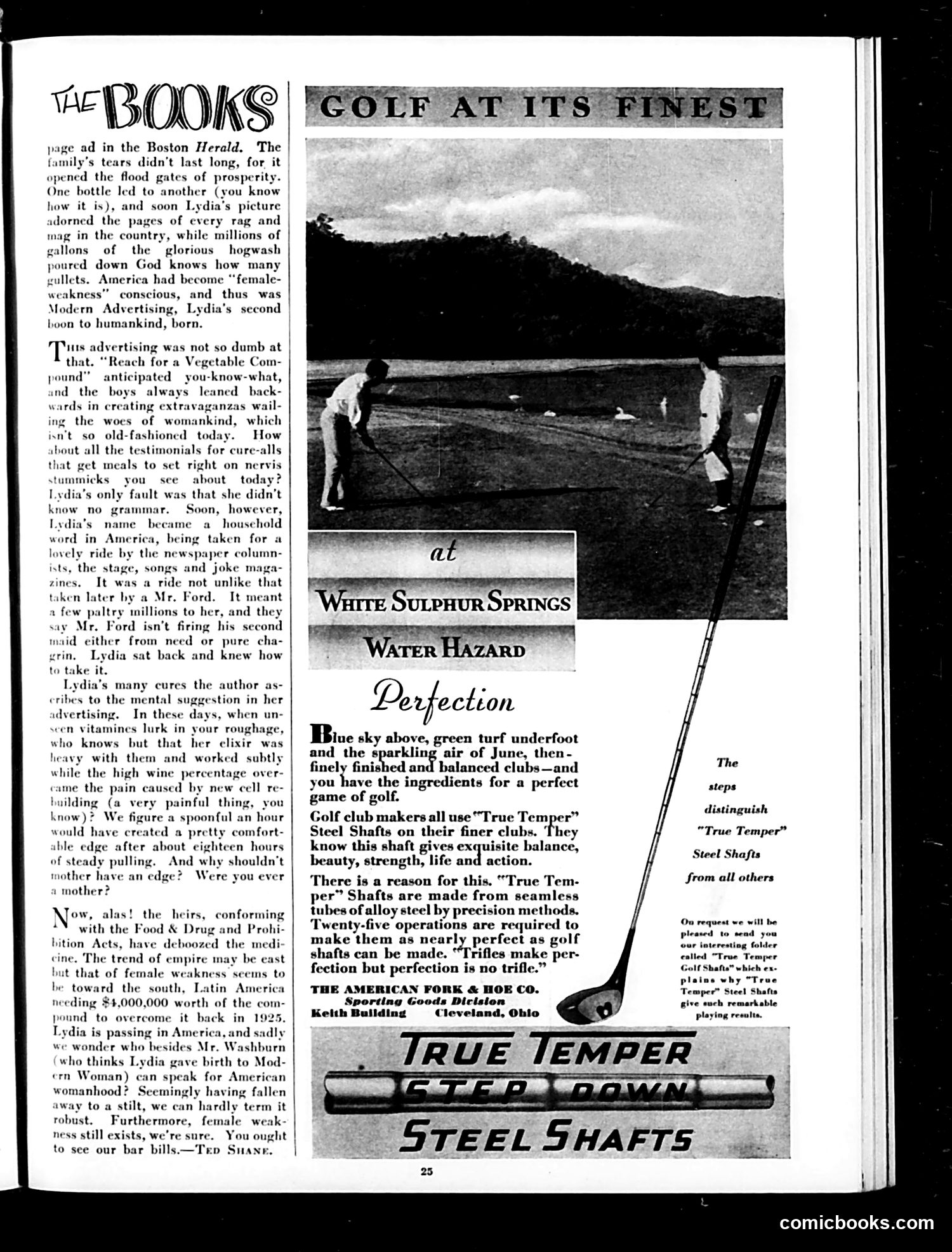
Understanding This Judge Magazine Page This page is primarily advertising, not political satire. The main content is a lengthy article about Lydia E. Pinkham's Vegetable Compound—a patent medicine marketed to women for "female weakness"—followed by a golf equipment advertisement. The Lydia Pinkham Section: The text satirizes how a dubious medicinal product became a household name through aggressive modern advertising. It mocks the testimonial-based marketing tactics of the era, suggesting the "cure" worked through mental suggestion and high alcohol content rather than actual medicinal value. The author implies the product exploited women's health anxieties. The reference to the Food & Drug Administration and Prohibition Acts indicates the medicine was subsequently reformulated when alcohol was banned and regulations tightened. The Golf Advertisement: Unrelated to the satire, this promotes "True Temper" Steel Shafts, emphasizing precision manufacturing and quality—a straightforward commercial pitch. The page demonstrates how Judge mixed satirical commentary on consumer culture and patent medicine fraud with straightforward advertisements.
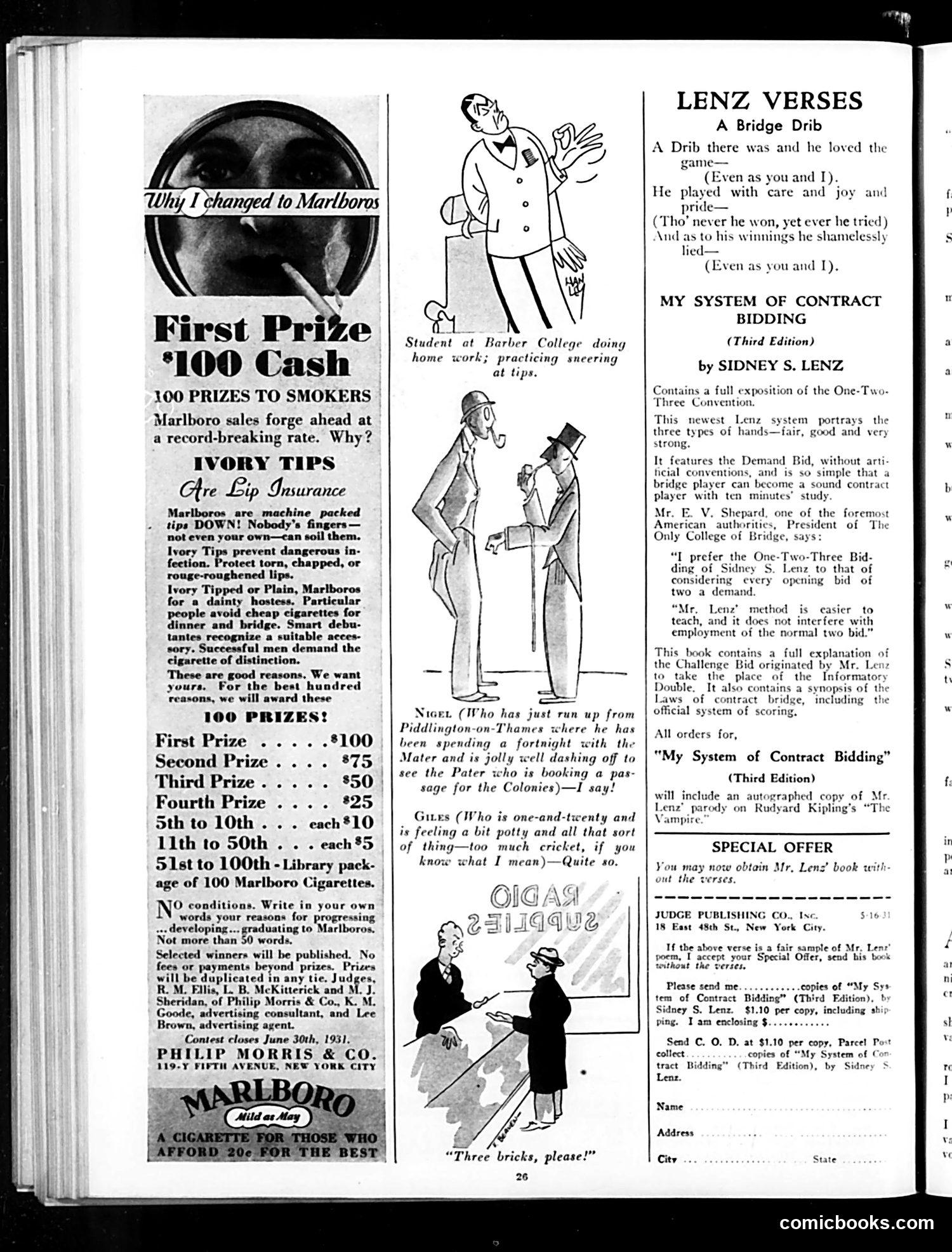
Analysis of Judge Magazine Page This page mixes advertisements with social satire cartoons. The Marlboro cigarette ad (left) promotes filtered "Ivory Tips" as lip protection—ironic given smoking's actual dangers. The contest offers cash prizes for testimonials, targeting affluent smokers. The cartoons mock upper-class British types. One shows a barber college student practicing "sneering at tips"—satirizing pretentious service workers. Another depicts two British men: "Nigel," recently returned from visiting his mother ("Mater"), and another character described as "potty" from too much cricket. Their request for "three bricks, please!" appears to reference ordering drinks, though the exact reference is unclear. The bridge bidding advertisement for Sidney S. Lenz's contract bridge manual occupies the right side, including a mock-serious poem parodying Kipling. Overall, the page reflects 1931 class anxieties—mocking both working-class social climbing and affectations of upper-class Britishness, while advertising luxury cigarettes and intellectual pursuits to educated readers.
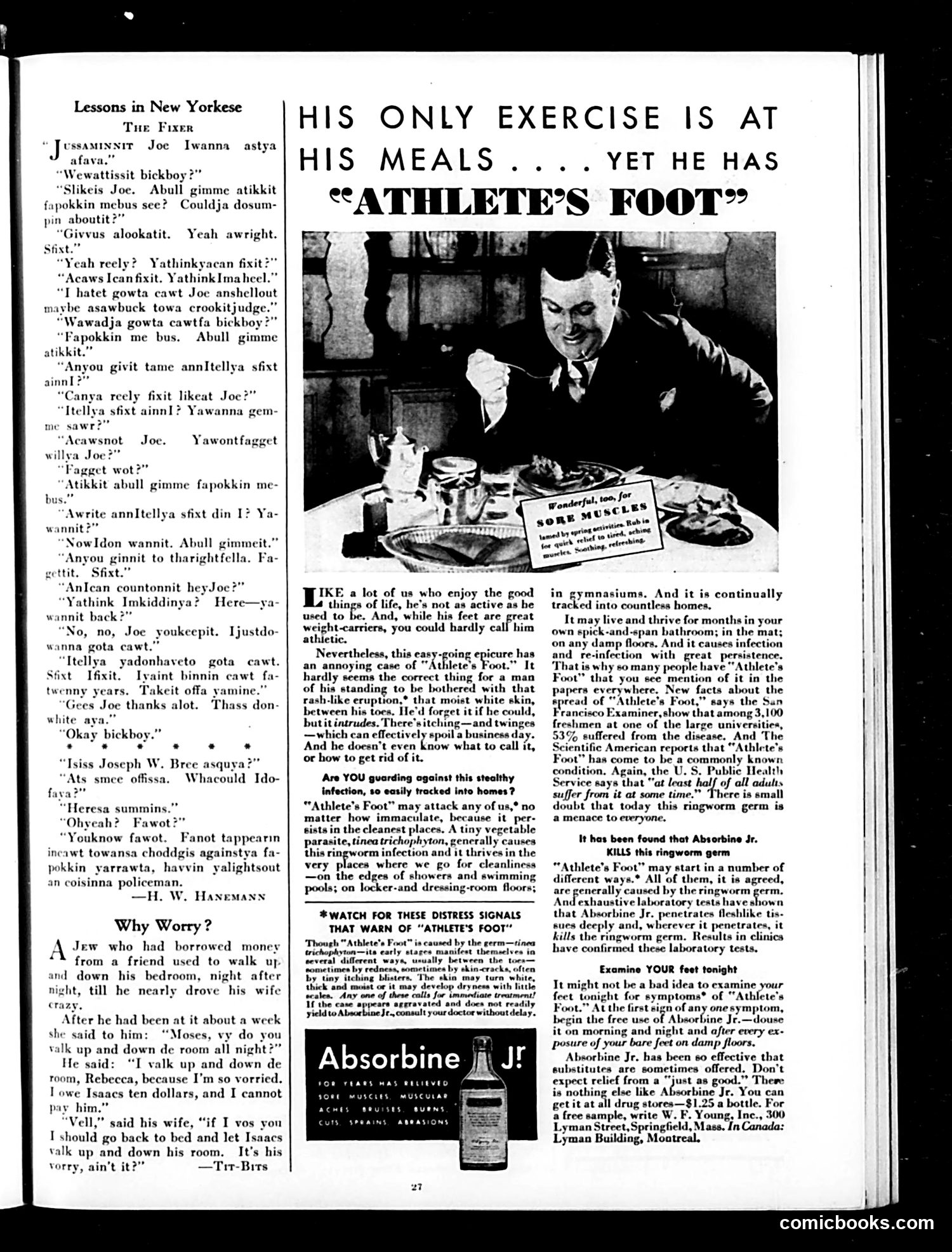
Analysis for Modern Readers This Judge magazine page contains two distinct items: "Lessons in New Yorkese" satirizes working-class New York dialect and culture, depicting a stereotypical interaction between a man with a broken ticket ("bickboy") and a fixer—someone who bribes officials to resolve problems. The dialogue mocks the accent and reveals casual urban corruption: paying a crooked judge to fix minor infractions. The main advertisement promotes Absorbine Jr. for "Athlete's Foot," a fungal infection. The ironic headline contrasts a sedentary, indulgent man ("enjoys the good things of life") with an athletic ailment. The ad warns readers that this infection spreads easily in gyms, pools, and locker rooms—yet ironically afflicts non-athletic people. It lists warning signs (itching, white skin between toes, blisters) and encourages medical consultation. Both pieces reflect early 20th-century urban American concerns: class-based ethnic stereotyping and anxieties about hygiene and public health in shared facilities.
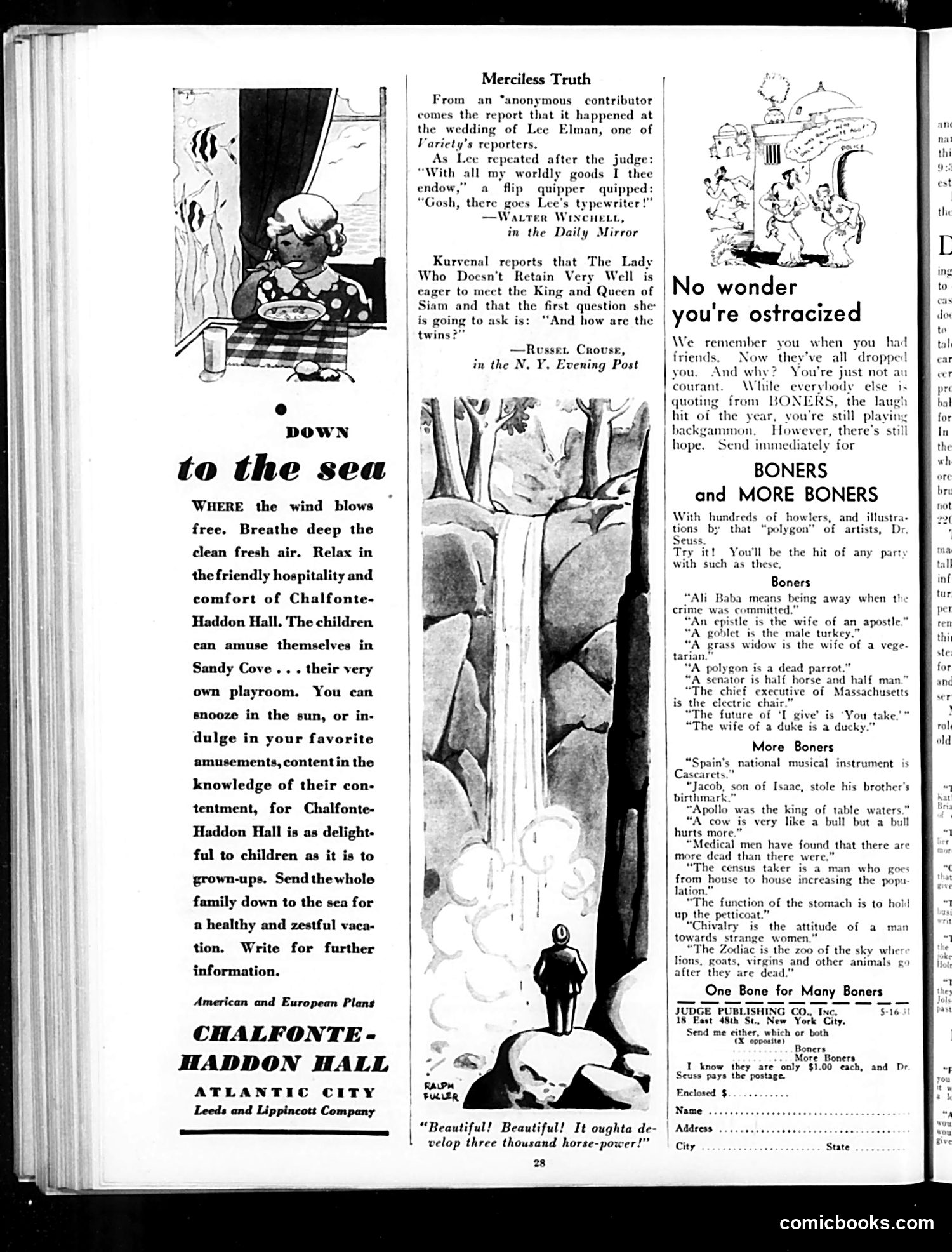
Analysis for Modern Readers This page mixes advertising with humor content typical of Judge magazine. The main satirical item is "Merciless Truth"—brief anecdotes about social gaffes. One jokes about Lee Elman, a Variety reporter, whose wedding guest quips that his typewriter is now his wife's property (implying he has no other wealth). Another mocks a woman with poor memory eager to meet Siamese royalty, planning to ask "how are the twins?"—a socially inappropriate opening. The "No wonder you're ostracized" section satirizes someone unfashionable who quotes from *Boners*, a humor book of student malapropisms, while others reference wittier sources. The advertisement for *Boners* and *More Boners*, illustrated by Dr. Seuss, showcases deliberately absurd definitions ("A polygon is a dead parrot") as comedy. The page primarily advertises Chalfonte-Haddon Hall resort in Atlantic City—standard vacation promotion of the era.
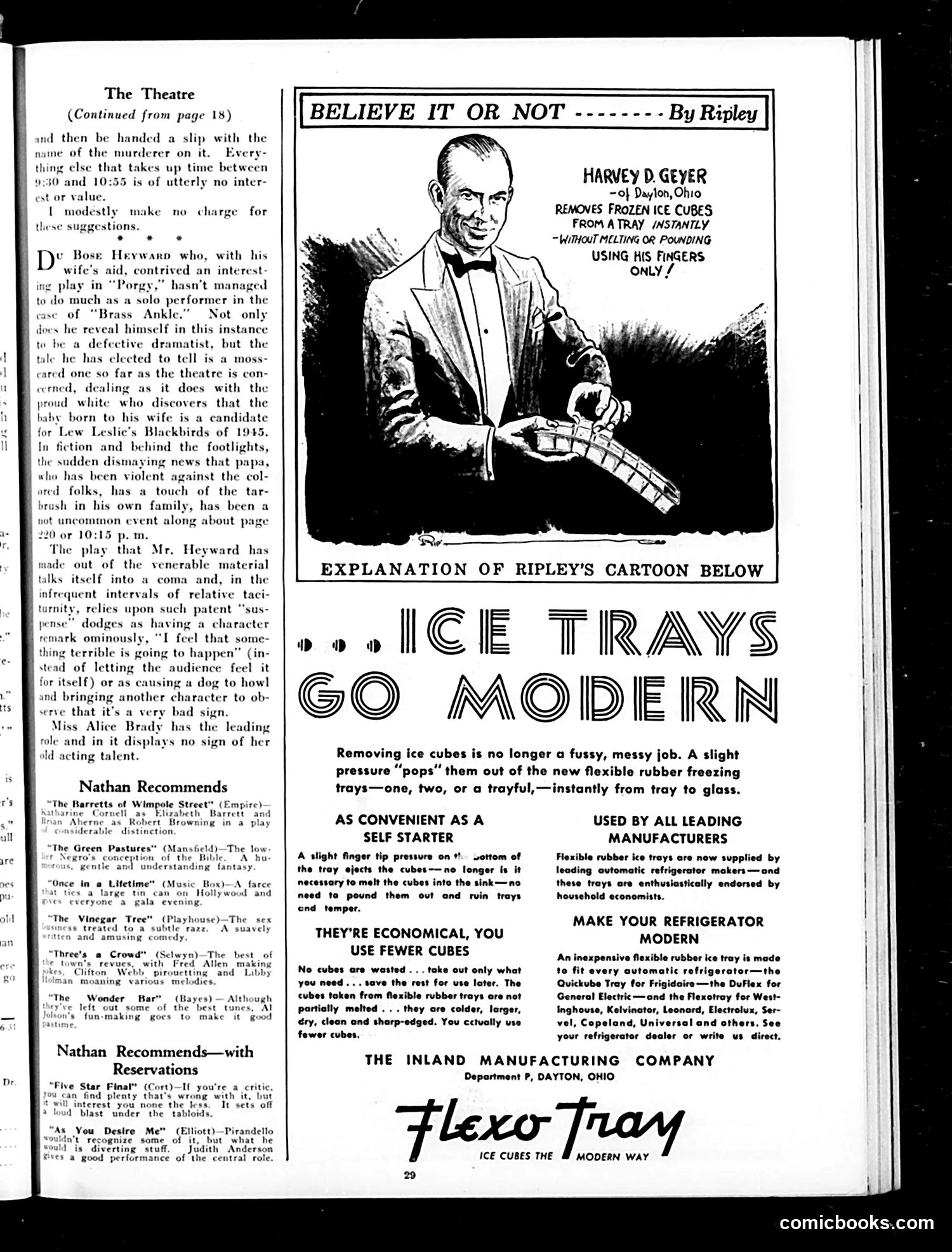
Explanation of This Judge Magazine Page This page combines theater criticism with an advertisement disguised as a "Believe It or Not" cartoon feature. The Theater Section critiques contemporary Broadway plays, including negative reviews of "Brass Ankle" (about racial passing) and praise for "The Green Pastures" (a play about African Americans' conception of the Bible). The reviews reflect 1930s theatrical tastes and attitudes. The Main Content is actually a Ripley's "Believe It or Not"-style advertisement for Flexo Tray ice cube trays. Harvey D. Geyer of Dayton, Ohio is featured as the "remarkable" person who can remove frozen ice cubes instantly using only his fingers—a feat made possible by the new flexible rubber trays. The advertisement emphasizes convenience, economy, and endorsement by refrigerator manufacturers. The page blurs editorial content and advertising, typical of magazine practice from this era when such distinctions were less clearly demarcated than today.
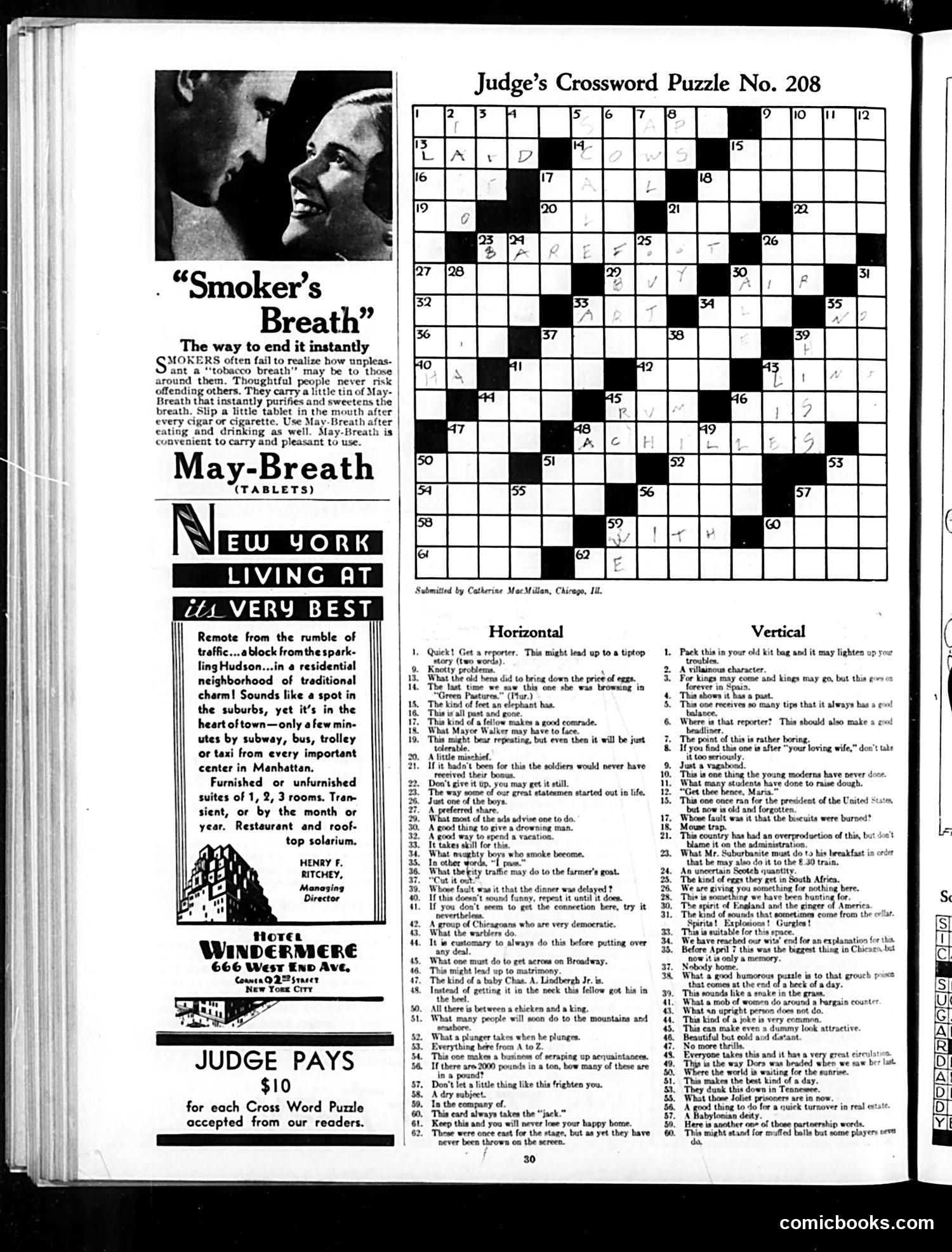
Judge Magazine, Page 30 (Crossword Puzzle No. 208) This page is primarily a crossword puzzle with accompanying advertisements, not a political cartoon. The puzzle itself contains period-specific clues that reference 1920s-30s American culture and current events. The advertisements reflect the era's consumer concerns: May-Breath tablets address "smoker's breath" (social anxiety about tobacco use), and the Windermere hotel promotes Manhattan living with modern transit access. The crossword clues reference contemporary figures and events—Mayor Jimmy Walker faces potential legal troubles, Charles Lindbergh Jr. is mentioned, and there are allusions to Prohibition-era speakeasies ("get across on Broadway"). The page concludes with a notice that Judge pays $10 for accepted crossword puzzles—offering readers financial incentive to contribute content. This reflects Judge's interactive approach during the Depression era, when such modest payments attracted amateur puzzle-makers.
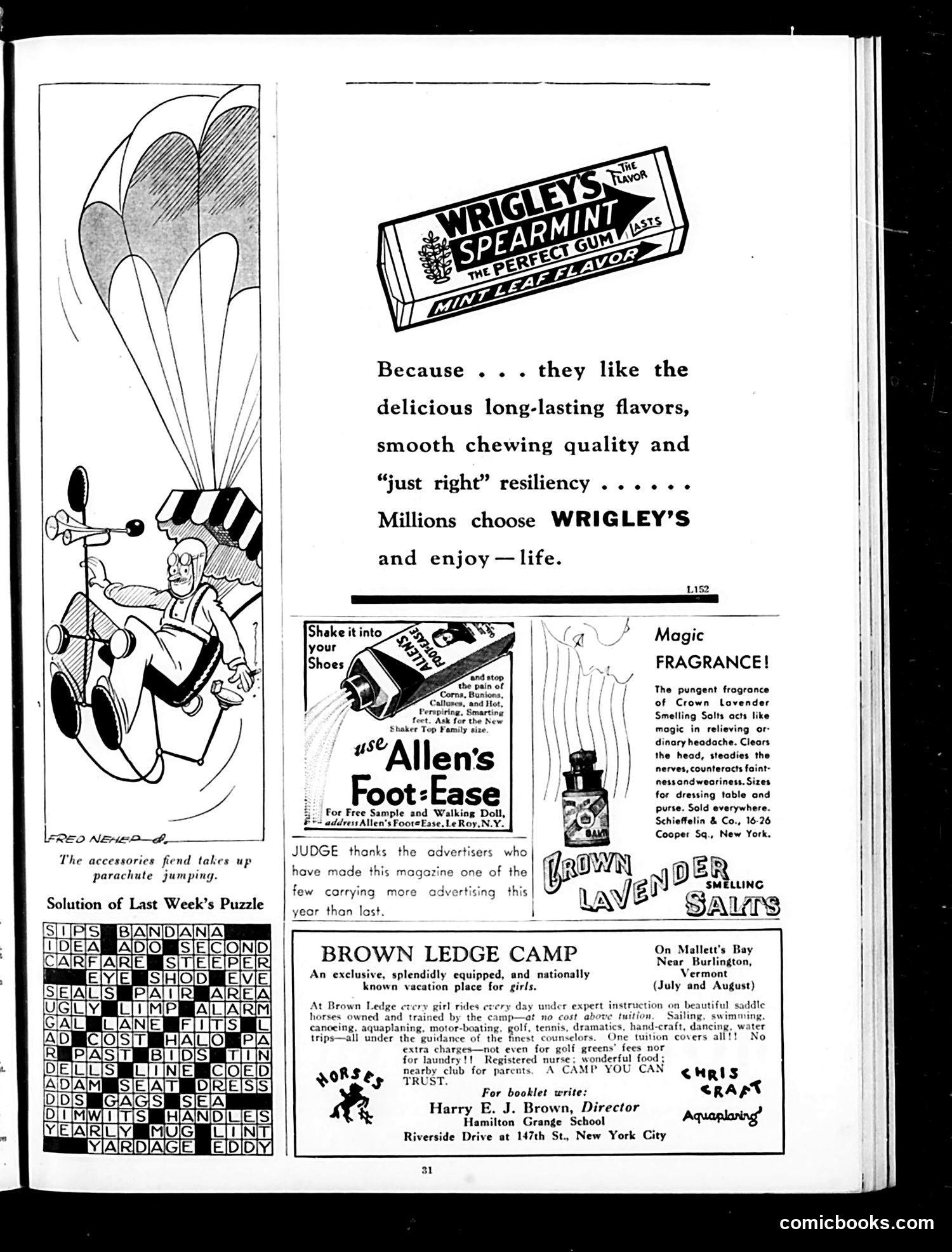
Analysis of Judge Magazine Page This page is primarily advertisements and filler content rather than political satire. The main cartoon depicts "The accessories fiend takes up parachute jumping"—a figure obsessed with fashion accessories now attempting the extreme sport of parachuting, apparently as a joke about fashion enthusiasts chasing every new trend. The page consists mostly of period advertisements (1920s-30s era): Wrigley's gum, Allen's Foot-Ease, Crown Lavender Salts, and Brown Ledge Camp for girls. These ads reflect contemporary consumer culture and leisure activities of the era. There is a crossword puzzle solution displayed. The cartoons and ads contain no apparent political commentary or social critique—this appears to be a standard editorial/advertising page from Judge magazine, with the main visual humor coming from the fashion-obsessed figure attempting parachute jumping as inherent absurdity.
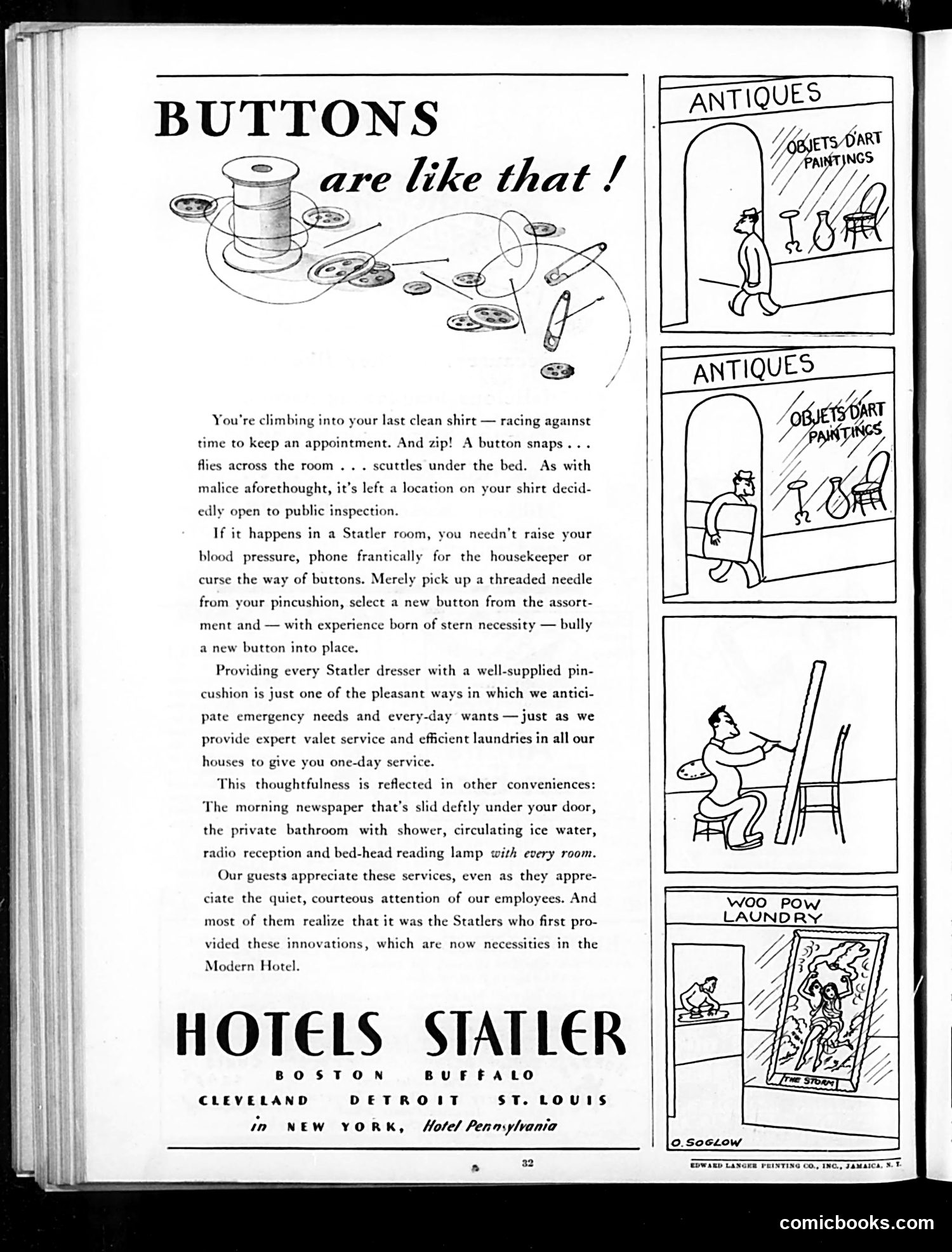
Hotels Statler Advertisement This is primarily a hotel advertisement, not political satire. It uses humor to promote Statler Hotels' amenities. The main illustration shows a spool of thread with scattered buttons—a visual joke about the common frustration of losing buttons. The accompanying text describes the relatable scenario: rushing to an appointment, a button snaps off, creating an embarrassing wardrobe malfunction. The satire is gentle and self-promotional: rather than panicking, guests at Statler Hotels can simply use the complimentary pincushion and spare buttons provided in every room. This illustrates the chain's selling point—thoughtful, anticipatory service that addresses everyday emergencies. The small cartoons on the right (showing antique shops and laundry service) reinforce other conveniences offered: one-day laundry, newspapers delivered to doors, private bathrooms with amenities. The message: Statler Hotels pioneered modern hotel luxuries now considered standard. This reflects 1930s-40s advertising emphasizing hotel innovation and guest convenience.
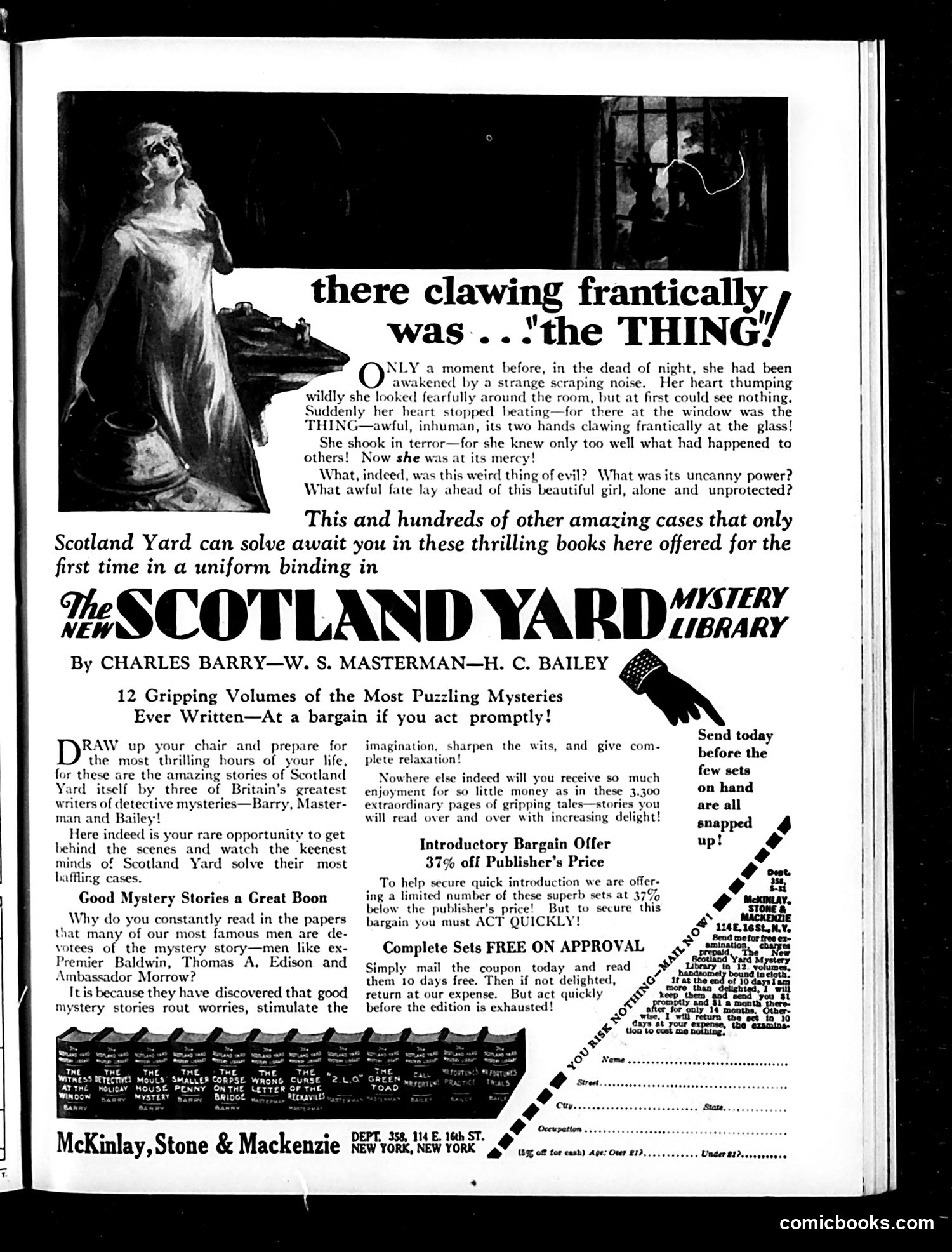
Analysis: Scotland Yard Mystery Library Advertisement This page is primarily an advertisement, not a political cartoon. It promotes "The New Scotland Yard Mystery Library"—a 12-volume set of detective fiction by British authors Charles Barry, W.S. Masterman, and H.C. Bailey. The dramatic imagery at top shows a woman confronted by "the THING"—a creature clawing at her window—to create suspense and appeal to readers' taste for thrilling mysteries. This is marketing copy, not satire. The advertisement emphasizes that mystery stories are enjoyed by famous men (ex-Premier Baldwin, Thomas Edison, Ambassador Morrow), positioning the books as intellectually respectable relaxation. The "bargain offer" of 37% off aims to prompt immediate orders. The page reflects early-to-mid 20th-century publishing practices: direct-mail marketing, 10-day free examination offers, and appeals to aspirational readers wanting cultured entertainment. There is no political satire or social commentary present—this is straightforward commercial advertising.
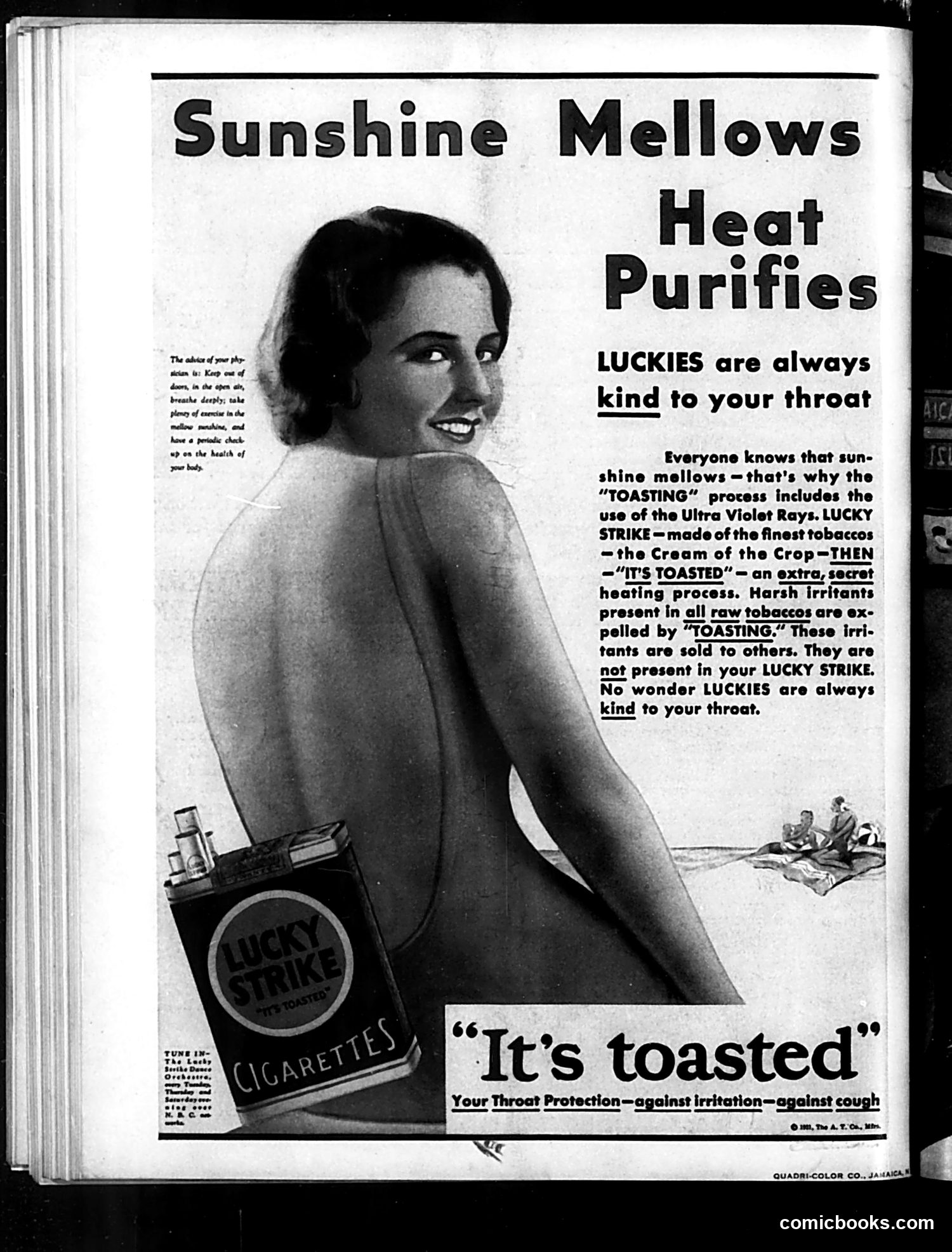
Analysis This is a Lucky Strike cigarette advertisement, not political satire. The page uses a semi-nude woman on a beach to sell cigarettes by claiming health benefits. The "joke" or sales pitch: Lucky Strike cigarettes are "toasted" using ultraviolet rays (compared to sunshine mellowing fruit), which allegedly removes "harsh irritants" present in competitors' tobacco. The ad explicitly states these irritants are "sold to others"—a direct competitive claim that rival brands contain harmful substances that Lucky Strike removes. This reflects 1920s-30s cigarette marketing, when tobacco companies made unsubstantiated health claims. The "It's Toasted" slogan was Lucky Strike's actual advertising campaign. The beach imagery and attractive woman exemplify the era's advertising strategy: associating cigarettes with health, leisure, and vitality. For modern readers: this represents the era before cigarette health warnings, when companies could openly advertise smoking as throat-protective and beneficial.