judge
Judge — May 23, 1931
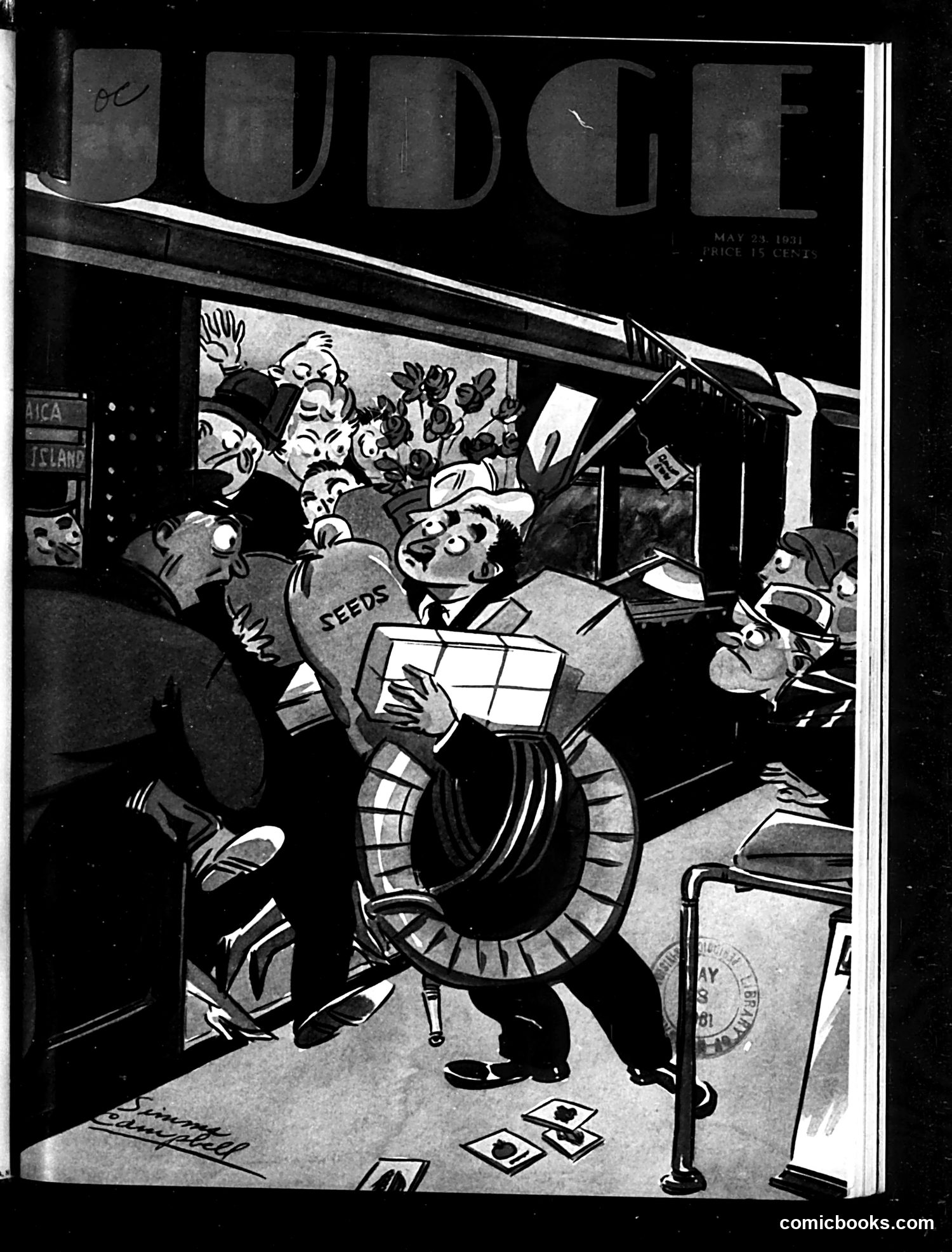
Analysis of Judge Magazine Cover (May 23, 1911) This political cartoon depicts a crowded Dodge automobile showroom during what appears to be a sales event or promotion. The central figure, a portly salesman or dealer wearing a large tire around his midsection like a life preserver, is surrounded by eager customers holding order forms and seed packets labeled "SEEDS." The satire likely comments on aggressive automobile sales tactics of the era—the tire-as-life-preserver suggests the desperation or chaos of the sales pitch. The "SEEDS" reference is unclear but may reference agricultural customers or metaphorically suggest planting money/investment. The crowded, frantic scene mocks both the automobile industry's boom marketing and consumer enthusiasm for new automotive technology during this period of rapid motorization.
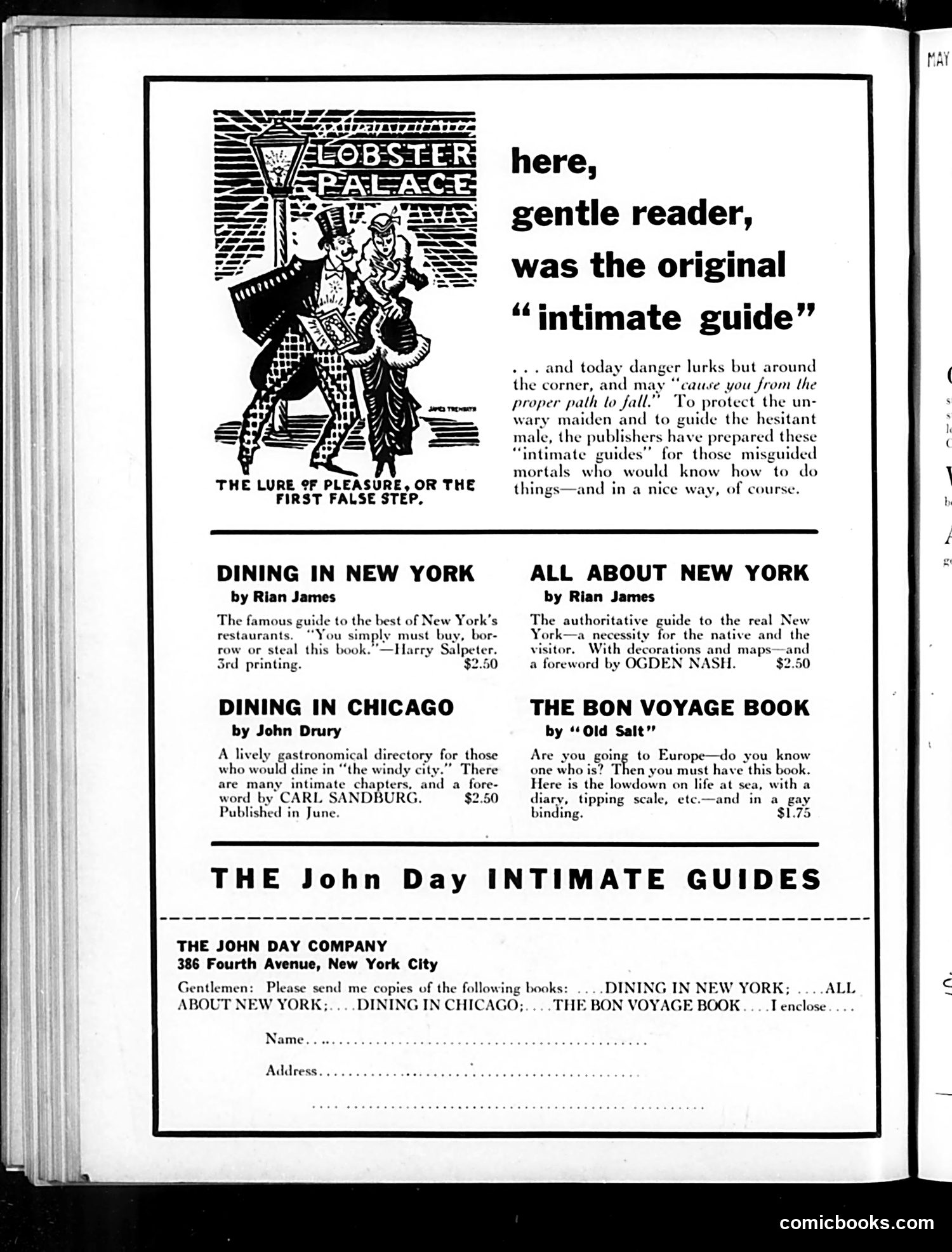
Analysis This page is primarily advertising for "Intimate Guides" published by The John Day Company, not political satire. The illustrated header shows a couple at the "Lobster Palace" nightclub with the caption "The Lure of Pleasure, or The First False Step"—a moralistic framing device. The ad copy sarcastically positions these guides as protective literature for "unwary maidens" and "hesitant males" who might otherwise stray morally. The actual books advertised are dining guides (New York, Chicago) and a travel guide ("The Bon Voyage Book"), positioned as practical necessities rather than scandalous material. The humor relies on the pretense that these seemingly innocent guidebooks require moral justification—a tongue-in-cheek comment on contemporary prudishness and marketing tactics.
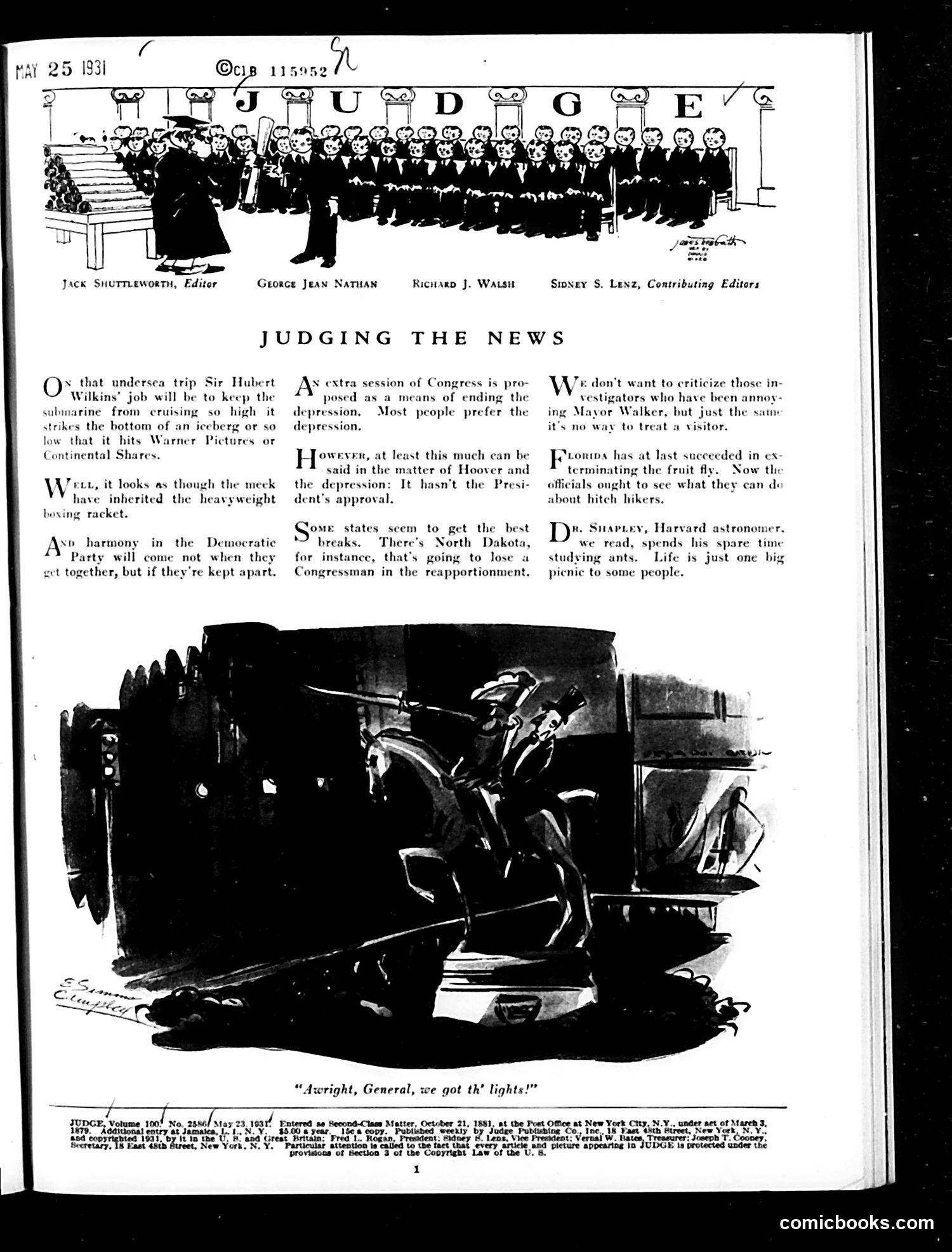
Analysis of Judge Magazine Page (May 25, 1931) The page features editorial commentary titled "Judging the News" with brief satirical takes on current events, followed by a cartoon captioned "Alright, General, we got th' lights!" The cartoon depicts a mounted general (likely a military figure) in what appears to be a stable or barn, speaking to someone operating lights—possibly a film or theater lighting setup. The joke appears to mock military attempts to control media presentation or "stage" news for public consumption, a concern during the early Depression era. The editorial snippets critique various political figures and situations: Sir Hubert Wilkins's Arctic expedition, Congressional response to the Depression, Democratic Party discord, and regional political consequences. The overall tone is cynical about governance and media manipulation.
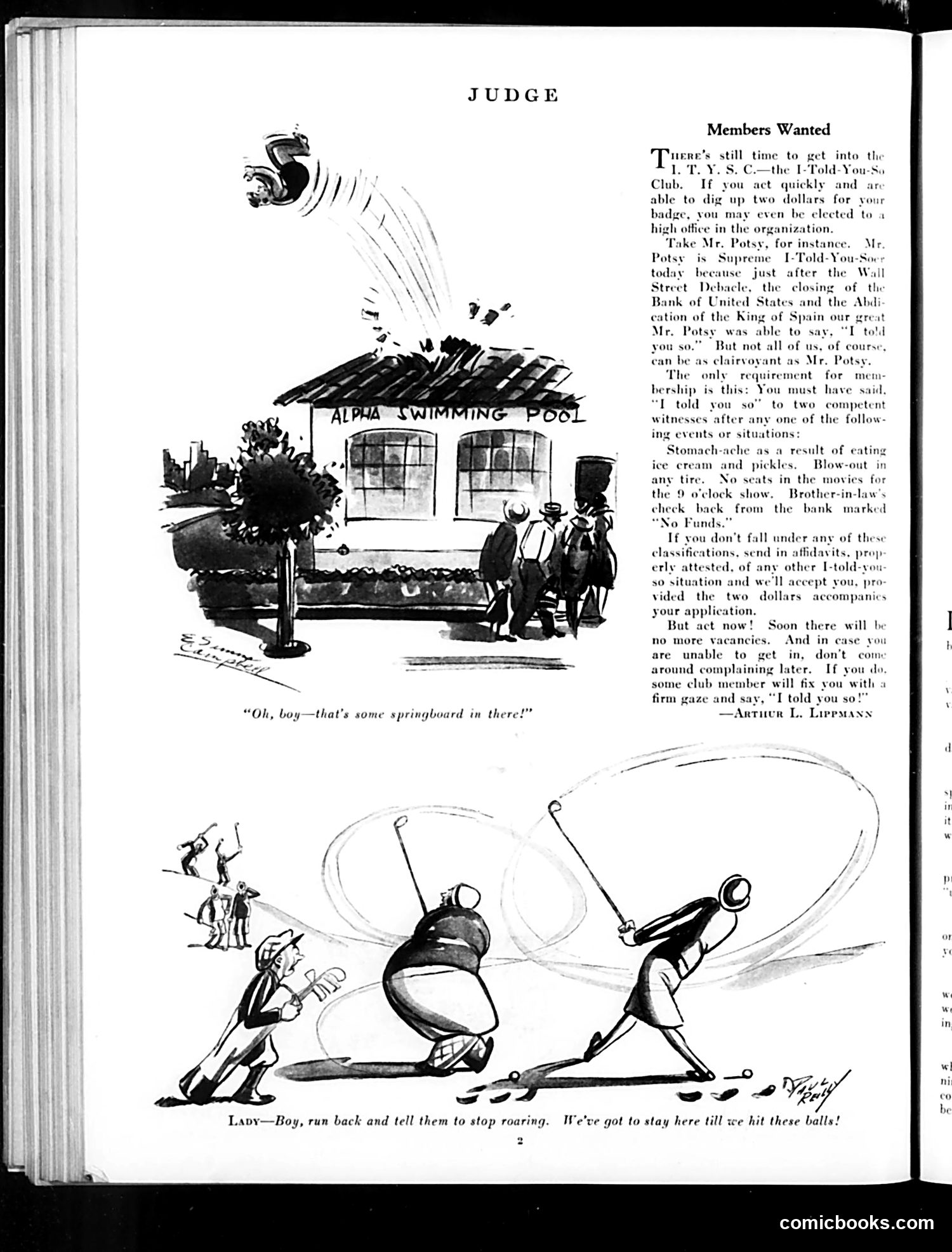
Analysis of Judge Magazine Page This page contains two satirical cartoons about the "I-Told-You-So Club" (I.T.Y.S.C.), a humorous organization for people who enjoy saying "I told you so." Top cartoon: Shows a figure being ejected from an "Alpha Swimming Pool," illustrating one of the club's qualifying situations: experiencing stomach-ache from eating ice cream and pickles. Bottom cartoon: Depicts people playing with large balls on strings, captioned "Lady—Boy, run back and tell them to stop roaring. We've got to stay here till we hit these balls!" This appears to mock people trying to participate in some activity while being hindered. The accompanying article humorously describes membership requirements—various embarrassing or unfortunate situations one must have experienced and mentioned to witnesses. The satire targets human nature and social pretension through this fictitious club concept.
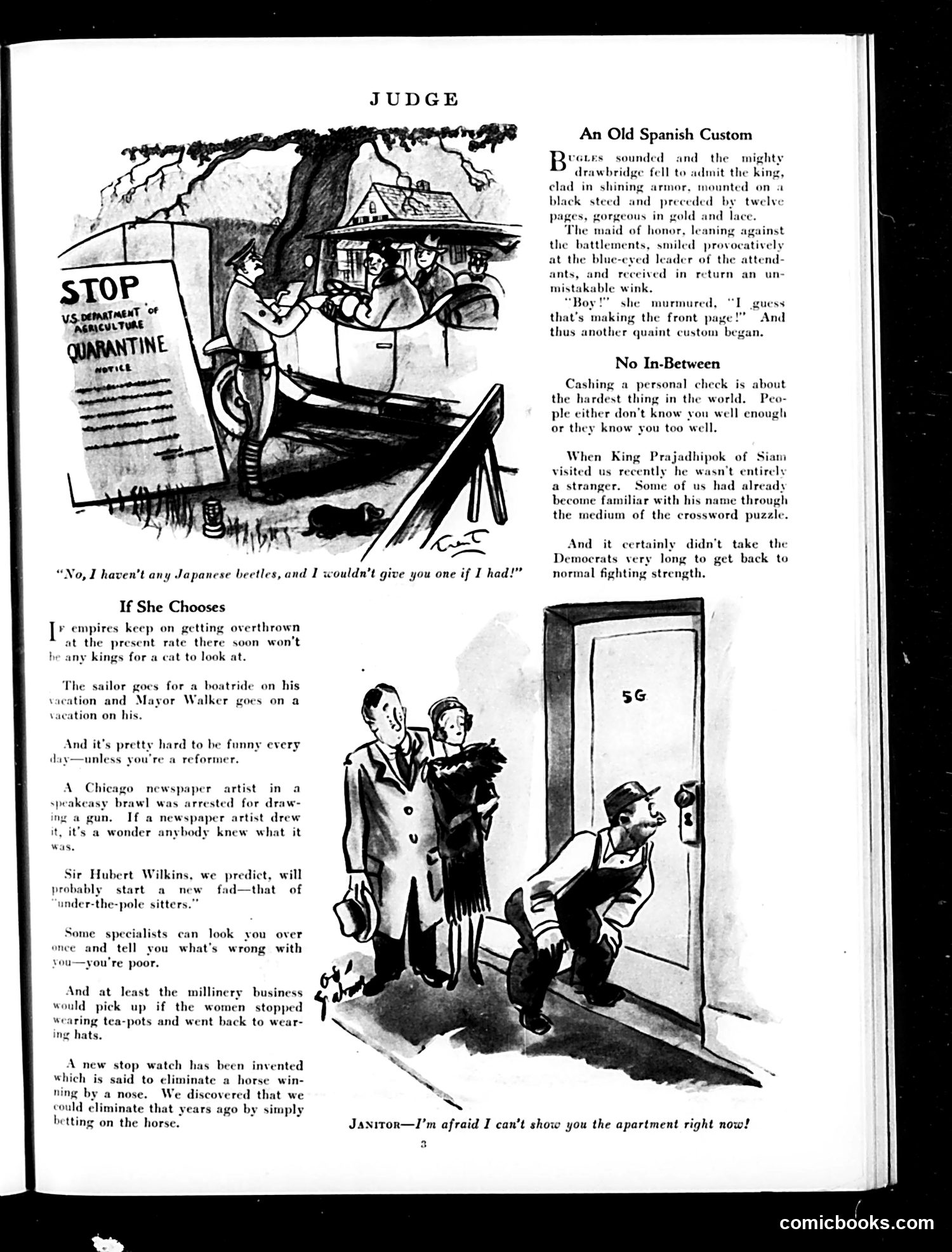
Analysis of Judge Magazine Page Top Cartoon ("An Old Spanish Custom"): This depicts a quarantine inspection during what appears to be an early 20th-century disease outbreak. A U.S. Department of Agriculture quarantine official inspects travelers arriving by drawbridge. The "maid of honor" character flirts with the inspector, who notices and winks back—the joke being that even official procedures can be subverted by charm. The caption suggests bureaucratic rules are easily undermined. Bottom Cartoon ("If She Chooses"): A janitor fears showing an apartment to a couple, marked "5G." The satire critiques housing discrimination and landlord prejudice of the era—suggesting certain groups faced barriers to rental housing based on appearance or status. Both reflect Progressive-era anxieties about regulation, inspection, and social discrimination.
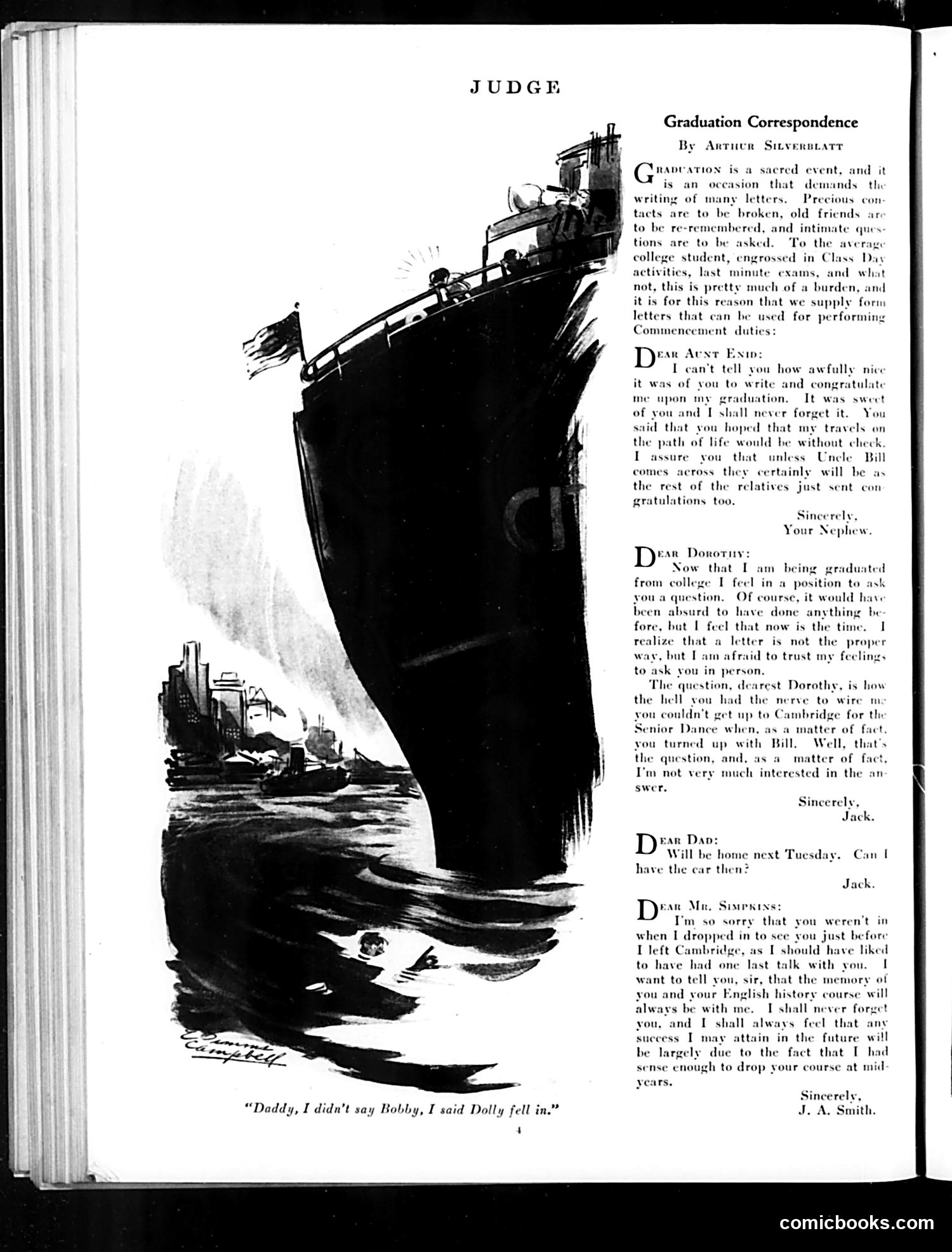
Analysis This page from *Judge* presents "Graduation Correspondence" by Arthur Silverblatt—sample letters for college graduates to send during commencement season. The accompanying illustration shows a large ship's bow looming over a small tugboat, captioned "Daddy, I didn't say Bobby, I said Dolly fell in." The cartoon's humor relies on mishearing: a father believes his son said someone named "Bobby" fell overboard, when he actually said "Dolly"—likely a girlfriend. The joke plays on parental anxiety and miscommunication during an awkward phone conversation about a serious accident. The sample letters below address relatives with humorous updates about post-graduation plans and social events, using the correspondence as a satirical vehicle for poking fun at typical graduate etiquette and family dynamics.
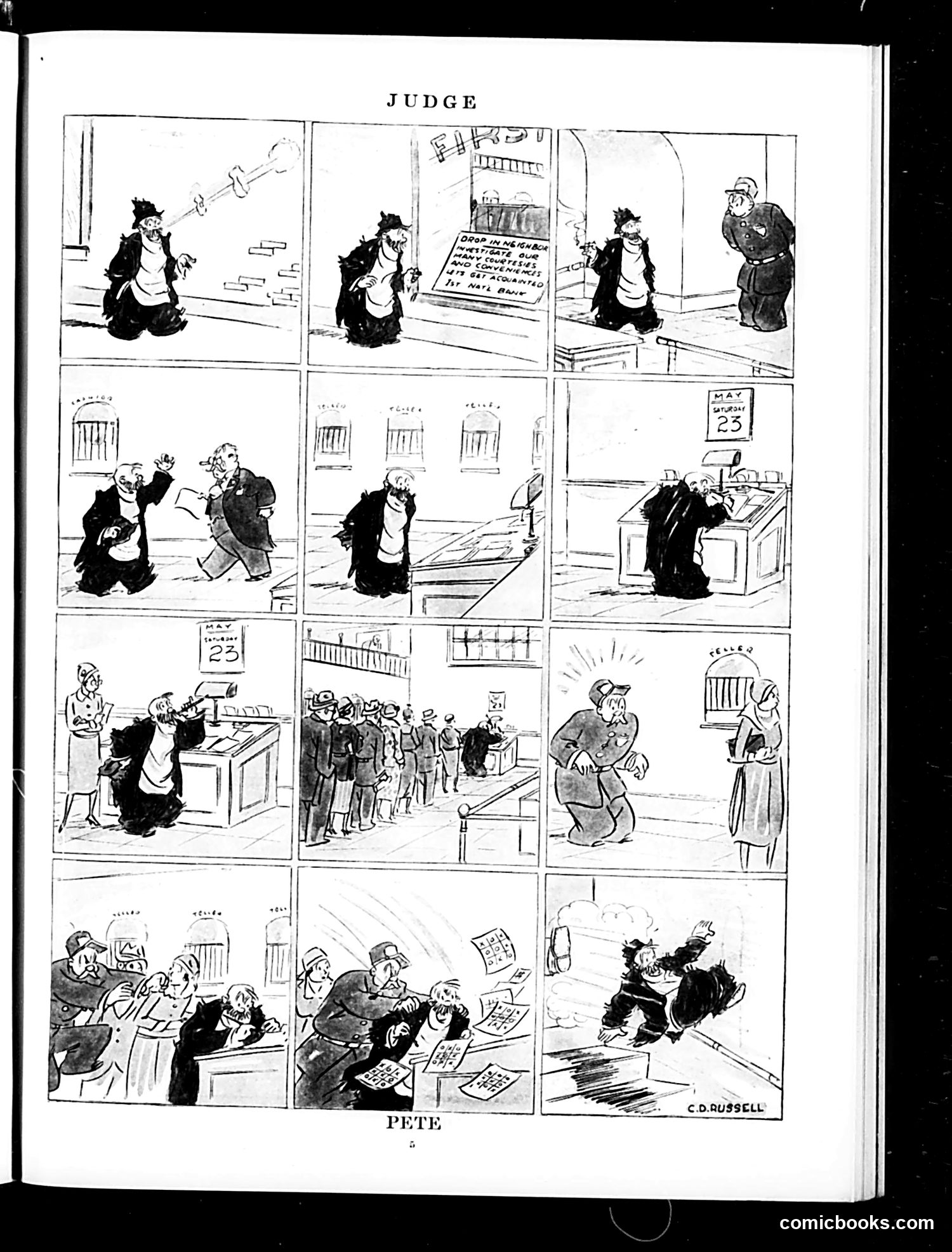
Analysis of "Judge" Comic Page This comic strip titled "Judge" (artist: C.D. Russell) appears to depict a courtroom scenario involving a character named "Pete." The narrative follows a disheveled man through various legal proceedings—from initial arrest or summons, through interrogation, to what seems to be a trial or hearing before a judge. The satire likely mocks the legal system's treatment of working-class or vagrant individuals. Pete's rumpled appearance and the progression through multiple officials suggests commentary on bureaucratic inefficiency or the harsh treatment of society's lower classes within the American justice system. Without clearer text visibility, the specific legal charge or social issue remains unclear, but the overall tone critiques institutional indifference to common people's plights.
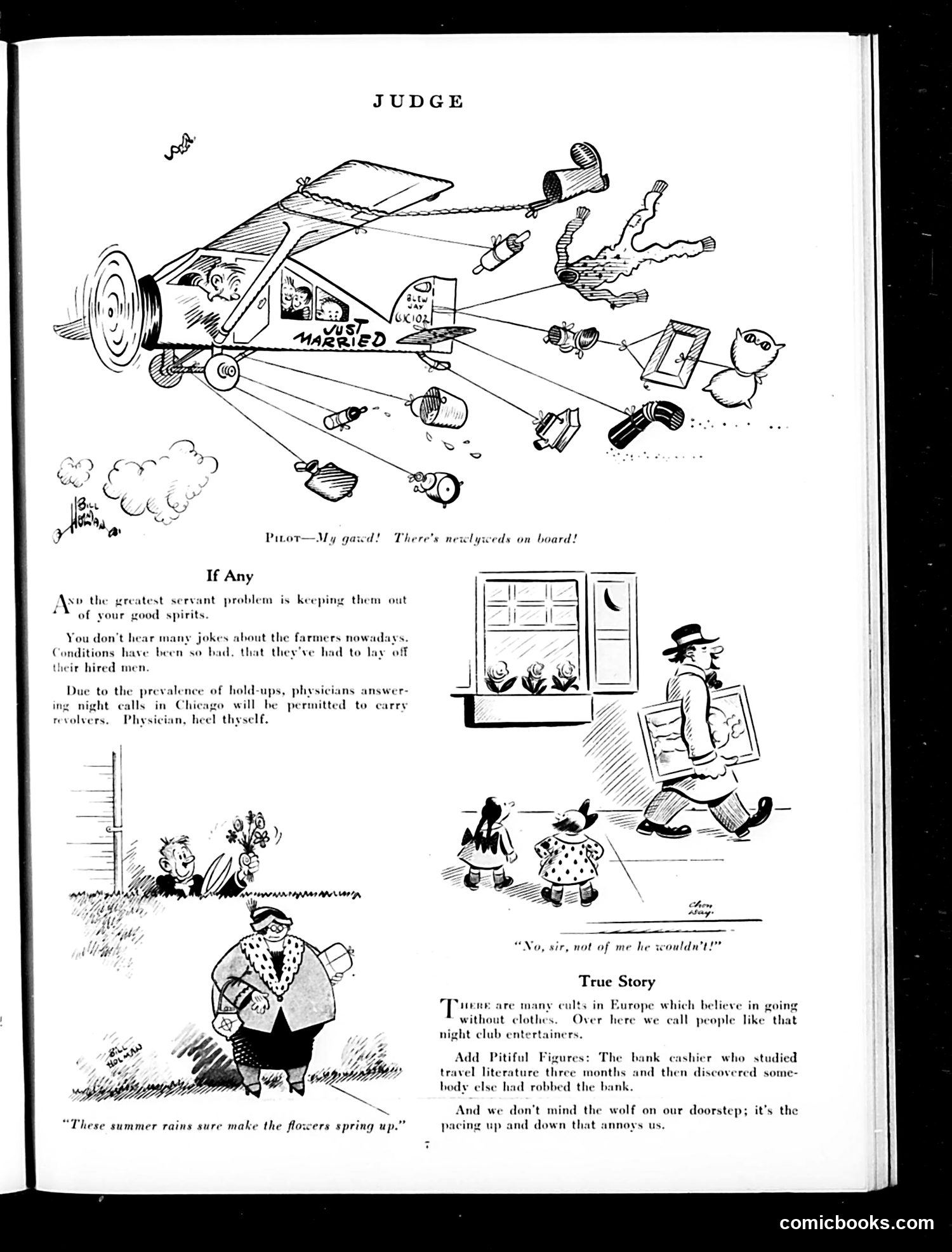
Judge Magazine Page Analysis This page contains multiple brief satirical pieces typical of 1920s-era humor: Top cartoon: A chaotic airplane labeled "Just Married" with newlyweds being pelted by various objects (shoes, cans, etc.)—satirizing the chaos of honeymoons or marital discord. "If Any" section: Short quips about contemporary issues: - Servant shortages (a post-WWI labor problem) - Farmers' economic hardship (1920s agricultural depression) - Chicago physicians now permitted to carry revolvers due to hold-ups (crime/violence concern) Lower cartoons: Include social commentary about nudist cults being euphemistically called "night club entertainers" in America, and a joke about a bank cashier who studied travel literature before robbing the bank. Overall tone: Cynical humor reflecting 1920s anxieties—economic depression, crime waves, labor troubles, and social changes. The satire assumes readers understand contemporary news and social problems.
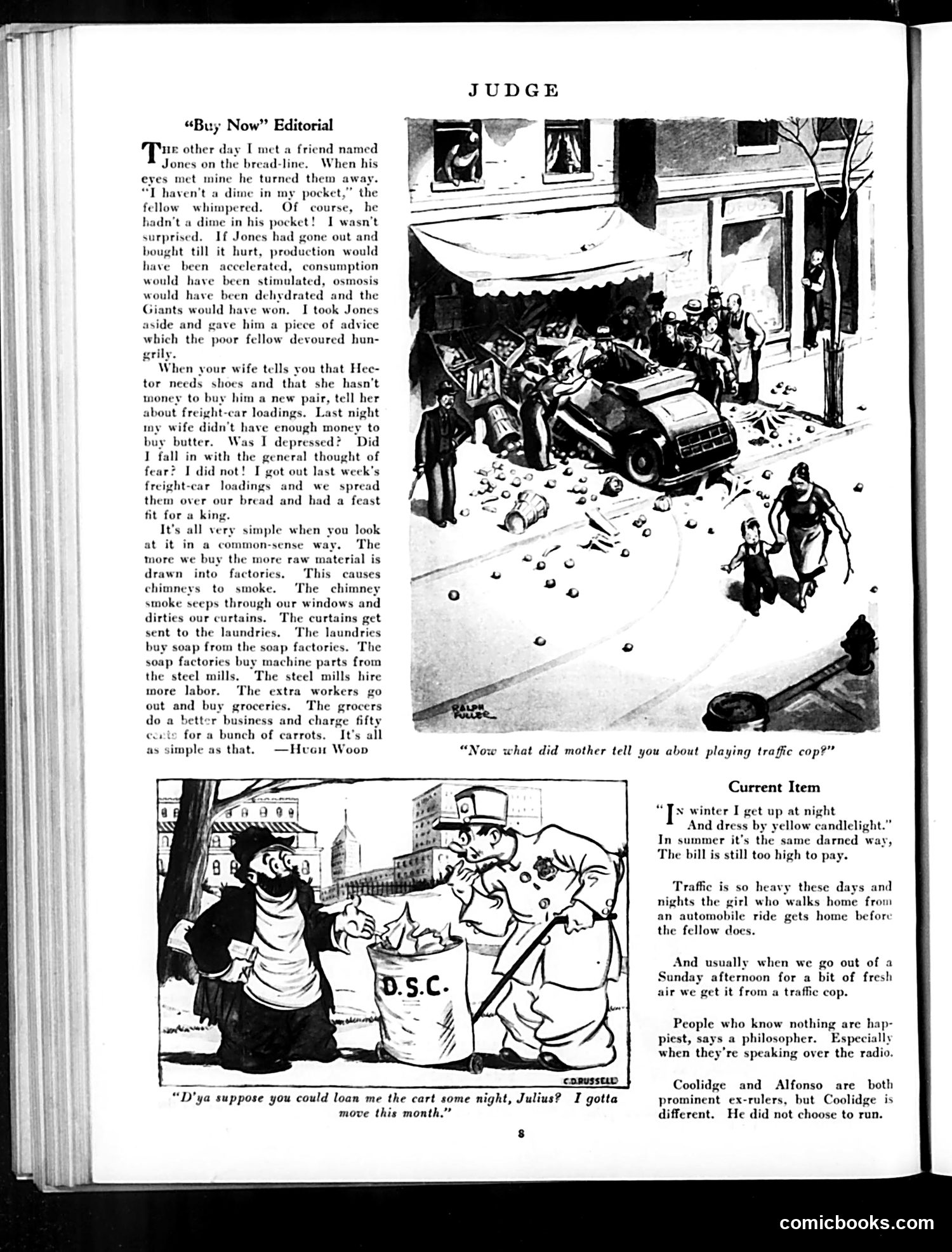
Judge Magazine Satire Analysis This page contains two distinct satirical pieces: "Buy Now" Editorial (top): A mock-serious argument advocating frivolous consumption as economic stimulus. The writer humorously suggests buying unnecessary items—even on credit—stimulates production, which creates jobs, which creates demand. The absurdist logic (that buying butter creates chimney smoke that dirties curtains, requiring laundry soap, enriching steel mills) satirizes contemporary economic arguments promoting consumer spending as a cure-all. It mocks both the "buy now" messaging of the era and economic theory that treats consumption as inherently beneficial. Lower cartoons: The street scene depicts children playing "traffic cop" amid automobile chaos—satirizing dangerous urban traffic conditions and the era's new automobile culture. The second cartoon shows figures labeled "D.S.C." (possibly a relief organization), satirizing economic hardship and the need for loans, contrasting with the upper editorial's consumption advocacy. The "Current Item" section briefly discusses winter electricity bills and traffic dangers, likely contemporary social complaints. Overall: the page satirizes 1920s consumer culture, automobile problems, and economic inequality through ironic exaggeration.
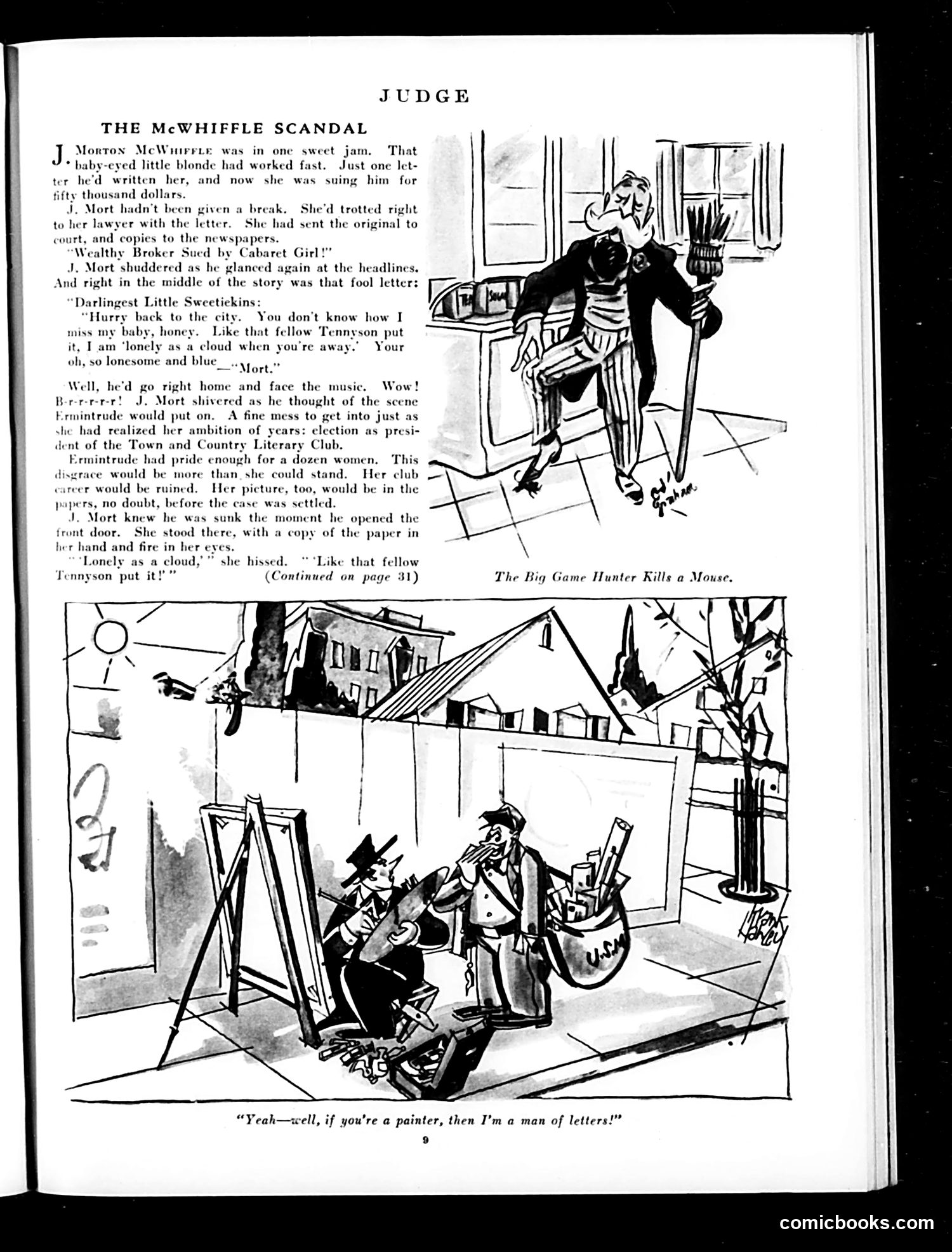
The McWhibble Scandal (Judge Magazine) This is a satirical story about a wealthy broker caught in a scandal. Morton McWhibble has written a romantic letter to a cabaret girl, who uses it to sue him for $50,000 and leaks it to newspapers. The scandal embarrasses his wife, Ermintrude, who has just achieved her ambition of becoming president of the Town and Country Literary Club. The humor targets both characters: McWhibble's foolish sentimentality (quoting Tennyson to a cabaret dancer) and Ermintrude's pretentiousness and concern for social status over actual marital betrayal. The bottom cartoon shows two figures in what appears to be an artist's studio with the caption "Yeah—well, if you're a painter, then I'm a man of letters!"—a quip about artistic credentials and verbal facility, likely mocking pretension in artistic circles. The satire reflects early 20th-century anxieties about social reputation, infidelity among the wealthy, and women's newfound ability to use legal systems against men.
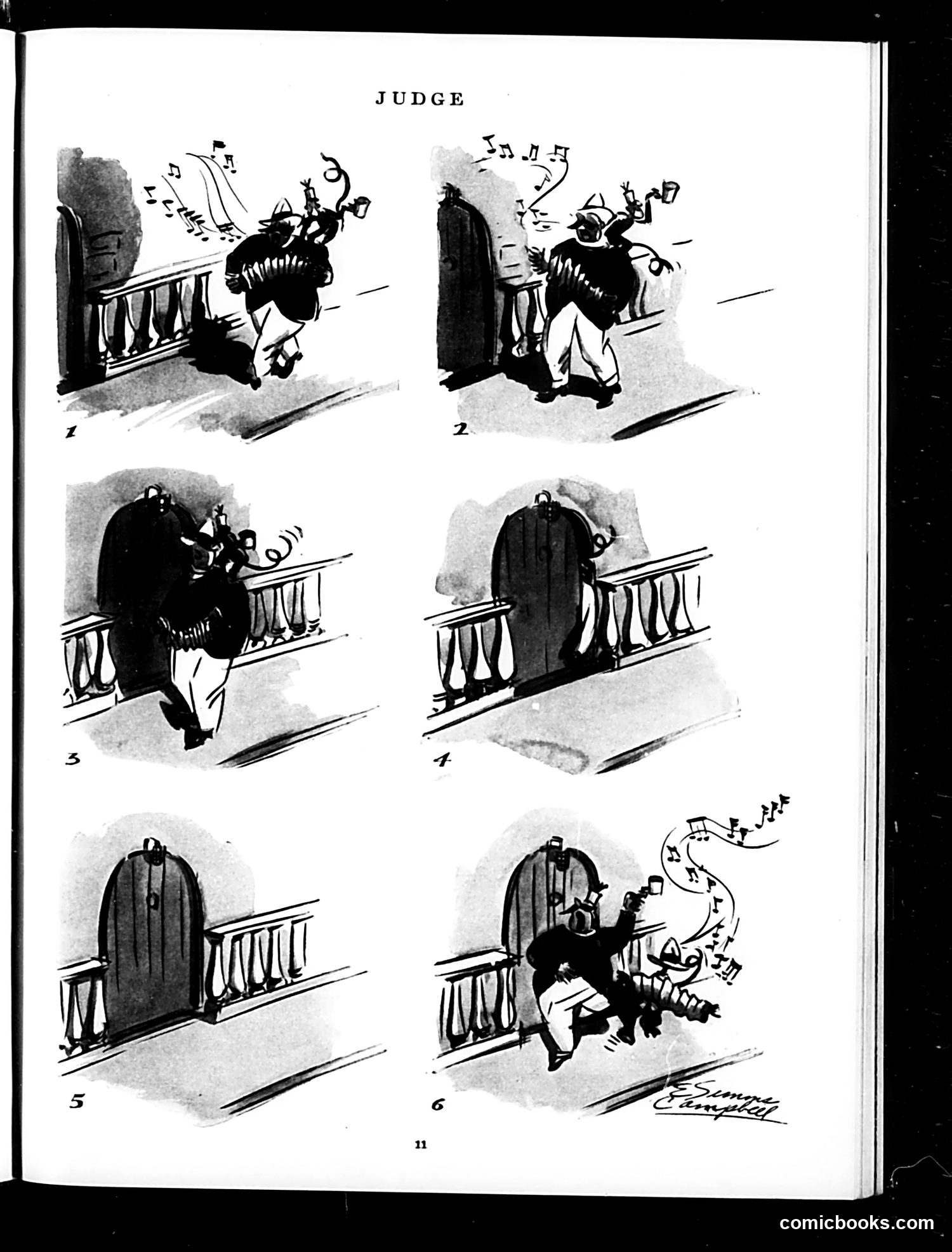
Judge Political Cartoon: "Judge" This six-panel wordless comic depicts a figure—appearing to be a judge or authority figure based on the title—entering through a large arched door while musicians play loudly (indicated by musical notes). The sequence shows the figure's progressive reaction: initially animated and conducting the music enthusiastically (panels 1-2), then attempting to silence the musicians (panel 3), growing increasingly frustrated as the music continues (panel 4), and finally being driven out or overwhelmed by the cacophony (panels 5-6). The satire likely critiques judicial authority being rendered powerless or absurd when confronted with noise, disruption, or chaos—possibly commenting on courtroom disruptions, public opposition to legal proceedings, or the inability of formal authority to maintain order against popular commotion. The specific historical reference remains unclear without additional context.
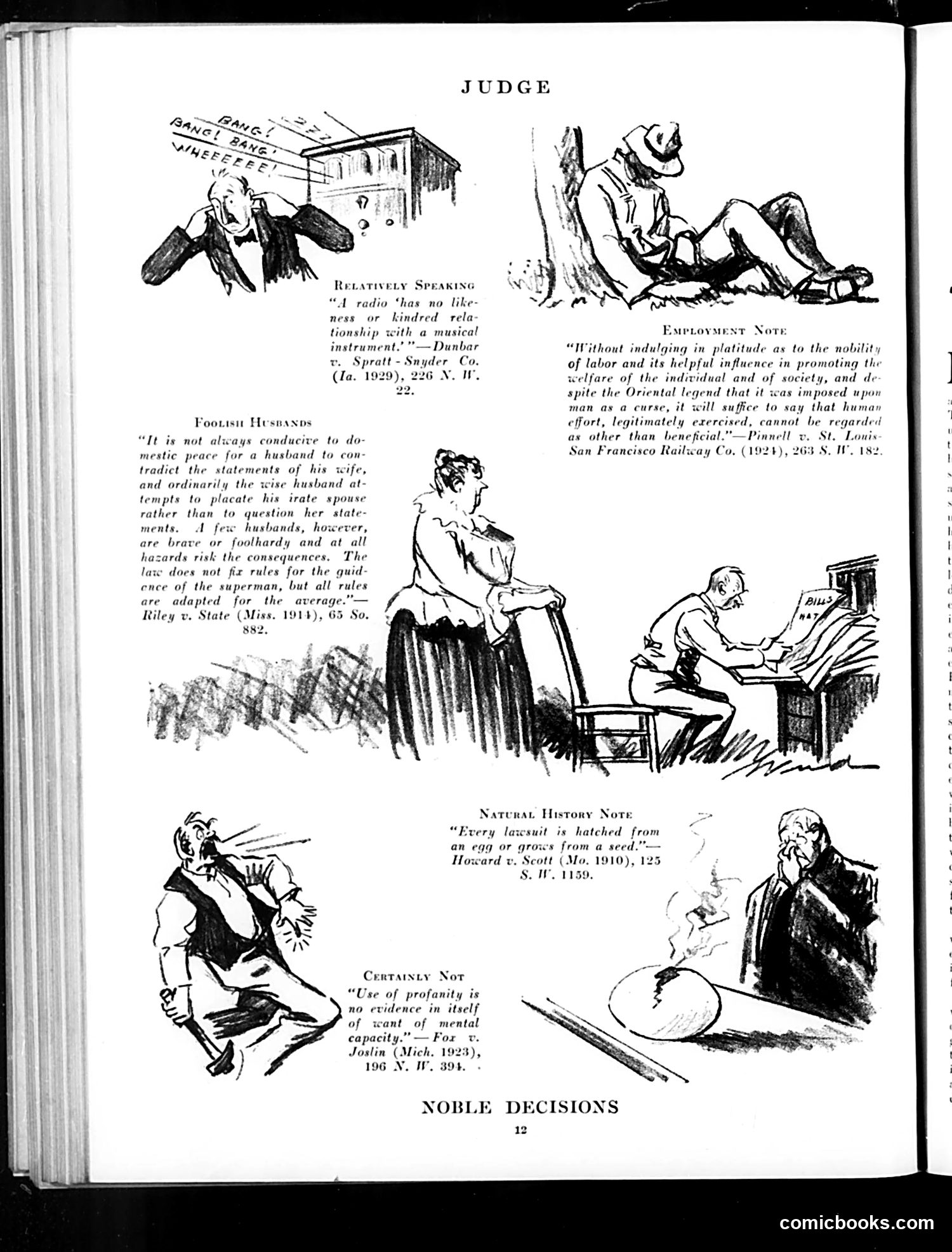
"Judge" Page: Legal Satire on Gender and Labor This page from *Judge* magazine satirizes judicial decisions through cartoon vignettes. The "Relatively Speaking" cartoon mocks a husband defending his wife's nagging by comparing it to a musical instrument—trivializing domestic conflict. "Foolish Husbands" illustrates judicial wisdom about marital peace, suggesting husbands should placate rather than question their wives. The "Employment Note" quotes a San Francisco Railway case, sarcastically praising labor's nobility while acknowledging workers endure hardship despite such platitudes—critiquing the gap between legal rhetoric and actual worker treatment. Lower cartoons address "Natural History" (inheritance law) and "Certainly Not" (profanity as evidence of mental capacity), featuring exaggerated character types typical of early-20th-century satirical illustration. The page exemplifies *Judge*'s style: biting social commentary wrapped in humorous sketches.
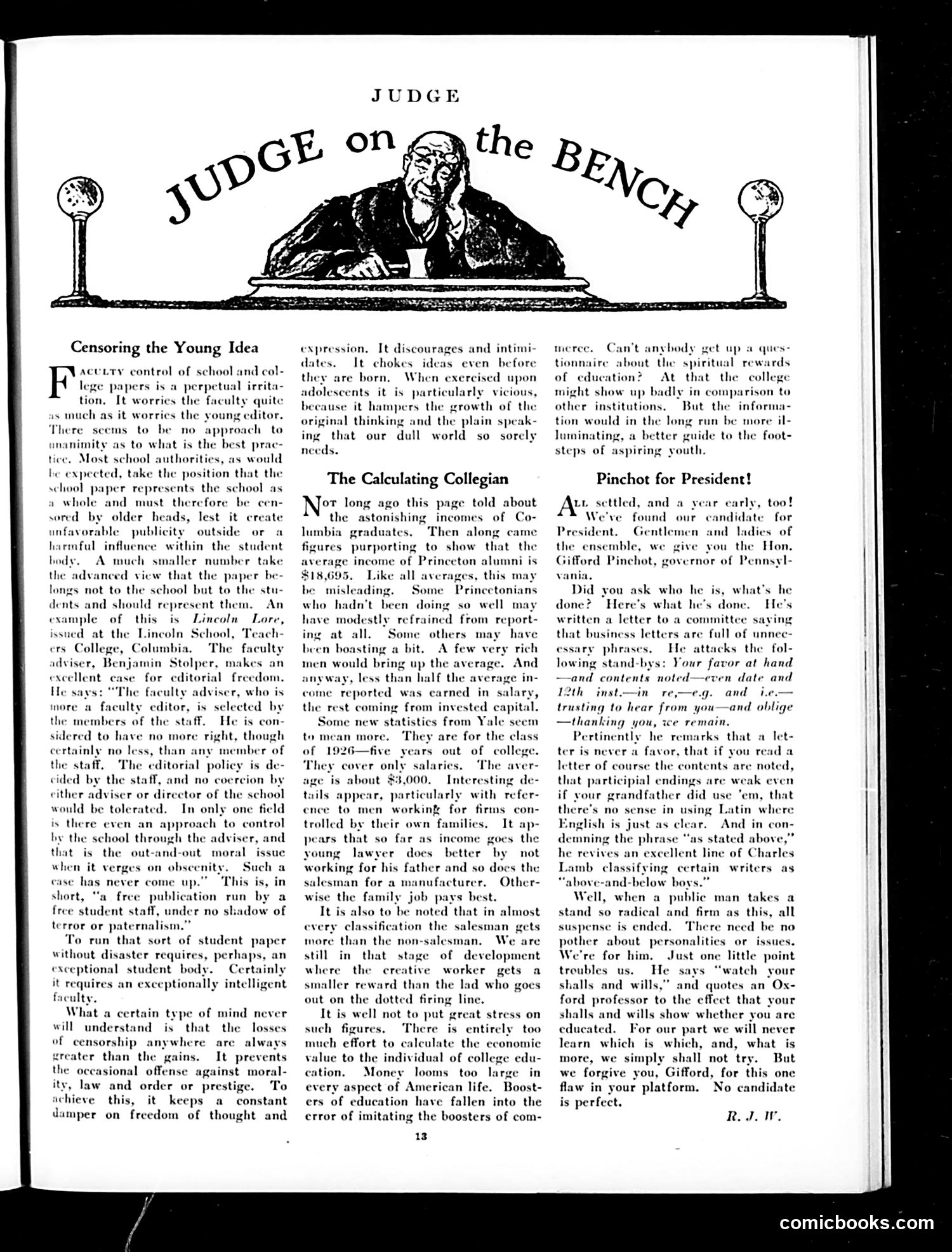
"Judge on the Bench" Page Analysis This page from Judge magazine contains three opinion pieces rather than a cartoon. The masthead shows a judge sitting at a bench—a recurring feature framing editorial commentary. "Censoring the Young Idea" argues against faculty censorship of college newspapers. The author criticizes administrators who suppress student publications to protect institutional reputation, citing Lincoln School's approach (where faculty adviser Benjamin Stolper allows editorial freedom) as preferable. The piece warns that censorship dampens original thinking among adolescents. "The Calculating Collegian" discusses income statistics from Ivy League alumni, questioning the reliability of self-reported graduate earnings from Columbia and Princeton. It notes Yale's 1926 class data showing salesmen earn more than creative workers, and observes that family business employees fare better than those working elsewhere—suggesting American culture overvalues financial gain. "Pinchot for President" endorses Gifford Pinchot, Pennsylvania governor, as a presidential candidate, praising his integrity and platform while critiquing others' hollow ambitions. The page represents Judge's typical satirical social commentary on education, economics, and politics.
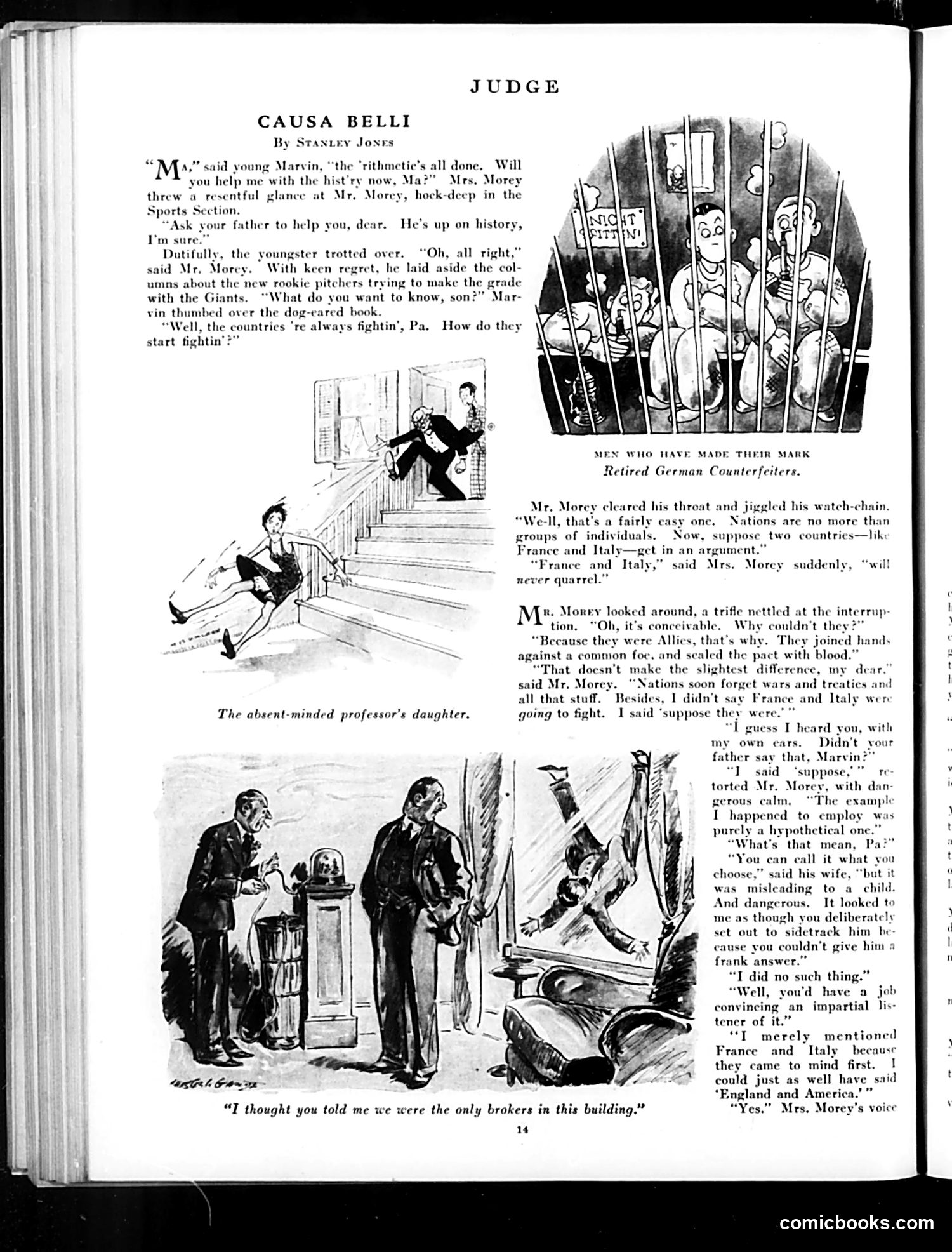
"Causa Belli" Analysis This comic by Stanley Jones satirizes marital discord disguised as intellectual debate. The title—Latin for "cause of war"—is the joke: a husband and wife argue over the husband's hypothetical example about France and Italy fighting. The satire targets how wives nitpick husbands' statements. When Mr. Morey uses France-Italy as a theoretical example of how nations quarrel, Mrs. Morey seizes on it literally, insisting they'll "never quarrel" because they were WWI Allies. Mr. Morey clarifies he meant "suppose," but she refuses to accept this, attacking his reasoning as "misleading to a child." The cartoon illustrates domestic power struggles where one spouse weaponizes semantic arguments to dominate conversation—here, Mrs. Morey transforms an innocent pedagogical example into evidence of her husband's carelessness or dishonesty. The "Retired German Counterfeiters" caption appears unrelated, likely a separate Judge feature on that page.
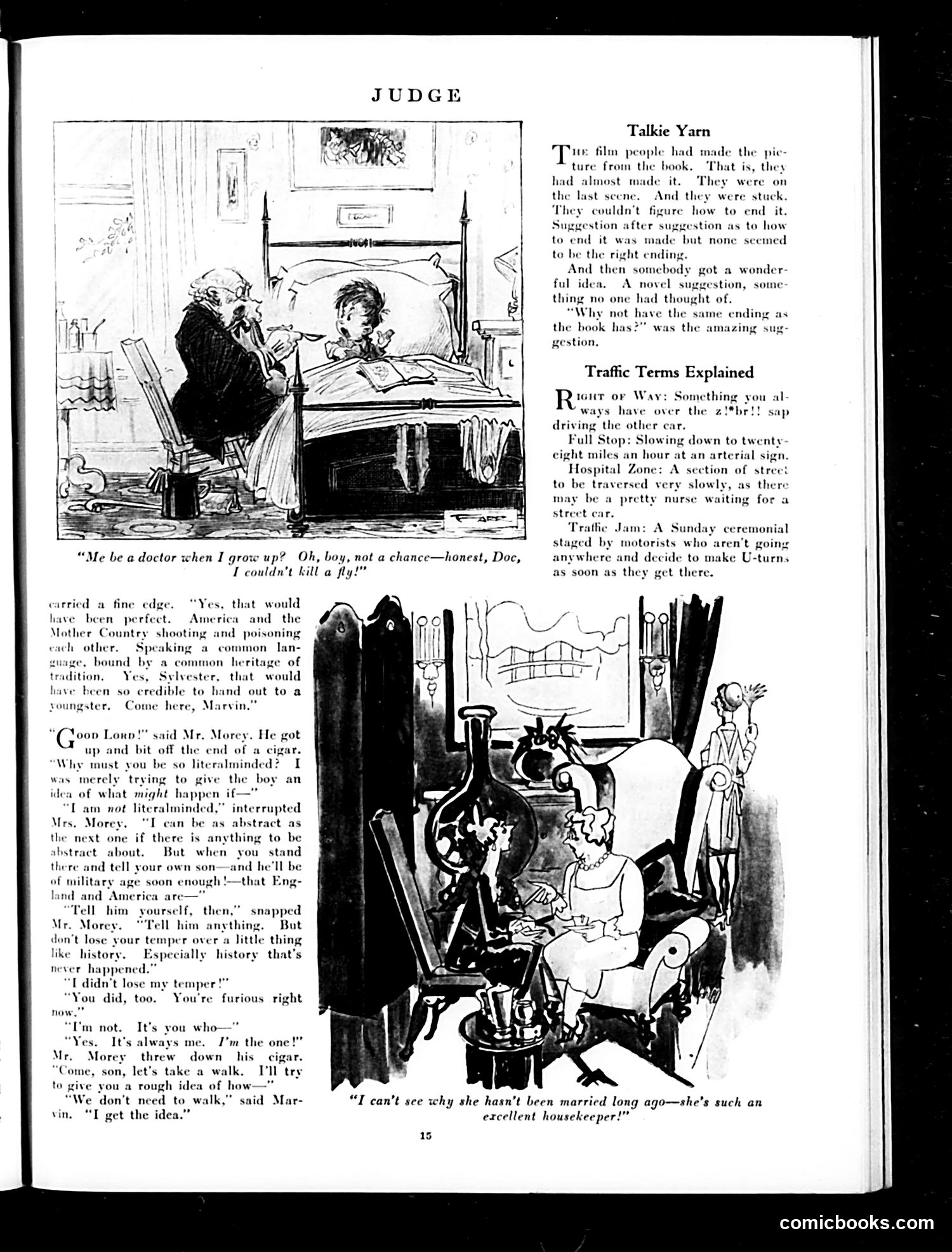
"Judge" Magazine Page Analysis This page contains two distinct pieces of humor typical of 1920s-30s satirical magazines. "Talkie Yarn" (top): Satirizes early "talkie" (sound film) production. The joke mocks filmmakers struggling to end their adaptation of a book, offering increasingly desperate suggestions—until someone proposes simply using the book's ending. The satire targets the pretentiousness of film producers who overthink adaptations, forgetting the source material already provides a solution. "Traffic Terms Explained" (middle right): A humorous glossary defining traffic-related terms sarcastically. "Right of Way" means aggressive driving; "Full Stop" is slow-driving at signs; "Hospital Zone" involves nurses waiting by the road; "Traffic Jam" describes Sunday reckless driving. This mocks both the new traffic regulations of motorized society and drivers' cavalier attitudes toward rules. The remaining text discusses a domestic dispute about history lessons—a father's flippant suggestion that America and Britain might fight shocks his wife, leading to quarreling about who's more temperamental.
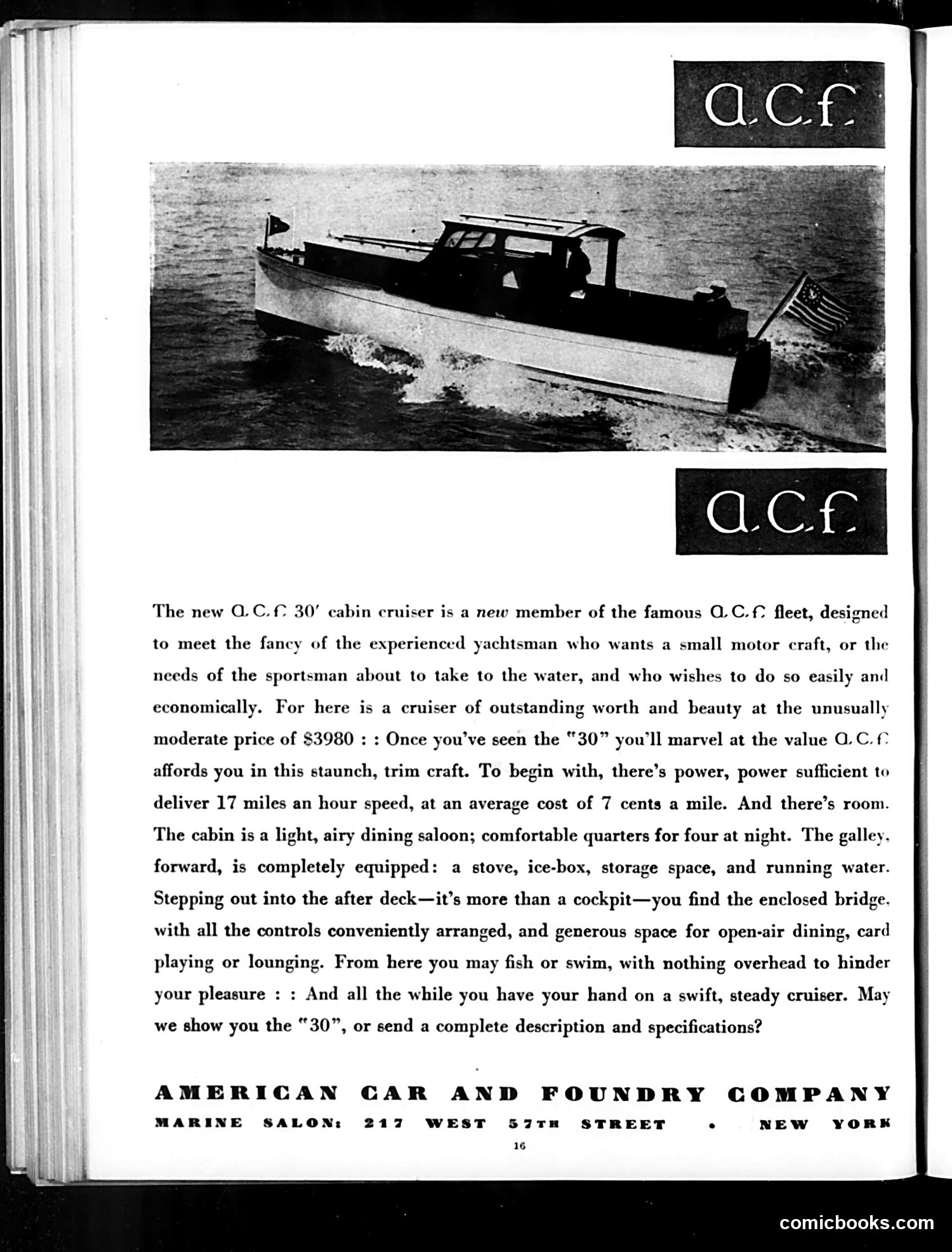
Content Analysis This page is not a political cartoon or satire—it's a straightforward advertisement. The image shows a photograph of a Q.C.F. 30-foot cabin cruiser, a motorized yacht manufactured by American Car and Foundry Company. The ad targets affluent leisure consumers, emphasizing the boat's appeal to experienced yachtsmen and sportsmen. Key selling points include: moderate pricing ($3,980), fuel efficiency (7 cents per mile), comfortable cabin accommodations for four, and modern amenities (galley, running water, ice-box). The copy stresses the craft's speed (17 mph), ease of operation, and luxury features like an enclosed bridge and open-air dining space. This represents typical 1920s-era promotional material targeting the recreational boating market during America's economic prosperity period.
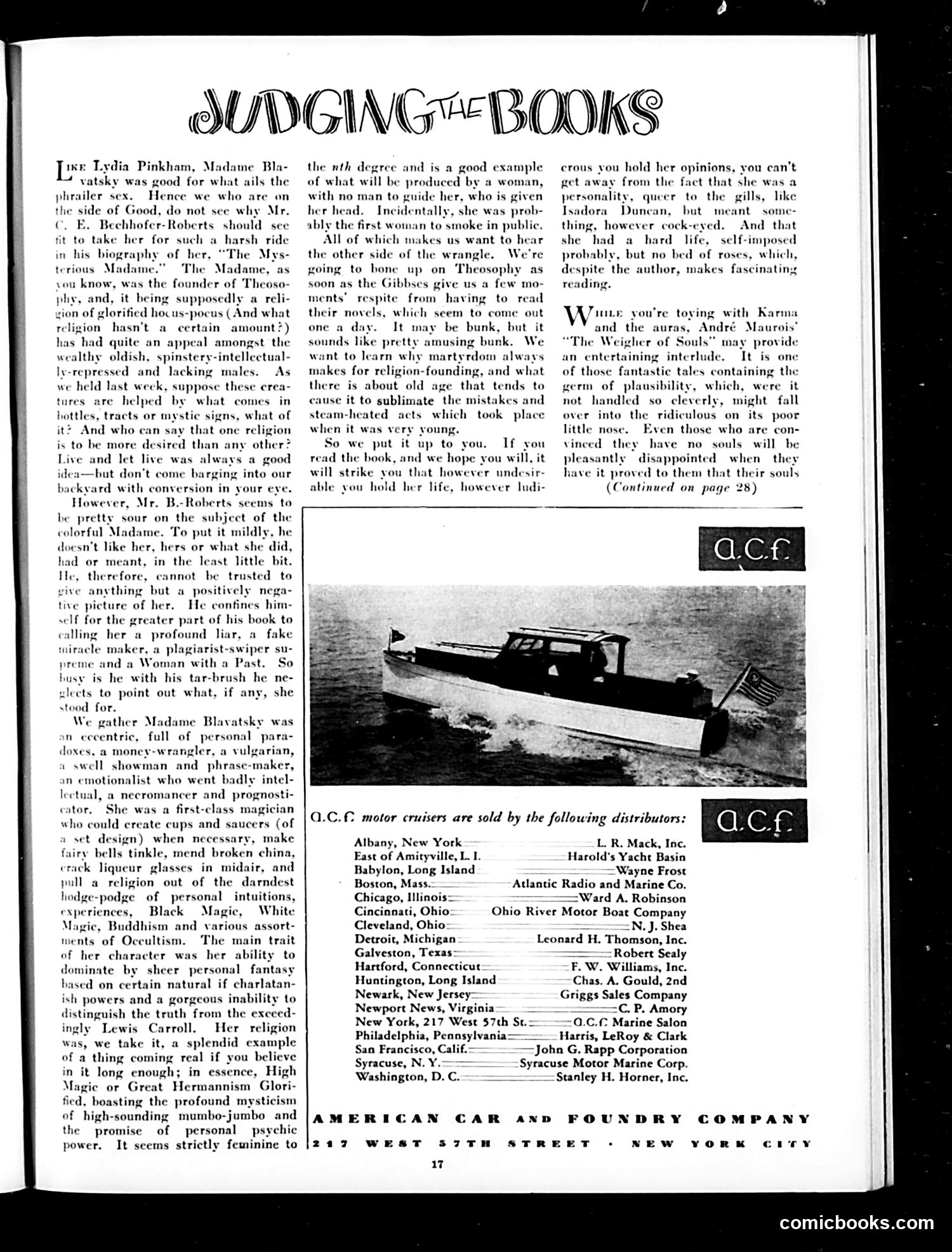
"Judging the Books" - A Book Review Column This is a book review section, not a political cartoon. The page critiques C.E. Bechhofer-Roberts' biography of Madame Blavatsky, founder of Theosophy—a spiritual movement blending occultism, Buddhism, and mysticism that attracted wealthy, intellectually-repressed women. The reviewer argues Roberts is unfairly harsh, calling Blavatsky a "liar" and "plagiarist" while ignoring her genuine accomplishments. The satire targets Roberts' bias: the reviewer suggests that if people find comfort in Blavatsky's teachings—however fraudulent—what harm is done? The piece defends her eccentricity and showmanship while acknowledging she was a charlatan. The advertisement below promotes Q.C.F. motor cruisers sold nationwide through various distributors, unrelated to the book review content above it.
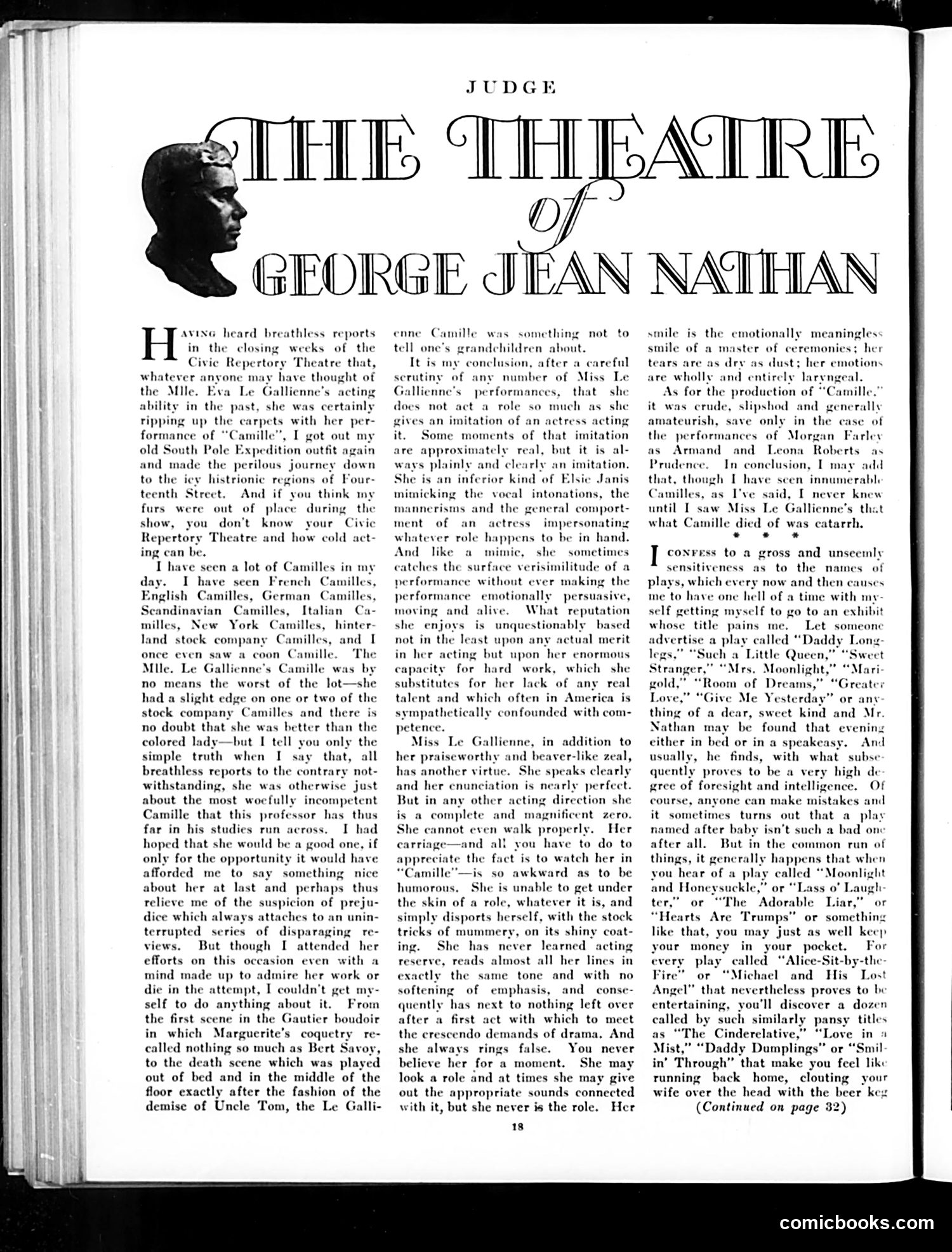
Judge Theater Critique: Eva Le Gallienne's "Camille" This page contains a theater review (not a cartoon) by Judge magazine's drama critic, savagely critiquing actress Eva Le Gallienne's performance in "Camille" at the Civic Repertory Theatre. The reviewer's central argument: Le Gallienne is a competent *mimic* of acting rather than a genuine actress. She excels at mimicking vocal intonations and mannerisms (compared unfavorably to impressionist Elsie Janis), but lacks authentic talent. The critic catalogs her failures—wooden delivery, poor carriage, inability to vary tone or build emotional crescendos, constant false notes. The review's humor derives from brutal honesty: her reputation rests on "beaver-like zeal" and clear diction, not talent. The opening joke references the "icy" coldness of her acting, justifying the reviewer's South Pole expedition outfit. The Bert Savoy reference (a female impersonator) emphasizes her performance as pastiche rather than genuine interpretation. This represents Judge's satirical theater criticism—using exaggerated complaint to expose artistic pretension.
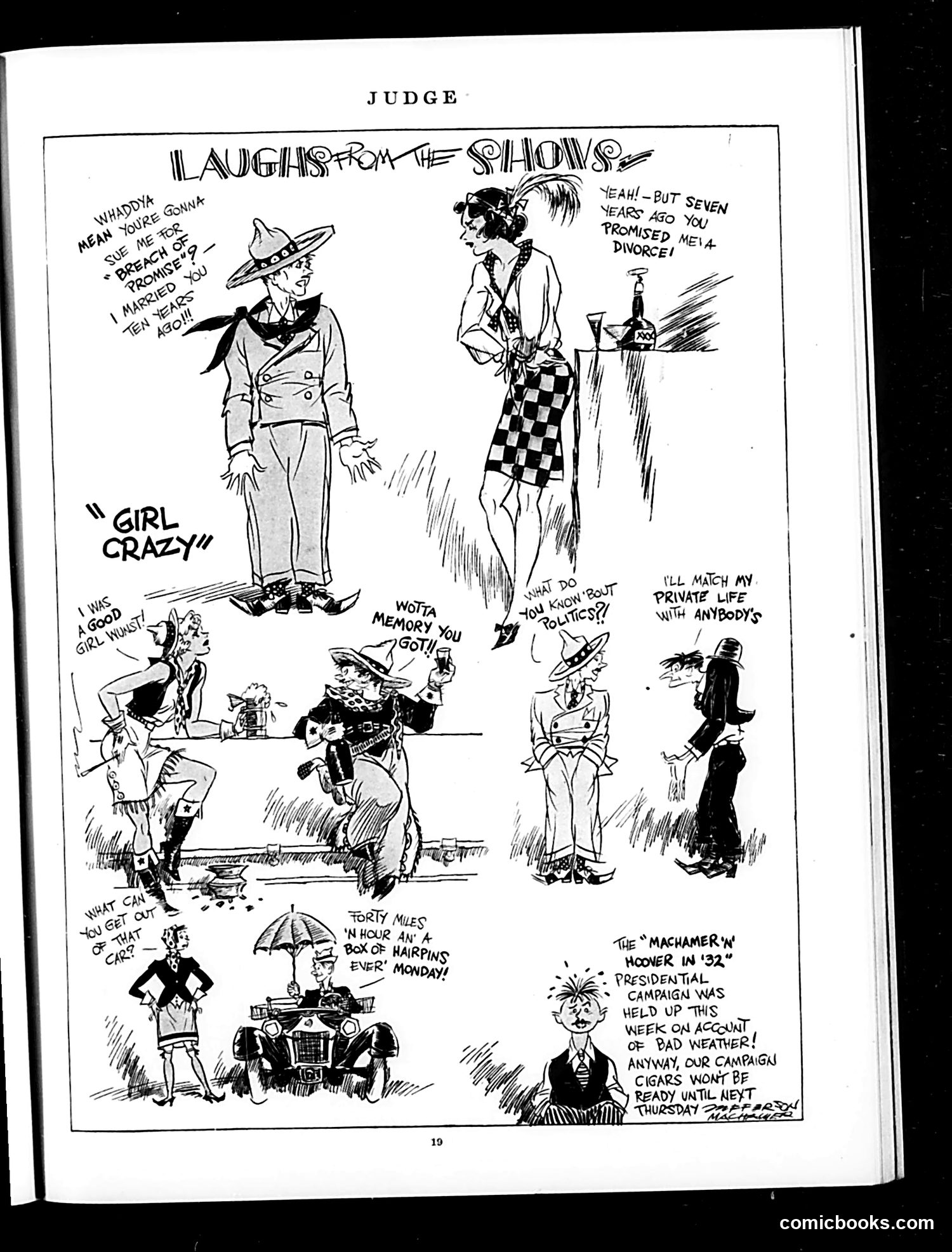
"Laughs from the Shows" This is a satirical cartoon page from Judge magazine titled "Girl Crazy," likely from the early 1930s. The cartoons mock a woman's romantic and political inconsistencies through various scenarios. The humor centers on a woman who makes contradictory statements: claiming to be a "good feminist" while pursuing marriage, promising divorce after seven years, refusing to discuss politics, and insisting on privacy about her personal life. A bottom panel references the 1932 presidential campaign, where bad weather delayed distribution of campaign cigars—satirizing how trivial weather concerns disrupted political activities. The overall satire targets women's evolving social roles during this era, poking fun at perceived contradictions between feminist ideals and traditional romantic/domestic expectations. The "Girl Crazy" title reinforces the stereotype of women as unreliable or emotionally volatile, a common trope in period humor.
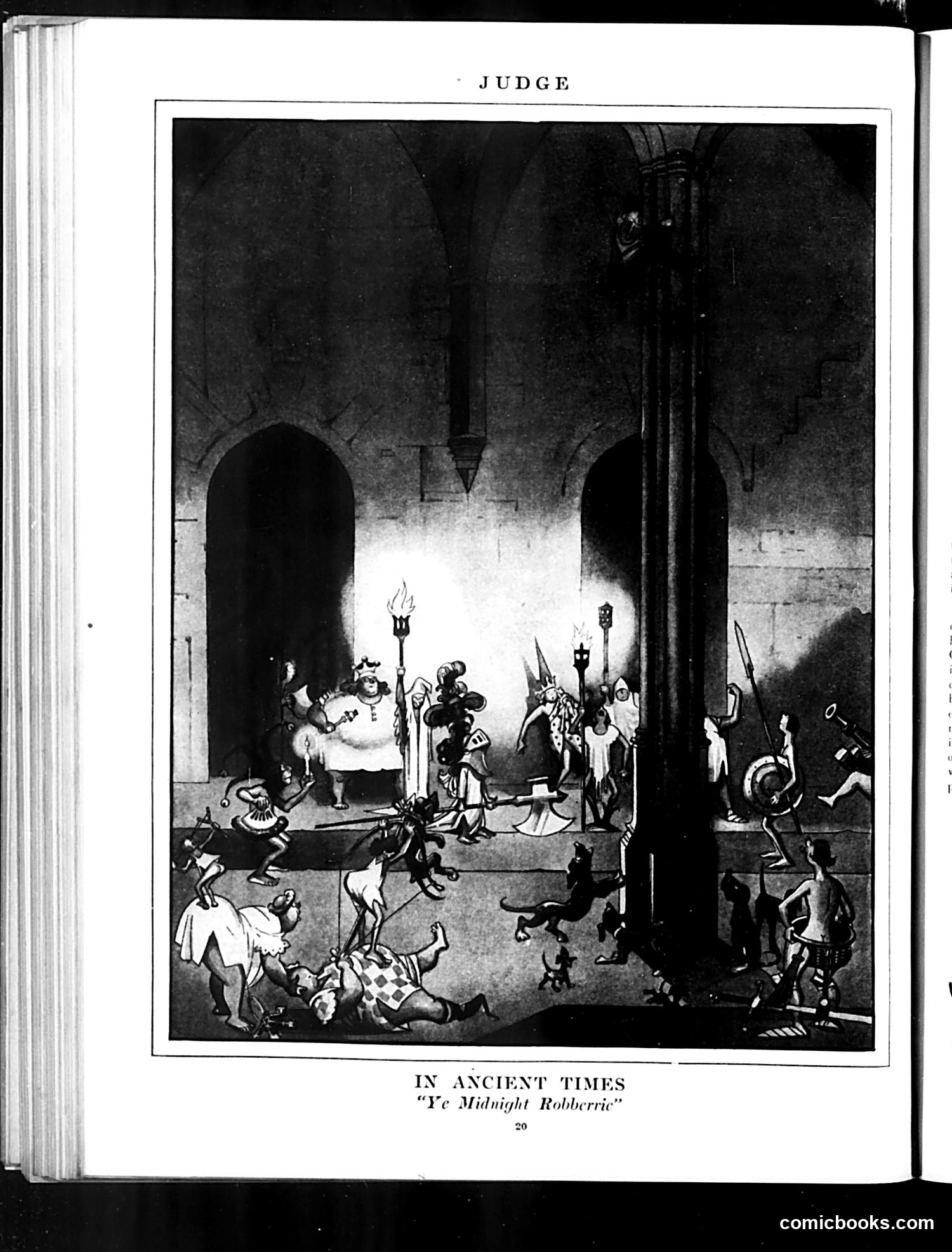
"Ye Midnight Robberrie" — A Historical Satire This illustration depicts a theatrical scene set in what appears to be a medieval or ancient castle interior, with a judge or authority figure presiding over a chaotic gathering. The title "Ye Midnight Robberrie" suggests a comedic take on historical crime and lawlessness. The scene shows various figures—some appearing to be criminals, guards, or court attendants—engaged in animated activity around a central platform or stage. The dramatic lighting and gothic archways create a theatrical atmosphere. Without additional context about the specific issue date, this appears to be Judge magazine's satirical commentary on historical justice or crime, possibly mocking either period-costume drama or making broader points about lawlessness and authority. The exact political target remains unclear from the image alone.
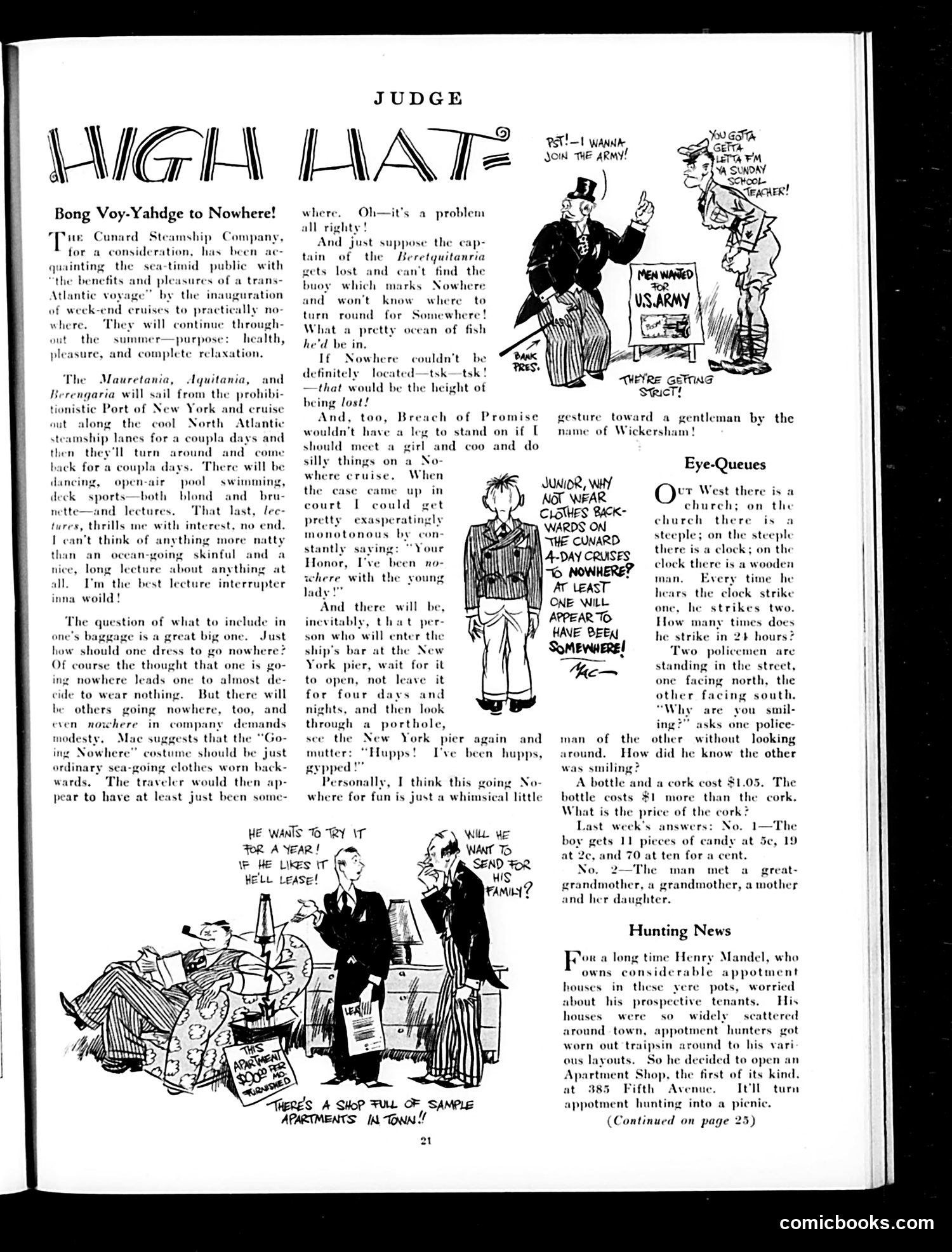
"High Late" - Judge Magazine Satire This page satirizes the Cunard Steamship Company's newly-advertised "week-end cruises to practically nowhere"—luxury ocean voyages that sailed from New York up the North Atlantic for a couple days, then returned. The main cartoon mocks the absurdity: passengers dress up, attend lectures, drink at bars, and pay for the privilege of going nowhere specific. The humor centers on practical contradictions—how does one pack for "nowhere"? What if the captain gets lost and can't find the port to return? One passenger stays drunk in the bar the entire voyage, emerging to complain he was "gypped." The cartoonist presents this as emblematic of post-WWI excess and frivolity among the wealthy, who pay substantial money for leisure with no meaningful destination—essentially vacationing in circles. The satire suggests this epitomizes American consumer culture: spending for spending's sake, all appearance and no substance. The page also includes unrelated puzzle features and news items typical of Judge's format.
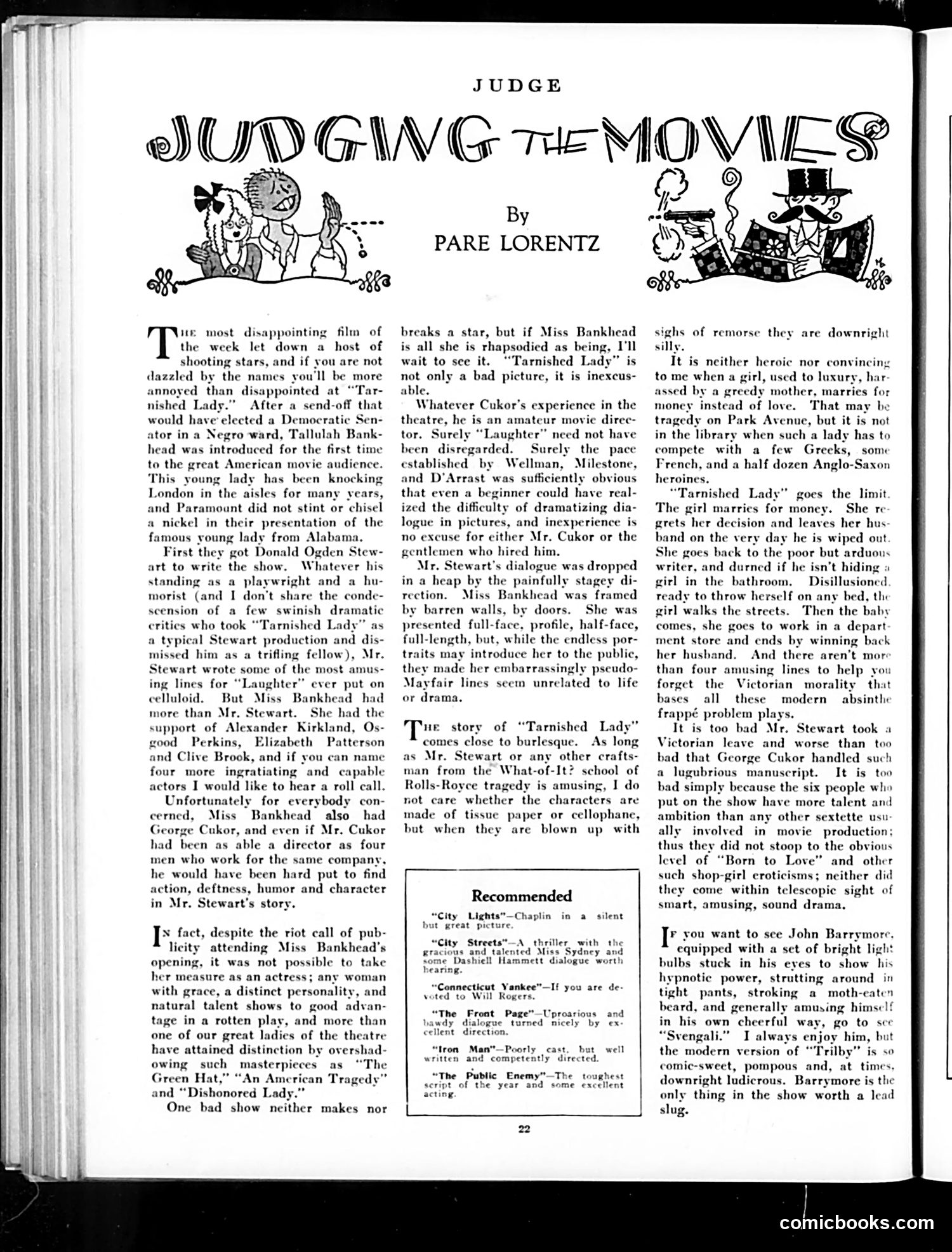
Analysis for Modern Readers This page is a film review column by Pare Lorentz, a prominent critic of the era, discussing the 1931 film "Tarnished Lady" starring British actress Tallulah Bankhead in her American film debut. The critique's main points: Lorentz praises Bankhead's talent and the supporting cast (including Clive Brook and others), but severely criticizes director George Cukor as an "amateur" who mishandled the film. He argues Cukor dropped the witty dialogue written by playwright Donald Ogden Stewart—the film's actual strength—and instead filmed Bankhead in static, unflattering shots against bare walls. The satire: Lorentz mocks how Paramount heavily promoted Bankhead's arrival, yet delivered a poor picture. He suggests even great actresses cannot salvage bad direction. The sidebar recommendations list contemporary films worth seeing instead, including Chaplin's "City Lights" and a film featuring Will Rogers. This represents serious film criticism positioned within Judge's satirical framework—using entertainment critique to highlight Hollywood's failures.
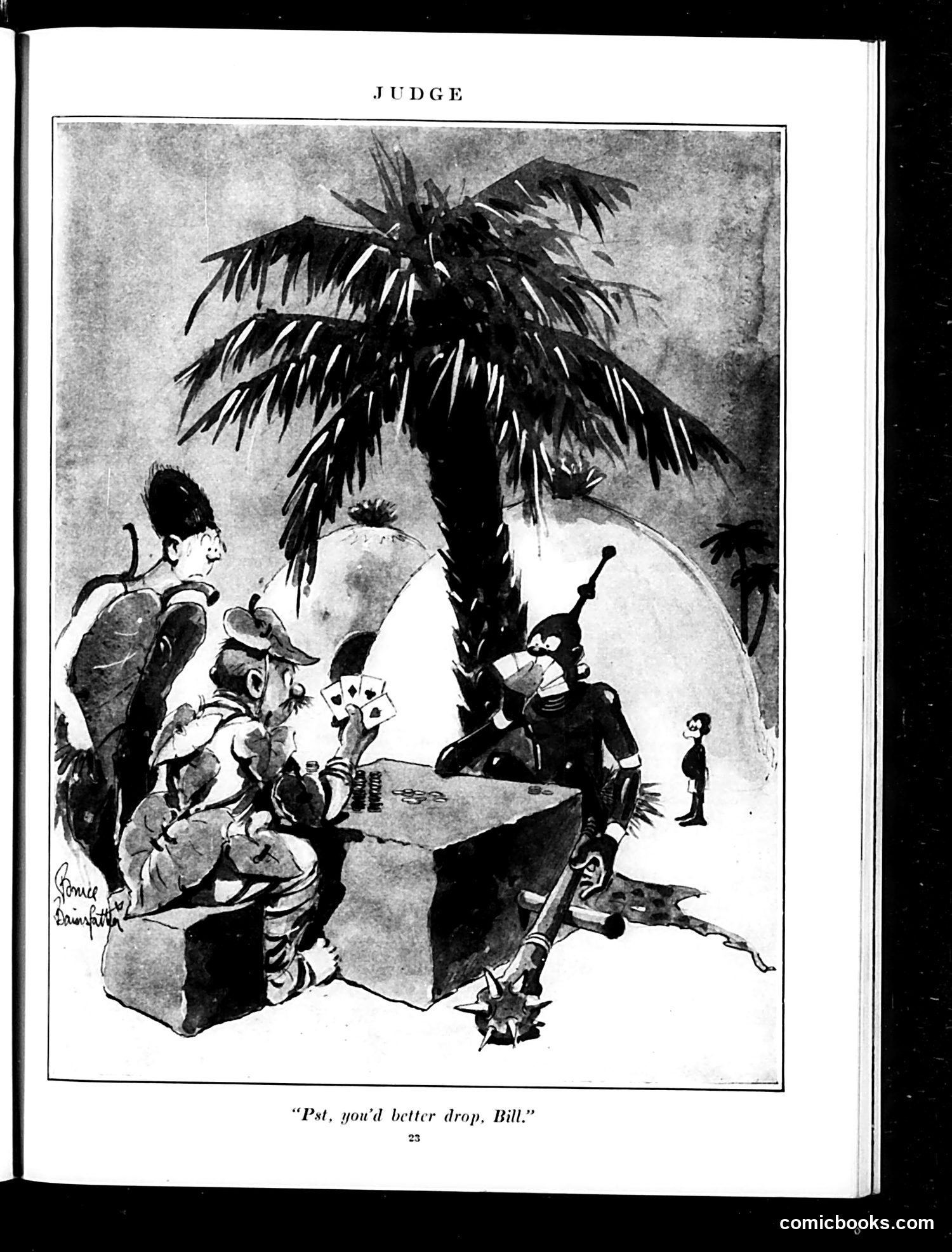
Judge Magazine Cartoon Analysis This cartoon depicts what appears to be a tropical gambling scene, with anthropomorphic animals (likely representing politicians or public figures) seated around a table playing cards beneath a palm tree. The caption "Pst, you'd better drop, Bill" suggests a warning to someone named Bill to abandon a risky venture—likely gambling or a questionable political scheme. The satirical point appears to criticize either corrupt gambling practices or backroom political dealing in a tropical setting (possibly referencing colonial politics or American interests abroad). The animal caricatures were common Judge magazine devices for political commentary. However, without the publication date or additional context, the specific figures and political situation referenced remain unclear. The artwork is signed by the cartoonist (signature visible lower left).
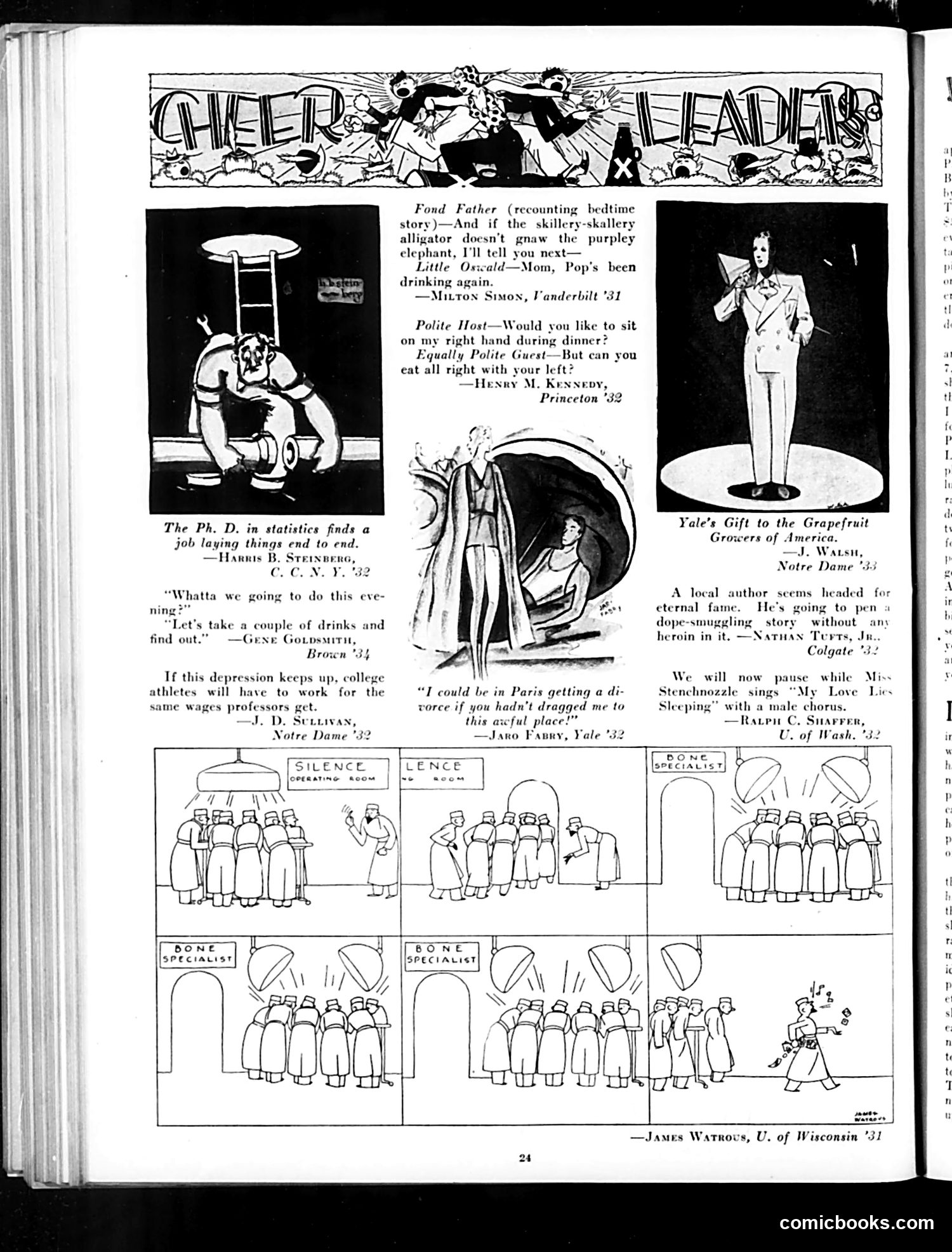
"Cheer Leaders" Page Analysis This is a humor page from Judge magazine featuring jokes and a comic strip, all submitted by college students (indicated by school names like Vanderbilt, Princeton, Yale). The jokes are typical of 1930s college humor: a child catching his father drunk, a dinner guest making a witty comeback about eating left-handed, and commentary on the Great Depression affecting college athletics. The multi-panel comic strip (bottom half) satirizes academic specialists, specifically showing a "Bone Specialist" in a medical/educational setting. The repetitive panels with groups of robed figures and the specialist's office suggest mockery of overly-specialized academic expertise during the Depression—poking fun at the impracticality of narrow specialization when jobs are scarce. The overall tone reflects early 1930s college life: drinking references, Depression anxiety, and intellectual self-mockery. These are jokes *by* and *for* college students, treating academic and social pretension with irreverent humor typical of the era's humor magazines.
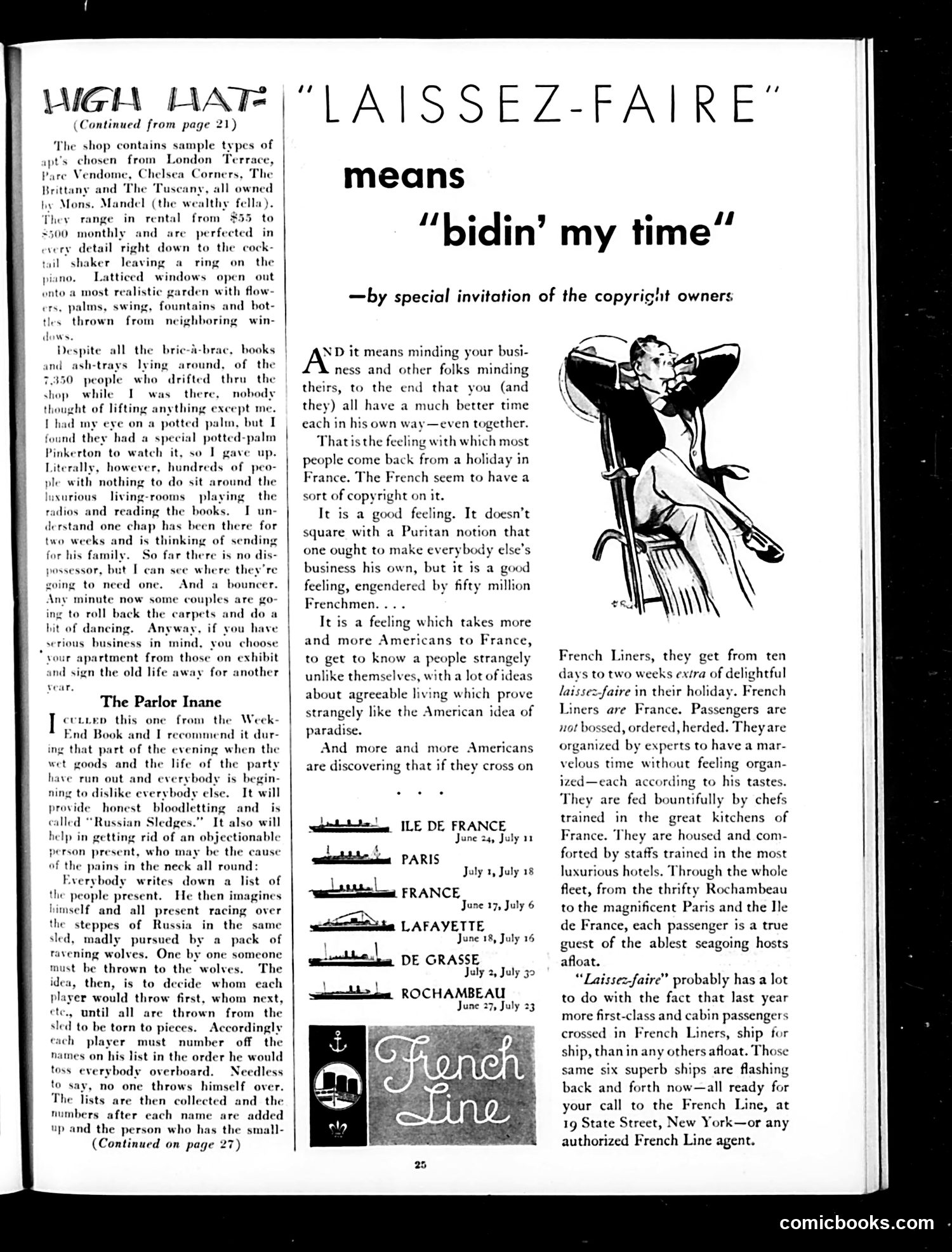
Judge Magazine Page Analysis This page combines a short story excerpt ("High Hat") with a French Line steamship advertisement cleverly disguised as editorial content about the French philosophy of "laissez-faire." The main illustrated element is a cartoon showing a relaxed man reclining in a chair, embodying the leisure lifestyle being promoted. The advertisement's clever hook is explaining "laissez-faire" as "bidin' my time"—translating French economic/political philosophy into American vernacular to appeal to readers. The pitch argues that French culture offers Americans a refreshing alternative to Puritan work-ethic values, where people can enjoy life "each in his own way." The ad lists five French ocean liners with sailing dates, promoting extended leisure travel to France as a way to experience this desirable lifestyle. This is essentially advertising disguised as cultural commentary—a common Judge magazine practice blending commerce with satire and lifestyle journalism for affluent readers interested in European travel.
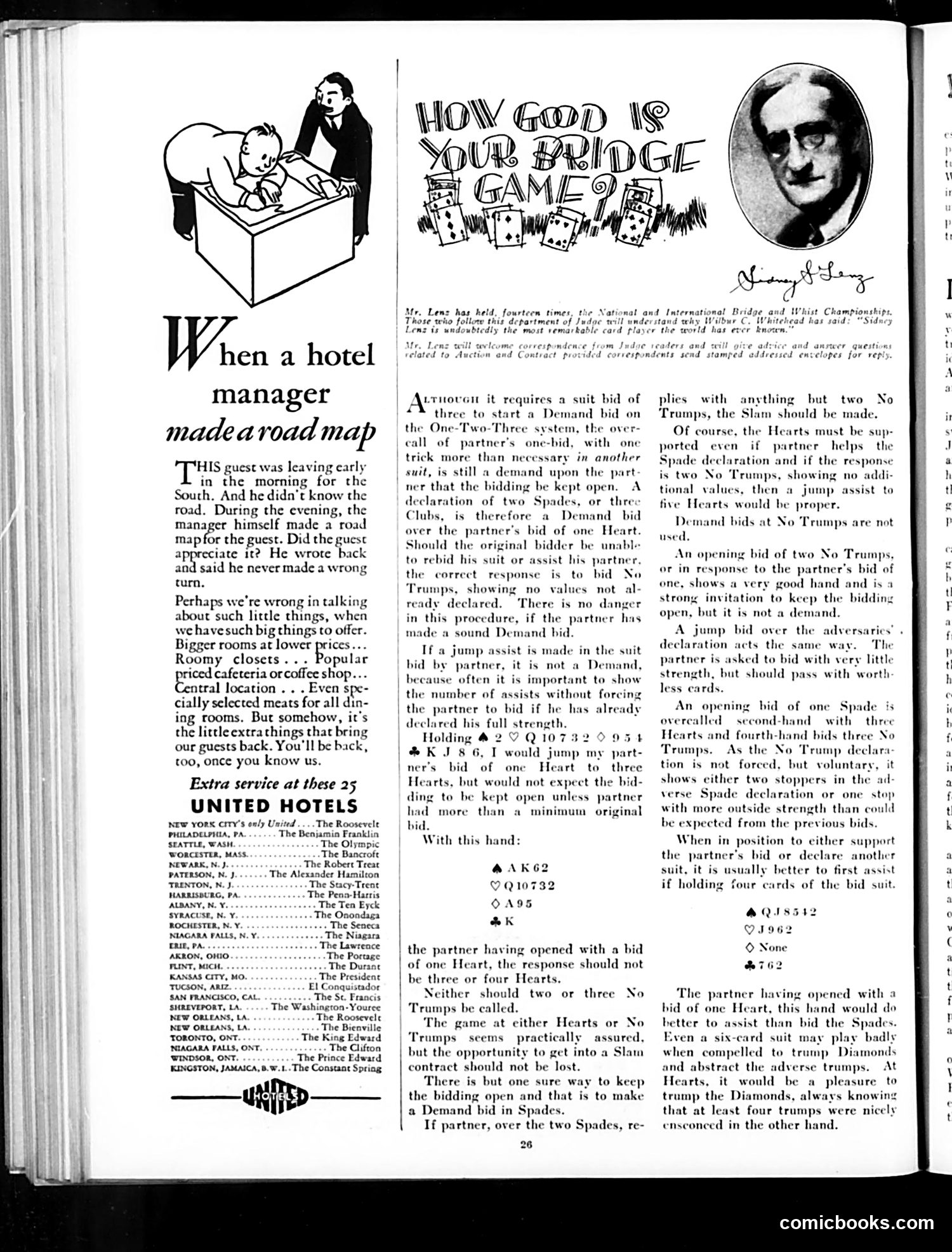
Judge Magazine Page Analysis This page contains two distinct elements: a hotel industry advertisement and bridge card game advice. The Advertisement (Left): A humorous piece praising the United Hotels chain. The cartoon shows a hotel manager hand-drawing a road map for a departing guest, who later writes back praising the gesture. The satire targets corporate culture: while hotels tout "bigger rooms at lower prices" and fancy amenities, it's actually *small personal touches* that win customer loyalty. This gently mocks how businesses overlook simple service excellence while competing on superficial features. The Bridge Column (Right): Technical advice on contract bridge bidding strategy, authored by someone whose signature appears on a portrait. This reflects bridge's popularity as a parlor game among middle and upper-class Americans in this era. The column addresses specific bidding scenarios and hand combinations using bridge's complex notation system. The juxtaposition—commercial hospitality advice beside recreational card game strategy—reflects early-to-mid 20th century leisure culture priorities for Judge's affluent readership.
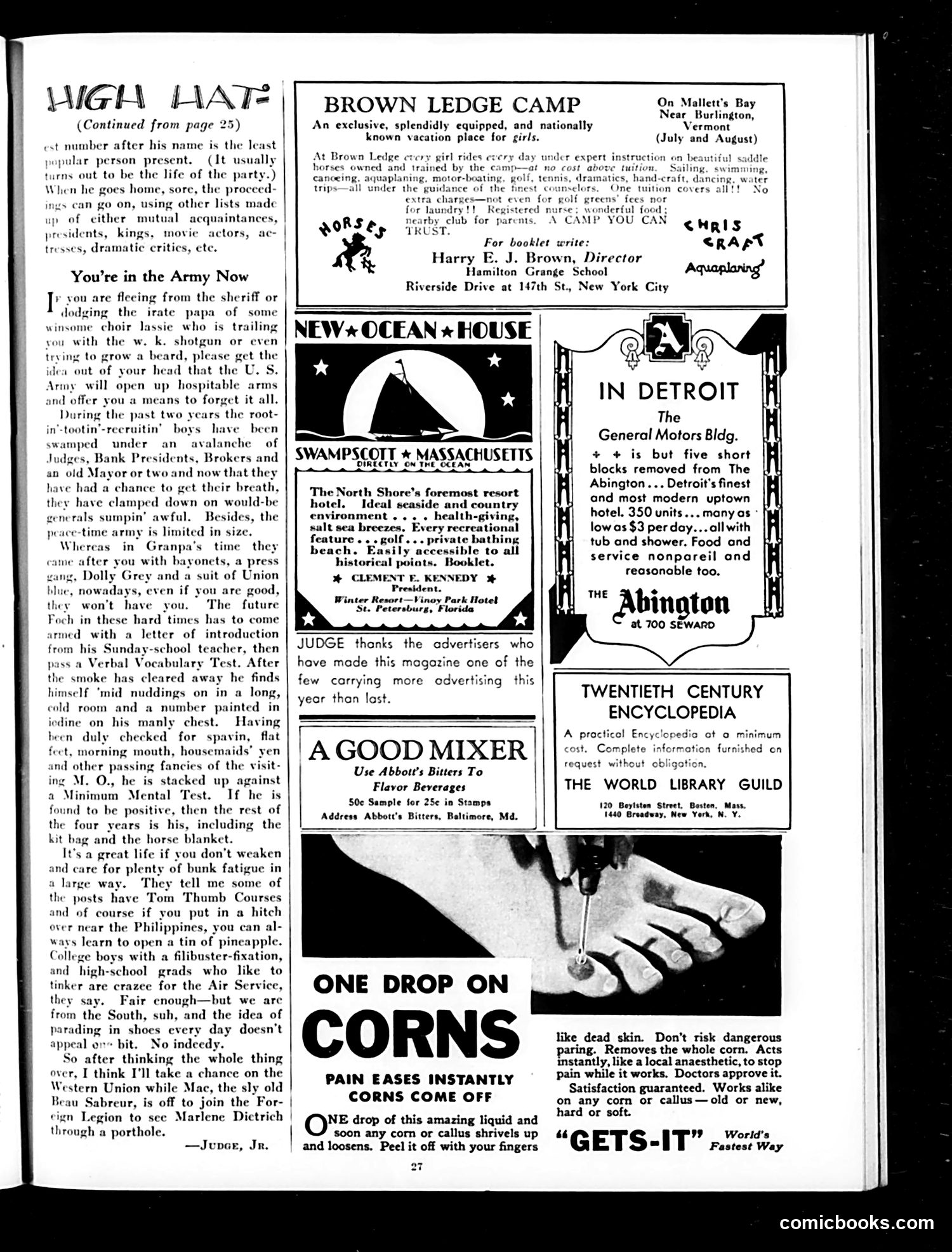
Analysis of Judge Magazine Page This page is primarily advertising and filler content, not political satire. The main article, "You're in the Army Now," is a humorous essay (by "Judge, Jr.") mocking military recruitment and army life. The author satirizes how the peacetime U.S. Army has become selective and bureaucratic, rejecting undesirable recruits (criminals, deadbeats) through mental tests and medical examinations—a contrast to earlier conscription methods. He jokes about the unglamorous realities: tedious processing, arbitrary regulations, and punitive assignments like "bunk fatigue." The piece contains period-specific humor about avoided military service (fleeing sheriffs, dodging angry fathers) and casual references to military outposts ("Philippines") and cultural figures like Marlene Dietrich. The remainder consists entirely of period advertisements: camps, hotels, beverages, and encyclopedias. No political figures or events are referenced in the visible content.
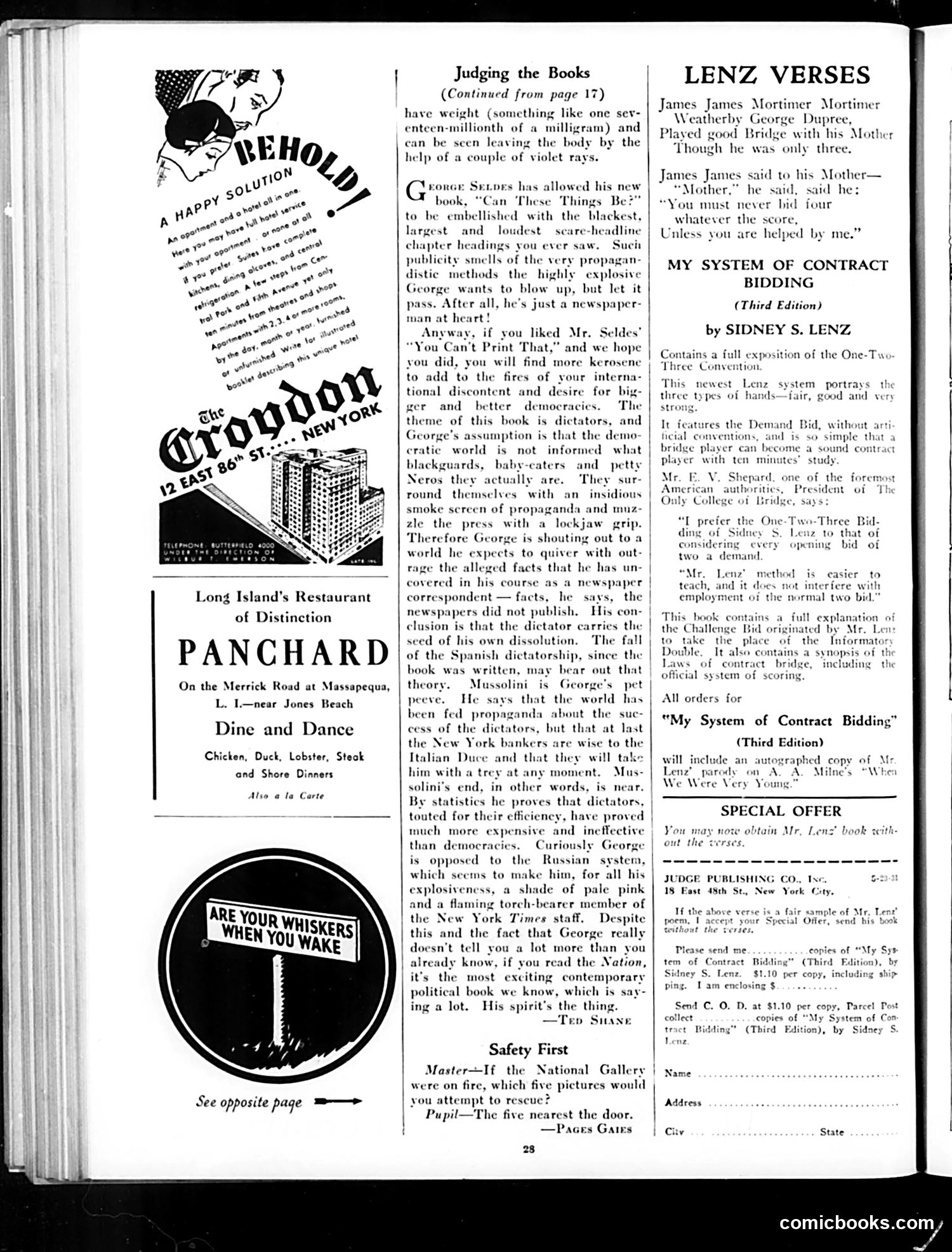
Explanation for Modern Readers This page from *Judge* magazine (circa 1920s-30s) primarily contains book reviews and advertisements rather than political cartoons. The main satirical content critiques George Seldes' anti-dictator book "Can These Things Be?" The reviewer mocks Seldes' sensationalist approach—using inflammatory headlines and propaganda techniques to expose dictators' propaganda techniques. The irony is that Seldes employs the same manipulative methods he denounces in authoritarian regimes. The reviewer characterizes Seldes as a "newspaperman at heart" with leftist sympathies (calling him "pale pink"), noting his opposition to Russian communism seems inconsistent with his explosive anti-establishment rhetoric. The page also advertises Sidney Lenz's contract bridge bidding manual and a Long Island restaurant, typical of *Judge's* mixed editorial/advertising format. The satire targets American progressive intellectuals who adopted radical rhetoric and sensationalism while claiming moral superiority—a common conservative critique of 1920s-30s liberalism.
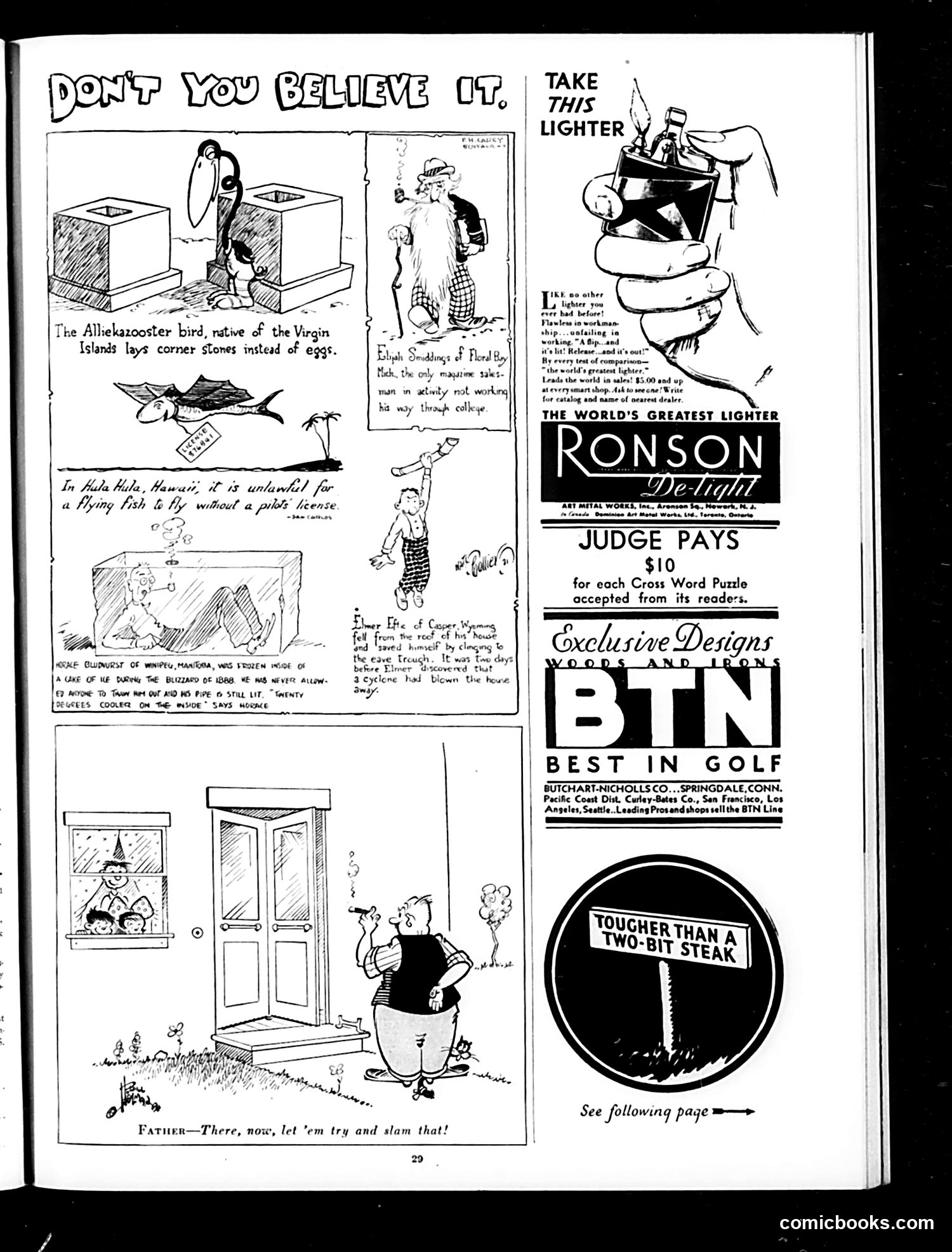
"Don't You Believe It" - Judge Magazine Humor Page This page features a collection of absurdist humor pieces typical of Judge magazine's satirical style. The left side presents four short, illustrated jokes playing on implausible or contradictory scenarios: 1. A bird laying cornerstone bricks instead of eggs 2. Flying fish requiring pilot licenses in Hawaii 3. A man surviving a house collapse by clinging to a cash register 4. A magazine salesman working his way through college by *not* working The humor relies on logical impossibilities and exaggeration—common satirical devices. The final cartoon shows a father encouraging his family to "try and slam" a door, presumably to demonstrate its durability. The right side contains advertisements for Ronson lighters and BTN golf equipment, which was standard for Judge magazine layout. The page lacks overt political commentary; instead, it offers lighthearted, surreal domestic humor aimed at general readers.
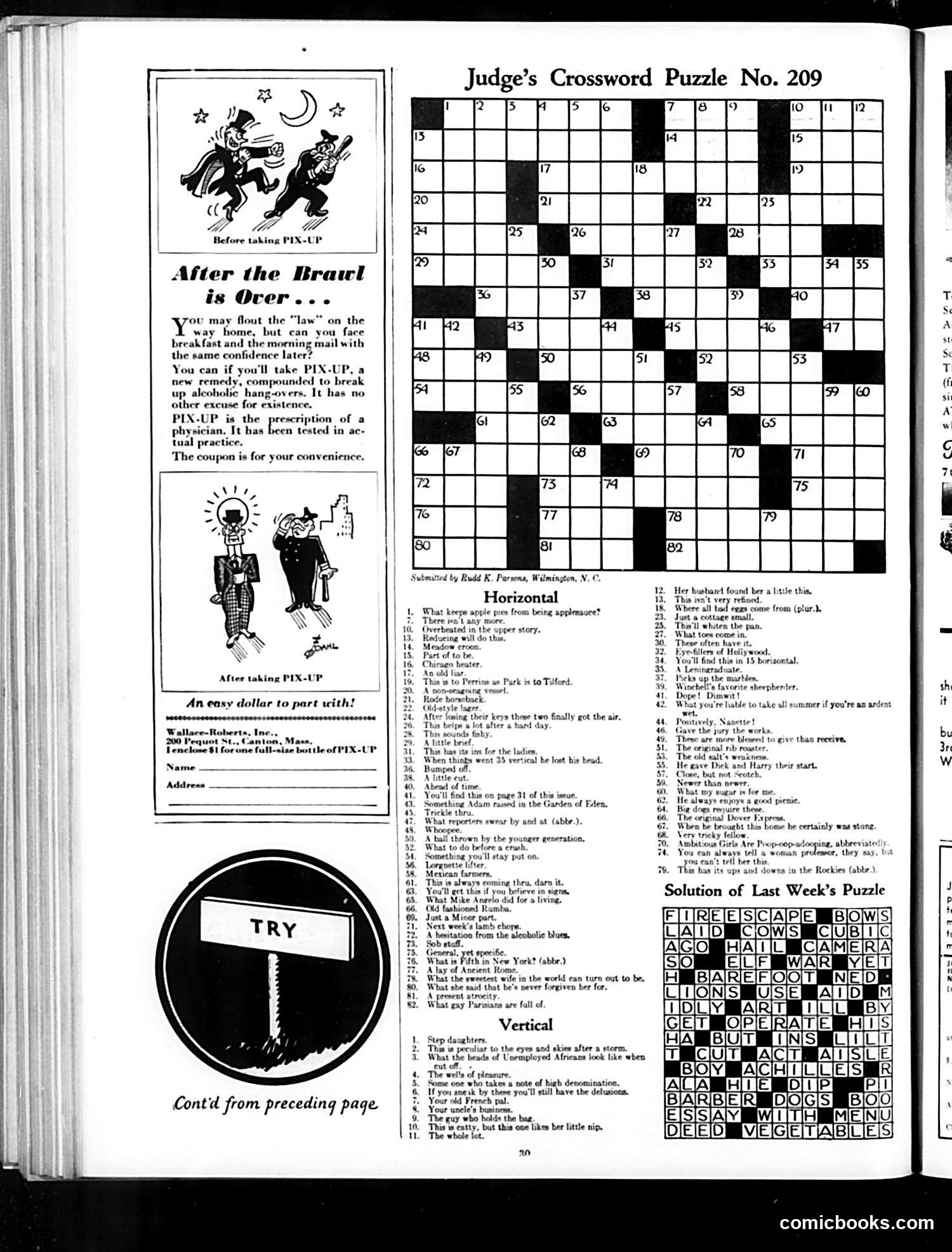
Judge Magazine Content Analysis This page contains a patent medicine advertisement for "PIX-UP," a hangover cure, alongside a crossword puzzle. The Advertisement's Satire The ad uses before-and-after cartoon vignettes mocking the morning-after experience of heavy drinking. The humor targets the social hypocrisy of the era: you can "flout the law" (likely referencing Prohibition-era drinking) while partying, but face embarrassment at breakfast and in the mail the next day. The solution? PIX-UP, pitched as a doctor-approved hangover remedy. The satire is layered—it acknowledges widespread alcohol consumption and its consequences while selling a "cure" that supposedly lets drinkers continue this behavior without social consequences. Historical Context This reflects 1920s-30s America during or immediately after Prohibition, when illegal drinking was widespread and morning hangovers were common enough to be a recognized market opportunity. The ad's tone is winking and knowing about drinking culture while maintaining respectable medical pretense. The crossword puzzle is incidental filler content typical of magazine pages.
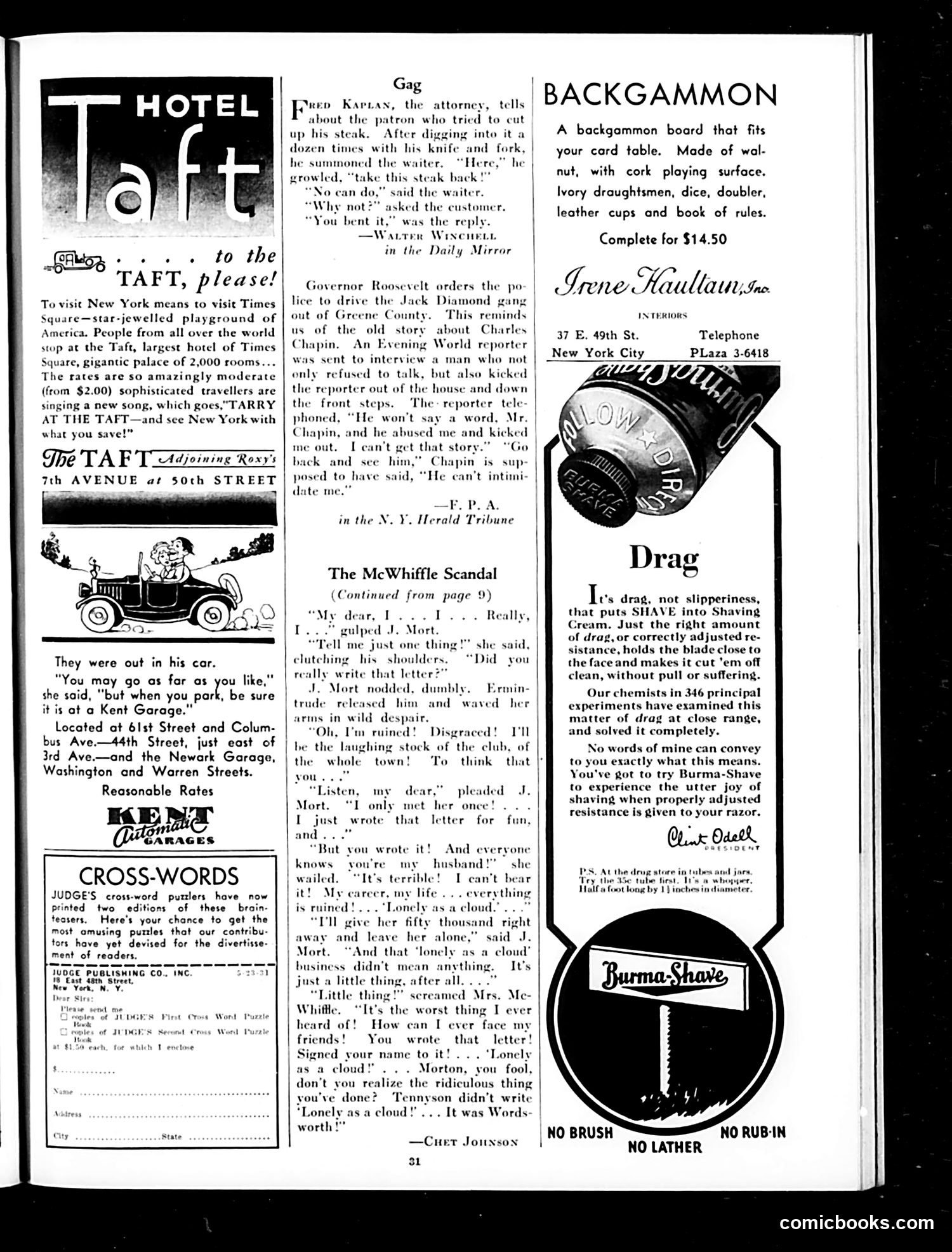
Analysis of Judge Magazine Page This page is primarily advertising and humor columns rather than political cartooning. The main content includes: Hotel Taft advertisement (upper left): A straightforward hotel promotion using the slogan "Tarry at the Taft," playing on President Taft's name for marketing purposes. "The McWhiffle Scandal" serialized story (center): A humorous domestic melodrama about a man who wrote a love letter as a joke, which his wife discovered. The joke hinges on him signing it "Lonely as a cloud"—a reference to Wordsworth's famous poem—which Mrs. McWhiffle takes as genuine romantic expression. The satire mocks Victorian melodrama and misunderstandings. Various gag fillers (top right): Brief humor items about restaurant scenes and political figures like Governor Roosevelt and Charles Chaplin, typical of Judge's miscellaneous joke format. Advertisements (right side): For backgammon boards, Burma-Shave, and crossword puzzles—typical period product ads. The page reflects Judge's mix of satirical commentary, serialized humor, and revenue-generating advertisements rather than focused political critique.
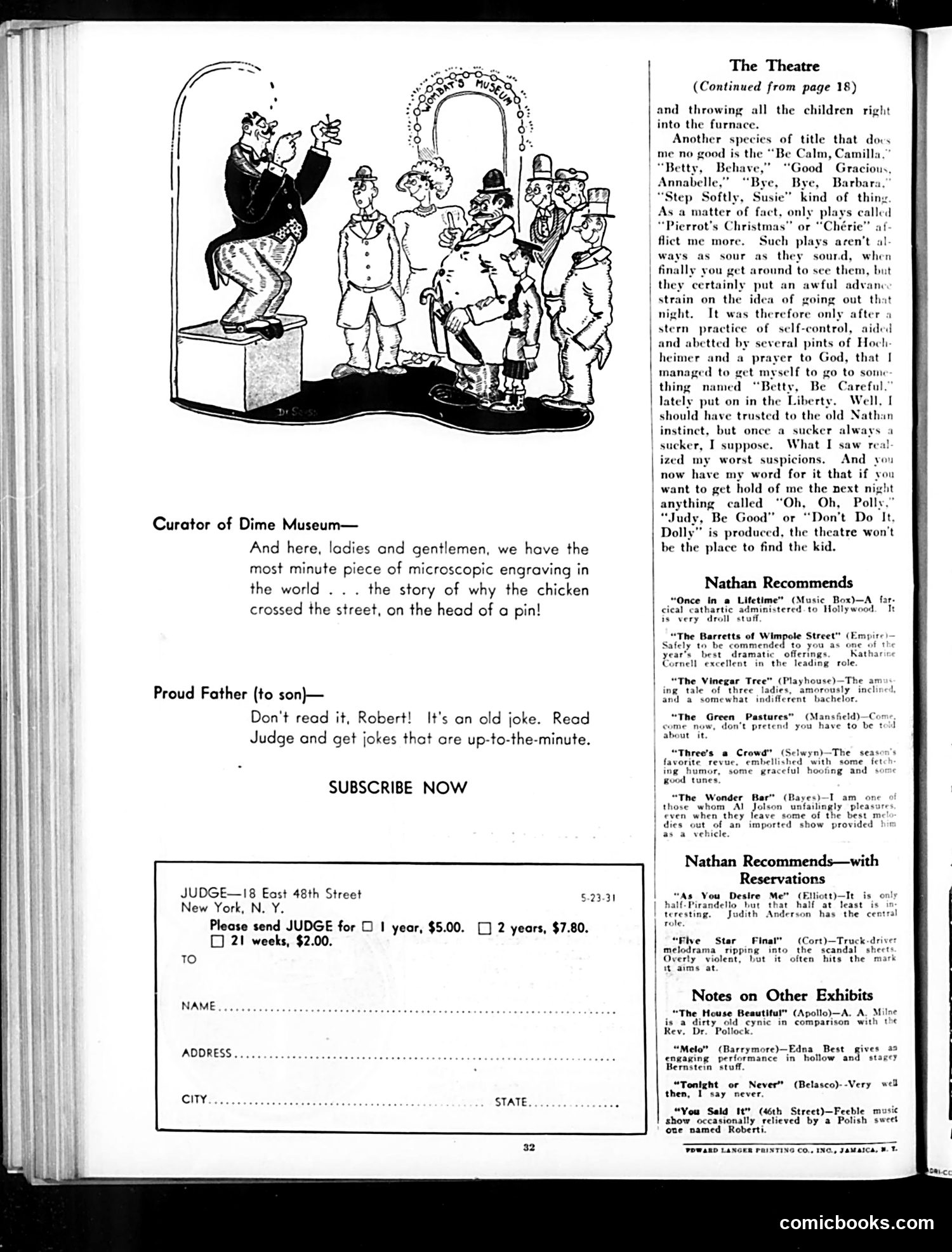
Dime Museum Cartoon Explanation This page features a satirical cartoon mocking dime museums (cheap attractions displaying curiosities) and the famous joke "Why did the chicken cross the street?" A barker presents an absurdly microscopic engraving of this joke on a pinhead—suggesting dime museums peddle worthless, tired entertainment. The accompanying text by a "Proud Father" warns his son against reading such old material, encouraging him instead to subscribe to Judge magazine for "up-to-the-minute" humor. This is self-promotional satire: Judge mocks competitors offering stale jokes while advertising itself as superior. The page also contains theatre reviews by "Nathan," criticizing plays with cutesy titles like "Betty, Behave" and "Dolly," suggesting they're sentimental dreck. The satire targets both low-brow dime museums and schmaltzy theatrical productions as equally tired entertainment for credulous audiences.
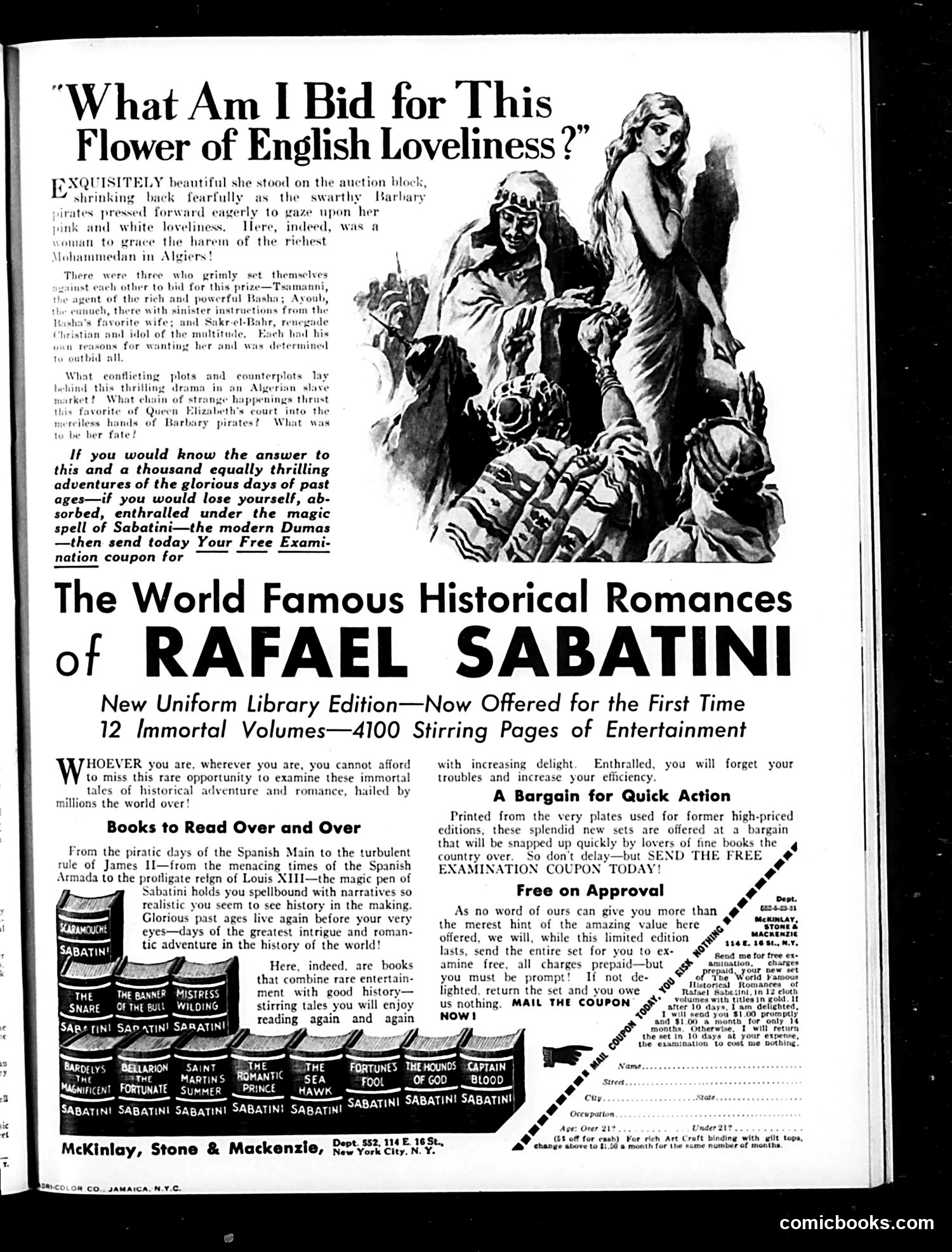
Analysis: Advertisement Disguised as Editorial Content This page is primarily a book advertisement for Rafael Sabatini's historical novels, not a political cartoon. The "editorial" framing device—the story opening about a woman on an auction block in Algiers being bid upon by Barbary pirates—is marketing copy designed to entice readers. The narrative hook exploits period-typical orientalist fantasy: exotic locales, slave auctions, and harem intrigue appeal to early 20th-century Western audiences. The opening asks rhetorical questions ("What was her fate?") to draw readers into wanting to know more—then reveals the "answer" lies in reading Sabatini's novels. The actual satire or joke, if present, is subtle: *Judge magazine is parodying breathless Victorian serialized fiction marketing by presenting overwrought melodrama as genuine editorial content*. This blurs the line between entertainment journalism and advertising—a knowing wink at contemporary publishing practices and reader credulity. The page demonstrates how magazines monetized content through advertorial techniques.

Analysis This is a cigarette advertisement, not a satirical cartoon. It appears from a 1931 issue of *Judge* magazine. The page promotes Camel's new "Humidor Pack"—a moisture-preserving packaging innovation. The advertisement uses sensory appeals ("feel," "hear," "taste") to argue that Camels stay fresher than competitors' dried-out tobacco. The image shows a fashionable woman smoking, positioned as an aspirational figure. The text emphasizes that serving fresh Camels is "the mark of a considerate hostess," reflecting 1930s marketing that positioned cigarettes as sophisticated social accessories for both men and women. There is no satire here—this is straightforward commercial advertising exploiting health and quality claims common before tobacco regulation. The "difference" referenced is purely about product freshness, not health concerns (which were not yet publicly emphasized in advertising).