judge
Judge — May 30, 1931
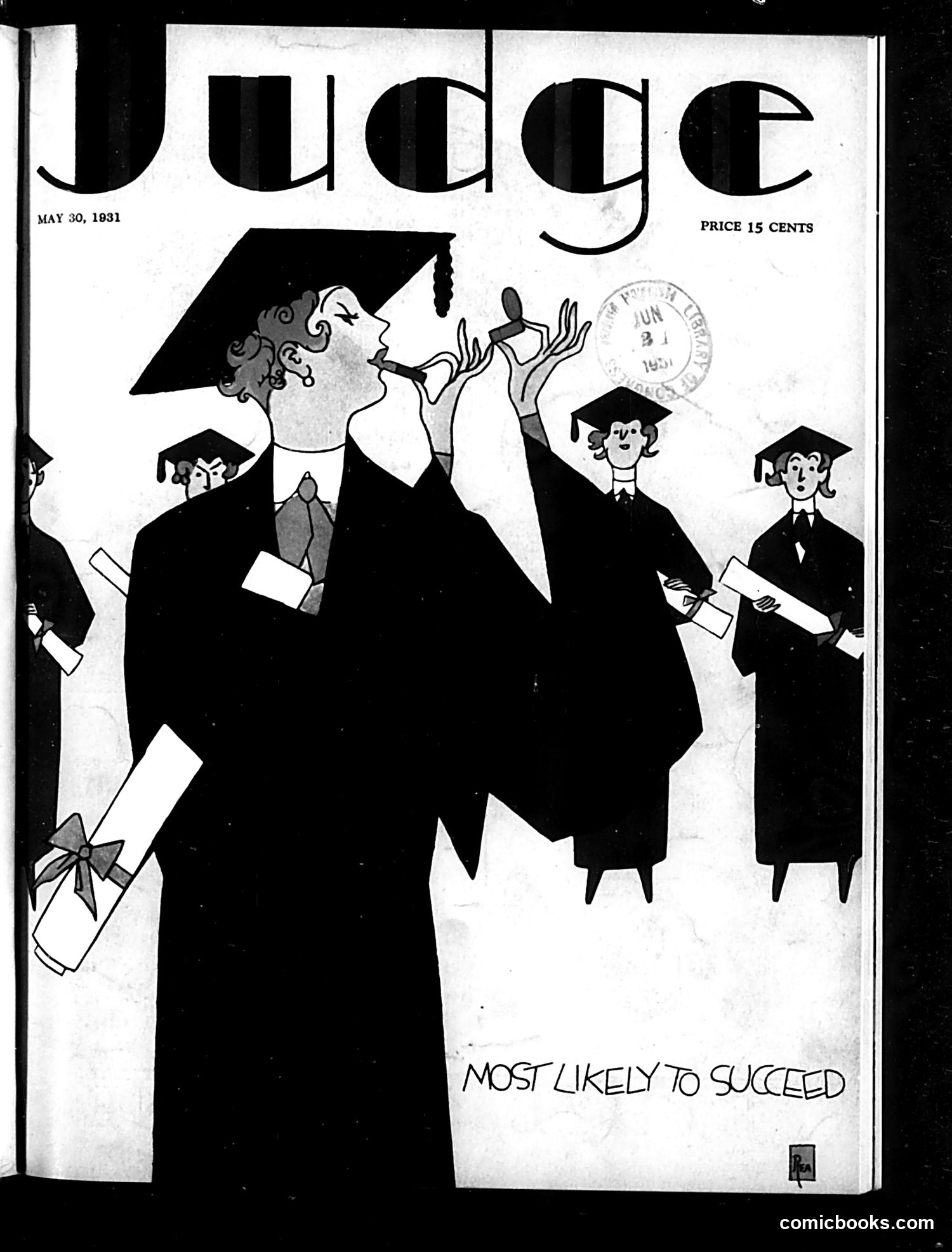
Judge Magazine Cover Analysis (May 30, 1931) This cover satirizes academic success and social advancement through education. The central figure is a large woman in academic robes, depicted with exaggerated features in the caricature style typical of 1931. She appears to be a personification of "Education" or "Success," surrounded by smaller graduates in caps and gowns holding diplomas. The caption "Most Likely to Succeed" references the "class prophecy" tradition where schools predict which graduates will achieve the most. The satire likely comments on the gap between academic promise and real-world outcomes—particularly pointed given this was published during the Great Depression (1931), when many educated graduates faced unemployment despite their credentials. The joke suggests that educational achievement alone doesn't guarantee success in harsh economic times.
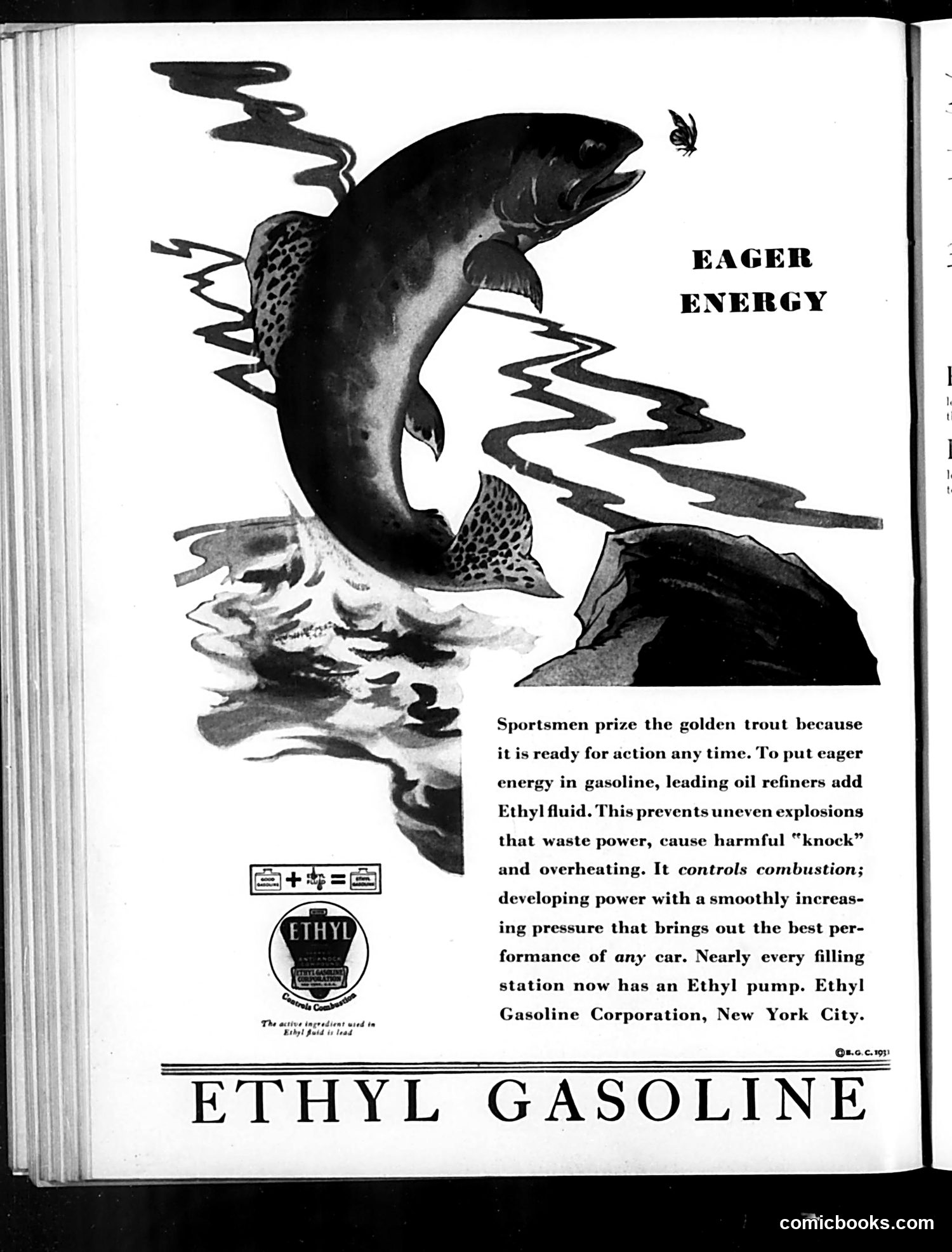
Analysis This is primarily a product advertisement, not political satire. The "Eager Energy" headline uses a golden trout (a sportfish prized for its vigor) as a metaphor for gasoline performance. The ad promotes Ethyl Gasoline, a fuel additive product from Ethyl Gasoline Corporation (New York City). The text explains that Ethyl fluid—added by refiners to gasoline—prevents engine knock and uneven combustion, enabling smoother power delivery and better car performance. The jumping trout symbolizes readiness and explosive energy, paralleling what the product promises: controlled, eager power. The lightning bolts reinforce this energy metaphor. This appears to be from the 1920s-1930s era when Ethyl was actively marketed as a performance enhancement. The ad is straightforward commercial messaging rather than satire.
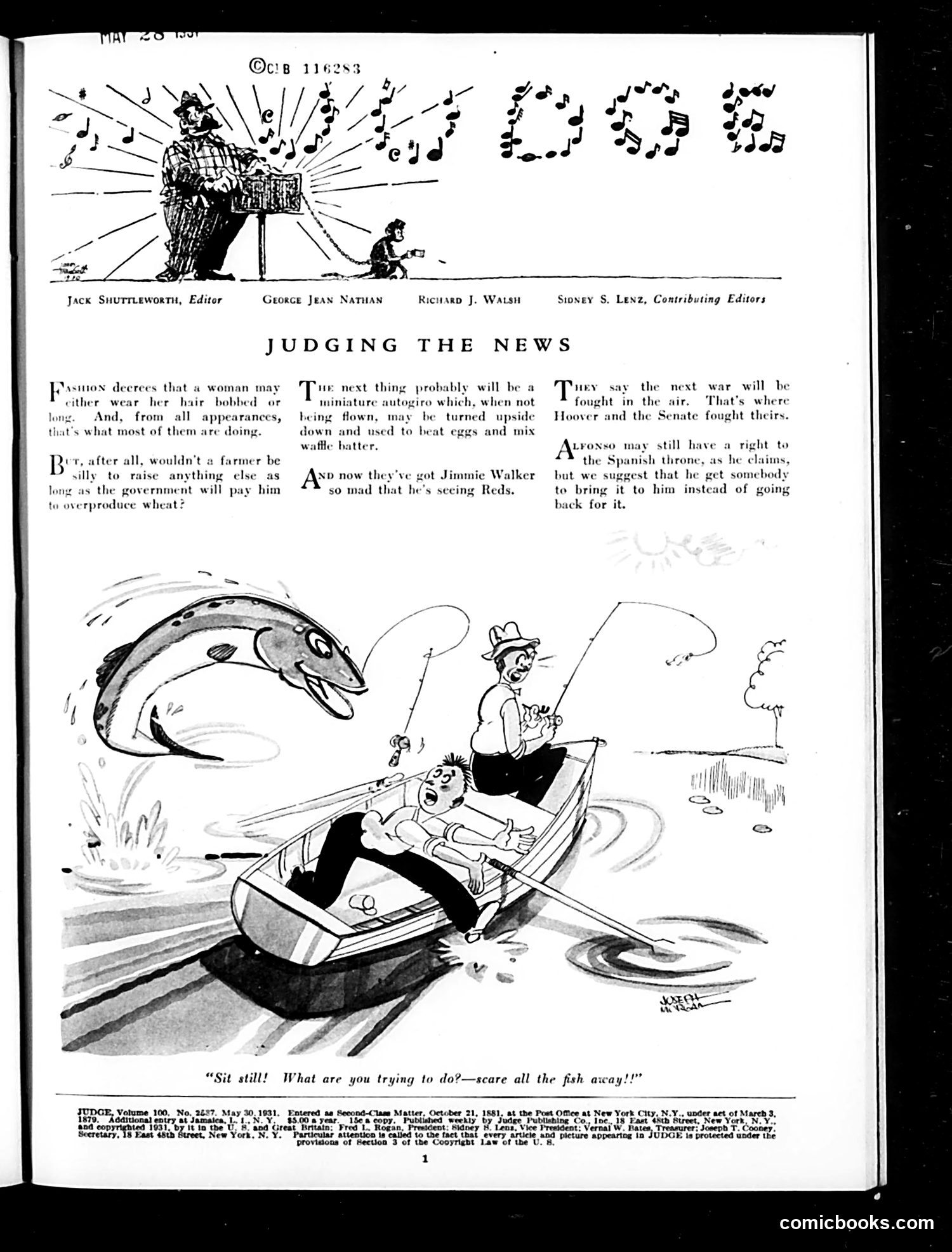
Analysis of Judge Magazine Page (May 28, 1921) The main cartoon depicts two fishermen in a boat with a large fish jumping nearby. The caption reads: "Sit still! What are you trying to do?—scare all the fish away!" The satire: This appears to be a visual joke about restraint and composure during leisure activities. One fisherman is presumably moving around excitedly while the other urges calm. Upper text sections offer brief satirical commentary on contemporary topics: fashion decrees about women's hairstyles, a reference to "Jimmie Walker" (likely New York politician Jimmy Walker), predictions about future wars occurring "in the air," and discussion of Spain's throne. The cartoon's humor relies on relatable fishing-trip dynamics rather than specific political reference. The page functions as a general-interest satirical magazine mixing social observation with light humor.
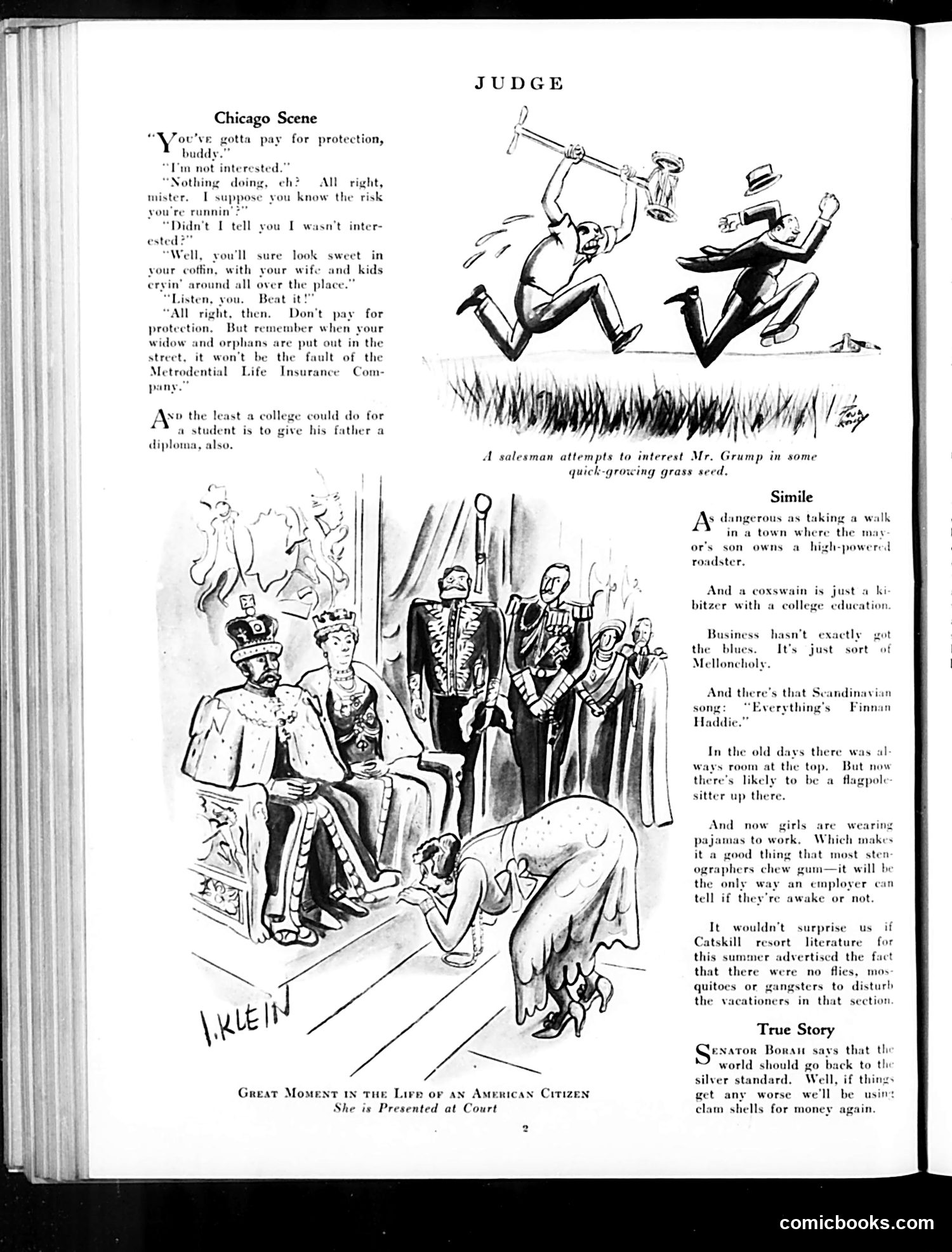
Analysis of Judge Magazine Page Top Cartoon ("Chicago Scene"): A dialogue satirizes protection rackets. A salesman pressures a reluctant businessman ("Mr. Gramp") to buy insurance, threatening that without it, his widow and orphans will suffer publicly. The joke mocks both organized crime extortion and aggressive insurance sales tactics by conflating them—presenting legitimate insurance as indistinguishable from mob protection schemes. Bottom Cartoon: Depicts a woman presented at court before a royal figure, likely satirizing American social pretension or the practice of wealthy Americans seeking European aristocratic validation through formal court presentation. Right Column ("Similes"): Brief social commentary comparing contemporary annoyances (high-powered roosters, coxswains, business conditions, Scandinavian songs, workplace pajamas) to establish themes of modern life's absurdities.
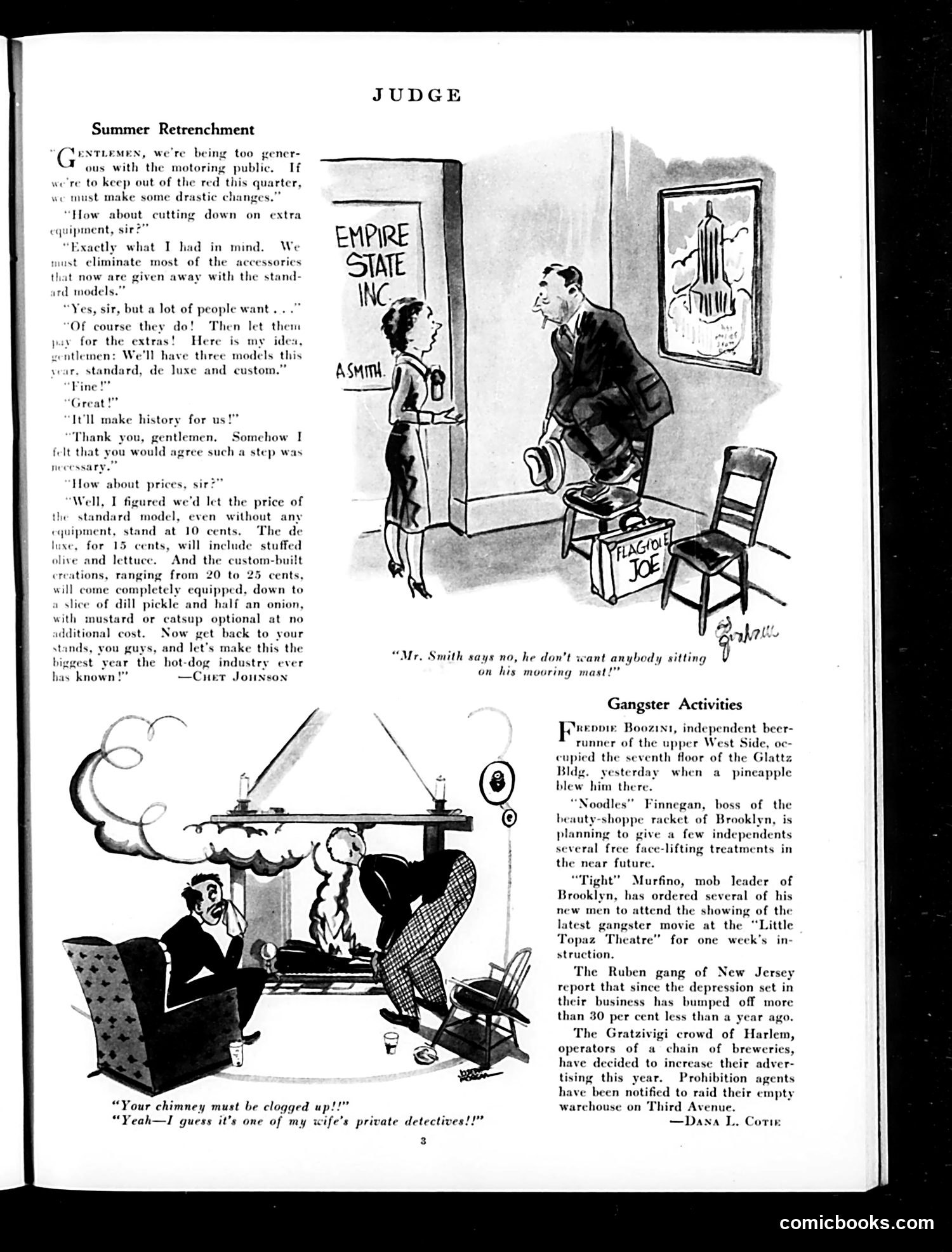
Analysis of Judge Magazine Page Top Cartoon ("Summer Retrenchment"): A car manufacturer (likely Henry Ford or similar) discusses cutting costs during an economic downturn. The joke: to keep profits up while reducing prices, he'll eliminate accessories and standardize models into three tiers—"standard, de luxe and custom"—with minimal price differences. The satire mocks corporate cost-cutting disguised as consumer choice. Bottom Cartoon: A man discovers his chimney is clogged, but his wife suggests it's actually "one of my private detectives"—a Depression-era joke about surveillance and marital suspicion, popular in 1930s humor. "Gangster Activities" Section: Brief satirical news items about Brooklyn organized crime figures and their activities. The references are to actual gangster operations during Prohibition and its aftermath.
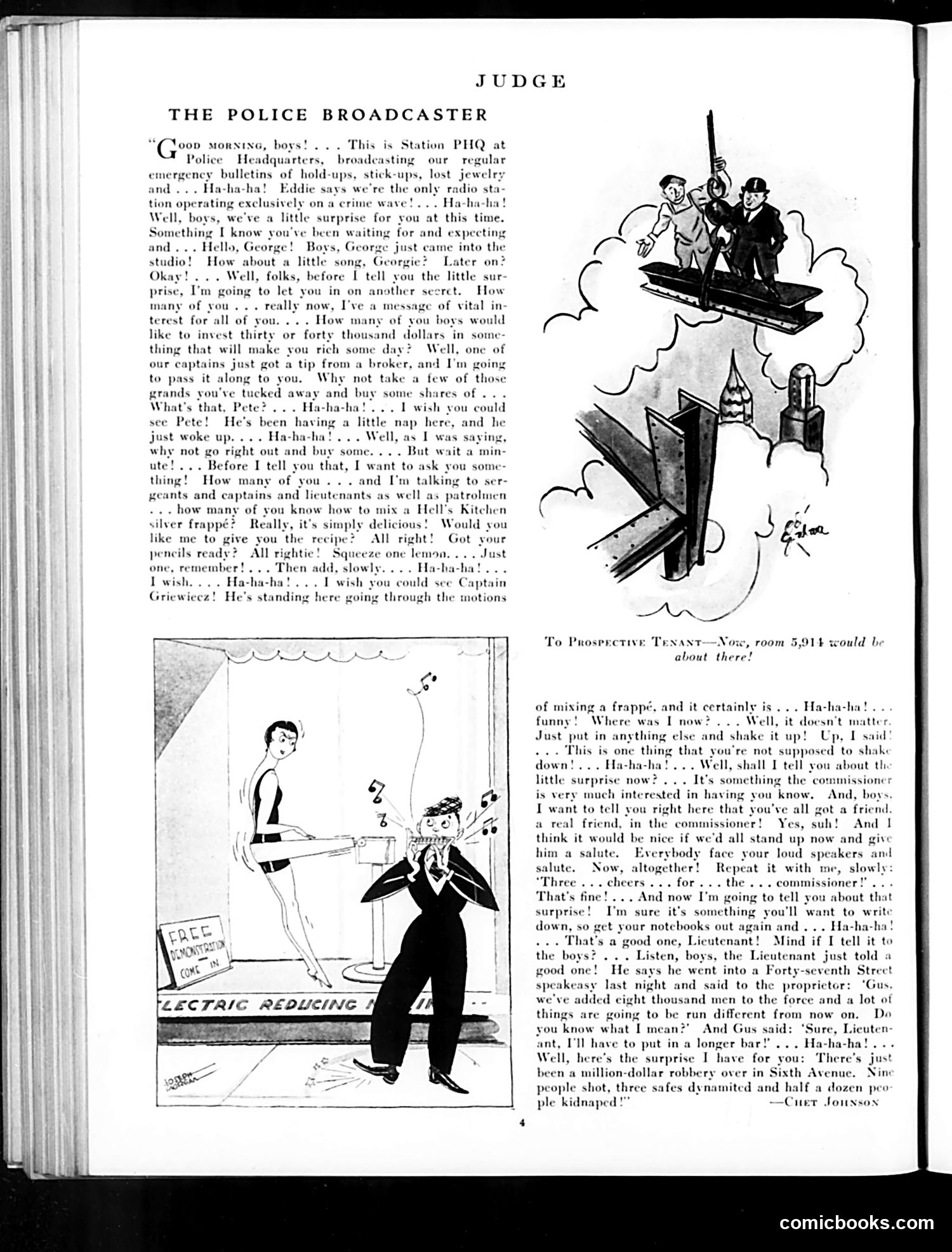
"The Police Broadcaster" - Judge Magazine Satire This page satirizes early radio broadcasting and police communications. The main cartoon depicts a police radio broadcaster engaged in an absurdly rambling, jokey broadcast about crime prevention—complete with recipe instructions for a "Hell's Kitchen" drink and casual banter about stock tips and robberies. The joke targets the novelty of police radio stations (apparently a new phenomenon when this was published) and suggests their broadcasts are unprofessional, mixing actual police work with entertainment and self-promotion. The inset cartoon shows "electric reducing" services, likely satirizing another contemporary business fad. The satire implies these new institutional radio broadcasts—meant to serve the public—have become vehicles for frivolous content and self-interested promotion rather than serious public service.
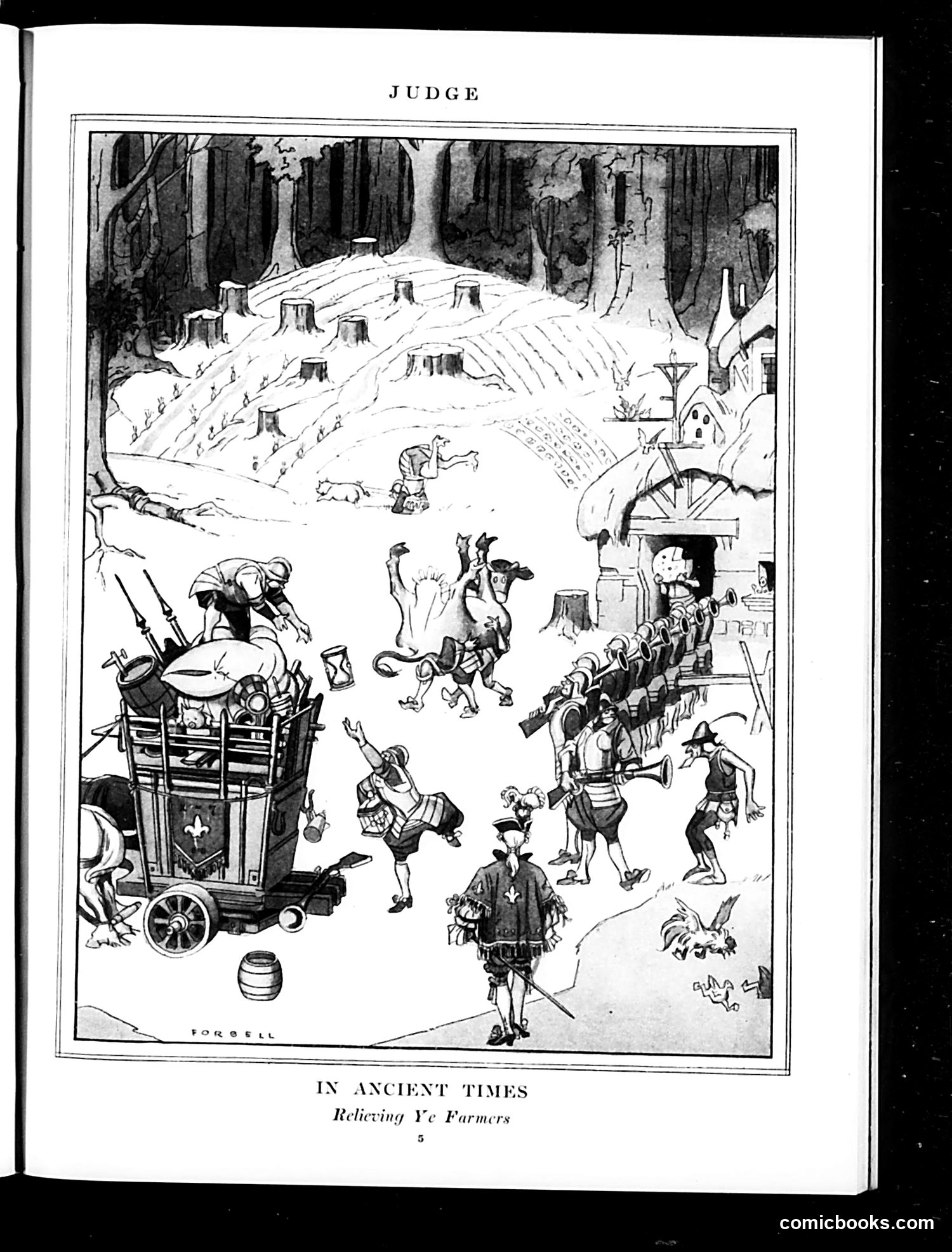
"In Ancient Times: Relieving Ye Farmers" This Judge cartoon satirizes the burden placed on farmers through taxation or legal fees. The central figure in ornate dress (appearing to be a judge or nobleman) presides over a chaotic scene where common farmers are being "relieved" of their possessions—literally having goods loaded onto carts. The visual pun is sardonic: "relieving" farmers ostensibly means helping them, but the image shows authorities actually stripping them of property. The winter setting and desolate landscape emphasize their hardship. The title's archaic language ("Ye") suggests this oppressive practice is timeless, implying contemporary American farmers face similar exploitation despite modern progress. The cartoon critiques the legal or political system's treatment of agricultural workers as perpetual victims of institutional greed.
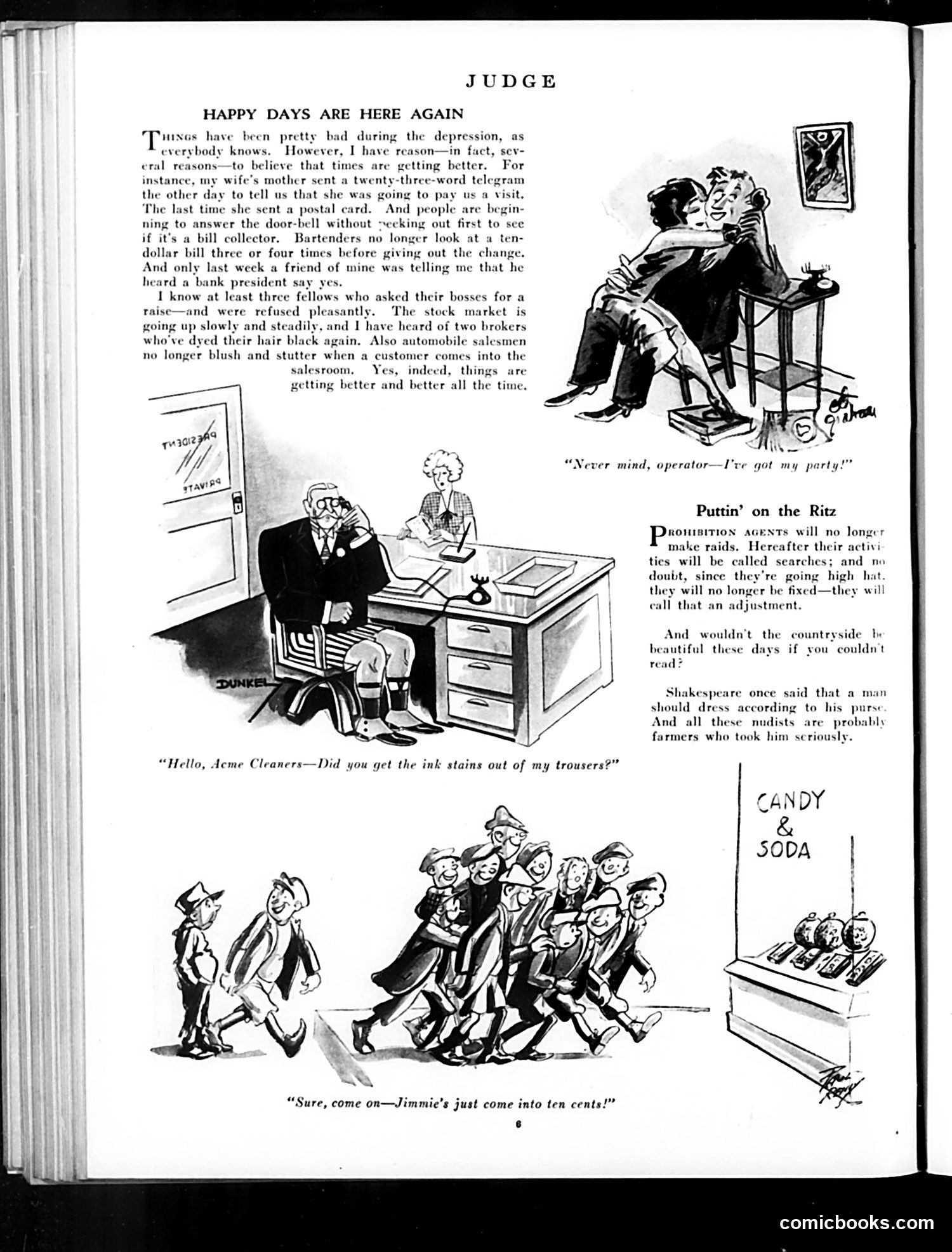
Analysis of Judge Magazine Page This satirical page celebrates improving economic conditions through three cartoons: Top cartoon: A man reassures his barber that times are improving—he can now afford a haircut without first checking if it's a "full collector" (cheap). The satire mocks previous economic hardship. Middle cartoon: An office worker asks a cleaning service about removing ink stains, illustrating returning confidence in business activity. Bottom cartoons: One depicts children rushing to a candy/soda shop; another shows a man at an office asking about ink stain removal. Both suggest economic recovery—people spending money again on small luxuries and conducting normal business. The overall message: "Happy Days Are Here Again"—a reference to economic recovery, likely the post-Prohibition era or early Depression recovery. The satire celebrates ordinary consumption and business normalcy as signs of national improvement.
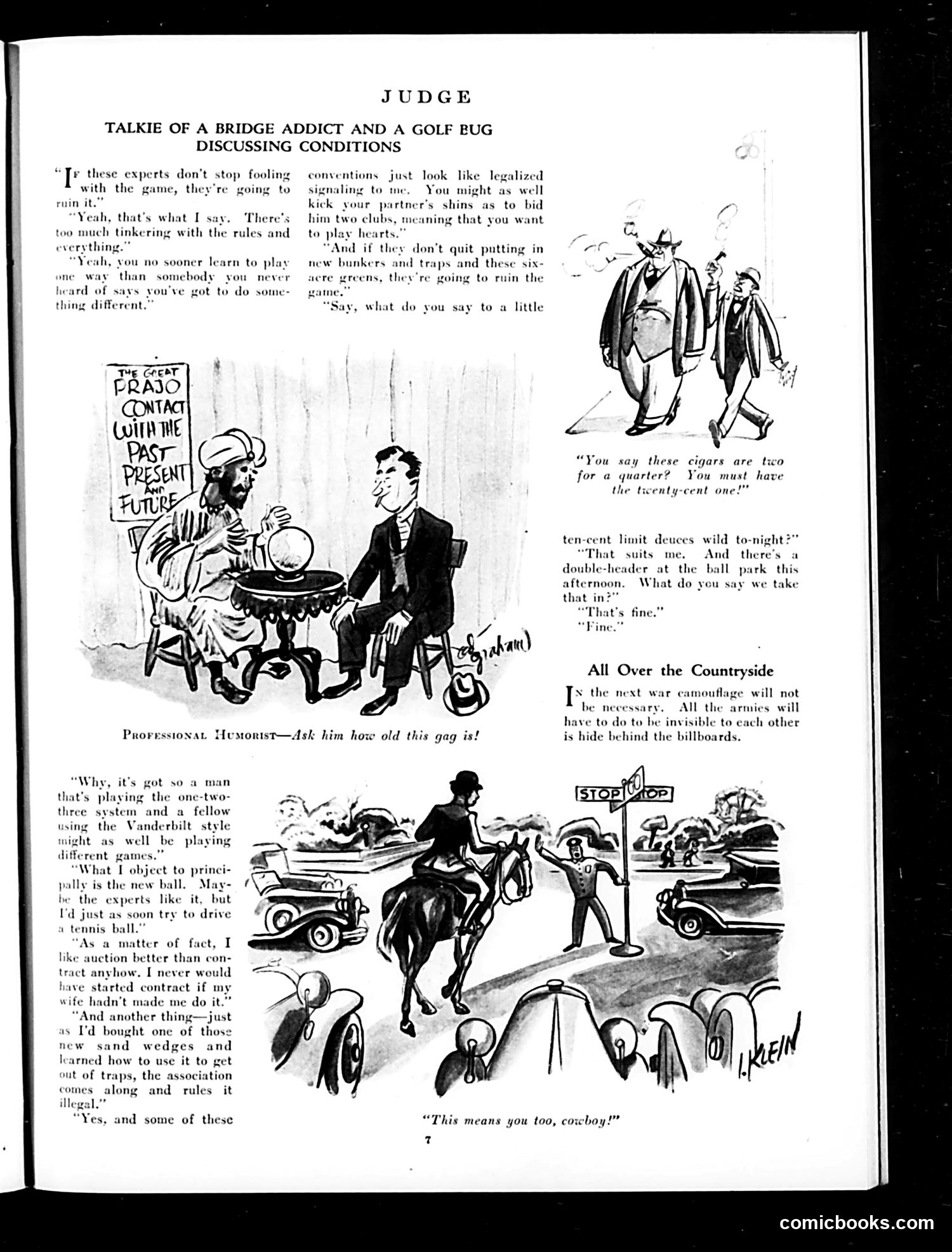
Analysis This page from *Judge* satirizes complaints about rule changes in bridge (a card game) and golf. Two men discuss how experts constantly modify these games' regulations, making them impossible to master. The satire's point: both bridge and golf enthusiasts are obsessed with minutiae and resistant to change. The bridge player gripes about new bidding conventions that resemble "legalized signaling"; the golfer objects to new equipment (sand wedges) being banned and course modifications (bunkers, greens). The humor lies in the men's hypocritical rigidity—they simultaneously claim to prefer "the old way" while admitting they never would have learned these complex games in the first place without expert guidance. The bottom cartoon about wartime camouflage jokes that armies could hide behind roadside billboards, satirizing American commercial clutter. The exact publication date is unclear, but the "next war" reference suggests pre-WWII era (1930s-40s).
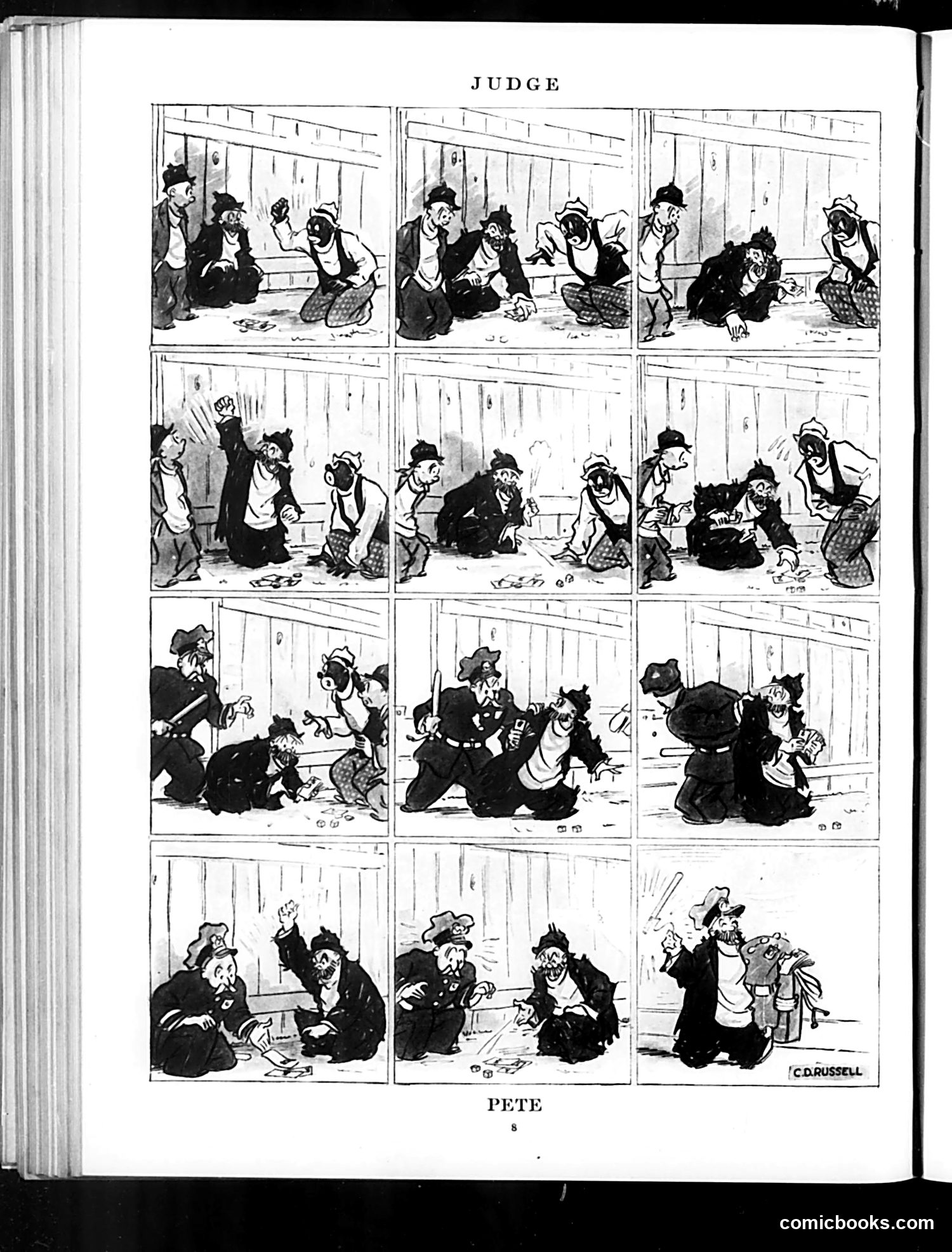
"Judge" Comic: "Judge" and "Pete" This page contains two sequential comic strips by C.D. Russell (signed lower right). The top strip, "Judge," depicts what appears to be street urchins or poor children playing a game—likely marbles or dice—on a city sidewalk. The narrative progresses from their game through confrontation with authority figures (possibly police or officials in hats), escalating into physical altercation and chaos. The bottom strip, "Pete," shows similar street children in comparable scenarios of poverty and conflict with authority. Both strips appear to satirize urban street life and the treatment of poor children by the authorities, reflecting early 20th-century concerns about juvenile delinquency, poverty, and law enforcement practices. The exaggerated caricatures and slapstick violence typical of Judge magazine's humor style suggest commentary on social class conflicts.
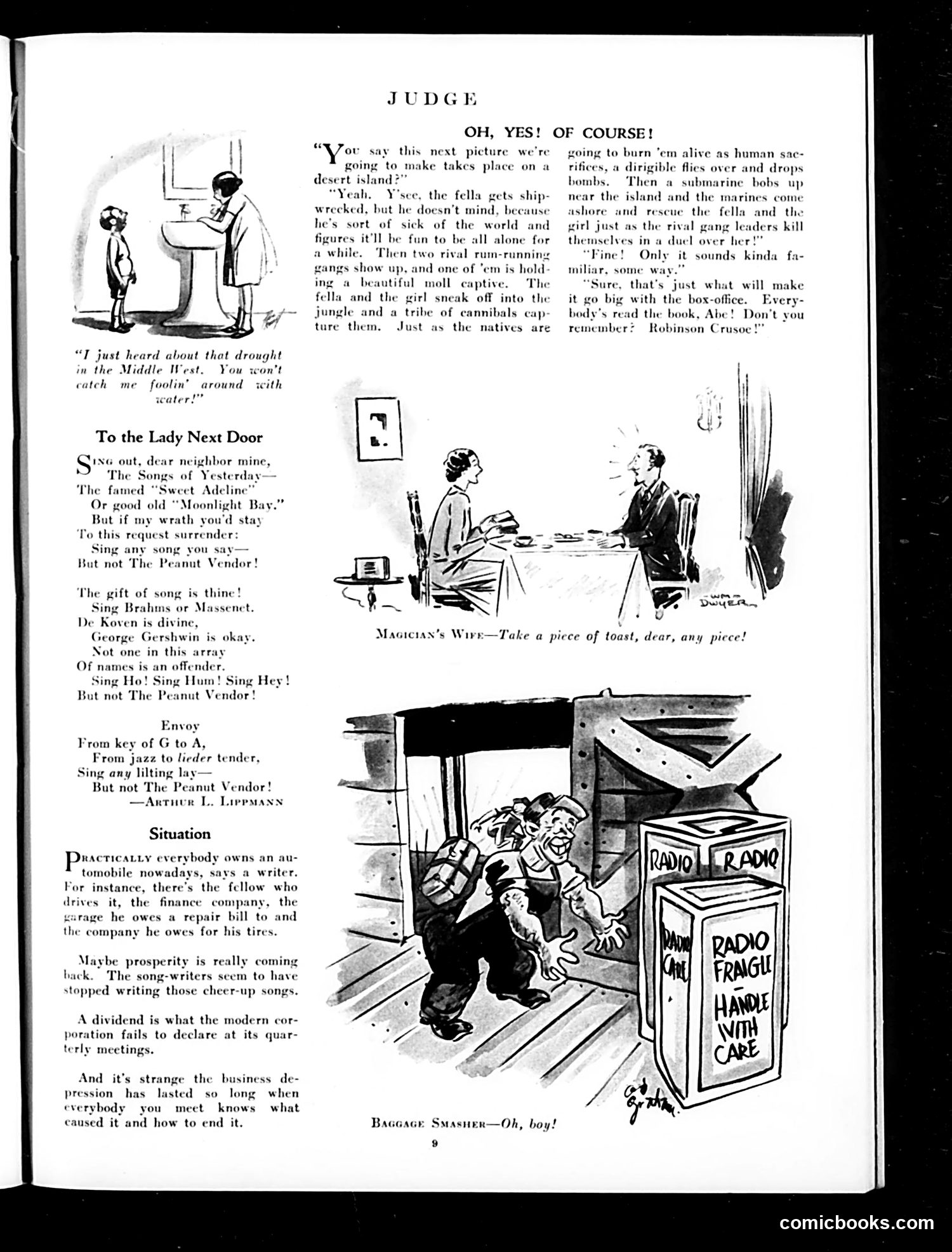
Judge Magazine Page Analysis This page satirizes 1920s-30s American culture across multiple sketches: "The Peanut Vendor" poem mocks the era's obsession with a popular song of that title, so overplayed that neighbors beg each other to sing literally anything else—Brahms, Gershwin, old standards—just not that one more time. "Magician's Wife" shows a dining couple where the wife offers toast; the caption's joke is unclear from the image alone. "Baggage Smasher" depicts workers destroying radio equipment labeled "Handle with Care," sardonically captioning the destruction as inevitable carelessness. "Situation" column contains brief economic commentary: quips about automobile ownership (multiple parties "own" one car), Depression-era pessimism, and ironic observation that everyone claims to know what caused the economic crisis but nothing changes. Bottom dialogue parodies Hollywood's adaptation of *Robinson Crusoe*, with producers assured audiences will accept an absurdly plot-heavy desert island story because "everybody's read the book." The page reflects Jazz Age cynicism about consumer culture, economic instability, and mass entertainment.
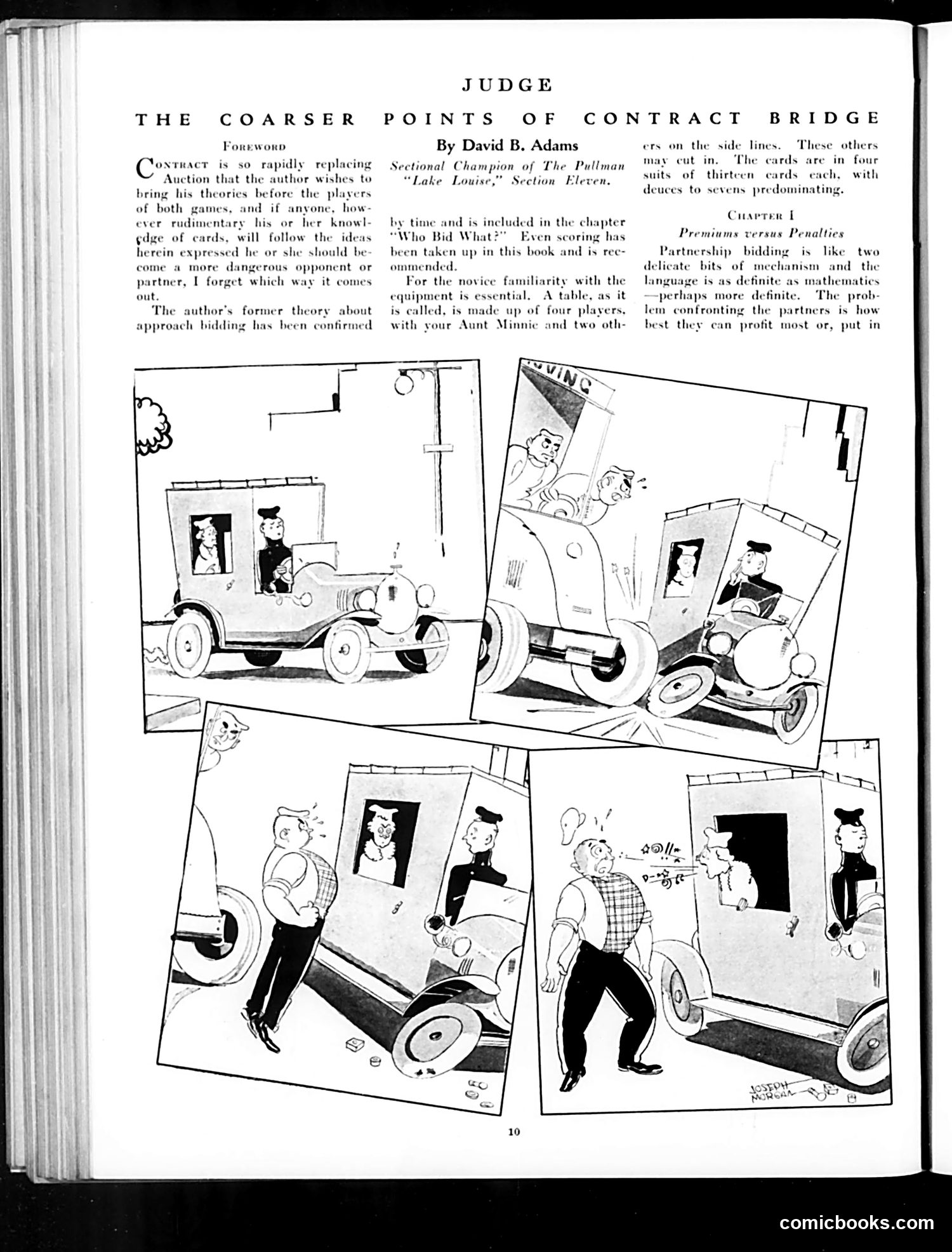
Content Analysis This page introduces a bridge instruction manual by David B. Adams, a national champion. The cartoon strips illustrate contract bridge gameplay and etiquette — likely showing common scenarios at the bridge table. The comic panels depict people arriving at and departing from bridge games in cars, with figures entering/exiting through windows and doors. This appears to satirize the social ubiquity of bridge in early-to-mid 20th century American leisure culture — the game was so popular and time-consuming that people were practically living in their cars shuttling between games. The title "The Coarser Points of Contract Bridge" suggests the text addresses basic fundamentals for novice players. The foreword emphasizes that understanding bidding strategy and scoring rules helps players become "more dangerous opponents or partners." Without additional context, the specific cartoon jokes are unclear, but they likely mock bridge's social dominance or players' obsessive behavior around the game during this era.
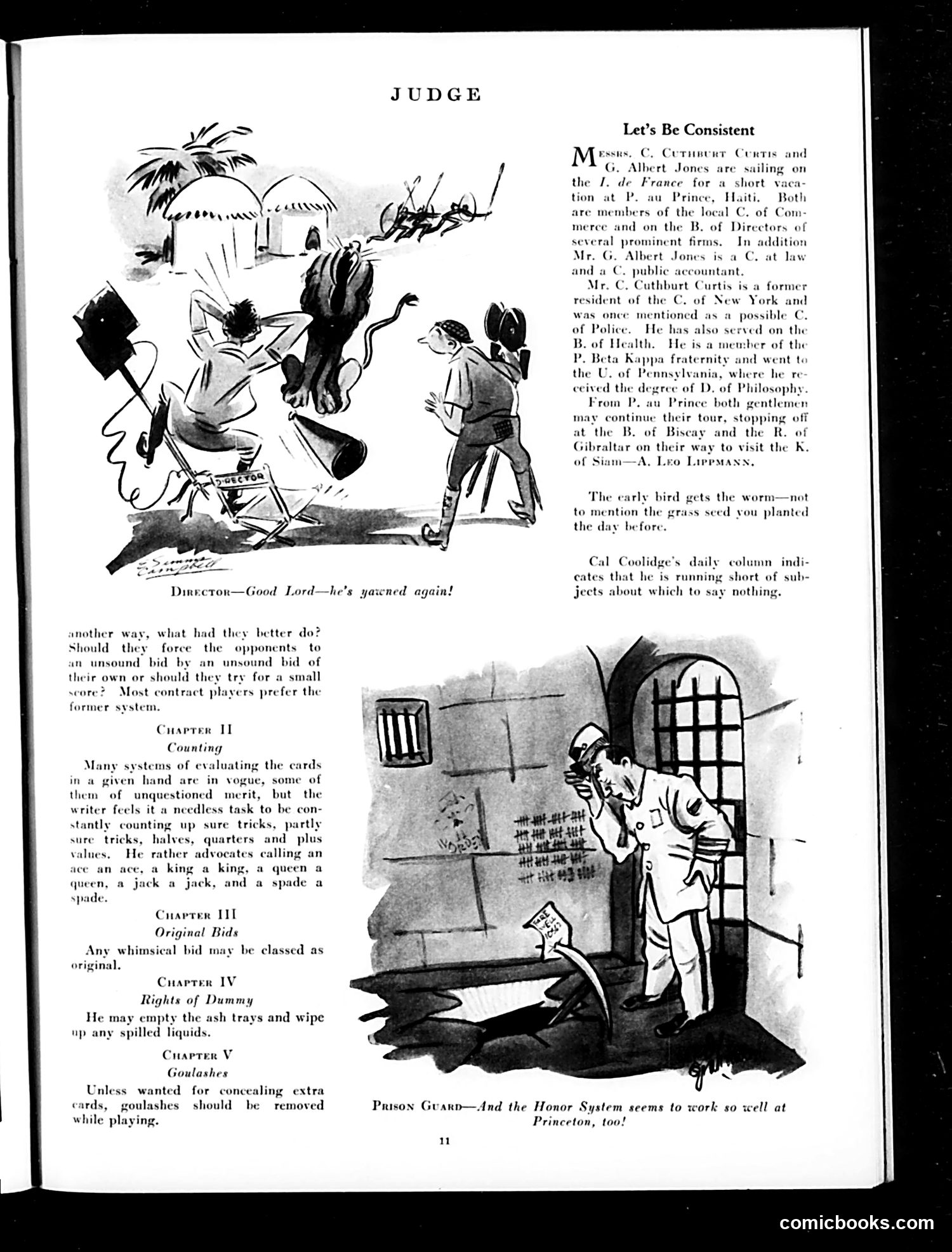
Analysis of Judge Magazine Page This page contains two distinct satirical pieces: Top cartoon ("Let's Be Consistent"): A director watches actors perform a dramatic scene with exaggerated emotion. The joke is about inconsistency—the text notes that prominent businessmen are vacationing while their names are abbreviated in ways that sound absurd (C. of Commerce, B. of Directors, etc.). The satire critiques how important-sounding titles and abbreviations mask ordinary people. Bottom cartoon ("Prison Guard"): Shows a guard discovering an unconscious prisoner, commenting that "the Honor System seems to work so well at Princeton, too!" This mocks Princeton University's honor code system by suggesting it fails spectacularly—the prisoner has apparently escaped or been beaten. The satire equates an elite university's honor system with prison security, implying both are equally ineffective. The page also includes bridge card-game instructions, suggesting this is from a broader editorial issue mixing humor with practical content.
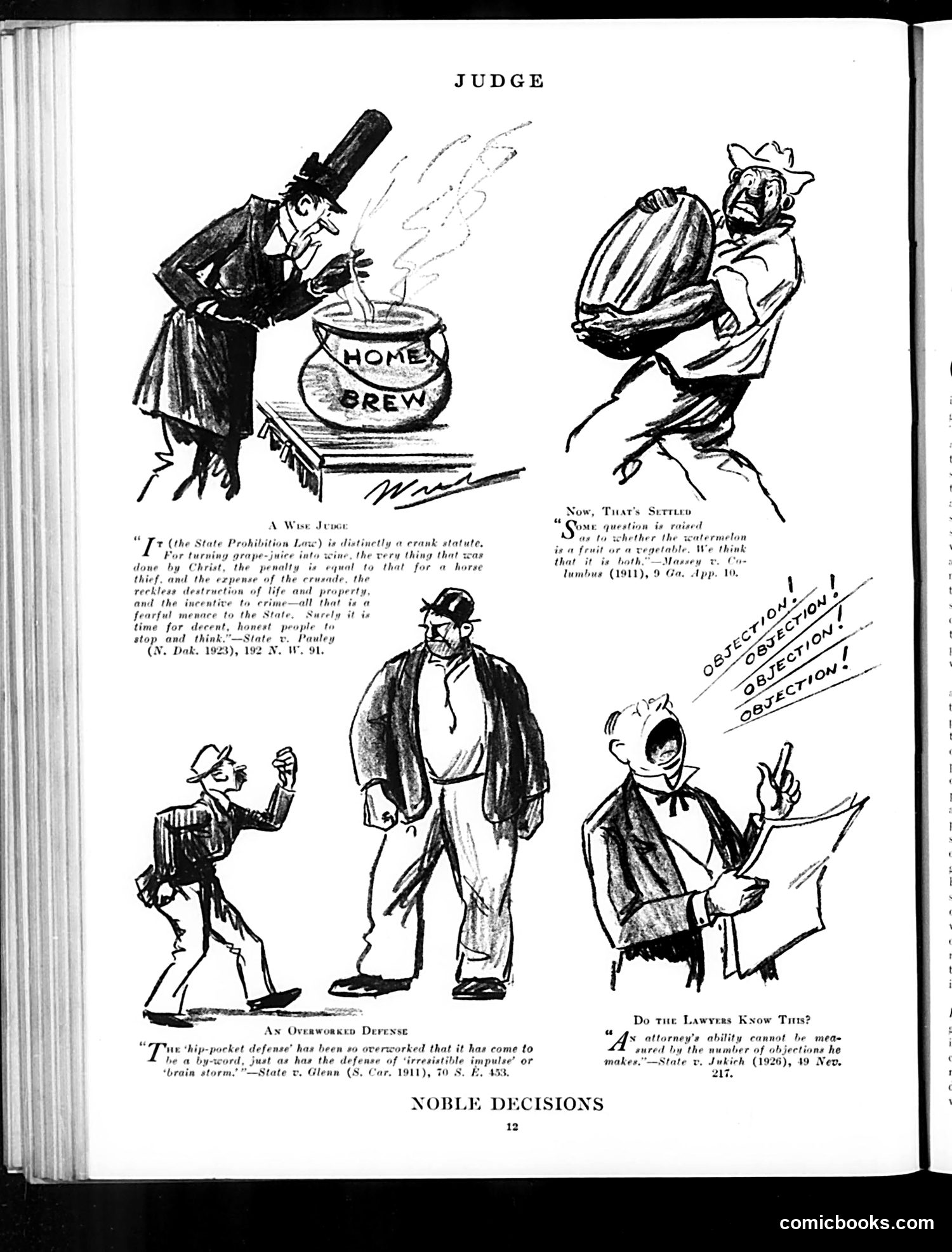
Judge Magazine Satire: "Judge" Legal Humor Page This page from *Judge* satirizes the American legal system through four cartoon vignettes, each paired with actual court rulings ("Noble Decisions"). Top left: A judge examining "Home Brew" during Prohibition, mocking lenient judicial interpretations of alcohol laws. Top right: A man smuggling contraband, captioned about settled legal questions regarding contraband seizure. Bottom left: "An Overworked Defense"—a small lawyer confronting a large judge, criticizing the "hip-pocket defense" excuse as overused and absurd. Bottom right: "Do the Lawyers Know This?"—a lawyer objecting repeatedly, satirizing attorneys who abuse procedural objections rather than demonstrating genuine legal skill. The overall theme critiques judicial leniency, Prohibition enforcement inconsistency, and lawyer incompetence or manipulation. The juxtaposition of cartoons with actual court citations creates ironic commentary on how real laws sometimes enable frivolous defenses.
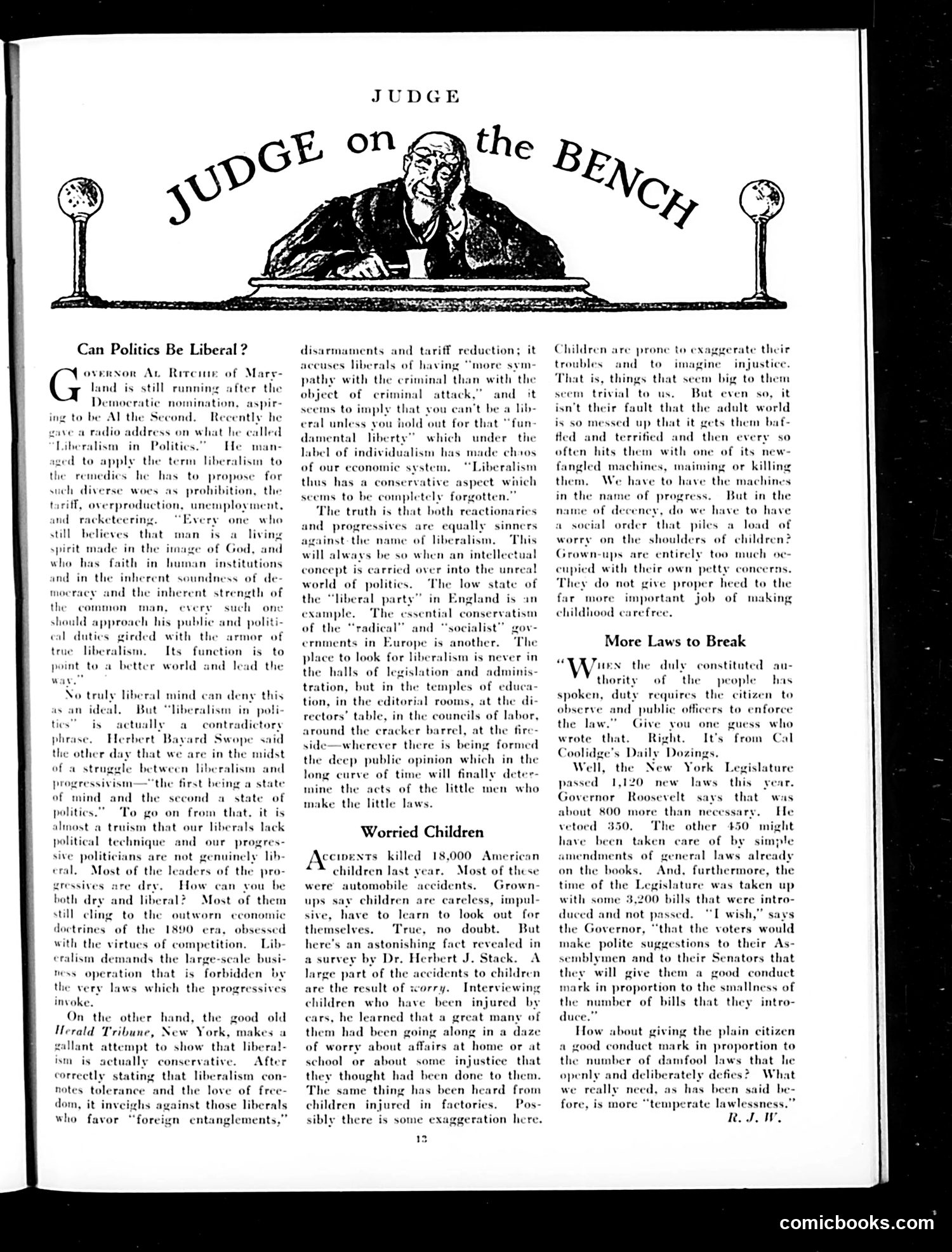
Judge Magazine Analysis This page from Judge satirizes Governor Albert Ritchie of Maryland, a Democratic presidential aspirant, through the "Judge on the Bench" column. The cartoon depicts a stern judge presiding over political debate. The Main Argument: The piece critiques Ritchie's claim to "liberalism" while proposing conservative remedies (prohibition, tariffs). The author argues that true liberalism cannot coexist with both dry policies and laissez-faire economics—highlighting the contradictions in progressive politicians' platforms. The Herald Tribune is also mocked for defining liberalism inconsistently, sometimes defending individualism while attacking criminal sympathizers. Key Point: The satire suggests that liberalism as practiced in politics is fraudulent because politicians apply an idealistic concept inconsistently. Real liberalism, the author argues, exists in education and public discourse, not legislation. Secondary Section ("Worried Children"): Reports that 18,000 American children died in accidents annually, many automobile-related. A survey by Dr. Herbert Stack reveals children's worry about home/school problems contributes to carelessness—suggesting adults unfairly blame children's negligence while ignoring psychological factors.
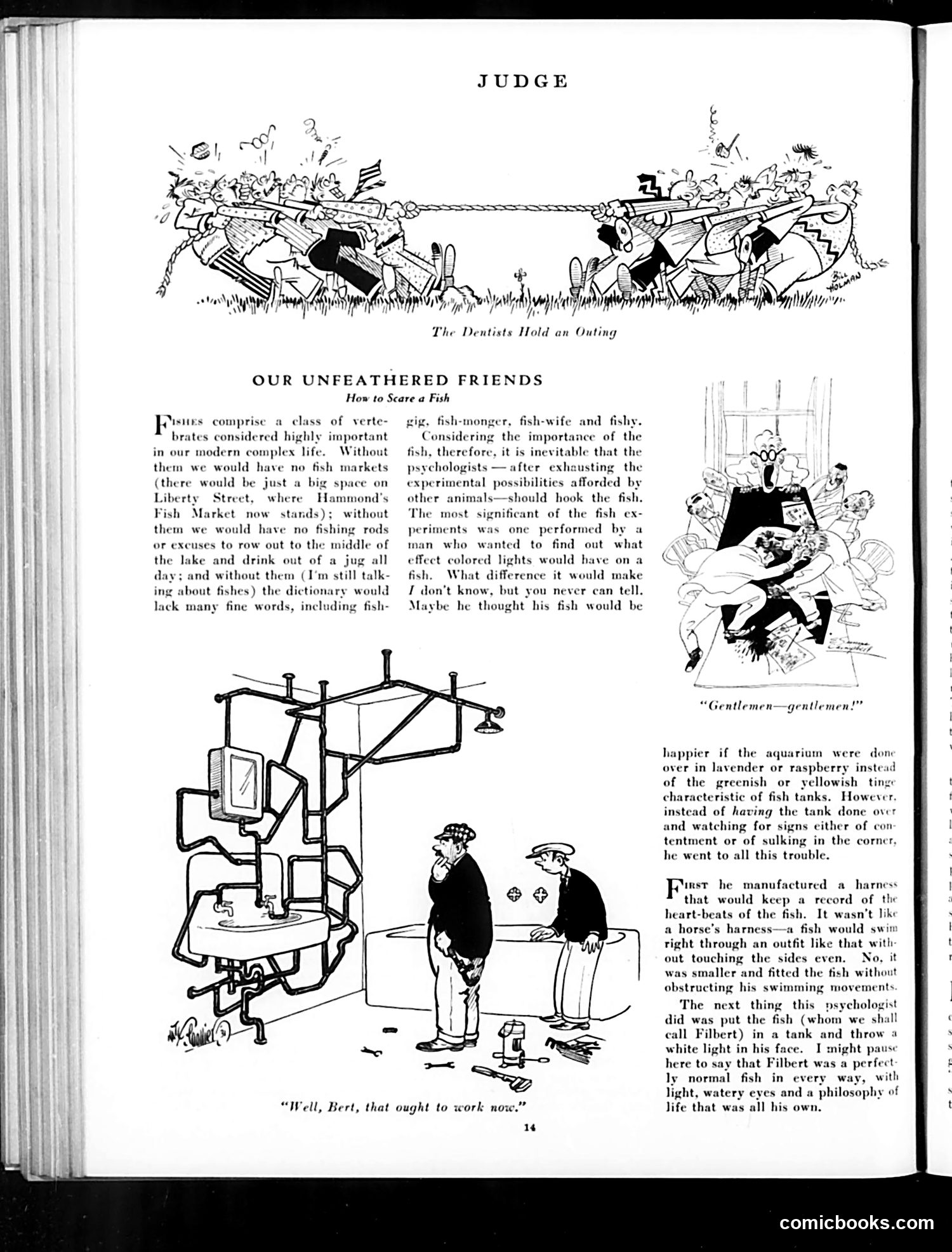
Judge Magazine Satire Analysis This page satirizes early 20th-century scientific psychology through absurdist humor. "Our Unfeathered Friends: How to Scare a Fish" mocks the era's enthusiasm for experimental psychology applied to animals. The satire centers on a psychologist conducting elaborate experiments on a fish named Filbert—manufacturing a special harness to record heart-beats, exposing the fish to colored lights, and shining white light in its face—all to test subjective responses. The humor lies in the pretentiousness of the enterprise: researchers applying human psychological frameworks to fish, and the absurd assumption that a fish might prefer lavender-tinted tank water. The cartoon (top) shows "The Dentists Hold an Outing," depicting dentists in a tug-of-war—a separate, unrelated visual joke mocking a professional group. The illustrations of two men discussing "Well, Bert, that ought to work now" reinforce the satirical tone: bemused observers of overengineered scientific methodology applied to lowly creatures incapable of meaningful response.
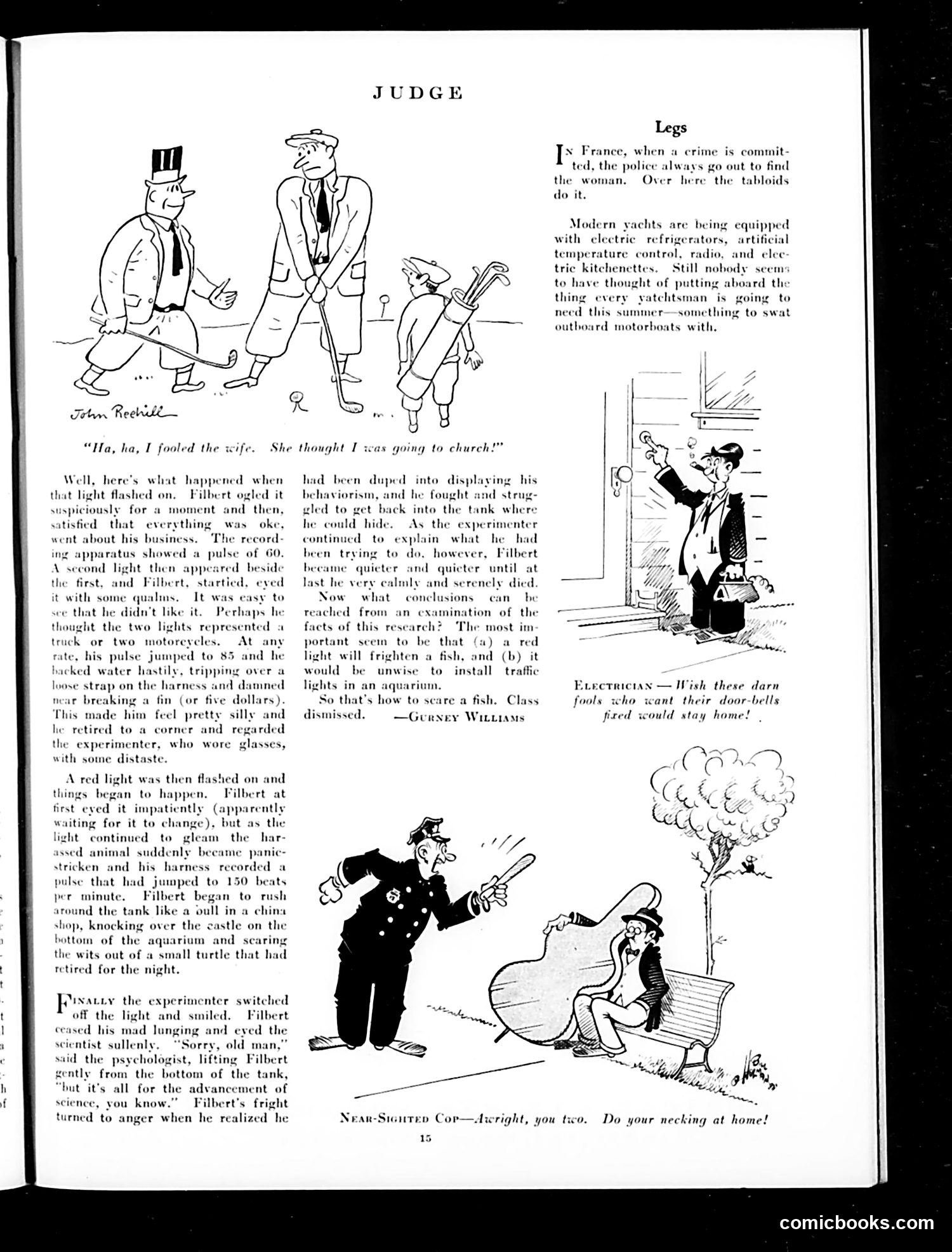
Judge Magazine Page Analysis This page contains multiple satirical pieces typical of 1920s-30s humor magazine content: Main Cartoon (top): A scientist conducts a behavioralist experiment on a fish named Filbert, using flashing lights to measure fear responses via pulse recording. The joke mocks pseudo-scientific research: the experimenter concludes that red lights frighten fish and shouldn't be installed in aquariums—a deliberately absurd, obvious "finding" presented as serious science. The satire targets the pretension of academic psychology and its often trivial conclusions. "Legs" Column: Three brief satirical quips about contemporary life: - French police investigate crimes by finding women; American tabloids do the same - Luxury yachts have every modern amenity except the one yachtsmen actually need: a device to swat motorboats (commenting on dangerous boat traffic) - An electrician complains about customers wanting doorbell repairs when they should stay home necking (dating) These represent typical magazine filler humor—observational jokes about modern inconveniences and social behavior popular with the era's readers.
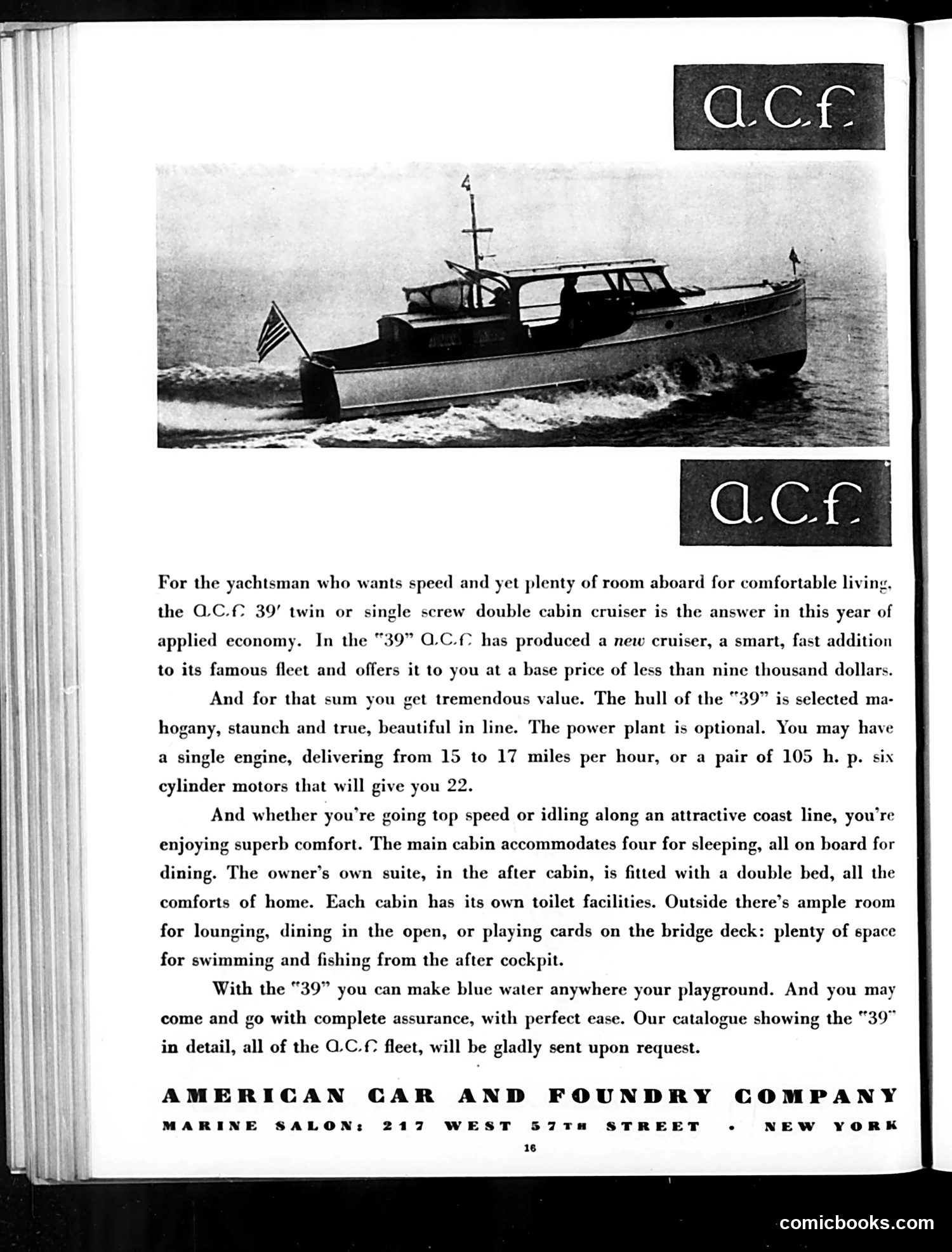
This page is primarily advertising, not satire or editorial cartoon. It's a full-page advertisement for the American Car and Foundry Company's 39-foot yacht cruiser. The ad features a photograph of the vessel and promotional text targeting affluent yachtsmen. It emphasizes the boat's appeal during "applied economy"—likely referencing the Great Depression era when luxury goods needed justification. The pitch emphasizes value: under $9,000 for a mahogany-hulled cruiser with sleeping capacity for four, dual cabins with toilets, and optional twin 105-horsepower engines. The tone is aspirational marketing designed to convince wealthy readers that purchasing a luxury yacht remains sensible. There is no political satire, caricature, or social commentary visible. The page simply sells recreational boating to Judge magazine's upper-class readership through straightforward promotional copy and product photography.
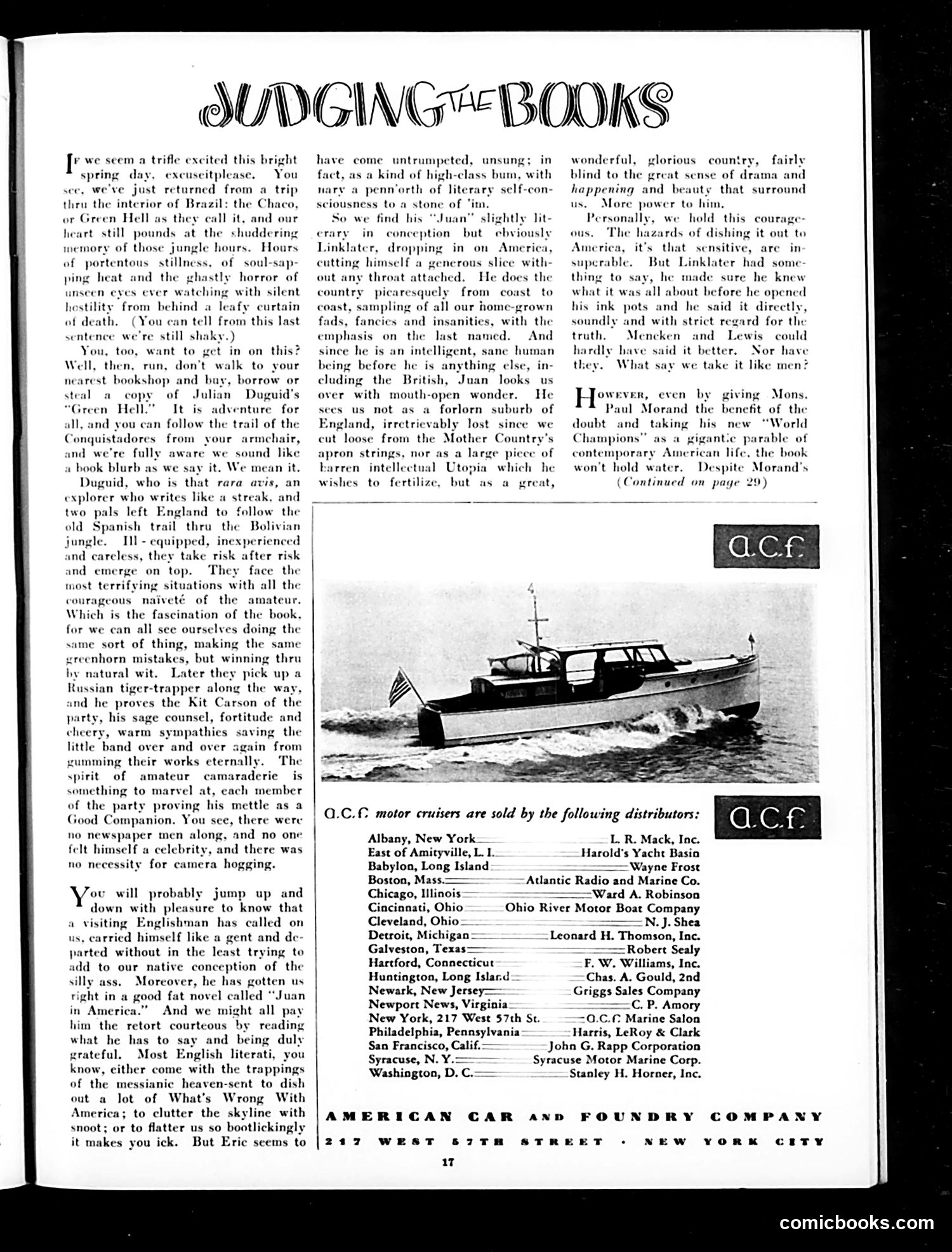
"Judging the Books" Page Analysis This page is primarily a book review column, not a political cartoon. The main content reviews two travel/adventure books by British authors: Julian Duguid's "Green Hell" (about exploring Brazil's Chaco region) and Eric Linklater's "Juan in America." The reviewer expresses enthusiasm for both works, particularly praising Duguid's amateur adventurers who succeed through natural wit rather than expertise, and Linklater for being an unusually unpretentious British visitor to America—he doesn't arrive with messianic superiority, doesn't criticize American culture, and doesn't flatter obsequiously (the reviewer jokes that most English literati either "clutter the skyline with snoot" or "flatter us so bootlickingly it makes you sick"). The satire targets pretentious British intellectual visitors to America, a common theme in 1920s-30s American magazines. The page also includes a Q.C.F. motor cruiser advertisement with distributor listings—this is advertising content, not editorial satire.
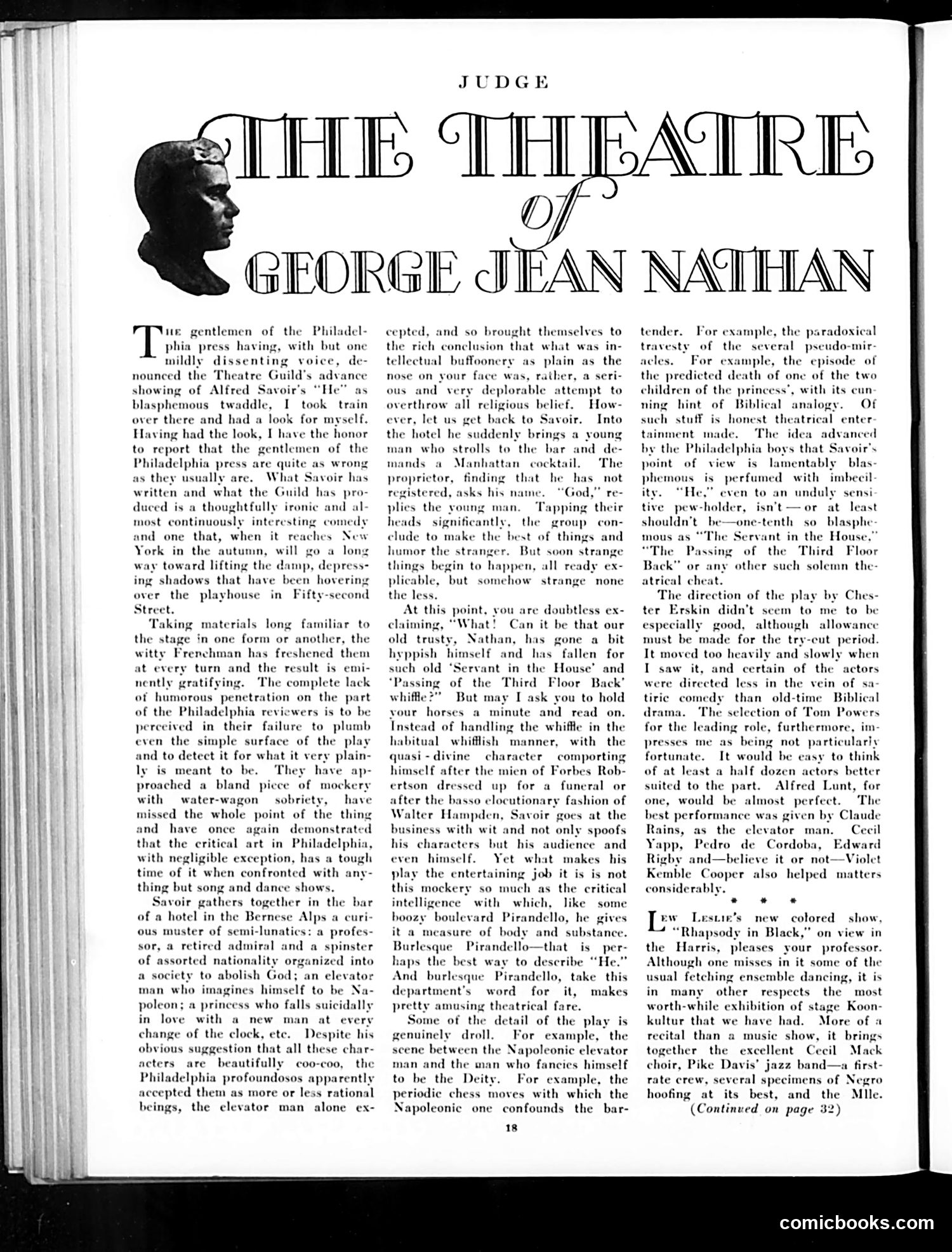
"The Theatre of George Jean Nathan" This is a theater review by Judge's drama critic. The page critiques Philadelphia press reviewers who condemned Alfred Savoir's play "He" as blasphemous. Nathan defends the work as intelligent satirical comedy, not serious religious critique—the Philadelphia critics missed the irony entirely. Nathan describes the play's setup: eccentric characters (a professor, admiral, spinster, etc.) in a hotel bar encounter a young man claiming to be God. Rather than treating this reverently (like older "divine stranger" plays such as "The Servant in the House"), Savoir mocks both his characters and the audience, blending Pirandello-style philosophical drama with burlesque. Nathan praises the wit and "critical intelligence" of this approach, suggesting the play will succeed when it reaches New York, unlike Philadelphia's theater scene dominated by "song and dance shows."
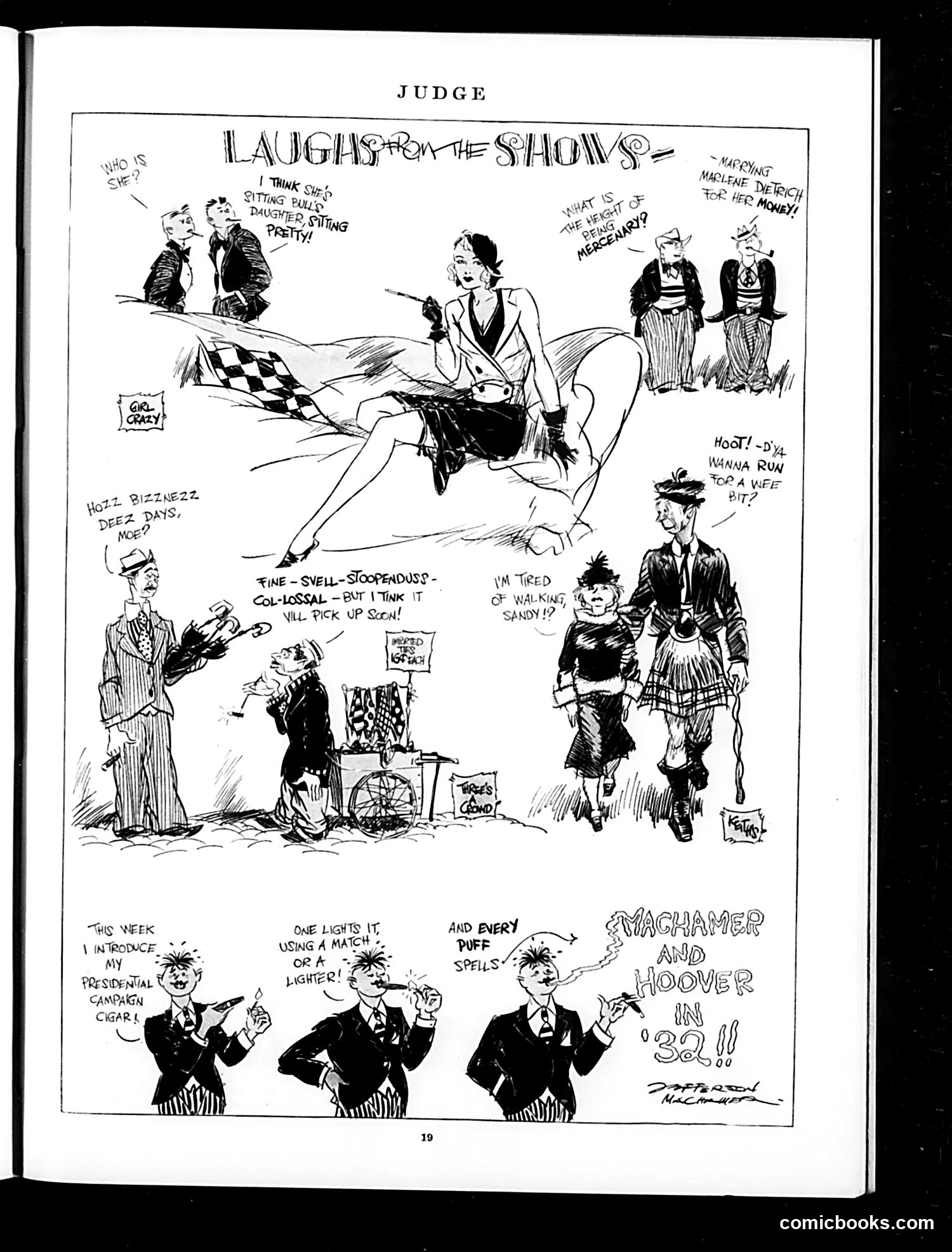
"Laughs for the Show" - Judge Magazine Cartoon This is a satirical cartoon mocking the 1928 U.S. Presidential campaign, likely featuring candidates Al Smith and Herbert Hoover (referenced in the bottom panel's "Wagahamer and Hoover in '28!!"). The central joke depicts a woman at a circus/show surrounded by absurd political commentary. The bottom sequence shows a candidate smoking a presidential campaign cigar, with each puff producing increasingly grandiose promises ("One lights it, using a match or lighter! And every puff spells [promises]!"). The satire targets the exaggerated, empty rhetoric of political campaigning—politicians making grand claims that dissipate like cigar smoke. Various figures around the margin offer cynical observations about the spectacle of politics, treating the election as mere entertainment rather than serious governance. The overall tone is dismissive of campaign promises as literally insubstantial hot air.
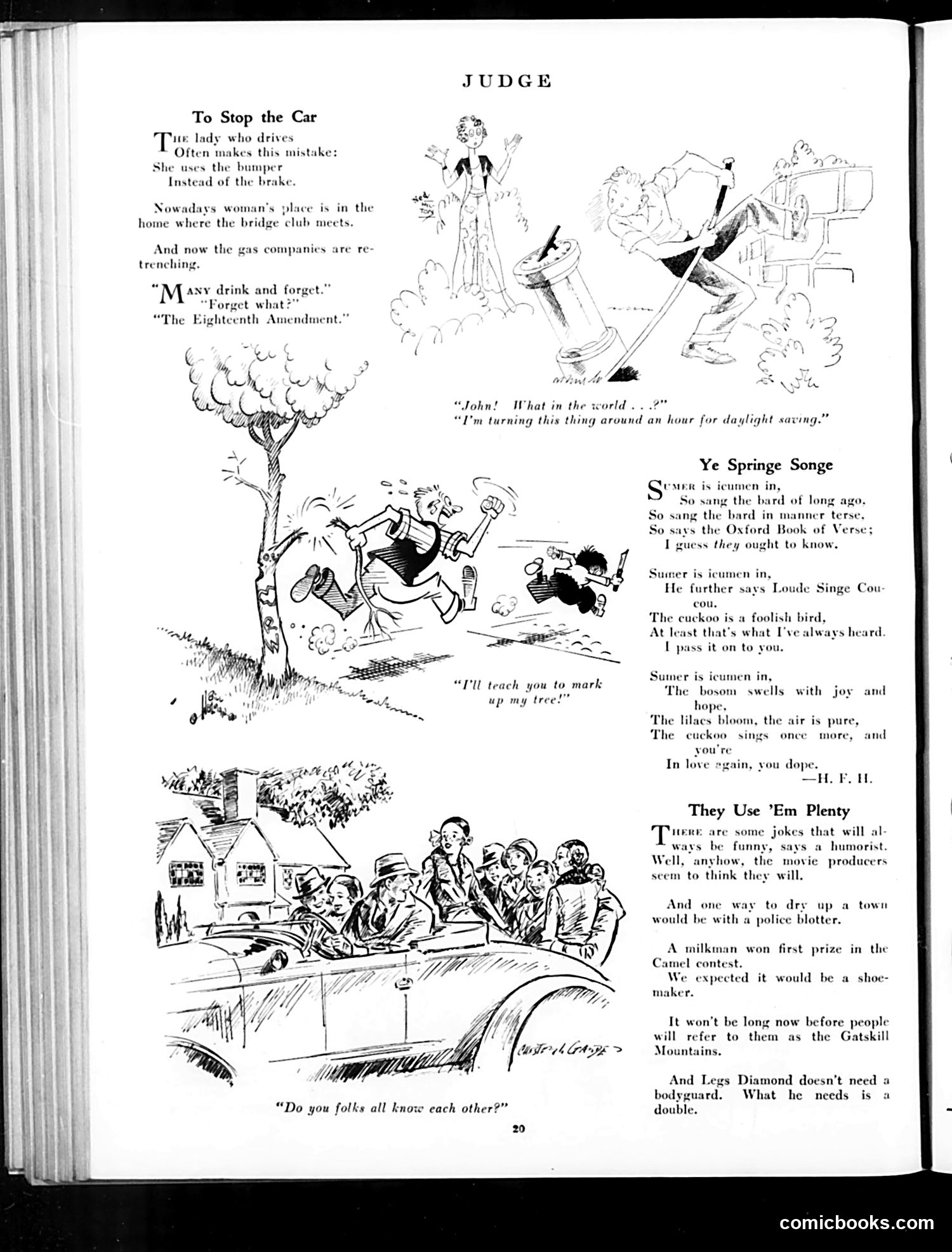
Analysis for Modern Readers This Judge magazine page contains several satirical pieces mocking 1920s social trends: "To Stop the Car": Jokes about women drivers, a recurring anxiety topic. The humor targets female motorists as incompetent (using bumper instead of brake) and distracted by bridge clubs—reflecting period anxieties about women's independence. Daylight Saving: The cartoon mocks the confusion around daylight saving time, depicting a man frantically adjusting his car's clock, suggesting the policy was widely bewildering and inconvenient. "Ye Springe Songe": A parody of the medieval English song "Sumer is icumen in," now sardonically noting that spring brings romantic foolishness. "They Use 'Em Plenty": Brief jokes about movie producers recycling tired jokes, a police blotter's effectiveness as social commentary, and references to contemporary figures like "Legs Diamond" (a real 1920s gangster), mocking his need for a "double" (bodyguard/lookalike). The overall tone is light, topical satire aimed at urban, educated readers familiar with current events and literary references.
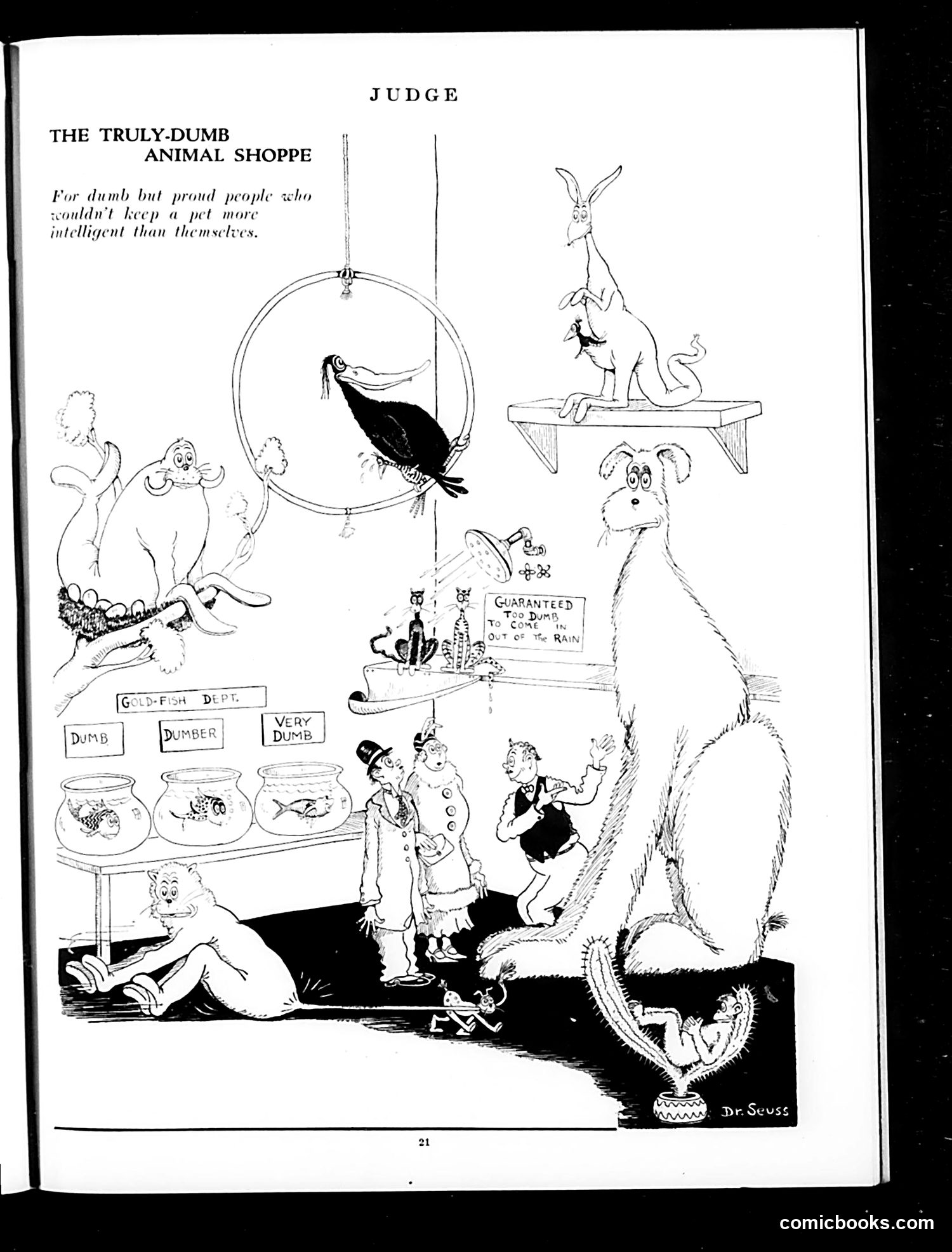
The Truly-Dumb Animal Shoppe This Dr. Seuss cartoon satirizes wealthy, foolish people who insist on owning exotic pets despite lacking the intelligence to care for them properly. The shop displays animals labeled "DUMB," "DUMBER," and "VERY DUMB"—visual metaphors for the owners' own stupidity. The joke targets the vanity of the rich: they want impressive animals (an elephant, exotic birds, etc.) to display their status, but their pride exceeds their competence. The "GUARANTEED Too Damp Out of the Rain" sign mocks their ineffectual pet care. The cartoon suggests these owners are ultimately as foolish as the animals they keep—they're both the predator and victim of their own vanity. It's social satire about class pretension and the absurdity of keeping wild creatures as status symbols.
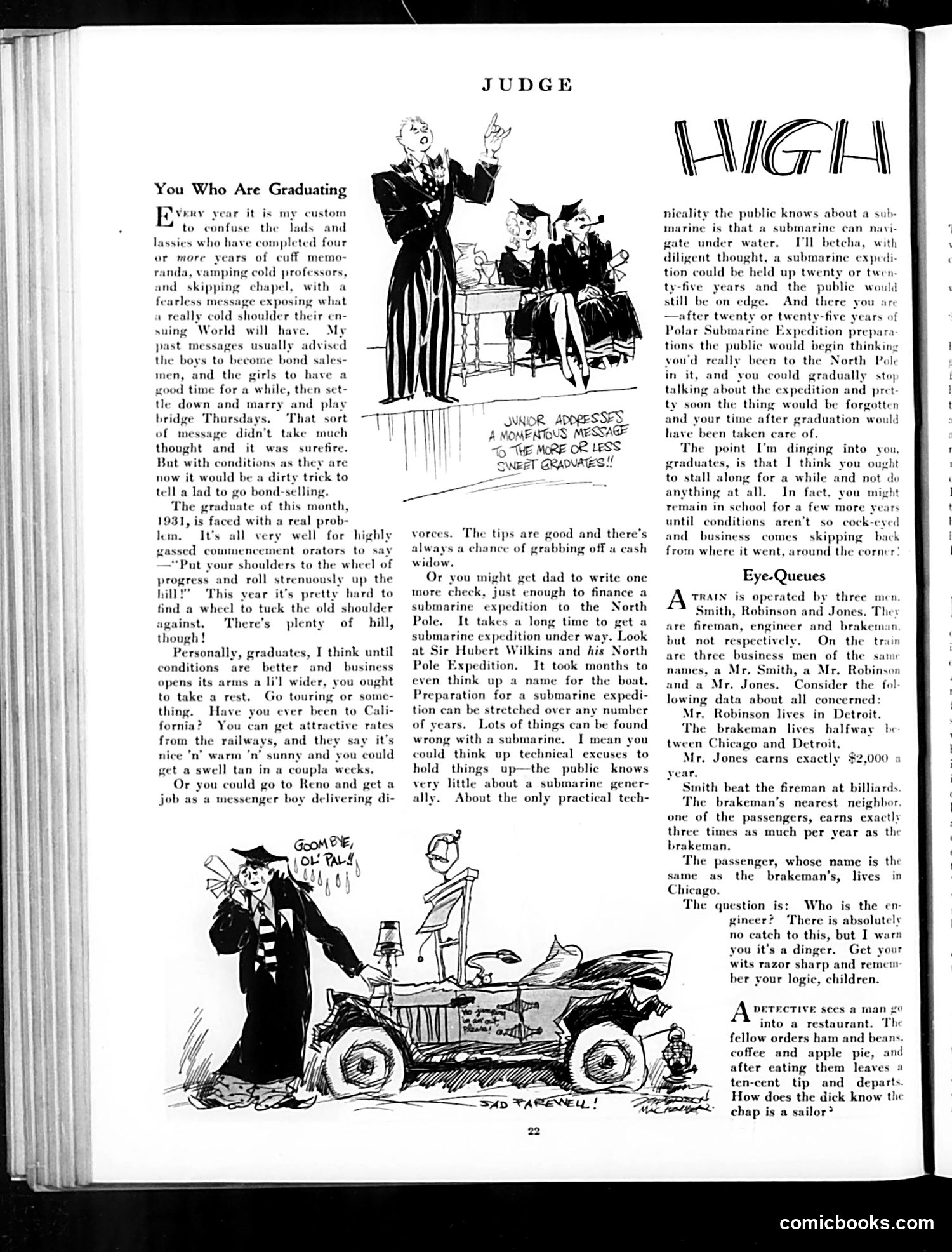
Judge Magazine Page Analysis This 1931 *Judge* page addresses graduates facing the Great Depression. The main article, "You Who Are Graduating," satirizes typical commencement advice by suggesting graduates should avoid job-hunting altogether—conditions are too bleak. The judge humorously proposes alternatives: touring California, going to Reno for divorce-related work, or financing a multi-year submarine expedition to the North Pole (referencing the real Sir Hubert Wilkins expedition). The satire lies in stretching preparation indefinitely to avoid entering a collapsed job market. The cartoons illustrate the absurdity: one shows a judge addressing graduates about a "submarine message"; another depicts someone abandoning a broken-down automobile ("Bad Farewell!"). The "Eye-Queues" section is a logic puzzle about three railroad workers and three businessmen sharing identical names—a brain-teaser unrelated to the economic commentary. The page reflects 1931's economic despair, when traditional advice to young people ("put your shoulder to the wheel") seemed cruelly inapplicable.
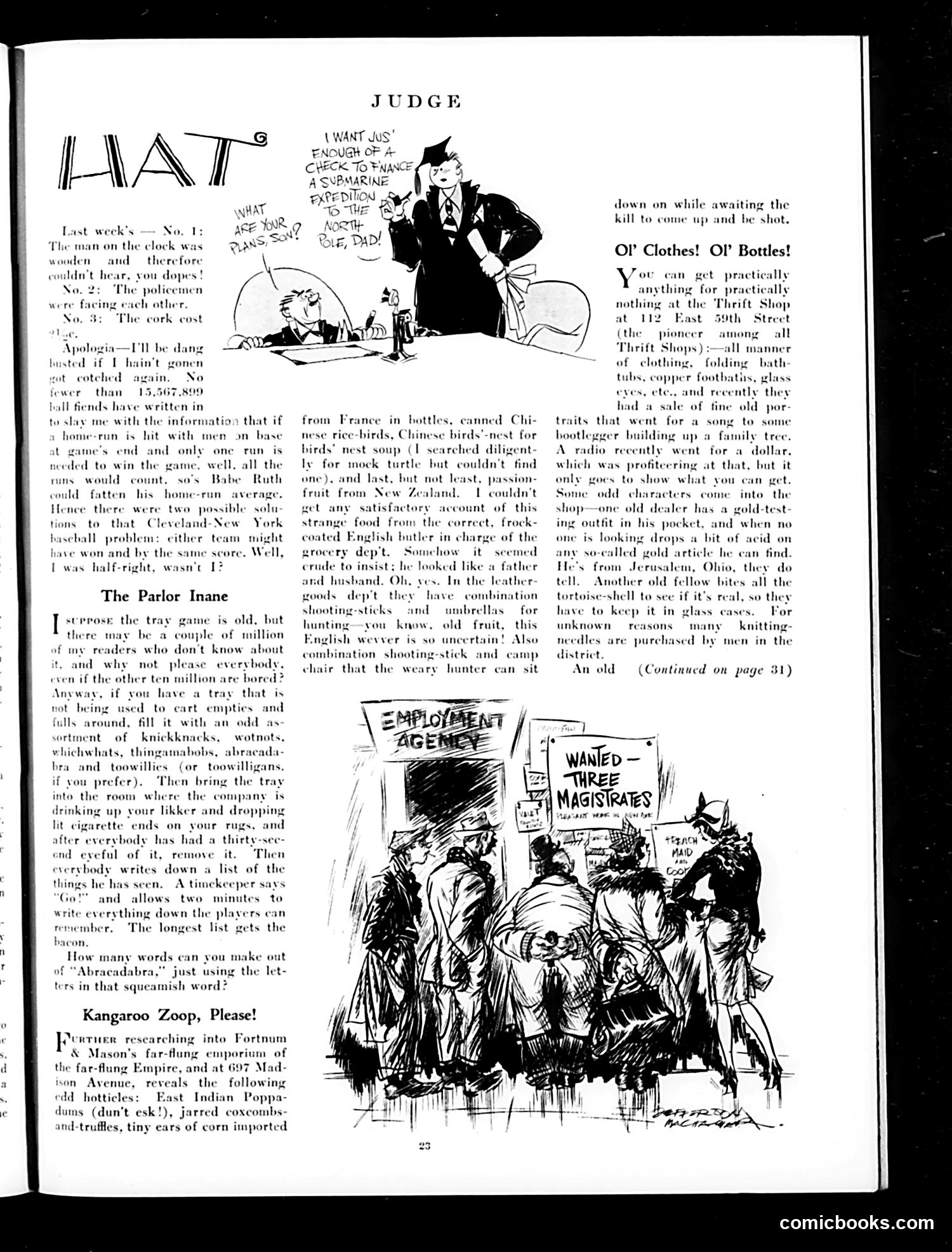
Judge Magazine Page Analysis This page contains humor pieces and satirical commentary typical of 1920s Judge magazine: "The Judge" cartoon (top): Shows a judge listening to a man's complaint about financing a submarine expedition. The satire mocks frivolous legal disputes and possibly wealthy men's absurd ventures during the Prohibition era. "The Parlor Inane": A humorous explanation of a parlor game where guests memorize objects on a tray, then list them from memory. It's presented as supposedly "old" entertainment, poking fun at the game's simplicity and popularity among social gatherings. "Ol' Clothes! Ol' Bottles!": Advertises a thrift shop on East 59th Street, humorously describing the oddball merchandise and characters found there—including someone who tests gold with acid and another who bites tortoise-shell. The tone suggests amusement at Depression-era bargain hunting and the eccentric dealers involved. Bottom cartoon: Depicts an employment agency crowded with men seeking work, with signs reading "WANTED—THREE MAGISTRATES." This reflects Depression-era unemployment concerns. The overall page mixes light social satire with practical advertising disguised as humor.
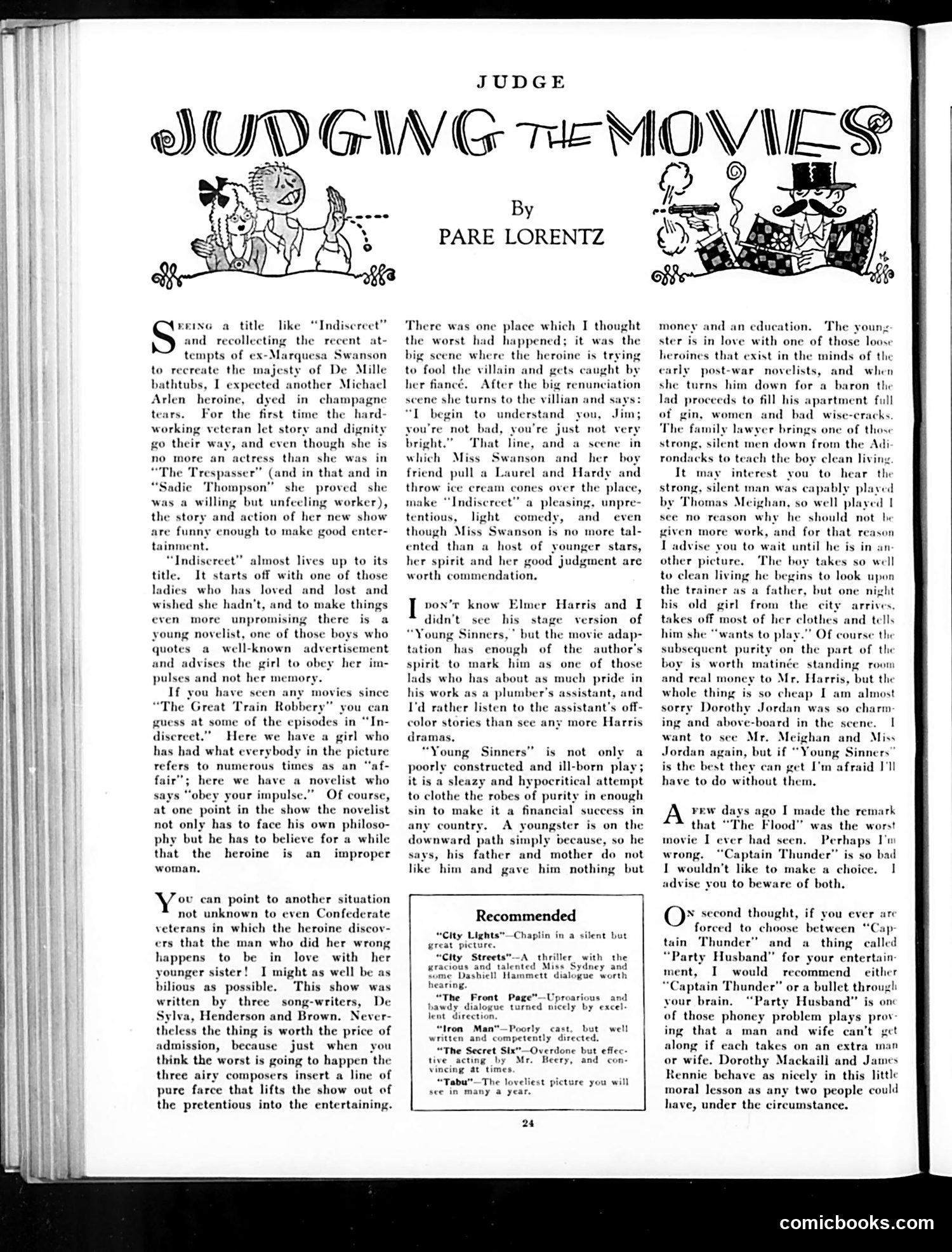
Judge Magazine Film Review Analysis This page is primarily a film review column by critic Pare Lorentz, not a political cartoon. Lorentz reviews several movies, notably "Indiscreet" starring Gloria Swanson, a silent film actress attempting a comeback. The satire targets Swanson's limited acting ability—Lorentz repeatedly notes she's "no more an actress than she was" in previous films, though he credits the material and other contributors for making the film entertaining despite her limitations. He also criticizes "Young Sinners," calling it poorly constructed and cynically designed to exploit moral scandal for profit while pretending to teach virtue. The decorative header illustrations appear to reference theatrical/film entertainment generally, not specific political figures. The "Recommended" box lists other films favorably, including Chaplin's "City Lights." This reflects 1920s-30s American film criticism, when silent films were transitioning to talkies and critics frankly assessed performers' abilities.
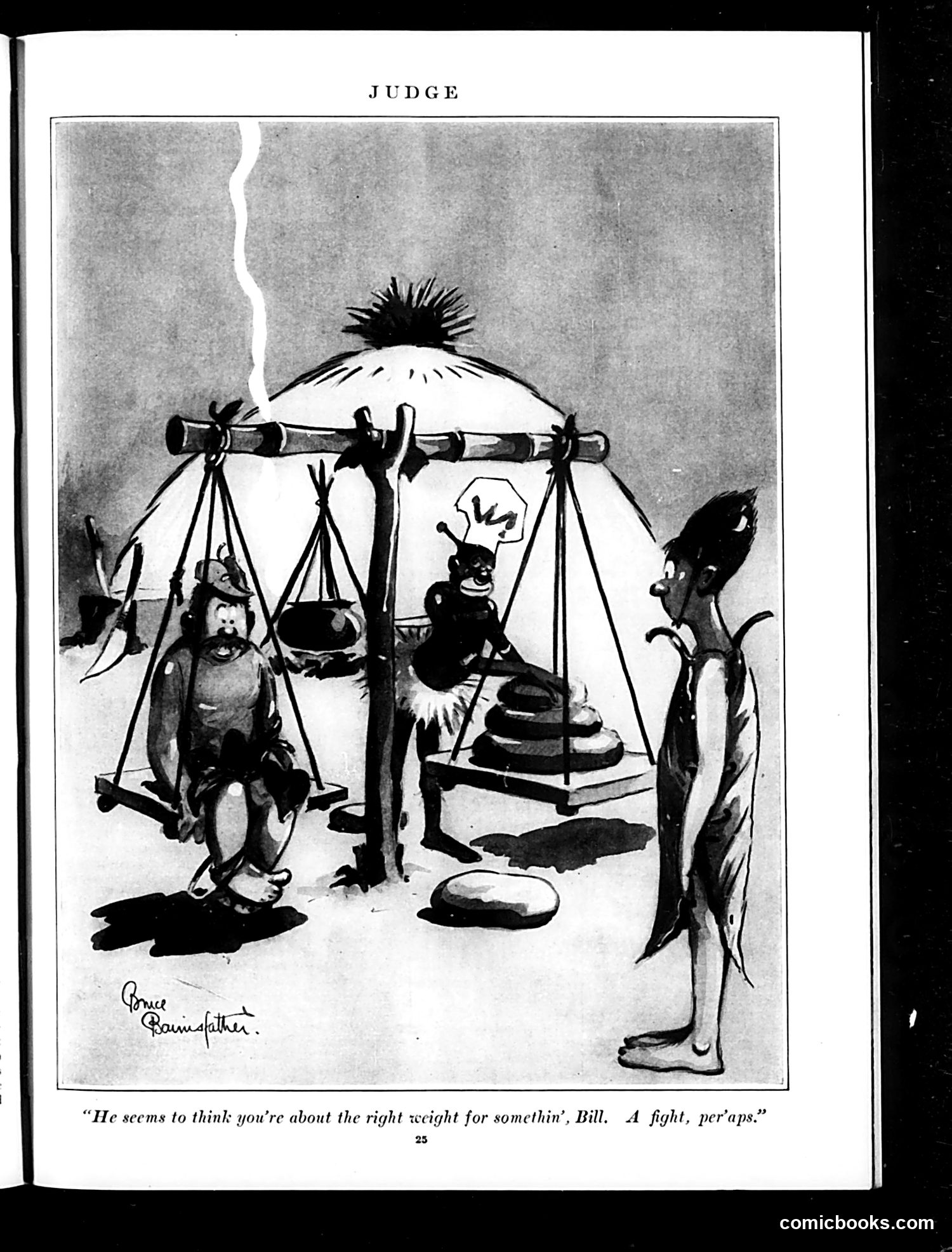
Analysis This appears to be a single political cartoon titled "Judge" showing a makeshift circus or fairground scene. A rotund figure wearing a pom-pom hat stands on a platform holding a balance scale with various animal-like or caricatured figures suspended from it. The caption suggests weighing someone named "Bill" to determine if he's suitable "for somethin'" — possibly a fight. The cartoon likely satirizes a contemporary political or public figure (Bill) as a weighing/evaluation of their fitness for office or a specific role. The circus setting implies mockery of the proceedings as entertainment or spectacle rather than serious governance. Without knowing the specific publication date, identifying "Bill" precisely is unclear, though this appears critical of someone's qualifications or suitability for authority.
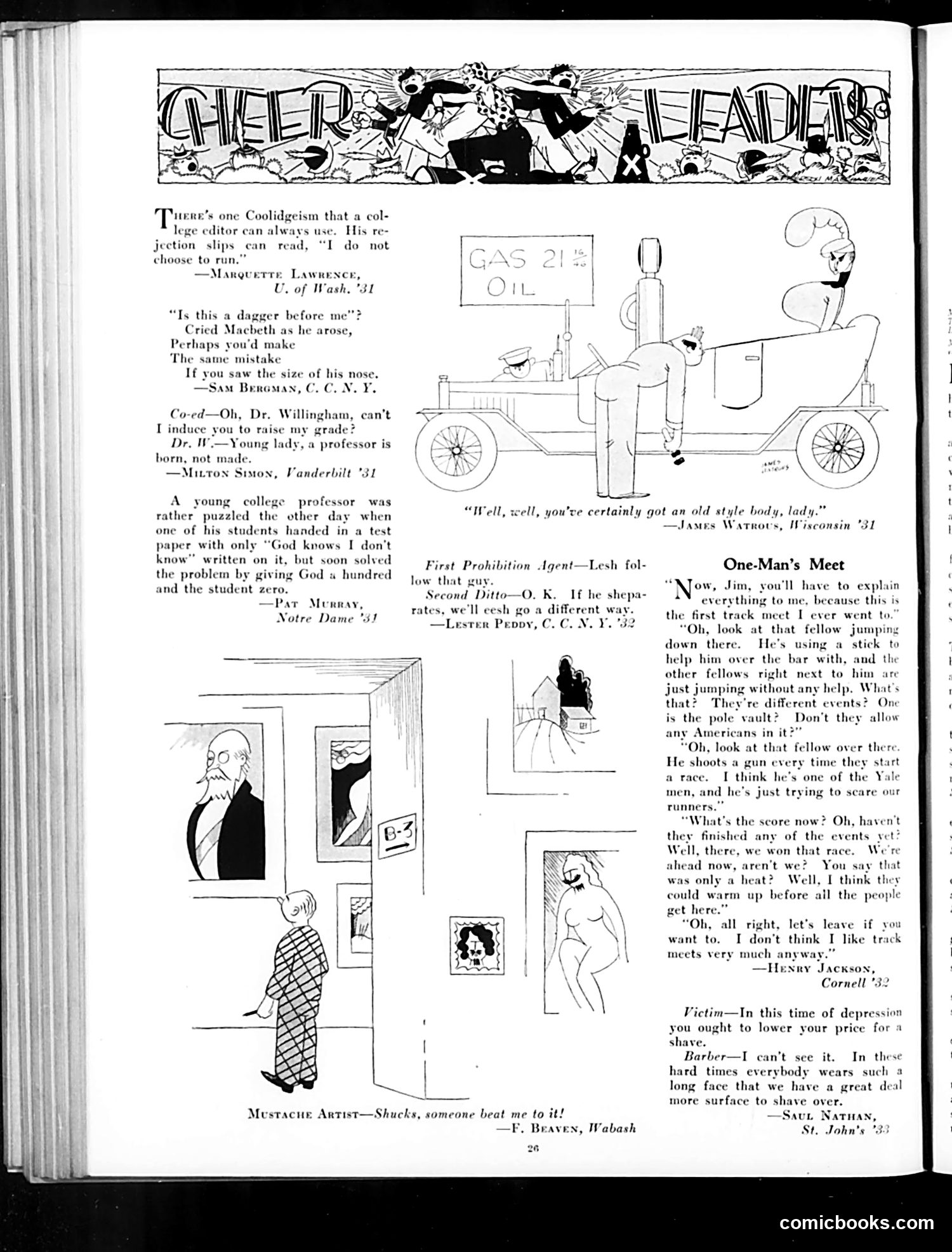
Judge Magazine Page Analysis This page from Judge magazine presents college humor and satirical jokes, primarily targeting academic and student life in the early 1930s. The opening quote references President Calvin Coolidge's famous phrase "I do not choose to run" (his 1928 announcement declining another term), satirizing how college editors might adopt this non-committal rejection style. The cartoons and anecdotes mock various college scenarios: a professor questioning whether students are "born" or "made," a student's test paper with only "God knows I don't know" written on it, and a naive first-time track meet attendee confused by pole vaulting and unfamiliar athletic events. The "One-Man's Meet" dialogue humorously depicts someone attending their first track competition, bewildered by pole vaults, different heat rounds, and competitive rules—suggesting rural or unsophisticated unfamiliarity with organized collegiate sports. A final "Mustache Artist" cartoon depicts a barber's complaint during the Depression: customers' long, depressed faces provide more surface area to shave, making his reduced prices impractical. The humor targets youth inexperience, economic hardship, and academic pretension.
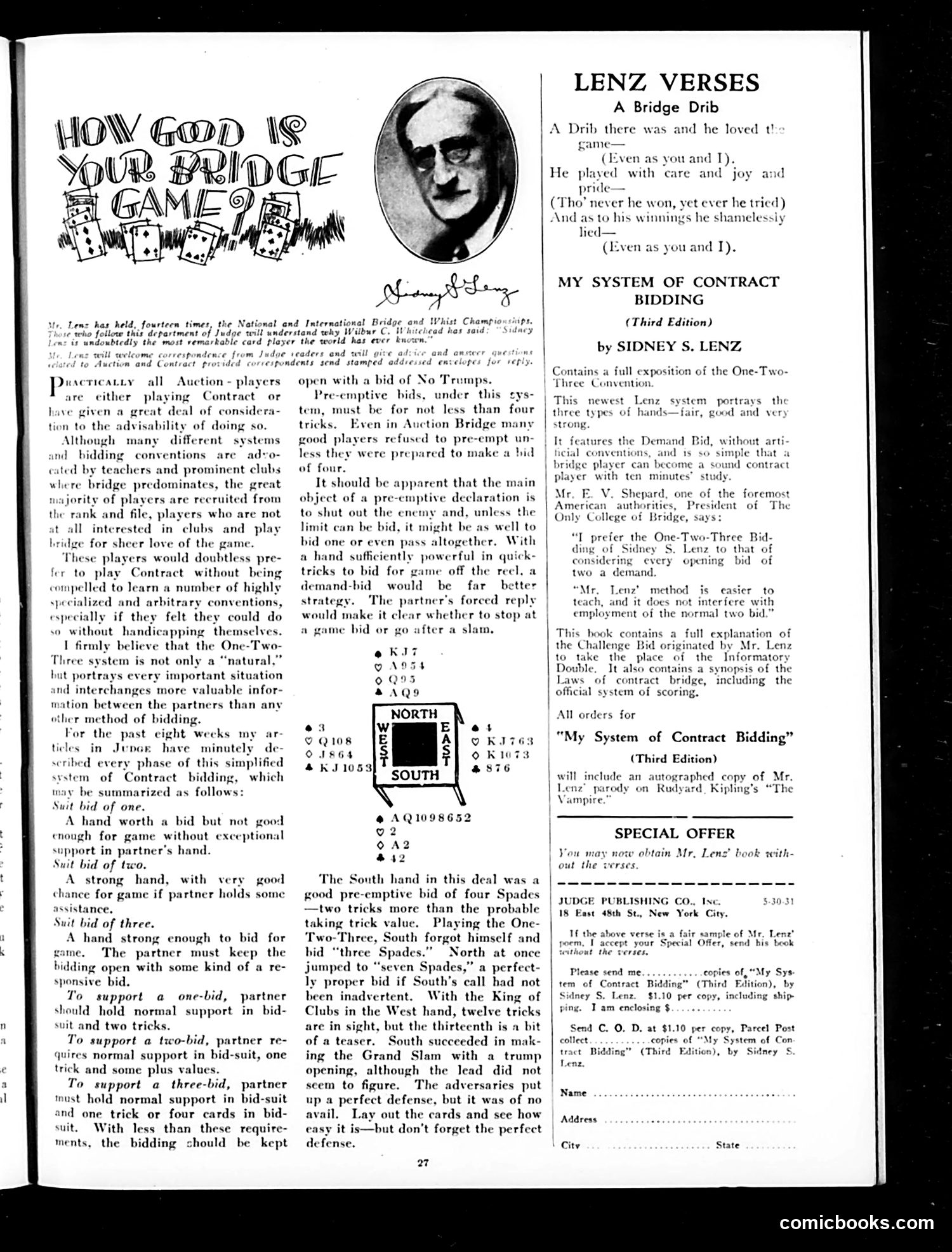
"How Good Is Your Bridge Game?" - Judge Magazine Page This page celebrates Sidney S. Lenz, a renowned bridge player and instructor. The left side features a caricatured portrait and a playful headline asking readers to evaluate their bridge skills, illustrating Lenz's prominence in popularizing contract bridge. The main content is instructional: Lenz explains his simplified "One-Two-Three" bidding system for contract bridge, breaking down hand valuations and bidding conventions. This reflects early 20th-century America's fascination with bridge as both a social game and intellectual pursuit requiring systematic strategy. The accompanying verse ("Lenz Verses") presents bridge as a noble pursuit where skill and character develop through play—romanticizing the game as inherently moral. The bottom section features an actual bridge hand demonstrating Lenz's system in action, making the page part advertisement, part genuine instruction manual. Context: Bridge was a status symbol and intellectual pursuit among educated classes during this era; Lenz was genuinely famous for systematizing the game's complex rules.
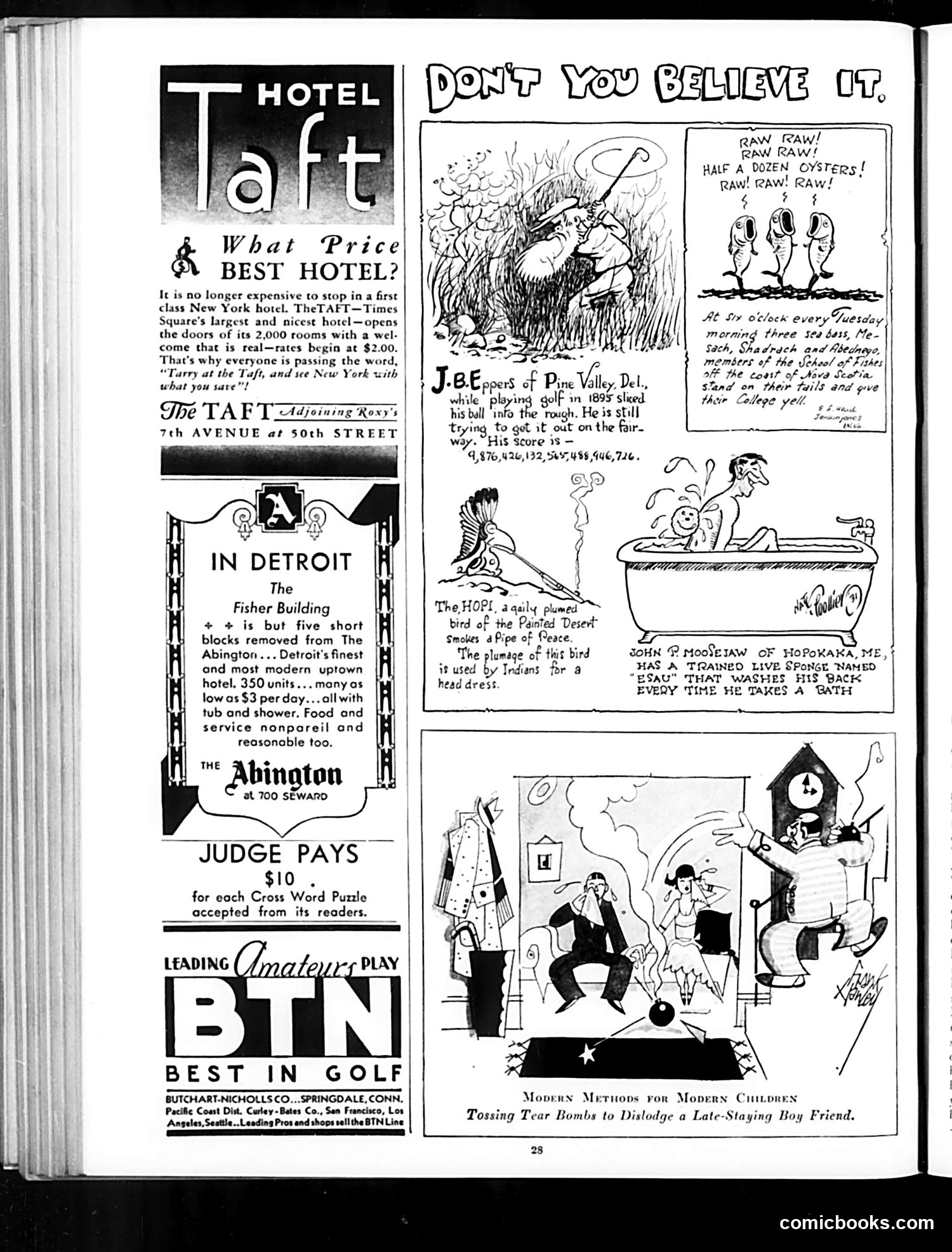
"Don't You Believe It" - Judge Magazine Satire This page combines hotel advertisements with humorous tall tales mocking exaggeration in advertising and folklore. The main cartoon features absurd "facts": a golfer (J.B.E of Pine Valley) still trying to retrieve a ball from 1895 with an impossibly long score; a Hopi bird that supposedly washes a man's back with a trained sponge; and three fish that yell at a specific time weekly. The bottom panel shows "modern methods" for removing a stubborn houseguest—literally bombing him out with tear bombs. The satire mocks how advertisements and tall tales stretch credibility with outlandish claims. By presenting these ridiculous "facts" alongside genuine hotel ads, Judge suggests advertisers themselves engage in similar exaggeration—their low rates and amenities seeming almost as implausible as a 25-year golf game or a bathing sponge. The humor relies on readers recognizing obvious fabrications juxtaposed with commercial claims of value.
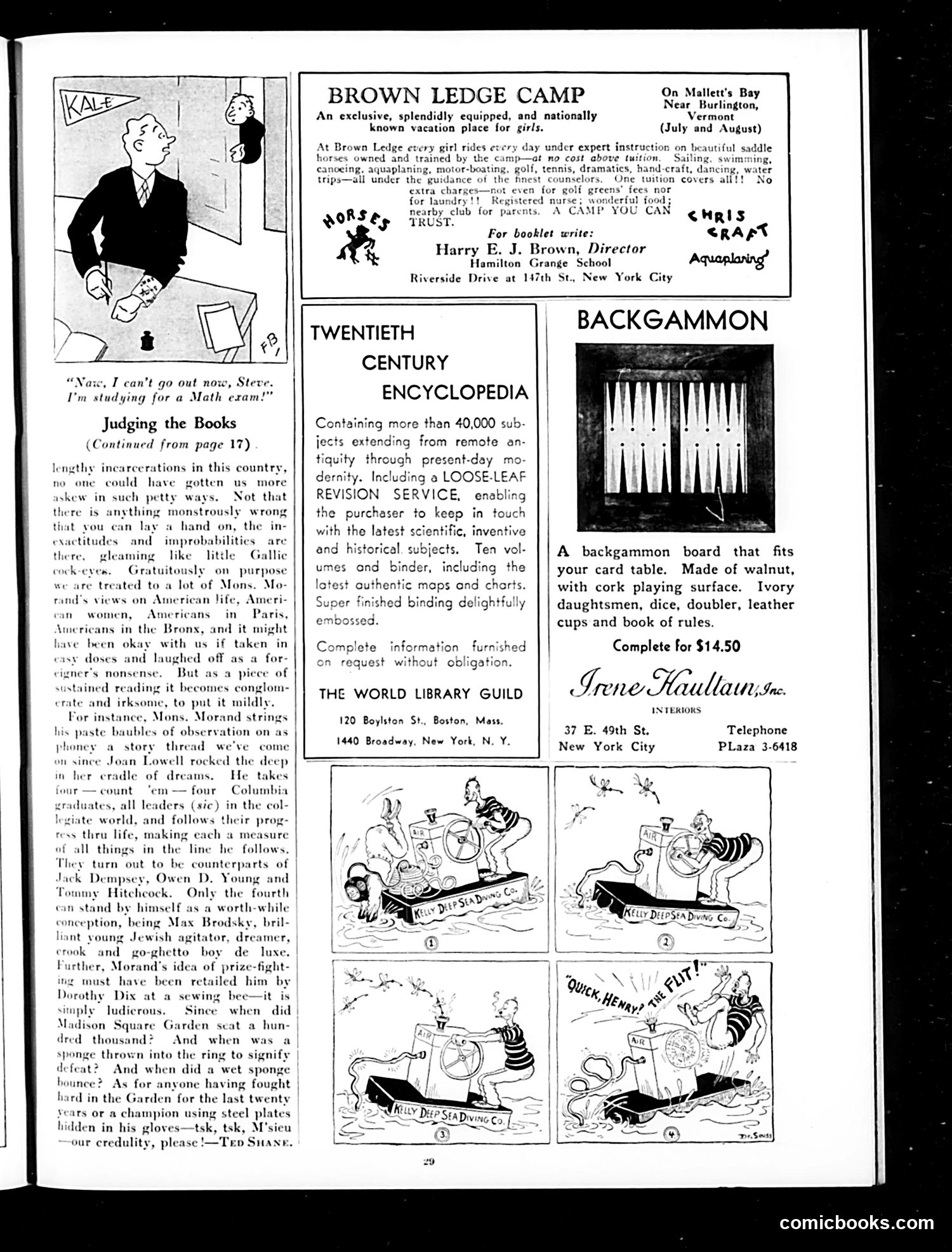
A Page from Judge Magazine This page mixes editorial content with advertisements. The main cartoon (top left) shows a man studying math—a simple domestic joke about exam preparation interrupting social plans, with no political significance. The "Judging the Books" section reviews a novel (likely by French author Paul Morand), critiquing its portrayal of American life, boxing culture, and character types as superficial and inaccurate. The reviewer sarcastically questions the author's knowledge—asking when Madison Square Garden held 100,000 people and when wet sponges bounced in the ring—suggesting Morand relied on secondhand gossip rather than direct observation. The remaining content consists entirely of advertisements: Brown Ledge Camp (a girls' vacation facility), the Twentieth Century Encyclopedia (a reference work with loose-leaf updates), a backgammon board, and interior design services. No political satire is present on this page.
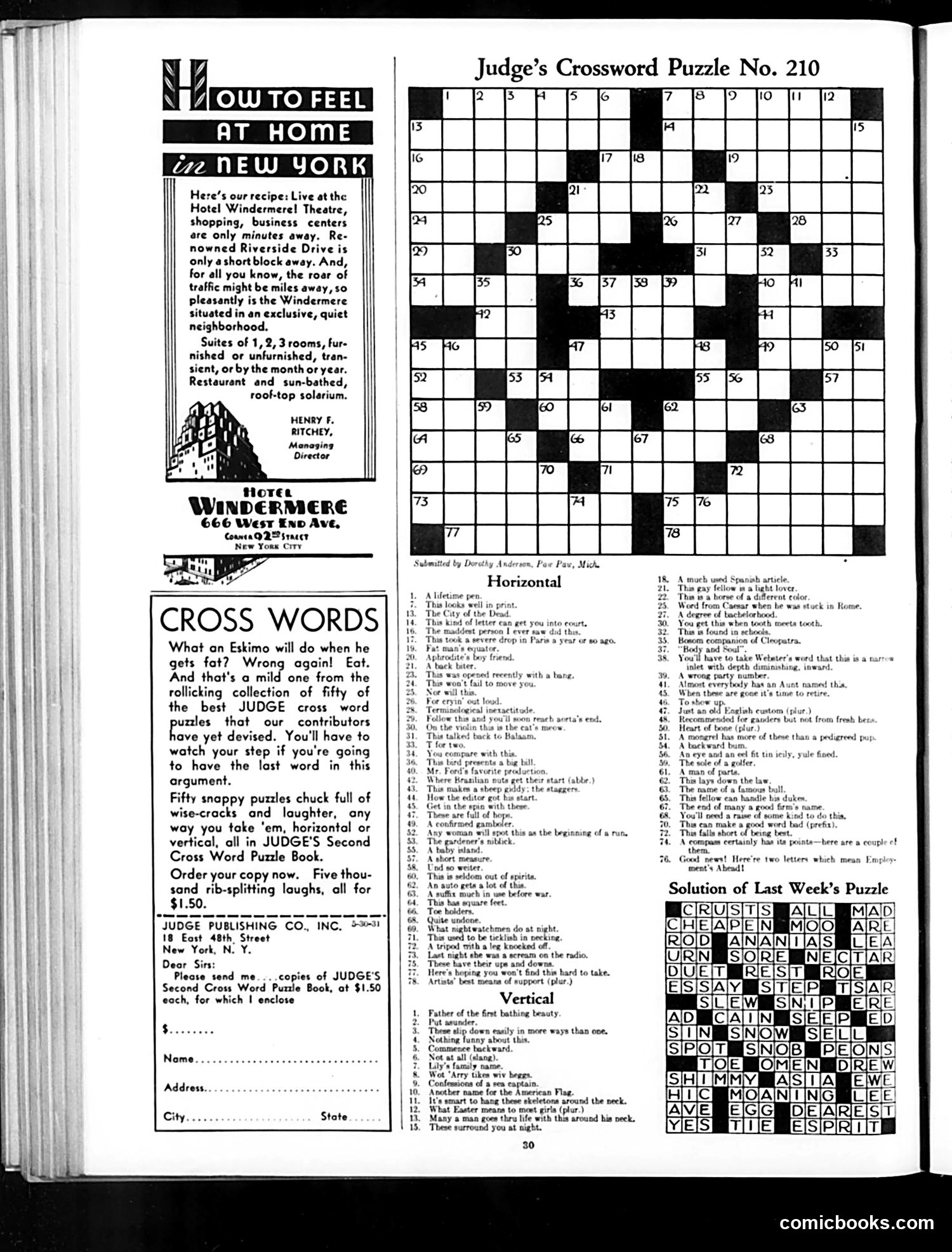
Judge Magazine Page Analysis This page is primarily advertising and puzzle content, not political satire. The main elements are: Advertisement (left): The Hotel Windermere promotes luxury apartment living in Manhattan, emphasizing proximity to theaters, shopping, and business while claiming a quiet, exclusive neighborhood setting on Riverside Drive. Crossword Puzzle (right): Judge's puzzle #210 with humorous clues rather than traditional definitions. The clues use wordplay and contemporary 1920s-30s references—for instance, "Toe holders" (shoes), "What night watchers do at night" (sleep), and "A wrong party number" (misdial). Puzzle Book Advertisement (center): Promotes Judge's Second Cross Word Puzzle Book, marketed as containing "fifty snappy puzzles" full of "wise-cracks and laughter." The content reflects Judge magazine's function as entertainment and advertising for affluent urban readers, rather than political commentary. The humor is lighthearted wordplay aimed at middle-to-upper-class New Yorkers.
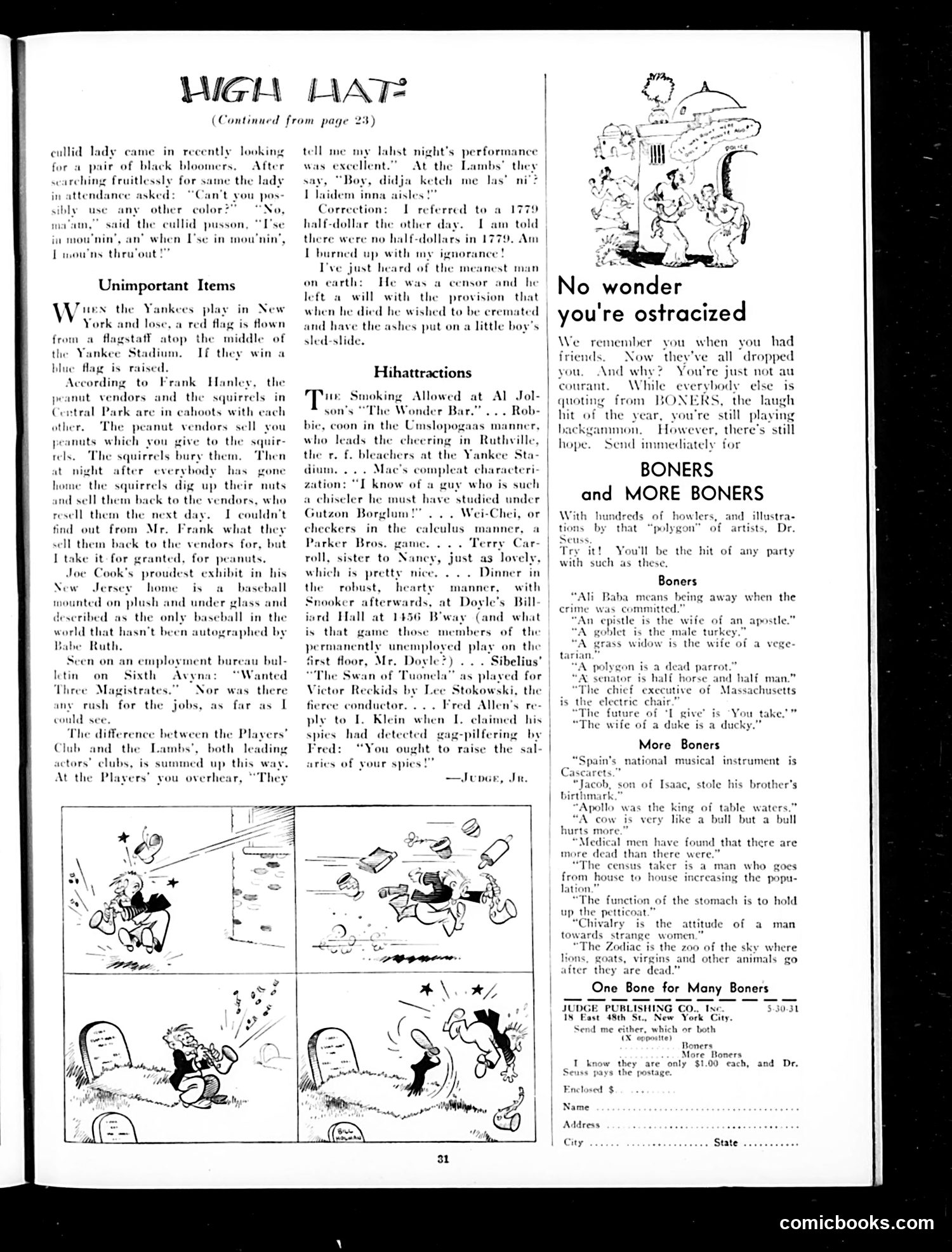
Explanation for Modern Readers This page from *Judge* magazine contains humor pieces and advertisements typical of mid-20th century American satirical publishing. The opening anecdote uses a racist dialect joke about a Black woman shopping for mourning clothes—reflecting the era's offensive racial caricatures common in mainstream publications. "Unimportant Items" is a humor column listing absurd or trivial observations: Yankees raising colored flags based on game outcomes, peanut vendors and squirrels allegedly working together, and a baseball autographed by everyone *except* Babe Ruth. These are gentle, nonsensical jokes playing on everyday Americana. "Hihattractions" notes Broadway shows and venues of the era (Al Jolson, Victor Records, Lee Stokowski). The cartoons (bottom half) appear to show slapstick scenarios involving cemetery/graveyard settings with physical comedy. "BONERS and MORE BONERS" advertises a humor book featuring intentionally absurd definitions and malapropisms—a popular comedic format of the period. The overall tone reflects 1930s-40s mainstream American humor: racially insensitive, vaudeville-influenced, and focused on wordplay and absurdist observations rather than political satire.
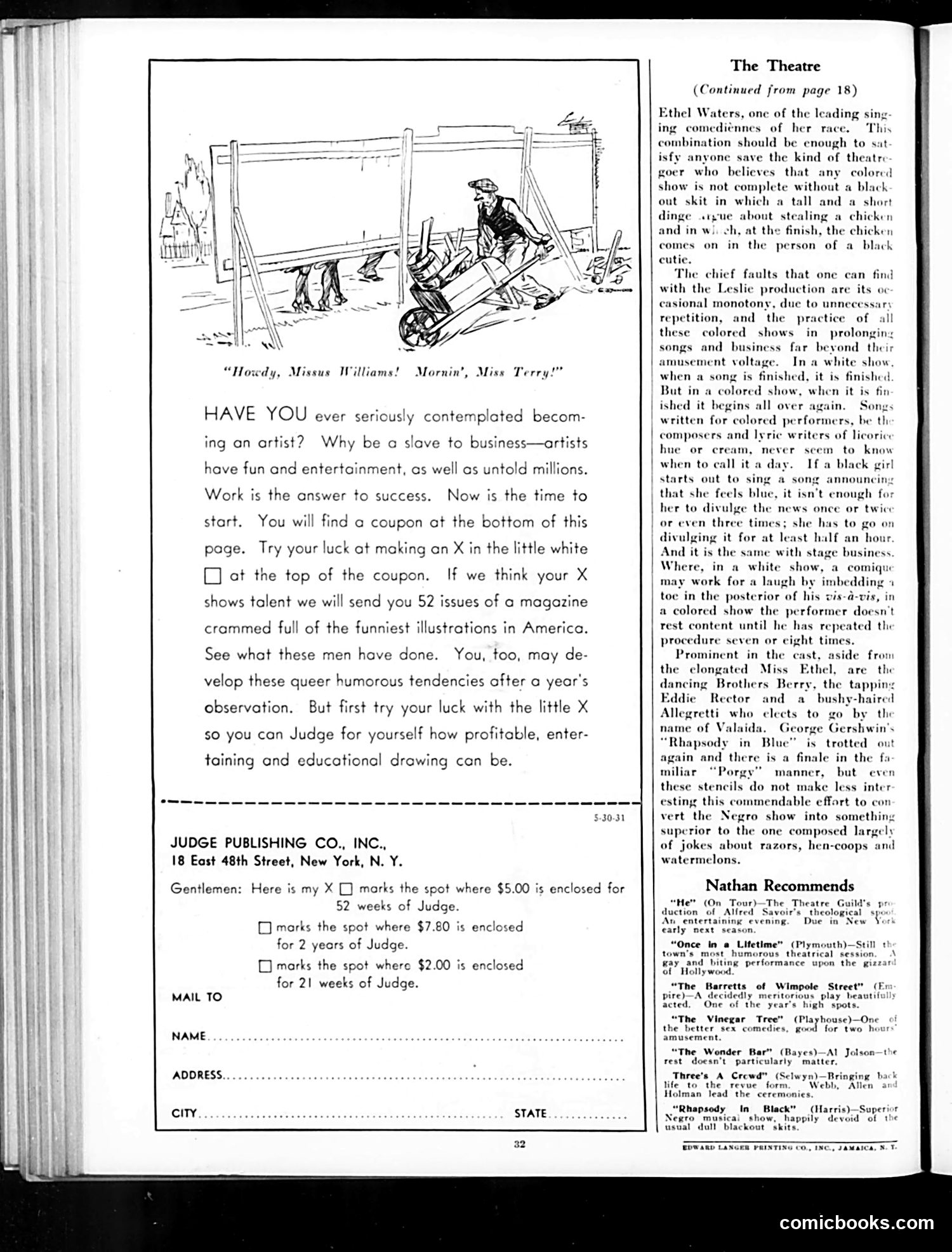
Judge Magazine Page: Theater Review and Advertisement This page combines a recruitment advertisement for aspiring cartoonists with theater criticism. The cartoon at top shows someone greeting neighbors while working construction—a visual gag supporting the text's pitch that artists can have "fun and entertainment, as well as untold millions." The bulk of the page is a theater review criticizing a production featuring Black performer Ethel Waters. The critic uses explicitly racist language ("dinge," "licorice hue or cream") while discussing what he sees as flaws specific to "colored shows"—excessive repetition, prolonged musical numbers, and slapstick business. He contrasts this unfavorably with white theater standards. The review treats racist stereotypes (razors, hen-coops, watermelons) as established comedy conventions for Black performance, while praising the cast's attempts to elevate the material. The page concludes with brief recommendations for Broadway shows, including one featuring Al Jolson. This document reveals 1930s entertainment industry racism and how mainstream publications normalized such attitudes.
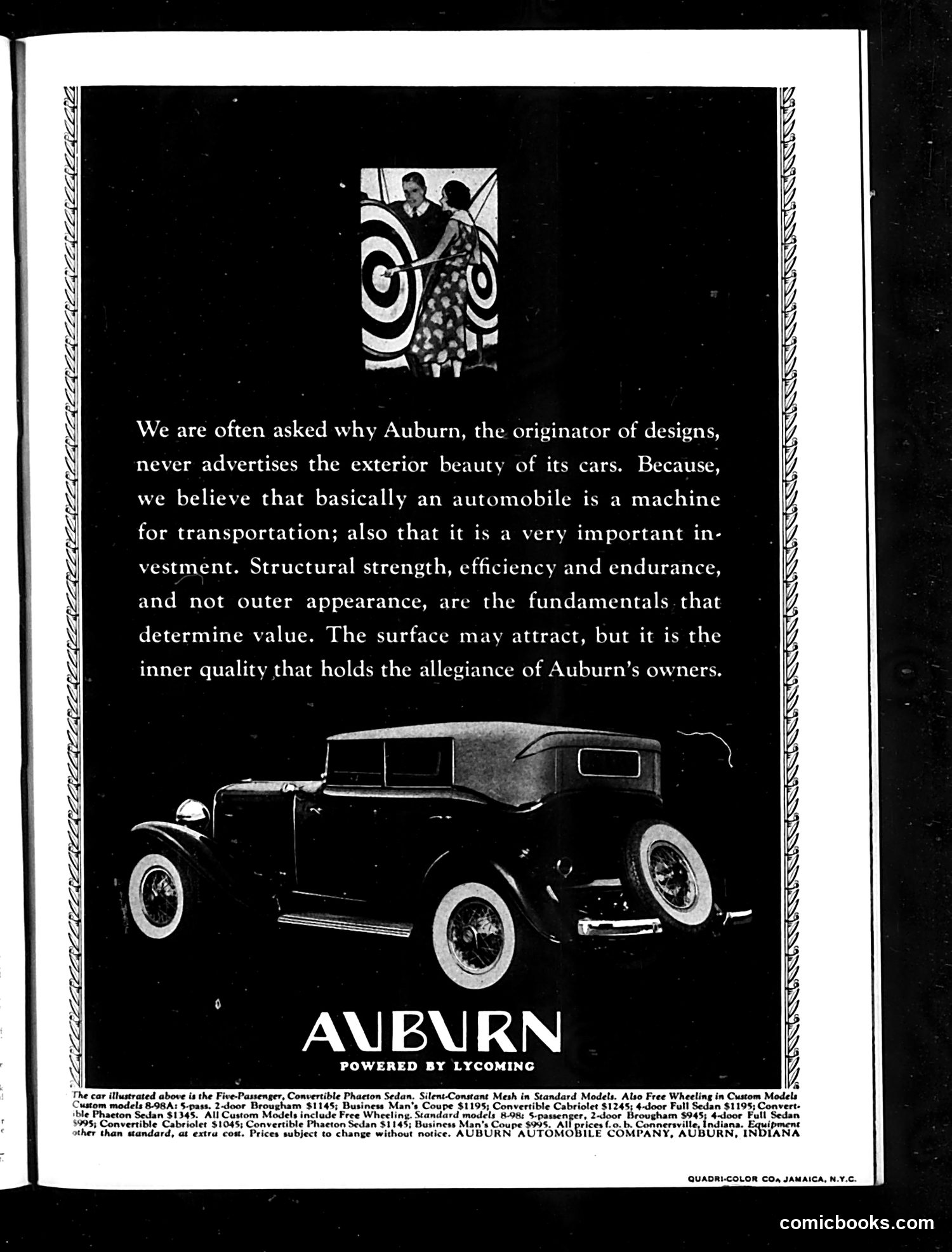
Auburn Automobile Advertisement This is primarily a product advertisement, not political satire. Auburn automobiles uses this Judge magazine page to market their cars with a philosophical pitch rather than visual appeal. The ad features a small illustration of two figures examining design patterns (top), and below, a photograph of an Auburn automobile. The text argues Auburn's marketing philosophy: they don't emphasize exterior styling because cars are fundamentally "machines for transportation" and important financial investments. Value derives from "structural strength, efficiency and endurance"—internal quality—not surface appearance. This represents a sales strategy peculiar to the era: positioning Auburn as the sensible, serious choice for practical buyers who value engineering over fashion. The tone is somewhat defensive, suggesting competitors (like flashier brands) were winning through aesthetic appeal. The ad lists multiple model variants and prices, emphasizing variety for different buyer segments.
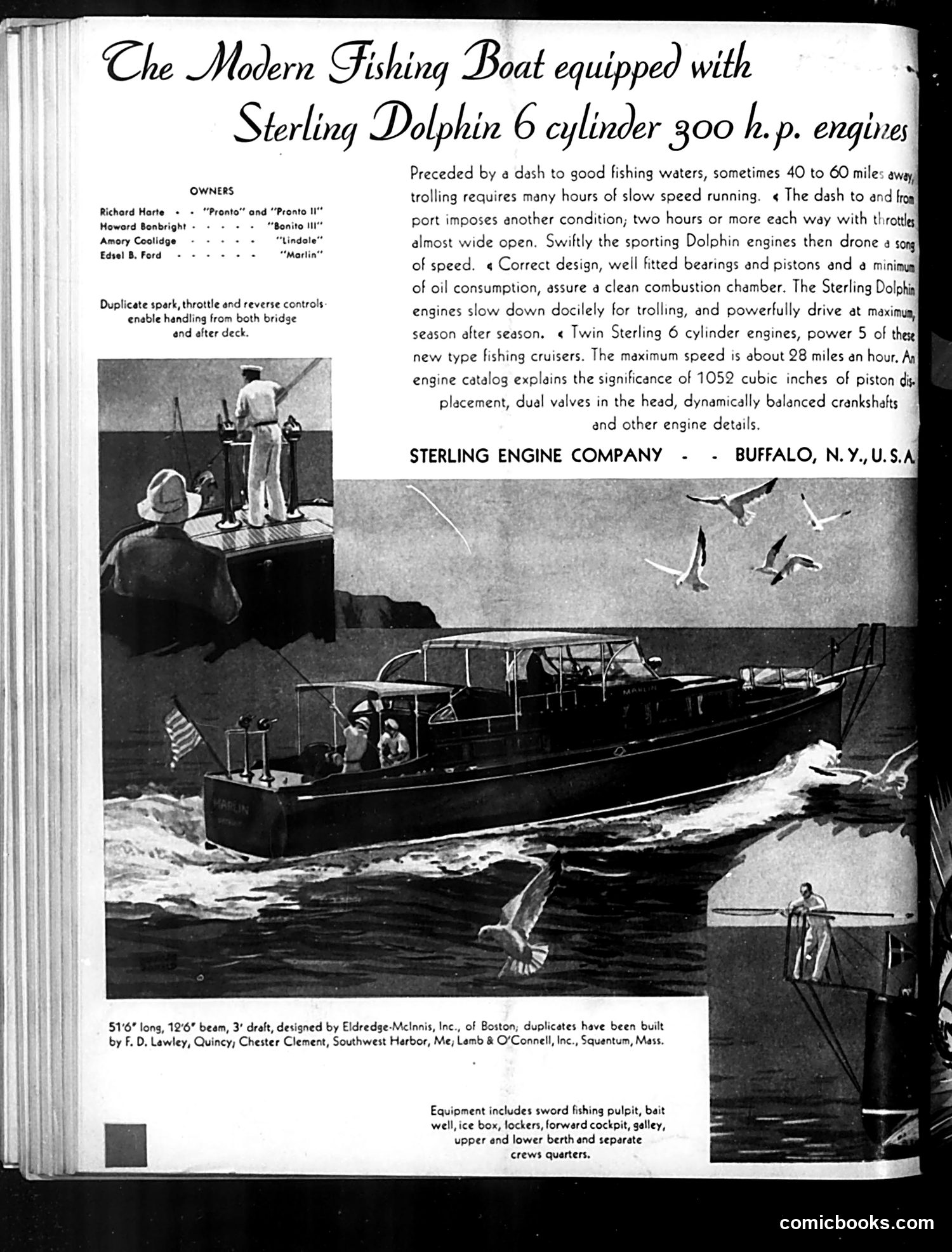
Analysis This is not a cartoon or satire—it's a straightforward advertisement for modern fishing boats equipped with Sterling Dolphin engines. The page appears in *Judge* magazine, but functions purely as commercial promotion. The "owners" listed (Richard Harte, Howard Bonbright, Amory Coolidge, Edsel B. Ford) are wealthy individuals who commissioned fishing vessels with these engines. Edsel B. Ford's inclusion suggests prominent business elite patronage. The content emphasizes technical specifications: the boats' ability to cruise 40-60 miles to fishing grounds, dual controls for bridge and deck operation, and engine performance details (1052 cubic inches displacement, dual valves, balanced crankshafts). The photographs show the fishing boat in operation and detail. There is no political commentary or satire evident—this is simply a luxury product advertisement targeting affluent sportsmen, positioned within *Judge*'s pages as paid content.