judge
Judge — June 6, 1931
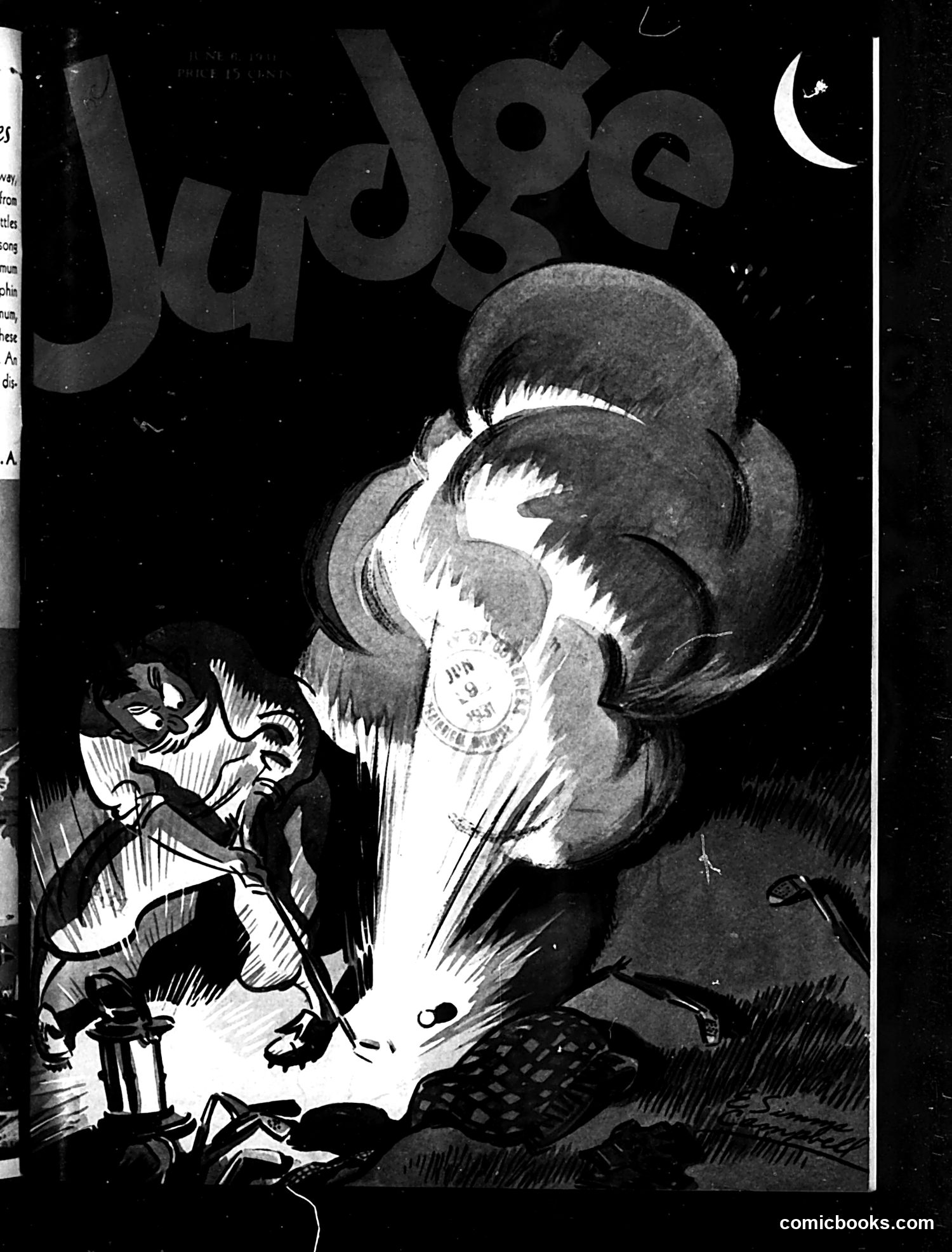
Analysis of Judge Magazine Page This appears to be a cover or major illustration from *Judge* magazine featuring the title "Judge" at top. The image depicts a large, menacing figure with exaggerated features looming over smaller characters below. The artistic style—with dramatic chiaroscuro shading and expressive linework—is typical of early-to-mid 20th century satirical cartooning. The composition suggests social or political commentary, with the massive figure dominating the composition in a threatening manner. However, without additional context or visible text identifying the specific figures, I cannot reliably determine which political figures or events are being satirized. The nighttime setting (crescent moon visible) and dramatic lighting emphasize the ominous tone, suggesting criticism of some threatening force or entity.
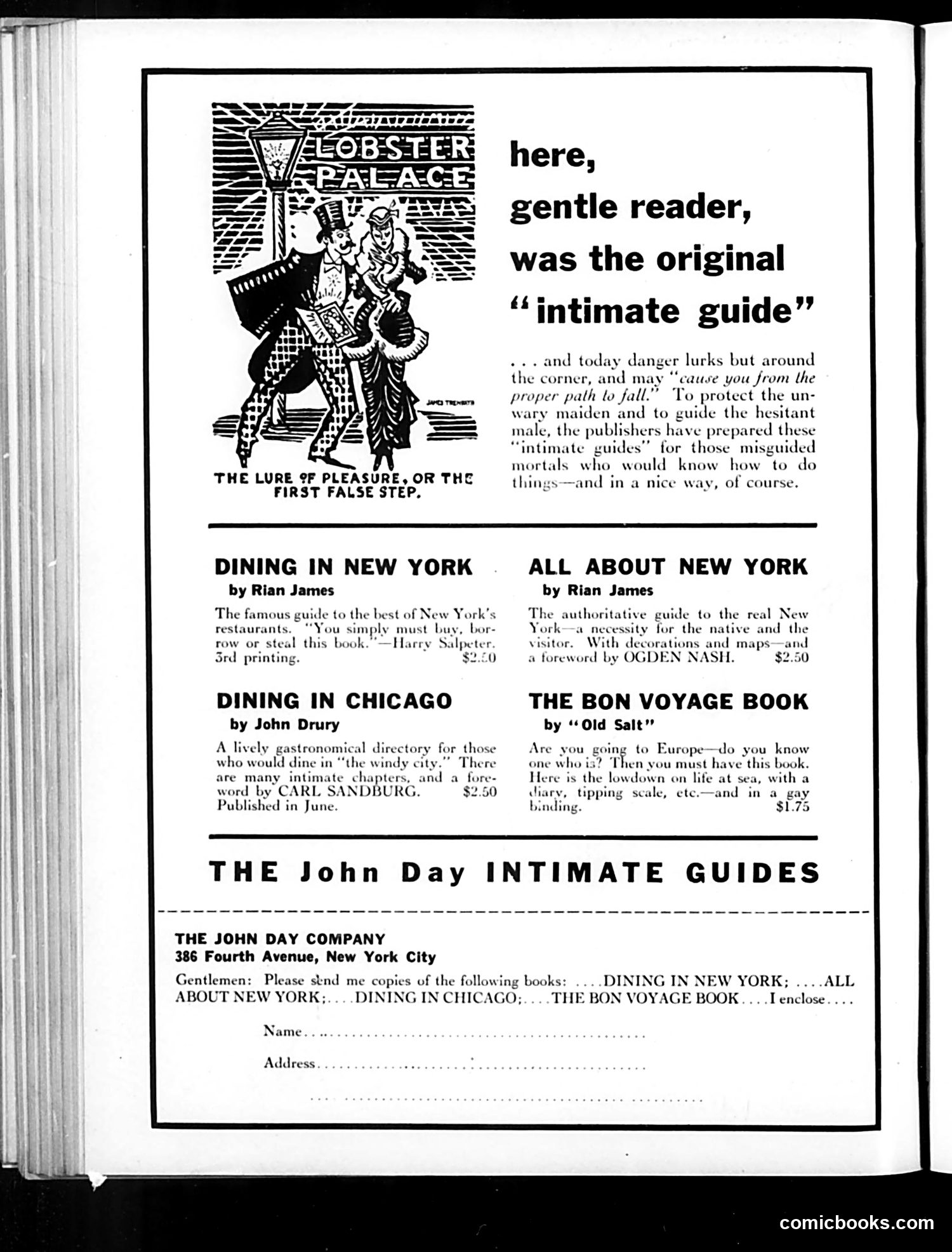
Analysis This page is primarily advertising, not satire or political commentary. The top section features a woodcut illustration titled "The Lure of Pleasure, or The First False Step," depicting figures outside the Lobster Palace. The accompanying text frames these "intimate guides" as protective resources for "unwary maidens" and "hesitant male[s]" navigating urban dangers. Below are advertisements for four books published by the John Day Company: dining guides for New York and Chicago, and "The Bon Voyage Book" for ocean travelers. The advertising copy uses period euphemisms—references to "proper path" and "fall"—that hint at moral concerns about urban temptation and vice, reflecting early 20th-century anxieties about city life.
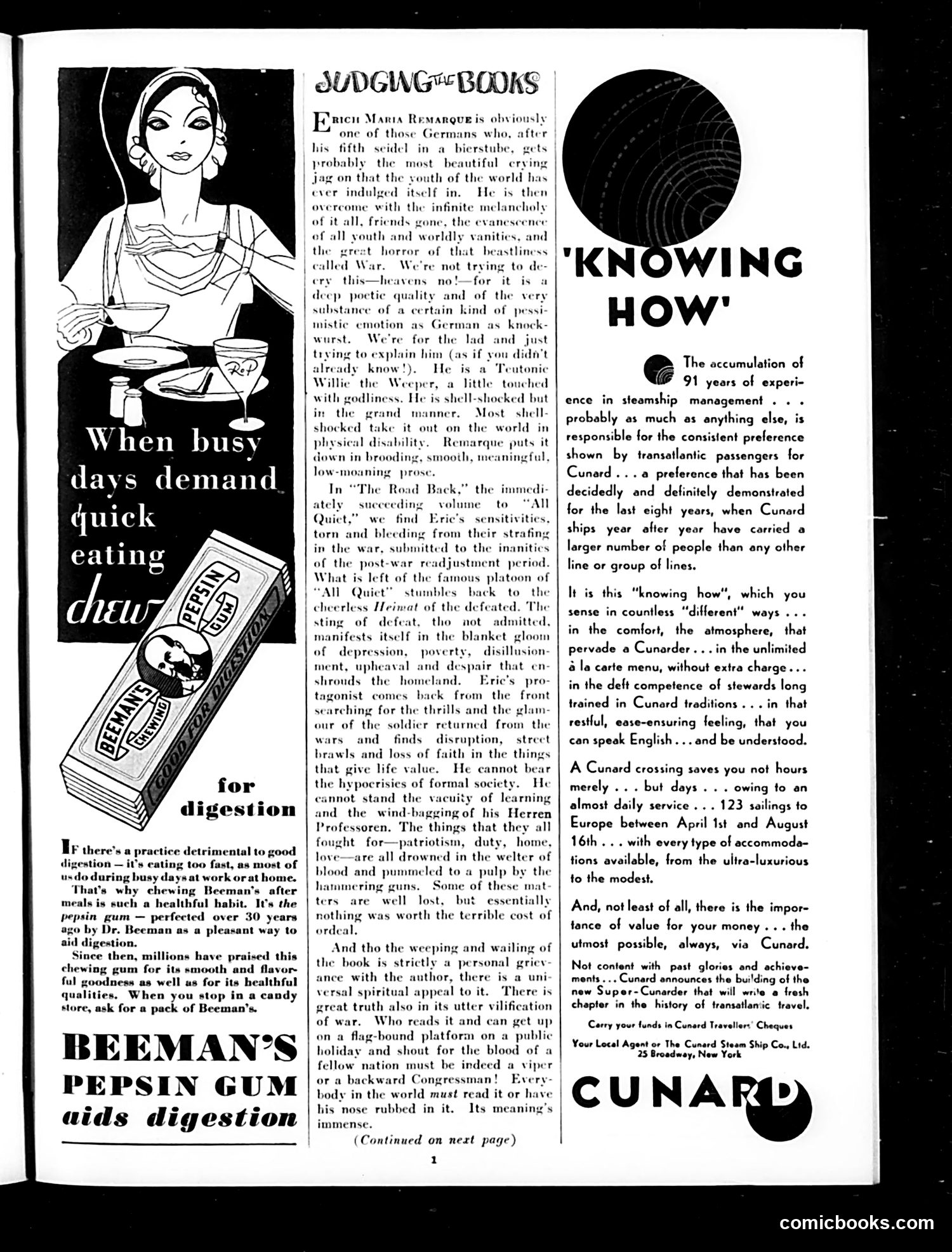
Analysis This page is primarily advertising, not political satire. It contains: 1. Beeman's Pepsin Gum ad (left): A digestive aid advertisement from the era when gum was marketed for health benefits, not just flavor. The copy emphasizes its supposed digestive properties. 2. "Judging the Books" column (center): A book review of Erich Maria Remarque's *"The Road Back,"* discussing its post-WWI themes of disillusionment and lost youth. The reviewer praises it as essential reading about war's psychological costs. 3. Cunard shipping line ad (right): Marketing transatlantic cruises, emphasizing luxury service and value. The page reflects 1930s consumer culture and advertising strategies, with the literary review providing context about interwar German literature's exploration of war trauma.
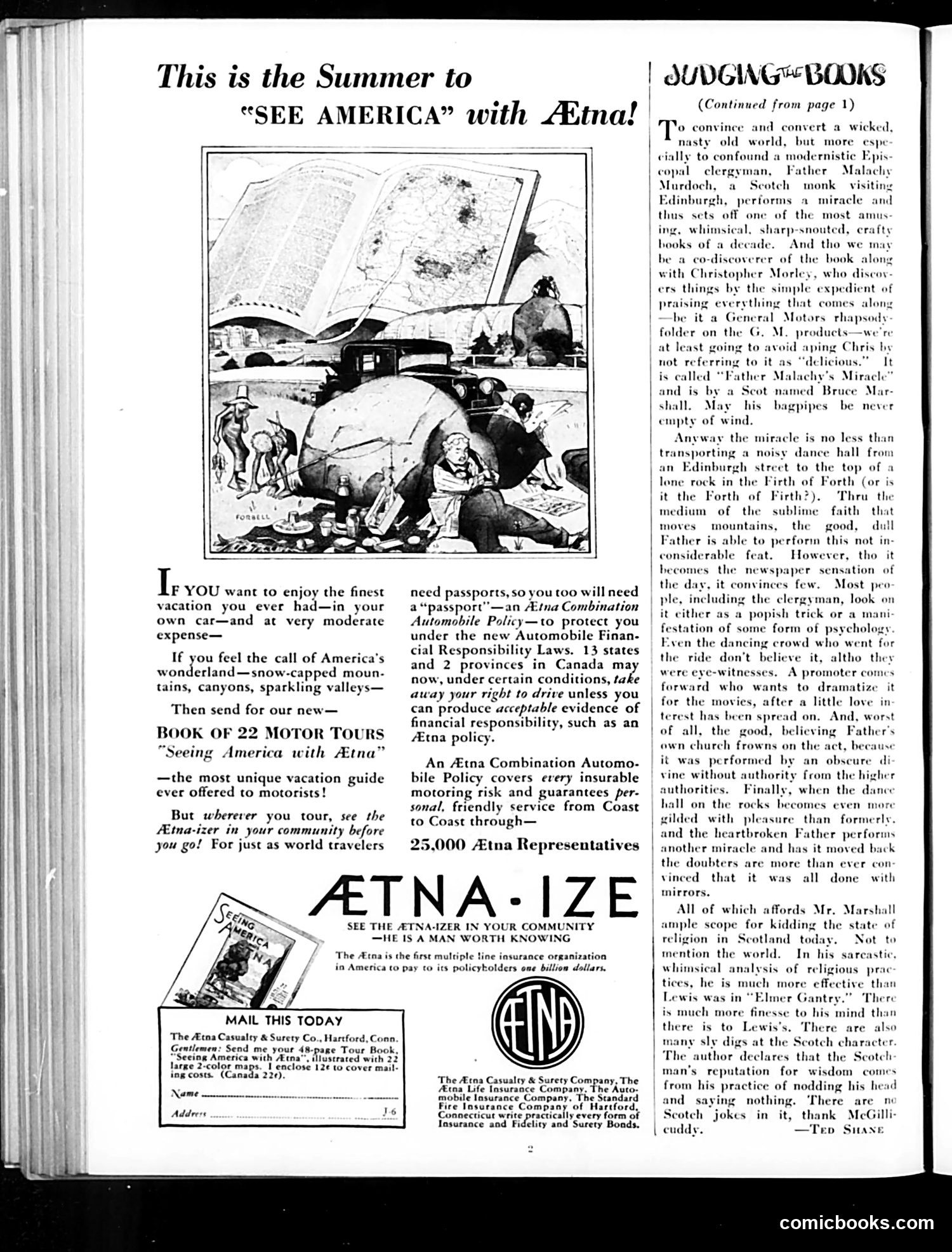
Page Analysis This page is primarily advertising, not satire or political commentary. The dominant content is a large Ætna insurance advertisement promoting motor tours and vacation travel across America. The cartoon illustration shows tourists camping and consulting a map, illustrating the "See America with Ætna" campaign. The right column contains a book review (titled "Judging the Books") discussing a Scottish novel featuring Father Malachi Murdoch and featuring commentary on religious satire. The review is unrelated to the advertisement. The page reflects 1920s-era consumer culture promoting automobile tourism and insurance products, with the cartoon serving primarily as promotional imagery rather than political satire.
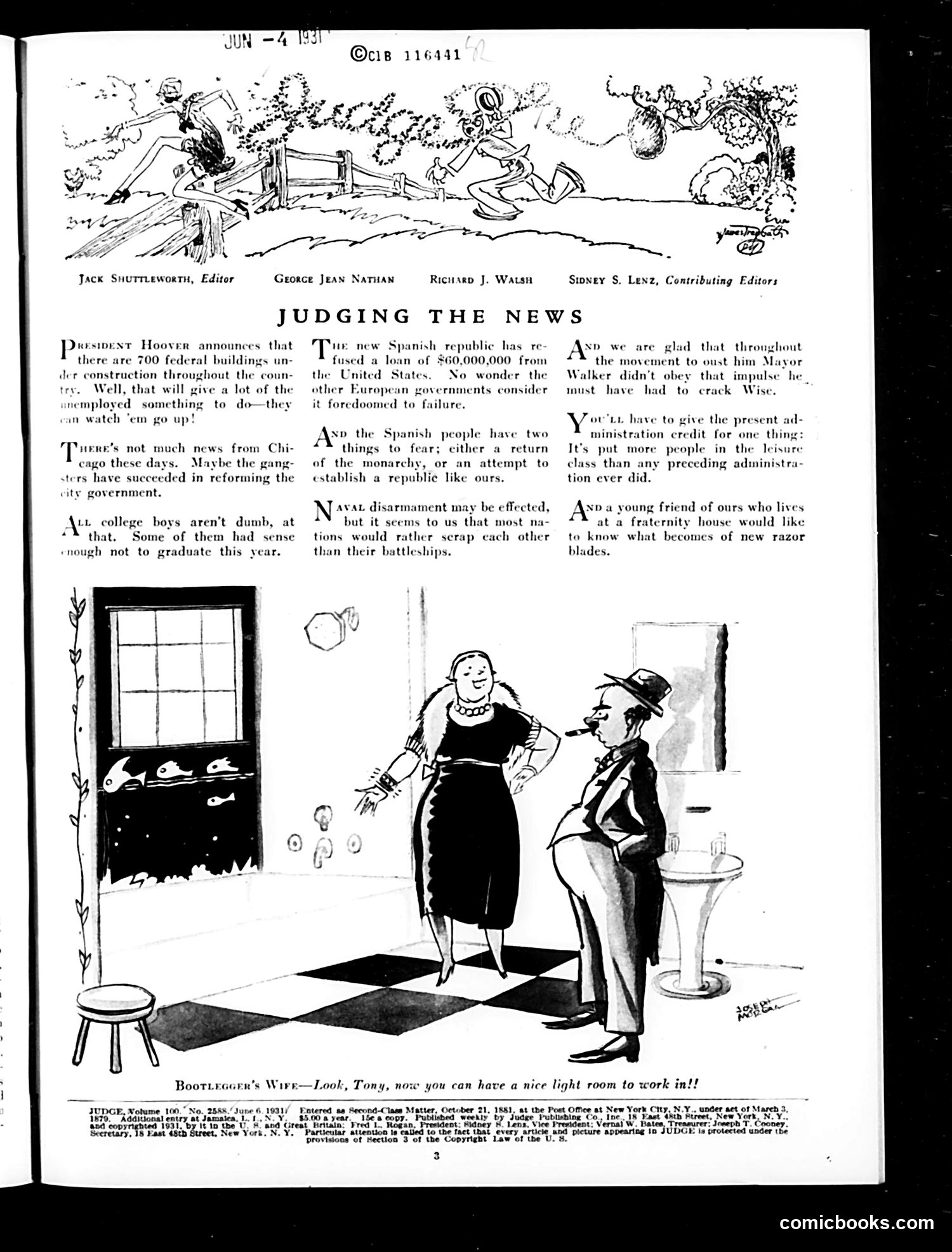
Judge Magazine Commentary, June 4, 1931 This page contains editorial commentary on current events rather than traditional cartoons. The "Judging the News" section offers satirical takes on: President Hoover's announcement of 500 federal building projects—criticized as insufficient economic stimulus during the Great Depression. Chicago gangsters praised for reforming city government more effectively than legitimate officials. College boys who wisely avoided graduating into the Depression economy. Spanish politics—the new republic's stability concerns European governments. Naval disarmament proposals, mocked as nations preferring battleship scrapping to actual peace. The bottom cartoon depicts a bootlegger's wife showing her husband a well-lit room, sarcastically suggesting Prohibition enforcement has improved their living conditions—dark satire on organized crime's prosperity during the alcohol ban era.
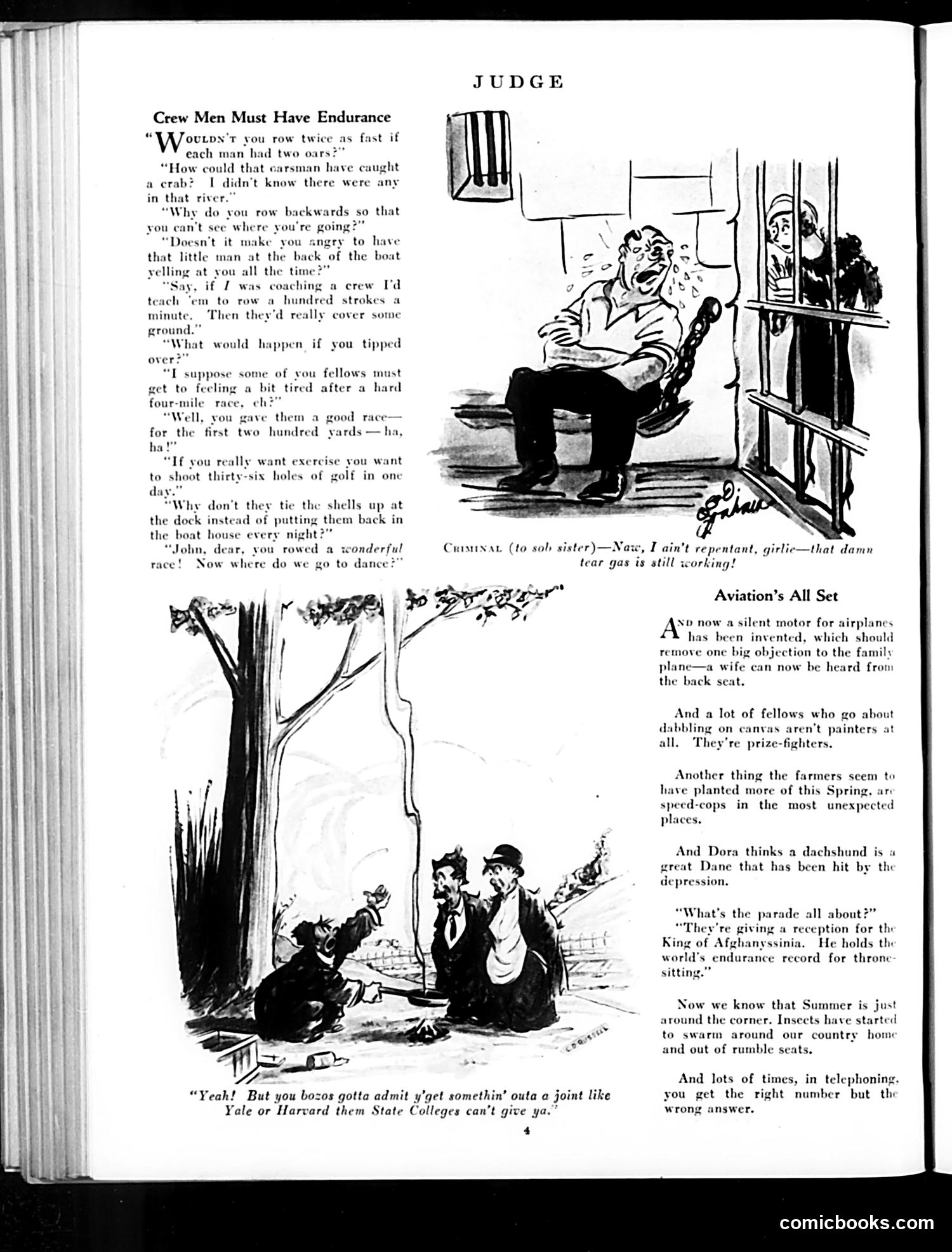
Judge Magazine Page Analysis This page contains humor pieces rather than political cartoons. The top section, "Crew Men Must Have Endurance," presents a dialogue about rowing, mocking the physical toll and absurdity of competitive crew racing—a popular elite sport at the time. The main cartoon below depicts two men discovering a dead body hanging from a tree, with the caption about admitting "you bozos gotta get somethin' outa a joint like Yale or Harvard"—satirizing the pretensions of Ivy League education. The right column, "Aviation's All Set," offers brief social observations about new airplane silent motors, amateur painters, unseasonable crops, and a dachshund owner. These are light topical gags rather than serious satire, reflecting early-20th-century American middle-class concerns and humor conventions typical of Judge's entertainment-focused content.
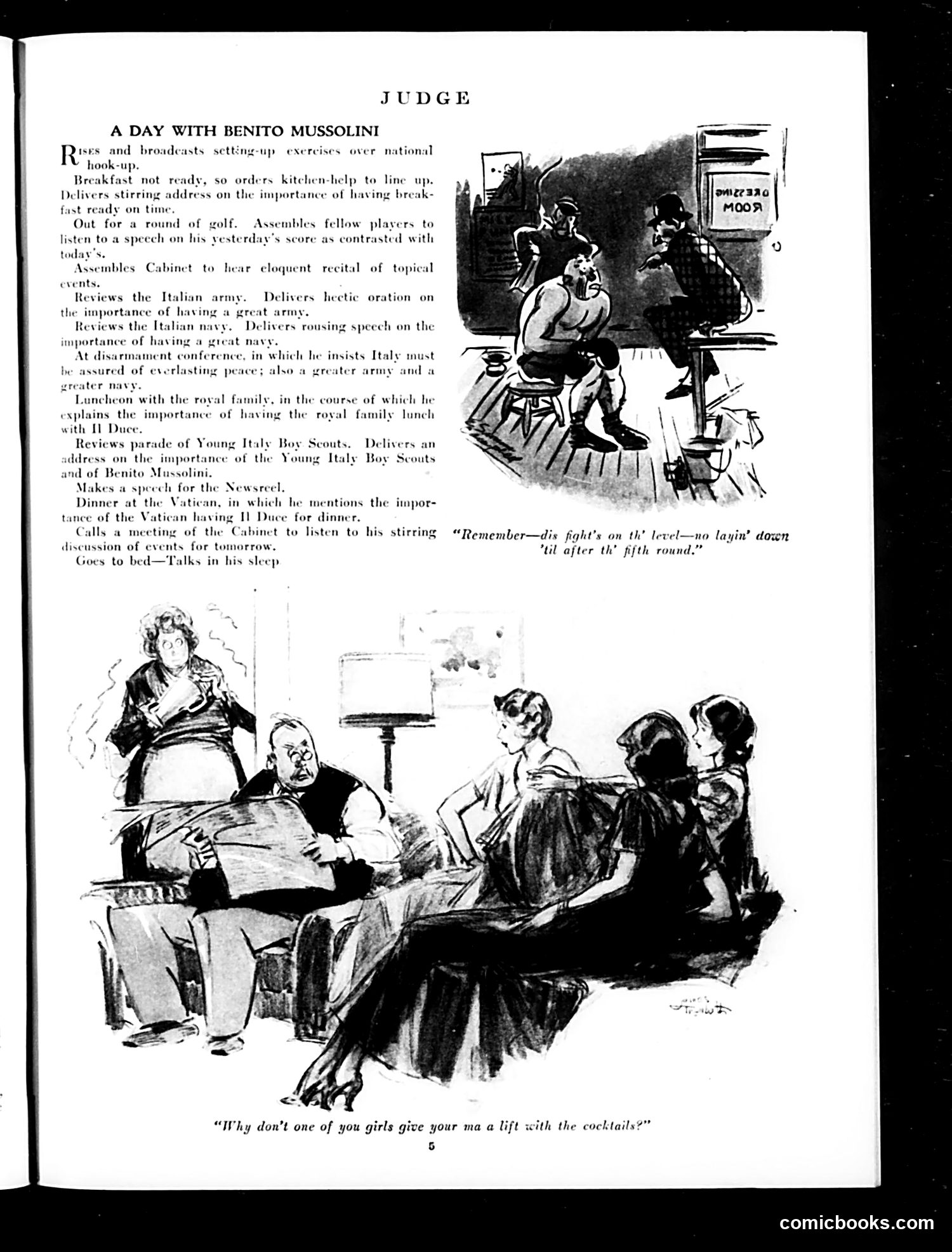
"A Day with Benito Mussolini" This satirical piece mocks Mussolini's daily activities during the fascist era. The text catalogs his schedule with deadpan humor: breakfast briefings on "importance of having breakfast on time," speeches about the military, lunches emphasizing "the importance of having the royal family lunch," and evening discussions at the Vatican about diplomatic dinners. The cartoons depict Mussolini conducting theatrical, propagandistic activities—addressing various groups while maintaining bombastic rhetoric about Italian power and prestige. The bottom illustration shows him relaxing at home with women, captioned with a crude joke about cocktails. The satire targets Mussolini's self-aggrandizing performative leadership style and the constant nationalist messaging that characterized Italian fascism in the interwar period.
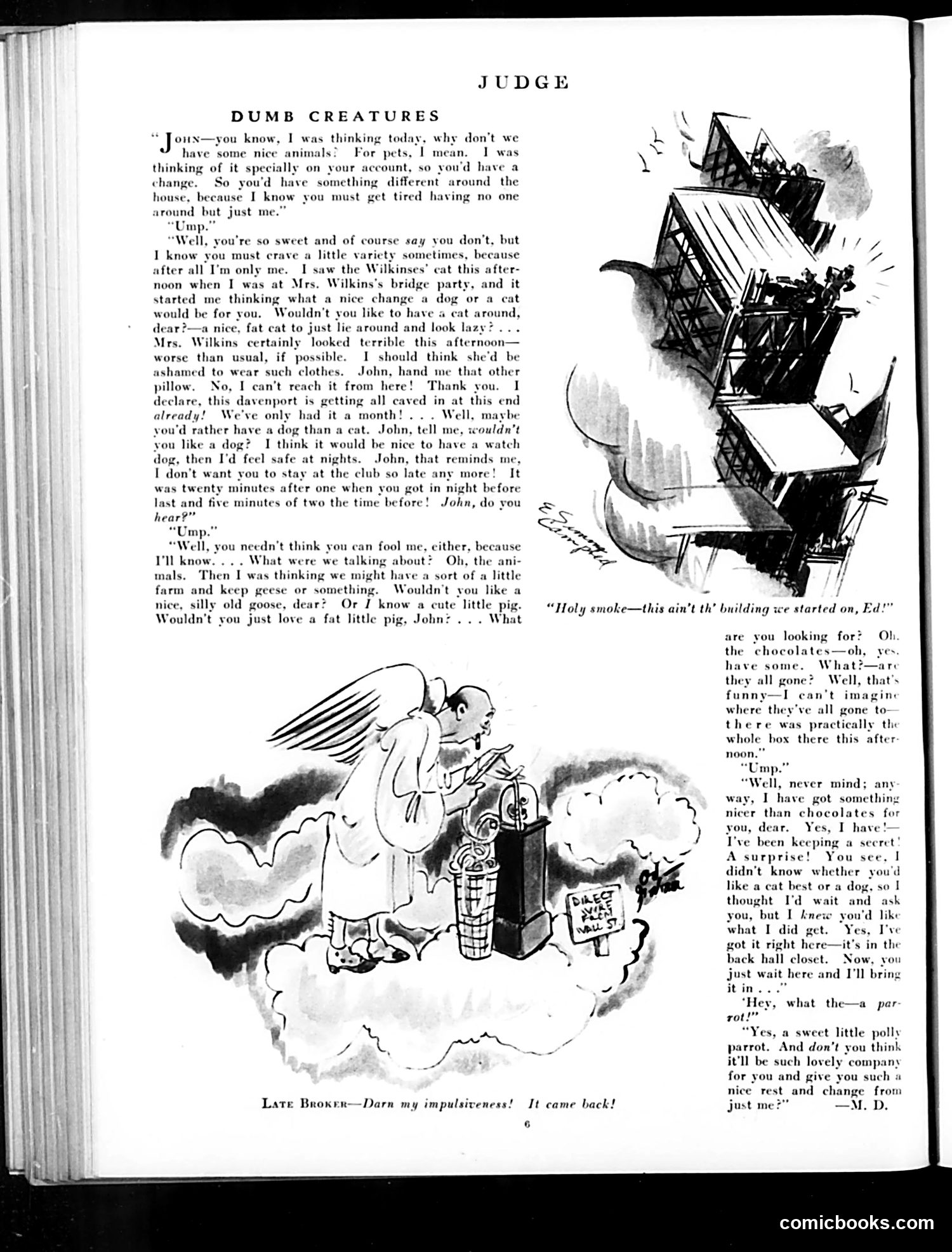
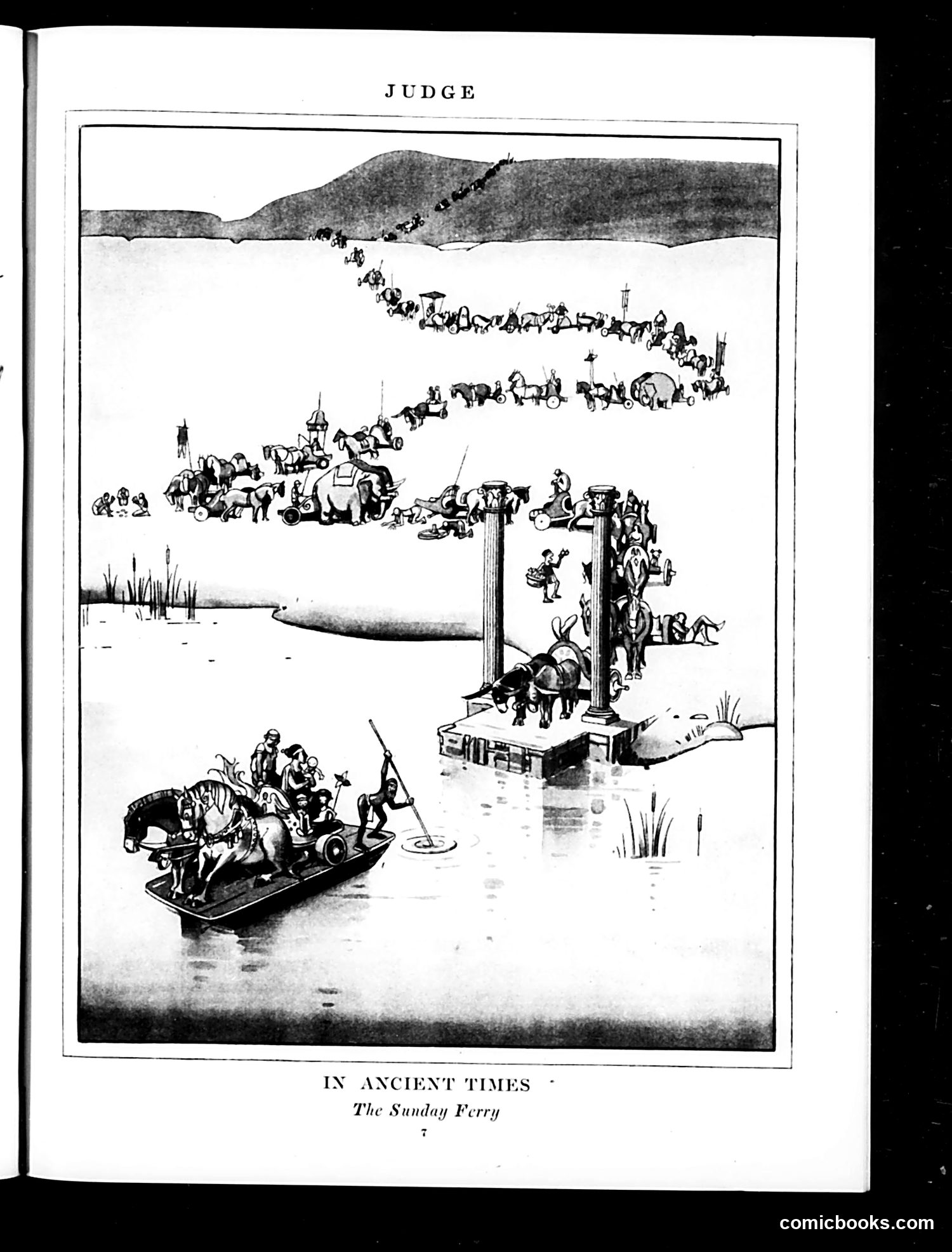
"The Sunday Ferry" - Judge Magazine Satire This cartoon satirizes the chaos of Sunday ferry service in what appears to be early 20th-century America. The illustration shows a massive, disorganized crowd attempting to board a ferry, with people, horses, carriages, and wagons piling up in complete pandemonium. A judge-like figure stands on an elevated platform presiding over the scene. The satire likely mocks the inadequate infrastructure and management of public transportation on weekends, when recreational travel surged. The "ancient times" title suggests ironic commentary—presenting the chaotic ferry system as primitive or outdated despite being contemporary. The central authority figure watching helplessly over the disorder implies critique of municipal governance's failure to manage public services effectively. The humor derives from exaggerating the actual conditions passengers experienced.
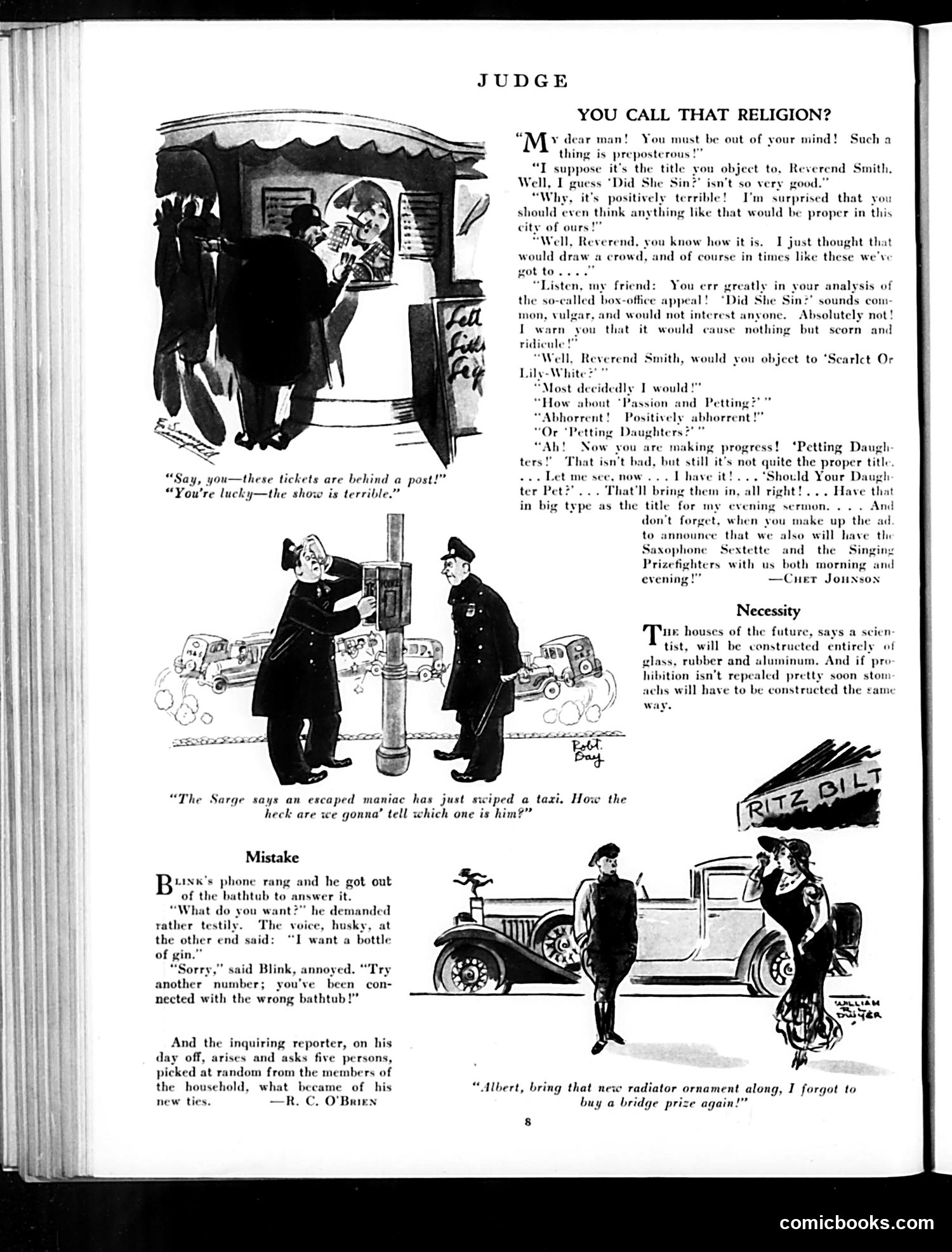
Judge Magazine Page Analysis This page contains three satirical pieces typical of 1920s American humor: "You Call That Religion?" depicts a clergyman objecting to theatrical titles like "Did She Sin?" and "Scarlet O-Lily-White" as scandalous, while the theater manager suggests increasingly risqué alternatives ("Petting Daughters"). The satire mocks religious hypocrisy—the reverend eventually accepts "Should Your Daughter Pet?" if properly framed as a sermon. This reflects 1920s culture wars over morality in entertainment and the "Jazz Age" tension between conservative and modern values. "Mistake" jokes about a wrong-number call to a bathtub instead of a gin supplier, likely referencing Prohibition (1920-1933), when alcohol was illegal and obtaining it required covert channels. "Necessity" satirizes scientific predictions about future glass houses while cynically noting that if Prohibition continues, stomachs will need reinforced construction—another Prohibition-era gag suggesting the drinking culture's resilience despite legal restrictions.
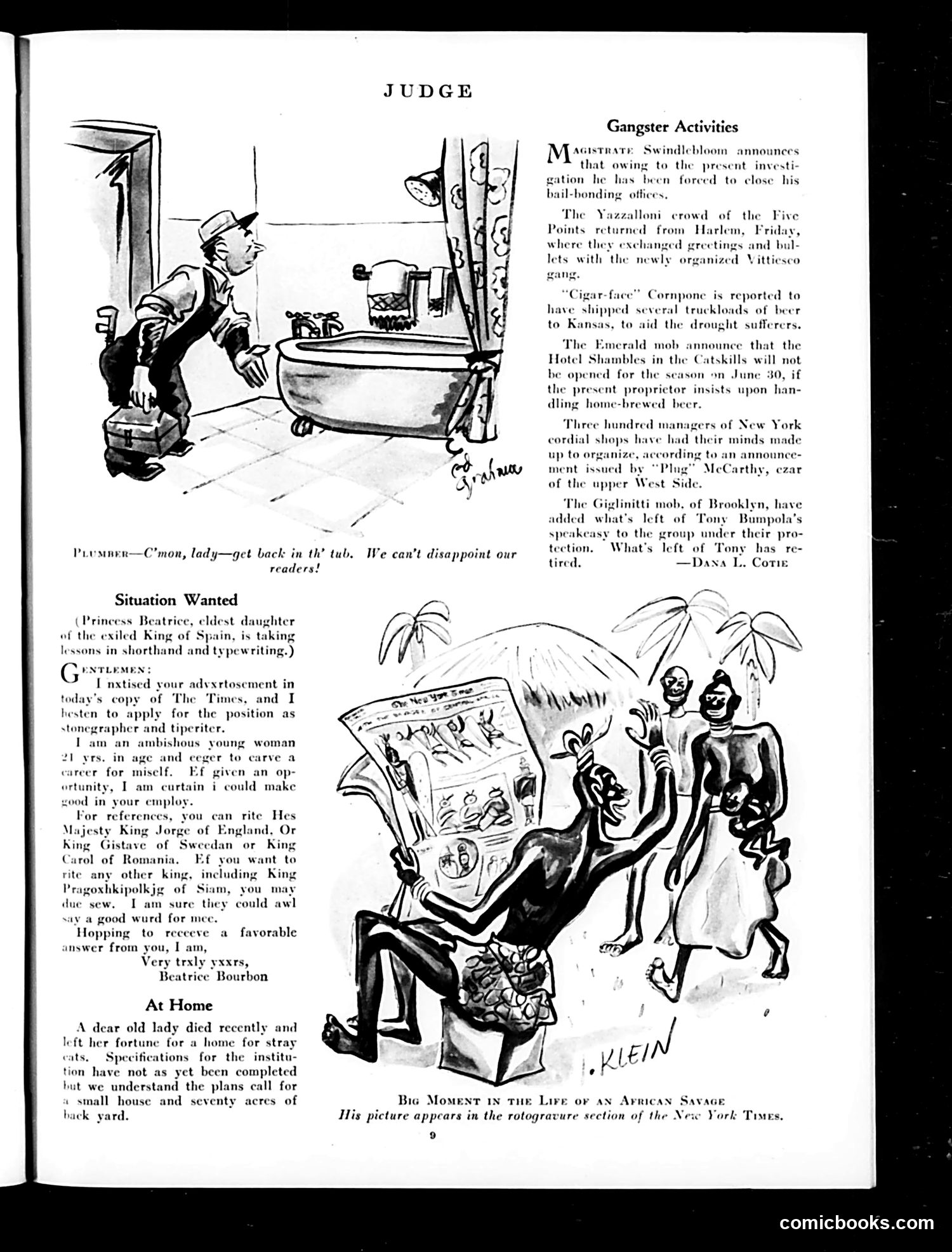
Judge Magazine Page Analysis This page contains three satirical pieces: "Gangster Activities" mocks Prohibition-era organized crime through fake "news" of various mob operations—gang violence, illegal beer smuggling, and protection rackets involving speakeasies. The humor relies on treating gangster activity as mundane gossip, with invented characters like "Cigar-face Cornpone" and mob bosses operating openly. "Plumber" cartoon shows a man in a bathtub, with the caption joking that he must stay in the tub to avoid disappointing readers—likely mocking serialized fiction's predictable plots and reader expectations. "Situation Wanted" satirizes Princess Beatrice of Spain (exiled royalty) applying for a stenographer job. The humor comes from her incompetent application riddled with misspellings, and her absurdly prestigious "references" (European kings), mocking both fallen nobility and overqualified applicants. "Big Moment in the Life of an African Savage" appears to be a Klein illustration satirizing photojournalism's exoticizing depiction of non-Western peoples in newspapers.
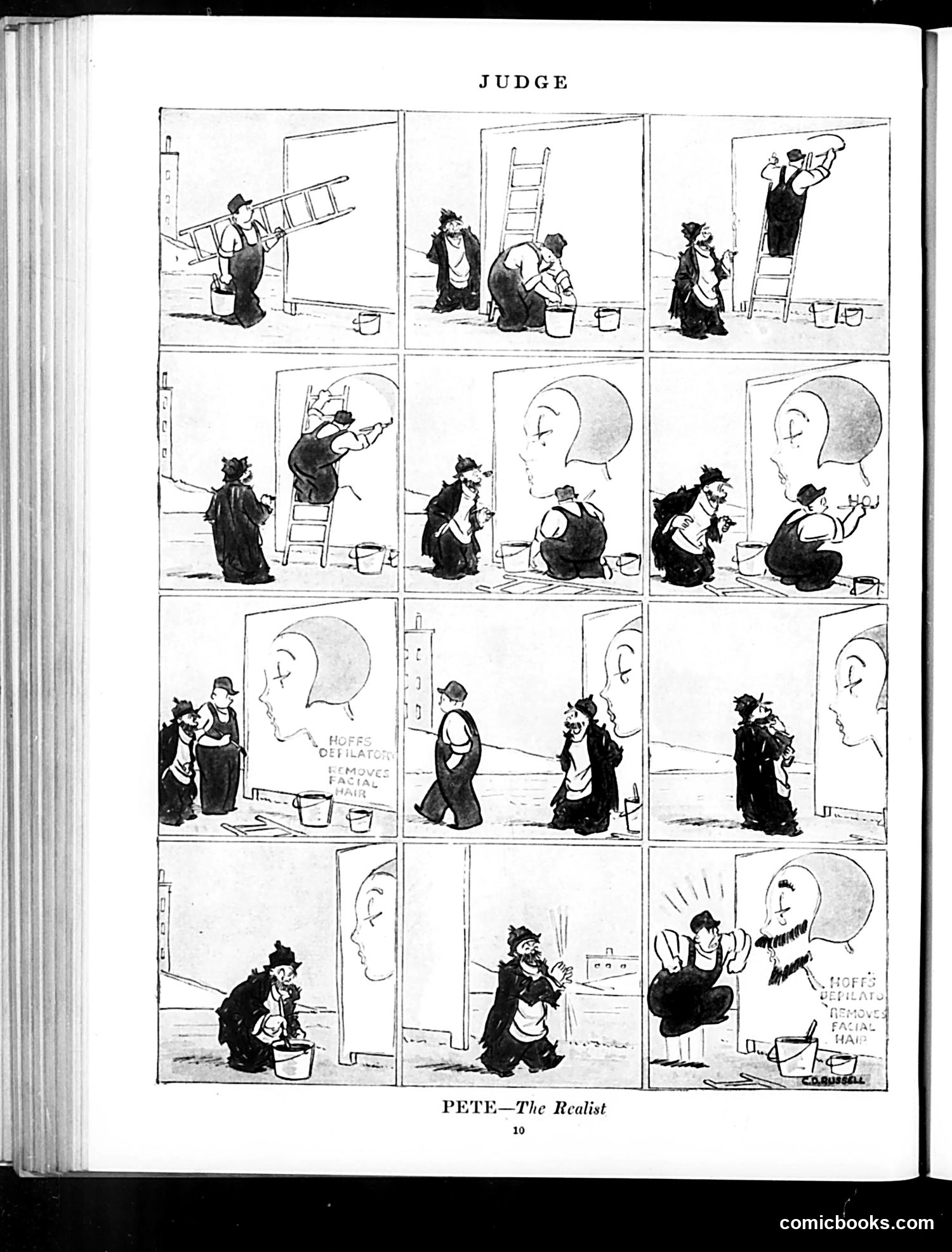
Analysis: "PETE—The Realist" This is a multi-panel satirical comic showing a figure painting a large portrait head. The narrative depicts the artist's pragmatic approach to his work. The joke appears to center on commercial realism: the artist begins by carefully painting facial features, but as panels progress, he becomes increasingly impatient. By the final panels, he's scrubbing away at the portrait with visible frustration, seemingly abandoning artistic detail for expedience. Text visible in lower panels reads "HOFFS DEPILATOY REMOVES FACIAL HAIR"—suggesting this may be an advertisement disguised as comedy, where the portrait serves as a display surface for product messaging rather than genuine art. The satire likely mocks either commercial artists who prioritize profit over craft, or advertisers who use any medium to promote products. "The Realist" title implies the artist cynically accepts compromising his work for practical gain.
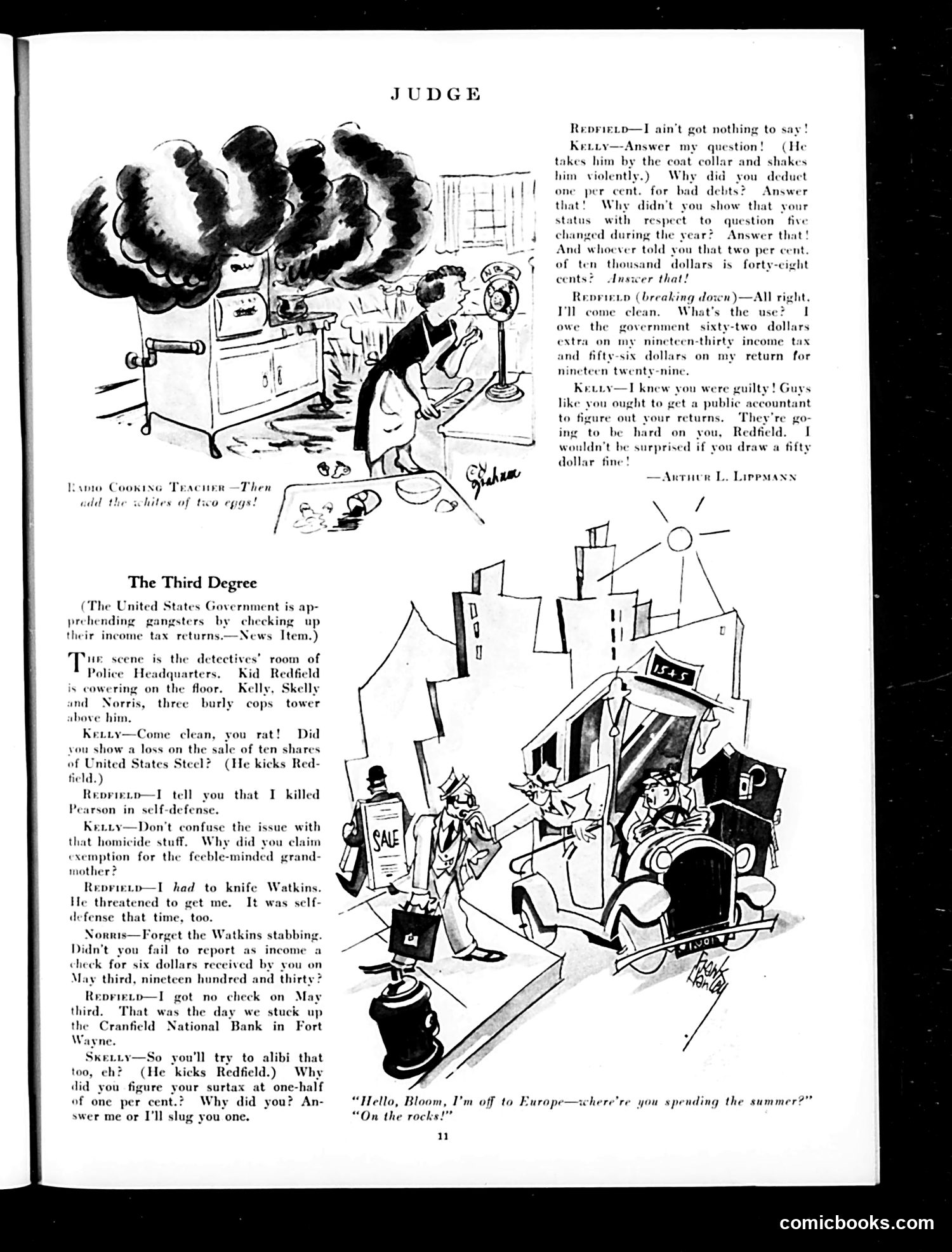
"The Third Degree" Satire This cartoon satirizes the U.S. government's then-novel strategy of prosecuting organized crime through income tax violations rather than direct criminal charges. The setup presents a darkly comic inversion: police detectives interrogate a gangster ("Kid Redfield") using brutal "third degree" tactics, but they're grilling him not about murders he admits to (stabbing Watkins, killing Pearson in self-defense, bank robbery) but about trivial tax discrepancies—undisclosed $6 checks, incorrect deductions, miscalculated percentages. The joke is that the government has become so focused on catching tax cheaters that actual violent crimes are dismissed as irrelevant distractions. The gangster's casual confessions to homicide are ignored; the cops only care about accounting errors. This satirizes the absurdity of using tax law as a crime-fighting tool and critiques bureaucratic priorities that prioritize financial paperwork over genuine criminal activity. The secondary cartoon above mocks incompetence in tax preparation, suggesting citizens need professional accountants to navigate confusing tax codes.
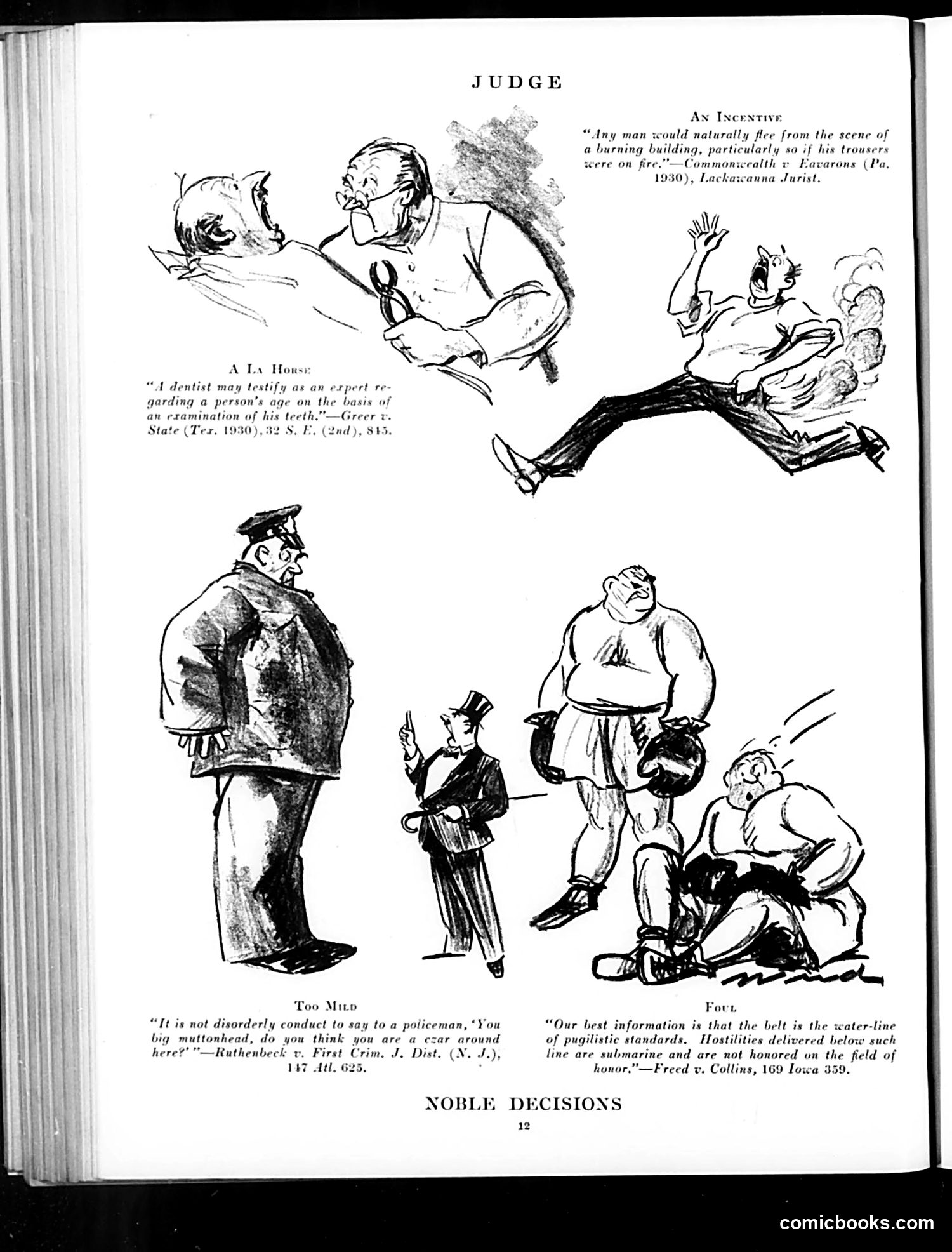
Judge Magazine: "Noble Decisions" (Page 12) This page satirizes absurd legal rulings through humorous illustrations. Each cartoon pairs a ridiculous court decision with a visual joke: "An Incentive": A man flees a burning building with his trousers on fire—the Pennsylvania court ruling that naturally people flee such scenes becomes darkly comic when taken literally. "À La Honse": A dentist testifies about age via tooth examination, illustrated with a judge examining a horse's teeth (the "Honse" pun), mocking expert testimony standards. "Too Mild": A policeman is called a "muttonhead," illustrating New Jersey's ruling that this insult isn't disorderly conduct—suggesting the bar for what constitutes disrespectable speech is absurdly high. "Foul": A boxing match below the "water-line" belt, playing on Iowa's ruling about "submarine" combat tactics—literally depicting underwater fighting to mock the decision's awkward language. The page mocks judicial reasoning by illustrating rulings in exaggerated, literal ways, suggesting these court decisions stretch logic to absurd conclusions.
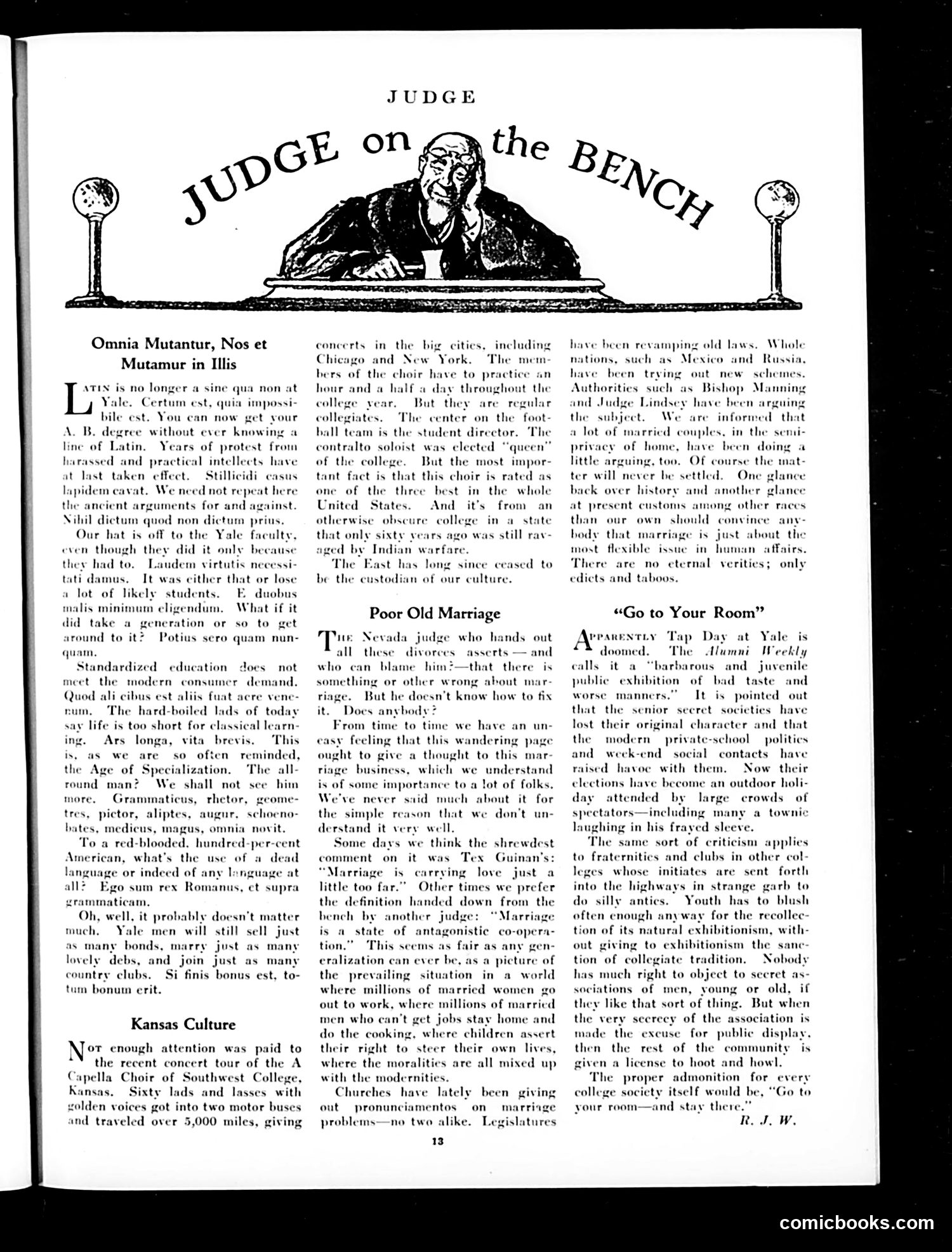
Judge Magazine Page Analysis This page from *Judge* satirical magazine contains three distinct pieces: Header "Judge on the Bench": A masthead featuring a stern judge, setting the editorial tone. "Omnia Mutantur" (Latin phrases throughout): A commentary on Yale University eliminating Latin as a degree requirement. The author uses Latin ironically while lamenting that classical education no longer meets "modern consumer demand." The satire targets the "hard-boiled" modern student who finds life "too short for classical learning," suggesting American education is abandoning intellectual rigor for practical utility. "Kansas Culture": Praise for Southwest College's A Capella Choir's concert tour—apparently noteworthy because an "obscure college in a state...still ravaged by Indian warfare" produced one of the nation's three best choirs, challenging Eastern cultural superiority. "Poor Old Marriage": Commentary on Nevada's divorce judge handling countless cases, suggesting marriage is fundamentally broken. References Tex Guinan's quip that "marriage is carrying love just a little too far," and notes modern confusion about marital roles—women working, men housekeeping—indicating social upheaval. All pieces critique American modernization undermining tradition.
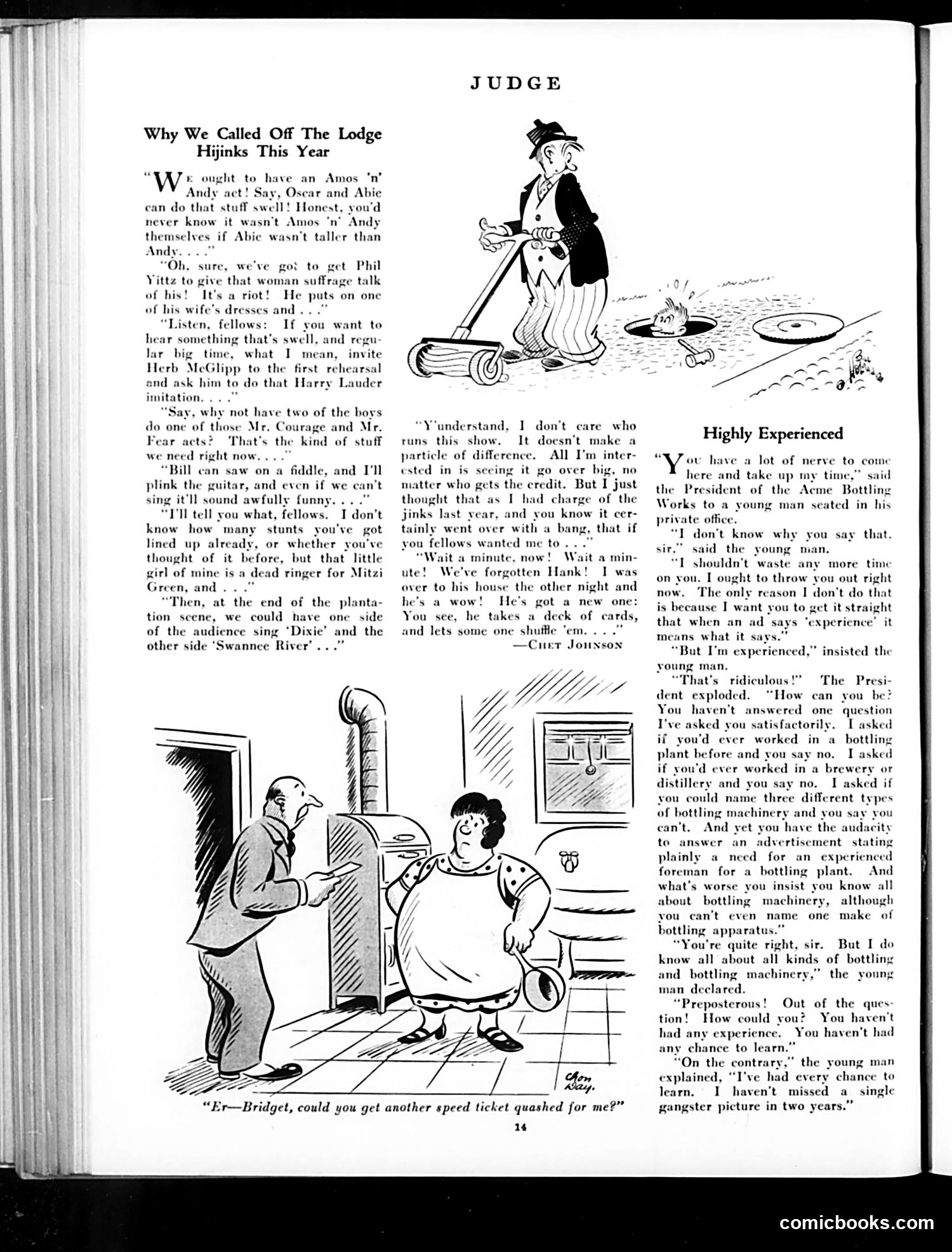
Explanation for Modern Readers This Judge magazine page contains two satirical pieces: "Why We Called Off The Lodge Hijinks This Year" (left): Men planning a fraternal lodge entertainment show endlessly propose imitative acts—"Amos 'n' Andy" routines, Phil Yittz impressions, Harry Lauder acts—while constantly interrupting each other with "Wait a minute!" The satire targets how organizations devolve into chaotic planning where members vie for credit and attention rather than accomplishing anything. The piece mocks both performative entertainment and male ego. "Highly Experienced" (right): A factory boss interrogates a job applicant claiming "experience" despite admitting he's never worked in a bottling plant, brewery, or distillery, and can't name bottling machinery types. The applicant's defense: he hasn't "missed a single gangster picture in two years"—implying he learned about machinery from movies. The satire ridicules both inflated job applicants and the hollow corporate language of "experience," while mocking how entertainment substitutes for actual knowledge. Both pieces target 1920s-30s American managerial culture and workplace pretension.
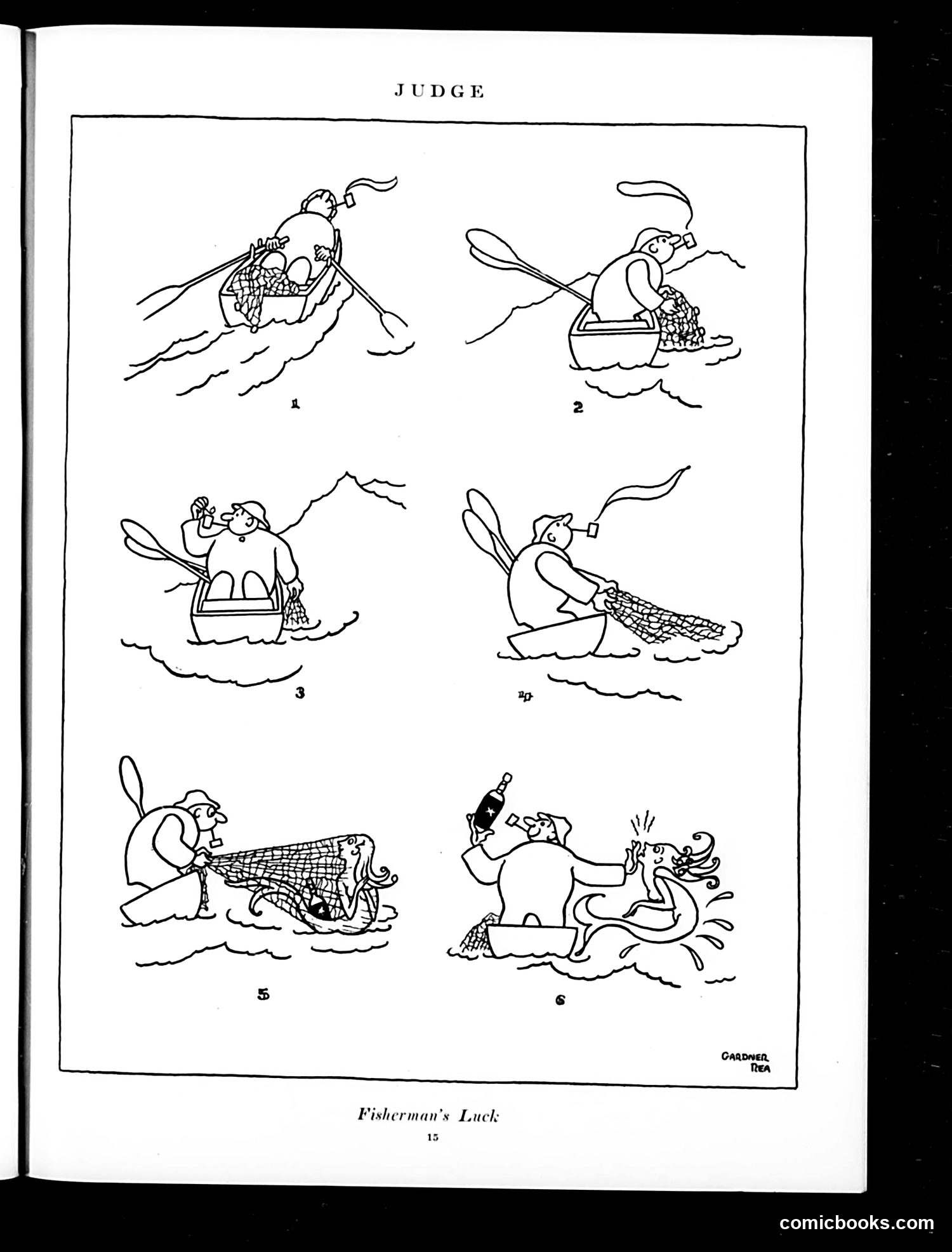
"Fisherman's Luck" - Judge Magazine Cartoon This six-panel comic depicts a cherubic fisherman (possibly an allegorical figure) experiencing increasingly chaotic "luck" while fishing. The sequence progresses from relatively normal fishing scenes to increasingly absurd situations, culminating in panel 6 where the fisherman appears to have caught or encountered something wildly uncontrolled—possibly a mermaid or sea creature creating havoc. The satire likely plays on the unpredictability of fortune and the gap between expectation and reality. "Fisherman's luck" traditionally means good fortune, but this cartoon subverts that, showing how luck can rapidly deteriorate into comedic disaster. The cherub figure suggests fate or chance personified, making the chaos feel inevitable rather than accidental. The cartoonist (Gardner Rea, per signature) uses physical comedy and exaggeration typical of 1920s-30s Judge magazine humor.
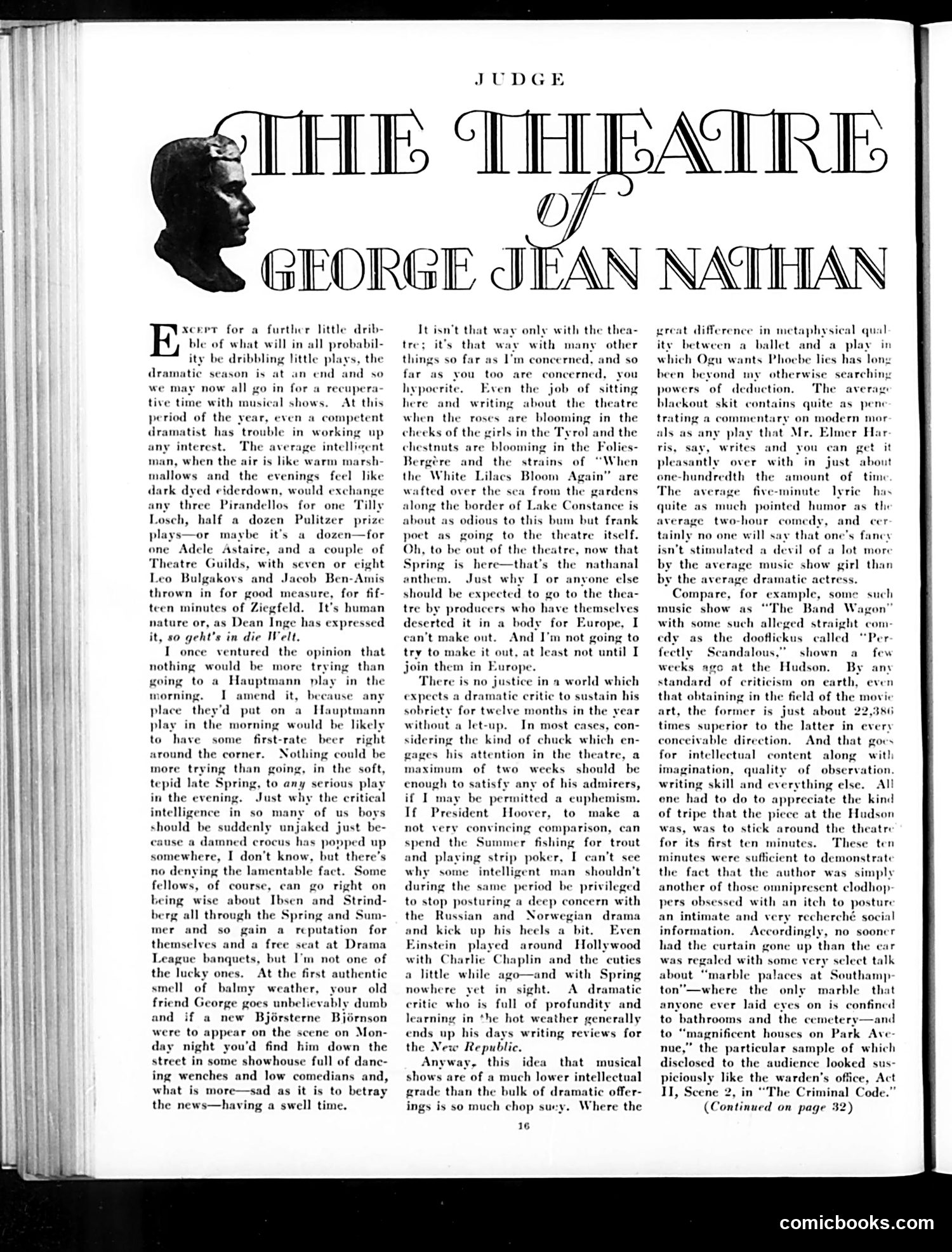
Explanation of Judge Magazine Page This is a satirical essay by "Judge" (the magazine's persona) titled "The Theatre of George Jean Nathan," critiquing dramatic criticism and seasonal theater-going habits. The Main Argument: The author argues that serious dramatic criticism becomes impossible during spring and summer when pleasant weather and entertainment distractions tempt even serious intellectuals. He uses himself as example—claiming he'd abandon even a new Bjørnstjerne Bjørnson play for a dancehall show. The Satire: The piece mocks the pretension of drama critics who maintain "sobriety" and concern for Russian/Norwegian drama year-round, while suggesting even President Hoover deserves summer leisure. The author compares critics' demands for constant serious engagement to an unreasonable standard—if Einstein could play around Hollywood with Chaplin, why shouldn't critics get a break? References: Names mentioned (Pirandello, Ziegfeld, Astaire) were contemporary theater personalities. "Dean Inge" was a real British clergyman known for witty commentary. The satire targets intellectual pretension and the disconnect between critics' serious posturing and human nature's seasonal desires for entertainment over art.
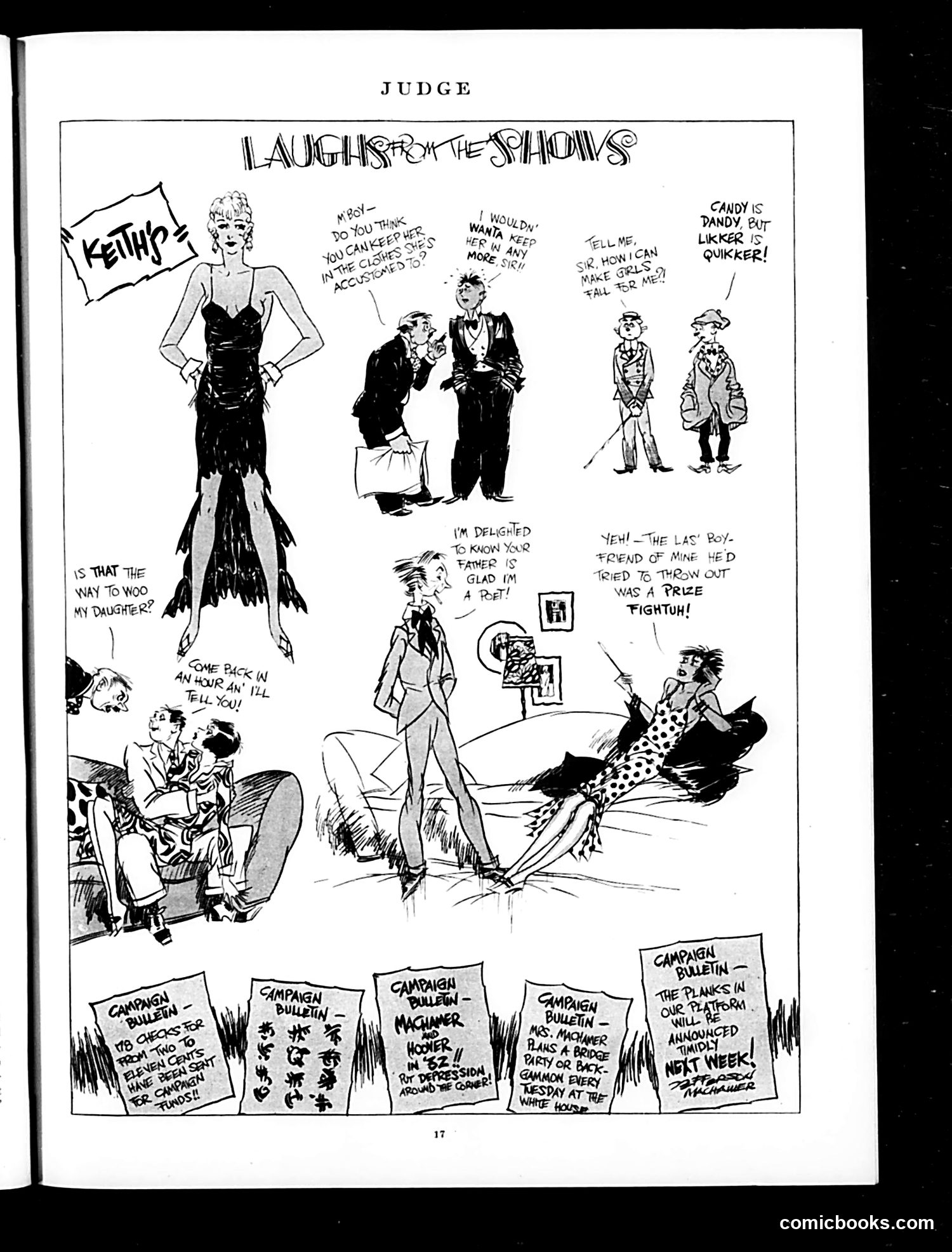
"Laughs from the Shows" - Judge Magazine Cartoon This is a theatrical satire depicting backstage or social scenes involving performers and society figures. The central tall figure in the black dress appears to be a showgirl or performer, while surrounding characters discuss various theatrical matters. The humor revolves around typical show-business clichés: a man boasting about wooing the leading lady ("Is that the way to woo my daughter?"), discussions of performance logistics ("I would keep her in any number"), and references to prize fights and street brawls among young men ("the last boy-friend of mine he'd tried to throw out was a prize fighter"). The bottom panels show "Campaign Bulletins"—suggesting this may be satirizing political campaign promises alongside theatrical artifice. The overall joke appears to mock both theatrical pretension and political grandstanding as similarly fabricated spectacles designed to deceive audiences.
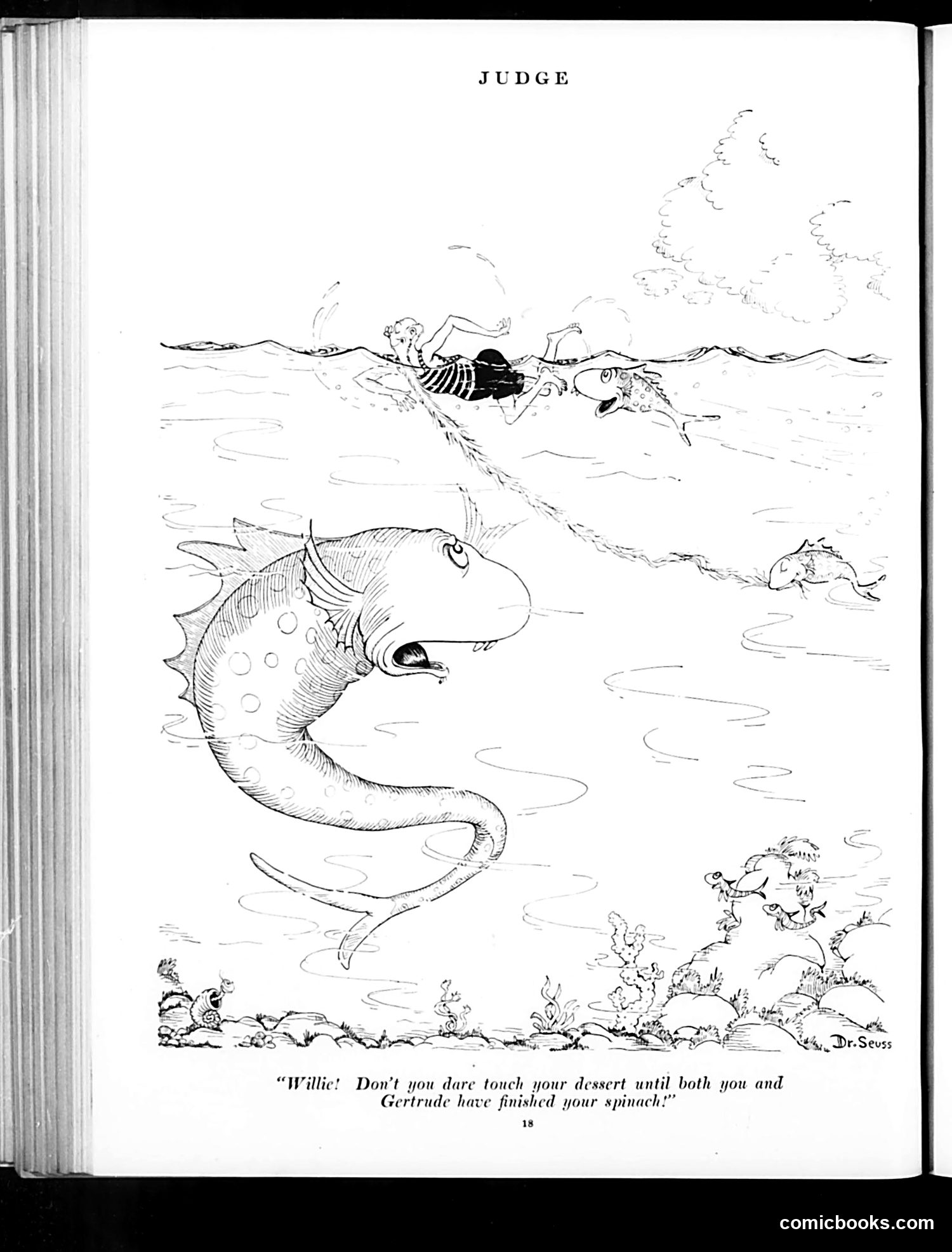
"Judge" Cartoon Analysis This Dr. Seuss illustration satirizes parental food authority through an underwater scene. An adult figure (likely a parent) scolds two children—Willie and Gertrude—commanding them not to touch dessert until they finish spinach, a vegetable historically associated with childhood nutrition battles. The humor derives from depicting this mundane domestic conflict in an absurd context: the children appear to be swimming underwater alongside a large, somewhat menacing fish. By literalizing the "finish your vegetables" command in a fantastical setting, Seuss mocks the universal parental struggle to enforce healthy eating habits, suggesting such authority persists even in impossible circumstances. The cartoon appeals to Judge's adult readership through recognizable parent-child dynamics rendered ridiculous through Seuss's characteristic imaginative exaggeration.
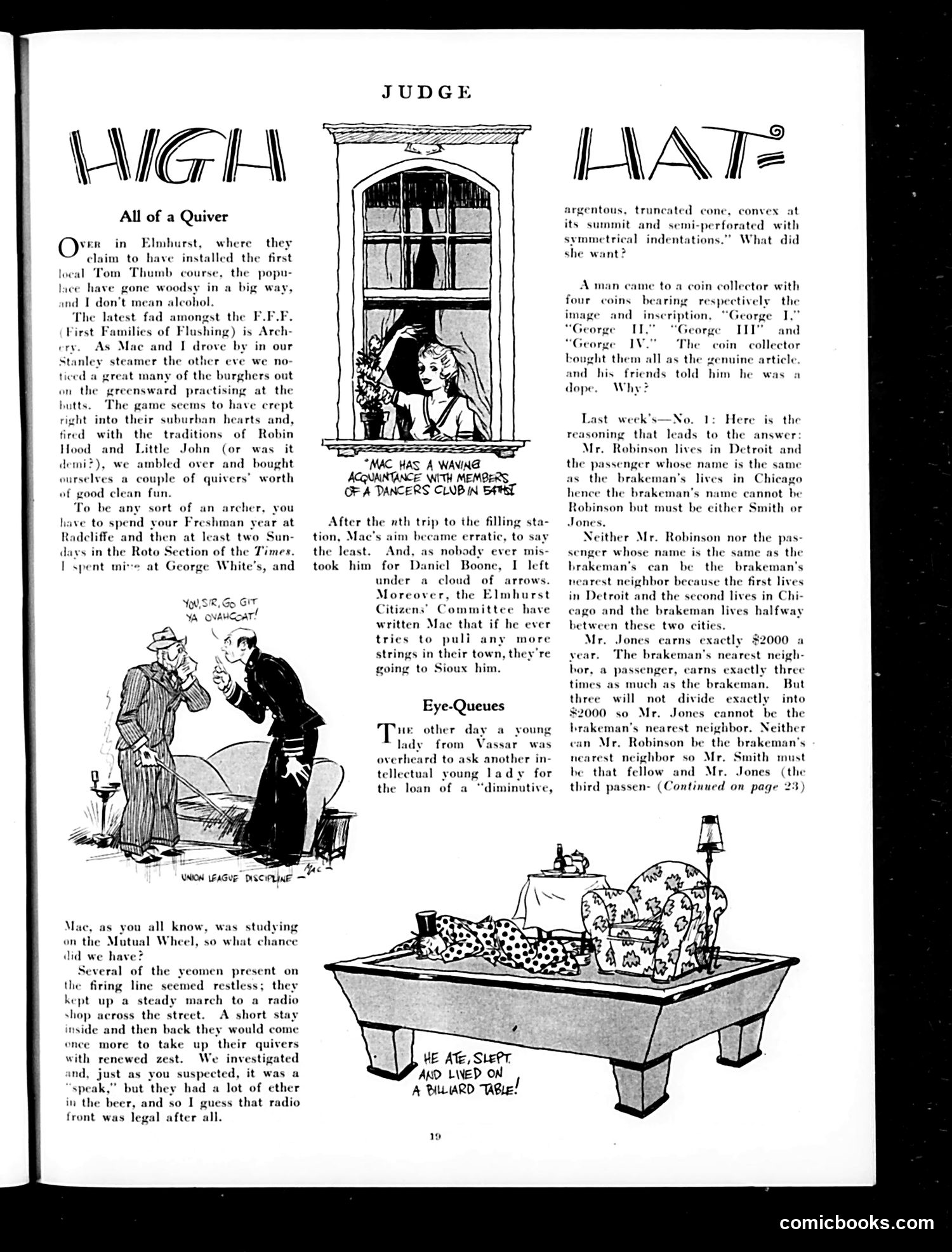
"High Hat" - Judge Magazine Satire Analysis This page contains two satirical pieces from Judge magazine, a humor publication that mocked American social trends and fads. "All of a Quiver" mocks the archery craze that swept suburban areas like Elmhurst/Flushing in the 1920s-30s. The satire targets wealthy suburban "First Families" who adopted archery as a fashionable hobby, romanticizing Robin Hood traditions. The joke's punchline reveals that nearby speakeasies (illegal bars during Prohibition) were the real draw—archers kept abandoning their practice to visit the "radio front" across the street. The author implies the "radio shop" was a cover for bootleg liquor sales, and that authorities tolerated it. "Eye-Queues" presents two wordplay riddles: one about a woman asking for a "diminutive, argentous, truncated cone" (a thimble), and another logic puzzle about identifying a brakeman among four men. These were typical puzzle-humor features in Judge. The cartoons lampoon suburban pretension, Prohibition-era hypocrisy, and intellectual affectation—characteristic Judge targets.
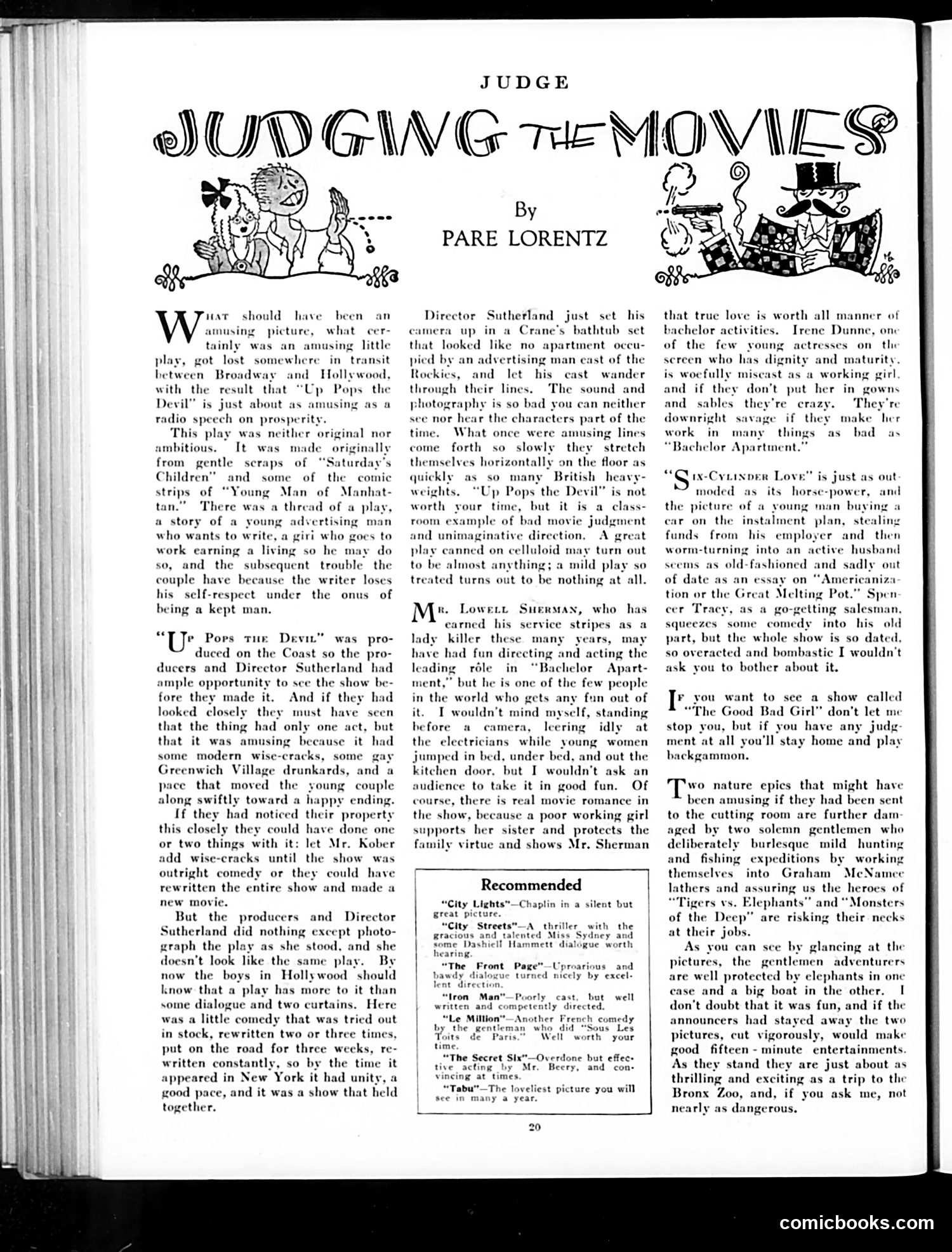
Judging the Movies: A 1931 Film Critique This page contains a film review column by Pare Lorentz, a prominent cinema critic of the era. The main target is the movie "Up Pops the Devil," adapted from a Broadway play about a young advertising man and his working girlfriend navigating marriage and ambition. Lorentz's satire attacks Director Sutherland and the producers for creatively mishandling the material: they filmed a stage play with minimal adaptation, failing to recognize that cinema requires different techniques than theater. His core complaint—that they merely photographed the original play without imagination—reflects early 1930s debates about transitioning theatrical works to film during the sound era. The criticism includes technical failures (poor sound and photography) and pacing problems (witty lines lose impact when delivered slowly). The "Recommended" section lists contemporary films worth watching instead, establishing Judge's role as cultural arbiter for educated readers. The page's decorative cartoons are generic period illustrations without specific political content.
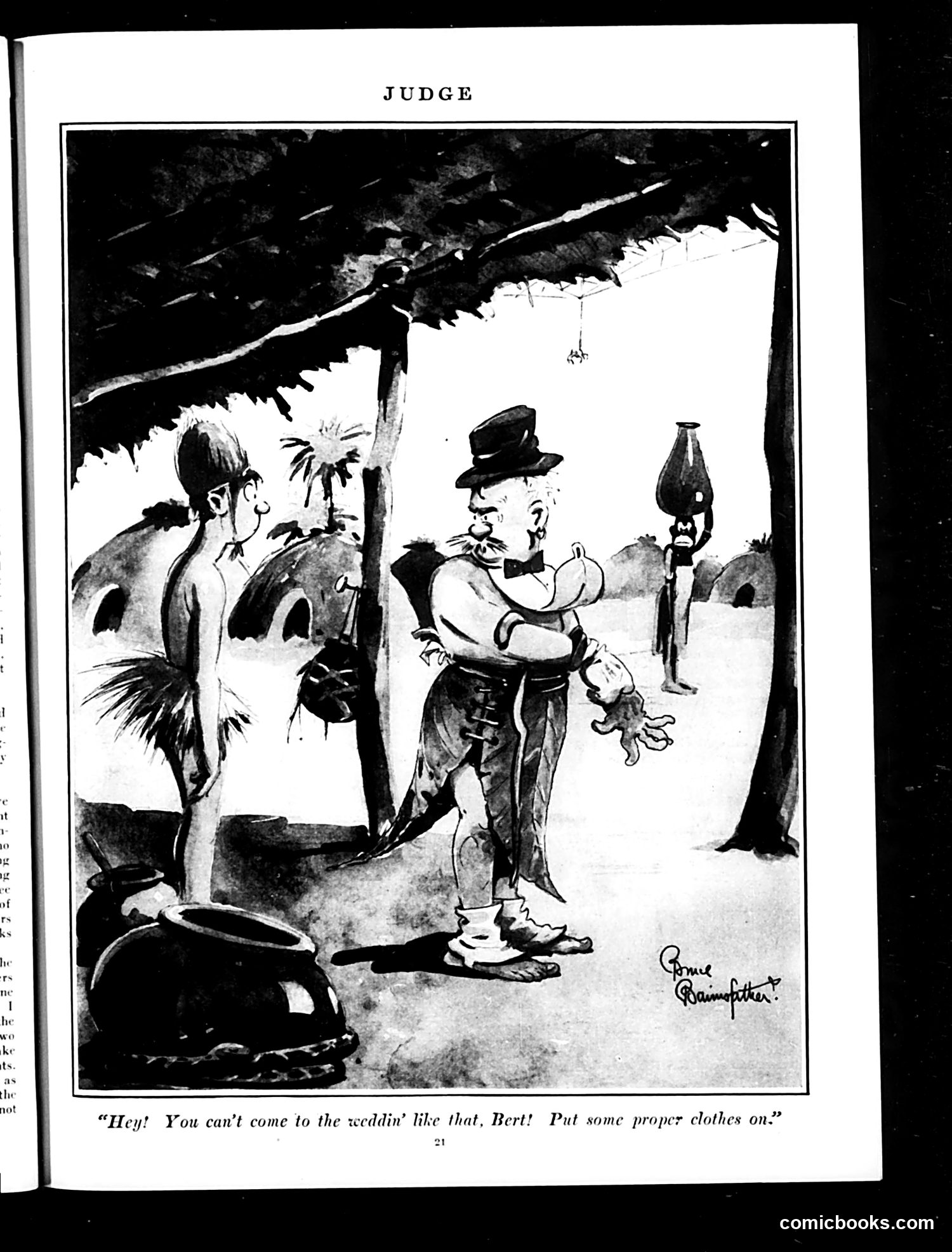
Analysis This is a single-panel cartoon titled "JUDGE" showing a humorous domestic scene. A man in formal attire (top hat, bow tie) is scolding another man named "Bert" who appears to be dressed in minimal or scanty clothing—possibly just a loincloth or underwear—while standing in what looks a tropical or primitive village setting with huts visible in the background. The joke plays on the contrast between civilized wedding formality and Bert's casual primitive attire. The satire likely mocks either: - Someone returning from colonial/tropical adventures unprepared for civilized society - Pretentiousness about dress codes - The culture clash between "civilized" standards and other ways of life The cartoon reflects early 20th-century Judge magazine's humor style, which often relied on exaggerated character types and social commentary about class and propriety.
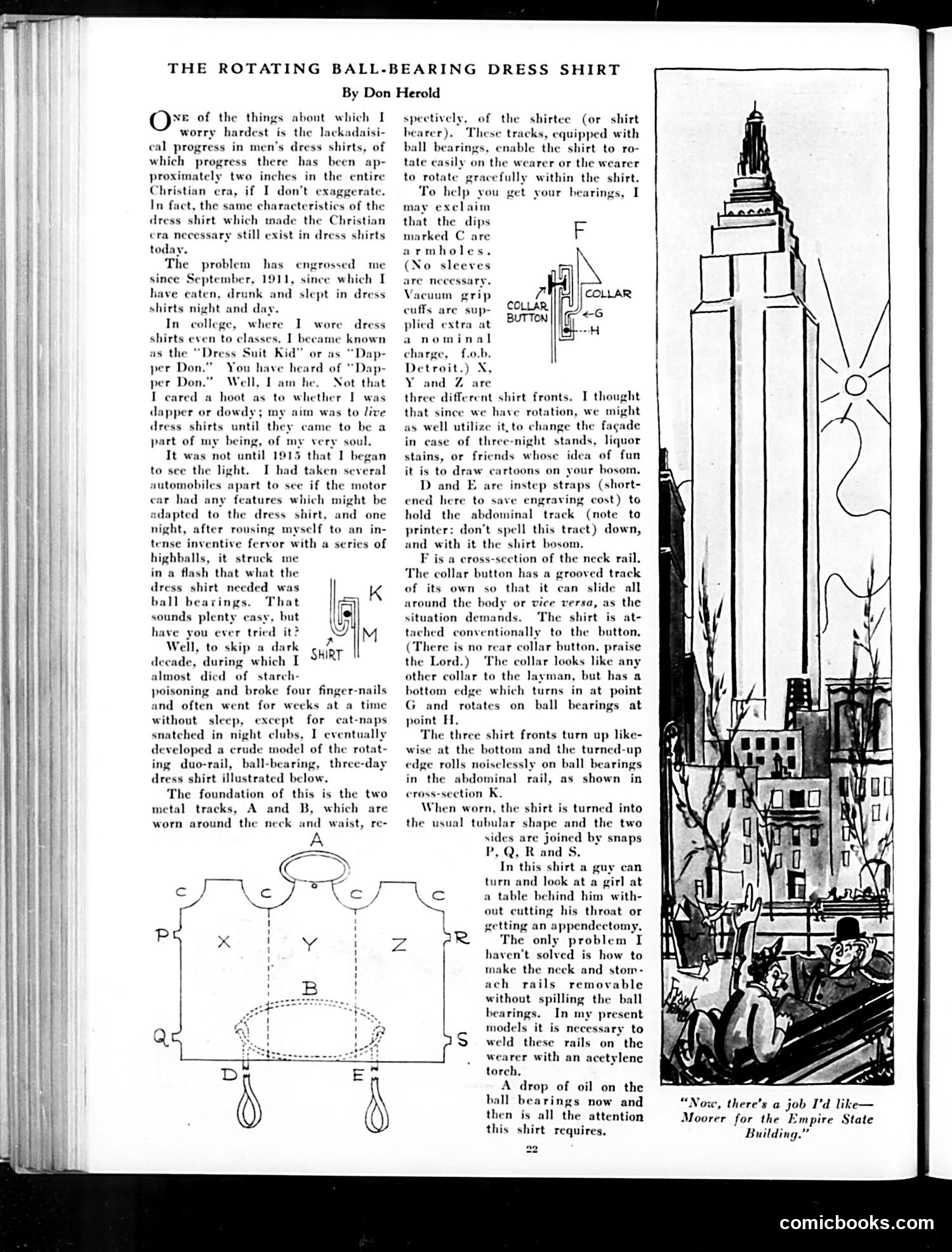
"The Rotating Ball-Bearing Dress Shirt" — Satire Explanation This is a humorous satirical essay by Don Herold mocking the glacial pace of innovation in men's formal wear. The joke: dress shirts have remained virtually unchanged for centuries, so Herold proposes an absurd solution—applying automobile ball-bearing technology to create a shirt that rotates around the wearer's body. The satire targets: - Male fashion stagnation: Shirts haven't evolved meaningfully since the Christian era - 1920s mechanical enthusiasm: The text parodies the era's obsession with applying industrial innovation to everyday objects The accompanying diagram illustrates increasingly ridiculous "improvements": interchangeable shirt fronts (to hide stains or drawings), rotating collars, vacuum-grip cuffs, and instep straps holding the shirt down—all requiring acetylene torches to install. The cartoon's punchline: a man can now flirt with a woman across a table "without cutting his throat or getting an appendectomy"—the shirt's immobility previously made such head-turning physically impossible. The piece is pure comedic fantasy, not serious invention.
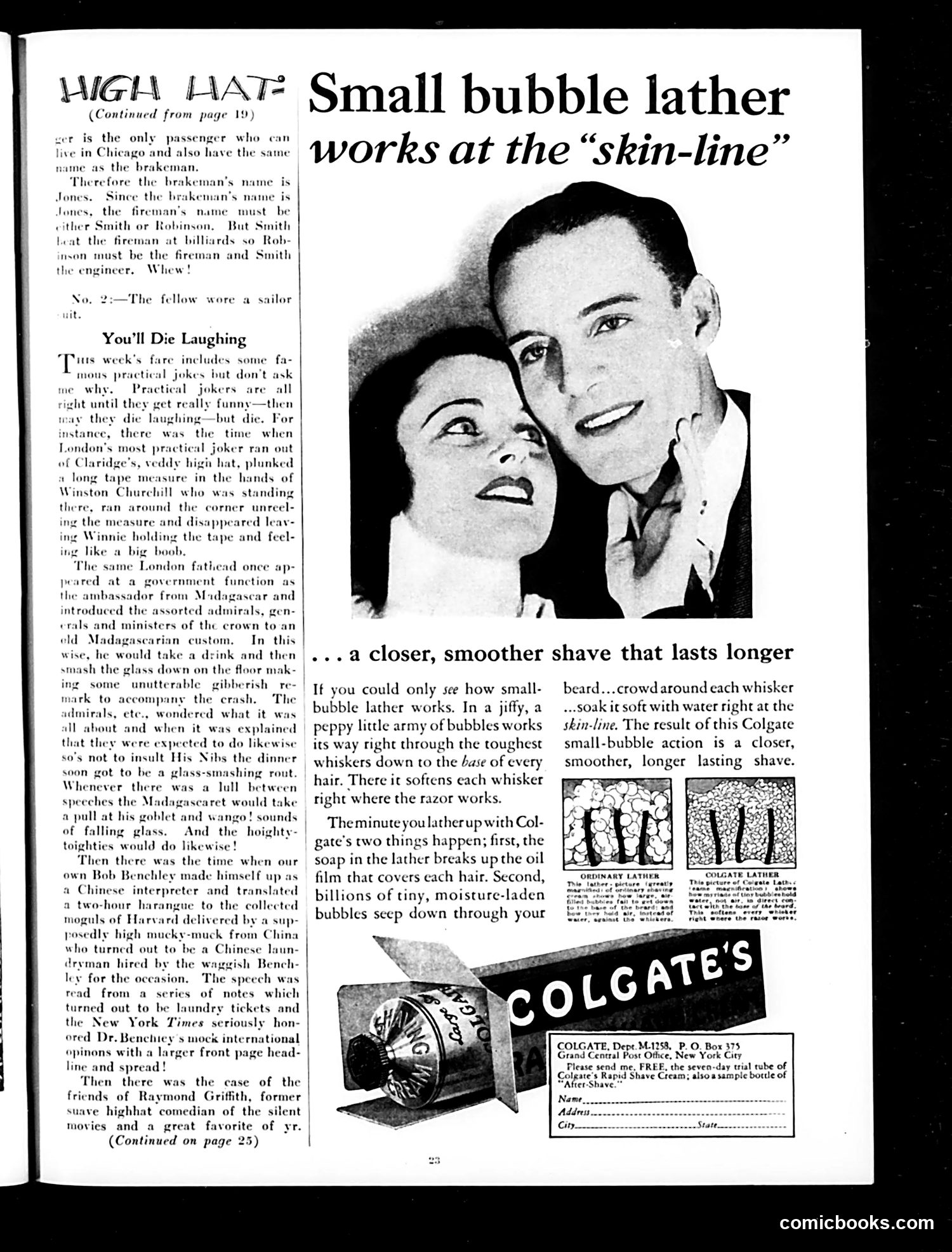
Analysis of Judge Magazine Page This page mixes humor content with advertising. The main editorial section, "You'll Die Laughing," recounts anecdotes about practical jokers—including a story involving Winston Churchill and a tape measure prank, a fake Madagascan ambassador at a government dinner, and Bob Benchley's mock translation of a Chinese official's speech using laundry tickets. These appear to be celebrity gossip items rather than political satire. The page's dominant feature is a Colgate shaving cream advertisement disguised as editorial content. It uses a couple's photograph and technical explanation of how "small bubble lather" penetrates whiskers at the "skin-line" for a closer shave. This is straightforward product marketing typical of 1920s-30s magazine advertising—not satire. The advertisement includes a mail-in coupon offering free trial products. The page represents Judge's mix of humor, celebrity anecdotes, and advertising revenue rather than sustained political or social commentary.
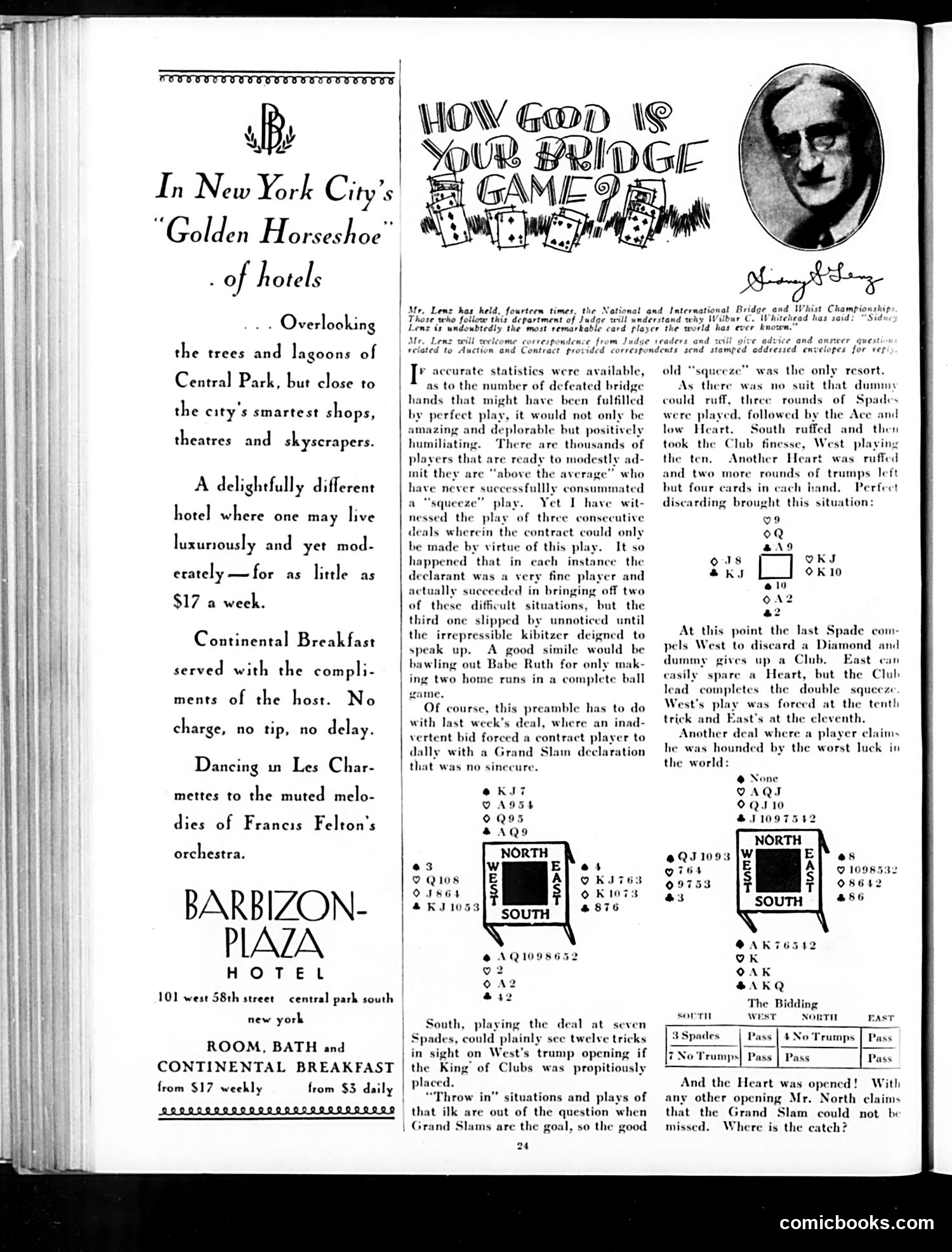
Judge Magazine Bridge Column Analysis This page primarily contains a hotel advertisement (Barbizon-Plaza) on the left side, but the main content is a bridge card game instructional column titled "How Good Is Your Bridge Game?" The column, likely written by a bridge expert (possibly referencing "Sid Lenz," mentioned in the text as a notable bridge player), discusses advanced contract bridge techniques—specifically "squeeze plays" in which skilled players force opponents into impossible discard situations. The satire/humor lies in the contrast between expert and amateur players: the author critiques bridge players who claim to be "above average" yet have never successfully executed a squeeze play, comparing this to fans unfairly criticizing Babe Ruth for hitting only two home runs in a game. The column then presents two actual bridge hands with detailed analysis of the winning plays—serving as both entertainment and instruction for Judge's educated, sophisticated readership interested in this popular parlor game of the era. This reflects 1920s-30s leisure culture among affluent urbanites.
Analysis of Judge Magazine Page This page contains two distinct sections: "High Hat" (Satirical Stories) Social humor about wealthy New Yorkers' pretensions. The anecdotes mock clubmen obsessed with status: one expelled for wearing a winter suit at the Fifth Avenue window (implying he's showing off), another forced by a doorman to retrieve his overcoat. The "Mac's Studio Window" segment satirizes a young man with a small dog who daily poses alongside expensive Rolls-Royces—clearly performing wealth and sophistication for observers, a dig at conspicuous display. "The Unseen Couriers of the Spoken Word" This is American Telephone and Telegraph Company advertising disguised as editorial content. It celebrates the telephone infrastructure: 400,000+ workers, 80 million miles of wire, serving 32 million users. The copy emphasizes the "unseen" systems behind simple phone calls, presenting the Bell System as an engineering marvel justifying its cost. This is corporate propaganda positioning AT&T as essential American infrastructure deserving public trust and investment.
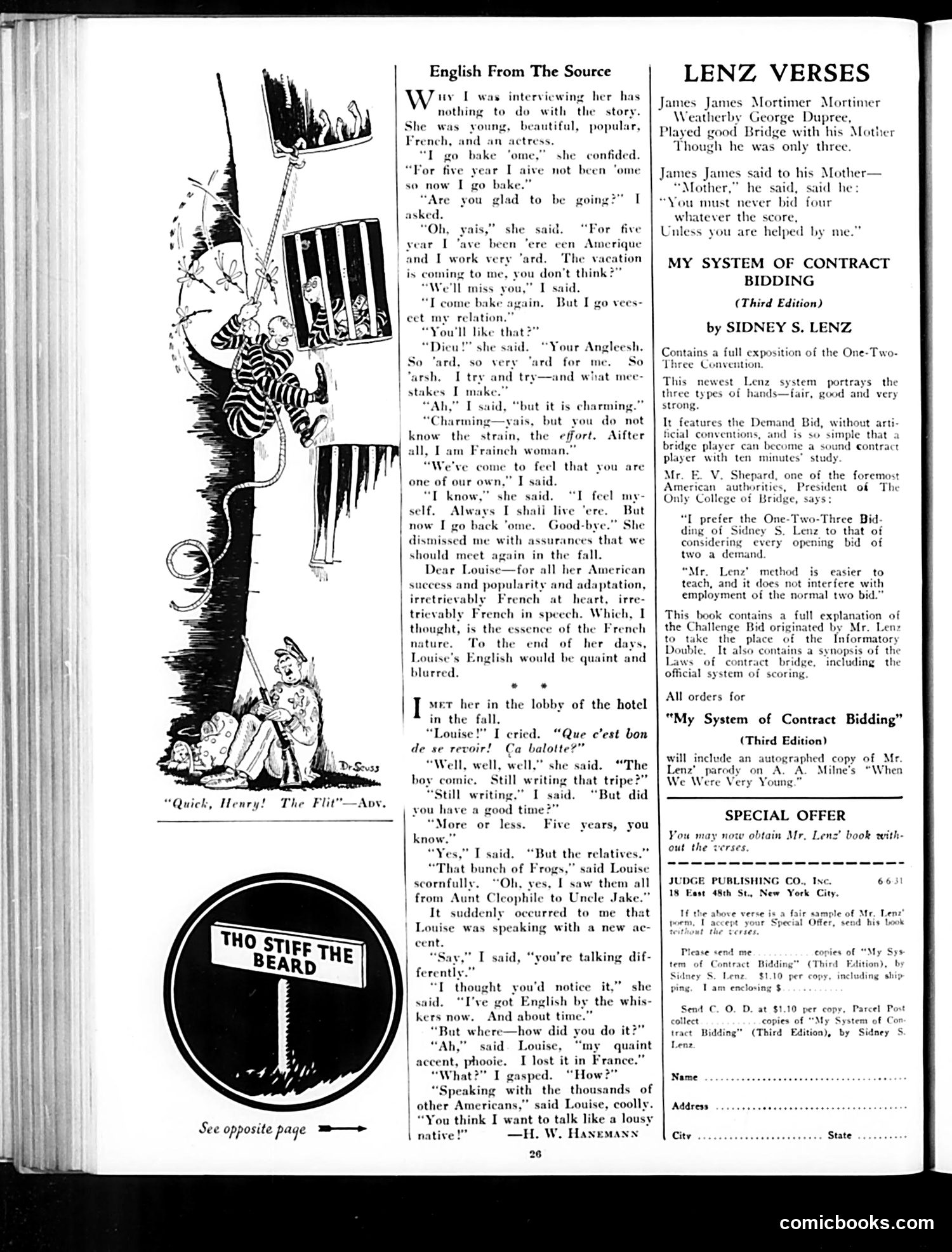
Judge Magazine Page Analysis This page combines a satirical story with bridge-instruction advertising. The main cartoon narrative, "English From The Source" by H.W. Hanemann, mocks American cultural anxieties about European immigrants and linguistic assimilation. The story follows a French actress visiting America for five years. She returns to France, and the narrator later encounters her back in America—but now she speaks "proper" English instead of her charming French accent. The punchline: she lost her accent not through effort, but by socializing with "thousands of other Americans." She deliberately abandons her "lousy native" French accent to fit in. The satire targets American pretension and cultural conformity. The French woman represents immigrants pressured to abandon their identity, while also mocking Americans' sentimental attachment to "authentic" foreign accents. The irony is sharp: Americans simultaneously demand assimilation while romanticizing the exotic foreignness they're destroying. The page also advertises Sidney S. Lenz's bridge-bidding manual, reflecting Judge's mixed editorial-advertising content typical of the era.
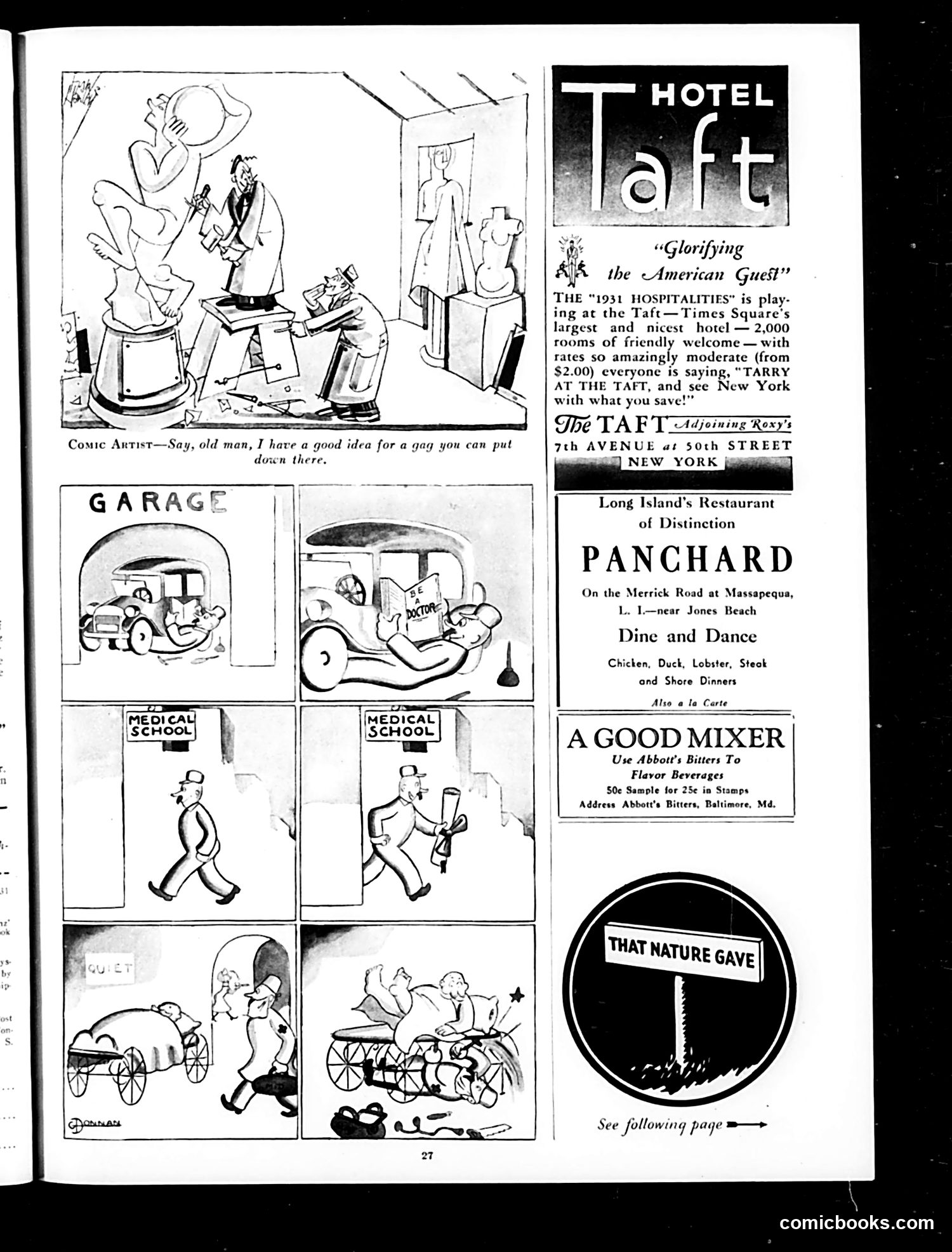
Analysis of Judge Magazine Page This is primarily an advertising page from Judge magazine (circa 1931, based on the "1931 Hospitalities" reference). The left side contains a comic strip sequence about medical school, showing humorous situations involving students entering and exiting a medical school building—likely satirizing the challenges or absurdities of medical training during this era. Above that is a single-panel cartoon where a "Comic Artist" pitches a gag idea to an older man, suggesting workplace humor about creative collaboration. The right side is entirely advertisements: the Hotel Taft in Times Square, Panchard restaurant on Long Island, Abbott's Bitters (a cocktail ingredient), and a teaser for content on the following page ("That Nature Gave"). For modern readers: This reflects 1931 America—economic depression-era hotel rates of $2.00, the prominence of cocktail culture despite Prohibition's end, and Long Island dining destinations. The medical school comic likely mocked the competitive or rigorous nature of 1930s medical education.
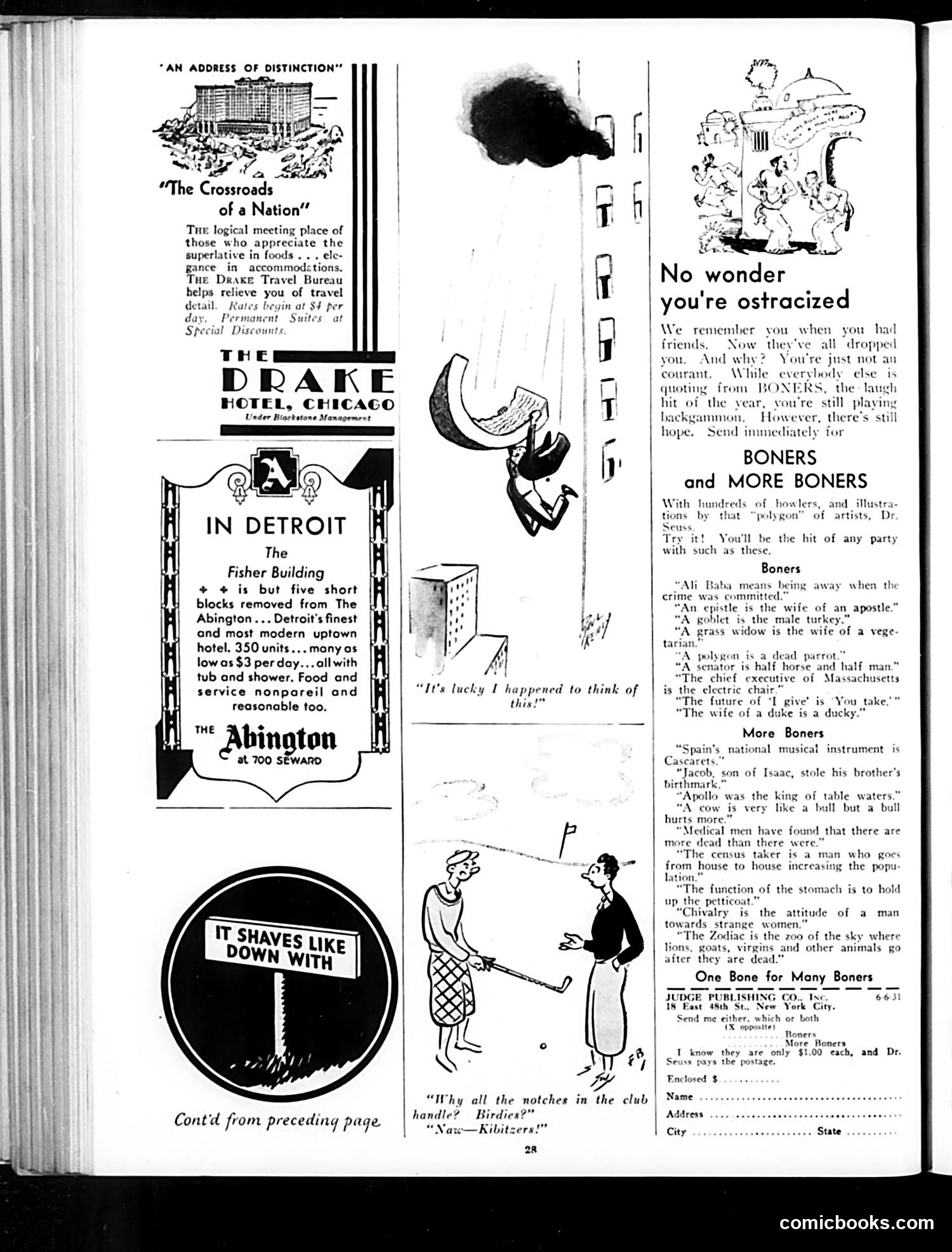
"Boners" Advertisement - Judge Magazine This page primarily advertises "Boners," a popular humor book featuring intentionally absurd definitions and statements, illustrated by Dr. Seuss. The main cartoon shows a woman golf-playing couple with the caption "Why all the notches in the club handle, Birdie?" / "Nay—Kibitzers!"—a golf joke about unwanted advice-givers. The satire in the "Boners" ad mocks social ostracism: readers who don't quote this trendy book are dismissed as hopelessly out-of-touch ("still playing backgammon"). The sample "boners" are deliberately ridiculous malapropisms—misunderstandings of words like "polygon" (dead parrot), "senator" (half horse), and "zodiac" (zoo of the sky). The humor relies on absurdist wordplay popular in early 20th-century America. The page also contains hotel advertisements (Drake, Abington), typical of Judge magazine's revenue model.
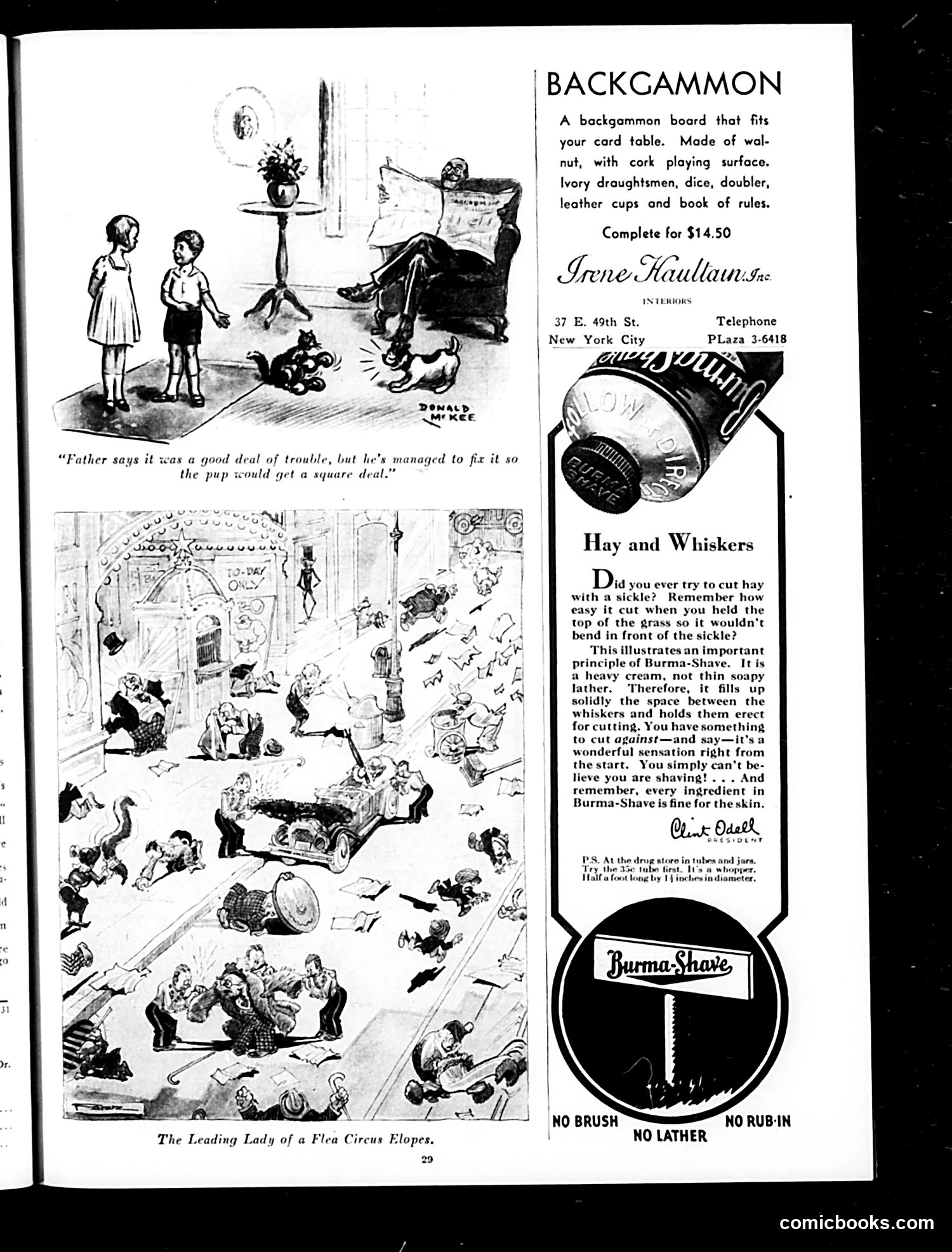
Analysis of Judge Magazine Page This page contains two unrelated elements: advertising and a cartoon. The top cartoon by Donald McKee shows a father who has repaired a damaged puppy, with children observing. The caption—"Father says it was a good deal of trouble, but he's managed to fix it so the pup would get a square deal"—is a pun on "square deal," playing on both the literal concept of fairness and the notion of repair/restoration. The humor lies in the domestic scene of a father fixing the family dog, treating the situation as a matter of justice. Below is a large, elaborate cartoon titled "The Leading Lady of a Flea Circus Elopes," depicting a chaotic circus scene with numerous tiny figures and animals. The humor apparently derives from the absurdist concept of a flea circus—a novelty performance—and treating its "leading lady" departure as high drama worthy of illustration. The page is primarily product advertising for backgammon sets, Burma-Shave shaving cream, and other goods typical of vintage American magazines.
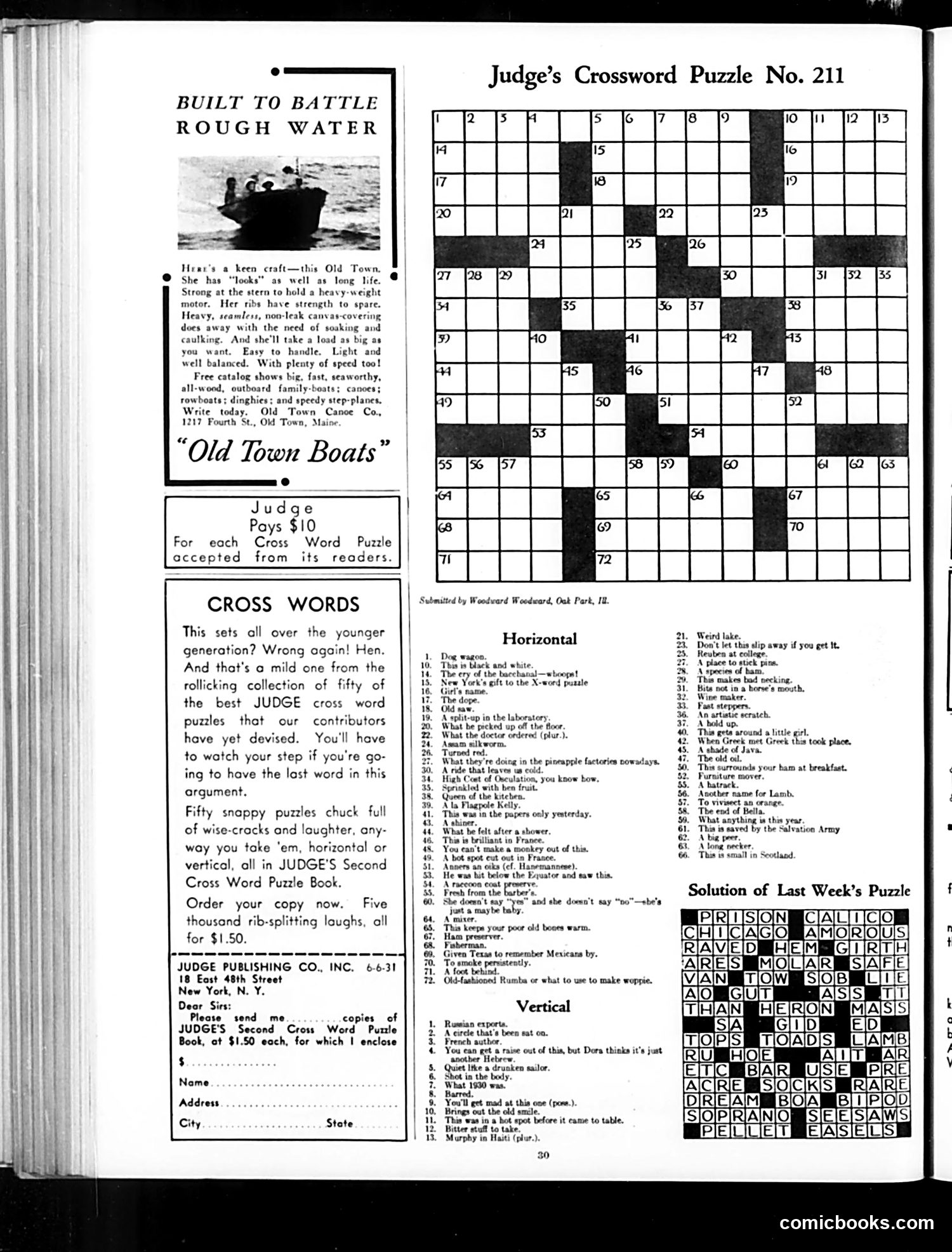
Judge Magazine, June 6, 1931: Crossword Puzzle Page This page is primarily advertising and editorial content rather than political satire. It features: 1. "Old Town Boats" Advertisement: A pitch for sturdy canvas-covered boats from Old Town Canoe Co. (Maine), emphasizing durability for rough water and family use. 2. Judge's Crossword Puzzle Book Advertisement: Judge Publishing promotes its "Second Cross Word Puzzle Book" ($1.50), offering 50 puzzles with humorous clues. The text jokes that crosswords appeal to younger generations and promises "rib-splitting laughs." 3. Actual Crossword Puzzle #211: A standard crossword with witty, pun-filled clues reflecting 1931 culture (references to flagpole sitting, Prohibition-era France, radio entertainment). The page demonstrates how Judge balanced satirical humor with commercial advertising—using their brand of comedy to sell products to readers. The crossword's clever wordplay was part of the magazine's broader appeal to educated, humor-appreciating audiences during the Depression era.
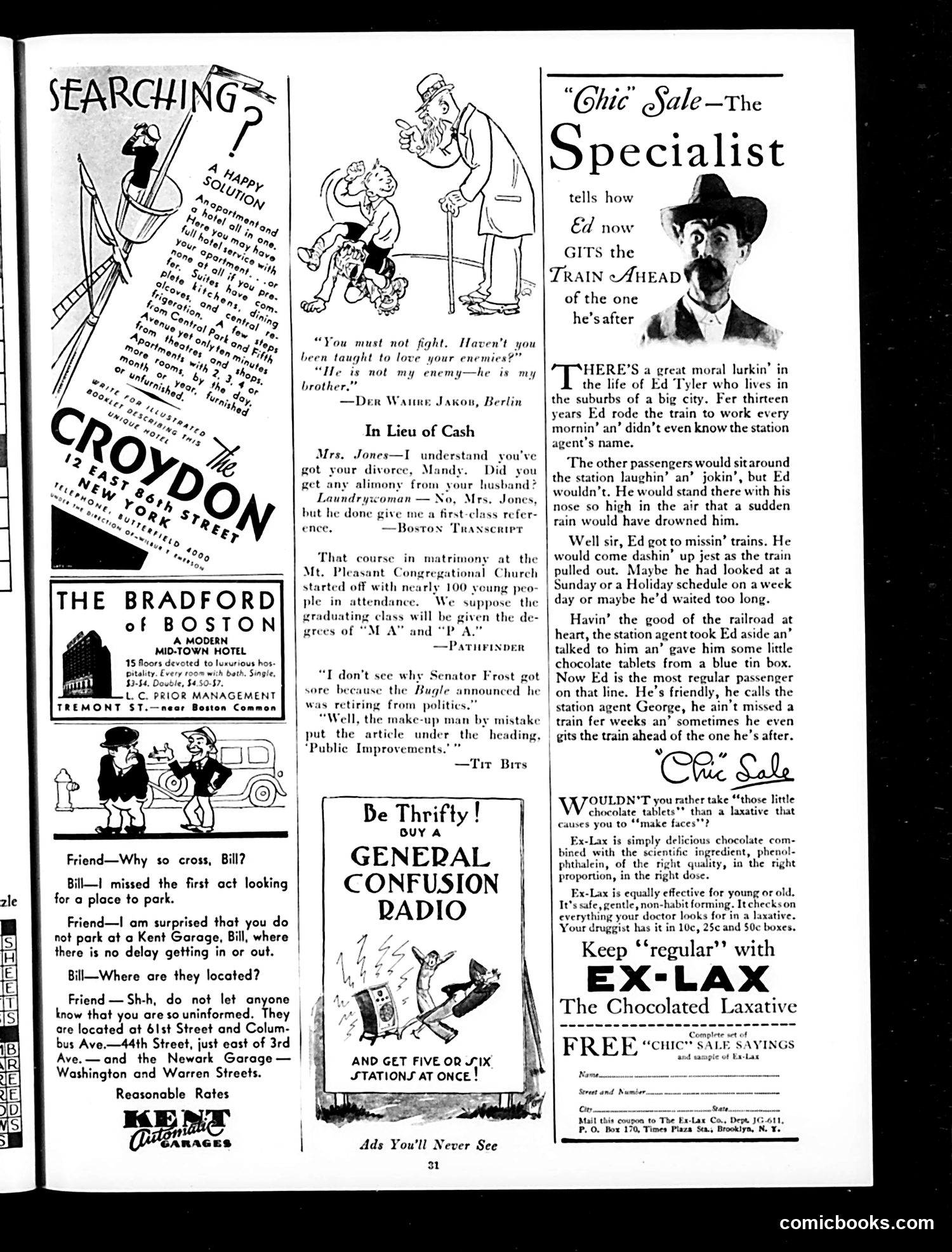
Analysis for Modern Readers This page contains several distinct pieces: Main cartoon ("Chic Sale—The Specialist"): A humorous story about Ed Tyler, a snobbish commuter who ignored railroad staff for thirteen years. The station agent gives him chocolate tablets (implied laxative), after which Ed becomes friendly and punctual. The joke plays on the idea that rudeness stems from digestive discomfort—a crude but common humor trope of the era. Supporting jokes: Brief quips about parking difficulties, divorce alimony, and a senator's embarrassment over a newspaper misprint. "General Confusion Radio" ad parody: Satirizes early radio technology's poor reception, joking that one radio station picks up five or six at once—a real problem consumers faced in the 1920s-30s. Ex-Lax advertisement: Promotes a chocolate laxative, using the Chic Sale story as implied endorsement. The page is primarily advertising disguised as editorial content—a common Judge magazine practice blending satirical humor with product promotion.
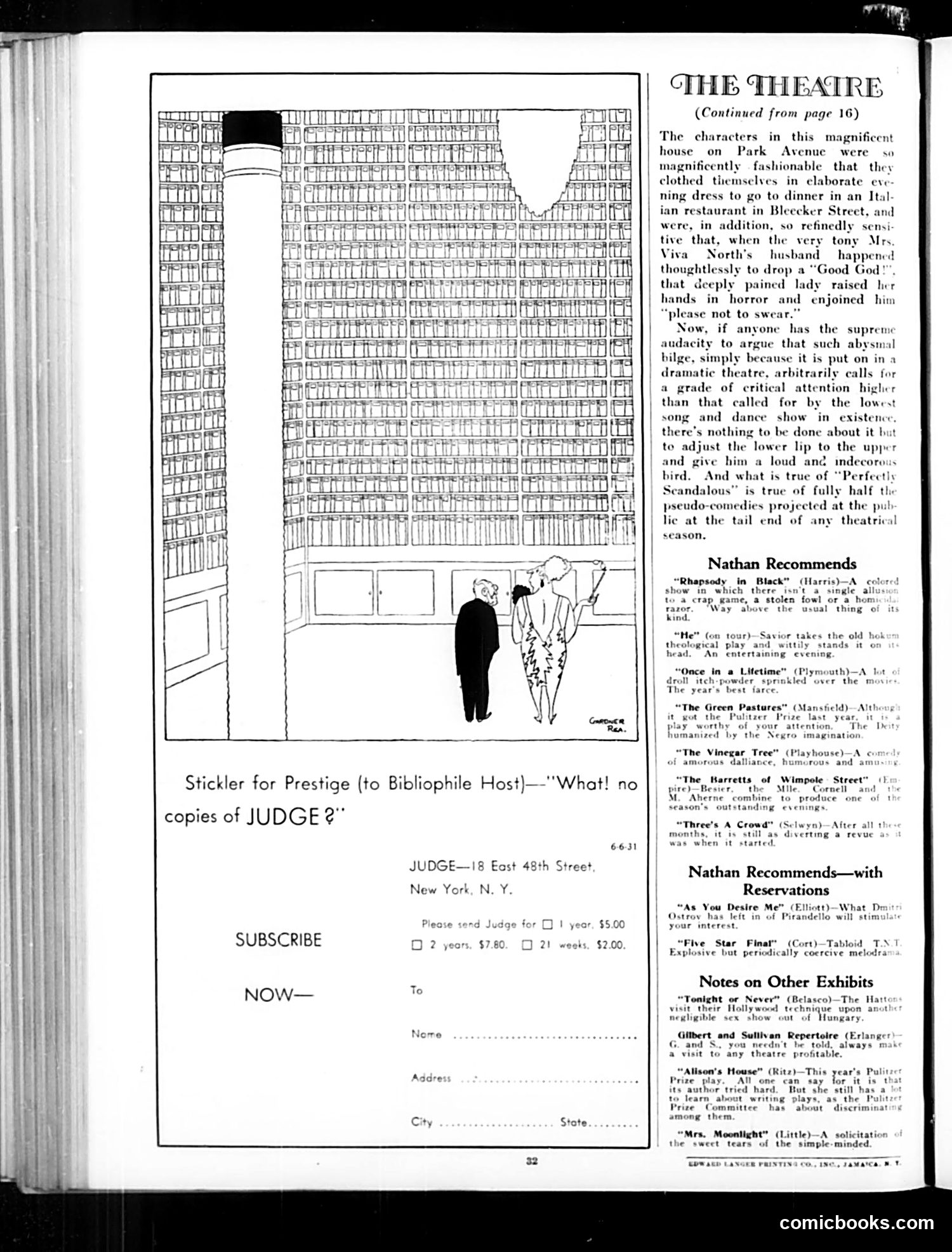
Judge Magazine Theatre Page This page from Judge magazine is primarily theatre criticism and advertising, not political satire. The main cartoon shows a couple in formal evening wear standing in what appears to be a luxurious Park Avenue penthouse, with a man in a tuxedo below them. The caption satirizes social pretension: a wealthy woman is so refined that she's offended when her husband casually swears, yet they dress formally just to have dinner in a modest Italian restaurant on Bleecker Street (a working-class area). The joke mocks the contradiction between actual behavior and aspirational class performance. The surrounding text is Nathan's theatre recommendations for shows running at the time, including "The Green Pastures" and "Rhapsody in Black." The page concludes with a subscription form for Judge magazine itself at 18 East 48th Street, New York.
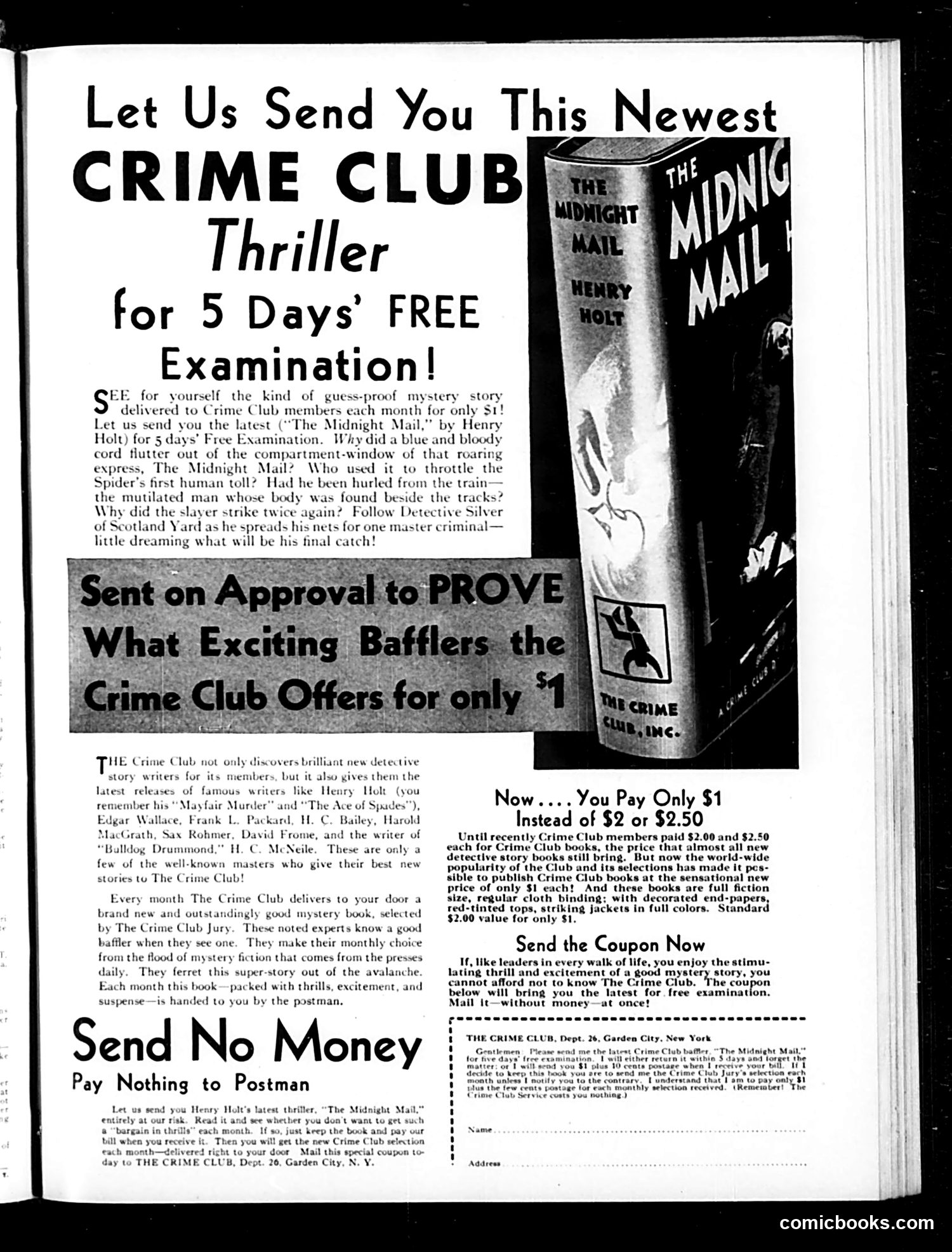
Crime Club Advertisement This is a book club advertisement, not a cartoon. The Crime Club was a Depression-era subscription service offering mystery novels at reduced prices ($1 instead of $2-$2.50). The ad promotes "The Midnight Mail" by Henry Holt as a sample thriller, using classic murder-mystery hooks to entice readers: a mysterious cord, a dead body by train tracks, and Detective Silver pursuing a criminal. The service leveraged famous crime writers—Edgar Wallace, Sax Rohmer, and others—to build credibility. The appeal of "guess-proof" mysteries and monthly deliveries by postman reflects 1930s marketing strategy: affordable entertainment during economic hardship, delivered conveniently to homes. The coupon allows free 5-day examination with no payment upfront—a common direct-mail sales tactic. The repeated emphasis on low price and "no money to postman" targets budget-conscious readers seeking intellectual entertainment at modest cost.
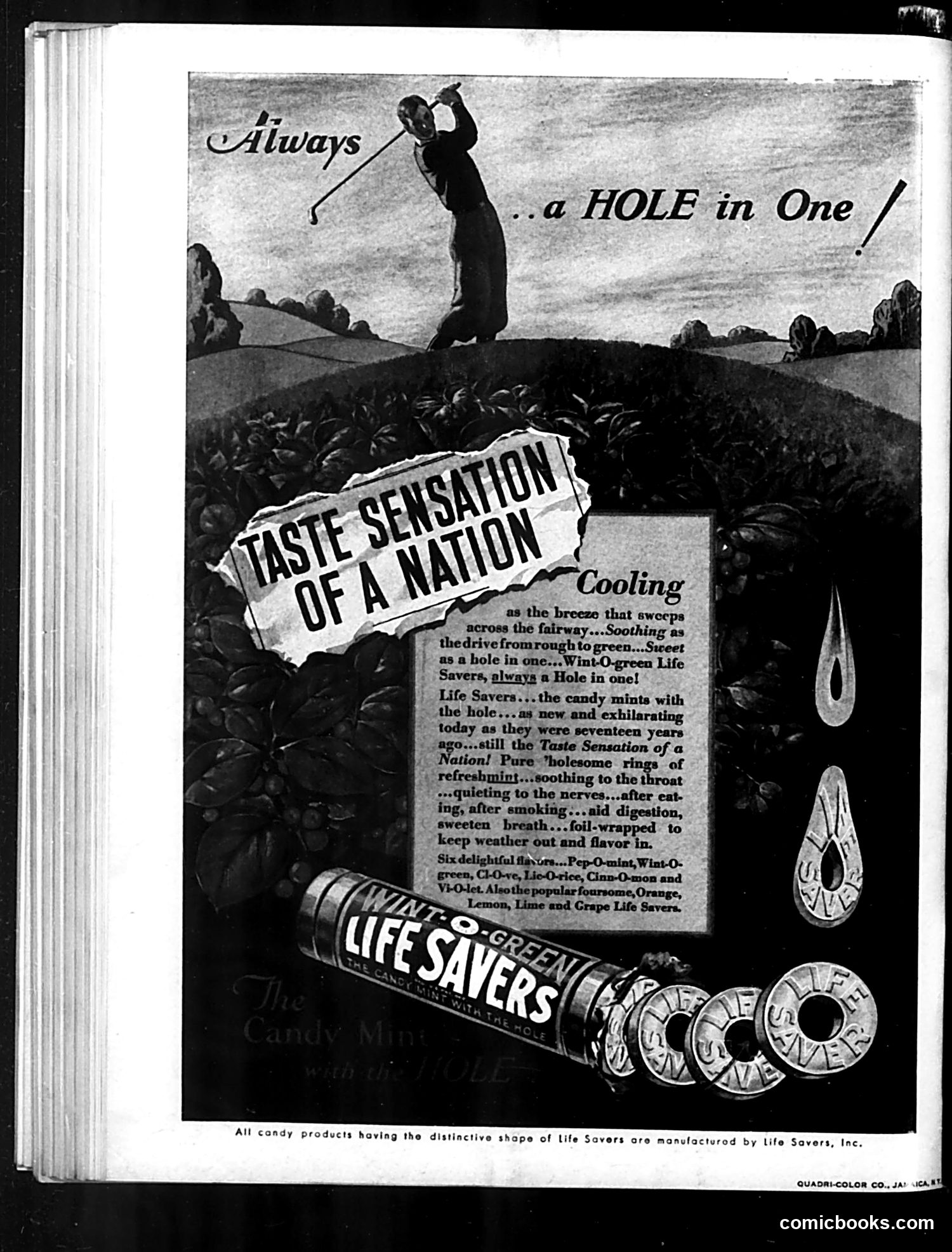
Life Savers Advertisement This is a full-page advertisement for Life Savers candy, not political satire. The image shows a golfer achieving a hole-in-one, with the headline "Always...a HOLE in One!" The ad uses the golf metaphor to promote Life Savers' distinctive ring shape and flavor varieties (Wint-O-green, Pep-O-mint, etc.). The text emphasizes their cooling, refreshing properties and digestive benefits—marketing language typical of 1920s-30s candy advertising. The "Taste Sensation of a Nation" tagline suggests Life Savers were a popular, established product by this publication date. The visual pun connects the candy's hole shape to golfing success, making the product memorable through clever wordplay rather than satirical commentary. This is purely commercial advertising content, not editorial material.