judge
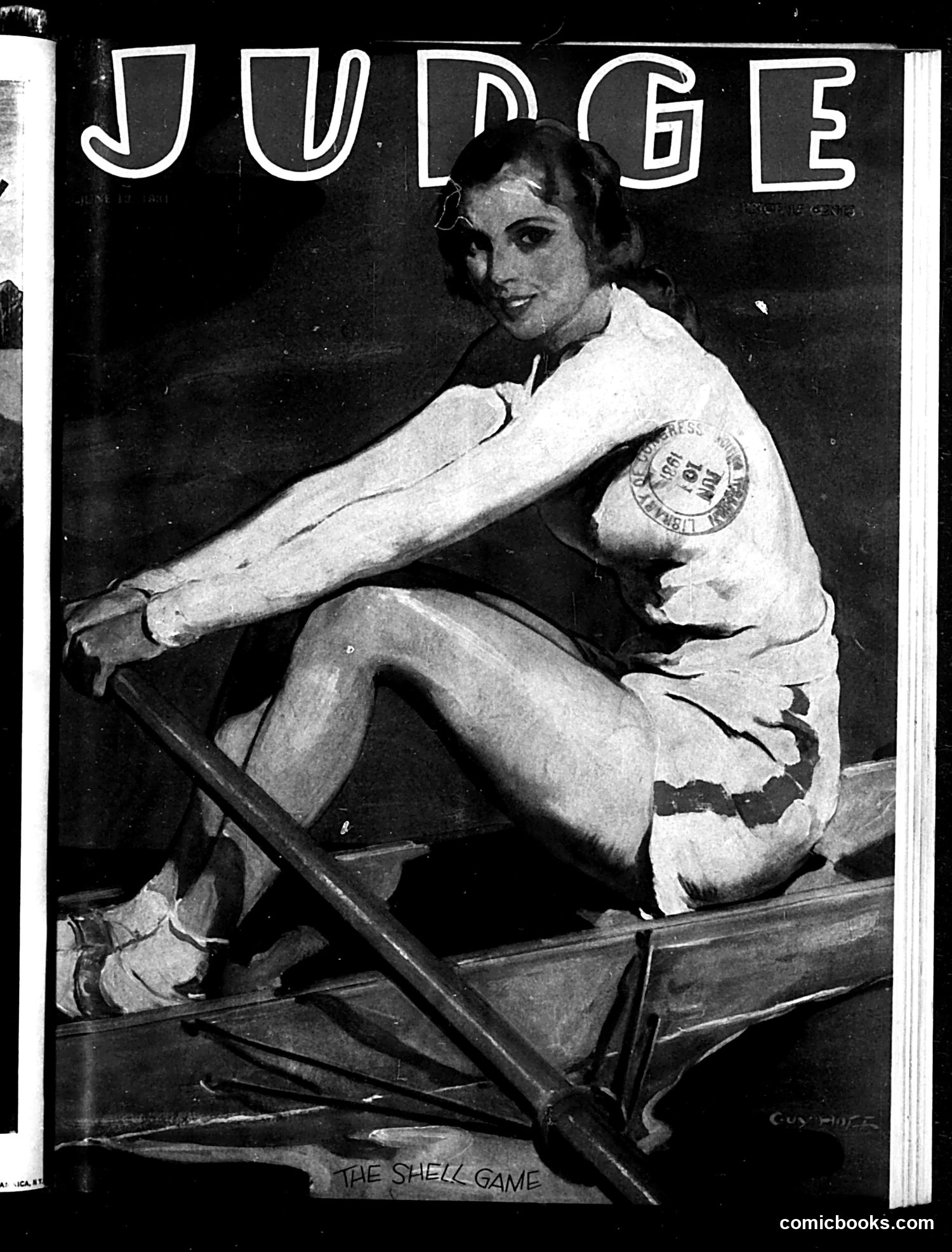
Judge — June 13, 1931
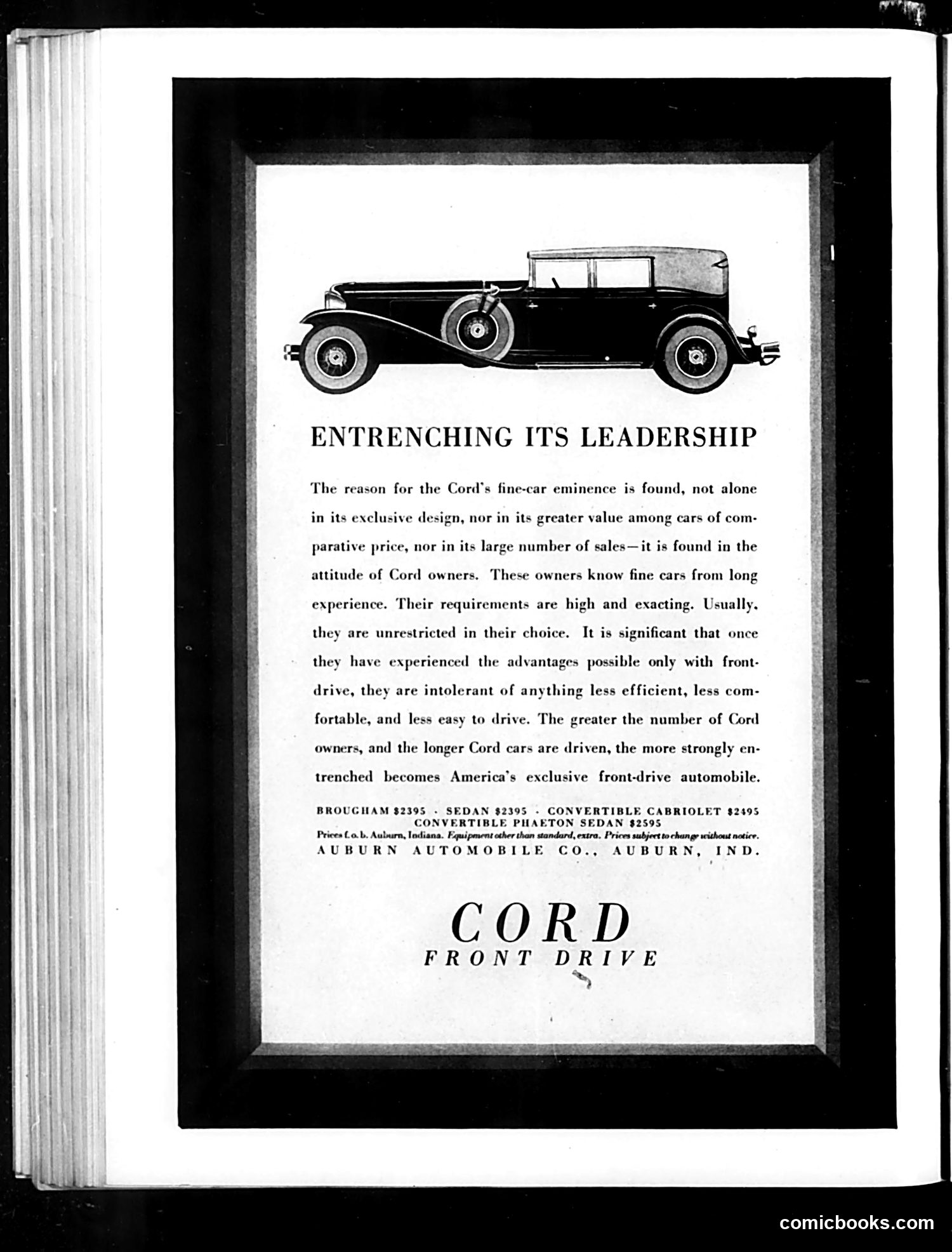
Analysis This page is primarily advertising, not satire or political commentary. It's a full-page advertisement for the Cord automobile, manufactured by Auburn Automobile Co. in Auburn, Indiana. The ad emphasizes Cord's "front-drive" technology as a luxury feature that distinguishes it from competitors. The headline "ENTRENCHING ITS LEADERSHIP" uses military language to suggest the car's dominant market position. The body text appeals to wealthy, experienced car buyers, arguing that once they experience front-wheel drive's advantages, they become devoted to Cord vehicles. The illustration shows a sleek, black luxury sedan in profile—the visual centerpiece emphasizing the car's exclusive design and prestige positioning. There is no political satire present on this page.
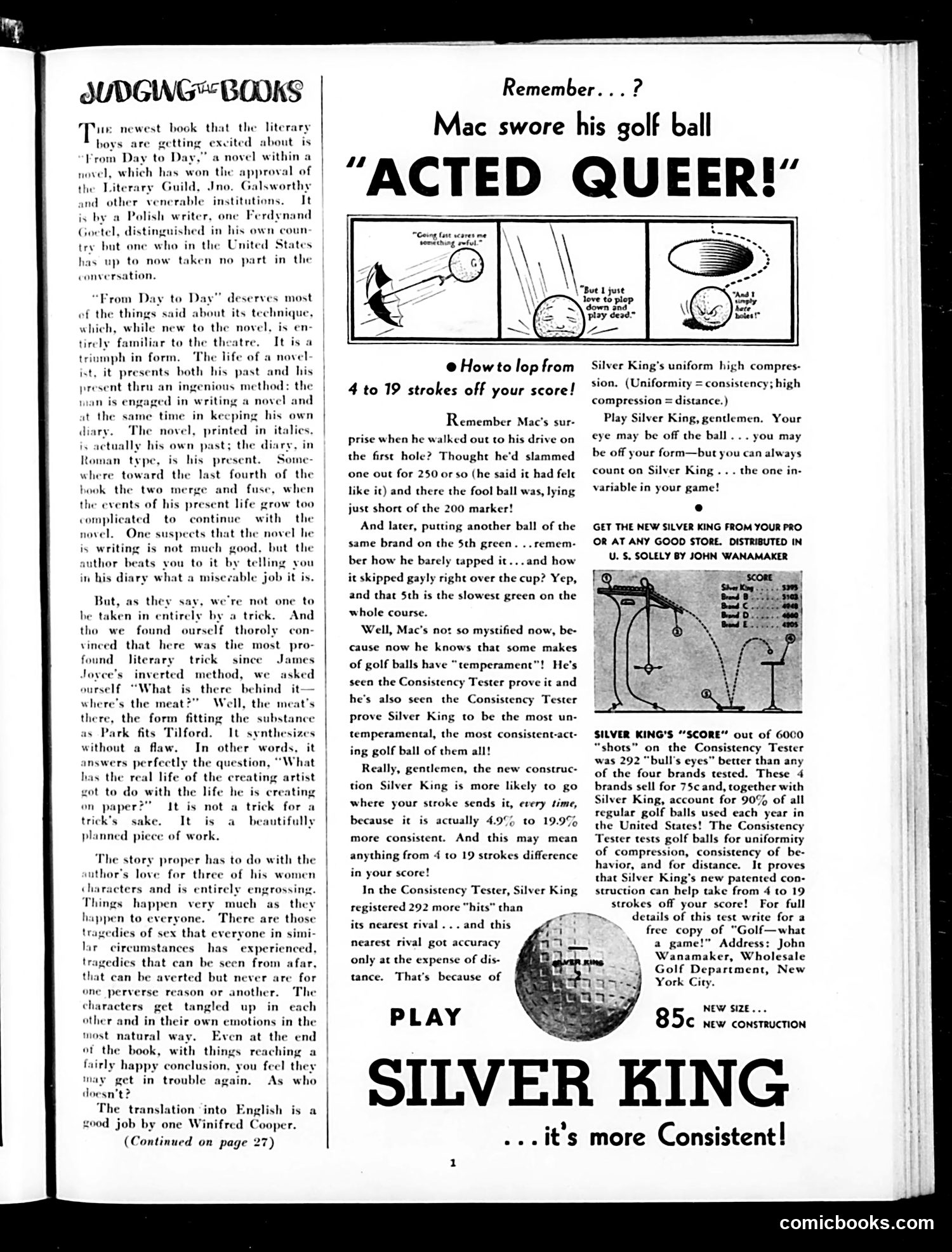
Analysis This page is primarily advertising disguised as editorial content. The left column contains a book review of "From Day to Day" by Ferdinand Goebel, but it serves mainly to establish credibility for the adjacent advertisement. The main content is a Silver King golf ball advertisement using a humorous anecdote: a golfer named "Mac" swears "Acted Queer!" after his drives behave unpredictably. The ad's point: inconsistent golf balls cause poor play. Silver King's solution—a ball tested for "consistency" and "temperament"—promises reliable performance. The three-panel cartoon illustrates Mac's frustration with unpredictable shots. This is straightforward product advertising, not political satire. The "Judge" magazine format lent authority to advertisements by framing them within editorial pages, a common early 20th-century marketing practice.
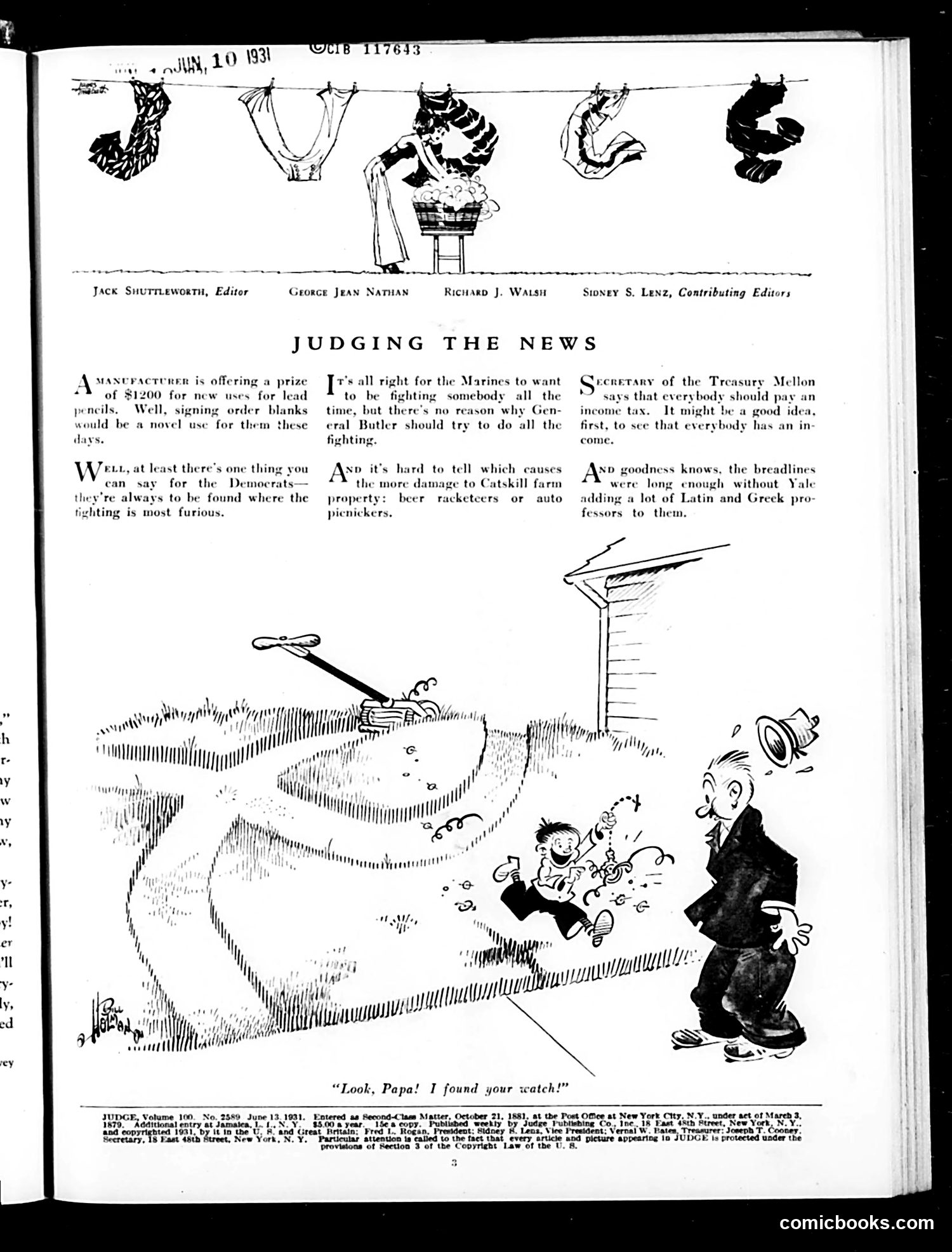
"Look, Papa! I found your watch!" This 1931 cartoon satirizes economic hardship during the Great Depression. A small child discovers a pocket watch in what appears to be an empty or depleted pocket—a visual joke about poverty and loss of wealth. The well-dressed man's shocked reaction suggests he'd written off the watch as gone, having fallen into financial difficulty. The cartoon's humor relies on the contrast between the child's innocent discovery and the father's desperate circumstances. During the Depression, many Americans lost savings, possessions, and livelihoods. The "Judging the News" commentary above discusses political and economic topics of 1931, though the specific references are partially obscured in this image.
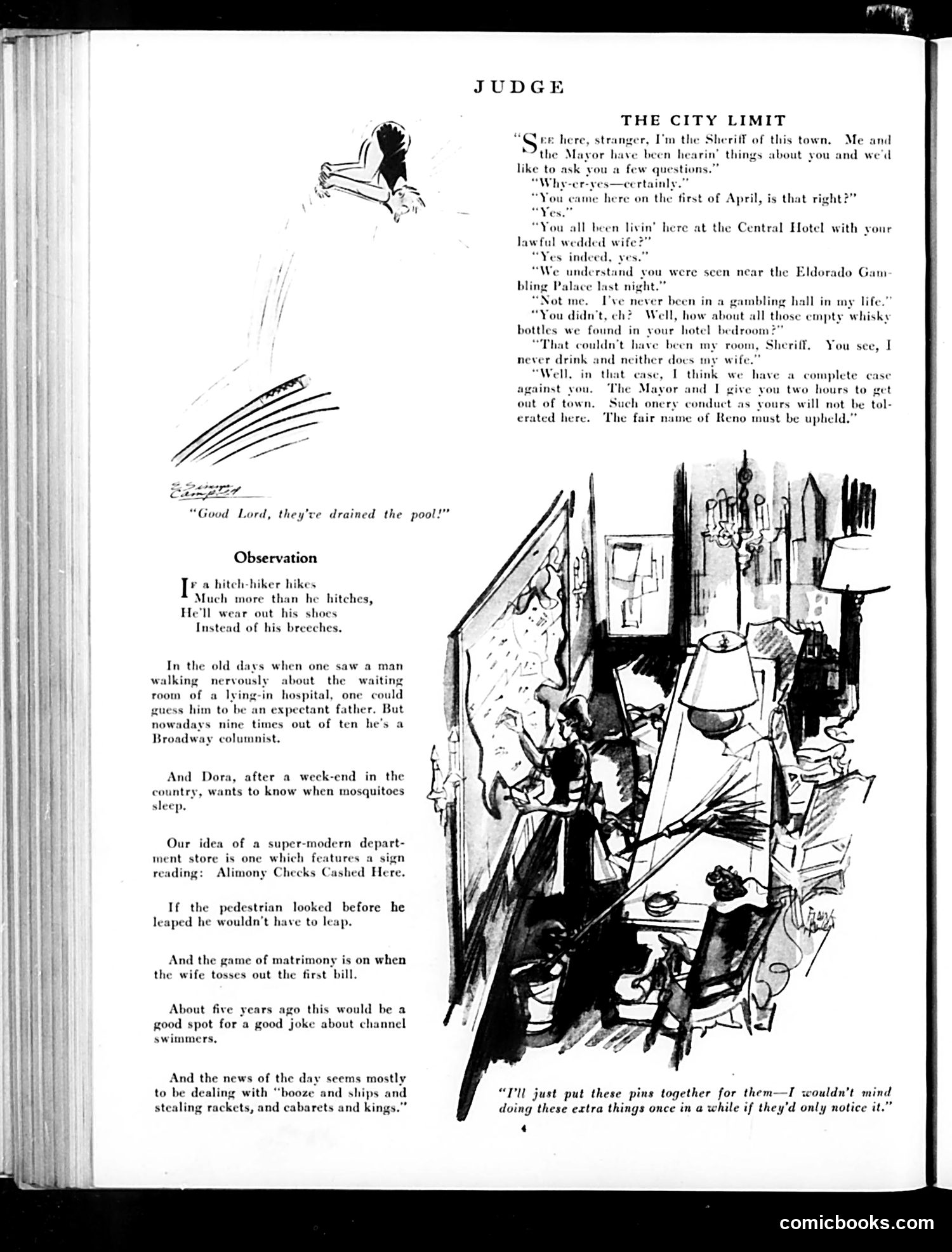
"Judge" Page Analysis: "The City Limit" This page contains two satirical pieces. The main sketch, "The City Limit," depicts a sheriff questioning a stranger (presumably a newly-arrived visitor) about suspicious activity—empty whiskey bottles in his hotel room, visits to gambling halls. The stranger denies wrongdoing, claiming he doesn't drink. The satire targets hypocrisy: the sheriff threatens to expel him for moral misconduct while the town itself appears rife with vice (gambling establishments, drinking). The "Observation" section below offers miscellaneous social commentary, including jokes about nervous expectant fathers, modern department stores, pedestrian safety, and marital dynamics. The cartoon satirizes frontier/small-town law enforcement selectively enforcing morality while tolerating widespread corruption—a common Judge magazine theme critiquing American civic standards and selective justice.
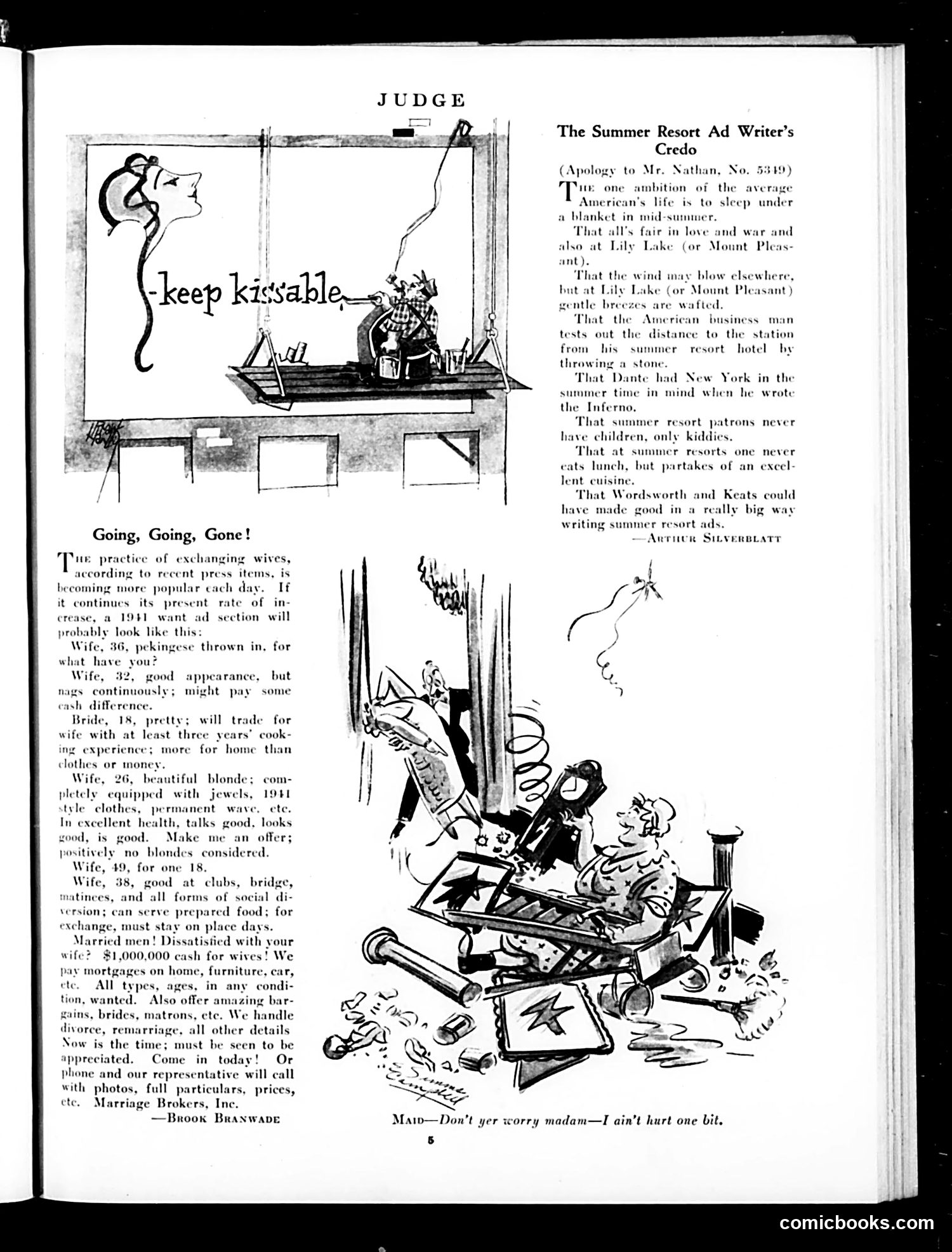
Judge Magazine Page Analysis This page contains three distinct pieces of satire: 1. "Keep Kissable" (top): A billboard advertisement parody mocking summer resort marketing, showing a couple in a canoe. The satire targets how resorts advertise romantic getaways. 2. "Going, Going, Gone!" (left): A classified ad-style satire listing wives for exchange or sale, with specific "models" and their features (age, appearance, cooking ability). This grotesque humor mocks both marriage and the commodification of women—reflecting 1910s-era attitudes, though presented as absurd. 3. "Maid—Don't yer worry madam" (right): Shows a maid amid chaos and destruction, reassuring her employer she hasn't hurt anything. The visual irony—surrounding wreckage contradicting her words—satirizes incompetent household help and employer-servant relations. The overall theme critiques consumer culture, marital attitudes, and domestic life of the era through exaggerated, darkly comedic scenarios.
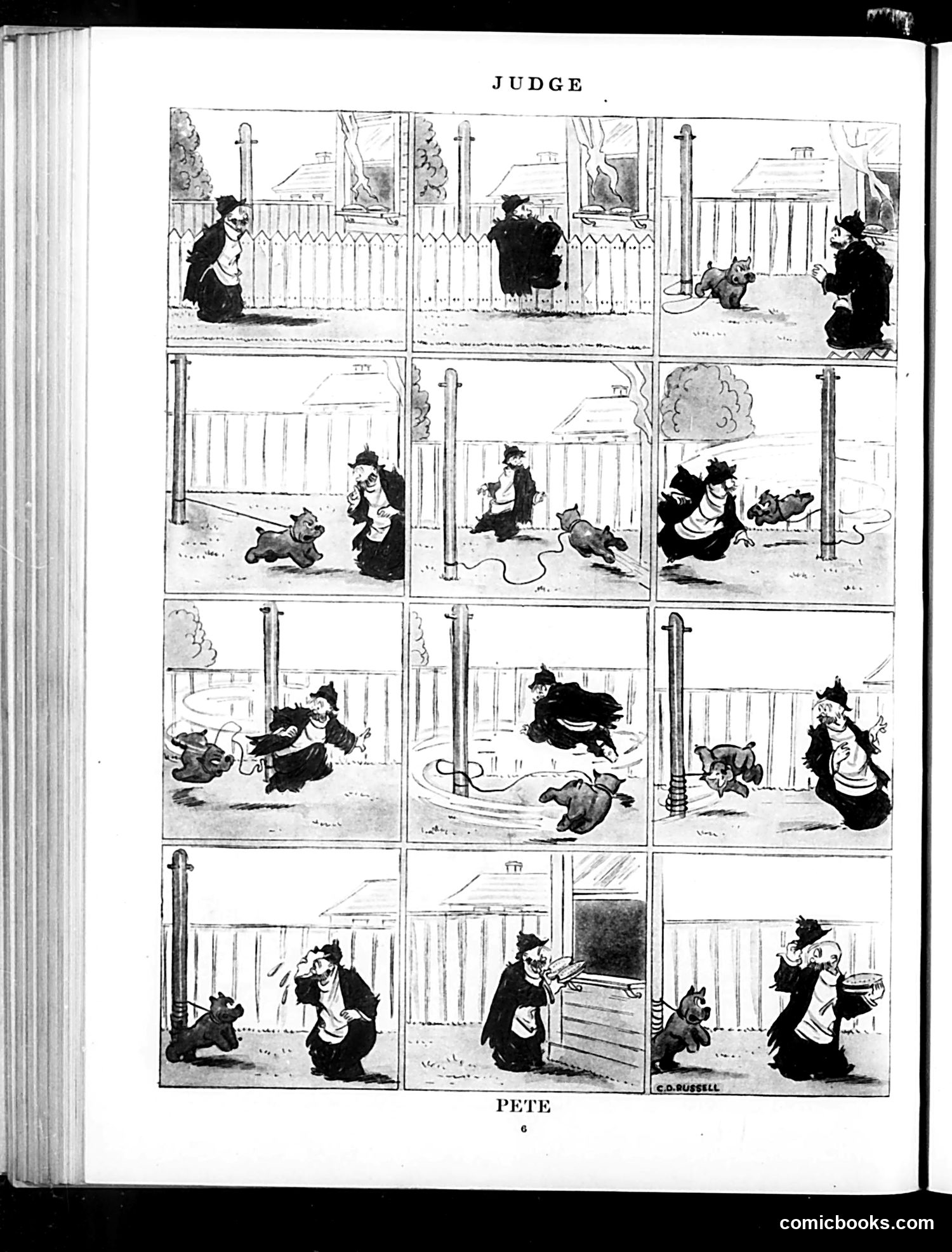
"Judge" - "Pete" Comic Strip Analysis This is a multi-panel comic strip titled "Pete" signed by C.D. Russell. It depicts a man in formal attire (top hat and coat) repeatedly encountering and being chased or attacked by a small dog in a residential courtyard setting with white picket fences. The humor appears to be slapstick: the formally-dressed gentleman experiences escalating physical comedy—the dog nips at him, tangles him in its leash, causes him to fall, and generally harasses him throughout the sequence. The contrast between his dignified appearance and his undignified treatment by the small dog drives the joke. Without additional context, the figure's identity is unclear—this may reference a specific public figure of the era, or it could be pure comedic scenario.
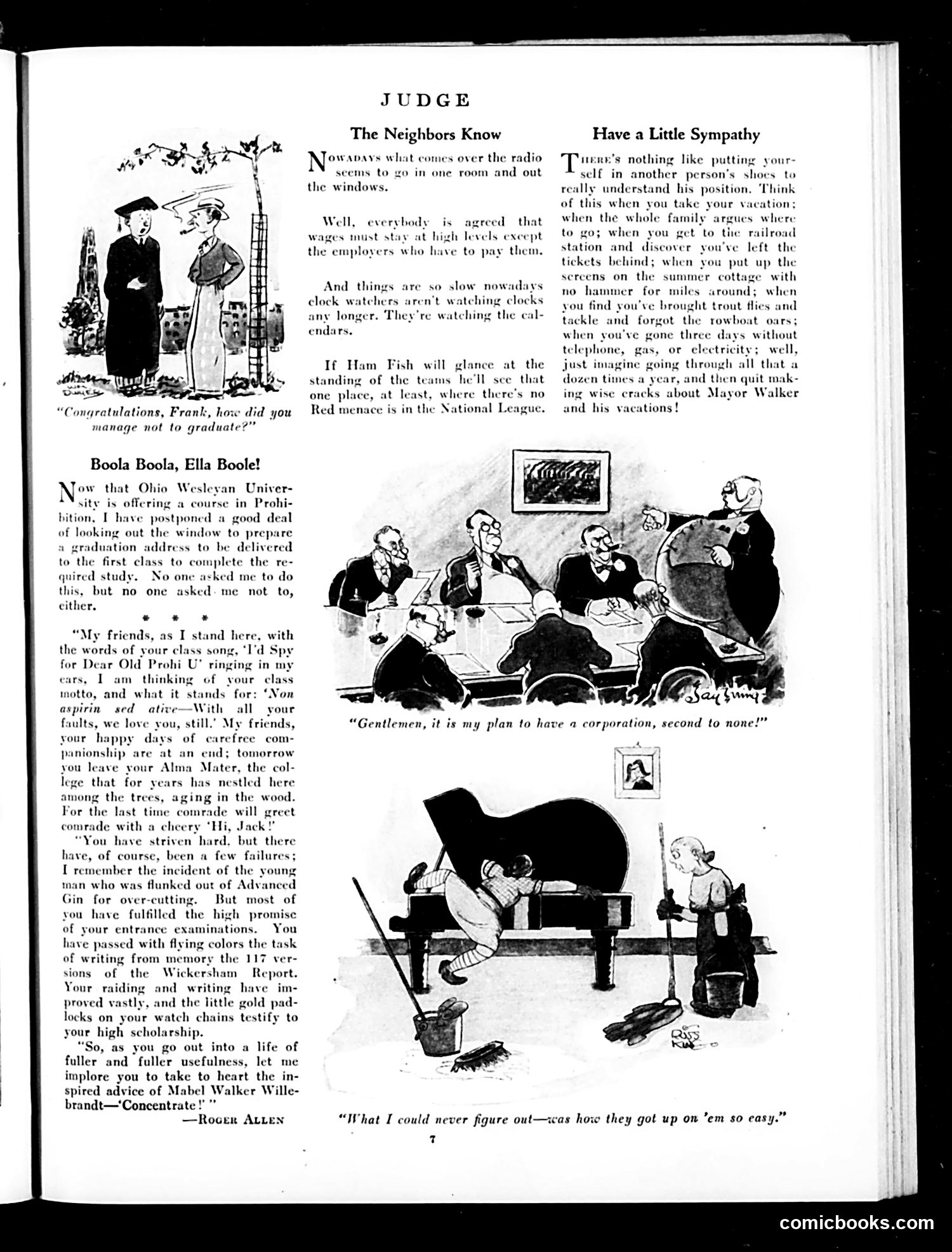
Judge Magazine Page Analysis This page contains three satirical pieces mocking Prohibition-era America and contemporary politics: "Boola Boola, Ella Boole!" (by Roger Allen): A mock graduation address to Ohio Wesleyan University's first Prohibition studies class. The satire skewers Prohibition by having the speaker joke about students studying "Advanced Gin," referencing the Wickersham Report (a notorious federal investigation of Prohibition enforcement failures), and praising "raiding" skills. The dedication to Mabel Walker Willebrandt—the Assistant Attorney General enforcing Prohibition—intensifies the irony. "The Neighbors Know": Short observations about radio, wage-earning workers, and sports. A reference to "Ham Fish" (likely Rep. Hamilton Fish III) and "Red menace" in baseball appears to comment on contemporary political anxieties. "Have a Little Sympathy": Practical humor about vacation mishaps—forgotten tickets, missing tools, lost fishing gear—encouraging empathy. The cartoons depict everyday scenes matching these texts: a couple discussing a graduate, businessmen in a meeting, and a child fishing. The humor assumes reader familiarity with Prohibition's widespread unpopularity and enforcement absurdities.
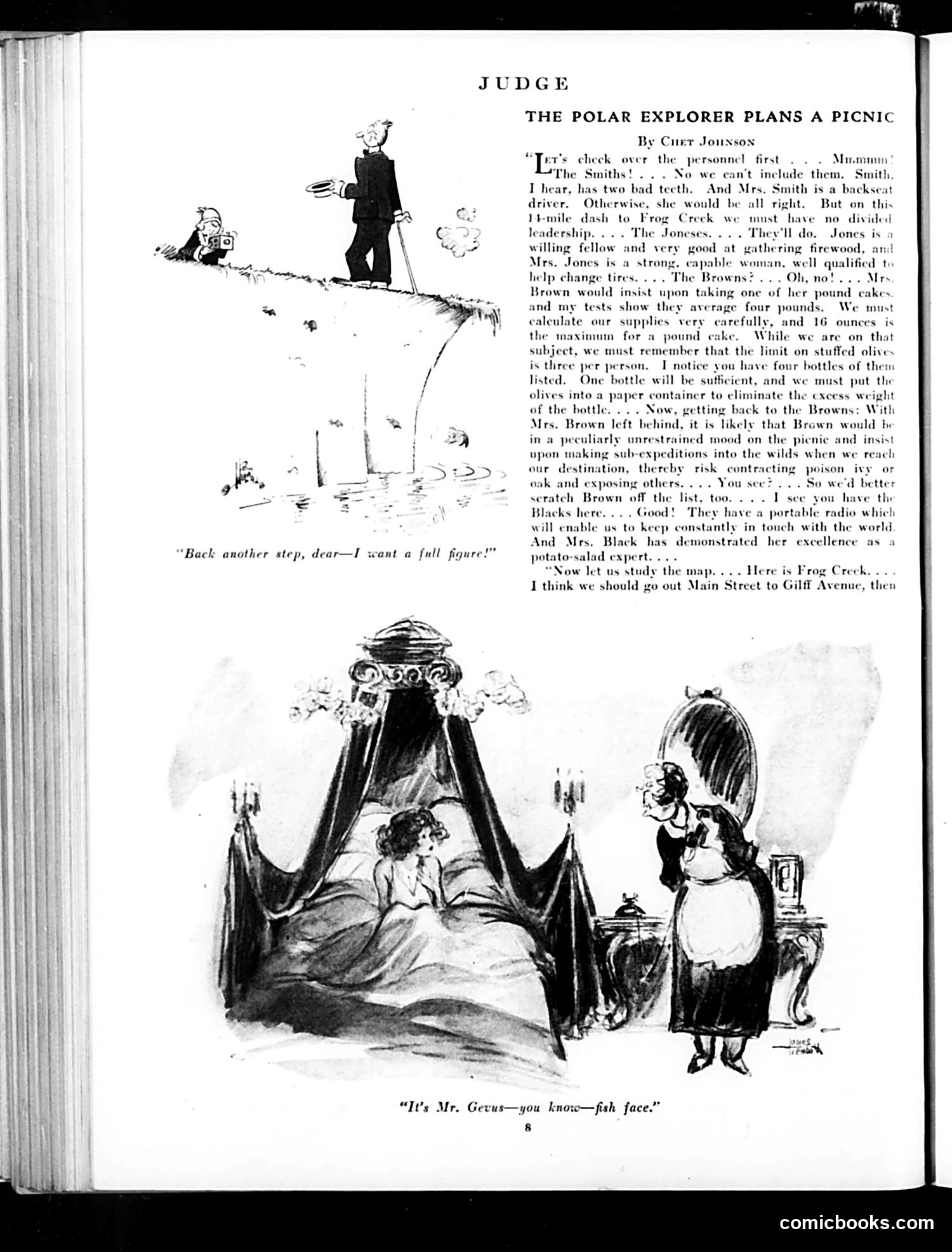
Analysis This is a satirical piece mocking the obsessive, status-conscious planning of upper-class social gatherings disguised as casual outings. The "polar explorer" frames a simple picnic as a military expedition requiring meticulous personnel vetting. The humor lies in the absurdly petty reasons for excluding guests: the Smiths (Mrs. is a "backseat driver"), the Browns (their pound cakes exceed weight allowances by 4 ounces), potential "unrestrained mood" behavior. Meanwhile, the Blacks are approved because Mrs. Black makes good potato salad and they own a portable radio—practical utility trumps friendship. The satire targets early 20th-century bourgeois pretension: the narrator treats guest selection with the gravity of an actual expedition, reveals class anxiety about appearances and social control, and exposes how material concerns (weight limits, radio access) drive social decisions more than genuine affection. The bottom cartoon's caption "It's Mr. Gevus—you know—fish face" suggests parallel mockery of cruel social categorization by appearance. The overall target appears to be snobbish, calculating upper-middle-class social climbing.
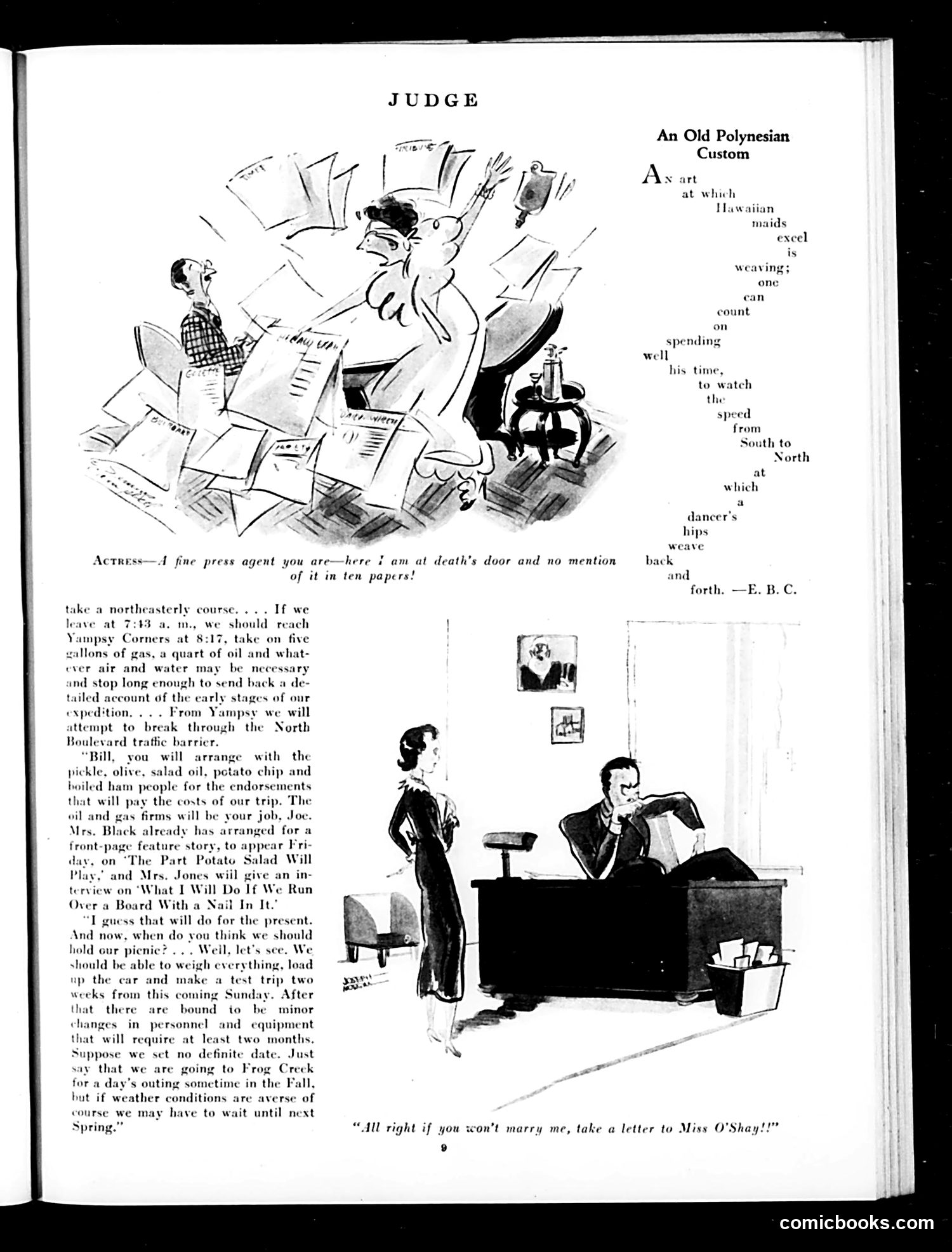
Judge Magazine Page Analysis This page contains two distinct satirical pieces: Top cartoon ("Judge"): An actress complains to her press agent that despite being "at death's door," she's received no newspaper mention. The satire mocks both actresses' desperation for publicity and press agents' incompetence—the actress expects her illness to generate headlines. Bottom cartoon: A man at a desk tells a woman he won't marry her, then callously instructs her to "take a letter to Miss O'Shay!" The joke satirizes male indifference and workplace impropriety—he dismisses her romantic rejection by immediately pivoting to dictating business, treating her as his secretary despite their personal relationship. Middle text: A humorous account of planning an elaborate road trip with multiple sponsors (oil companies, food manufacturers), requiring endorsement deals and publicity stunts. It mocks corporate sponsorship excess and overly complicated vacation logistics. The page satirizes early 20th-century American attitudes toward publicity, relationships, and commercialism.
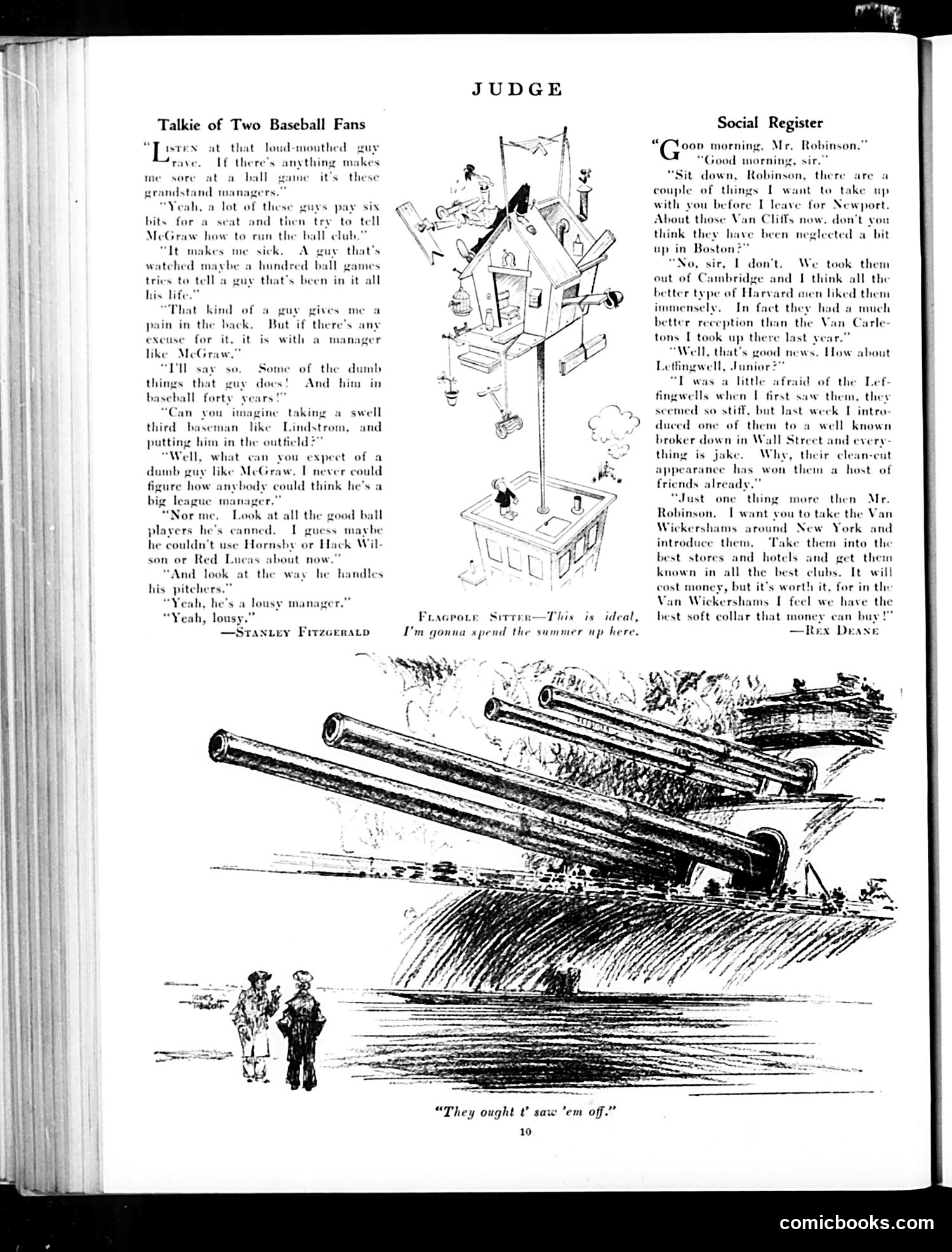
Explanation for Modern Readers This Judge magazine page contains two satirical pieces: "Talkie of Two Baseball Fans" (left): Two working-class men at a baseball game complain endlessly about manager John McGraw, criticizing his player trades and decisions despite their limited knowledge. The humor lies in their hypocrisy—they mock "stand managers" (armchair critics) while being exactly that themselves. Stanley Fitzgerald's byline suggests this is social commentary on how ordinary fans confidently second-guess professional decisions. "Social Register" (right): A wealthy employer instructs his servant Robinson to parade the "Van Cliffs" and "Van Wickershams" (newly rich families) around New York's finest establishments to establish their social credentials. The joke is cynical: wealth and appearance alone can buy social acceptance if properly marketed—even Rex Deane's closing quip about the Van Wickershams being "the best soft collar that money can buy" suggests they're commodities, not genuinely refined people. Both pieces satirize American social climbing and pretension in the 1920s-30s era.
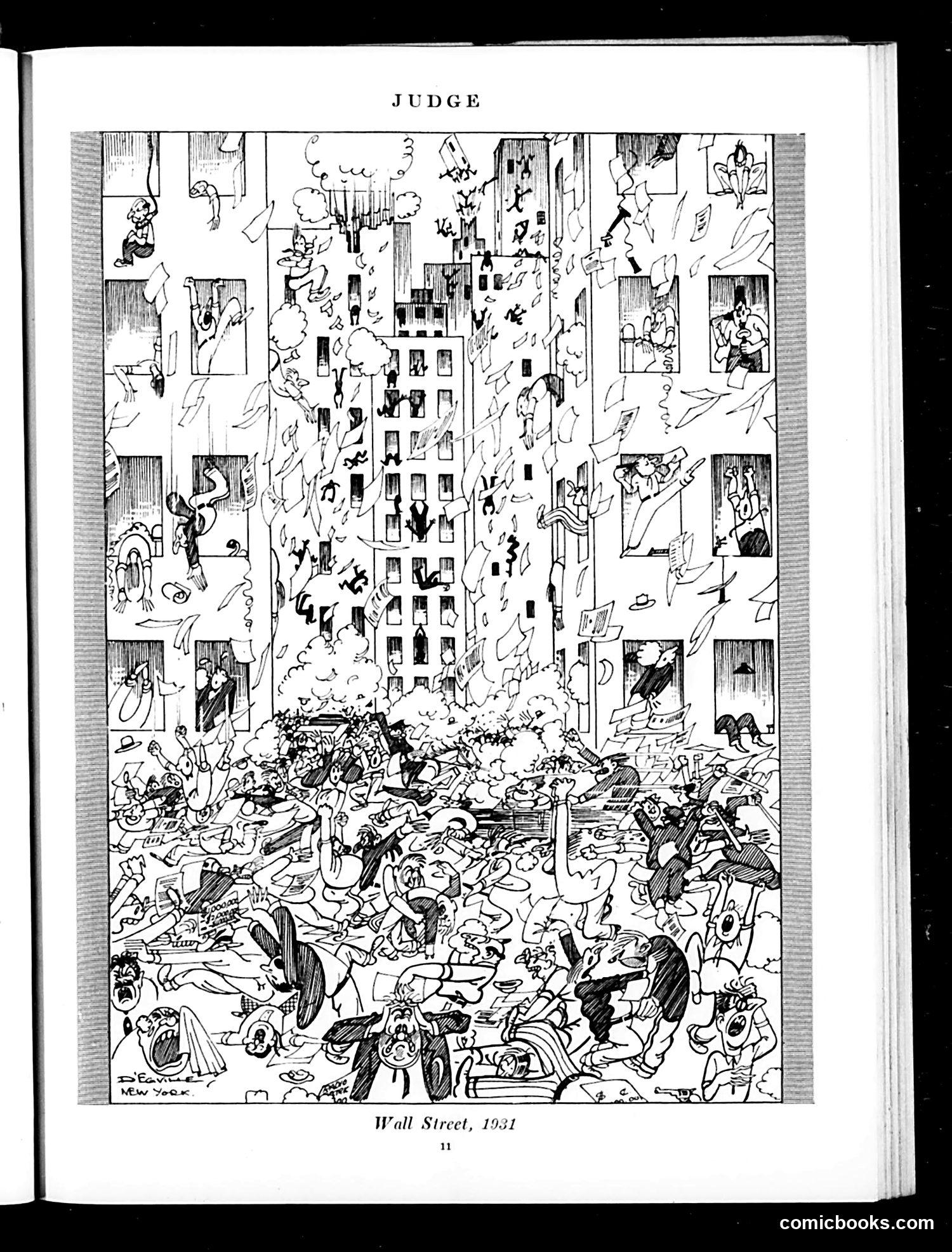
Wall Street, 1931 This cartoon depicts the chaos of Wall Street during the 1931 stock market crisis, following the 1929 crash. The image shows a crowded street scene with tall buildings (representing financial institutions) amid complete pandemonium—figures are falling, papers flying, and general disorder suggests economic collapse and panic. The satire critiques the financial district's turmoil during the Great Depression. Investors, brokers, and financiers are depicted as frantic and desperate amid the economic catastrophe. The dense, chaotic composition emphasizes how the stock market's collapse created widespread confusion and ruin for ordinary citizens and speculators alike. Judge magazine used such illustrations to satirize Wall Street's failures and mock the financial establishment's role in precipitating national economic disaster—a common theme in Depression-era political cartooning.
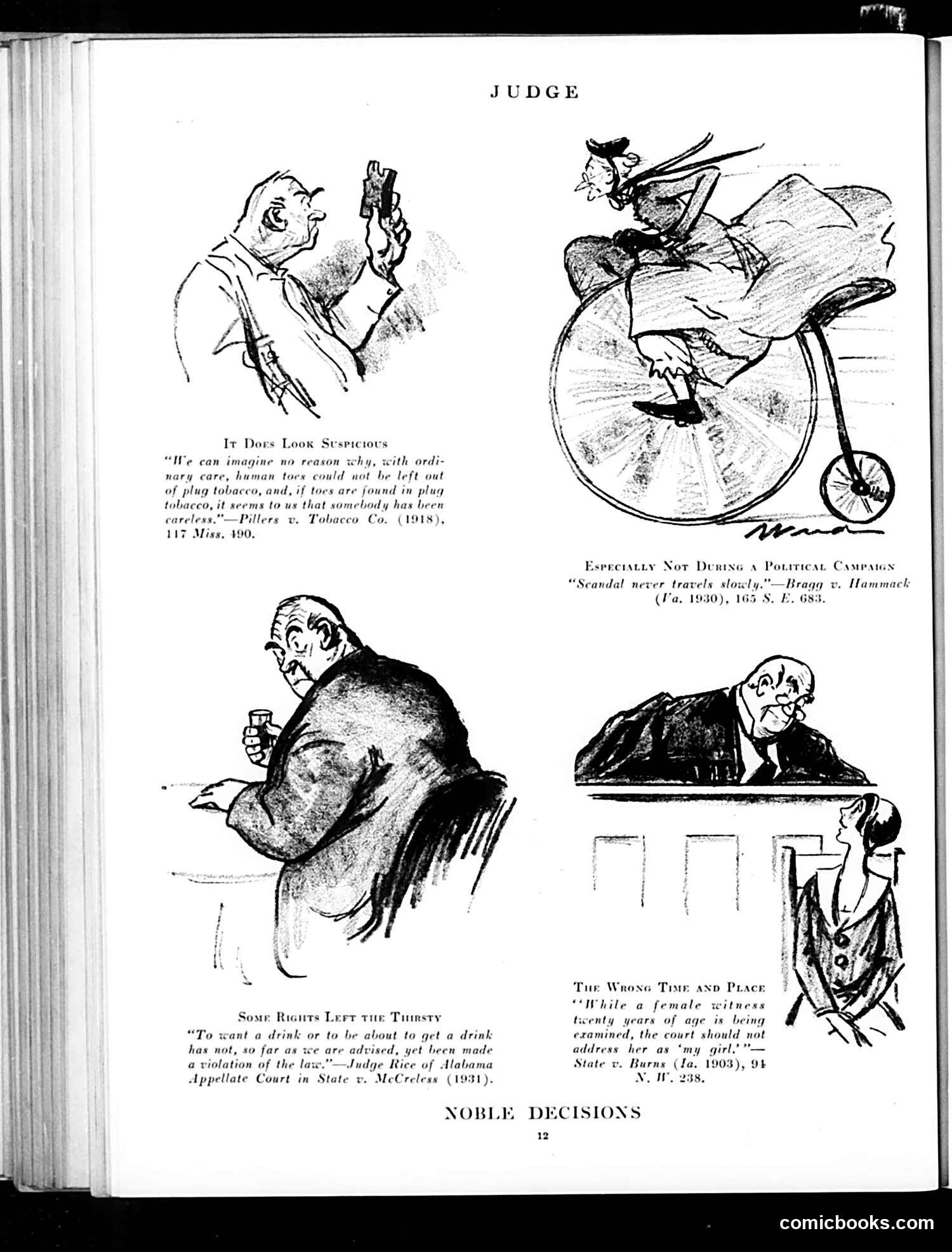
"Noble Decisions" - Judge Magazine Satire This page satirizes absurd or questionable court rulings through cartoons paired with actual legal citations. The humor comes from judges making rulings that seem ridiculous or reveal social attitudes worth mocking. The top cartoon shows a judge examining a revolver suspiciously—referencing a case about finding human toes in plug tobacco, implying careless manufacturing. The middle cartoon depicts a figure on a penny-farthing bicycle, labeled "Scandal never travels slowly"—likely mocking a ruling about how rumors spread, especially politically. The bottom cartoons address courtroom conduct: one judge holds a drink (referencing a ruling that wanting alcohol isn't illegal), while another addresses a young female witness as "my girl"—which the court supposedly shouldn't do. The page mocks judicial decisions and courtroom behavior as absurdly lenient, careless, or socially inappropriate, using actual case law to highlight the gap between legal reasoning and common sense or basic decency.
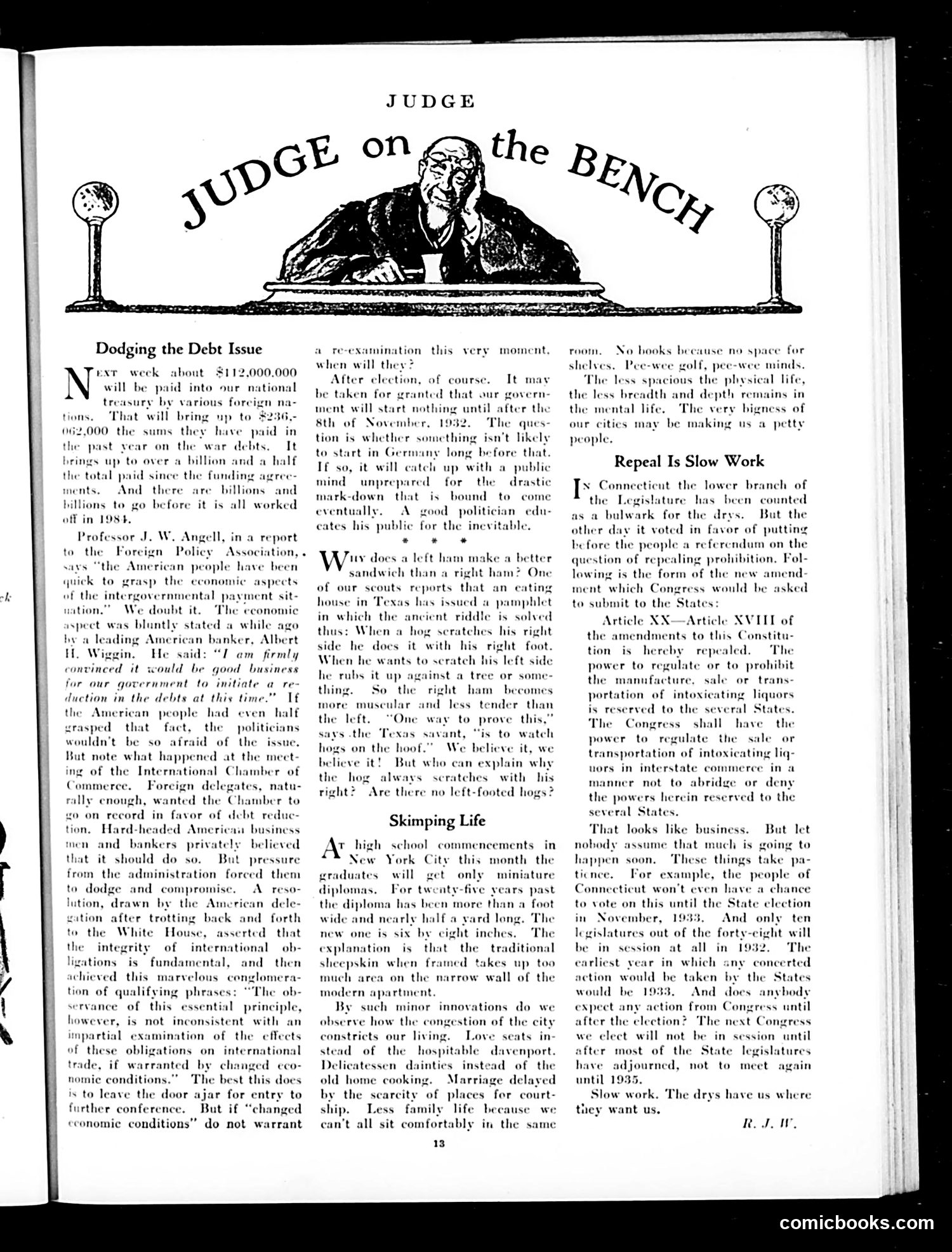
Judge Magazine Page Analysis This page from Judge satirizes American political and economic evasion circa 1932. The header illustration shows a judge presiding over debates about national issues. "Dodging the Debt Issue" criticizes how American politicians and businessmen avoid confronting war debt reduction. The article notes that foreign nations have paid $236 million toward war debts, yet American leadership refuses to acknowledge the economic logic of debt relief—likely fearing voter backlash. The International Chamber of Commerce, pressured by the U.S. administration, produces vague language supporting debt integrity while leaving "the door ajar" for future negotiation. The satire targets political cowardice: leaders privately understand debt reduction makes economic sense but publicly dodge the issue until after the November election. "Why does a left ham make a better sandwich?" is a humorous aside—a Texas restaurant's absurd explanation for why left-side pork is tougher. "Skimping Life" observes how urban crowding forces lifestyle compromises: diplomas shrink to fit apartment walls; furniture miniaturizes; marriage is delayed by lack of courtship space. This reflects Depression-era housing scarcity and cramped city living. The overall tone criticizes political dishonesty and modern urban constraints.
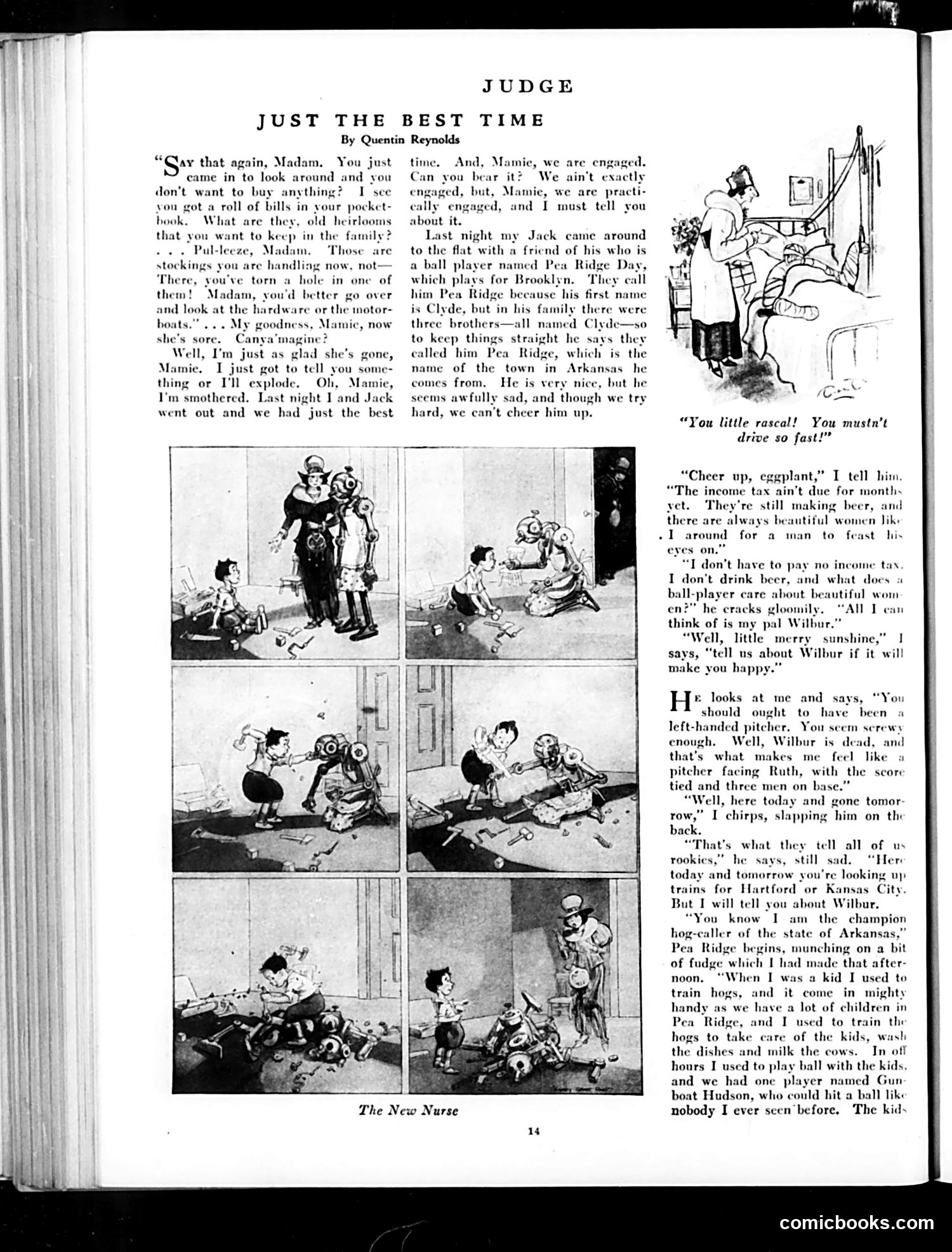
Analysis: "Just the Best Time" by Quentin Reynolds This is a humor story with accompanying comic strip panels, not political satire. The narrative follows two women gossiping about engagements and a visiting baseball player named Pea Ridge Day (real name Clyde) who plays for Brooklyn. The humor relies on early 20th-century social comedy: a woman excitedly discusses her quasi-engagement while her friend Mamie listens; Pea Ridge is melancholy about his deceased friend Wilbur. The story employs period vernacular ("Pul-leeze," "eggplant") and the gentle ribbing typical of Judge's humor. The comic panels illustrate domestic scenes—a woman shopping, domestic interactions, children playing—visualizing the dialogue. Context for modern readers: This reflects Jazz Age sensibilities about courtship, baseball celebrity culture, and working-class leisure. References to beer-making and income tax suggest 1920s-era concerns, though the exact date is unclear from the page alone.
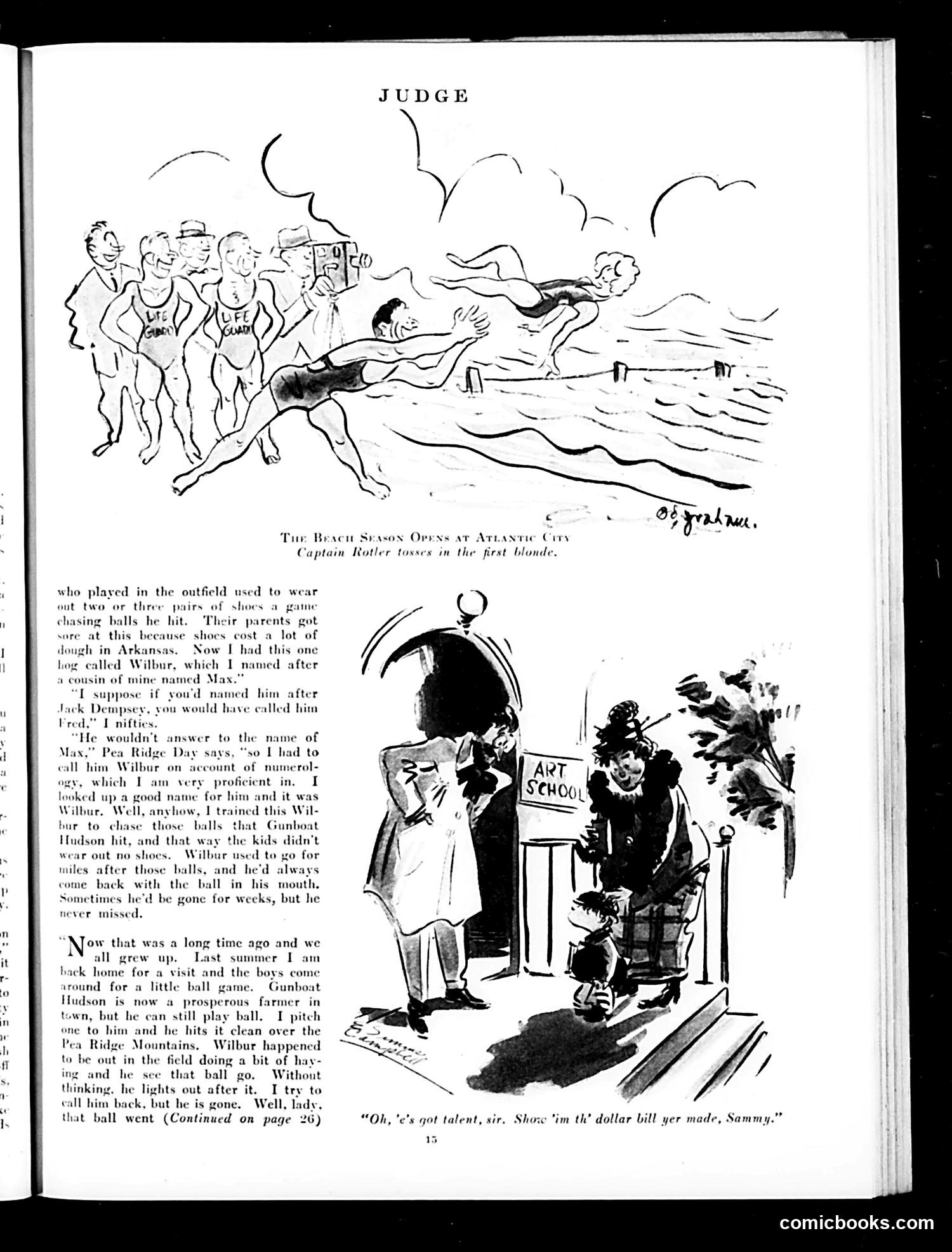
Analysis of Judge Page Top Cartoon: "The Beach Season Opens at Atlantic City" depicts a lifeguard (labeled "JUDGE") tossing a blonde woman into the water while other lifeguards watch. The satire appears to mock the early 1900s beach culture and the objectification of women, with the "Judge" character serving as an authority figure overseeing this frivolous seaside entertainment. Bottom Cartoon & Story: This illustrates a tall-tale about a dog named Wilbur trained to retrieve baseballs. The narrative humorously describes how the dog runs after a ball hit over "Pea Ridge Mountains" and never returns. The final cartoon shows an Art School, with a caption suggesting the dog has reappeared as an art student—implying the story's absurdity. The humor relies on the exaggerated yarn-spinning style common to American folklore. Both pieces reflect early-1900s Judge magazine's blend of visual gags, social commentary on leisure activities, and tall-tale storytelling tradition.
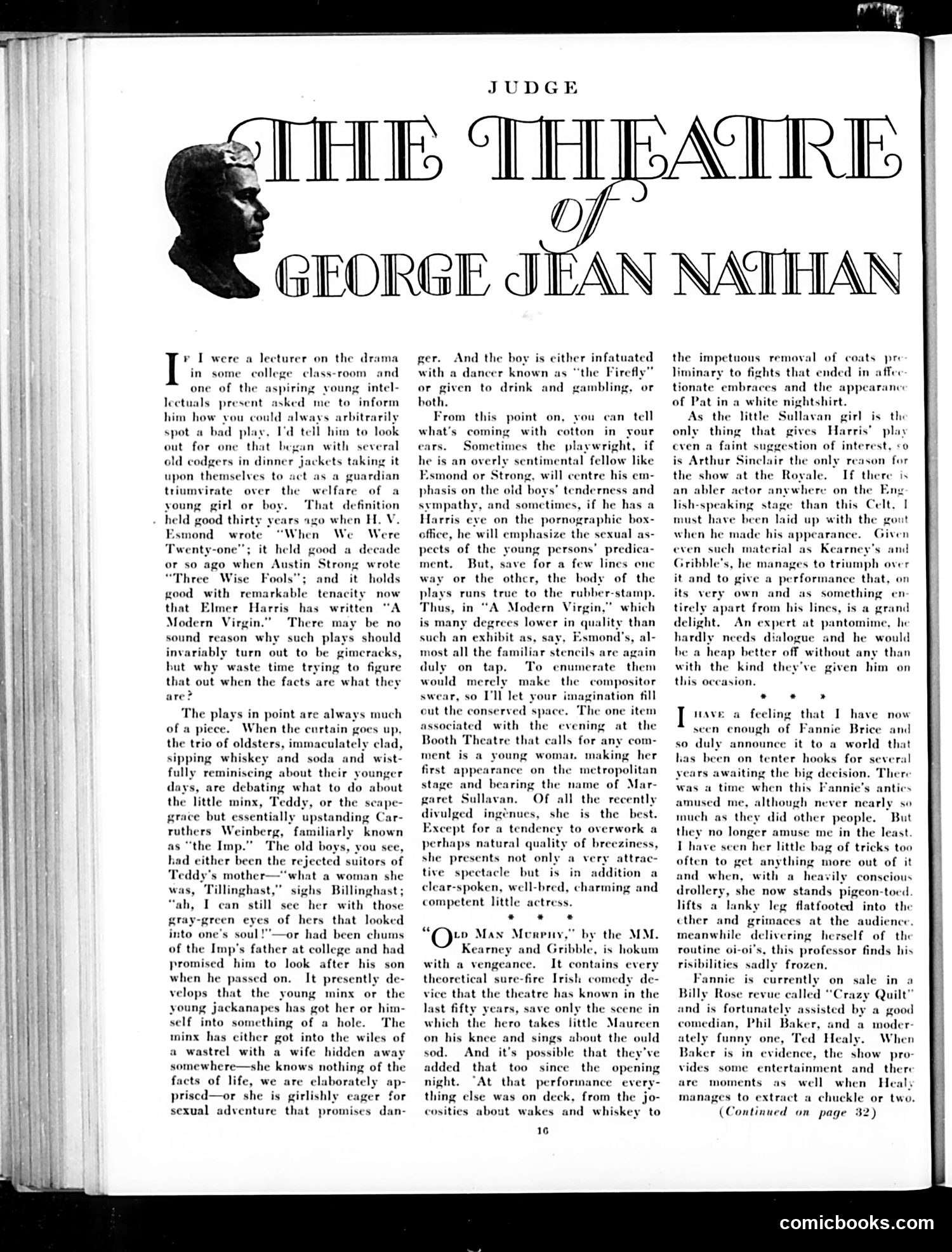
"The Theatre of George Jean Nathan" This is a theater criticism column by Judge's drama critic. The visible image shows a profile portrait of Nathan himself, establishing his byline. Nathan critiques formulaic stage plays, particularly those featuring three elderly male guardians protecting a young person from moral peril. He identifies this tired plot device in works by H.V. Esmond ("We Were Twenty-one"), Austin Strong ("Three Wise Fools"), and Elmer Harris's current production "A Modern Virgin." Nathan praises Margaret Sullavan, a young actress making her metropolitan debut in "A Modern Virgin," calling her "the best" of recently divulged ingénues, though noting her tendency to overwork her natural breeziness. He dismisses "Old Man Murphy" by Kearney and Gribble as hokum—a conventional Irish comedy relying on every theatrical stereotype about wakes and whiskey. The column demonstrates how Nathan uses specific, named theatrical productions and performers to comment on broader patterns in contemporary drama.
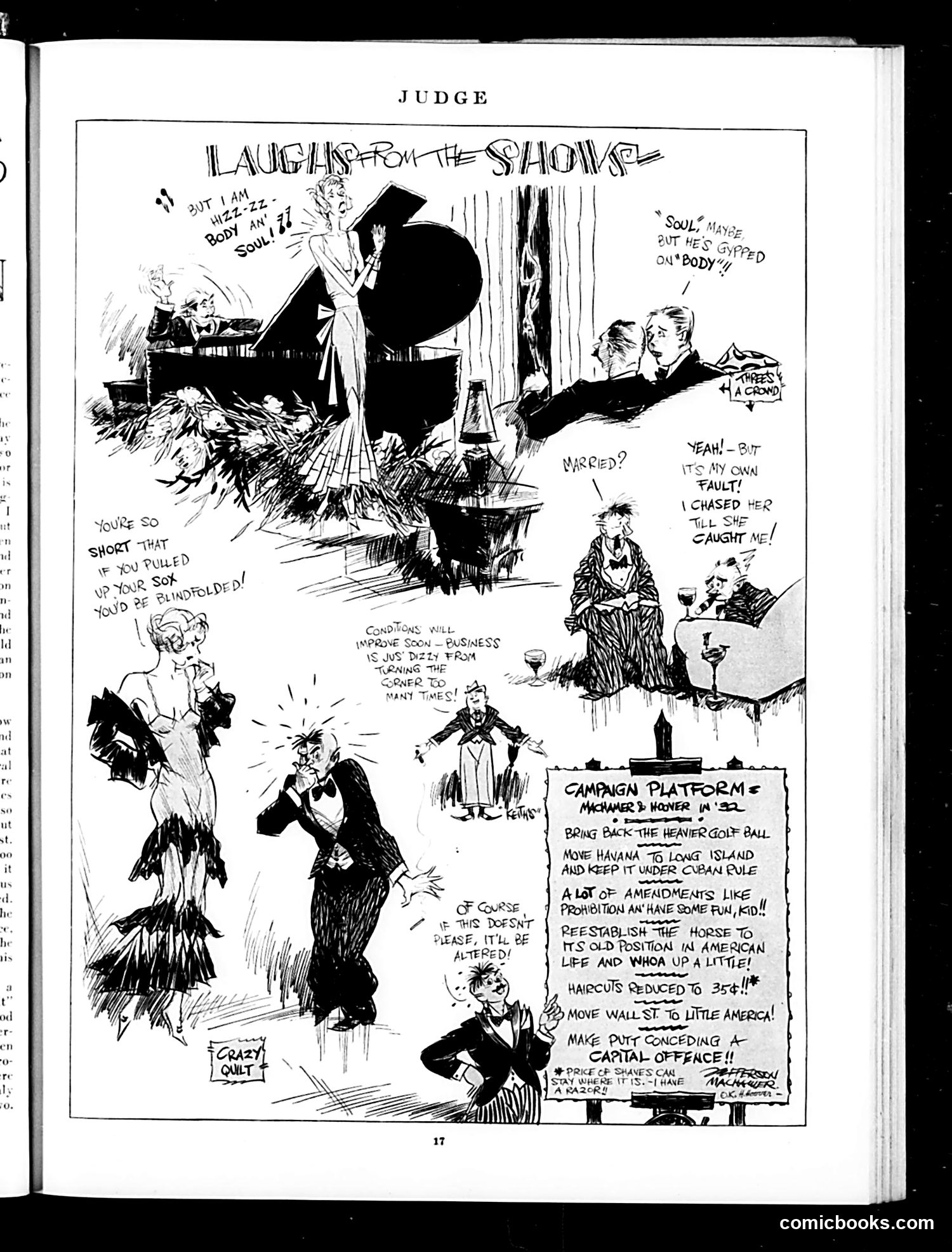
Political Cartoon Analysis: "Judge" Magazine This page satirizes the 1924 U.S. presidential campaign, specifically mocking the Republican platform of Calvin Coolidge and running mate Charles Dawes ("MacHarr & Honer"). The central cartoon ridicules their campaign proposals as absurdly trivial or reactionary: restoring heavier golf balls, moving Havana to Long Island under Cuban rule, reducing haircuts to 35 cents, relocating Wall Street to "Little America," and making golf-putting concession a capital offense. The surrounding vignettes mock social pretension and marital discord—showing affluent figures in awkward situations discussing bodies, souls, and fidelity. The overall message: the Republican platform is laughably out-of-touch with real issues, focusing instead on elite frivolities while serious problems (economics, Prohibition) go unaddressed. The satire targets both Republican priorities and the wealthy class they represent.
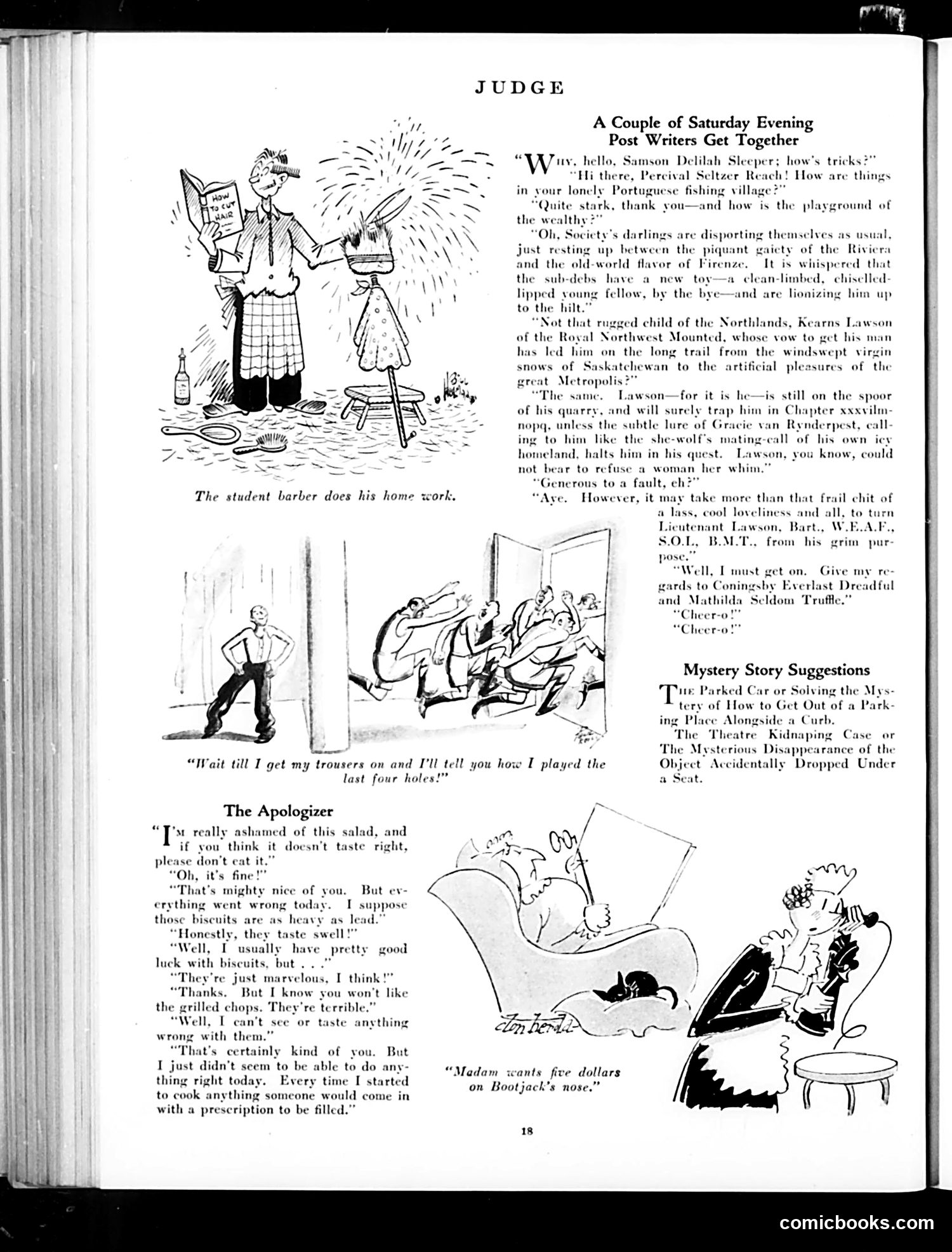
Analysis of Judge Magazine Page This page contains three satirical pieces mocking popular writing and social pretension: "The Student Barber" ridicules amateur barbers practicing on family members—a common wartime or economic necessity—with the joke being the barber's eagerness to discuss golf rather than apologize for poor work. "The Apologizer" skewers the over-apologetic hostess who self-deprecates every dish while her guest must perform the exhausting social ritual of reassuring her. The final detail—she's been interrupted by pharmacy prescription refills—suggests she's a physician's wife, adding irony to her domestic incompetence. "A Couple of Saturday Evening Post Writers" directly parodies the overwrought, purple prose common in that magazine's popular fiction: melodramatic character names ("Samson Delilah Sleeper," "Gracie van Rynderpest"), exotic settings, and breathlessly overwrought romantic/adventure plots. The "Mystery Story Suggestions" section extends this mockery with absurdly trivial "mysteries." The satire targets both pretentious writing and middle-class social anxiety.
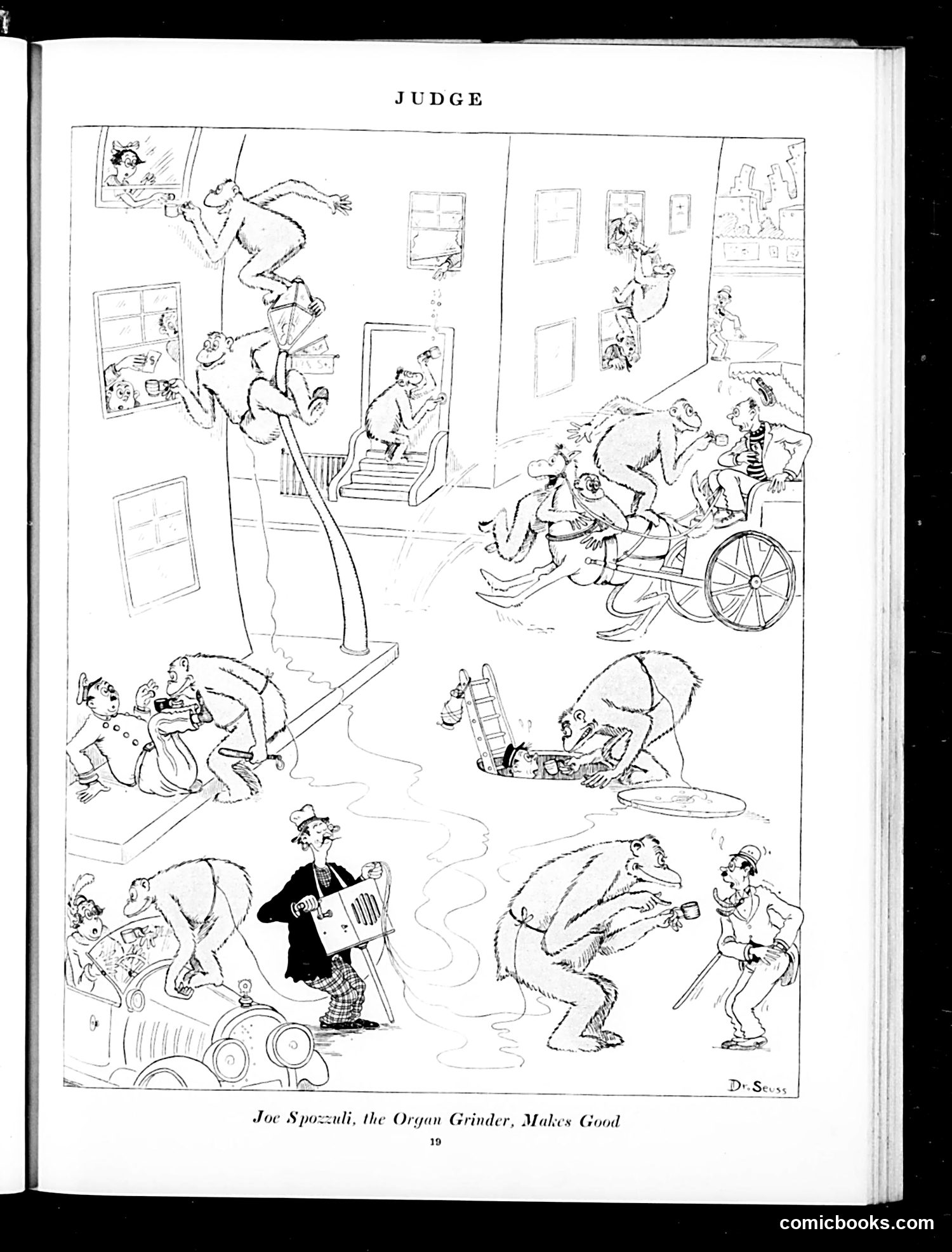
Judge Magazine Cartoon Analysis This cartoon by Dr. Seuss depicts "Joe Spozzuli, the Organ Grinder, Makes Good"—a satirical narrative about social mobility and the American Dream. The sequence shows an Italian immigrant organ grinder (identifiable by his stereotypical appearance and street profession) ascending through increasingly respectable social positions: from street musician to performer, then to various stages of upward mobility, culminating in what appears to be judicial or high social standing (fitting the magazine's title "Judge"). The satire likely mocks both the exaggerated ease of social climbing in America and contemporary stereotypes about Italian immigrants. The chaotic street scenes contrast with the refined setting above, suggesting commentary on class aspirations and American assimilation myths of the early 20th century.
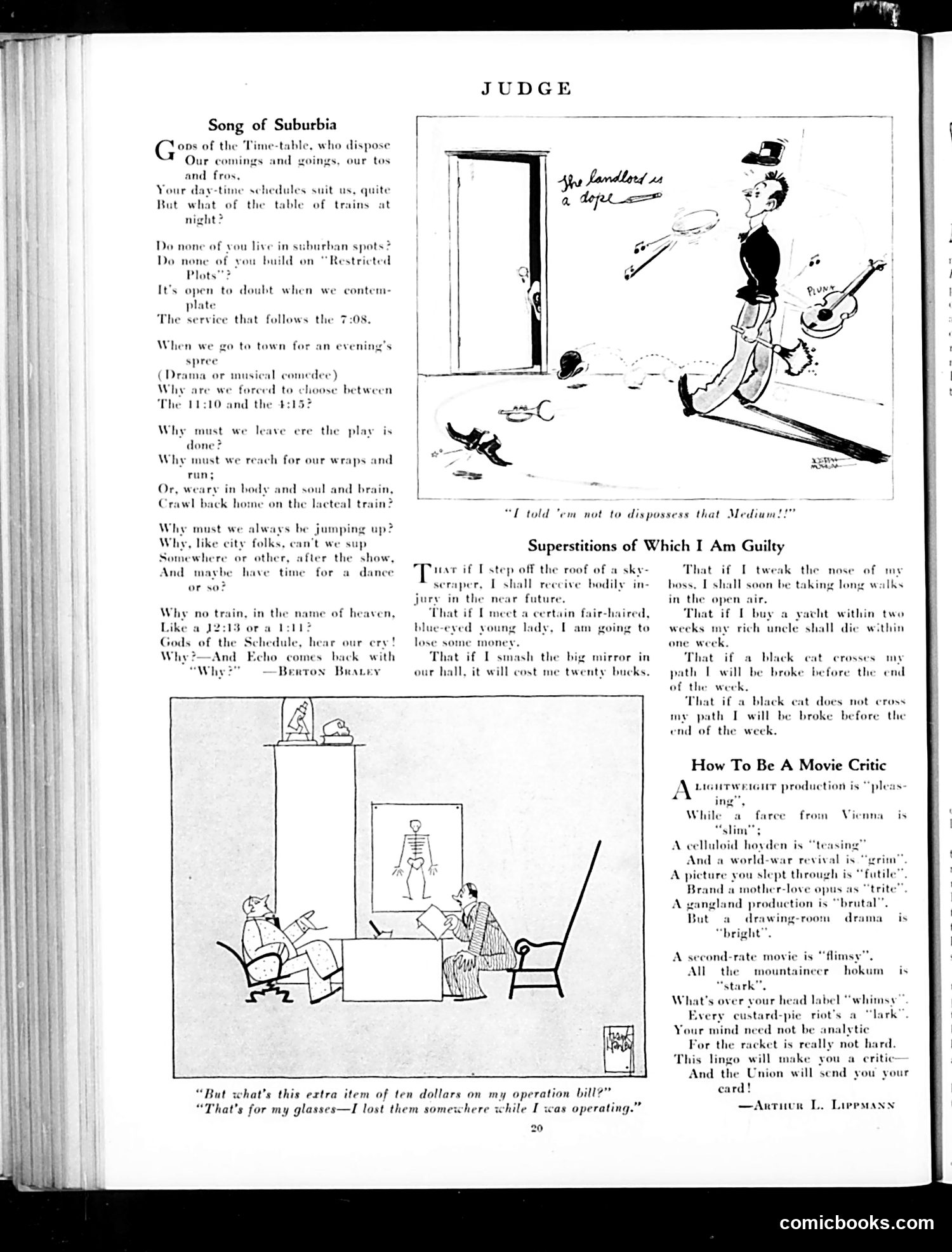
Judge Magazine Page Analysis This page contains three satirical pieces lampooning early 20th-century American life: "Song of Suburbia" (Berton Braley) mocks suburban commuters' frustrations with railroad schedules. Commuters must choose between inconvenient late trains (11:10 PM or 4:15 AM) after evenings in town, forcing them to leave shows early or endure exhausting night journeys. The satire targets both the railroads' inadequate service and the suburbs' dependency on trains. "Superstitions of Which I Am Guilty" humorously lists contradictory superstitions—if a black cat crosses your path you'll go broke; if it *doesn't* cross your path, you'll also go broke. This mocks how people rationalize outcomes through arbitrary beliefs. "How To Be A Movie Critic" (Arthur L. Lipemann) satirizes film criticism as pretentious jargon rather than genuine analysis. Lightweight productions are called "pleasing," serious ones "grim," and critics use labels like "brutal" or "stark" without real evaluation. The joke: following this formulaic approach gets you union membership. All three pieces target American middle-class anxieties and the era's emerging consumer culture.
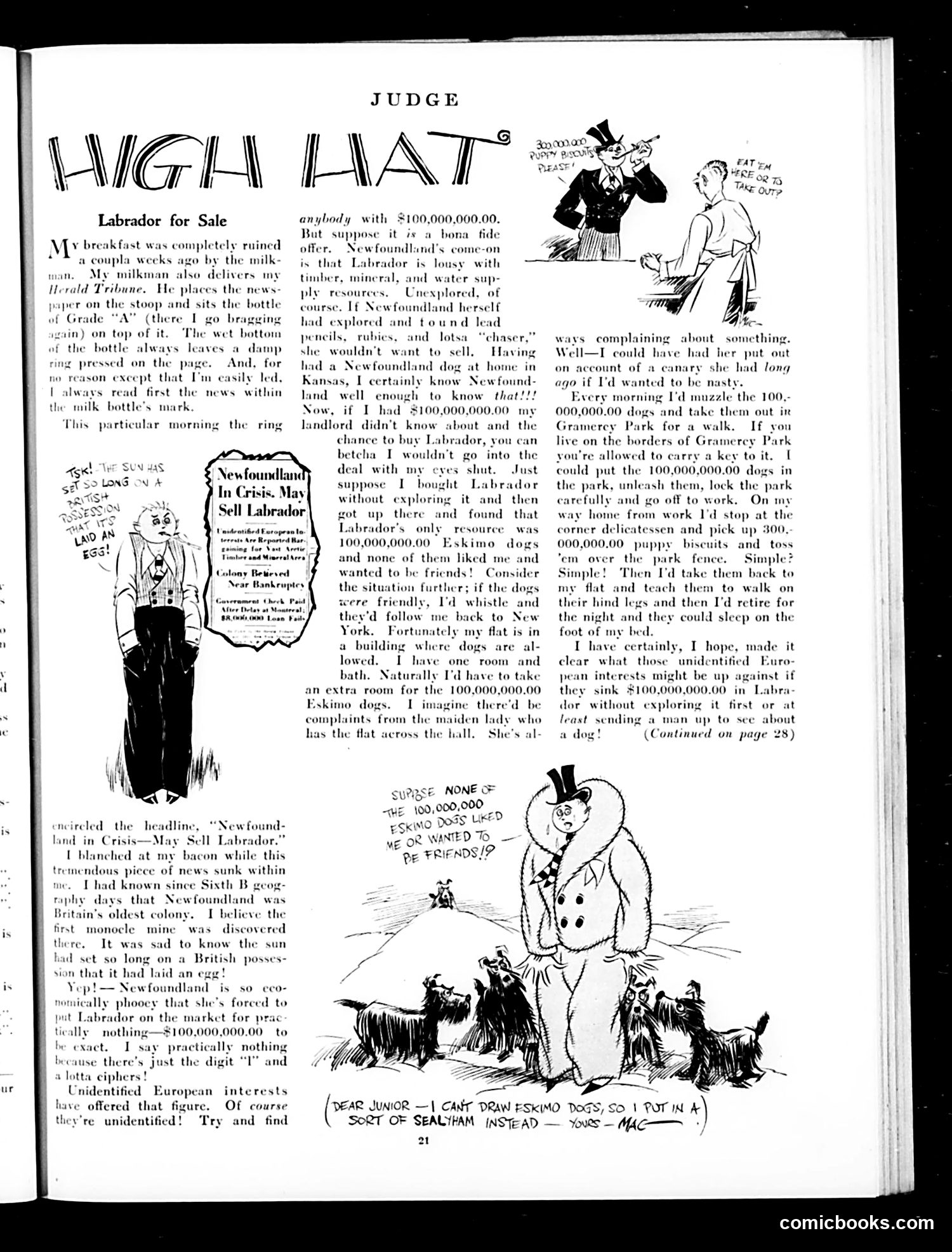
"High Hat": Labrador for Sale This satirical article mocks the economic desperation of Newfoundland, which faced financial crisis in the 1930s and considered selling Labrador to raise funds. The unnamed author uses absurdist humor to lampoon the scheme: he imagines buying Labrador for $100 million, only to discover its sole resource is 100 million Eskimo dogs that don't like him. The satire targets both Newfoundland's predicament and "unidentified European interests" (likely referring to real foreign investors eyeing the territory). By reducing the scheme to the ridiculous problem of housing and managing millions of unfriendly sled dogs in a New York apartment, the author highlights how reckless and unexplored such colonial resource sales were—buyers couldn't possibly know what they'd purchased. The sidebar comic shows a snowman surrounded by sled dogs, captioned as the author's failed attempt to draw Eskimos, adding visual absurdist humor to the piece's overall mockery of the economic crisis and imperial land transactions.
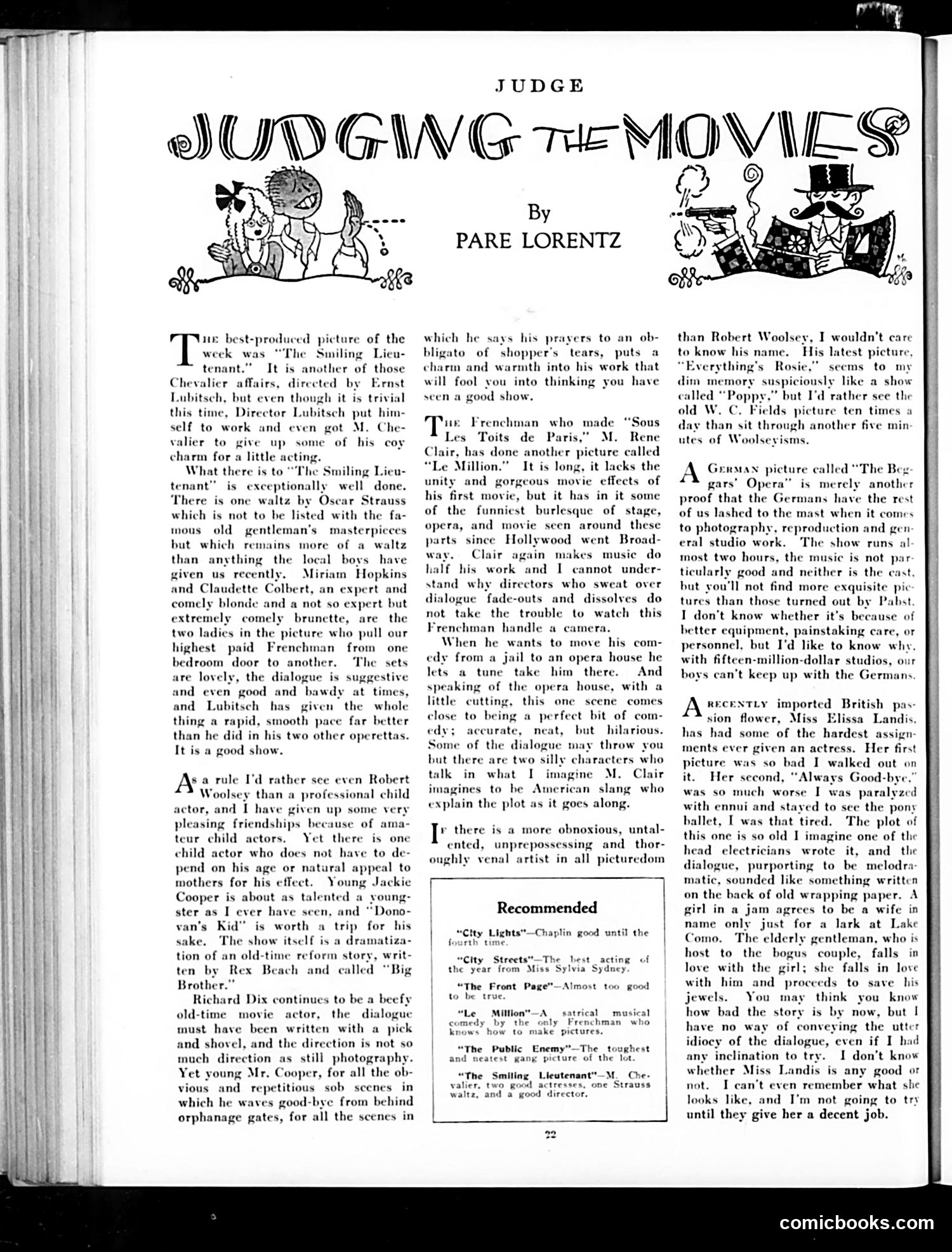
Judge Magazine Movie Reviews, circa 1930 This page presents film criticism by Pare Lorentz for *Judge* magazine, reviewing contemporary Hollywood movies. The column critiques several films including Ernst Lubitsch's "The Smiling Lieutenant" (starring Maurice Chevalier, Miriam Hopkins, and Claudette Colbert), René Clair's "Le Million," and features praising child actor Jackie Cooper in "Donovan's Kid." The reviews demonstrate 1930s film criticism standards: Lorentz evaluates direction, acting, music, dialogue, and pacing. His tone is witty and occasionally cutting—he dismisses one unnamed artist as "obnoxious" and "venal," and criticizes Richard Dix's film as "still photography" rather than true direction. The decorative header illustration depicts theatrical/cinematic figures in a whimsical style typical of *Judge*'s satirical aesthetic. The "Recommended" box at bottom rates films for general audiences, suggesting this was consumer guidance for readers deciding which movies to attend.
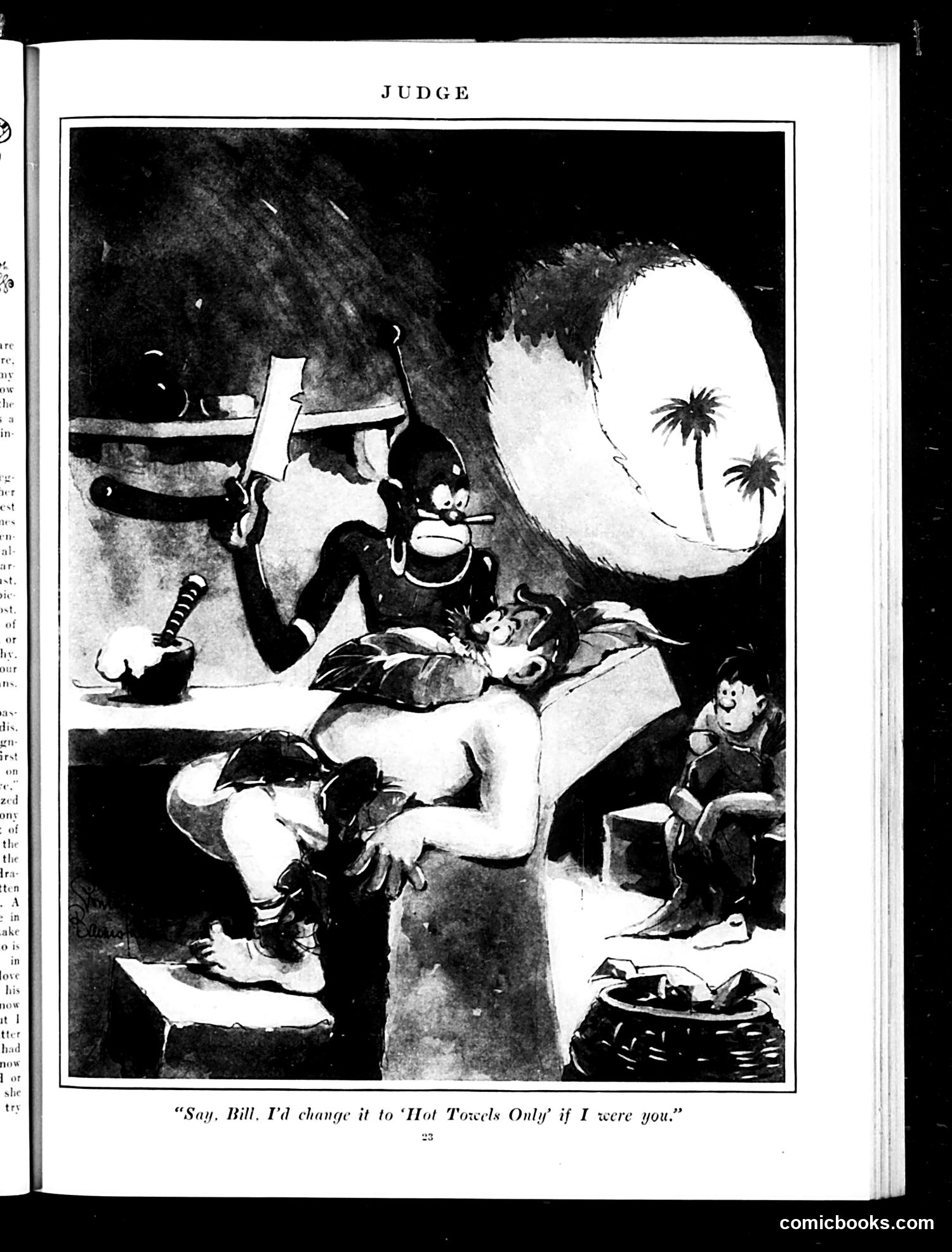
Judge Magazine Cartoon Analysis This cartoon appears to be satirizing a barbershop sign or policy. The large figure (likely representing a barber or shop owner named "Bill") is shown with what appears to be a monkey wielding tools, surrounded by small onlookers. The caption's suggestion to change signage to "Hot Towels Only" suggests the original sign involved services the speaker finds problematic or offensive when associated with the monkey character. The humor relies on racial caricature and stereotyping common to early 20th-century American satire. Without knowing the specific publication date or context, the cartoon likely mocks barbershop practices or proprietors through exaggerated imagery. The monkey imagery was a standard—though deeply offensive—visual trope in period satire for dehumanizing commentary.
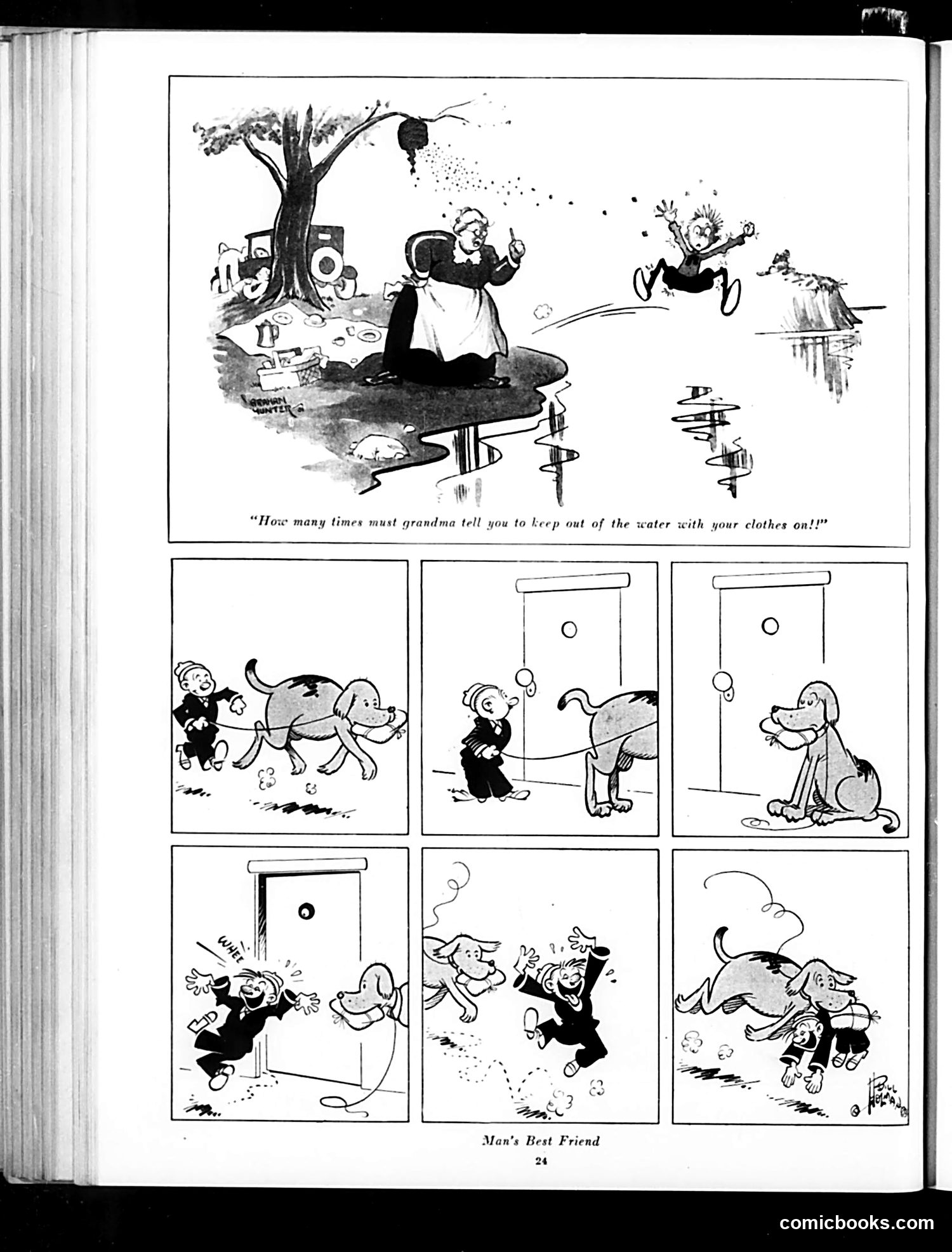
This comic page, titled "Man's Best Friend," uses a child and dog to satirize parental warnings about water safety. The top panel shows a grandmother scolding a child about keeping clothes dry while playing near water—a common domestic concern of the era. The six panels below depict a child and dog at play, escalating from innocent outdoor games to increasingly chaotic water-related mishaps. The dog is repeatedly pulled into water, knocked down, and generally mistreated through their "play," illustrating the irony of the title: the supposedly loyal "best friend" endures rough treatment from the child. The humor derives from the contrast between the grandmother's concern for clothing and the actual physical chaos unfolding, suggesting children's careless play endangers both themselves and their pets.
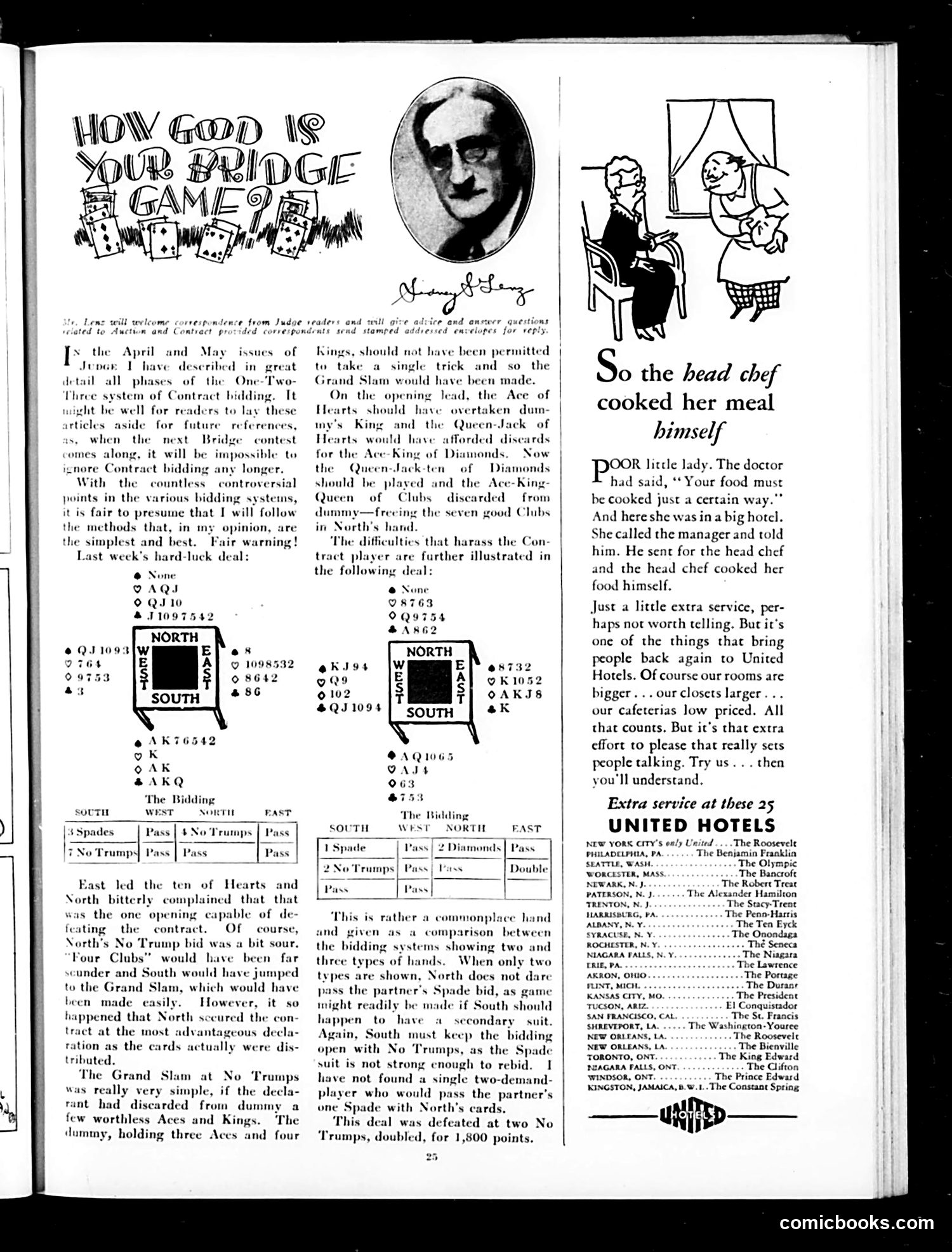
Judge Magazine Page Analysis This page is primarily a bridge instruction column with accompanying advertisement, not a political cartoon. The main content features bridge expert Ely Culbertson (identified by the portrait and signature) explaining Contract Bridge bidding systems. The text discusses complex card-play scenarios from April-May issues, offering detailed analysis of bidding strategies and hand evaluations for readers. The small cartoon in the upper right depicts a domestic scene unrelated to the bridge instruction: a woman in a hotel calls a manager about special dietary needs, and the head chef personally prepares her meal—illustrating "extra service" that distinguishes quality hospitality. Below the bridge column runs an advertisement for United Hotels, a chain of 25 properties across America, leveraging the anecdote to emphasize personalized service as their competitive advantage. The page reflects Judge's typical mix of editorial content and advertising rather than political satire.
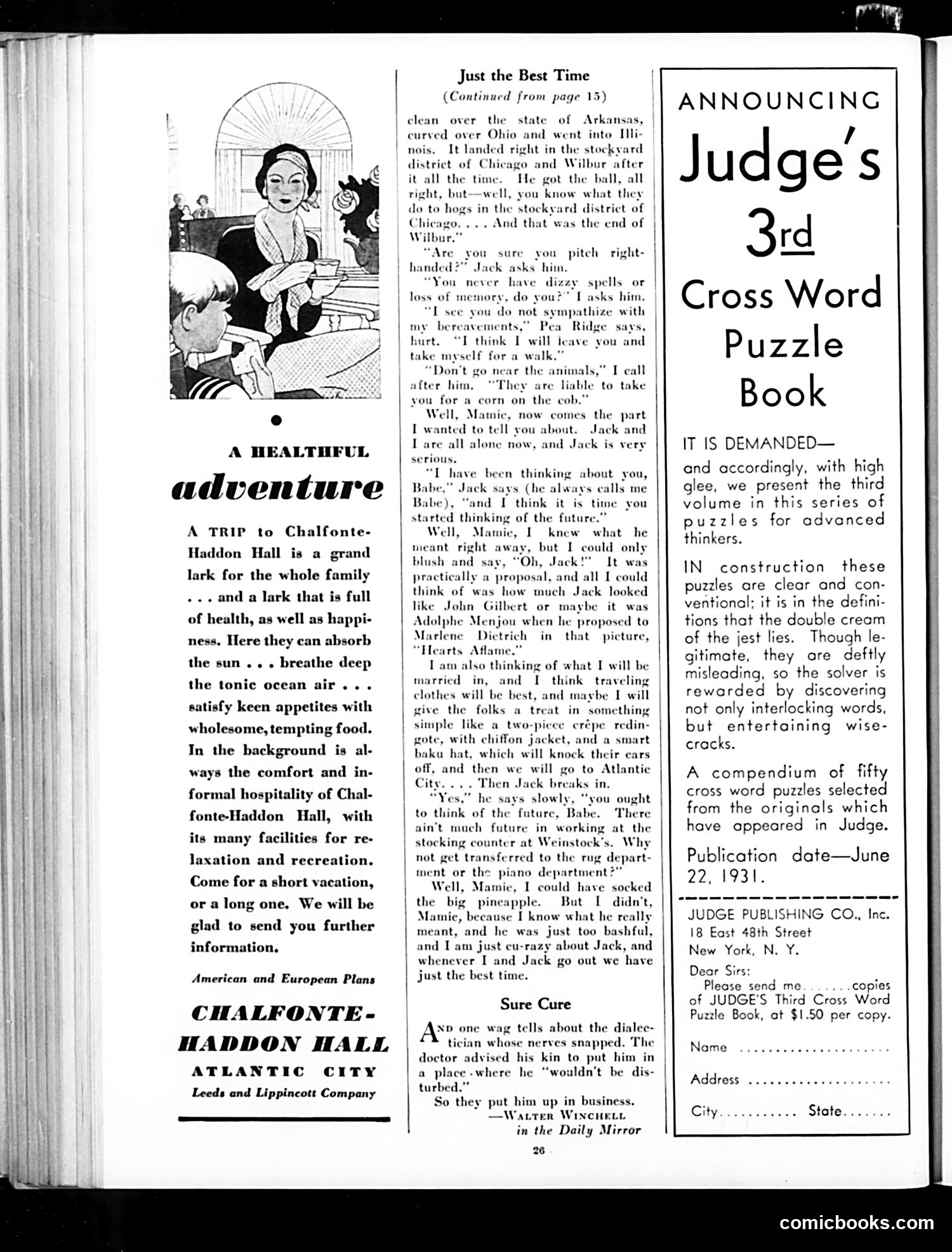
Analysis of Judge Magazine Page This page contains mostly advertising and announcements rather than satirical cartoons. The main content includes: 1. Chalfonte-Haddon Hall advertisement (left): A travel ad promoting a Atlantic City resort as a healthful family vacation destination, featuring an illustration of a woman and child. 2. "Just the Best Time" story excerpt (center): A serialized romantic narrative about characters named Jack, Mamie, and Babe. The passage depicts courtship and marriage proposal planning, with humorous details about Jack's job at a stockyard and his shy proposal. The tone is light romantic comedy typical of 1930s popular fiction. 3. Judge's 3rd Cross Word Puzzle Book announcement (right): A publication advertisement describing the upcoming puzzle book, emphasizing that definitions are "deftly misleading" for entertainment value. The page reflects 1931 popular culture—romantic serialized fiction, leisure travel marketing, and word games—rather than political satire. No specific political figures or events appear to be targeted.
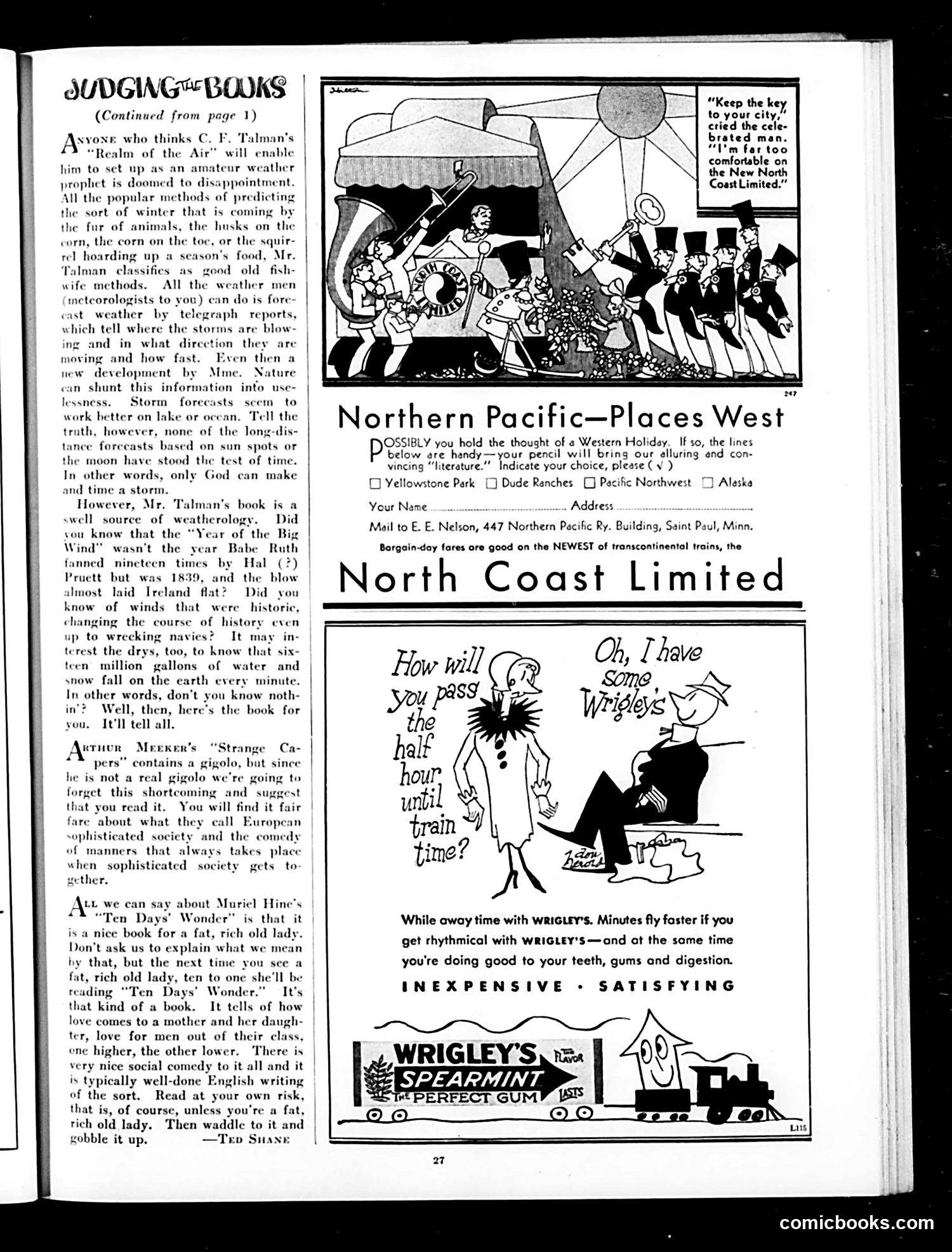
Analysis of Judge Magazine Page This page contains two primary elements: a book review section and advertisements. Book Reviews ("Judging the Books"): The text reviews three books: C.F. Talman's weather forecasting guide, Arthur Mercer's "Strange Capers" (about European high society and romantic entanglements), and Muriel Hine's "Ten Days' Wonder" (a romantic comedy about class differences). The reviewer uses humorous, conversational tone to recommend these works to different audiences. Main Cartoon: The top illustration shows a woman on a train refusing a "key to the city" offered by officials, saying she's too comfortable on the "New North Coast Limited" train—this is an advertisement for Northern Pacific Railway's luxury transcontinental service. Advertisements: The page primarily promotes Northern Pacific Railway destinations (Yellowstone, Dude Ranches, Alaska, Pacific Northwest) and Wrigley's Spearmint gum, which claims to help teeth and digestion while passing travel time. The content reflects 1920s-30s leisure culture: middle-class train travel, European sophistication, and mass-market consumer goods.
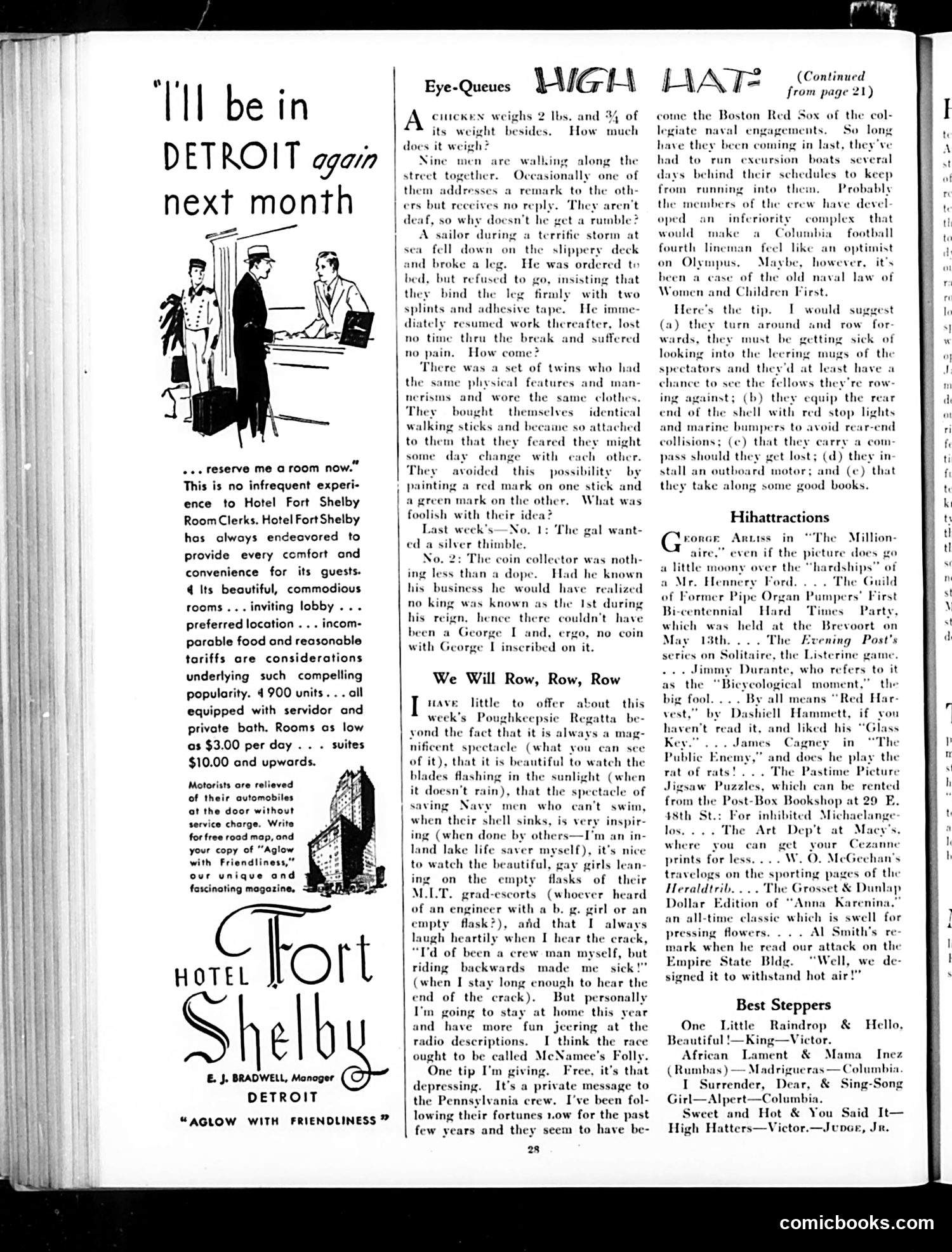
Political Context for Modern Readers This page from *Judge* magazine contains mostly advertisements and humor columns rather than political satire. The main content includes: 1. Hotel Fort Shelby ad (left): A standard 1920s-30s hotel advertisement emphasizing comfort and reasonable rates for motorists—reflecting the era's growing automobile tourism. 2. "Eye-Queues" riddle column (top right): A traditional puzzle section with wordplay and logic problems, typical of period magazines. 3. Sports commentary (bottom): A humorous column about the Poughkeepsie Regatta (elite rowing competition) and the struggling Pennsylvania crew team, joking about their chronic losing streak. The writer compares their inferiority complex to Columbia football players. 4. "Hihattractions" section: Brief entertainment gossip about actors and shows. The page reflects leisure and popular culture of the pre-WWII era—travel, competitive sports, Broadway entertainments—rather than addressing political issues. No specific political figures or satire are present.
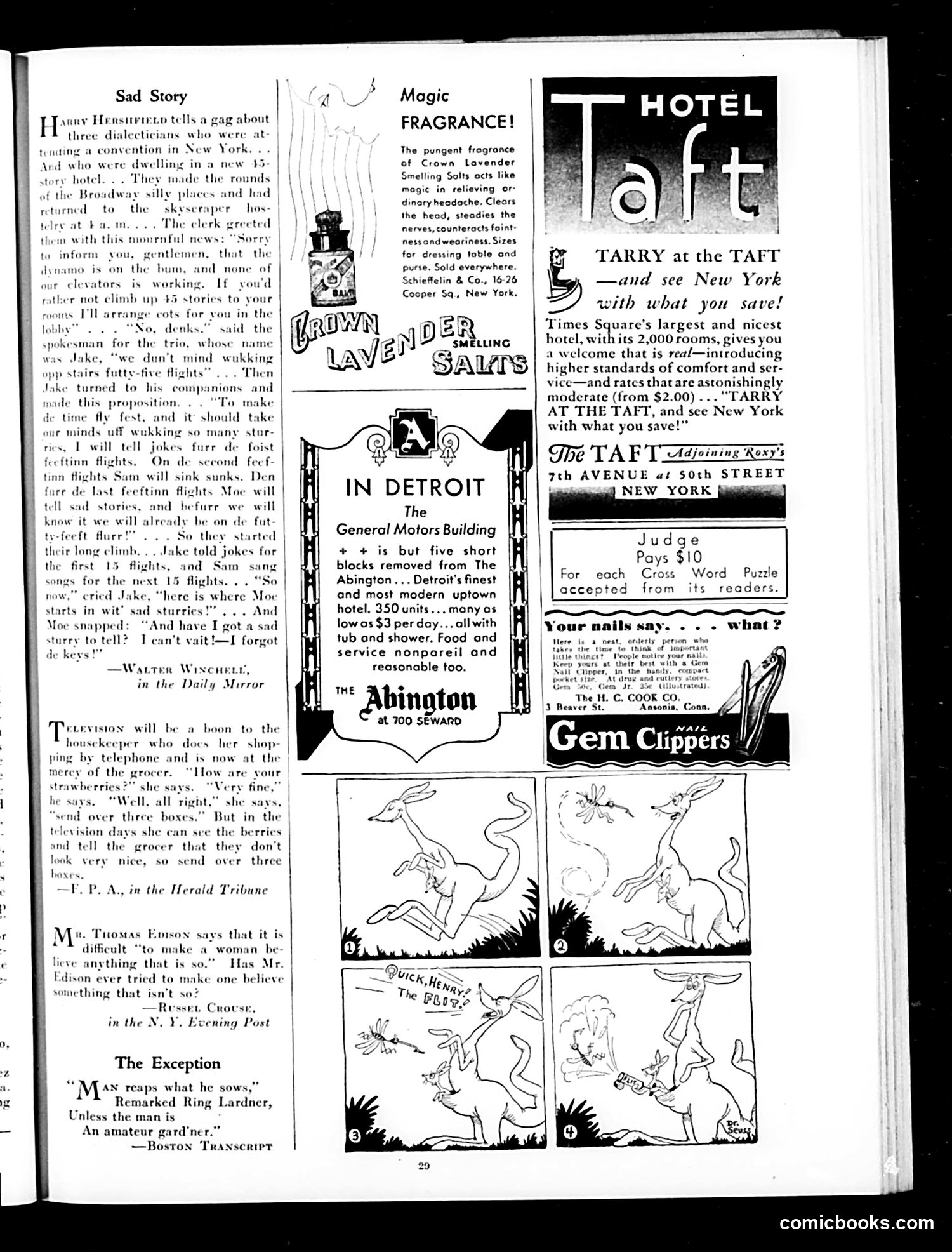
Analysis of Judge Magazine Page This page is primarily advertising and filler content rather than political satire. It contains: "Sad Story" — A dialect humor piece about three men climbing 45 flights of stairs in a New York hotel, taking turns telling jokes, singing, and sad stories to pass the time. The setup is a play on vaudeville entertainment; the "sad story" punchline appears cut off but likely involved the climber forgetting something. Four cartoon panels (bottom) — Appear to show animals in comedic situations, though details are unclear from this reproduction. Advertisements dominate the page: Crown Lavender smelling salts, the Abington hotel in Detroit, the Taft hotel in Times Square, a cross-word puzzle contest, and gem clippers. Sidebar quotes mock various subjects (Edison on women, Thomas on making women believe things, gardening), typical of Judge's miscellaneous humor format. This page exemplifies Judge's mixed content model: light dialect humor, comics, and revenue-generating advertisements rather than sustained political commentary.
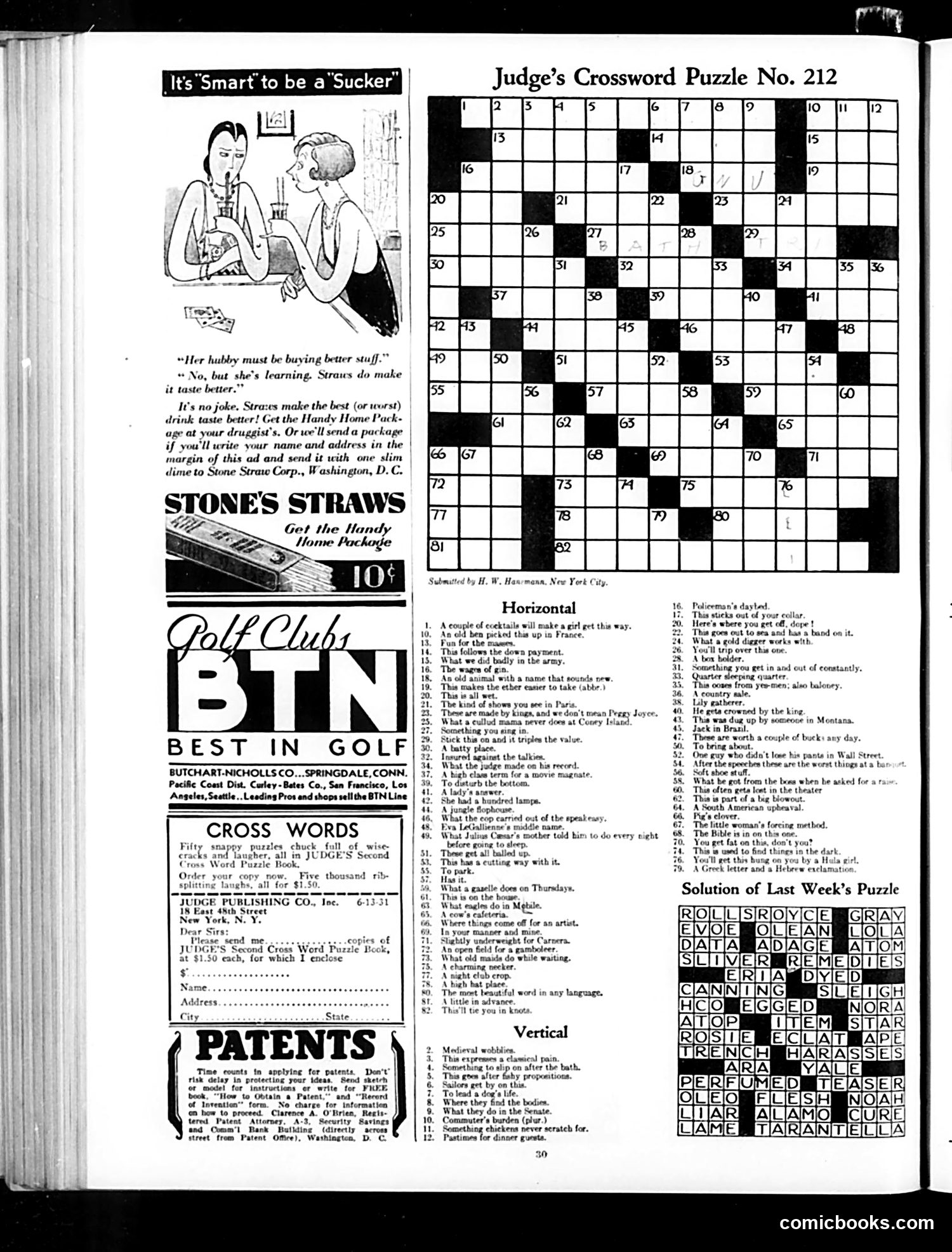
Judge Magazine Page Analysis This page is primarily advertising and puzzle content rather than editorial cartoons with political satire. The main illustrated content is a Stones Straws advertisement featuring a domestic scene where a woman drinks through a straw while her husband comments. The joke plays on Prohibition-era anxieties: the husband assumes his wife is "buying better stuff" (alcohol), but she's actually just using straws, which the ad claims improve any drink's taste. This is satirical advertising that humorously exploits contemporary concerns about hidden drinking and changing social behavior during Prohibition. The bulk of the page consists of Judge's Crossword Puzzle No. 212 with clues and a solved puzzle from the previous week. There are also advertisements for golf clubs, cross-word puzzle books, and patent services—standard magazine filler content. The satire here is gentle commercial humor rather than political commentary.
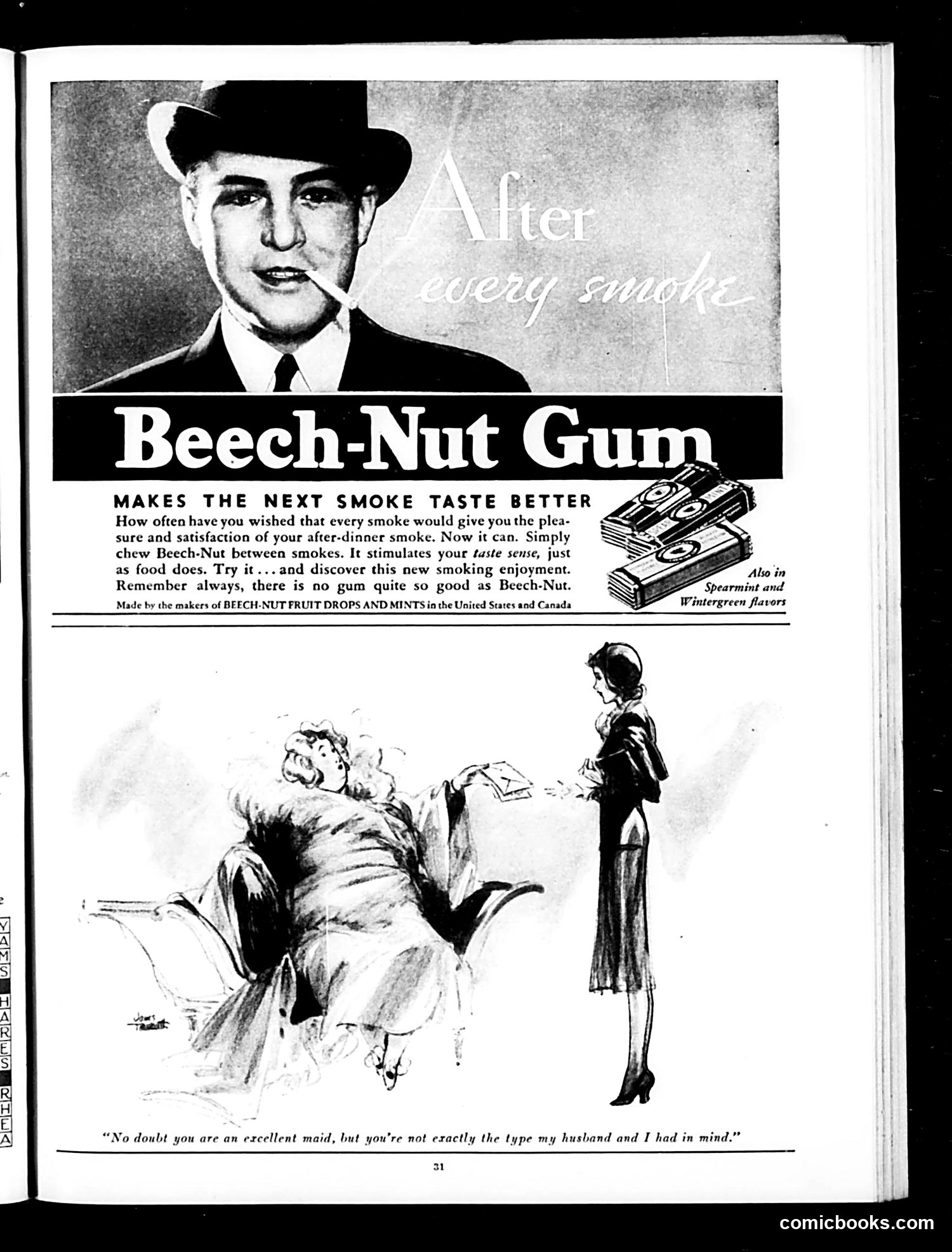
Beech-Nut Gum Advertisement with Comic Illustration This page is primarily a Beech-Nut Gum advertisement (top two-thirds) promoting the product as something to chew between cigarettes to improve the taste of the next smoke. The ad features a man in a cowboy hat and includes flavor variants (Spearmint and Wintergreen). Below is an unrelated single-panel cartoon (bottom third) depicting a domestic scene: a wealthy couple interviewing a maid applicant. The husband and wife are rejecting her with the caption, "No doubt you are an excellent maid, but you're not exactly the type my husband and I had in mind"—a joke implying the wife suspects the husband's ulterior motives in hiring decisions, or commenting on class/appearance standards in domestic service. This reflects early-20th-century attitudes about hired help and marital dynamics.
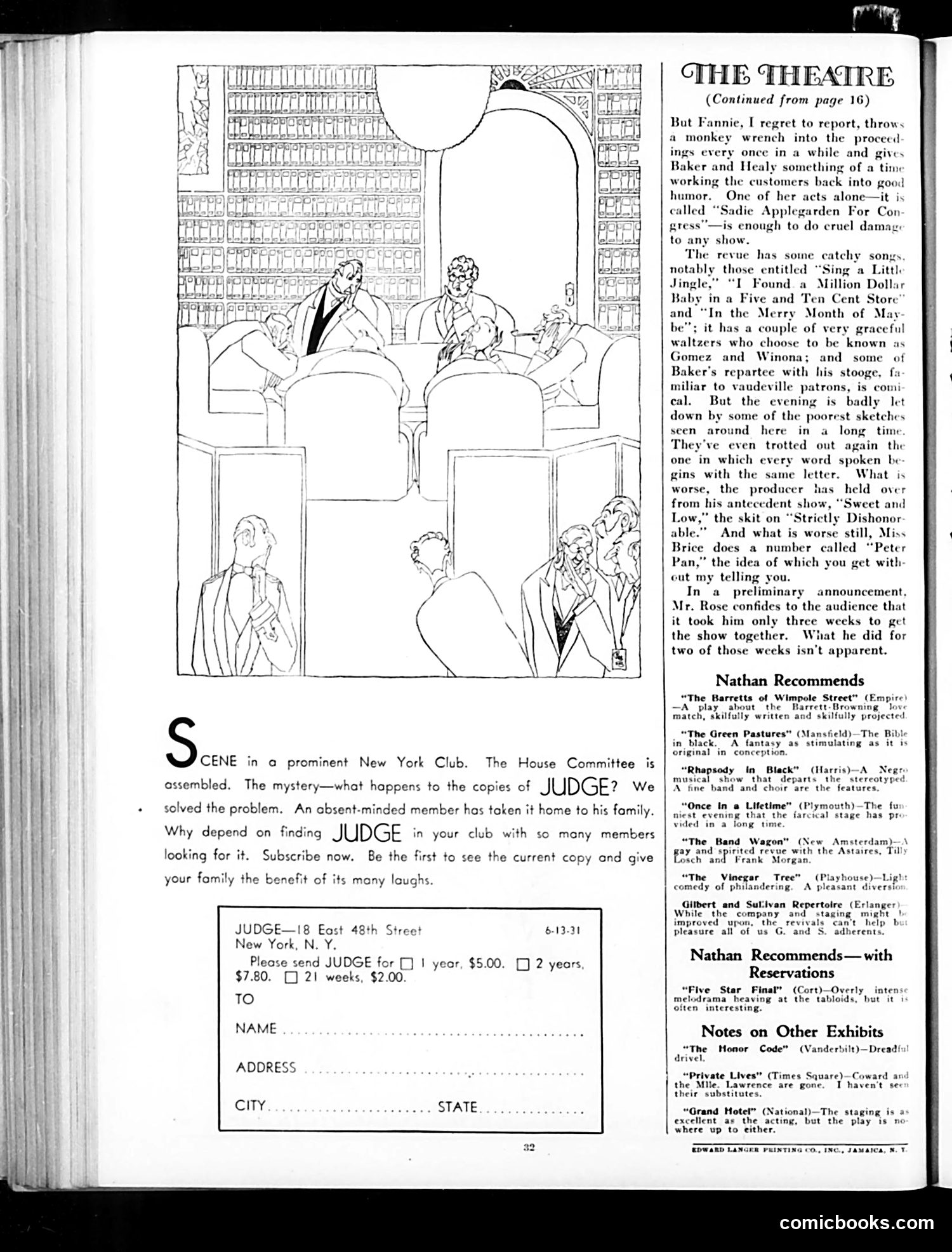
Judge Magazine Page Analysis This page is primarily advertising and theater criticism, not political satire. The main cartoon depicts a scene in a prominent New York club where committee members discover that copies of *Judge* magazine disappear because an absent-minded member takes them home. It's a self-promotional joke: the magazine humorously explains why club copies go missing—to encourage subscriptions so families can have their own. The bulk of the page comprises theater reviews by "Nathan" (likely drama critic George Jean Nathan), recommending Broadway shows like *The Barretts of Wimpole Street*, *The Green Pastures*, and *Once in a Lifetime*. These contemporary 1930s productions receive brief critical assessments. The social context: this reflects Judge's affluent, club-going readership and the thriving Broadway theater scene of the era. There is no political commentary—merely lifestyle humor targeting the magazine's educated, urban audience.
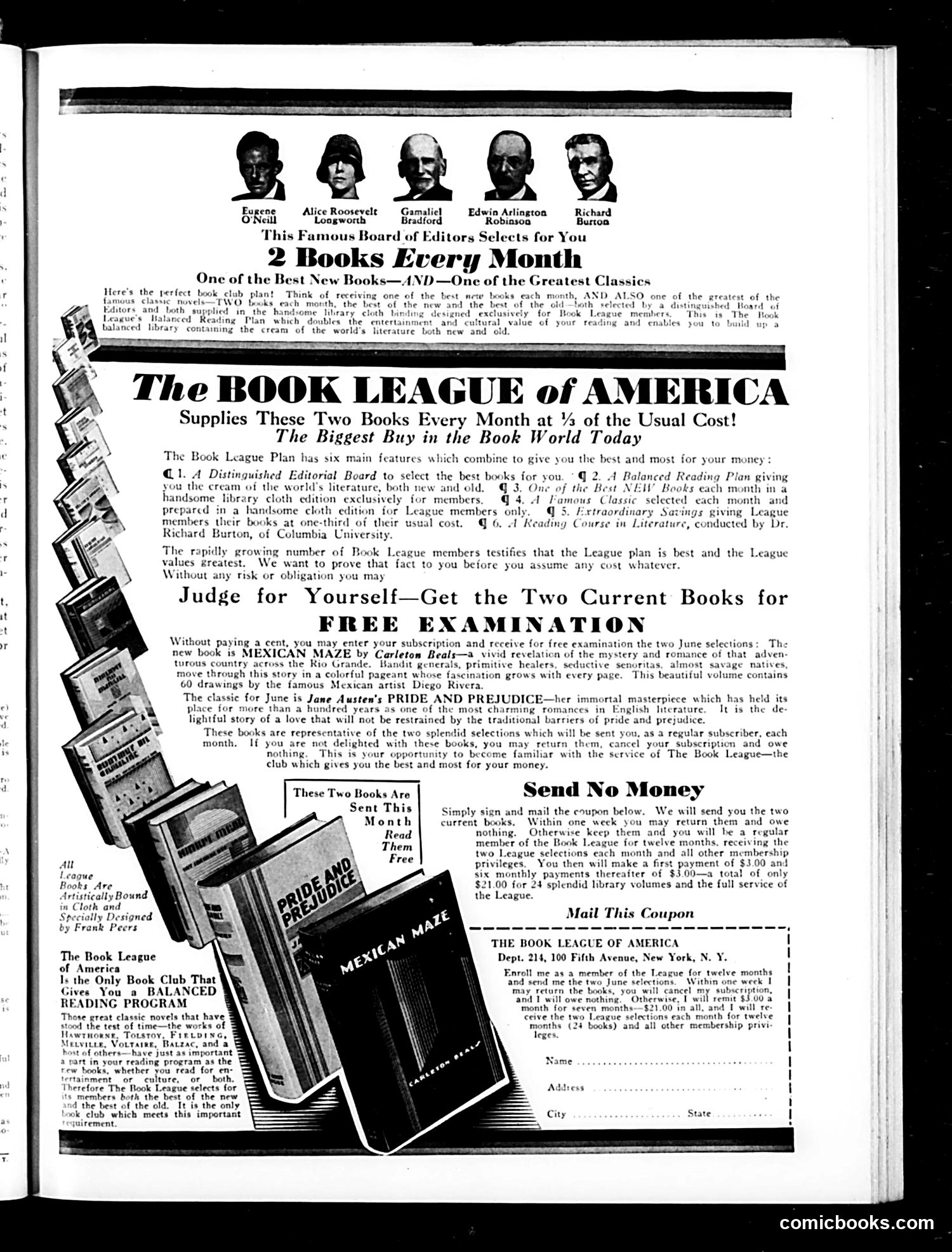
The Book League of America Advertisement This page is primarily a magazine advertisement, not political satire. It promotes the Book League of America subscription service, featuring five named editors at the top: Eugene O'Neill, Alice Roosevelt Longworth, Gamaliel Bradford, Edwin Arlington Robinson, and Richard Burton. The ad emphasizes affordable access to books—two monthly selections (one new, one classic) at one-third the usual cost. The specific June offerings mentioned are *Mexican Maze* by Carleton Beals and Jane Austen's *Pride and Prejudice*. The "famous board of editors" likely lent credibility through their literary prominence, though this is primarily a sales pitch using celebrity endorsement rather than satire. The layout and design are typical of early-20th-century magazine advertising, with bold typography and illustrated stacked books as visual elements.
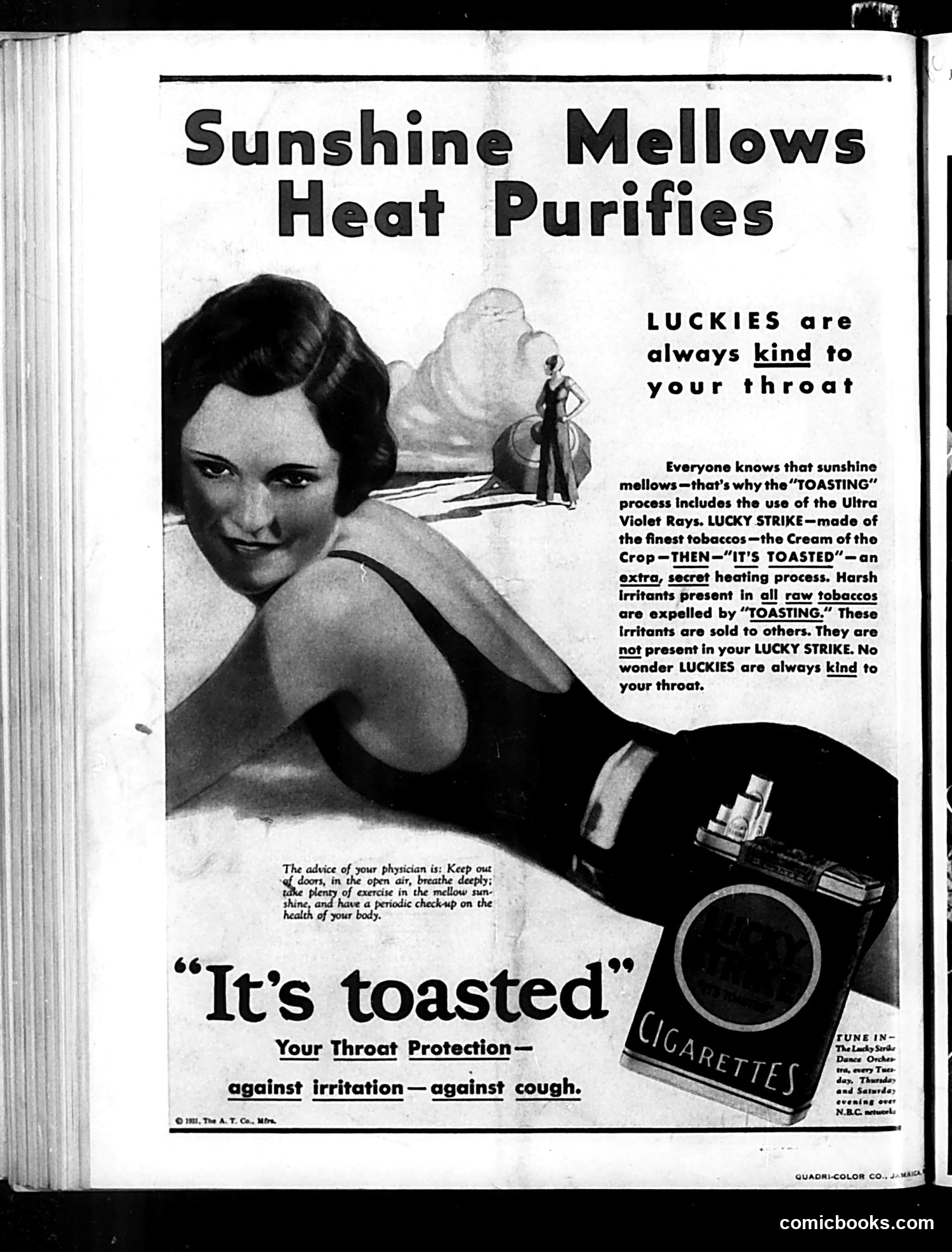
Lucky Strike Cigarette Advertisement This is a cigarette advertisement, not political satire—it appears in Judge magazine but functions as commercial messaging. The ad promotes Lucky Strike cigarettes using a "health angle" popular in 1920s-30s tobacco marketing. The central claim: Lucky Strikes undergo a "toasting" process using ultraviolet rays that removes harsh irritants present in other tobaccos, making them "kind to your throat." The imagery shows a glamorous woman in a bathing suit lounging in sunshine, visually reinforcing the "toasting" metaphor. The ad assures consumers that irritants are "expelled" and "sold to others"—a remarkable admission that competitors' cigarettes contain these rejected materials. This reflects an era when tobacco companies made explicit health claims without FDA regulation, targeting throat irritation concerns. Modern readers would recognize this as deceptive marketing—the "toasting" process provided no actual health benefit, and all cigarettes cause harm.